Questions as text
Q1 · Which of the following is not a correct statement about iodine? 9701/11 Oct/Nov 2006
15 Which of the following is not a correct statement about iodine? A A crystal of iodine contains covalent bonds and van der Waals’ forces. B Iodine vapour is purple. C The first ionisation energy of iodine is less than that of bromine. D The hydride of iodine is of greater thermal stability than that of bromine.
1 marks
Answer: D
This question in 9701/11 Oct/Nov 2006
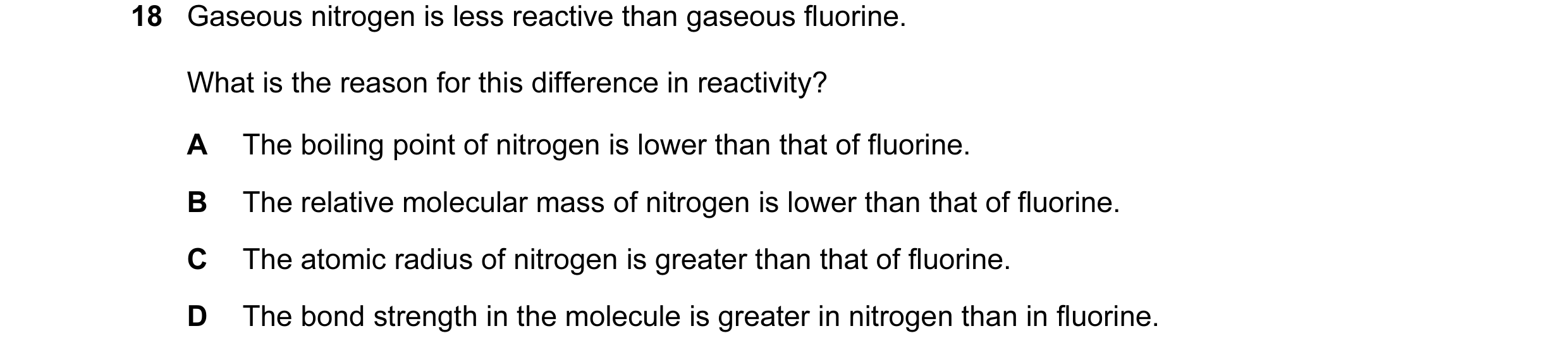
Q2 · Gaseous nitrogen is less reactive than gaseous fluorine 9701/11 Oct/Nov 2007
18 Gaseous nitrogen is less reactive than gaseous fluorine. What is the reason for this difference in reactivity? A The boiling point of nitrogen is lower than that of fluorine. B The relative molecular mass of nitrogen is lower than that of fluorine. C The atomic radius of nitrogen is greater than that of fluorine. D The bond strength in the molecule is greater in nitrogen than in fluorine.
1 marks
Answer: D
This question in 9701/11 Oct/Nov 2007
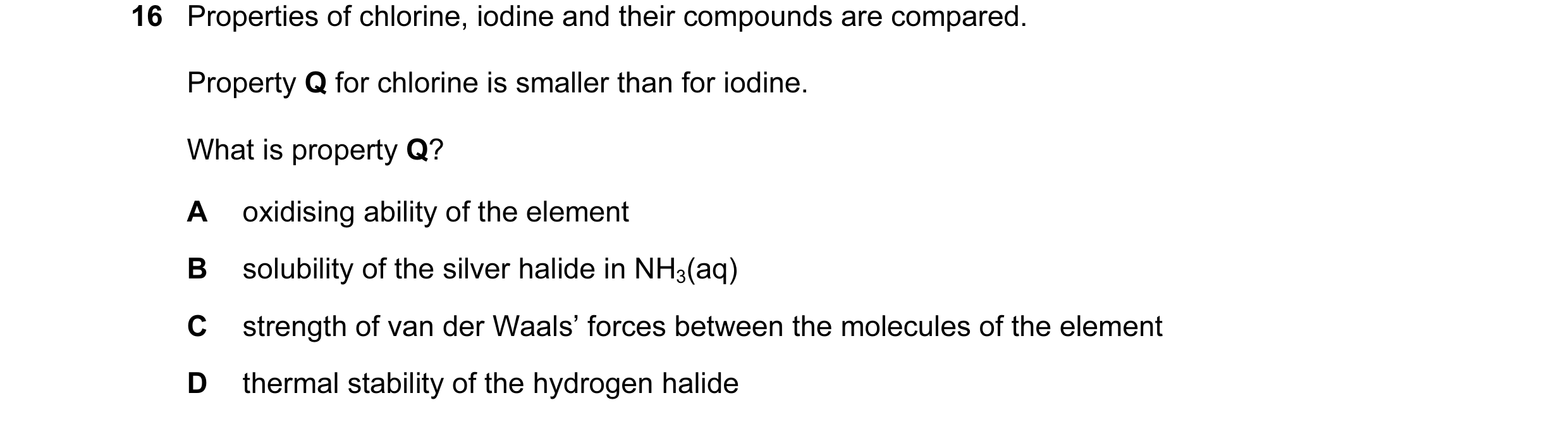
Q3 · Properties of chlorine, iodine and their compounds are compared 9701/11 May/June 2008
16 Properties of chlorine, iodine and their compounds are compared. Property Q for chlorine is smaller than for iodine. What is property Q? A oxidising ability of the element B solubility of the silver halide in NH3(aq) C strength of van der Waals’ forces between the molecules of the element D thermal stability of the hydrogen halide
1 marks
Answer: C
This question in 9701/11 May/June 2008
Q4 · Chlorine is a greenish-yellow gas, bromine is a dark red liquid and iodine is a dark grey… 9701/11 Oct/Nov 2008
35 Chlorine is a greenish-yellow gas, bromine is a dark red liquid and iodine is a dark grey solid. What causes these differences in volatility? 1 the halogen-halogen bond energy 2 the magnitude of the van der Waals’ forces between the molecules 3 the number of electrons in the halogen molecule
1 marks
Answer: C
This question in 9701/11 Oct/Nov 2008
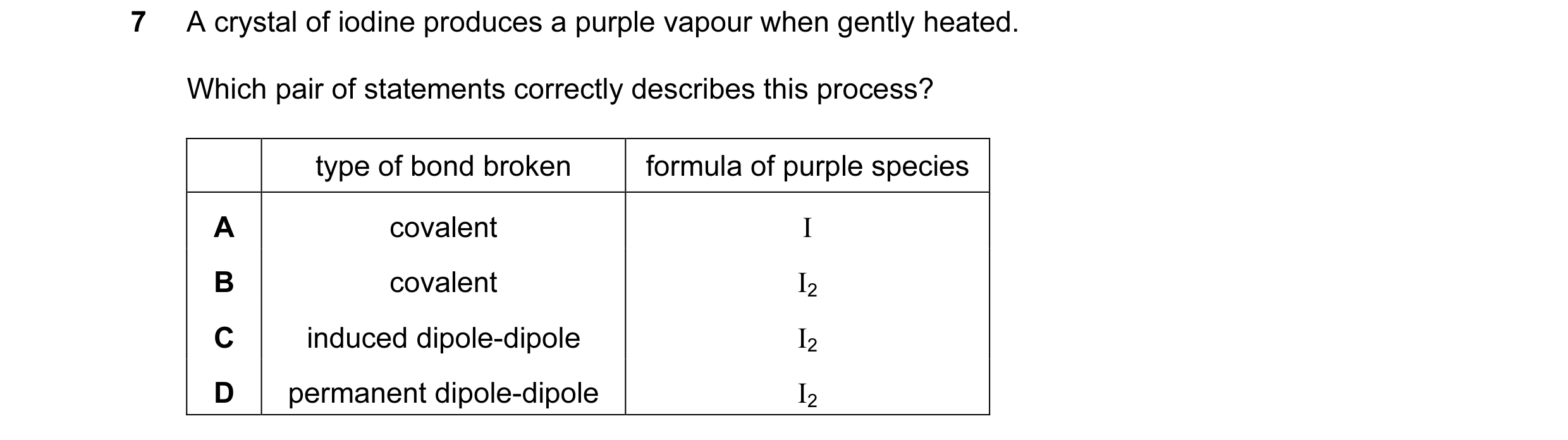
Q5 · A crystal of iodine produces a purple vapour when gently heated 9701/11 May/June 2009
7 A crystal of iodine produces a purple vapour when gently heated. Which pair of statements correctly describes this process? type of bond broken formula of purple species A covalent I B covalent I2 C induced dipole-dipole I2 D permanent dipole-dipole I2
1 marks
Answer: C
This question in 9701/11 May/June 2009
Q6 · Over half a million tonnes of bromine are manufactured annually and are mainly used for… 9701/11 May/June 2009
14 Over half a million tonnes of bromine are manufactured annually and are mainly used for making other compounds. One important use is for agricultural chemicals. What is another important use for bromine? A antiseptic agents B bleaches for textiles and the paper industry C flame-retardants and fire extinguishers D water purification
1 marks
Answer: C
This question in 9701/11 May/June 2009
Q7 · Which graph correctly describes a trend found in the halogen group? 9701/11 Oct/Nov 2009
15 Which graph correctly describes a trend found in the halogen group? [X represents a halogen atom.] A B bond strength of length van der Waals' in X2 forces Cl2 Br2 I2 Cl2 Br2 I2 C D boiling bond point energy of X2 of HX Cl2 Br2 I2 HCl HBr HI
1 marks
Answer: B
This question in 9701/11 Oct/Nov 2009
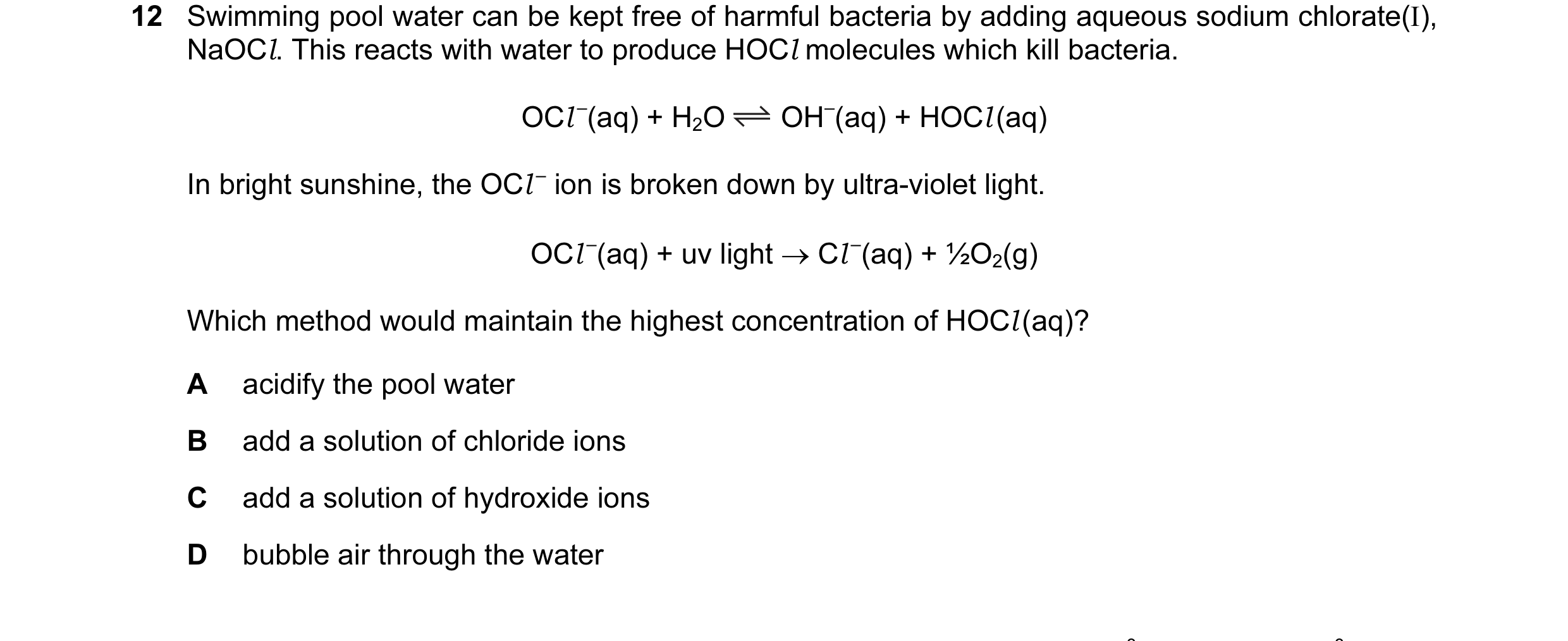
Q8 · Swimming pool water can be kept free of harmful bacteria by adding aqueous sodium… 9701/12 May/June 2010
12 Swimming pool water can be kept free of harmful bacteria by adding aqueous sodium chlorate(I), NaOCl. This reacts with water to produce HOCl molecules which kill bacteria. OCl –(aq) + H2O OH–(aq) + HOCl (aq) In bright sunshine, the OCl – ion is broken down by ultra-violet light. OCl –(aq) + uv light → Cl –(aq) + ½O2(g) Which method would maintain the highest concentration of HOCl (aq)? A acidify the pool water B add a solution of chloride ions C add a solution of hydroxide ions D bubble air through the water
1 marks
Answer: A
This question in 9701/12 May/June 2010
Q9 · Which statement describes the halogens chlorine, bromine and iodine? 9701/11 Oct/Nov 2010
17 Which statement describes the halogens chlorine, bromine and iodine? A Their bond energies decrease with increasing proton number. B Their first ionisation energies increase with increasing proton number. C They are all coloured gases at room temperature. D They are all good reducing agents.
1 marks
Answer: A
This question in 9701/11 Oct/Nov 2010
Q10 · Which statement about bromine is correct? 9701/12 Oct/Nov 2010
18 Which statement about bromine is correct? A Bromine is insoluble in non-polar solvents. B Bromine vapour is more dense than air. C Bromine will not vapourise significantly under normal conditions. D Gaseous bromine is purple.
1 marks
Answer: B
This question in 9701/12 Oct/Nov 2010
Q11 · Which statement describes the halogens chlorine, bromine and iodine? 9701/13 Oct/Nov 2010
8 Which statement describes the halogens chlorine, bromine and iodine? A Their bond energies decrease with increasing proton number. B Their first ionisation energies increase with increasing proton number. C They are all coloured gases at room temperature. D They are all good reducing agents.
1 marks
Answer: A
This question in 9701/13 Oct/Nov 2010
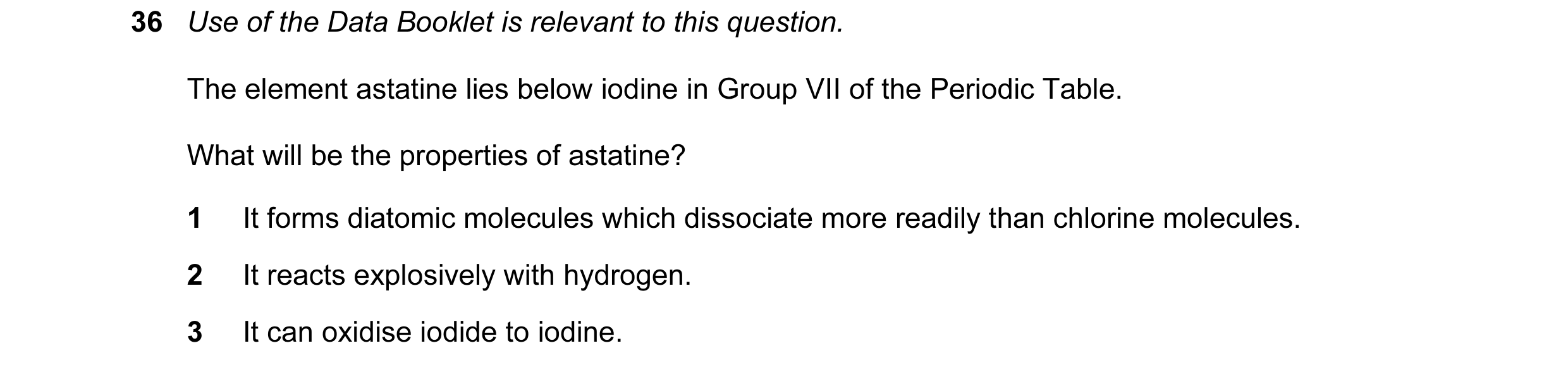
Q12 · Use of the Data Booklet is relevant to this question 9701/11 May/June 2011
36 Use of the Data Booklet is relevant to this question. The element astatine lies below iodine in Group VII of the Periodic Table. What will be the properties of astatine? 1 It forms diatomic molecules which dissociate more readily than chlorine molecules. 2 It reacts explosively with hydrogen. 3 It can oxidise iodide to iodine.
1 marks
Answer: D
This question in 9701/11 May/June 2011
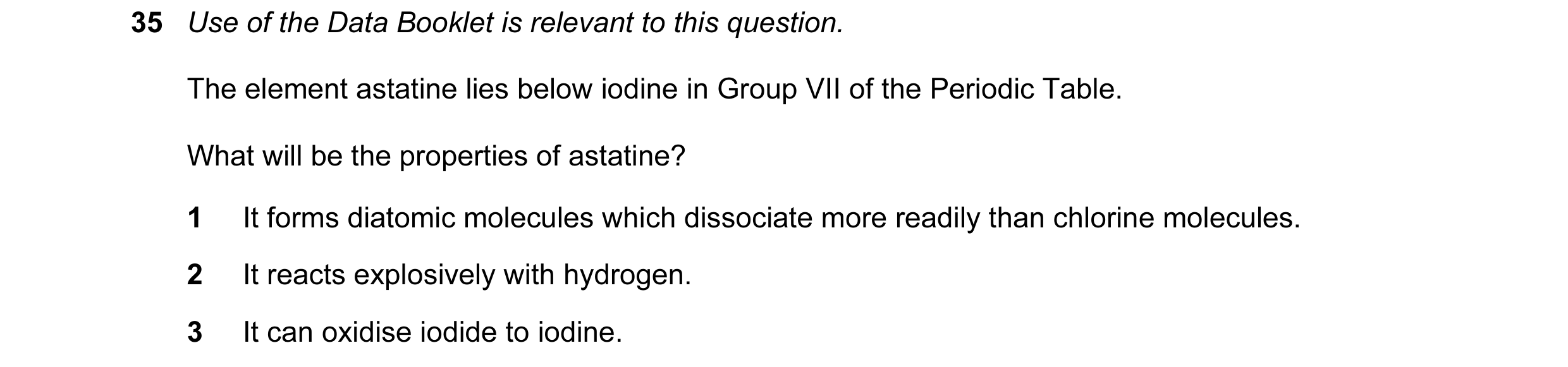
Q13 · Use of the Data Booklet is relevant to this question 9701/13 May/June 2011
35 Use of the Data Booklet is relevant to this question. The element astatine lies below iodine in Group VII of the Periodic Table. What will be the properties of astatine? 1 It forms diatomic molecules which dissociate more readily than chlorine molecules. 2 It reacts explosively with hydrogen. 3 It can oxidise iodide to iodine.
1 marks
Answer: D
This question in 9701/13 May/June 2011
Q14 · Why do the halogens become less volatile as Group VII is descended? 9701/11 Oct/Nov 2011
17 Why do the halogens become less volatile as Group VII is descended? A The halogen-halogen bond energy decreases. B The halogen-halogen bond length increases. C The number of electrons in each molecule increases. D The van der Waals’ forces between molecules become weaker.
1 marks
Answer: C
This question in 9701/11 Oct/Nov 2011
Q15 · Why do the halogens become less volatile as Group VII is descended? 9701/13 Oct/Nov 2011
16 Why do the halogens become less volatile as Group VII is descended? A The halogen-halogen bond energy decreases. B The halogen-halogen bond length increases. C The number of electrons in each molecule increases. D The van der Waals’ forces between molecules become weaker.
1 marks
Answer: C
This question in 9701/13 Oct/Nov 2011
Q16 · What trend is observed on descending Group VII? 9701/11 May/June 2012
17 What trend is observed on descending Group VII? A The colours of the elements become lighter. B The elements become more volatile. C The hydrides of the elements become more thermally stable. D The reactions of the elements with hydrogen become less vigorous.
1 marks
Answer: D
This question in 9701/11 May/June 2012
Q17 · Which statements are correct for all three halogens, chlorine, bromine and iodine? 9701/11 May/June 2012
35 Which statements are correct for all three halogens, chlorine, bromine and iodine? 1 They all form hydrides that are strong acids in aqueous solution. 2 They all react with aqueous sodium hydroxide to form oxo-anions. 3 They all require one more electron to fill the p orbitals of their outer shells.
1 marks
Answer: A
This question in 9701/11 May/June 2012
Q18 · What trend is observed on descending Group VII? 9701/13 May/June 2012
18 What trend is observed on descending Group VII? A The colours of the elements become lighter. B The elements become more volatile. C The hydrides of the elements become more thermally stable. D The reactions of the elements with hydrogen become less vigorous.
1 marks
Answer: D
This question in 9701/13 May/June 2012
Q19 · The element astatine, At, is below iodine in Group VII of the Periodic Table 9701/11 Oct/Nov 2012
34 The element astatine, At, is below iodine in Group VII of the Periodic Table. Which statements concerning At will be correct? 1 It is a dark-coloured solid at room temperature. 2 It is a more powerful oxidising agent than iodine. 3 Its hydride is thermally stable.
1 marks
Answer: D
This question in 9701/11 Oct/Nov 2012
Q20 · The element astatine, At, is below iodine in Group VII of the Periodic Table 9701/12 Oct/Nov 2012
34 The element astatine, At, is below iodine in Group VII of the Periodic Table. Which statements concerning At will be correct? 1 It is a dark-coloured solid at room temperature. 2 It is a more powerful oxidising agent than iodine. 3 Its hydride is thermally stable.
1 marks
Answer: D
This question in 9701/12 Oct/Nov 2012
Q21 · Many modern cars are fitted with halogen lamps 9701/12 May/June 2013
15 Many modern cars are fitted with halogen lamps. When such lamps are first switched on, a distinct purple colour can be seen. Which species is responsible for this purple colour? A I2(s) B I2(l) C I2(g) D I(g)
1 marks
Answer: C
This question in 9701/12 May/June 2013
Q22 · The halogens exist as diatomic molecules, X2 9701/12 May/June 2013
19 The halogens exist as diatomic molecules, X2. The boiling points of the Group VII elements increase as the group is descended from chlorine to iodine. Which statement helps to explain this increase in boiling point as Group VII is descended? A The electronegativity of X decreases as the group is descended. B The number of electrons in each X2 molecule increases as the group is descended. C The size of the permanent dipole in the X2 molecule increases as the group is descended. D The X–X bond strength increases as the group is descended.
1 marks
Answer: B
This question in 9701/12 May/June 2013
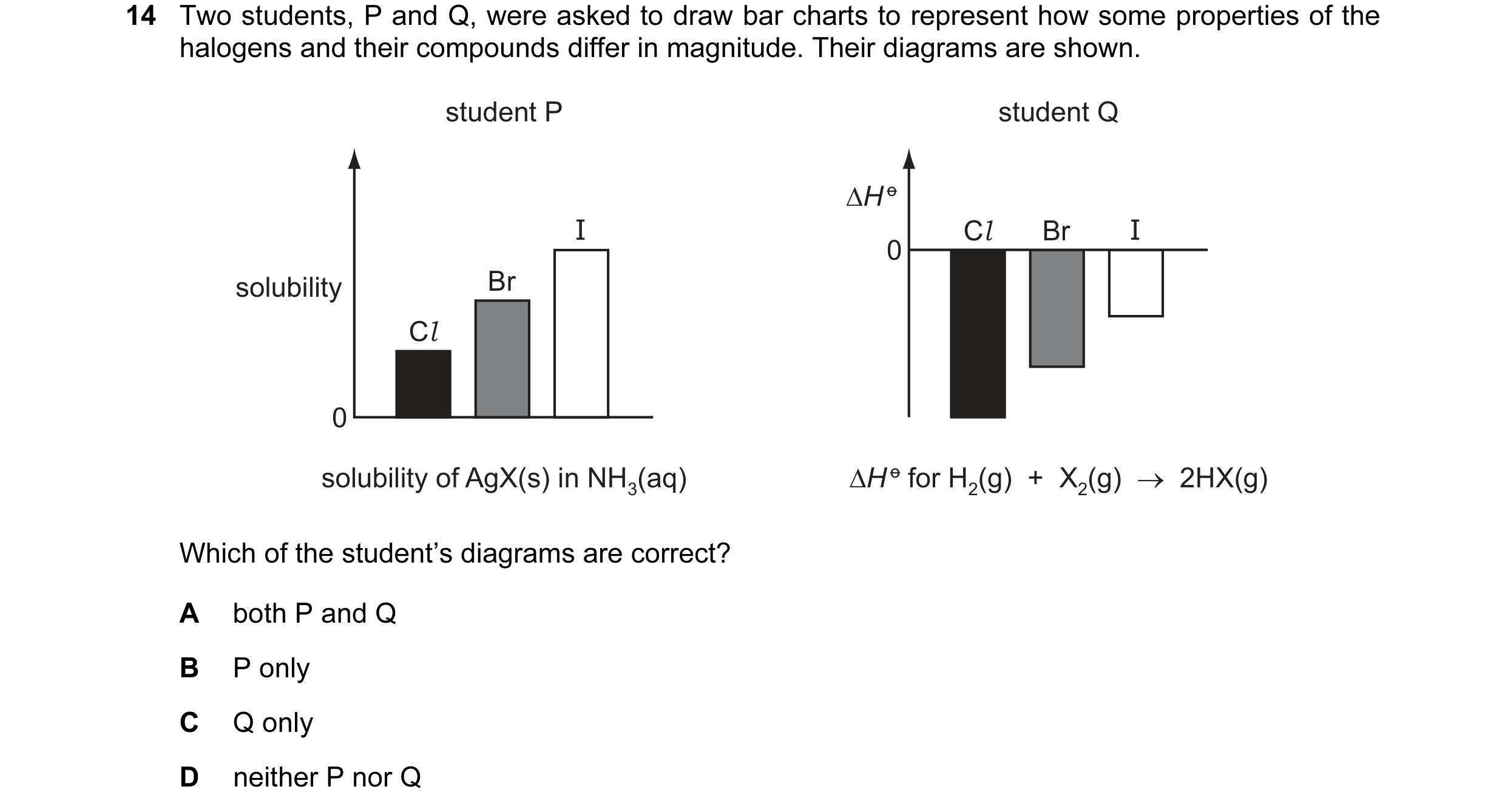
Q23 · Two students, P and Q, were asked to draw bar charts to represent how some properties of… 9701/13 May/June 2013
14 Two students, P and Q, were asked to draw bar charts to represent how some properties of the halogens and their compounds differ in magnitude. Their diagrams are shown. student P student Q ∆H o I Cl Br I 0 solubility Br Cl 0 solubility of AgX(s) in NH3(aq) ∆H o for H2(g) + X2(g) → 2HX(g) Which of the student’s diagrams are correct? A both P and Q B P only C Q only D neither P nor Q
1 marks
Answer: C
This question in 9701/13 May/June 2013
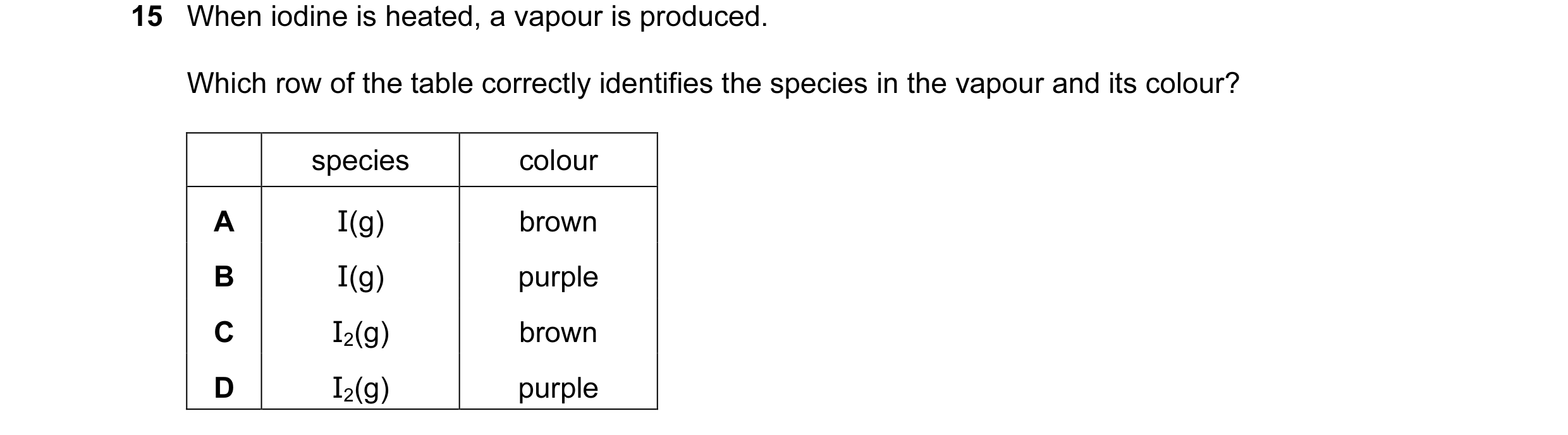
Q24 · When iodine is heated, a vapour is produced 9701/13 May/June 2013
15 When iodine is heated, a vapour is produced. Which row of the table correctly identifies the species in the vapour and its colour? species colour A I(g) brown B I(g) purple C I2(g) brown D I2(g) purple
1 marks
Answer: D
This question in 9701/13 May/June 2013
Q25 · How do the strengths of the covalent bonds within molecules, and the van der Waals’… 9701/13 May/June 2013
16 How do the strengths of the covalent bonds within molecules, and the van der Waals’ forces between molecules, vary going down Group VII from chlorine to bromine to iodine? strength of strength of covalent bonds van der Waals’ forces A decrease decrease B decrease increase C increase decrease D increase increase
1 marks
Answer: B
This question in 9701/13 May/June 2013
Q26 · Under standard conditions, which statement is correct? 9701/12 Oct/Nov 2014
17 Under standard conditions, which statement is correct? A Cl –(aq) can oxidise Br2(aq). B Cl –(aq) can reduce Br2(aq). C Cl 2(aq) can oxidise Br –(aq). D Cl 2(aq) can reduce Br –(aq).
1 marks
Answer: C
This question in 9701/12 Oct/Nov 2014
Q27 · The element astatine, At, is below iodine in Group 17 of the Periodic Table 9701/11 May/June 2016
35 The element astatine, At, is below iodine in Group 17 of the Periodic Table. Which statements concerning At are likely to be correct? 1 It is a dark-coloured solid at room temperature. 2 It is a more powerful oxidising agent than iodine. 3 Its hydride is thermally stable.
1 marks
Answer: D
This question in 9701/11 May/June 2016
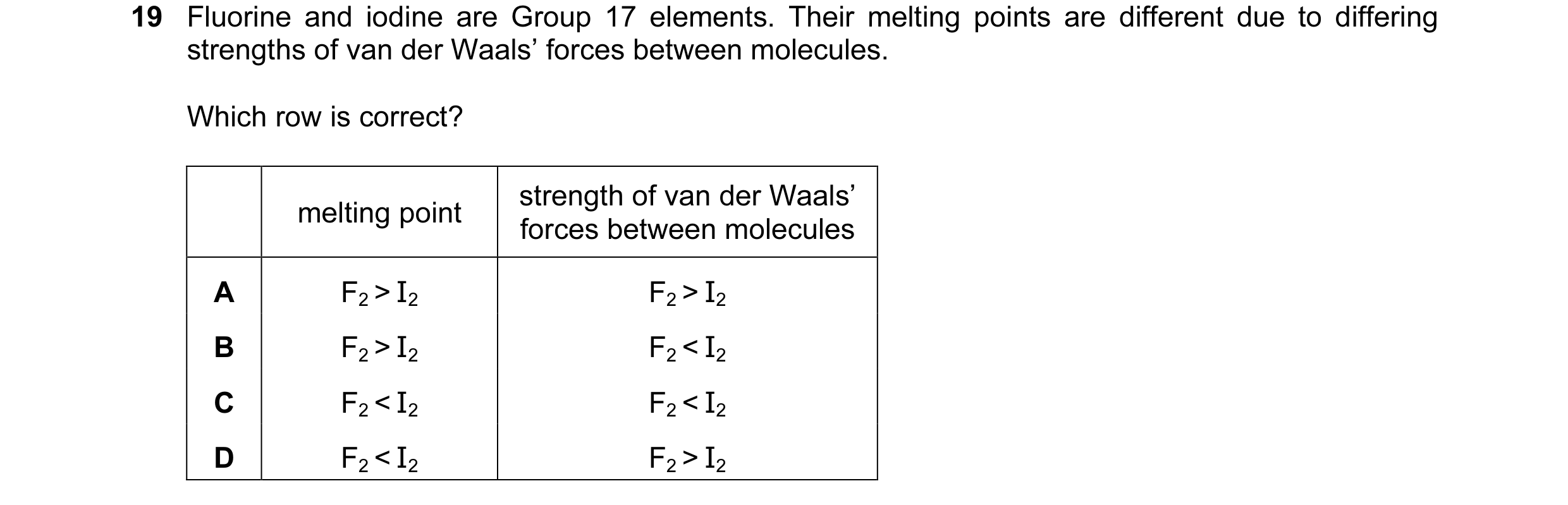
Q28 · Fluorine and iodine are Group 17 elements 9701/12 May/June 2016
19 Fluorine and iodine are Group 17 elements. Their melting points are different due to differing strengths of van der Waals’ forces between molecules. Which row is correct? strength of van der Waals’ melting point forces between molecules A F2 > I2 F2 > I2 B F2 > I2 F2 < I2 C F2 < I2 F2 < I2 D F2 < I2 F2 > I2
1 marks
Answer: C
This question in 9701/12 May/June 2016
Q29 · Two students, P and Q, were asked to draw bar charts to represent how some properties of… 9701/13 May/June 2016
17 Two students, P and Q, were asked to draw bar charts to represent how some properties of the halogens and their compounds differ in magnitude. Their diagrams are shown. The bar charts show trends only and not actual values. student P student Q ∆H o I Cl Br I 0 solubility Br Cl 0 solubility of AgX(s) in NH3(aq) ∆H o for H2(g) + X2(g) → 2HX(g) Which of the students have drawn bar charts which show the trends correctly? A both P and Q B P only C Q only D neither P nor Q
1 marks
Answer: C
This question in 9701/13 May/June 2016
Q30 · The properties of chlorine, bromine and their compounds are compared 9701/11 Oct/Nov 2016
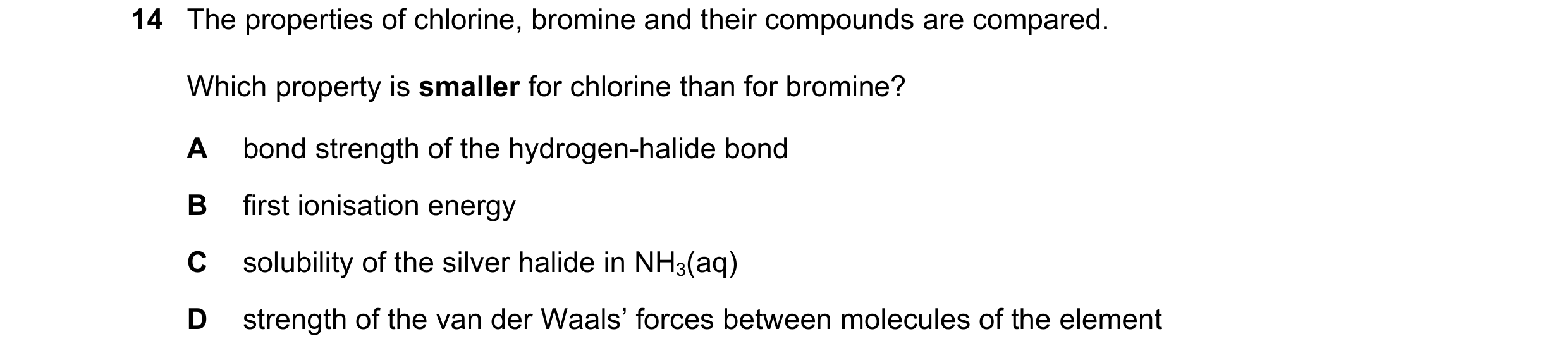
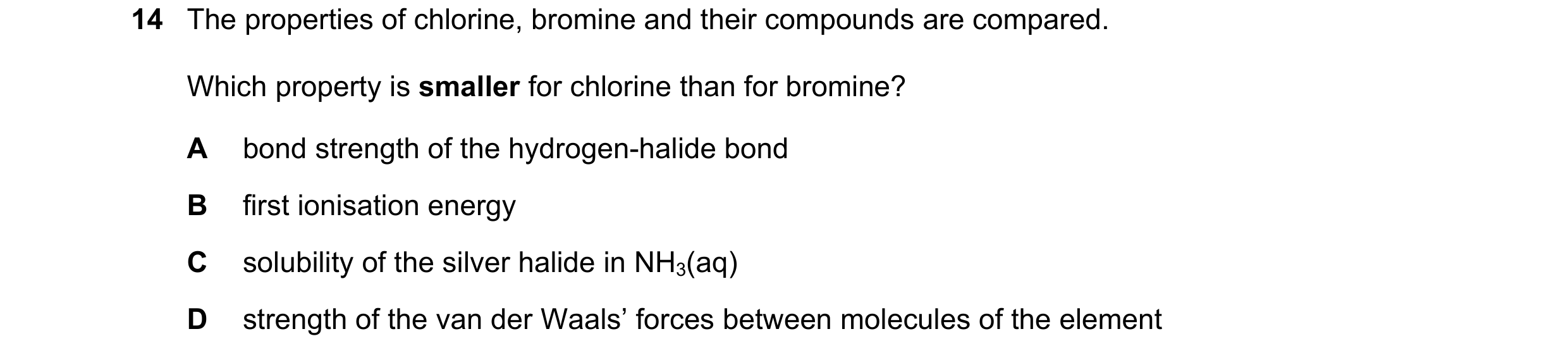
14 The properties of chlorine, bromine and their compounds are compared. Which property is smaller for chlorine than for bromine? A bond strength of the hydrogen-halide bond B first ionisation energy C solubility of the silver halide in NH3(aq) D strength of the van der Waals’ forces between molecules of the element
1 marks
Answer: D
This question in 9701/11 Oct/Nov 2016
Q31 · The properties of chlorine, bromine and their compounds are compared 9701/13 Oct/Nov 2016
14 The properties of chlorine, bromine and their compounds are compared. Which property is smaller for chlorine than for bromine? A bond strength of the hydrogen-halide bond B first ionisation energy C solubility of the silver halide in NH3(aq) D strength of the van der Waals’ forces between molecules of the element
1 marks
Answer: D
This question in 9701/13 Oct/Nov 2016
Q32 · The strengths of the covalent bonds within halogen molecules, and the van der Waals’… 9701/11 Oct/Nov 2017
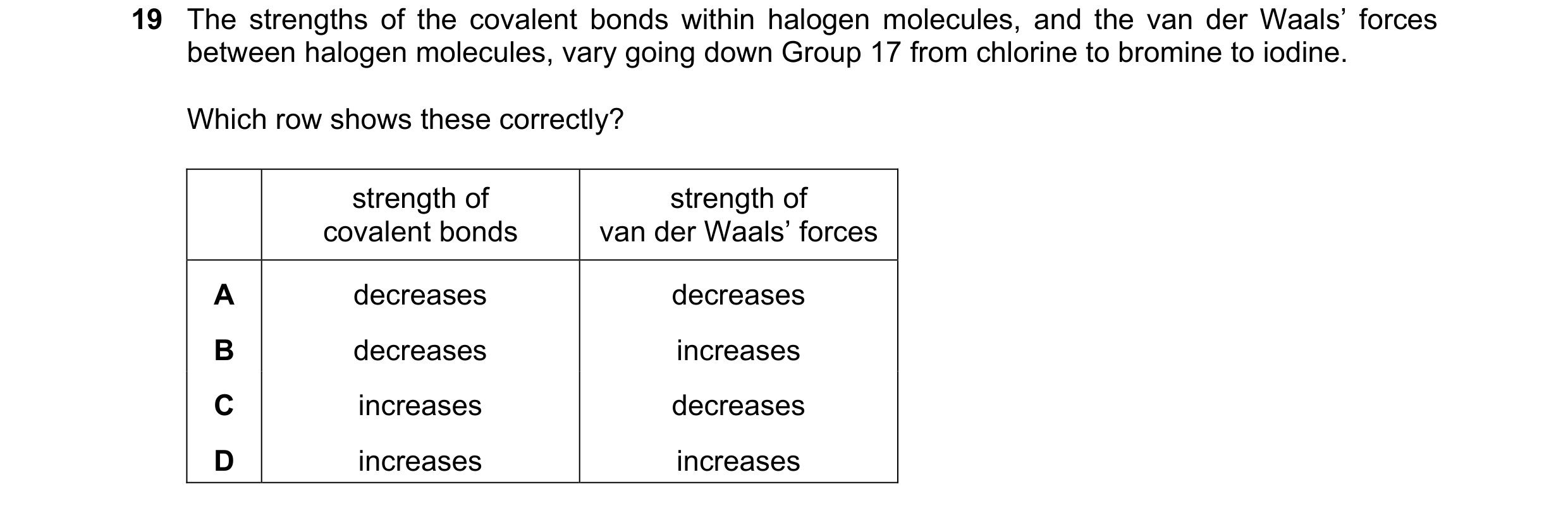
19 The strengths of the covalent bonds within halogen molecules, and the van der Waals’ forces between halogen molecules, vary going down Group 17 from chlorine to bromine to iodine. Which row shows these correctly? strength of strength of covalent bonds van der Waals’ forces A decreases decreases B decreases increases C increases decreases D increases increases
1 marks
Answer: B
This question in 9701/11 Oct/Nov 2017
Q33 · The strengths of the covalent bonds within halogen molecules, and the van der Waals’… 9701/13 Oct/Nov 2017
19 The strengths of the covalent bonds within halogen molecules, and the van der Waals’ forces between halogen molecules, vary going down Group 17 from chlorine to bromine to iodine. Which row shows these correctly? strength of strength of covalent bonds van der Waals’ forces A decreases decreases B decreases increases C increases decreases D increases increases
1 marks
Answer: B
This question in 9701/13 Oct/Nov 2017
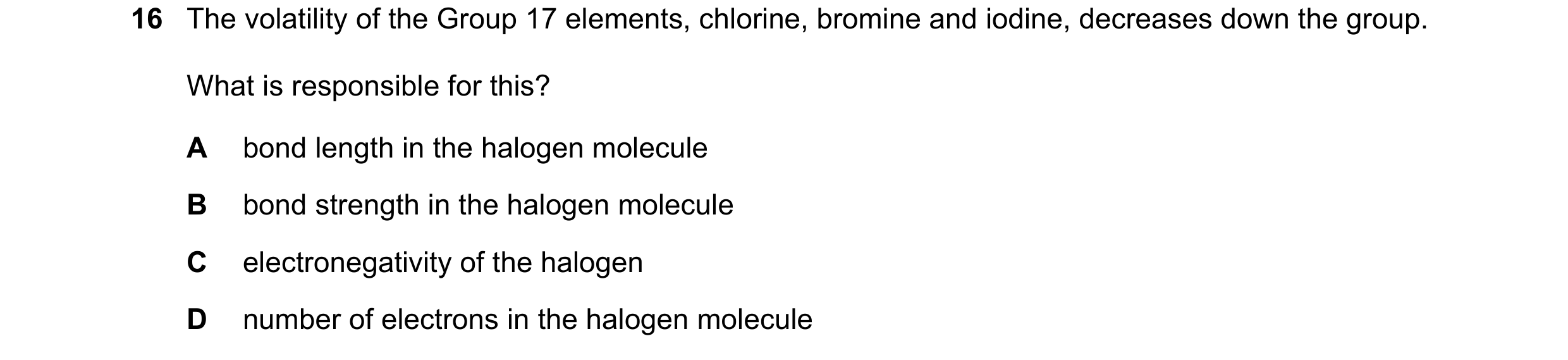
Q34 · The volatility of the Group 17 elements, chlorine, bromine and iodine, decreases down the… 9701/12 Feb/March 2018
16 The volatility of the Group 17 elements, chlorine, bromine and iodine, decreases down the group. What is responsible for this? A bond length in the halogen molecule B bond strength in the halogen molecule C electronegativity of the halogen D number of electrons in the halogen molecule
1 marks
Answer: D
This question in 9701/12 Feb/March 2018
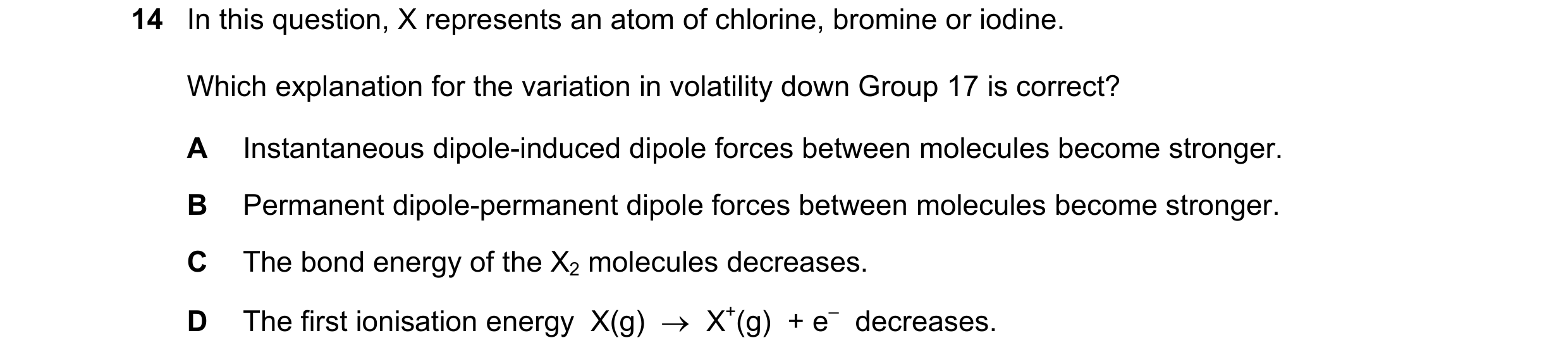
Q35 · In this question, X represents an atom of chlorine, bromine or iodine 9701/12 May/June 2018
14 In this question, X represents an atom of chlorine, bromine or iodine. Which explanation for the variation in volatility down Group 17 is correct? A Instantaneous dipole-induced dipole forces between molecules become stronger. B Permanent dipole-permanent dipole forces between molecules become stronger. C The bond energy of the X2 molecules decreases. D The first ionisation energy X(g) → X+(g) + e– decreases.
1 marks
Answer: A
This question in 9701/12 May/June 2018
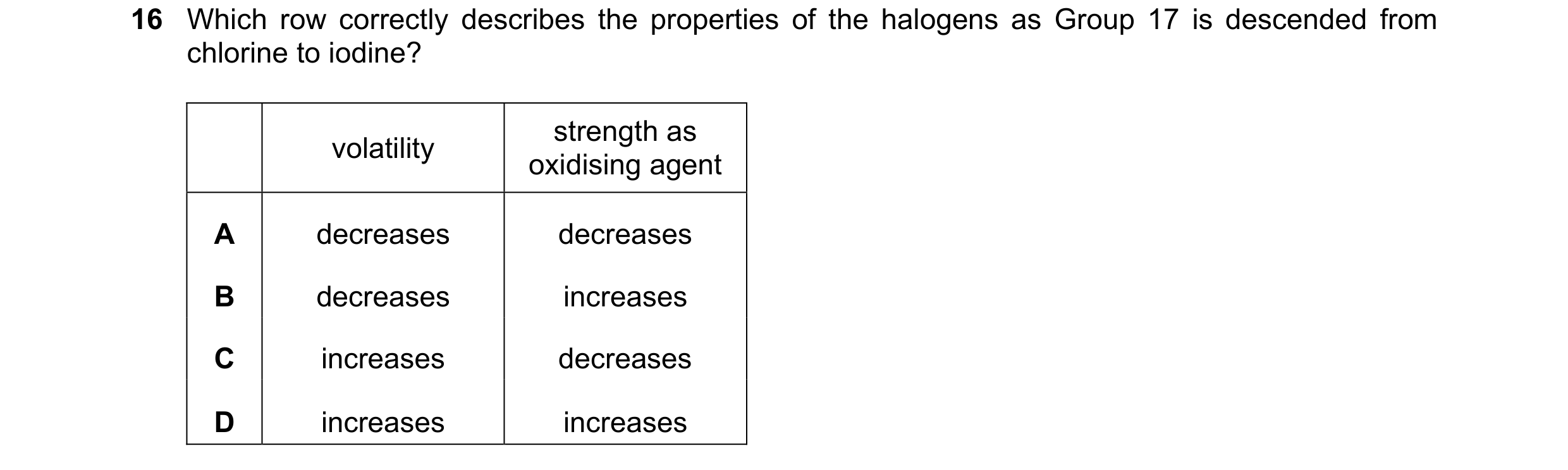
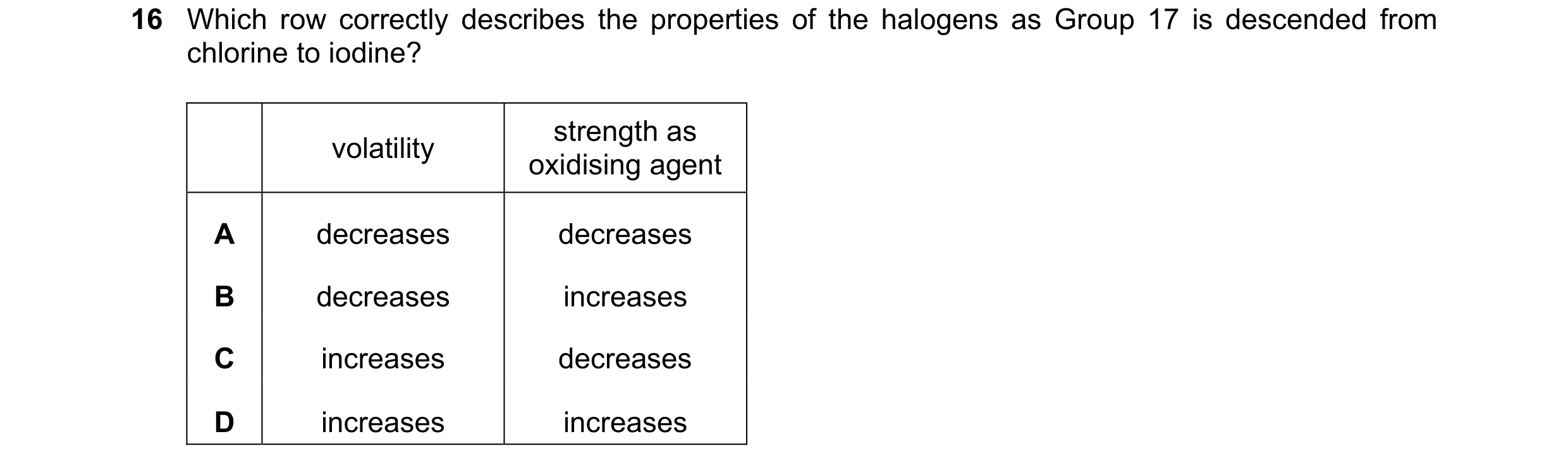
Q36 · Which row correctly describes the properties of the halogens as Group 17 is descended… 9701/11 Oct/Nov 2018
16 Which row correctly describes the properties of the halogens as Group 17 is descended from chlorine to iodine? strength as volatility oxidising agent A decreases decreases B decreases increases C increases decreases D increases increases
1 marks
Answer: A
This question in 9701/11 Oct/Nov 2018
Q37 · Which statement about the halogens is correct? 9701/12 Oct/Nov 2018
16 Which statement about the halogens is correct? A Iodine cannot behave as an oxidising agent. B The volatility of the elements increases from chlorine to iodine because of the increase in molecular size down the group. C When an equimolar mixture of chlorine and hydrogen is exploded, only one product is formed. D When concentrated sulfuric acid is added to solid sodium bromide, hydrogen sulfide is one of the products.
1 marks
Answer: C
This question in 9701/12 Oct/Nov 2018
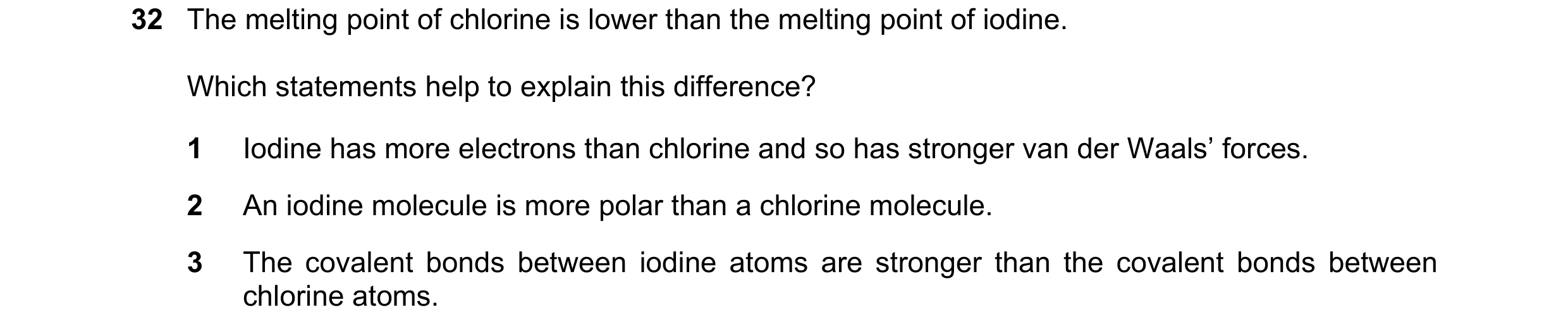
Q38 · The melting point of chlorine is lower than the melting point of iodine 9701/12 Oct/Nov 2018
32 The melting point of chlorine is lower than the melting point of iodine. Which statements help to explain this difference? 1 Iodine has more electrons than chlorine and so has stronger van der Waals’ forces. 2 An iodine molecule is more polar than a chlorine molecule. 3 The covalent bonds between iodine atoms are stronger than the covalent bonds between chlorine atoms.
1 marks
Answer: D
This question in 9701/12 Oct/Nov 2018
Q39 · Which row correctly describes the properties of the halogens as Group 17 is descended… 9701/13 Oct/Nov 2018
16 Which row correctly describes the properties of the halogens as Group 17 is descended from chlorine to iodine? strength as volatility oxidising agent A decreases decreases B decreases increases C increases decreases D increases increases
1 marks
Answer: A
This question in 9701/13 Oct/Nov 2018
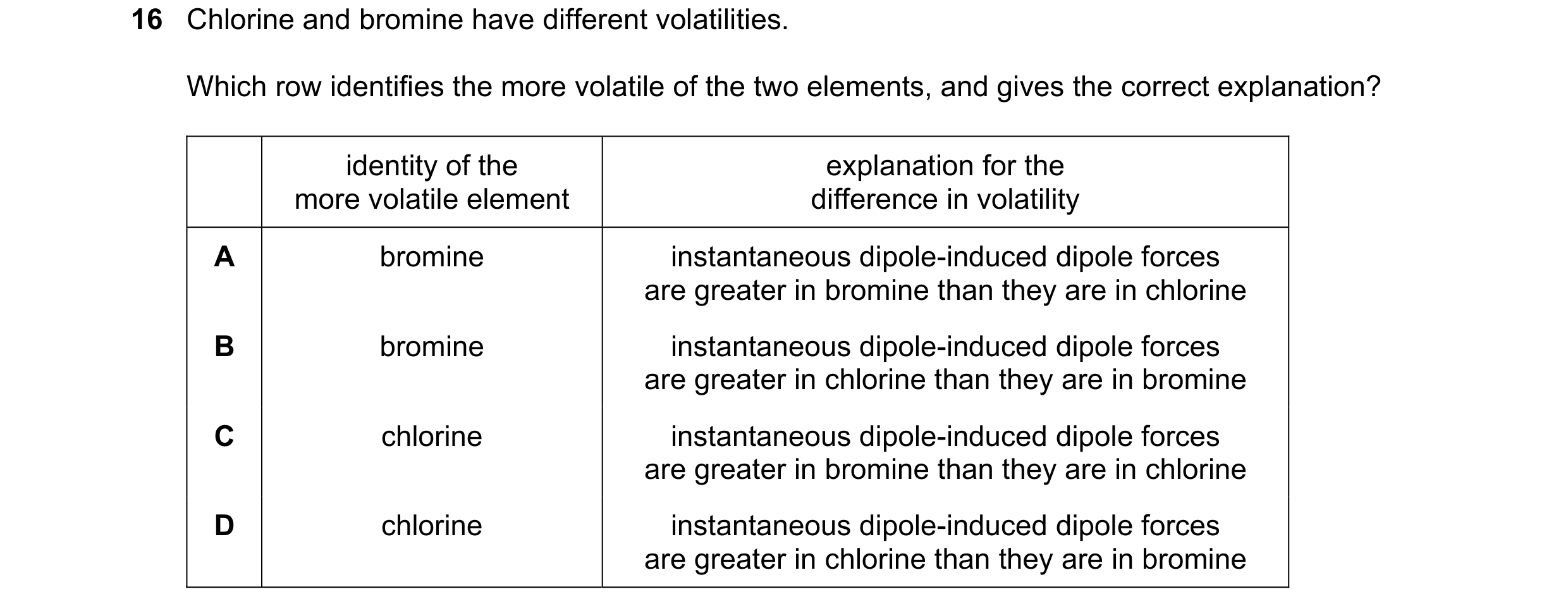
Q40 · Chlorine and bromine have different volatilities 9701/11 Oct/Nov 2019
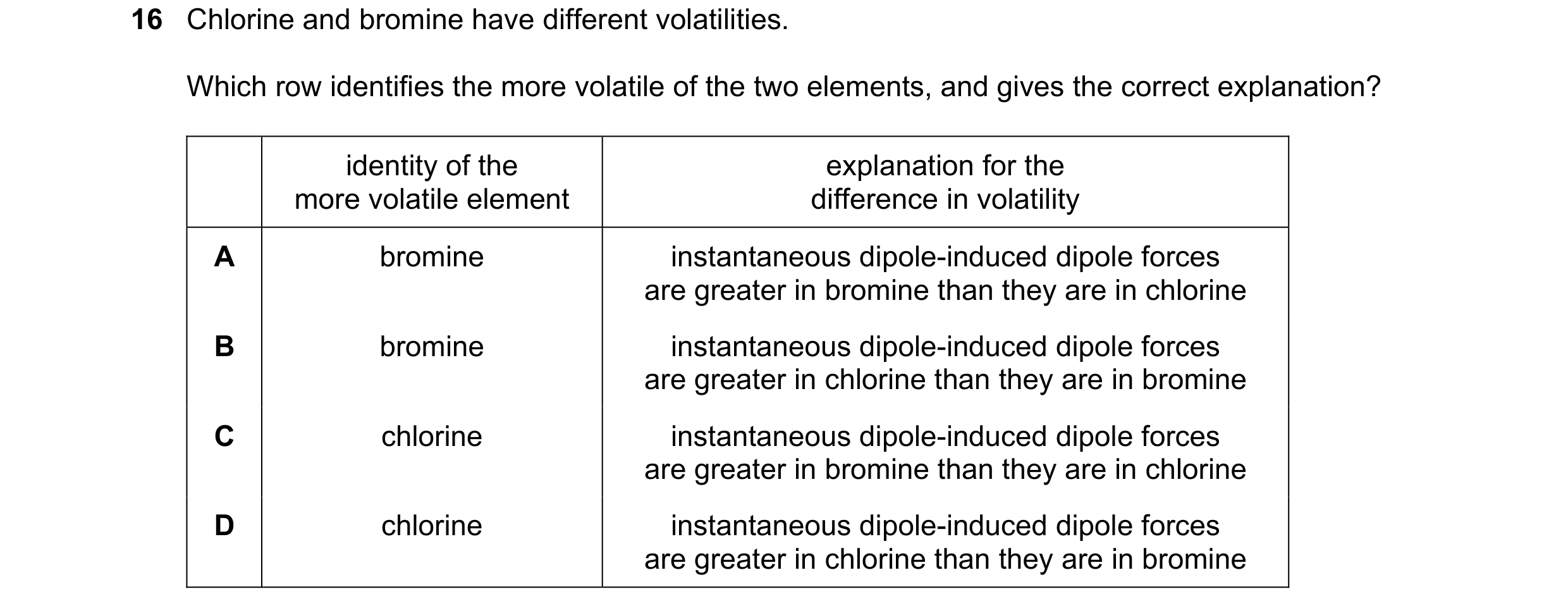
16 Chlorine and bromine have different volatilities. Which row identifies the more volatile of the two elements, and gives the correct explanation? identity of the explanation for the more volatile element difference in volatility A bromine instantaneous dipole-induced dipole forces are greater in bromine than they are in chlorine B bromine instantaneous dipole-induced dipole forces are greater in chlorine than they are in bromine C chlorine instantaneous dipole-induced dipole forces are greater in bromine than they are in chlorine D chlorine instantaneous dipole-induced dipole forces are greater in chlorine than they are in bromine
1 marks
Answer: C
This question in 9701/11 Oct/Nov 2019
Q41 · The properties of chlorine, bromine and their compounds are compared 9701/12 Oct/Nov 2019
16 The properties of chlorine, bromine and their compounds are compared. Which property is smaller for chlorine than for bromine? A bond strength of the hydrogen-halide bond B first ionisation energy C solubility of the silver halide in NH3(aq) D strength of the van der Waals’ forces between molecules of the element
1 marks
Answer: D
This question in 9701/12 Oct/Nov 2019
Q42 · Chlorine and bromine have different volatilities 9701/13 Oct/Nov 2019
16 Chlorine and bromine have different volatilities. Which row identifies the more volatile of the two elements, and gives the correct explanation? identity of the explanation for the more volatile element difference in volatility A bromine instantaneous dipole-induced dipole forces are greater in bromine than they are in chlorine B bromine instantaneous dipole-induced dipole forces are greater in chlorine than they are in bromine C chlorine instantaneous dipole-induced dipole forces are greater in bromine than they are in chlorine D chlorine instantaneous dipole-induced dipole forces are greater in chlorine than they are in bromine
1 marks
Answer: C
This question in 9701/13 Oct/Nov 2019
Q43 · The element astatine, At, is below iodine in Group 17 of the Periodic Table 9701/12 Feb/March 2020
35 The element astatine, At, is below iodine in Group 17 of the Periodic Table. Which statements concerning At are likely to be correct? 1 It is a dark-coloured solid at room temperature. 2 It is a more powerful oxidising agent than iodine. 3 Its hydride is more thermally stable than HBr.
1 marks
Answer: D
This question in 9701/12 Feb/March 2020
Q44 · Astatine, At, is below iodine in Group 17 of the Periodic Table 9701/11 May/June 2020
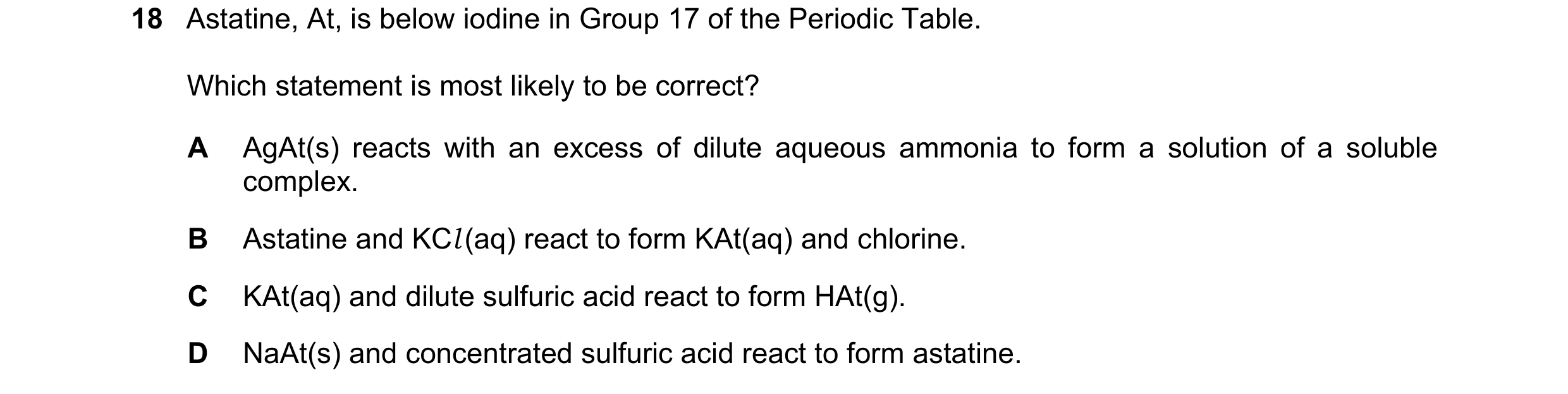
18 Astatine, At, is below iodine in Group 17 of the Periodic Table. Which statement is most likely to be correct? A AgAt(s) reacts with an excess of dilute aqueous ammonia to form a solution of a soluble complex. B Astatine and KCl (aq) react to form KAt(aq) and chlorine. C KAt(aq) and dilute sulfuric acid react to form HAt(g). D NaAt(s) and concentrated sulfuric acid react to form astatine.
1 marks
Answer: D
This question in 9701/11 May/June 2020
Q45 · Which statement explains why iodine is less volatile than chlorine? 9701/12 May/June 2020
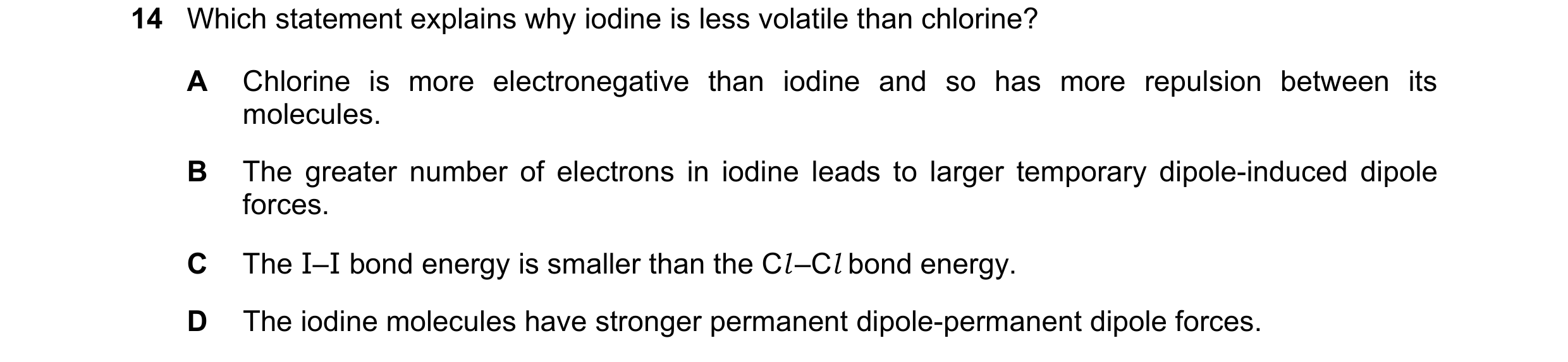
14 Which statement explains why iodine is less volatile than chlorine? A Chlorine is more electronegative than iodine and so has more repulsion between its molecules. B The greater number of electrons in iodine leads to larger temporary dipole-induced dipole forces. C The I–I bond energy is smaller than the Cl –Cl bond energy. D The iodine molecules have stronger permanent dipole-permanent dipole forces.
1 marks
Answer: B
This question in 9701/12 May/June 2020
Q46 · Which property explains the trend in volatility of the elements going down Group 17? 9701/13 May/June 2020
13 Which property explains the trend in volatility of the elements going down Group 17? A decreasing covalent bond strength B decreasing van der Waals’ forces C increasing covalent bond strength D increasing van der Waals’ forces
1 marks
Answer: D
This question in 9701/13 May/June 2020
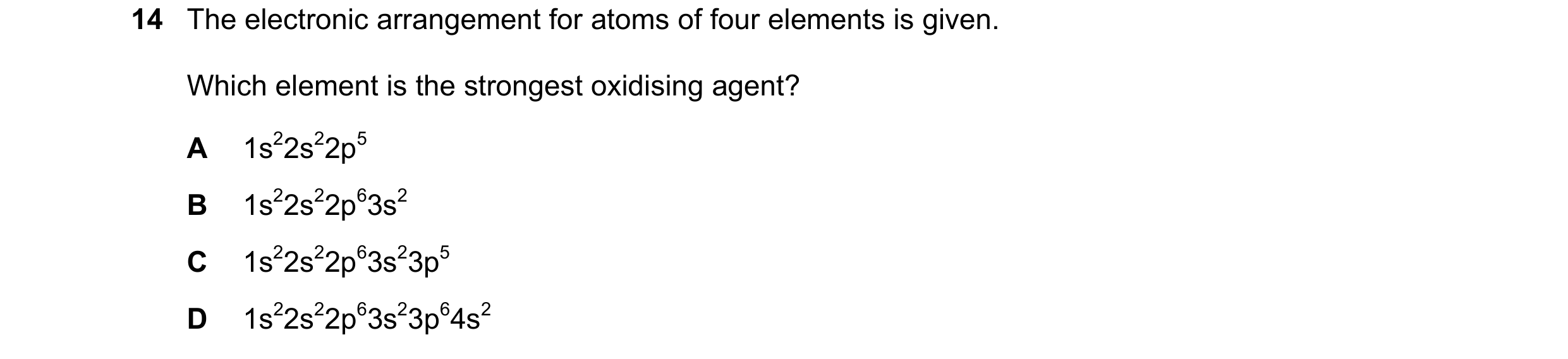
Q47 · The electronic arrangement for atoms of four elements is given 9701/11 Oct/Nov 2020
14 The electronic arrangement for atoms of four elements is given. Which element is the strongest oxidising agent? A 1s22s22p5 B 1s22s22p63s2 C 1s22s22p63s23p5 D 1s22s22p63s23p64s2
1 marks
Answer: A
This question in 9701/11 Oct/Nov 2020
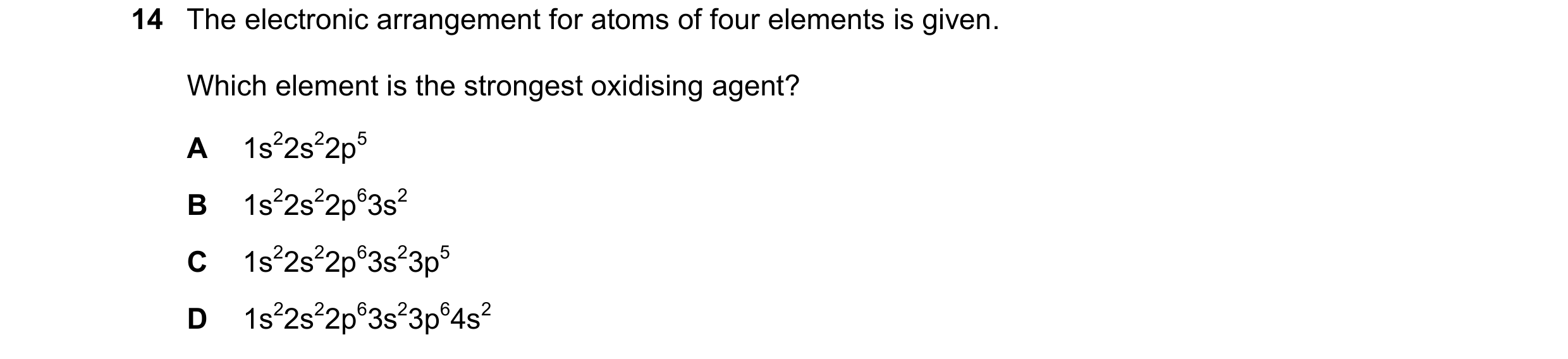
Q48 · The electronic arrangement for atoms of four elements is given 9701/13 Oct/Nov 2020
14 The electronic arrangement for atoms of four elements is given. Which element is the strongest oxidising agent? A 1s22s22p5 B 1s22s22p63s2 C 1s22s22p63s23p5 D 1s22s22p63s23p64s2
1 marks
Answer: A
This question in 9701/13 Oct/Nov 2020
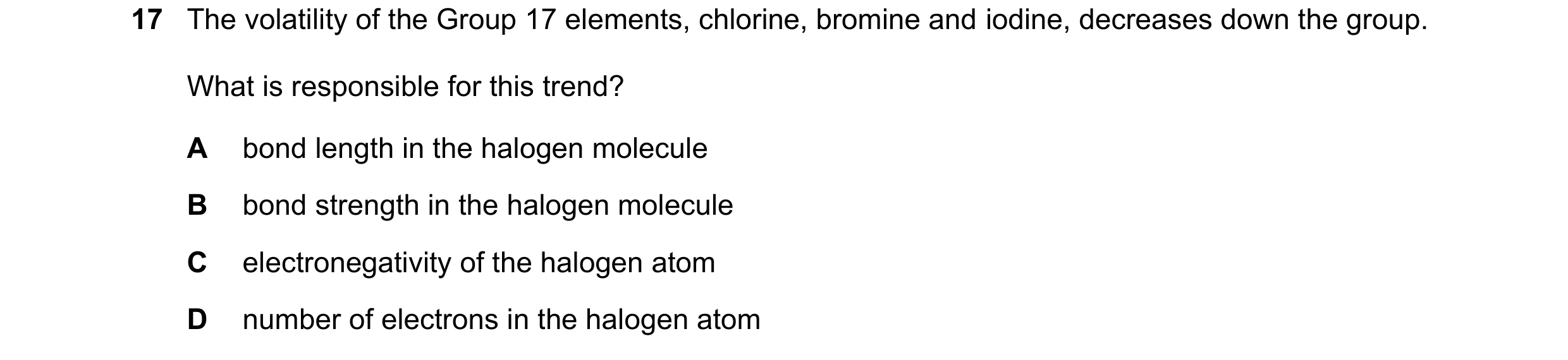
Q49 · The volatility of the Group 17 elements, chlorine, bromine and iodine, decreases down the… 9701/11 May/June 2021
17 The volatility of the Group 17 elements, chlorine, bromine and iodine, decreases down the group. What is responsible for this trend? A bond length in the halogen molecule B bond strength in the halogen molecule C electronegativity of the halogen atom D number of electrons in the halogen atom
1 marks
Answer: D
This question in 9701/11 May/June 2021
Q50 · When descending Group 17 from chlorine to iodine, which statement is correct? 9701/13 May/June 2021
15 When descending Group 17 from chlorine to iodine, which statement is correct? A The hydrides become less thermally stable as they become weaker reducing agents. B The hydrides become more thermally stable as the reactivity of the elements decreases. C The volatility of the elements decreases as the van der Waals’ forces increase. D The volatility of the elements increases as the size of the molecules increases.
1 marks
Answer: C
This question in 9701/13 May/June 2021
Q51 · X, Y and Z are three elements in Group 17 9701/12 May/June 2022
22 X, Y and Z are three elements in Group 17. X2 has weaker covalent bonds than Y2. X2 has stronger instantaneous dipole–induced dipole forces between its molecules than Z2. Y2 is a stronger oxidising agent than Z2. What could be X, Y and Z? X Y Z A Br Cl I B Cl Br I C I Br Cl D I Cl Br
1 marks
Answer: D
This question in 9701/12 May/June 2022
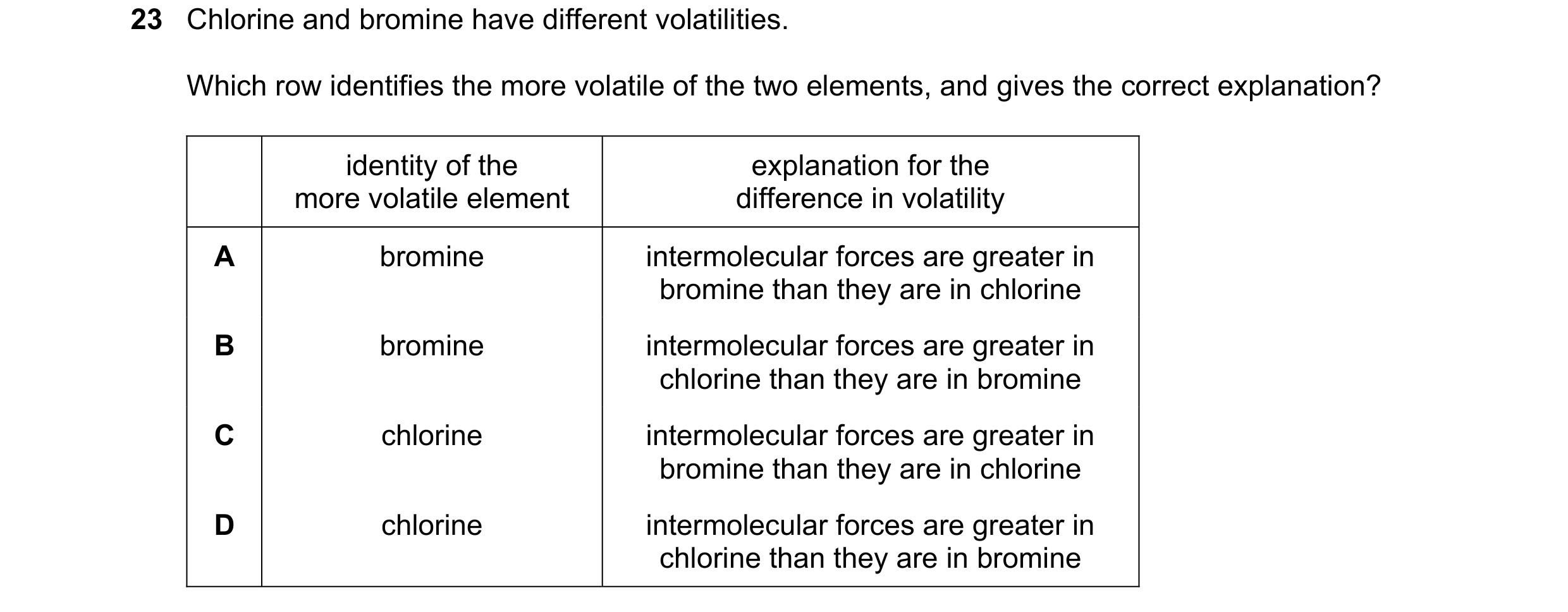
Q52 · Chlorine and bromine have different volatilities 9701/13 May/June 2022
23 Chlorine and bromine have different volatilities. Which row identifies the more volatile of the two elements, and gives the correct explanation? identity of the explanation for the more volatile element difference in volatility A bromine intermolecular forces are greater in bromine than they are in chlorine B bromine intermolecular forces are greater in chlorine than they are in bromine C chlorine intermolecular forces are greater in bromine than they are in chlorine D chlorine intermolecular forces are greater in chlorine than they are in bromine
1 marks
Answer: C
This question in 9701/13 May/June 2022
Q53 · The table shows bond energies for some diatomic molecules 9701/12 Feb/March 2023
16 The table shows bond energies for some diatomic molecules. Deuterium, D, is an isotope of hydrogen. energy bond /kJmol–1 F–F 158 Cl–Cl 242 Br–Br 193 I–I 151 H–H 436 D–D 442 Which statements are correct? 1 Diatomic molecules have exact values for their bond energies, which are always positive. 2 The trend in Group 7 bond energies can be explained by the variation in instantaneous dipole–induced dipole (id–id) forces. 3 A value for the enthalpy change for the reaction between deuterium and chlorine can be calculated using these data alone. A 1 only B 1 and 2 only C 1 and 3 only D 2 and 3 only
1 marks
Answer: A
This question in 9701/12 Feb/March 2023
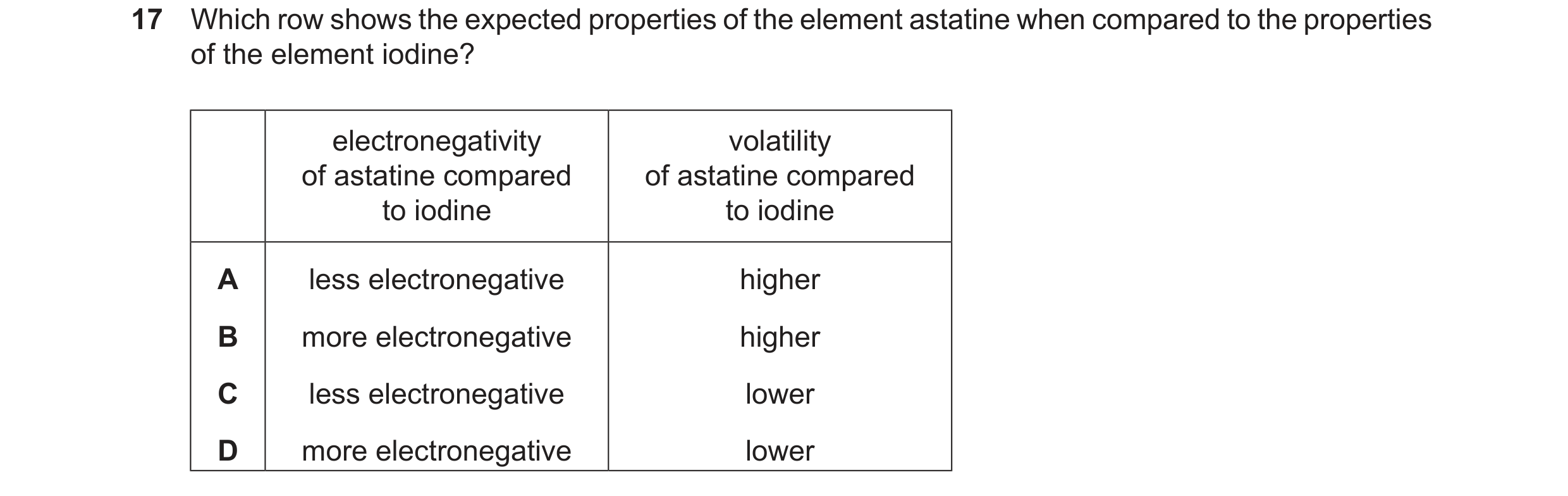
Q54 · Which row shows the expected properties of the element astatine when compared to the… 9701/13 May/June 2023
17 Which row shows the expected properties of the element astatine when compared to the properties of the element iodine? electronegativity volatility of astatine compared of astatine compared to iodine to iodine A less electronegative higher B more electronegative higher C less electronegative lower D more electronegative lower
1 marks
Answer: C
This question in 9701/13 May/June 2023
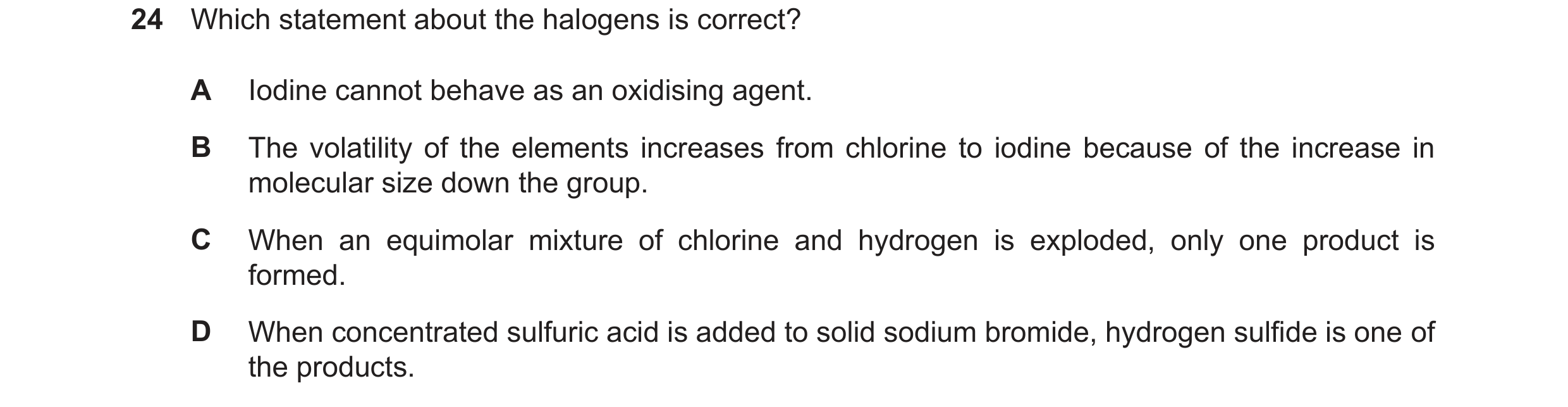
Q55 · Which statement about the halogens is correct? 9701/13 May/June 2023
24 Which statement about the halogens is correct? A Iodine cannot behave as an oxidising agent. B The volatility of the elements increases from chlorine to iodine because of the increase in molecular size down the group. C When an equimolar mixture of chlorine and hydrogen is exploded, only one product is formed. D When concentrated sulfuric acid is added to solid sodium bromide, hydrogen sulfide is one of the products.
1 marks
Answer: C
This question in 9701/13 May/June 2023
Q56 · In this question, Q represents an atom of chlorine, bromine or iodine 9701/11 Oct/Nov 2023
22 In this question, Q represents an atom of chlorine, bromine or iodine. Which explanation for the variation in volatility down Group 17 is correct? A Instantaneous dipole–induced dipole forces between molecules become stronger. B Permanent dipole–permanent dipole forces between molecules become stronger. C The bond energy of the Q2 molecules decreases. D The first ionisation energy Q(g) →Q+(g) + e– decreases.
1 marks
Answer: A
This question in 9701/11 Oct/Nov 2023
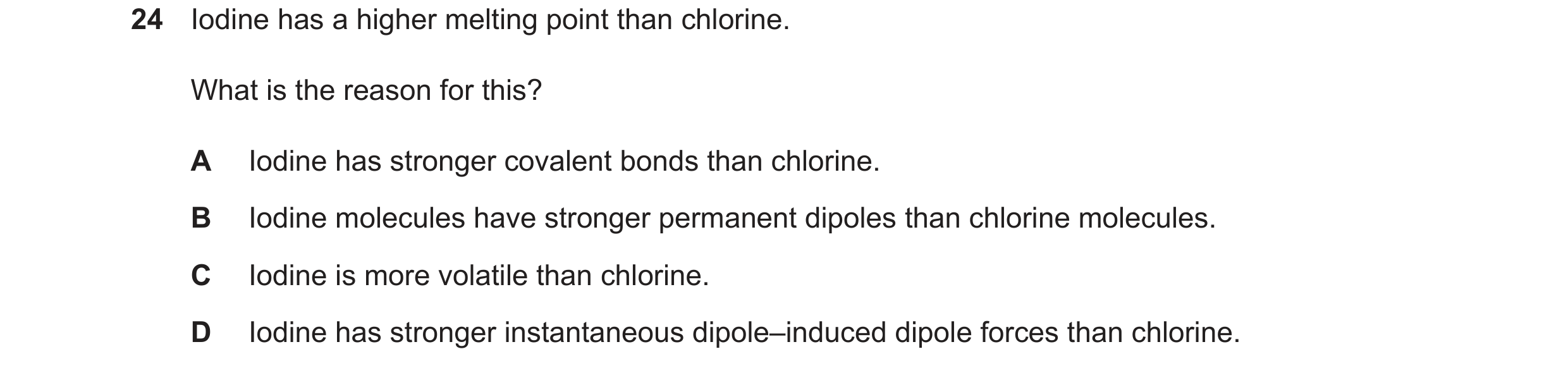
Q57 · Iodine has a higher melting point than chlorine 9701/12 Oct/Nov 2023
24 Iodine has a higher melting point than chlorine. What is the reason for this? A Iodine has stronger covalent bonds than chlorine. B Iodine molecules have stronger permanent dipoles than chlorine molecules. C Iodine is more volatile than chlorine. D Iodine has stronger instantaneous dipole–induced dipole forces than chlorine.
1 marks
Answer: D
This question in 9701/12 Oct/Nov 2023
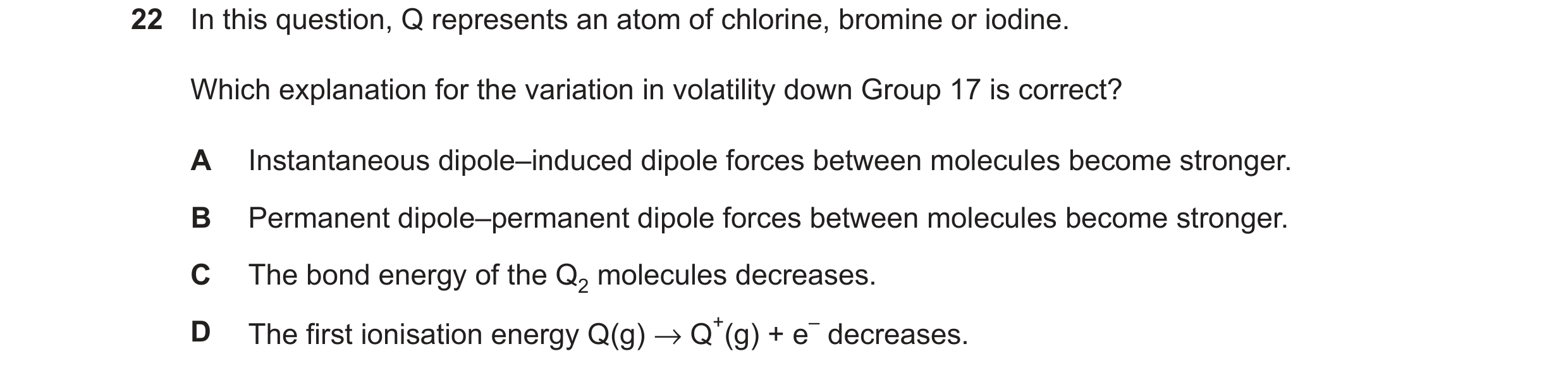
Q58 · In this question, Q represents an atom of chlorine, bromine or iodine 9701/13 Oct/Nov 2023
22 In this question, Q represents an atom of chlorine, bromine or iodine. Which explanation for the variation in volatility down Group 17 is correct? A Instantaneous dipole–induced dipole forces between molecules become stronger. B Permanent dipole–permanent dipole forces between molecules become stronger. C The bond energy of the Q2 molecules decreases. D The first ionisation energy Q(g) →Q+(g) + e– decreases.
1 marks
Answer: A
This question in 9701/13 Oct/Nov 2023
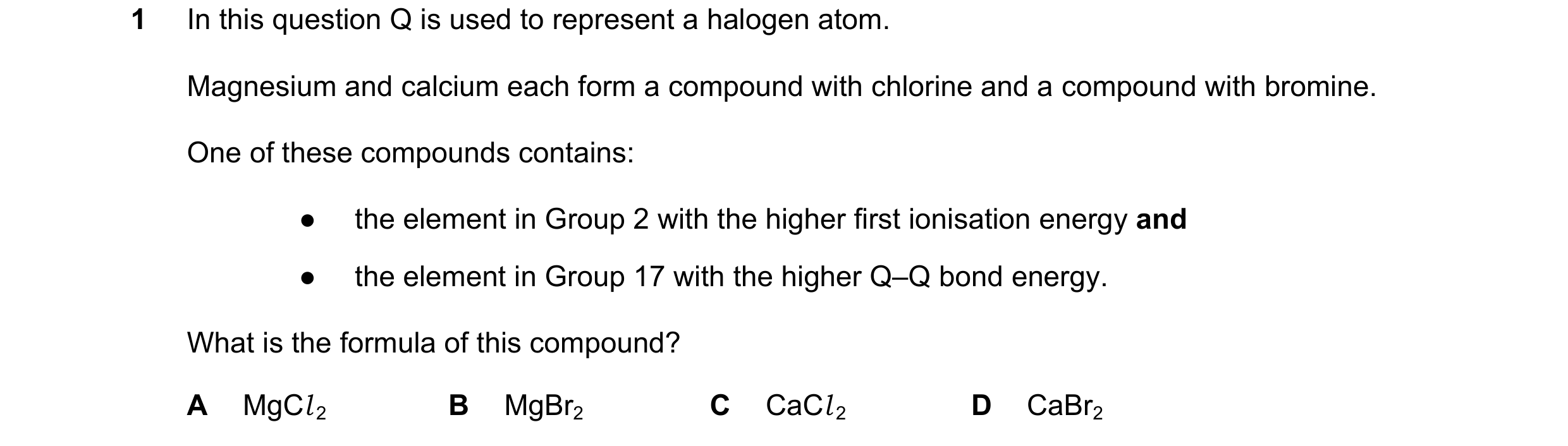
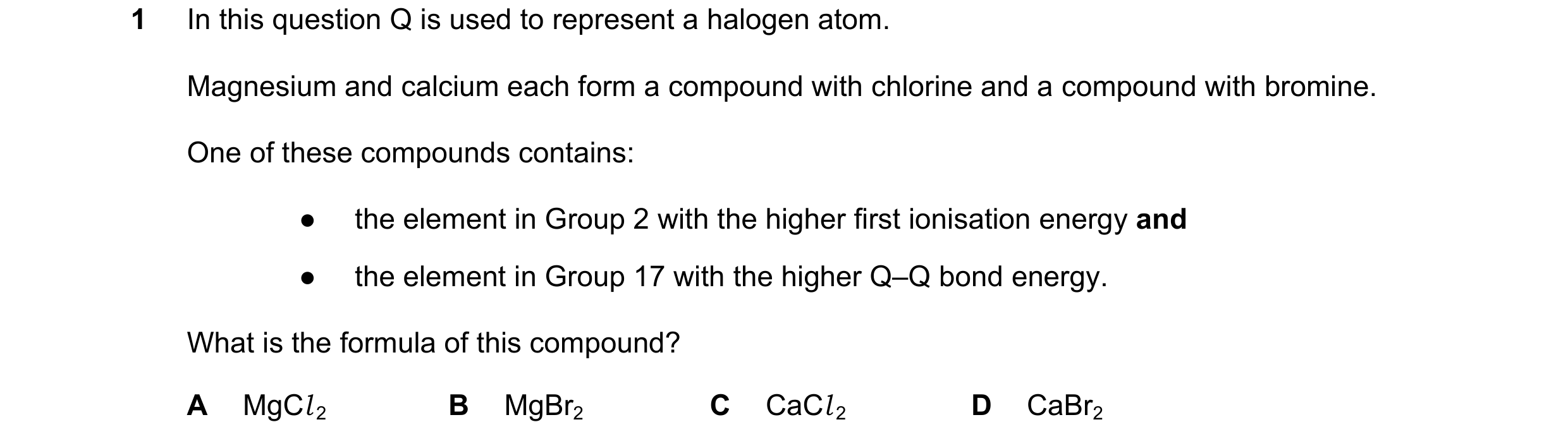
Q59 · In this question Q is used to represent a halogen atom 9701/11 Oct/Nov 2024
1 In this question Q is used to represent a halogen atom. Magnesium and calcium each form a compound with chlorine and a compound with bromine. One of these compounds contains: ● the element in Group 2 with the higher first ionisation energy and ● the element in Group 17 with the higher Q–Q bond energy. What is the formula of this compound? A MgCl 2 B MgBr2 C CaCl 2 D CaBr2
1 marks
Answer: A
This question in 9701/11 Oct/Nov 2024
Q60 · The colours of the silver halides AgCl, AgBr and AgI differ 9701/12 Oct/Nov 2024
22 The colours of the silver halides AgCl, AgBr and AgI differ. The solubilities of these halides in aqueous ammonia also differ. Which row is correct? silver halide that is colour of AgBr most soluble in NH3(aq) A cream AgCl B cream AgI C yellow AgCl D yellow AgI
1 marks
Answer: A
This question in 9701/12 Oct/Nov 2024
Q61 · In this question Q is used to represent a halogen atom 9701/13 Oct/Nov 2024
1 In this question Q is used to represent a halogen atom. Magnesium and calcium each form a compound with chlorine and a compound with bromine. One of these compounds contains: ● the element in Group 2 with the higher first ionisation energy and ● the element in Group 17 with the higher Q–Q bond energy. What is the formula of this compound? A MgCl 2 B MgBr2 C CaCl 2 D CaBr2
1 marks
Answer: A
This question in 9701/13 Oct/Nov 2024
Q62 · Which graph correctly describes a trend found in Group 17? 9701/12 Feb/March 2025
23 Which graph correctly describes a trend found in Group 17? [X represents a halogen atom.] A B bond strength of length van der Waals’ in X2 forces Cl 2 Br2 I2 Cl 2 Br2 I2 C D boiling bond point energy of X2 of HX Cl 2 Br2 I2 HCl HBr HI
1 marks
Answer: B
This question in 9701/12 Feb/March 2025
Q63 · Why do the halogens become less volatile as Group 17 is descended? 9701/12 May/June 2025
17 Why do the halogens become less volatile as Group 17 is descended? A The halogen–halogen bond energy decreases. B The halogen–halogen bond energy increases. C The number of electrons in each molecule increases. D The van der Waals’ forces between molecules become weaker.
1 marks
Answer: C
This question in 9701/12 May/June 2025
Q64 · Which row is correct? 9701/14 May/June 2025
18 Which row is correct? property explanation A AgI dissolves in aqueous ammonia AgI reacts with more readily than AgCl does aqueous ammonia B HCl decomposes Cl is more more readily than HI does electronegative than I C I2 has a higher I2 has stronger melting point than Cl 2 van der Waals’ forces than Cl 2 D I2 is a stronger oxidising an I atom loses electrons agent than Cl 2 more readily than a Cl atom
1 marks
Answer: C
This question in 9701/14 May/June 2025
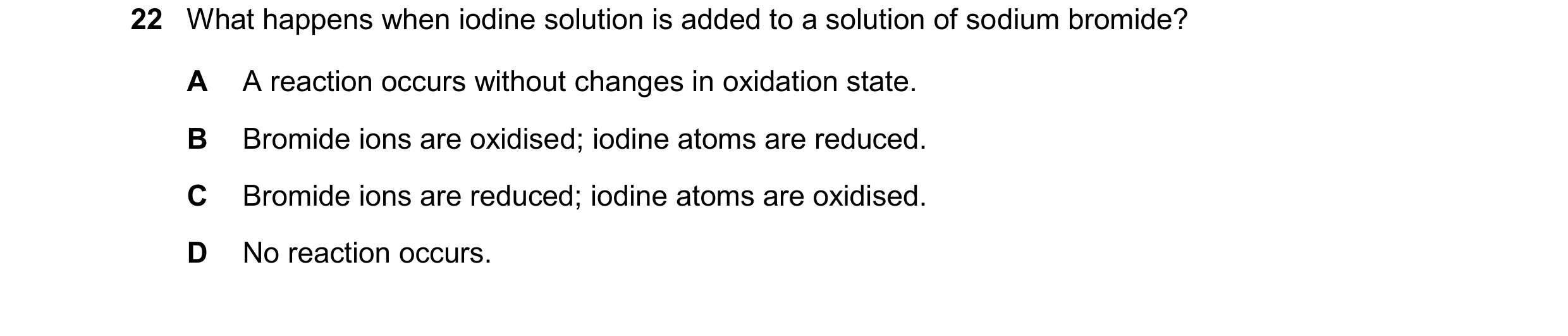
Q65 · What happens when iodine solution is added to a solution of sodium bromide? 9701/13 Oct/Nov 2025
22 What happens when iodine solution is added to a solution of sodium bromide? A A reaction occurs without changes in oxidation state. B Bromide ions are oxidised; iodine atoms are reduced. C Bromide ions are reduced; iodine atoms are oxidised. D No reaction occurs.
1 marks
Answer: D
This question in 9701/13 Oct/Nov 2025


 1 / 16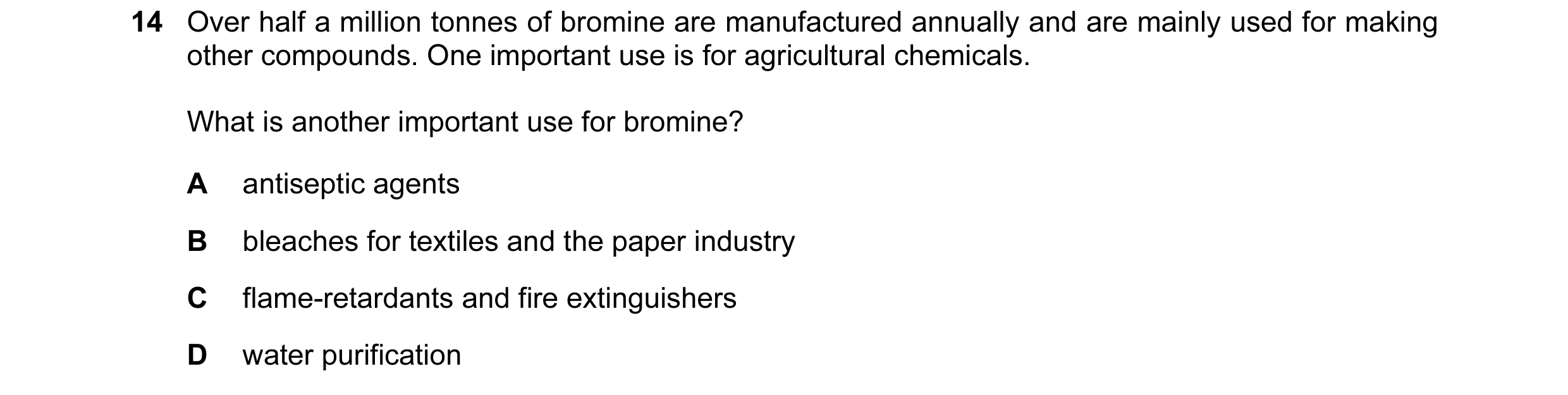
![Question 7: Which graph correctly describes a trend found in the halogen group? [X represents a halogen atom.] A B bond strength of length van der Waal…](https://img.pastlit.com/crops/2fda82f2-5126-4a15-82f3-5881b24de516/q15.png)
 2 / 16


 3 / 16





 4 / 16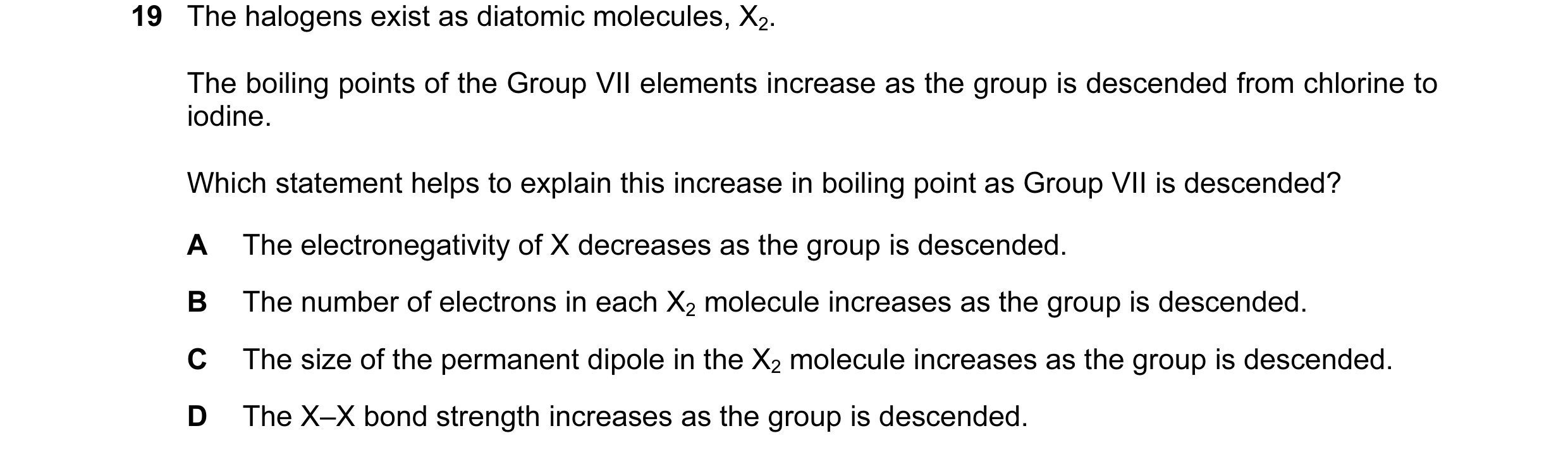
 5 / 16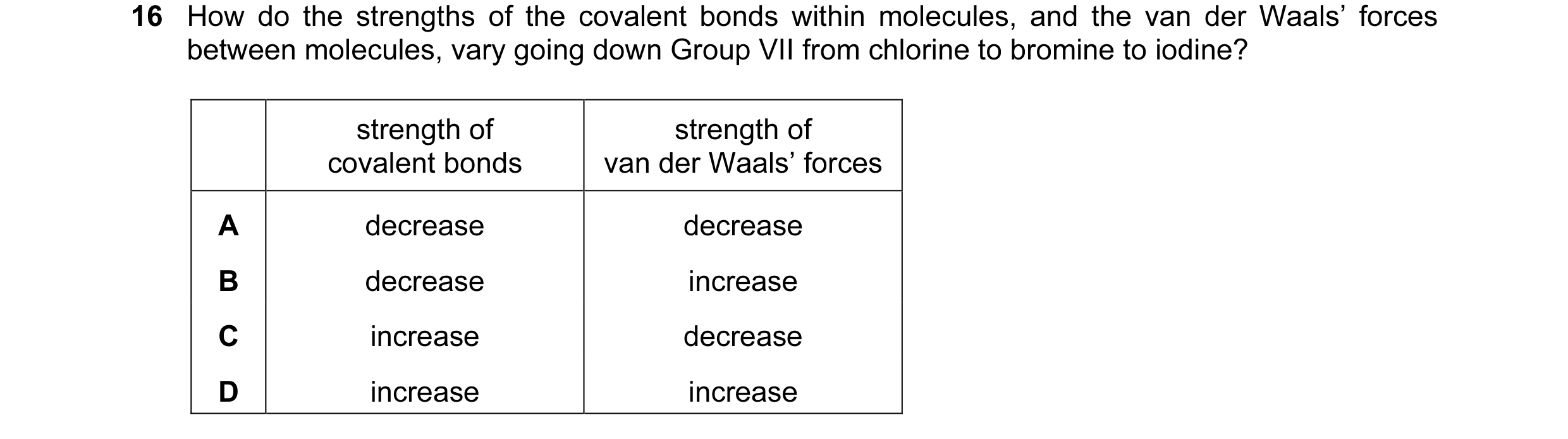


 6 / 16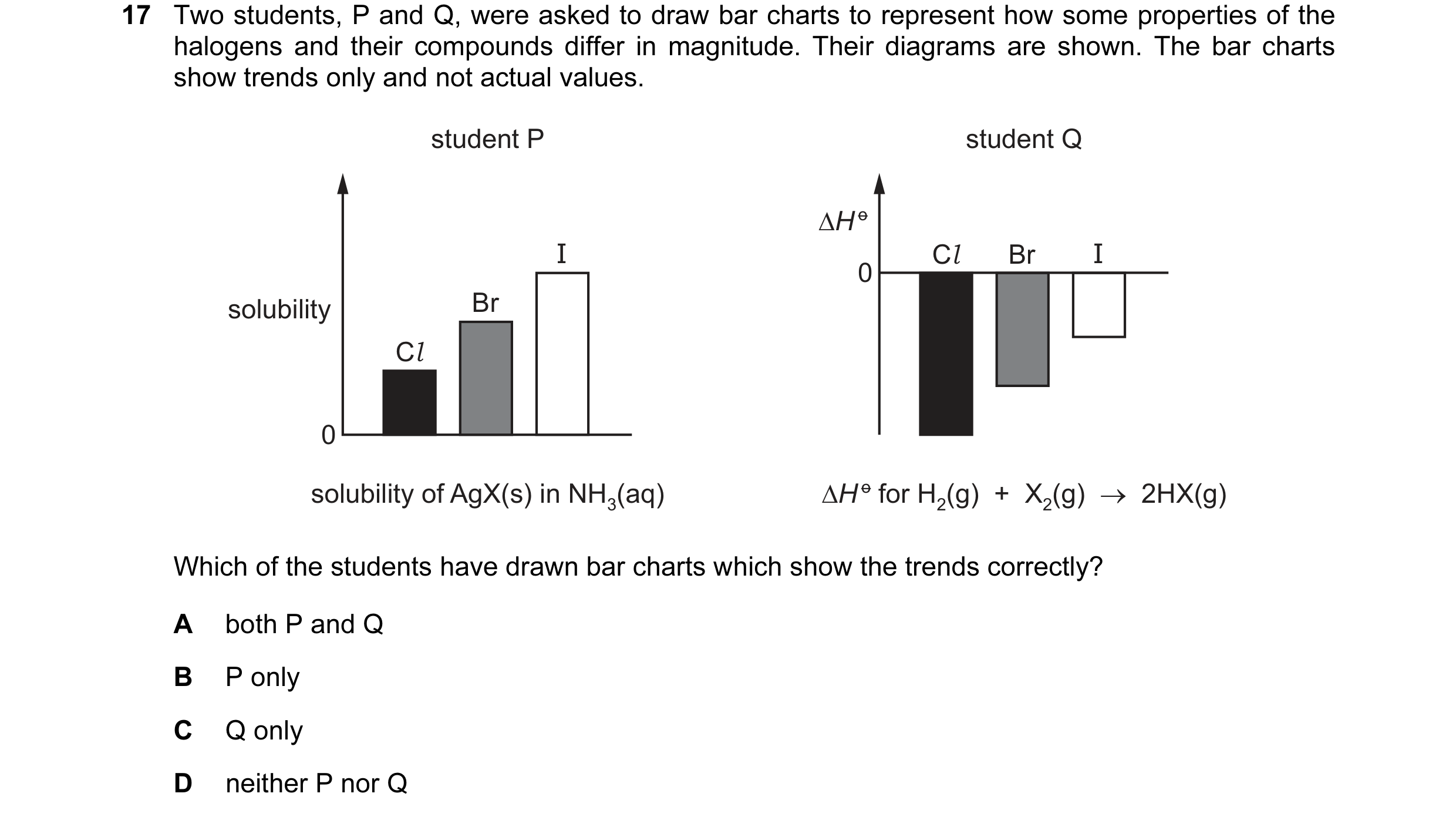
 7 / 16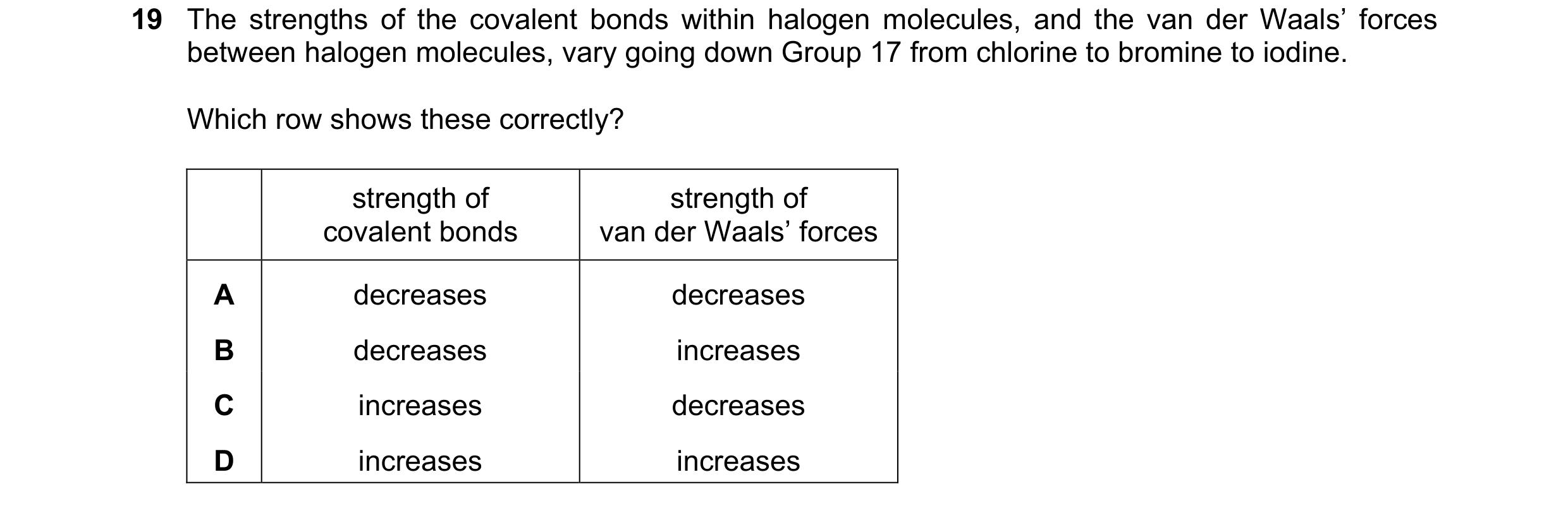
 8 / 16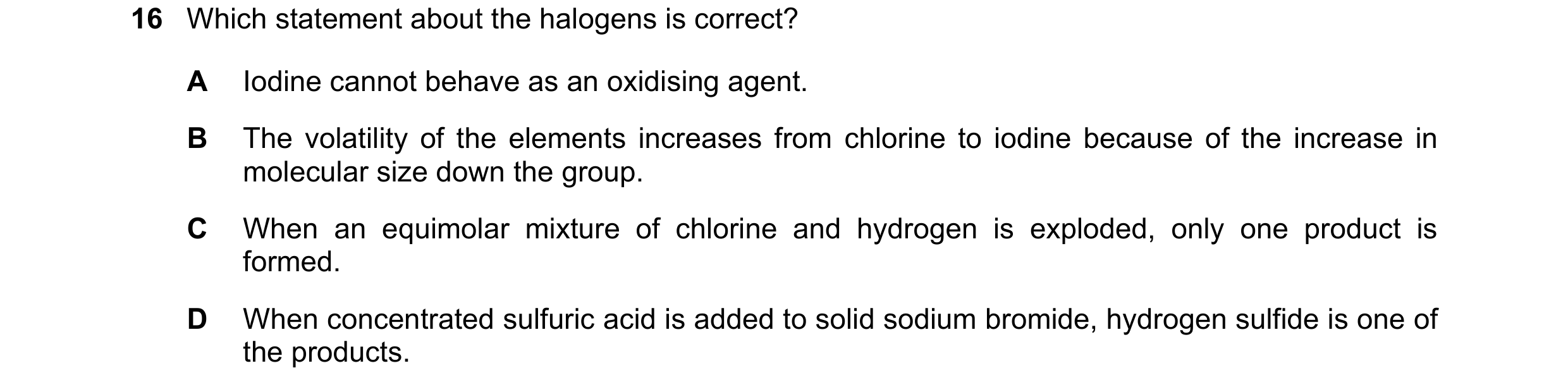
 9 / 16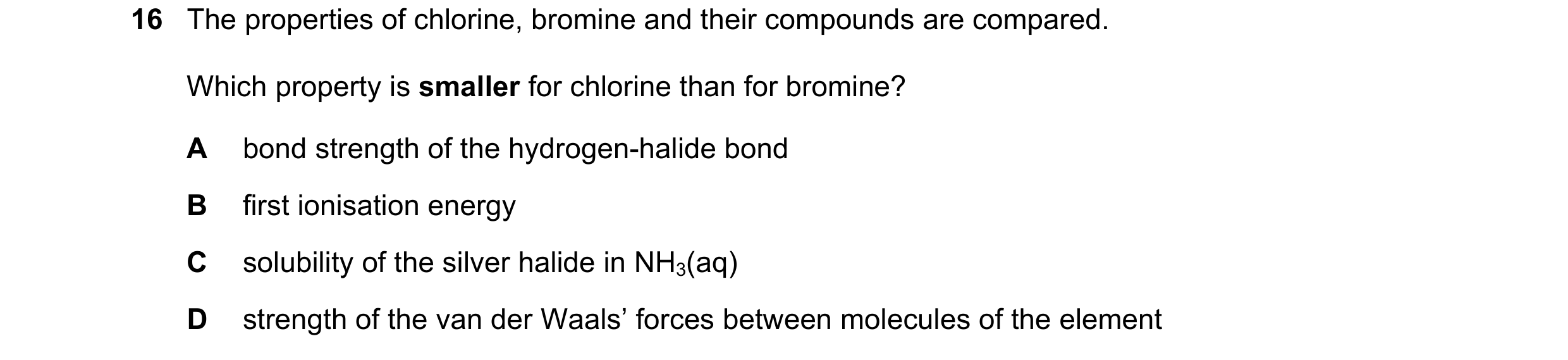

 10 / 16
 11 / 16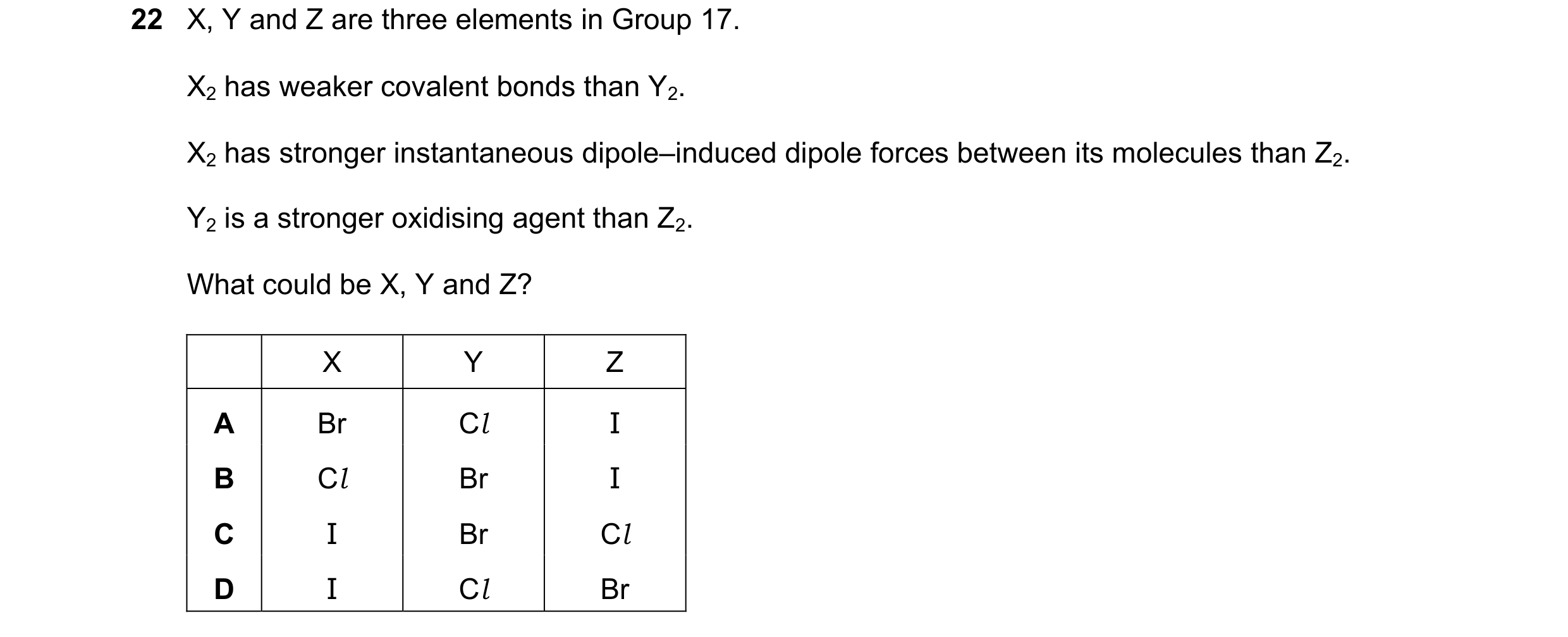
 12 / 16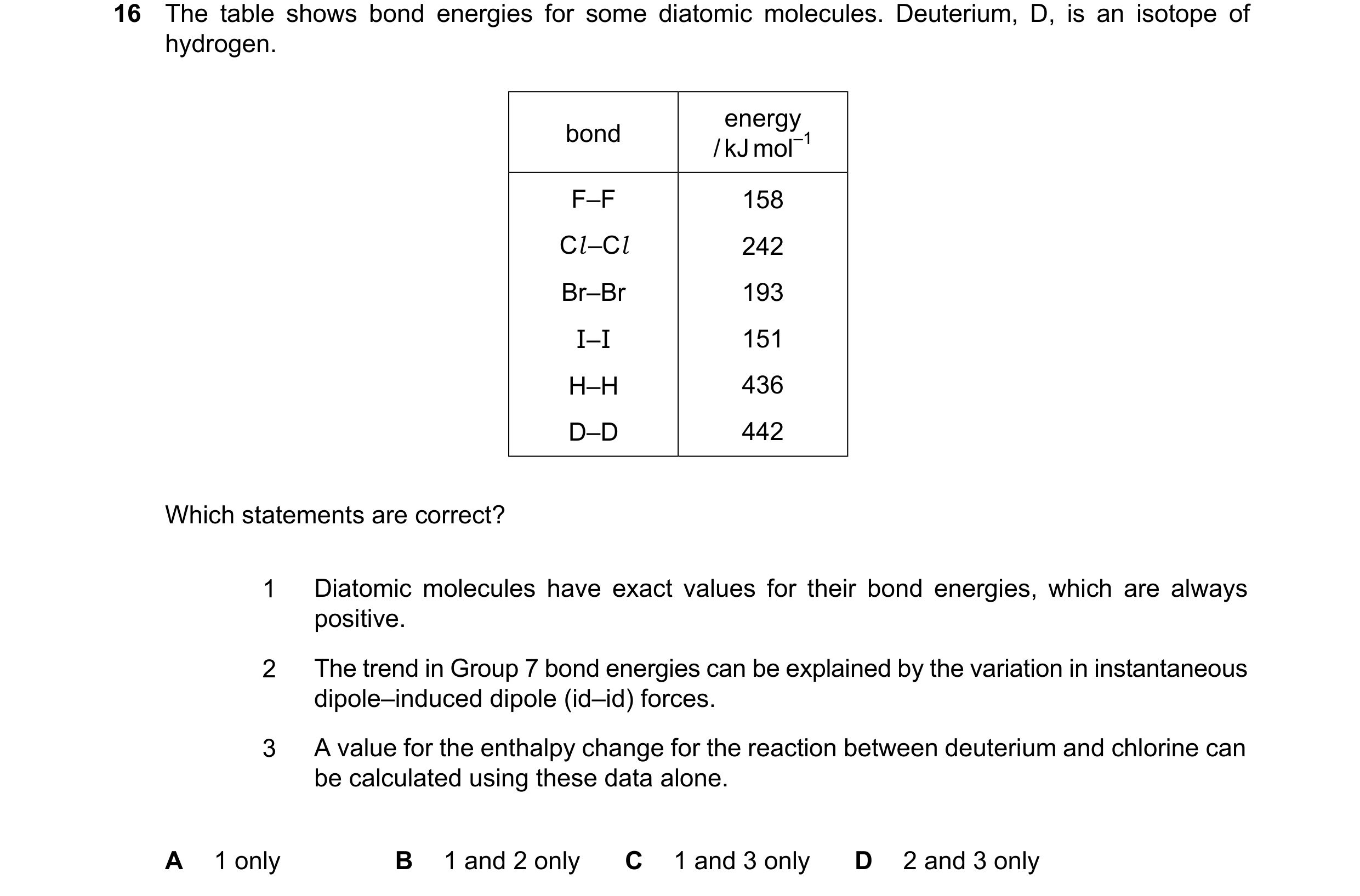
 13 / 16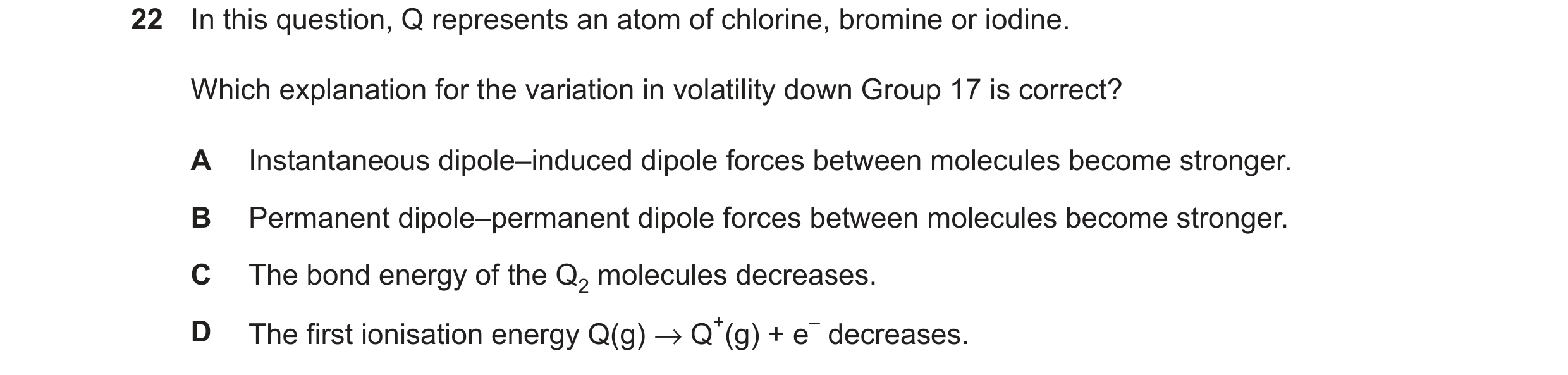
 14 / 16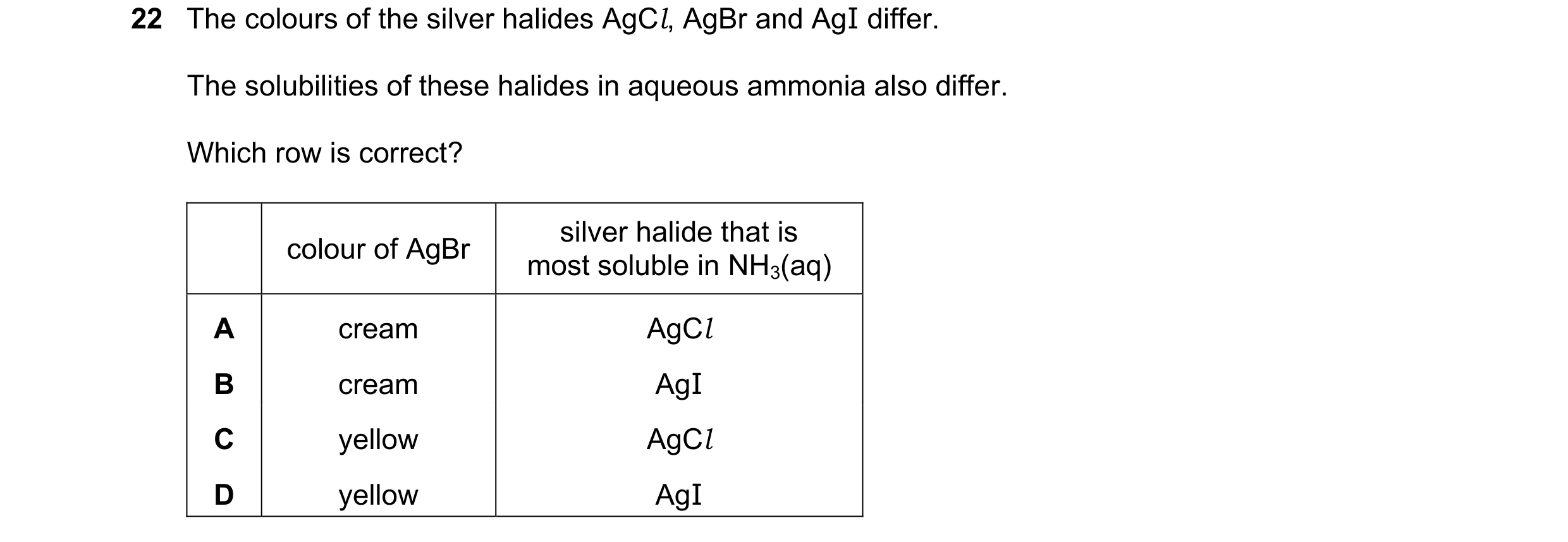
![Question 62: Which graph correctly describes a trend found in Group 17? [X represents a halogen atom.] A B bond strength of length van der Waals’ in X2 …](https://img.pastlit.com/crops/d379ece5-c139-4216-bcc6-dcdd499f32e8/q23.png)
 15 / 16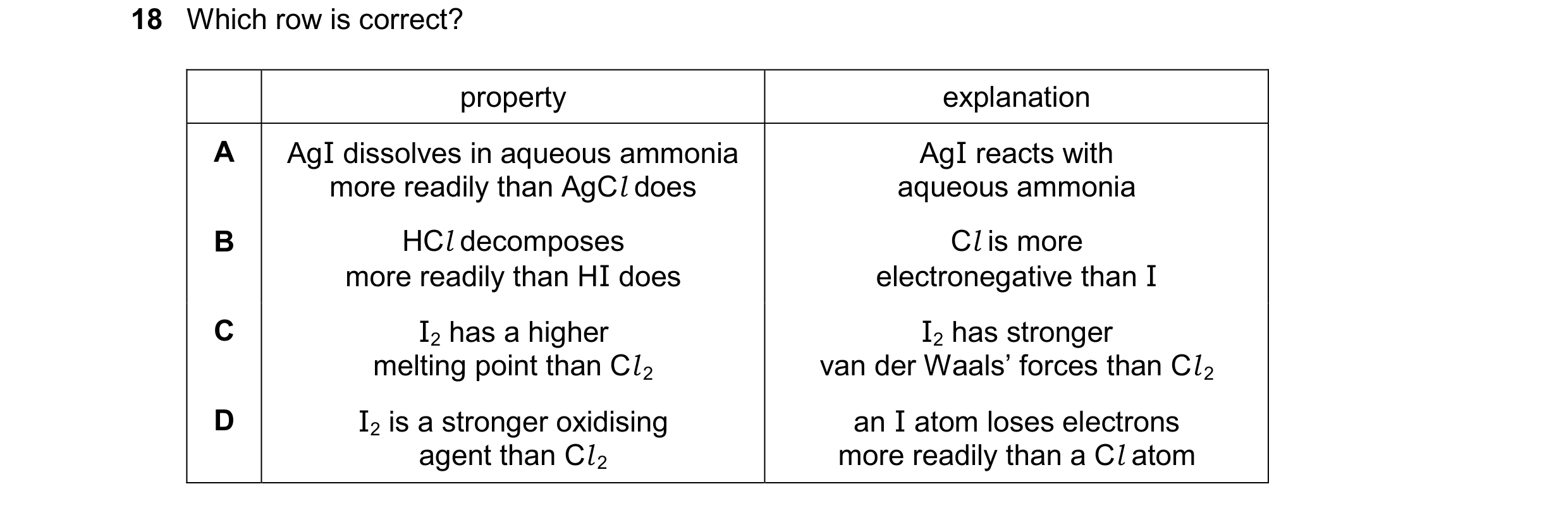
 16 / 16