Questions as text
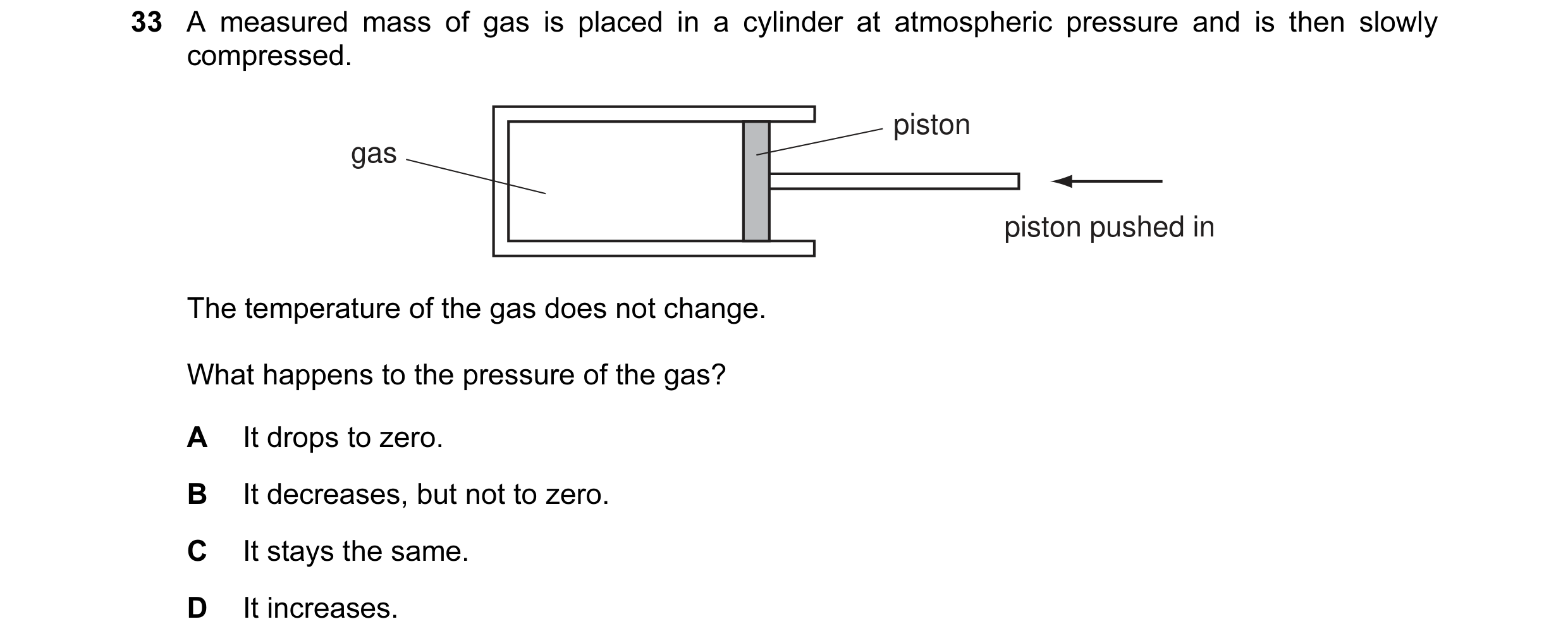
Q1 · A measured mass of gas is placed in a cylinder at atmospheric pressure and is then slowly… 0654/11 May/June 2005
33 A measured mass of gas is placed in a cylinder at atmospheric pressure and is then slowly compressed. piston gas piston pushed in The temperature of the gas does not change. What happens to the pressure of the gas? A It drops to zero. B It decreases, but not to zero. C It stays the same. D It increases.
1 marks
Answer: D
This question in 0654/11 May/June 2005
Q2 · When water is heated to 100 °C, it changes to steam 0654/11 May/June 2007
14 When water is heated to 100 °C, it changes to steam. The steam has a larger volume than the water. Which change on heating explains this increase in volume? A The bonds between hydrogen and oxygen break. B The molecules become lighter. C The spacing between the molecules increases. D The water molecules expand.
1 marks
Answer: C
This question in 0654/11 May/June 2007
Q3 · Some gas in a sealed plastic bag is cooled 0654/11 Oct/Nov 2007
32 Some gas in a sealed plastic bag is cooled. How do the gas molecules behave when this happens? A They move more quickly and become closer together. B They move more quickly and become further apart. C They move more slowly and become closer together. D They move more slowly and become further apart.
1 marks
Answer: C
This question in 0654/11 Oct/Nov 2007
Q4 · The pressure of a fixed mass of gas in a cylinder is measured 0654/11 Oct/Nov 2008
33 The pressure of a fixed mass of gas in a cylinder is measured. The volume of the cylinder is then slowly decreased. Which graph could show the change of pressure of the gas during this process? A B pressure pressure 0 0 0 time 0 time C D pressure pressure 0 0 0 time 0 time
1 marks
Answer: C
This question in 0654/11 Oct/Nov 2008
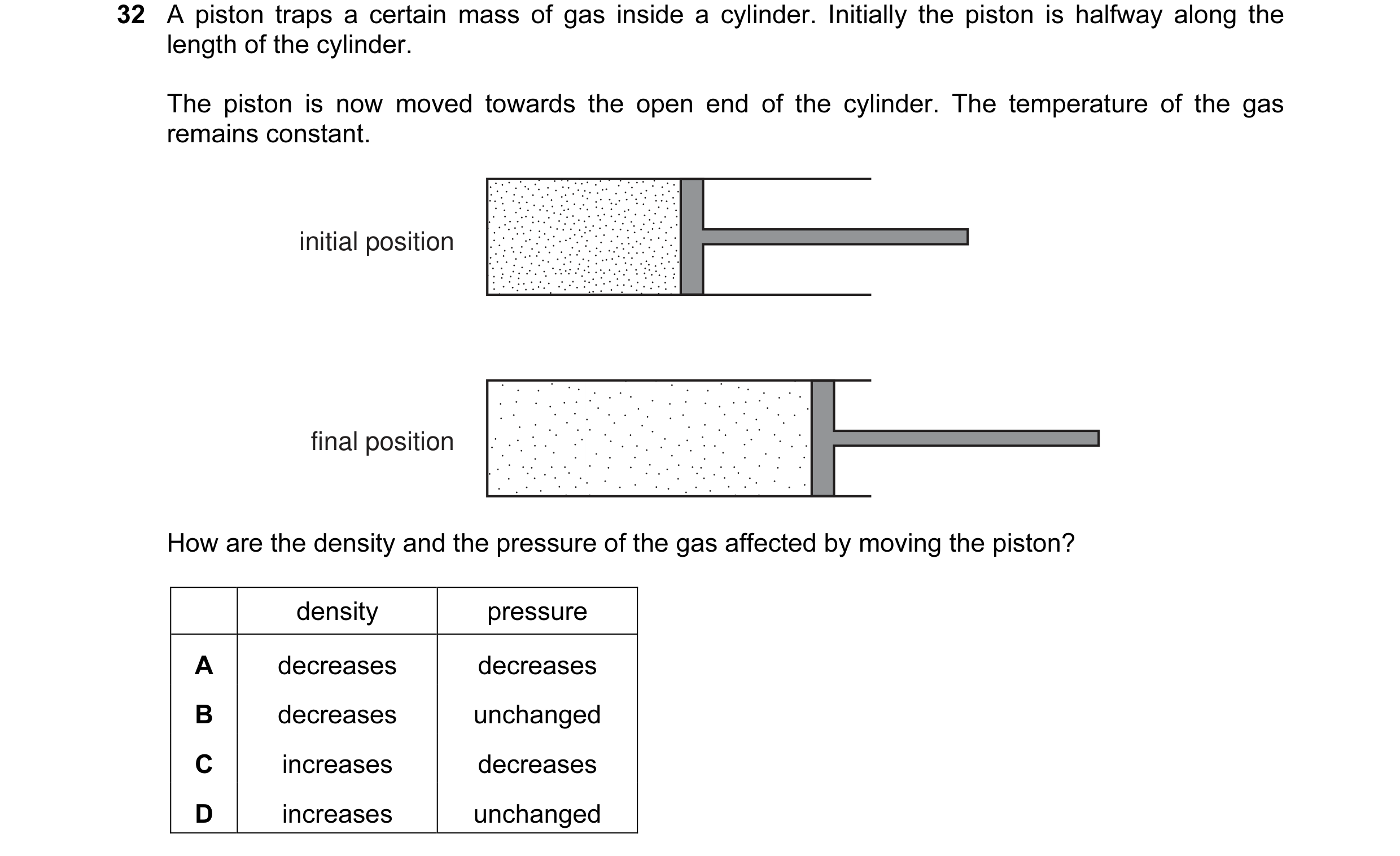
Q5 · A piston traps a certain mass of gas inside a cylinder 0654/11 May/June 2009
32 A piston traps a certain mass of gas inside a cylinder. Initially the piston is halfway along the length of the cylinder. The piston is now moved towards the open end of the cylinder. The temperature of the gas remains constant. initial position final position How are the density and the pressure of the gas affected by moving the piston? density pressure A decreases decreases B decreases unchanged C increases decreases D increases unchanged
1 marks
Answer: A
This question in 0654/11 May/June 2009
Q6 · The graph shows the changes in temperature when a substance is cooled 0654/12 May/June 2010
26 The graph shows the changes in temperature when a substance is cooled. X temperature / °C Y 00 time Which row in the table describes X and Y? X Y A boiling freezing B boiling melting C condensing freezing D condensing melting
1 marks
Answer: C
This question in 0654/12 May/June 2010
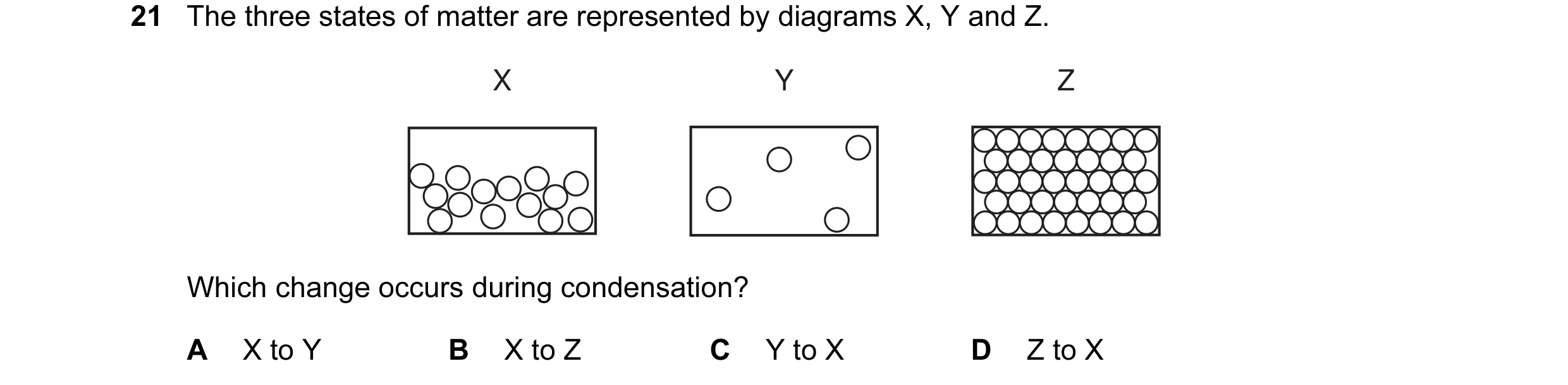
Q7 · The three states of matter are represented by diagrams X, Y and Z 0654/12 Oct/Nov 2010
21 The three states of matter are represented by diagrams X, Y and Z. X Y Z Which change occurs during condensation? A X to Y B X to Z C Y to X D Z to X
1 marks
Answer: C
This question in 0654/12 Oct/Nov 2010
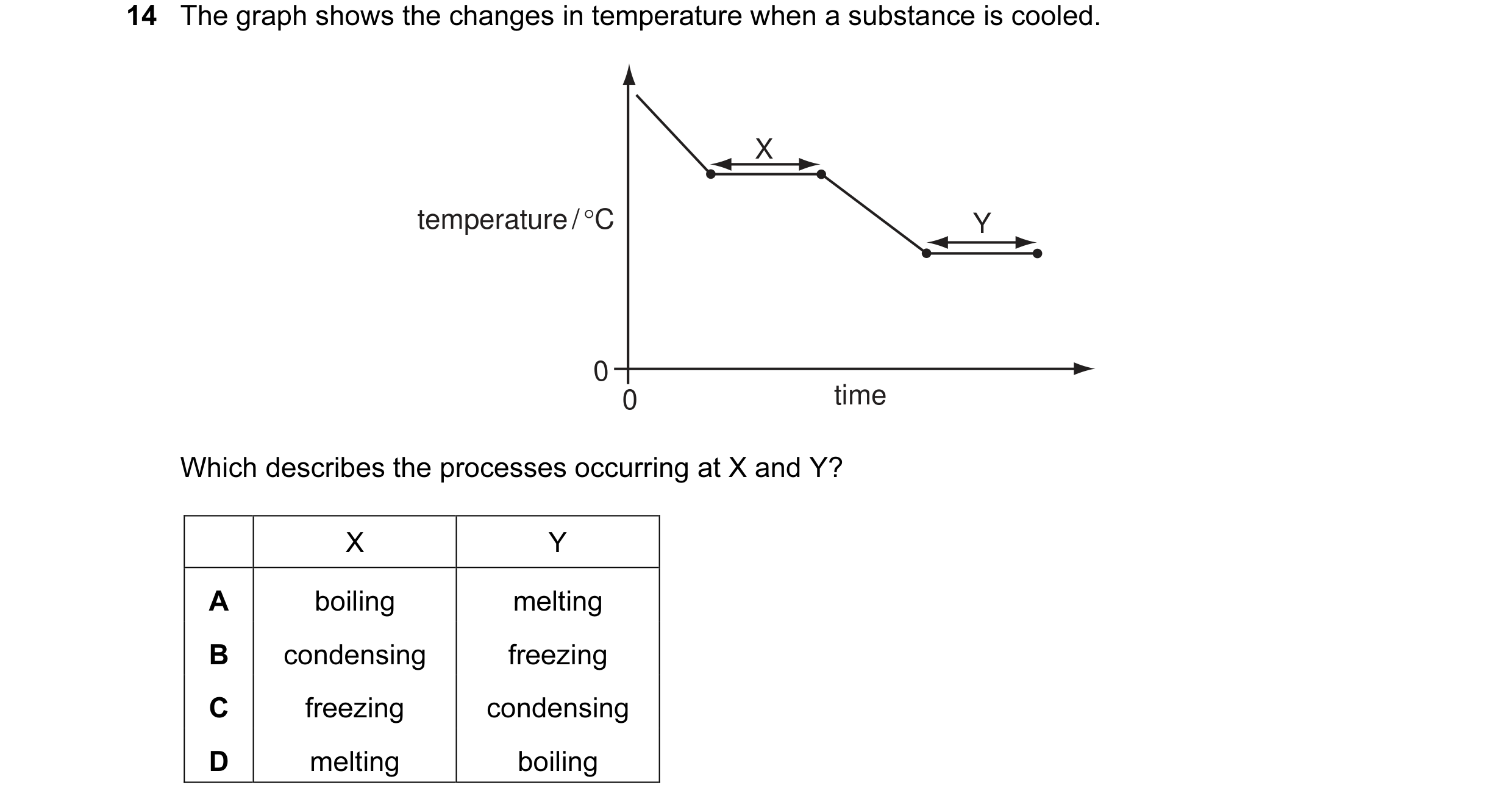
Q8 · The graph shows the changes in temperature when a substance is cooled 0654/11 May/June 2011
14 The graph shows the changes in temperature when a substance is cooled. X temperature / °C Y 0 0 time Which describes the processes occurring at X and Y? X Y A boiling melting B condensing freezing C freezing condensing D melting boiling
1 marks
Answer: B
This question in 0654/11 May/June 2011
Q9 · On a warm day, a driver checks the air pressure in a car tyre 0654/11 May/June 2012
31 On a warm day, a driver checks the air pressure in a car tyre. Overnight the temperature drops and the air pressure in the tyre falls. There are no air leaks in the tyre. Why does the pressure fall? A The air molecules in the tyre move more slowly. B The air molecules in the tyre stop moving. C The volume of the air in the tyre decreases. D The volume of the air in the tyre increases.
1 marks
Answer: A
This question in 0654/11 May/June 2012
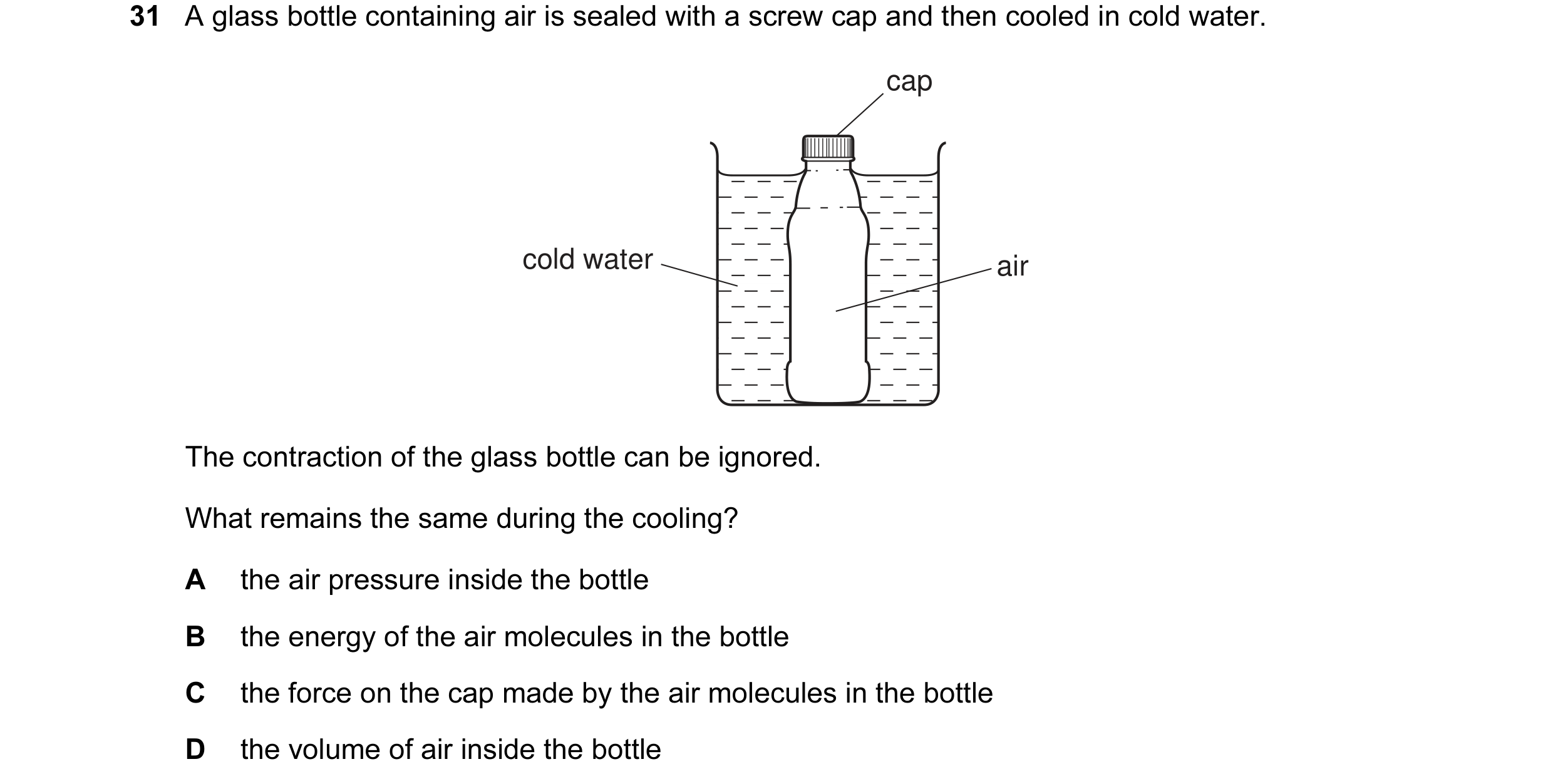
Q10 · A glass bottle containing air is sealed with a screw cap and then cooled in cold water 0654/12 May/June 2012
31 A glass bottle containing air is sealed with a screw cap and then cooled in cold water. cap cold water air The contraction of the glass bottle can be ignored. What remains the same during the cooling? A the air pressure inside the bottle B the energy of the air molecules in the bottle C the force on the cap made by the air molecules in the bottle D the volume of air inside the bottle
1 marks
Answer: D
This question in 0654/12 May/June 2012
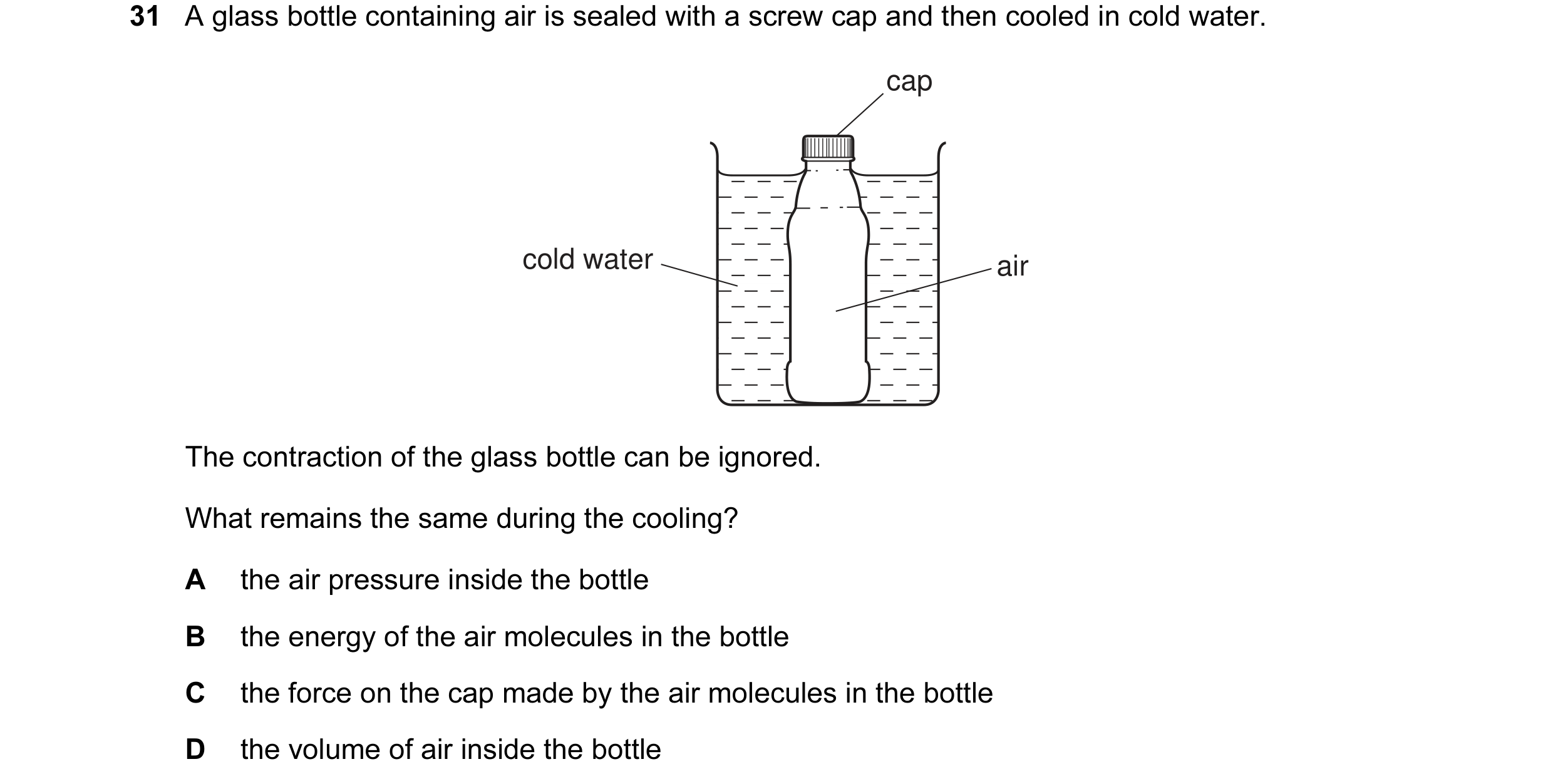
Q11 · A glass bottle containing air is sealed with a screw cap and then cooled in cold water 0654/13 May/June 2012
31 A glass bottle containing air is sealed with a screw cap and then cooled in cold water. cap cold water air The contraction of the glass bottle can be ignored. What remains the same during the cooling? A the air pressure inside the bottle B the energy of the air molecules in the bottle C the force on the cap made by the air molecules in the bottle D the volume of air inside the bottle
1 marks
Answer: D
This question in 0654/13 May/June 2012
Q12 · A beaker of cool liquid stands in a warm room 0654/11 May/June 2013
31 A beaker of cool liquid stands in a warm room. The temperature of the liquid is falling because molecules are escaping from the surface of the liquid. Which row gives the name of this process, and also shows which molecules are escaping from the liquid? molecules that name of process are escaping A condensation least energetic B condensation most energetic C evaporation least energetic D evaporation most energetic
1 marks
Answer: D
This question in 0654/11 May/June 2013
Q13 · Gas is contained in a cylinder and exerts a pressure on the cylinder 0654/12 May/June 2013
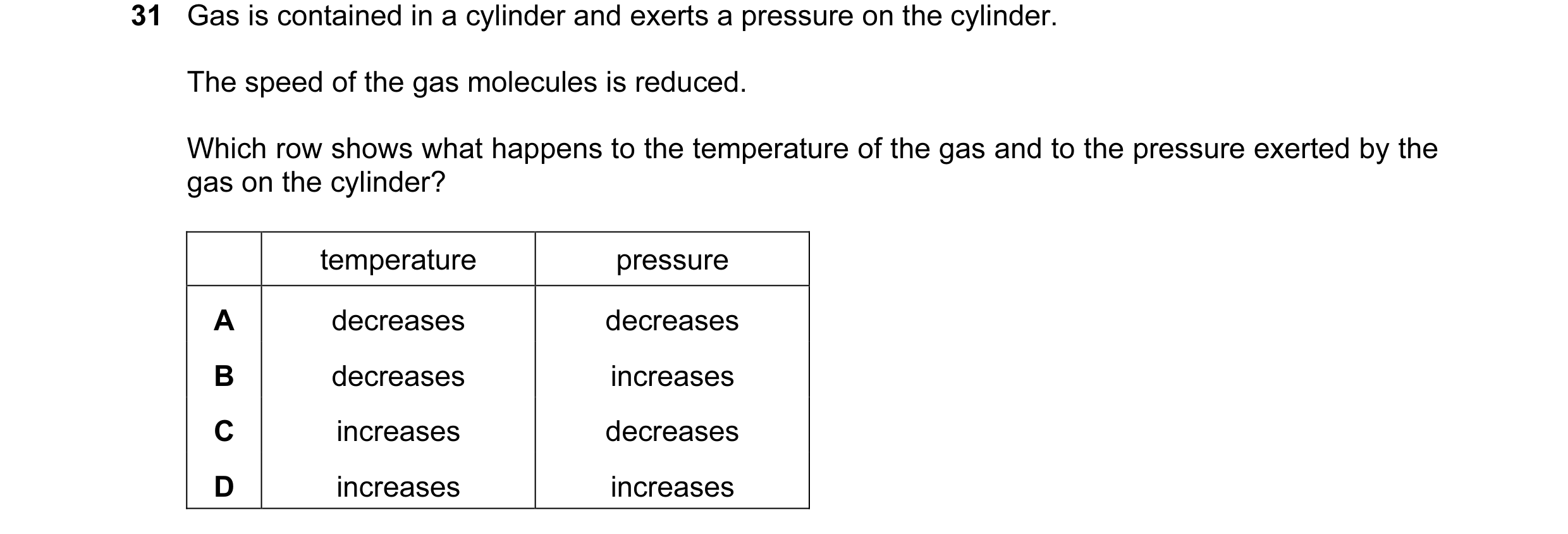
31 Gas is contained in a cylinder and exerts a pressure on the cylinder. The speed of the gas molecules is reduced. Which row shows what happens to the temperature of the gas and to the pressure exerted by the gas on the cylinder? temperature pressure A decreases decreases B decreases increases C increases decreases D increases increases
1 marks
Answer: A
This question in 0654/12 May/June 2013
Q14 · A substance is a gas when its temperature is 65 °C 0654/12 May/June 2013
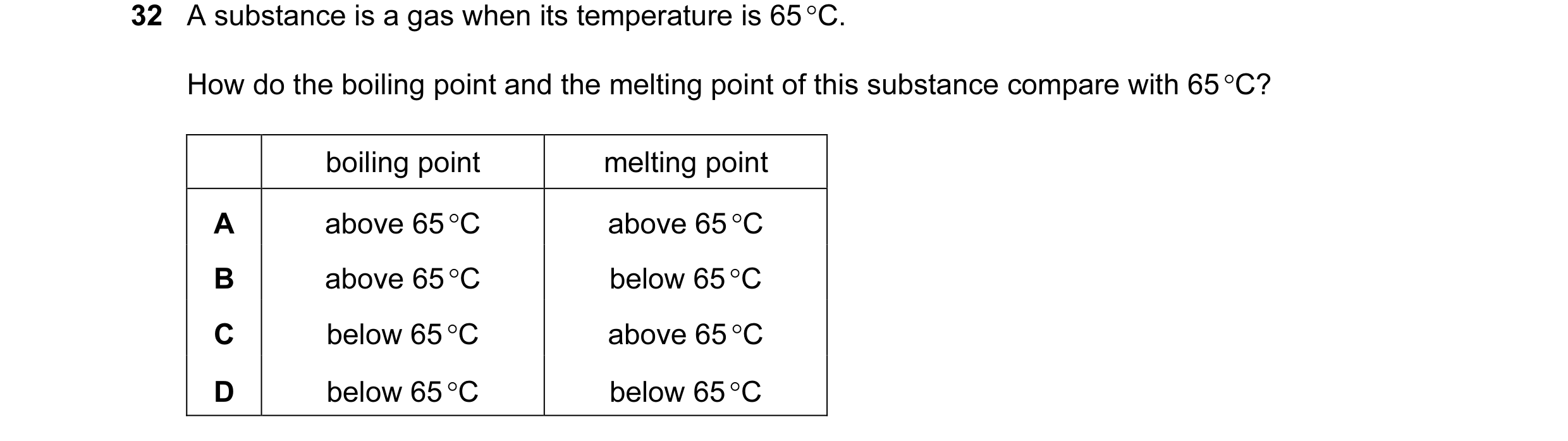
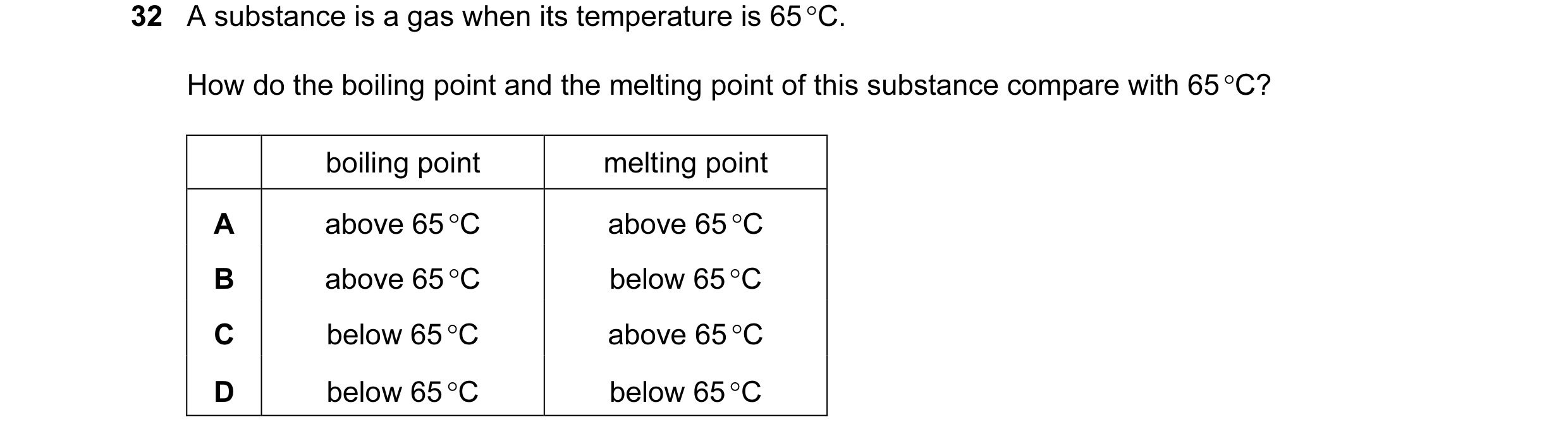
32 A substance is a gas when its temperature is 65 °C. How do the boiling point and the melting point of this substance compare with 65 °C? boiling point melting point A above 65 °C above 65 °C B above 65 °C below 65 °C C below 65 °C above 65 °C D below 65 °C below 65 °C
1 marks
Answer: D
This question in 0654/12 May/June 2013
Q15 · A beaker of cool liquid stands in a warm room 0654/13 May/June 2013
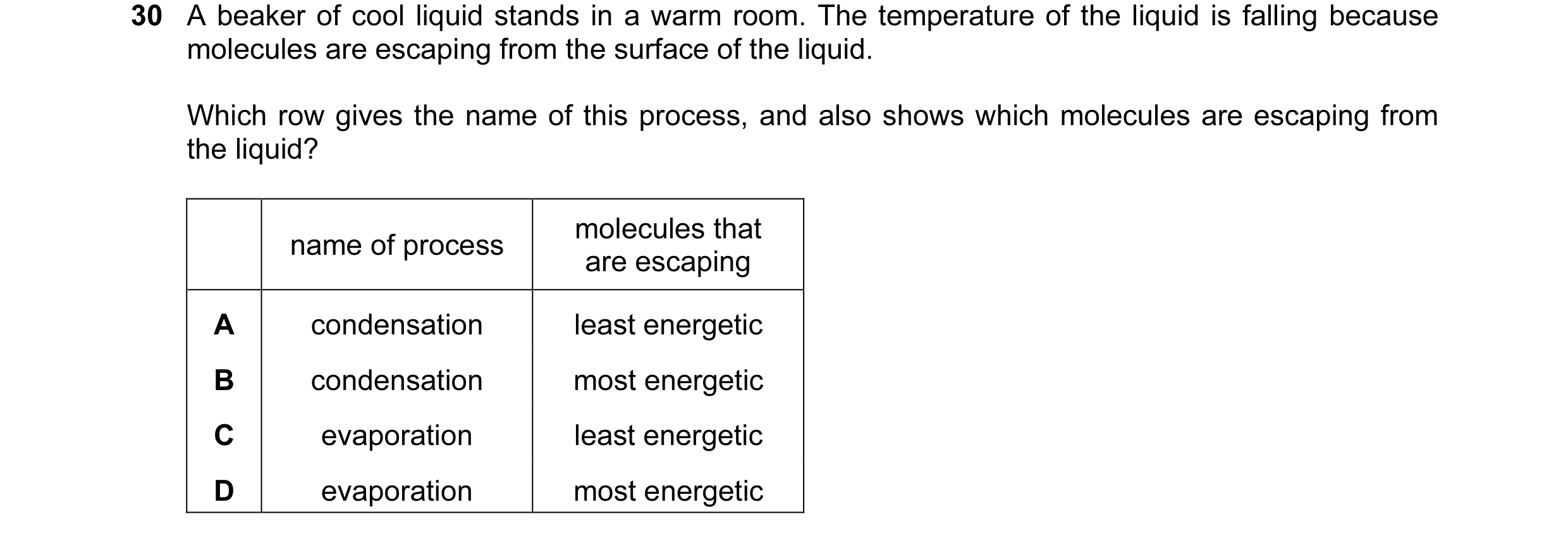
30 A beaker of cool liquid stands in a warm room. The temperature of the liquid is falling because molecules are escaping from the surface of the liquid. Which row gives the name of this process, and also shows which molecules are escaping from the liquid? molecules that name of process are escaping A condensation least energetic B condensation most energetic C evaporation least energetic D evaporation most energetic
1 marks
Answer: D
This question in 0654/13 May/June 2013
Q16 · Liquid in a beaker evaporates quickly 0654/11 Oct/Nov 2013
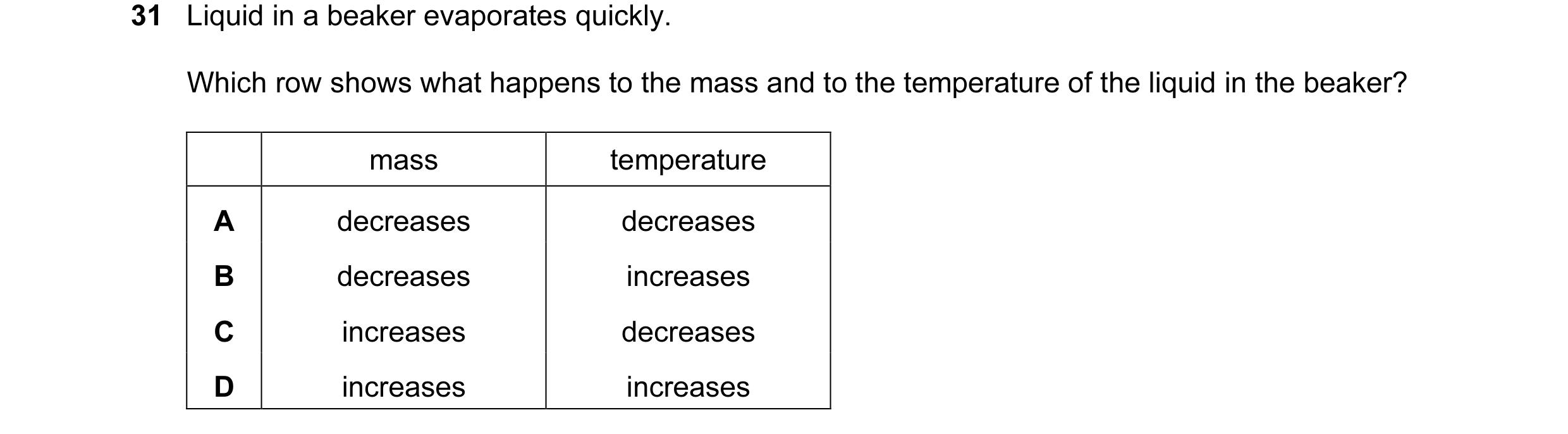
31 Liquid in a beaker evaporates quickly. Which row shows what happens to the mass and to the temperature of the liquid in the beaker? mass temperature A decreases decreases B decreases increases C increases decreases D increases increases
1 marks
Answer: A
This question in 0654/11 Oct/Nov 2013
Q17 · A sample of liquid is allowed to cool for 20 minutes 0654/12 Oct/Nov 2013
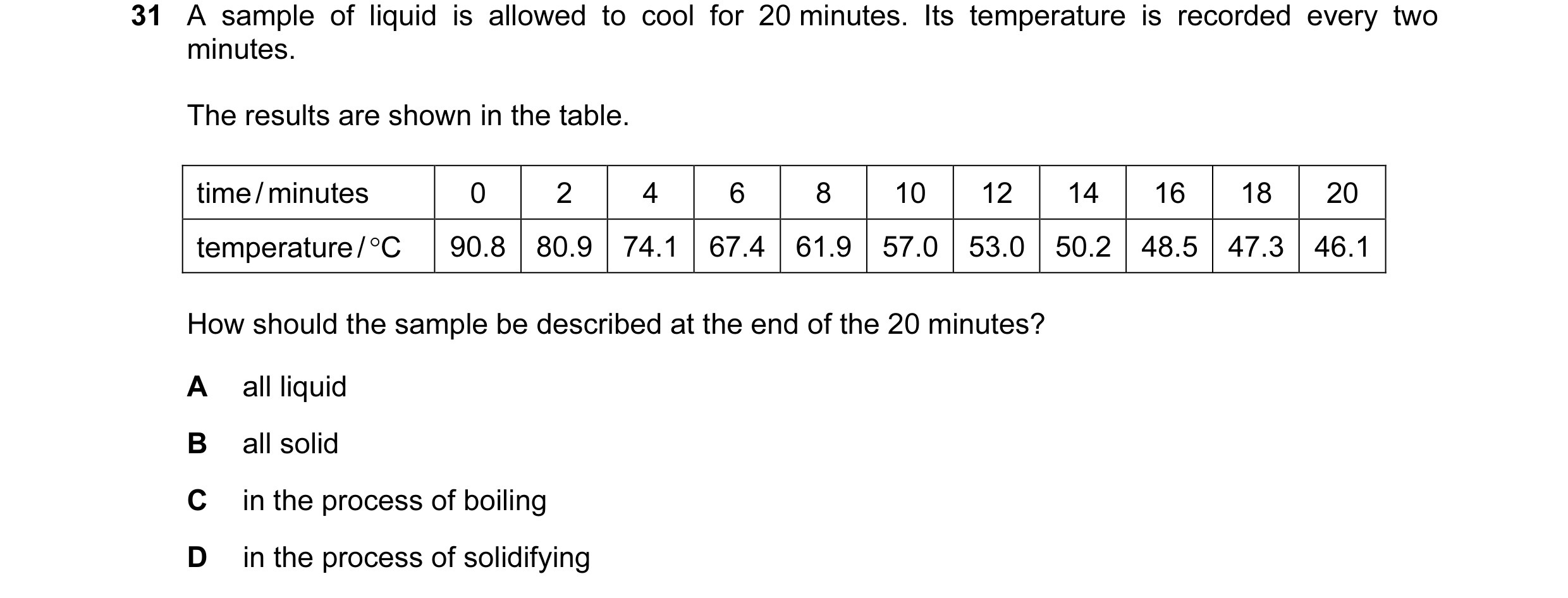
31 A sample of liquid is allowed to cool for 20 minutes. Its temperature is recorded every two minutes. The results are shown in the table. time / minutes 0 2 4 6 8 10 12 14 16 18 20 temperature / °C 90.8 80.9 74.1 67.4 61.9 57.0 53.0 50.2 48.5 47.3 46.1 How should the sample be described at the end of the 20 minutes? A all liquid B all solid C in the process of boiling D in the process of solidifying
1 marks
Answer: A
This question in 0654/12 Oct/Nov 2013
Q18 · Liquid in a beaker evaporates quickly 0654/12 Oct/Nov 2013
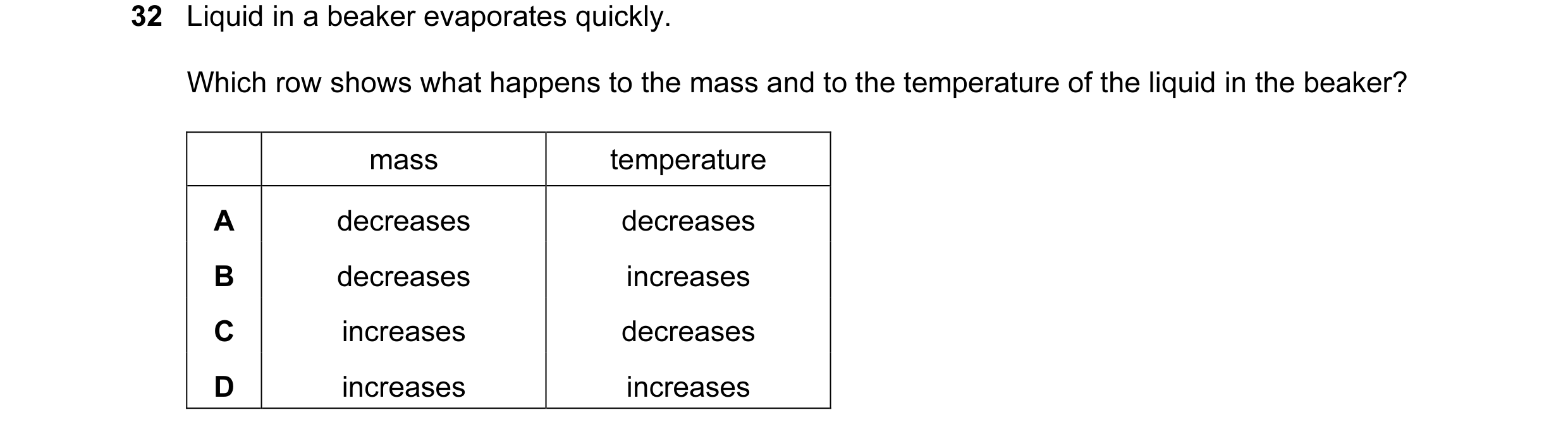
32 Liquid in a beaker evaporates quickly. Which row shows what happens to the mass and to the temperature of the liquid in the beaker? mass temperature A decreases decreases B decreases increases C increases decreases D increases increases
1 marks
Answer: A
This question in 0654/12 Oct/Nov 2013
Q19 · Liquid in a beaker evaporates quickly 0654/13 Oct/Nov 2013
31 Liquid in a beaker evaporates quickly. Which row shows what happens to the mass and to the temperature of the liquid in the beaker? mass temperature A decreases decreases B decreases increases C increases decreases D increases increases
1 marks
Answer: A
This question in 0654/13 Oct/Nov 2013
Q20 · A person wearing wet clothes can feel cold even on a warm day 0654/11 May/June 2014
31 A person wearing wet clothes can feel cold even on a warm day. Why does he feel cold? A Water gives out heat as it evaporates. B Water takes in heat as it evaporates. C Water vapour gives heat out as it condenses. D Water vapour takes heat in as it condenses.
1 marks
Answer: B
This question in 0654/11 May/June 2014
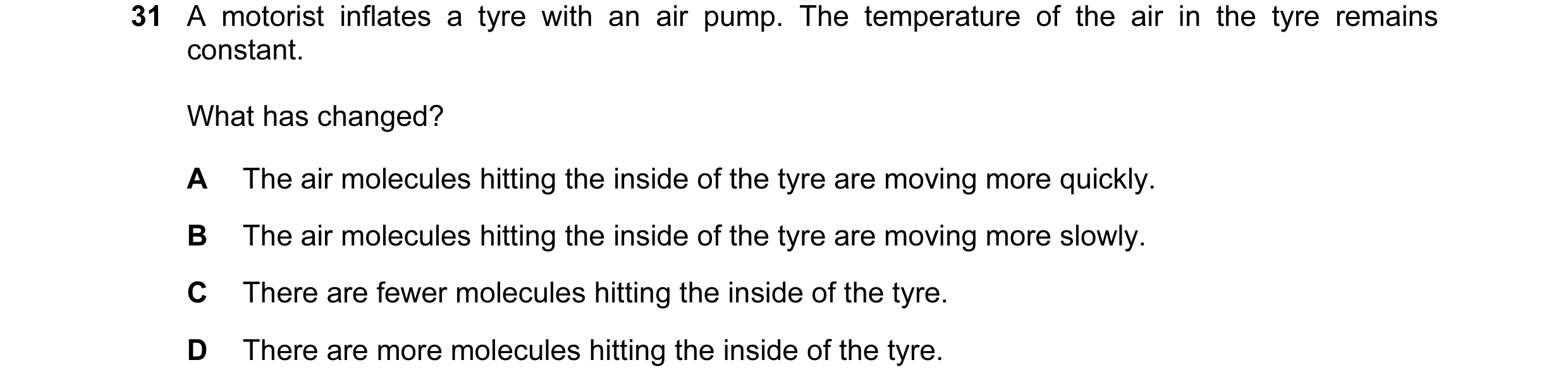
Q21 · A motorist inflates a tyre with an air pump 0654/12 May/June 2014
31 A motorist inflates a tyre with an air pump. The temperature of the air in the tyre remains constant. What has changed? A The air molecules hitting the inside of the tyre are moving more quickly. B The air molecules hitting the inside of the tyre are moving more slowly. C There are fewer molecules hitting the inside of the tyre. D There are more molecules hitting the inside of the tyre.
1 marks
Answer: D
This question in 0654/12 May/June 2014
Q22 · Which statement describes the particles in a gas? 0654/11 Oct/Nov 2014
17 Which statement describes the particles in a gas? A As the particles move quicker the pressure of the gas decreases. B The movement of the particles is unaffected by temperature. C The particles are in random motion. D The particles are ordered.
1 marks
Answer: C
This question in 0654/11 Oct/Nov 2014
Q23 · Which statement describes the particles in a gas? 0654/12 Oct/Nov 2014
18 Which statement describes the particles in a gas? A As the particles move quicker the pressure of the gas decreases. B The movement of the particles is unaffected by temperature. C The particles are in random motion. D The particles are ordered.
1 marks
Answer: C
This question in 0654/12 Oct/Nov 2014
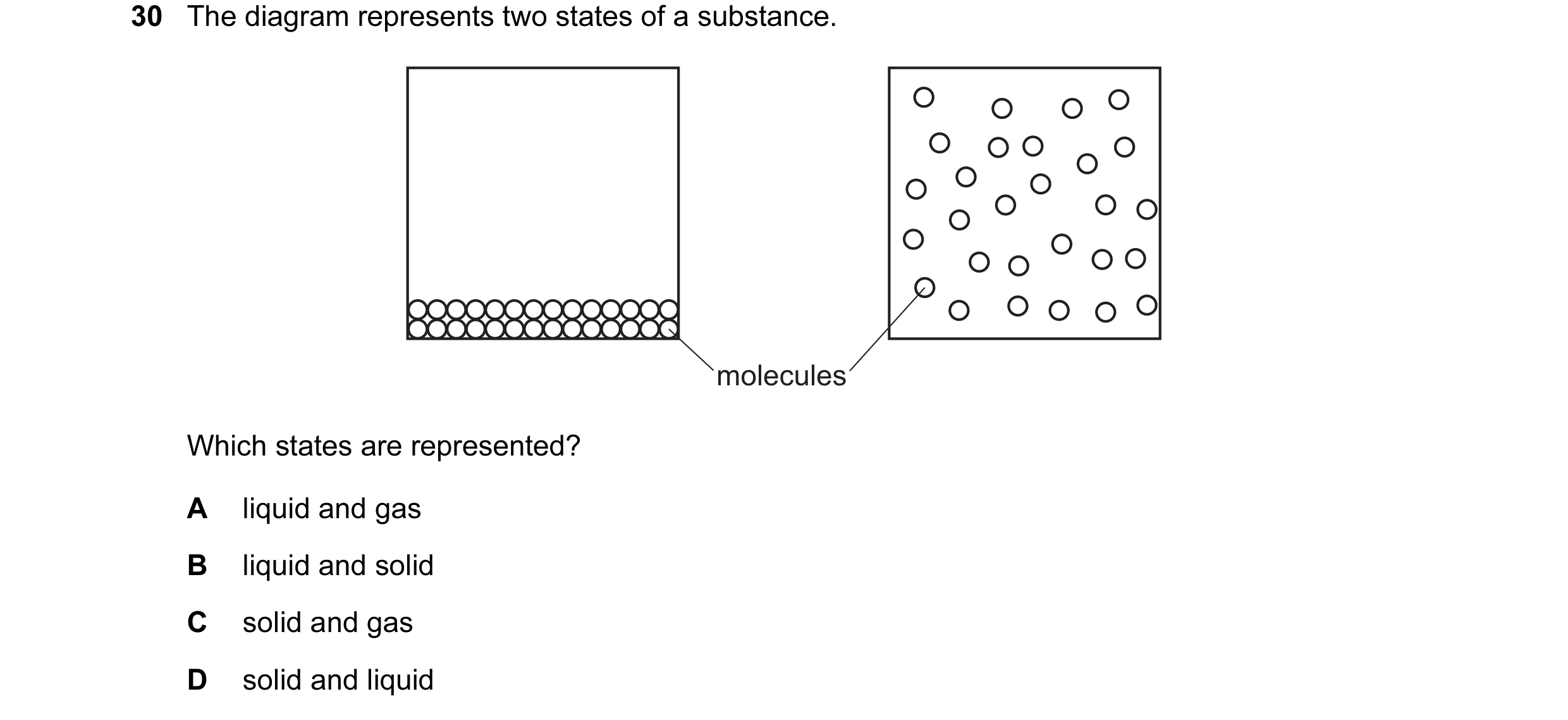
Q24 · The diagram represents two states of a substance 0654/13 Oct/Nov 2014
30 The diagram represents two states of a substance. molecules Which states are represented? A liquid and gas B liquid and solid C solid and gas D solid and liquid
1 marks
Answer: C
This question in 0654/13 Oct/Nov 2014
Q25 · Which is the best description of the molecules in a solid at 0 °C? 0654/12 May/June 2015
32 Which is the best description of the molecules in a solid at 0 °C? A close together and moving from one position to another and changing places with other molecules B close together and vibrating about a fixed position C far apart and moving from one position to another and changing places with other molecules D far apart and not moving at all
1 marks
Answer: B
This question in 0654/12 May/June 2015
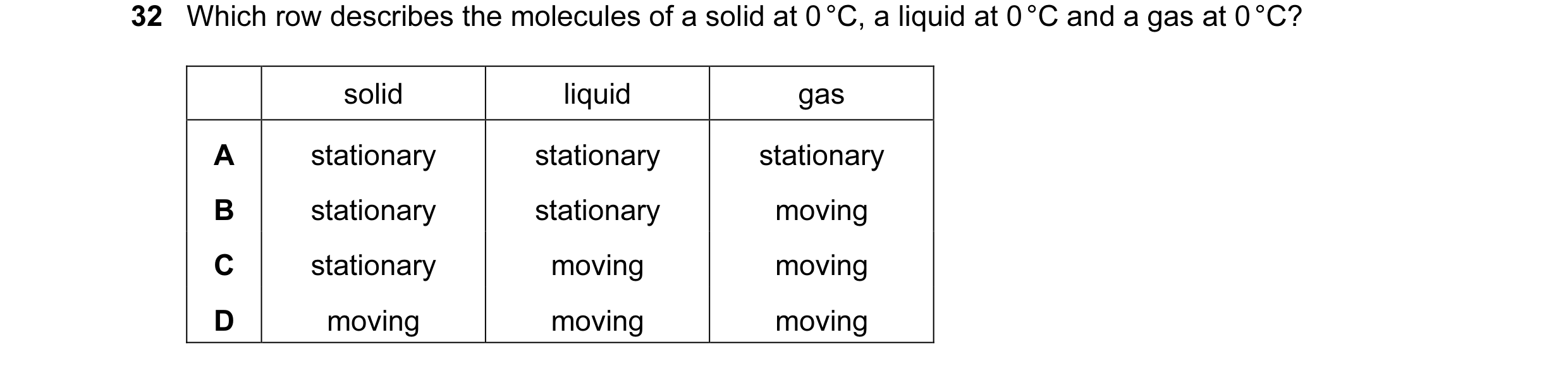
Q26 · Which row describes the molecules of a solid at 0 °C, a liquid at 0 °C and a gas at 0 °C? 0654/13 May/June 2015
32 Which row describes the molecules of a solid at 0 °C, a liquid at 0 °C and a gas at 0 °C? solid liquid gas A stationary stationary stationary B stationary stationary moving C stationary moving moving D moving moving moving
1 marks
Answer: D
This question in 0654/13 May/June 2015
Q27 · Some air is trapped inside a metal can with a tightly-fitting lid 0654/11 Oct/Nov 2015
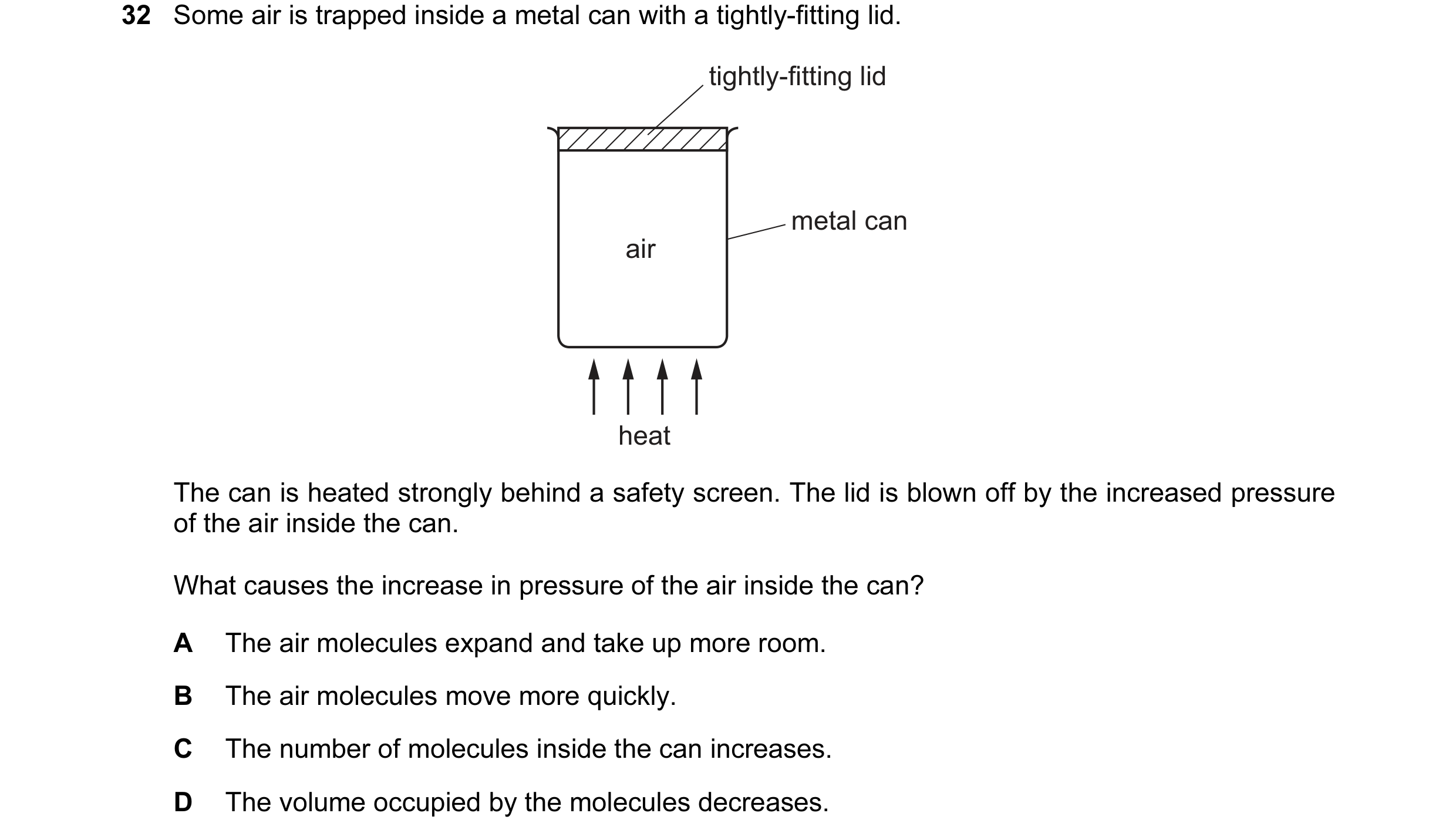
32 Some air is trapped inside a metal can with a tightly-fitting lid. tightly-fitting lid metal can air heat The can is heated strongly behind a safety screen. The lid is blown off by the increased pressure of the air inside the can. What causes the increase in pressure of the air inside the can? A The air molecules expand and take up more room. B The air molecules move more quickly. C The number of molecules inside the can increases. D The volume occupied by the molecules decreases.
1 marks
Answer: B
This question in 0654/11 Oct/Nov 2015
Q28 · Evaporation occurs when molecules escape from a liquid surface into the air above it 0654/12 Oct/Nov 2015
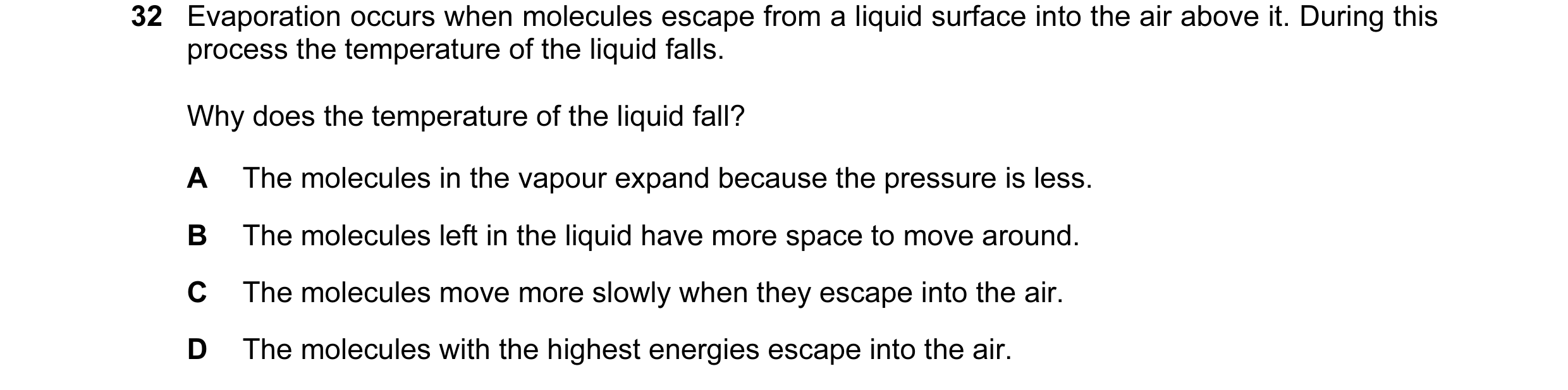
32 Evaporation occurs when molecules escape from a liquid surface into the air above it. During this process the temperature of the liquid falls. Why does the temperature of the liquid fall? A The molecules in the vapour expand because the pressure is less. B The molecules left in the liquid have more space to move around. C The molecules move more slowly when they escape into the air. D The molecules with the highest energies escape into the air.
1 marks
Answer: D
This question in 0654/12 Oct/Nov 2015
Q29 · On a warm day, a swimmer climbs out of a swimming pool into the open air and water… 0654/13 Oct/Nov 2015
32 On a warm day, a swimmer climbs out of a swimming pool into the open air and water evaporates from his skin. As the water evaporates, which molecules escape into the air first and what happens to the average speed of the remaining water molecules? first molecules average speed of the to escape remaining molecules A least energetic decreases B least energetic increases C most energetic decreases D most energetic increases
1 marks
Answer: C
This question in 0654/13 Oct/Nov 2015
Q30 · Which statement describes the properties of a liquid? 0654/11 May/June 2016
31 Which statement describes the properties of a liquid? A It has a definite shape and has a definite volume. B It has a definite shape but no definite volume. C It has no definite shape and no definite volume. D It has no definite shape but has a definite volume.
1 marks
Answer: D
This question in 0654/11 May/June 2016
Q31 · A substance is a gas when its temperature is 65 °C 0654/11 May/June 2016
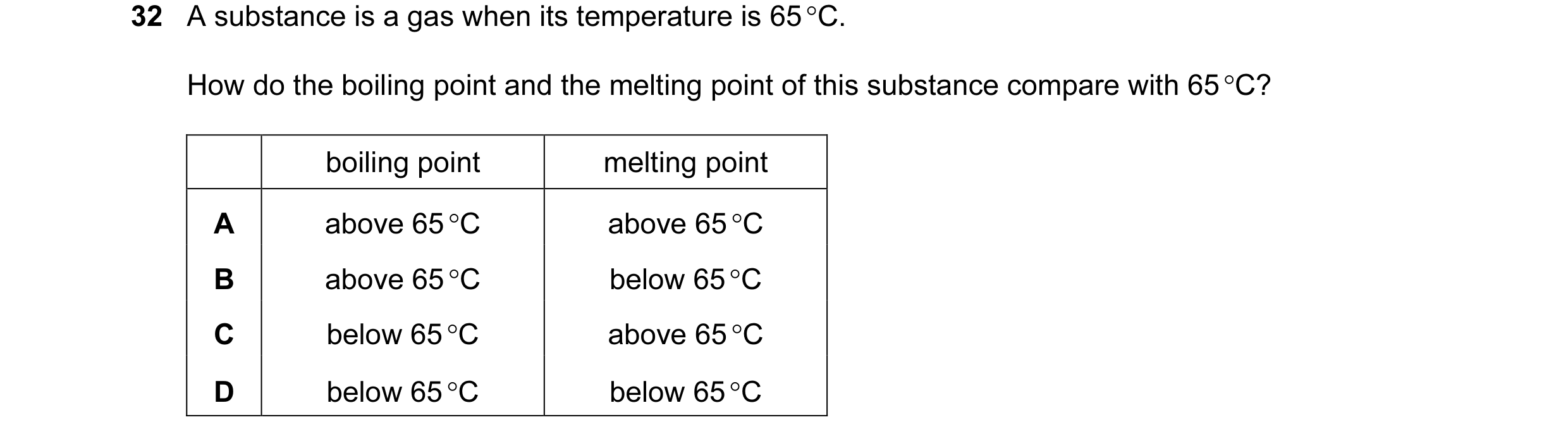
32 A substance is a gas when its temperature is 65 °C. How do the boiling point and the melting point of this substance compare with 65 °C? boiling point melting point A above 65 °C above 65 °C B above 65 °C below 65 °C C below 65 °C above 65 °C D below 65 °C below 65 °C
1 marks
Answer: D
This question in 0654/11 May/June 2016
Q32 · The air in a room exerts a pressure on the walls of the room 0654/12 May/June 2016
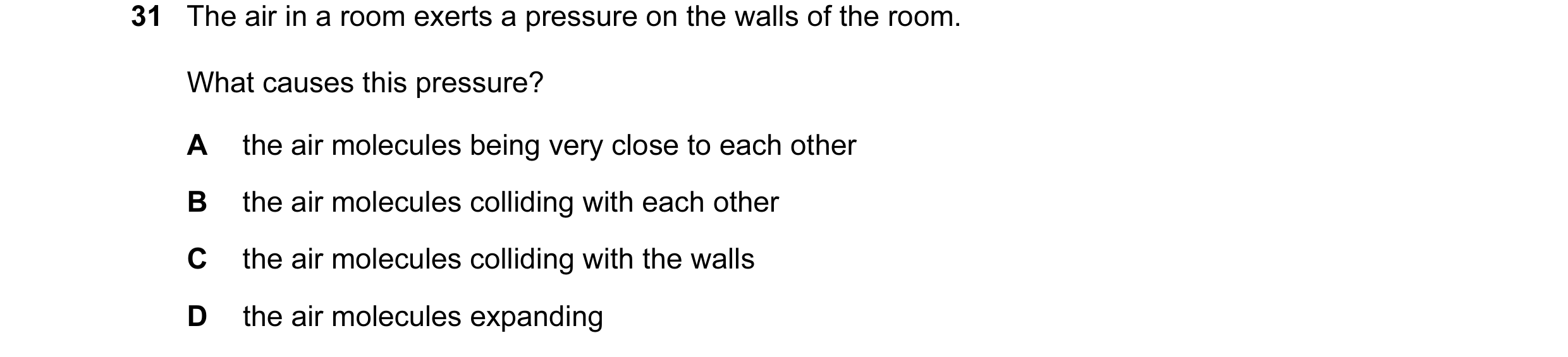
31 The air in a room exerts a pressure on the walls of the room. What causes this pressure? A the air molecules being very close to each other B the air molecules colliding with each other C the air molecules colliding with the walls D the air molecules expanding
1 marks
Answer: C
This question in 0654/12 May/June 2016
Q33 · A substance is a gas when its temperature is 65 °C 0654/12 May/June 2016
32 A substance is a gas when its temperature is 65 °C. How do the boiling point and the melting point of this substance compare with 65 °C? boiling point melting point A above 65 °C above 65 °C B above 65 °C below 65 °C C below 65 °C above 65 °C D below 65 °C below 65 °C
1 marks
Answer: D
This question in 0654/12 May/June 2016
Q34 · A gas is trapped in a metal cylinder of constant volume 0654/13 May/June 2016
31 A gas is trapped in a metal cylinder of constant volume. The gas is heated. Which row describes the changes produced? average pressure speed of gas of gas molecules A decreases decreases B decreases increases C increases decreases D increases increases
1 marks
Answer: D
This question in 0654/13 May/June 2016
Q35 · A liquid in an open container is evaporating, but not boiling 0654/11 Oct/Nov 2016
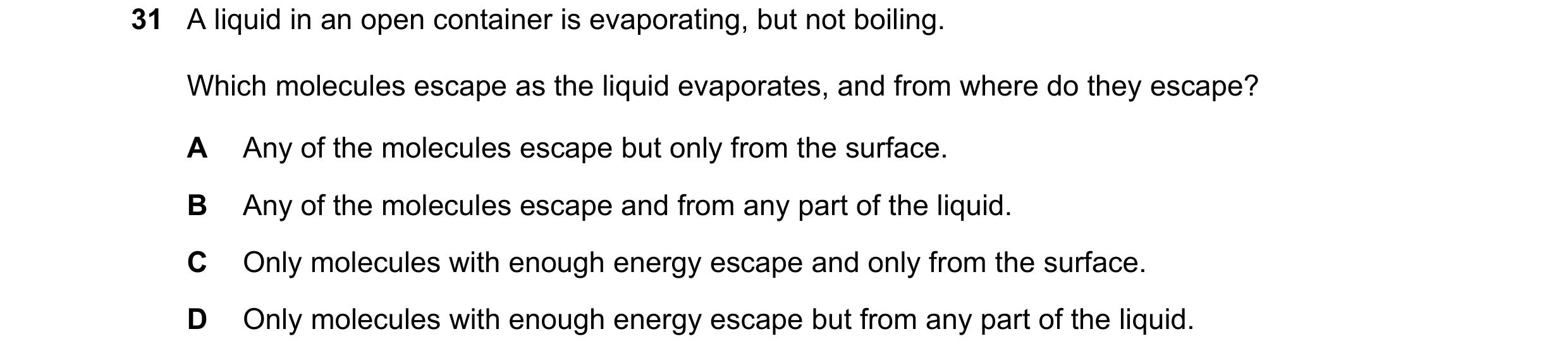
31 A liquid in an open container is evaporating, but not boiling. Which molecules escape as the liquid evaporates, and from where do they escape? A Any of the molecules escape but only from the surface. B Any of the molecules escape and from any part of the liquid. C Only molecules with enough energy escape and only from the surface. D Only molecules with enough energy escape but from any part of the liquid.
1 marks
Answer: C
This question in 0654/11 Oct/Nov 2016
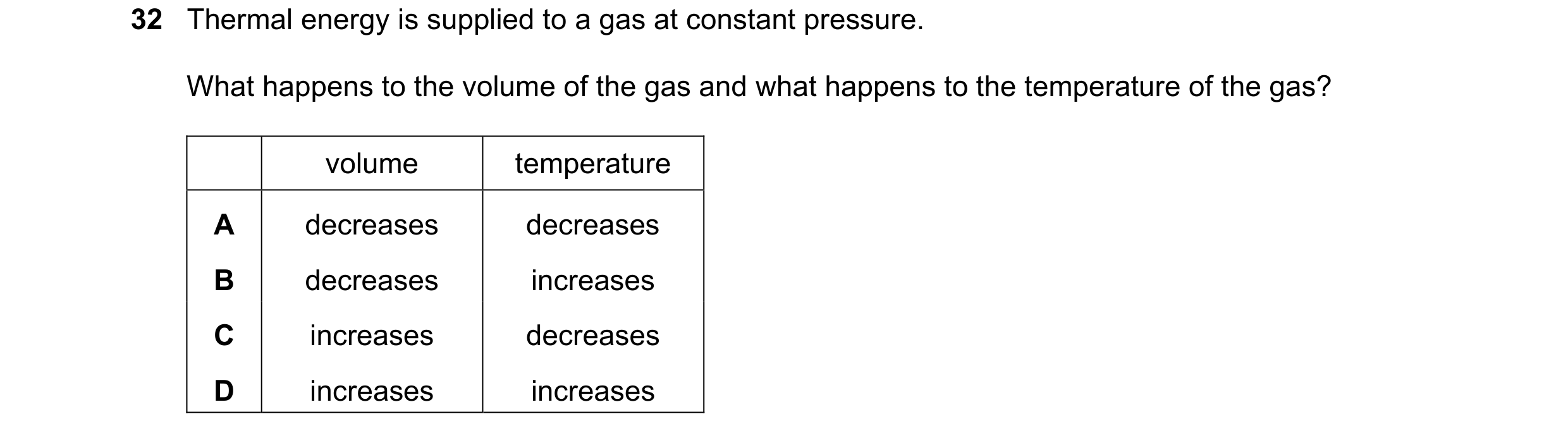
Q36 · Thermal energy is supplied to a gas at constant pressure 0654/11 Oct/Nov 2016
32 Thermal energy is supplied to a gas at constant pressure. What happens to the volume of the gas and what happens to the temperature of the gas? volume temperature A decreases decreases B decreases increases C increases decreases D increases increases
1 marks
Answer: D
This question in 0654/11 Oct/Nov 2016
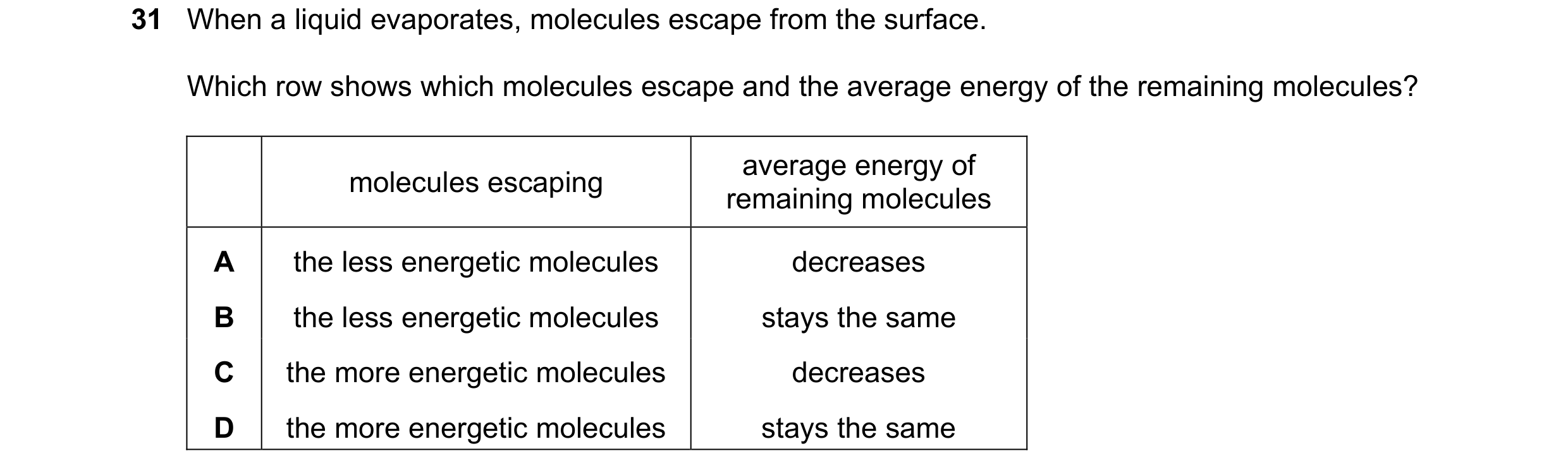
Q37 · When a liquid evaporates, molecules escape from the surface 0654/12 Oct/Nov 2016
31 When a liquid evaporates, molecules escape from the surface. Which row shows which molecules escape and the average energy of the remaining molecules? average energy of molecules escaping remaining molecules A the less energetic molecules decreases B the less energetic molecules stays the same C the more energetic molecules decreases D the more energetic molecules stays the same
1 marks
Answer: C
This question in 0654/12 Oct/Nov 2016
Q38 · Which labelled arrow on the diagram represents condensation? 0654/12 Oct/Nov 2016
32 Which labelled arrow on the diagram represents condensation? A liquid gas B C D solid
1 marks
Answer: A
This question in 0654/12 Oct/Nov 2016
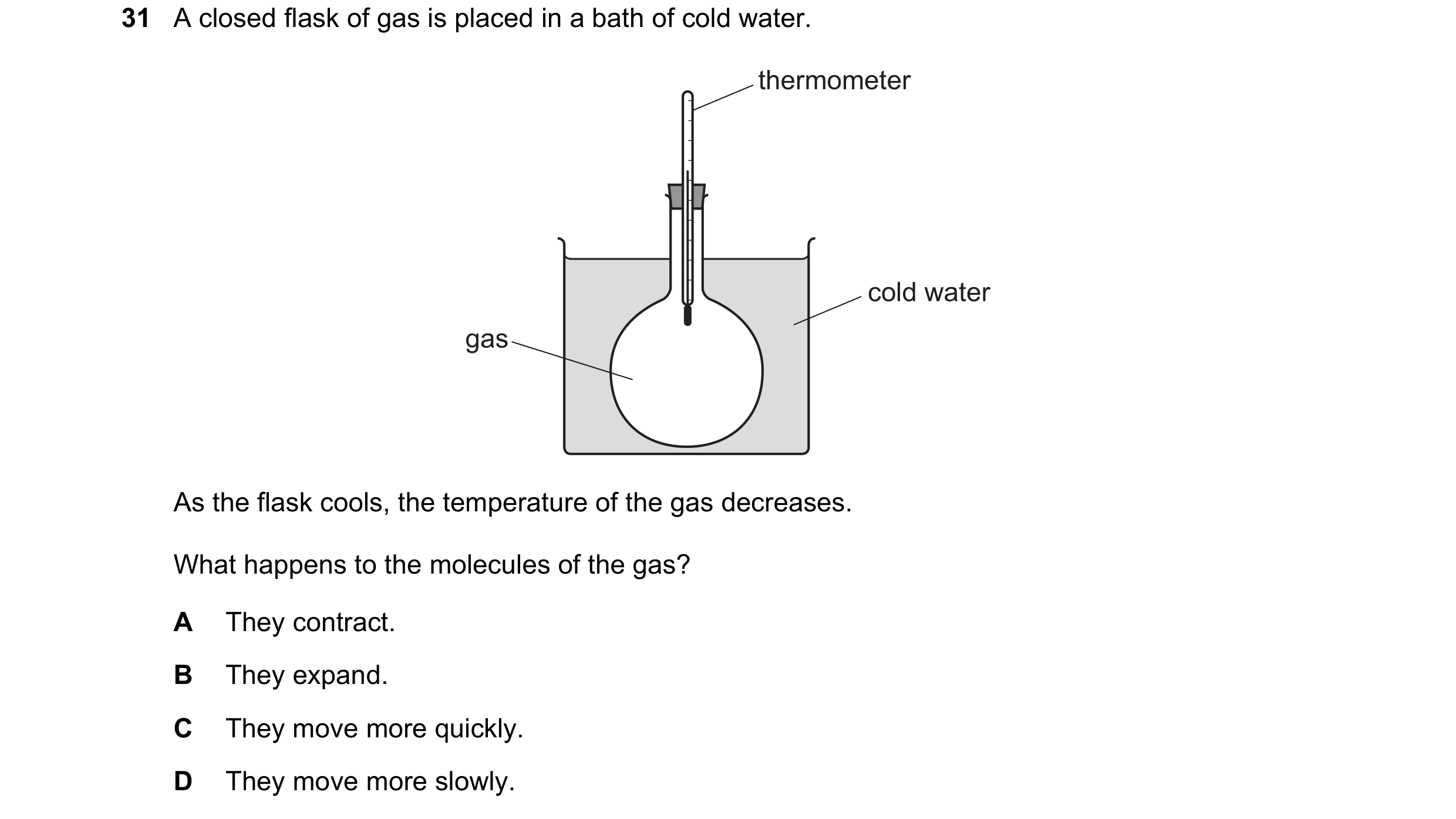
Q39 · A closed flask of gas is placed in a bath of cold water 0654/12 May/June 2017
31 A closed flask of gas is placed in a bath of cold water. thermometer cold water gas As the flask cools, the temperature of the gas decreases. What happens to the molecules of the gas? A They contract. B They expand. C They move more quickly. D They move more slowly.
1 marks
Answer: D
This question in 0654/12 May/June 2017
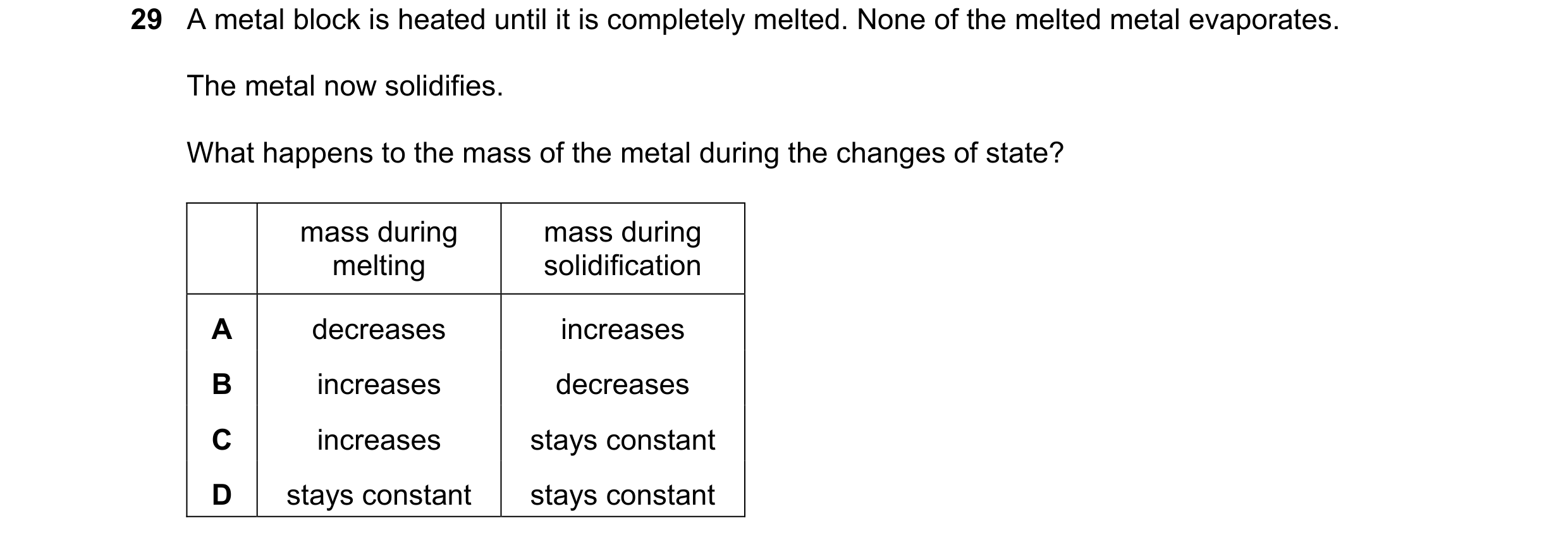
Q40 · A metal block is heated until it is completely melted 0654/11 Oct/Nov 2017
29 A metal block is heated until it is completely melted. None of the melted metal evaporates. The metal now solidifies. What happens to the mass of the metal during the changes of state? mass during mass during melting solidification A decreases increases B increases decreases C increases stays constant D stays constant stays constant
1 marks
Answer: D
This question in 0654/11 Oct/Nov 2017
Q41 · A gas is contained in a cylinder of constant volume 0654/11 Oct/Nov 2017
32 A gas is contained in a cylinder of constant volume. The gas is cooled and this causes its pressure to change. What happens to the speed of the molecules of the gas, and what happens to the pressure of the gas? speed of pressure molecules of gas A decreases decreases B decreases increases C increases decreases D increases increases
1 marks
Answer: A
This question in 0654/11 Oct/Nov 2017
Q42 · Which statement about gas molecules is not correct? 0654/13 Oct/Nov 2017
31 Which statement about gas molecules is not correct? A Increasing the temperature decreases the pressure of the gas at constant volume. B Increasing the temperature makes the molecules move faster. C Molecules of a gas are in constant random motion. D The pressure of the gas is caused by the collision of molecules with the container.
1 marks
Answer: A
This question in 0654/13 Oct/Nov 2017
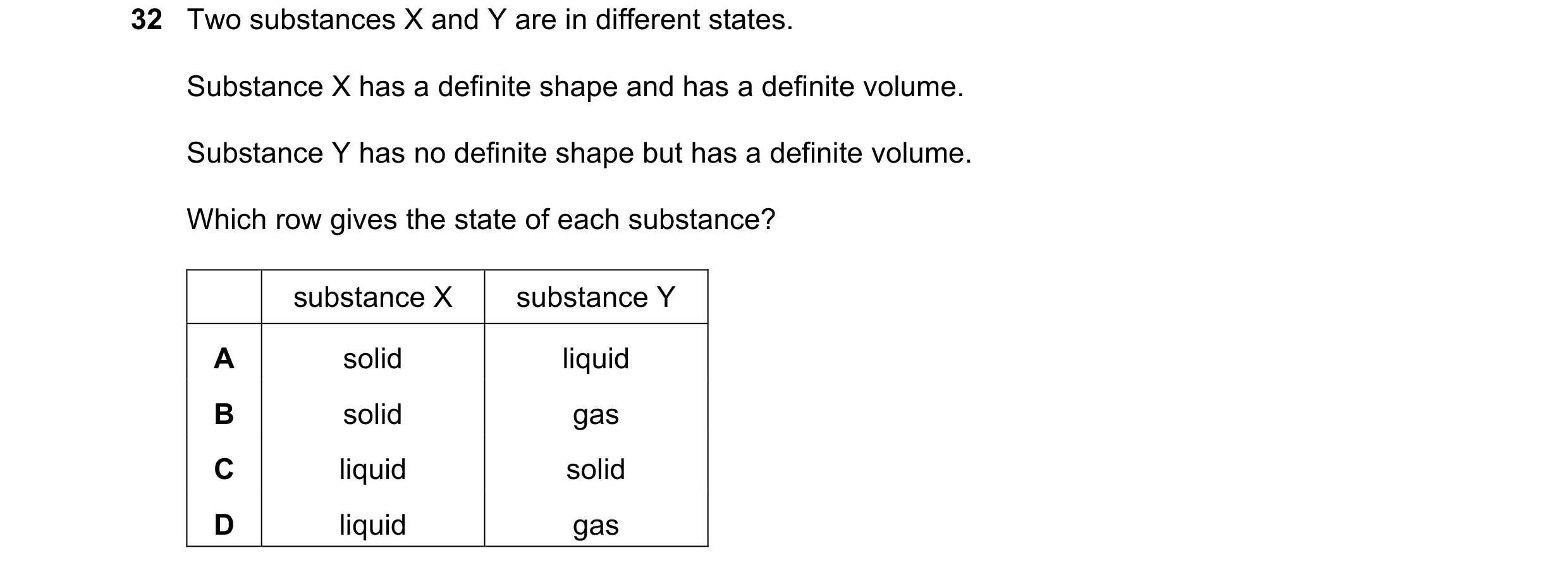
Q43 · Two substances X and Y are in different states 0654/11 Oct/Nov 2018
32 Two substances X and Y are in different states. Substance X has a definite shape and has a definite volume. Substance Y has no definite shape but has a definite volume. Which row gives the state of each substance? substance X substance Y A solid liquid B solid gas C liquid solid D liquid gas
1 marks
Answer: A
This question in 0654/11 Oct/Nov 2018
Q44 · Which statement describes molecules in a solid? 0654/12 Oct/Nov 2018
31 Which statement describes molecules in a solid? A They are close together and vibrate about fixed positions. B They do not vibrate but move at high speeds in straight lines. C They do not vibrate but can change places with each other. D They vibrate and can change places with each other.
1 marks
Answer: A
This question in 0654/12 Oct/Nov 2018
Q45 · A gas is trapped in a container of constant volume 0654/13 Oct/Nov 2018
31 A gas is trapped in a container of constant volume. The temperature of the gas increases. What happens to the speed of the molecules, and what happens to the pressure of the gas? speed of pressure molecules A decreases decreases B decreases increases C increases decreases D increases increases
1 marks
Answer: D
This question in 0654/13 Oct/Nov 2018
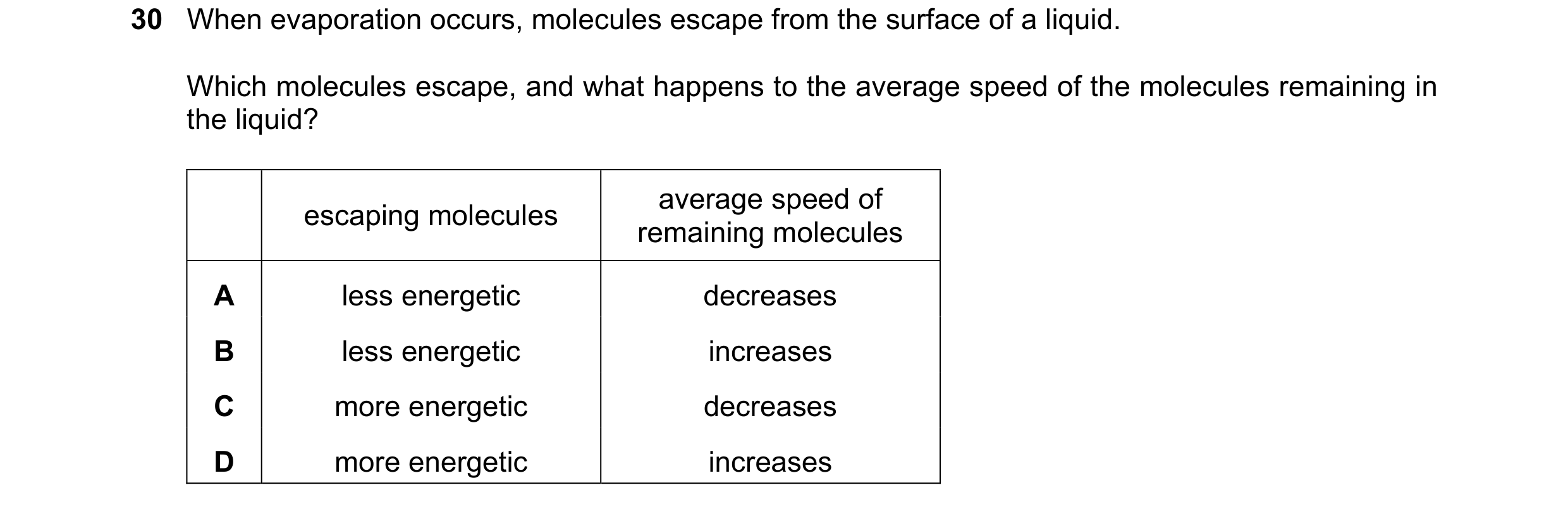
Q46 · When evaporation occurs, molecules escape from the surface of a liquid 0654/11 May/June 2019
30 When evaporation occurs, molecules escape from the surface of a liquid. Which molecules escape, and what happens to the average speed of the molecules remaining in the liquid? average speed of escaping molecules remaining molecules A less energetic decreases B less energetic increases C more energetic decreases D more energetic increases
1 marks
Answer: C
This question in 0654/11 May/June 2019
Q47 · The more energetic molecules of a liquid are escaping from its surface, causing the… 0654/11 Oct/Nov 2019
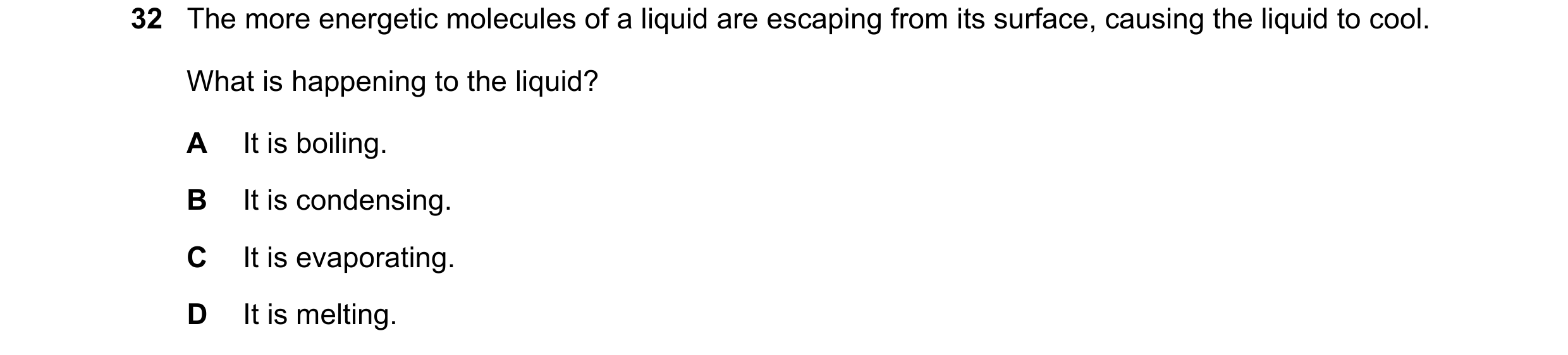
32 The more energetic molecules of a liquid are escaping from its surface, causing the liquid to cool. What is happening to the liquid? A It is boiling. B It is condensing. C It is evaporating. D It is melting.
1 marks
Answer: C
This question in 0654/11 Oct/Nov 2019
Q48 · A substance is a gas when its temperature is 65 °C 0654/11 Oct/Nov 2019
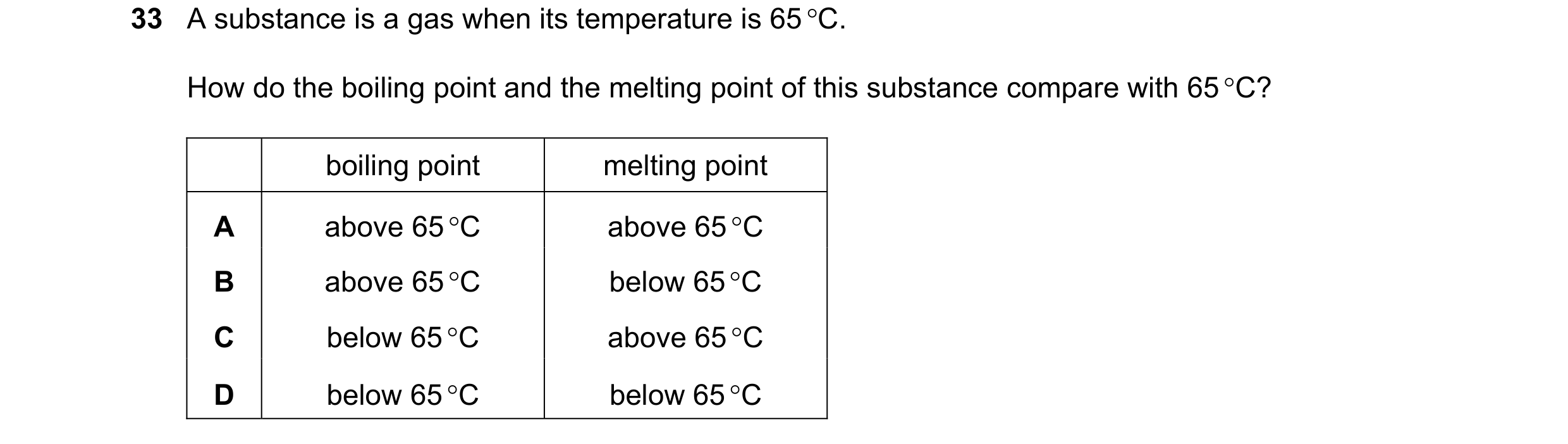
33 A substance is a gas when its temperature is 65 °C. How do the boiling point and the melting point of this substance compare with 65 °C? boiling point melting point A above 65 °C above 65 °C B above 65 °C below 65 °C C below 65 °C above 65 °C D below 65 °C below 65 °C
1 marks
Answer: D
This question in 0654/11 Oct/Nov 2019
Q49 · A substance is a gas when its temperature is 65 °C 0654/12 Oct/Nov 2019
32 A substance is a gas when its temperature is 65 °C. How do the boiling point and the melting point of this substance compare with 65 °C? boiling point melting point A above 65 °C above 65 °C B above 65 °C below 65 °C C below 65 °C above 65 °C D below 65 °C below 65 °C
1 marks
Answer: D
This question in 0654/12 Oct/Nov 2019
Q50 · A substance is a gas when its temperature is 65 °C 0654/13 Oct/Nov 2019
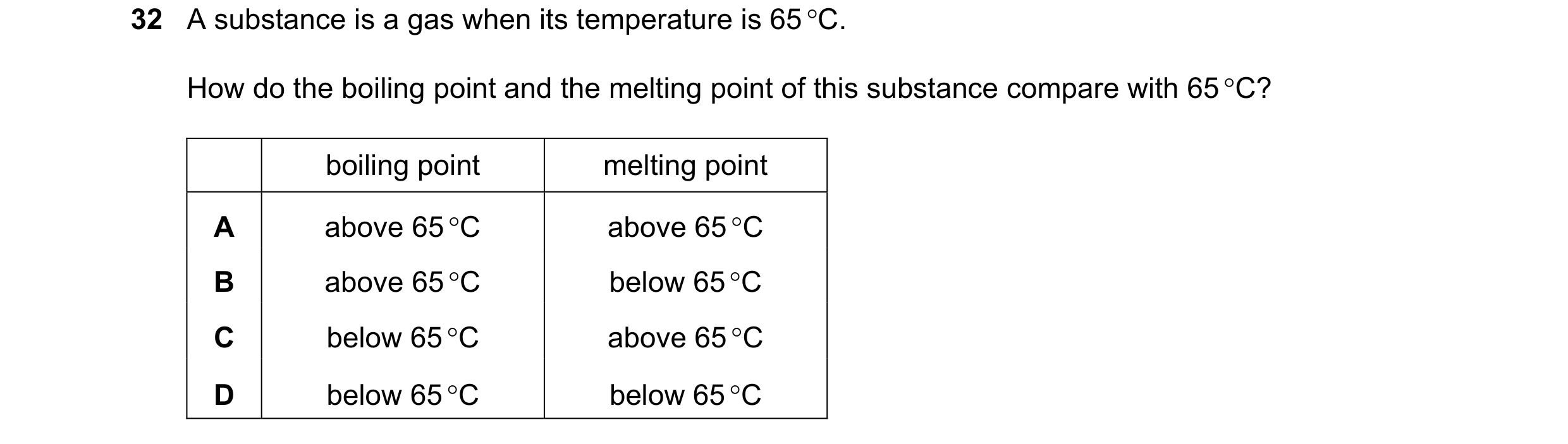
32 A substance is a gas when its temperature is 65 °C. How do the boiling point and the melting point of this substance compare with 65 °C? boiling point melting point A above 65 °C above 65 °C B above 65 °C below 65 °C C below 65 °C above 65 °C D below 65 °C below 65 °C
1 marks
Answer: D
This question in 0654/13 Oct/Nov 2019
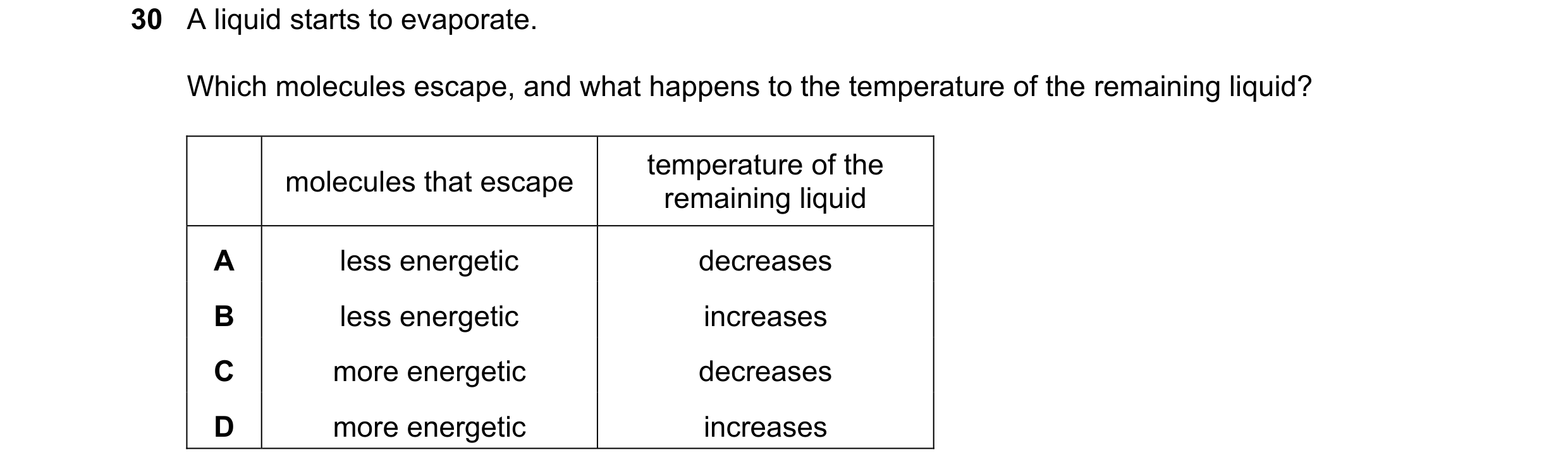
Q51 · A liquid starts to evaporate 0654/13 May/June 2020
30 A liquid starts to evaporate. Which molecules escape, and what happens to the temperature of the remaining liquid? temperature of the molecules that escape remaining liquid A less energetic decreases B less energetic increases C more energetic decreases D more energetic increases
1 marks
Answer: C
This question in 0654/13 May/June 2020
Q52 · Which labelled arrow on the diagram represents condensation? 0654/11 Oct/Nov 2021
32 Which labelled arrow on the diagram represents condensation? A liquid gas B C D solid
1 marks
Answer: A
This question in 0654/11 Oct/Nov 2021
Q53 · Which labelled arrow on the diagram represents condensation? 0654/12 Oct/Nov 2021
32 Which labelled arrow on the diagram represents condensation? A liquid gas B C D solid
1 marks
Answer: A
This question in 0654/12 Oct/Nov 2021
Q54 · Which labelled arrow on the diagram represents condensation? 0654/13 Oct/Nov 2021
32 Which labelled arrow on the diagram represents condensation? A liquid gas B C D solid
1 marks
Answer: A
This question in 0654/13 Oct/Nov 2021
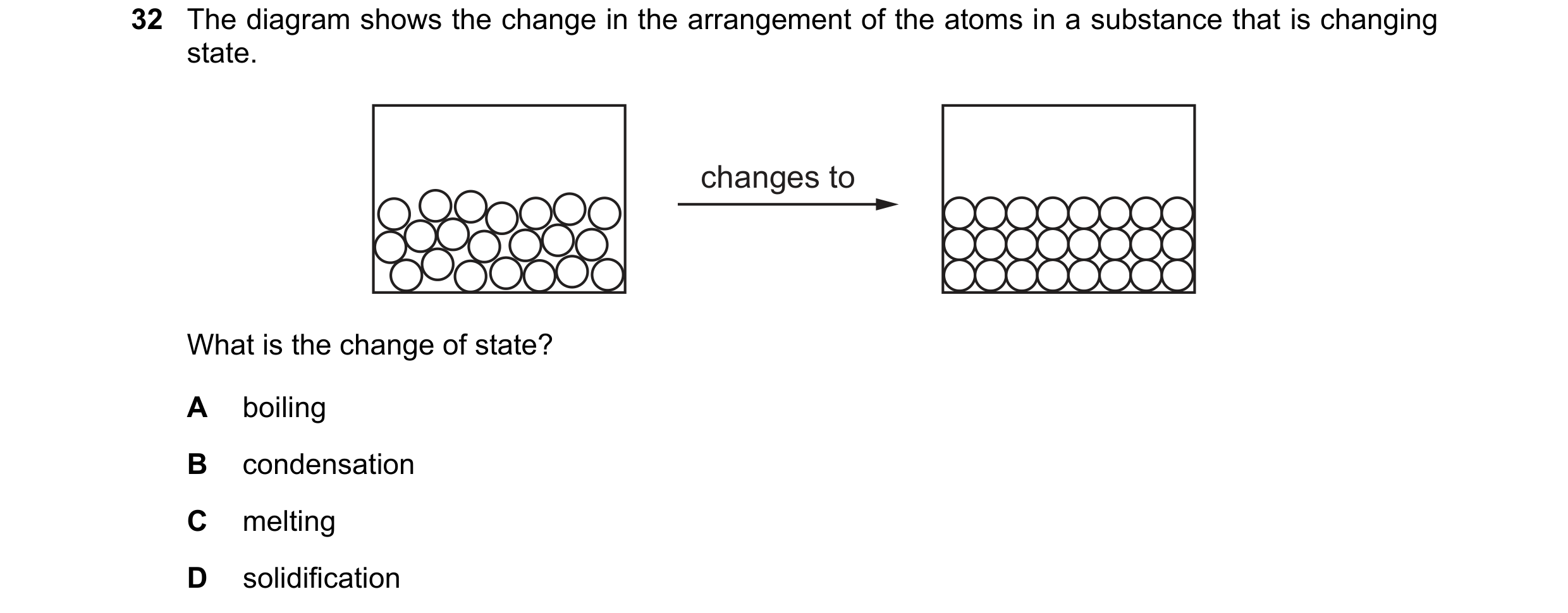
Q55 · The diagram shows the change in the arrangement of the atoms in a substance that is… 0654/12 Feb/March 2022
32 The diagram shows the change in the arrangement of the atoms in a substance that is changing state. changes to What is the change of state? A boiling B condensation C melting D solidification
1 marks
Answer: D
This question in 0654/12 Feb/March 2022
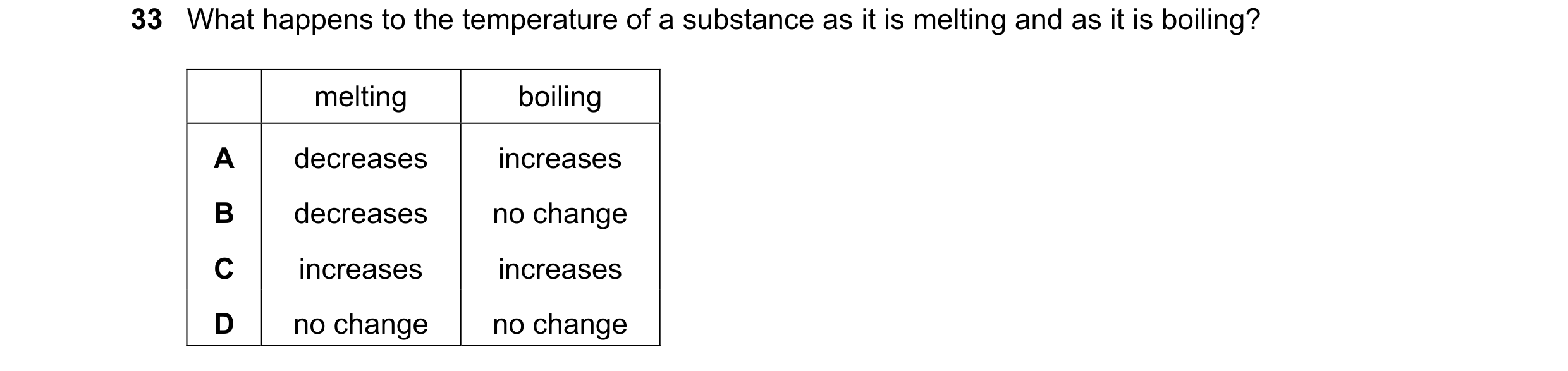
Q56 · What happens to the temperature of a substance as it is melting and as it is boiling? 0654/12 May/June 2022
33 What happens to the temperature of a substance as it is melting and as it is boiling? melting boiling A decreases increases B decreases no change C increases increases D no change no change
1 marks
Answer: D
This question in 0654/12 May/June 2022
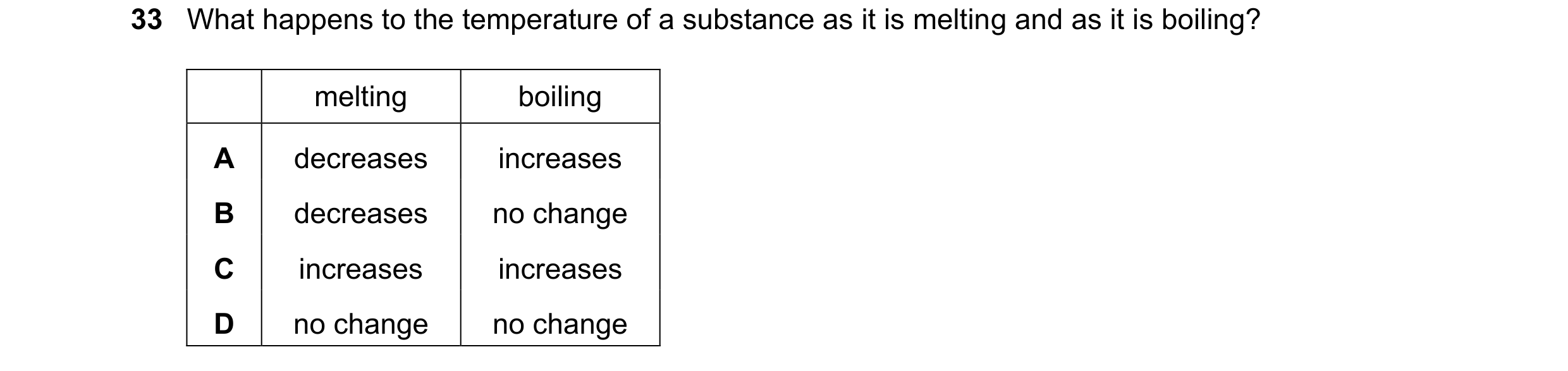
Q57 · What happens to the temperature of a substance as it is melting and as it is boiling? 0654/13 May/June 2022
33 What happens to the temperature of a substance as it is melting and as it is boiling? melting boiling A decreases increases B decreases no change C increases increases D no change no change
1 marks
Answer: D
This question in 0654/13 May/June 2022
Q58 · A bowl of water is placed on a balance outside where it is sunny and windy 0654/13 Oct/Nov 2022
32 A bowl of water is placed on a balance outside where it is sunny and windy. The reading on the balance is recorded. After some time, the reading on the balance is less than the original reading. Which statement explains why the reading is less? A The water has become cooler. B The water has become warmer. C The water has condensed. D The water has evaporated.
1 marks
Answer: D
This question in 0654/13 Oct/Nov 2022
Q59 · Which term describes a gas changing into a liquid? 0654/11 May/June 2023
33 Which term describes a gas changing into a liquid? A boiling B condensation C evaporation D melting
1 marks
Answer: B
This question in 0654/11 May/June 2023
Q60 · Which statement about gas particles is not correct? 0654/12 May/June 2023
31 Which statement about gas particles is not correct? A Increasing the temperature of a gas makes the gas particles move more slowly. B The gas particles are in constant random motion. C The pressure of a gas is caused by the collision of gas particles with the container. D Very small particles suspended in a gas are in constant random motion.
1 marks
Answer: A
This question in 0654/12 May/June 2023
Q61 · Which statement about gas particles is not correct? 0654/13 May/June 2023
31 Which statement about gas particles is not correct? A Increasing the temperature of a gas makes the gas particles move more slowly. B The gas particles are in constant random motion. C The pressure of a gas is caused by the collision of gas particles with the container. D Very small particles suspended in a gas are in constant random motion.
1 marks
Answer: A
This question in 0654/13 May/June 2023
Q62 · Someone wearing wet clothes can feel cold even on a warm day 0654/11 Oct/Nov 2023
32 Someone wearing wet clothes can feel cold even on a warm day. Why do they feel cold? A Water gives out heat as it evaporates. B Water takes in heat as it evaporates. C Water vapour gives out heat as it condenses. D Water vapour takes in heat as it condenses.
1 marks
Answer: B
This question in 0654/11 Oct/Nov 2023
Q63 · A gas is contained in a cylinder of constant volume 0654/12 Oct/Nov 2023
32 A gas is contained in a cylinder of constant volume. The gas is cooled. What happens to the speed of the molecules of the gas and to the pressure of the gas? speed of pressure molecules of gas A decreases decreases B decreases increases C increases decreases D increases increases
1 marks
Answer: A
This question in 0654/12 Oct/Nov 2023
Q64 · A sample of liquid cools for 20 minutes 0654/13 Oct/Nov 2023
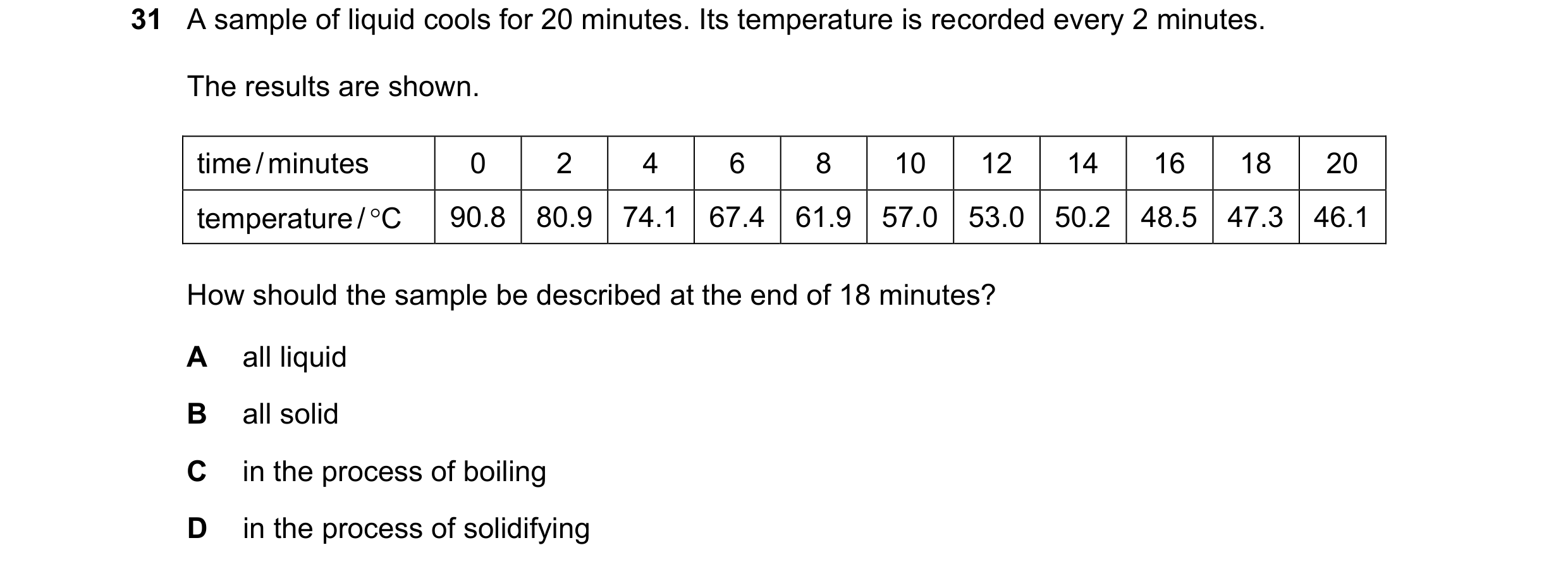
31 A sample of liquid cools for 20 minutes. Its temperature is recorded every 2 minutes. The results are shown. time / minutes 0 2 4 6 8 10 12 14 16 18 20 temperature / C 90.8 80.9 74.1 67.4 61.9 57.0 53.0 50.2 48.5 47.3 46.1 How should the sample be described at the end of 18 minutes? A all liquid B all solid C in the process of boiling D in the process of solidifying
1 marks
Answer: A
This question in 0654/13 Oct/Nov 2023
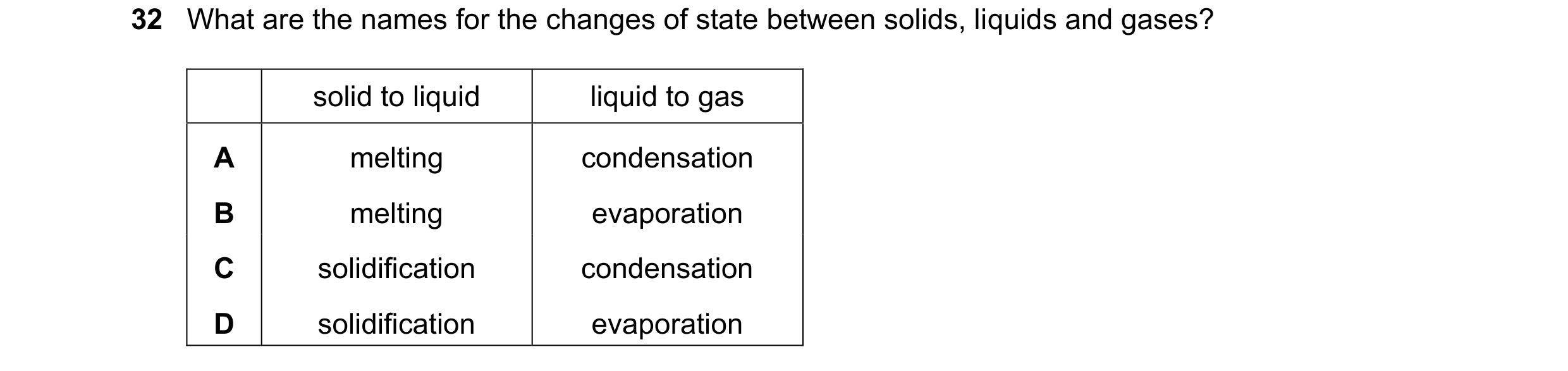
Q65 · What are the names for the changes of state between solids, liquids and gases? 0654/12 Oct/Nov 2024
32 What are the names for the changes of state between solids, liquids and gases? solid to liquid liquid to gas A melting condensation B melting evaporation C solidification condensation D solidification evaporation
1 marks
Answer: B
This question in 0654/12 Oct/Nov 2024
Q66 · What are the names for the changes of state between solids, liquids and gases? 0654/13 Oct/Nov 2024
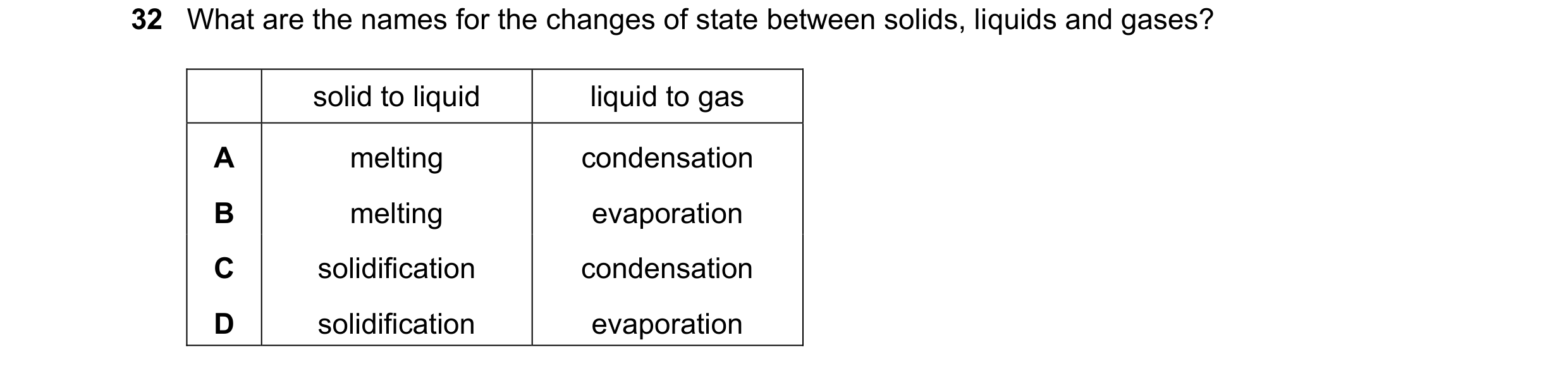
32 What are the names for the changes of state between solids, liquids and gases? solid to liquid liquid to gas A melting condensation B melting evaporation C solidification condensation D solidification evaporation
1 marks
Answer: B
This question in 0654/13 Oct/Nov 2024
Q67 · Liquid in a beaker evaporates quickly 0654/12 May/June 2025
31 Liquid in a beaker evaporates quickly. Which row shows what happens to the mass and to the temperature of the liquid remaining in the beaker? mass temperature A decreases decreases B decreases increases C increases decreases D increases increases
1 marks
Answer: A
This question in 0654/12 May/June 2025
Q68 · Liquid in a beaker evaporates quickly 0654/13 May/June 2025
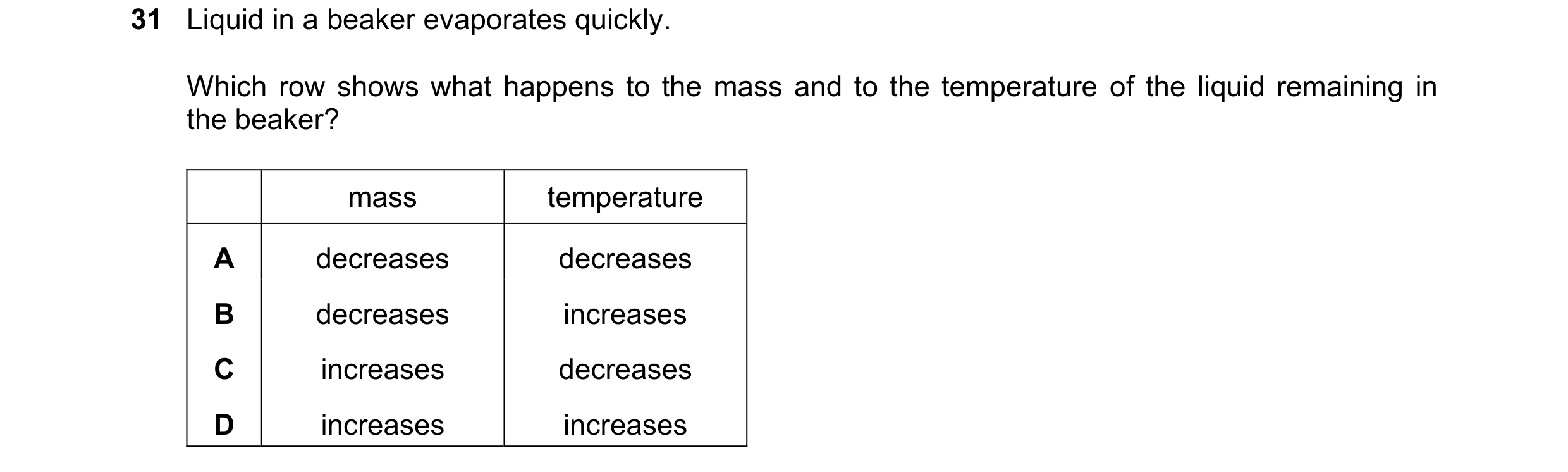
31 Liquid in a beaker evaporates quickly. Which row shows what happens to the mass and to the temperature of the liquid remaining in the beaker? mass temperature A decreases decreases B decreases increases C increases decreases D increases increases
1 marks
Answer: A
This question in 0654/13 May/June 2025
Q69 · Which labelled arrow on the diagram represents condensation? 0654/11 Oct/Nov 2025
31 Which labelled arrow on the diagram represents condensation? A liquid gas B D C solid
1 marks
Answer: A
This question in 0654/11 Oct/Nov 2025
Q70 · Which statement describes the behaviour of particles during the evaporation of a liquid? 0654/12 Oct/Nov 2025
31 Which statement describes the behaviour of particles during the evaporation of a liquid? A Only the more energetic particles escape. B Particles bond together. C Particles move closer together. D The least energetic particles escape first.
1 marks
Answer: A
This question in 0654/12 Oct/Nov 2025
Q71 · Which statement describes the behaviour of particles during the evaporation of a liquid? 0654/13 Oct/Nov 2025
31 Which statement describes the behaviour of particles during the evaporation of a liquid? A Only the more energetic particles escape. B Particles bond together. C Particles move closer together. D The least energetic particles escape first.
1 marks
Answer: A
This question in 0654/13 Oct/Nov 2025
 1 / 18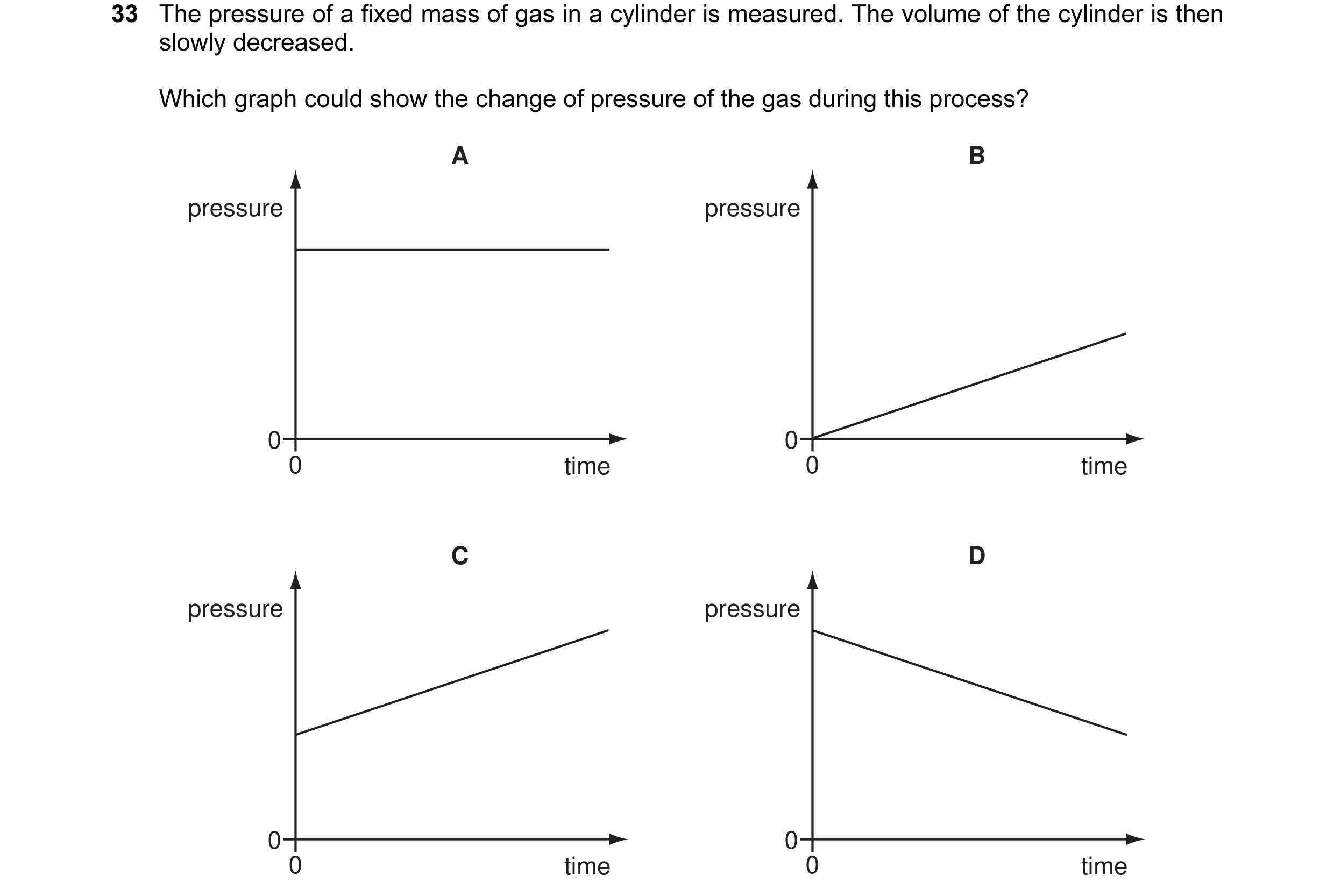
 2 / 18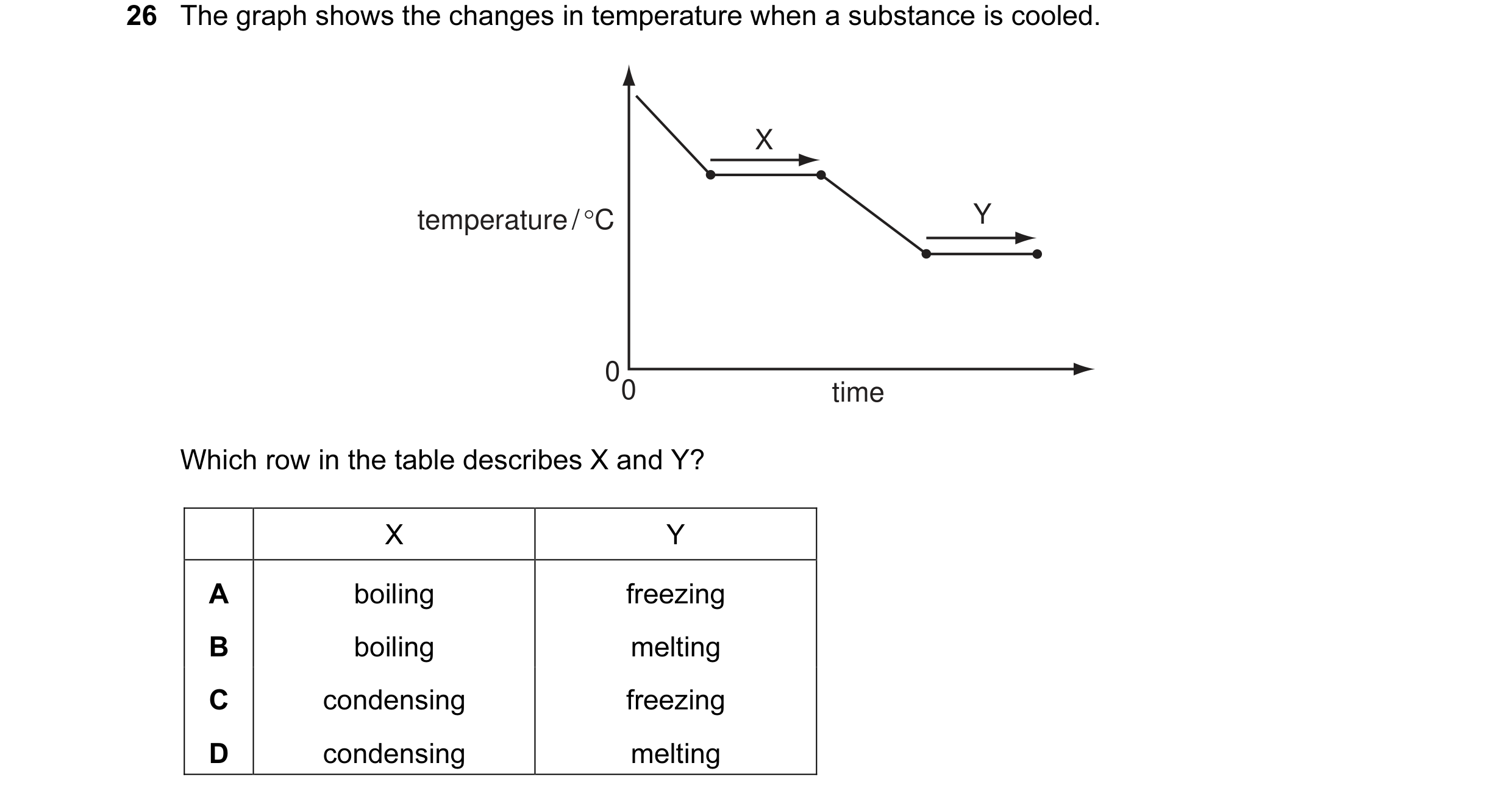
 3 / 18
 4 / 18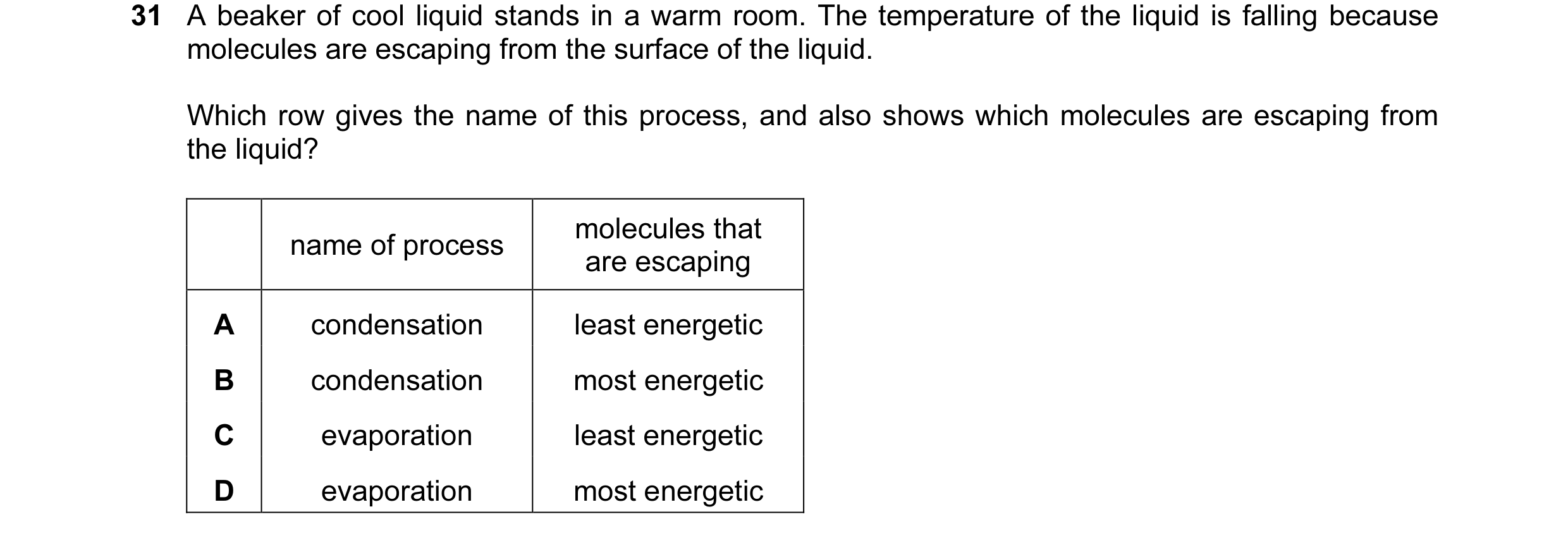
 5 / 18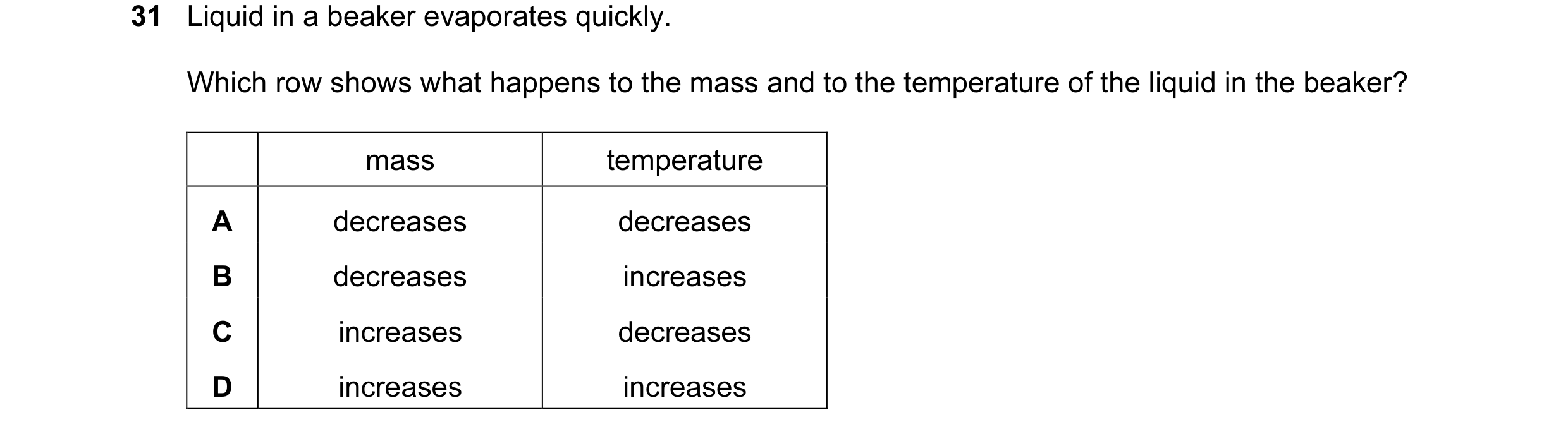
 6 / 18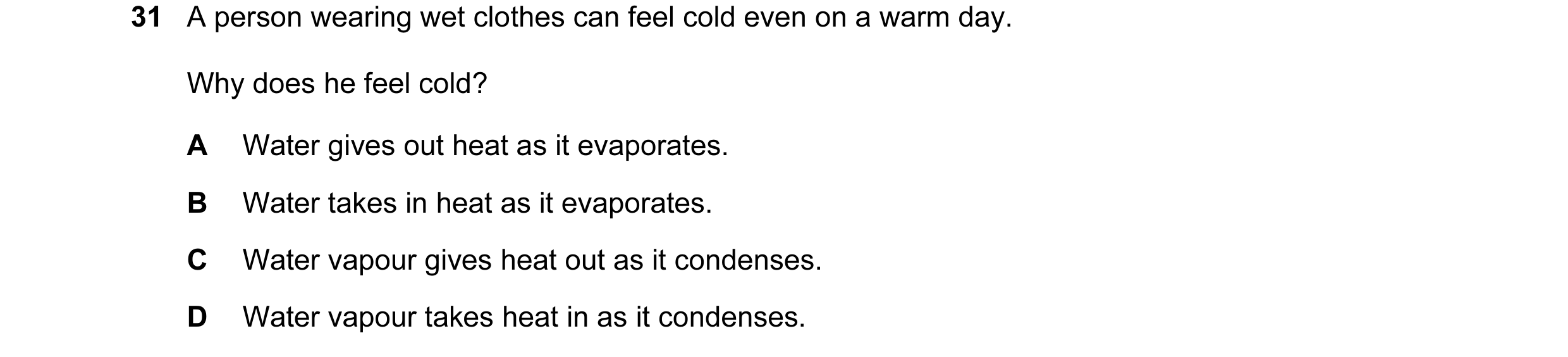


 7 / 18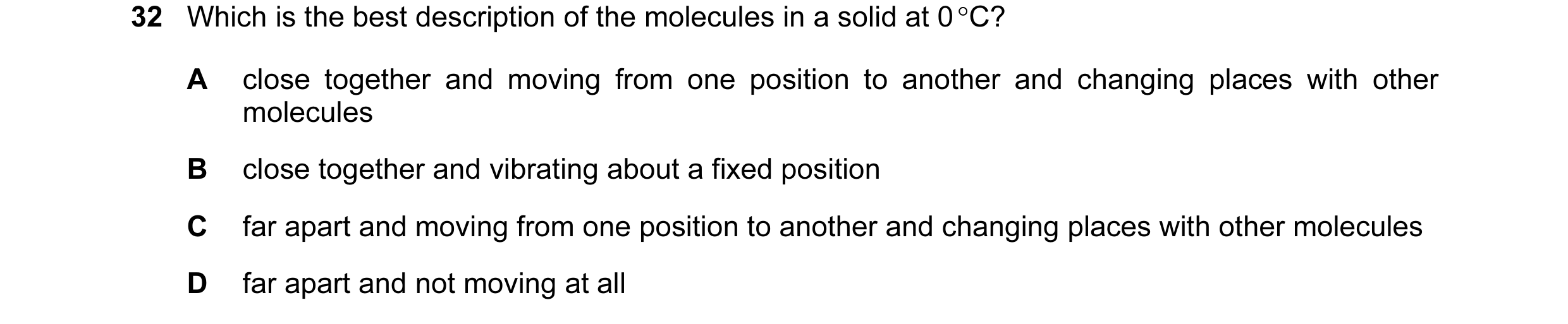
 8 / 18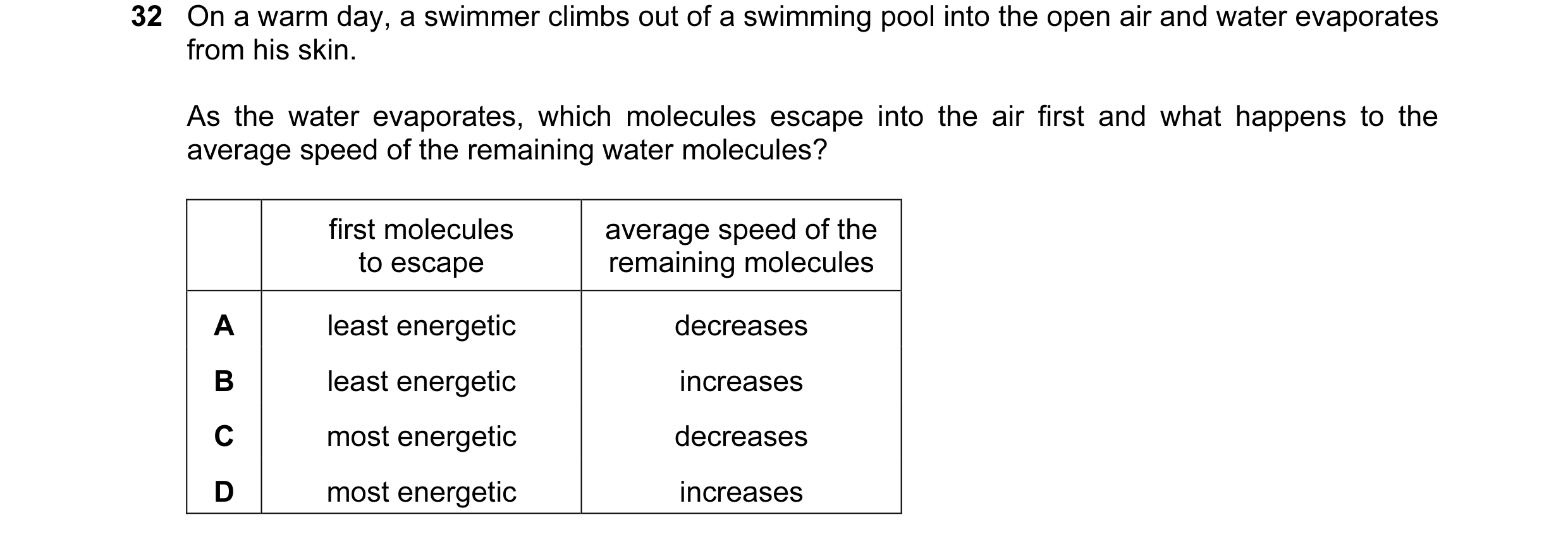

 9 / 18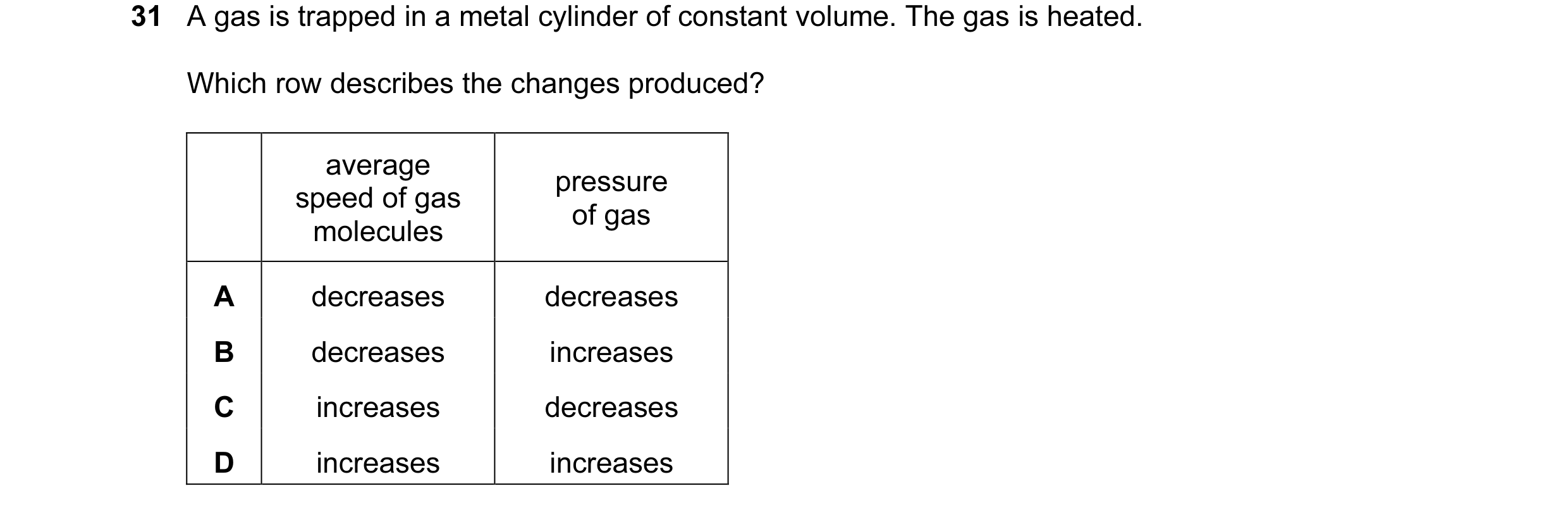
 10 / 18
 11 / 18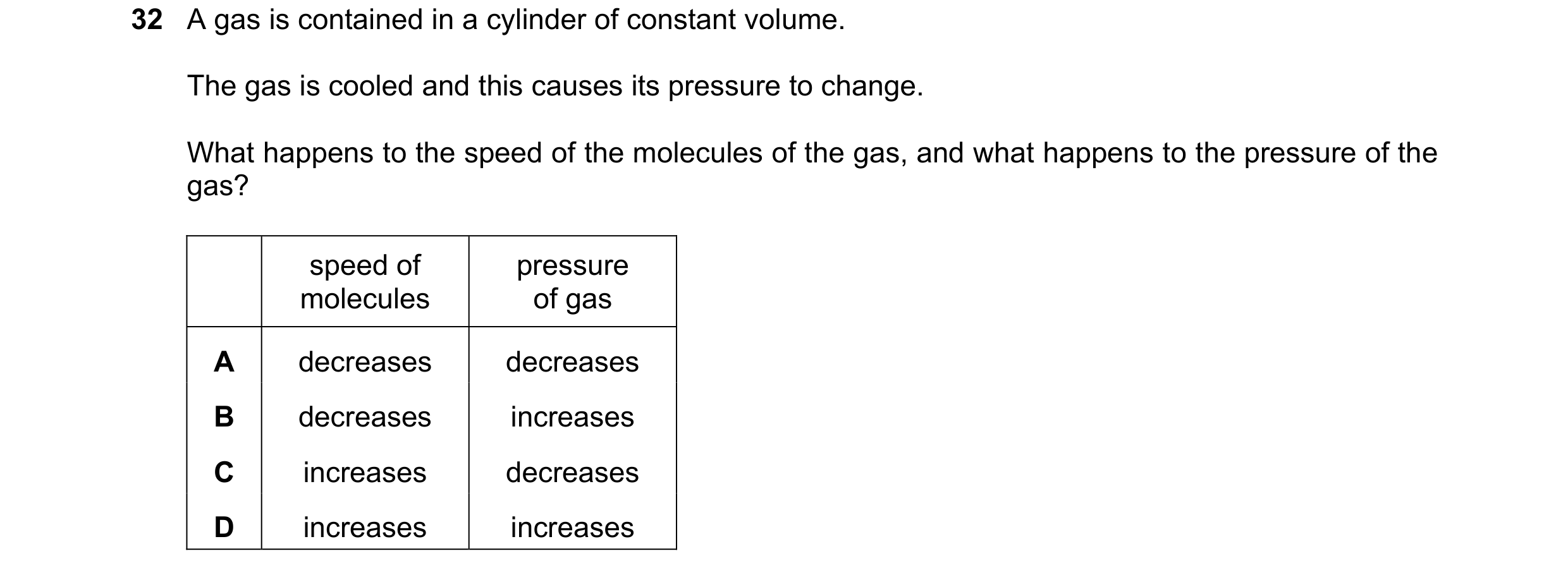

 12 / 18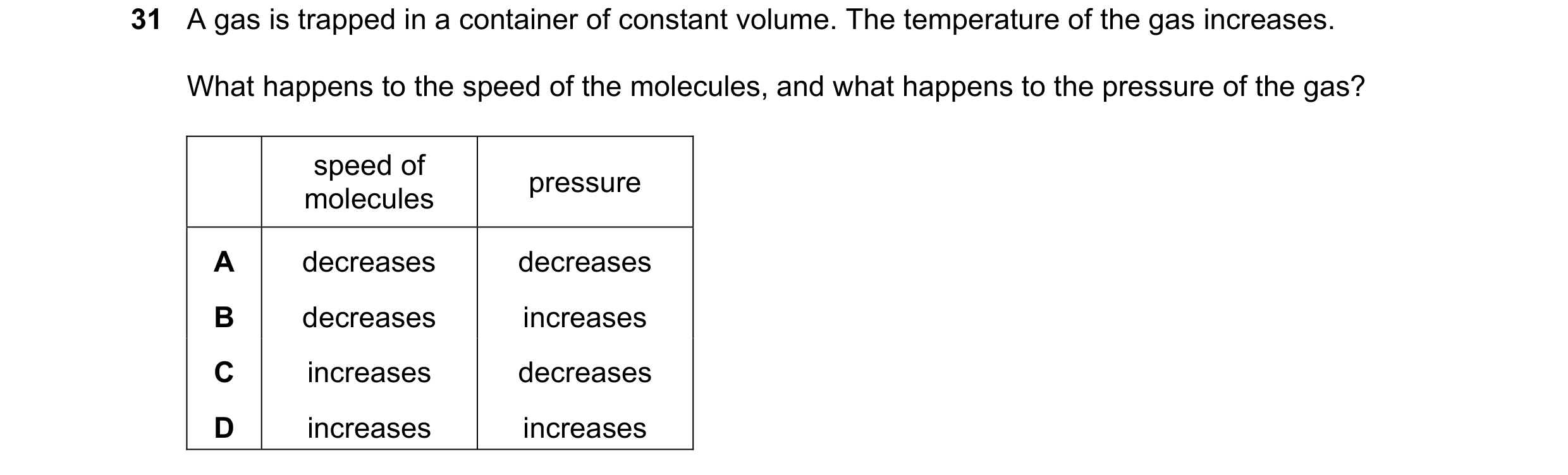
 13 / 18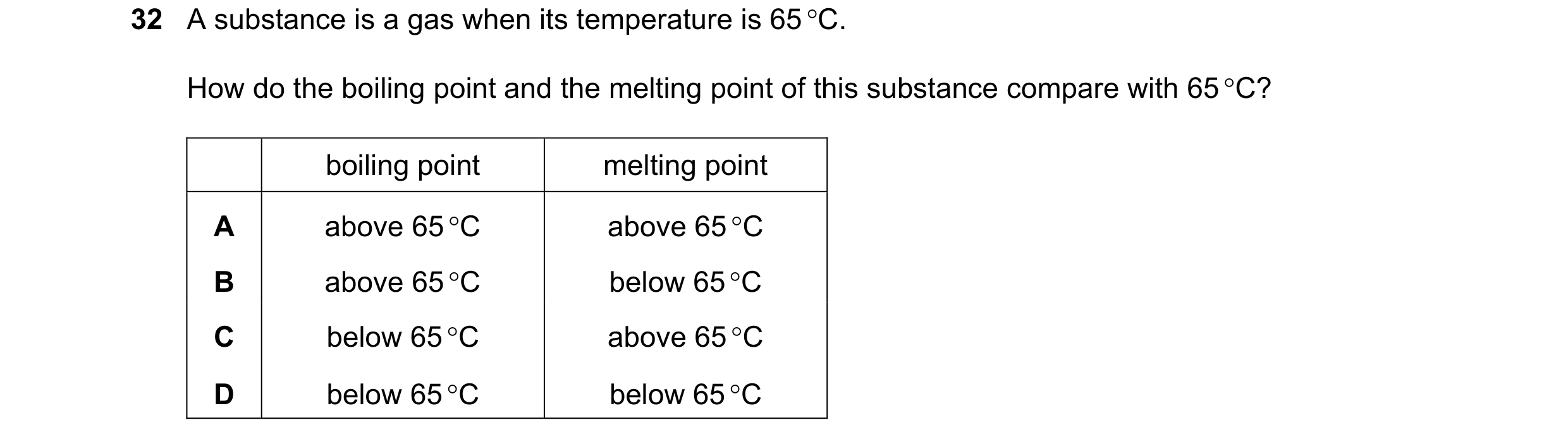

 14 / 18
 15 / 18



 16 / 18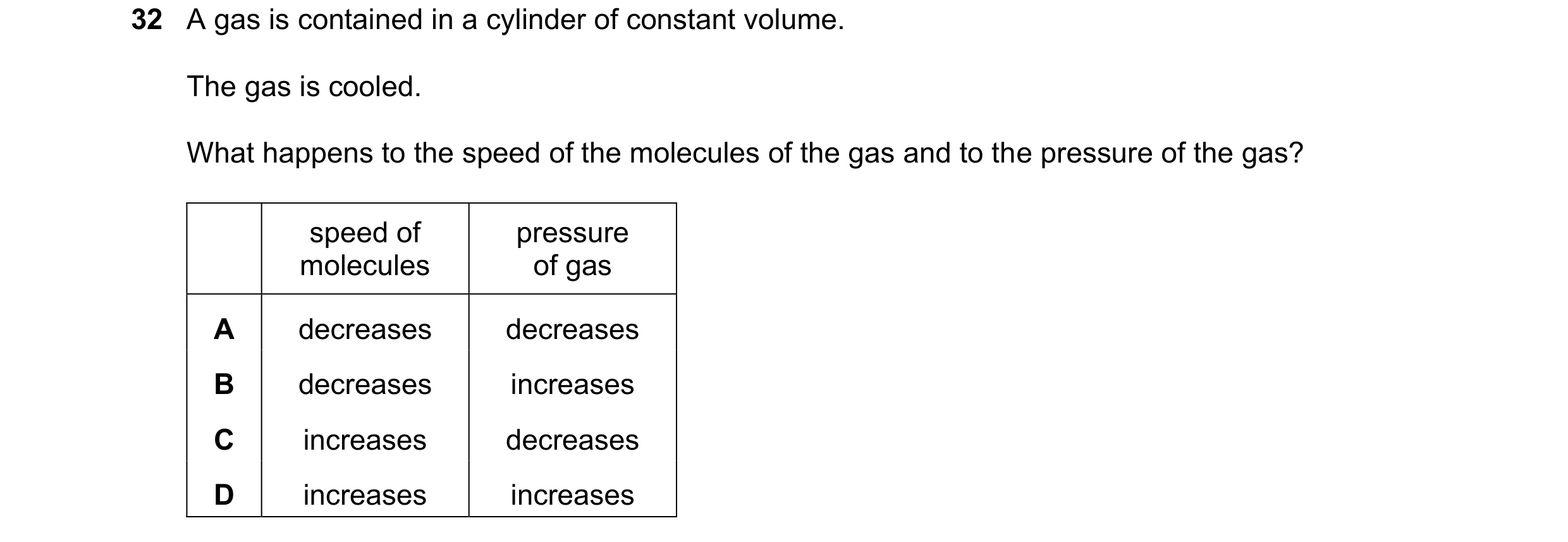
 17 / 18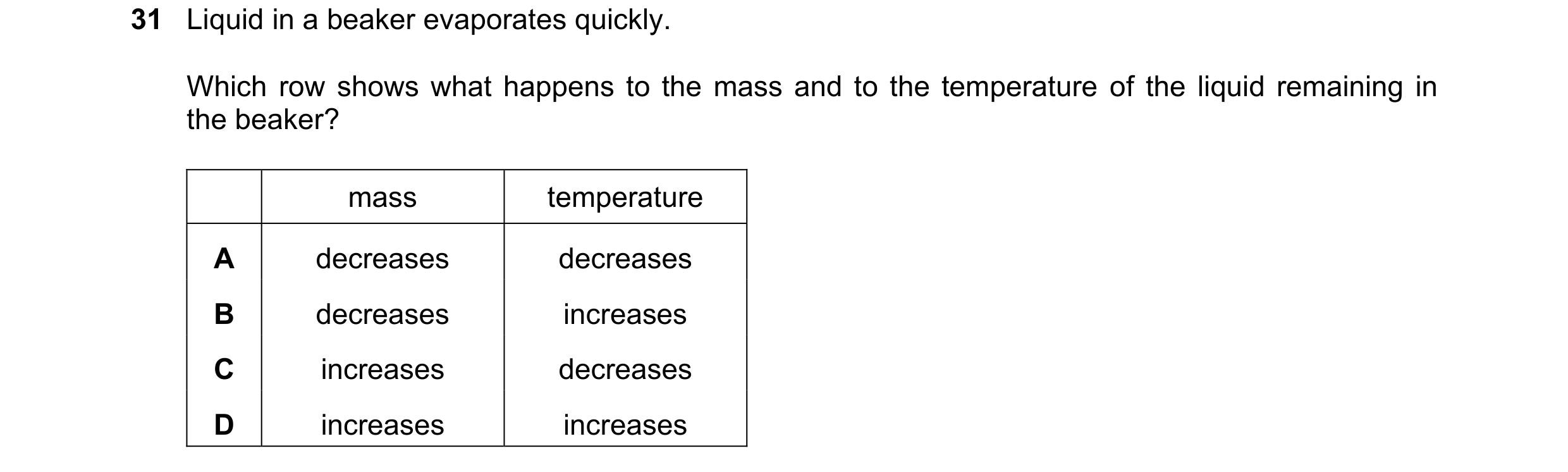


 18 / 18