Questions as text
Q1 · A speed-time graph for a car over a period of 50 seconds 0654/31 May/June 2017
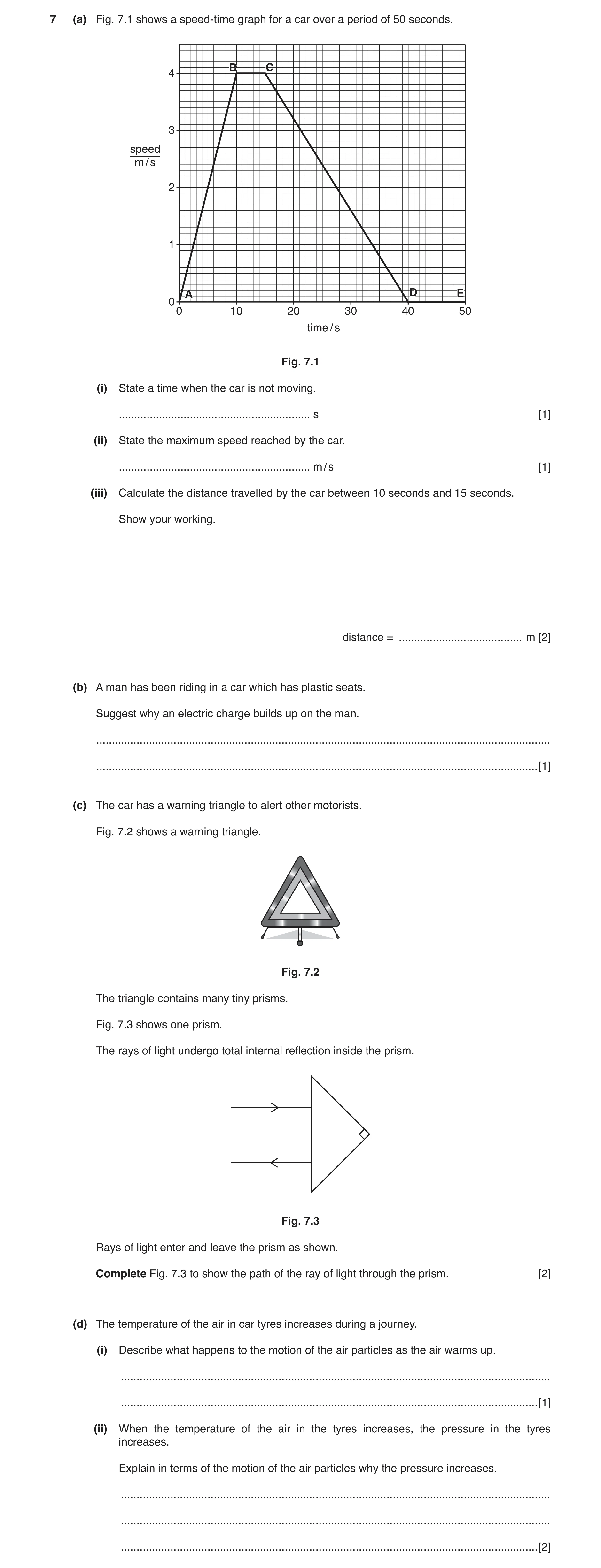
7 (a) Fig. 7.1 shows a speed-time graph for a car over a period of 50 seconds. BB CC 4 3 speed m / s 2 1 A DD EE 0 0 10 20 30 40 50 time / s Fig. 7.1 (i) State a time when the car is not moving. … s [1] (ii) State the maximum speed reached by the car. … m / s [1] (iii) Calculate the distance travelled by the car between 10 seconds and 15 seconds. Show your working. distance = … m [2] (b) A man has been riding in a car which has plastic seats. Suggest why an electric charge builds up on the man. … … [1] (c) The car has a warning triangle to alert other motorists. Fig. 7.2 shows a warning triangle. Fig. 7.2 The triangle contains many tiny prisms. Fig. 7.3 shows one prism. The rays of light undergo total internal reflection inside the prism. Fig. 7.3 Rays of light enter and leave the prism as shown. Complete Fig. 7.3 to show the path of the ray of light through the prism. [2] (d) The temperature of the air in car tyres increases during a journey. (i) Describe what happens to the motion of the air particles as the air warms up. … … [1] (ii) When the temperature of the air in the tyres increases, the pressure in the tyres increases. Explain in terms of the motion of the air particles why the pressure increases. … … … [2]
10 marks
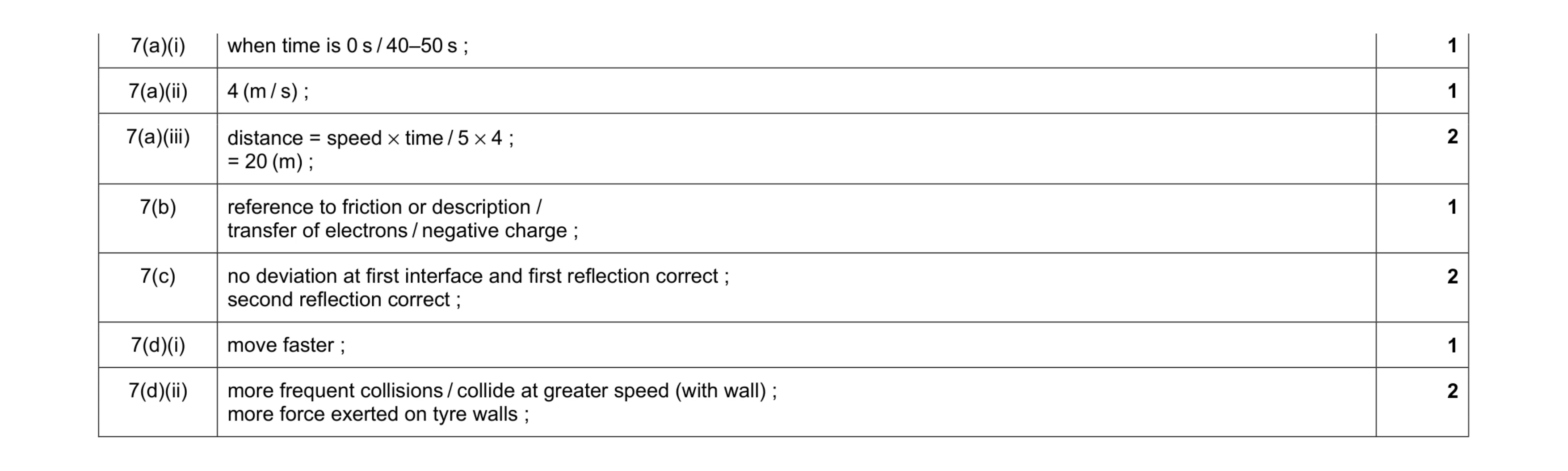
Mark scheme: 7(a)(i) when time is 0 s / 40–50 s ; 1 7(a)(ii) 4 (m / s) ; 1 7(a)(iii) distance = speed × time / 5 × 4 ; = 20 (m) ; 2 7(b) reference to friction or description / transfer of electrons / negative charge ; 1 7(c) no deviation at first interface and first reflection correct ; second reflection correct ; 2 7(d)(i) move faster ; 1 7(d)(ii) more frequent collisions / collide at greater speed (with wall) ; more force exerted on tyre walls ; 2
This question in 0654/31 May/June 2017
Q2 · A list of metals is shown below 0654/32 May/June 2017
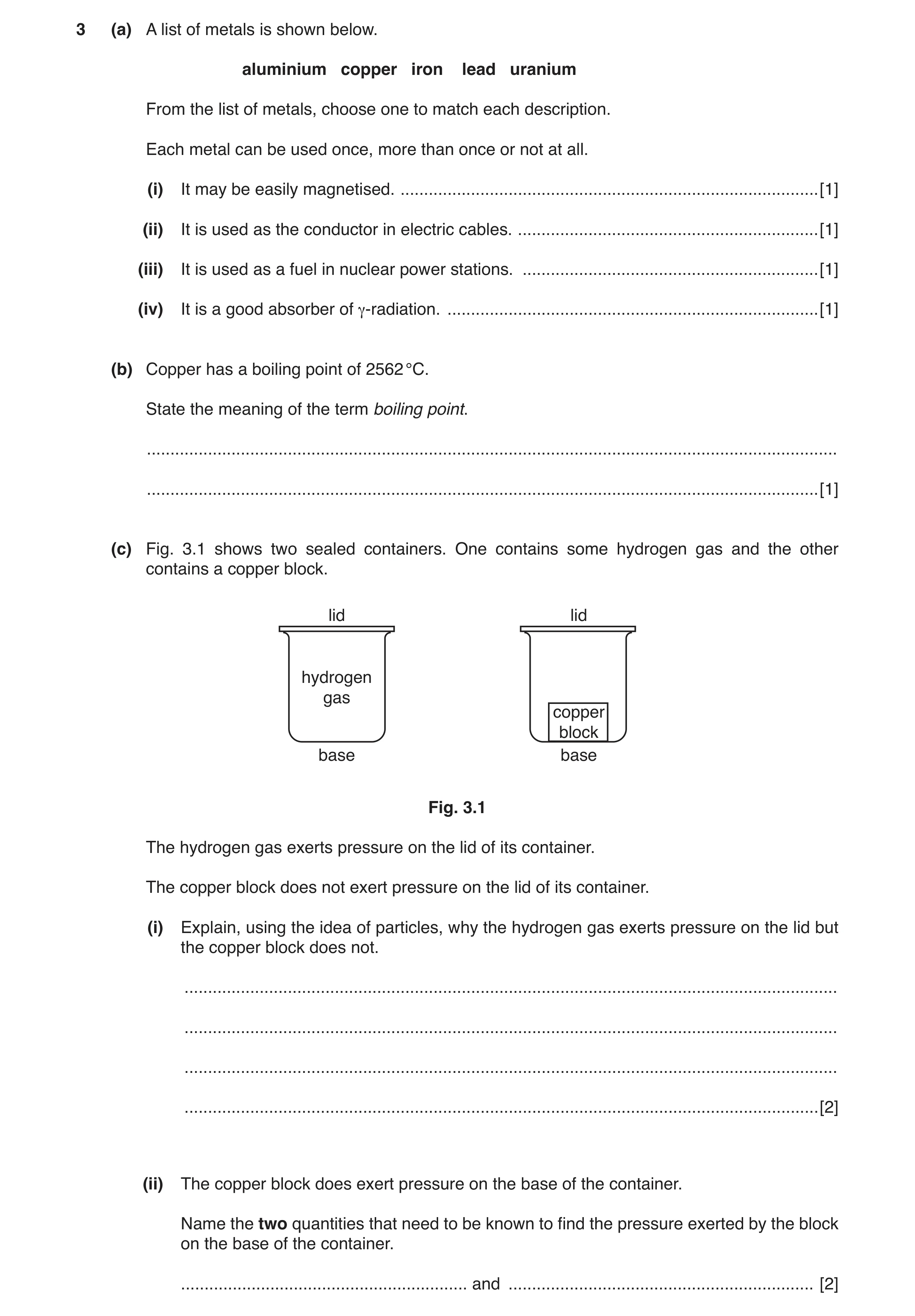
3 (a) A list of metals is shown below. aluminium copper iron lead uranium From the list of metals, choose one to match each description. Each metal can be used once, more than once or not at all. (i) It may be easily magnetised. … [1] (ii) It is used as the conductor in electric cables. … [1] (iii) It is used as a fuel in nuclear power stations. … [1] (iv) It is a good absorber of γ-radiation. … [1] (b) Copper has a boiling point of 2562 °C. State the meaning of the term boiling point. … … [1] (c) Fig. 3.1 shows two sealed containers. One contains some hydrogen gas and the other contains a copper block. lid lid hydrogen gas copper block base base Fig. 3.1 The hydrogen gas exerts pressure on the lid of its container. The copper block does not exert pressure on the lid of its container. (i) Explain, using the idea of particles, why the hydrogen gas exerts pressure on the lid but the copper block does not. … … … … [2] (ii) The copper block does exert pressure on the base of the container. Name the two quantities that need to be known to find the pressure exerted by the block on the base of the container. … and … [2]
9 marks
Mark scheme: 3(a)(i) iron ; 1 3(a)(ii) copper ; (allow aluminium) 1 3(a)(iii) uranium ; 1 3(a)(iv) lead ; 1 3(b) temperature at which (all of) a liquid turns to gas ; 1 3(c)(i) gases take up all the space available ; gas particles free to move / constantly moving and hitting the lid ; 2 3(c)(ii) force / weight ; area ; 2
This question in 0654/32 May/June 2017
Q3 · The speed-time graph for a truck 0654/33 May/June 2017
7 (a) Fig. 7.1 shows the speed-time graph for a truck. 10 8 6 speed m / s 4 2 0 0 10 20 30 40 50 60 70 80 90 100 time / s Fig. 7.1 (i) State the maximum speed of the truck. … m / s [1] (ii) On Fig. 7.1, mark with an X the point when the truck has stopped moving. [1] (b) Fig. 7.2 shows four forces, P, Q, R and S, acting on the truck. P S Q road R Fig. 7.2 Compare the size and direction of forces Q and S when the truck is slowing down. size … direction … [2] (c) The air in the tyres of the truck is warmed during its journey. (i) Describe what happens to the motion of the air particles as the air warms up. … … [1] (ii) When the temperature of the air in the tyres increases, the pressure in the tyres increases. Explain, in terms of the motion of the air particles, why the pressure increases. … … … [2] (d) A reflector on the rear of the truck is made from many small red plastic prisms. One prism is shown in Fig. 7.3. Light from the headlight of a following car enters the prism. ray of light from car red plastic prism Fig. 7.3 Total internal reflection occurs within the prism. On Fig. 7.3, complete the path taken by the ray of light. [2] (e) The truck has two headlights. The lamp inside one headlight is connected in parallel with the lamp in the other headlight across a 24 V battery. (i) The resistance of each lamp is 5.6 Ω. Calculate the current passing through each lamp. State the formula you use and show your working. formula working current = … A [2] (ii) Suggest one important reason why the lamps in the headlights are connected in parallel rather than in series. … … … [1]
12 marks
Mark scheme: 7(a)(i) 8 (m / s) ; 1 7(a)(ii) X at 100 s ; 1 7(b) S greater than Q ; S and Q in opposite directions ; 2 7(c)(i) move faster ; 1 7(c)(ii) more frequent collisions / collide at greater speed (with wall) ; more force exerted on tyre walls ; 2 7(d) ray enters undeviated and first reflection ; second reflection and exit from prism ; 2 7(e)(i) I = V / R ; = 24 / 5.6 = 4.29 A ; 2 7(e)(ii) if one lamp fails the other will still light up / work / have a complete circuit ; 1
This question in 0654/33 May/June 2017
Q4 · Part of a wave-powered electrical generator 0654/33 May/June 2017
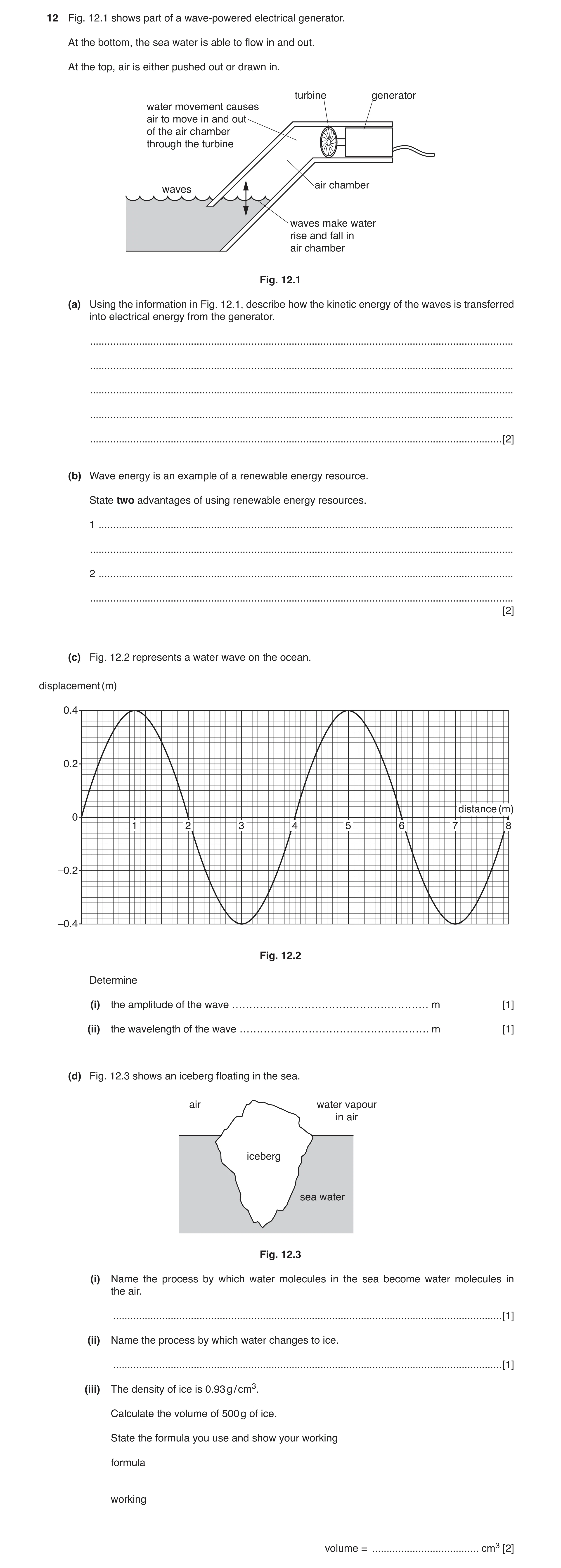
12 Fig. 12.1 shows part of a wave-powered electrical generator. At the bottom, the sea water is able to flow in and out. At the top, air is either pushed out or drawn in. turbine generator water movement causes air to move in and out of the air chamber through the turbine air chamber waves waves make water rise and fall in air chamber Fig. 12.1 (a) Using the information in Fig. 12.1, describe how the kinetic energy of the waves is transferred into electrical energy from the generator. … … … … … [2] (b) Wave energy is an example of a renewable energy resource. State two advantages of using renewable energy resources. 1 … … 2 … … [2] (c) Fig. 12.2 represents a water wave on the ocean. displacement (m) 0.4 0.2 distance (m) 0 1 2 3 4 5 6 7 8 –0.2 –0.4 Fig. 12.2 Determine (i) the amplitude of the wave ………………………………………………… m [1] (ii) the wavelength of the wave ………………………………………………. m [1] (d) Fig. 12.3 shows an iceberg floating in the sea. air water vapour in air iceberg sea water Fig. 12.3 (i) Name the process by which water molecules in the sea become water molecules in the air. … [1] (ii) Name the process by which water changes to ice. … [1] (iii) The density of ice is 0.93 g / cm3. Calculate the volume of 500 g of ice. State the formula you use and show your working formula working volume = … cm3 [2]
10 marks
Mark scheme: 12(a) KE of waves to KE of moving air ; KE of moving air to KE of turbine ; KE of turbine to KE of generator ; KE of generator to electrical energy ; max 2 12(b) will not run out ; fossil fuels can be used for other purposes ; less pollution than using fossil fuels ; max 2 12(c)(i) 0.4 (m) ; 1 12(c)(ii) 4 (m) ; 1 12(d)(i) evaporation ; 1 12(d)(ii) freezing ; 1 12(d)(iii) volume = mass / density ; = 500 / 0.93 = 537.6 (cm3) ; 2
This question in 0654/33 May/June 2017
Q5 · A snowboarder on a ski slope 0654/31 Oct/Nov 2017
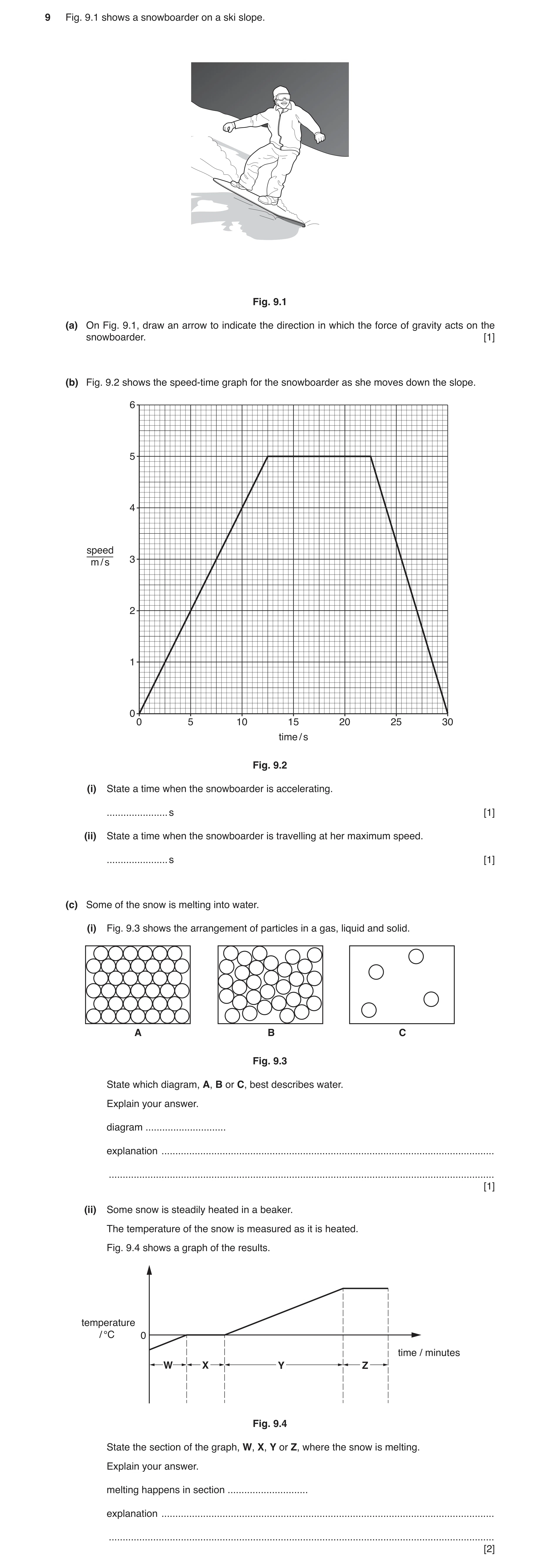
9 Fig. 9.1 shows a snowboarder on a ski slope. Fig. 9.1 (a) On Fig. 9.1, draw an arrow to indicate the direction in which the force of gravity acts on the snowboarder. [1] (b) Fig. 9.2 shows the speed-time graph for the snowboarder as she moves down the slope. 6 5 4 speed 3 m / s 2 1 0 0 5 10 15 20 25 30 time / s Fig. 9.2 (i) State a time when the snowboarder is accelerating. … s [1] (ii) State a time when the snowboarder is travelling at her maximum speed. … s [1] (c) Some of the snow is melting into water. (i) Fig. 9.3 shows the arrangement of particles in a gas, liquid and solid. A B C Fig. 9.3 State which diagram, A, B or C, best describes water. Explain your answer. diagram … explanation … … [1] (ii) Some snow is steadily heated in a beaker. The temperature of the snow is measured as it is heated. Fig. 9.4 shows a graph of the results. temperature / °C 0 time / minutes W X Y Z Fig. 9.4 State the section of the graph, W, X, Y or Z, where the snow is melting. Explain your answer. melting happens in section … explanation … … [2]
6 marks
Mark scheme: 9(a) arrow vertically downwards ; 1 9(b)(i) time between 0–12.5 s ; 1 9(b)(ii) time between 12.5 and 22.5 s ; 1 9(c)(i) B – particles close together and randomly arranged ; 1 9(c)(ii) section X ; ice melts at 0°C / temperature is constant ; 2
This question in 0654/31 Oct/Nov 2017
Q6 · A microwave oven contains a motor which produces a quiet sound with a high pitch 0654/32 Oct/Nov 2017
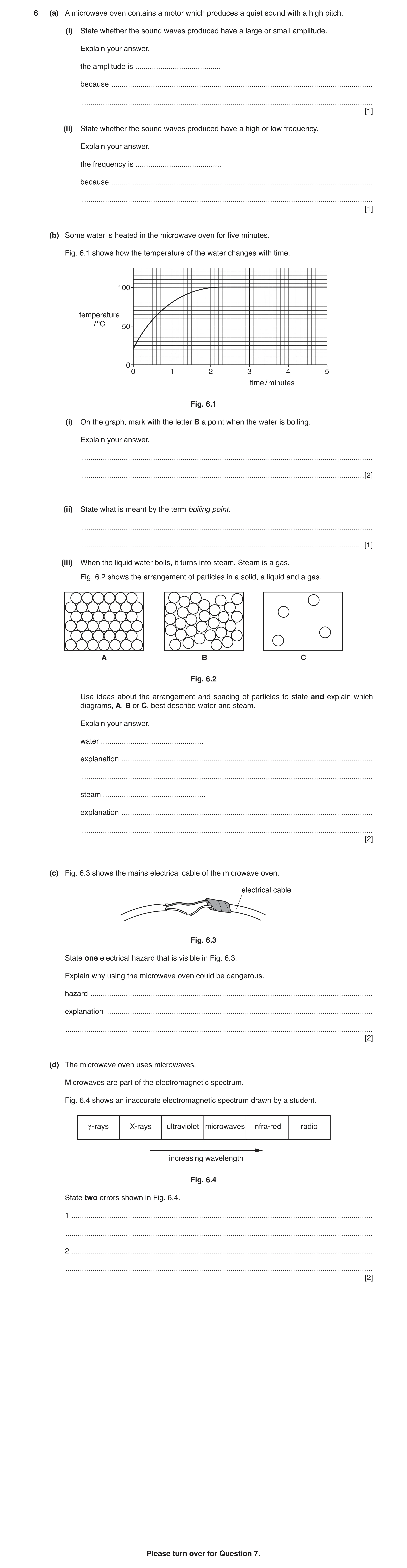
6 (a) A microwave oven contains a motor which produces a quiet sound with a high pitch. (i) State whether the sound waves produced have a large or small amplitude. Explain your answer. the amplitude is … because … … [1] (ii) State whether the sound waves produced have a high or low frequency. Explain your answer. the frequency is … because … … [1] (b) Some water is heated in the microwave oven for five minutes. Fig. 6.1 shows how the temperature of the water changes with time. 100 temperature / ºC 50 0 0 1 2 3 4 5 time / minutes Fig. 6.1 (i) On the graph, mark with the letter B a point when the water is boiling. Explain your answer. … … [2] (ii) State what is meant by the term boiling point. … … [1] (iii) When the liquid water boils, it turns into steam. Steam is a gas. Fig. 6.2 shows the arrangement of particles in a solid, a liquid and a gas. A B C Fig. 6.2 Use ideas about the arrangement and spacing of particles to state and explain which diagrams, A, B or C, best describe water and steam. Explain your answer. water … explanation … … steam … explanation … … [2] (c) Fig. 6.3 shows the mains electrical cable of the microwave oven. electrical cable Fig. 6.3 State one electrical hazard that is visible in Fig. 6.3. Explain why using the microwave oven could be dangerous. hazard … explanation … … [2] (d) The microwave oven uses microwaves. Microwaves are part of the electromagnetic spectrum. Fig. 6.4 shows an inaccurate electromagnetic spectrum drawn by a student. γ -rays X-rays ultraviolet microwaves infra-red radio increasing wavelength Fig. 6.4 State two errors shown in Fig. 6.4. 1 … … 2 … … [2] Please turn over for Question 7.
11 marks
Mark scheme: 6(a)(i) small amplitude because quiet noise / amplitude determines loudness ; 1 6(a)(ii) high frequency because high pitch / frequency determines pitch ; 1 6(b)(i) B anywhere from 2 minutes to 5 minutes ; temperature is constant when boiling / water boils at 100 o C ; 2 6(b)(ii) temperature at which a liquid boils / turns into a gas ; 1 6(b)(iii) water – B AND particles are close together / touching and randomly arranged ; steam – C AND particles are widely spaced / spread out (and randomly arranged) ; 2 6(c) cable broken / no insulation / wire exposed ; danger of electrocution / short circuit / electric shock / fire ; 2 6(d) visible light is missing ; microwaves and / or infra-red in wrong place / in each other’s place ; 2
This question in 0654/32 Oct/Nov 2017
Q7 · A metal saucepan containing water is placed onto the hot‑plate of an electric cooker 0654/32 Oct/Nov 2018
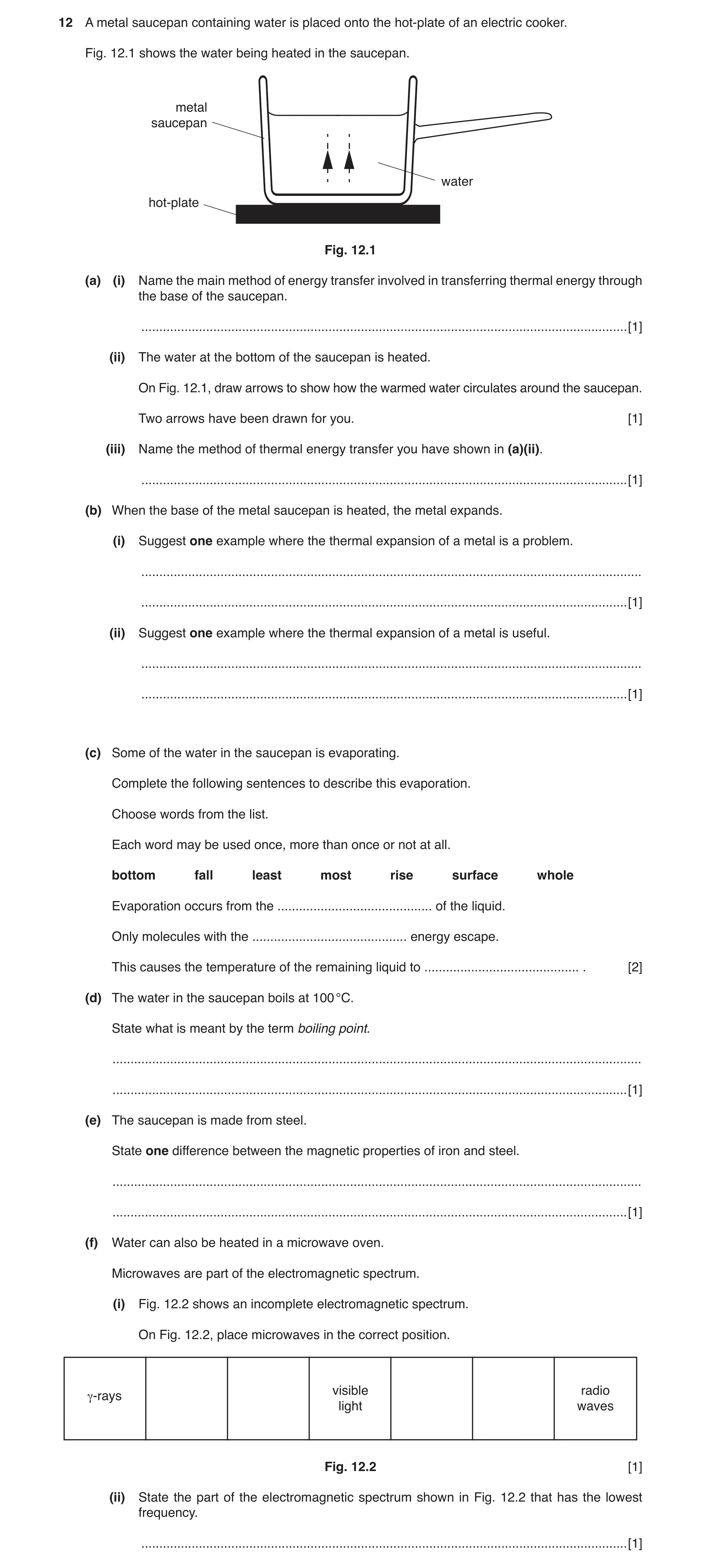
12 A metal saucepan containing water is placed onto the hot‑plate of an electric cooker. Fig. 12.1 shows the water being heated in the saucepan. metal saucepan water hot-plate Fig. 12.1 (a) (i) Name the main method of energy transfer involved in transferring thermal energy through the base of the saucepan. … [1] (ii) The water at the bottom of the saucepan is heated. On Fig. 12.1, draw arrows to show how the warmed water circulates around the saucepan. Two arrows have been drawn for you. [1] (iii) Name the method of thermal energy transfer you have shown in (a)(ii). … [1] (b) When the base of the metal saucepan is heated, the metal expands. (i) Suggest one example where the thermal expansion of a metal is a problem. … … [1] (ii) Suggest one example where the thermal expansion of a metal is useful. … … [1] (c) Some of the water in the saucepan is evaporating. Complete the following sentences to describe this evaporation. Choose words from the list. Each word may be used once, more than once or not at all. bottom fall least most rise surface whole Evaporation occurs from the … of the liquid. Only molecules with the … energy escape. This causes the temperature of the remaining liquid to … . [2] (d) The water in the saucepan boils at 100 °C. State what is meant by the term boiling point. … … [1] (e) The saucepan is made from steel. State one difference between the magnetic properties of iron and steel. … … [1] (f) Water can also be heated in a microwave oven. Microwaves are part of the electromagnetic spectrum. (i) Fig. 12.2 shows an incomplete electromagnetic spectrum. On Fig. 12.2, place microwaves in the correct position. visible radioγ-rays light waves Fig. 12.2 [1] (ii) State the part of the electromagnetic spectrum shown in Fig. 12.2 that has the lowest frequency. … [1]
11 marks
Mark scheme: 12(a)(i) conduction; 1 12(a)(ii) convection current drawn; 1 12(a)(iii) convection; 1 12(b)(i) railway tracks / overhead power cables; 1 12(b)(ii) thermostat / thermometer; 1 12(c) surface most fall 1 or 2 correct; 3 correct; 2 12(d) temperature at which a liquid changes into a gas; 1 12(e) iron loses magnetism quicker than steel steel is magnetised more slowly than iron; 1 12(f)(i) box to the left of radio waves; 1 12(f)(ii) radio waves; 1
This question in 0654/32 Oct/Nov 2018
Q8 · Aluminium can be easily shaped into containers to store food 0654/33 Oct/Nov 2018
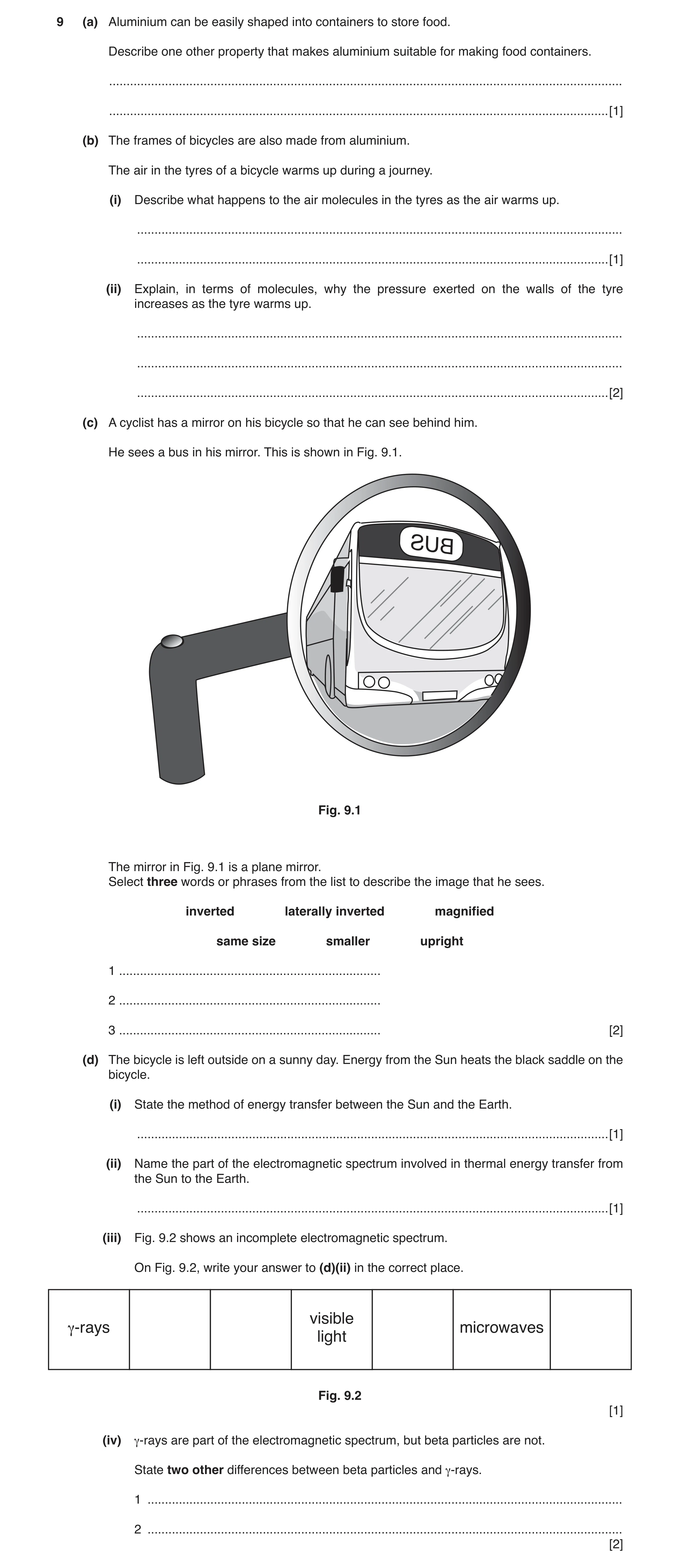
9 (a) Aluminium can be easily shaped into containers to store food. Describe one other property that makes aluminium suitable for making food containers. … … [1] (b) The frames of bicycles are also made from aluminium. The air in the tyres of a bicycle warms up during a journey. (i) Describe what happens to the air molecules in the tyres as the air warms up. … … [1] (ii) Explain, in terms of molecules, why the pressure exerted on the walls of the tyre increases as the tyre warms up. … … … [2] (c) A cyclist has a mirror on his bicycle so that he can see behind him. He sees a bus in his mirror. This is shown in Fig. 9.1. BUS Fig. 9.1 The mirror in Fig. 9.1 is a plane mirror. Select three words or phrases from the list to describe the image that he sees. inverted laterally inverted magnified same size smaller upright 1 … 2 … 3 … [2] (d) The bicycle is left outside on a sunny day. Energy from the Sun heats the black saddle on the bicycle. (i) State the method of energy transfer between the Sun and the Earth. … [1] (ii) Name the part of the electromagnetic spectrum involved in thermal energy transfer from the Sun to the Earth. … [1] (iii) Fig. 9.2 shows an incomplete electromagnetic spectrum. On Fig. 9.2, write your answer to (d)(ii) in the correct place. visibleγ-rays microwaves light Fig. 9.2 [1] (iv) γ-rays are part of the electromagnetic spectrum, but beta particles are not. State two other differences between beta particles and γ-rays. 1 … 2 … [2]
11 marks
Mark scheme: 9(a) does not corrode / does not react with food / low density ; 1 9(b)(i) move faster ; 1 9(b)(ii) ref. to collision with wall more frequent / collisions exert greater force ; max 2 9(c) laterally inverted same size upright 1 or 2 correct ; 3 correct ; 2 9(d)(i) radiation ; 1 9(d)(ii) infrared ; 1 9(d)(iii) between visible and microwaves ; 1 9(d)(iv) beta more ionising ; beta less penetrating ; gamma no charge but beta negative ; max 2
This question in 0654/33 Oct/Nov 2018
Q9 · Some ice has been made by freezing water 0654/33 Oct/Nov 2018
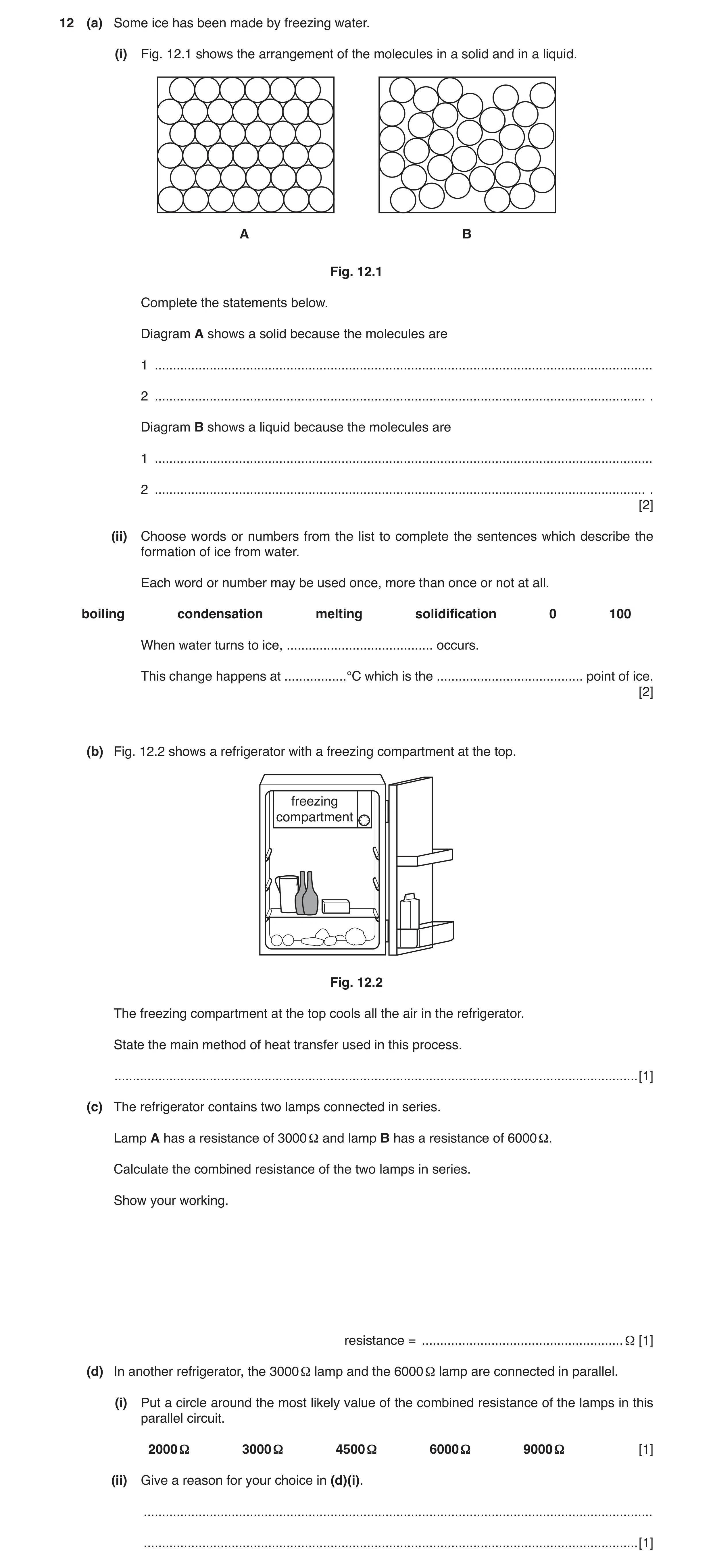
12 (a) Some ice has been made by freezing water. (i) Fig. 12.1 shows the arrangement of the molecules in a solid and in a liquid. A B Fig. 12.1 Complete the statements below. Diagram A shows a solid because the molecules are 1 … 2 … . Diagram B shows a liquid because the molecules are 1 … 2 … . [2] (ii) Choose words or numbers from the list to complete the sentences which describe the formation of ice from water. Each word or number may be used once, more than once or not at all. boiling condensation melting solidification 0 100 When water turns to ice, … occurs. This change happens at … °C which is the … point of ice. [2] (b) Fig. 12.2 shows a refrigerator with a freezing compartment at the top. freezing compartment Fig. 12.2 The freezing compartment at the top cools all the air in the refrigerator. State the main method of heat transfer used in this process. … [1] (c) The refrigerator contains two lamps connected in series. Lamp A has a resistance of 3000 Ω and lamp B has a resistance of 6000 Ω. Calculate the combined resistance of the two lamps in series. Show your working. resistance = … Ω [1] (d) In another refrigerator, the 3000 Ω lamp and the 6000 Ω lamp are connected in parallel. (i) Put a circle around the most likely value of the combined resistance of the lamps in this parallel circuit. 2000 Ω 3000 Ω 4500 Ω 6000 Ω 9000 Ω [1] (ii) Give a reason for your choice in (d)(i). … … [1]
8 marks
Mark scheme: 12(a)(i) Solid: close-packed regular arrangement Liquid: close-packed irregular arrangement 2 or 3 correct ; 4 correct ; 2 12(a)(ii) solidification 0 Melting 2 correct ; 3 correct ; 2 12(b) convection ; 1 12(c) = 9000 (Ω) ; 1 12(d)(i) 2000 Ω ; 1 12(d)(ii) combined resistance in parallel is less than resistance of either resistance ; 1
This question in 0654/33 Oct/Nov 2018
Q10 · A boy swims in a heated swimming pool 0654/32 Oct/Nov 2019
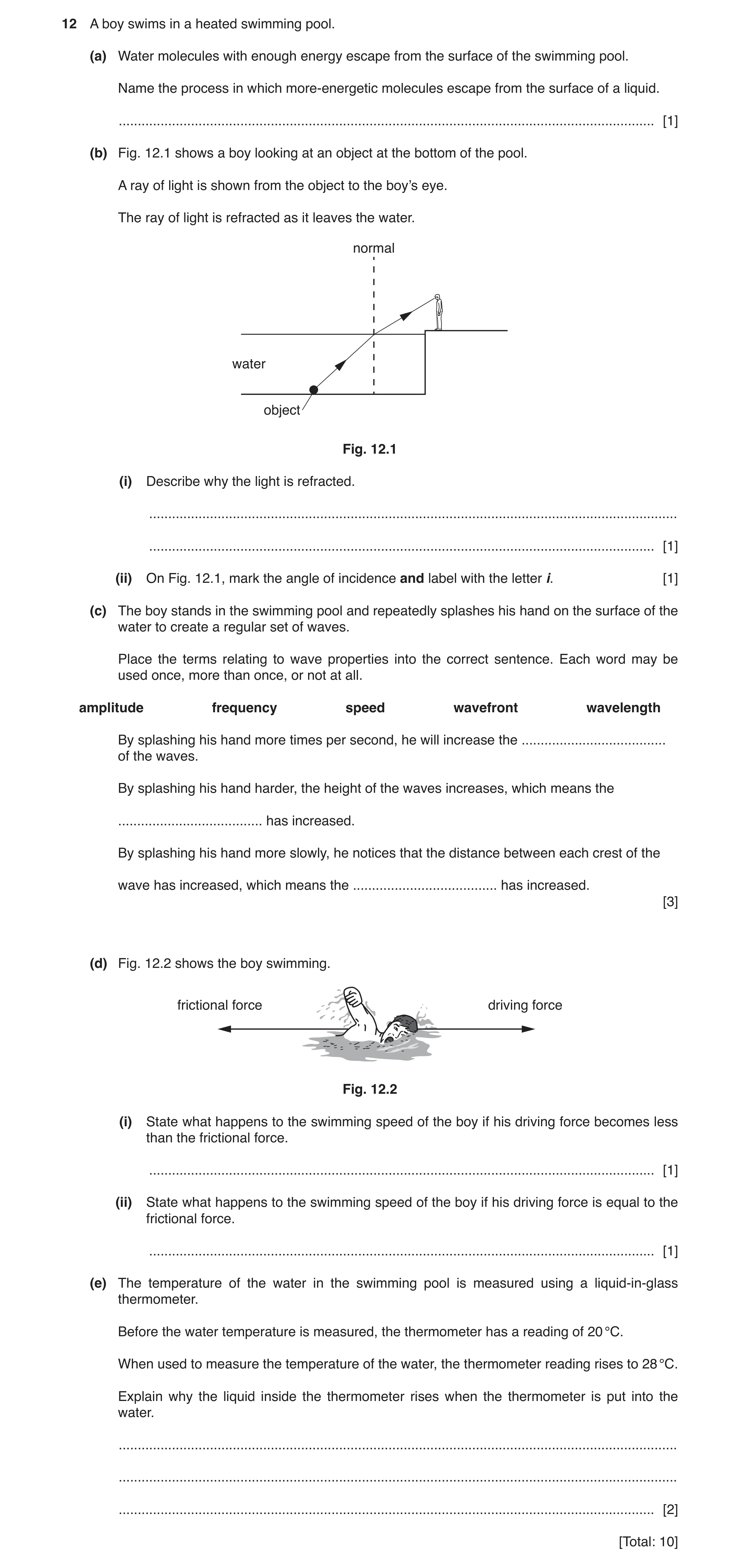
12 A boy swims in a heated swimming pool. (a) Water molecules with enough energy escape from the surface of the swimming pool. Name the process in which more-energetic molecules escape from the surface of a liquid. … [1] (b) Fig. 12.1 shows a boy looking at an object at the bottom of the pool. A ray of light is shown from the object to the boy’s eye. The ray of light is refracted as it leaves the water. normal water object Fig. 12.1 (i) Describe why the light is refracted. … … [1] (ii) On Fig. 12.1, mark the angle of incidence and label with the letter i. [1] (c) The boy stands in the swimming pool and repeatedly splashes his hand on the surface of the water to create a regular set of waves. Place the terms relating to wave properties into the correct sentence. Each word may be used once, more than once, or not at all. amplitude frequency speed wavefront wavelength By splashing his hand more times per second, he will increase the … of the waves. By splashing his hand harder, the height of the waves increases, which means the … has increased. By splashing his hand more slowly, he notices that the distance between each crest of the wave has increased, which means the … has increased. [3] (d) Fig. 12.2 shows the boy swimming. frictional force driving force Fig. 12.2 (i) State what happens to the swimming speed of the boy if his driving force becomes less than the frictional force. … [1] (ii) State what happens to the swimming speed of the boy if his driving force is equal to the frictional force. … [1] (e) The temperature of the water in the swimming pool is measured using a liquid-in-glass thermometer. Before the water temperature is measured, the thermometer has a reading of 20 °C. When used to measure the temperature of the water, the thermometer reading rises to 28 °C. Explain why the liquid inside the thermometer rises when the thermometer is put into the water. … … … [2] [Total: 10]
10 marks
Mark scheme: 12(a) evaporation ; 1 12(b)(i) due to a change of speed ; 1 12(b)(ii) angle drawn between the normal and the ray from the object and labelled with the letter ‘i’ ; 1 12(c) frequency ; amplitude ; wavelength ; 3 12(d)(i) slows down ; 1 12(d)(ii) constant ; 1 12(e) molecules gain KE / move apart ; liquid expands ; 2
This question in 0654/32 Oct/Nov 2019
Q11 · An electric heater containing three heating elements 0654/33 Oct/Nov 2019
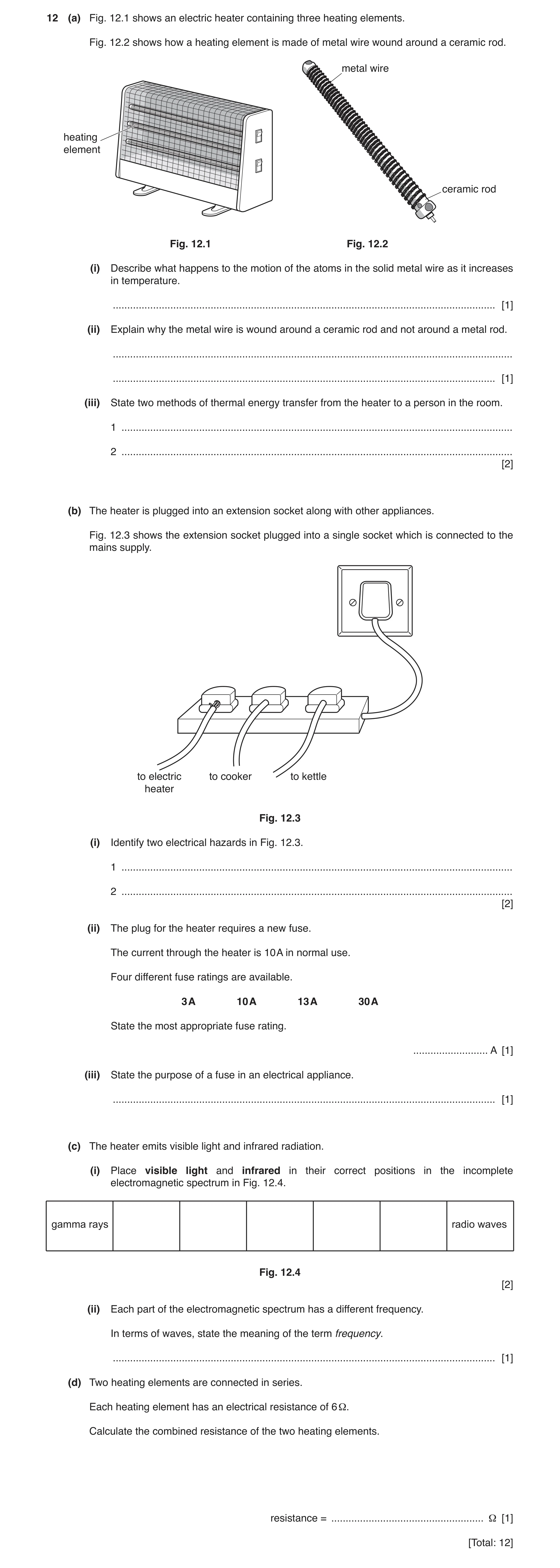
12 (a) Fig. 12.1 shows an electric heater containing three heating elements. Fig. 12.2 shows how a heating element is made of metal wire wound around a ceramic rod. metal wire heating element ceramic rod Fig. 12.1 Fig. 12.2 (i) Describe what happens to the motion of the atoms in the solid metal wire as it increases in temperature. … [1] (ii) Explain why the metal wire is wound around a ceramic rod and not around a metal rod. … … [1] (iii) State two methods of thermal energy transfer from the heater to a person in the room. 1 … 2 … [2] (b) The heater is plugged into an extension socket along with other appliances. Fig. 12.3 shows the extension socket plugged into a single socket which is connected to the mains supply. to electric to cooker to kettle heater Fig. 12.3 (i) Identify two electrical hazards in Fig. 12.3. 1 … 2 … [2] (ii) The plug for the heater requires a new fuse. The current through the heater is 10 A in normal use. Four different fuse ratings are available. 3 A 10 A 13 A 30 A State the most appropriate fuse rating. … A [1] (iii) State the purpose of a fuse in an electrical appliance. … [1] (c) The heater emits visible light and infrared radiation. (i) Place visible light and infrared in their correct positions in the incomplete electromagnetic spectrum in Fig. 12.4. gamma rays radio waves Fig. 12.4 [2] (ii) Each part of the electromagnetic spectrum has a different frequency. In terms of waves, state the meaning of the term frequency. … [1] (d) Two heating elements are connected in series. Each heating element has an electrical resistance of 6 Ω. Calculate the combined resistance of the two heating elements. resistance = … Ω [1] [Total: 12]
12 marks
Mark scheme: 12(a)(i) vibrate faster; 1 12(a)(ii) a metal rod would cause a short circuit / it is an electrical conductor; or ceramic rod would prevent short circuit / as it is an insulator ; max 1 1 12(a)(iii) convection; radiation; 2 12(b)(i) damaged cable / insulation (on cable to electric heater); overloaded socket / overheating of cables / overheating of plug (to mains socket); 2 12(b)(ii) 13; 1 12(b)(iii) to protect the electrical circuit, to provide electrical safety to the user; 1 12(c)(i) visible in middle box; infrared in 5th box; 2 12(c)(ii) number of waves (passing a point) per unit time; 1 12(d) 12 (Ω); 1
This question in 0654/33 Oct/Nov 2019
Q12 · A building is kept warm by heating its solid concrete floor 0654/32 Oct/Nov 2020
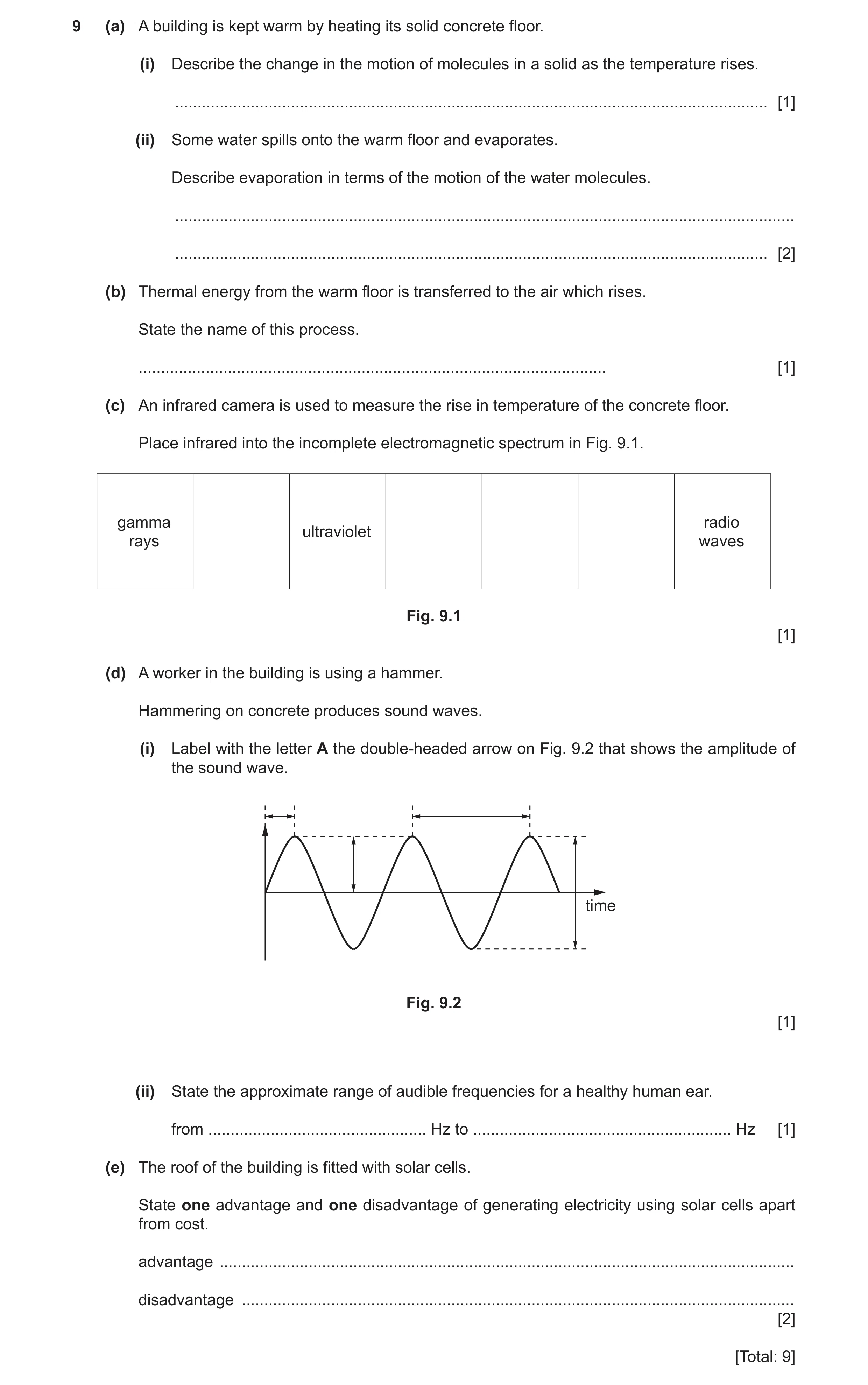
9 (a) A building is kept warm by heating its solid concrete floor. (i) Describe the change in the motion of molecules in a solid as the temperature rises. … [1] (ii) Some water spills onto the warm floor and evaporates. Describe evaporation in terms of the motion of the water molecules. … … [2] (b) Thermal energy from the warm floor is transferred to the air which rises. State the name of this process. … [1] (c) An infrared camera is used to measure the rise in temperature of the concrete floor. Place infrared into the incomplete electromagnetic spectrum in Fig. 9.1. gamma radio ultraviolet rays waves Fig. 9.1 [1] (d) A worker in the building is using a hammer. Hammering on concrete produces sound waves. (i) Label with the letter A the double-headed arrow on Fig. 9.2 that shows the amplitude of the sound wave. time Fig. 9.2 [1] (ii) State the approximate range of audible frequencies for a healthy human ear. from … Hz to … Hz [1] (e) The roof of the building is fitted with solar cells. State one advantage and one disadvantage of generating electricity using solar cells apart from cost. advantage … disadvantage … [2] [Total: 9]
9 marks
Mark scheme: 9(a)(i) increased vibration; 1 9(a)(ii) escape of more energetic molecules; from the surface of the liquid; 2 9(b) convection; 1 9(c) gamma rays ultraviolet infrared; 1 9(d)(i) A on the arrow from the x axis to the top of the crest; 1 9(d)(ii) 20 (Hz) to 20 000 (Hz); 1 9(e) advantage: renewable ; disadvantage: does not work in the dark / less electricity produced when it is cloudy; 2
This question in 0654/32 Oct/Nov 2020
Question 13 0654/31 May/June 2021
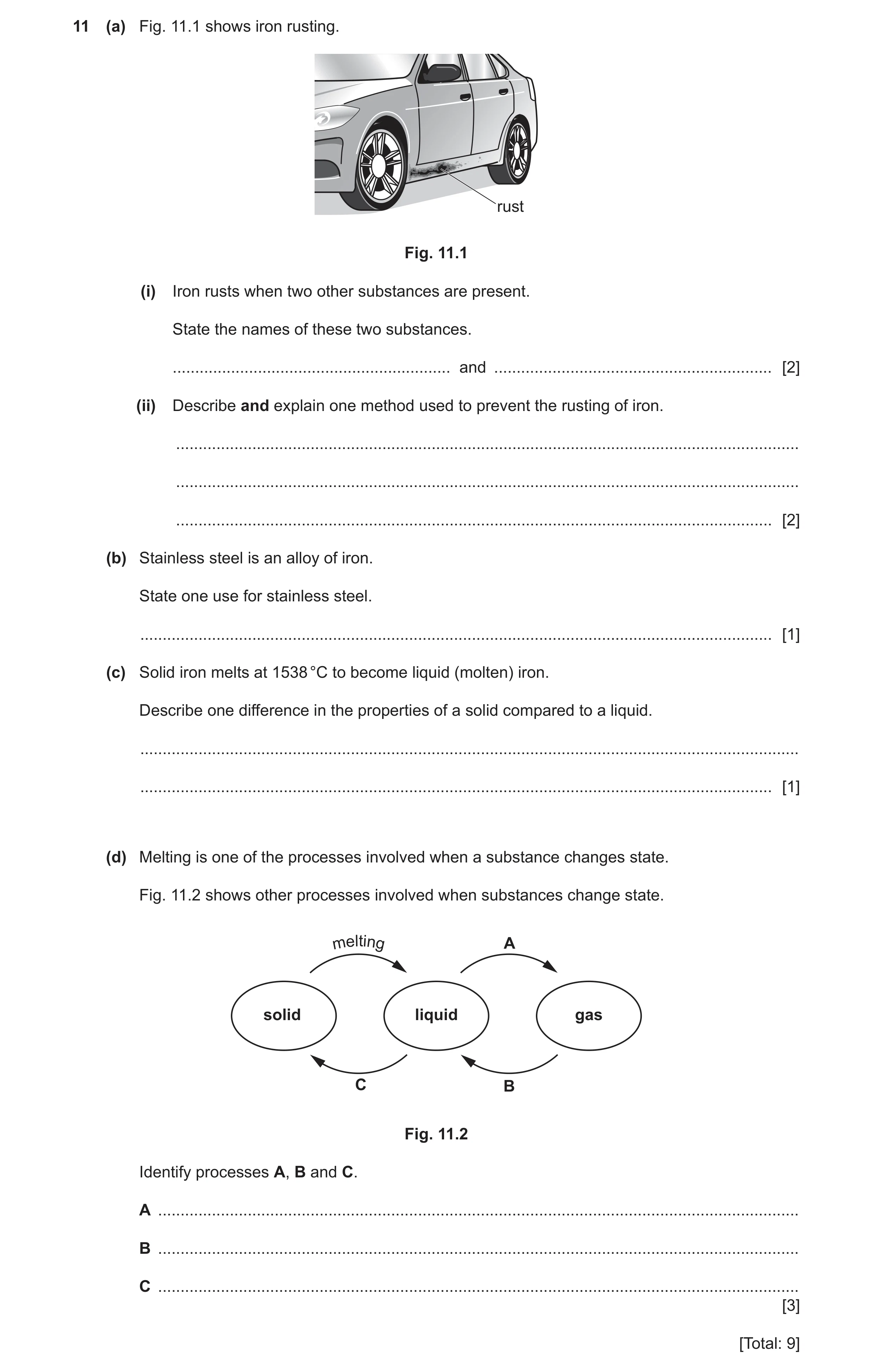
11 (a) Fig. 11.1 shows iron rusting. rust Fig. 11.1 (i) Iron rusts when two other substances are present. State the names of these two substances. … and … [2] (ii) Describe and explain one method used to prevent the rusting of iron. … … … [2] (b) Stainless steel is an alloy of iron. State one use for stainless steel. … [1] (c) Solid iron melts at 1538 °C to become liquid (molten) iron. Describe one difference in the properties of a solid compared to a liquid. … … [1] (d) Melting is one of the processes involved when a substance changes state. Fig. 11.2 shows other processes involved when substances change state. melting A solid liquid gas C B Fig. 11.2 Identify processes A, B and C. A … B … C … [3] [Total: 9]
9 marks
Mark scheme: 11(a)(i) oxygen ; water ; 2 11(a)(ii) painting / greasing / electroplating ; provides a barrier etc ; 2 11(b) cutlery ; 1 11(c) solid has a definite shape / liquid takes up shape of container ; 1 11(d) A boiling ; B condensing ; C freezing ; 3
This question in 0654/31 May/June 2021
Q14 · The horizontal forces acting on a motorcyclist and his motorcycle 0654/32 Oct/Nov 2021
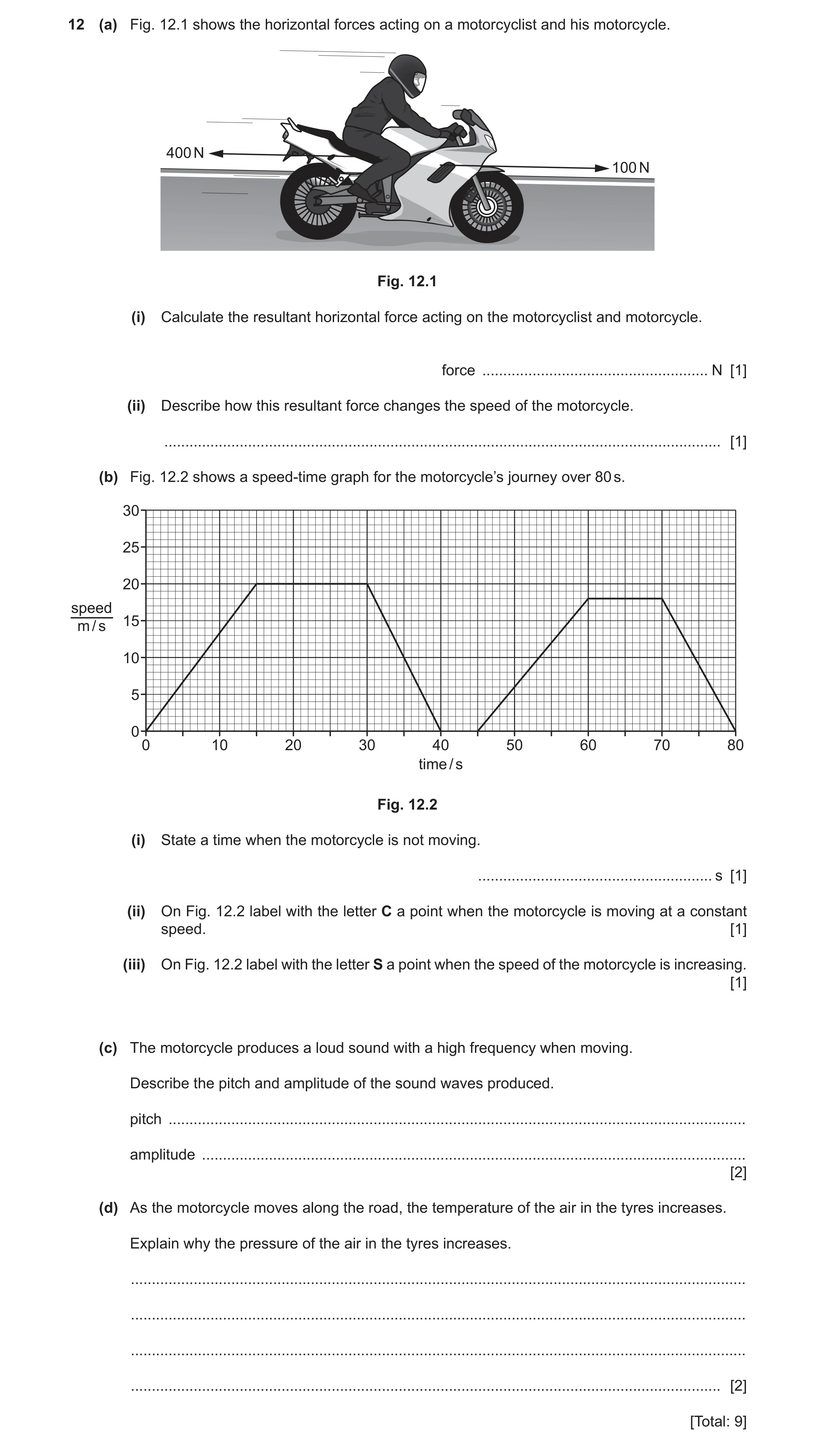
12 (a) Fig. 12.1 shows the horizontal forces acting on a motorcyclist and his motorcycle. 400 N 100 N Fig. 12.1 (i) Calculate the resultant horizontal force acting on the motorcyclist and motorcycle. force … N [1] (ii) Describe how this resultant force changes the speed of the motorcycle. … [1] (b) Fig. 12.2 shows a speed‑time graph for the motorcycle’s journey over 80 s. 30 25 20 speed 15 m / s 10 5 0 0 10 20 30 40 50 60 70 80 time / s Fig. 12.2 (i) State a time when the motorcycle is not moving. … s [1] (ii) On Fig. 12.2 label with the letter C a point when the motorcycle is moving at a constant speed. [1] (iii) On Fig. 12.2 label with the letter S a point when the speed of the motorcycle is increasing. [1] (c) The motorcycle produces a loud sound with a high frequency when moving. Describe the pitch and amplitude of the sound waves produced. pitch … amplitude … [2] (d) As the motorcycle moves along the road, the temperature of the air in the tyres increases. Explain why the pressure of the air in the tyres increases. … … … … [2] [Total: 9]
9 marks
Mark scheme: 12(a)(i) 300 (N) ; 1 12(a)(ii) slows down ; 1 12(b)(i) 0 s, 40 s to 45 s or 80 s ; 1 12(b)(ii) anywhere between t = 15 s and t = 30 s or between t = 60 s and t =70 s ; 1 12(b)(iii) anywhere between t = 0 s and t = 15 s or between t = 45 s and t = 60 s ; 1 12(c) high pitch ; large amplitude ; 2 12(d) increased kinetic energy / speed (of molecules) ; more frequent collisions with tyre ; 2
This question in 0654/32 Oct/Nov 2021
Q15 · Two dolphins using sound waves to communicate with each other in the sea 0654/32 Feb/March 2022
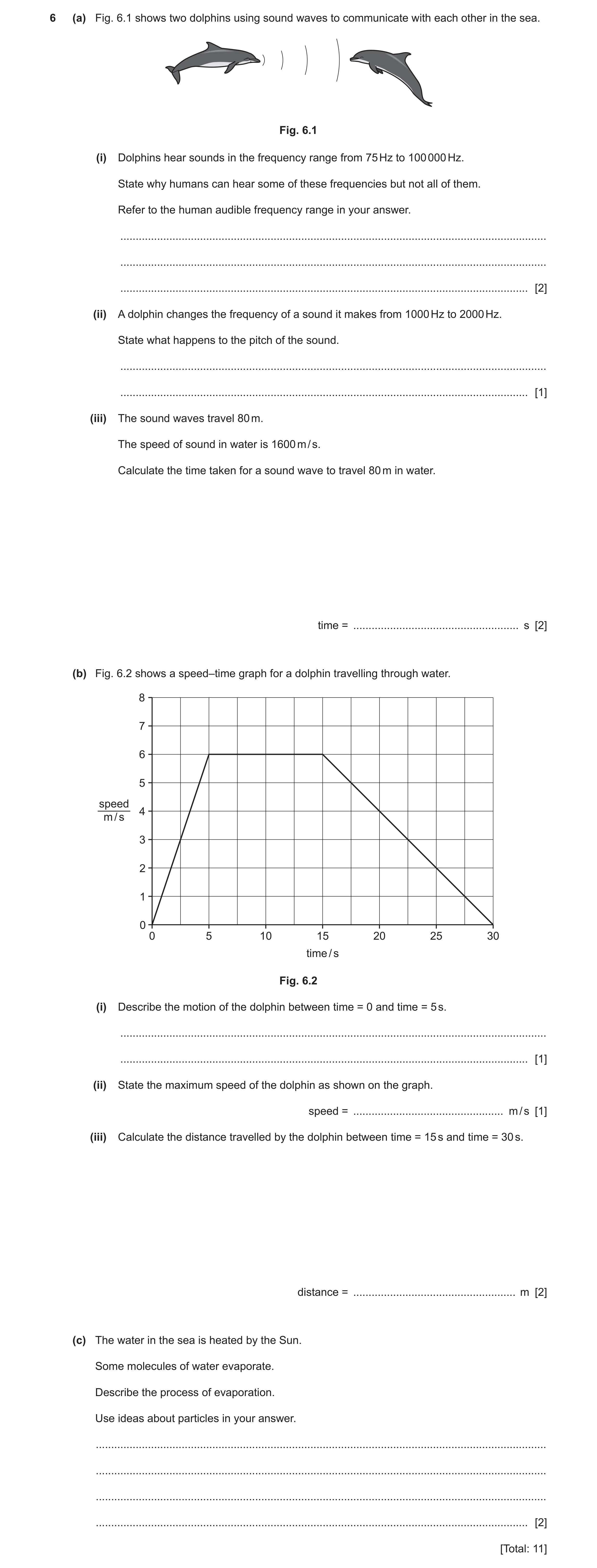
6 (a) Fig. 6.1 shows two dolphins using sound waves to communicate with each other in the sea. Fig. 6.1 (i) Dolphins hear sounds in the frequency range from 75 Hz to 100 000 Hz. State why humans can hear some of these frequencies but not all of them. Refer to the human audible frequency range in your answer. … … … [2] (ii) A dolphin changes the frequency of a sound it makes from 1000 Hz to 2000 Hz. State what happens to the pitch of the sound. … … [1] (iii) The sound waves travel 80 m. The speed of sound in water is 1600 m / s. Calculate the time taken for a sound wave to travel 80 m in water. time = … s [2] (b) Fig. 6.2 shows a speed–time graph for a dolphin travelling through water. 8 7 6 5 speed 4 m / s 3 2 1 0 0 5 10 15 20 25 30 time / s Fig. 6.2 (i) Describe the motion of the dolphin between time = 0 and time = 5 s. … … [1] (ii) State the maximum speed of the dolphin as shown on the graph. speed = … m / s [1] (iii) Calculate the distance travelled by the dolphin between time = 15 s and time = 30 s. distance = … m [2] (c) The water in the sea is heated by the Sun. Some molecules of water evaporate. Describe the process of evaporation. Use ideas about particles in your answer. … … … … [2] [Total: 11]
11 marks
Mark scheme: 6(a)(i) can hear lower frequencies because lower level is 20 Hz; cannot hear frequencies above 20 kHz; 2 6(a)(ii) increases; 1 6(a)(iii) time = distance / speed or 80 / 1600; = 0.05(1) (s); 2 6(b)(i) accelerating / speed increasing; 1 6(b)(ii) 6 (m / s); 1 6(b)(iii) area under graph or ½ × 15 × 6; 45.0 (m) : 2 6(c) fast moving / most energetic particles; escape from surface of liquid; 2
This question in 0654/32 Feb/March 2022
Question 16 0654/32 Feb/March 2022
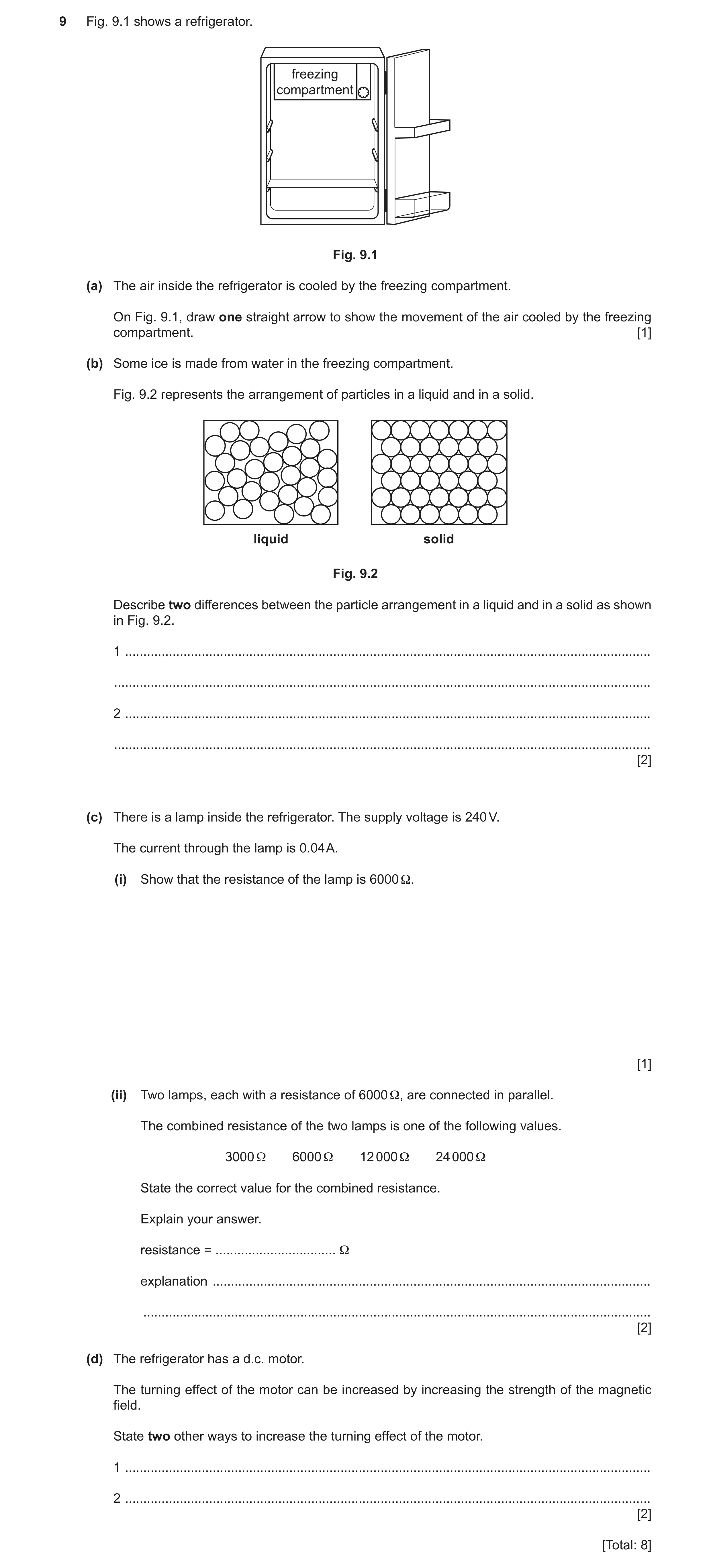
9 Fig. 9.1 shows a refrigerator. freezing compartment Fig. 9.1 (a) The air inside the refrigerator is cooled by the freezing compartment. On Fig. 9.1, draw one straight arrow to show the movement of the air cooled by the freezing compartment. [1] (b) Some ice is made from water in the freezing compartment. Fig. 9.2 represents the arrangement of particles in a liquid and in a solid. liquid solid Fig. 9.2 Describe two differences between the particle arrangement in a liquid and in a solid as shown in Fig. 9.2. 1 … … 2 … … [2] (c) There is a lamp inside the refrigerator. The supply voltage is 240 V. The current through the lamp is 0.04 A. (i) Show that the resistance of the lamp is 6000 Ω. [1] (ii) Two lamps, each with a resistance of 6000 Ω, are connected in parallel. The combined resistance of the two lamps is one of the following values. 3000 Ω 6000 Ω 12 000 Ω 24 000 Ω State the correct value for the combined resistance. Explain your answer. resistance = … Ω explanation … … [2] (d) The refrigerator has a d.c. motor. The turning effect of the motor can be increased by increasing the strength of the magnetic field. State two other ways to increase the turning effect of the motor. 1 … 2 … [2] [Total: 8]
8 marks
Mark scheme: 9(a) vertical arrow downwards; 1 9(b) solid has regular arrangement / liquid has irregular arrangement; particles are further apart in a liquid; 2 9(c)(i) (R = V / I =) 240 / 0.04 ; 1 9(c)(ii) 3000 Ω; combined resistance of two resistors in parallel is less than that of either resistor by itself; 2 9(d) increase current; increase number of turns on coil; 2
This question in 0654/32 Feb/March 2022
Q17 · Water vapour in the air over the sea comes from liquid water in the sea 0654/31 Oct/Nov 2022
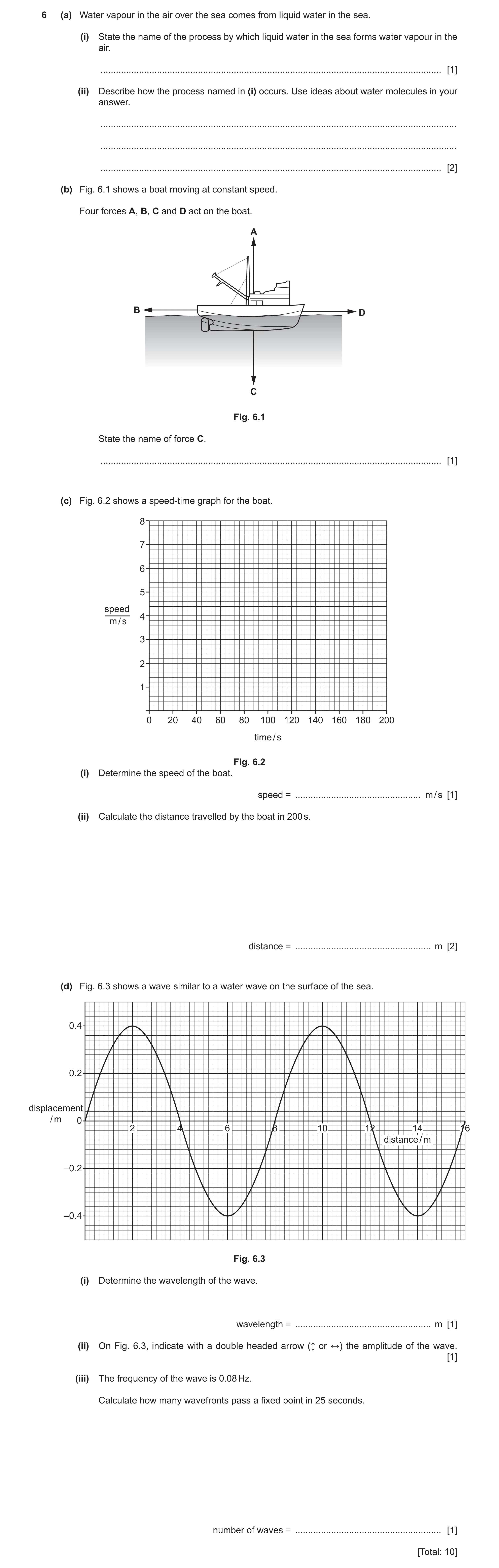
6 (a) Water vapour in the air over the sea comes from liquid water in the sea. (i) State the name of the process by which liquid water in the sea forms water vapour in the air. … [1] (ii) Describe how the process named in (i) occurs. Use ideas about water molecules in your answer. … … … [2] (b) Fig. 6.1 shows a boat moving at constant speed. Four forces A, B, C and D act on the boat. A B D C Fig. 6.1 State the name of force C. … [1] (c) Fig. 6.2 shows a speed-time graph for the boat. 8 7 6 5 speed 4 m / s 3 2 1 0 20 40 60 80 100 120 140 160 180 200 time / s Fig. 6.2 (i) Determine the speed of the boat. speed = … m / s [1] (ii) Calculate the distance travelled by the boat in 200 s. distance = … m [2] (d) Fig. 6.3 shows a wave similar to a water wave on the surface of the sea. 0.4 0.2 displacement / m 0 2 4 6 8 10 12 14 16 distance / m –0.2 –0.4 Fig. 6.3 (i) Determine the wavelength of the wave. wavelength = … m [1] (ii) On Fig. 6.3, indicate with a double headed arrow (↕ or ↔) the amplitude of the wave. [1] (iii) The frequency of the wave is 0.08 Hz. Calculate how many wavefronts pass a fixed point in 25 seconds. number of waves = … [1] [Total: 10]
10 marks
Mark scheme: 6(a)(i) evaporation 1 6(a)(ii) fastest moving / most energetic molecules / particles ; 2 escape from surface ; 6(b) Weight ; 1 6(c)(i) 4.4 (m / s) ; 1 6(c)(ii) distance = speed time (in any form symbols or words) or 4.4 200 or area under graph ; 2 880 (m) ; 6(d)(i) 8 (m) ; 1 6(d)(ii) amplitude correctly indicated ; 1 6(d)(iii) 2.0 ; 1
This question in 0654/31 Oct/Nov 2022
Q18 · An electric heater is used to heat a classroom in a school 0654/32 Oct/Nov 2022
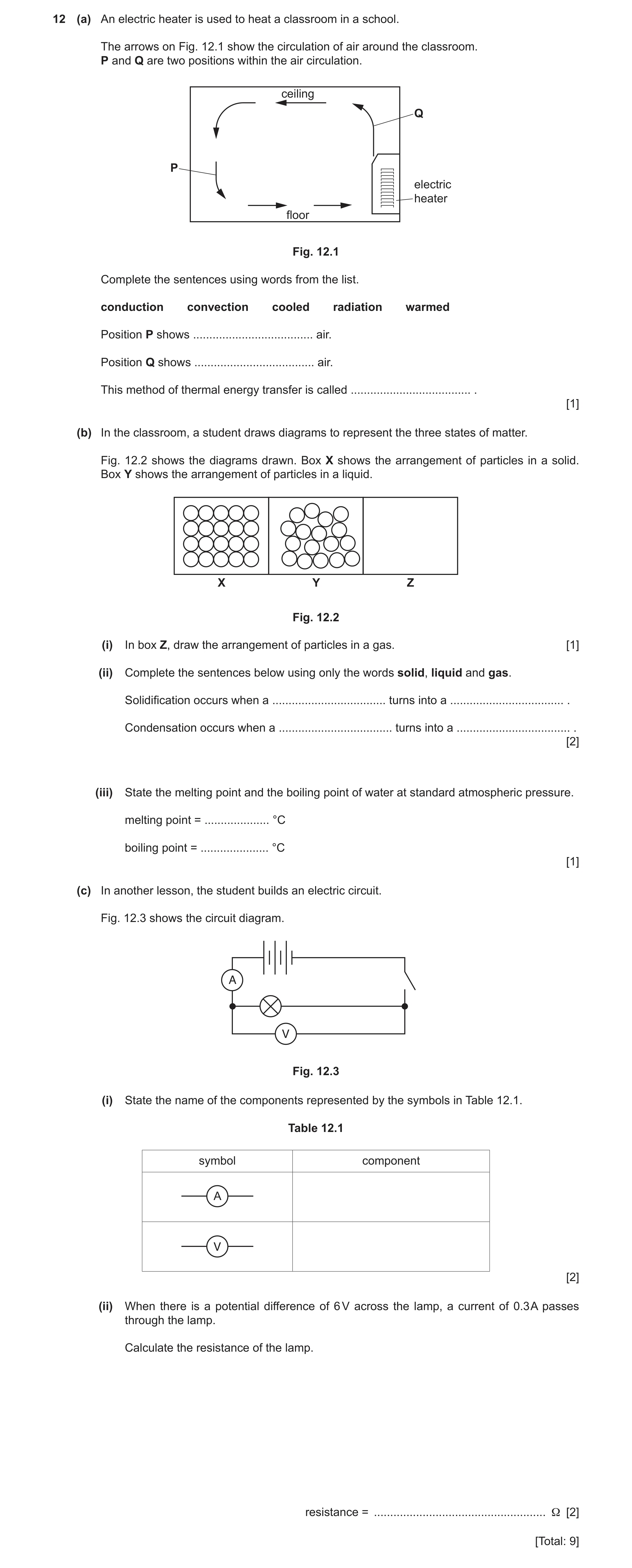
12 (a) An electric heater is used to heat a classroom in a school. The arrows on Fig. 12.1 show the circulation of air around the classroom. P and Q are two positions within the air circulation. ceiling Q P electric heater floor Fig. 12.1 Complete the sentences using words from the list. conduction convection cooled radiation warmed Position P shows … air. Position Q shows … air. This method of thermal energy transfer is called … . [1] (b) In the classroom, a student draws diagrams to represent the three states of matter. Fig. 12.2 shows the diagrams drawn. Box X shows the arrangement of particles in a solid. Box Y shows the arrangement of particles in a liquid. X Y Z Fig. 12.2 (i) In box Z, draw the arrangement of particles in a gas. [1] (ii) Complete the sentences below using only the words solid, liquid and gas. Solidification occurs when a … turns into a … . Condensation occurs when a … turns into a … . [2] (iii) State the melting point and the boiling point of water at standard atmospheric pressure. melting point = … °C boiling point = … °C [1] (c) In another lesson, the student builds an electric circuit. Fig. 12.3 shows the circuit diagram. A V Fig. 12.3 (i) State the name of the components represented by the symbols in Table 12.1. Table 12.1 symbol component A V [2] (ii) When there is a potential difference of 6 V across the lamp, a current of 0.3 A passes through the lamp. Calculate the resistance of the lamp. resistance = … Ω [2] [Total: 9]
9 marks
Mark scheme: 12(a) cooled ; 1 warmed ; convection ; all correct ; 12(b)(i) 1 random arrangement and widely spaced ; 12(b)(ii) liquid and 2 solid ; gas and liquid ; 12(b)(iii) 0 °C and 100 °C ; 1 12(c)(i) ammeter ; 2 voltmeter ; 12(c)(ii) R = V ÷ I (symbols or words) or 6 ÷ 0.3 ; 2 R = 20 () ;
This question in 0654/32 Oct/Nov 2022
Q19 · An astronomer observes a large meteorite, a rock from outer space 0654/33 Oct/Nov 2022
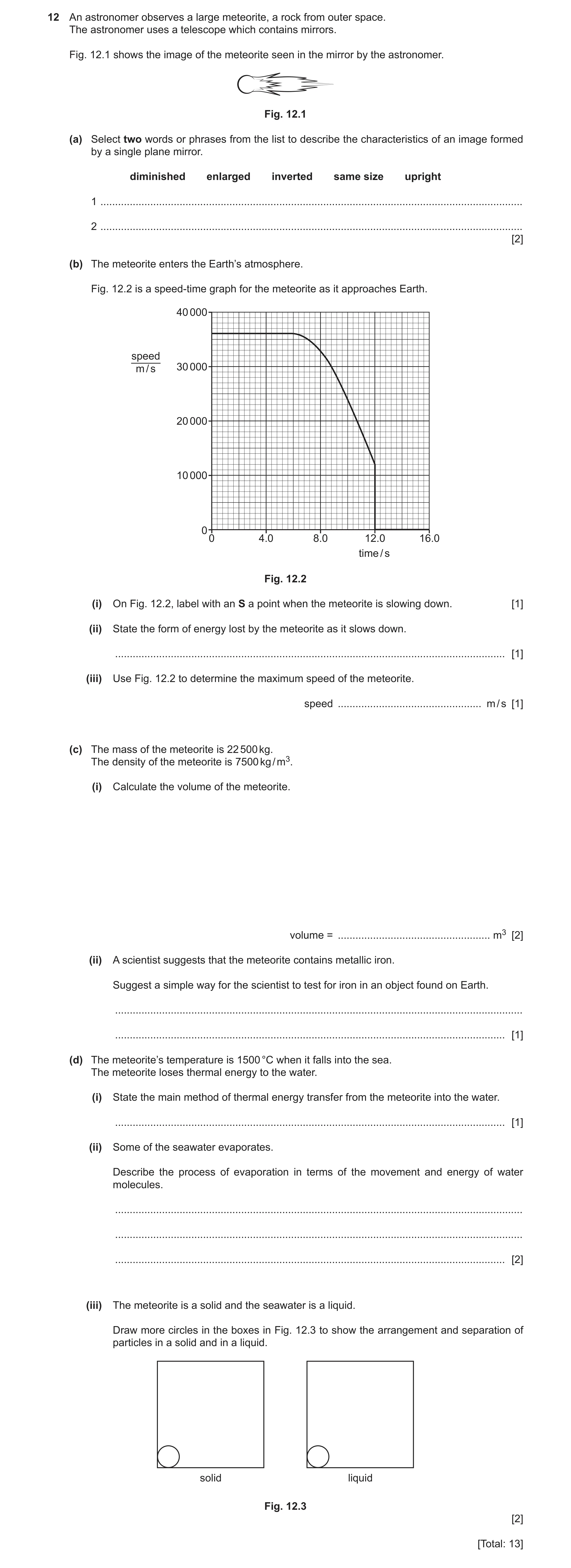
12 An astronomer observes a large meteorite, a rock from outer space. The astronomer uses a telescope which contains mirrors. Fig. 12.1 shows the image of the meteorite seen in the mirror by the astronomer. Fig. 12.1 (a) Select two words or phrases from the list to describe the characteristics of an image formed by a single plane mirror. diminished enlarged inverted same size upright 1 … 2 … [2] (b) The meteorite enters the Earth’s atmosphere. Fig. 12.2 is a speed-time graph for the meteorite as it approaches Earth. 40 000 speed m / s 30 000 20 000 10 000 0 0 4.0 8.0 12.0 16.0 time / s Fig. 12.2 (i) On Fig. 12.2, label with an S a point when the meteorite is slowing down. [1] (ii) State the form of energy lost by the meteorite as it slows down. … [1] (iii) Use Fig. 12.2 to determine the maximum speed of the meteorite. speed … m / s [1] (c) The mass of the meteorite is 22 500 kg. The density of the meteorite is 7500 kg / m3. (i) Calculate the volume of the meteorite. volume = … m3 [2] (ii) A scientist suggests that the meteorite contains metallic iron. Suggest a simple way for the scientist to test for iron in an object found on Earth. … … [1] (d) The meteorite’s temperature is 1500 °C when it falls into the sea. The meteorite loses thermal energy to the water. (i) State the main method of thermal energy transfer from the meteorite into the water. … [1] (ii) Some of the seawater evaporates. Describe the process of evaporation in terms of the movement and energy of water molecules. … … … [2] (iii) The meteorite is a solid and the seawater is a liquid. Draw more circles in the boxes in Fig. 12.3 to show the arrangement and separation of particles in a solid and in a liquid. solid liquid Fig. 12.3 [2] [Total: 13]
13 marks
Mark scheme: 12(a) same size ; 2 upright ; 12(b)(i) S somewhere between 5 s and 12 s ; 1 12(b)(ii) kinetic energy ; 1 12(b)(iii) 36 000 m / s ; 1 12(c)(i) volume = mass ÷ density (words or symbols) or 22 500 ÷ 7500 ; 2 = 3.0 m3 ; 12(c)(ii) use a magnet ; 1 12(d)(i) conduction ; 1 12(d)(ii) fastest moving / most energetic molecules ; 2 escape at surface ; 12(d)(iii) solid – all touching and regular arrangement ; 2 liquid – all / most touching and irregular arrangement ;
This question in 0654/33 Oct/Nov 2022
Q20 · A room in a house has an electric heater 0654/32 Feb/March 2023
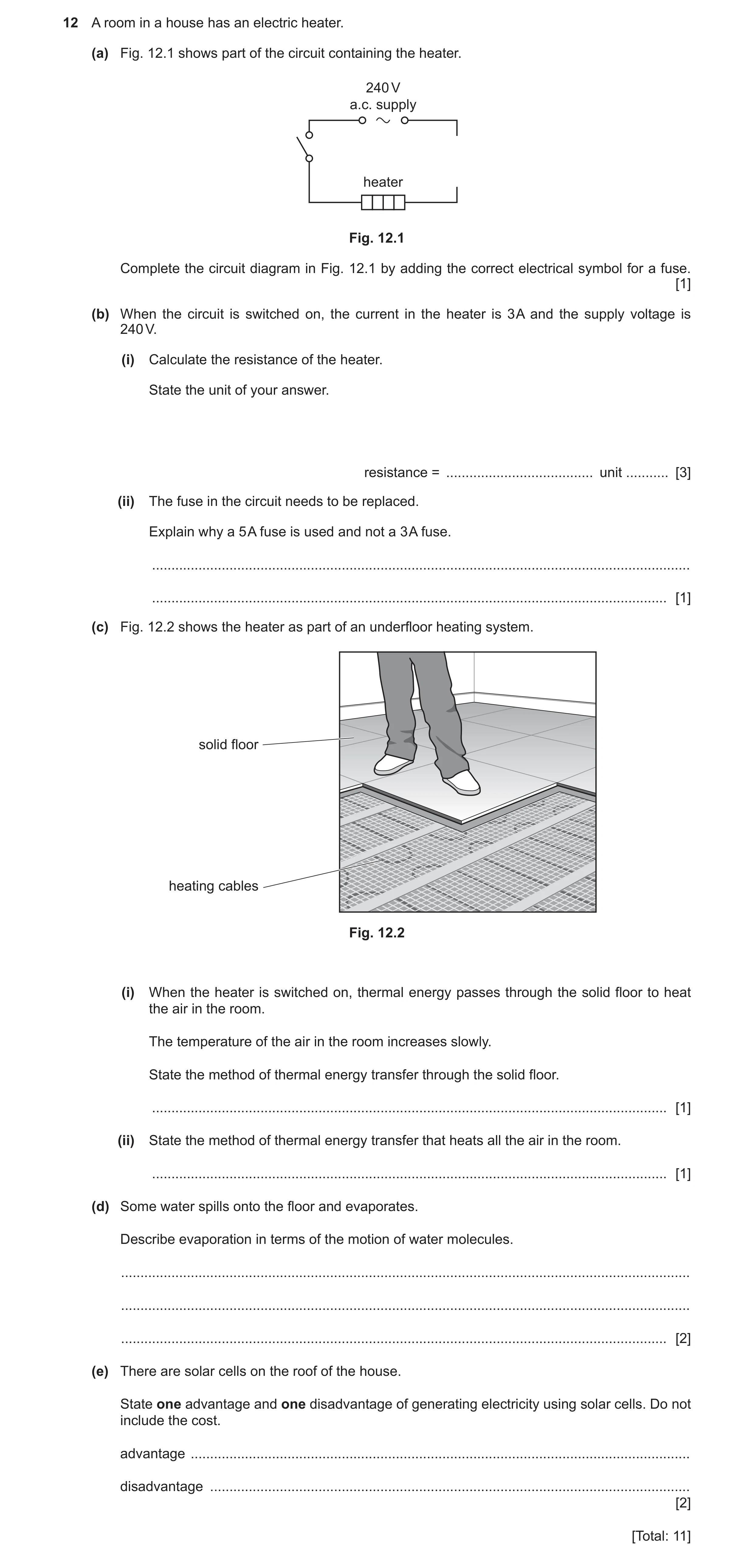
12 A room in a house has an electric heater. (a) Fig. 12.1 shows part of the circuit containing the heater. 240 V a.c. supply heater Fig. 12.1 Complete the circuit diagram in Fig. 12.1 by adding the correct electrical symbol for a fuse. [1] (b) When the circuit is switched on, the current in the heater is 3 A and the supply voltage is 240 V. (i) Calculate the resistance of the heater. State the unit of your answer. resistance = … unit … [3] (ii) The fuse in the circuit needs to be replaced. Explain why a 5 A fuse is used and not a 3 A fuse. … … [1] (c) Fig. 12.2 shows the heater as part of an underfloor heating system. solid floor heating cables Fig. 12.2 (i) When the heater is switched on, thermal energy passes through the solid floor to heat the air in the room. The temperature of the air in the room increases slowly. State the method of thermal energy transfer through the solid floor. … [1] (ii) State the method of thermal energy transfer that heats all the air in the room. … [1] (d) Some water spills onto the floor and evaporates. Describe evaporation in terms of the motion of water molecules. … … … [2] (e) There are solar cells on the roof of the house. State one advantage and one disadvantage of generating electricity using solar cells. Do not include the cost. advantage … disadvantage … [2] [Total: 11]
11 marks
Mark scheme: 12(a) fuse inserted in gap using the correct symbol ; 1 12(b)(i) evidence of resistance = voltage / current (in any form) or 240 / 3 ; 3 = 80 ; / ohms ; 12(b)(ii) fuse needs to be slightly greater than maximum current (or it would blow in normal use) ; 1 12(c)(i) conduction ; 1 12(c)(ii) convection ; 1 12(d) faster moving / most energetic molecules (leave) ; 2 (leave) from the surface of the liquid ; 12(e) renewable energy / does not produce CO2 etc ; 2 need sunlight / only works during the day etc ;
This question in 0654/32 Feb/March 2023
Q21 · The audible frequency range of five animals 0654/32 May/June 2023
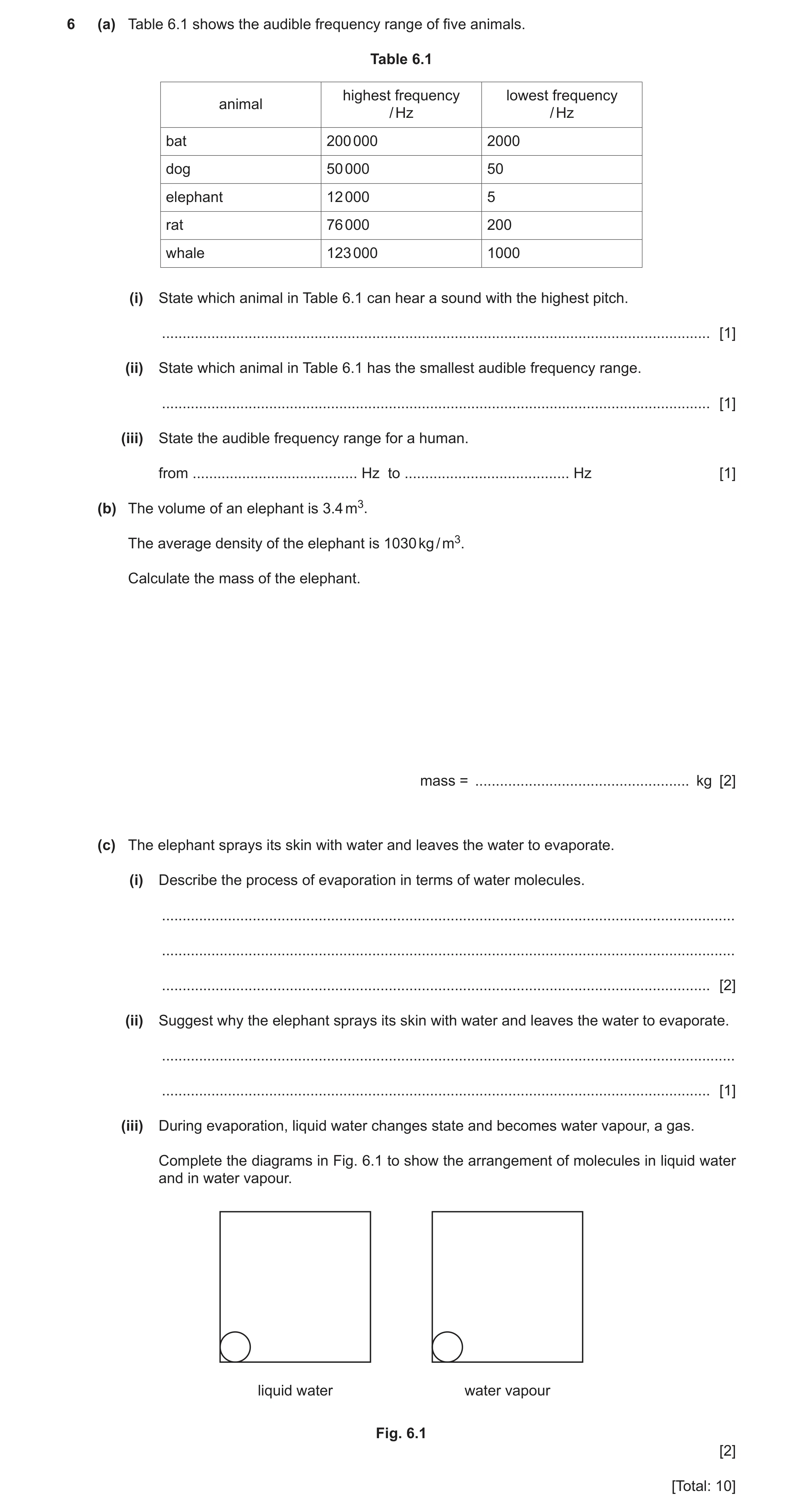
6 (a) Table 6.1 shows the audible frequency range of five animals. Table 6.1 highest frequency lowest frequency animal / Hz / Hz bat 200 000 2000 dog 50 000 50 elephant 12 000 5 rat 76 000 200 whale 123 000 1000 (i) State which animal in Table 6.1 can hear a sound with the highest pitch. … [1] (ii) State which animal in Table 6.1 has the smallest audible frequency range. … [1] (iii) State the audible frequency range for a human. from … Hz to … Hz [1] (b) The volume of an elephant is 3.4 m3. The average density of the elephant is 1030 kg / m3. Calculate the mass of the elephant. mass = … kg [2] (c) The elephant sprays its skin with water and leaves the water to evaporate. (i) Describe the process of evaporation in terms of water molecules. … … … [2] (ii) Suggest why the elephant sprays its skin with water and leaves the water to evaporate. … … [1] (iii) During evaporation, liquid water changes state and becomes water vapour, a gas. Complete the diagrams in Fig. 6.1 to show the arrangement of molecules in liquid water and in water vapour. liquid water water vapour Fig. 6.1 [2] [Total: 10]
10 marks
Mark scheme: 6(a)(i) bat ; 1 6(a)(ii) elephant ; 1 6(a)(iii) 20 (Hz) to 20 000 (Hz) ; 1 6(b) mass = density volume (in any form) or 1030 3.4 ; = 3500 (kg) ; 2 6(c)(i) fastest moving molecules escape ; from the surface of the liquid ; 2 6(c)(ii) evaporation has a cooling effect ; 1 6(c)(iii) liquid – all molecules touching random arrangement ; gas – molecules widely separated (no more than seven shown) and random arrangement ; 2
This question in 0654/32 May/June 2023
Q22 · The audible frequency range of five animals 0654/33 May/June 2023
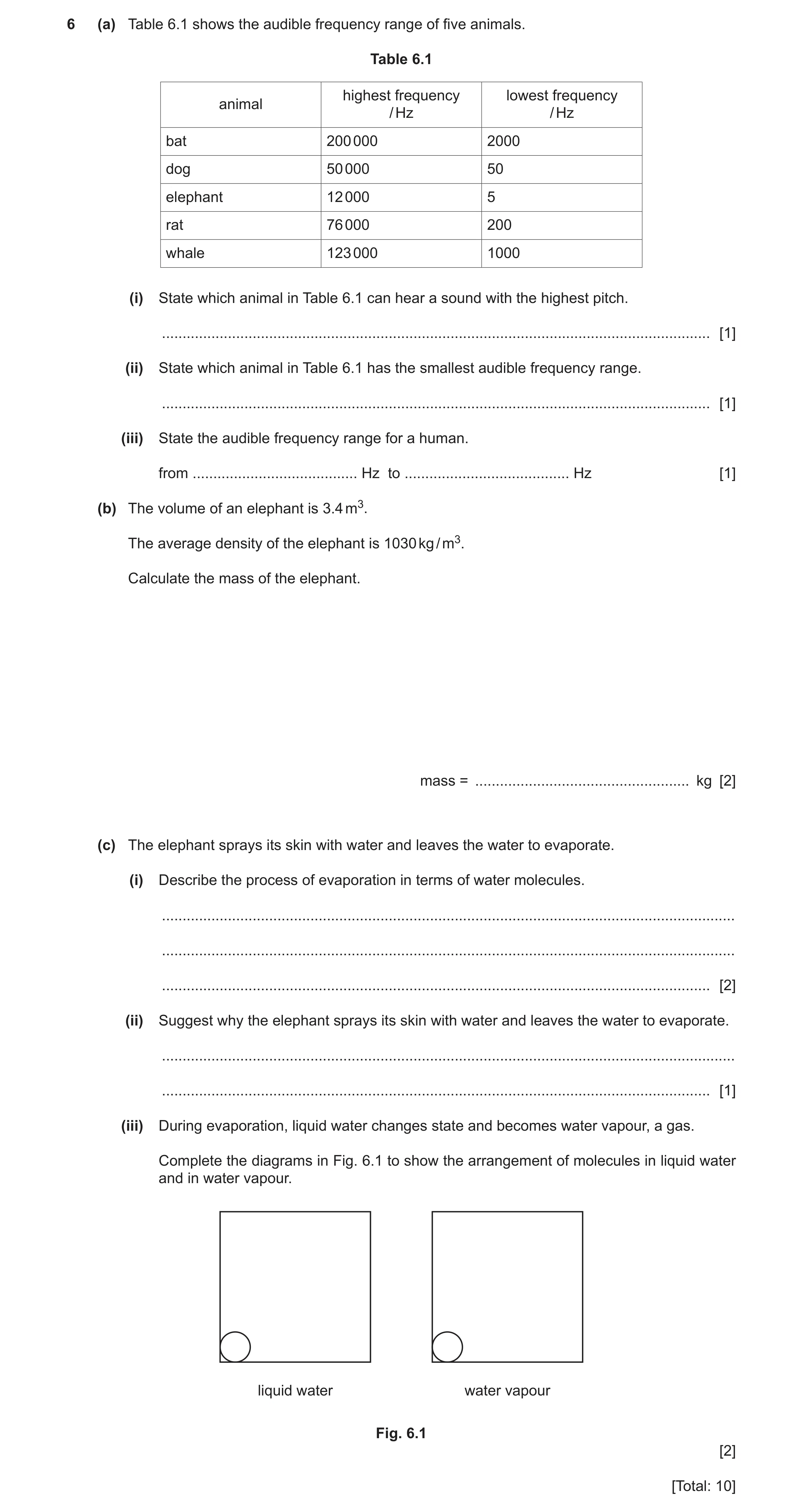
6 (a) Table 6.1 shows the audible frequency range of five animals. Table 6.1 highest frequency lowest frequency animal / Hz / Hz bat 200 000 2000 dog 50 000 50 elephant 12 000 5 rat 76 000 200 whale 123 000 1000 (i) State which animal in Table 6.1 can hear a sound with the highest pitch. … [1] (ii) State which animal in Table 6.1 has the smallest audible frequency range. … [1] (iii) State the audible frequency range for a human. from … Hz to … Hz [1] (b) The volume of an elephant is 3.4 m3. The average density of the elephant is 1030 kg / m3. Calculate the mass of the elephant. mass = … kg [2] (c) The elephant sprays its skin with water and leaves the water to evaporate. (i) Describe the process of evaporation in terms of water molecules. … … … [2] (ii) Suggest why the elephant sprays its skin with water and leaves the water to evaporate. … … [1] (iii) During evaporation, liquid water changes state and becomes water vapour, a gas. Complete the diagrams in Fig. 6.1 to show the arrangement of molecules in liquid water and in water vapour. liquid water water vapour Fig. 6.1 [2] [Total: 10]
10 marks
Mark scheme: 6(a)(i) bat ; 1 6(a)(ii) elephant ; 1 6(a)(iii) 20 (Hz) to 20 000 (Hz) ; 1 6(b) mass = density volume (in any form) or 1030 3.4 ; = 3500 (kg) ; 2 6(c)(i) fastest moving molecules escape ; from the surface of the liquid ; 2 6(c)(ii) evaporation has a cooling effect ; 1 6(c)(iii) liquid – all molecules touching random arrangement ; gas – molecules widely separated (no more than seven shown) and random arrangement ; 2
This question in 0654/33 May/June 2023
Q23 · A cyclist is riding a bicycle around a circular track 0654/31 Oct/Nov 2023
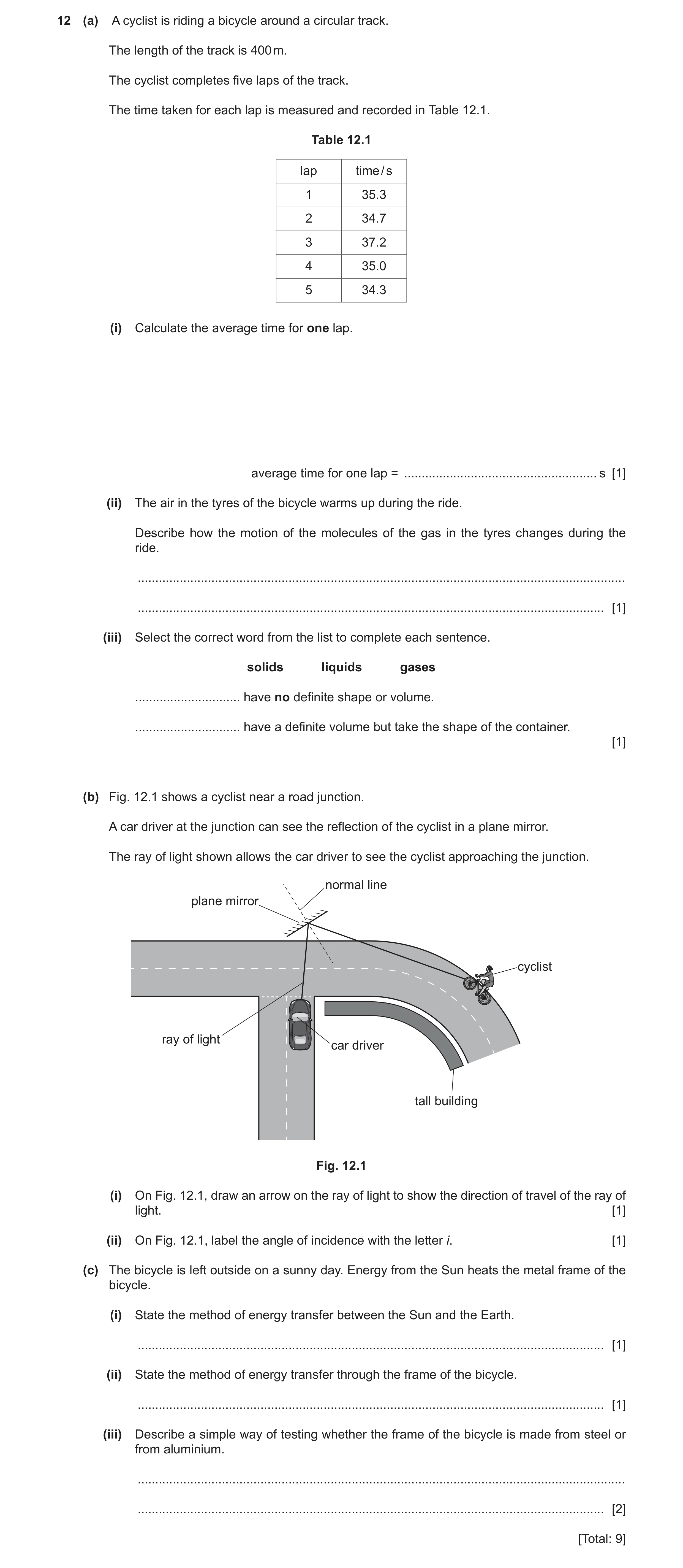
12 (a) A cyclist is riding a bicycle around a circular track. The length of the track is 400 m. The cyclist completes five laps of the track. The time taken for each lap is measured and recorded in Table 12.1. Table 12.1 lap time / s 1 35.3 2 34.7 3 37.2 4 35.0 5 34.3 (i) Calculate the average time for one lap. average time for one lap = … s [1] (ii) The air in the tyres of the bicycle warms up during the ride. Describe how the motion of the molecules of the gas in the tyres changes during the ride. … … [1] (iii) Select the correct word from the list to complete each sentence. solids liquids gases … have no definite shape or volume. … have a definite volume but take the shape of the container. [1] (b) Fig. 12.1 shows a cyclist near a road junction. A car driver at the junction can see the reflection of the cyclist in a plane mirror. The ray of light shown allows the car driver to see the cyclist approaching the junction. normal line plane mirror cyclist ray of light car driver tall building Fig. 12.1 (i) On Fig. 12.1, draw an arrow on the ray of light to show the direction of travel of the ray of light. [1] (ii) On Fig. 12.1, label the angle of incidence with the letter i. [1] (c) The bicycle is left outside on a sunny day. Energy from the Sun heats the metal frame of the bicycle. (i) State the method of energy transfer between the Sun and the Earth. … [1] (ii) State the method of energy transfer through the frame of the bicycle. … [1] (iii) Describe a simple way of testing whether the frame of the bicycle is made from steel or from aluminium. … … [2] [Total: 9]
9 marks
Mark scheme: 12(a)(i) 35.3 (s) ; 1 12(a)(ii) molecules move faster ; 1 12(a)(iii) gases and 1 liquids both correct – 1 mark ; 12(b)(i) arrow drawn going away from cyclist / towards driver ; 1 12(b)(ii) angle of incidence correctly labelled ; 1 12(c)(i) radiation ; 1 12(c)(ii) conduction ; 1 12(c)(iii) use a magnet ; 2 steel will be attracted (to magnet) ; ORA
This question in 0654/31 Oct/Nov 2023
Q24 · The driver of a car fills the fuel tank with gasoline (petrol) 0654/31 May/June 2024
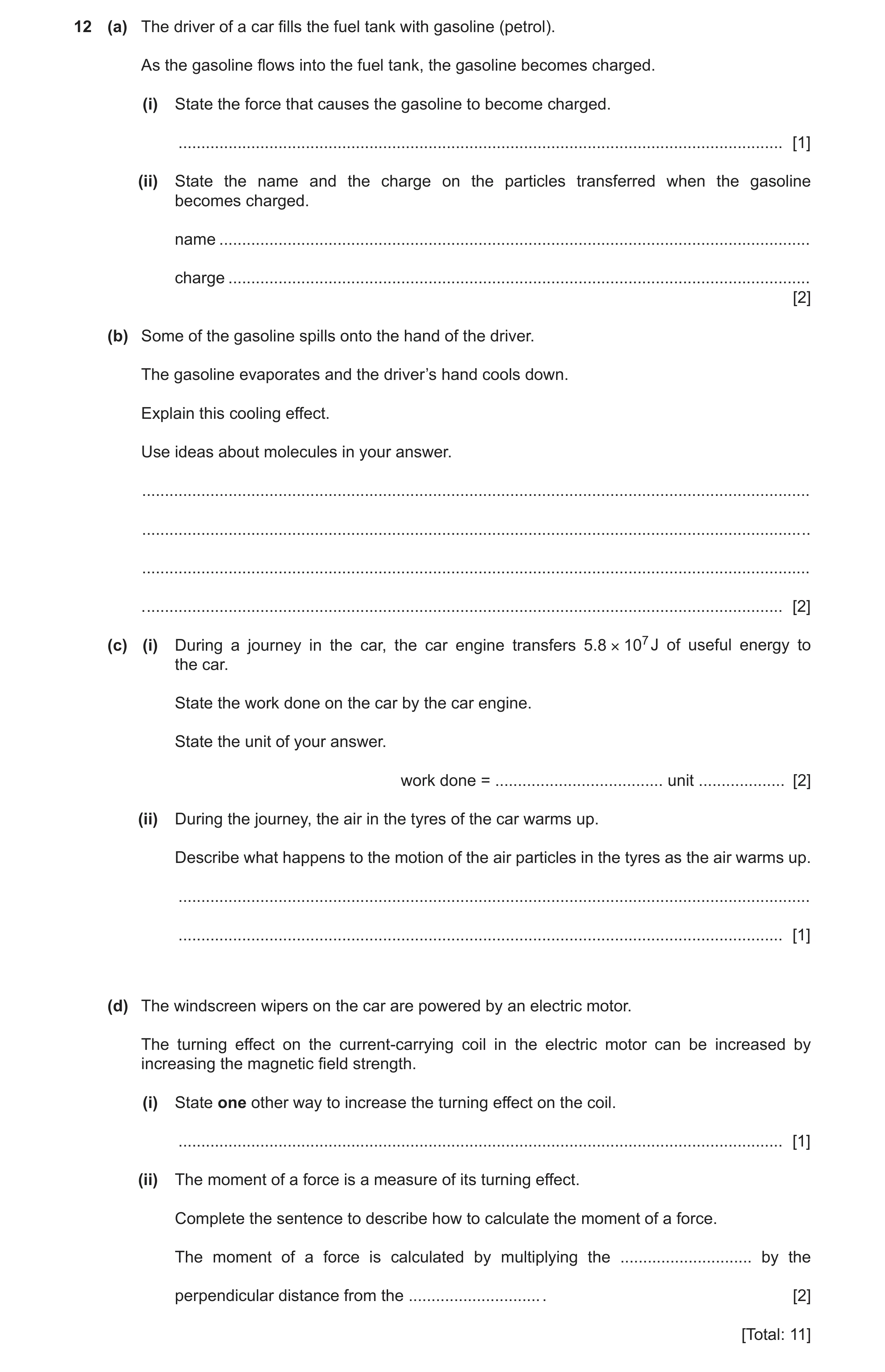
12 (a) The driver of a car fills the fuel tank with gasoline (petrol). As the gasoline flows into the fuel tank, the gasoline becomes charged. (i) State the force that causes the gasoline to become charged. … [1] (ii) State the name and the charge on the particles transferred when the gasoline becomes charged. name … charge … [2] (b) Some of the gasoline spills onto the hand of the driver. The gasoline evaporates and the driver’s hand cools down. Explain this cooling effect. Use ideas about molecules in your answer. … … … . … [2] (c) (i) During a journey in the car, the car engine transfers 5.8 × 10⁷ J of useful energy to the car. State the work done on the car by the car engine. State the unit of your answer. work done = … unit … [2] (ii) During the journey, the air in the tyres of the car warms up. Describe what happens to the motion of the air particles in the tyres as the air warms up. … … [1] (d) The windscreen wipers on the car are powered by an electric motor. The turning effect on the current‑carrying coil in the electric motor can be increased by increasing the magnetic field strength. (i) State one other way to increase the turning effect on the coil. … [1] (ii) The moment of a force is a measure of its turning effect. Complete the sentence to describe how to calculate the moment of a force. The moment of a force is calculated by multiplying the … by the perpendicular distance from the … . [2] [Total: 11]
11 marks
Mark scheme: 12(a)(i) friction ; 1 12(a)(ii) electron ; negative ; 2 12(b) the most energetic molecules escape ; average speed / energy of remaining molecules is lower ; 2 12(c)(i) 5.8 107 ; J ; 2 12(c)(ii) move faster ; 1 12(d)(i) increase current / voltage or increase number of turns ; 1 12(d)(ii) force ; pivot ; 2
This question in 0654/31 May/June 2024
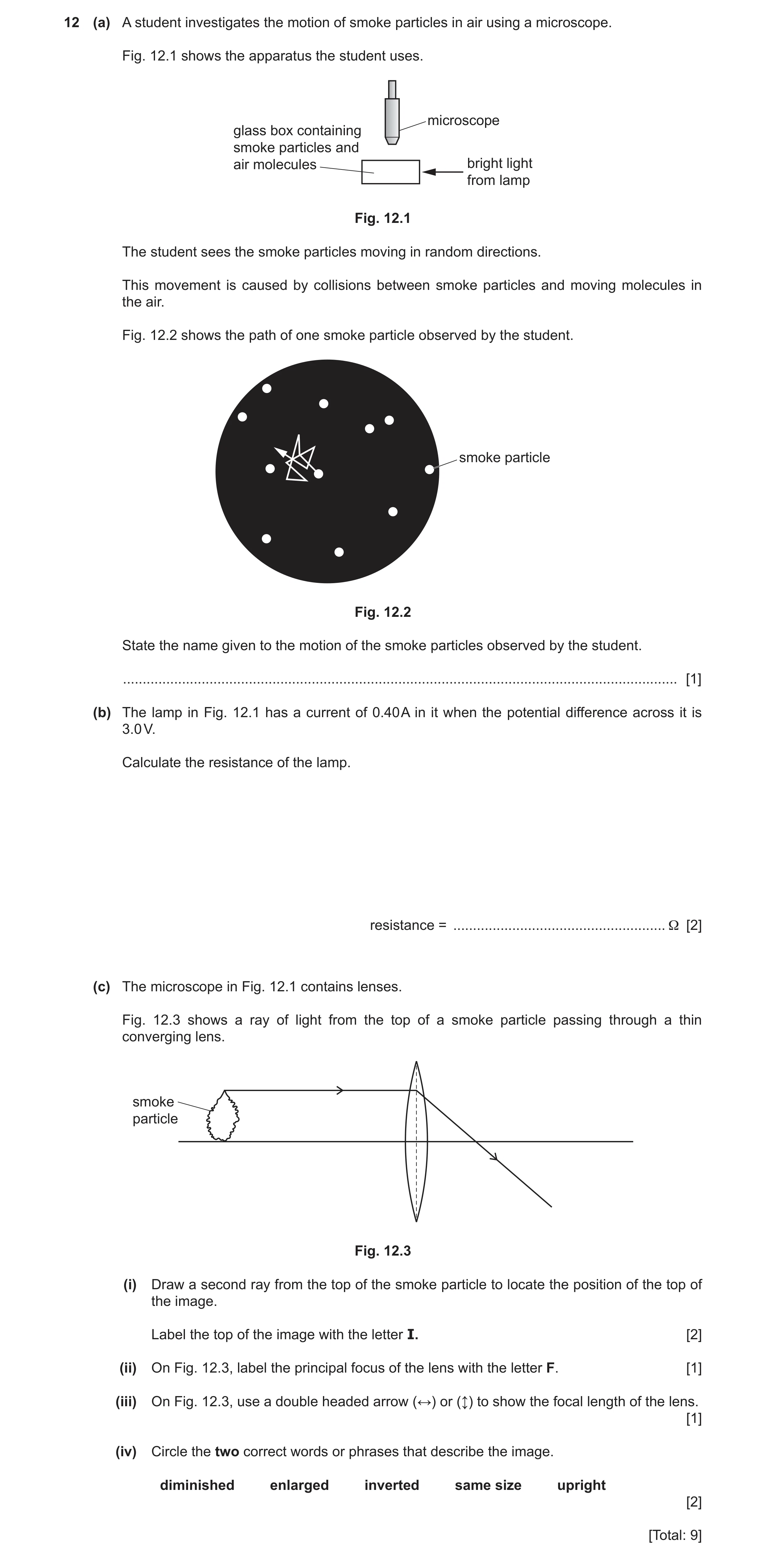
Q25 · A student investigates the motion of smoke particles in air using a microscope 0654/32 May/June 2024
12 (a) A student investigates the motion of smoke particles in air using a microscope. Fig. 12.1 shows the apparatus the student uses. microscope glass box containing smoke particles and air molecules bright light from lamp Fig. 12.1 The student sees the smoke particles moving in random directions. This movement is caused by collisions between smoke particles and moving molecules in the air. Fig. 12.2 shows the path of one smoke particle observed by the student. smoke particle Fig. 12.2 State the name given to the motion of the smoke particles observed by the student. … [1] (b) The lamp in Fig. 12.1 has a current of 0.40 A in it when the potential difference across it is 3.0 V. Calculate the resistance of the lamp. resistance = … Ω [2] (c) The microscope in Fig. 12.1 contains lenses. Fig. 12.3 shows a ray of light from the top of a smoke particle passing through a thin converging lens. smoke particle Fig. 12.3 (i) Draw a second ray from the top of the smoke particle to locate the position of the top of the image. Label the top of the image with the letter I. [2] (ii) On Fig. 12.3, label the principal focus of the lens with the letter F. [1] (iii) On Fig. 12.3, use a double headed arrow (↔) or (↕) to show the focal length of the lens. [1] (iv) Circle the two correct words or phrases that describe the image. diminished enlarged inverted same size upright [2] [Total: 9]
9 marks
Mark scheme: 12(a) Brownian (motion) ; 1 12(b) R= V / I (in any form) or 3.0 / 0.4 ; = 7.5 () ; 2 12(c)(i) second line through centre of lens ; image labelled I ; 2 12(c)(ii) principal focus correctly labelled ; 1 12(c)(iii) focal length correctly shown ; 1 12(c)(iv) diminished ; inverted ; 2
This question in 0654/32 May/June 2024
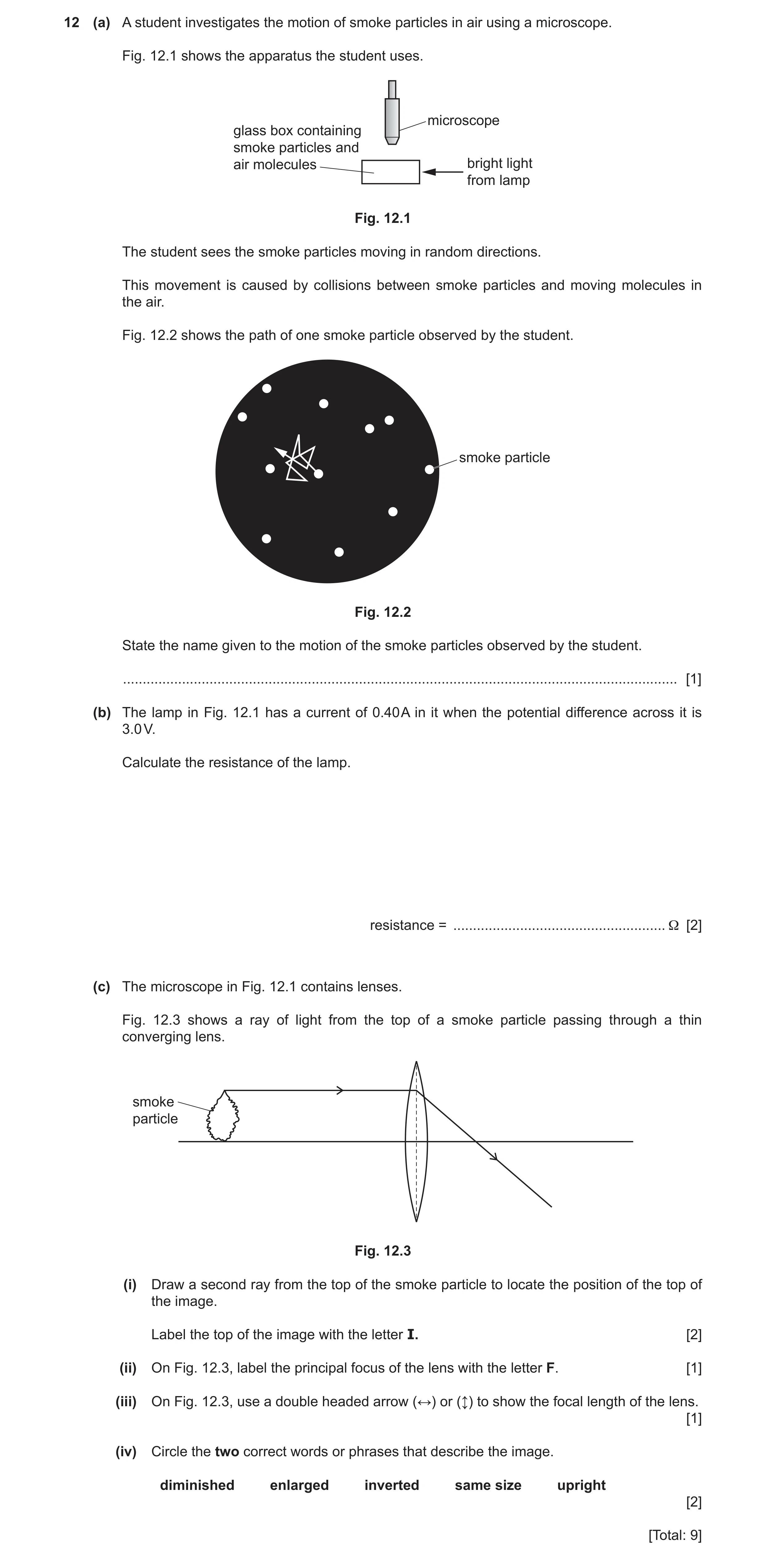
Q26 · A student investigates the motion of smoke particles in air using a microscope 0654/33 May/June 2024
12 (a) A student investigates the motion of smoke particles in air using a microscope. Fig. 12.1 shows the apparatus the student uses. microscope glass box containing smoke particles and air molecules bright light from lamp Fig. 12.1 The student sees the smoke particles moving in random directions. This movement is caused by collisions between smoke particles and moving molecules in the air. Fig. 12.2 shows the path of one smoke particle observed by the student. smoke particle Fig. 12.2 State the name given to the motion of the smoke particles observed by the student. … [1] (b) The lamp in Fig. 12.1 has a current of 0.40 A in it when the potential difference across it is 3.0 V. Calculate the resistance of the lamp. resistance = … Ω [2] (c) The microscope in Fig. 12.1 contains lenses. Fig. 12.3 shows a ray of light from the top of a smoke particle passing through a thin converging lens. smoke particle Fig. 12.3 (i) Draw a second ray from the top of the smoke particle to locate the position of the top of the image. Label the top of the image with the letter I. [2] (ii) On Fig. 12.3, label the principal focus of the lens with the letter F. [1] (iii) On Fig. 12.3, use a double headed arrow (↔) or (↕) to show the focal length of the lens. [1] (iv) Circle the two correct words or phrases that describe the image. diminished enlarged inverted same size upright [2] [Total: 9]
9 marks
Mark scheme: 12(a) Brownian (motion) ; 1 12(b) R= V / I (in any form) or 3.0 / 0.4 ; = 7.5 () ; 2 12(c)(i) second line through centre of lens ; image labelled I ; 2 12(c)(ii) principal focus correctly labelled ; 1 12(c)(iii) focal length correctly shown ; 1 12(c)(iv) diminished ; inverted ; 2
This question in 0654/33 May/June 2024
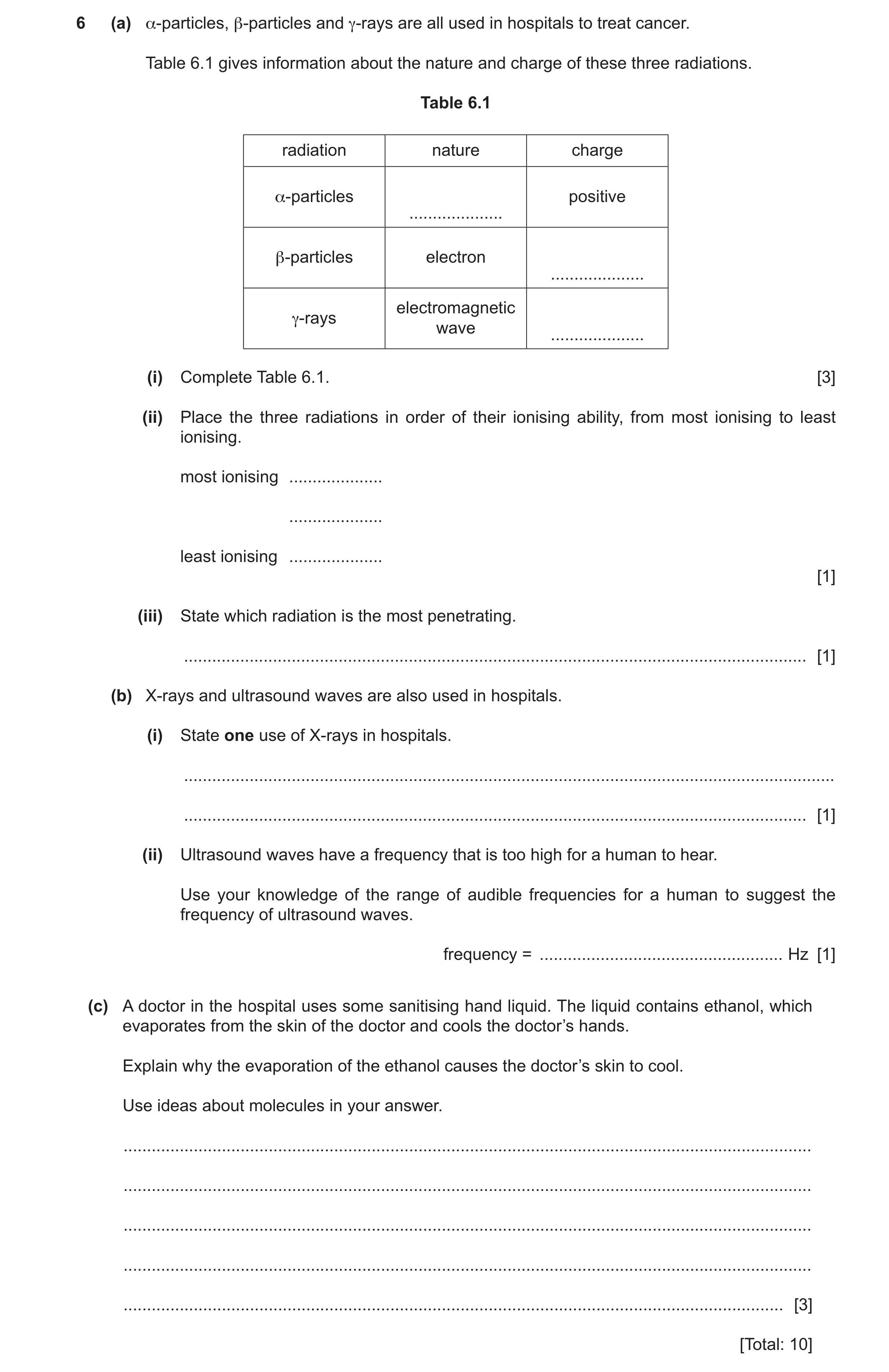
Q27 · Α-particles, β-particles and γ-rays are all used in hospitals to treat cancer 0654/32 Oct/Nov 2024
6 (a) α-particles, β-particles and γ-rays are all used in hospitals to treat cancer. Table 6.1 gives information about the nature and charge of these three radiations. Table 6.1 radiation nature charge α-particles positive … β-particles electron … electromagnetic γ-rays wave … (i) Complete Table 6.1. [3] (ii) Place the three radiations in order of their ionising ability, from most ionising to least ionising. most ionising … … least ionising … [1] (iii) State which radiation is the most penetrating. … [1] (b) X-rays and ultrasound waves are also used in hospitals. (i) State one use of X-rays in hospitals. … … [1] (ii) Ultrasound waves have a frequency that is too high for a human to hear. Use your knowledge of the range of audible frequencies for a human to suggest the frequency of ultrasound waves. frequency = … Hz [1] (c) A doctor in the hospital uses some sanitising hand liquid. The liquid contains ethanol, which evaporates from the skin of the doctor and cools the doctor’s hands. Explain why the evaporation of the ethanol causes the doctor’s skin to cool. Use ideas about molecules in your answer. … … … … … [3] [Total: 10]
10 marks
Mark scheme: 6(a)(i) 3 radiation nature charge α-particles helium nucleus positive β-particles electron negative γ-rays electromagnetic no charge / zero wave ;;; one mark for each correct row 6(a)(ii) (in order) 1 (-particles) (-particles) (-rays) ; 6(a)(iii) -rays ; 1 6(b)(i) scanning / imaging (tissues) inside the body ; 1 6(b)(ii) any value above 20 000 (Hz) ; 1 6(c) most energetic molecules escape ; 3 from surface of liquid ; lowering the temperature of the remaining ethanol molecules ;
This question in 0654/32 Oct/Nov 2024
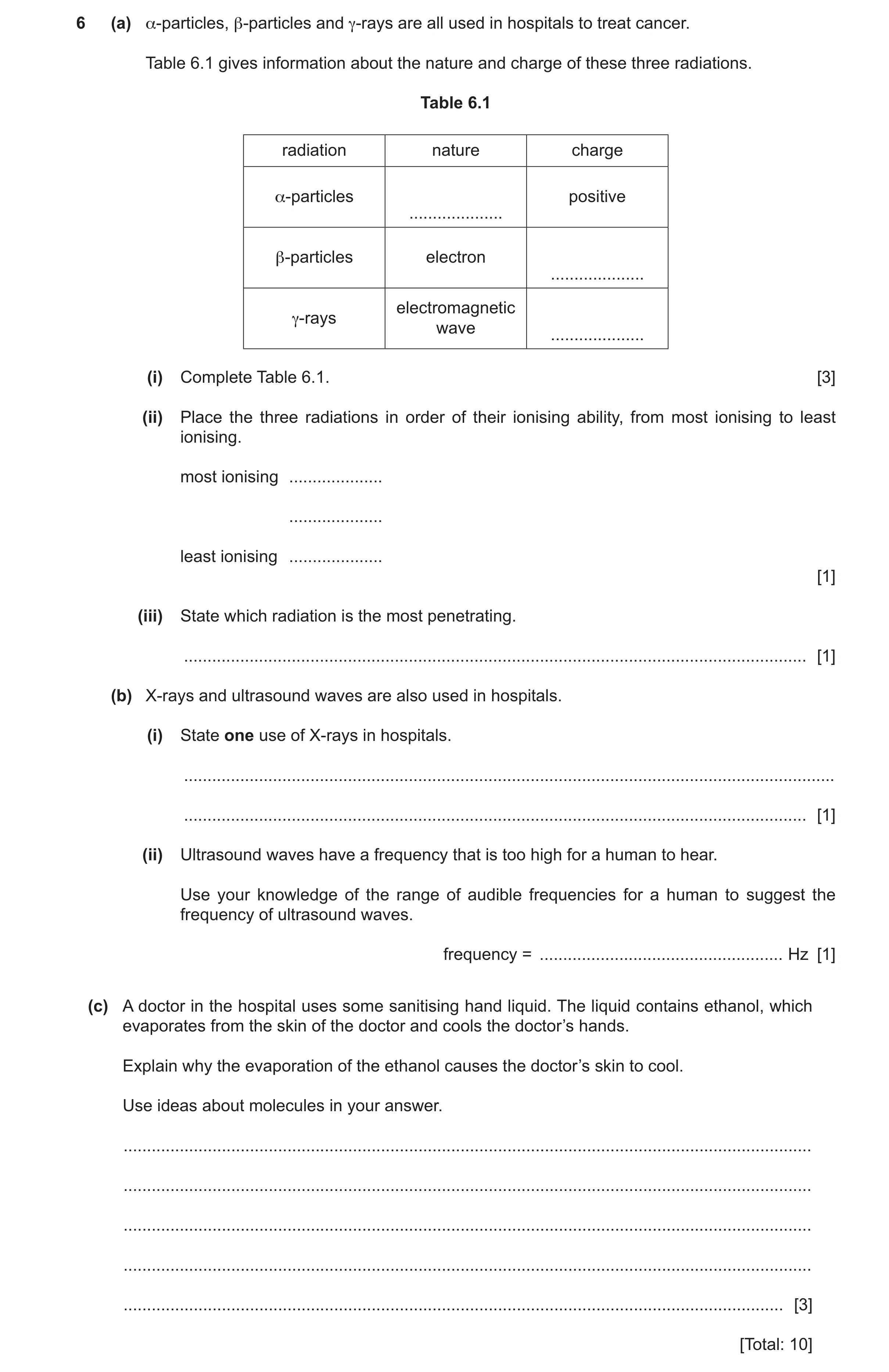
Q28 · Α-particles, β-particles and γ-rays are all used in hospitals to treat cancer 0654/33 Oct/Nov 2024
6 (a) α-particles, β-particles and γ-rays are all used in hospitals to treat cancer. Table 6.1 gives information about the nature and charge of these three radiations. Table 6.1 radiation nature charge α-particles positive … β-particles electron … electromagnetic γ-rays wave … (i) Complete Table 6.1. [3] (ii) Place the three radiations in order of their ionising ability, from most ionising to least ionising. most ionising … … least ionising … [1] (iii) State which radiation is the most penetrating. … [1] (b) X-rays and ultrasound waves are also used in hospitals. (i) State one use of X-rays in hospitals. … … [1] (ii) Ultrasound waves have a frequency that is too high for a human to hear. Use your knowledge of the range of audible frequencies for a human to suggest the frequency of ultrasound waves. frequency = … Hz [1] (c) A doctor in the hospital uses some sanitising hand liquid. The liquid contains ethanol, which evaporates from the skin of the doctor and cools the doctor’s hands. Explain why the evaporation of the ethanol causes the doctor’s skin to cool. Use ideas about molecules in your answer. … … … … … [3] [Total: 10]
10 marks
Mark scheme: 6(a)(i) 3 radiation nature charge α-particles helium nucleus positive β-particles electron negative γ-rays electromagnetic no charge / zero wave ;;; one mark for each correct row 6(a)(ii) (in order) 1 (-particles) (-particles) (-rays) ; 6(a)(iii) -rays ; 1 6(b)(i) scanning / imaging (tissues) inside the body ; 1 6(b)(ii) any value above 20 000 (Hz) ; 1 6(c) most energetic molecules escape ; 3 from surface of liquid ; lowering the temperature of the remaining ethanol molecules ;
This question in 0654/33 Oct/Nov 2024
Q29 · Table 5.1 contains information about 6 atoms or ions A, B, C, D, E and F 0654/31 May/June 2025
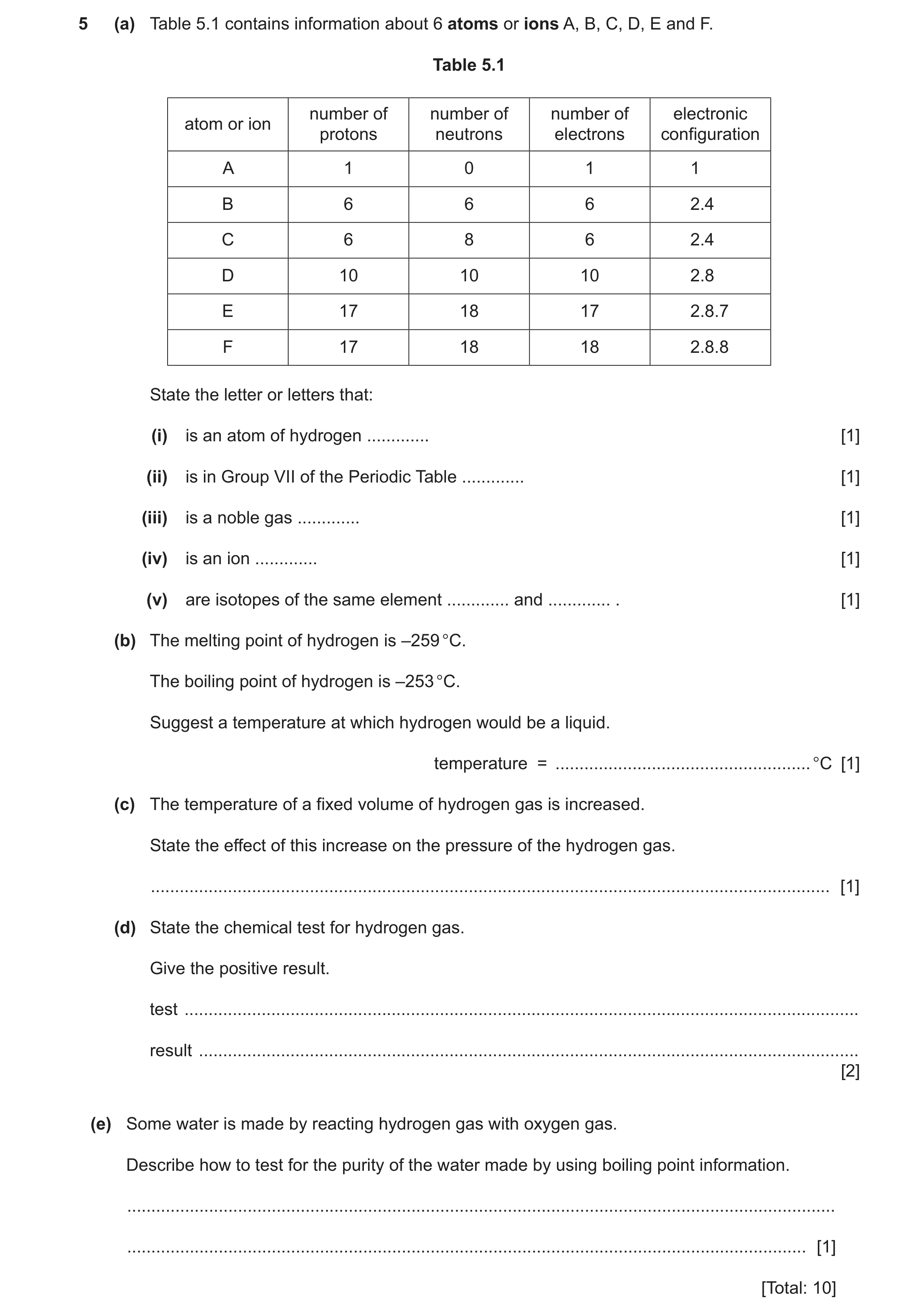
5 (a) Table 5.1 contains information about 6 atoms or ions A, B, C, D, E and F. Table 5.1 number of number of number of electronic atom or ion protons neutrons electrons configuration A 1 0 1 1 B 6 6 6 2.4 C 6 8 6 2.4 D 10 10 10 2.8 E 17 18 17 2.8.7 F 17 18 18 2.8.8 State the letter or letters that: (i) is an atom of hydrogen … [1] (ii) is in Group VII of the Periodic Table … [1] (iii) is a noble gas … [1] (iv) is an ion … [1] (v) are isotopes of the same element … and … . [1] (b) The melting point of hydrogen is –259 °C. The boiling point of hydrogen is –253 °C. Suggest a temperature at which hydrogen would be a liquid. temperature = … °C [1] (c) The temperature of a fixed volume of hydrogen gas is increased. State the effect of this increase on the pressure of the hydrogen gas. … [1] (d) State the chemical test for hydrogen gas. Give the positive result. test … result … [2] (e) Some water is made by reacting hydrogen gas with oxygen gas. Describe how to test for the purity of the water made by using boiling point information. … … [1] [Total: 10]
10 marks
Mark scheme: 5(a)(i) A ; 1 5(a)(ii) E ; 1 5(a)(iii) D ; 1 5(a)(iv) F ; 1 5(a)(v) B and C ; 1 5(b) between – 254 and – 258 °C ; 1 5(c) (pressure) increases ; 1 5(d) lighted splint ; 2 goes pop ; 5(e) pure water will boil at 100°C / ora ; 1
This question in 0654/31 May/June 2025
Q30 · A climber climbs to the top of a rock face 0654/31 May/June 2025
12 (a) A climber climbs to the top of a rock face. At the top, there is snow that is melting in the sunshine. (i) State the melting temperature of water at standard atmospheric pressure. … °C [1] (ii) Describe, in terms of the motion and arrangement of particles, how liquid water is different from solid water. motion … … arrangement … … [2] (iii) The climber is exposed to ultraviolet radiation from the Sun. Describe one danger to humans of too much exposure to ultraviolet radiation. … … [1] (b) Fig. 12.1 shows the climber moving down the rock face from A to B. A rock face 30 m climber B Fig. 12.1 Fig. 12.2 shows a distance–time graph for the climber’s descent. B 30 20 distance / m 10 A 0 0 10 20 30 40 50 60 time / s Fig. 12.2 (i) Describe the motion of the climber between time = 20 s and time = 40 s. … [1] (ii) Calculate the maximum speed of the climber. maximum speed = … m / s [2] (iii) As the climber descends, the rope passes through the climber’s hands as he controls his speed of descent and his hands get hot. Name the force between two surfaces that produces heating. … [1] [Total: 8]
8 marks
Mark scheme: 12(a)(i) 0 (°C) ; 1 12(a)(ii) (motion) liquid: random motion / solid: vibrate (in place) ; 2 (arrangement) liquid: irregular / solid: regular arrangement ; 12(a)(iii) damage surface cells / eyes / skin cancer / eye conditions ; 1 12(b)(i) not moving / AW ; 1 12(b)(ii) speed = distance / time (in any form) or gradient = 18 / 20 ; 2 0.9 (m / s) ; 12(b)(iii) friction ; 1
This question in 0654/31 May/June 2025
Q31 · Complete Table 12.1 by drawing the circuit symbol for each electrical component 0654/31 Oct/Nov 2025
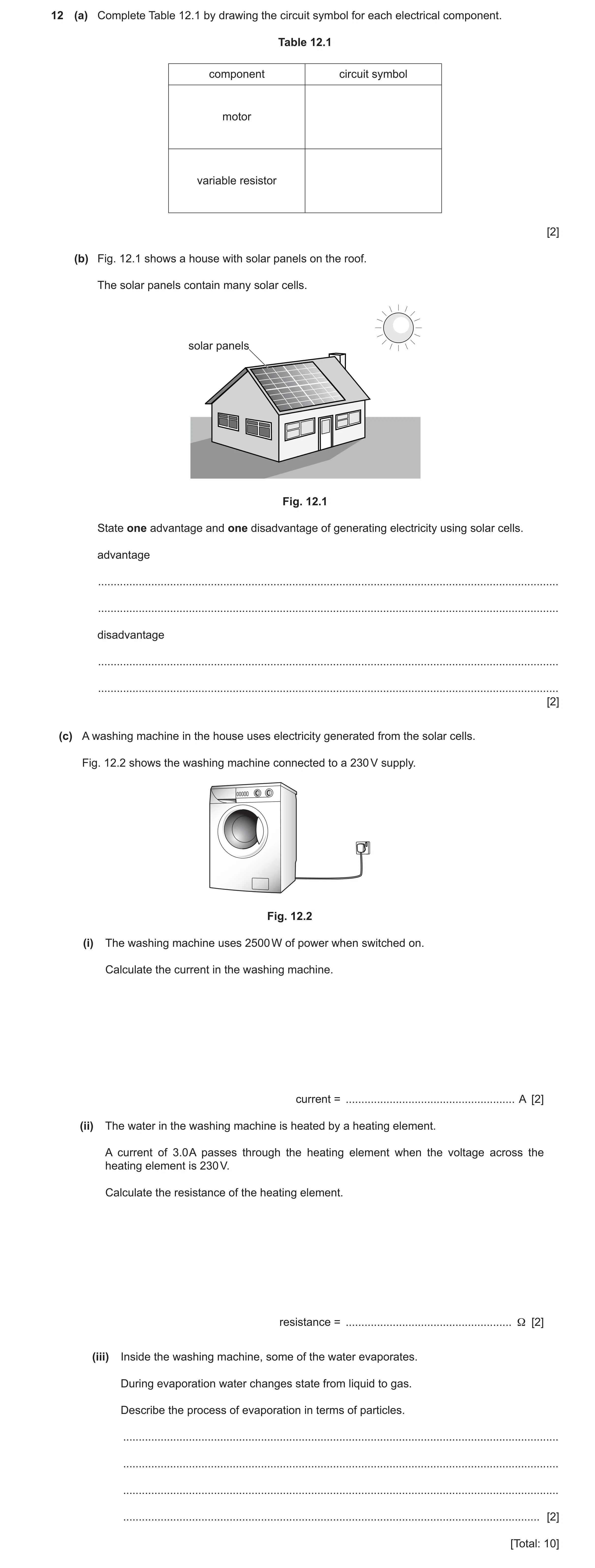
12 (a) Complete Table 12.1 by drawing the circuit symbol for each electrical component. Table 12.1 component circuit symbol motor variable resistor [2] (b) Fig. 12.1 shows a house with solar panels on the roof. The solar panels contain many solar cells. solar panels Fig. 12.1 State one advantage and one disadvantage of generating electricity using solar cells. advantage … … disadvantage … … [2] (c) A washing machine in the house uses electricity generated from the solar cells. Fig. 12.2 shows the washing machine connected to a 230 V supply. Fig. 12.2 (i) The washing machine uses 2500 W of power when switched on. Calculate the current in the washing machine. current = … A [2] (ii) The water in the washing machine is heated by a heating element. A current of 3.0 A passes through the heating element when the voltage across the heating element is 230 V. Calculate the resistance of the heating element. resistance = … Ω [2] (iii) Inside the washing machine, some of the water evaporates. During evaporation water changes state from liquid to gas. Describe the process of evaporation in terms of particles. … … … … [2] [Total: 10]
10 marks
Mark scheme: 12(a) correct symbols for: 2 • motor ; • variable resistor ; 12(b) advantage – renewable / does not produce CO2 ; 2 disadvantage – does not work at night / does not work in poor light / not always available ; 12(c)(i) P = IV (in any form) 2 OR (current =) 2500 / 230 ; 11 (A) ; 12(c)(ii) R = V / I (in any form) 2 OR (resistance =) 230 / 3 ; 77 () ; 12(c)(iii) fastest molecules / most energetic molecules ; 2 escape from surface ;
This question in 0654/31 Oct/Nov 2025
Q32 · An electric kettle with a heating element 0654/32 Oct/Nov 2025
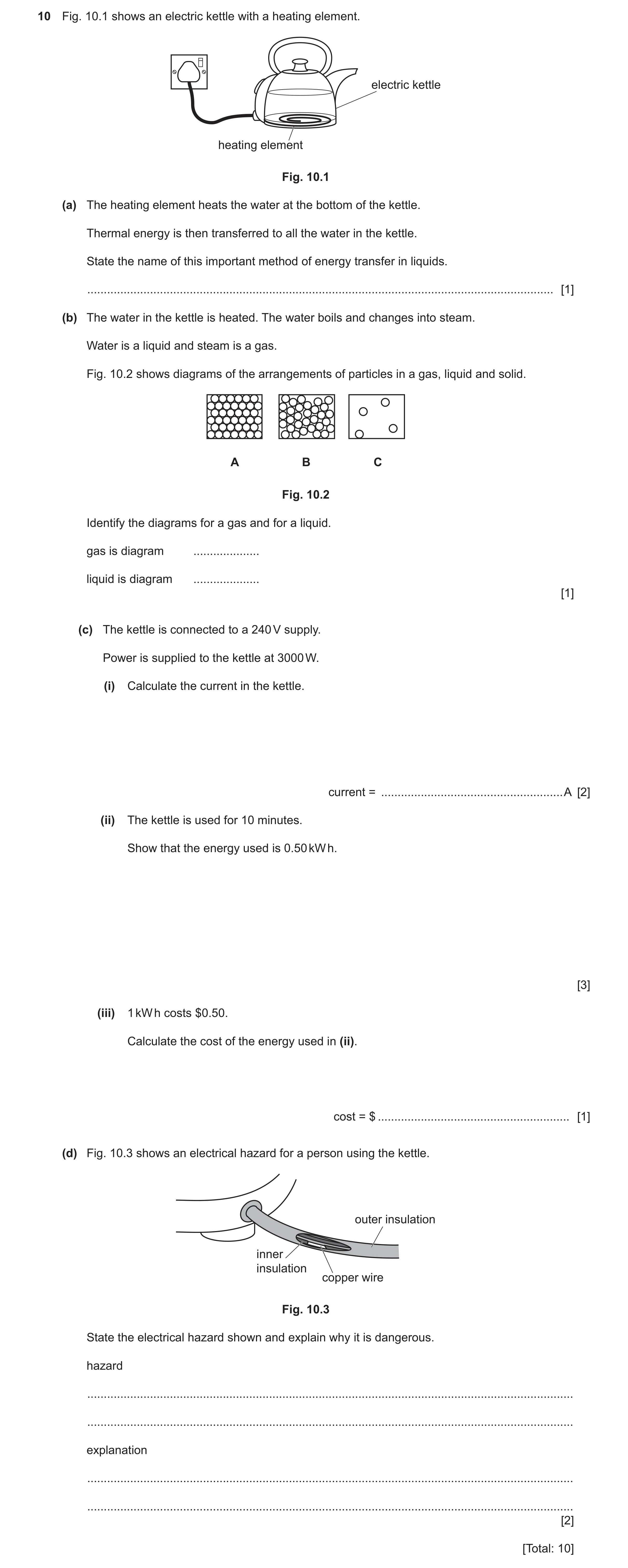
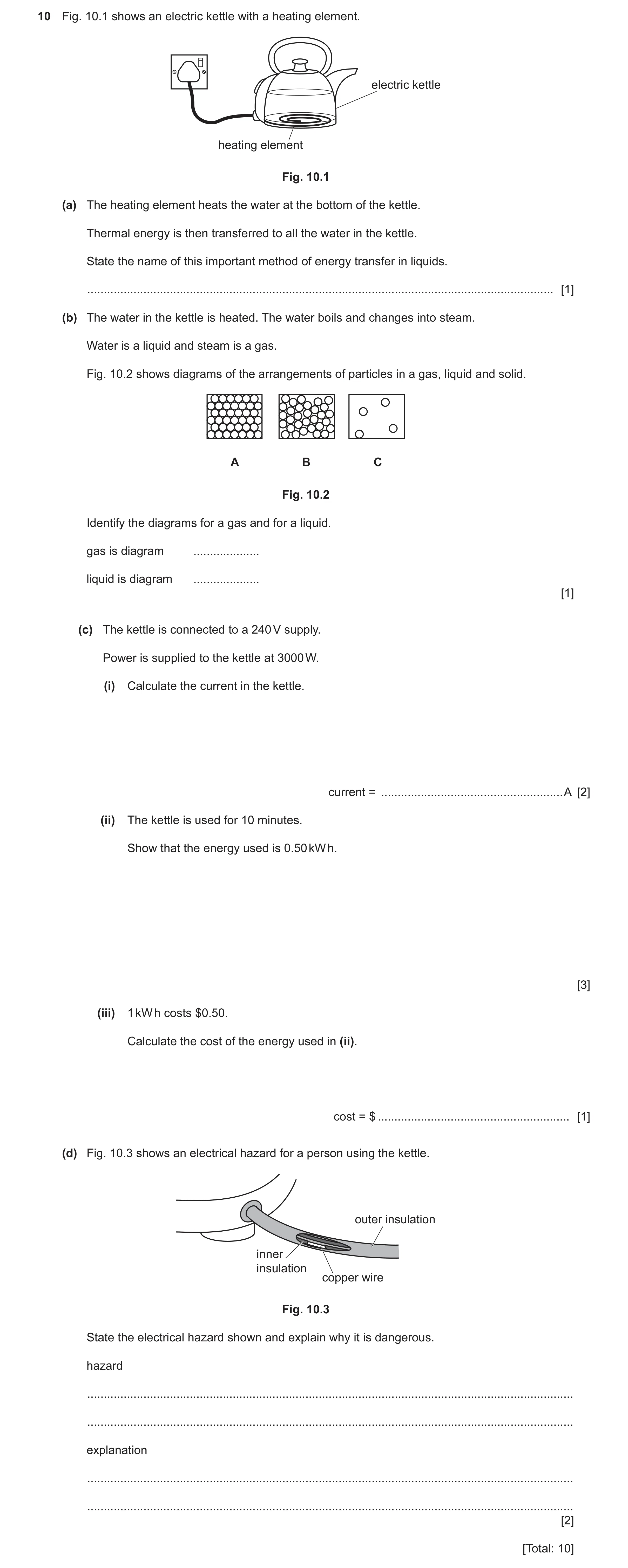
10 Fig. 10.1 shows an electric kettle with a heating element. electric kettle heating element Fig. 10.1 (a) The heating element heats the water at the bottom of the kettle. Thermal energy is then transferred to all the water in the kettle. State the name of this important method of energy transfer in liquids. … [1] (b) The water in the kettle is heated. The water boils and changes into steam. Water is a liquid and steam is a gas. Fig. 10.2 shows diagrams of the arrangements of particles in a gas, liquid and solid. A B C Fig. 10.2 Identify the diagrams for a gas and for a liquid. gas is diagram … liquid is diagram … [1] (c) The kettle is connected to a 240 V supply. Power is supplied to the kettle at 3000 W. (i) Calculate the current in the kettle. current = … A [2] (ii) The kettle is used for 10 minutes. Show that the energy used is 0.50 kW h. [3] (iii) 1 kW h costs $0.50. Calculate the cost of the energy used in (ii). cost = $ … [1] (d) Fig. 10.3 shows an electrical hazard for a person using the kettle. outer insulation inner insulation copper wire Fig. 10.3 State the electrical hazard shown and explain why it is dangerous. hazard … … explanation … … [2] [Total: 10]
10 marks
Mark scheme: 10(a) convection ; 1 10(b) (gas is diagram) C and (liquid is diagram) B ; 1 10(c)(i) P = IV (in any form) 2 OR (current =) 3000 / 240 ; 12.5 (A) ; 10(c)(ii) energy = power time (in any form) ; 3 conversion of minutes to hours ; conversion of W to kW ; (= 0.5 kWh) 10(c)(iii) ($) 0.25 ; 1 10(d) insulation damaged / exposed (live) wire / AW ; 2 electric shock ;
This question in 0654/32 Oct/Nov 2025
Q33 · An electric kettle with a heating element 0654/33 Oct/Nov 2025
10 Fig. 10.1 shows an electric kettle with a heating element. electric kettle heating element Fig. 10.1 (a) The heating element heats the water at the bottom of the kettle. Thermal energy is then transferred to all the water in the kettle. State the name of this important method of energy transfer in liquids. … [1] (b) The water in the kettle is heated. The water boils and changes into steam. Water is a liquid and steam is a gas. Fig. 10.2 shows diagrams of the arrangements of particles in a gas, liquid and solid. A B C Fig. 10.2 Identify the diagrams for a gas and for a liquid. gas is diagram … liquid is diagram … [1] (c) The kettle is connected to a 240 V supply. Power is supplied to the kettle at 3000 W. (i) Calculate the current in the kettle. current = … A [2] (ii) The kettle is used for 10 minutes. Show that the energy used is 0.50 kW h. [3] (iii) 1 kW h costs $0.50. Calculate the cost of the energy used in (ii). cost = $ … [1] (d) Fig. 10.3 shows an electrical hazard for a person using the kettle. outer insulation inner insulation copper wire Fig. 10.3 State the electrical hazard shown and explain why it is dangerous. hazard … … explanation … … [2] [Total: 10]
10 marks
Mark scheme: 10(a) convection ; 1 10(b) (gas is diagram) C and (liquid is diagram) B ; 1 10(c)(i) P = IV (in any form) 2 OR (current =) 3000 / 240 ; 12.5 (A) ; 10(c)(ii) energy = power time (in any form) ; 3 conversion of minutes to hours ; conversion of W to kW ; (= 0.5 kWh) 10(c)(iii) ($) 0.25 ; 1 10(d) insulation damaged / exposed (live) wire / AW ; 2 electric shock ;
This question in 0654/33 Oct/Nov 2025
 3 / 59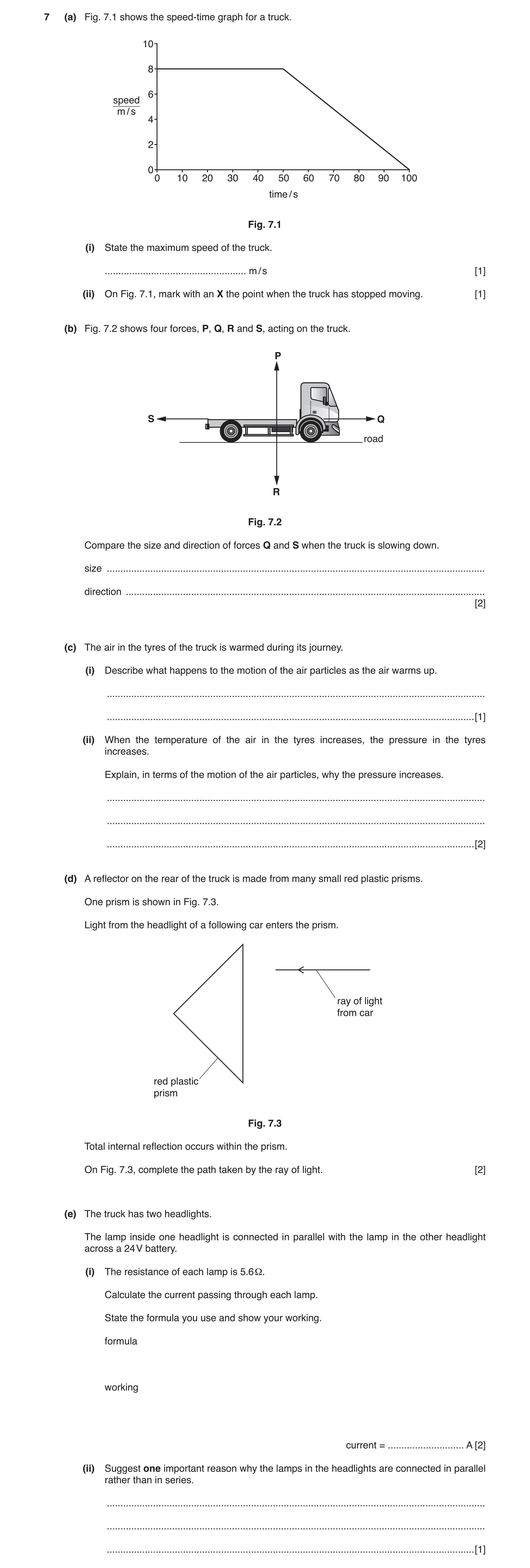
 51 / 59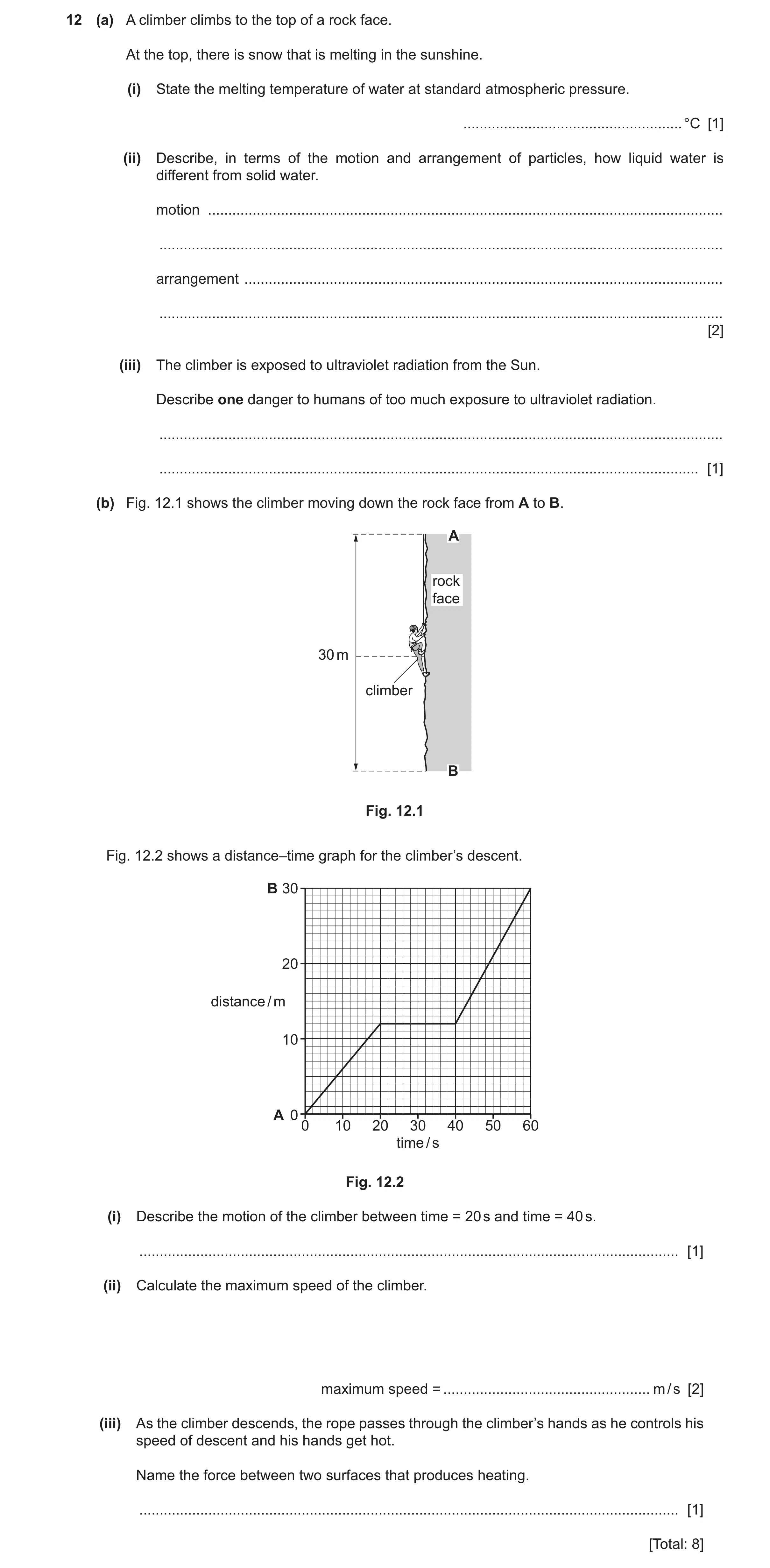
 10
10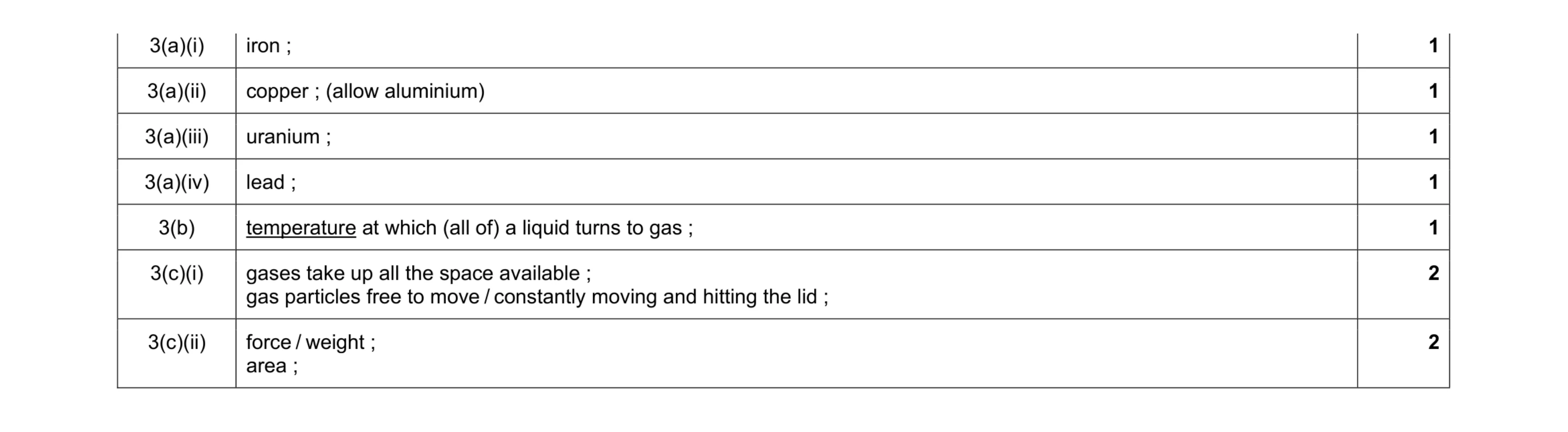 9
9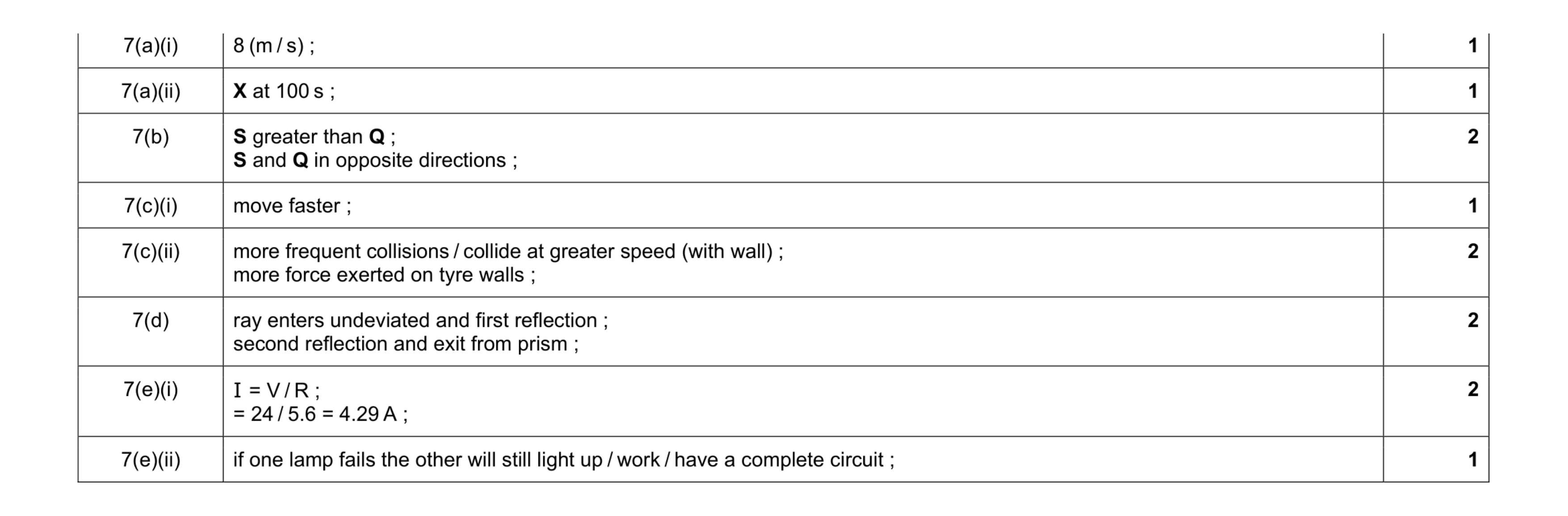 12
12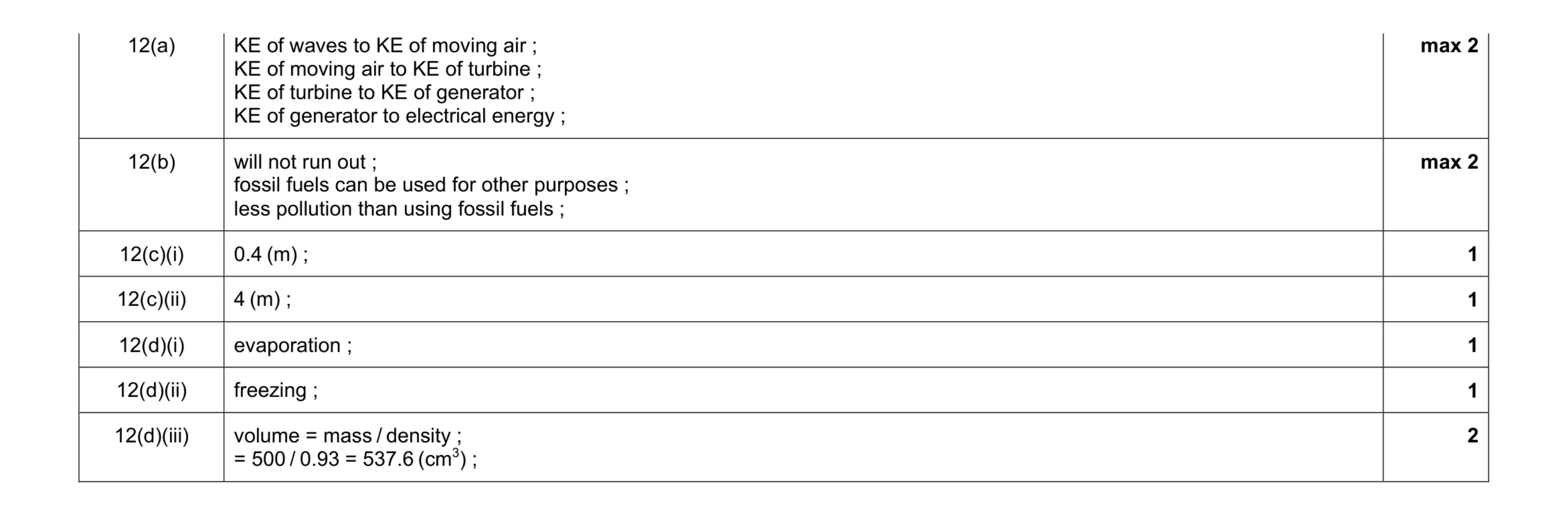 10
10 6
6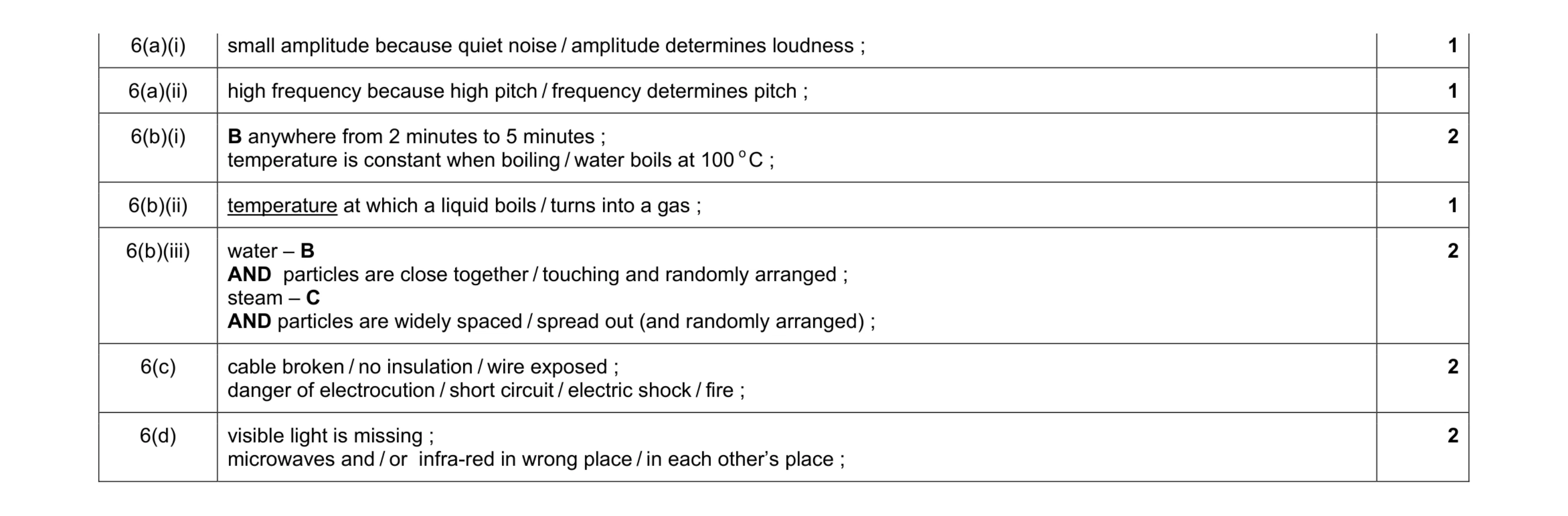 11
11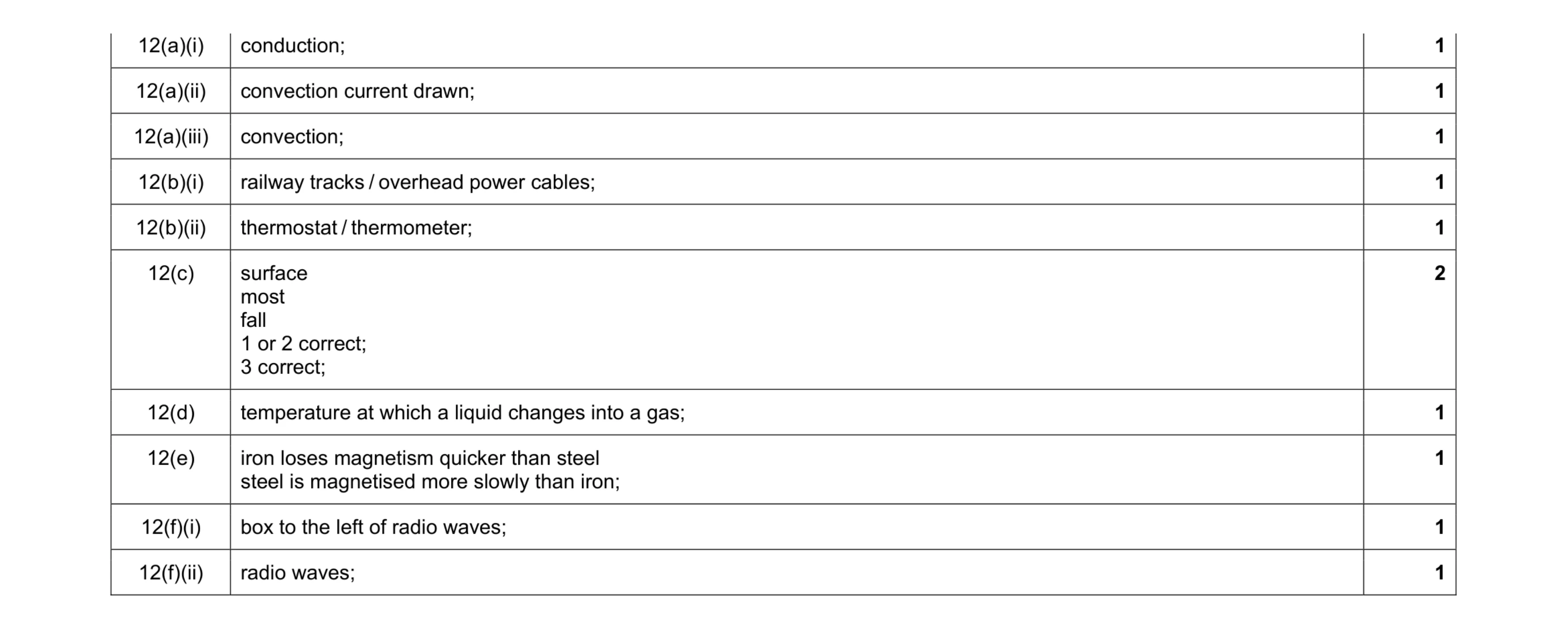 11
11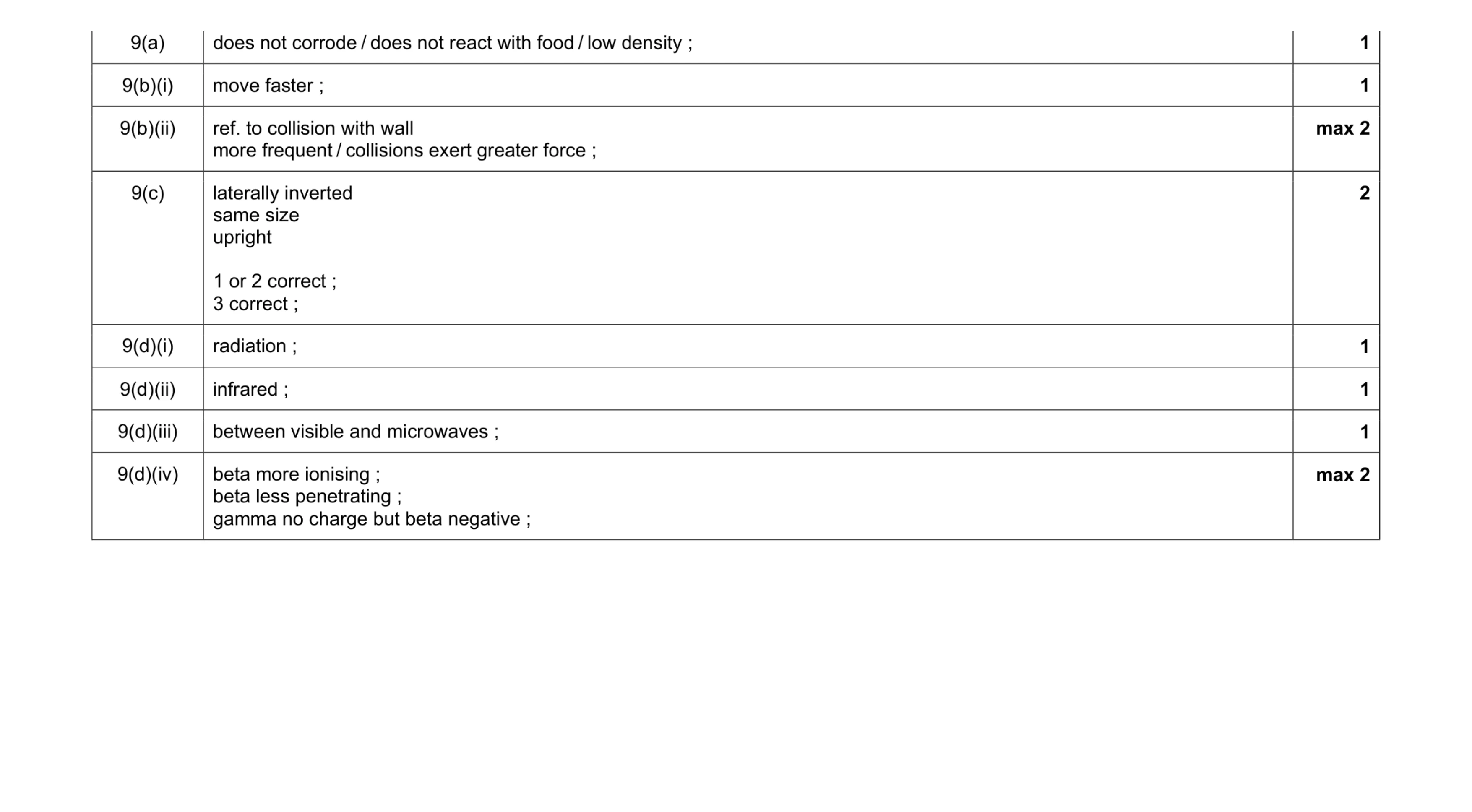 11
11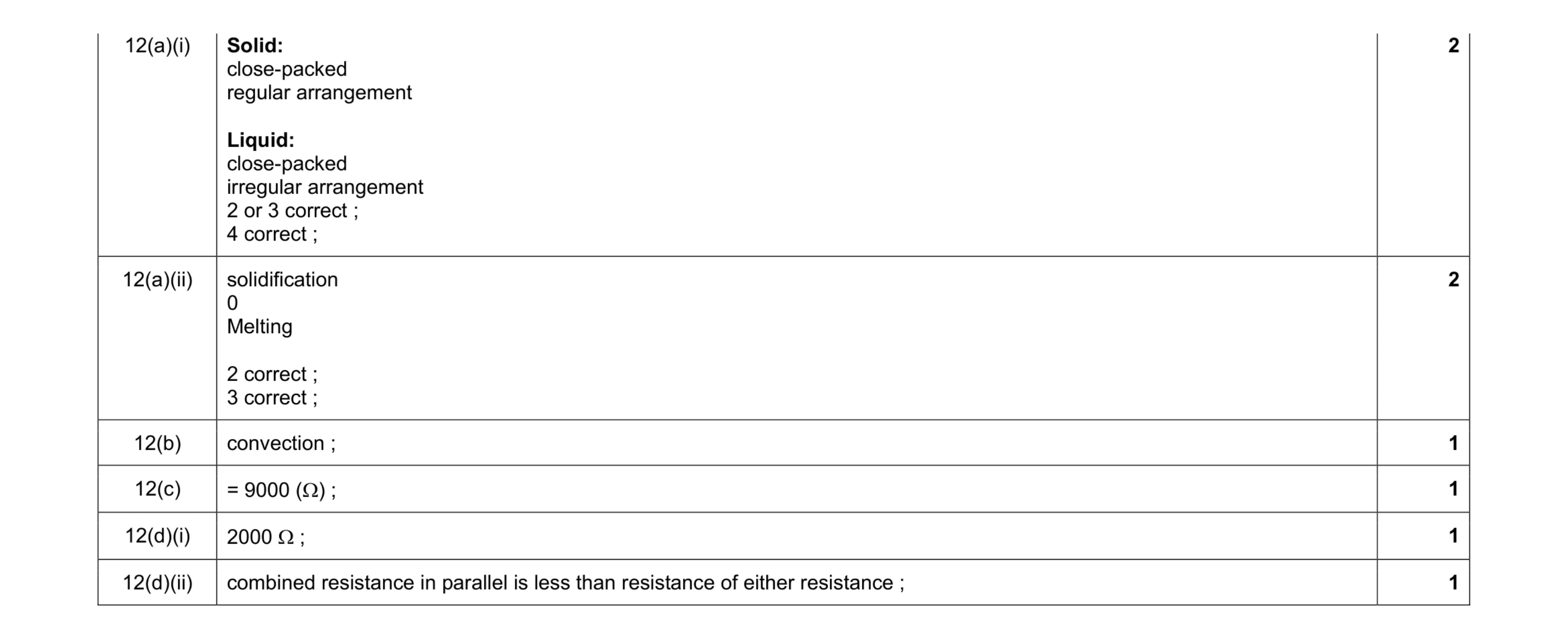 8
8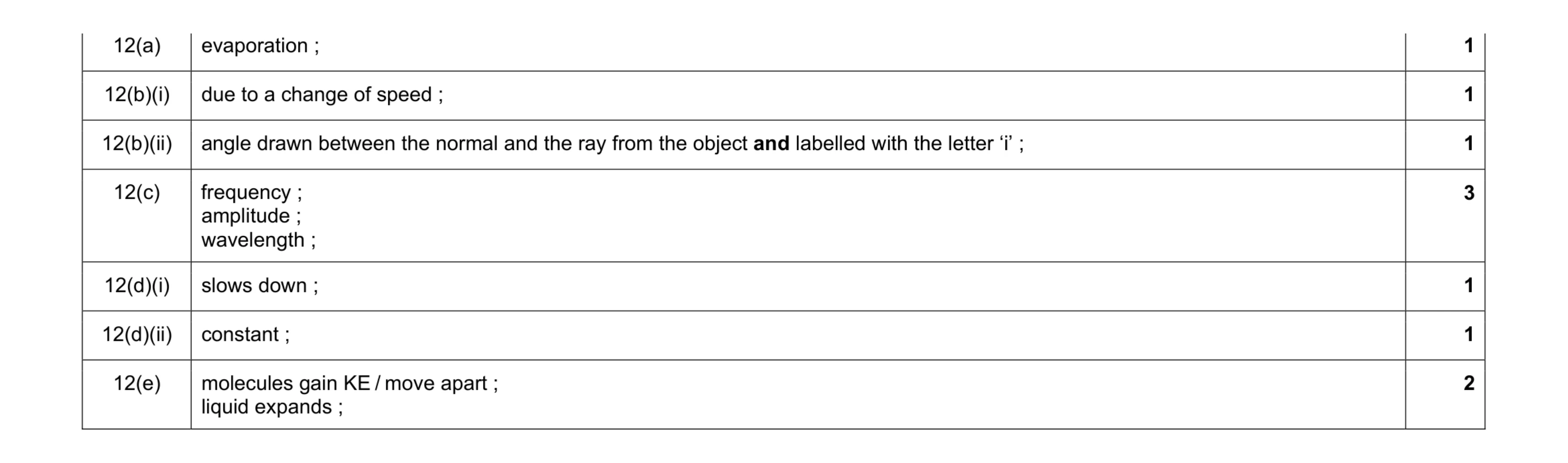 10
10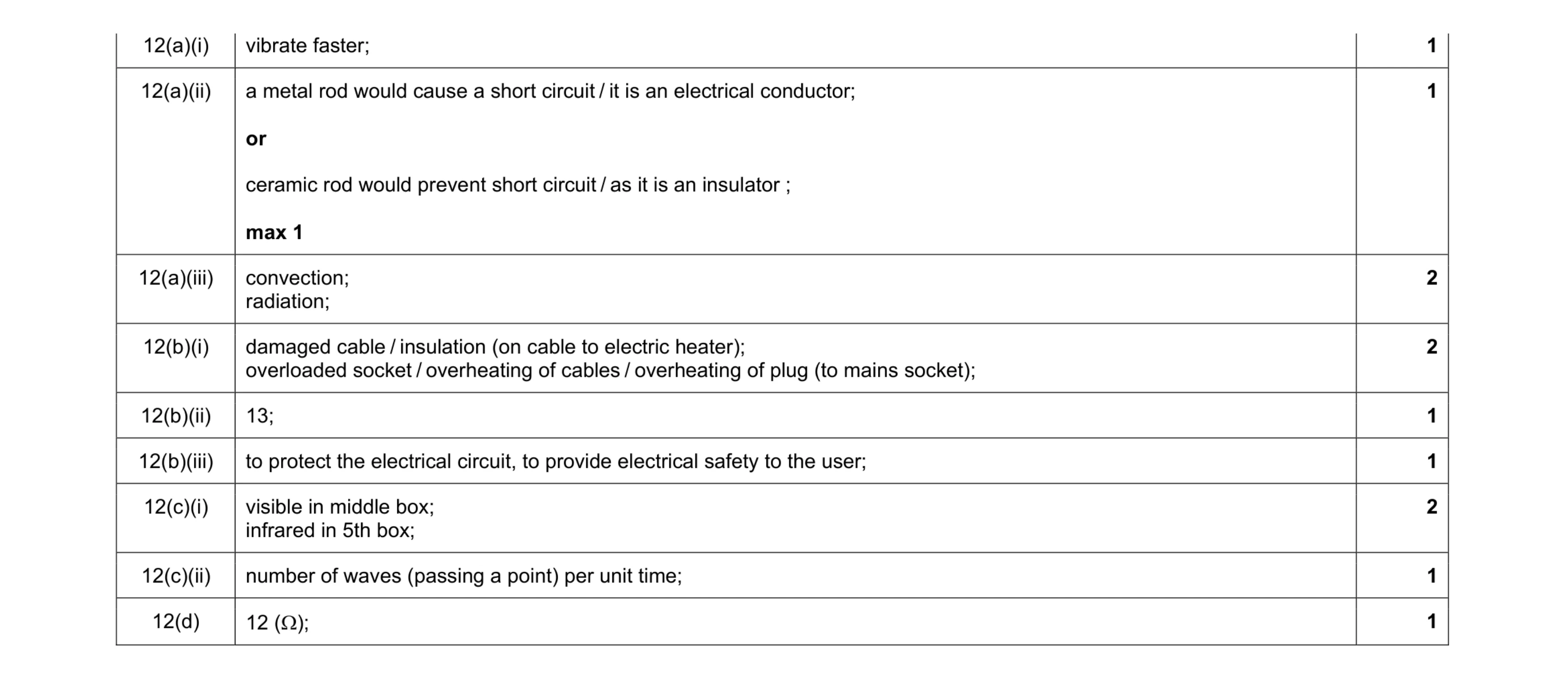 12
12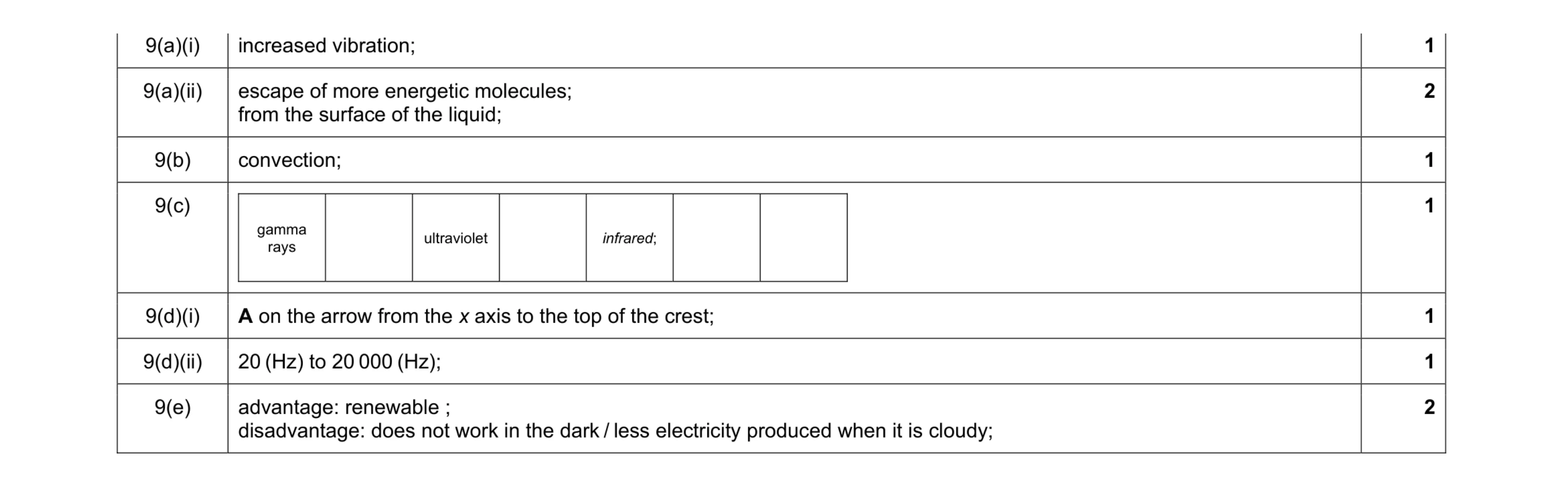 9
9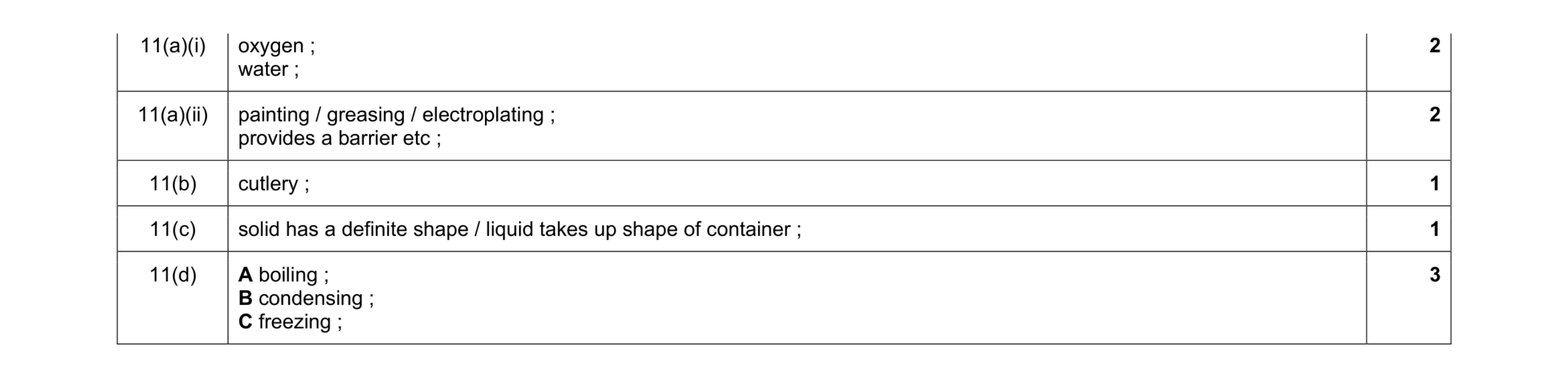 9
9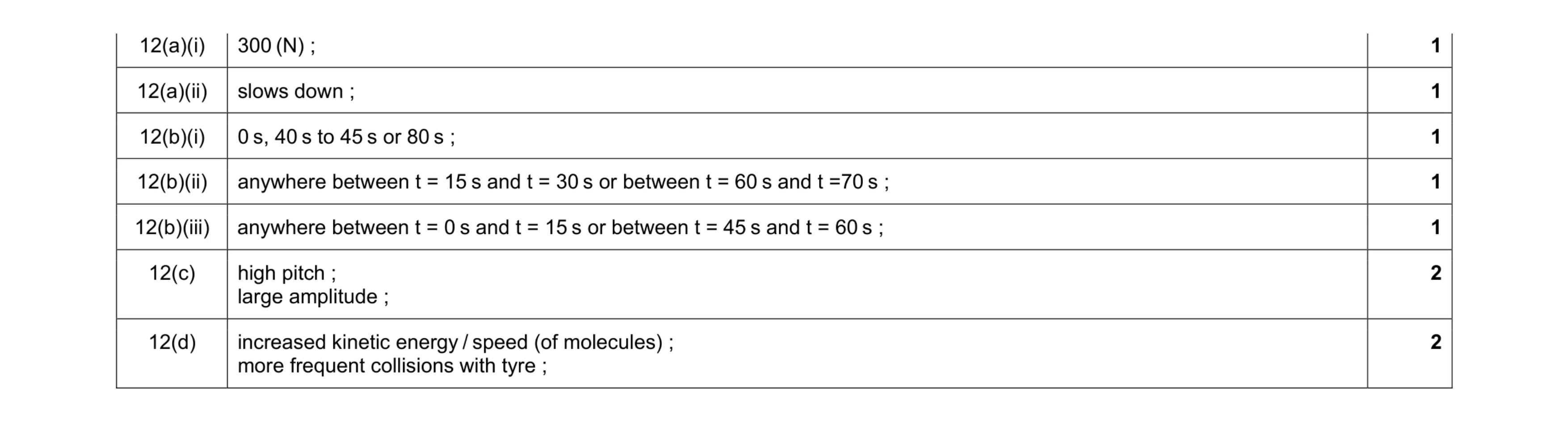 9
9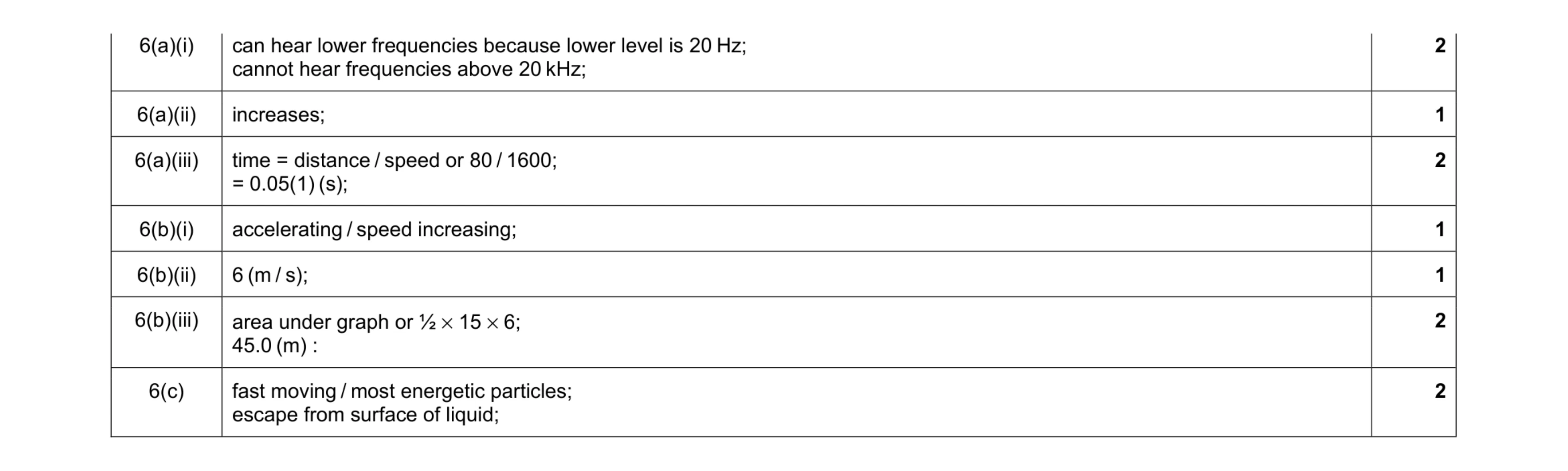 11
11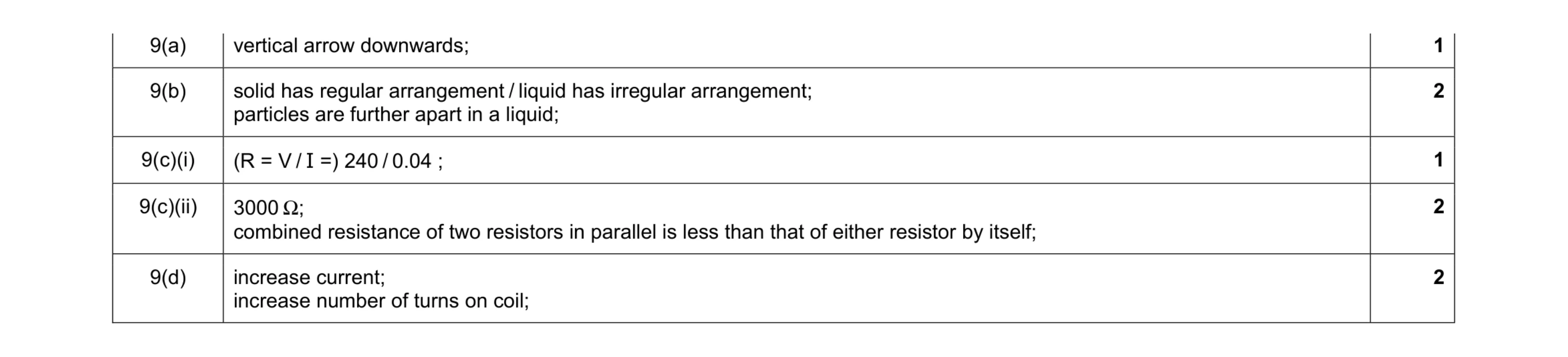 8
8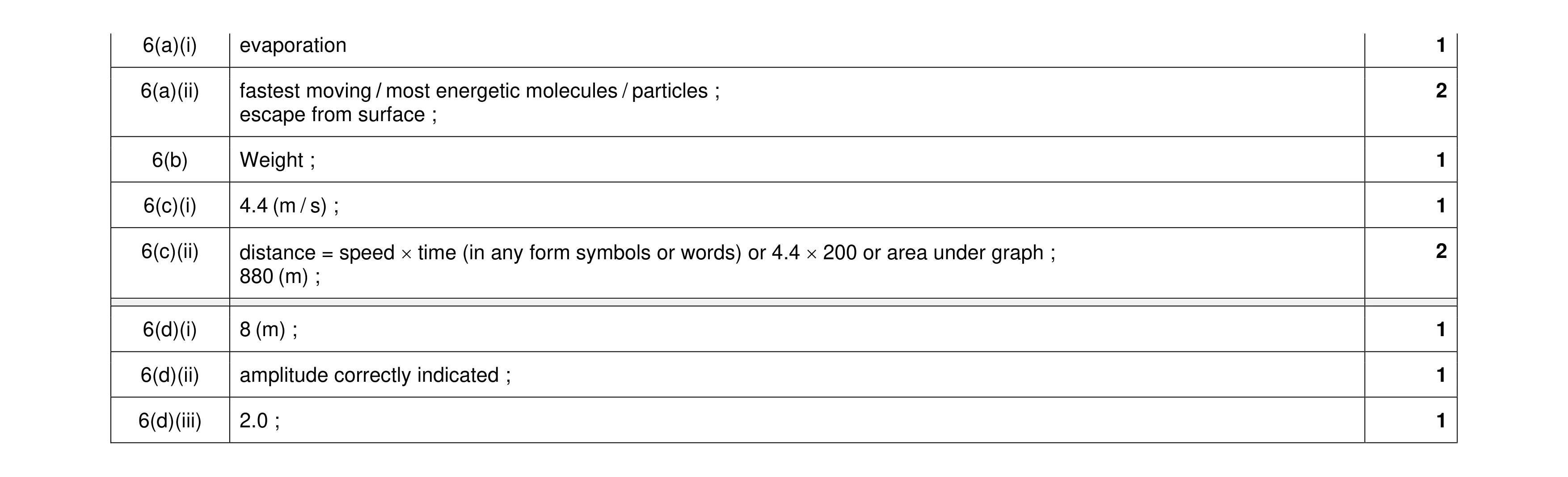 10
10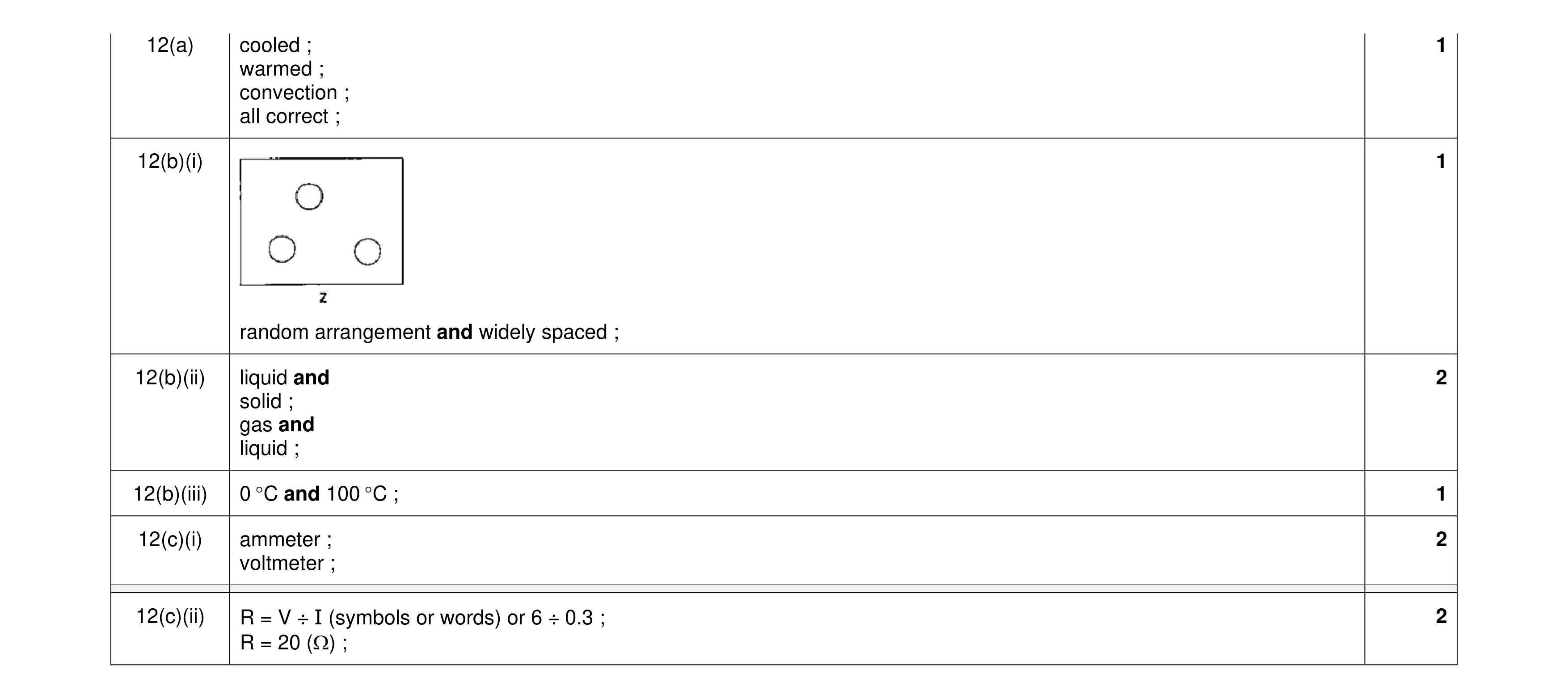 9
9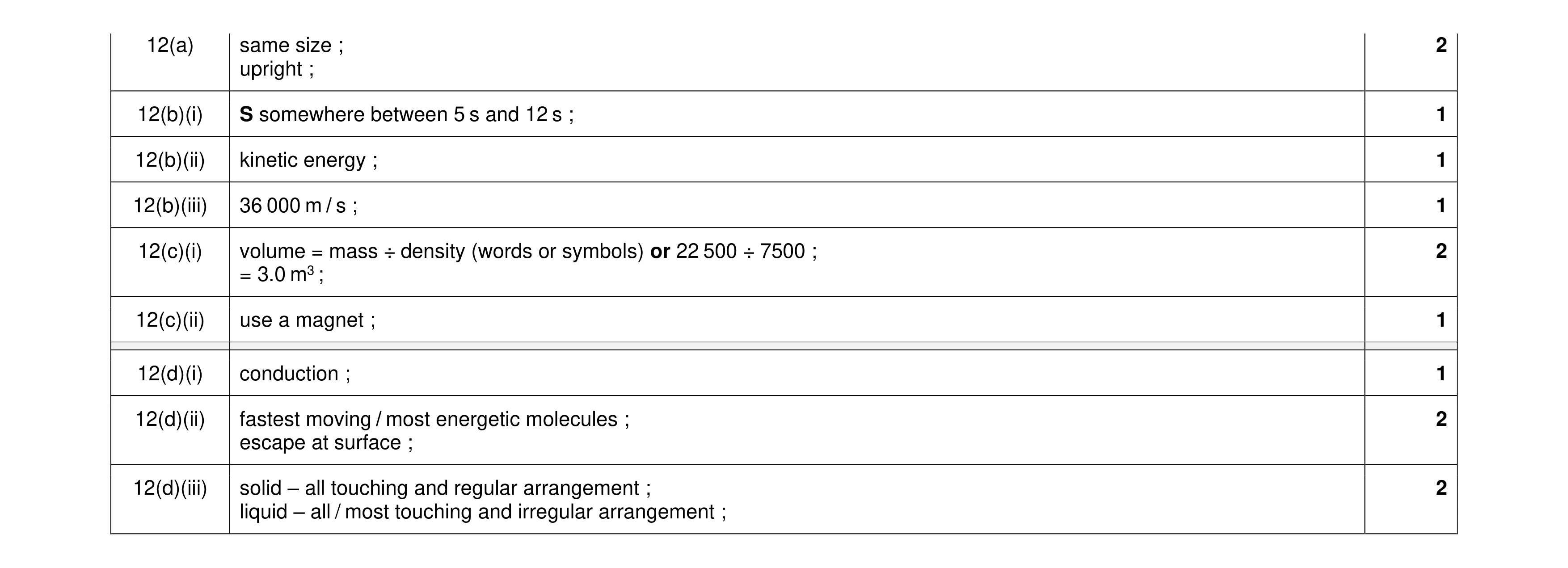 13
13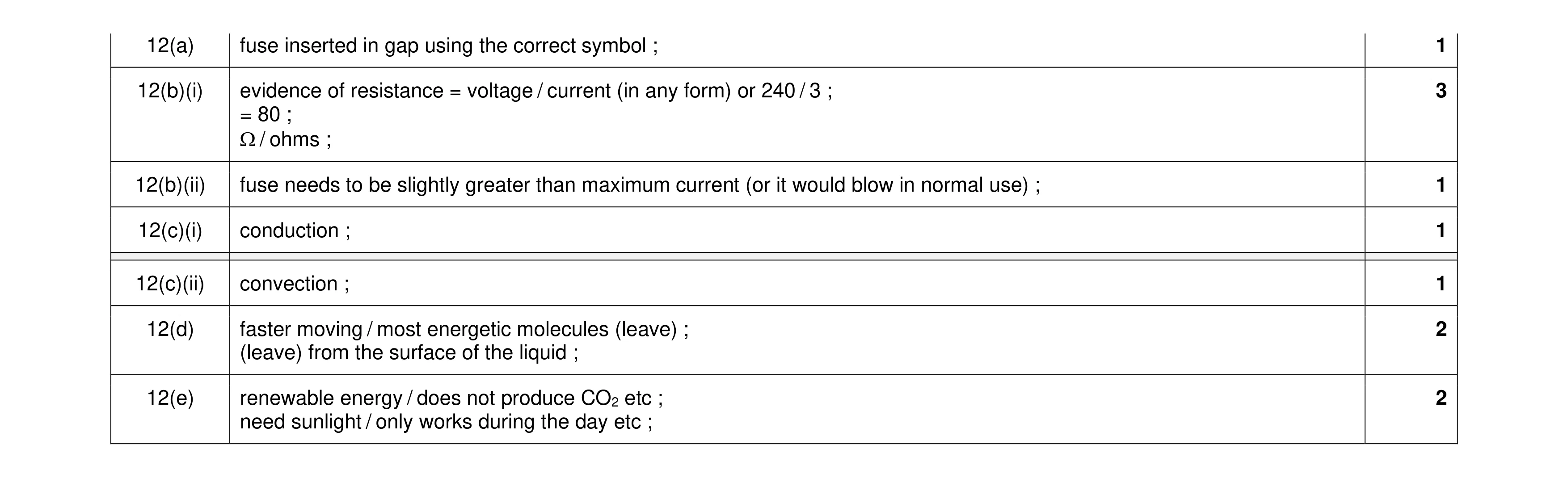 11
11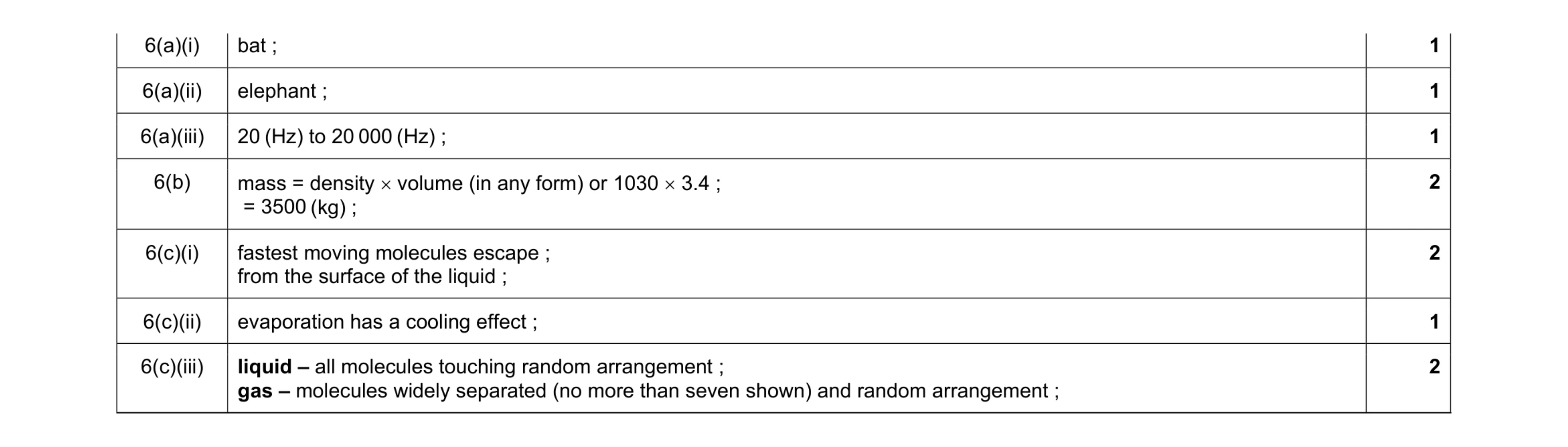 10
10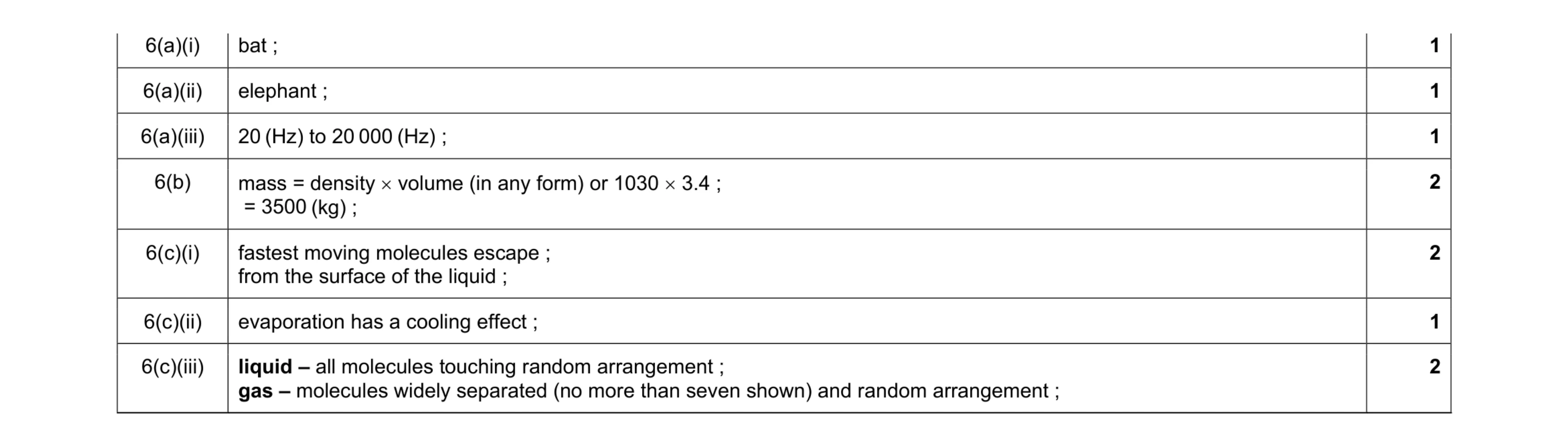 10
10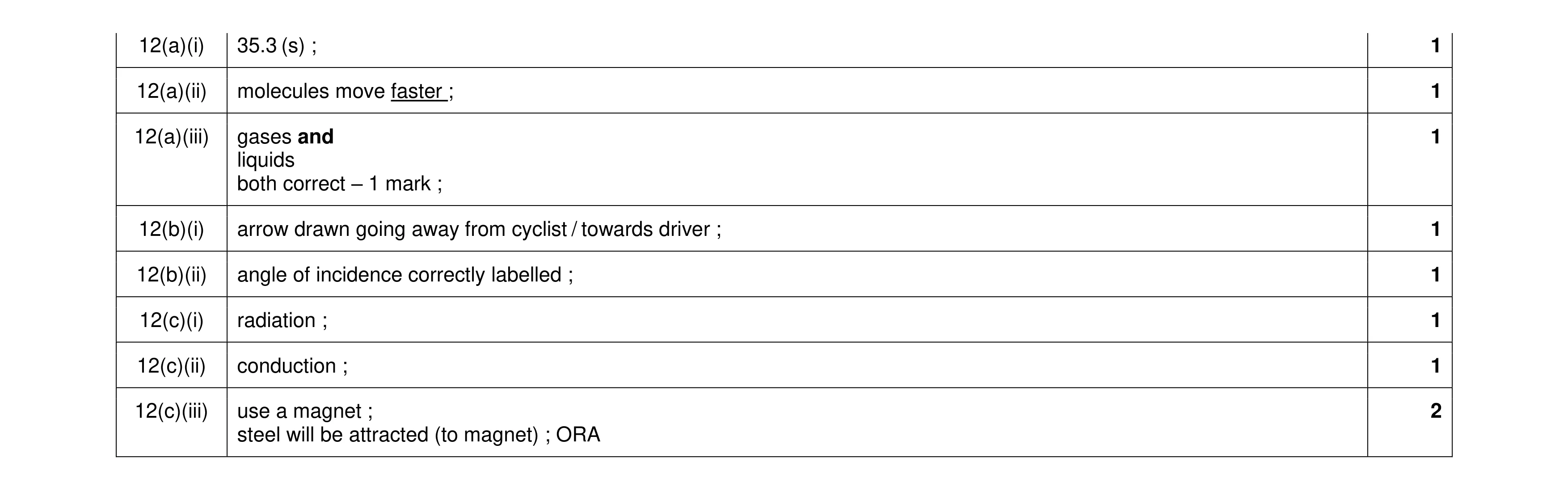 9
9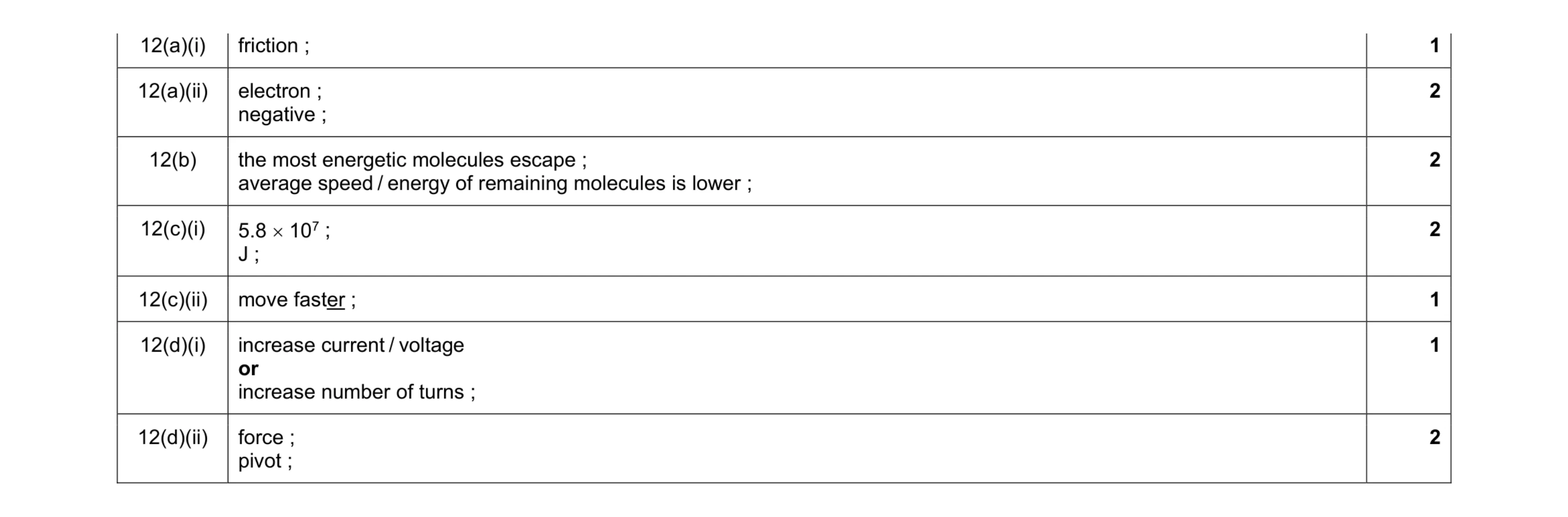 11
11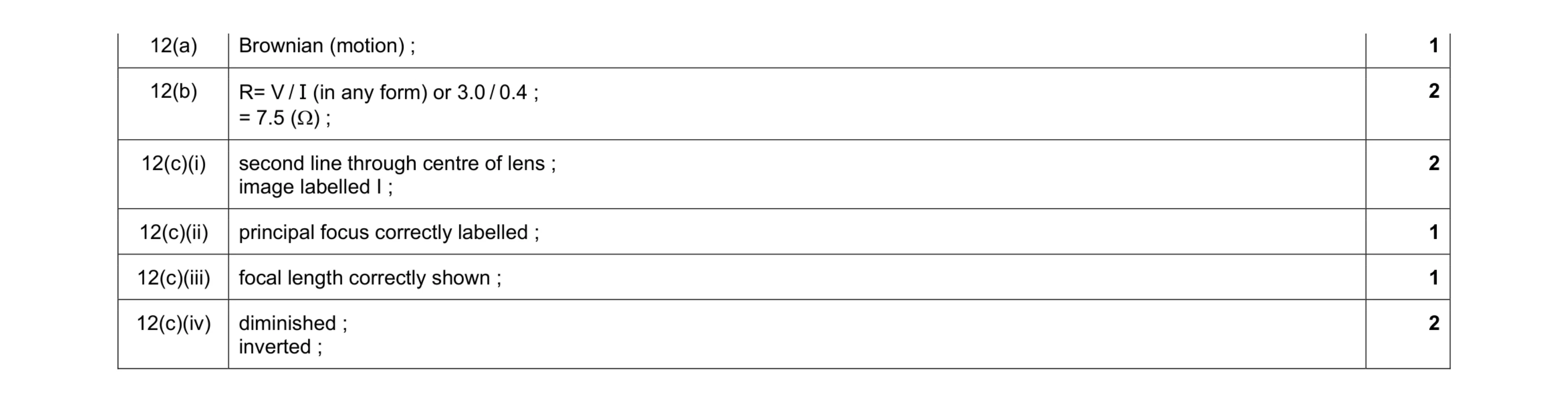 9
9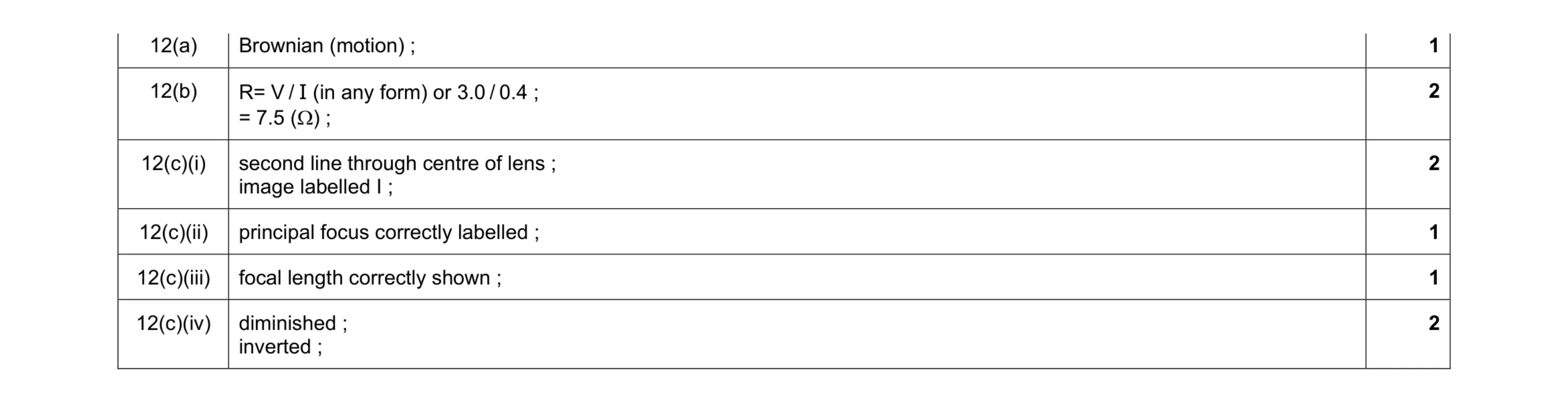 9
9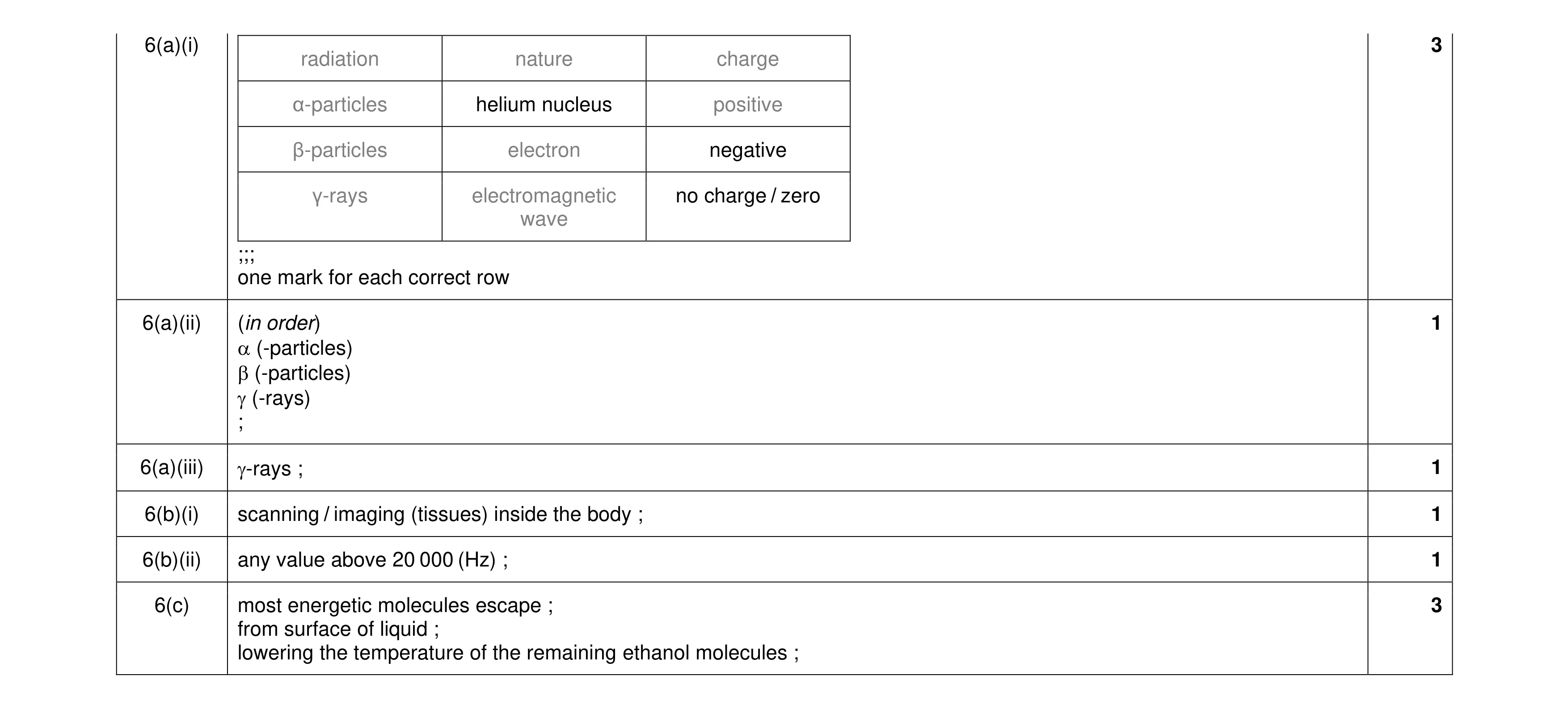 10
10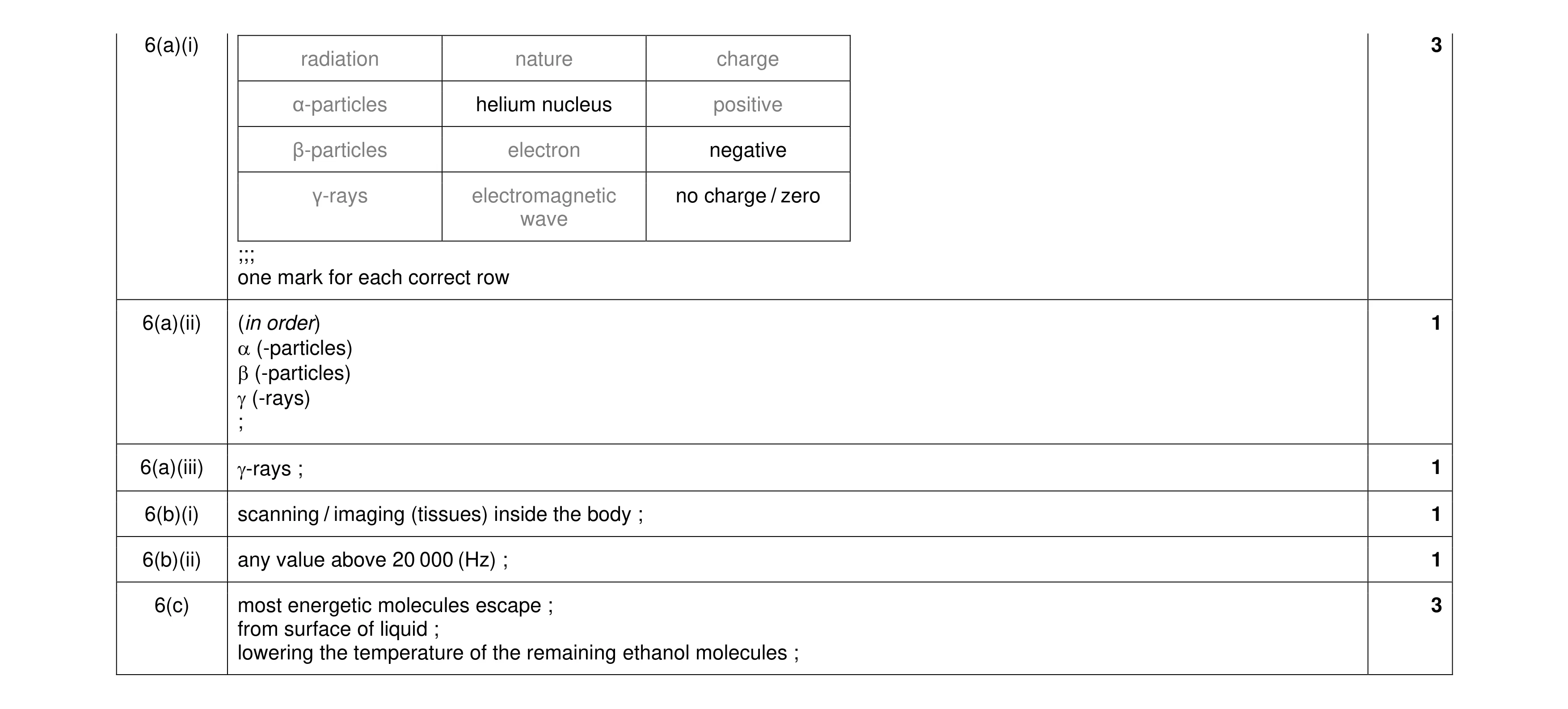 10
10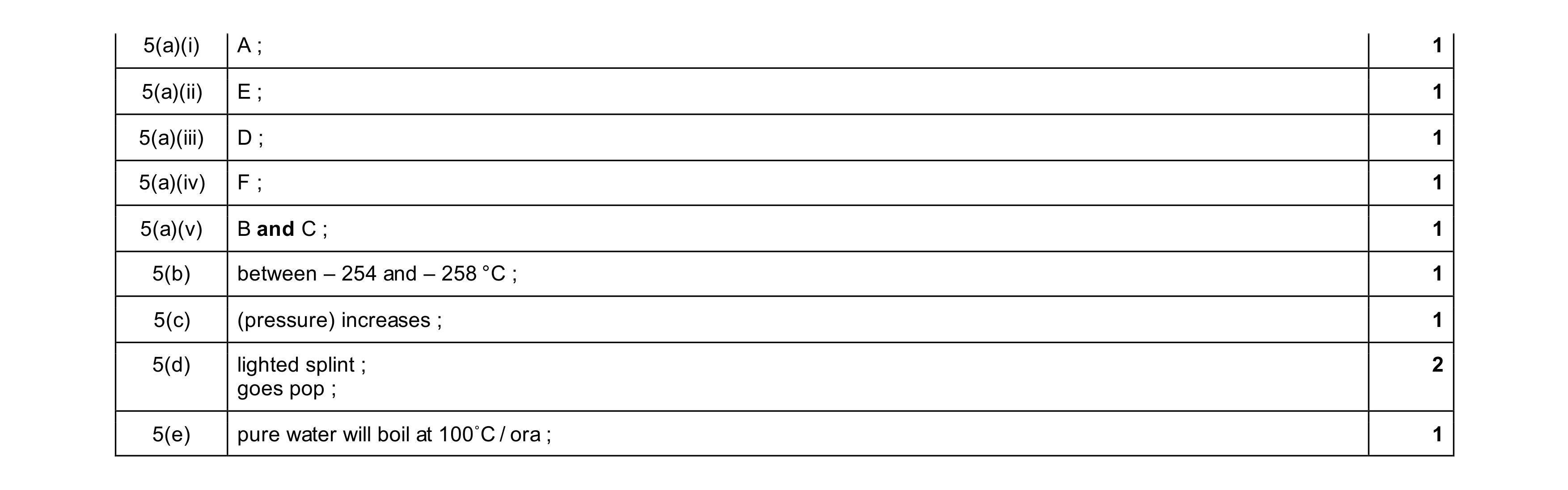 10
10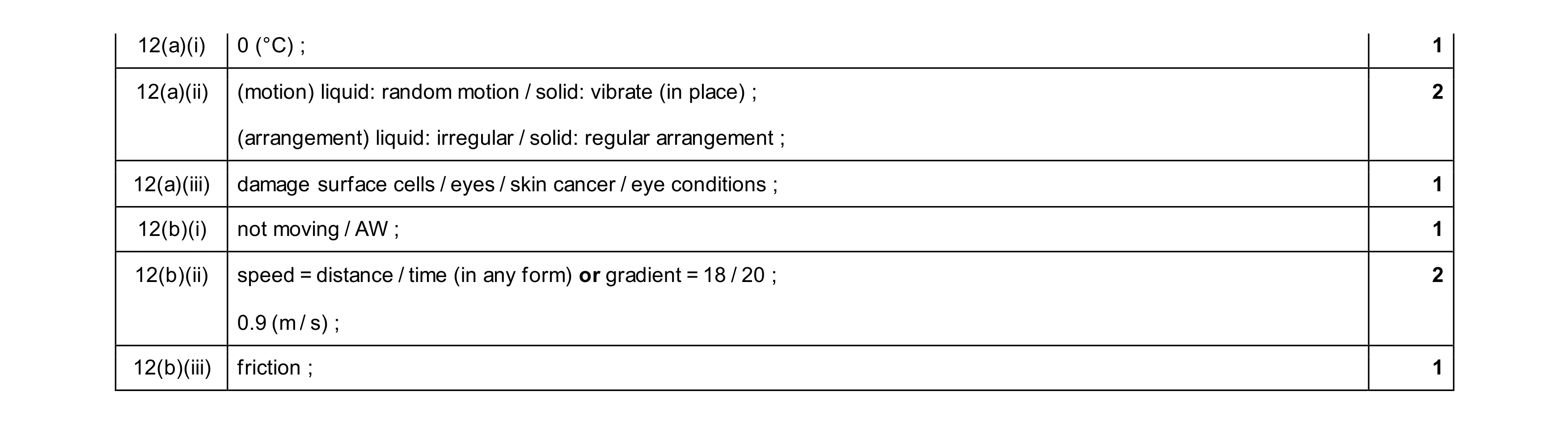 8
8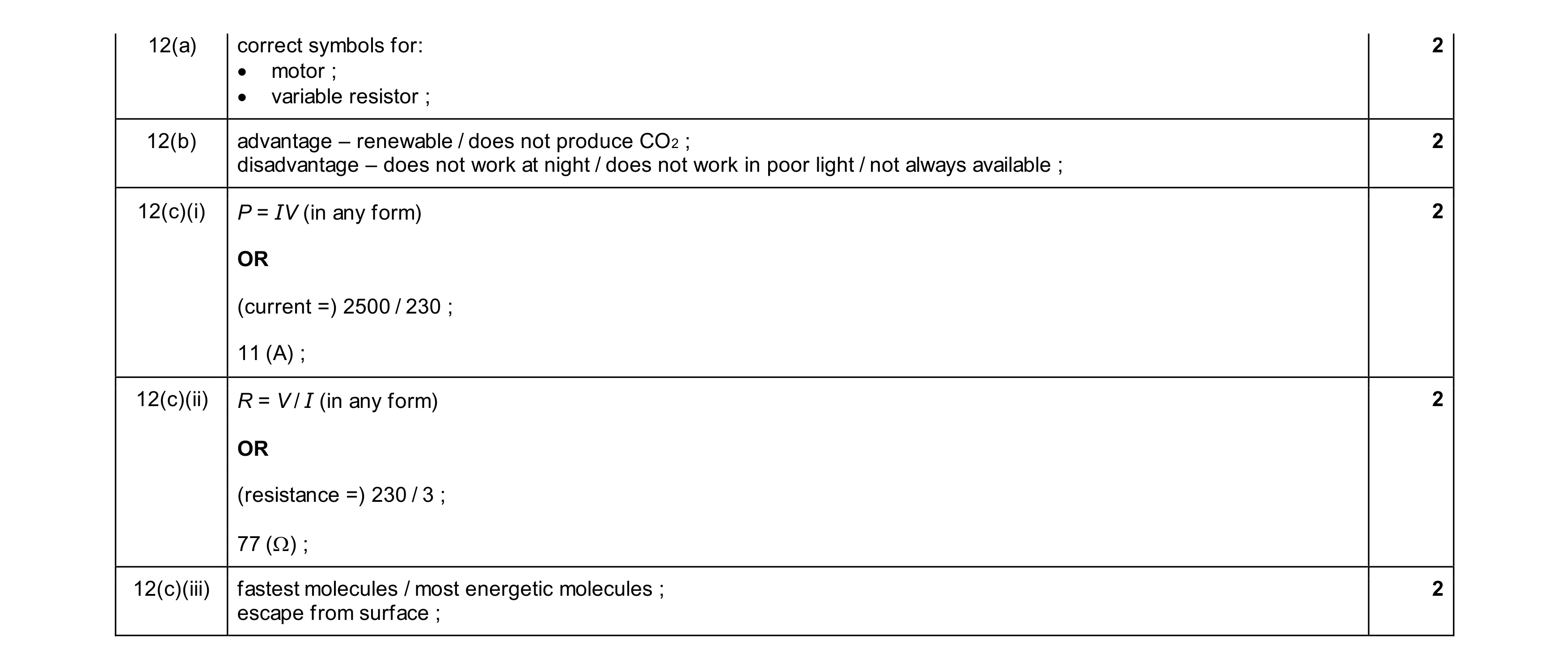 10
10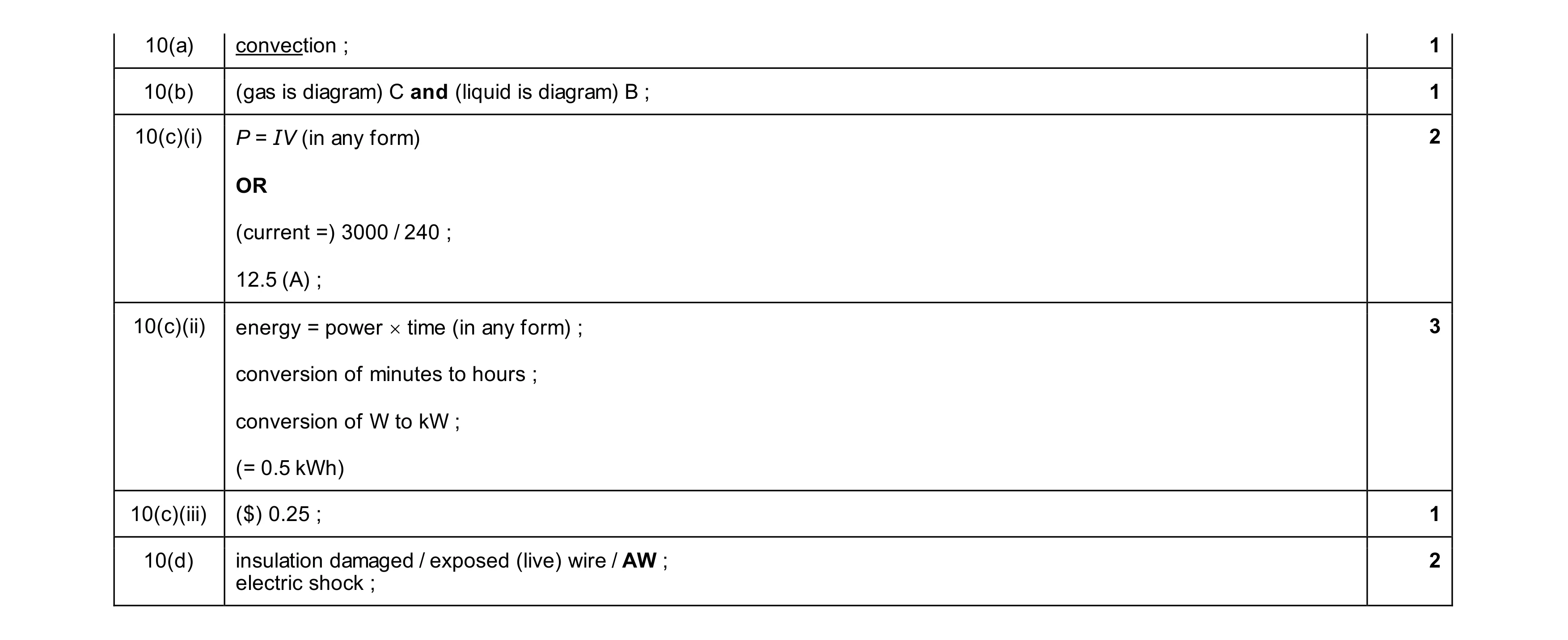 10
10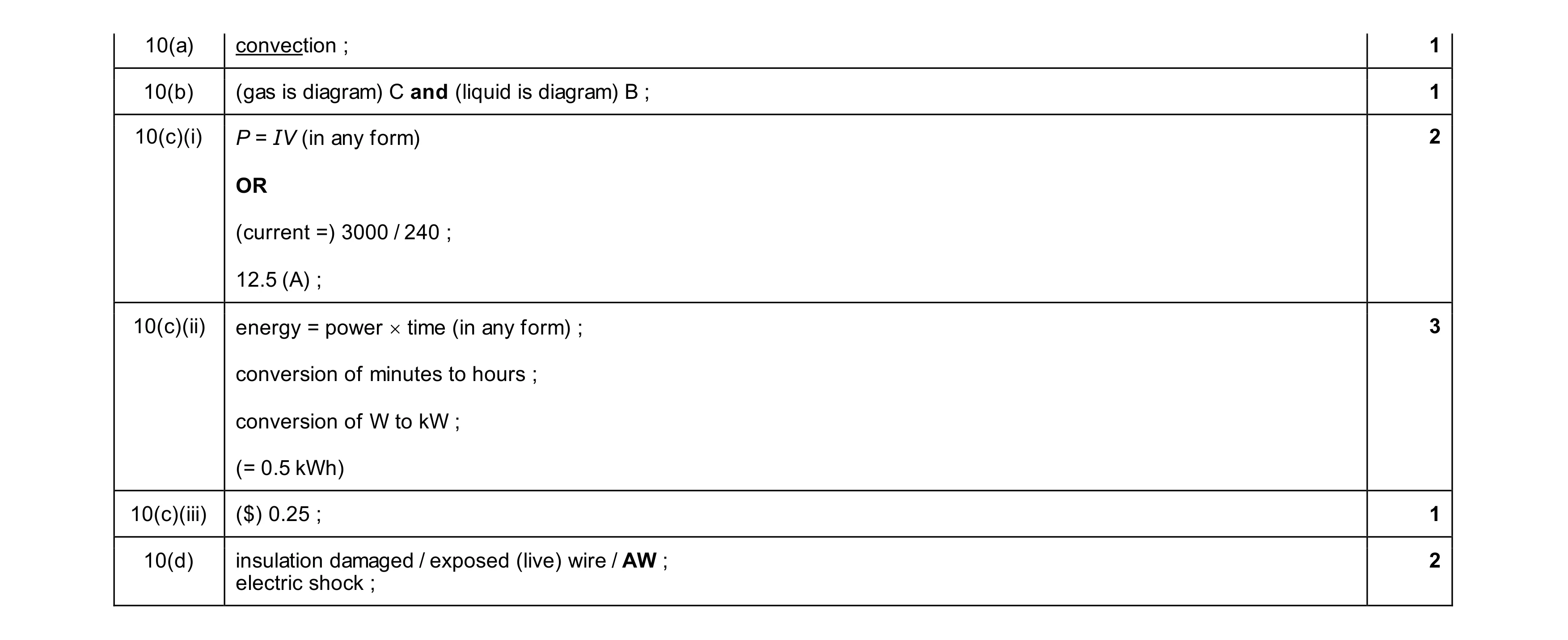 10
10