Questions as text
Q1 · In which states of matter is convection the main heat transfer process? 0653/22 Feb/March 2017
34 In which states of matter is convection the main heat transfer process? A gases and solids only B liquids and gases only C solids and liquids only D solids, liquids and gases
1 marks
Answer: B
This question in 0653/22 Feb/March 2017
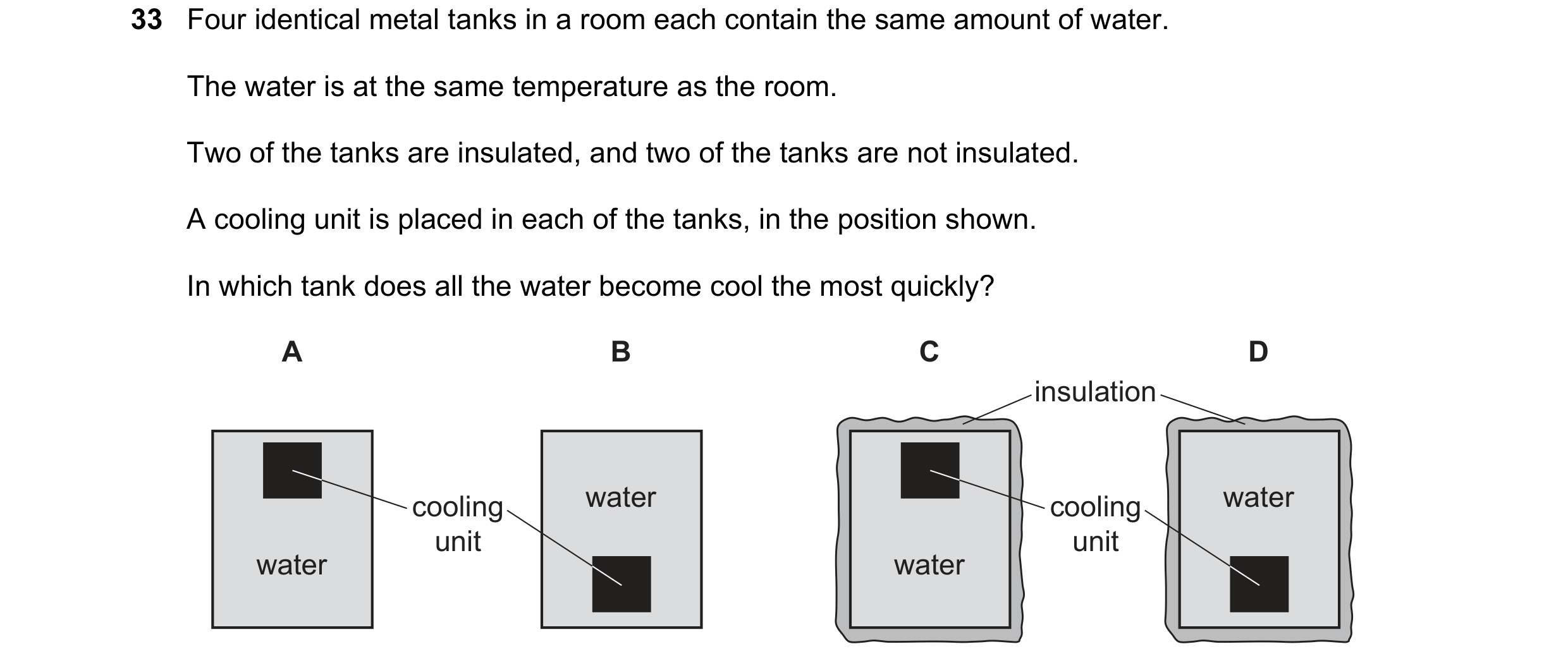
Q2 · Four identical metal tanks in a room each contain the same amount of water 0653/21 May/June 2017
33 Four identical metal tanks in a room each contain the same amount of water. The water is at the same temperature as the room. Two of the tanks are insulated, and two of the tanks are not insulated. A cooling unit is placed in each of the tanks, in the position shown. In which tank does all the water become cool the most quickly? A B C D insulation cooling water cooling water unit unit water water
1 marks
Answer: C
This question in 0653/21 May/June 2017
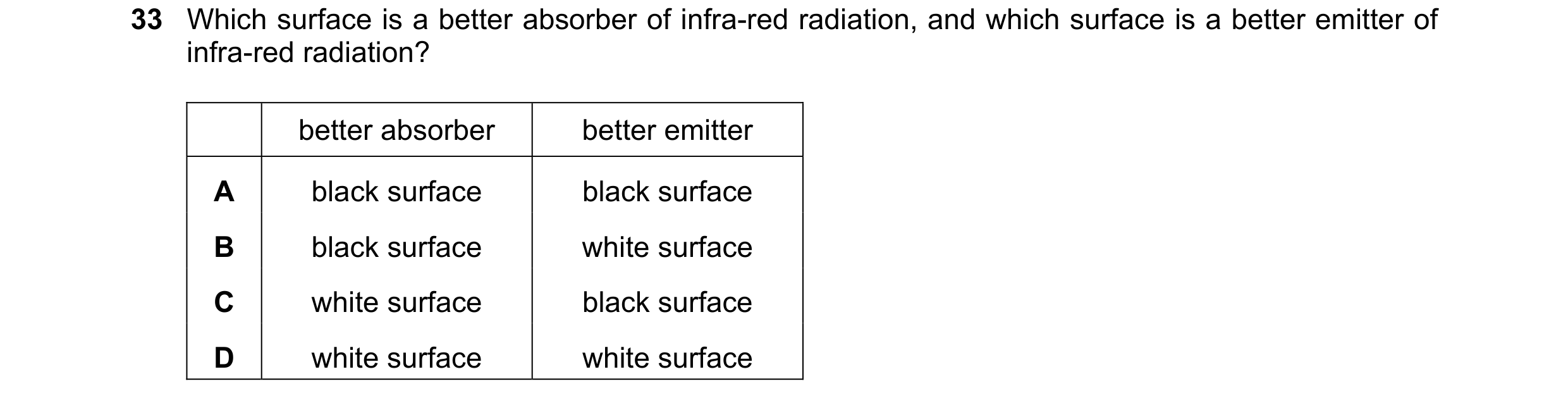
Q3 · Which surface is a better absorber of infra-red radiation, and which surface is a better… 0653/22 May/June 2017
33 Which surface is a better absorber of infra-red radiation, and which surface is a better emitter of infra-red radiation? better absorber better emitter A black surface black surface B black surface white surface C white surface black surface D white surface white surface
1 marks
Answer: A
This question in 0653/22 May/June 2017
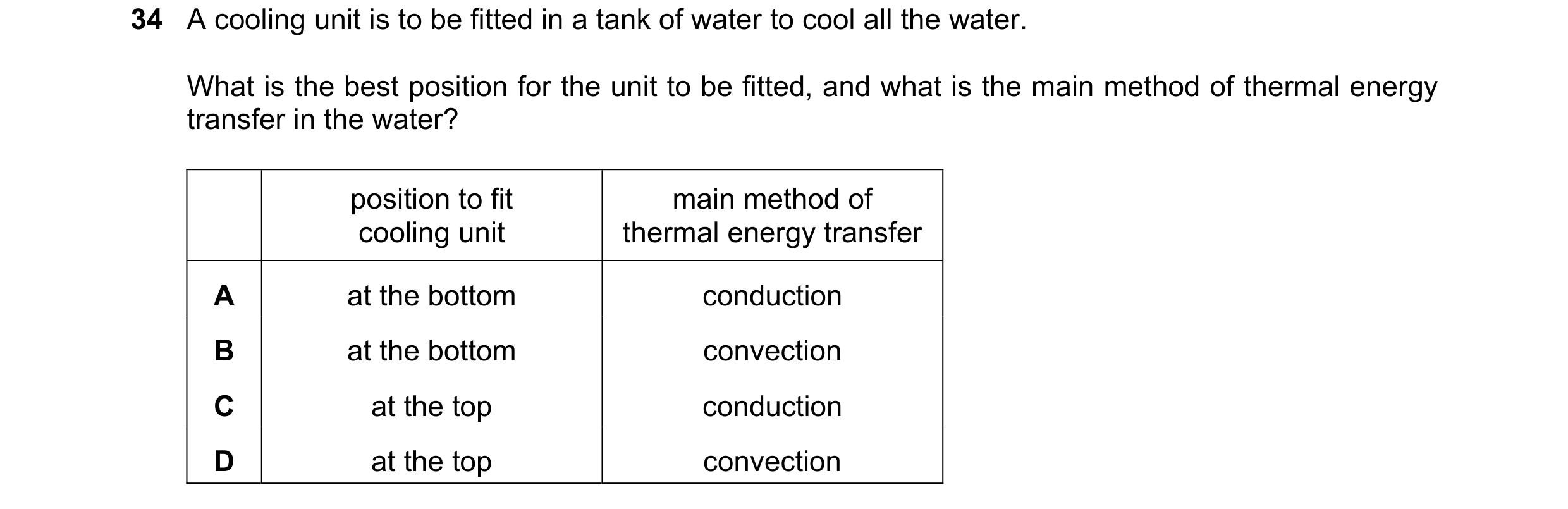
Q4 · A cooling unit is to be fitted in a tank of water to cool all the water 0653/23 May/June 2017
34 A cooling unit is to be fitted in a tank of water to cool all the water. What is the best position for the unit to be fitted, and what is the main method of thermal energy transfer in the water? position to fit main method of cooling unit thermal energy transfer A at the bottom conduction B at the bottom convection C at the top conduction D at the top convection
1 marks
Answer: D
This question in 0653/23 May/June 2017
Q5 · A teacher explains about transfer of thermal energy 0653/21 Oct/Nov 2017
33 A teacher explains about transfer of thermal energy. When air is … X … , it becomes less dense and rises. This helps to explain transfer of thermal energy by «...Y«... . Which words complete gaps X and Y? X Y A cooled conduction B cooled convection C heated conduction D heated convection
1 marks
Answer: D
This question in 0653/21 Oct/Nov 2017
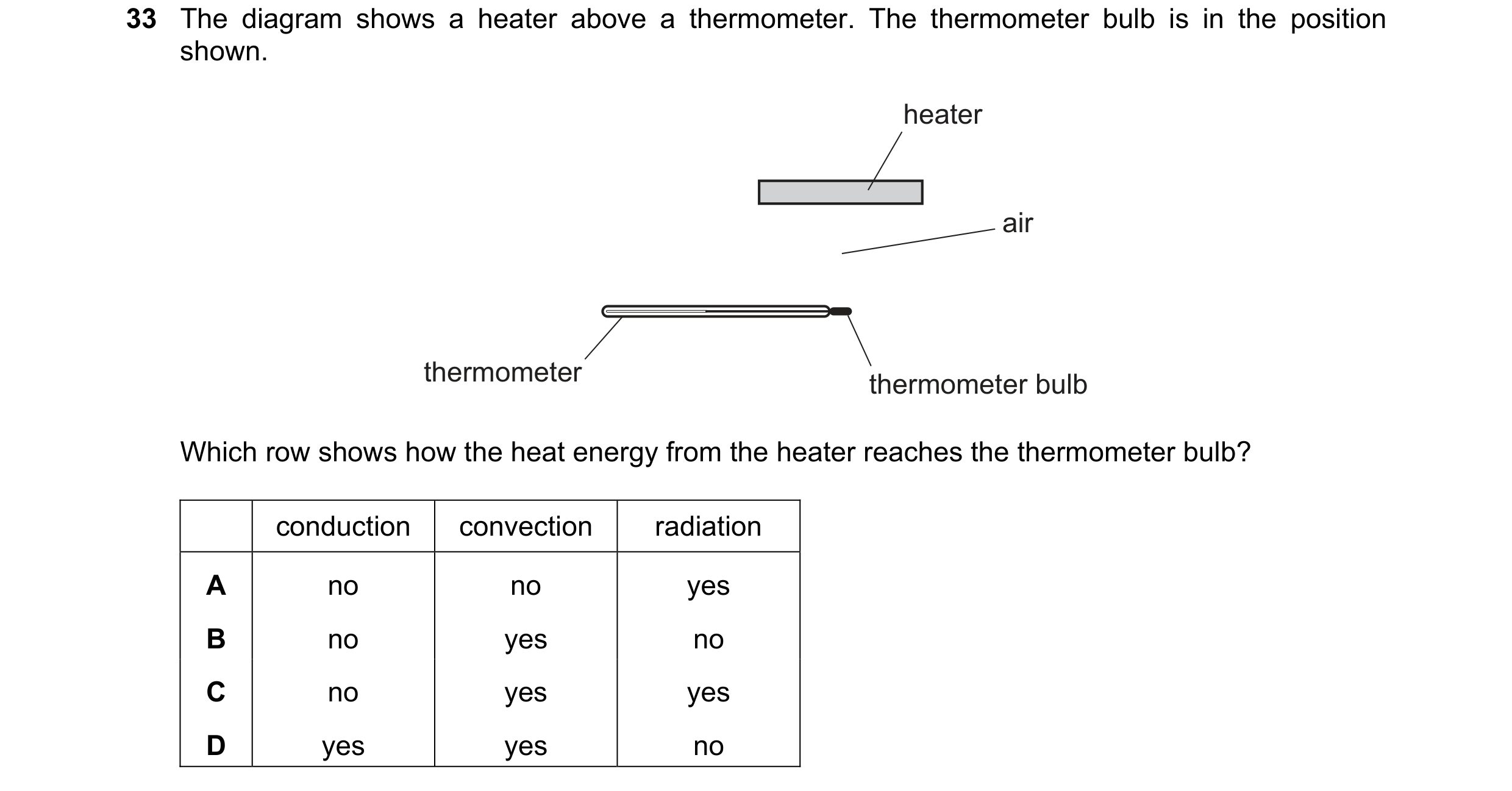
Q6 · The diagram shows a heater above a thermometer 0653/22 Oct/Nov 2017
33 The diagram shows a heater above a thermometer. The thermometer bulb is in the position shown. heater air thermometer thermometer bulb Which row shows how the heat energy from the heater reaches the thermometer bulb? conduction convection radiation A no no yes B no yes no C no yes yes D yes yes no
1 marks
Answer: A
This question in 0653/22 Oct/Nov 2017
Q7 · The diagram shows an air-conditioning unit on the wall of a room 0653/23 Oct/Nov 2017
33 The diagram shows an air-conditioning unit on the wall of a room. The unit draws in warm air from the room and releases cold air into the room. air-conditioning unit What happens to the cold air and what is the reason? cold air reason A falls it is less dense than warm air B falls it is more dense than warm air C rises it is less dense than warm air D rises it is more dense than warm air
1 marks
Answer: B
This question in 0653/23 Oct/Nov 2017
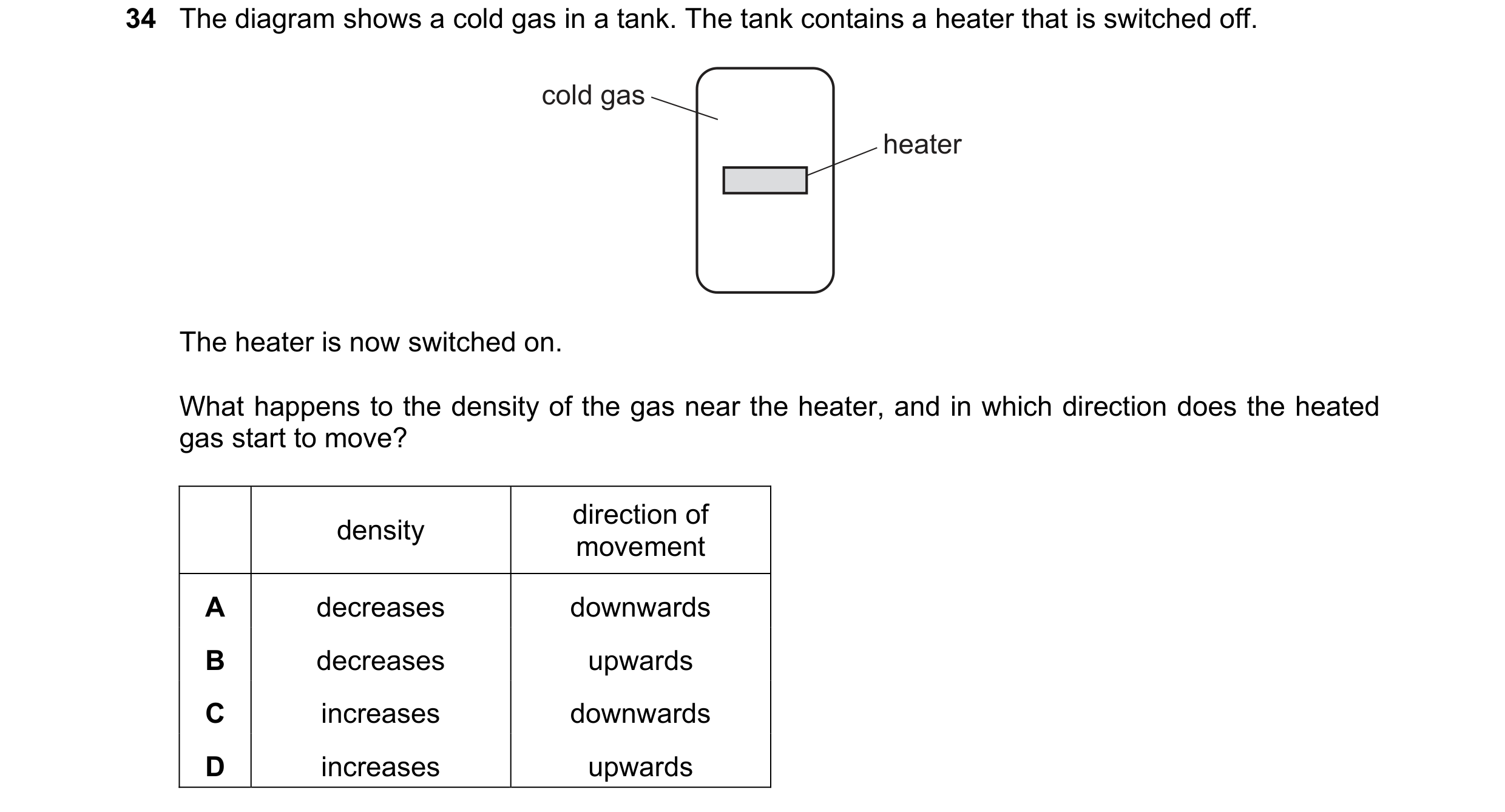
Q8 · The diagram shows a cold gas in a tank 0653/22 Feb/March 2018
34 The diagram shows a cold gas in a tank. The tank contains a heater that is switched off. cold gas heater The heater is now switched on. What happens to the density of the gas near the heater, and in which direction does the heated gas start to move? direction of density movement A decreases downwards B decreases upwards C increases downwards D increases upwards
1 marks
Answer: B
This question in 0653/22 Feb/March 2018
Q9 · On a summer’s day, hot air rises above hot roofs 0653/21 May/June 2018
33 On a summer’s day, hot air rises above hot roofs. What is the name of this process? A concentration B condensation C conduction D convection
1 marks
Answer: D
This question in 0653/21 May/June 2018
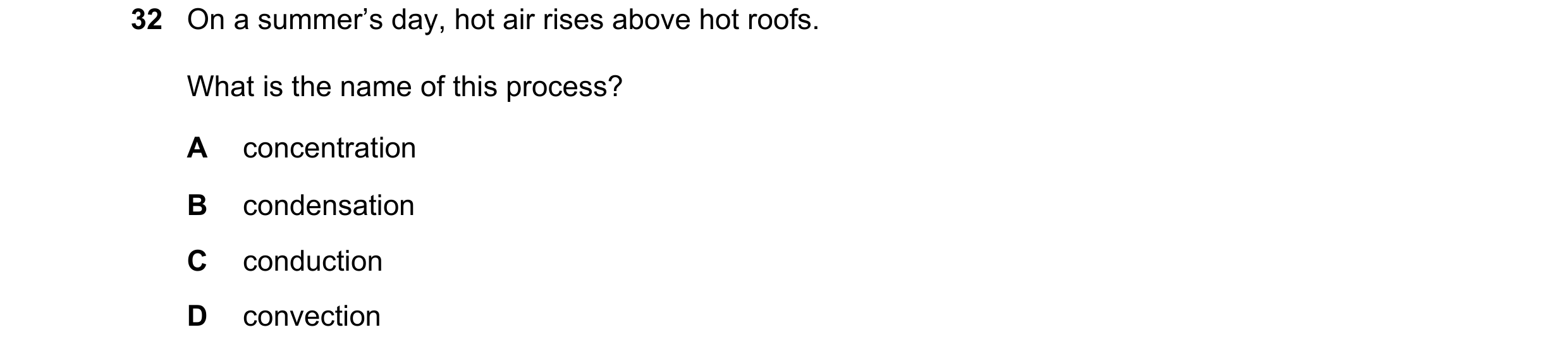
Q10 · On a summer’s day, hot air rises above hot roofs 0653/22 May/June 2018
32 On a summer’s day, hot air rises above hot roofs. What is the name of this process? A concentration B condensation C conduction D convection
1 marks
Answer: D
This question in 0653/22 May/June 2018
Q11 · On a summer’s day, hot air rises above hot roofs 0653/23 May/June 2018
32 On a summer’s day, hot air rises above hot roofs. What is the name of this process? A concentration B condensation C conduction D convection
1 marks
Answer: D
This question in 0653/23 May/June 2018
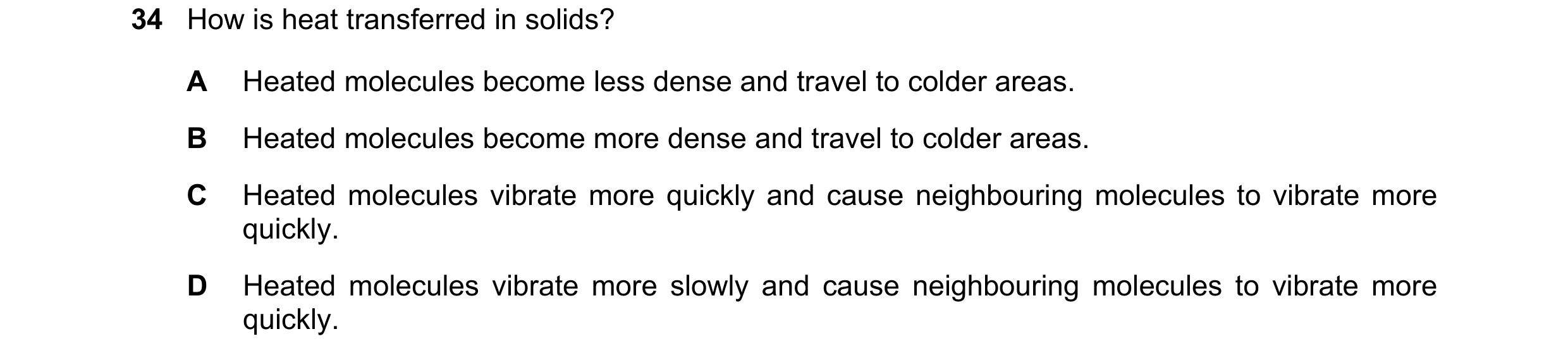
Q12 · How is heat transferred in solids? 0653/21 Oct/Nov 2018
34 How is heat transferred in solids? A Heated molecules become less dense and travel to colder areas. B Heated molecules become more dense and travel to colder areas. C Heated molecules vibrate more quickly and cause neighbouring molecules to vibrate more quickly. D Heated molecules vibrate more slowly and cause neighbouring molecules to vibrate more quickly.
1 marks
Answer: C
This question in 0653/21 Oct/Nov 2018
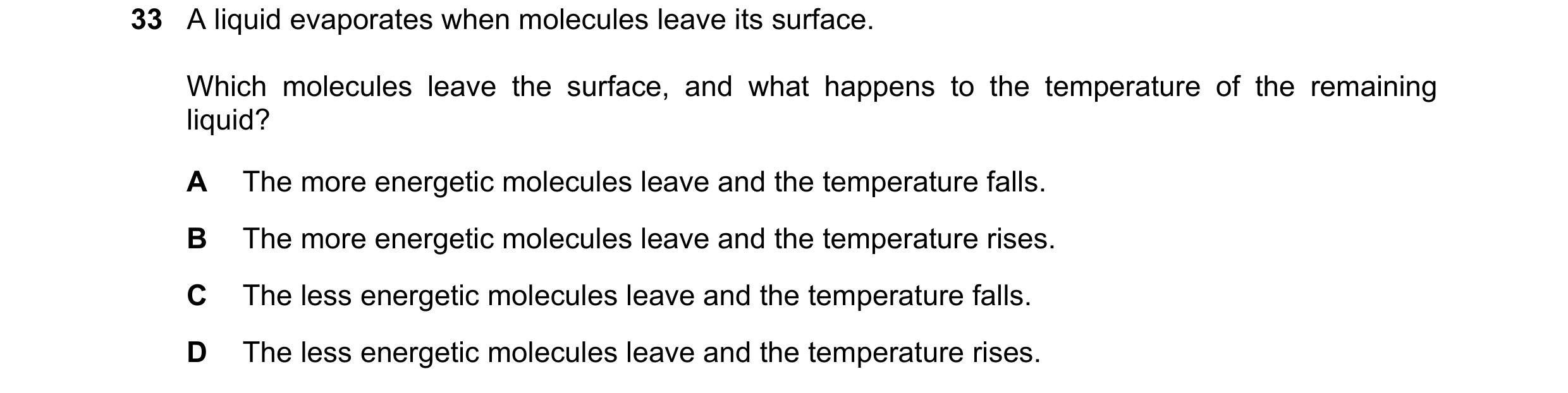
Q13 · A liquid evaporates when molecules leave its surface 0653/22 Oct/Nov 2018
33 A liquid evaporates when molecules leave its surface. Which molecules leave the surface, and what happens to the temperature of the remaining liquid? A The more energetic molecules leave and the temperature falls. B The more energetic molecules leave and the temperature rises. C The less energetic molecules leave and the temperature falls. D The less energetic molecules leave and the temperature rises.
1 marks
Answer: A
This question in 0653/22 Oct/Nov 2018
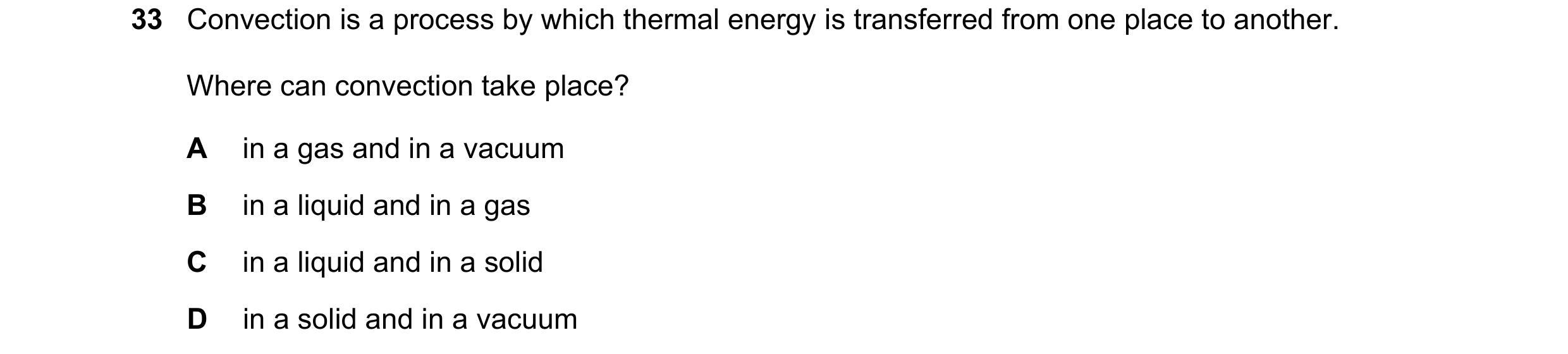
Q14 · Convection is a process by which thermal energy is transferred from one place to another 0653/23 Oct/Nov 2018
33 Convection is a process by which thermal energy is transferred from one place to another. Where can convection take place? A in a gas and in a vacuum B in a liquid and in a gas C in a liquid and in a solid D in a solid and in a vacuum
1 marks
Answer: B
This question in 0653/23 Oct/Nov 2018
Q15 · Which row gives thermal properties of air and aluminium? 0653/22 Feb/March 2019
31 Which row gives thermal properties of air and aluminium? air aluminium A a bad thermal conductor a bad thermal conductor B a bad thermal conductor a good thermal conductor C a good thermal conductor a bad thermal conductor D a good thermal conductor a good thermal conductor
1 marks
Answer: B
This question in 0653/22 Feb/March 2019
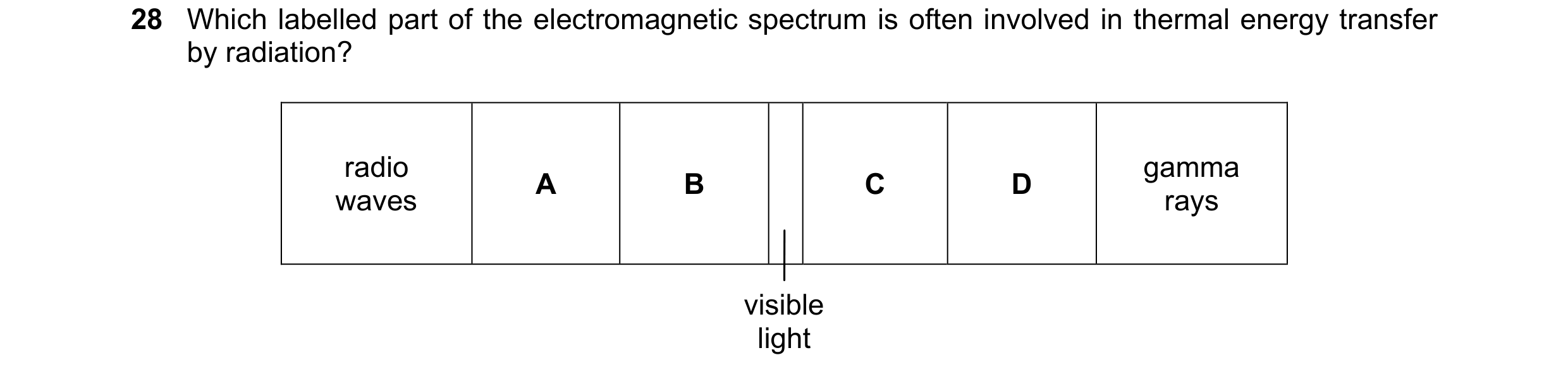
Q16 · Which labelled part of the electromagnetic spectrum is often involved in thermal energy… 0653/21 May/June 2019
28 Which labelled part of the electromagnetic spectrum is often involved in thermal energy transfer by radiation? radio gamma A B C D waves rays visible light
1 marks
Answer: B
This question in 0653/21 May/June 2019
Q17 · Which statement describes the process of convection in a liquid? 0653/21 May/June 2019
31 Which statement describes the process of convection in a liquid? A Heated liquid becomes less dense and falls. B Heated liquid becomes less dense and rises. C Heated liquid becomes more dense and falls. D Heated liquid becomes more dense and rises.
1 marks
Answer: B
This question in 0653/21 May/June 2019
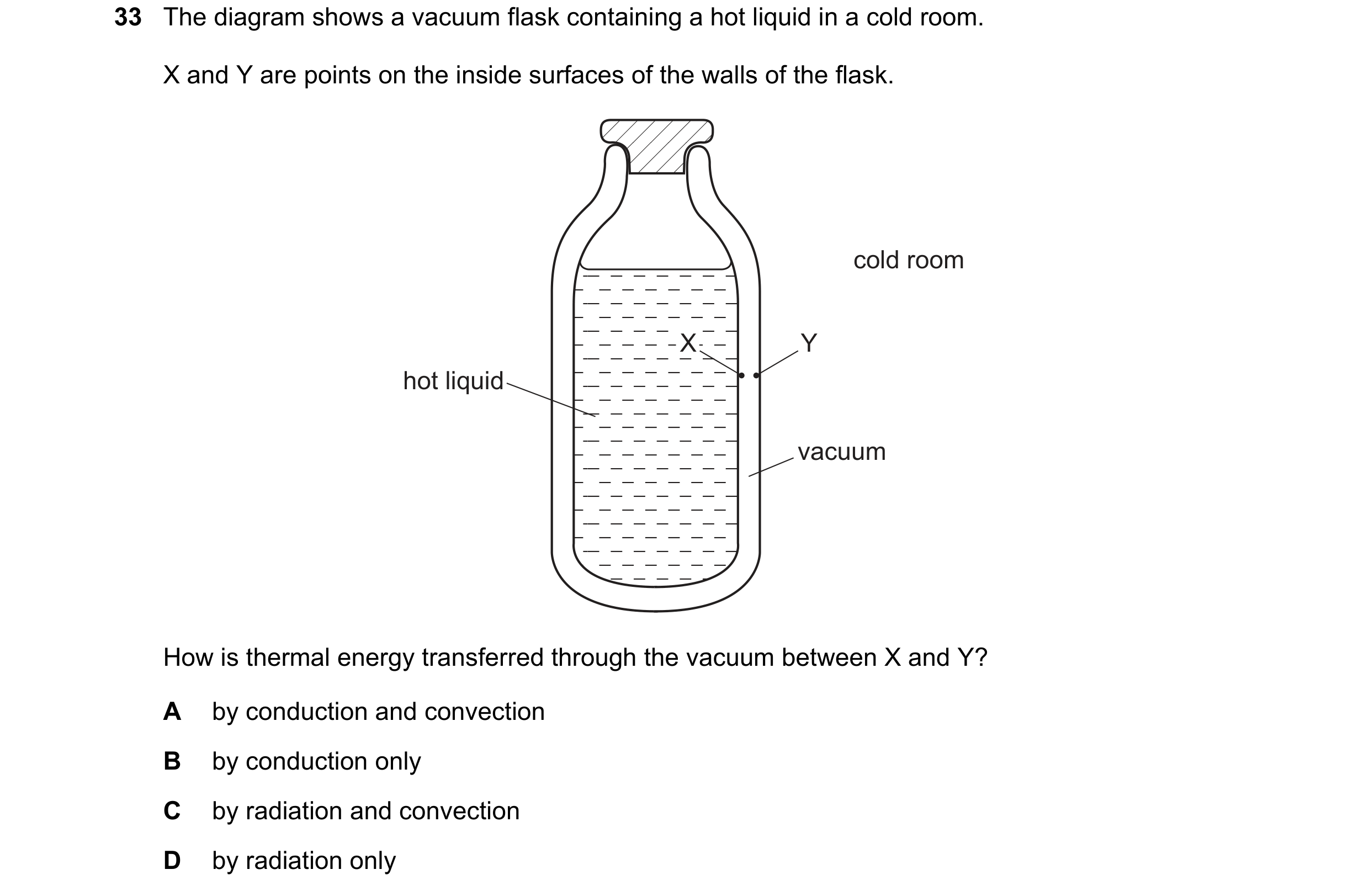
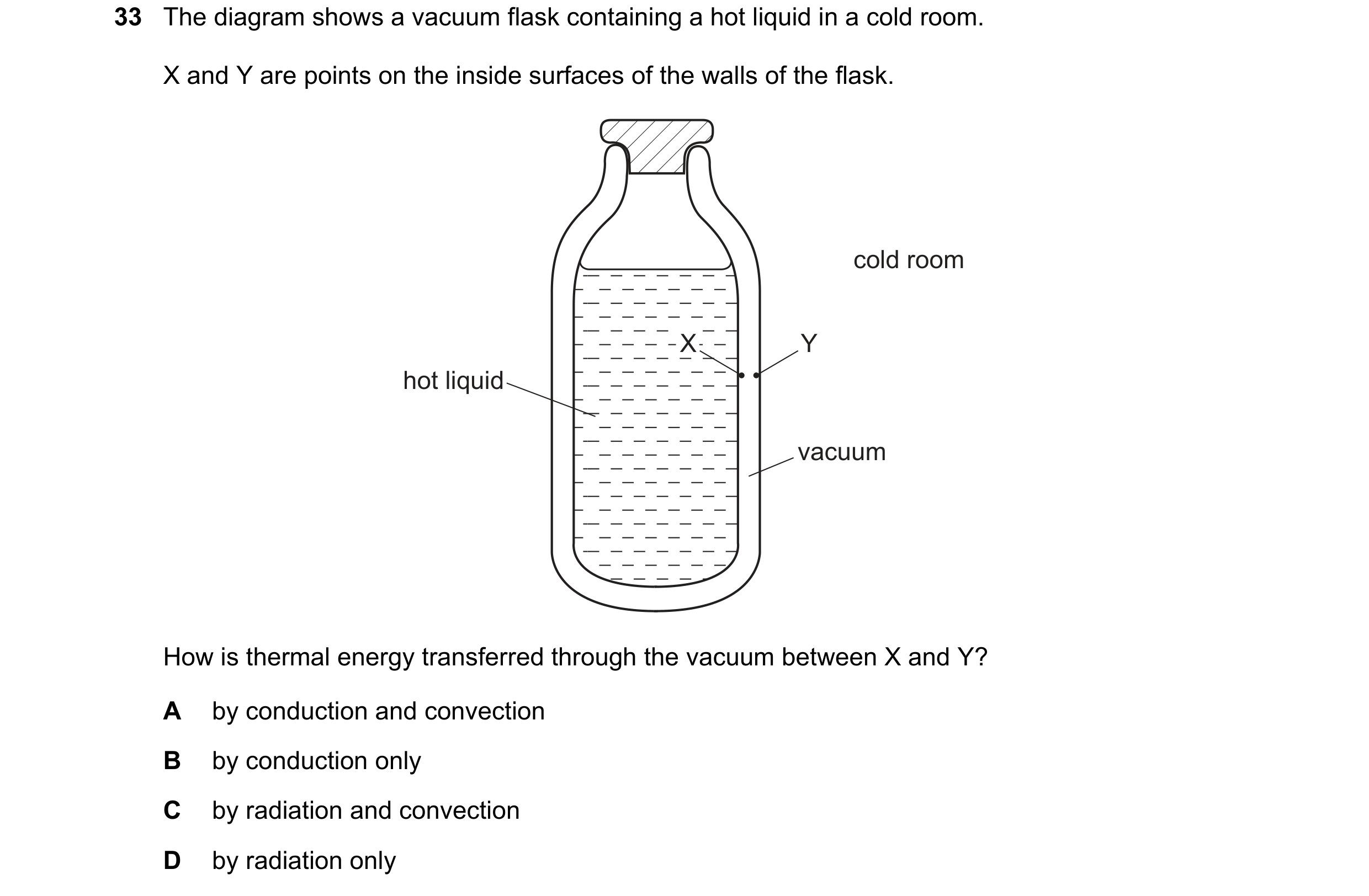
Q18 · The diagram shows a vacuum flask containing a hot liquid in a cold room 0653/21 May/June 2019
33 The diagram shows a vacuum flask containing a hot liquid in a cold room. X and Y are points on the inside surfaces of the walls of the flask. cold room X Y hot liquid vacuum How is thermal energy transferred through the vacuum between X and Y? A by conduction and convection B by conduction only C by radiation and convection D by radiation only
1 marks
Answer: D
This question in 0653/21 May/June 2019
Q19 · Non-metal solids conduct heat but not as well as metals 0653/22 May/June 2019
32 Non-metal solids conduct heat but not as well as metals. Which row describes how non-metal solids conduct heat? molecular heat transfer vibration by electrons A no no B no yes C yes no D yes yes
1 marks
Answer: C
This question in 0653/22 May/June 2019
Q20 · The diagram shows a vacuum flask containing a hot liquid in a cold room 0653/22 May/June 2019
33 The diagram shows a vacuum flask containing a hot liquid in a cold room. X and Y are points on the inside surfaces of the walls of the flask. cold room X Y hot liquid vacuum How is thermal energy transferred through the vacuum between X and Y? A by conduction and convection B by conduction only C by radiation and convection D by radiation only
1 marks
Answer: D
This question in 0653/22 May/June 2019
Q21 · The diagram shows a vacuum flask containing a hot liquid in a cold room 0653/23 May/June 2019
32 The diagram shows a vacuum flask containing a hot liquid in a cold room. X and Y are points on the inside surfaces of the walls of the flask. cold room X Y hot liquid vacuum How is thermal energy transferred through the vacuum between X and Y? A by conduction and convection B by conduction only C by radiation and convection D by radiation only
1 marks
Answer: D
This question in 0653/23 May/June 2019
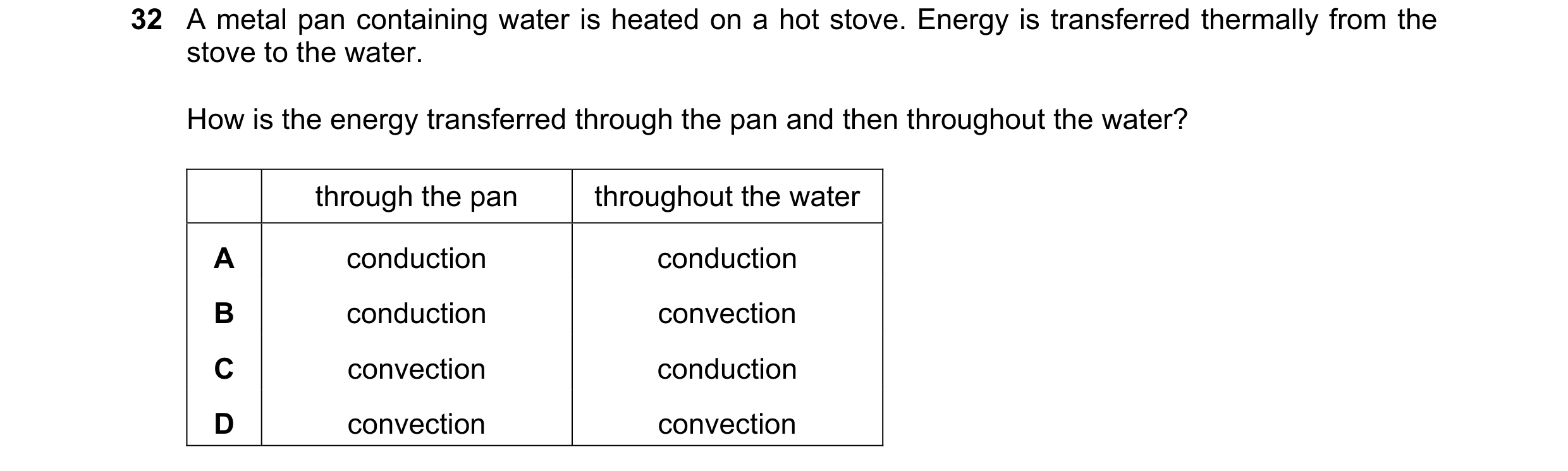
Q22 · A metal pan containing water is heated on a hot stove 0653/21 Oct/Nov 2019
32 A metal pan containing water is heated on a hot stove. Energy is transferred thermally from the stove to the water. How is the energy transferred through the pan and then throughout the water? through the pan throughout the water A conduction conduction B conduction convection C convection conduction D convection convection
1 marks
Answer: B
This question in 0653/21 Oct/Nov 2019
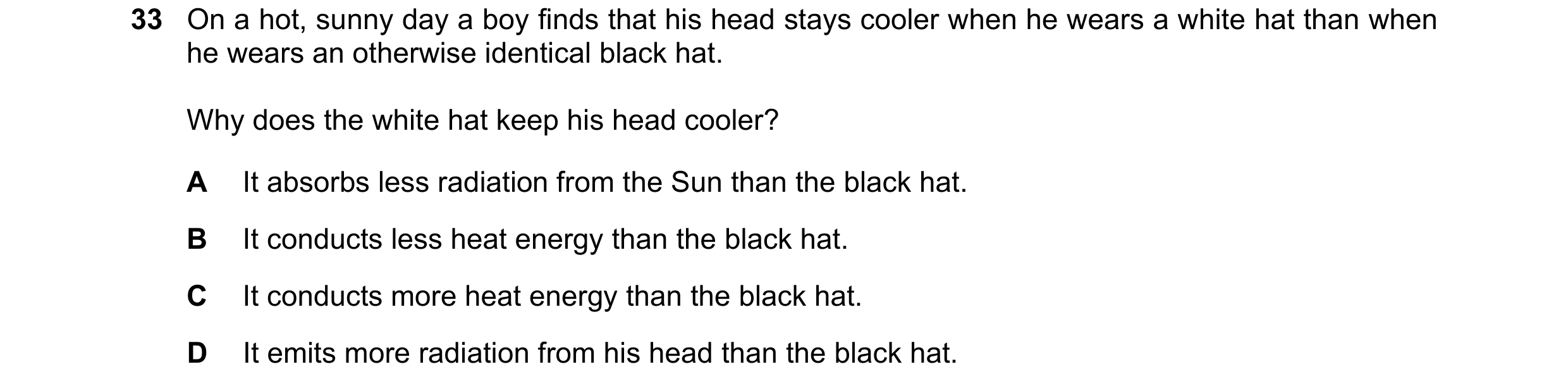
Q23 · On a hot, sunny day a boy finds that his head stays cooler when he wears a white hat than… 0653/21 Oct/Nov 2019
33 On a hot, sunny day a boy finds that his head stays cooler when he wears a white hat than when he wears an otherwise identical black hat. Why does the white hat keep his head cooler? A It absorbs less radiation from the Sun than the black hat. B It conducts less heat energy than the black hat. C It conducts more heat energy than the black hat. D It emits more radiation from his head than the black hat.
1 marks
Answer: A
This question in 0653/21 Oct/Nov 2019
Q24 · In which process is thermal energy transferred by molecular vibrations? 0653/22 Oct/Nov 2019
34 In which process is thermal energy transferred by molecular vibrations? A conduction B convection C evaporation D radiation
1 marks
Answer: A
This question in 0653/22 Oct/Nov 2019
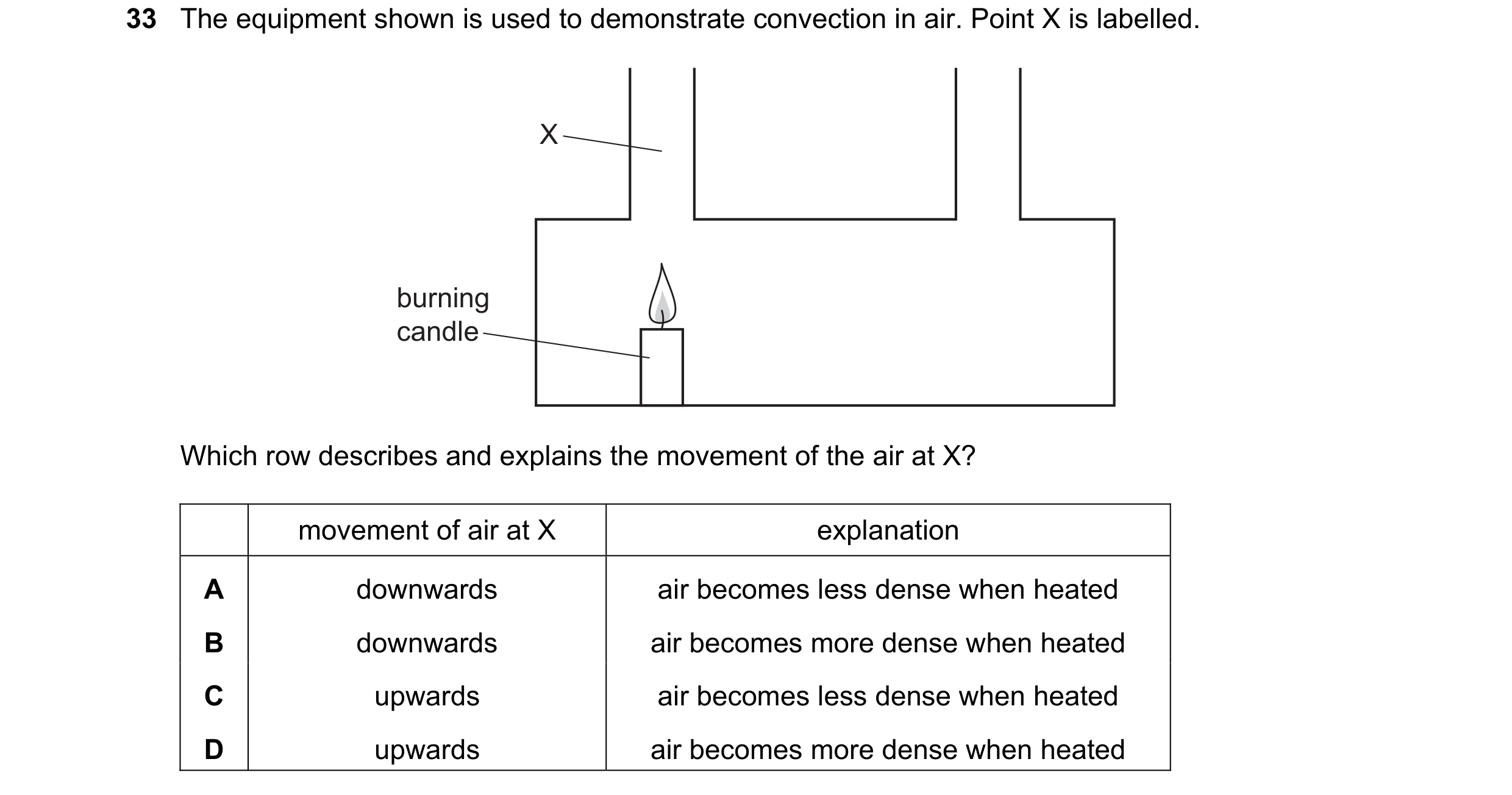
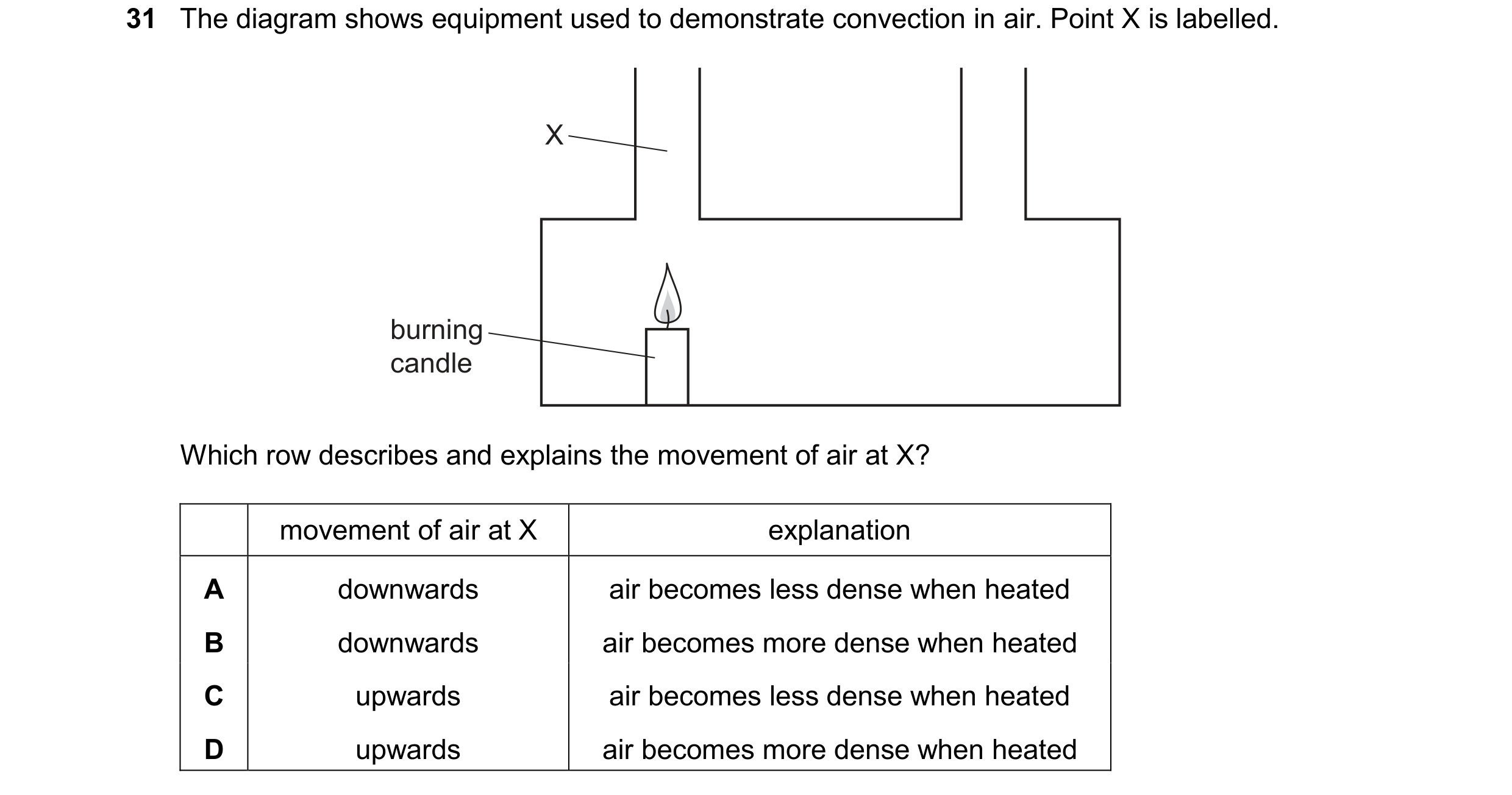
Q25 · The equipment shown is used to demonstrate convection in air 0653/23 Oct/Nov 2019
33 The equipment shown is used to demonstrate convection in air. Point X is labelled. X burning candle Which row describes and explains the movement of the air at X? movement of air at X explanation A downwards air becomes less dense when heated B downwards air becomes more dense when heated C upwards air becomes less dense when heated D upwards air becomes more dense when heated
1 marks
Answer: C
This question in 0653/23 Oct/Nov 2019
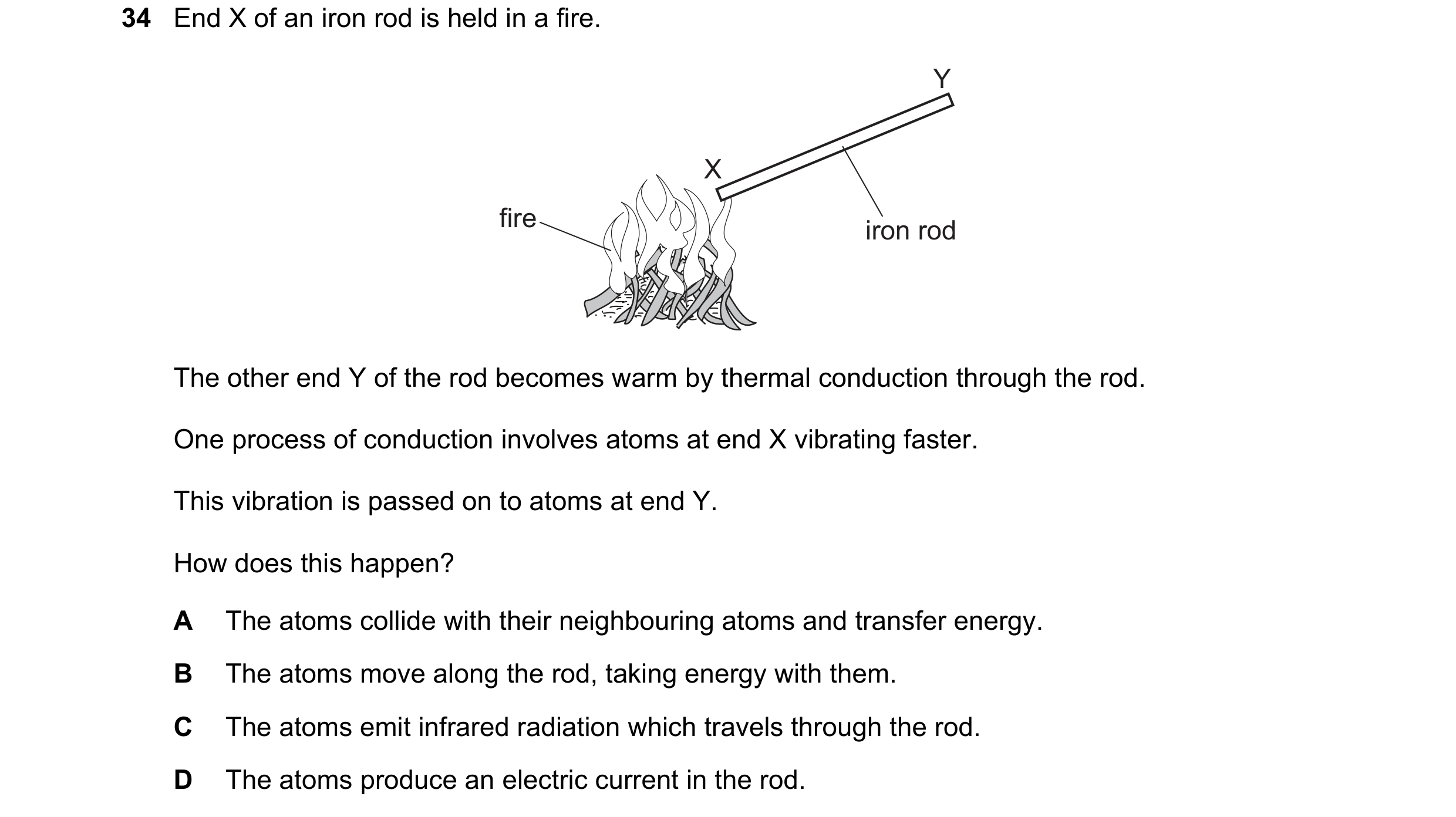
Q26 · End X of an iron rod is held in a fire 0653/21 May/June 2020
34 End X of an iron rod is held in a fire. Y X fire iron rod The other end Y of the rod becomes warm by thermal conduction through the rod. One process of conduction involves atoms at end X vibrating faster. This vibration is passed on to atoms at end Y. How does this happen? A The atoms collide with their neighbouring atoms and transfer energy. B The atoms move along the rod, taking energy with them. C The atoms emit infrared radiation which travels through the rod. D The atoms produce an electric current in the rod.
1 marks
Answer: A
This question in 0653/21 May/June 2020
Q27 · Conduction of heat in metals involves the movement of atoms and electrons 0653/22 May/June 2020
34 Conduction of heat in metals involves the movement of atoms and electrons. Which row describes the movement of the atoms and the electrons? atoms electrons A move freely move freely B move freely vibrate about fixed positions C vibrate about fixed positions move freely D vibrate about fixed positions vibrate about fixed positions
1 marks
Answer: C
This question in 0653/22 May/June 2020
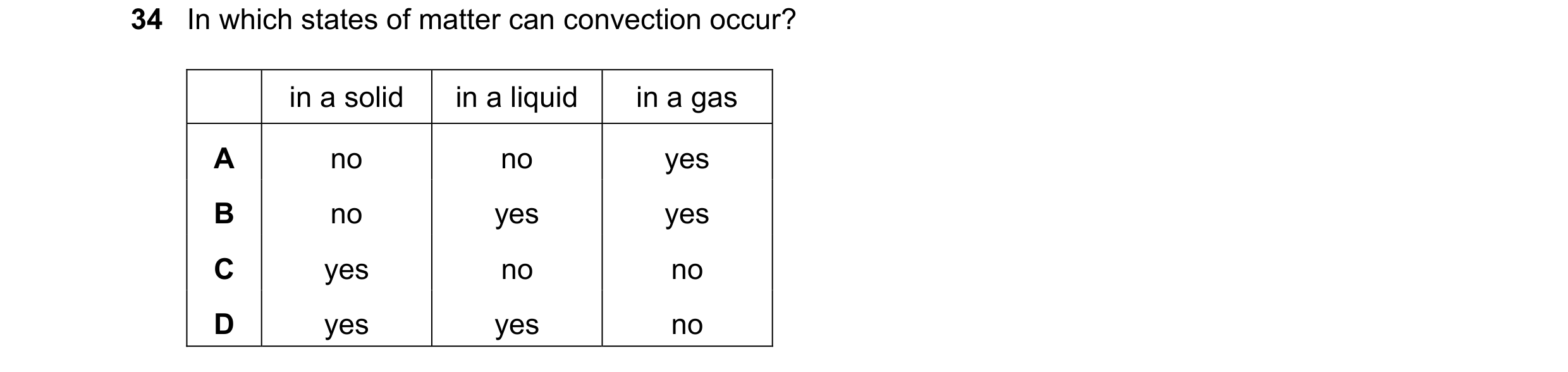
Q28 · In which states of matter can convection occur? 0653/21 Oct/Nov 2020
34 In which states of matter can convection occur? in a solid in a liquid in a gas A no no yes B no yes yes C yes no no D yes yes no
1 marks
Answer: B
This question in 0653/21 Oct/Nov 2020
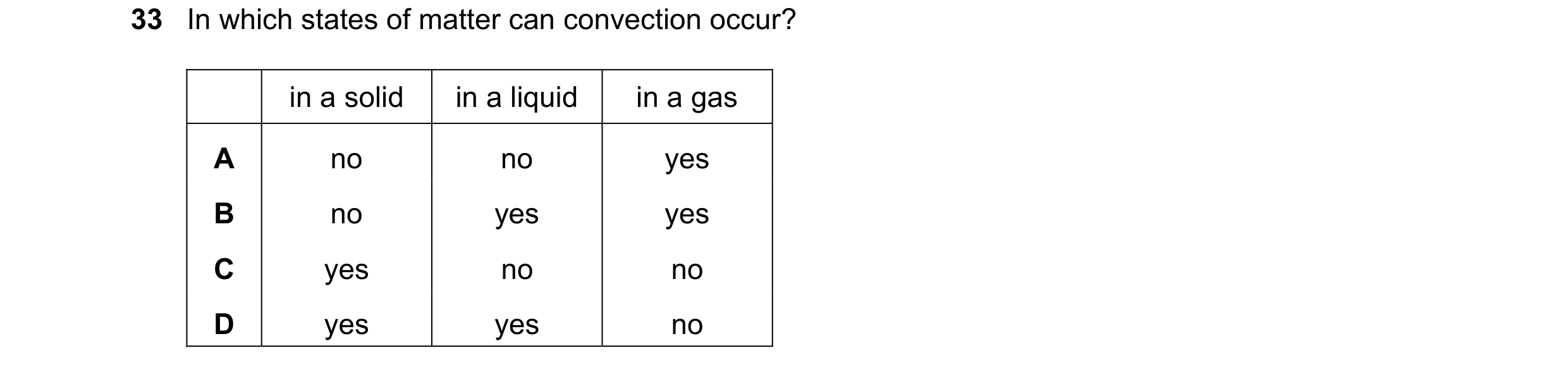
Q29 · In which states of matter can convection occur? 0653/22 Oct/Nov 2020
33 In which states of matter can convection occur? in a solid in a liquid in a gas A no no yes B no yes yes C yes no no D yes yes no
1 marks
Answer: B
This question in 0653/22 Oct/Nov 2020
Q30 · In which states of matter can convection occur? 0653/23 Oct/Nov 2020
35 In which states of matter can convection occur? in a solid in a liquid in a gas A no no yes B no yes yes C yes no no D yes yes no
1 marks
Answer: B
This question in 0653/23 Oct/Nov 2020
Q31 · A metal bar is heated at one end 0653/22 Feb/March 2021
33 A metal bar is heated at one end. metal bar heat What is the main method by which thermal energy reaches the other end of the bar? A Free electrons at the heated end gain kinetic energy and move along the bar. B Free electrons at the heated end move apart and set up a convection current along the bar. C Molecules at the heated end gain kinetic energy and move along the bar. D Molecules at the heated end move apart and set up a convection current along the bar.
1 marks
Answer: A
This question in 0653/22 Feb/March 2021
Q32 · How is thermal energy transferred from the Sun to the Earth through the vacuum of space? 0653/22 Feb/March 2021
34 How is thermal energy transferred from the Sun to the Earth through the vacuum of space? A by conduction, convection and radiation B by conduction only C by convection only D by radiation only
1 marks
Answer: D
This question in 0653/22 Feb/March 2021
Q33 · Copper is a good conductor of heat 0653/21 May/June 2021
34 Copper is a good conductor of heat. Plastic is a bad conductor of heat. Which statement explains this difference? A Electrons can move freely in copper but cannot move freely in plastic. B Electrons can move freely in plastic but cannot move freely in copper. C Molecules can move freely in copper but cannot move freely in plastic. D Molecules can move freely in plastic but cannot move freely in copper.
1 marks
Answer: A
This question in 0653/21 May/June 2021
Q34 · A metal rod with a wooden handle is placed with the end of the metal rod in a flame 0653/22 May/June 2021
33 A metal rod with a wooden handle is placed with the end of the metal rod in a flame. metal rod wooden handle How does heat pass through the metal and how does heat pass through the wood? heat passes through the metal heat passes through the wood A by movement of electrons by molecular vibrations only and by molecular vibrations B by movement of electrons by movement of electrons and by molecular vibrations and by molecular vibrations C by molecular vibrations only by molecular vibrations only D by movement of electrons only by movement of electrons and by molecular vibrations
1 marks
Answer: A
This question in 0653/22 May/June 2021
Q35 · A heater creates a convection current in a room 0653/23 May/June 2021
33 A heater creates a convection current in a room. What happens to air as it is heated? A It contracts and its density decreases. B It contracts and its density increases. C It expands and its density decreases. D It expands and its density increases.
1 marks
Answer: C
This question in 0653/23 May/June 2021
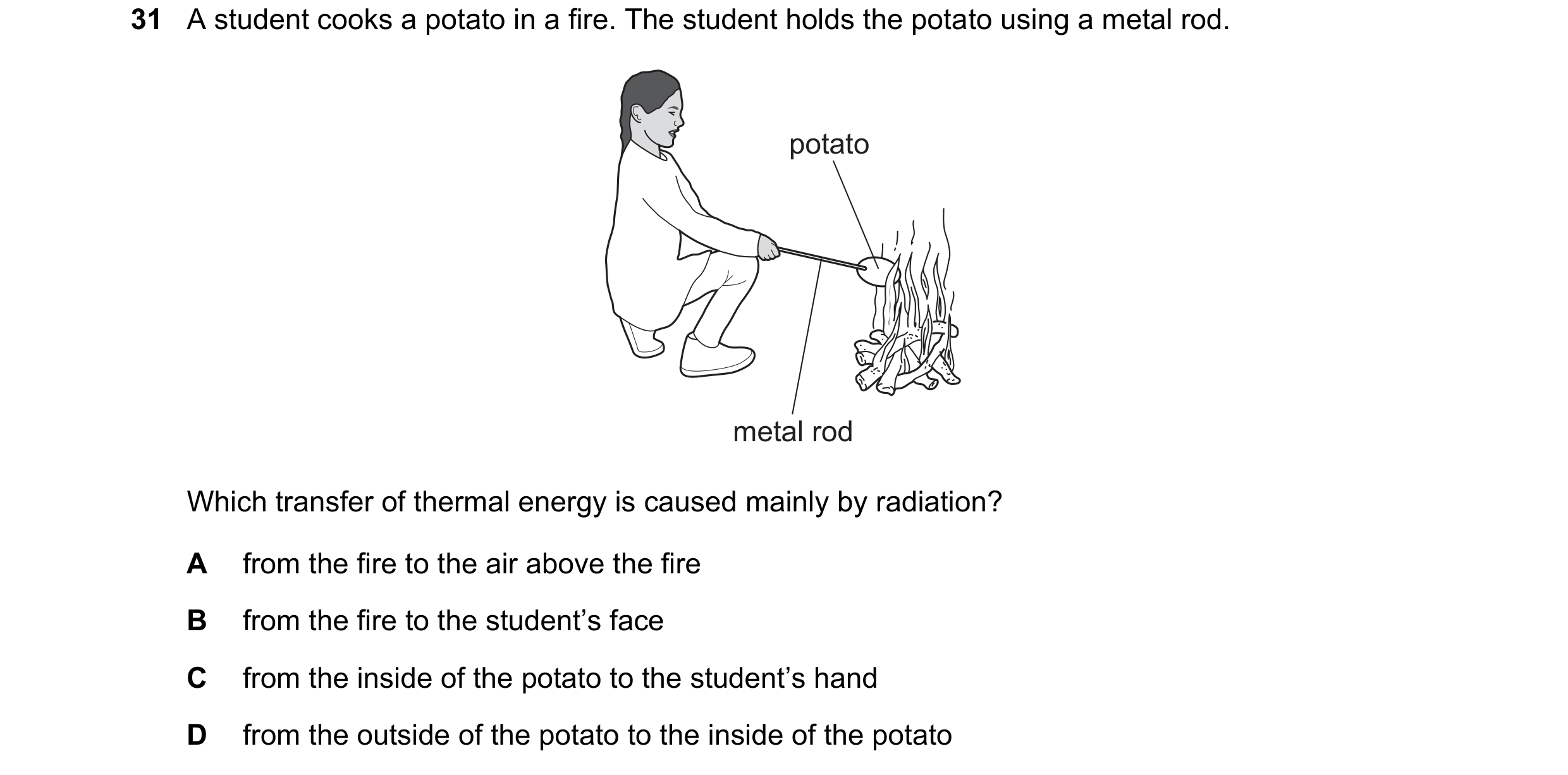
Q36 · A student cooks a potato in a fire 0653/21 Oct/Nov 2021
31 A student cooks a potato in a fire. The student holds the potato using a metal rod. potato metal rod Which transfer of thermal energy is caused mainly by radiation? A from the fire to the air above the fire B from the fire to the student’s face C from the inside of the potato to the student’s hand D from the outside of the potato to the inside of the potato
1 marks
Answer: B
This question in 0653/21 Oct/Nov 2021
Q37 · The bottom of a container of water is heated 0653/22 Oct/Nov 2021
32 The bottom of a container of water is heated. water Q convection current P A convection current forms and water rises from P to Q. Which statement is correct? A Water at P expands and decreases in density. B Water at P expands and increases in density. C Water at Q expands and decreases in density. D Water at Q expands and increases in density.
1 marks
Answer: A
This question in 0653/22 Oct/Nov 2021
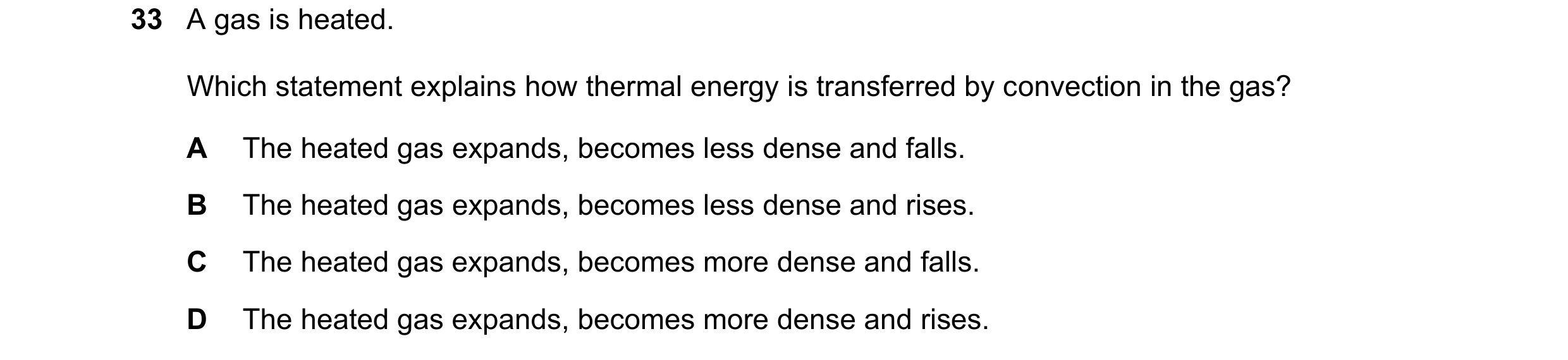
Q38 · A gas is heated 0653/23 Oct/Nov 2021
33 A gas is heated. Which statement explains how thermal energy is transferred by convection in the gas? A The heated gas expands, becomes less dense and falls. B The heated gas expands, becomes less dense and rises. C The heated gas expands, becomes more dense and falls. D The heated gas expands, becomes more dense and rises.
1 marks
Answer: B
This question in 0653/23 Oct/Nov 2021
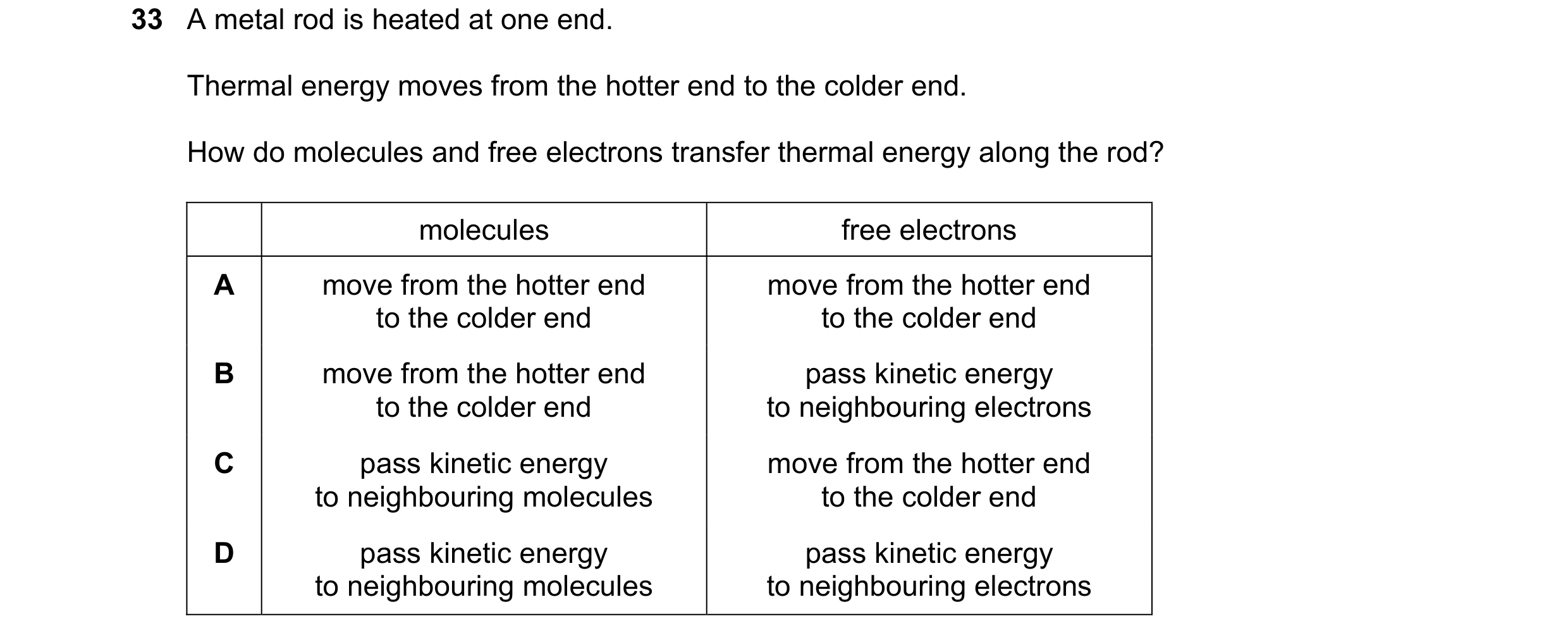
Q39 · A metal rod is heated at one end 0653/21 May/June 2022
33 A metal rod is heated at one end. Thermal energy moves from the hotter end to the colder end. How do molecules and free electrons transfer thermal energy along the rod? molecules free electrons A move from the hotter end move from the hotter end to the colder end to the colder end B move from the hotter end pass kinetic energy to the colder end to neighbouring electrons C pass kinetic energy move from the hotter end to neighbouring molecules to the colder end D pass kinetic energy pass kinetic energy to neighbouring molecules to neighbouring electrons
1 marks
Answer: C
This question in 0653/21 May/June 2022
Q40 · What is the main method of thermal energy transfer in liquids? 0653/23 May/June 2022
33 What is the main method of thermal energy transfer in liquids? A conduction B convection C absorption D radiation
1 marks
Answer: B
This question in 0653/23 May/June 2022
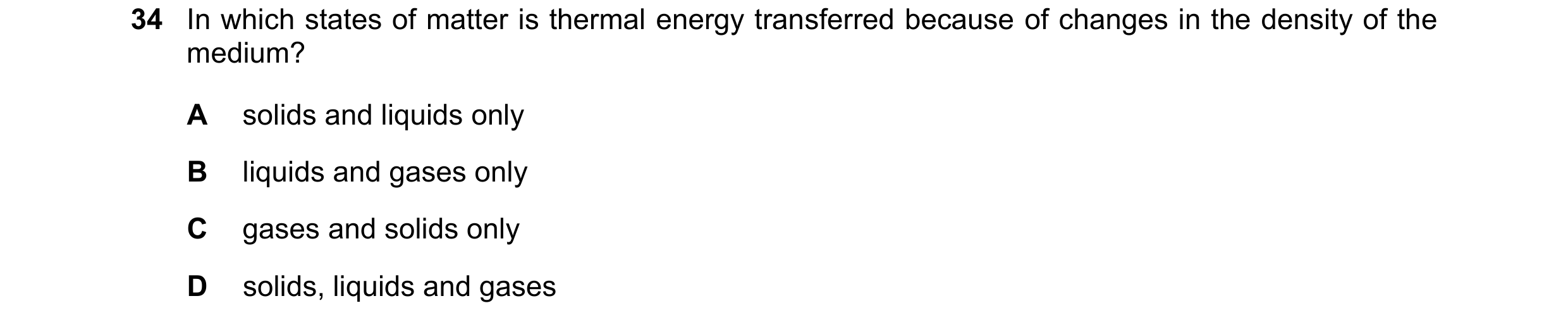
Q41 · In which states of matter is thermal energy transferred because of changes in the density… 0653/21 Oct/Nov 2022
34 In which states of matter is thermal energy transferred because of changes in the density of the medium? A solids and liquids only B liquids and gases only C gases and solids only D solids, liquids and gases
1 marks
Answer: B
This question in 0653/21 Oct/Nov 2022
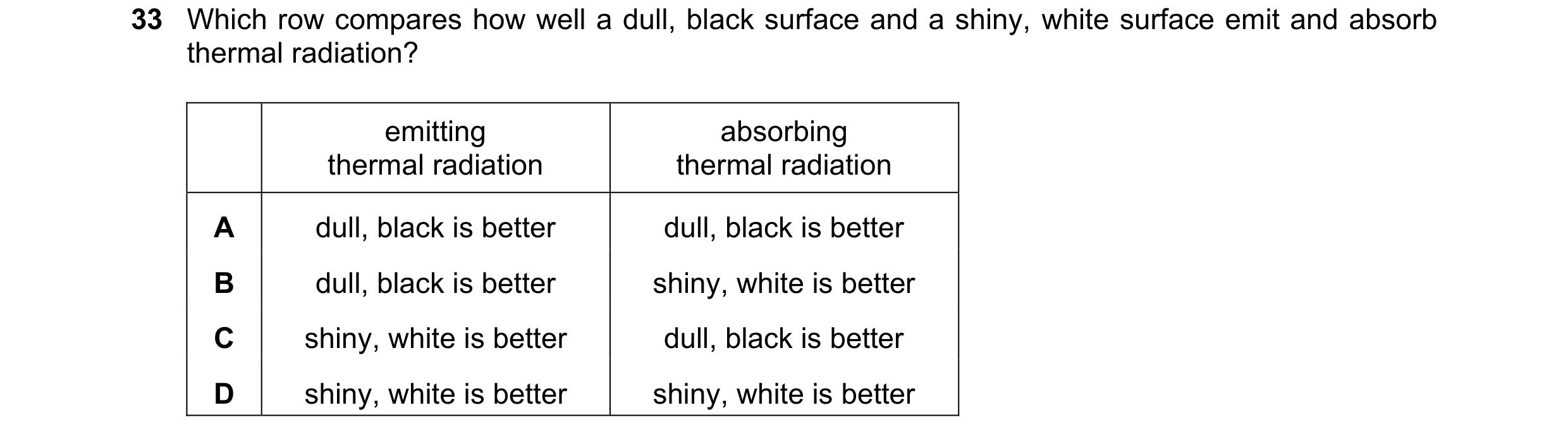
Q42 · Which row compares how well a dull, black surface and a shiny, white surface emit and… 0653/22 Oct/Nov 2022
33 Which row compares how well a dull, black surface and a shiny, white surface emit and absorb thermal radiation? emitting absorbing thermal radiation thermal radiation A dull, black is better dull, black is better B dull, black is better shiny, white is better C shiny, white is better dull, black is better D shiny, white is better shiny, white is better
1 marks
Answer: A
This question in 0653/22 Oct/Nov 2022
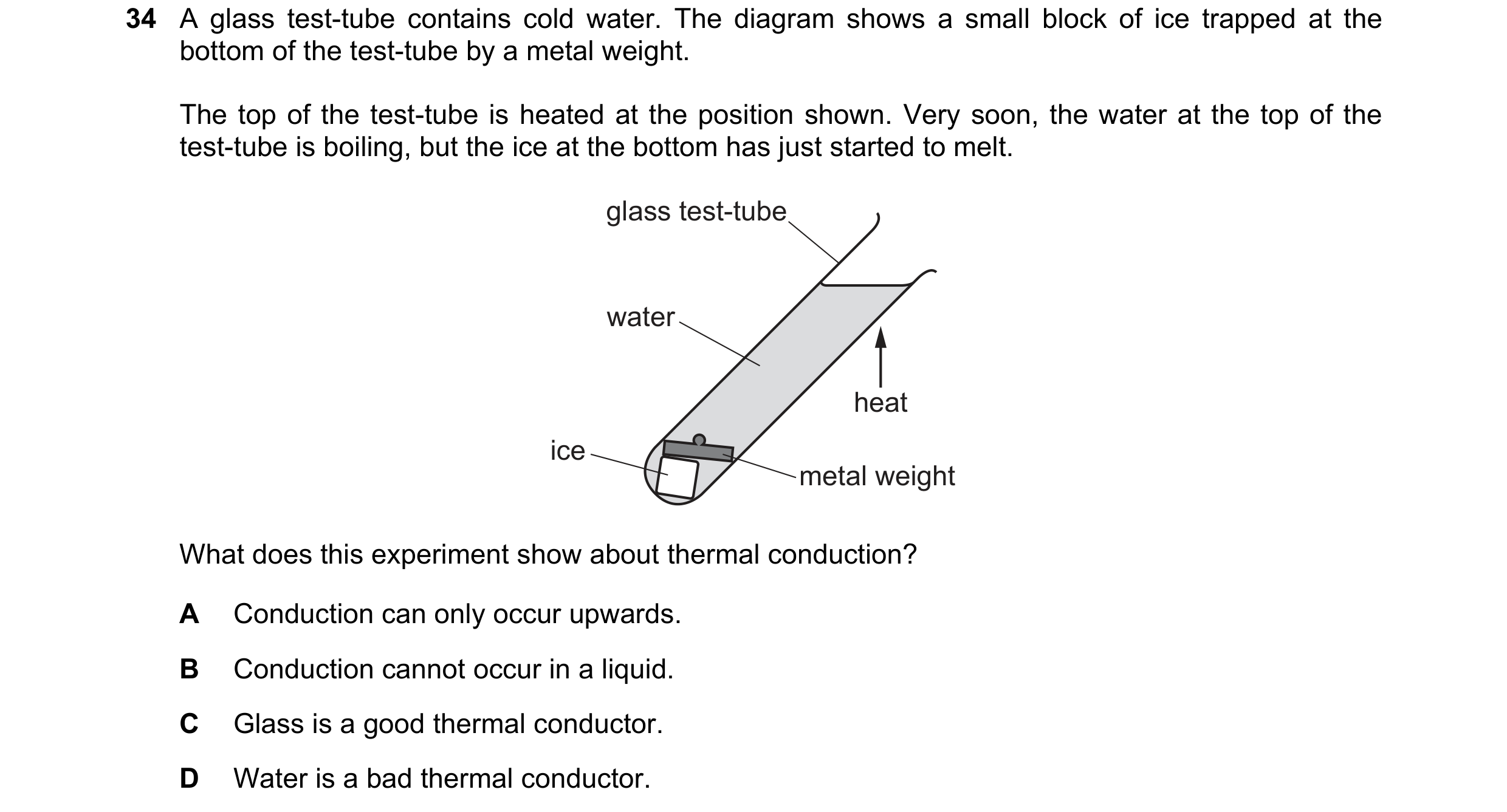
Q43 · A glass test-tube contains cold water 0653/22 Feb/March 2023
34 A glass test-tube contains cold water. The diagram shows a small block of ice trapped at the bottom of the test-tube by a metal weight. The top of the test-tube is heated at the position shown. Very soon, the water at the top of the test-tube is boiling, but the ice at the bottom has just started to melt. glass test-tube water heat ice metal weight What does this experiment show about thermal conduction? A Conduction can only occur upwards. B Conduction cannot occur in a liquid. C Glass is a good thermal conductor. D Water is a bad thermal conductor.
1 marks
Answer: D
This question in 0653/22 Feb/March 2023
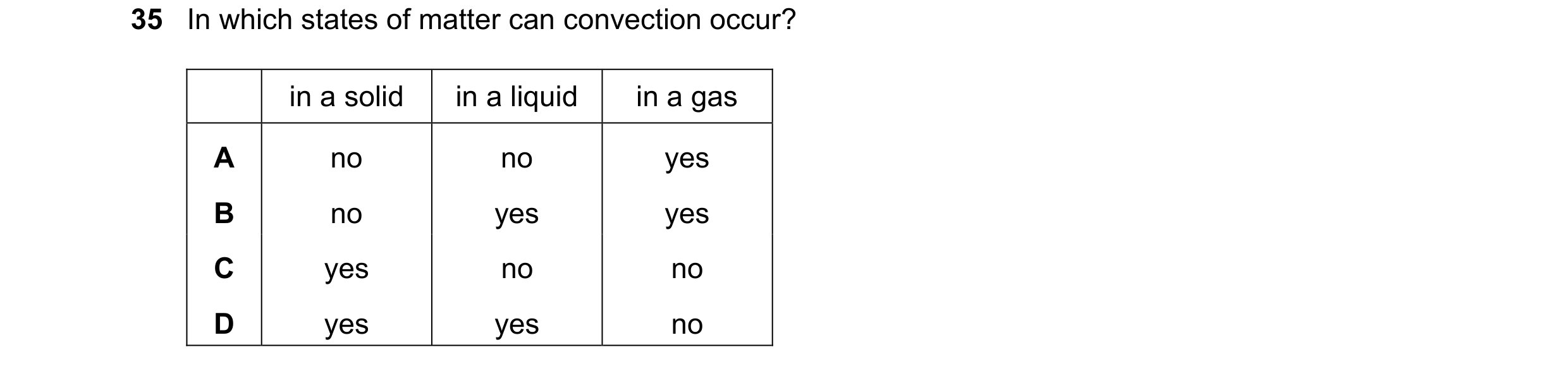
Q44 · In which states of matter can convection occur? 0653/22 Feb/March 2023
35 In which states of matter can convection occur? in a solid in a liquid in a gas A no no yes B no yes yes C yes no no D yes yes no
1 marks
Answer: B
This question in 0653/22 Feb/March 2023
Q45 · What is a method of thermal conduction in a metal? 0653/21 May/June 2023
34 What is a method of thermal conduction in a metal? A electrons moving through the metal, hitting distant molecules B electrons vibrating and passing on energy to other electrons C molecules moving through the metal, hitting other molecules D protons moving through the metal, hitting distant molecules
1 marks
Answer: A
This question in 0653/21 May/June 2023
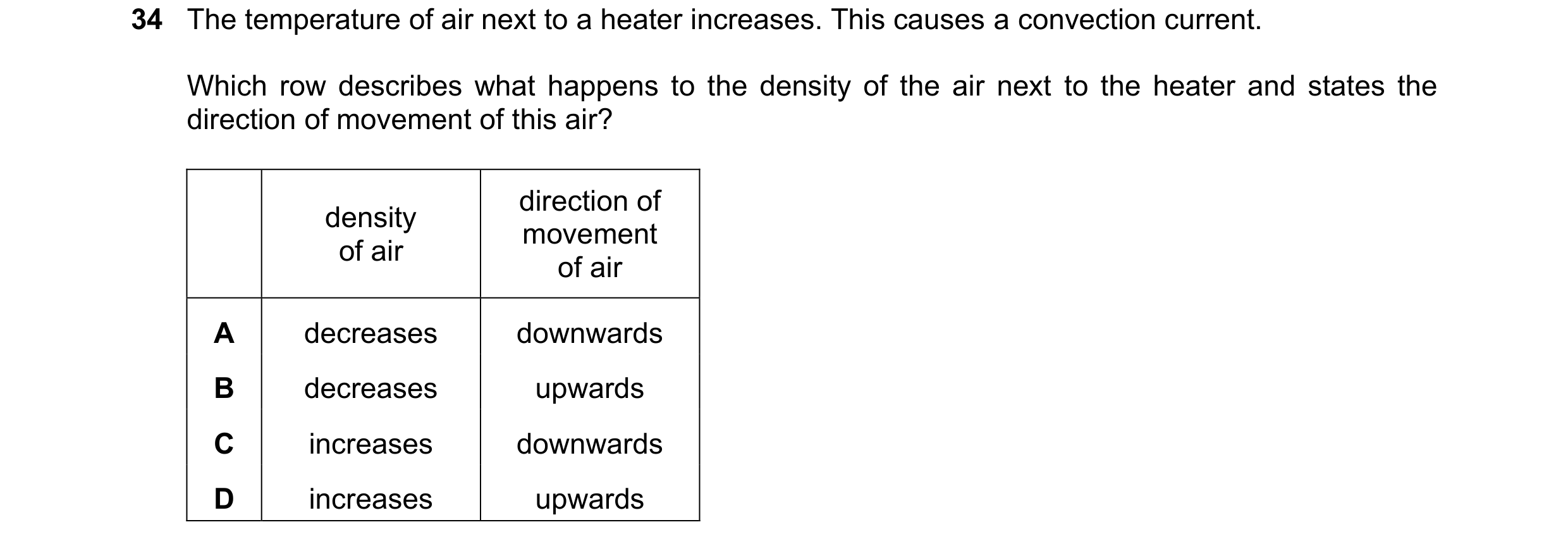
Q46 · The temperature of air next to a heater increases 0653/22 May/June 2023
34 The temperature of air next to a heater increases. This causes a convection current. Which row describes what happens to the density of the air next to the heater and states the direction of movement of this air? direction of density movement of air of air A decreases downwards B decreases upwards C increases downwards D increases upwards
1 marks
Answer: B
This question in 0653/22 May/June 2023
Q47 · Which statement describes one of the ways in which solid metals conduct thermal energy? 0653/22 Feb/March 2024
34 Which statement describes one of the ways in which solid metals conduct thermal energy? A Atoms exchange places with neighbouring atoms and transfer energy to each other. B Atoms move freely through the metal and transfer energy by colliding with other atoms. C Electrons move freely through the metal and transfer energy by colliding with atoms. D Electrons vibrate about fixed positions and transfer energy to neighbouring electrons.
1 marks
Answer: C
This question in 0653/22 Feb/March 2024
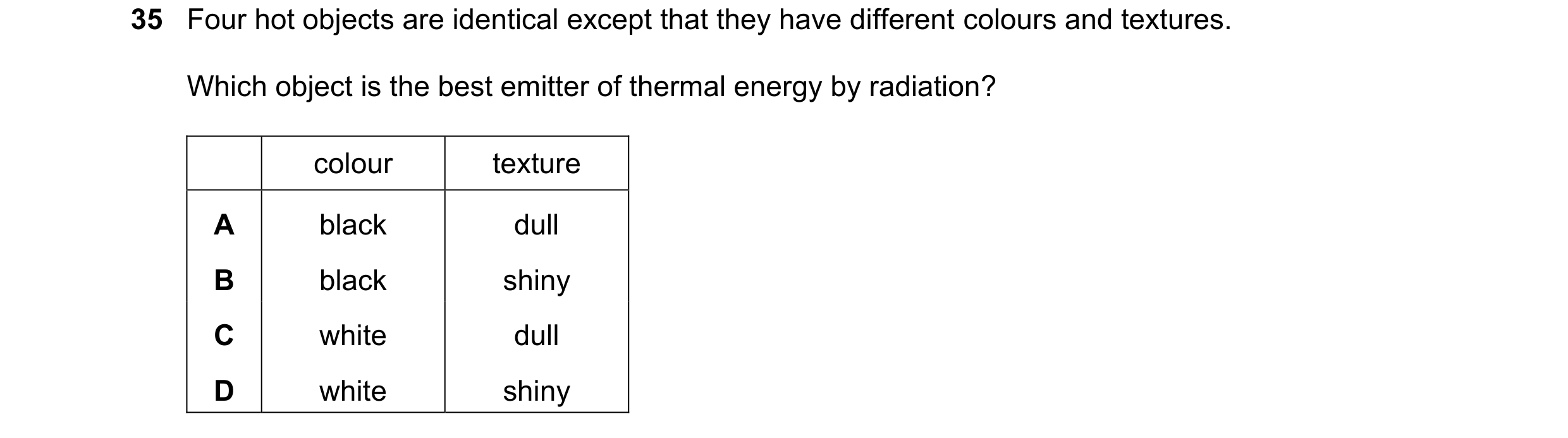
Q48 · Four hot objects are identical except that they have different colours and textures 0653/22 Feb/March 2024
35 Four hot objects are identical except that they have different colours and textures. Which object is the best emitter of thermal energy by radiation? colour texture A black dull B black shiny C white dull D white shiny
1 marks
Answer: A
This question in 0653/22 Feb/March 2024
Q49 · A student cooks a potato over a fire 0653/22 May/June 2024
34 A student cooks a potato over a fire. The student holds the potato using a metal rod. potato metal rod Which transfer of thermal energy is caused mainly by radiation? A from the fire to the air above the fire B from the fire to the student’s face C from the inside of the potato to the student’s hand D from the outside of the potato to the inside of the potato
1 marks
Answer: B
This question in 0653/22 May/June 2024
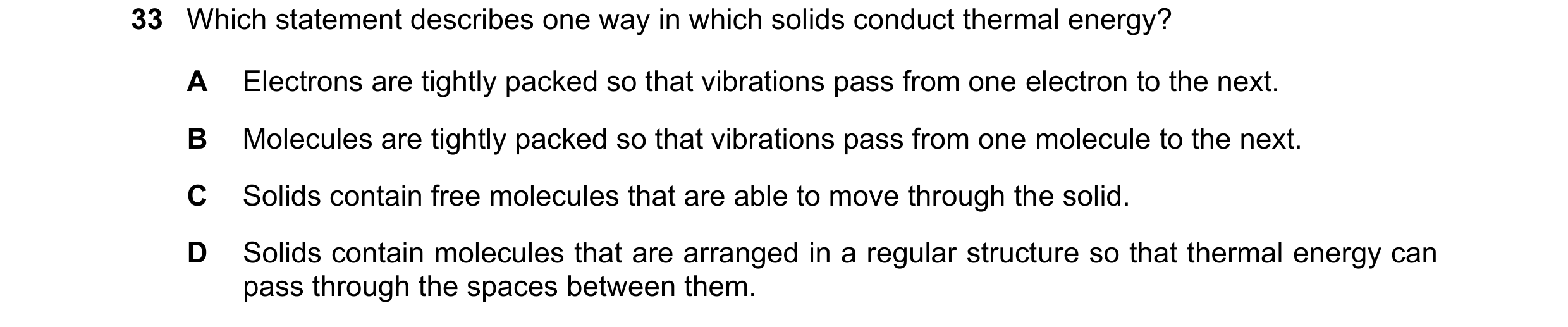
Q50 · Which statement describes one way in which solids conduct thermal energy? 0653/23 May/June 2024
33 Which statement describes one way in which solids conduct thermal energy? A Electrons are tightly packed so that vibrations pass from one electron to the next. B Molecules are tightly packed so that vibrations pass from one molecule to the next. C Solids contain free molecules that are able to move through the solid. D Solids contain molecules that are arranged in a regular structure so that thermal energy can pass through the spaces between them.
1 marks
Answer: B
This question in 0653/23 May/June 2024
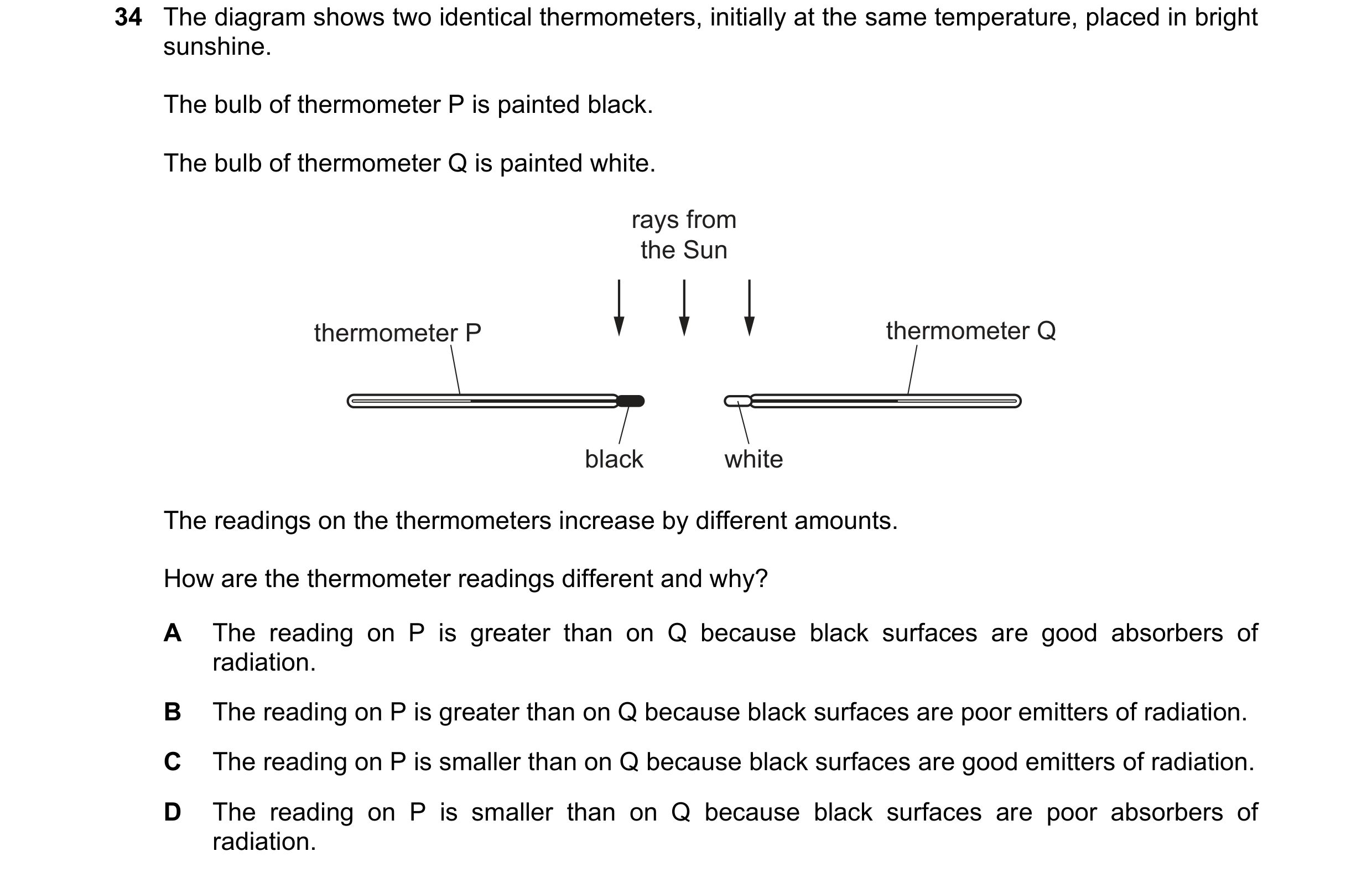
Q51 · The diagram shows two identical thermometers, initially at the same temperature, placed… 0653/23 May/June 2024
34 The diagram shows two identical thermometers, initially at the same temperature, placed in bright sunshine. The bulb of thermometer P is painted black. The bulb of thermometer Q is painted white. rays from the Sun thermometer P thermometer Q black white The readings on the thermometers increase by different amounts. How are the thermometer readings different and why? A The reading on P is greater than on Q because black surfaces are good absorbers of radiation. B The reading on P is greater than on Q because black surfaces are poor emitters of radiation. C The reading on P is smaller than on Q because black surfaces are good emitters of radiation. D The reading on P is smaller than on Q because black surfaces are poor absorbers of radiation.
1 marks
Answer: A
This question in 0653/23 May/June 2024
Q52 · A small coloured crystal is at the bottom of a beaker of water at room temperature 0653/21 Oct/Nov 2024
34 A small coloured crystal is at the bottom of a beaker of water at room temperature. The beaker is gently heated from underneath the crystal, and the crystal dissolves slowly. Coloured water just above the crystal is observed to rise up through the water in the beaker. Which process is being observed, and which density change causes it? process density change A conduction Water becomes less dense when heated. B conduction Water becomes more dense when heated. C convection Water becomes less dense when heated. D convection Water becomes more dense when heated.
1 marks
Answer: C
This question in 0653/21 Oct/Nov 2024
Q53 · A metal bar is heated at one end 0653/23 Oct/Nov 2024
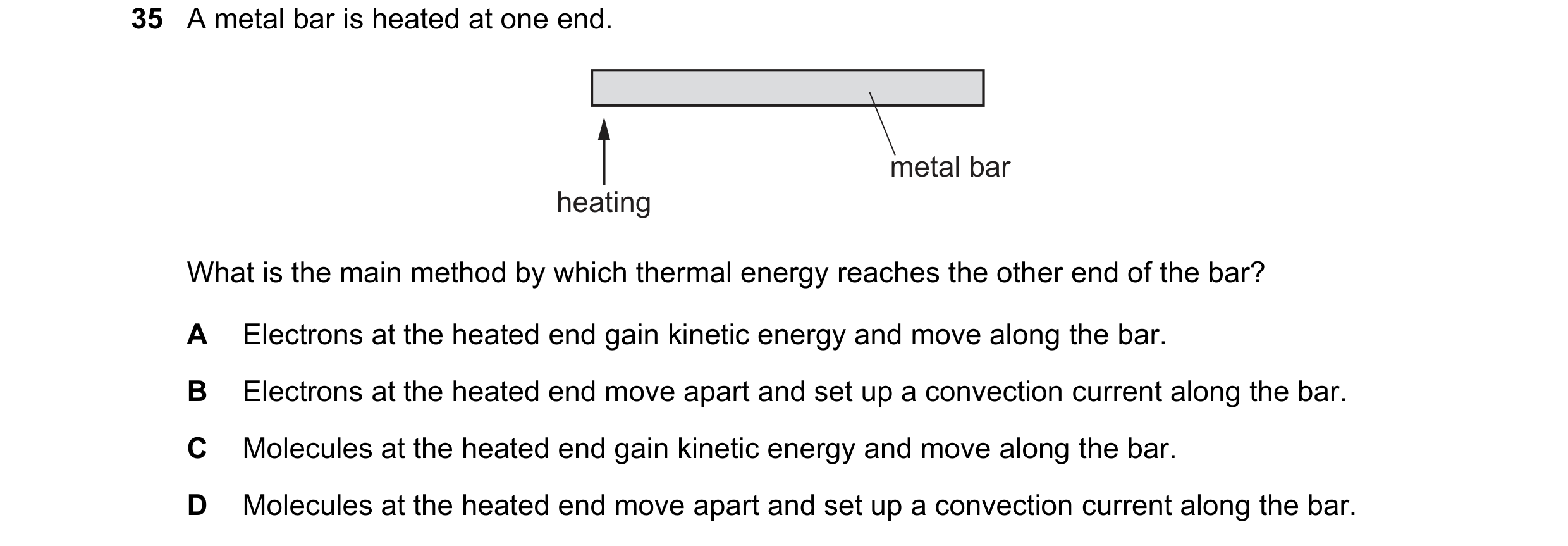
35 A metal bar is heated at one end. metal bar heating What is the main method by which thermal energy reaches the other end of the bar? A Electrons at the heated end gain kinetic energy and move along the bar. B Electrons at the heated end move apart and set up a convection current along the bar. C Molecules at the heated end gain kinetic energy and move along the bar. D Molecules at the heated end move apart and set up a convection current along the bar.
1 marks
Answer: A
This question in 0653/23 Oct/Nov 2024
Q54 · Which statement explains why metals are good thermal conductors? 0653/22 Feb/March 2025
32 Which statement explains why metals are good thermal conductors? A Metals contain delocalised electrons that are free to move. B Metal surfaces are shiny. C The distance between metal atoms increases when the metal is heated. D The nuclei of metal atoms are positively charged.
1 marks
Answer: A
This question in 0653/22 Feb/March 2025
Q55 · Which row shows the main method of thermal conduction in metallic and in non-metallic… 0653/21 May/June 2025
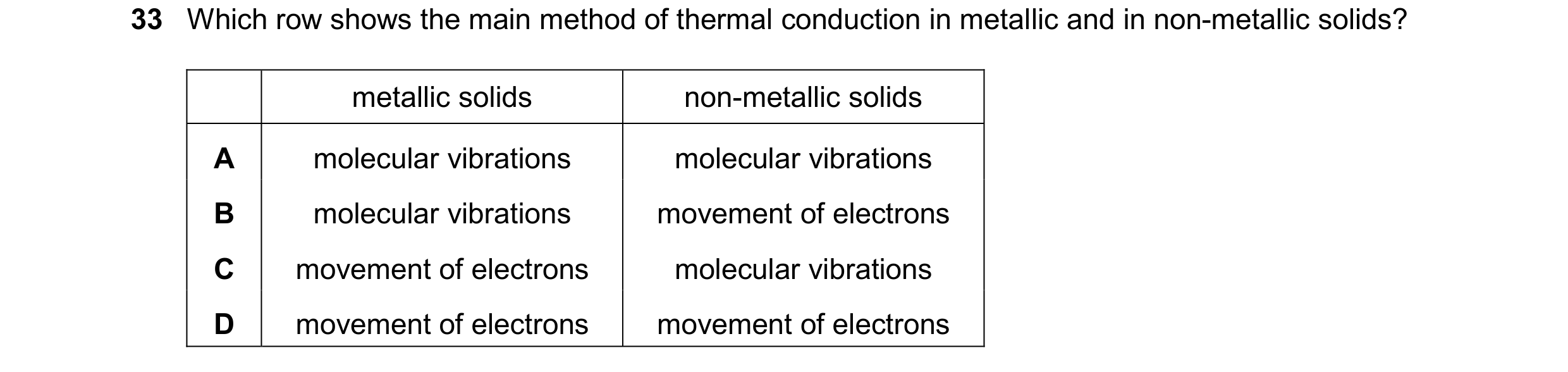
33 Which row shows the main method of thermal conduction in metallic and in non-metallic solids? metallic solids non-metallic solids A molecular vibrations molecular vibrations B molecular vibrations movement of electrons C movement of electrons molecular vibrations D movement of electrons movement of electrons
1 marks
Answer: C
This question in 0653/21 May/June 2025
Q56 · Which material is a good thermal conductor? 0653/22 May/June 2025
32 Which material is a good thermal conductor? A copper B glass C plastic D wood
1 marks
Answer: A
This question in 0653/22 May/June 2025
Q57 · A room contains cold air 0653/22 May/June 2025
33 A room contains cold air. An electric heater is used to warm the air. Which statement explains why the warm air rises? A Air contracts as it is warmed. B Particles in warm air have less energy than particles in cold air. C The mass of the air particles decreases as the air is warmed. D Warm air is less dense than cold air.
1 marks
Answer: D
This question in 0653/22 May/June 2025
Q58 · The diagram shows equipment used to demonstrate convection in air 0653/23 May/June 2025
31 The diagram shows equipment used to demonstrate convection in air. Point X is labelled. X burning candle Which row describes and explains the movement of air at X? movement of air at X explanation A downwards air becomes less dense when heated B downwards air becomes more dense when heated C upwards air becomes less dense when heated D upwards air becomes more dense when heated
1 marks
Answer: C
This question in 0653/23 May/June 2025
Q59 · Which statement explains why iron is a better thermal conductor than plastic? 0653/21 Oct/Nov 2025
31 Which statement explains why iron is a better thermal conductor than plastic? A Atoms in iron vibrate more. B Electrons in iron vibrate more. C There are delocalised atoms in iron. D There are delocalised electrons in iron.
1 marks
Answer: D
This question in 0653/21 Oct/Nov 2025
Q60 · The diagram shows a convection current in water in a beaker 0653/21 Oct/Nov 2025
32 The diagram shows a convection current in water in a beaker. beaker convection current water heat Which statement explains why the hot water at the bottom of the beaker rises? A It expands and becomes less dense. B It expands and becomes more dense. C It contracts and becomes less dense. D It contracts and becomes more dense.
1 marks
Answer: A
This question in 0653/21 Oct/Nov 2025
Q61 · Which surface is the best reflector of thermal radiation? 0653/21 Oct/Nov 2025
33 Which surface is the best reflector of thermal radiation? A dull black B dull white C shiny black D shiny white
1 marks
Answer: D
This question in 0653/21 Oct/Nov 2025
Q62 · Which statement is a reason why metals are better thermal conductors than plastics? 0653/22 Oct/Nov 2025
31 Which statement is a reason why metals are better thermal conductors than plastics? A Metals contain delocalised electrons. B Metals have high melting points. C The forces between particles in metals are strong. D The particles in metals are far apart.
1 marks
Answer: A
This question in 0653/22 Oct/Nov 2025
Q63 · A beaker of water is heated, and a convection current is formed in the water as shown in… 0653/22 Oct/Nov 2025
33 A beaker of water is heated, and a convection current is formed in the water as shown in the diagram. beaker water P heat What happens to the water at point P? A Its volume increases and its density decreases. B Its volume increases and its density increases. C Its volume remains the same and its density decreases. D Its volume remains the same and its density increases.
1 marks
Answer: A
This question in 0653/22 Oct/Nov 2025
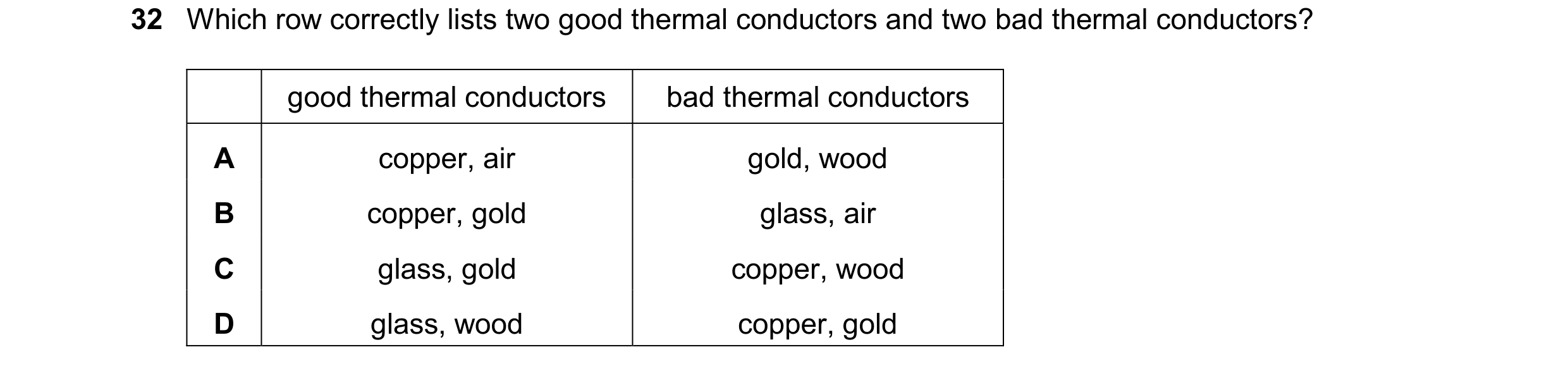
Q64 · Which row correctly lists two good thermal conductors and two bad thermal conductors? 0653/23 Oct/Nov 2025
32 Which row correctly lists two good thermal conductors and two bad thermal conductors? good thermal conductors bad thermal conductors A copper, air gold, wood B copper, gold glass, air C glass, gold copper, wood D glass, wood copper, gold
1 marks
Answer: B
This question in 0653/23 Oct/Nov 2025
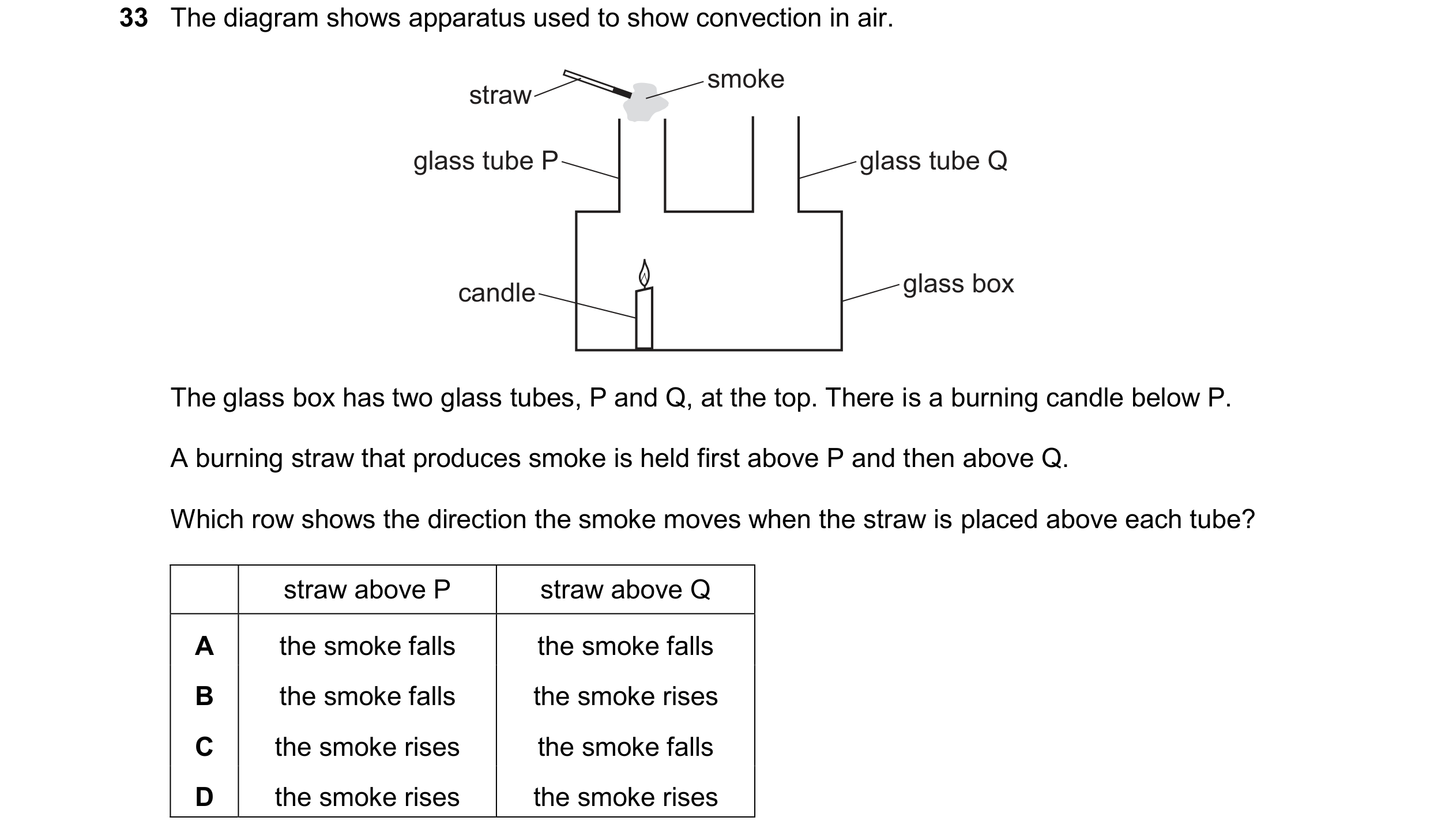
Q65 · The diagram shows apparatus used to show convection in air 0653/23 Oct/Nov 2025
33 The diagram shows apparatus used to show convection in air. smoke straw glass tube P glass tube Q candle glass box The glass box has two glass tubes, P and Q, at the top. There is a burning candle below P. A burning straw that produces smoke is held first above P and then above Q. Which row shows the direction the smoke moves when the straw is placed above each tube? straw above P straw above Q A the smoke falls the smoke falls B the smoke falls the smoke rises C the smoke rises the smoke falls D the smoke rises the smoke rises
1 marks
Answer: C
This question in 0653/23 Oct/Nov 2025

 1 / 19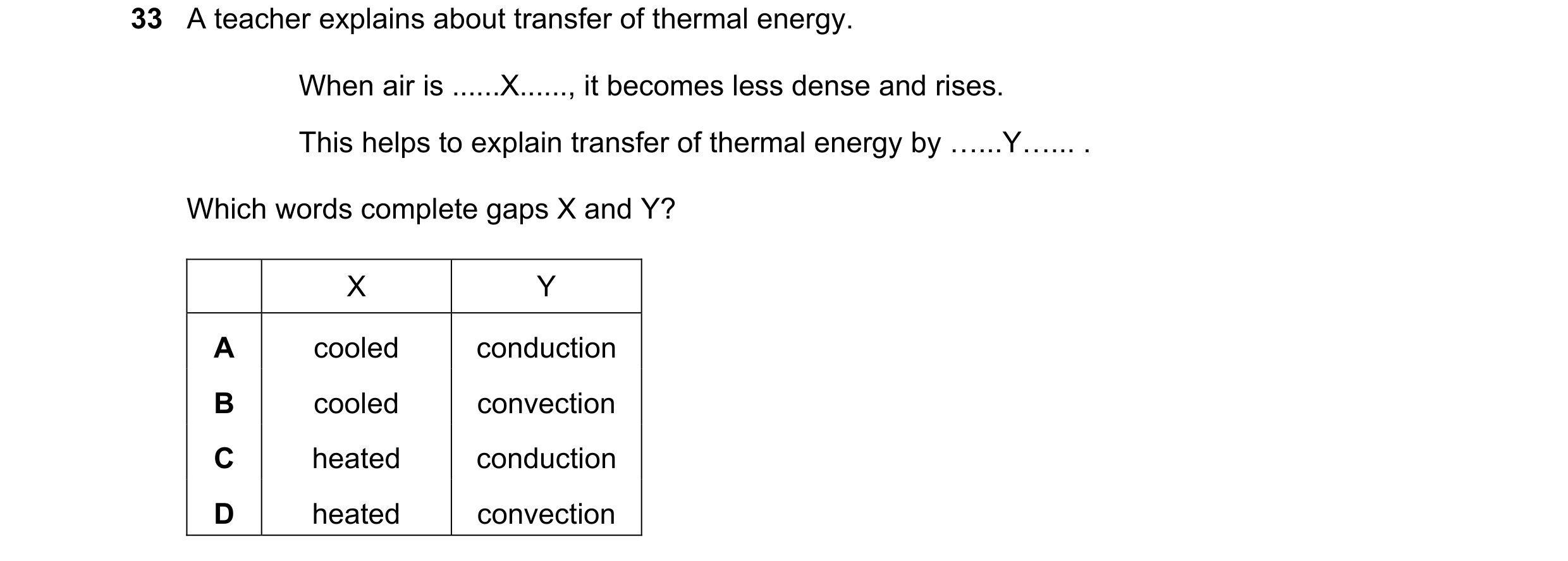
 2 / 19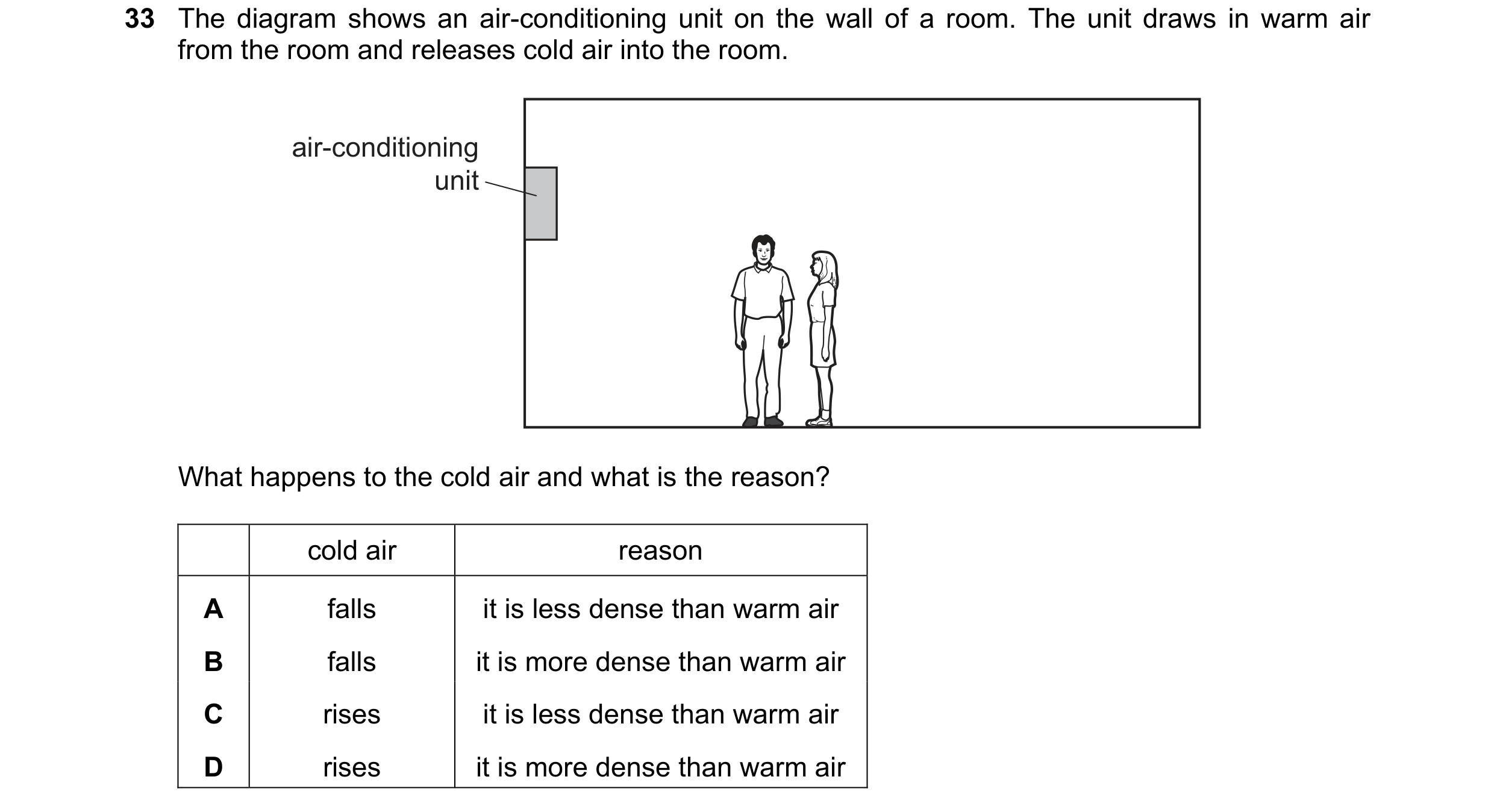
 3 / 19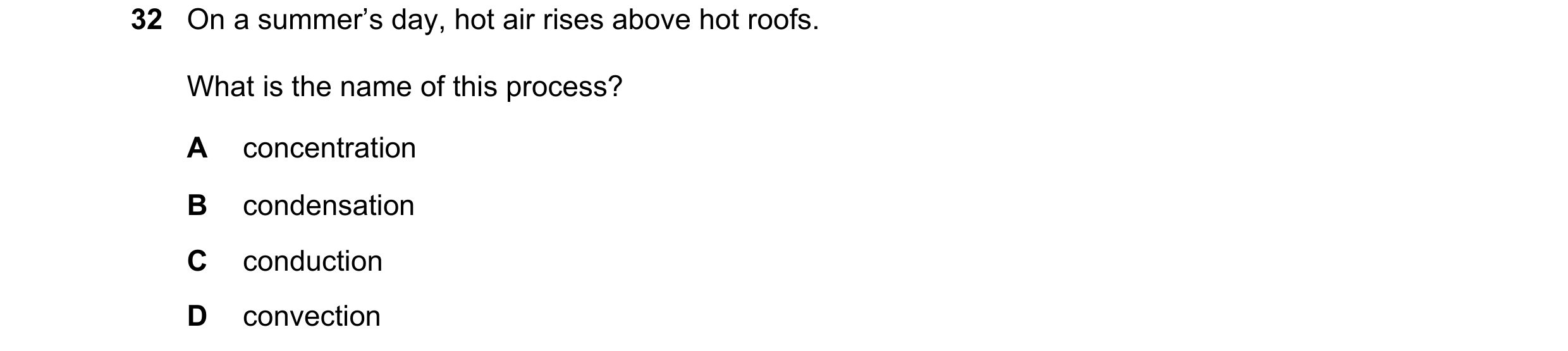
 4 / 19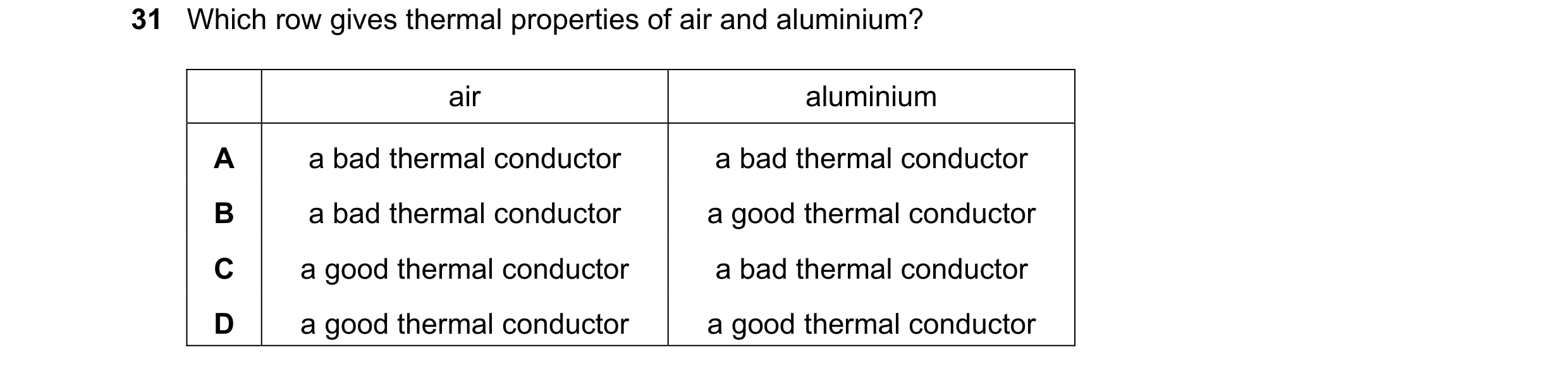

 5 / 19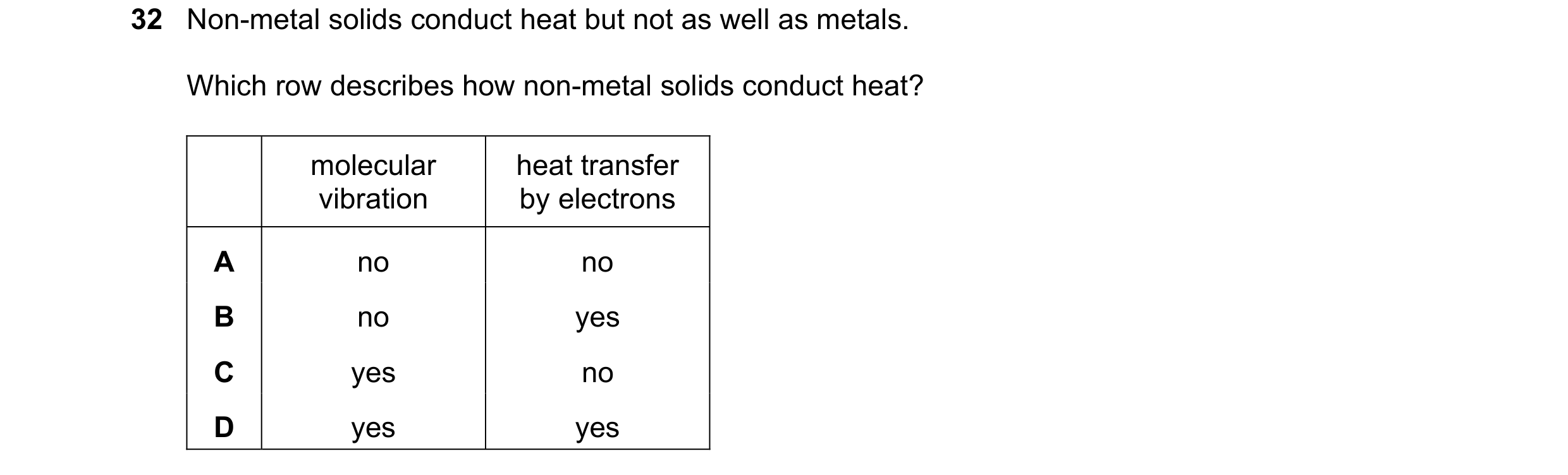
 6 / 19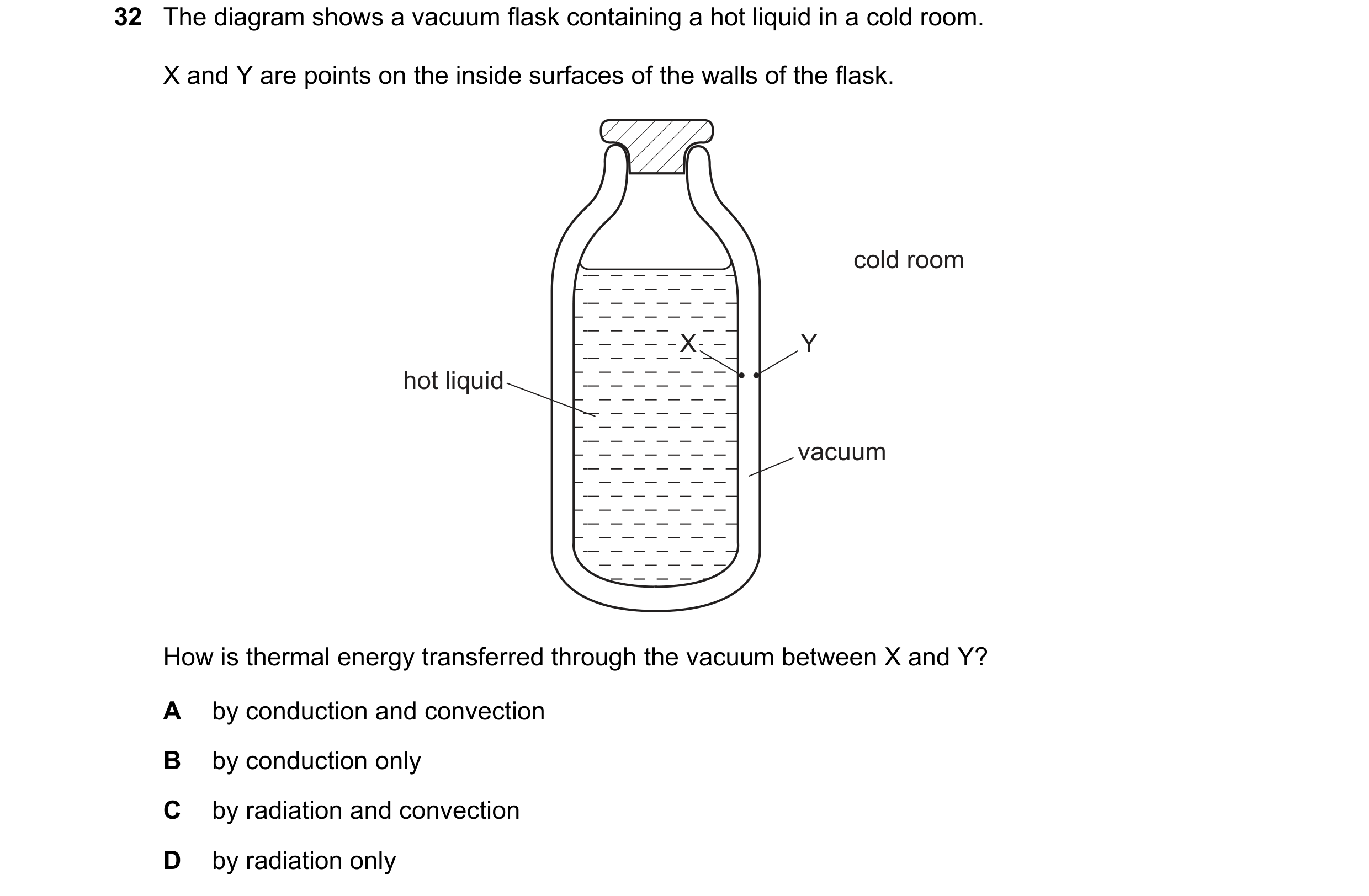
 7 / 19
 8 / 19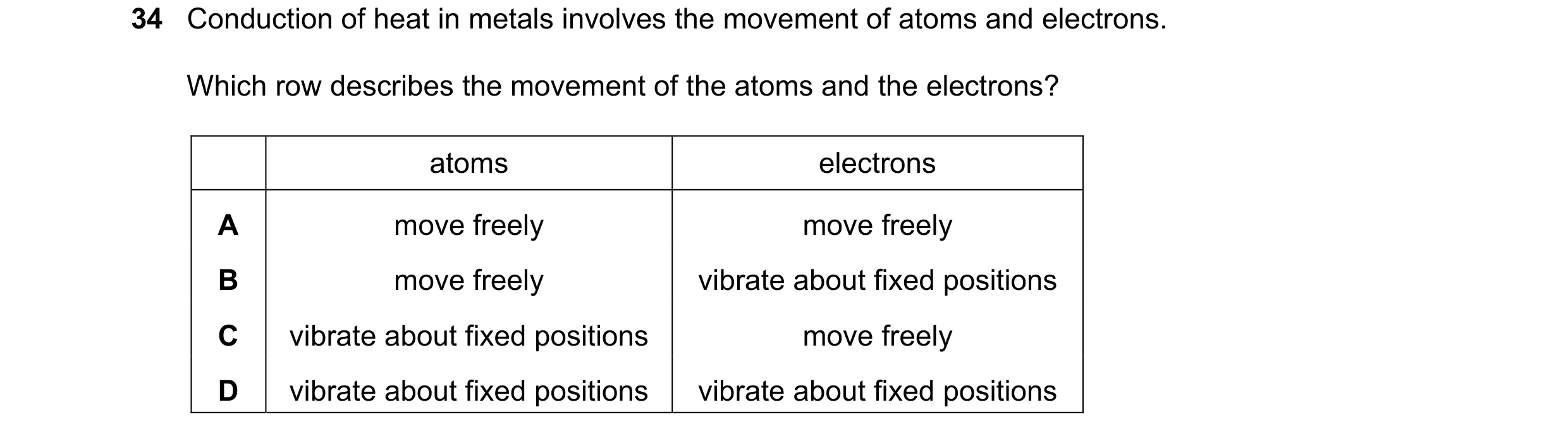
 9 / 19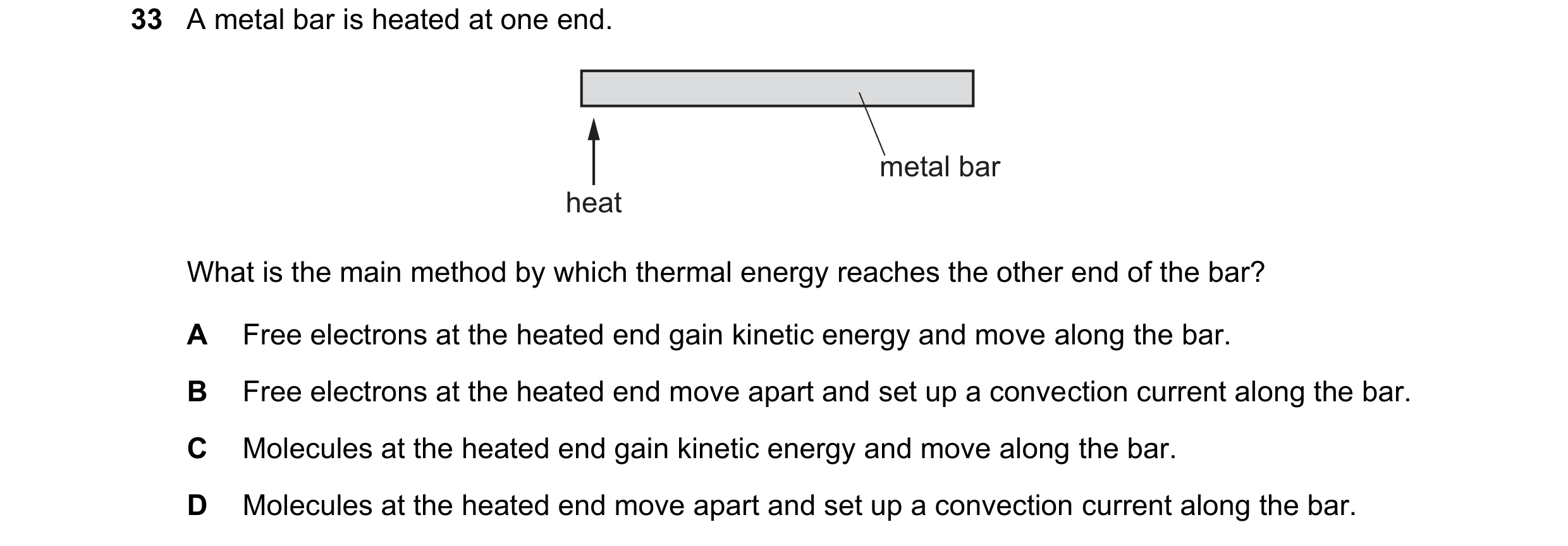

 10 / 19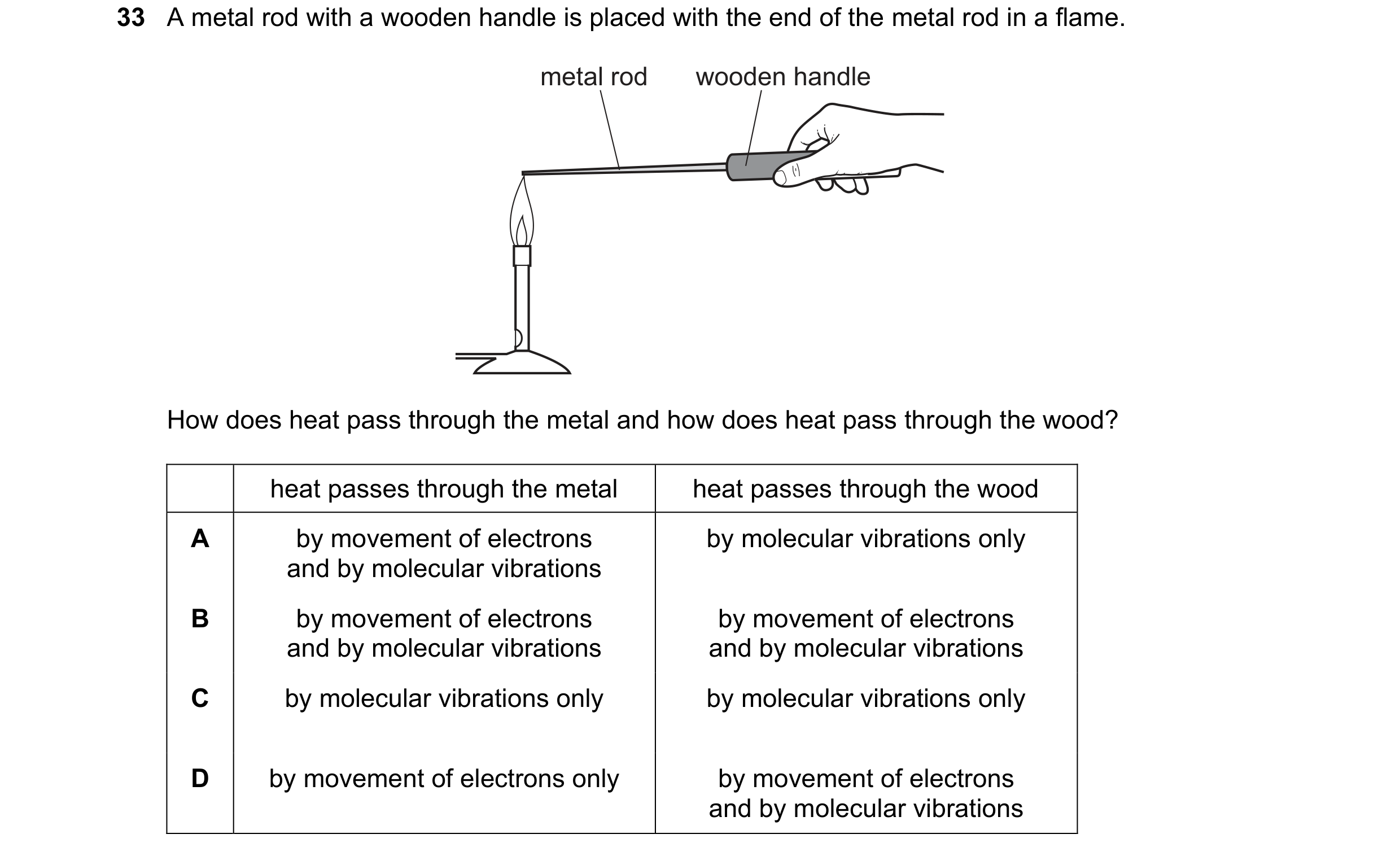
 11 / 19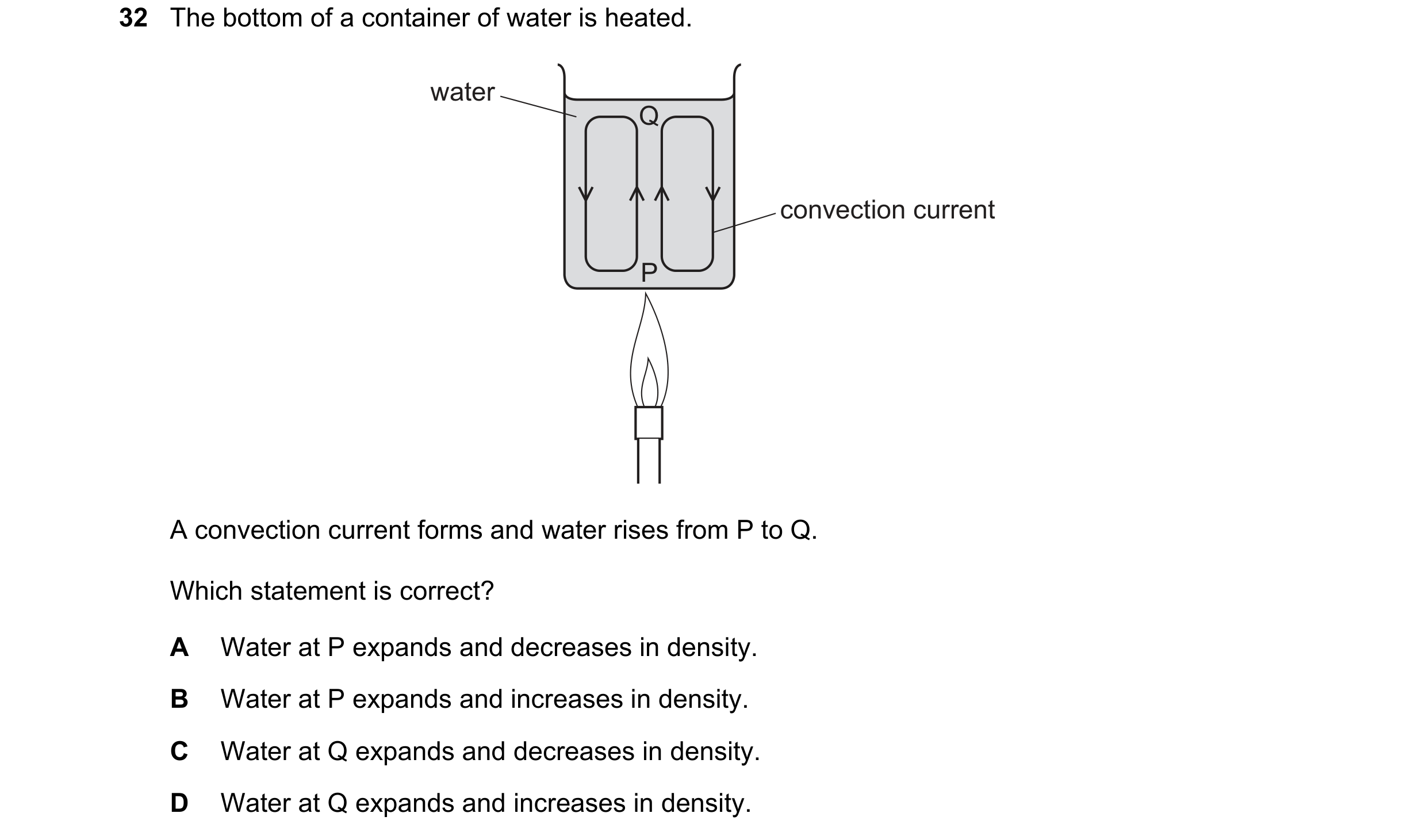
 12 / 19
 13 / 19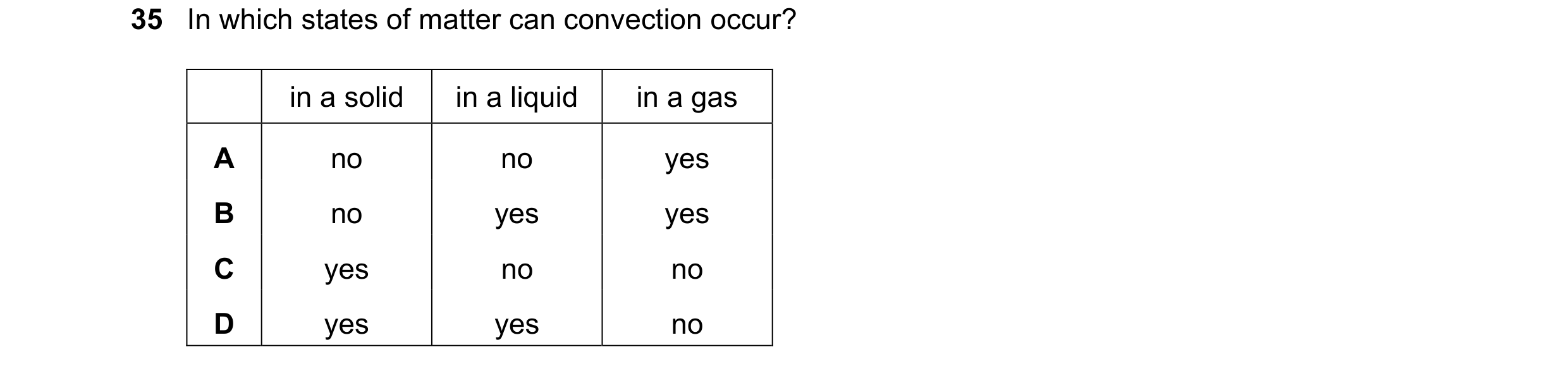


 14 / 19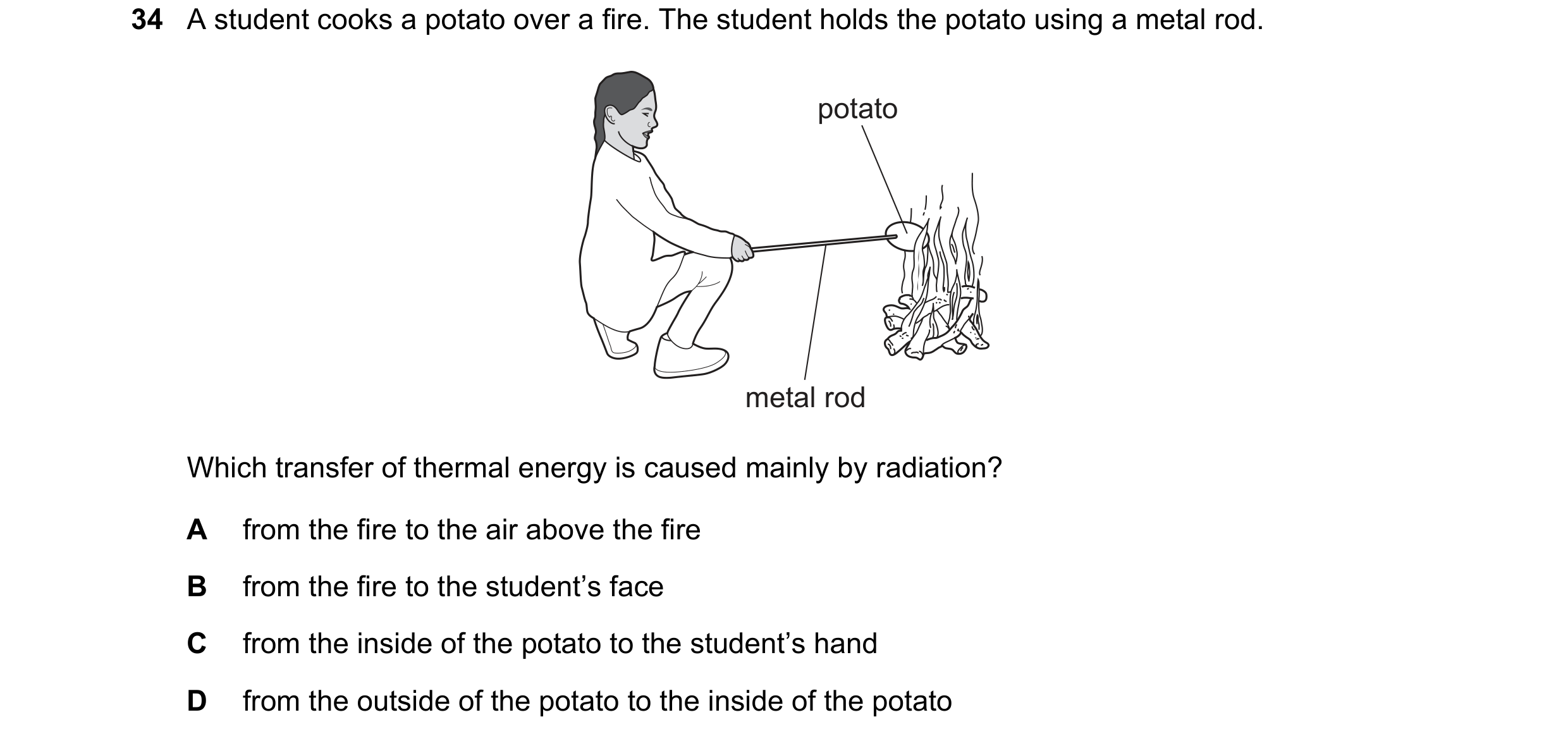
 15 / 19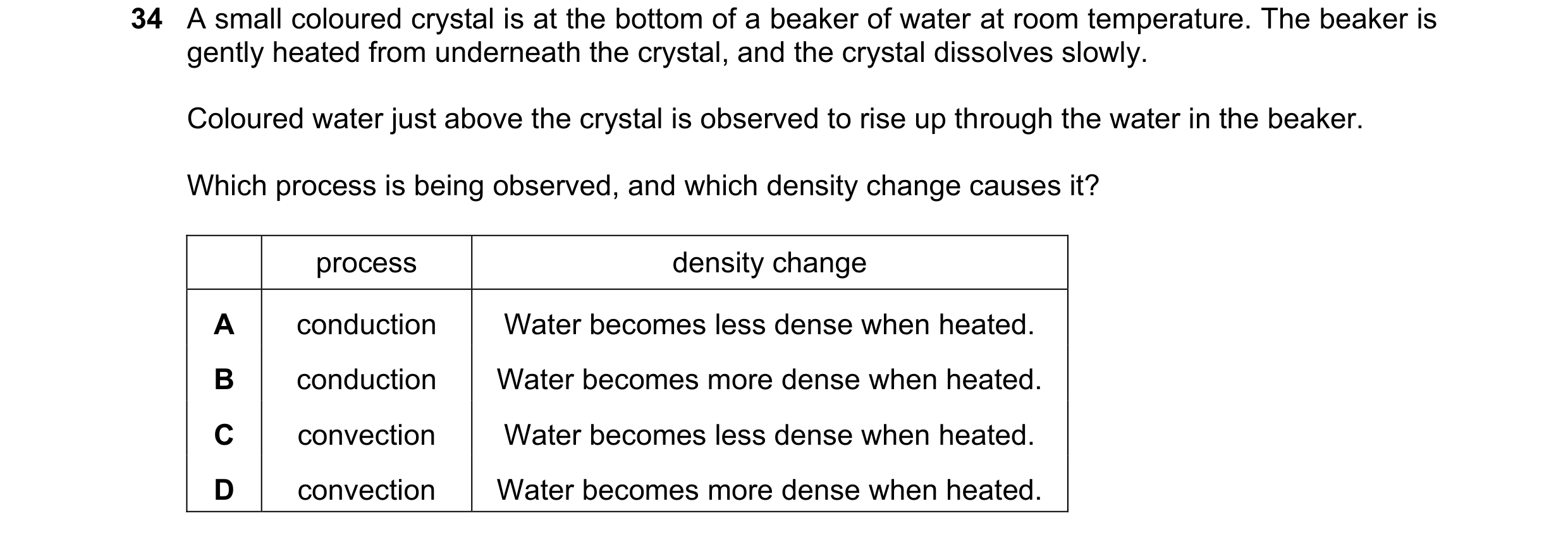

 16 / 19
 17 / 19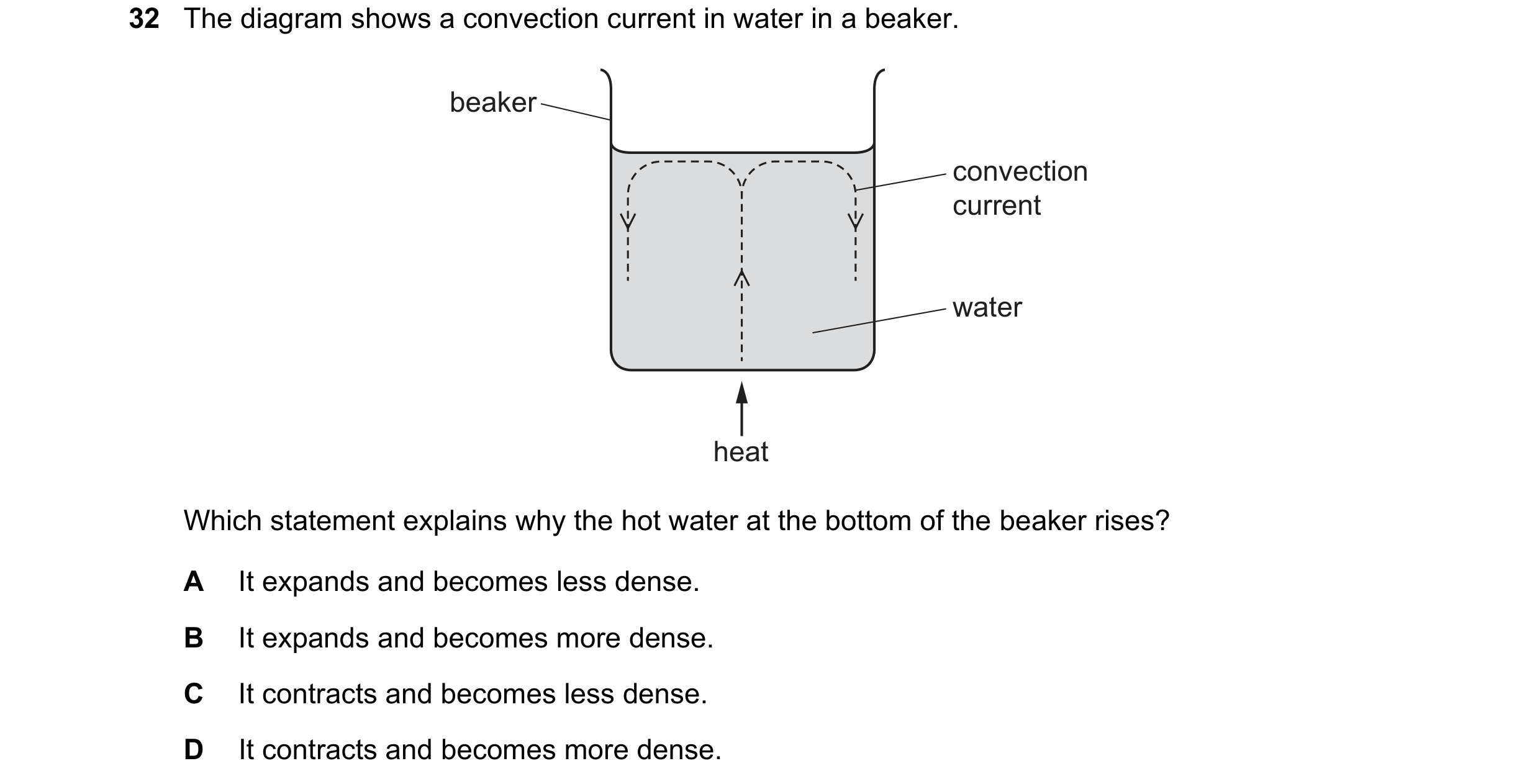

 18 / 19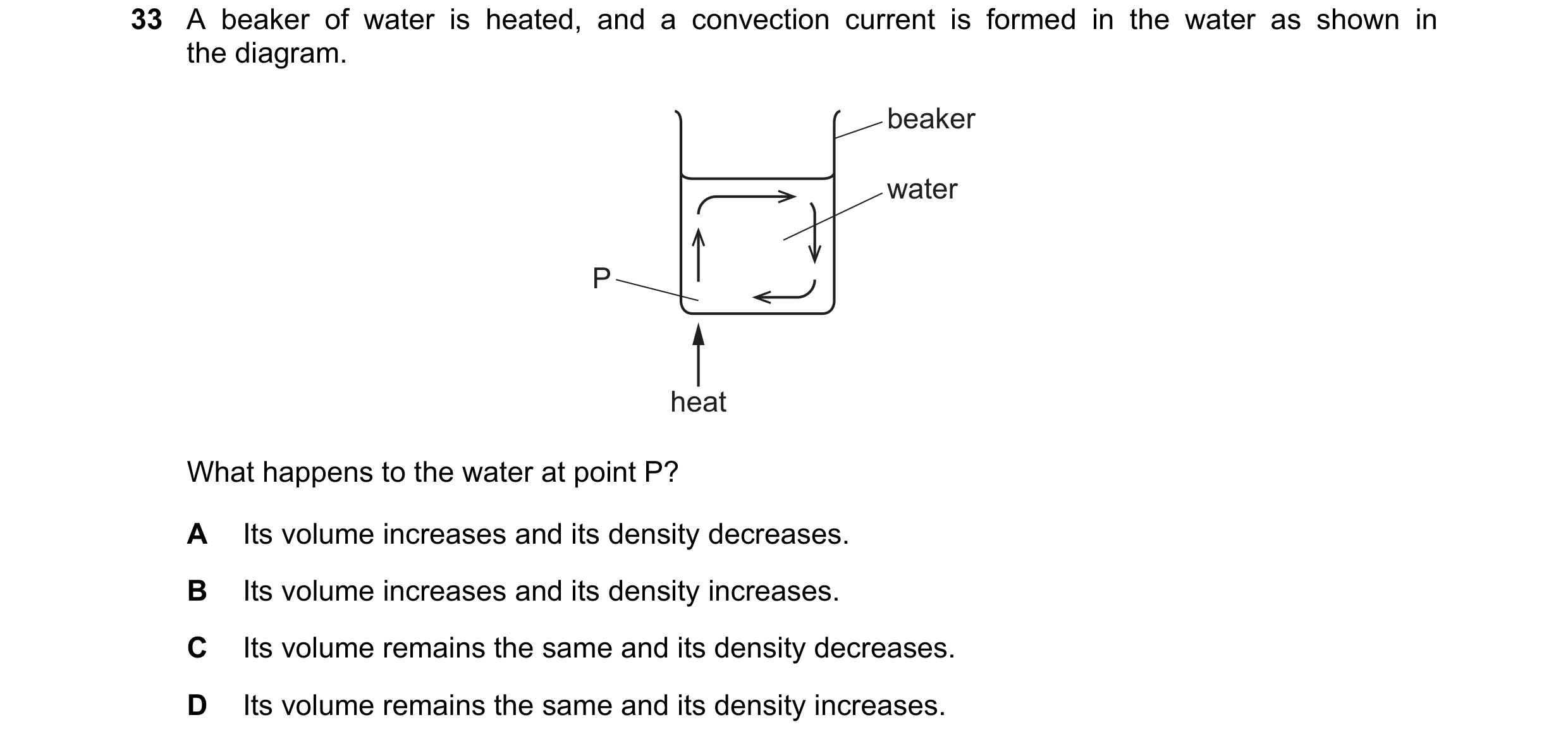
 19 / 19