Questions as text
Q1 · A man standing in the sea on a sunny day 0653/41 May/June 2017
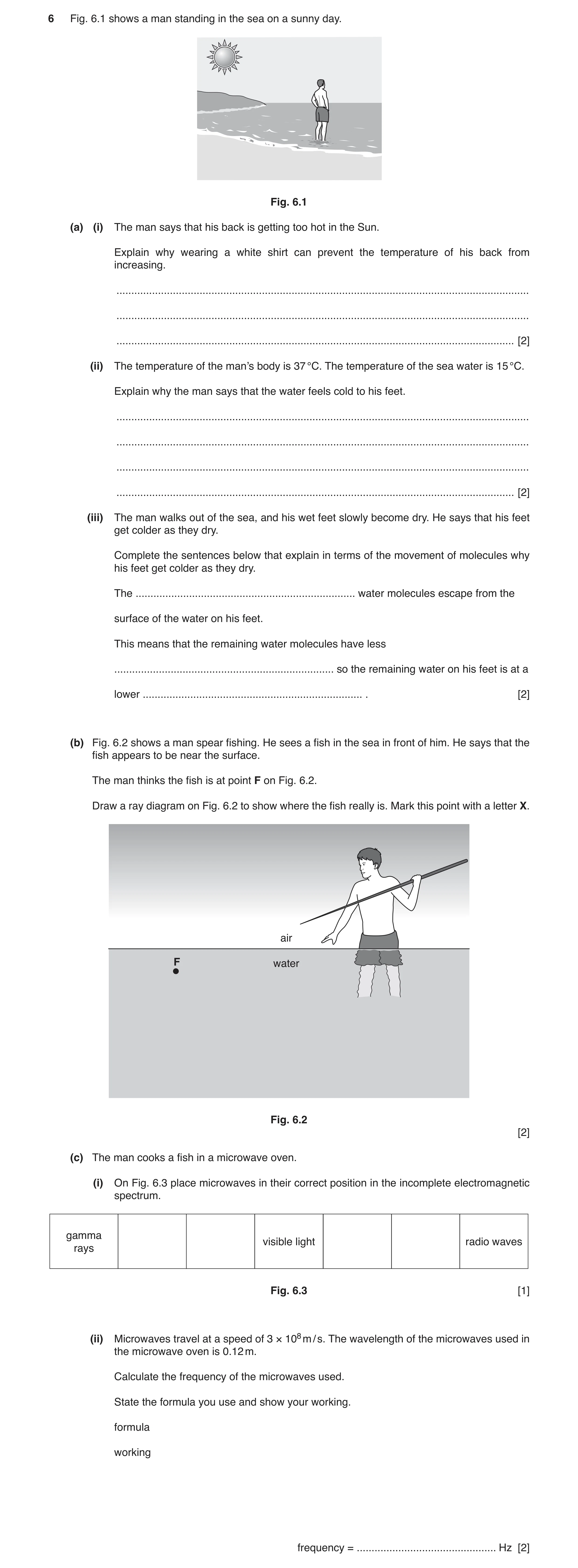
6 Fig. 6.1 shows a man standing in the sea on a sunny day. Fig. 6.1 (a) (i) The man says that his back is getting too hot in the Sun. Explain why wearing a white shirt can prevent the temperature of his back from increasing. … … … [2] (ii) The temperature of the man’s body is 37 °C. The temperature of the sea water is 15 °C. Explain why the man says that the water feels cold to his feet. … … … … [2] (iii) The man walks out of the sea, and his wet feet slowly become dry. He says that his feet get colder as they dry. Complete the sentences below that explain in terms of the movement of molecules why his feet get colder as they dry. The … water molecules escape from the surface of the water on his feet. This means that the remaining water molecules have less … so the remaining water on his feet is at a lower … . [2] (b) Fig. 6.2 shows a man spear fishing. He sees a fish in the sea in front of him. He says that the fish appears to be near the surface. The man thinks the fish is at point F on Fig. 6.2. Draw a ray diagram on Fig. 6.2 to show where the fish really is. Mark this point with a letter X. air F water Fig. 6.2 [2] (c) The man cooks a fish in a microwave oven. (i) On Fig. 6.3 place microwaves in their correct position in the incomplete electromagnetic spectrum. gamma visible light radio waves rays Fig. 6.3 [1] (ii) Microwaves travel at a speed of 3 × 10⁸ m / s. The wavelength of the microwaves used in the microwave oven is 0.12 m. Calculate the frequency of the microwaves used. State the formula you use and show your working. formula working frequency = … Hz [2]
11 marks
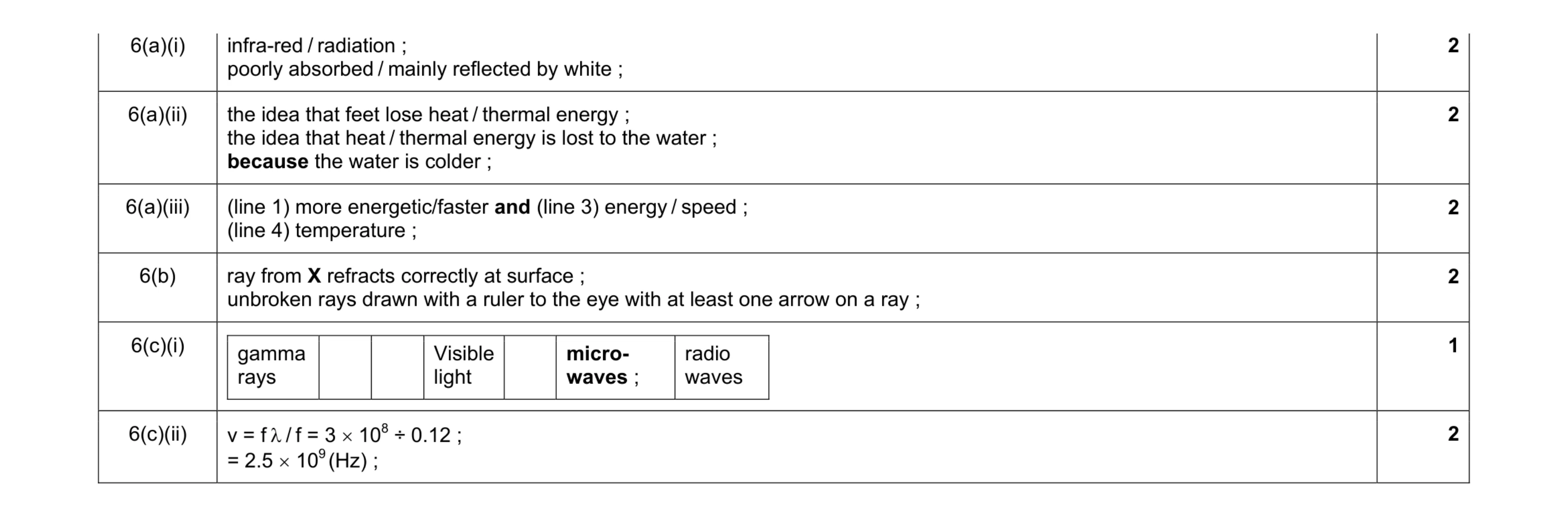
Mark scheme: 6(a)(i) infra-red / radiation ; poorly absorbed / mainly reflected by white ; 2 6(a)(ii) the idea that feet lose heat / thermal energy ; the idea that heat / thermal energy is lost to the water ; because the water is colder ; 2 6(a)(iii) (line 1) more energetic/faster and (line 3) energy / speed ; (line 4) temperature ; 2 6(b) ray from X refracts correctly at surface ; unbroken rays drawn with a ruler to the eye with at least one arrow on a ray ; 2 6(c)(i) gamma rays Visible light micro- waves ; radio waves 1 6(c)(ii) v = f λ / f = 3 × 10⁸ ÷ 0.12 ; = 2.5 × 10⁹ (Hz) ; 2
This question in 0653/41 May/June 2017
Q2 · A man riding a snowmobile across snow and ice at a research station in Antarctica 0653/43 May/June 2017
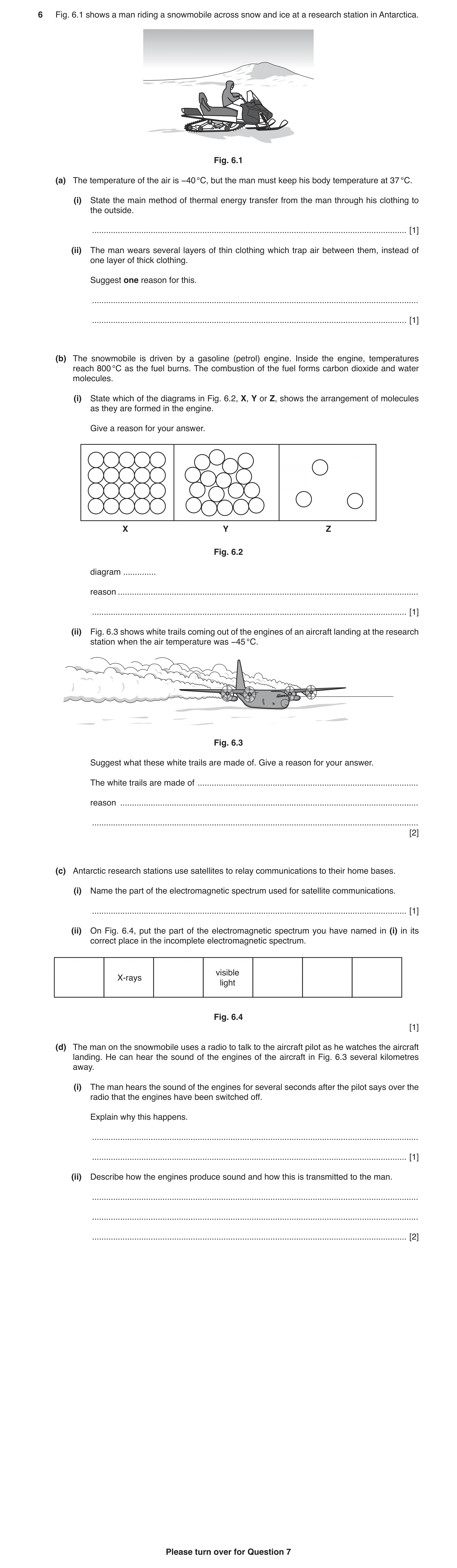
6 Fig. 6.1 shows a man riding a snowmobile across snow and ice at a research station in Antarctica. Fig. 6.1 (a) The temperature of the air is −40 °C, but the man must keep his body temperature at 37 °C. (i) State the main method of thermal energy transfer from the man through his clothing to the outside. … [1] (ii) The man wears several layers of thin clothing which trap air between them, instead of one layer of thick clothing. Suggest one reason for this. … … [1] (b) The snowmobile is driven by a gasoline (petrol) engine. Inside the engine, temperatures reach 800 °C as the fuel burns. The combustion of the fuel forms carbon dioxide and water molecules. (i) State which of the diagrams in Fig. 6.2, X, Y or Z, shows the arrangement of molecules as they are formed in the engine. Give a reason for your answer. X Y Z Fig. 6.2 diagram … reason … … [1] (ii) Fig. 6.3 shows white trails coming out of the engines of an aircraft landing at the research station when the air temperature was −45 °C. Fig. 6.3 Suggest what these white trails are made of. Give a reason for your answer. The white trails are made of … reason … … [2] (c) Antarctic research stations use satellites to relay communications to their home bases. (i) Name the part of the electromagnetic spectrum used for satellite communications. … [1] (ii) On Fig. 6.4, put the part of the electromagnetic spectrum you have named in (i) in its correct place in the incomplete electromagnetic spectrum. visible X-rays light Fig. 6.4 [1] (d) The man on the snowmobile uses a radio to talk to the aircraft pilot as he watches the aircraft landing. He can hear the sound of the engines of the aircraft in Fig. 6.3 several kilometres away. (i) The man hears the sound of the engines for several seconds after the pilot says over the radio that the engines have been switched off. Explain why this happens. … … [1] (ii) Describe how the engines produce sound and how this is transmitted to the man. … … … [2] Please turn over for Question 7
10 marks
Mark scheme: 6(a)(i) conduction ; 1 6(a)(ii) air is a good insulator / poor conductor (of heat) ; 1 6(b)(i) (Z – no mark) at 800 °C / such a high temperature water is formed as a gas ; 1 6(b)(ii) ice (crystals) ; water vapour / steam from engines freezes in contact with air at a temperature well below freezing point of water ; 2 6(c)(i) microwaves ; 1 6(c)(ii) X-rays visible light micro- waves ; 1 6(d)(i) speed of radio waves / electromagnetic waves (much) faster than speed of sound ; 1 6(d)(ii) vibrations produced by engines / owtte ; create series of compressions and rarefactions through air to man / vibrations passed through air from particle to particle / longitudinal (sound) waves are passed through the air ; 2
This question in 0653/43 May/June 2017
Q3 · A radiator which uses hot water to provide heating for people sitting in a room watching… 0653/42 Oct/Nov 2017
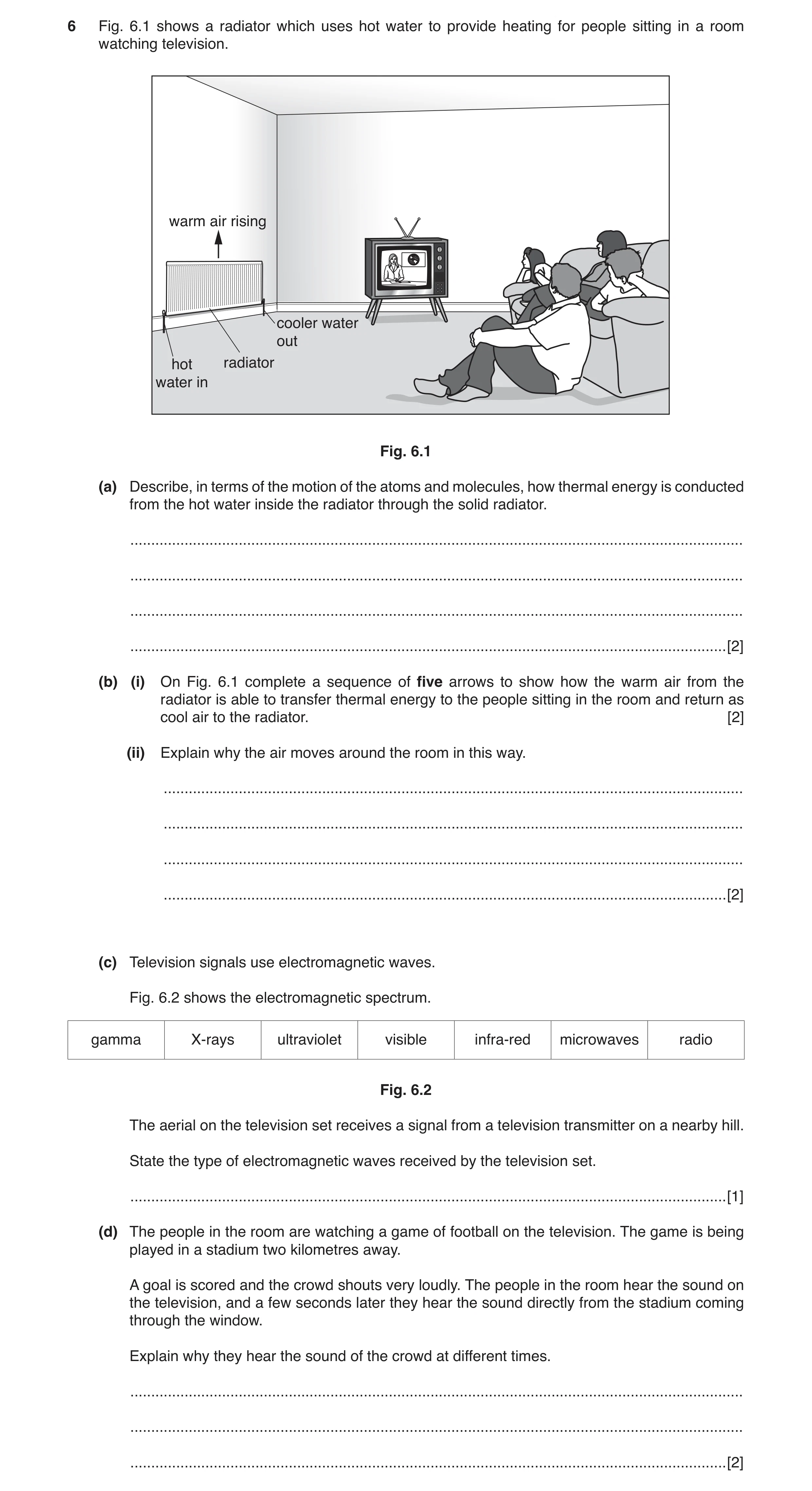
6 Fig. 6.1 shows a radiator which uses hot water to provide heating for people sitting in a room watching television. warm air rising cooler water out hot radiator water in Fig. 6.1 (a) Describe, in terms of the motion of the atoms and molecules, how thermal energy is conducted from the hot water inside the radiator through the solid radiator. … … … … [2] (b) (i) On Fig. 6.1 complete a sequence of five arrows to show how the warm air from the radiator is able to transfer thermal energy to the people sitting in the room and return as cool air to the radiator. [2] (ii) Explain why the air moves around the room in this way. … … … … [2] (c) Television signals use electromagnetic waves. Fig. 6.2 shows the electromagnetic spectrum. gamma X-rays ultraviolet visible infra-red microwaves radio Fig. 6.2 The aerial on the television set receives a signal from a television transmitter on a nearby hill. State the type of electromagnetic waves received by the television set. … [1] (d) The people in the room are watching a game of football on the television. The game is being played in a stadium two kilometres away. A goal is scored and the crowd shouts very loudly. The people in the room hear the sound on the television, and a few seconds later they hear the sound directly from the stadium coming through the window. Explain why they hear the sound of the crowd at different times. … … … [2]
9 marks
Mark scheme: 6(a) atoms / molecules (in contact with water) vibrate (more) ; the idea that energy / vibrations passed on through collisions / from particle to particle (owtte) ; 2 6(b)(i) arrows show rise (to ceiling), progress across (ceiling), downward progress (to floor) ; (past people) return to radiator ; 2 6(b)(ii) warm air is less dense / ora ; so warm air rises / ora ; 2 6(c) radio (waves) ; 1 6(d) TV signal travels at speed of e / m waves ; e / m waves travel (much) faster than sound (waves) ; 2
This question in 0653/42 Oct/Nov 2017
Question 4 0653/43 Oct/Nov 2017
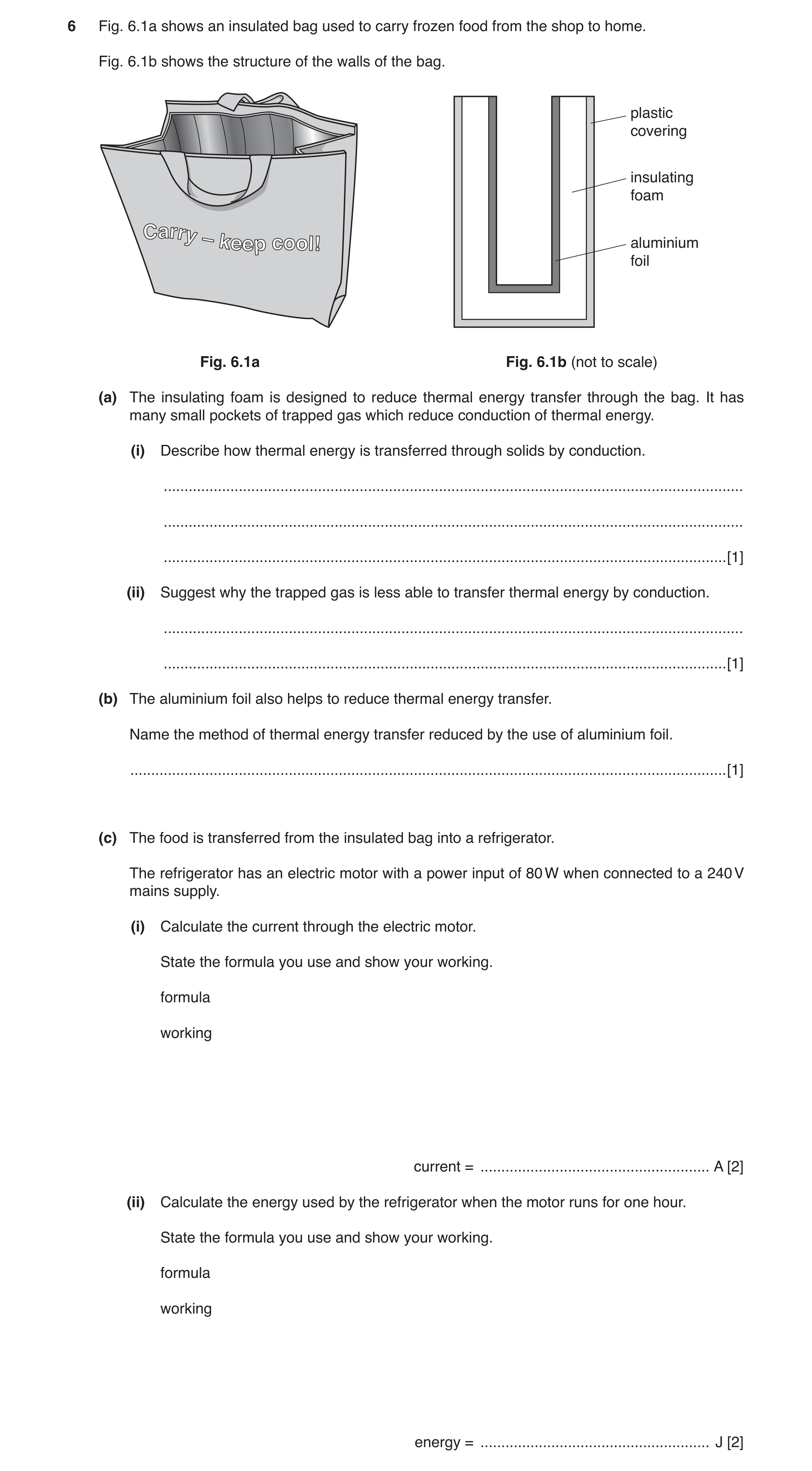
6 Fig. 6.1a shows an insulated bag used to carry frozen food from the shop to home. Fig. 6.1b shows the structure of the walls of the bag. plastic covering insulating foam aluminium Carry– keep cool! foil Fig. 6.1a Fig. 6.1b (not to scale) (a) The insulating foam is designed to reduce thermal energy transfer through the bag. It has many small pockets of trapped gas which reduce conduction of thermal energy. (i) Describe how thermal energy is transferred through solids by conduction. … … … [1] (ii) Suggest why the trapped gas is less able to transfer thermal energy by conduction. … … [1] (b) The aluminium foil also helps to reduce thermal energy transfer. Name the method of thermal energy transfer reduced by the use of aluminium foil. … [1] (c) The food is transferred from the insulated bag into a refrigerator. The refrigerator has an electric motor with a power input of 80 W when connected to a 240 V mains supply. (i) Calculate the current through the electric motor. State the formula you use and show your working. formula working current = … A [2] (ii) Calculate the energy used by the refrigerator when the motor runs for one hour. State the formula you use and show your working. formula working energy = … J [2]
7 marks
Mark scheme: 6(a)(i) atoms / molecules / particles vibrate (faster) and / transfer this vibration / energy to neighbouring particles owtte ; 1 6(a)(ii) gas molecules far apart, no vibration ; 1 6(b) radiation ; 1 6(c)(i) P = IV ; (or alternative expression) / I = 80 / 240 ; = 0.33 (A) ; 2 6(c)(ii) E = P × t / E = V × I × t / E = 80 × 3600 ; = 288 000 (J) ; 2
This question in 0653/43 Oct/Nov 2017
Q5 · The circuit for an immersion heater using electrical energy to heat water 0653/42 Feb/March 2018
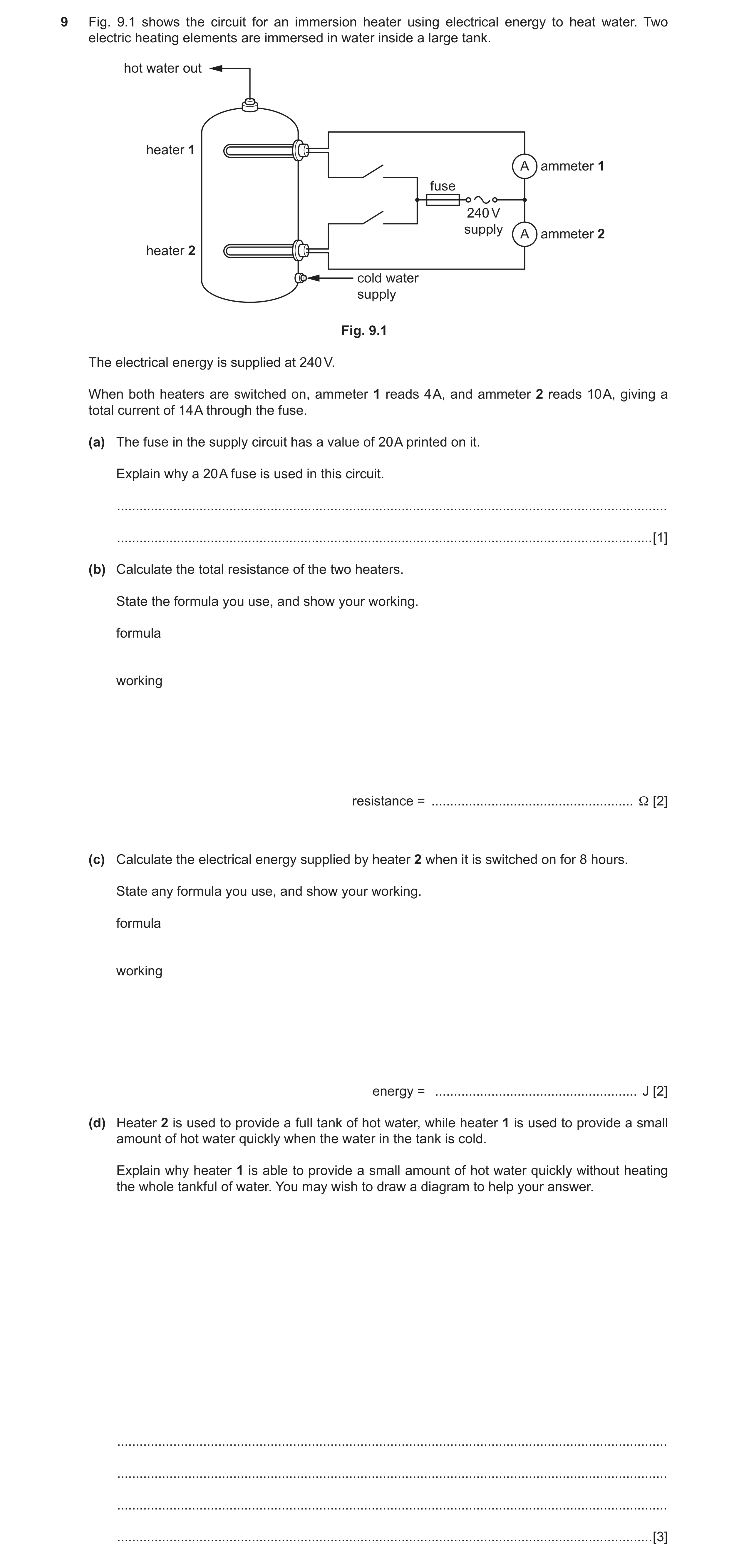
9 Fig. 9.1 shows the circuit for an immersion heater using electrical energy to heat water. Two electric heating elements are immersed in water inside a large tank. hot water out heater 1 A ammeter 1 fuse 240 V supply A ammeter 2 heater 2 cold water supply Fig. 9.1 The electrical energy is supplied at 240 V. When both heaters are switched on, ammeter 1 reads 4 A, and ammeter 2 reads 10 A, giving a total current of 14 A through the fuse. (a) The fuse in the supply circuit has a value of 20 A printed on it. Explain why a 20 A fuse is used in this circuit. … … [1] (b) Calculate the total resistance of the two heaters. State the formula you use, and show your working. formula working resistance = … Ω [2] (c) Calculate the electrical energy supplied by heater 2 when it is switched on for 8 hours. State any formula you use, and show your working. formula working energy = … J [2] (d) Heater 2 is used to provide a full tank of hot water, while heater 1 is used to provide a small amount of hot water quickly when the water in the tank is cold. Explain why heater 1 is able to provide a small amount of hot water quickly without heating the whole tankful of water. You may wish to draw a diagram to help your answer. … … … … [3]
8 marks
Mark scheme: 9(a) total current of 14 A needs higher value fuse / reference to the safety margin / owtte ; 1 9(b) (R = ) V / I ; (R = ) 240 / 14 = 17.1 (Ω) ; OR 1 / R = 1 / R1 + 1 / R2 ; R1 = 240 /4 = 60 Ω and R2 = 240 / 10 = 24 Ω and so 1/R = 1/60 + 1/24 = 7/120, so R = 17.1 Ω ; 2 Question Answer Marks 9(c) E = IVt ; = 10 × 240 × 8 × 60 ×60 = 69 120 000 (J) ; 2 9(d) reference to convection ; the idea that water at higher temperature rises / has a lower density ; the idea that the convection current from heater 1 does not affect the water in the lower part of the tank / water below heater 1 has greater density and so does not mix with heated water / owtte ; 3
This question in 0653/42 Feb/March 2018
Q6 · A man watching television 0653/41 May/June 2018
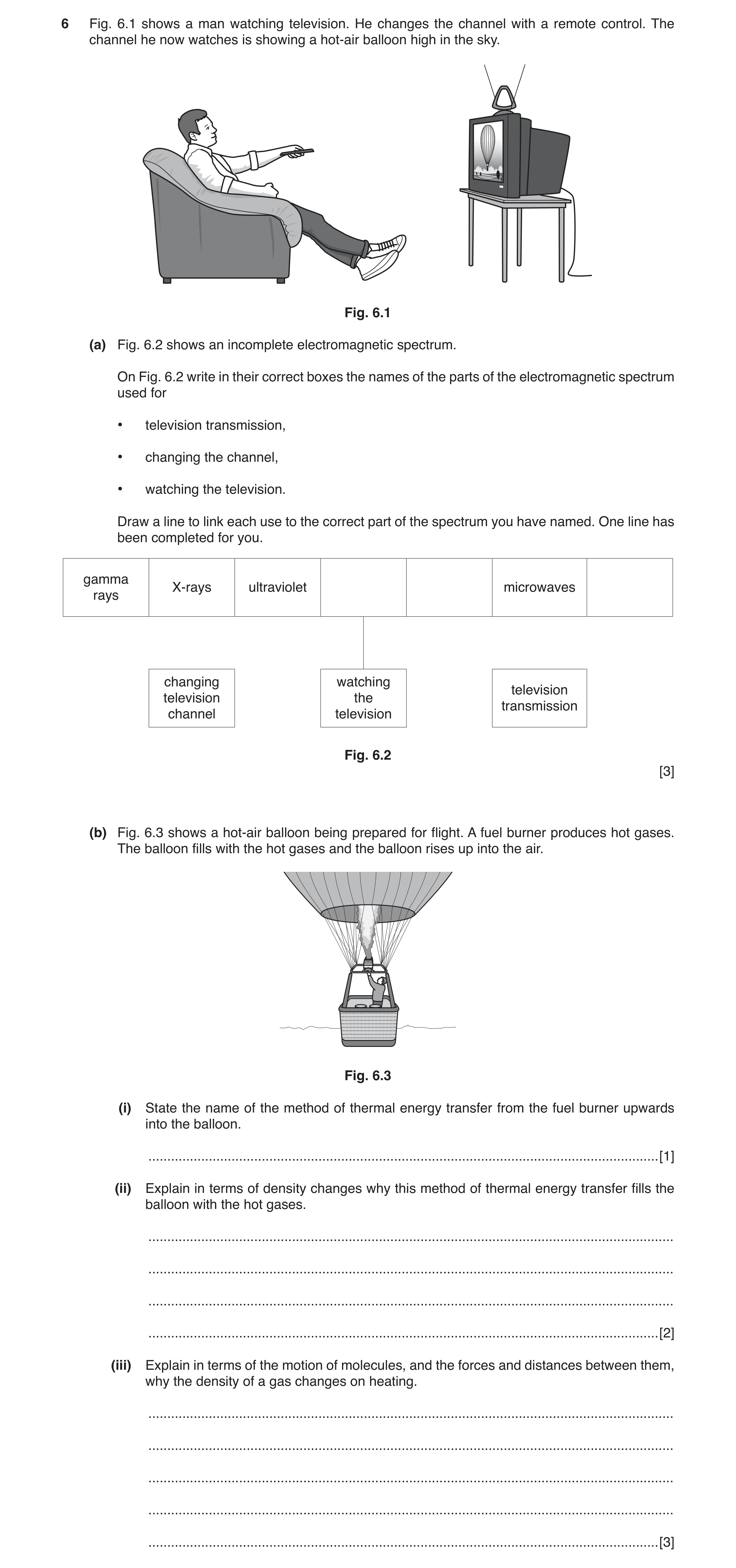
6 Fig. 6.1 shows a man watching television. He changes the channel with a remote control. The channel he now watches is showing a hot-air balloon high in the sky. Fig. 6.1 (a) Fig. 6.2 shows an incomplete electromagnetic spectrum. On Fig. 6.2 write in their correct boxes the names of the parts of the electromagnetic spectrum used for • television transmission, • changing the channel, • watching the television. Draw a line to link each use to the correct part of the spectrum you have named. One line has been completed for you. gamma X-rays ultraviolet microwaves rays changing watching television television the transmission channel television Fig. 6.2 [3] (b) Fig. 6.3 shows a hot-air balloon being prepared for flight. A fuel burner produces hot gases. The balloon fills with the hot gases and the balloon rises up into the air. Fig. 6.3 (i) State the name of the method of thermal energy transfer from the fuel burner upwards into the balloon. … [1] (ii) Explain in terms of density changes why this method of thermal energy transfer fills the balloon with the hot gases. … … … … [2] (iii) Explain in terms of the motion of molecules, and the forces and distances between them, why the density of a gas changes on heating. … … … … … [3]
9 marks
Mark scheme: 6(a) gamma rays X-rays ultraviolet visible light infra-red microwaves radio waves changing television channel watching the television television transmission 3 correctly named parts of the electromagnetic spectrum ; these named parts correctly located ; 2 correct links between action and part of the electromagnetic spectrum ; 3 6(b)(i) convection ; 1 6(b)(ii) the density of hot gases is lower (than air in balloon) ; hot gases / lower density gases rise / ora ; 2 6(b)(iii) molecules move faster / have greater kinetic energy ; (attractive) forces become weaker / less significant ; the separation between molecules increases ; 3
This question in 0653/41 May/June 2018
Q7 · Ice cubes being added to a drink at 25 °C to cool the drink down 0653/43 May/June 2018
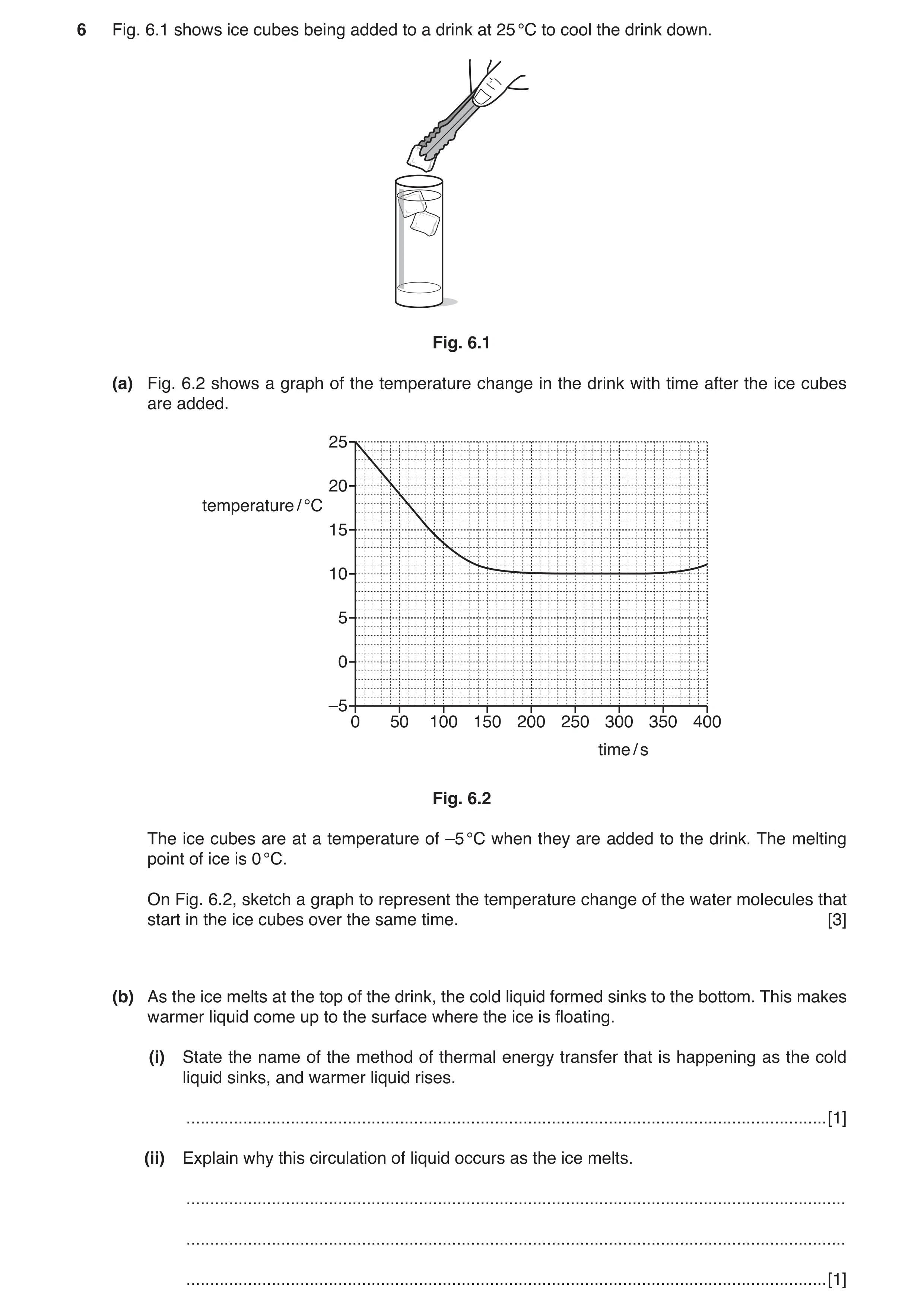
6 Fig. 6.1 shows ice cubes being added to a drink at 25 °C to cool the drink down. Fig. 6.1 (a) Fig. 6.2 shows a graph of the temperature change in the drink with time after the ice cubes are added. 25 20 temperature / °C 15 10 5 0 –5 0 50 100 150 200 250 300 350 400 time / s Fig. 6.2 The ice cubes are at a temperature of –5 °C when they are added to the drink. The melting point of ice is 0 °C. On Fig. 6.2, sketch a graph to represent the temperature change of the water molecules that start in the ice cubes over the same time. [3] (b) As the ice melts at the top of the drink, the cold liquid formed sinks to the bottom. This makes warmer liquid come up to the surface where the ice is floating. (i) State the name of the method of thermal energy transfer that is happening as the cold liquid sinks, and warmer liquid rises. … [1] (ii) Explain why this circulation of liquid occurs as the ice melts. … … … [1]
5 marks
Mark scheme: 6(a) line starts from –5° ; line rises to meet cooling line ; curves meet at or after 200 seconds ; line matches cooling line and follows it as temp rises again at end ; Max 3 6(b)(i) convection ; 1 6(b)(ii) cold water denser than warm ( so sinks to bottom, displacing warmer water back to top) ; 1
This question in 0653/43 May/June 2018
Q8 · A liquid is able to flow and will take the shape of its container 0653/42 Oct/Nov 2018
6 (a) A liquid is able to flow and will take the shape of its container. A solid does not have this property. Explain, in terms of the motion of molecules and the distances and forces between them, why this property is different between liquids and solids. … … … … … … [3] (b) When a liquid is heated, it expands. Name a measuring instrument that makes use of this property of liquids. … [1] (c) Fig. 6.1 shows a hot drink in a cup left to cool down. Fig. 6.1 The statements below describe ways in which the drink loses thermal energy as it cools. Put a tick (3) in the box alongside any correct statement. Put a cross (7) in the box alongside any incorrect statement. conduction through the sides and base of the cup convection as air above the cup is heated and the warm air moves upwards ultraviolet radiation in all directions evaporation as the faster molecules in the liquid escape from the surface of the liquid [2] (d) Astronomers use telescopes to study stars. Stars are extremely hot bodies that lose energy by emitting electromagnetic radiation into space. (i) Explain why stars can only lose energy by radiation, and not by conduction or convection. … … [1] (ii) Fig. 6.2 shows the electromagnetic spectrum. increasing wavelength radio gamma X-rays ultraviolet visible infra-red microwaves waves Fig. 6.2 Stars emit all types of radiation. The energy carried by electromagnetic waves increases as the frequency increases. Explain why gamma radiation enables stars to lose energy most rapidly. … … [1]
8 marks
Mark scheme: 6(a) In liquids: in liquids molecules further apart / not tightly packed / in solids molecules are tightly packed ; in liquids attractive forces are low / in solids attractive forces are high ; in liquids molecules are able to move around / slide past each other / in solids molecules (only) vibrate (around a fixed point) ; 3 6(b) thermometer ; 1 6(c) ticks in first, second, and fourth box, cross in 3rd box ; 2 6(d)(i) Conduction and convection require a medium / can’t travel though a vacuum / radiation can travel through a vacuum ; 1 6(d)(ii) highest frequency ; 1
This question in 0653/42 Oct/Nov 2018
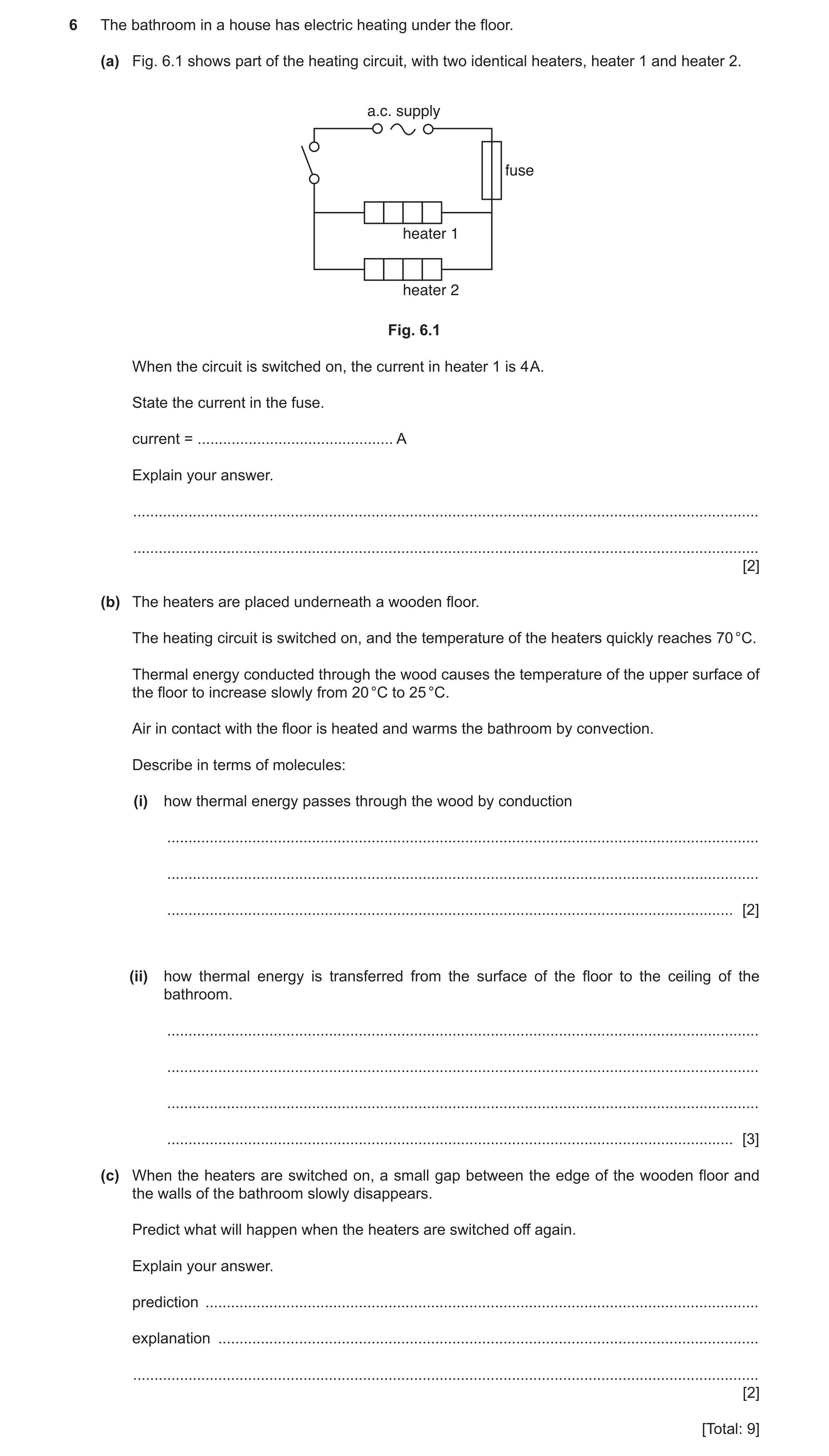
Q9 · The bathroom in a house has electric heating under the floor 0653/42 Feb/March 2019
6 The bathroom in a house has electric heating under the floor. (a) Fig. 6.1 shows part of the heating circuit, with two identical heaters, heater 1 and heater 2. a.c. supply fuse heater 1 heater 2 Fig. 6.1 When the circuit is switched on, the current in heater 1 is 4 A. State the current in the fuse. current = … A Explain your answer. … … [2] (b) The heaters are placed underneath a wooden floor. The heating circuit is switched on, and the temperature of the heaters quickly reaches 70 °C. Thermal energy conducted through the wood causes the temperature of the upper surface of the floor to increase slowly from 20 °C to 25 °C. Air in contact with the floor is heated and warms the bathroom by convection. Describe in terms of molecules: (i) how thermal energy passes through the wood by conduction … … … [2] (ii) how thermal energy is transferred from the surface of the floor to the ceiling of the bathroom. … … … … [3] (c) When the heaters are switched on, a small gap between the edge of the wooden floor and the walls of the bathroom slowly disappears. Predict what will happen when the heaters are switched off again. Explain your answer. prediction … explanation … … [2] [Total: 9]
9 marks
Mark scheme: 6(a) 8 (A) ; 4 A in each identical heater in parallel adds to 8 A ; 2 6(b)(i) (warmer) molecules vibrate faster / gain kinetic energy ; the idea that energy is passed from molecule to molecule ; 2 6(b)(ii) molecules in air gain (kinetic) energy (from collisions with wood) ; (faster) molecules transfer energy to more molecules by collision ; (faster) molecules move further apart ; so (warmer) air has lower density ; max 3 6(c) gap opens again / re-appears ; solids contract on cooling / as temperature falls ; 2
This question in 0653/42 Feb/March 2019
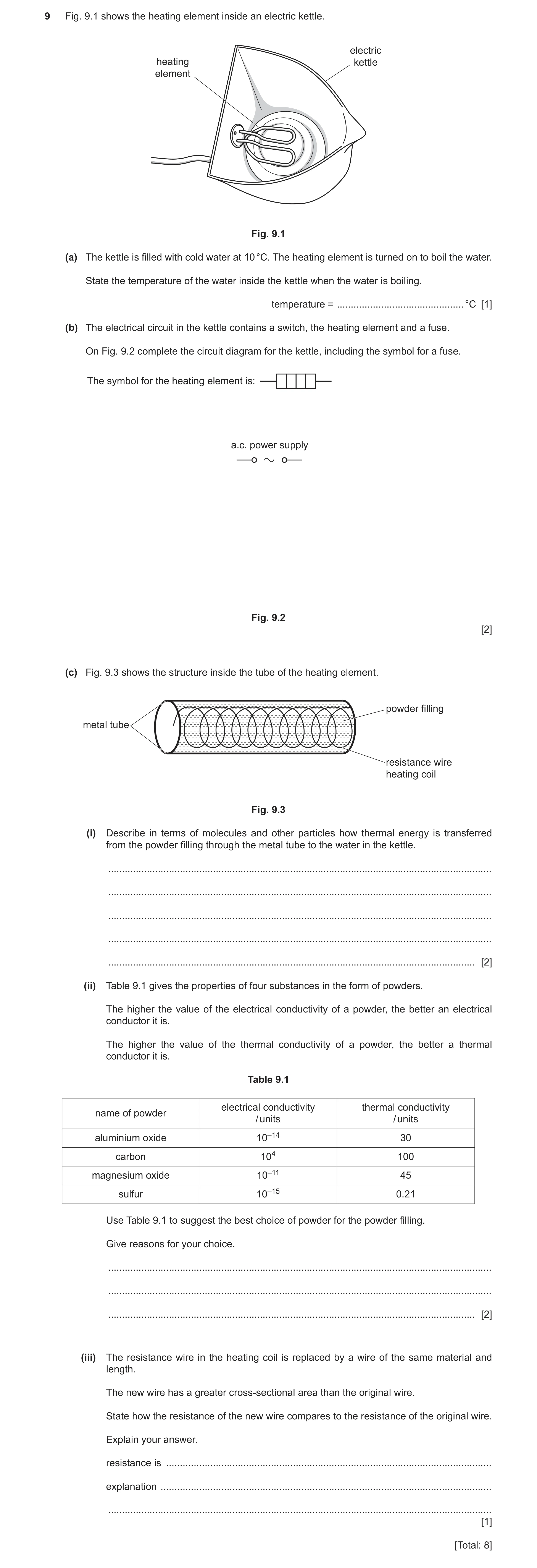
Q10 · The heating element inside an electric kettle 0653/41 May/June 2019
9 Fig. 9.1 shows the heating element inside an electric kettle. electric heating kettle element Fig. 9.1 (a) The kettle is filled with cold water at 10 °C. The heating element is turned on to boil the water. State the temperature of the water inside the kettle when the water is boiling. temperature = … °C [1] (b) The electrical circuit in the kettle contains a switch, the heating element and a fuse. On Fig. 9.2 complete the circuit diagram for the kettle, including the symbol for a fuse. The symbol for the heating element is: a.c. power supply Fig. 9.2 [2] (c) Fig. 9.3 shows the structure inside the tube of the heating element. powder filling metal tube resistance wire heating coil Fig. 9.3 (i) Describe in terms of molecules and other particles how thermal energy is transferred from the powder filling through the metal tube to the water in the kettle. … … … … … [2] (ii) Table 9.1 gives the properties of four substances in the form of powders. The higher the value of the electrical conductivity of a powder, the better an electrical conductor it is. The higher the value of the thermal conductivity of a powder, the better a thermal conductor it is. Table 9.1 electrical conductivity thermal conductivity name of powder / units / units aluminium oxide 10–14 30 carbon 104 100 magnesium oxide 10–11 45 sulfur 10–15 0.21 Use Table 9.1 to suggest the best choice of powder for the powder filling. Give reasons for your choice. … … … [2] (iii) The resistance wire in the heating coil is replaced by a wire of the same material and length. The new wire has a greater cross-sectional area than the original wire. State how the resistance of the new wire compares to the resistance of the original wire. Explain your answer. resistance is … explanation … … [1] [Total: 8]
8 marks
Mark scheme: 9(a) 100 °C ; 1 9(b) fuse symbol ; switch symbol + completed circuit ; 2 9(c)(i) transfer from powder to metal tube by molecular vibrations ; transfer through metal by mobile electrons ; transfer of molecular vibrations from metal tube to vibration / movement of water molecules ; reference to the transfer of energy through the water for example by particle collisions / or by convection ; max 2 Question Answer Marks 9(c)(ii) magnesium oxide or aluminium oxide ; the idea that these materials are poor electrical conductors and good thermal conductors / owtte ; 2 9(c)(iii) (less) resistance inversely proportional (to cross-sectional area) / the greater the cross section the lower the resistance ; 1
This question in 0653/41 May/June 2019
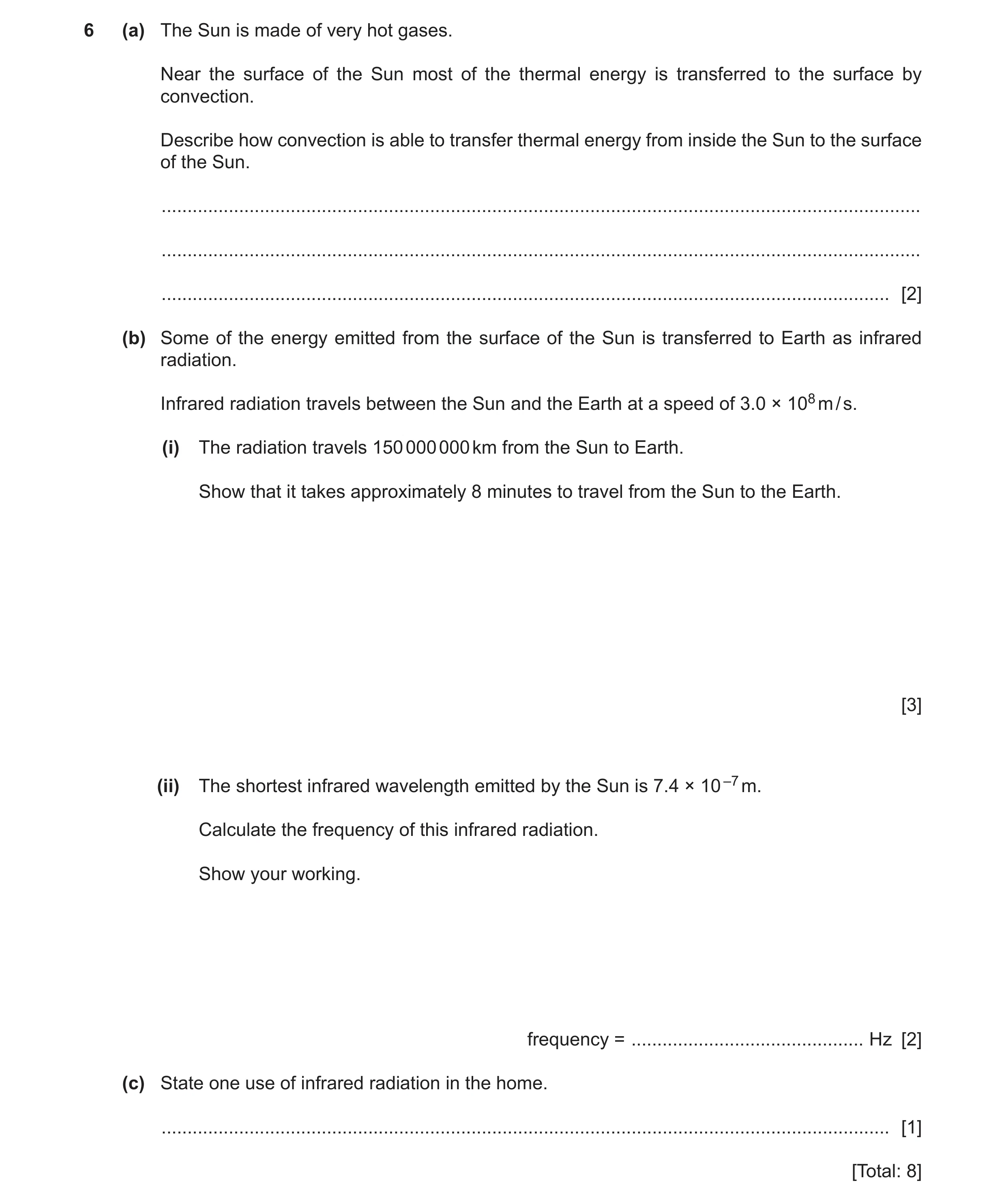
Q11 · The Sun is made of very hot gases 0653/42 May/June 2019
6 (a) The Sun is made of very hot gases. Near the surface of the Sun most of the thermal energy is transferred to the surface by convection. Describe how convection is able to transfer thermal energy from inside the Sun to the surface of the Sun. … … … [2] (b) Some of the energy emitted from the surface of the Sun is transferred to Earth as infrared radiation. Infrared radiation travels between the Sun and the Earth at a speed of 3.0 × 10⁸ m / s. (i) The radiation travels 150 000 000 km from the Sun to Earth. Show that it takes approximately 8 minutes to travel from the Sun to the Earth. [3] (ii) The shortest infrared wavelength emitted by the Sun is 7.4 × 10 –7 m. Calculate the frequency of this infrared radiation. Show your working. frequency = … Hz [2] (c) State one use of infrared radiation in the home. … [1] [Total: 8]
8 marks
Mark scheme: 6(a) hot gases less dense (than cooler gases) / owtte ; less dense / hotter gases rise (and cooler gases fall) / owtte ; 2 6(b)(i) ( ) distance time = speed ; ( ) = = 150000000000 500 s 300000000 ; = = 500 8.3min 60 ; 3 6(b)(ii) v = fλ or λ = v f or f = 3.0 × 10⁸ / 7.4 × 10⁻⁷; = 4.1 × 10¹⁴ (Hz) ; 2 6(c) remote control / movement detector / intruder alarm / heat lamps / other correct use ; 1
This question in 0653/42 May/June 2019
Q12 · Some data about the planets Earth, Mars, Mercury and Venus 0653/41 Oct/Nov 2019
6 Table 6.1 gives some data about the planets Earth, Mars, Mercury and Venus. Table 6.1 Earth Mars Mercury Venus mass 5.97 × 1024 kg 6.42 × 10²³ kg 3.29 × 10²³ kg 4.87 × 1024 kg volume 1.08 × 10²¹ m3 1.63 × 10²⁰ m3 6.08 × 10¹⁹ m3 9.28 × 10²⁰ m3 gravitational 9.81 N / kg 3.71 N / kg 3.70 N / kg 8.87 N / kg field strength g mean temperature 15 °C –63 °C 167 °C 462 °C at surface pressure of 101 000 N / m2 600 N / m2 0 9 300 000 N / m2 atmosphere percentage of Sun’s radiation 31% 25% 7% 69% reflected (a) Use data from Table 6.1 to state which planet has the greatest volume. … [1] (b) Use data from Table 6.1 to calculate the density of Mercury. Show your working and give the units of your answer. density = … units … [3] (c) A mass of 5 kg is placed on each planet, 10 m above the planet’s surface. State on which planet this mass has the greatest gravitational potential energy. Give a reason for your answer. planet … reason … … [2] (d) The surface of a planet reflects a percentage of the Sun’s radiation back into space. The rest of the radiation is absorbed by the planet. Suggest one reason why the percentage of the Sun’s radiation reflected by the surface of Mercury is so low. … [1] (e) A space probe of mass 50 kg descends through the atmosphere on Venus. The probe is slowed down by the atmosphere much more than it would be by the resistance of the Earth’s atmosphere. Use data from Table 6.1 to explain this in terms of difference in the arrangement of the molecules in the atmosphere. … … … … [2] [Total: 9]
9 marks
Mark scheme: 6(a) Earth ; 1 6(b) use of d = m/V ; (3.29 × 10²³ / 0.608 × 10²⁰) = 5.41 × 10³ (3sf) ; kg/m3 ; 3 6(c) Earth ; greatest mass / highest gravitational field strength ; 2 6(d) darker colour / duller surface ; 1 6(e) (on Venus) pressure of atmosphere much higher so molecules more concentrated ; so (atmospheric) resistance is greater / more work done by probe pushing molecules aside / owtte ; ORA 2
This question in 0653/41 Oct/Nov 2019
Q13 · Liquid (molten) iron being poured from a furnace into a mould to form an iron rod in the… 0653/42 Feb/March 2020
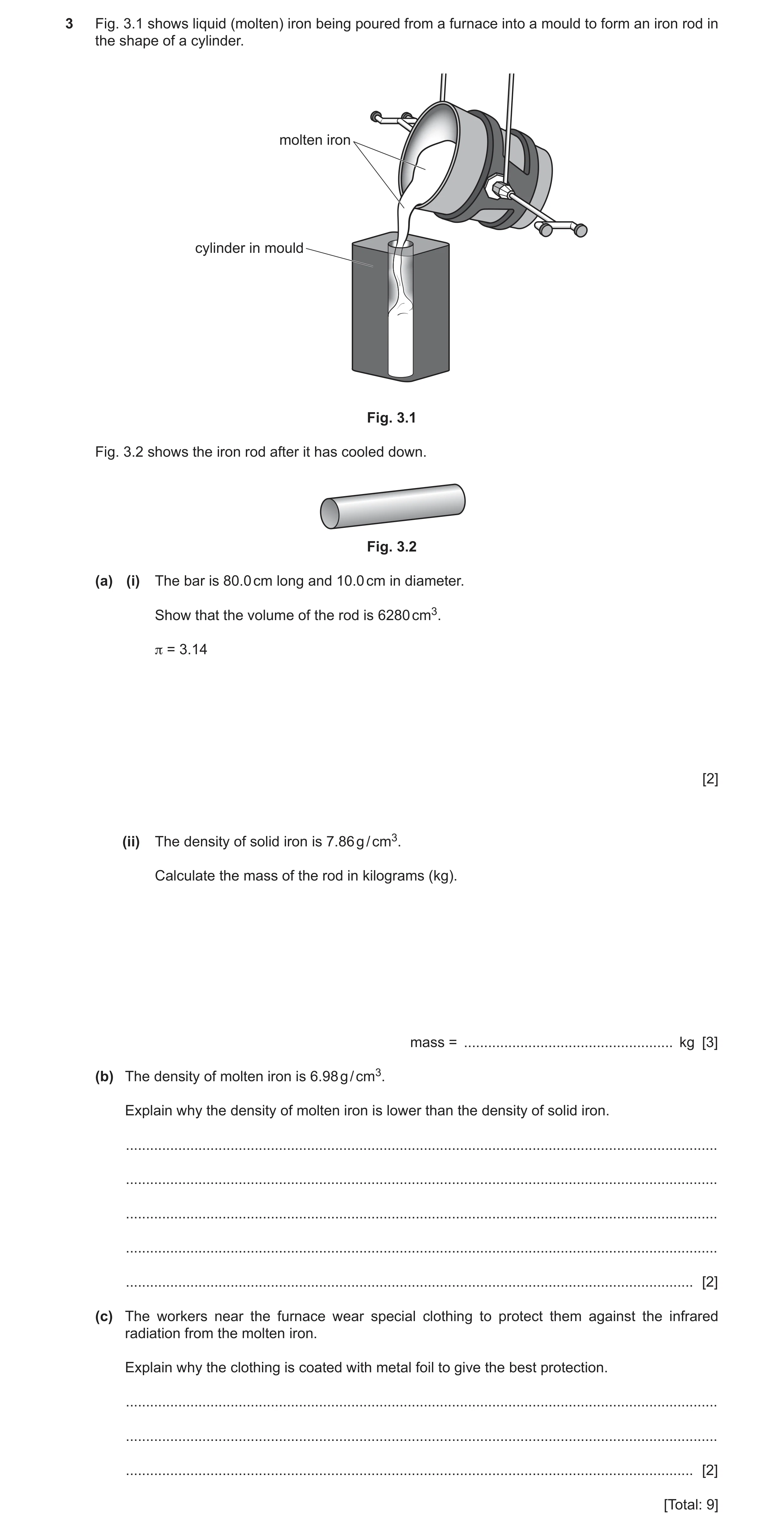
3 Fig. 3.1 shows liquid (molten) iron being poured from a furnace into a mould to form an iron rod in the shape of a cylinder. molten iron cylinder in mould Fig. 3.1 Fig. 3.2 shows the iron rod after it has cooled down. Fig. 3.2 (a) (i) The bar is 80.0 cm long and 10.0 cm in diameter. Show that the volume of the rod is 6280 cm3. π = 3.14 [2] (ii) The density of solid iron is 7.86 g / cm3. Calculate the mass of the rod in kilograms (kg). mass = … kg [3] (b) The density of molten iron is 6.98 g / cm3. Explain why the density of molten iron is lower than the density of solid iron. … … … … … [2] (c) The workers near the furnace wear special clothing to protect them against the infrared radiation from the molten iron. Explain why the clothing is coated with metal foil to give the best protection. … … … [2] [Total: 9]
9 marks
Mark scheme: 3(a)(i) (volume) = πr2l / shows radius as 5 cm ; = 3.14 × 5 × 5 × 80 ; (= 6280 cm3) 2 3(a)(ii) (mass =) volume × density / 6280 × 7.86 ; = 49 400 / 49 360.8 (g) ; = 49.4 (kg) ; (3 sig. fig. required in final answer) 3 3(b) atoms in, molten / liquid iron further apart than in solid iron ; (same mass) occupies greater volume in liquid iron / greater volume for same mass equals lower density ; (answers must be comparative) 2 3(c) any two from: radiation is reflected ; and so less is absorbed ; (reflection is) better by a shiny surface / metal foil has shiny surface ; max 2
This question in 0653/42 Feb/March 2020
Q14 · A man’s hand holding a metal rod in a hot flame 0653/42 May/June 2020
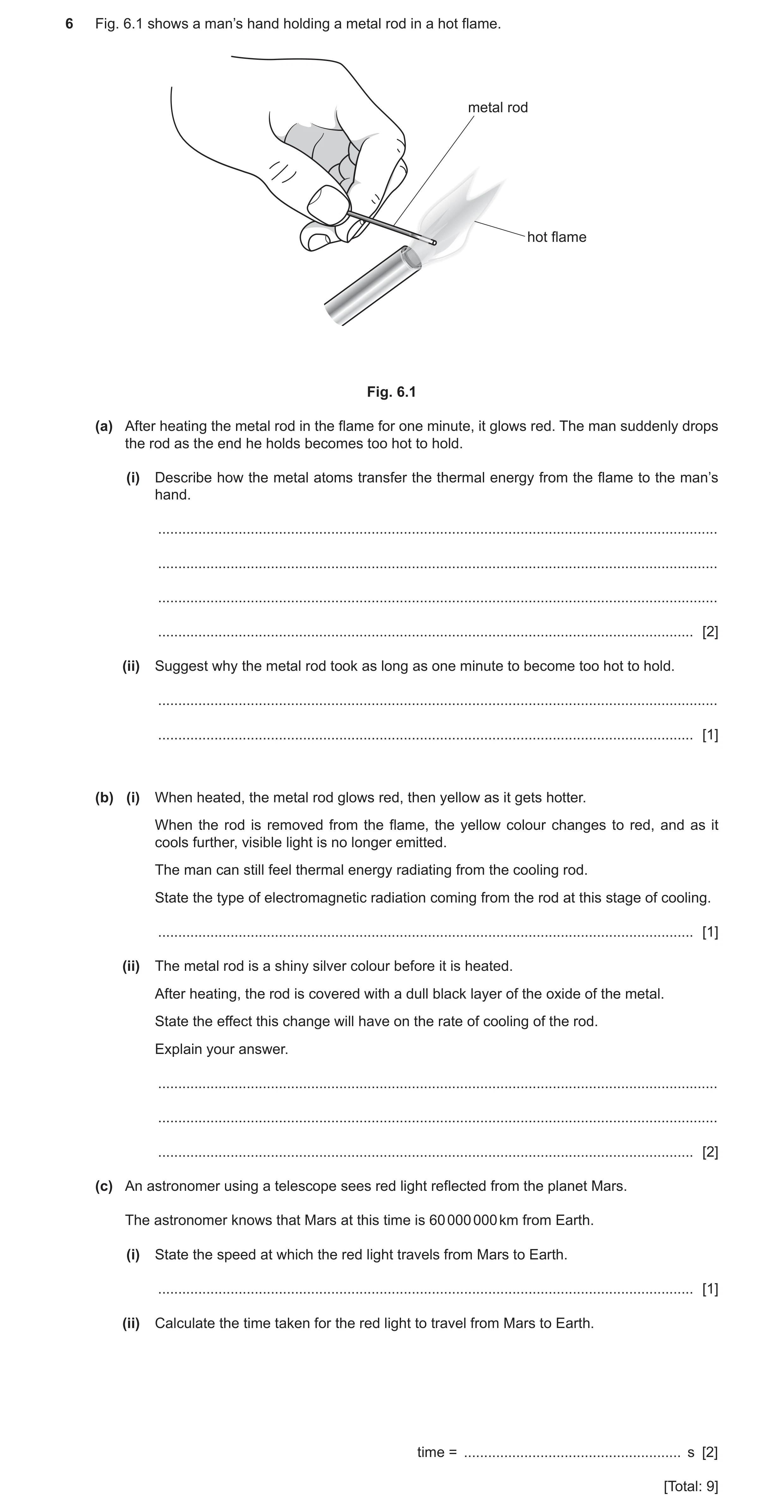
6 Fig. 6.1 shows a man’s hand holding a metal rod in a hot flame. metal rod hot flame Fig. 6.1 (a) After heating the metal rod in the flame for one minute, it glows red. The man suddenly drops the rod as the end he holds becomes too hot to hold. (i) Describe how the metal atoms transfer the thermal energy from the flame to the man’s hand. … … … … [2] (ii) Suggest why the metal rod took as long as one minute to become too hot to hold. … … [1] (b) (i) When heated, the metal rod glows red, then yellow as it gets hotter. When the rod is removed from the flame, the yellow colour changes to red, and as it cools further, visible light is no longer emitted. The man can still feel thermal energy radiating from the cooling rod. State the type of electromagnetic radiation coming from the rod at this stage of cooling. … [1] (ii) The metal rod is a shiny silver colour before it is heated. After heating, the rod is covered with a dull black layer of the oxide of the metal. State the effect this change will have on the rate of cooling of the rod. Explain your answer. … … … [2] (c) An astronomer using a telescope sees red light reflected from the planet Mars. The astronomer knows that Mars at this time is 60 000 000 km from Earth. (i) State the speed at which the red light travels from Mars to Earth. … [1] (ii) Calculate the time taken for the red light to travel from Mars to Earth. time = … s [2] [Total: 9]
9 marks
Mark scheme: 6(a)(i) any two from: increasing vibrations ; passed from atom to atom by collisions ; reference to role of free electrons ; Question Answer Marks 6(a)(ii) loss of (thermal) energy along the rod by, radiation / convection ; 1 6(b)(i) infra-red ; 1 6(b)(ii) rate of cooling increased ; shiny silvery – poor radiator / dull black – better radiator ; 2 6(c)(i) 3 × 10⁸ m / s ; 1 6(c)(ii) time = 6 × 107 km × 1000 (to convert to m) / 3 × 10⁸ ; = 200 (s) ; 2
This question in 0653/42 May/June 2020
Q15 · A girl using a bicycle pump to ‘pump up’ (add air to) a bicycle tyre 0653/41 Oct/Nov 2020
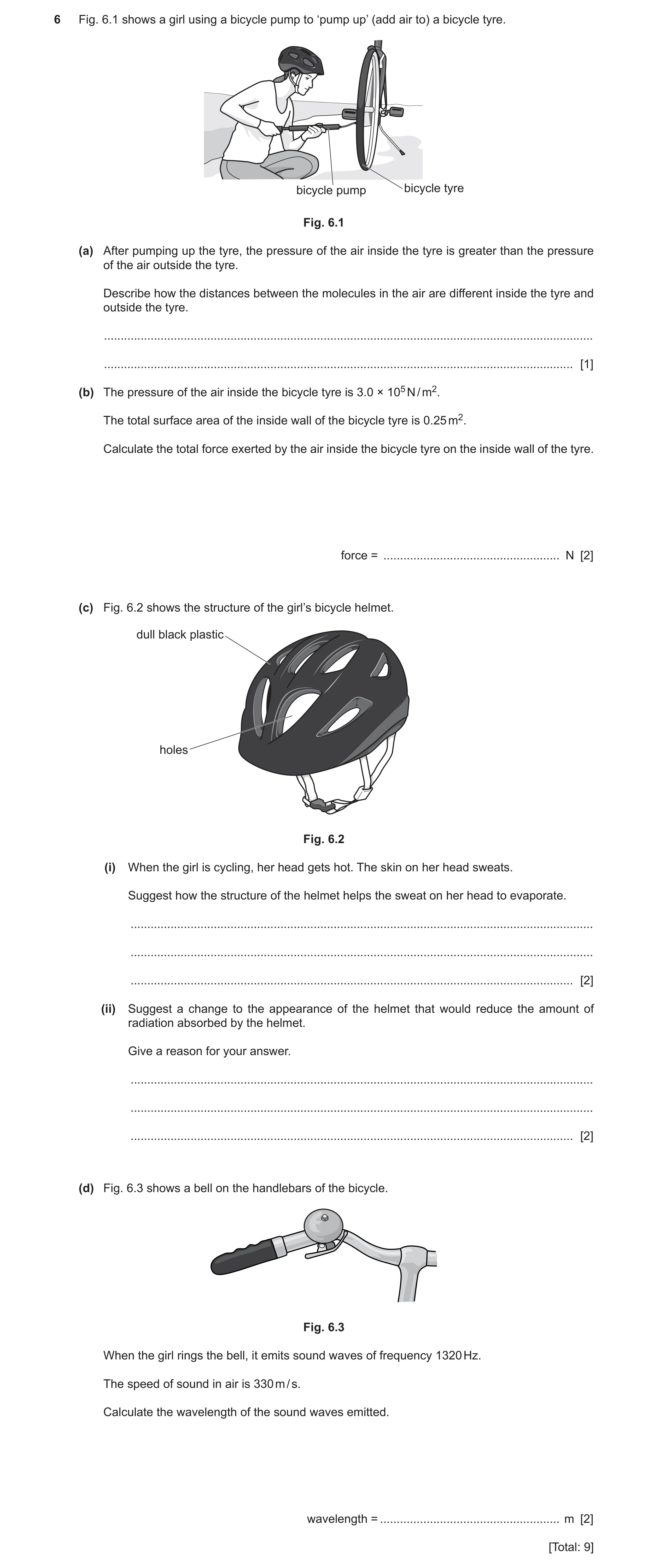
6 Fig. 6.1 shows a girl using a bicycle pump to ‘pump up’ (add air to) a bicycle tyre. bicycle pump bicycle tyre Fig. 6.1 (a) After pumping up the tyre, the pressure of the air inside the tyre is greater than the pressure of the air outside the tyre. Describe how the distances between the molecules in the air are different inside the tyre and outside the tyre. … … [1] (b) The pressure of the air inside the bicycle tyre is 3.0 × 10⁵ N / m2. The total surface area of the inside wall of the bicycle tyre is 0.25 m2. Calculate the total force exerted by the air inside the bicycle tyre on the inside wall of the tyre. force = … N [2] (c) Fig. 6.2 shows the structure of the girl’s bicycle helmet. dull black plastic holes Fig. 6.2 (i) When the girl is cycling, her head gets hot. The skin on her head sweats. Suggest how the structure of the helmet helps the sweat on her head to evaporate. … … … [2] (ii) Suggest a change to the appearance of the helmet that would reduce the amount of radiation absorbed by the helmet. Give a reason for your answer. … … … [2] (d) Fig. 6.3 shows a bell on the handlebars of the bicycle. Fig. 6.3 When the girl rings the bell, it emits sound waves of frequency 1320 Hz. The speed of sound in air is 330 m / s. Calculate the wavelength of the sound waves emitted. wavelength = … m [2] [Total: 9]
9 marks
Mark scheme: 6(a) distances between molecules inside the tyre are smaller / molecules inside tyre are closer together / ora ; 1 6(b) use of P = F / A ; (F = P × A = 3 × 105 × 0.25 =) 0.75 × 10⁵ / 75 000 (N) ; 2 6(c)(i) any two from: holes help air flow (over the surface of the skin on her head) ; holes allow water to escape ; which increases rate of evaporation ; 2 6(c)(ii) make, shiny / white / light in colour ; reflects (the Sun’s radiation) ; 2 6(d) v = f λ in any form / 330 ÷ 1320 ; 0.25 (m) ; 2
This question in 0653/41 Oct/Nov 2020
Q16 · A device called a ‘solar still’ 0653/42 Oct/Nov 2020
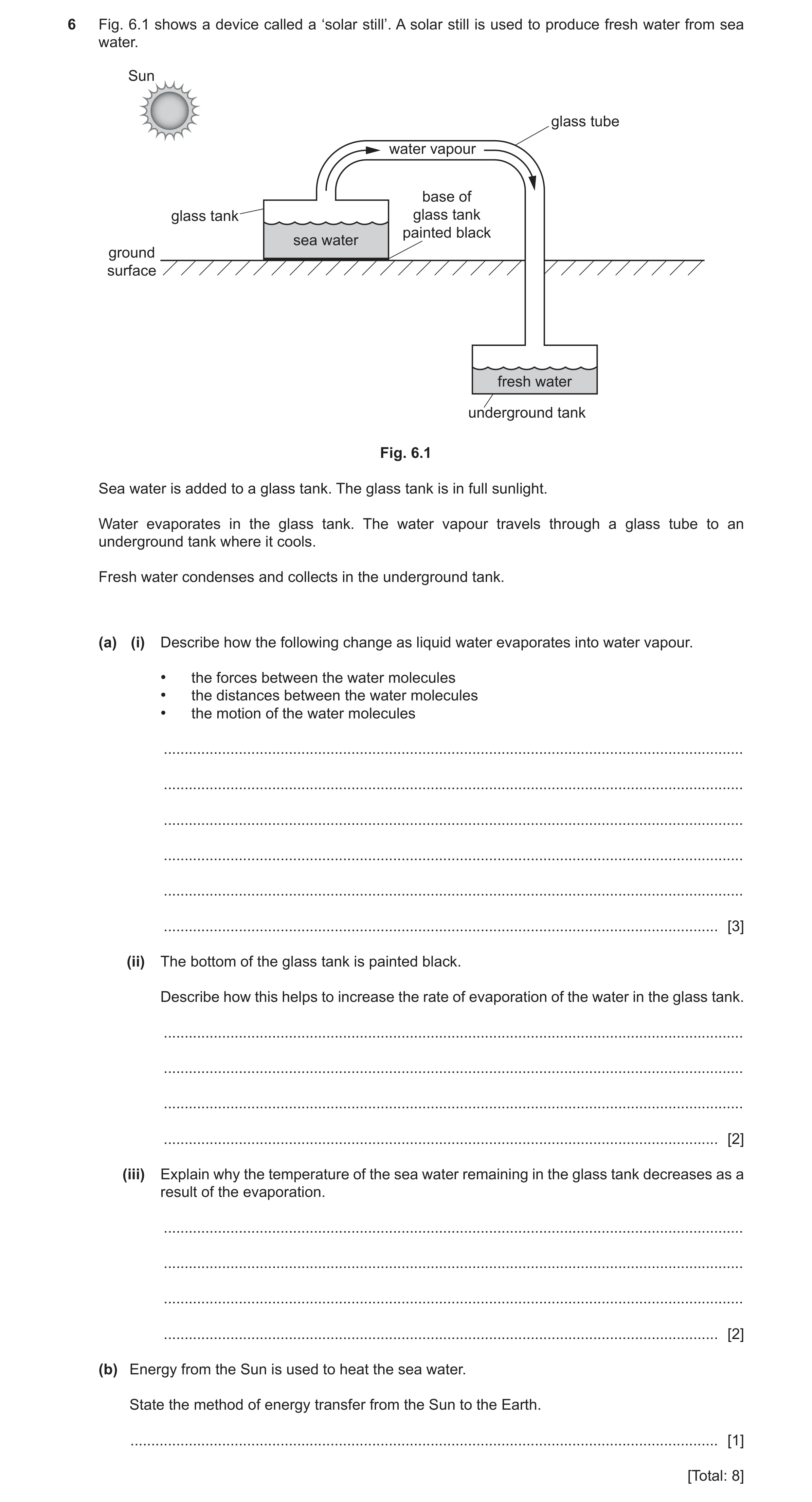
6 Fig. 6.1 shows a device called a ‘solar still’. A solar still is used to produce fresh water from sea water. Sun glass tube water vapour base of glass tank glass tank painted black sea water ground surface fresh water underground tank Fig. 6.1 Sea water is added to a glass tank. The glass tank is in full sunlight. Water evaporates in the glass tank. The water vapour travels through a glass tube to an underground tank where it cools. Fresh water condenses and collects in the underground tank. (a) (i) Describe how the following change as liquid water evaporates into water vapour. • the forces between the water molecules • the distances between the water molecules • the motion of the water molecules … … … … … … [3] (ii) The bottom of the glass tank is painted black. Describe how this helps to increase the rate of evaporation of the water in the glass tank. … … … … [2] (iii) Explain why the temperature of the sea water remaining in the glass tank decreases as a result of the evaporation. … … … … [2] (b) Energy from the Sun is used to heat the sea water. State the method of energy transfer from the Sun to the Earth. … [1] [Total: 8]
8 marks
Mark scheme: 6(a)(i) forces decrease / weaken ; distances increase ; move, (more) freely / away from surface (of liquid water) ; 3 6(a)(ii) black is a good absorber (of radiation) ; warm base of pool transfers thermal energy to water / increase in temperature of water (increases rate of evaporation) ; 2 6(a)(iii) more-energetic molecules escape ; remaining molecules are less energetic (so lower temperature) ; 2 6(b) radiation ; 1
This question in 0653/42 Oct/Nov 2020
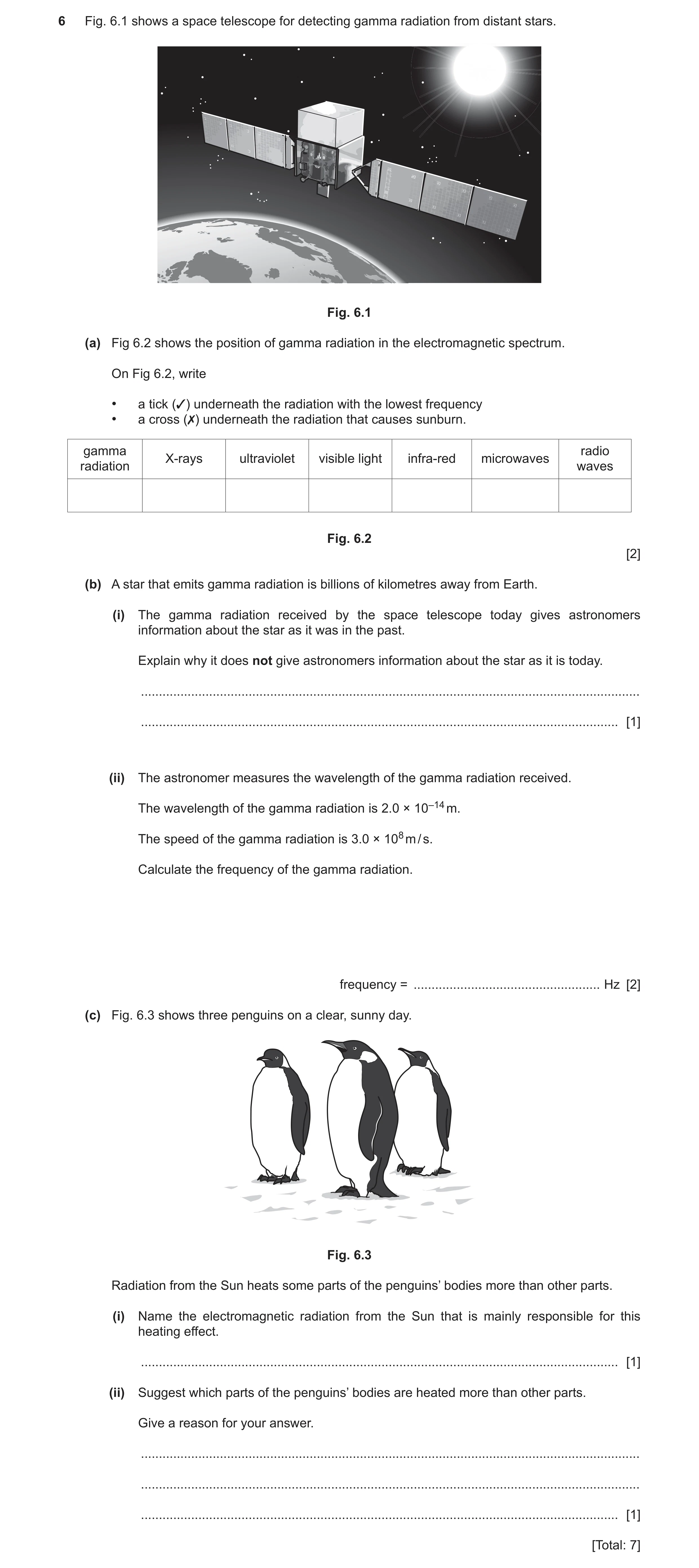
Q17 · A space telescope for detecting gamma radiation from distant stars 0653/43 Oct/Nov 2020
6 Fig. 6.1 shows a space telescope for detecting gamma radiation from distant stars. Fig. 6.1 (a) Fig 6.2 shows the position of gamma radiation in the electromagnetic spectrum. On Fig 6.2, write • a tick (✓) underneath the radiation with the lowest frequency • a cross (✗) underneath the radiation that causes sunburn. gamma radio X-rays ultraviolet visible light infra-red microwaves radiation waves Fig. 6.2 [2] (b) A star that emits gamma radiation is billions of kilometres away from Earth. (i) The gamma radiation received by the space telescope today gives astronomers information about the star as it was in the past. Explain why it does not give astronomers information about the star as it is today. … … [1] (ii) The astronomer measures the wavelength of the gamma radiation received. The wavelength of the gamma radiation is 2.0 × 10⁻¹⁴ m. The speed of the gamma radiation is 3.0 × 10⁸ m / s. Calculate the frequency of the gamma radiation. frequency = … Hz [2] (c) Fig. 6.3 shows three penguins on a clear, sunny day. Fig. 6.3 Radiation from the Sun heats some parts of the penguins’ bodies more than other parts. (i) Name the electromagnetic radiation from the Sun that is mainly responsible for this heating effect. … [1] (ii) Suggest which parts of the penguins’ bodies are heated more than other parts. Give a reason for your answer. … … … [1] [Total: 7]
7 marks
Mark scheme: 6(a) gamma X-rays ultraviolet visible light infrared microwaves radio waves x ✓ lowest frequency: tick in correct place ; causes sunburn: cross in correct place ; 6(b)(i) (even at speed of light) it takes the gamma radiation a (very) long time to travel (billions of kilometres) ; 1 6(b)(ii) v = f λ in any form / 3.0 × 10⁸ ÷ 2.0 × 10⁻¹⁴ ; 1.5 × 10²² (Hz) ; 2 6(c)(i) infrared ; 1 6(c)(ii) back / wings / head / darker areas, because black is a good absorber (of radiation) / ORA ; 1
This question in 0653/43 Oct/Nov 2020
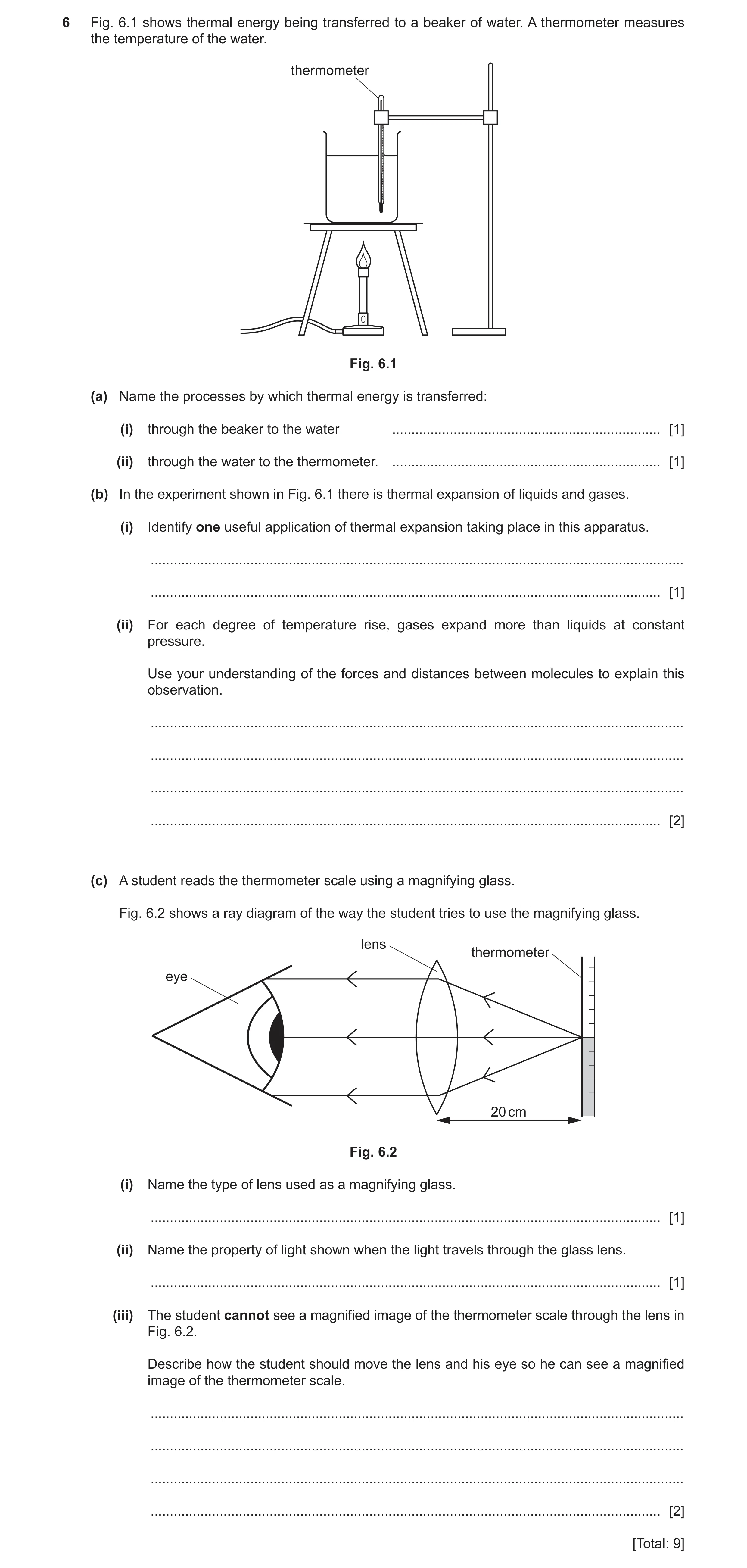
Q18 · Thermal energy being transferred to a beaker of water 0653/42 May/June 2021
6 Fig. 6.1 shows thermal energy being transferred to a beaker of water. A thermometer measures the temperature of the water. thermometer Fig. 6.1 (a) Name the processes by which thermal energy is transferred: (i) through the beaker to the water … [1] (ii) through the water to the thermometer. … [1] (b) In the experiment shown in Fig. 6.1 there is thermal expansion of liquids and gases. (i) Identify one useful application of thermal expansion taking place in this apparatus. … … [1] (ii) For each degree of temperature rise, gases expand more than liquids at constant pressure. Use your understanding of the forces and distances between molecules to explain this observation. … … … … [2] (c) A student reads the thermometer scale using a magnifying glass. Fig. 6.2 shows a ray diagram of the way the student tries to use the magnifying glass. lens thermometer eye 20 cm Fig. 6.2 (i) Name the type of lens used as a magnifying glass. … [1] (ii) Name the property of light shown when the light travels through the glass lens. … [1] (iii) The student cannot see a magnified image of the thermometer scale through the lens in Fig. 6.2. Describe how the student should move the lens and his eye so he can see a magnified image of the thermometer scale. … … … … [2] [Total: 9]
9 marks
Mark scheme: 6(a)(i) conduction ; 1 6(a)(ii) convection ; 1 6(b)(i) thermometer / description of liquid expanding / rising to show temperature ; 1 6(b)(ii) forces between gas molecules weaker OR distances between molecules in gas are greater ; so less energy needed to separate gas molecules ; 2 6(c)(i) converging ; 1 6(c)(ii) refraction ; 1 6(c)(iii) lens closer to thermometer ; eye closer to lens ; (in either order) 2
This question in 0653/42 May/June 2021
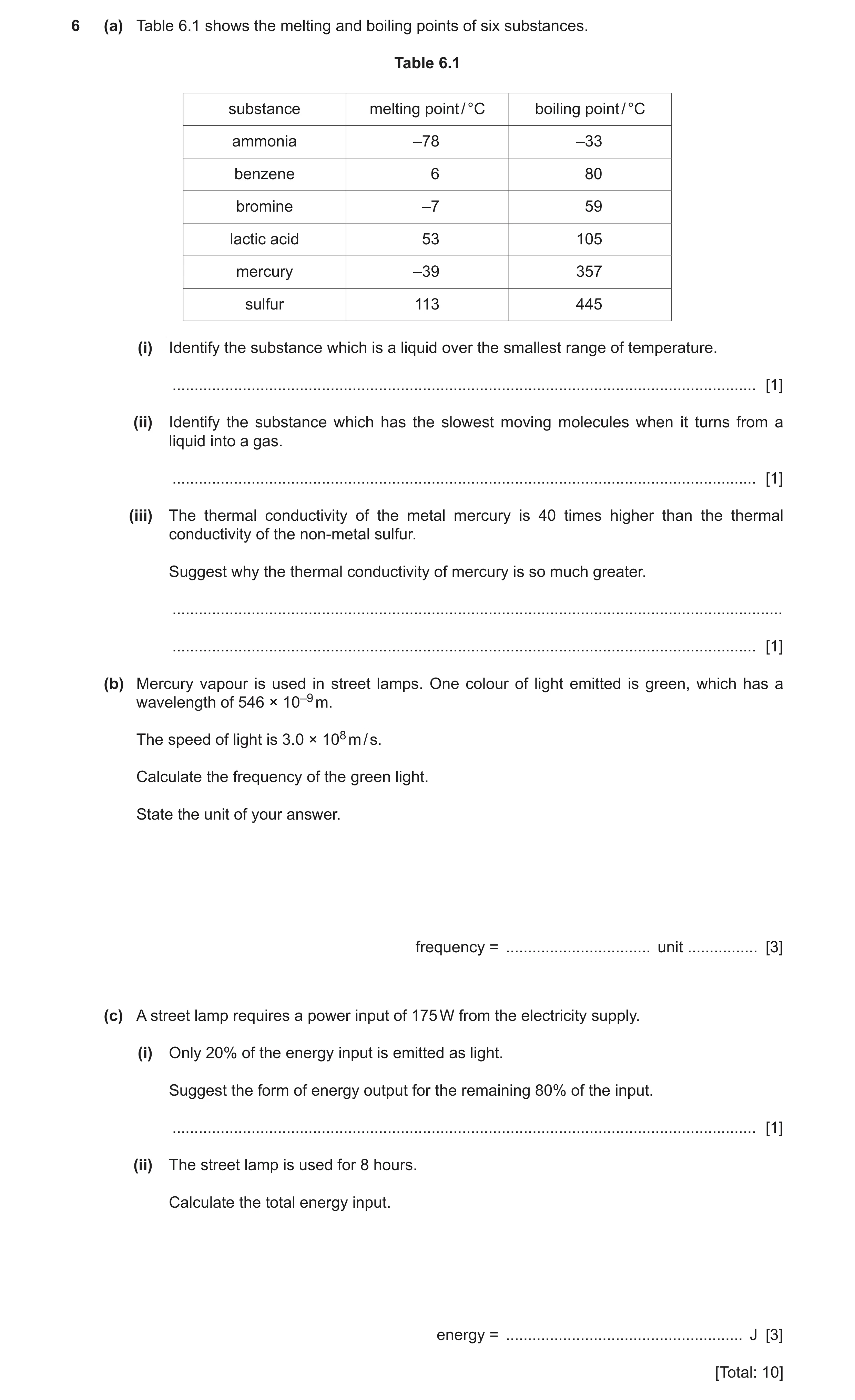
Q19 · The melting and boiling points of six substances 0653/43 May/June 2021
6 (a) Table 6.1 shows the melting and boiling points of six substances. Table 6.1 substance melting point / °C boiling point / °C ammonia –78 –33 benzene 6 80 bromine –7 59 lactic acid 53 105 mercury –39 357 sulfur 113 445 (i) Identify the substance which is a liquid over the smallest range of temperature. … [1] (ii) Identify the substance which has the slowest moving molecules when it turns from a liquid into a gas. … [1] (iii) The thermal conductivity of the metal mercury is 40 times higher than the thermal conductivity of the non-metal sulfur. Suggest why the thermal conductivity of mercury is so much greater. … … [1] (b) Mercury vapour is used in street lamps. One colour of light emitted is green, which has a wavelength of 546 × 10–9 m. The speed of light is 3.0 × 10⁸ m / s. Calculate the frequency of the green light. State the unit of your answer. frequency = … unit … [3] (c) A street lamp requires a power input of 175 W from the electricity supply. (i) Only 20% of the energy input is emitted as light. Suggest the form of energy output for the remaining 80% of the input. … [1] (ii) The street lamp is used for 8 hours. Calculate the total energy input. energy = … J [3] [Total: 10]
10 marks
Mark scheme: 6(a)(i) ammonia ; 1 6(a)(ii) ammonia ; 1 6(a)(iii) (thermal conductivity greater due to) transfer by (delocalised) electrons ; 1 6(b) f = v / λ = 3 × 10⁸ / 546 × 10–9 ; = 5.49 × 10¹⁴ / 5.5 × 10¹⁴ ; Hz ; 3 6(c)(i) thermal ; 1 6(c)(ii) 175 W = 175 J / s / energy = power × time ; 8 hrs = 8 × 3600 = 28 800 s ; (total energy =) 175 × 28 800 = 5 040 000 (J) ; 3
This question in 0653/43 May/June 2021
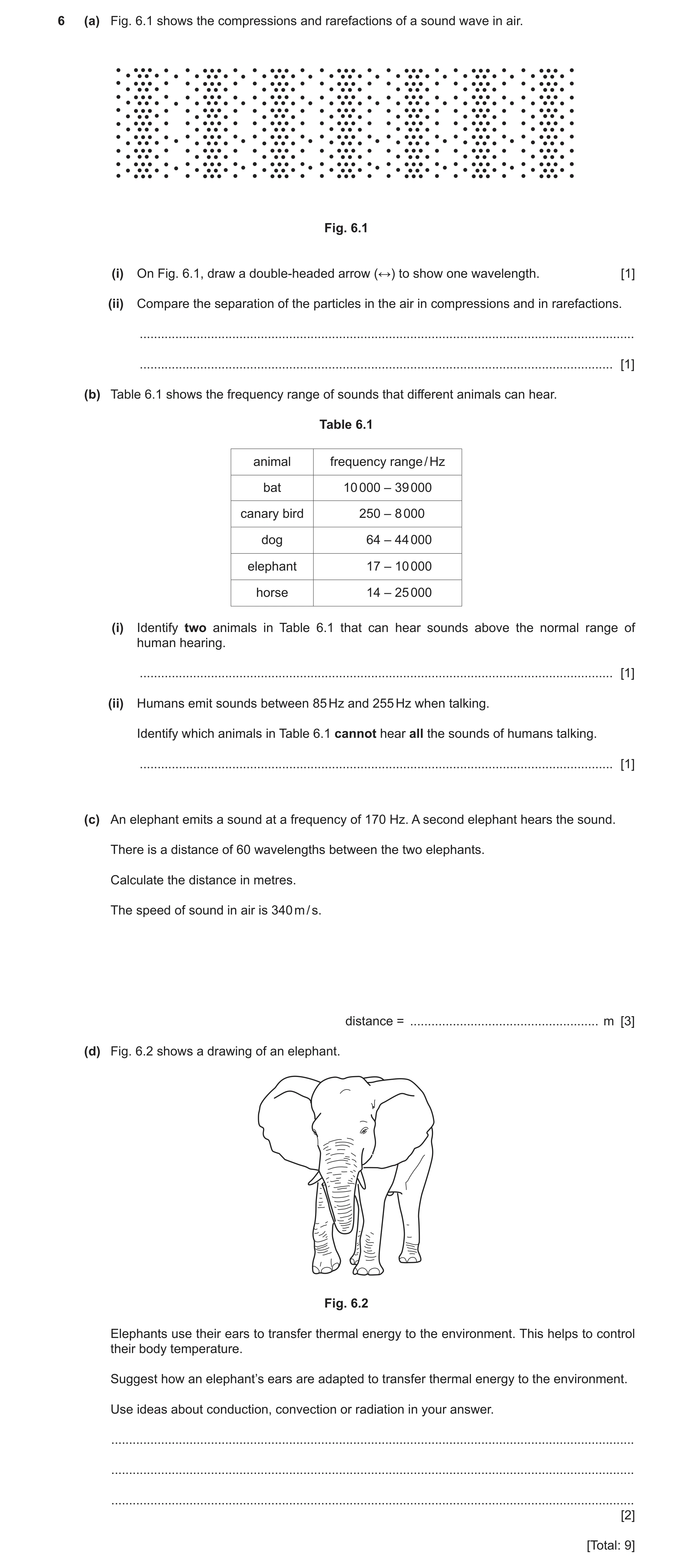
Q20 · The compressions and rarefactions of a sound wave in air 0653/41 Oct/Nov 2021
6 (a) Fig. 6.1 shows the compressions and rarefactions of a sound wave in air. Fig. 6.1 (i) On Fig. 6.1, draw a double-headed arrow (↔) to show one wavelength. [1] (ii) Compare the separation of the particles in the air in compressions and in rarefactions. … … [1] (b) Table 6.1 shows the frequency range of sounds that different animals can hear. Table 6.1 animal frequency range / Hz bat 10 000 – 39 000 canary bird 250 – 8 000 dog 64 – 44 000 elephant 17 – 10 000 horse 14 – 25 000 (i) Identify two animals in Table 6.1 that can hear sounds above the normal range of human hearing. … [1] (ii) Humans emit sounds between 85 Hz and 255 Hz when talking. Identify which animals in Table 6.1 cannot hear all the sounds of humans talking. … [1] (c) An elephant emits a sound at a frequency of 170 Hz. A second elephant hears the sound. There is a distance of 60 wavelengths between the two elephants. Calculate the distance in metres. The speed of sound in air is 340 m / s. distance = … m [3] (d) Fig. 6.2 shows a drawing of an elephant. Fig. 6.2 Elephants use their ears to transfer thermal energy to the environment. This helps to control their body temperature. Suggest how an elephant’s ears are adapted to transfer thermal energy to the environment. Use ideas about conduction, convection or radiation in your answer. … … … [2] [Total: 9]
9 marks
Mark scheme: 6(a)(i) arrow showing one complete wavelength ; 1 6(a)(ii) molecules clos(er) together in compressions / molecules further / (far) apart in rarefactions ; 1 6(b)(i) any two from: bat / dog / horse ; 1 6(b)(ii) bat AND canary bird ; 1 6(c) 𝑣 = 𝑓 in any form / 340 ÷ 170 ; ( =) 2 m ; (distance = 2 × 60 =) 120 (m) ; 3 6(d) adaptation stated, e.g. large surface area ; correctly matched to method of energy transfer, e.g. radiation ; 2
This question in 0653/41 Oct/Nov 2021
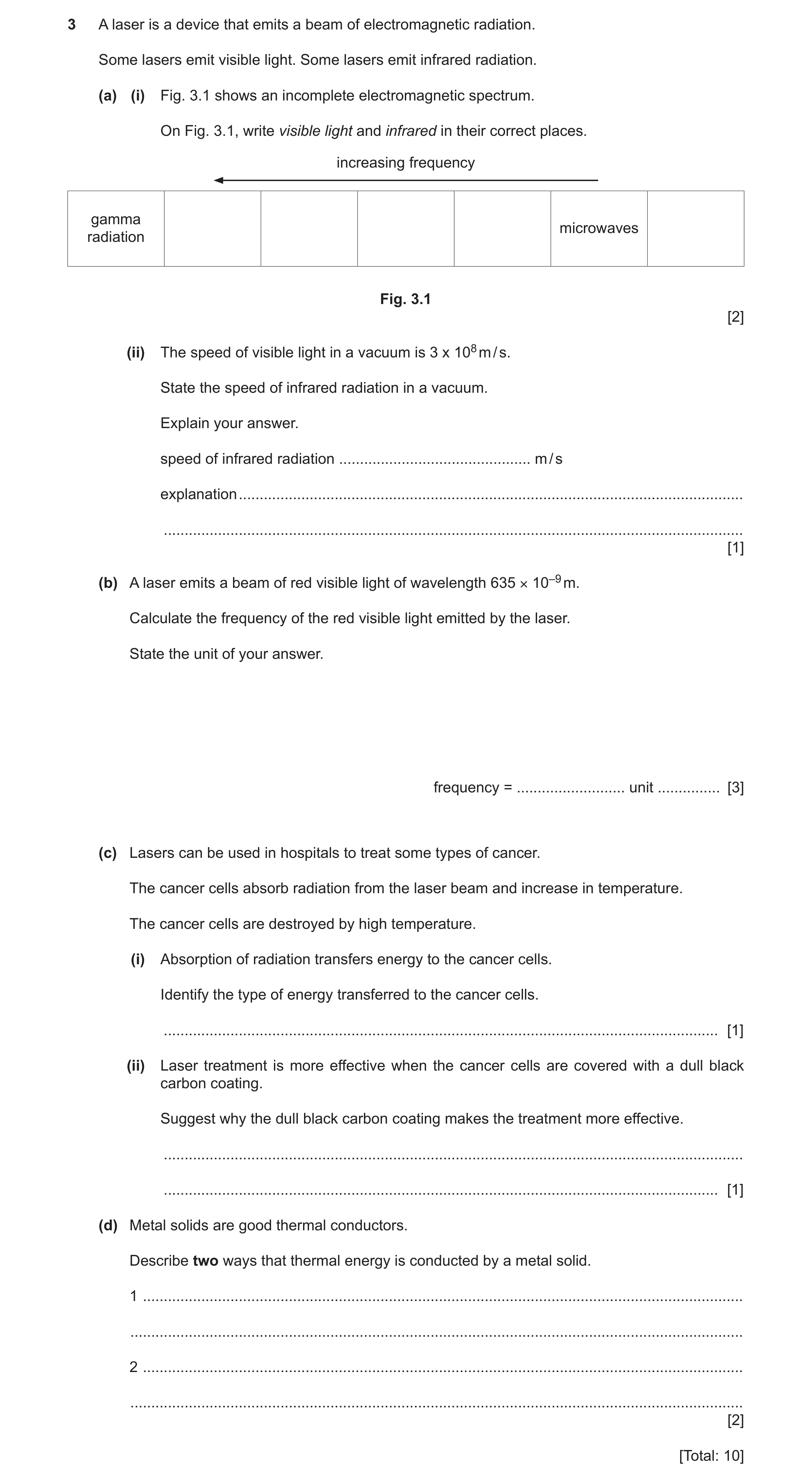
Q21 · A laser is a device that emits a beam of electromagnetic radiation 0653/43 Oct/Nov 2021
3 A laser is a device that emits a beam of electromagnetic radiation. Some lasers emit visible light. Some lasers emit infrared radiation. (a) (i) Fig. 3.1 shows an incomplete electromagnetic spectrum. On Fig. 3.1, write visible light and infrared in their correct places. increasing frequency gamma microwaves radiation Fig. 3.1 [2] (ii) The speed of visible light in a vacuum is 3 x 10⁸ m / s. State the speed of infrared radiation in a vacuum. Explain your answer. speed of infrared radiation … m / s explanation … … [1] (b) A laser emits a beam of red visible light of wavelength 635 × 10–9 m. Calculate the frequency of the red visible light emitted by the laser. State the unit of your answer. frequency = … unit … [3] (c) Lasers can be used in hospitals to treat some types of cancer. The cancer cells absorb radiation from the laser beam and increase in temperature. The cancer cells are destroyed by high temperature. (i) Absorption of radiation transfers energy to the cancer cells. Identify the type of energy transferred to the cancer cells. … [1] (ii) Laser treatment is more effective when the cancer cells are covered with a dull black carbon coating. Suggest why the dull black carbon coating makes the treatment more effective. … … [1] (d) Metal solids are good thermal conductors. Describe two ways that thermal energy is conducted by a metal solid. 1 … … 2 … … [2] [Total: 10]
10 marks
Mark scheme: 3(a)(i) (gamma radiation) visible light ; infrared ; (microwaves) 2 3(a)(ii) 3 × 10⁸ (m / s) AND all electromagnetic waves travel with same speed ; 1 3(b) v = fλ in any form / 3 × 10⁸ ÷ 635 × 10–9 ; 4.72 × 10¹⁴ ; Hz ; 3 3(c)(i) thermal ; 1 3(c)(ii) dull black surfaces are good absorbers (of radiation) ; 1 3(d) molecular vibration ; transfer by electrons ; 2
This question in 0653/43 Oct/Nov 2021
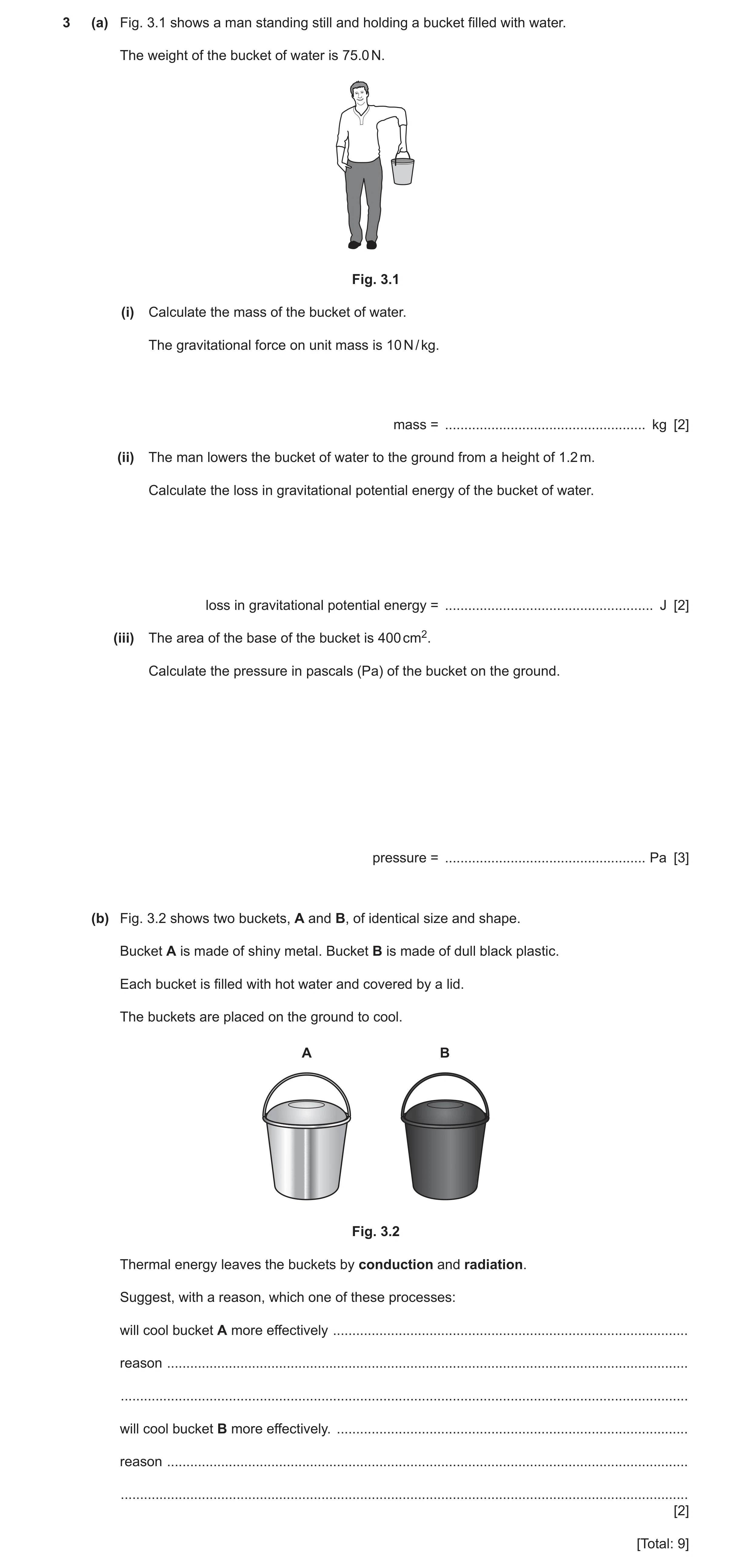
Q22 · A man standing still and holding a bucket filled with water 0653/43 May/June 2022
3 (a) Fig. 3.1 shows a man standing still and holding a bucket filled with water. The weight of the bucket of water is 75.0 N. Fig. 3.1 (i) Calculate the mass of the bucket of water. The gravitational force on unit mass is 10 N / kg. mass = … kg [2] (ii) The man lowers the bucket of water to the ground from a height of 1.2 m. Calculate the loss in gravitational potential energy of the bucket of water. loss in gravitational potential energy = … J [2] (iii) The area of the base of the bucket is 400 cm2. Calculate the pressure in pascals (Pa) of the bucket on the ground. pressure = … Pa [3] (b) Fig. 3.2 shows two buckets, A and B, of identical size and shape. Bucket A is made of shiny metal. Bucket B is made of dull black plastic. Each bucket is filled with hot water and covered by a lid. The buckets are placed on the ground to cool. A B Fig. 3.2 Thermal energy leaves the buckets by conduction and radiation. Suggest, with a reason, which one of these processes: will cool bucket A more effectively … reason … … will cool bucket B more effectively. … reason … … [2] [Total: 9]
9 marks
Mark scheme: 3(a)(i) W = mg (in any form) OR (m =) 75 ÷ 10 ; = 7.5 (kg) ; 2 3(a)(ii) PE = mgh OR = W distance (in any form) OR = 75 1.2 ; = 90 (J) ; 2 3(a)(iii) pressure = force ÷ area (in any form) ; pascals is N / m2 so area of 400 cm2 is 0.04 m2 ; (p = 75 ÷ 0.04 =) 1875 OR 1880 (Pa) ; 3 3(b) will cool bucket A more effectively: conduction AND reason: because metal is a good conductor / shiny metal is not a good radiator ; will cool bucket B more effectively: radiation AND reason: dull black is good radiator / plastic is not a good conductor ; 2
This question in 0653/43 May/June 2022
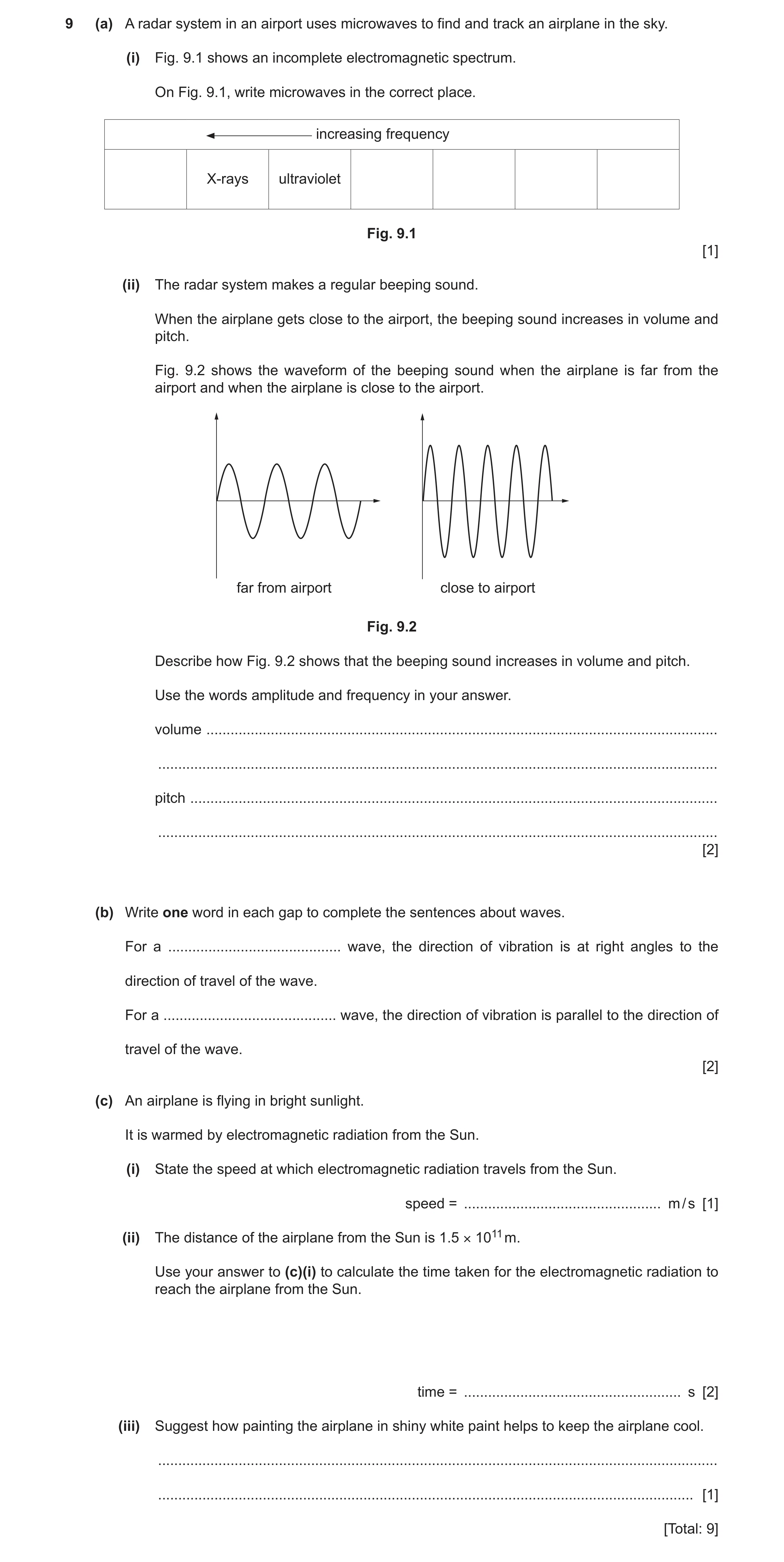
Q23 · A radar system in an airport uses microwaves to find and track an airplane in the sky 0653/41 Oct/Nov 2022
9 (a) A radar system in an airport uses microwaves to find and track an airplane in the sky. (i) Fig. 9.1 shows an incomplete electromagnetic spectrum. On Fig. 9.1, write microwaves in the correct place. increasing frequency X-rays ultraviolet Fig. 9.1 [1] (ii) The radar system makes a regular beeping sound. When the airplane gets close to the airport, the beeping sound increases in volume and pitch. Fig. 9.2 shows the waveform of the beeping sound when the airplane is far from the airport and when the airplane is close to the airport. far from airport close to airport Fig. 9.2 Describe how Fig. 9.2 shows that the beeping sound increases in volume and pitch. Use the words amplitude and frequency in your answer. volume … … pitch … … [2] (b) Write one word in each gap to complete the sentences about waves. For a … wave, the direction of vibration is at right angles to the direction of travel of the wave. For a … wave, the direction of vibration is parallel to the direction of travel of the wave. [2] (c) An airplane is flying in bright sunlight. It is warmed by electromagnetic radiation from the Sun. (i) State the speed at which electromagnetic radiation travels from the Sun. speed = … m / s [1] (ii) The distance of the airplane from the Sun is 1.5 × 10¹¹ m. Use your answer to (c)(i) to calculate the time taken for the electromagnetic radiation to reach the airplane from the Sun. time = … s [2] (iii) Suggest how painting the airplane in shiny white paint helps to keep the airplane cool. … … [1] [Total: 9]
9 marks
Mark scheme: 9(a)(i) 1 X-rays ultraviolet microwaves ; 9(a)(ii) volume large(r) amplitude ; 2 pitch high(er) frequency ; 9(b) transverse / named example ; 2 longitudinal / named example ; 9(c)(i) 3.0 108 / 300 000 000 (m / s) ; 1 9(c)(ii) evidence of, speed = distance ÷ time / 150 000 000 000 ÷ 300 000 000 ; 2 500 (s) (= 8 min 20 s) ; 9(c)(iii) a shiny white surface is a, poor absorber / (good) reflector (of radiation) ; 1
This question in 0653/41 Oct/Nov 2022
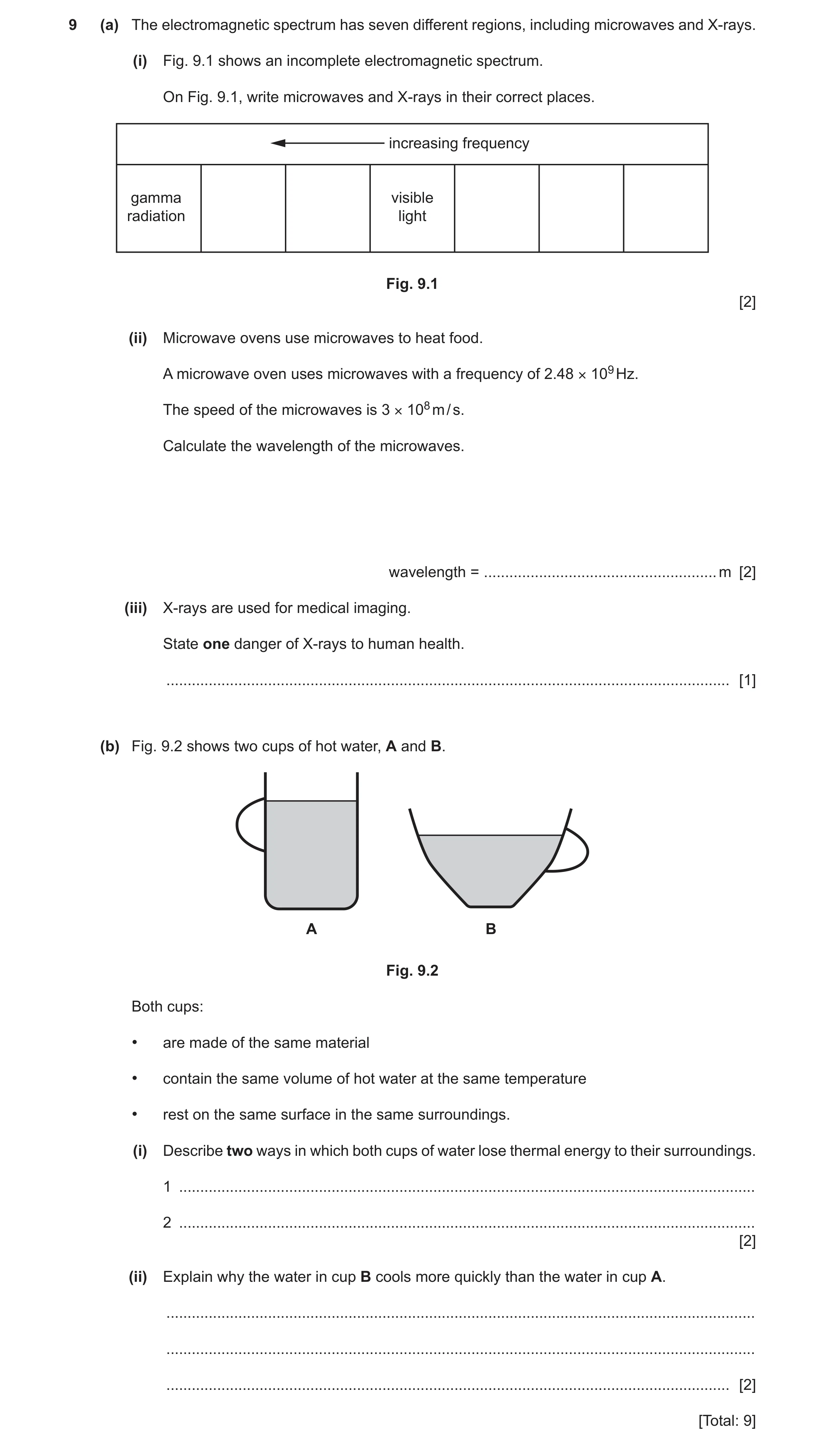
Q24 · The electromagnetic spectrum has seven different regions, including microwaves and X‑rays 0653/42 Oct/Nov 2022
9 (a) The electromagnetic spectrum has seven different regions, including microwaves and X‑rays. (i) Fig. 9.1 shows an incomplete electromagnetic spectrum. On Fig. 9.1, write microwaves and X‑rays in their correct places. increasing frequency gamma visible radiation light Fig. 9.1 [2] (ii) Microwave ovens use microwaves to heat food. A microwave oven uses microwaves with a frequency of 2.48 × 10⁹ Hz. The speed of the microwaves is 3 × 10⁸ m / s. Calculate the wavelength of the microwaves. wavelength = … m [2] (iii) X‑rays are used for medical imaging. State one danger of X‑rays to human health. … [1] (b) Fig. 9.2 shows two cups of hot water, A and B. A B Fig. 9.2 Both cups: • are made of the same material • contain the same volume of hot water at the same temperature • rest on the same surface in the same surroundings. (i) Describe two ways in which both cups of water lose thermal energy to their surroundings. 1 … 2 … [2] (ii) Explain why the water in cup B cools more quickly than the water in cup A. … … … [2] [Total: 9]
9 marks
Mark scheme: 9(a)(i) 2 gamma visible X-rays ; microwaves ; radiation light 9(a)(ii) evidence of, v = f / 3 108 ÷ 2.48 109 ; 2 0.1(21) (m); 9(a)(iii) (X-rays) damage cells / cause cancer ; 1 9(b)(i) any two from: 2 evaporation (from surface of liquid) ; convection (by heating air above the surface) ; conduction (through cups) ; radiation (from outside of cup) ; 9(b)(ii) (cup B / ORA) 2 has greater surface area ; so increased (rate of) evaporation ;
This question in 0653/42 Oct/Nov 2022
Q25 · An incomplete electromagnetic spectrum 0653/43 Oct/Nov 2022
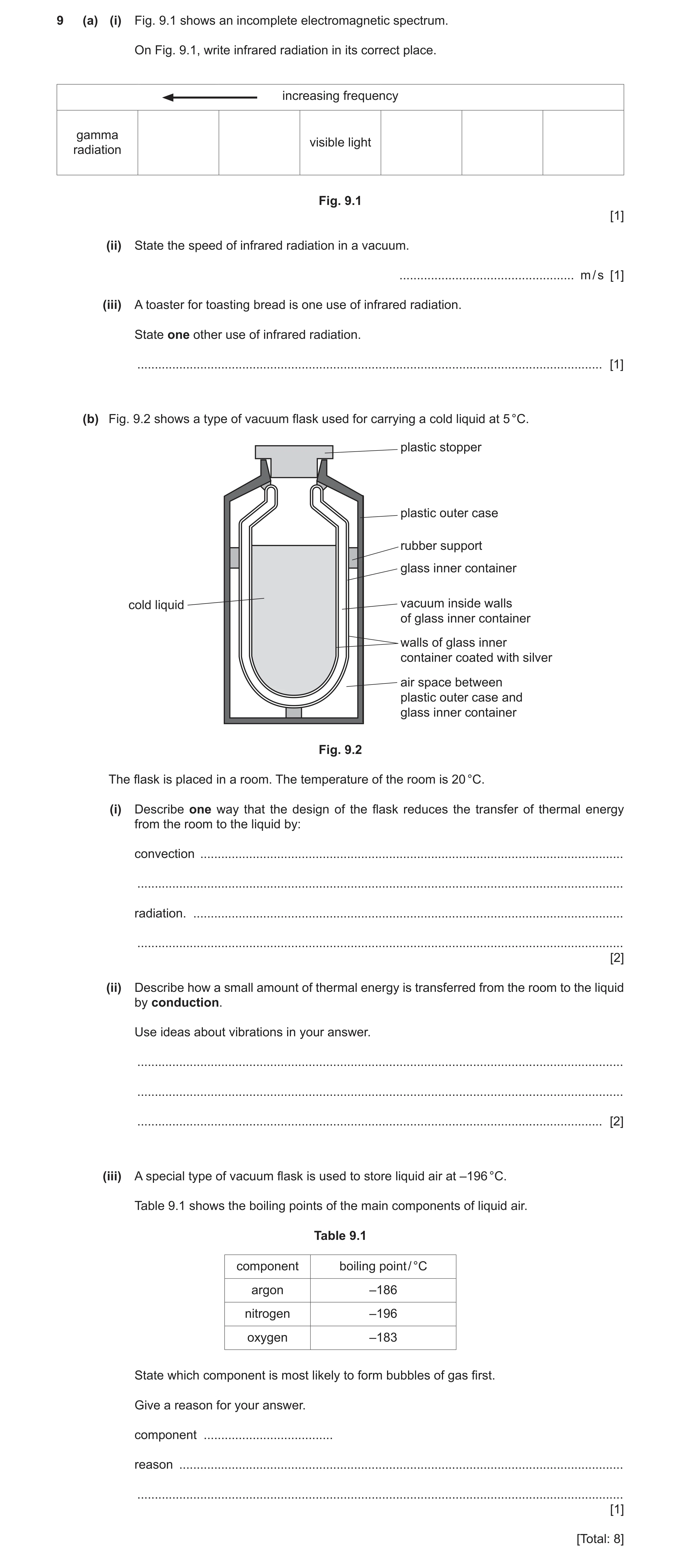
9 (a) (i) Fig. 9.1 shows an incomplete electromagnetic spectrum. On Fig. 9.1, write infrared radiation in its correct place. increasing frequency gamma visible light radiation Fig. 9.1 [1] (ii) State the speed of infrared radiation in a vacuum. … m / s [1] (iii) A toaster for toasting bread is one use of infrared radiation. State one other use of infrared radiation. … [1] (b) Fig. 9.2 shows a type of vacuum flask used for carrying a cold liquid at 5 °C. plastic stopper plastic outer case rubber support glass inner container cold liquid vacuum inside walls of glass inner container walls of glass inner container coated with silver air space between plastic outer case and glass inner container Fig. 9.2 The flask is placed in a room. The temperature of the room is 20 °C. (i) Describe one way that the design of the flask reduces the transfer of thermal energy from the room to the liquid by: convection … … radiation. … … [2] (ii) Describe how a small amount of thermal energy is transferred from the room to the liquid by conduction. Use ideas about vibrations in your answer. … … … [2] (iii) A special type of vacuum flask is used to store liquid air at –196 °C. Table 9.1 shows the boiling points of the main components of liquid air. Table 9.1 component boiling point / °C argon –186 nitrogen –196 oxygen –183 State which component is most likely to form bubbles of gas first. Give a reason for your answer. component … reason … … [1] [Total: 8]
8 marks
Mark scheme: 9(a)(i) 1 (gamma (visible infrared radiation) light) (radiation) ; 9(a)(ii) 3.0 108 (m / s) ; 1 9(a)(iii) remote controllers for televisions / intruder alarms / AVP ; 1 9(b)(i) convection (reduced by) vacuum / stopper ; 2 radiation (reduced by) silver (coating) ; 9(b)(ii) (conduction) through the, solid material / plastic outer case / rubber supports / walls of glass container / plastic stopper ; 2 molecular vibrations passed from one molecule to the next ; 9(b)(iii) component nitrogen AND 1 reason lowest boiling point (of the 3 components) ;
This question in 0653/43 Oct/Nov 2022
Q26 · Two people keeping warm by a campfire and one is playing a guitar 0653/41 May/June 2023
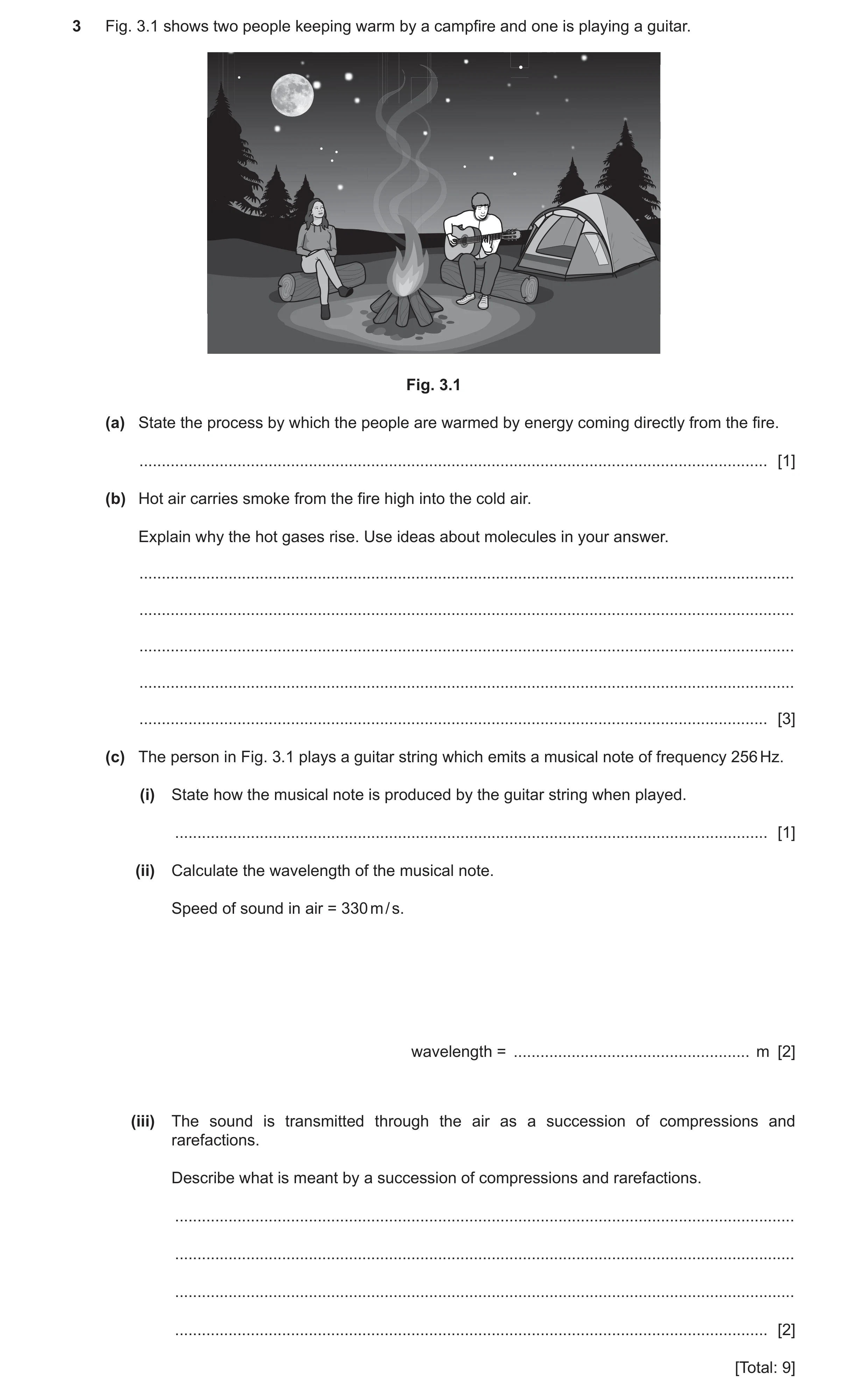
3 Fig. 3.1 shows two people keeping warm by a campfire and one is playing a guitar. Fig. 3.1 (a) State the process by which the people are warmed by energy coming directly from the fire. … [1] (b) Hot air carries smoke from the fire high into the cold air. Explain why the hot gases rise. Use ideas about molecules in your answer. … … … … … [3] (c) The person in Fig. 3.1 plays a guitar string which emits a musical note of frequency 256 Hz. (i) State how the musical note is produced by the guitar string when played. … [1] (ii) Calculate the wavelength of the musical note. Speed of sound in air = 330 m / s. wavelength = … m [2] (iii) The sound is transmitted through the air as a succession of compressions and rarefactions. Describe what is meant by a succession of compressions and rarefactions. … … … … [2] [Total: 9]
9 marks
Mark scheme: 3(a) radiation ; 1 3(b) reference to molecules moving faster ; reference to expansion of air or gases / gases or air occupy greater volume / molecules move further apart ; the idea that lower density (air) rises / hot air displaced by heavier or denser cool air ; 3 3(c)(i) vibrating (string) ; 1 3(c)(ii) speed = frequency wavelength / v = f (in any form) / = 330 ÷ 256 ; 1.29 (m) ; 2 3(c)(iii) compression means, particles or molecules are close together / (air) density is greater / air pressure is greater / ORA for rarefaction ; succession refers to the idea that compressions and rarefactions form a repeating, pattern / (longitudinal) wave ; 2
This question in 0653/41 May/June 2023
Q27 · A firefighter standing next to a fire engine 0653/43 Oct/Nov 2023
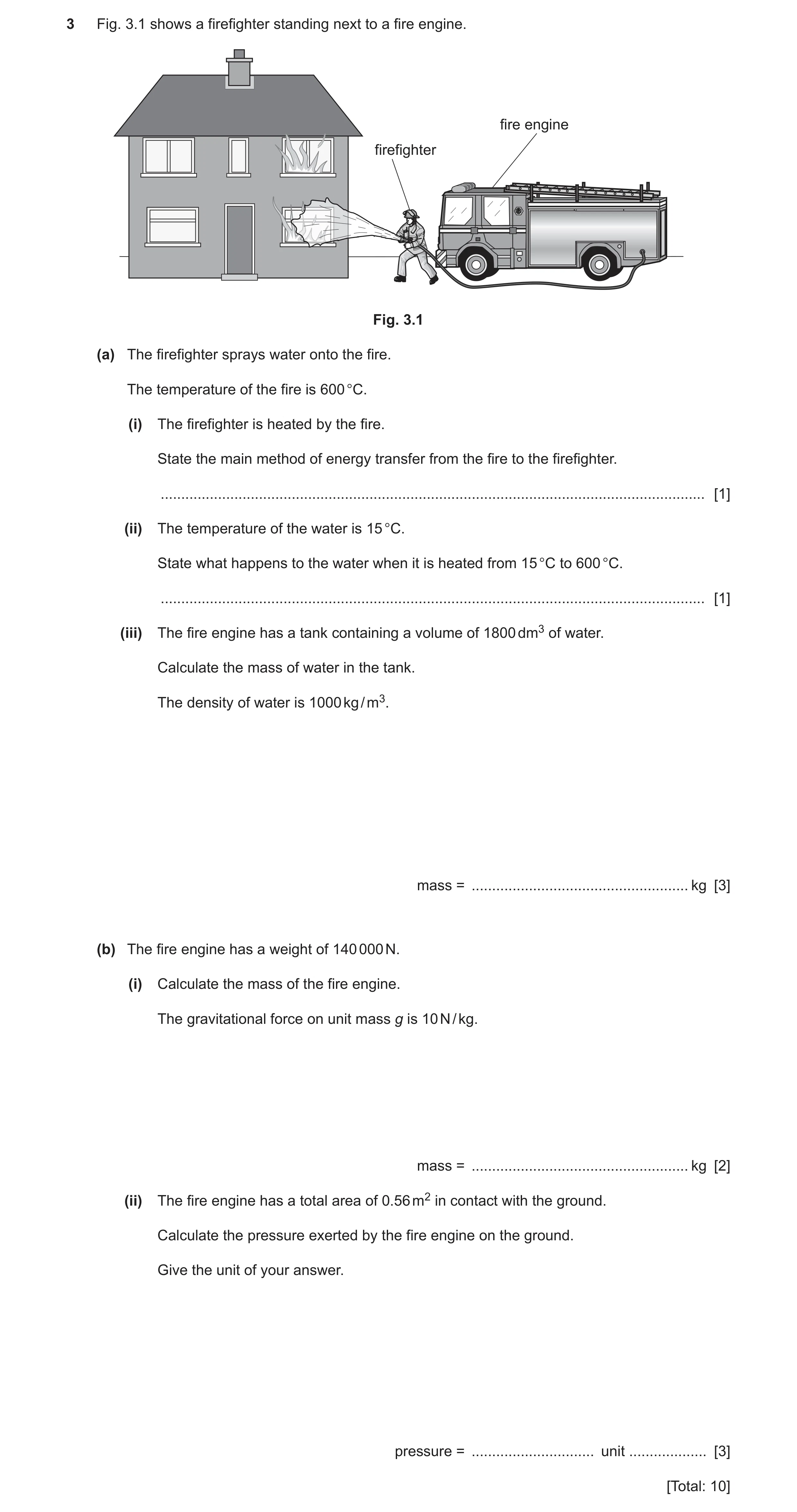
3 Fig. 3.1 shows a firefighter standing next to a fire engine. fire engine firefighter Fig. 3.1 (a) The firefighter sprays water onto the fire. The temperature of the fire is 600 °C. (i) The firefighter is heated by the fire. State the main method of energy transfer from the fire to the firefighter. … [1] (ii) The temperature of the water is 15 °C. State what happens to the water when it is heated from 15 °C to 600 °C. … [1] (iii) The fire engine has a tank containing a volume of 1800 dm3 of water. Calculate the mass of water in the tank. The density of water is 1000 kg / m3. mass = … kg [3] (b) The fire engine has a weight of 140 000 N. (i) Calculate the mass of the fire engine. The gravitational force on unit mass g is 10 N / kg. mass = … kg [2] (ii) The fire engine has a total area of 0.56 m2 in contact with the ground. Calculate the pressure exerted by the fire engine on the ground. Give the unit of your answer. pressure = … unit … [3] [Total: 10]
10 marks
Mark scheme: 3(a)(i) radiation ; 1 3(a)(ii) turns to steam / vaporises / boils ; 1 3(a)(iii) unit conversion, 1800 dm3 = 1.8 m3 ; 3 m evidence of, = / 1000 1.8 ; V 1800 (kg) ; 3(b)(i) evidence of, W = mg / 140 000 10 ; 2 14 000 (kg) ; 3(b)(ii) F 3 evidence of, p = / 140 000 0.56 ; A 250 000 ; Pa OR N / m2 ;
This question in 0653/43 Oct/Nov 2023
Q28 · The Parker Solar Probe is a spacecraft designed to study the Sun and the planet Venus 0653/42 Feb/March 2024
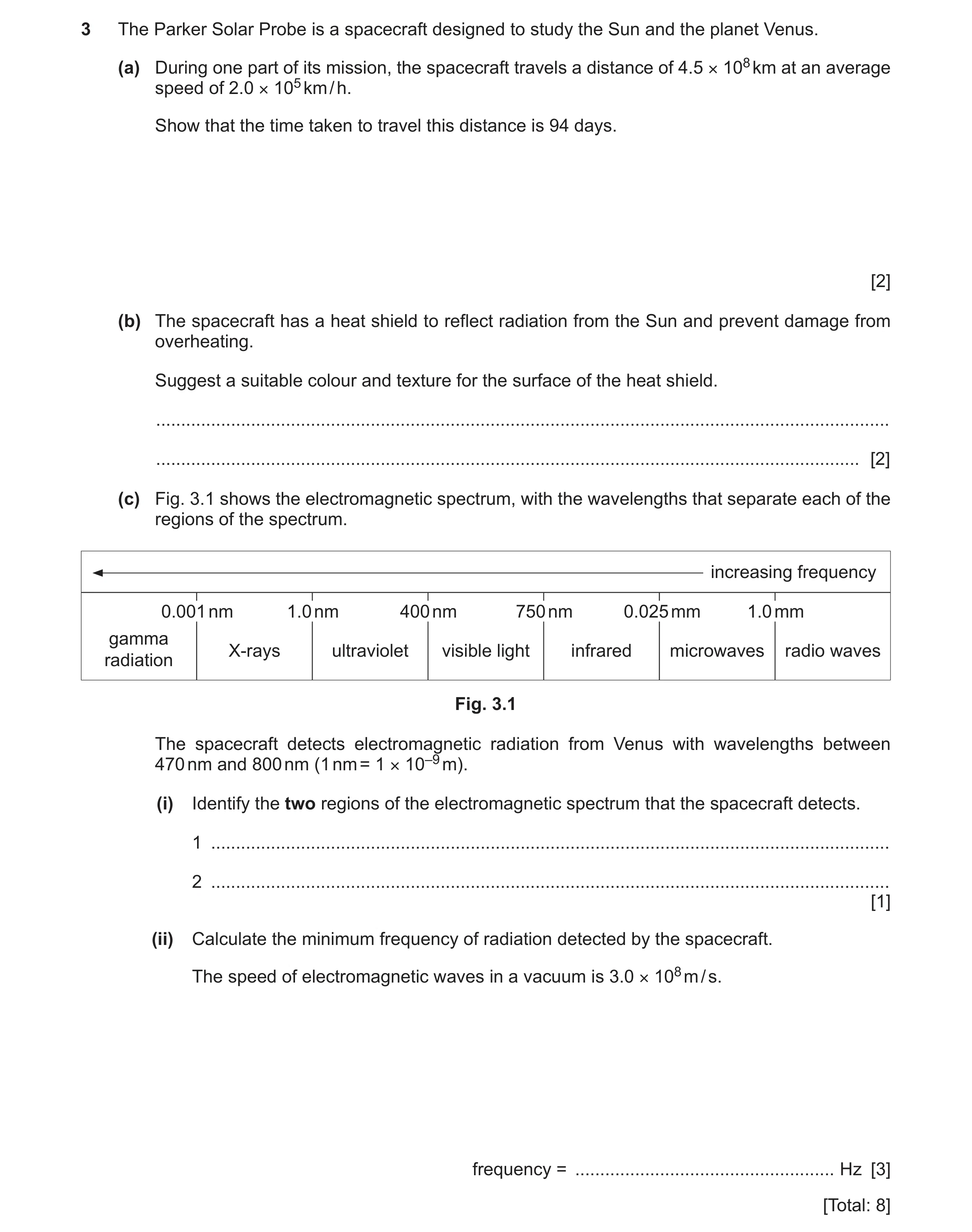
3 The Parker Solar Probe is a spacecraft designed to study the Sun and the planet Venus. (a) During one part of its mission, the spacecraft travels a distance of 4.5 × 10⁸ km at an average speed of 2.0 × 10⁵ km / h. Show that the time taken to travel this distance is 94 days. [2] (b) The spacecraft has a heat shield to reflect radiation from the Sun and prevent damage from overheating. Suggest a suitable colour and texture for the surface of the heat shield. … … [2] (c) Fig. 3.1 shows the electromagnetic spectrum, with the wavelengths that separate each of the regions of the spectrum. increasing frequency 0.001 nm 1.0 nm 400 nm 750 nm 0.025 mm 1.0 mm gamma X-rays ultraviolet visible light infrared microwaves radio waves radiation Fig. 3.1 The spacecraft detects electromagnetic radiation from Venus with wavelengths between 470 nm and 800 nm (1 nm = 1 × 10⁻⁹ m). (i) Identify the two regions of the electromagnetic spectrum that the spacecraft detects. 1 … 2 … [1] (ii) Calculate the minimum frequency of radiation detected by the spacecraft. The speed of electromagnetic waves in a vacuum is 3.0 × 10⁸ m / s. frequency = … Hz [3] [Total: 8]
8 marks
Mark scheme: 3(a) speed = distance ÷ time / 4.5 108 ÷ 2.0 105 ; 2 (conversion hours to days) 2250 ÷ 24 ; (= 94 / 93.8 / 93.75 days) 3(b) white ; 2 shiny ; 3(c)(i) visible (light) and infrared ; 1 3(c)(ii) 800 nm seen / states idea that minimum frequency has longest wavelength ; 3 f = 3.0 108 ÷ (800 10-9) ; = 3.8 1014 (Hz) ;
This question in 0653/42 Feb/March 2024
Q29 · A pan of water heated on a cooker 0653/41 May/June 2024
3 Fig. 3.1 shows a pan of water heated on a cooker. There is a glass lid on the pan and a thermometer dips into the water. glass lid thermometer water droplets on the underside pan of the glass lid Fig. 3.1 (a) As the pan is heated, the reading on the thermometer increases slowly. (i) State the process that transfers thermal energy through the water. … [1] (ii) Describe how the process named in (a)(i) transfers thermal energy through the water. … … … [2] (b) The thermometer reads 100 °C. Water droplets condense on the underside of the glass lid. (i) State the process that happens when the temperature of the water reaches 100 °C. … [1] (ii) Identify where in the pan the water molecules are furthest apart. … … [1] (c) Fig. 3.2 shows a thermometer placed in an empty pan as seen by a person looking into the pan. Fig. 3.3 shows the part of the thermometer that can be seen above the surface when water is added to the pan. thermometer thermometer Fig. 3.2 Fig. 3.3 Light rays from the part of the thermometer below the surface are refracted at the water surface. (i) Complete Fig. 3.3 by drawing the part of the thermometer below the water surface as seen by the person looking into the pan. [1] (ii) Light is a wave motion. State the speed of light waves in a vacuum, including the units. speed of light = … units … [1] (iii) State a region of the electromagnetic spectrum with waves that travel at the same speed as light waves but with a lower frequency. … [1] (iv) Explain why light rays change direction when they go from water into air. … … [1] [Total: 9]
9 marks
Mark scheme: 3(a)(i) convection ; 1 3(a)(ii) any two from: water expands on heating ; density decreases ; warmer / lower density, water rises ; 2 3(b)(i) boiling ; 1 3(b)(ii) in the air / vapour (above the boiling water) ; 1 3(c)(i) drawing of lower part of thermometer at an angle to the upper part AND angle bent shallower, but still below horizontal ; 1 3(c)(ii) 3 108 m / s / 3 105 km / s ; 1 3(c)(iii) infrared / microwave / radio ; 1 3(c)(iv) speed (of light) increases ; 1
This question in 0653/41 May/June 2024
Q30 · An old-fashioned room heater made of iron 0653/42 May/June 2024
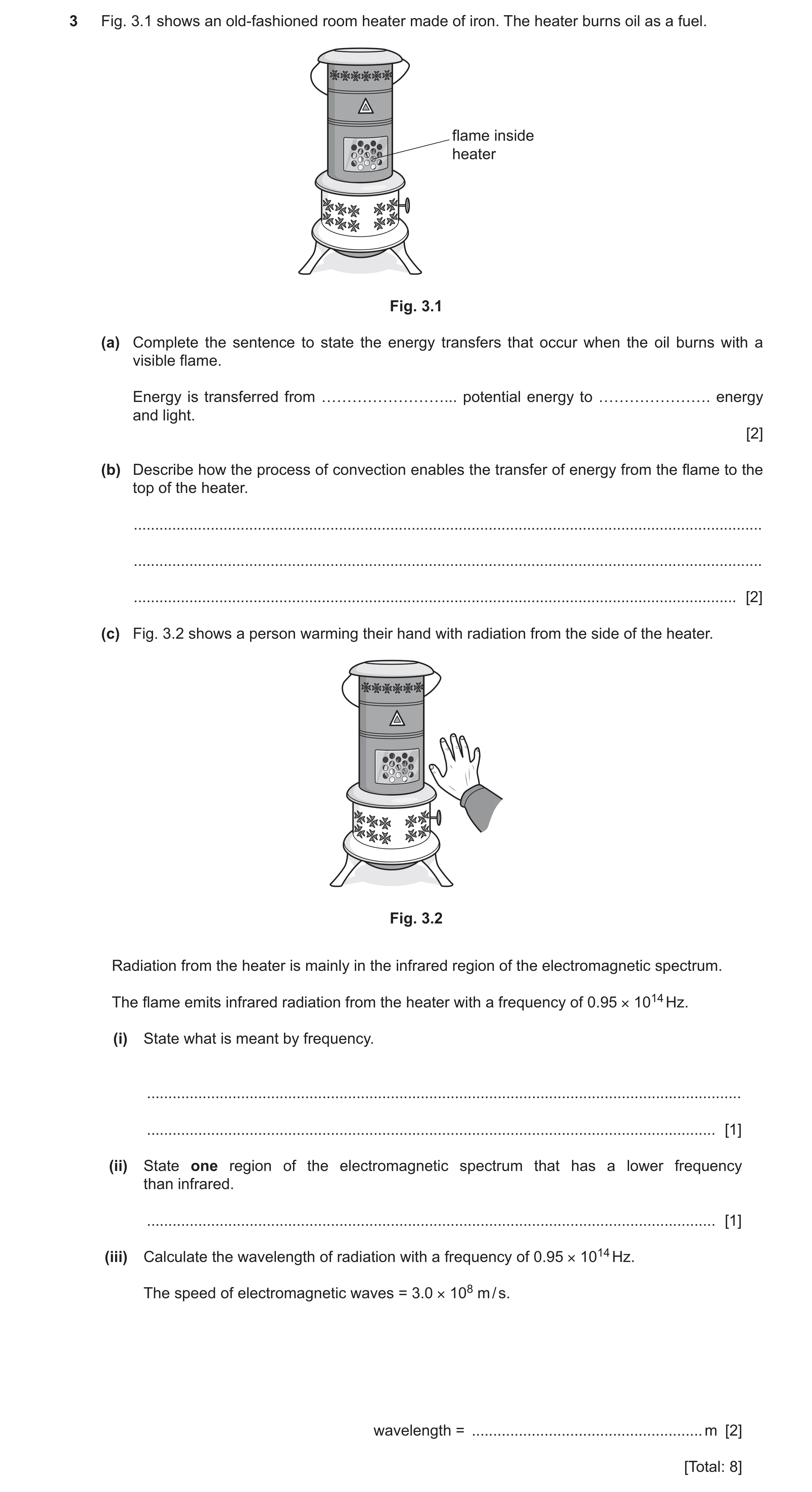
3 Fig. 3.1 shows an old-fashioned room heater made of iron. The heater burns oil as a fuel. flame inside heater Fig. 3.1 (a) Complete the sentence to state the energy transfers that occur when the oil burns with a visible flame. Energy is transferred from ……………………... potential energy to …………………. energy and light. [2] (b) Describe how the process of convection enables the transfer of energy from the flame to the top of the heater. … … … [2] (c) Fig. 3.2 shows a person warming their hand with radiation from the side of the heater. Fig. 3.2 Radiation from the heater is mainly in the infrared region of the electromagnetic spectrum. The flame emits infrared radiation from the heater with a frequency of 0.95 × 10¹⁴ Hz. (i) State what is meant by frequency. … … [1] (ii) State one region of the electromagnetic spectrum that has a lower frequency than infrared. … [1] (iii) Calculate the wavelength of radiation with a frequency of 0.95 × 10¹⁴ Hz. The speed of electromagnetic waves = 3.0 × 10⁸ m / s. wavelength = … m [2] [Total: 8]
8 marks
Mark scheme: 3(a) chemical ; thermal ; 3(b) air (above flame) is heated ; less dense air rises ; 2 3(c)(i) number of wavelengths, per unit time / per second ; 1 3(c)(ii) microwaves / radio waves ; 1 3(c)(iii) ( = ) v ÷ f or 3.0 108 0.95 1014 ; 3.2 (3.16) 10–6 (m) ; 2
This question in 0653/42 May/June 2024
Q31 · A student constructs an electrical circuit containing a metal heating element 0653/42 May/June 2025
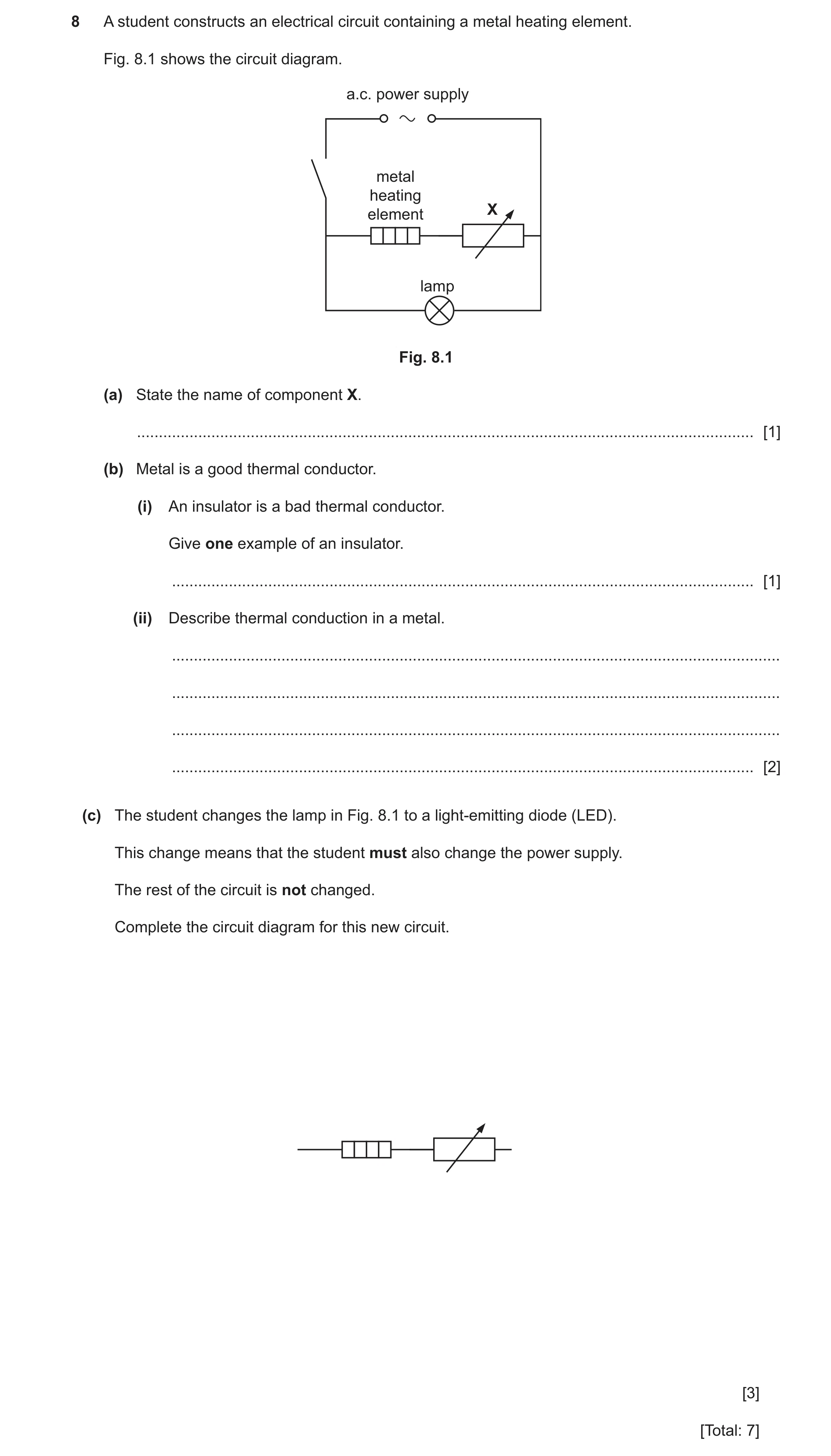
8 A student constructs an electrical circuit containing a metal heating element. Fig. 8.1 shows the circuit diagram. a.c. power supply metal heating X element lamp Fig. 8.1 (a) State the name of component X. … [1] (b) Metal is a good thermal conductor. (i) An insulator is a bad thermal conductor. Give one example of an insulator. … [1] (ii) Describe thermal conduction in a metal. … … … … [2] (c) The student changes the lamp in Fig. 8.1 to a light-emitting diode (LED). This change means that the student must also change the power supply. The rest of the circuit is not changed. Complete the circuit diagram for this new circuit. [3] [Total: 7]
7 marks
Mark scheme: 8(a) variable resistor ; 1 8(b)(i) plastic / wood / AVP ; 1 8(b)(ii) free / delocalised electrons or electrons move ; 2 particle / lattice vibrations or particle collisions or collision of electrons with, particles / the metal / the lattice or electrons / thermal energy, move from hot area to cold area ; 8(c) 3 (LED symbol) ; (d.c. supply symbol) ; LED correctly connected for polarity of supply ;
This question in 0653/42 May/June 2025
Q32 · A pan of water being heated on an electric hotplate 0653/43 May/June 2025
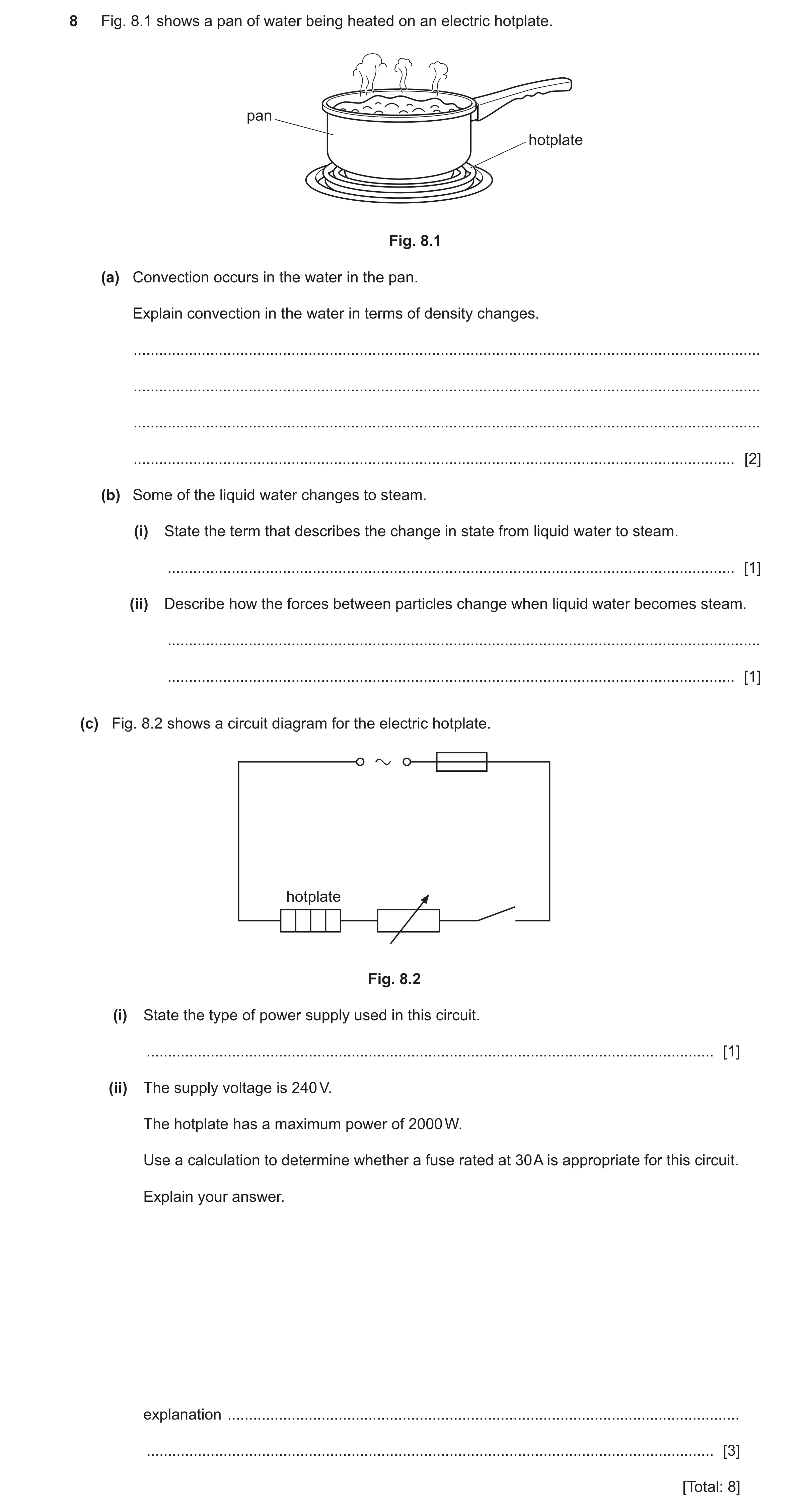
8 Fig. 8.1 shows a pan of water being heated on an electric hotplate. pan hotplate Fig. 8.1 (a) Convection occurs in the water in the pan. Explain convection in the water in terms of density changes. … … … … [2] (b) Some of the liquid water changes to steam. (i) State the term that describes the change in state from liquid water to steam. … [1] (ii) Describe how the forces between particles change when liquid water becomes steam. … … [1] (c) Fig. 8.2 shows a circuit diagram for the electric hotplate. hotplate Fig. 8.2 (i) State the type of power supply used in this circuit. … [1] (ii) The supply voltage is 240 V. The hotplate has a maximum power of 2000 W. Use a calculation to determine whether a fuse rated at 30 A is appropriate for this circuit. Explain your answer. explanation … … [3] [Total: 8]
8 marks
Mark scheme: 8(a) heated water becomes less dense 2 or heated water expands or heated molecules move further apart ; heated water rises ; 8(b)(i) boiling ; 1 8(b)(ii) (forces / they) decrease ; 1 8(c)(i) alternating current / a.c. ; 1 8(c)(ii) P = IV / 2000 240 ; 3 8.3 A ; 30 A fuse is not appropriate AND it would allow too large a current ;
This question in 0653/43 May/June 2025
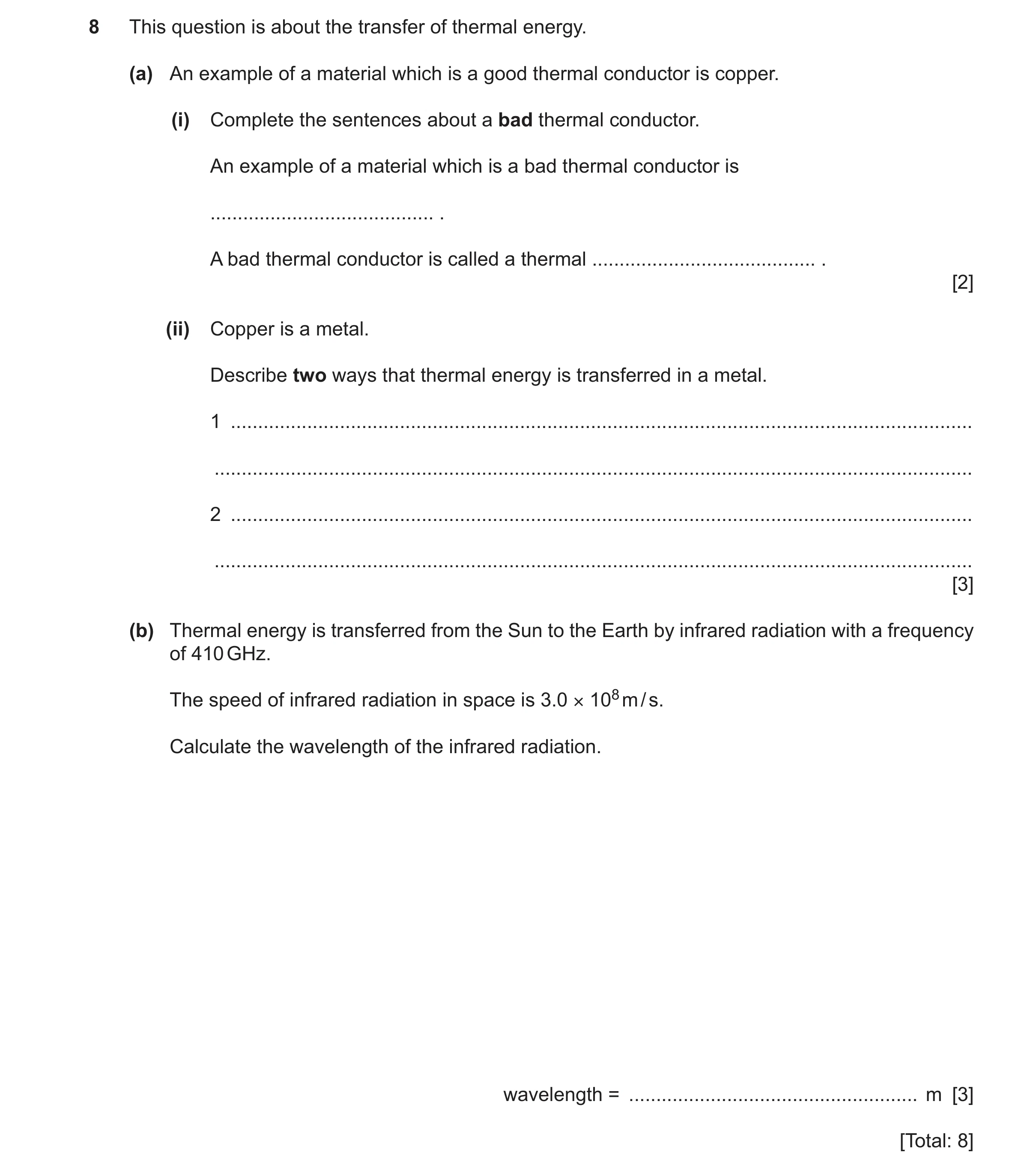
Q33 · This question is about the transfer of thermal energy 0653/41 Oct/Nov 2025
8 This question is about the transfer of thermal energy. (a) An example of a material which is a good thermal conductor is copper. (i) Complete the sentences about a bad thermal conductor. An example of a material which is a bad thermal conductor is … . A bad thermal conductor is called a thermal … . [2] (ii) Copper is a metal. Describe two ways that thermal energy is transferred in a metal. 1 … … 2 … … [3] (b) Thermal energy is transferred from the Sun to the Earth by infrared radiation with a frequency of 410 GHz. The speed of infrared radiation in space is 3.0 × 10⁸ m / s. Calculate the wavelength of the infrared radiation. wavelength = … m [3] [Total: 8]
8 marks
Mark scheme: 8(a)(i) any named insulator, e.g. (named) wood, (named) plastic ; 2 insulator ; 8(a)(ii) M1 vibrations of particles ; 3 M2 ref to movement / delocalised / free electrons ; M3 (energy transfer) by collisions between particles / contact between particles OR collisions between electrons and particles ; 8(b) unit conversion GHz to Hz / 4.10 1011 Hz ; 3 v = fOR 3.0 108 ÷ 4.10 1011 ; 7.3 10–4 (m) ;
This question in 0653/41 Oct/Nov 2025
Q34 · A student uses the apparatus shown in Fig 0653/42 Oct/Nov 2025
8 (a) A student uses the apparatus shown in Fig. 8.1 to investigate the transfer of thermal energy by radiation. thermometer stopper container with container with black surfaces white surfaces Fig. 8.1 The two containers are identical in size and made from the same material. One container has only black surfaces, and the other container has only white surfaces. The student has access to hot water. Describe how the student uses this apparatus to determine whether a black surface or a white surface is a better emitter of thermal radiation. … … … … … … … … [3] (b) (i) Explain why energy is transferred through space from the Sun to the Earth by radiation but not by conduction or convection. … … … [2] (ii) Complete Fig. 8.2 to show the stages in the life cycle of a small mass star like the Sun. interstellar clouds of dust and gas … stable star … white dwarf and planetary nebula Fig. 8.2 [2] (iii) A supernova is part of the life cycle of a large mass star. State what may form from the nebula after a supernova. … [1] [Total: 8]
8 marks
Mark scheme: 8(a) use same initial temperature and volume of water in containers ; 3 AND either record final temperatures (of water in both containers) after a fixed time ; container that has greater temperature decrease is better emitter ; OR measure time take for a fixed temperature decrease ; takes least time for the temperature decrease is better emitter ; 8(b)(i) no particles / medium in space / space is a vacuum ; 2 AND either conduction / convection need particles / a medium (to transfer energy) ; OR radiation does not need a medium / particles ; 8(b)(ii) protostar ; 2 red giant ; 8(b)(iii) new stars (with orbiting planets) 1
This question in 0653/42 Oct/Nov 2025
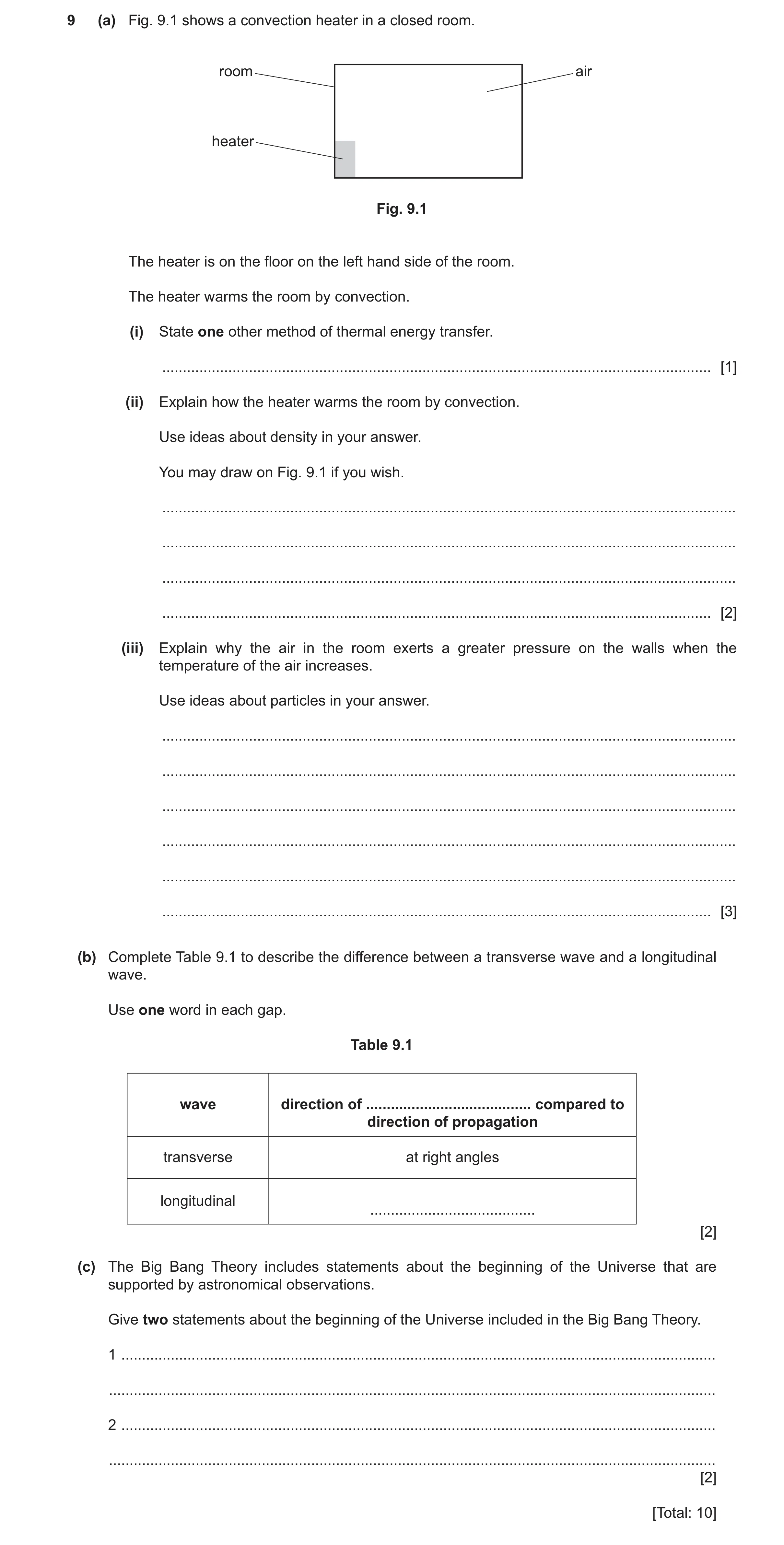
Q35 · A convection heater in a closed room 0653/43 Oct/Nov 2025
9 (a) Fig. 9.1 shows a convection heater in a closed room. room air heater Fig. 9.1 The heater is on the floor on the left hand side of the room. The heater warms the room by convection. (i) State one other method of thermal energy transfer. … [1] (ii) Explain how the heater warms the room by convection. Use ideas about density in your answer. You may draw on Fig. 9.1 if you wish. … … … … [2] (iii) Explain why the air in the room exerts a greater pressure on the walls when the temperature of the air increases. Use ideas about particles in your answer. … … … … … … [3] (b) Complete Table 9.1 to describe the difference between a transverse wave and a longitudinal wave. Use one word in each gap. Table 9.1 wave direction of … compared to direction of propagation transverse at right angles longitudinal … [2] (c) The Big Bang Theory includes statements about the beginning of the Universe that are supported by astronomical observations. Give two statements about the beginning of the Universe included in the Big Bang Theory. 1 … … 2 … … [2] [Total: 10]
10 marks
Mark scheme: 9(a)(i) conduction / radiation 1 9(a)(ii) idea that warm air is less dense or cold air is more dense ; 2 warm air rises AND cold air falls ; 9(a)(iii) (air) particles collide with the walls ; 3 particle collisions (with walls) are more frequent (as temperature increases) or particles collide with greater, speed or kinetic energy or force ; idea that more force per unit area = increased pressure ; 9(b) vibration(s) ; 2 parallel ; 9(c) any two from: 2 (Universe) expanded/started from a (single) point ; (point had) high density and temperature ; (Universe began) 13.8 billion years ago ;
This question in 0653/43 Oct/Nov 2025
 12 / 53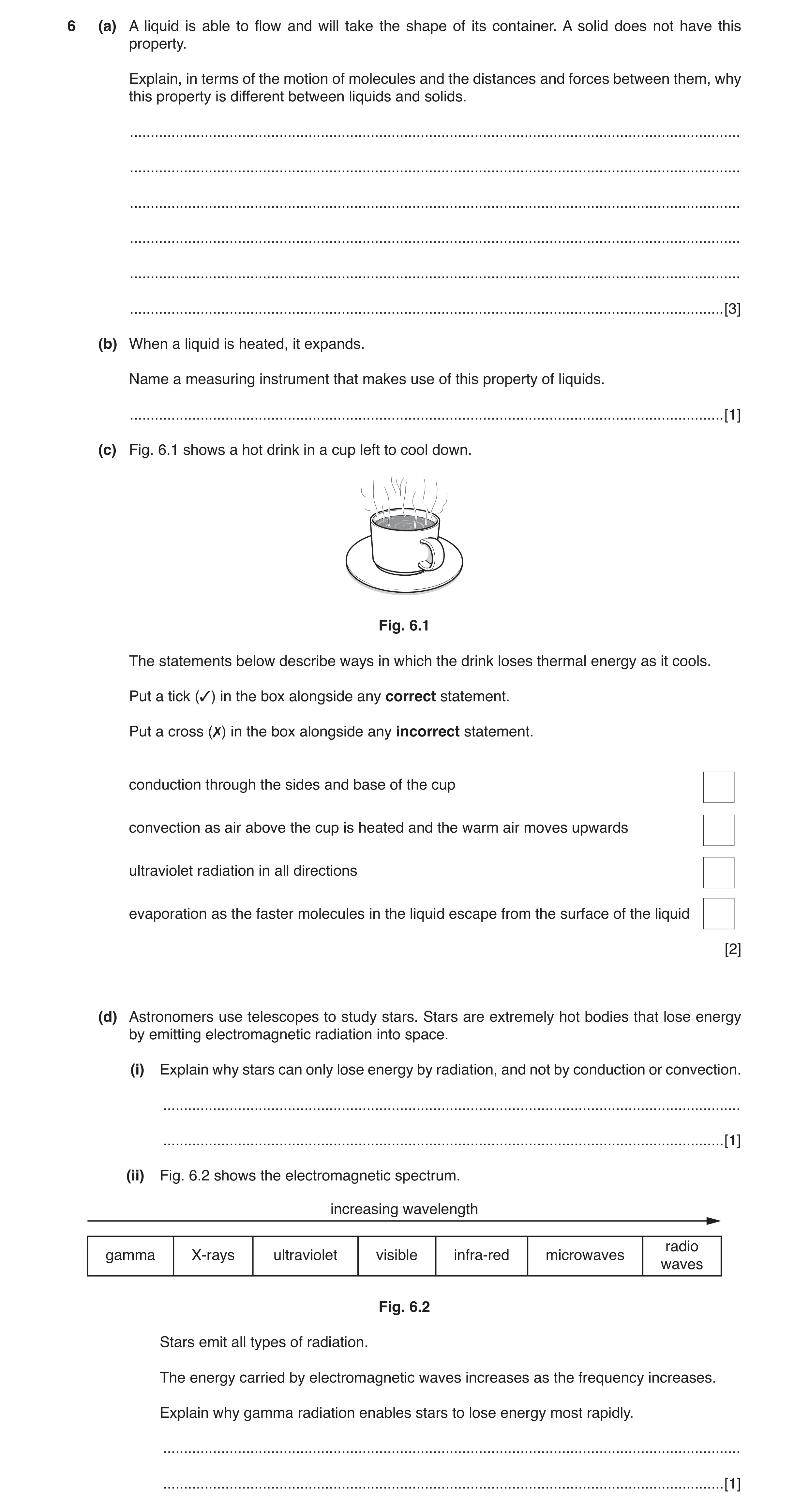
 18 / 53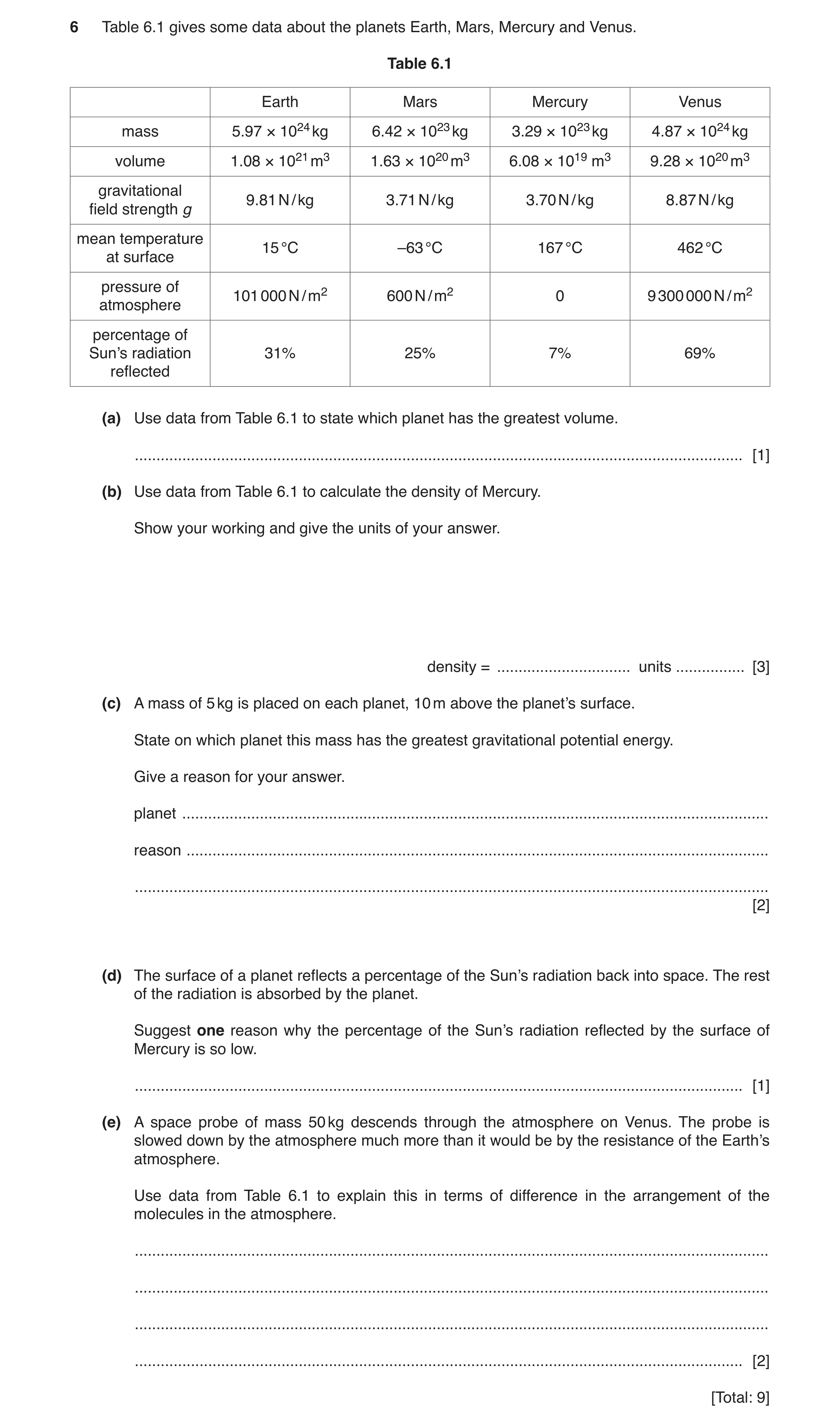
 43 / 53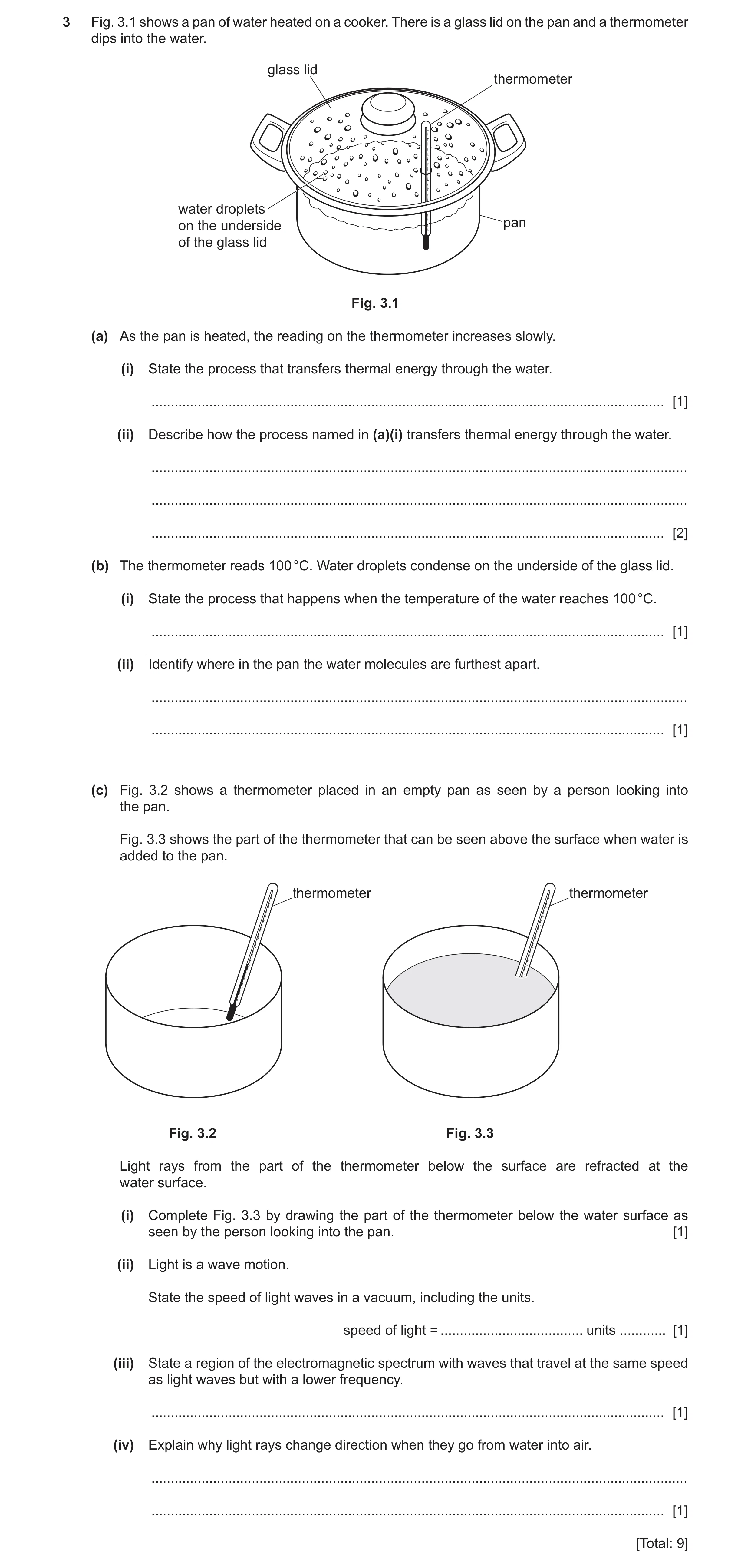
 50 / 53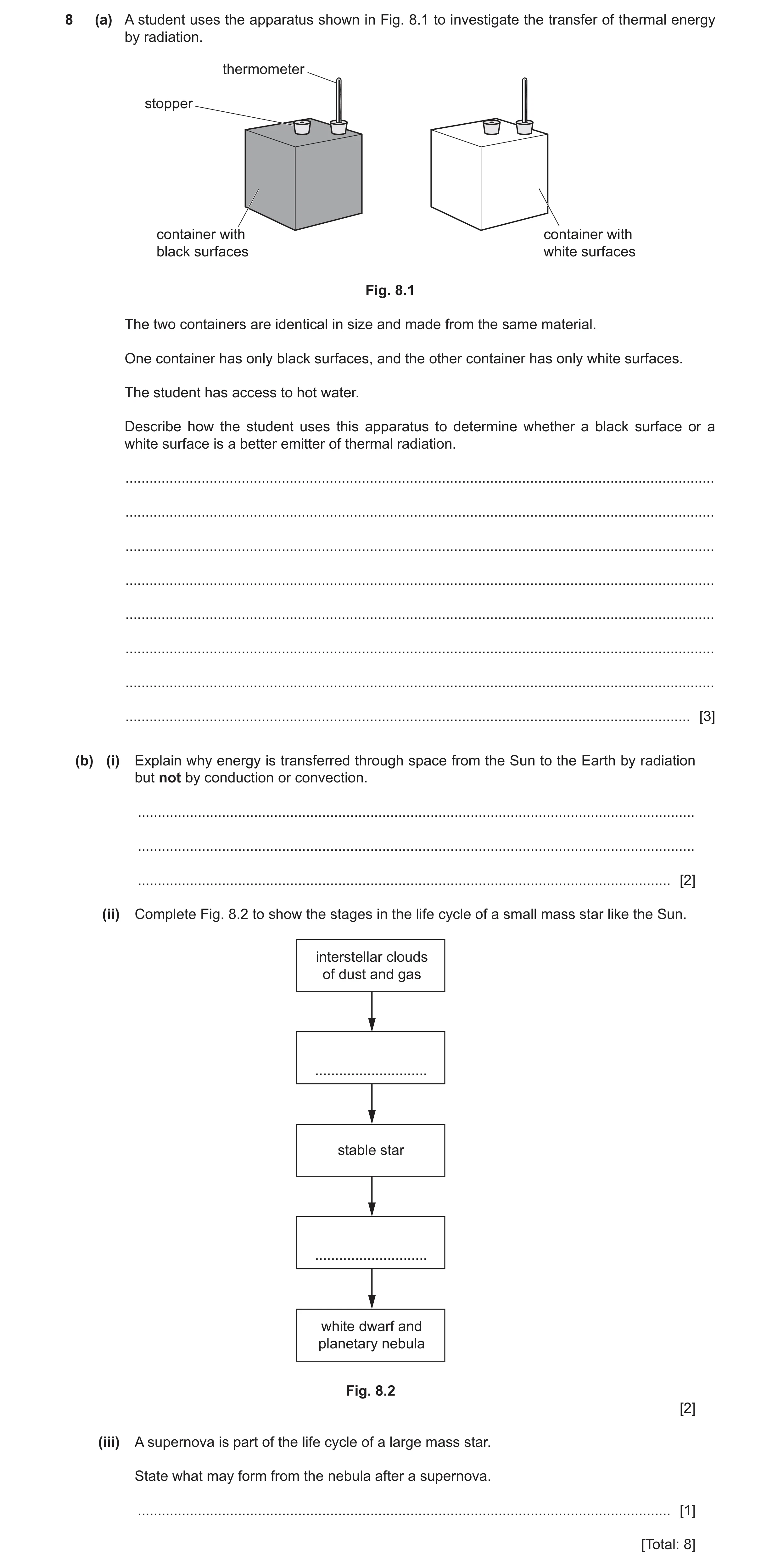
 11
11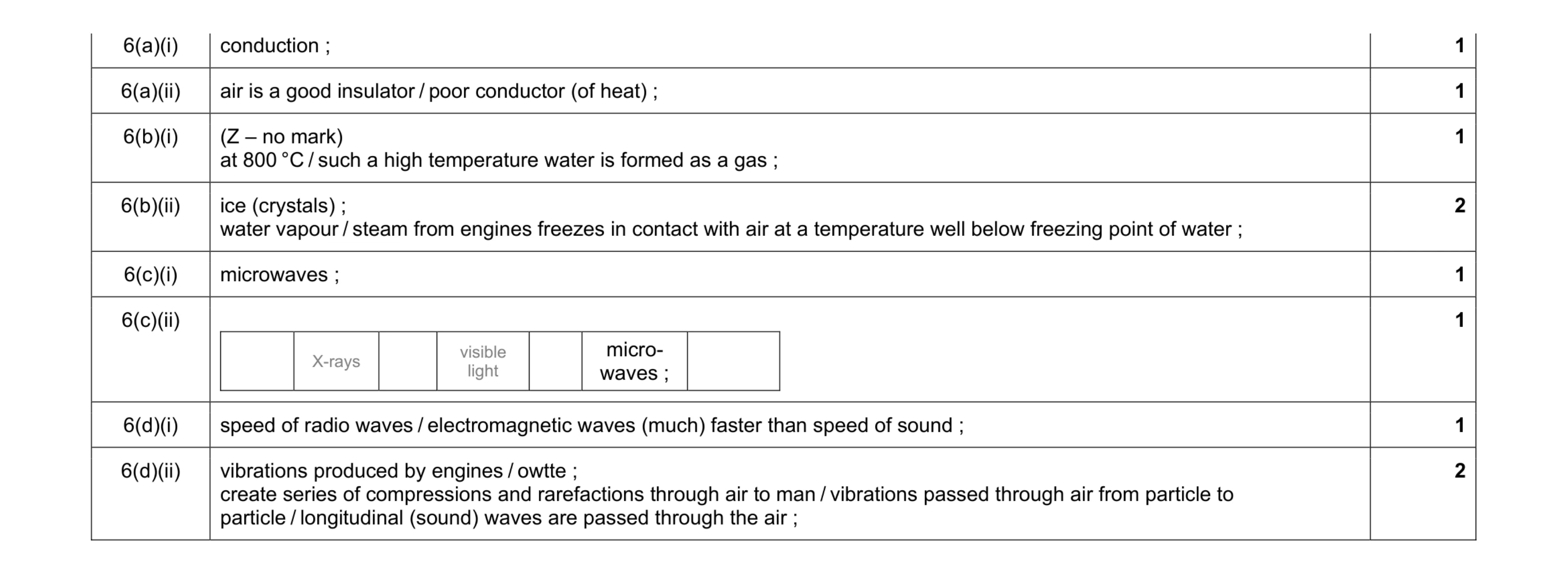 10
10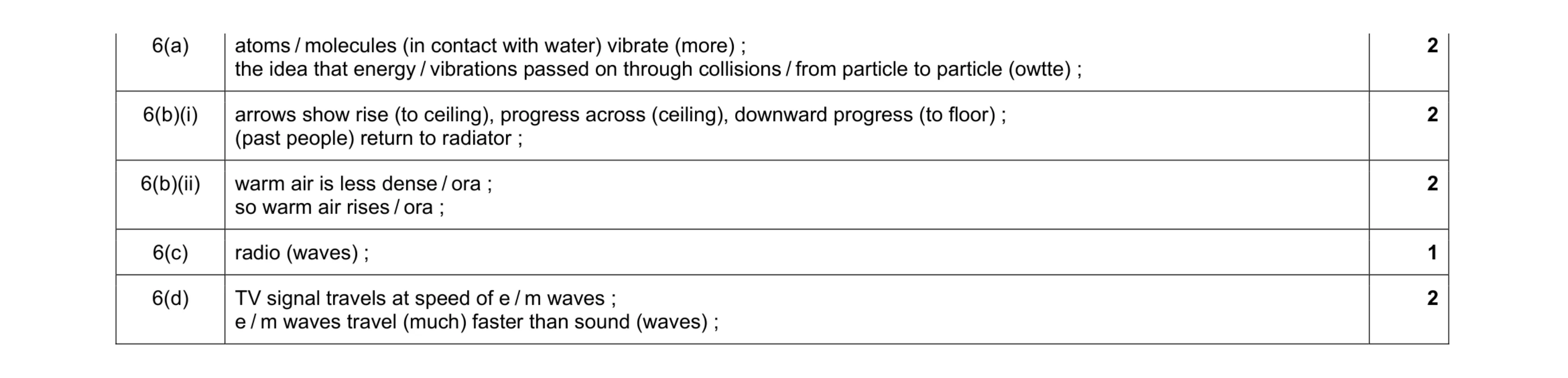 9
9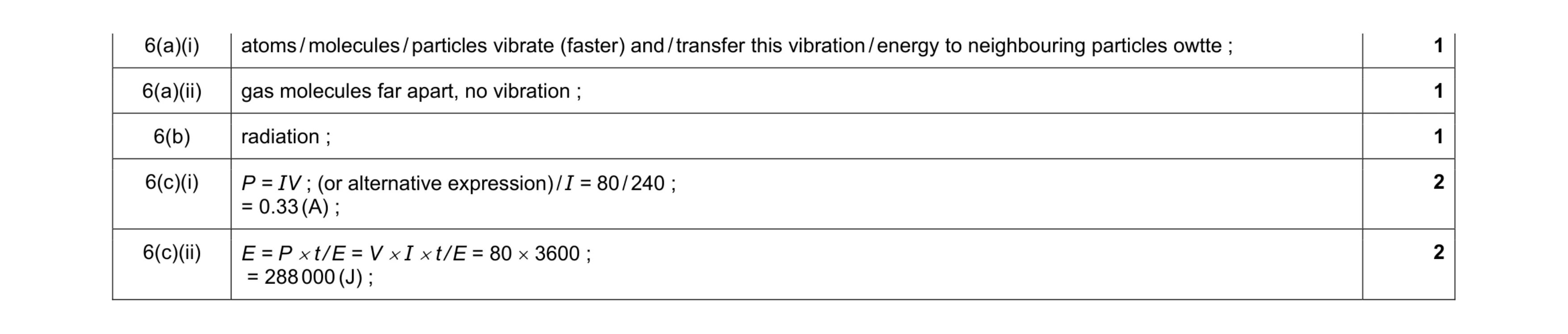 7
7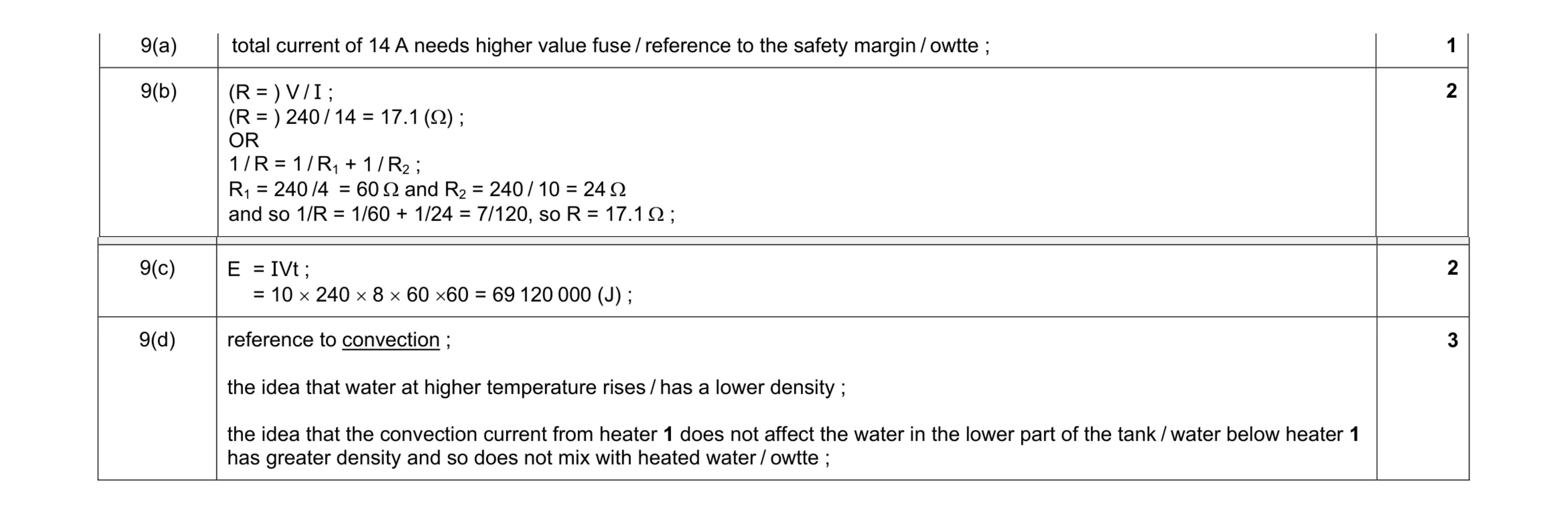 8
8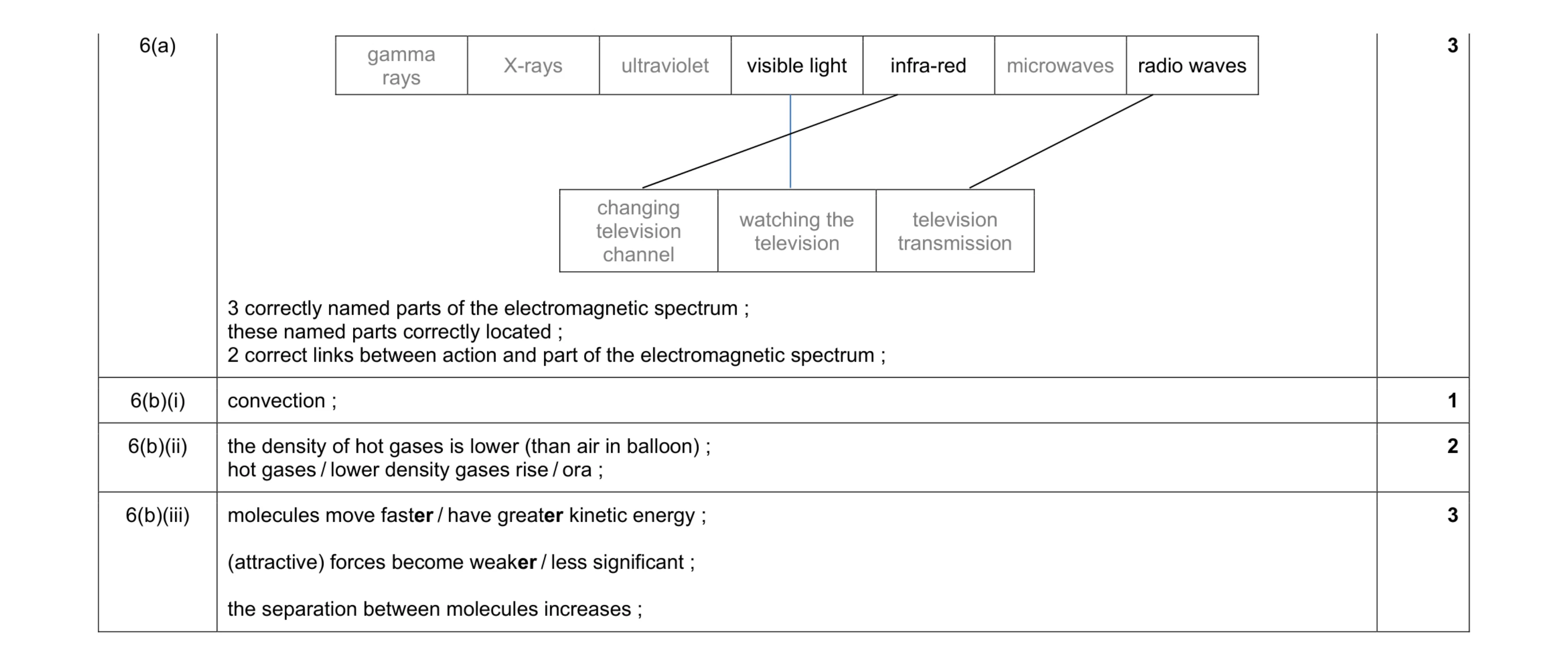 9
9 5
5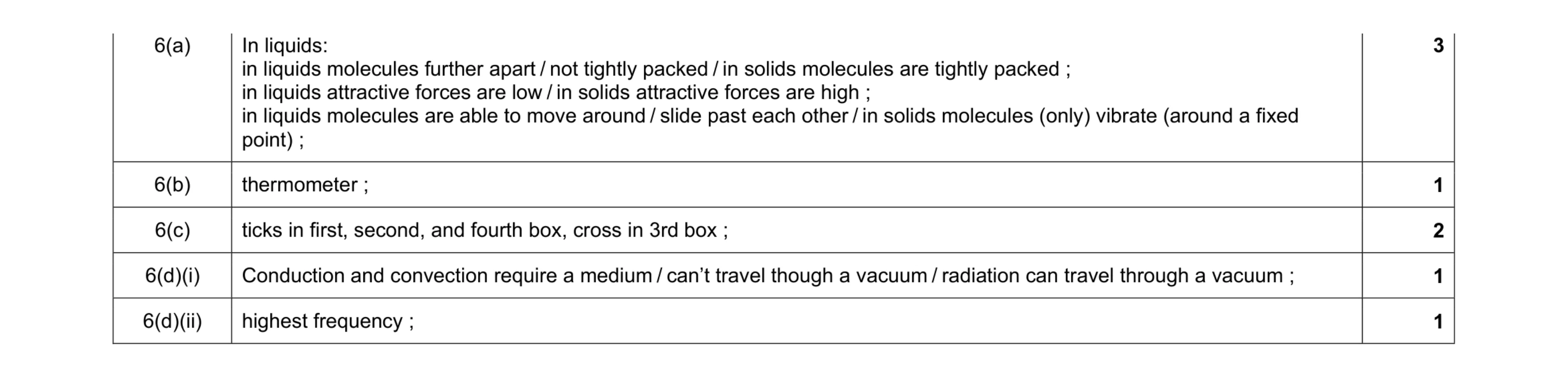 8
8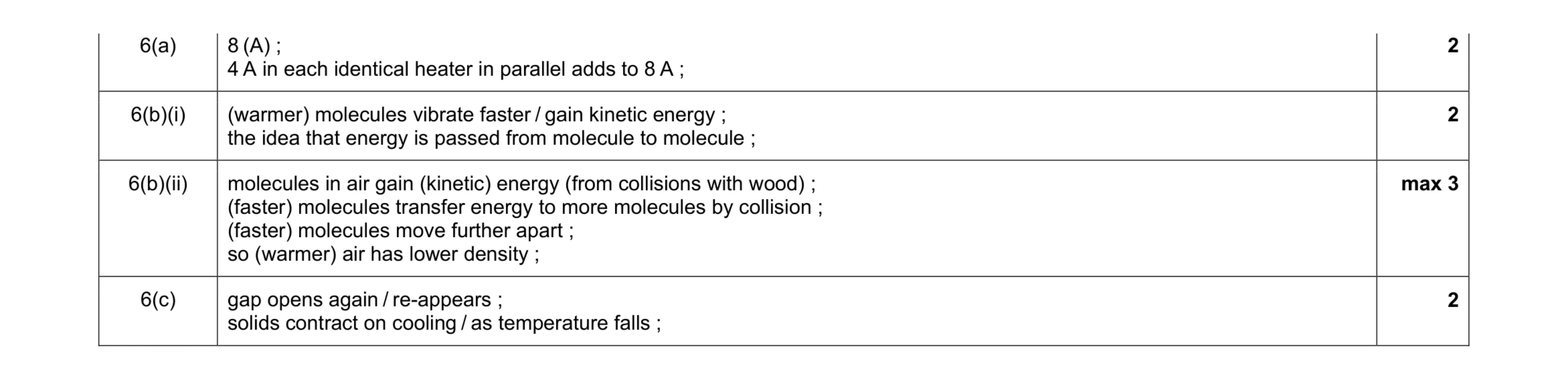 9
9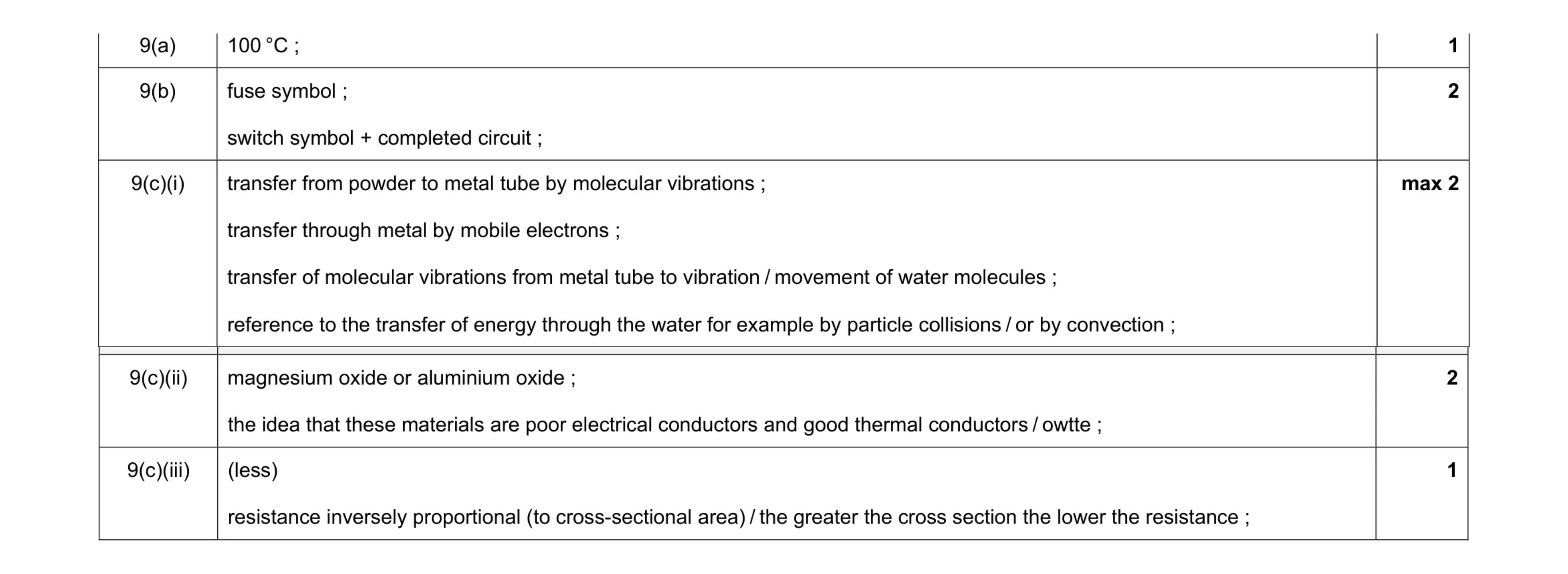 8
8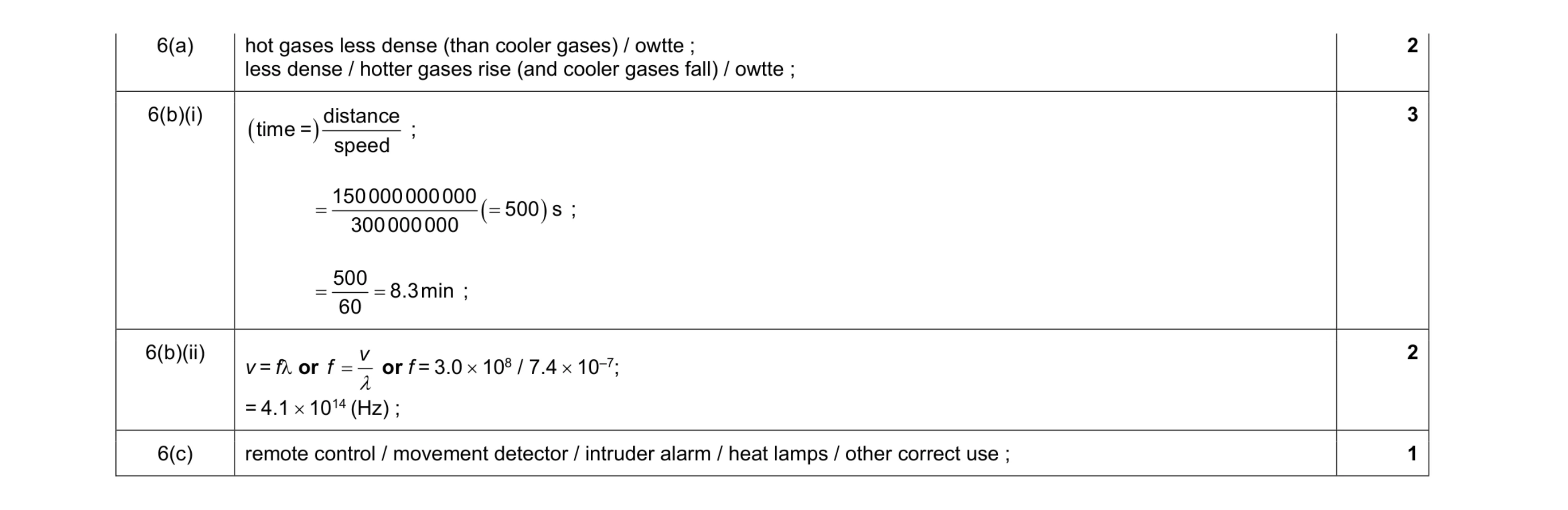 8
8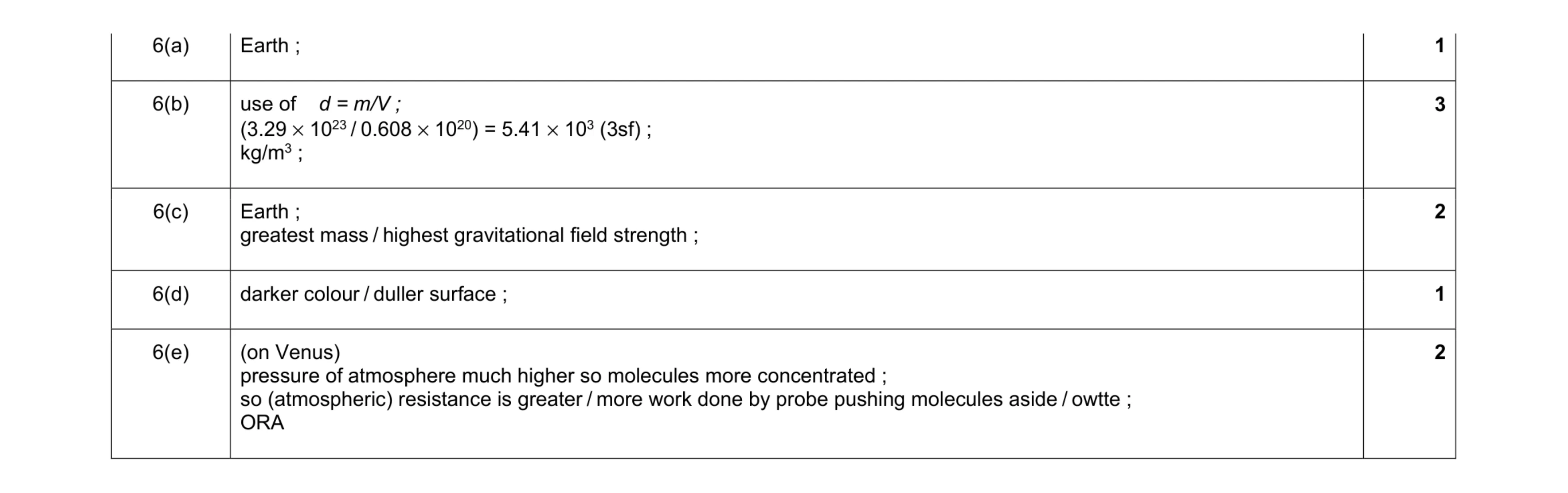 9
9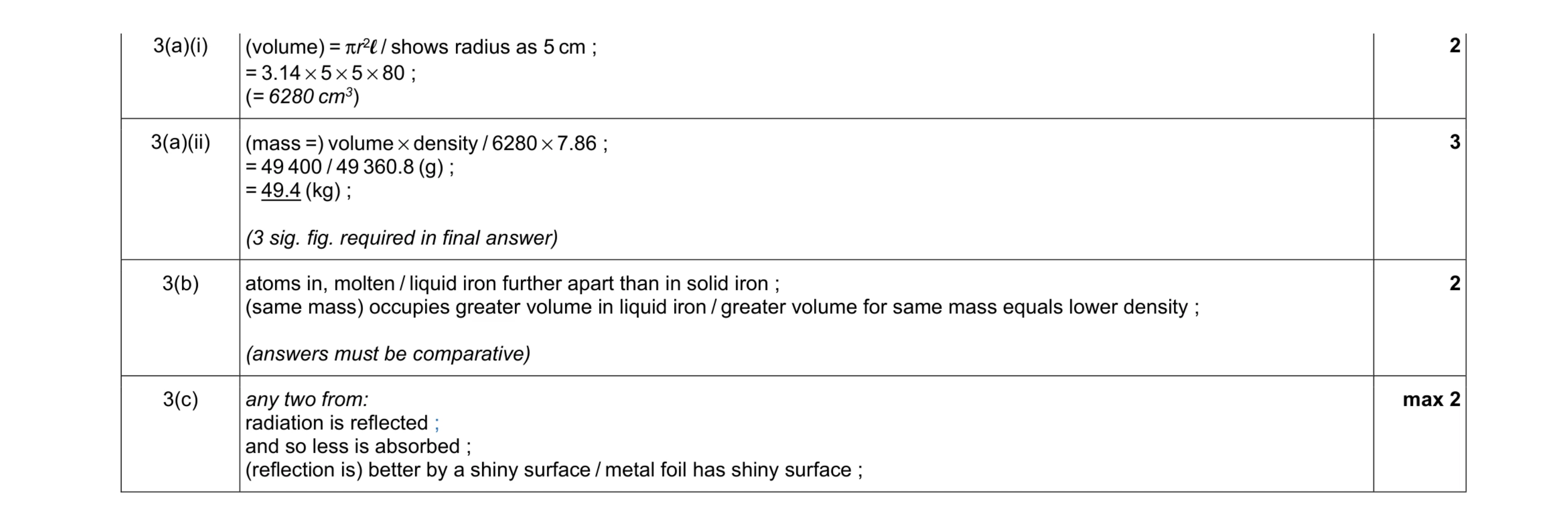 9
9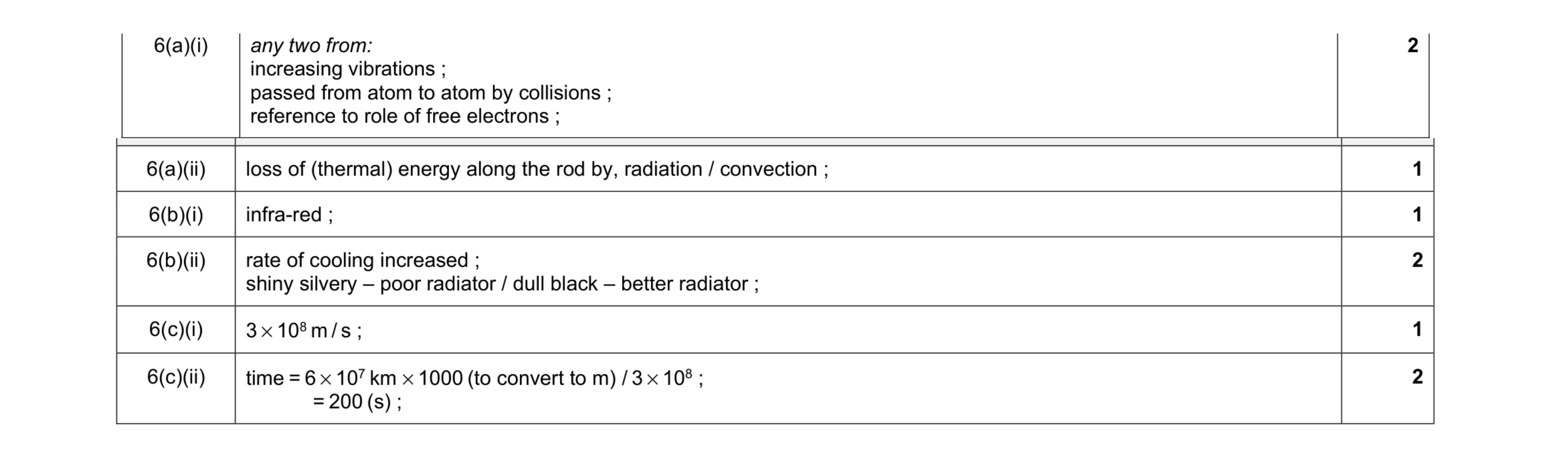 9
9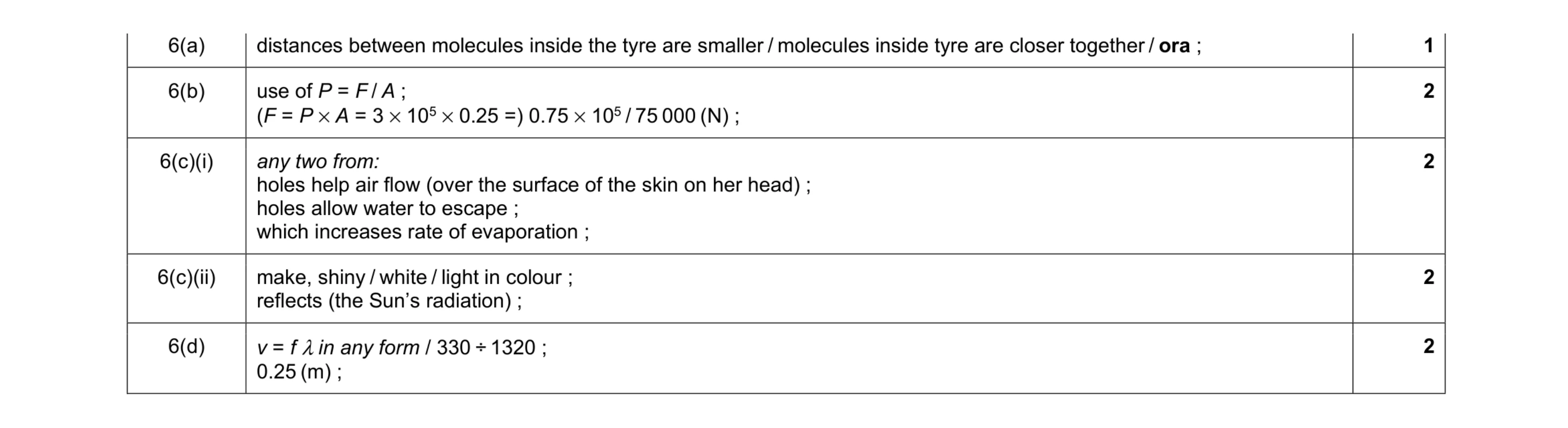 9
9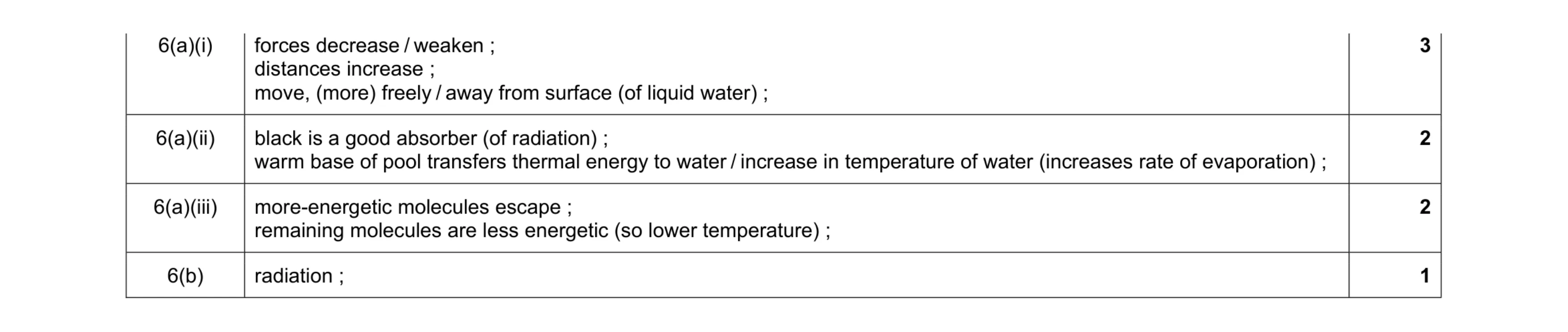 8
8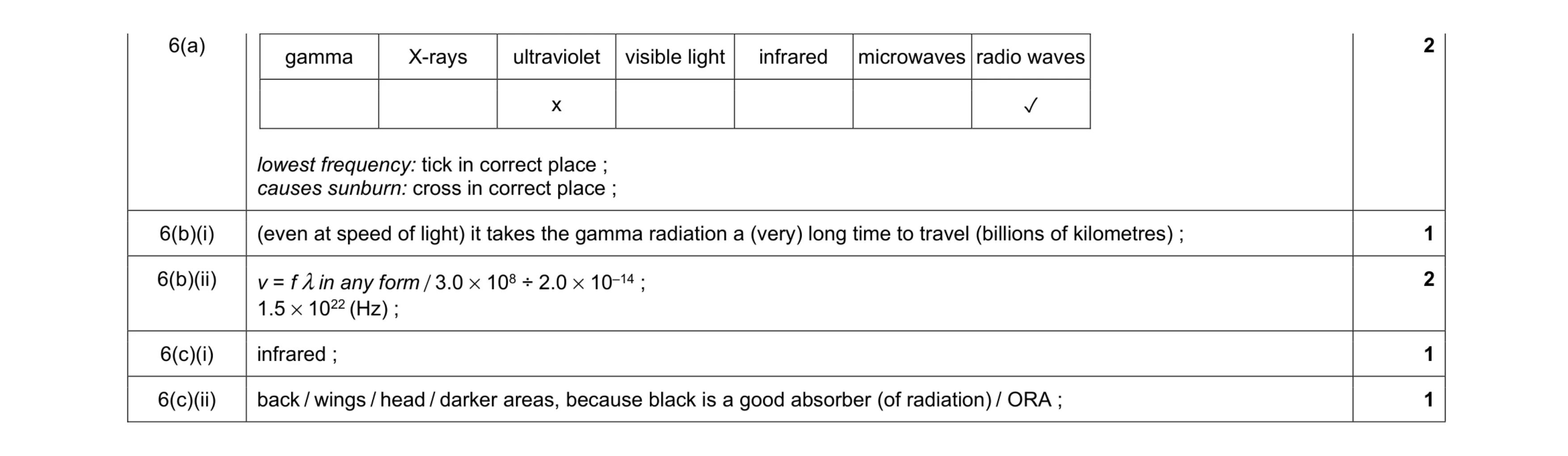 7
7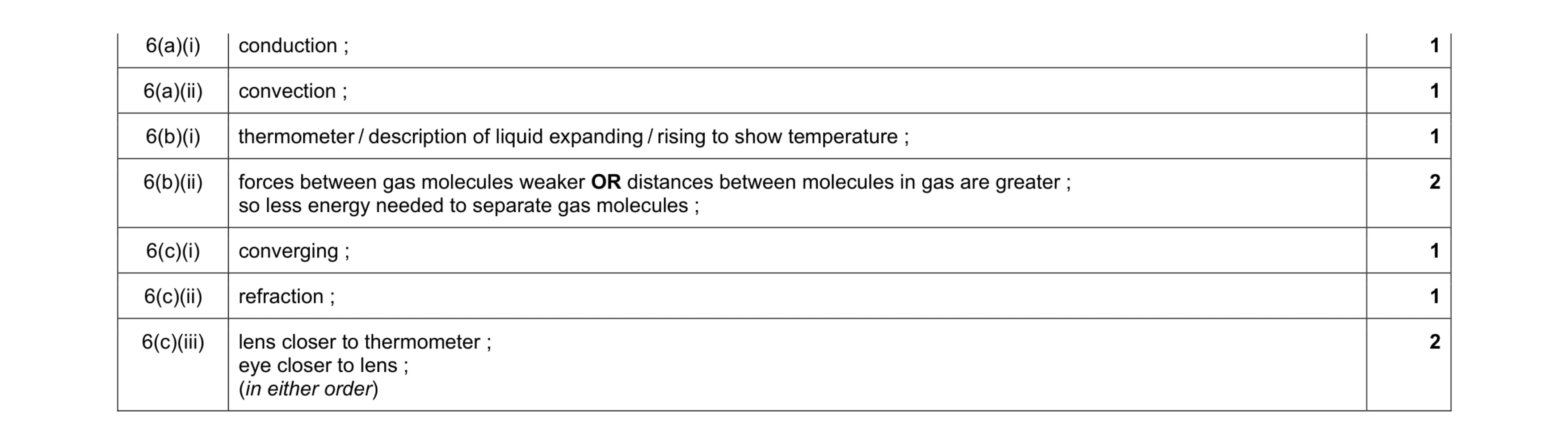 9
9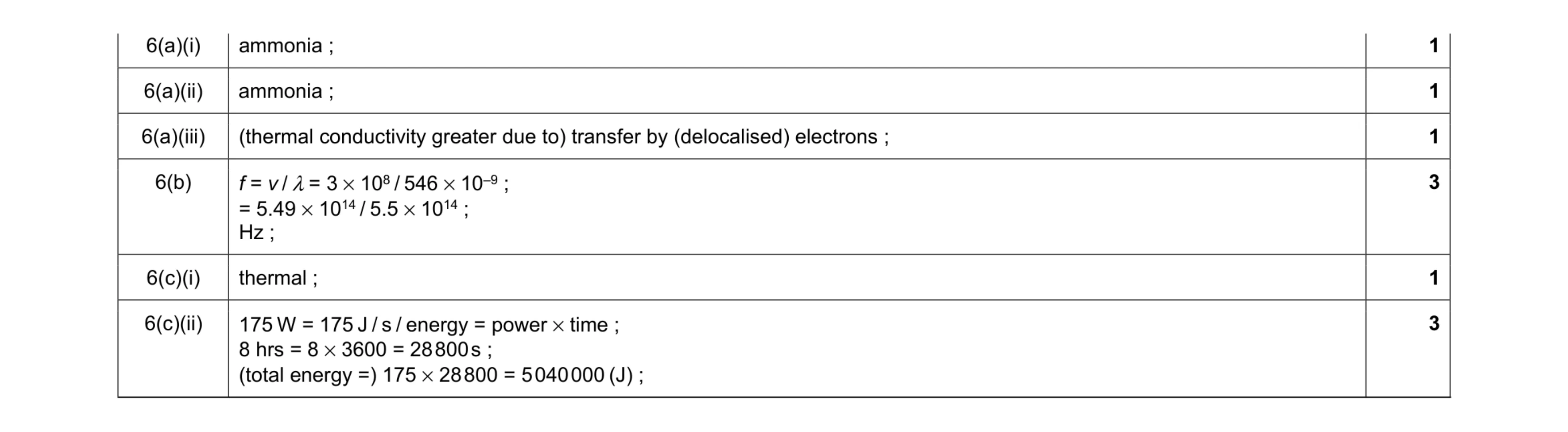 10
10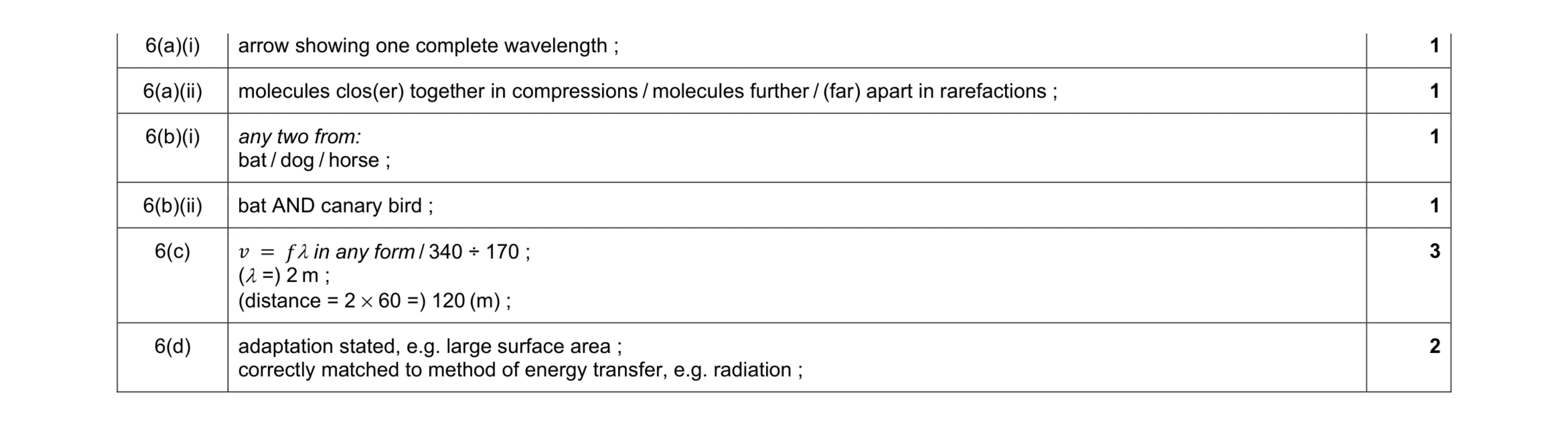 9
9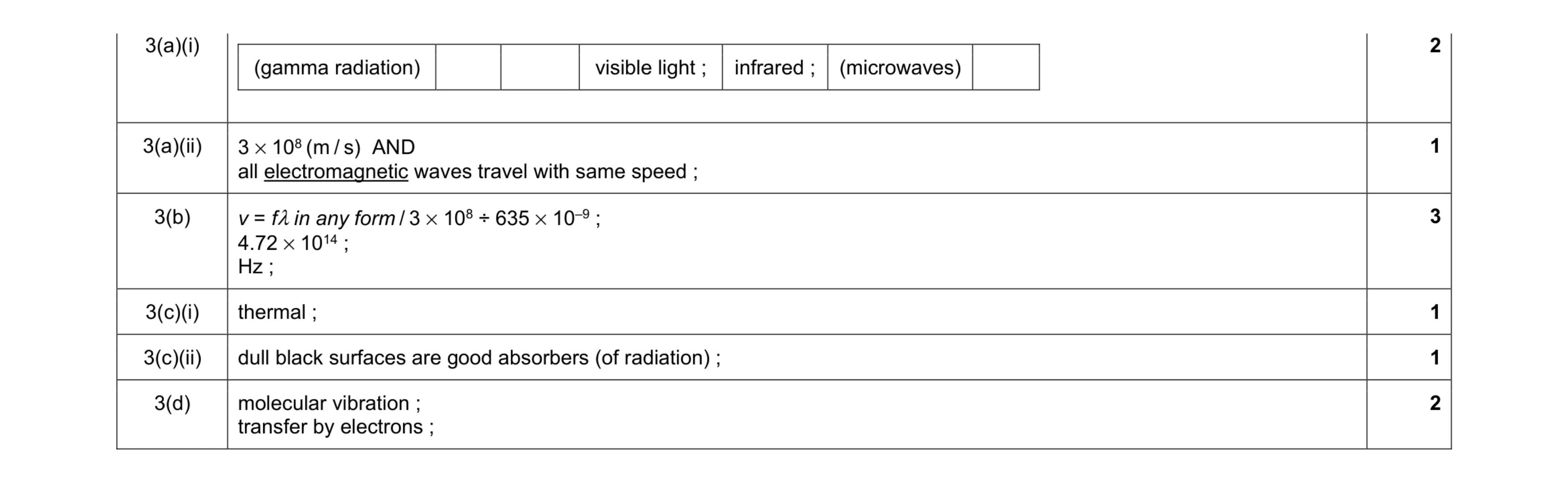 10
10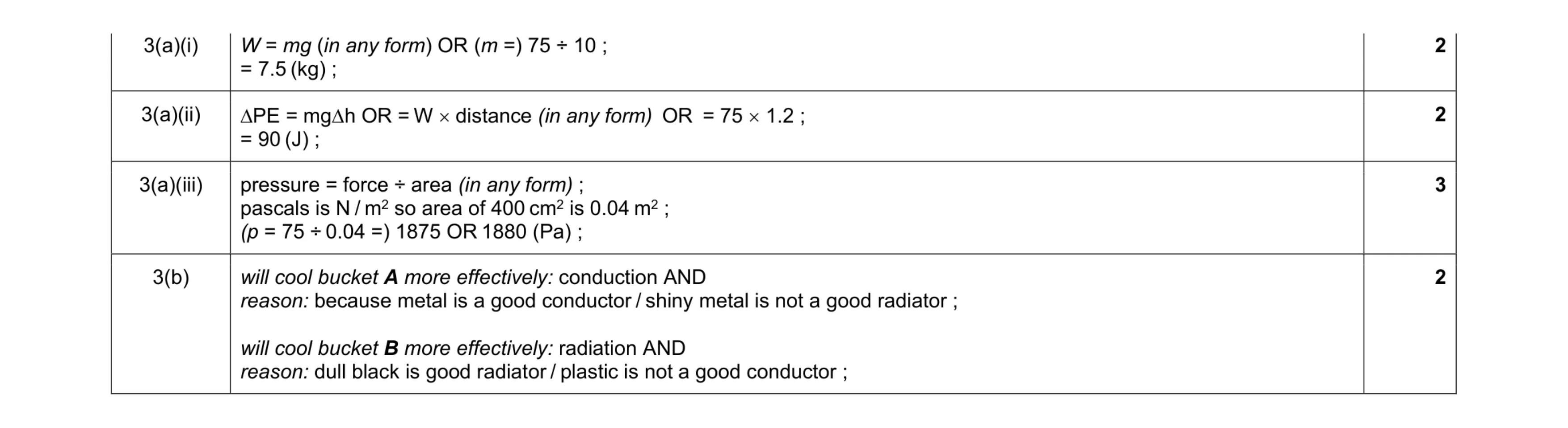 9
9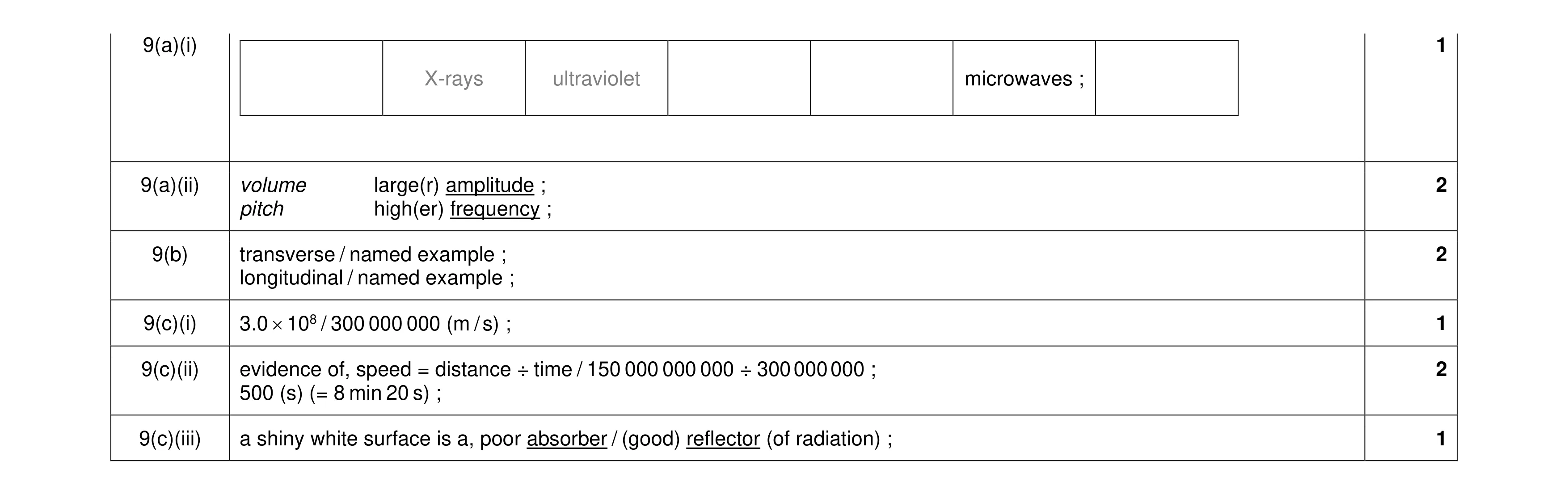 9
9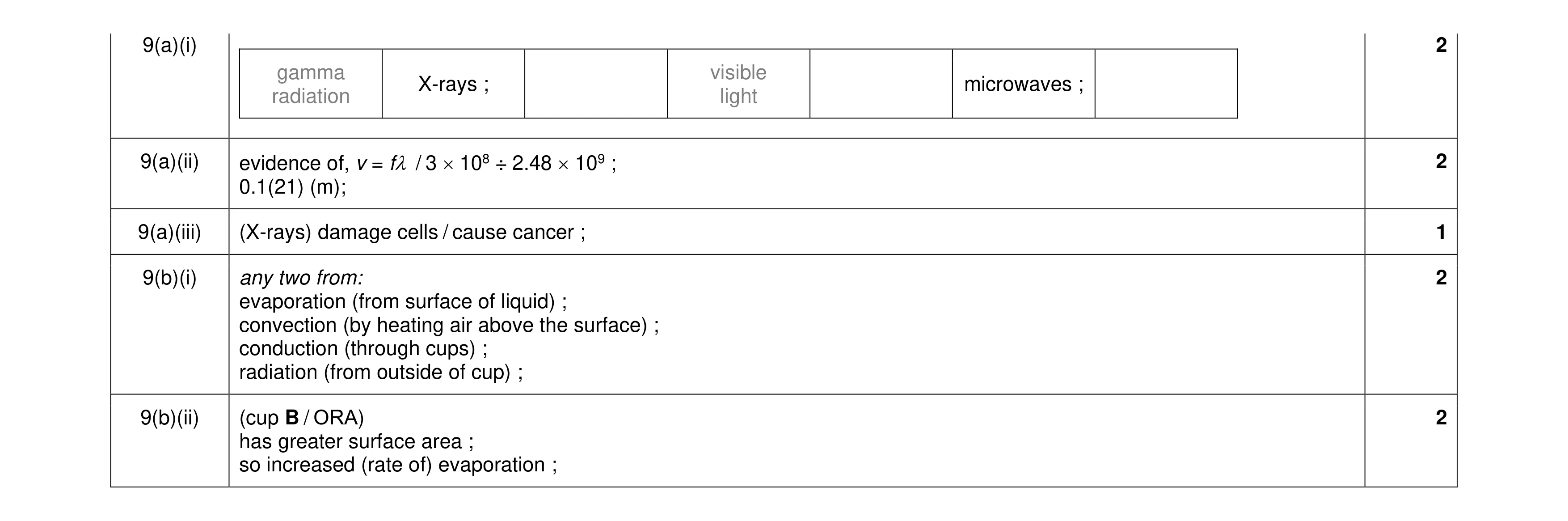 9
9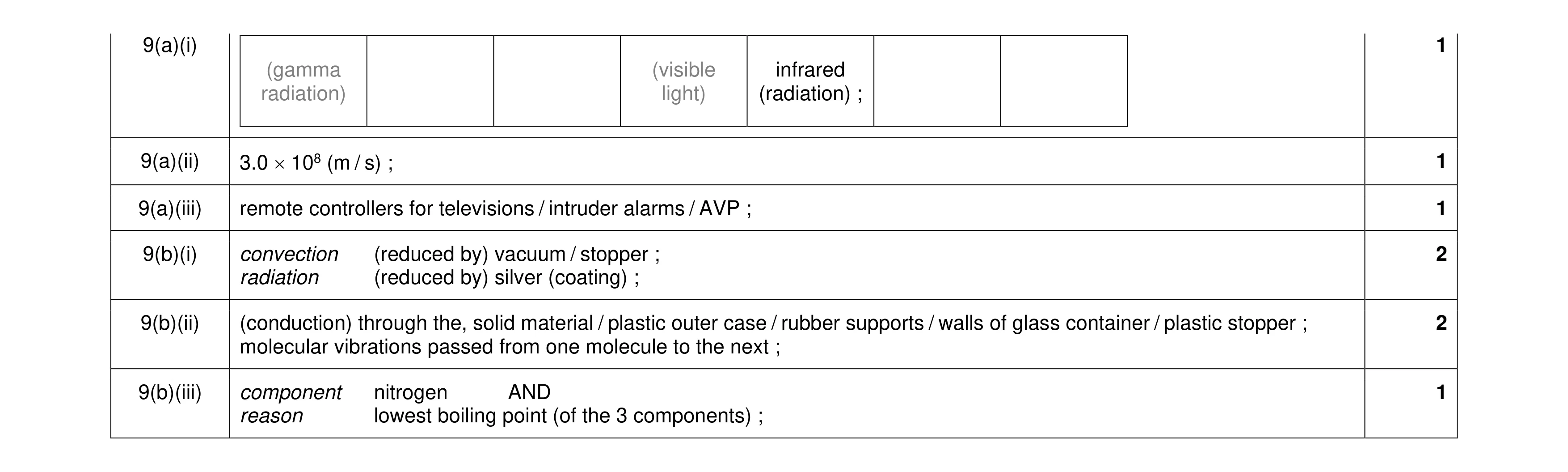 8
8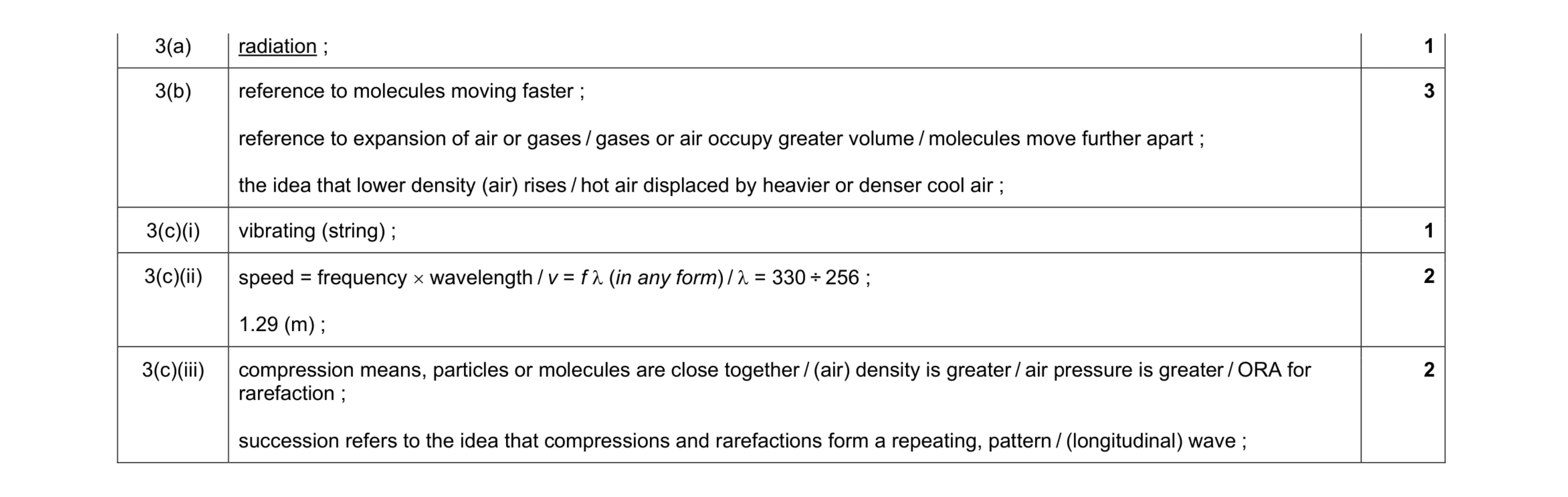 9
9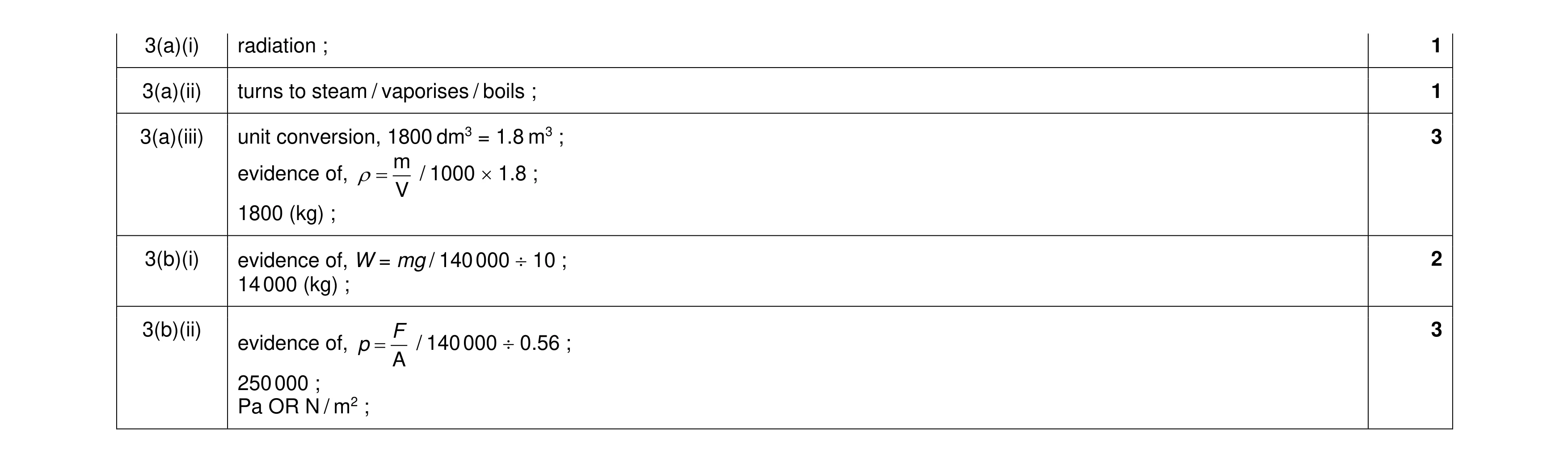 10
10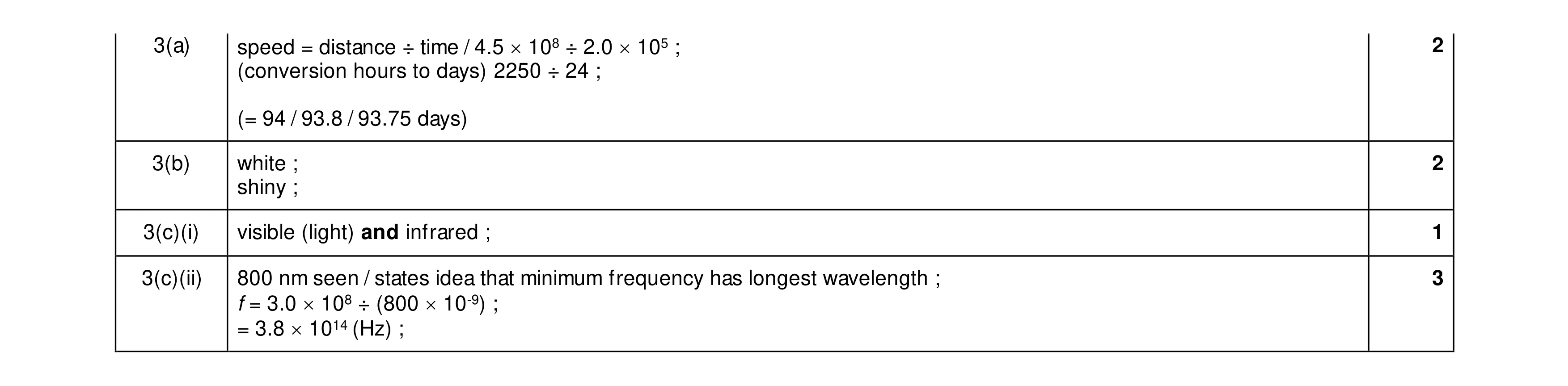 8
8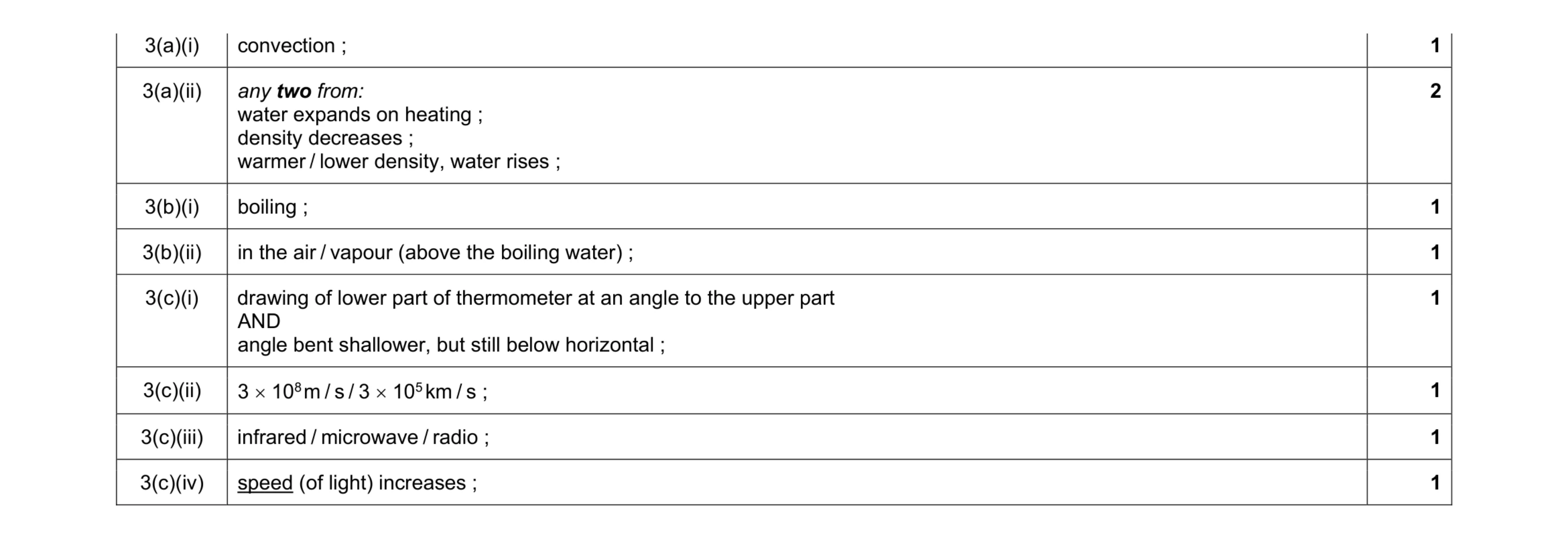 9
9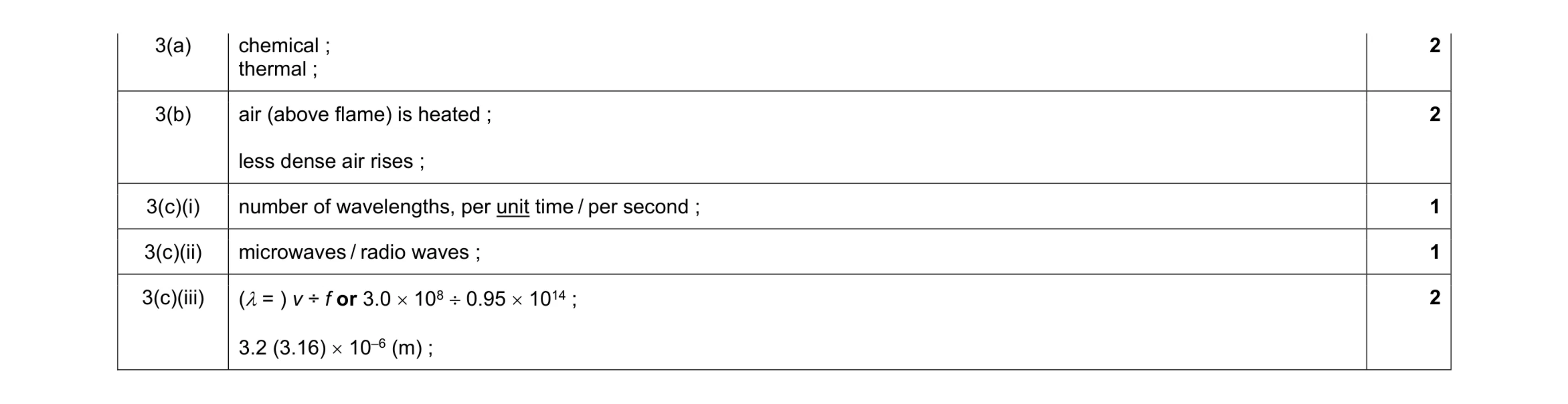 8
8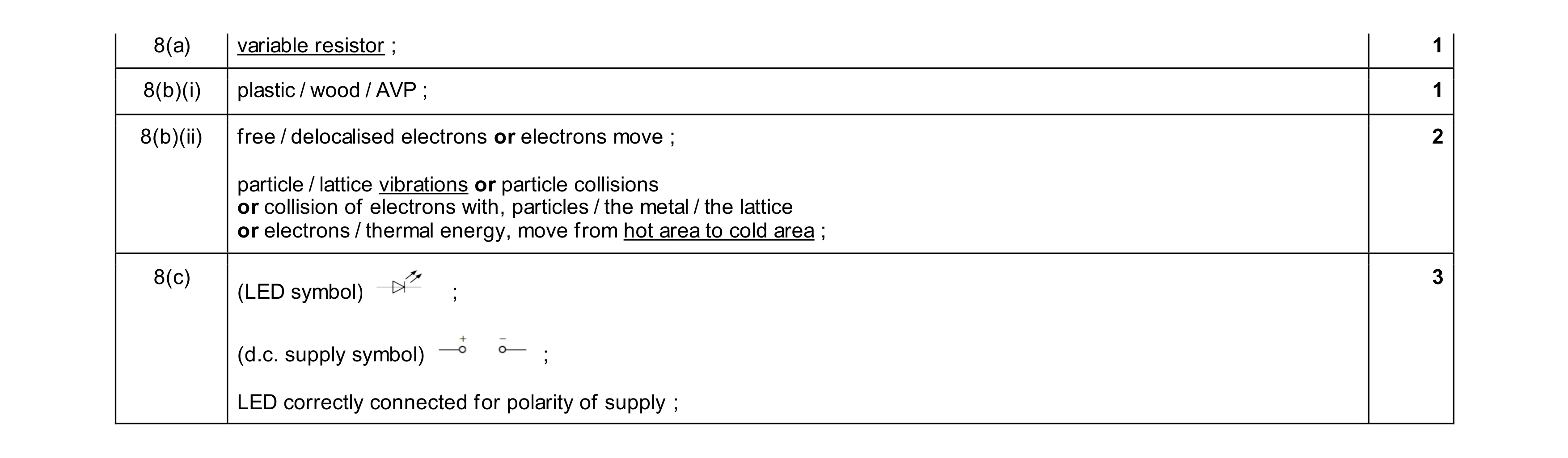 7
7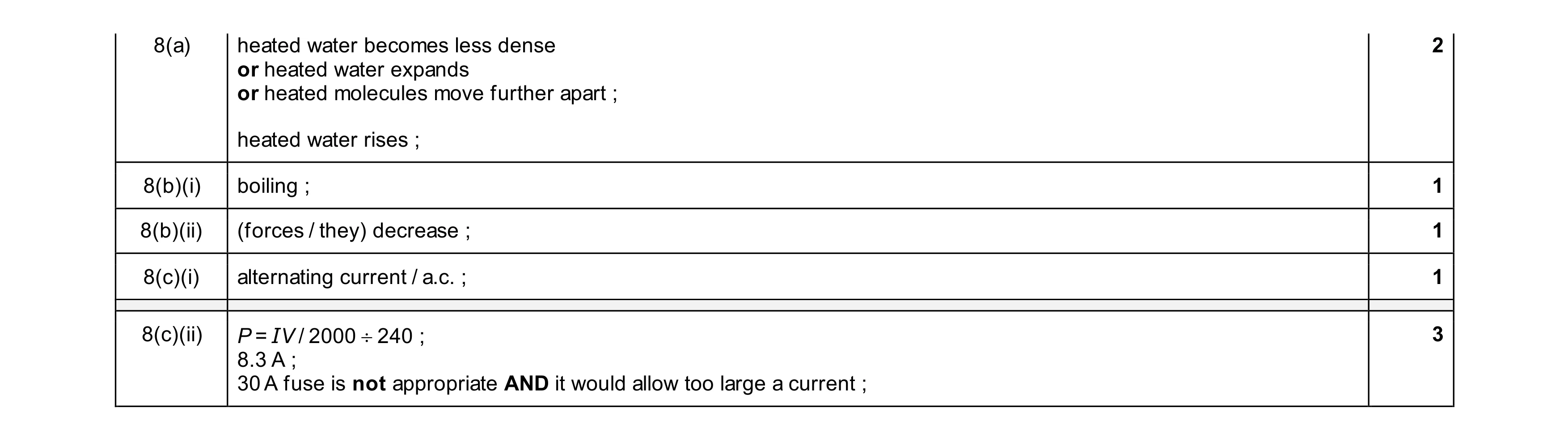 8
8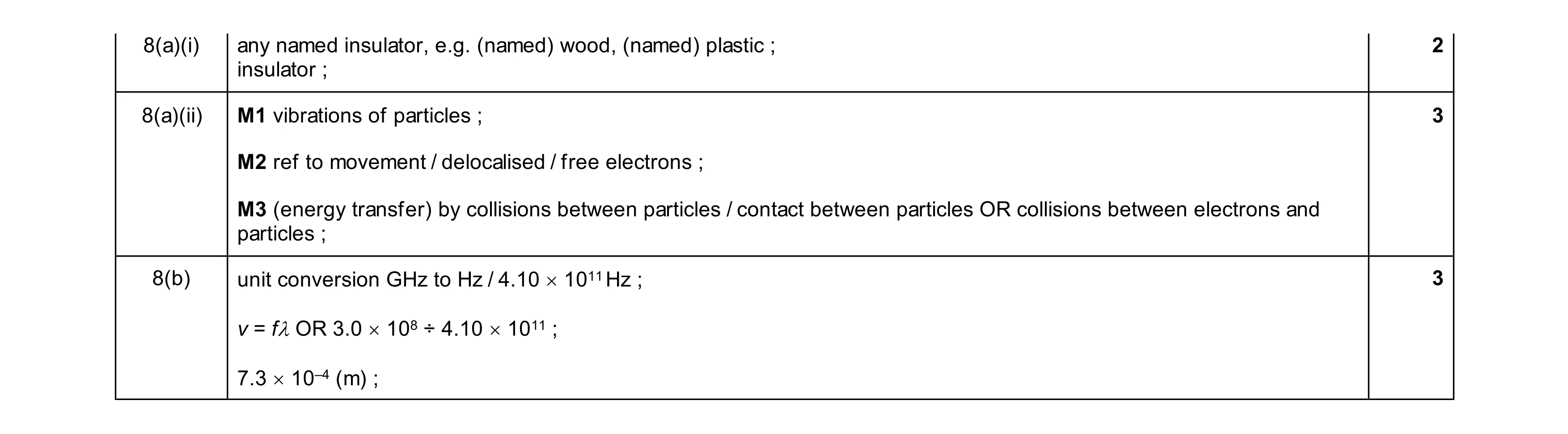 8
8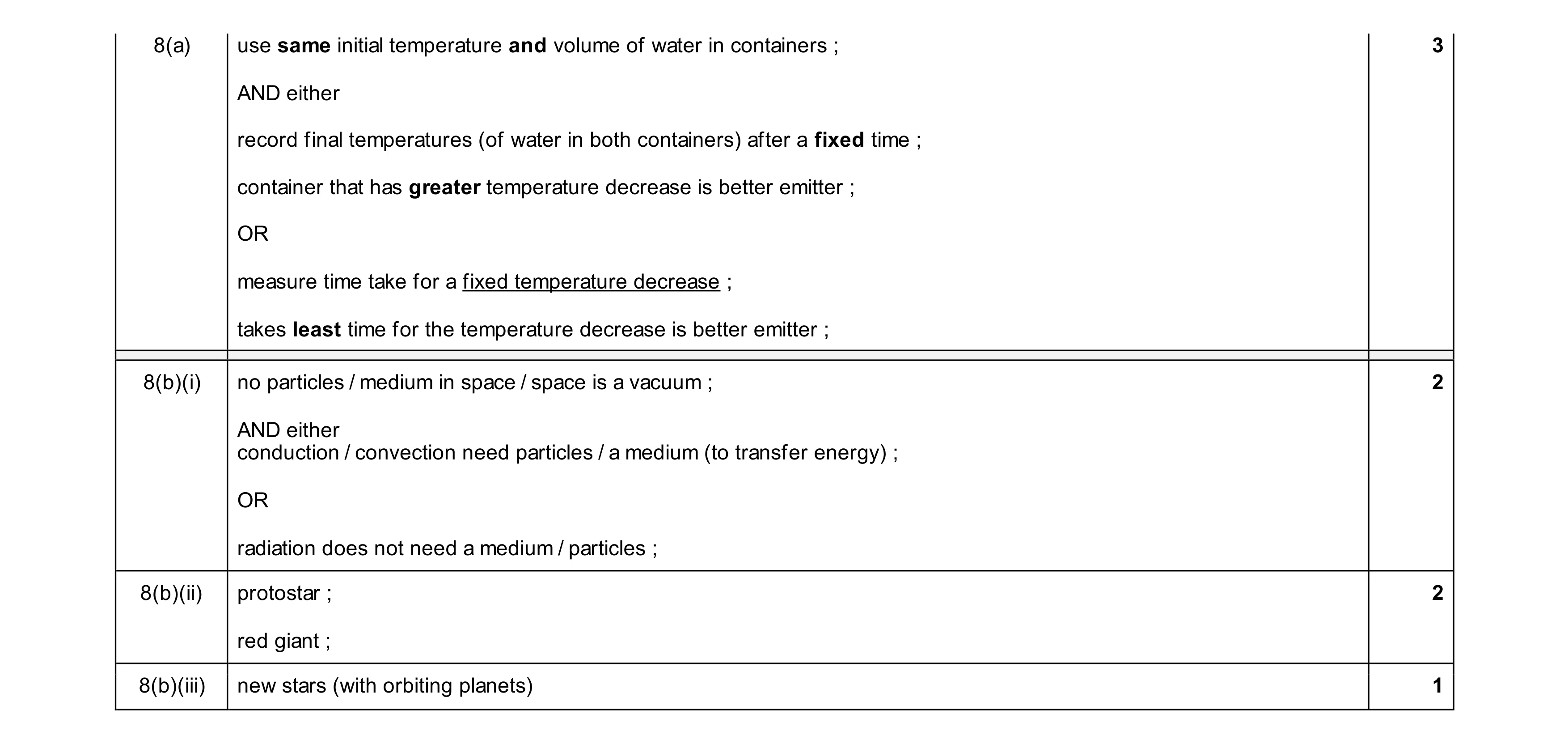 8
8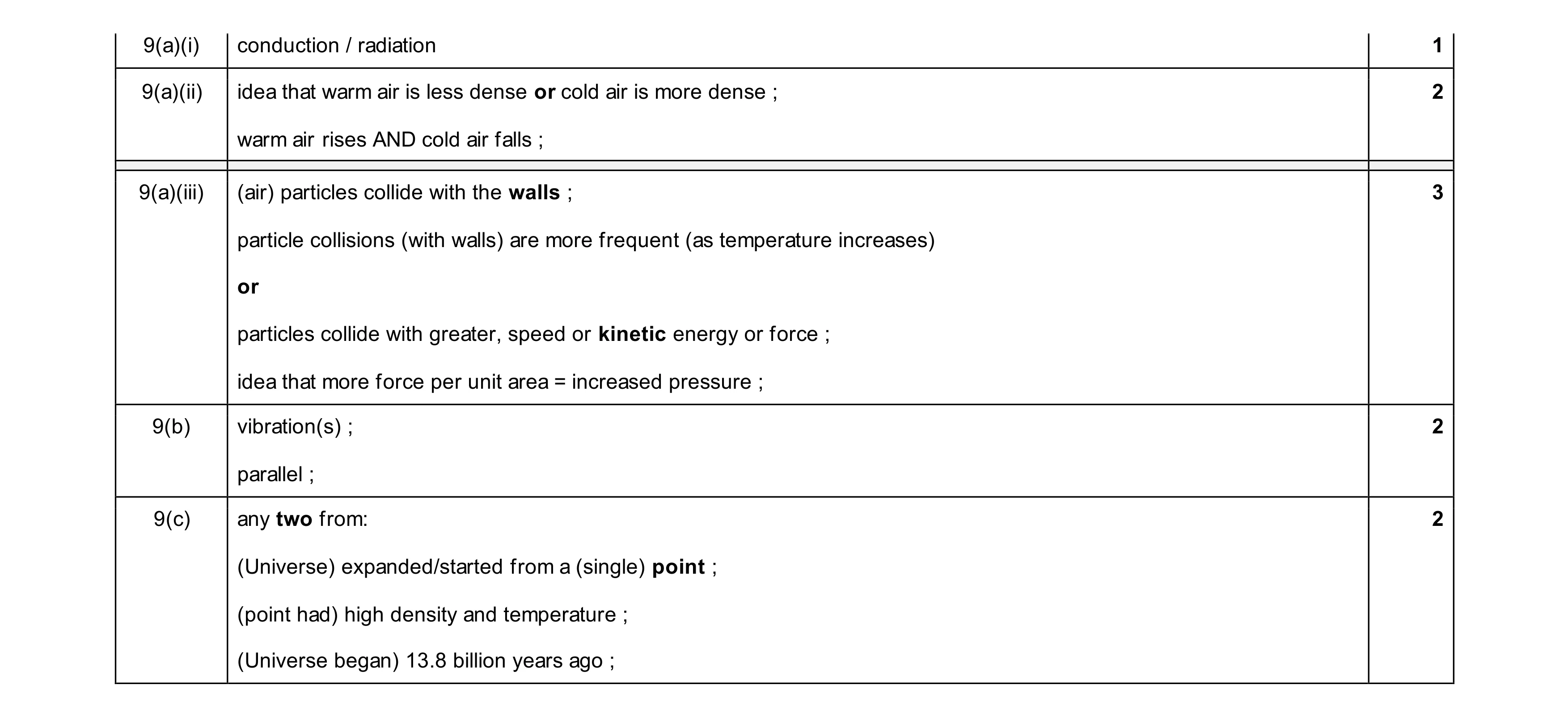 10
10