Questions as text
Q1 · A man standing in the sea on a sunny day 0653/31 May/June 2017
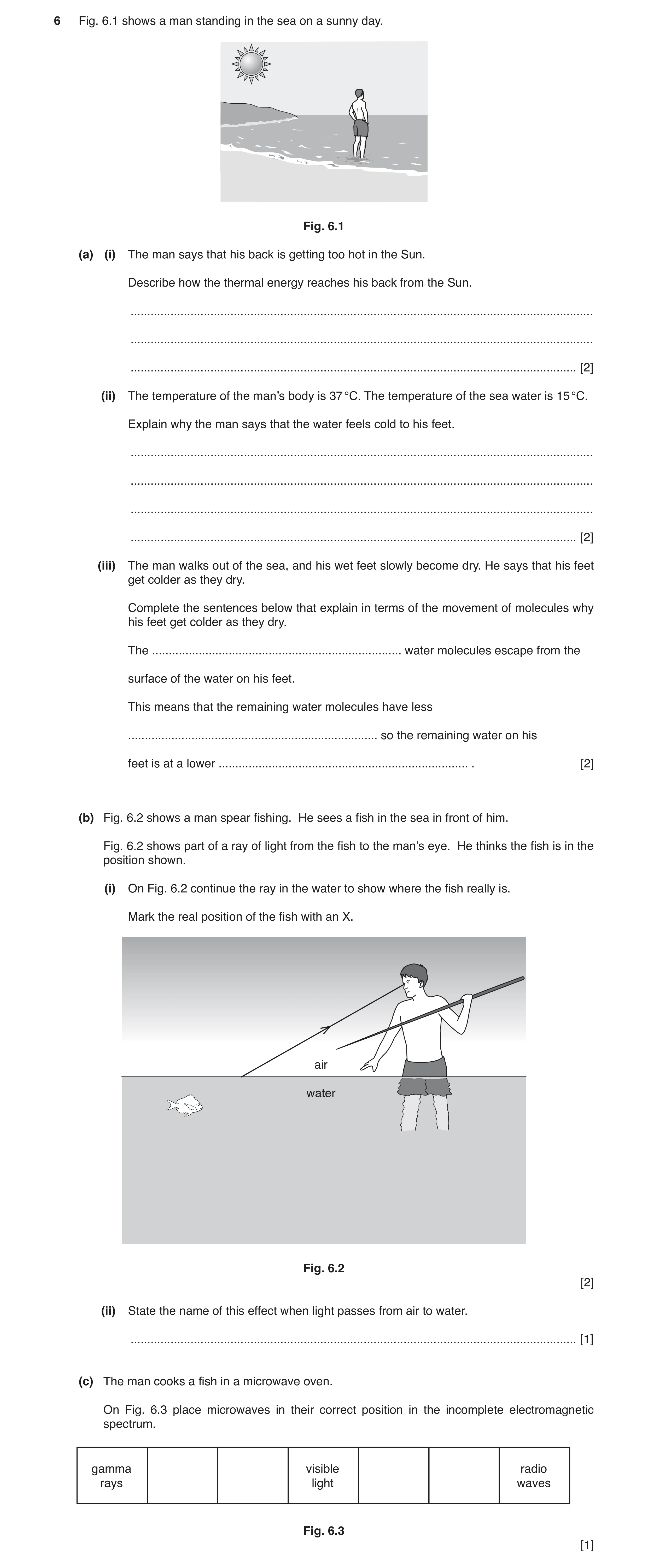
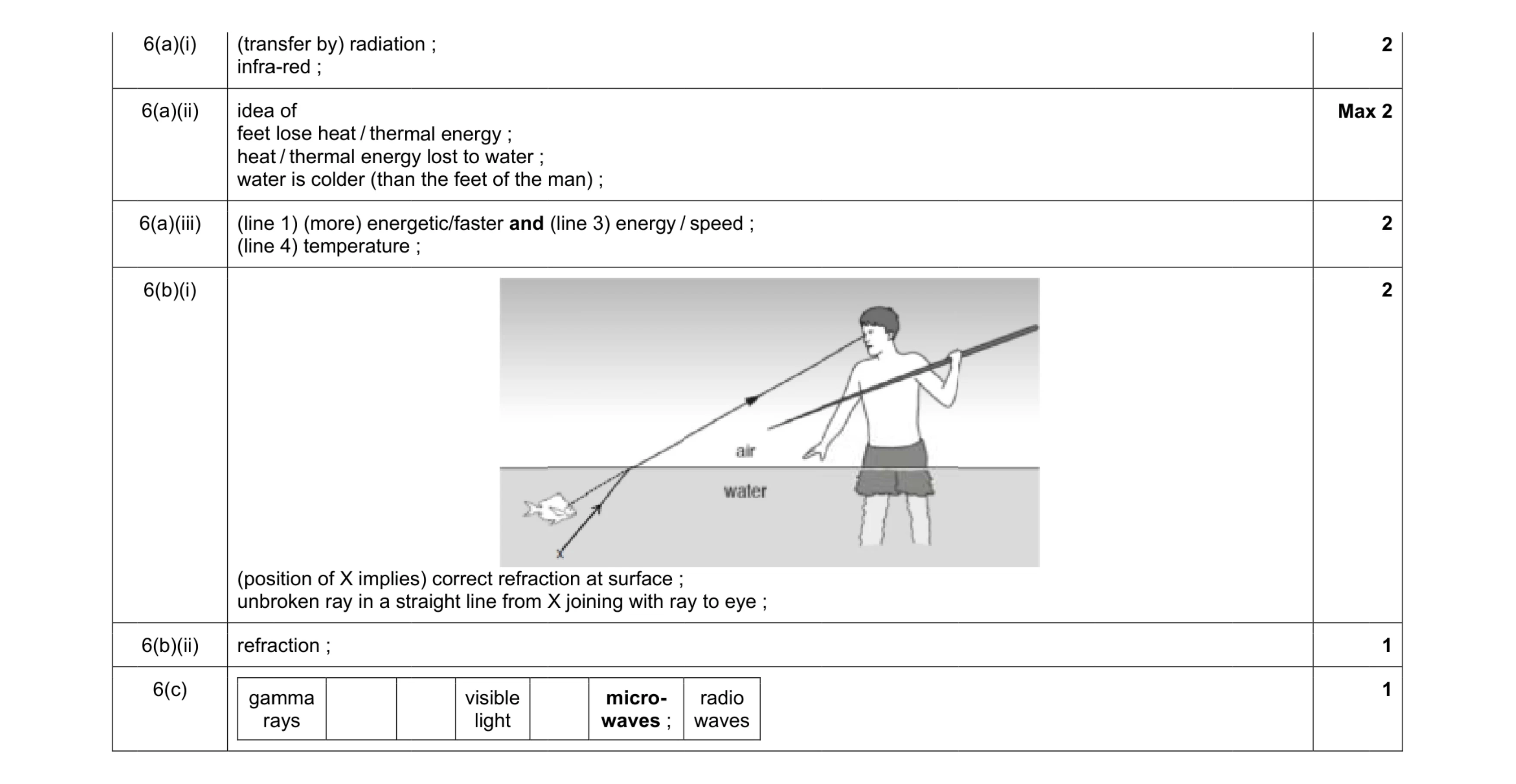
6 Fig. 6.1 shows a man standing in the sea on a sunny day. Fig. 6.1 (a) (i) The man says that his back is getting too hot in the Sun. Describe how the thermal energy reaches his back from the Sun. … … … [2] (ii) The temperature of the man’s body is 37 °C. The temperature of the sea water is 15 °C. Explain why the man says that the water feels cold to his feet. … … … … [2] (iii) The man walks out of the sea, and his wet feet slowly become dry. He says that his feet get colder as they dry. Complete the sentences below that explain in terms of the movement of molecules why his feet get colder as they dry. The … water molecules escape from the surface of the water on his feet. This means that the remaining water molecules have less … so the remaining water on his feet is at a lower … . [2] (b) Fig. 6.2 shows a man spear fishing. He sees a fish in the sea in front of him. Fig. 6.2 shows part of a ray of light from the fish to the man’s eye. He thinks the fish is in the position shown. (i) On Fig. 6.2 continue the ray in the water to show where the fish really is. Mark the real position of the fish with an X. air water Fig. 6.2 [2] (ii) State the name of this effect when light passes from air to water. … [1] (c) The man cooks a fish in a microwave oven. On Fig. 6.3 place microwaves in their correct position in the incomplete electromagnetic spectrum. gamma visible radio rays light waves Fig. 6.3 [1]
10 marks
Mark scheme: 6(a)(i) (tran infra 6(a)(ii) idea feet heat wate 6(a)(iii) (line (line 6(b)(i) (pos unbr 6(b)(ii) refra 6(c) gam ra nsfer by) radiatio a-red ; of lose heat / therm t / thermal energ er is colder (than 1) (more) energ 4) temperature sition of X implies roken ray in a st action ; mma ays on ; mal energy ; y lost to water ; n the feet of the getic/faster and ; s) correct refrac raight line from X visible light man) ; (line 3) energy / ction at surface ; X joining with ra micro- waves ; / speed ; ay to eye ; radio waves Max 2 x 2 2 2 1 1
This question in 0653/31 May/June 2017
Q2 · An aircraft is flying at a height of 10 000 m 0653/32 May/June 2017
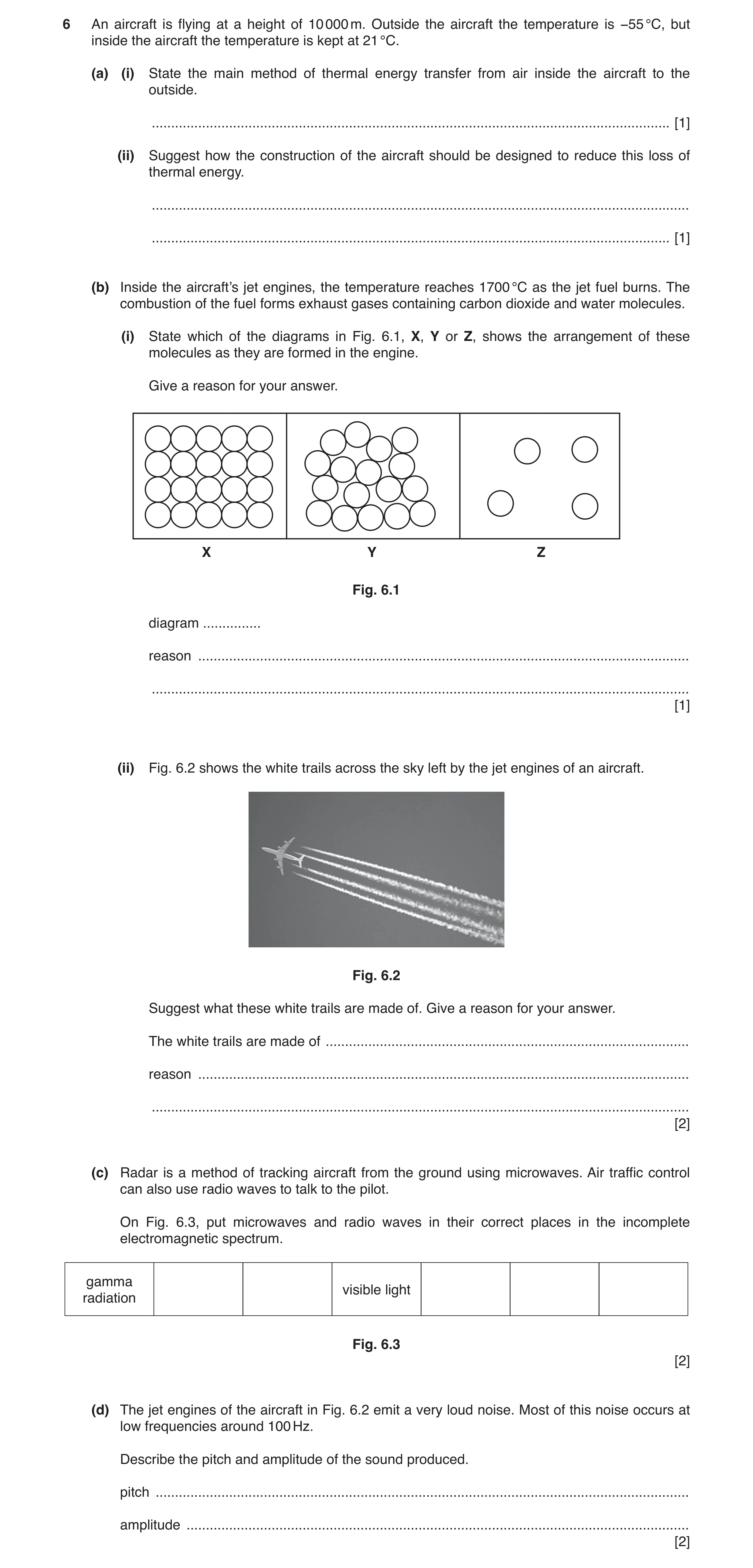
6 An aircraft is flying at a height of 10 000 m. Outside the aircraft the temperature is −55 °C, but inside the aircraft the temperature is kept at 21 °C. (a) (i) State the main method of thermal energy transfer from air inside the aircraft to the outside. … [1] (ii) Suggest how the construction of the aircraft should be designed to reduce this loss of thermal energy. … … [1] (b) Inside the aircraft’s jet engines, the temperature reaches 1700 °C as the jet fuel burns. The combustion of the fuel forms exhaust gases containing carbon dioxide and water molecules. (i) State which of the diagrams in Fig. 6.1, X, Y or Z, shows the arrangement of these molecules as they are formed in the engine. Give a reason for your answer. X Y Z Fig. 6.1 diagram … reason … … [1] (ii) Fig. 6.2 shows the white trails across the sky left by the jet engines of an aircraft. Fig. 6.2 Suggest what these white trails are made of. Give a reason for your answer. The white trails are made of … reason … … [2] (c) Radar is a method of tracking aircraft from the ground using microwaves. Air traffic control can also use radio waves to talk to the pilot. On Fig. 6.3, put microwaves and radio waves in their correct places in the incomplete electromagnetic spectrum. gamma visible lightradiation Fig. 6.3 [2] (d) The jet engines of the aircraft in Fig. 6.2 emit a very loud noise. Most of this noise occurs at low frequencies around 100 Hz. Describe the pitch and amplitude of the sound produced. pitch … amplitude … [2]
9 marks
Mark scheme: 6(a)(i) conduction ; 1 6(a)(ii) insulation (in outer layer of aircraft) / make aircraft out of bad (thermal) conductor / owtte ; 1 6(b)(i) (Z – no mark) gas molecules far apart / not touching ; 1 6(b)(ii) ice / (frozen) water ; water from fuel combustion freezing / condensing in very cold air ; 2 6(c) gamma radiation visible light micro- waves ; radio waves ; 2 6(d) (pitch) low ; (amplitude) (very) high ; 2
This question in 0653/32 May/June 2017
Q3 · An aircraft is flying at a height of 10 000 m 0653/33 May/June 2017
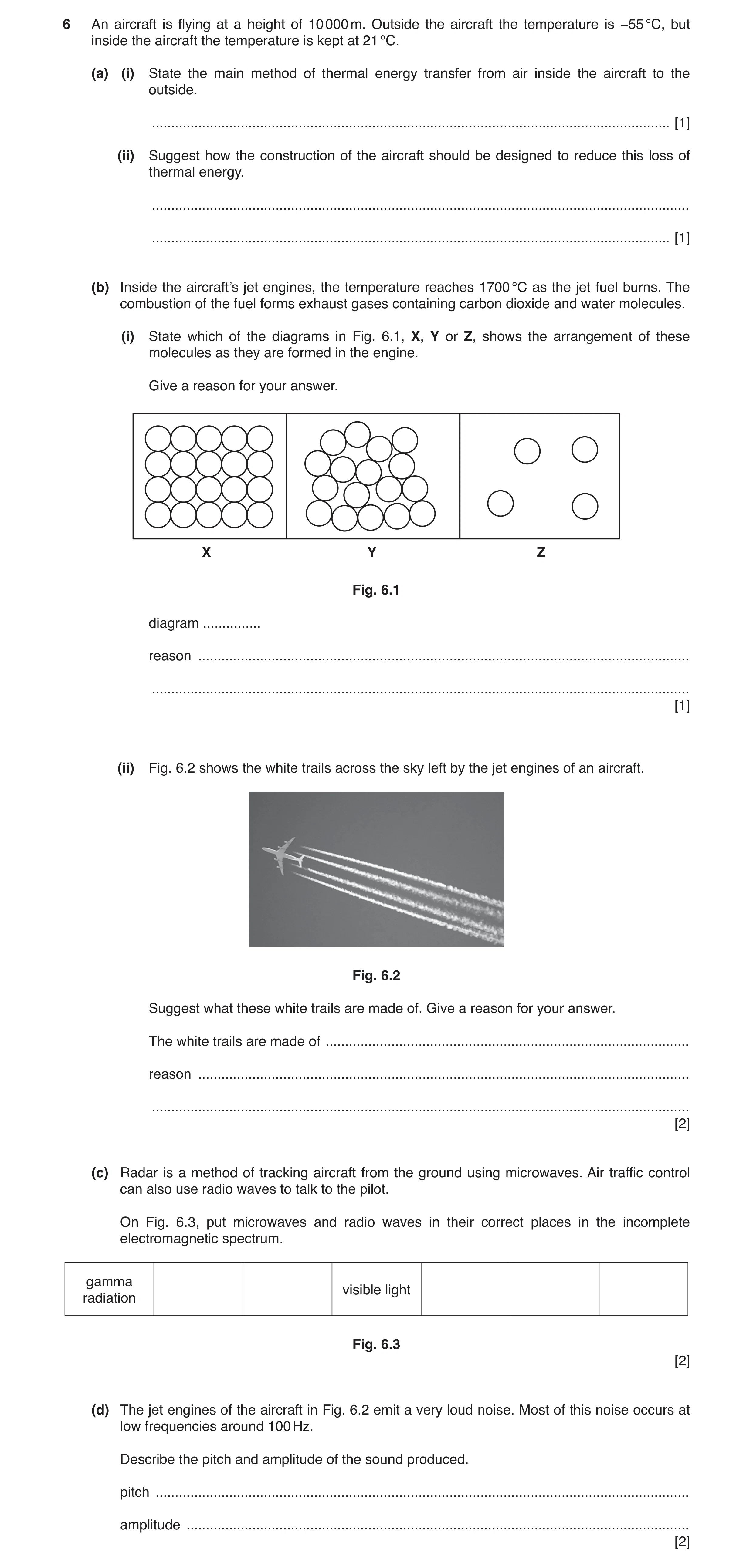
6 An aircraft is flying at a height of 10 000 m. Outside the aircraft the temperature is −55 °C, but inside the aircraft the temperature is kept at 21 °C. (a) (i) State the main method of thermal energy transfer from air inside the aircraft to the outside. … [1] (ii) Suggest how the construction of the aircraft should be designed to reduce this loss of thermal energy. … … [1] (b) Inside the aircraft’s jet engines, the temperature reaches 1700 °C as the jet fuel burns. The combustion of the fuel forms exhaust gases containing carbon dioxide and water molecules. (i) State which of the diagrams in Fig. 6.1, X, Y or Z, shows the arrangement of these molecules as they are formed in the engine. Give a reason for your answer. X Y Z Fig. 6.1 diagram … reason … … [1] (ii) Fig. 6.2 shows the white trails across the sky left by the jet engines of an aircraft. Fig. 6.2 Suggest what these white trails are made of. Give a reason for your answer. The white trails are made of … reason … … [2] (c) Radar is a method of tracking aircraft from the ground using microwaves. Air traffic control can also use radio waves to talk to the pilot. On Fig. 6.3, put microwaves and radio waves in their correct places in the incomplete electromagnetic spectrum. gamma visible lightradiation Fig. 6.3 [2] (d) The jet engines of the aircraft in Fig. 6.2 emit a very loud noise. Most of this noise occurs at low frequencies around 100 Hz. Describe the pitch and amplitude of the sound produced. pitch … amplitude … [2]
9 marks
Mark scheme: 6(a)(i) conduction ; 1 6(a)(ii) insulation (in outer layer of aircraft) / make aircraft out of bad (thermal) conductor / owtte ; 1 6(b)(i) (Z – no mark) gas molecules far apart / not touching ; 1 6(b)(ii) ice / (frozen) water ; water from fuel combustion freezing / condensing in very cold air ; 2 6(c) gamma radiation visible light micro- waves ; radio waves ; 2 6(d) (pitch) low ; (amplitude) (very) high ; 2
This question in 0653/33 May/June 2017
Q4 · A radiator which uses hot water to provide heating for people sitting in a room watching… 0653/32 Oct/Nov 2017
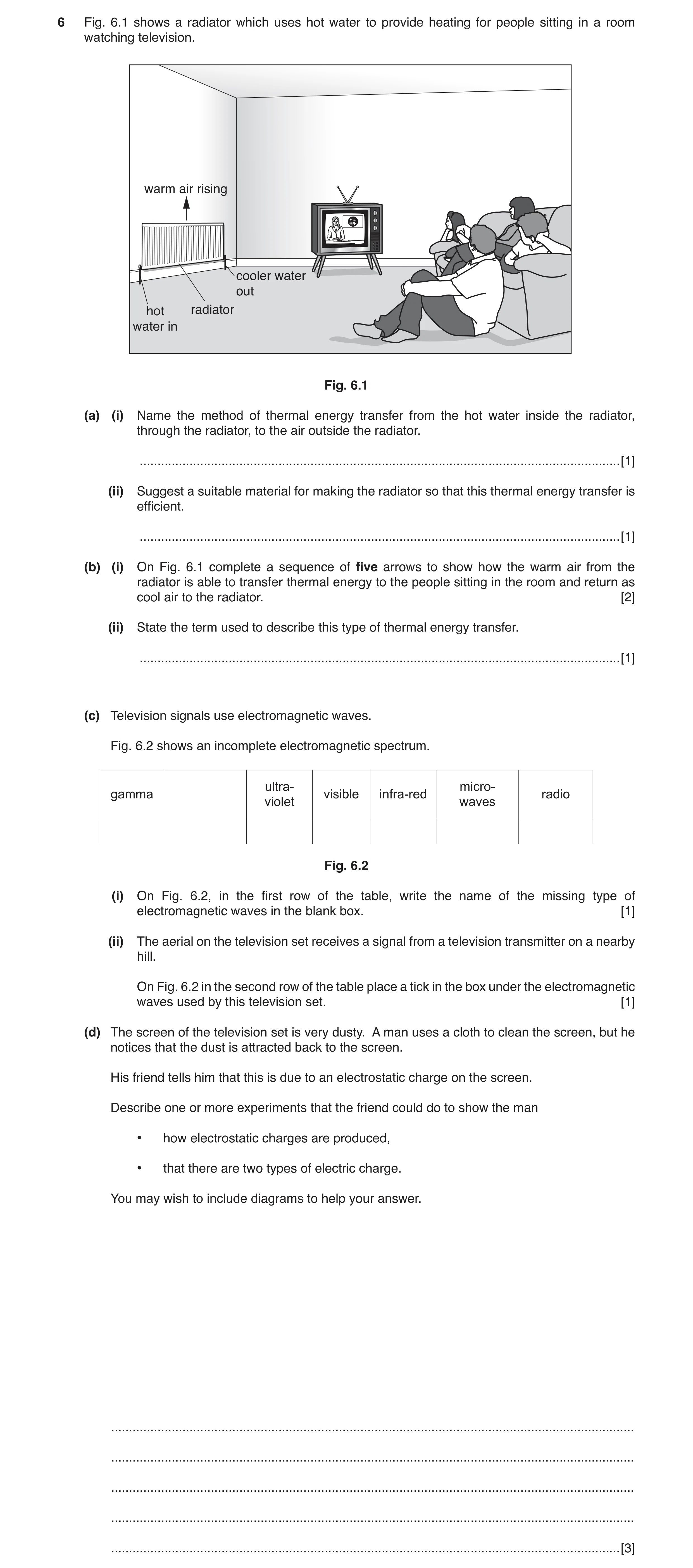
6 Fig. 6.1 shows a radiator which uses hot water to provide heating for people sitting in a room watching television. warm air rising cooler water out hot radiator water in Fig. 6.1 (a) (i) Name the method of thermal energy transfer from the hot water inside the radiator, through the radiator, to the air outside the radiator. … [1] (ii) Suggest a suitable material for making the radiator so that this thermal energy transfer is efficient. … [1] (b) (i) On Fig. 6.1 complete a sequence of five arrows to show how the warm air from the radiator is able to transfer thermal energy to the people sitting in the room and return as cool air to the radiator. [2] (ii) State the term used to describe this type of thermal energy transfer. … [1] (c) Television signals use electromagnetic waves. Fig. 6.2 shows an incomplete electromagnetic spectrum. ultra- micro- gamma visible infra-red radio violet waves Fig. 6.2 (i) On Fig. 6.2, in the first row of the table, write the name of the missing type of electromagnetic waves in the blank box. [1] (ii) The aerial on the television set receives a signal from a television transmitter on a nearby hill. On Fig. 6.2 in the second row of the table place a tick in the box under the electromagnetic waves used by this television set. [1] (d) The screen of the television set is very dusty. A man uses a cloth to clean the screen, but he notices that the dust is attracted back to the screen. His friend tells him that this is due to an electrostatic charge on the screen. Describe one or more experiments that the friend could do to show the man • how electrostatic charges are produced, • that there are two types of electric charge. You may wish to include diagrams to help your answer. … … … … … [3]
10 marks
Mark scheme: 6(a)(i) conduction ; 1 6(a)(ii) metal / named metal ; 1 6(b)(i) arrows up and across room ; arrows down and back towards radiator ; 2 6(b)(ii) convection ; 1 6(c)(i) X-rays ; 1 6(c)(ii) tick under radio waves ; 1 6(d) description of charging by friction ; reference to positive and negative charges / opposite charges attract ; some experimental detail ; 3
This question in 0653/32 Oct/Nov 2017
Question 5 0653/33 Oct/Nov 2017
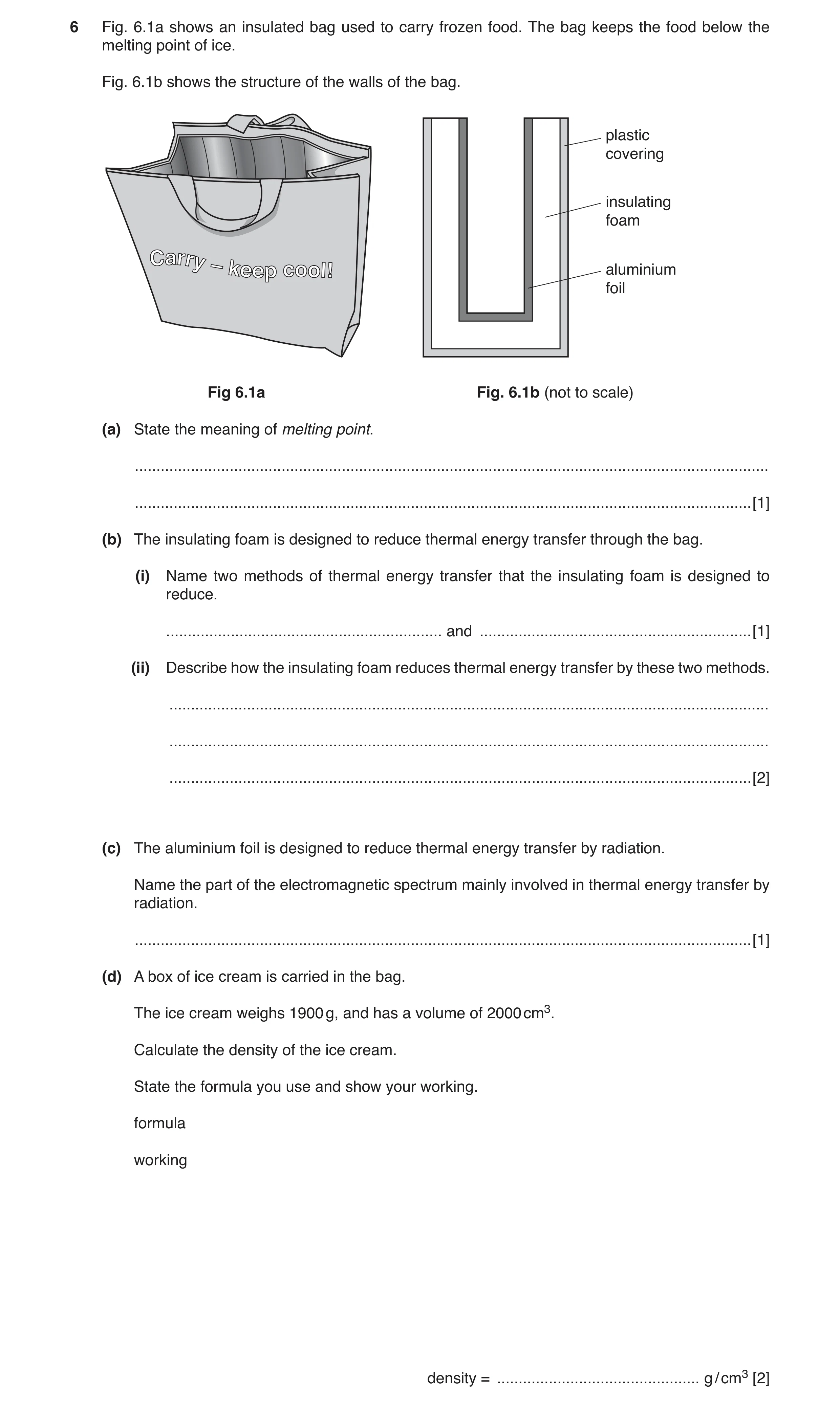
6 Fig. 6.1a shows an insulated bag used to carry frozen food. The bag keeps the food below the melting point of ice. Fig. 6.1b shows the structure of the walls of the bag. plastic covering insulating foam aluminium Carry– keep cool! foil Fig 6.1a Fig. 6.1b (not to scale) (a) State the meaning of melting point. … … [1] (b) The insulating foam is designed to reduce thermal energy transfer through the bag. (i) Name two methods of thermal energy transfer that the insulating foam is designed to reduce. … and … [1] (ii) Describe how the insulating foam reduces thermal energy transfer by these two methods. … … … [2] (c) The aluminium foil is designed to reduce thermal energy transfer by radiation. Name the part of the electromagnetic spectrum mainly involved in thermal energy transfer by radiation. … [1] (d) A box of ice cream is carried in the bag. The ice cream weighs 1900 g, and has a volume of 2000 cm3. Calculate the density of the ice cream. State the formula you use and show your working. formula working density = … g / cm3 [2]
7 marks
Mark scheme: 6(a) temperature at which a solid changes to a liquid owtte 1 6(b)(i) conduction and convection ; 1 6(b)(ii) (reduces convection) as no (gas) circulation (possible) owtte ; (reduces conduction) as foam is a bad conductor owtte ; 2 6(c) infra-red 1 6(d) d = m / V = (1900 / 2000) ; = 0.95 (g / cm3) ; 2
This question in 0653/33 Oct/Nov 2017
Q6 · Two people talking to each other using cordless telephones over a link to a… 0653/32 Feb/March 2018
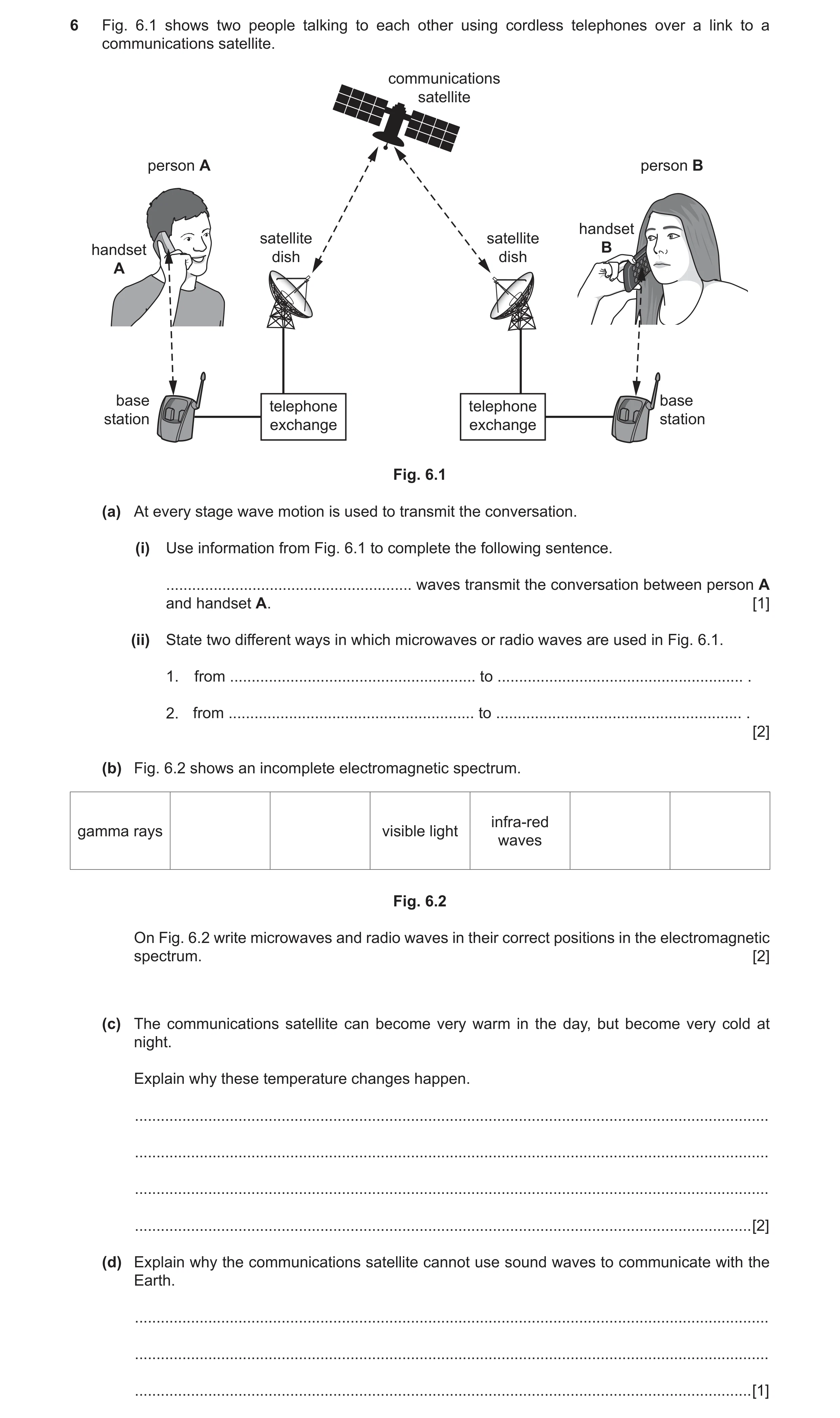
6 Fig. 6.1 shows two people talking to each other using cordless telephones over a link to a communications satellite. communications satellite person A person B handset satellite satellite handset B dish dish A base base telephone telephone station station exchange exchange Fig. 6.1 (a) At every stage wave motion is used to transmit the conversation. (i) Use information from Fig. 6.1 to complete the following sentence. … waves transmit the conversation between person A and handset A. [1] (ii) State two different ways in which microwaves or radio waves are used in Fig. 6.1. 1. from … to … . 2. from … to … . [2] (b) Fig. 6.2 shows an incomplete electromagnetic spectrum. infra-red gamma rays visible light waves Fig. 6.2 On Fig. 6.2 write microwaves and radio waves in their correct positions in the electromagnetic spectrum. [2] (c) The communications satellite can become very warm in the day, but become very cold at night. Explain why these temperature changes happen. … … … … [2] (d) Explain why the communications satellite cannot use sound waves to communicate with the Earth. … … … [1]
8 marks
Mark scheme: 6(a)(i) sound ; 1 6(a)(ii) from handset to base station (or reverse) ; from satellite dish to satellite (or reverse) ; 2 6(b) gamma rays visible light infrared waves microwaves ; radio waves; 2 6(c) (infrared) radiation from Sun absorbed during day ; at night, radiation from satellite results in cooling ; 2 6(d) sound needs a medium to travel through – no medium in space ; 1
This question in 0653/32 Feb/March 2018
Q7 · A man watching television 0653/31 May/June 2018
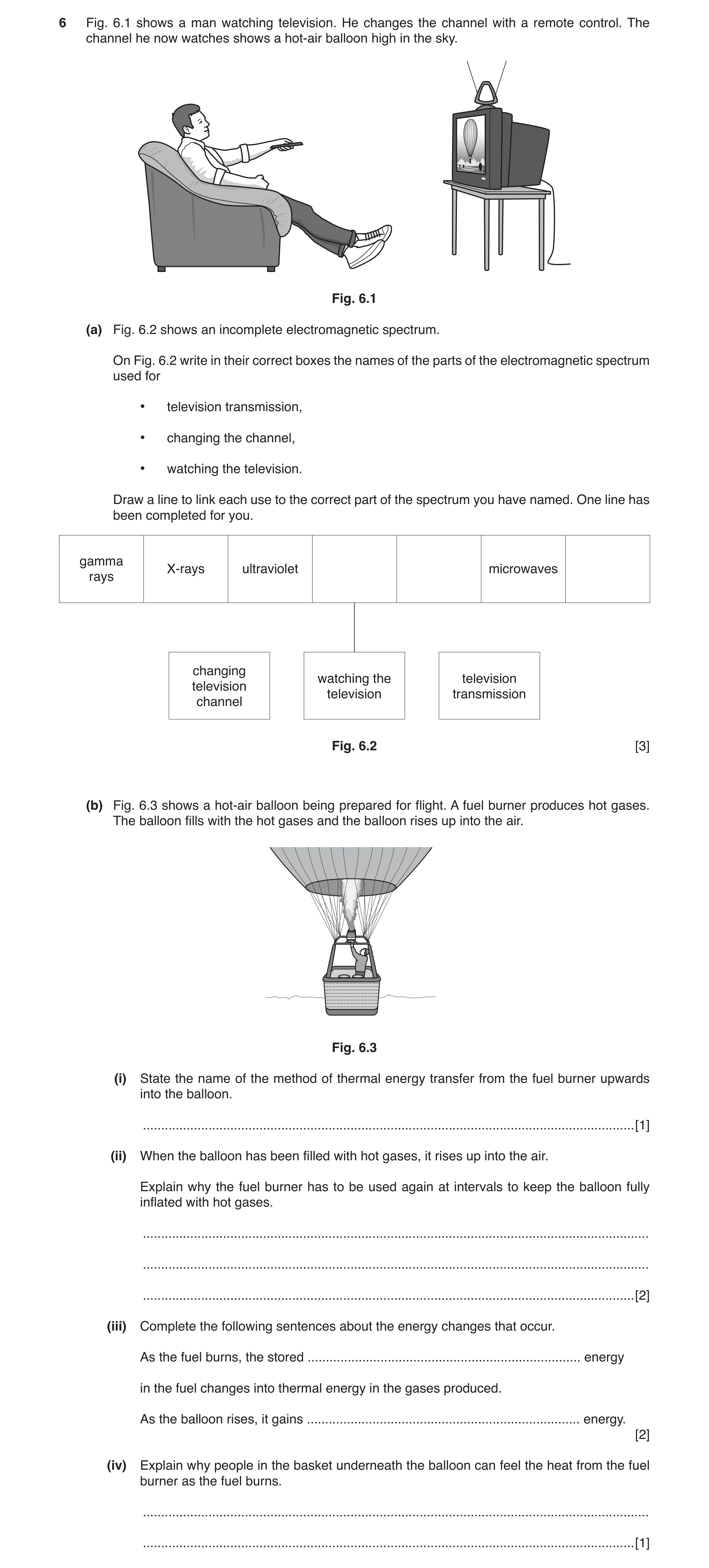
6 Fig. 6.1 shows a man watching television. He changes the channel with a remote control. The channel he now watches shows a hot‑air balloon high in the sky. Fig. 6.1 (a) Fig. 6.2 shows an incomplete electromagnetic spectrum. On Fig. 6.2 write in their correct boxes the names of the parts of the electromagnetic spectrum used for • television transmission, • changing the channel, • watching the television. Draw a line to link each use to the correct part of the spectrum you have named. One line has been completed for you. gamma X‑rays ultraviolet microwaves rays changing watching the television television television transmission channel Fig. 6.2 [3] (b) Fig. 6.3 shows a hot‑air balloon being prepared for flight. A fuel burner produces hot gases. The balloon fills with the hot gases and the balloon rises up into the air. Fig. 6.3 (i) State the name of the method of thermal energy transfer from the fuel burner upwards into the balloon. … [1] (ii) When the balloon has been filled with hot gases, it rises up into the air. Explain why the fuel burner has to be used again at intervals to keep the balloon fully inflated with hot gases. … … … [2] (iii) Complete the following sentences about the energy changes that occur. As the fuel burns, the stored … energy in the fuel changes into thermal energy in the gases produced. As the balloon rises, it gains … energy. [2] (iv) Explain why people in the basket underneath the balloon can feel the heat from the fuel burner as the fuel burns. … … [1]
9 marks
Mark scheme: 6(a) gamma rays X-rays ultraviolet visible light infra-red microwaves radio waves changing television channel watching the television television transmission three correct names of electromagnetic waves ; correct names in the correct positions ; two correct links ; 3 6(b)(i) convection ; 1 6(b)(ii) gases cool by thermal energy (heat) transfer to surroundings (by conduction though balloon) / hot gas cools down ; (causing) decrease of gas volume / contraction ; 2 6(b)(iii) chemical ; gravitational (potential) (energy) / potential (energy) / kinetic (energy) ; 2 6(b)(iv) (energy transfer) by radiation / infra-red 1
This question in 0653/31 May/June 2018
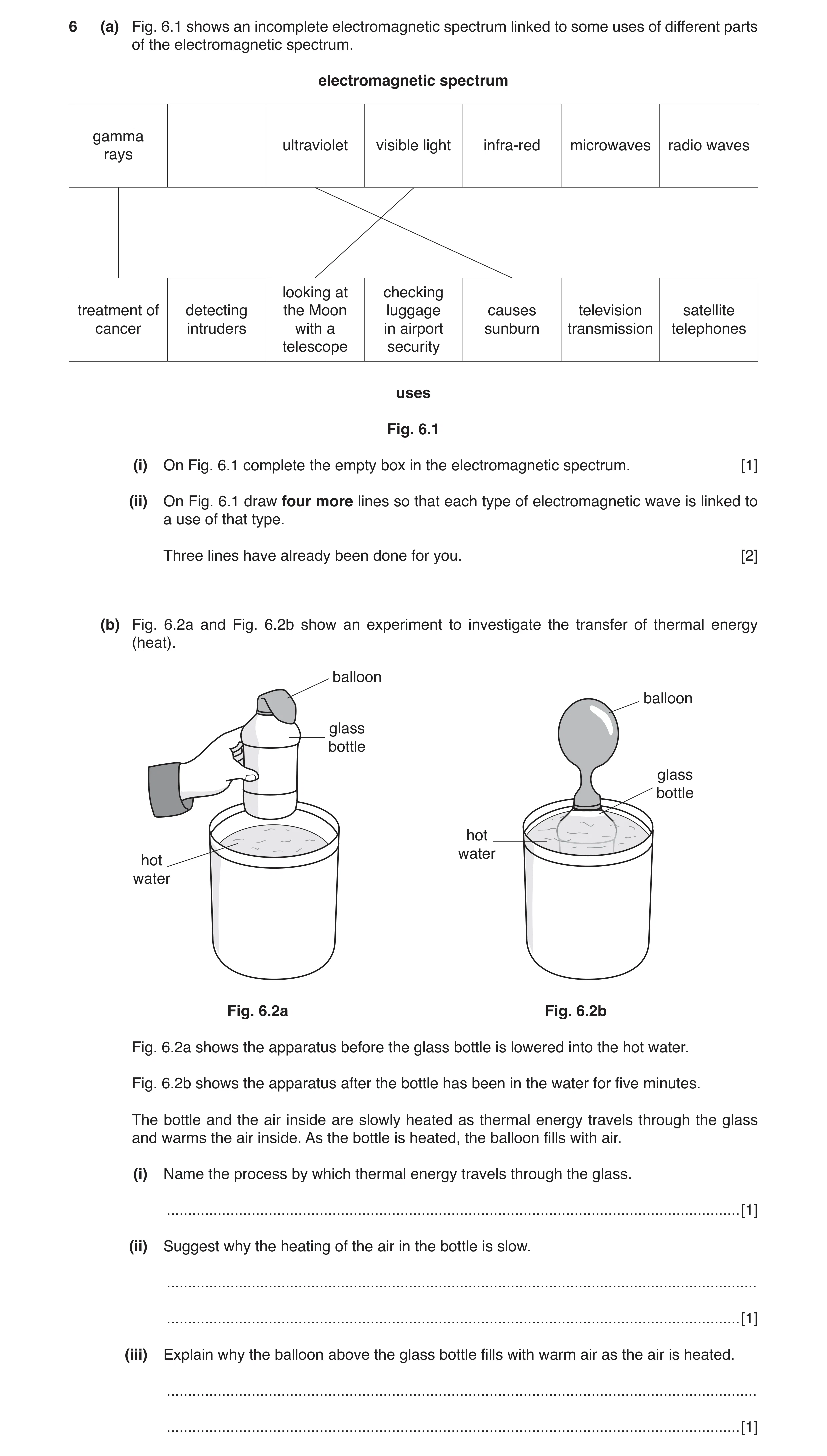
Q8 · An incomplete electromagnetic spectrum linked to some uses of different parts of the… 0653/32 May/June 2018
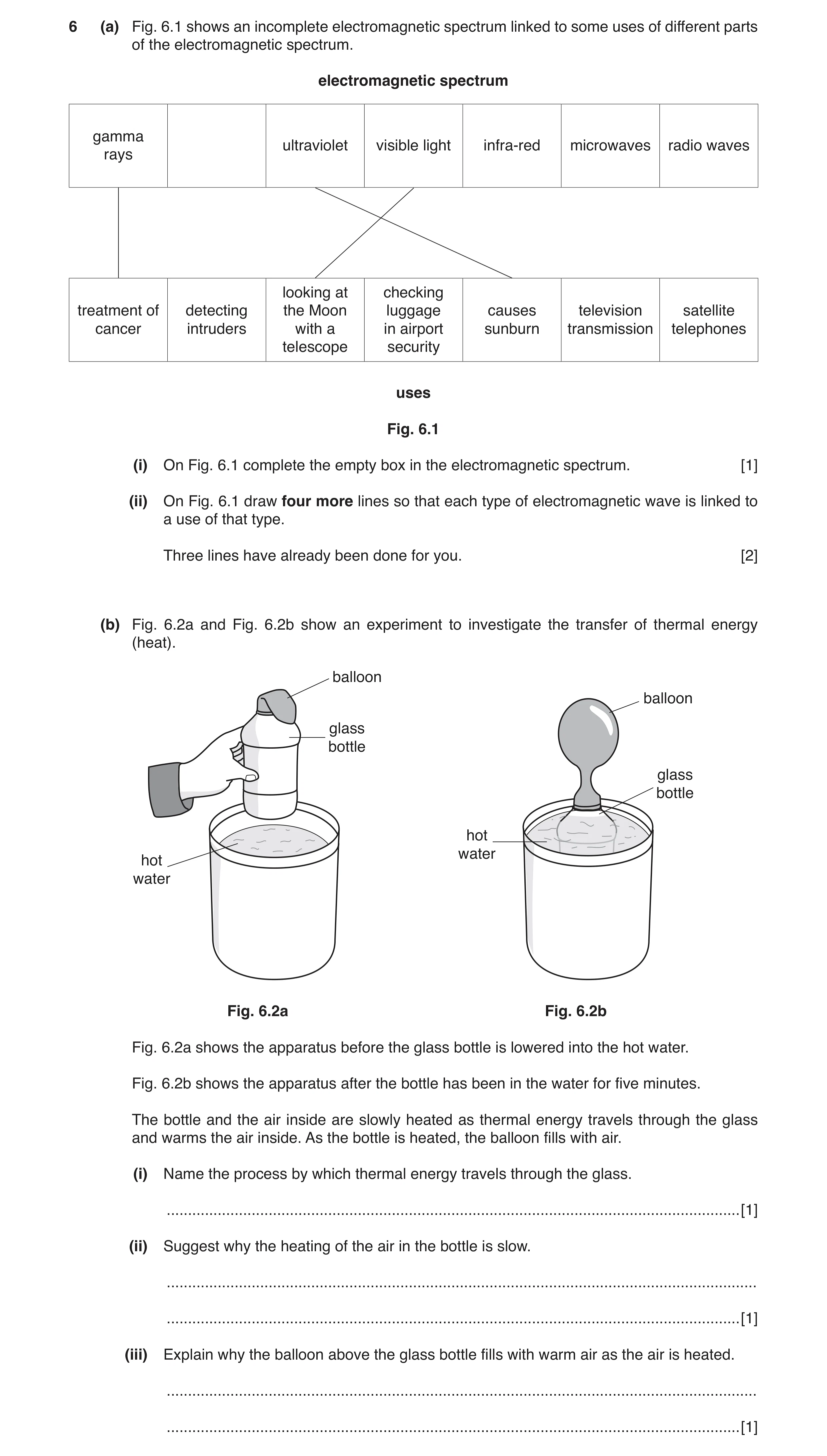
6 (a) Fig. 6.1 shows an incomplete electromagnetic spectrum linked to some uses of different parts of the electromagnetic spectrum. electromagnetic spectrum gamma ultraviolet visible light infra‑red microwaves radio waves rays looking at checking treatment of detecting the Moon luggage causes television satellite cancer intruders with a in airport sunburn transmission telephones telescope security uses Fig. 6.1 (i) On Fig. 6.1 complete the empty box in the electromagnetic spectrum. [1] (ii) On Fig. 6.1 draw four more lines so that each type of electromagnetic wave is linked to a use of that type. Three lines have already been done for you. [2] (b) Fig. 6.2a and Fig. 6.2b show an experiment to investigate the transfer of thermal energy (heat). balloon balloon glass bottle glass bottle hot water hot water Fig. 6.2a Fig. 6.2b Fig. 6.2a shows the apparatus before the glass bottle is lowered into the hot water. Fig. 6.2b shows the apparatus after the bottle has been in the water for five minutes. The bottle and the air inside are slowly heated as thermal energy travels through the glass and warms the air inside. As the bottle is heated, the balloon fills with air. (i) Name the process by which thermal energy travels through the glass. … [1] (ii) Suggest why the heating of the air in the bottle is slow. … … [1] (iii) Explain why the balloon above the glass bottle fills with warm air as the air is heated. … … [1]
6 marks
Mark scheme: 6 6( 6 6( 6( Que (a)(i) X-rays (a)(ii) any tw all four (b)(i) condu (b)(ii) glass i (b)(iii) air / ga estion s ; wo lines correct ; r lines correct ; ction ; is a bad / poor co as expands on h onductor (of the eating / volume rmal energy) ; of gas increases s on heating ; Answer Ma 1 2 1 1 1 arks
This question in 0653/32 May/June 2018
Q9 · An incomplete electromagnetic spectrum linked to some uses of different parts of the… 0653/33 May/June 2018
6 (a) Fig. 6.1 shows an incomplete electromagnetic spectrum linked to some uses of different parts of the electromagnetic spectrum. electromagnetic spectrum gamma ultraviolet visible light infra‑red microwaves radio waves rays looking at checking treatment of detecting the Moon luggage causes television satellite cancer intruders with a in airport sunburn transmission telephones telescope security uses Fig. 6.1 (i) On Fig. 6.1 complete the empty box in the electromagnetic spectrum. [1] (ii) On Fig. 6.1 draw four more lines so that each type of electromagnetic wave is linked to a use of that type. Three lines have already been done for you. [2] (b) Fig. 6.2a and Fig. 6.2b show an experiment to investigate the transfer of thermal energy (heat). balloon balloon glass bottle glass bottle hot water hot water Fig. 6.2a Fig. 6.2b Fig. 6.2a shows the apparatus before the glass bottle is lowered into the hot water. Fig. 6.2b shows the apparatus after the bottle has been in the water for five minutes. The bottle and the air inside are slowly heated as thermal energy travels through the glass and warms the air inside. As the bottle is heated, the balloon fills with air. (i) Name the process by which thermal energy travels through the glass. … [1] (ii) Suggest why the heating of the air in the bottle is slow. … … [1] (iii) Explain why the balloon above the glass bottle fills with warm air as the air is heated. … … [1]
6 marks
Mark scheme: 6 6( 6 6( 6( Que (a)(i) X-rays (a)(ii) any tw all four (b)(i) condu (b)(ii) glass i (b)(iii) air / ga estion s ; wo lines correct ; r lines correct ; ction ; is a bad / poor co as expands on h onductor (of the eating / volume rmal energy) ; of gas increases s on heating ; Answer Ma 1 2 1 1 1 arks
This question in 0653/33 May/June 2018
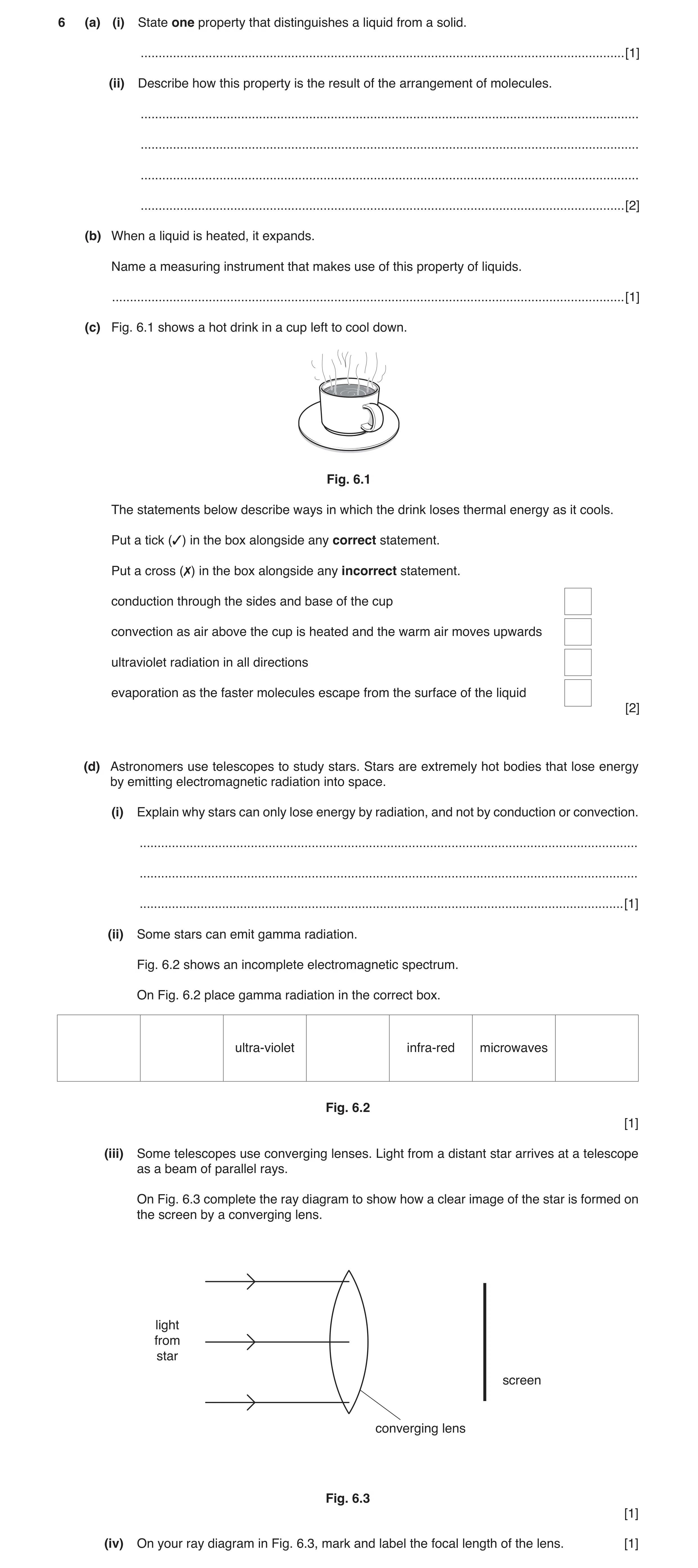
Q10 · State one property that distinguishes a liquid from a solid 0653/32 Oct/Nov 2018
6 (a) (i) State one property that distinguishes a liquid from a solid. … [1] (ii) Describe how this property is the result of the arrangement of molecules. … … … … [2] (b) When a liquid is heated, it expands. Name a measuring instrument that makes use of this property of liquids. … [1] (c) Fig. 6.1 shows a hot drink in a cup left to cool down. Fig. 6.1 The statements below describe ways in which the drink loses thermal energy as it cools. Put a tick (3) in the box alongside any correct statement. Put a cross (✗) in the box alongside any incorrect statement. conduction through the sides and base of the cup convection as air above the cup is heated and the warm air moves upwards ultraviolet radiation in all directions evaporation as the faster molecules escape from the surface of the liquid [2] (d) Astronomers use telescopes to study stars. Stars are extremely hot bodies that lose energy by emitting electromagnetic radiation into space. (i) Explain why stars can only lose energy by radiation, and not by conduction or convection. … … … [1] (ii) Some stars can emit gamma radiation. Fig. 6.2 shows an incomplete electromagnetic spectrum. On Fig. 6.2 place gamma radiation in the correct box. ultra-violet infra-red microwaves Fig. 6.2 [1] (iii) Some telescopes use converging lenses. Light from a distant star arrives at a telescope as a beam of parallel rays. On Fig. 6.3 complete the ray diagram to show how a clear image of the star is formed on the screen by a converging lens. light from star screen converging lens Fig. 6.3 [1] (iv) On your ray diagram in Fig. 6.3, mark and label the focal length of the lens. [1]
10 marks
Mark scheme: 6(a)(i) able to flow / takes up the shape of container / any appropriate property ; 1 6(a)(ii) (liquid) irregular / random arrangement ; molecules can move around one another ; molecules further apart ; (solid) regular / lattice arrangement ; molecules vibrate around fixed positions ; molecules tightly packed / closer together ; Max 2 2 6(b) thermometer ; 1 6(c) ticks in first, second and fourth boxes ; cross in 3rd box ; 2 6(d)(i) conduction and convection require a medium 1 6(d)(ii) gamma in left-hand end box ; 1 6(d)(iii) all three rays refracted to meet the screen at the same point ; 1 6(d)(iv) focal length correctly indicated as on above diagram ; 1
This question in 0653/32 Oct/Nov 2018
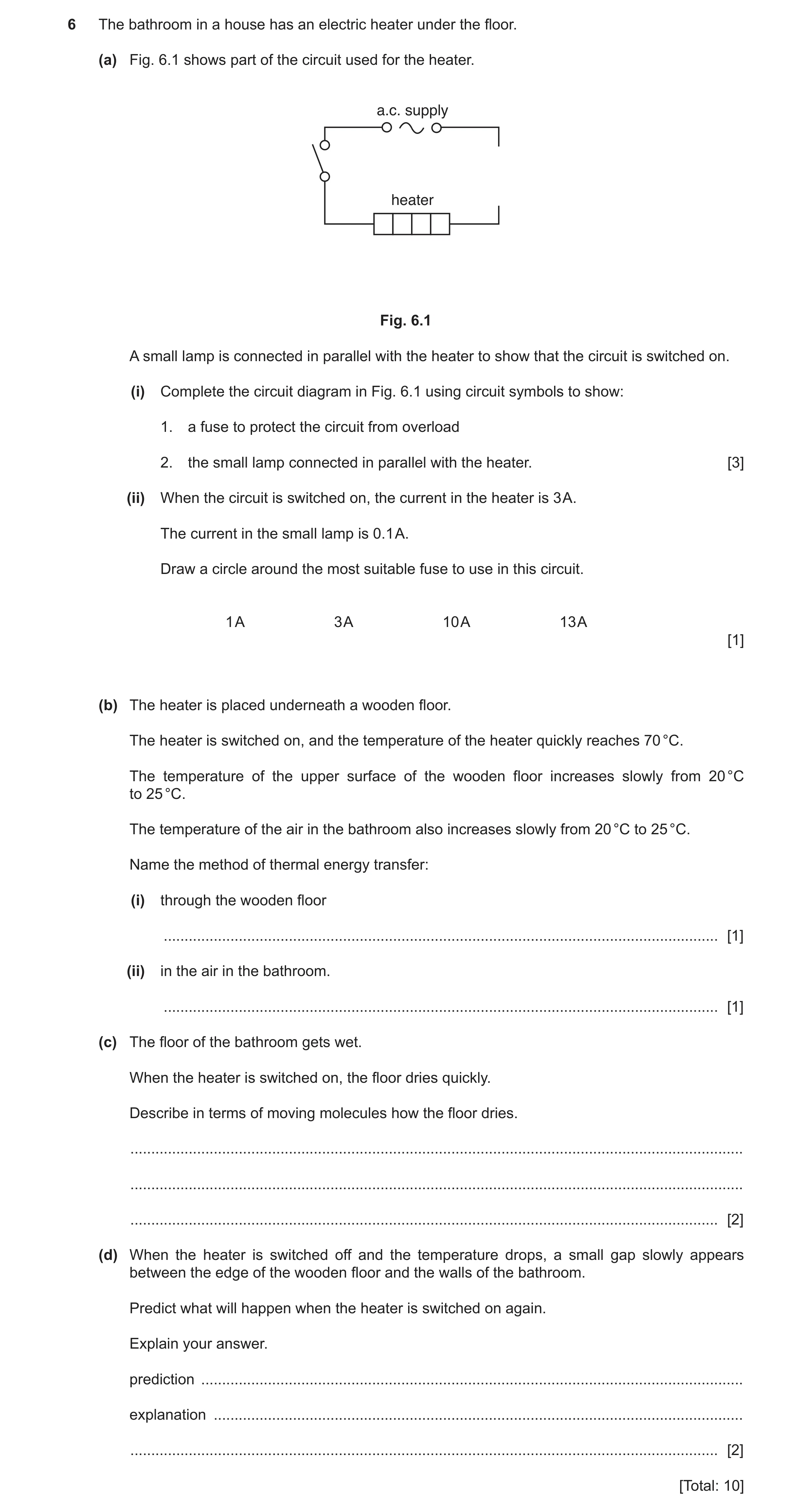
Q11 · The bathroom in a house has an electric heater under the floor 0653/32 Feb/March 2019
6 The bathroom in a house has an electric heater under the floor. (a) Fig. 6.1 shows part of the circuit used for the heater. a.c. supply heater Fig. 6.1 A small lamp is connected in parallel with the heater to show that the circuit is switched on. (i) Complete the circuit diagram in Fig. 6.1 using circuit symbols to show: 1. a fuse to protect the circuit from overload 2. the small lamp connected in parallel with the heater. [3] (ii) When the circuit is switched on, the current in the heater is 3 A. The current in the small lamp is 0.1 A. Draw a circle around the most suitable fuse to use in this circuit. 1 A 3 A 10 A 13 A [1] (b) The heater is placed underneath a wooden floor. The heater is switched on, and the temperature of the heater quickly reaches 70 °C. The temperature of the upper surface of the wooden floor increases slowly from 20 °C to 25 °C. The temperature of the air in the bathroom also increases slowly from 20 °C to 25 °C. Name the method of thermal energy transfer: (i) through the wooden floor … [1] (ii) in the air in the bathroom. … [1] (c) The floor of the bathroom gets wet. When the heater is switched on, the floor dries quickly. Describe in terms of moving molecules how the floor dries. … … … [2] (d) When the heater is switched off and the temperature drops, a small gap slowly appears between the edge of the wooden floor and the walls of the bathroom. Predict what will happen when the heater is switched on again. Explain your answer. prediction … explanation … … [2] [Total: 10]
10 marks
Mark scheme: 6(a)(i) correct symbols ; fuse in series ; lamp in parallel ; 3 6(a)(ii) 10 A ; 1 Question Answer Marks 6(b)(i) conduction ; 1 6(b)(ii) convection ; 1 6(c) faster moving molecules / molecules with greater kinetic energy ; escape surface / leave the liquid / reference to evaporation ; 2 6(d) gap closes (again) ; wooden floor / wood expands on heating ; 2
This question in 0653/32 Feb/March 2019
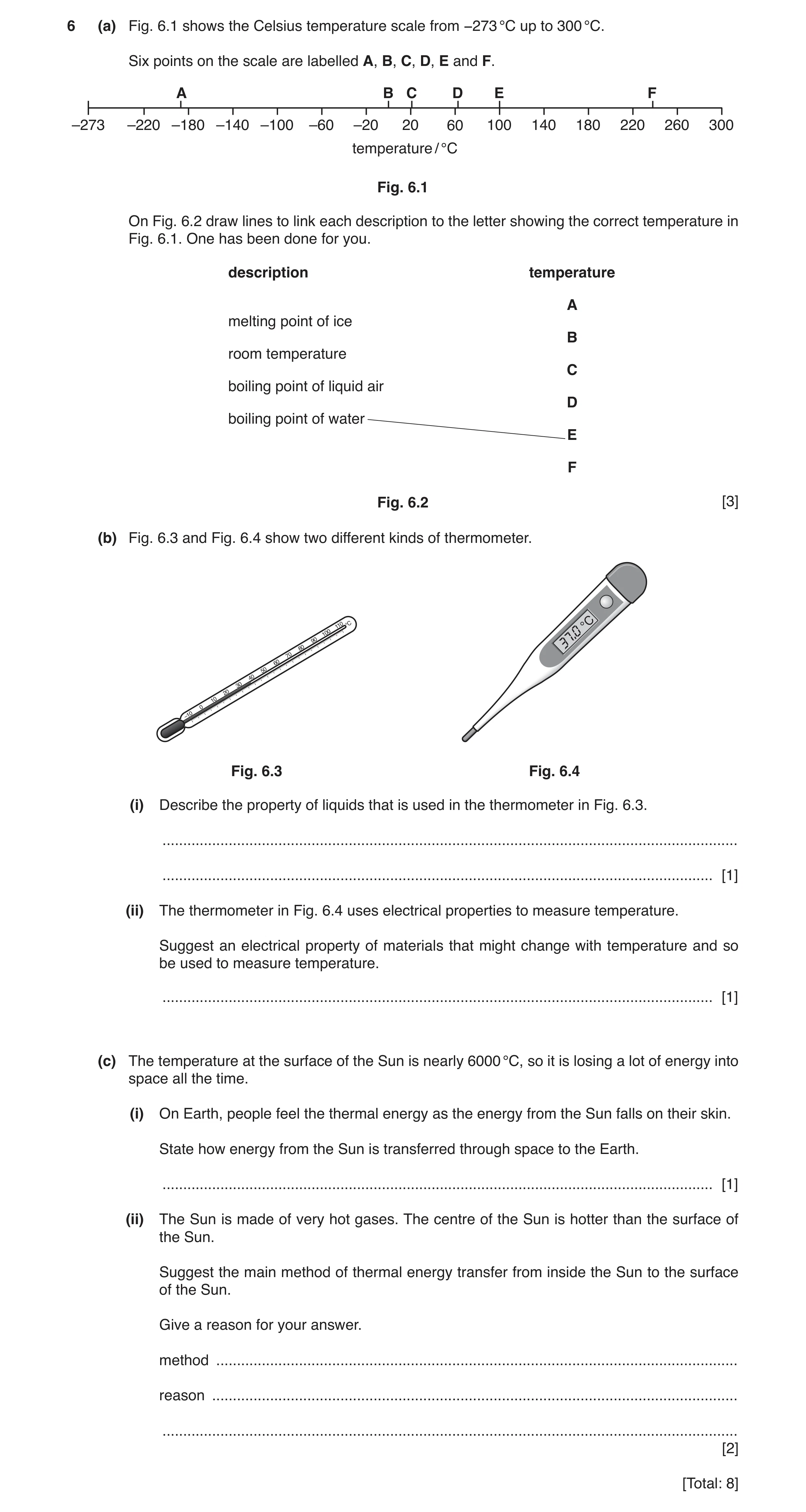
Q12 · The Celsius temperature scale from −273 °C up to 300 °C 0653/32 May/June 2019
6 (a) Fig. 6.1 shows the Celsius temperature scale from −273 °C up to 300 °C. Six points on the scale are labelled A, B, C, D, E and F. A B C D E F –273 –220 –180 –140 –100 –60 –20 20 60 100 140 180 220 260 300 temperature / °C Fig. 6.1 On Fig. 6.2 draw lines to link each description to the letter showing the correct temperature in Fig. 6.1. One has been done for you. description temperature A melting point of ice B room temperature C boiling point of liquid air D boiling point of water E F Fig. 6.2 [3] (b) Fig. 6.3 and Fig. 6.4 show two different kinds of thermometer. 110°C °C 100 90 80 70 60 50 40 30 20 10 0 –10 Fig. 6.3 Fig. 6.4 (i) Describe the property of liquids that is used in the thermometer in Fig. 6.3. … … [1] (ii) The thermometer in Fig. 6.4 uses electrical properties to measure temperature. Suggest an electrical property of materials that might change with temperature and so be used to measure temperature. … [1] (c) The temperature at the surface of the Sun is nearly 6000 °C, so it is losing a lot of energy into space all the time. (i) On Earth, people feel the thermal energy as the energy from the Sun falls on their skin. State how energy from the Sun is transferred through space to the Earth. … [1] (ii) The Sun is made of very hot gases. The centre of the Sun is hotter than the surface of the Sun. Suggest the main method of thermal energy transfer from inside the Sun to the surface of the Sun. Give a reason for your answer. method … reason … … [2] [Total: 8]
8 marks
Mark scheme: 6(a) A melting point of ice B room temperature C boiling point of liquid air D boiling point of water E F 1 mark for each correct link ;;; 3 6(b)(i) thermal expansion (as temperature rises) ; 1 6(b)(ii) resistance ; 1 6(c)(i) radiation ; 1 6(c)(ii) convection ; hot gases rise / move out from the centre (to the surface) ; 2
This question in 0653/32 May/June 2019
Q13 · Some data about the planets Earth, Mars and Venus 0653/31 Oct/Nov 2019
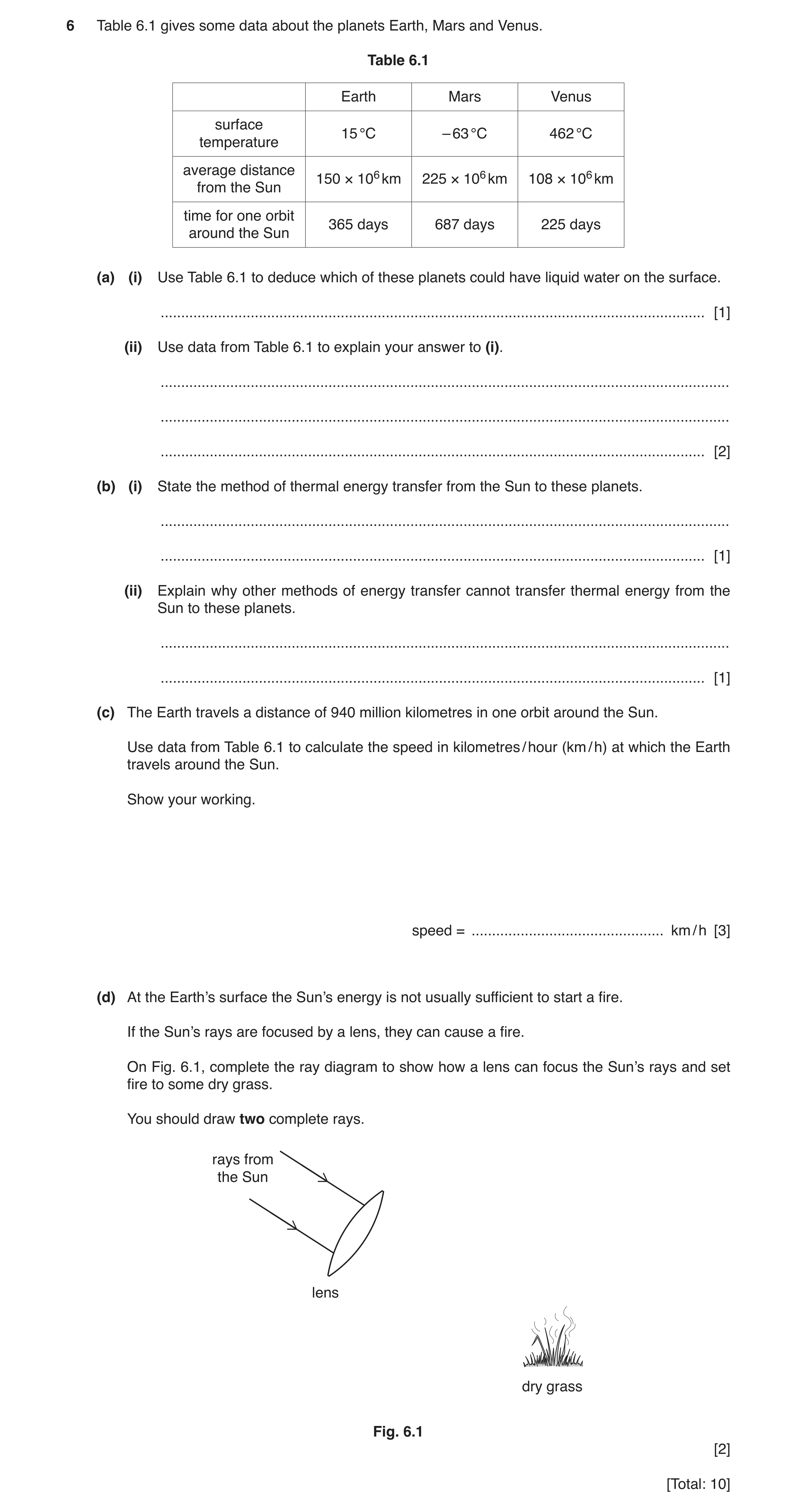
6 Table 6.1 gives some data about the planets Earth, Mars and Venus. Table 6.1 Earth Mars Venus surface 15 °C – 63 °C 462 °C temperature average distance 150 × 106 km 225 × 106 km 108 × 106 km from the Sun time for one orbit 365 days 687 days 225 days around the Sun (a) (i) Use Table 6.1 to deduce which of these planets could have liquid water on the surface. … [1] (ii) Use data from Table 6.1 to explain your answer to (i). … … … [2] (b) (i) State the method of thermal energy transfer from the Sun to these planets. … … [1] (ii) Explain why other methods of energy transfer cannot transfer thermal energy from the Sun to these planets. … … [1] (c) The Earth travels a distance of 940 million kilometres in one orbit around the Sun. Use data from Table 6.1 to calculate the speed in kilometres / hour (km / h) at which the Earth travels around the Sun. Show your working. speed = … km / h [3] (d) At the Earth’s surface the Sun’s energy is not usually sufficient to start a fire. If the Sun’s rays are focused by a lens, they can cause a fire. On Fig. 6.1, complete the ray diagram to show how a lens can focus the Sun’s rays and set fire to some dry grass. You should draw two complete rays. rays from the Sun lens dry grass Fig. 6.1 [2] [Total: 10]
10 marks
Mark scheme: 6(a)(i) Earth (only) ; 1 Question Answer Marks 6(a)(ii) (data selected from the table to show) any two from: temperature on surface of Earth is above melting point of water ; temperature on surface of Earth is below boiling point of water ; temperature on Venus higher than boiling point of water (at 100 °C) ; temperature on Mars lower than melting point of water (at 0 °C) ; 2 6(b)(i) (infrared) radiation ; 1 6(b)(ii) (conduction and convection) need a medium to travel through / no medium in space ; 1 6(c) time in hours = 365 x 24 ; speed = distance / time or 940 × 106 / 365 × 24 ; = 107 306 / 107 000 (km/h) ; 3 6(d) two converging rays ; coming to a focus at the burning grass; 2
This question in 0653/31 Oct/Nov 2019
Question 14 0653/31 Oct/Nov 2019
9 (a) Fig. 9.1 shows a circuit diagram. heater Fig. 9.1 On Fig. 9.1, add a suitable meter to measure the e.m.f. of the battery. [2] (b) The current in a heater circuit is 10.0 A. Select from the list below the correct rating for a fuse to use in this circuit. Put a circle around your choice. 3 A 5 A 10 A 13 A [1] (c) Fig. 9.2 shows a heater fixed to a wall in a room. wall heater floor Fig. 9.2 On Fig. 9.2 draw arrows to show the direction in which air flows from the heater as the air is heated. [1] (d) On Fig. 9.3, complete the circuit by adding: • a lamp in parallel with the motor • a variable resistor to change the current through the motor, but not through the lamp. a.c. supply M motor Fig. 9.3 [3] [Total: 7]
7 marks
Mark scheme: 9(a) 2 9(b) 13 A ; 1 9(c) arrow(s) from heater going upwards ; 1 9(d) 3 correct choice of meter with symbol ; connection in parallel with cells ; lamp in parallel with motor (above or below) ; variable resistor symbol ; variable resistor in series with motor only ;
This question in 0653/31 Oct/Nov 2019
Q15 · A bucket of crushed ice used to cool drinks 0653/31 May/June 2020
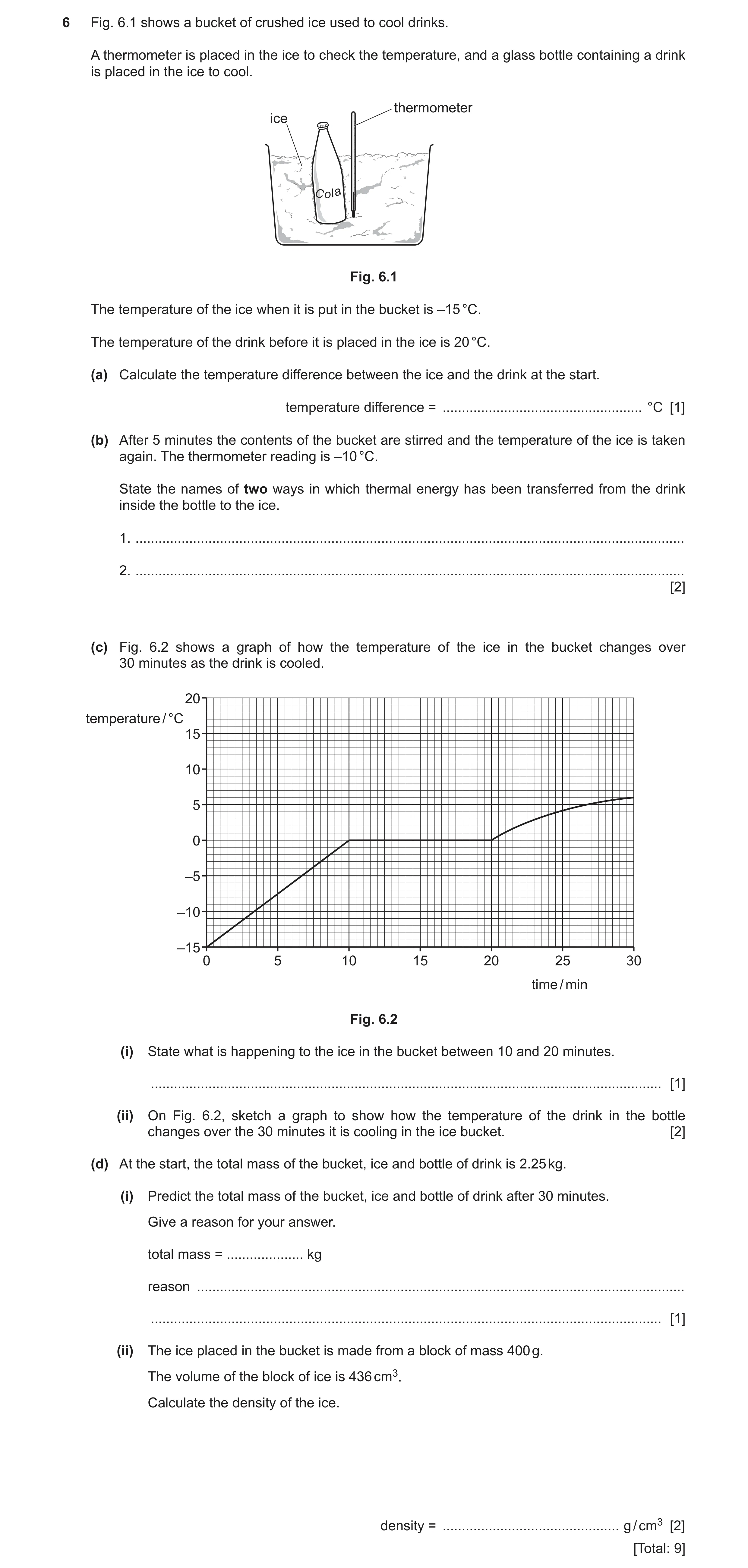
6 Fig. 6.1 shows a bucket of crushed ice used to cool drinks. A thermometer is placed in the ice to check the temperature, and a glass bottle containing a drink is placed in the ice to cool. thermometer ice Fig. 6.1 The temperature of the ice when it is put in the bucket is –15 °C. The temperature of the drink before it is placed in the ice is 20 °C. (a) Calculate the temperature difference between the ice and the drink at the start. temperature difference = … °C [1] (b) After 5 minutes the contents of the bucket are stirred and the temperature of the ice is taken again. The thermometer reading is –10 °C. State the names of two ways in which thermal energy has been transferred from the drink inside the bottle to the ice. 1. … 2. … [2] (c) Fig. 6.2 shows a graph of how the temperature of the ice in the bucket changes over 30 minutes as the drink is cooled. 20 temperature / °C 15 10 5 0 –5 –10 –15 0 5 10 15 20 25 30 time / min Fig. 6.2 (i) State what is happening to the ice in the bucket between 10 and 20 minutes. … [1] (ii) On Fig. 6.2, sketch a graph to show how the temperature of the drink in the bottle changes over the 30 minutes it is cooling in the ice bucket. [2] (d) At the start, the total mass of the bucket, ice and bottle of drink is 2.25 kg. (i) Predict the total mass of the bucket, ice and bottle of drink after 30 minutes. Give a reason for your answer. total mass = … kg reason … … [1] (ii) The ice placed in the bucket is made from a block of mass 400 g. The volume of the block of ice is 436 cm3. Calculate the density of the ice. density = … g / cm3 [2] [Total: 9]
9 marks
Mark scheme: 6(a) 35 (°C) ; 1 6(b) conduction (through glass and ice) ; convection (inside bottle) ; 2 6(c)(i) ice melting ; 1 6(c)(ii) 2 6(d)(i) (total mass = 2.25 kg – no mark) (reason) mass does not change with temperature ; 1 6(d)(ii) d = m / V (in any form) = 400 / 436 ; = 0.917 (g / cm3) ; 2 line starts at +20 °C, comes down ; continuous line from t = 0 to t = 30 and does not go below 6 °C ;
This question in 0653/31 May/June 2020
Q16 · A man holding a glass rod in one hand and a metal rod in the other hand 0653/32 May/June 2020
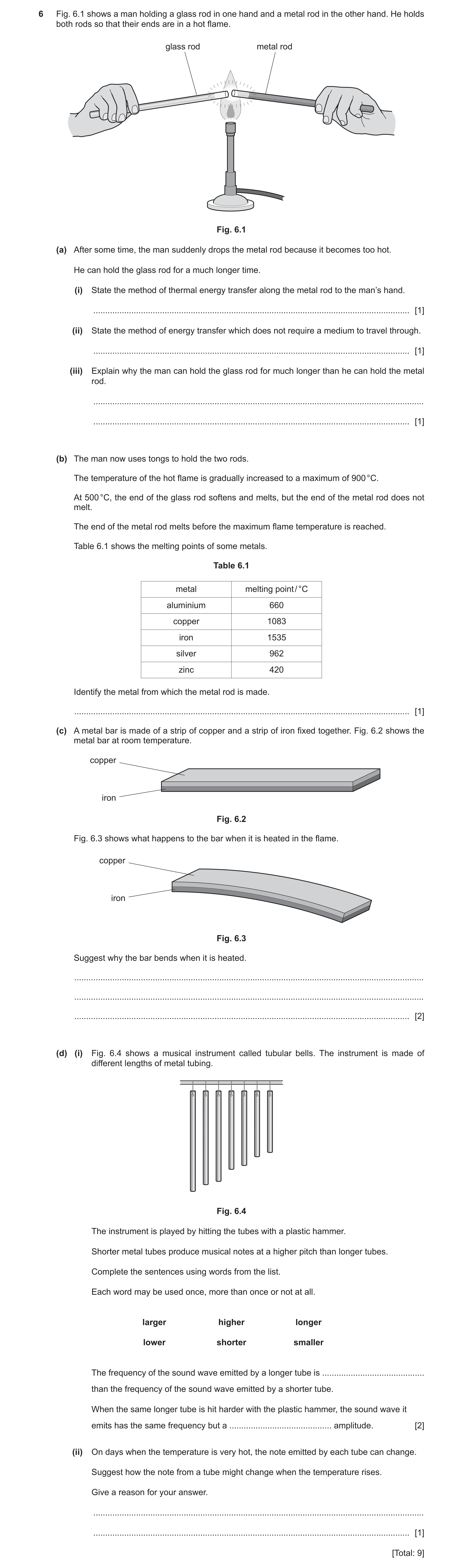
6 Fig. 6.1 shows a man holding a glass rod in one hand and a metal rod in the other hand. He holds both rods so that their ends are in a hot flame. glass rod metal rod Fig. 6.1 (a) After some time, the man suddenly drops the metal rod because it becomes too hot. He can hold the glass rod for a much longer time. (i) State the method of thermal energy transfer along the metal rod to the man’s hand. … [1] (ii) State the method of energy transfer which does not require a medium to travel through. … [1] (iii) Explain why the man can hold the glass rod for much longer than he can hold the metal rod. … … [1] (b) The man now uses tongs to hold the two rods. The temperature of the hot flame is gradually increased to a maximum of 900 °C. At 500 °C, the end of the glass rod softens and melts, but the end of the metal rod does not melt. The end of the metal rod melts before the maximum flame temperature is reached. Table 6.1 shows the melting points of some metals. Table 6.1 metal melting point / °C aluminium 660 copper 1083 iron 1535 silver 962 zinc 420 Identify the metal from which the metal rod is made. … [1] (c) A metal bar is made of a strip of copper and a strip of iron fixed together. Fig. 6.2 shows the metal bar at room temperature. copper iron Fig. 6.2 Fig. 6.3 shows what happens to the bar when it is heated in the flame. copper iron Fig. 6.3 Suggest why the bar bends when it is heated. … … … [2] (d) (i) Fig. 6.4 shows a musical instrument called tubular bells. The instrument is made of different lengths of metal tubing. Fig. 6.4 The instrument is played by hitting the tubes with a plastic hammer. Shorter metal tubes produce musical notes at a higher pitch than longer tubes. Complete the sentences using words from the list. Each word may be used once, more than once or not at all. larger higher longer lower shorter smaller The frequency of the sound wave emitted by a longer tube is … than the frequency of the sound wave emitted by a shorter tube. When the same longer tube is hit harder with the plastic hammer, the sound wave it emits has the same frequency but a … amplitude. [2] (ii) On days when the temperature is very hot, the note emitted by each tube can change. Suggest how the note from a tube might change when the temperature rises. Give a reason for your answer. … … [1] [Total: 9]
9 marks
Mark scheme: 6(a)(i) conduction ; 1 6(a)(ii) radiation ; 1 6(a)(iii) glass is a bad conductor, metal is a good conductor ; 1 6(b) aluminium ; 1 6(c) reference to expansion on heating ; copper expands more (rapidly) than iron ; 2 6(d)(i) lower ; larger ; 2 6(d)(ii) lower (note / pitch / frequency) or longer wavelength (no mark) (because) tube, expands / gets longer with temperature ; 1
This question in 0653/32 May/June 2020
Q17 · Gamma rays are a type of electromagnetic radiation 0653/33 Oct/Nov 2020
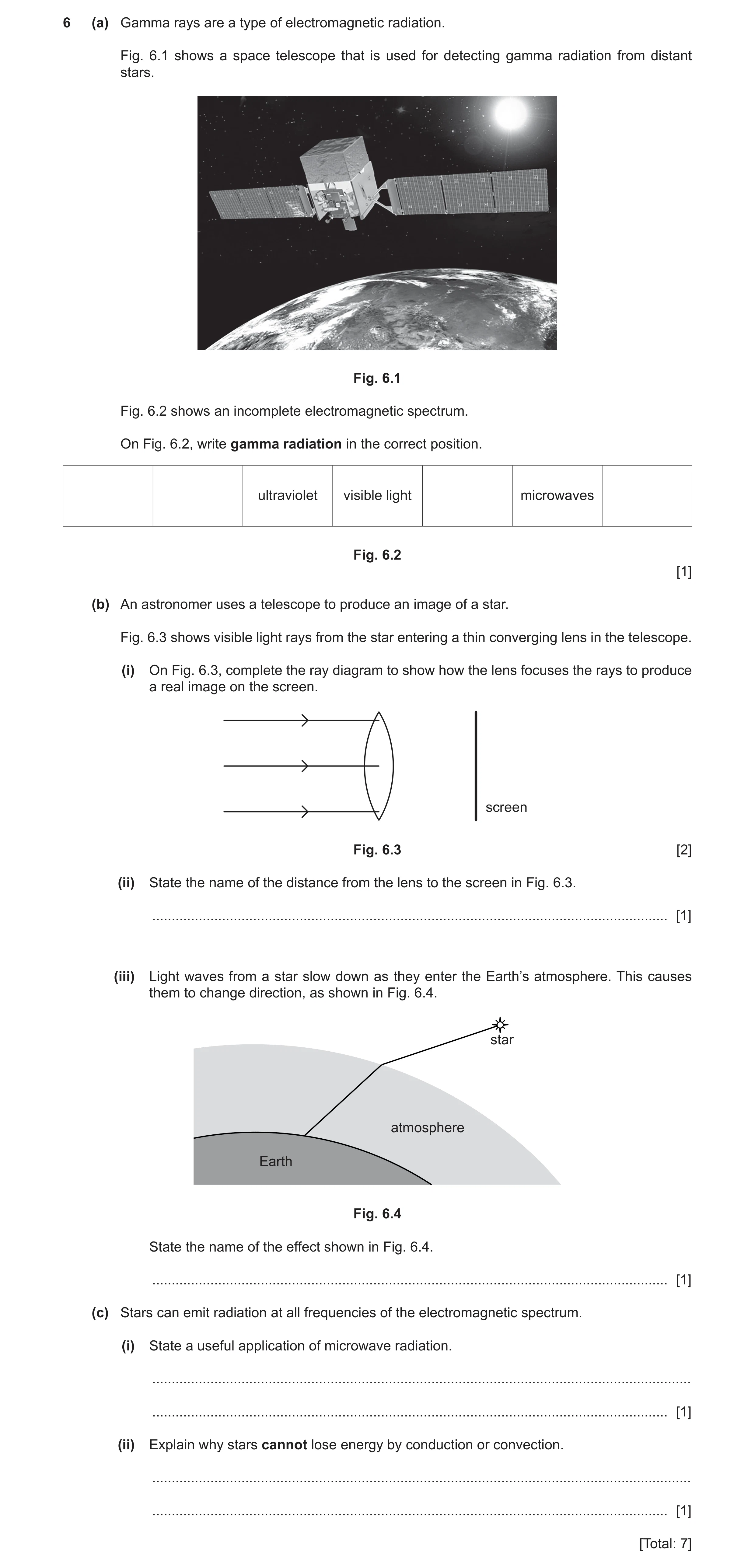
6 (a) Gamma rays are a type of electromagnetic radiation. Fig. 6.1 shows a space telescope that is used for detecting gamma radiation from distant stars. Fig. 6.1 Fig. 6.2 shows an incomplete electromagnetic spectrum. On Fig. 6.2, write gamma radiation in the correct position. ultraviolet visible light microwaves Fig. 6.2 [1] (b) An astronomer uses a telescope to produce an image of a star. Fig. 6.3 shows visible light rays from the star entering a thin converging lens in the telescope. (i) On Fig. 6.3, complete the ray diagram to show how the lens focuses the rays to produce a real image on the screen. screen Fig. 6.3 [2] (ii) State the name of the distance from the lens to the screen in Fig. 6.3. … [1] (iii) Light waves from a star slow down as they enter the Earth’s atmosphere. This causes them to change direction, as shown in Fig. 6.4. star atmosphere Earth Fig. 6.4 State the name of the effect shown in Fig. 6.4. … [1] (c) Stars can emit radiation at all frequencies of the electromagnetic spectrum. (i) State a useful application of microwave radiation. … … [1] (ii) Explain why stars cannot lose energy by conduction or convection. … … [1] [Total: 7]
7 marks
Mark scheme: 6(a) gamma radiation (ultraviolet) (visible light) (microwaves) 1 6(b)(i) 3 rays continued to converge AND middle ray straight ; meeting at point on screen ; 2 6(b)(ii) focal length ; 1 6(b)(iii) refraction ; 1 6(c)(i) satellite TV / mobile phones / microwave ovens ; 1 6(c)(ii) no matter in space / conduction and convection require, a medium / matter; 1
This question in 0653/33 Oct/Nov 2020
Q18 · A flask containing gas being heated in a water-bath 0653/32 Feb/March 2021
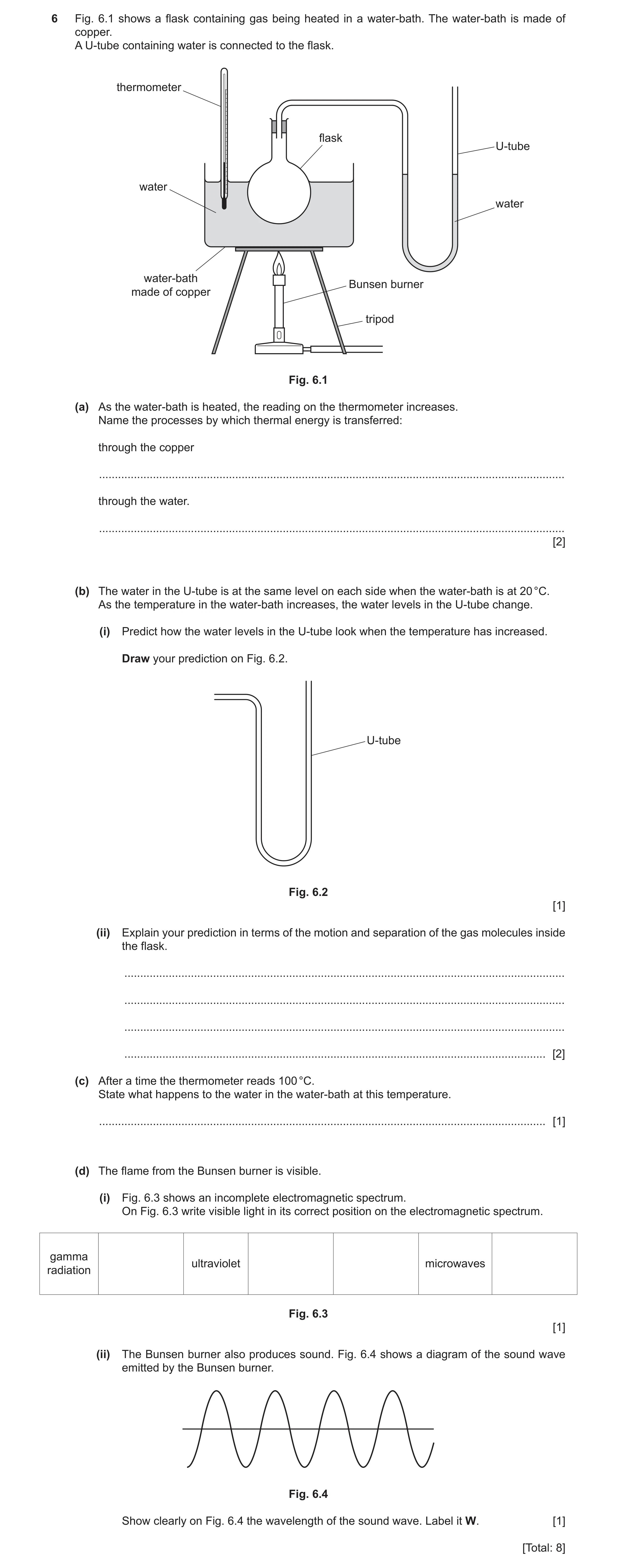
6 Fig. 6.1 shows a flask containing gas being heated in a water-bath. The water-bath is made of copper. A U-tube containing water is connected to the flask. thermometer flask U-tube water water water-bath Bunsen burner made of copper tripod Fig. 6.1 (a) As the water-bath is heated, the reading on the thermometer increases. Name the processes by which thermal energy is transferred: through the copper … through the water. … [2] (b) The water in the U-tube is at the same level on each side when the water-bath is at 20 °C. As the temperature in the water-bath increases, the water levels in the U-tube change. (i) Predict how the water levels in the U-tube look when the temperature has increased. Draw your prediction on Fig. 6.2. U-tube Fig. 6.2 [1] (ii) Explain your prediction in terms of the motion and separation of the gas molecules inside the flask. … … … … [2] (c) After a time the thermometer reads 100 °C. State what happens to the water in the water-bath at this temperature. … [1] (d) The flame from the Bunsen burner is visible. (i) Fig. 6.3 shows an incomplete electromagnetic spectrum. On Fig. 6.3 write visible light in its correct position on the electromagnetic spectrum. gamma ultraviolet microwavesradiation Fig. 6.3 [1] (ii) The Bunsen burner also produces sound. Fig. 6.4 shows a diagram of the sound wave emitted by the Bunsen burner. Fig. 6.4 Show clearly on Fig. 6.4 the wavelength of the sound wave. Label it W. [1] [Total: 8]
8 marks
Mark scheme: 6(a) conduction ; convection ; 2 6(b)(i) down in left side of U-tube / up in right side of U-tube ; 1 6(b)(ii) molecules move faster (as temperature increases) ; distance between molecules increases / volume increases ; 2 6(c) (it) boils ; 1 Question Answer Marks 6(d)(i) visible light in centre box (right of ultraviolet) ; 1 6(d)(ii) correct wavelength indicated on diagram ; 1
This question in 0653/32 Feb/March 2021
Q19 · A gas flame being used to heat a metal kettle of water until the water boils 0653/31 Oct/Nov 2021
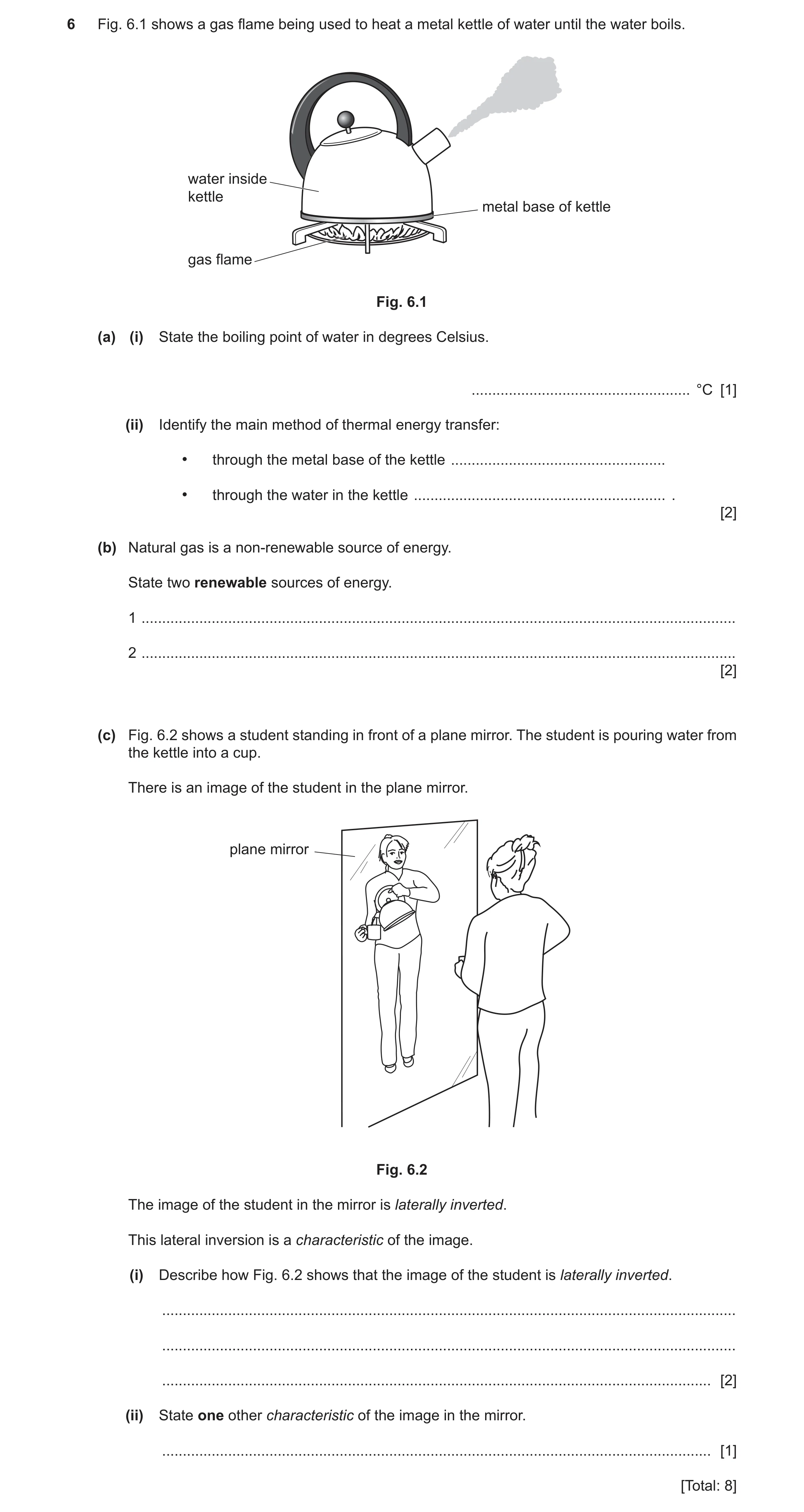
6 Fig. 6.1 shows a gas flame being used to heat a metal kettle of water until the water boils. water inside kettle metal base of kettle gas flame Fig. 6.1 (a) (i) State the boiling point of water in degrees Celsius. … °C [1] (ii) Identify the main method of thermal energy transfer: • through the metal base of the kettle … • through the water in the kettle … . [2] (b) Natural gas is a non-renewable source of energy. State two renewable sources of energy. 1 … 2 … [2] (c) Fig. 6.2 shows a student standing in front of a plane mirror. The student is pouring water from the kettle into a cup. There is an image of the student in the plane mirror. plane mirror Fig. 6.2 The image of the student in the mirror is laterally inverted. This lateral inversion is a characteristic of the image. (i) Describe how Fig. 6.2 shows that the image of the student is laterally inverted. … … … [2] (ii) State one other characteristic of the image in the mirror. … [1] [Total: 8]
8 marks
Mark scheme: 6(a)(i) 100 (°C) ; 1 6(a)(ii) conduction ; convection ; 2 6(b) any two from: solar ; wind ; hydroelectric ; tidal ; wave ; geothermal ; 2 6(c)(i) the student is holding the kettle in her right hand / AW ; mirror image is holding the kettle in her left hand / AW ; 2 6(c)(ii) any one from: upright ; virtual ; same size (as object) ; distance of image from mirror equal to distance of object from mirror ; 1
This question in 0653/31 Oct/Nov 2021
Q20 · Electromagnetic waves transfer energy through space from the Sun to the Earth 0653/31 May/June 2022
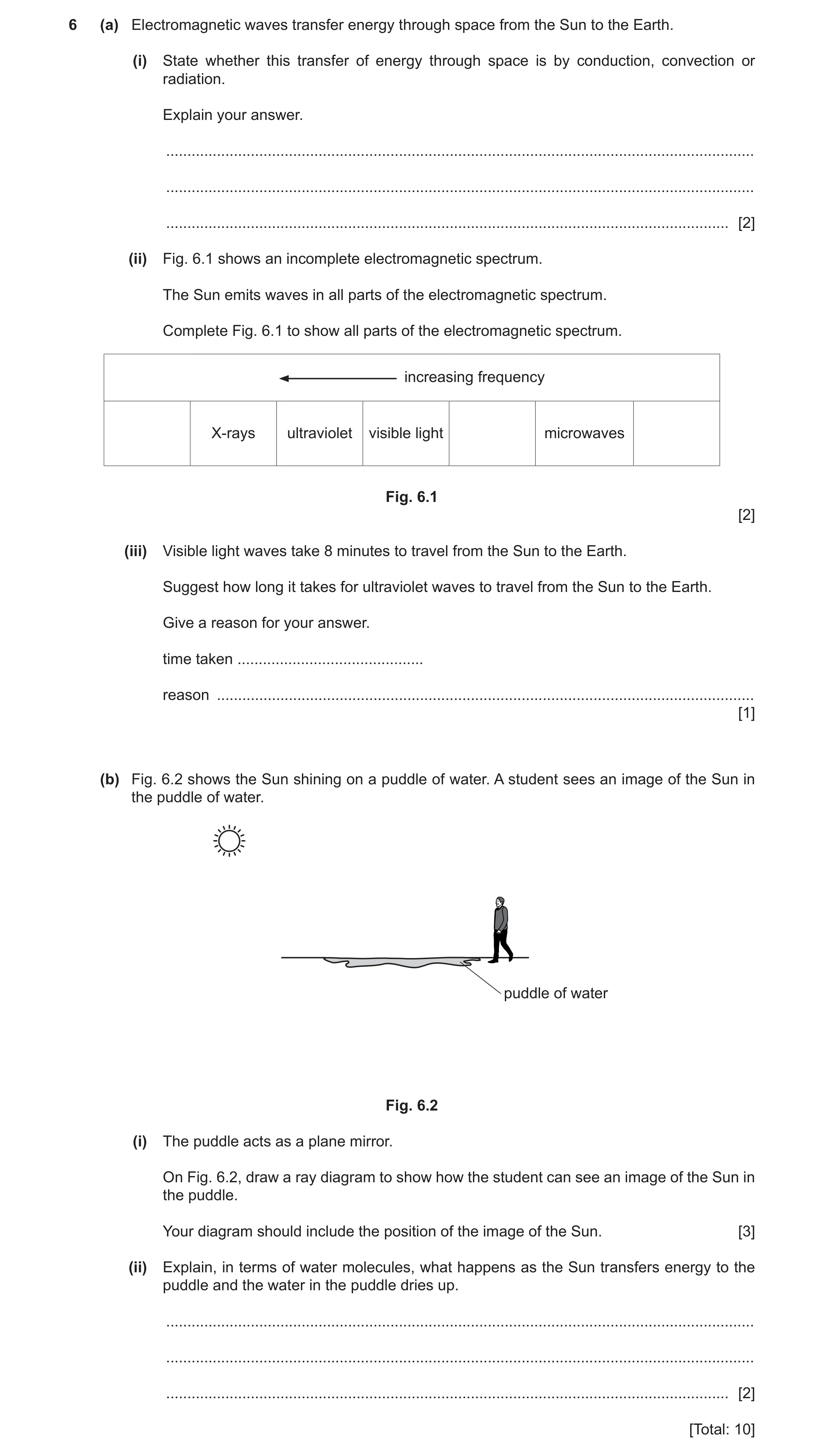
6 (a) Electromagnetic waves transfer energy through space from the Sun to the Earth. (i) State whether this transfer of energy through space is by conduction, convection or radiation. Explain your answer. … … … [2] (ii) Fig. 6.1 shows an incomplete electromagnetic spectrum. The Sun emits waves in all parts of the electromagnetic spectrum. Complete Fig. 6.1 to show all parts of the electromagnetic spectrum. increasing frequency X-rays ultraviolet visible light microwaves Fig. 6.1 [2] (iii) Visible light waves take 8 minutes to travel from the Sun to the Earth. Suggest how long it takes for ultraviolet waves to travel from the Sun to the Earth. Give a reason for your answer. time taken … reason … [1] (b) Fig. 6.2 shows the Sun shining on a puddle of water. A student sees an image of the Sun in the puddle of water. puddle of water Fig. 6.2 (i) The puddle acts as a plane mirror. On Fig. 6.2, draw a ray diagram to show how the student can see an image of the Sun in the puddle. Your diagram should include the position of the image of the Sun. [3] (ii) Explain, in terms of water molecules, what happens as the Sun transfers energy to the puddle and the water in the puddle dries up. … … … [2] [Total: 10]
10 marks
Mark scheme: 6(a)(i) radiation ; (explanation) only method to transfer without a medium / other methods require a (material) medium to travel / transmit / space is a vacuum ; 2 6(a)(ii) gamma (radiation) (X- rays) (ultra- violet) (visible light) infrared (radiation) (micro- waves) radio (waves) 1 or 2 correct ; 3 correct ; 2 6(a)(iii) 8 minutes AND all electromagnetic waves travel at same (high) speed (in vacuum / in air) ; 1 6(b)(i) solid line to show ray from Sun to puddle reflected to man’s eye/head ; angles of incidence and reflection equal (judged by eye) ; reflected ray extended back to show image in correct apparent location (judged by eye) ; 3 6(b)(ii) molecules (at surface) gain kinetic energy ; molecules gain enough energy to escape ; 2
This question in 0653/31 May/June 2022
Q21 · A ship at sea 0653/32 Oct/Nov 2022
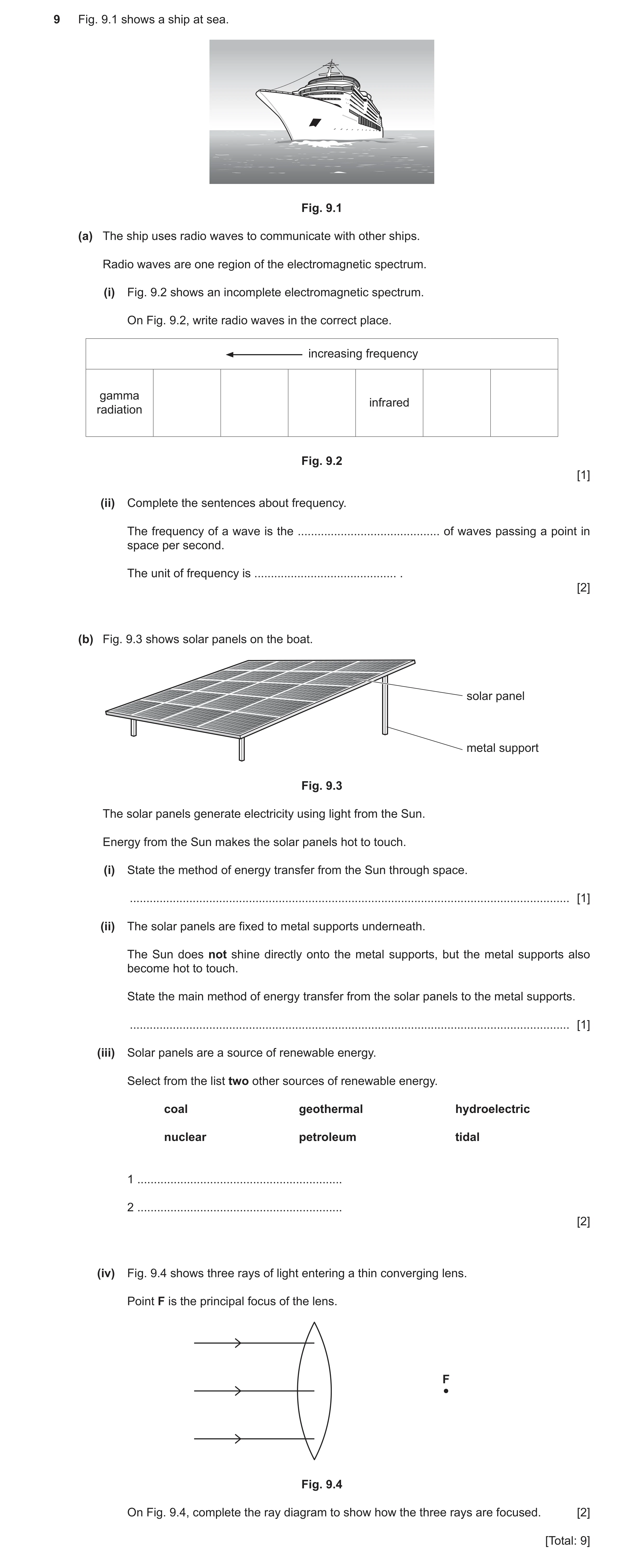
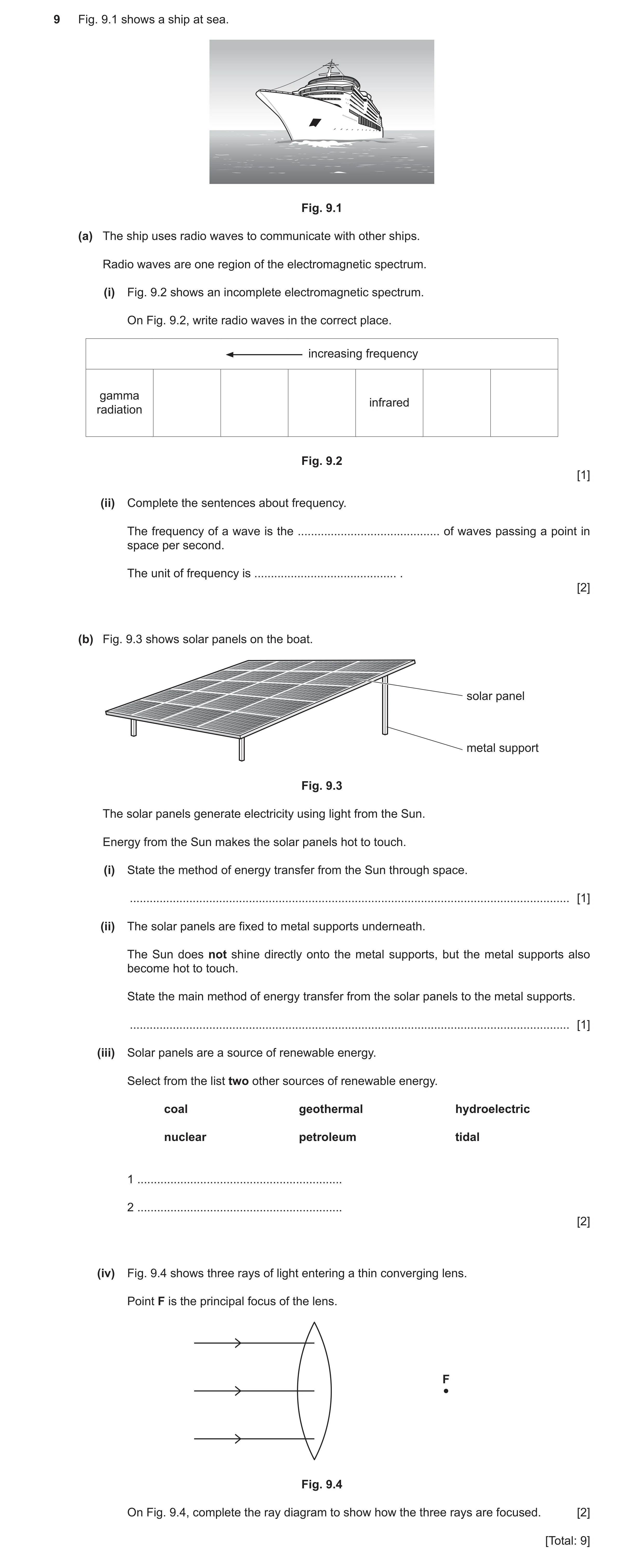
9 Fig. 9.1 shows a ship at sea. Fig. 9.1 (a) The ship uses radio waves to communicate with other ships. Radio waves are one region of the electromagnetic spectrum. (i) Fig. 9.2 shows an incomplete electromagnetic spectrum. On Fig. 9.2, write radio waves in the correct place. increasing frequency gamma infrared radiation Fig. 9.2 [1] (ii) Complete the sentences about frequency. The frequency of a wave is the … of waves passing a point in space per second. The unit of frequency is … . [2] (b) Fig. 9.3 shows solar panels on the boat. solar panel metal support Fig. 9.3 The solar panels generate electricity using light from the Sun. Energy from the Sun makes the solar panels hot to touch. (i) State the method of energy transfer from the Sun through space. … [1] (ii) The solar panels are fixed to metal supports underneath. The Sun does not shine directly onto the metal supports, but the metal supports also become hot to touch. State the main method of energy transfer from the solar panels to the metal supports. … [1] (iii) Solar panels are a source of renewable energy. Select from the list two other sources of renewable energy. coal geothermal hydroelectric nuclear petroleum tidal 1 … 2 … [2] (iv) Fig. 9.4 shows three rays of light entering a thin converging lens. Point F is the principal focus of the lens. F Fig. 9.4 On Fig. 9.4, complete the ray diagram to show how the three rays are focused. [2] [Total: 9]
9 marks
Mark scheme: 9(a)(i) 1 radio gamma infrared waves ; 9(a)(ii) number ; 2 hertz / Hz ; 9(b)(i) radiation ; 1 9(b)(ii) conduction ; 1 9(b)(iii) any two from: 2 geothermal ; hydroelectric ; tidal ; 9(b)(iv) centre ray not refracted ; 2 outer two rays converging AND all three rays intersecting at F ;
This question in 0653/32 Oct/Nov 2022
Q22 · A ship at sea 0653/33 Oct/Nov 2022
9 Fig. 9.1 shows a ship at sea. Fig. 9.1 (a) The ship uses radio waves to communicate with other ships. Radio waves are one region of the electromagnetic spectrum. (i) Fig. 9.2 shows an incomplete electromagnetic spectrum. On Fig. 9.2, write radio waves in the correct place. increasing frequency gamma infrared radiation Fig. 9.2 [1] (ii) Complete the sentences about frequency. The frequency of a wave is the … of waves passing a point in space per second. The unit of frequency is … . [2] (b) Fig. 9.3 shows solar panels on the boat. solar panel metal support Fig. 9.3 The solar panels generate electricity using light from the Sun. Energy from the Sun makes the solar panels hot to touch. (i) State the method of energy transfer from the Sun through space. … [1] (ii) The solar panels are fixed to metal supports underneath. The Sun does not shine directly onto the metal supports, but the metal supports also become hot to touch. State the main method of energy transfer from the solar panels to the metal supports. … [1] (iii) Solar panels are a source of renewable energy. Select from the list two other sources of renewable energy. coal geothermal hydroelectric nuclear petroleum tidal 1 … 2 … [2] (iv) Fig. 9.4 shows three rays of light entering a thin converging lens. Point F is the principal focus of the lens. F Fig. 9.4 On Fig. 9.4, complete the ray diagram to show how the three rays are focused. [2] [Total: 9]
9 marks
Mark scheme: 9(a)(i) 1 radio gamma infrared waves ; 9(a)(ii) number ; 2 hertz / Hz ; 9(b)(i) radiation ; 1 9(b)(ii) conduction ; 1 9(b)(iii) any two from: 2 geothermal ; hydroelectric ; tidal ; 9(b)(iv) centre ray not refracted ; 2 outer two rays converging AND all three rays intersecting at F ;
This question in 0653/33 Oct/Nov 2022
Q23 · A group of people keeping warm by a campfire and playing musical instruments 0653/31 May/June 2023
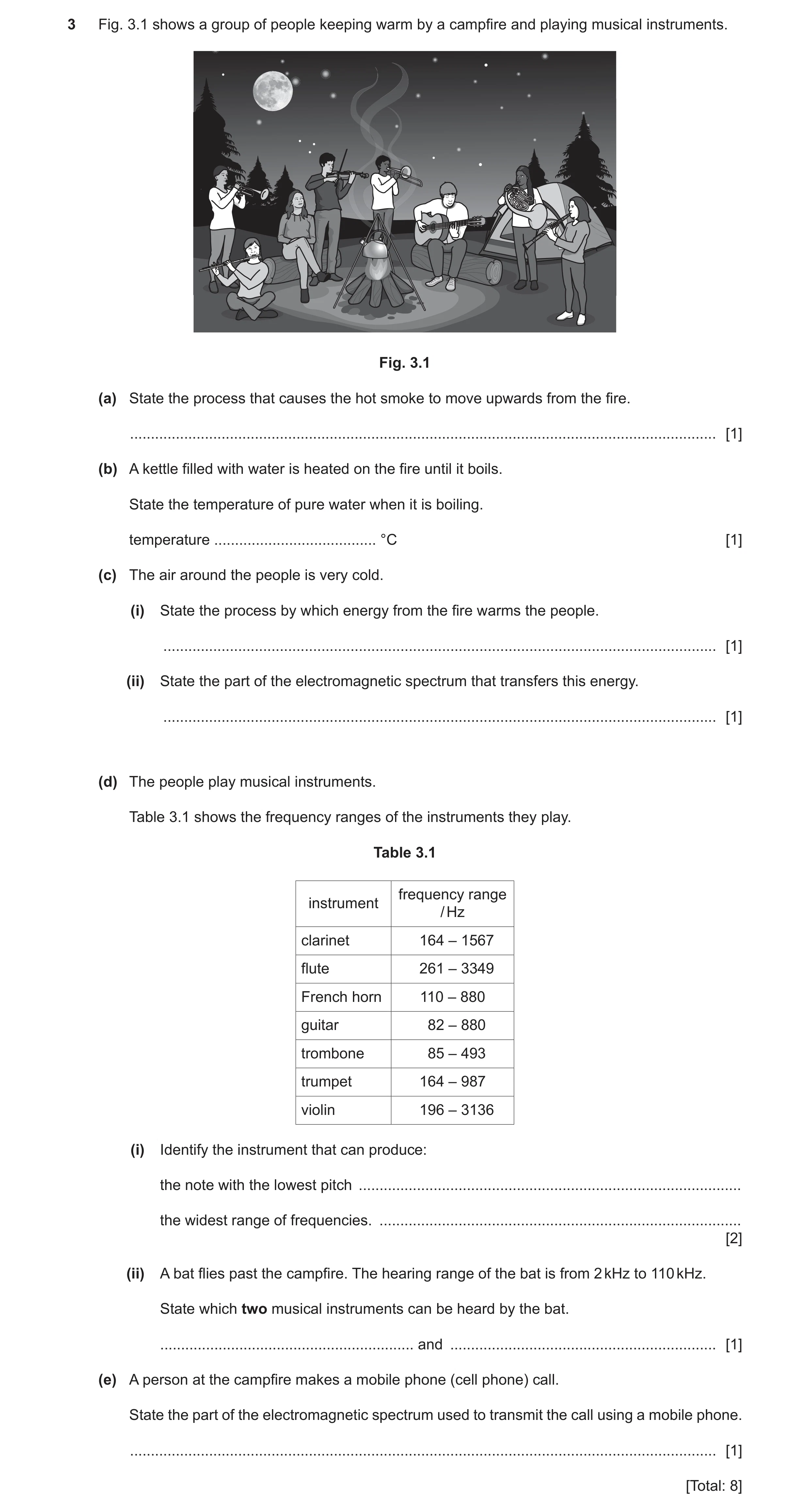
3 Fig. 3.1 shows a group of people keeping warm by a campfire and playing musical instruments. Fig. 3.1 (a) State the process that causes the hot smoke to move upwards from the fire. … [1] (b) A kettle filled with water is heated on the fire until it boils. State the temperature of pure water when it is boiling. temperature … °C [1] (c) The air around the people is very cold. (i) State the process by which energy from the fire warms the people. … [1] (ii) State the part of the electromagnetic spectrum that transfers this energy. … [1] (d) The people play musical instruments. Table 3.1 shows the frequency ranges of the instruments they play. Table 3.1 frequency range instrument / Hz clarinet 164 – 1567 flute 261 – 3349 French horn 110 – 880 guitar 82 – 880 trombone 85 – 493 trumpet 164 – 987 violin 196 – 3136 (i) Identify the instrument that can produce: the note with the lowest pitch … the widest range of frequencies. … [2] (ii) A bat flies past the campfire. The hearing range of the bat is from 2 kHz to 110 kHz. State which two musical instruments can be heard by the bat. … and … [1] (e) A person at the campfire makes a mobile phone (cell phone) call. State the part of the electromagnetic spectrum used to transmit the call using a mobile phone. … [1] [Total: 8]
8 marks
Mark scheme: 3(a) convection ; 1 3(b) 100 (°C) ; 1 3(c)(i) radiation ; 1 3(c)(ii) infrared ; 1 3(d)(i) in this order: guitar ; flute ; 2 3(d)(ii) violin AND flute ; 1 3(e) microwave ; 1
This question in 0653/31 May/June 2023
Q24 · A car battery connected to an electric heater used in a caravan 0653/33 May/June 2023
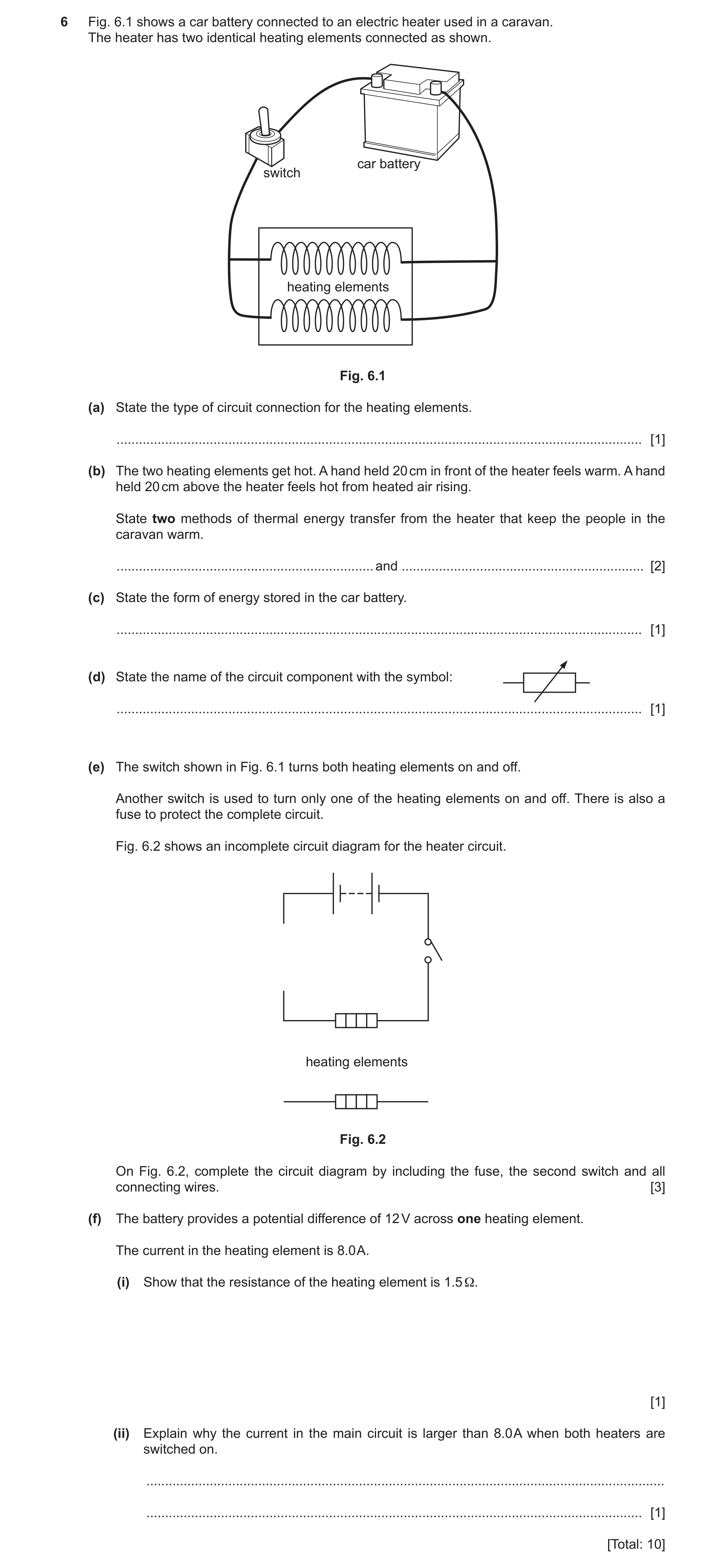
6 Fig. 6.1 shows a car battery connected to an electric heater used in a caravan. The heater has two identical heating elements connected as shown. car battery switch heating elements Fig. 6.1 (a) State the type of circuit connection for the heating elements. … [1] (b) The two heating elements get hot. A hand held 20 cm in front of the heater feels warm. A hand held 20 cm above the heater feels hot from heated air rising. State two methods of thermal energy transfer from the heater that keep the people in the caravan warm. … and … [2] (c) State the form of energy stored in the car battery. … [1] (d) State the name of the circuit component with the symbol: … [1] (e) The switch shown in Fig. 6.1 turns both heating elements on and off. Another switch is used to turn only one of the heating elements on and off. There is also a fuse to protect the complete circuit. Fig. 6.2 shows an incomplete circuit diagram for the heater circuit. heating elements Fig. 6.2 On Fig. 6.2, complete the circuit diagram by including the fuse, the second switch and all connecting wires. [3] (f) The battery provides a potential difference of 12 V across one heating element. The current in the heating element is 8.0 A. (i) Show that the resistance of the heating element is 1.5 Ω. [1] (ii) Explain why the current in the main circuit is larger than 8.0 A when both heaters are switched on. … … [1] [Total: 10]
10 marks
Mark scheme: 6(a) parallel ; 1 6(b) radiation ; convection ; in any order 2 6(c) chemical (potential) ; 1 6(d) variable resistor ; 1 6(e) symbol for fuse ; second switch placed between heating elements ; fuse in main circuit and all connections completed ; 3 6(f)(i) (R =) V I / R = 12 8.0 (= 1.5) ; 1 6(f)(ii) current from source is (always) larger than current in either branch ; 1
This question in 0653/33 May/June 2023
Q25 · An aluminium pan containing water, being heated on a hotplate of a cooker 0653/31 May/June 2024
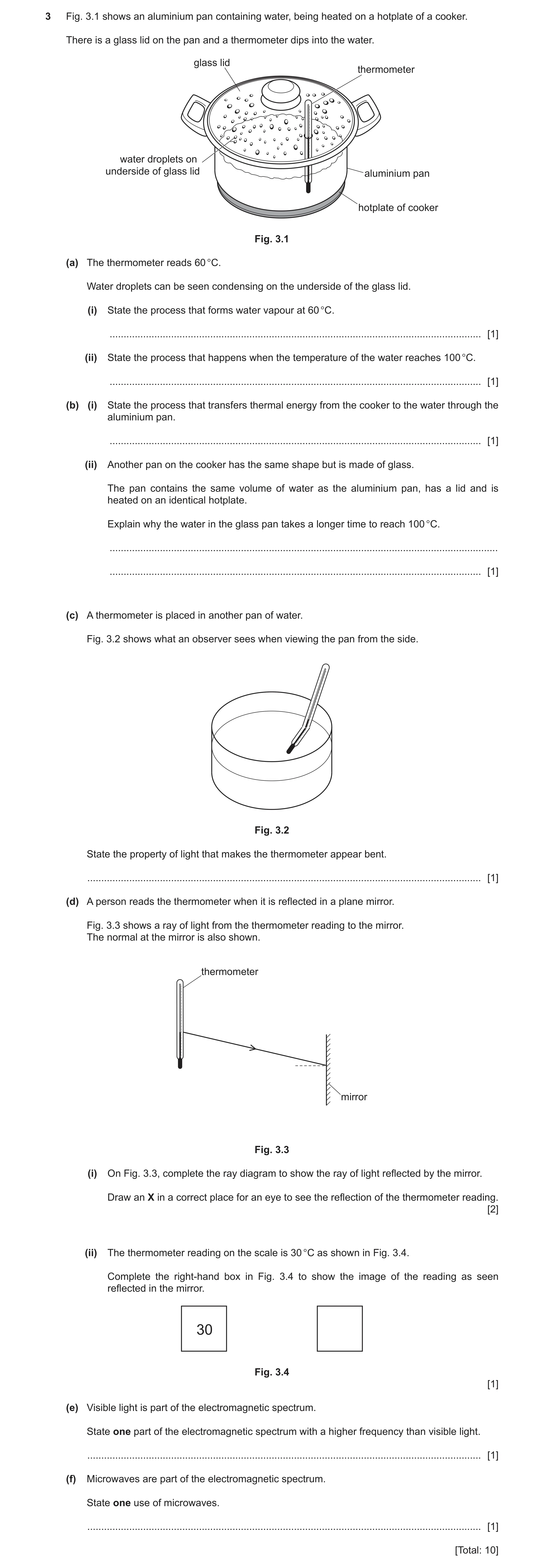
3 Fig. 3.1 shows an aluminium pan containing water, being heated on a hotplate of a cooker. There is a glass lid on the pan and a thermometer dips into the water. glass lid thermometer water droplets on underside of glass lid aluminium pan hotplate of cooker Fig. 3.1 (a) The thermometer reads 60 °C. Water droplets can be seen condensing on the underside of the glass lid. (i) State the process that forms water vapour at 60 °C. … [1] (ii) State the process that happens when the temperature of the water reaches 100 °C. … [1] (b) (i) State the process that transfers thermal energy from the cooker to the water through the aluminium pan. … [1] (ii) Another pan on the cooker has the same shape but is made of glass. The pan contains the same volume of water as the aluminium pan, has a lid and is heated on an identical hotplate. Explain why the water in the glass pan takes a longer time to reach 100 °C. … … [1] (c) A thermometer is placed in another pan of water. Fig. 3.2 shows what an observer sees when viewing the pan from the side. Fig. 3.2 State the property of light that makes the thermometer appear bent. … [1] (d) A person reads the thermometer when it is reflected in a plane mirror. Fig. 3.3 shows a ray of light from the thermometer reading to the mirror. The normal at the mirror is also shown. thermometer mirror Fig. 3.3 (i) On Fig. 3.3, complete the ray diagram to show the ray of light reflected by the mirror. Draw an X in a correct place for an eye to see the reflection of the thermometer reading. [2] (ii) The thermometer reading on the scale is 30 °C as shown in Fig. 3.4. Complete the right-hand box in Fig. 3.4 to show the image of the reading as seen reflected in the mirror. 30 Fig. 3.4 [1] (e) Visible light is part of the electromagnetic spectrum. State one part of the electromagnetic spectrum with a higher frequency than visible light. … [1] (f) Microwaves are part of the electromagnetic spectrum. State one use of microwaves. … [1] [Total: 10]
10 marks
Mark scheme: 3(a)(i) evaporation ; 1 3(a)(ii) boiling ; 1 3(b)(i) conduction ; 1 3(b)(ii) glass is a poor (thermal) conductor ; 1 3(c) refraction ; 1 Question Answer Marks 3(d)(i) angle of reflection equal to angle of incidence judged by inspection ; centre of X drawn reflected ray ; 2 3(d)(ii) ; 1 3(e) ultraviolet / X-ray / gamma (ray) ; 1 3(f) mobile phone signals / cooking / satellite TV / radar ; 1 0ɛ
This question in 0653/31 May/June 2024
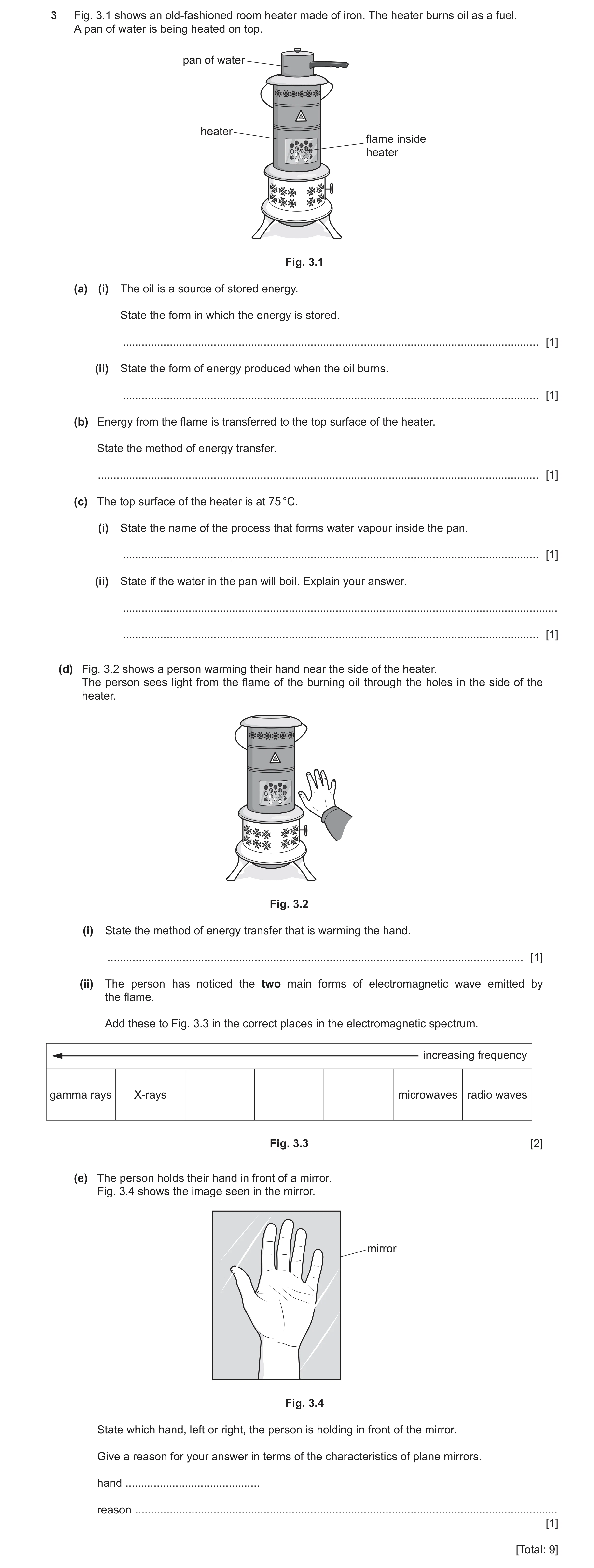
Q26 · An old‑fashioned room heater made of iron 0653/32 May/June 2024
3 Fig. 3.1 shows an old‑fashioned room heater made of iron. The heater burns oil as a fuel. A pan of water is being heated on top. pan of water heater flame inside heater Fig. 3.1 (a) (i) The oil is a source of stored energy. State the form in which the energy is stored. … [1] (ii) State the form of energy produced when the oil burns. … [1] (b) Energy from the flame is transferred to the top surface of the heater. State the method of energy transfer. … [1] (c) The top surface of the heater is at 75 °C. (i) State the name of the process that forms water vapour inside the pan. … [1] (ii) State if the water in the pan will boil. Explain your answer. … … [1] (d) Fig. 3.2 shows a person warming their hand near the side of the heater. The person sees light from the flame of the burning oil through the holes in the side of the heater. Fig. 3.2 (i) State the method of energy transfer that is warming the hand. … [1] (ii) The person has noticed the two main forms of electromagnetic wave emitted by the flame. Add these to Fig. 3.3 in the correct places in the electromagnetic spectrum. increasing frequency gamma rays X-rays microwaves radio waves Fig. 3.3 [2] (e) The person holds their hand in front of a mirror. Fig. 3.4 shows the image seen in the mirror. mirror Fig. 3.4 State which hand, left or right, the person is holding in front of the mirror. Give a reason for your answer in terms of the characteristics of plane mirrors. hand … reason … [1] [Total: 9]
9 marks
Mark scheme: 3(a)(i) chemical (potential) ; 1 3(a)(ii) thermal ; 1 3(b) convection ; 1 3(c)(i) evaporation ; 1 3(c)(ii) no (no mark) has not / does not, reach 100 °C / does not reach boiling point of water ; 1 3(d)(i) radiation ; 1 3(d)(ii) visible(light) infra-red visible (light) and infrared identified (only) ; in correct positions with first box left empty ; 2 3(e) right hand (no mark) lateral inversion ; 1
This question in 0653/32 May/June 2024
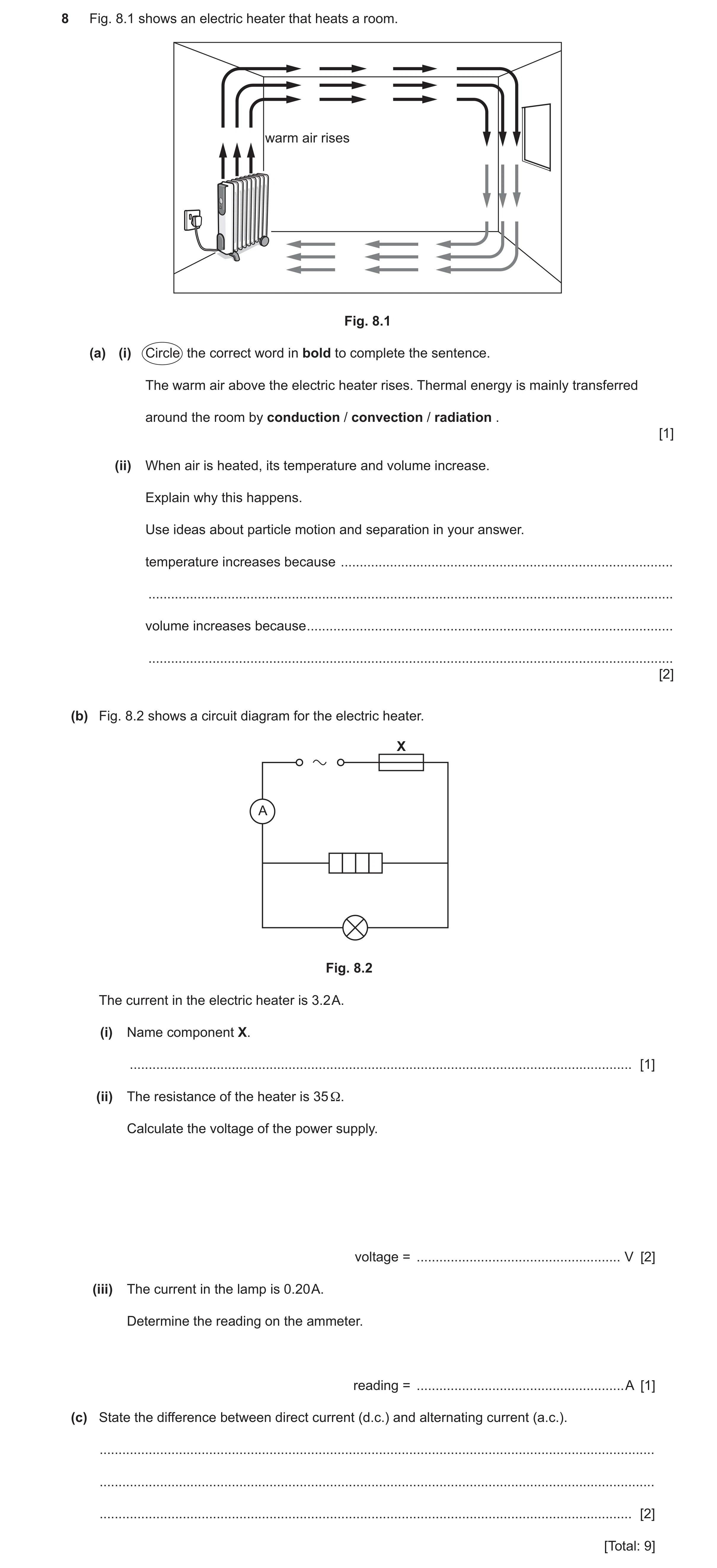
Q27 · An electric heater that heats a room 0653/32 May/June 2025
8 Fig. 8.1 shows an electric heater that heats a room. warm air rises Fig. 8.1 (a) (i) Circle the correct word in bold to complete the sentence. The warm air above the electric heater rises. Thermal energy is mainly transferred around the room by conduction / convection / radiation . [1] (ii) When air is heated, its temperature and volume increase. Explain why this happens. Use ideas about particle motion and separation in your answer. temperature increases because … … volume increases because … … [2] (b) Fig. 8.2 shows a circuit diagram for the electric heater. X A Fig. 8.2 The current in the electric heater is 3.2 A. (i) Name component X. … [1] (ii) The resistance of the heater is 35 Ω. Calculate the voltage of the power supply. voltage = … V [2] (iii) The current in the lamp is 0.20 A. Determine the reading on the ammeter. reading = … A [1] (c) State the difference between direct current (d.c.) and alternating current (a.c.). … … … [2] [Total: 9]
9 marks
Mark scheme: 8(a)(i) convection ; 1 8(a)(ii) particles move faster ; 2 particles (move) further apart ; 8(b)(i) fuse ; 1 8(b)(ii) V = R I / voltage = current resistance / 3.2 35 ; 2 112 (V) ; 8(b)(iii) (3.2 + 0.20 =) 3.4 (A) ; 1 8(c) d.c. current goes in one direction only all the time ; 2 a.c. current reverses direction repeatedly ;
This question in 0653/32 May/June 2025
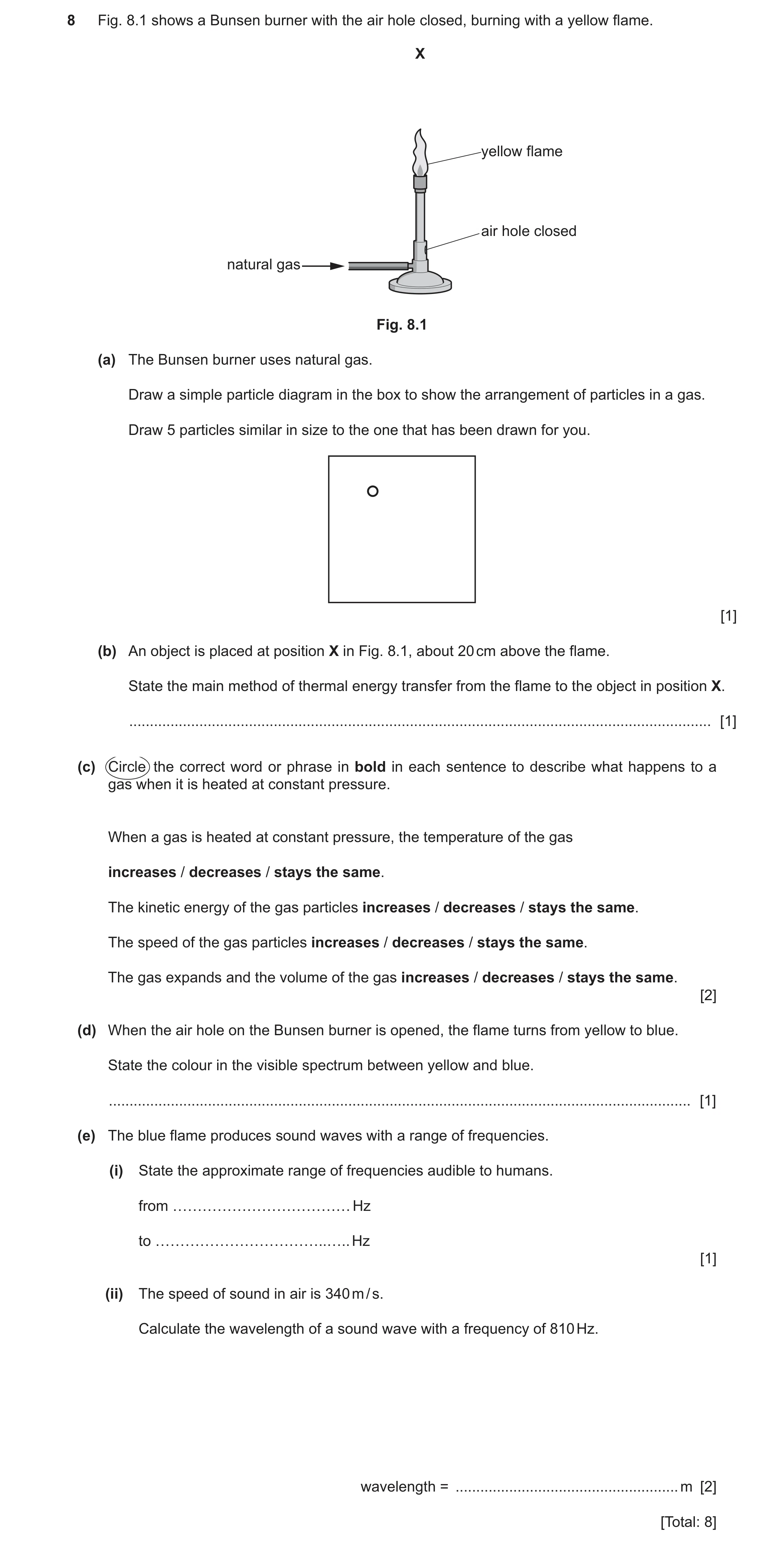
Q28 · A Bunsen burner with the air hole closed, burning with a yellow flame 0653/33 May/June 2025
8 Fig. 8.1 shows a Bunsen burner with the air hole closed, burning with a yellow flame. X yellow flame air hole closed natural gas Fig. 8.1 (a) The Bunsen burner uses natural gas. Draw a simple particle diagram in the box to show the arrangement of particles in a gas. Draw 5 particles similar in size to the one that has been drawn for you. [1] (b) An object is placed at position X in Fig. 8.1, about 20 cm above the flame. State the main method of thermal energy transfer from the flame to the object in position X. … [1] (c) Circle the correct word or phrase in bold in each sentence to describe what happens to a gas when it is heated at constant pressure. When a gas is heated at constant pressure, the temperature of the gas increases / decreases / stays the same. The kinetic energy of the gas particles increases / decreases / stays the same. The speed of the gas particles increases / decreases / stays the same. The gas expands and the volume of the gas increases / decreases / stays the same. [2] (d) When the air hole on the Bunsen burner is opened, the flame turns from yellow to blue. State the colour in the visible spectrum between yellow and blue. … [1] (e) The blue flame produces sound waves with a range of frequencies. (i) State the approximate range of frequencies audible to humans. from ……………………………… Hz to ……………………………..….. Hz [1] (ii) The speed of sound in air is 340 m / s. Calculate the wavelength of a sound wave with a frequency of 810 Hz. wavelength = … m [2] [Total: 8]
8 marks
Mark scheme: 8(a) 5 additional particles shown in an irregular arrangement AND clearly separated ; 1 8(b) convection ; 1 8(c) When a gas is heated at constant pressure, the temperature of the gas 2 increases / decreases / stays the same. The kinetic energy of the gas particles increases / decreases / stays the same. The speed of the gas particles increases / decreases/stays the same. The gas expands and the volume of the gas increases / decreases / stays the same. ;; any two correct = 1 mark all four correct = 2 marks 8(d) green ; 1 8(e)(i) from 20 to 20 000 (Hz) ; 1 8(e)(ii) λ= v ÷ f / wavelength = speed ÷ frequency / λ= 340 ÷ 810 ; 2 0.41975 / 0.42 (m) ;
This question in 0653/33 May/June 2025
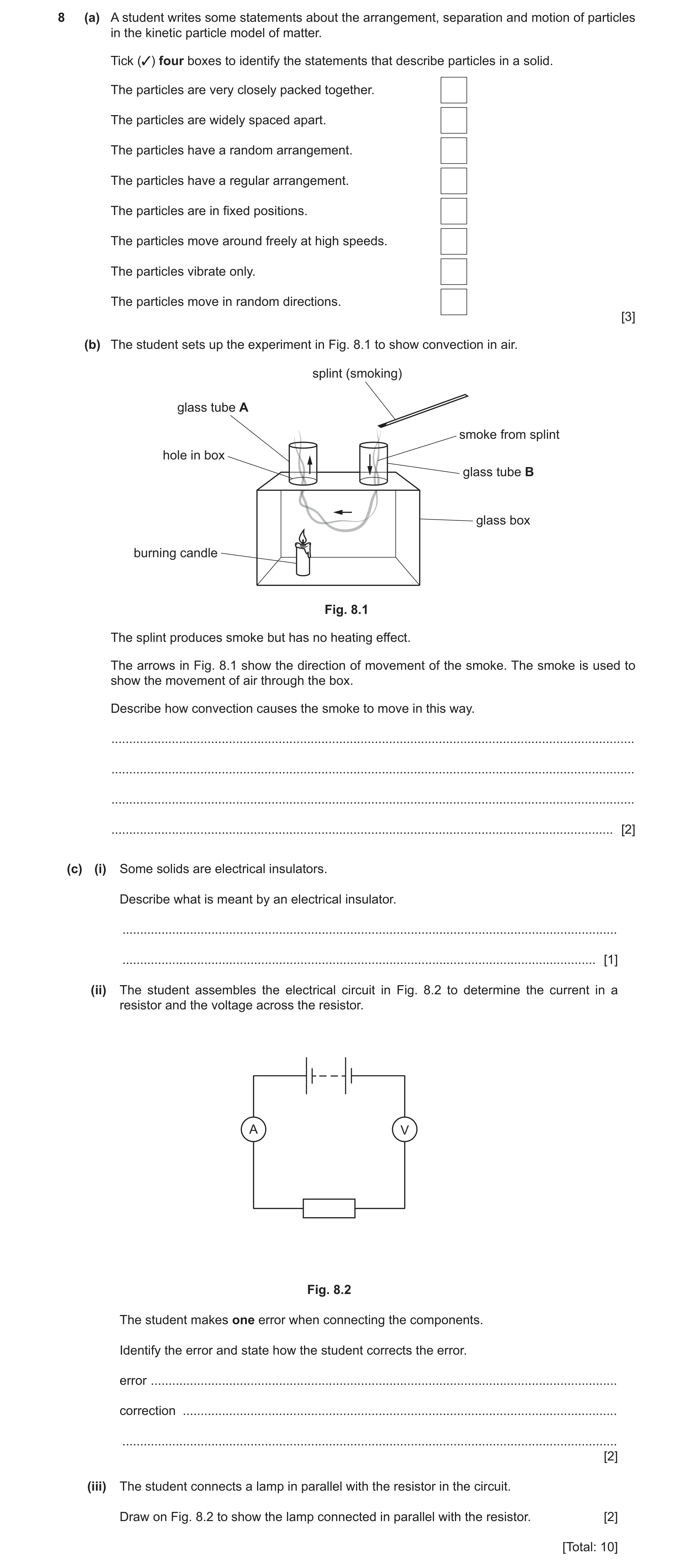
Q29 · A student writes some statements about the arrangement, separation and motion of… 0653/31 Oct/Nov 2025
8 (a) A student writes some statements about the arrangement, separation and motion of particles in the kinetic particle model of matter. Tick (✓) four boxes to identify the statements that describe particles in a solid. The particles are very closely packed together. The particles are widely spaced apart. The particles have a random arrangement. The particles have a regular arrangement. The particles are in fixed positions. The particles move around freely at high speeds. The particles vibrate only. The particles move in random directions. [3] (b) The student sets up the experiment in Fig. 8.1 to show convection in air. splint (smoking) glass tube A smoke from splint hole in box glass tube B glass box burning candle Fig. 8.1 The splint produces smoke but has no heating effect. The arrows in Fig. 8.1 show the direction of movement of the smoke. The smoke is used to show the movement of air through the box. Describe how convection causes the smoke to move in this way. … … … … [2] (c) (i) Some solids are electrical insulators. Describe what is meant by an electrical insulator. … … [1] (ii) The student assembles the electrical circuit in Fig. 8.2 to determine the current in a resistor and the voltage across the resistor. A V Fig. 8.2 The student makes one error when connecting the components. Identify the error and state how the student corrects the error. error … correction … … [2] (iii) The student connects a lamp in parallel with the resistor in the circuit. Draw on Fig. 8.2 to show the lamp connected in parallel with the resistor. [2] [Total: 10]
10 marks
Mark scheme: 8(a) The particles are very closely packed together. 3 The particles have a regular arrangement. The particles are in fixed positions. The particles vibrate only. 1 correct = 1 mark; 2 correct or 3 correct = 2 marks ; 4 correct = 3 marks ; 8(b) any two from: 2 (burning candle) warms the air (above it) ; the warm(er) air / smoke rises ; the cold(er) air / smoke sinks ; convection current set up ; 8(c)(i) idea that, does not allow charge / current to flow / pass ; 1 8(c)(ii) error voltmeter position / connection (is in series) ; 2 correction connect voltmeter in parallel (with the resistor) ; 8(c)(iii) correct symbol for lamp ; 2 connected in parallel across resistor ;
This question in 0653/31 Oct/Nov 2025
![Question 14: (a) Fig. 9.1 shows a circuit diagram. heater Fig. 9.1 On Fig. 9.1, add a suitable meter to measure the e.m.f. of the battery. [2] (b) The c…](https://img.pastlit.com/crops/422f7162-5998-476e-86d9-d8c460d476ed/q9.webp)
 10
10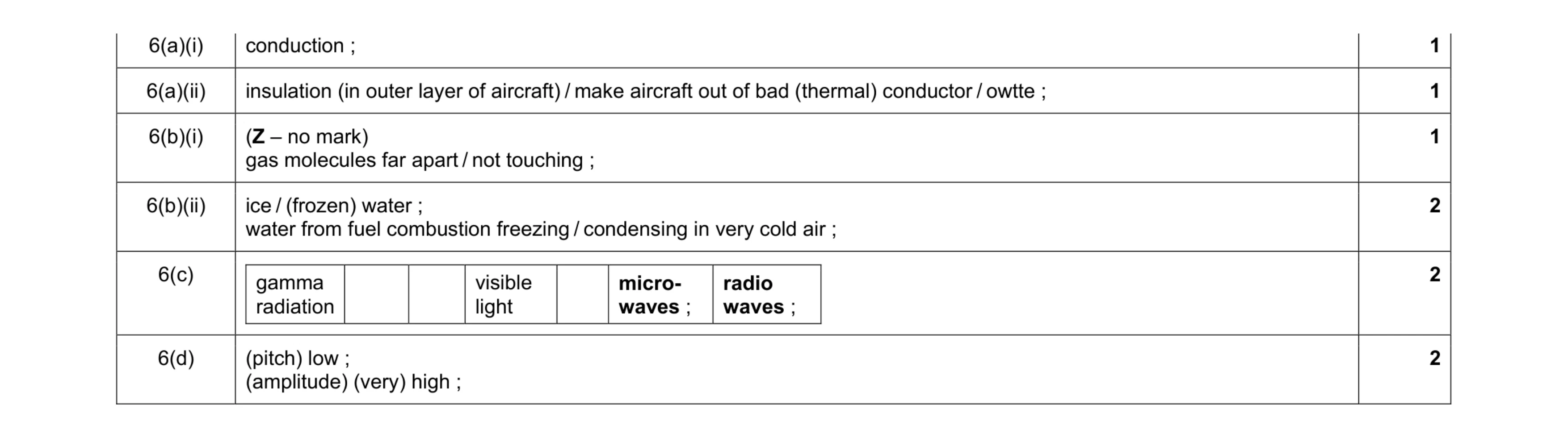 9
9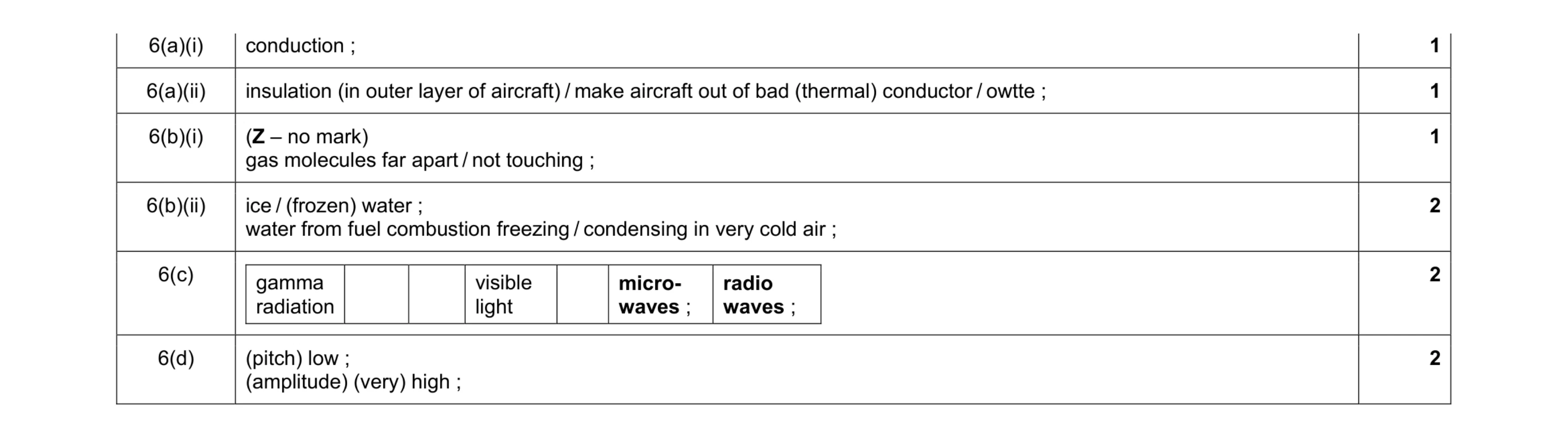 9
9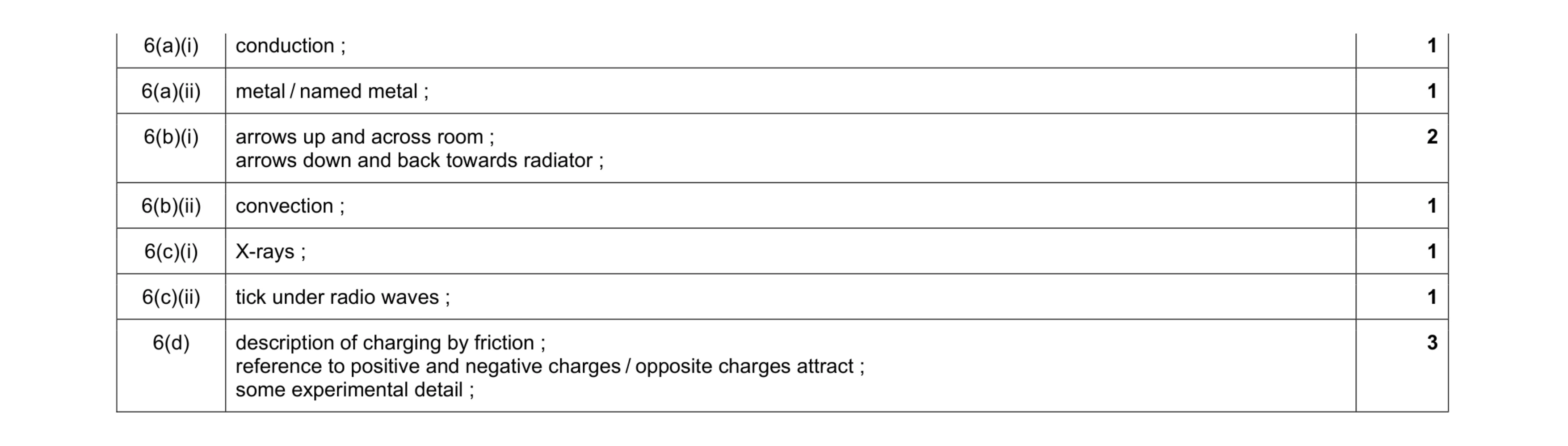 10
10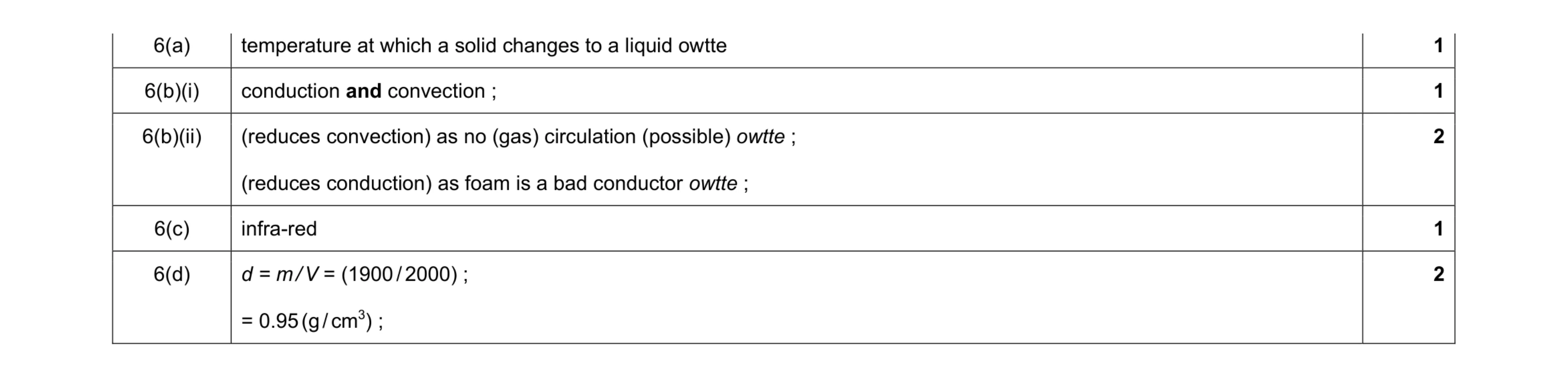 7
7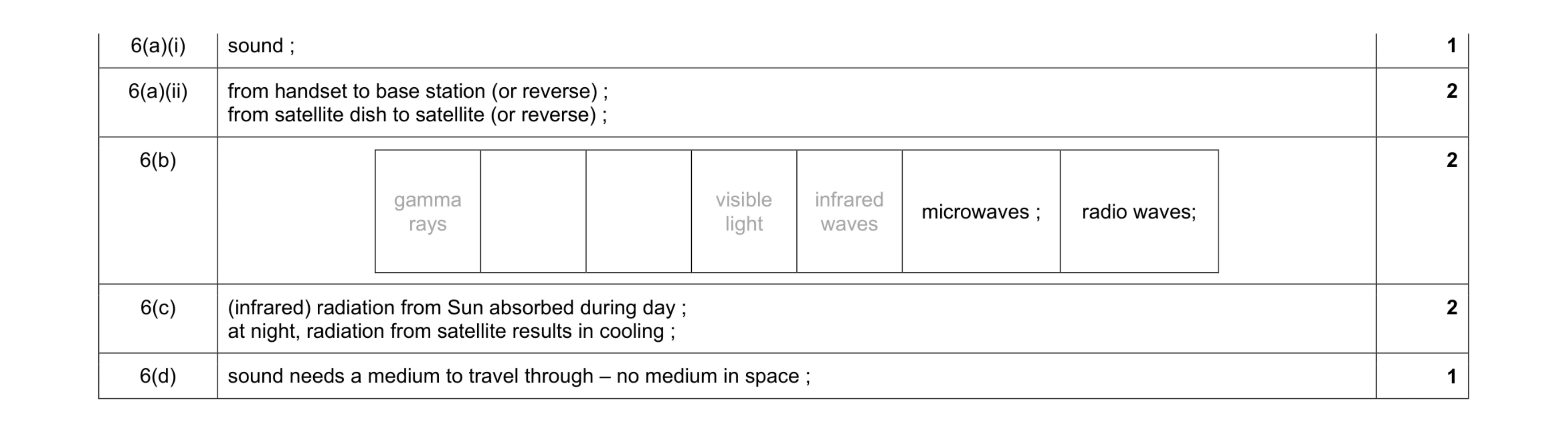 8
8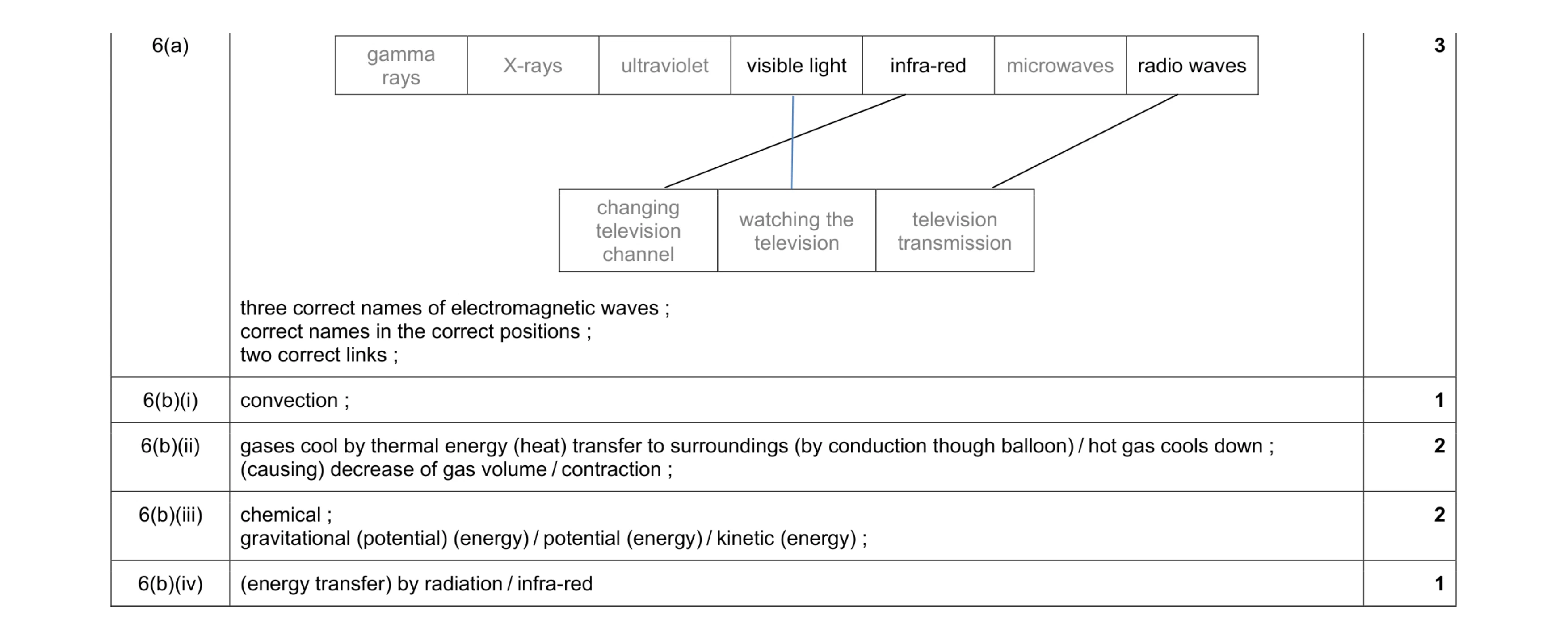 9
9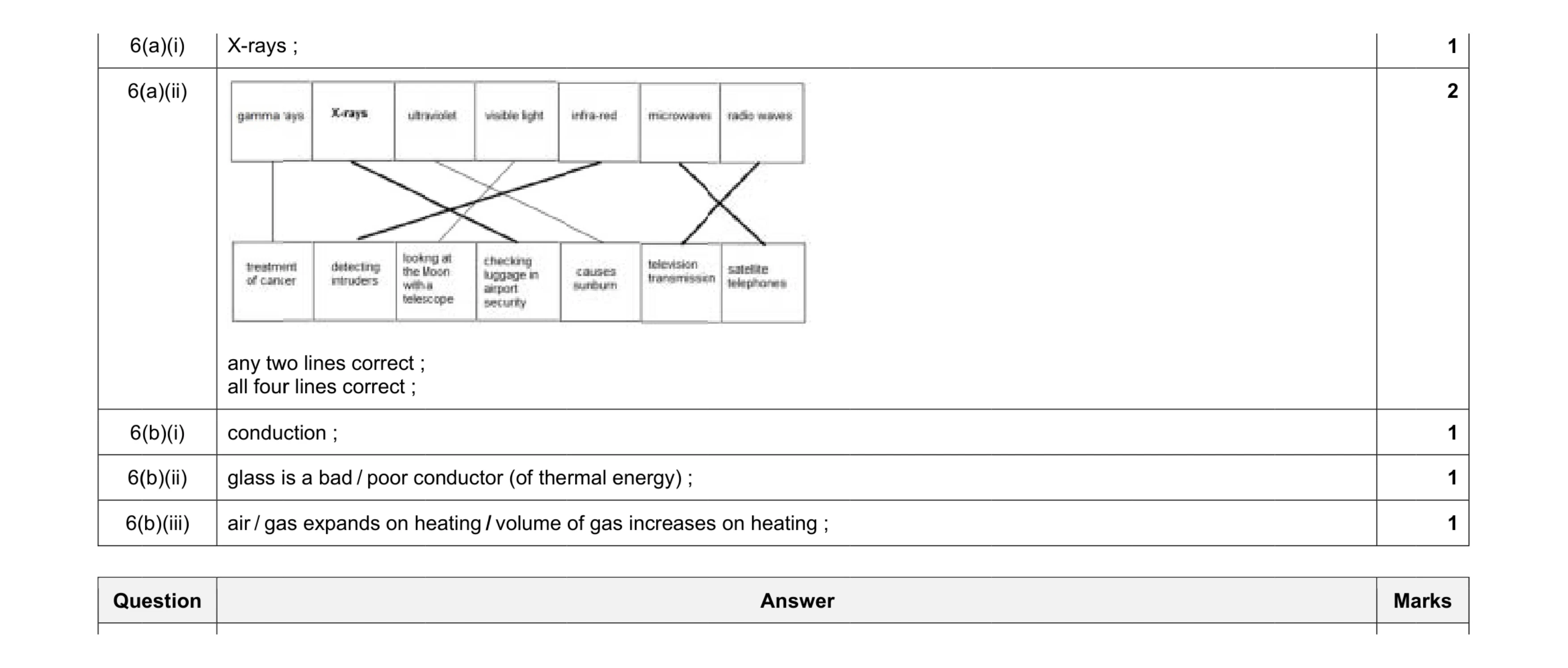 6
6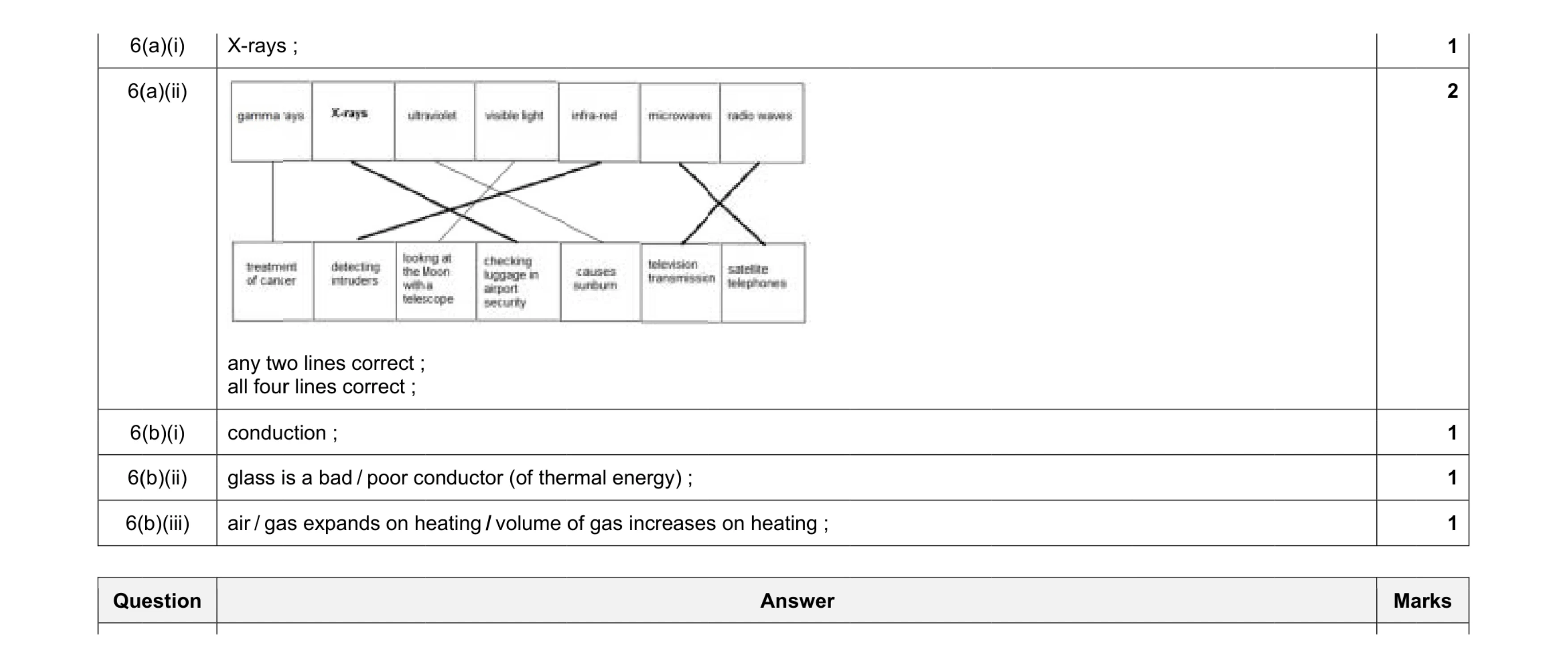 6
6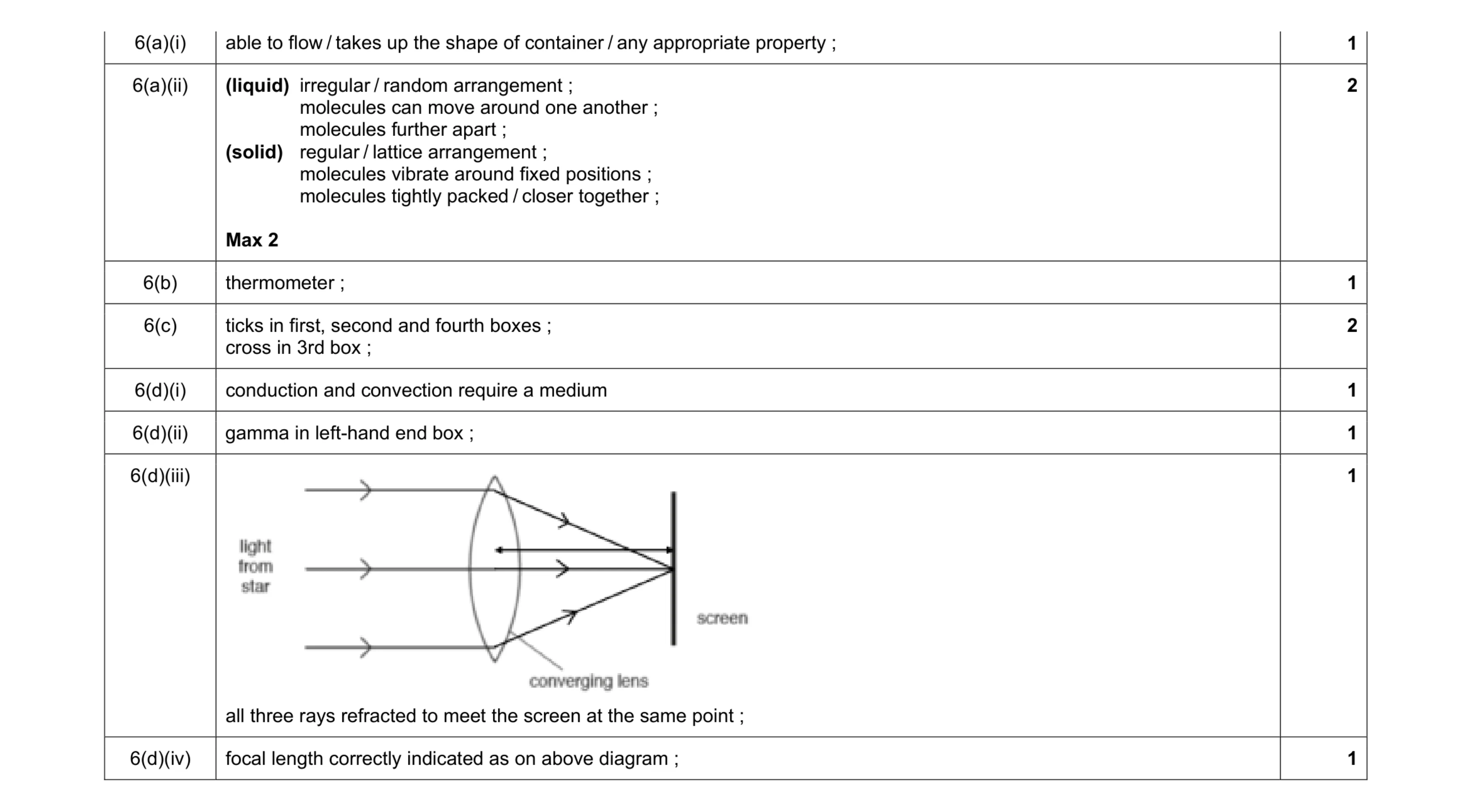 10
10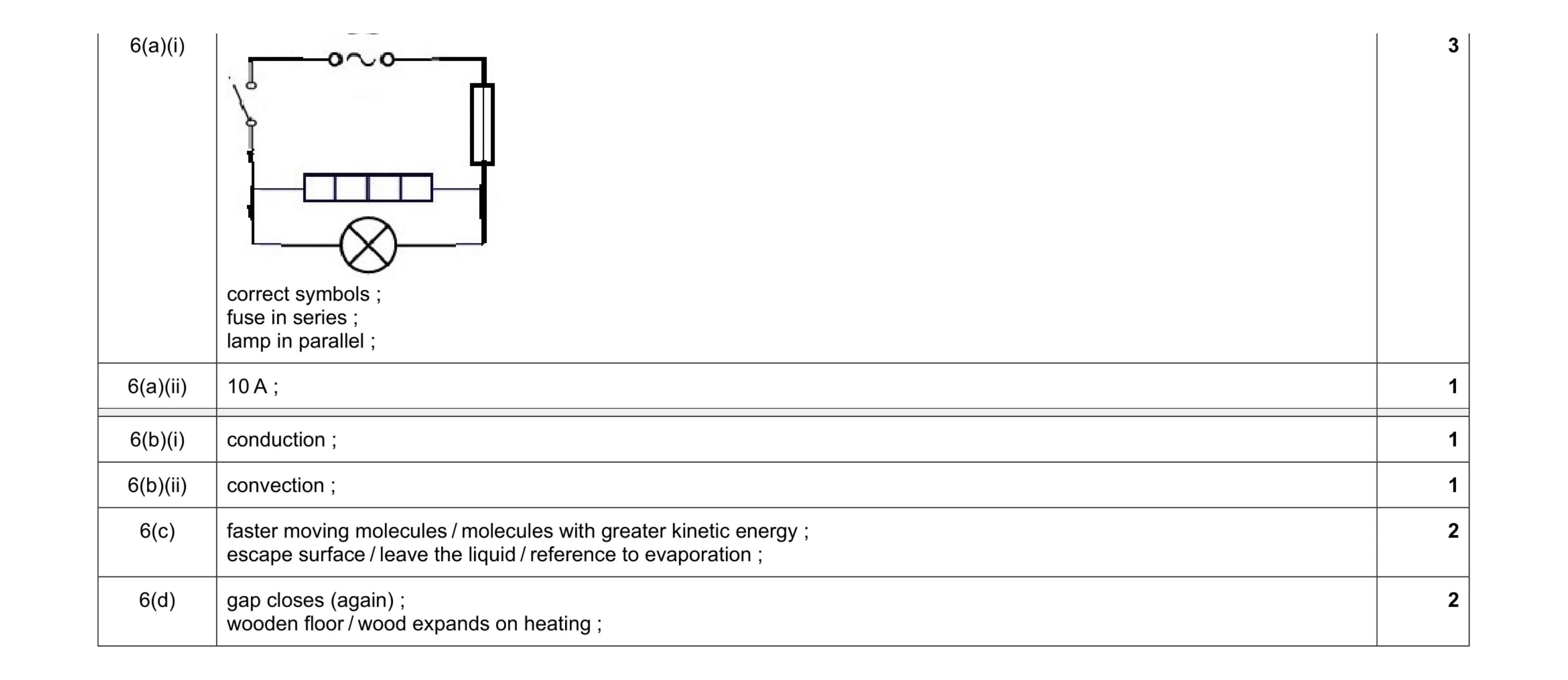 10
10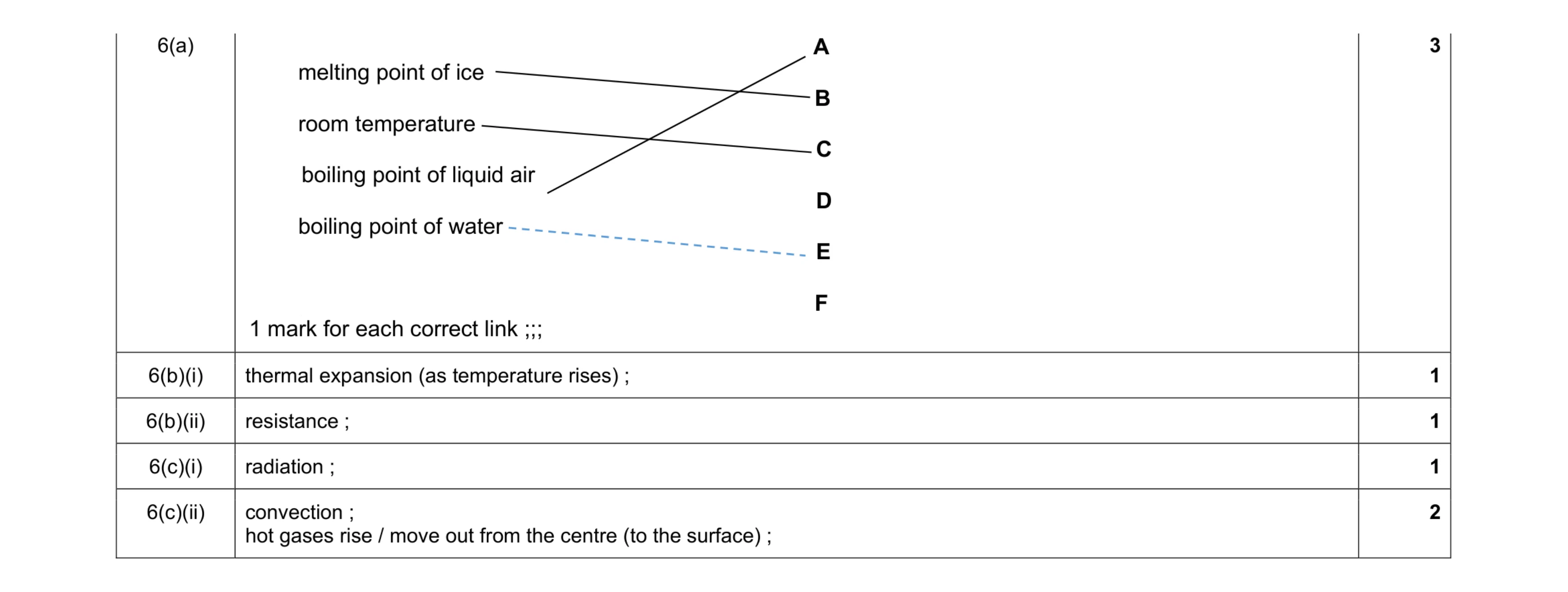 8
8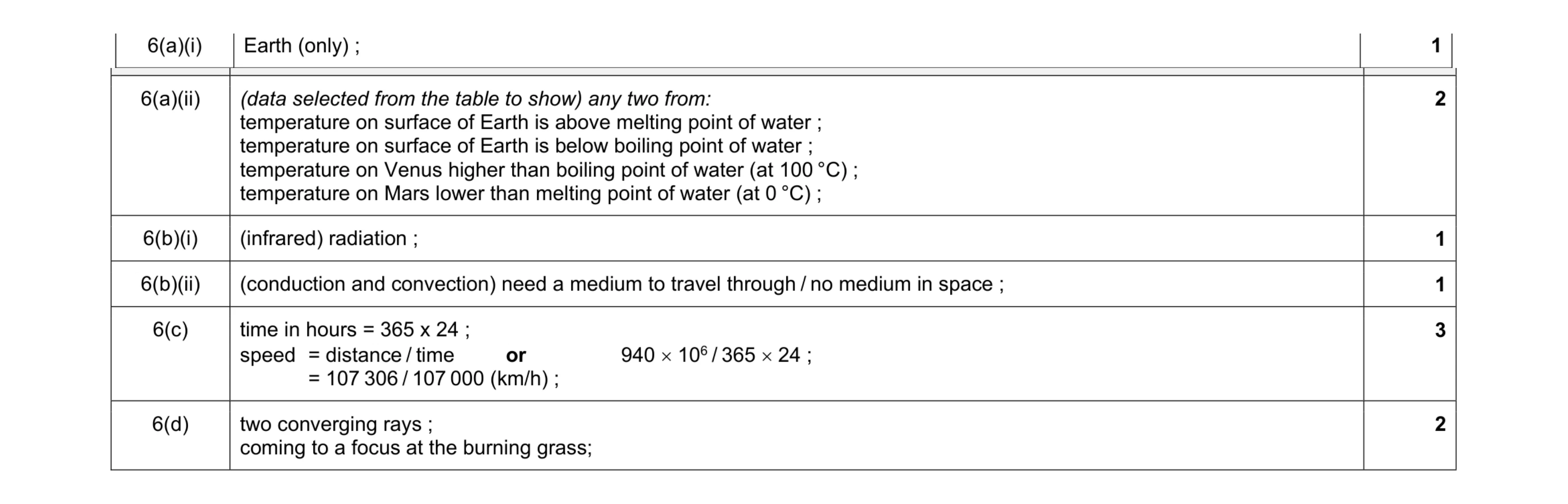 10
10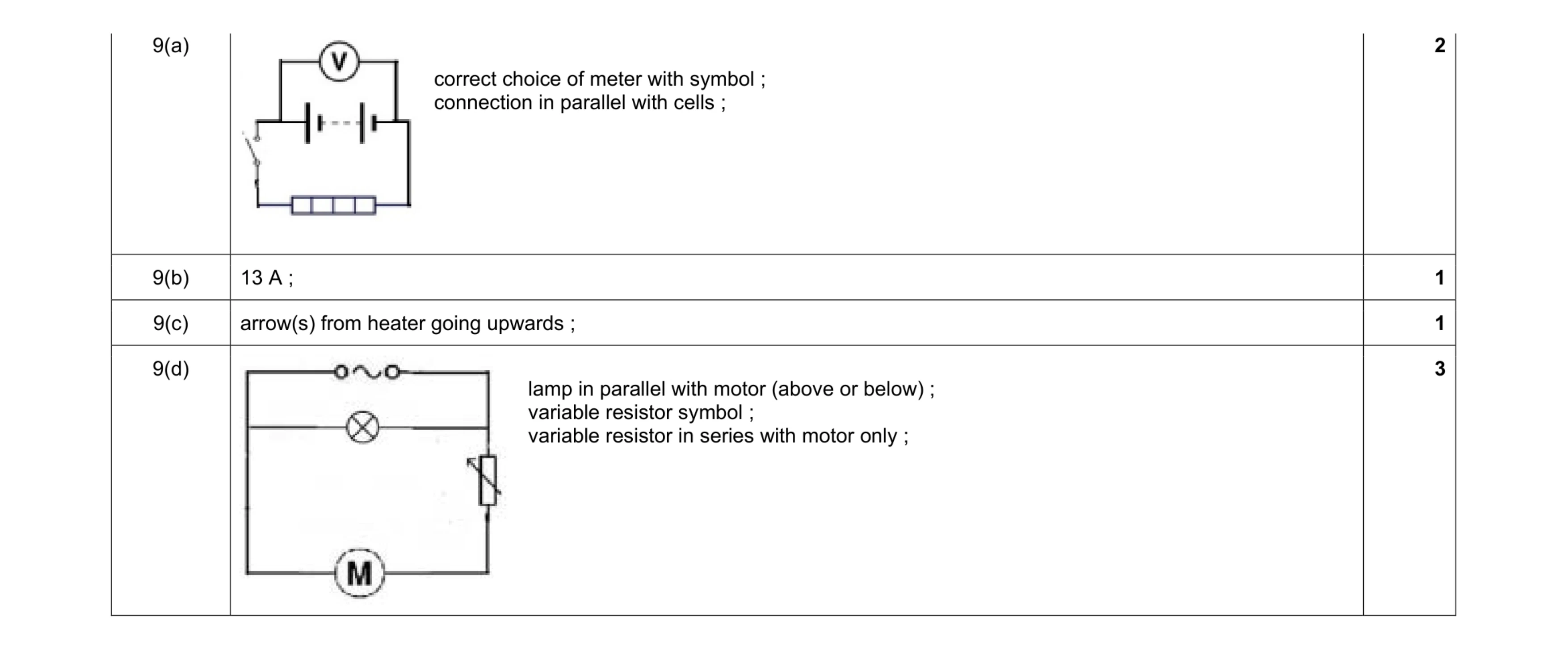 7
7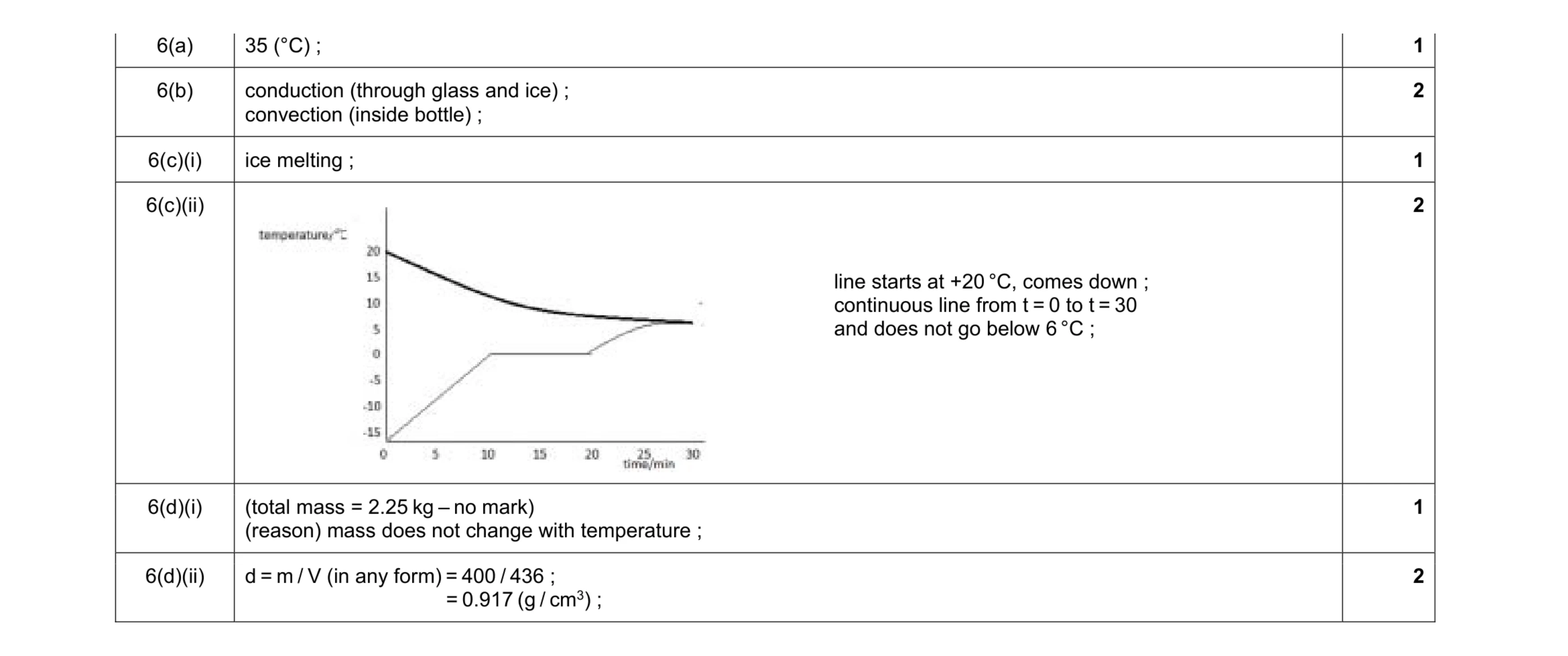 9
9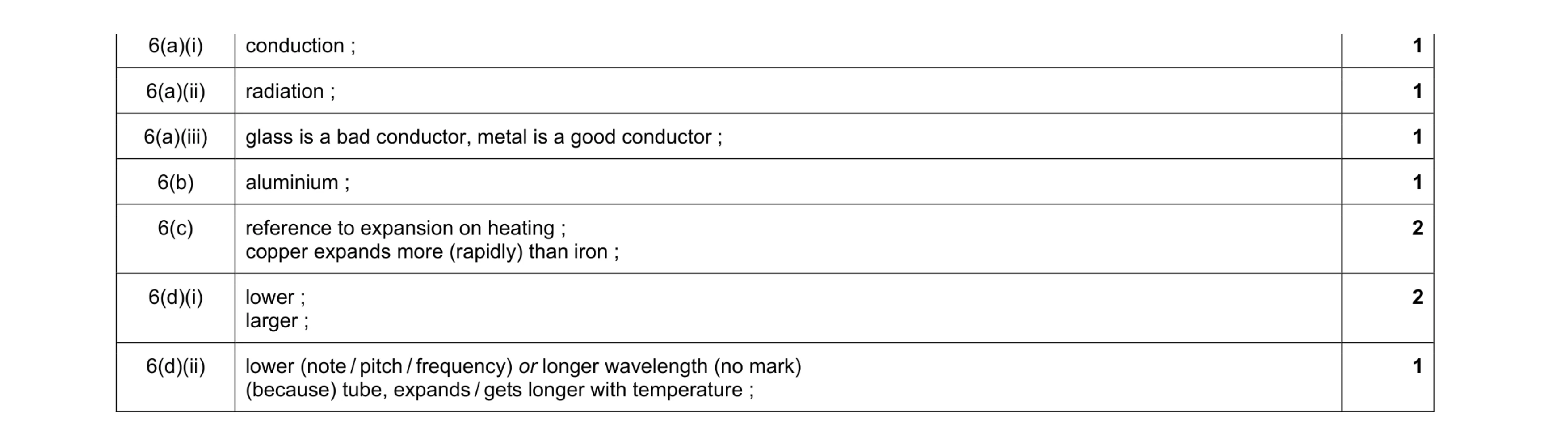 9
9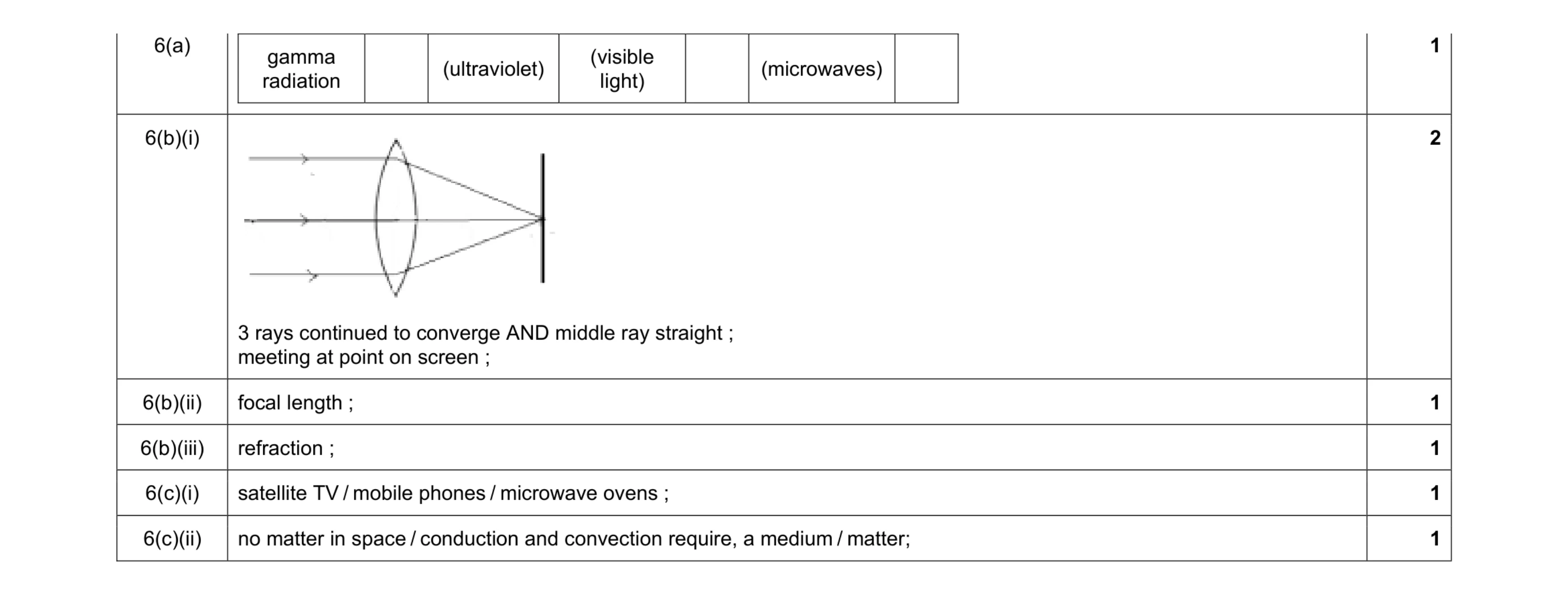 7
7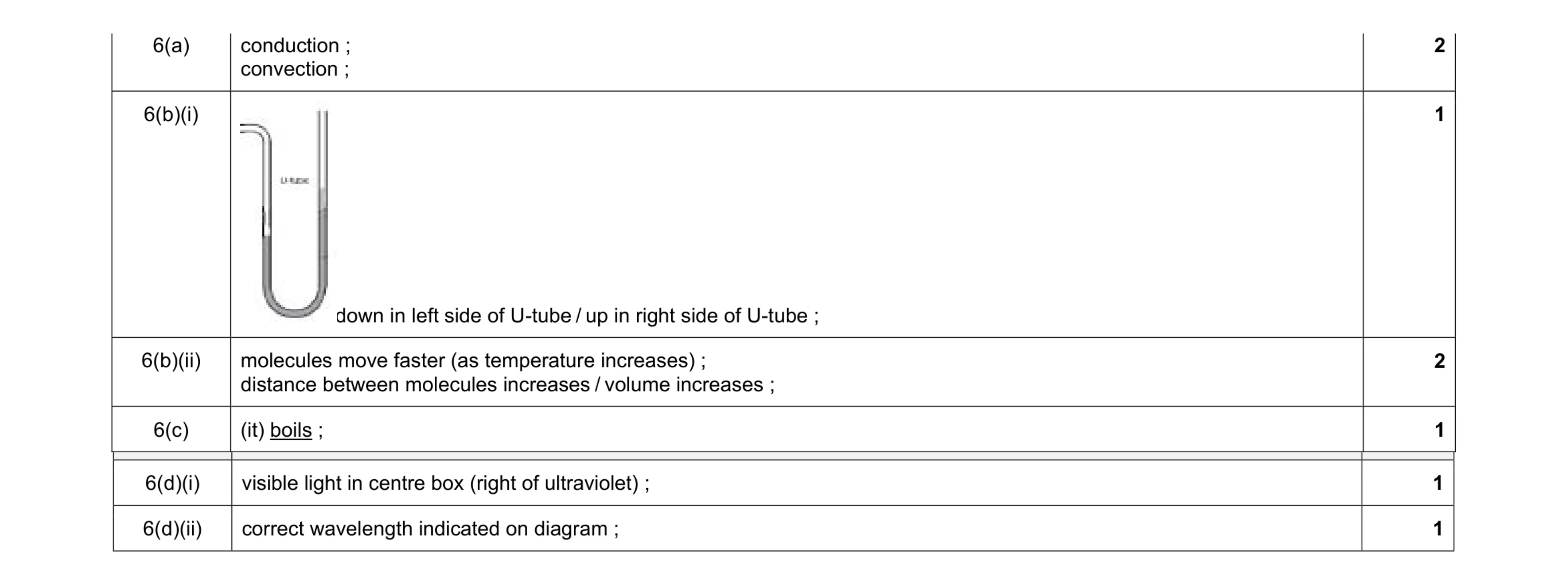 8
8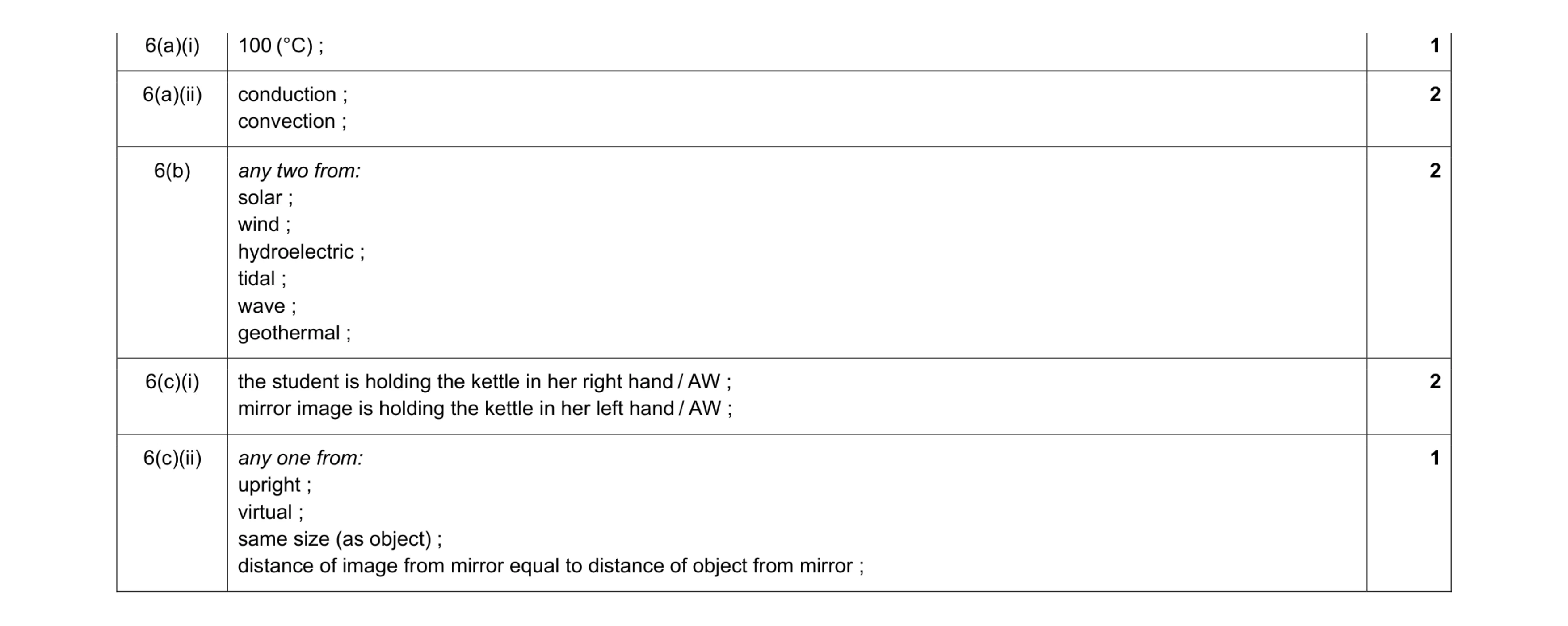 8
8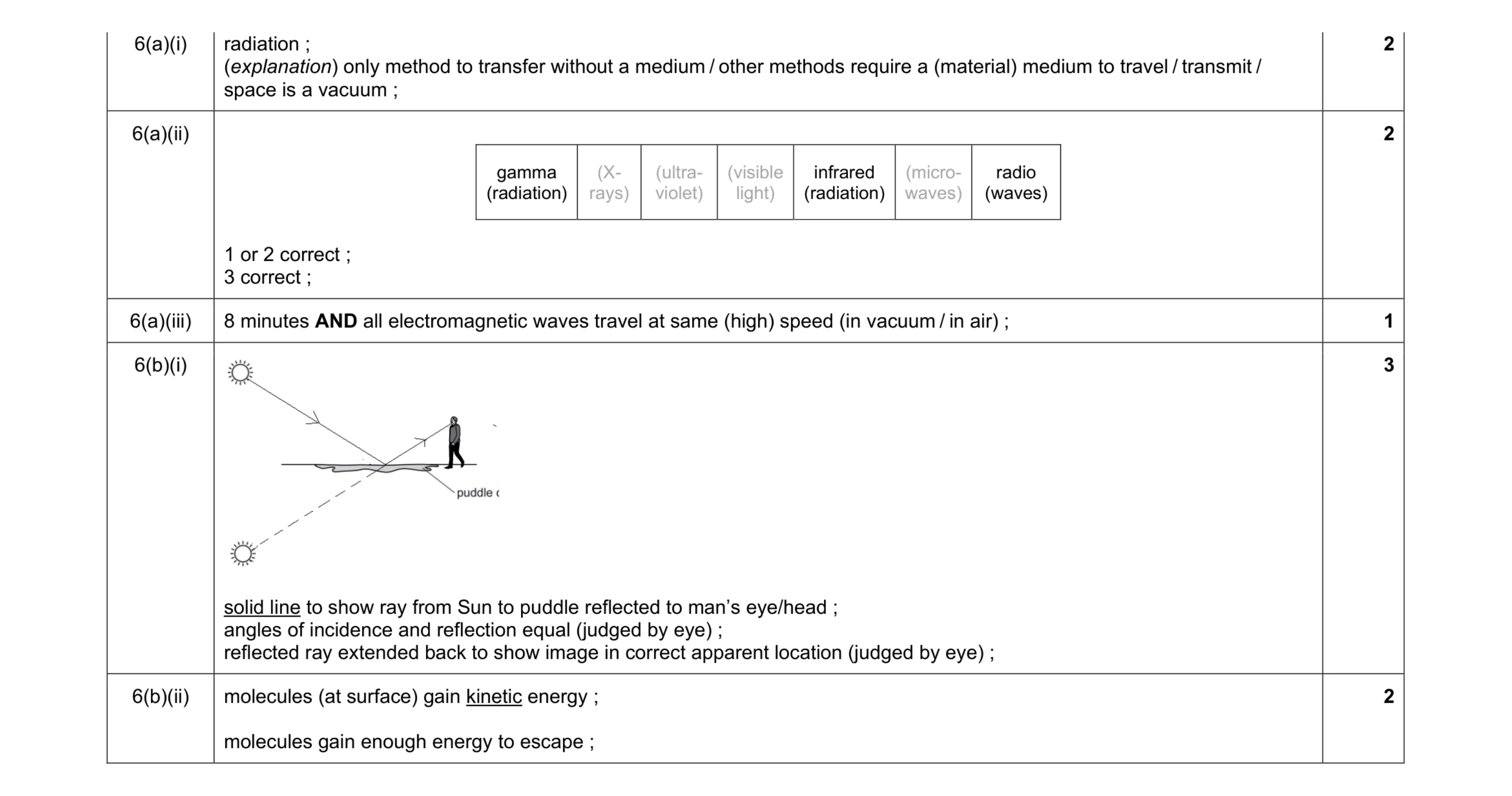 10
10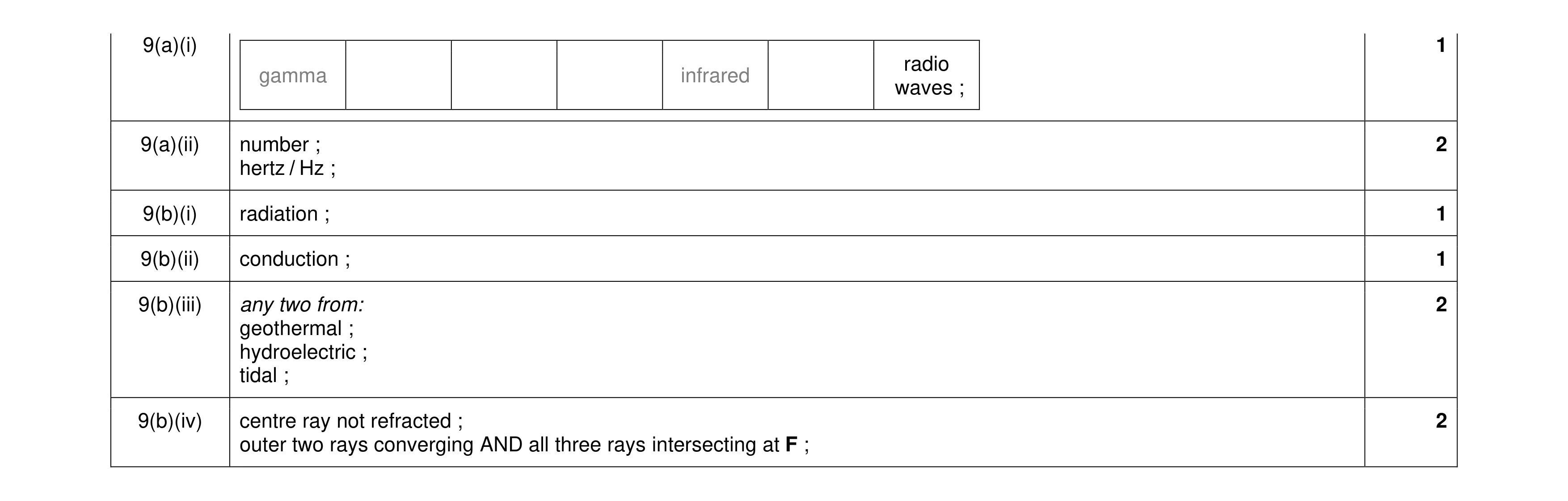 9
9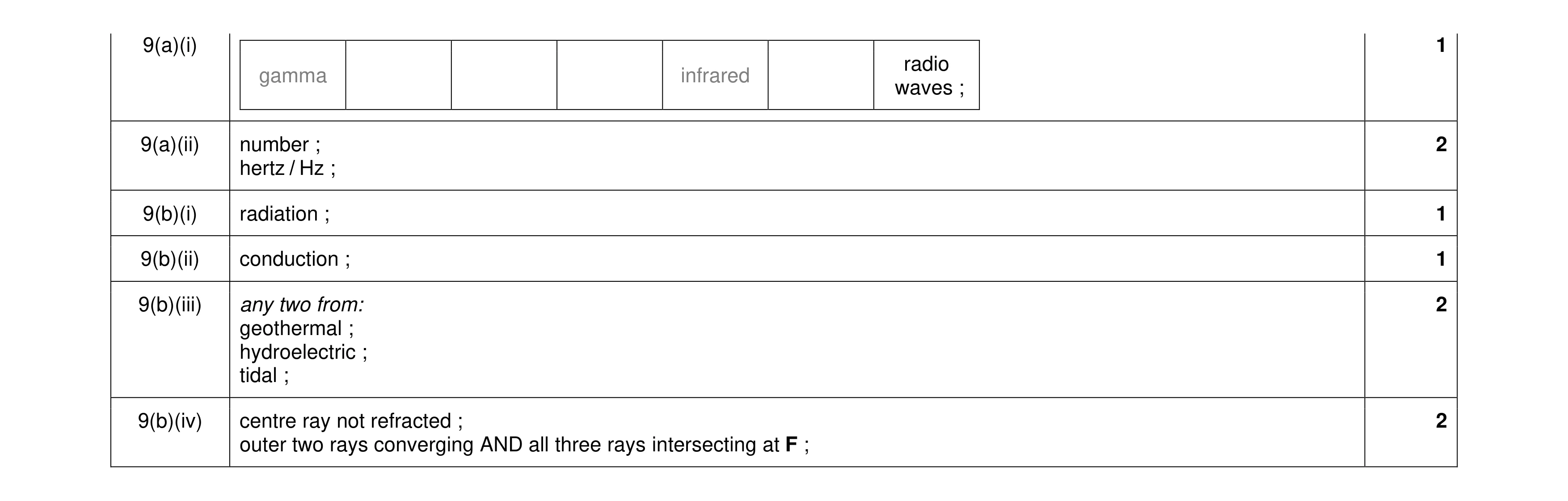 9
9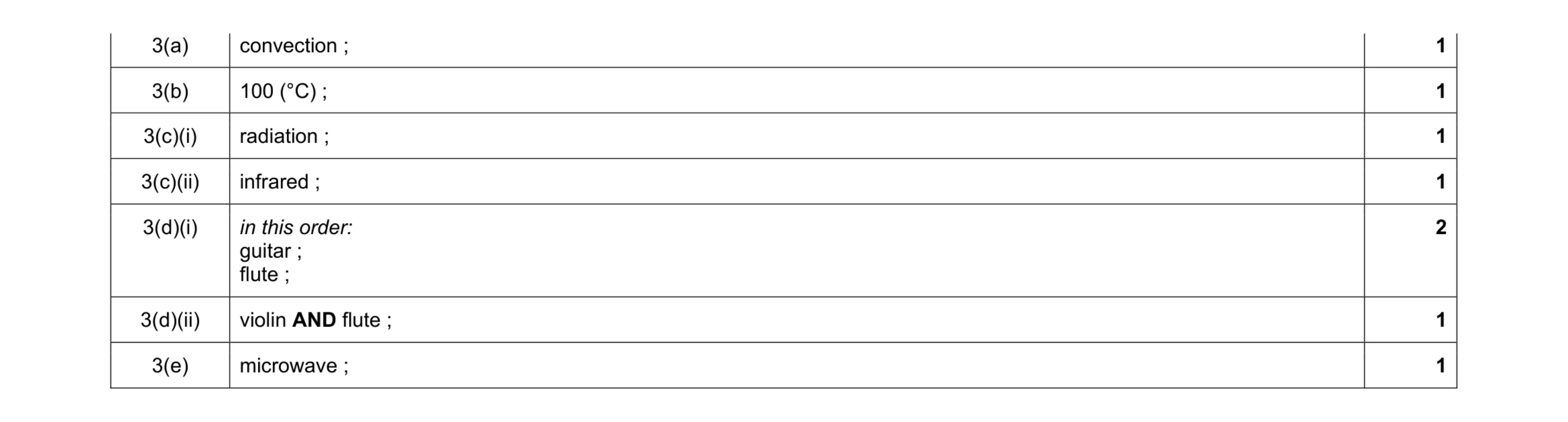 8
8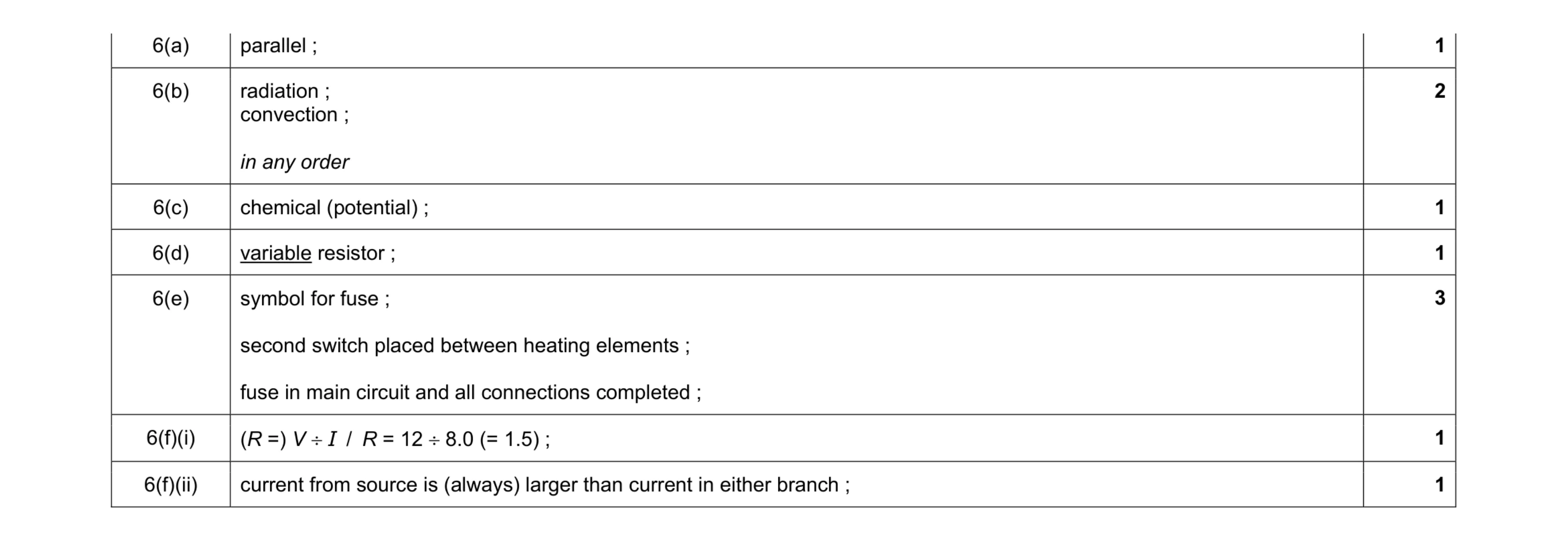 10
10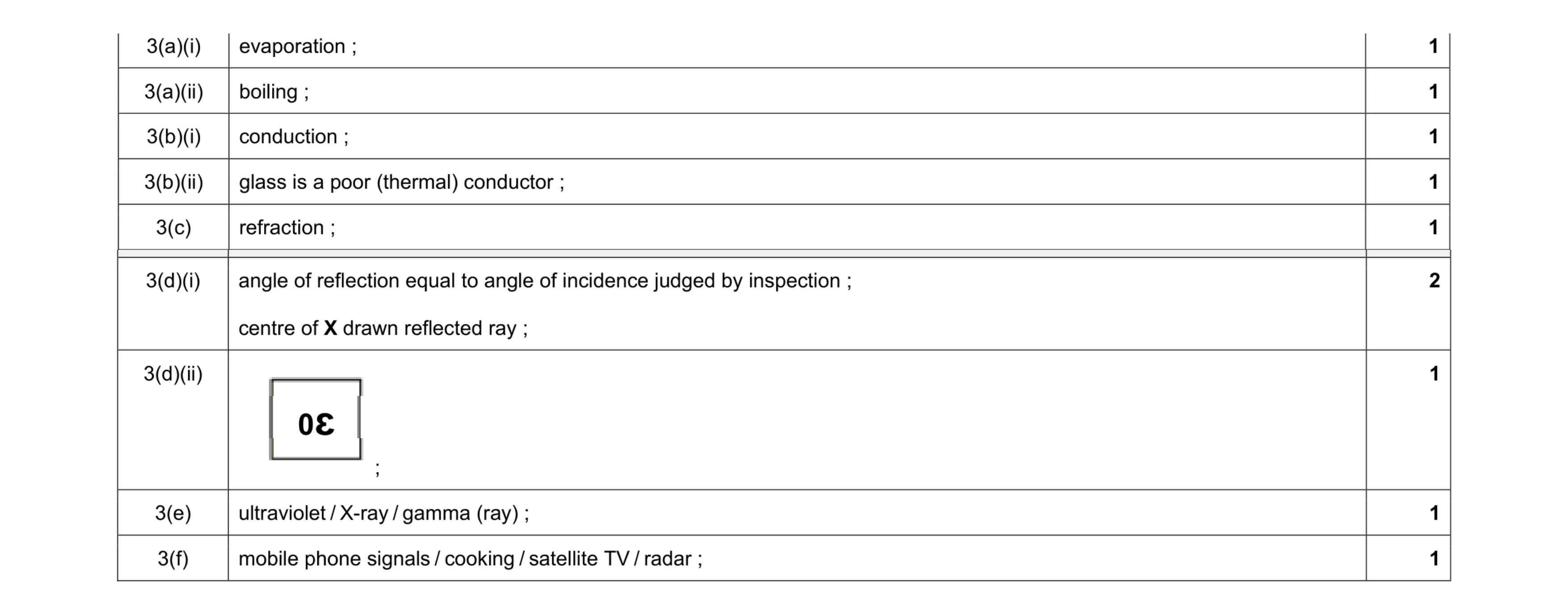 10
10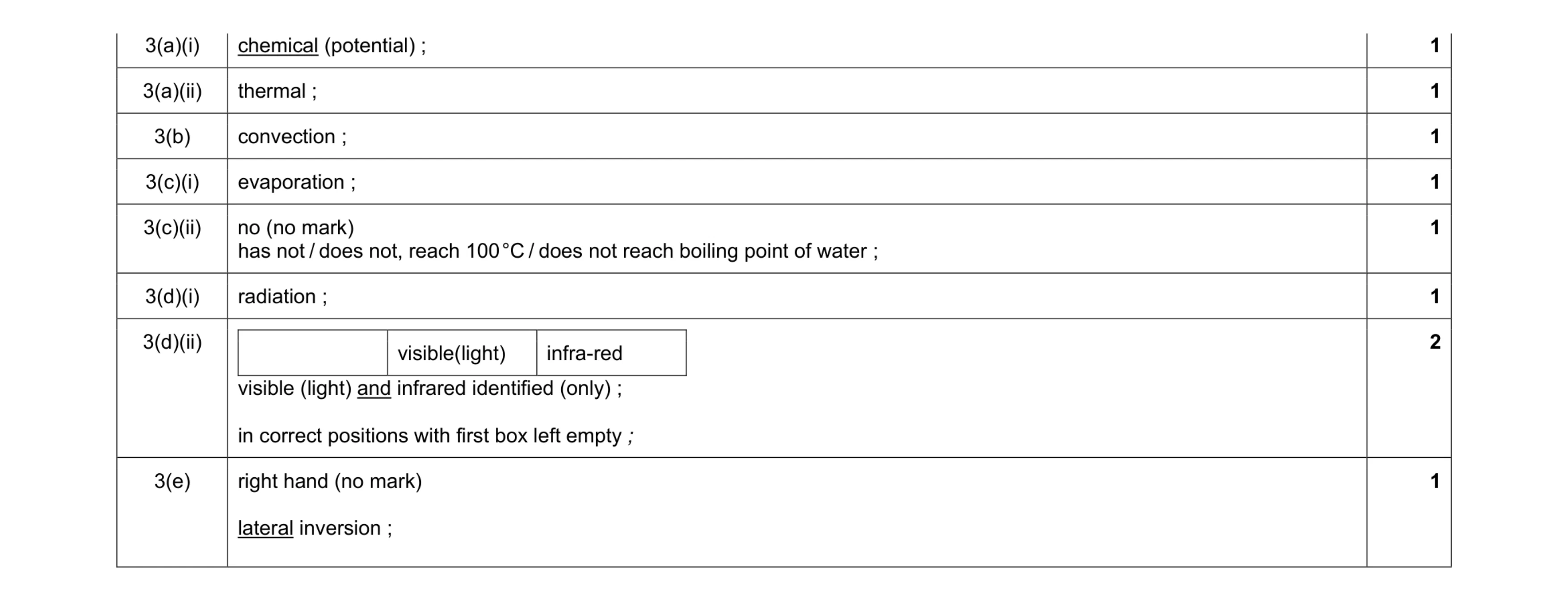 9
9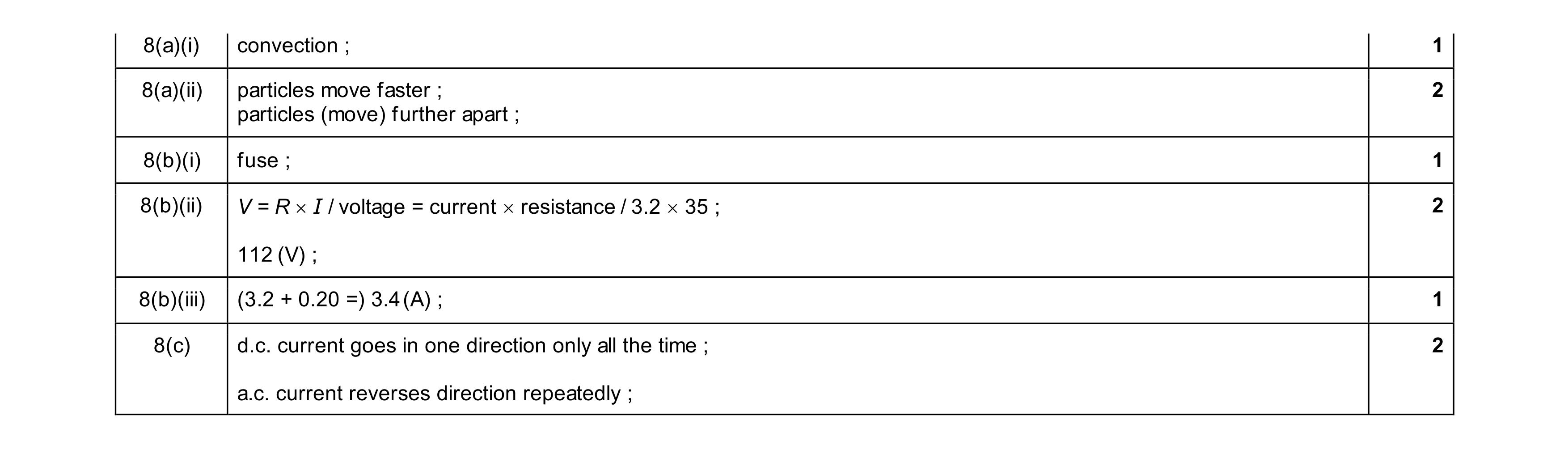 9
9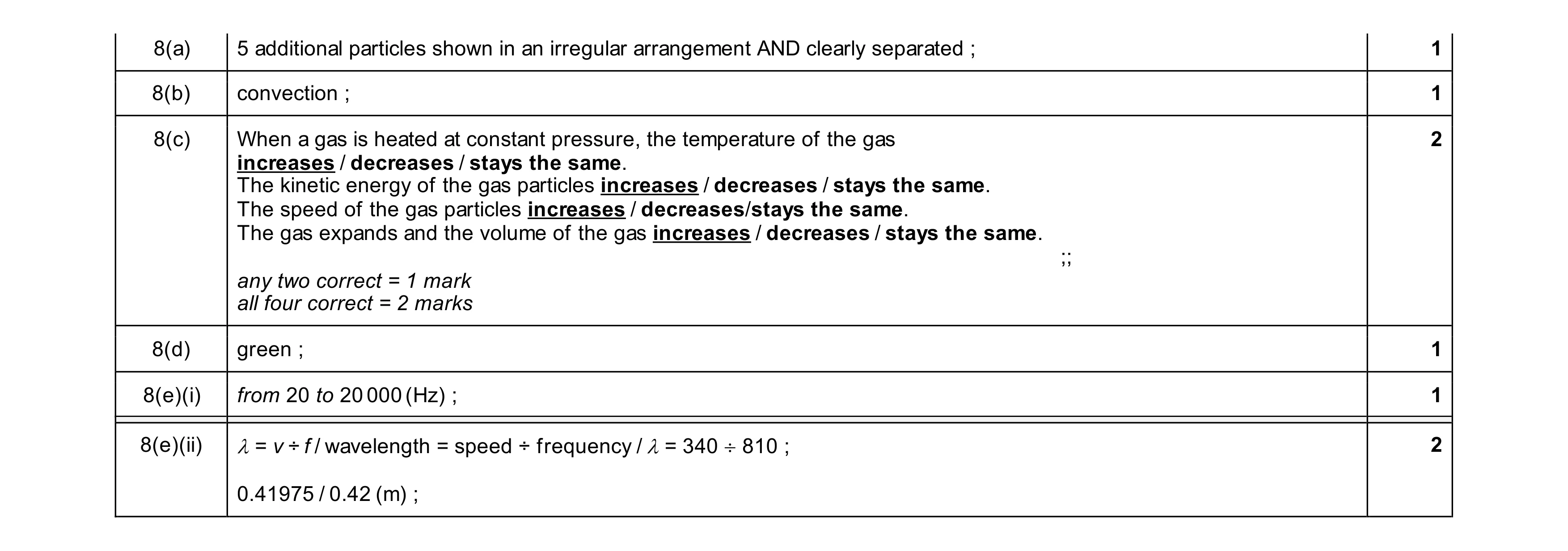 8
8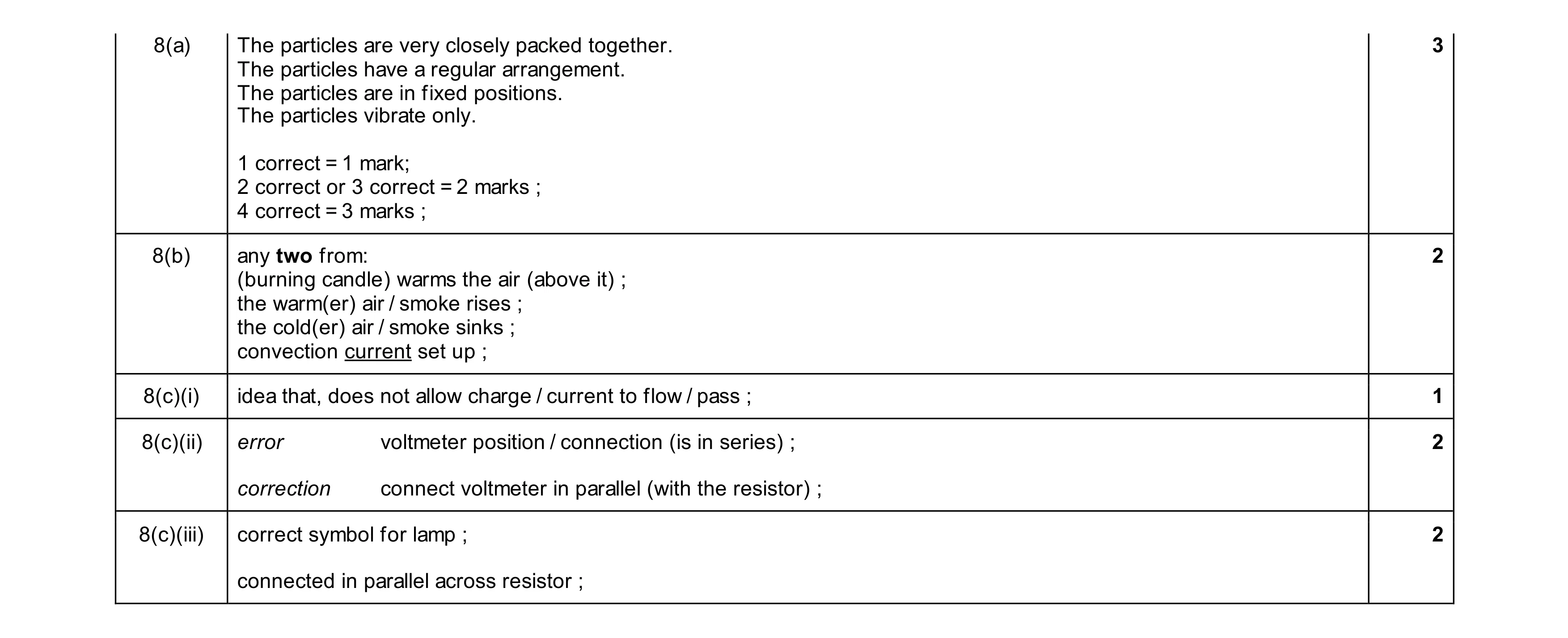 10
10