Cambridge IGCSE Physics 0625 — 2020 Oct/Nov Paper 4 · Variant 3
0625/43/O/N/20 · 11 questions · 80 marks · ≈90 min
The question paper and its mark scheme, free to read here and free to download. This is Cambridge’s own paper, exactly as it was sat.
Question paper20 pages


Mark scheme16 pages
Answers below. Sit the paper first if you are practising.
Questions as text
Q1 · A trolley travelling down a ramp
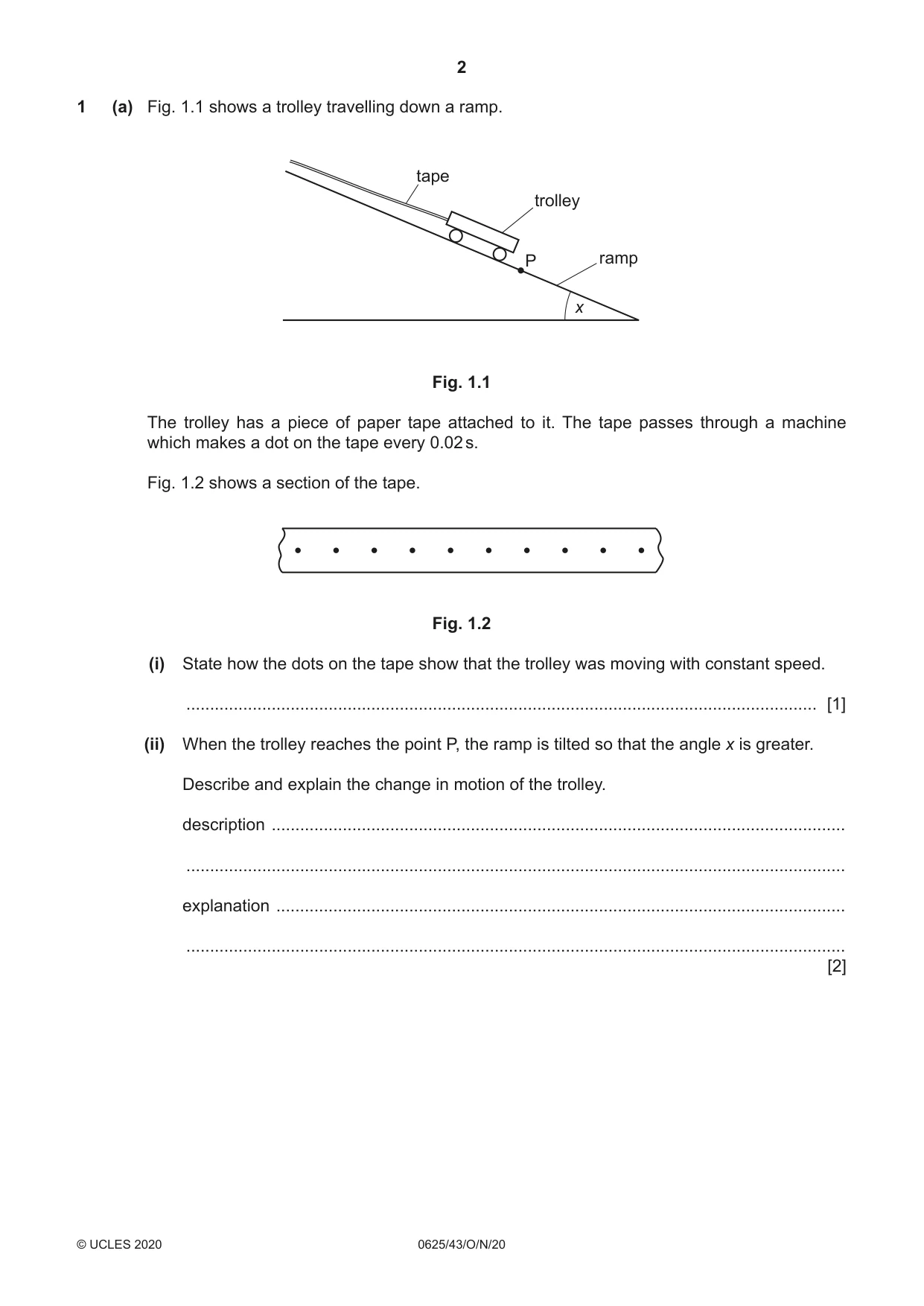
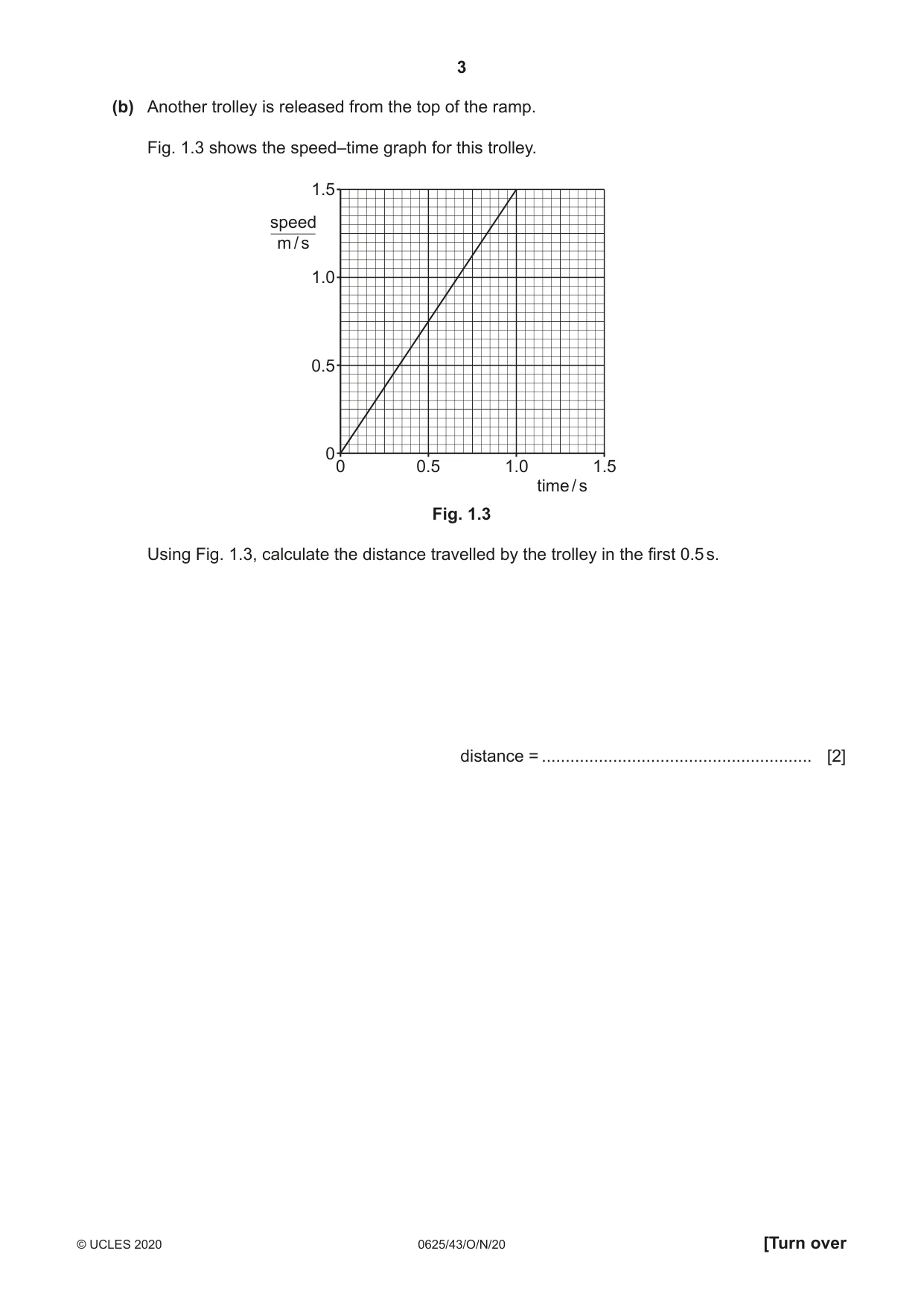
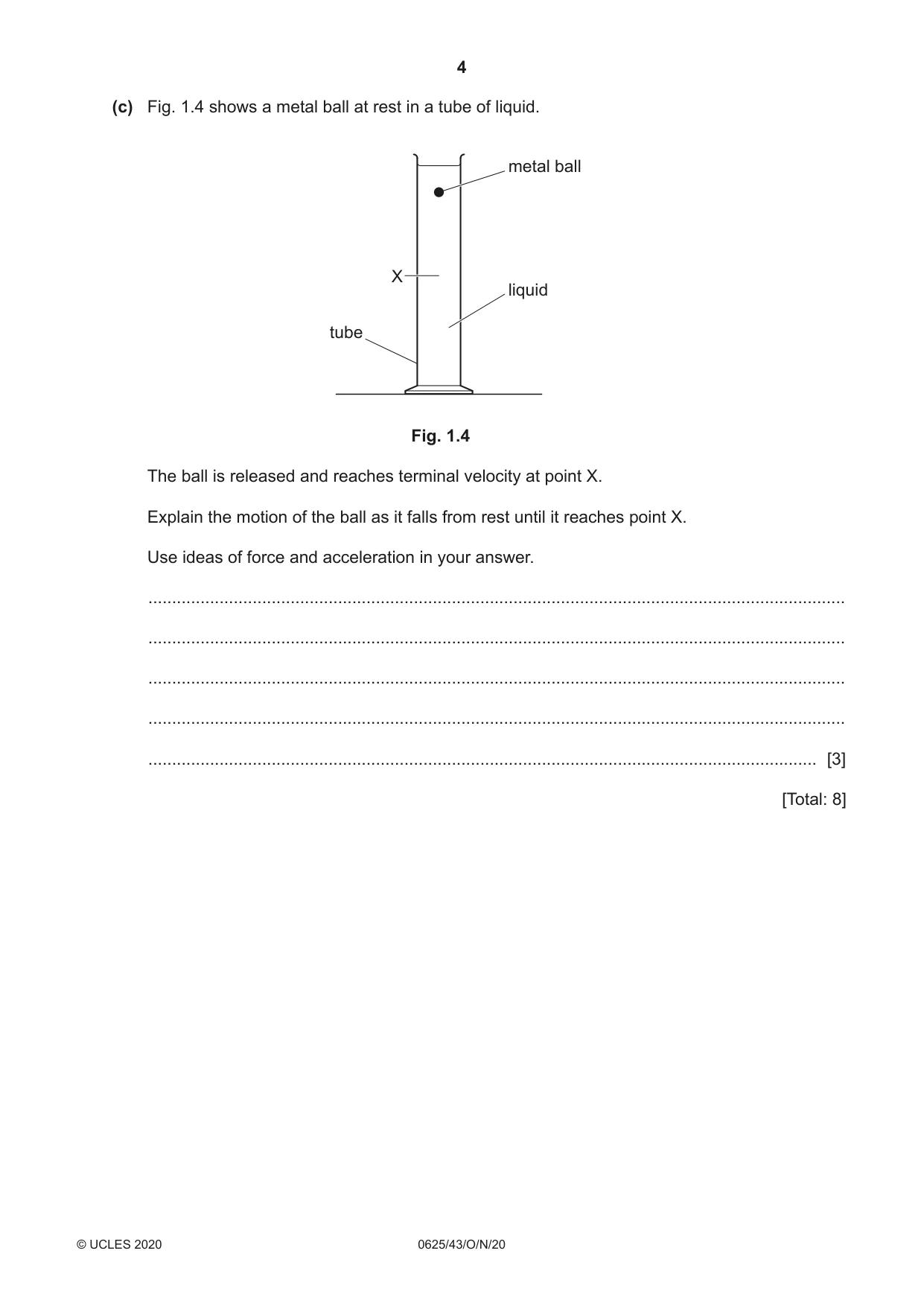
1 (a) Fig. 1.1 shows a trolley travelling down a ramp. tape trolley P ramp x Fig. 1.1 The trolley has a piece of paper tape attached to it. The tape passes through a machine which makes a dot on the tape every 0.02 s. Fig. 1.2 shows a section of the tape. Fig. 1.2 (i) State how the dots on the tape show that the trolley was moving with constant speed. ..................................................................................................................................... [1] (ii) When the trolley reaches the point P, the ramp is tilted so that the angle x is greater. Describe and explain the change in motion of the trolley. description ......................................................................................................................... ........................................................................................................................................... explanation ........................................................................................................................ ........................................................................................................................................... [2] (b) Another trolley is released from the top of the ramp. Fig. 1.3 shows the speed–time graph for this trolley. 1.5 speed m / s 1.0 0.5 0 0 0.5 1.0 1.5 time / s Fig. 1.3 Using Fig. 1.3, calculate the distance travelled by the trolley in the first 0.5 s. distance = ......................................................... [2] (c) Fig. 1.4 shows a metal ball at rest in a tube of liquid. metal ball X liquid tube Fig. 1.4 The ball is released and reaches terminal velocity at point X. Explain the motion of the ball as it falls from rest until it reaches point X. Use ideas of force and acceleration in your answer. ................................................................................................................................................... ................................................................................................................................................... ................................................................................................................................................... ................................................................................................................................................... ............................................................................................................................................. [3] [Total: 8]
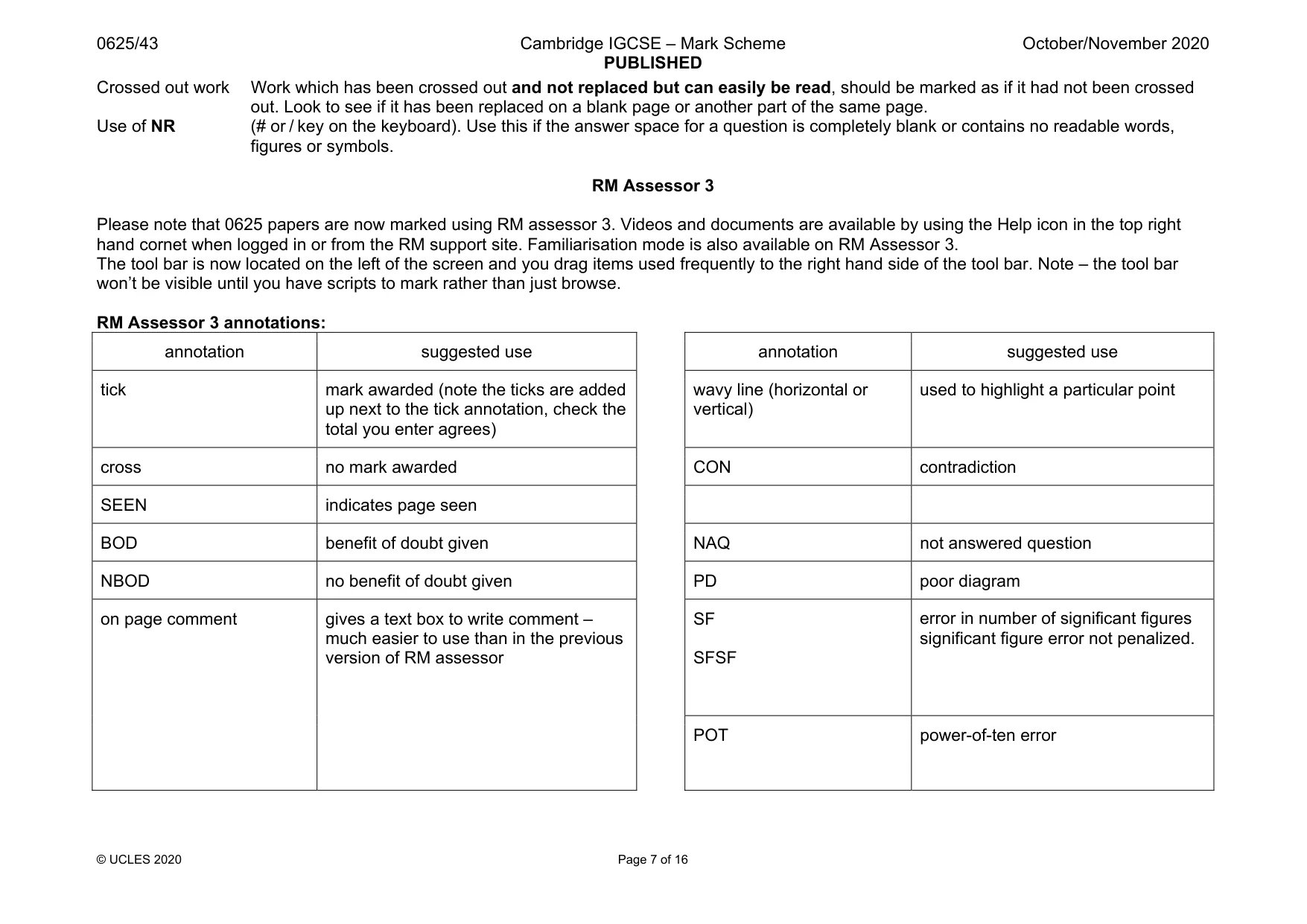
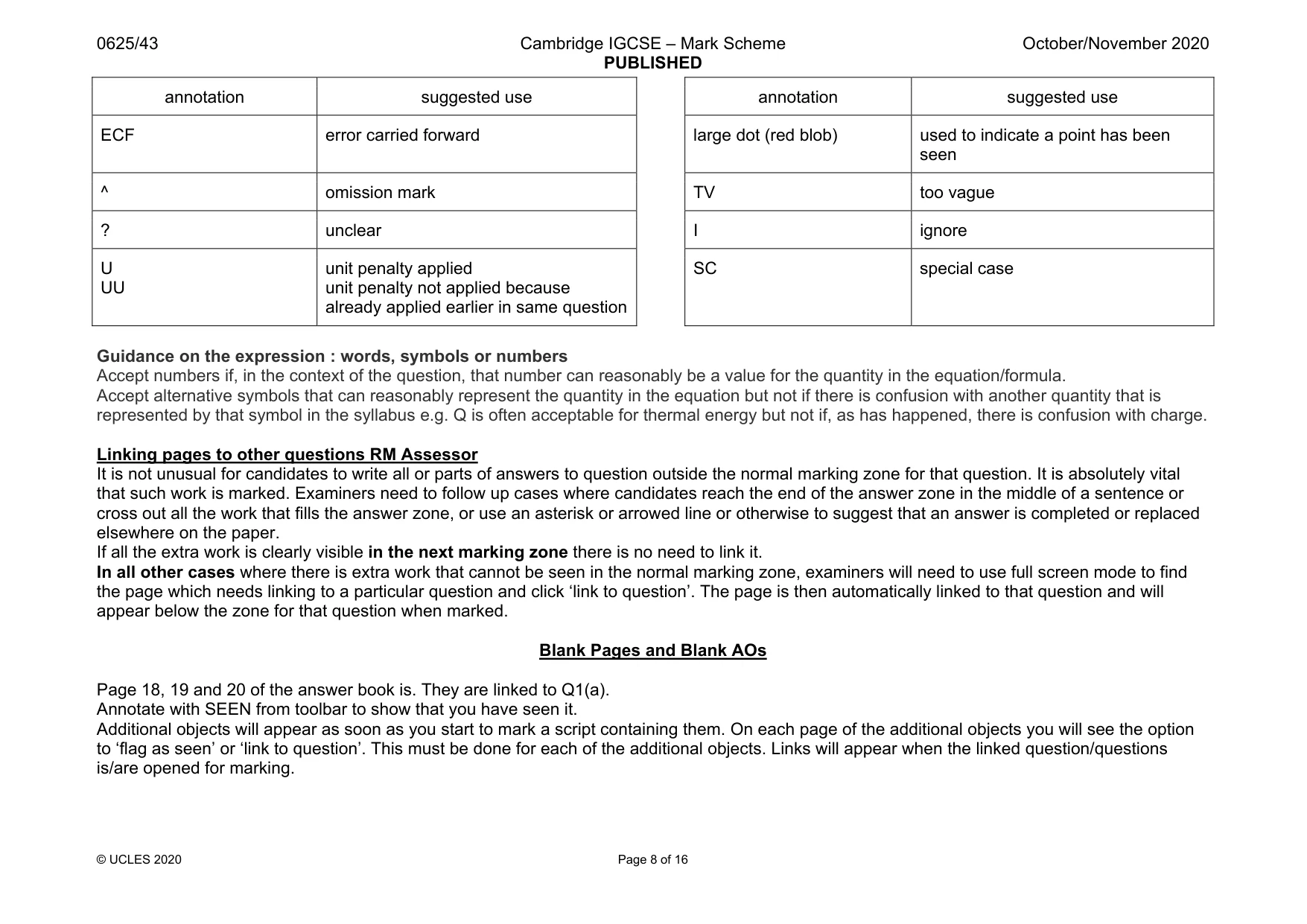
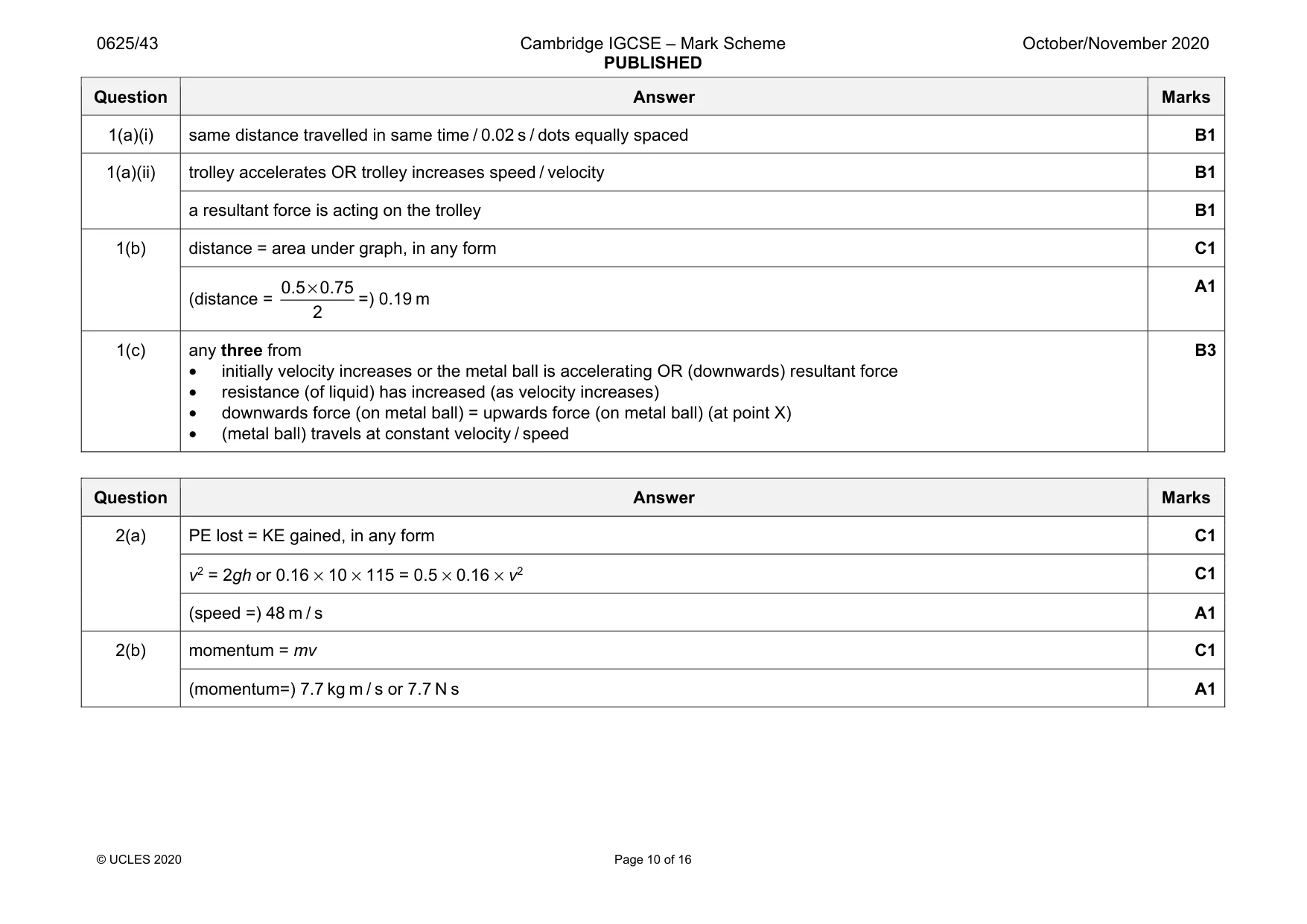
Mark scheme: 1(a)(i) same distance travelled in same time / 0.02 s / dots equally spaced B1 1(a)(ii) trolley accelerates OR trolley increases speed / velocity B1 a resultant force is acting on the trolley B1 1(b) distance = area under graph, in any form C1 (distance = 0.5 0.75 2 × =) 0.19 m A1 1(c) any three from • initially velocity increases or the metal ball is accelerating OR (downwards) resultant force • resistance (of liquid) has increased (as velocity increases) • downwards force (on metal ball) = upwards force (on metal ball) (at point X) • (metal ball) travels at constant velocity / speed B3
Q2 · A cliff edge with water below it
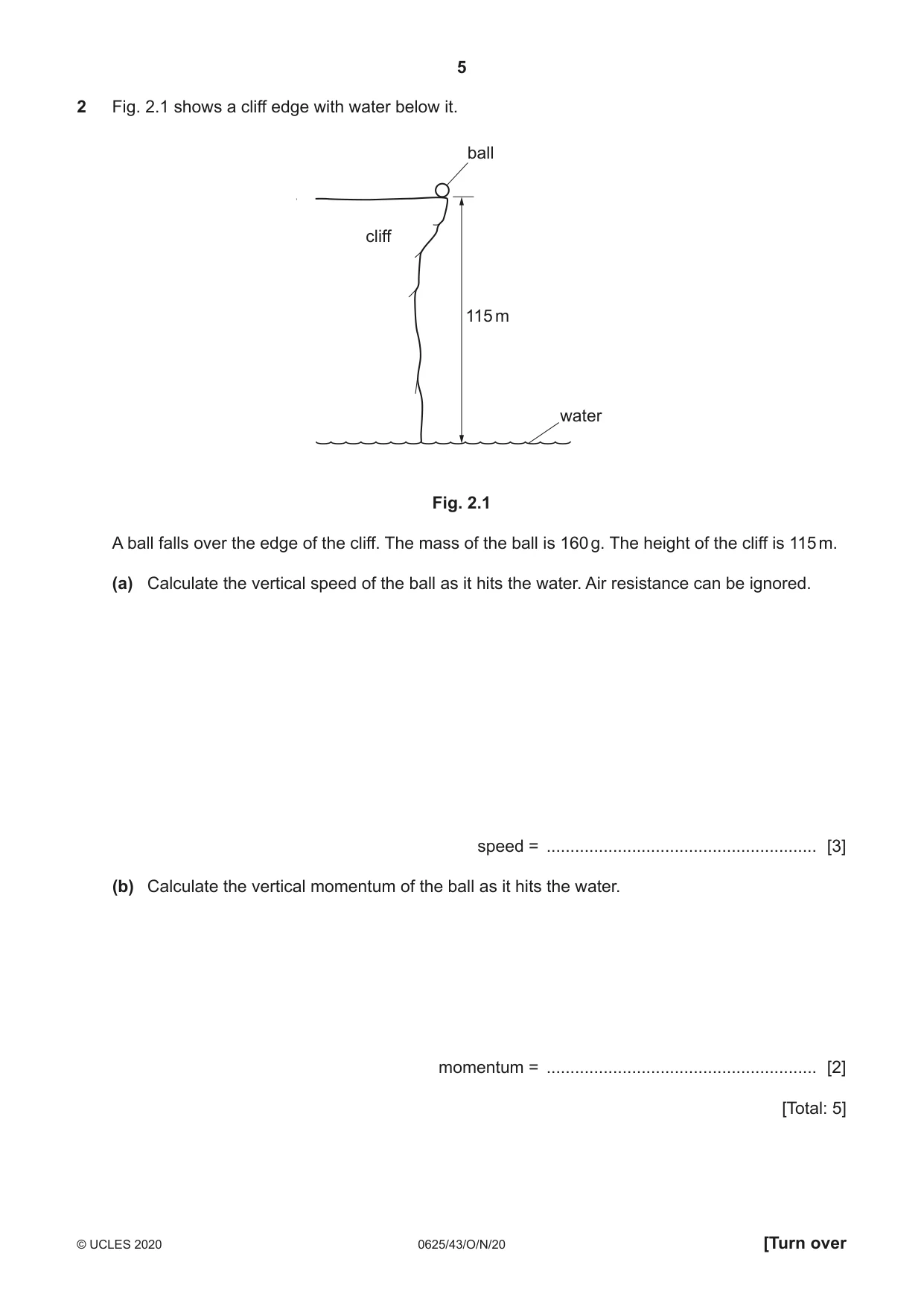
2 Fig. 2.1 shows a cliff edge with water below it. ball cliff 115 m water Fig. 2.1 A ball falls over the edge of the cliff. The mass of the ball is 160 g. The height of the cliff is 115 m. (a) Calculate the vertical speed of the ball as it hits the water. Air resistance can be ignored. speed = ......................................................... [3] (b) Calculate the vertical momentum of the ball as it hits the water. momentum = ......................................................... [2] [Total: 5]
Mark scheme: 2(a) PE lost = KE gained, in any form C1 v2 = 2gh or 0.16 × 10 × 115 = 0.5 × 0.16 × v2 C1 (speed =) 48 m / s A1 2(b) momentum = mv C1 (momentum=) 7.7 kg m / s or 7.7 N s A1
Q3 · Speed is a scalar quantity
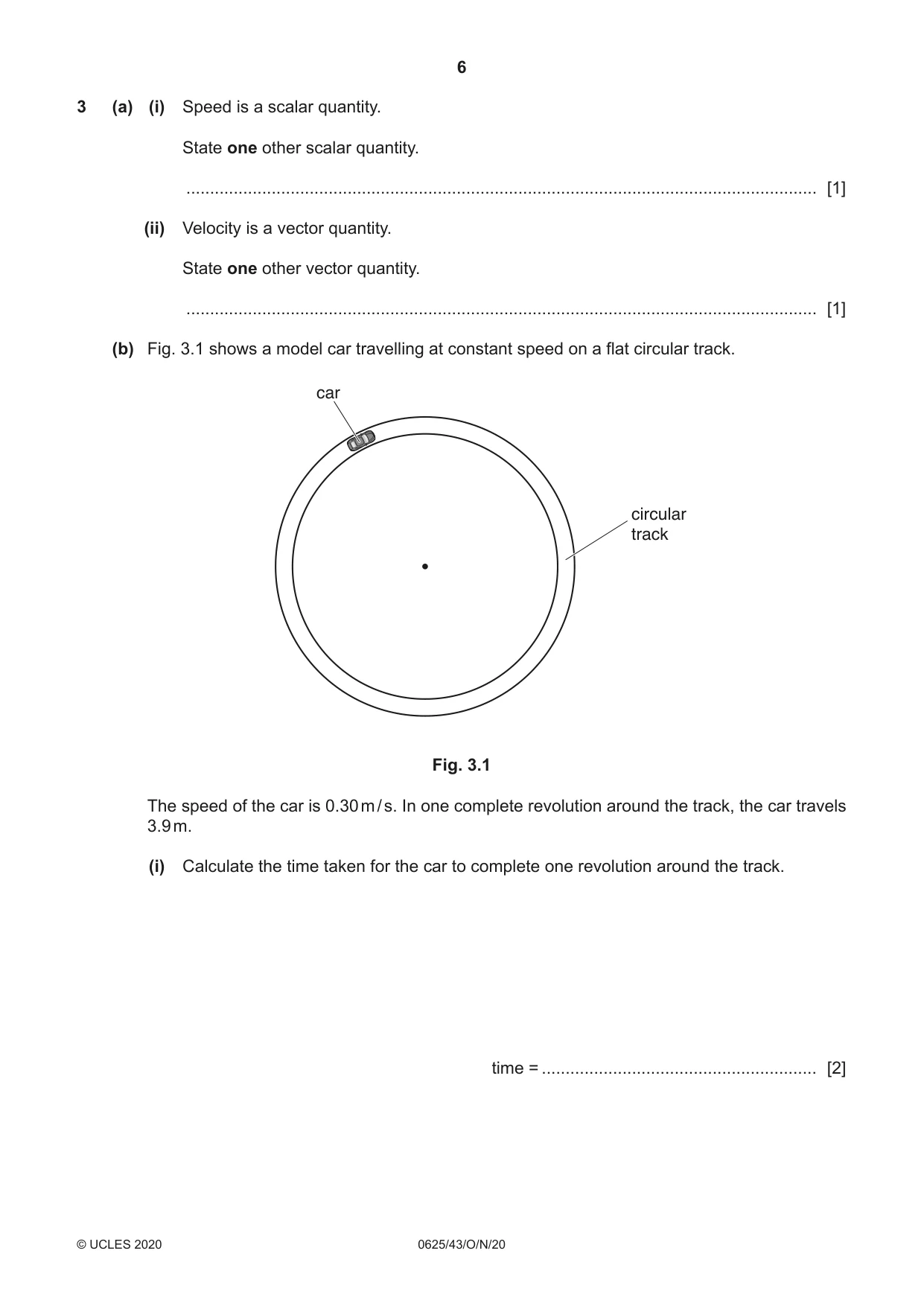
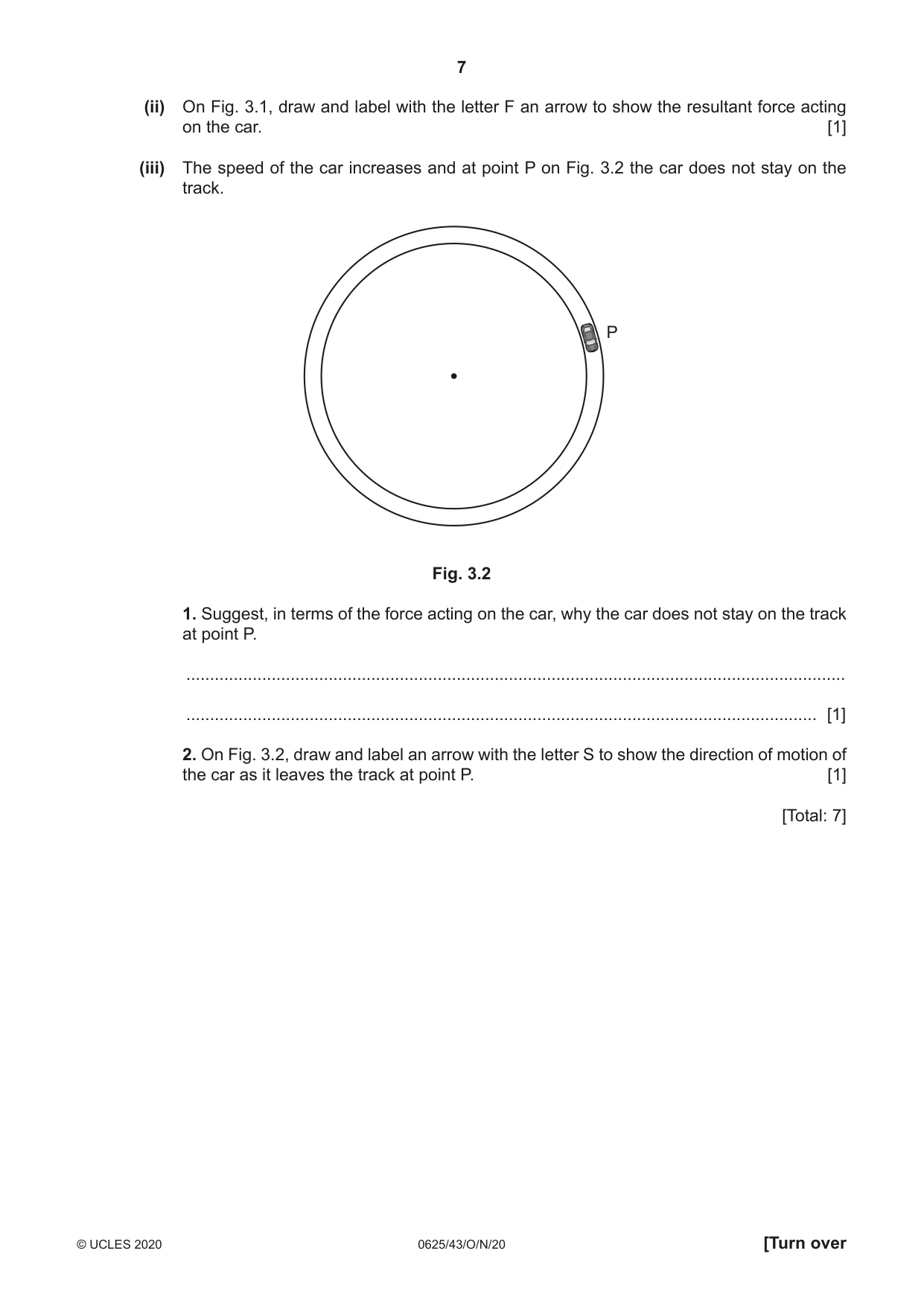
3 (a) (i) Speed is a scalar quantity. State one other scalar quantity. ..................................................................................................................................... [1] (ii) Velocity is a vector quantity. State one other vector quantity. ..................................................................................................................................... [1] (b) Fig. 3.1 shows a model car travelling at constant speed on a flat circular track. car circular track Fig. 3.1 The speed of the car is 0.30 m / s. In one complete revolution around the track, the car travels 3.9 m. (i) Calculate the time taken for the car to complete one revolution around the track. time = .......................................................... [2] (ii) On Fig. 3.1, draw and label with the letter F an arrow to show the resultant force acting on the car. [1] (iii) The speed of the car increases and at point P on Fig. 3.2 the car does not stay on the track. P Fig. 3.2 1. Suggest, in terms of the force acting on the car, why the car does not stay on the track at point P. ........................................................................................................................................... ..................................................................................................................................... [1] 2. On Fig. 3.2, draw and label an arrow with the letter S to show the direction of motion of the car as it leaves the track at point P. [1] [Total: 7]
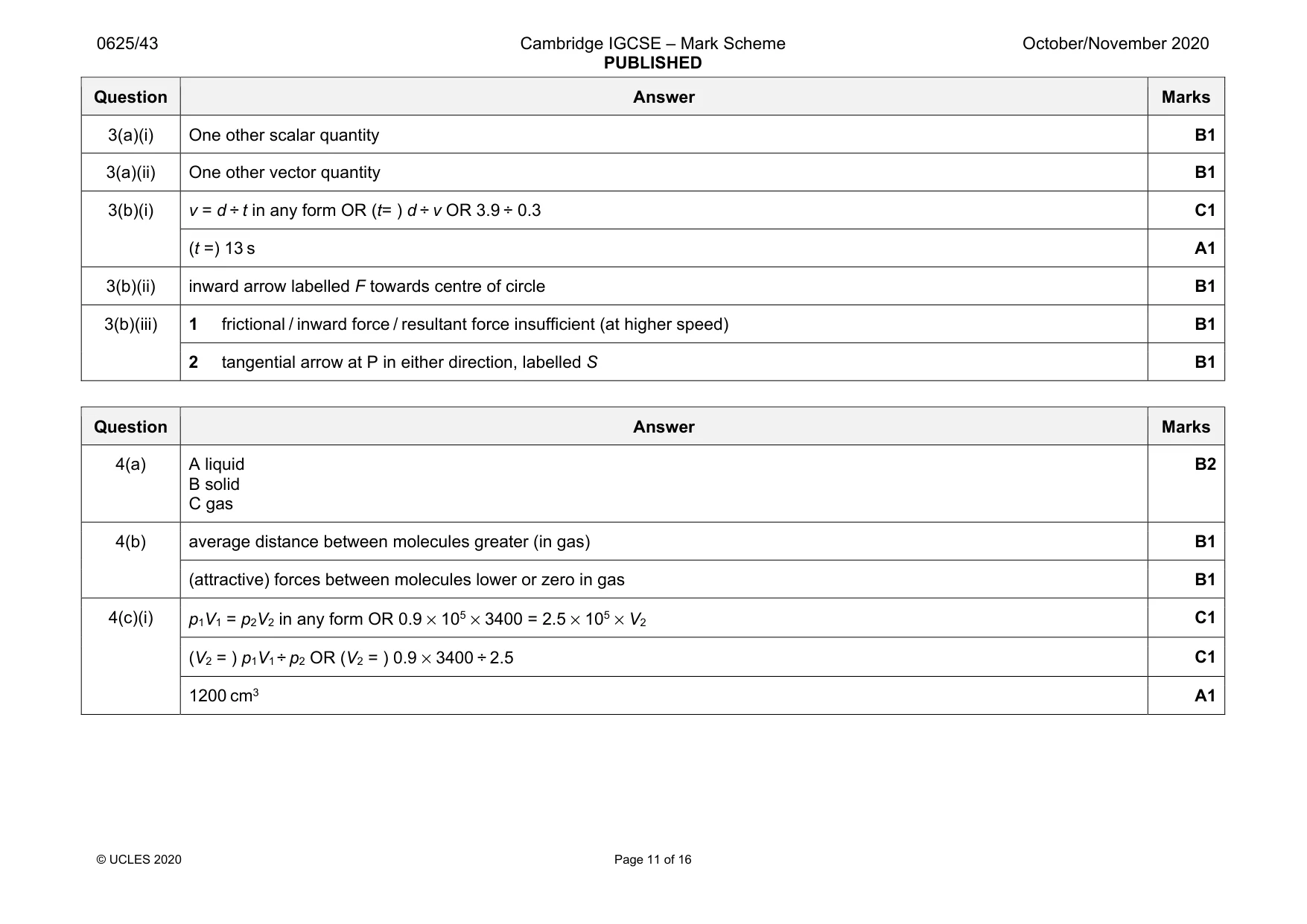
Mark scheme: 3(a)(i) One other scalar quantity B1 3(a)(ii) One other vector quantity B1 3(b)(i) v = d ÷ t in any form OR (t= ) d ÷ v OR 3.9 ÷ 0.3 C1 (t =) 13 s A1 3(b)(ii) inward arrow labelled F towards centre of circle B1 3(b)(iii) 1 frictional / inward force / resultant force insufficient (at higher speed) B1 2 tangential arrow at P in either direction, labelled S B1
Question 4
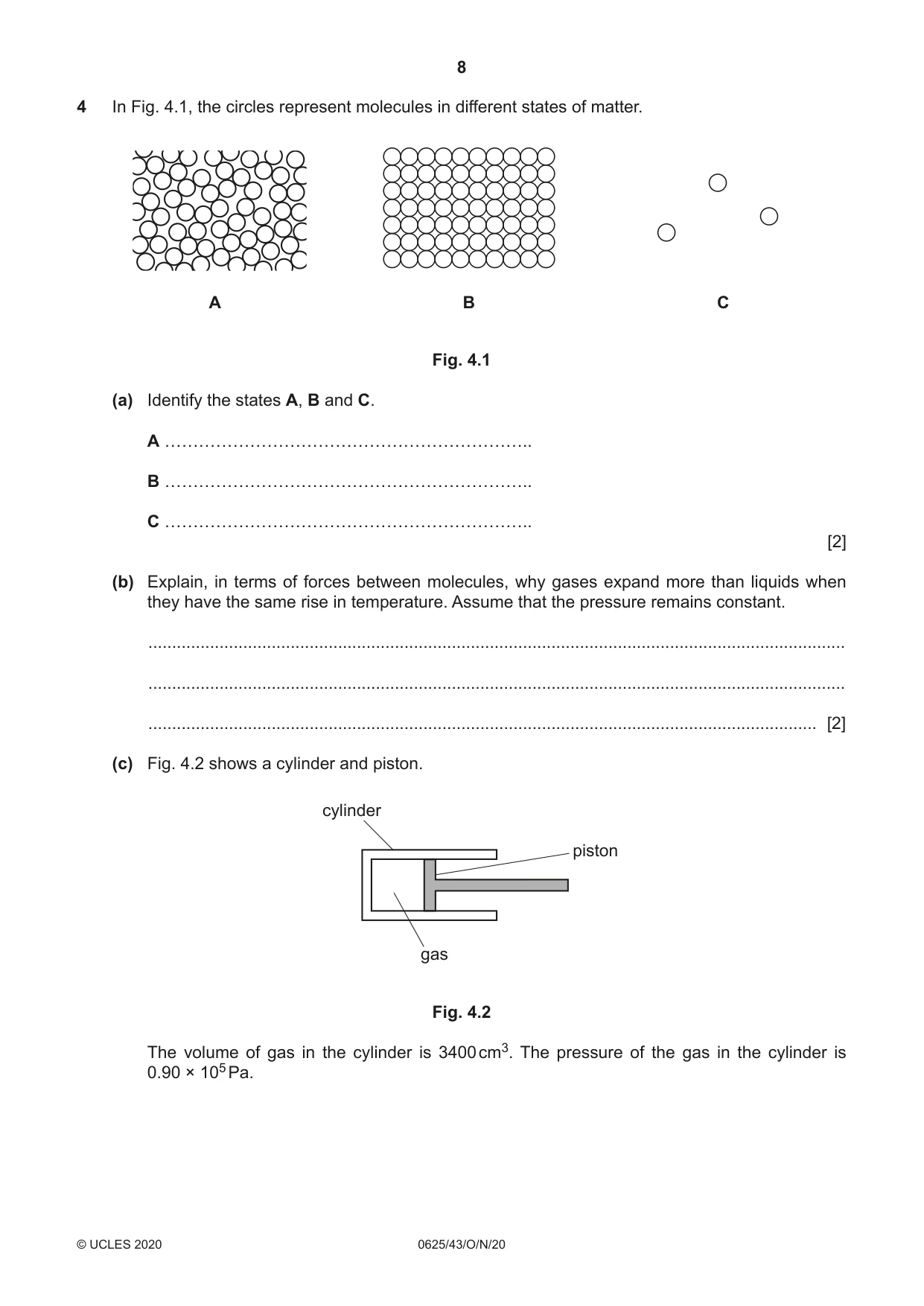
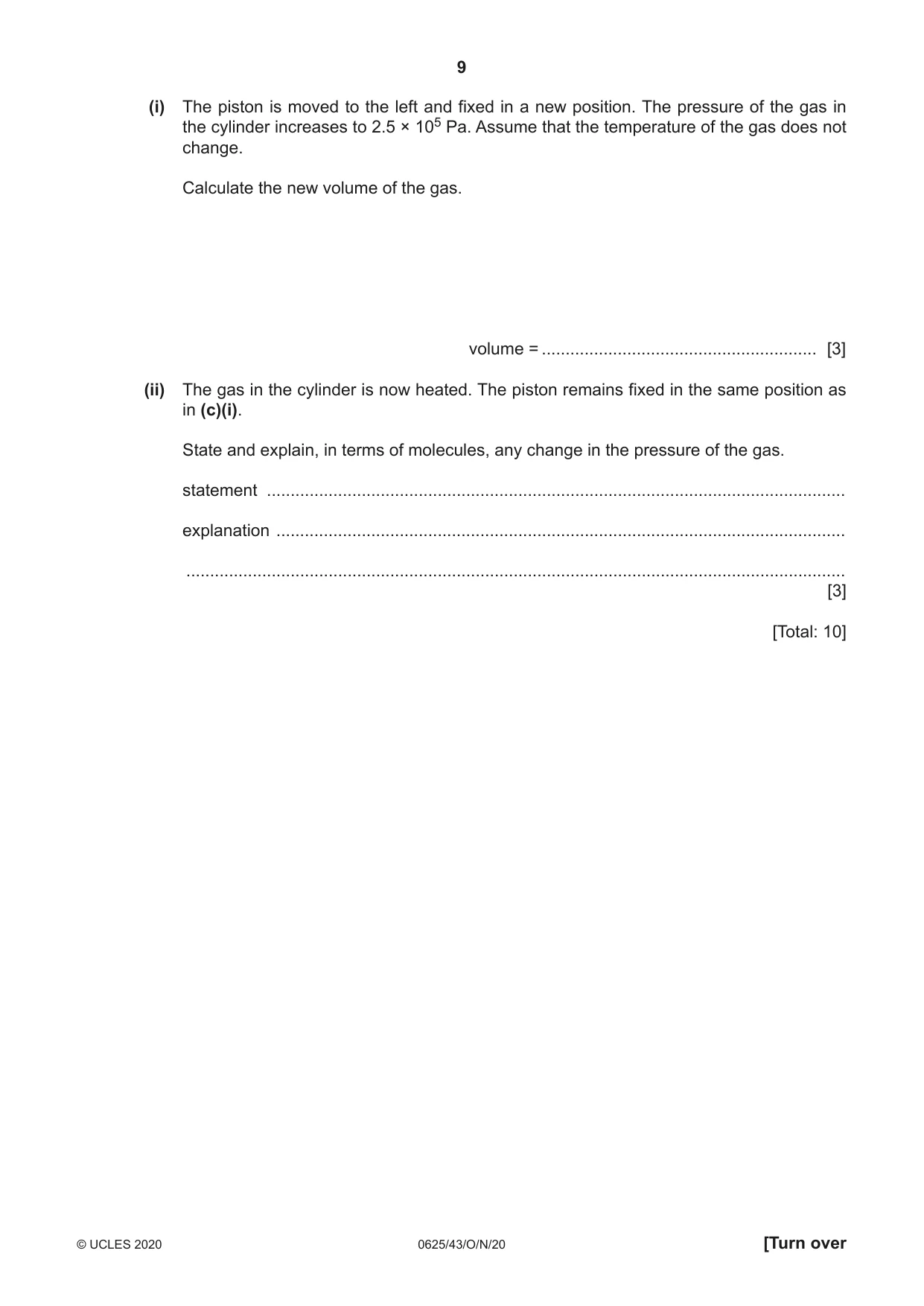
4 In Fig. 4.1, the circles represent molecules in different states of matter. A B C Fig. 4.1 (a) Identify the states A, B and C. A ……………………………………………………….. B ……………………………………………………….. C ……………………………………………………….. [2] (b) Explain, in terms of forces between molecules, why gases expand more than liquids when they have the same rise in temperature. Assume that the pressure remains constant. ................................................................................................................................................... ................................................................................................................................................... ............................................................................................................................................. [2] (c) Fig. 4.2 shows a cylinder and piston. cylinder piston gas Fig. 4.2 The volume of gas in the cylinder is 3400 cm3. The pressure of the gas in the cylinder is 0.90 × 10⁵ Pa. (i) The piston is moved to the left and fixed in a new position. The pressure of the gas in the cylinder increases to 2.5 × 10⁵ Pa. Assume that the temperature of the gas does not change. Calculate the new volume of the gas. volume = .......................................................... [3] (ii) The gas in the cylinder is now heated. The piston remains fixed in the same position as in (c)(i). State and explain, in terms of molecules, any change in the pressure of the gas. statement .......................................................................................................................... explanation ........................................................................................................................ ........................................................................................................................................... [3] [Total: 10]
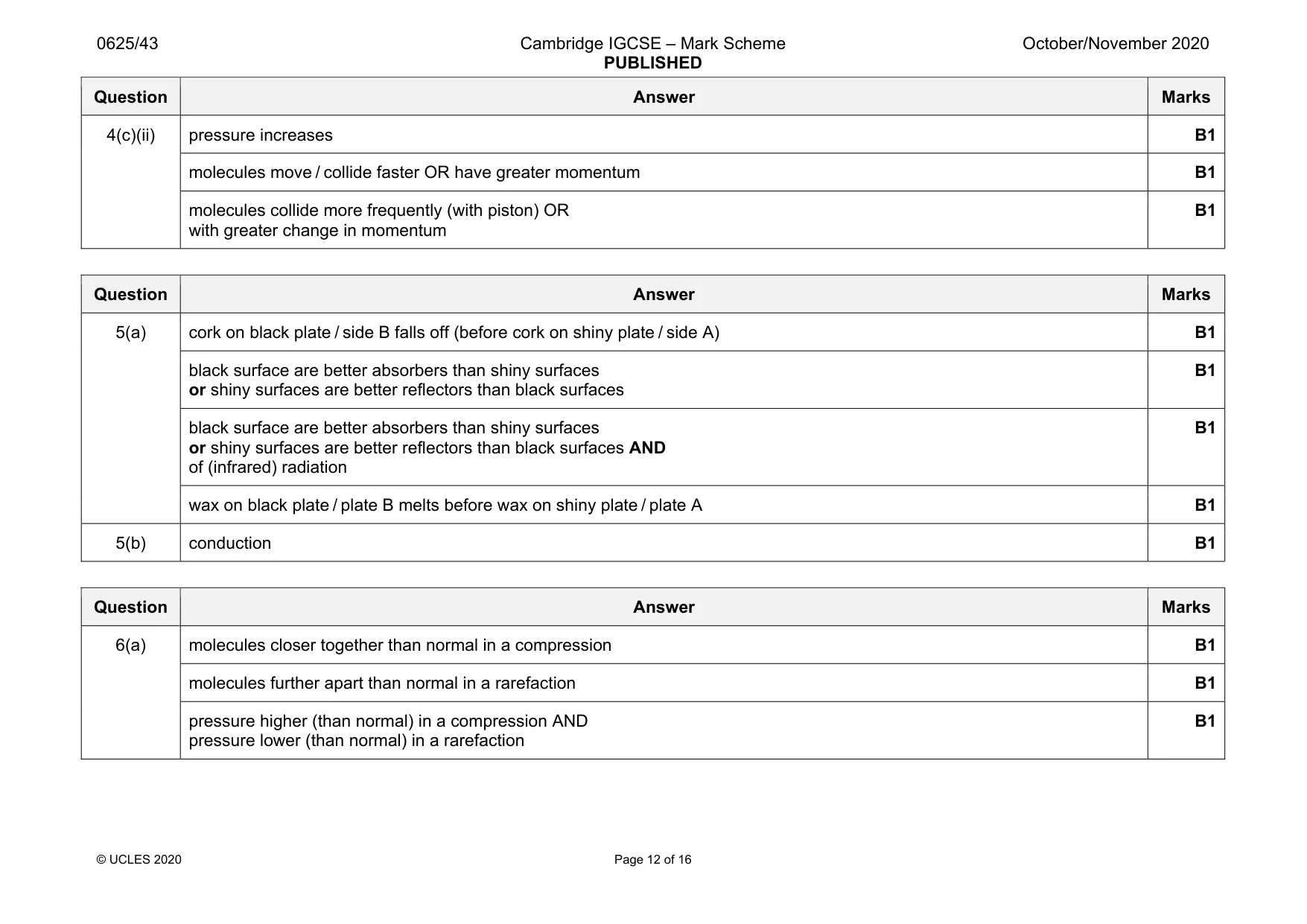
Mark scheme: 4(a) A liquid B solid C gas B2 4(b) average distance between molecules greater (in gas) B1 (attractive) forces between molecules lower or zero in gas B1 4(c)(i) p1V1 = p2V2 in any form OR 0.9 × 105 × 3400 = 2.5 × 10⁵ × V2 C1 (V2 = ) p1V1÷ p2 OR (V2 = ) 0.9 × 3400 ÷ 2.5 C1 1200 cm3 A1 Question Answer Marks 4(c)(ii) pressure increases B1 molecules move / collide faster OR have greater momentum B1 molecules collide more frequently (with piston) OR with greater change in momentum B1
Q5 · Two metal plates A and B with a radiant heater placed midway between them
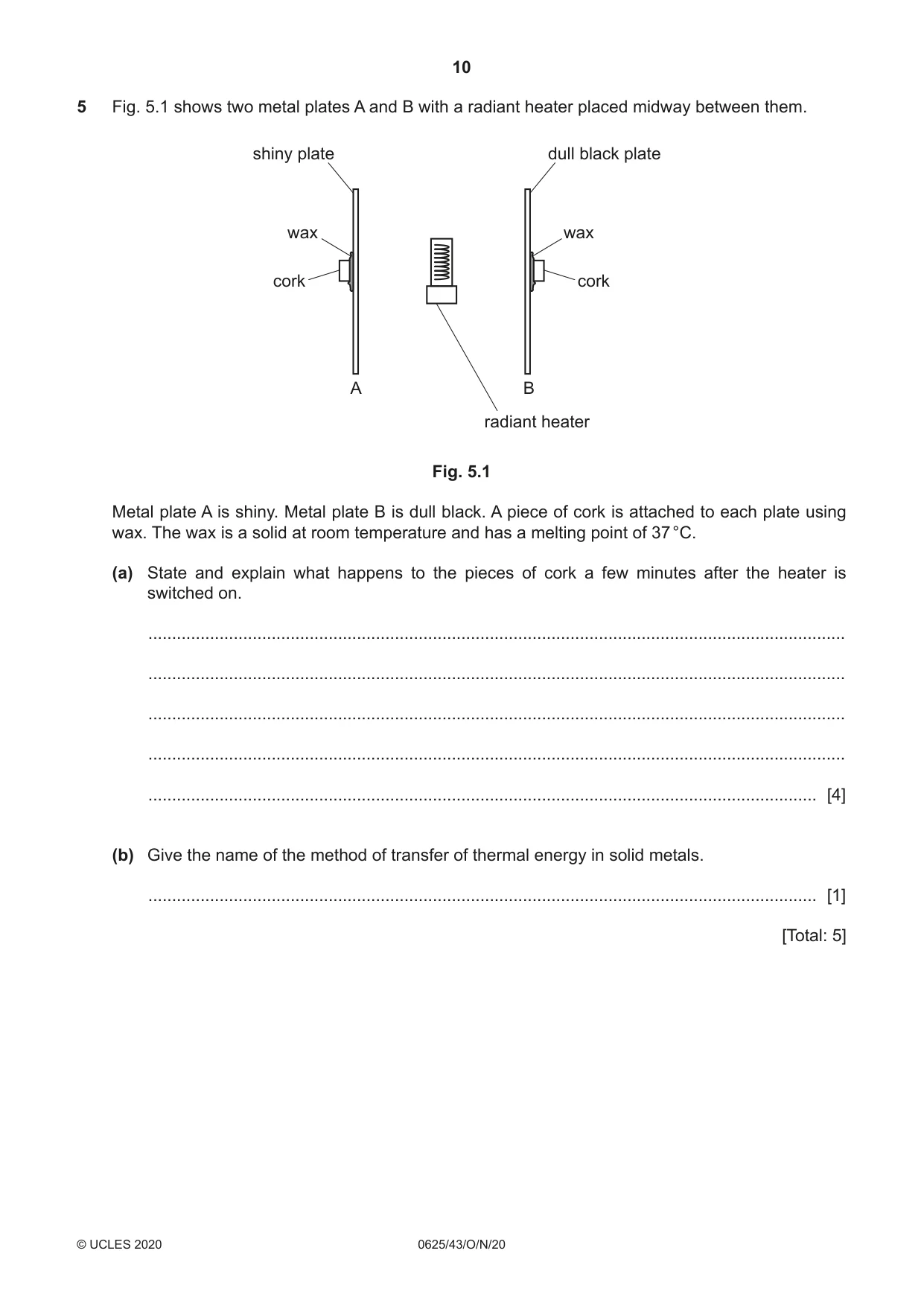
5 Fig. 5.1 shows two metal plates A and B with a radiant heater placed midway between them. shiny plate dull black plate wax wax cork cork A B radiant heater Fig. 5.1 Metal plate A is shiny. Metal plate B is dull black. A piece of cork is attached to each plate using wax. The wax is a solid at room temperature and has a melting point of 37 °C. (a) State and explain what happens to the pieces of cork a few minutes after the heater is switched on. ................................................................................................................................................... ................................................................................................................................................... ................................................................................................................................................... ................................................................................................................................................... ............................................................................................................................................. [4] (b) Give the name of the method of transfer of thermal energy in solid metals. ............................................................................................................................................. [1] [Total: 5]
Mark scheme: 5(a) cork on black plate / side B falls off (before cork on shiny plate / side A) B1 black surface are better absorbers than shiny surfaces or shiny surfaces are better reflectors than black surfaces B1 black surface are better absorbers than shiny surfaces or shiny surfaces are better reflectors than black surfaces AND of (infrared) radiation B1 wax on black plate / plate B melts before wax on shiny plate / plate A B1 5(b) conduction B1
Q6 · Sound waves consist of compressions and rarefactions
6 (a) Sound waves consist of compressions and rarefactions. Explain the terms compression and rarefaction. Give your explanation in terms of the spacing of molecules and the pressure for sound waves in air. compression ............................................................................................................................. ................................................................................................................................................... rarefaction ................................................................................................................................. ................................................................................................................................................... [3] (b) A musical instrument emits a sound with a frequency of 4.4 kHz. The speed of sound in air is 340 m / s. (i) Calculate the wavelength of the sound. wavelength = .......................................................... [3] (ii) The frequency of the sound emitted by the instrument is changed to 5.1 kHz and the amplitude of the sound is increased. Without calculation, state what happens to 1. the speed of the sound .................................................................................................. 2. the wavelength of the sound ......................................................................................... [2] [Total: 8]
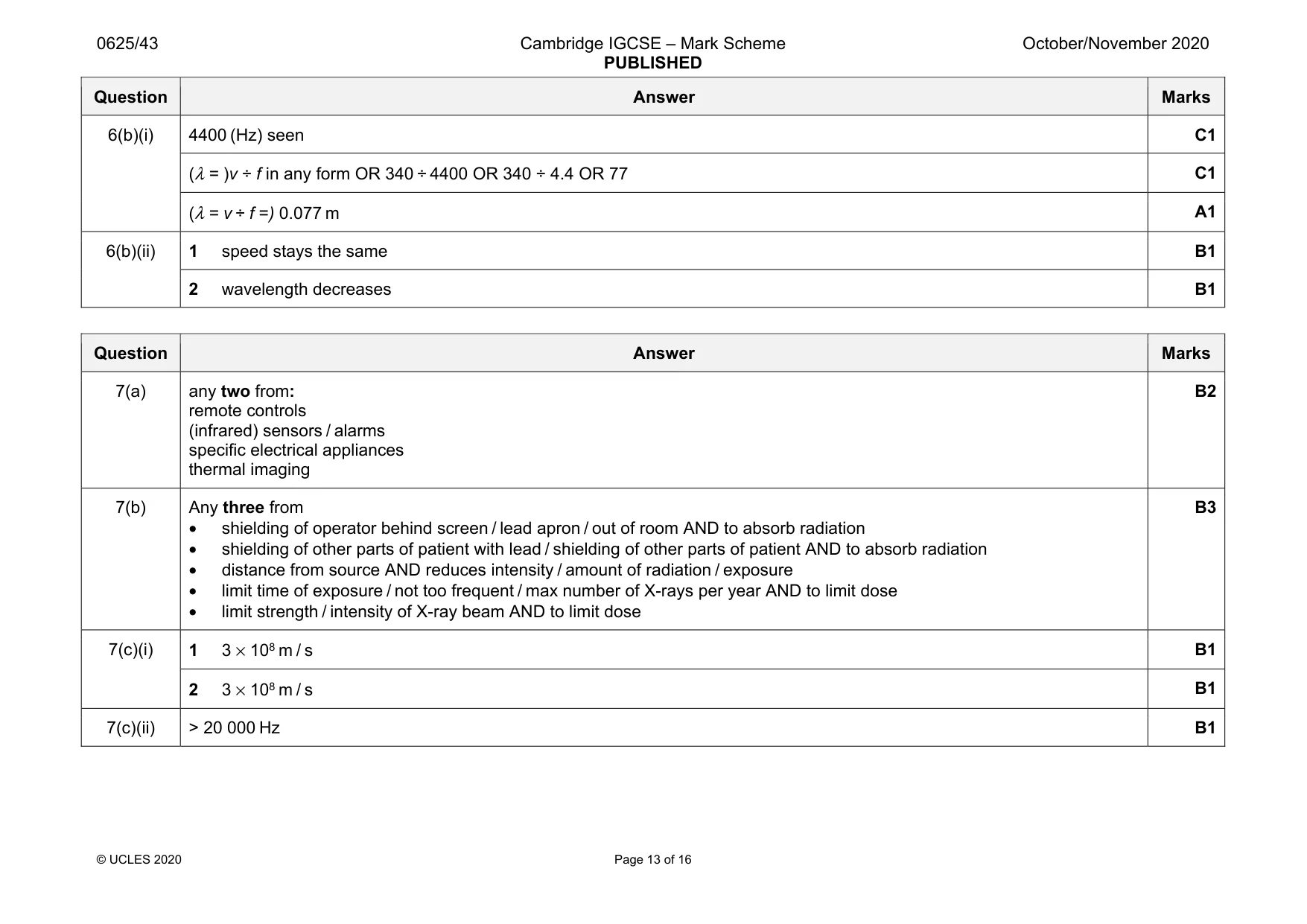
Mark scheme: 6(a) molecules closer together than normal in a compression B1 molecules further apart than normal in a rarefaction B1 pressure higher (than normal) in a compression AND pressure lower (than normal) in a rarefaction B1 Question Answer Marks 6(b)(i) 4400 (Hz) seen C1 (λ = )v ÷ f in any form OR 340 ÷ 4400 OR 340 ÷ 4.4 OR 77 C1 (λ = v ÷ f =) 0.077 m A1 6(b)(ii) 1 speed stays the same B1 2 wavelength decreases B1
Q7 · State two uses for infrared radiation
7 (a) State two uses for infrared radiation. 1. ............................................................................................................................................... ................................................................................................................................................... 2. ............................................................................................................................................... ................................................................................................................................................... [2] (b) X-rays are used in hospitals to help treat patients. Suggest and explain three precautions for the safe use of X-rays. 1. ............................................................................................................................................... ................................................................................................................................................... 2. ............................................................................................................................................... ................................................................................................................................................... 3. ............................................................................................................................................... ................................................................................................................................................... [3] (c) (i) State the speed in a vacuum of 1. microwaves ............................................................................................................. [1] 2. X-rays .................................................................................................................... [1] (ii) State a possible frequency for an ultrasound wave. ..................................................................................................................................... [1] [Total: 8]
Mark scheme: 7(a) any two from: remote controls (infrared) sensors / alarms specific electrical appliances thermal imaging B2 7(b) Any three from • shielding of operator behind screen / lead apron / out of room AND to absorb radiation • shielding of other parts of patient with lead / shielding of other parts of patient AND to absorb radiation • distance from source AND reduces intensity / amount of radiation / exposure • limit time of exposure / not too frequent / max number of X-rays per year AND to limit dose • limit strength / intensity of X-ray beam AND to limit dose B3 7(c)(i) 1 3 × 10⁸ m / s B1 2 3 × 10⁸ m / s B1 7(c)(ii) > 20 000 Hz B1
Question 8
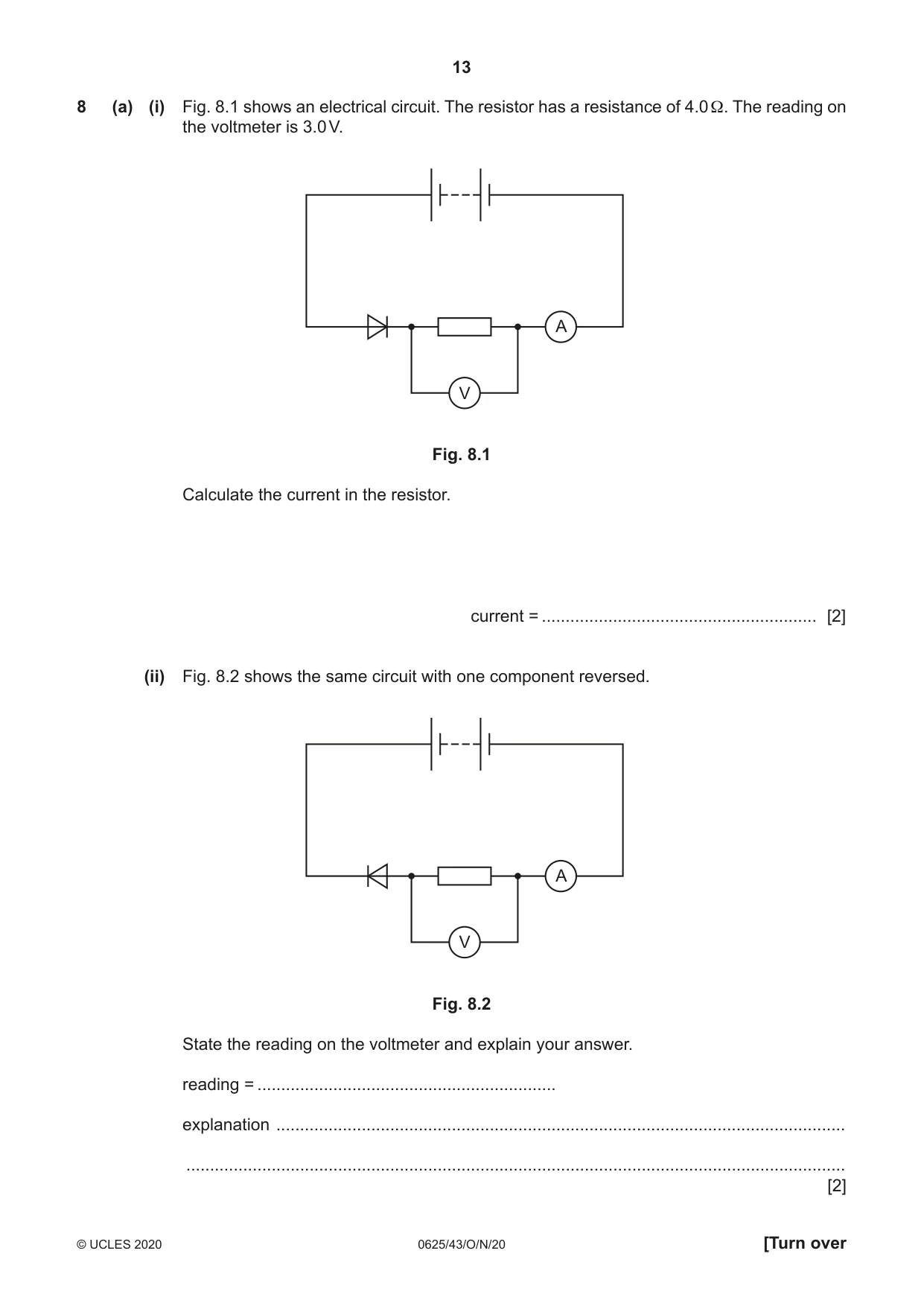
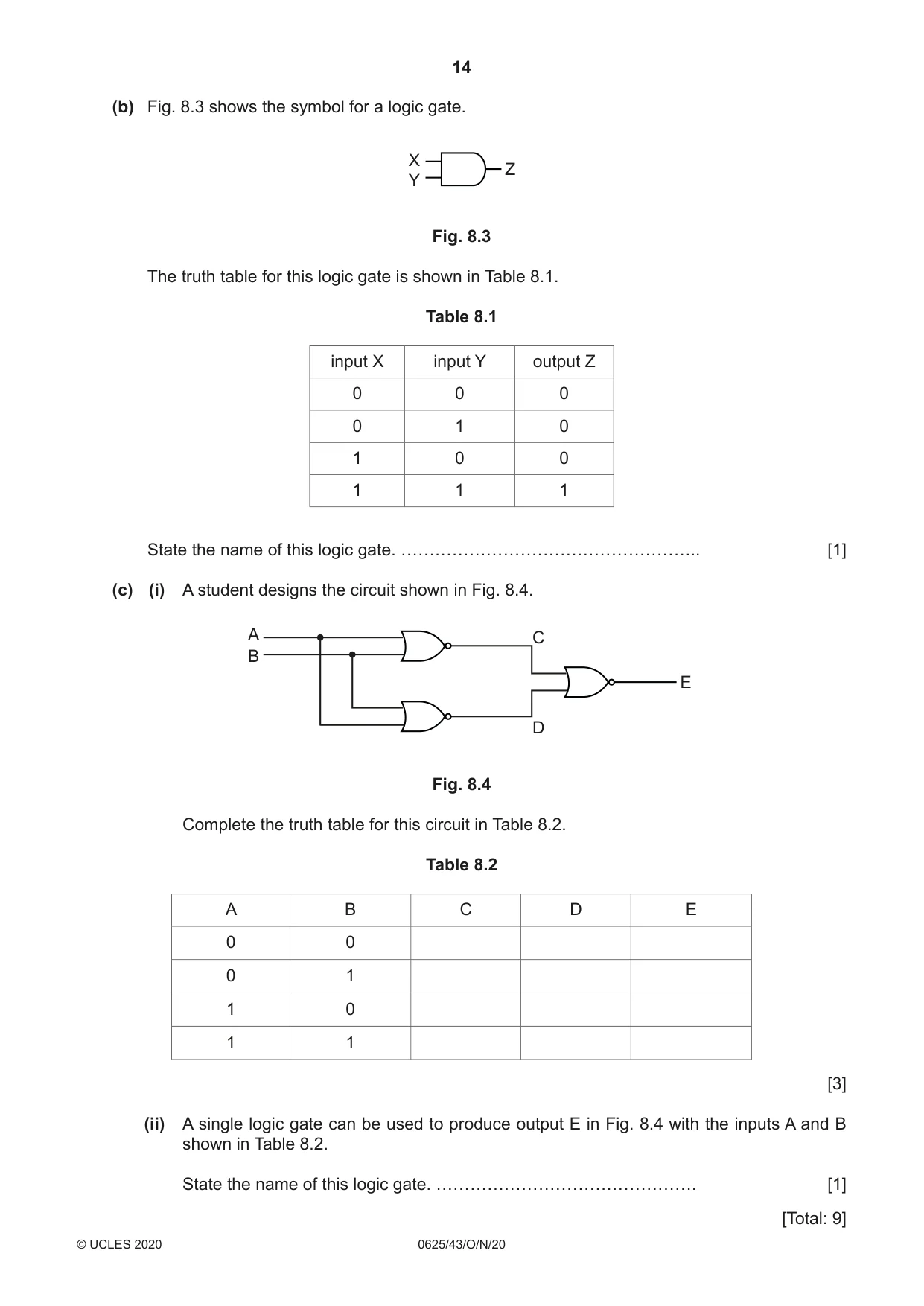
8 (a) (i) Fig. 8.1 shows an electrical circuit. The resistor has a resistance of 4.0 Ω. The reading on the voltmeter is 3.0 V. A V Fig. 8.1 Calculate the current in the resistor. current = .......................................................... [2] (ii) Fig. 8.2 shows the same circuit with one component reversed. A V Fig. 8.2 State the reading on the voltmeter and explain your answer. reading = ............................................................... explanation ........................................................................................................................ ........................................................................................................................................... [2] (b) Fig. 8.3 shows the symbol for a logic gate. X Z Y Fig. 8.3 The truth table for this logic gate is shown in Table 8.1. Table 8.1 input X input Y output Z 0 0 0 0 1 0 1 0 0 1 1 1 State the name of this logic gate. …………………………………………….. [1] (c) (i) A student designs the circuit shown in Fig. 8.4. A C B E D Fig. 8.4 Complete the truth table for this circuit in Table 8.2. Table 8.2 A B C D E 0 0 0 1 1 0 1 1 [3] (ii) A single logic gate can be used to produce output E in Fig. 8.4 with the inputs A and B shown in Table 8.2. State the name of this logic gate. ………………………………………. [1] [Total: 9]
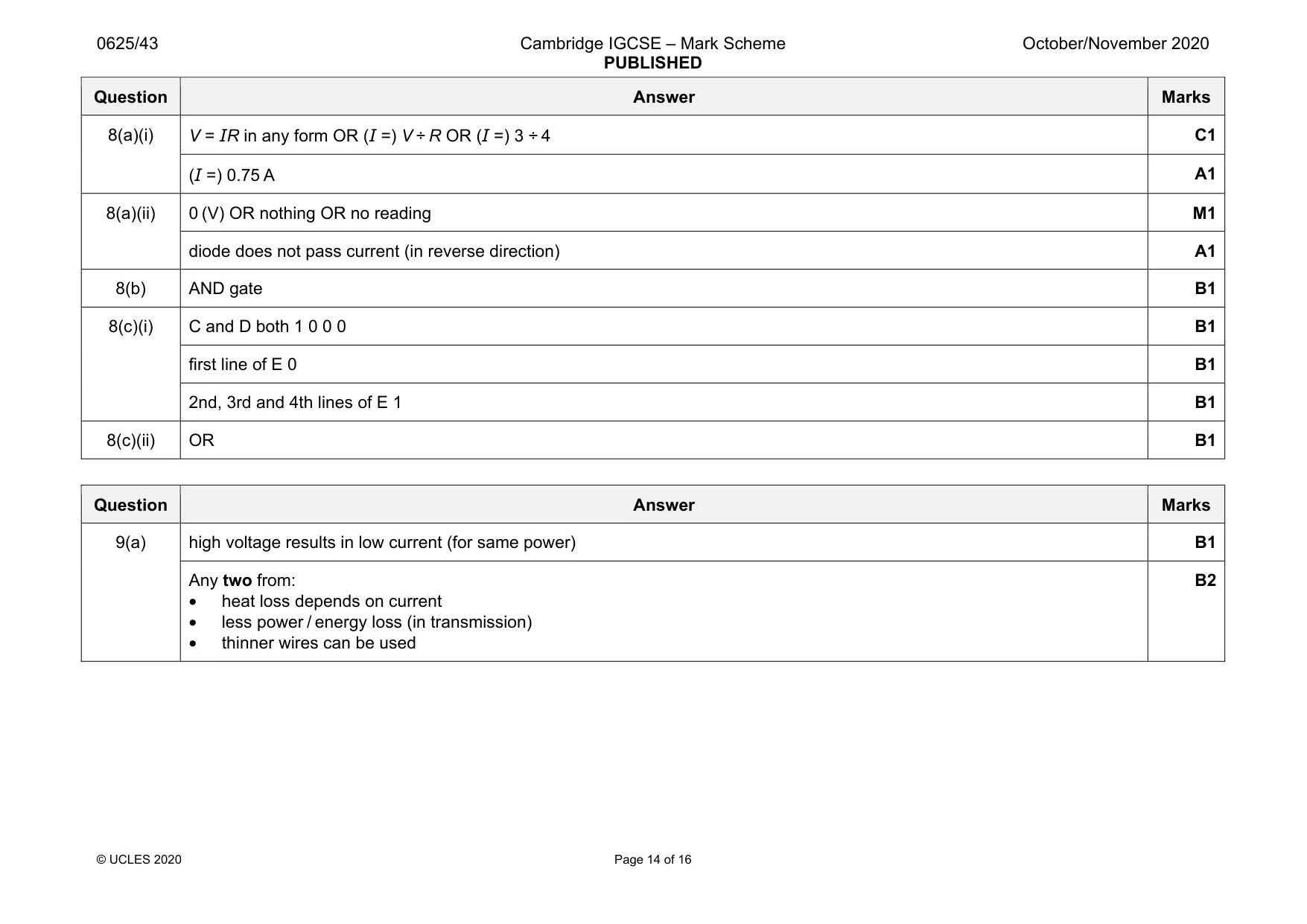
Mark scheme: 8(a)(i) C1 (I =) 0.75 A A1 8(a)(ii) 0 (V) OR nothing OR no reading M1 diode does not pass current (in reverse direction) A1 8(b) AND gate B1 8(c)(i) C and D both 1 0 0 0 B1 first line of E 0 B1 2nd, 3rd and 4th lines of E 1 B1 8(c)(ii) OR B1
Q9 · Electrical power is produced in a power station by an alternating current (a.c.) generator
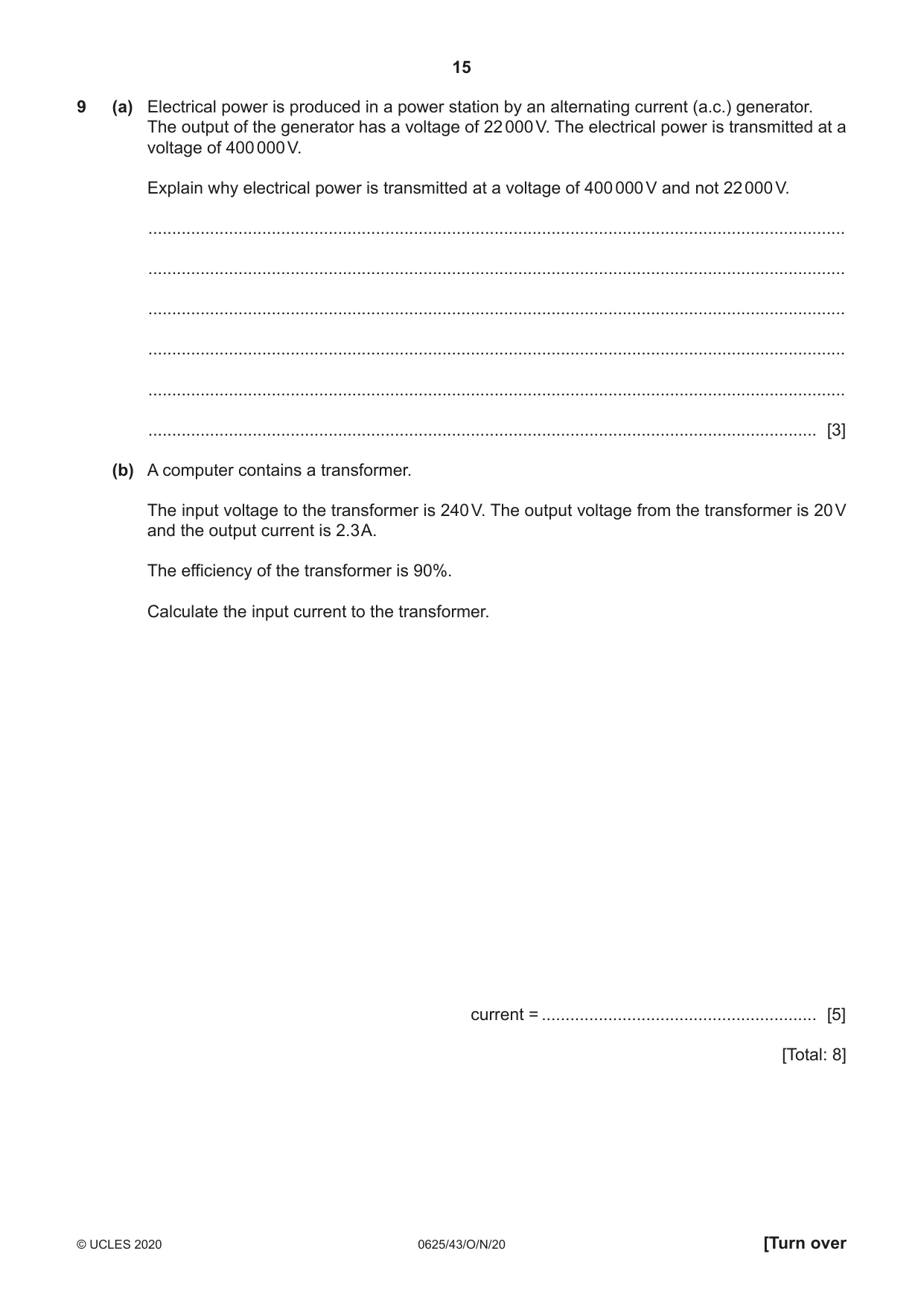
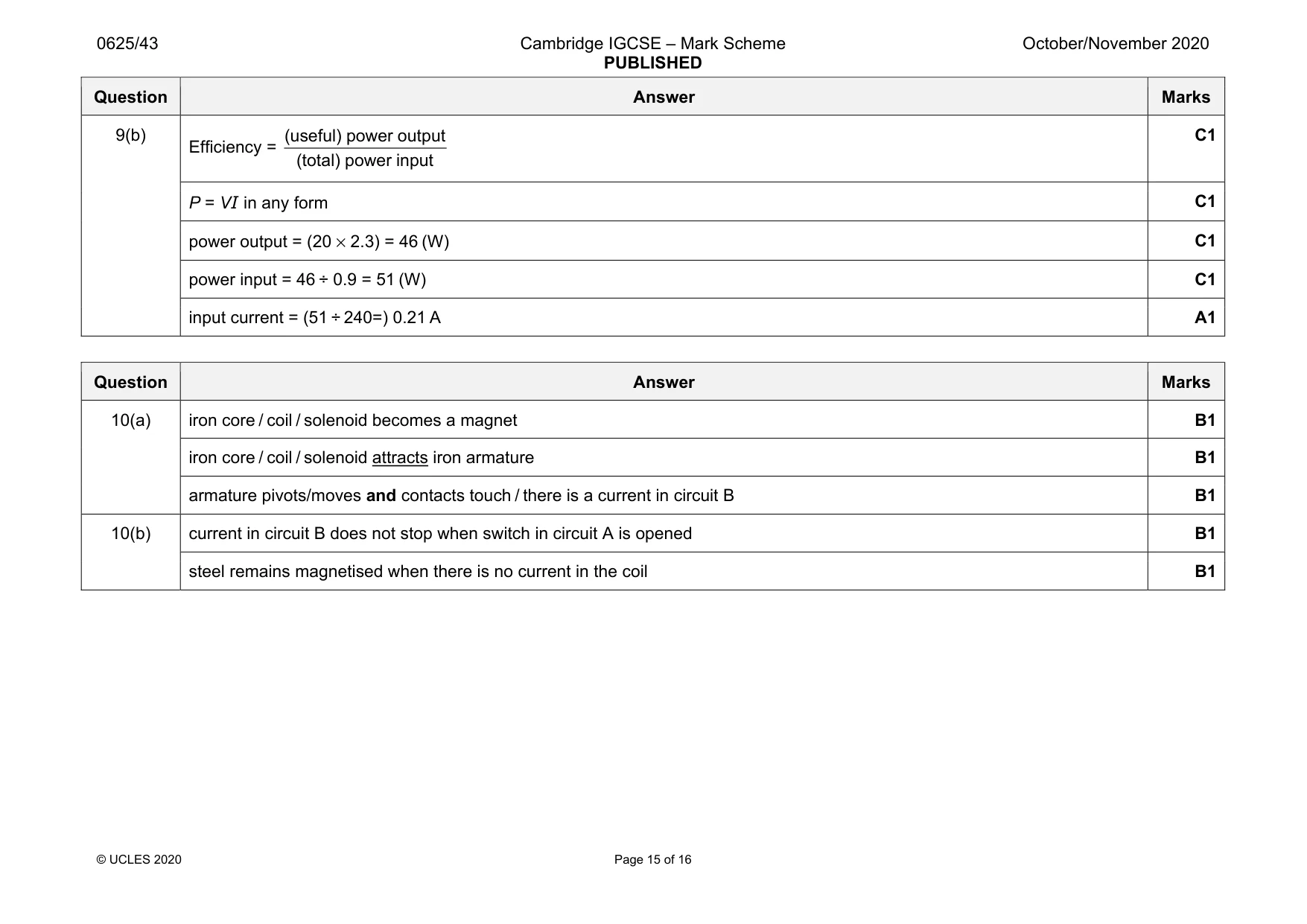
9 (a) Electrical power is produced in a power station by an alternating current (a.c.) generator. The output of the generator has a voltage of 22 000 V. The electrical power is transmitted at a voltage of 400 000 V. Explain why electrical power is transmitted at a voltage of 400 000 V and not 22 000 V. ................................................................................................................................................... ................................................................................................................................................... ................................................................................................................................................... ................................................................................................................................................... ................................................................................................................................................... ............................................................................................................................................. [3] (b) A computer contains a transformer. The input voltage to the transformer is 240 V. The output voltage from the transformer is 20 V and the output current is 2.3 A. The efficiency of the transformer is 90%. Calculate the input current to the transformer. current = .......................................................... [5] [Total: 8]
Mark scheme: 9(a) high voltage results in low current (for same power) B1 Any two from: • heat loss depends on current • less power / energy loss (in transmission) • thinner wires can be used B2 Question Answer Marks 9(b) Efficiency = (useful) power output (total) power input C1 P = VI in any form C1 power output = (20 × 2.3) = 46 (W) C1 power input = 46 ÷ 0.9 = 51 (W) C1 input current = (51 ÷ 240=) 0.21 A A1
Question 10
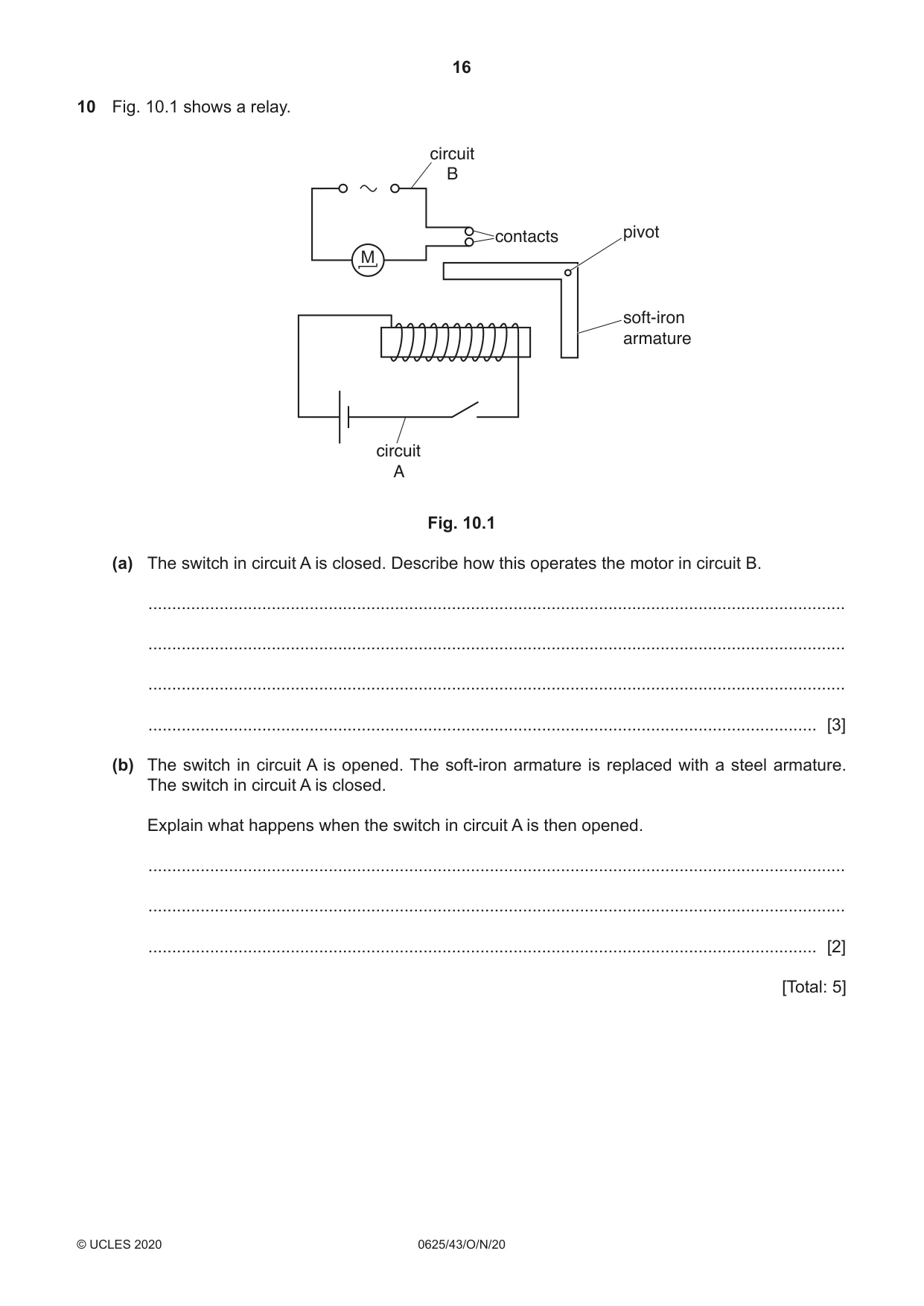
10 Fig. 10.1 shows a relay. circuit B contacts pivot M soft-iron armature circuit A Fig. 10.1 (a) The switch in circuit A is closed. Describe how this operates the motor in circuit B. ................................................................................................................................................... ................................................................................................................................................... ................................................................................................................................................... ............................................................................................................................................. [3] (b) The switch in circuit A is opened. The soft-iron armature is replaced with a steel armature. The switch in circuit A is closed. Explain what happens when the switch in circuit A is then opened. ................................................................................................................................................... ................................................................................................................................................... ............................................................................................................................................. [2] [Total: 5]
Mark scheme: 10(a) iron core / coil / solenoid becomes a magnet B1 iron core / coil / solenoid attracts iron armature B1 armature pivots/moves and contacts touch / there is a current in circuit B B1 10(b) current in circuit B does not stop when switch in circuit A is opened B1 steel remains magnetised when there is no current in the coil B1
Q11 · A beam of α-particles, β-particles and γ-rays directed between two metal plates P and Q
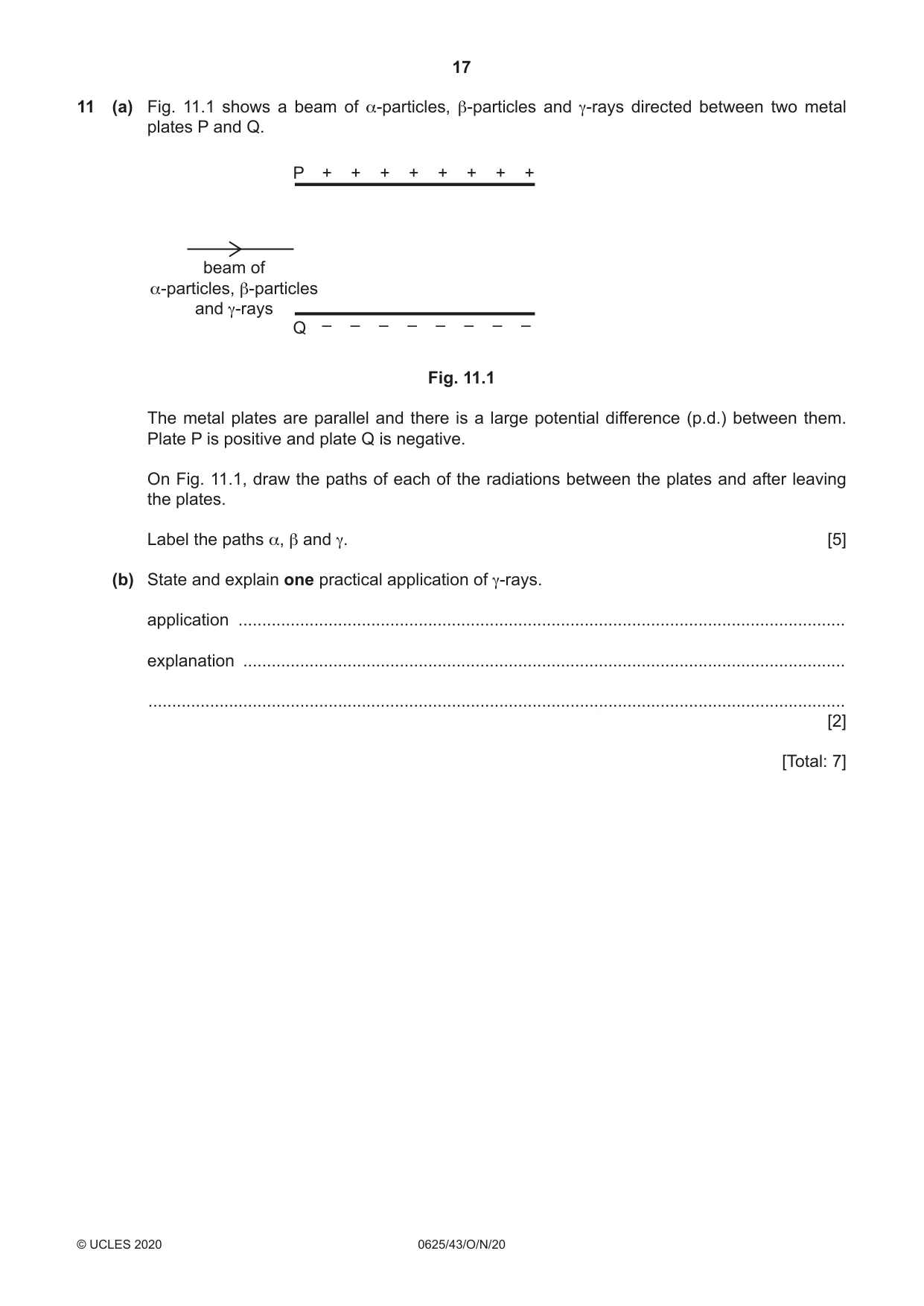
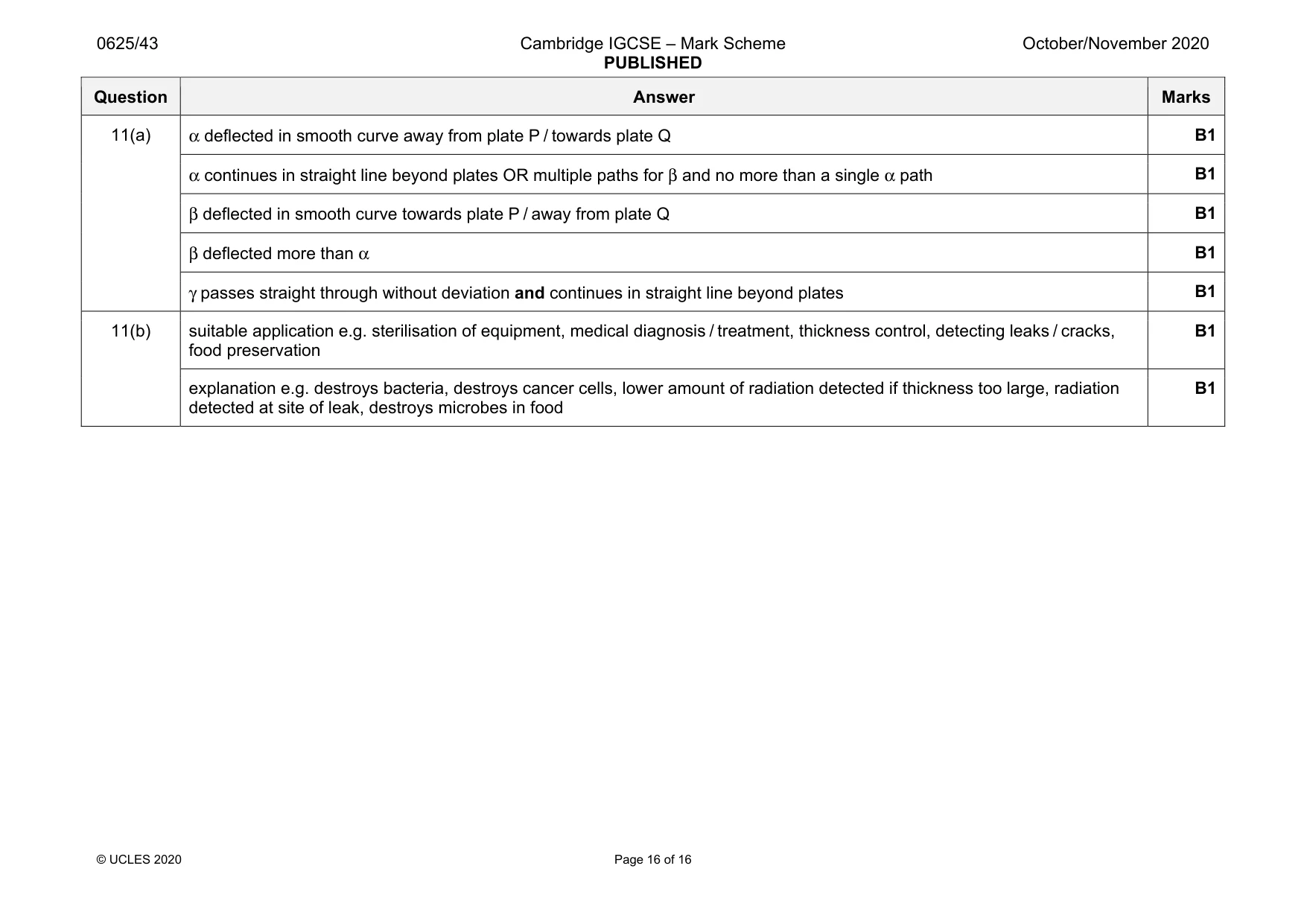
11 (a) Fig. 11.1 shows a beam of α-particles, β-particles and γ-rays directed between two metal plates P and Q. P + + + + + + + + beam of α-particles, β-particles and γ-rays Q – – – – – – – – Fig. 11.1 The metal plates are parallel and there is a large potential difference (p.d.) between them. Plate P is positive and plate Q is negative. On Fig. 11.1, draw the paths of each of the radiations between the plates and after leaving the plates. Label the paths α, β and γ. [5] (b) State and explain one practical application of γ-rays. application ................................................................................................................................ explanation ............................................................................................................................... ................................................................................................................................................... [2] [Total: 7]
Mark scheme: 11(a) α deflected in smooth curve away from plate P / towards plate Q B1 α continues in straight line beyond plates OR multiple paths for β and no more than a single α path B1 β deflected in smooth curve towards plate P / away from plate Q B1 β deflected more than α B1 γ passes straight through without deviation and continues in straight line beyond plates B1 11(b) suitable application e.g. sterilisation of equipment, medical diagnosis / treatment, thickness control, detecting leaks / cracks, food preservation B1 explanation e.g. destroys bacteria, destroys cancer cells, lower amount of radiation detected if thickness too large, radiation detected at site of leak, destroys microbes in food B1
What was in this paper
The subtopics covered by these 11 questions, and how many questions each got. Open one in a new tab to see every Cambridge question on it.
What you needed in this session
Cambridge’s own grade thresholds for 2020 Oct/Nov, Paper 4 · Variant 3. A higher threshold means an easier paper — the bar moves with how the cohort did.