Questions as text
Q1 · Why is a balance of payments deficit a potential problem for an economy with a fixed… 9708/11 Oct/Nov 2005
28 Why is a balance of payments deficit a potential problem for an economy with a fixed exchange rate? A Domestic money supply will increase. B Rival producers may react with trade protection measures. C The economy’s foreign exchange reserves may run down. D The economy’s short-run standard of living will be reduced.
1 marks
Answer: C
This question in 9708/11 Oct/Nov 2005
Q2 · In the diagram the foreign exchange market is initially in equilibrium at X 9708/11 Oct/Nov 2005
29 In the diagram the foreign exchange market is initially in equilibrium at X. What could be the new equilibrium position after an increase in demand from US residents for holidays in Europe? S2 S1 S3 price A B of $ (in Euros) X C D D1 D2 O quantity of $
1 marks
Answer: D
This question in 9708/11 Oct/Nov 2005
Q3 · Which policy would be most likely to reduce a balance of payments current account deficit? 9708/11 Oct/Nov 2005
30 Which policy would be most likely to reduce a balance of payments current account deficit? A reducing income tax rates B reducing subsidies to domestic industries C reducing the external value of the currency D reducing the level of tariffs
1 marks
Answer: C
This question in 9708/11 Oct/Nov 2005
Q4 · Increased international competition leads to a worsening in a country’s current account… 9708/11 May/June 2006
27 Increased international competition leads to a worsening in a country’s current account balance. In the absence of any offsetting factors, how is this likely to affect domestic inflation and the exchange rate? inflation exchange rate A increase appreciate B increase depreciate C decrease appreciate D decrease depreciate
1 marks
Answer: D
This question in 9708/11 May/June 2006
Q5 · The diagram shows the number of US dollars ($) and Euros (€) which exchanged for one… 9708/11 May/June 2006
28 The diagram shows the number of US dollars ($) and Euros (€) which exchanged for one pound sterling (£) between 2002 and 2004. 1.8 $ per £ 1.7 1.6 1.5 1.4 € per £ 1.3 2002 2003 2004 What happened to the exchange rate of the $ against the £ and € during this period? $ exchange rate $ exchange rate against £ against € A appreciated appreciated B appreciated depreciated C depreciated appreciated D depreciated depreciated
1 marks
Answer: D
This question in 9708/11 May/June 2006
Q6 · The diagram shows the demand for sterling and the supply of sterling in the foreign… 9708/11 May/June 2006
29 The diagram shows the demand for sterling and the supply of sterling in the foreign exchange markets. S £ exchange rate D O quantity of £ Other things being equal, if UK interest rates increase, what is likely to happen to the demand and supply curves in the diagram? demand curve supply curve A shifts to left shifts to left B shifts to right shifts to right C shifts to left shifts to right D shifts to right shifts to left
1 marks
Answer: D
This question in 9708/11 May/June 2006
Q7 · Turkey can produce a good but also imports some of the good from Egypt 9708/11 Oct/Nov 2006
28 Turkey can produce a good but also imports some of the good from Egypt. The Turkish currency depreciates against the Egyptian currency. How might this affect production of this good in Egypt and in Turkey? production in Egypt production in Turkey A decrease decrease B decrease increase C increase decrease D increase increase
1 marks
Answer: B
This question in 9708/11 Oct/Nov 2006
Q8 · The diagram shows the supply and demand for pounds sterling (£) in the foreign exchange… 9708/11 Oct/Nov 2006
29 The diagram shows the supply and demand for pounds sterling (£) in the foreign exchange market with the initial US dollar ($) price of the £ being OP1. S $ price P2 of £ P1 D2 D1 O Q1 Q2 quantity of £s What will increase the $ price of the £ to OP2? A a large capital inflow into the UK B a large deficit on the UK current account C a reduction in interest rates in the UK D a speculative sale of £s in the foreign exchange market
1 marks
Answer: A
This question in 9708/11 Oct/Nov 2006
Q9 · In which of the following circumstances will devaluation of the external value of a… 9708/11 Oct/Nov 2006
30 In which of the following circumstances will devaluation of the external value of a country’s currency have the greatest beneficial effects on its balance of trade? A There is full employment in the country. B The government has implemented expansionary fiscal policies. C The demand for its imports is price-inelastic. D There is a high price elasticity of demand for its exports.
1 marks
Answer: D
This question in 9708/11 Oct/Nov 2006
Q10 · According to the Purchasing Power Parity theory, what determines the rate of exchange… 9708/11 May/June 2007
28 According to the Purchasing Power Parity theory, what determines the rate of exchange between two countries? A relative price levels in the two countries B the bargaining power of the respective governments C the comparative advantage of the two countries D the size of their foreign currency reserves
1 marks
Answer: A
This question in 9708/11 May/June 2007
Q11 · In the UK in the summer of 2002 the Euro was worth £0.62 9708/11 May/June 2007
29 In the UK in the summer of 2002 the Euro was worth £0.62. In the summer of 2003 the Euro was worth £0.72. How was this change likely to have affected the UK? A higher demand for imports B higher imported inflation C higher priced exports D higher unemployment
1 marks
Answer: B
This question in 9708/11 May/June 2007
Q12 · There is a rise in the exchange rate of the US$ 9708/11 Oct/Nov 2007
29 There is a rise in the exchange rate of the US$. Which would cause the greatest increase in the US current account deficit? A a high level of domestic unemployment B a high price elasticity of demand for imports C a low price elasticity of demand for exports D a low rate of domestic inflation
1 marks
Answer: B
This question in 9708/11 Oct/Nov 2007
Q13 · The diagram shows the market for £ sterling which is in equilibrium 9708/11 Oct/Nov 2007
30 The diagram shows the market for £ sterling which is in equilibrium. S 2.5 2.0 price of £ in US$ D 0 20 25 30 quantity of £s (billions) What must the UK government do to achieve an exchange rate of £1 = US$2.50? A buy £10 billion sterling B buy £20 billion sterling C sell £10 billion sterling D sell £20 billion sterling
1 marks
Answer: A
This question in 9708/11 Oct/Nov 2007
Q14 · What is the likely effect on the volume of exports and imports if a country with a fixed… 9708/11 May/June 2008
26 What is the likely effect on the volume of exports and imports if a country with a fixed exchange rate experiences a higher rate of inflation than its trading partners? exports imports A increase decrease B decrease increase C increase increase D decrease decrease
1 marks
Answer: B
This question in 9708/11 May/June 2008
Q15 · What is most likely to cause Australia’s exchange rate to depreciate? 9708/11 May/June 2008
28 What is most likely to cause Australia’s exchange rate to depreciate? A an increase in Australia’s demand for imports B an increase in Australia’s interest rate C an increase in demand for Australia’s exports D an increase in tourist visits to Australia
1 marks
Answer: A
This question in 9708/11 May/June 2008
Q16 · Under a system of flexible exchange rates, what determines the foreign exchange value of… 9708/11 Oct/Nov 2008
28 Under a system of flexible exchange rates, what determines the foreign exchange value of a currency? A the overall supply of and demand for a currency B the purchasing power of the currency relative to the purchasing power of foreign currencies C the surplus or deficit on the balance of payments on current account D the differential between domestic and foreign interest rates
1 marks
Answer: A
This question in 9708/11 Oct/Nov 2008
Q17 · With an exchange rate of 5 Egyptian pounds (EGP) = 1 US dollar ($), an American product… 9708/11 Oct/Nov 2008
29 With an exchange rate of 5 Egyptian pounds (EGP) = 1 US dollar ($), an American product sells in Egypt for EGP100. Assuming that the dollar price remains unchanged, what will be the price of the product in Egypt if the Egyptian pound appreciates to EGP4 = 1 US$? A EGP75 B EGP80 C EGP120 D EGP125
1 marks
Answer: B
This question in 9708/11 Oct/Nov 2008
Q18 · In the diagram, D1D1 and S1S1 are the initial demand and supply curves of the pound… 9708/11 May/June 2009
28 In the diagram, D1D1 and S1S1 are the initial demand and supply curves of the pound sterling (£) on the foreign exchange market. D2 S2 D1 S1 price of £ in $US D2 D1 S2 S1 O quantity of £ What will cause the demand curve to shift to D2D2 and the supply curve to S2S2? A an appreciation of the pound B an increase in UK interest rates C a reduction in the level of UK import tariffs D a reduction in the quality of UK goods
1 marks
Answer: B
This question in 9708/11 May/June 2009
Q19 · With an exchange rate of 5 Egyptian pounds (EGP) = 1 US dollar ($), an American product… 9708/11 May/June 2009
29 With an exchange rate of 5 Egyptian pounds (EGP) = 1 US dollar ($), an American product sells in Egypt for EGP 100. Assuming that the dollar price remains unchanged, what will be the price of the product in Egypt if the Egyptian pound appreciates to 4 EGP = 1 US$? A EGP 75 B EGP 80 C EGP 120 D EGP 125
1 marks
Answer: B
This question in 9708/11 May/June 2009
Q20 · The table shows indicators of a country’s economic performance over a two-year period 9708/11 Oct/Nov 2009
27 The table shows indicators of a country’s economic performance over a two-year period. balance of trade in exchange volume of volume of year goods and services rate index exports index imports index ($) 1 100 100 100 zero 2 100 90 100 +500 million What is consistent with the above information? A There has been a fall in the price of exports. B There has been an improvement in the terms of trade. C There has been an increase in the level of real income per head. D There has been an increase in the price of imports.
1 marks
Answer: B
This question in 9708/11 Oct/Nov 2009
Q21 · The diagram shows the market for Japanese Yen 9708/11 Oct/Nov 2009
28 The diagram shows the market for Japanese Yen. S2 S1 price of Yen in terms of other currencies D O quantity of Yen What could have caused the change in the supply of Yen from S1 to S2? A a reduction in the level of international investment into Japan B a reduction in the level of Japanese tariffs C a reduction in the value of foreign goods imported into Japan D a reduction in the value of Japanese goods exported
1 marks
Answer: C
This question in 9708/11 Oct/Nov 2009
Q22 · Country X trades with only two countries, the USA and Japan 9708/11 Oct/Nov 2009
29 Country X trades with only two countries, the USA and Japan. 90 % of the country’s trade is with the USA and 10 % is with Japan. The original value of the trade-weighted exchange rate index is 100. The value of country X’s currency against the US$ rises by 10%. The value of country X’s currency against the Japanese yen rises by 50 %. What will be the value of country X’s new trade-weighted exchange rate index? A 114 B 115 C 130 D 160
1 marks
Answer: A
This question in 9708/11 Oct/Nov 2009
Q23 · A government with a floating exchange rate wishes to encourage a rise in the… 9708/11 Oct/Nov 2009
30 A government with a floating exchange rate wishes to encourage a rise in the international value of its currency. What should it do? A Lower the level of domestic interest rates. B Reduce the amount of foreign currency available to its citizens. C Reduce subsidies to its exporters. D Remove trade barriers on imports.
1 marks
Answer: B
This question in 9708/11 Oct/Nov 2009
Q24 · What will cause an improvement in a country’s terms of trade? 9708/12 Oct/Nov 2009
20 What will cause an improvement in a country’s terms of trade? A a fall in incomes abroad B a fall in its exchange rate C a rise in its inflation rate D a rise in the price of its imports
1 marks
Answer: C
This question in 9708/12 Oct/Nov 2009
Q25 · The table shows indicators of a country’s economic performance over a two-year period 9708/12 Oct/Nov 2009
26 The table shows indicators of a country’s economic performance over a two-year period. balance of trade in exchange volume of volume of year goods and services rate index exports index imports index ($) 1 100 100 100 zero 2 100 90 100 +500 million What is consistent with the above information? A There has been a fall in the price of exports. B There has been an improvement in the terms of trade. C There has been an increase in the level of real income per head. D There has been an increase in the price of imports.
1 marks
Answer: B
This question in 9708/12 Oct/Nov 2009
Q26 · The diagram shows the market for Japanese Yen 9708/12 Oct/Nov 2009
27 The diagram shows the market for Japanese Yen. S2 S1 price of Yen in terms of other currencies D O quantity of Yen What could have caused the change in the supply of Yen from S1 to S2? A a reduction in the level of international investment into Japan B a reduction in the level of Japanese tariffs C a reduction in the value of foreign goods imported into Japan D a reduction in the value of Japanese goods exported
1 marks
Answer: C
This question in 9708/12 Oct/Nov 2009
Q27 · Country X trades with only two countries, the USA and Japan 9708/12 Oct/Nov 2009
28 Country X trades with only two countries, the USA and Japan. 90 % of the country’s trade is with the USA and 10 % is with Japan. The original value of the trade-weighted exchange rate index is 100. The value of country X’s currency against the US$ rises by 10%. The value of country X’s currency against the Japanese yen rises by 50 %. What will be the value of country X’s new trade-weighted exchange rate index? A 114 B 115 C 130 D 160
1 marks
Answer: A
This question in 9708/12 Oct/Nov 2009
Q28 · A government with a floating exchange rate wishes to encourage a rise in the… 9708/12 Oct/Nov 2009
29 A government with a floating exchange rate wishes to encourage a rise in the international value of its currency. What should it do? A Lower the level of domestic interest rates. B Reduce the amount of foreign currency available to its citizens. C Reduce subsidies to its exporters. D Remove trade barriers on imports.
1 marks
Answer: B
This question in 9708/12 Oct/Nov 2009
Q29 · The table shows the number of Jamaican dollars which exchanged for one unit of other… 9708/11 May/June 2010
29 The table shows the number of Jamaican dollars which exchanged for one unit of other currencies in June and July 2001. Jamaican $ Jamaican $ June 2001 July 2001 US$ 45.78 45.77 UK£ 63.86 64.37 Guyana $ 0.25 0.25 Barbados $ 23.19 23.12 What might be concluded from the table? A There was an increased demand for US$ by Jamaicans. B There was an increased supply of UK£ to Jamaicans. C There was a reduced supply of Guyana $ to Jamaicans. D There was a reduced demand for Barbados $ by Jamaicans.
1 marks
Answer: D
This question in 9708/11 May/June 2010
Q30 · Following a long period of depreciation of the US$, both the US and UK monetary… 9708/11 May/June 2010
30 Following a long period of depreciation of the US$, both the US and UK monetary authorities raised their domestic interest rate. What will happen to the value of the exchange rate of the US$ in terms of UK£? A It will remain unchanged. B It will fall. C It will rise. D The outcome is uncertain.
1 marks
Answer: D
This question in 9708/11 May/June 2010
Q31 · What would identify a country with a balance of payments disequilibrium? 9708/12 May/June 2010
27 What would identify a country with a balance of payments disequilibrium? A alternate annual deficits and surpluses in the current account B a continually growing balancing item C a large short-term outflow of foreign direct investment D a persistent rise in foreign currency reserves
1 marks
Answer: D
This question in 9708/12 May/June 2010
Q32 · The table shows the number of Jamaican dollars which exchanged for one unit of other… 9708/12 May/June 2010
28 The table shows the number of Jamaican dollars which exchanged for one unit of other currencies in June and July 2001. Jamaican $ Jamaican $ June 2001 July 2001 US$ 45.78 45.77 UK£ 63.86 64.37 Guyana $ 0.25 0.25 Barbados $ 23.19 23.12 What might be concluded from the table? A There was an increased demand for US$ by Jamaicans. B There was an increased supply of UK£ to Jamaicans. C There was a reduced supply of Guyana $ to Jamaicans. D There was a reduced demand for Barbados $ by Jamaicans.
1 marks
Answer: D
This question in 9708/12 May/June 2010
Q33 · Following a long period of depreciation of the US$, both the US and UK monetary… 9708/12 May/June 2010
29 Following a long period of depreciation of the US$, both the US and UK monetary authorities raised their domestic interest rate. What will happen to the value of the exchange rate of the US$ in terms of UK£? A It will remain unchanged. B It will fall. C It will rise. D The outcome is uncertain.
1 marks
Answer: D
This question in 9708/12 May/June 2010
Q34 · What would identify a country with a balance of payments disequilibrium? 9708/13 May/June 2010
26 What would identify a country with a balance of payments disequilibrium? A alternate annual deficits and surpluses in the current account B a continually growing balancing item C a large short-term outflow of foreign direct investment D a persistent rise in foreign currency reserves
1 marks
Answer: D
This question in 9708/13 May/June 2010
Q35 · The table shows the number of Jamaican dollars which exchanged for one unit of other… 9708/13 May/June 2010
27 The table shows the number of Jamaican dollars which exchanged for one unit of other currencies in June and July 2001. Jamaican $ Jamaican $ June 2001 July 2001 US$ 45.78 45.77 UK£ 63.86 64.37 Guyana $ 0.25 0.25 Barbados $ 23.19 23.12 What might be concluded from the table? A There was an increased demand for US$ by Jamaicans. B There was an increased supply of UK£ to Jamaicans. C There was a reduced supply of Guyana $ to Jamaicans. D There was a reduced demand for Barbados $ by Jamaicans.
1 marks
Answer: D
This question in 9708/13 May/June 2010
Q36 · Following a long period of depreciation of the US$, both the US and UK monetary… 9708/13 May/June 2010
28 Following a long period of depreciation of the US$, both the US and UK monetary authorities raised their domestic interest rate. What will happen to the value of the exchange rate of the US$ in terms of UK£? A It will remain unchanged. B It will fall. C It will rise. D The outcome is uncertain.
1 marks
Answer: D
This question in 9708/13 May/June 2010
Q37 · The diagram shows the number of US dollars ($) and Euros (€) which exchanged for one… 9708/11 Oct/Nov 2010
27 The diagram shows the number of US dollars ($) and Euros (€) which exchanged for one pound sterling (£) between 2002 and 2004. 1.8 $ per £ 1.7 1.6 1.5 1.4 € per £ 1.3 2002 2003 2004 What happened to the exchange rate of the $ against the £ and € during this period? $ exchange rate $ exchange rate against £ against € A appreciated appreciated B appreciated depreciated C depreciated appreciated D depreciated depreciated
1 marks
Answer: D
This question in 9708/11 Oct/Nov 2010
Q38 · Assume the Chinese monetary authorities are committed to maintaining the exchange rate of… 9708/11 Oct/Nov 2010
29 Assume the Chinese monetary authorities are committed to maintaining the exchange rate of China’s currency the Yuan against the US$ between P1 and P2 on the diagram. S P2 price of Yuan (in US $) P1 D2 D1 O quantity of Yuan What might they do if demand changed from D1 to D2? A Impose controls on Chinese investment overseas. B Increase interest rates. C Sell US$ out of foreign exchange reserves. D Sell Yuan on the foreign exchange markets.
1 marks
Answer: D
This question in 9708/11 Oct/Nov 2010
Q39 · The diagram shows the number of US dollars ($) and Euros (€) which exchanged for one… 9708/12 Oct/Nov 2010
27 The diagram shows the number of US dollars ($) and Euros (€) which exchanged for one pound sterling (£) between 2002 and 2004. 1.8 $ per £ 1.7 1.6 1.5 1.4 € per £ 1.3 2002 2003 2004 What happened to the exchange rate of the $ against the £ and € during this period? $ exchange rate $ exchange rate against £ against € A appreciated appreciated B appreciated depreciated C depreciated appreciated D depreciated depreciated
1 marks
Answer: D
This question in 9708/12 Oct/Nov 2010
Q40 · Assume the Chinese monetary authorities are committed to maintaining the exchange rate of… 9708/12 Oct/Nov 2010
29 Assume the Chinese monetary authorities are committed to maintaining the exchange rate of China’s currency the Yuan against the US$ between P1 and P2 on the diagram. S P2 price of Yuan (in US $) P1 D2 D1 O quantity of Yuan What might they do if demand changed from D1 to D2? A Impose controls on Chinese investment overseas. B Increase interest rates. C Sell US$ out of foreign exchange reserves. D Sell Yuan on the foreign exchange markets.
1 marks
Answer: D
This question in 9708/12 Oct/Nov 2010
Q41 · The diagram shows the number of US dollars ($) and Euros (€) which exchanged for one… 9708/13 Oct/Nov 2010
26 The diagram shows the number of US dollars ($) and Euros (€) which exchanged for one pound sterling (£) between 2002 and 2004. 1.8 $ per £ 1.7 1.6 1.5 1.4 € per £ 1.3 2002 2003 2004 What happened to the exchange rate of the $ against the £ and € during this period? $ exchange rate $ exchange rate against £ against € A appreciated appreciated B appreciated depreciated C depreciated appreciated D depreciated depreciated
1 marks
Answer: D
This question in 9708/13 Oct/Nov 2010
Q42 · Assume the Chinese monetary authorities are committed to maintaining the exchange rate of… 9708/13 Oct/Nov 2010
28 Assume the Chinese monetary authorities are committed to maintaining the exchange rate of China’s currency the Yuan against the US$ between P1 and P2 on the diagram. S P2 price of Yuan (in US $) P1 D2 D1 O quantity of Yuan What might they do if demand changed from D1 to D2? A Impose controls on Chinese investment overseas. B Increase interest rates. C Sell US$ out of foreign exchange reserves. D Sell Yuan on the foreign exchange markets.
1 marks
Answer: D
This question in 9708/13 Oct/Nov 2010
Q43 · A country experiences changes in the value of its exports and imports of goods and… 9708/11 May/June 2011
27 A country experiences changes in the value of its exports and imports of goods and services and its inflow of incomes and transfers. These are shown in the table. Which set of changes is most likely to cause a depreciation in its floating exchange rate? net inflow of export value import value incomes and transfers A fall fall fall B fall rise fall C rise fall rise D rise rise rise
1 marks
Answer: B
This question in 9708/11 May/June 2011
Q44 · What is likely to happen if there is a rise in the international value of a country’s… 9708/11 May/June 2011
28 What is likely to happen if there is a rise in the international value of a country’s currency? A a fall in the foreign currency price of its exports B a fall in the volume of its exports C a rise in the domestic currency price of its imports D a rise in the domestic price level
1 marks
Answer: B
This question in 9708/11 May/June 2011
Q45 · The diagram shows the exchange rate for the UK£ in terms of the US$ 9708/11 May/June 2011
30 The diagram shows the exchange rate for the UK£ in terms of the US$. The original equilibrium exchange rate is at E. What will be the new exchange rate equilibrium of the UK£ following a reduction in UK interest rates and a rise in US interest rates? S2 S A S1 price of £ (in US$) D E B C D2 D1 D O quantity of £s
1 marks
Answer: C
This question in 9708/11 May/June 2011
Q46 · A country experiences changes in the value of its exports and imports of goods and… 9708/12 May/June 2011
26 A country experiences changes in the value of its exports and imports of goods and services and its inflow of incomes and transfers. These are shown in the table. Which set of changes is most likely to cause a depreciation in its floating exchange rate? net inflow of export value import value incomes and transfers A fall fall fall B fall rise fall C rise fall rise D rise rise rise
1 marks
Answer: B
This question in 9708/12 May/June 2011
Q47 · What is likely to happen if there is a rise in the international value of a country’s… 9708/12 May/June 2011
27 What is likely to happen if there is a rise in the international value of a country’s currency? A a fall in the foreign currency price of its exports B a fall in the volume of its exports C a rise in the domestic currency price of its imports D a rise in the domestic price level
1 marks
Answer: B
This question in 9708/12 May/June 2011
Q48 · The table shows observations of the exchange rate of an economy and its current account… 9708/12 May/June 2011
28 The table shows observations of the exchange rate of an economy and its current account balance over six years. exchange rate current account balance year (US dollars per unit (billions of US dollars) of domestic currency) 1 2.0 –3 2 1.5 –5 3 1.5 –4 4 1.5 –3 5 1.5 0 6 1.5 +3 Which concept does the data in the table illustrate? A exchange rate appreciation B purchasing power parity C the J-curve effect D trade-weighted exchange rates
1 marks
Answer: C
This question in 9708/12 May/June 2011
Q49 · The diagram shows the exchange rate for the UK£ in terms of the US$ 9708/12 May/June 2011
29 The diagram shows the exchange rate for the UK£ in terms of the US$. The original equilibrium exchange rate is at E. What will be the new exchange rate equilibrium of the UK£ following a reduction in UK interest rates and a rise in US interest rates? S2 S A S1 price of £ (in US$) D E B C D2 D1 D O quantity of £s
1 marks
Answer: C
This question in 9708/12 May/June 2011
Q50 · A country experiences changes in the value of its exports and imports of goods and… 9708/13 May/June 2011
25 A country experiences changes in the value of its exports and imports of goods and services and its inflow of incomes and transfers. These are shown in the table. Which set of changes is most likely to cause a depreciation in its floating exchange rate? net inflow of export value import value incomes and transfers A fall fall fall B fall rise fall C rise fall rise D rise rise rise
1 marks
Answer: B
This question in 9708/13 May/June 2011
Q51 · What is likely to happen if there is a rise in the international value of a country’s… 9708/13 May/June 2011
26 What is likely to happen if there is a rise in the international value of a country’s currency? A a fall in the foreign currency price of its exports B a fall in the volume of its exports C a rise in the domestic currency price of its imports D a rise in the domestic price level
1 marks
Answer: B
This question in 9708/13 May/June 2011
Q52 · The table shows observations of the exchange rate of an economy and its current account… 9708/13 May/June 2011
27 The table shows observations of the exchange rate of an economy and its current account balance over six years. exchange rate current account balance year (US dollars per unit (billions of US dollars) of domestic currency) 1 2.0 –3 2 1.5 –5 3 1.5 –4 4 1.5 –3 5 1.5 0 6 1.5 +3 Which concept does the data in the table illustrate? A exchange rate appreciation B purchasing power parity C the J-curve effect D trade-weighted exchange rates
1 marks
Answer: C
This question in 9708/13 May/June 2011
Q53 · The diagram shows the exchange rate for the UK£ in terms of the US$ 9708/13 May/June 2011
28 The diagram shows the exchange rate for the UK£ in terms of the US$. The original equilibrium exchange rate is at E. What will be the new exchange rate equilibrium of the UK£ following a reduction in UK interest rates and a rise in US interest rates? S2 S A S1 price of £ (in US$) D E B C D2 D1 D O quantity of £s
1 marks
Answer: C
This question in 9708/13 May/June 2011
Q54 · A country’s floating exchange rate falls and its export revenue declines 9708/11 Oct/Nov 2011
27 A country’s floating exchange rate falls and its export revenue declines. What could explain this? A Demand for its exports is inelastic. B Supply of its exports is elastic. C The exchange rate is in disequilibrium. D The price of exports, in terms of foreign currency, rises.
1 marks
Answer: A
This question in 9708/11 Oct/Nov 2011
Q55 · In the diagram the foreign exchange market is initially in equilibrium at X 9708/11 Oct/Nov 2011
28 In the diagram the foreign exchange market is initially in equilibrium at X. What could be the new equilibrium position after an increase in demand from US residents for holidays in Europe? S2 S1 S3 price A B of US$ (in Euros) X C D D1 D2 O quantity of US$
1 marks
Answer: D
This question in 9708/11 Oct/Nov 2011
Q56 · The graphs show the changes in the exchange rates of the £ sterling between 1998 and 2003 9708/12 Oct/Nov 2011
28 The graphs show the changes in the exchange rates of the £ sterling between 1998 and 2003. US$ per £ £ per Euro (€) 0.725 1.750 1.700 0.700 1.650 0.675 1.600 0.650 1.550 0.625 1.500 1.450 0.600 1.400 0.575 1999 2000 2001 2002 2003 1999 2000 2001 2002 2003 What happened to the value of the £ sterling between 2001 and 2003? A The £ appreciated against the $ and the €. B The £ appreciated against the $ and depreciated against the €. C The £ depreciated against the $ and the €. D The £ depreciated against the $ and appreciated against the €.
1 marks
Answer: B
This question in 9708/12 Oct/Nov 2011
Q57 · Other things being equal, what will happen if a British company raises the sterling (£)… 9708/12 Oct/Nov 2011
29 Other things being equal, what will happen if a British company raises the sterling (£) price of goods it sells to Pakistan by the full extent of a depreciation of sterling against the Pakistan rupee? A The demand for the company’s goods will fall in Pakistan. B The company’s earnings in Pakistan will remain constant in pounds sterling. C The company’s earnings in Pakistan will remain constant in Pakistan rupees. D The profit margin on sales to Pakistan will decline.
1 marks
Answer: C
This question in 9708/12 Oct/Nov 2011
Q58 · A country’s floating exchange rate falls and its export revenue declines 9708/13 Oct/Nov 2011
25 A country’s floating exchange rate falls and its export revenue declines. What could explain this? A Demand for its exports is inelastic. B Supply of its exports is elastic. C The exchange rate is in disequilibrium. D The price of exports, in terms of foreign currency, rises.
1 marks
Answer: A
This question in 9708/13 Oct/Nov 2011
Q59 · In the diagram the foreign exchange market is initially in equilibrium at X 9708/13 Oct/Nov 2011
26 In the diagram the foreign exchange market is initially in equilibrium at X. What could be the new equilibrium position after an increase in demand from US residents for holidays in Europe? S2 S1 S3 price A B of US$ (in Euros) X C D D1 D2 O quantity of US$
1 marks
Answer: D
This question in 9708/13 Oct/Nov 2011
Q60 · A representative basket of goods costs $2500 in the United States 9708/11 May/June 2012
28 A representative basket of goods costs $2500 in the United States. The same basket of goods costs £2000 in the UK. What can be deduced from this? A The £ sterling is 25 % overvalued. B The £ sterling is 20 % undervalued. C The purchasing power parity exchange rate of the £ sterling is $0.80 to the £. D The purchasing power parity exchange rate of the £ sterling is $1.25 to the £.
1 marks
Answer: D
This question in 9708/11 May/June 2012
Q61 · A country has a fixed exchange rate 9708/12 May/June 2012
26 A country has a fixed exchange rate. What is likely to result in an improvement in its balance of payments? A a decrease in interest rates in foreign countries B a decrease in the country’s interest rates C a decrease in the income of foreign countries D an increase in the country’s national income
1 marks
Answer: A
This question in 9708/12 May/June 2012
Q62 · A representative basket of goods costs $2500 in the United States 9708/12 May/June 2012
28 A representative basket of goods costs $2500 in the United States. The same basket of goods costs £2000 in the UK. What can be deduced from this? A The £ sterling is 25 % overvalued. B The £ sterling is 20 % undervalued. C The purchasing power parity exchange rate of the £ sterling is $0.80 to the £. D The purchasing power parity exchange rate of the £ sterling is $1.25 to the £.
1 marks
Answer: D
This question in 9708/12 May/June 2012
Q63 · In the diagram D1 and S1 are the initial supply and demand curves of the pound sterling… 9708/12 May/June 2012
29 In the diagram D1 and S1 are the initial supply and demand curves of the pound sterling (£) on the foreign exchange markets. D2 S2 D1 S1 price of £ (in $) O quantity of £ What will cause the demand curve to shift to D2 and the supply curve to S2? A a depreciation of the pound sterling B a decrease in UK interest rates C an increase in the price levels of other countries D an increase in the level of UK import tariffs
1 marks
Answer: C
This question in 9708/12 May/June 2012
Q64 · The UK experienced a growing deficit in its trade in goods during 2003 to 2007 but it… 9708/13 May/June 2012
27 The UK experienced a growing deficit in its trade in goods during 2003 to 2007 but it also had a stable exchange rate. What could have explained why the trade deficit failed to cause the exchange rate to change? A Investment income earned by foreigners in the UK was greater than that earned by UK residents on assets held abroad. B Speculators anticipated that the trade deficit would result in a fall in the value of the pound. C The UK’s trade in goods deficit was larger than its trade in services surplus. D The UK attracted a net inflow of foreign direct and portfolio investment.
1 marks
Answer: D
This question in 9708/13 May/June 2012
Q65 · Assuming that the supply of exports and imports are perfectly elastic, at which… 9708/13 May/June 2012
28 Assuming that the supply of exports and imports are perfectly elastic, at which combination of elasticities of demand for imports and exports would a 10 % fall in the value of a currency lead to a worsening of the trade account of a country’s balance of payments? elasticity of demand elasticity of demand for exports for imports A 0.5 0.25 B 0.5 0.5 C 1.0 0.75 D 1.0 1.0
1 marks
Answer: A
This question in 9708/13 May/June 2012
Q66 · Which is the only combination of price changes that must result in a deterioration in the… 9708/11 Oct/Nov 2012
22 Which is the only combination of price changes that must result in a deterioration in the country’s terms of trade? average price average price of exports of imports A falls falls B falls rises C rises falls D rises rises
1 marks
Answer: B
This question in 9708/11 Oct/Nov 2012
Q67 · Two industries in a country are fishing and tourism 9708/11 Oct/Nov 2012
26 Two industries in a country are fishing and tourism. The international exchange rate of the country’s currency fell in 2010. If there were no other changes, how was the country affected? A Local people bought more imported goods because they were cheaper. B The price of fish sold in foreign markets became cheaper. C The volume of exports decreased. D Tourists to the country were discouraged by higher prices.
1 marks
Answer: B
This question in 9708/11 Oct/Nov 2012
Q68 · Country X trades with only two countries, Nigeria and Malaysia 9708/11 Oct/Nov 2012
28 Country X trades with only two countries, Nigeria and Malaysia. 80 % of the country’s trade is with Nigeria and 20 % is with Malaysia. The original value of the trade-weighted exchange rate index is 100. The value of the country X’s currency against the Nigerian Naira rises by 10 %. The value of the country X’s currency against the Malaysian Ringgit rises by 50 %. What will be the value of country X’s new trade-weighted exchange rate index? A 115 B 118 C 130 D 160
1 marks
Answer: B
This question in 9708/11 Oct/Nov 2012
Q69 · In the diagram, curves D1D1 and SS relate to the demand for and supply of £ sterling in… 9708/11 Oct/Nov 2012
29 In the diagram, curves D1D1 and SS relate to the demand for and supply of £ sterling in the foreign exchange market. S D1 D2 price of £ sterling in $US S D1 D2 O quantity of £ sterling What may cause the demand curve to shift from D1D1 to D2D2? A an increase in UK interest rates B an increase in the price of US goods sold in the UK C the removal of UK tariffs against US goods D the development of US substitutes for UK goods
1 marks
Answer: D
This question in 9708/11 Oct/Nov 2012
Q70 · In the diagram D1 and S1 are the initial demand and supply curves of the UK pound (£) on… 9708/12 Oct/Nov 2012
29 In the diagram D1 and S1 are the initial demand and supply curves of the UK pound (£) on the foreign exchange markets. D1 S1 D2 S2 price of £ (in US$) O quantity of £ What will cause the demand curve to shift to D2 and the supply curve to S2? A an appreciation of the pound B an increase in incomes in the US C an increase in the price level in the US D a decrease in UK interest rates
1 marks
Answer: D
This question in 9708/12 Oct/Nov 2012
Q71 · A country has a balance of payments disequilibrium with a long-run deficit on its current… 9708/13 Oct/Nov 2012
26 A country has a balance of payments disequilibrium with a long-run deficit on its current account. Which outcome of the disequilibrium will cause inflationary pressure? A the depreciation of the country’s exchange rate B the fall in the country’s reserves of international currencies C the increase in the demand for imports of goods and services D the introduction of expenditure-dampening policies by the government
1 marks
Answer: A
This question in 9708/13 Oct/Nov 2012
Q72 · If interest rates are reduced, what is most likely to decrease? 9708/13 Oct/Nov 2012
27 If interest rates are reduced, what is most likely to decrease? A borrowing by firms B consumer spending C import prices D short-term capital inflows
1 marks
Answer: D
This question in 9708/13 Oct/Nov 2012
Q73 · At present, one unit of a country’s currency exchanges for US$1.2 9708/13 Oct/Nov 2012
29 At present, one unit of a country’s currency exchanges for US$1.2. The country aims to set its exchange rate at US$1.4. Which combination of government actions in the foreign exchange market must achieve this aim? A buying US currency and buying its own currency B buying US currency and selling its own currency C selling US currency and buying its own currency D selling US currency and selling its own currency
1 marks
Answer: C
This question in 9708/13 Oct/Nov 2012
Q74 · The government wishes to encourage a rise in the external exchange rate of a currency in… 9708/13 Oct/Nov 2012
30 The government wishes to encourage a rise in the external exchange rate of a currency in order to dampen inflationary expectations. What should it do? A discourage inward foreign direct investment B raise interest rates C raise the level of aggregate demand in the economy D remove quotas on imported products
1 marks
Answer: B
This question in 9708/13 Oct/Nov 2012
Q75 · Country X conducts 60% of its trade with country Y and 40% of its trade with country Z 9708/11 May/June 2013
27 Country X conducts 60% of its trade with country Y and 40% of its trade with country Z. The initial value of the trade weighted exchange rate index of country X is 100. What will be its new trade weighted exchange rate index value if its currency falls in value by 20% against the currency of Y and rises by 10% against the currency of Z? A 84 B 90 C 92 D 116
1 marks
Answer: C
This question in 9708/11 May/June 2013
Q76 · Assume the Chinese monetary authorities are committed to maintaining the exchange rate of… 9708/11 May/June 2013
28 Assume the Chinese monetary authorities are committed to maintaining the exchange rate of China’s currency, the Yuan, against the US$ between P1 and P2 on the diagram. S1 S2 P2 price of Yuan (in US$) P1 D O quantity of Yuan What might they do if supply changed from S1 to S2? A introduce controls on Chinese investment overseas B lower interest rates C remove tariffs on imports from USA D sell Yuan on the foreign exchange markets
1 marks
Answer: A
This question in 9708/11 May/June 2013
Q77 · A revaluation (appreciation) of the exchange rate of a currency always has the effect of… 9708/11 May/June 2013
29 A revaluation (appreciation) of the exchange rate of a currency always has the effect of A improving the current account of the balance of payments. B improving the terms of trade. C increasing the price of imports. D increasing the value of imports.
1 marks
Answer: B
This question in 9708/11 May/June 2013
Q78 · The table shows the costs of producing a unit of food and a unit of clothing in countries… 9708/12 May/June 2013
19 The table shows the costs of producing a unit of food and a unit of clothing in countries X and Y, expressed in the currency of each country. country food clothing X $2 $4 Y £1 £1 The exchange rate is fixed at £1 = $3. What level of transport cost per unit of each commodity would exactly eliminate the benefits of trade? A £0.33 B £0.50 C £1.00 D £1.50
1 marks
Answer: A
This question in 9708/12 May/June 2013
Q79 · The exchange rate of the Mexican peso against the US$ changed from 10 pesos = 1 US$ to 9… 9708/12 May/June 2013
24 The exchange rate of the Mexican peso against the US$ changed from 10 pesos = 1 US$ to 9 pesos = 1 US$. During the same period, the general price level in Mexico fell by 10% while the US price level remained unchanged. What happened to the nominal and real exchange rate of the peso against the US$? nominal peso real peso exchange rate exchange rate A appreciated appreciated B appreciated unchanged C depreciated depreciated D depreciated unchanged
1 marks
Answer: B
This question in 9708/12 May/June 2013
Q80 · The graphs show the changes in the exchange rates of the £ sterling against the US$ and… 9708/12 May/June 2013
28 The graphs show the changes in the exchange rates of the £ sterling against the US$ and against the euro. The exchange rate of sterling against the euro is shown by an inverted scale. sterling against (inverted sterling against the dollar ($ per £) scale) the euro (€ per £) 1.80 0.55 1.70 0.60 1.60 0.65 1.50 0.70 1.40 1.30 0.75 1 2 3 1 2 3 years years Which statement about the period year 1 to year 3 is correct? A the £ appreciated against the $ and the € B the £ appreciated against the $ and depreciated against the € C the £ depreciated against the $ and the € D the £ depreciated against the $ and appreciated against the €
1 marks
Answer: C
This question in 9708/12 May/June 2013
Q81 · In spring 2011 the US$ exchanged for 81.6 yen 9708/12 May/June 2013
29 In spring 2011 the US$ exchanged for 81.6 yen. In spring 2012 the US$ exchanged for 76.1 yen. What would be expected to rise for the United States as a result of this change? A the level of unemployment B the price of exports sold in Japan C the rate of imported inflation D the volume of imports
1 marks
Answer: C
This question in 9708/12 May/June 2013
Q82 · A country with a fixed exchange rate experiences a balance of payments surplus 9708/12 May/June 2013
30 A country with a fixed exchange rate experiences a balance of payments surplus. Which policy measure will enable it to maintain its exchange rate at its target level? A decreasing government borrowing B decreasing government spending C decreasing the interest rate D decreasing the money supply
1 marks
Answer: C
This question in 9708/12 May/June 2013
Q83 · Australia’s spending on imports falls and, at the same time, investment abroad by… 9708/13 May/June 2013
27 Australia’s spending on imports falls and, at the same time, investment abroad by Australian firms declines. Which diagram shows the immediate effect of these changes on the market for the Australian dollar? A B D S1 S D S D1 price of P price of P1 Australian P1 Australian P dollars dollars D S1 D D1 S S O Q1 Q O Q1 Q quantity of Australian dollars quantity of Australian dollars C D S D1 S1 D S1 S D1 D P P1 price of price of Australian Australian P P1 dollars dollars D1 S D S1 S1 D1 S D O Q O Q quantity of Australian dollars quantity of Australian dollars
1 marks
Answer: B
This question in 9708/13 May/June 2013
Q84 · A depreciation of the exchange rate of the pound sterling against the US dollar from £1… 9708/13 May/June 2013
30 A depreciation of the exchange rate of the pound sterling against the US dollar from £1 : $1.50 to £1 : $1.00 must mean that A dollars will become more expensive in terms of pounds. B the pound will be undervalued. C UK imports from the US will become cheaper. D US imports from the UK will become more expensive.
1 marks
Answer: A
This question in 9708/13 May/June 2013
Q85 · A country experiences a devaluation of its currency 9708/11 Oct/Nov 2013
26 A country experiences a devaluation of its currency. Under which circumstances is this most likely to cause inflation in the country? dependence on price elasticity of price elasticity of imported raw demand for demand for materials imports exports A high inelastic elastic B high elastic inelastic C low inelastic elastic D low elastic inelastic
1 marks
Answer: A
This question in 9708/11 Oct/Nov 2013
Q86 · In the diagram, D1D1 and S1S1 are the initial demand and supply curves of the pound… 9708/11 Oct/Nov 2013
28 In the diagram, D1D1 and S1S1 are the initial demand and supply curves of the pound sterling (£) on the foreign exchange market. D2 S2 D1 S1 price of £s in $US D2 D1 S2 S1 O quantity of £ What will cause the demand curve to shift to D2D2 and the supply curve to S2S2? A an appreciation of the pound B an increase in UK interest rates C a reduction in the level of UK import tariffs D a reduction in the quality of UK goods
1 marks
Answer: B
This question in 9708/11 Oct/Nov 2013
Q87 · In Australia in 2005 a shipload of exported iron ore paid for 2200 imported flatscreen TVs 9708/12 Oct/Nov 2013
22 In Australia in 2005 a shipload of exported iron ore paid for 2200 imported flatscreen TVs. In 2010 the same size shipload paid for 22 000 imported flatscreen TVs. Which combination of price changes is certain to cause this change in the terms of trade of Australia? average export price average import price A decrease decrease B decrease increase C increase decrease D increase increase
1 marks
Answer: C
This question in 9708/12 Oct/Nov 2013
Q88 · Country X trades with only two countries, the USA and Japan 9708/12 Oct/Nov 2013
28 Country X trades with only two countries, the USA and Japan. 90 % of the country’s trade is with the USA and 10 % is with Japan. The original value of the trade-weighted exchange rate index is 100. The value of country X’s currency against the US$ rises by 10%. The value of country X’s currency against the Japanese yen rises by 50 %. What will be the value of country X’s new trade-weighted exchange rate index? A 114 B 115 C 130 D 160
1 marks
Answer: A
This question in 9708/12 Oct/Nov 2013
Q89 · What is most likely to cause a rise in a country’s exchange rate? 9708/12 Oct/Nov 2013
29 What is most likely to cause a rise in a country’s exchange rate? A a fall in its direct taxes B a fall in its export orders C a rise in its interest rates D a rise in its imports
1 marks
Answer: C
This question in 9708/12 Oct/Nov 2013
Q90 · What will cause a deterioration in a country’s terms of trade? 9708/13 Oct/Nov 2013
20 What will cause a deterioration in a country’s terms of trade? A a fall in its inflation rate B a fall in the price of its imports C a rise in incomes abroad D a rise in its exchange rate
1 marks
Answer: A
This question in 9708/13 Oct/Nov 2013
Q91 · What combination is most likely to cause a surplus in a country’s trade in goods and… 9708/13 Oct/Nov 2013
26 What combination is most likely to cause a surplus in a country’s trade in goods and services? international value rate of inflation of currency A high strong B high weak C low strong D low weak
1 marks
Answer: D
This question in 9708/13 Oct/Nov 2013
Q92 · With an exchange rate of 30 Thai baht to $US1 an American export sells in Thailand for… 9708/13 Oct/Nov 2013
27 With an exchange rate of 30 Thai baht to $US1 an American export sells in Thailand for 150 baht. What change in the exchange rate of the baht would cause the export to sell for 165 baht? A a depreciation of 10% B a depreciation of 15% C an appreciation of 10% D an appreciation of 15%
1 marks
Answer: A
This question in 9708/13 Oct/Nov 2013
Q93 · The diagram shows demand and supply curves of the £ sterling against the US dollar 9708/13 Oct/Nov 2013
28 The diagram shows demand and supply curves of the £ sterling against the US dollar. S price of £ sterling in US dollars D2 S D1 O quantity of £s What is likely to cause a shift in the demand curve from D1 to D2? A an adverse balance of payments in the UK B an increased demand for UK goods in the USA C an increase in UK tourists visiting the USA D an increase in US interest rates
1 marks
Answer: B
This question in 9708/13 Oct/Nov 2013
Q94 · According to the Purchasing Power Parity theory, what determines the rate of exchange… 9708/13 Oct/Nov 2013
29 According to the Purchasing Power Parity theory, what determines the rate of exchange between two countries? A relative price levels in the two countries B the bargaining power of the respective governments C the comparative advantage of the two countries D the size of their foreign currency reserves
1 marks
Answer: A
This question in 9708/13 Oct/Nov 2013
Q95 · What would most help a country to achieve a surplus on the current account of the balance… 9708/11 May/June 2014
27 What would most help a country to achieve a surplus on the current account of the balance of payments? A a depreciating exchange rate combined with a high rate of inflation and falling productivity B a depreciating exchange rate combined with a low rate of inflation and rising productivity C an appreciating exchange rate combined with a high rate of inflation and falling productivity D an appreciating exchange rate combined with a low rate of inflation and rising productivity
1 marks
Answer: B
This question in 9708/11 May/June 2014
Q96 · At the start of the year, the exchange rate of Country X’s dollar (X$) to Country Y’s… 9708/11 May/June 2014
28 At the start of the year, the exchange rate of Country X’s dollar (X$) to Country Y’s pound (Y£) is X$4.80 : Y£1 During the year prices increase by 10% in Country X and by 20% in Country Y. According to Purchasing Power Parity theory, what will be the exchange rate at the end of the year? A X$4.40 : Y£1 B X$4.90 : Y£1 C X$5.00 : Y£1 D X$5.20 : Y£1
1 marks
Answer: A
This question in 9708/11 May/June 2014
Q97 · Devaluation always has the effect of A decreasing the price of imports 9708/11 May/June 2014
29 Devaluation always has the effect of A decreasing the price of imports. B decreasing the value of imports. C worsening the balance of payments. D worsening the terms of trade.
1 marks
Answer: D
This question in 9708/11 May/June 2014
Q98 · What would lead a country to move from a surplus to a deficit on the current account of… 9708/12 May/June 2014
27 What would lead a country to move from a surplus to a deficit on the current account of the balance of payments? A a depreciating exchange rate combined with a high rate of inflation and falling productivity B a depreciating exchange rate combined with a low rate of inflation and rising productivity C an appreciating exchange rate combined with a high rate of inflation and falling productivity D an appreciating exchange rate combined with a low rate of inflation and rising productivity
1 marks
Answer: C
This question in 9708/12 May/June 2014
Q99 · What determines the purchasing power parity of a currency? 9708/12 May/June 2014
28 What determines the purchasing power parity of a currency? A relative costs of living B relative rates of interest C the balance of payments current account D the volume of trade creation
1 marks
Answer: A
This question in 9708/12 May/June 2014
Q100 · With an exchange rate of 5 Egyptian pounds (EGP) = 1 US dollar ($), an American product… 9708/12 May/June 2014
29 With an exchange rate of 5 Egyptian pounds (EGP) = 1 US dollar ($), an American product sells in Egypt for EGP 100. Assuming that the dollar price remains unchanged, what will be the price of the product in Egypt if the Egyptian pound appreciates to 4 EGP = 1 US$? A EGP 75 B EGP 80 C EGP 120 D EGP 125
1 marks
Answer: B
This question in 9708/12 May/June 2014
Q101 · The US Central Bank raises its interest rate to improve its balance of payments position 9708/12 May/June 2014
30 The US Central Bank raises its interest rate to improve its balance of payments position. The diagram shows the resulting changes in the demand for and supply of US$ in the foreign exchange market. W X exchange rate of US$ Y Z O quantity of US$ What should curves W, X, Y and Z be labelled to show the effect of the interest rate rise on the exchange rate? (Assume a change is shown by a move from a curve numbered 1 to a curve numbered 2.) W X Y Z A S1 S2 D1 D2 B S1 S2 D2 D1 C S2 S1 D1 D2 D S2 S1 D2 D1
1 marks
Answer: D
This question in 9708/12 May/June 2014
Q102 · Why is a deficit on the current account of the balance of payments in economies with… 9708/13 May/June 2014
26 Why is a deficit on the current account of the balance of payments in economies with freely floating exchange rates often thought to be an economic problem? A It implies a net outflow of capital from the economy. B It involves borrowing from abroad. C It leads to increases in unemployment. D It results in a loss of foreign exchange reserves.
1 marks
Answer: B
This question in 9708/13 May/June 2014
Q103 · Assume the Chinese monetary authorities are committed to maintaining the exchange rate of… 9708/13 May/June 2014
28 Assume the Chinese monetary authorities are committed to maintaining the exchange rate of China’s currency, the Yuan, against the US$ between P1 and P2 on the diagram. S price of Yuan P2 (in US$) P1 D2 D1 O quantity of Yuan What might they do if demand changed from D1 to D2? A impose controls on Chinese investment overseas B increase interest rates C sell US$ from foreign exchange reserves D sell Yuan on the foreign exchange markets
1 marks
Answer: D
This question in 9708/13 May/June 2014
Q104 · The table shows observations of the exchange rate of an economy and its current account… 9708/13 May/June 2014
29 The table shows observations of the exchange rate of an economy and its current account balance over six years. exchange rate current account balance year (US dollars per unit (billions of US dollars) of domestic currency) 1 2.0 –3 2 1.5 –5 3 1.5 –4 4 1.5 –3 5 1.5 0 6 1.5 +3 Which concept does the data in the table illustrate? A exchange rate appreciation B purchasing power parity C the J-curve effect D trade-weighted exchange rates
1 marks
Answer: C
This question in 9708/13 May/June 2014
Q105 · A country experiences a significant appreciation in its foreign exchange rate 9708/13 May/June 2014
30 A country experiences a significant appreciation in its foreign exchange rate. Which statement correctly describes the most likely combination of effects? A Aggregate demand rises and international competitiveness falls. B Exporters’ profits rise and the terms of trade worsen. C Inflation falls and unemployment rises. D The current account deficit falls and production costs rise.
1 marks
Answer: C
This question in 9708/13 May/June 2014
Q106 · Why is a balance of payments deficit a potential problem for an economy with a fixed… 9708/11 Oct/Nov 2014
27 Why is a balance of payments deficit a potential problem for an economy with a fixed exchange rate? A Domestic money supply will increase. B Rival economies may react with trade protection measures. C The economy’s foreign exchange reserves may decrease. D The economy’s short-run standard of living will be reduced.
1 marks
This question in 9708/11 Oct/Nov 2014
Q107 · What is most likely to cause Australia’s exchange rate to depreciate? 9708/11 Oct/Nov 2014
28 What is most likely to cause Australia’s exchange rate to depreciate? A an increase in Australia’s demand for imports B an increase in Australia’s interest rate C an increase in demand for Australia’s exports D an increase in tourist visits to Australia
1 marks
This question in 9708/11 Oct/Nov 2014
Q108 · With an exchange rate of 4 Egyptian pounds (EGP) = 1 US$, an American product sells in… 9708/11 Oct/Nov 2014
29 With an exchange rate of 4 Egyptian pounds (EGP) = 1 US$, an American product sells in Egypt for EGP120. Assuming that the dollar price remains unchanged, what will be the price of the product in Egypt if the Egyptian pound depreciates to EGP5 = 1 US$? A EGP90 B EGP96 C EGP144 D EGP150
1 marks
This question in 9708/11 Oct/Nov 2014
Q109 · The US Central Bank lowers its interest rate to raise aggregate demand 9708/11 Oct/Nov 2014
30 The US Central Bank lowers its interest rate to raise aggregate demand. This has an effect on the exchange rate of the US$. The diagram shows the resulting changes in the demand for and supply of US$ in the foreign exchange market. W X exchange rate of US$ Y Z O quantity of US$ Assume a change is shown by a move from a curve numbered 1 to a curve numbered 2. What should curves W, X, Y and Z be labelled to show the effect of the interest rate rise on the exchange rate? W X Y Z A S1 S2 D1 D2 B S1 S2 D2 D1 C S2 S1 D1 D2 D S2 S1 D2 D1
1 marks
This question in 9708/11 Oct/Nov 2014
Q110 · What might explain an increase in the volume of a country’s imports? 9708/12 Oct/Nov 2014
26 What might explain an increase in the volume of a country’s imports? A an appreciation of the country’s exchange rate B an increase in the country’s tariffs C a recession in the country D a rise in the country’s rate of income tax
1 marks
Answer: A
This question in 9708/12 Oct/Nov 2014
Q111 · What is the most likely consequence of an increase in a country’s balance of payments… 9708/12 Oct/Nov 2014
27 What is the most likely consequence of an increase in a country’s balance of payments deficit? A an increase in the foreign value of the currency of the country B an increase in the level of income within the country C a reduction in the quantity of money within the country D a reduction in unemployment within the country
1 marks
Answer: C
This question in 9708/12 Oct/Nov 2014
Q112 · The diagram shows the market for Japanese Yen 9708/12 Oct/Nov 2014
29 The diagram shows the market for Japanese Yen. S2 S1 price of Yen in terms of other currencies D O quantity of Yen What could have caused the change in the supply of Yen from S1 to S2? A a reduction in the level of international investment into Japan B a reduction in the level of Japanese tariffs C a reduction in the value of foreign goods imported into Japan D a reduction in the value of Japanese goods exported
1 marks
Answer: C
This question in 9708/12 Oct/Nov 2014
Q113 · Demand for imports is often price inelastic in the short term 9708/13 Oct/Nov 2014
28 Demand for imports is often price inelastic in the short term. Over time, demand tends to become more price elastic. What does this help to explain? A why a fall in the exchange rate causes a deficit on the current account of the balance of payments to increase before decreasing B why a fall in the exchange rate causes inflation to rise before falling C why a rise in the exchange rate causes a surplus on the current account of the balance of payments to decrease before increasing D why a rise in the exchange rate causes the terms of trade to worsen before improving
1 marks
Answer: A
This question in 9708/13 Oct/Nov 2014
Q114 · The table shows the number of Jamaican dollars which exchanged for one unit of other… 9708/13 Oct/Nov 2014
29 The table shows the number of Jamaican dollars which exchanged for one unit of other currencies in time period 1 and time period 2. Jamaican $ Jamaican $ time period 1 time period 2 Barbados $ 23.19 23.12 Guyana $ 0.25 0.25 US$ 45.78 45.77 UK£ 63.86 64.37 What might be concluded from the table? A There was a decreased demand for Barbados $ by Jamaicans. B There was a decreased supply of Guyana $ to Jamaicans. C There was an increased demand for US$ by Jamaicans. D There was an increased supply of UK£ to Jamaicans.
1 marks
Answer: A
This question in 9708/13 Oct/Nov 2014
Q115 · What does not directly increase the supply of £ sterling on the world currency market? 9708/11 May/June 2015
28 What does not directly increase the supply of £ sterling on the world currency market? A lower interest rates in the United Kingdom B higher interest rates in the United States C an increase in investment opportunities for foreign capital in Latin America D an increase in sales of United Kingdom exports to the United States
1 marks
Answer: D
This question in 9708/11 May/June 2015
Q116 · There is a depreciation in a country’s exchange rate 9708/11 May/June 2015
29 There is a depreciation in a country’s exchange rate. If wage costs remain unchanged, what would be the most likely consequence? A a fall in the rate of inflation B an increase in profits of manufacturing exporters C an increase in unemployment D an outflow of foreign direct investment
1 marks
Answer: B
This question in 9708/11 May/June 2015
Q117 · The currency of a small island economy floats against the US$ 9708/11 May/June 2015
30 The currency of a small island economy floats against the US$. The island’s Government introduces foreign exchange control restrictions on its citizens. What is the likely effect on the international value of the island currency and of the US$? island currency US$ value value A falls rises B rises no effect C rises rises D uncertain falls
1 marks
Answer: B
This question in 9708/11 May/June 2015
Q118 · What is the real exchange rate? 9708/12 May/June 2015
27 What is the real exchange rate? A the exchange rate at which foreign currency traders can buy a country’s currency B the exchange rate between a country’s currency and the US Dollar C the exchange rate with international differences in price inflation removed D the weighted average of a country’s exchange rates with its major trading partners
1 marks
Answer: C
This question in 9708/12 May/June 2015
Q119 · An appreciation of country X’s currency leads to an increase in its foreign currency… 9708/12 May/June 2015
28 An appreciation of country X’s currency leads to an increase in its foreign currency earnings from tourism. What can be concluded from this about the demand by foreigners for holidays in country X? A It is income elastic. B It is price elastic. C It is income inelastic. D It is price inelastic.
1 marks
Answer: D
This question in 9708/12 May/June 2015
Q120 · In the diagram, curves D1 and S relate to the demand for and supply of £ sterling in the… 9708/12 May/June 2015
29 In the diagram, curves D1 and S relate to the demand for and supply of £ sterling in the foreign exchange market. S price of £ sterling in US$ D2 D1 O quantity of £ sterling What may cause the demand curve to shift from D1 to D2? A a decrease in UK interest rates B a decrease in the price of US goods sold in the UK C the removal of UK tariffs against US goods D the development of UK substitutes for US goods
1 marks
Answer: D
This question in 9708/12 May/June 2015
Q121 · A government uses monetary policy to manage its economy 9708/12 May/June 2015
30 A government uses monetary policy to manage its economy. Which sequence correctly describes the most likely consequence of an increase in the country’s inflation rate? expectations about → capital inflows → exchange rates future interest rates A fall decrease depreciate B fall increase appreciate C rise decrease depreciate D rise increase appreciate
1 marks
Answer: D
This question in 9708/12 May/June 2015
Q122 · The table shows indicators of a country’s economic performance over a two-year period 9708/13 May/June 2015
28 The table shows indicators of a country’s economic performance over a two-year period. balance of trade in exchange volume of volume of year goods and services rate index exports index imports index ($) 1 100 100 100 zero 2 100 90 100 +500 million What is consistent with the above information? A There has been a fall in the price of exports. B There has been an improvement in the terms of trade. C There has been an increase in the level of real income per head. D There has been an increase in the price of imports.
1 marks
Answer: B
This question in 9708/13 May/June 2015
Q123 · The graph shows the movement of the £ sterling against the US$ over a three-month period… 9708/13 May/June 2015
29 The graph shows the movement of the £ sterling against the US$ over a three-month period in 2013. £1 = US$1.6 price of £ (US$) £1 = US$1.48 July 2013 Sept 2013 What could explain this change? A an increase in confidence about the UK economy B an increase in productivity in the US C an increase in UK Government debt D an increase in US interest rates
1 marks
Answer: A
This question in 9708/13 May/June 2015
Q124 · In the diagram, the foreign exchange market is initially in equilibrium at X 9708/11 Oct/Nov 2015
28 In the diagram, the foreign exchange market is initially in equilibrium at X. What could be the new equilibrium position after a decrease in demand from US residents for European consumer goods? S2 S1 S3 B price A X of US$ D (in Euros) C D2 D1 O quantity of US$
1 marks
Answer: B
This question in 9708/11 Oct/Nov 2015
Q125 · In the absence of offsetting changes, what would be likely to increase if a country’s… 9708/11 Oct/Nov 2015
29 In the absence of offsetting changes, what would be likely to increase if a country’s exchange rate appreciates? A the cost of imported consumer goods B the level of domestic inflation C the rate of unemployment D the volume of manufacturing exports
1 marks
Answer: C
This question in 9708/11 Oct/Nov 2015
Q126 · Tourism is seen as a good way of increasing net export earnings 9708/11 Oct/Nov 2015
30 Tourism is seen as a good way of increasing net export earnings. Luxury tourism, such as wildlife safaris and cultural tours, is considered by an economy to have a very price-inelastic demand. If this is correct, which is most likely to increase export revenue earned by this economy from luxury tourism? A a depreciation of the economy’s currency B a reduction in the taxes levied on hotels C an appreciation of the economy’s currency D cheap government loans to increase the construction of hotels
1 marks
Answer: C
This question in 9708/11 Oct/Nov 2015
Q127 · The diagram shows the number of US dollars ($) and Euros (€) which exchanged for one… 9708/12 Oct/Nov 2015
29 The diagram shows the number of US dollars ($) and Euros (€) which exchanged for one pound sterling (£) between 2002 and 2004. 1.8 $ per £ 1.7 1.6 1.5 1.4 € per £ 1.3 2002 2003 2004 What happened to the exchange rate of the $ against the £ and € during this period? $ exchange rate $ exchange rate against £ against € A appreciated appreciated B appreciated depreciated C depreciated appreciated D depreciated depreciated
1 marks
Answer: D
This question in 9708/12 Oct/Nov 2015
Q128 · What is the likely effect on the volume of exports and imports if a country with a fixed… 9708/13 Oct/Nov 2015
28 What is the likely effect on the volume of exports and imports if a country with a fixed exchange rate experiences a higher rate of inflation than its trading partners? exports imports A increase decrease B decrease increase C increase increase D decrease decrease
1 marks
Answer: B
This question in 9708/13 Oct/Nov 2015
Q129 · The graphs show the changes in the exchange rates of the £ sterling against the US$ and… 9708/13 Oct/Nov 2015
29 The graphs show the changes in the exchange rates of the £ sterling against the US$ and the Euro (€) between 2001 and 2003. US$ per £ £ per Euro 0.725 1.750 1.700 0.700 1.650 0.675 US$ 1.600 € 0.650 1.550 0.625 1.500 1.450 0.600 1.400 0.575 2001 2002 2003 2001 2002 2003 What happened to the value of the £ sterling between 2001 and 2003? A The £ appreciated against the US$ and depreciated against the Euro. B The £ appreciated against the US$ and the Euro. C The £ depreciated against the US$ and appreciated against the Euro. D The £ depreciated against the US$ and the Euro.
1 marks
Answer: A
This question in 9708/13 Oct/Nov 2015
Q130 · At present, one unit of a country’s currency exchanges for US$1.20 9708/12 Feb/March 2016
23 At present, one unit of a country’s currency exchanges for US$1.20. The country aims to set its exchange rate at US$1.00. Which combination of government actions in the foreign exchange market must achieve this aim? A buying US currency and buying its own currency B buying US currency and selling its own currency C selling US currency and buying its own currency D selling US currency and selling its own currency
1 marks
Answer: B
This question in 9708/12 Feb/March 2016
Q131 · The diagram shows the exchange rate for the UK£ in terms of the US$ 9708/12 Feb/March 2016
24 The diagram shows the exchange rate for the UK£ in terms of the US$. The original equilibrium exchange rate is at X. What will be the new exchange rate equilibrium of the UK£ following a rise in UK interest rates? S2 S S1 A price of UK£ (in US$) D X B C D2 D1 D O quantity of UK£
1 marks
Answer: A
This question in 9708/12 Feb/March 2016
Q132 · If a country has a surplus in its balance of payments then its money supply is likely to… 9708/11 May/June 2016
23 If a country has a surplus in its balance of payments then its money supply is likely to A fall because more of its goods were purchased by foreign consumers than by consumers at home. B increase because the foreign currency received for exports will be exchanged for domestic currency. C remain constant because the surplus is automatically offset by a loan for the deficit countries. D remain unchanged because its exports are bought with foreign currency.
1 marks
Answer: B
This question in 9708/11 May/June 2016
Q133 · In the diagram the foreign exchange market is initially in equilibrium at X 9708/11 May/June 2016
24 In the diagram the foreign exchange market is initially in equilibrium at X. What could be the new equilibrium position after an increase in demand from US residents for holidays in Europe? S2 S1 S3 price A B of US$ X C (in euros) D D1 D2 O quantity of US$
1 marks
Answer: D
This question in 9708/11 May/June 2016
Q134 · Which policy measure is an expenditure-switching measure designed to reduce a current… 9708/11 May/June 2016
29 Which policy measure is an expenditure-switching measure designed to reduce a current account surplus? A a cut in income tax rates B a depreciation of the exchange rate C the removal of government subsidies to producers D the removal of limits on bank lending
1 marks
Answer: C
This question in 9708/11 May/June 2016
Q135 · The following exchange rates were recorded in the foreign exchange market 9708/12 May/June 2016
23 The following exchange rates were recorded in the foreign exchange market. £1 = €1.208 $1 = €0.727 €1 = $1.375 Within which range of values should £1 exchange for $? A £1=less than $0.50 B £1=between $0.50 and $1 C £1=between $1 and $1.50 D £1=more than $1.50
1 marks
Answer: D
This question in 9708/12 May/June 2016
Q136 · In the diagram D1 and S1 are the initial demand and supply curves of the UK pound (£) on… 9708/13 May/June 2016
23 In the diagram D1 and S1 are the initial demand and supply curves of the UK pound (£) on the foreign exchange markets. D1 S1 D2 S2 price of £ (in US$) O quantity of £ What will cause the demand curve to shift to D2 and the supply curve to S2? A an appreciation of the pound B an increase in incomes in the US C an increase in the price level in the US D a decrease in UK interest rates
1 marks
Answer: D
This question in 9708/13 May/June 2016
Q137 · There was an increase in the value of the US dollar against the Australian dollar 9708/13 May/June 2016
24 There was an increase in the value of the US dollar against the Australian dollar. What might be a result of this? A an increase in the volume of exports from the US to Australia B an increase in the volume of imports to the US from Australia C fewer people from the US take holidays in Australia D more people from Australia take holidays in the US
1 marks
Answer: B
This question in 9708/13 May/June 2016
Q138 · Which combination of changes in export prices and import prices would result in an… 9708/13 May/June 2016
25 Which combination of changes in export prices and import prices would result in an improvement in a country’s terms of trade? average export prices average import prices A decrease by 5% decrease by 10% B decrease by 10% decrease by 5% C decrease by 10% increase by 5% D increase by 5% increase by 10%
1 marks
Answer: A
This question in 9708/13 May/June 2016
Q139 · A depreciation of the exchange rate of the UK pound (£) against the US dollar ($) from £1… 9708/11 Oct/Nov 2016
24 A depreciation of the exchange rate of the UK pound (£) against the US dollar ($) from £1 : $1.50 to £1 : $1.00 must mean that A dollars will become more expensive in terms of pounds. B the pound will be undervalued. C UK imports from the US will become cheaper. D US imports from the UK will become more expensive.
1 marks
Answer: A
This question in 9708/11 Oct/Nov 2016
Q140 · A country has no controls on transactions in foreign exchange and allows its exchange… 9708/11 Oct/Nov 2016
25 A country has no controls on transactions in foreign exchange and allows its exchange rate to float freely. What will always be zero? A net inward investment B the country’s foreign exchange reserves C the current account balance of payments position D the overall balance of payments position
1 marks
Answer: D
This question in 9708/11 Oct/Nov 2016
Q141 · An increase or decrease in exchange rates can take place in both a floating and a fixed… 9708/12 Oct/Nov 2016
23 An increase or decrease in exchange rates can take place in both a floating and a fixed exchange rate system but different terminology is used for each system. What is the correct terminology? decrease in floating increase in fixed A depreciation appreciation B depreciation revaluation C devaluation appreciation D devaluation revaluation
1 marks
Answer: B
This question in 9708/12 Oct/Nov 2016
Q142 · In the diagram, curves D1D1 and SS relate to the demand for and supply of £ sterling in… 9708/12 Oct/Nov 2016
24 In the diagram, curves D1D1 and SS relate to the demand for and supply of £ sterling in the foreign exchange market. D1 S D2 price of £ sterling in $US S D1 D2 O quantity of £ sterling What may cause the demand curve to shift from D1D1 to D2D2? A an increase in the price of US goods sold in the UK B an increase in UK interest rates C the development of US substitutes for UK goods D the removal of UK tariffs against US goods
1 marks
Answer: C
This question in 9708/12 Oct/Nov 2016
Q143 · The diagram shows the market for £ sterling, which is in equilibrium 9708/13 Oct/Nov 2016
23 The diagram shows the market for £ sterling, which is in equilibrium. S 2.5 2.0 price of £ in US$ D 0 20 25 30 quantity of £s (billions) What must the UK government do to achieve an exchange rate of £1 = US$2.50? A buy £10 billion B buy £20 billion C sell £10 billion D sell £20 billion
1 marks
Answer: A
This question in 9708/13 Oct/Nov 2016
Q144 · Country X trades with only two countries, Nigeria and Malaysia 9708/13 Oct/Nov 2016
24 Country X trades with only two countries, Nigeria and Malaysia. 80% of Country X’s trade is with Nigeria and 20% is with Malaysia. The original value of the trade-weighted exchange rate index is 100. The value of Country X’s currency against the Nigerian Naira rises by 10%. The value of Country X’s currency against the Malaysian Ringgit rises by 50%. What will be the value of Country X’s new trade-weighted exchange rate index? A 115 B 118 C 130 D 160
1 marks
Answer: B
This question in 9708/13 Oct/Nov 2016
Q145 · A country has a fixed exchange rate 9708/12 Feb/March 2017
23 A country has a fixed exchange rate. What is likely to result in a deterioration in its balance of payments? A a decrease in interest rates in foreign countries B a decrease in the country’s interest rates C a decrease in the country’s National Income D an increase in the income of foreign countries
1 marks
Answer: B
This question in 9708/12 Feb/March 2017
Q146 · At present, one unit of a country’s currency exchanges for US$1.2 9708/12 Feb/March 2017
24 At present, one unit of a country’s currency exchanges for US$1.2. The country aims to set its exchange rate equal to US$1.0. Which combination of government actions in the foreign exchange market must achieve this aim? A buying US currency and buying its own currency B buying US currency and selling its own currency C selling US currency and buying its own currency D selling US currency and selling its own currency
1 marks
Answer: B
This question in 9708/12 Feb/March 2017
Q147 · There is a rise in the exchange rate of the US$ 9708/11 May/June 2017
23 There is a rise in the exchange rate of the US$. Which would cause the greatest increase in the US current account deficit? A a high level of domestic unemployment B a high price elasticity of demand for imports C a low price elasticity of demand for exports D a low rate of domestic inflation
1 marks
Answer: B
This question in 9708/11 May/June 2017
Q148 · A country with a fixed exchange rate has a current account surplus on its balance of… 9708/11 May/June 2017
29 A country with a fixed exchange rate has a current account surplus on its balance of payments. What is most likely to reduce this surplus? A higher interest rates B higher investment spending C higher tariffs D higher taxes
1 marks
Answer: B
This question in 9708/11 May/June 2017
Q149 · Country X conducts 60% of its trade with country Y and 40% of its trade with country Z 9708/12 May/June 2017
23 Country X conducts 60% of its trade with country Y and 40% of its trade with country Z. The initial value of the trade weighted exchange rate index of country X is 100. What will be its new trade weighted exchange rate index value if its currency rises in value by 20% against the currency of Y and falls by 10% against the currency of Z? A 84 B 92 C 108 D 116
1 marks
Answer: C
This question in 9708/12 May/June 2017
Q150 · In the diagram D1 and S1 are the initial supply and demand curves of the pound sterling… 9708/12 May/June 2017
24 In the diagram D1 and S1 are the initial supply and demand curves of the pound sterling (£) on the foreign exchange markets. D1 D2 S2 price of S1 £ (in $) O quantity of £ What will cause the demand curve to shift to D2 and the supply curve to S2? A a depreciation of the pound sterling B a decrease in UK interest rates C an increase in the price levels of other countries D an increase in the level of UK import tariffs
1 marks
Answer: C
This question in 9708/12 May/June 2017
Q151 · An economy is currently operating close to its full employment level of national income 9708/12 May/June 2017
30 An economy is currently operating close to its full employment level of national income. Which combination of macro-economic policies would be most likely to have net deflationary effects? A a 10% cut in the standard rate of income tax and a 5% devaluation of the currency B a 10% cut in the standard rate of income tax and a 5% revaluation of the currency C a 10% rise in the standard rate of income tax and a 5% devaluation of the currency D a 10% rise in the standard rate of income tax and a 5% revaluation of the currency
1 marks
Answer: D
This question in 9708/12 May/June 2017
Q152 · In the diagram D1 and S1 are the initial supply and demand curves of the pound sterling… 9708/13 May/June 2017
23 In the diagram D1 and S1 are the initial supply and demand curves of the pound sterling (£) on the foreign exchange markets. S1 S2 price of £ (in $) D1 D2 O quantity of £ What will cause the demand curve to shift to D2 and the supply curve to S2? A a decrease in the price levels of other countries B a depreciation of the pound sterling C a reduction in the level of UK import tariffs D an increase in UK interest rates
1 marks
Answer: A
This question in 9708/13 May/June 2017
Q153 · Australia’s spending on imports falls and, at the same time, investment abroad by… 9708/11 Oct/Nov 2017
23 Australia’s spending on imports falls and, at the same time, investment abroad by Australian firms declines. Which diagram shows the immediate effect of these changes on the market for the Australian dollar? A B price of D price of S1 S D Australian D1 Australian S dollars dollars P P1 P1 P D S1 D D1 S S O Q1 Q O Q1 Q quantity of quantity of Australian dollars Australian dollars C D price of D S S1 price of D1 S1 Australian D1 Australian S D dollars dollars P P1 P1 P D1 S D S1 S1 D1 S D O Q O Q quantity of quantity of Australian dollars Australian dollars
1 marks
Answer: B
This question in 9708/11 Oct/Nov 2017
Q154 · An economy’s terms of trade rose from the base year of 100 to 110 9708/11 Oct/Nov 2017
24 An economy’s terms of trade rose from the base year of 100 to 110. Which changes in the export price index and the import price index would have caused this? export price import price index change index change A 0 –10 B 0 +10 C +10 0 D +20 +10
1 marks
Answer: C
This question in 9708/11 Oct/Nov 2017
Q155 · Assume the Chinese monetary authorities are committed to maintaining the exchange rate of… 9708/12 Oct/Nov 2017
22 Assume the Chinese monetary authorities are committed to maintaining the exchange rate of China’s currency, the Yuan, against the US$ between P1 and P2 on the diagram. S1 price of Yuan (in US$) S2 P2 P1 D O quantity of Yuan What might they do if supply changed from S1 to S2? A introduce controls on Chinese investment overseas B lower interest rates C remove tariffs on imports from USA D sell Yuan on the foreign exchange markets
1 marks
Answer: A
This question in 9708/12 Oct/Nov 2017
Q156 · In the UK in July 2014, £1 = US $1.71 9708/12 Oct/Nov 2017
23 In the UK in July 2014, £1 = US $1.71. By the end of August 2014, £1 = US $1.65. What is most likely to explain this? A an increase in UK exports B an increase in UK interest rates C increasing profitability of UK companies D increasing size of UK national debt
1 marks
Answer: D
This question in 9708/12 Oct/Nov 2017
Q157 · The graphs show the changes in the exchange rates of the £ sterling against the US$ and… 9708/13 Oct/Nov 2017
23 The graphs show the changes in the exchange rates of the £ sterling against the US$ and against the euro. The exchange rate of sterling against the euro is shown by an inverted scale. sterling against (inverted sterling against the dollar ($ per £) scale) the euro (€ per £) 1.80 0.55 1.70 0.60 1.60 0.65 1.50 0.70 1.40 1.30 0.75 1 2 3 1 2 3 years years Which statement about the period year 1 to year 3 is correct? A The £ appreciated against the $ and the €. B The £ appreciated against the $ and depreciated against the €. C The £ depreciated against the $ and the €. D The £ depreciated against the $ and appreciated against the €.
1 marks
Answer: C
This question in 9708/13 Oct/Nov 2017
Q158 · Turkey can produce a good but also imports some of the good from Egypt 9708/12 Feb/March 2018
24 Turkey can produce a good but also imports some of the good from Egypt. The Turkish currency depreciates against the Egyptian currency. How is this most likely to affect production of this good in Egypt and in Turkey? production in Egypt production in Turkey A decrease decrease B decrease increase C increase decrease D increase increase
1 marks
Answer: B
This question in 9708/12 Feb/March 2018
Q159 · A newspaper headline stated that the Australian car industry has been affected by the… 9708/11 May/June 2018
23 A newspaper headline stated that the Australian car industry has been affected by the strength of the Australian dollar. What would not be an effect caused by a strong rising Australian dollar? A Reduced foreign demand for Australian cars caused increased unemployment. B The price of exports of Australian cars became more expensive. C The price of foreign competitive cars became less expensive. D The price of imports of car parts became more expensive.
1 marks
Answer: D
This question in 9708/11 May/June 2018
Q160 · Following a long period of depreciation of the US$, both the US and UK monetary… 9708/12 May/June 2018
23 Following a long period of depreciation of the US$, both the US and UK monetary authorities raised their domestic interest rate. What will happen to the value of the exchange rate of the US$ in terms of UK£? A It will fall. B It will remain unchanged. C It will rise. D The outcome is uncertain.
1 marks
Answer: D
This question in 9708/12 May/June 2018
Q161 · China had a US$155 billion current account surplus in 2012 9708/12 May/June 2018
29 China had a US$155 billion current account surplus in 2012. Which combination of policies might the Chinese Government use to reduce the surplus? A decrease income tax and raise the value of the Chinese currency, the Yuan B increase income tax and lower the value of the Chinese currency, the Yuan C increase subsidies to Chinese firms and reduce income tax D increase tariffs on imports and increase income tax
1 marks
Answer: A
This question in 9708/12 May/June 2018
Q162 · In June 2016 the UK voted to leave the European Union 9708/13 May/June 2018
22 In June 2016 the UK voted to leave the European Union. The table shows what happened to the value of the pound sterling before and after the vote. June Sept £1 = $1.48 £1 = $1.32 The UK is a major trading nation. What is likely to be the short-term impact of the changes in the value of the pound sterling on the UK economy? A increased disinflation B increase in cost-push inflation C more purchasing power of money D reduced demand-pull inflation
1 marks
Answer: B
This question in 9708/13 May/June 2018
Q163 · To what does the J curve effect directly relate? 9708/13 May/June 2018
23 To what does the J curve effect directly relate? A balance of payment effects caused by exchange rate changes B exchange rate effects caused by balance of payment changes C import expenditure effects caused by tariff changes D trade creation effects caused by comparative advantage changes
1 marks
Answer: A
This question in 9708/13 May/June 2018
Q164 · The terms of trade for the major oil exporting country of Saudi Arabia fell from 223 in… 9708/13 May/June 2018
24 The terms of trade for the major oil exporting country of Saudi Arabia fell from 223 in 2013 to 205 in 2014. What could be a likely cause of this fall? A a fall in the amount of oil exported by Saudi Arabia B a fall in the amount of oil produced by Saudi Arabia C a fall in the price of Saudi Arabian oil exports D an appreciation of the Saudi Arabian currency
1 marks
Answer: C
This question in 9708/13 May/June 2018
Q165 · The diagram shows the determination of the floating exchange rate between the US$ and the… 9708/11 Oct/Nov 2018
24 The diagram shows the determination of the floating exchange rate between the US$ and the UK£. D is the demand curve for pounds and S is the supply curve for pounds. The initial equilibrium exchange rate is E. exchange S rate ($ per £) E D O quantity of pounds Which change might cause an increase in the UK exchange rate? A a switch by US consumers from chocolate produced in the UK to chocolate produced in the US B a switch in the destination of UK tourists from Africa to the US C a wheat crop failure in the UK leading to increased wheat imports from the US D increased investment by US residents in financial and real assets in the UK
1 marks
Answer: D
This question in 9708/11 Oct/Nov 2018
Q166 · Which policy is most likely to help to correct an adverse balance on the current account… 9708/11 Oct/Nov 2018
29 Which policy is most likely to help to correct an adverse balance on the current account of the balance of payments? A abolishing tariffs B devaluing the currency C reducing direct taxes D reducing indirect taxes
1 marks
Answer: B
This question in 9708/11 Oct/Nov 2018
Q167 · Between June and the end of July 2016 the UK pound sterling depreciated by 11% against a… 9708/12 Oct/Nov 2018
21 Between June and the end of July 2016 the UK pound sterling depreciated by 11% against a basket of currencies of the UK’s major trading partners. The diagram shows the original aggregate demand curve AD1 and the original aggregate supply curve AS1 for the UK economy before June 2016. The equilibrium is at X. What will be the new equilibrium for the UK economy as a result of the depreciation of the pound sterling? price level AS1 A B X D C AD1 O real output
1 marks
Answer: A
This question in 9708/12 Oct/Nov 2018
Q168 · A government wishes to raise the value of the external exchange rate of its currency 9708/12 Oct/Nov 2018
23 A government wishes to raise the value of the external exchange rate of its currency. What should it do? A discourage inward foreign direct investment B raise interest rates C raise the level of aggregate demand in the economy D remove quotas on imported products
1 marks
Answer: B
This question in 9708/12 Oct/Nov 2018
Q169 · Country X conducts 60% of its trade with country Y and 40% of its trade with country Z 9708/12 Oct/Nov 2018
24 Country X conducts 60% of its trade with country Y and 40% of its trade with country Z. The initial value of the trade-weighted exchange rate index of country X is 100. What will be its new trade-weighted exchange rate index value if its currency falls in value by 20% against the currency of country Y and rises by 10% against the currency of country Z? A 84 B 90 C 92 D 116
1 marks
Answer: C
This question in 9708/12 Oct/Nov 2018
Q170 · The index for a country’s terms of trade changed from 100 in year 2015, to 104 in year… 9708/12 Oct/Nov 2018
25 The index for a country’s terms of trade changed from 100 in year 2015, to 104 in year 2016. What could have caused this change? A a fall in export prices with import prices unchanged B a fall in revenue from the export of services C an appreciation of the country’s currency D a rise in the value of imports
1 marks
Answer: C
This question in 9708/12 Oct/Nov 2018
Q171 · In a country the Marshall-Lerner condition for an improvement in the trade balance is… 9708/12 Oct/Nov 2018
29 In a country the Marshall-Lerner condition for an improvement in the trade balance is satisfied in the long run, but quantities of imports and exports are slow to respond to price changes. The government devalues its currency to reduce its trade deficit. Which curve indicates the probable behaviour of the trade balance? A trade B balance + 0 C – D time
1 marks
Answer: B
This question in 9708/12 Oct/Nov 2018
Q172 · The US central bank lowers its interest rate 9708/13 Oct/Nov 2018
23 The US central bank lowers its interest rate. This has an effect on the exchange rate of the US$. The diagram shows the resulting changes in the demand for and supply of US$ in the foreign exchange market. W exchange X rate of US$ Y Z O quantity of US$ A change is shown by a move from a curve numbered 1 to a curve numbered 2. What should curves W, X, Y and Z be labelled to show the effect of the interest rate fall on the exchange rate? W X Y Z A S1 S2 D1 D2 B S1 S2 D2 D1 C S2 S1 D1 D2 D S2 S1 D2 D1
1 marks
Answer: A
This question in 9708/13 Oct/Nov 2018
Q173 · The diagram shows the value of the Nigerian naira against the US dollar between June 2015… 9708/12 Feb/March 2019
21 The diagram shows the value of the Nigerian naira against the US dollar between June 2015 and June 2016. naira per 260 dollar 197 June June 2015 2016 Which term is used for the change in the value of the naira in June 2016? A appreciation B depreciation C devaluation D revaluation
1 marks
Answer: C
This question in 9708/12 Feb/March 2019
Q174 · A country with low unemployment and a managed floating exchange rate has a persistent… 9708/11 May/June 2019
30 A country with low unemployment and a managed floating exchange rate has a persistent current account deficit on its balance of payments. Which policy to reduce this deficit is most likely to keep unemployment low, but cause inflation? A depreciating its currency B higher direct taxation C higher import tariffs D higher interest rates
1 marks
Answer: A
This question in 9708/11 May/June 2019
Q175 · Under a system of floating exchange rates, what determines the foreign exchange value of… 9708/12 May/June 2019
27 Under a system of floating exchange rates, what determines the foreign exchange value of a currency? A the overall supply of and demand for a currency on currency markets B the purchasing power of the currency relative to the purchasing power of foreign currencies C the surplus or deficit on the balance of payments on current account D the differential between domestic and foreign interest rates
1 marks
Answer: A
This question in 9708/12 May/June 2019
Q176 · A country devalues its currency in the expectation that a deficit on the current account… 9708/13 May/June 2019
20 A country devalues its currency in the expectation that a deficit on the current account of the balance of payments will be reduced. What is necessary to make this happen? A any tariff on imports must be matched by a subsidy on goods to be exported B the elasticity of demand for imports and the elasticity of demand for exports must both be greater than 1 C the rate of domestic inflation is equal to the rate of inflation in the foreign market D the sum of the elasticities of demand for domestic imports and the foreign demand for exports is greater than 1
1 marks
Answer: D
This question in 9708/13 May/June 2019
Q177 · The current account of the balance of payments for Nigeria changed from US$899 m in 2014… 9708/13 May/June 2019
21 The current account of the balance of payments for Nigeria changed from US$899 m in 2014 to US$ –15 763 m in 2015. Assuming that nothing else changes, what is likely to be the impact in 2015 on GDP and the exchange rate in Nigeria? GDP exchange rate A falls appreciates B falls depreciates C rises appreciates D rises depreciates
1 marks
Answer: B
This question in 9708/13 May/June 2019
Q178 · A country’s balance of payments current account is in deficit 9708/13 May/June 2019
28 A country’s balance of payments current account is in deficit. How can this be restored to equilibrium, assuming the Marshall-Lerner condition holds? A increase the exchange rate B reduce income tax C reduce primary income D subsidise domestic producers
1 marks
Answer: D
This question in 9708/13 May/June 2019
Q179 · What is most likely to lead to a persistent surplus in a country’s current account of its… 9708/11 Oct/Nov 2019
22 What is most likely to lead to a persistent surplus in a country’s current account of its balance of payments? A a low domestic savings rate B an undervalued exchange rate C highly protectionist policies by other countries D low investment income from abroad
1 marks
Answer: B
This question in 9708/11 Oct/Nov 2019
Q180 · An economy changes its exchange rate at time T 9708/11 Oct/Nov 2019
25 An economy changes its exchange rate at time T. balance of trade surplus + T 0 time balance of trade deficit – What does the J-curve diagram show happens at T and after T? exchange rate Marshall-Lerner change at time T condition A devaluation does not apply B devaluation applies C revaluation does not apply D revaluation applies
1 marks
Answer: B
This question in 9708/11 Oct/Nov 2019
Q181 · The tables show changes over a period in the average prices of a country’s exports and… 9708/12 Oct/Nov 2019
26 The tables show changes over a period in the average prices of a country’s exports and imports. They are expressed as index numbers, with year 0 as 100. index of export prices index of import prices year 0 year 1 year 2 year 0 year 1 year 2 100 115 125 100 120 125 What is the change in the country’s terms of trade index between years 1 and 2? A It improves by about 10%. B It improves between 4% and 5%. C It stays the same. D It worsens between 4% and 5%.
1 marks
Answer: B
This question in 9708/12 Oct/Nov 2019
Q182 · Which aim would be consistent with a government’s decision to buy its own currency in… 9708/12 Oct/Nov 2019
27 Which aim would be consistent with a government’s decision to buy its own currency in foreign exchange markets? A an appreciation under a freely floating exchange rate system B an appreciation under a managed float exchange rate system C a depreciation under a fixed exchange rate system D a devaluation under a managed float exchange rate system
1 marks
Answer: B
This question in 9708/12 Oct/Nov 2019
Q183 · An economy’s current account on the balance of payments is in surplus 9708/12 Oct/Nov 2019
29 An economy’s current account on the balance of payments is in surplus. The exchange rate is revalued by the government. Assume the Marshall-Lerner condition holds. Which diagram shows the impact on the current account balance? current A current B account account balance balance surplus + surplus + O O time time deficit – deficit – current C current D account account balance balance surplus + surplus + O O time time deficit – deficit –
1 marks
Answer: A
This question in 9708/12 Oct/Nov 2019
Q184 · Singapore imports almost all of its raw materials and its exports are a high percentage… 9708/13 Oct/Nov 2019
19 Singapore imports almost all of its raw materials and its exports are a high percentage of its GDP. The price elasticity of demand for exports and the price elasticity of demand for imports are each less than 1. What would be the likely impact of a depreciation of the Singapore dollar? A The domestic inflation rate would fall. B The government’s budget deficit would move to surplus. C The price of imports would fall. D The value of exports would fall.
1 marks
Answer: D
This question in 9708/13 Oct/Nov 2019
Q185 · What is the most likely consequence of an appreciation in the value of the Malaysian… 9708/13 Oct/Nov 2019
26 What is the most likely consequence of an appreciation in the value of the Malaysian ringgit? A a decline in the level of unemployment in Malaysia B a fall in the rate of growth of the general price level in Malaysia C a reduction in the volume of imports into Malaysia D an improvement in the Malaysian balance of trade in services
1 marks
Answer: B
This question in 9708/13 Oct/Nov 2019
Q186 · Under which conditions will an appreciation of a floating exchange rate cause the current… 9708/13 Oct/Nov 2019
27 Under which conditions will an appreciation of a floating exchange rate cause the current account of the balance of payments to worsen the most? price elasticity of price elasticity of demand for imports demand for exports A 0.4 0.4 B 0.4 0.6 C 0.6 0.4 D 0.6 0.6
1 marks
Answer: D
This question in 9708/13 Oct/Nov 2019
Q187 · An economy experiences cost-push inflation 9708/13 Oct/Nov 2019
28 An economy experiences cost-push inflation. Which combination of policies would be best for the economy to use to reduce cost-push inflation? exchange rate supply-side policy A appreciate lower minimum wage B appreciate raise minimum wage C depreciate lower minimum wage D depreciate raise minimum wage
1 marks
Answer: A
This question in 9708/13 Oct/Nov 2019
Q188 · An appreciation of the South African rand in the foreign exchange markets is most likely… 9708/12 Feb/March 2020
20 An appreciation of the South African rand in the foreign exchange markets is most likely to assist the South African government achieve which policy objective? A a redistribution of income B a reduction in the rate of inflation C a reduction in the volume of imports D an increase in the level of employment
1 marks
Answer: B
This question in 9708/12 Feb/March 2020
Q189 · A country with a floating exchange rate experiences a large surplus on the current… 9708/12 Feb/March 2020
24 A country with a floating exchange rate experiences a large surplus on the current account of its balance of payments. What is likely to decrease as a consequence? A exports of capital from the country B the level of employment in the county C the prices of imports into the country D the value of the country’s currency
1 marks
Answer: C
This question in 9708/12 Feb/March 2020
Q190 · A country with a fixed exchange rate and a deficit in the current account of its balance… 9708/12 Feb/March 2020
28 A country with a fixed exchange rate and a deficit in the current account of its balance of payments enters a recession. It devalues its currency in an effort to correct its balance of payments. Under which conditions is the deficit most likely to improve? price elasticity of price elasticity of income elasticity of demand for imports demand for exports demand for imports A 0.3 0.5 0.8 B 0.4 0.8 0.8 C 0.3 0.5 1.2 D 0.4 0.8 1.2
1 marks
Answer: D
This question in 9708/12 Feb/March 2020
Q191 · A country with a fixed exchange rate experiences a balance of payments surplus 9708/12 Feb/March 2020
30 A country with a fixed exchange rate experiences a balance of payments surplus. Which policy measure will enable it to maintain its exchange rate? A decreasing government borrowing B decreasing government spending C decreasing the interest rate D decreasing the money supply
1 marks
Answer: C
This question in 9708/12 Feb/March 2020
Q192 · Country W conducts 50% of its trade with country X, 30% of its trade with country Y and… 9708/11 May/June 2020
22 Country W conducts 50% of its trade with country X, 30% of its trade with country Y and 20% of its trade with country Z. The initial value of the trade-weighted exchange rate of country W is 100. Country W’s currency appreciates 10% against the currency of country X, depreciates 10% against the currency of country Y and is unchanged against the currency of country Z. What will be the new trade-weighted exchange rate? A 100 B 102 C 102.5 D 200
1 marks
Answer: B
This question in 9708/11 May/June 2020
Q193 · An increase or decrease in exchange rates can take place in both a floating and a fixed… 9708/11 May/June 2020
28 An increase or decrease in exchange rates can take place in both a floating and a fixed exchange rate system but different terminology is used for each system. What is the correct terminology? decrease in floating increase in fixed A depreciation appreciation B depreciation revaluation C devaluation appreciation D devaluation revaluation
1 marks
Answer: B
This question in 9708/11 May/June 2020
Q194 · A country maintains its foreign exchange rate against the United States dollar, within a… 9708/12 May/June 2020
20 A country maintains its foreign exchange rate against the United States dollar, within a narrow but changing band. What is this type of exchange rate? A fixed B floating C managed float D trade-weighted
1 marks
Answer: C
This question in 9708/12 May/June 2020
Q195 · A government decides to devalue the country’s currency to remove the deficit on its… 9708/13 May/June 2020
20 A government decides to devalue the country’s currency to remove the deficit on its current account of the balance of payments. What is the most likely reason why this would not work? A The country gains a competitive advantage from the devaluation. B The country has a surplus on its capital and financial accounts. C The price elasticities of demand for the country’s exports and imports are greater than one. D There are high trade barriers with the country’s main trading partners.
1 marks
Answer: D
This question in 9708/13 May/June 2020
Q196 · A country operates a floating exchange rate 9708/13 May/June 2020
22 A country operates a floating exchange rate. What will cause the demand curve for the country’s currency to shift left in the foreign exchange market? A a decrease in the country’s interest rate B a decrease in the country’s money supply C an increase in the country’s export sales D an increase in the country’s import purchases
1 marks
Answer: A
This question in 9708/13 May/June 2020
Q197 · Why is a balance of payments deficit a potential problem for an economy with a fixed… 9708/13 May/June 2020
27 Why is a balance of payments deficit a potential problem for an economy with a fixed exchange rate? A Domestic money supply will increase. B Rival economies may react with trade protection measures. C The economy’s foreign exchange reserves may decrease. D The economy’s short-run standard of living will be reduced.
1 marks
Answer: C
This question in 9708/13 May/June 2020
Q198 · Which policy measure is an expenditure-switching measure designed to reduce a current… 9708/13 May/June 2020
30 Which policy measure is an expenditure-switching measure designed to reduce a current account surplus? A a cut in income tax rates B a depreciation of the exchange rate C the removal of limits on bank lending D the removal of subsidies to exporters
1 marks
Answer: D
This question in 9708/13 May/June 2020
Q199 · A government with a floating exchange rate wishes to encourage a rise in the… 9708/11 Oct/Nov 2020
27 A government with a floating exchange rate wishes to encourage a rise in the international value of its currency. What should it do? A lower the level of domestic interest rates B reduce the amount of foreign currency available to its citizens C reduce subsidies to its exporters D remove trade barriers on imports
1 marks
Answer: B
This question in 9708/11 Oct/Nov 2020
Q200 · What is most likely to cause a rise in a country’s exchange rate? 9708/12 Oct/Nov 2020
21 What is most likely to cause a rise in a country’s exchange rate? A a fall in its direct taxes B a fall in its export orders C a rise in its interest rates D a rise in its imports
1 marks
Answer: C
This question in 9708/12 Oct/Nov 2020
Q201 · A country has a balance of payments deficit 9708/12 Oct/Nov 2020
24 A country has a balance of payments deficit. It devalues its currency. Which combination leads to a reduction in its balance of payments deficit in the long run? price elasticity of price elasticity of demand for exports demand for imports A less than 0.5 less than 0.5 B less than 1 zero (0) C more than 0.5 more than 0.5 D zero (0) less than 1
1 marks
Answer: C
This question in 9708/12 Oct/Nov 2020
Q202 · The government of an open economy with an overvalued currency decides to abandon its… 9708/12 Oct/Nov 2020
26 The government of an open economy with an overvalued currency decides to abandon its fixed exchange rate in favour of a floating exchange rate. Which macroeconomic policy aim is least likely to be met because of this change? A a low inflation rate B a low level of unemployment C a reduced balance of payments deficit D a sustainable rate of economic growth
1 marks
Answer: A
This question in 9708/12 Oct/Nov 2020
Q203 · Devaluation always has the effect of A decreasing the price of imports 9708/12 Oct/Nov 2020
27 Devaluation always has the effect of A decreasing the price of imports. B decreasing the value of imports. C worsening the balance of payments. D worsening the terms of trade.
1 marks
Answer: D
This question in 9708/12 Oct/Nov 2020
Q204 · A country operates a floating exchange rate 9708/13 Oct/Nov 2020
24 A country operates a floating exchange rate. Why might a government change to a fixed exchange rate? A to increase the stock of foreign currency reserves B to make the terms of trade more favourable C to raise the level of certainty for businesses D to use the exchange rate to reduce domestic prices
1 marks
Answer: C
This question in 9708/13 Oct/Nov 2020
Q205 · What term relates to a fall in the domestic real value of a currency? 9708/13 Oct/Nov 2020
25 What term relates to a fall in the domestic real value of a currency? A deflation B depreciation C devaluation D inflation
1 marks
Answer: D
This question in 9708/13 Oct/Nov 2020
Q206 · A country’s terms of trade changed from 100 to 95 9708/12 Feb/March 2021
20 A country’s terms of trade changed from 100 to 95. What is most likely to have caused this change? A a depreciation of the country’s currency B a reduction in import tariffs C a rise in the price of exported goods D an improvement in the balance of trade
1 marks
Answer: A
This question in 9708/12 Feb/March 2021
Q207 · A country replaces a floating exchange rate system with a managed floating exchange rate… 9708/12 Feb/March 2021
21 A country replaces a floating exchange rate system with a managed floating exchange rate system. Which statement is correct? A Its central bank would have to intervene more frequently in the foreign exchange market. B Its central bank would need to hold fewer foreign currency reserves. C The value of its currency would be determined by its major trading partners. D The value of its currency would be determined by the value of the US dollar.
1 marks
Answer: A
This question in 9708/12 Feb/March 2021
Q208 · What will be the immediate effect of a devaluation of an economy’s foreign exchange rate? 9708/12 Feb/March 2021
22 What will be the immediate effect of a devaluation of an economy’s foreign exchange rate? A The price of imported goods in the domestic currency will fall. B The price of imported goods in the domestic currency will rise. C The price of imported goods in the foreign currency will fall. D The price of imported goods in the foreign currency will rise.
1 marks
Answer: B
This question in 9708/12 Feb/March 2021
Q209 · A government devalues its fixed exchange rate 9708/12 May/June 2021
20 A government devalues its fixed exchange rate. What is most likely to be its aim? A to improve the terms of trade B to increase the level of aggregate demand C to reduce a current account surplus D to reduce demand-pull inflation
1 marks
Answer: B
This question in 9708/12 May/June 2021
Q210 · Increased international competition leads to a worsening in a country’s current account… 9708/12 May/June 2021
27 Increased international competition leads to a worsening in a country’s current account balance. In the absence of any offsetting factors, how is this likely to affect the exchange rate and domestic cost-push inflation? cost-push exchange rate inflation A appreciate decrease B appreciate increase C depreciate decrease D depreciate increase
1 marks
Answer: D
This question in 9708/12 May/June 2021
Q211 · A country with a fixed exchange rate experiences a higher rate of inflation than its… 9708/13 May/June 2021
21 A country with a fixed exchange rate experiences a higher rate of inflation than its trading partners. What is the likely effect on the country’s volume of exports and imports? exports imports A decrease decrease B decrease increase C increase decrease D increase increase
1 marks
Answer: B
This question in 9708/13 May/June 2021
Q212 · A country has a balance of trade deficit 9708/13 May/June 2021
25 A country has a balance of trade deficit. When will this be least likely to be improved as a result of a depreciation of its currency? A if it is currently operating with a significant amount of unused resources B if the sum of the price elasticities of demand for exports and imports is less than 1 C if in the long term, the price elasticity of demand for exports should increase D if the country uses a relatively small proportion of imports in their production process
1 marks
Answer: B
This question in 9708/13 May/June 2021
Q213 · Which condition is necessary for a country’s balance of payments on its current account… 9708/12 Oct/Nov 2021
26 Which condition is necessary for a country’s balance of payments on its current account to improve if it reduced its exchange rate? A Both the price elasticities of supply for its imports and its exports must be elastic. B The importing country will buy all the excess supplies of its trading partner to clear the market. C The sum of the price elasticities of domestic demand for imports and the foreign demand for exports must be greater than one. D The trading partners need to agree on the maximum prices to be charged for imports and exports.
1 marks
Answer: C
This question in 9708/12 Oct/Nov 2021
Q214 · Country X is an open economy with a floating exchange rate 9708/12 Oct/Nov 2021
30 Country X is an open economy with a floating exchange rate. It changes to a fixed exchange rate. Which combination of policy changes would be most effective in reducing inflation? fiscal policy new fixed exchange rate A higher direct taxes above purchasing power parity B higher direct taxes below purchasing power parity C higher indirect taxes above purchasing power parity D higher indirect taxes below purchasing power parity
1 marks
Answer: A
This question in 9708/12 Oct/Nov 2021
Q215 · The table shows the average changes in the prices and volumes of exports and imports 9708/13 Oct/Nov 2021
21 The table shows the average changes in the prices and volumes of exports and imports. Which combination of changes would result in an increase in the terms of trade? export export import import prices volumes prices volumes A –10% +15% –15% +10% B –3% +6% –2% +1% C +5% –5% +6% –1% D +10% –5% +12% –6%
1 marks
Answer: A
This question in 9708/13 Oct/Nov 2021
Q216 · A country has a floating exchange rate 9708/13 Oct/Nov 2021
25 A country has a floating exchange rate. An increase in which variable within that country can cause its exchange rate to appreciate? A employment levels B income levels C interest rates D price levels
1 marks
Answer: C
This question in 9708/13 Oct/Nov 2021
Q217 · The terms of trade index for Mauritius fell from 111.2 in the first quarter of 2018 to… 9708/12 Feb/March 2022
21 The terms of trade index for Mauritius fell from 111.2 in the first quarter of 2018 to 106.1 in the second quarter. Which combination could have produced this outcome? export prices import prices A rose fell B rose rose C rose unchanged D unchanged fell
1 marks
Answer: B
This question in 9708/12 Feb/March 2022
Q218 · The prices of a country’s exports rise by 5% while the prices of its imports fall by 5% 9708/12 Feb/March 2022
25 The prices of a country’s exports rise by 5% while the prices of its imports fall by 5%. What will definitely improve in the country as a result of these changes? A balance of trade B current account balance C exchange rate D terms of trade
1 marks
Answer: D
This question in 9708/12 Feb/March 2022
Q219 · ‘Reducing the exchange rate helps to decrease a country’s balance of payments deficit… 9708/12 Feb/March 2022
28 ‘Reducing the exchange rate helps to decrease a country’s balance of payments deficit because it makes imports more expensive and exports cheaper.’ What does this statement describe? A a deflationary policy B a policy of direct controls C an expenditure-reducing policy D an expenditure-switching policy
1 marks
Answer: D
This question in 9708/12 Feb/March 2022
Q220 · Turkey can produce a good but also imports some of the good from Egypt 9708/11 May/June 2022
19 Turkey can produce a good but also imports some of the good from Egypt. The Turkish currency depreciates against the Egyptian currency. How is this most likely to affect production of this good in Egypt and in Turkey? production in Egypt production in Turkey A decrease decrease B decrease increase C increase decrease D increase increase
1 marks
Answer: B
This question in 9708/11 May/June 2022
Q221 · What would be the best policy to increase the value of a currency? 9708/11 May/June 2022
26 What would be the best policy to increase the value of a currency? A Impose tariffs on imported goods with price-inelastic demand. B Increase interest rates. C Reduce income tax. D Sell the currency on the foreign exchange markets.
1 marks
Answer: B
This question in 9708/11 May/June 2022
Q222 · The central bank of an economy decides to raise interest rates in order to attract… 9708/11 May/June 2022
27 The central bank of an economy decides to raise interest rates in order to attract capital inflows and improve the financial account of the balance of payments. When is the central bank’s decision least likely to be effective? A when the currency of the economy is expected to lose its value B when the economy is politically and economically stable C when the interest rate of the economy is higher than that of other countries D when the reserves of foreign currencies held by the central bank are high and rising
1 marks
Answer: A
This question in 9708/11 May/June 2022
Q223 · What does a trade-weighted exchange rate attempt to take account of? 9708/12 May/June 2022
20 What does a trade-weighted exchange rate attempt to take account of? A a country’s terms of trade B international trade as a proportion of a country’s national income C the relative value of international trade done with a country’s trading partners D the size of a country’s current account surplus or deficit
1 marks
Answer: C
This question in 9708/12 May/June 2022
Q224 · A country operates a fixed exchange rate system 9708/12 May/June 2022
23 A country operates a fixed exchange rate system. What will put pressure on the country to devalue its currency? A a decrease in the country’s inflation rate relative to the inflation rates of other countries B a decrease in the tariffs on its products imposed by other countries C an increase in its current account balance of payments deficit with other countries D an increase in the country’s interest rate relative to the interest rates of other countries
1 marks
Answer: C
This question in 9708/12 May/June 2022
Q225 · A country with low unemployment and a managed floating exchange rate has a persistent… 9708/12 May/June 2022
30 A country with low unemployment and a managed floating exchange rate has a persistent current account deficit on its balance of payments. Which policy to reduce this deficit is most likely to keep unemployment low, but cause inflation? A depreciating its currency B higher direct taxation C higher import tariffs D higher interest rates
1 marks
Answer: A
This question in 9708/12 May/June 2022
Q226 · In 2000, Japan was Asia’s largest exporter of electrical components, but by 2018 it was… 9708/13 May/June 2022
27 In 2000, Japan was Asia’s largest exporter of electrical components, but by 2018 it was ranked 8th. What might explain this change? A Japan has a lower opportunity cost in electrical component production than its Asian competitors. B Japan has experienced greater deflation than its Asian competitors. C Japan has imposed tariffs on the import of electrical components from its Asian competitors. D The Japanese Yen has appreciated against the currencies of its Asian competitors.
1 marks
Answer: D
This question in 9708/13 May/June 2022
Q227 · Country X conducts 60% of its trade with country Y and 40% of its trade with country Z 9708/14 May/June 2022
21 Country X conducts 60% of its trade with country Y and 40% of its trade with country Z. The initial value of the trade-weighted exchange rate index of country X is 100. What will be its new trade-weighted exchange rate index value if its currency falls in value by 20% against the currency of country Y and rises by 10% against the currency of country Z? A 84 B 90 C 92 D 116
1 marks
Answer: C
This question in 9708/14 May/June 2022
Q228 · The diagram shows a freely floating foreign exchange market in the United Kingdom (UK)… 9708/14 May/June 2022
22 The diagram shows a freely floating foreign exchange market in the United Kingdom (UK) for the demand and supply of pounds sterling (£) in exchange for United States (US) dollars ($). S£ 1 $ per £ S£ 2 D£ O quantity of £ What could cause the downward shift shown? A UK interest rate falls below US interest rate. B The demand for UK exports is price-elastic and prices increase. C The demand for US exports is price-elastic and prices decrease. D People believe that sterling will appreciate.
1 marks
Answer: C
This question in 9708/14 May/June 2022
Q229 · The currency of country X has a floating exchange rate against other currencies 9708/14 May/June 2022
25 The currency of country X has a floating exchange rate against other currencies. Under which circumstances will the value of country X’s currency fluctuate the most against other currencies on the foreign exchange market? price elasticity of price elasticity of demand for the supply for the currency of country X currency of country X A elastic elastic B inelastic elastic C elastic inelastic D inelastic inelastic
1 marks
Answer: D
This question in 9708/14 May/June 2022
Q230 · A country has a floating exchange rate 9708/14 May/June 2022
26 A country has a floating exchange rate. An increase in which variable in the country will cause its currency to appreciate? A the budget deficit B the general price level C the interest rate D the trade deficit
1 marks
Answer: C
This question in 9708/14 May/June 2022
Q231 · Assume the Chinese monetary authorities are committed to maintaining the exchange rate of… 9708/11 Oct/Nov 2022
20 Assume the Chinese monetary authorities are committed to maintaining the exchange rate of China’s currency, the Yuan, against the US$ between P1 and P2 on the diagram. S1 price of Yuan S2 (in US$) P2 P1 D O quantity of Yuan What might they do if supply changed from S1 to S2? A introduce controls on Chinese investment overseas B lower interest rates C remove tariffs on imports from USA D sell Yuan on the foreign exchange markets
1 marks
Answer: A
This question in 9708/11 Oct/Nov 2022
Q232 · What is likely to cause an increase in the exchange rate of an economy? 9708/11 Oct/Nov 2022
25 What is likely to cause an increase in the exchange rate of an economy? A an increase in demand-pull inflation B an increase in national income C a decision of the central bank to raise money supply D a discovery of a natural resource that replaces imports
1 marks
Answer: D
This question in 9708/11 Oct/Nov 2022
Q233 · Which combination of changes is most likely to result in a fall in a country’s inflation… 9708/11 Oct/Nov 2022
30 Which combination of changes is most likely to result in a fall in a country’s inflation rate? exchange interest money rate rate supply A lower higher higher B higher higher lower C higher lower lower D lower lower higher
1 marks
Answer: B
This question in 9708/11 Oct/Nov 2022
Q234 · In which situation will a country’s terms of trade improve? 9708/12 Oct/Nov 2022
22 In which situation will a country’s terms of trade improve? A Its total value of imports rises less than its total value of exports. B Its volume of imports rises less than its volume of exports. C The prices of its imports rise by less than the prices of its exports. D The value of its external payments rises by less than the value of its external receipts.
1 marks
Answer: C
This question in 9708/12 Oct/Nov 2022
Q235 · What is likely to happen if there is a fall in the international value of a country’s… 9708/12 Oct/Nov 2022
24 What is likely to happen if there is a fall in the international value of a country’s currency? A a rise in the foreign currency price of its exports B a rise in the volume of its exports C a fall in the domestic currency price of its imports D a fall in the domestic price level
1 marks
Answer: B
This question in 9708/12 Oct/Nov 2022
Q236 · Following a 10% depreciation in the $ value of the £ sterling, a UK exporter leaves the $… 9708/12 Oct/Nov 2022
26 Following a 10% depreciation in the $ value of the £ sterling, a UK exporter leaves the $ price of the goods it sells in the US market unchanged. Other things being equal, what will be the effect on the revenue measured in sterling obtained by the manufacturer from its sales in the US? A It will increase. B It will decrease. C It will be unchanged. D It will depend on the elasticity of demand for the manufacturer’s good in the US.
1 marks
Answer: A
This question in 9708/12 Oct/Nov 2022
Q237 · The price and volume indexes of a country’s imports and exports are shown in the table… 9708/13 Oct/Nov 2022
23 The price and volume indexes of a country’s imports and exports are shown in the table, for year 2 [year 1 = 100]. year 2 price index year 2 volume index imports exports imports exports 110 121 90 80 What is the country’s terms of trade index for year 2? A 90.9 B 97.8 C 110.0 D 111.0
1 marks
Answer: C
This question in 9708/13 Oct/Nov 2022
Q238 · The graphs show the changes in the exchange rates of the pound sterling (£) against the… 9708/12 Feb/March 2023
17 The graphs show the changes in the exchange rates of the pound sterling (£) against the US dollar (US$) and the euro (€) between the years 2001 and 2003. US$ per £ £ per € 0.725 1.750 £ US$ 0.700 1.700 1.650 0.675 1.600 0.650 1.550 0.625 1.500 1.450 0.600 1.400 0.575 2001 2002 2003 2001 2002 2003 year year What happened to the value of the £ between the years 2001 and 2003? A The £ appreciated against the US$ and depreciated against the €. B The £ appreciated against the US$ and the €. C The £ depreciated against the US$ and appreciated against the €. D The £ depreciated against the US$ and the €.
1 marks
Answer: A
This question in 9708/12 Feb/March 2023
Q239 · What is most likely to cause a rise in a country’s exchange rate? 9708/12 Feb/March 2023
22 What is most likely to cause a rise in a country’s exchange rate? A a fall in its direct taxes B a fall in its export orders C a rise in its interest rates D a rise in its imports
1 marks
Answer: C
This question in 9708/12 Feb/March 2023
Q240 · Which change affecting the foreign exchange market for the US$ would be most likely to… 9708/12 Feb/March 2023
23 Which change affecting the foreign exchange market for the US$ would be most likely to result in a shift to the right of the demand curve and a movement along the supply curve? A The US government reduces subsidies on exports to the EU. B Foreign currency speculators in Switzerland believe that the US$ is undervalued and act accordingly. C The US government intervenes in the foreign exchange market so as to bring about a drop in the value of the US$. D US pharmaceutical companies experience a fall in demand for their products from the rest of the world.
1 marks
Answer: B
This question in 9708/12 Feb/March 2023
Q241 · Why might a government prefer to use floating exchange rates? 9708/12 Feb/March 2023
27 Why might a government prefer to use floating exchange rates? A It allows the government more independence in policy making. B It encourages the government to build up its foreign exchange reserves. C It eliminates the instability of free markets. D It gives firms more confidence in future costs and prices.
1 marks
Answer: A
This question in 9708/12 Feb/March 2023
Q242 · The table shows data on the Japanese balance of trade in goods 9708/11 May/June 2023
22 The table shows data on the Japanese balance of trade in goods. exchange rate exports imports year yen / dollar $bn $bn 2016 109 635 585 2017 111 689 645 What can be concluded from this data? A The demand for Japanese exports was price inelastic. B The Japanese current account was in surplus. C The majority of Japanese imports were essential goods. D The Marshall–Lerner condition for Japan is greater than 1.
1 marks
This question in 9708/11 May/June 2023
Q243 · A country’s currency has depreciated against all the currencies of its main trading… 9708/11 May/June 2023
24 A country’s currency has depreciated against all the currencies of its main trading partners. How will the depreciation affect its terms of trade? A The terms of trade will improve. B The terms of trade will not change. C The terms of trade will worsen. D The terms of trade will worsen only if the depreciation causes inflation.
1 marks
Answer: C
This question in 9708/11 May/June 2023
Q244 · A country with a floating exchange rate experiences a large surplus on the current… 9708/11 May/June 2023
25 A country with a floating exchange rate experiences a large surplus on the current account of its balance of payments. What is likely to decrease as a consequence? A the exports of capital from the country B the level of employment in the country C the prices of imports into the country D the value of the country’s currency
1 marks
Answer: C
This question in 9708/11 May/June 2023
Q245 · A government orders its central bank to buy its domestic currency on the foreign exchange… 9708/11 May/June 2023
30 A government orders its central bank to buy its domestic currency on the foreign exchange markets in the belief that this will improve the balance of payments. What does this suggest? A Demand for the country’s exports is price inelastic. B The country’s Marshall–Lerner condition is greater than 1. C The government has a budget deficit. D The overall balance of payments is in surplus.
1 marks
This question in 9708/11 May/June 2023
Q246 · What will definitely change a country’s terms of trade? 9708/12 May/June 2023
25 What will definitely change a country’s terms of trade? 1 when the price of imported raw materials increases 2 a change in inflation rates 3 an appreciation of the exchange rate A 1, 2 and 3 B 1 and 2 only C 1 and 3 only D 2 and 3 only
1 marks
Answer: C
This question in 9708/12 May/June 2023
Q247 · The table shows the relative price of exports compared with imports expressed as an index… 9708/13 May/June 2023
22 The table shows the relative price of exports compared with imports expressed as an index number for an economy (2013 = 100). date index 2013 100 2014 97 2015 95 Which statement about the period 2013–2015 is correct? A Export prices have increased each year. B The general level of prices has fallen. C The terms of trade have deteriorated. D The volume of imports increasingly exceeds the volume of exports.
1 marks
Answer: C
This question in 9708/13 May/June 2023
Q248 · What is the most likely cause of an outward shift of a country’s aggregate demand curve? 9708/13 May/June 2023
25 What is the most likely cause of an outward shift of a country’s aggregate demand curve? A a decrease in the competitiveness of domestically produced products B a decrease in the general price level C a decrease in the money supply D a depreciation of the country’s exchange rate
1 marks
Answer: D
This question in 9708/13 May/June 2023
Q249 · In the diagram, D and S represent the demand for and supply of smartphones 9708/12 Oct/Nov 2023
10 In the diagram, D and S represent the demand for and supply of smartphones. Many components used in the production of smartphones are imported. The initial equilibrium is at point X. The exchange rate has depreciated at the same time as the price of a complementary good decreased. Which point in the diagram could represent the new equilibrium? S1 S price S2 B A X D C D1 D D2 O quantity
1 marks
Answer: B
This question in 9708/12 Oct/Nov 2023
Q250 · Which term relates to a fall in the domestic real value of a currency? 9708/12 Oct/Nov 2023
17 Which term relates to a fall in the domestic real value of a currency? A deflation B depreciation C appreciation D inflation
1 marks
Answer: D
This question in 9708/12 Oct/Nov 2023
Q251 · A government decides to allow the country’s currency to depreciate to remove the deficit… 9708/12 Feb/March 2024
25 A government decides to allow the country’s currency to depreciate to remove the deficit on its current account of the balance of payments. What is the most likely reason why this would not work? A The country gains a competitive advantage from the depreciation. B The country has a surplus on its capital and financial accounts. C The price elasticities of demand for the country’s exports and imports are greater than one. D There are high trade barriers with the country’s main trading partners.
1 marks
Answer: D
This question in 9708/12 Feb/March 2024
Q252 · What is a disadvantage of operating a floating exchange rate system? 9708/11 May/June 2024
24 What is a disadvantage of operating a floating exchange rate system? A It makes it difficult to prioritise domestic economic policy aims. B It makes the prices of internationally traded goods less predictable. C It means that the government must keep significant foreign currency reserves. D It requires continuous government intervention in currency markets.
1 marks
Answer: B
This question in 9708/11 May/June 2024
Q253 · The table shows the number of Turkish lira (TRY) which can be exchanged for one US dollar… 9708/11 May/June 2024
28 The table shows the number of Turkish lira (TRY) which can be exchanged for one US dollar (USD) in 2016 and 2021. date exchange rate July 2016 1 USD = 2.83 TRY July 2021 1 USD = 8.15 TRY What is the most likely cause of the change in the price of Turkish lira between 2016 and 2021? A a sustained fall in the demand for Turkish imports B a sustained fall in Turkish government debt as a percentage of GDP C a sustained rise in Turkish interest rates D a sustained rise in Turkish inflation
1 marks
Answer: D
This question in 9708/11 May/June 2024
Q254 · What is indicated by an economy’s terms of trade? 9708/12 May/June 2024
28 What is indicated by an economy’s terms of trade? A the degree of its dependence on imports B the international competitiveness of its exports C the purchasing power of its exports relative to its imports D the relative strength of its currency in the foreign exchange market
1 marks
Answer: C
This question in 9708/12 May/June 2024
Q255 · What will cause an increase in the demand for the US dollar($)? 9708/12 May/June 2024
29 What will cause an increase in the demand for the US dollar($)? A dividends paid from US firms to foreign shareholders B foreign firms buying US firms C foreigners who live in the US sending money home to their relatives D the US government wanting to hold reserves of foreign currency
1 marks
Answer: B
This question in 9708/12 May/June 2024
Q256 · The demand for a country’s exports is price elastic 9708/13 May/June 2024
24 The demand for a country’s exports is price elastic. If it is experiencing a deficit on the current account of its balance of payments, which combination of policies is most likely to correct the deficit? standard rate of rate of interest exchange rate income tax A decrease appreciate keep unchanged B decrease depreciate decrease C increase keep unchanged decrease D keep unchanged depreciate increase
1 marks
Answer: D
This question in 9708/13 May/June 2024
Q257 · A country experiences an improvement in its terms of trade 9708/13 May/June 2024
30 A country experiences an improvement in its terms of trade. What is the most likely cause? A a decrease in its budget deficit B a relatively low rate of domestic inflation C a rise in its exchange rate D a surplus on its primary income account
1 marks
Answer: C
This question in 9708/13 May/June 2024
Q258 · Countries X and Y are trade partners 9708/11 Oct/Nov 2024
27 Countries X and Y are trade partners. An increase in which economic indicator in country Y is most likely to cause a fall in the exchange rate of country X? A economic growth B inflation rate C money supply D trade barriers
1 marks
Answer: D
This question in 9708/11 Oct/Nov 2024
Q259 · Which circumstances would most help a firm to gain from a depreciation of the exchange… 9708/12 Oct/Nov 2024
24 Which circumstances would most help a firm to gain from a depreciation of the exchange rate? A It sells mainly abroad and relies on domestic suppliers for inputs. B It sells mainly abroad and relies on foreign suppliers for inputs. C It sells mainly in its home market and relies on domestic suppliers for inputs. D It sells mainly in its home market and relies on foreign suppliers for inputs.
1 marks
Answer: A
This question in 9708/12 Oct/Nov 2024
Q260 · A country has a floating exchange rate 9708/12 Oct/Nov 2024
25 A country has a floating exchange rate. Its current account on the balance of payments moves from a surplus to a deficit. Which rate is likely to increase in the short run as a consequence of this worsening of its current account? A economic growth rate B exchange rate C interest rate D unemployment rate
1 marks
Answer: D
This question in 9708/12 Oct/Nov 2024
Q261 · The table shows the exchange rate for national currencies per US dollar 9708/12 Oct/Nov 2024
30 The table shows the exchange rate for national currencies per US dollar. Which currency has the smallest percentage appreciation against the US dollar between 2019 and 2020? 2019 2020 A 6.91 6.90 B 70.4 74.1 C 14.4 16.5 D 0.99 0.94
1 marks
Answer: A
This question in 9708/12 Oct/Nov 2024
Q262 · When is there an improvement in a country’s terms of trade? 9708/13 Oct/Nov 2024
29 When is there an improvement in a country’s terms of trade? A when the price of exports falls more than the price of imports B when there is no change in the price of exports but a fall in the price of imports C when the value of exports increases relative to the total value of imports D when the volume of exports increases relative to the total volume of imports
1 marks
Answer: B
This question in 9708/13 Oct/Nov 2024
Q263 · What is likely to happen if there is a rise in the international value of a country’s… 9708/13 Oct/Nov 2024
30 What is likely to happen if there is a rise in the international value of a country’s currency? A a fall in the foreign currency price of its exports B a fall in the volume of its exports C a rise in the domestic currency price of its imports D a rise in the domestic price level
1 marks
Answer: B
This question in 9708/13 Oct/Nov 2024
Q264 · When is a country’s exchange rate most likely to fall? 9708/12 Feb/March 2025
27 When is a country’s exchange rate most likely to fall? A When its current account surplus exceeds that of its trading partners. B When its inflation rate exceeds that of its trading partners. C When its interest rate exceeds that of its trading partners. D When its unemployment rate exceeds that of its trading partners.
1 marks
Answer: B
This question in 9708/12 Feb/March 2025
Q265 · The table shows the change in the value of UK sterling over a three-month period 9708/11 May/June 2025
30 The table shows the change in the value of UK sterling over a three-month period. June Sept £1 = $1.38 £1 = $1.32 What is likely to be the short-term impact of the change in the value of UK sterling on the UK economy? A increased disinflation B increase in cost-push inflation C more purchasing power of money D reduced demand-pull inflation
1 marks
Answer: B
This question in 9708/11 May/June 2025
Q266 · What is most likely to lead to a persistent surplus in a country’s current account of its… 9708/12 May/June 2025
27 What is most likely to lead to a persistent surplus in a country’s current account of its balance of payments? A a low domestic savings rate B an undervalued exchange rate C highly protectionist policies by other countries D low investment income from abroad
1 marks
Answer: B
This question in 9708/12 May/June 2025
Q267 · The Euro (€) is the main currency of the European Union 9708/12 May/June 2025
30 The Euro (€) is the main currency of the European Union. The diagram shows the exchange rate between the Euro and the US dollar. S1 S2 exchange rate P1 P2 D O Q1 Q2 quantity What is likely to have caused this change in the value of the Euro? A a decrease in European Union inflation B a decrease in US interest rates C an increase in European Union imports D an increase in European Union unemployment
1 marks
Answer: C
This question in 9708/12 May/June 2025
Q268 · A country has a deficit on the current account of the balance of payments 9708/13 May/June 2025
27 A country has a deficit on the current account of the balance of payments. What would be expected to increase the deficit? A an appreciation of the exchange rate B an increase in domestic productivity C an introduction of import quotas D a rise in subsidies to domestic firms
1 marks
Answer: A
This question in 9708/13 May/June 2025
Q269 · A country’s currency depreciates in terms of other currencies 9708/11 Oct/Nov 2025
26 A country’s currency depreciates in terms of other currencies. What would be a consequence of this depreciation? A There would be a decrease in structural unemployment. B There would be a decrease in the volume of exports. C There would be an increase in cost-push inflationary pressure. D There would be an increase in the budget deficit.
1 marks
Answer: C
This question in 9708/11 Oct/Nov 2025
Q270 · A country with a floating exchange rate has a large deficit on the current account of the… 9708/12 Oct/Nov 2025
26 A country with a floating exchange rate has a large deficit on the current account of the balance of payments. What is most likely to decrease as a consequence of this deficit? A competitiveness of the country’s products B level of employment in the country C prices of exports from the country D rate of inflation in the country
1 marks
Answer: C
This question in 9708/12 Oct/Nov 2025
Q271 · Between June and the end of July 2016, the UK pound sterling depreciated by 11% against a… 9708/12 Oct/Nov 2025
28 Between June and the end of July 2016, the UK pound sterling depreciated by 11% against a basket of currencies of the UK’s major trading partners. The diagram shows the original aggregate demand curve AD1 and the original aggregate supply curve AS1 for the UK economy before June 2016. The equilibrium is at X. What would have been the new equilibrium for the UK economy as a result of the depreciation of the pound sterling? price level AS1 A B X D C AD1 O real output
1 marks
Answer: A
This question in 9708/12 Oct/Nov 2025
Q272 · Which policy is most likely to have a contractionary effect on national income? 9708/13 Oct/Nov 2025
26 Which policy is most likely to have a contractionary effect on national income? A a reduction in income tax rates B a reduction in interest rates C an appreciation in the exchange rate D an increase in government spending on transport infrastructure
1 marks
Answer: C
This question in 9708/13 Oct/Nov 2025
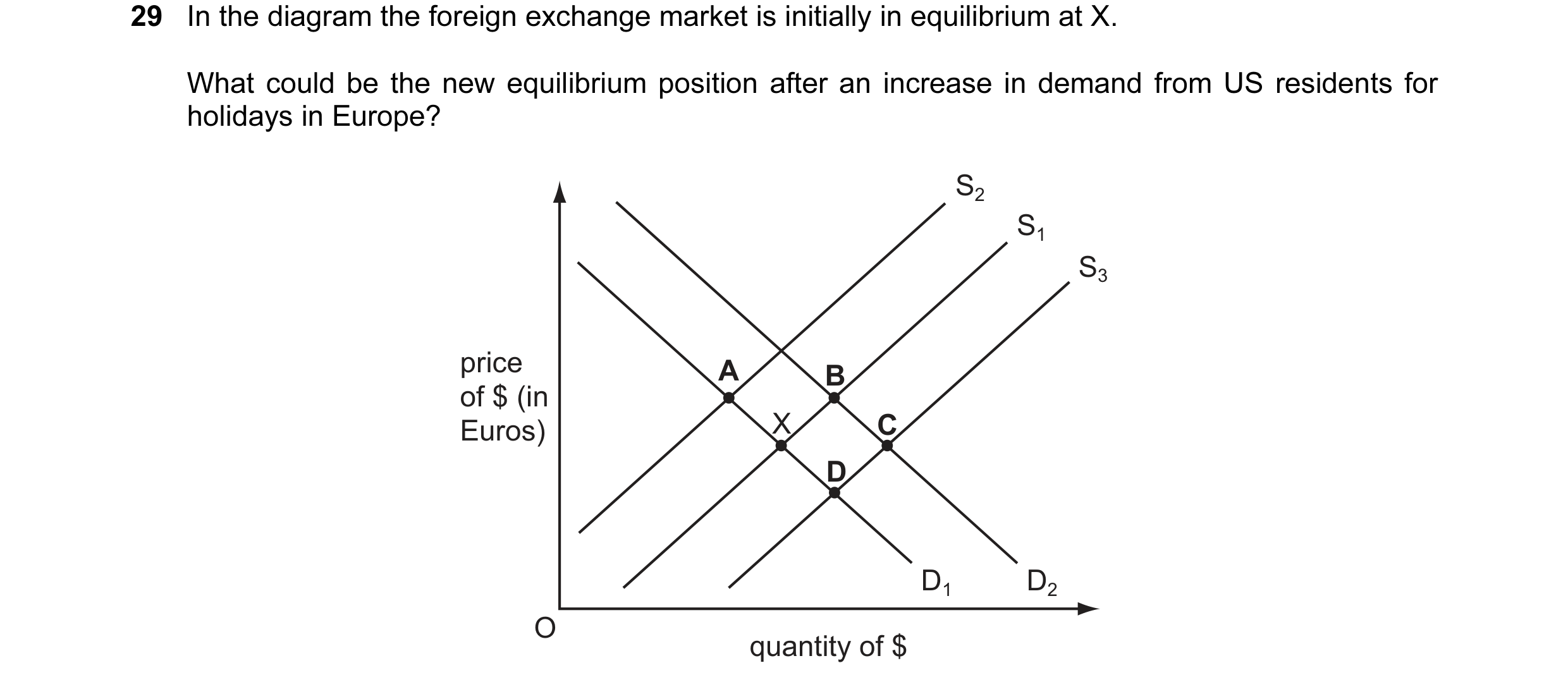

 1 / 75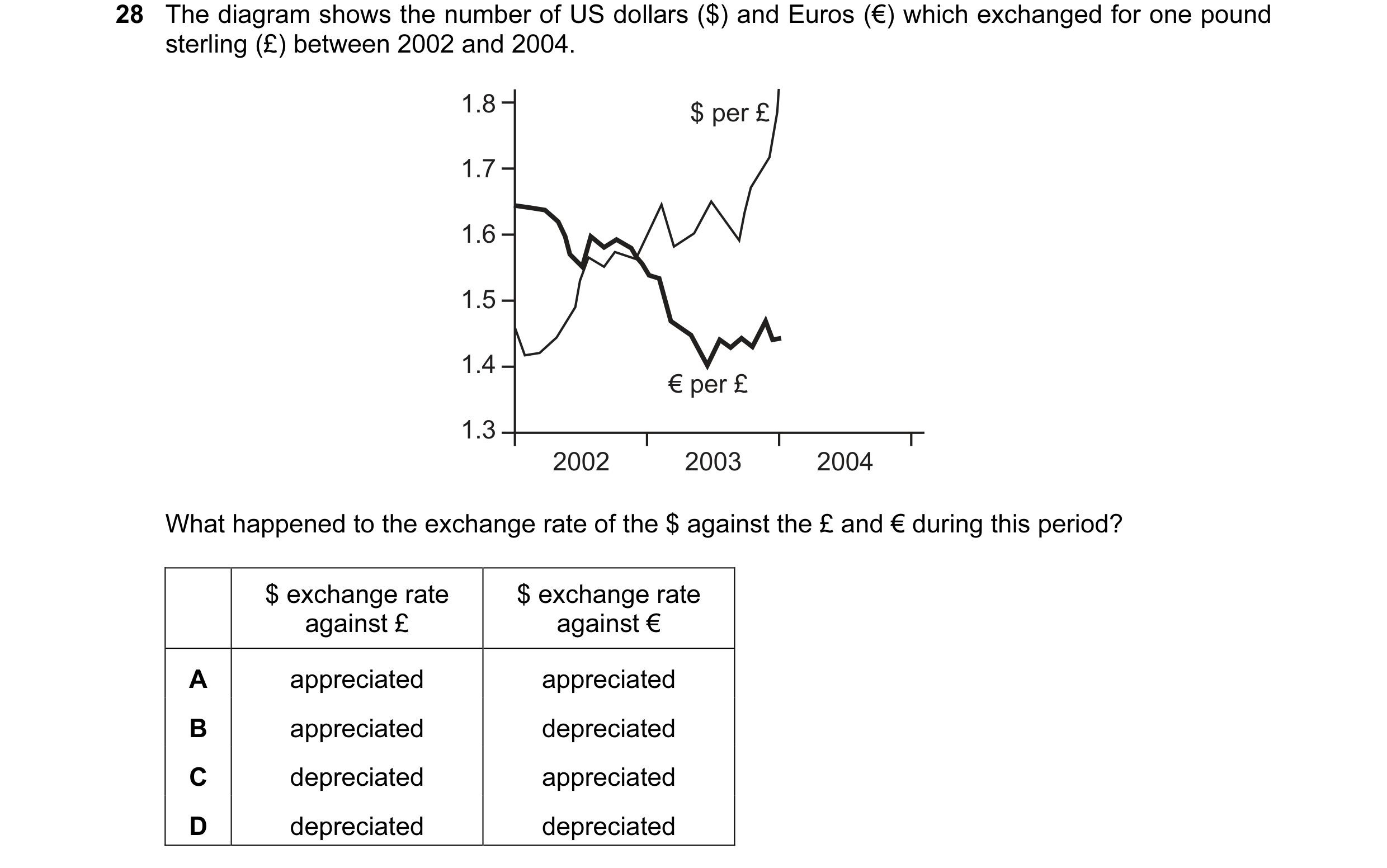
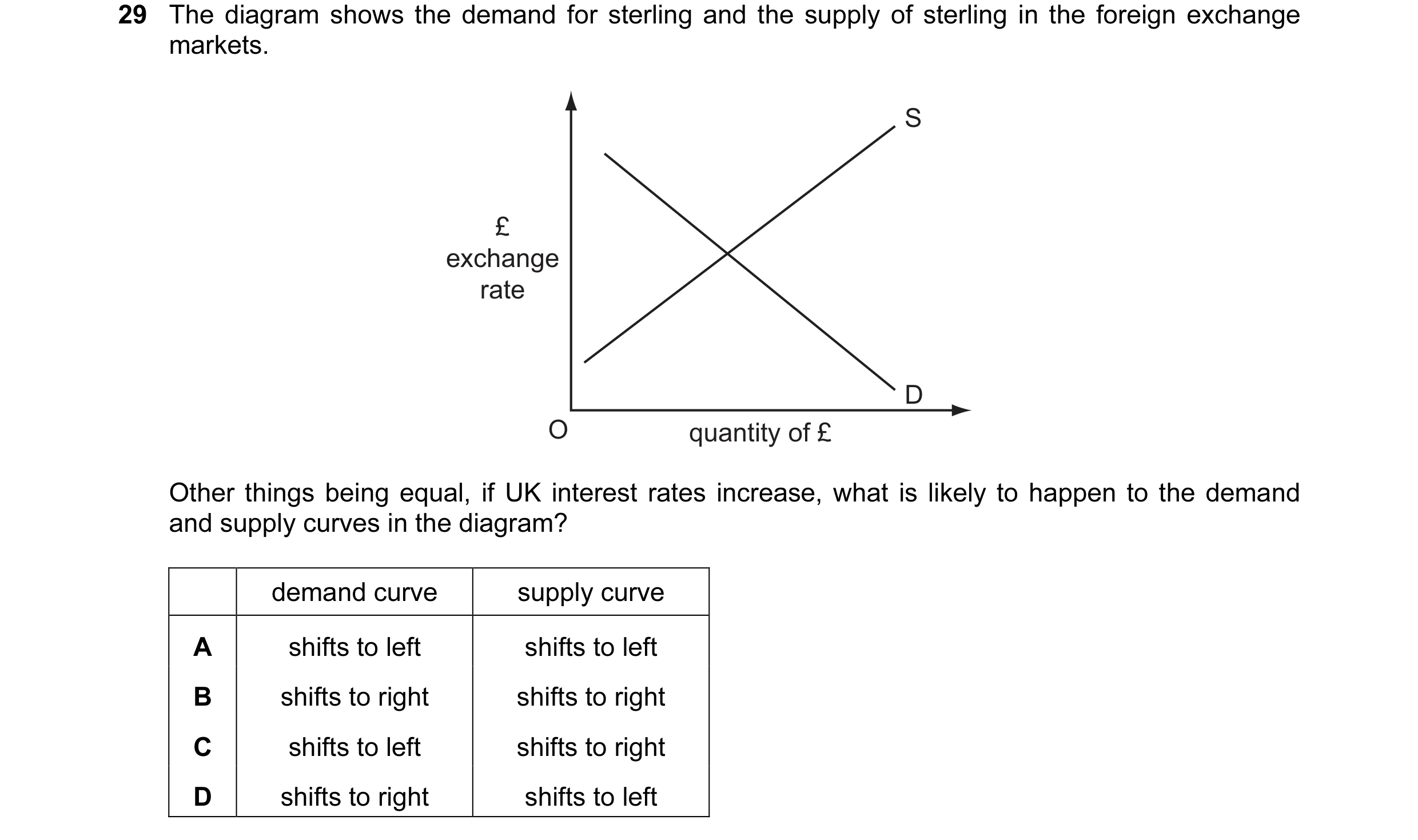 2 / 75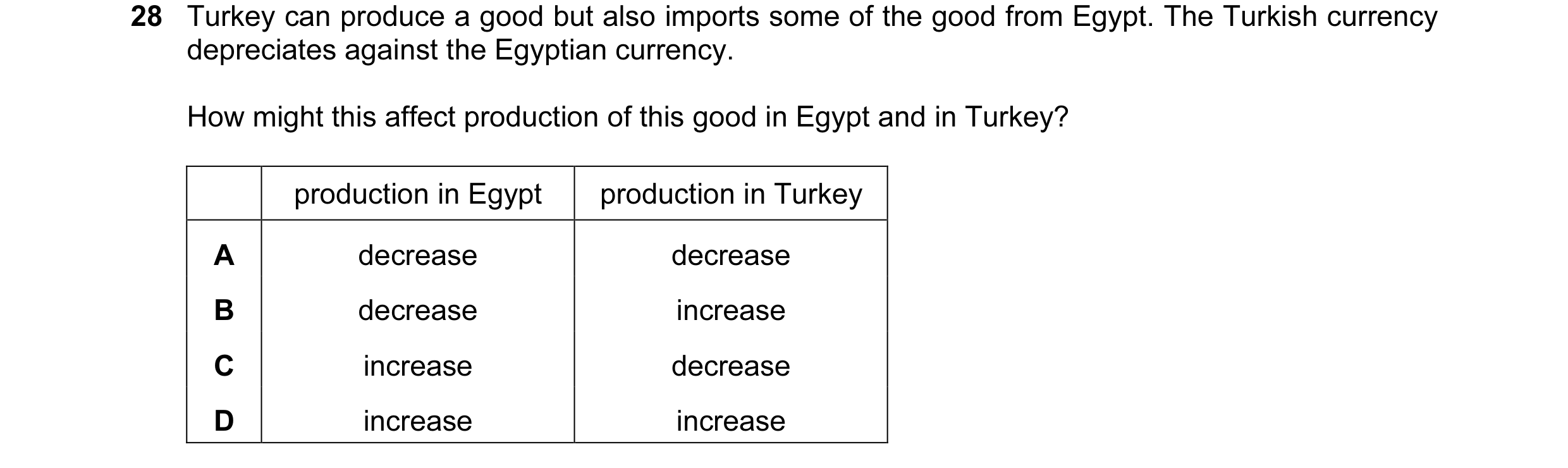
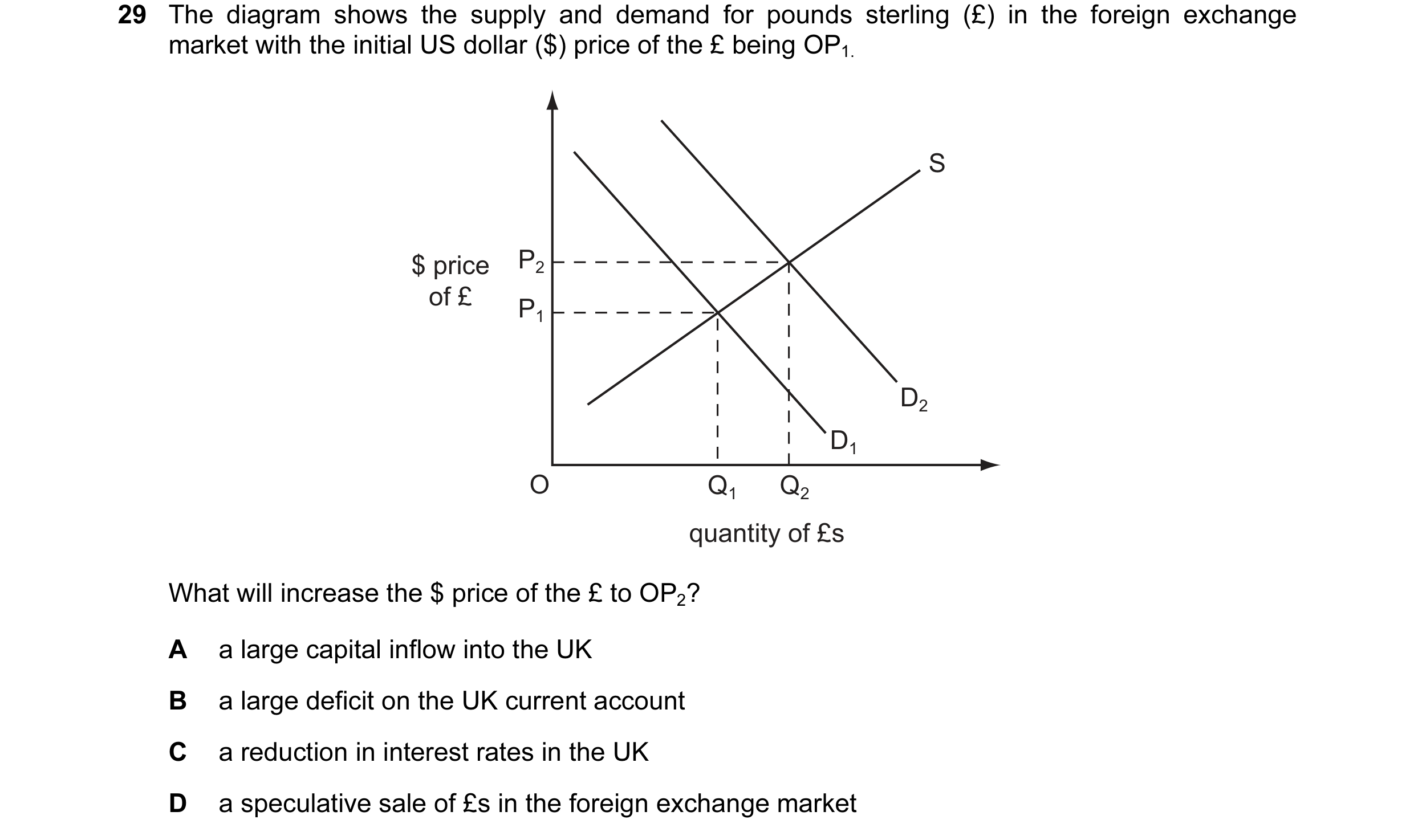
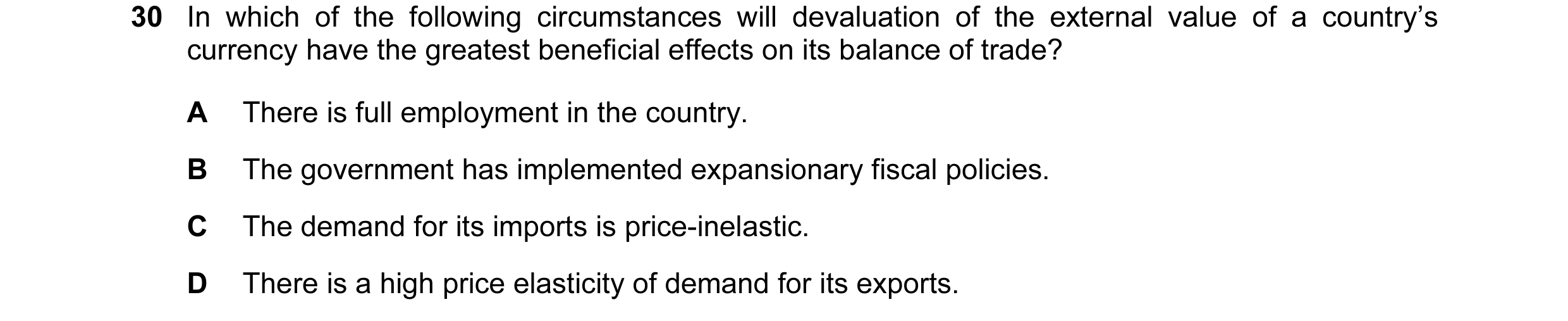
 3 / 75
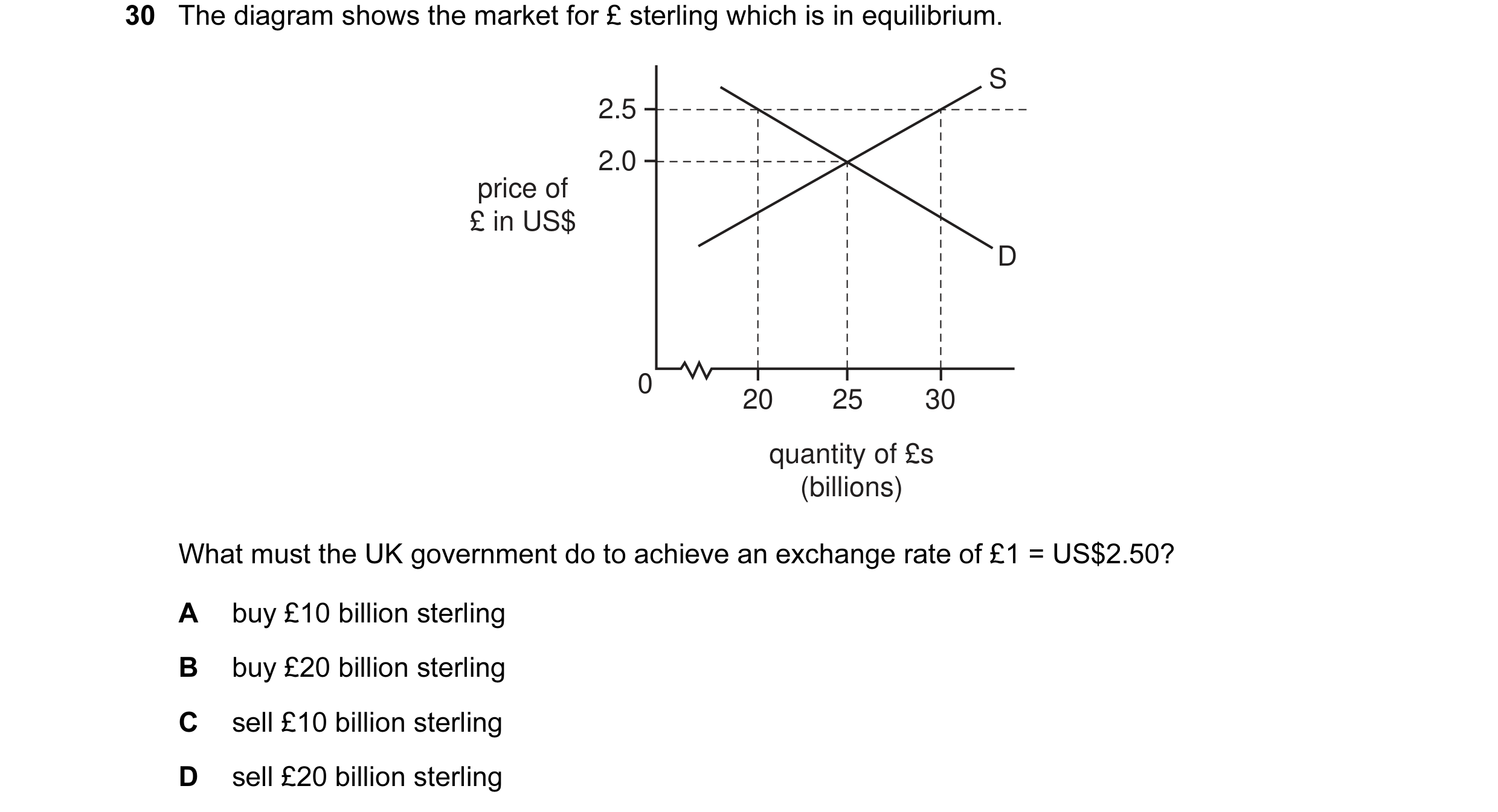
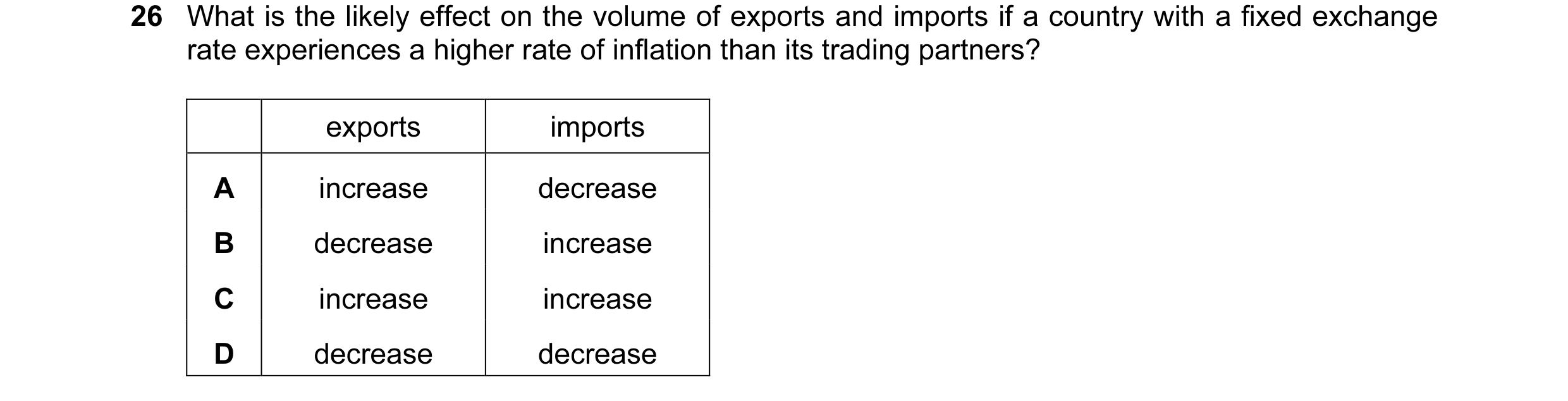 4 / 75
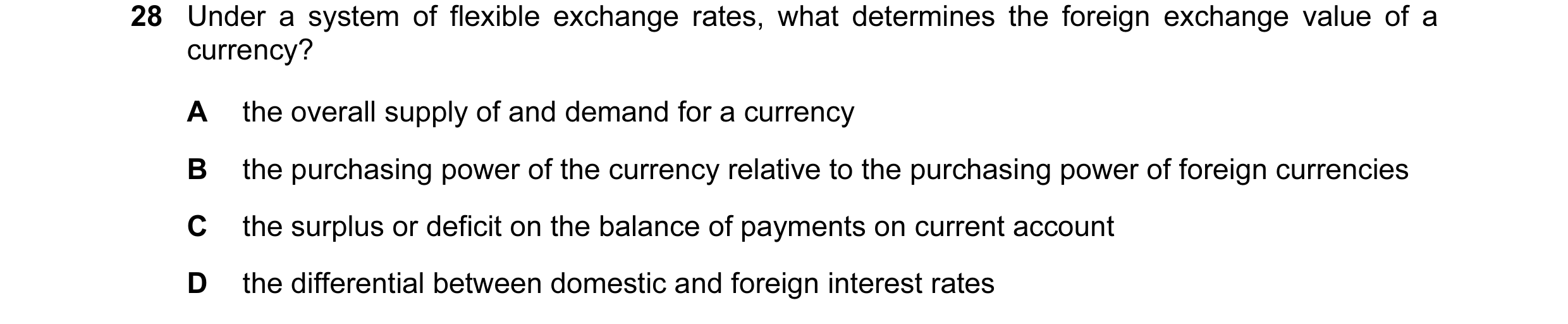

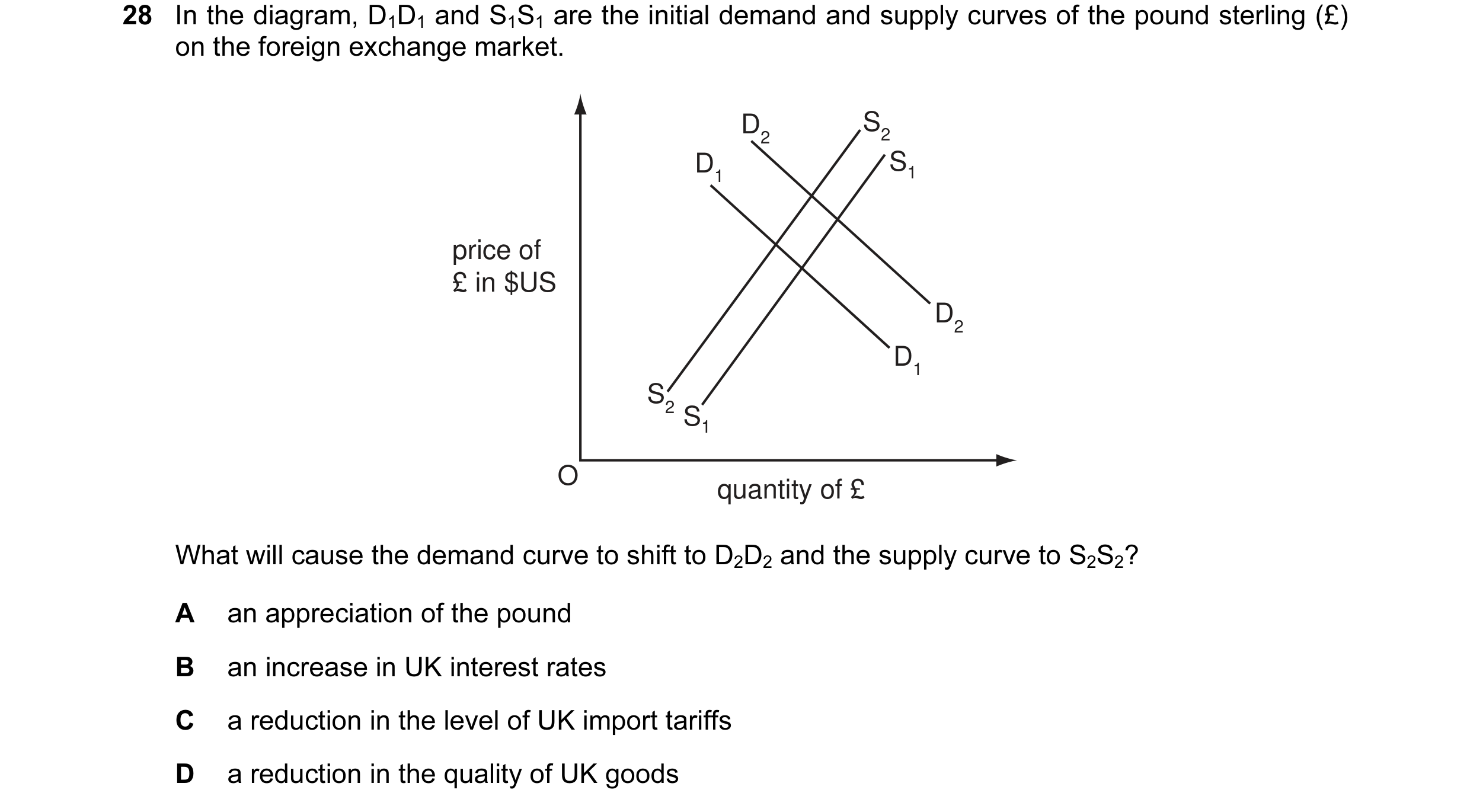
 5 / 75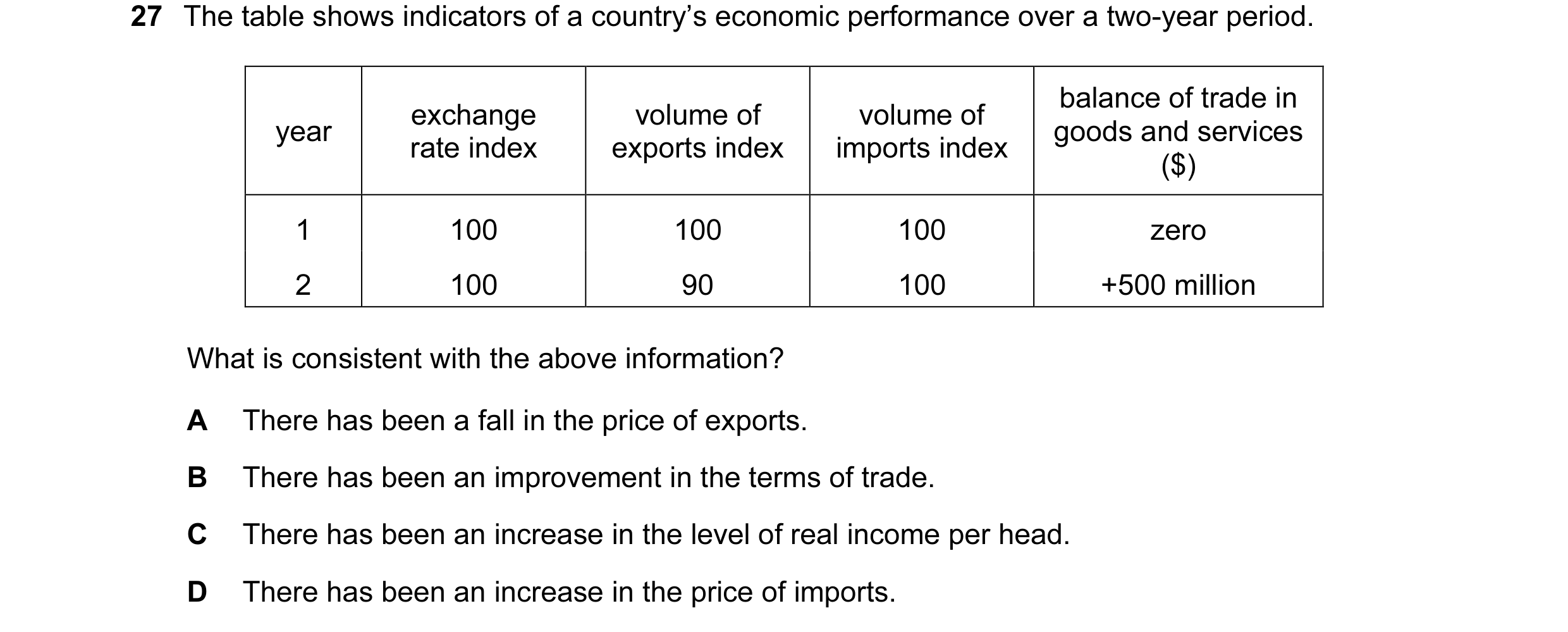
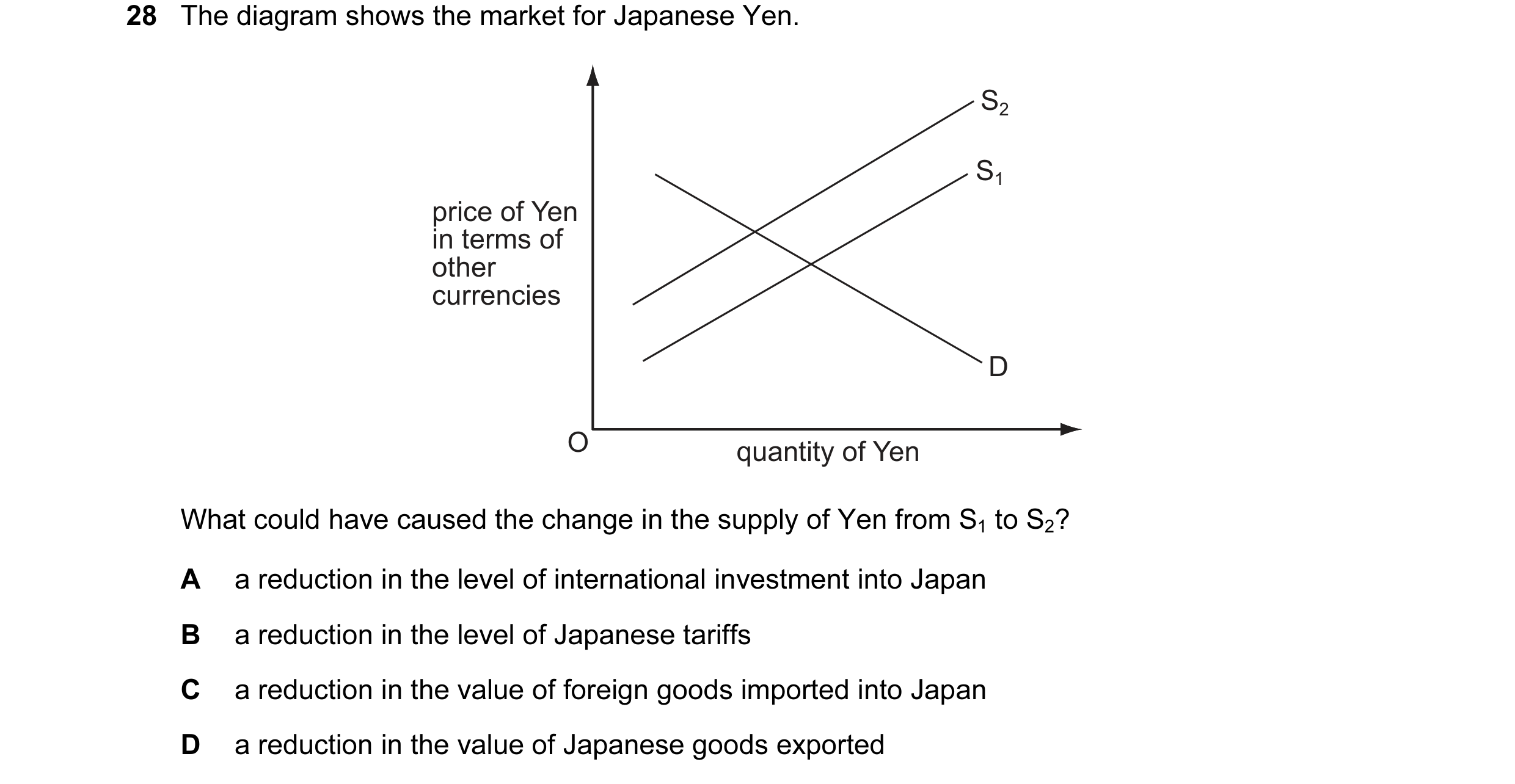
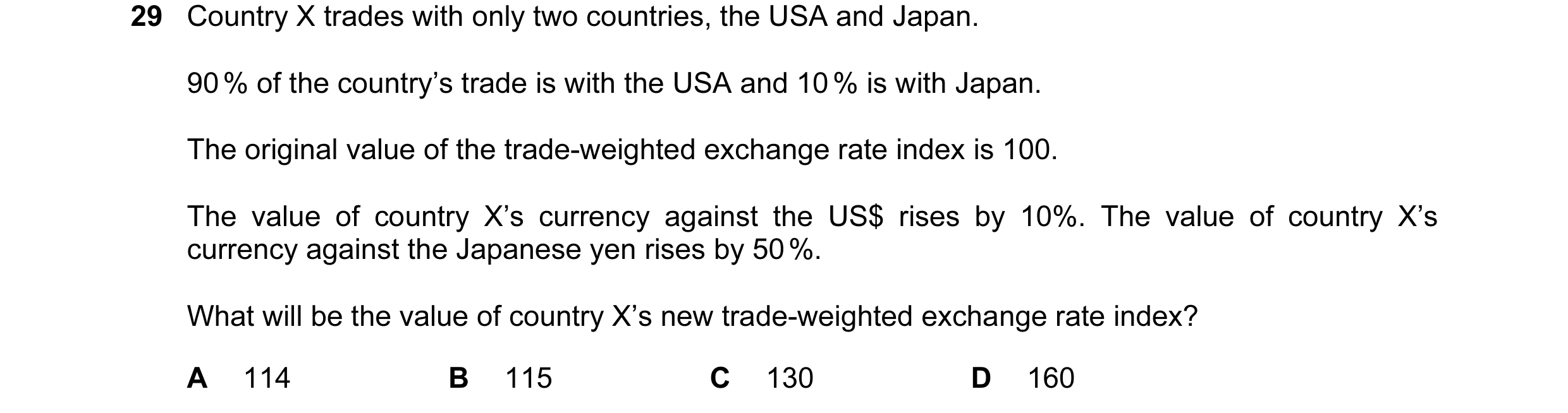 6 / 75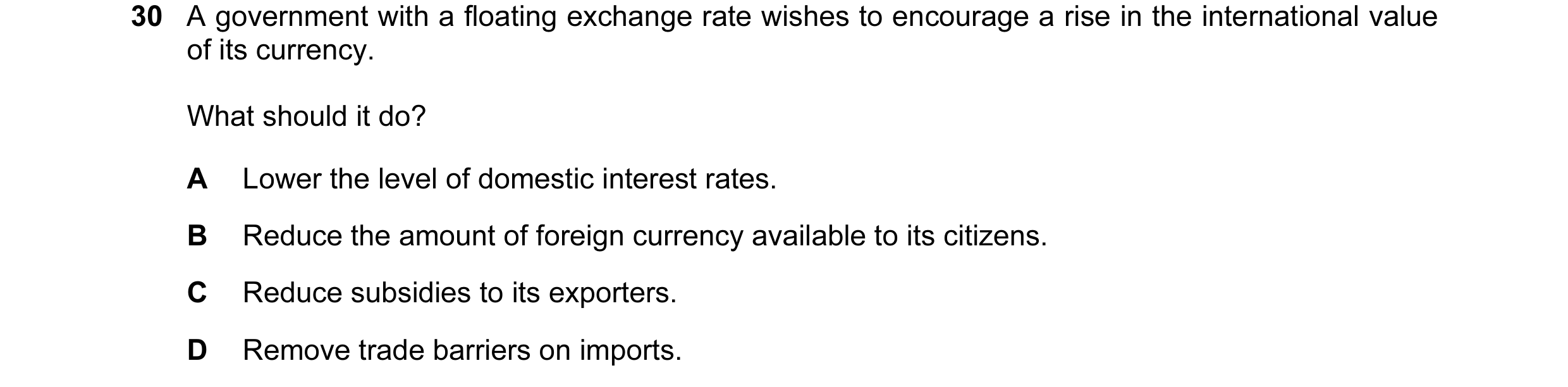

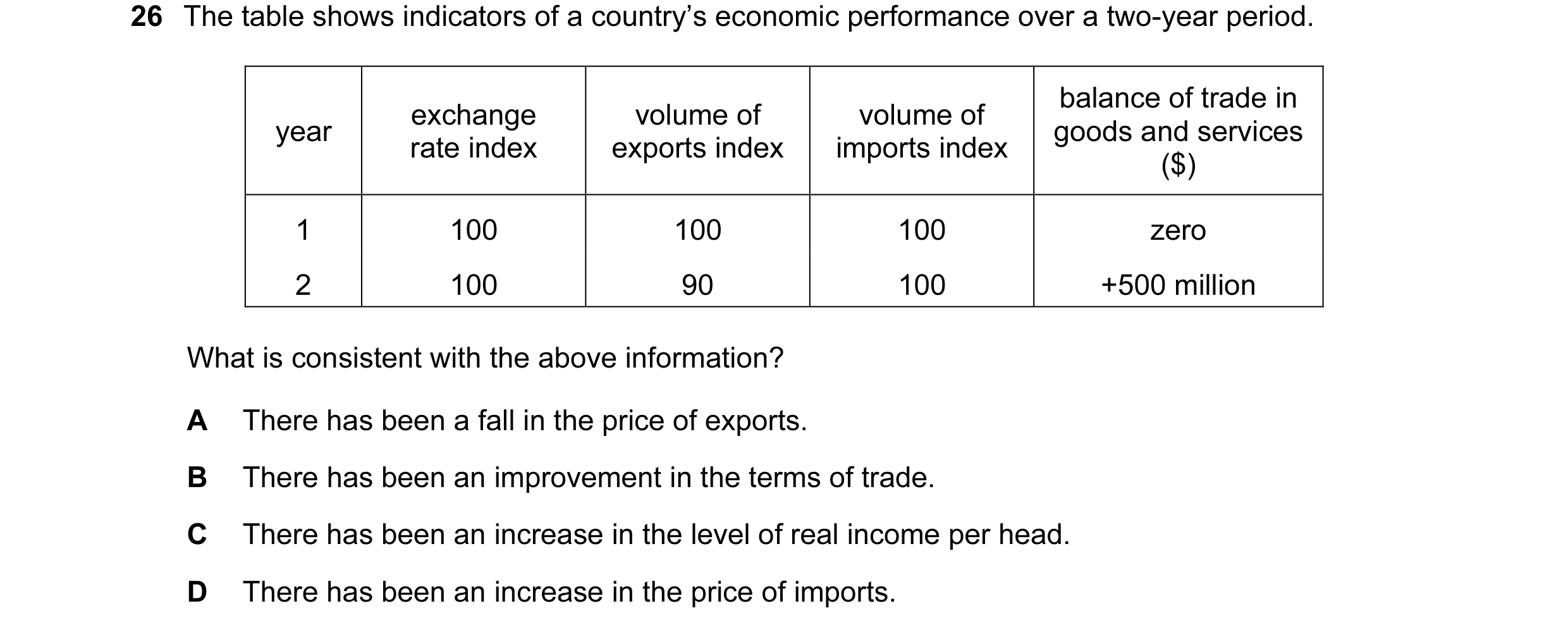
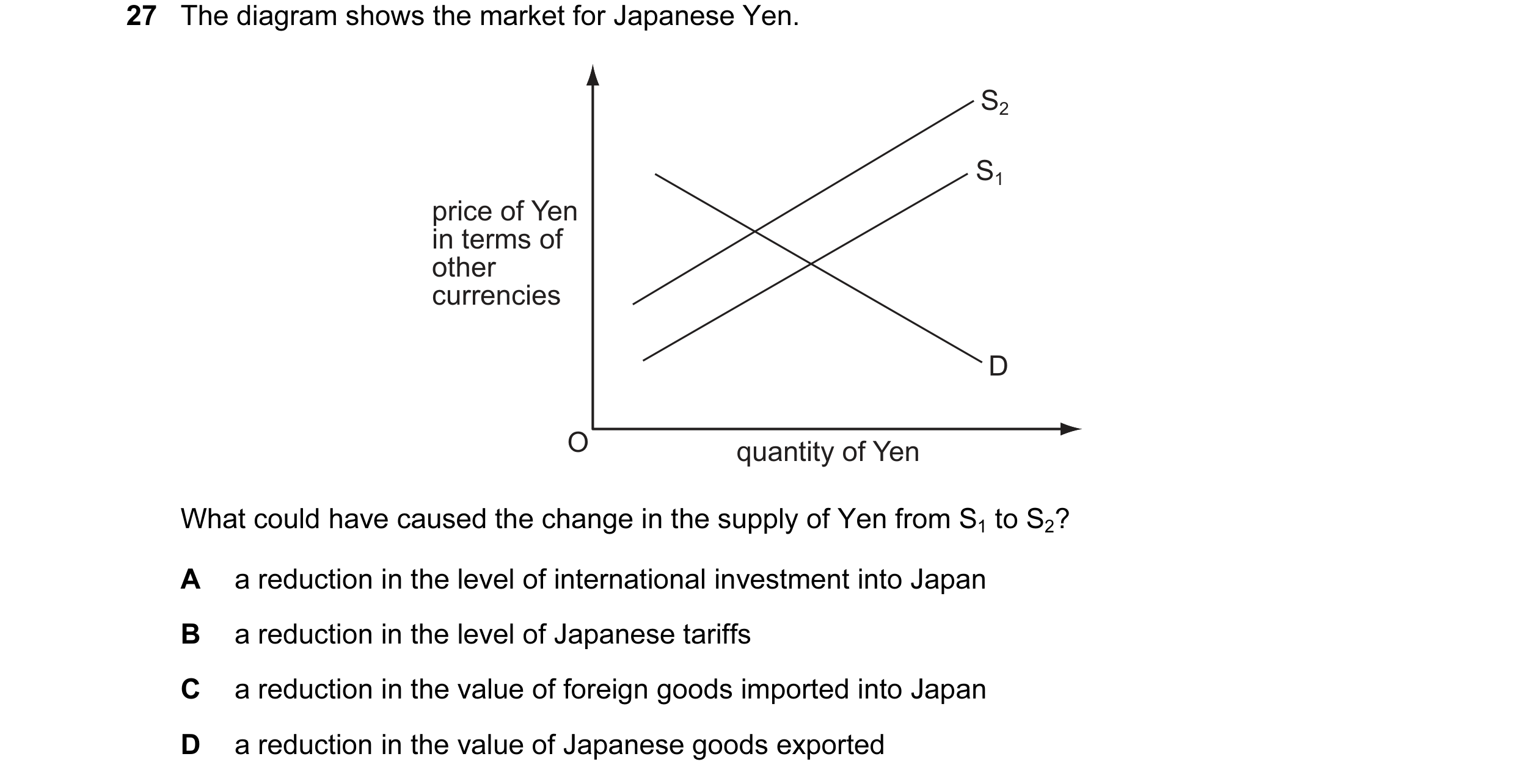 7 / 75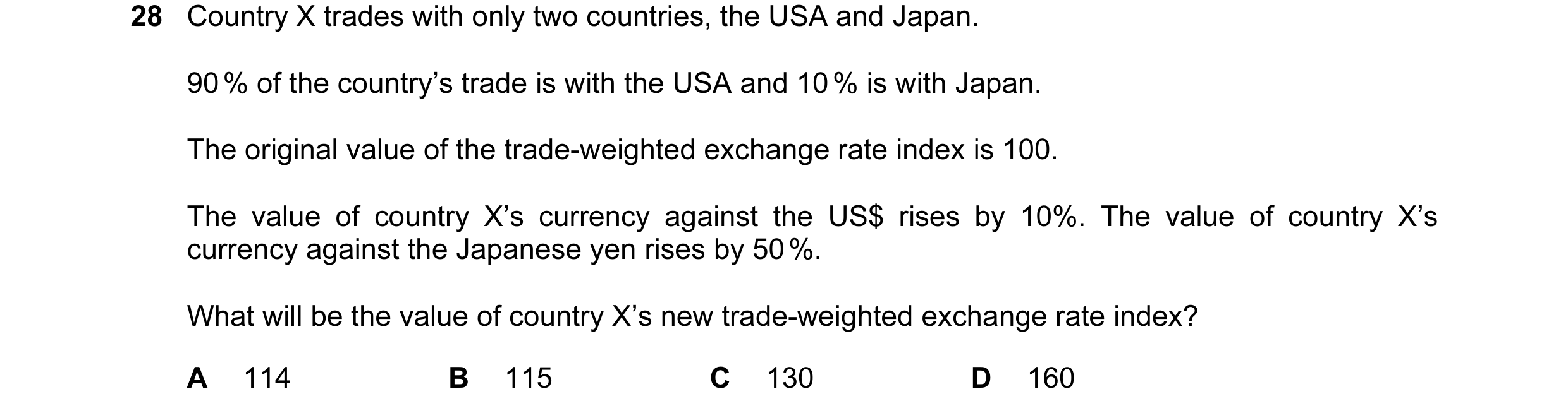
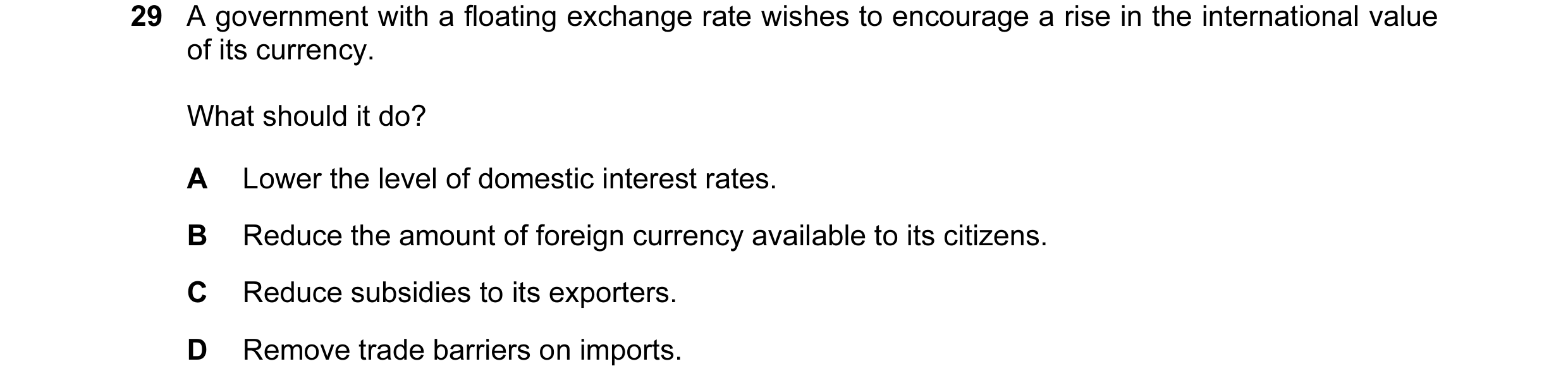
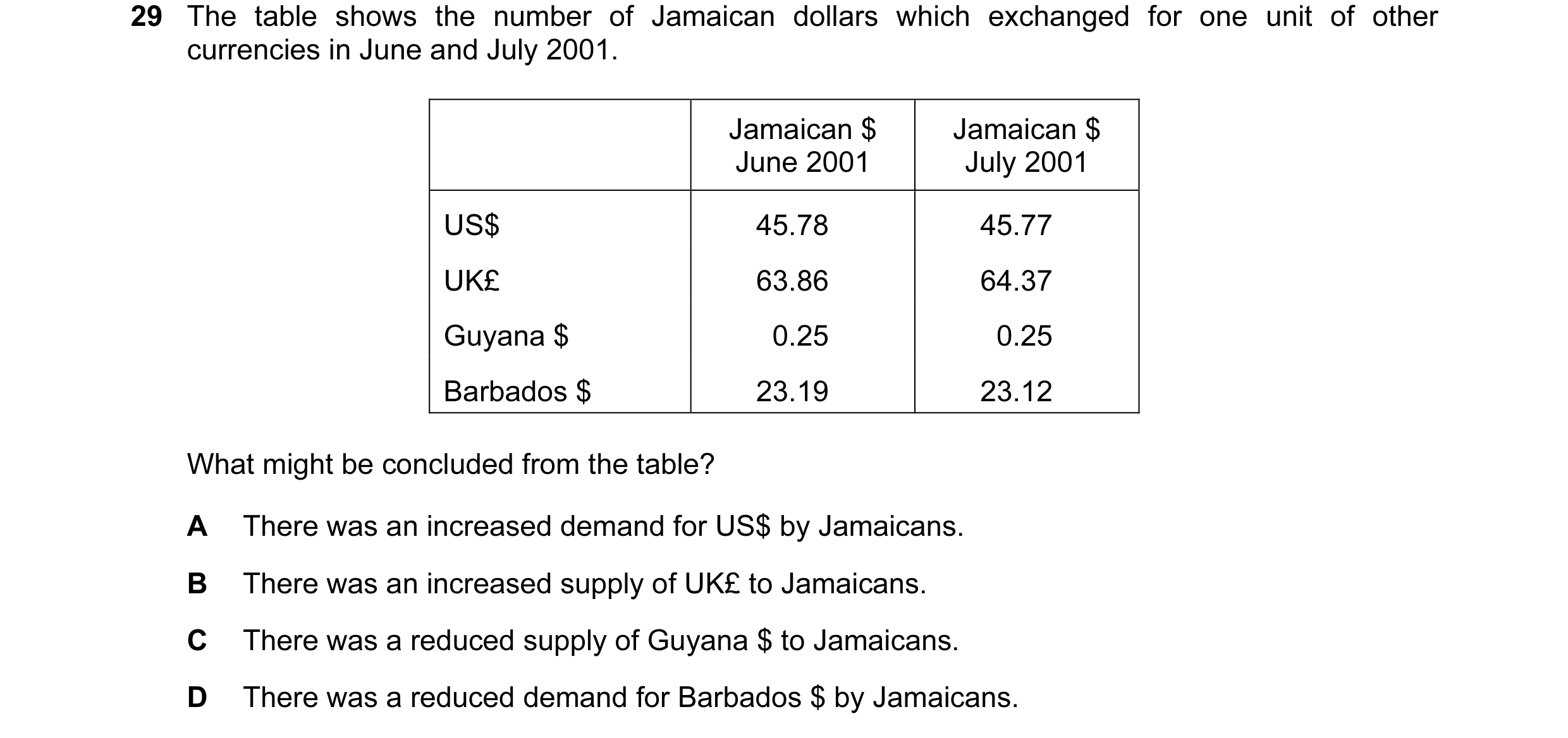
 8 / 75
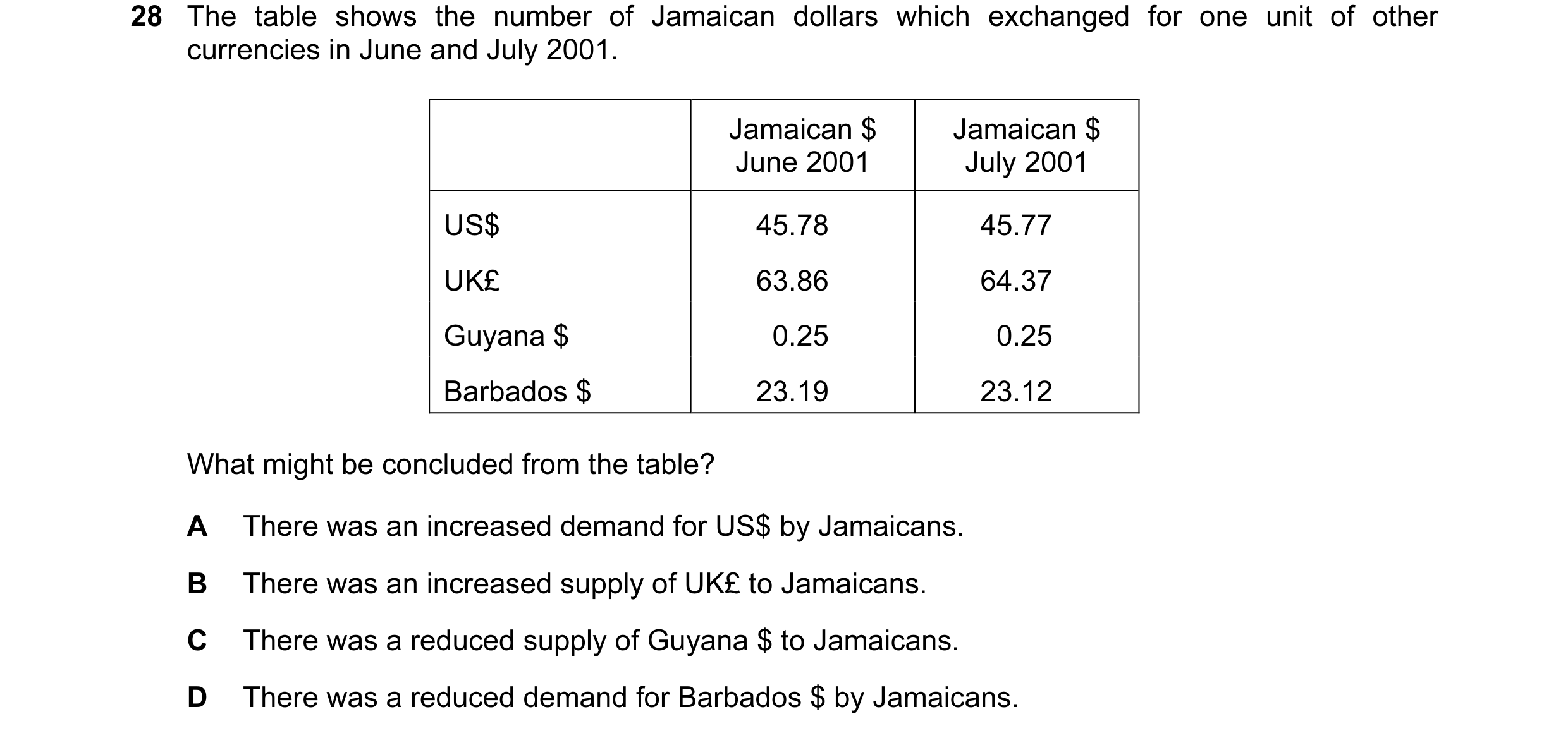
 9 / 75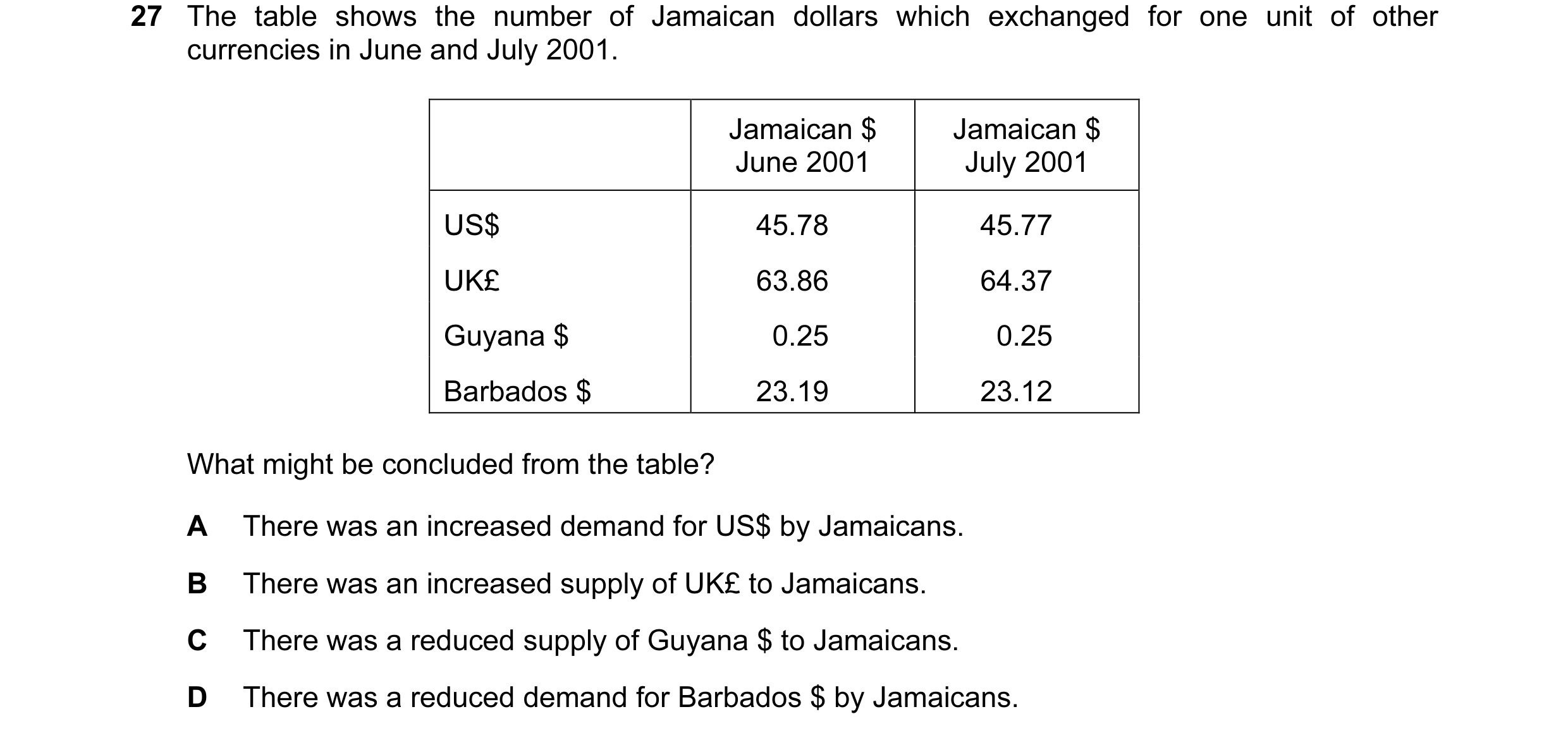
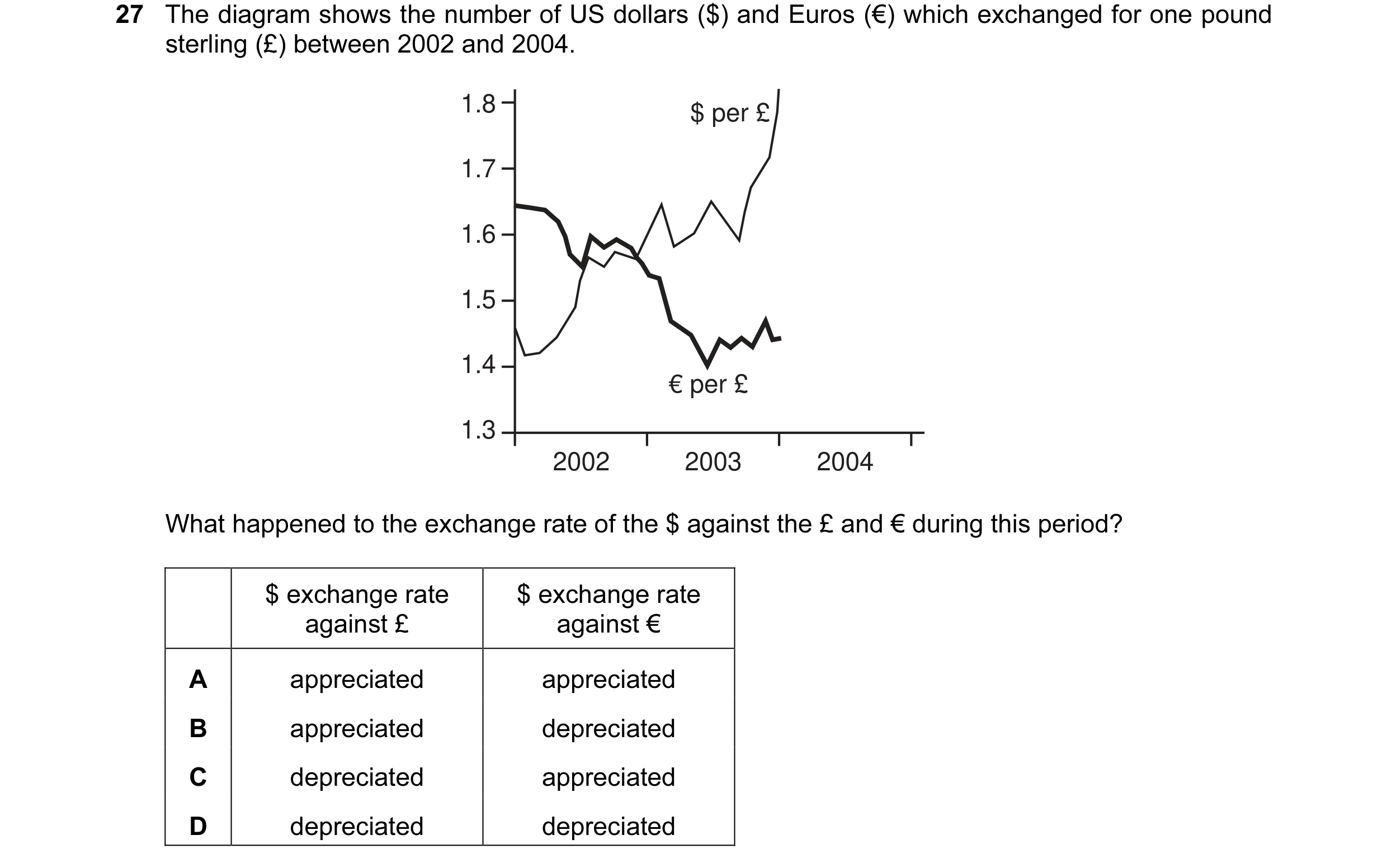 10 / 75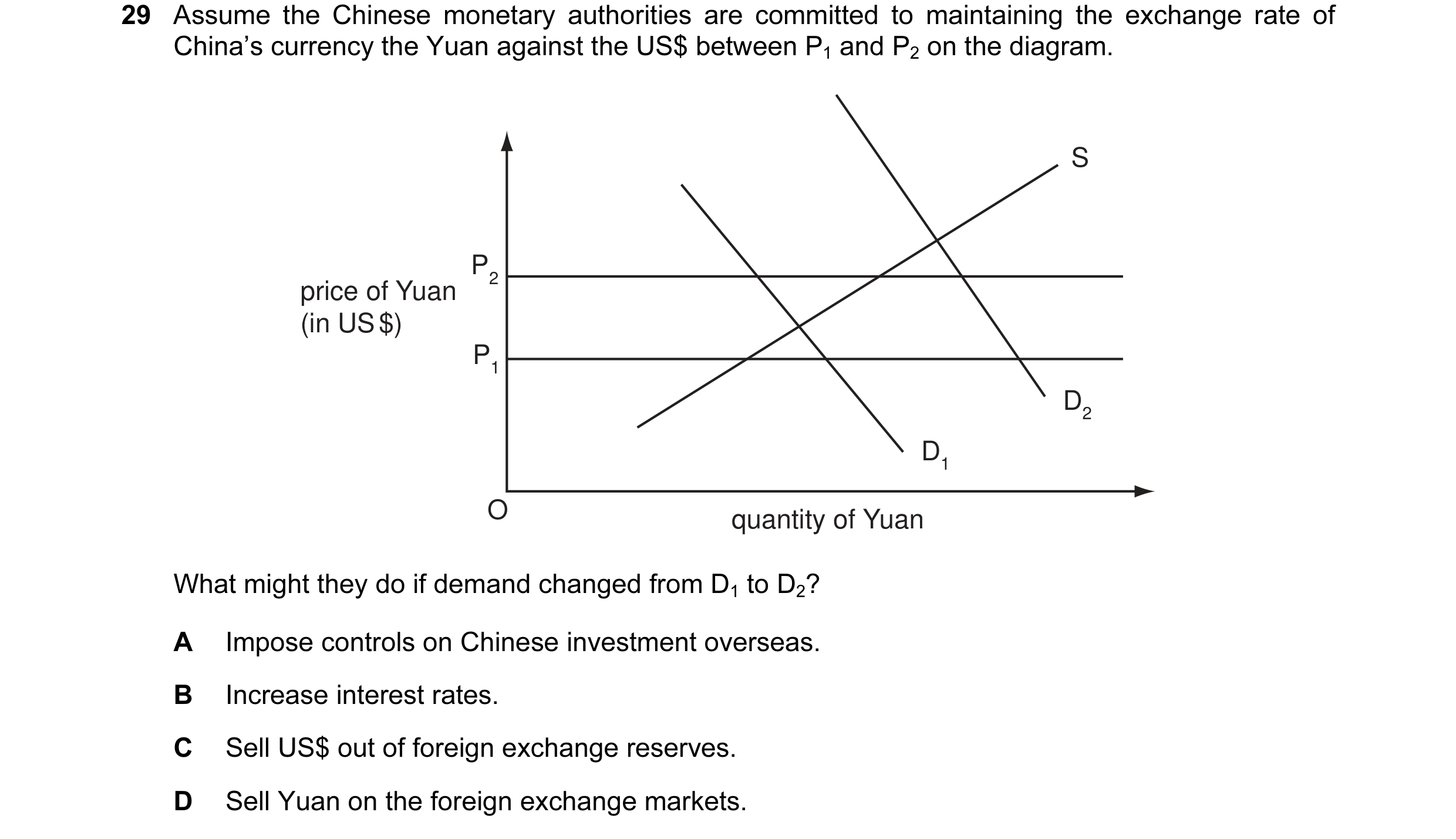
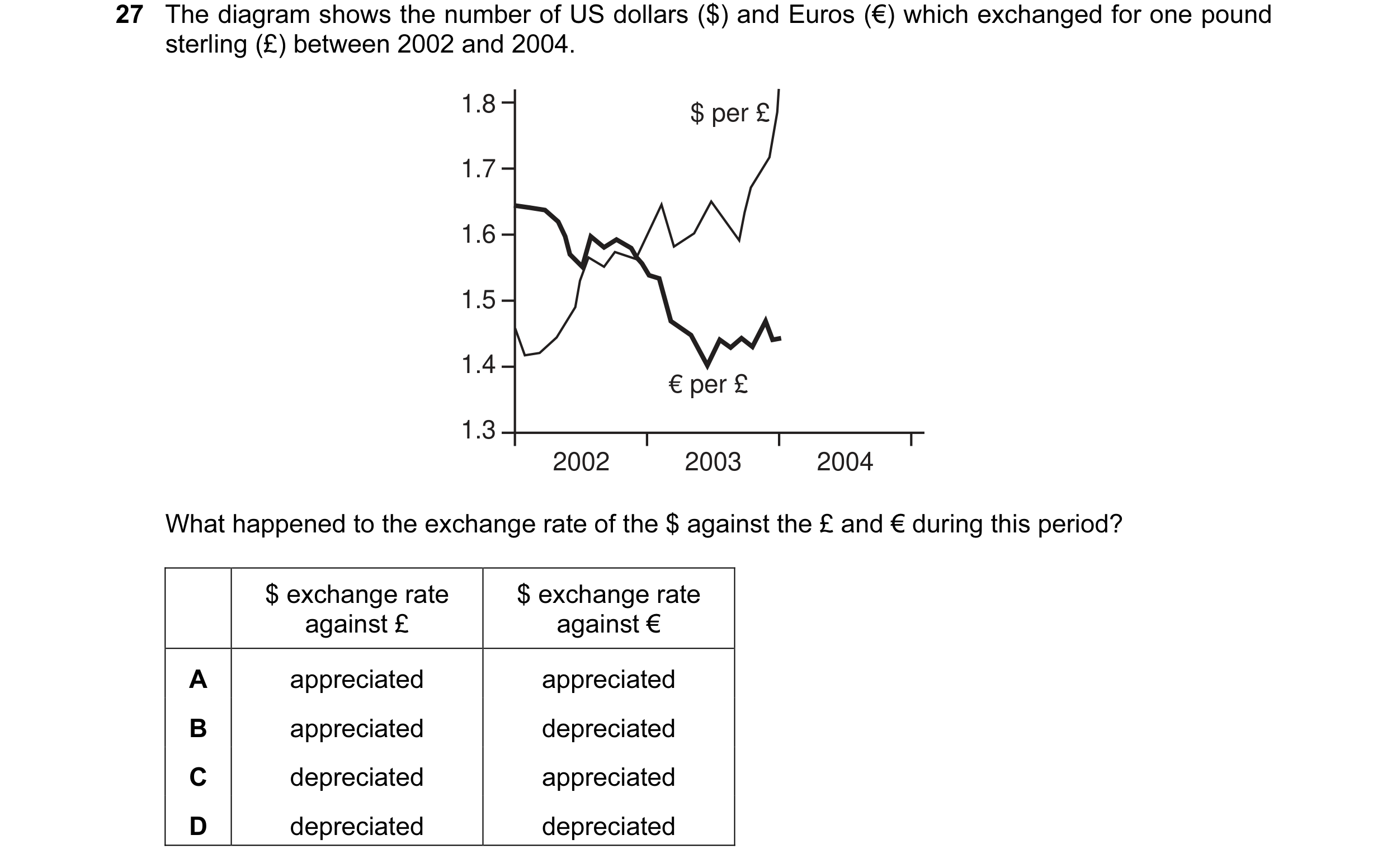 11 / 75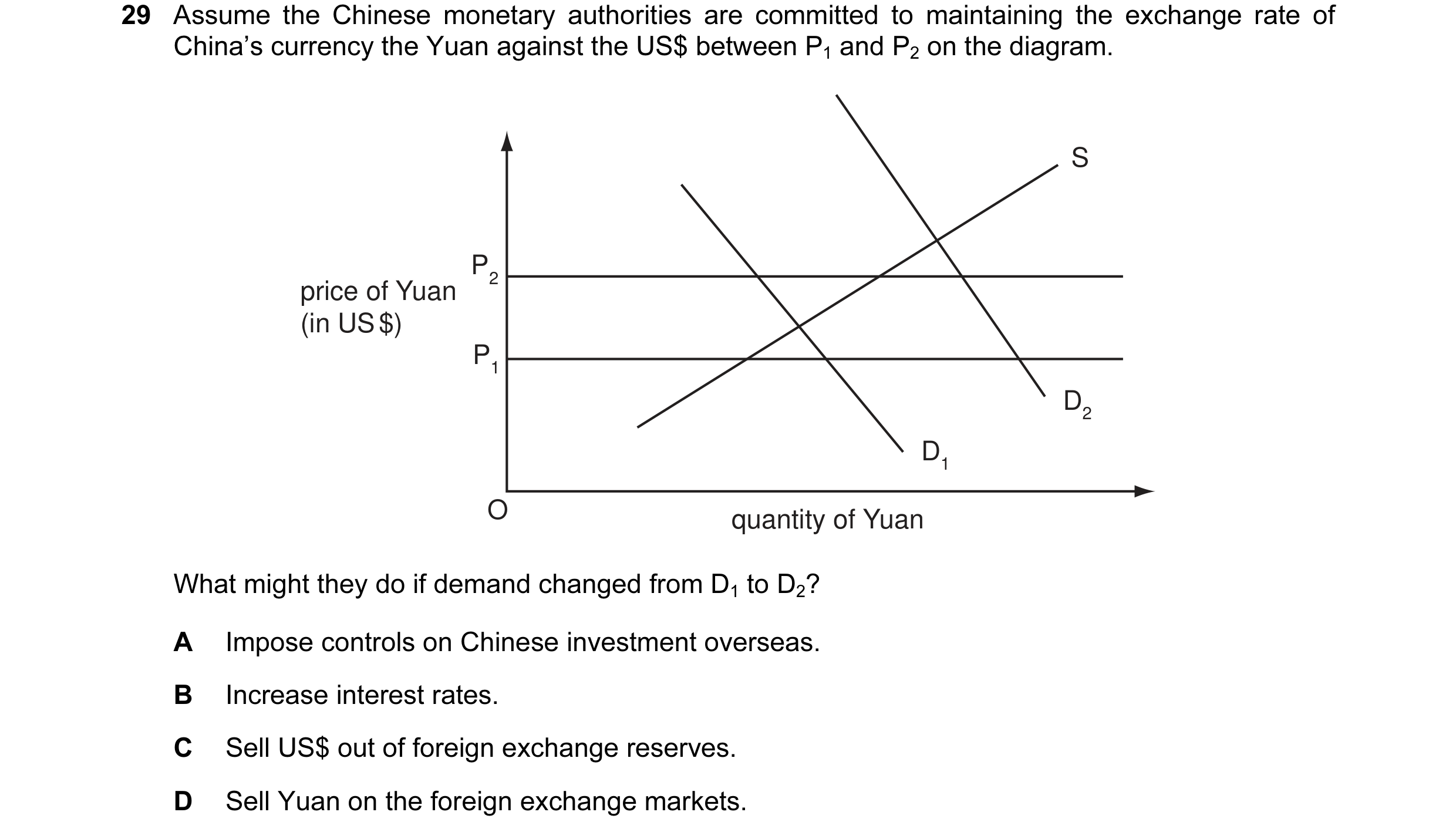
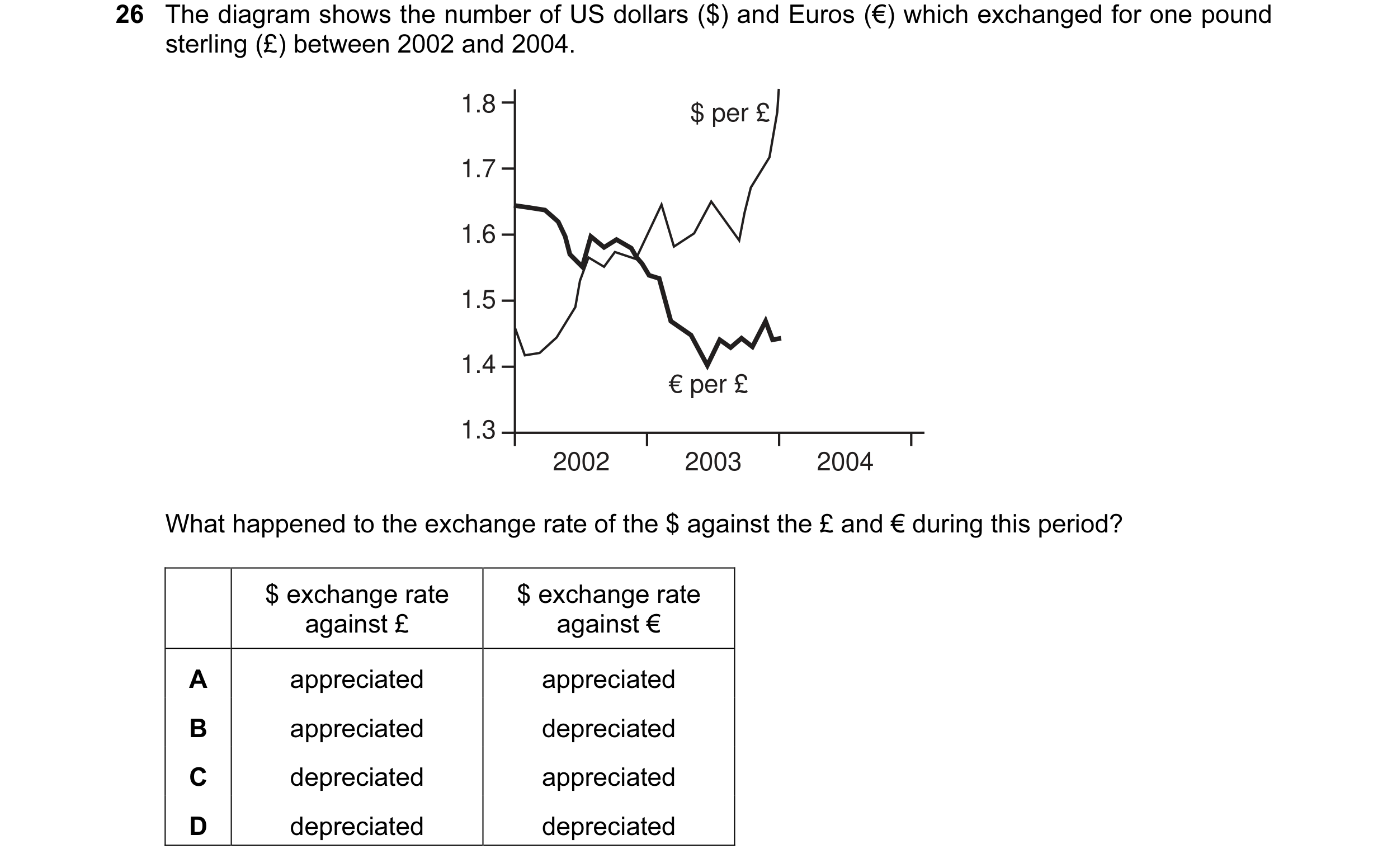 12 / 75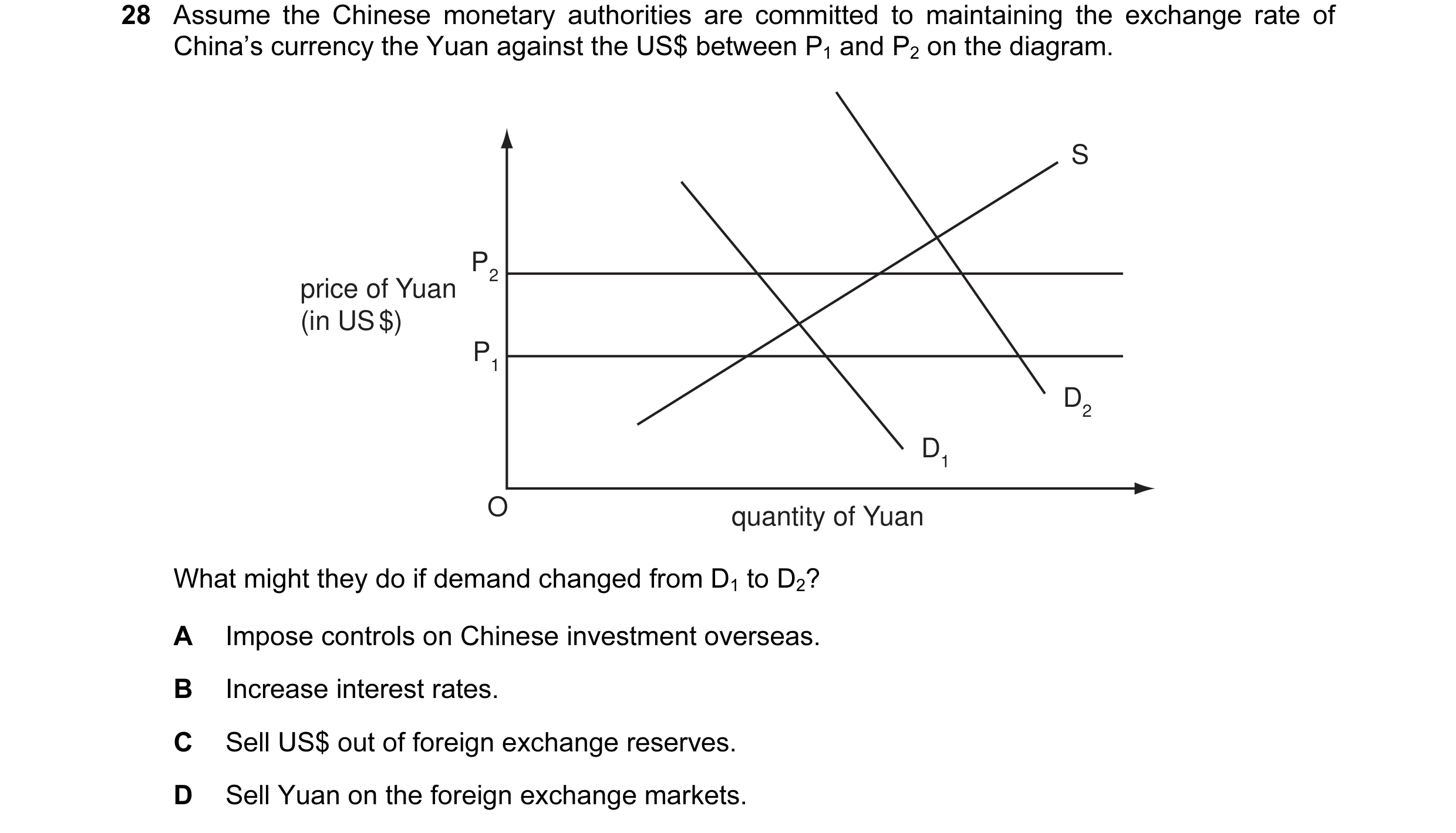
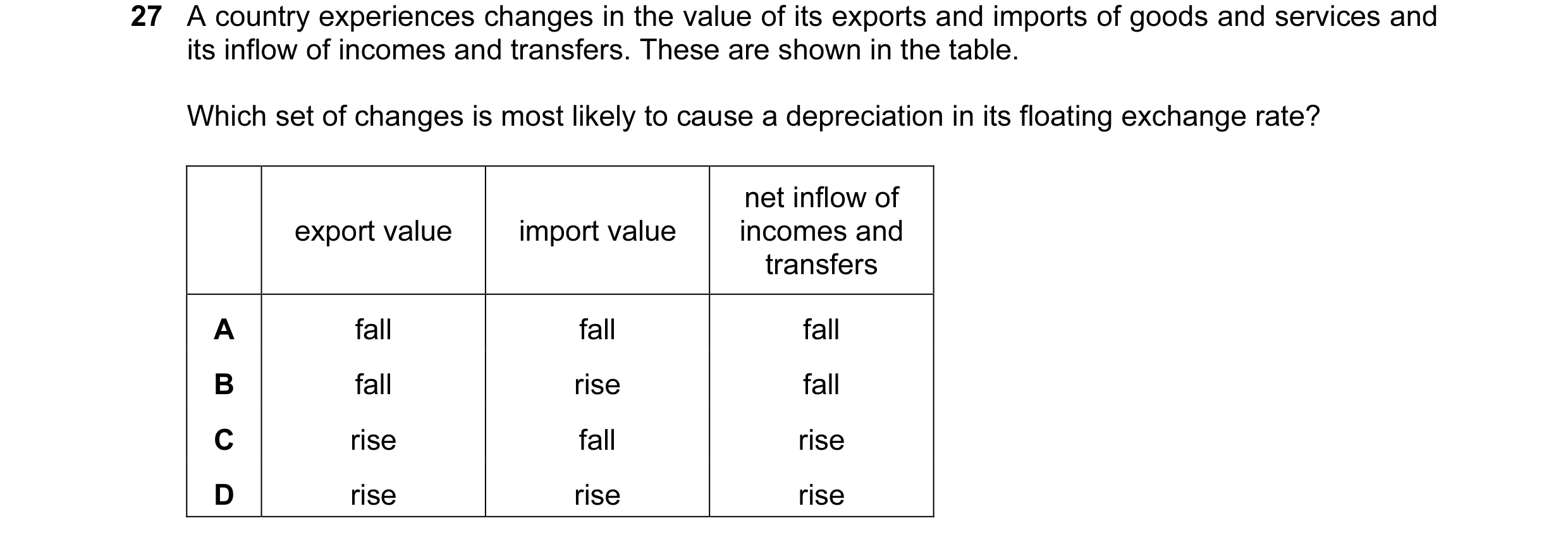
 13 / 75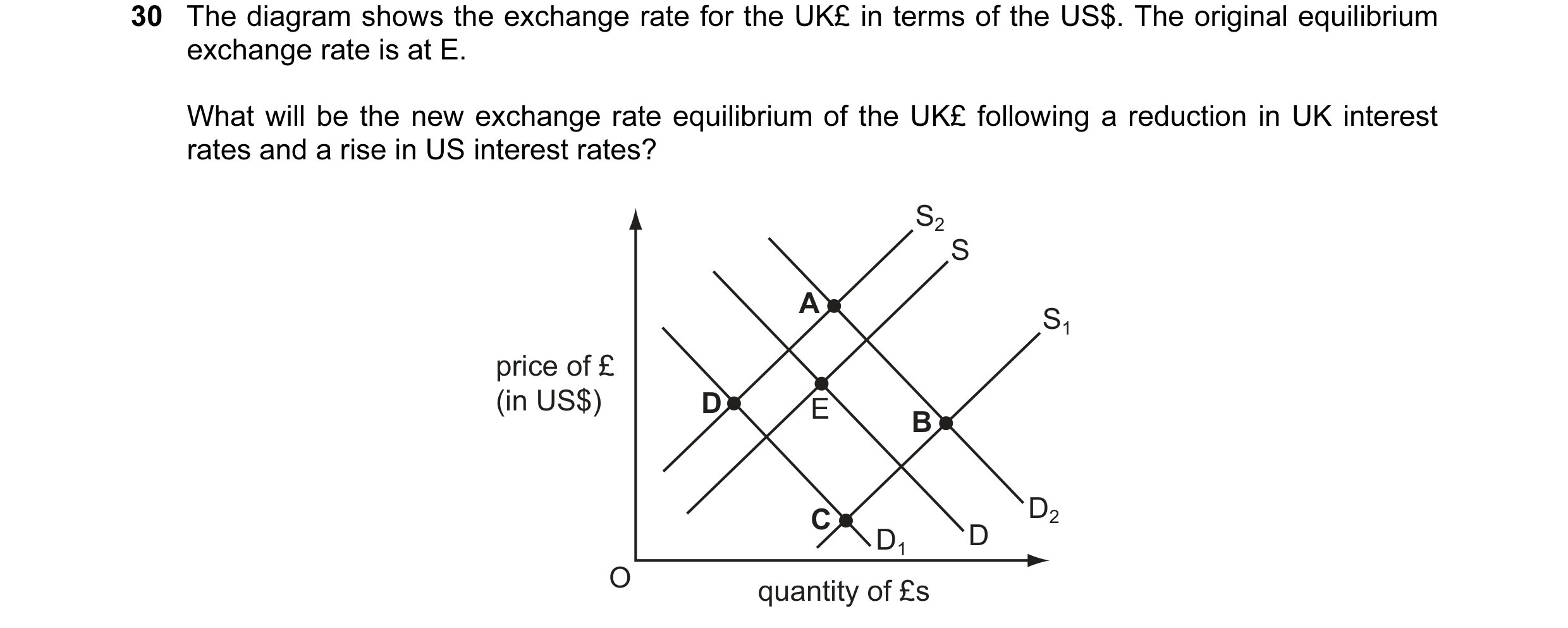
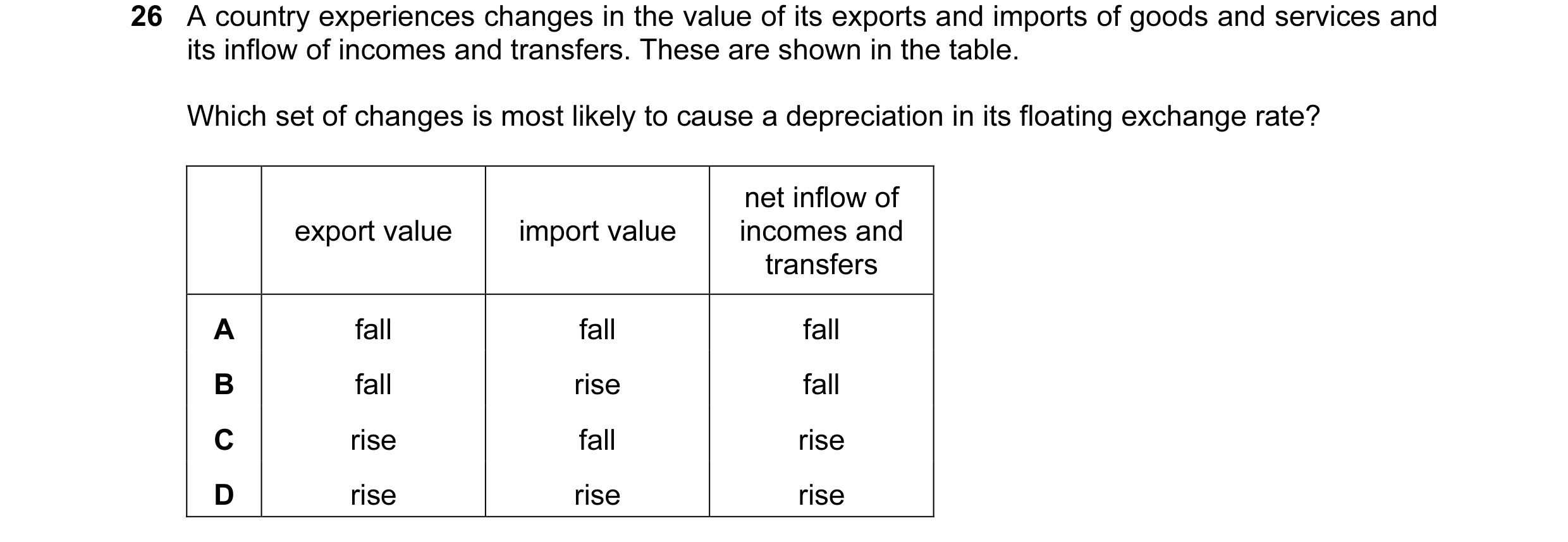
 14 / 75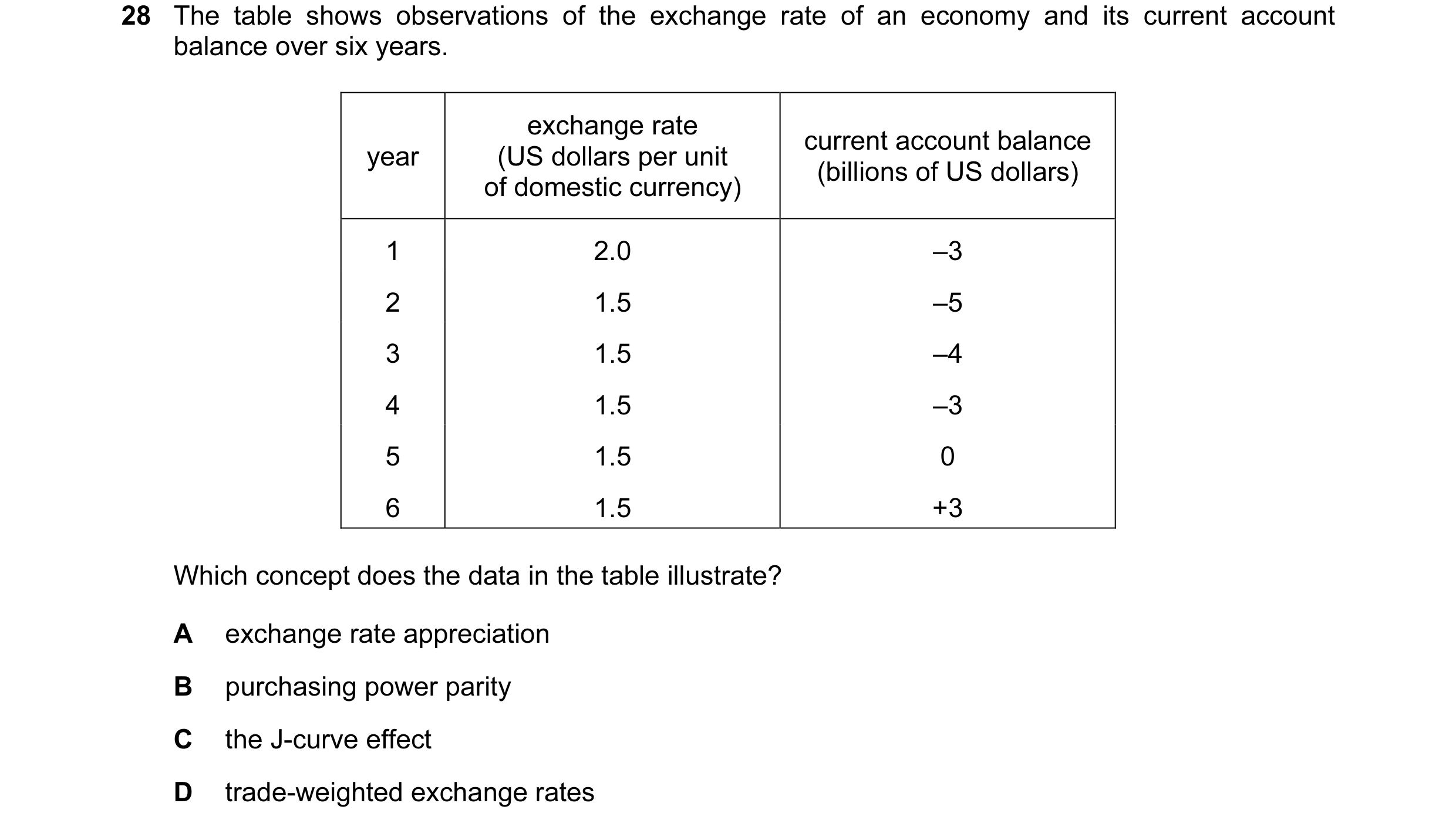
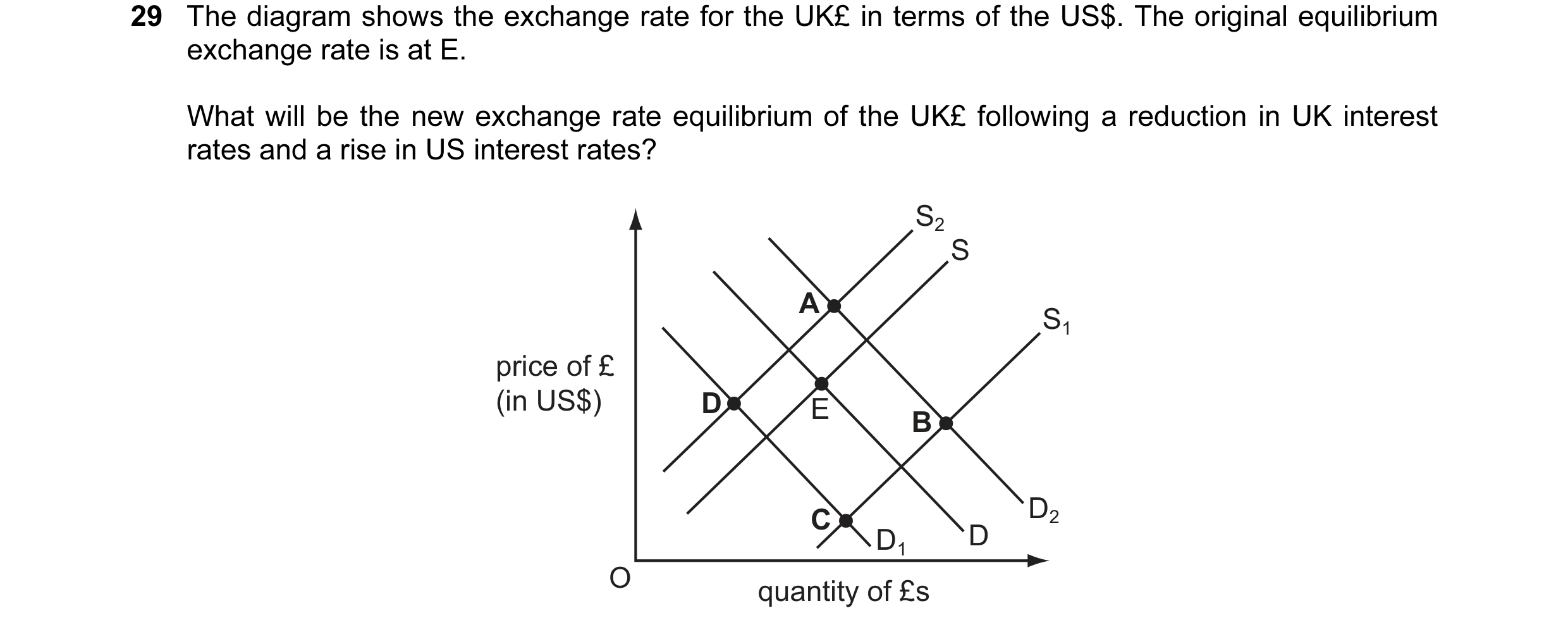
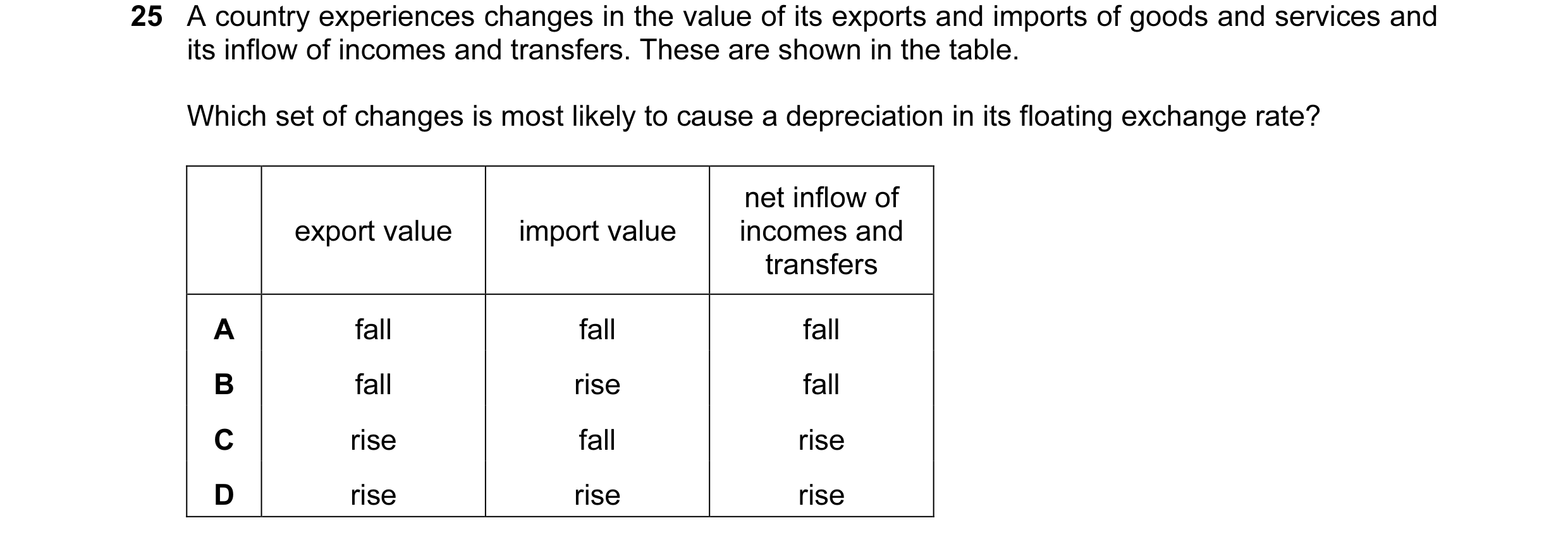 15 / 75
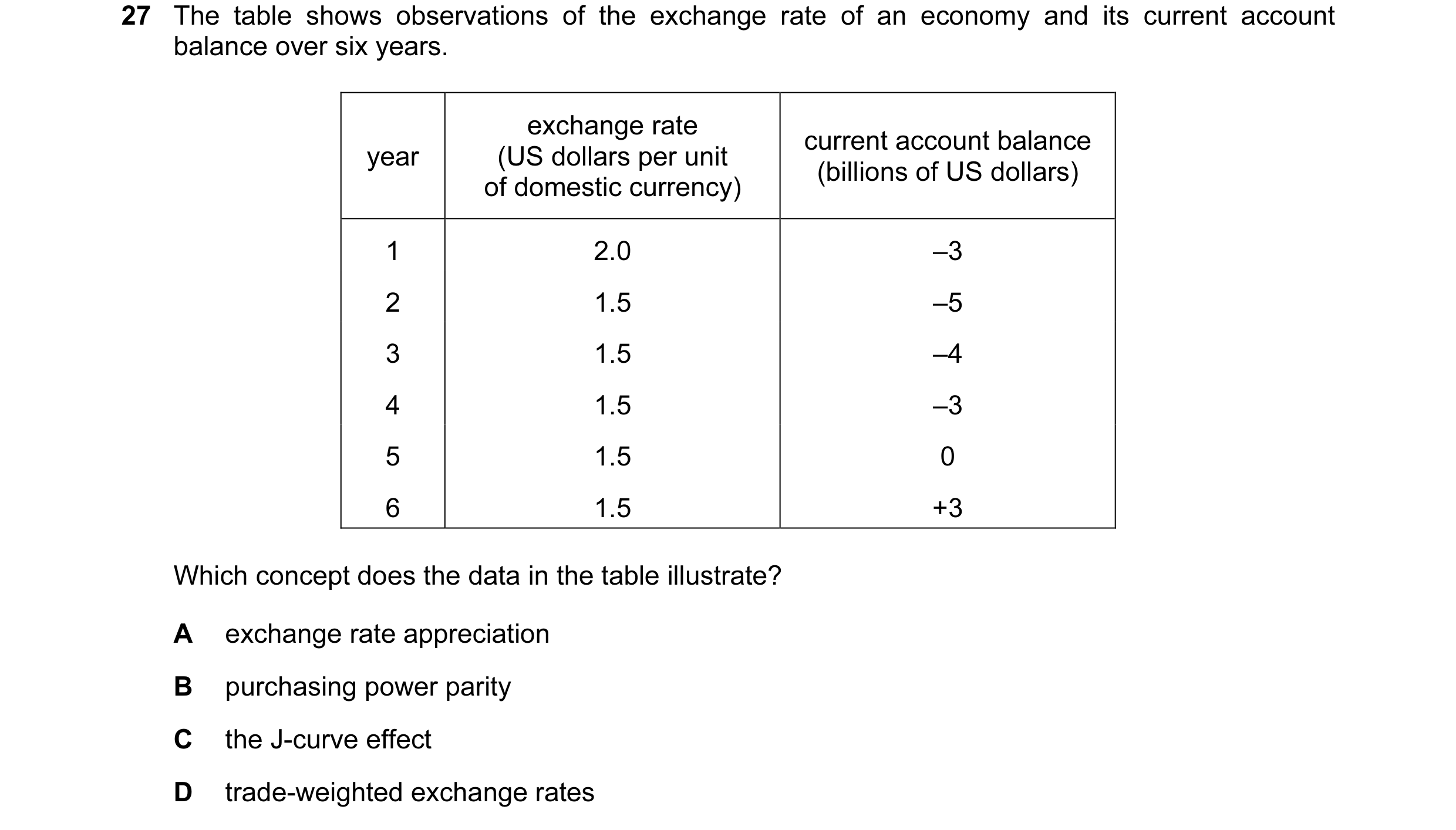
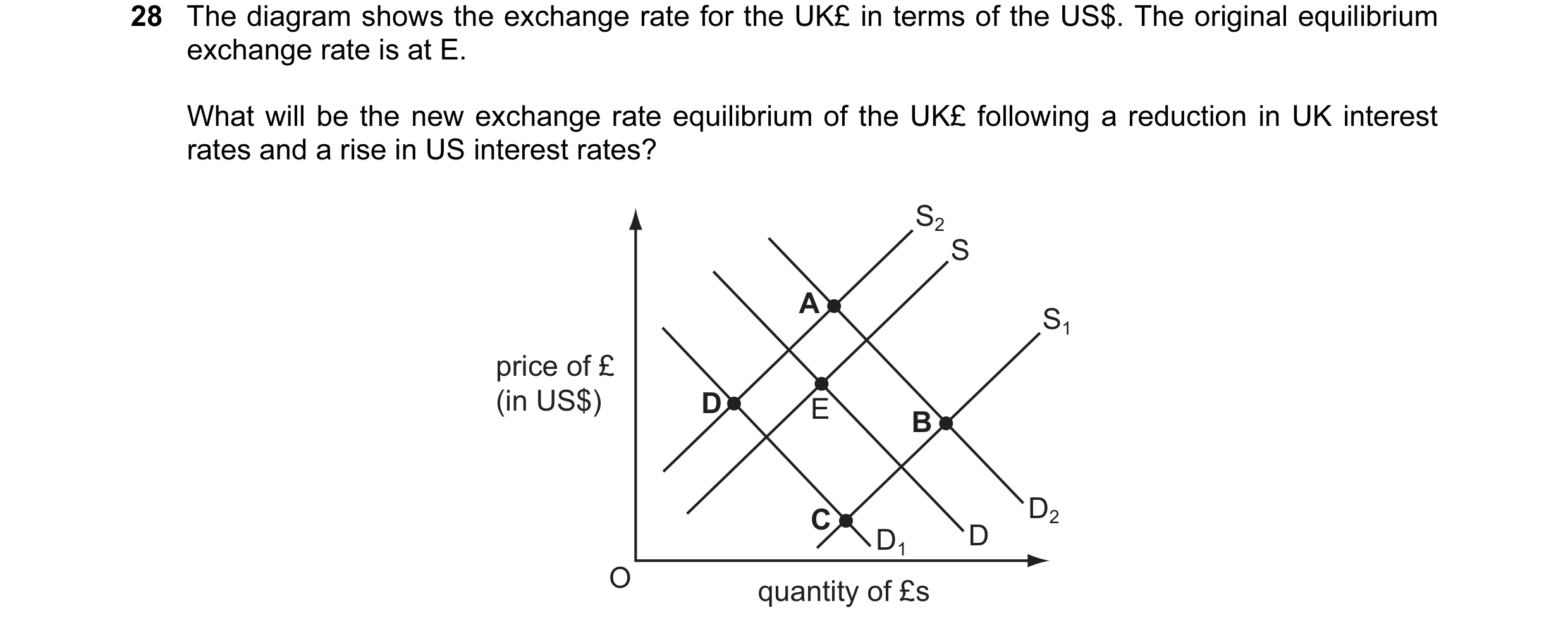 16 / 75
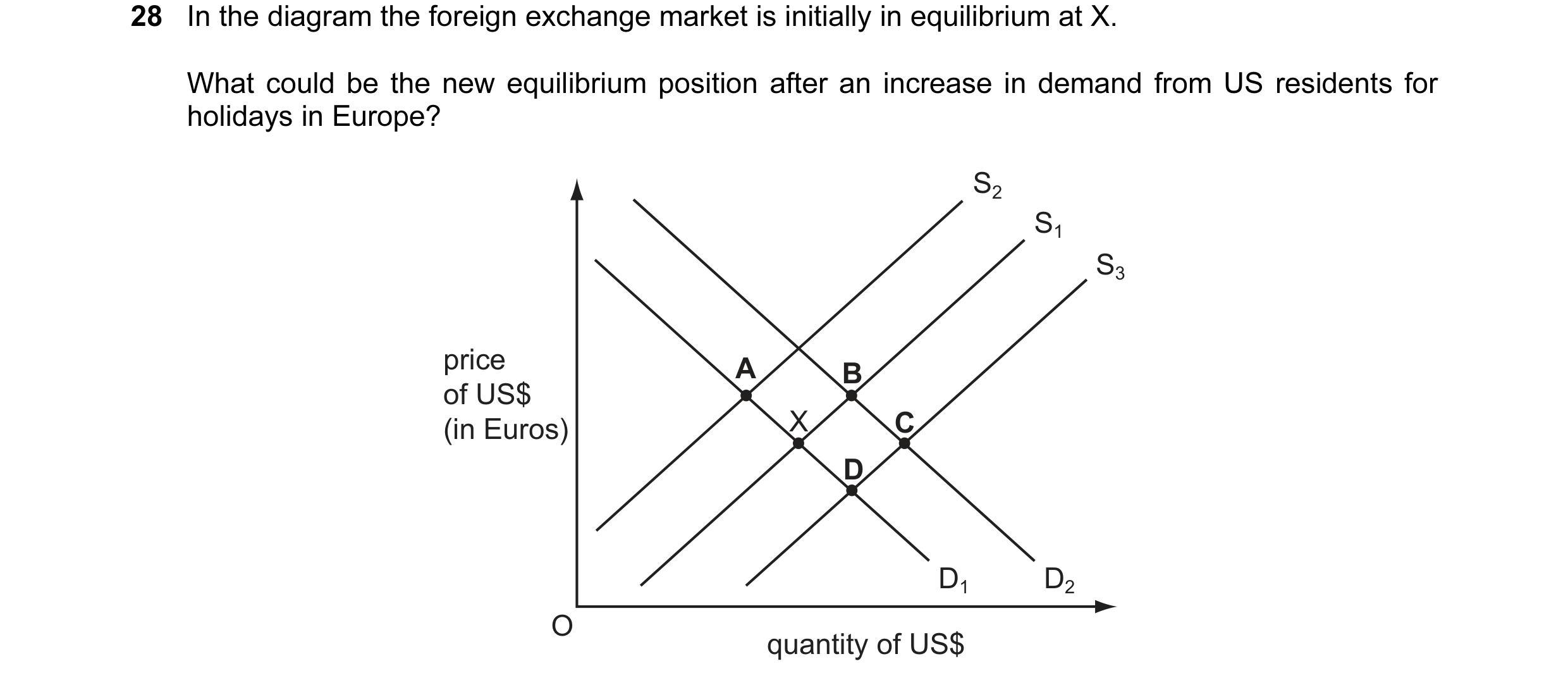
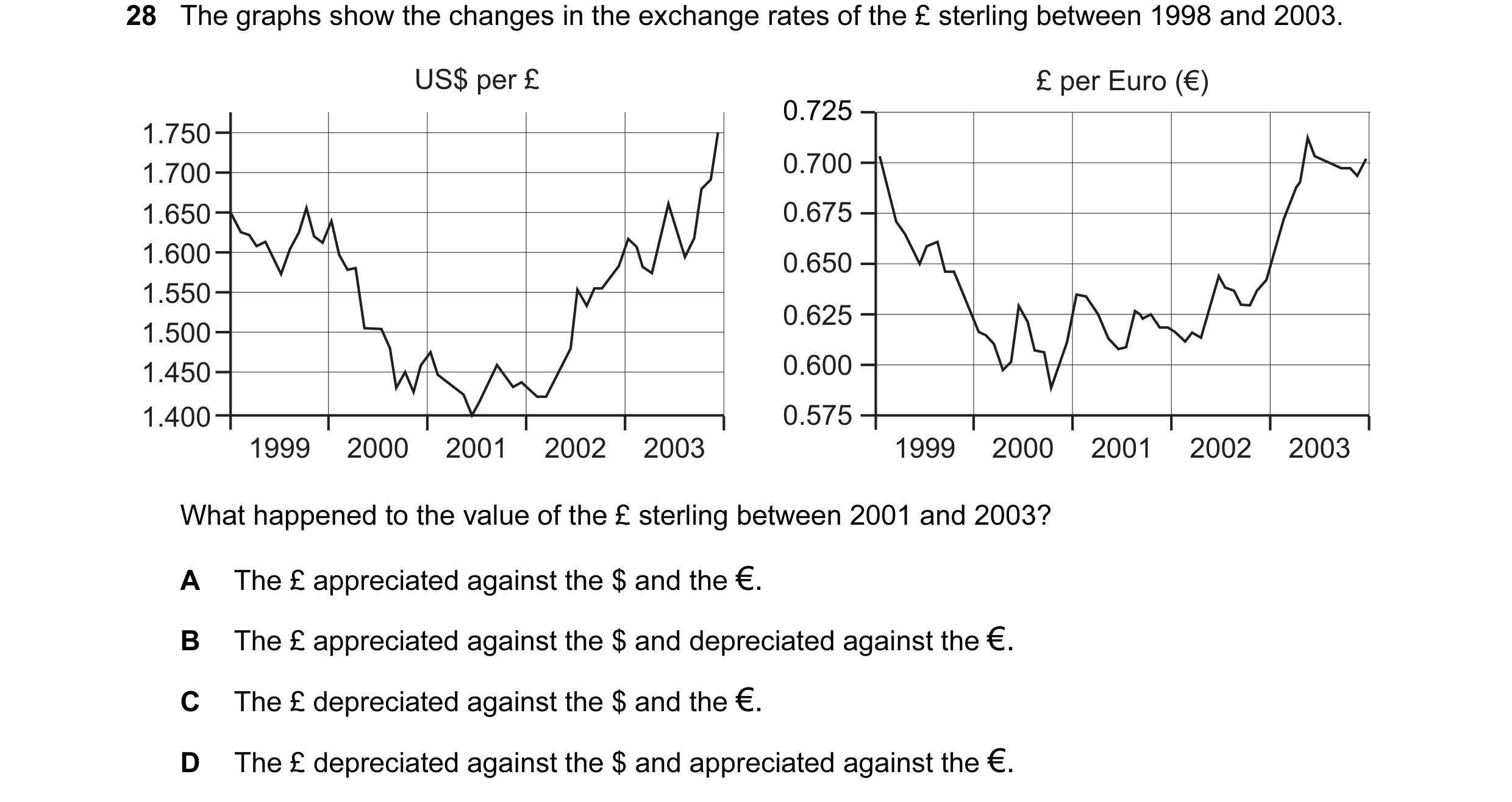 17 / 75
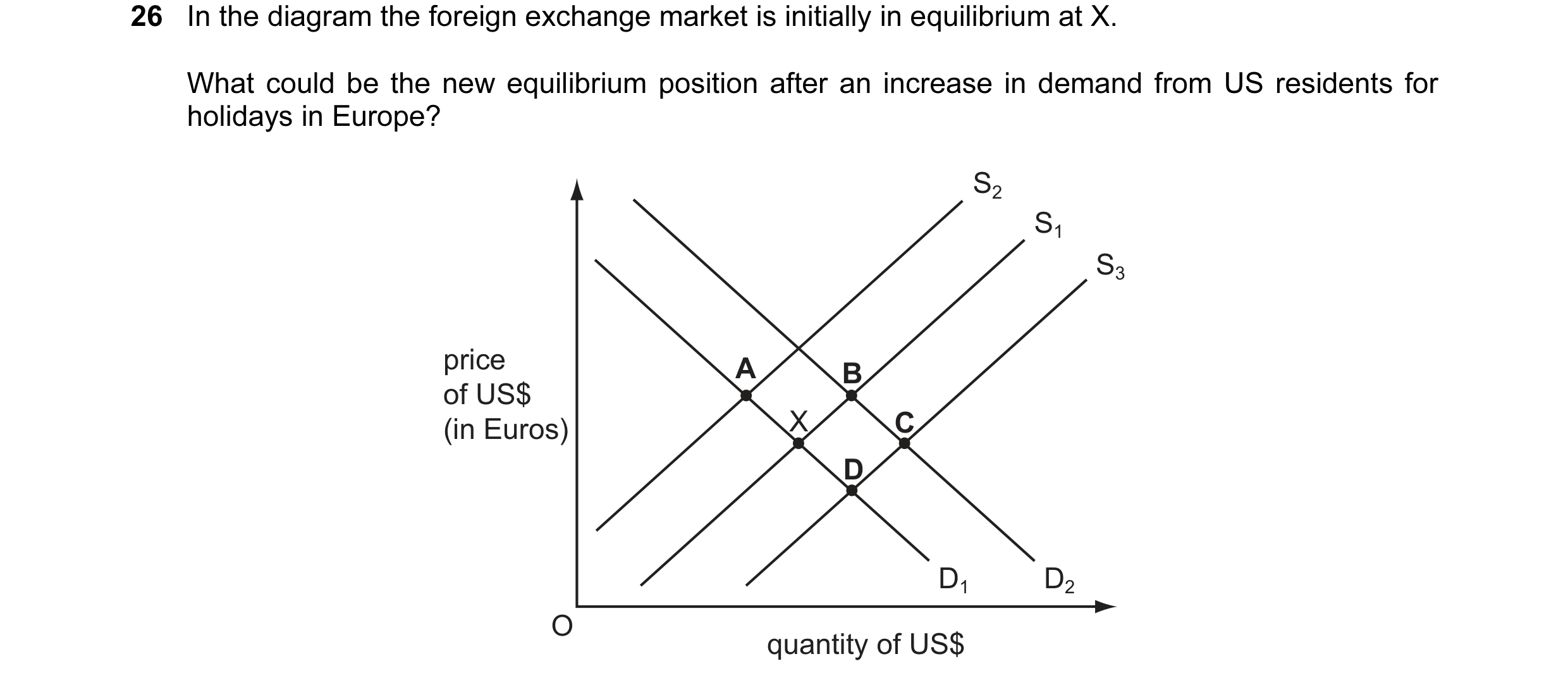
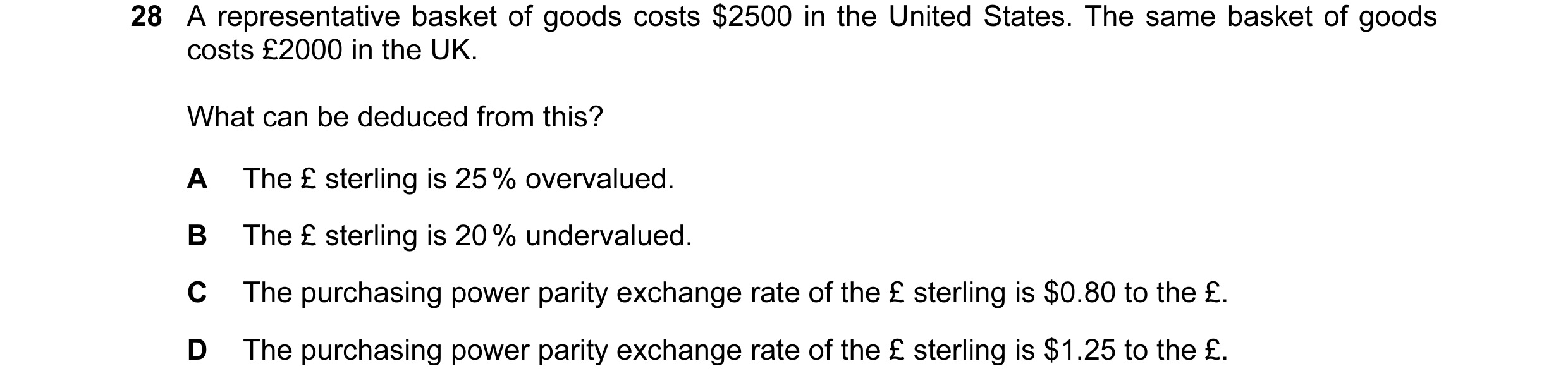 18 / 75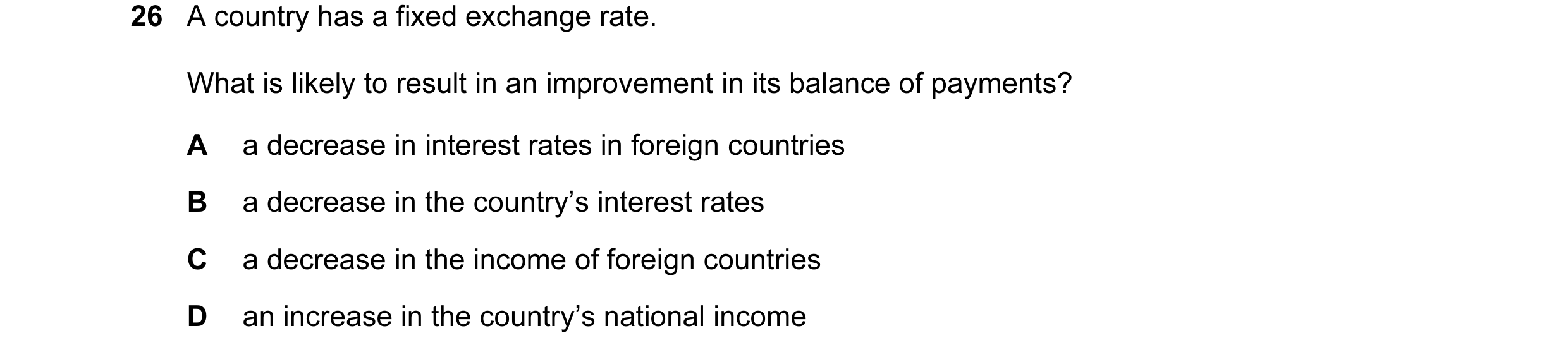
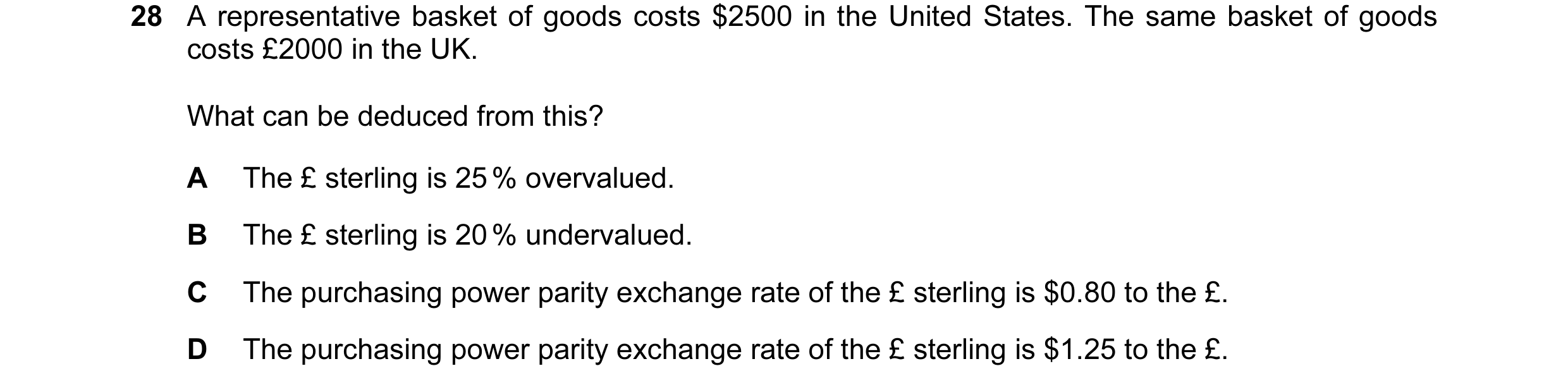
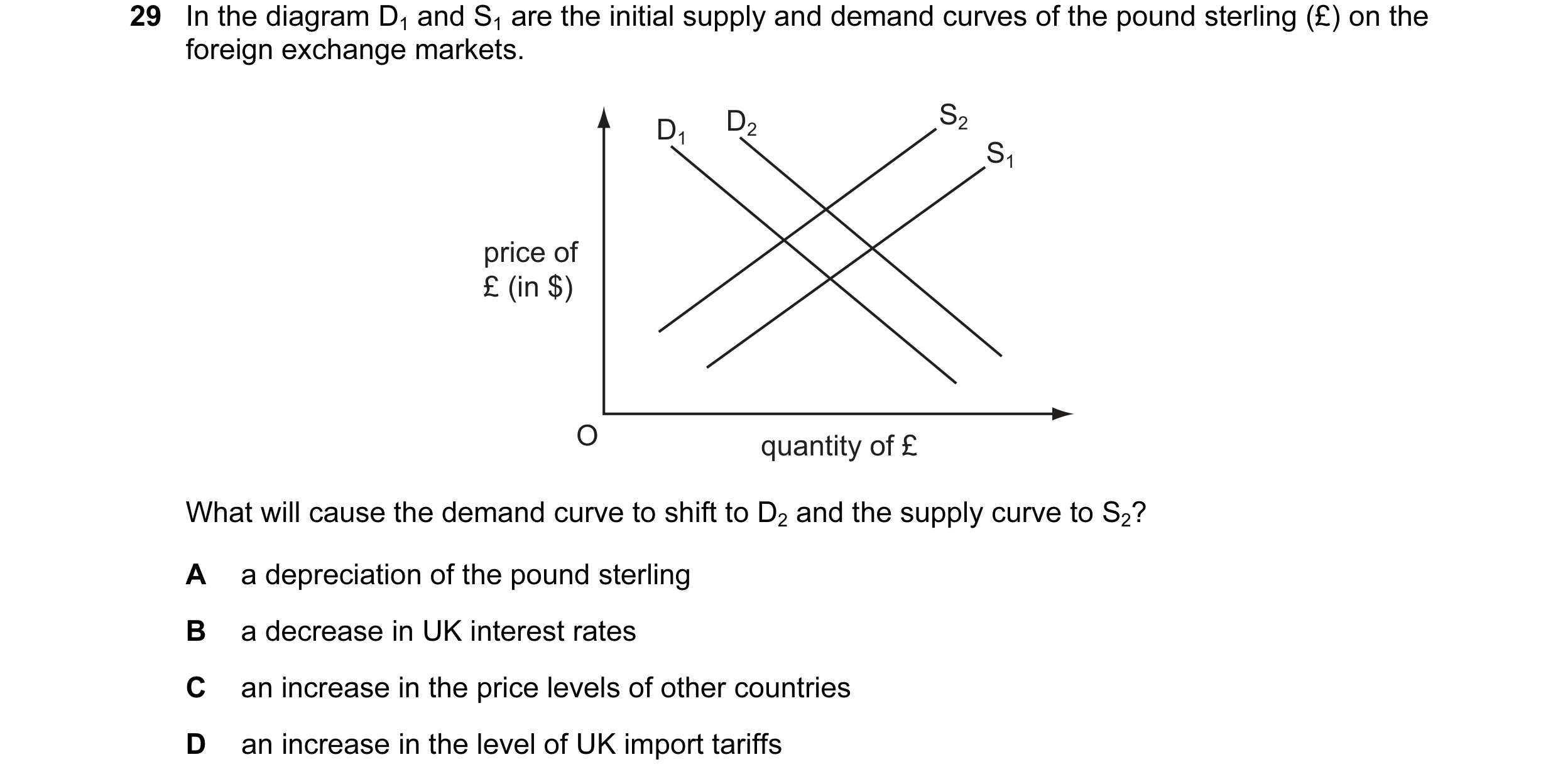
 19 / 75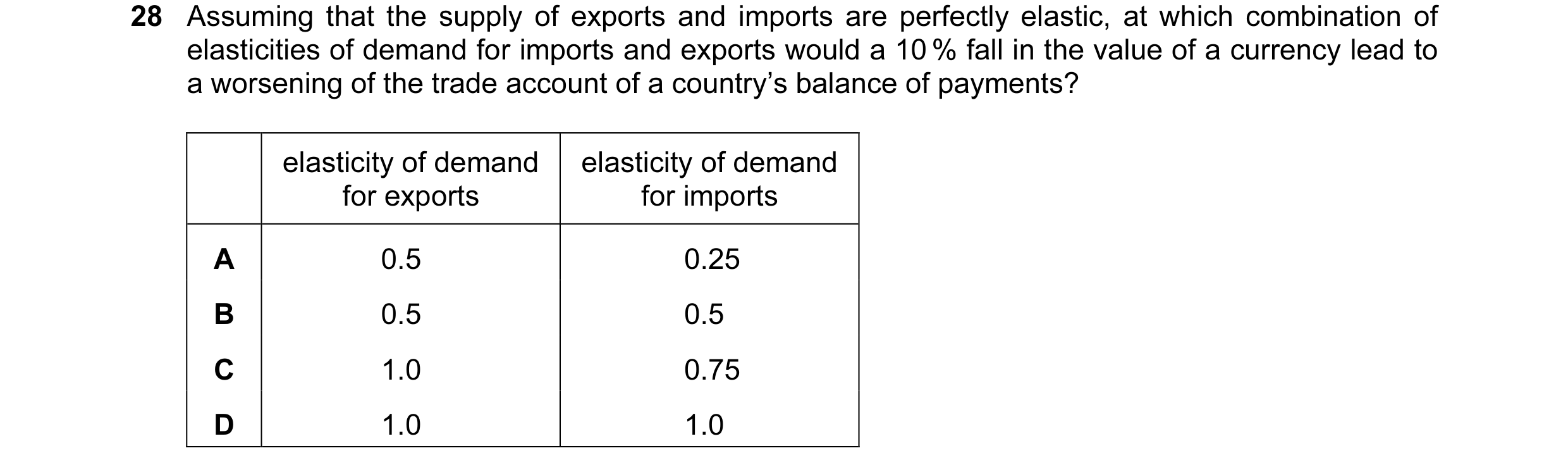
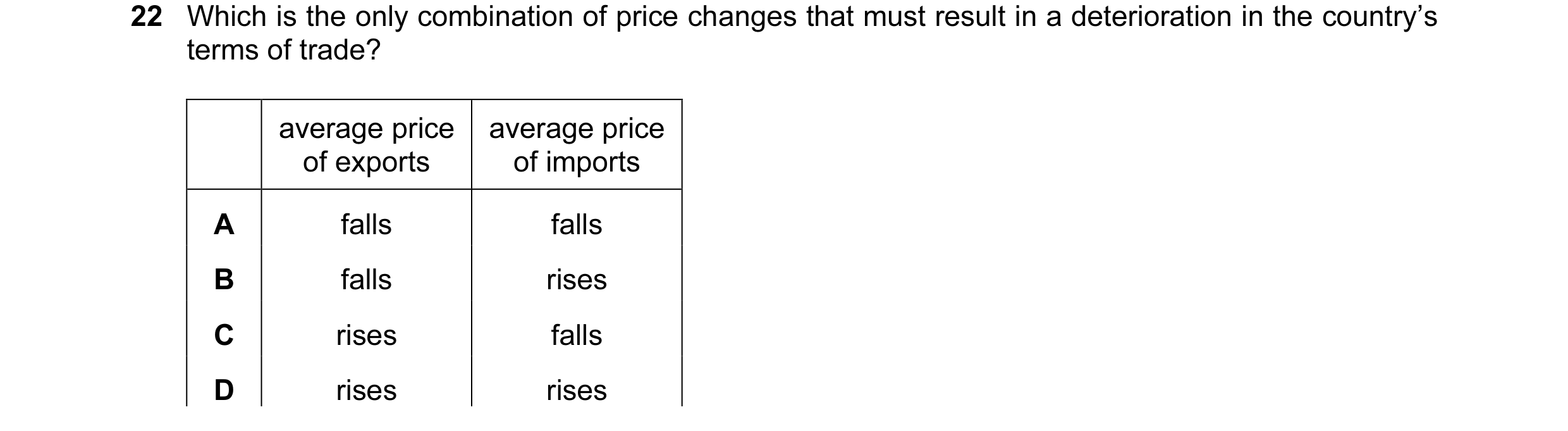
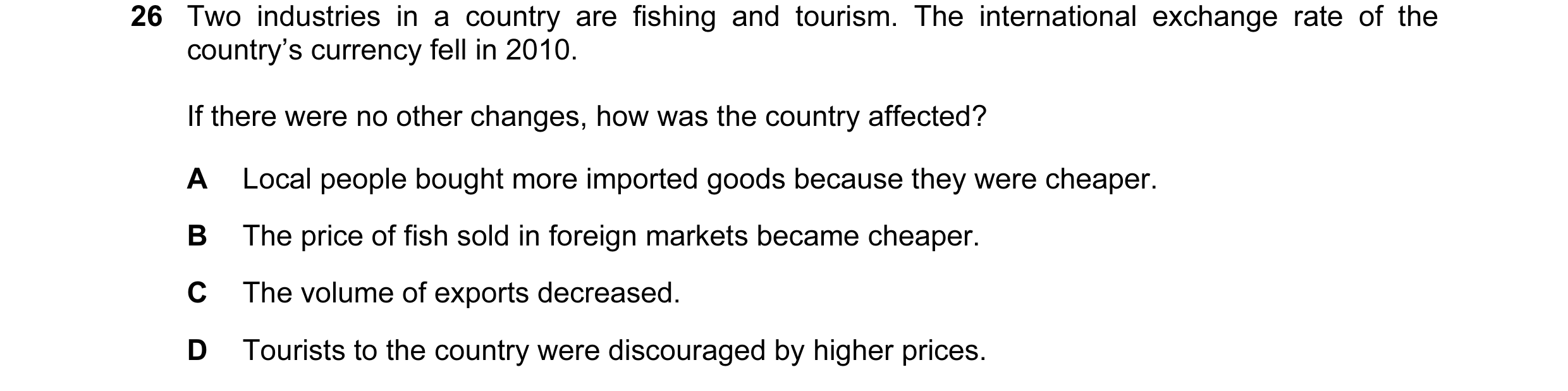
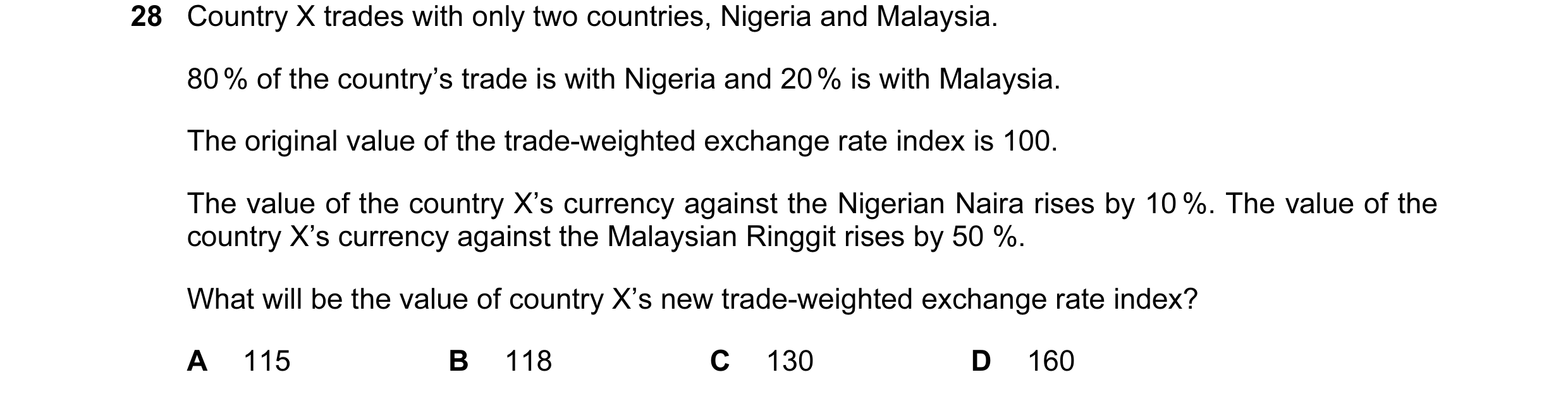 20 / 75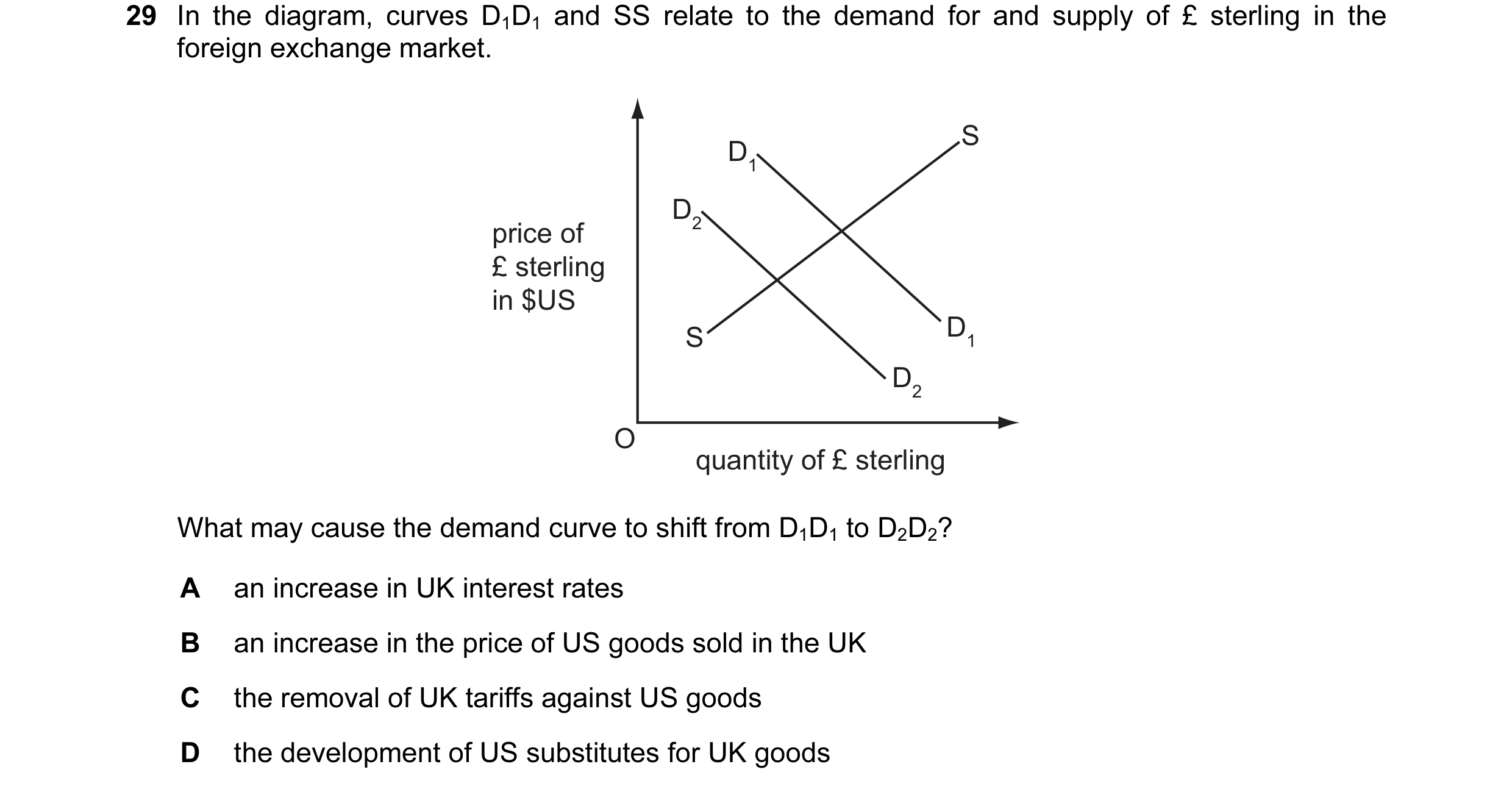
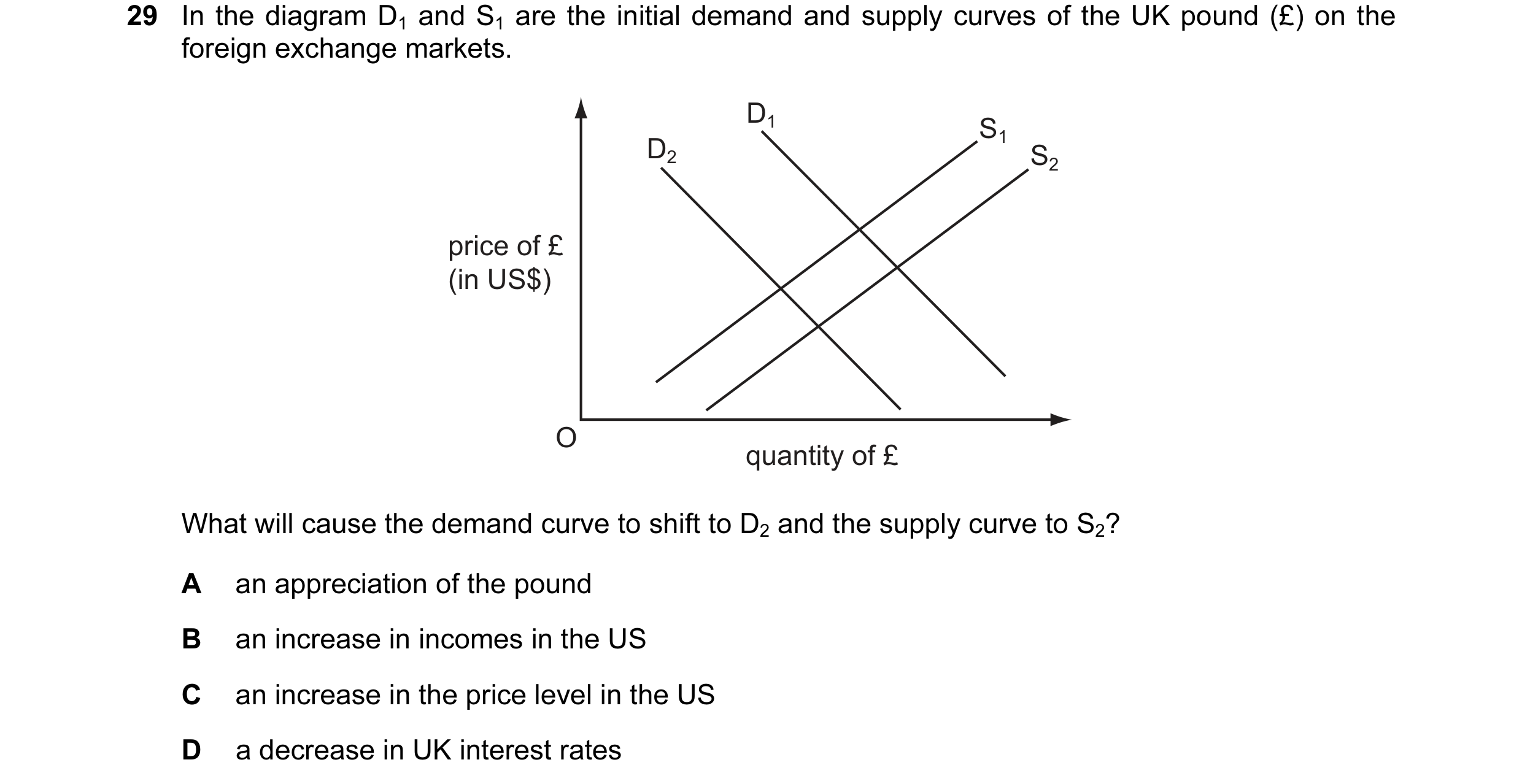
 21 / 75
 22 / 75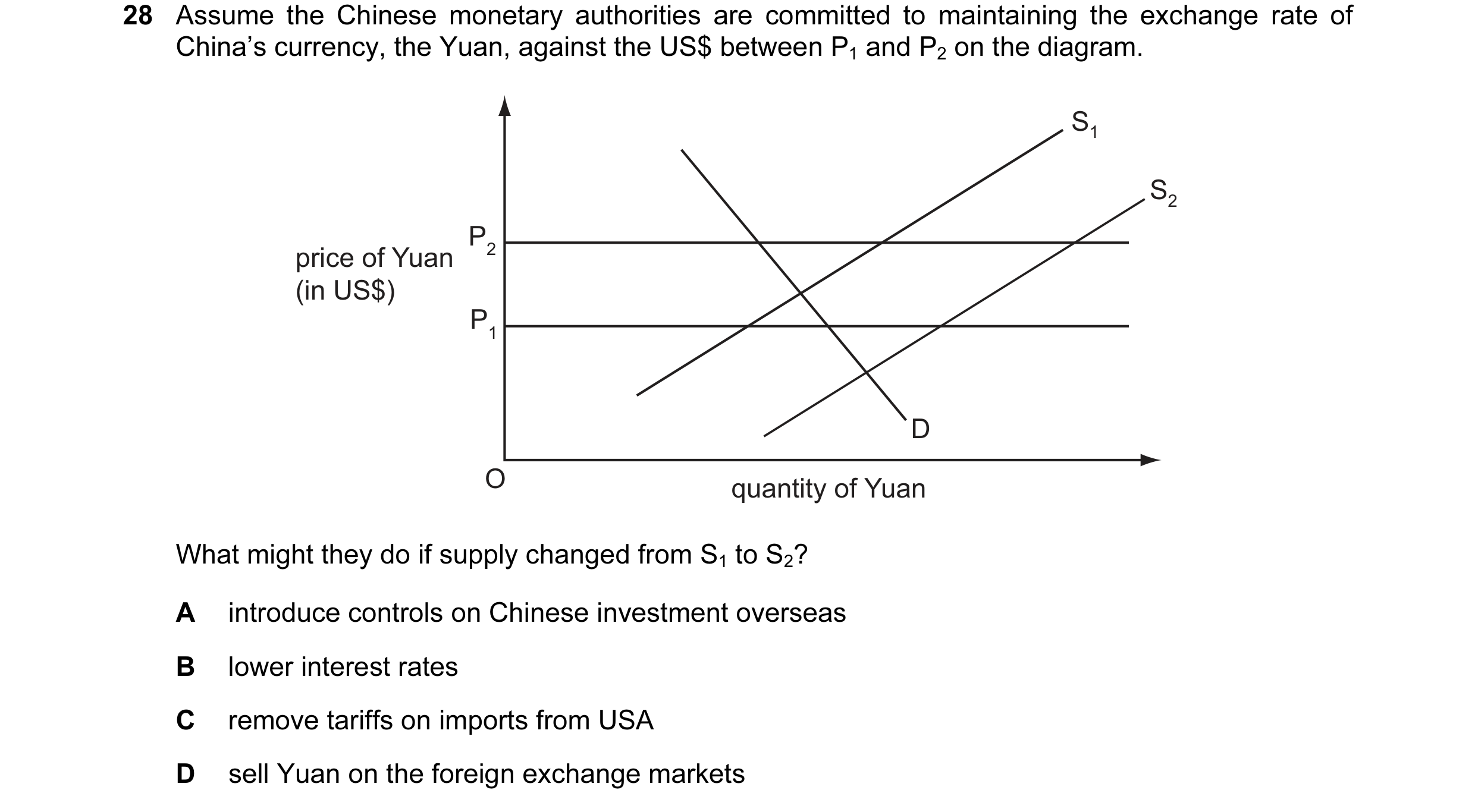

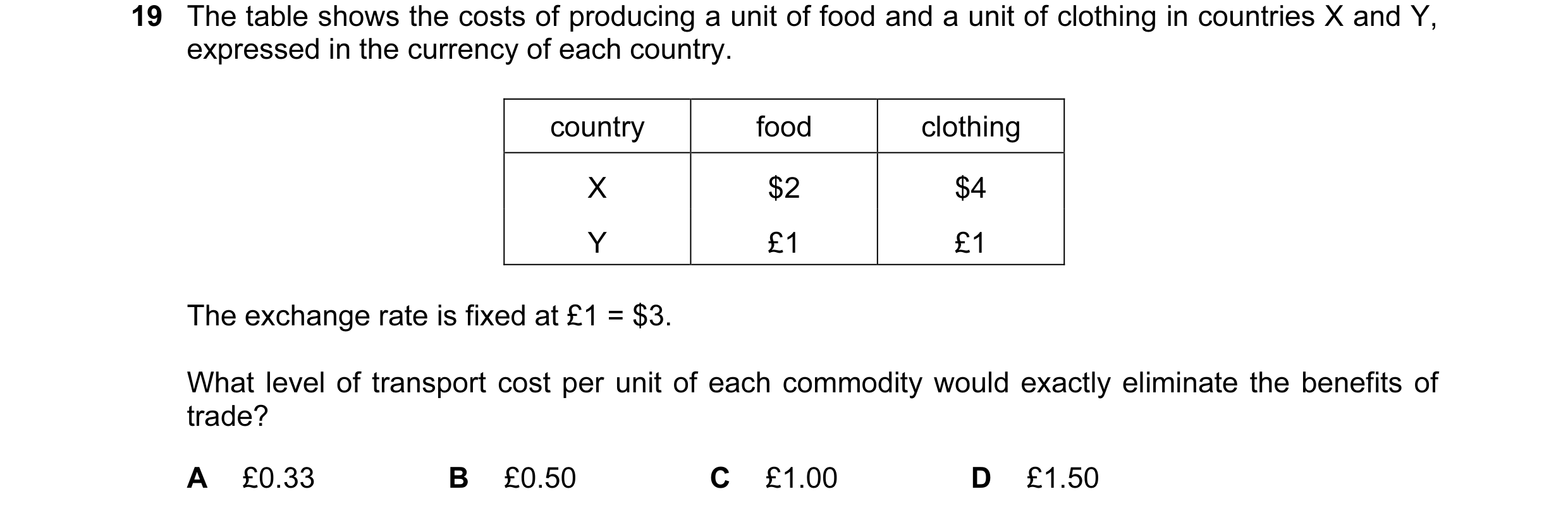 23 / 75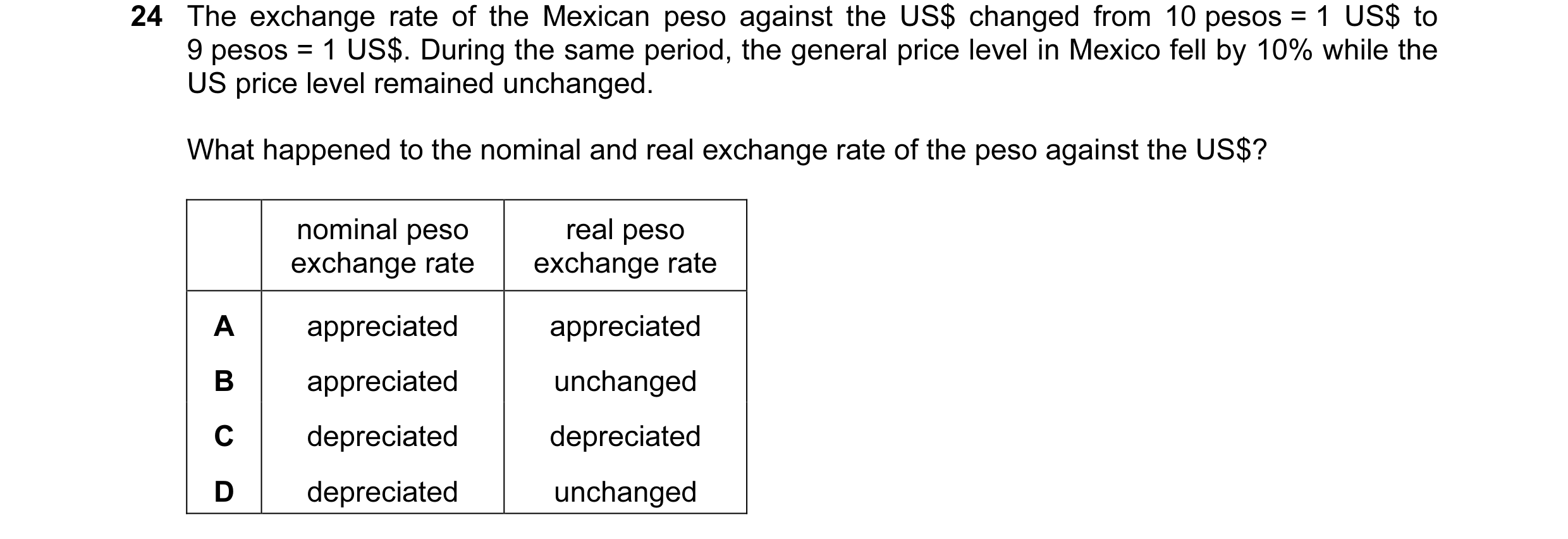
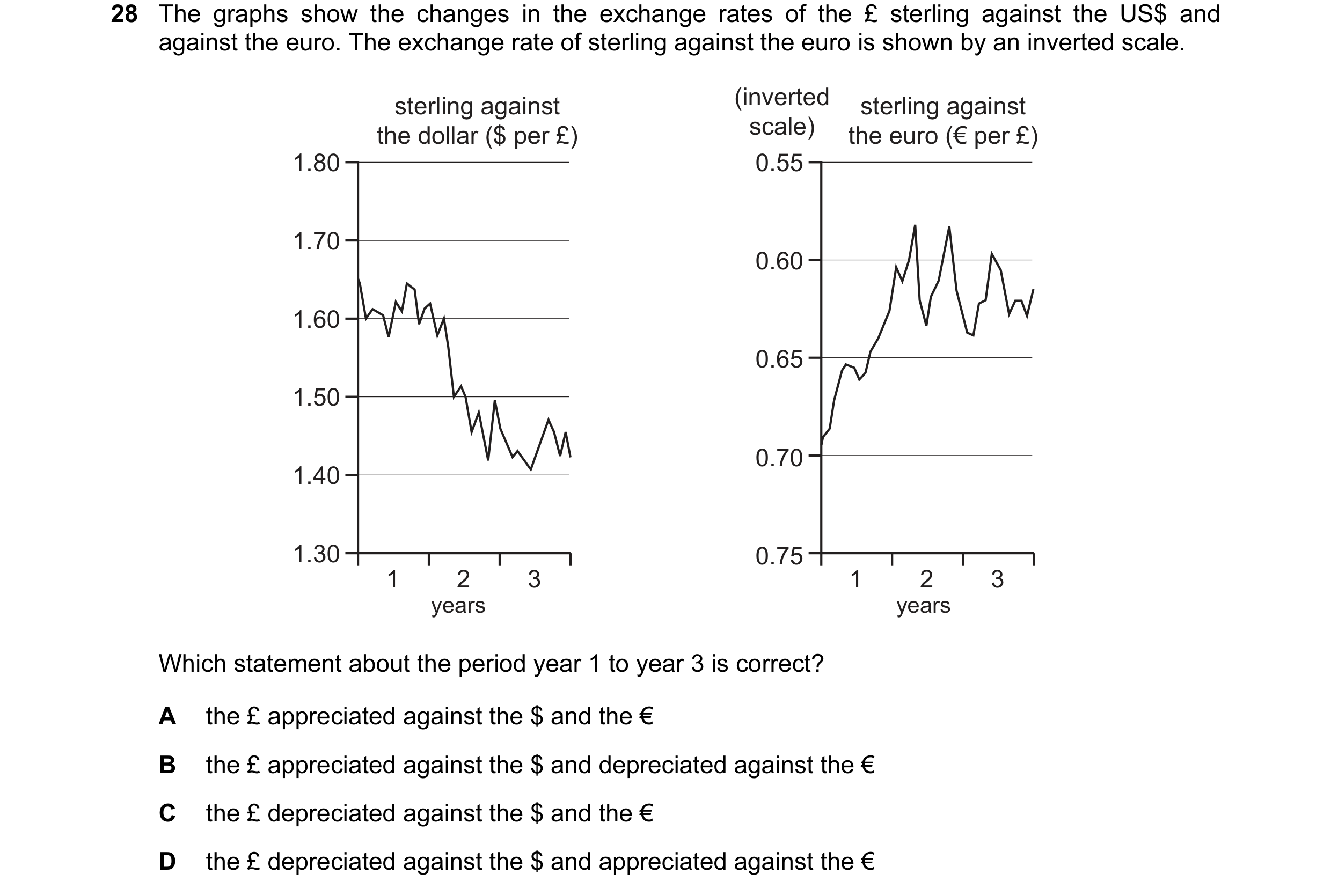
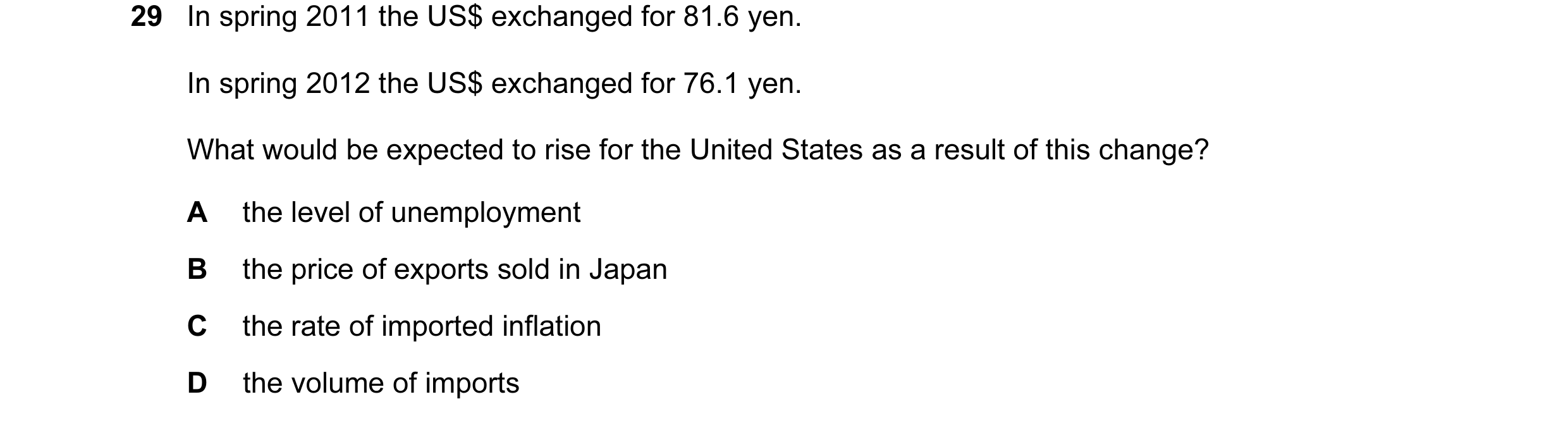 24 / 75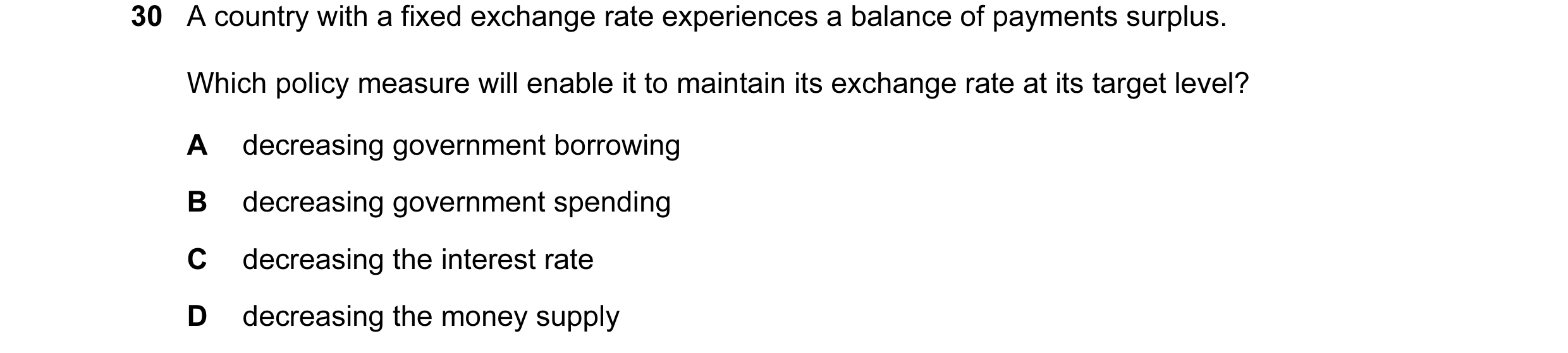
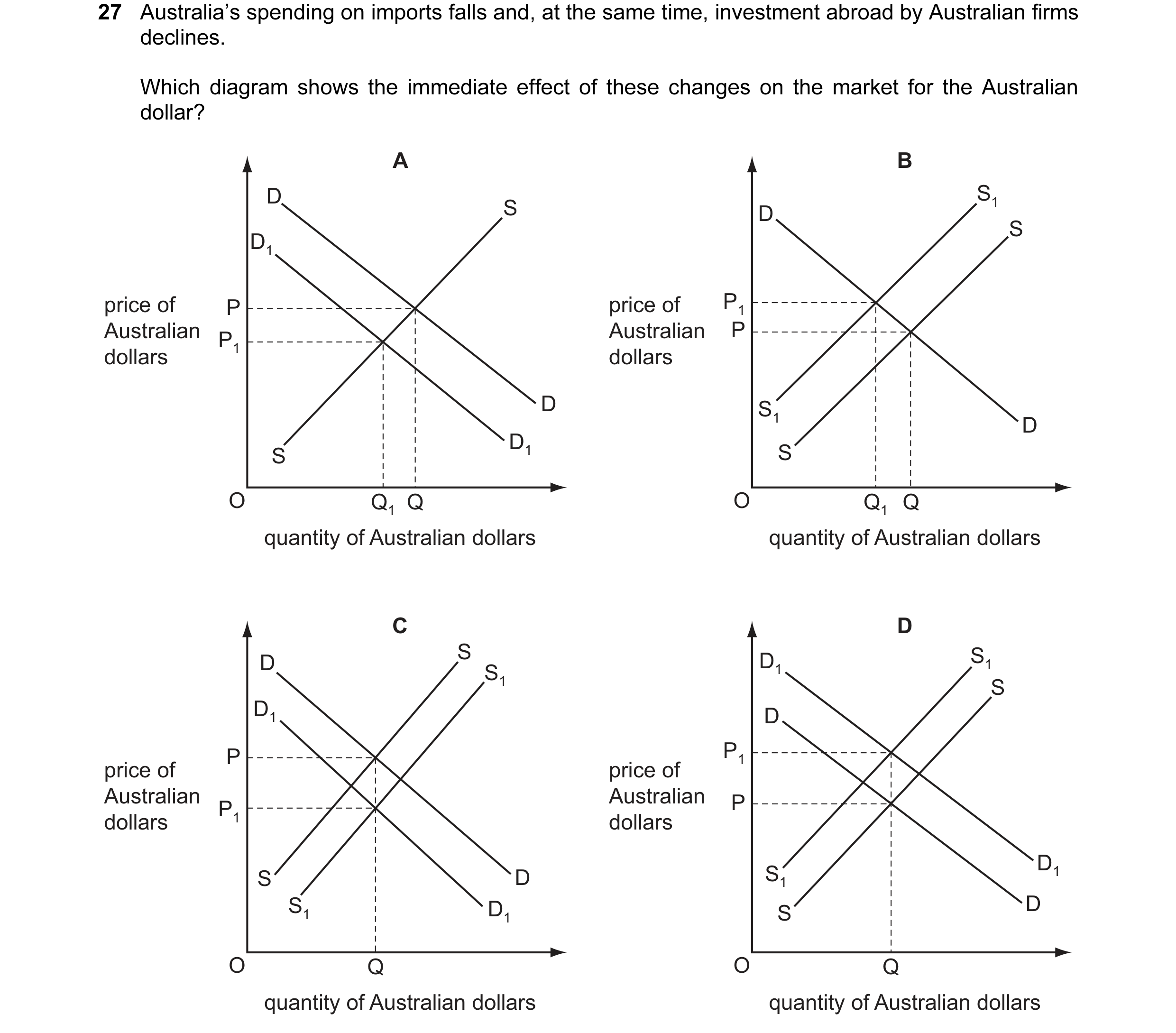
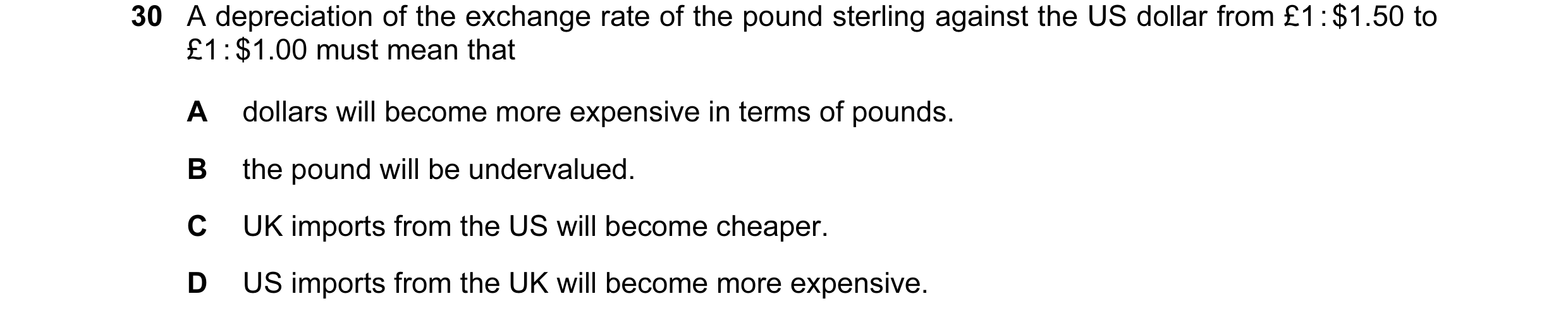 25 / 75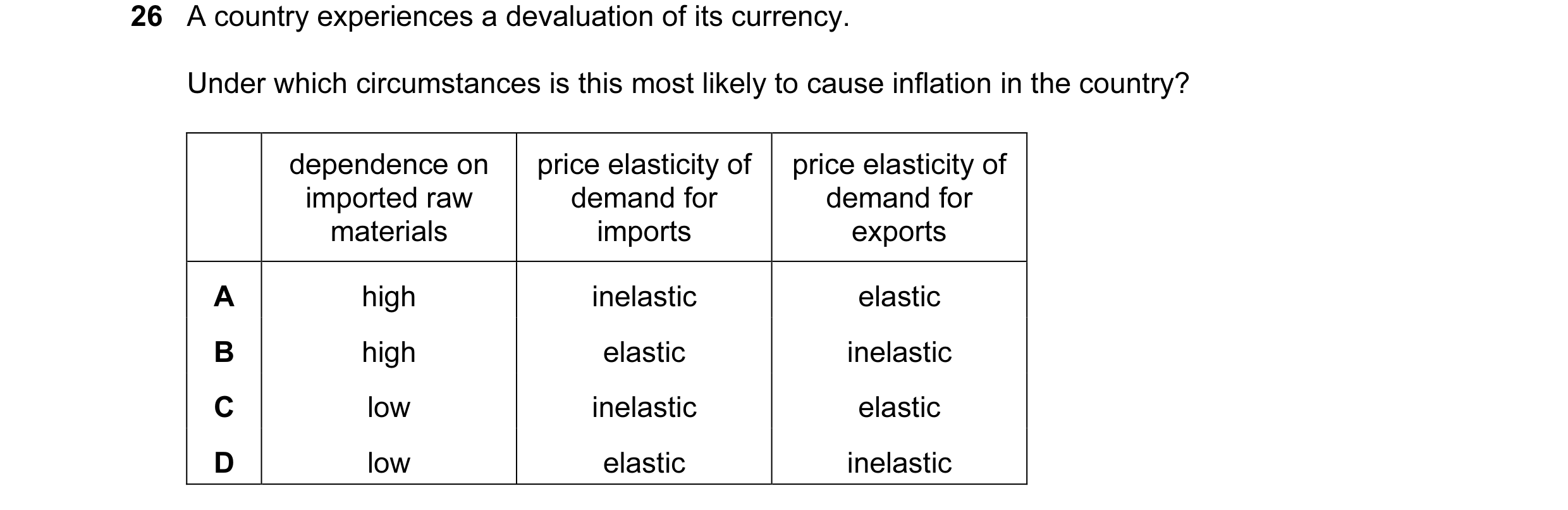
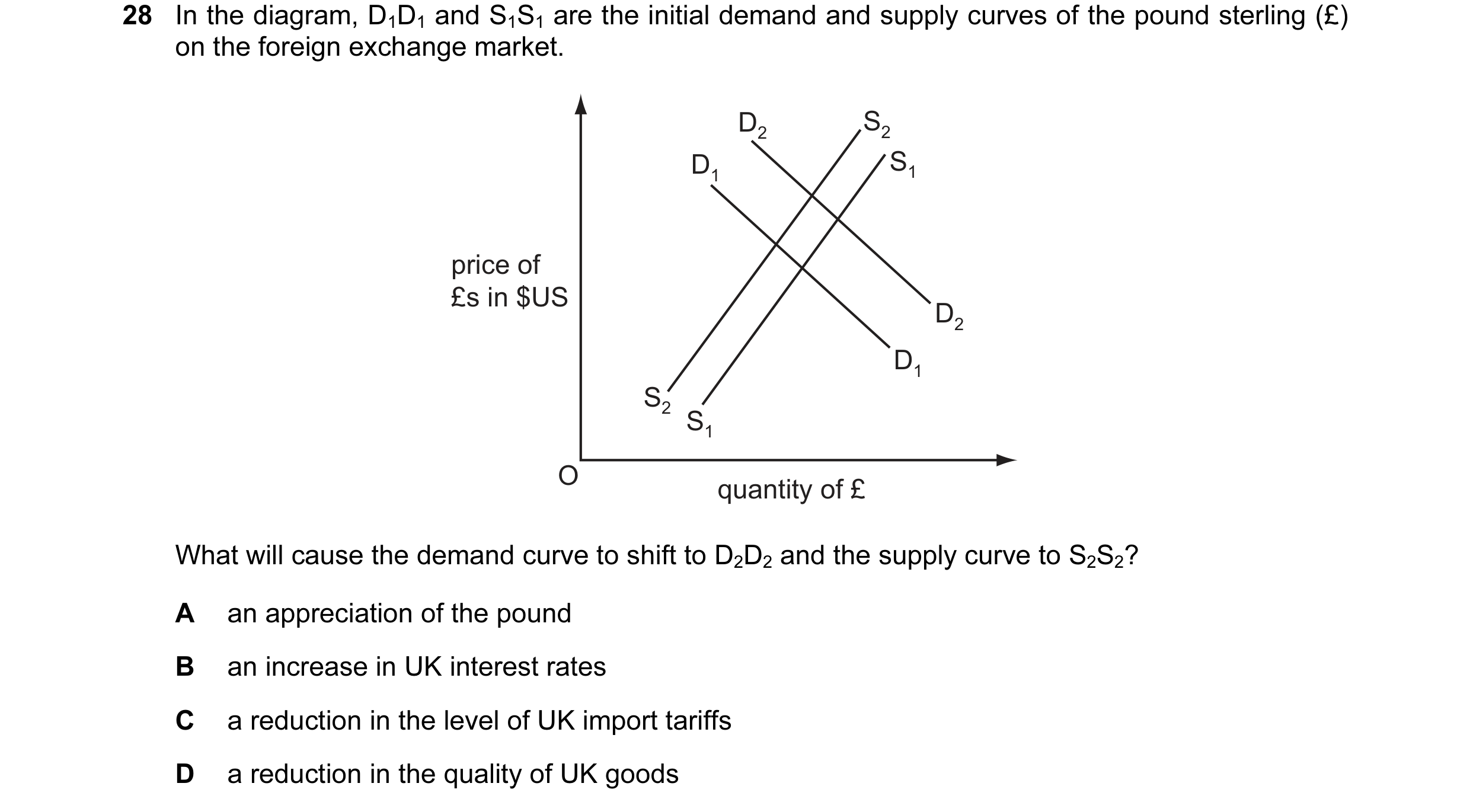
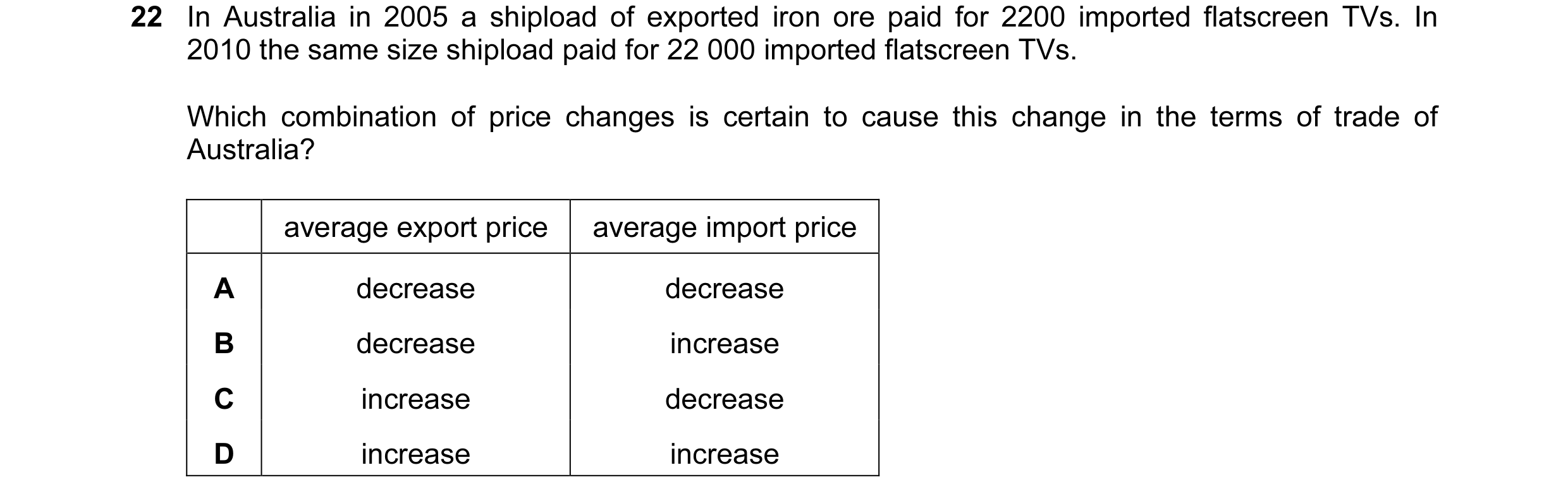 26 / 75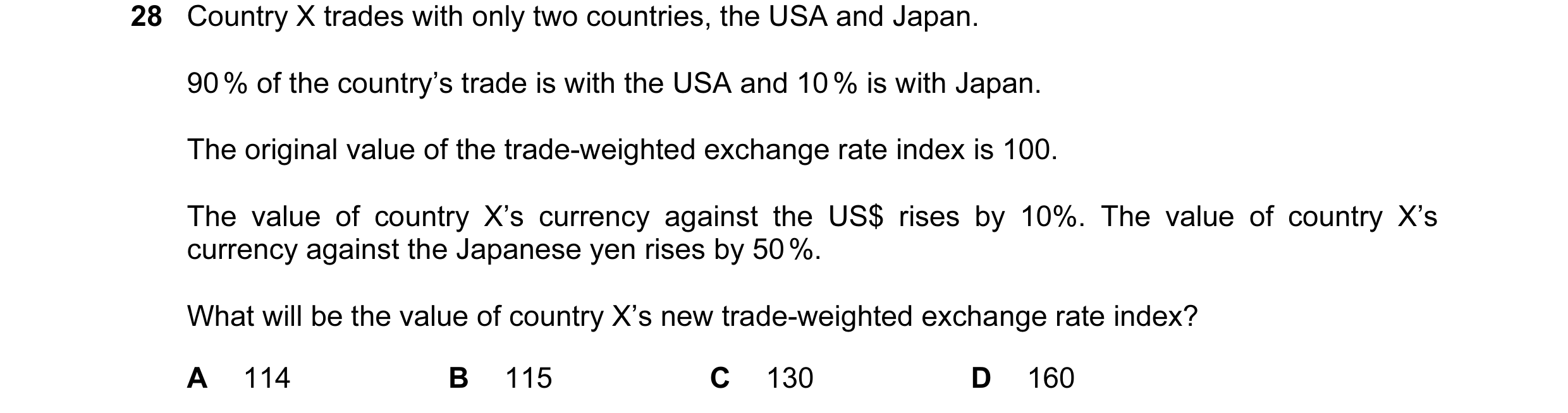


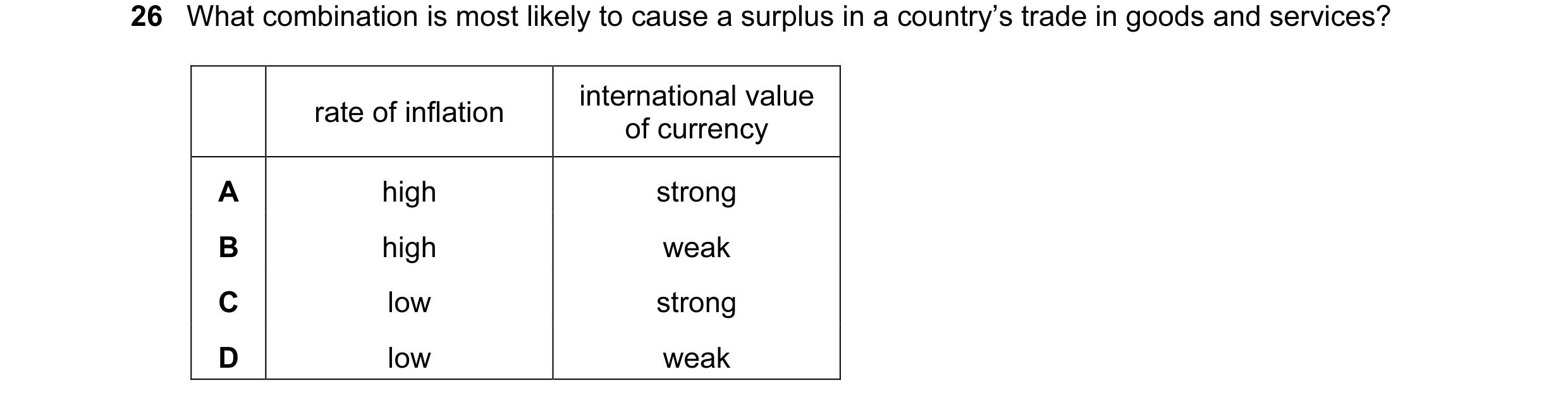
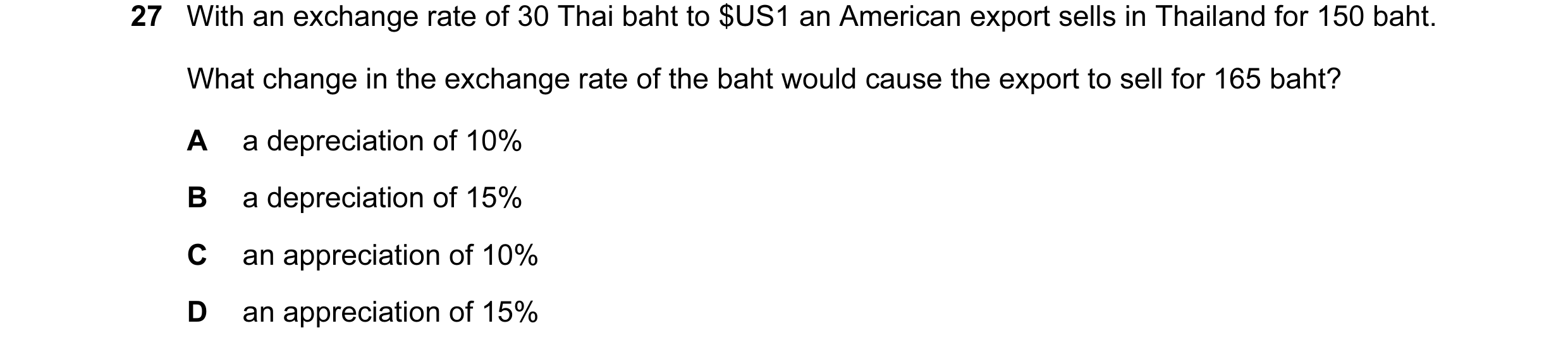 27 / 75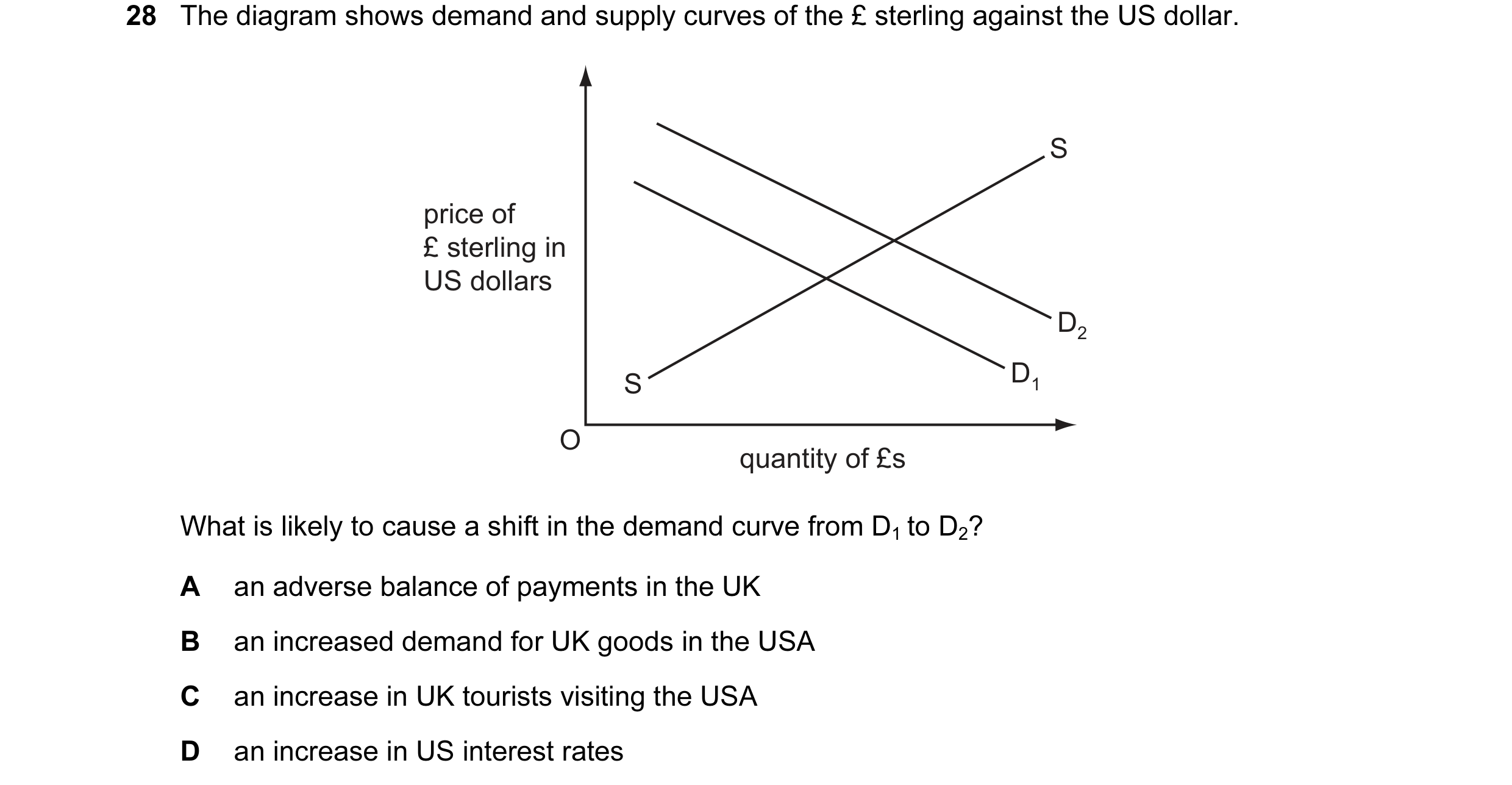
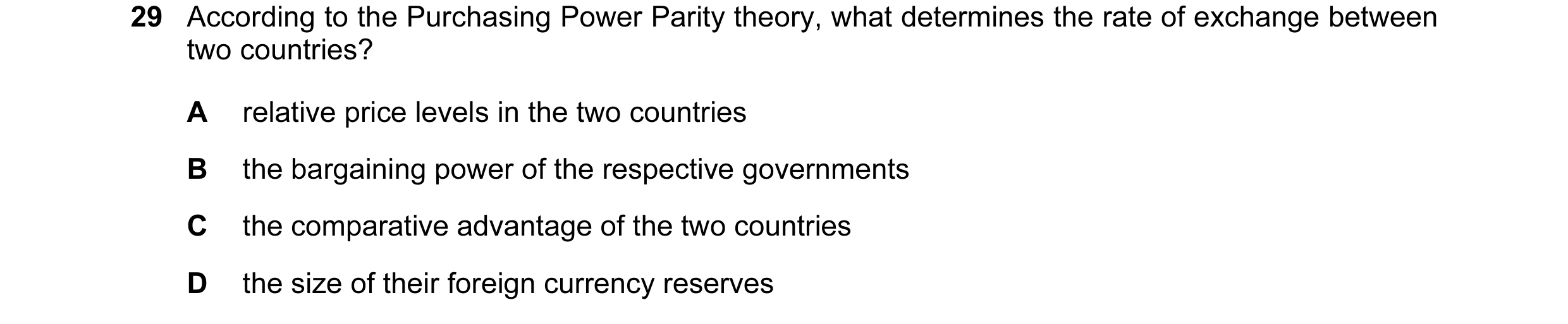
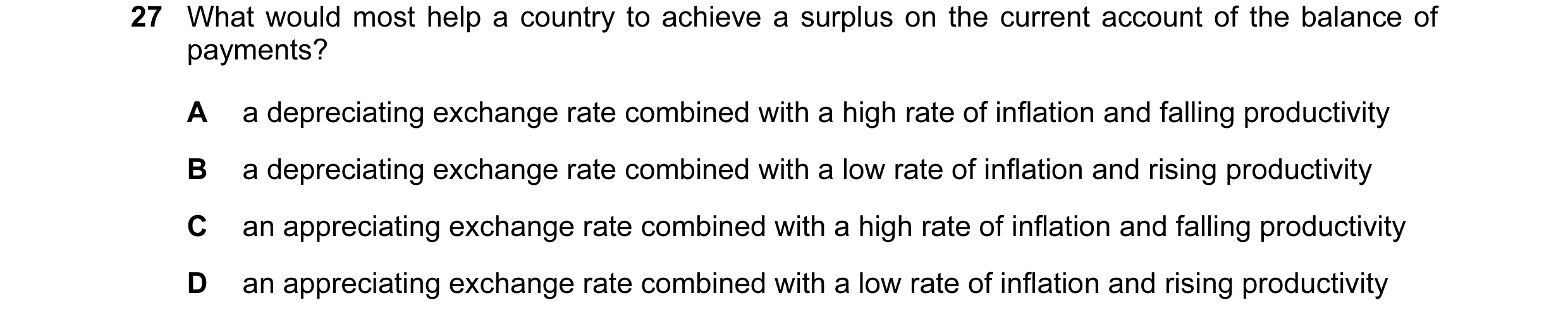
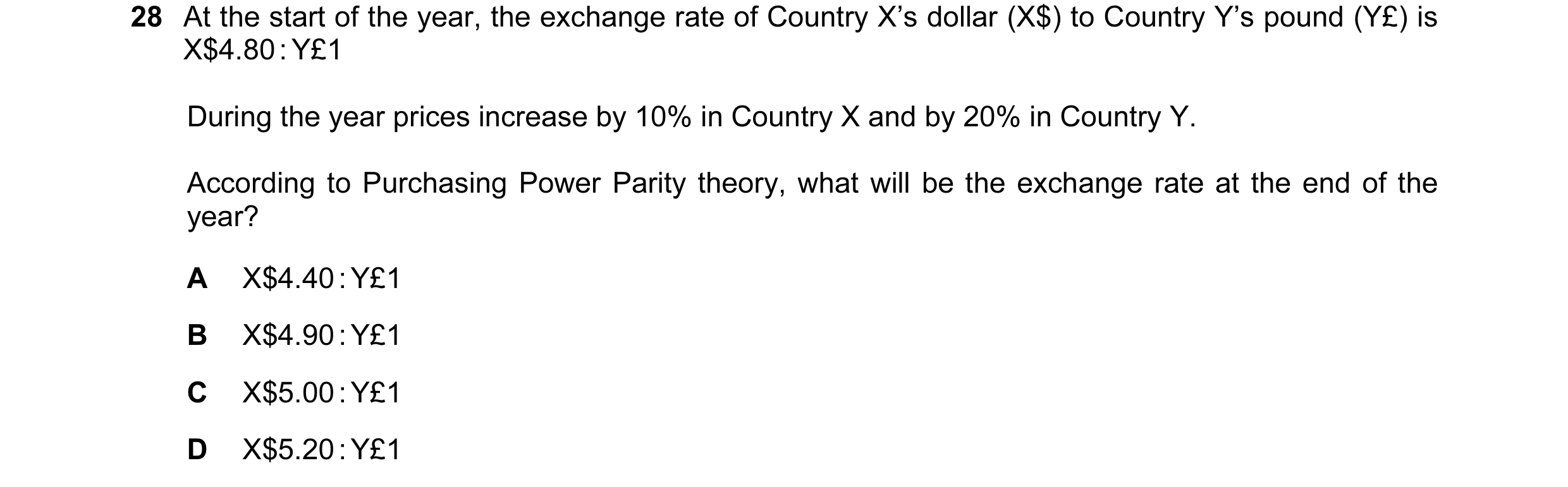 28 / 75
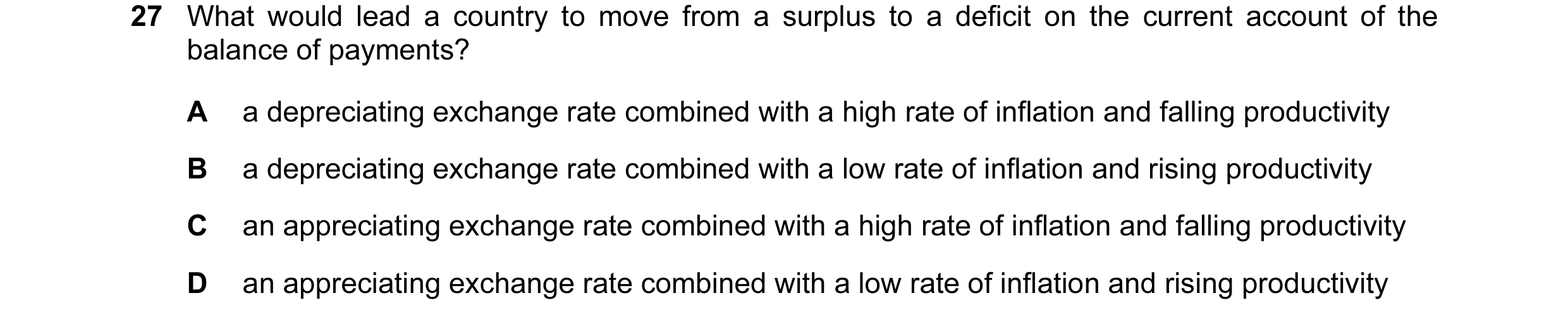

 29 / 75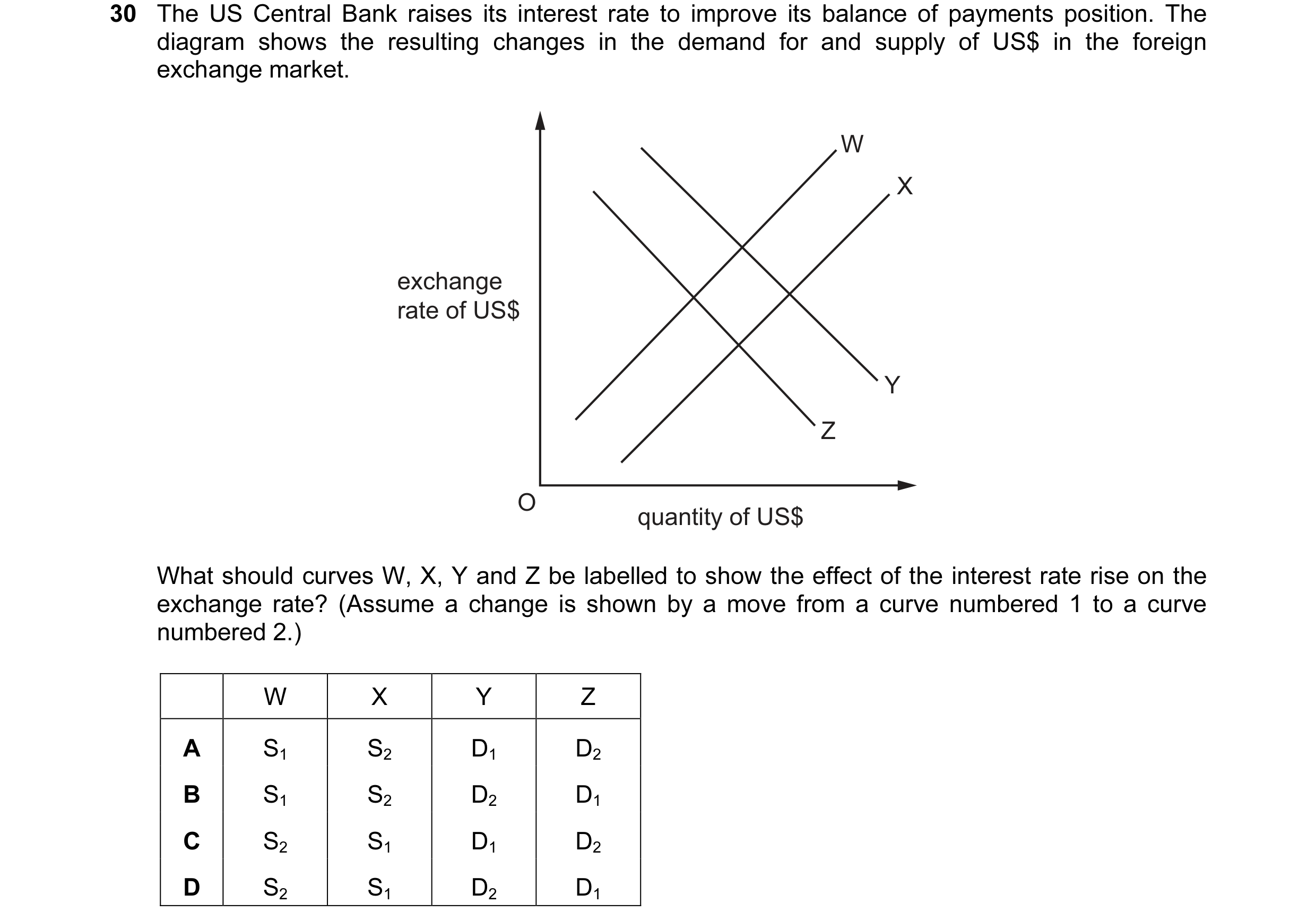
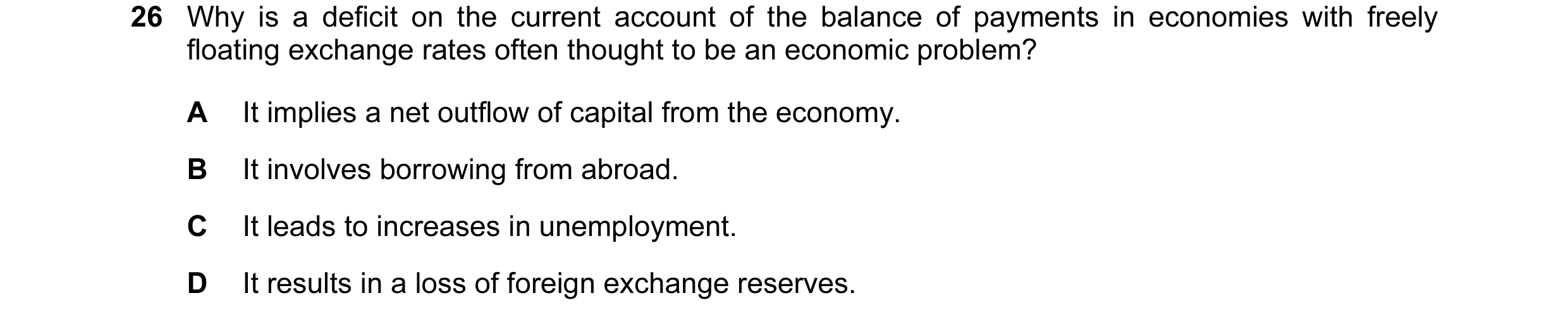 30 / 75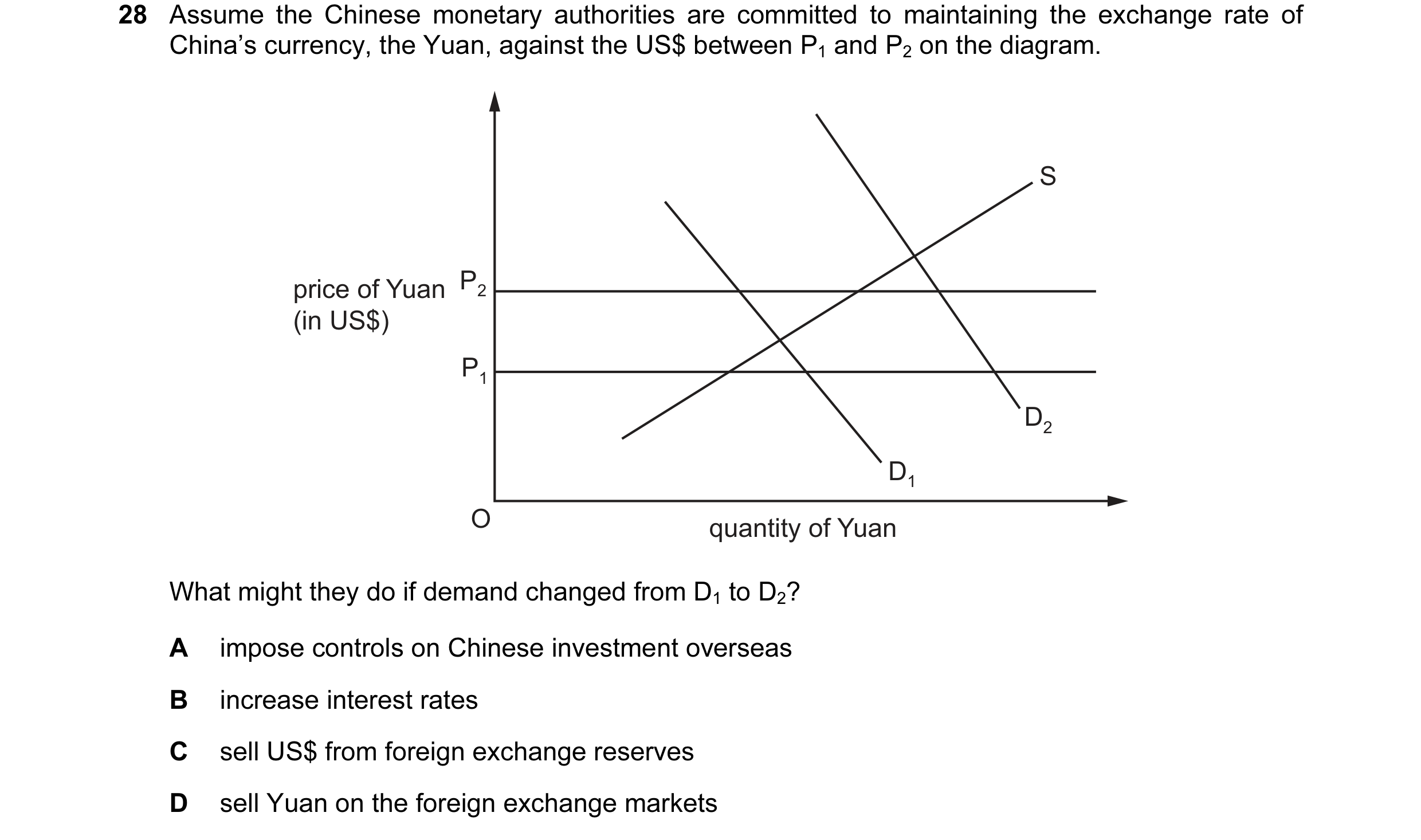
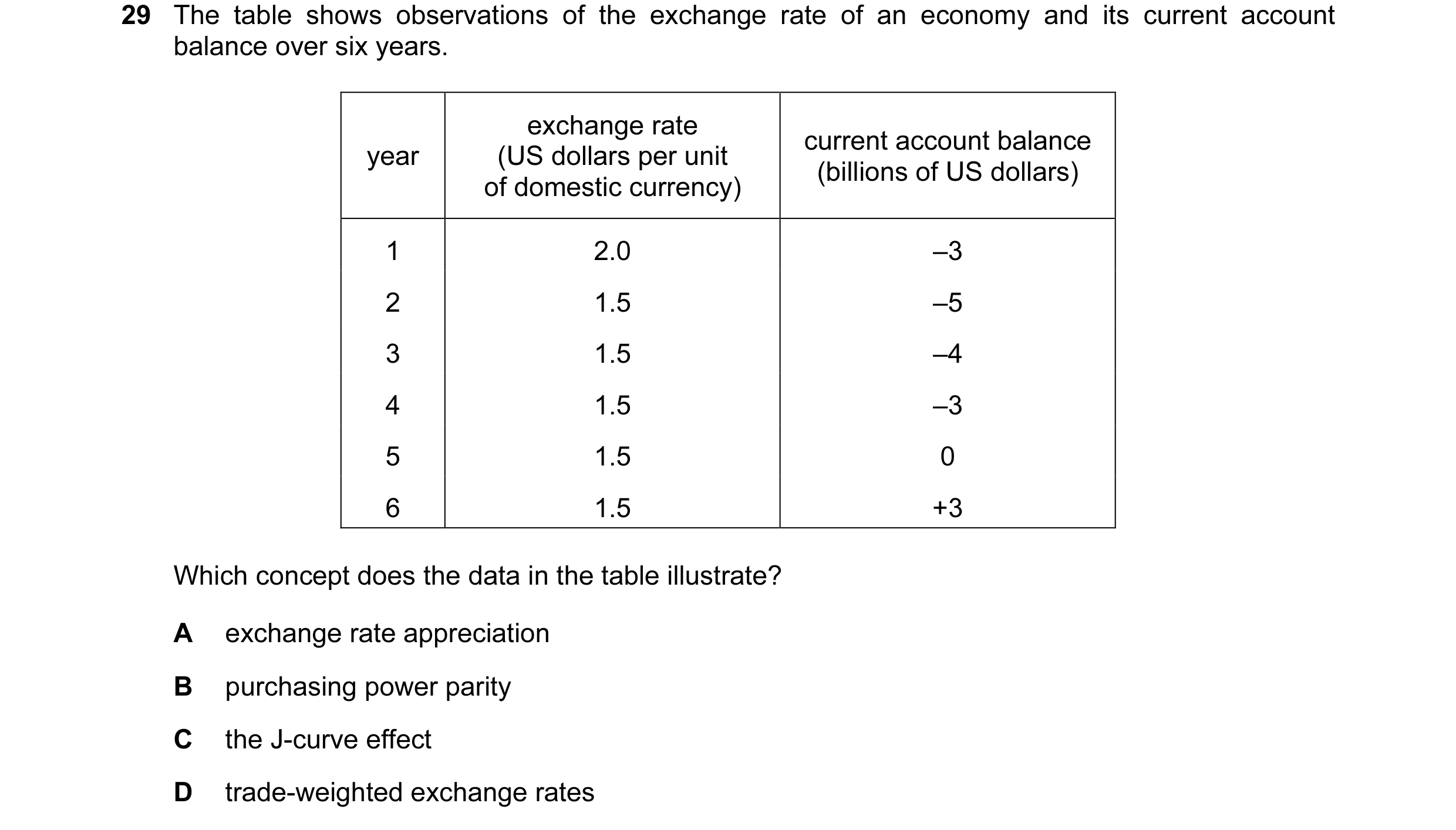 31 / 75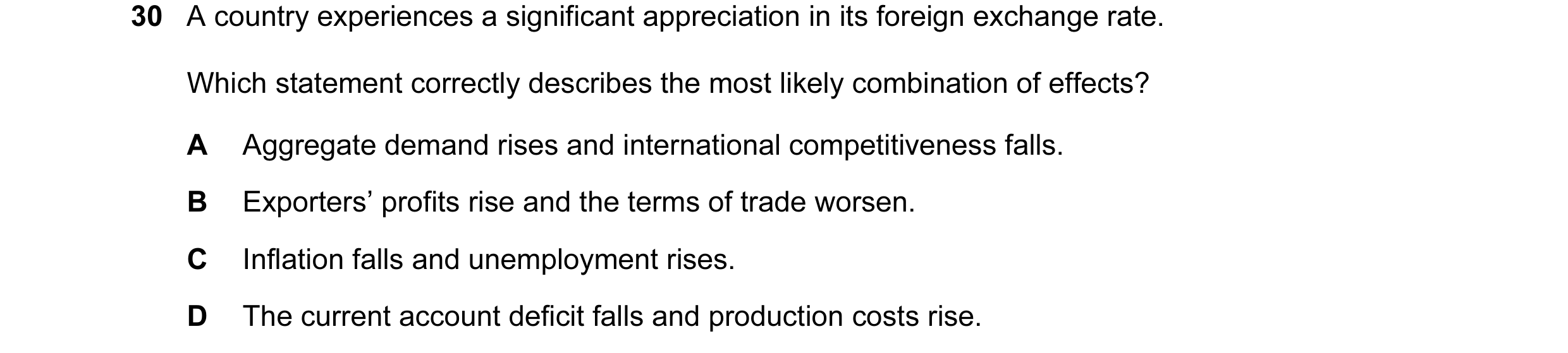
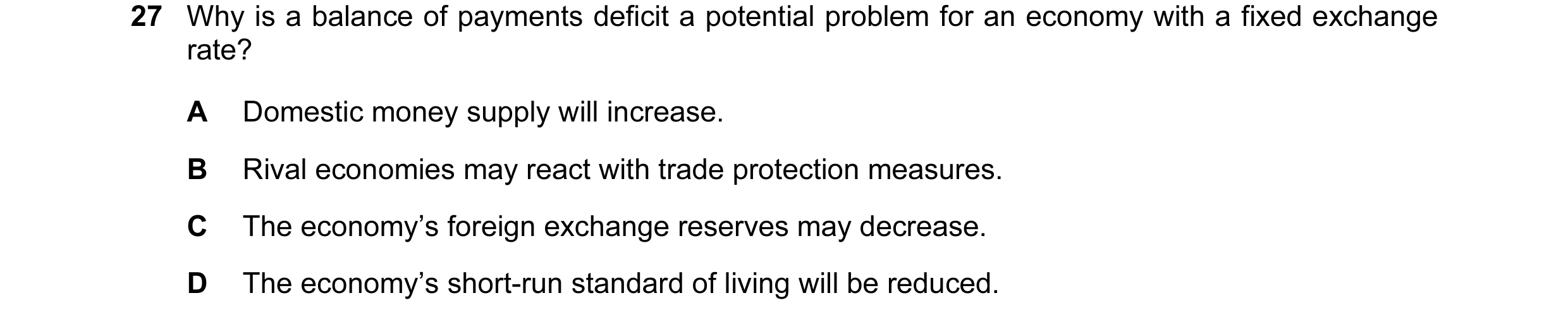

 32 / 75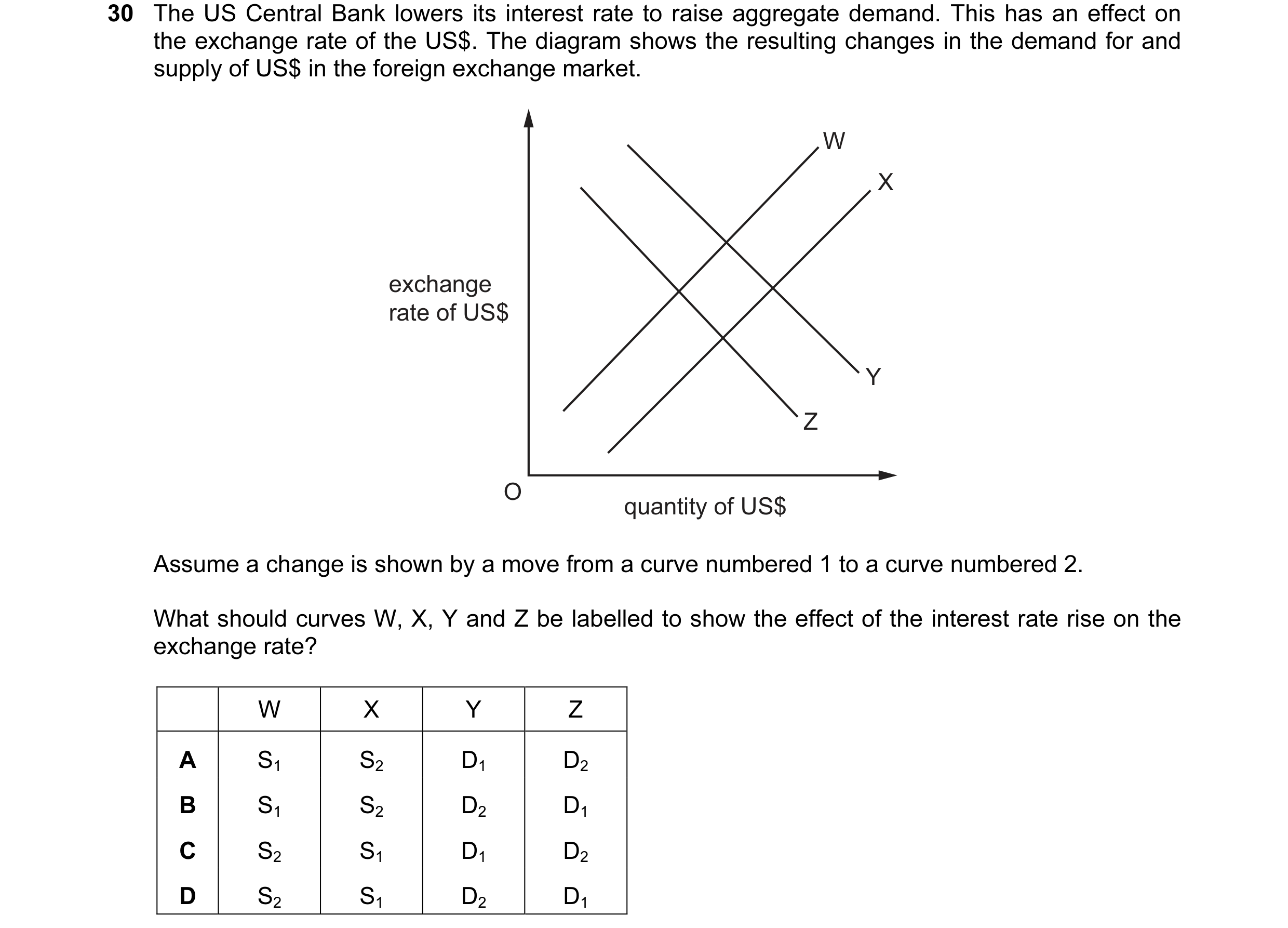

 33 / 75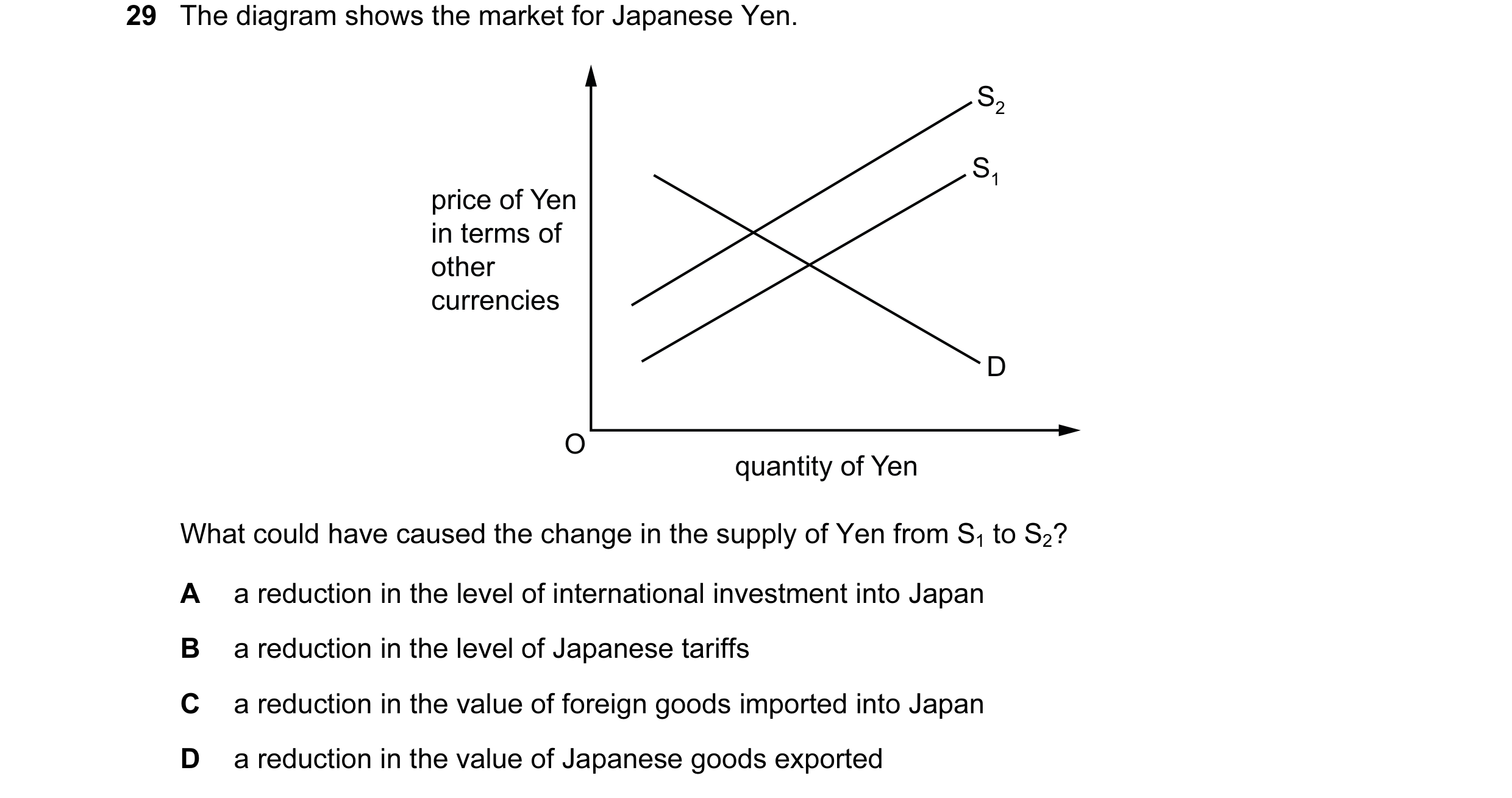
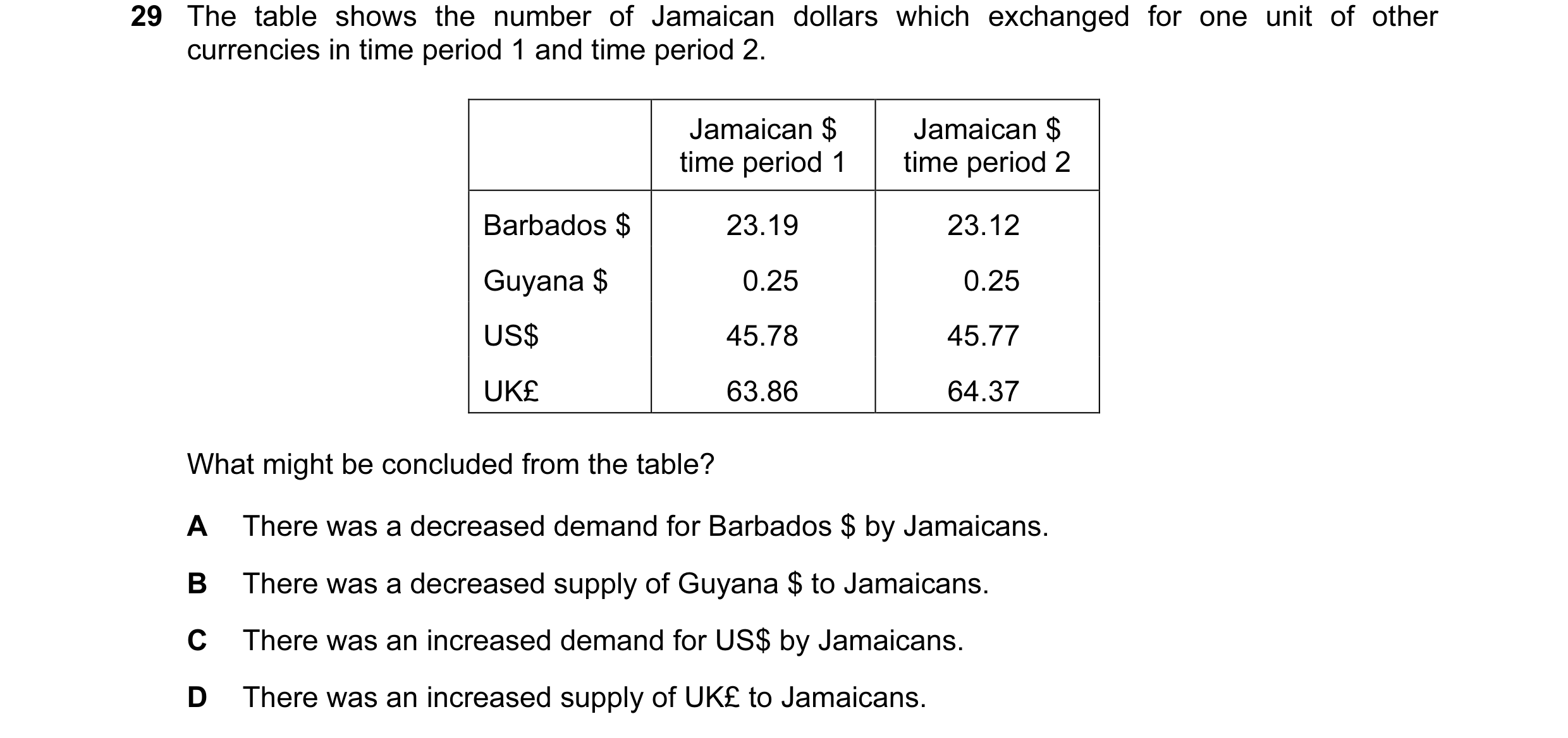 34 / 75
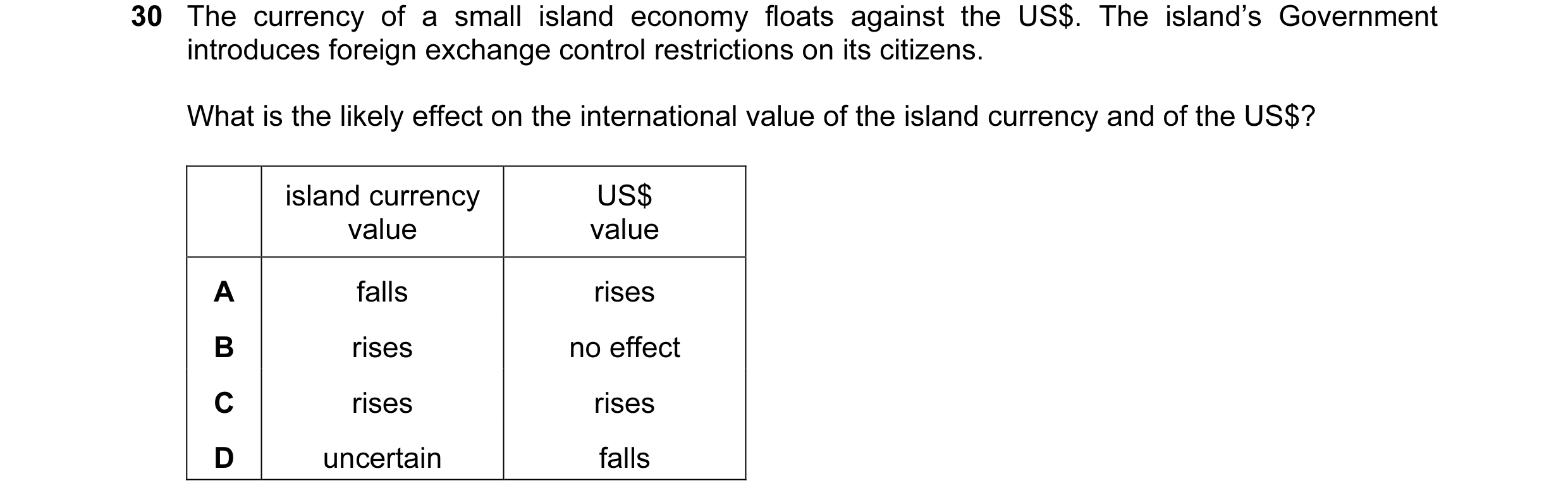

 35 / 75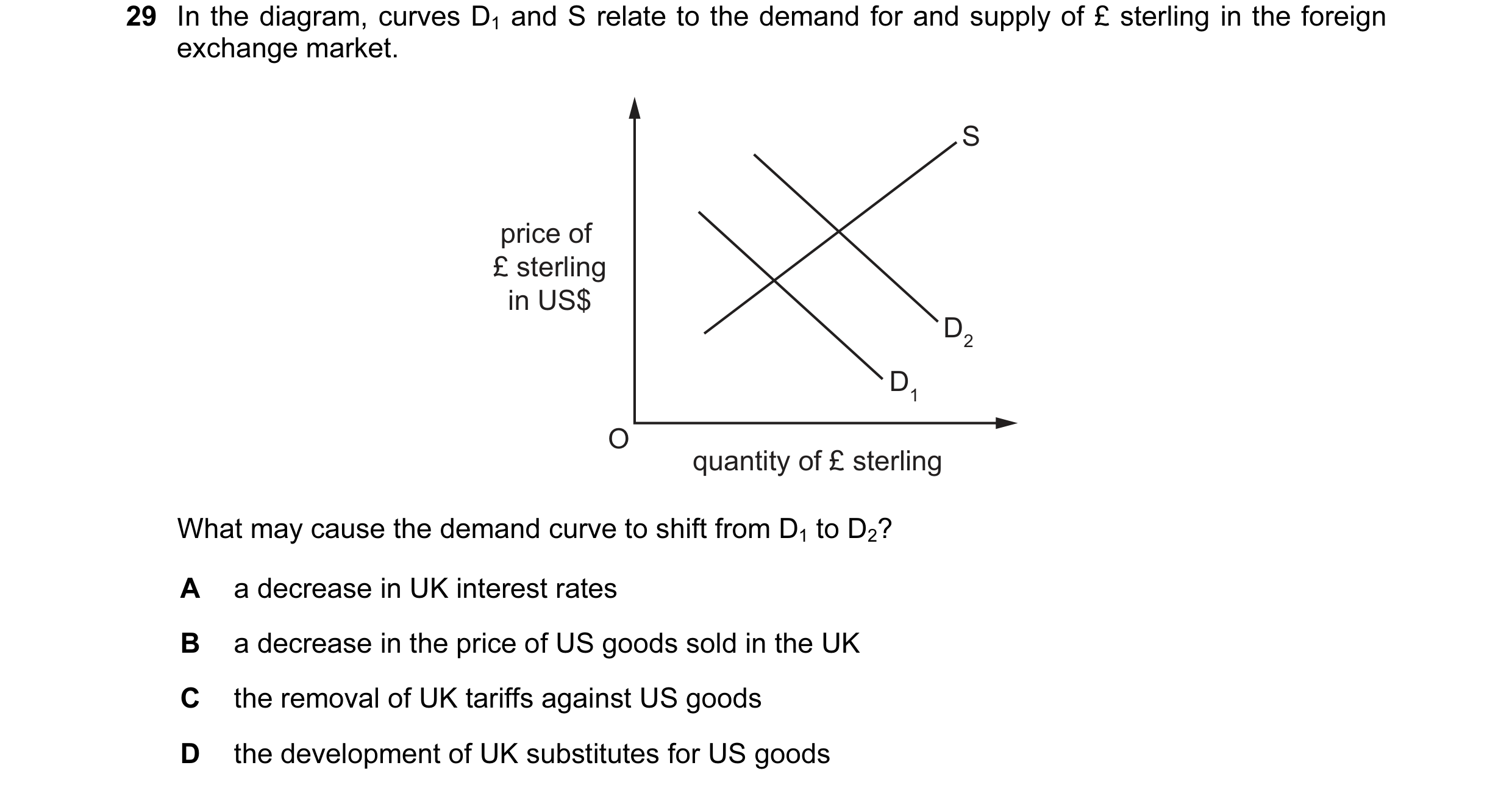
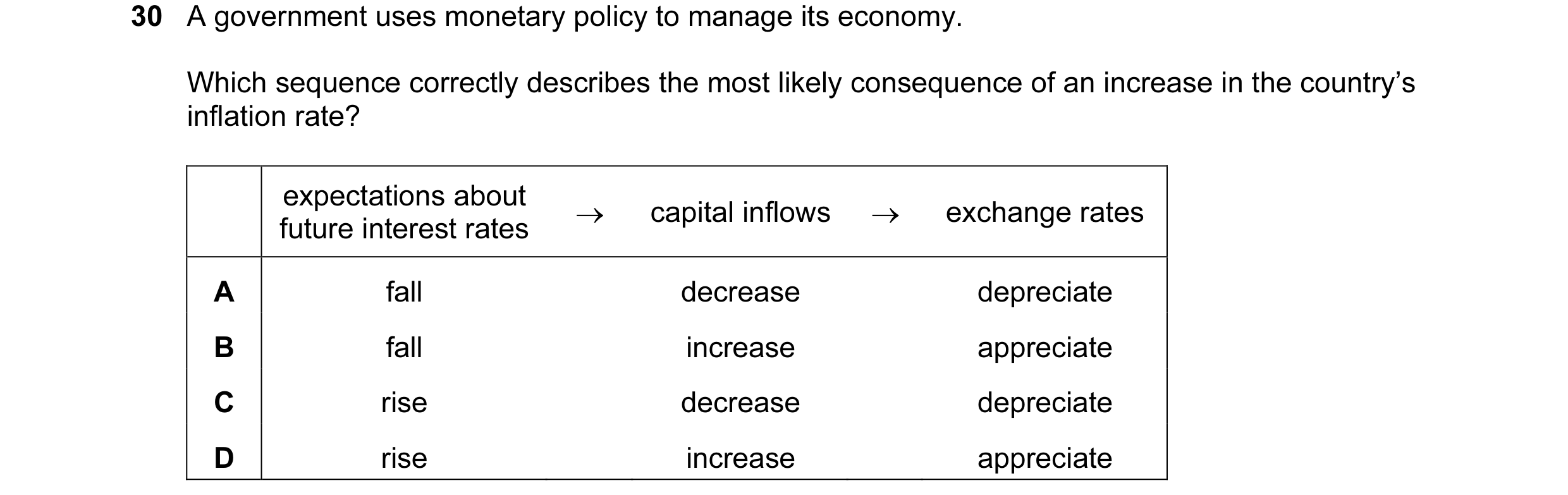
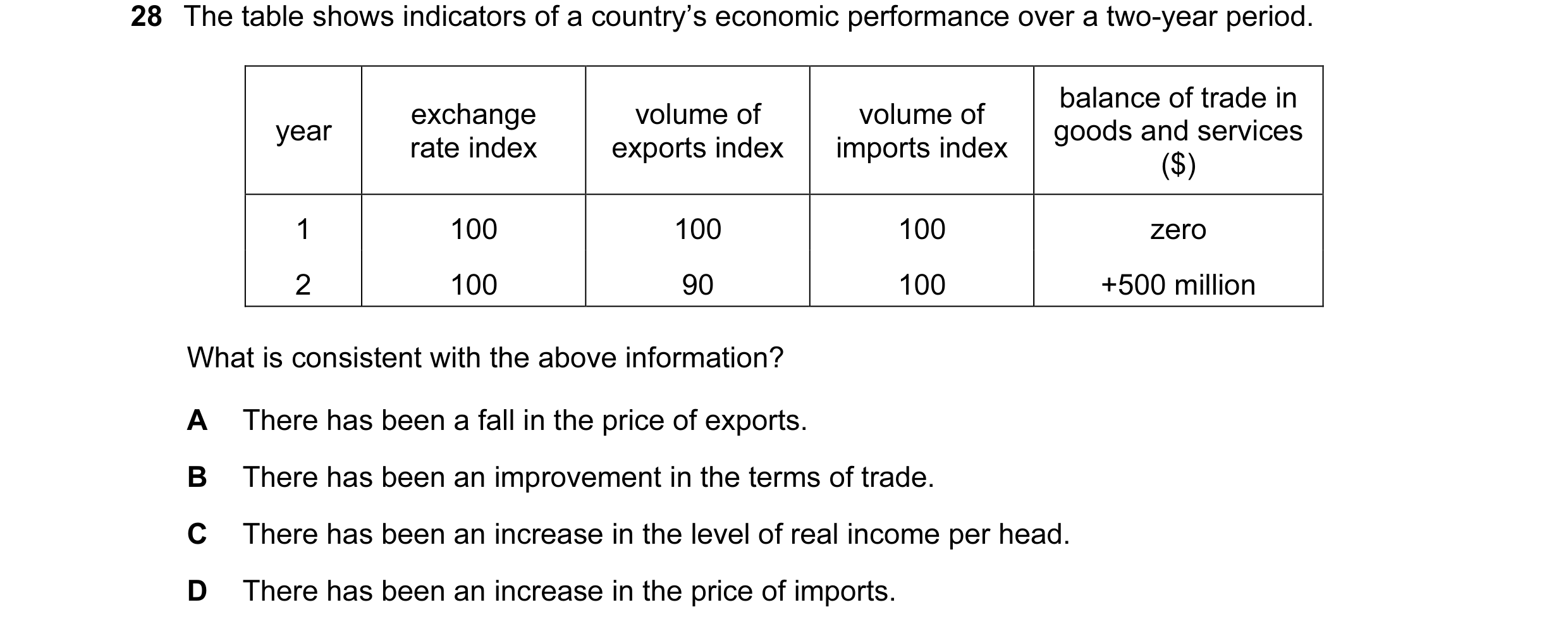 36 / 75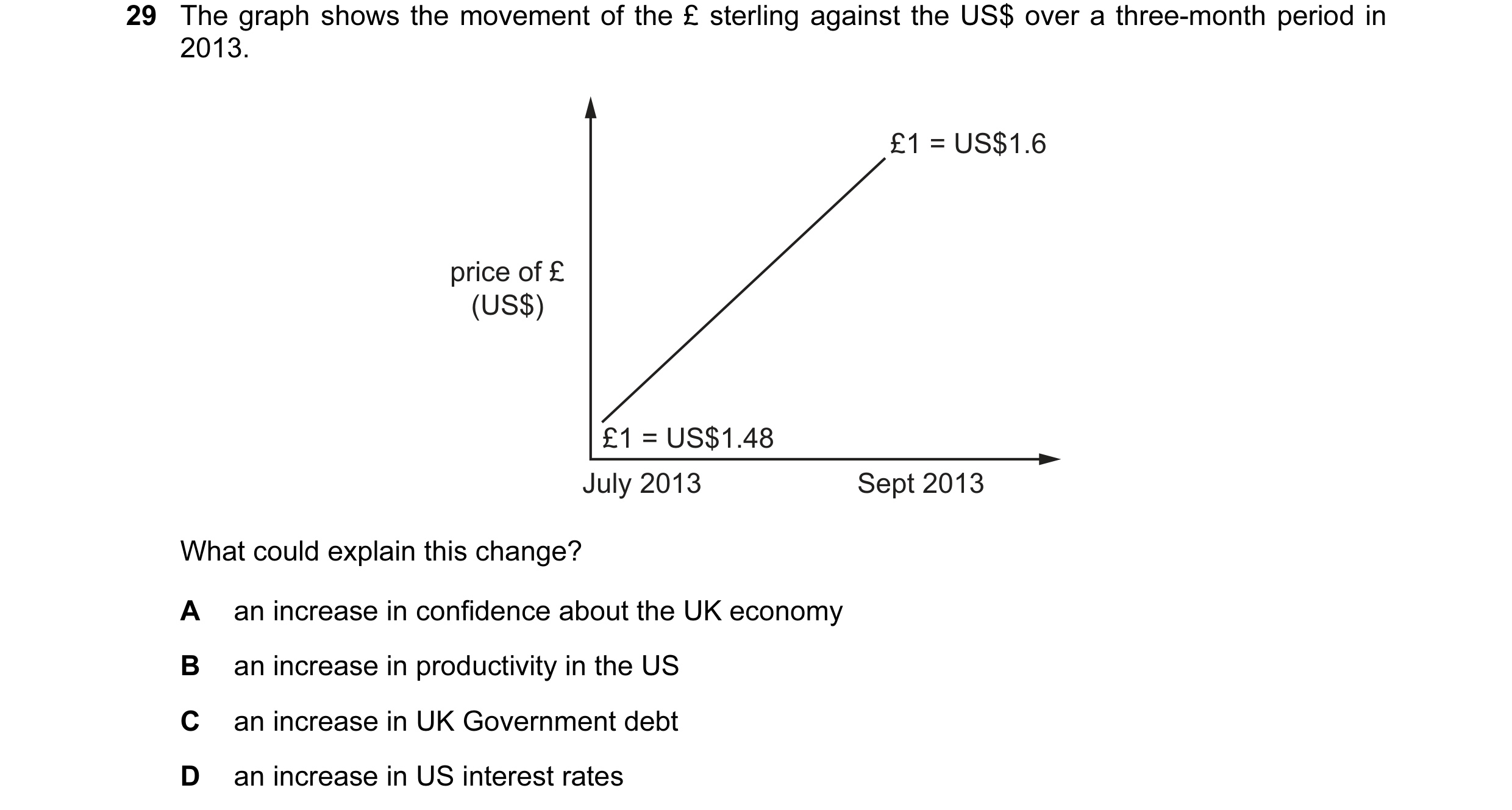
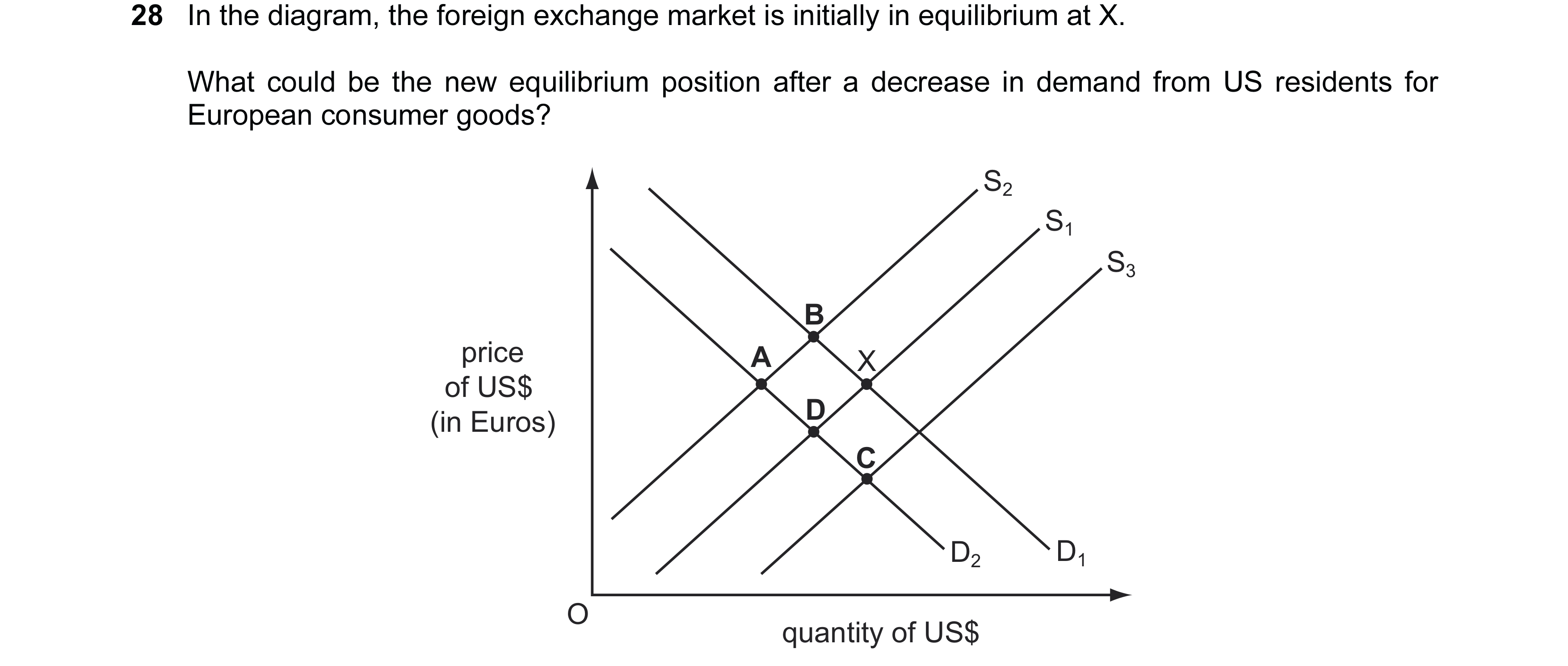
 37 / 75
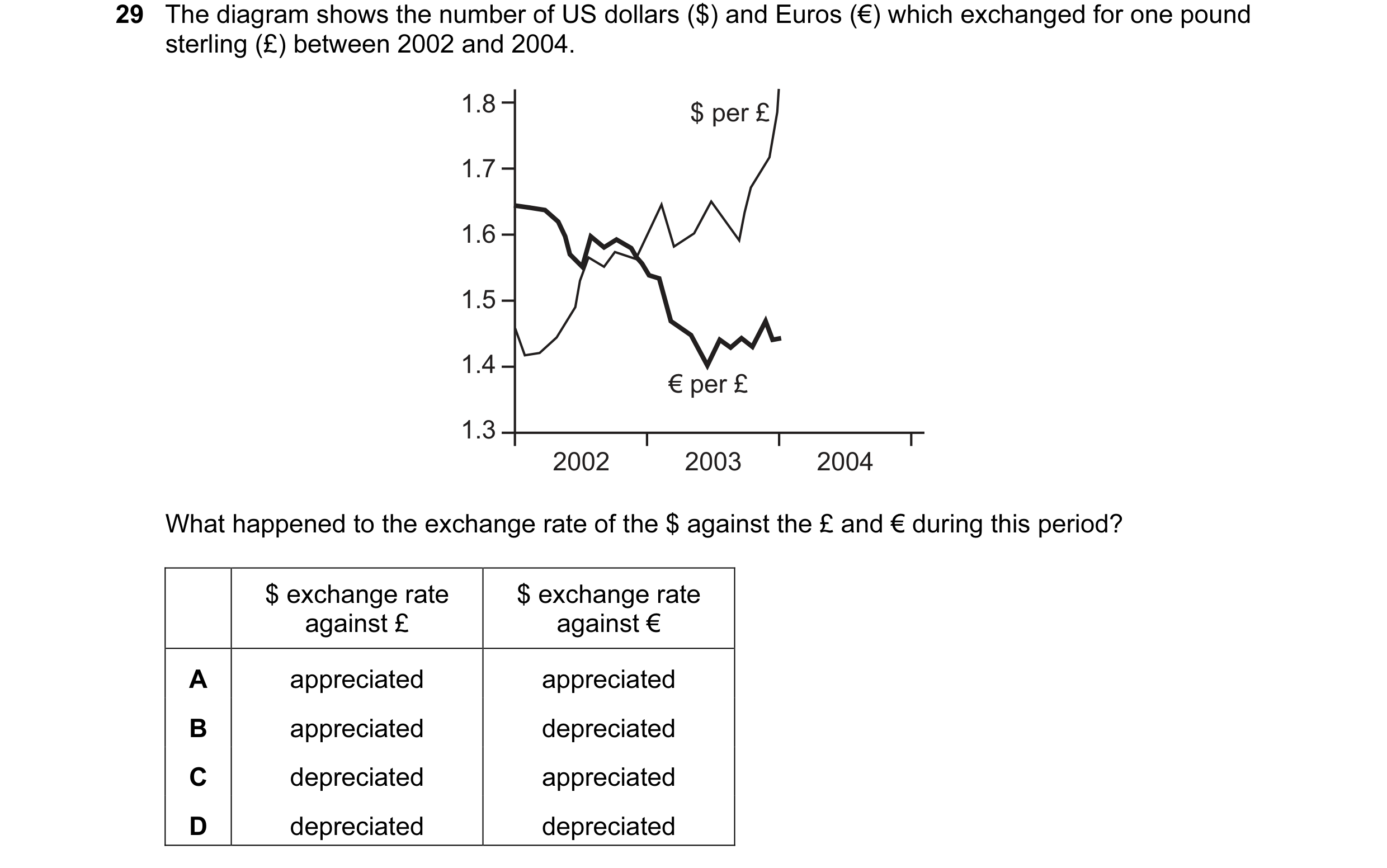
 38 / 75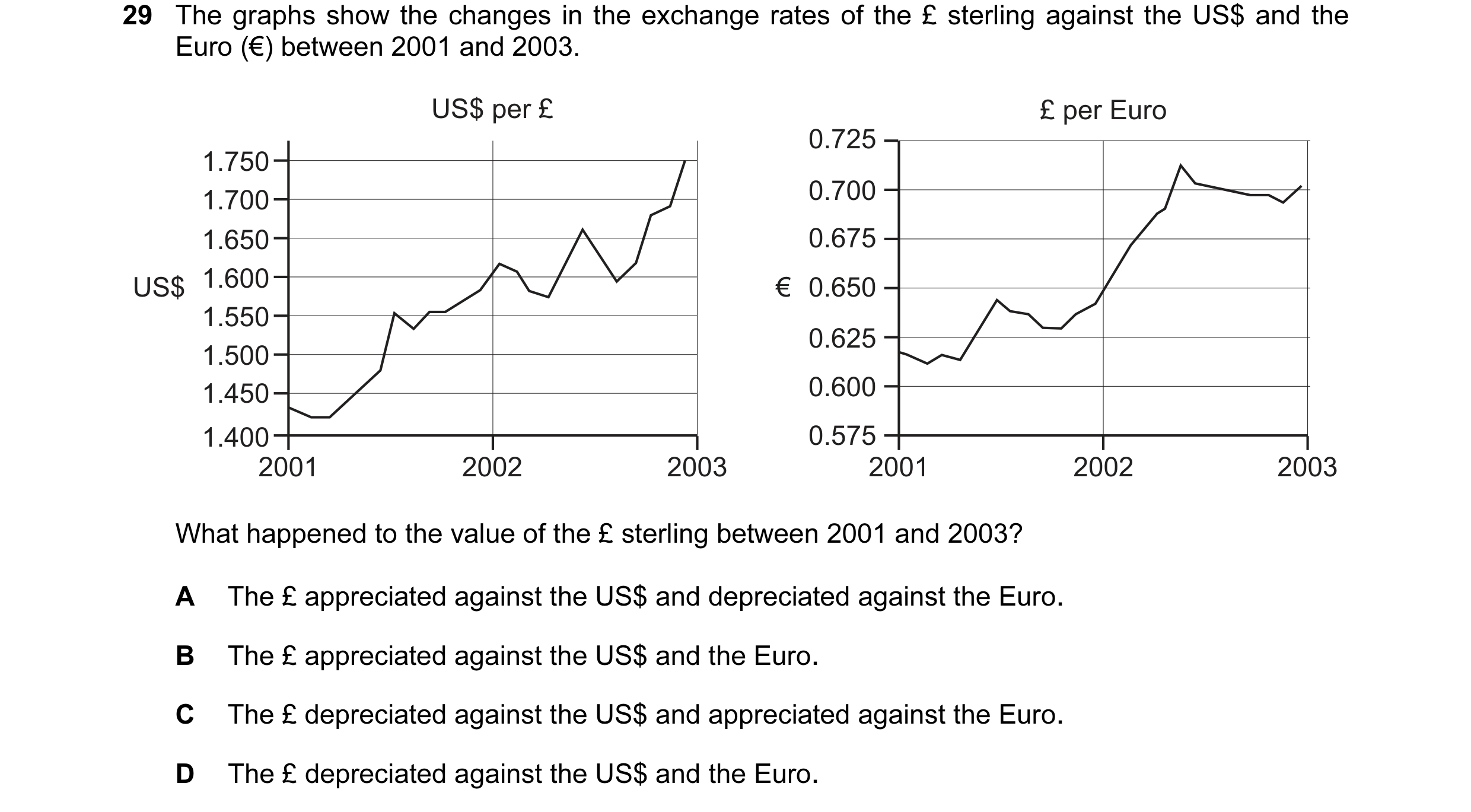
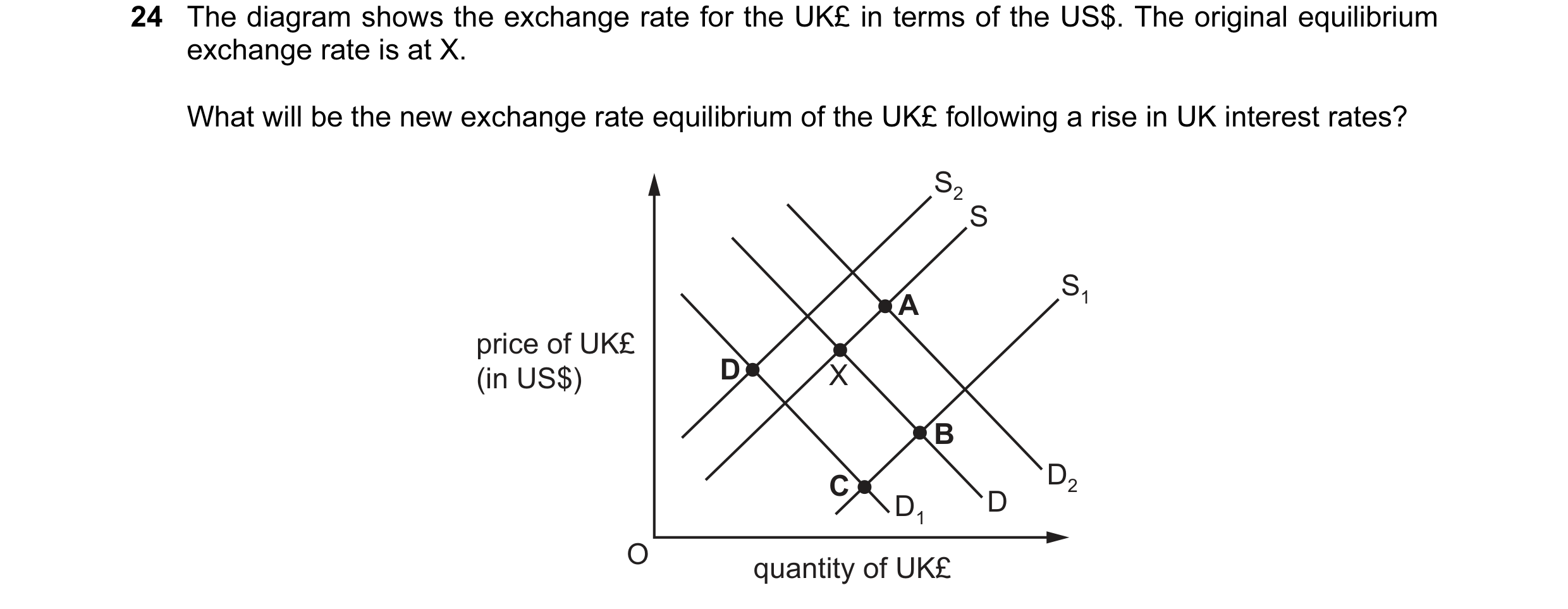 39 / 75
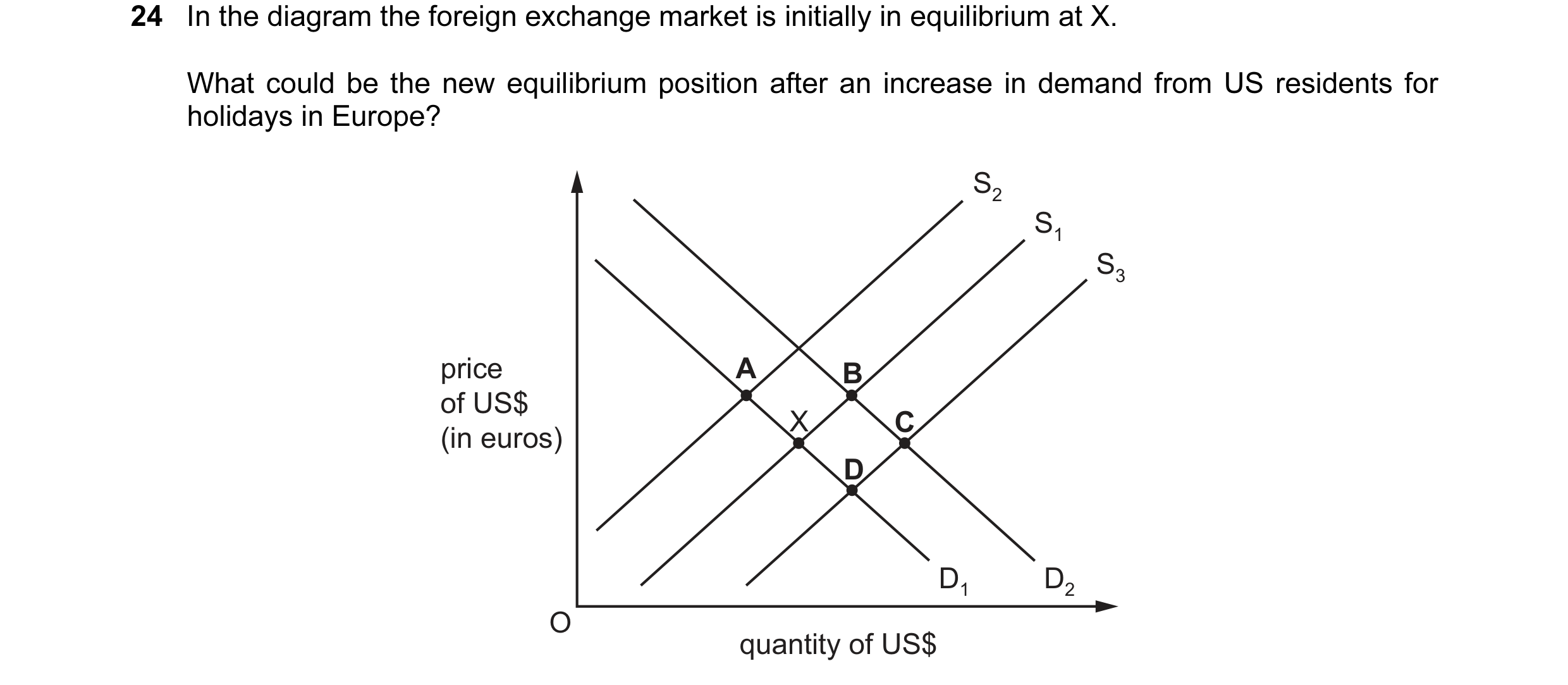
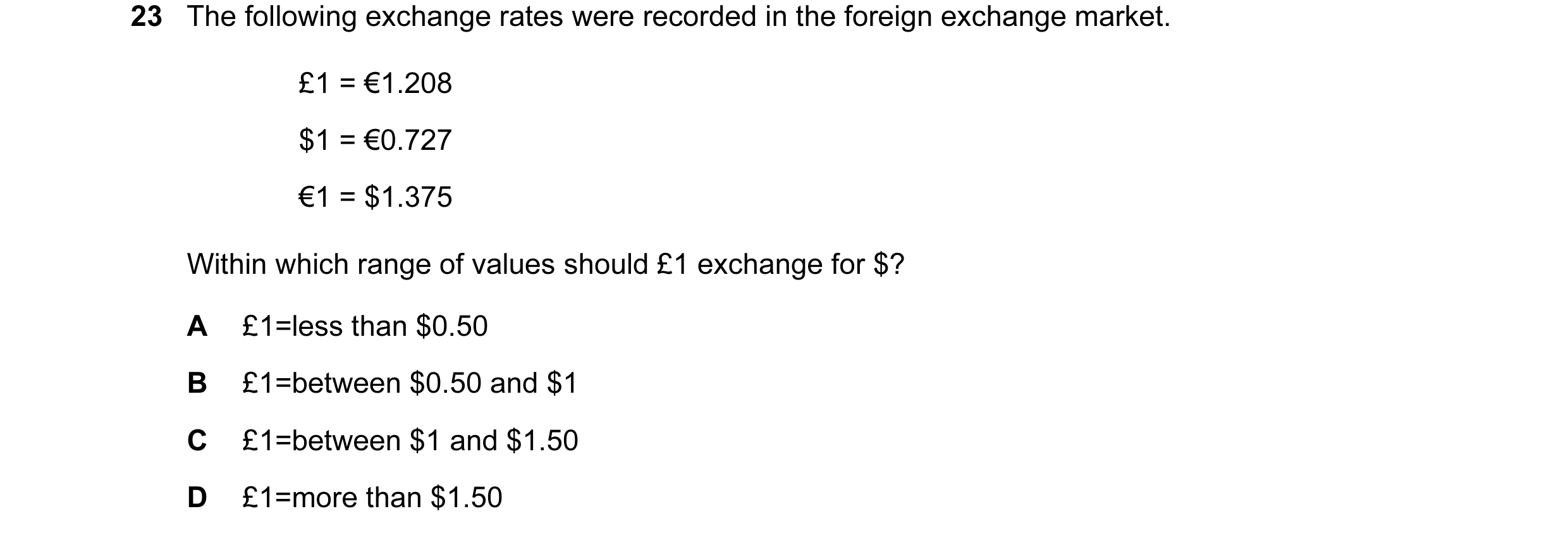 40 / 75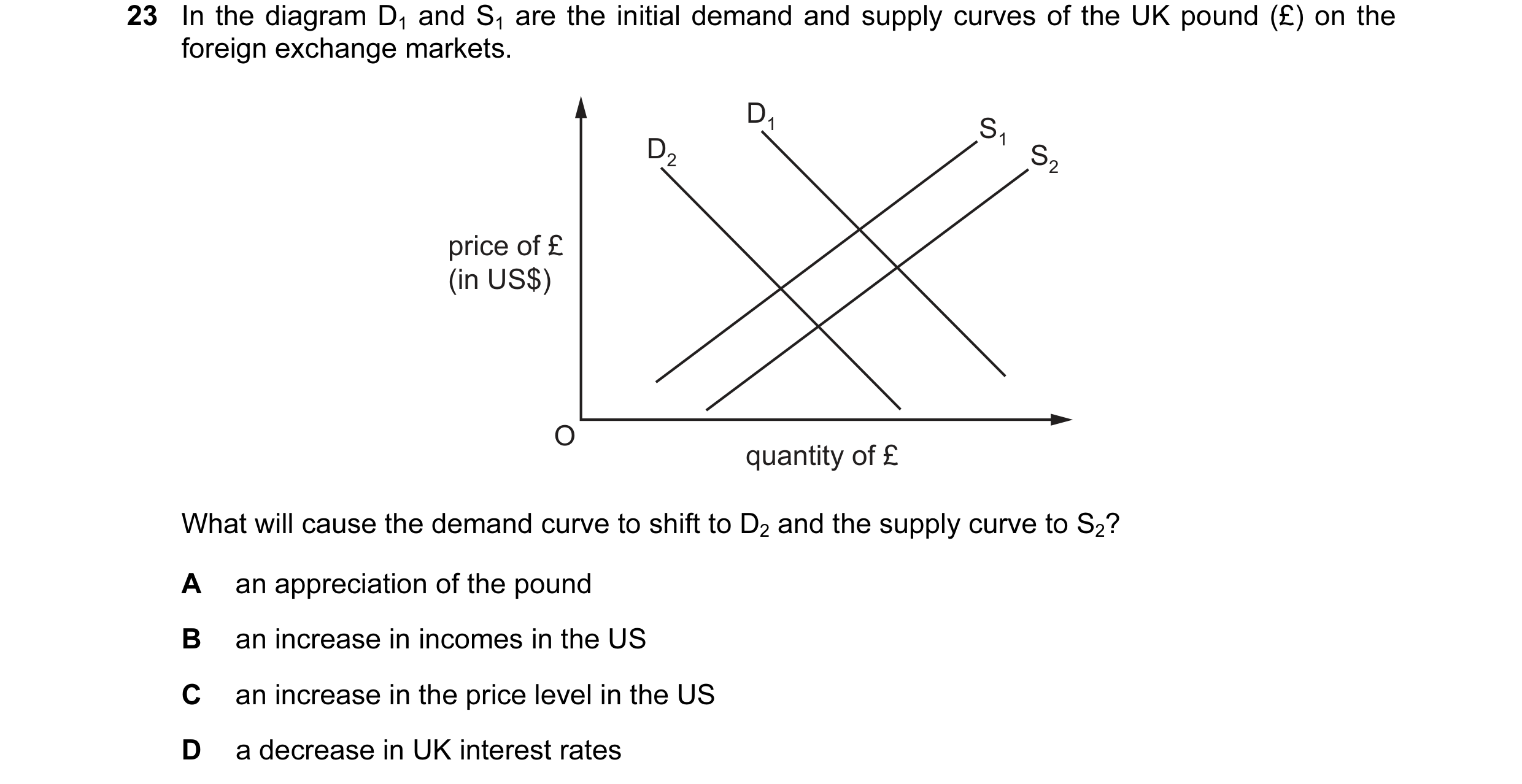
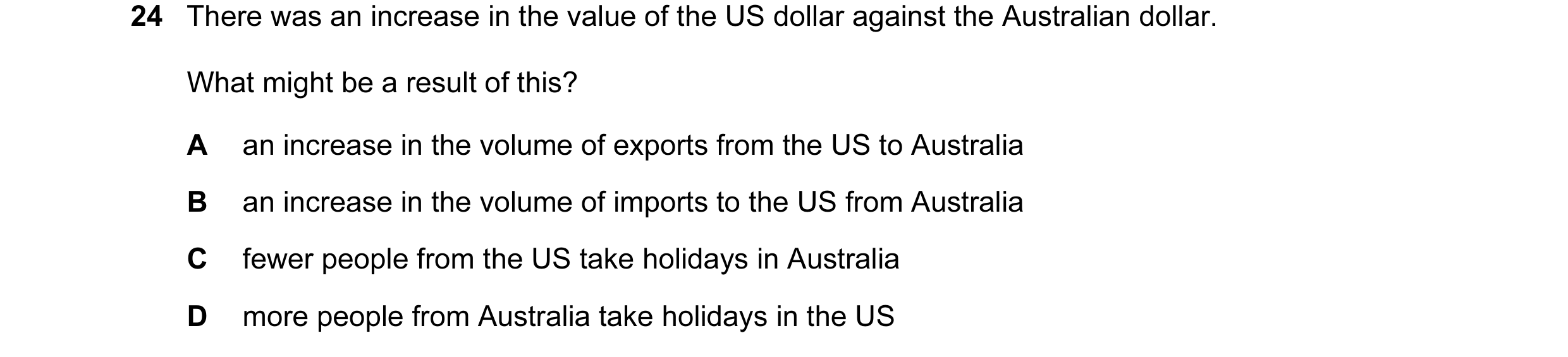
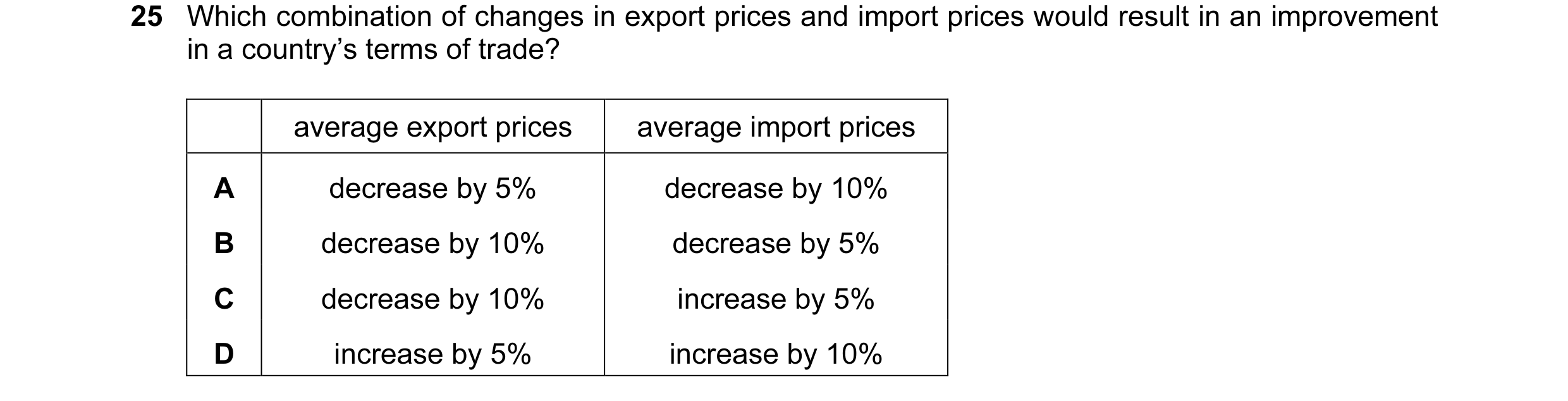
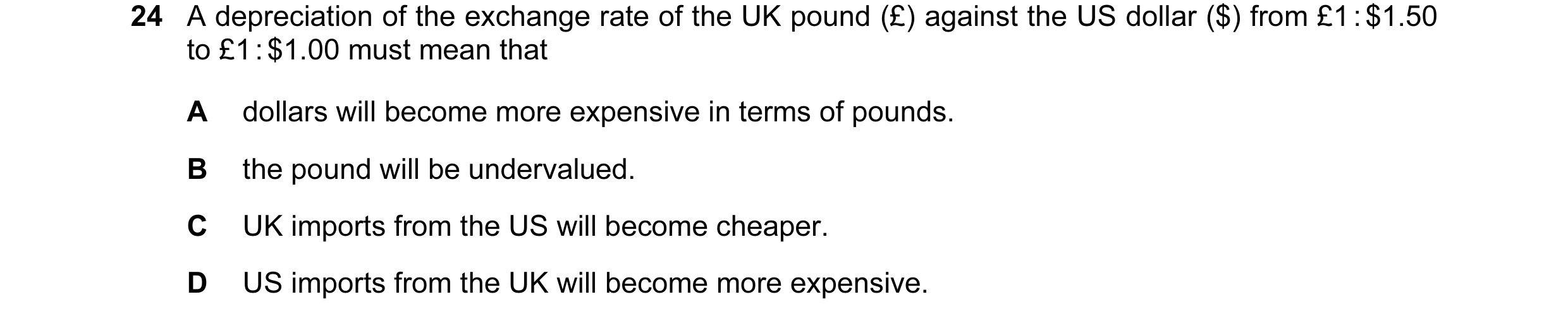 41 / 75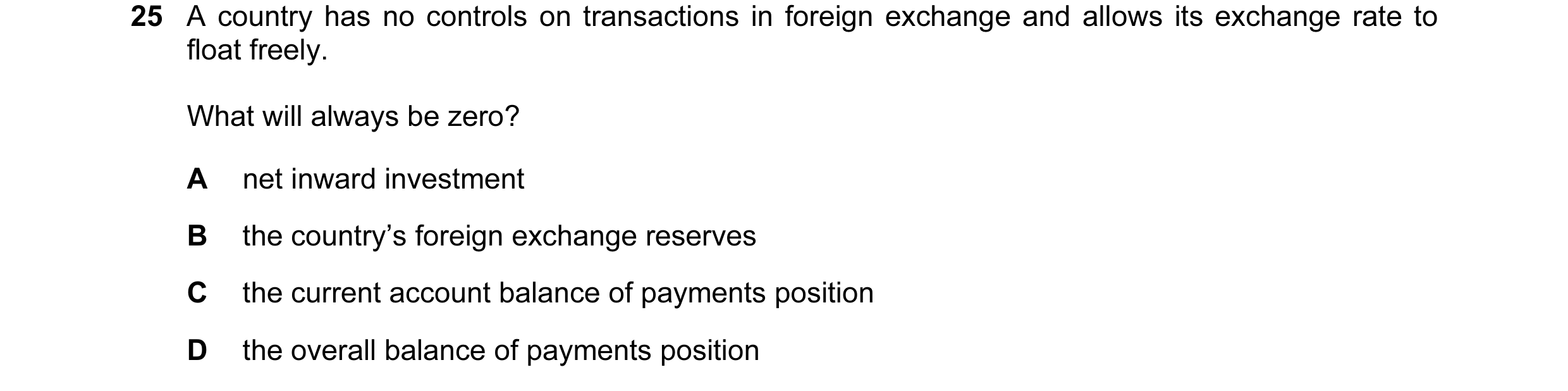
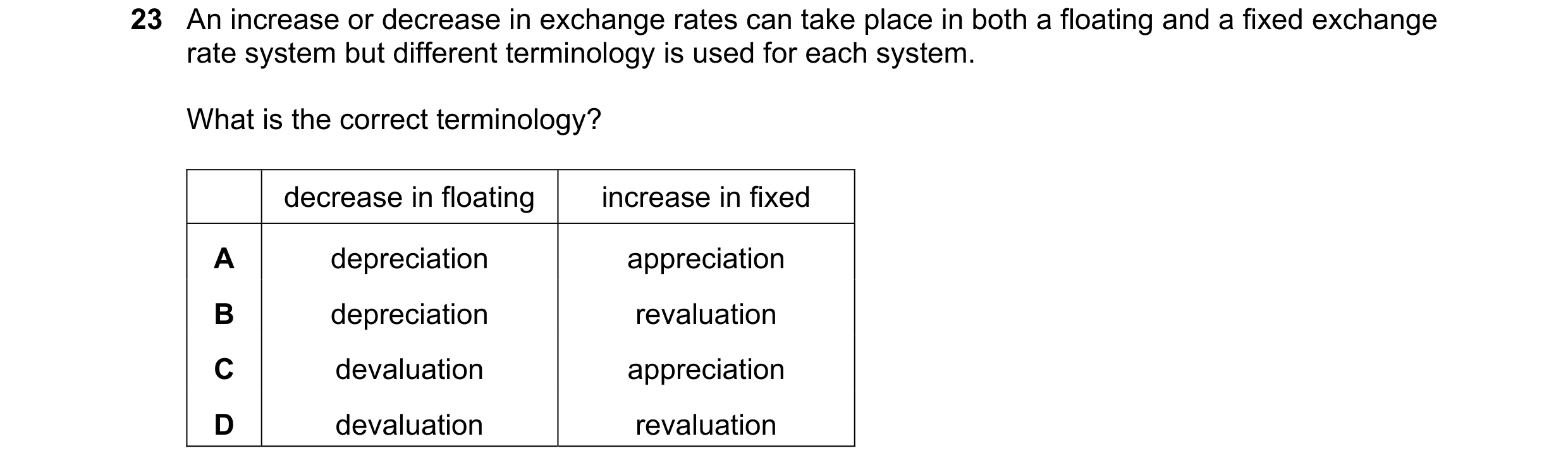
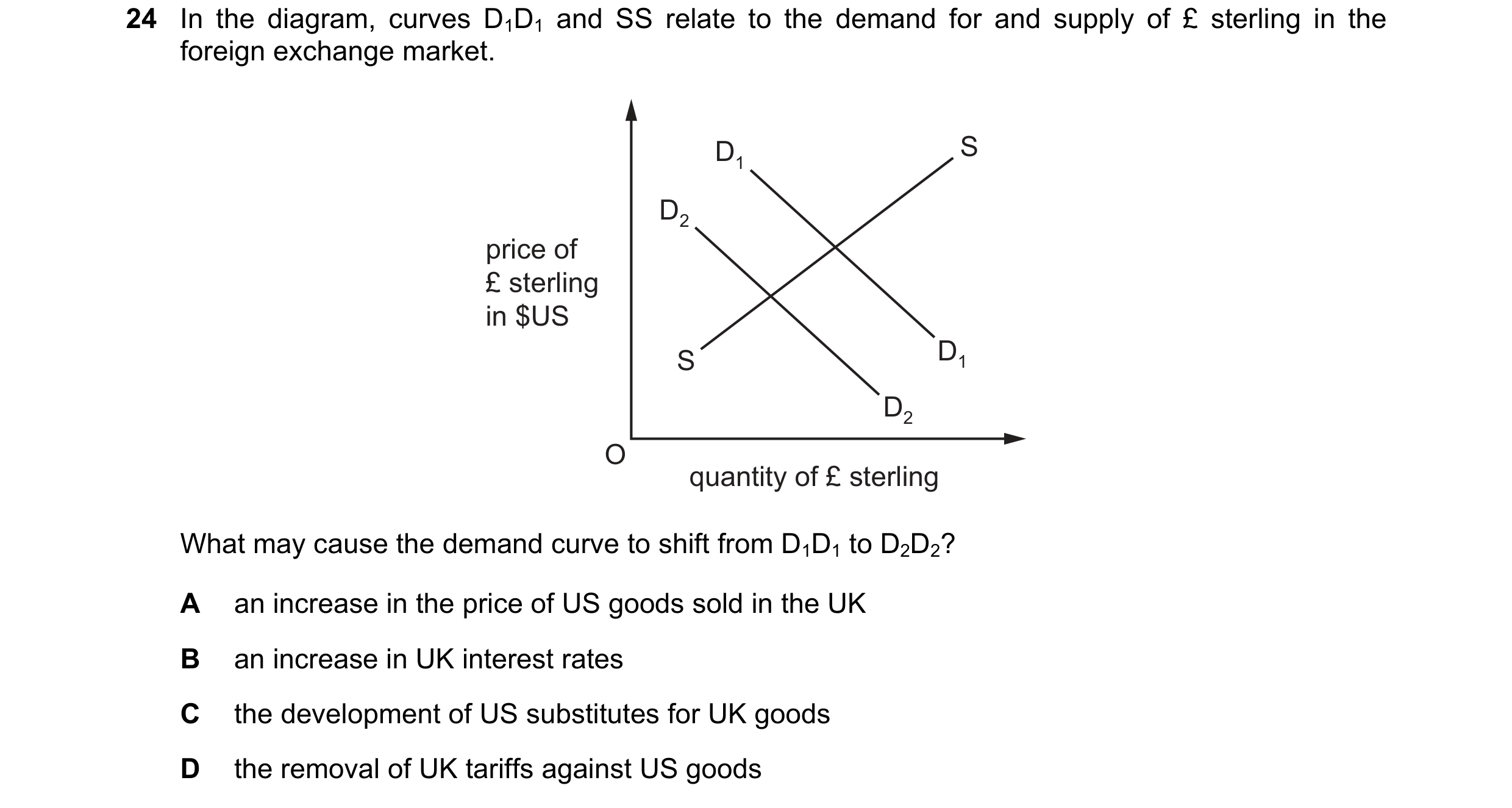 42 / 75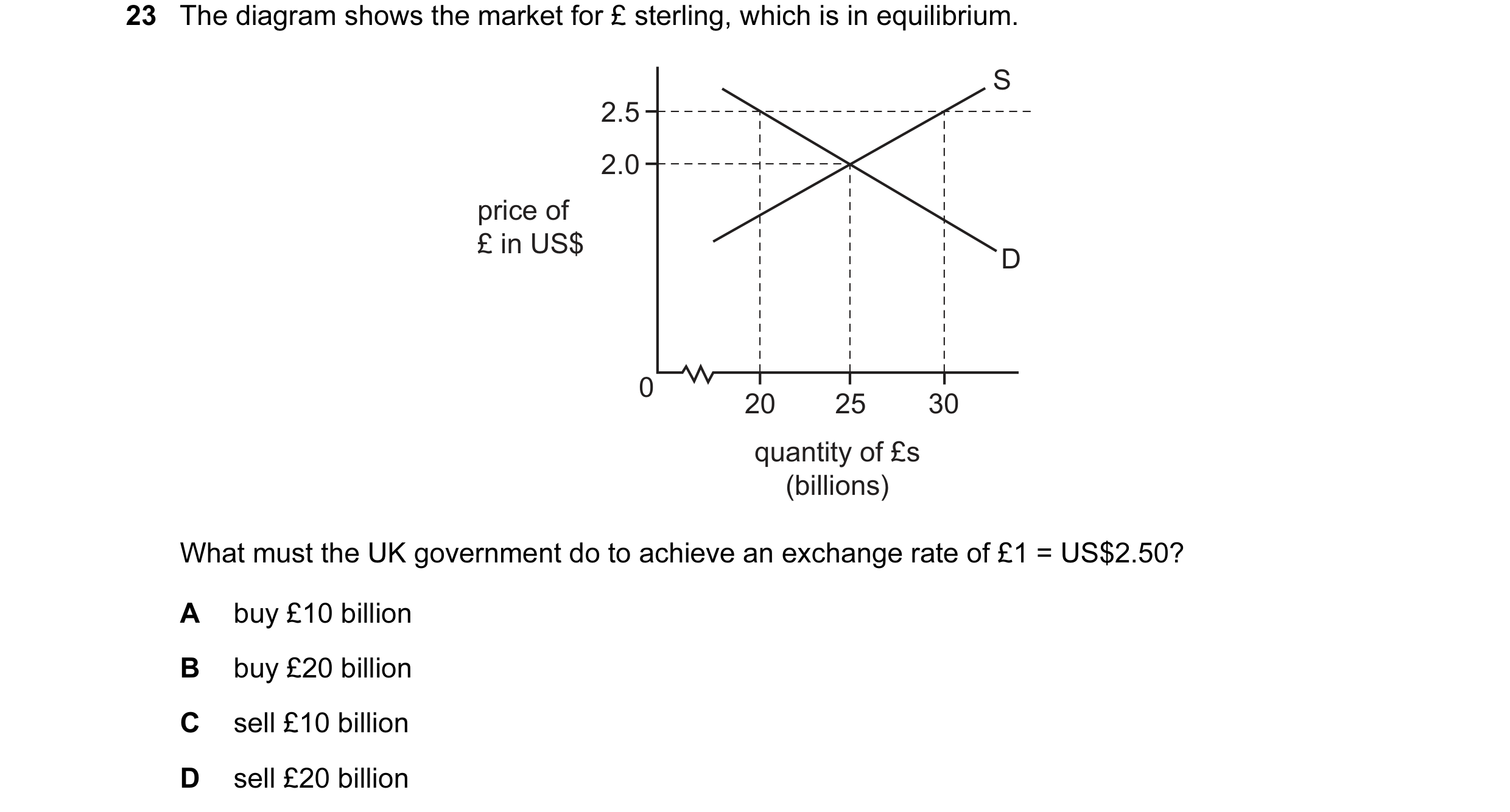
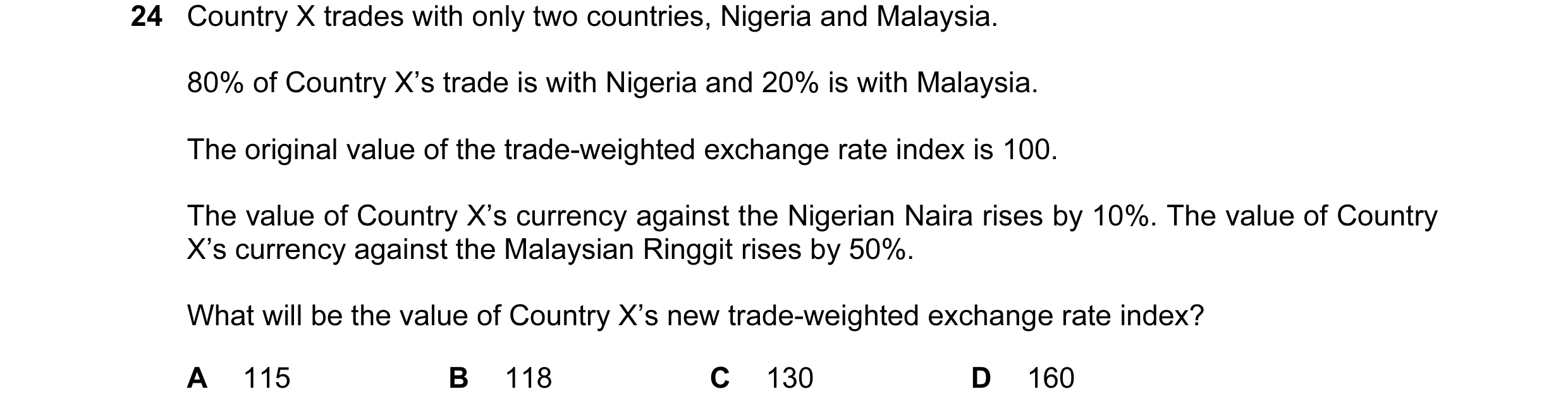
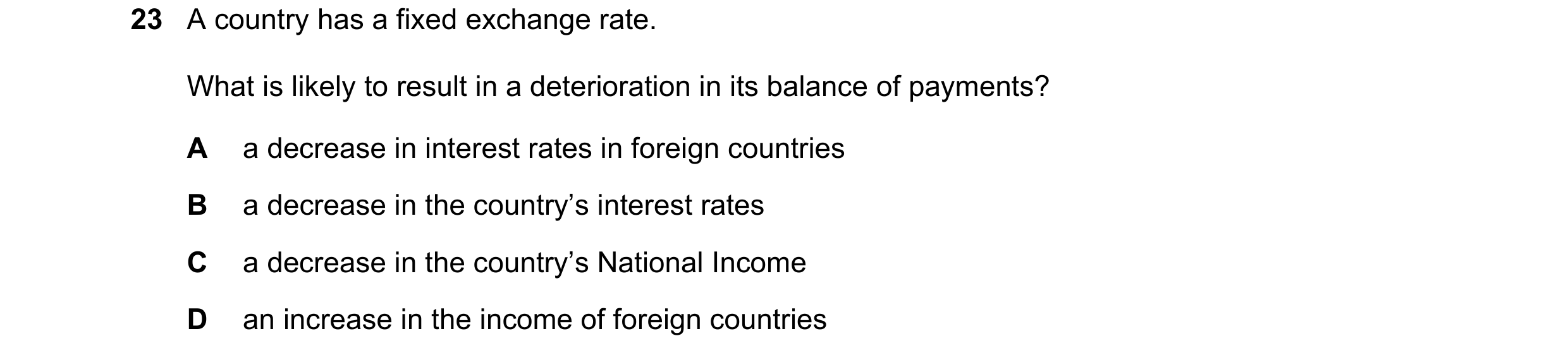
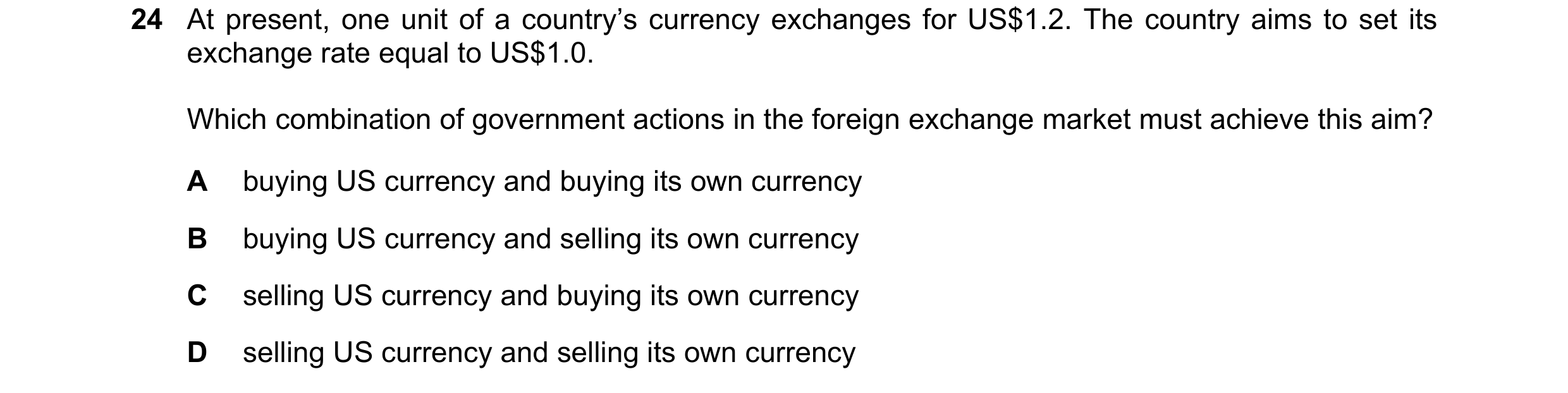 43 / 75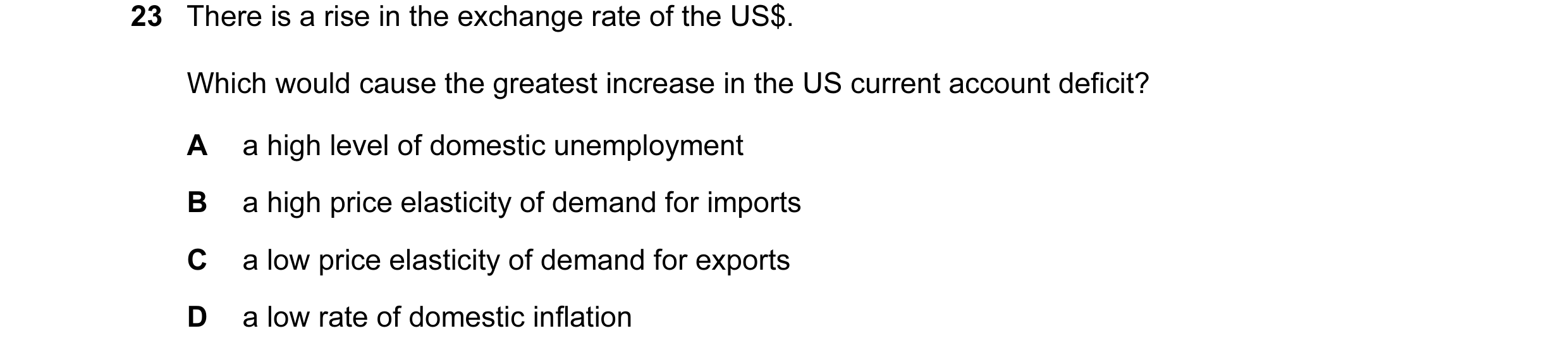
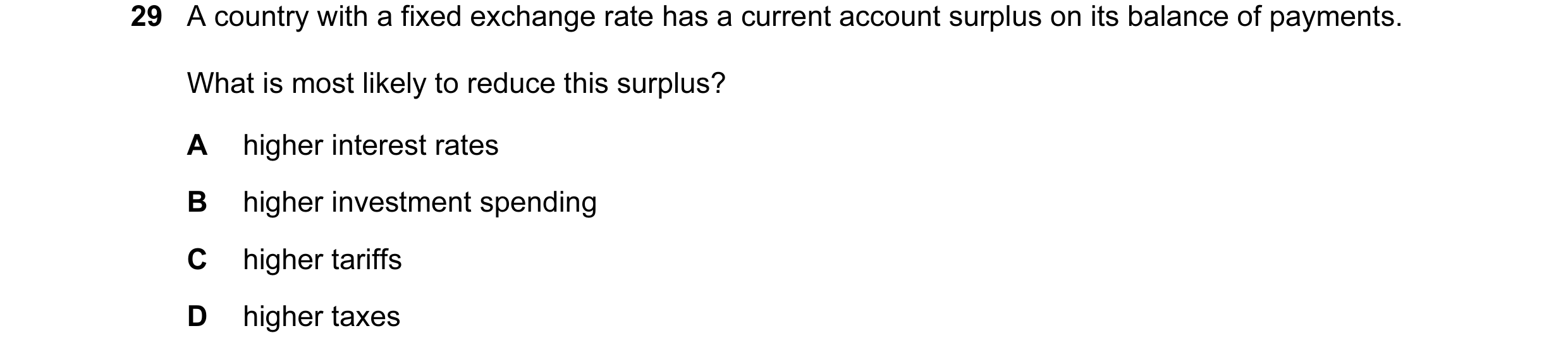

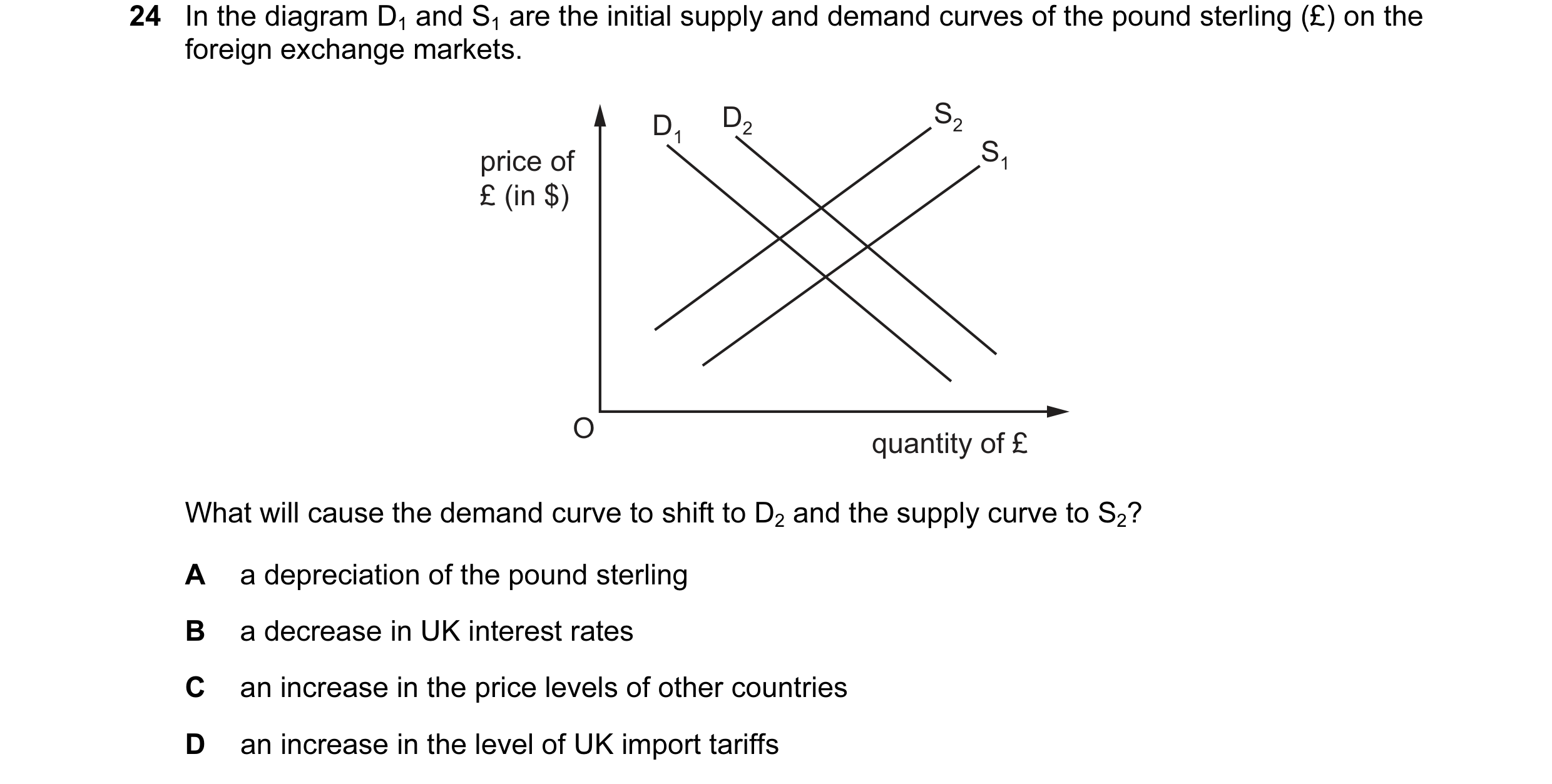 44 / 75
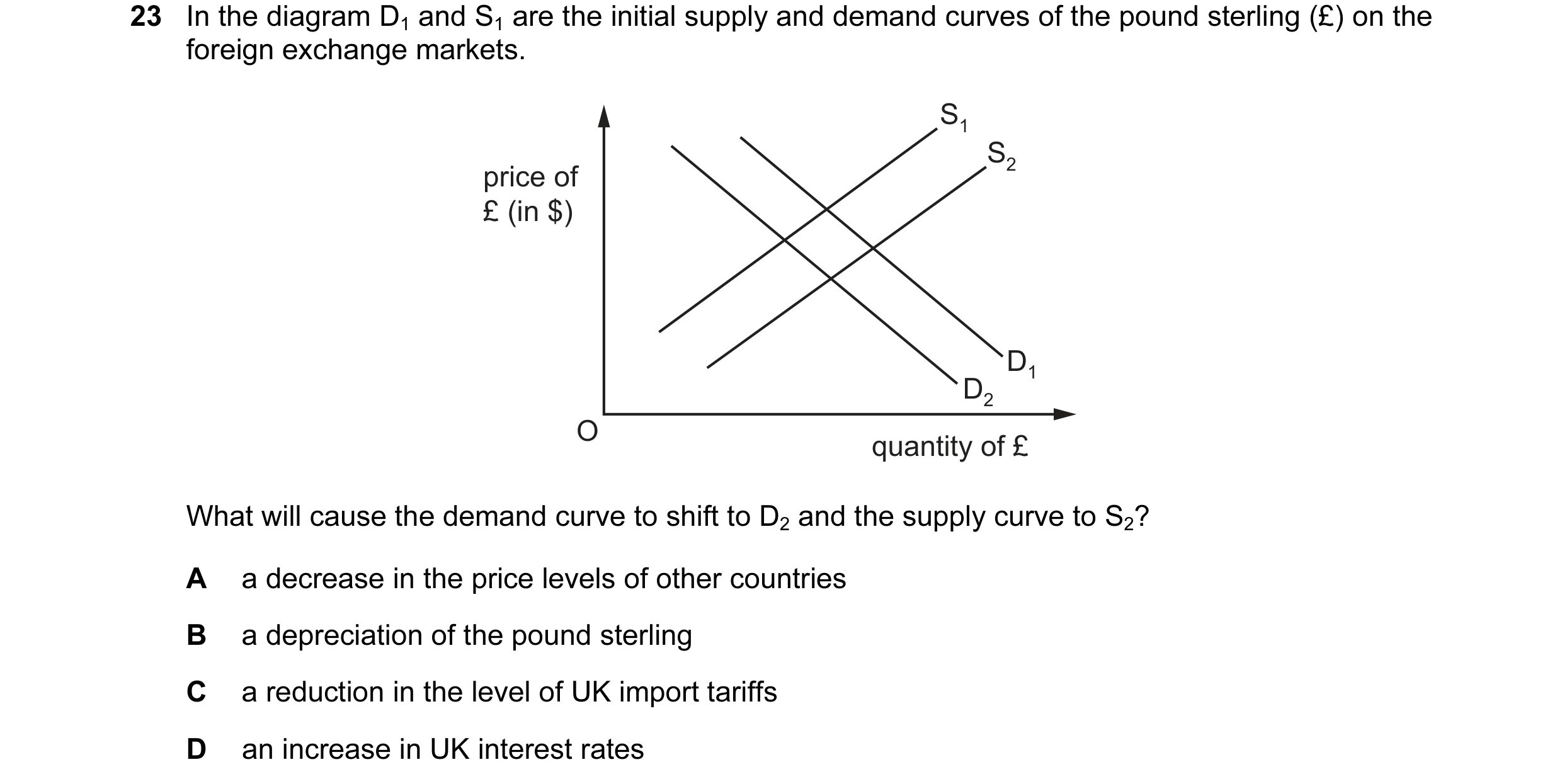 45 / 75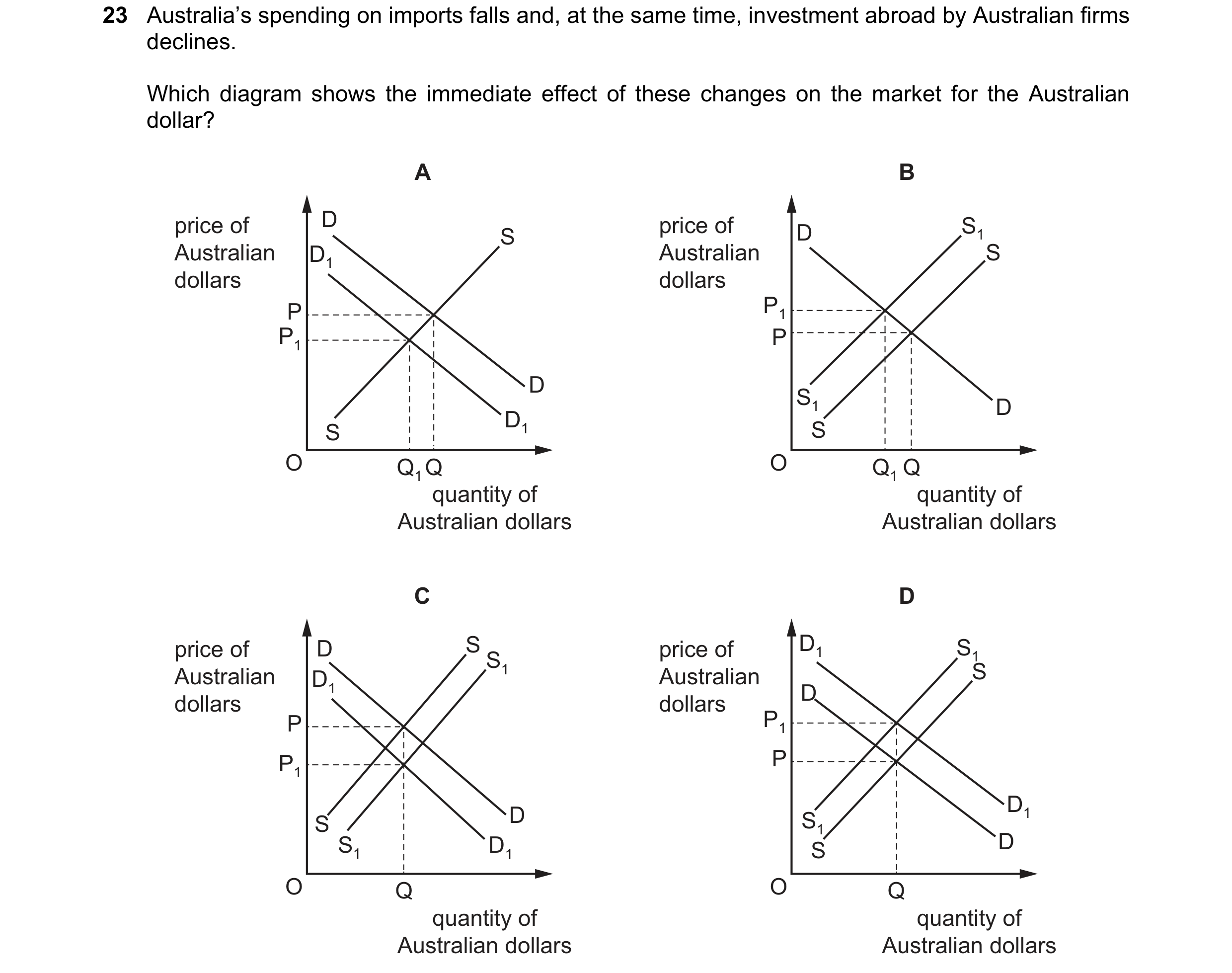
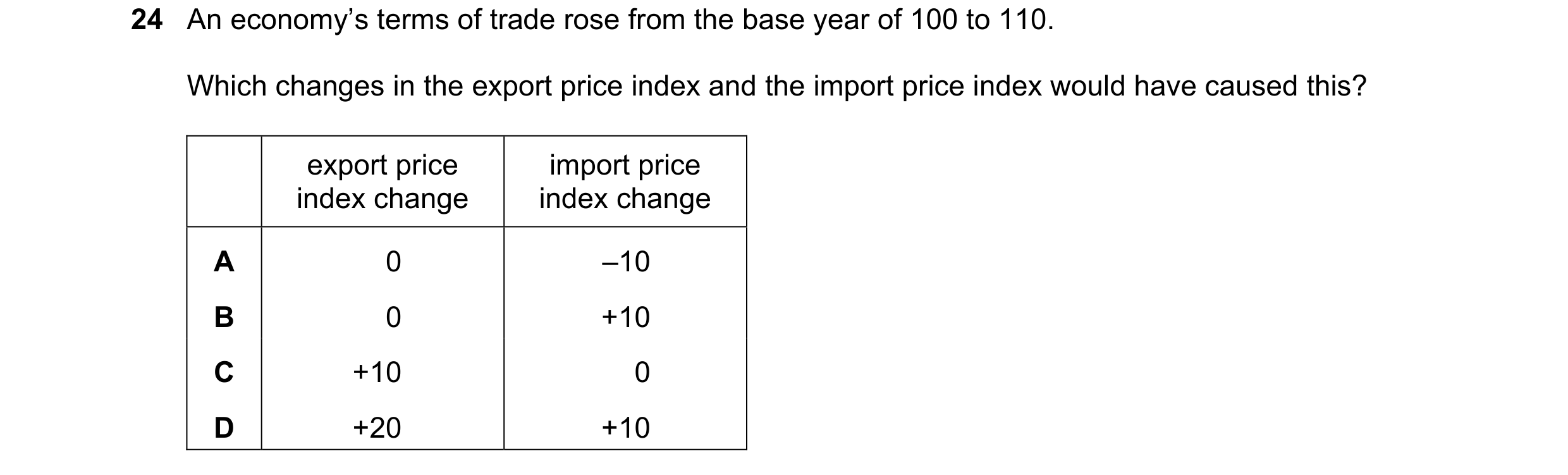 46 / 75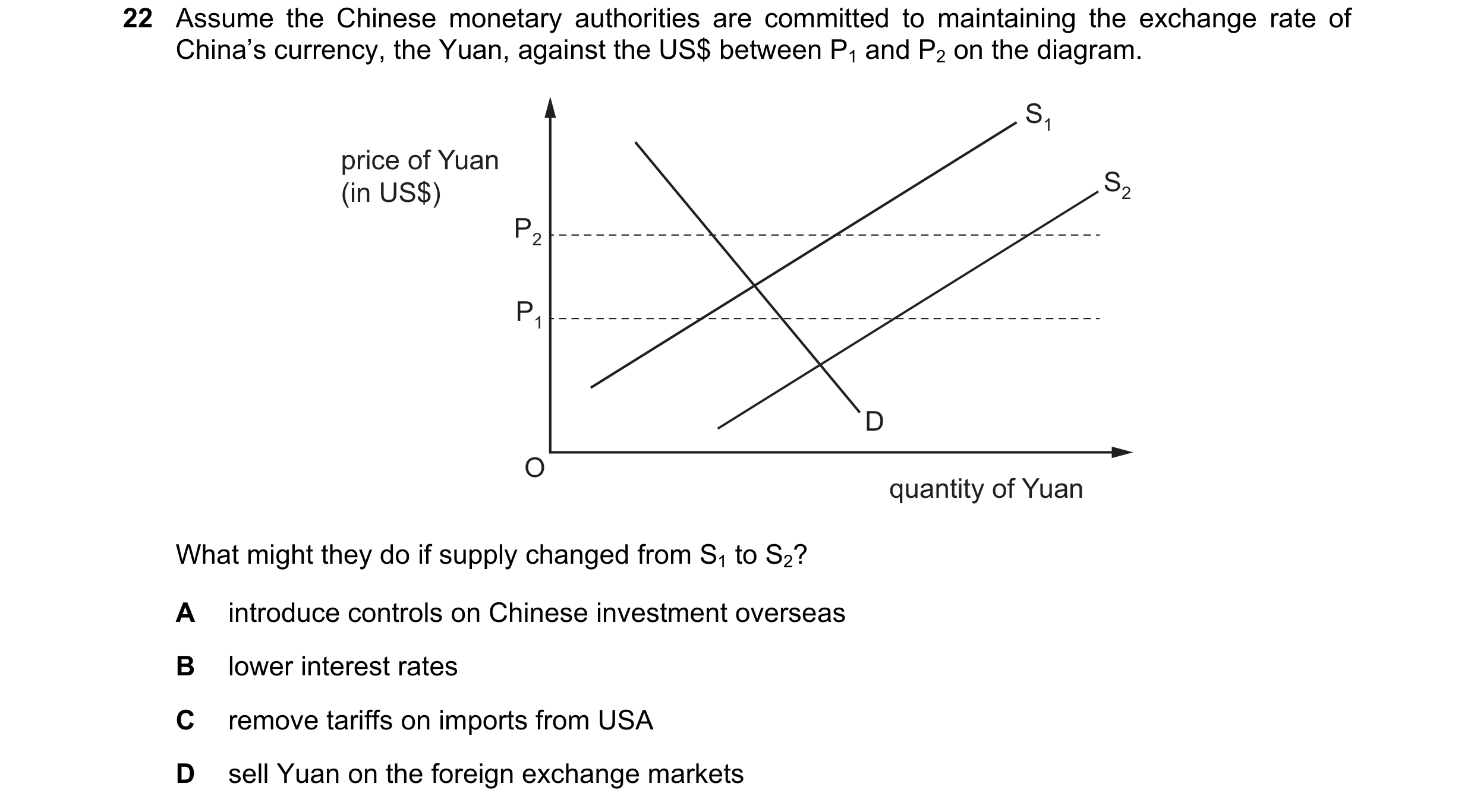
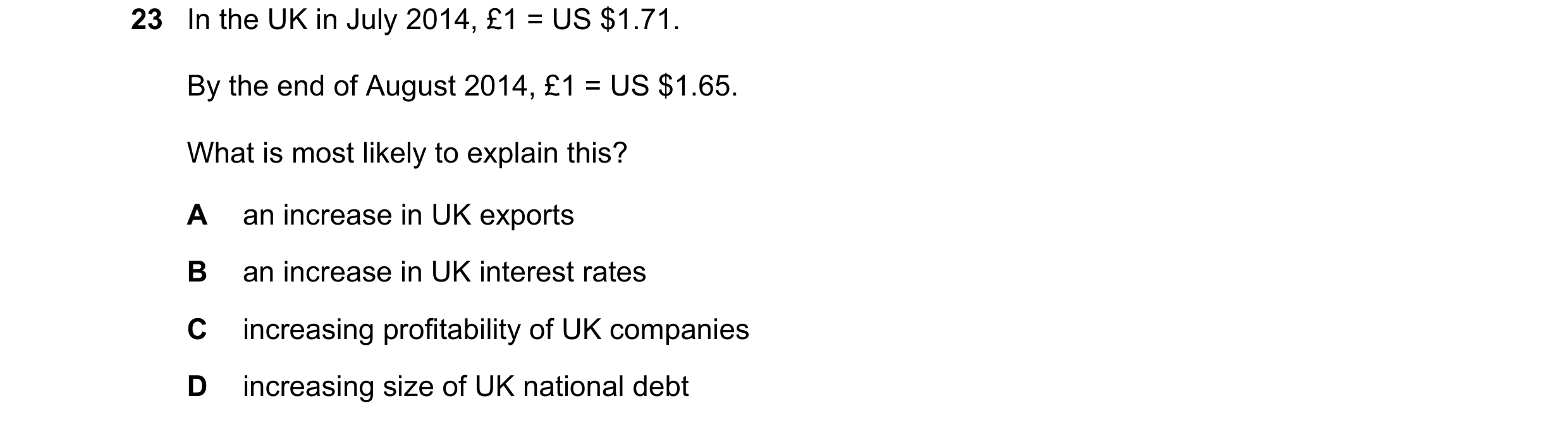 47 / 75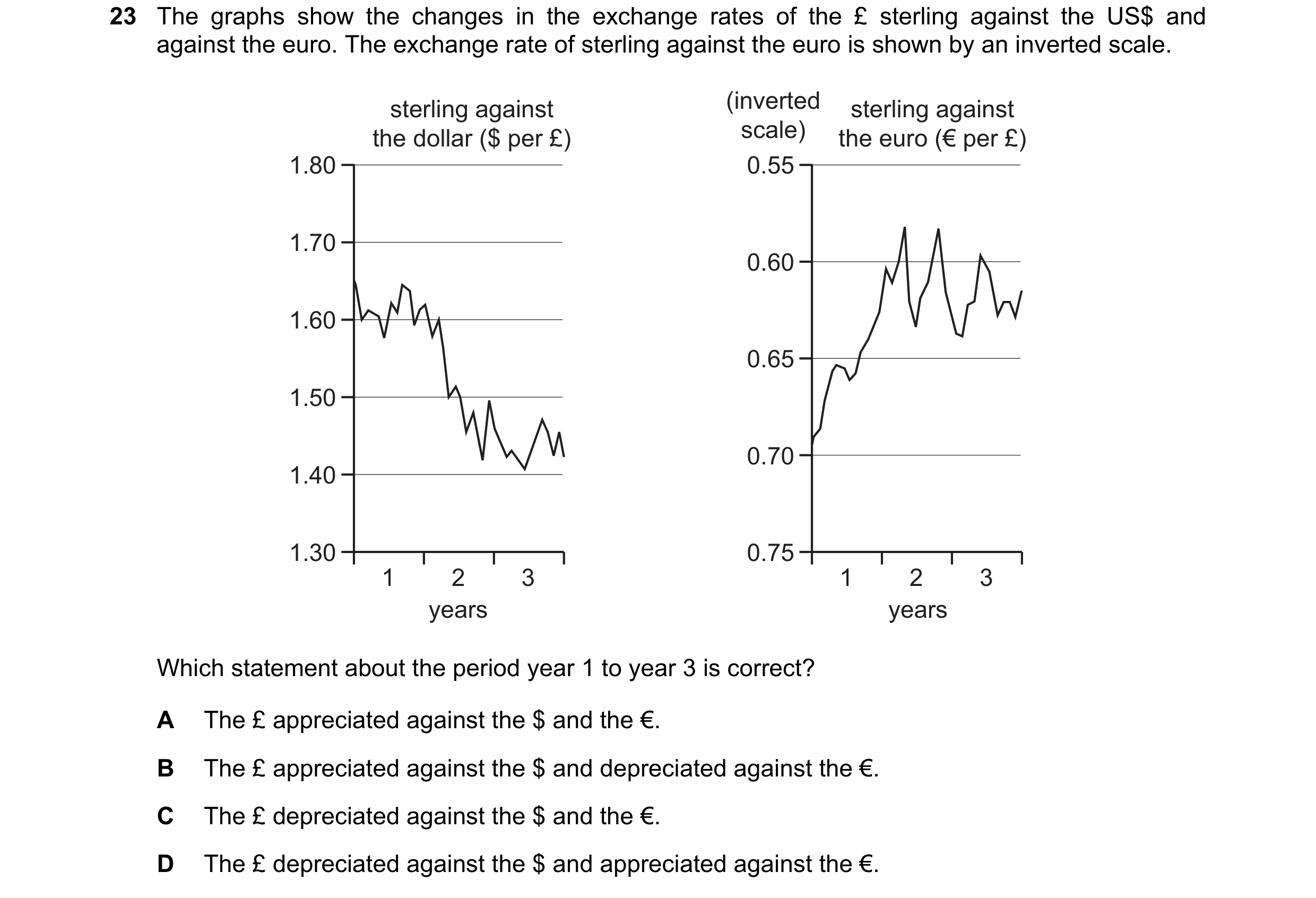
 48 / 75
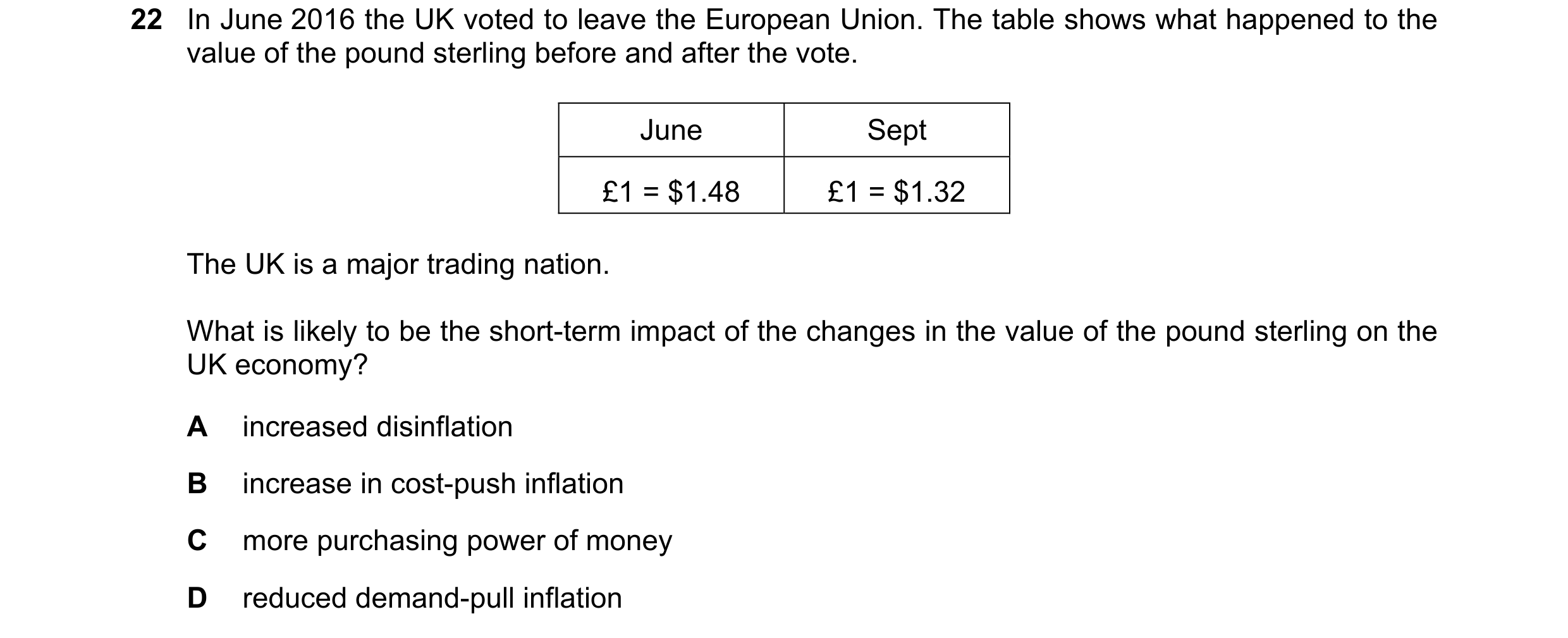

 49 / 75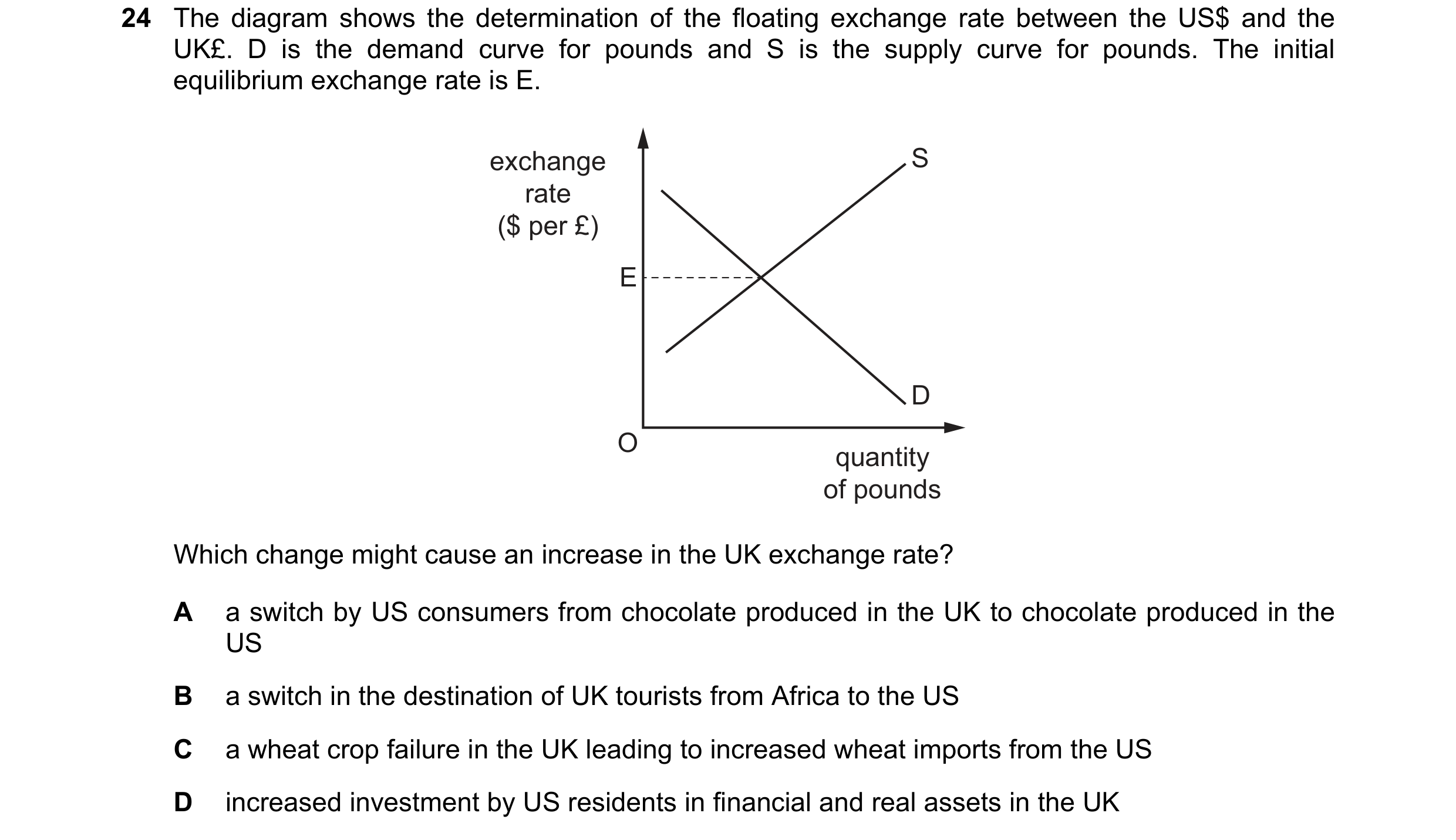
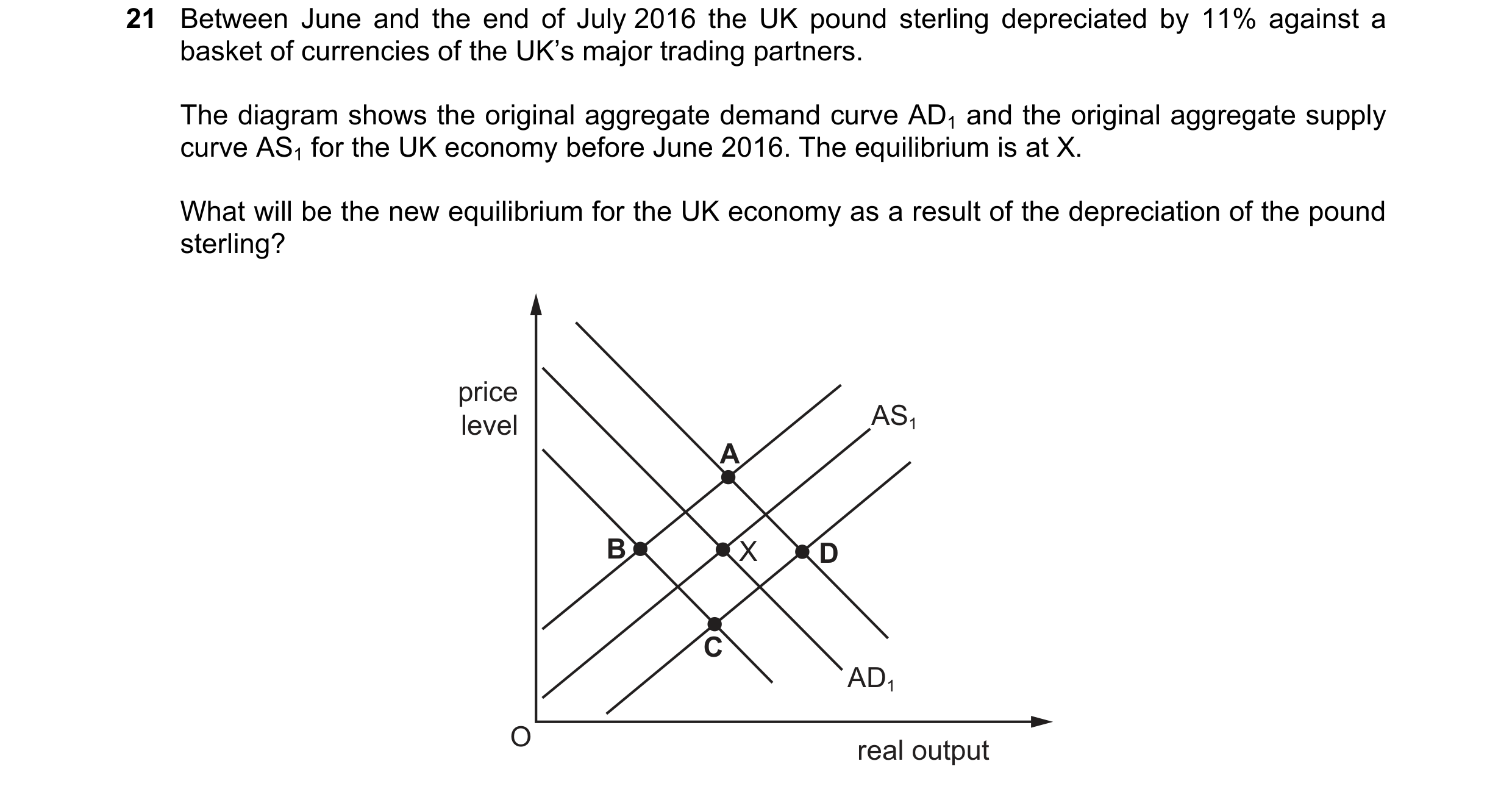 50 / 75

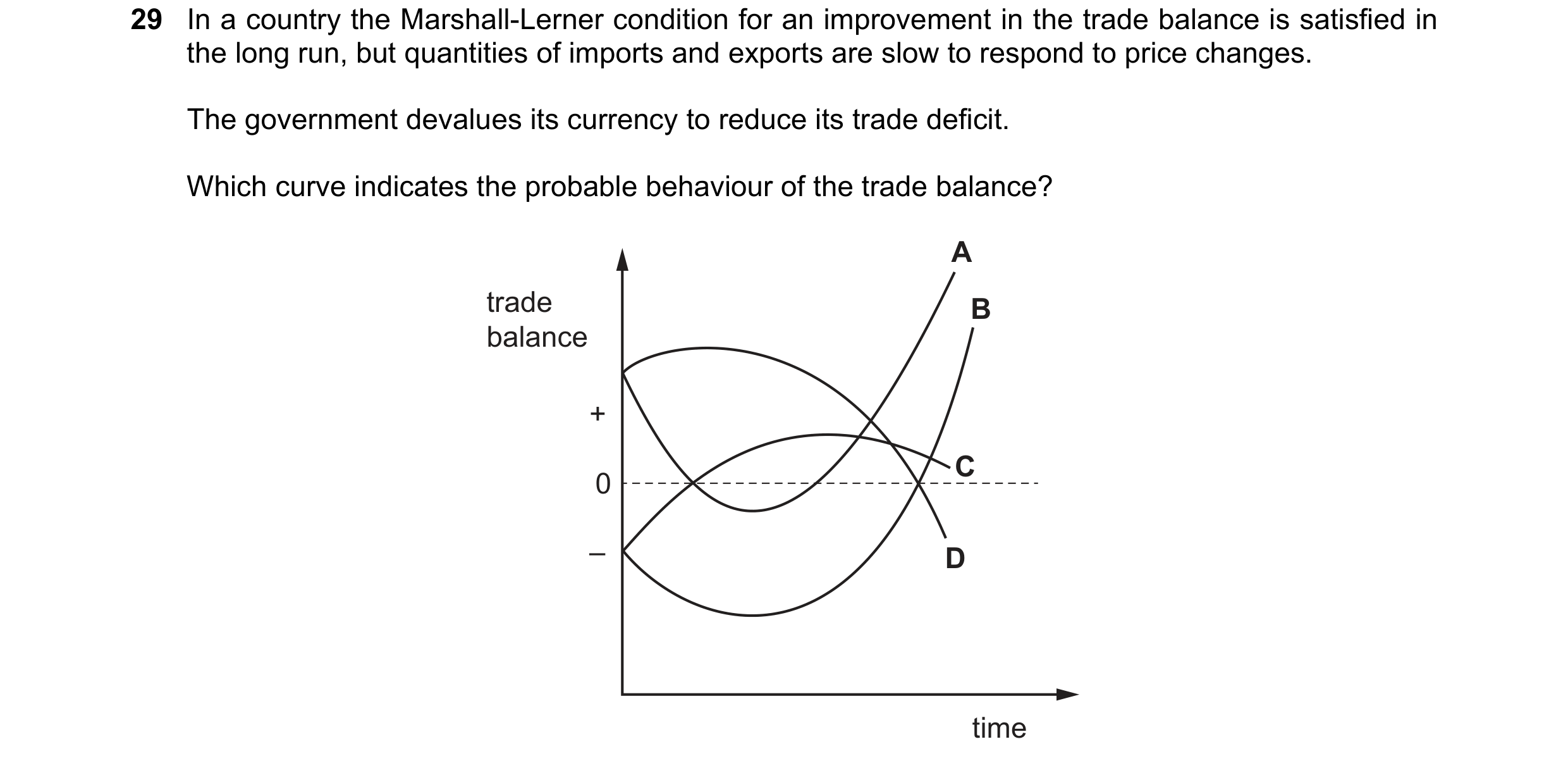 51 / 75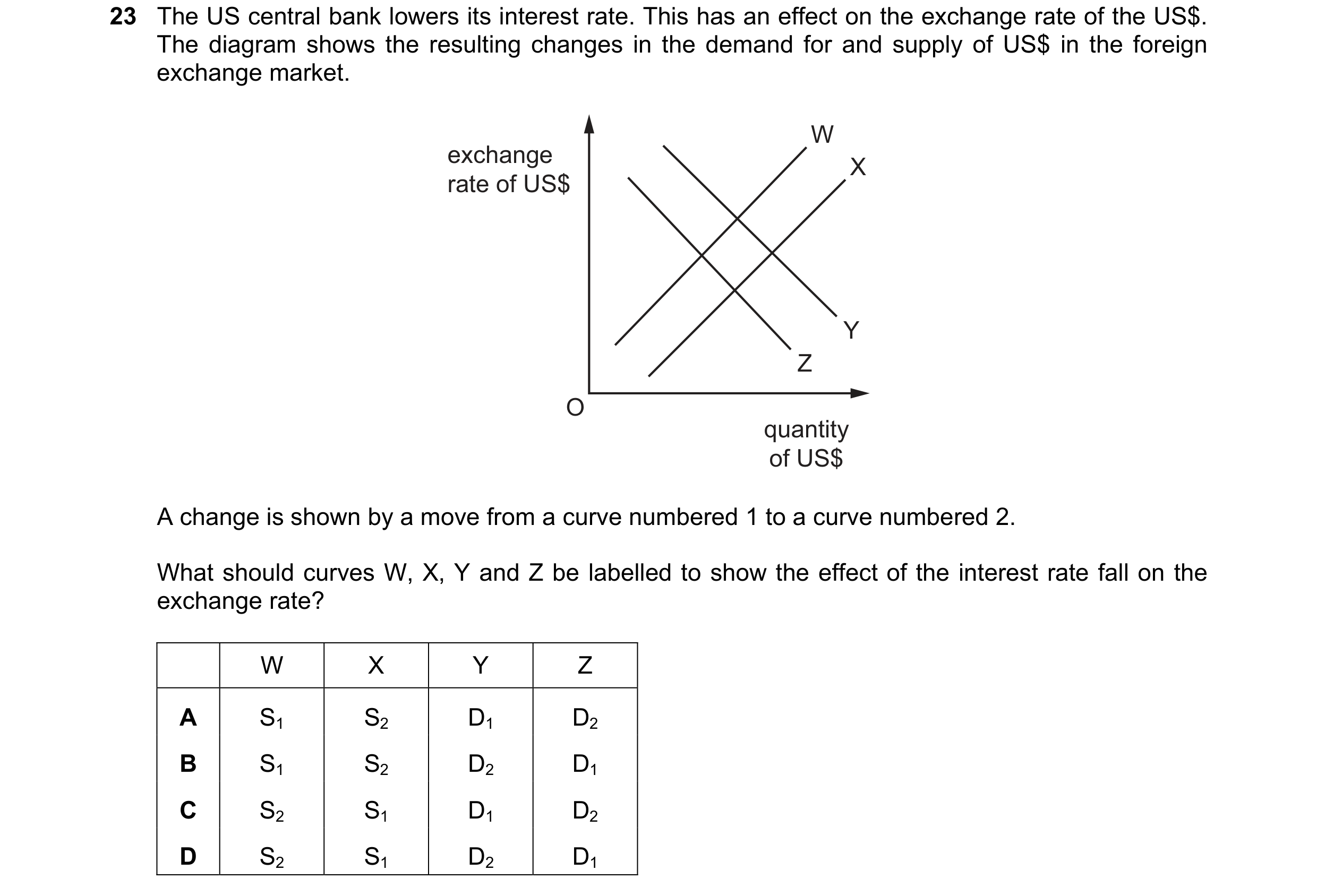
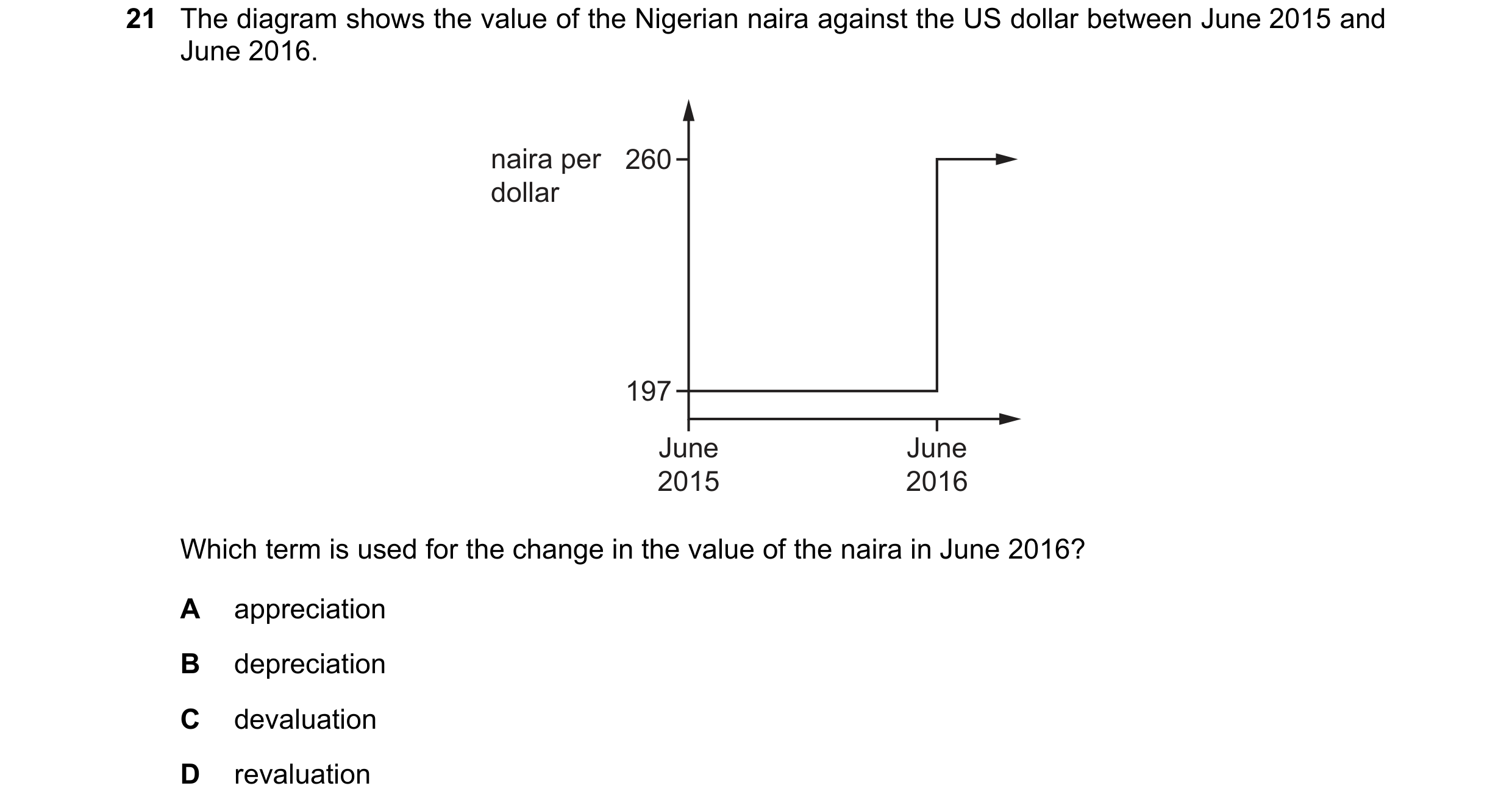 52 / 75
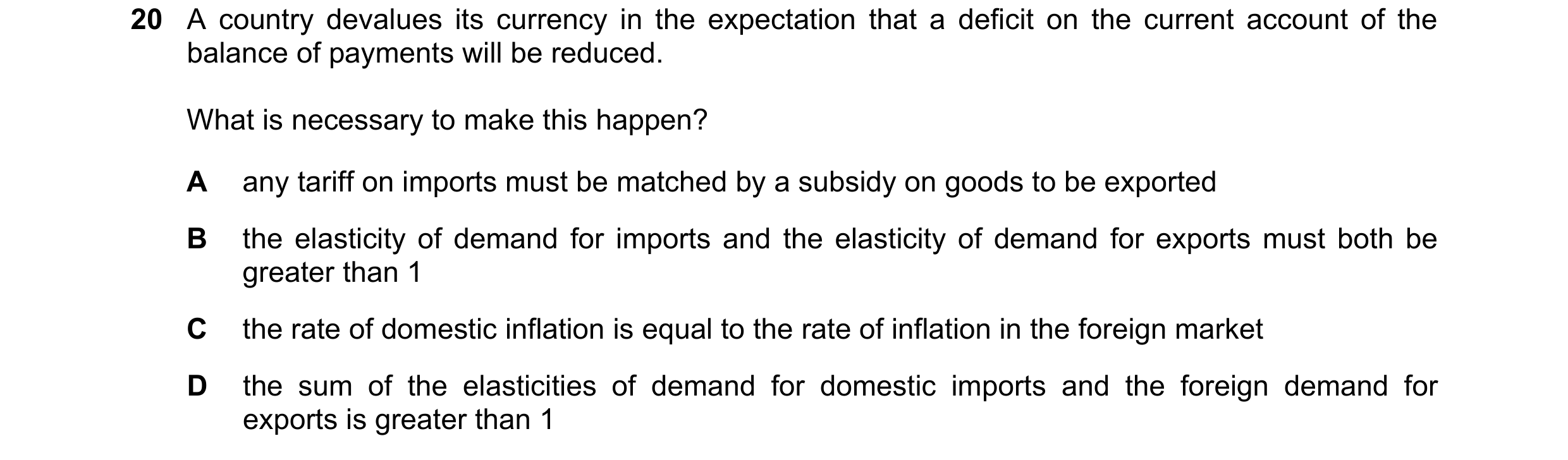
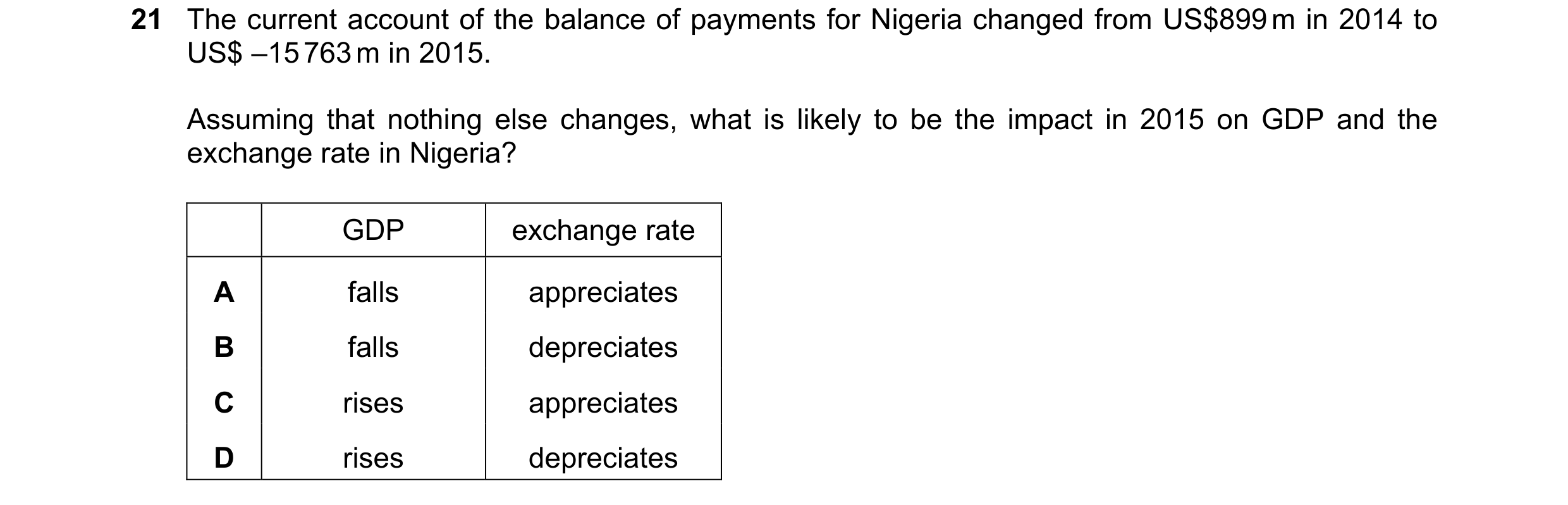
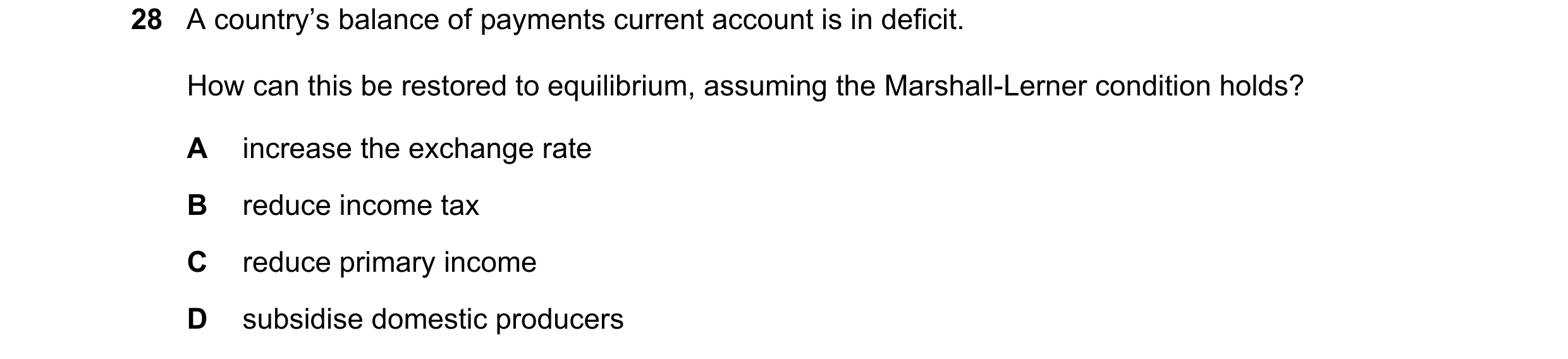 53 / 75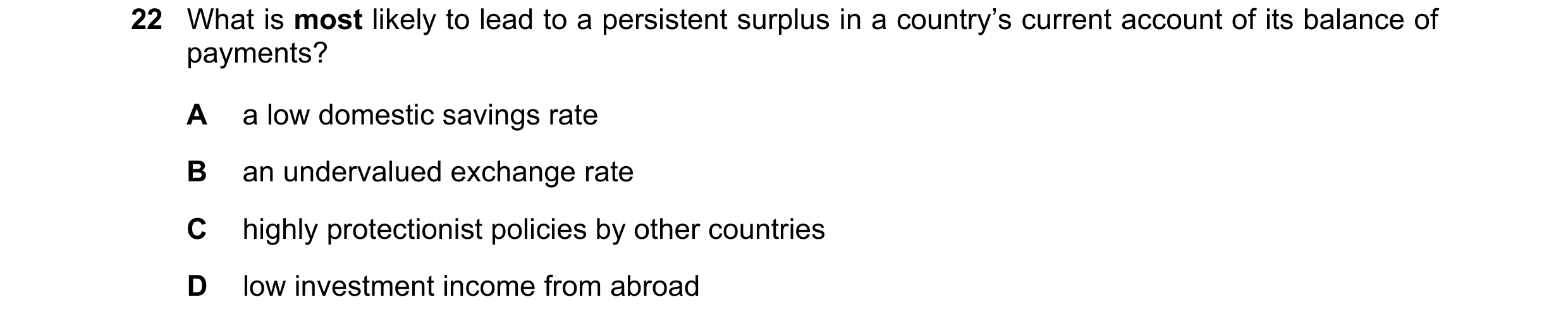
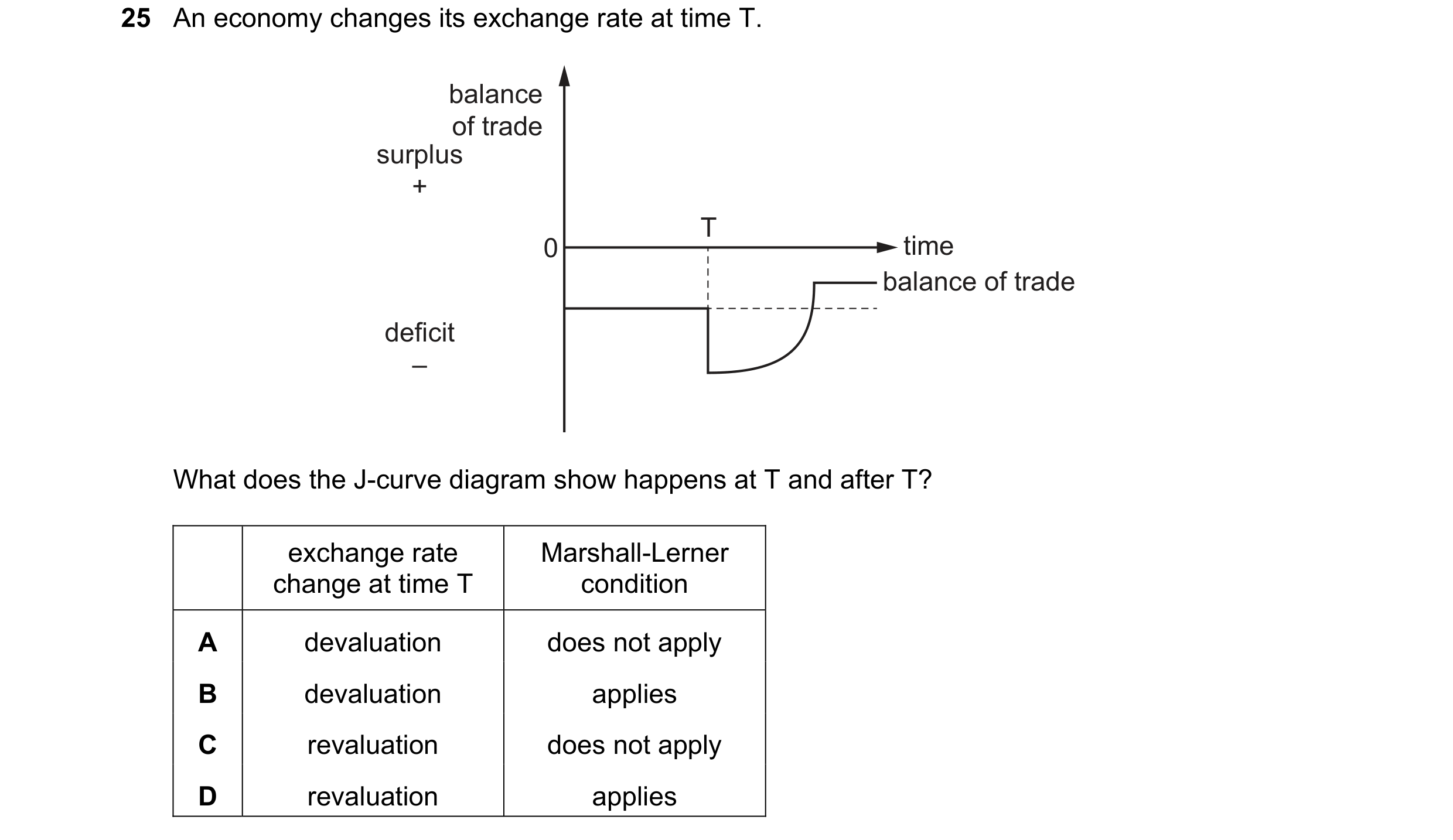
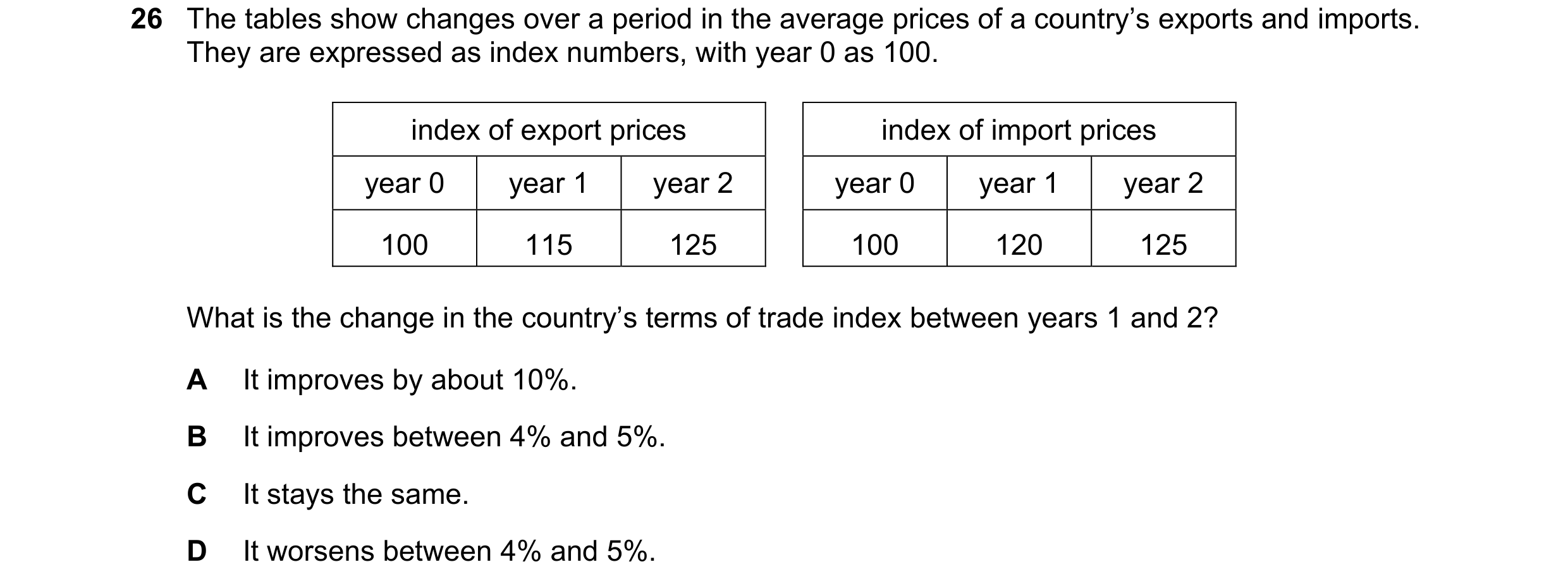 54 / 75
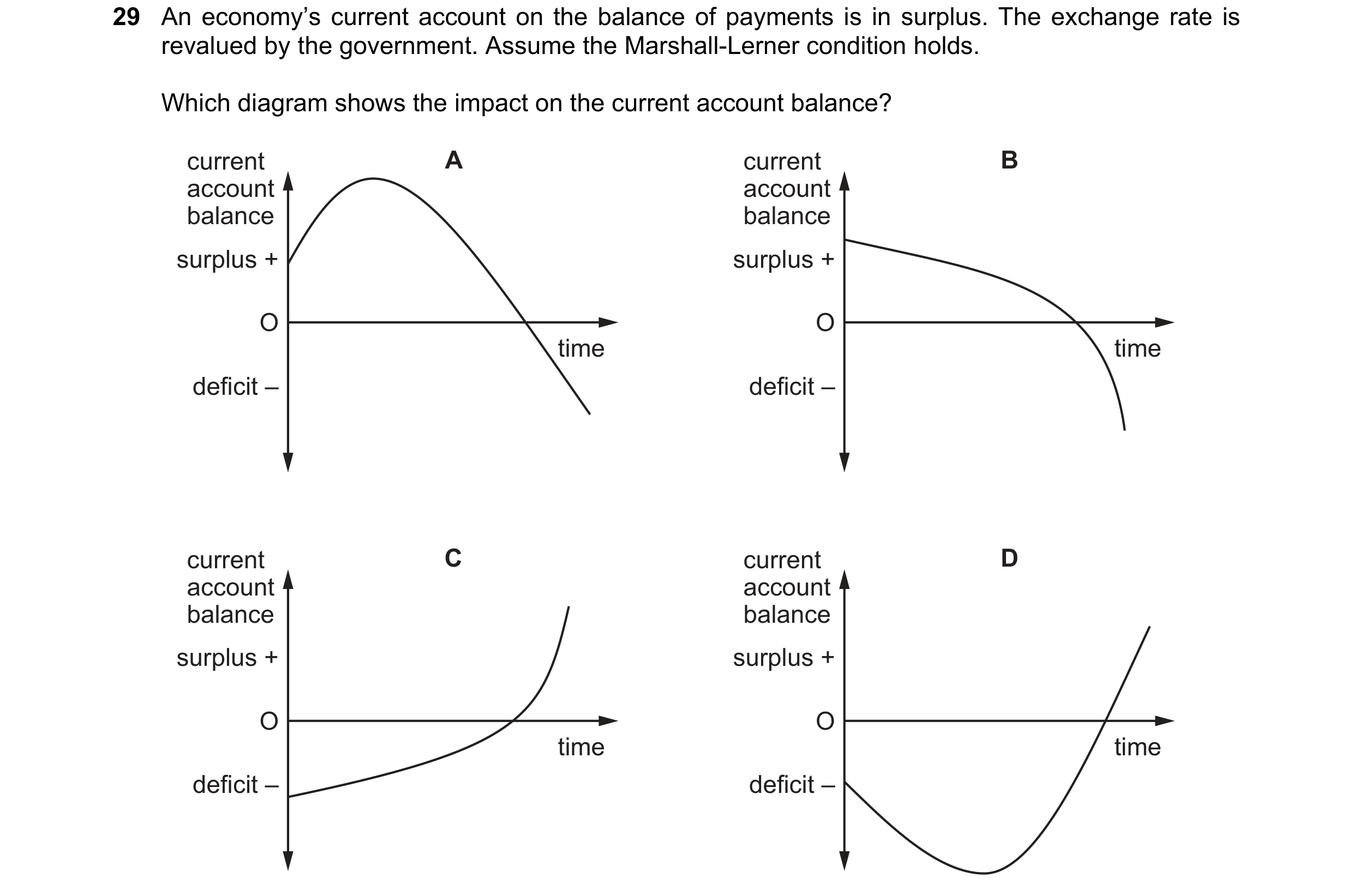
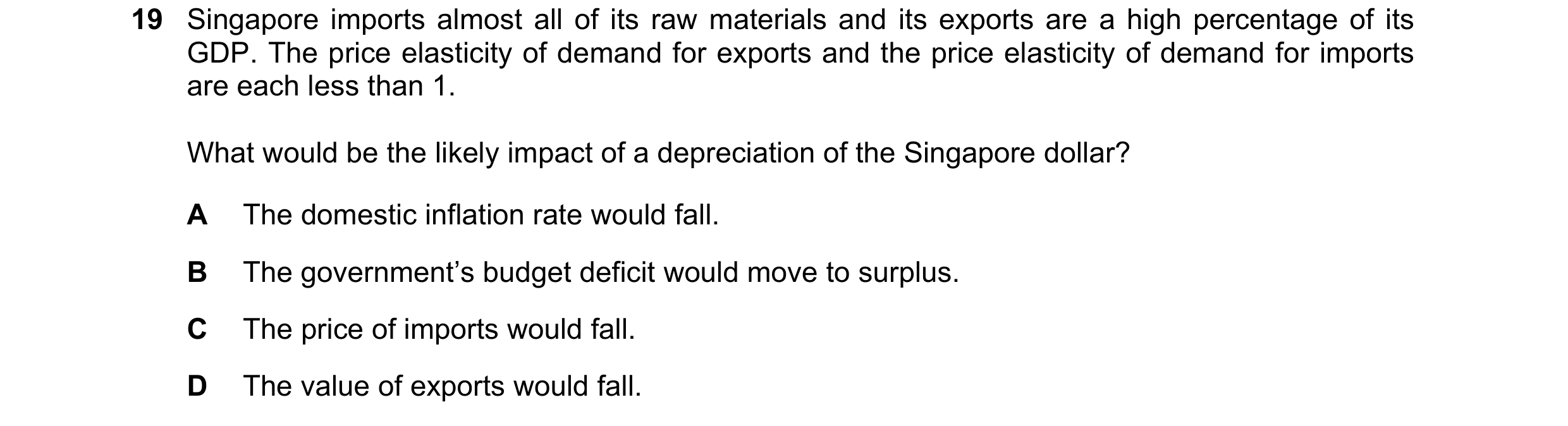
 55 / 75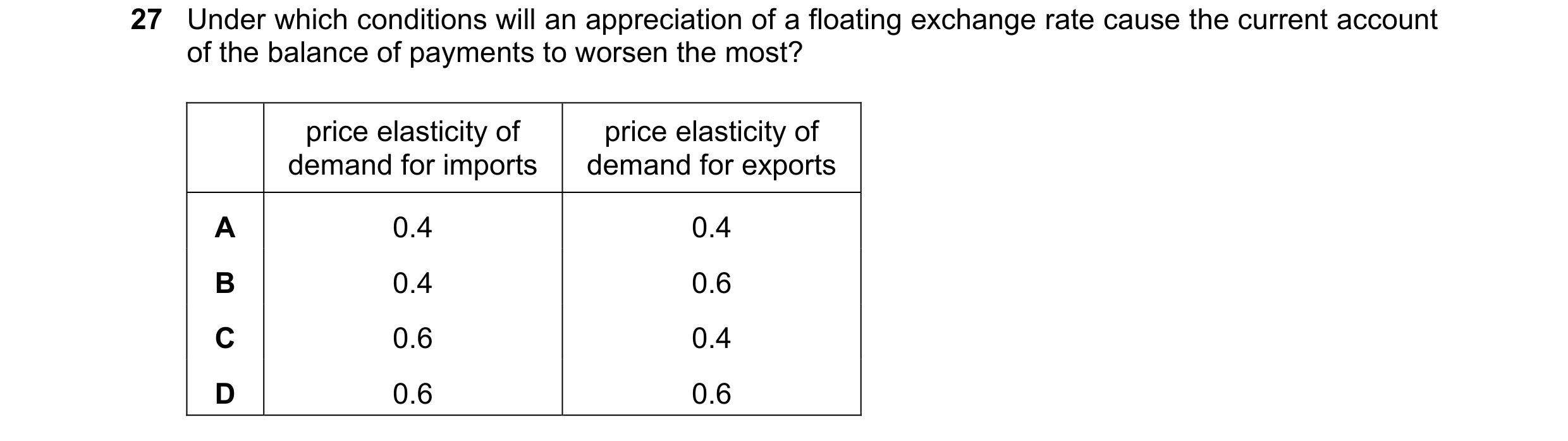
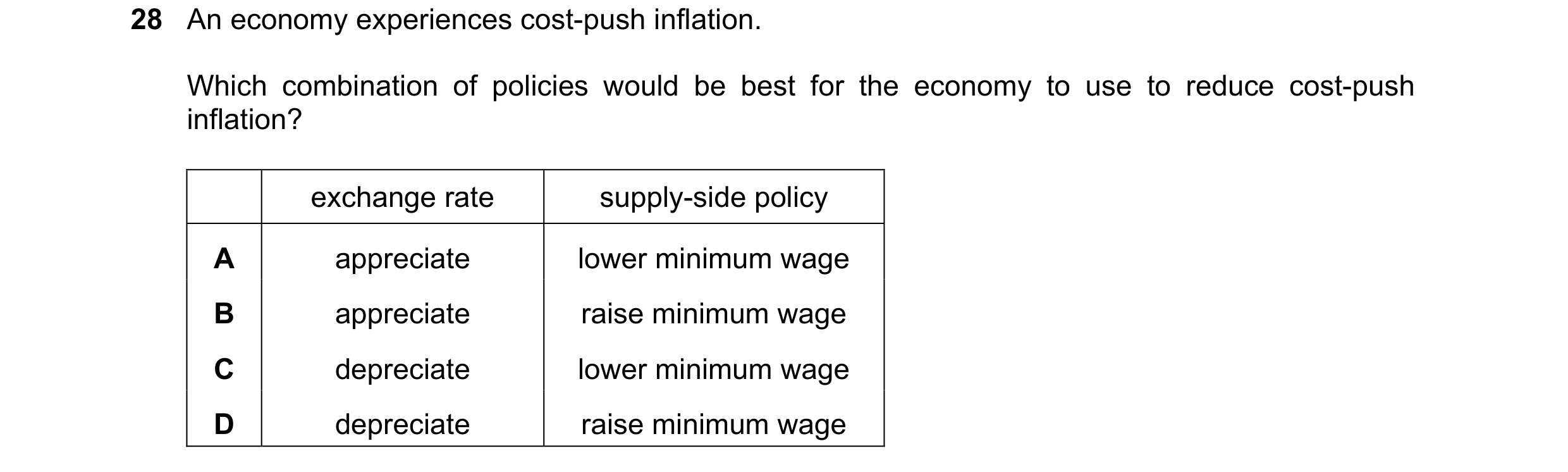
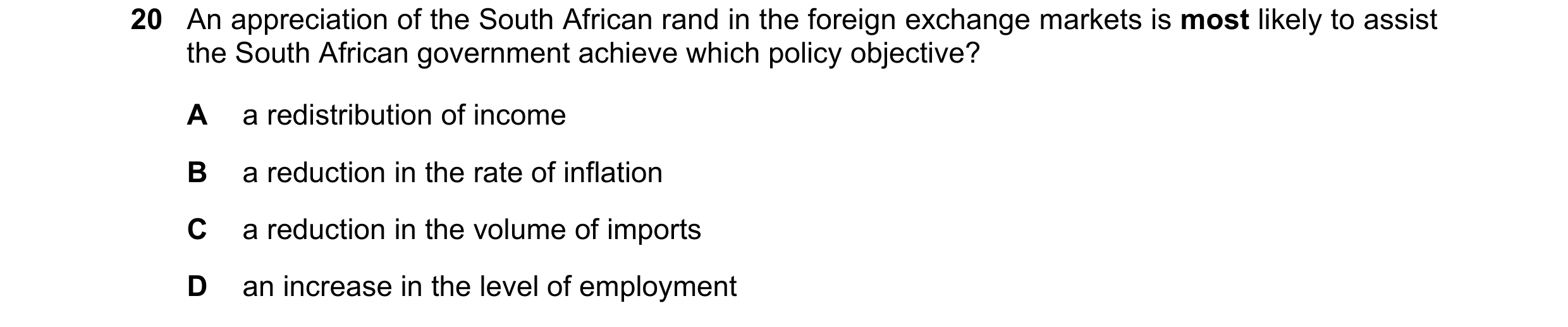
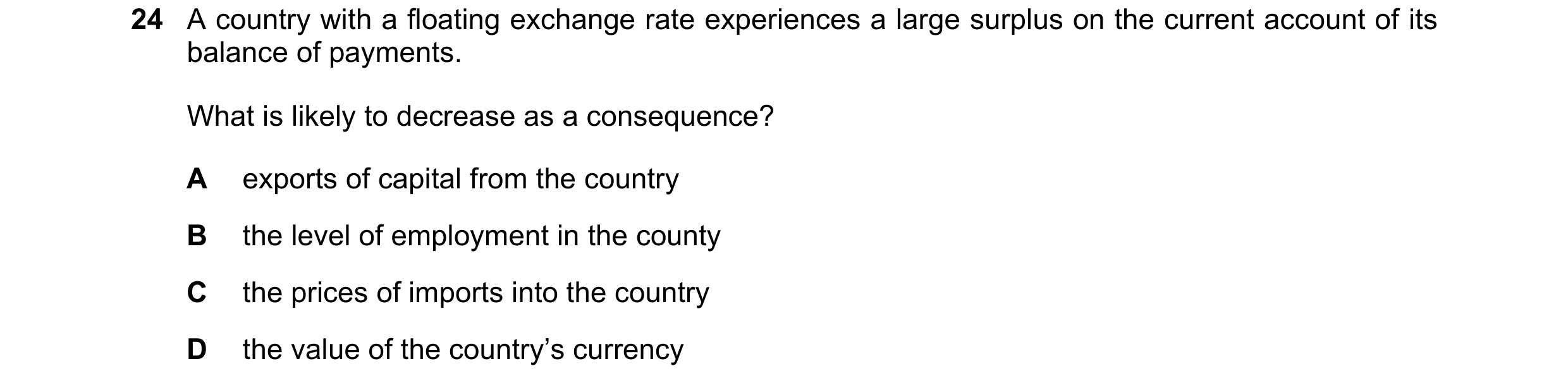 56 / 75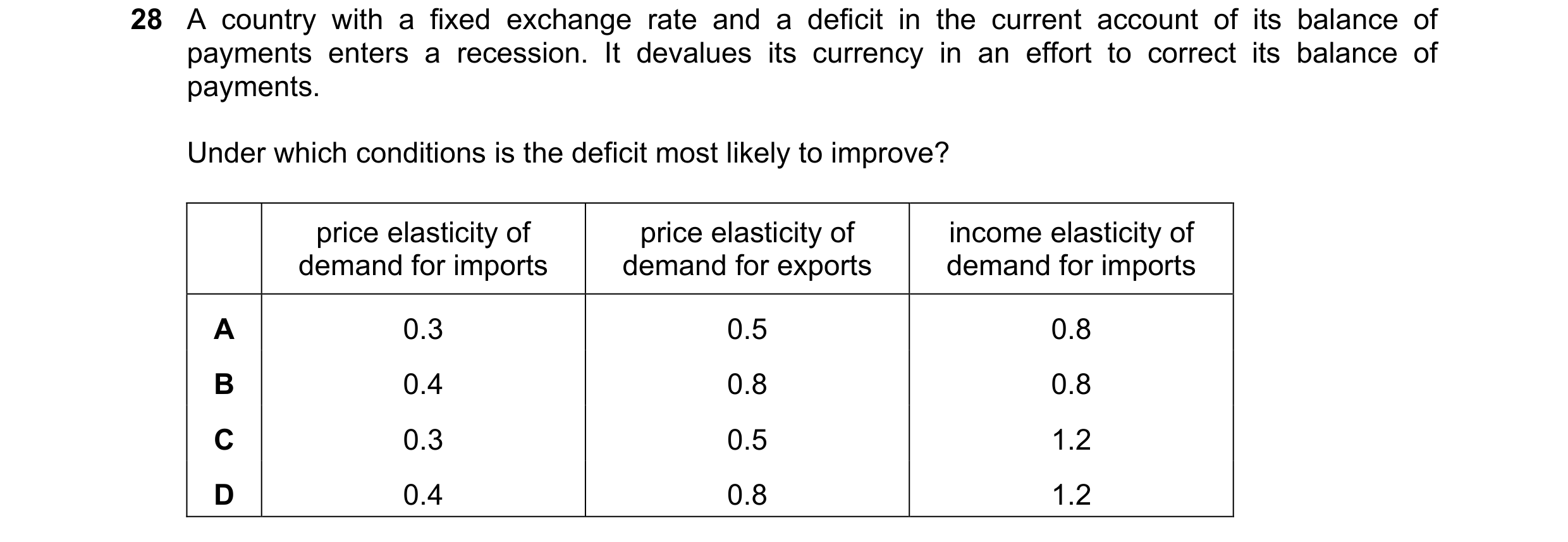
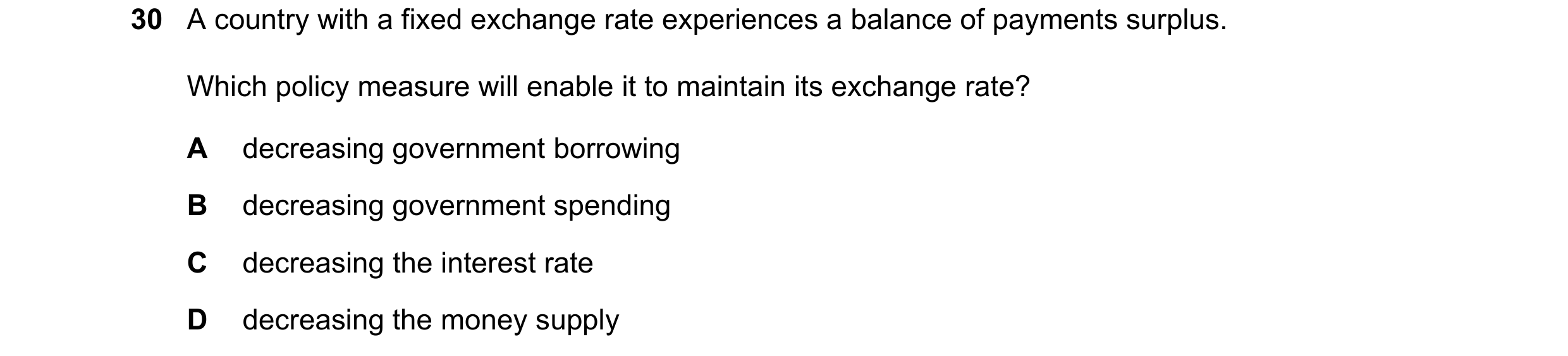
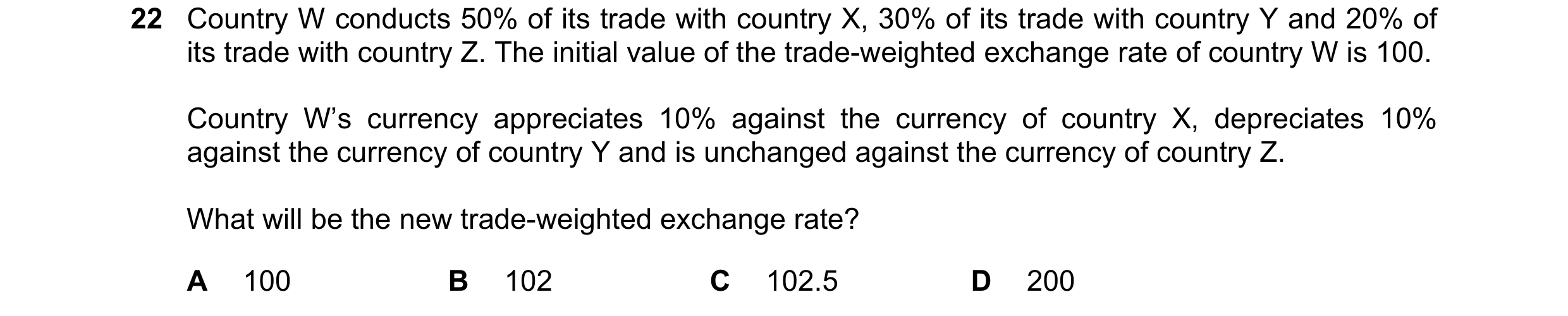
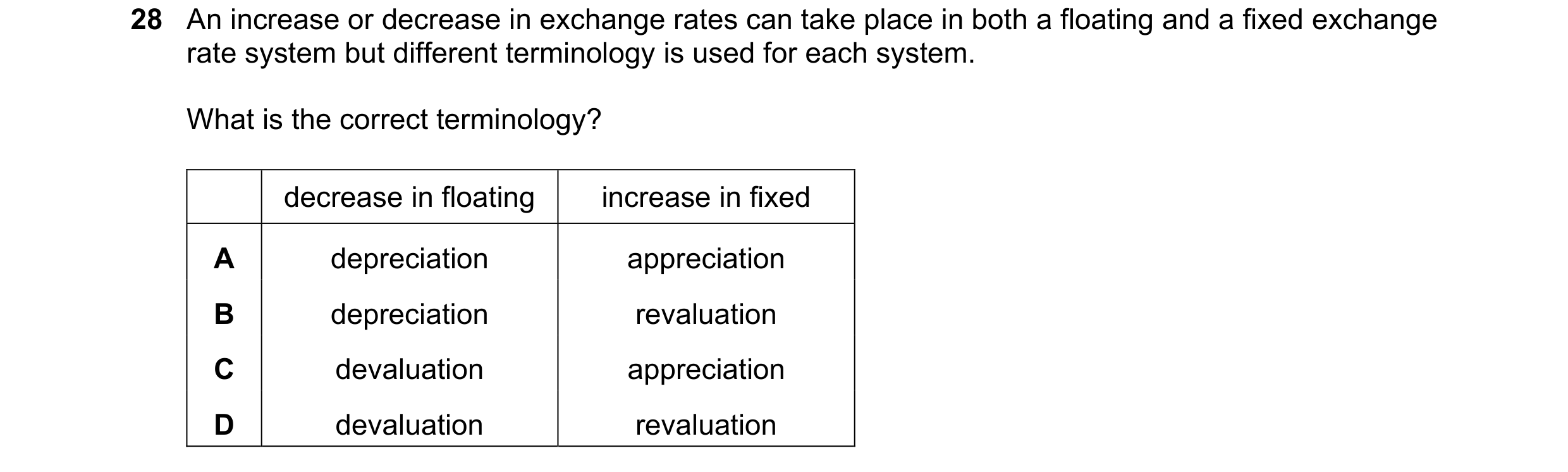 57 / 75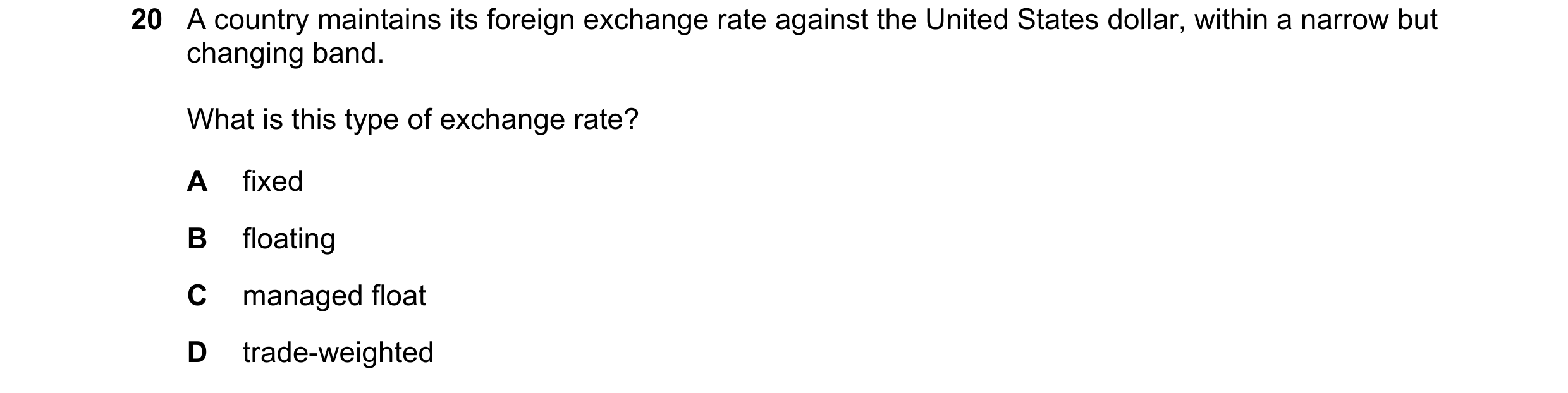
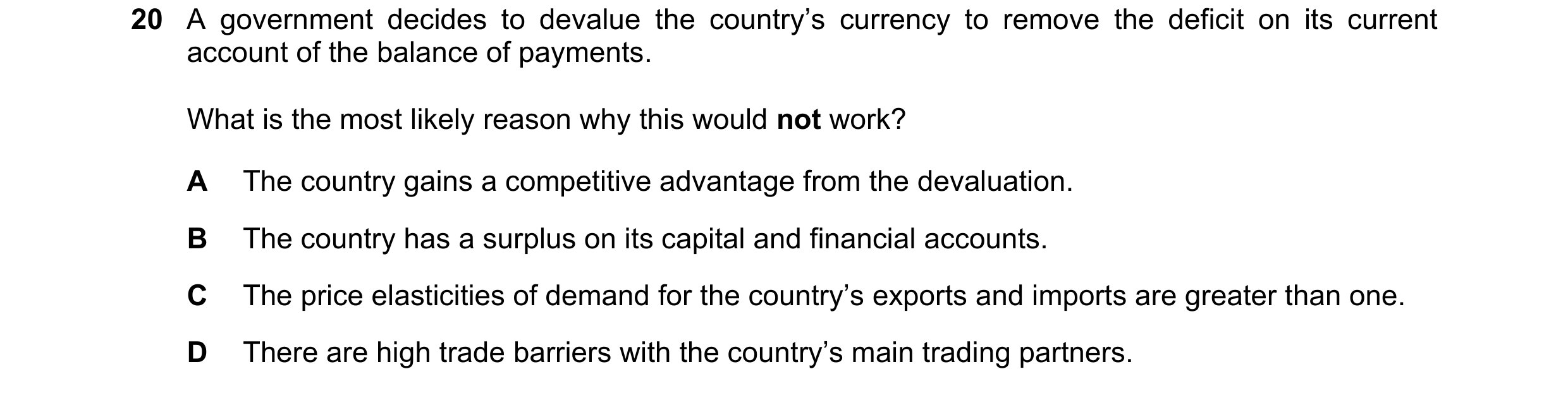
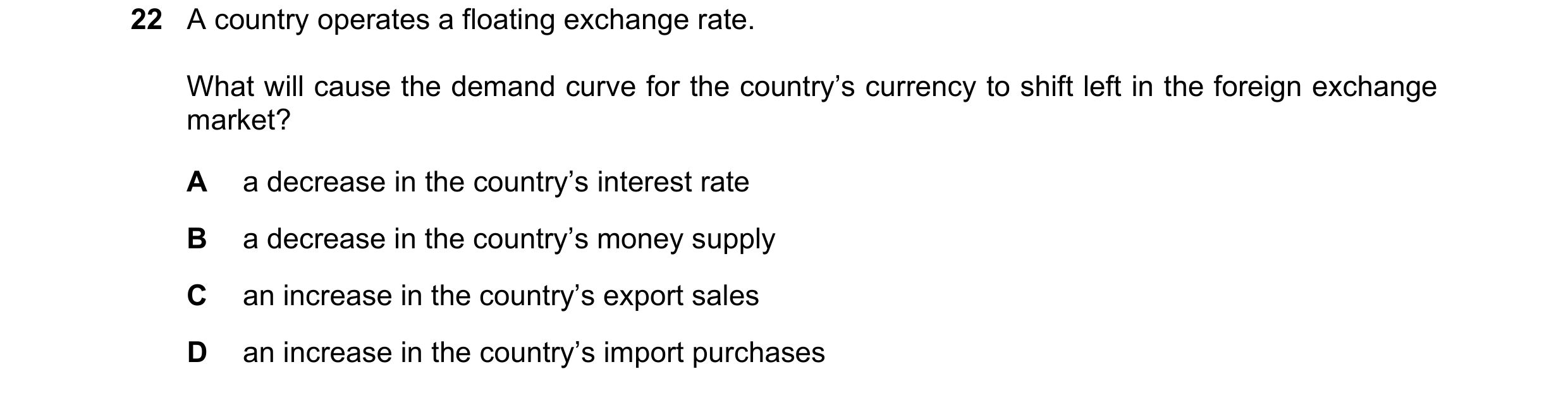
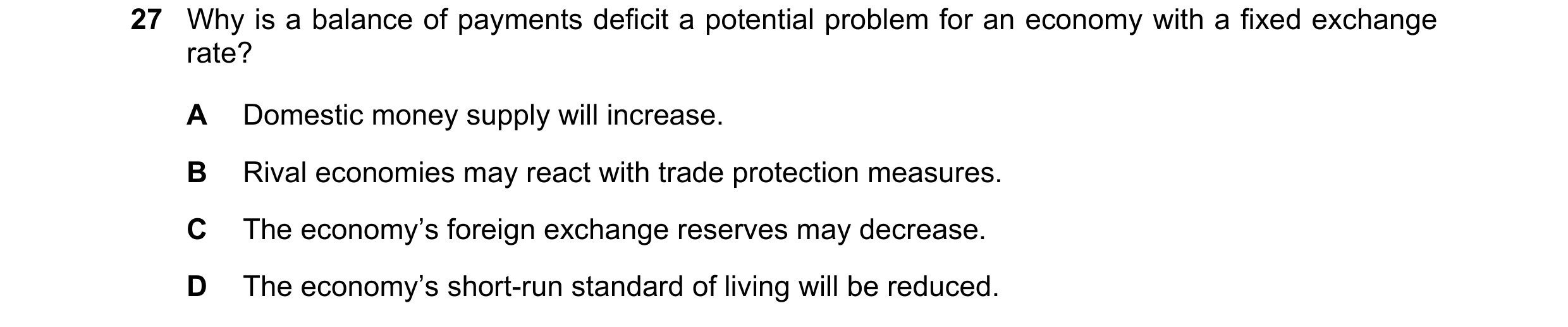
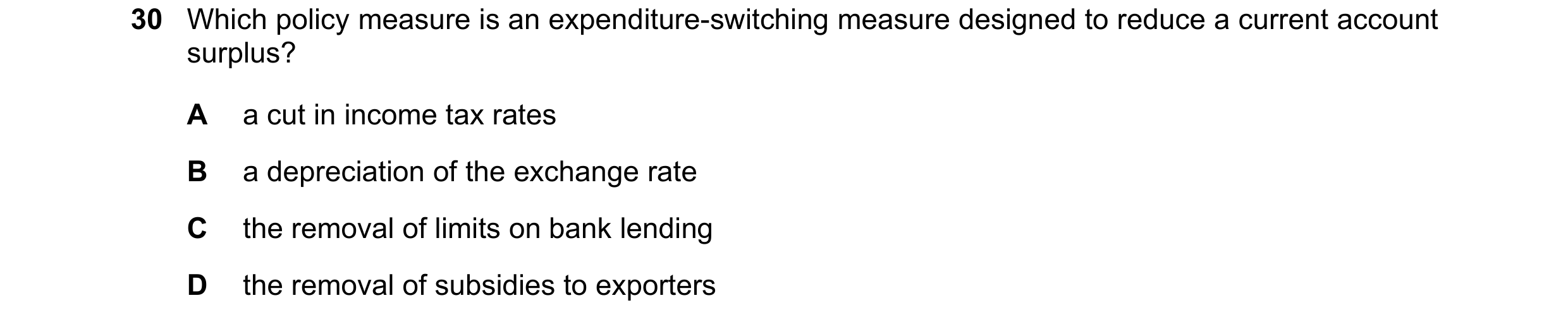 58 / 75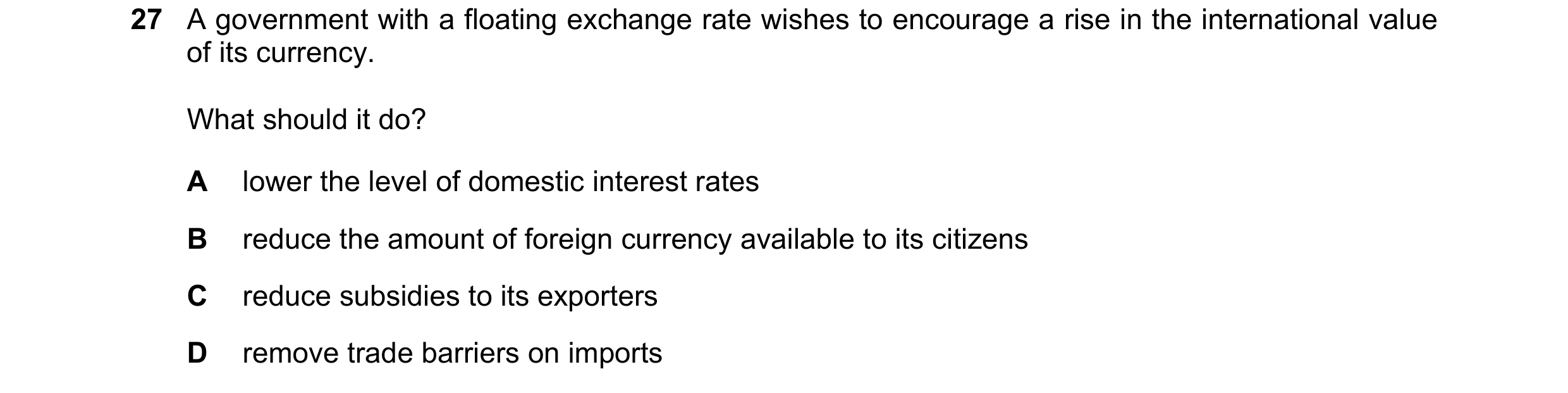

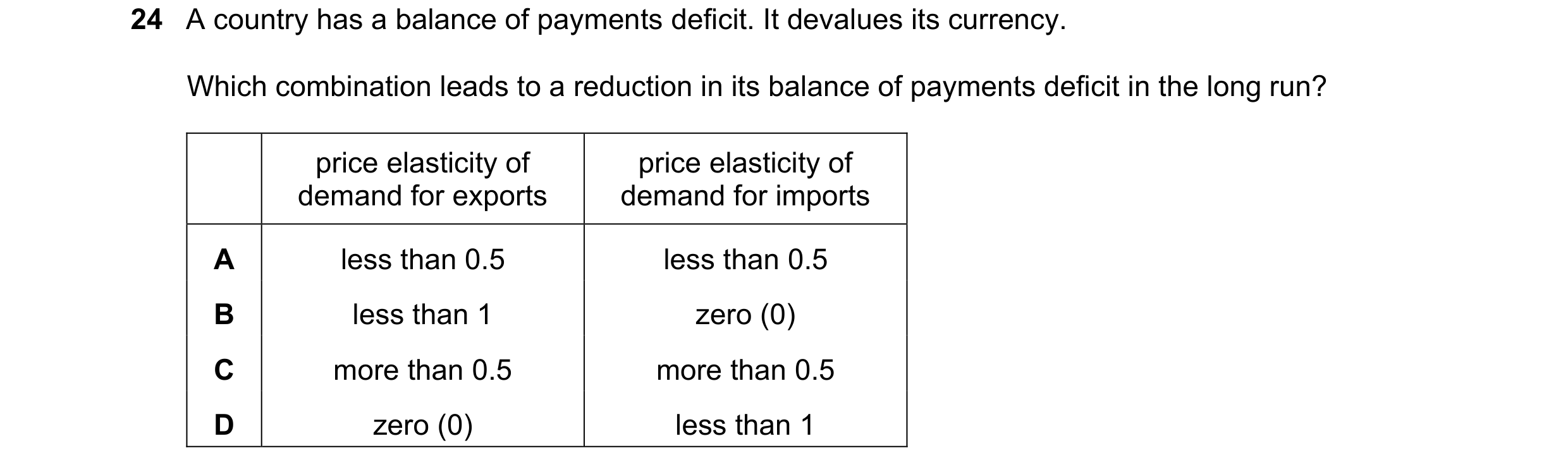
 59 / 75

 60 / 75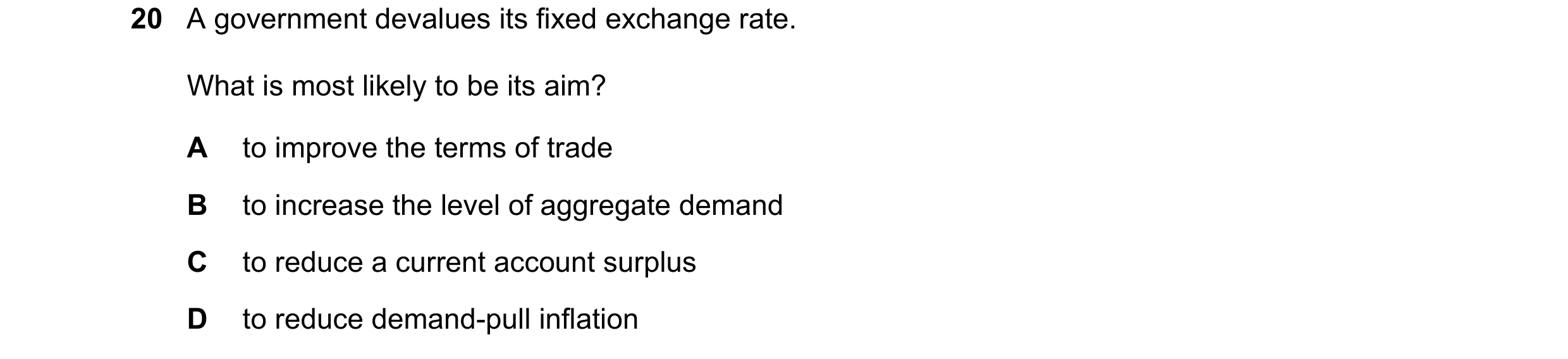
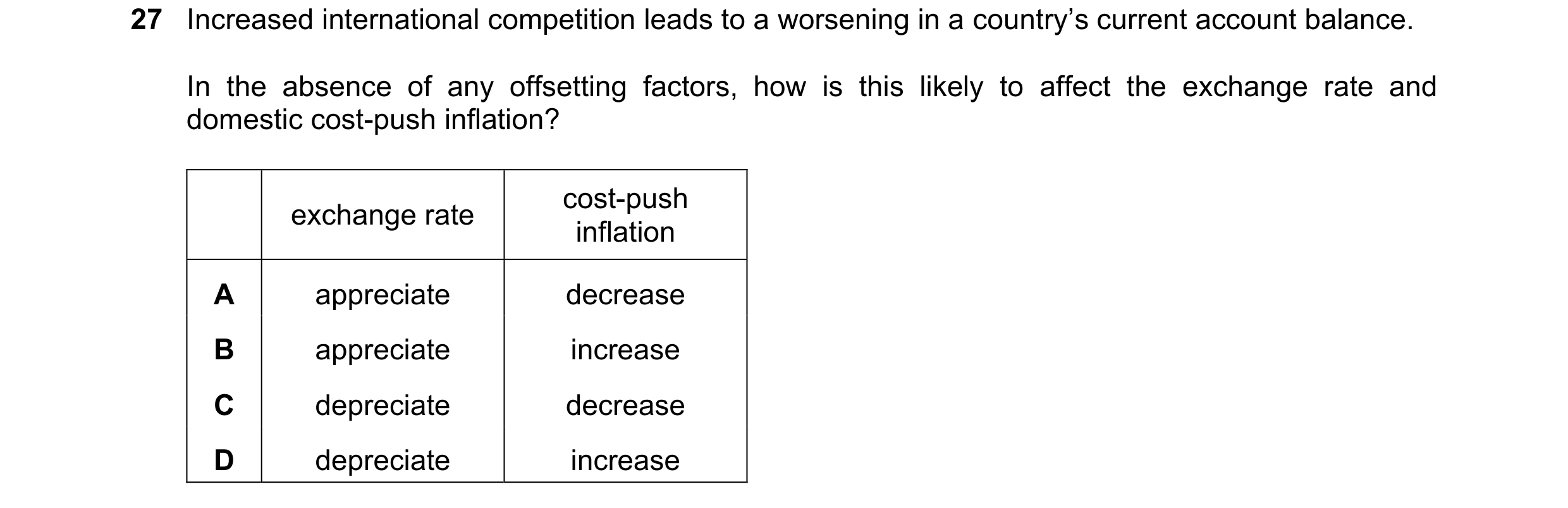
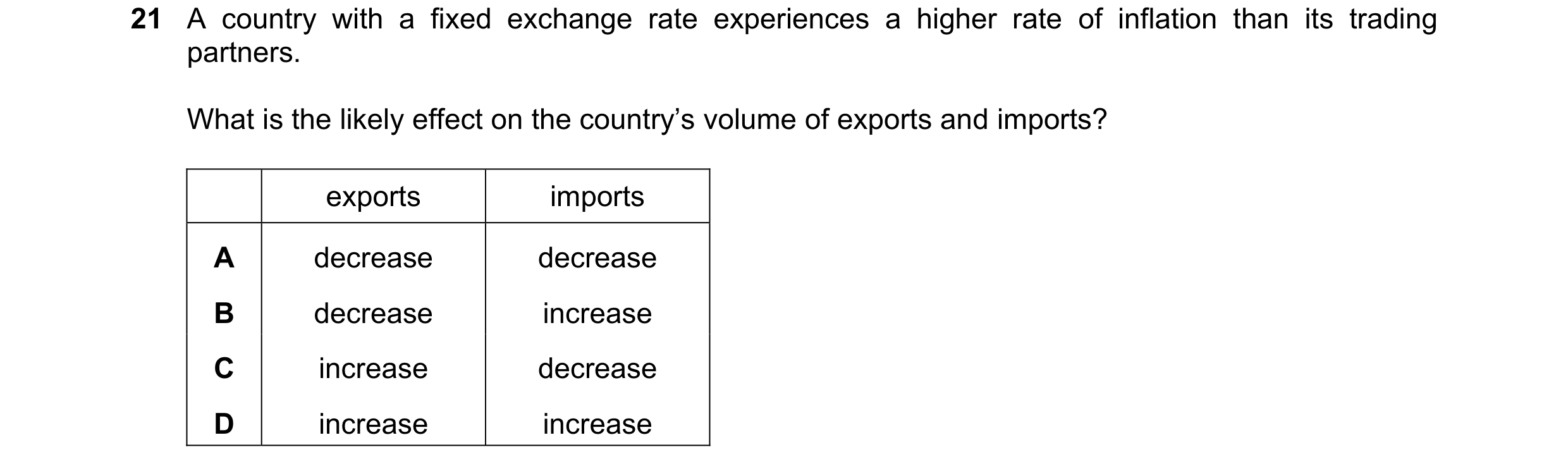
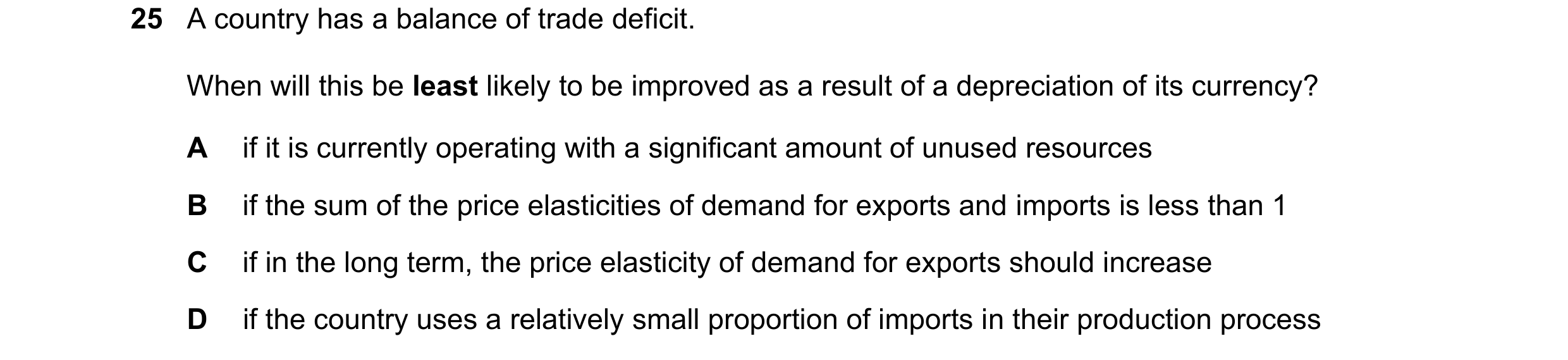 61 / 75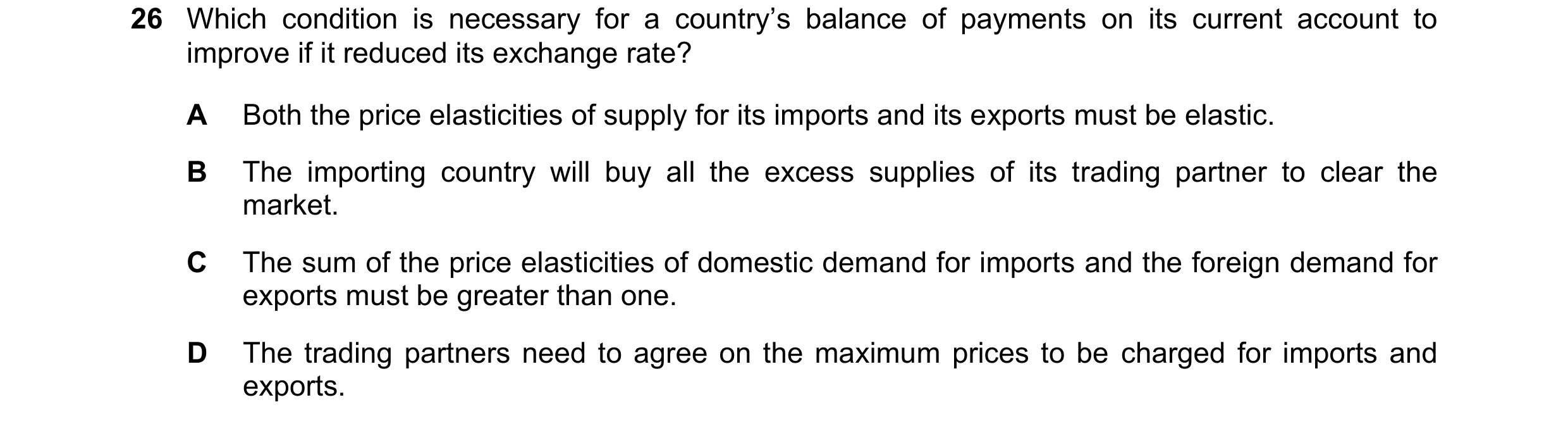
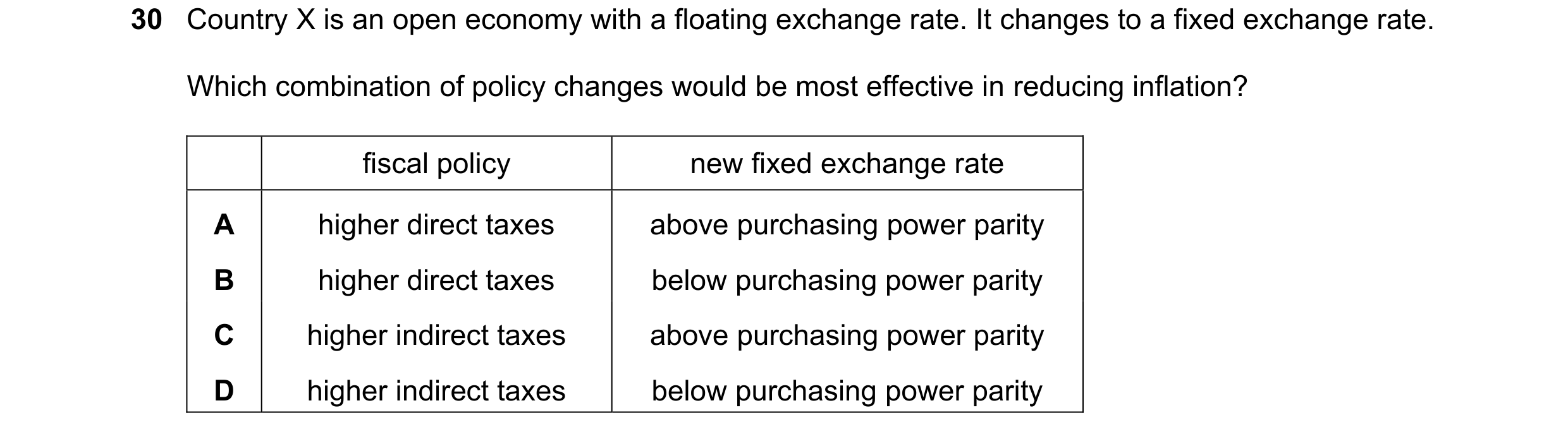
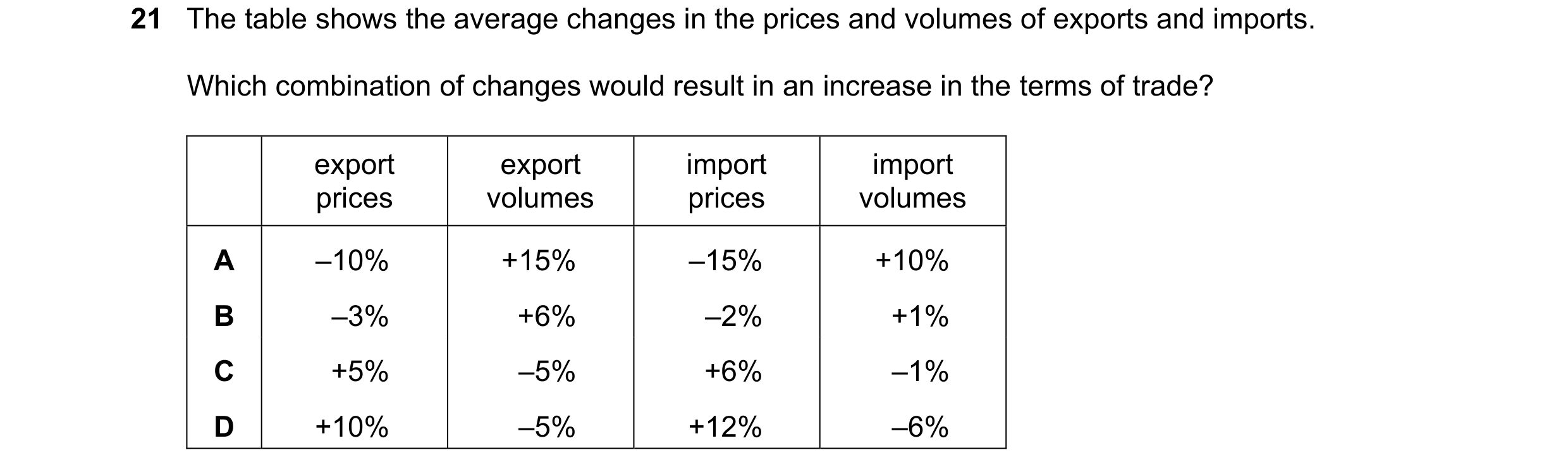
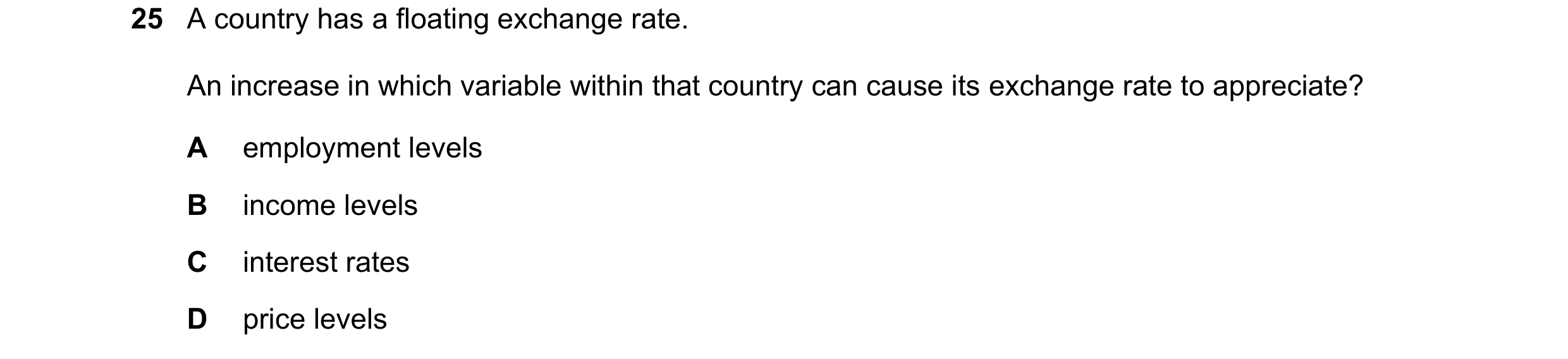 62 / 75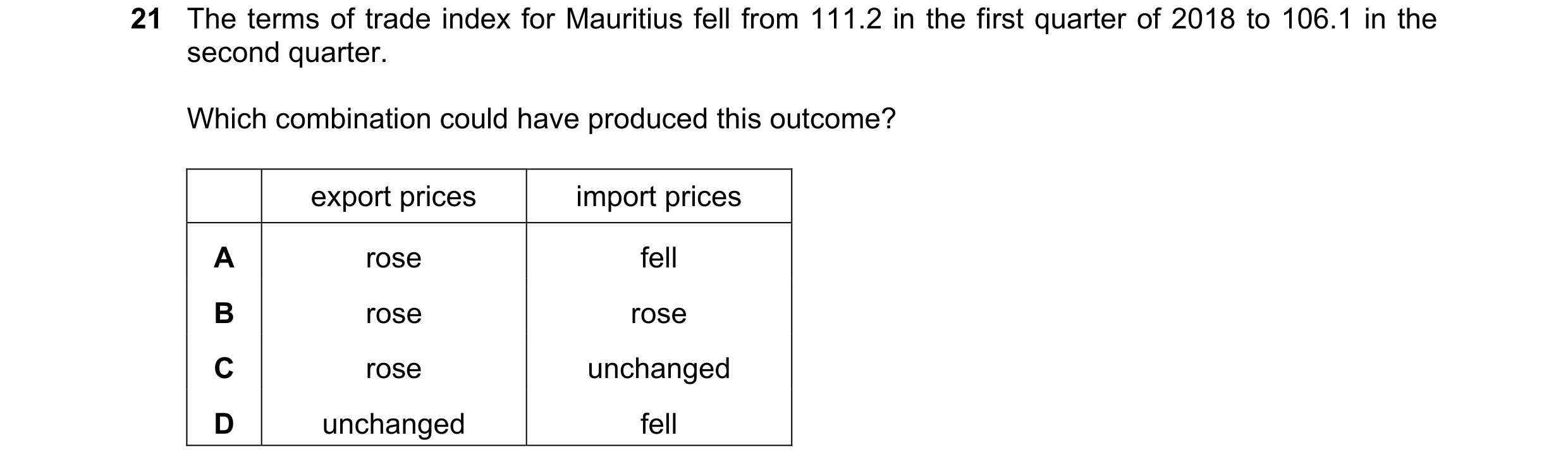
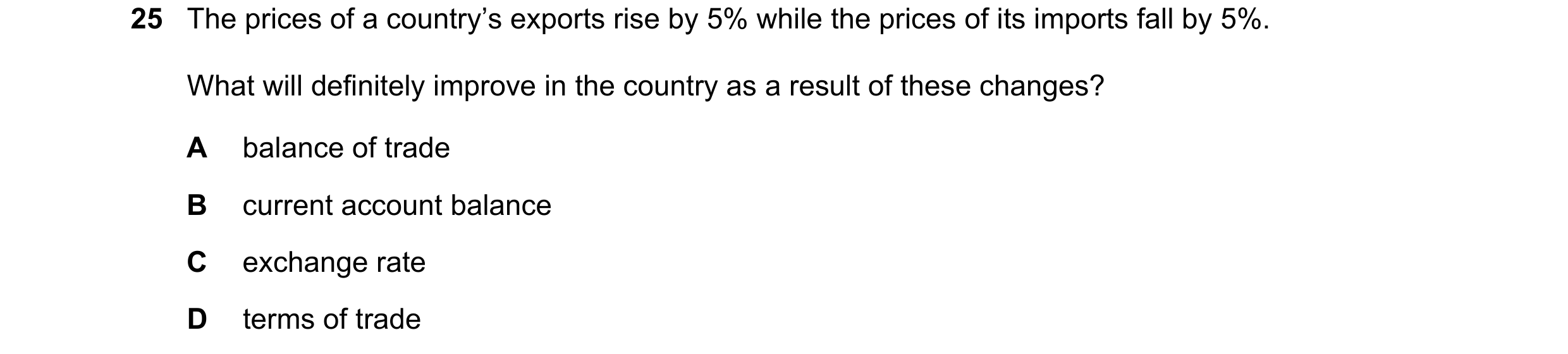
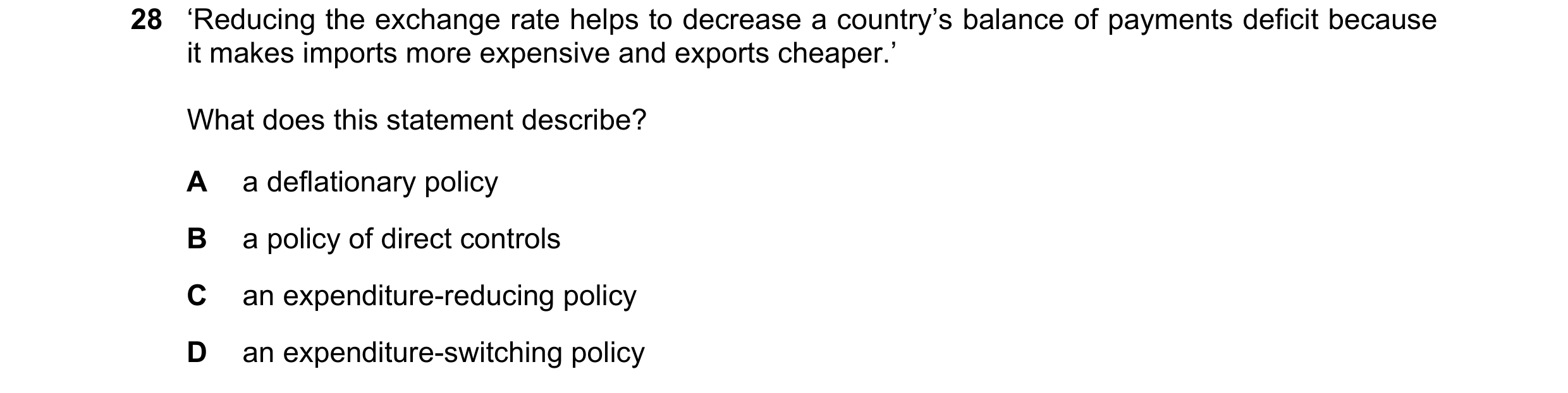
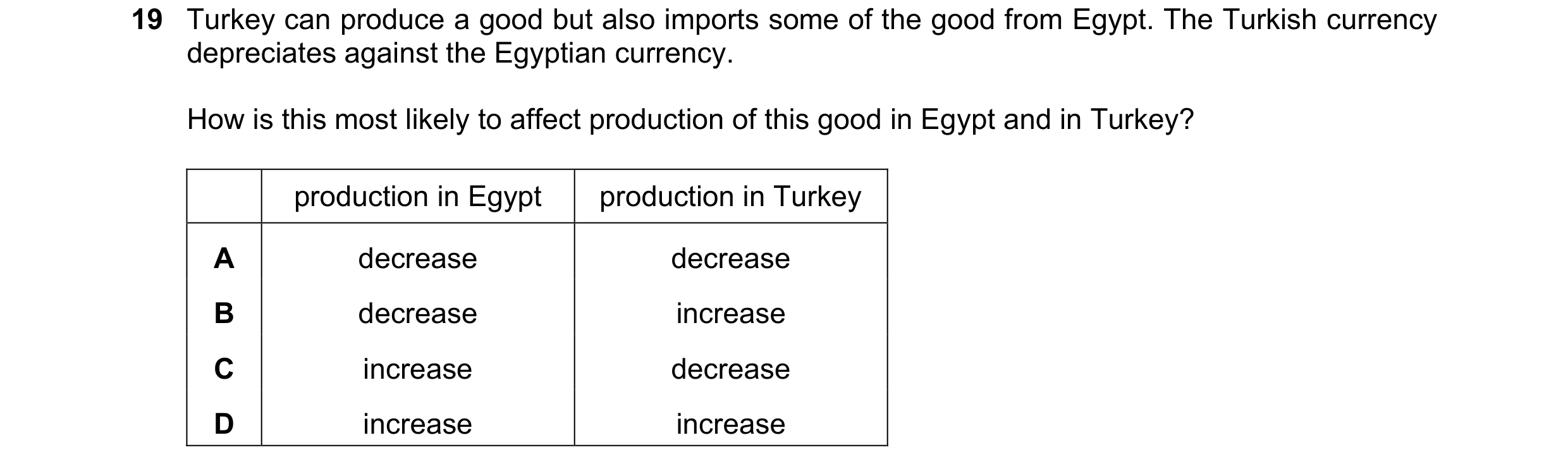
 63 / 75

 64 / 75
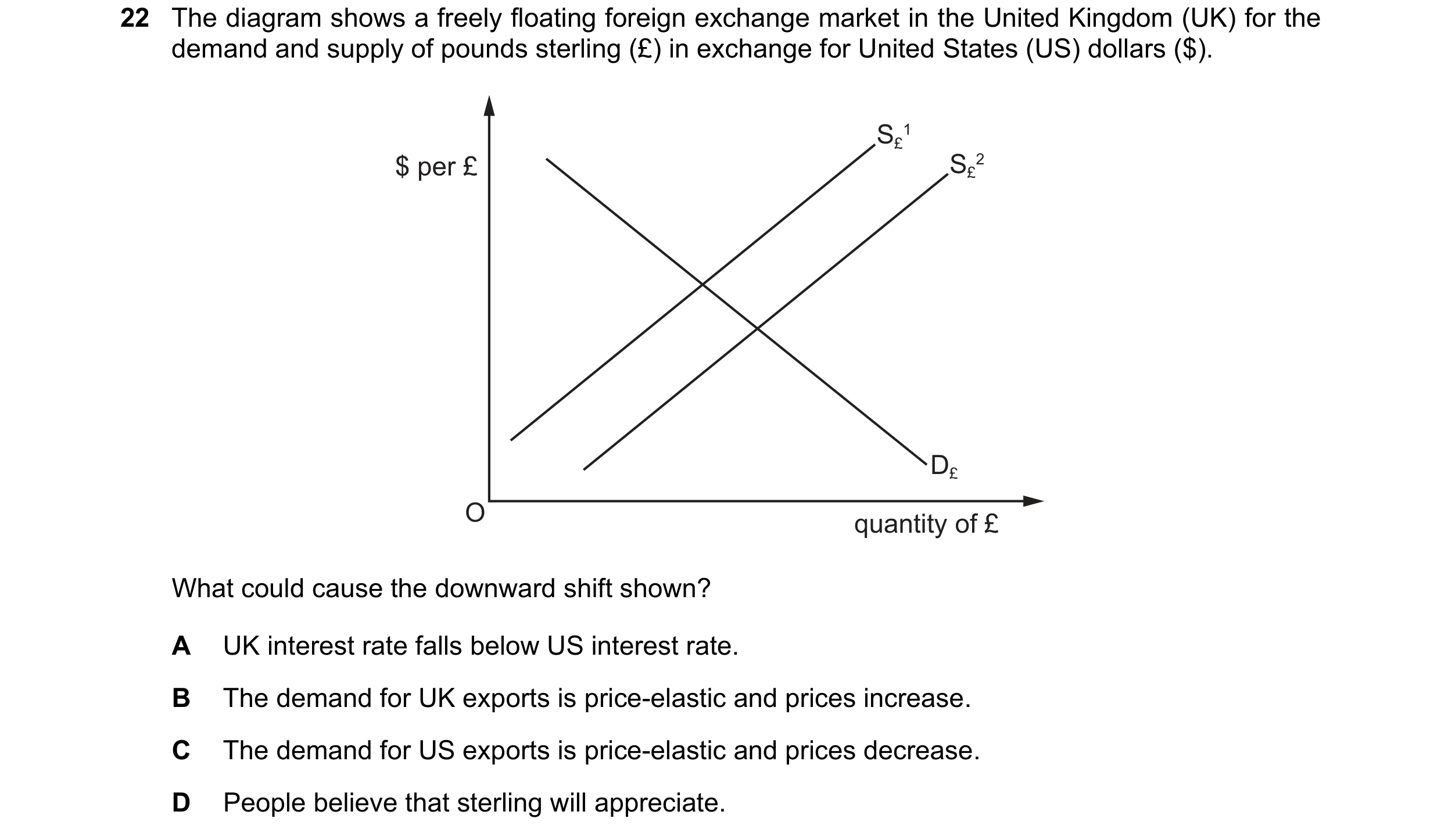
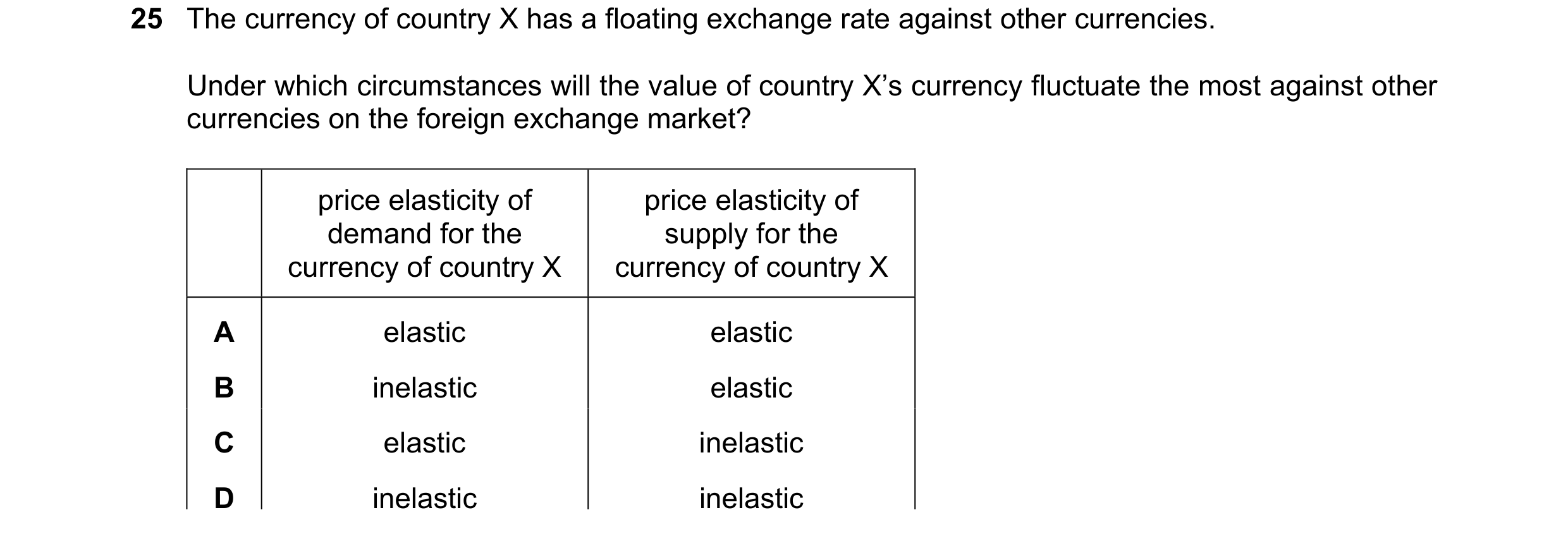
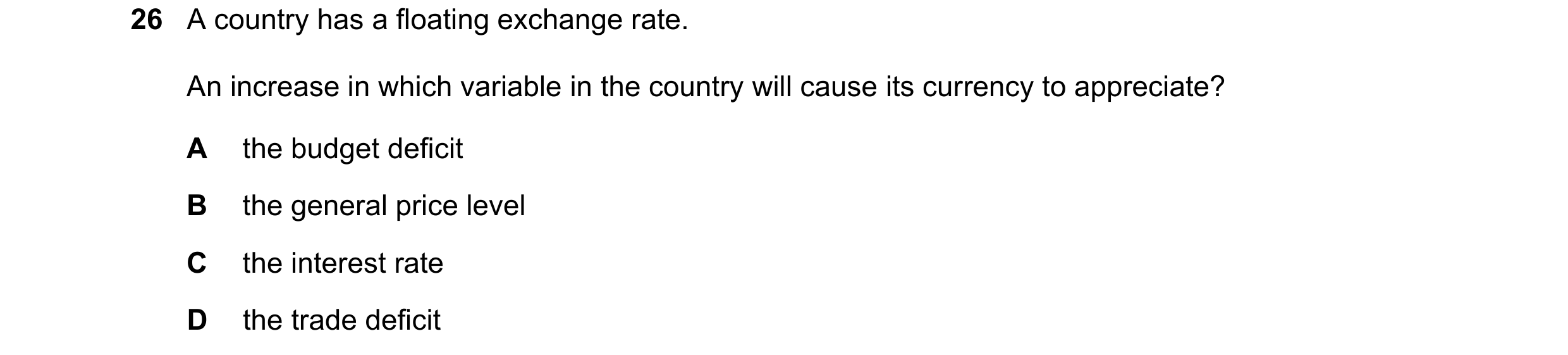 65 / 75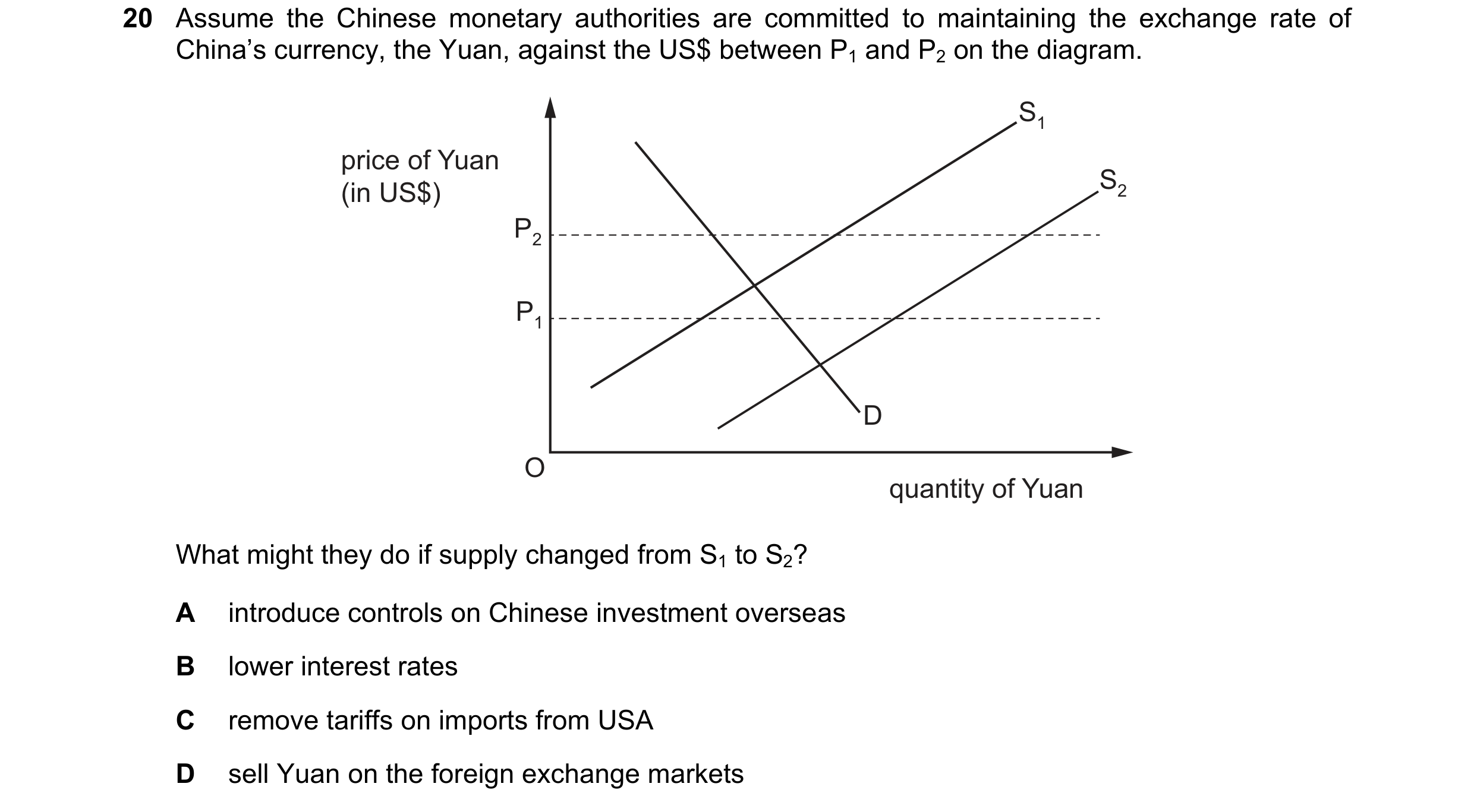

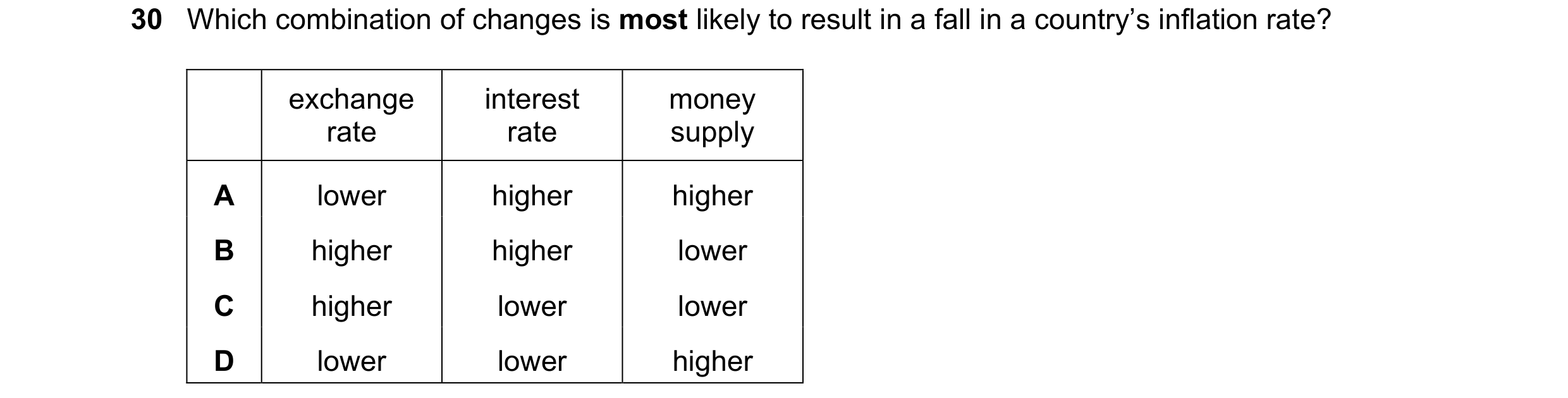
 66 / 75
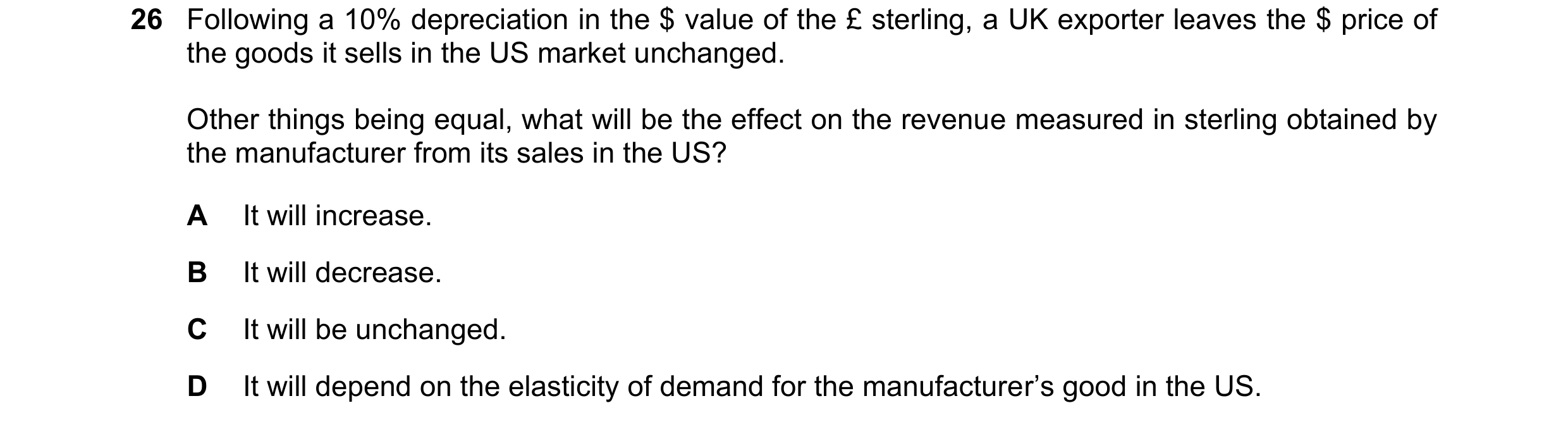
![Question 237: The price and volume indexes of a country’s imports and exports are shown in the table, for year 2 [year 1 = 100]. year 2 price index year …](https://img.pastlit.com/crops/d46eab5e-e638-47b4-9ef9-8516a56c6eaf/q23.png)
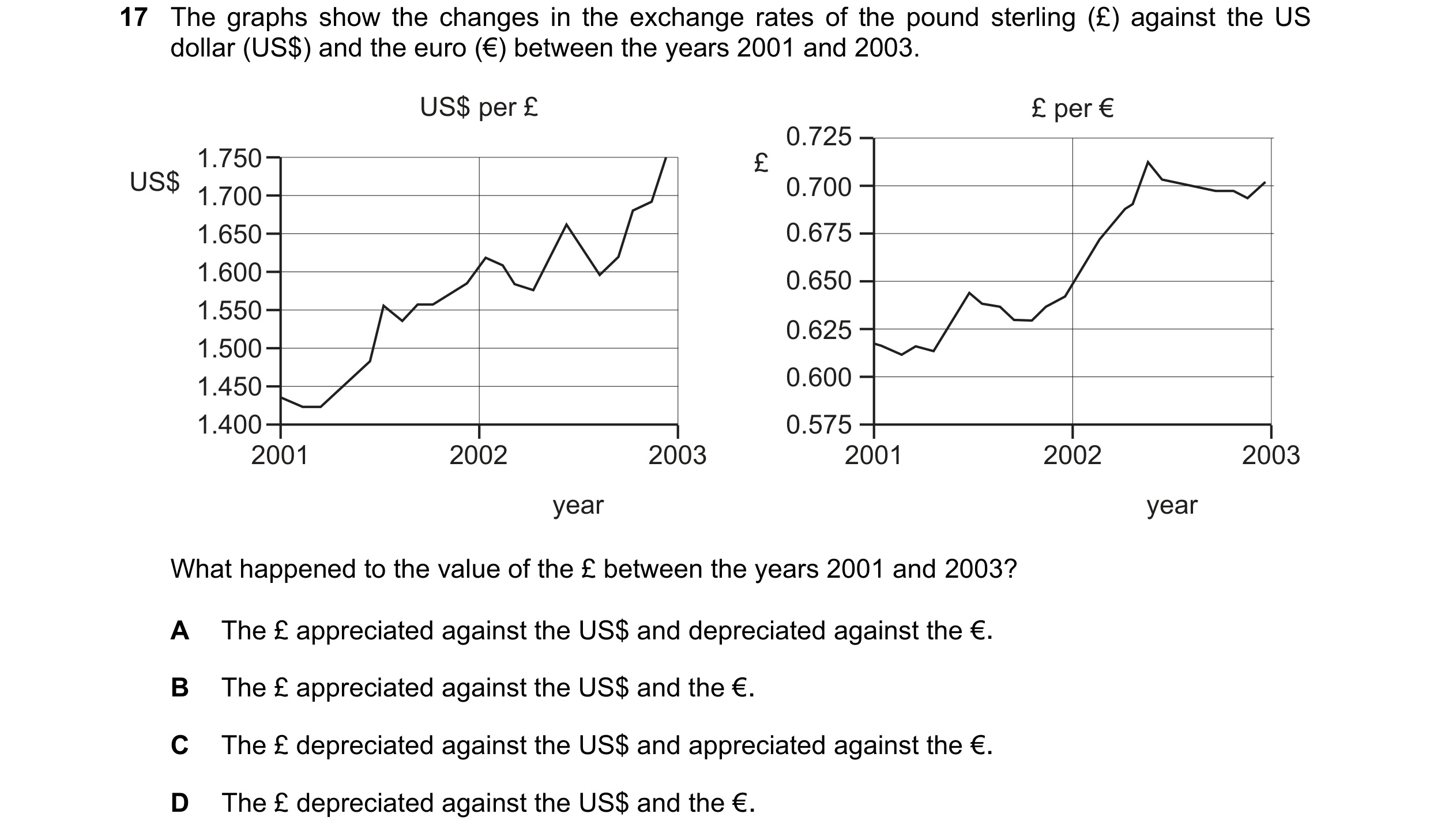 67 / 75

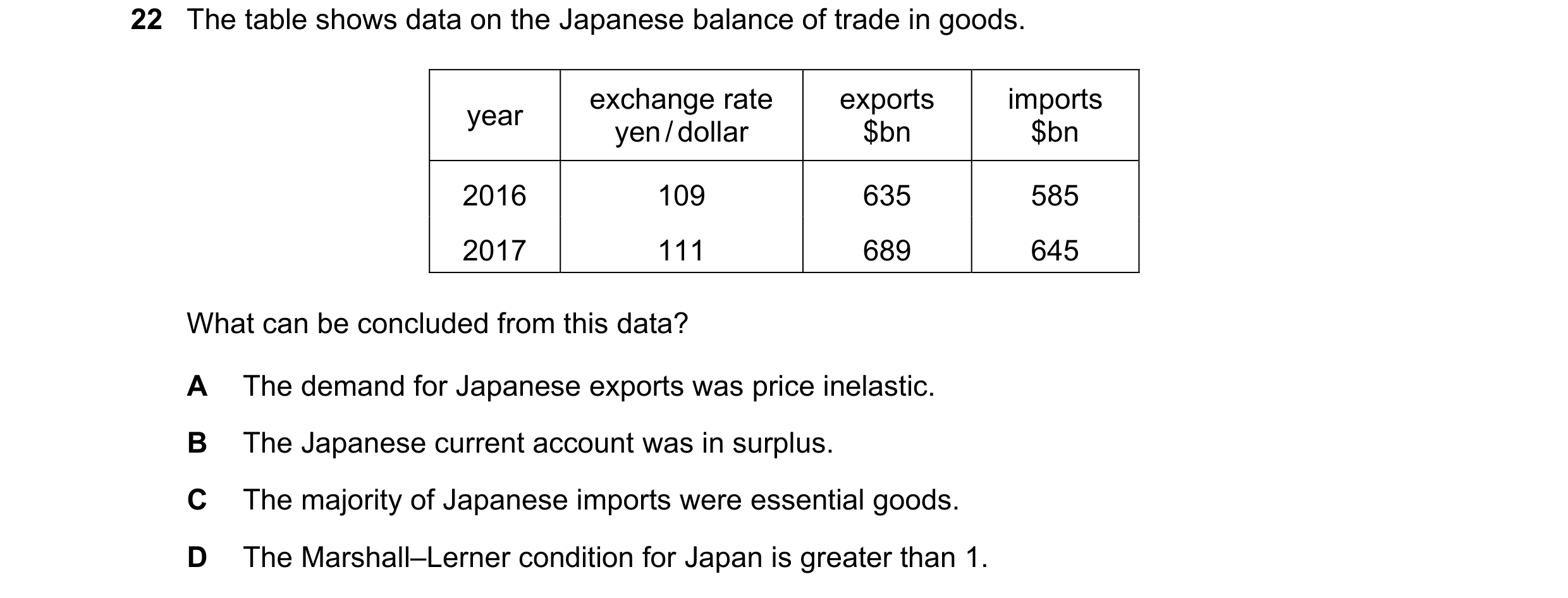
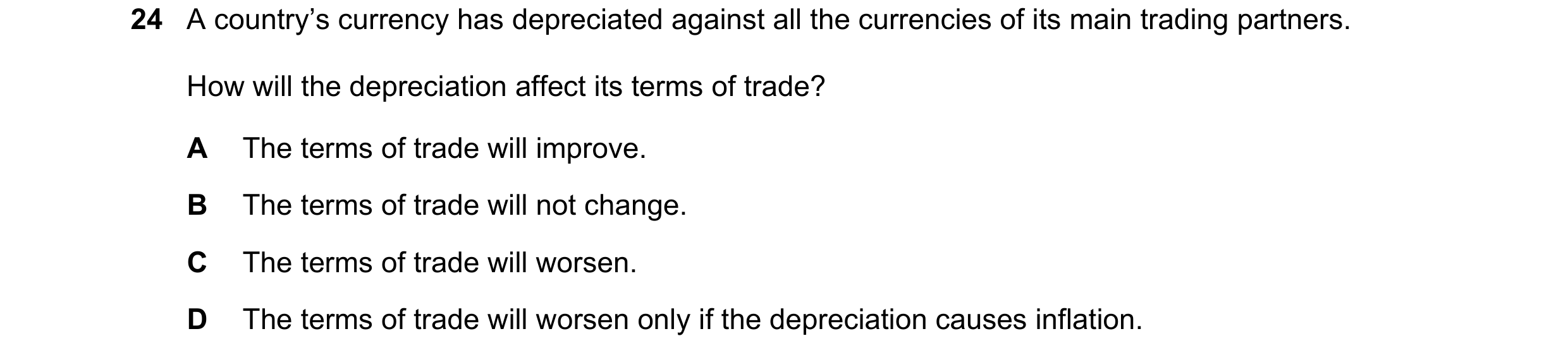 68 / 75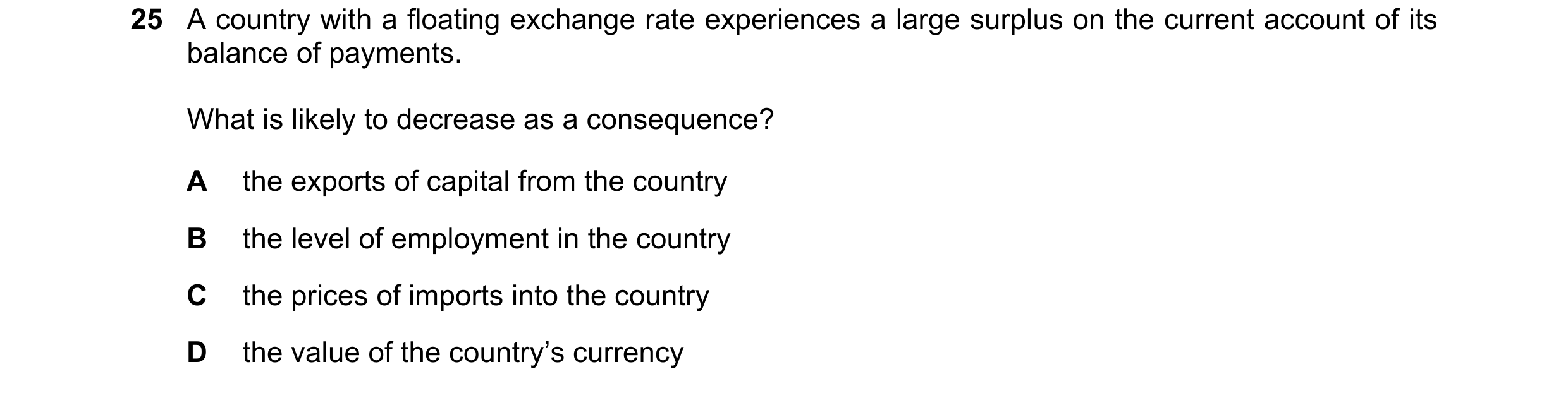
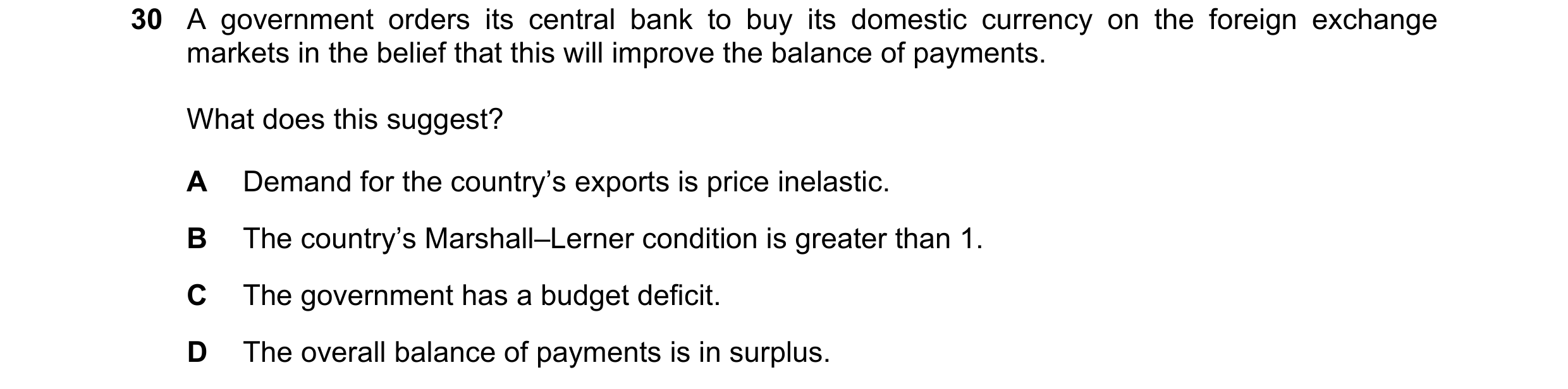

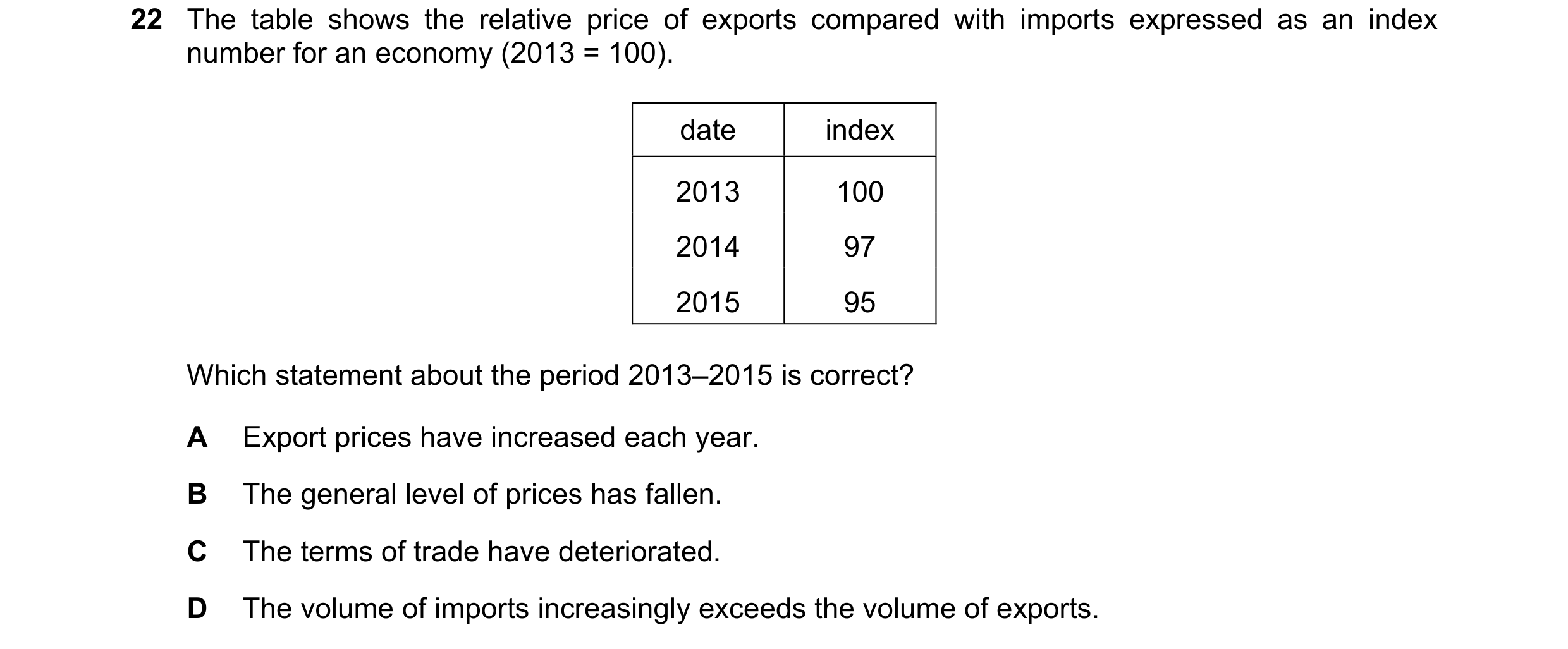
 69 / 75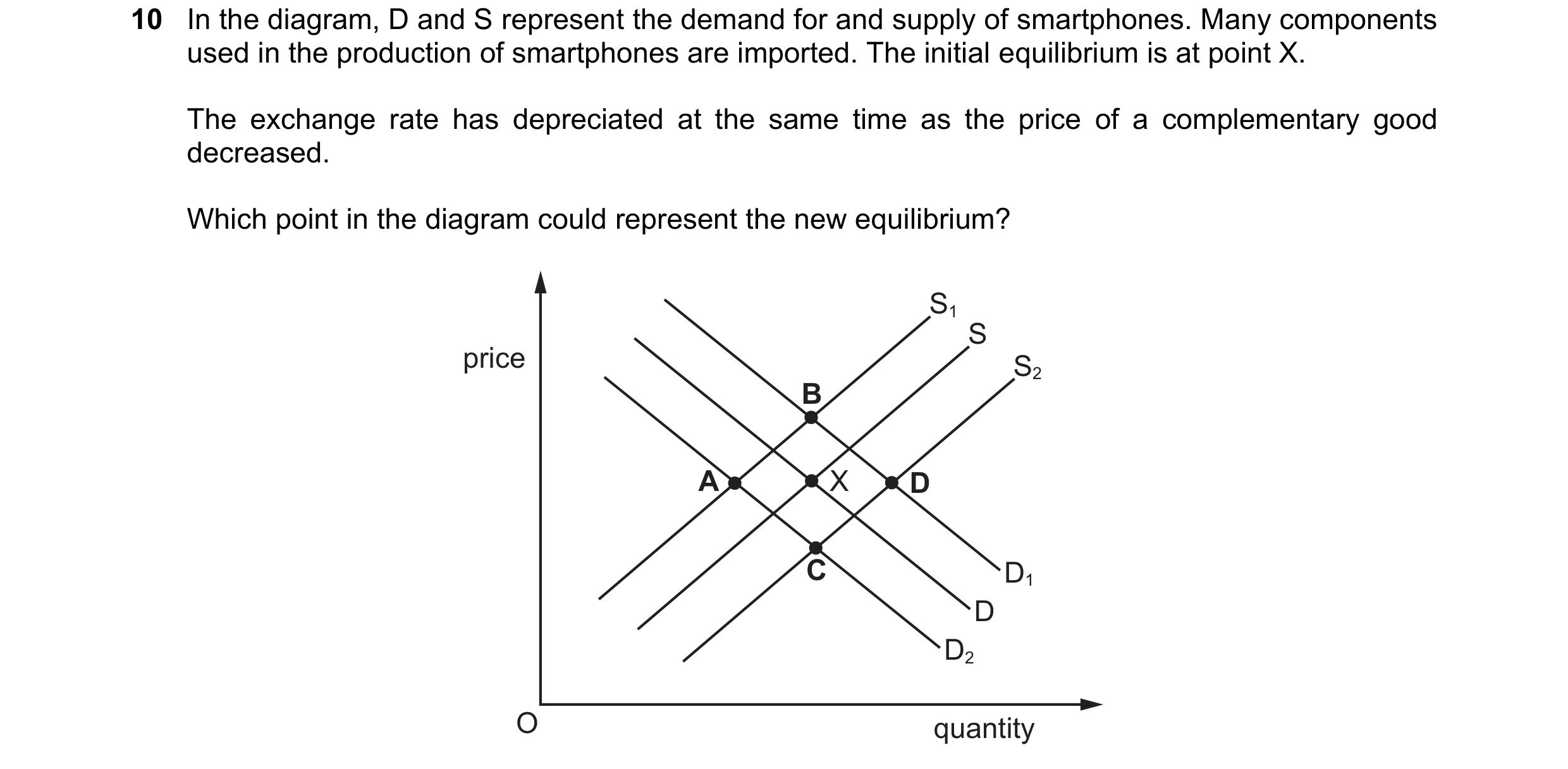

 70 / 75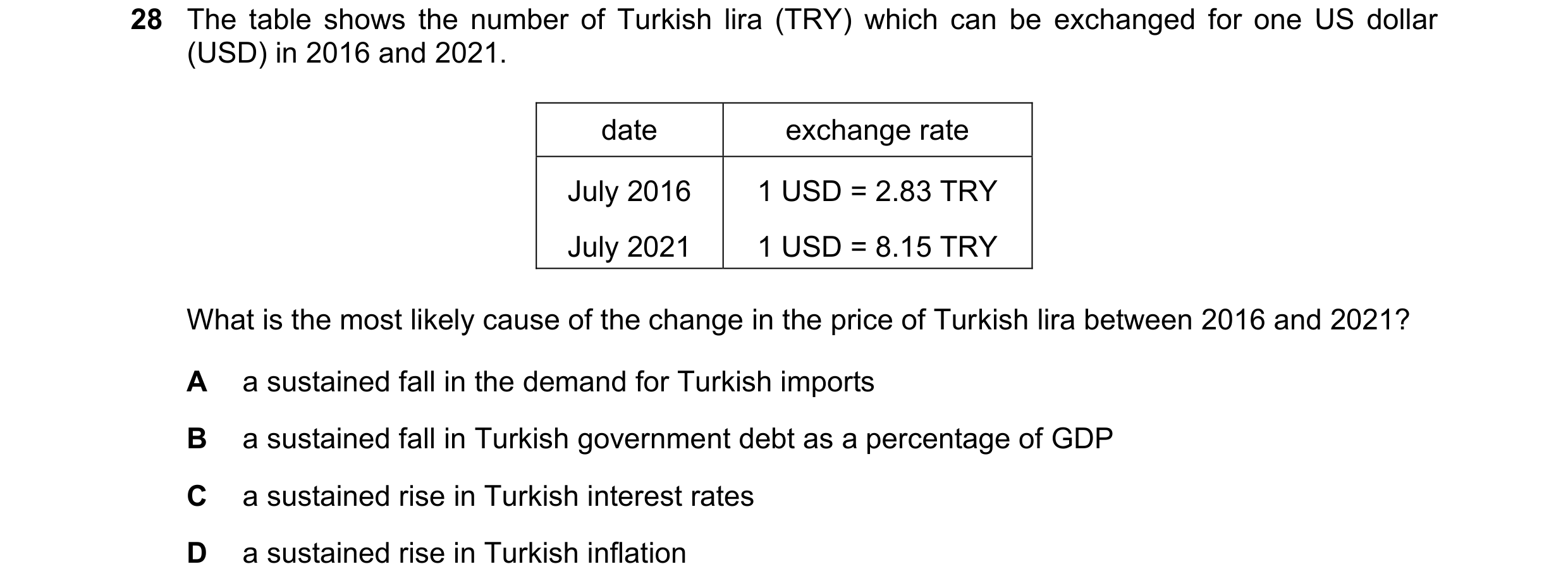


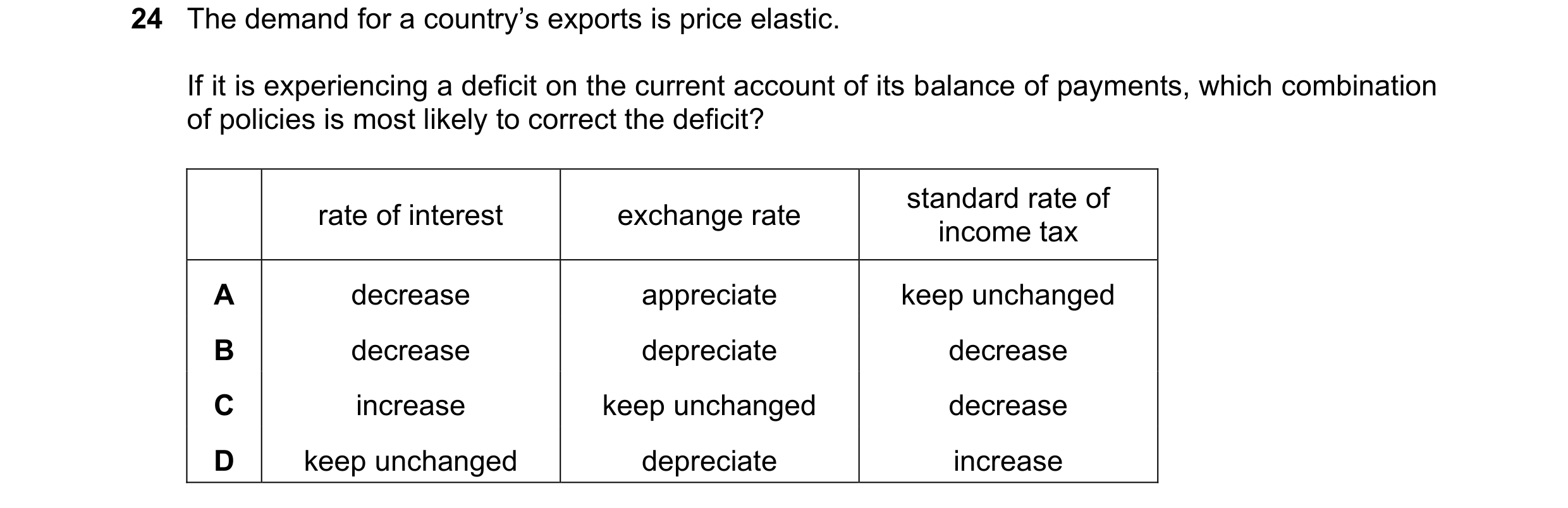
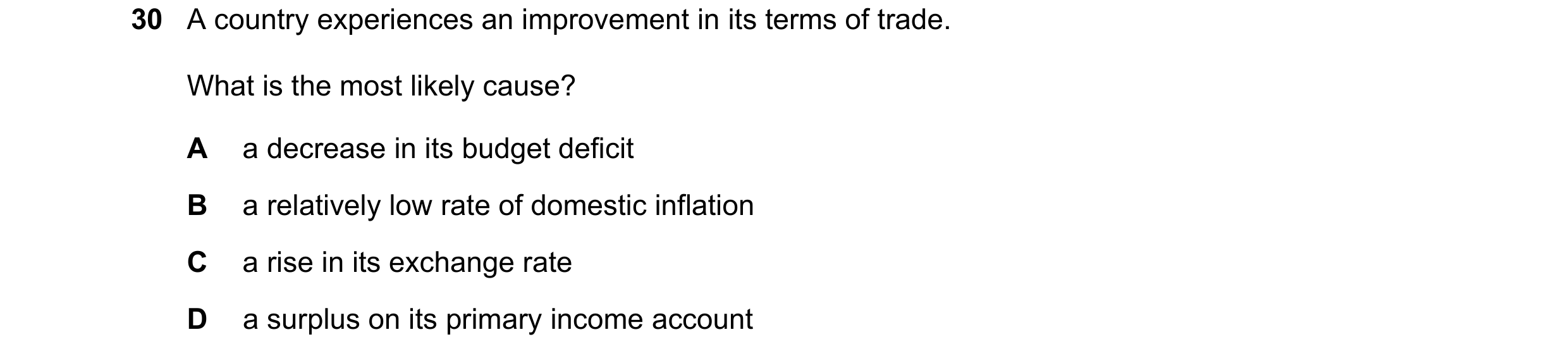 71 / 75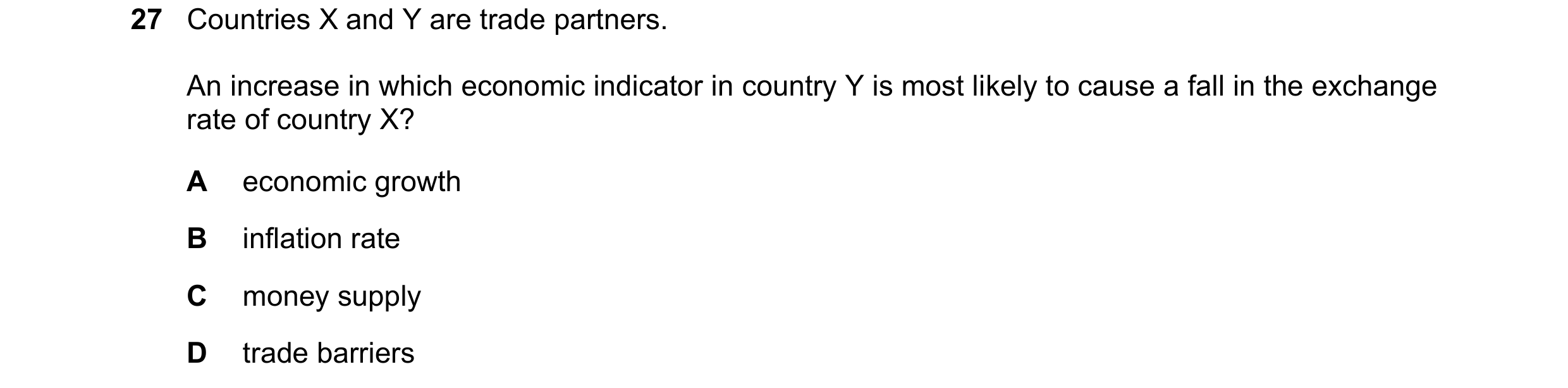

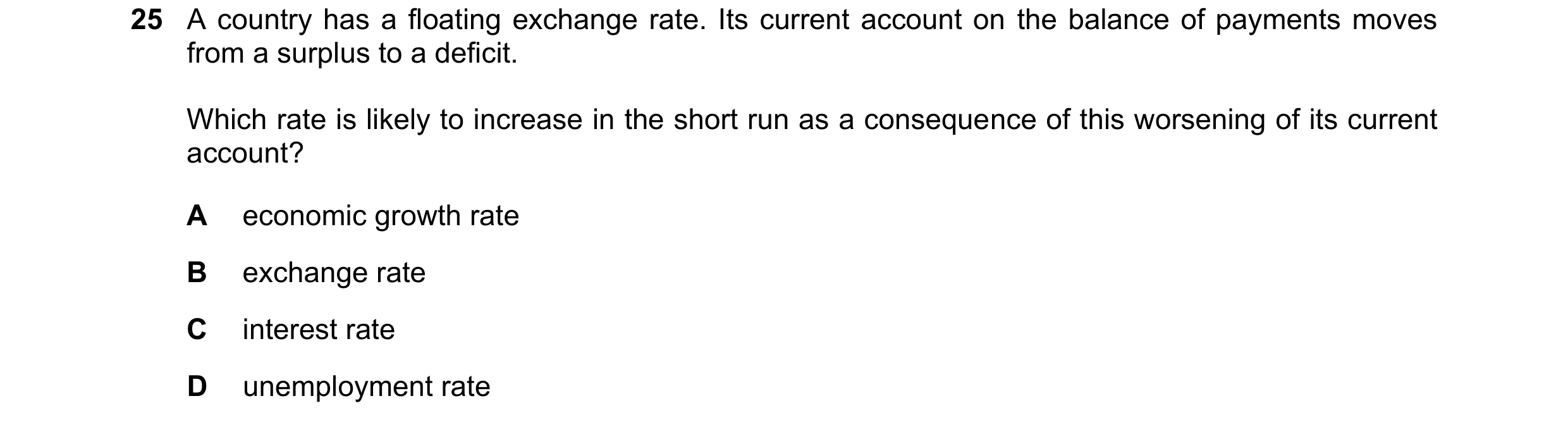
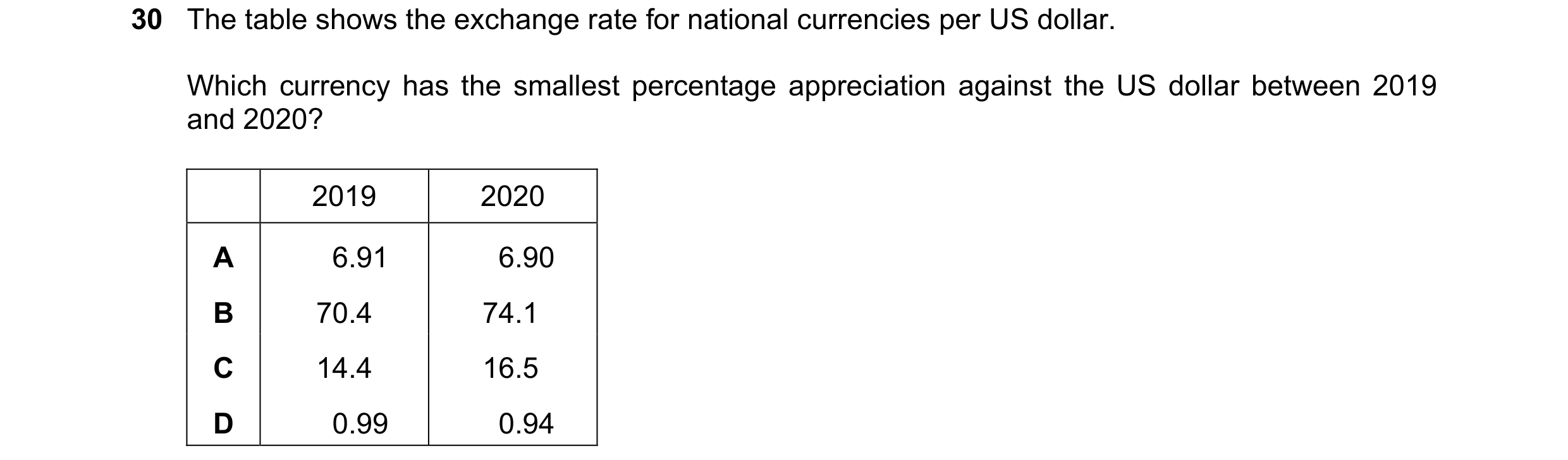
 72 / 75

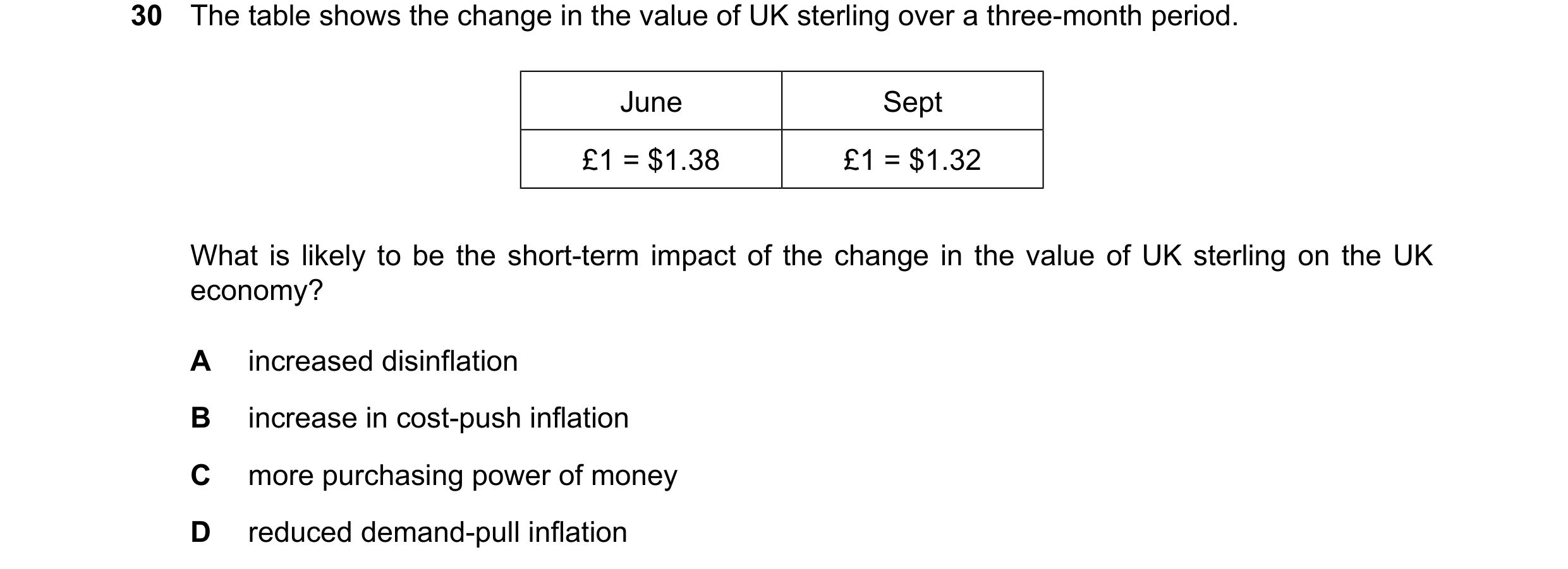
 73 / 75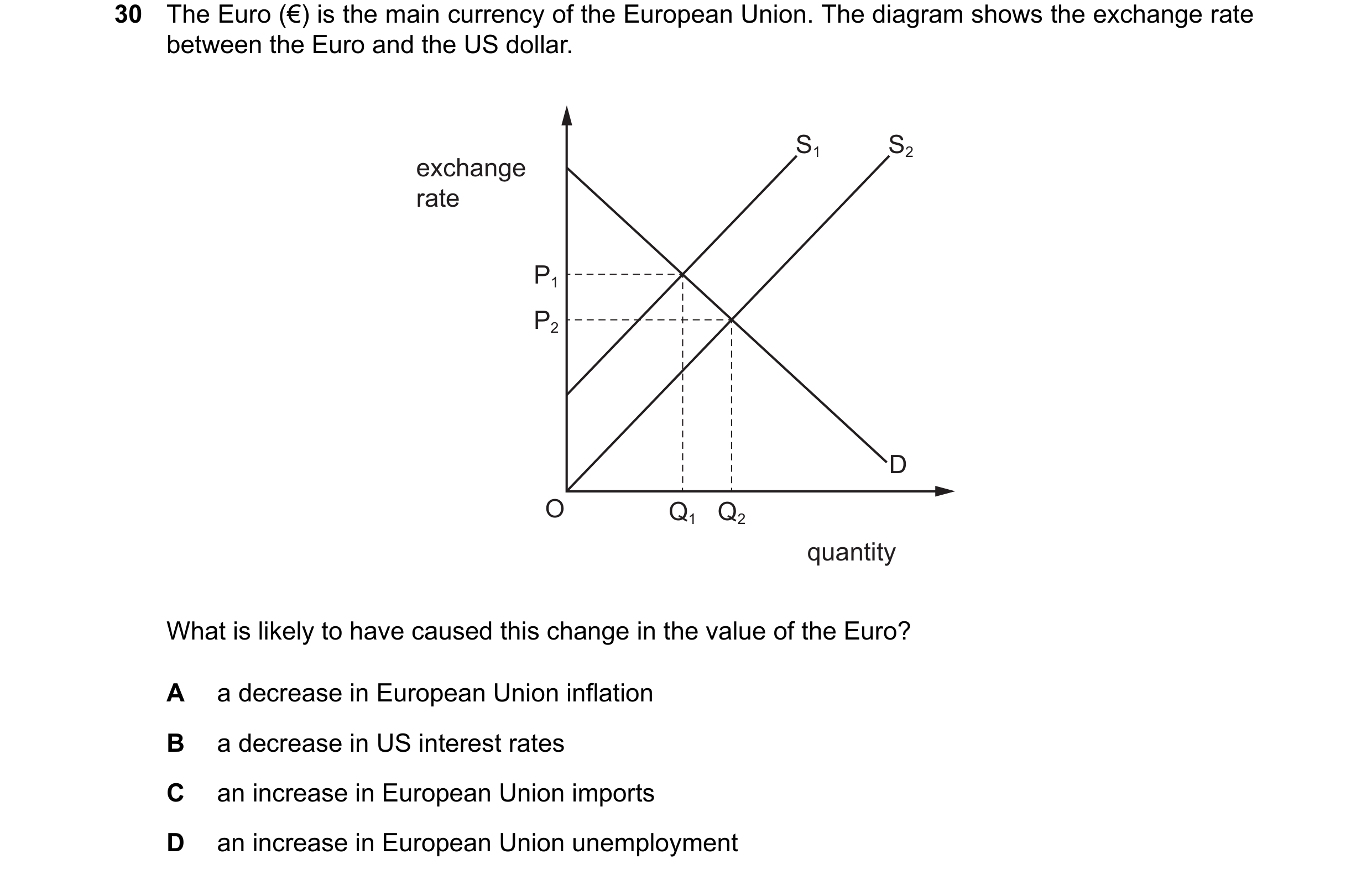
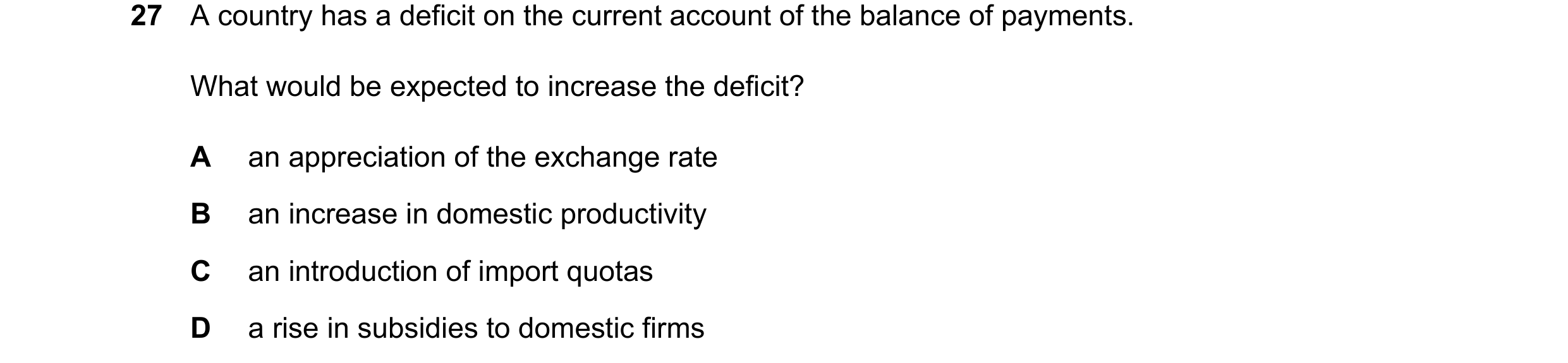
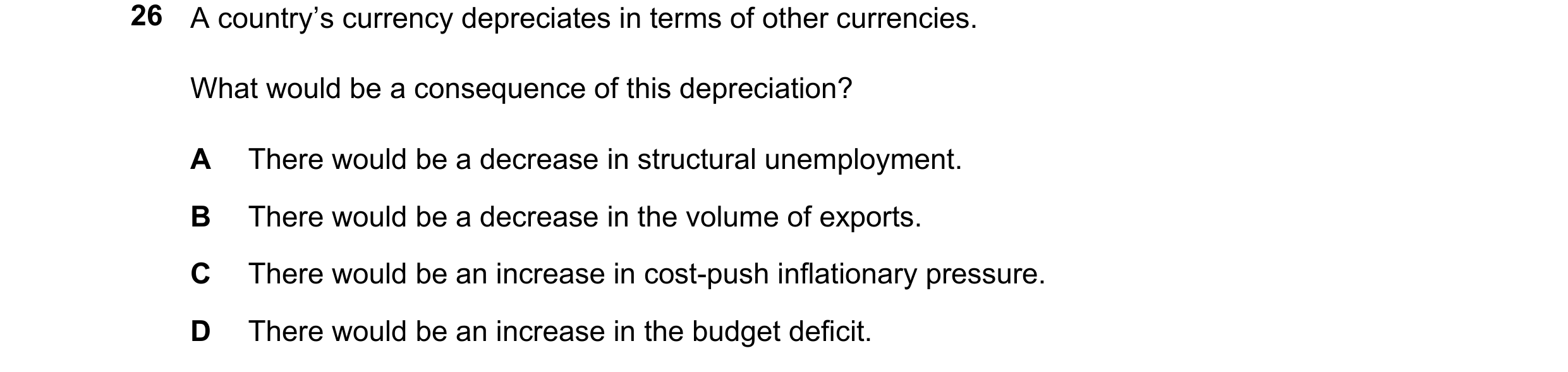 74 / 75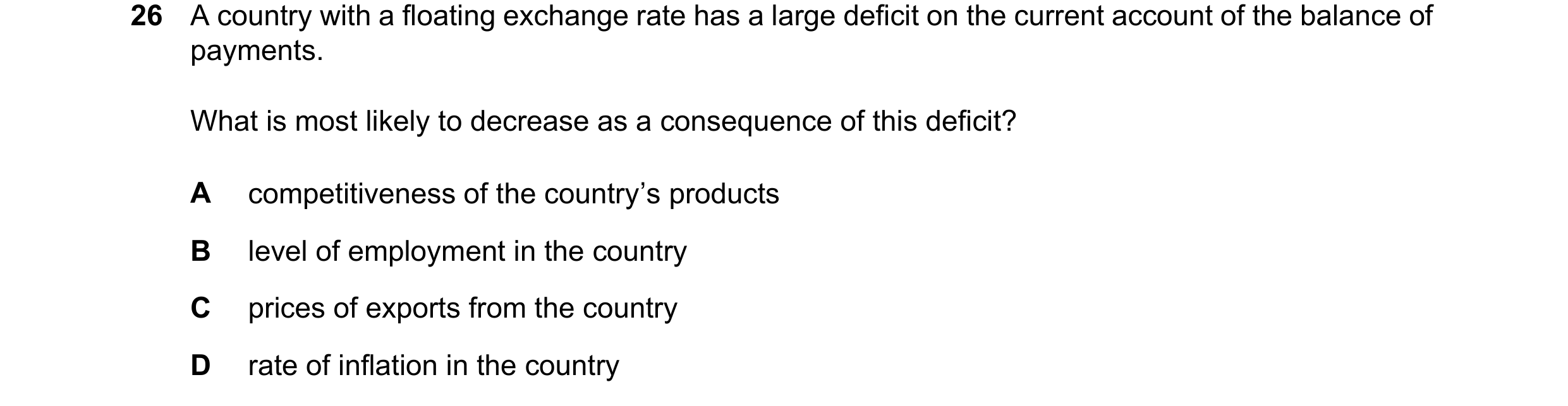
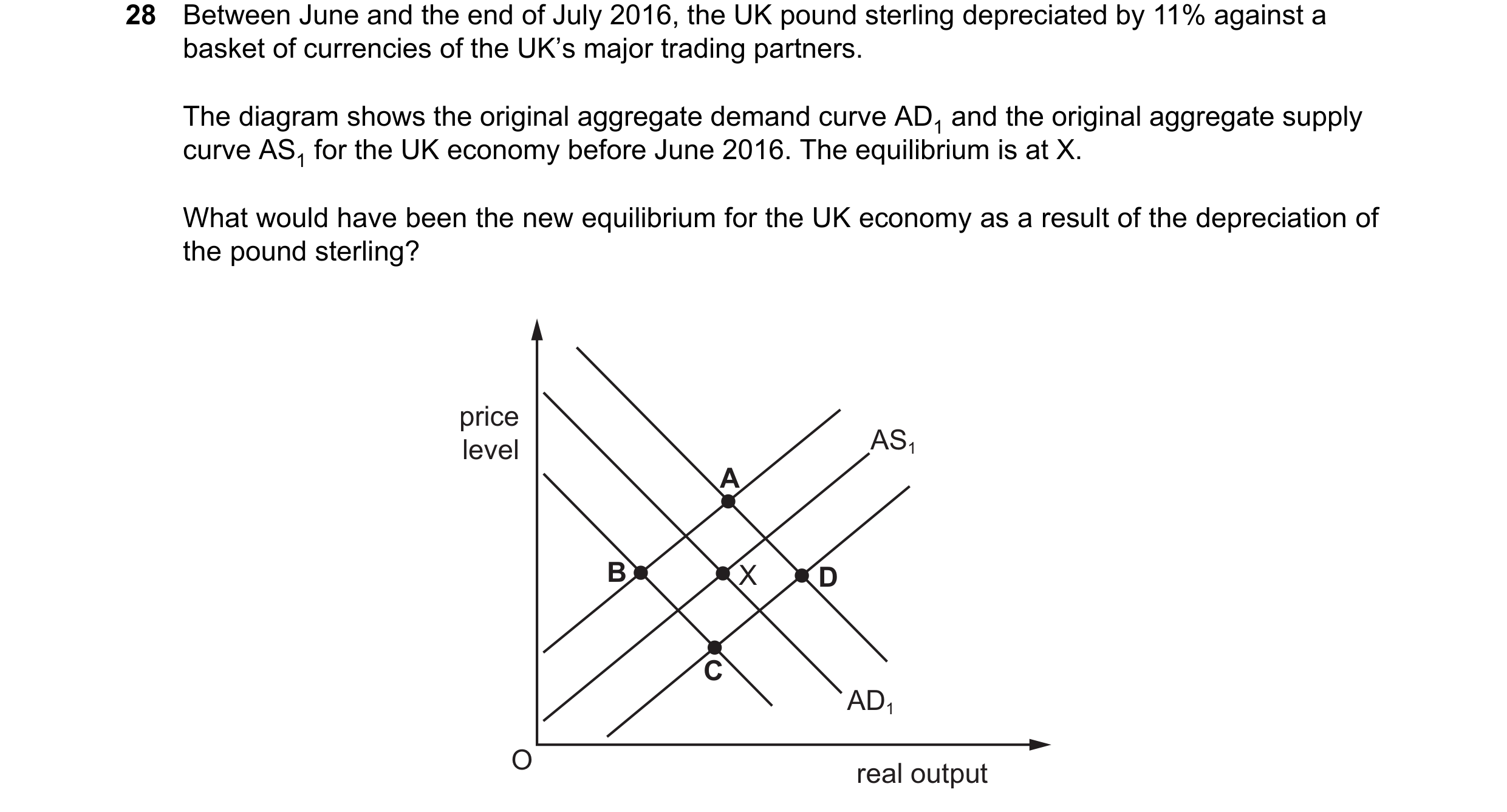
 75 / 75