Cambridge A Level Economics 9708 — 2025 May/June Paper 1 · Variant 3
9708/13/M/J/25 · 30 questions · 30 marks · ≈34 min
The question paper and its mark scheme, free to read here and free to download. This is Cambridge’s own paper, exactly as it was sat.
Question paper12 pages
Mark scheme3 pages
Answers below. Sit the paper first if you are practising.
Questions as text
Q1 · A tourist visits a government-owned tropical beach
1 A tourist visits a government-owned tropical beach. She pays $10 to enter but finds it overcrowded. Which type of good is the beach? A a free good B an inferior good C a public good D a private good
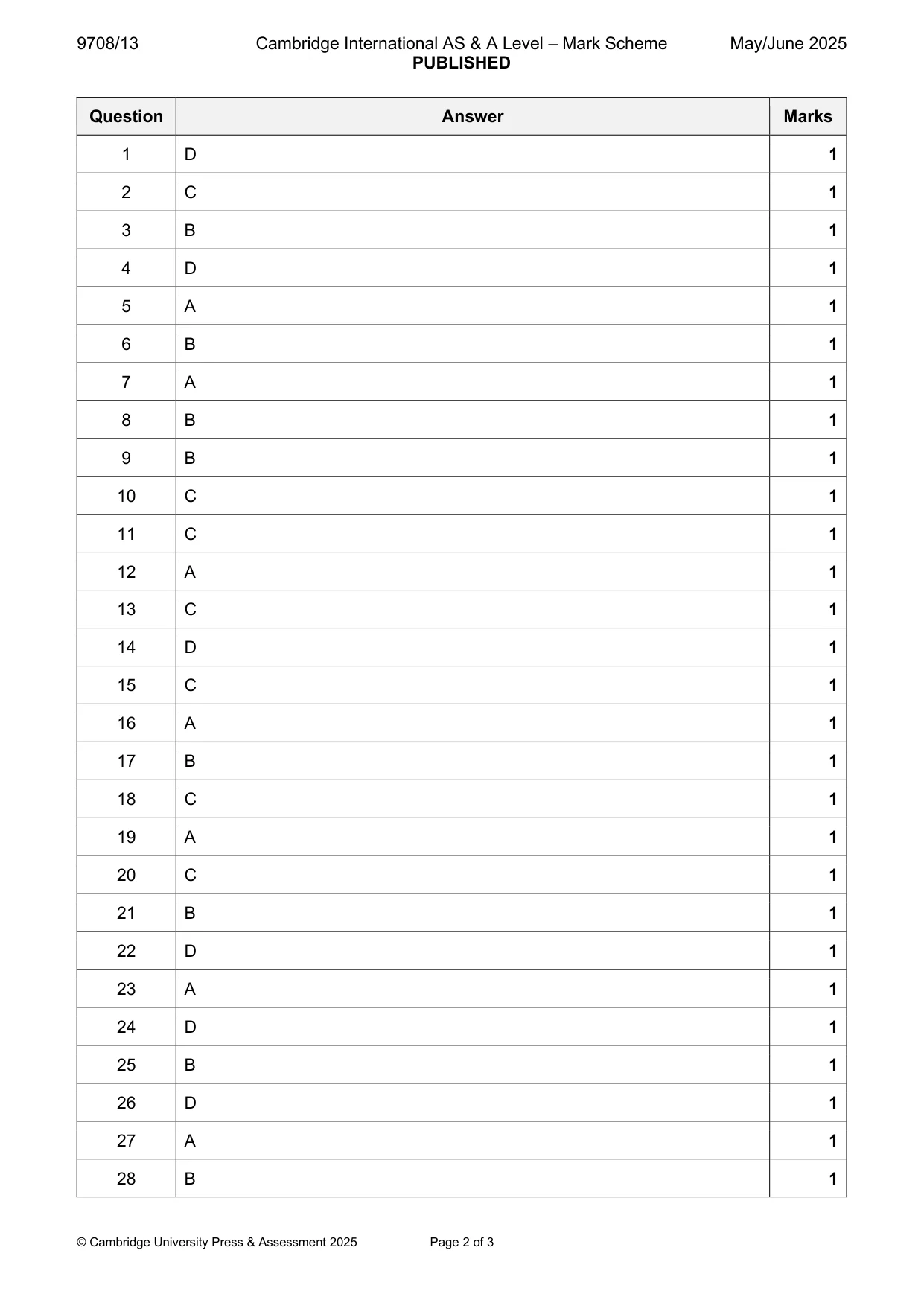
Mark scheme: D
Q2 · The diagram shows a country’s production possibilities
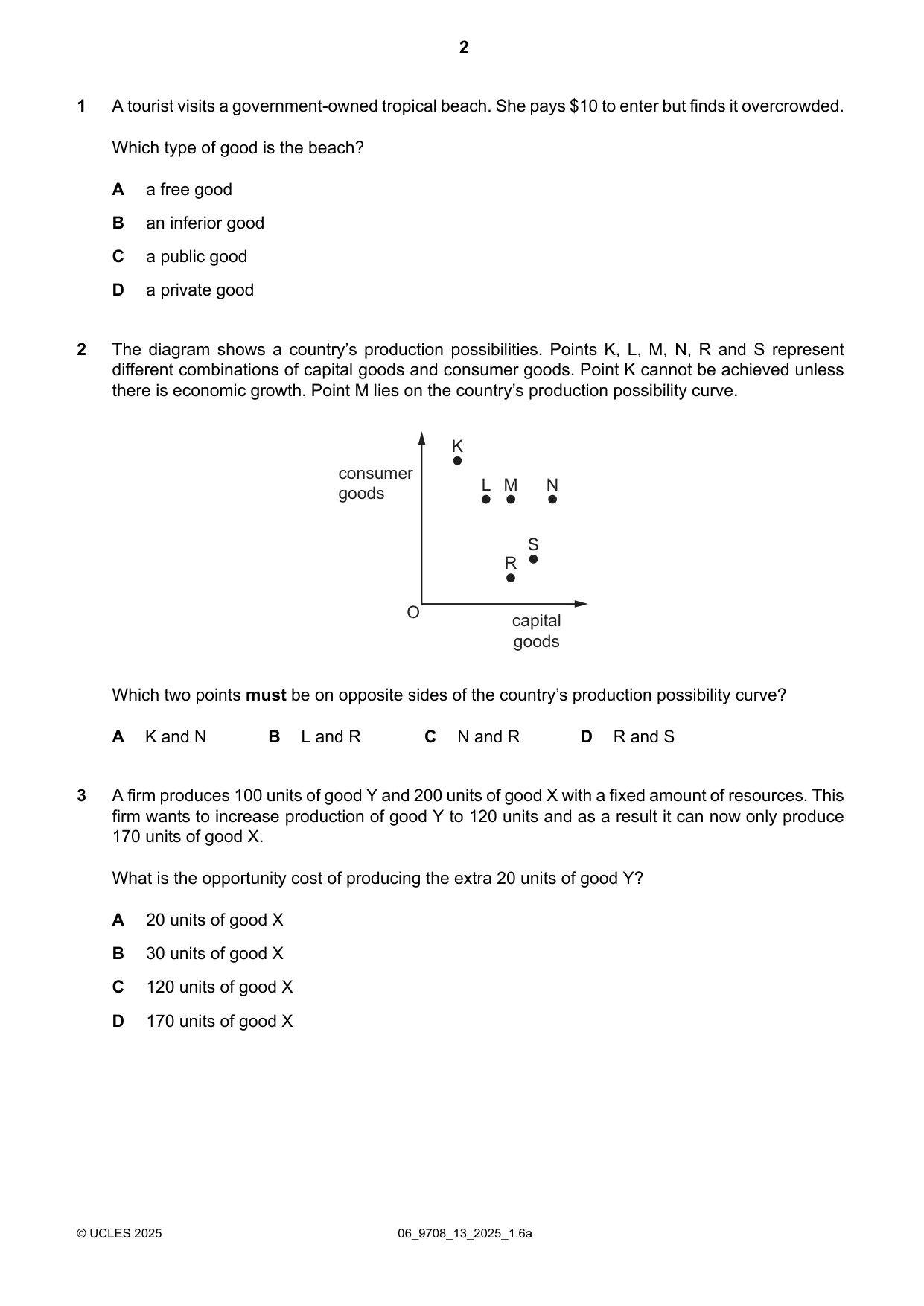
2 The diagram shows a country’s production possibilities. Points K, L, M, N, R and S represent different combinations of capital goods and consumer goods. Point K cannot be achieved unless there is economic growth. Point M lies on the country’s production possibility curve. K consumer L M N goods S R O capital goods Which two points must be on opposite sides of the country’s production possibility curve? A K and N B L and R C N and R D R and S
Mark scheme: C
Q3 · A firm produces 100 units of good Y and 200 units of good X with a fixed amount of…
3 A firm produces 100 units of good Y and 200 units of good X with a fixed amount of resources. This firm wants to increase production of good Y to 120 units and as a result it can now only produce 170 units of good X. What is the opportunity cost of producing the extra 20 units of good Y? A 20 units of good X B 30 units of good X C 120 units of good X D 170 units of good X
Mark scheme: B
Q4 · What is the most likely benefit of specialisation to a firm?
4 What is the most likely benefit of specialisation to a firm? A increase in motivation of employees B increase in imports from other countries C increase in the number of employees D increase in the level of output
Mark scheme: D
Q5 · Which row correctly identifies goods that would be expected to be produced in a mixed…
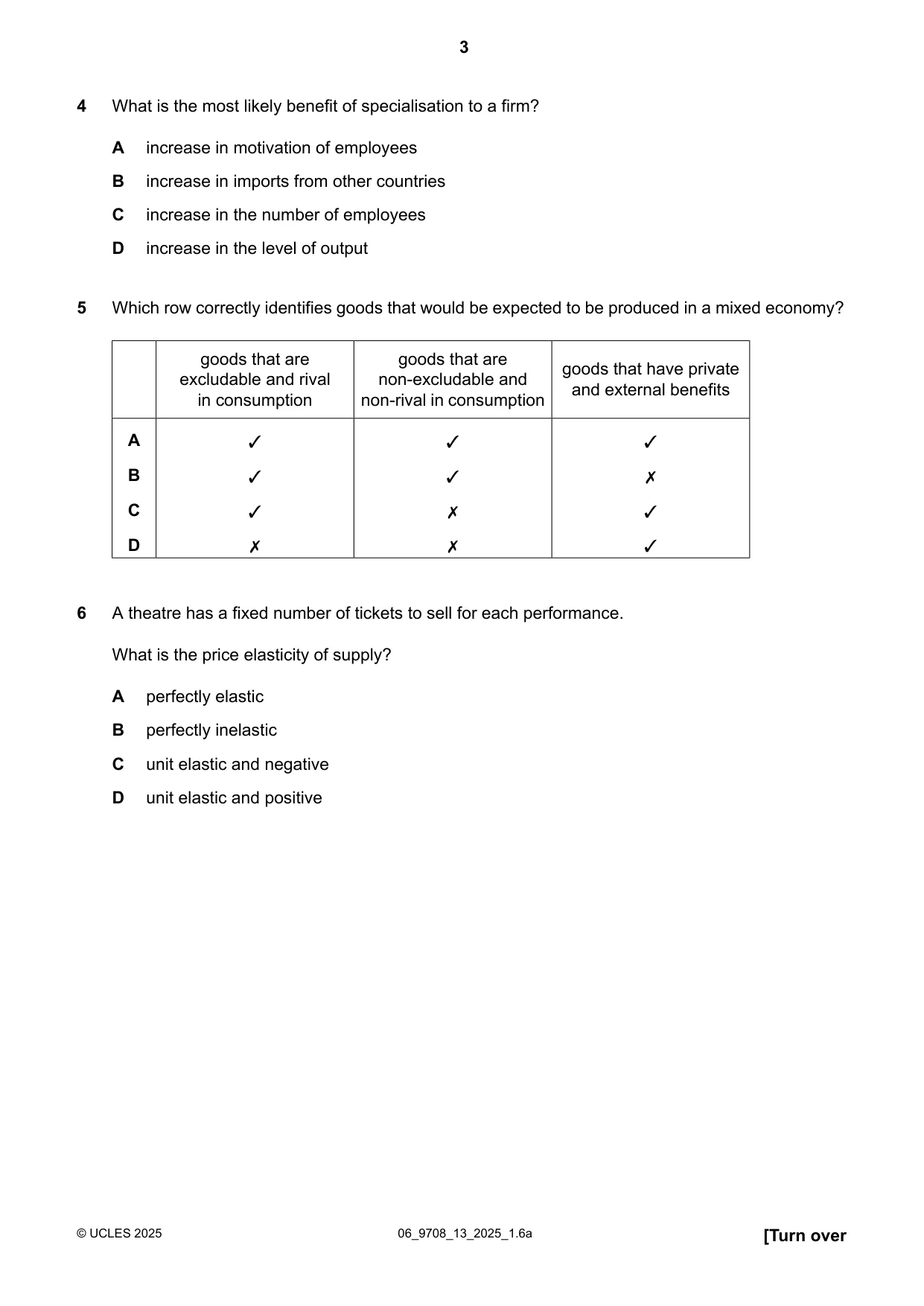
5 Which row correctly identifies goods that would be expected to be produced in a mixed economy? goods that are goods that are goods that have private excludable and rival non-excludable and and external benefits in consumption non-rival in consumption A ✓ ✓ ✓ B ✓ ✓ ✗ C ✓ ✗ ✓ D ✗ ✗ ✓
Mark scheme: A
More questions on Resource allocation in different economic systems
Q6 · A theatre has a fixed number of tickets to sell for each performance
6 A theatre has a fixed number of tickets to sell for each performance. What is the price elasticity of supply? A perfectly elastic B perfectly inelastic C unit elastic and negative D unit elastic and positive
Mark scheme: B
Q7 · The diagram shows the market for computers in a country
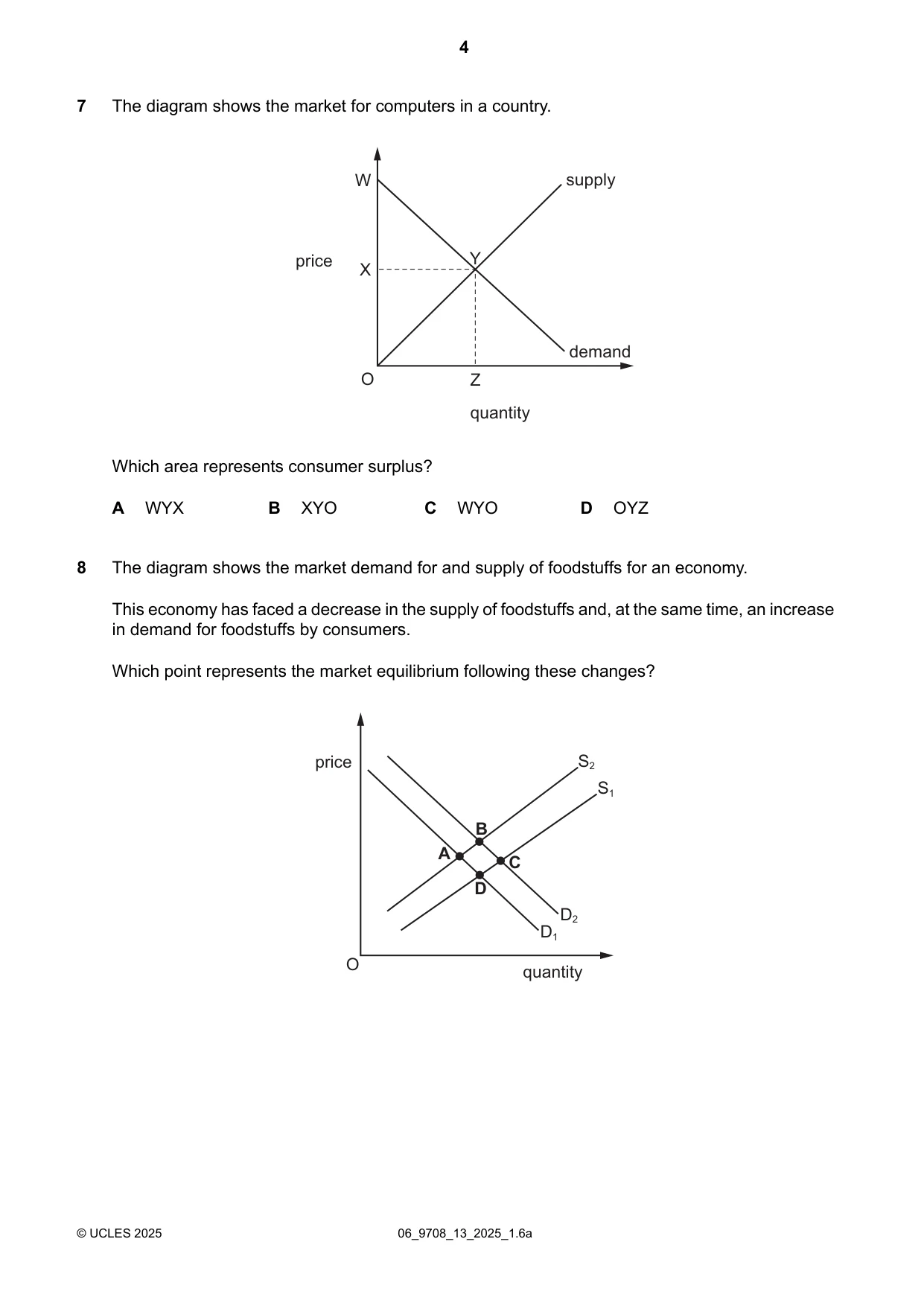
7 The diagram shows the market for computers in a country. W supply price Y X demand O Z quantity Which area represents consumer surplus? A WYX B XYO C WYO D OYZ
Mark scheme: A
Q8 · The diagram shows the market demand for and supply of foodstuffs for an economy
8 The diagram shows the market demand for and supply of foodstuffs for an economy. This economy has faced a decrease in the supply of foodstuffs and, at the same time, an increase in demand for foodstuffs by consumers. Which point represents the market equilibrium following these changes? price S2 S1 B A C D D2 D1 O quantity
Mark scheme: B
Q9 · What is true for income elasticity of demand but not for price elasticity of demand?
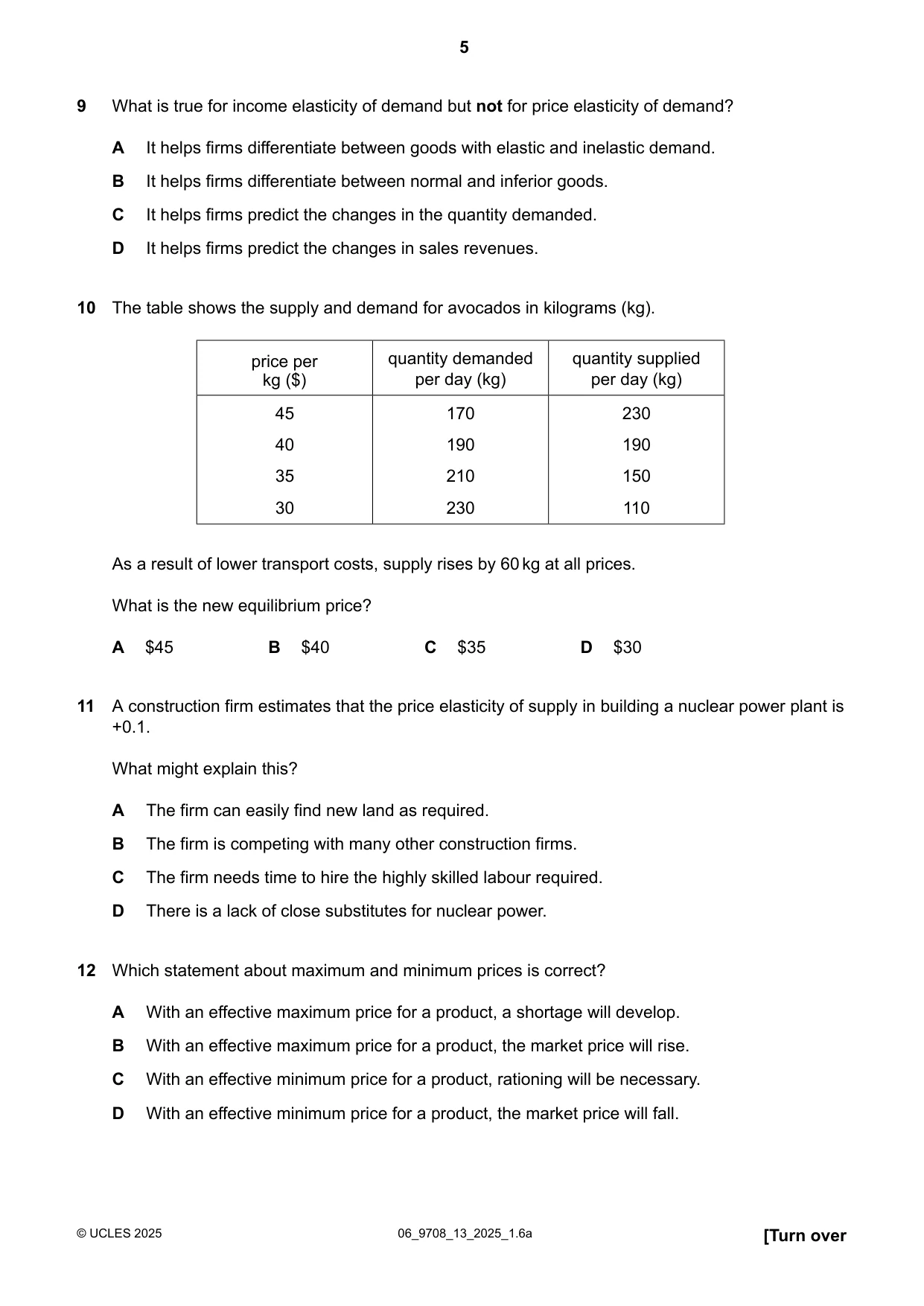
9 What is true for income elasticity of demand but not for price elasticity of demand? A It helps firms differentiate between goods with elastic and inelastic demand. B It helps firms differentiate between normal and inferior goods. C It helps firms predict the changes in the quantity demanded. D It helps firms predict the changes in sales revenues.
Mark scheme: B
More questions on Price elasticity, income elasticity and cross elasticity of demand
Q10 · The table shows the supply and demand for avocados in kilograms (kg)
10 The table shows the supply and demand for avocados in kilograms (kg). price per quantity demanded quantity supplied kg ($) per day (kg) per day (kg) 45 170 230 40 190 190 35 210 150 30 230 110 As a result of lower transport costs, supply rises by 60kg at all prices. What is the new equilibrium price? A $45 B $40 C $35 D $30
Mark scheme: C
Q11 · A construction firm estimates that the price elasticity of supply in building a nuclear…
11 A construction firm estimates that the price elasticity of supply in building a nuclear power plant is +0.1. What might explain this? A The firm can easily find new land as required. B The firm is competing with many other construction firms. C The firm needs time to hire the highly skilled labour required. D There is a lack of close substitutes for nuclear power.
Mark scheme: C
Q12 · Which statement about maximum and minimum prices is correct?
12 Which statement about maximum and minimum prices is correct? A With an effective maximum price for a product, a shortage will develop. B With an effective maximum price for a product, the market price will rise. C With an effective minimum price for a product, rationing will be necessary. D With an effective minimum price for a product, the market price will fall.
Mark scheme: A
More questions on Methods and effects of government intervention in markets
Q13 · A flood-control dam is an example of a good provided directly by a government
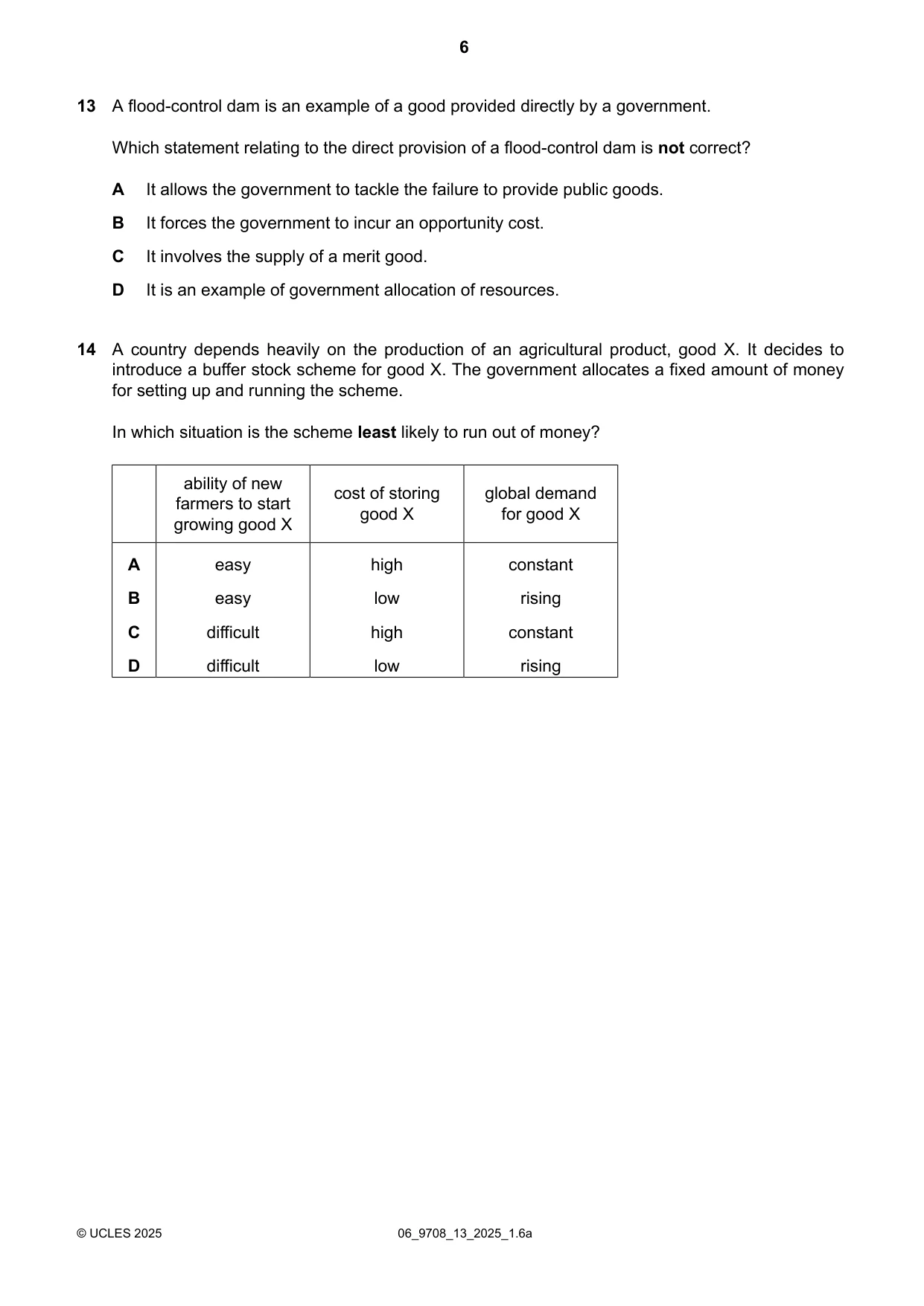
13 A flood-control dam is an example of a good provided directly by a government. Which statement relating to the direct provision of a flood-control dam is not correct? A It allows the government to tackle the failure to provide public goods. B It forces the government to incur an opportunity cost. C It involves the supply of a merit good. D It is an example of government allocation of resources.
Mark scheme: C
More questions on Reasons for government intervention in markets
Q14 · A country depends heavily on the production of an agricultural product, good X
14 A country depends heavily on the production of an agricultural product, good X. It decides to introduce a buffer stock scheme for good X. The government allocates a fixed amount of money for setting up and running the scheme. In which situation is the scheme least likely to run out of money? ability of new cost of storing global demand farmers to start good X for good X growing good X A easy high constant B easy low rising C difficult high constant D difficult low rising
Mark scheme: D
More questions on Methods and effects of government intervention in markets
Q15 · The graph shows an individual’s income before and after the deduction of income tax
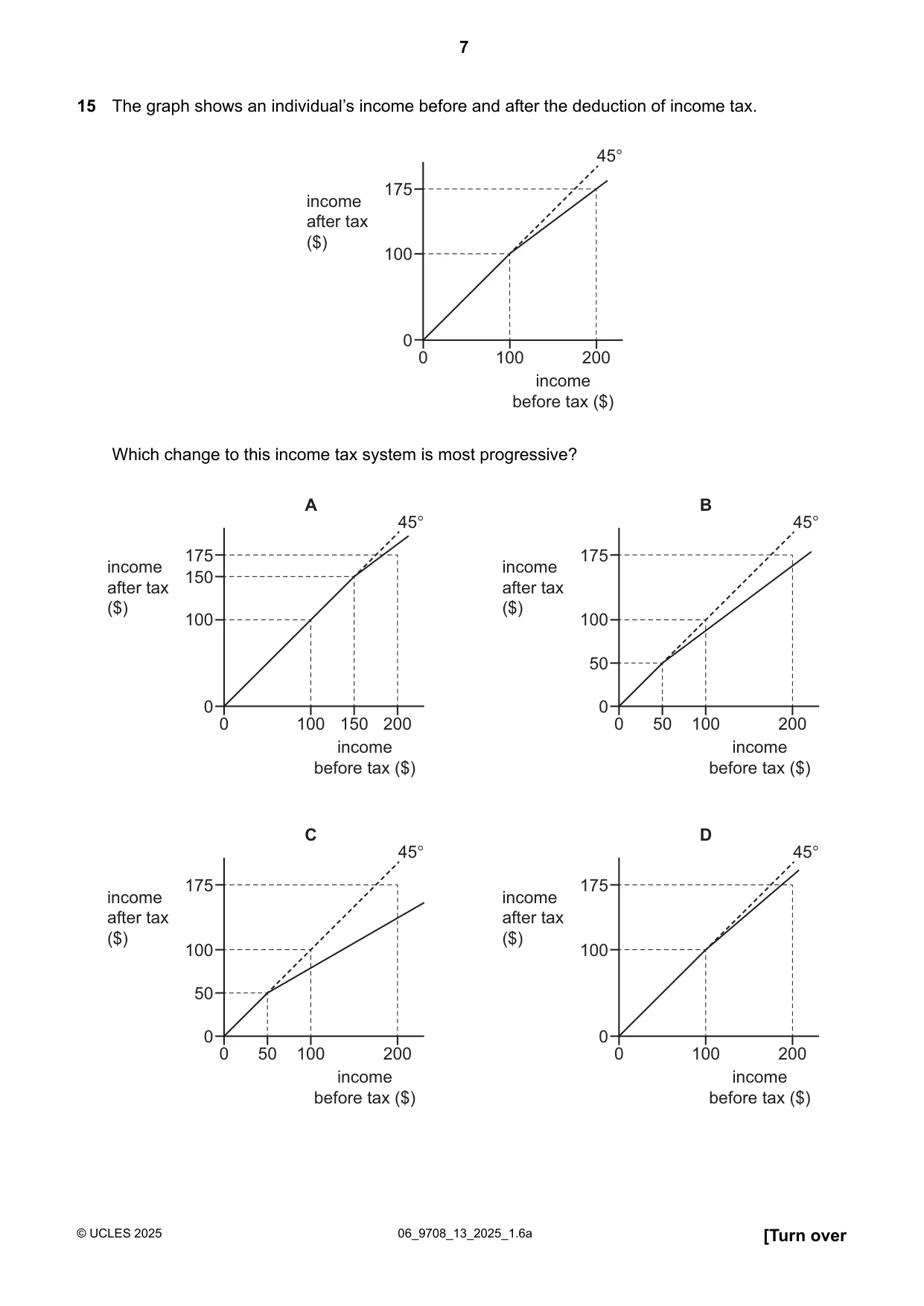
15 The graph shows an individual’s income before and after the deduction of income tax. 45° 175 income after tax ($) 100 0 0 100 200 income before tax ($) Which change to this income tax system is most progressive? A B 45° 45° 175 175 income income 150 after tax after tax ($) ($) 100 100 50 0 0 0 100 150 200 0 50 100 200 income income before tax ($) before tax ($) C D 45° 45° 175 175 income income after tax after tax ($) ($) 100 100 50 0 0 0 50 100 200 0 100 200 income income before tax ($) before tax ($)
Mark scheme: C
Q16 · Which source of income is not included in measuring real GDP?
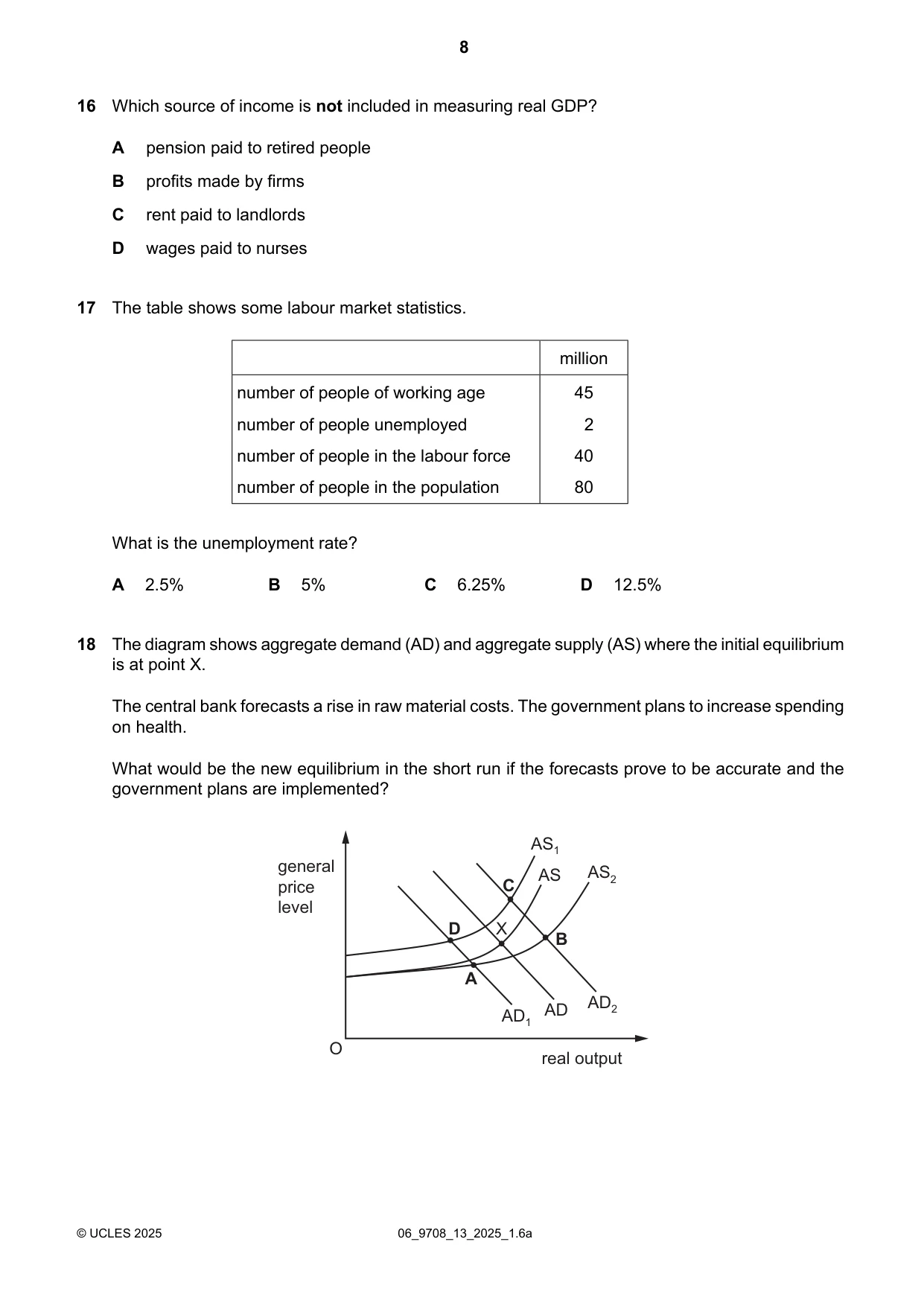
16 Which source of income is not included in measuring real GDP? A pension paid to retired people B profits made by firms C rent paid to landlords D wages paid to nurses
Mark scheme: A
Q17 · The table shows some labour market statistics
17 The table shows some labour market statistics. million number of people of working age 45 number of people unemployed 2 number of people in the labour force 40 number of people in the population 80 What is the unemployment rate? A 2.5% B 5% C 6.25% D 12.5%
Mark scheme: B
Q18 · The diagram shows aggregate demand (AD) and aggregate supply (AS) where the initial…
18 The diagram shows aggregate demand (AD) and aggregate supply (AS) where the initial equilibrium is at point X. The central bank forecasts a rise in raw material costs. The government plans to increase spending on health. What would be the new equilibrium in the short run if the forecasts prove to be accurate and the government plans are implemented? AS1 general AS2 C AS price level D X B A AD AD2 AD1 O real output
Mark scheme: C
More questions on Aggregate Demand and Aggregate Supply analysis
Q19 · An economy is experiencing a period of deflation
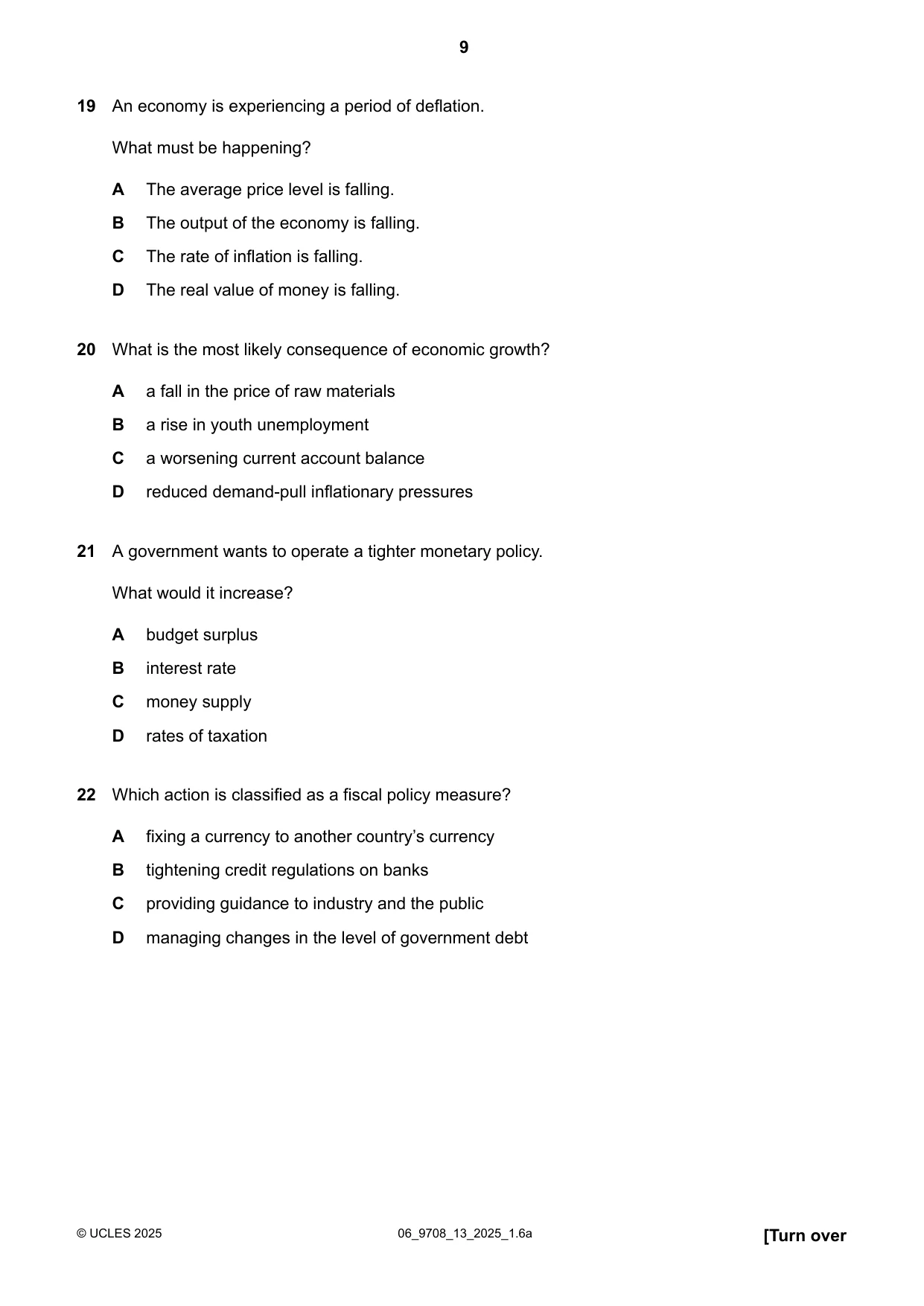
19 An economy is experiencing a period of deflation. What must be happening? A The average price level is falling. B The output of the economy is falling. C The rate of inflation is falling. D The real value of money is falling.
Mark scheme: A
Q20 · What is the most likely consequence of economic growth?
20 What is the most likely consequence of economic growth? A a fall in the price of raw materials B a rise in youth unemployment C a worsening current account balance D reduced demand-pull inflationary pressures
Mark scheme: C
Q21 · A government wants to operate a tighter monetary policy
21 A government wants to operate a tighter monetary policy. What would it increase? A budget surplus B interest rate C money supply D rates of taxation
Mark scheme: B
Q22 · Which action is classified as a fiscal policy measure?
22 Which action is classified as a fiscal policy measure? A fixing a currency to another country’s currency B tightening credit regulations on banks C providing guidance to industry and the public D managing changes in the level of government debt
Mark scheme: D
Q23 · The table shows government spending and revenue over a three-year period
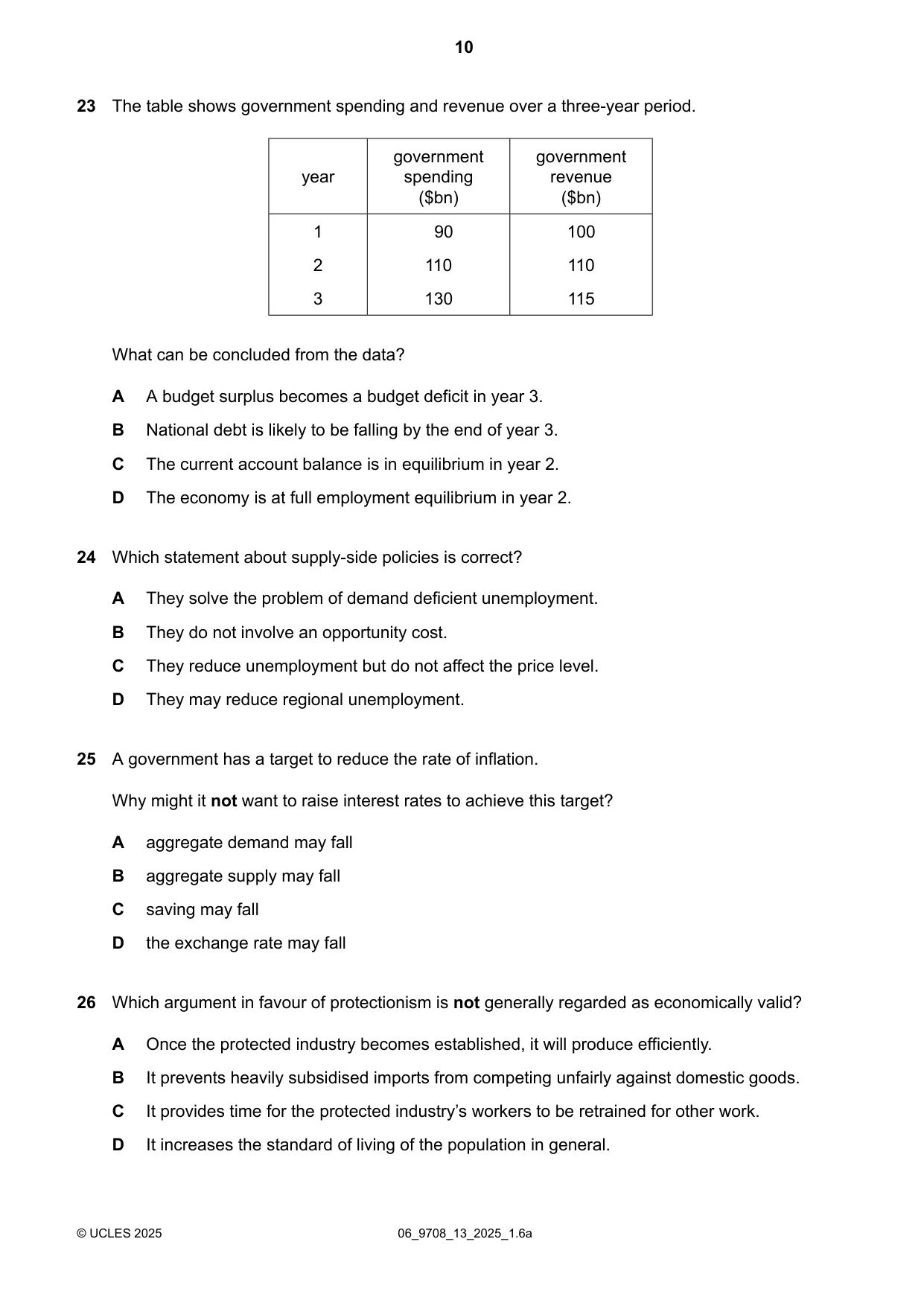
23 The table shows government spending and revenue over a three-year period. government government year spending revenue ($bn) ($bn) 1 90 100 2 110 110 3 130 115 What can be concluded from the data? A A budget surplus becomes a budget deficit in year 3. B National debt is likely to be falling by the end of year 3. C The current account balance is in equilibrium in year 2. D The economy is at full employment equilibrium in year 2.
Mark scheme: A
Q24 · Which statement about supply-side policies is correct?
24 Which statement about supply-side policies is correct? A They solve the problem of demand deficient unemployment. B They do not involve an opportunity cost. C They reduce unemployment but do not affect the price level. D They may reduce regional unemployment.
Mark scheme: D
Q25 · A government has a target to reduce the rate of inflation
25 A government has a target to reduce the rate of inflation. Why might it not want to raise interest rates to achieve this target? A aggregate demand may fall B aggregate supply may fall C saving may fall D the exchange rate may fall
Mark scheme: B
Q26 · Which argument in favour of protectionism is not generally regarded as economically valid?
26 Which argument in favour of protectionism is not generally regarded as economically valid? A Once the protected industry becomes established, it will produce efficiently. B It prevents heavily subsidised imports from competing unfairly against domestic goods. C It provides time for the protected industry’s workers to be retrained for other work. D It increases the standard of living of the population in general.
Mark scheme: D
Q27 · A country has a deficit on the current account of the balance of payments
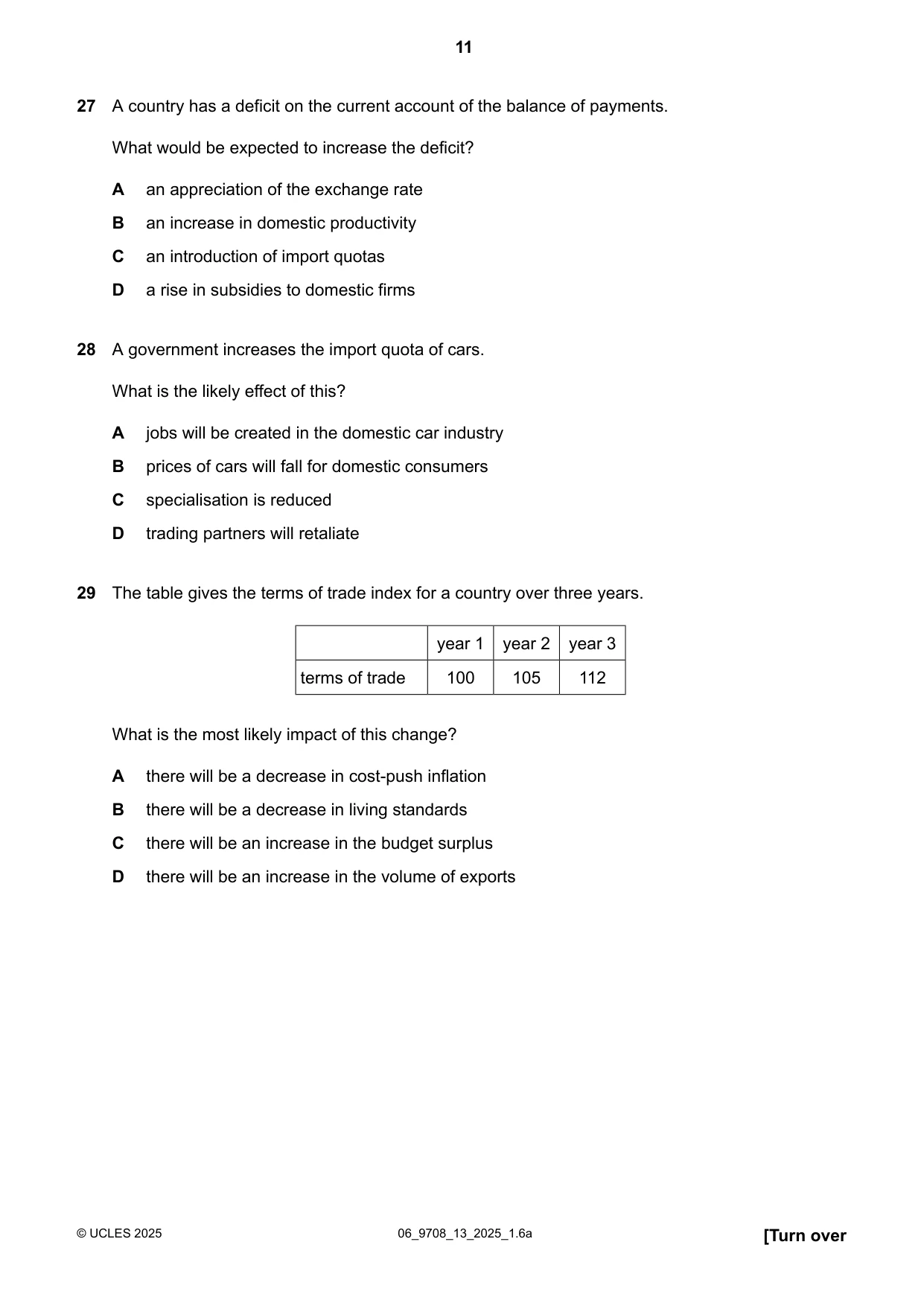
27 A country has a deficit on the current account of the balance of payments. What would be expected to increase the deficit? A an appreciation of the exchange rate B an increase in domestic productivity C an introduction of import quotas D a rise in subsidies to domestic firms
Mark scheme: A
More questions on Current account of the balance of payments
Q28 · A government increases the import quota of cars
28 A government increases the import quota of cars. What is the likely effect of this? A jobs will be created in the domestic car industry B prices of cars will fall for domestic consumers C specialisation is reduced D trading partners will retaliate
Mark scheme: B
Q29 · The table gives the terms of trade index for a country over three years
29 The table gives the terms of trade index for a country over three years. year 1 year 2 year 3 terms of trade 100 105 112 What is the most likely impact of this change? A there will be a decrease in cost-push inflation B there will be a decrease in living standards C there will be an increase in the budget surplus D there will be an increase in the volume of exports
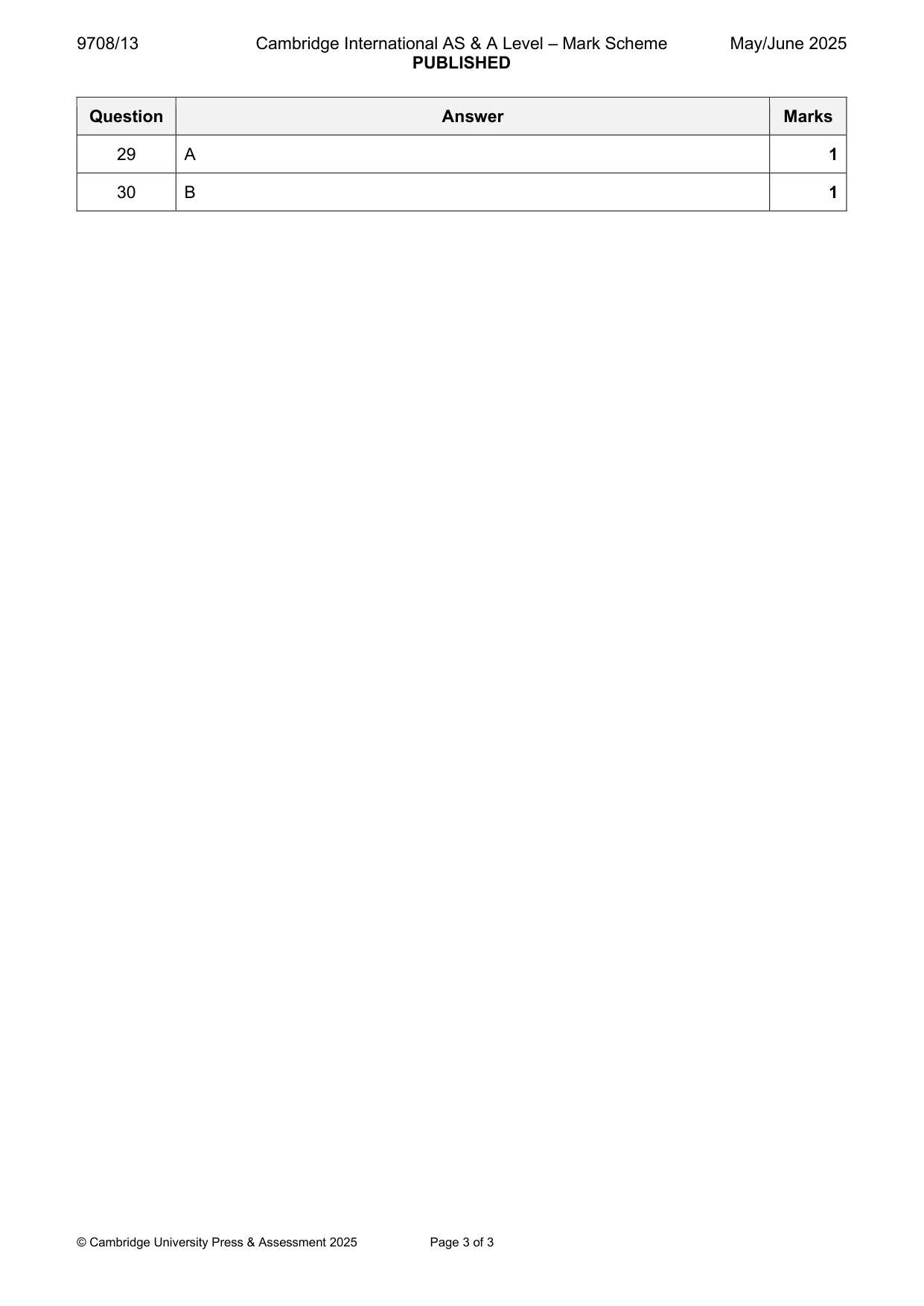
Mark scheme: A
More questions on Current account of the balance of payments
Q30 · Country X and country Y use the same amount of resources to produce mobile phones and…
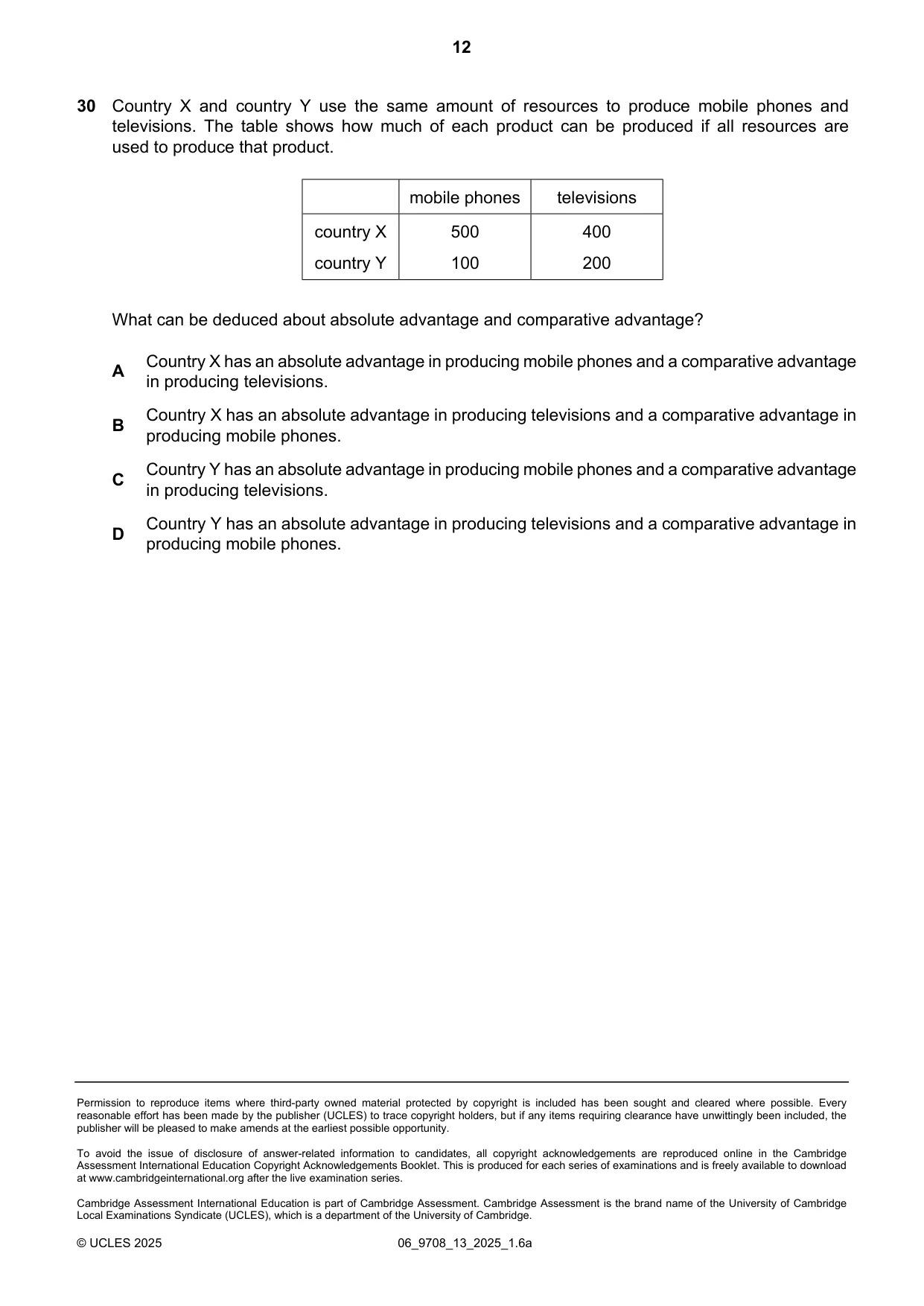
30 Country X and country Y use the same amount of resources to produce mobile phones and televisions. The table shows how much of each product can be produced if all resources are used to produce that product. mobile phones televisions country X 500 400 country Y 100 200 What can be deduced about absolute advantage and comparative advantage? Country X has an absolute advantage in producing mobile phones and a comparative advantage A in producing televisions. Country X has an absolute advantage in producing televisions and a comparative advantage in B producing mobile phones. Country Y has an absolute advantage in producing mobile phones and a comparative advantage C in producing televisions. Country Y has an absolute advantage in producing televisions and a comparative advantage in D producing mobile phones.
Mark scheme: B
What was in this paper
The subtopics covered by these 30 questions, and how many questions each got. Open one in a new tab to see every Cambridge question on it.
2Fiscal policy2Methods and effects of government intervention in markets2Monetary policy2Price elasticity of supply2Protectionism2The interaction of demand and supply2Addressing income and wealth inequality1Aggregate Demand and Aggregate Supply analysis1Classification of goods and services1Consumer and producer surplus1Economic growth1Factors of production1National income statistics1Price elasticity, income elasticity and cross elasticity of demand1Price stability1Production possibility curves1Reasons for government intervention in markets1Resource allocation in different economic systems1Scarcity, choice and opportunity cost1Supply-side policy1The reasons for international trade1Unemployment1What you needed in this session
Cambridge’s own grade thresholds for 2025 May/June, Paper 1 · Variant 3. A higher threshold means an easier paper — the bar moves with how the cohort did.