Cambridge A Level Economics 9708 — 2022 Oct/Nov Paper 1 · Variant 1
9708/11/O/N/22 · 30 questions · 30 marks · ≈34 min
The question paper and its mark scheme, free to read here and free to download. This is Cambridge’s own paper, exactly as it was sat.
Question paper16 pages
Mark scheme3 pages
Answers below. Sit the paper first if you are practising.
Questions as text
Q1 · An economy is changing from a planned economy to a market economy
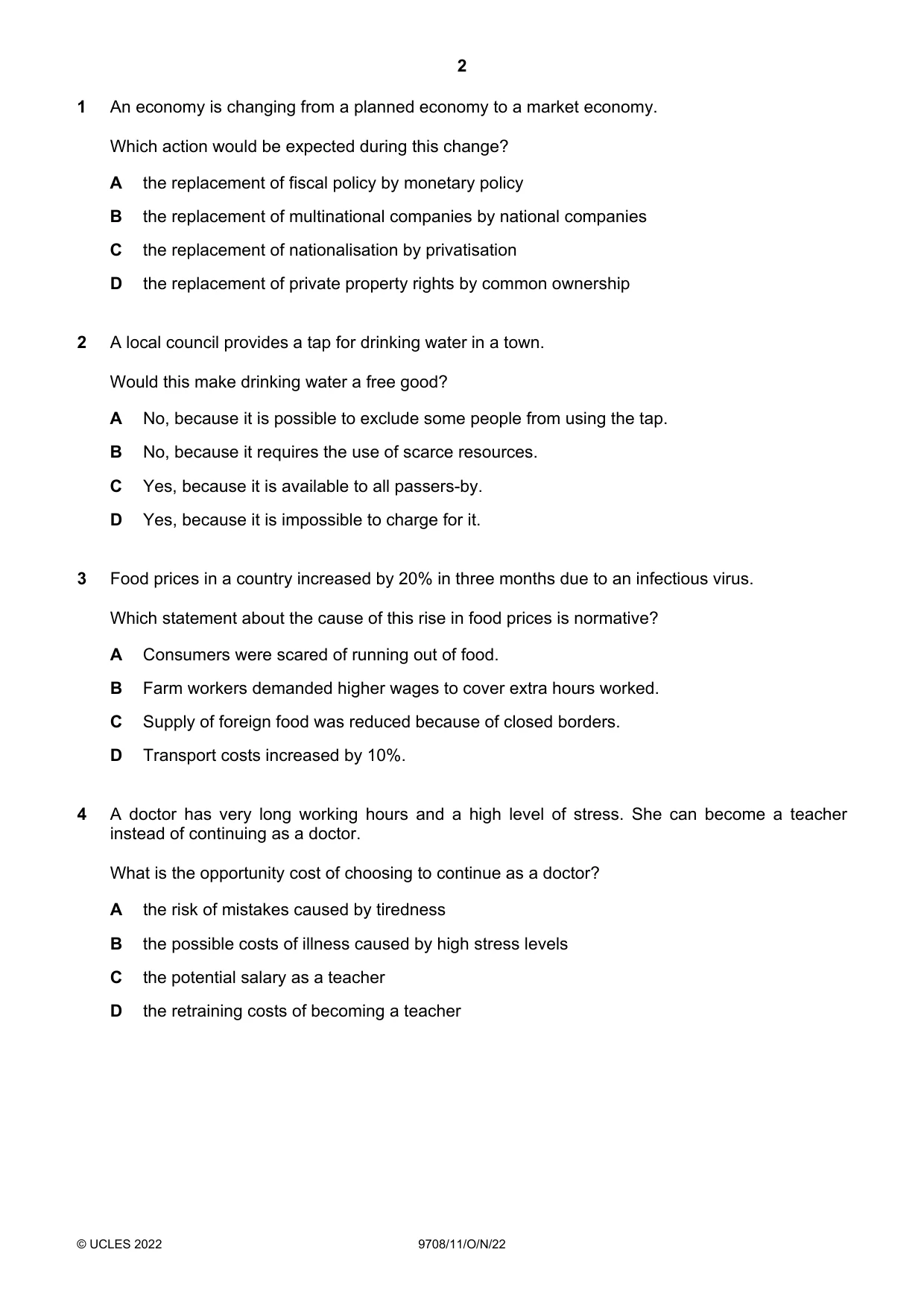
1 An economy is changing from a planned economy to a market economy. Which action would be expected during this change? A the replacement of fiscal policy by monetary policy B the replacement of multinational companies by national companies C the replacement of nationalisation by privatisation D the replacement of private property rights by common ownership
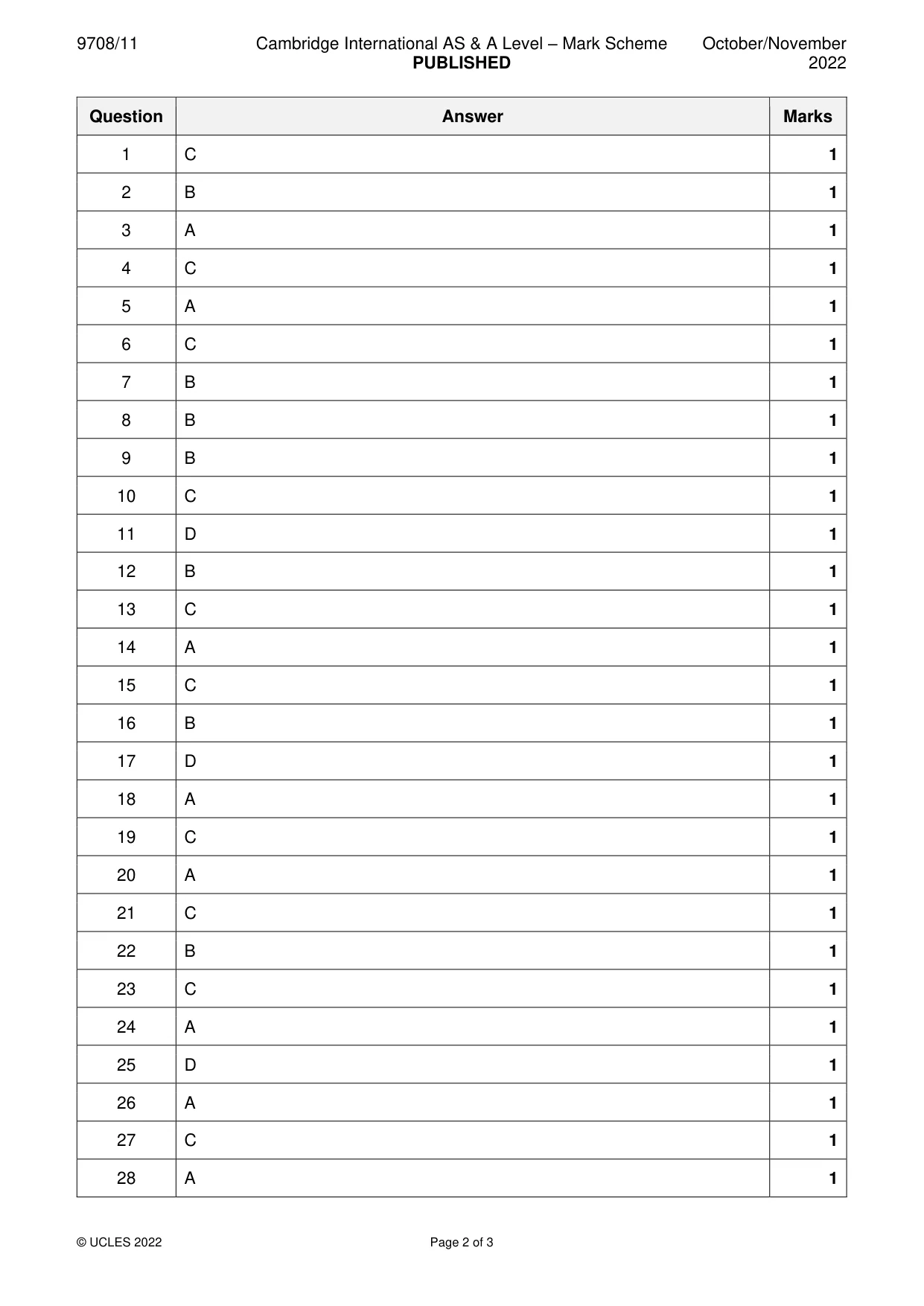
Mark scheme: C
More questions on Resource allocation in different economic systems
Q2 · A local council provides a tap for drinking water in a town
2 A local council provides a tap for drinking water in a town. Would this make drinking water a free good? A No, because it is possible to exclude some people from using the tap. B No, because it requires the use of scarce resources. C Yes, because it is available to all passers-by. D Yes, because it is impossible to charge for it.
Mark scheme: B
Q3 · Food prices in a country increased by 20% in three months due to an infectious virus
3 Food prices in a country increased by 20% in three months due to an infectious virus. Which statement about the cause of this rise in food prices is normative? A Consumers were scared of running out of food. B Farm workers demanded higher wages to cover extra hours worked. C Supply of foreign food was reduced because of closed borders. D Transport costs increased by 10%.
Mark scheme: A
Q4 · A doctor has very long working hours and a high level of stress
4 A doctor has very long working hours and a high level of stress. She can become a teacher instead of continuing as a doctor. What is the opportunity cost of choosing to continue as a doctor? A the risk of mistakes caused by tiredness B the possible costs of illness caused by high stress levels C the potential salary as a teacher D the retraining costs of becoming a teacher
Mark scheme: C
Q5 · When will the demand curve for motorcycles shift to the left?
5 When will the demand curve for motorcycles shift to the left? A when the price of cars falls B when the price of motorcycles falls C when the tax on motorcycles rises D when the price of public transport rises
Mark scheme: A
Q6 · The diagram shows the demand curve for housing
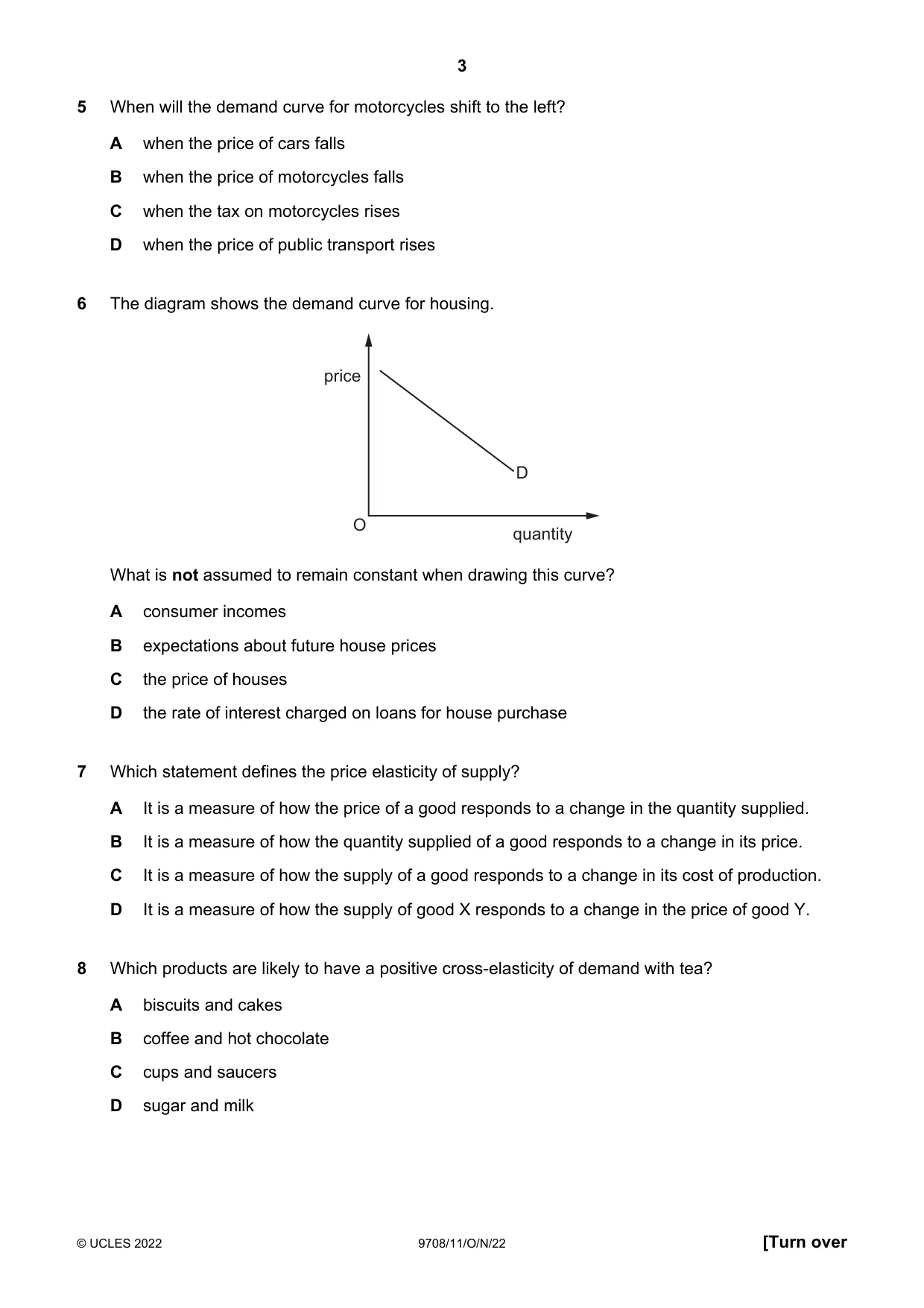
6 The diagram shows the demand curve for housing. price D O quantity What is not assumed to remain constant when drawing this curve? A consumer incomes B expectations about future house prices C the price of houses D the rate of interest charged on loans for house purchase
Mark scheme: C
Q7 · Which statement defines the price elasticity of supply?
7 Which statement defines the price elasticity of supply? A It is a measure of how the price of a good responds to a change in the quantity supplied. B It is a measure of how the quantity supplied of a good responds to a change in its price. C It is a measure of how the supply of a good responds to a change in its cost of production. D It is a measure of how the supply of good X responds to a change in the price of good Y.
Mark scheme: B
Q8 · Which products are likely to have a positive cross-elasticity of demand with tea?
8 Which products are likely to have a positive cross-elasticity of demand with tea? A biscuits and cakes B coffee and hot chocolate C cups and saucers D sugar and milk
Mark scheme: B
More questions on Price elasticity, income elasticity and cross elasticity of demand
Q9 · What does not cause a shift in the supply curve of cars?
9 What does not cause a shift in the supply curve of cars? A a change in the car producers’ costs of production B a change in the price of fuel used by car owners C a change in the rate of sales tax on cars D a change in the wage rate of workers in the car industry
Mark scheme: B
Q10 · The diagram shows the market for pineapples
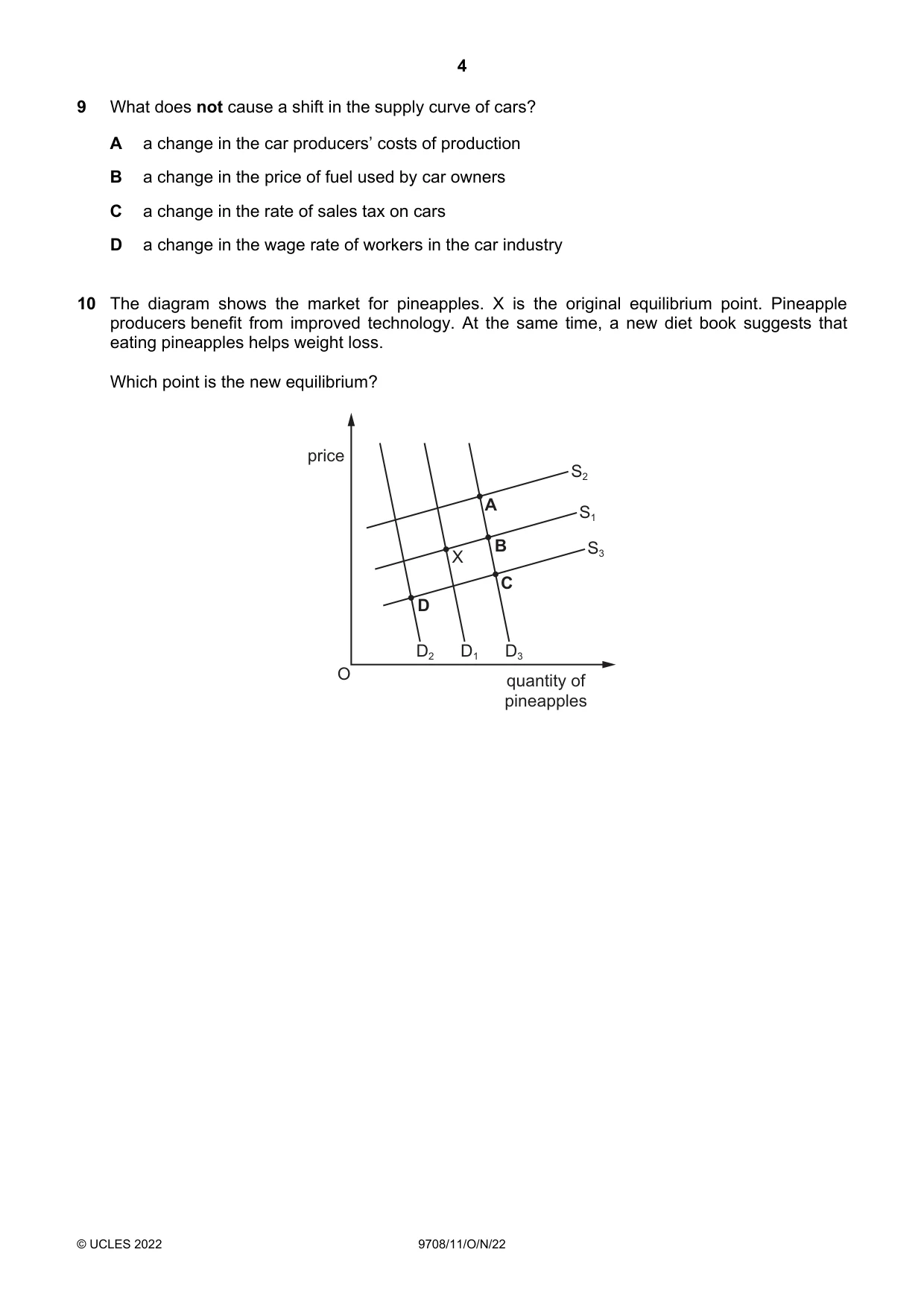
10 The diagram shows the market for pineapples. X is the original equilibrium point. Pineapple producers benefit from improved technology. At the same time, a new diet book suggests that eating pineapples helps weight loss. Which point is the new equilibrium? price S2 A S1 B S3 X C D D2 D1 D3 O quantity of pineapples
Mark scheme: C
Q11 · The diagram shows the impact of a fall in the price of oil that will lead to a fall in…
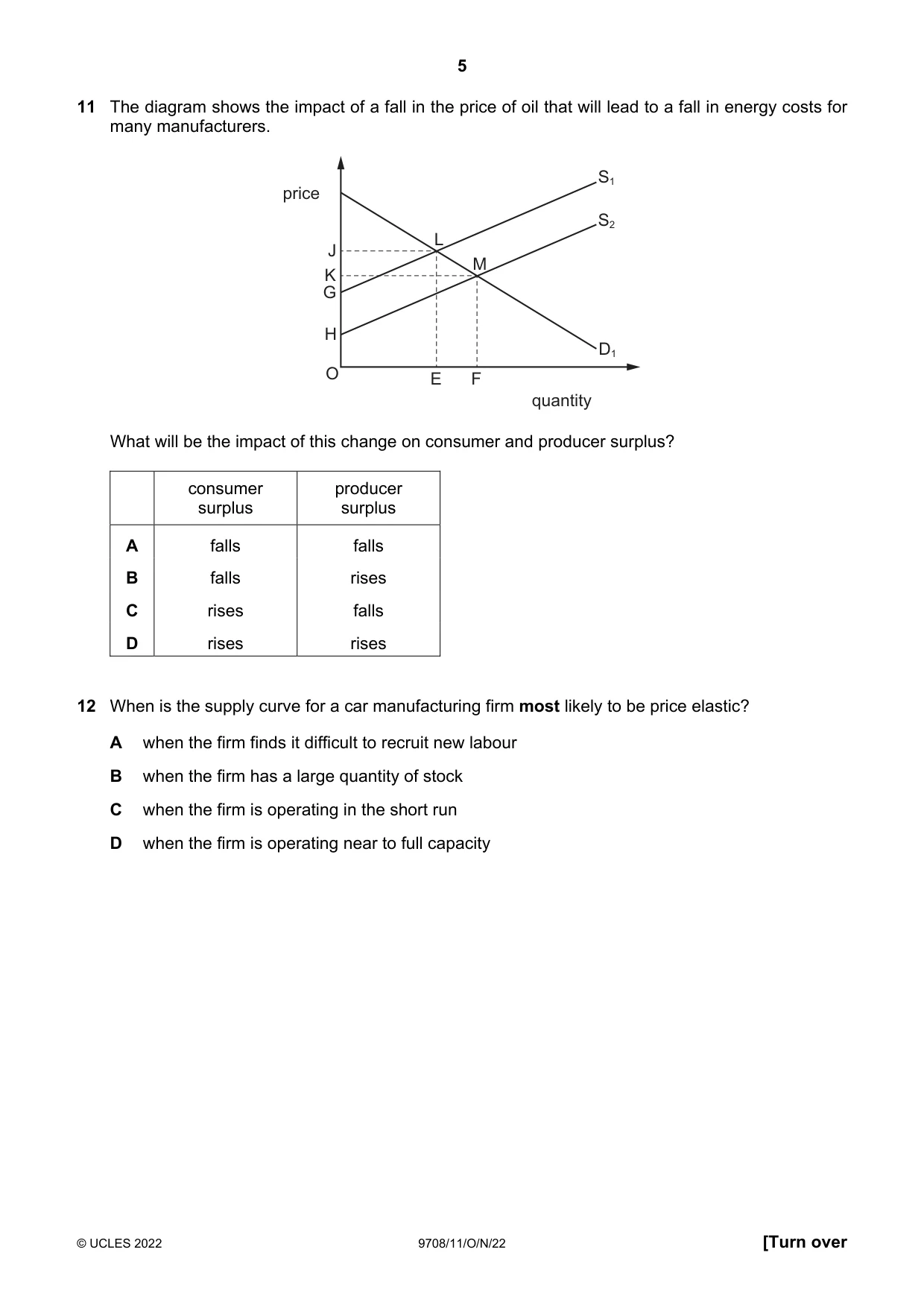
11 The diagram shows the impact of a fall in the price of oil that will lead to a fall in energy costs for many manufacturers. S1 price S2 L J M K G H D1 O E F quantity What will be the impact of this change on consumer and producer surplus? consumer producer surplus surplus A falls falls B falls rises C rises falls D rises rises
Mark scheme: D
Q12 · When is the supply curve for a car manufacturing firm most likely to be price elastic?
12 When is the supply curve for a car manufacturing firm most likely to be price elastic? A when the firm finds it difficult to recruit new labour B when the firm has a large quantity of stock C when the firm is operating in the short run D when the firm is operating near to full capacity
Mark scheme: B
Q13 · The diagram shows the market for electric steel-plated switches used in new houses
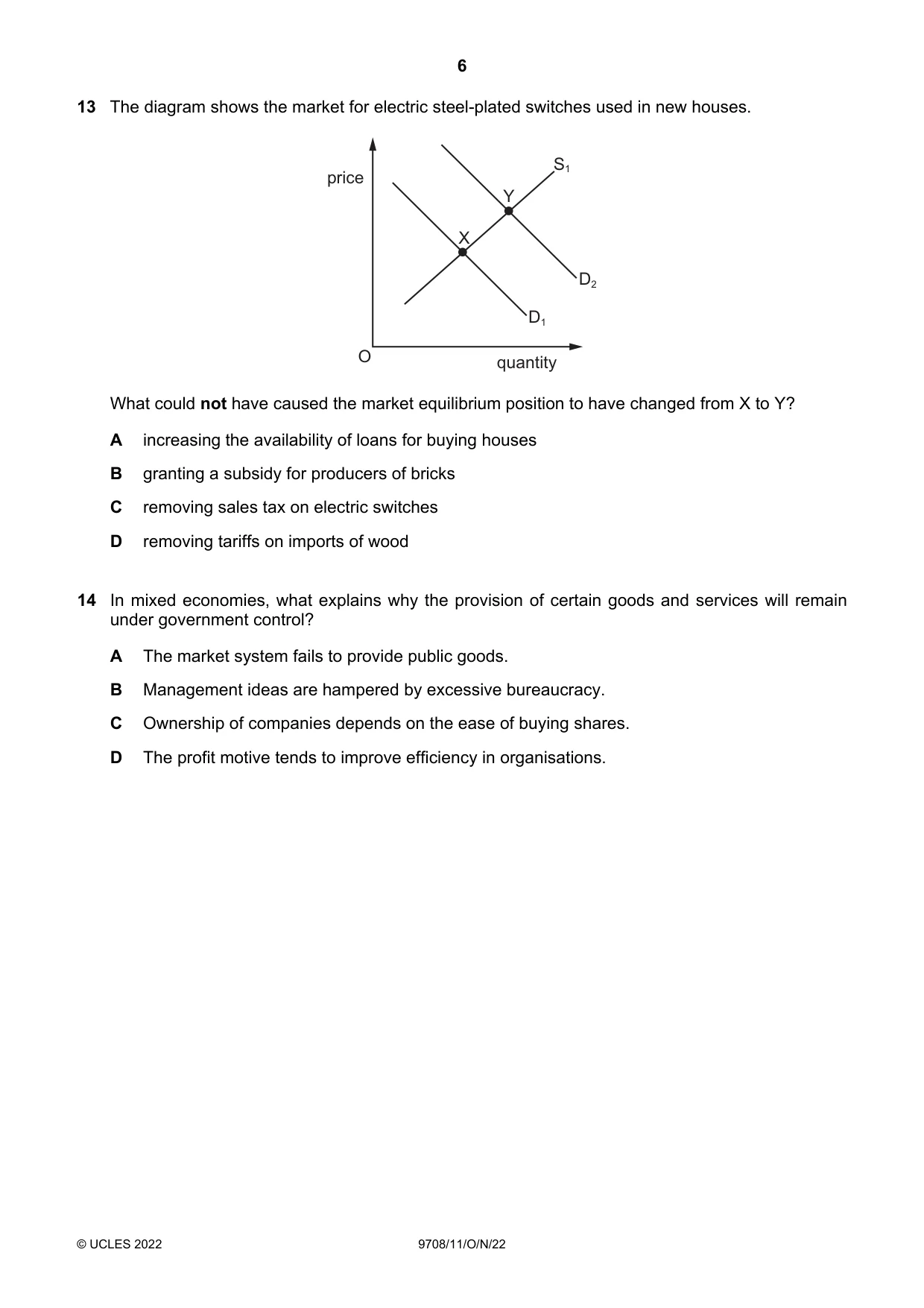
13 The diagram shows the market for electric steel-plated switches used in new houses. S1 price Y X D2 D1 O quantity What could not have caused the market equilibrium position to have changed from X to Y? A increasing the availability of loans for buying houses B granting a subsidy for producers of bricks C removing sales tax on electric switches D removing tariffs on imports of wood
Mark scheme: C
Q14 · In mixed economies, what explains why the provision of certain goods and services will…
14 In mixed economies, what explains why the provision of certain goods and services will remain under government control? A The market system fails to provide public goods. B Management ideas are hampered by excessive bureaucracy. C Ownership of companies depends on the ease of buying shares. D The profit motive tends to improve efficiency in organisations.
Mark scheme: A
More questions on Reasons for government intervention in markets
Q15 · The diagram shows the percentages of those on low pay and those on extremely low pay in a…
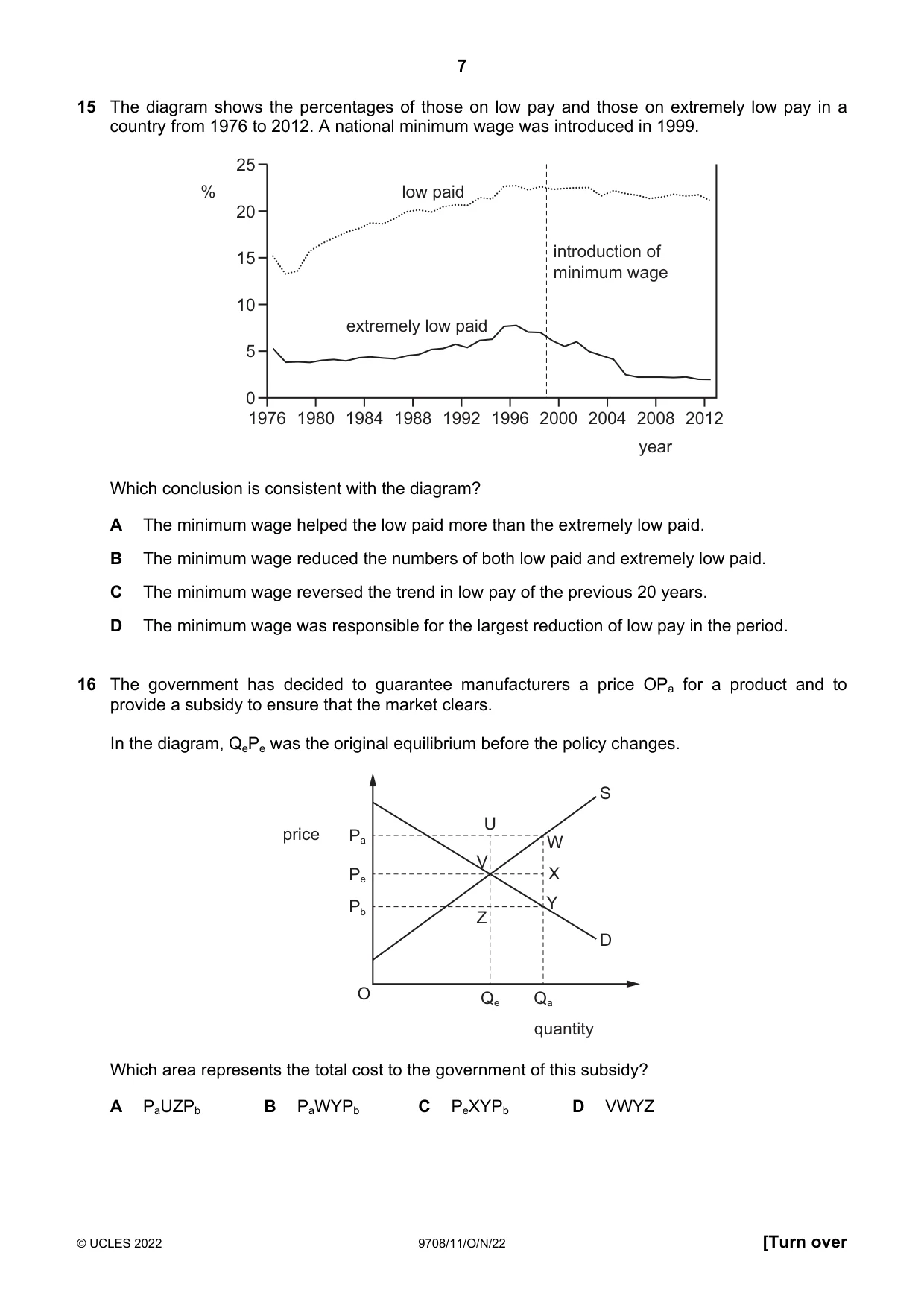
15 The diagram shows the percentages of those on low pay and those on extremely low pay in a country from 1976 to 2012. A national minimum wage was introduced in 1999. 25 % low paid 20 15 introduction of minimum wage 10 extremely low paid 5 0 1976 1980 1984 1988 1992 1996 2000 2004 2008 2012 year Which conclusion is consistent with the diagram? A The minimum wage helped the low paid more than the extremely low paid. B The minimum wage reduced the numbers of both low paid and extremely low paid. C The minimum wage reversed the trend in low pay of the previous 20 years. D The minimum wage was responsible for the largest reduction of low pay in the period.
Mark scheme: C
More questions on Methods and effects of government intervention in markets
Q16 · The government has decided to guarantee manufacturers a price OPa for a product and to…
16 The government has decided to guarantee manufacturers a price OPa for a product and to provide a subsidy to ensure that the market clears. In the diagram, QePe was the original equilibrium before the policy changes. S U price Pa W V Pe X Pb Y Z D O Qe Qa quantity Which area represents the total cost to the government of this subsidy? A PaUZPb B PaWYPb C PeXYPb D VWYZ
Mark scheme: B
More questions on Methods and effects of government intervention in markets
Q17 · A concert arena has a fixed capacity that allows it to sell 10 000 tickets for a concert
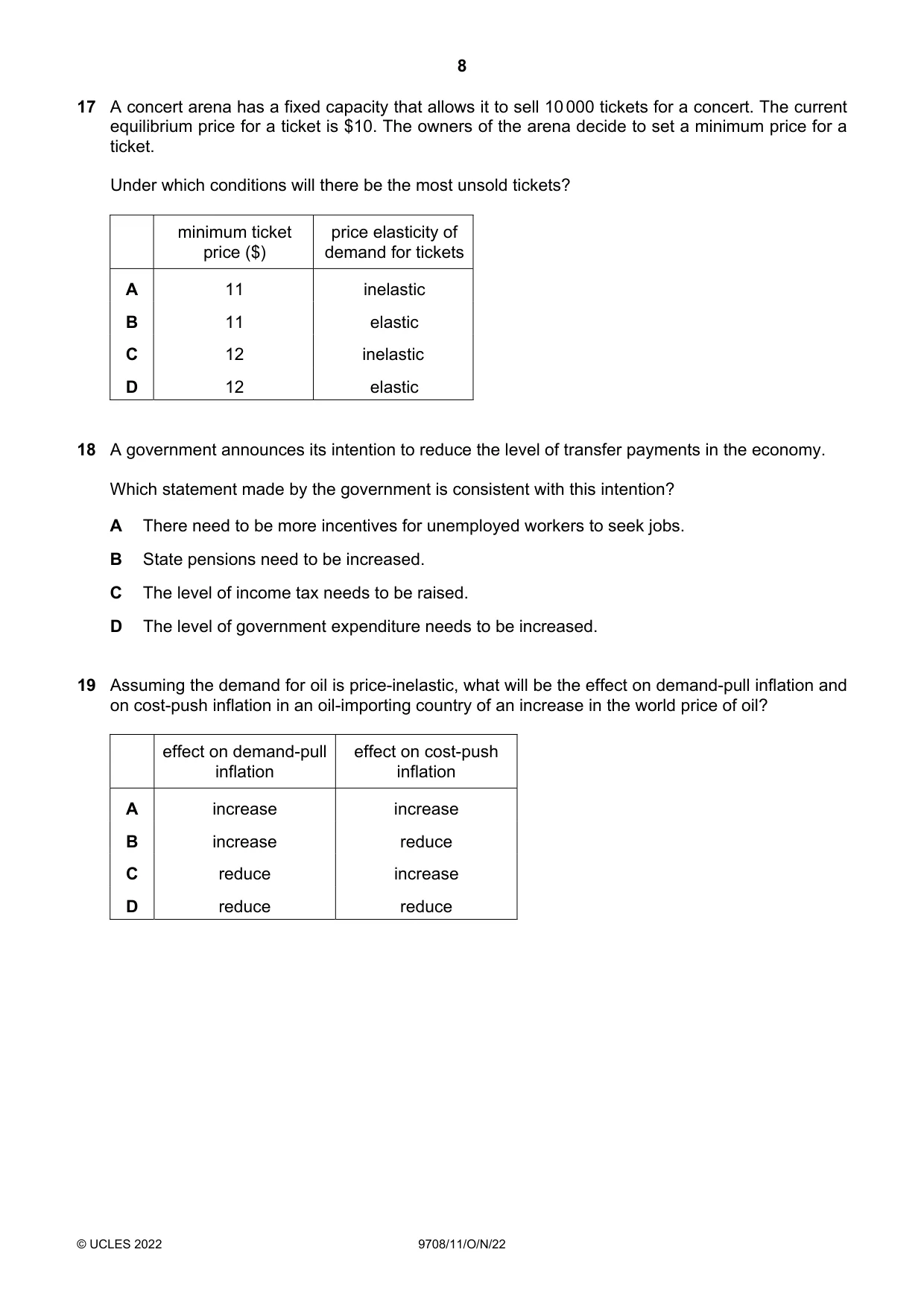
17 A concert arena has a fixed capacity that allows it to sell 10 000 tickets for a concert. The current equilibrium price for a ticket is $10. The owners of the arena decide to set a minimum price for a ticket. Under which conditions will there be the most unsold tickets? minimum ticket price elasticity of price ($) demand for tickets A 11 inelastic B 11 elastic C 12 inelastic D 12 elastic
Mark scheme: D
More questions on Methods and effects of government intervention in markets
Q18 · A government announces its intention to reduce the level of transfer payments in the…
18 A government announces its intention to reduce the level of transfer payments in the economy. Which statement made by the government is consistent with this intention? A There need to be more incentives for unemployed workers to seek jobs. B State pensions need to be increased. C The level of income tax needs to be raised. D The level of government expenditure needs to be increased.
Mark scheme: A
Q19 · Assuming the demand for oil is price-inelastic, what will be the effect on demand-pull…
19 Assuming the demand for oil is price-inelastic, what will be the effect on demand-pull inflation and on cost-push inflation in an oil-importing country of an increase in the world price of oil? effect on demand-pull effect on cost-push inflation inflation A increase increase B increase reduce C reduce increase D reduce reduce
Mark scheme: C
More questions on Aggregate Demand and Aggregate Supply analysis
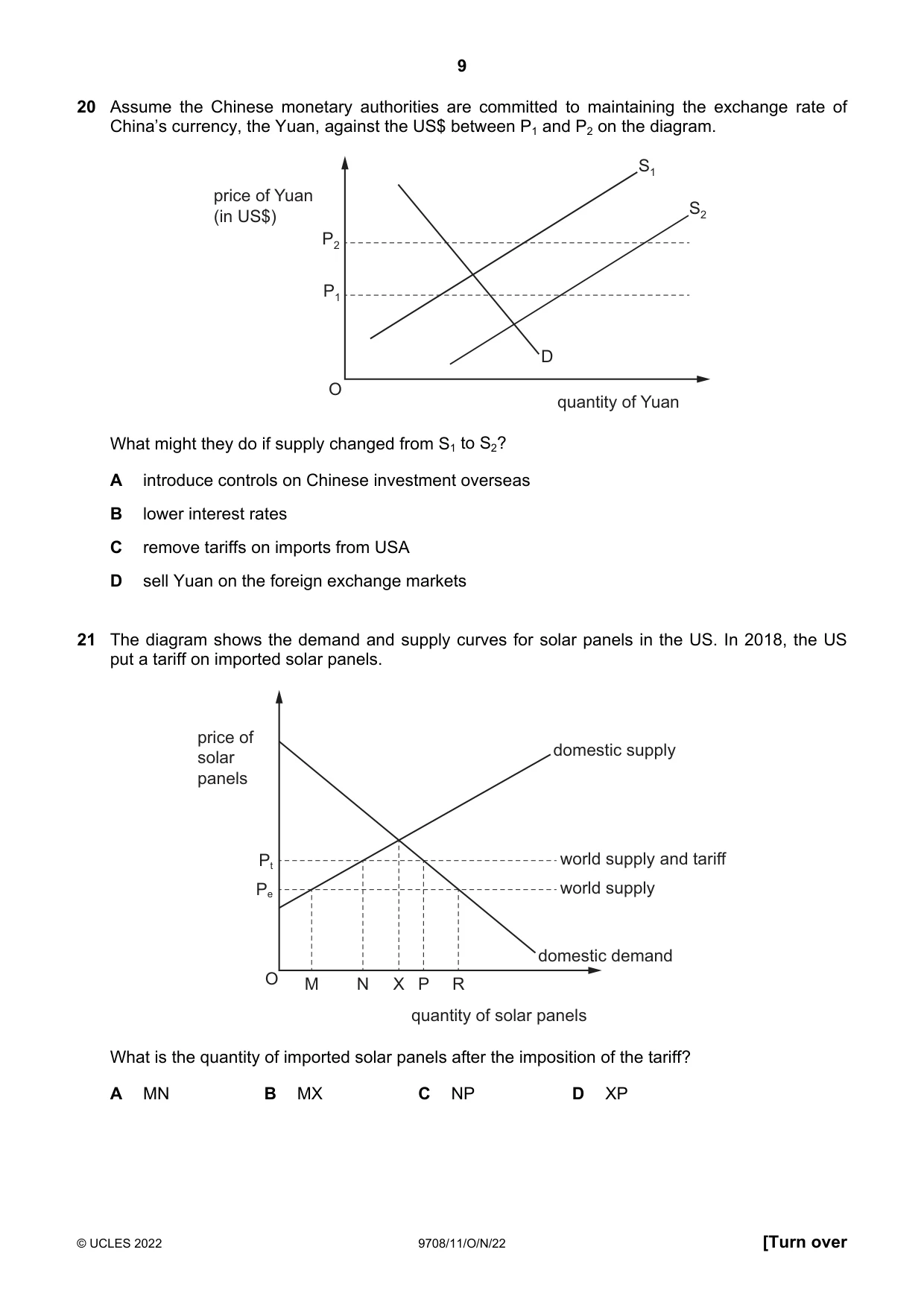
Q20 · Assume the Chinese monetary authorities are committed to maintaining the exchange rate of…
20 Assume the Chinese monetary authorities are committed to maintaining the exchange rate of China’s currency, the Yuan, against the US$ between P1 and P2 on the diagram. S1 price of Yuan S2 (in US$) P2 P1 D O quantity of Yuan What might they do if supply changed from S1 to S2? A introduce controls on Chinese investment overseas B lower interest rates C remove tariffs on imports from USA D sell Yuan on the foreign exchange markets
Mark scheme: A
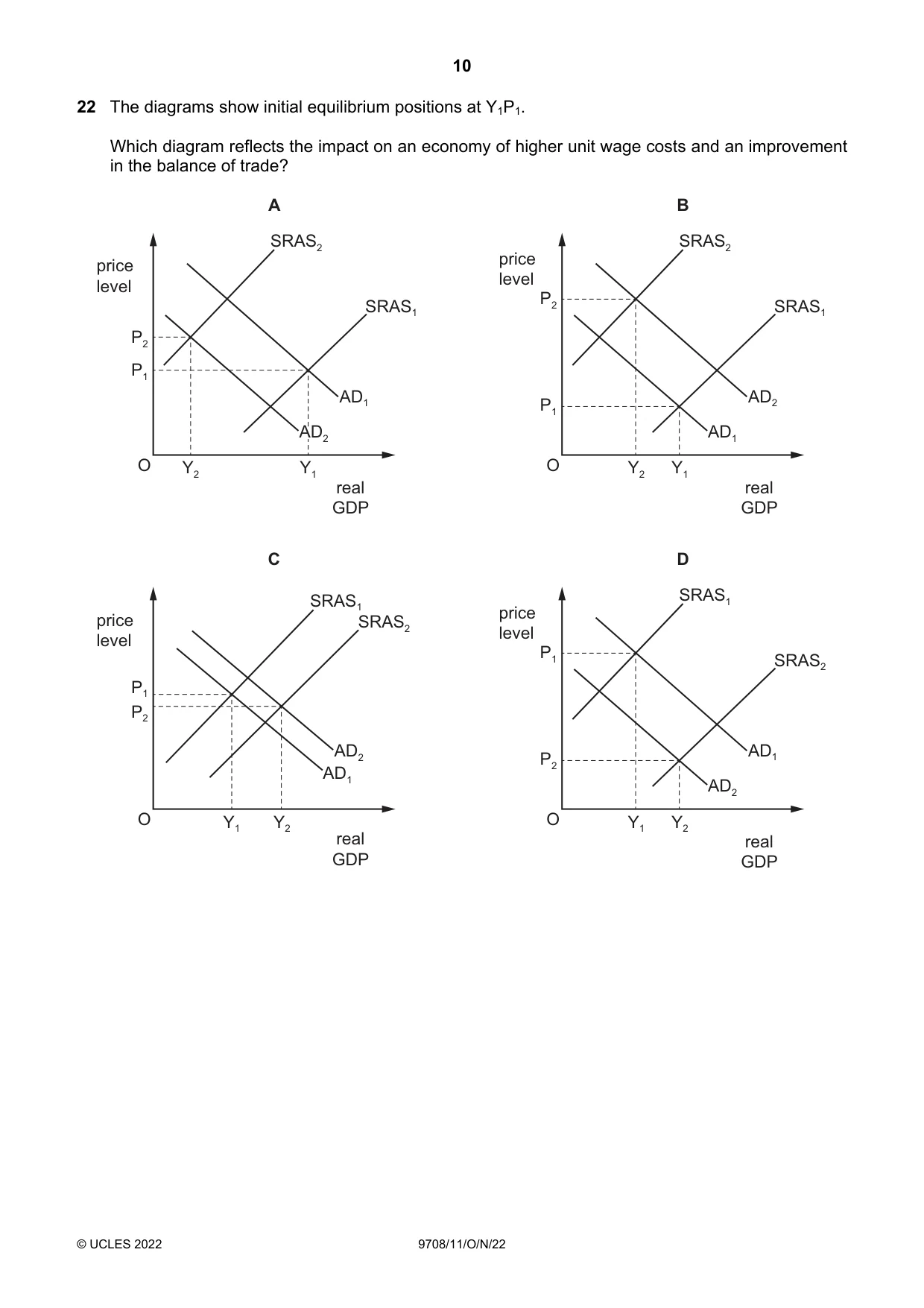
Q21 · The diagram shows the demand and supply curves for solar panels in the US
21 The diagram shows the demand and supply curves for solar panels in the US. In 2018, the US put a tariff on imported solar panels. price of solar domestic supply panels Pt world supply and tariff Pe world supply domestic demand O M N X P R quantity of solar panels What is the quantity of imported solar panels after the imposition of the tariff? A MN B MX C NP D XP
Mark scheme: C
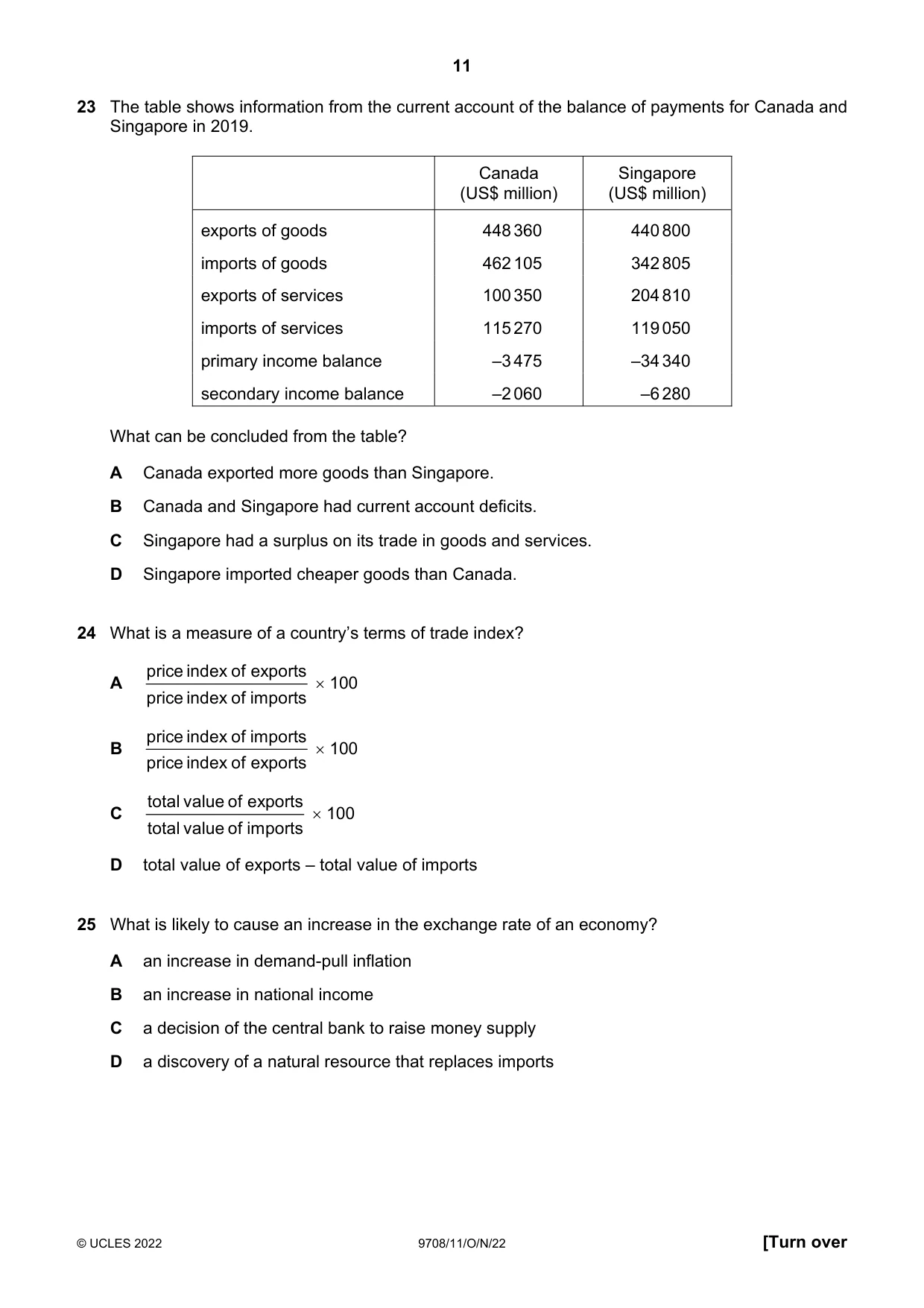
Q22 · The diagrams show initial equilibrium positions at Y1P1
22 The diagrams show initial equilibrium positions at Y1P1. Which diagram reflects the impact on an economy of higher unit wage costs and an improvement in the balance of trade? A B SRAS2 SRAS2 price price level level SRAS1 P2 SRAS1 P2 P1 AD1 AD2 P1 AD AD2 AD2 AD AD2 AD1 O Y2 Y1 O Y2 Y1 real real GDP GDP C D SRAS1 SRAS1 price price SRAS2 level level P1 SRAS2 P1 P2 AD2 AD1 P2 AD1 AD AD2 AD AD2 AD2 O Y1 Y2 O Y1 Y2 real real GDP GDP
Mark scheme: B
More questions on Aggregate Demand and Aggregate Supply analysis
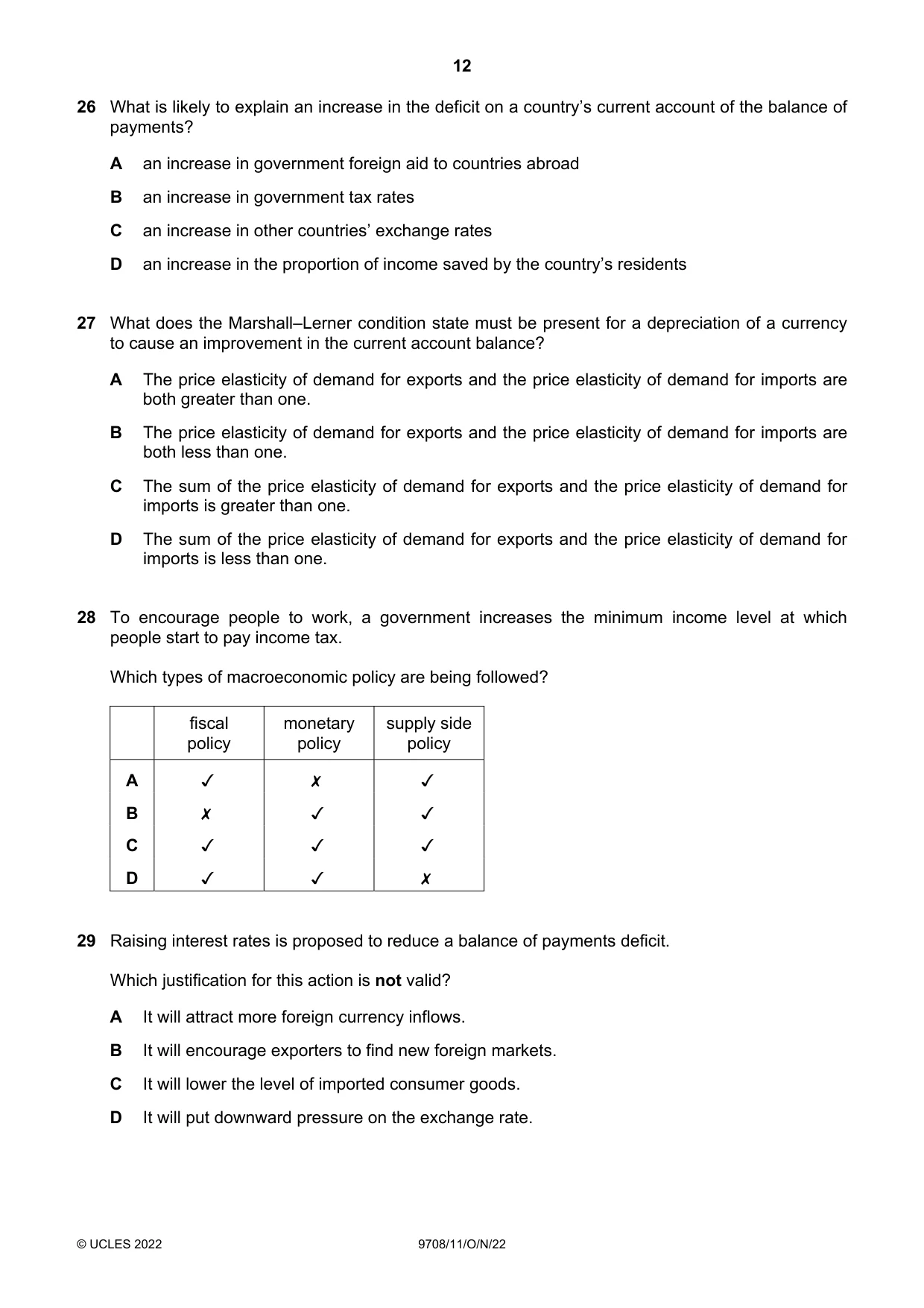
Q23 · The table shows information from the current account of the balance of payments for…
23 The table shows information from the current account of the balance of payments for Canada and Singapore in 2019. Canada Singapore (US$ million) (US$ million) exports of goods 448 360 440 800 imports of goods 462 105 342 805 exports of services 100 350 204 810 imports of services 115 270 119 050 primary income balance –3 475 –34 340 secondary income balance –2 060 –6 280 What can be concluded from the table? A Canada exported more goods than Singapore. B Canada and Singapore had current account deficits. C Singapore had a surplus on its trade in goods and services. D Singapore imported cheaper goods than Canada.
Mark scheme: C
More questions on Current account of the balance of payments
Q24 · What is a measure of a country’s terms of trade index?
24 What is a measure of a country’s terms of trade index? price index of exports A × 100 price index of imports price index of imports B × 100 price index of exports total value of exports C × 100 total value of imports D total value of exports – total value of imports
Mark scheme: A
More questions on Policies to correct disequilibrium in the balance of payments
Q25 · What is likely to cause an increase in the exchange rate of an economy?
25 What is likely to cause an increase in the exchange rate of an economy? A an increase in demand-pull inflation B an increase in national income C a decision of the central bank to raise money supply D a discovery of a natural resource that replaces imports
Mark scheme: D
Q26 · What is likely to explain an increase in the deficit on a country’s current account of…
26 What is likely to explain an increase in the deficit on a country’s current account of the balance of payments? A an increase in government foreign aid to countries abroad B an increase in government tax rates C an increase in other countries’ exchange rates D an increase in the proportion of income saved by the country’s residents
Mark scheme: A
More questions on Current account of the balance of payments
Q27 · What does the Marshall–Lerner condition state must be present for a depreciation of a…
27 What does the Marshall–Lerner condition state must be present for a depreciation of a currency to cause an improvement in the current account balance? A The price elasticity of demand for exports and the price elasticity of demand for imports are both greater than one. B The price elasticity of demand for exports and the price elasticity of demand for imports are both less than one. C The sum of the price elasticity of demand for exports and the price elasticity of demand for imports is greater than one. D The sum of the price elasticity of demand for exports and the price elasticity of demand for imports is less than one.
Mark scheme: C
More questions on Policies to correct imbalances in the current account of the balance of payments
Q28 · To encourage people to work, a government increases the minimum income level at which…
28 To encourage people to work, a government increases the minimum income level at which people start to pay income tax. Which types of macroeconomic policy are being followed? fiscal monetary supply side policy policy policy A J x J B x J J Cc J J J D J J x
Mark scheme: A
Q29 · Raising interest rates is proposed to reduce a balance of payments deficit
29 Raising interest rates is proposed to reduce a balance of payments deficit. Which justification for this action is not valid? A It will attract more foreign currency inflows. B It will encourage exporters to find new foreign markets. C It will lower the level of imported consumer goods. D It will put downward pressure on the exchange rate.
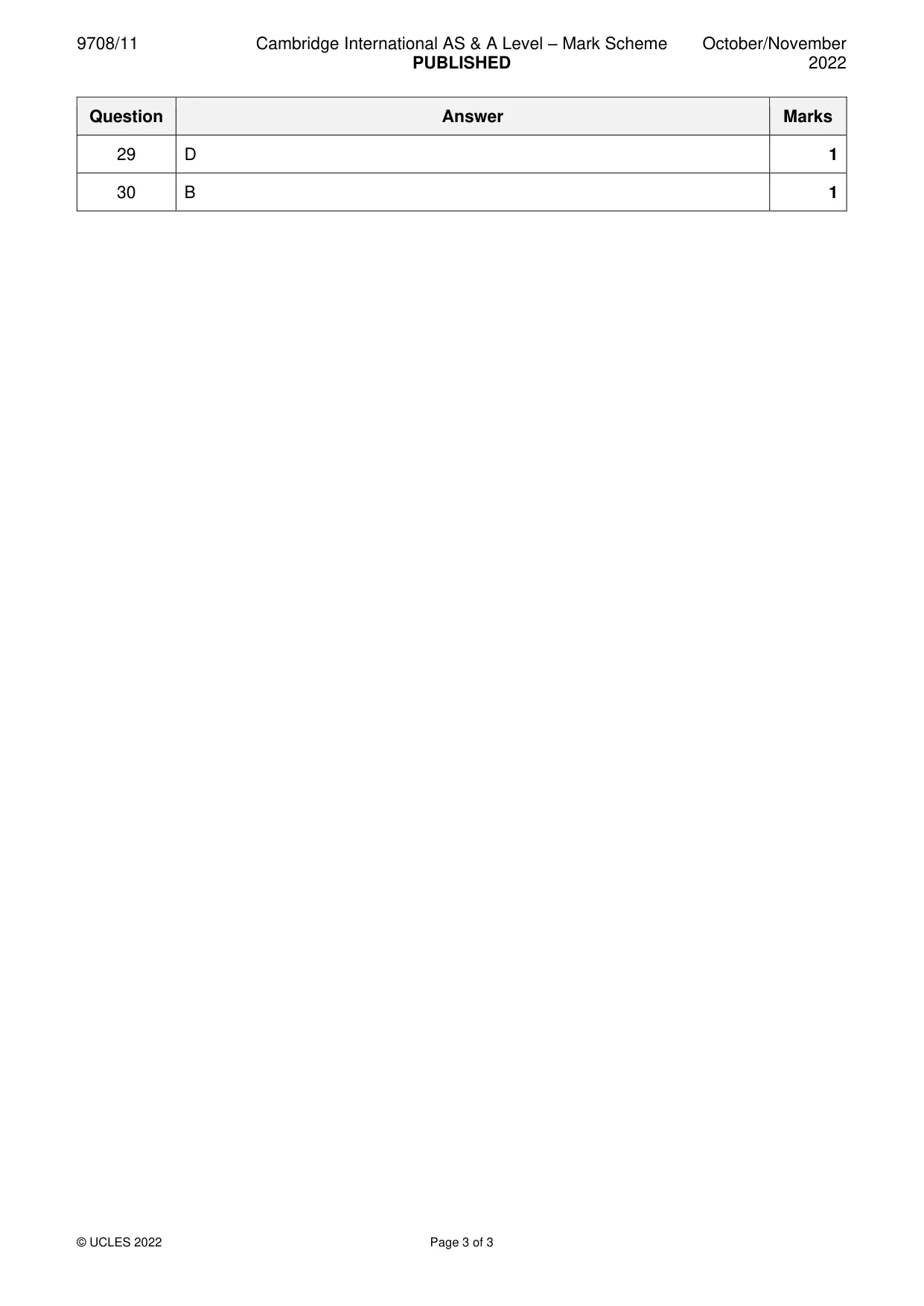
Mark scheme: D
More questions on Policies to correct imbalances in the current account of the balance of payments
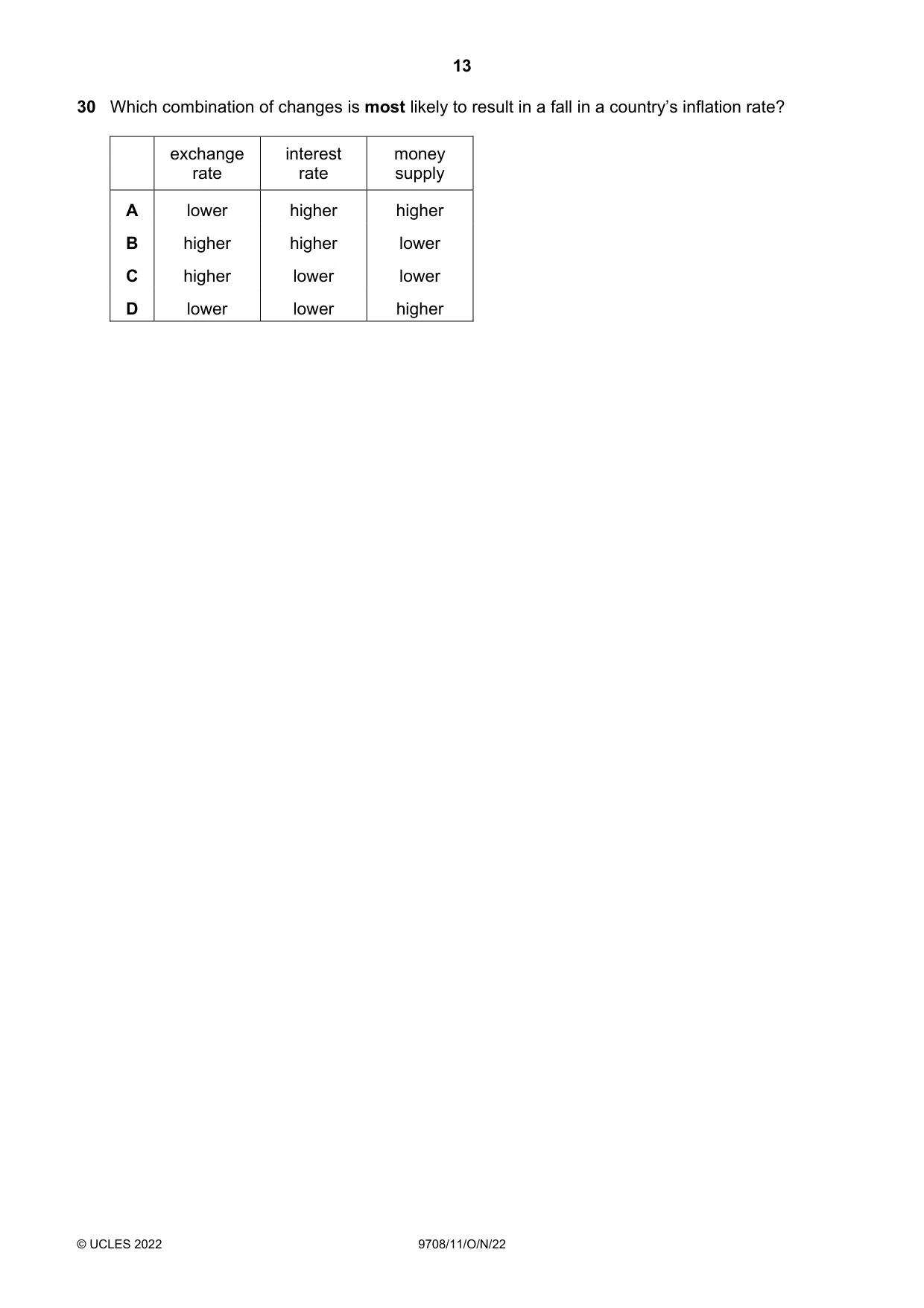
Q30 · Which combination of changes is most likely to result in a fall in a country’s inflation…
30 Which combination of changes is most likely to result in a fall in a country’s inflation rate? exchange interest money rate rate supply A lower higher higher B higher higher lower C higher lower lower D lower lower higher
Mark scheme: B
What was in this paper
The subtopics covered by these 30 questions, and how many questions each got. Open one in a new tab to see every Cambridge question on it.
3Methods and effects of government intervention in markets3Aggregate Demand and Aggregate Supply analysis2Current account of the balance of payments2Exchange rates2Policies to correct imbalances in the current account of the balance of payments2Price elasticity of supply2The interaction of demand and supply2Addressing income and wealth inequality1Classification of goods and services1Consumer and producer surplus1Economic methodology1Fiscal policy1Monetary policy1Policies to correct disequilibrium in the balance of payments1Price elasticity, income elasticity and cross elasticity of demand1Protectionism1Reasons for government intervention in markets1Resource allocation in different economic systems1Scarcity, choice and opportunity cost1What you needed in this session
Cambridge’s own grade thresholds for 2022 Oct/Nov, Paper 1 · Variant 1. A higher threshold means an easier paper — the bar moves with how the cohort did.