Cambridge A Level Economics 9708 — 2020 May/June Paper 1 · Variant 1
9708/11/M/J/20 · 30 questions · 30 marks · ≈34 min
The question paper and its mark scheme, free to read here and free to download. This is Cambridge’s own paper, exactly as it was sat.
Question paper12 pages
Mark scheme3 pages
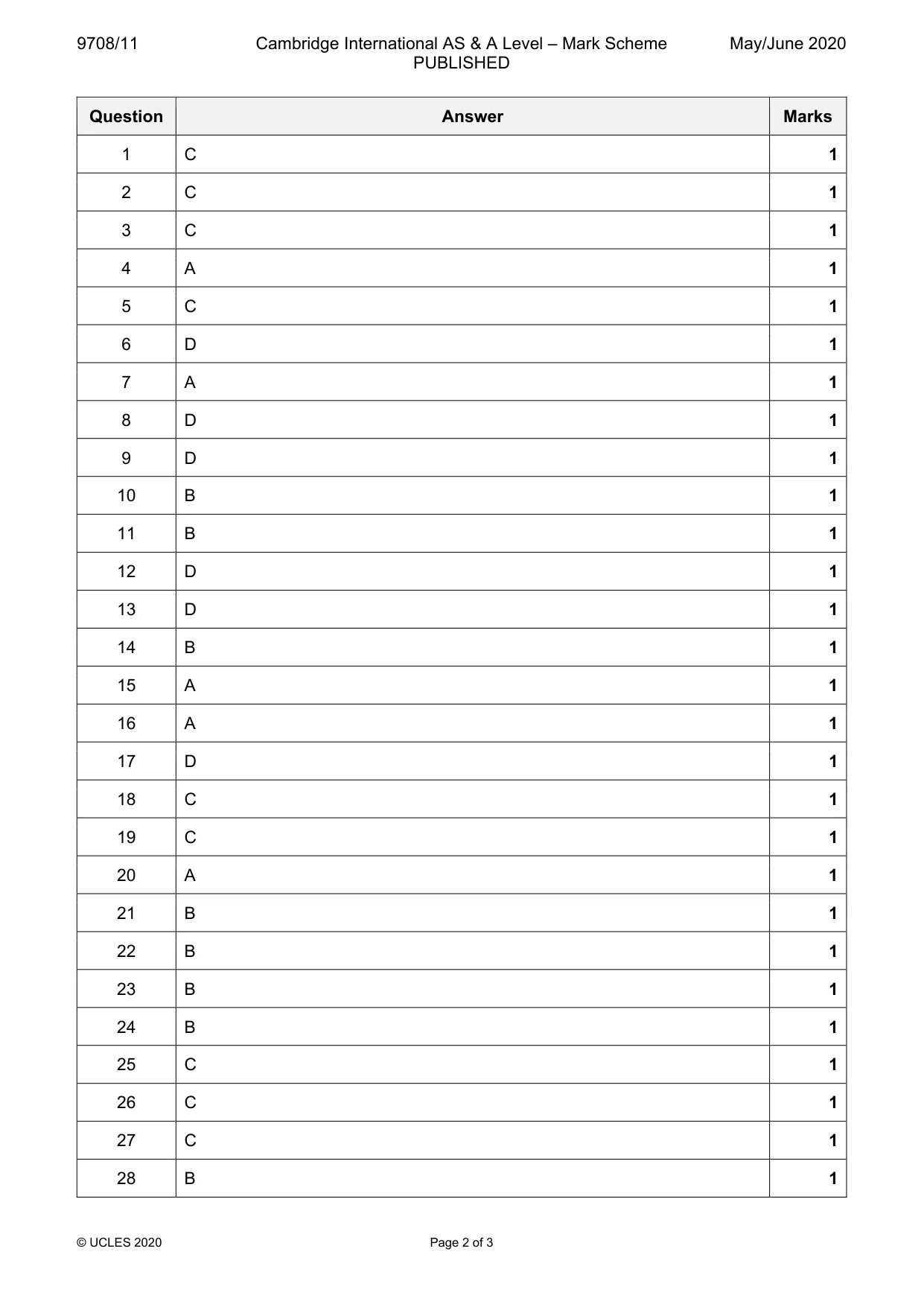
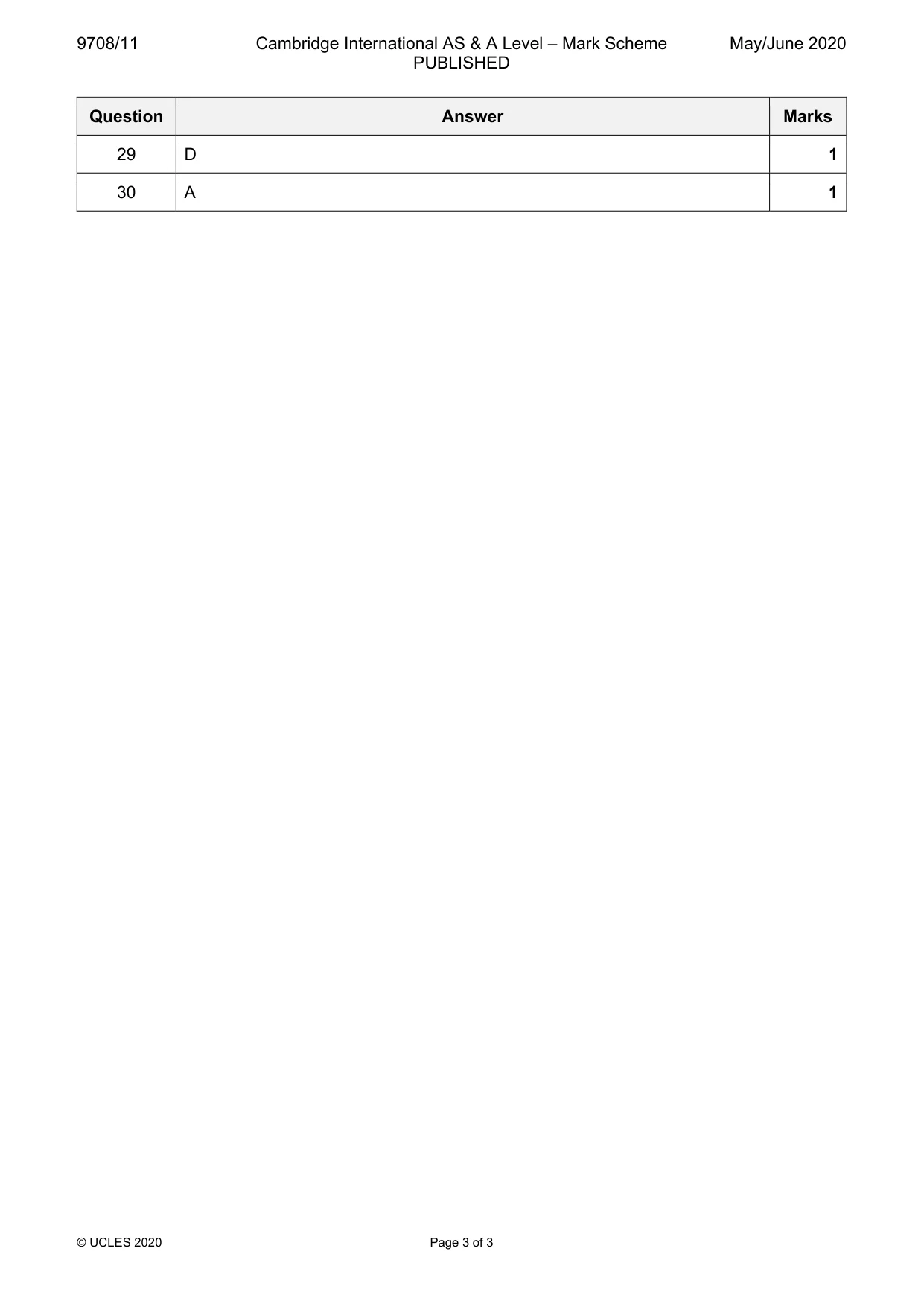
Answers below. Sit the paper first if you are practising.
Questions as text
Q1 · The transition of centrally planned economies to market economies was accompanied by a…
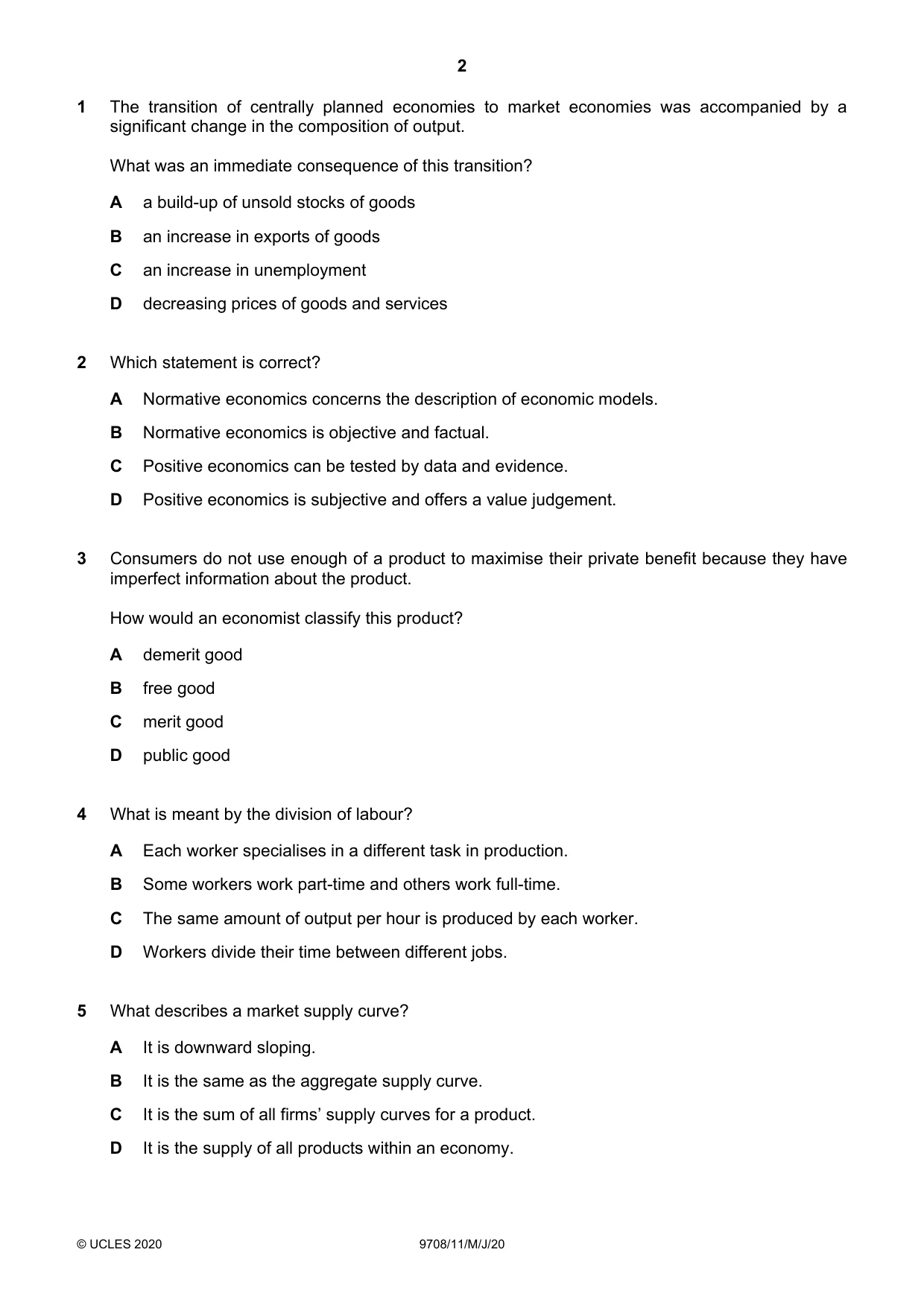
1 The transition of centrally planned economies to market economies was accompanied by a significant change in the composition of output. What was an immediate consequence of this transition? A a build-up of unsold stocks of goods B an increase in exports of goods C an increase in unemployment D decreasing prices of goods and services
Mark scheme: C
More questions on Resource allocation in different economic systems
Q2 · Which statement is correct?
2 Which statement is correct? A Normative economics concerns the description of economic models. B Normative economics is objective and factual. C Positive economics can be tested by data and evidence. D Positive economics is subjective and offers a value judgement.
Mark scheme: C
Q3 · Consumers do not use enough of a product to maximise their private benefit because they…
3 Consumers do not use enough of a product to maximise their private benefit because they have imperfect information about the product. How would an economist classify this product? A demerit good B free good C merit good D public good
Mark scheme: C
Q4 · What is meant by the division of labour?
4 What is meant by the division of labour? A Each worker specialises in a different task in production. B Some workers work part-time and others work full-time. C The same amount of output per hour is produced by each worker. D Workers divide their time between different jobs.
Mark scheme: A
Q5 · What describes a market supply curve?
5 What describes a market supply curve? A It is downward sloping. B It is the same as the aggregate supply curve. C It is the sum of all firms’ supply curves for a product. D It is the supply of all products within an economy.
Mark scheme: C
Q6 · In the diagram, D is the demand curve for Indian tea exports and S1 is the supply curve…
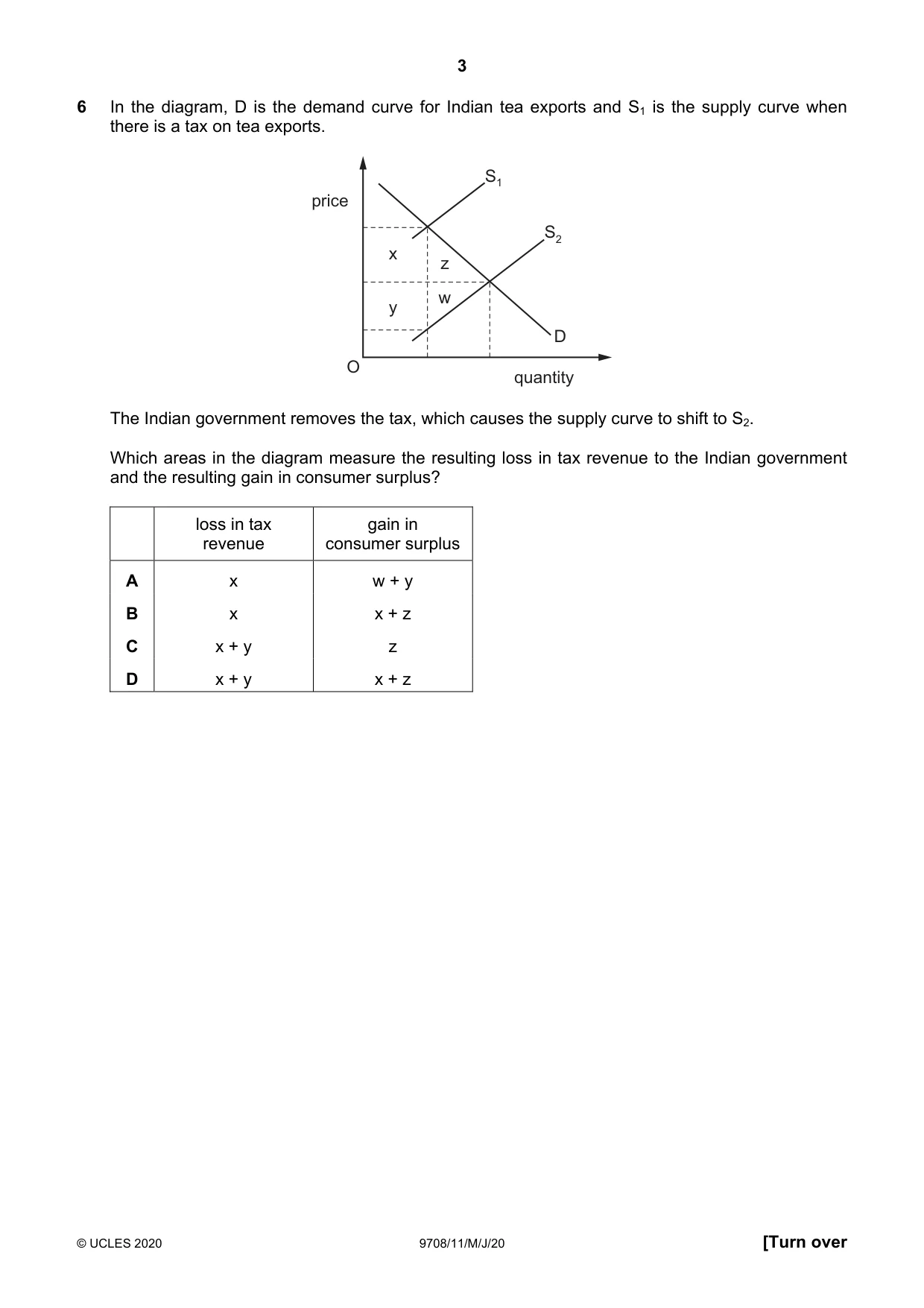
6 In the diagram, D is the demand curve for Indian tea exports and S1 is the supply curve when there is a tax on tea exports. S1 price S2 x z w y D O quantity The Indian government removes the tax, which causes the supply curve to shift to S2. Which areas in the diagram measure the resulting loss in tax revenue to the Indian government and the resulting gain in consumer surplus? loss in tax gain in revenue consumer surplus A x w + y B x x + z C x + y z D x + y x + z
Mark scheme: D
More questions on Methods and effects of government intervention in markets
Q7 · In which market would equilibrium not be achieved at point E if price were above Op?
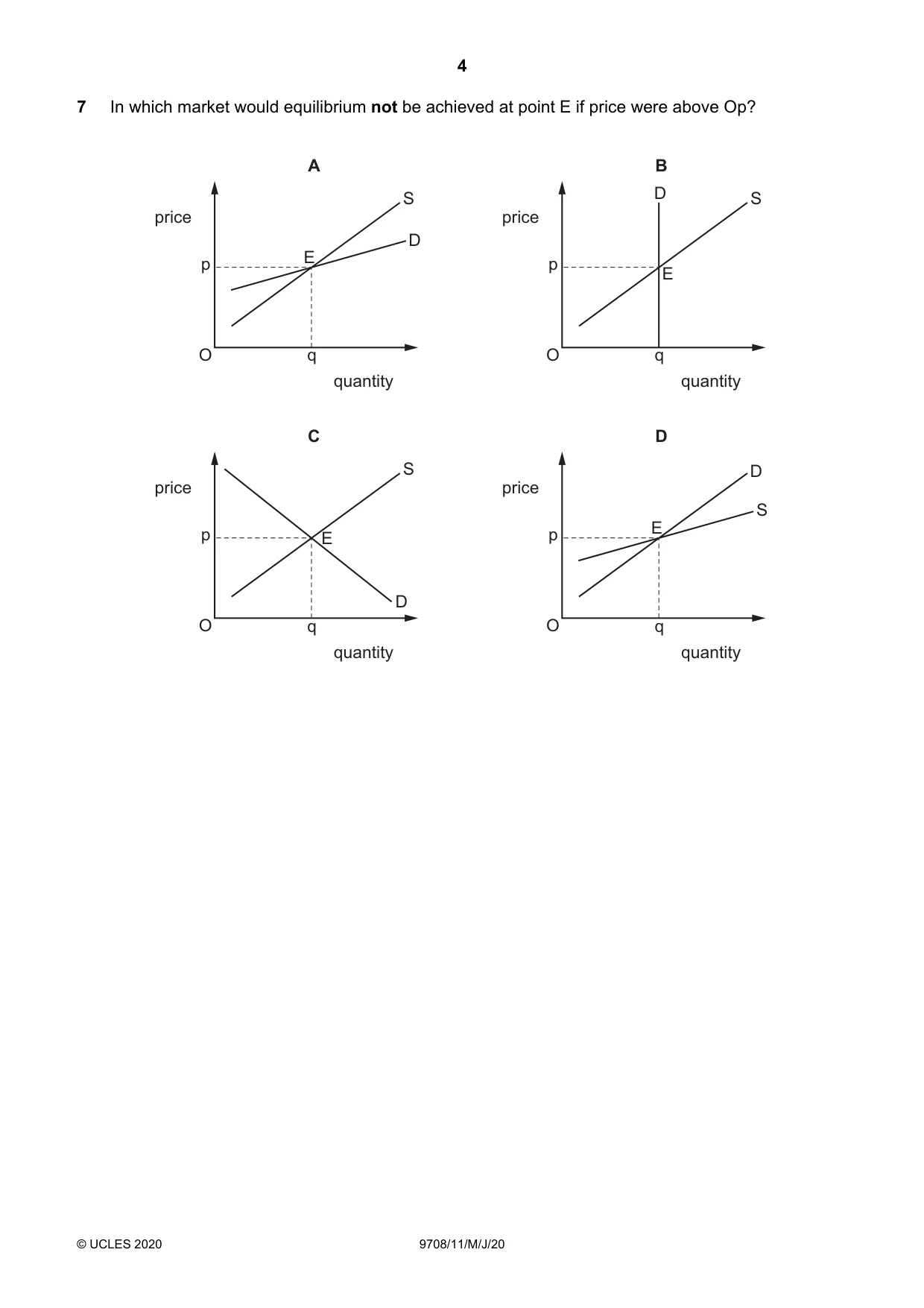
7 In which market would equilibrium not be achieved at point E if price were above Op? A B S D S price price D p E p E O q O q quantity quantity C D S D price price S p p E E D O q O q quantity quantity
Mark scheme: A
Q8 · In the diagram, the supply curve shows the number of spaces in a car park and the demand…
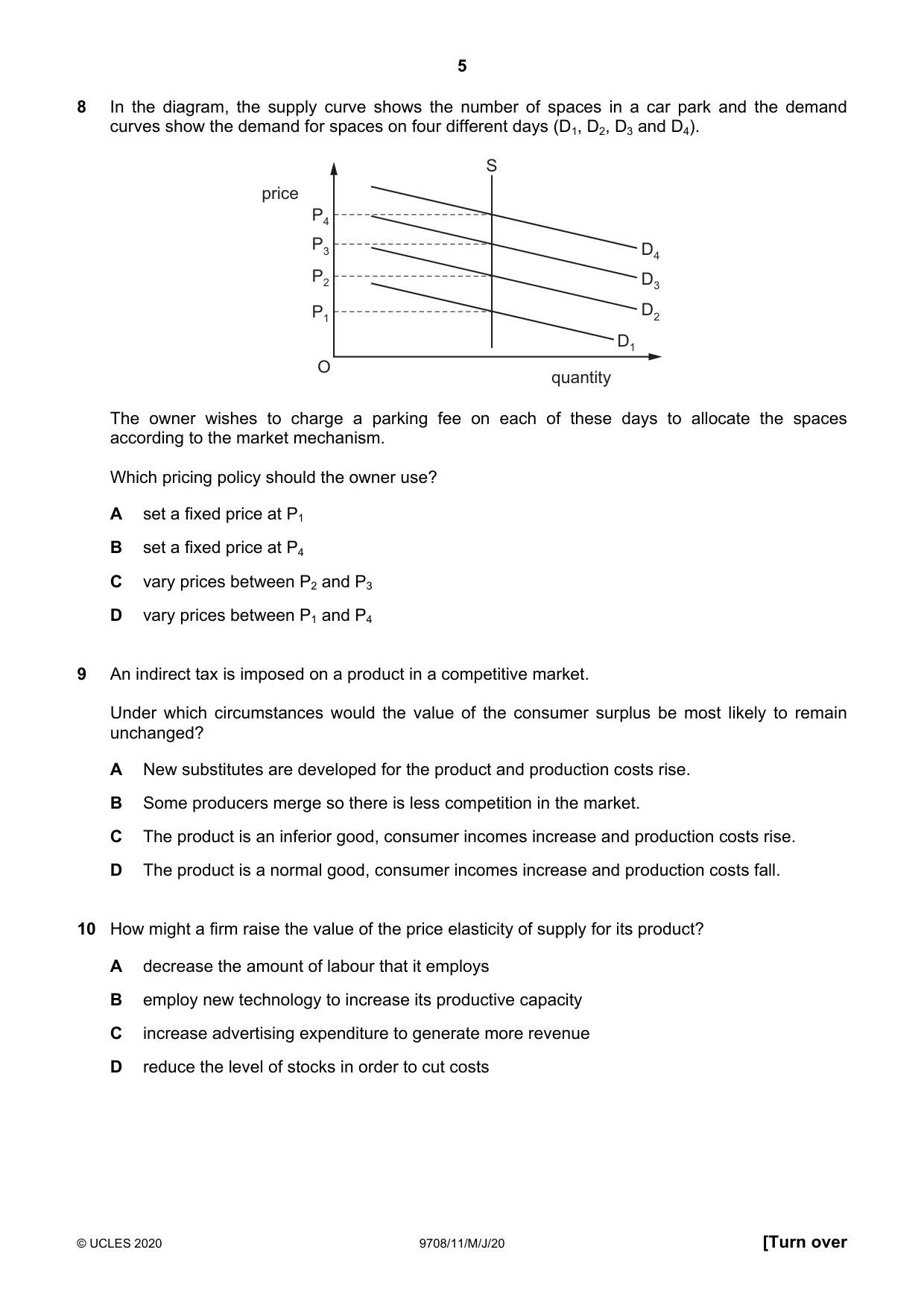
8 In the diagram, the supply curve shows the number of spaces in a car park and the demand curves show the demand for spaces on four different days (D1, D2, D3 and D4). S price P4 P3 D4 P2 D3 P1 D2 D1 O quantity The owner wishes to charge a parking fee on each of these days to allocate the spaces according to the market mechanism. Which pricing policy should the owner use? A set a fixed price at P1 B set a fixed price at P4 C vary prices between P2 and P3 D vary prices between P1 and P4
Mark scheme: D
Q9 · An indirect tax is imposed on a product in a competitive market
9 An indirect tax is imposed on a product in a competitive market. Under which circumstances would the value of the consumer surplus be most likely to remain unchanged? A New substitutes are developed for the product and production costs rise. B Some producers merge so there is less competition in the market. C The product is an inferior good, consumer incomes increase and production costs rise. D The product is a normal good, consumer incomes increase and production costs fall.
Mark scheme: D
Q10 · How might a firm raise the value of the price elasticity of supply for its product?
10 How might a firm raise the value of the price elasticity of supply for its product? A decrease the amount of labour that it employs B employ new technology to increase its productive capacity C increase advertising expenditure to generate more revenue D reduce the level of stocks in order to cut costs
Mark scheme: B
Q11 · Shoe manufacturers often use leather to make their most expensive shoes
11 Shoe manufacturers often use leather to make their most expensive shoes. Due to a world shortage of leather, the price of leather has risen. What will be the effect of this price change? A The demand curve for leather shoes will shift to the left. B The demand curve for a substitute for leather shoes will shift to the right. C The supply curve for leather shoes will shift to the right. D The supply curve for a substitute for leather to make expensive shoes will shift to the right.
Mark scheme: B
Q12 · The diagram represents the market for a good
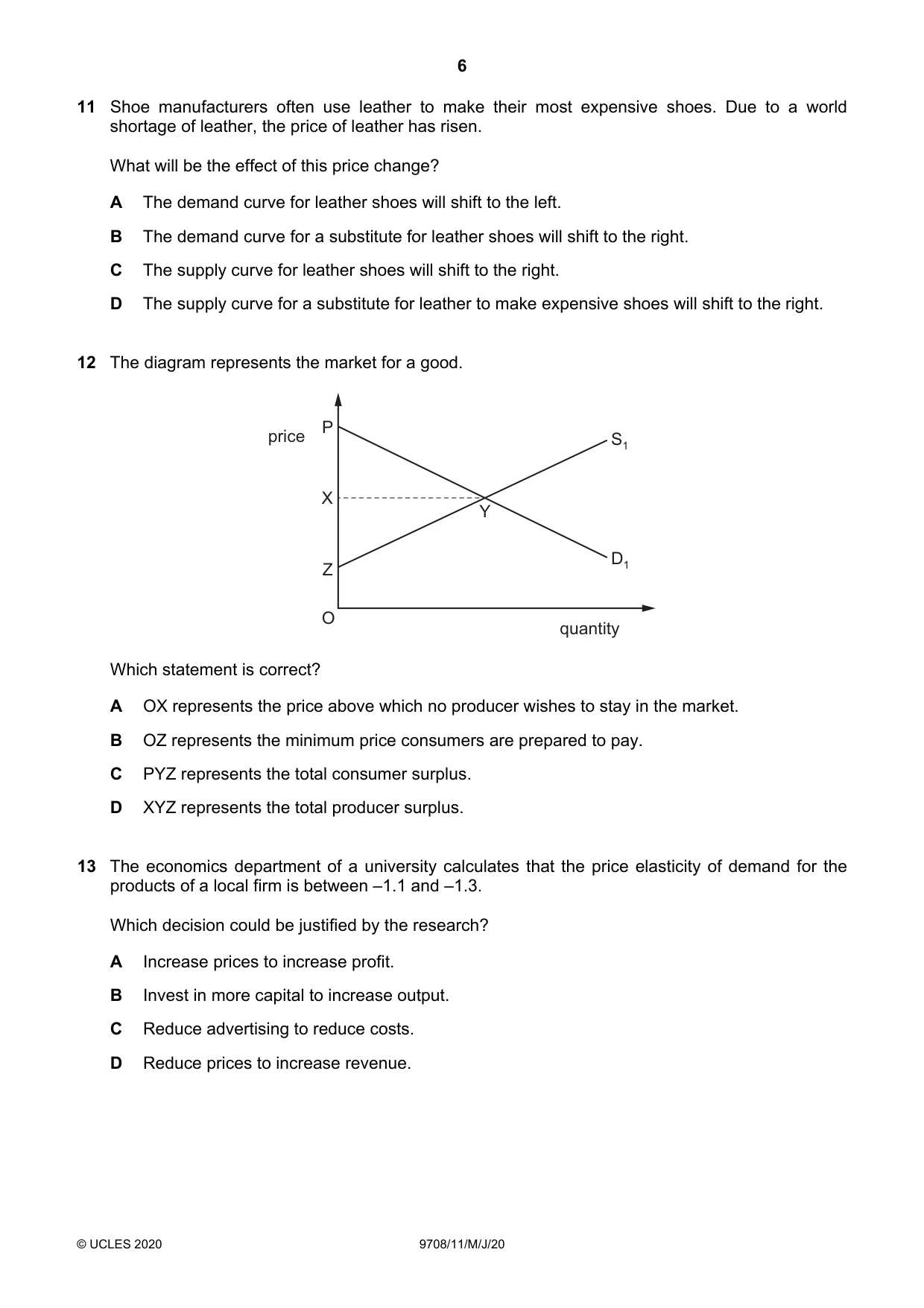
12 The diagram represents the market for a good. P price S1 X Y D1 Z O quantity Which statement is correct? A OX represents the price above which no producer wishes to stay in the market. B OZ represents the minimum price consumers are prepared to pay. C PYZ represents the total consumer surplus. D XYZ represents the total producer surplus.
Mark scheme: D
Q13 · The economics department of a university calculates that the price elasticity of demand…
13 The economics department of a university calculates that the price elasticity of demand for the products of a local firm is between –1.1 and –1.3. Which decision could be justified by the research? A Increase prices to increase profit. B Invest in more capital to increase output. C Reduce advertising to reduce costs. D Reduce prices to increase revenue.
Mark scheme: D
More questions on Price elasticity, income elasticity and cross elasticity of demand
Q14 · A specific tax is imposed on a product for which the elasticity of supply is zero
14 A specific tax is imposed on a product for which the elasticity of supply is zero. Which statement is correct? A The burden of this tax will fall entirely on consumers. B The burden of this tax will fall entirely on suppliers. C The burden of this tax will fall mainly on consumers. D The burden of this tax will fall mainly on suppliers.
Mark scheme: B
More questions on Methods and effects of government intervention in markets
Q15 · The diagram shows a market where a government has set a minimum price of OM
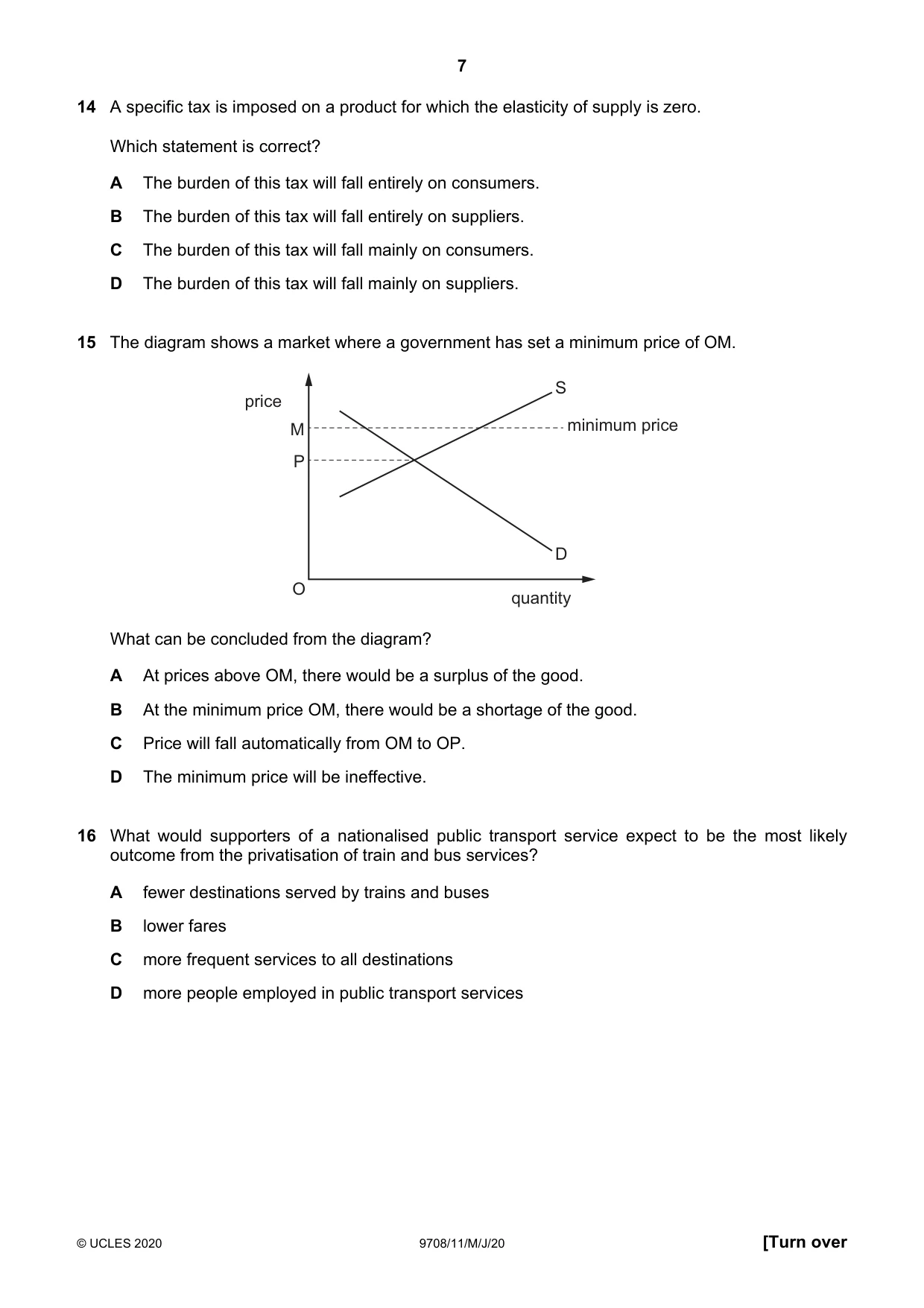
15 The diagram shows a market where a government has set a minimum price of OM. S price M minimum price P D O quantity What can be concluded from the diagram? A At prices above OM, there would be a surplus of the good. B At the minimum price OM, there would be a shortage of the good. C Price will fall automatically from OM to OP. D The minimum price will be ineffective.
Mark scheme: A
More questions on Methods and effects of government intervention in markets
Q16 · What would supporters of a nationalised public transport service expect to be the most…
16 What would supporters of a nationalised public transport service expect to be the most likely outcome from the privatisation of train and bus services? A fewer destinations served by trains and buses B lower fares C more frequent services to all destinations D more people employed in public transport services
Mark scheme: A
More questions on Resource allocation in different economic systems
Q17 · A teenager received a cheque for $50 as a birthday gift from her parents
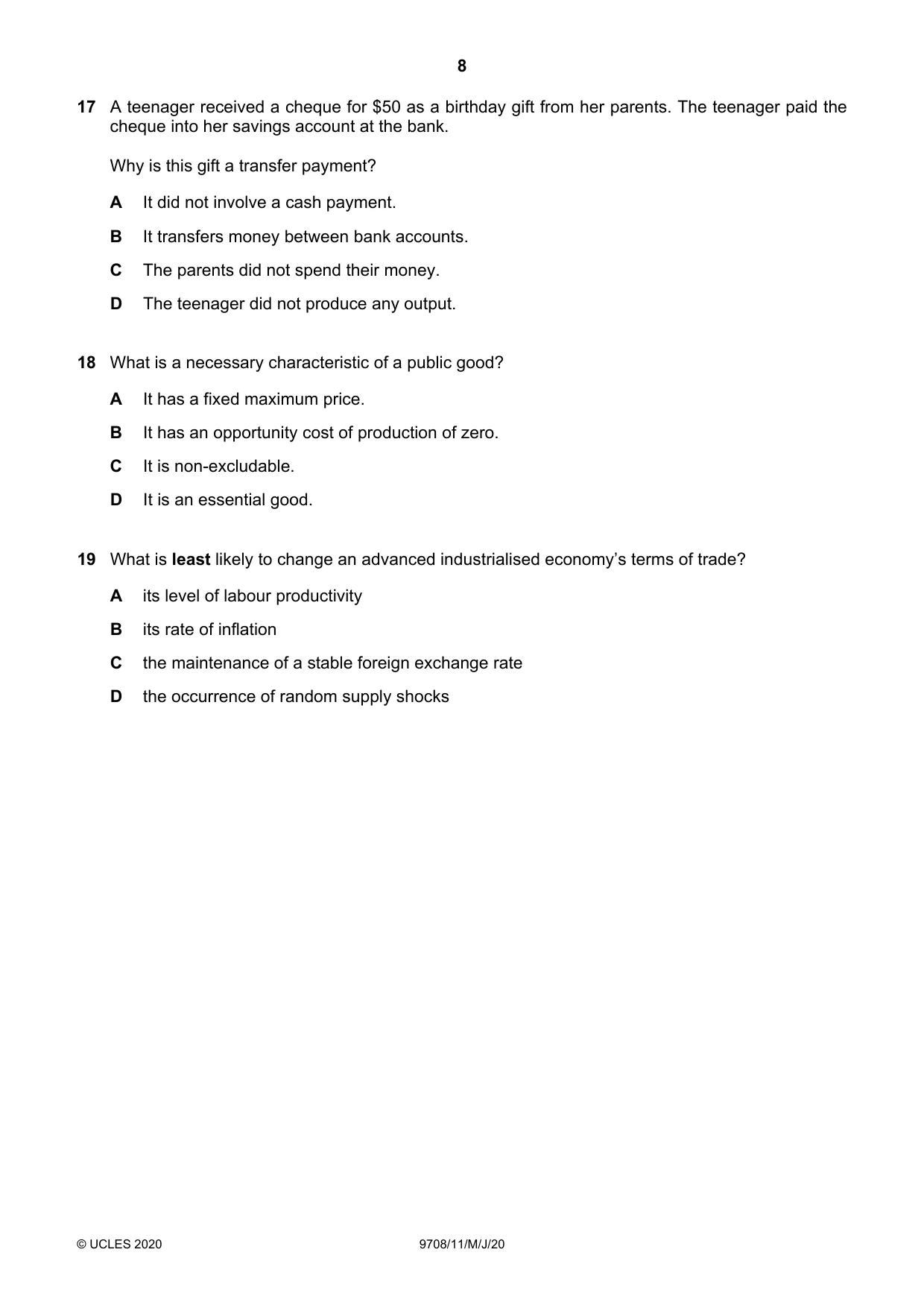
17 A teenager received a cheque for $50 as a birthday gift from her parents. The teenager paid the cheque into her savings account at the bank. Why is this gift a transfer payment? A It did not involve a cash payment. B It transfers money between bank accounts. C The parents did not spend their money. D The teenager did not produce any output.
Mark scheme: D
Q18 · What is a necessary characteristic of a public good?
18 What is a necessary characteristic of a public good? A It has a fixed maximum price. B It has an opportunity cost of production of zero. C It is non-excludable. D It is an essential good.
Mark scheme: C
Q19 · What is least likely to change an advanced industrialised economy’s terms of trade?
19 What is least likely to change an advanced industrialised economy’s terms of trade? A its level of labour productivity B its rate of inflation C the maintenance of a stable foreign exchange rate D the occurrence of random supply shocks
Mark scheme: C
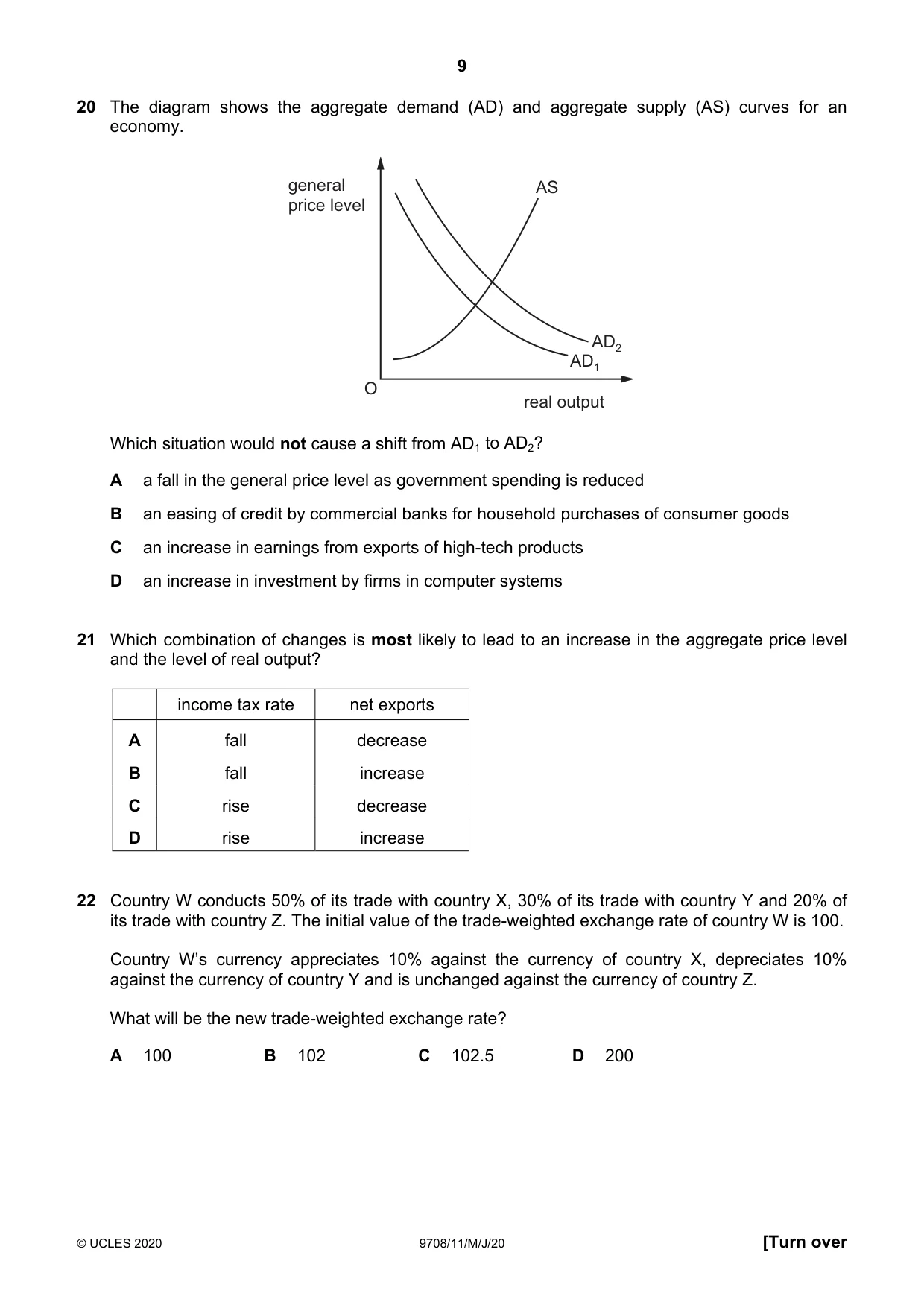
Q20 · The diagram shows the aggregate demand (AD) and aggregate supply (AS) curves for an…
20 The diagram shows the aggregate demand (AD) and aggregate supply (AS) curves for an economy. general AS price level AD2 AD1 O real output Which situation would not cause a shift from AD1 to AD2? A a fall in the general price level as government spending is reduced B an easing of credit by commercial banks for household purchases of consumer goods C an increase in earnings from exports of high-tech products D an increase in investment by firms in computer systems
Mark scheme: A
More questions on Aggregate Demand and Aggregate Supply analysis
Q21 · Which combination of changes is most likely to lead to an increase in the aggregate price…
21 Which combination of changes is most likely to lead to an increase in the aggregate price level and the level of real output? income tax rate net exports A fall decrease B fall increase C rise decrease D rise increase
Mark scheme: B
More questions on Aggregate Demand and Aggregate Supply analysis
Q22 · Country W conducts 50% of its trade with country X, 30% of its trade with country Y and…
22 Country W conducts 50% of its trade with country X, 30% of its trade with country Y and 20% of its trade with country Z. The initial value of the trade-weighted exchange rate of country W is 100. Country W’s currency appreciates 10% against the currency of country X, depreciates 10% against the currency of country Y and is unchanged against the currency of country Z. What will be the new trade-weighted exchange rate? A 100 B 102 C 102.5 D 200
Mark scheme: B
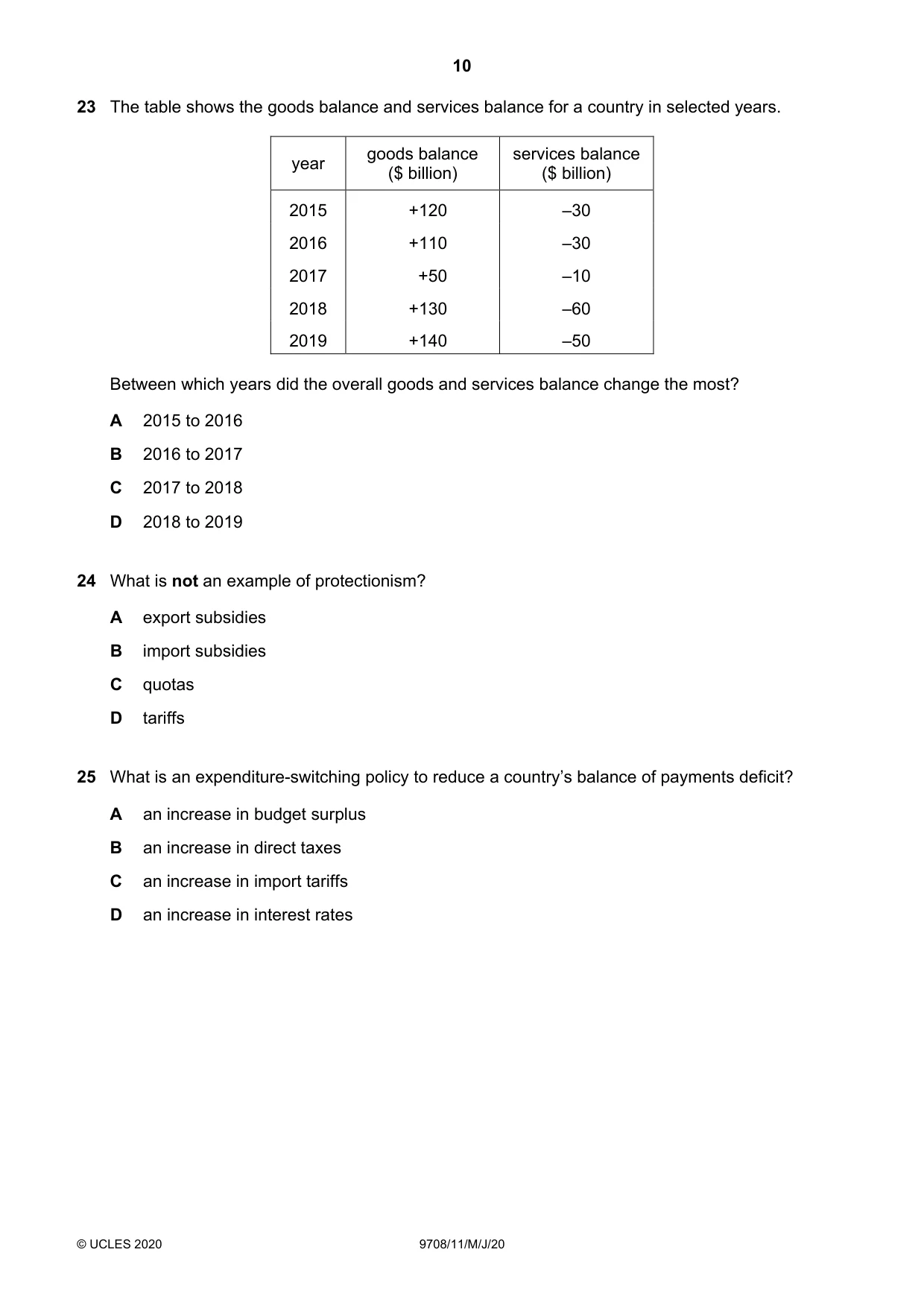
Q23 · The table shows the goods balance and services balance for a country in selected years
23 The table shows the goods balance and services balance for a country in selected years. goods balance services balance year ($ billion) ($ billion) 2015 +120 –30 2016 +110 –30 2017 +50 –10 2018 +130 –60 2019 +140 –50 Between which years did the overall goods and services balance change the most? A 2015 to 2016 B 2016 to 2017 C 2017 to 2018 D 2018 to 2019
Mark scheme: B
More questions on Current account of the balance of payments
Q24 · What is not an example of protectionism?
24 What is not an example of protectionism? A export subsidies B import subsidies C quotas D tariffs
Mark scheme: B
Q25 · What is an expenditure-switching policy to reduce a country’s balance of payments deficit?
25 What is an expenditure-switching policy to reduce a country’s balance of payments deficit? A an increase in budget surplus B an increase in direct taxes C an increase in import tariffs D an increase in interest rates
Mark scheme: C
More questions on Policies to correct imbalances in the current account of the balance of payments
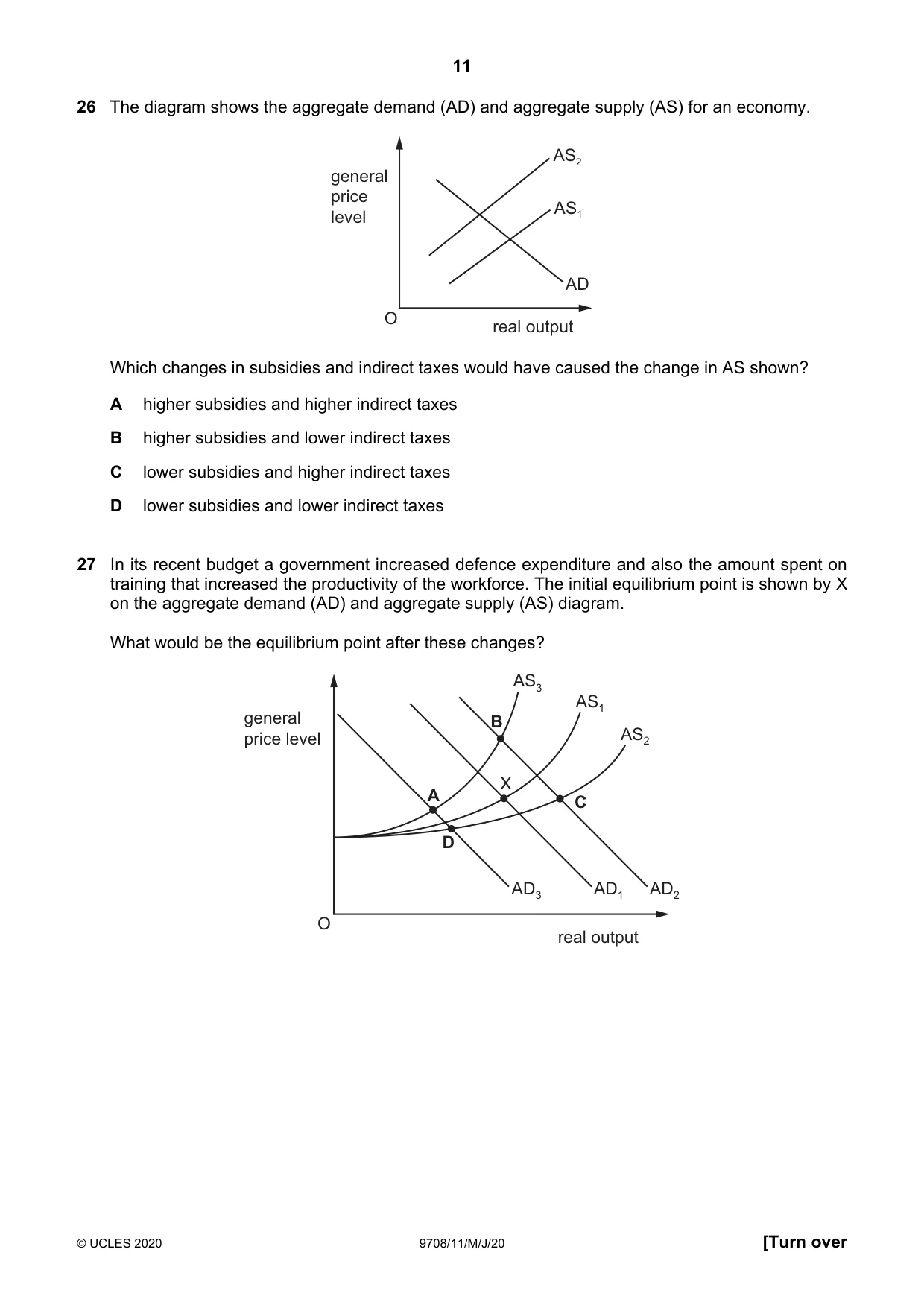
Q26 · The diagram shows the aggregate demand (AD) and aggregate supply (AS) for an economy
26 The diagram shows the aggregate demand (AD) and aggregate supply (AS) for an economy. AS2 general price AS1 level AD O real output Which changes in subsidies and indirect taxes would have caused the change in AS shown? A higher subsidies and higher indirect taxes B higher subsidies and lower indirect taxes C lower subsidies and higher indirect taxes D lower subsidies and lower indirect taxes
Mark scheme: C
More questions on Aggregate Demand and Aggregate Supply analysis
Q27 · In its recent budget a government increased defence expenditure and also the amount spent…
27 In its recent budget a government increased defence expenditure and also the amount spent on training that increased the productivity of the workforce. The initial equilibrium point is shown by X on the aggregate demand (AD) and aggregate supply (AS) diagram. What would be the equilibrium point after these changes? AS3 AS1 general B price level AS2 X A C D AD3 AD1 AD2 O real output
Mark scheme: C
More questions on Aggregate Demand and Aggregate Supply analysis
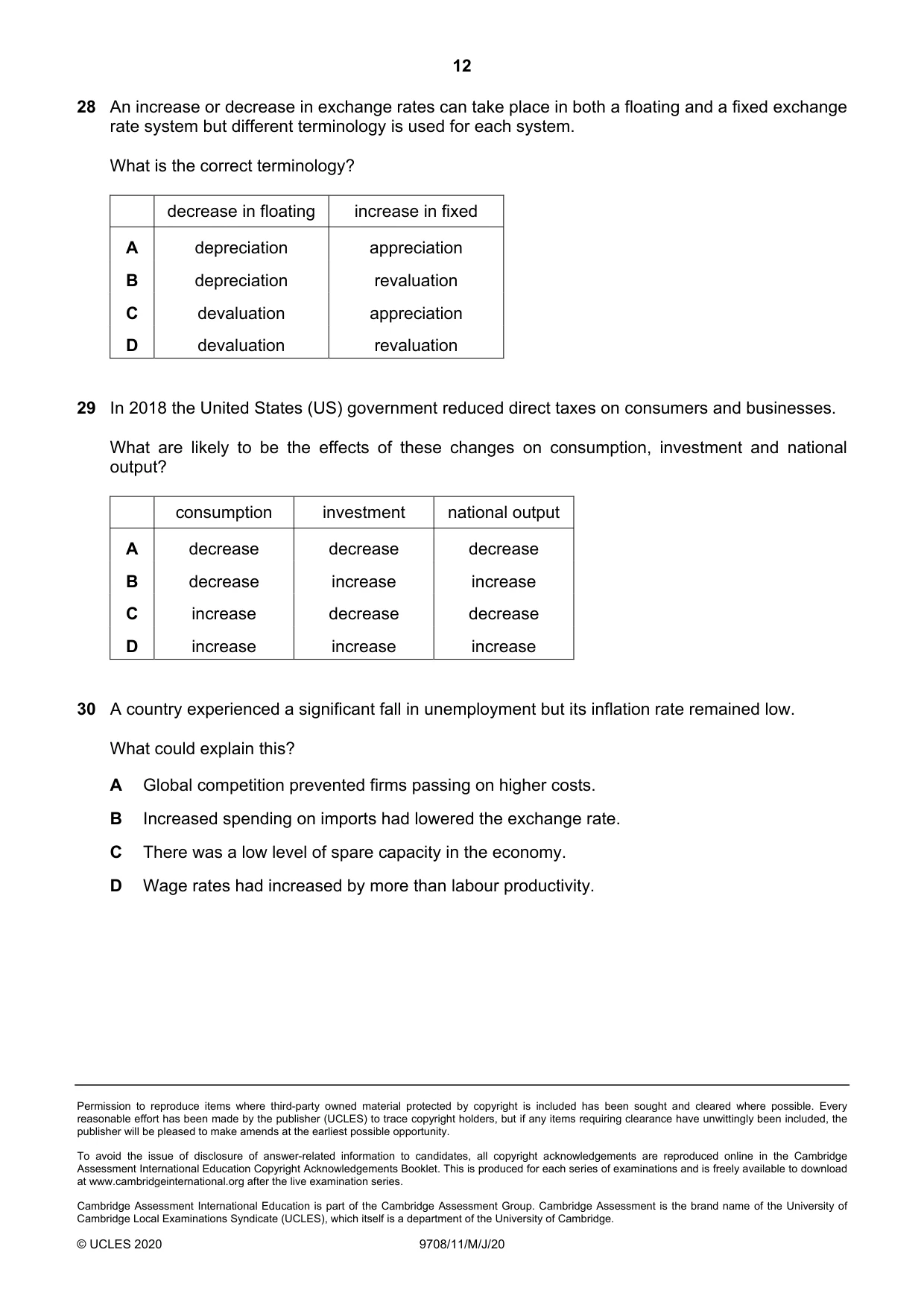
Q28 · An increase or decrease in exchange rates can take place in both a floating and a fixed…
28 An increase or decrease in exchange rates can take place in both a floating and a fixed exchange rate system but different terminology is used for each system. What is the correct terminology? decrease in floating increase in fixed A depreciation appreciation B depreciation revaluation C devaluation appreciation D devaluation revaluation
Mark scheme: B
Q29 · In 2018 the United States (US) government reduced direct taxes on consumers and businesses
29 In 2018 the United States (US) government reduced direct taxes on consumers and businesses. What are likely to be the effects of these changes on consumption, investment and national output? consumption investment national output A decrease decrease decrease B decrease increase increase C increase decrease decrease D increase increase increase
Mark scheme: D
Q30 · A country experienced a significant fall in unemployment but its inflation rate remained…
30 A country experienced a significant fall in unemployment but its inflation rate remained low. What could explain this? A Global competition prevented firms passing on higher costs. B Increased spending on imports had lowered the exchange rate. C There was a low level of spare capacity in the economy. D Wage rates had increased by more than labour productivity.
Mark scheme: A
What was in this paper
The subtopics covered by these 30 questions, and how many questions each got. Open one in a new tab to see every Cambridge question on it.
4Methods and effects of government intervention in markets3Classification of goods and services2Consumer and producer surplus2Demand and supply curves2Exchange rates2Resource allocation in different economic systems2The interaction of demand and supply2Current account of the balance of payments1Economic methodology1Factors of production1Fiscal policy1National income statistics1Policies to correct imbalances in the current account of the balance of payments1Price elasticity of supply1Price elasticity, income elasticity and cross elasticity of demand1Price stability1Protectionism1The reasons for international trade1