Cambridge A Level Economics 9708 — 2025 Oct/Nov Paper 1 · Variant 3
9708/13/O/N/25 · 30 questions · 30 marks · ≈34 min
The question paper and its mark scheme, free to read here and free to download. This is Cambridge’s own paper, exactly as it was sat.
Question paper12 pages
Mark scheme3 pages
Answers below. Sit the paper first if you are practising.
Questions as text
Q1 · The following appeared in a newspaper article
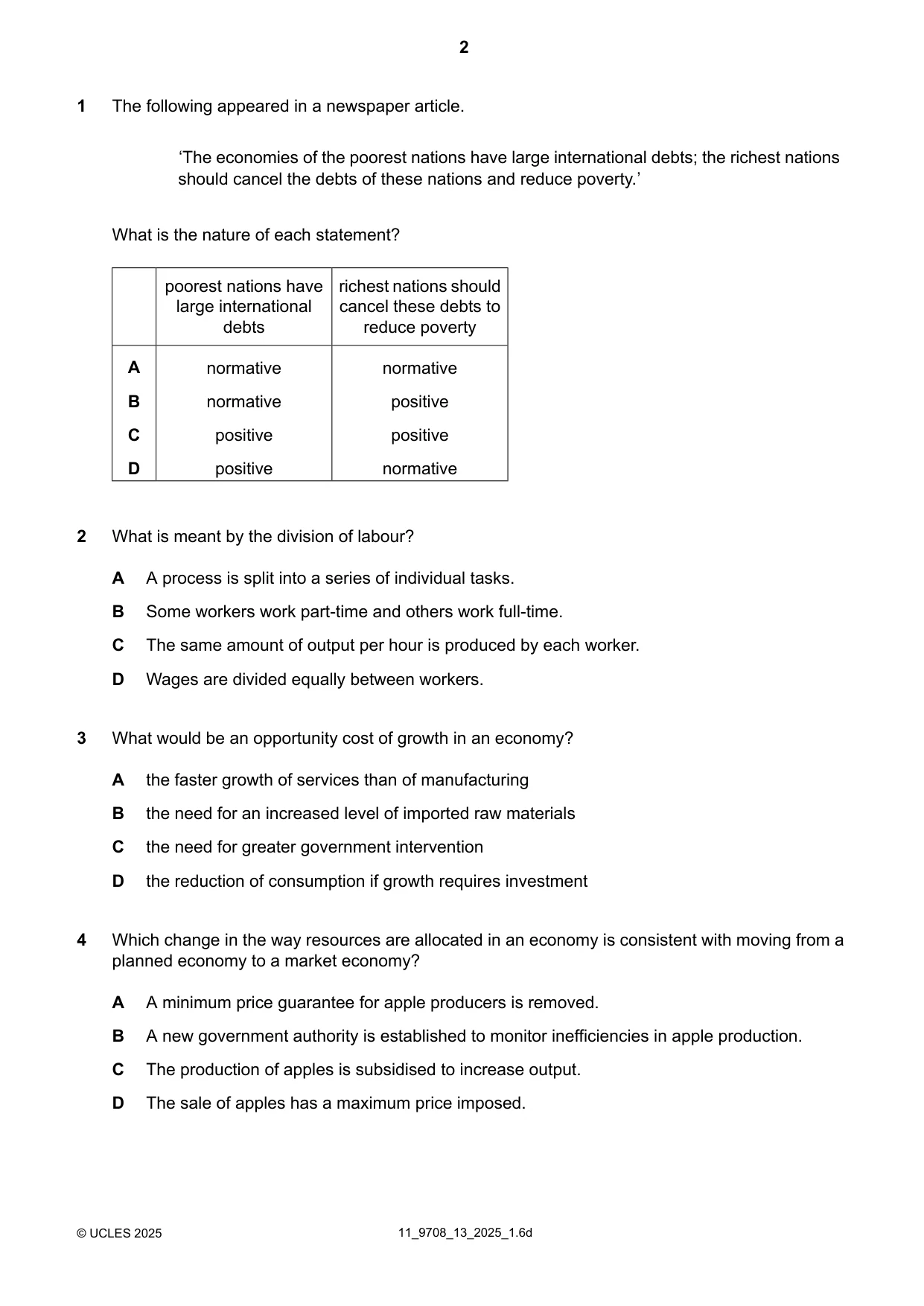
1 The following appeared in a newspaper article. ‘The economies of the poorest nations have large international debts; the richest nations should cancel the debts of these nations and reduce poverty.’ What is the nature of each statement? poorest nations have richest nations should large international cancel these debts to debts reduce poverty A normative normative B normative positive C positive positive D positive normative
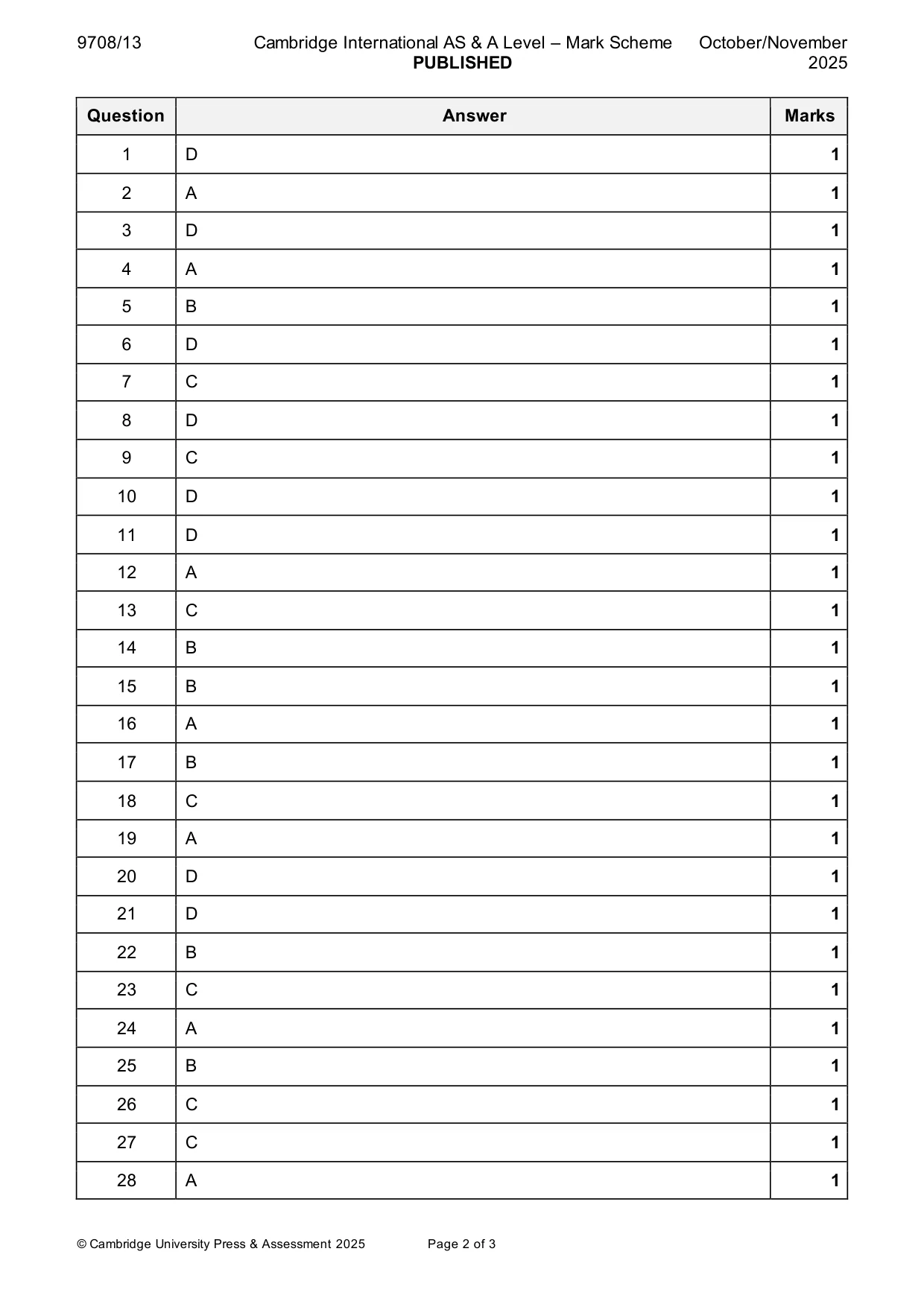
Mark scheme: D
Q2 · What is meant by the division of labour?
2 What is meant by the division of labour? A A process is split into a series of individual tasks. B Some workers work part-time and others work full-time. C The same amount of output per hour is produced by each worker. D Wages are divided equally between workers.
Mark scheme: A
Q3 · What would be an opportunity cost of growth in an economy?
3 What would be an opportunity cost of growth in an economy? A the faster growth of services than of manufacturing B the need for an increased level of imported raw materials C the need for greater government intervention D the reduction of consumption if growth requires investment
Mark scheme: D
Q4 · Which change in the way resources are allocated in an economy is consistent with moving…
4 Which change in the way resources are allocated in an economy is consistent with moving from a planned economy to a market economy? A A minimum price guarantee for apple producers is removed. B A new government authority is established to monitor inefficiencies in apple production. C The production of apples is subsidised to increase output. D The sale of apples has a maximum price imposed.
Mark scheme: A
More questions on Resource allocation in different economic systems
Q5 · The diagram shows a production possibility curve (PPC) for an economy that produces two…
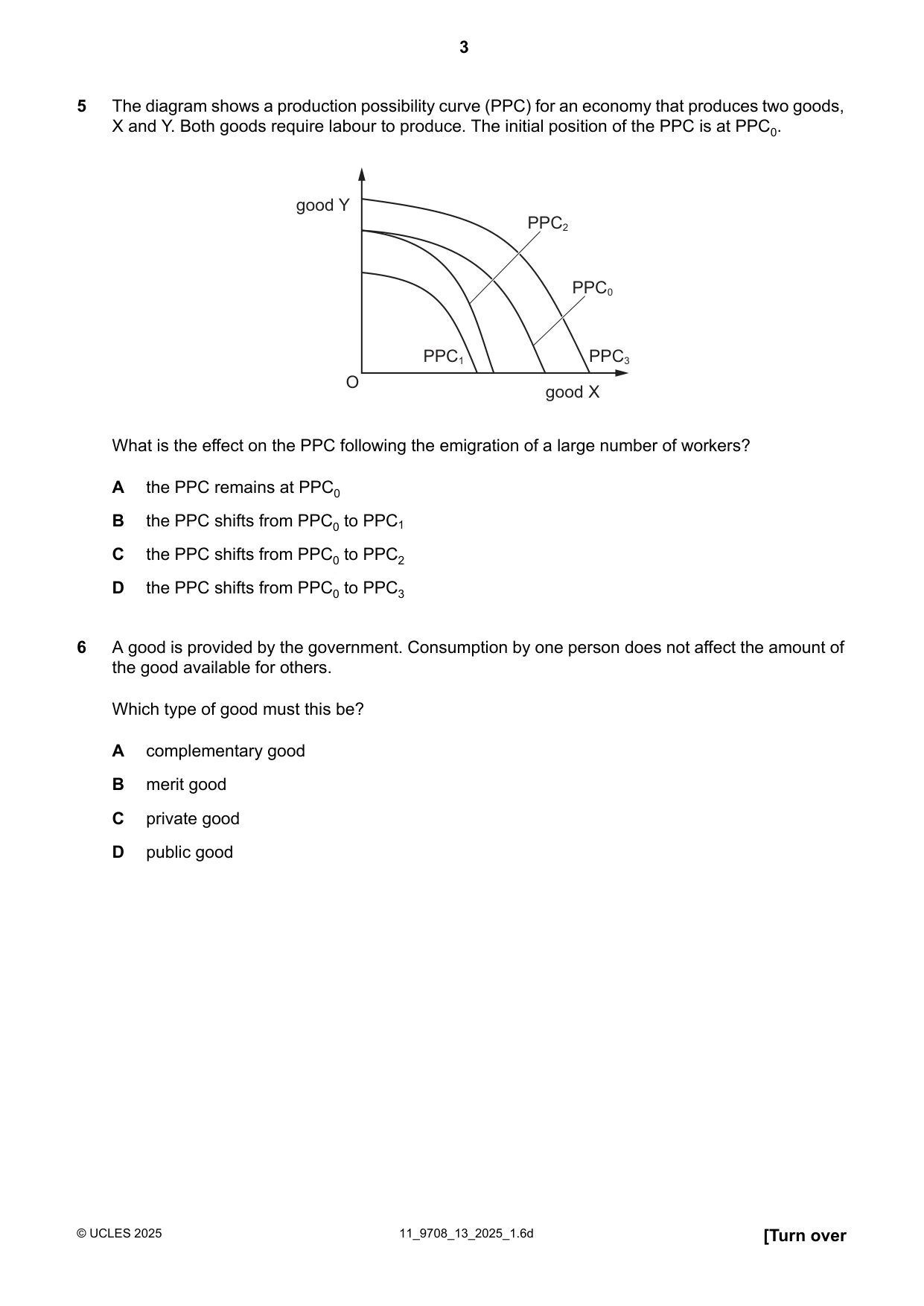
5 The diagram shows a production possibility curve (PPC) for an economy that produces two goods, X and Y. Both goods require labour to produce. The initial position of the PPC is at PPC0. good Y PPC2 PPC0 PPC1 PPC3 O good X What is the effect on the PPC following the emigration of a large number of workers? A the PPC remains at PPC0 B the PPC shifts from PPC0 to PPC1 C the PPC shifts from PPC0 to PPC2 D the PPC shifts from PPC0 to PPC3
Mark scheme: B
Q6 · A good is provided by the government
6 A good is provided by the government. Consumption by one person does not affect the amount of the good available for others. Which type of good must this be? A complementary good B merit good C private good D public good
Mark scheme: D
Q7 · Market demand curves normally slope downwards
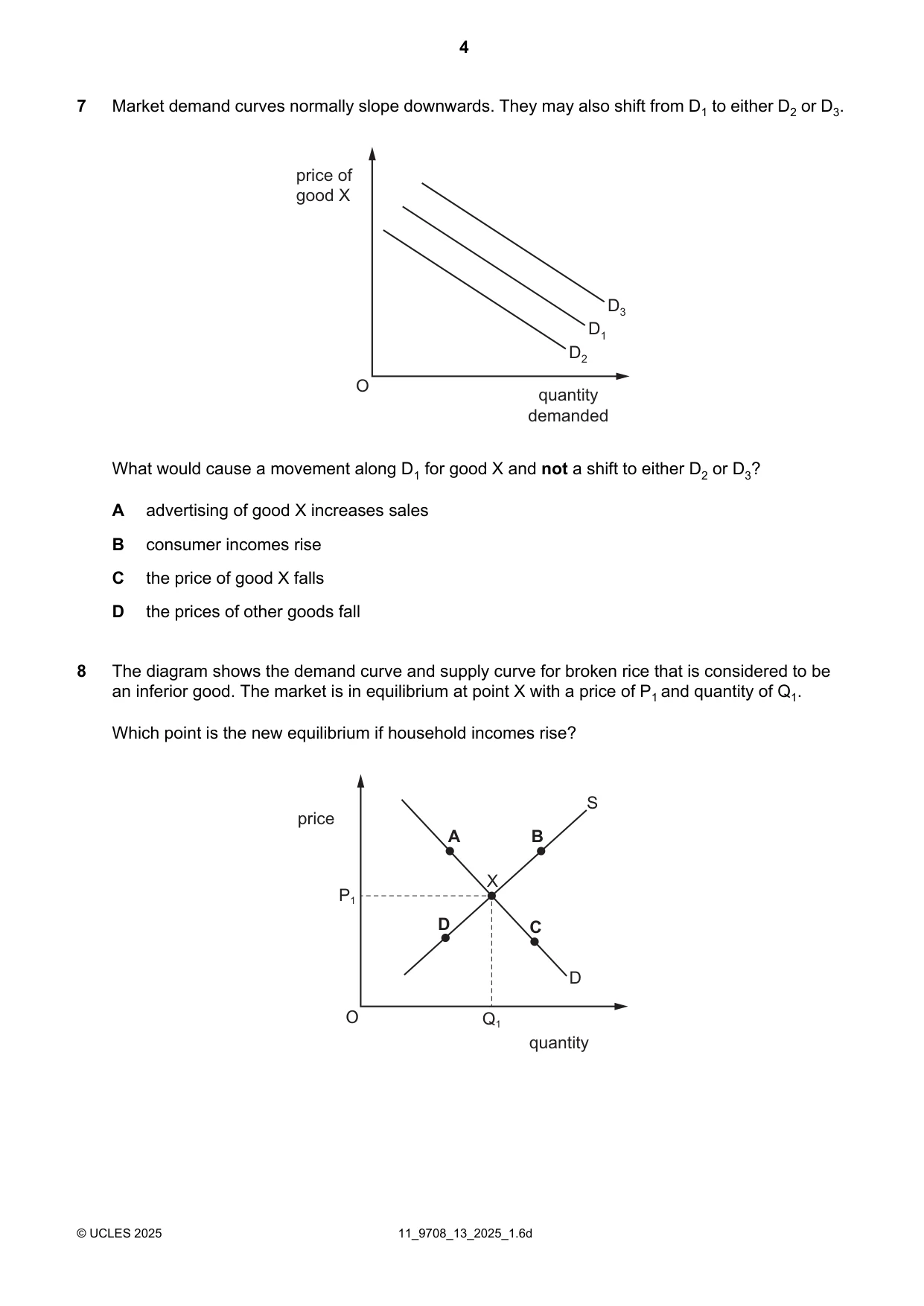
7 Market demand curves normally slope downwards. They may also shift from D1 to either D2 or D3. price of good X D3 D1 D2 O quantity demanded What would cause a movement along D1 for good X and not a shift to either D2 or D3? A advertising of good X increases sales B consumer incomes rise C the price of good X falls D the prices of other goods fall
Mark scheme: C
Q8 · The diagram shows the demand curve and supply curve for broken rice that is considered to…
8 The diagram shows the demand curve and supply curve for broken rice that is considered to be an inferior good. The market is in equilibrium at point X with a price of P1 and quantity of Q1. Which point is the new equilibrium if household incomes rise? S price A B X P1 D C D O Q1 quantity
Mark scheme: D
Q9 · Good X has an income elasticity of demand (YED) value of −0.8
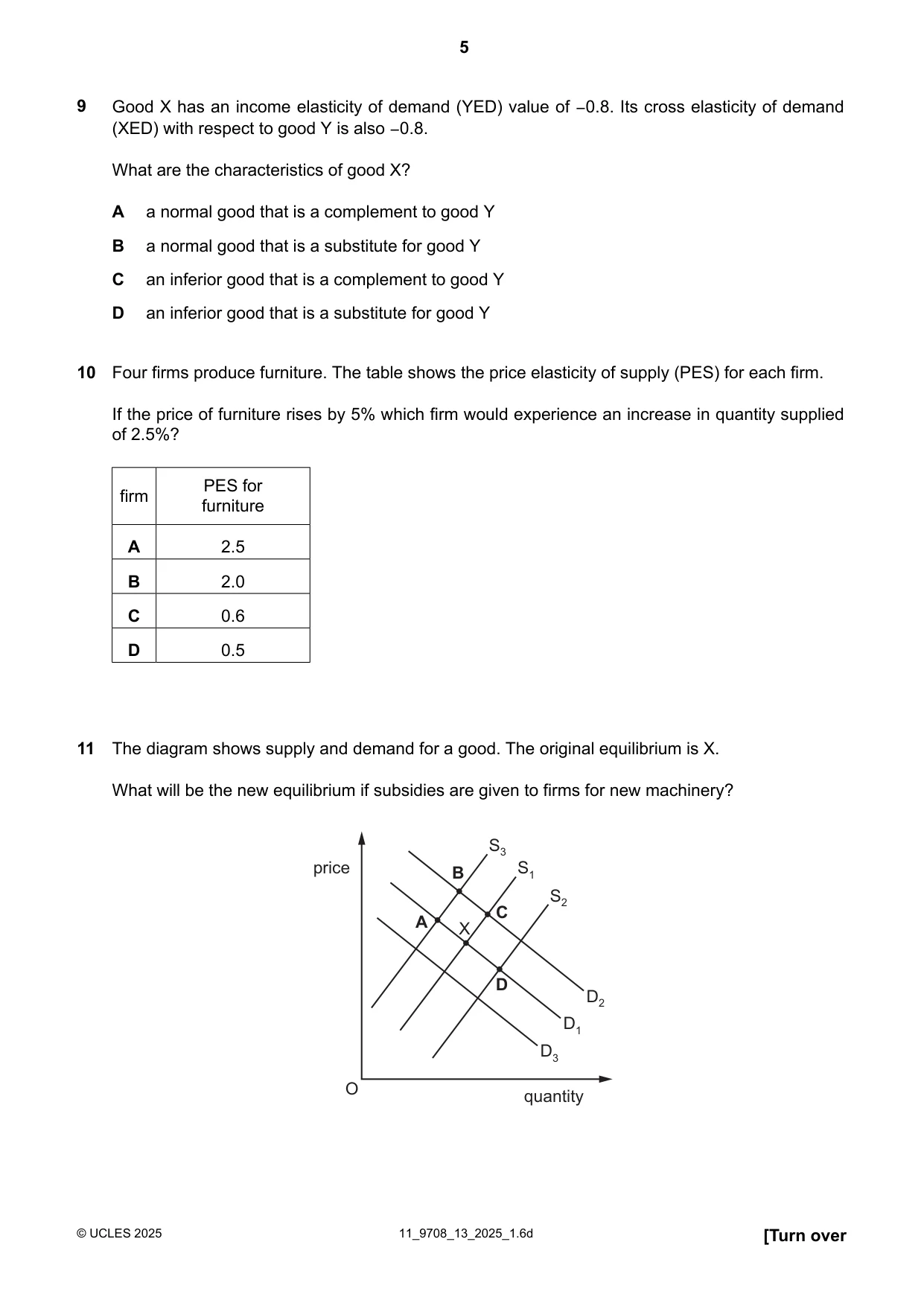
9 Good X has an income elasticity of demand (YED) value of −0.8. Its cross elasticity of demand (XED) with respect to good Y is also −0.8. What are the characteristics of good X? A a normal good that is a complement to good Y B a normal good that is a substitute for good Y C an inferior good that is a complement to good Y D an inferior good that is a substitute for good Y
Mark scheme: C
More questions on Price elasticity, income elasticity and cross elasticity of demand
Q10 · Four firms produce furniture
10 Four firms produce furniture. The table shows the price elasticity of supply (PES) for each firm. If the price of furniture rises by 5% which firm would experience an increase in quantity supplied of 2.5%? PES for firm furniture A 2.5 B 2.0 C 0.6 D 0.5
Mark scheme: D
Q11 · The diagram shows supply and demand for a good
11 The diagram shows supply and demand for a good. The original equilibrium is X. What will be the new equilibrium if subsidies are given to firms for new machinery? S3 price B S1 S2 C A X D D2 D1 D3 O quantity
Mark scheme: D
Q12 · The market for good X is in equilibrium when its price is $10
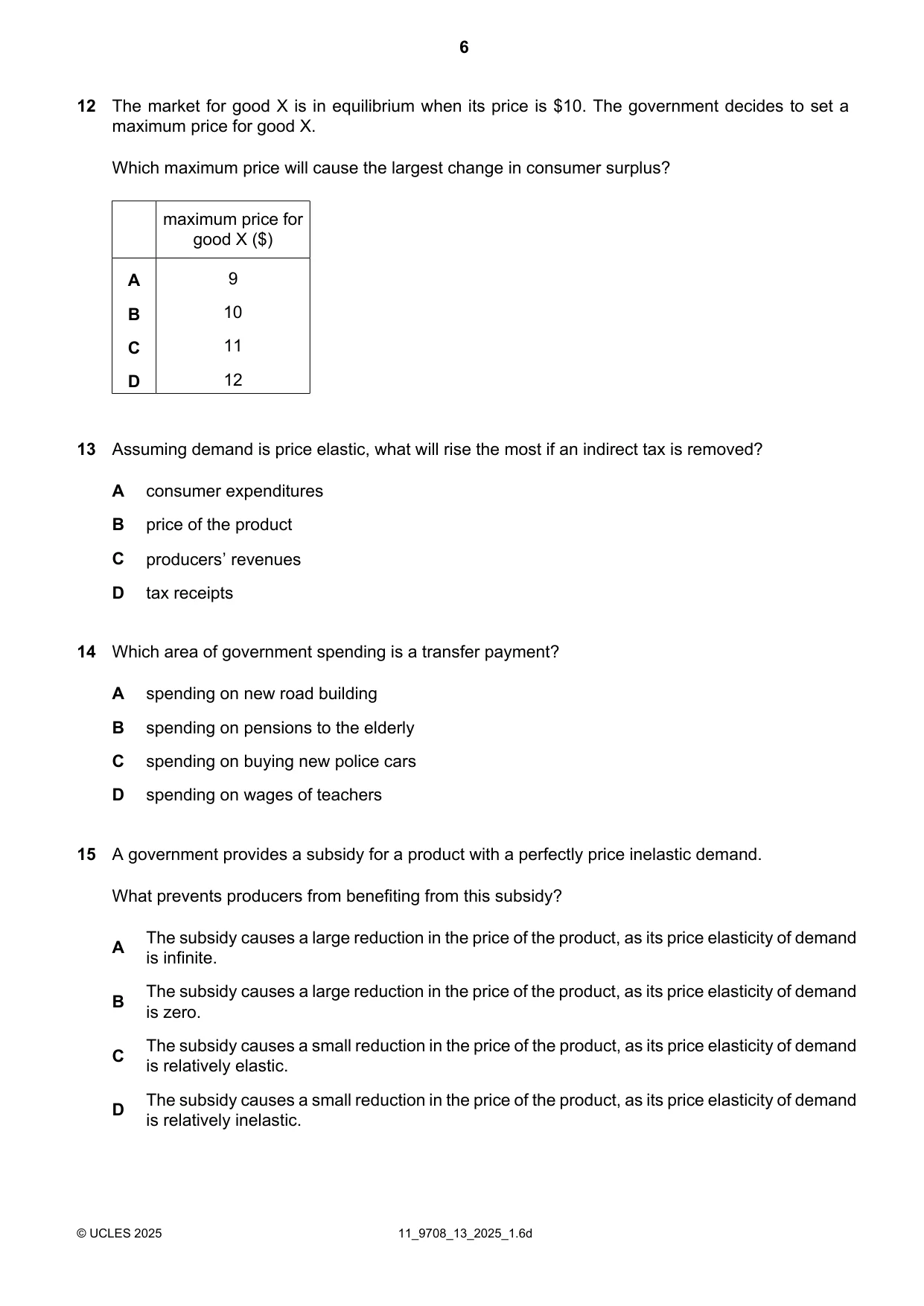
12 The market for good X is in equilibrium when its price is $10. The government decides to set a maximum price for good X. Which maximum price will cause the largest change in consumer surplus? maximum price for good X ($) A 9 B 10 C 11 D 12
Mark scheme: A
Q13 · Assuming demand is price elastic, what will rise the most if an indirect tax is removed?
13 Assuming demand is price elastic, what will rise the most if an indirect tax is removed? A consumer expenditures B price of the product C producers’ revenues D tax receipts
Mark scheme: C
More questions on Methods and effects of government intervention in markets
Q14 · Which area of government spending is a transfer payment?
14 Which area of government spending is a transfer payment? A spending on new road building B spending on pensions to the elderly C spending on buying new police cars D spending on wages of teachers
Mark scheme: B
Q15 · A government provides a subsidy for a product with a perfectly price inelastic demand
15 A government provides a subsidy for a product with a perfectly price inelastic demand. What prevents producers from benefiting from this subsidy? The subsidy causes a large reduction in the price of the product, as its price elasticity of demand A is infinite. The subsidy causes a large reduction in the price of the product, as its price elasticity of demand B is zero. The subsidy causes a small reduction in the price of the product, as its price elasticity of demand C is relatively elastic. The subsidy causes a small reduction in the price of the product, as its price elasticity of demand D is relatively inelastic.
Mark scheme: B
More questions on Methods and effects of government intervention in markets
Q16 · A government intervenes in the market for good X
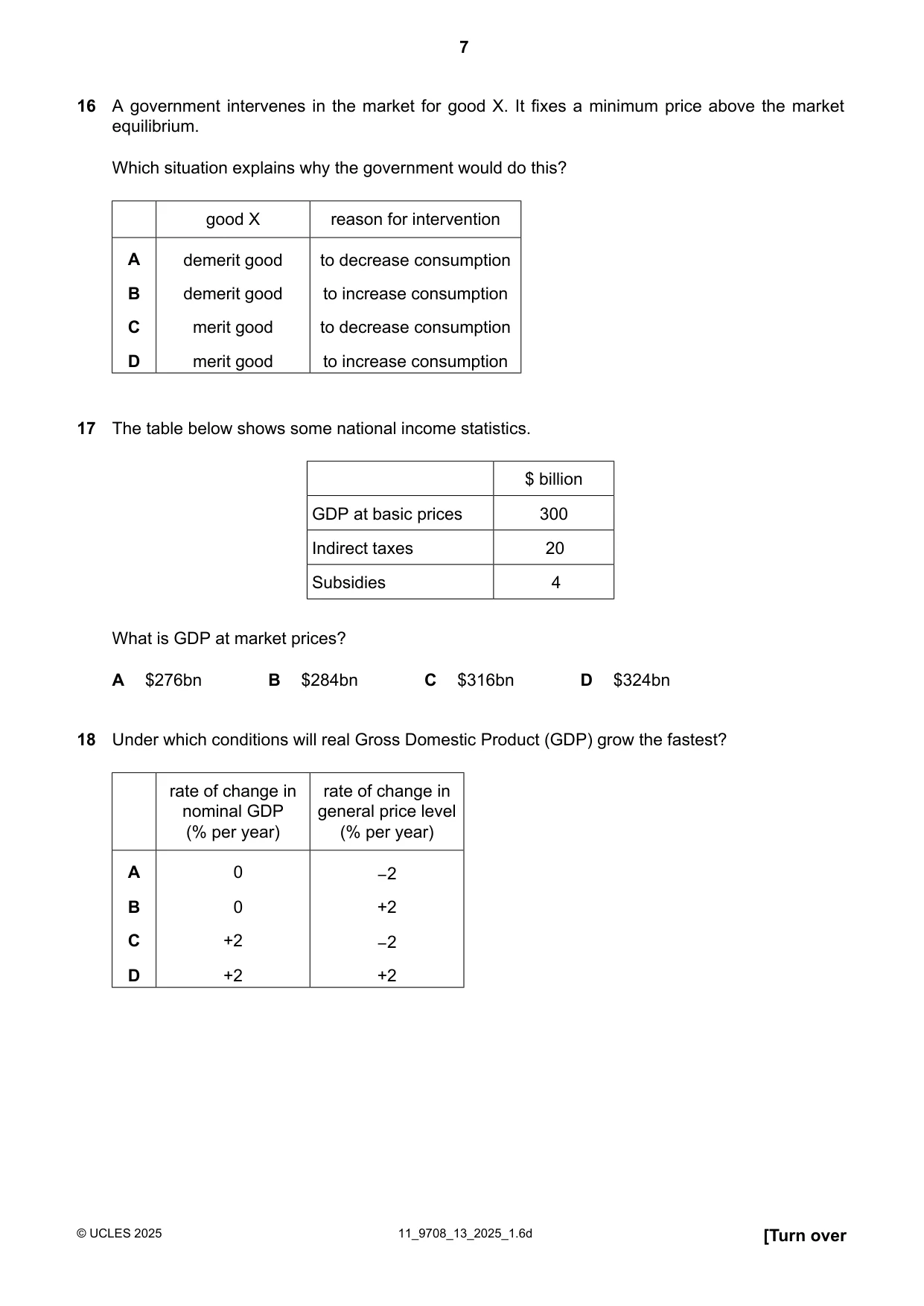
16 A government intervenes in the market for good X. It fixes a minimum price above the market equilibrium. Which situation explains why the government would do this? good X reason for intervention A demerit good to decrease consumption B demerit good to increase consumption C merit good to decrease consumption D merit good to increase consumption
Mark scheme: A
More questions on Methods and effects of government intervention in markets
Q17 · The table below shows some national income statistics
17 The table below shows some national income statistics. $ billion GDP at basic prices 300 Indirect taxes 20 Subsidies 4 What is GDP at market prices? A $276bn B $284bn C $316bn D $324bn
Mark scheme: B
Q18 · Under which conditions will real Gross Domestic Product (GDP) grow the fastest?
18 Under which conditions will real Gross Domestic Product (GDP) grow the fastest? rate of change in rate of change in nominal GDP general price level (% per year) (% per year) A 0 −2 B 0 +2 C +2 −2 D +2 +2
Mark scheme: C
Q19 · A government is planning to increase its expenditure on defence
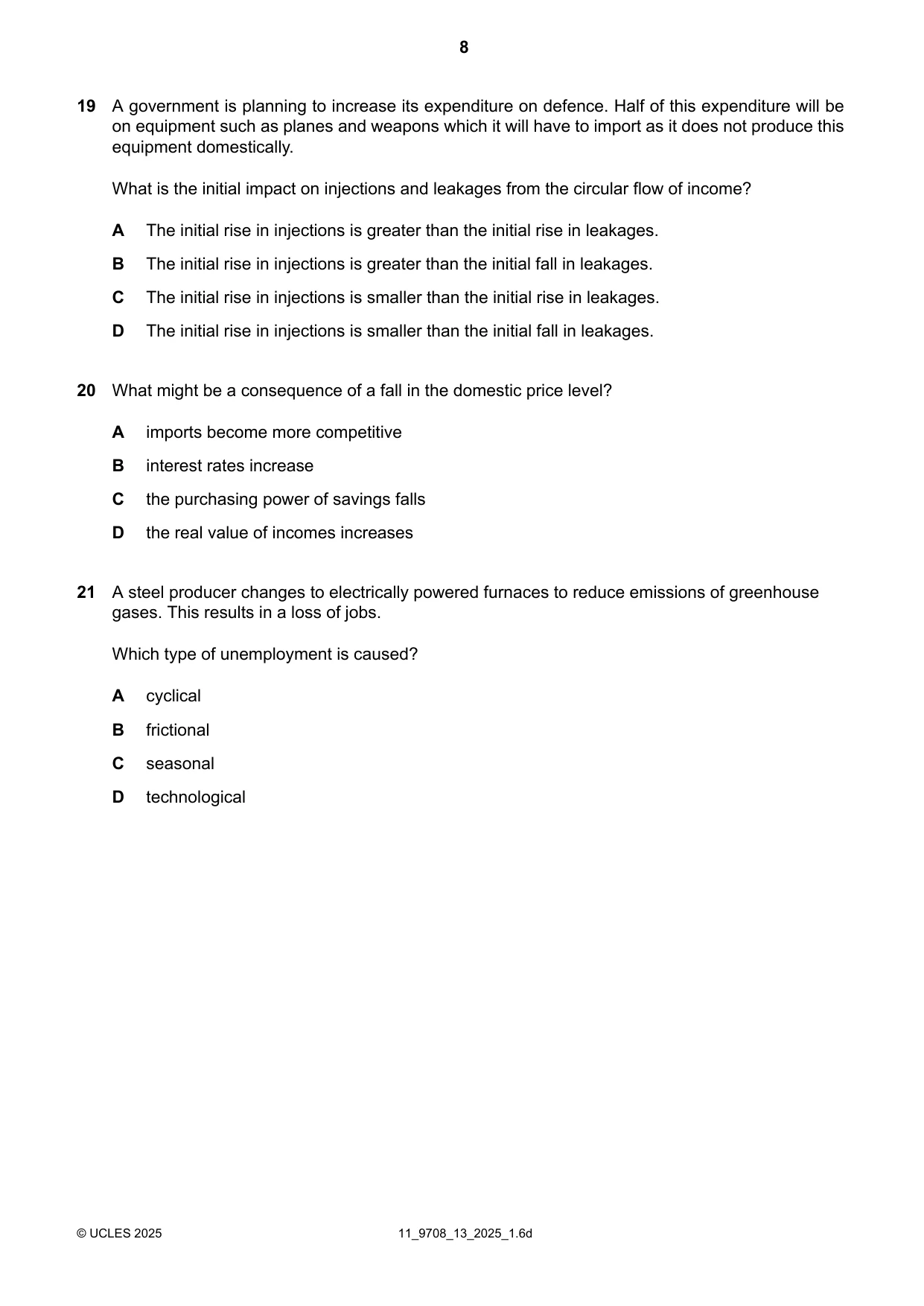
19 A government is planning to increase its expenditure on defence. Half of this expenditure will be on equipment such as planes and weapons which it will have to import as it does not produce this equipment domestically. What is the initial impact on injections and leakages from the circular flow of income? A The initial rise in injections is greater than the initial rise in leakages. B The initial rise in injections is greater than the initial fall in leakages. C The initial rise in injections is smaller than the initial rise in leakages. D The initial rise in injections is smaller than the initial fall in leakages.
Mark scheme: A
More questions on Introduction to the circular flow of income
Q20 · What might be a consequence of a fall in the domestic price level?
20 What might be a consequence of a fall in the domestic price level? A imports become more competitive B interest rates increase C the purchasing power of savings falls D the real value of incomes increases
Mark scheme: D
More questions on Aggregate Demand and Aggregate Supply analysis
Q21 · A steel producer changes to electrically powered furnaces to reduce emissions of…
21 A steel producer changes to electrically powered furnaces to reduce emissions of greenhouse gases. This results in a loss of jobs. Which type of unemployment is caused? A cyclical B frictional C seasonal D technological
Mark scheme: D
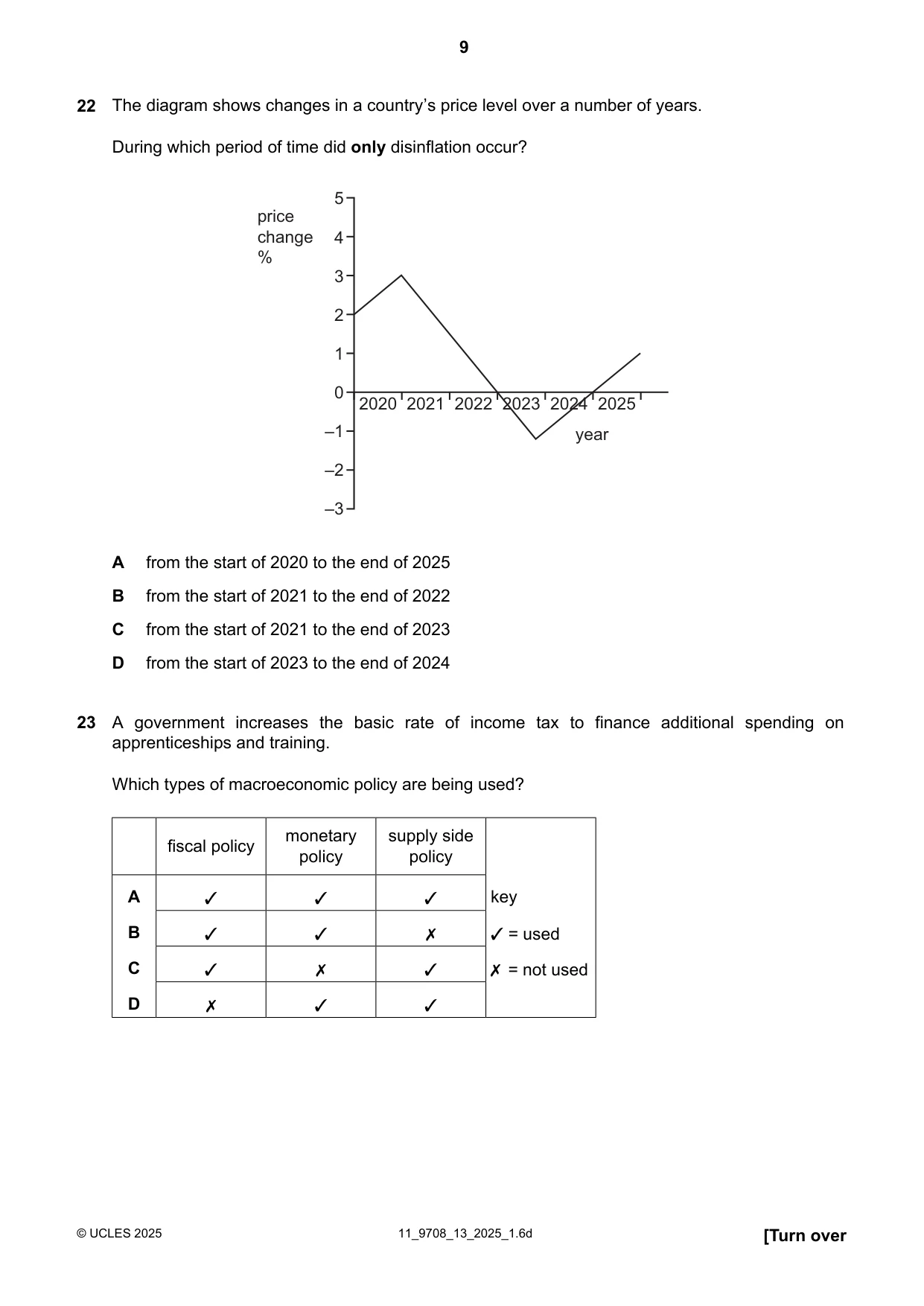
Q22 · The diagram shows changes in a country’s price level over a number of years
22 The diagram shows changes in a country’s price level over a number of years. During which period of time did only disinflation occur? 5 price change 4 % 3 2 1 0 2020 2021 2022 2023 2024 2025 –1 year –2 –3 A from the start of 2020 to the end of 2025 B from the start of 2021 to the end of 2022 C from the start of 2021 to the end of 2023 D from the start of 2023 to the end of 2024
Mark scheme: B
Q23 · A government increases the basic rate of income tax to finance additional spending on…
23 A government increases the basic rate of income tax to finance additional spending on apprenticeships and training. Which types of macroeconomic policy are being used? monetary supply side fiscal policy policy policy A ✓ ✓ ✓ key B ✓ ✓ ✗ ✓= used C ✓ ✗ ✓ ✗= not used D ✗ ✓ ✓
Mark scheme: C
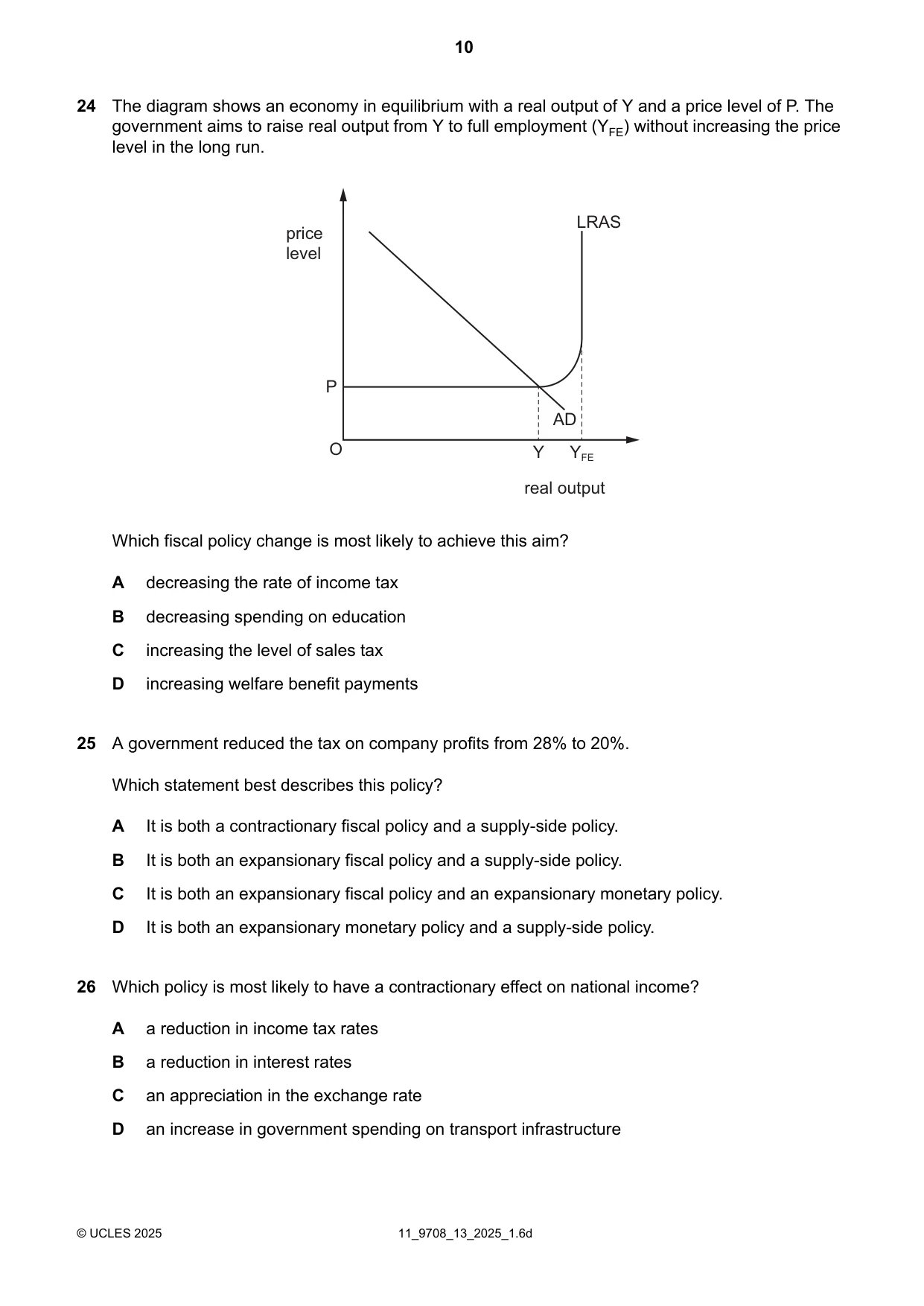
Q24 · The diagram shows an economy in equilibrium with a real output of Y and a price level of P
24 The diagram shows an economy in equilibrium with a real output of Y and a price level of P. The government aims to raise real output from Y to full employment (YFE) without increasing the price level in the long run. LRAS price level P AD O Y YFE real output Which fiscal policy change is most likely to achieve this aim? A decreasing the rate of income tax B decreasing spending on education C increasing the level of sales tax D increasing welfare benefit payments
Mark scheme: A
Q25 · A government reduced the tax on company profits from 28% to 20%
25 A government reduced the tax on company profits from 28% to 20%. Which statement best describes this policy? A It is both a contractionary fiscal policy and a supply-side policy. B It is both an expansionary fiscal policy and a supply-side policy. C It is both an expansionary fiscal policy and an expansionary monetary policy. D It is both an expansionary monetary policy and a supply-side policy.
Mark scheme: B
Q26 · Which policy is most likely to have a contractionary effect on national income?
26 Which policy is most likely to have a contractionary effect on national income? A a reduction in income tax rates B a reduction in interest rates C an appreciation in the exchange rate D an increase in government spending on transport infrastructure
Mark scheme: C
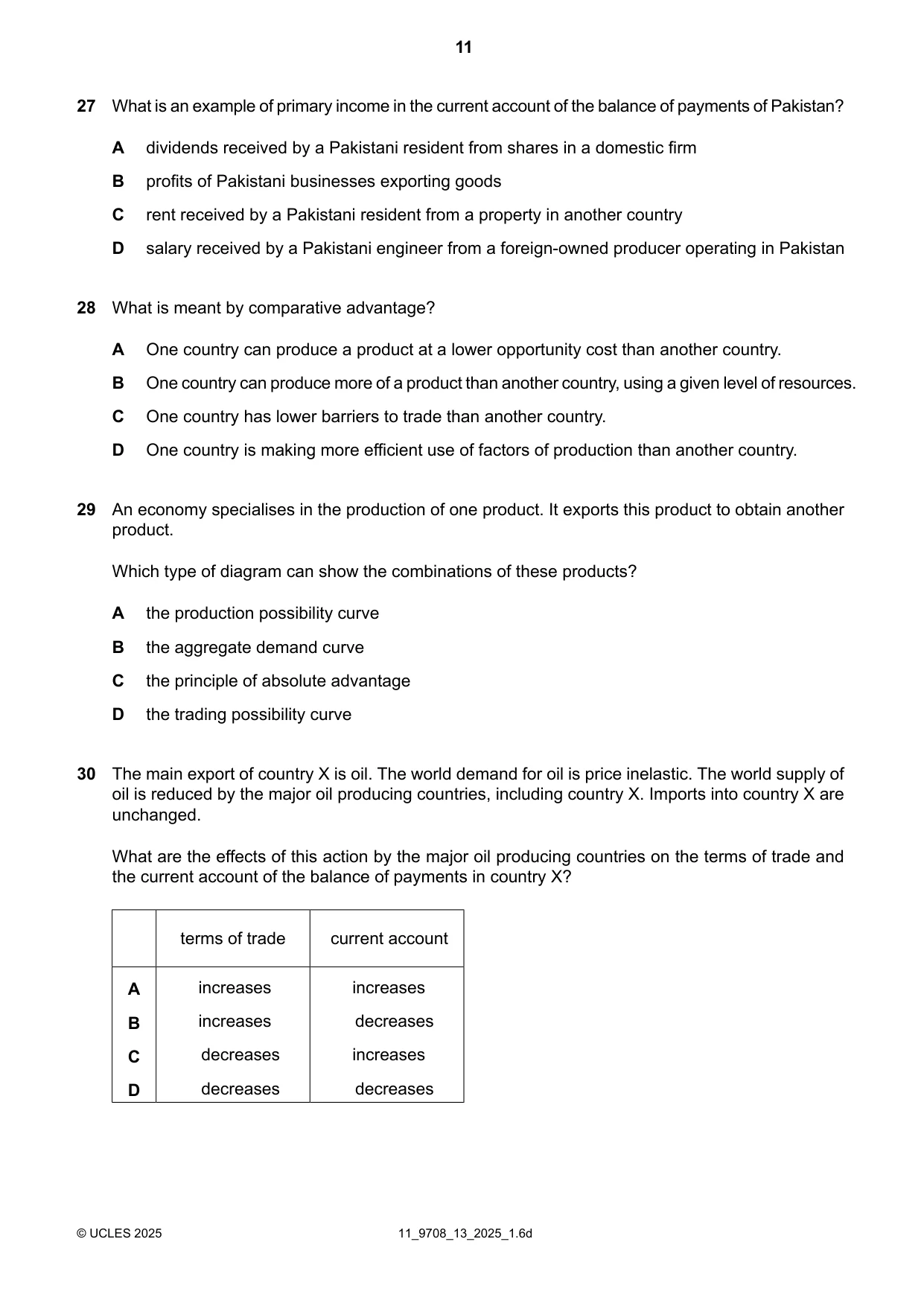
Q27 · What is an example of primary income in the current account of the balance of payments of…
27 What is an example of primary income in the current account of the balance of payments of Pakistan? A dividends received by a Pakistani resident from shares in a domestic firm B profits of Pakistani businesses exporting goods C rent received by a Pakistani resident from a property in another country D salary received by a Pakistani engineer from a foreign-owned producer operating in Pakistan
Mark scheme: C
More questions on Current account of the balance of payments
Q28 · What is meant by comparative advantage?
28 What is meant by comparative advantage? A One country can produce a product at a lower opportunity cost than another country. B One country can produce more of a product than another country, using a given level of resources. C One country has lower barriers to trade than another country. D One country is making more efficient use of factors of production than another country.
Mark scheme: A
Q29 · An economy specialises in the production of one product
29 An economy specialises in the production of one product. It exports this product to obtain another product. Which type of diagram can show the combinations of these products? A the production possibility curve B the aggregate demand curve C the principle of absolute advantage D the trading possibility curve
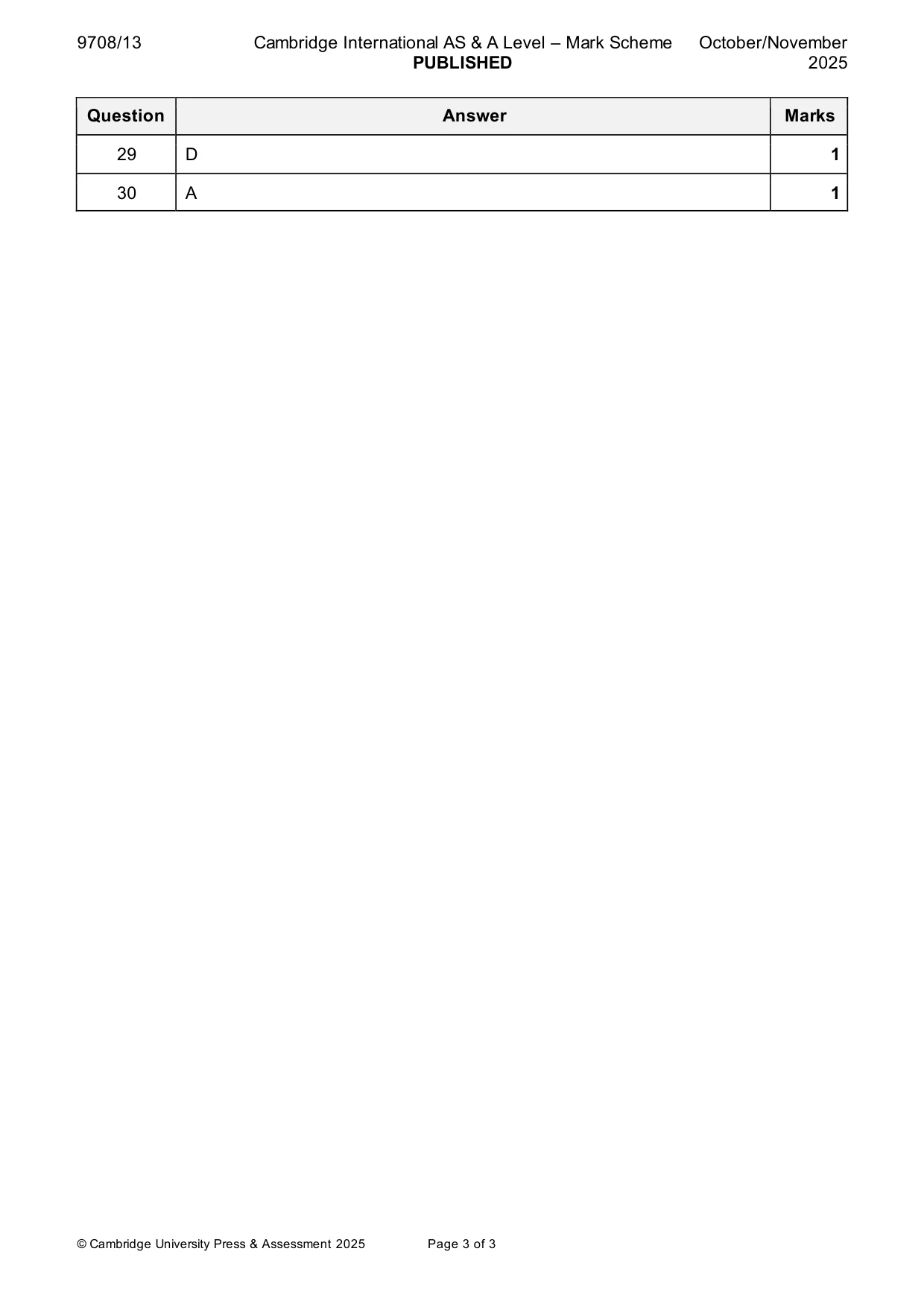
Mark scheme: D
Q30 · The main export of country X is oil
30 The main export of country X is oil. The world demand for oil is price inelastic. The world supply of oil is reduced by the major oil producing countries, including country X. Imports into country X are unchanged. What are the effects of this action by the major oil producing countries on the terms of trade and the current account of the balance of payments in country X? terms of trade current account A increases increases B increases decreases C decreases increases D decreases decreases
Mark scheme: A
More questions on Current account of the balance of payments
What was in this paper
The subtopics covered by these 30 questions, and how many questions each got. Open one in a new tab to see every Cambridge question on it.
3Methods and effects of government intervention in markets3Current account of the balance of payments2The interaction of demand and supply2The reasons for international trade2Addressing income and wealth inequality1Aggregate Demand and Aggregate Supply analysis1Classification of goods and services1Consumer and producer surplus1Demand and supply curves1Economic growth1Economic methodology1Exchange rates1Factors of production1Introduction to the circular flow of income1National income statistics1Price elasticity of supply1Price elasticity, income elasticity and cross elasticity of demand1Price stability1Production possibility curves1Resource allocation in different economic systems1Scarcity, choice and opportunity cost1Unemployment1What you needed in this session
Cambridge’s own grade thresholds for 2025 Oct/Nov, Paper 1 · Variant 3. A higher threshold means an easier paper — the bar moves with how the cohort did.