Cambridge A Level Economics 9708 — 2020 Oct/Nov Paper 1 · Variant 3
9708/13/O/N/20 · 30 questions · 30 marks · ≈34 min
The question paper and its mark scheme, free to read here and free to download. This is Cambridge’s own paper, exactly as it was sat.
Question paper12 pages

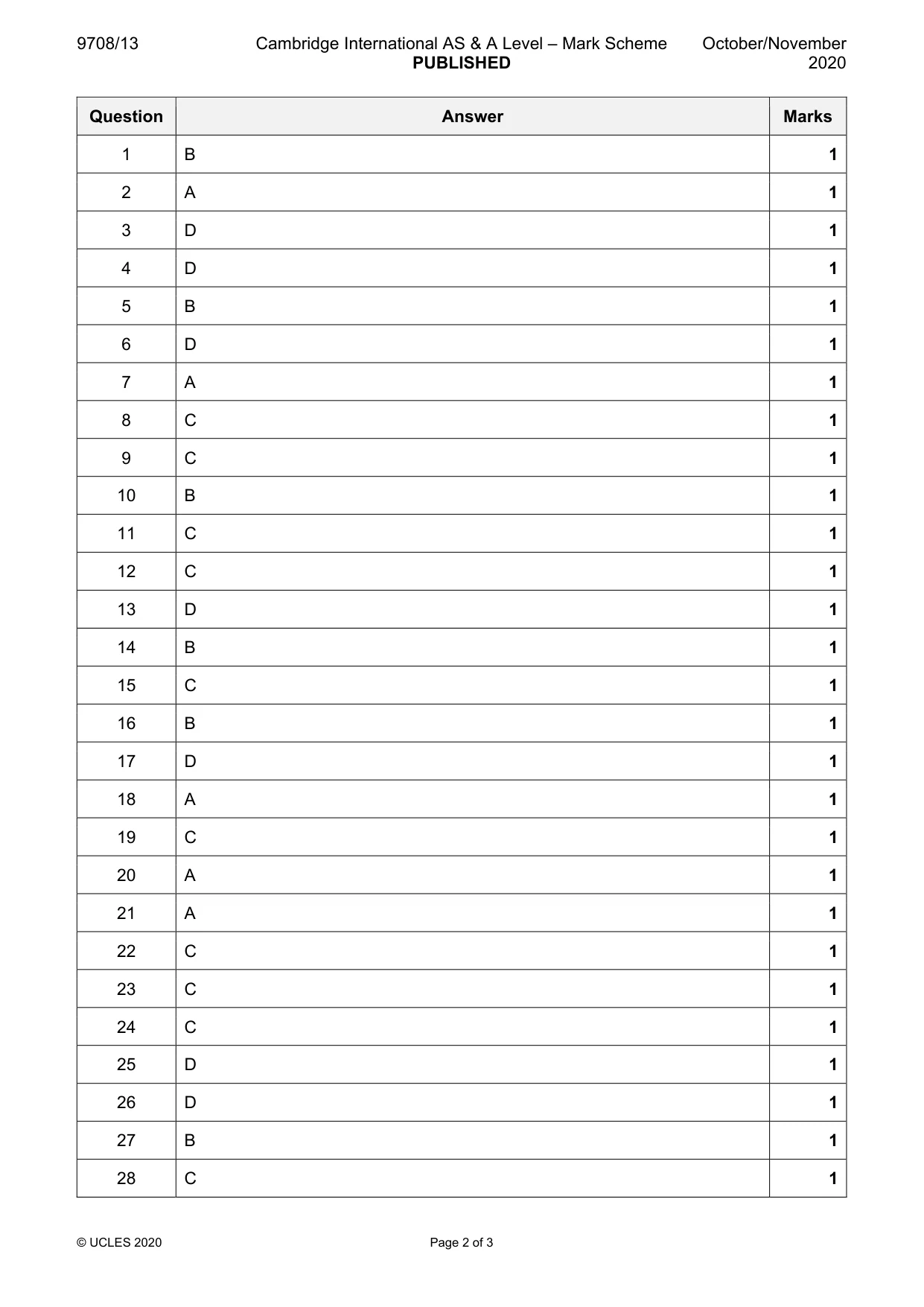
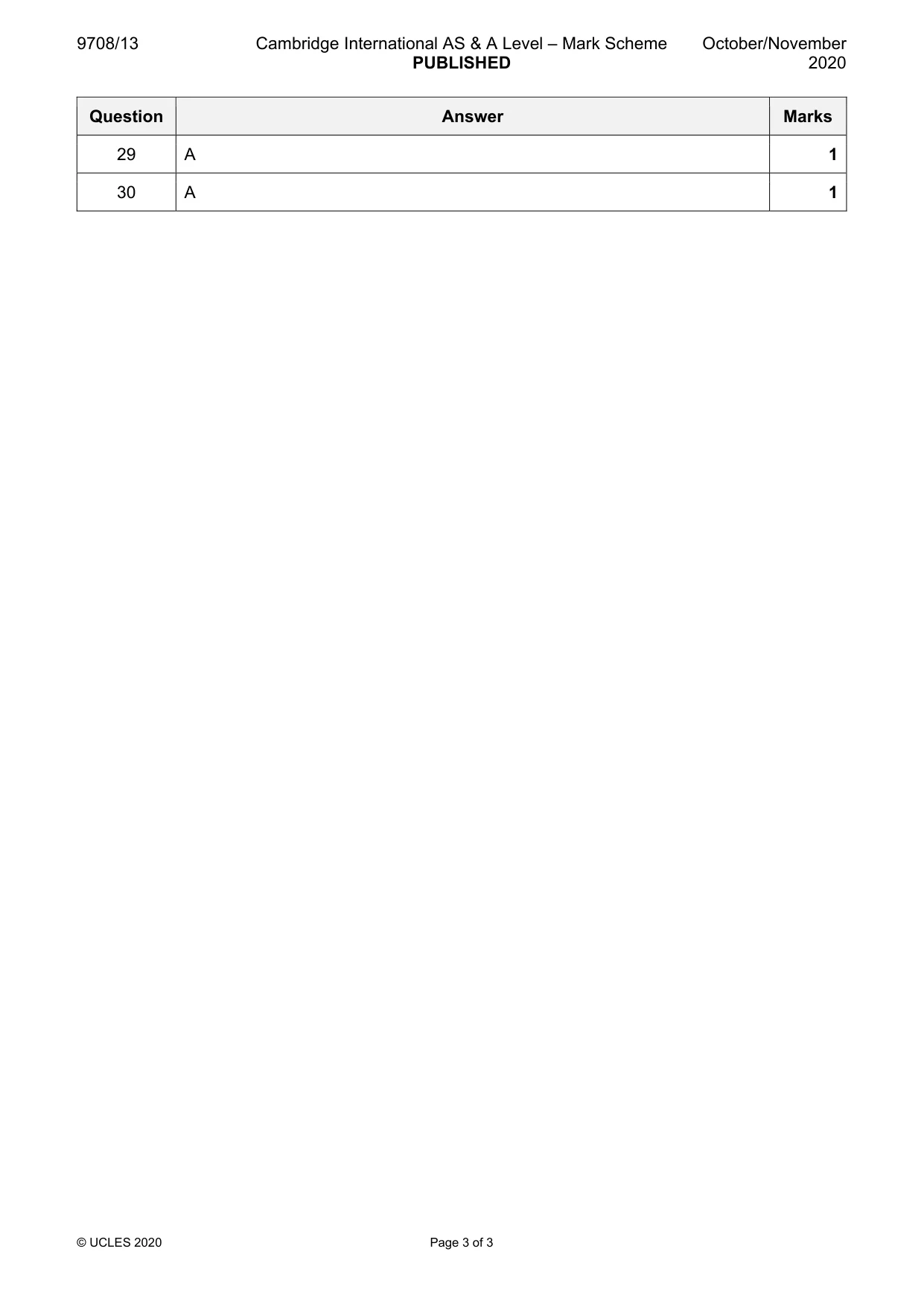
Mark scheme3 pages
Answers below. Sit the paper first if you are practising.
Questions as text
Q1 · An economy is operating at a point inside its production possibility curve
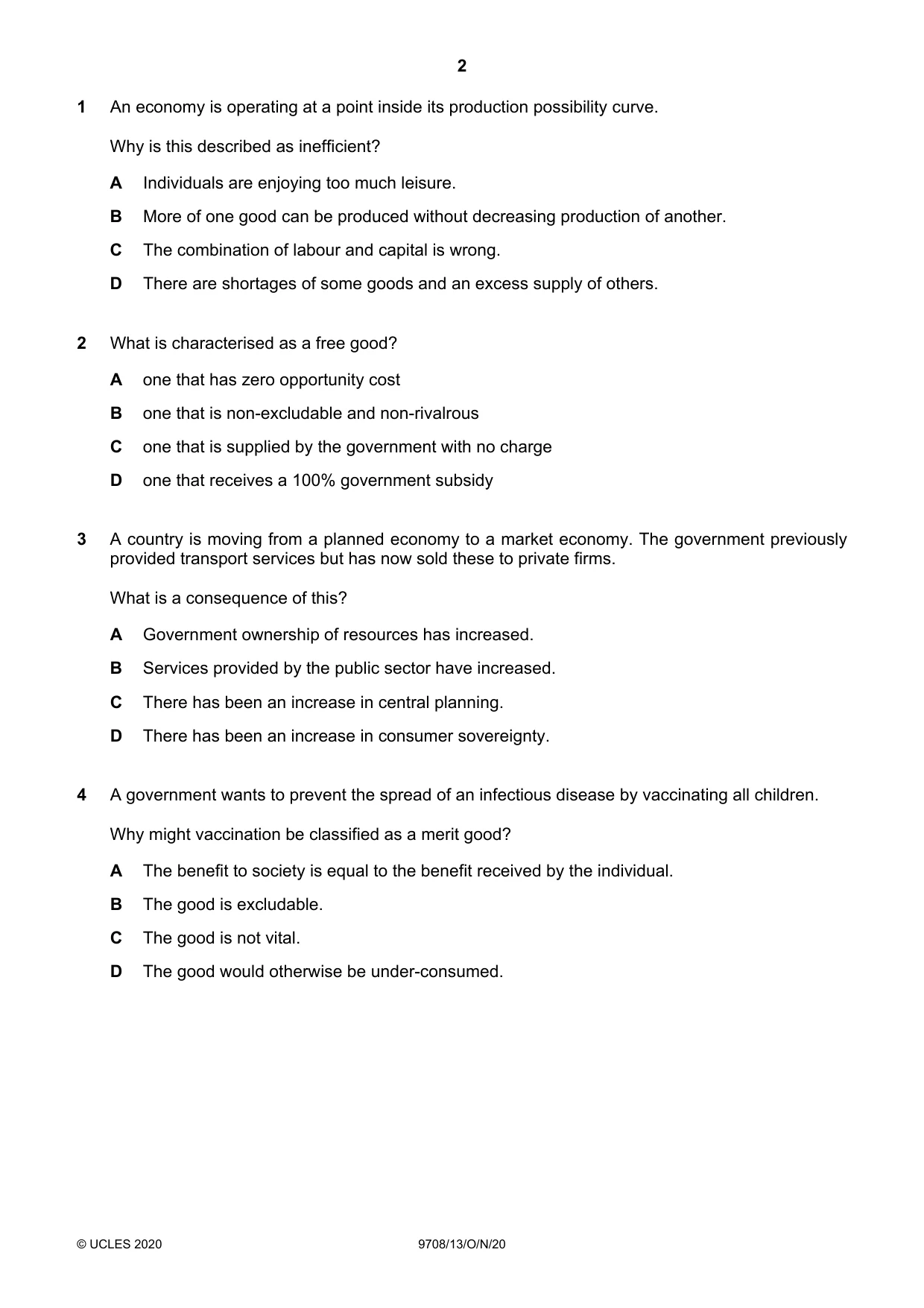
1 An economy is operating at a point inside its production possibility curve. Why is this described as inefficient? A Individuals are enjoying too much leisure. B More of one good can be produced without decreasing production of another. C The combination of labour and capital is wrong. D There are shortages of some goods and an excess supply of others.
Mark scheme: B
Q2 · What is characterised as a free good?
2 What is characterised as a free good? A one that has zero opportunity cost B one that is non-excludable and non-rivalrous C one that is supplied by the government with no charge D one that receives a 100% government subsidy
Mark scheme: A
Q3 · A country is moving from a planned economy to a market economy
3 A country is moving from a planned economy to a market economy. The government previously provided transport services but has now sold these to private firms. What is a consequence of this? A Government ownership of resources has increased. B Services provided by the public sector have increased. C There has been an increase in central planning. D There has been an increase in consumer sovereignty.
Mark scheme: D
More questions on Resource allocation in different economic systems
Q4 · A government wants to prevent the spread of an infectious disease by vaccinating all…
4 A government wants to prevent the spread of an infectious disease by vaccinating all children. Why might vaccination be classified as a merit good? A The benefit to society is equal to the benefit received by the individual. B The good is excludable. C The good is not vital. D The good would otherwise be under-consumed.
Mark scheme: D
Q5 · A product has a downward-sloping demand curve and an upward-sloping supply curve
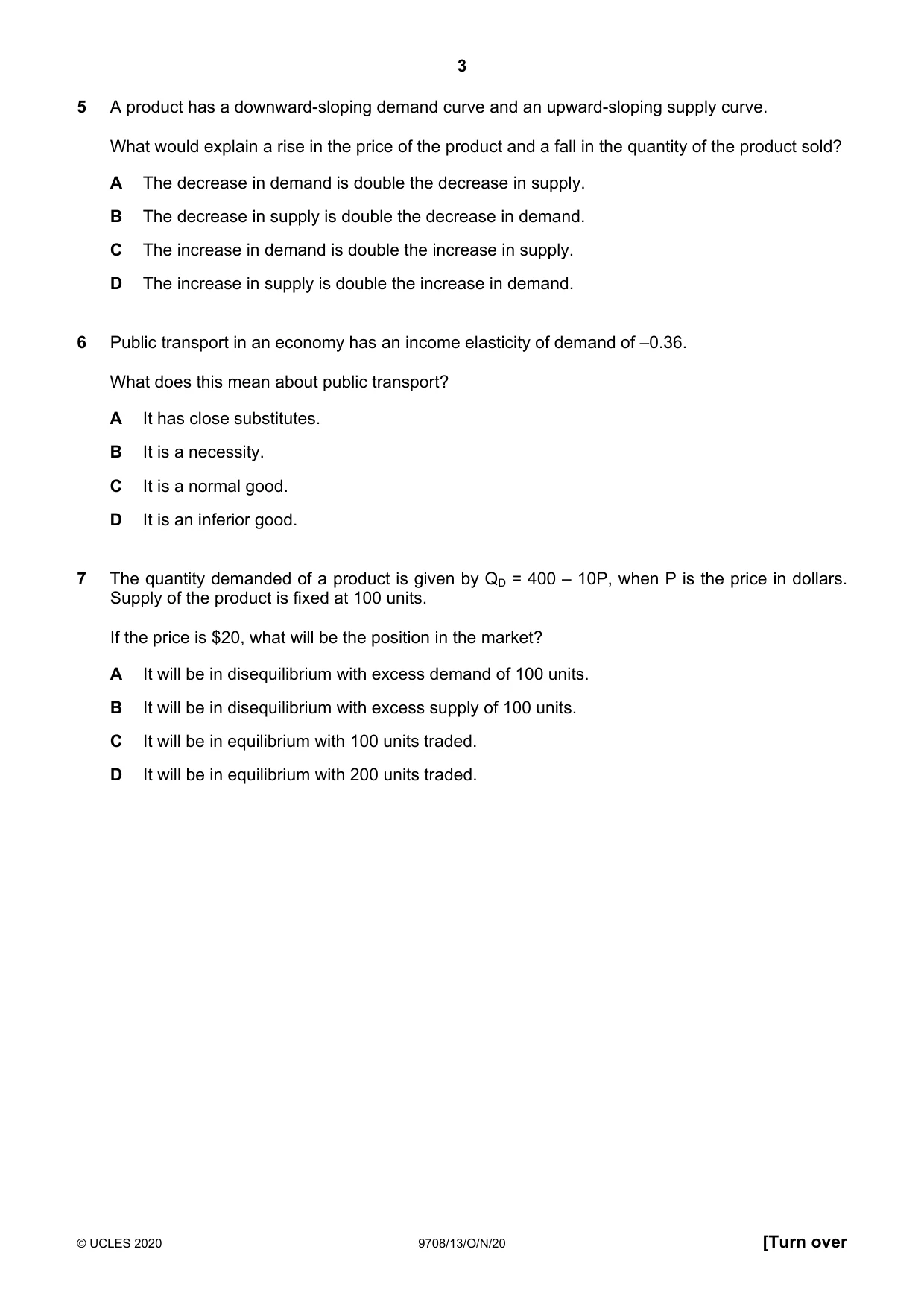
5 A product has a downward-sloping demand curve and an upward-sloping supply curve. What would explain a rise in the price of the product and a fall in the quantity of the product sold? A The decrease in demand is double the decrease in supply. B The decrease in supply is double the decrease in demand. C The increase in demand is double the increase in supply. D The increase in supply is double the increase in demand.
Mark scheme: B
Q6 · Public transport in an economy has an income elasticity of demand of –0.36
6 Public transport in an economy has an income elasticity of demand of –0.36. What does this mean about public transport? A It has close substitutes. B It is a necessity. C It is a normal good. D It is an inferior good.
Mark scheme: D
More questions on Price elasticity, income elasticity and cross elasticity of demand
Q7 · The quantity demanded of a product is given by QD = 400 – 10P, when P is the price in…
7 The quantity demanded of a product is given by QD = 400 – 10P, when P is the price in dollars. Supply of the product is fixed at 100 units. If the price is $20, what will be the position in the market? A It will be in disequilibrium with excess demand of 100 units. B It will be in disequilibrium with excess supply of 100 units. C It will be in equilibrium with 100 units traded. D It will be in equilibrium with 200 units traded.
Mark scheme: A
Q8 · D1 and S1 are the initial demand and supply curves in the market for new cars with an…
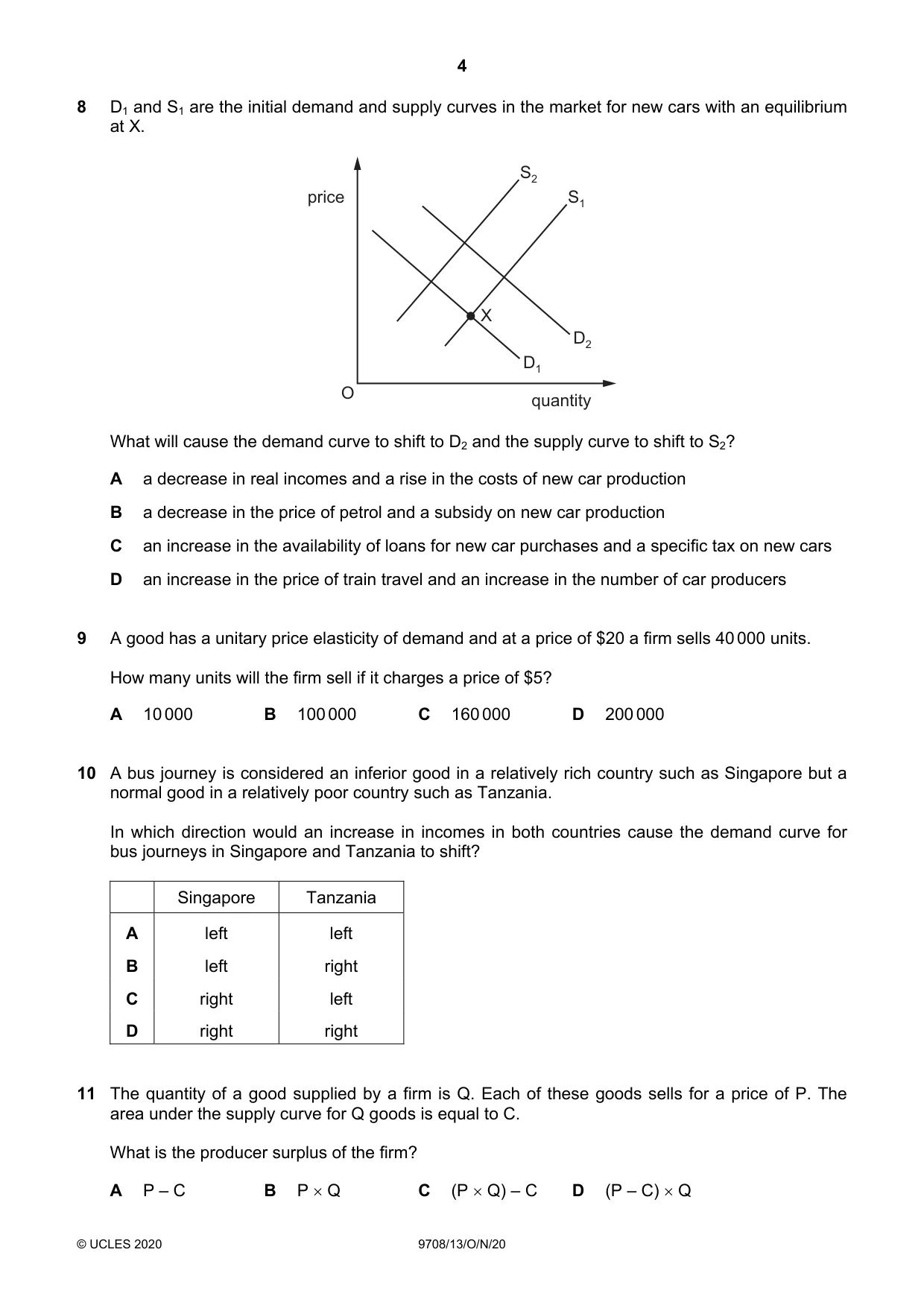
8 D1 and S1 are the initial demand and supply curves in the market for new cars with an equilibrium at X. S2 price S1 X D2 D1 O quantity What will cause the demand curve to shift to D2 and the supply curve to shift to S2? A a decrease in real incomes and a rise in the costs of new car production B a decrease in the price of petrol and a subsidy on new car production C an increase in the availability of loans for new car purchases and a specific tax on new cars D an increase in the price of train travel and an increase in the number of car producers
Mark scheme: C
Q9 · A good has a unitary price elasticity of demand and at a price of $20 a firm sells 40 000…
9 A good has a unitary price elasticity of demand and at a price of $20 a firm sells 40 000 units. How many units will the firm sell if it charges a price of $5? A 10 000 B 100 000 C 160 000 D 200 000
Mark scheme: C
More questions on Price elasticity, income elasticity and cross elasticity of demand
Q10 · A bus journey is considered an inferior good in a relatively rich country such as…
10 A bus journey is considered an inferior good in a relatively rich country such as Singapore but a normal good in a relatively poor country such as Tanzania. In which direction would an increase in incomes in both countries cause the demand curve for bus journeys in Singapore and Tanzania to shift? Singapore Tanzania A left left B left right C right left D right right
Mark scheme: B
More questions on Price elasticity, income elasticity and cross elasticity of demand
Q11 · The quantity of a good supplied by a firm is Q
11 The quantity of a good supplied by a firm is Q. Each of these goods sells for a price of P. The area under the supply curve for Q goods is equal to C. What is the producer surplus of the firm? A P – C B P × Q C (P × Q) – C D (P – C) × Q
Mark scheme: C
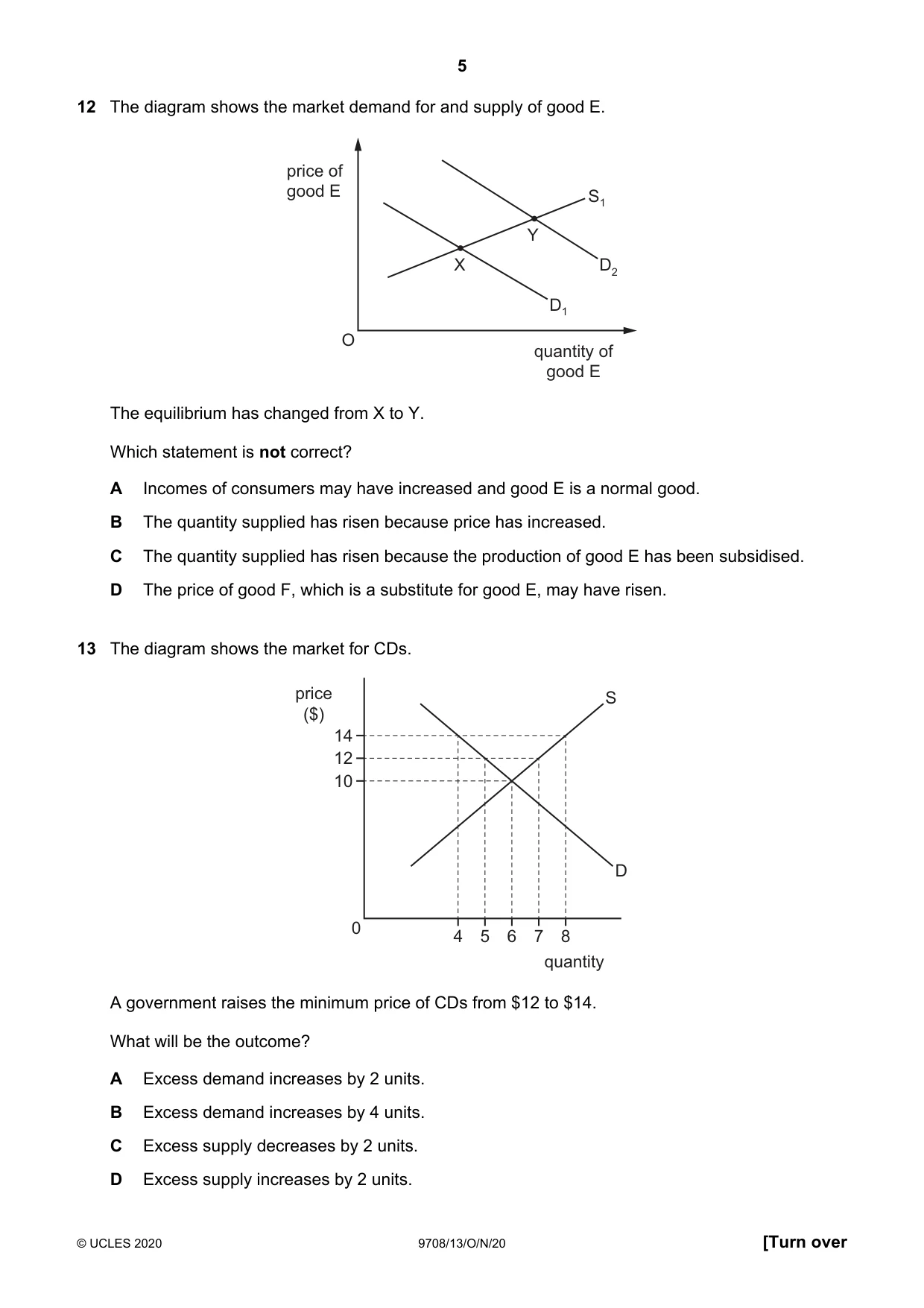
Q12 · The diagram shows the market demand for and supply of good E
12 The diagram shows the market demand for and supply of good E. price of good E S1 Y X D2 D1 O quantity of good E The equilibrium has changed from X to Y. Which statement is not correct? A Incomes of consumers may have increased and good E is a normal good. B The quantity supplied has risen because price has increased. C The quantity supplied has risen because the production of good E has been subsidised. D The price of good F, which is a substitute for good E, may have risen.
Mark scheme: C
Q13 · The diagram shows the market for CDs
13 The diagram shows the market for CDs. price S ($) 14 12 10 D 0 4 5 6 7 8 quantity A government raises the minimum price of CDs from $12 to $14. What will be the outcome? A Excess demand increases by 2 units. B Excess demand increases by 4 units. C Excess supply decreases by 2 units. D Excess supply increases by 2 units.
Mark scheme: D
More questions on Methods and effects of government intervention in markets
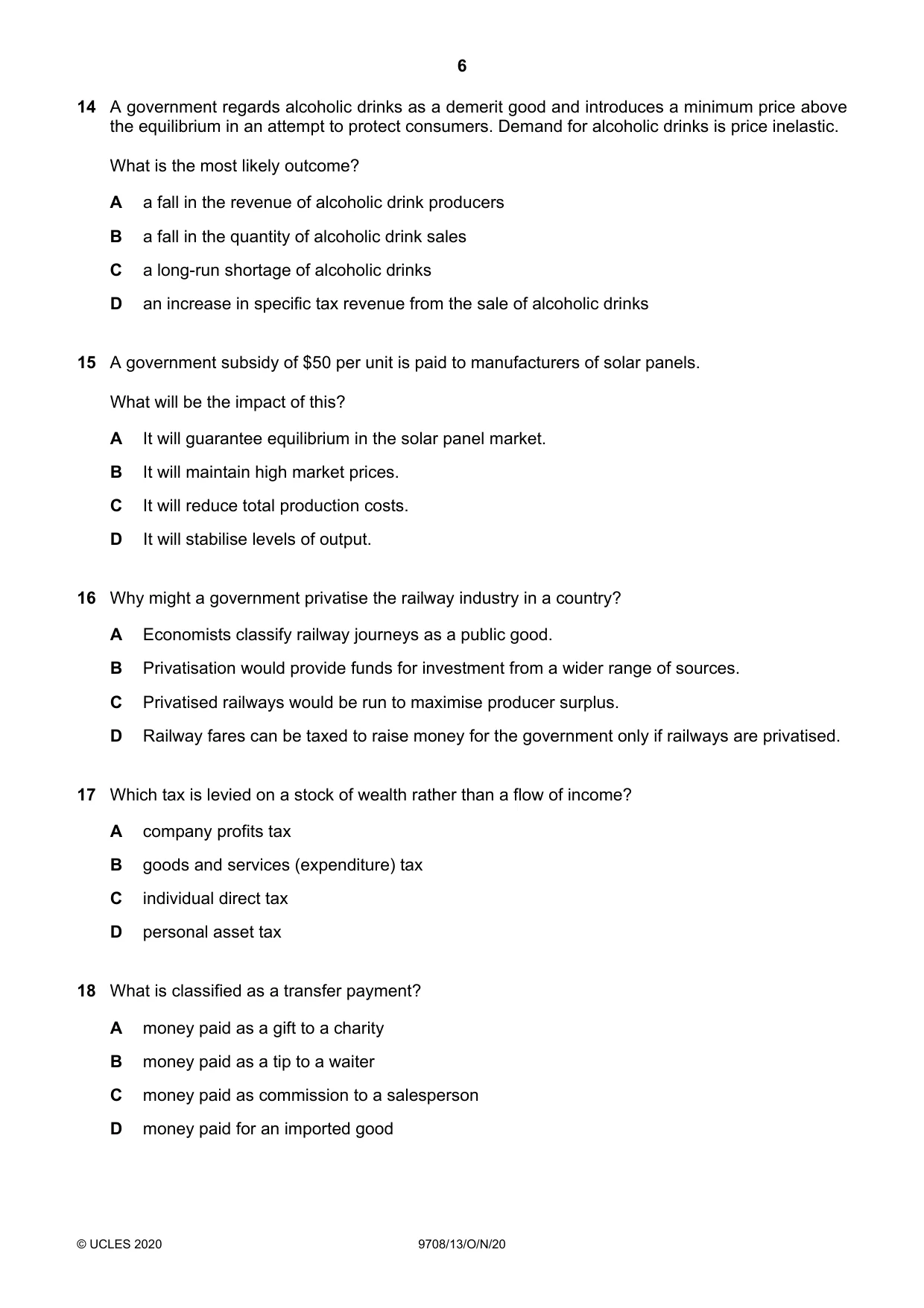
Q14 · A government regards alcoholic drinks as a demerit good and introduces a minimum price…
14 A government regards alcoholic drinks as a demerit good and introduces a minimum price above the equilibrium in an attempt to protect consumers. Demand for alcoholic drinks is price inelastic. What is the most likely outcome? A a fall in the revenue of alcoholic drink producers B a fall in the quantity of alcoholic drink sales C a long-run shortage of alcoholic drinks D an increase in specific tax revenue from the sale of alcoholic drinks
Mark scheme: B
More questions on Methods and effects of government intervention in markets
Q15 · A government subsidy of $50 per unit is paid to manufacturers of solar panels
15 A government subsidy of $50 per unit is paid to manufacturers of solar panels. What will be the impact of this? A It will guarantee equilibrium in the solar panel market. B It will maintain high market prices. C It will reduce total production costs. D It will stabilise levels of output.
Mark scheme: C
More questions on Methods and effects of government intervention in markets
Q16 · Why might a government privatise the railway industry in a country?
16 Why might a government privatise the railway industry in a country? A Economists classify railway journeys as a public good. B Privatisation would provide funds for investment from a wider range of sources. C Privatised railways would be run to maximise producer surplus. D Railway fares can be taxed to raise money for the government only if railways are privatised.
Mark scheme: B
More questions on Resource allocation in different economic systems
Q17 · Which tax is levied on a stock of wealth rather than a flow of income?
17 Which tax is levied on a stock of wealth rather than a flow of income? A company profits tax B goods and services (expenditure) tax C individual direct tax D personal asset tax
Mark scheme: D
Q18 · What is classified as a transfer payment?
18 What is classified as a transfer payment? A money paid as a gift to a charity B money paid as a tip to a waiter C money paid as commission to a salesperson D money paid for an imported good
Mark scheme: A
Q19 · Under which circumstance would the rate of inflation be most likely to fall?
19 Under which circumstance would the rate of inflation be most likely to fall? A Government spending increases and society’s marginal propensity to save falls. B Reduced interest rates result in consumers increasing their spending. C The government increases direct taxes and the level of investment falls. D The prices of imported raw materials rise, whilst demand for exports falls.
Mark scheme: C
Q20 · In which circumstances will country X have a comparative advantage in the production of…
20 In which circumstances will country X have a comparative advantage in the production of rice over country Y? A when X has lower opportunity costs in producing rice than Y B when X is in a customs union and Y is outside that union C when X uses dollars for trading and Y uses a different currency D when X uses more units of labour than Y to produce rice
Mark scheme: A
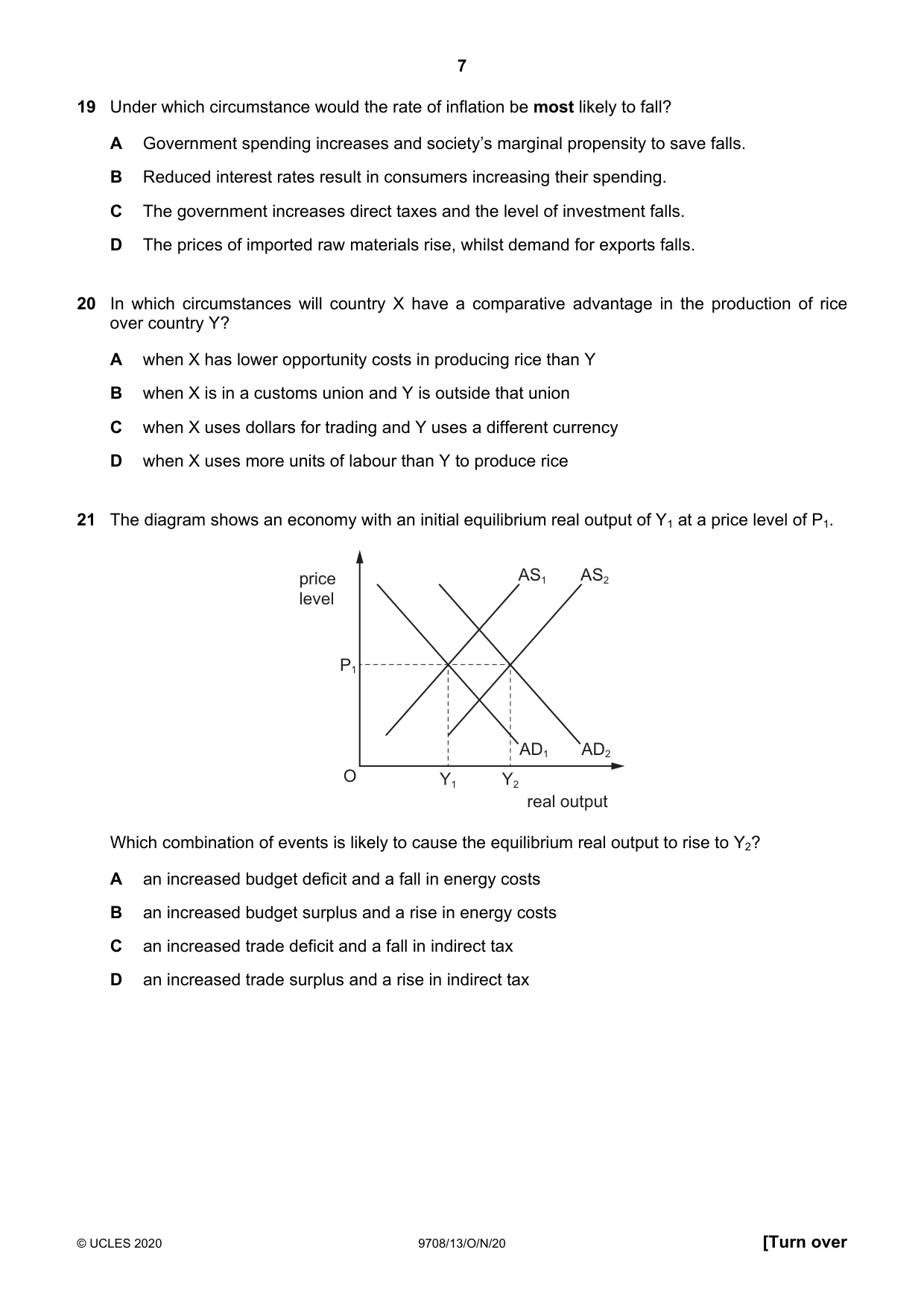
Q21 · The diagram shows an economy with an initial equilibrium real output of Y1 at a price…
21 The diagram shows an economy with an initial equilibrium real output of Y1 at a price level of P1. price AS1 AS2 level P1 AD1 AD2 O Y1 Y2 real output Which combination of events is likely to cause the equilibrium real output to rise to Y2? A an increased budget deficit and a fall in energy costs B an increased budget surplus and a rise in energy costs C an increased trade deficit and a fall in indirect tax D an increased trade surplus and a rise in indirect tax
Mark scheme: A
More questions on Aggregate Demand and Aggregate Supply analysis
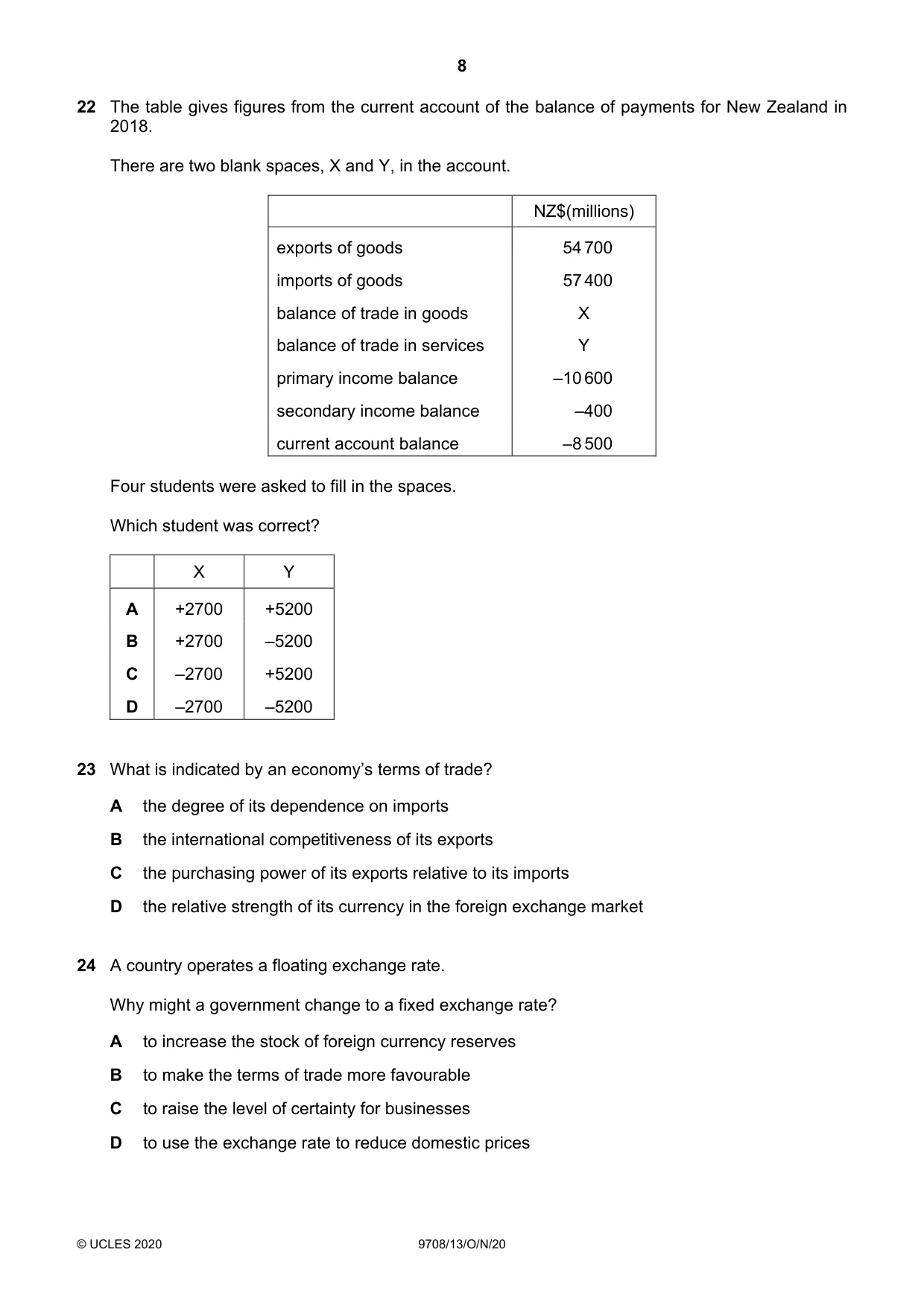
Q22 · The table gives figures from the current account of the balance of payments for New…
22 The table gives figures from the current account of the balance of payments for New Zealand in 2018. There are two blank spaces, X and Y, in the account. NZ$(millions) exports of goods 54 700 imports of goods 57 400 balance of trade in goods X balance of trade in services Y primary income balance –10 600 secondary income balance –400 current account balance –8 500 Four students were asked to fill in the spaces. Which student was correct? X Y A +2700 +5200 B +2700 –5200 C –2700 +5200 D –2700 –5200
Mark scheme: C
More questions on Current account of the balance of payments
Q23 · What is indicated by an economy’s terms of trade?
23 What is indicated by an economy’s terms of trade? A the degree of its dependence on imports B the international competitiveness of its exports C the purchasing power of its exports relative to its imports D the relative strength of its currency in the foreign exchange market
Mark scheme: C
Q24 · A country operates a floating exchange rate
24 A country operates a floating exchange rate. Why might a government change to a fixed exchange rate? A to increase the stock of foreign currency reserves B to make the terms of trade more favourable C to raise the level of certainty for businesses D to use the exchange rate to reduce domestic prices
Mark scheme: C
Q25 · What term relates to a fall in the domestic real value of a currency?
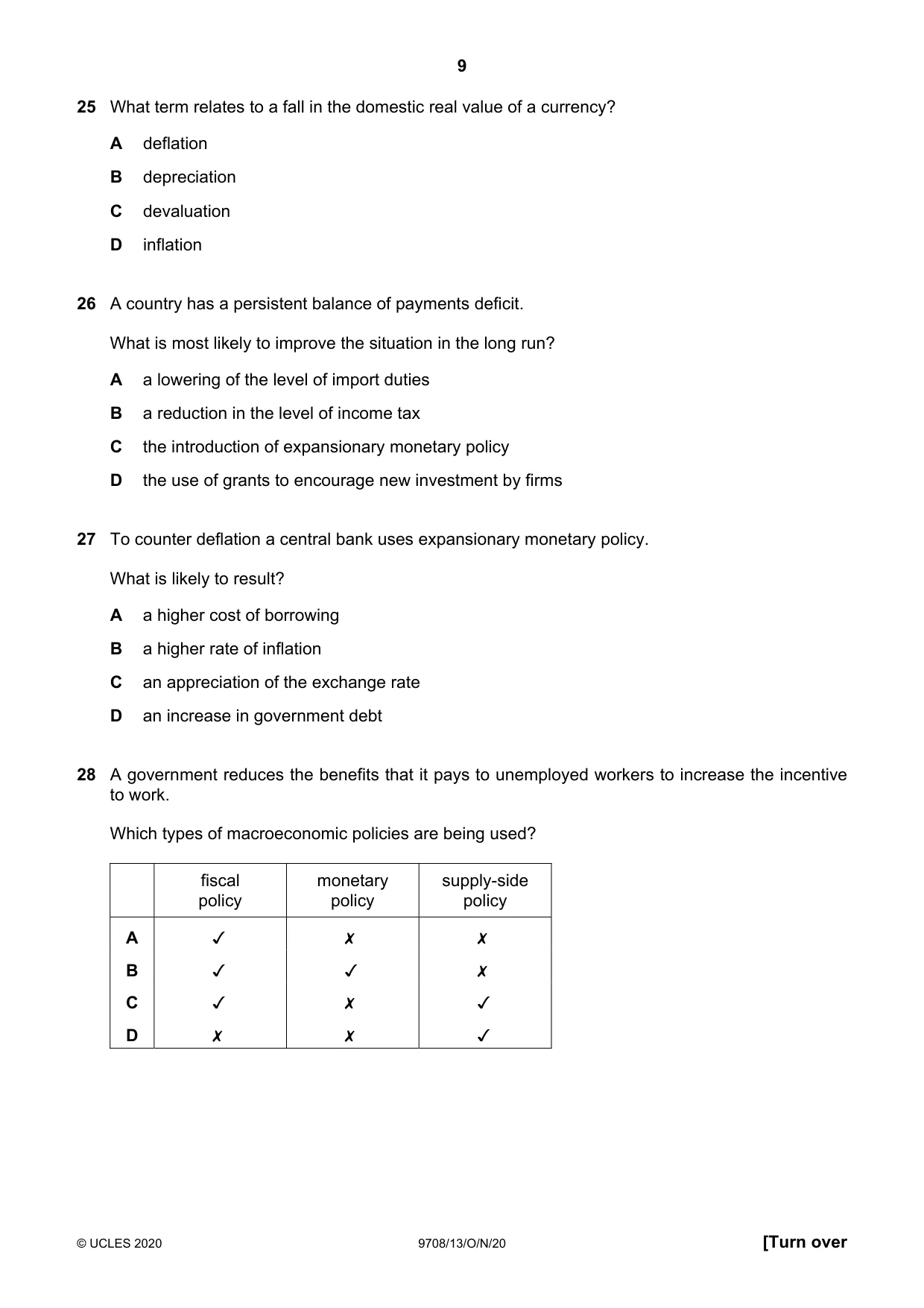
25 What term relates to a fall in the domestic real value of a currency? A deflation B depreciation C devaluation D inflation
Mark scheme: D
Q26 · A country has a persistent balance of payments deficit
26 A country has a persistent balance of payments deficit. What is most likely to improve the situation in the long run? A a lowering of the level of import duties B a reduction in the level of income tax C the introduction of expansionary monetary policy D the use of grants to encourage new investment by firms
Mark scheme: D
More questions on Policies to correct imbalances in the current account of the balance of payments
Q27 · To counter deflation a central bank uses expansionary monetary policy
27 To counter deflation a central bank uses expansionary monetary policy. What is likely to result? A a higher cost of borrowing B a higher rate of inflation C an appreciation of the exchange rate D an increase in government debt
Mark scheme: B
Q28 · A government reduces the benefits that it pays to unemployed workers to increase the…
28 A government reduces the benefits that it pays to unemployed workers to increase the incentive to work. Which types of macroeconomic policies are being used? fiscal monetary supply-side policy policy policy v 0 OW > x « < x \ <x x v v x
Mark scheme: C
Q29 · Suppose a country has a rate of inflation well below its target rate, high unemployment…
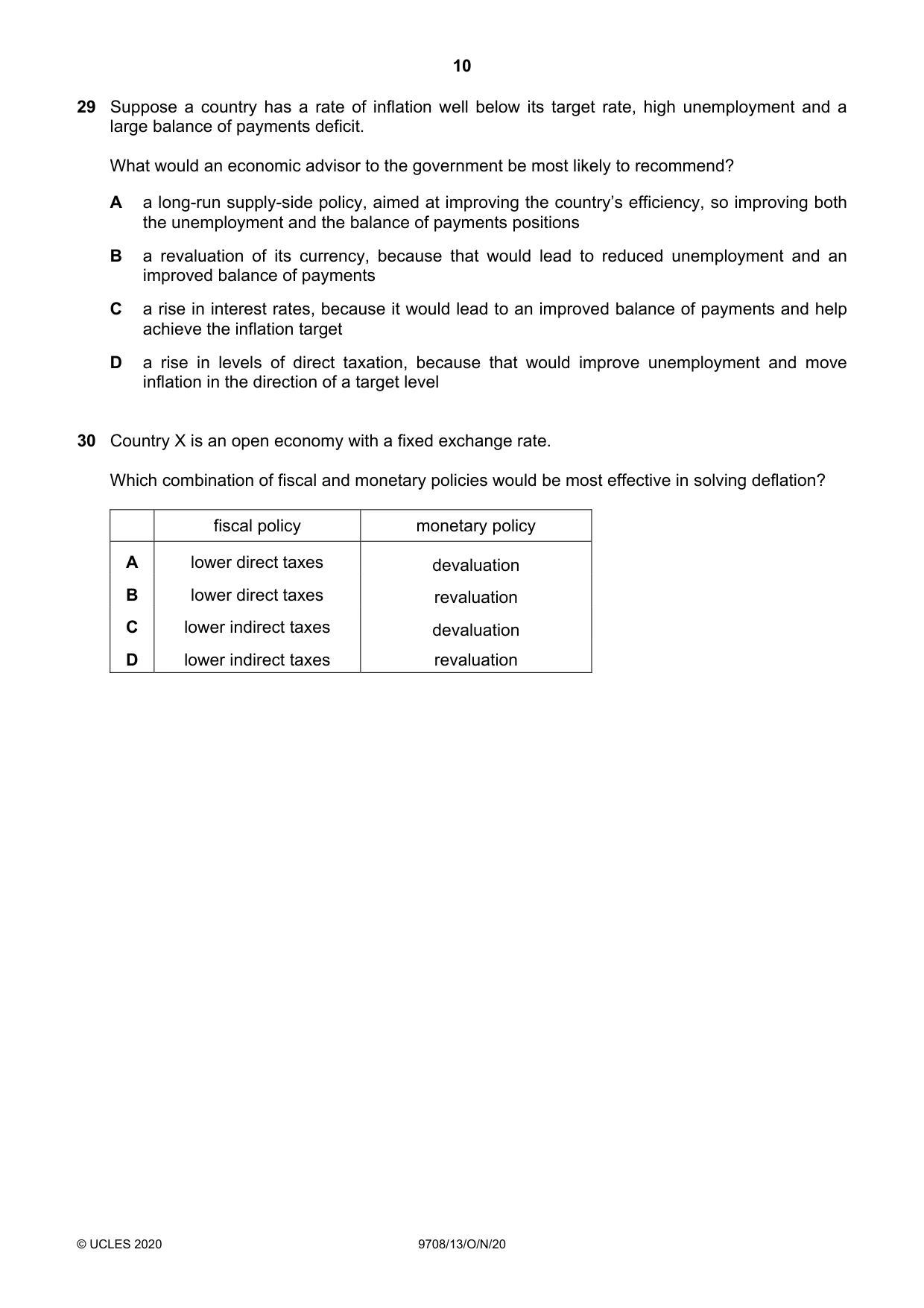
29 Suppose a country has a rate of inflation well below its target rate, high unemployment and a large balance of payments deficit. What would an economic advisor to the government be most likely to recommend? A a long-run supply-side policy, aimed at improving the country’s efficiency, so improving both the unemployment and the balance of payments positions B a revaluation of its currency, because that would lead to reduced unemployment and an improved balance of payments C a rise in interest rates, because it would lead to an improved balance of payments and help achieve the inflation target D a rise in levels of direct taxation, because that would improve unemployment and move inflation in the direction of a target level
Mark scheme: A
Q30 · Country X is an open economy with a fixed exchange rate
30 Country X is an open economy with a fixed exchange rate. Which combination of fiscal and monetary policies would be most effective in solving deflation? fiscal policy monetary policy A lower direct taxes devaluation B lower direct taxes revaluation C lower indirect taxes devaluation D lower indirect taxes revaluation
Mark scheme: A
What was in this paper
The subtopics covered by these 30 questions, and how many questions each got. Open one in a new tab to see every Cambridge question on it.
4Methods and effects of government intervention in markets3Price elasticity, income elasticity and cross elasticity of demand3Classification of goods and services2Fiscal policy2Price stability2Resource allocation in different economic systems2Supply-side policy2The reasons for international trade2Aggregate Demand and Aggregate Supply analysis1Consumer and producer surplus1Current account of the balance of payments1Exchange rates1Monetary policy1National income statistics1Policies to correct imbalances in the current account of the balance of payments1Production possibility curves1What you needed in this session
Cambridge’s own grade thresholds for 2020 Oct/Nov, Paper 1 · Variant 3. A higher threshold means an easier paper — the bar moves with how the cohort did.