Cambridge A Level Economics 9708 — 2010 Oct/Nov Paper 1 · Variant 3
9708/13/O/N/10 · 30 questions · 30 marks · ≈34 min
The question paper and its mark scheme, free to read here and free to download. This is Cambridge’s own paper, exactly as it was sat.
Question paper12 pages
Mark scheme2 pages
Answers below. Sit the paper first if you are practising.
Questions as text
Q1 · What are most likely to be disadvantages found in a market economy?
1 What are most likely to be disadvantages found in a market economy? A economic growth and state-owned companies B merit goods and free competition C public goods and economic specialisation D unemployment and external costs
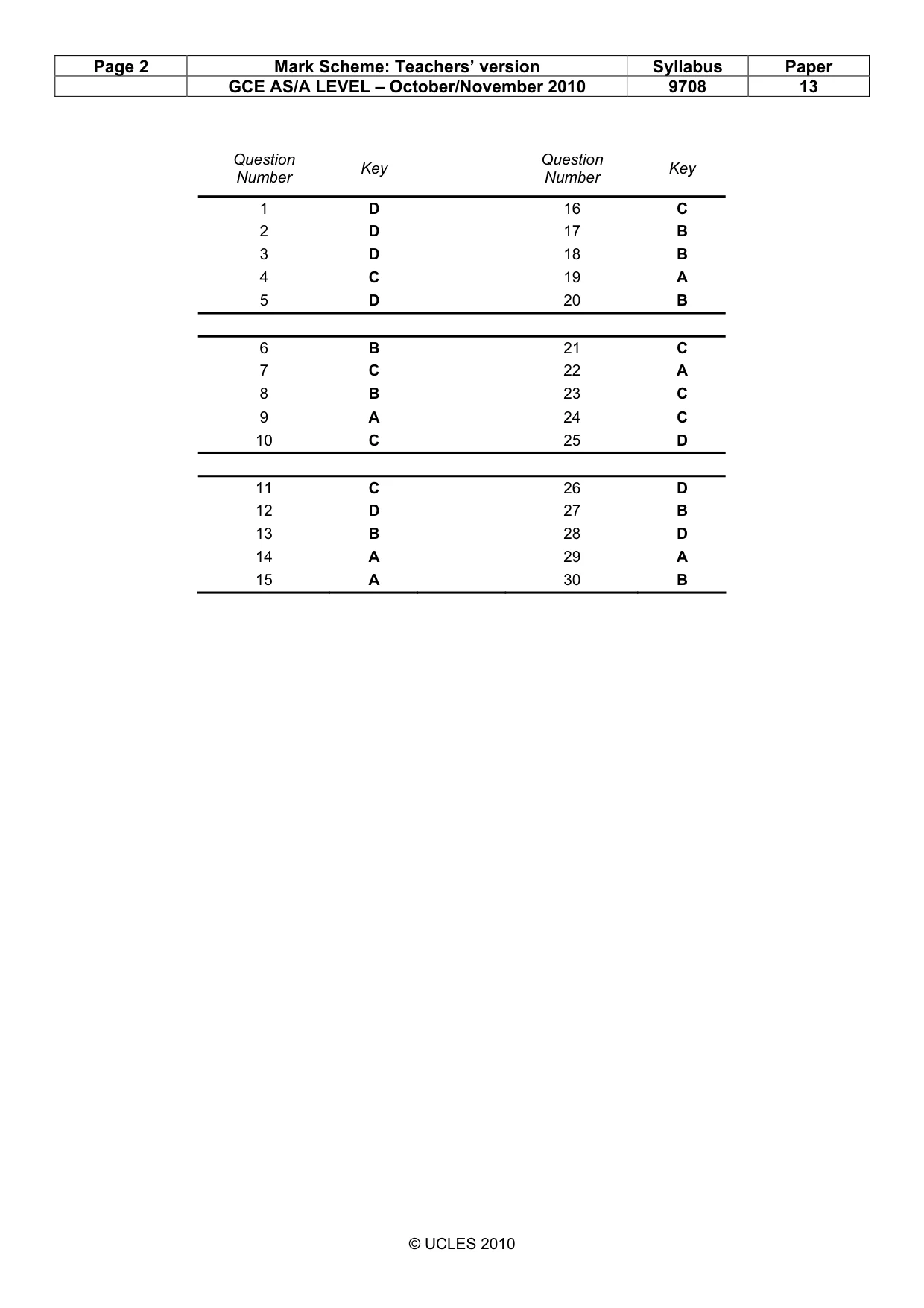
Mark scheme: D
More questions on Resource allocation in different economic systems
Q2 · The diagram shows the production possibility curve of an economy
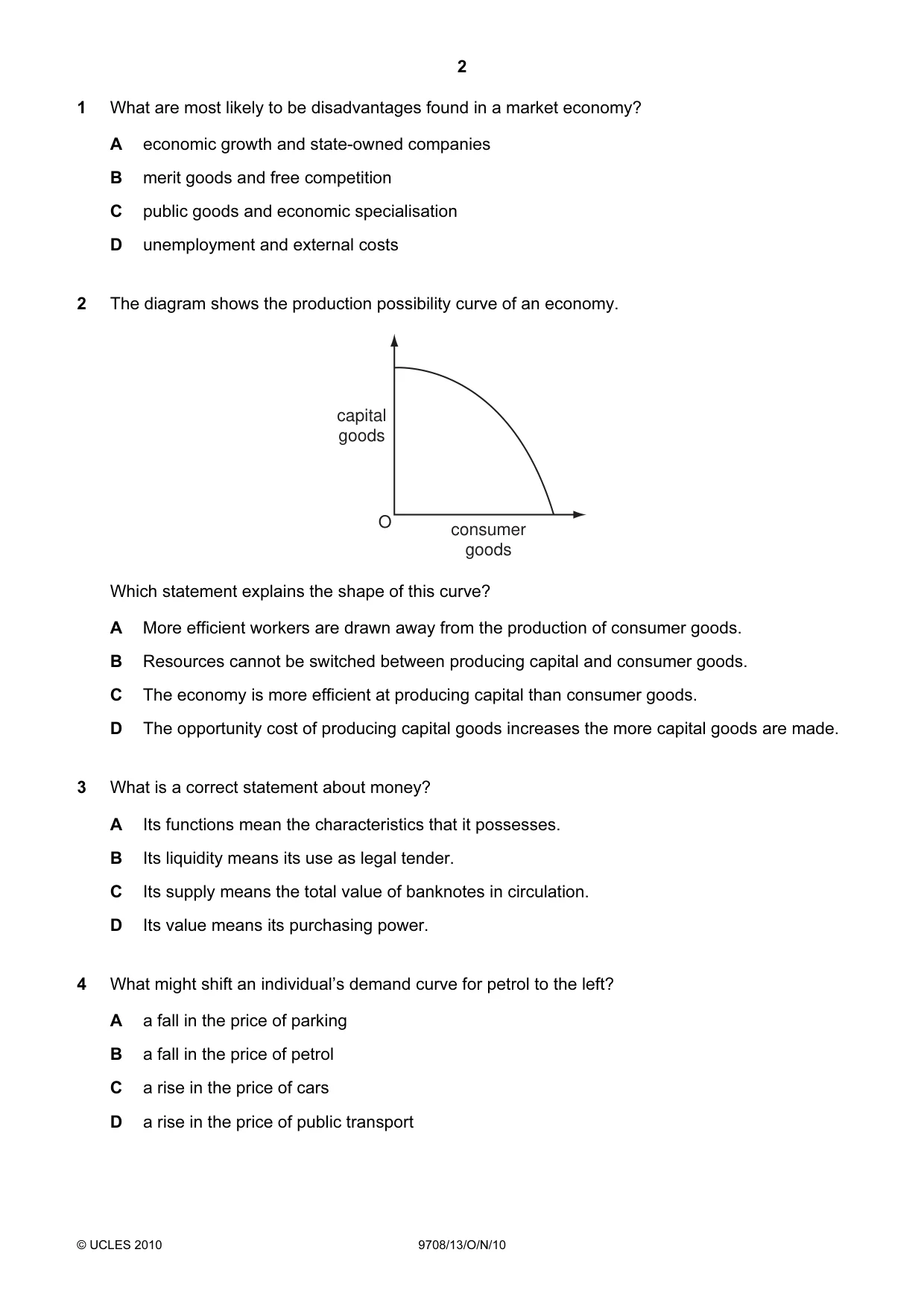
2 The diagram shows the production possibility curve of an economy. capital goods O consumer goods Which statement explains the shape of this curve? A More efficient workers are drawn away from the production of consumer goods. B Resources cannot be switched between producing capital and consumer goods. C The economy is more efficient at producing capital than consumer goods. D The opportunity cost of producing capital goods increases the more capital goods are made.
Mark scheme: D
Q3 · What is a correct statement about money?
3 What is a correct statement about money? A Its functions mean the characteristics that it possesses. B Its liquidity means its use as legal tender. C Its supply means the total value of banknotes in circulation. D Its value means its purchasing power.
Mark scheme: D
Q4 · What might shift an individual’s demand curve for petrol to the left?
4 What might shift an individual’s demand curve for petrol to the left? A a fall in the price of parking B a fall in the price of petrol C a rise in the price of cars D a rise in the price of public transport
Mark scheme: C
Q5 · The diagram shows a consumer’s short-run and long-run demand curves for coconuts
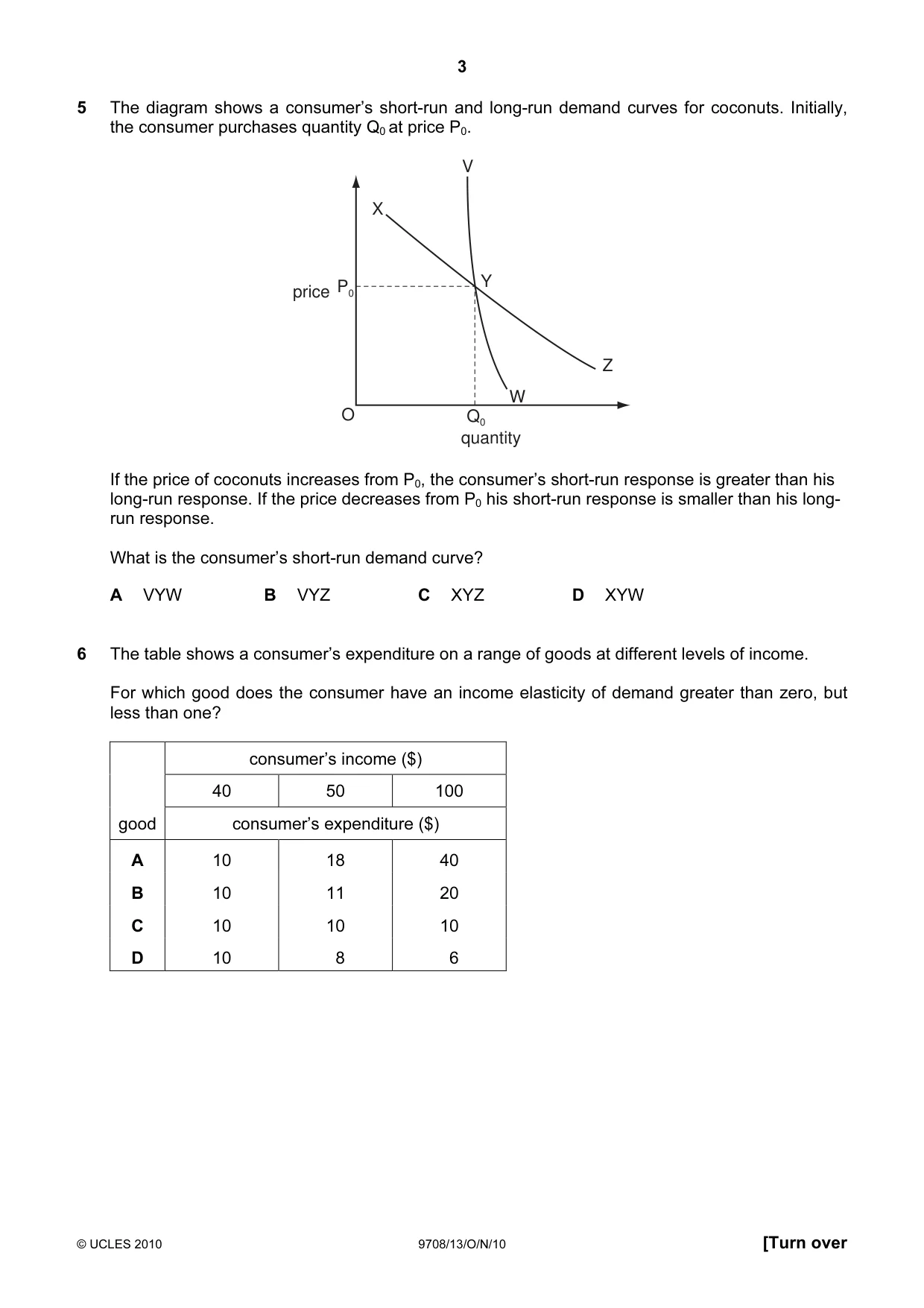
5 The diagram shows a consumer’s short-run and long-run demand curves for coconuts. Initially, the consumer purchases quantity Q0 at price P0. V X P0 Y price Z W O Q0 quantity If the price of coconuts increases from P0, the consumer’s short-run response is greater than his long-run response. If the price decreases from P0 his short-run response is smaller than his long- run response. What is the consumer’s short-run demand curve? A VYW B VYZ C XYZ D XYW
Mark scheme: D
More questions on Price elasticity, income elasticity and cross elasticity of demand
Q6 · The table shows a consumer’s expenditure on a range of goods at different levels of income
6 The table shows a consumer’s expenditure on a range of goods at different levels of income. For which good does the consumer have an income elasticity of demand greater than zero, but less than one? consumer’s income ($) 40 50 100 good consumer’s expenditure ($) A 10 18 40 B 10 11 20 C 10 10 10 D 10 8 6
Mark scheme: B
More questions on Price elasticity, income elasticity and cross elasticity of demand
Q7 · The diagram shows the demand curve for a product
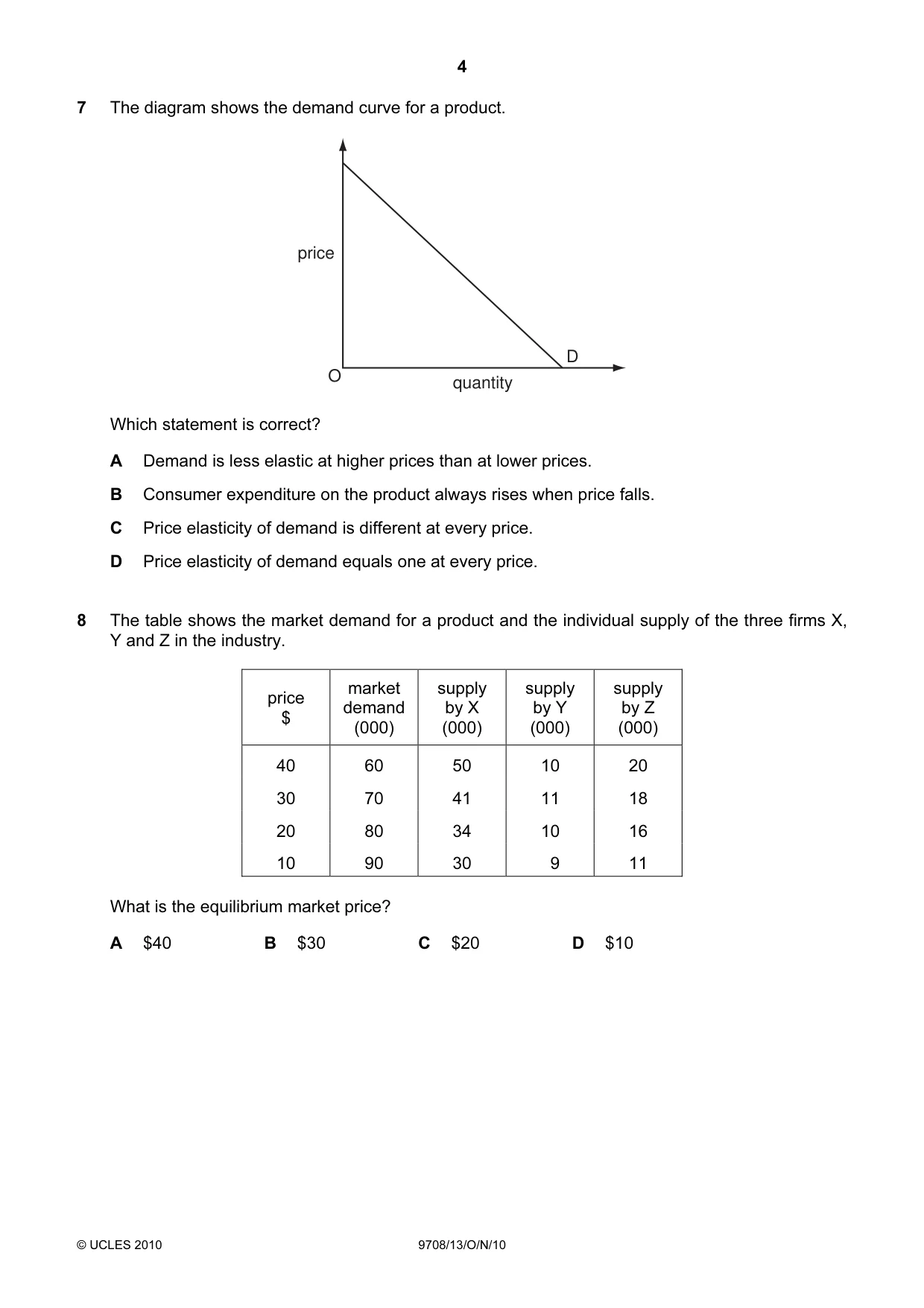
7 The diagram shows the demand curve for a product. price D O quantity Which statement is correct? A Demand is less elastic at higher prices than at lower prices. B Consumer expenditure on the product always rises when price falls. C Price elasticity of demand is different at every price. D Price elasticity of demand equals one at every price.
Mark scheme: C
More questions on Price elasticity, income elasticity and cross elasticity of demand
Q8 · The table shows the market demand for a product and the individual supply of the three…
8 The table shows the market demand for a product and the individual supply of the three firms X, Y and Z in the industry. market supply supply supply price demand by X by Y by Z $ (000) (000) (000) (000) 40 60 50 10 20 30 70 41 11 18 20 80 34 10 16 10 90 30 9 11 What is the equilibrium market price? A $40 B $30 C $20 D $10
Mark scheme: B
Q9 · Domino Pizza, the largest US pizza chain, said that its profits had been reduced by price…
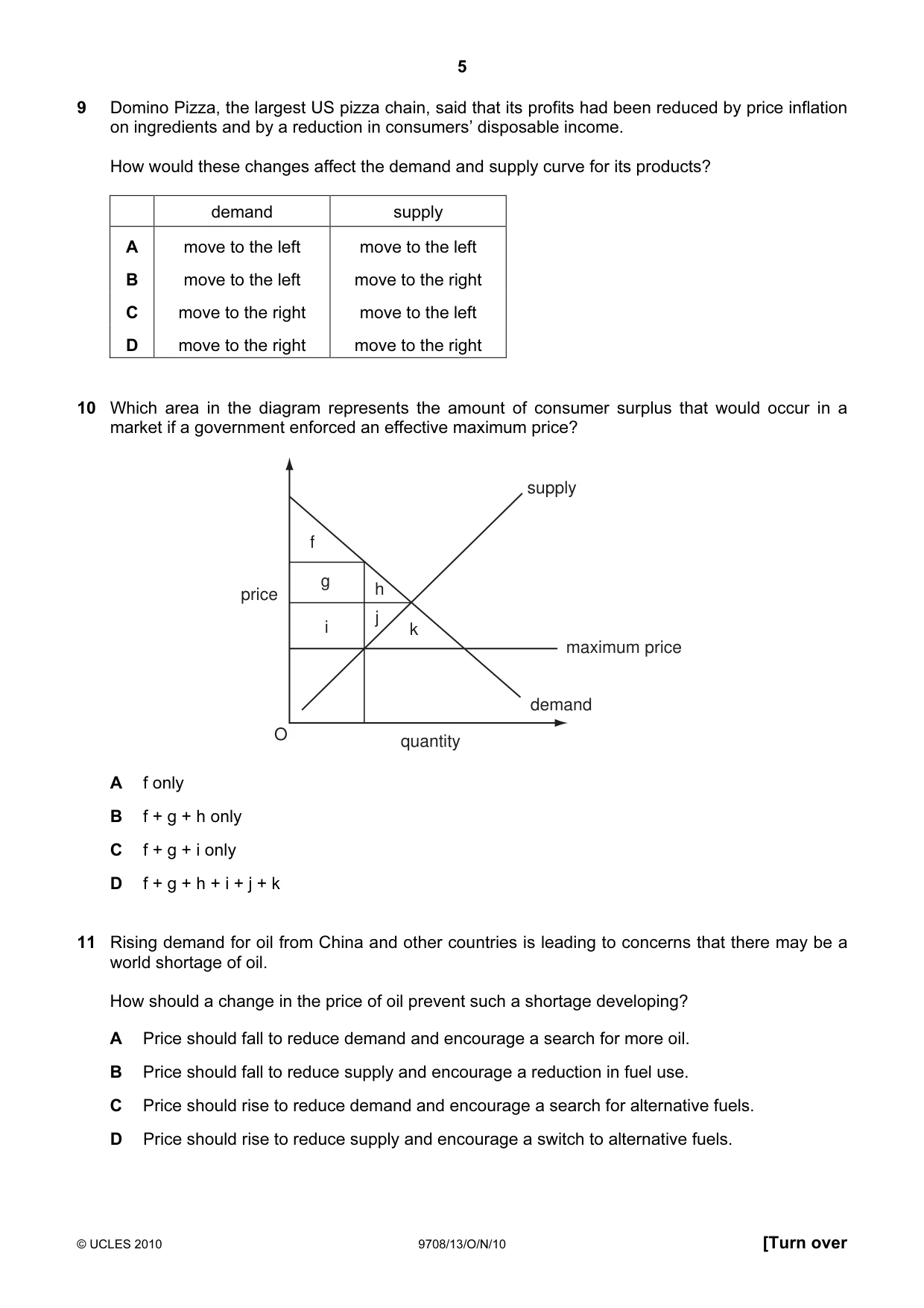
9 Domino Pizza, the largest US pizza chain, said that its profits had been reduced by price inflation on ingredients and by a reduction in consumers’ disposable income. How would these changes affect the demand and supply curve for its products? demand supply A move to the left move to the left B move to the left move to the right C move to the right move to the left D move to the right move to the right
Mark scheme: A
Q10 · Which area in the diagram represents the amount of consumer surplus that would occur in a…
10 Which area in the diagram represents the amount of consumer surplus that would occur in a market if a government enforced an effective maximum price? supply f g price h j i k maximum price demand O quantity A f only B f + g + h only C f + g + i only D f + g + h + i + j + k
Mark scheme: C
Q11 · Rising demand for oil from China and other countries is leading to concerns that there…
11 Rising demand for oil from China and other countries is leading to concerns that there may be a world shortage of oil. How should a change in the price of oil prevent such a shortage developing? A Price should fall to reduce demand and encourage a search for more oil. B Price should fall to reduce supply and encourage a reduction in fuel use. C Price should rise to reduce demand and encourage a search for alternative fuels. D Price should rise to reduce supply and encourage a switch to alternative fuels.
Mark scheme: C
Q12 · In the diagram OS1 and OS2 are two straight-line supply curves
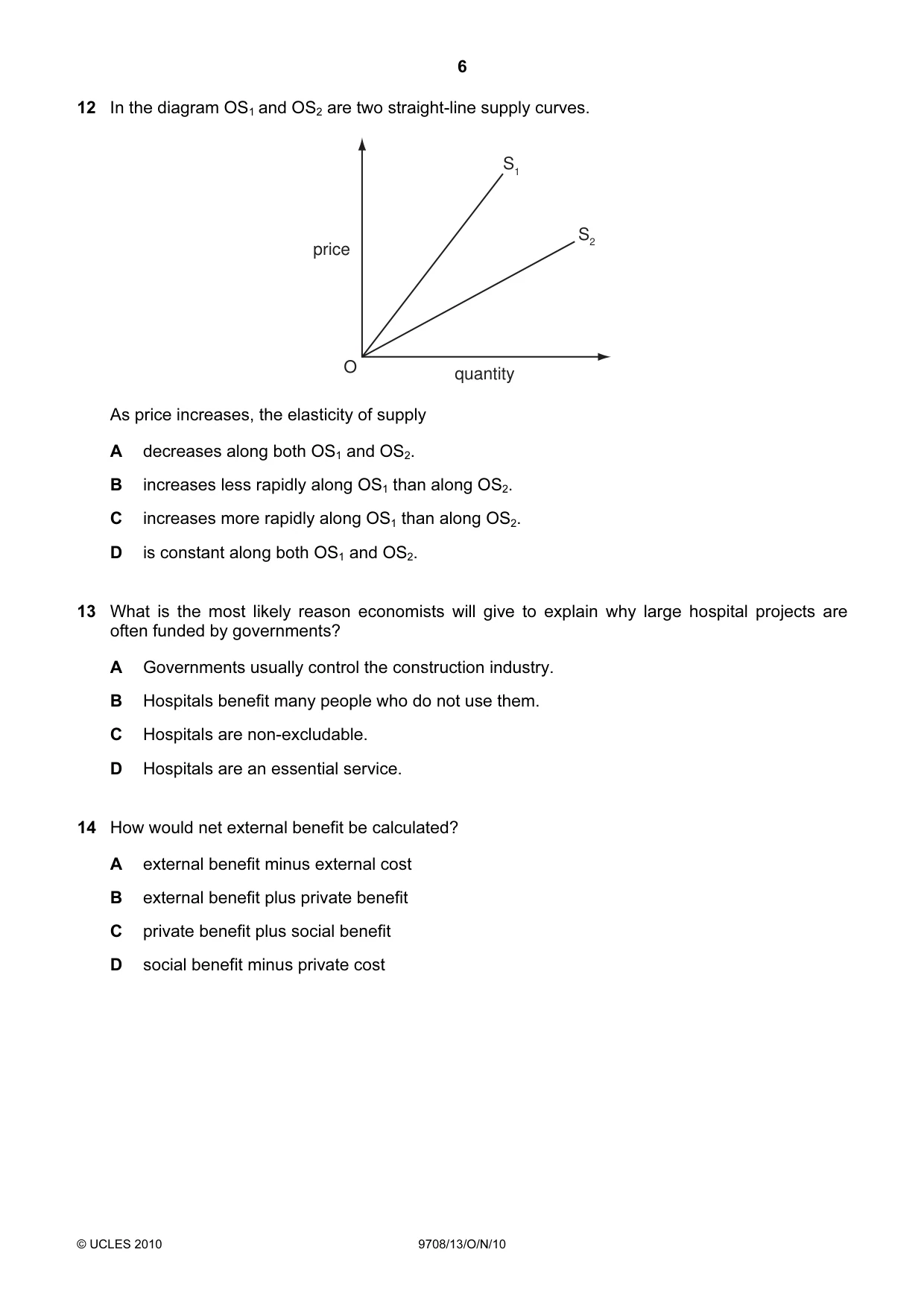
12 In the diagram OS1 and OS2 are two straight-line supply curves. S1 S2 price O quantity As price increases, the elasticity of supply A decreases along both OS1 and OS2. B increases less rapidly along OS1 than along OS2. C increases more rapidly along OS1 than along OS2. D is constant along both OS1 and OS2.
Mark scheme: D
Q13 · What is the most likely reason economists will give to explain why large hospital…
13 What is the most likely reason economists will give to explain why large hospital projects are often funded by governments? A Governments usually control the construction industry. B Hospitals benefit many people who do not use them. C Hospitals are non-excludable. D Hospitals are an essential service.
Mark scheme: B
Q14 · How would net external benefit be calculated?
14 How would net external benefit be calculated? A external benefit minus external cost B external benefit plus private benefit C private benefit plus social benefit D social benefit minus private cost
Mark scheme: A
More questions on Private costs and benefits, externalities and social costs and benefits
Q15 · The table shows the expected costs and benefits from four government projects
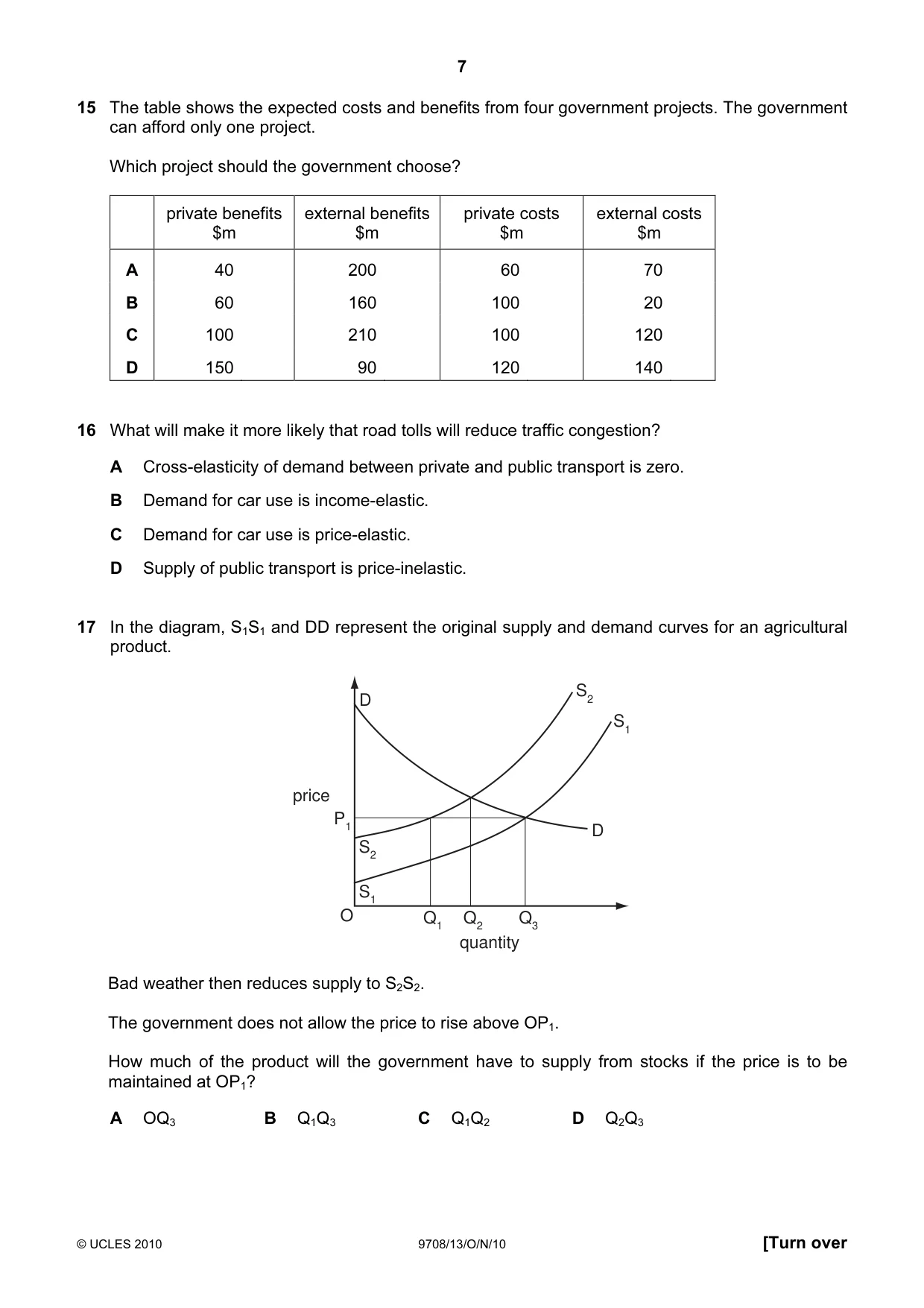
15 The table shows the expected costs and benefits from four government projects. The government can afford only one project. Which project should the government choose? private benefits external benefits private costs external costs $m $m $m $m A 40 200 60 70 B 60 160 100 20 C 100 210 100 120 D 150 90 120 140
Mark scheme: A
More questions on Private costs and benefits, externalities and social costs and benefits
Q16 · What will make it more likely that road tolls will reduce traffic congestion?
16 What will make it more likely that road tolls will reduce traffic congestion? A Cross-elasticity of demand between private and public transport is zero. B Demand for car use is income-elastic. C Demand for car use is price-elastic. D Supply of public transport is price-inelastic.
Mark scheme: C
Q17 · In the diagram, S1S1 and DD represent the original supply and demand curves for an…
17 In the diagram, S1S1 and DD represent the original supply and demand curves for an agricultural product. S2 D S1 price P1 D S2 S1 O Q1 Q2 Q3 quantity Bad weather then reduces supply to S2S2. The government does not allow the price to rise above OP1. How much of the product will the government have to supply from stocks if the price is to be maintained at OP1? A OQ3 B Q1Q3 C Q1Q2 D Q2Q3
Mark scheme: B
More questions on Methods and effects of government intervention in markets
Q18 · Steel is produced in a number of countries, including China, Japan and the US
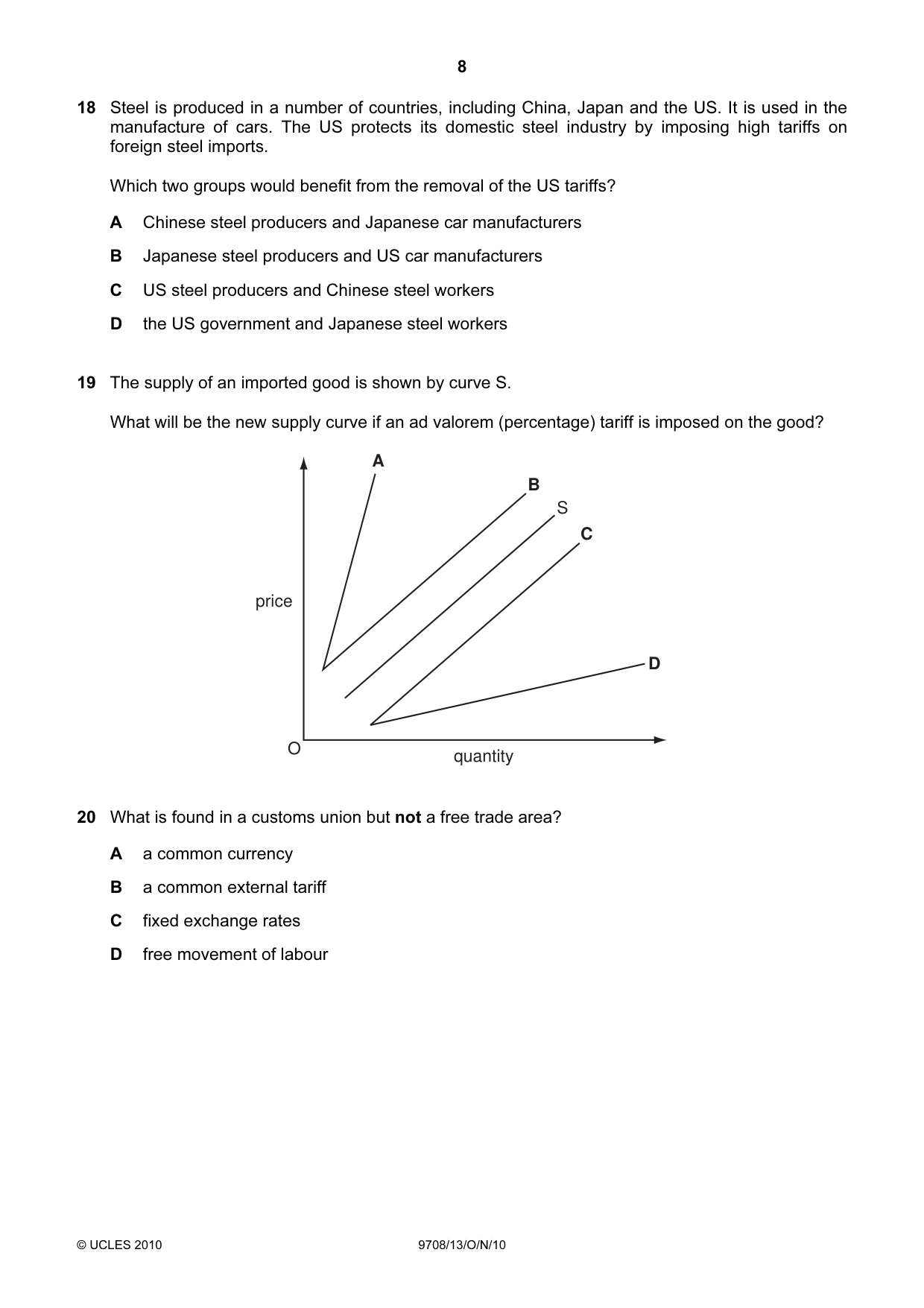
18 Steel is produced in a number of countries, including China, Japan and the US. It is used in the manufacture of cars. The US protects its domestic steel industry by imposing high tariffs on foreign steel imports. Which two groups would benefit from the removal of the US tariffs? A Chinese steel producers and Japanese car manufacturers B Japanese steel producers and US car manufacturers C US steel producers and Chinese steel workers D the US government and Japanese steel workers
Mark scheme: B
Q19 · The supply of an imported good is shown by curve S
19 The supply of an imported good is shown by curve S. What will be the new supply curve if an ad valorem (percentage) tariff is imposed on the good? A B S C price D O quantity
Mark scheme: A
Q20 · What is found in a customs union but not a free trade area?
20 What is found in a customs union but not a free trade area? A a common currency B a common external tariff C fixed exchange rates D free movement of labour
Mark scheme: B
Q21 · The table shows how much rice and wheat two countries, X and Y, can grow when each…
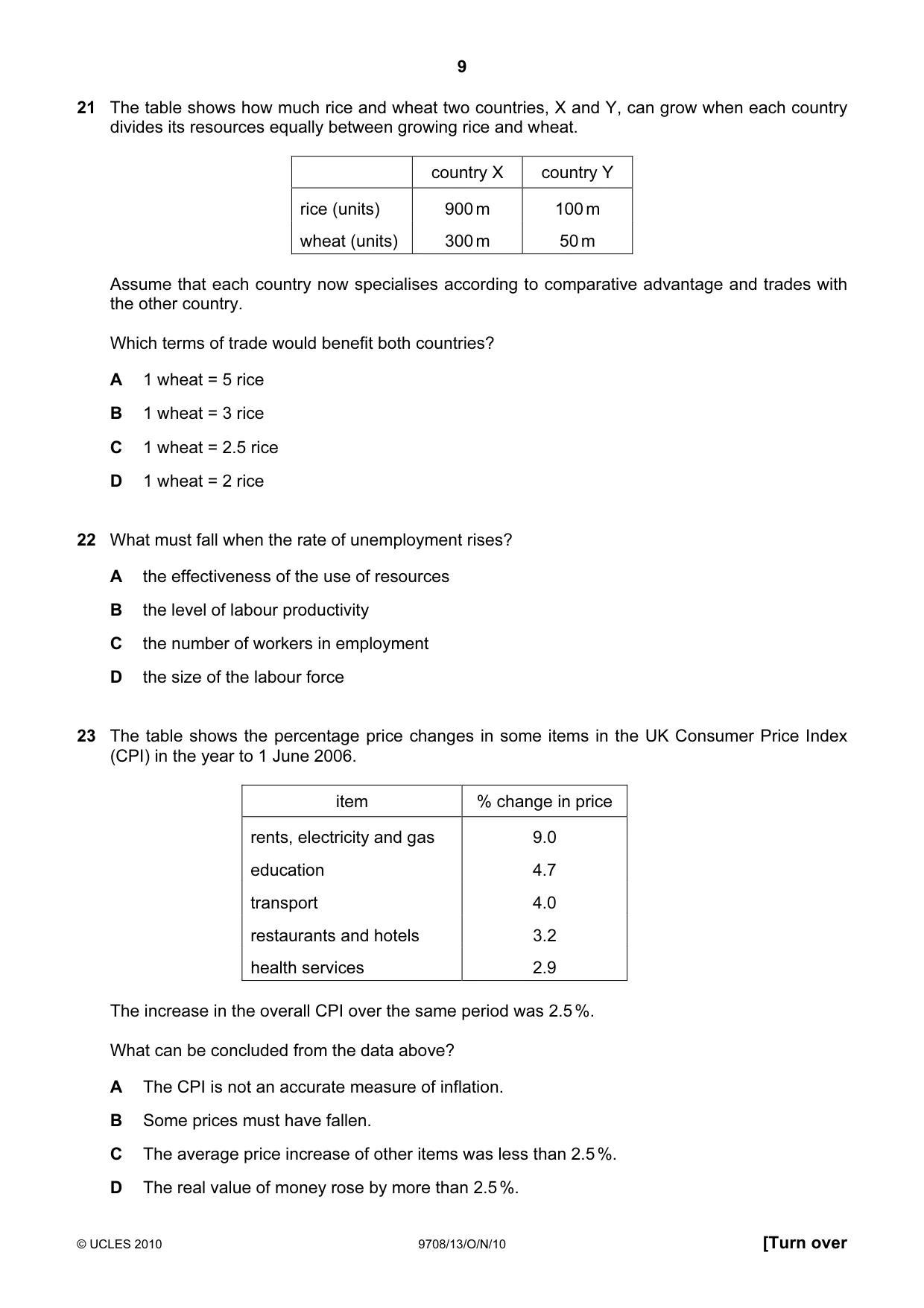
21 The table shows how much rice and wheat two countries, X and Y, can grow when each country divides its resources equally between growing rice and wheat. country X country Y rice (units) 900 m 100 m wheat (units) 300 m 50 m Assume that each country now specialises according to comparative advantage and trades with the other country. Which terms of trade would benefit both countries? A 1 wheat = 5 rice B 1 wheat = 3 rice C 1 wheat = 2.5 rice D 1 wheat = 2 rice
Mark scheme: C
Q22 · What must fall when the rate of unemployment rises?
22 What must fall when the rate of unemployment rises? A the effectiveness of the use of resources B the level of labour productivity C the number of workers in employment D the size of the labour force
Mark scheme: A
Q23 · The table shows the percentage price changes in some items in the UK Consumer Price Index…
23 The table shows the percentage price changes in some items in the UK Consumer Price Index (CPI) in the year to 1 June 2006. item % change in price rents, electricity and gas 9.0 education 4.7 transport 4.0 restaurants and hotels 3.2 health services 2.9 The increase in the overall CPI over the same period was 2.5 %. What can be concluded from the data above? A The CPI is not an accurate measure of inflation. B Some prices must have fallen. C The average price increase of other items was less than 2.5 %. D The real value of money rose by more than 2.5 %.
Mark scheme: C
Q24 · In Year 1 the price of a barrel of oil increased from $60 to $110
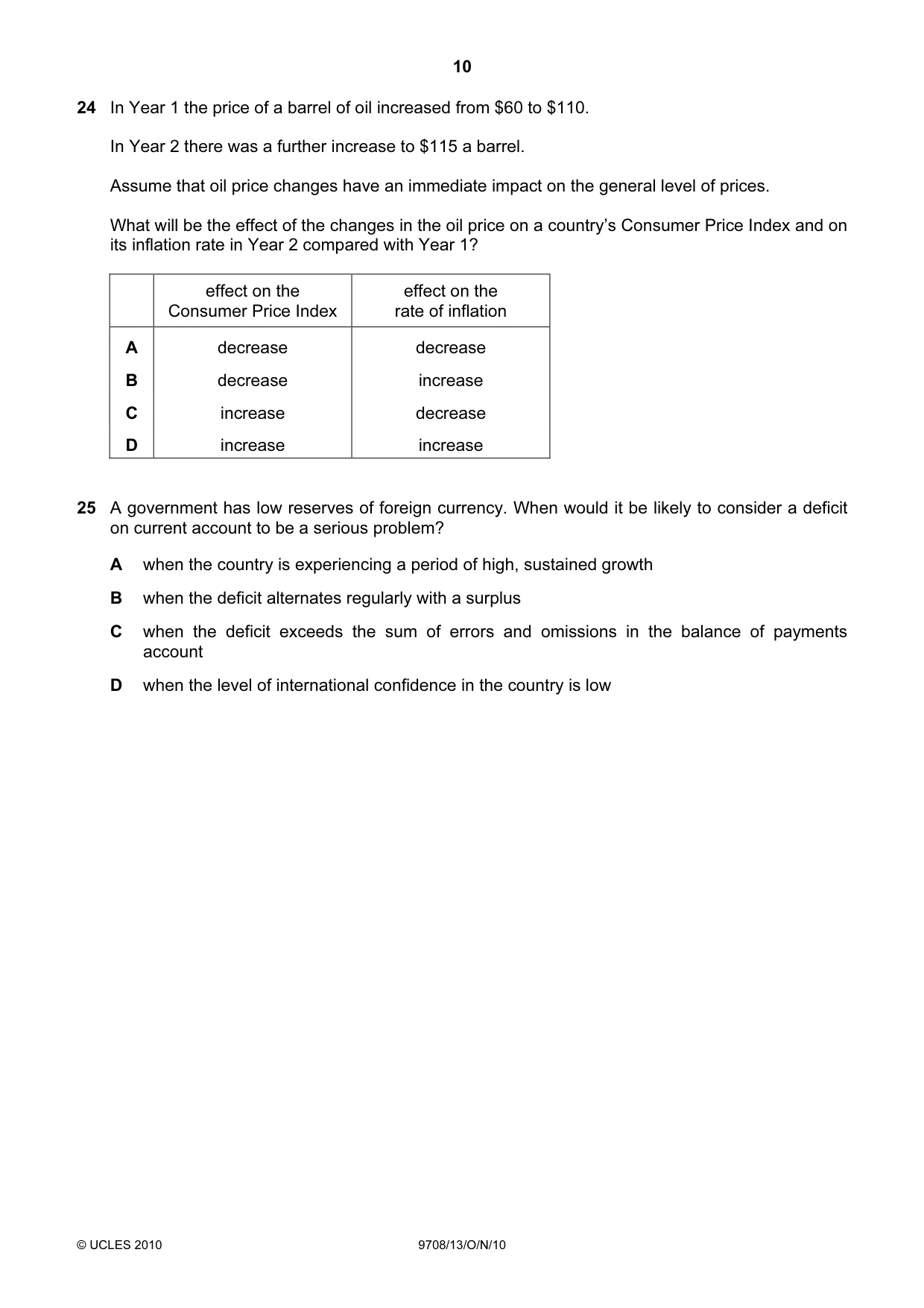
24 In Year 1 the price of a barrel of oil increased from $60 to $110. In Year 2 there was a further increase to $115 a barrel. Assume that oil price changes have an immediate impact on the general level of prices. What will be the effect of the changes in the oil price on a country’s Consumer Price Index and on its inflation rate in Year 2 compared with Year 1? effect on the effect on the Consumer Price Index rate of inflation A decrease decrease B decrease increase C increase decrease D increase increase
Mark scheme: C
Q25 · A government has low reserves of foreign currency
25 A government has low reserves of foreign currency. When would it be likely to consider a deficit on current account to be a serious problem? A when the country is experiencing a period of high, sustained growth B when the deficit alternates regularly with a surplus C when the deficit exceeds the sum of errors and omissions in the balance of payments account D when the level of international confidence in the country is low
Mark scheme: D
More questions on Current account of the balance of payments
Q26 · The diagram shows the number of US dollars ($) and Euros (€) which exchanged for one…
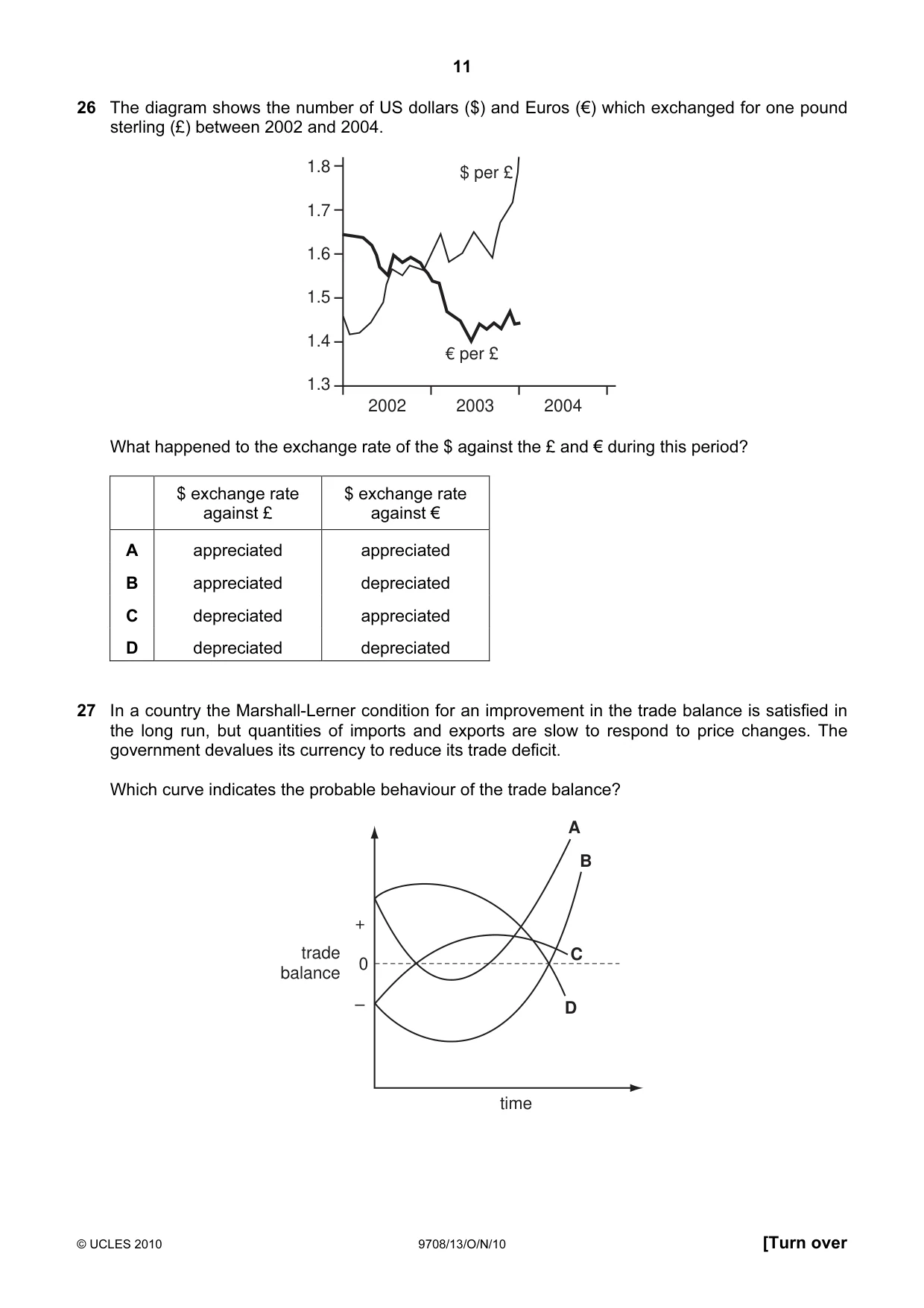
26 The diagram shows the number of US dollars ($) and Euros (€) which exchanged for one pound sterling (£) between 2002 and 2004. 1.8 $ per £ 1.7 1.6 1.5 1.4 € per £ 1.3 2002 2003 2004 What happened to the exchange rate of the $ against the £ and € during this period? $ exchange rate $ exchange rate against £ against € A appreciated appreciated B appreciated depreciated C depreciated appreciated D depreciated depreciated
Mark scheme: D
Q27 · In a country the Marshall-Lerner condition for an improvement in the trade balance is…
27 In a country the Marshall-Lerner condition for an improvement in the trade balance is satisfied in the long run, but quantities of imports and exports are slow to respond to price changes. The government devalues its currency to reduce its trade deficit. Which curve indicates the probable behaviour of the trade balance? A B + trade C 0 balance – D time
Mark scheme: B
More questions on Policies to correct imbalances in the current account of the balance of payments
Q28 · Assume the Chinese monetary authorities are committed to maintaining the exchange rate of…
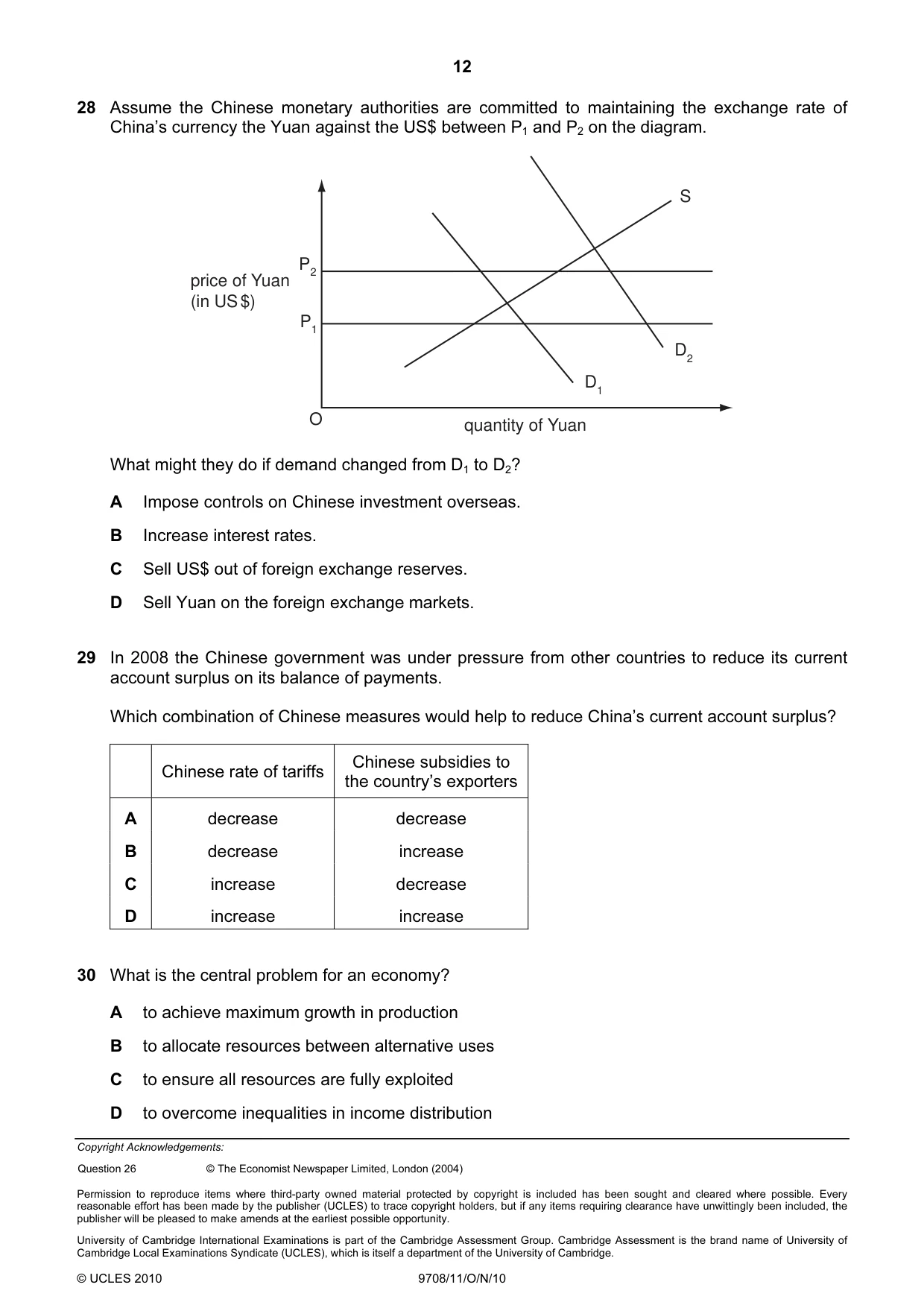
28 Assume the Chinese monetary authorities are committed to maintaining the exchange rate of China’s currency the Yuan against the US$ between P1 and P2 on the diagram. S P2 price of Yuan (in US $) P1 D2 D1 O quantity of Yuan What might they do if demand changed from D1 to D2? A Impose controls on Chinese investment overseas. B Increase interest rates. C Sell US$ out of foreign exchange reserves. D Sell Yuan on the foreign exchange markets.
Mark scheme: D
Q29 · In 2008 the Chinese government was under pressure from other countries to reduce its…
29 In 2008 the Chinese government was under pressure from other countries to reduce its current account surplus on its balance of payments. Which combination of Chinese measures would help to reduce China’s current account surplus? Chinese subsidies to Chinese rate of tariffs the country’s exporters A decrease decrease B decrease increase C increase decrease D increase increase
Mark scheme: A
More questions on Policies to correct imbalances in the current account of the balance of payments
Q30 · What is the central problem for an economy?
30 What is the central problem for an economy? A to achieve maximum growth in production B to allocate resources between alternative uses C to ensure all resources are fully exploited D to overcome inequalities in income distribution
Mark scheme: B
What was in this paper
The subtopics covered by these 30 questions, and how many questions each got. Open one in a new tab to see every Cambridge question on it.
3Protectionism3The interaction of demand and supply3Exchange rates2Policies to correct imbalances in the current account of the balance of payments2Price stability2Private costs and benefits, externalities and social costs and benefits2Classification of goods and services1Consumer and producer surplus1Current account of the balance of payments1Demand and supply curves1Government policies to achieve efficient resource allocation and correct market failure1Methods and effects of government intervention in markets1Money and banking1Price elasticity of supply1Production possibility curves1Resource allocation in different economic systems1Scarcity, choice and opportunity cost1The reasons for international trade1Unemployment1What you needed in this session
Cambridge’s own grade thresholds for 2010 Oct/Nov, Paper 1 · Variant 3. A higher threshold means an easier paper — the bar moves with how the cohort did.