Cambridge A Level Economics 9708 — 2019 Oct/Nov Paper 1 · Variant 1
9708/11/O/N/19 · 30 questions · 30 marks · ≈34 min
The question paper and its mark scheme, free to read here and free to download. This is Cambridge’s own paper, exactly as it was sat.
Question paper12 pages
Mark scheme3 pages
Answers below. Sit the paper first if you are practising.
Questions as text
Q1 · What is correct for a normative statement?
1 What is correct for a normative statement? A It is objective and based on fact. B It is objective and can be proved correct. C It is subjective and based on opinion. D It is subjective and can be reliably tested.
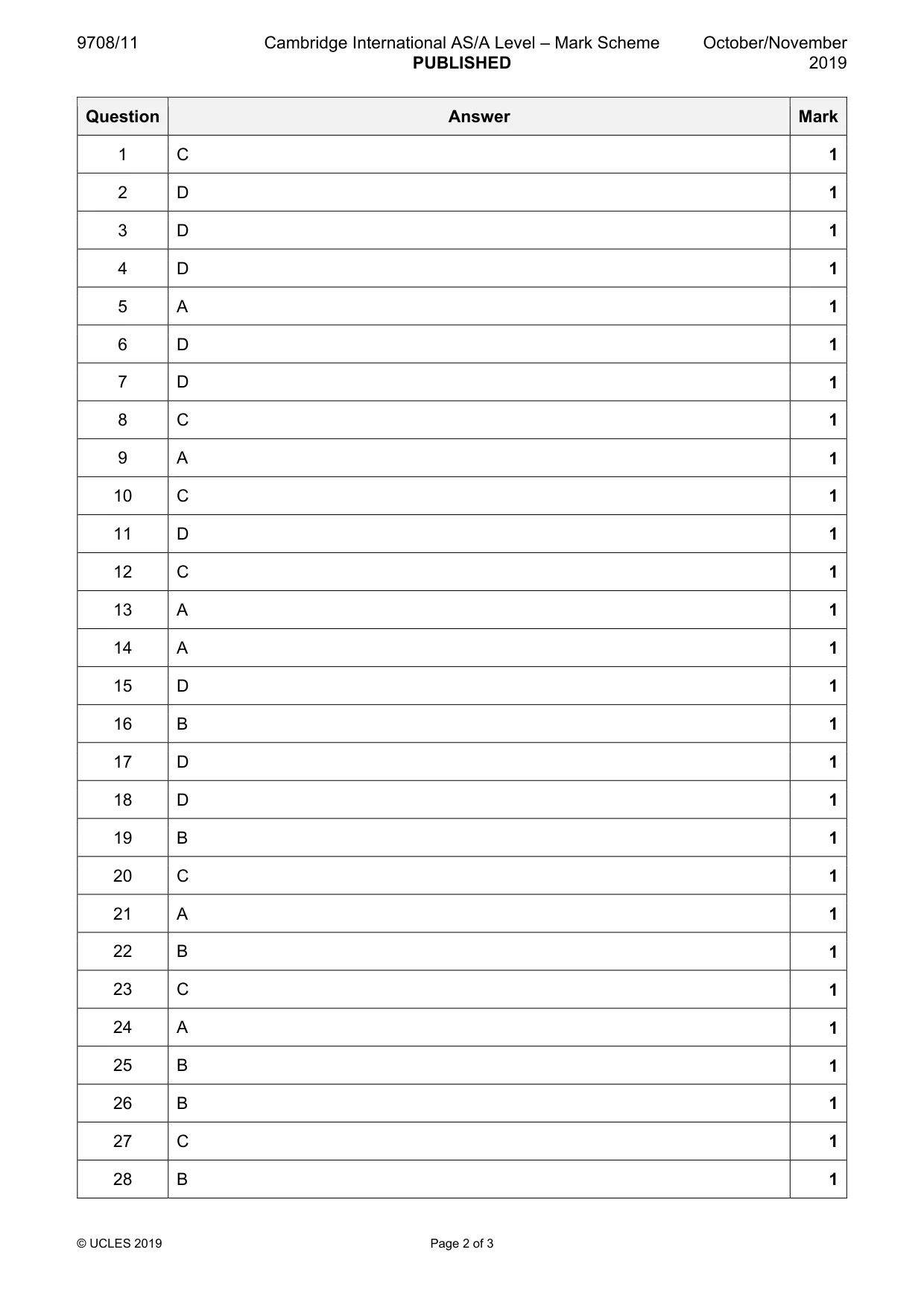
Mark scheme: C
Q2 · What does a production possibility curve show?
2 What does a production possibility curve show? A the maximum output that can be produced by a firm in a year B the maximum output that can be produced per worker per year in the economy C the maximum output that could be exported from a country D the maximum output of two or more goods in an economy from a given amount of inputs
Mark scheme: D
Q3 · In Zimbabwe there was hyperinflation
3 In Zimbabwe there was hyperinflation. Which two functions of money might the Zimbabwe dollar be most likely to have still performed during this hyperinflation? A medium of exchange and store of value B standard for deferred payments and unit of account C store of value and standard for deferred payments D unit of account and medium of exchange
Mark scheme: D
Q4 · The diagram shows two production possibility curves, XX and YY
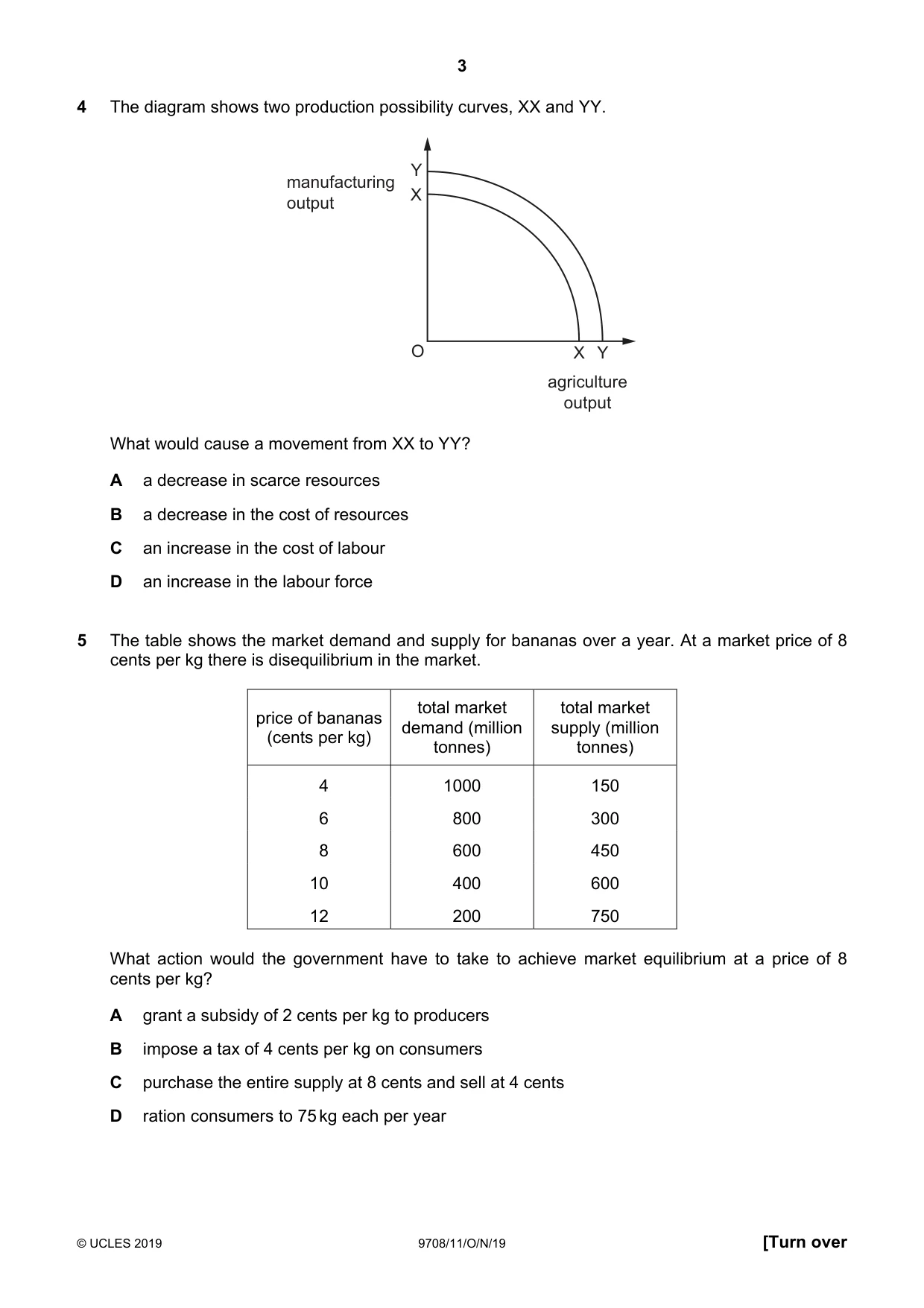
4 The diagram shows two production possibility curves, XX and YY. Y manufacturing output X O X Y agriculture output What would cause a movement from XX to YY? A a decrease in scarce resources B a decrease in the cost of resources C an increase in the cost of labour D an increase in the labour force
Mark scheme: D
Q5 · The table shows the market demand and supply for bananas over a year
5 The table shows the market demand and supply for bananas over a year. At a market price of 8 cents per kg there is disequilibrium in the market. total market total market price of bananas demand (million supply (million (cents per kg) tonnes) tonnes) 4 1000 150 6 800 300 8 600 450 10 400 600 12 200 750 What action would the government have to take to achieve market equilibrium at a price of 8 cents per kg? A grant a subsidy of 2 cents per kg to producers B impose a tax of 4 cents per kg on consumers C purchase the entire supply at 8 cents and sell at 4 cents D ration consumers to 75 kg each per year
Mark scheme: A
Q6 · In calculating the short-run supply schedule for a firm, what is assumed to remain…
6 In calculating the short-run supply schedule for a firm, what is assumed to remain unchanged? A the number of consumers B the price of the good C the quantity of raw material inputs D the state of technology
Mark scheme: D
More questions on Types of cost, revenue and profit, short-run and long-run production
Q7 · The graph shows the demand and supply curves for an industry
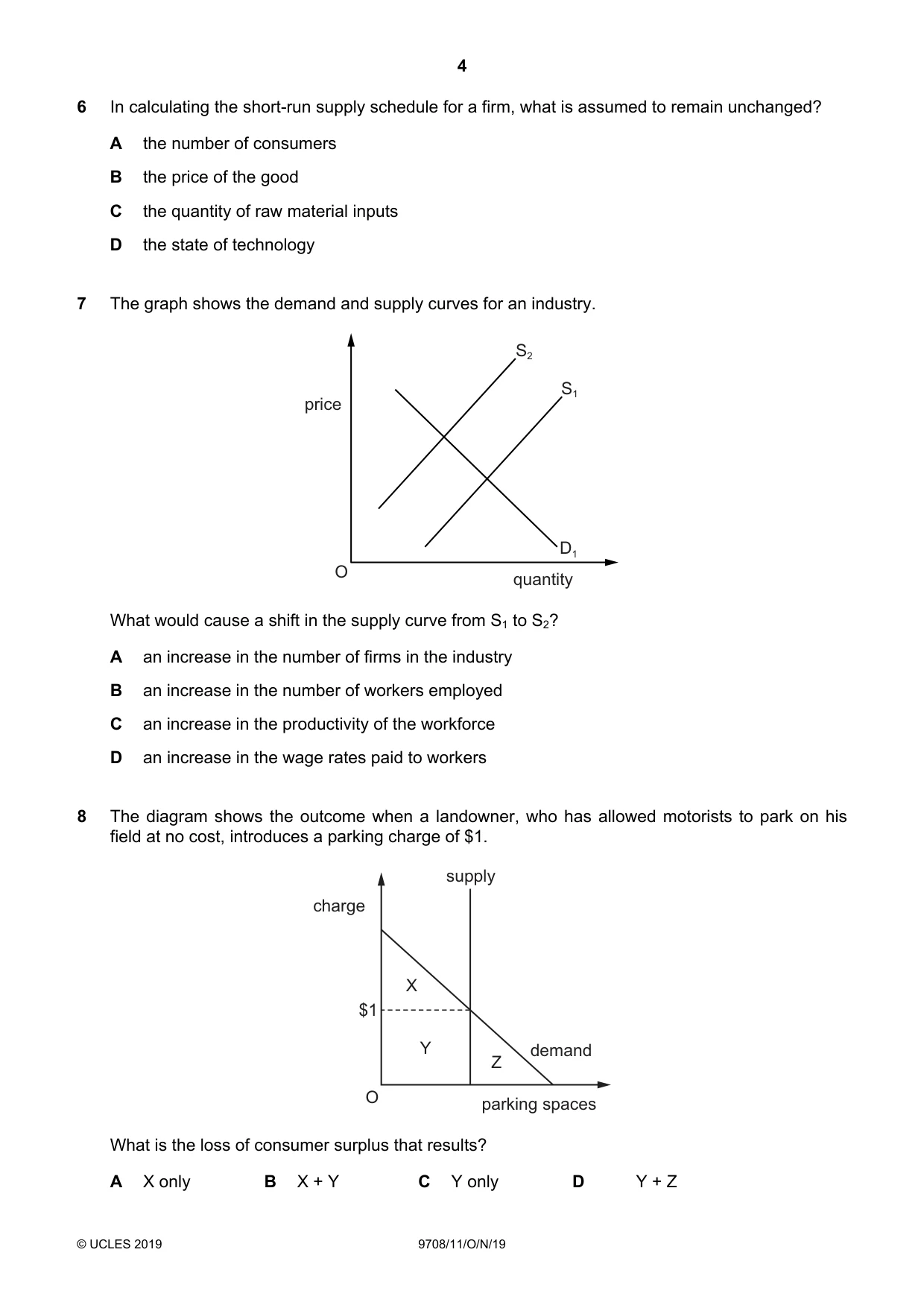
7 The graph shows the demand and supply curves for an industry. S2 S1 price D1 O quantity What would cause a shift in the supply curve from S1 to S2? A an increase in the number of firms in the industry B an increase in the number of workers employed C an increase in the productivity of the workforce D an increase in the wage rates paid to workers
Mark scheme: D
Q8 · The diagram shows the outcome when a landowner, who has allowed motorists to park on his…
8 The diagram shows the outcome when a landowner, who has allowed motorists to park on his field at no cost, introduces a parking charge of $1. supply charge X $1 Y demand Z O parking spaces What is the loss of consumer surplus that results? A X only B X + Y C Y only D Y + Z
Mark scheme: C
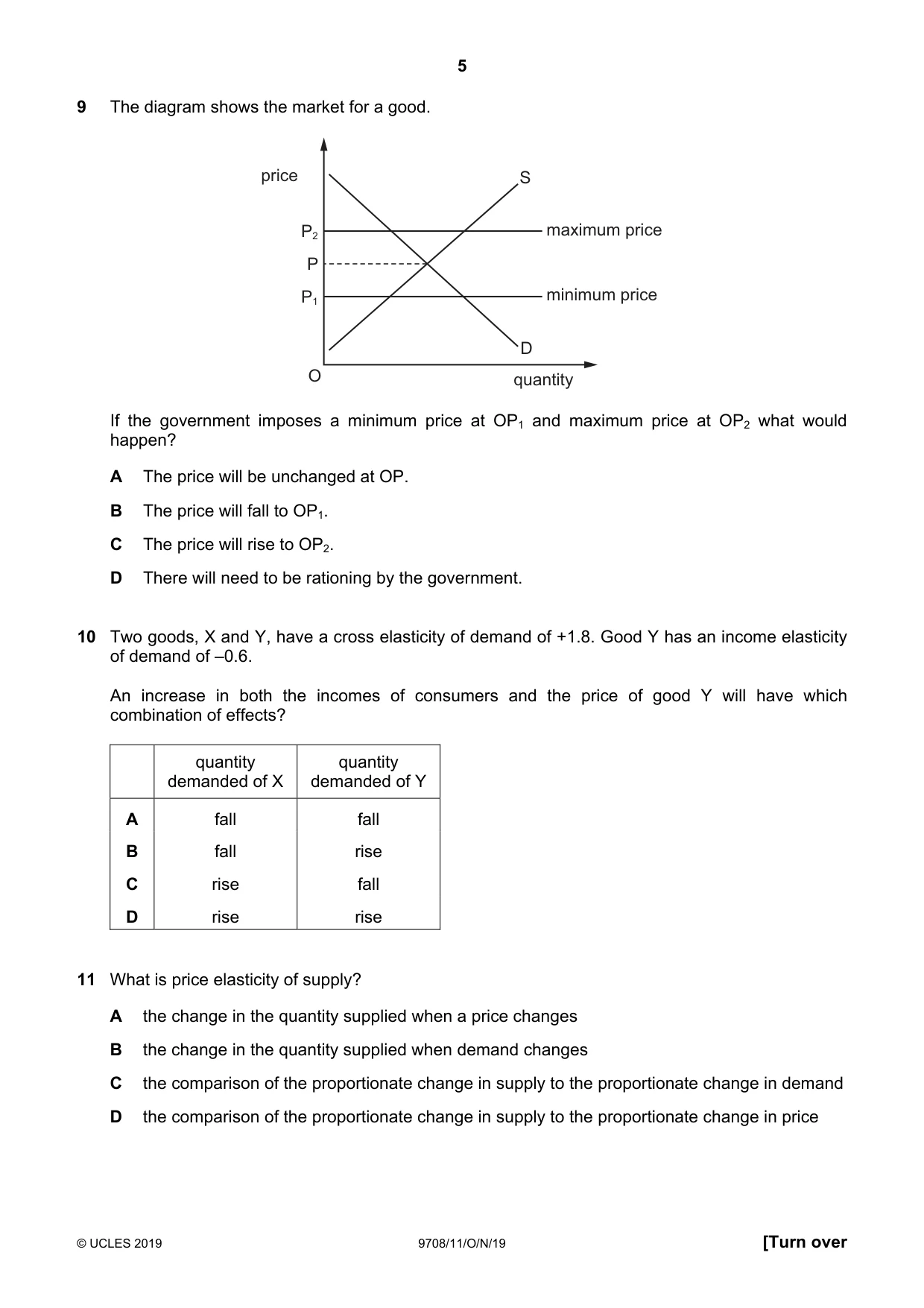
Q9 · The diagram shows the market for a good
9 The diagram shows the market for a good. price S P2 maximum price P P1 minimum price D O quantity If the government imposes a minimum price at OP1 and maximum price at OP2 what would happen? A The price will be unchanged at OP. B The price will fall to OP1. C The price will rise to OP2. D There will need to be rationing by the government.
Mark scheme: A
More questions on Methods and effects of government intervention in markets
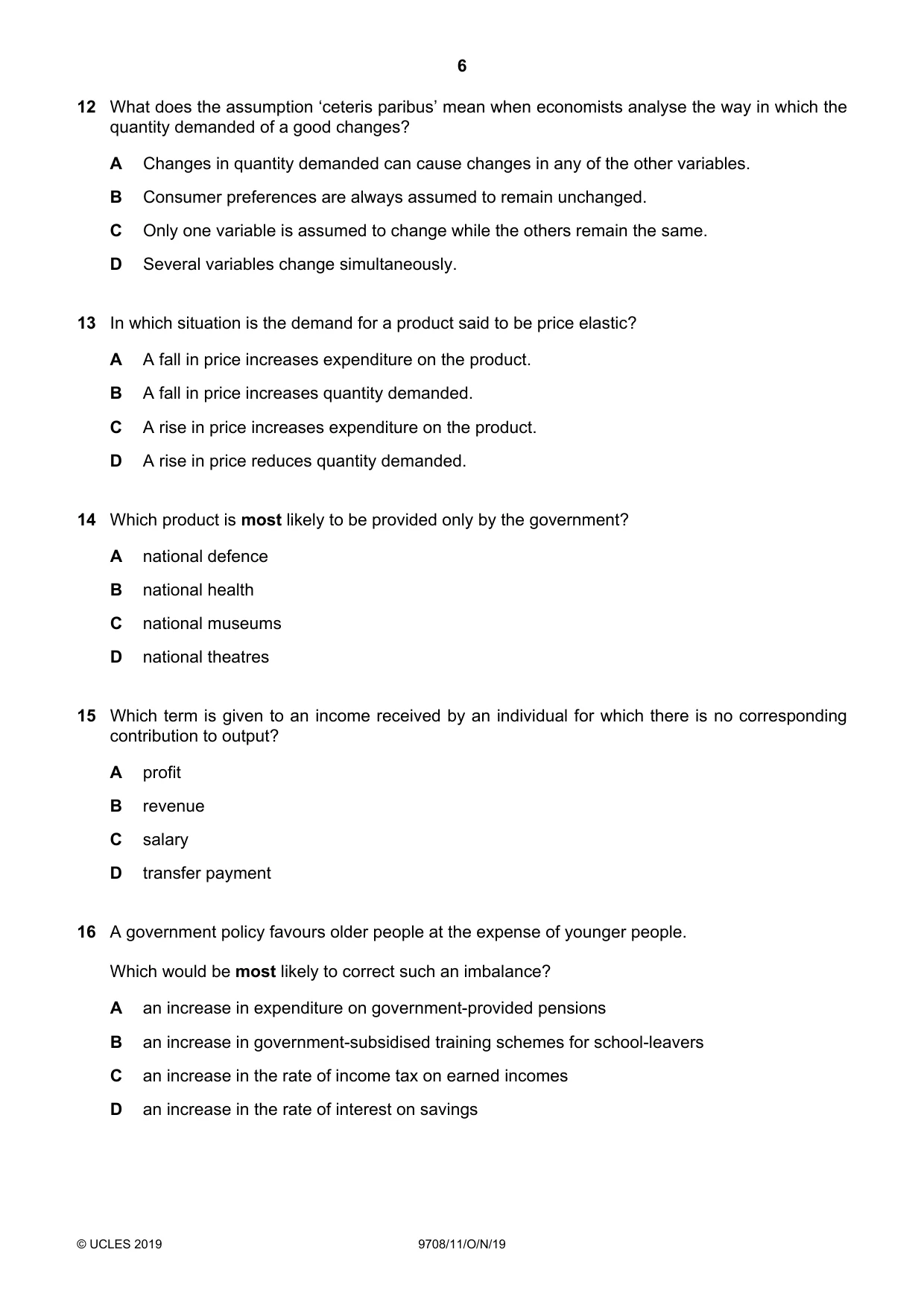
Q10 · Two goods, X and Y, have a cross elasticity of demand of +1.8
10 Two goods, X and Y, have a cross elasticity of demand of +1.8. Good Y has an income elasticity of demand of –0.6. An increase in both the incomes of consumers and the price of good Y will have which combination of effects? quantity quantity demanded of X demanded of Y A fall fall B fall rise C rise fall D rise rise
Mark scheme: C
More questions on Price elasticity, income elasticity and cross elasticity of demand
Q11 · What is price elasticity of supply?
11 What is price elasticity of supply? A the change in the quantity supplied when a price changes B the change in the quantity supplied when demand changes C the comparison of the proportionate change in supply to the proportionate change in demand D the comparison of the proportionate change in supply to the proportionate change in price
Mark scheme: D
Q12 · What does the assumption ‘ceteris paribus’ mean when economists analyse the way in which…
12 What does the assumption ‘ceteris paribus’ mean when economists analyse the way in which the quantity demanded of a good changes? A Changes in quantity demanded can cause changes in any of the other variables. B Consumer preferences are always assumed to remain unchanged. C Only one variable is assumed to change while the others remain the same. D Several variables change simultaneously.
Mark scheme: C
Q13 · In which situation is the demand for a product said to be price elastic?
13 In which situation is the demand for a product said to be price elastic? A A fall in price increases expenditure on the product. B A fall in price increases quantity demanded. C A rise in price increases expenditure on the product. D A rise in price reduces quantity demanded.
Mark scheme: A
More questions on Price elasticity, income elasticity and cross elasticity of demand
Q14 · Which product is most likely to be provided only by the government?
14 Which product is most likely to be provided only by the government? A national defence B national health C national museums D national theatres
Mark scheme: A
Q15 · Which term is given to an income received by an individual for which there is no…
15 Which term is given to an income received by an individual for which there is no corresponding contribution to output? A profit B revenue C salary D transfer payment
Mark scheme: D
More questions on Equity and redistribution of income and wealth
Q16 · A government policy favours older people at the expense of younger people
16 A government policy favours older people at the expense of younger people. Which would be most likely to correct such an imbalance? A an increase in expenditure on government-provided pensions B an increase in government-subsidised training schemes for school-leavers C an increase in the rate of income tax on earned incomes D an increase in the rate of interest on savings
Mark scheme: B
More questions on Equity and redistribution of income and wealth
Q17 · A government gives a subsidy to a producer of a product
17 A government gives a subsidy to a producer of a product. What will be the likely effect of this? A a shift to the left in the demand curve and a rise in equilibrium quantity B a shift to the left in the supply curve and a rise in equilibrium quantity C a shift to the right in the demand curve and a fall in equilibrium price D a shift to the right in the supply curve and a fall in equilibrium price
Mark scheme: D
More questions on Methods and effects of government intervention in markets
Q18 · Which is the most appropriate reason for the continued government ownership of a natural…
18 Which is the most appropriate reason for the continued government ownership of a natural monopoly? A The government will guarantee competitive behaviour. B The government will ignore any losses made by the monopoly. C The government will maximise profits. D The government will take account of external benefits.
Mark scheme: D
More questions on Private costs and benefits, externalities and social costs and benefits
Q19 · When will the imposition of a tariff by a country on the goods and services of its major…
19 When will the imposition of a tariff by a country on the goods and services of its major trading partners reduce the country’s expenditure on imports? A when the income elasticity of demand for imports is greater than 1 B when the price elasticity of demand for imports is greater than 1 C when the price elasticity of demand for imports is less than 1 D when the price elasticity of supply of imports is greater than 1
Mark scheme: B
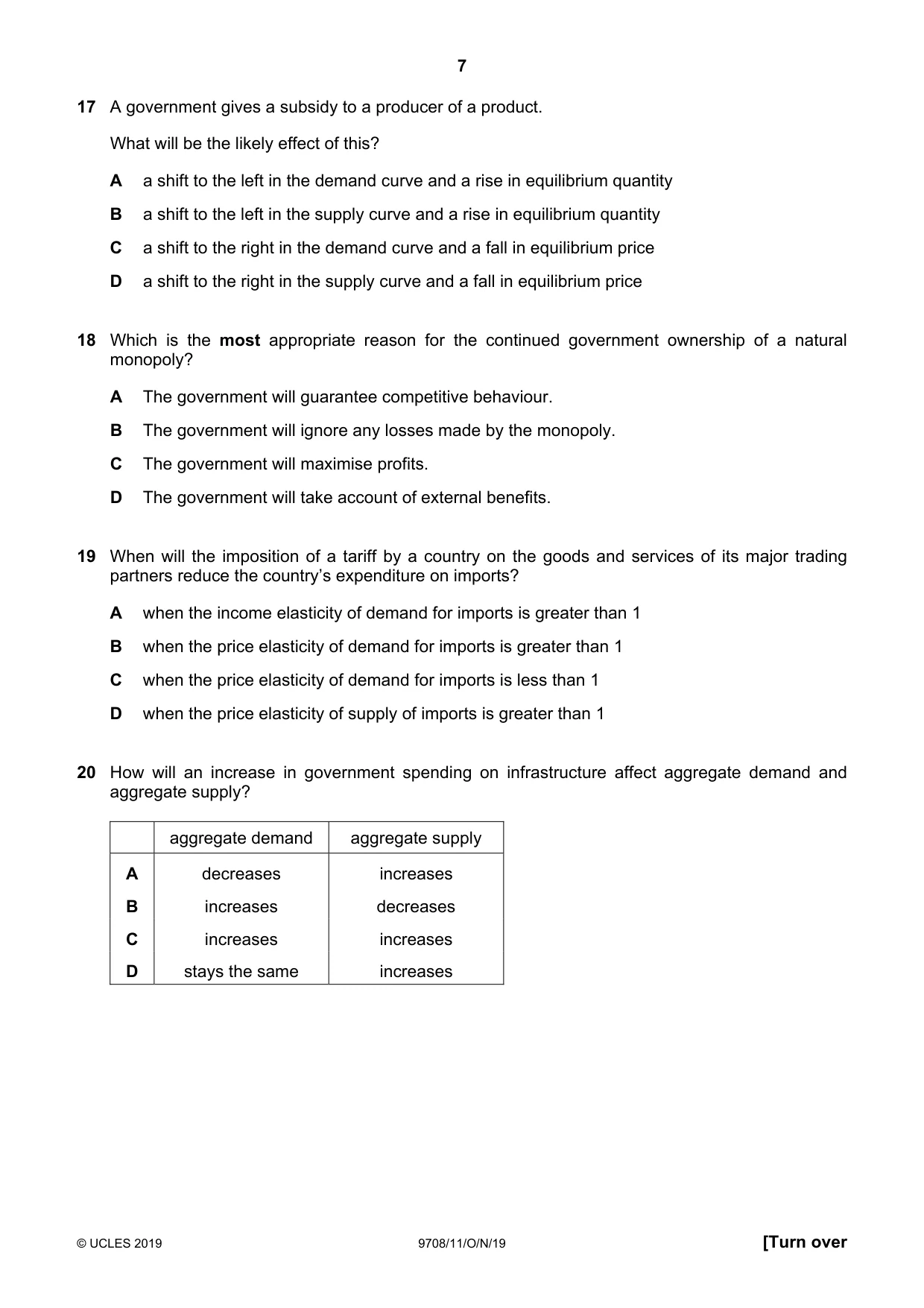
Q20 · How will an increase in government spending on infrastructure affect aggregate demand and…
20 How will an increase in government spending on infrastructure affect aggregate demand and aggregate supply? aggregate demand aggregate supply A decreases increases B increases decreases C increases increases D stays the same increases
Mark scheme: C
More questions on Aggregate Demand and Aggregate Supply analysis
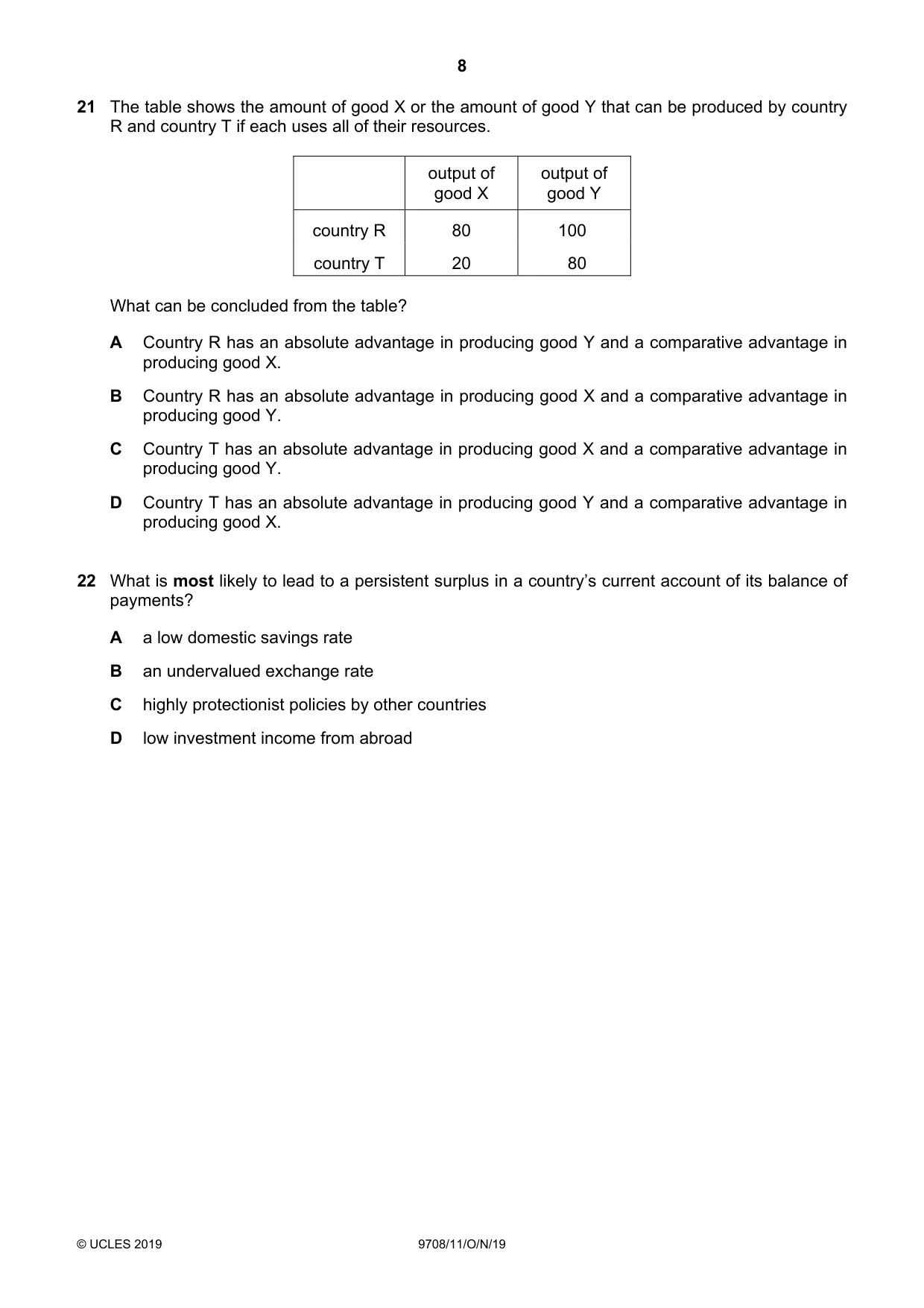
Q21 · The table shows the amount of good X or the amount of good Y that can be produced by…
21 The table shows the amount of good X or the amount of good Y that can be produced by country R and country T if each uses all of their resources. output of output of good X good Y country R 80 100 country T 20 80 What can be concluded from the table? A Country R has an absolute advantage in producing good Y and a comparative advantage in producing good X. B Country R has an absolute advantage in producing good X and a comparative advantage in producing good Y. C Country T has an absolute advantage in producing good X and a comparative advantage in producing good Y. D Country T has an absolute advantage in producing good Y and a comparative advantage in producing good X.
Mark scheme: A
Q22 · What is most likely to lead to a persistent surplus in a country’s current account of its…
22 What is most likely to lead to a persistent surplus in a country’s current account of its balance of payments? A a low domestic savings rate B an undervalued exchange rate C highly protectionist policies by other countries D low investment income from abroad
Mark scheme: B
More questions on Current account of the balance of payments
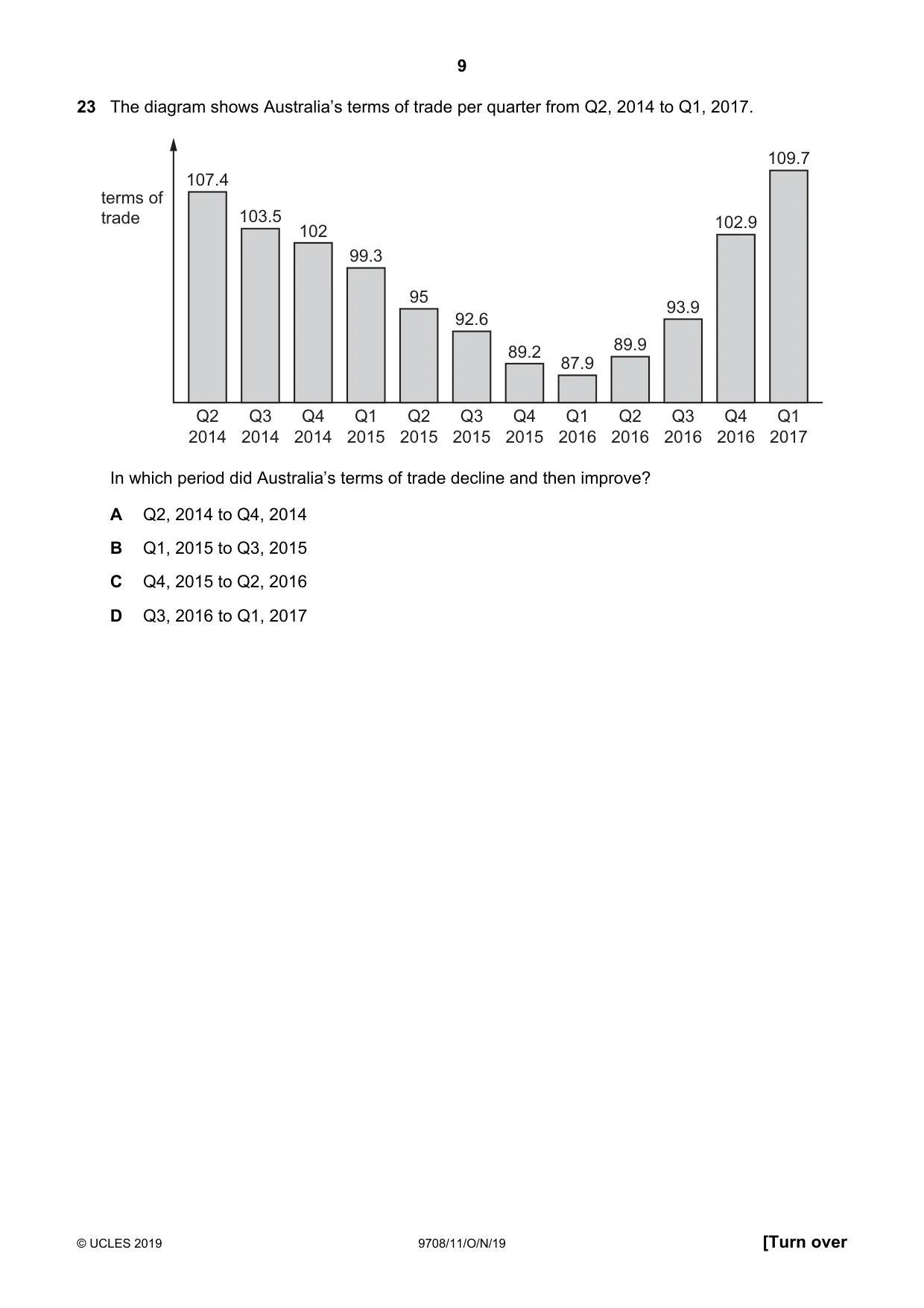
Q23 · The diagram shows Australia’s terms of trade per quarter from Q2, 2014 to Q1, 2017
23 The diagram shows Australia’s terms of trade per quarter from Q2, 2014 to Q1, 2017. 109.7 107.4 terms of trade 103.5 102.9 102 99.3 95 93.9 92.6 89.2 89.9 87.9 Q2 Q3 Q4 Q1 Q2 Q3 Q4 Q1 Q2 Q3 Q4 Q1 2014 2014 2014 2015 2015 2015 2015 2016 2016 2016 2016 2017 In which period did Australia’s terms of trade decline and then improve? A Q2, 2014 to Q4, 2014 B Q1, 2015 to Q3, 2015 C Q4, 2015 to Q2, 2016 D Q3, 2016 to Q1, 2017
Mark scheme: C
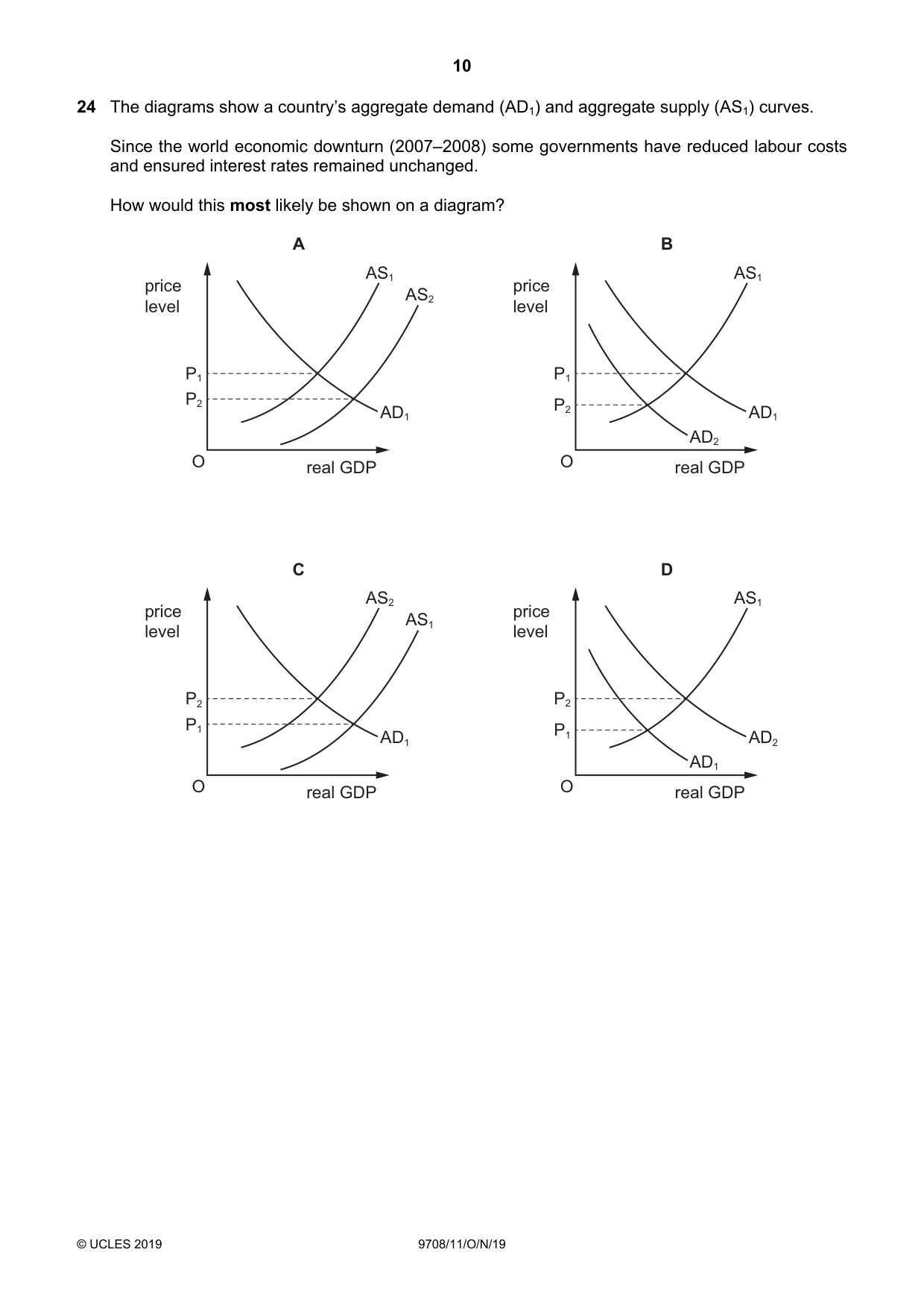
Q24 · The diagrams show a country’s aggregate demand (AD1) and aggregate supply (AS1) curves
24 The diagrams show a country’s aggregate demand (AD1) and aggregate supply (AS1) curves. Since the world economic downturn (2007–2008) some governments have reduced labour costs and ensured interest rates remained unchanged. How would this most likely be shown on a diagram? A B AS1 AS1 price price AS2 level level P1 P1 P2 P2 AD1 AD1 AD2 O real GDP O real GDP C D AS2 AS1 price price AS1 level level P2 P2 P1 P1 AD1 AD2 AD1 O real GDP O real GDP
Mark scheme: A
More questions on Aggregate Demand and Aggregate Supply analysis
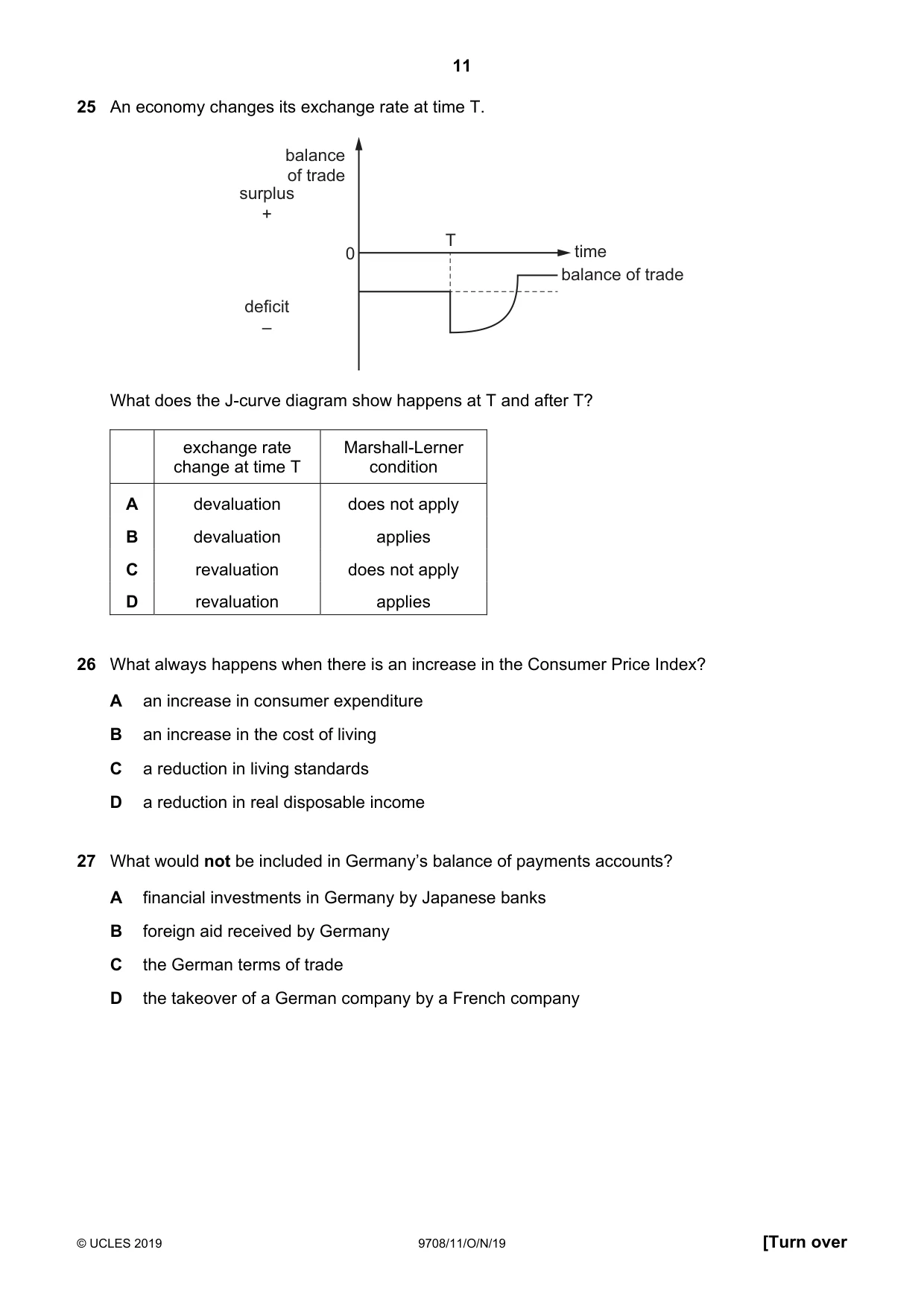
Q25 · An economy changes its exchange rate at time T
25 An economy changes its exchange rate at time T. balance of trade surplus + T 0 time balance of trade deficit – What does the J-curve diagram show happens at T and after T? exchange rate Marshall-Lerner change at time T condition A devaluation does not apply B devaluation applies C revaluation does not apply D revaluation applies
Mark scheme: B
Q26 · What always happens when there is an increase in the Consumer Price Index?
26 What always happens when there is an increase in the Consumer Price Index? A an increase in consumer expenditure B an increase in the cost of living C a reduction in living standards D a reduction in real disposable income
Mark scheme: B
Q27 · What would not be included in Germany’s balance of payments accounts?
27 What would not be included in Germany’s balance of payments accounts? A financial investments in Germany by Japanese banks B foreign aid received by Germany C the German terms of trade D the takeover of a German company by a French company
Mark scheme: C
More questions on Current account of the balance of payments
Q28 · An economy has a balance of payments surplus, which it wishes to eliminate
28 An economy has a balance of payments surplus, which it wishes to eliminate. In order to achieve this objective, which combination of polices would be most appropriate? A a depreciation of the currency and an increase in government spending B an appreciation of the currency and a cut in interest rates C an increase in the money supply and a pay freeze D increases in both direct and indirect taxation
Mark scheme: B
More questions on Policies to correct imbalances in the current account of the balance of payments
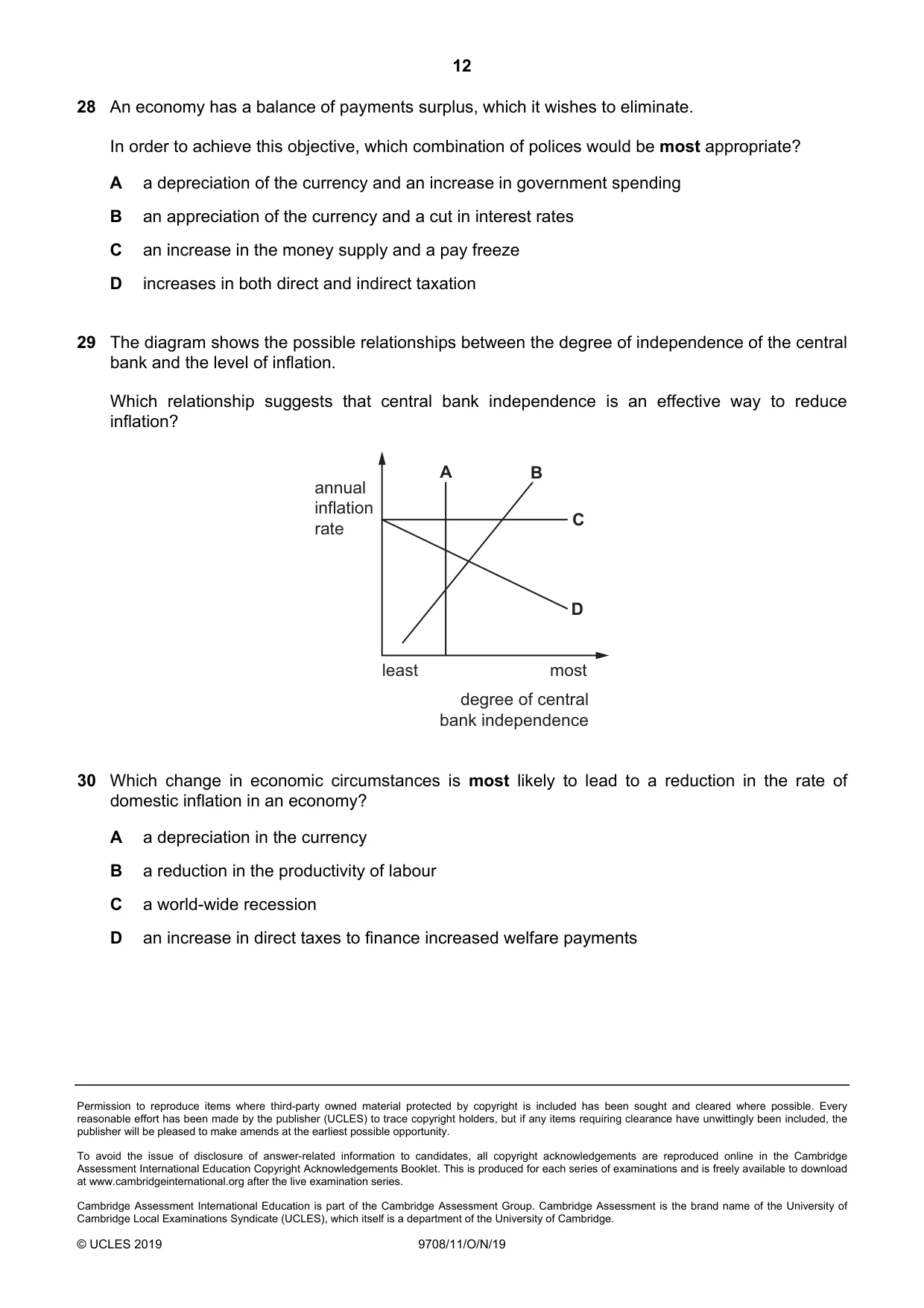
Q29 · The diagram shows the possible relationships between the degree of independence of the…
29 The diagram shows the possible relationships between the degree of independence of the central bank and the level of inflation. Which relationship suggests that central bank independence is an effective way to reduce inflation? A B annual inflation C rate D least most degree of central bank independence
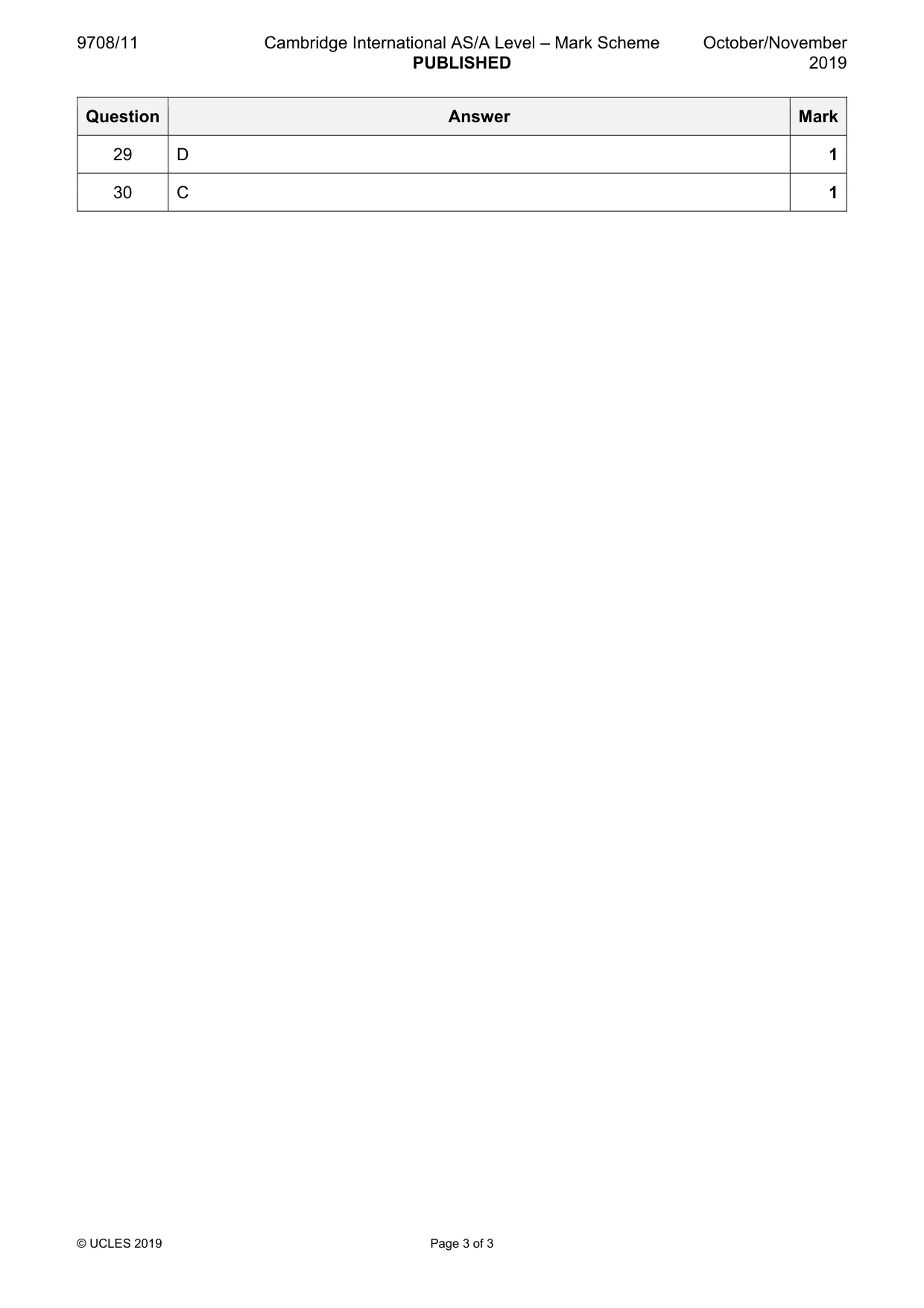
Mark scheme: D
More questions on Effectiveness of policy options to meet all macroeconomic objectives
Q30 · Which change in economic circumstances is most likely to lead to a reduction in the rate…
30 Which change in economic circumstances is most likely to lead to a reduction in the rate of domestic inflation in an economy? A a depreciation in the currency B a reduction in the productivity of labour C a world-wide recession D an increase in direct taxes to finance increased welfare payments
Mark scheme: C
What was in this paper
The subtopics covered by these 30 questions, and how many questions each got. Open one in a new tab to see every Cambridge question on it.
2Current account of the balance of payments2Economic methodology2Equity and redistribution of income and wealth2Methods and effects of government intervention in markets2Price elasticity, income elasticity and cross elasticity of demand2Price stability2Production possibility curves2The reasons for international trade2Classification of goods and services1Consumer and producer surplus1Demand and supply curves1Effectiveness of policy options to meet all macroeconomic objectives1Exchange rates1Money and banking1Policies to correct imbalances in the current account of the balance of payments1Price elasticity of supply1Private costs and benefits, externalities and social costs and benefits1Protectionism1The interaction of demand and supply1Types of cost, revenue and profit, short-run and long-run production1What you needed in this session
Cambridge’s own grade thresholds for 2019 Oct/Nov, Paper 1 · Variant 1. A higher threshold means an easier paper — the bar moves with how the cohort did.