Cambridge A Level Economics 9708 — 2022 Oct/Nov Paper 1 · Variant 2
9708/12/O/N/22 · 30 questions · 30 marks · ≈34 min
The question paper and its mark scheme, free to read here and free to download. This is Cambridge’s own paper, exactly as it was sat.
Question paper12 pages
Mark scheme3 pages
Answers below. Sit the paper first if you are practising.
Questions as text
Q1 · What is a function of money?
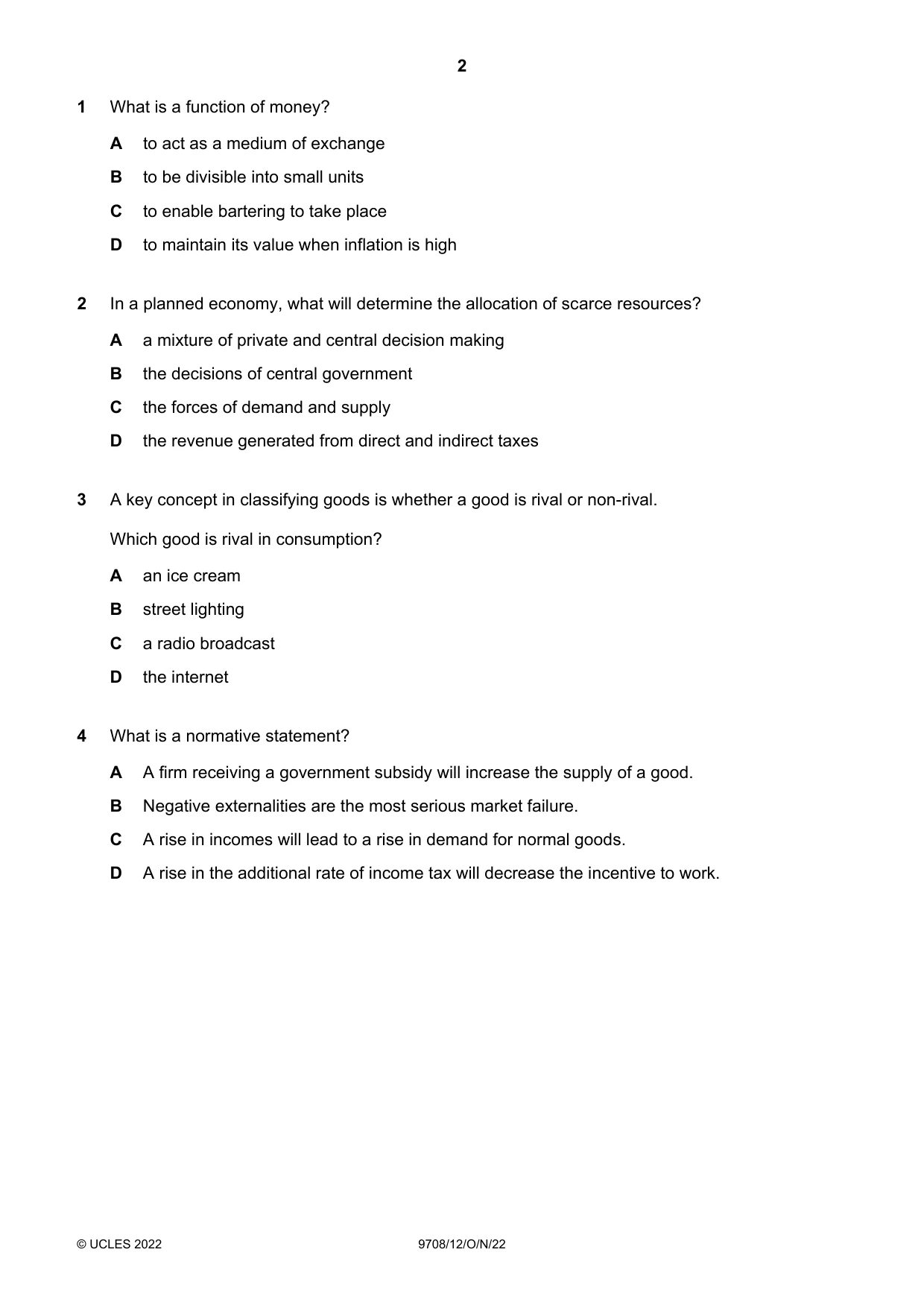
1 What is a function of money? A to act as a medium of exchange B to be divisible into small units C to enable bartering to take place D to maintain its value when inflation is high
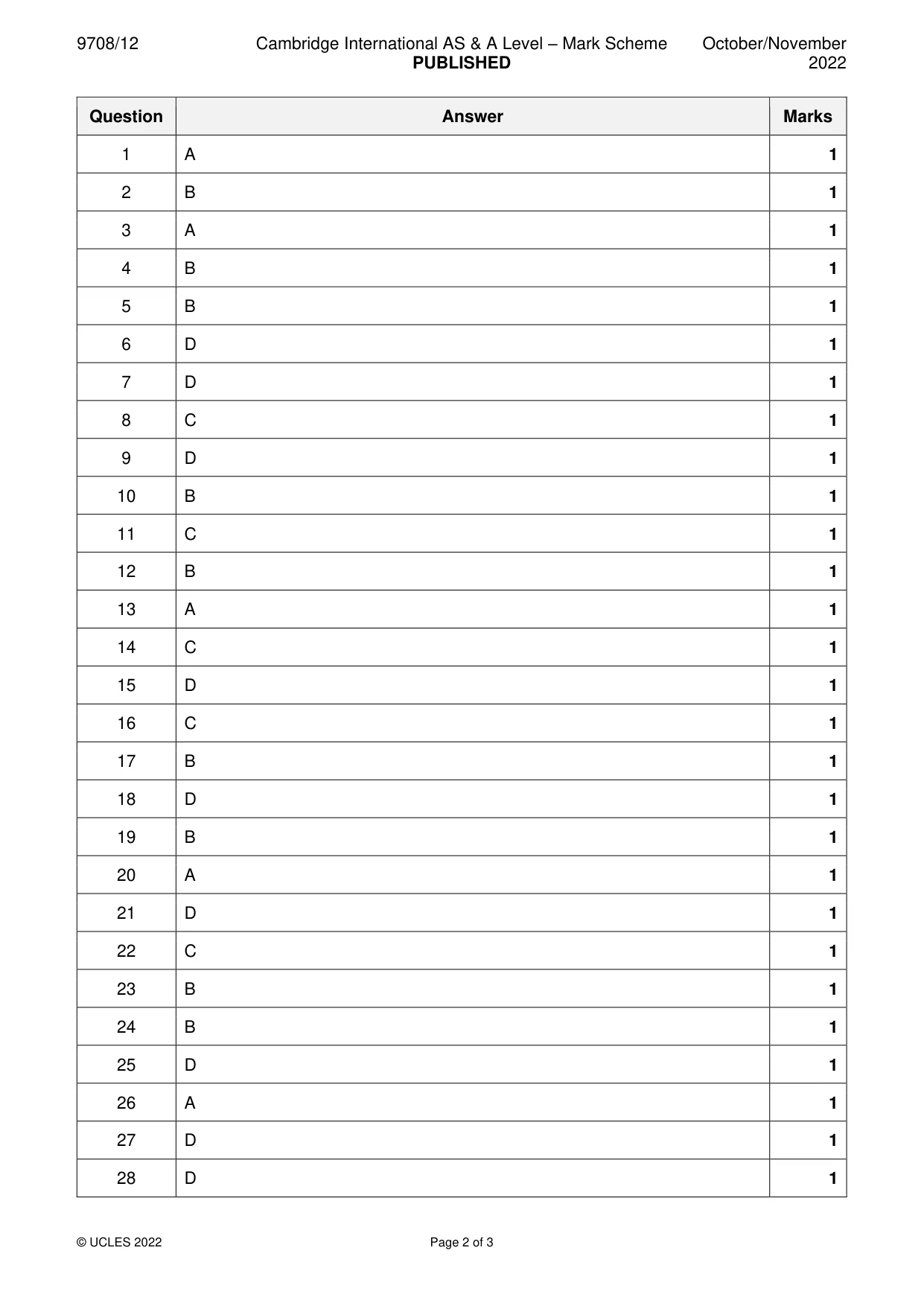
Mark scheme: A
Q2 · In a planned economy, what will determine the allocation of scarce resources?
2 In a planned economy, what will determine the allocation of scarce resources? A a mixture of private and central decision making B the decisions of central government C the forces of demand and supply D the revenue generated from direct and indirect taxes
Mark scheme: B
More questions on Resource allocation in different economic systems
Q3 · A key concept in classifying goods is whether a good is rival or non-rival
3 A key concept in classifying goods is whether a good is rival or non-rival. Which good is rival in consumption? A an ice cream B street lighting C a radio broadcast D the internet
Mark scheme: A
Q4 · What is a normative statement?
4 What is a normative statement? A A firm receiving a government subsidy will increase the supply of a good. B Negative externalities are the most serious market failure. C A rise in incomes will lead to a rise in demand for normal goods. D A rise in the additional rate of income tax will decrease the incentive to work.
Mark scheme: B
Q5 · The diagram shows an economy’s production possibility curve (PPC)
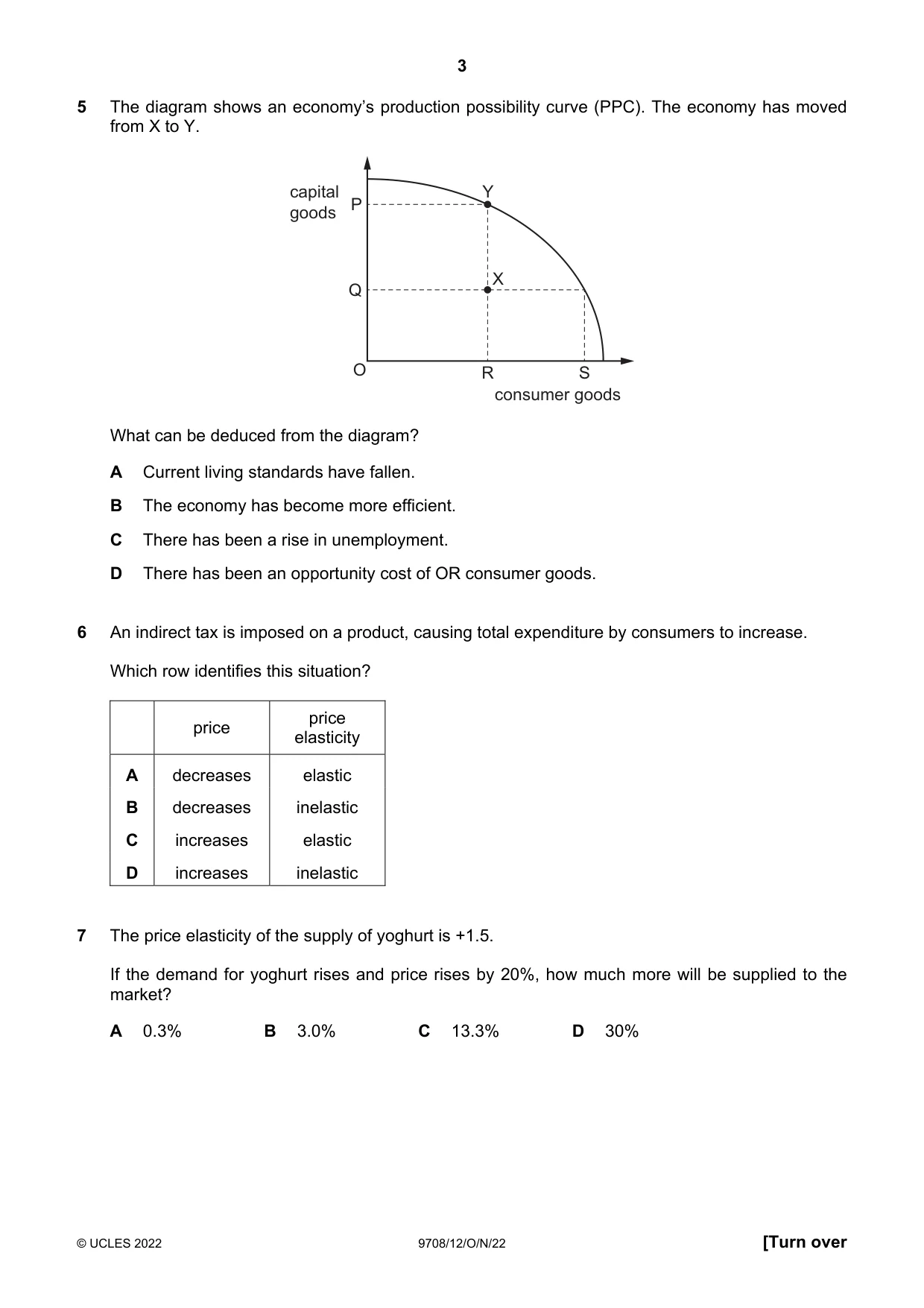
5 The diagram shows an economy’s production possibility curve (PPC). The economy has moved from X to Y. capital Y P goods X Q O R S consumer goods What can be deduced from the diagram? A Current living standards have fallen. B The economy has become more efficient. C There has been a rise in unemployment. D There has been an opportunity cost of OR consumer goods.
Mark scheme: B
Q6 · An indirect tax is imposed on a product, causing total expenditure by consumers to…
6 An indirect tax is imposed on a product, causing total expenditure by consumers to increase. Which row identifies this situation? price price elasticity A decreases elastic B decreases inelastic C increases elastic D increases inelastic
Mark scheme: D
More questions on Price elasticity, income elasticity and cross elasticity of demand
Q7 · The price elasticity of the supply of yoghurt is +1.5
7 The price elasticity of the supply of yoghurt is +1.5. If the demand for yoghurt rises and price rises by 20%, how much more will be supplied to the market? A 0.3% B 3.0% C 13.3% D 30%
Mark scheme: D
Q8 · The diagram shows the market demand for and supply of a good
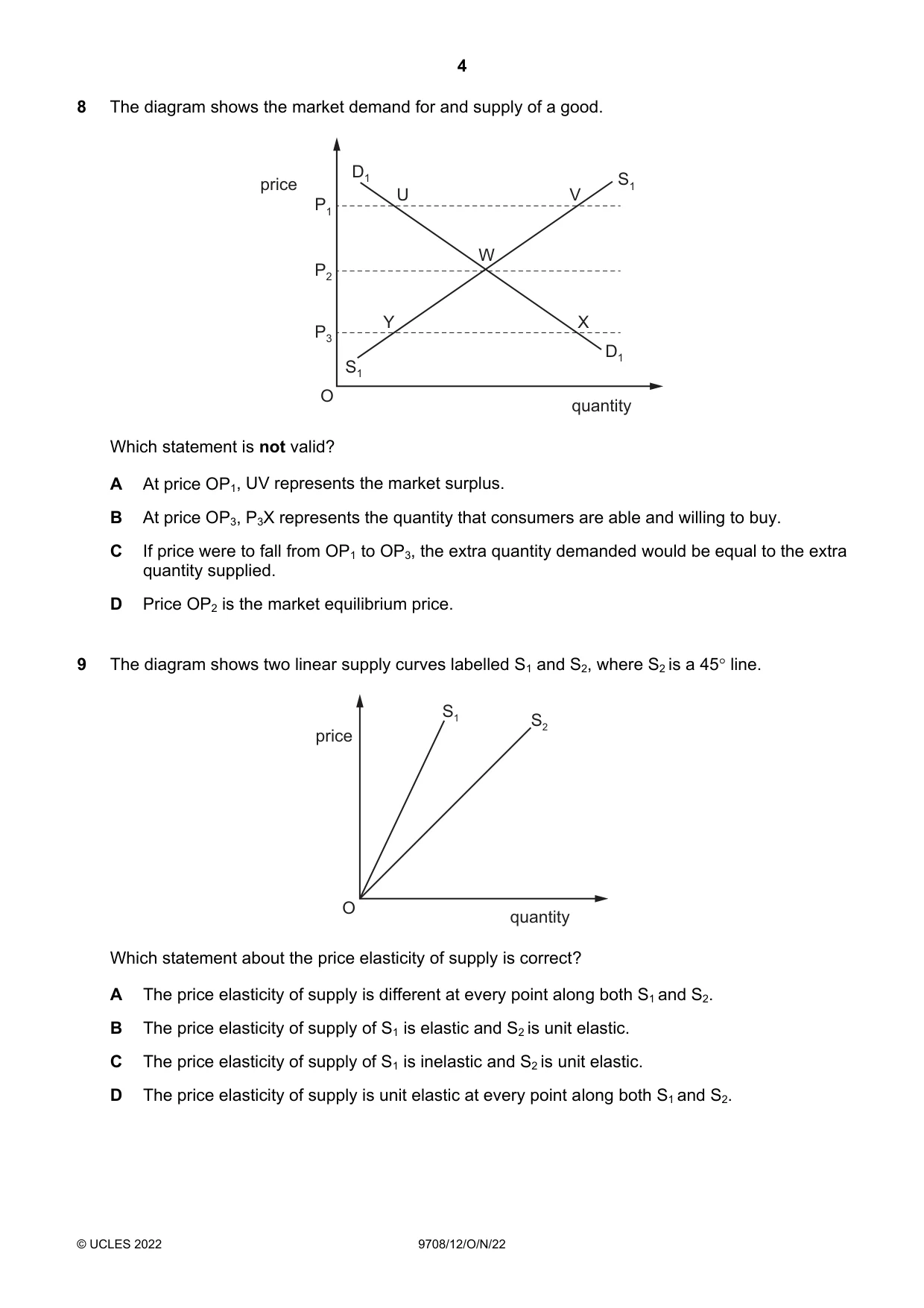
8 The diagram shows the market demand for and supply of a good. D1 S1 price U V P1 W P2 Y X P3 D1 S1 O quantity Which statement is not valid? A At price OP1, UV represents the market surplus. B At price OP3, P3X represents the quantity that consumers are able and willing to buy. C If price were to fall from OP1 to OP3, the extra quantity demanded would be equal to the extra quantity supplied. D Price OP2 is the market equilibrium price.
Mark scheme: C
Q9 · The diagram shows two linear supply curves labelled S1 and S2, where S2 is a 45 line
9 The diagram shows two linear supply curves labelled S1 and S2, where S2 is a 45 line. S1 S2 price O quantity Which statement about the price elasticity of supply is correct? A The price elasticity of supply is different at every point along both S1 and S2. B The price elasticity of supply of S1 is elastic and S2 is unit elastic. C The price elasticity of supply of S1 is inelastic and S2 is unit elastic. D The price elasticity of supply is unit elastic at every point along both S1 and S2.
Mark scheme: D
Q10 · A country has health care provided by the free market
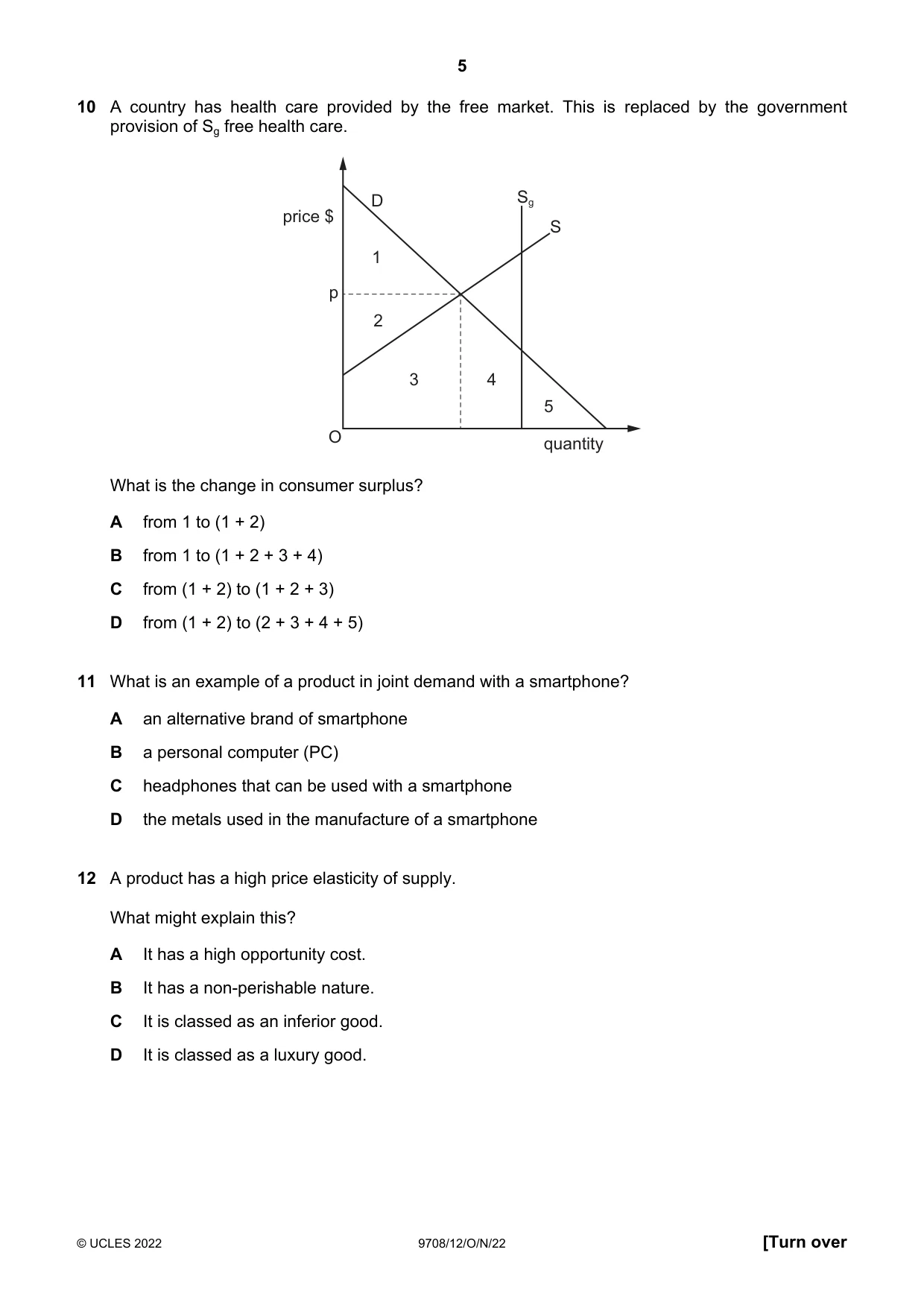
10 A country has health care provided by the free market. This is replaced by the government provision of Sg free health care. D Sg price $ S 1 p 2 3 4 5 O quantity What is the change in consumer surplus? A from 1 to (1 + 2) B from 1 to (1 + 2 + 3 + 4) C from (1 + 2) to (1 + 2 + 3) D from (1 + 2) to (2 + 3 + 4 + 5)
Mark scheme: B
Q11 · What is an example of a product in joint demand with a smartphone?
11 What is an example of a product in joint demand with a smartphone? A an alternative brand of smartphone B a personal computer (PC) C headphones that can be used with a smartphone D the metals used in the manufacture of a smartphone
Mark scheme: C
Q12 · A product has a high price elasticity of supply
12 A product has a high price elasticity of supply. What might explain this? A It has a high opportunity cost. B It has a non-perishable nature. C It is classed as an inferior good. D It is classed as a luxury good.
Mark scheme: B
Q13 · What is likely to affect the position of the demand curve for tickets to pop concerts but…
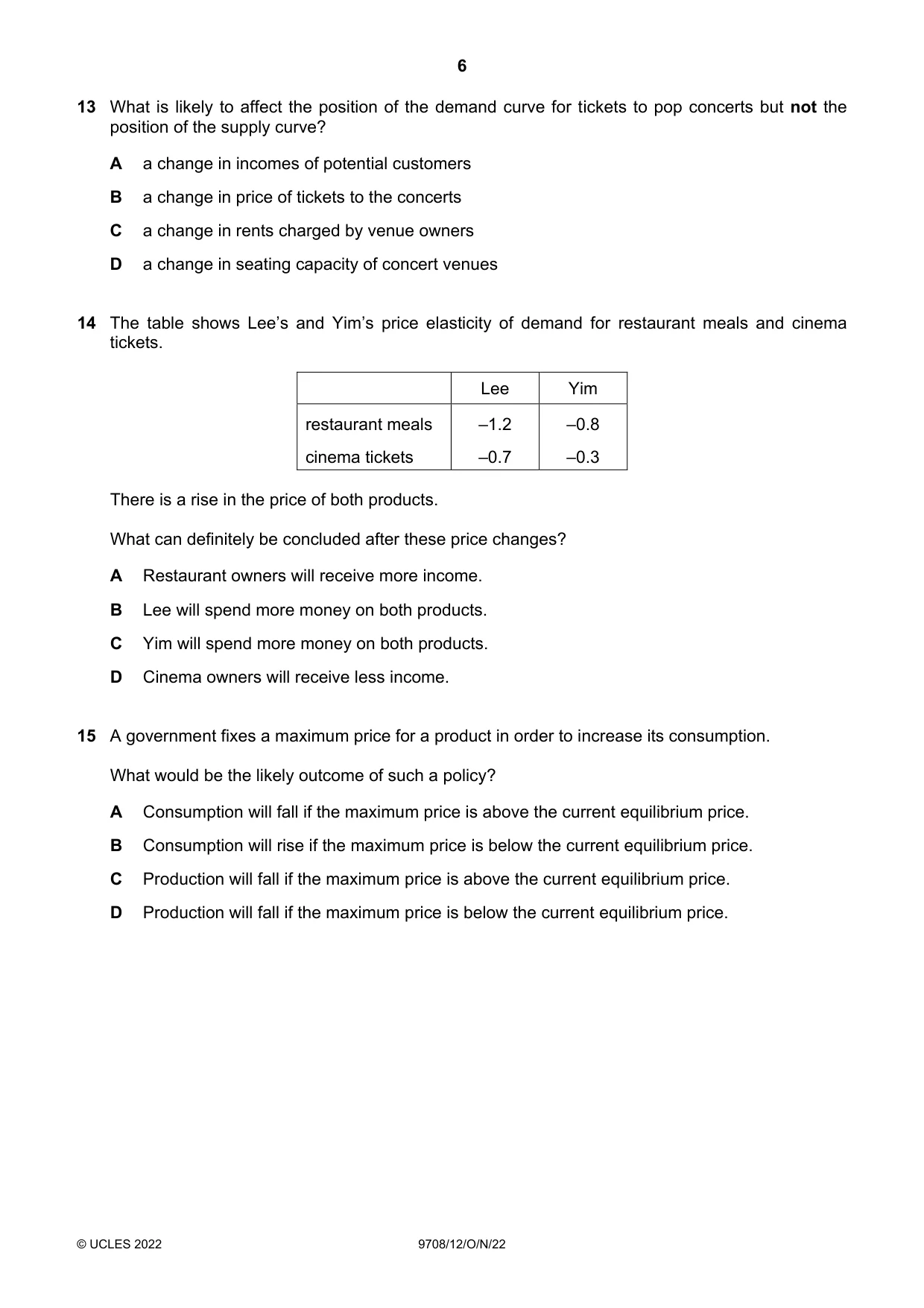
13 What is likely to affect the position of the demand curve for tickets to pop concerts but not the position of the supply curve? A a change in incomes of potential customers B a change in price of tickets to the concerts C a change in rents charged by venue owners D a change in seating capacity of concert venues
Mark scheme: A
Q14 · The table shows Lee’s and Yim’s price elasticity of demand for restaurant meals and…
14 The table shows Lee’s and Yim’s price elasticity of demand for restaurant meals and cinema tickets. Lee Yim restaurant meals –1.2 –0.8 cinema tickets –0.7 –0.3 There is a rise in the price of both products. What can definitely be concluded after these price changes? A Restaurant owners will receive more income. B Lee will spend more money on both products. C Yim will spend more money on both products. D Cinema owners will receive less income.
Mark scheme: C
More questions on Price elasticity, income elasticity and cross elasticity of demand
Q15 · A government fixes a maximum price for a product in order to increase its consumption
15 A government fixes a maximum price for a product in order to increase its consumption. What would be the likely outcome of such a policy? A Consumption will fall if the maximum price is above the current equilibrium price. B Consumption will rise if the maximum price is below the current equilibrium price. C Production will fall if the maximum price is above the current equilibrium price. D Production will fall if the maximum price is below the current equilibrium price.
Mark scheme: D
More questions on Methods and effects of government intervention in markets
Q16 · The diagram shows demand and supply curves for a good
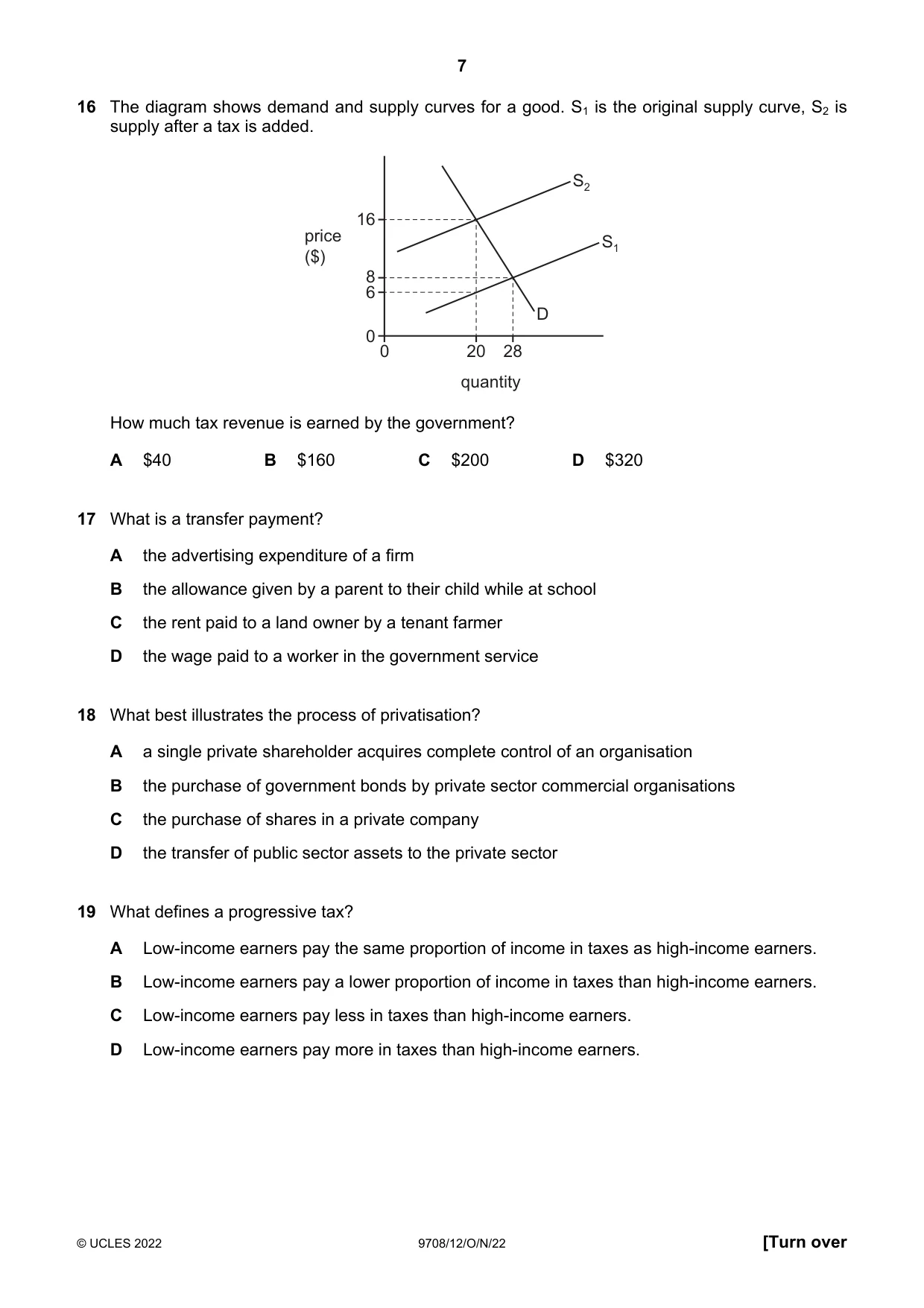
16 The diagram shows demand and supply curves for a good. S1 is the original supply curve, S2 is supply after a tax is added. S2 16 price S1 ($) 8 6 D 0 0 20 28 quantity How much tax revenue is earned by the government? A $40 B $160 C $200 D $320
Mark scheme: C
More questions on Methods and effects of government intervention in markets
Q17 · What is a transfer payment?
17 What is a transfer payment? A the advertising expenditure of a firm B the allowance given by a parent to their child while at school C the rent paid to a land owner by a tenant farmer D the wage paid to a worker in the government service
Mark scheme: B
Q18 · What best illustrates the process of privatisation?
18 What best illustrates the process of privatisation? A a single private shareholder acquires complete control of an organisation B the purchase of government bonds by private sector commercial organisations C the purchase of shares in a private company D the transfer of public sector assets to the private sector
Mark scheme: D
More questions on Resource allocation in different economic systems
Q19 · What defines a progressive tax?
19 What defines a progressive tax? A Low-income earners pay the same proportion of income in taxes as high-income earners. B Low-income earners pay a lower proportion of income in taxes than high-income earners. C Low-income earners pay less in taxes than high-income earners. D Low-income earners pay more in taxes than high-income earners.
Mark scheme: B
Q20 · An increase in what will shift the aggregate demand curve in an economy to the right?
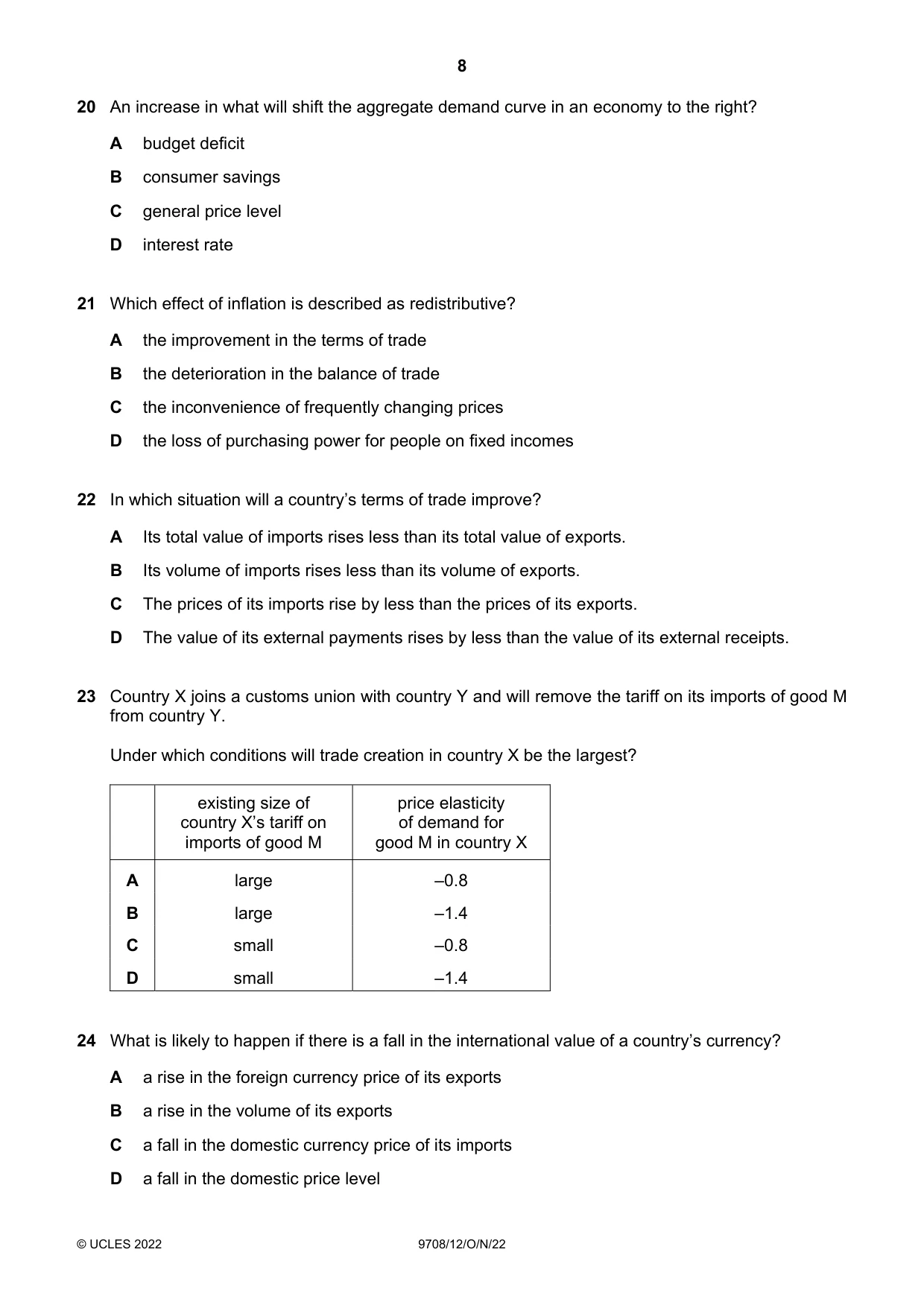
20 An increase in what will shift the aggregate demand curve in an economy to the right? A budget deficit B consumer savings C general price level D interest rate
Mark scheme: A
More questions on Aggregate Demand and Aggregate Supply analysis
Q21 · Which effect of inflation is described as redistributive?
21 Which effect of inflation is described as redistributive? A the improvement in the terms of trade B the deterioration in the balance of trade C the inconvenience of frequently changing prices D the loss of purchasing power for people on fixed incomes
Mark scheme: D
Q22 · In which situation will a country’s terms of trade improve?
22 In which situation will a country’s terms of trade improve? A Its total value of imports rises less than its total value of exports. B Its volume of imports rises less than its volume of exports. C The prices of its imports rise by less than the prices of its exports. D The value of its external payments rises by less than the value of its external receipts.
Mark scheme: C
Q23 · Country X joins a customs union with country Y and will remove the tariff on its imports…
23 Country X joins a customs union with country Y and will remove the tariff on its imports of good M from country Y. Under which conditions will trade creation in country X be the largest? existing size of price elasticity country X’s tariff on of demand for imports of good M good M in country X A large –0.8 B large –1.4 C small –0.8 D small –1.4
Mark scheme: B
Q24 · What is likely to happen if there is a fall in the international value of a country’s…
24 What is likely to happen if there is a fall in the international value of a country’s currency? A a rise in the foreign currency price of its exports B a rise in the volume of its exports C a fall in the domestic currency price of its imports D a fall in the domestic price level
Mark scheme: B
Q25 · From the same quantity of factors of production, country X and country Y each produce the…
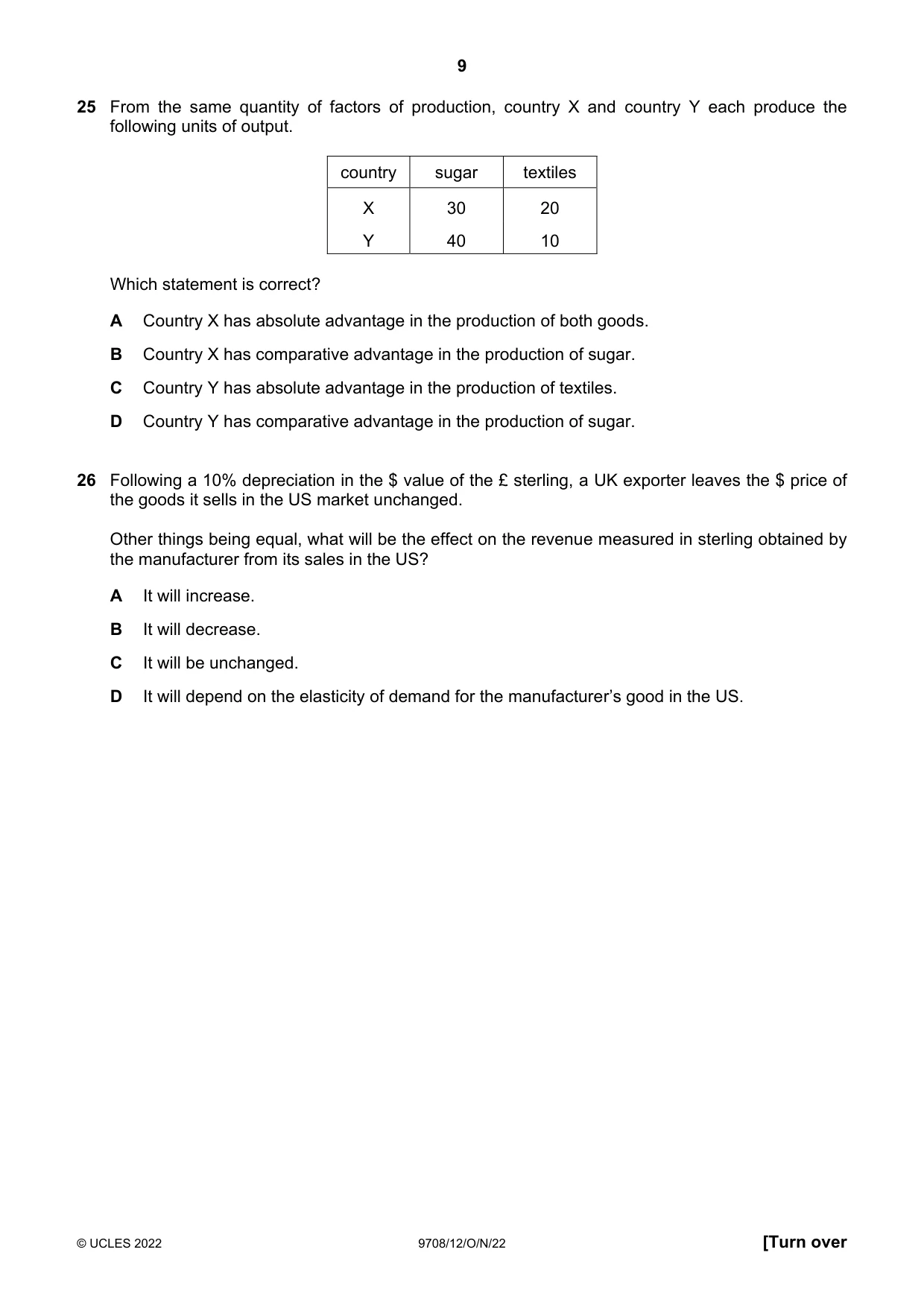
25 From the same quantity of factors of production, country X and country Y each produce the following units of output. country sugar textiles X 30 20 Y 40 10 Which statement is correct? A Country X has absolute advantage in the production of both goods. B Country X has comparative advantage in the production of sugar. C Country Y has absolute advantage in the production of textiles. D Country Y has comparative advantage in the production of sugar.
Mark scheme: D
Q26 · Following a 10% depreciation in the $ value of the £ sterling, a UK exporter leaves the $…
26 Following a 10% depreciation in the $ value of the £ sterling, a UK exporter leaves the $ price of the goods it sells in the US market unchanged. Other things being equal, what will be the effect on the revenue measured in sterling obtained by the manufacturer from its sales in the US? A It will increase. B It will decrease. C It will be unchanged. D It will depend on the elasticity of demand for the manufacturer’s good in the US.
Mark scheme: A
Q27 · The diagram shows the effect of introducing a tariff on a product
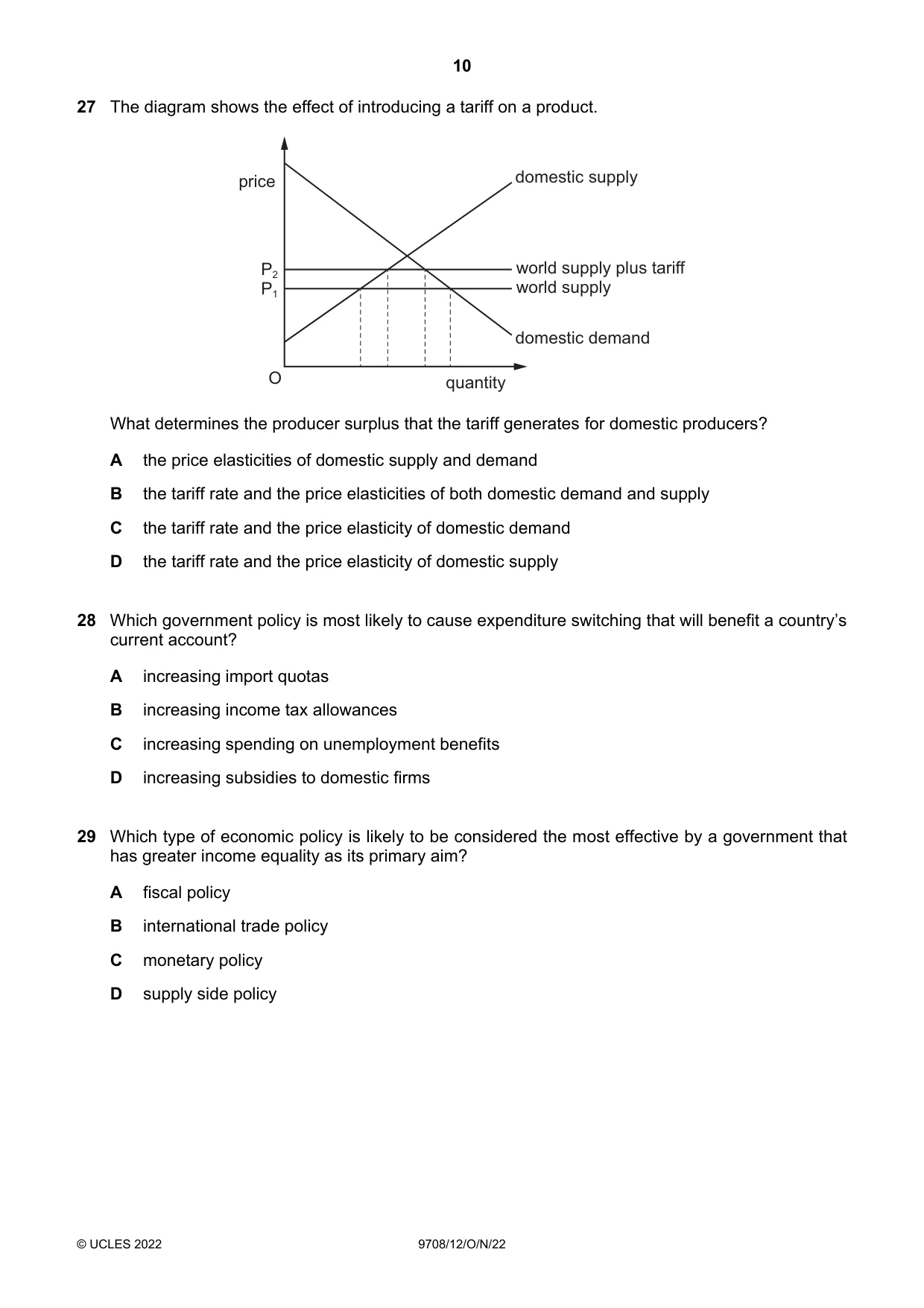
27 The diagram shows the effect of introducing a tariff on a product. price domestic supply P2 world supply plus tariff P1 world supply domestic demand O quantity What determines the producer surplus that the tariff generates for domestic producers? A the price elasticities of domestic supply and demand B the tariff rate and the price elasticities of both domestic demand and supply C the tariff rate and the price elasticity of domestic demand D the tariff rate and the price elasticity of domestic supply
Mark scheme: D
Q28 · Which government policy is most likely to cause expenditure switching that will benefit a…
28 Which government policy is most likely to cause expenditure switching that will benefit a country’s current account? A increasing import quotas B increasing income tax allowances C increasing spending on unemployment benefits D increasing subsidies to domestic firms
Mark scheme: D
More questions on Policies to correct imbalances in the current account of the balance of payments
Q29 · Which type of economic policy is likely to be considered the most effective by a…
29 Which type of economic policy is likely to be considered the most effective by a government that has greater income equality as its primary aim? A fiscal policy B international trade policy C monetary policy D supply side policy
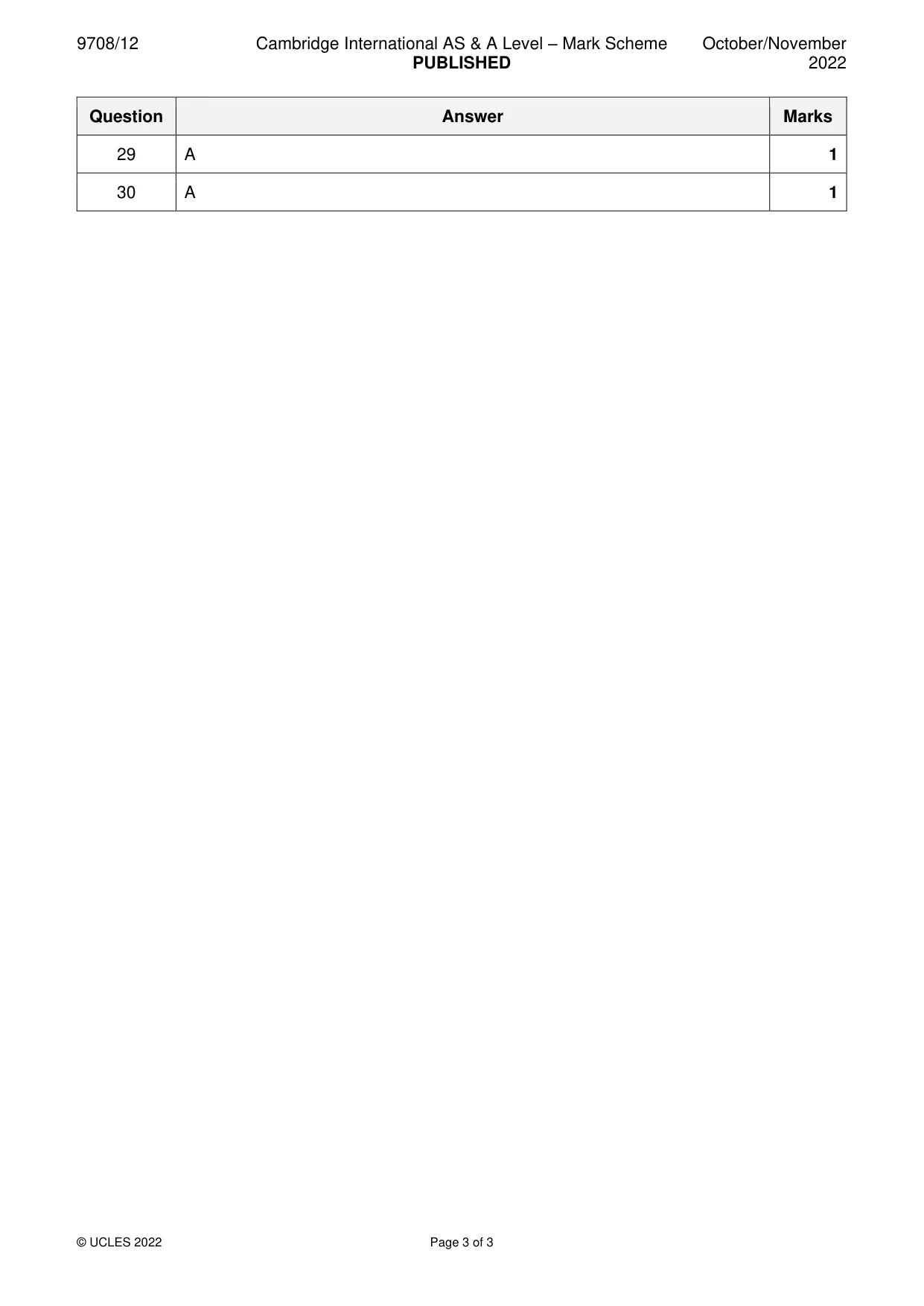
Mark scheme: A
Q30 · The diagram shows four possible aggregate supply curves and an equilibrium point X
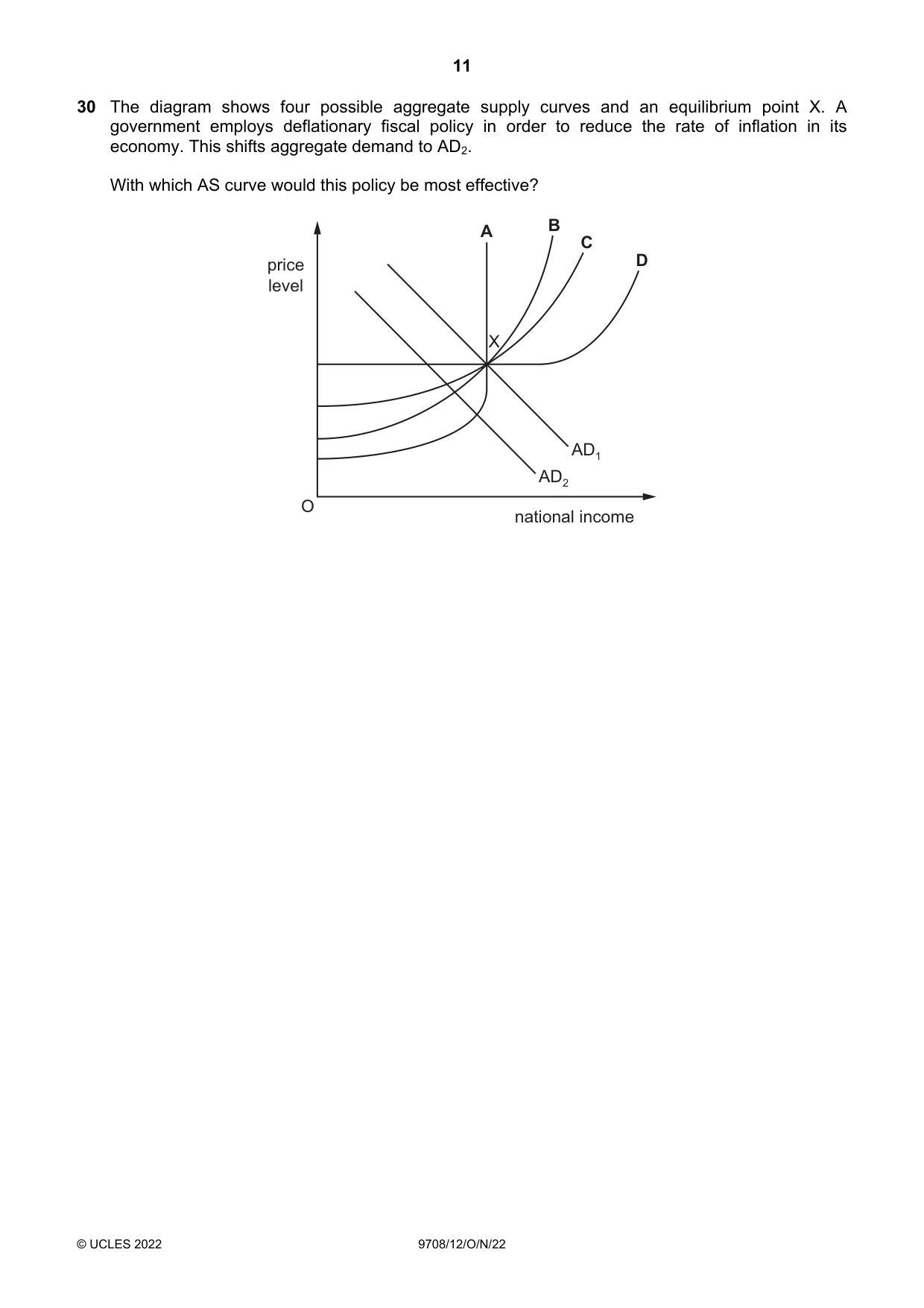
30 The diagram shows four possible aggregate supply curves and an equilibrium point X. A government employs deflationary fiscal policy in order to reduce the rate of inflation in its economy. This shifts aggregate demand to AD2. With which AS curve would this policy be most effective? A B C price D level X AD1 AD2 O national income
Mark scheme: A
More questions on Aggregate Demand and Aggregate Supply analysis
What was in this paper
The subtopics covered by these 30 questions, and how many questions each got. Open one in a new tab to see every Cambridge question on it.
3Price elasticity of supply3Aggregate Demand and Aggregate Supply analysis2Demand and supply curves2Methods and effects of government intervention in markets2Price elasticity, income elasticity and cross elasticity of demand2Protectionism2Resource allocation in different economic systems2Addressing income and wealth inequality1Classification of goods and services1Consumer and producer surplus1Economic methodology1Fiscal policy1Money and banking1National income statistics1Policies to correct imbalances in the current account of the balance of payments1Price stability1Production possibility curves1The interaction of demand and supply1The reasons for international trade1What you needed in this session
Cambridge’s own grade thresholds for 2022 Oct/Nov, Paper 1 · Variant 2. A higher threshold means an easier paper — the bar moves with how the cohort did.