Cambridge A Level Economics 9708 — 2025 Oct/Nov Paper 1 · Variant 1
9708/11/O/N/25 · 30 questions · 30 marks · ≈34 min
The question paper and its mark scheme, free to read here and free to download. This is Cambridge’s own paper, exactly as it was sat.
Question paper12 pages
Mark scheme3 pages
Answers below. Sit the paper first if you are practising.
Questions as text
Q1 · What is an example of a normative statement?
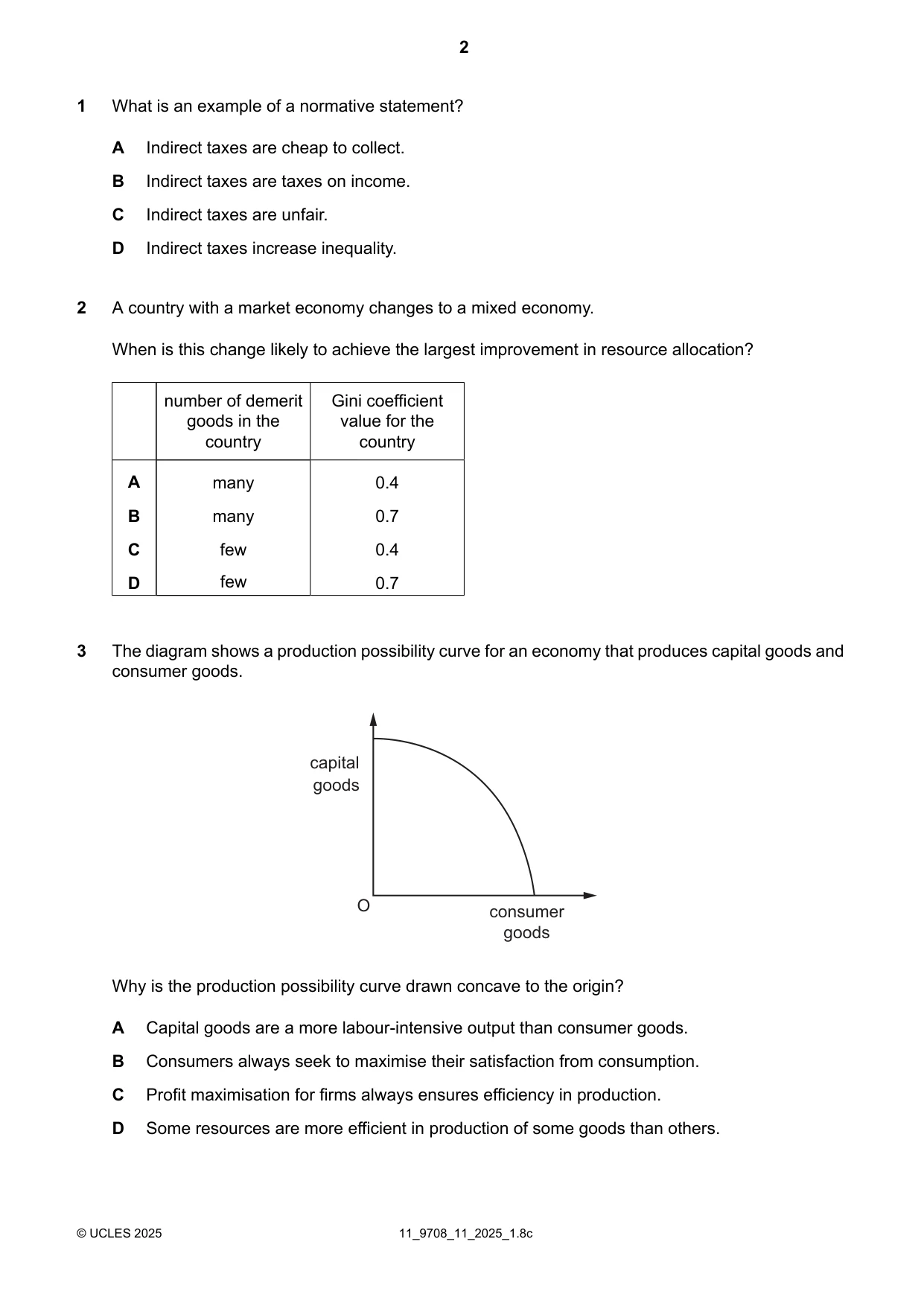
1 What is an example of a normative statement? A Indirect taxes are cheap to collect. B Indirect taxes are taxes on income. C Indirect taxes are unfair. D Indirect taxes increase inequality.
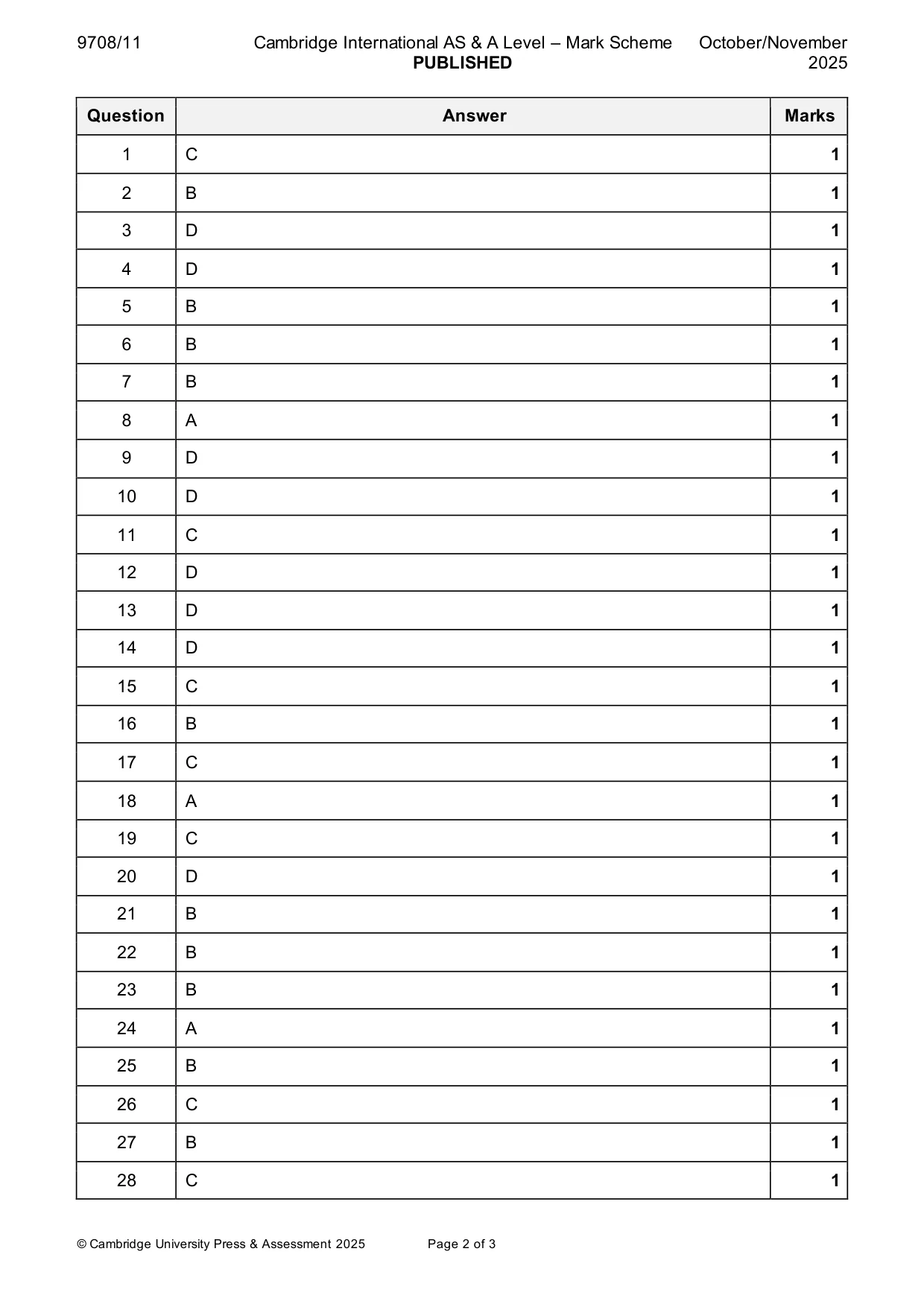
Mark scheme: C
Q2 · A country with a market economy changes to a mixed economy
2 A country with a market economy changes to a mixed economy. When is this change likely to achieve the largest improvement in resource allocation? number of demerit Gini coefficient goods in the value for the country country A many 0.4 B many 0.7 C few 0.4 D few 0.7
Mark scheme: B
More questions on Resource allocation in different economic systems
Q3 · The diagram shows a production possibility curve for an economy that produces capital…
3 The diagram shows a production possibility curve for an economy that produces capital goods and consumer goods. capital goods O consumer goods Why is the production possibility curve drawn concave to the origin? A Capital goods are a more labour-intensive output than consumer goods. B Consumers always seek to maximise their satisfaction from consumption. C Profit maximisation for firms always ensures efficiency in production. D Some resources are more efficient in production of some goods than others.
Mark scheme: D
Q4 · What is an example of a public good?
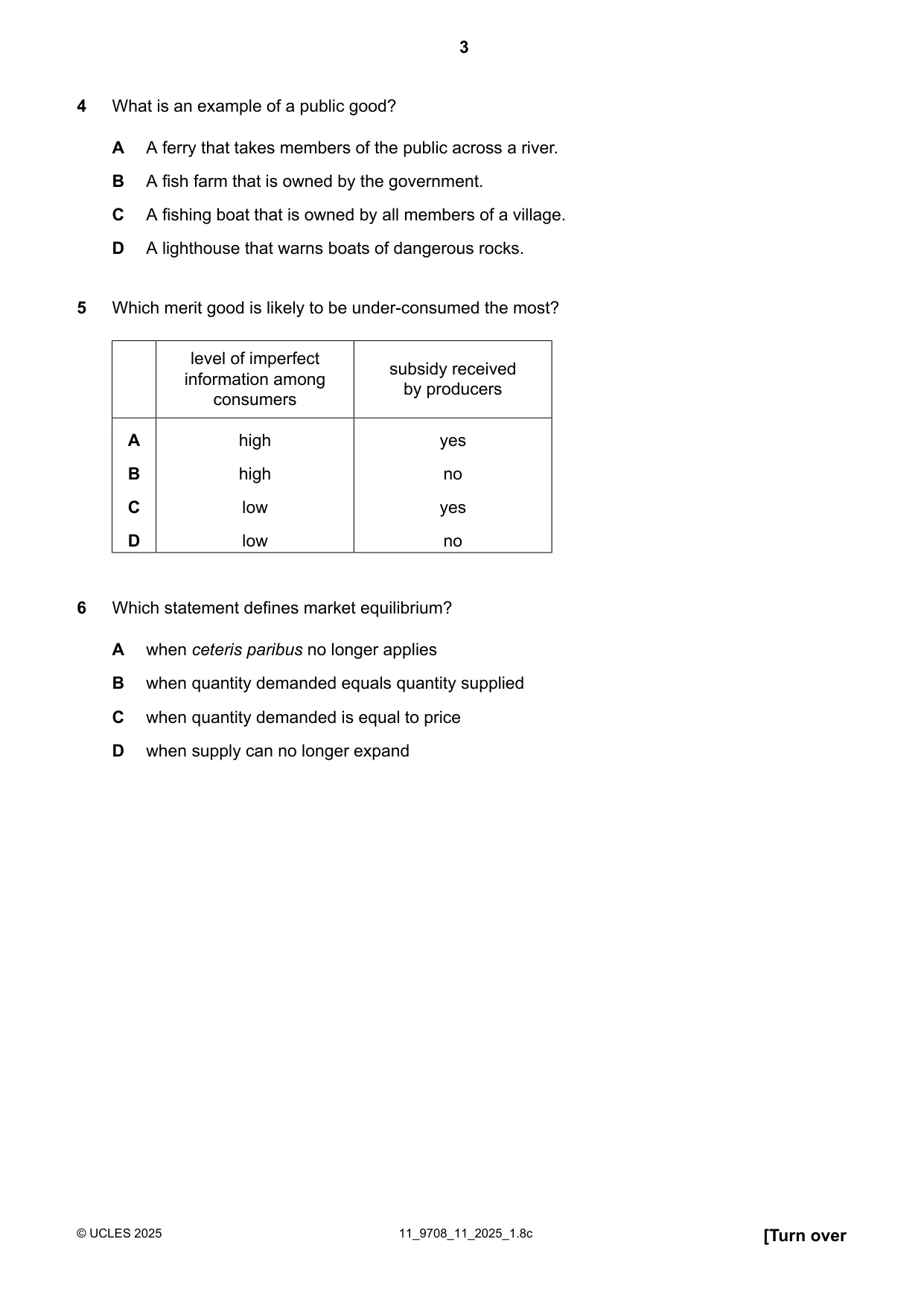
4 What is an example of a public good? A A ferry that takes members of the public across a river. B A fish farm that is owned by the government. C A fishing boat that is owned by all members of a village. D A lighthouse that warns boats of dangerous rocks.
Mark scheme: D
Q5 · Which merit good is likely to be under-consumed the most?
5 Which merit good is likely to be under-consumed the most? level of imperfect subsidy received information among by producers consumers A high yes B high no C low yes D low no
Mark scheme: B
Q6 · Which statement defines market equilibrium?
6 Which statement defines market equilibrium? A when ceteris paribus no longer applies B when quantity demanded equals quantity supplied C when quantity demanded is equal to price D when supply can no longer expand
Mark scheme: B
Q7 · The curve in the diagram shows a relationship between the price and the quantity of a…
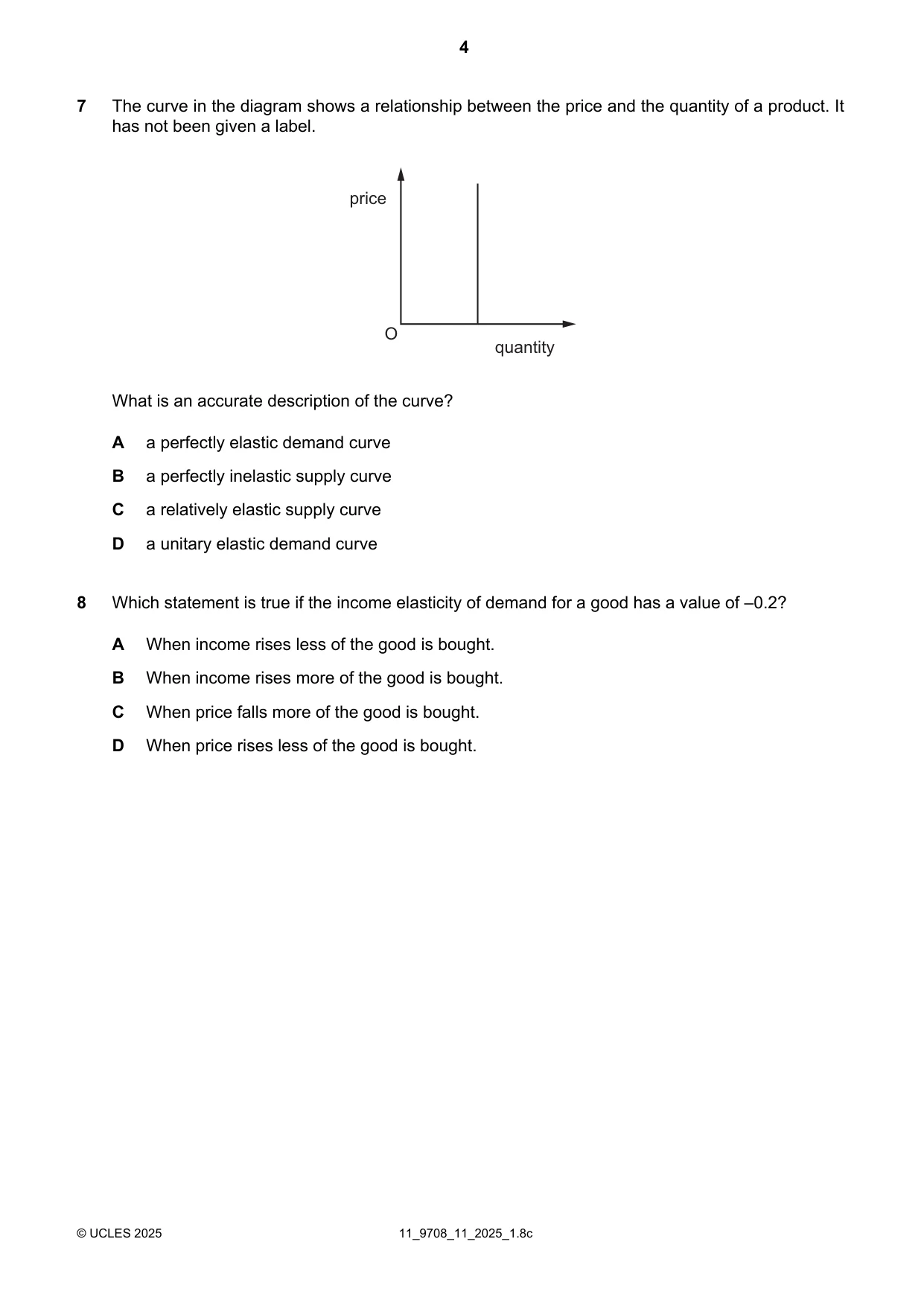
7 The curve in the diagram shows a relationship between the price and the quantity of a product. It has not been given a label. price O quantity What is an accurate description of the curve? A a perfectly elastic demand curve B a perfectly inelastic supply curve C a relatively elastic supply curve D a unitary elastic demand curve
Mark scheme: B
Q8 · Which statement is true if the income elasticity of demand for a good has a value of –0.2?
8 Which statement is true if the income elasticity of demand for a good has a value of –0.2? A When income rises less of the good is bought. B When income rises more of the good is bought. C When price falls more of the good is bought. D When price rises less of the good is bought.
Mark scheme: A
More questions on Price elasticity, income elasticity and cross elasticity of demand
Q9 · The table shows the price of a good and total expenditure on the good during specific…
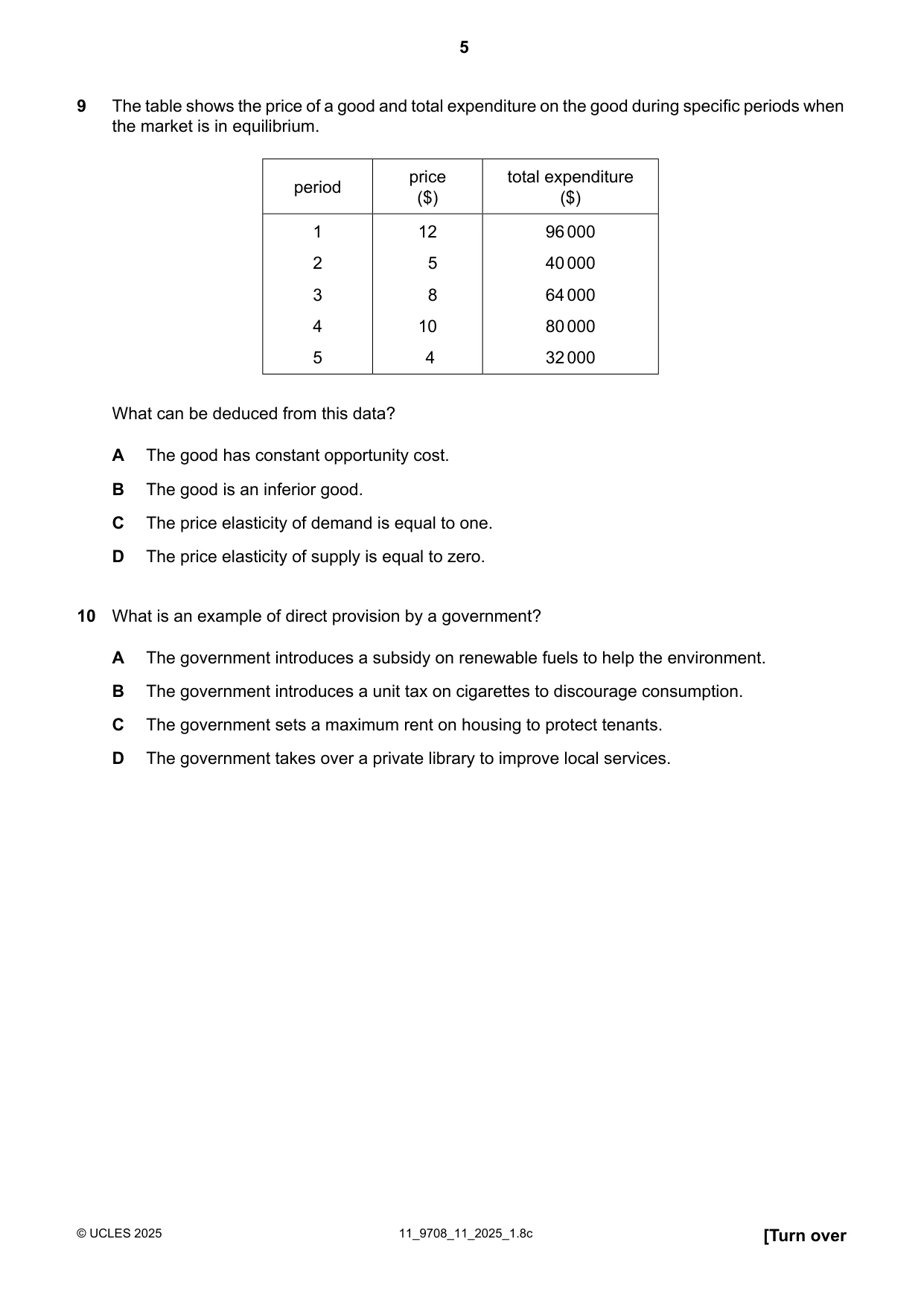
9 The table shows the price of a good and total expenditure on the good during specific periods when the market is in equilibrium. price total expenditure period ($) ($) 1 12 96000 2 5 40000 3 8 64000 4 10 80000 5 4 32000 What can be deduced from this data? A The good has constant opportunity cost. B The good is an inferior good. C The price elasticity of demand is equal to one. D The price elasticity of supply is equal to zero.
Mark scheme: D
More questions on Price elasticity, income elasticity and cross elasticity of demand
Q10 · What is an example of direct provision by a government?
10 What is an example of direct provision by a government? A The government introduces a subsidy on renewable fuels to help the environment. B The government introduces a unit tax on cigarettes to discourage consumption. C The government sets a maximum rent on housing to protect tenants. D The government takes over a private library to improve local services.
Mark scheme: D
More questions on Methods and effects of government intervention in markets
Q11 · The graph shows the total economic welfare derived by citizens from a government’s…
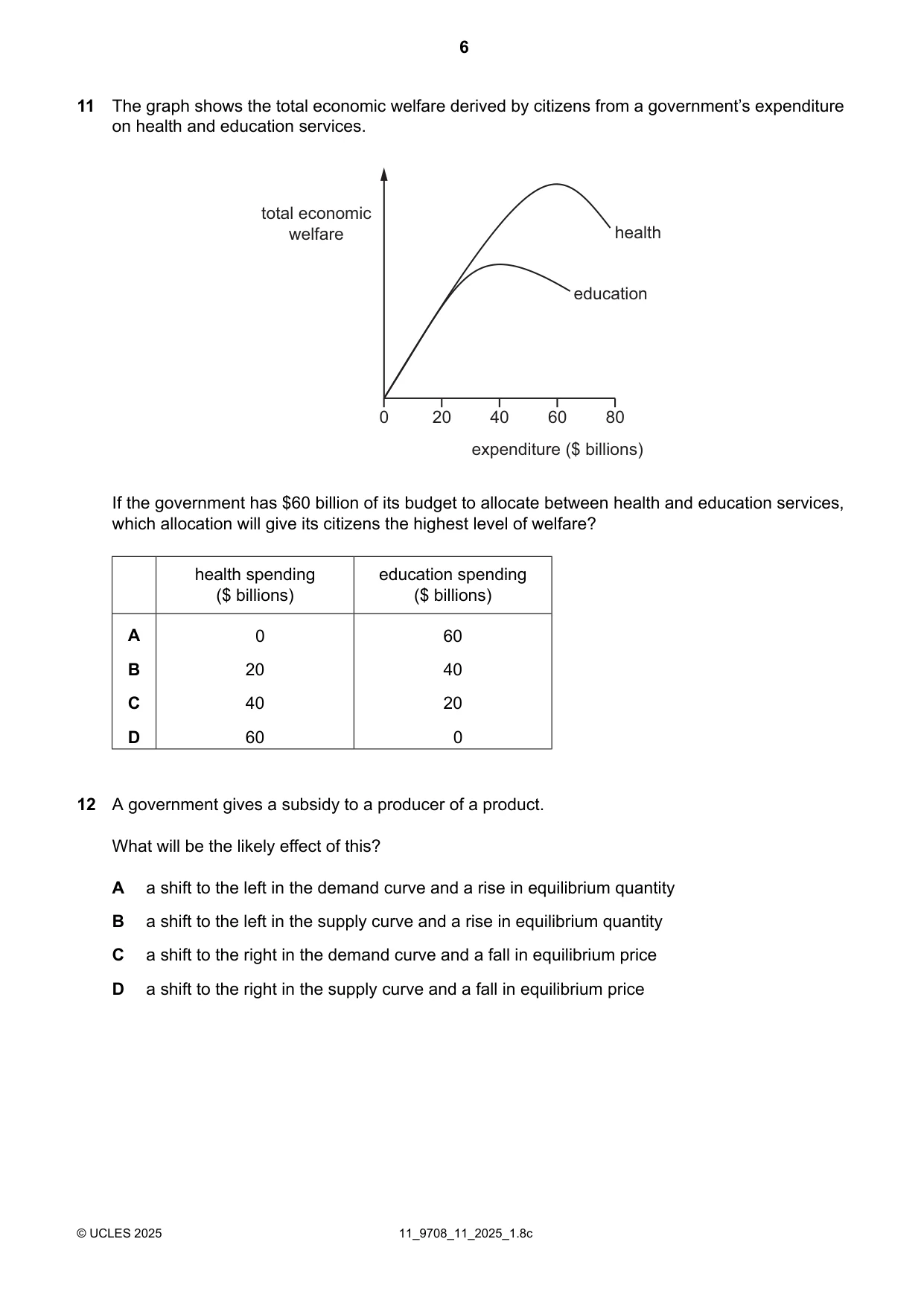
11 The graph shows the total economic welfare derived by citizens from a government’s expenditure on health and education services. total economic welfare health education 0 20 40 60 80 expenditure ($ billions) If the government has $60 billion of its budget to allocate between health and education services, which allocation will give its citizens the highest level of welfare? health spending education spending ($ billions) ($ billions) A 0 60 B 20 40 C 40 20 D 60 0
Mark scheme: C
Q12 · A government gives a subsidy to a producer of a product
12 A government gives a subsidy to a producer of a product. What will be the likely effect of this? A a shift to the left in the demand curve and a rise in equilibrium quantity B a shift to the left in the supply curve and a rise in equilibrium quantity C a shift to the right in the demand curve and a fall in equilibrium price D a shift to the right in the supply curve and a fall in equilibrium price
Mark scheme: D
More questions on Methods and effects of government intervention in markets
Q13 · What would be included in a measure of wealth?
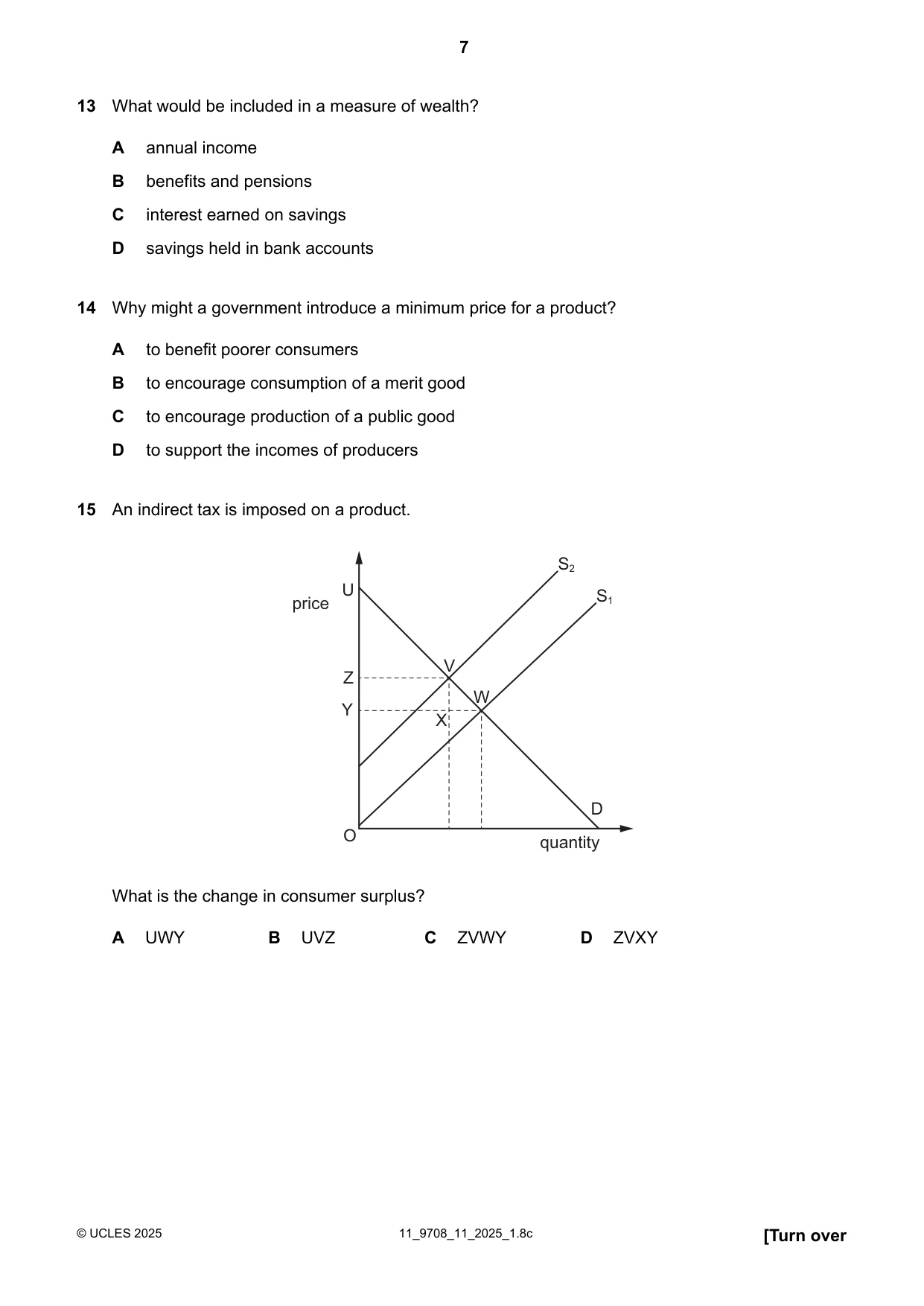
13 What would be included in a measure of wealth? A annual income B benefits and pensions C interest earned on savings D savings held in bank accounts
Mark scheme: D
Q14 · Why might a government introduce a minimum price for a product?
14 Why might a government introduce a minimum price for a product? A to benefit poorer consumers B to encourage consumption of a merit good C to encourage production of a public good D to support the incomes of producers
Mark scheme: D
More questions on Methods and effects of government intervention in markets
Q15 · An indirect tax is imposed on a product
15 An indirect tax is imposed on a product. S2 U S1 price V Z W Y X D O quantity What is the change in consumer surplus? A UWY B UVZ C ZVWY D ZVXY
Mark scheme: C
Q16 · The table shows selected statistics for a country
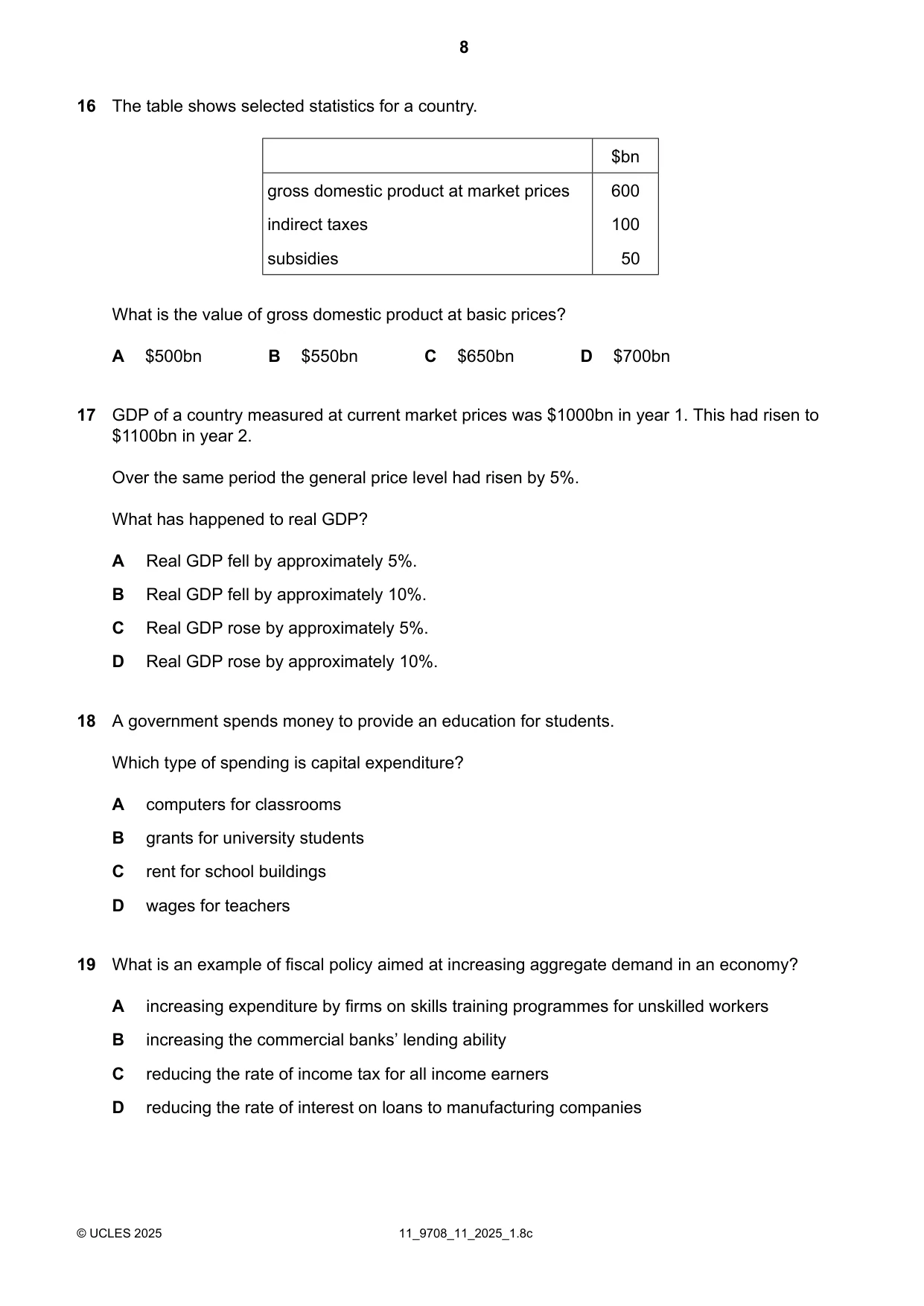
16 The table shows selected statistics for a country. $bn gross domestic product at market prices 600 indirect taxes 100 subsidies 50 What is the value of gross domestic product at basic prices? A $500bn B $550bn C $650bn D $700bn
Mark scheme: B
Q17 · GDP of a country measured at current market prices was $1000bn in year 1
17 GDP of a country measured at current market prices was $1000bn in year 1. This had risen to $1100bn in year 2. Over the same period the general price level had risen by 5%. What has happened to real GDP? A Real GDP fell by approximately 5%. B Real GDP fell by approximately 10%. C Real GDP rose by approximately 5%. D Real GDP rose by approximately 10%.
Mark scheme: C
Q18 · A government spends money to provide an education for students
18 A government spends money to provide an education for students. Which type of spending is capital expenditure? A computers for classrooms B grants for university students C rent for school buildings D wages for teachers
Mark scheme: A
Q19 · What is an example of fiscal policy aimed at increasing aggregate demand in an economy?
19 What is an example of fiscal policy aimed at increasing aggregate demand in an economy? A increasing expenditure by firms on skills training programmes for unskilled workers B increasing the commercial banks’ lending ability C reducing the rate of income tax for all income earners D reducing the rate of interest on loans to manufacturing companies
Mark scheme: C
Q20 · The aggregate demand (AD) curve in an economy shifts to the left
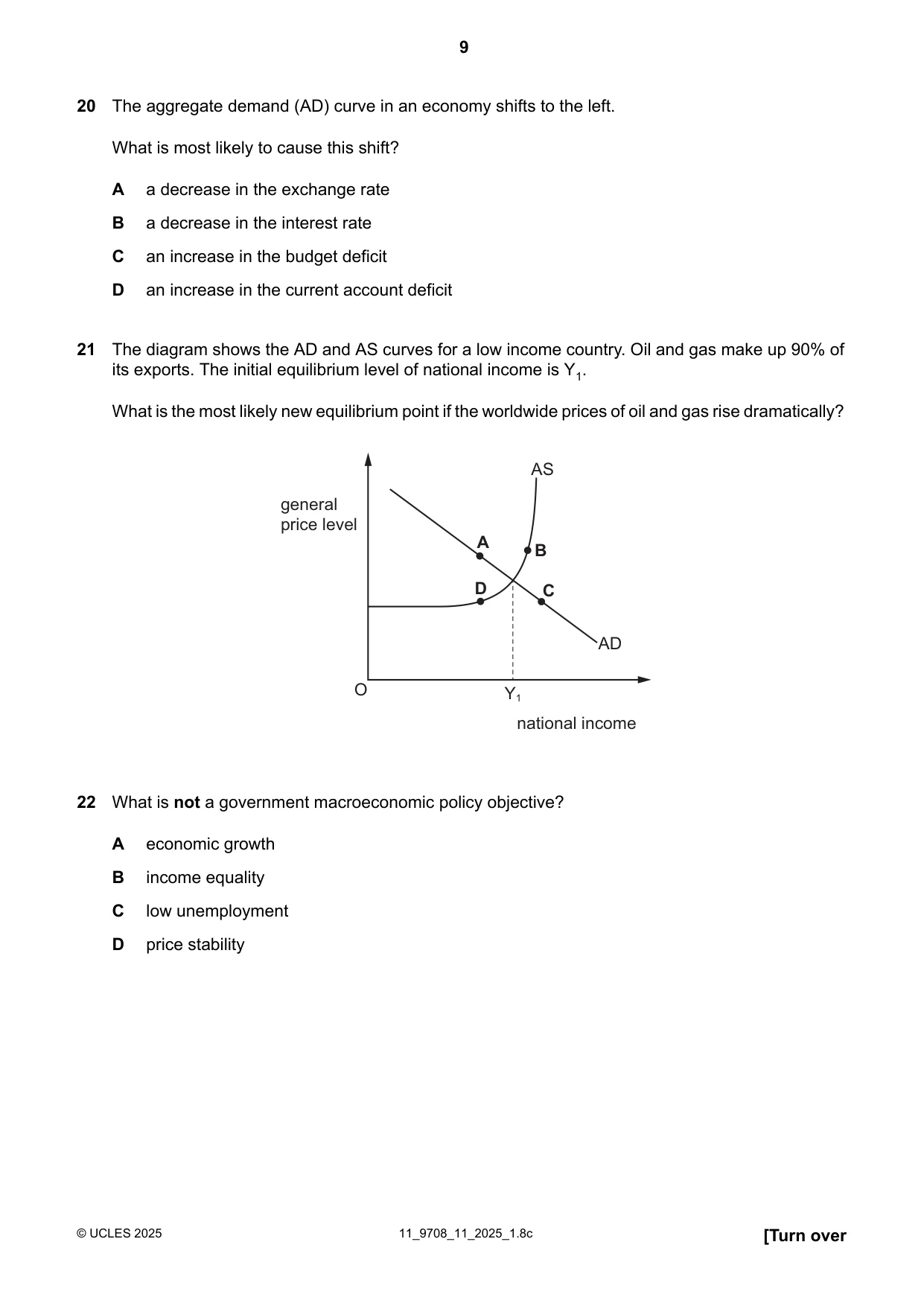
20 The aggregate demand (AD) curve in an economy shifts to the left. What is most likely to cause this shift? A a decrease in the exchange rate B a decrease in the interest rate C an increase in the budget deficit D an increase in the current account deficit
Mark scheme: D
More questions on Aggregate Demand and Aggregate Supply analysis
Q21 · The diagram shows the AD and AS curves for a low income country
21 The diagram shows the AD and AS curves for a low income country. Oil and gas make up 90% of its exports. The initial equilibrium level of national income is Y1. What is the most likely new equilibrium point if the worldwide prices of oil and gas rise dramatically? AS general price level A B D C AD O Y1 national income
Mark scheme: B
More questions on Aggregate Demand and Aggregate Supply analysis
Q22 · What is not a government macroeconomic policy objective?
22 What is not a government macroeconomic policy objective? A economic growth B income equality C low unemployment D price stability
Mark scheme: B
More questions on Government macroeconomic policy objectives
Q23 · A central bank increases interest rates to reduce inflation
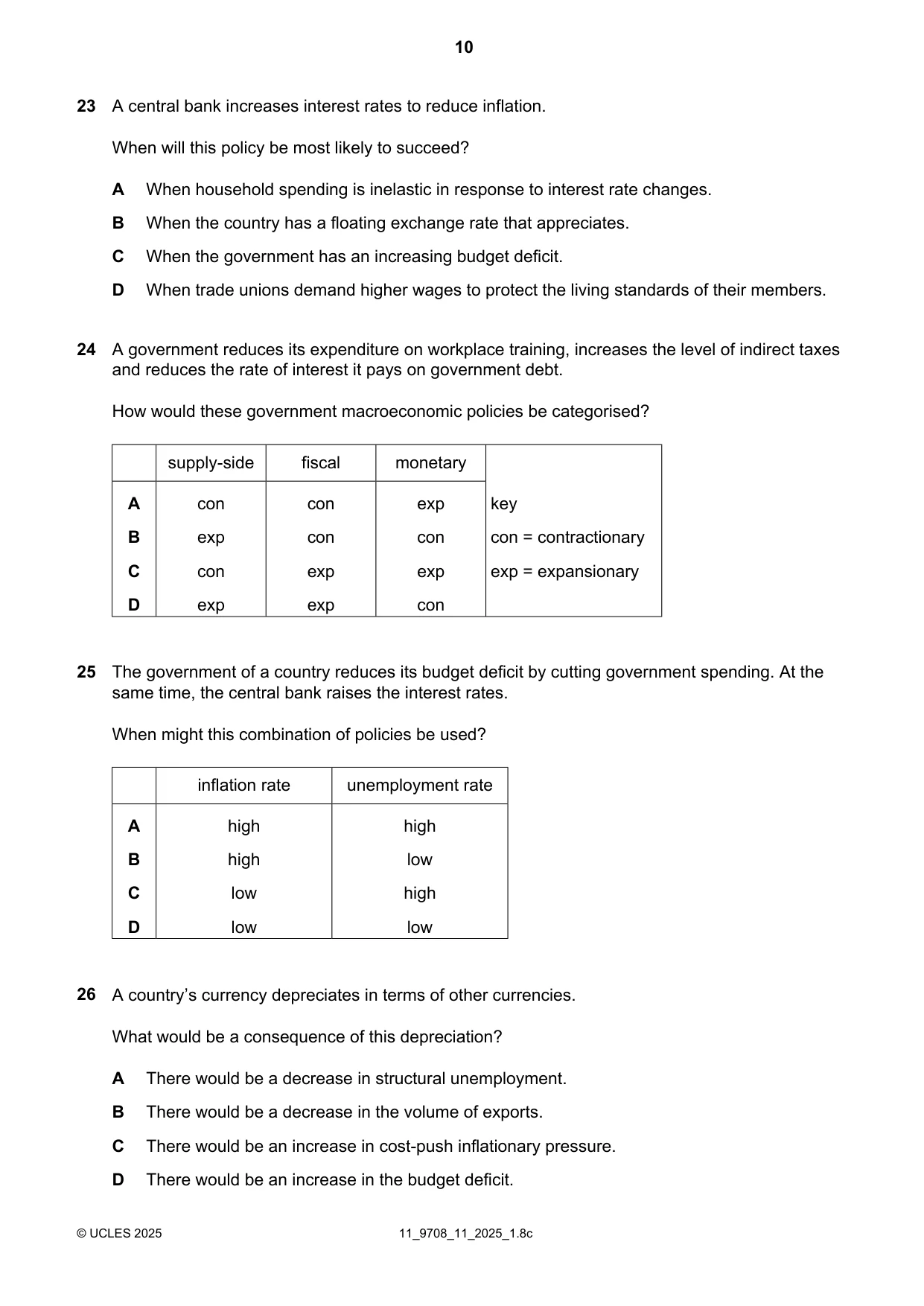
23 A central bank increases interest rates to reduce inflation. When will this policy be most likely to succeed? A When household spending is inelastic in response to interest rate changes. B When the country has a floating exchange rate that appreciates. C When the government has an increasing budget deficit. D When trade unions demand higher wages to protect the living standards of their members.
Mark scheme: B
Q24 · A government reduces its expenditure on workplace training, increases the level of…
24 A government reduces its expenditure on workplace training, increases the level of indirect taxes and reduces the rate of interest it pays on government debt. How would these government macroeconomic policies be categorised? supply-side fiscal monetary A con con exp key B exp con con con = contractionary C con exp exp exp = expansionary D exp exp con
Mark scheme: A
Q25 · The government of a country reduces its budget deficit by cutting government spending
25 The government of a country reduces its budget deficit by cutting government spending. At the same time, the central bank raises the interest rates. When might this combination of policies be used? inflation rate unemployment rate A high high B high low C low high D low low
Mark scheme: B
More questions on Effectiveness of policy options to meet all macroeconomic objectives
Q26 · A country’s currency depreciates in terms of other currencies
26 A country’s currency depreciates in terms of other currencies. What would be a consequence of this depreciation? A There would be a decrease in structural unemployment. B There would be a decrease in the volume of exports. C There would be an increase in cost-push inflationary pressure. D There would be an increase in the budget deficit.
Mark scheme: C
Q27 · The terms of trade of a developing country fell from 90 in 2010 to 80 in 2015
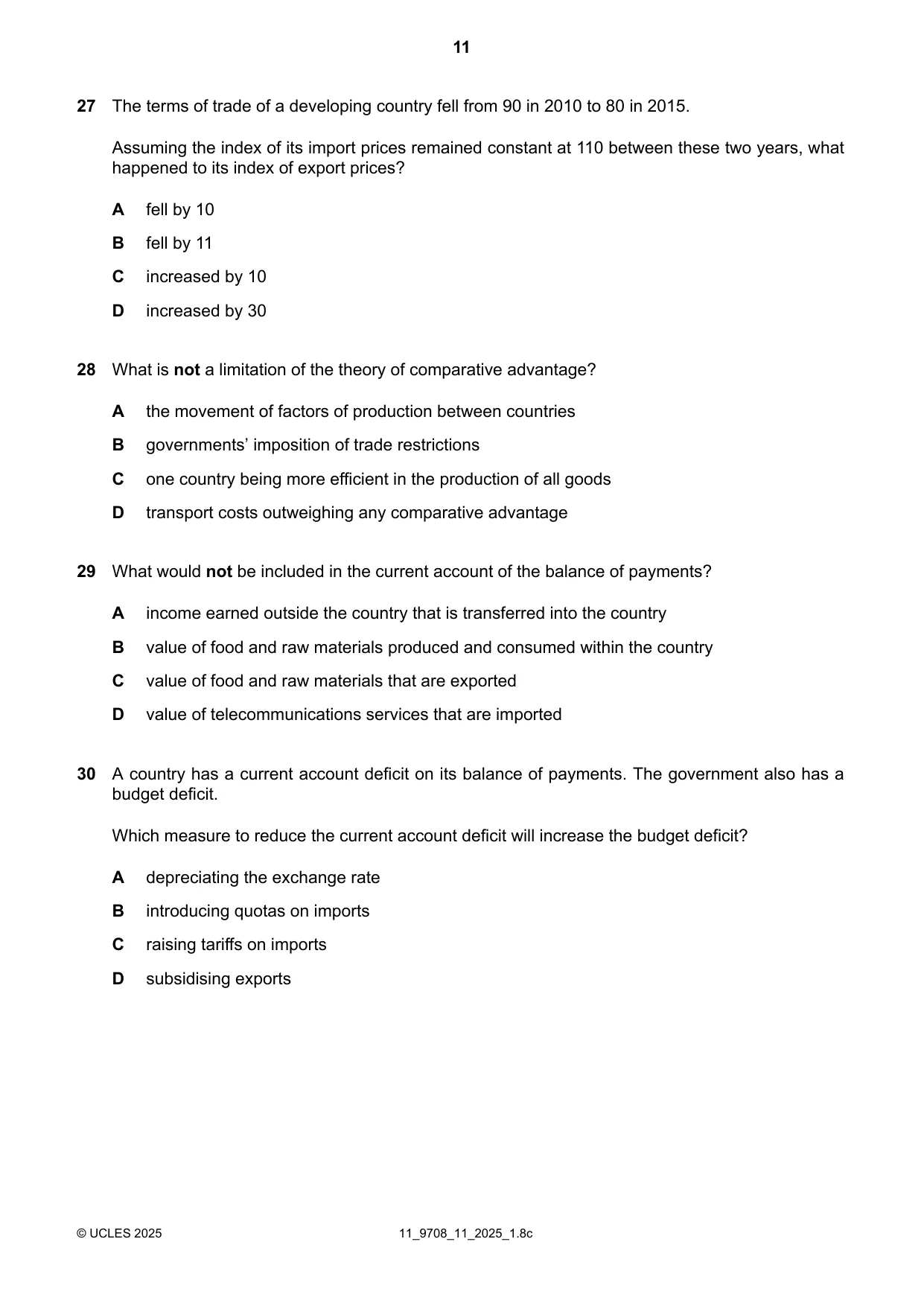
27 The terms of trade of a developing country fell from 90 in 2010 to 80 in 2015. Assuming the index of its import prices remained constant at 110 between these two years, what happened to its index of export prices? A fell by 10 B fell by 11 C increased by 10 D increased by 30
Mark scheme: B
Q28 · What is not a limitation of the theory of comparative advantage?
28 What is not a limitation of the theory of comparative advantage? A the movement of factors of production between countries B governments’ imposition of trade restrictions C one country being more efficient in the production of all goods D transport costs outweighing any comparative advantage
Mark scheme: C
Q29 · What would not be included in the current account of the balance of payments?
29 What would not be included in the current account of the balance of payments? A income earned outside the country that is transferred into the country B value of food and raw materials produced and consumed within the country C value of food and raw materials that are exported D value of telecommunications services that are imported
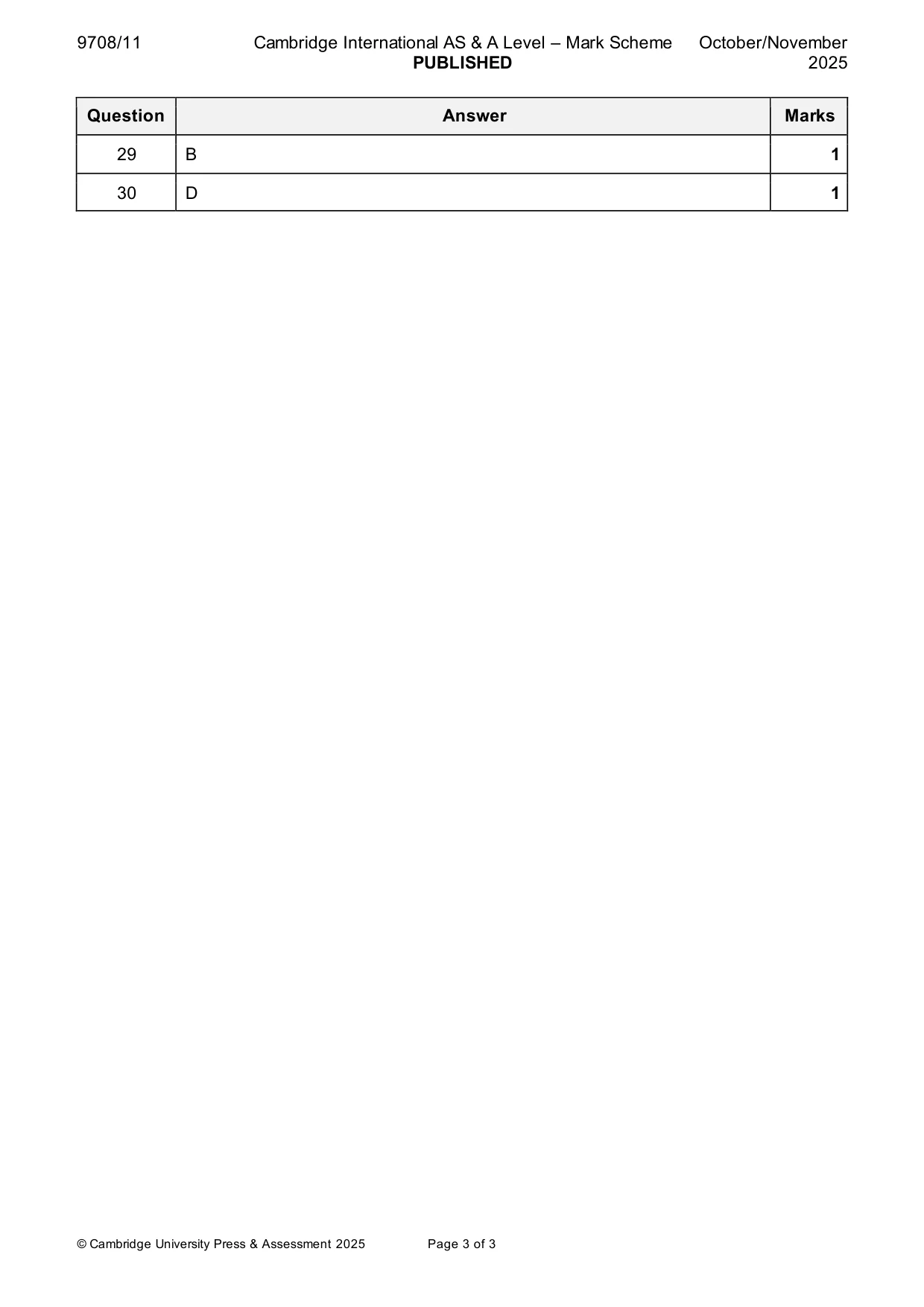
Mark scheme: B
More questions on Current account of the balance of payments
Q30 · A country has a current account deficit on its balance of payments
30 A country has a current account deficit on its balance of payments. The government also has a budget deficit. Which measure to reduce the current account deficit will increase the budget deficit? A depreciating the exchange rate B introducing quotas on imports C raising tariffs on imports D subsidising exports
Mark scheme: D
More questions on Policies to correct imbalances in the current account of the balance of payments
What was in this paper
The subtopics covered by these 30 questions, and how many questions each got. Open one in a new tab to see every Cambridge question on it.
3Methods and effects of government intervention in markets3Aggregate Demand and Aggregate Supply analysis2Classification of goods and services2National income statistics2Price elasticity, income elasticity and cross elasticity of demand2The reasons for international trade2Addressing income and wealth inequality1Consumer and producer surplus1Current account of the balance of payments1Economic methodology1Effectiveness of policy options to meet all macroeconomic objectives1Exchange rates1Government macroeconomic policy objectives1Monetary policy1Policies to correct imbalances in the current account of the balance of payments1Price elasticity of supply1Production possibility curves1Resource allocation in different economic systems1Scarcity, choice and opportunity cost1The interaction of demand and supply1What you needed in this session
Cambridge’s own grade thresholds for 2025 Oct/Nov, Paper 1 · Variant 1. A higher threshold means an easier paper — the bar moves with how the cohort did.