Questions as text
Q1 · An object of mass 50 kg accelerates from a velocity of 2.0 m / s to a velocity of 10 m /… 0625/21 May/June 2016
7 An object of mass 50 kg accelerates from a velocity of 2.0 m / s to a velocity of 10 m / s in the same direction. What is the impulse provided to cause this acceleration? A 250 N s B 400 N s C 850 N s D 2500 N s
1 marks
Answer: B
This question in 0625/21 May/June 2016
Q2 · A gas molecule strikes the wall of a container 0625/23 May/June 2016
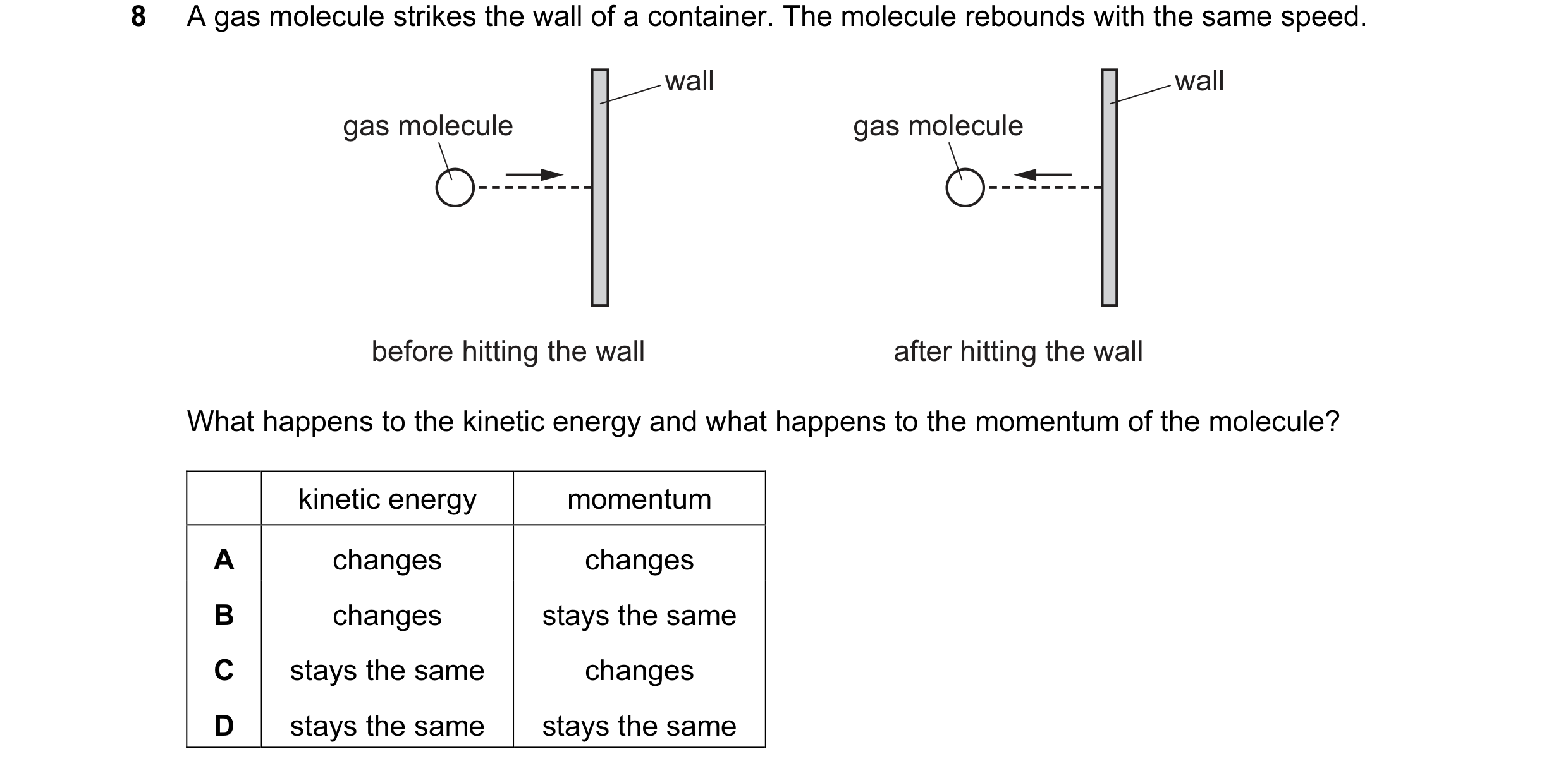
8 A gas molecule strikes the wall of a container. The molecule rebounds with the same speed. wall wall gas molecule gas molecule before hitting the wall after hitting the wall What happens to the kinetic energy and what happens to the momentum of the molecule? kinetic energy momentum A changes changes B changes stays the same C stays the same changes D stays the same stays the same
1 marks
Answer: C
This question in 0625/23 May/June 2016
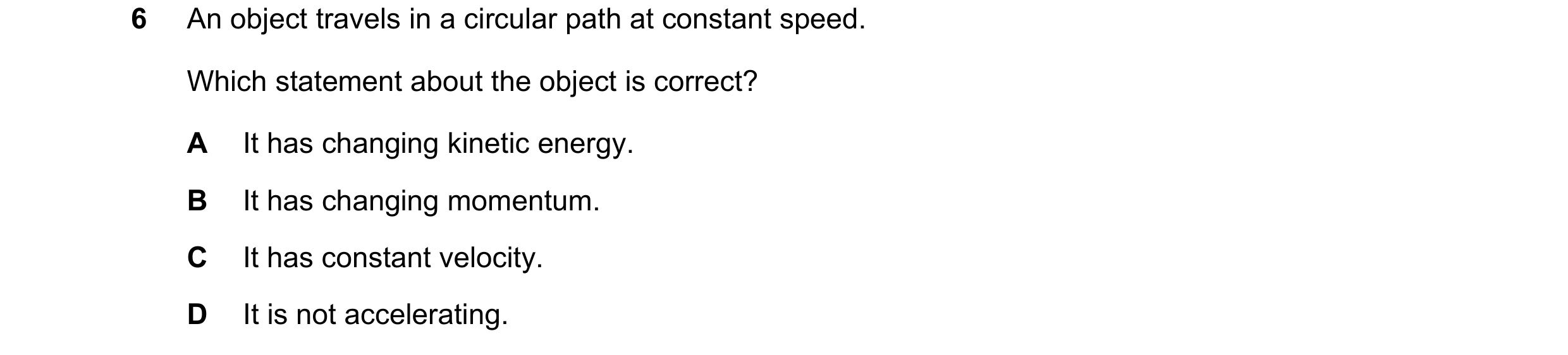
Q3 · An object travels in a circular path at constant speed 0625/21 Oct/Nov 2016
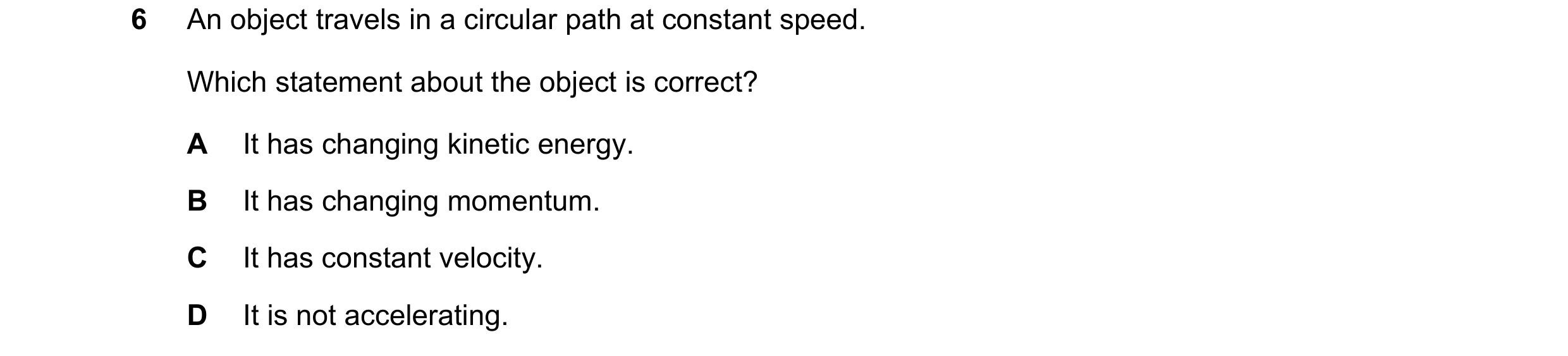
6 An object travels in a circular path at constant speed. Which statement about the object is correct? A It has changing kinetic energy. B It has changing momentum. C It has constant velocity. D It is not accelerating.
1 marks
Answer: B
This question in 0625/21 Oct/Nov 2016
Q4 · Two cars, P and Q, have different masses and different speeds as shown 0625/21 Oct/Nov 2016
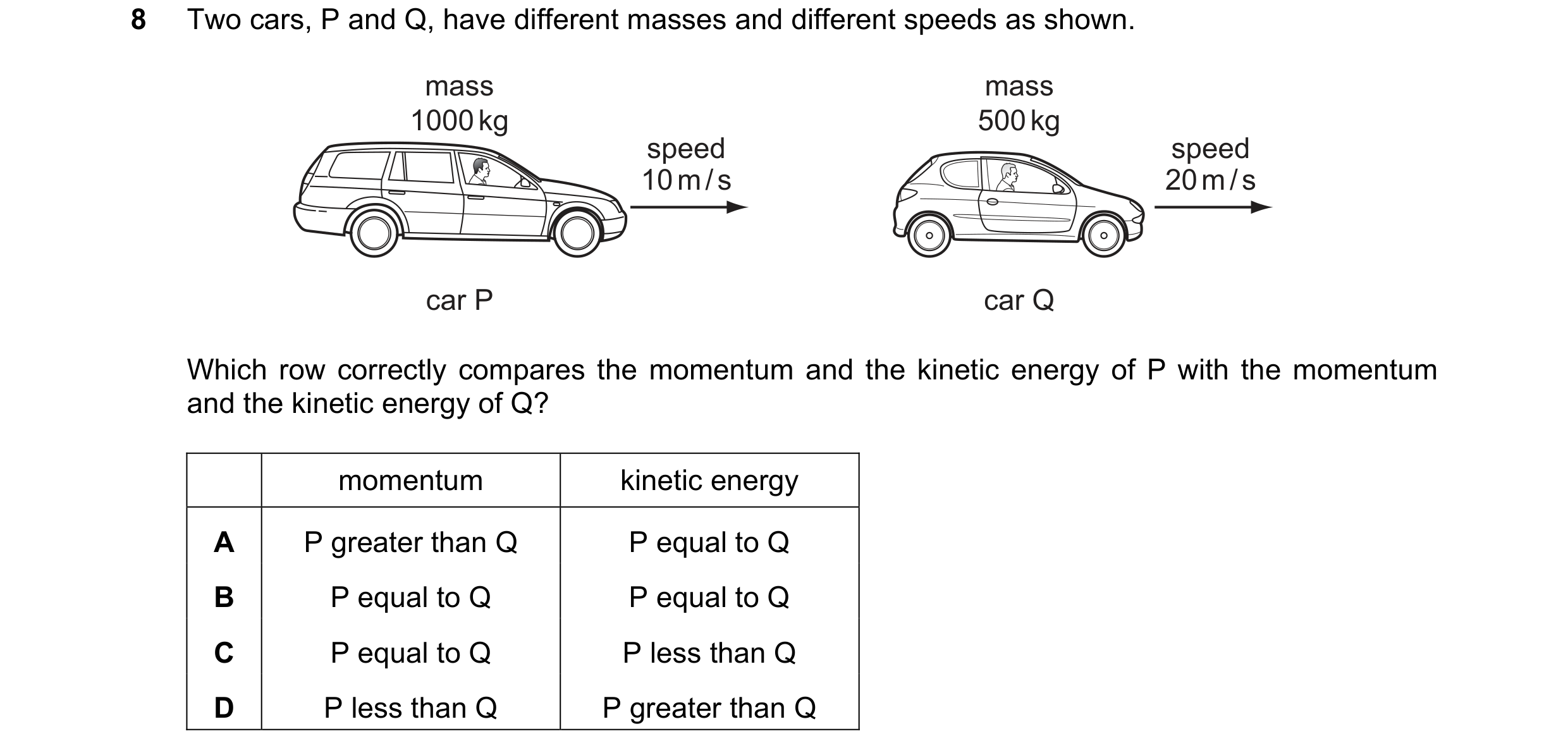
8 Two cars, P and Q, have different masses and different speeds as shown. mass mass 1000 kg 500 kg speed speed 10 m / s 20 m / s car P car Q Which row correctly compares the momentum and the kinetic energy of P with the momentum and the kinetic energy of Q? momentum kinetic energy A P greater than Q P equal to Q B P equal to Q P equal to Q C P equal to Q P less than Q D P less than Q P greater than Q
1 marks
Answer: C
This question in 0625/21 Oct/Nov 2016
Q5 · An object travels in a circular path at constant speed 0625/22 Oct/Nov 2016
6 An object travels in a circular path at constant speed. Which statement about the object is correct? A It has changing kinetic energy. B It has changing momentum. C It has constant velocity. D It is not accelerating.
1 marks
Answer: B
This question in 0625/22 Oct/Nov 2016
Q6 · A girl of mass 50 kg runs at 6.0 m / s 0625/22 Oct/Nov 2016
8 A girl of mass 50 kg runs at 6.0 m / s. What is her momentum? A 300 J B 300 kg m / s C 900 J D 900 kg m / s
1 marks
Answer: B
This question in 0625/22 Oct/Nov 2016
Q7 · An object travels in a circular path at constant speed 0625/23 Oct/Nov 2016
6 An object travels in a circular path at constant speed. Which statement about the object is correct? A It has changing kinetic energy. B It has changing momentum. C It has constant velocity. D It is not accelerating.
1 marks
Answer: B
This question in 0625/23 Oct/Nov 2016
Q8 · A vehicle of mass 900 kg is travelling with a velocity of 20 m / s 0625/23 Oct/Nov 2016
8 A vehicle of mass 900 kg is travelling with a velocity of 20 m / s. What is the momentum of the vehicle? A 45 kg m / s B 450 kg m / s C 18 000 kg m / s D 180 000 kg m / s
1 marks
Answer: C
This question in 0625/23 Oct/Nov 2016
Q9 · A moving body undergoes a change of momentum 0625/22 Feb/March 2017
8 A moving body undergoes a change of momentum. What is a unit for change of momentum? A N m B N / m C N s D N / s
1 marks
Answer: C
This question in 0625/22 Feb/March 2017
Q10 · A bullet of mass 0.10 kg travels horizontally at a speed of 600 m / s 0625/21 May/June 2017
9 A bullet of mass 0.10 kg travels horizontally at a speed of 600 m / s. It strikes a stationary wooden block of mass 1.90 kg resting on a frictionless, horizontal surface. The bullet stays in the block. What is the speed of the bullet and the block immediately after the impact? A 30 m / s B 32 m / s C 60 m / s D 134 m / s
1 marks
Answer: A
This question in 0625/21 May/June 2017
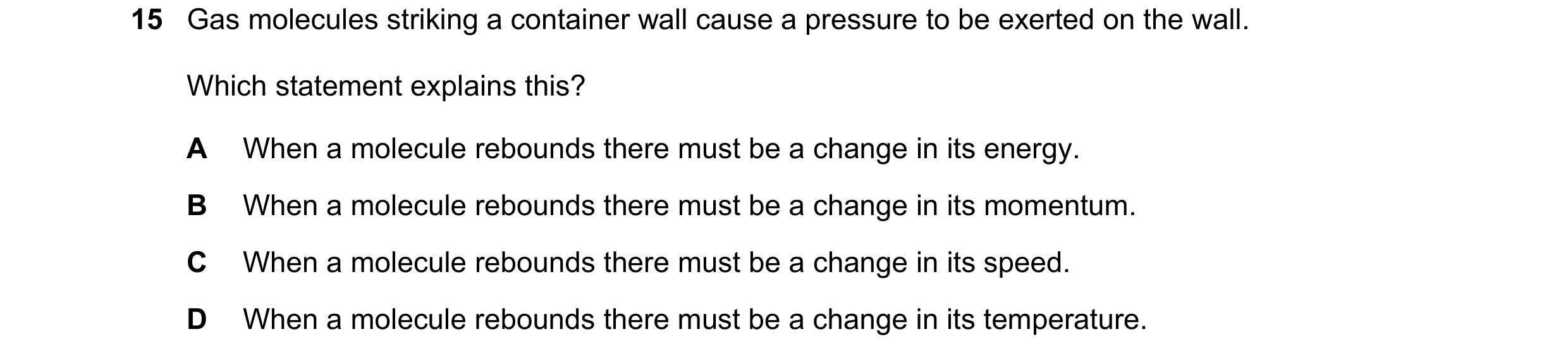
Q11 · Gas molecules striking a container wall cause a pressure to be exerted on the wall 0625/21 May/June 2017
15 Gas molecules striking a container wall cause a pressure to be exerted on the wall. Which statement explains this? A When a molecule rebounds there must be a change in its energy. B When a molecule rebounds there must be a change in its momentum. C When a molecule rebounds there must be a change in its speed. D When a molecule rebounds there must be a change in its temperature.
1 marks
Answer: B
This question in 0625/21 May/June 2017
Q12 · A ball of mass 2.0 kg is travelling at a speed of 12 m / s 0625/22 May/June 2017
9 A ball of mass 2.0 kg is travelling at a speed of 12 m / s. It moves towards an object of mass 3.0 kg which is at rest. 12 m / s 3.0 kg at rest 2.0 kg The ball hits the object and sticks to it. Which row gives the total momentum, and the speed of both objects immediately after the collision? total momentum speed kg m / s m / s A 0 4.8 B 0 8.0 C 24 4.8 D 24 8.0
1 marks
Answer: C
This question in 0625/22 May/June 2017
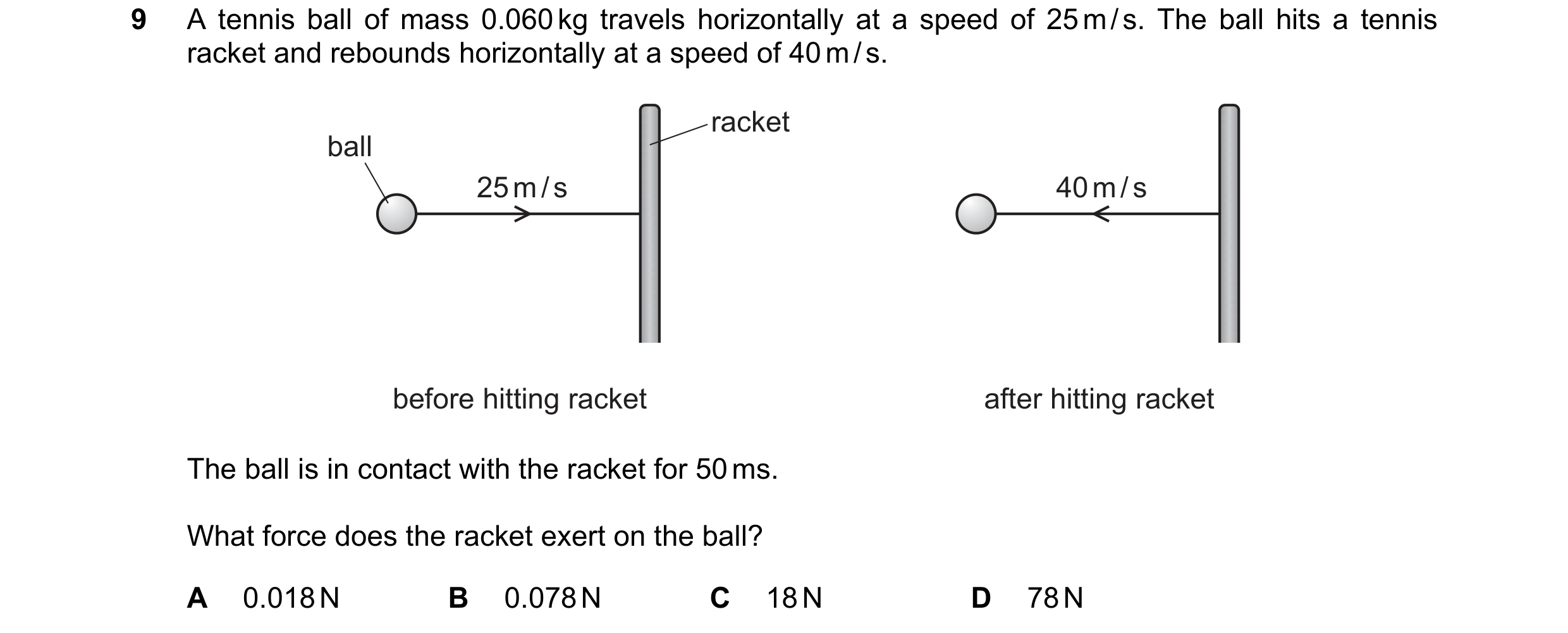
Q13 · A tennis ball of mass 0.060 kg travels horizontally at a speed of 25 m / s 0625/21 Oct/Nov 2017
9 A tennis ball of mass 0.060 kg travels horizontally at a speed of 25 m / s. The ball hits a tennis racket and rebounds horizontally at a speed of 40 m / s. racket ball 25 m / s 40 m / s before hitting racket after hitting racket The ball is in contact with the racket for 50 ms. What force does the racket exert on the ball? A 0.018 N B 0.078 N C 18 N D 78 N
1 marks
Answer: D
This question in 0625/21 Oct/Nov 2017
Q14 · A ball has a mass of 0.30 kg 0625/22 Oct/Nov 2017
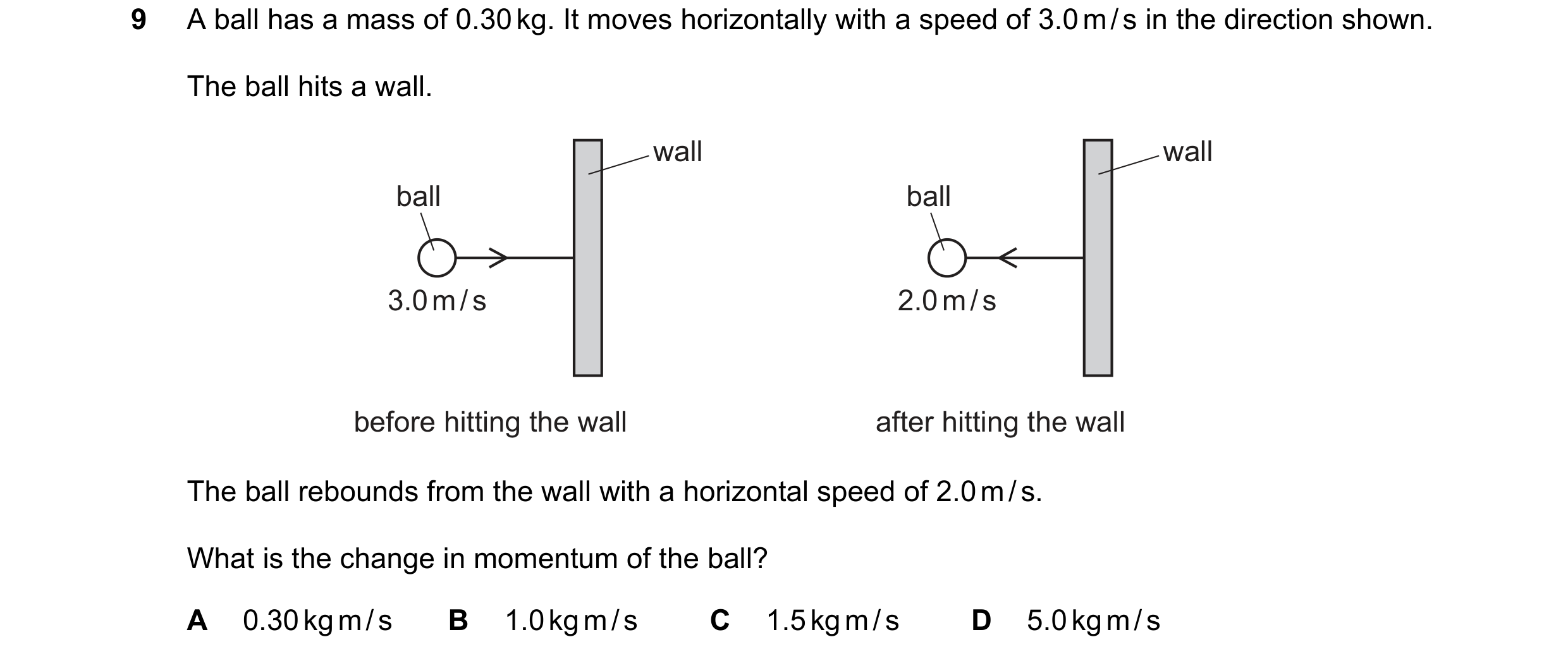
9 A ball has a mass of 0.30 kg. It moves horizontally with a speed of 3.0 m / s in the direction shown. The ball hits a wall. wall wall ball ball 3.0 m / s 2.0 m / s before hitting the wall after hitting the wall The ball rebounds from the wall with a horizontal speed of 2.0 m / s. What is the change in momentum of the ball? A 0.30 kg m / s B 1.0 kg m / s C 1.5 kg m / s D 5.0 kg m / s
1 marks
Answer: C
This question in 0625/22 Oct/Nov 2017
Q15 · Which expression gives the momentum of an object? 0625/21 May/June 2018
9 Which expression gives the momentum of an object? A mass × acceleration B mass × gravitational field strength C mass × velocity D 1 × mass × (velocity)2 2
1 marks
Answer: C
This question in 0625/21 May/June 2018
Q16 · When molecules of a gas rebound from a wall of a container, the wall experiences a… 0625/21 May/June 2018
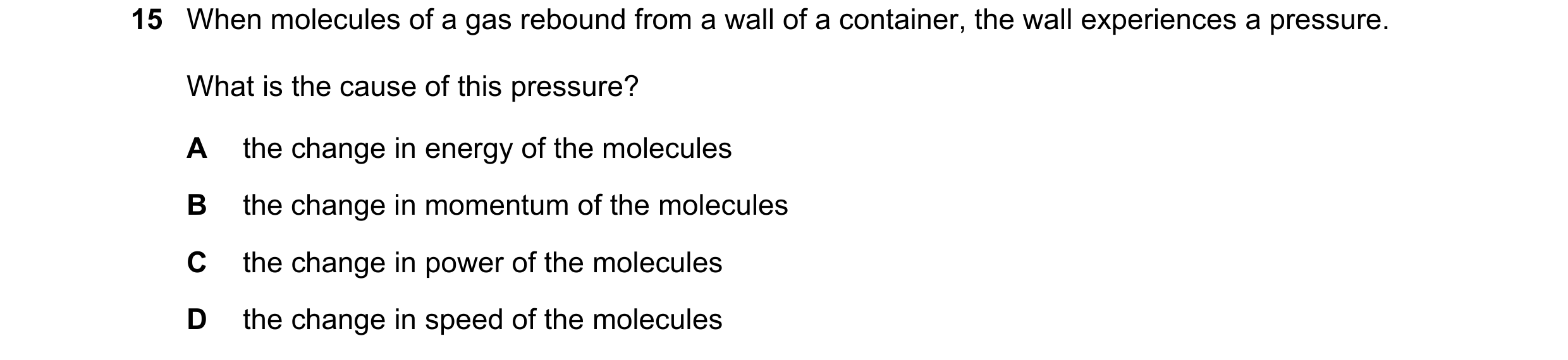
15 When molecules of a gas rebound from a wall of a container, the wall experiences a pressure. What is the cause of this pressure? A the change in energy of the molecules B the change in momentum of the molecules C the change in power of the molecules D the change in speed of the molecules
1 marks
Answer: B
This question in 0625/21 May/June 2018
Q17 · A car of mass 1000 kg travelling at 8.0 m / s collides with a lorry of mass 3000 kg that… 0625/22 May/June 2018
9 A car of mass 1000 kg travelling at 8.0 m / s collides with a lorry of mass 3000 kg that is travelling at 2.0 m / s in the same direction. After colliding, the two vehicles stick together. What is their speed after the collision? A 2.0 m / s B 2.5 m / s C 3.5 m / s D 5.0 m / s
1 marks
Answer: C
This question in 0625/22 May/June 2018
Q18 · A visitor to a fairground throws a soft object of mass 0.12 kg at a coconut of mass 0.48… 0625/23 May/June 2018
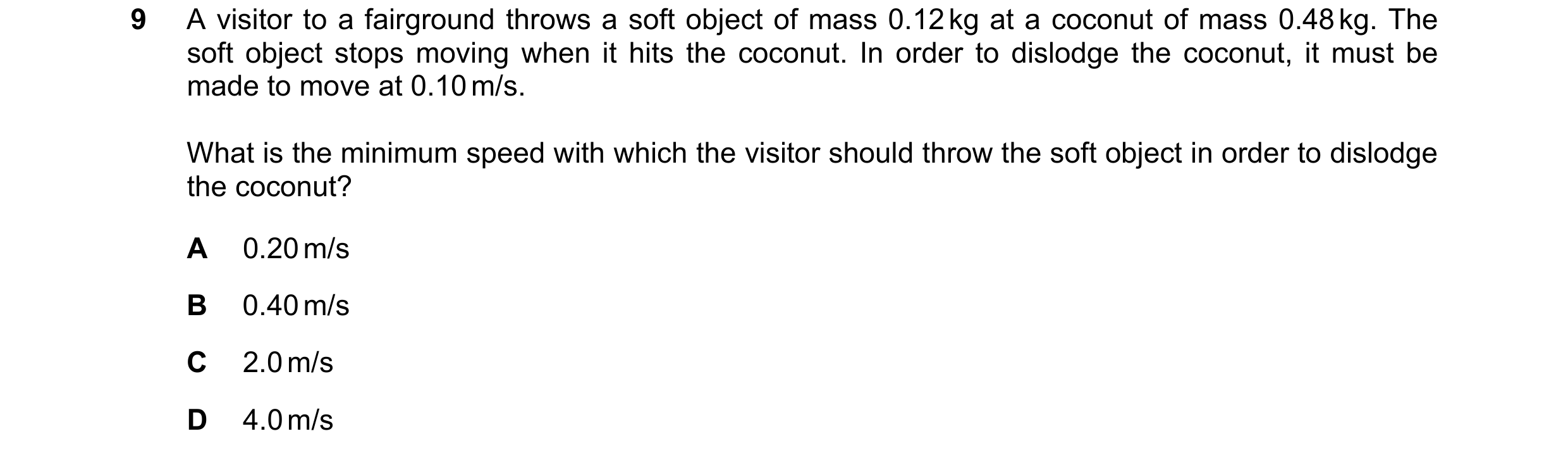
9 A visitor to a fairground throws a soft object of mass 0.12 kg at a coconut of mass 0.48 kg. The soft object stops moving when it hits the coconut. In order to dislodge the coconut, it must be made to move at 0.10 m/s. What is the minimum speed with which the visitor should throw the soft object in order to dislodge the coconut? A 0.20 m/s B 0.40 m/s C 2.0 m/s D 4.0 m/s
1 marks
Answer: B
This question in 0625/23 May/June 2018
Q19 · When molecules of a gas rebound from a wall of a container, the wall experiences a… 0625/23 May/June 2018
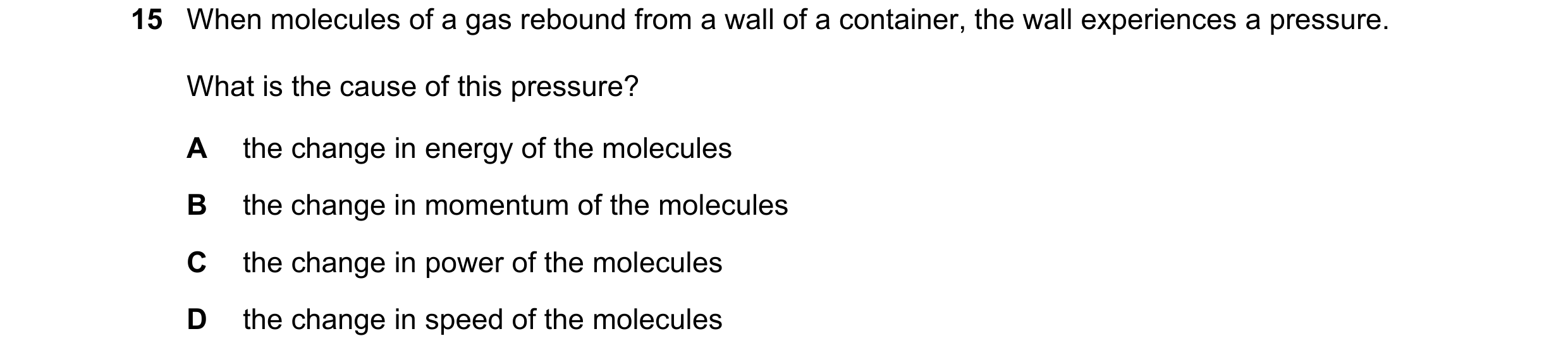
15 When molecules of a gas rebound from a wall of a container, the wall experiences a pressure. What is the cause of this pressure? A the change in energy of the molecules B the change in momentum of the molecules C the change in power of the molecules D the change in speed of the molecules
1 marks
Answer: B
This question in 0625/23 May/June 2018
Q20 · A resultant force of 4.0 N acts on an object of mass 0.50 kg for 3.0 seconds 0625/21 Oct/Nov 2018
6 A resultant force of 4.0 N acts on an object of mass 0.50 kg for 3.0 seconds. What is the change in velocity caused by this force? A 4.0 m / s B 6.0 m / s C 12 m / s D 24 m / s
1 marks
Answer: D
This question in 0625/21 Oct/Nov 2018
Q21 · A moving ball with a momentum of 25 kg m / s collides head-on with a wall 0625/21 Oct/Nov 2018
8 A moving ball with a momentum of 25 kg m / s collides head-on with a wall. wall ball It rebounds from the wall with the same speed but in the opposite direction. The time of collision is 50 ms. What is the average force exerted on the wall by the ball during the collision? A 0.50 N B 1.00 N C 500 N D 1000 N
1 marks
Answer: D
This question in 0625/21 Oct/Nov 2018
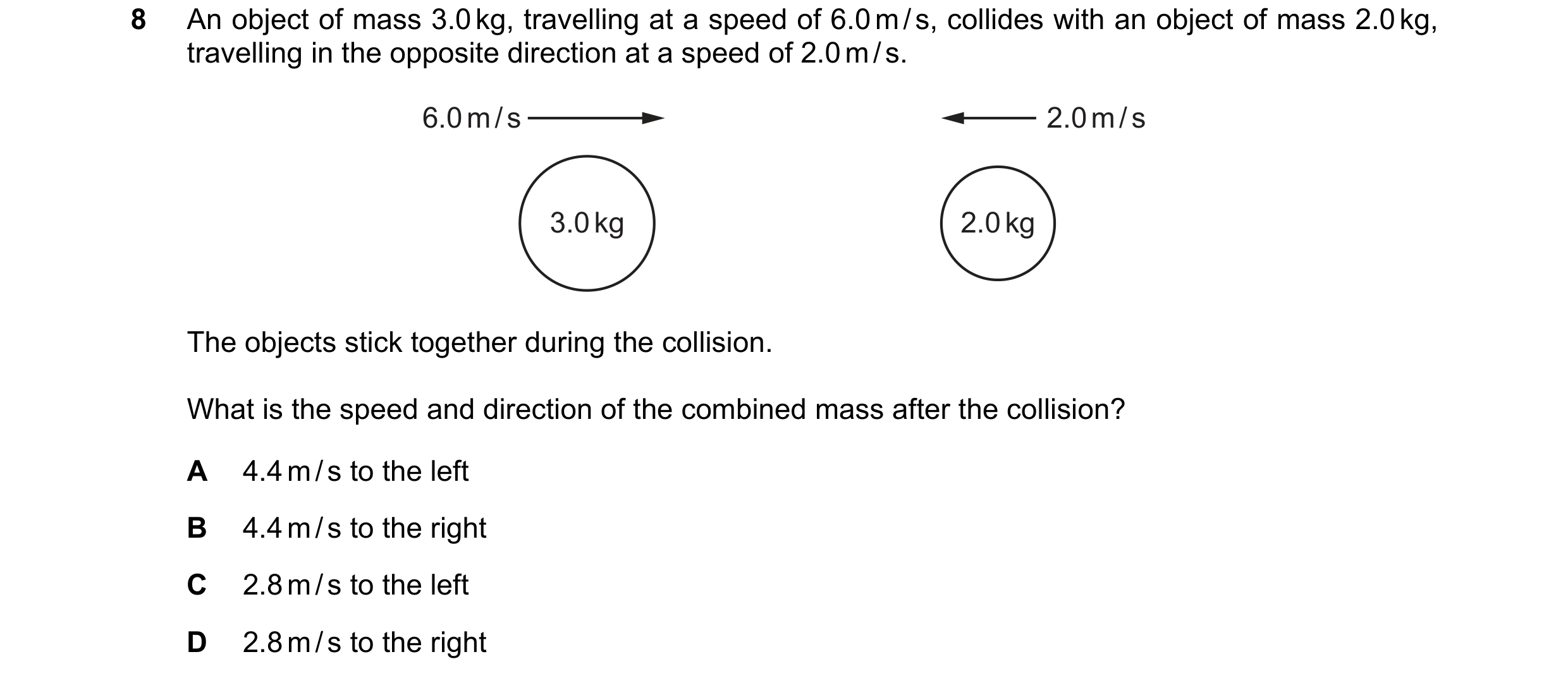
Q22 · An object of mass 3.0 kg, travelling at a speed of 6.0 m / s, collides with an object of… 0625/22 Oct/Nov 2018
8 An object of mass 3.0 kg, travelling at a speed of 6.0 m / s, collides with an object of mass 2.0 kg, travelling in the opposite direction at a speed of 2.0 m / s. 6.0 m / s 2.0 m / s 3.0 kg 2.0 kg The objects stick together during the collision. What is the speed and direction of the combined mass after the collision? A 4.4 m / s to the left B 4.4 m / s to the right C 2.8 m / s to the left D 2.8 m / s to the right
1 marks
Answer: D
This question in 0625/22 Oct/Nov 2018
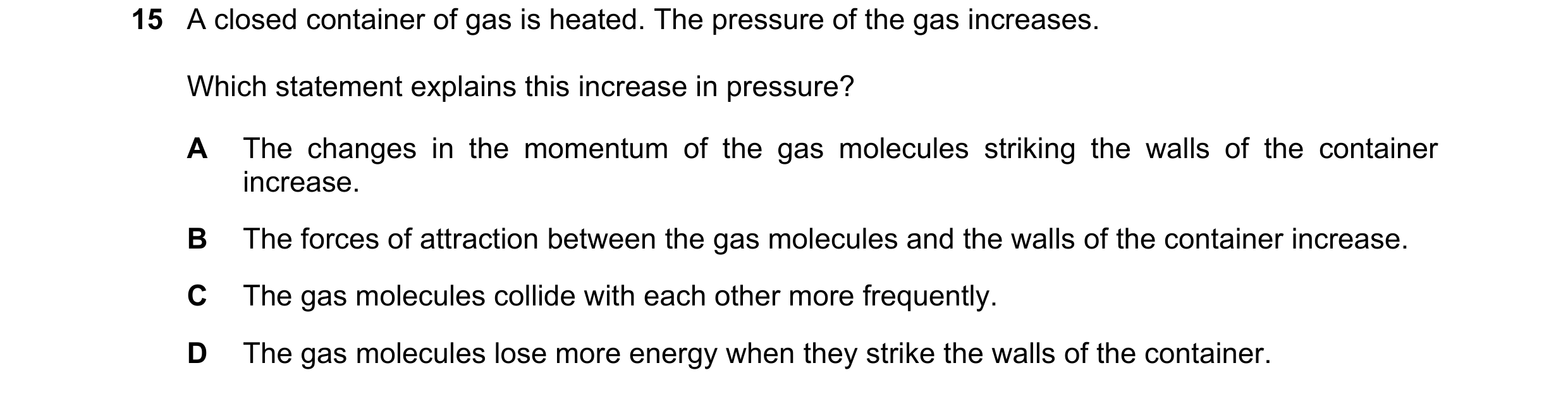
Q23 · A closed container of gas is heated 0625/22 Oct/Nov 2018
15 A closed container of gas is heated. The pressure of the gas increases. Which statement explains this increase in pressure? A The changes in the momentum of the gas molecules striking the walls of the container increase. B The forces of attraction between the gas molecules and the walls of the container increase. C The gas molecules collide with each other more frequently. D The gas molecules lose more energy when they strike the walls of the container.
1 marks
Answer: A
This question in 0625/22 Oct/Nov 2018
Q24 · An electron is moving at a speed of 5 × 10⁶ m / s 0625/23 Oct/Nov 2018
8 An electron is moving at a speed of 5 × 10⁶ m / s. A neutron is moving at a speed of 5 × 10⁴ m / s. The mass of the electron is m. The mass of the neutron is 2000m. Which row is correct? greater greater momentum kinetic energy A electron electron B electron neutron C neutron electron D neutron neutron
1 marks
Answer: C
This question in 0625/23 Oct/Nov 2018
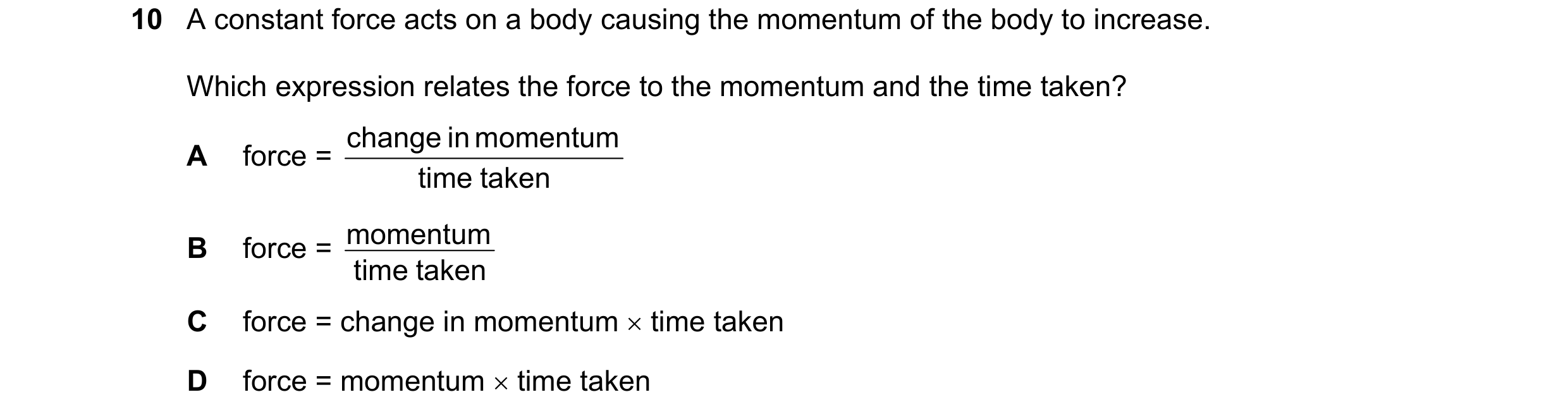
Q25 · A constant force acts on a body causing the momentum of the body to increase 0625/22 Feb/March 2019
10 A constant force acts on a body causing the momentum of the body to increase. Which expression relates the force to the momentum and the time taken? change in momentum A force = time taken momentum B force = time taken C force = change in momentum × time taken D force = momentum × time taken
1 marks
Answer: A
This question in 0625/22 Feb/March 2019
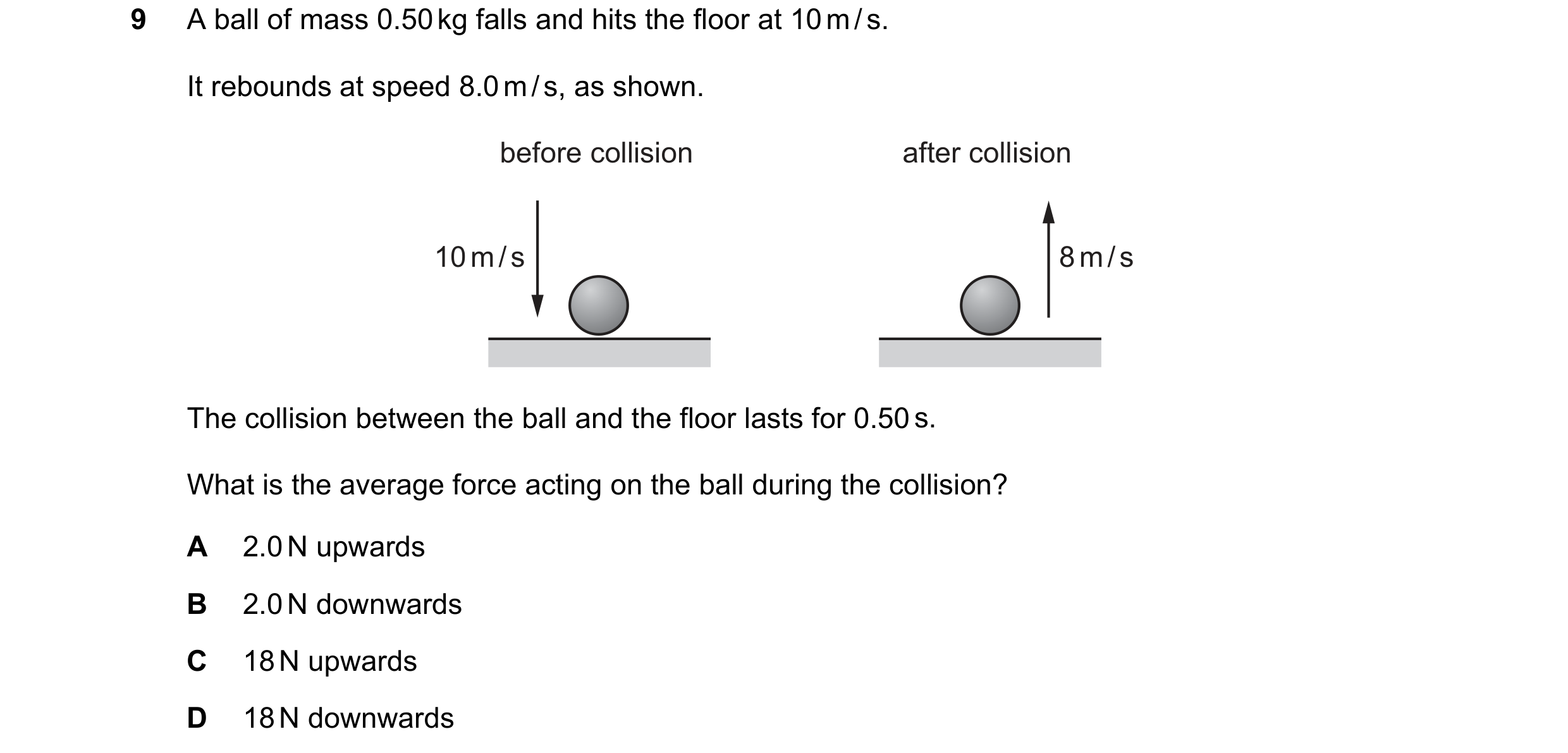
Q26 · A ball of mass 0.50 kg falls and hits the floor at 10 m / s 0625/21 May/June 2019
9 A ball of mass 0.50 kg falls and hits the floor at 10 m / s. It rebounds at speed 8.0 m / s, as shown. before collision after collision 10 m / s 8 m / s The collision between the ball and the floor lasts for 0.50 s. What is the average force acting on the ball during the collision? A 2.0 N upwards B 2.0 N downwards C 18 N upwards D 18 N downwards
1 marks
Answer: C
This question in 0625/21 May/June 2019
Q27 · An object of mass 4.0 kg is moving with a velocity of 3.0 m / s in a straight line 0625/22 May/June 2019
9 An object of mass 4.0 kg is moving with a velocity of 3.0 m / s in a straight line. What is the momentum of the object? A 0.75 kg m / s B 1.3 kg m / s C 12 kg m / s D 24 kg m / s
1 marks
Answer: C
This question in 0625/22 May/June 2019
Q28 · How is momentum p calculated in terms of the mass m of a body and its velocity v, and… 0625/23 May/June 2019
9 How is momentum p calculated in terms of the mass m of a body and its velocity v, and what type of quantity is p? equation type of quantity A p = m × v scalar B p = m × v vector m C p = v scalar m D p = v vector
1 marks
Answer: B
This question in 0625/23 May/June 2019
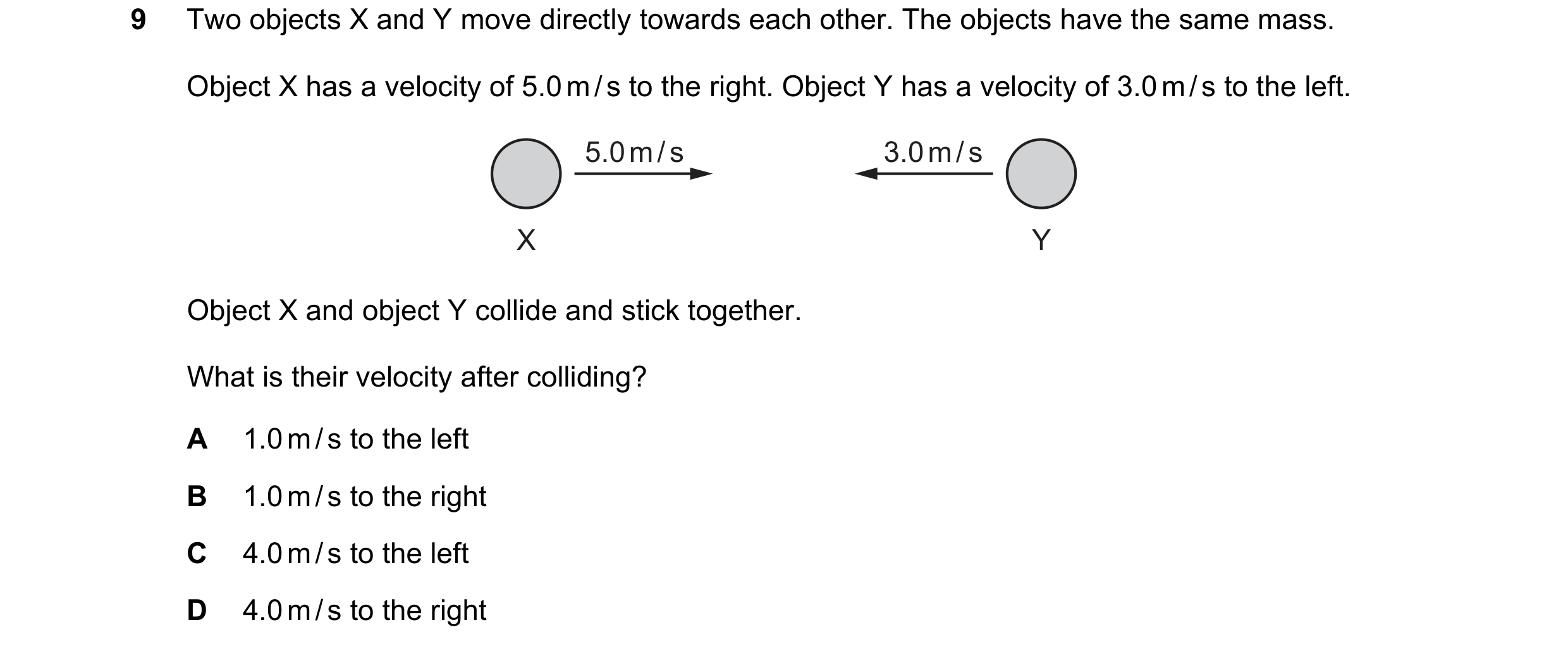
Q29 · Two objects X and Y move directly towards each other 0625/21 Oct/Nov 2019
9 Two objects X and Y move directly towards each other. The objects have the same mass. Object X has a velocity of 5.0 m / s to the right. Object Y has a velocity of 3.0 m / s to the left. 5.0 m / s 3.0 m / s X Y Object X and object Y collide and stick together. What is their velocity after colliding? A 1.0 m / s to the left B 1.0 m / s to the right C 4.0 m / s to the left D 4.0 m / s to the right
1 marks
Answer: B
This question in 0625/21 Oct/Nov 2019
Q30 · A ball is at rest on the ground 0625/22 Oct/Nov 2019
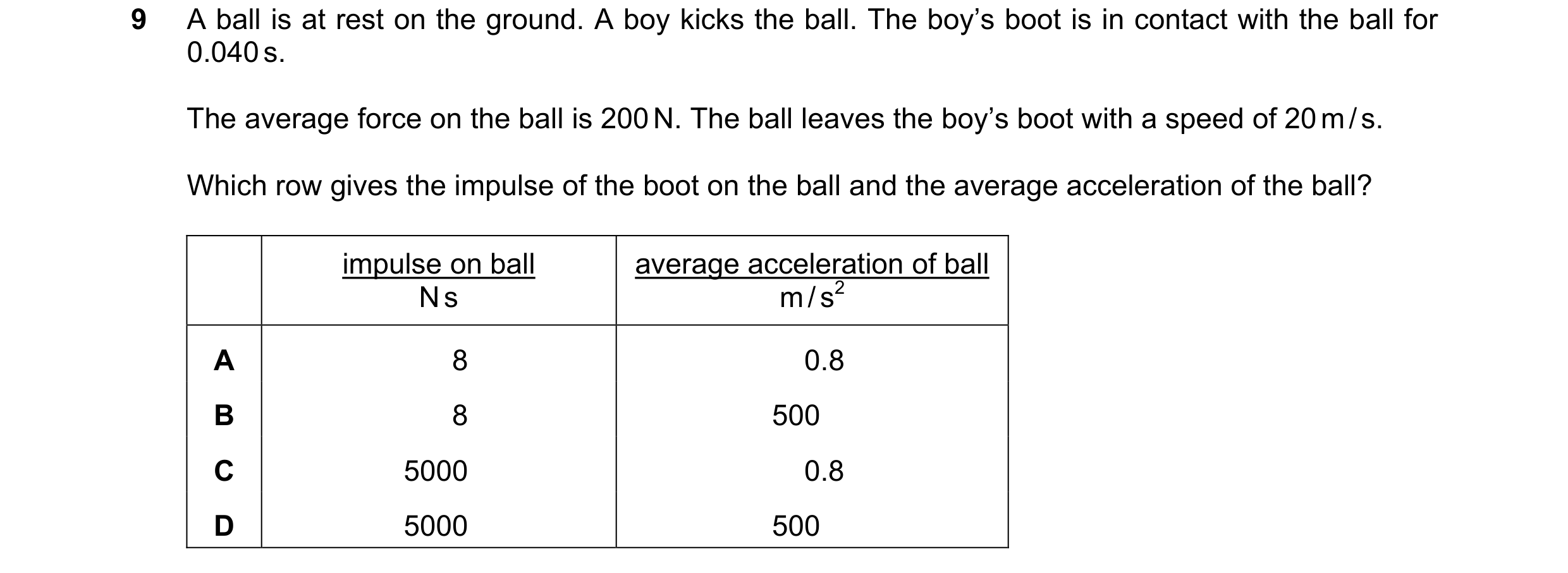
9 A ball is at rest on the ground. A boy kicks the ball. The boy’s boot is in contact with the ball for 0.040 s. The average force on the ball is 200 N. The ball leaves the boy’s boot with a speed of 20 m / s. Which row gives the impulse of the boot on the ball and the average acceleration of the ball? impulse on ball average acceleration of ball N s m / s2 A 8 0.8 B 8 500 C 5000 0.8 D 5000 500
1 marks
Answer: B
This question in 0625/22 Oct/Nov 2019
Q31 · An object P of mass 80 g collides with another object Q of mass 40 g 0625/22 Oct/Nov 2019
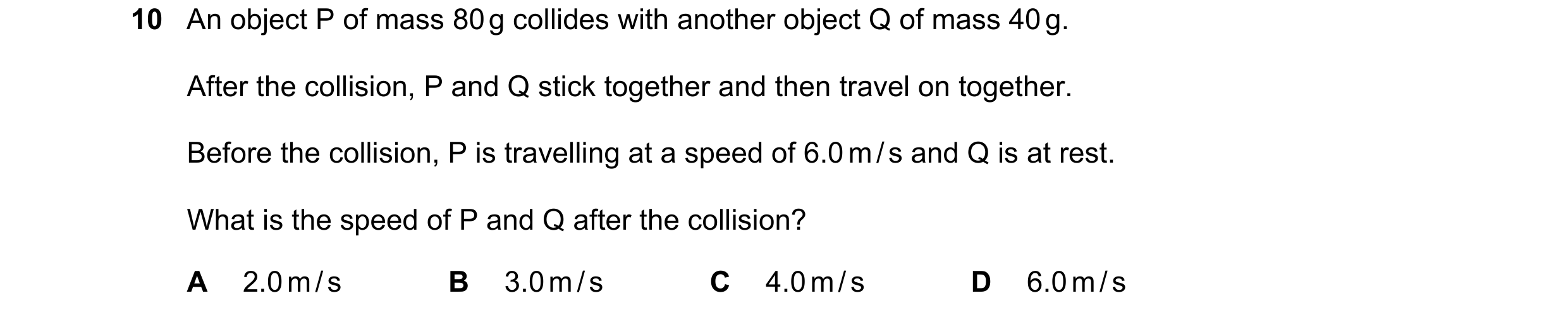
10 An object P of mass 80 g collides with another object Q of mass 40 g. After the collision, P and Q stick together and then travel on together. Before the collision, P is travelling at a speed of 6.0 m / s and Q is at rest. What is the speed of P and Q after the collision? A 2.0 m / s B 3.0 m / s C 4.0 m / s D 6.0 m / s
1 marks
Answer: C
This question in 0625/22 Oct/Nov 2019
Q32 · The momentum of a body is changed by a force acting on it for a period of time 0625/23 Oct/Nov 2019
9 The momentum of a body is changed by a force acting on it for a period of time. Which action increases the change in momentum? A doubling the force and halving the time B doubling the force for the same time C halving both the force and time D halving the force and doubling the time
1 marks
Answer: B
This question in 0625/23 Oct/Nov 2019
Q33 · A toy train P of mass 0.50 kg is travelling along a straight track with a velocity of 3.0… 0625/23 Oct/Nov 2019
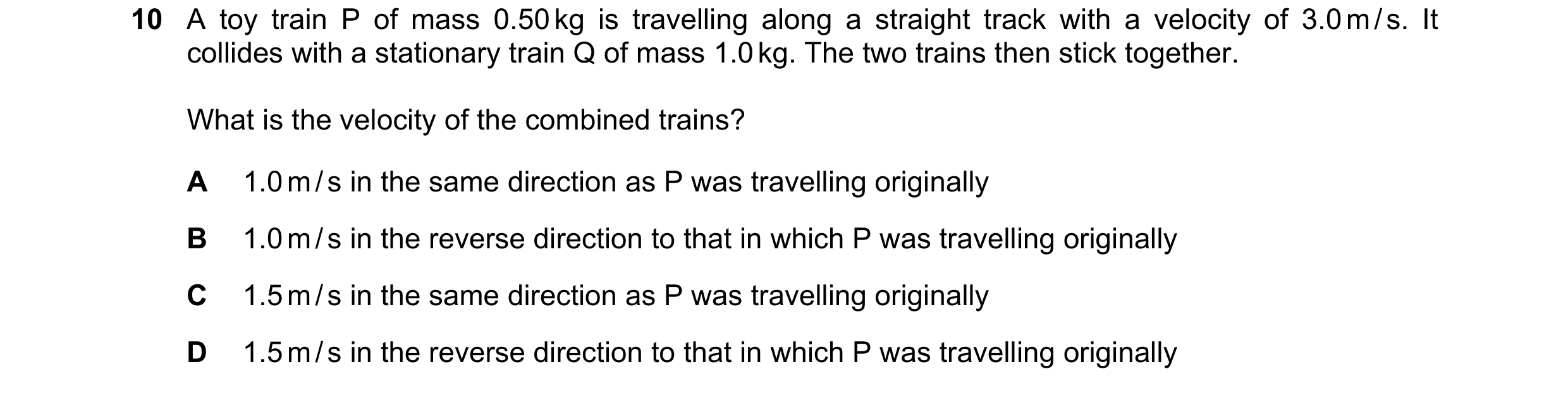
10 A toy train P of mass 0.50 kg is travelling along a straight track with a velocity of 3.0 m / s. It collides with a stationary train Q of mass 1.0 kg. The two trains then stick together. What is the velocity of the combined trains? A 1.0 m / s in the same direction as P was travelling originally B 1.0 m / s in the reverse direction to that in which P was travelling originally C 1.5 m / s in the same direction as P was travelling originally D 1.5 m / s in the reverse direction to that in which P was travelling originally
1 marks
Answer: A
This question in 0625/23 Oct/Nov 2019
Q34 · An object of mass 1.2 kg is moving with a velocity of 2.0 m / s when it is acted on by a… 0625/21 May/June 2020
9 An object of mass 1.2 kg is moving with a velocity of 2.0 m / s when it is acted on by a force of 4.0 N. The velocity of the object increases to 5.0 m / s. For what period of time does the force act on the object? A 0.90 s B 1.1 s C 1.5 s D 3.6 s
1 marks
Answer: A
This question in 0625/21 May/June 2020
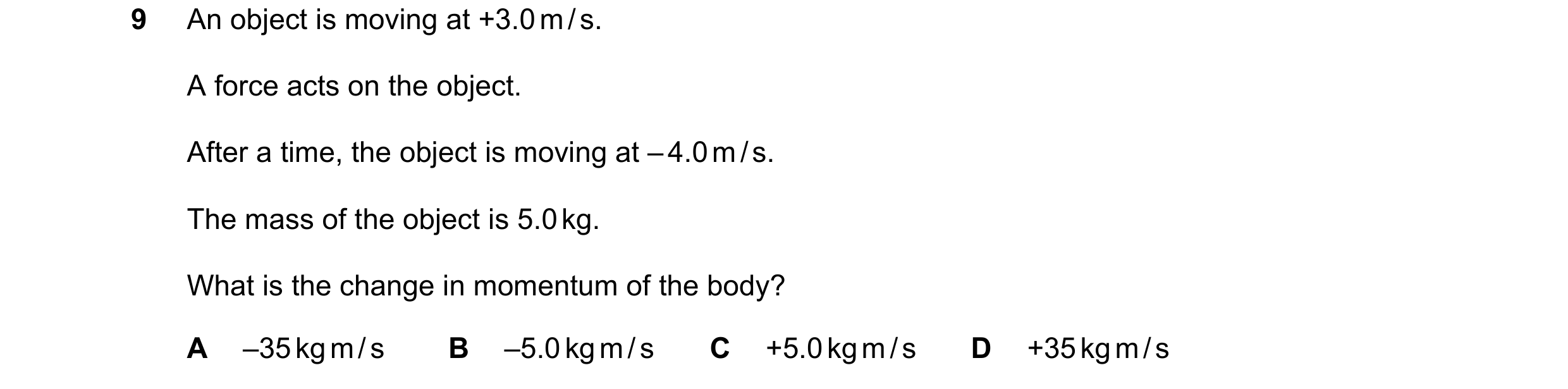
Q35 · An object is moving at +3.0 m / s 0625/22 May/June 2020
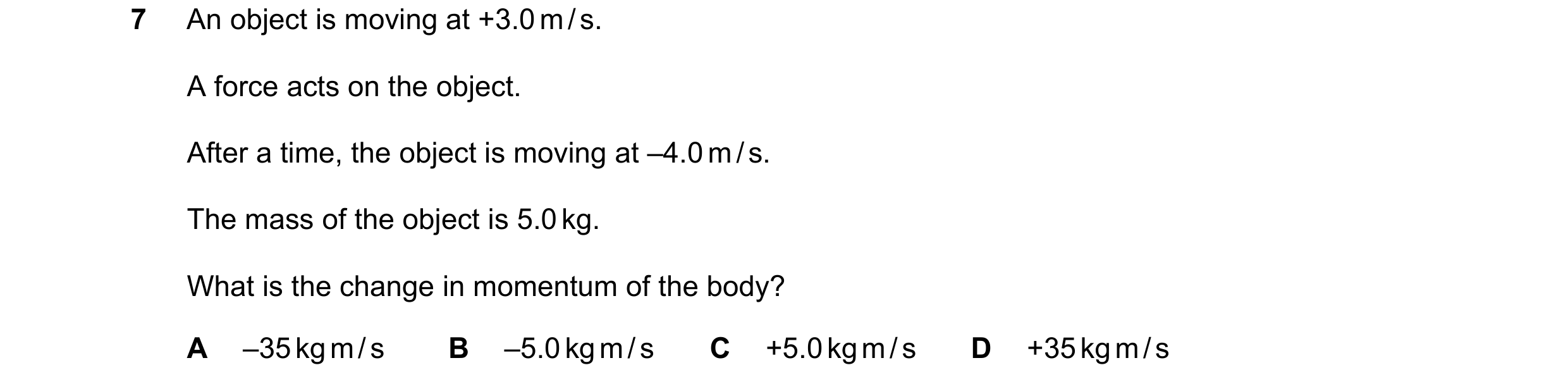
9 An object is moving at +3.0 m / s. A force acts on the object. After a time, the object is moving at – 4.0 m / s. The mass of the object is 5.0 kg. What is the change in momentum of the body? A –35 kg m / s B –5.0 kg m / s C +5.0 kg m / s D +35 kg m / s
1 marks
Answer: A
This question in 0625/22 May/June 2020
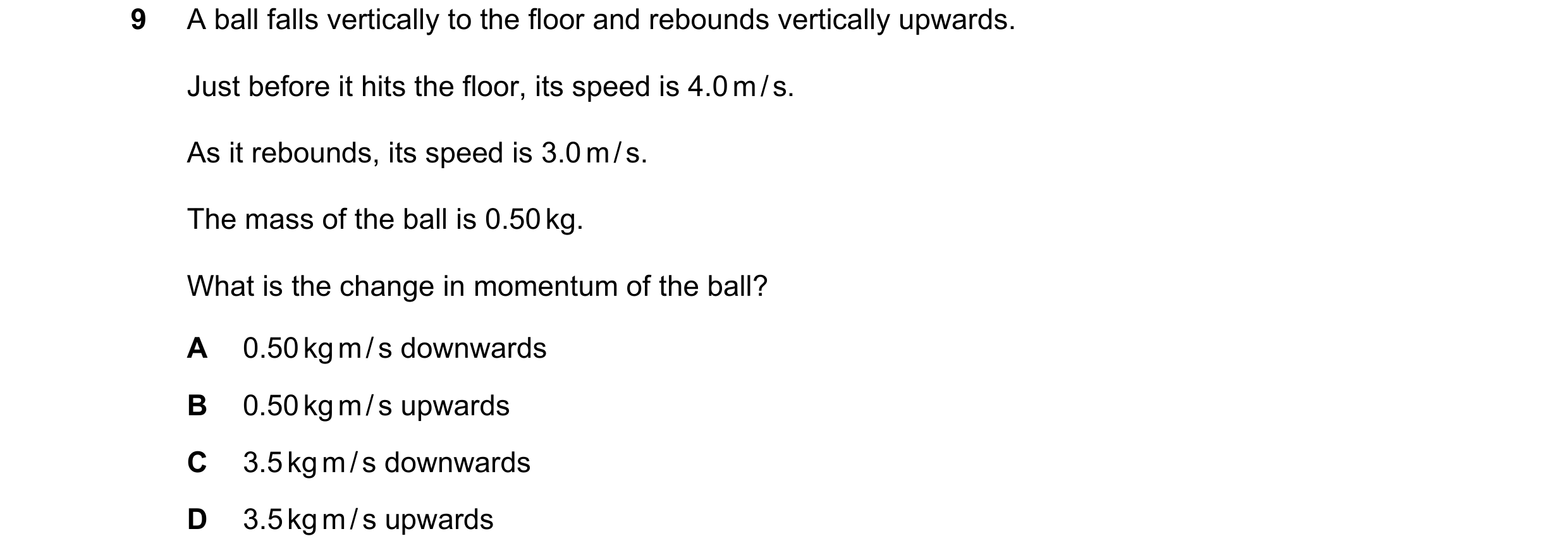
Q36 · A ball falls vertically to the floor and rebounds vertically upwards 0625/23 May/June 2020
9 A ball falls vertically to the floor and rebounds vertically upwards. Just before it hits the floor, its speed is 4.0 m / s. As it rebounds, its speed is 3.0 m / s. The mass of the ball is 0.50 kg. What is the change in momentum of the ball? A 0.50 kg m / s downwards B 0.50 kg m / s upwards C 3.5 kg m / s downwards D 3.5 kg m / s upwards
1 marks
Answer: D
This question in 0625/23 May/June 2020
Q37 · When a molecule rebounds from a wall, a force is exerted on the wall 0625/23 May/June 2020
14 When a molecule rebounds from a wall, a force is exerted on the wall. What causes this force? A the kinetic energy gained by the molecule B the kinetic energy lost by the molecule C the change of momentum of the molecule D the change of speed of the molecule
1 marks
Answer: C
This question in 0625/23 May/June 2020
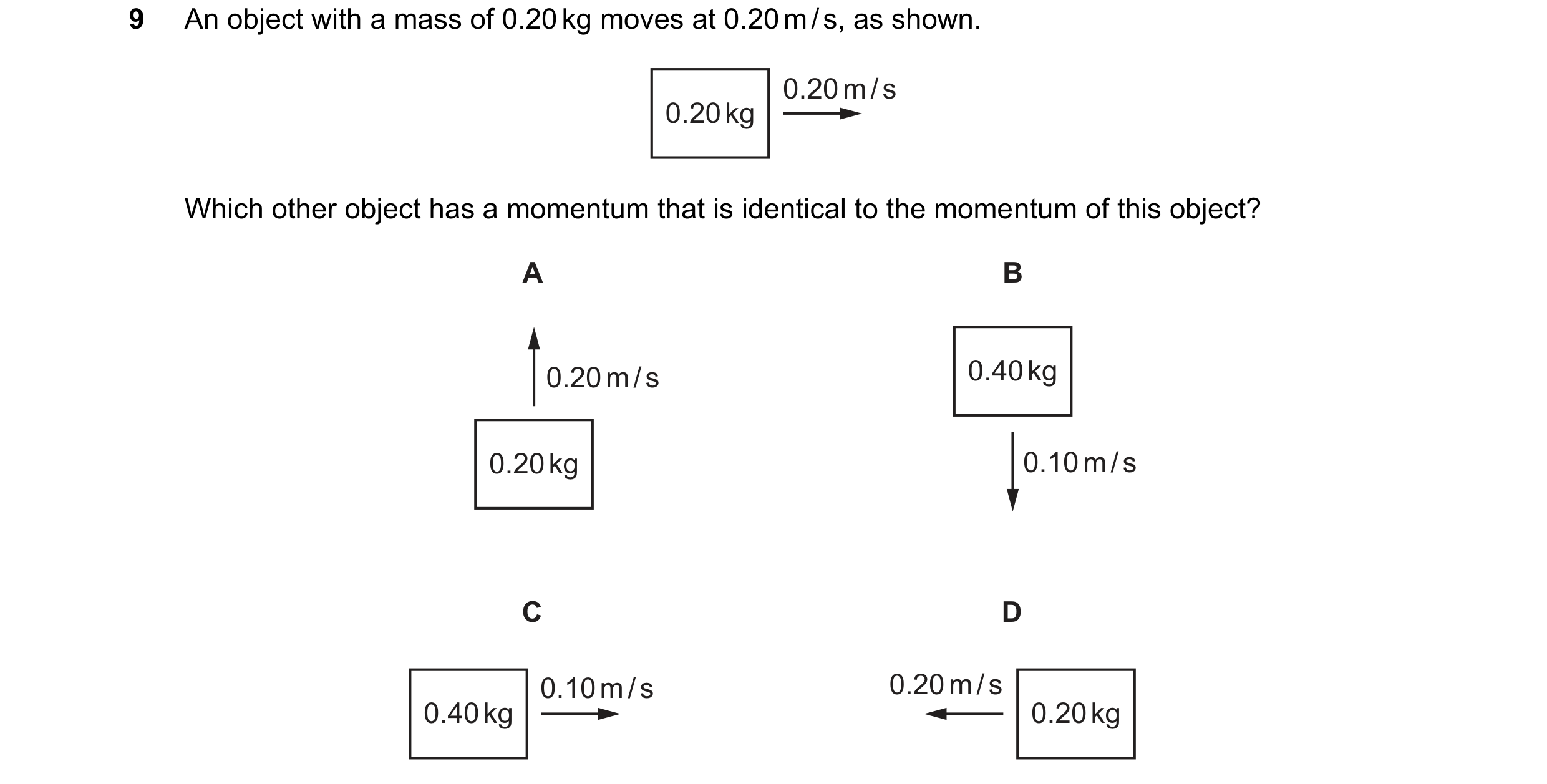
Q38 · An object with a mass of 0.20 kg moves at 0.20 m / s, as shown 0625/21 Oct/Nov 2020
9 An object with a mass of 0.20 kg moves at 0.20 m / s, as shown. 0.20 m / s 0.20 kg Which other object has a momentum that is identical to the momentum of this object? A B 0.20 m / s 0.40 kg 0.20 kg 0.10 m / s C D 0.10 m / s 0.20 m / s 0.40 kg 0.20 kg
1 marks
Answer: C
This question in 0625/21 Oct/Nov 2020
Q39 · A footballer kicks a stationary football 0625/22 Oct/Nov 2020
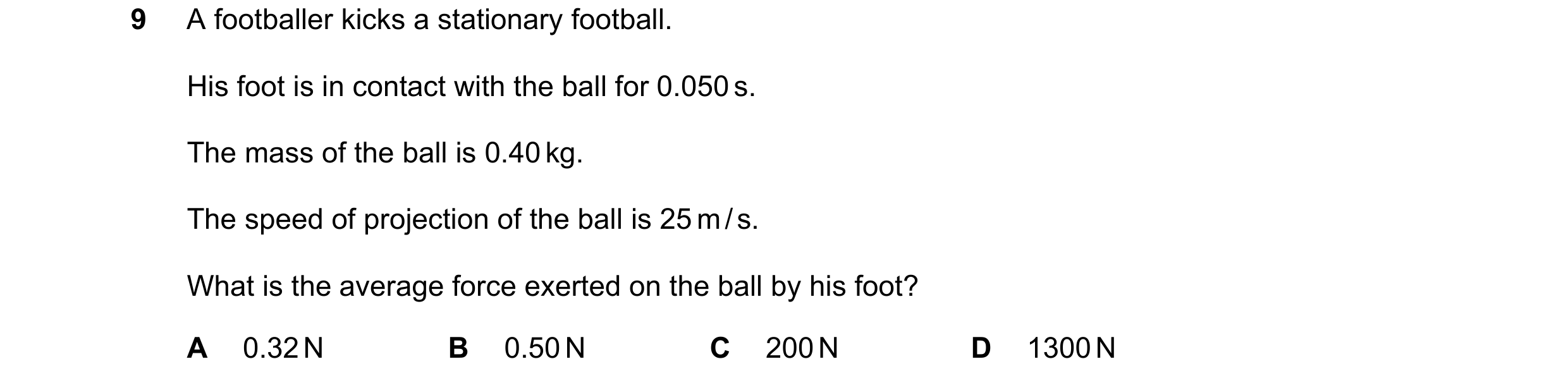
9 A footballer kicks a stationary football. His foot is in contact with the ball for 0.050 s. The mass of the ball is 0.40 kg. The speed of projection of the ball is 25 m / s. What is the average force exerted on the ball by his foot? A 0.32 N B 0.50 N C 200 N D 1300 N
1 marks
Answer: C
This question in 0625/22 Oct/Nov 2020
Q40 · A ball of mass m falls vertically and hits a hard surface 0625/23 Oct/Nov 2020
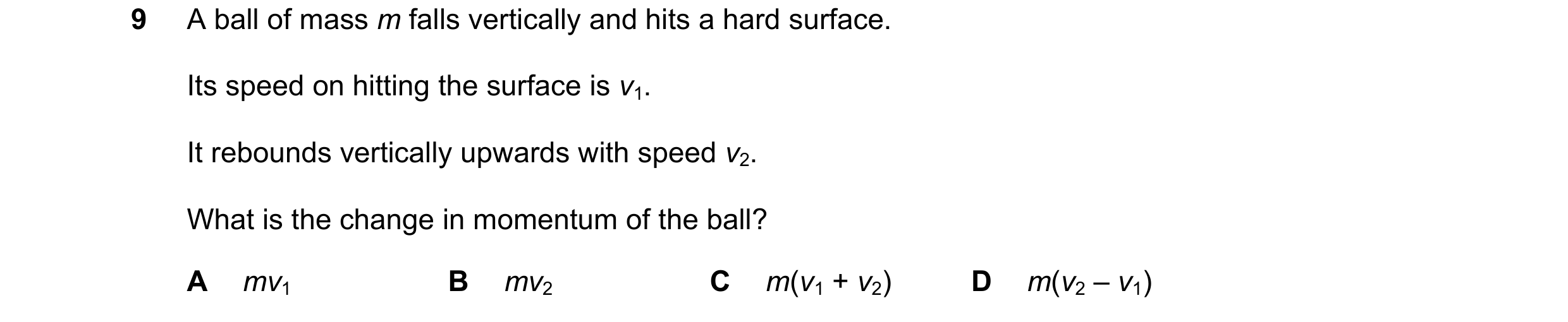
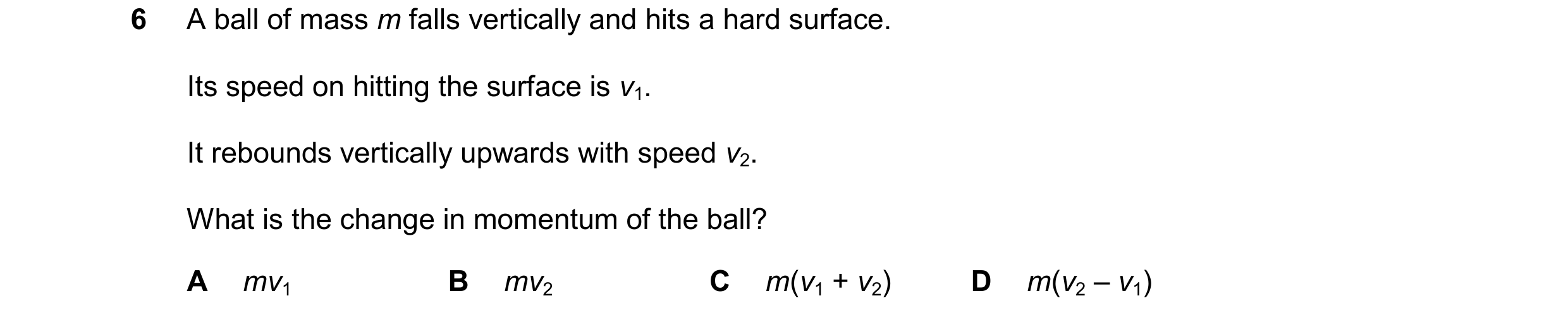
9 A ball of mass m falls vertically and hits a hard surface. Its speed on hitting the surface is v1. It rebounds vertically upwards with speed v2. What is the change in momentum of the ball? A mv1 B mv2 C m(v1 + v2) D m(v2 – v1)
1 marks
Answer: C
This question in 0625/23 Oct/Nov 2020
Q41 · A gas molecule strikes the wall of a container 0625/22 Feb/March 2021
9 A gas molecule strikes the wall of a container. The molecule rebounds with the same speed. wall wall gas molecule gas molecule before hitting the wall after hitting the wall What happens to the kinetic energy and what happens to the momentum of the molecule? kinetic energy momentum A changes changes B changes stays the same C stays the same changes D stays the same stays the same
1 marks
Answer: C
This question in 0625/22 Feb/March 2021
Q42 · A tennis ball has a mass of 57 g 0625/22 May/June 2021
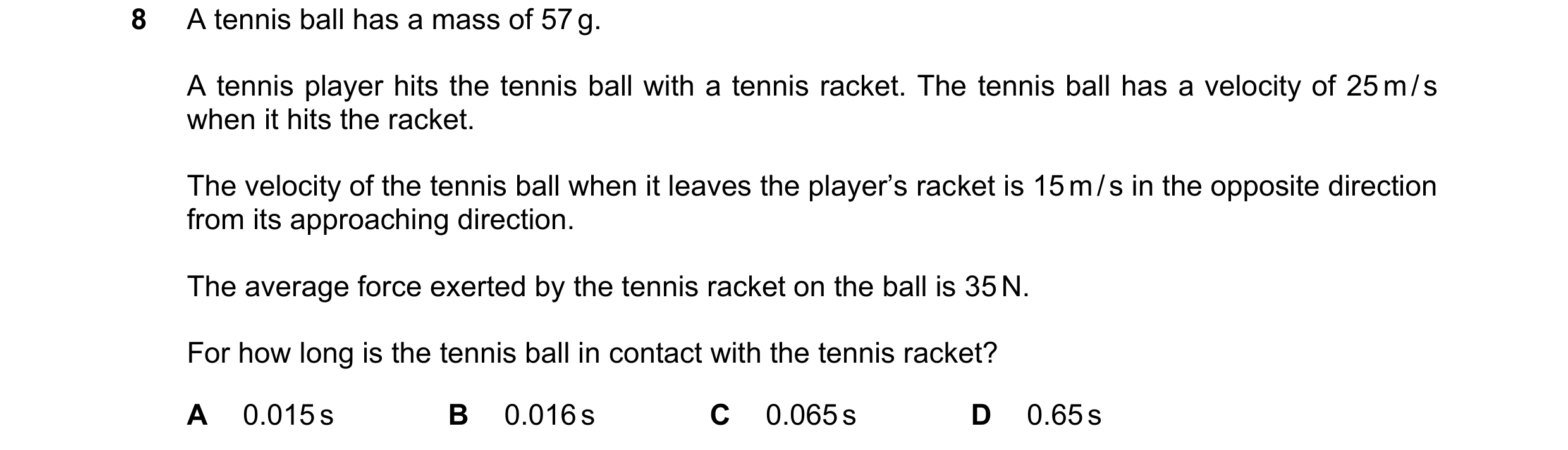
8 A tennis ball has a mass of 57 g. A tennis player hits the tennis ball with a tennis racket. The tennis ball has a velocity of 25 m / s when it hits the racket. The velocity of the tennis ball when it leaves the player’s racket is 15 m / s in the opposite direction from its approaching direction. The average force exerted by the tennis racket on the ball is 35 N. For how long is the tennis ball in contact with the tennis racket? A 0.015 s B 0.016 s C 0.065 s D 0.65 s
1 marks
Answer: C
This question in 0625/22 May/June 2021
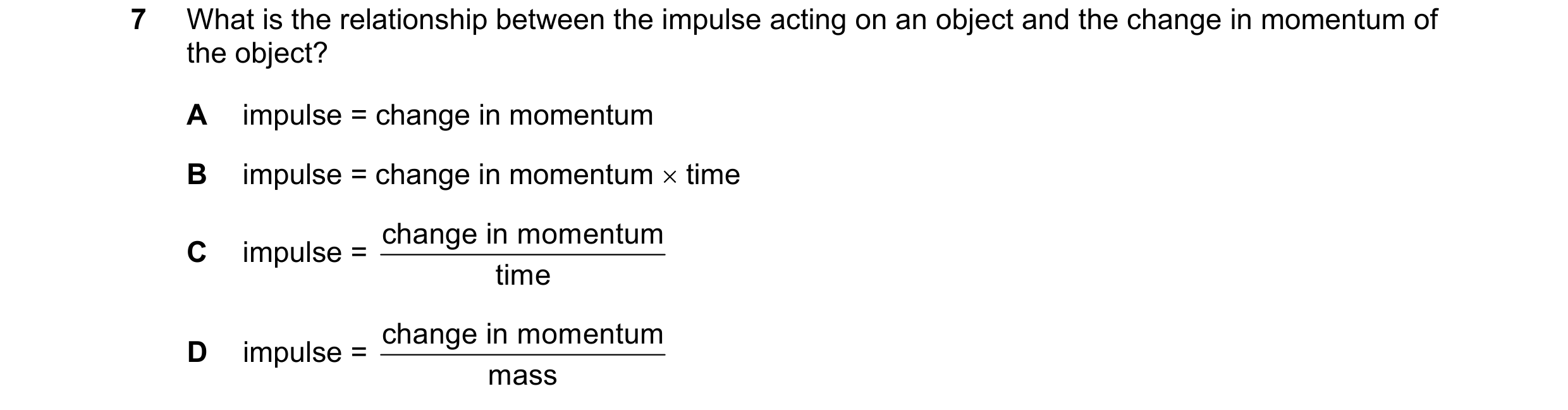
Q43 · What is the relationship between the impulse acting on an object and the change in… 0625/21 Oct/Nov 2021
7 What is the relationship between the impulse acting on an object and the change in momentum of the object? A impulse = change in momentum B impulse = change in momentum time impulse = change in momentum C time impulse = change in momentum D mass
1 marks
Answer: A
This question in 0625/21 Oct/Nov 2021
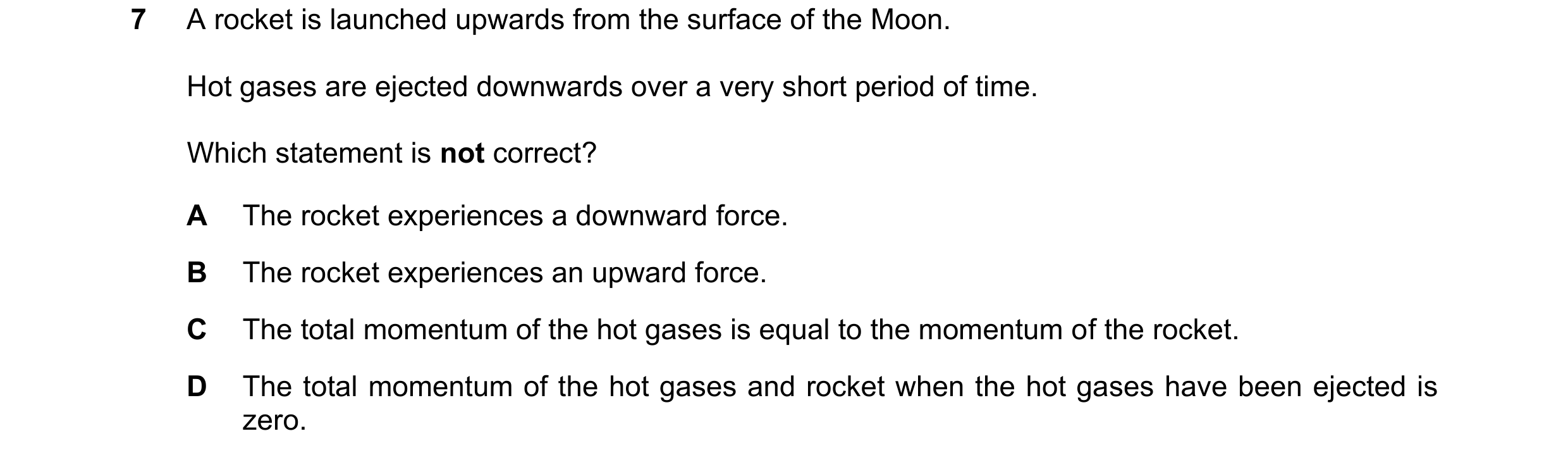
Q44 · A rocket is launched upwards from the surface of the Moon 0625/22 Oct/Nov 2021
7 A rocket is launched upwards from the surface of the Moon. Hot gases are ejected downwards over a very short period of time. Which statement is not correct? A The rocket experiences a downward force. B The rocket experiences an upward force. C The total momentum of the hot gases is equal to the momentum of the rocket. D The total momentum of the hot gases and rocket when the hot gases have been ejected is zero.
1 marks
Answer: C
This question in 0625/22 Oct/Nov 2021
Q45 · A cricket ball has a mass of 0.16 kg 0625/23 Oct/Nov 2021
7 A cricket ball has a mass of 0.16 kg. The ball travels at 30 m / s. The ball is hit by a bat with a force of 10 800 N. After being hit, the ball moves off at 30 m / s in the opposite direction. 30 m / s 30 m / s For how long was the ball in contact with the bat? A 0.0004 s B 0.00089 s C 0.0044 s D 0.015 s
1 marks
Answer: B
This question in 0625/23 Oct/Nov 2021
Q46 · A resultant force of 500 N acts for 10 s on a car of mass 1000 kg 0625/22 Feb/March 2022
10 A resultant force of 500 N acts for 10 s on a car of mass 1000 kg. This causes the velocity of the car to double. What is the final velocity of the car? A 5 m / s B 10 m / s C 20 m / s D 50 m / s
1 marks
Answer: B
This question in 0625/22 Feb/March 2022
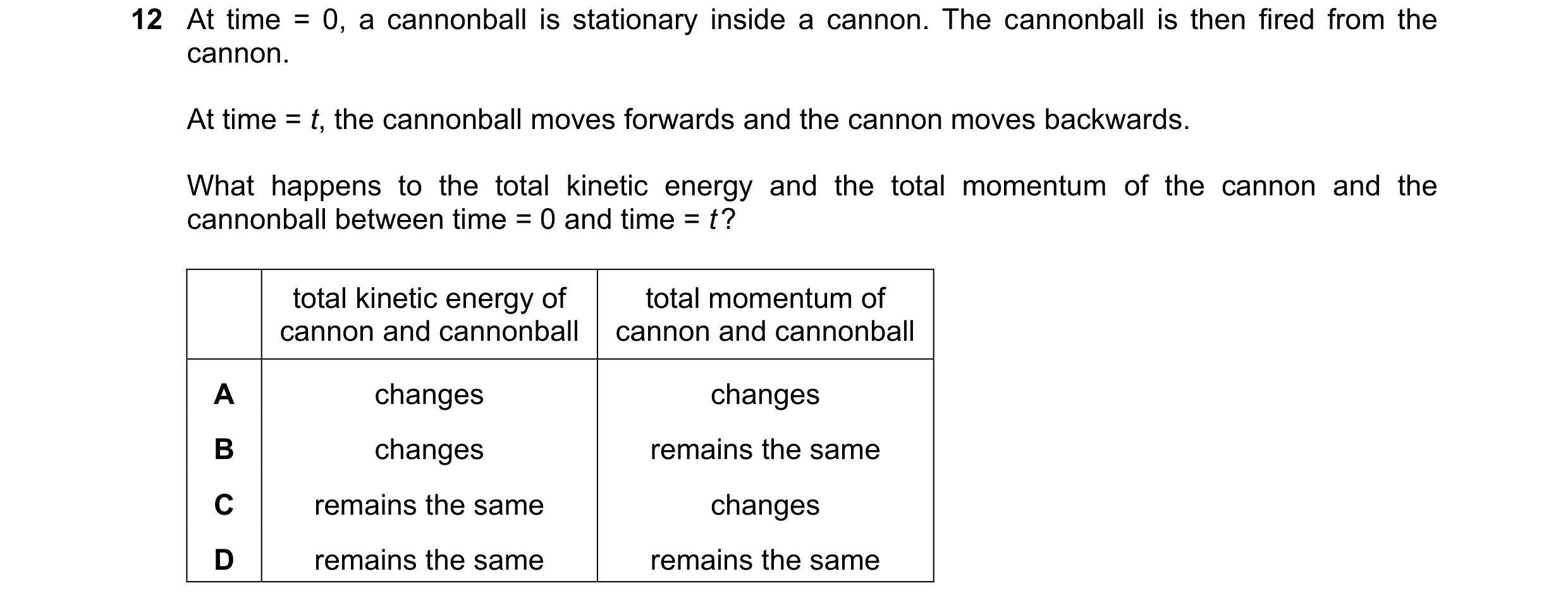
Q47 · At time = 0, a cannonball is stationary inside a cannon 0625/22 Feb/March 2022
12 At time = 0, a cannonball is stationary inside a cannon. The cannonball is then fired from the cannon. At time = t, the cannonball moves forwards and the cannon moves backwards. What happens to the total kinetic energy and the total momentum of the cannon and the cannonball between time = 0 and time = t ? total kinetic energy of total momentum of cannon and cannonball cannon and cannonball A changes changes B changes remains the same C remains the same changes D remains the same remains the same
1 marks
Answer: B
This question in 0625/22 Feb/March 2022
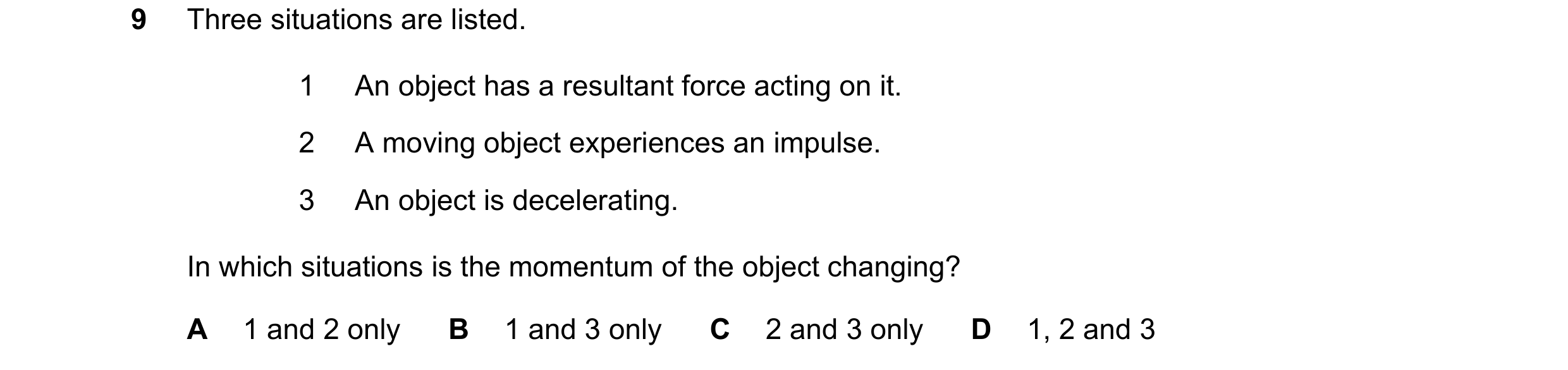
Q48 · Three situations are listed 0625/21 May/June 2022
9 Three situations are listed. 1 An object has a resultant force acting on it. 2 A moving object experiences an impulse. 3 An object is decelerating. In which situations is the momentum of the object changing? A 1 and 2 only B 1 and 3 only C 2 and 3 only D 1, 2 and 3
1 marks
Answer: D
This question in 0625/21 May/June 2022
Q49 · A ball of mass 0.16 kg is moving forwards at a speed of 0.50 m / s 0625/21 May/June 2022
10 A ball of mass 0.16 kg is moving forwards at a speed of 0.50 m / s. A second ball of mass 0.10 kg is stationary. The first ball strikes the second ball. The second ball moves forwards at a speed of 0.50 m / s. What is the speed of the first ball after the collision? A 0.0 m / s B 0.19 m / s C 0.31 m / s D 0.50 m / s
1 marks
Answer: B
This question in 0625/21 May/June 2022
Q50 · Which statement describes the impulse acting on an object? 0625/22 May/June 2022
9 Which statement describes the impulse acting on an object? A Impulse is the change in kinetic energy of the object. B Impulse is the change in momentum of the object. C Impulse is the rate of change of force acting on the object. D Impulse is the rate of change of momentum of the object.
1 marks
Answer: B
This question in 0625/22 May/June 2022
Q51 · A ball of mass 0.16 kg is moving forwards at a speed of 0.50 m / s 0625/22 May/June 2022
10 A ball of mass 0.16 kg is moving forwards at a speed of 0.50 m / s. A second ball of mass 0.10 kg is stationary. The first ball strikes the second ball. The second ball moves forwards at a speed of 0.50 m / s. What is the speed of the first ball after the collision? A 0.0 m / s B 0.19 m / s C 0.31 m / s D 0.50 m / s
1 marks
Answer: B
This question in 0625/22 May/June 2022
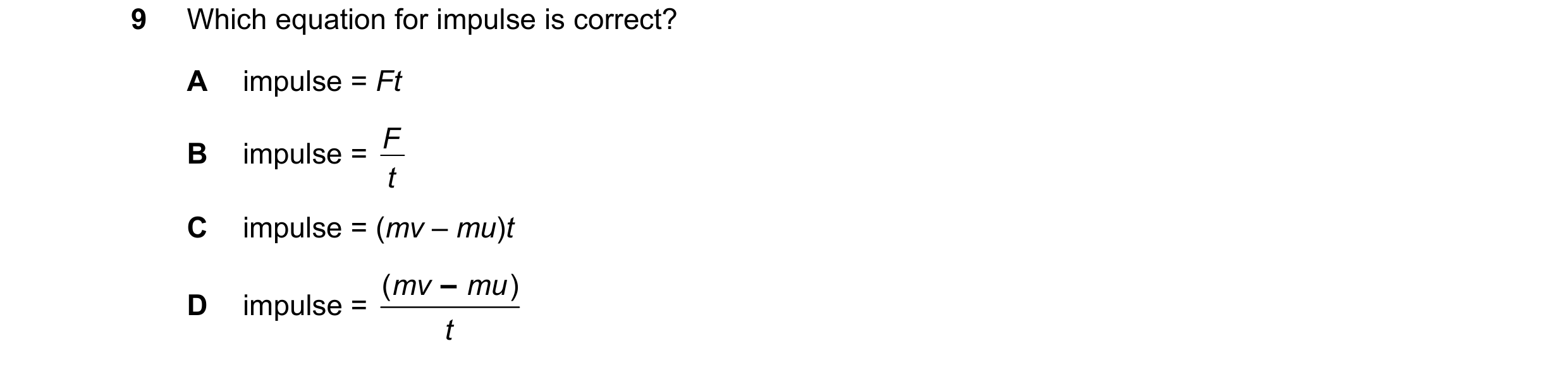
Q52 · Which equation for impulse is correct? 0625/23 May/June 2022
9 Which equation for impulse is correct? A impulse = Ft F B impulse = t C impulse = (mv – mu)t ( mv – mu ) D impulse = t
1 marks
Answer: A
This question in 0625/23 May/June 2022
Q53 · A ball of mass 0.16 kg is moving forwards at a speed of 0.50 m / s 0625/23 May/June 2022
10 A ball of mass 0.16 kg is moving forwards at a speed of 0.50 m / s. A second ball of mass 0.10 kg is stationary. The first ball strikes the second ball. The second ball moves forwards at a speed of 0.50 m / s. What is the speed of the first ball after the collision? A 0.0 m / s B 0.19 m / s C 0.31 m / s D 0.50 m / s
1 marks
Answer: B
This question in 0625/23 May/June 2022
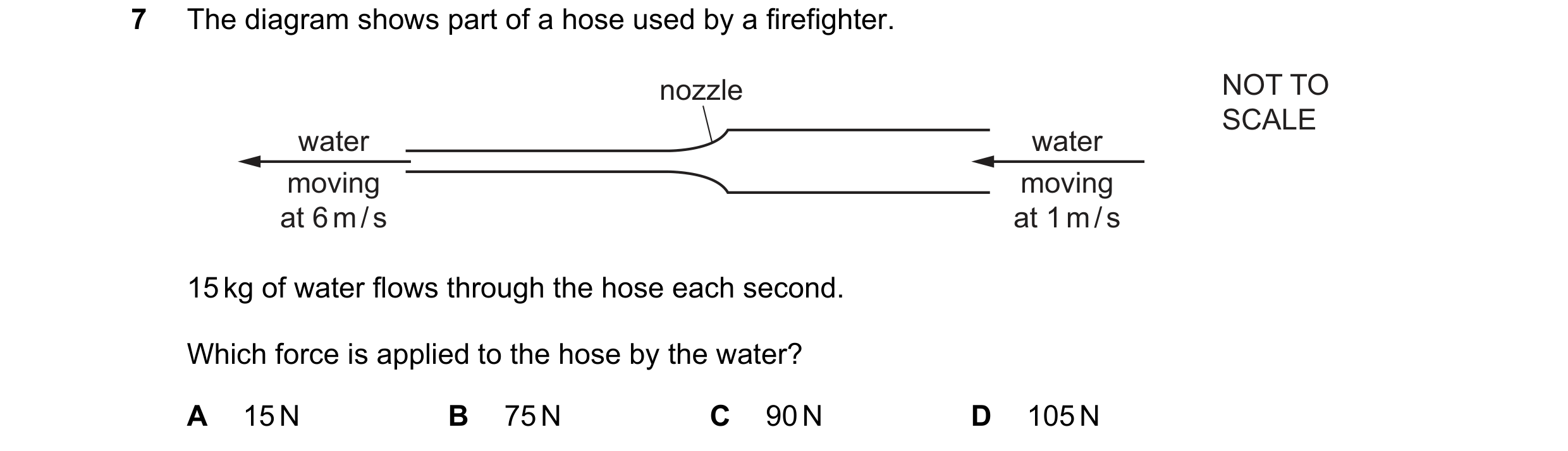
Q54 · The diagram shows part of a hose used by a firefighter 0625/21 Oct/Nov 2022
7 The diagram shows part of a hose used by a firefighter. nozzle NOT TO SCALE water water moving moving at 6 m / s at 1 m / s 15 kg of water flows through the hose each second. Which force is applied to the hose by the water? A 15 N B 75 N C 90 N D 105 N
1 marks
Answer: B
This question in 0625/21 Oct/Nov 2022
Q55 · A trolley of mass 4.0 kg travelling with a velocity of 4.0 m / s collides with a trolley… 0625/22 Oct/Nov 2022
7 A trolley of mass 4.0 kg travelling with a velocity of 4.0 m / s collides with a trolley of mass 2.0 kg travelling with a velocity of 2.0 m / s in the same direction. After the collision, the velocity of the 4.0 kg trolley is reduced to 3.0 m / s. 4.0 m / s 2.0 m / s 3.0 m / s v 4.0 kg 2.0 kg 4.0 kg 2.0 kg before collision after collision What is the velocity v of the 2.0 kg trolley after the collision? A 0.25 m / s B 4.0 m / s C 5.0 m / s D 16 m / s
1 marks
Answer: B
This question in 0625/22 Oct/Nov 2022
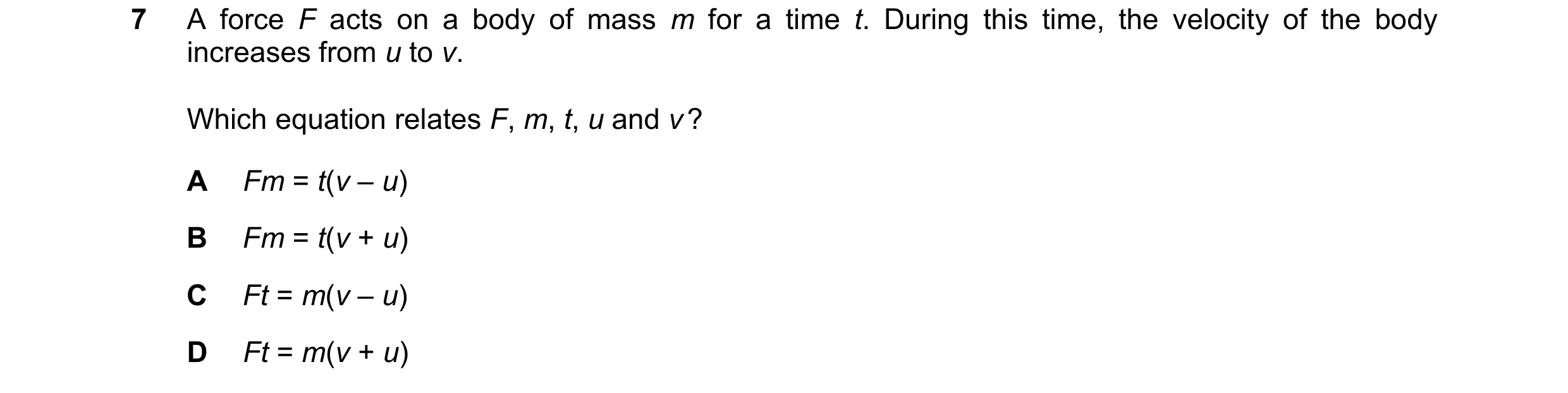
Q56 · A force F acts on a body of mass m for a time t 0625/23 Oct/Nov 2022
7 A force F acts on a body of mass m for a time t. During this time, the velocity of the body increases from u to v. Which equation relates F, m, t, u and v ? A Fm = t(v – u) B Fm = t(v + u) C Ft = m(v – u) D Ft = m(v + u)
1 marks
Answer: C
This question in 0625/23 Oct/Nov 2022
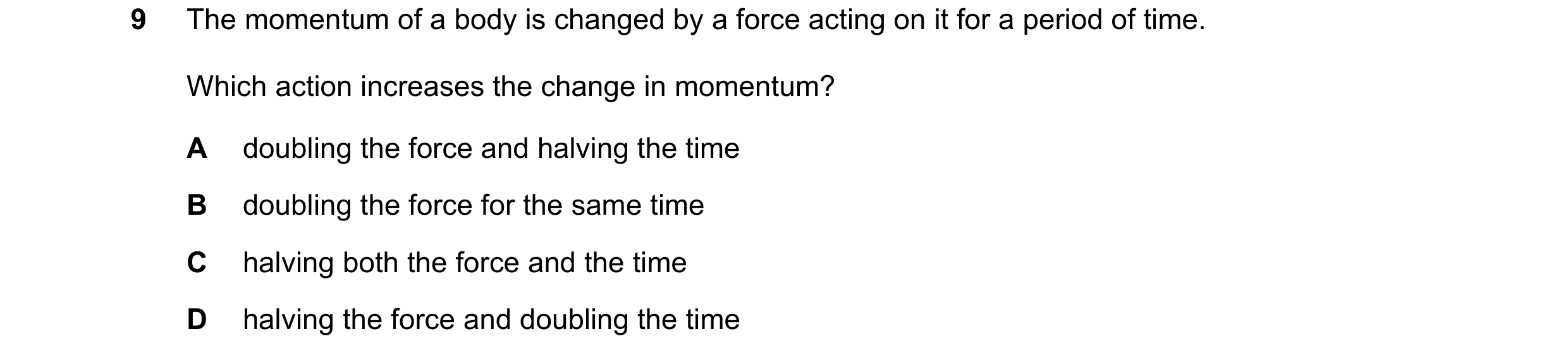
Q57 · The momentum of a body is changed by a force acting on it for a period of time 0625/22 Feb/March 2023
9 The momentum of a body is changed by a force acting on it for a period of time. Which action increases the change in momentum? A doubling the force and halving the time B doubling the force for the same time C halving both the force and the time D halving the force and doubling the time
1 marks
Answer: B
This question in 0625/22 Feb/March 2023
Q58 · An object of mass 1.2 kg is moving with a velocity of 2.0 m / s when it is acted on by a… 0625/21 May/June 2023
9 An object of mass 1.2 kg is moving with a velocity of 2.0 m / s when it is acted on by a force of 4.0 N. The velocity of the object increases to 5.0 m / s in the same direction. For which period of time does the force act on the object? A 0.90 s B 1.1 s C 1.5 s D 3.6 s
1 marks
Answer: A
This question in 0625/21 May/June 2023
Q59 · A ball of mass 0.25 kg hits a wall at a speed of 16 m / s 0625/23 May/June 2023
9 A ball of mass 0.25 kg hits a wall at a speed of 16 m / s. It then rebounds back along its original path at a speed of 12 m / s. What is the impulse experienced by the ball during its impact with the wall? A 1.0 N s B 3.0 N s C 4.0 N s D 7.0 N s
1 marks
Answer: D
This question in 0625/23 May/June 2023
Q60 · A sphere X collides head on with a second identical sphere Y which is stationary 0625/21 Oct/Nov 2023
7 A sphere X collides head on with a second identical sphere Y which is stationary. The mass of each sphere is 0.15 kg. Sphere X is travelling at a velocity of 2.0 m / s before the collision and produces an impulse of 0.21 N s on sphere Y. What is the velocity of sphere X after collision? A 0.60 m / s in the opposite direction to Y B 0.60 m / s in the same direction as Y C 1.4 m / s in the opposite direction to Y D 1.4 m / s in the same direction as Y
1 marks
Answer: B
This question in 0625/21 Oct/Nov 2023
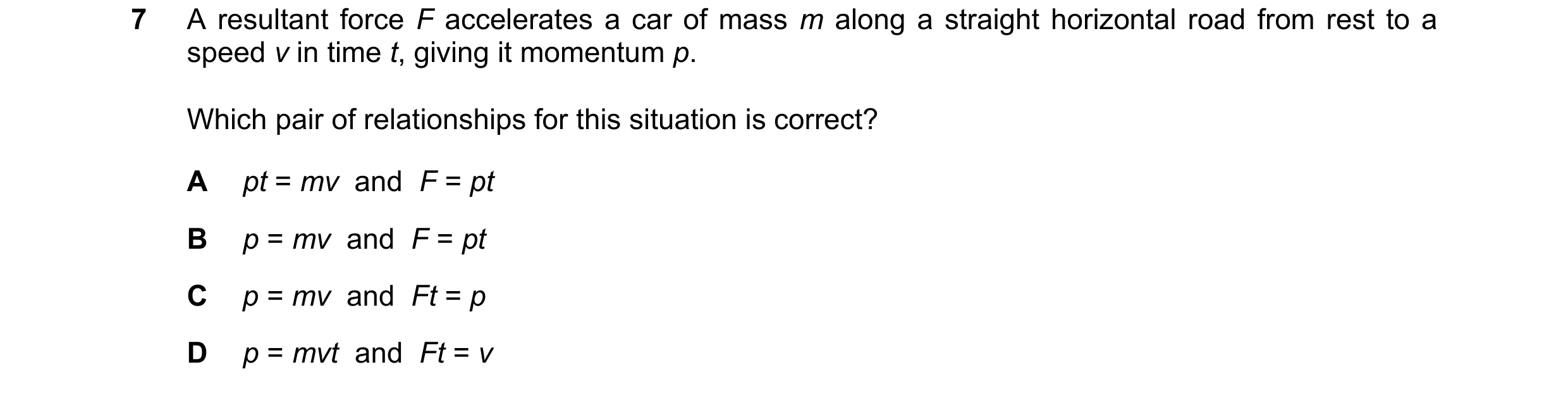
Q61 · A resultant force F accelerates a car of mass m along a straight horizontal road from… 0625/22 Oct/Nov 2023
7 A resultant force F accelerates a car of mass m along a straight horizontal road from rest to a speed v in time t, giving it momentum p. Which pair of relationships for this situation is correct? A pt = mv and F = pt B p = mv and F = pt C p = mv and Ft = p D p = mvt and Ft = v
1 marks
Answer: C
This question in 0625/22 Oct/Nov 2023
Q62 · A car of mass 1200 kg is travelling along a straight horizontal road 0625/23 Oct/Nov 2023
7 A car of mass 1200 kg is travelling along a straight horizontal road. Which impulse is needed to accelerate the car from 5.0 m / s to 10 m / s? A 6000 N s B 12 000 N s C 15 000 N s D 18 000 N s
1 marks
Answer: A
This question in 0625/23 Oct/Nov 2023
Q63 · An object is moving at +3.0 m / s 0625/22 Feb/March 2024
7 An object is moving at +3.0 m / s. A force acts on the object. After a time, the object is moving at –4.0 m / s. The mass of the object is 5.0 kg. What is the change in momentum of the body? A –35 kg m / s B –5.0 kg m / s C +5.0 kg m / s D +35 kg m / s
1 marks
Answer: A
This question in 0625/22 Feb/March 2024
Q64 · A ball of mass m falls vertically and hits a hard surface 0625/21 May/June 2024
6 A ball of mass m falls vertically and hits a hard surface. Its speed on hitting the surface is v1. It rebounds vertically upwards with speed v2. What is the change in momentum of the ball? A mv1 B mv2 C m(v1 + v2) D m(v2 – v1)
1 marks
Answer: C
This question in 0625/21 May/June 2024
Q65 · A gymnast jumps down from a high piece of apparatus 0625/22 May/June 2024
6 A gymnast jumps down from a high piece of apparatus. She gradually bends her knees as she lands. Which effect does this have? A She will have a smaller change of momentum as she lands. B She will lose less kinetic energy as she lands. C She will exert a smaller impulse on the ground as she lands. D She will experience a smaller force from the ground as she lands.
1 marks
Answer: D
This question in 0625/22 May/June 2024
Q66 · A small ball of mass 0.10 kg travels horizontally at a speed of 600 m / s 0625/23 May/June 2024
7 A small ball of mass 0.10 kg travels horizontally at a speed of 600 m / s. It strikes a stationary wooden block of mass 1.9 kg resting on a frictionless horizontal surface. The ball stays in the block. What is the speed of the ball and the block immediately after the impact? A 30 m / s B 32 m / s C 60 m / s D 130 m / s
1 marks
Answer: A
This question in 0625/23 May/June 2024
Q67 · Which equation gives the momentum change of an object? 0625/21 Oct/Nov 2024
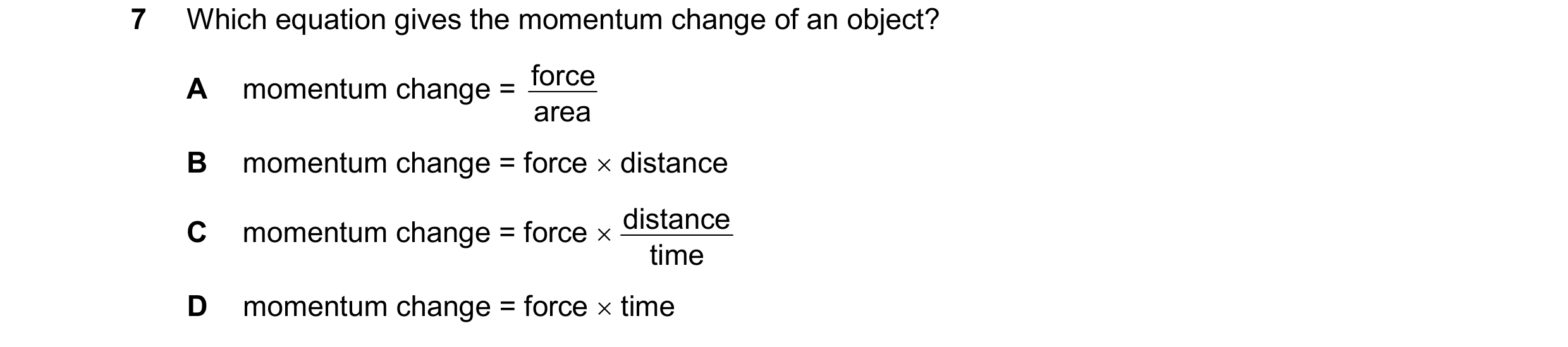
7 Which equation gives the momentum change of an object? force A momentum change = area B momentum change = force distance momentum change = force distance C time D momentum change = force time
1 marks
Answer: D
This question in 0625/21 Oct/Nov 2024
Q68 · Which expression can be used to determine the impulse on a tennis ball? 0625/22 Oct/Nov 2024
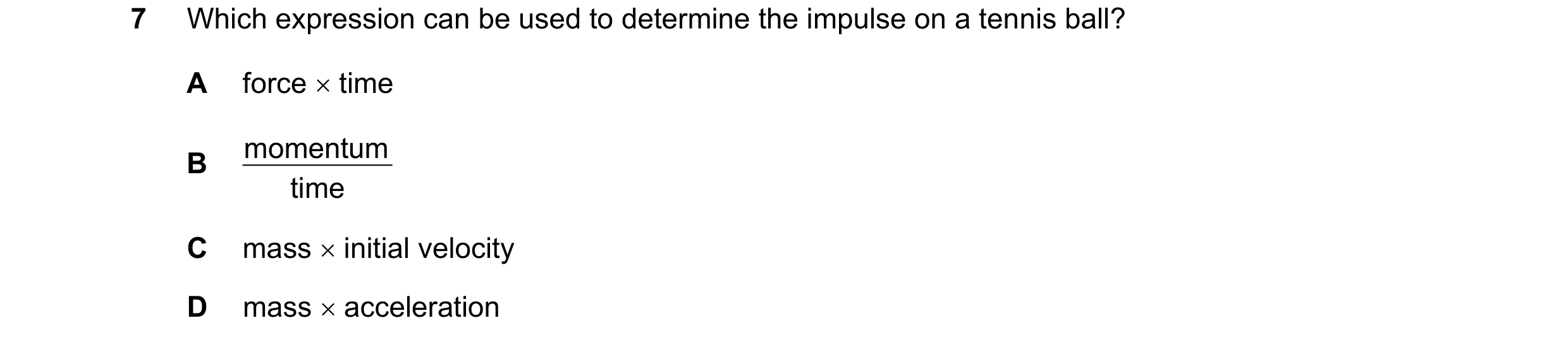
7 Which expression can be used to determine the impulse on a tennis ball? A force time momentum B time C mass initial velocity D mass acceleration
1 marks
Answer: A
This question in 0625/22 Oct/Nov 2024
Q69 · An object has a mass of 20 kg 0625/23 Oct/Nov 2024
7 An object has a mass of 20 kg. Its velocity changes from 6 m / s to 10 m / s. Which impulse has acted on the object? A 80 N s B 120 N s C 200 N s D 320 N s
1 marks
Answer: A
This question in 0625/23 Oct/Nov 2024
Q70 · An object of mass 4.0 kg is moving with a velocity of 3.0 m / s in a straight line 0625/22 Feb/March 2025
6 An object of mass 4.0 kg is moving with a velocity of 3.0 m / s in a straight line. What is the momentum of the object? A 0.75 kg m / s B 1.3 kg m / s C 12 kg m / s D 24 kg m / s
1 marks
Answer: C
This question in 0625/22 Feb/March 2025
Q71 · A tennis ball with momentum 2.3 kg m / s is struck by a tennis racket 0625/22 Feb/March 2025
8 A tennis ball with momentum 2.3 kg m / s is struck by a tennis racket. The racket causes the direction of motion of the ball to reverse. The racket exerts an average force of 1500 N during the impact with the ball. The racket and ball are in contact with each other for a time of 0.0024 s. What is the magnitude of the momentum of the ball as it leaves the tennis racket? A 1.3 kg m / s B 3.6 kg m / s C 5.9 kg m / s D 8.6 kg m / s
1 marks
Answer: A
This question in 0625/22 Feb/March 2025
Q72 · Which statement is not correct? 0625/21 May/June 2025
7 Which statement is not correct? A the momentum of a system is conserved in all interactions B impulse = change of momentum C force acting = change of momentum time D momentum = mass velocity
1 marks
Answer: C
This question in 0625/21 May/June 2025
Q73 · A cricket ball of mass 0.15 kg is moving at a speed of 30 m / s 0625/22 May/June 2025
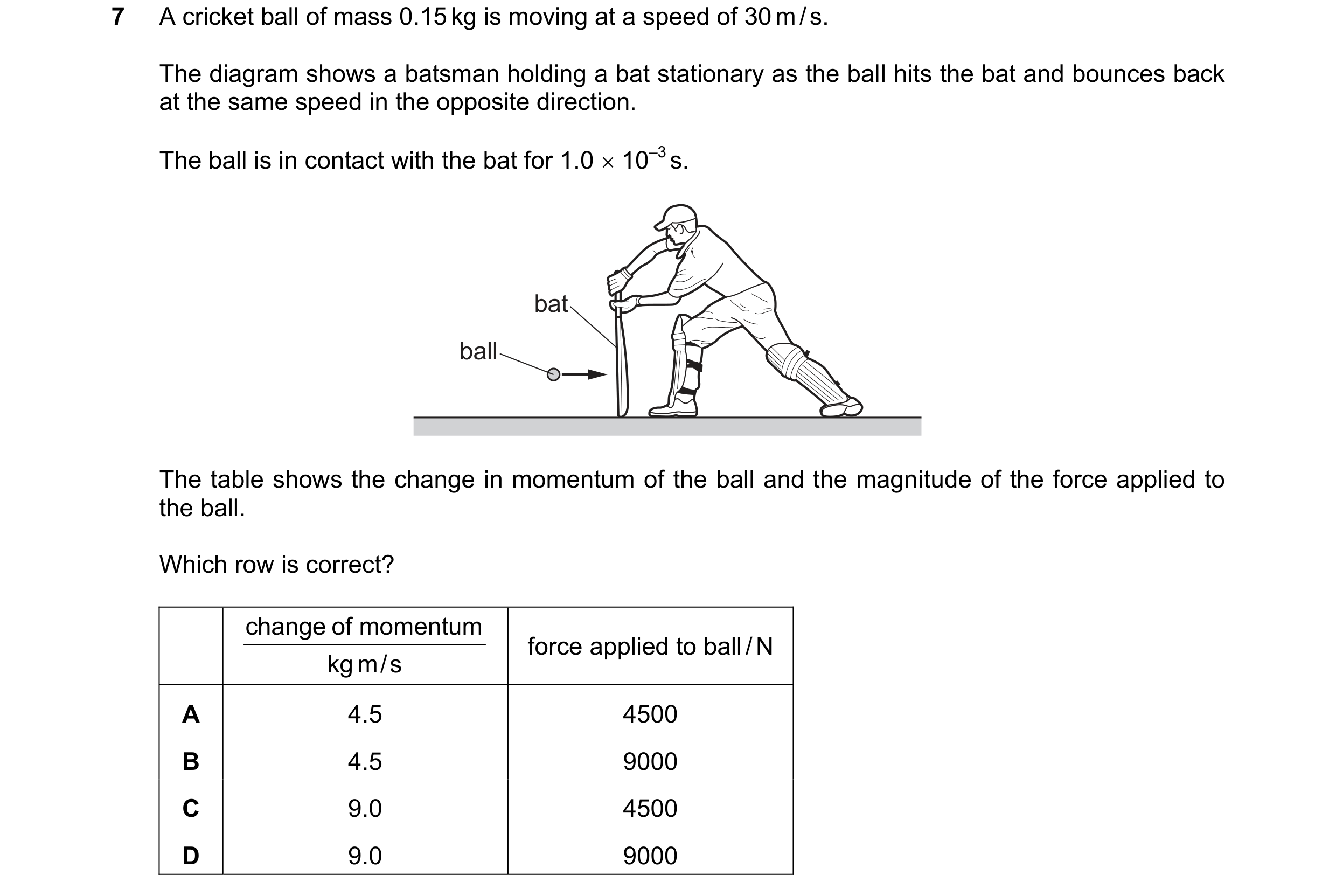
7 A cricket ball of mass 0.15 kg is moving at a speed of 30 m / s. The diagram shows a batsman holding a bat stationary as the ball hits the bat and bounces back at the same speed in the opposite direction. The ball is in contact with the bat for 1.0 10–3 s. bat ball The table shows the change in momentum of the ball and the magnitude of the force applied to the ball. Which row is correct? change of momentum force applied to ball / N kg m / s A 4.5 4500 B 4.5 9000 C 9.0 4500 D 9.0 9000
1 marks
Answer: D
This question in 0625/22 May/June 2025
Q74 · A railway truck of mass 8000 kg moves with a velocity of 1.0 m / s to the right 0625/23 May/June 2025
8 A railway truck of mass 8000 kg moves with a velocity of 1.0 m / s to the right. It collides with a railway truck of mass 12 000 kg moving at 2.0 m / s to the left. The two trucks become joined to each other when they collide and move off together. What is the velocity of the two trucks after the collision? A 1.6 m / s to the left B 0.80 m / s to the left C 0.80 m / s to the right D 1.6 m / s to the right
1 marks
Answer: B
This question in 0625/23 May/June 2025
Q75 · The momentum of a car changes from 10 000 kg m / s to 15 000 kg m / s in a time of 8.0 s 0625/21 Oct/Nov 2025
7 The momentum of a car changes from 10 000 kg m / s to 15 000 kg m / s in a time of 8.0 s. What is the resultant force acting on the car? A 630 N B 3100 N C 40 000 N D 200 000 N
1 marks
Answer: A
This question in 0625/21 Oct/Nov 2025
Q76 · A ball X of mass 0.15 kg travelling horizontally with a velocity of 2.1 m / s towards… 0625/22 Oct/Nov 2025
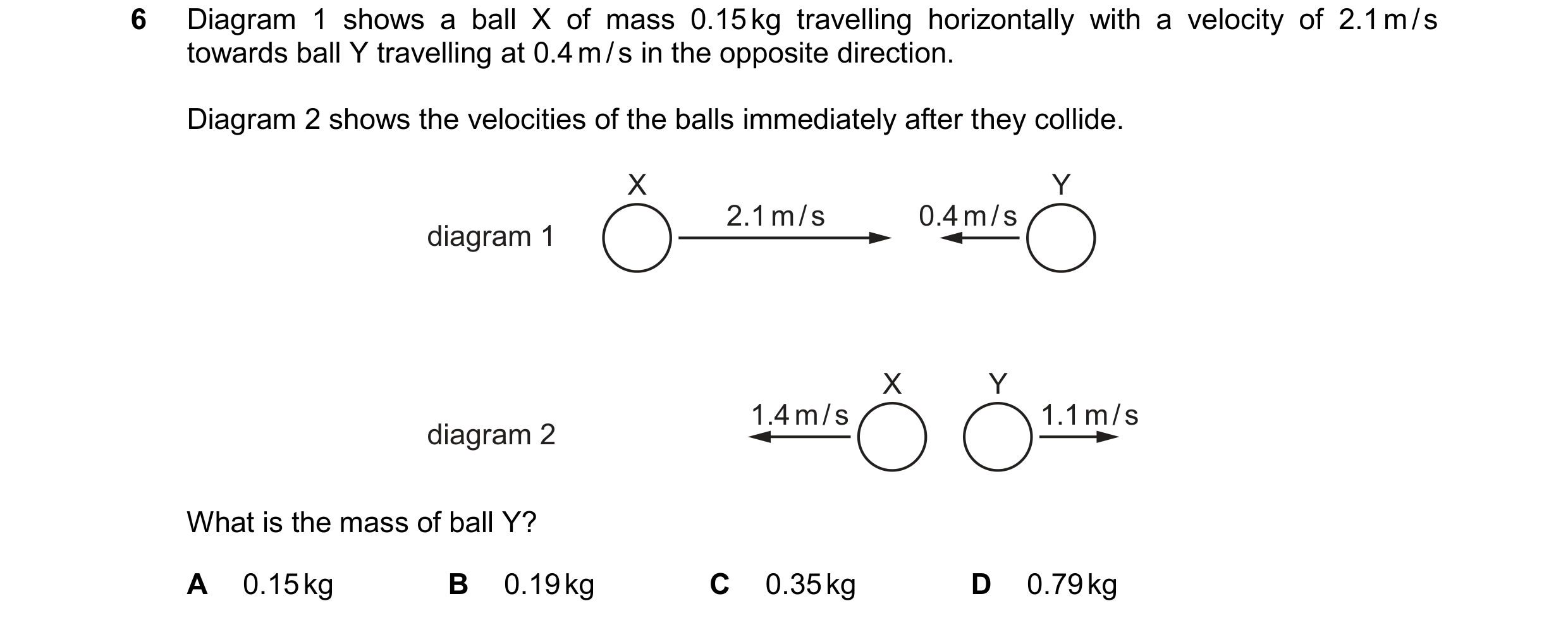
6 Diagram 1 shows a ball X of mass 0.15 kg travelling horizontally with a velocity of 2.1 m / s towards ball Y travelling at 0.4 m / s in the opposite direction. Diagram 2 shows the velocities of the balls immediately after they collide. X Y 2.1 m / s 0.4 m / s diagram 1 X Y 1.4 m / s 1.1 m / s diagram 2 What is the mass of ball Y? A 0.15 kg B 0.19 kg C 0.35 kg D 0.79 kg
1 marks
Answer: C
This question in 0625/22 Oct/Nov 2025
Q77 · A ball is at rest on the ground 0625/23 Oct/Nov 2025
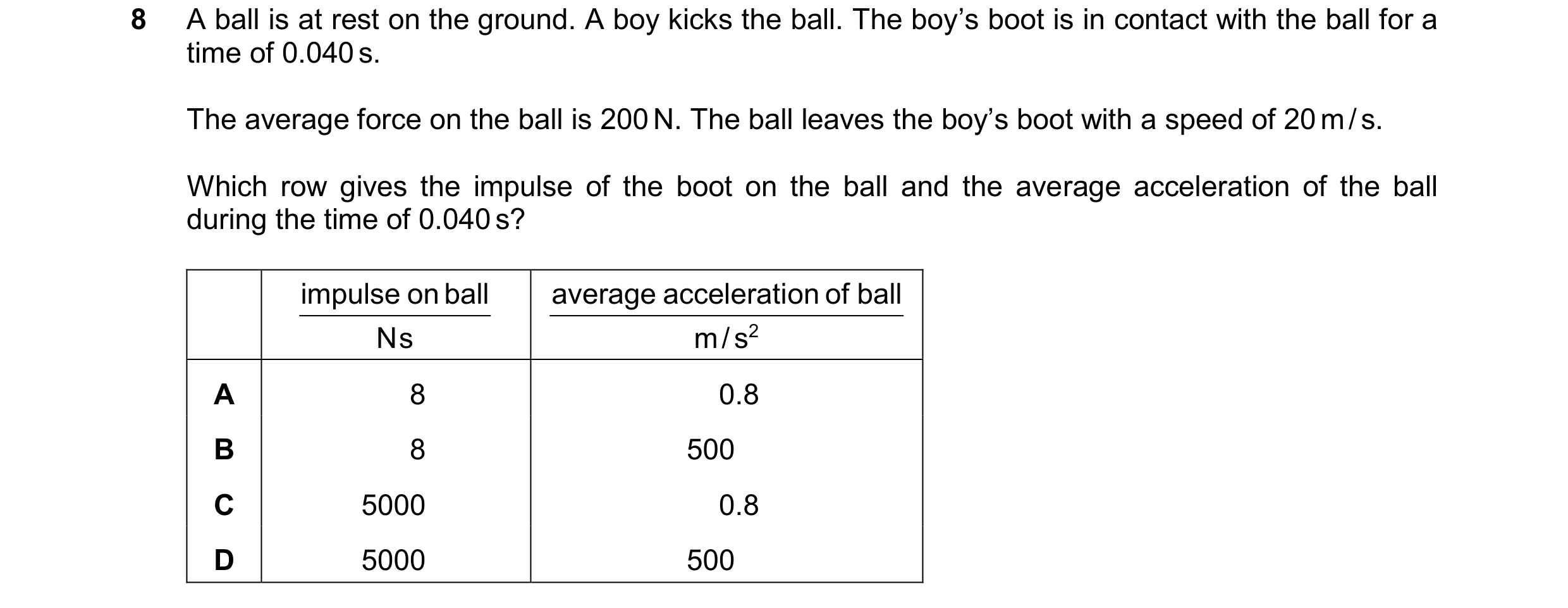
8 A ball is at rest on the ground. A boy kicks the ball. The boy’s boot is in contact with the ball for a time of 0.040 s. The average force on the ball is 200 N. The ball leaves the boy’s boot with a speed of 20 m / s. Which row gives the impulse of the boot on the ball and the average acceleration of the ball during the time of 0.040 s? impulse on ball average accelerati on of ball N s m s / 2 A 8 0.8 B 8 500 C 5000 0.8 D 5000 500
1 marks
Answer: B
This question in 0625/23 Oct/Nov 2025

 1 / 17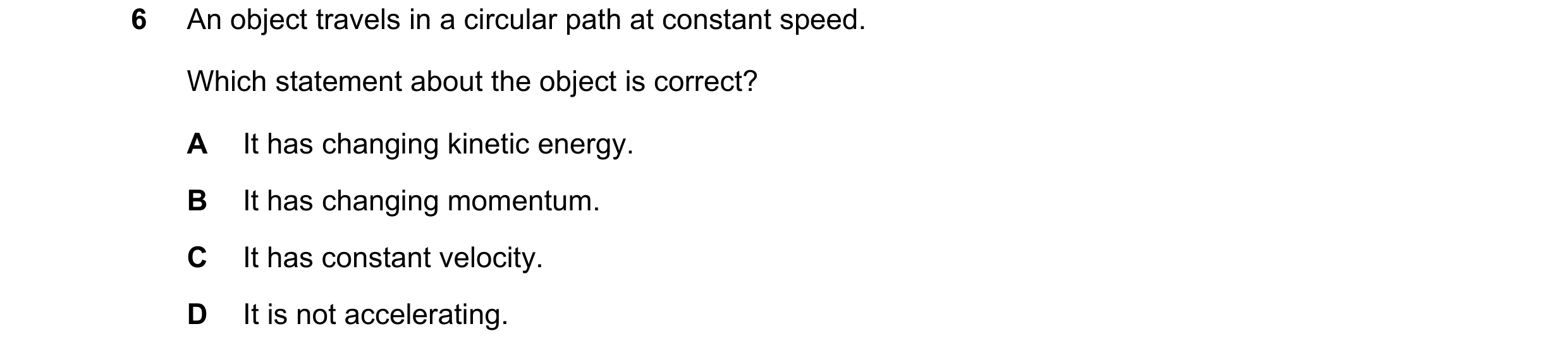




 2 / 17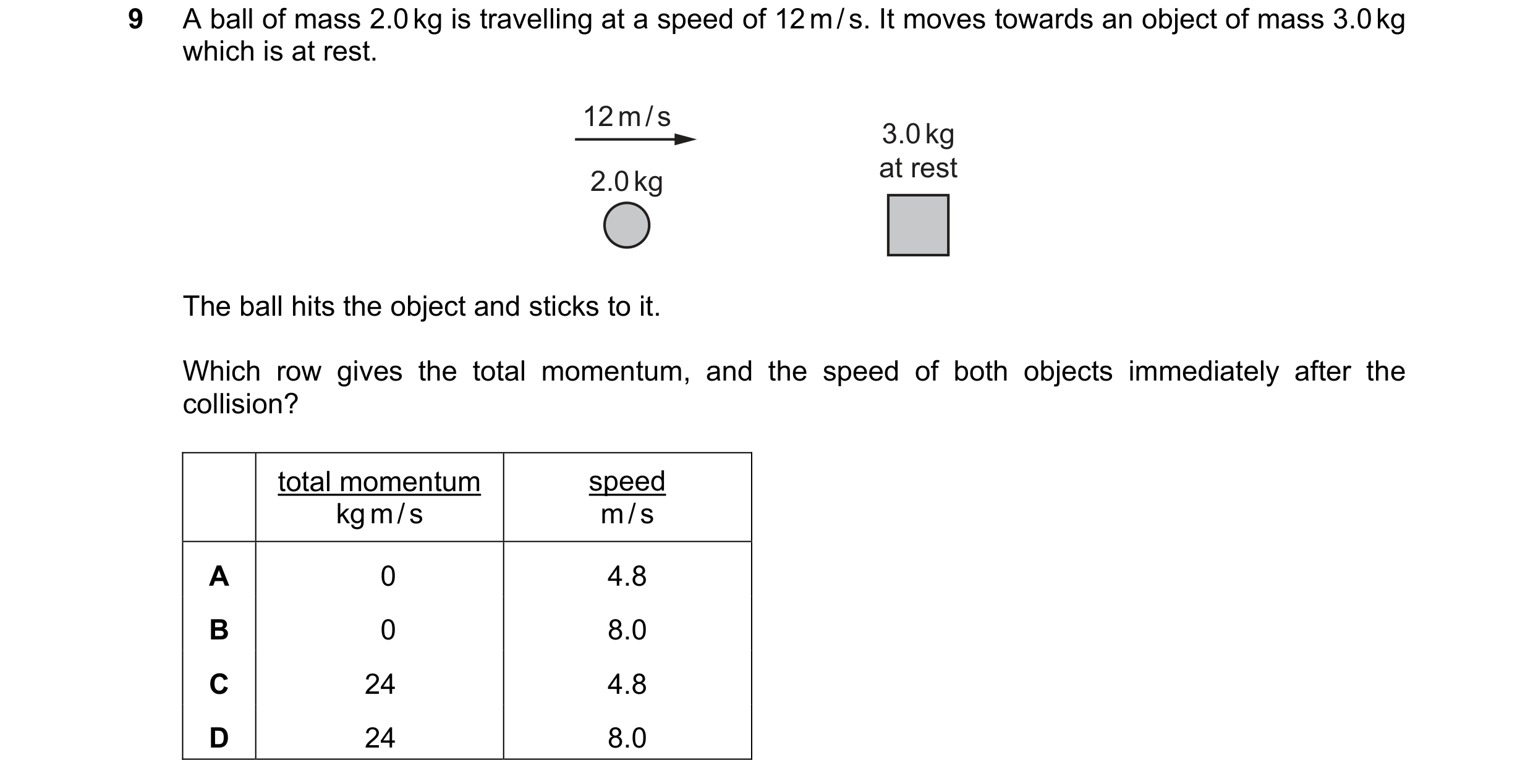
 3 / 17

 4 / 17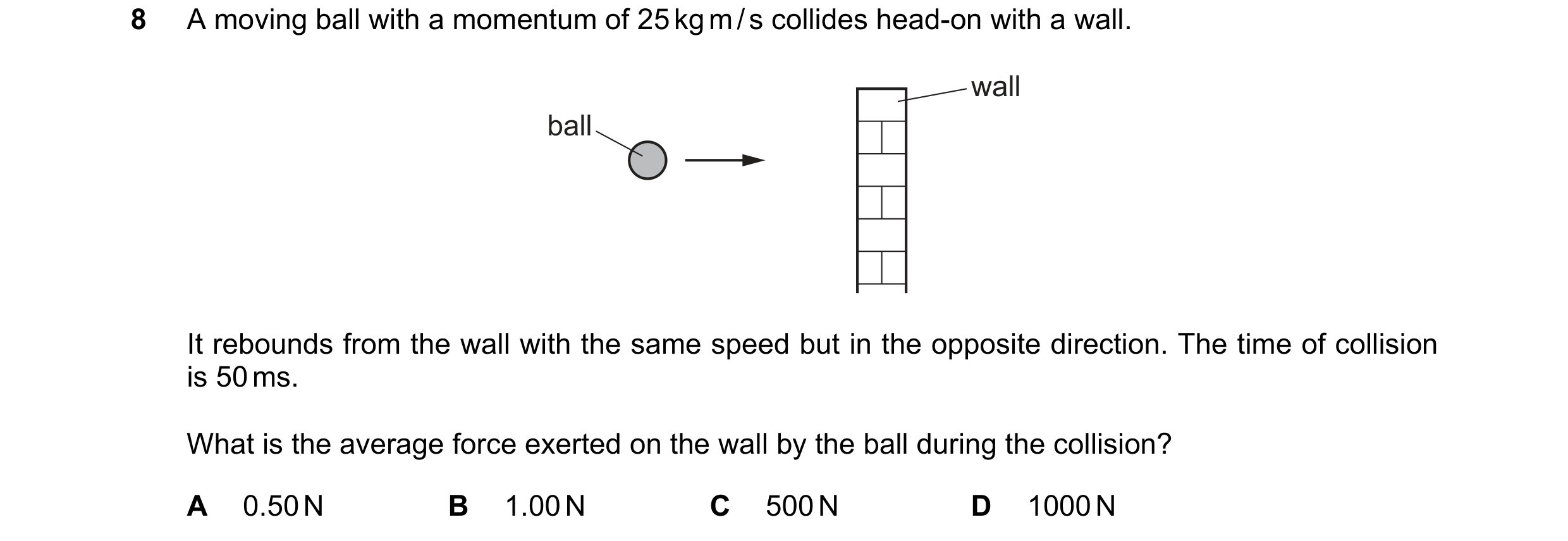
 5 / 17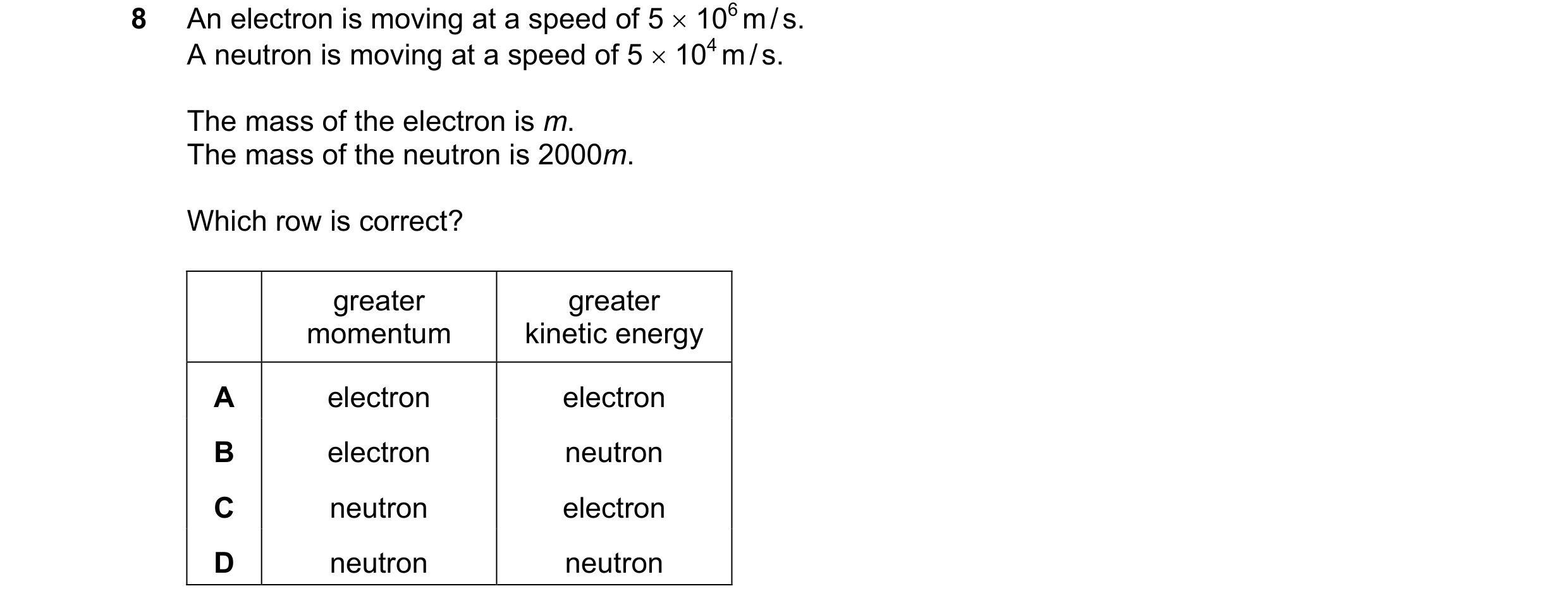
 6 / 17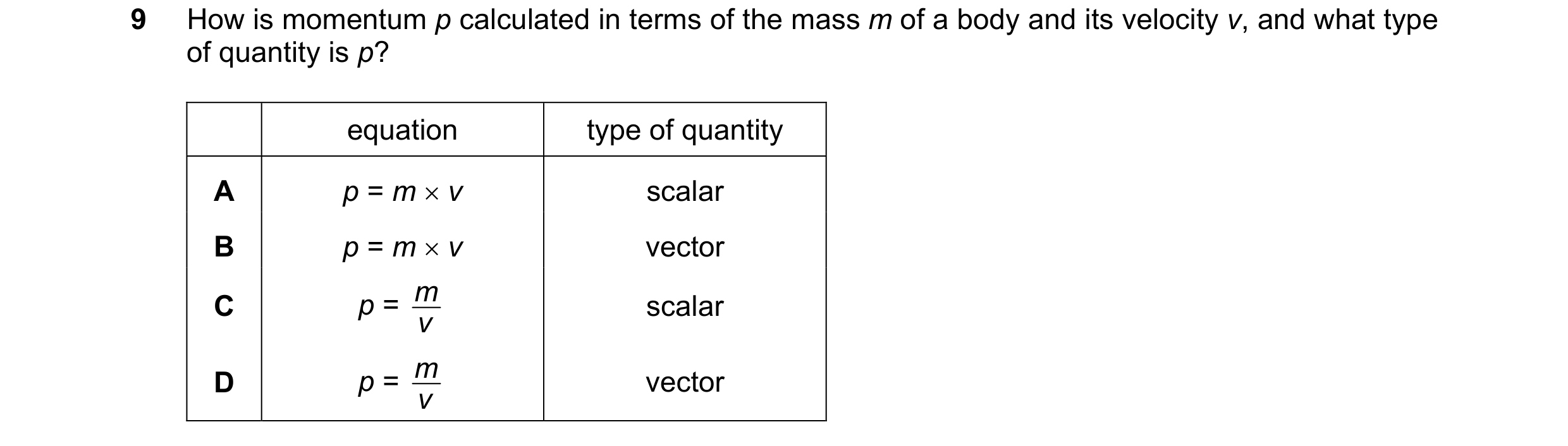
 7 / 17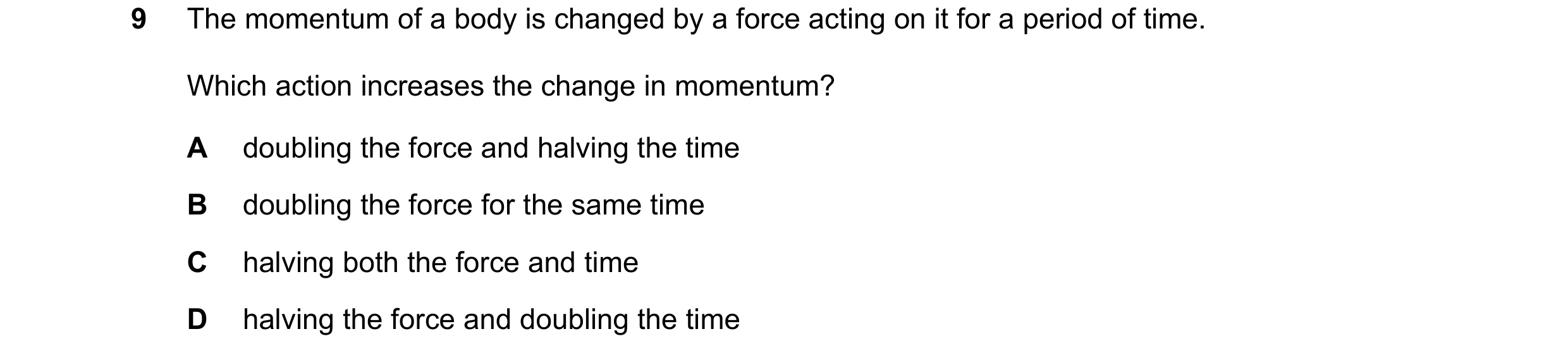

 8 / 17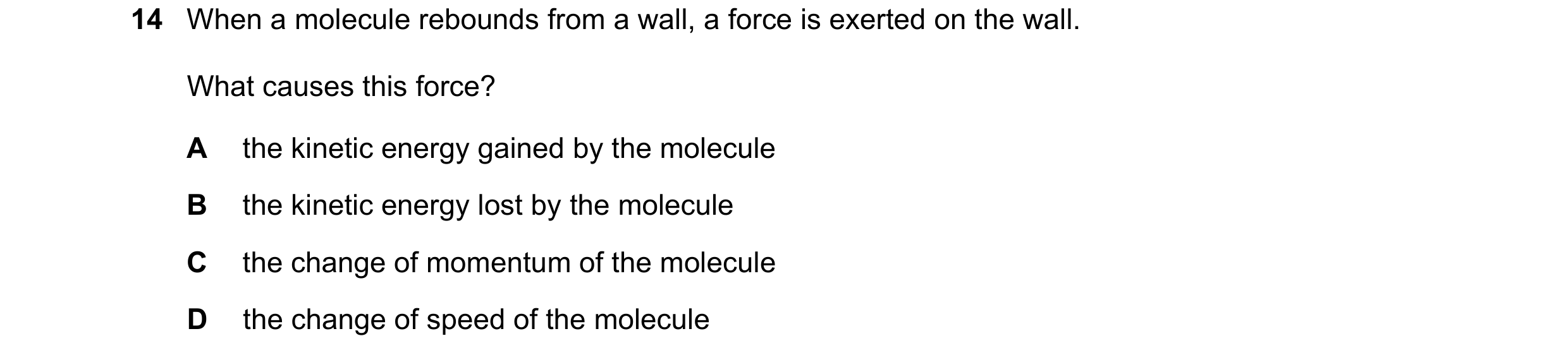
 9 / 17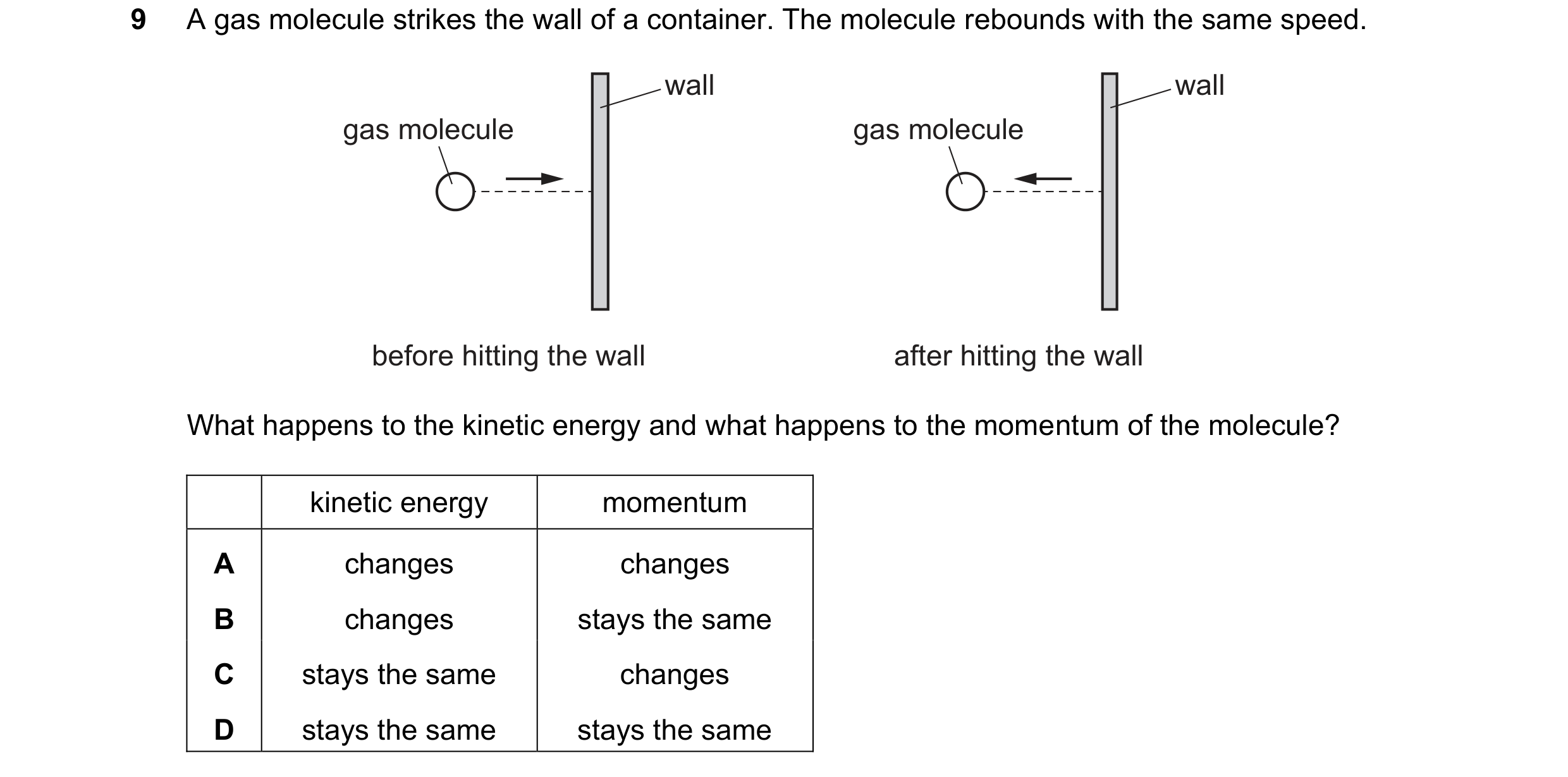
 10 / 17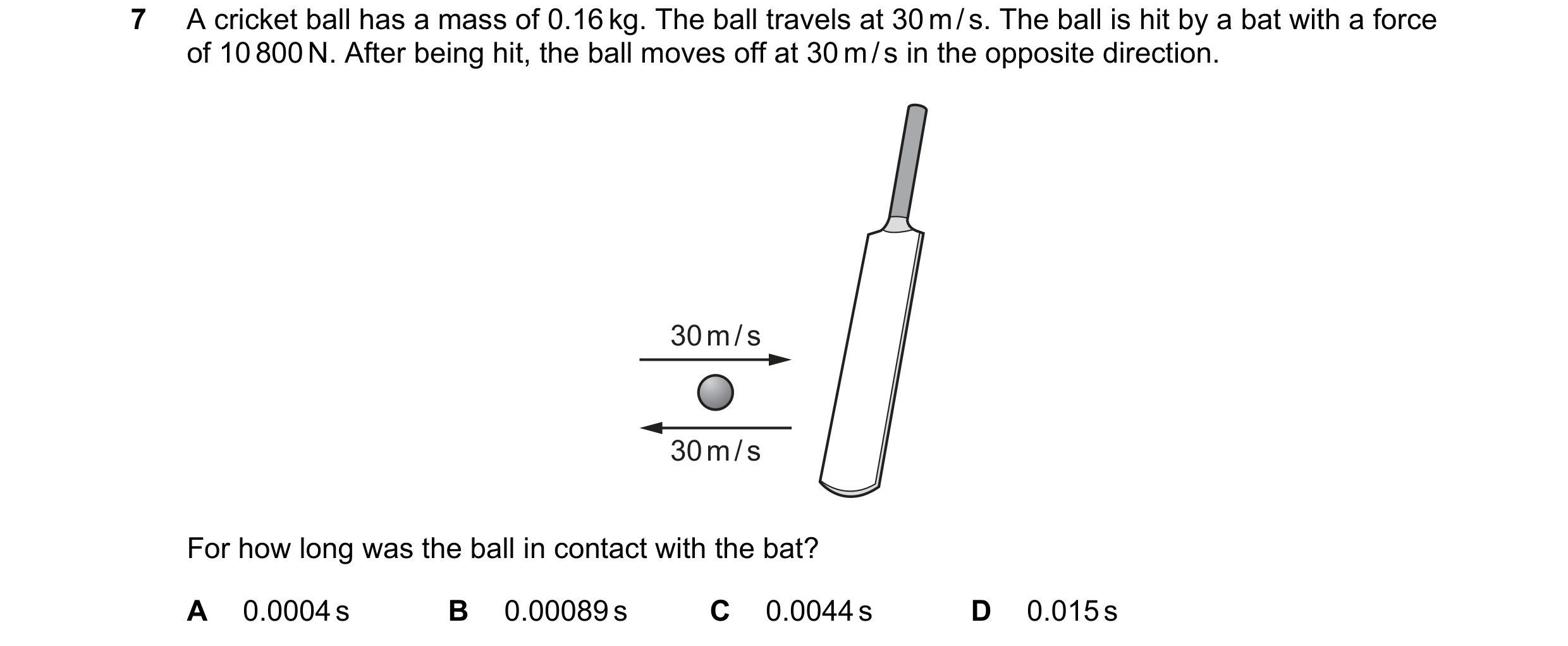

 11 / 17



 12 / 17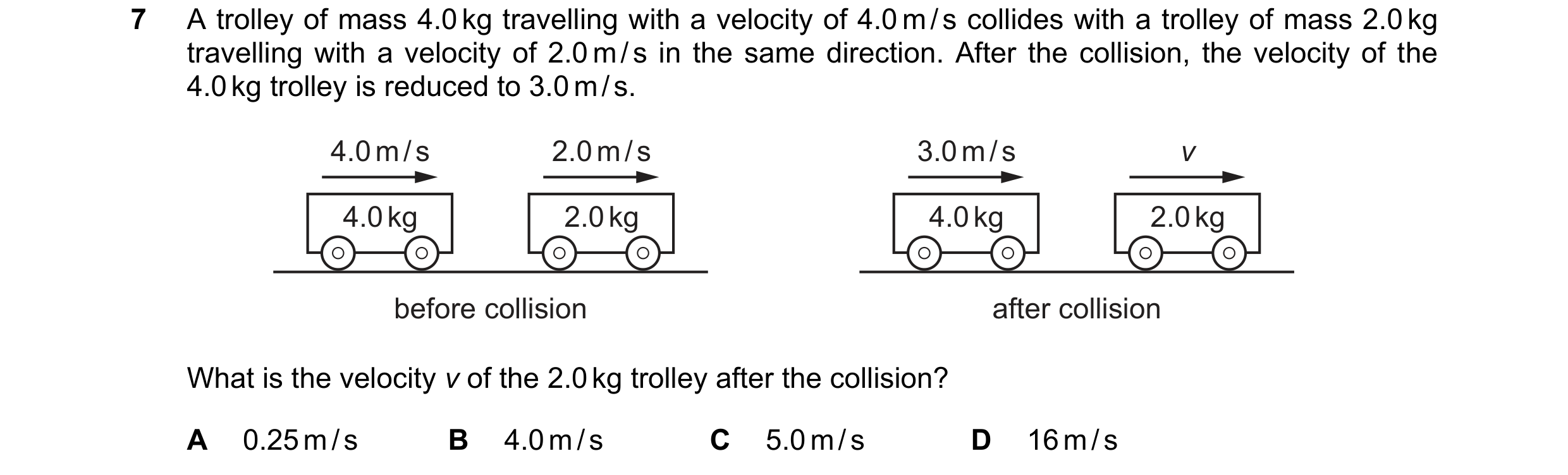

 13 / 17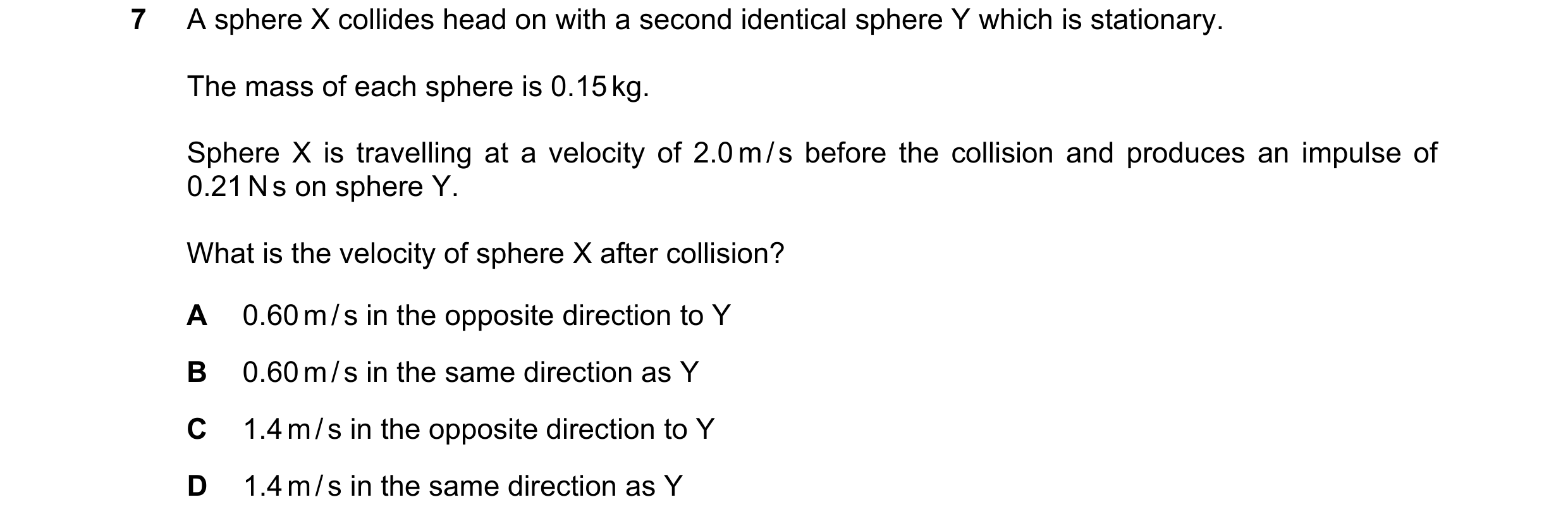

 14 / 17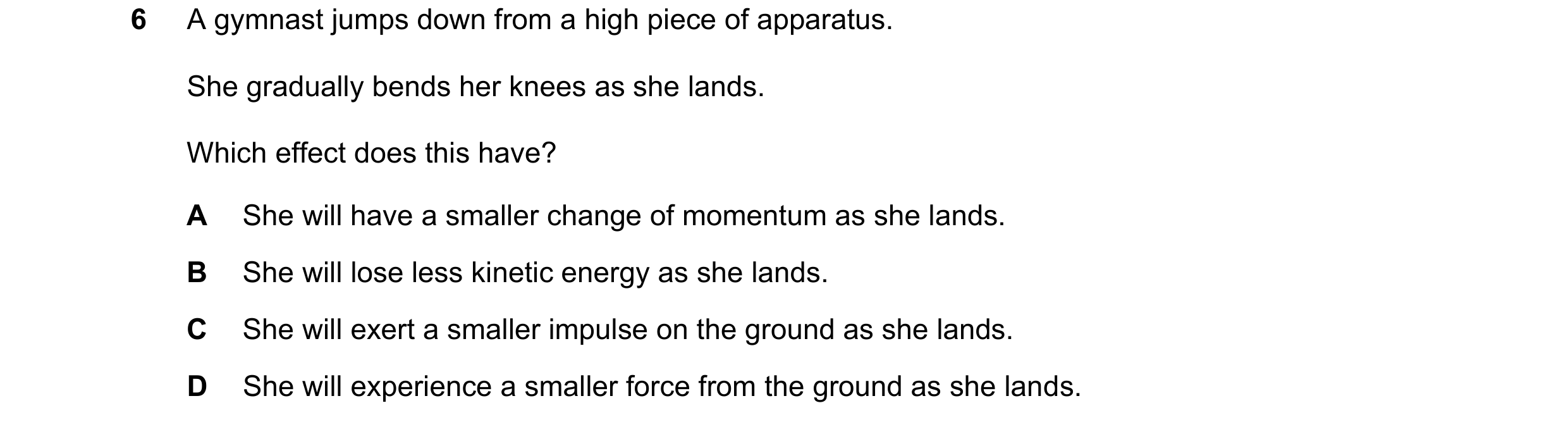


 15 / 17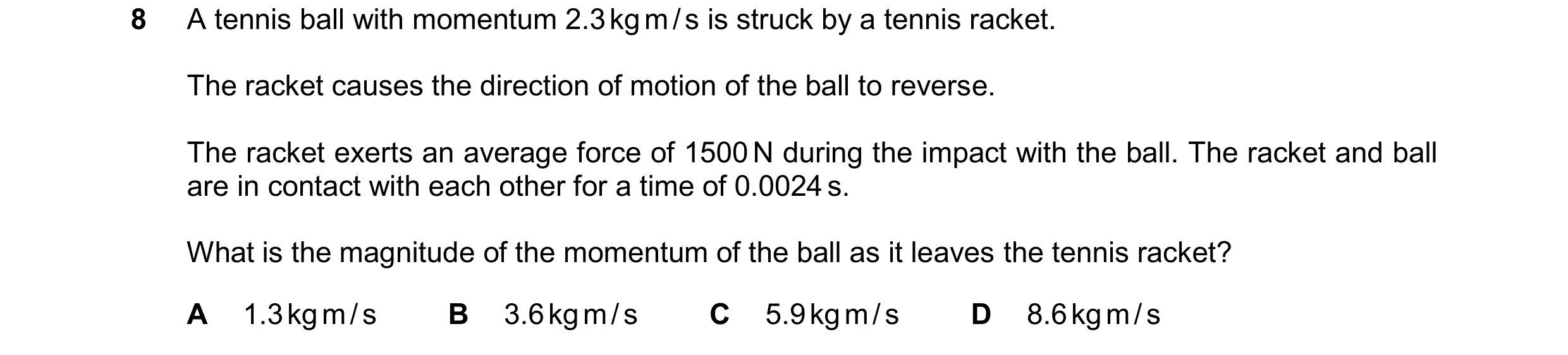

 16 / 17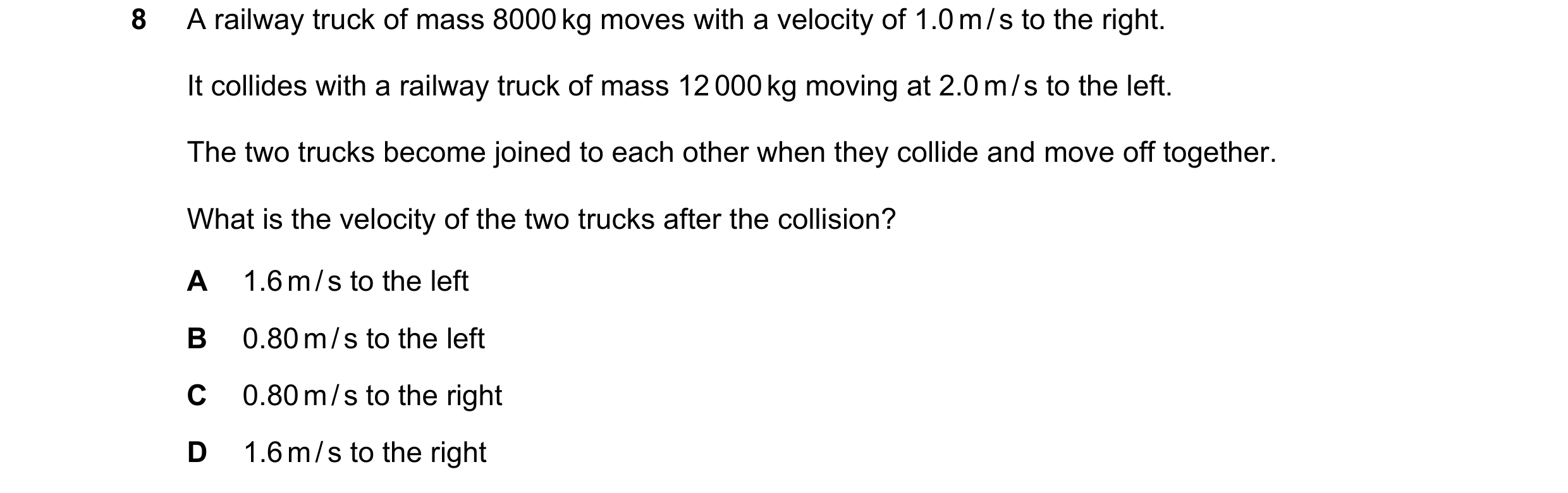

 17 / 17