Questions as text
Q1 · Explain why momentum is a vector quantity 0625/42 Feb/March 2017
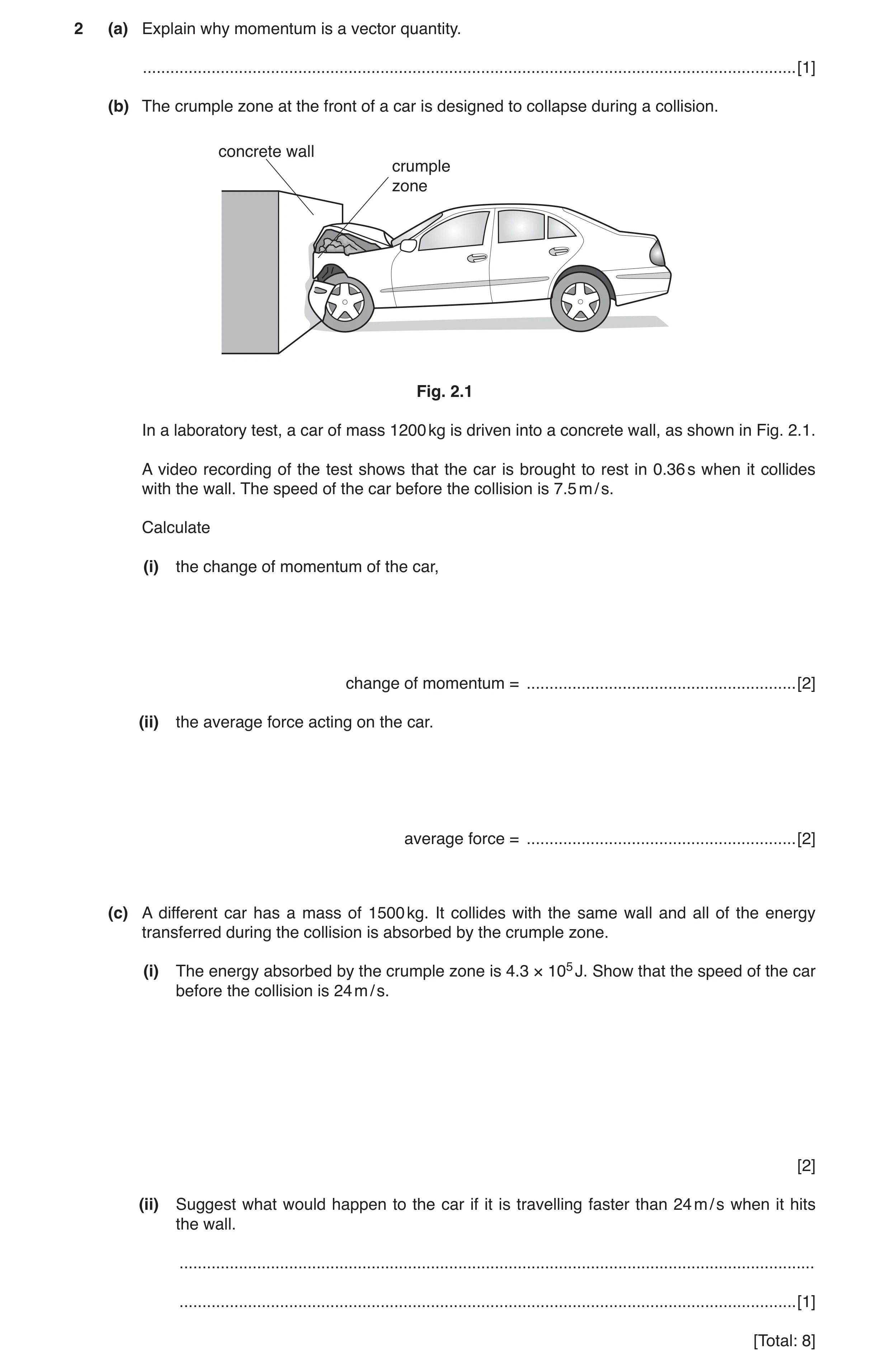
2 (a) Explain why momentum is a vector quantity. … [1] (b) The crumple zone at the front of a car is designed to collapse during a collision. concrete wall crumple zone Fig. 2.1 In a laboratory test, a car of mass 1200 kg is driven into a concrete wall, as shown in Fig. 2.1. A video recording of the test shows that the car is brought to rest in 0.36 s when it collides with the wall. The speed of the car before the collision is 7.5 m / s. Calculate (i) the change of momentum of the car, change of momentum = … [2] (ii) the average force acting on the car. average force = … [2] (c) A different car has a mass of 1500 kg. It collides with the same wall and all of the energy transferred during the collision is absorbed by the crumple zone. (i) The energy absorbed by the crumple zone is 4.3 × 10⁵ J. Show that the speed of the car before the collision is 24 m / s. [2] (ii) Suggest what would happen to the car if it is travelling faster than 24 m / s when it hits the wall. … … [1] [Total: 8]
8 marks
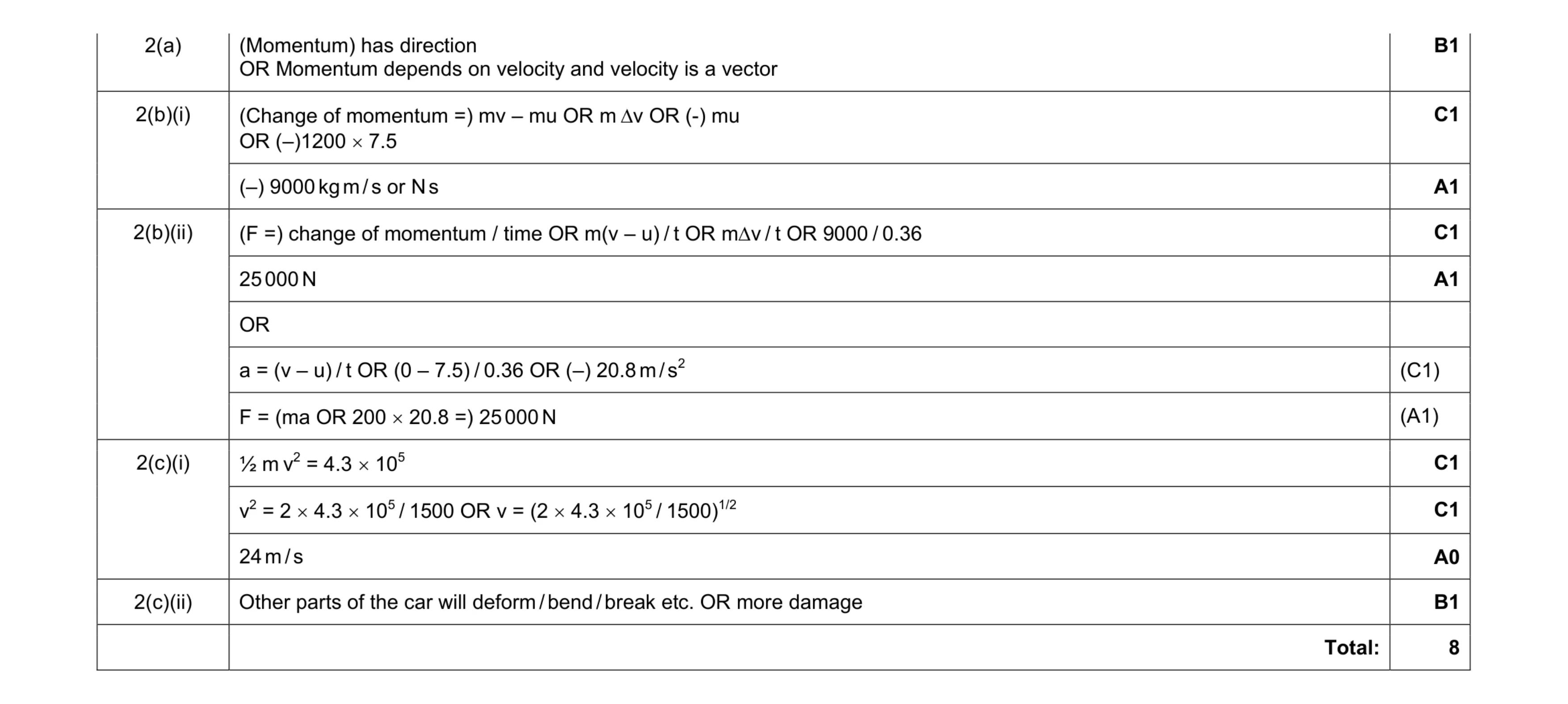
Mark scheme: 2(a) (Momentum) has direction OR Momentum depends on velocity and velocity is a vector B1 2(b)(i) (Change of momentum =) mv – mu OR m ∆v OR (-) mu OR (–)1200 × 7.5 C1 (–) 9000 kg m / s or N s A1 2(b)(ii) (F =) change of momentum / time OR m(v – u) / t OR m∆v / t OR 9000 / 0.36 C1 25 000 N A1 OR a = (v – u) / t OR (0 – 7.5) / 0.36 OR (–) 20.8 m / s2 (C1) F = (ma OR 200 × 20.8 =) 25 000 N (A1) 2(c)(i) ½ m v2 = 4.3 × 10⁵ C1 v2 = 2 × 4.3 × 105 / 1500 OR v = (2 × 4.3 × 105 / 1500)1/2 C1 24 m / s A0 2(c)(ii) Other parts of the car will deform / bend / break etc. OR more damage B1 Total: 8
This question in 0625/42 Feb/March 2017
Q2 · A footballer kicks a ball vertically upwards 0625/41 May/June 2017
2 A footballer kicks a ball vertically upwards. Initially, the ball is stationary. (a) His boot is in contact with the ball for 0.050 s. The average resultant force on the ball during this time is 180 N. The ball leaves his foot at 20 m / s. Calculate (i) the impulse of the force acting on the ball, impulse = … [2] (ii) the mass of the ball, mass = … [2] (iii) the height to which the ball rises. Ignore air resistance. height = … [3] (b) While the boot is in contact with the ball, the ball is no longer spherical. State the word used to describe the energy stored in the ball. … [1] [Total: 8]
8 marks
Mark scheme: 2(a)(i) C1 9.0 Ns OR 9.0 kg m / s A1 2(a)(ii) Ft = m(v – u) OR Ft = mv – mu OR Ft = mv OR (m =) Ft / v OR 9.0 / 20 C1 0.45 kg A1 2(a)(iii) mgh = ½ mv2 OR (h =) v2/ 2 g C1 (h =) 202 / (2 × 10) C1 20 m A1 OR t = v / g = 2 (C1) h = average speed × time (C1) 20 m (A1) 2(b) Elastic (energy) OR strain (energy) B1 Total: 8
This question in 0625/41 May/June 2017
Q3 · State the word equation that defines momentum 0625/43 May/June 2017
2 (a) State the word equation that defines momentum. … [1] (b) A metal block A, travelling in a straight line at 4.0 m / s on a smooth surface, collides with a second metal block B which is at rest. Fig. 2.1 shows the two metal blocks A and B before and after the collision. 3.2 kg 1.6 kg 4.0 m / s at rest before collision A B 1.5 m / s v after collision A B Fig. 2.1 The mass of A is 3.2 kg. The mass of B is 1.6 kg. After the collision, the velocity of A is 1.5 m / s. Calculate (i) the momentum of A before the collision, momentum = … [2] (ii) the velocity v of B after the collision. v = … [3] (c) In the collision that occurred in (b), block A and block B are in contact for 0.050 s. Calculate the average force that is exerted on B during the collision. average force = … [2] (d) After the collision in (b), the total kinetic energy of the two blocks is less than the kinetic energy of block A before the collision. Suggest one reason for this. … … [1] [Total: 9]
9 marks
Mark scheme: 2(a) B1 2(b)(i) (p = )3.2 × 4.0 C1 13 kg m / s A1 2(b)(ii) momentum conserved C1 12.8 – (3.2 × 1.5) OR 12.8 – 4.8 OR 8.0 OR 8.0 ÷ 1.6 C1 5.0 m / s A1 2(c) (F = ) p t ∆ ∆ or 8.0 ÷ 0.050 C1 160 N A1 2(d) internal energy (of blocks) increase OR thermal energy/sound energy (lost/produced at collision) B1 Total: 9
This question in 0625/43 May/June 2017
Q4 · Describe the movement of the molecules in (i) a solid, … … [1] (ii) a gas 0625/41 May/June 2018
4 (a) Describe the movement of the molecules in (i) a solid, … … [1] (ii) a gas. … … [2] (b) A closed box contains gas molecules. Explain, in terms of momentum, how the molecules exert a pressure on the walls of the box. … … … … … … [4] [Total: 7]
7 marks
Mark scheme: 4(a)(i) (Molecules) vibrate 1 4(a)(ii) random/haphazard/in all directions 1 Any one of: with high speed freely zig-zag in straight lines 1 4(b) (Molecules) collide with walls (of box) OR (Molecules) rebound from walls (of box) 1 Change of momentum (occurs) 1 force (on walls) = (total) change of momentum per second 1 Pressure = (total) force ÷ (total) area (of walls) 1
This question in 0625/41 May/June 2018
Q5 · The velocity of an object of mass m increases from u to v 0625/42 Oct/Nov 2018
3 (a) The velocity of an object of mass m increases from u to v. State, in terms of m, u and v, the change of momentum of the object. … [1] (b) In a game of tennis, a player hits a stationary ball with his racquet. (i) The racquet is in contact with the ball for 6.0 ms. The average force on the ball during this time is 400 N. Calculate the impulse on the tennis ball. impulse = … [2] (ii) The mass of the ball is 0.056 kg. Calculate the speed with which the ball leaves the racquet. speed = … [2] (iii) State the energy transfer that takes place: 1. as the ball changes shape during the contact between the racquet and the ball … … 2. as the ball leaves the racquet. … … [2] [Total: 7]
7 marks
Mark scheme: 3(a) mv – mu or mu – mv in any form B1 3(b)(i) (impulse =) Ft in any form C1 (impulse =) 2.4 N s A1 3(b)(ii) Ft = mv – mu in any form OR (v – u =) Ft / m C1 43 m / s A1 3(b)(iii) 1 kinetic energy (of racquet) to elastic / strain energy (in ball or strings) B1 2. elastic / strain energy (in ball or strings) to kinetic energy (of ball) B1
This question in 0625/42 Oct/Nov 2018
Question 6 0625/43 Oct/Nov 2018
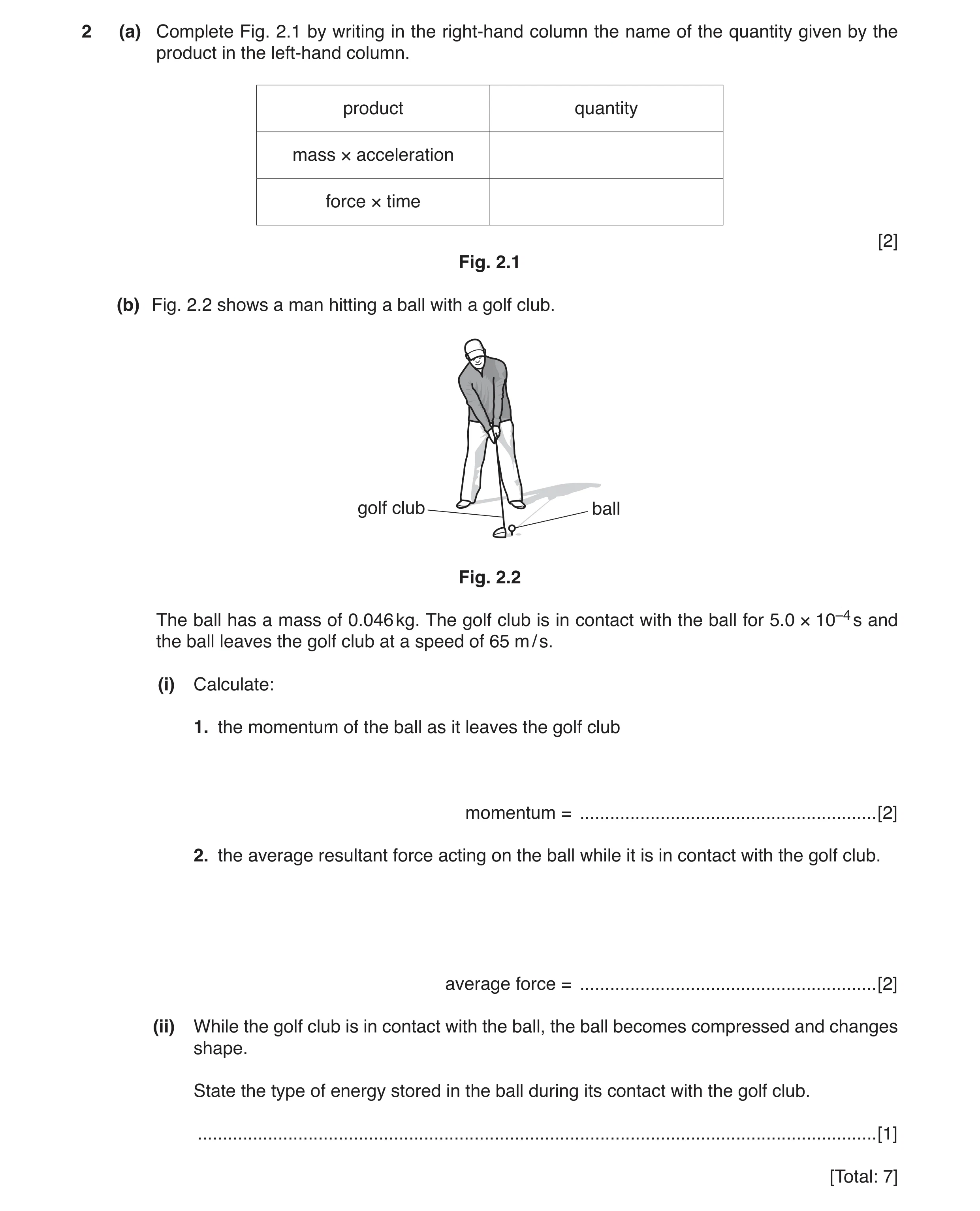
2 (a) Complete Fig. 2.1 by writing in the right-hand column the name of the quantity given by the product in the left-hand column. product quantity mass × acceleration force × time [2] Fig. 2.1 (b) Fig. 2.2 shows a man hitting a ball with a golf club. golf club ball Fig. 2.2 The ball has a mass of 0.046 kg. The golf club is in contact with the ball for 5.0 × 10⁻⁴ s and the ball leaves the golf club at a speed of 65 m / s. (i) Calculate: 1. the momentum of the ball as it leaves the golf club momentum = … [2] 2. the average resultant force acting on the ball while it is in contact with the golf club. average force = … [2] (ii) While the golf club is in contact with the ball, the ball becomes compressed and changes shape. State the type of energy stored in the ball during its contact with the golf club. … [1] [Total: 7]
7 marks
Mark scheme: 2(a) 1st box: force B1 2nd box: impulse B1 2(b)(i) 1 (p =) mv or 0.046 × 65 C1 3.0 kg m / s or 3.0 N s A1 2 (F =) m(v – u) / t or 3.0 / 0.00050 or a = (v – u) / t and F = ma or 0.046 × 65 / 0.00050 or 0.046 × 130 000 C1 6000 N or 6000 N A1 2(b)(ii) elastic (energy) or strain (energy) B1
This question in 0625/43 Oct/Nov 2018
Q7 · A rocket is stationary on the launchpad 0625/41 May/June 2019
1 A rocket is stationary on the launchpad. At time t = 0, the rocket engines are switched on and exhaust gases are ejected from the nozzles of the engines. The rocket accelerates upwards. Fig. 1.1 shows how the acceleration of the rocket varies between time t = 0 and time t = tf. acceleration 0 0 tf time t Fig. 1.1 (a) Define acceleration. … … [1] (b) On Fig. 1.2, sketch a graph to show how the speed of the rocket varies between time t = 0 and time t = tf. speed 0 0 tf time t Fig. 1.2 [3] (c) Some time later, the rocket is far from the Earth. The effect of the Earth’s gravity on the motion of the rocket is insignificant. As the rocket accelerates, its momentum increases. (i) State the principle of the conservation of momentum. … … … [2] (ii) Explain how the principle of the conservation of momentum applies to the accelerating rocket and the exhaust gases. … … … … [2] [Total: 8]
8 marks
Mark scheme: 1(a) change of velocity per unit time OR v u t B1 1(b) line starts at origin and is asymptotic to x-axis B1 increasing gradient initially and no decrease B1 constant and clearly positive gradient finally B1 1(c)(i) no external forces OR isolated system B1 sum of momenta / (total) momentum remains constant B1 1(c)(ii) rocket gains (upward) momentum B1 (ejected) gas gains equal (quantity of) momentum in opposite direction OR momentum of gas decreases by equal amount B1
This question in 0625/41 May/June 2019
Q8 · A model fire engine 0625/42 May/June 2019
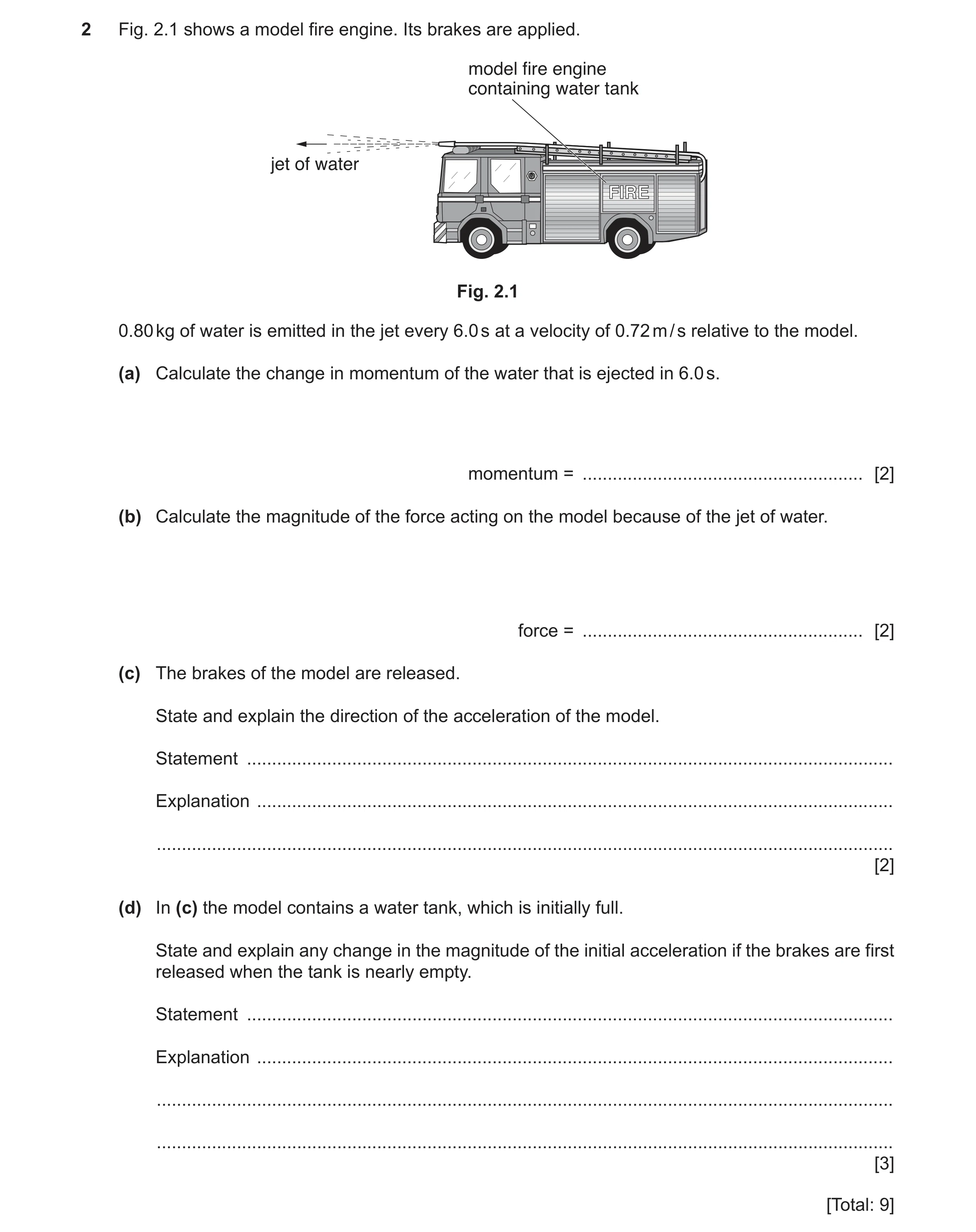
2 Fig. 2.1 shows a model fire engine. Its brakes are applied. model fire engine containing water tank jet of water FIRE Fig. 2.1 0.80 kg of water is emitted in the jet every 6.0 s at a velocity of 0.72 m / s relative to the model. (a) Calculate the change in momentum of the water that is ejected in 6.0 s. momentum = … [2] (b) Calculate the magnitude of the force acting on the model because of the jet of water. force = … [2] (c) The brakes of the model are released. State and explain the direction of the acceleration of the model. Statement … Explanation … … [2] (d) In (c) the model contains a water tank, which is initially full. State and explain any change in the magnitude of the initial acceleration if the brakes are first released when the tank is nearly empty. Statement … Explanation … … … [3] [Total: 9]
9 marks
Mark scheme: 2(a) C1 (∆p= ) 0.58 kg m/s A1 2(b) Ft= ∆p in any form OR (F=) ∆p/t OR 0.58/6 B1 (F=) 0.096 N accept rounding if 0.096 seen B1 Question Answer Marks 2(c) Statement: (acceleration is) to right/backward B1 Explanation: force (from water OR on model) to right /backwards OR acceleration in same direction as force (from water OR on model) B1 2(d) (acceleration) more (when empty) B1 mass less (and force is constant) B1 meaningful reference to F=ma / Newton’s 2nd law / change in momentum B1
This question in 0625/42 May/June 2019
Q9 · The top view of a small ship of mass 1.2 × 10⁶ kg 0625/43 May/June 2019
2 Fig. 2.1 is the top view of a small ship of mass 1.2 × 10⁶ kg. The ship is moving slowly sideways at 0.040 m / s as it comes in to dock. large wooden pillars dock wall small ship 0.040 m / s Fig. 2.1 The ship hits the wooden pillars which move towards the dock wall. (a) Calculate the kinetic energy of the ship before it hits the pillars. kinetic energy = … [2] (b) The ship is in contact with the pillars for 0.30 s as it comes to rest. Calculate the average force exerted on the side of the ship. force = … [4] (c) Assume that the kinetic energy calculated in (a) is used to do work moving the pillars. Calculate the distance moved by the pillars. distance = … [2] (d) Dock walls sometimes have the pillars replaced with rubber car tyres. Explain how this reduces the possibility of damage when a boat docks. … … … [1] [Total: 9]
9 marks
Mark scheme: 2(a) C1 (KE = ) 960 J A1 Question Answer Marks 2(b) EITHER (change in momentum) = mv OR (change in momentum) = 1.2 × 106 × 0.04 C1 (=) 4.8 × 10⁴ (kg m/s) C1 change in momentum = Ft in any form C1 (Force = 4.8 × 10⁴ / 0.3 =) 1.6 × 10⁵ N A1 OR a = (v-u)/t = 0.04/0.3 (C1) = 0.13 (m/s2) (C1) F = ma (C1) (Force = 1.2 × 106 × 0.13 = ) 1.6 × 10⁵ N (A1) 2(c) Work done or KE transferred = Fd in any form C1 (distance = 960 / 1.6 × 105 =) 6 .0 × 10–3 m OR 0.006 m OR 0.60 cm A1 2(d) smaller force (on dock/ship) because increases time of collision OR increased distance of collision (on the dock/ship) B1
This question in 0625/43 May/June 2019
Q10 · A shooting competition, where air rifles fire soft metal pellets at distant targets 0625/41 Oct/Nov 2019
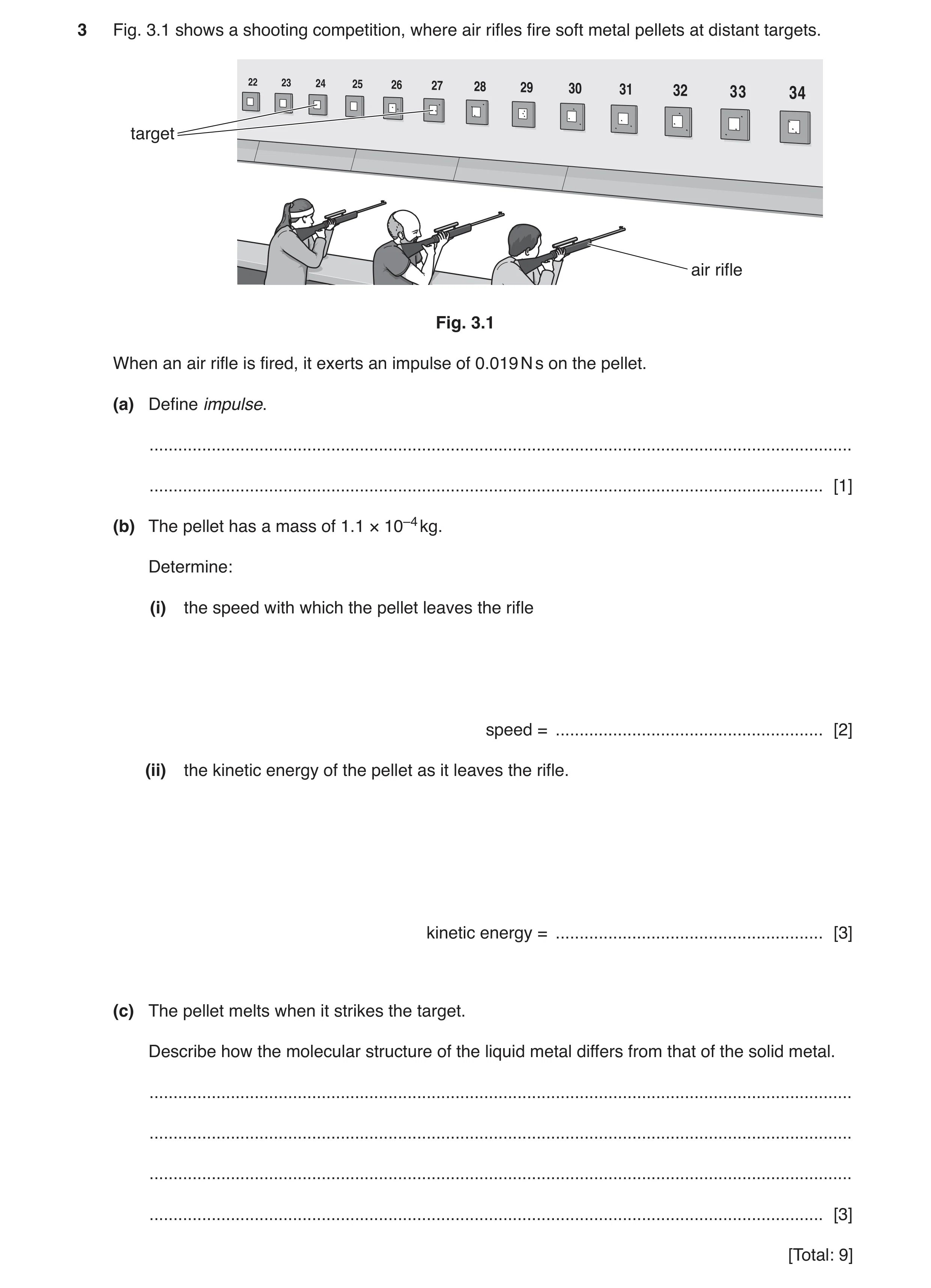
3 Fig. 3.1 shows a shooting competition, where air rifles fire soft metal pellets at distant targets. target air rifle Fig. 3.1 When an air rifle is fired, it exerts an impulse of 0.019 N s on the pellet. (a) Define impulse. … … [1] (b) The pellet has a mass of 1.1 × 10⁻⁴ kg. Determine: (i) the speed with which the pellet leaves the rifle speed = … [2] (ii) the kinetic energy of the pellet as it leaves the rifle. kinetic energy = … [3] (c) The pellet melts when it strikes the target. Describe how the molecular structure of the liquid metal differs from that of the solid metal. … … … … [3] [Total: 9]
9 marks
Mark scheme: 3(a) B1 3(b)(i) v = I / m or 0.019 / 0.00011 in any form words, symbols or numbers or (v =) I / m 170 m / s C1 A1 3(b)(ii) KE = ½mv2 in any form words, symbols or numbers or (KE =) ½mv2 0.50 × 0.00011 × 1702 1.6 J or 1.7 J C1 C1 A1 3(c) accept reverse comments if clearly about how the molecular structure of a solid differs from that of a liquid (molecules / they) have an irregular arrangement / not ordered / random arrangement (molecules / they) are (slightly) further apart (on average) (molecules / they are) not fixed in place B1 B1 B1
This question in 0625/41 Oct/Nov 2019
Q11 · An athlete crossing the finishing line in a race 0625/42 Feb/March 2020
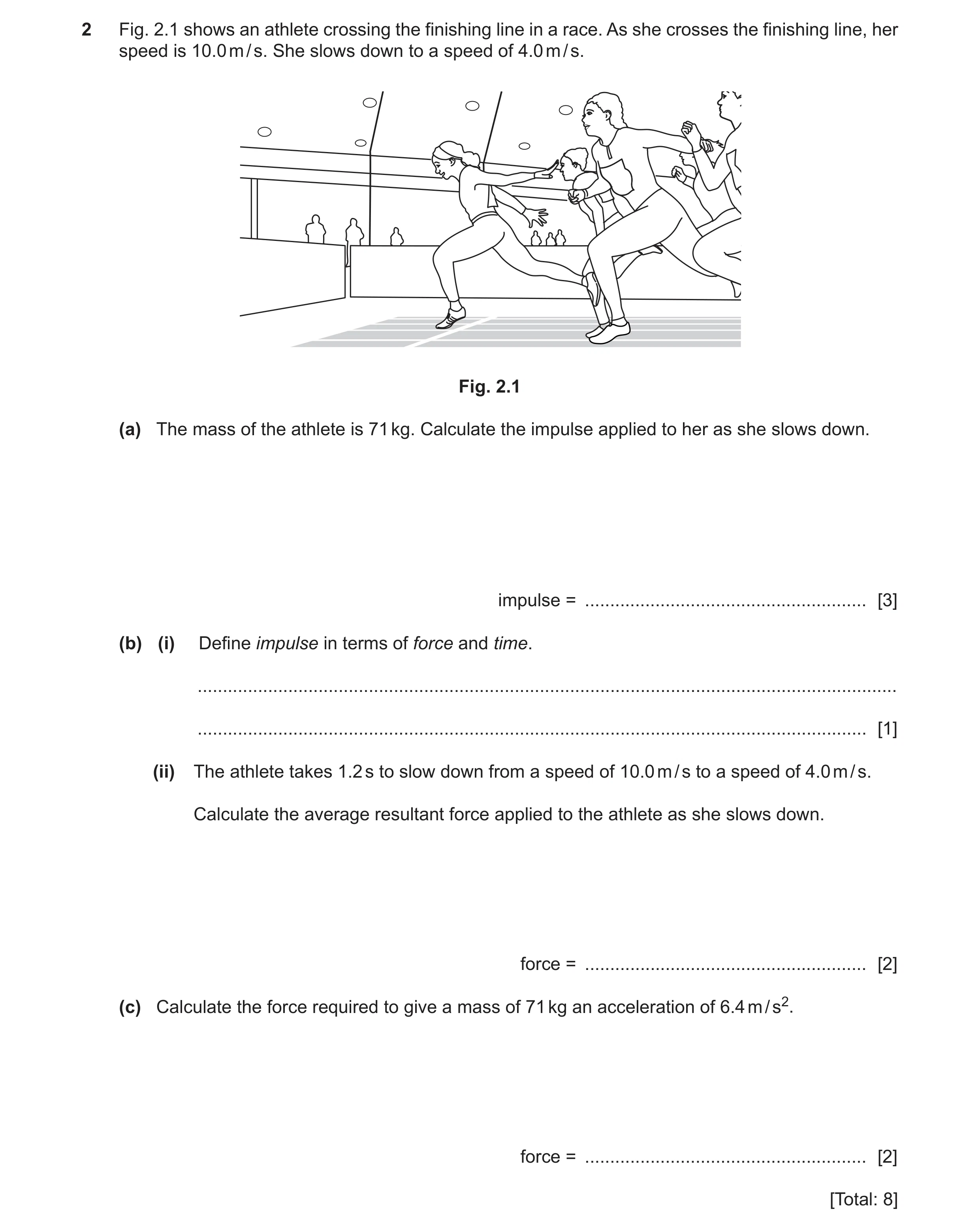
2 Fig. 2.1 shows an athlete crossing the finishing line in a race. As she crosses the finishing line, her speed is 10.0 m / s. She slows down to a speed of 4.0 m / s. Fig. 2.1 (a) The mass of the athlete is 71 kg. Calculate the impulse applied to her as she slows down. impulse = … [3] (b) (i) Define impulse in terms of force and time. … … [1] (ii) The athlete takes 1.2 s to slow down from a speed of 10.0 m / s to a speed of 4.0 m / s. Calculate the average resultant force applied to the athlete as she slows down. force = … [2] (c) Calculate the force required to give a mass of 71 kg an acceleration of 6.4 m / s2. force = … [2] [Total: 8]
8 marks
Mark scheme: 2(a) (impulse =) change of momentum C1 (impulse =) 71(10 – 4) C1 (impulse =) 430 N s A1 2(b)(i) (impulse =) force × time B1 2(b)(ii) (av F =) impulse / time (= 430 / 1.2) C1 (av F =) 360 N A1 2(c) F= ma in any form OR (F =) ma OR 71 × 6.4 C1 (F=) 450 N A1
This question in 0625/42 Feb/March 2020
Q12 · An aeroplane of mass 2.5 × 10⁵ kg lands with a speed of 62 m / s, on a horizontal runway… 0625/41 May/June 2020
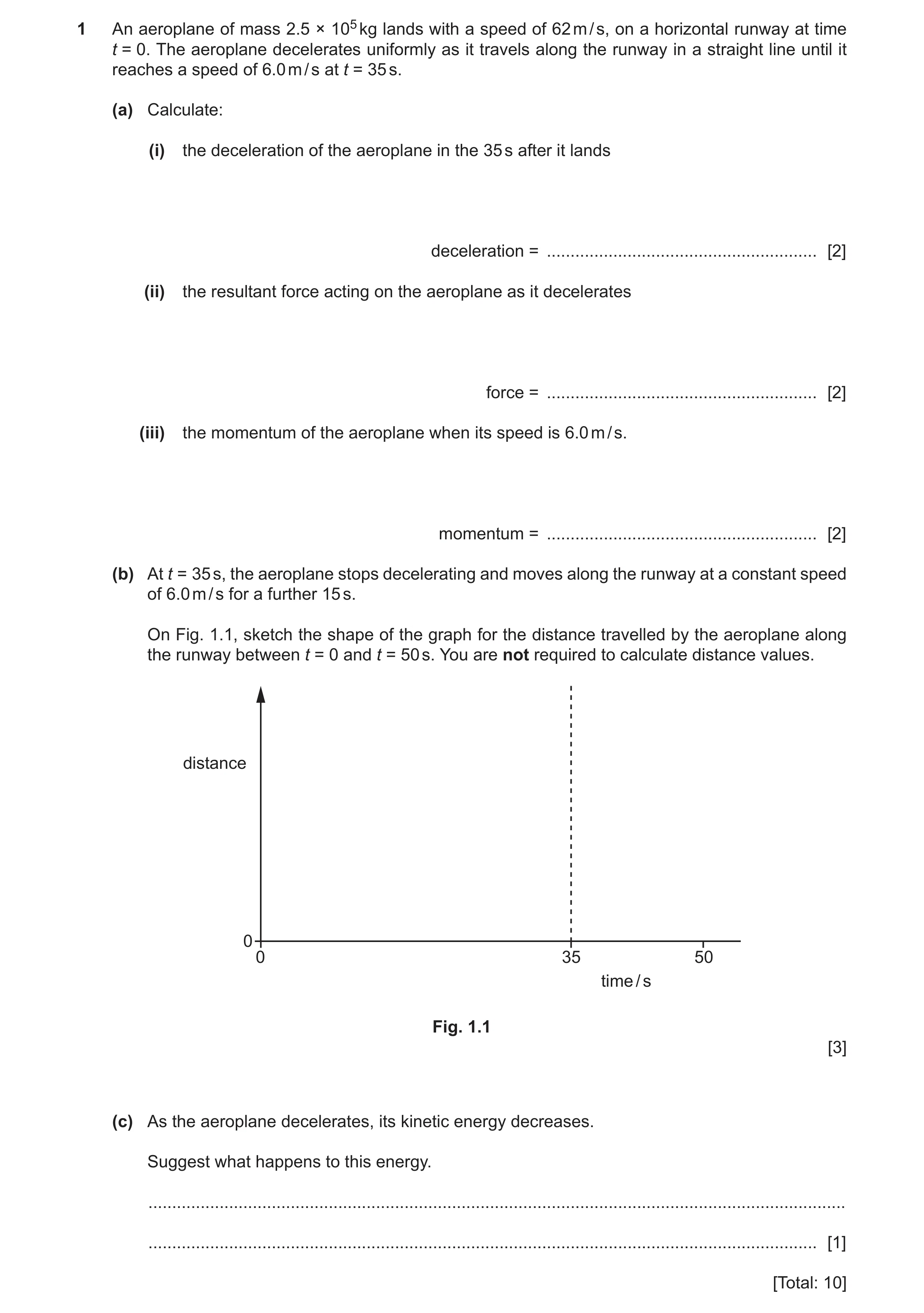
1 An aeroplane of mass 2.5 × 10⁵ kg lands with a speed of 62 m / s, on a horizontal runway at time t = 0. The aeroplane decelerates uniformly as it travels along the runway in a straight line until it reaches a speed of 6.0 m / s at t = 35 s. (a) Calculate: (i) the deceleration of the aeroplane in the 35 s after it lands deceleration = … [2] (ii) the resultant force acting on the aeroplane as it decelerates force = … [2] (iii) the momentum of the aeroplane when its speed is 6.0 m / s. momentum = … [2] (b) At t = 35 s, the aeroplane stops decelerating and moves along the runway at a constant speed of 6.0 m / s for a further 15 s. On Fig. 1.1, sketch the shape of the graph for the distance travelled by the aeroplane along the runway between t = 0 and t = 50 s. You are not required to calculate distance values. distance 0 0 35 50 time / s Fig. 1.1 [3] (c) As the aeroplane decelerates, its kinetic energy decreases. Suggest what happens to this energy. … … [1] [Total: 10]
10 marks
Mark scheme: 1(a)(i) (a =) (v – u) / t OR (62 – 6.0) / 35 OR 56 / 35 C1 1.6 m / s2 A1 1(a)(ii) (F =) ma OR Δp / Δt OR 2.5 × 105 × 1.6 OR (62 × 2.5 × 105 – 6.0 × 2.5 × 105) / 35 C1 4.0 × 10⁵ N A1 1(a)(iii) (p =) mv OR 2.5 × 105 × 6.0 C1 1.5 × 10⁶ kg m / s A1 1(b) curve of decreasing gradient from (0,0) to a point along dashed line B1 straight line of positive gradient after t = 35 s B1 gradient not zero at t = 35 s OR no change of gradient (at t = 35 s) B1 1(c) thermal energy AND in something specific (e.g. brakes / air / tyres) OR kinetic energy of air B1
This question in 0625/41 May/June 2020
Question 13 0625/42 May/June 2020
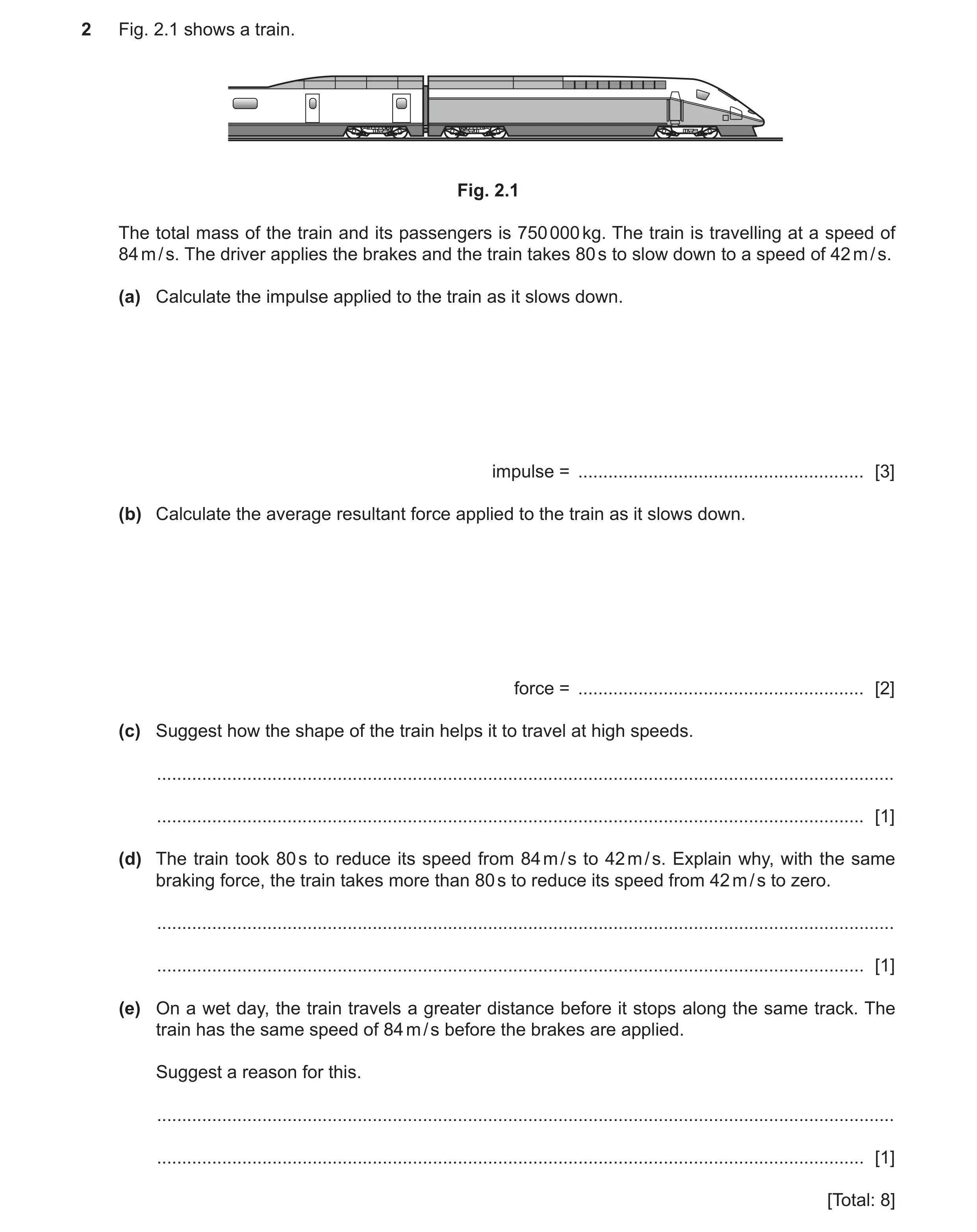
2 Fig. 2.1 shows a train. Fig. 2.1 The total mass of the train and its passengers is 750 000 kg. The train is travelling at a speed of 84 m / s. The driver applies the brakes and the train takes 80 s to slow down to a speed of 42 m / s. (a) Calculate the impulse applied to the train as it slows down. impulse = … [3] (b) Calculate the average resultant force applied to the train as it slows down. force = … [2] (c) Suggest how the shape of the train helps it to travel at high speeds. … … [1] (d) The train took 80 s to reduce its speed from 84 m / s to 42 m / s. Explain why, with the same braking force, the train takes more than 80 s to reduce its speed from 42 m / s to zero. … … [1] (e) On a wet day, the train travels a greater distance before it stops along the same track. The train has the same speed of 84 m / s before the brakes are applied. Suggest a reason for this. … … [1] [Total: 8]
8 marks
Mark scheme: 2(a) impulse OR Δp = m(v – u) in any form C1 (impulse =) 750 000 (84 – 42) C1 (impulse =) 3.2 × 10⁷ N s or m kg / s A1 2(b) Ft = impulse OR Δp in any form OR (F =) (impulse OR Δp) / t C1 (F = 3.2 x 10⁷ / 80 =) 3.9 ×10⁵ N A1 2(c) reduces drag / air resistance (experienced by the train) / more streamlined B1 2(d) less drag / air resistance (at slower speeds) B1 2(e) (maximum) friction (force) between rails and train reduced / train may slide B1
This question in 0625/42 May/June 2020
Q14 · An ice-hockey player moving on ice 0625/41 Oct/Nov 2020
1 Fig. 1.1 shows an ice-hockey player moving on ice. He is preparing to hit the solid disc called a puck. ice-hockey player ice hockey stick disc Fig. 1.1 The disc of mass 0.16 kg is moving horizontally across the surface of the ice at a speed of 15 m / s. (a) Calculate the magnitude of the momentum of the disc. magnitude of momentum = … [2] (b) The hockey player strikes the disc with his hockey stick and the momentum of the disc changes. The disc gains momentum of 3.0 kg m / s at 45° to the original direction of travel of the disc, as shown in Fig. 1.2. direction of disc momentum gained 45° original direction of travel Fig. 1.2 (view from above) (i) State the magnitude of the impulse exerted on the disc and the direction, in degrees, of the impulse relative to the original direction of travel. magnitude of impulse = … direction of impulse: … ° to original direction [1] (ii) Determine the magnitude of the new momentum of the disc and its new direction relative to the original direction of travel by drawing a scale diagram. magnitude of new momentum = … direction of new momentum: … ° to original direction [4] [Total: 7]
7 marks
Mark scheme: 1(a) (p =) mv (in any form) or 0.16 × 15 C1 2.4 kg m / s A1 1(b)(i) 3.0 N s and at 45° to the original direction B1 1(b)(ii) vector triangle / parallelogram, e.g.: B1 scale indicated or correct triangle / parallelogram B1 4.8 kg m / s ⩽ magnitude ⩽ 5.2 kg m / s B1 22° (to original direction) ⩽ direction ⩽ 28°(to original direction) B1
This question in 0625/41 Oct/Nov 2020
Q15 · A cliff edge with water below it 0625/43 Oct/Nov 2020
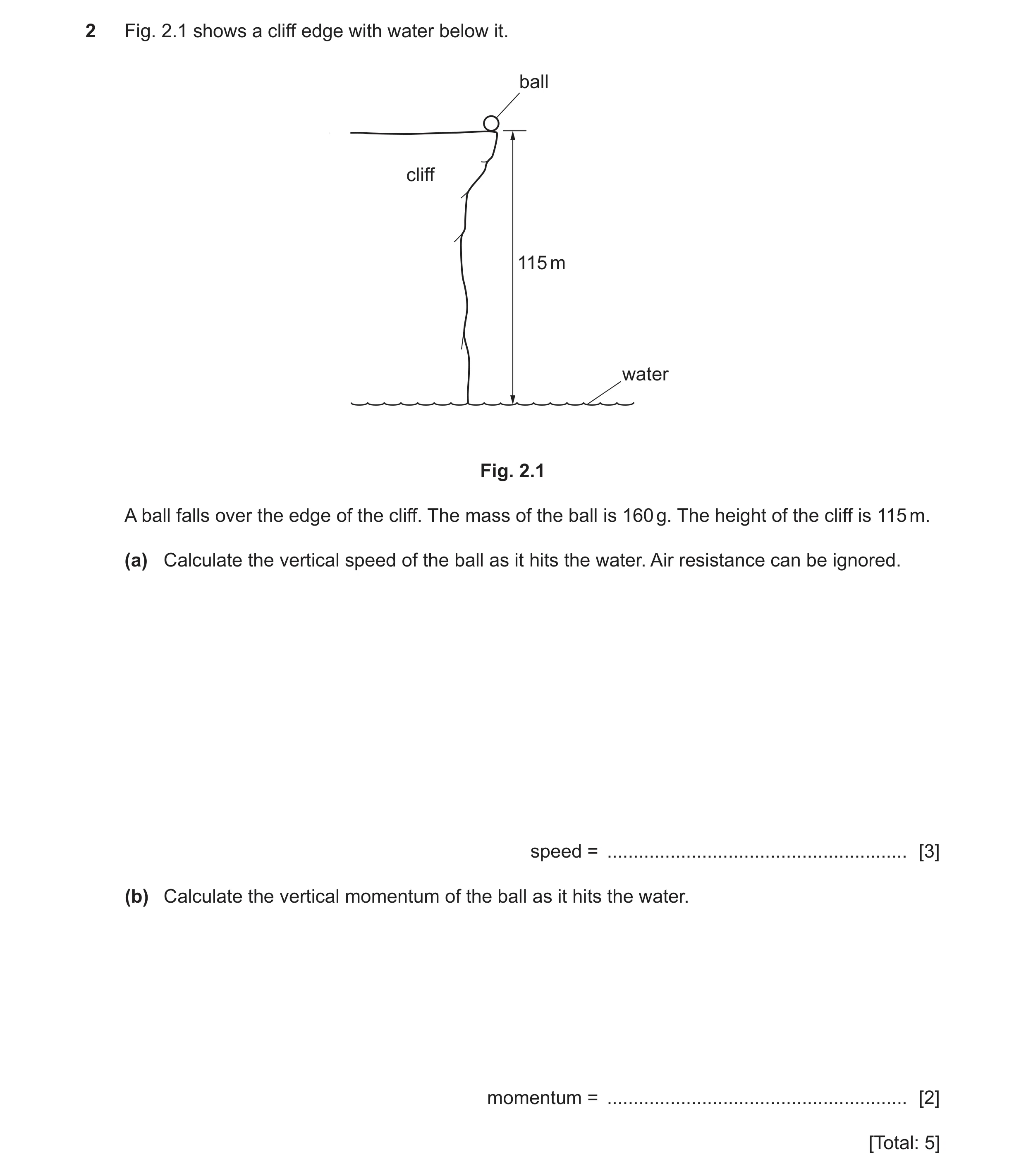
2 Fig. 2.1 shows a cliff edge with water below it. ball cliff 115 m water Fig. 2.1 A ball falls over the edge of the cliff. The mass of the ball is 160 g. The height of the cliff is 115 m. (a) Calculate the vertical speed of the ball as it hits the water. Air resistance can be ignored. speed = … [3] (b) Calculate the vertical momentum of the ball as it hits the water. momentum = … [2] [Total: 5]
5 marks
Mark scheme: 2(a) PE lost = KE gained, in any form C1 v2 = 2gh or 0.16 × 10 × 115 = 0.5 × 0.16 × v2 C1 (speed =) 48 m / s A1 2(b) momentum = mv C1 (momentum=) 7.7 kg m / s or 7.7 N s A1
This question in 0625/43 Oct/Nov 2020
Q16 · A wooden trolley of mass 1.2 kg at rest on the rough surface of a bench 0625/41 May/June 2021
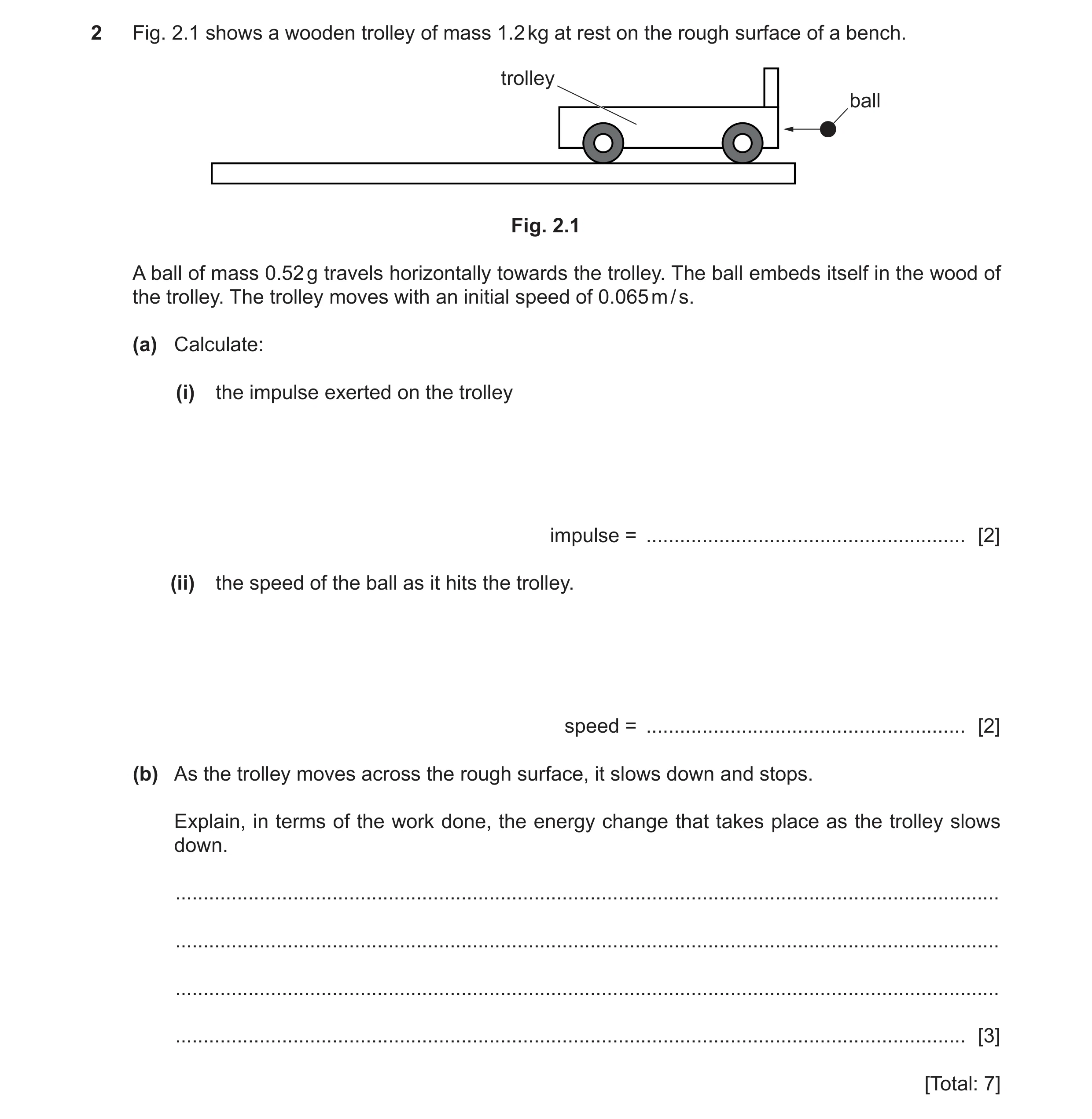
2 Fig. 2.1 shows a wooden trolley of mass 1.2 kg at rest on the rough surface of a bench. trolley ball Fig. 2.1 A ball of mass 0.52 g travels horizontally towards the trolley. The ball embeds itself in the wood of the trolley. The trolley moves with an initial speed of 0.065 m / s. (a) Calculate: (i) the impulse exerted on the trolley impulse = … [2] (ii) the speed of the ball as it hits the trolley. speed = … [2] (b) As the trolley moves across the rough surface, it slows down and stops. Explain, in terms of the work done, the energy change that takes place as the trolley slows down. … … … … [3] [Total: 7]
7 marks
Mark scheme: 2(a)(i) 0.078 N s or 0.078 kg m / s A2 (I =) mt(Δ)vt in any form or 1.2 × 0.065 C1 2(a)(ii) 150 m / s A2 vb = (mt + vt) / mb in any form or initial momentum = final momentum or 1.2(0052) × 0.065 / 0.00052 or 0.078(0338) / 0.00052 C1 2(b) work done against / due to / because of friction or kinetic energy (of trolley) used to do work B1 kinetic energy decreases (to zero) B1 thermal energy produced B1
This question in 0625/41 May/June 2021
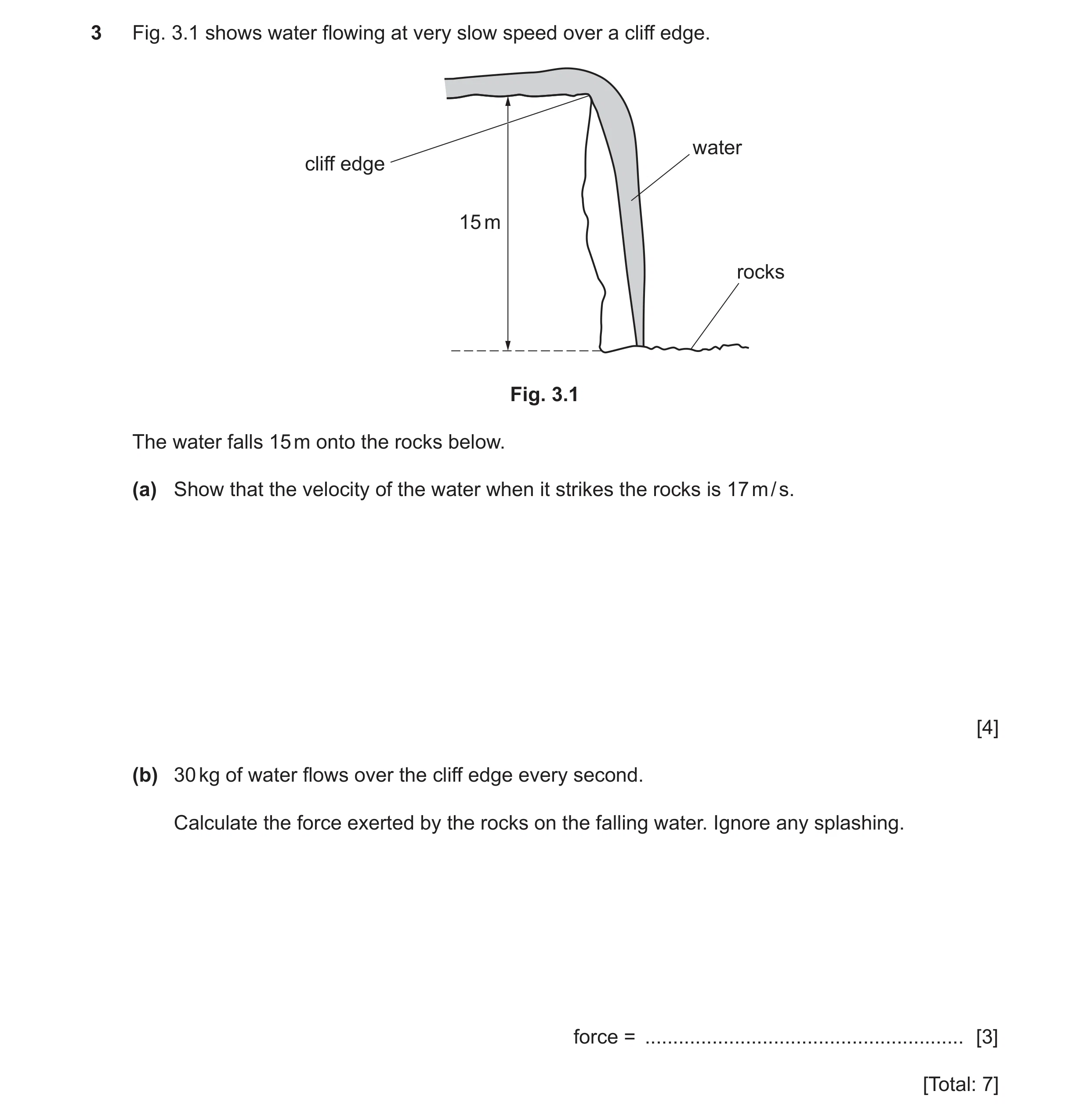
Q17 · Water flowing at very slow speed over a cliff edge 0625/42 May/June 2021
3 Fig. 3.1 shows water flowing at very slow speed over a cliff edge. water cliff edge 15 m rocks Fig. 3.1 The water falls 15 m onto the rocks below. (a) Show that the velocity of the water when it strikes the rocks is 17 m / s. [4] (b) 30 kg of water flows over the cliff edge every second. Calculate the force exerted by the rocks on the falling water. Ignore any splashing. force = … [3] [Total: 7]
7 marks
Mark scheme: 3(a) (PE loss =) mgh AND (KE gain =) ½ mv2 B1 PE (loss) = KE (gain) B1 alternative route 1 for 1st two m.p.s v2 = u2 + 2as (B1) u = 0 (B1) alternative route 2 for 1st two m.p.s s = ut + 0.5at2 OR h = 0.5gt2 (B1) u = 0 AND t = √3 OR 1.73 (B1) v2 (= 2gh) = 2 × 10 × 15 OR v2 = 300 OR v = 10√3 OR v = 10 × 1.73 B1 {v = 17 m / s AND v2 = 300 or v = 10√3} OR v = 17.3(2) m / s B1 Question Answer Marks 3(b) (F =) change of p / (change of) time OR rate of change of momentum C1 (F =) 30 × 17.32 C1 (F =) 520 N A1
This question in 0625/42 May/June 2021
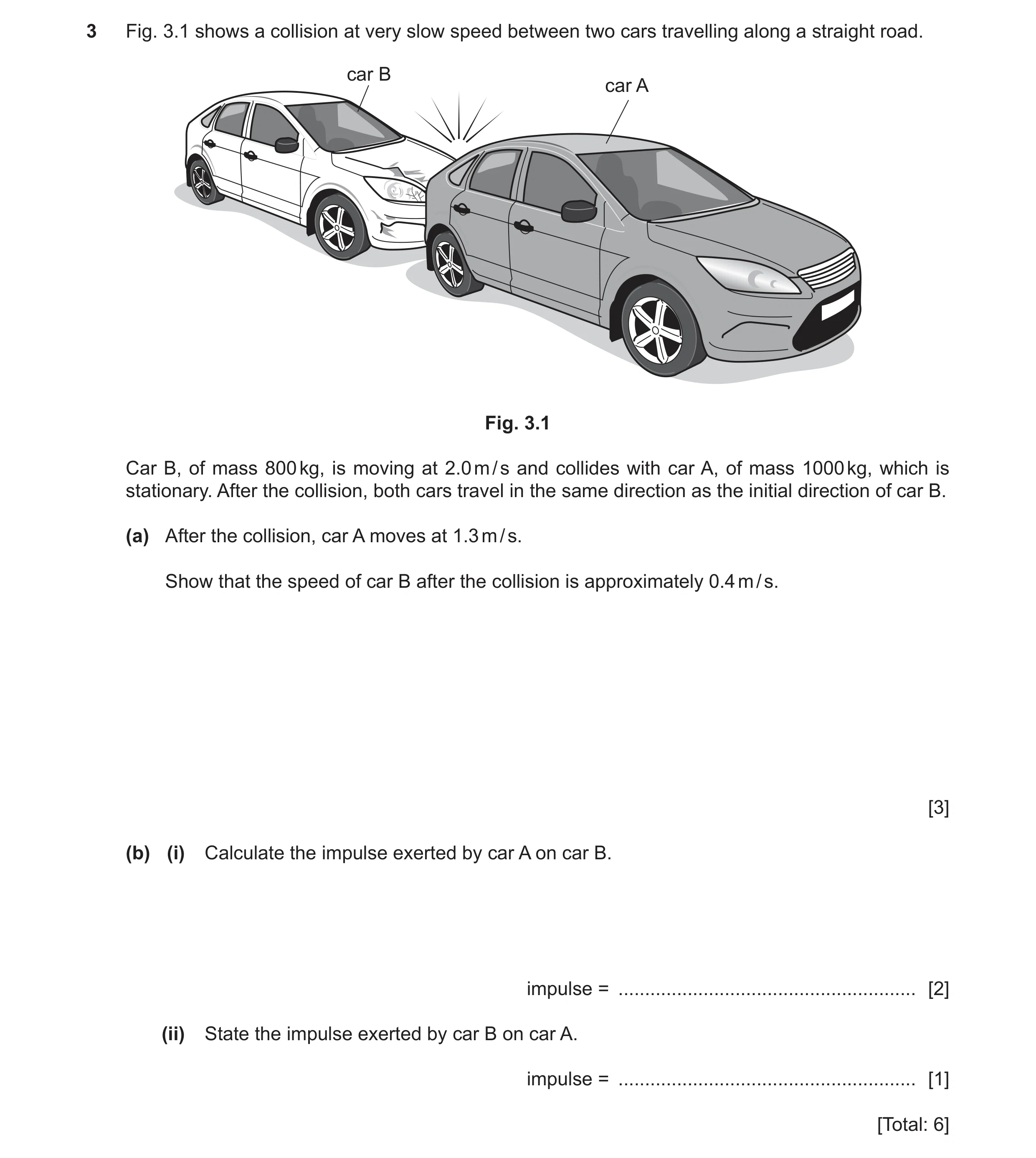
Q18 · A collision at very slow speed between two cars travelling along a straight road 0625/42 Oct/Nov 2021
3 Fig. 3.1 shows a collision at very slow speed between two cars travelling along a straight road. car B car A Fig. 3.1 Car B, of mass 800 kg, is moving at 2.0 m / s and collides with car A, of mass 1000 kg, which is stationary. After the collision, both cars travel in the same direction as the initial direction of car B. (a) After the collision, car A moves at 1.3 m / s. Show that the speed of car B after the collision is approximately 0.4 m / s. [3] (b) (i) Calculate the impulse exerted by car A on car B. impulse = … [2] (ii) State the impulse exerted by car B on car A. impulse = … [1] [Total: 6]
6 marks
Mark scheme: 3(a) momentum before collision = momentum after collision B1 (initial momentum (p) =) 800 × 2 OR 1600 (kg m / s) B1 (v =) (1600 – 1300) / 800 OR 300 / 800 OR 0.38 (m / s) B1 3(b)(i) (impulse =) change in momentum C1 1300 Ns A1 3(b)(ii) same value as (b)(i) OR 1300 (Ns) B1
This question in 0625/42 Oct/Nov 2021
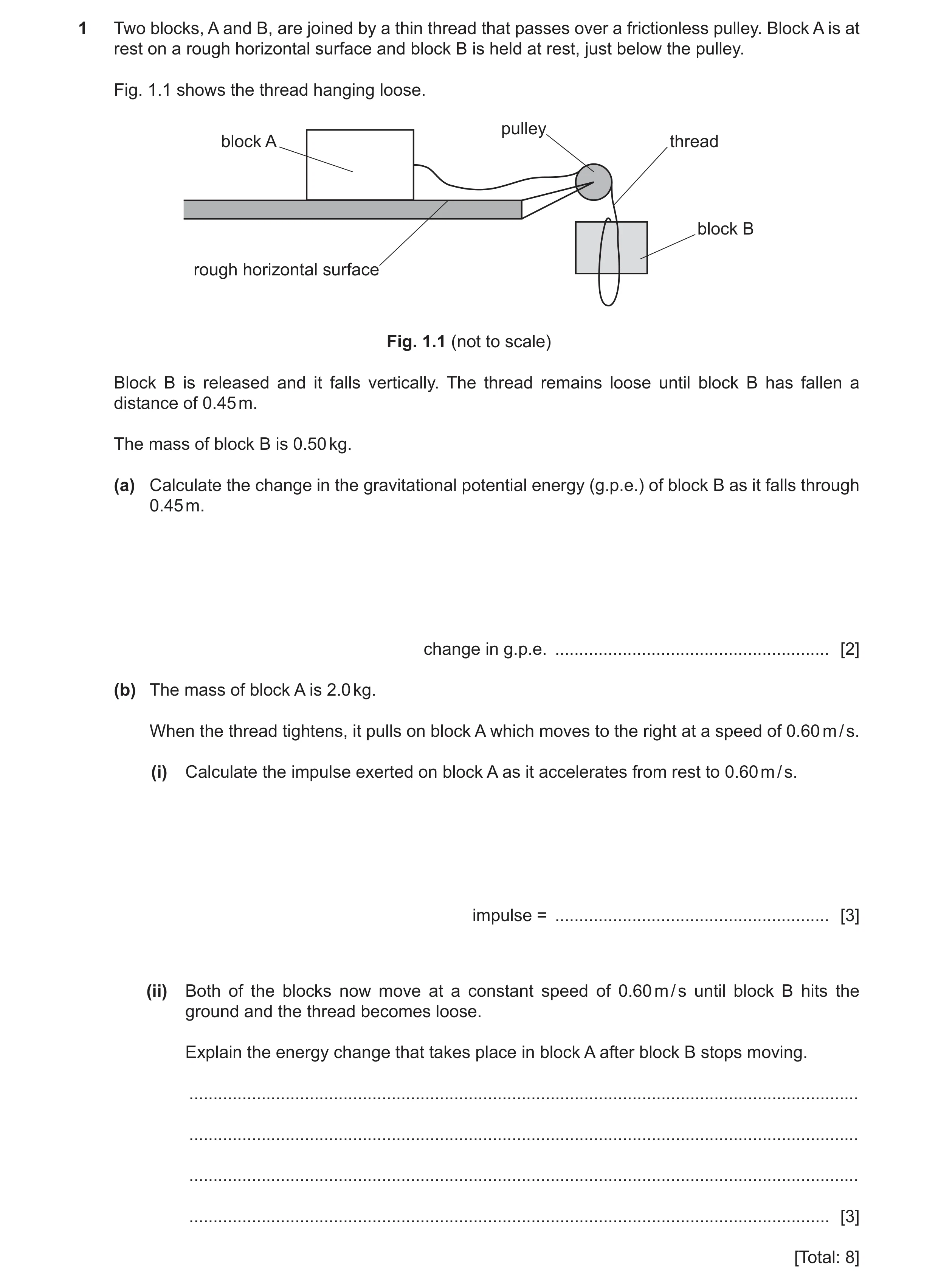
Q19 · Two blocks, A and B, are joined by a thin thread that passes over a frictionless pulley 0625/41 Oct/Nov 2022
1 Two blocks, A and B, are joined by a thin thread that passes over a frictionless pulley. Block A is at rest on a rough horizontal surface and block B is held at rest, just below the pulley. Fig. 1.1 shows the thread hanging loose. pulley block A thread block B rough horizontal surface Fig. 1.1 (not to scale) Block B is released and it falls vertically. The thread remains loose until block B has fallen a distance of 0.45 m. The mass of block B is 0.50 kg. (a) Calculate the change in the gravitational potential energy (g.p.e.) of block B as it falls through 0.45 m. change in g.p.e. … [2] (b) The mass of block A is 2.0 kg. When the thread tightens, it pulls on block A which moves to the right at a speed of 0.60 m / s. (i) Calculate the impulse exerted on block A as it accelerates from rest to 0.60 m / s. impulse = … [3] (ii) Both of the blocks now move at a constant speed of 0.60 m / s until block B hits the ground and the thread becomes loose. Explain the energy change that takes place in block A after block B stops moving. … … … … [3] [Total: 8]
8 marks
Mark scheme: Question Answer Marks 1(a) 2.3 J A2 g.p.e. = mgh in any form or 0.50 10 0.45 C1 1(b)(i) 1.2 N s A3 impulse = change in momentum or 2.0 0.60 C1 I = mv in any form or 2.0 0.60 C1 1(b)(ii) B3 kinetic energy (of block A) decreases B1 thermal / internal energy produced / increases (due to friction) B1 friction mentioned or block slows down / decelerates B1
This question in 0625/41 Oct/Nov 2022
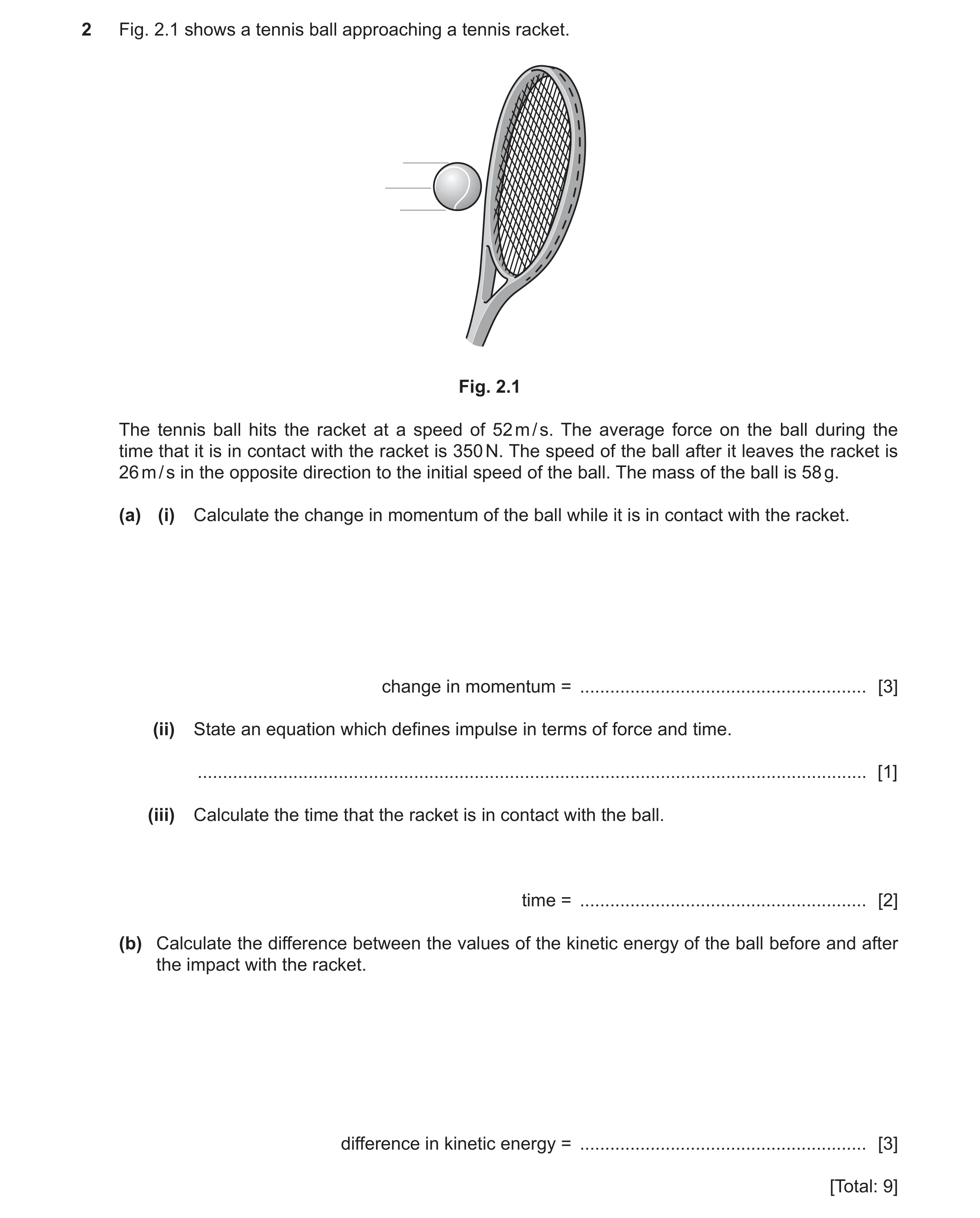
Q20 · A tennis ball approaching a tennis racket 0625/43 Oct/Nov 2022
2 Fig. 2.1 shows a tennis ball approaching a tennis racket. Fig. 2.1 The tennis ball hits the racket at a speed of 52 m / s. The average force on the ball during the time that it is in contact with the racket is 350 N. The speed of the ball after it leaves the racket is 26 m / s in the opposite direction to the initial speed of the ball. The mass of the ball is 58 g. (a) (i) Calculate the change in momentum of the ball while it is in contact with the racket. change in momentum = … [3] (ii) State an equation which defines impulse in terms of force and time. … [1] (iii) Calculate the time that the racket is in contact with the ball. time = … [2] (b) Calculate the difference between the values of the kinetic energy of the ball before and after the impact with the racket. difference in kinetic energy = … [3] [Total: 9]
9 marks
Mark scheme: 2(a)(i) 4.5 kg m / s A3 p = mv OR (change in momentum =) mv – mu C1 (change in momentum =) ( 0.058 52 ) −−( 0.058 26 ) OR ( 0.058 52 ) + ( 0.058 26 ) OR ( 0.058 − 26 ) − ( 0.058 52 ) C1 2(a)(ii) (impulse =) force time OR (impulse =) Ft B1 2(a)(iii) 0.013 s A2 (t =) change in momentum / F OR (t =) m(v–u) / F OR (t =) p / F C1 OR 4.5 / 350 2(b) 59 J A3 KE = ½mv2 OR (KE =) ½mv2 C1 (change in KE) = ½ 0.058 522 – ½ 0.058 262 OR ½ 0.058 262 – ½ 0.058 522 C1
This question in 0625/43 Oct/Nov 2022
Q21 · A student catches a cricket ball 0625/42 May/June 2023
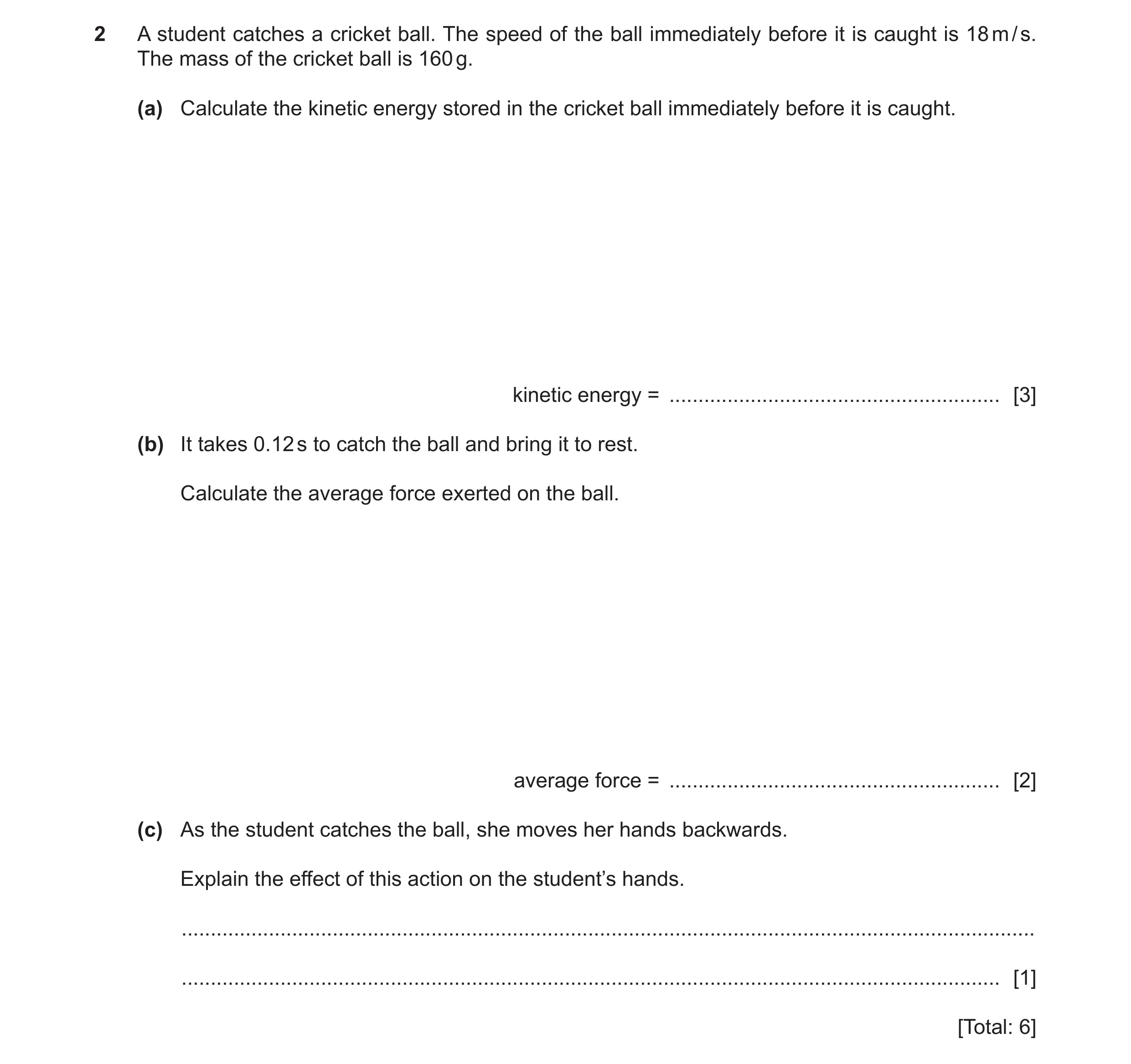
2 A student catches a cricket ball. The speed of the ball immediately before it is caught is 18 m / s. The mass of the cricket ball is 160 g. (a) Calculate the kinetic energy stored in the cricket ball immediately before it is caught. kinetic energy = … [3] (b) It takes 0.12 s to catch the ball and bring it to rest. Calculate the average force exerted on the ball. average force = … [2] (c) As the student catches the ball, she moves her hands backwards. Explain the effect of this action on the student’s hands. … … [1] [Total: 6]
6 marks
Mark scheme: 2(a) 26 J A3 EK = ½mv2 OR (EK =) ½mv2 OR (EK =) ½ 0.16 (18)2 C1 (EK =) ½ 0.16 (18)2 OR (EK =) ½ 0.16 324 OR (EK =) 2.6 10N C1 Question Answer Marks 2(b) 24 N A2 Ft = ∆mv OR F = ma OR (F =) (0.16 18) / 0.12 C1 2(c) longer time (of impact / contact) AND smaller force (on them) OR longer time (of impact / contact) AND does not hurt as much B1
This question in 0625/42 May/June 2023
Q22 · A balloon of mass 15 g is glued to a straw 0625/42 Oct/Nov 2023
3 (a) A balloon of mass 15 g is glued to a straw. The straw is threaded onto a horizontal string, as shown in Fig. 3.1. The balloon is filled with air and then the air is released. horizontal string direction of motion of balloon hollow straw fixed to balloon balloon Fig. 3.1 As the air leaves the balloon, the balloon experiences a force. The balloon accelerates from rest until it reaches a constant speed. It then travels 0.67 m in 0.18 s at this constant speed. (i) Explain in words what is meant by the term impulse. … … [1] (ii) Calculate the resultant impulse on the balloon while it is accelerating. impulse = … [3] (iii) Explain how momentum is conserved as the balloon accelerates. … … … [2] (b) Fig. 3.2 shows the directions of two forces acting on a different balloon as it moves. 0.40 N force 0.74 N force Fig. 3.2 (not to scale) Determine the magnitude and direction of the resultant force on the balloon. magnitude … direction relative to horizontal force … [4] [Total: 10]
10 marks
Mark scheme: 3(a)(i) force time (for which force acts) B1 3(a)(ii) 0.056 Ns A3 v = s / t OR v = 0.67 / 0.18 (m / s) C1 (impulse =) ∆{mv} OR (impulse =) 0.015 0.67 / 0.18 OR C1 (impulse =) 15 0.67 / 0.18 OR (impulse =) 5.6 10N 3(a)(iii) (momentum is conserved as) air released from the balloon moves in the opposite direction to the balloon B1 momentum of balloon (and straw) is equal in size to momentum of air B1 3(b) resultant force = 0.84 N resultant force = 0.84 N A2 correct vector triangle or rectangle drawn use of Pythagoras’ theorem C1 e.g. a2 + b2 = c2 OR (force =) (0.40 2 + 0.74 2 ) direction 62° (below the horizontal) direction 62° (below the horizontal) A2 correct resultant force vector with correct arrows on all vectors use of trigonometry to find angle C1 e.g. tan = 0.74 / 0.40
This question in 0625/42 Oct/Nov 2023
Question 23 0625/42 Feb/March 2024
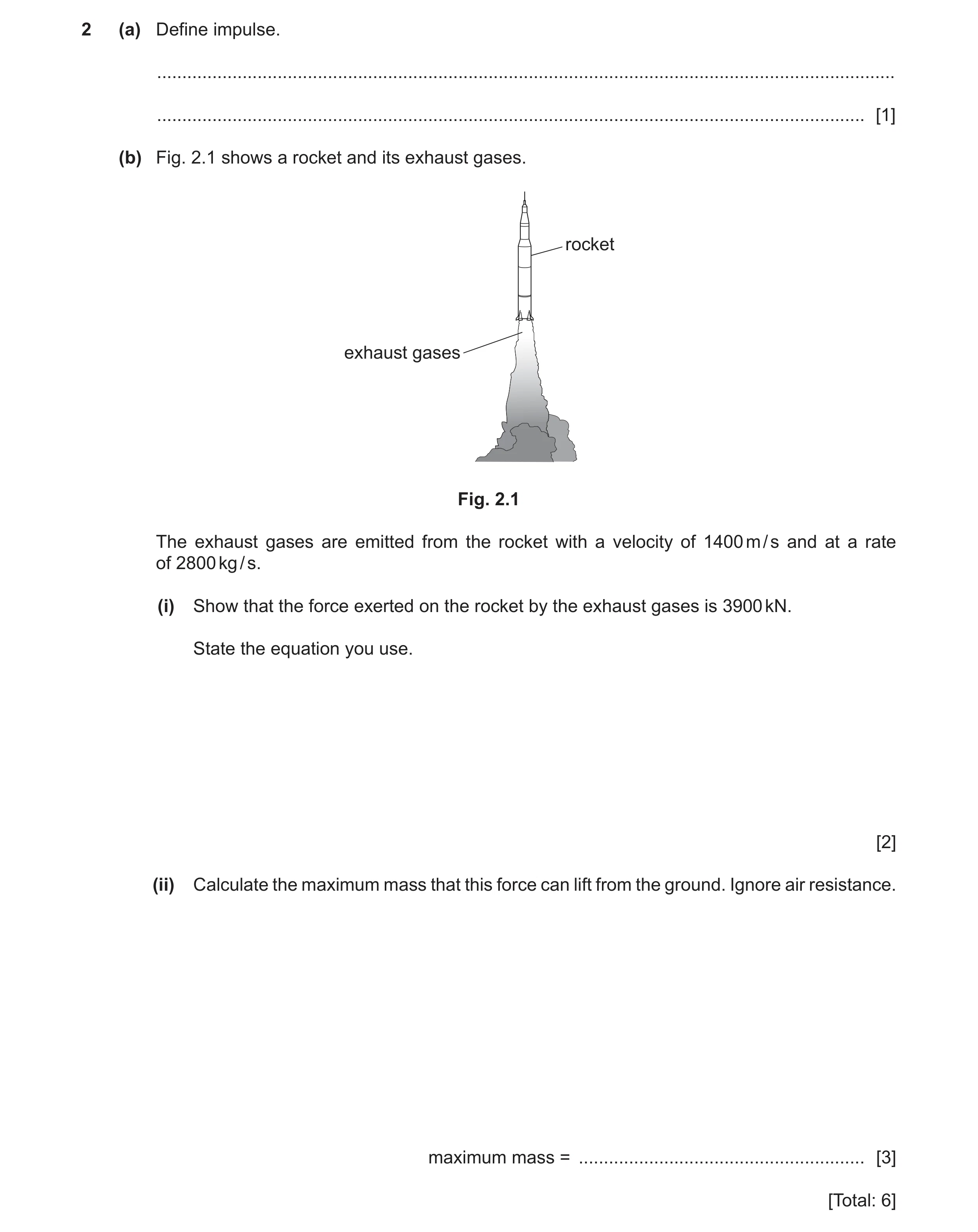
2 (a) Define impulse. … … [1] (b) Fig. 2.1 shows a rocket and its exhaust gases. rocket exhaust gases Fig. 2.1 The exhaust gases are emitted from the rocket with a velocity of 1400 m / s and at a rate of 2800 kg / s. (i) Show that the force exerted on the rocket by the exhaust gases is 3900 kN. State the equation you use. [2] (ii) Calculate the maximum mass that this force can lift from the ground. Ignore air resistance. maximum mass = … [3] [Total: 6]
6 marks
Mark scheme: 2(a) (Impulse =) force time (for which force acts) B1 2(b)(i) F∆t = ∆{mv} OR (F =) ∆{mv} / ∆t OR (F =) ∆p / t M1 {2800 1400} (/ 1) = 3 920 000 N OR {2800 1400} (/ 1) = 3920 kN A1 2(b)(ii) 4.0 105 kg OR 400 000 kg A3 (at maximum mass) force = weight of rocket OR F = mg (C1) (m=) F / g OR 3.9 106 / 9.8 OR 4(.0) 10N (kg) (C1)
This question in 0625/42 Feb/March 2024
Q24 · Two identical trolleys, P and Q, held at rest on a frictionless horizontal surface 0625/41 May/June 2024
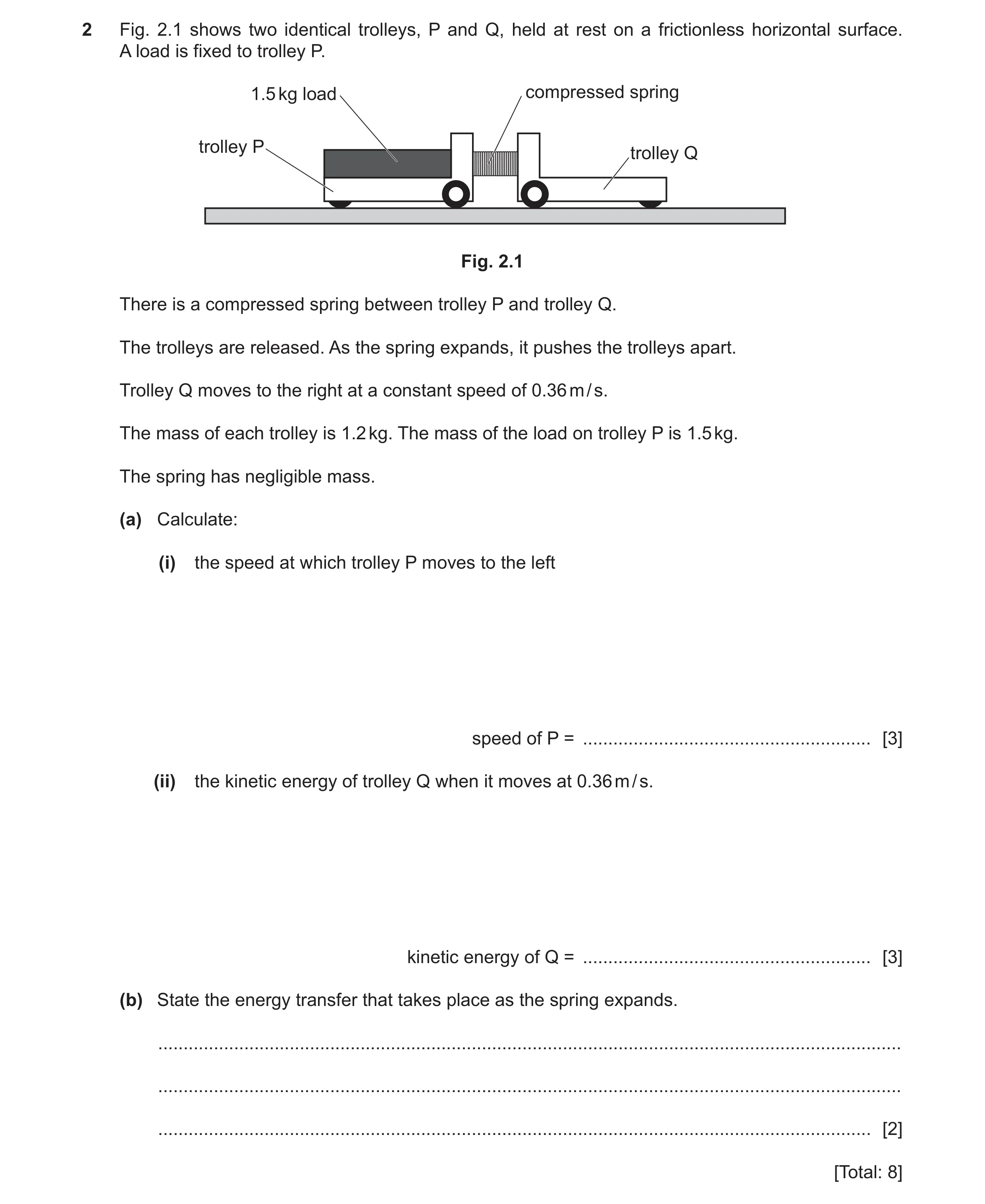
2 Fig. 2.1 shows two identical trolleys, P and Q, held at rest on a frictionless horizontal surface. A load is fixed to trolley P. 1.5 kg load compressed spring trolley P trolley Q Fig. 2.1 There is a compressed spring between trolley P and trolley Q. The trolleys are released. As the spring expands, it pushes the trolleys apart. Trolley Q moves to the right at a constant speed of 0.36 m / s. The mass of each trolley is 1.2 kg. The mass of the load on trolley P is 1.5 kg. The spring has negligible mass. (a) Calculate: (i) the speed at which trolley P moves to the left speed of P = … [3] (ii) the kinetic energy of trolley Q when it moves at 0.36 m / s. kinetic energy of Q = … [3] (b) State the energy transfer that takes place as the spring expands. … … … [2] [Total: 8]
8 marks
Mark scheme: 2(a)(i) 0.16 m / s A3 conservation of momentum OR mP vP = mQvQ OR 2.7 vP = 1.2 0.36 OR (mQvQ =) 0.432 seen C1 (vP =) mQvQ / mP OR 1.2 0.36 / 2.7 C1 2(a)(ii) 0.078 J A3 (k.e. =) ½mv2 OR (k.e. =) ½ 1.2 0.362 C1 (k.e. =) ½ 1.2 0.362 C1 2(b) (from) elastic (energy store in the compressed spring) B1 to kinetic (as final energy store of trolleys) B1
This question in 0625/41 May/June 2024
Q25 · Two children balanced on a seesaw 0625/43 May/June 2024
3 Fig. 3.1 shows two children balanced on a seesaw. A seesaw is a length of wood which rotates about a central pivot. child A child B 1.60 m 0.80 m 450 N 900 N pivot (fulcrum) Fig. 3.1 (a) Child B moves 0.050 m further away from the pivot. (i) Explain why the seesaw rotates clockwise. … … [1] (ii) Child A puts on a backpack and the seesaw now balances. Calculate the mass of the backpack. mass = … kg [3] (b) The concrete floor under the seesaw is replaced with a rubber floor. A child falls from the seesaw and experiences an impulse when they hit the floor. (i) Define impulse. … … [1] (ii) Explain how the rubber floor reduces injury to the child. Use ideas about impulse, force, momentum and time in your answer. … … … … [3] [Total: 8]
8 marks
Mark scheme: 3(a)(i) clockwise moment has increased (and no change to anti-clockwise moment) B1 3(a)(ii) (mass of backpack =) 45 / (1.6 9.8)) 2.9 (kg) A3 (at balance) sum of clockwise moments = sum of anti-clockwise moments OR (900 0.85) = 1.6 (450 + W) C1 (clockwise moment =) 765 (N m) OR (moment due to backpack =) 45 (N m) OR (W =) [{900 0.85} – {450 1.6}] / 1.6 C1 3(b)(i) (impulse is the) force × time (for which the force acts) OR I = F × t OR (impulse =) change in momentum OR ∆{mv} B1 3(b)(ii) any three from: change in momentum/impulse is the same (on both floors) (change in momentum/Impulse) is over longer time force = rate of change of momentum OR F = {mv} / t less force on child (so less injury) B3
This question in 0625/43 May/June 2024
Q26 · A drag car is a racing car that is powered by a rocket engine 0625/41 Oct/Nov 2024
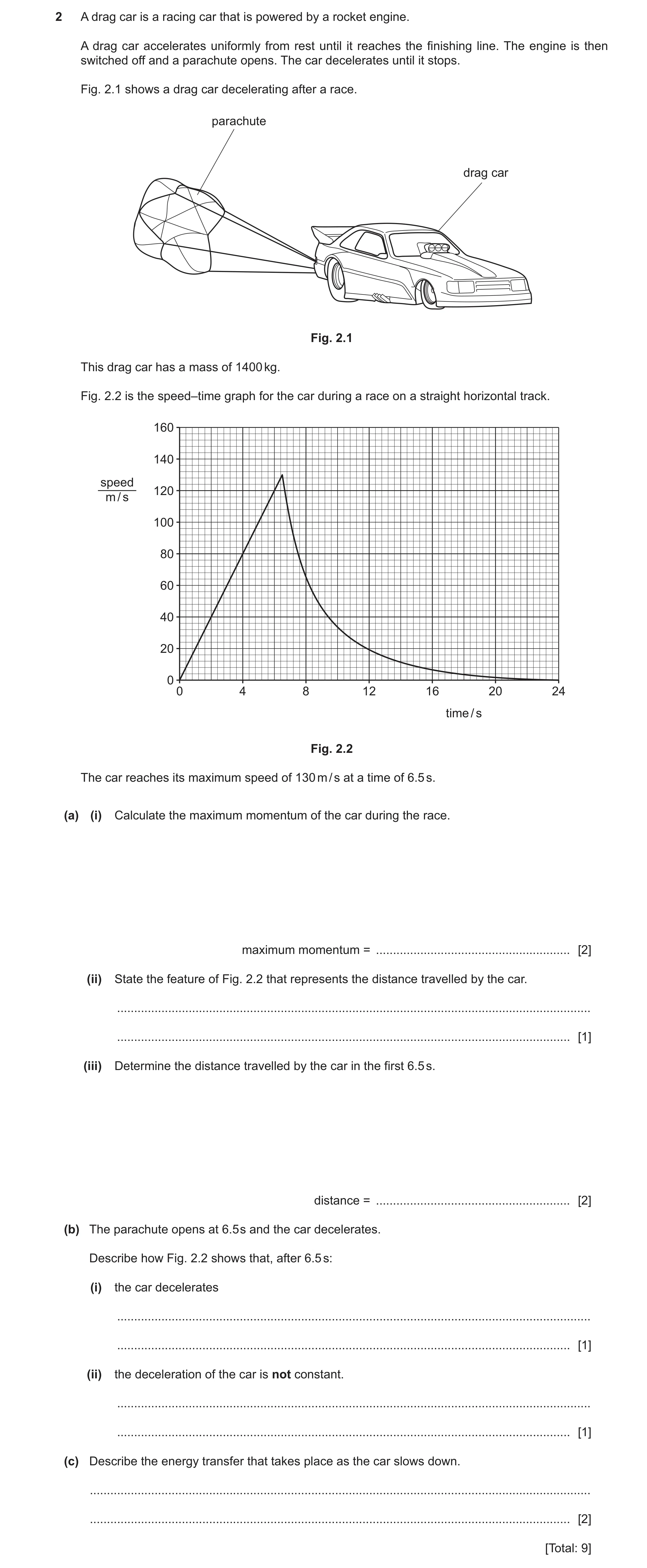
2 A drag car is a racing car that is powered by a rocket engine. A drag car accelerates uniformly from rest until it reaches the finishing line. The engine is then switched off and a parachute opens. The car decelerates until it stops. Fig. 2.1 shows a drag car decelerating after a race. parachute drag car Fig. 2.1 This drag car has a mass of 1400 kg. Fig. 2.2 is the speed–time graph for the car during a race on a straight horizontal track. 160 140 speed 120 m / s 100 80 60 40 20 0 0 4 8 12 16 20 24 time / s Fig. 2.2 The car reaches its maximum speed of 130 m / s at a time of 6.5 s. (a) (i) Calculate the maximum momentum of the car during the race. maximum momentum = … [2] (ii) State the feature of Fig. 2.2 that represents the distance travelled by the car. … … [1] (iii) Determine the distance travelled by the car in the first 6.5 s. distance = … [2] (b) The parachute opens at 6.5 s and the car decelerates. Describe how Fig. 2.2 shows that, after 6.5 s: (i) the car decelerates … … [1] (ii) the deceleration of the car is not constant. … … [1] (c) Describe the energy transfer that takes place as the car slows down. … … [2] [Total: 9]
9 marks
Mark scheme: 2(a)(i) 1.8 105 kg m / s OR 1.8 105 N s A2 p = mv OR (p =) mv OR 1400 130 C1 2(a)(ii) (scaled) area under the (graph) line B1 2(a)(iii) 420 m A2 ½vmaxt OR ½ 130 6.5 OR ½bh C1 2(b)(i) gradient is negative OR speed decreases B1 2(b)(ii) gradient is changing OR line / graph / it is a curve / curved B1 2(c) (from) kinetic (energy store) B1 to internal / thermal (energy store as final store) B1
This question in 0625/41 Oct/Nov 2024
Question 27 0625/43 Oct/Nov 2024
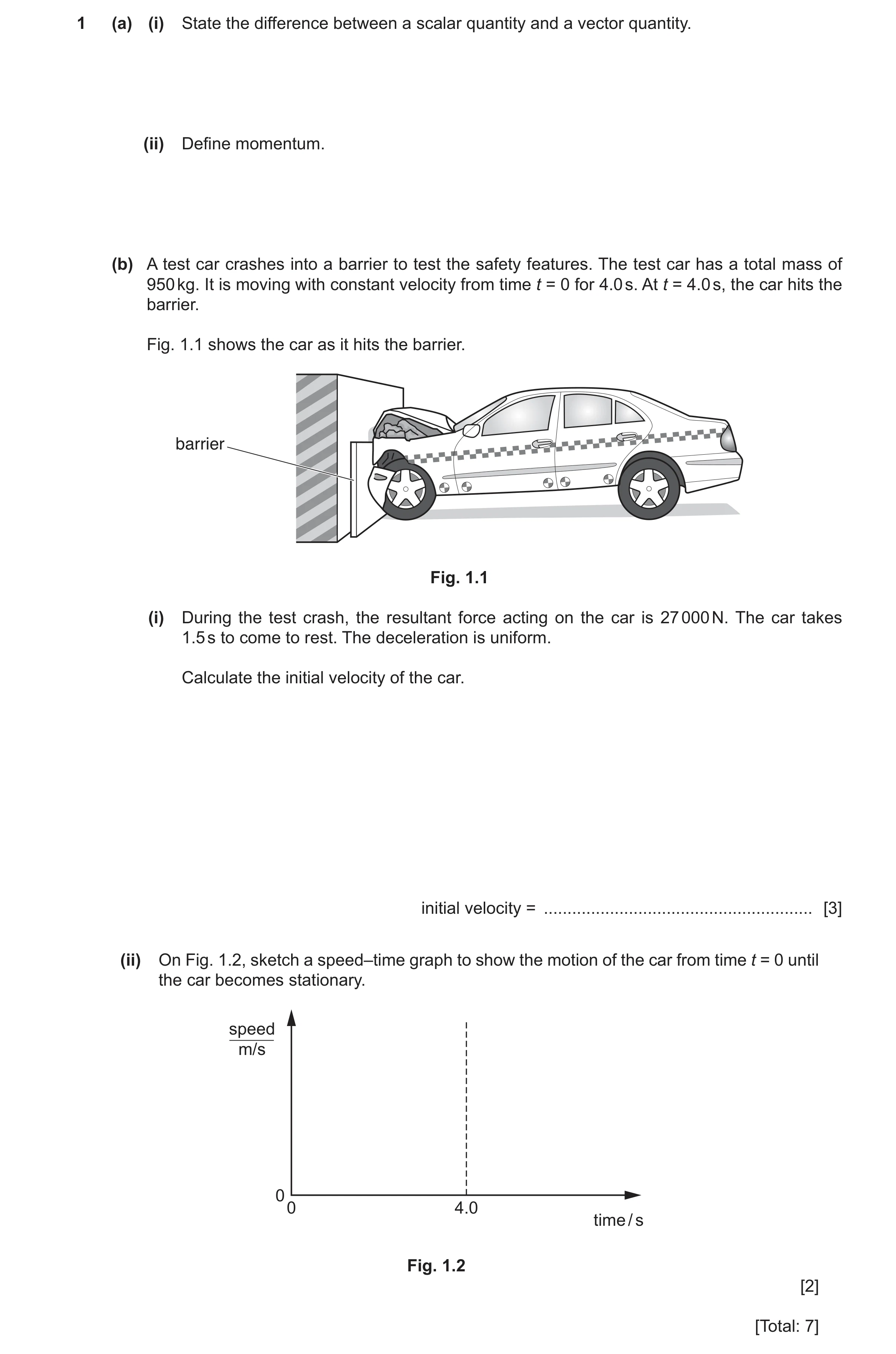
(ii) Define momentum. (b) A test car crashes into a barrier to test the safety features. The test car has a total mass of 950 kg. It is moving with constant velocity from time t = 0 for 4.0 s. At t = 4.0 s, the car hits the barrier. Fig. 1.1 shows the car as it hits the barrier. barrier Fig. 1.1 (i) During the test crash, the resultant force acting on the car is 27 000 N. The car takes 1.5 s to come to rest. The deceleration is uniform. Calculate the initial velocity of the car. initial velocity = … [3] (ii) On Fig. 1.2, sketch a speed–time graph to show the motion of the car from time t = 0 until the car becomes stationary. speed m/s 0 0 4.0 time / s Fig. 1.2 [2] [Total: 7]
7 marks
Mark scheme: Question Answer Marks 1(a)(i) (scalar) does not have direction or vector has direction B1 1(a)(ii) (momentum =) mass velocity B1 1(b)(i) 43 m / s A3 Ft = (mv) OR F = (mv) / t OR F = ma OR a = ∆v / ∆t C1 (u=) Ft / m OR (u =) (27 000 1.5) / 950 C1 1(b)(ii) straight horizontal line from y axis extending to t = 4.0 s B1 straight line from t = 4.0 s with negative gradient meeting the x axis (less than half-way between 4.0 and the end of the time B1 axis)
This question in 0625/43 Oct/Nov 2024
Q28 · Trolley A and trolley B are on a horizontal, frictionless bench 0625/42 Feb/March 2025
2 Trolley A and trolley B are on a horizontal, frictionless bench. Trolley A moves to the right with a constant velocity u = 0.44 m / s. Trolley B is stationary. Fig. 2.1 shows trolley A before it collides with trolley B. direction of motion A B bench Fig. 2.1 (not drawn to scale) (a) State the momentum of trolley B before the collision. Explain your answer. statement … explanation … … [1] (b) After the collision, the two trolleys are joined together and travel with a constant velocity v = 0.18 m / s to the right. The mass of trolley A is 0.75 kg. Calculate the mass of trolley B. mass of trolley B = … [3] (c) (i) The trolleys move onto a rough surface which exerts a constant force F on the trolleys and brings them to rest in 2.6 s. Calculate F. F = … [2] (ii) A different rough surface exerts a smaller resistive force on the trolleys. State how this affects the time taken to bring the trolleys to rest. Explain your answer. statement … explanation … … [1] [Total: 7]
7 marks
Mark scheme: 2(a) (statement momentum is) zero / 0 AND B1 (explanation) momentum is mass velocity OR the velocity (of B) is zero 2(b) 1.1 kg A3 Conservation of momentum OR momentum after (collision) = momentum before (collision) C1 OR {0.75 0.44} = {0.75 + m} 0.18 momentum before collision = 0.75 × 0.44 (+ m 0 = 0.33) OR momentum after collision = (0.75 + m) 0.18 C1 2(c)(i) 0.13 N A2 (F =) ∆p (∆)t OR (0.75 + 1.1) 0.18 2.6 OR (F =) 0.33 2.6 C1 ( F = )0.75 + 2(b) 0.18 2.6 2(c)(ii) (time taken) Increases B1 AND use of F(∆)t = ∆{mv} OR F 1 / (∆)t OR same momentum change required
This question in 0625/42 Feb/March 2025
Question 29 0625/42 May/June 2025
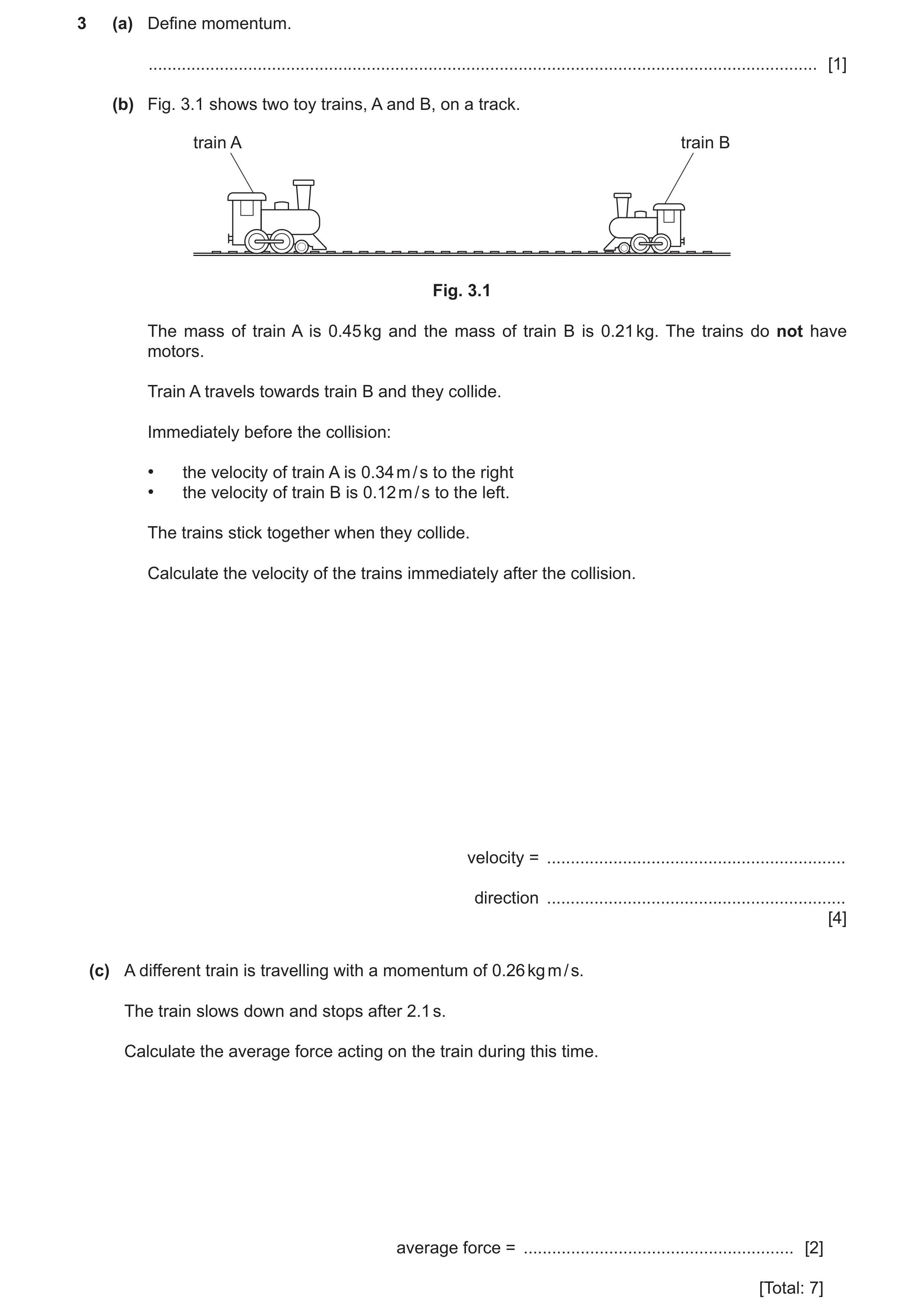
3 (a) Define momentum. … [1] (b) Fig. 3.1 shows two toy trains, A and B, on a track. train A train B Fig. 3.1 The mass of train A is 0.45 kg and the mass of train B is 0.21 kg. The trains do not have motors. Train A travels towards train B and they collide. Immediately before the collision: • the velocity of train A is 0.34 m / s to the right • the velocity of train B is 0.12 m / s to the left. The trains stick together when they collide. Calculate the velocity of the trains immediately after the collision. velocity = … direction … [4] (c) A different train is travelling with a momentum of 0.26 kg m / s. The train slows down and stops after 2.1 s. Calculate the average force acting on the train during this time. average force = … [2] [Total: 7]
7 marks
Mark scheme: 3(a) (momentum =) mass velocity OR (p =) mv B1 3(b) (velocity =) 0.19 m / s AND (direction) to the right A4 (momentum before collision) = {0.45 0.34} – {0.21 0.12} OR 0.1278 C1 (momentum after collision) = 0.66 v C1 momentum before collision = momentum after collision C1 OR {0.45 0.34} – {0.21 0.12} = 0.66 v OR 0.153 – 0.0252 = 0.66 v 3(c) (–) 0.12 N A2 F∆t = ∆{mv} OR (F =) ∆p ÷ (∆)t OR (F =) ∆{mv} ÷ (∆)t OR (F =) 0.26 ÷ 2.1 C1
This question in 0625/42 May/June 2025
Q30 · A space vehicle which consists of a capsule and a nose cone 0625/43 May/June 2025
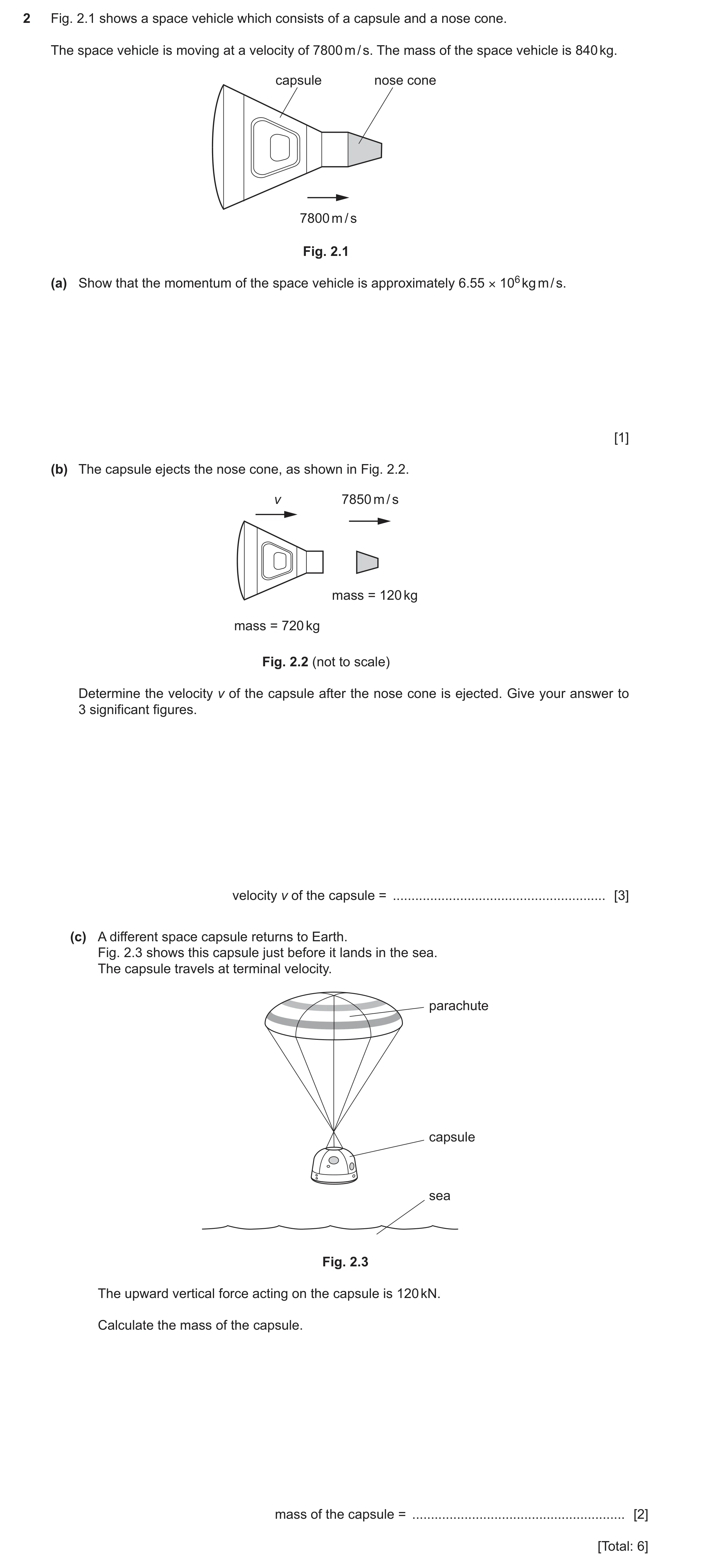
2 Fig. 2.1 shows a space vehicle which consists of a capsule and a nose cone. The space vehicle is moving at a velocity of 7800 m / s. The mass of the space vehicle is 840 kg. capsule nose cone 7800 m / s Fig. 2.1 (a) Show that the momentum of the space vehicle is approximately 6.55 × 10⁶ kg m / s. [1] (b) The capsule ejects the nose cone, as shown in Fig. 2.2. v 7850 m / s mass = 120 kg mass = 720 kg Fig. 2.2 (not to scale) Determine the velocity v of the capsule after the nose cone is ejected. Give your answer to 3 significant figures. velocity v of the capsule = … [3] (c) A different space capsule returns to Earth. Fig. 2.3 shows this capsule just before it lands in the sea. The capsule travels at terminal velocity. parachute capsule sea Fig. 2.3 The upward vertical force acting on the capsule is 120 kN. Calculate the mass of the capsule. mass of the capsule = … [2] [Total: 6]
6 marks
Mark scheme: 2(a) (p =) mv OR mass velocity B1 2(b) 7790 m / s A3 momentum before (collision) = momentum after (collision) C1 OR mcvc + mnvn = 6.55 106 OR (momentum of cone =) 120 7850 OR 9.42 105 720v + {120 7850} = 6.55 106 C1 OR (momentum after collision =) 6.55 106 – 9.42 105 OR 5.6 106 2(c) 12 000 kg A2 120 000 (N) OR (m =) W ÷ g OR (m =) 1.2 10N ÷ 9.8 C1
This question in 0625/43 May/June 2025
 3 / 37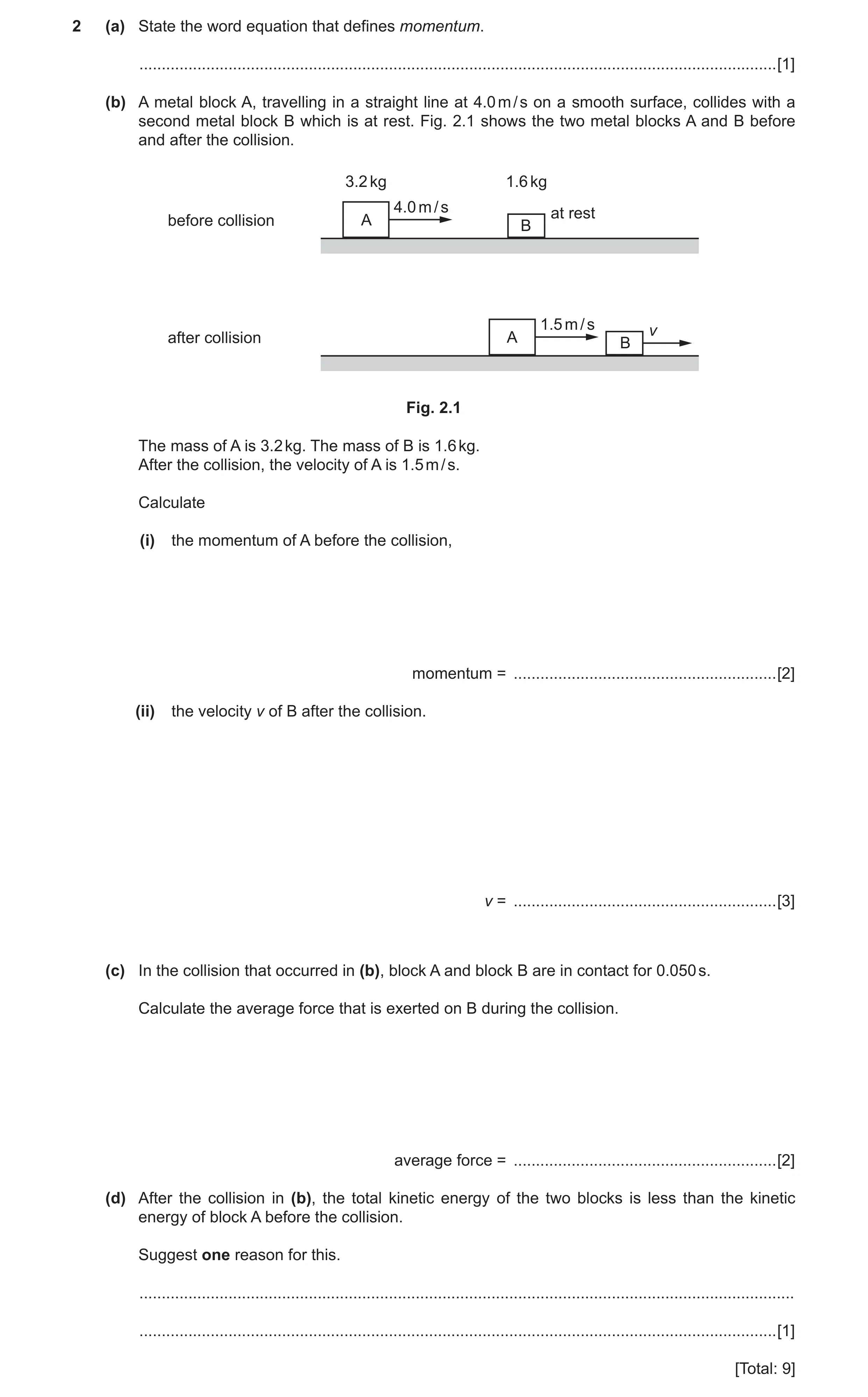
 5 / 37
 6 / 37
 7 / 37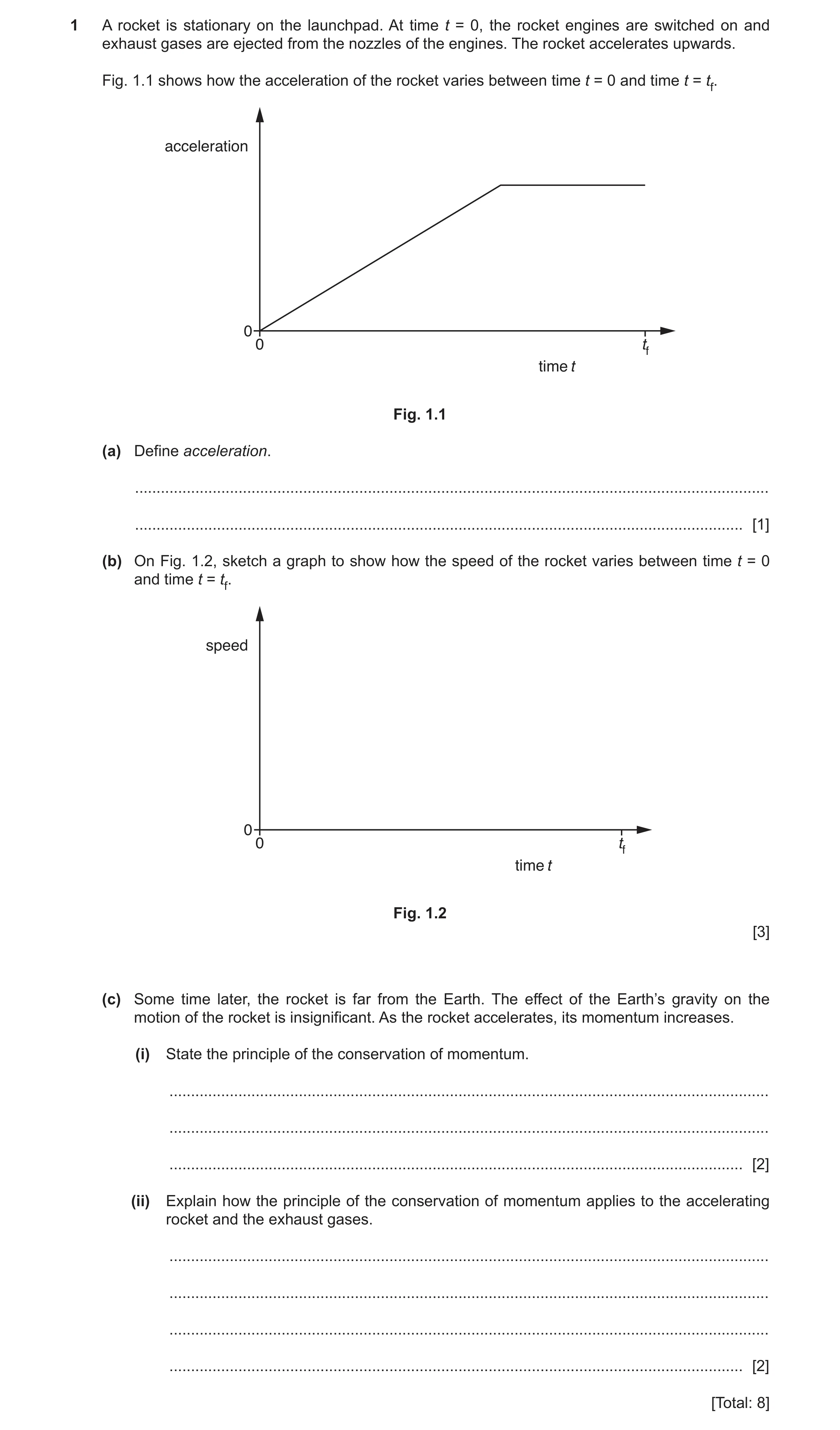
 10 / 37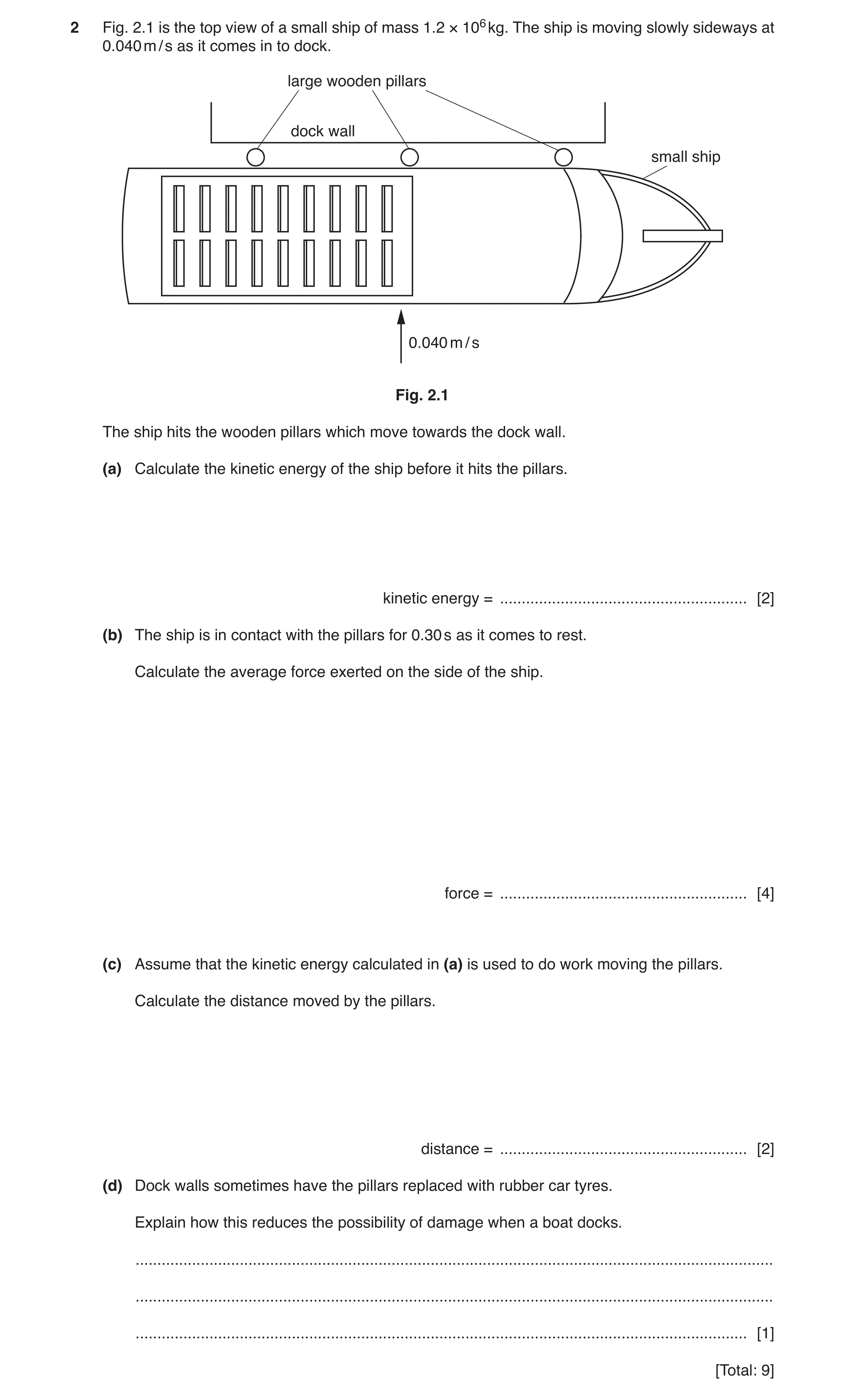
 13 / 37
 14 / 37
 15 / 37
 16 / 37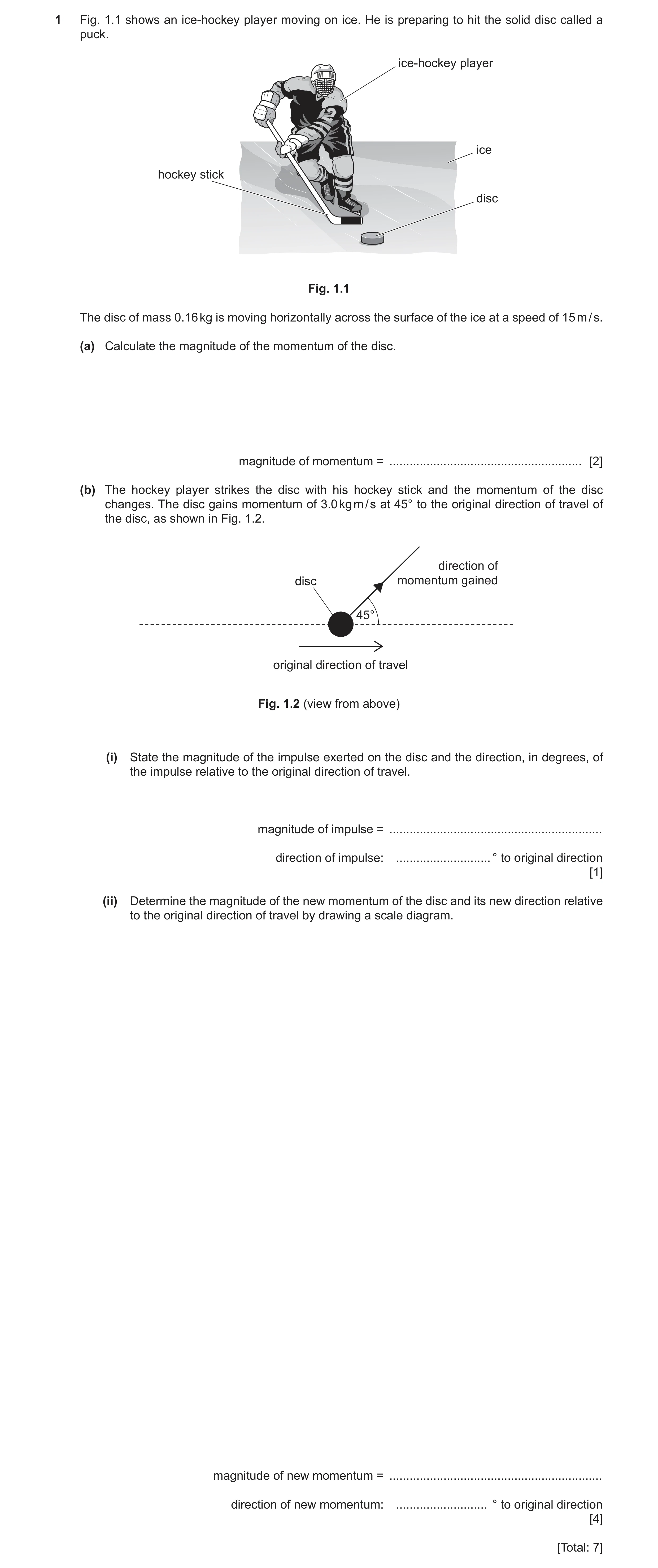
 19 / 37
 20 / 37
 21 / 37
 22 / 37
 23 / 37
 24 / 37
 25 / 37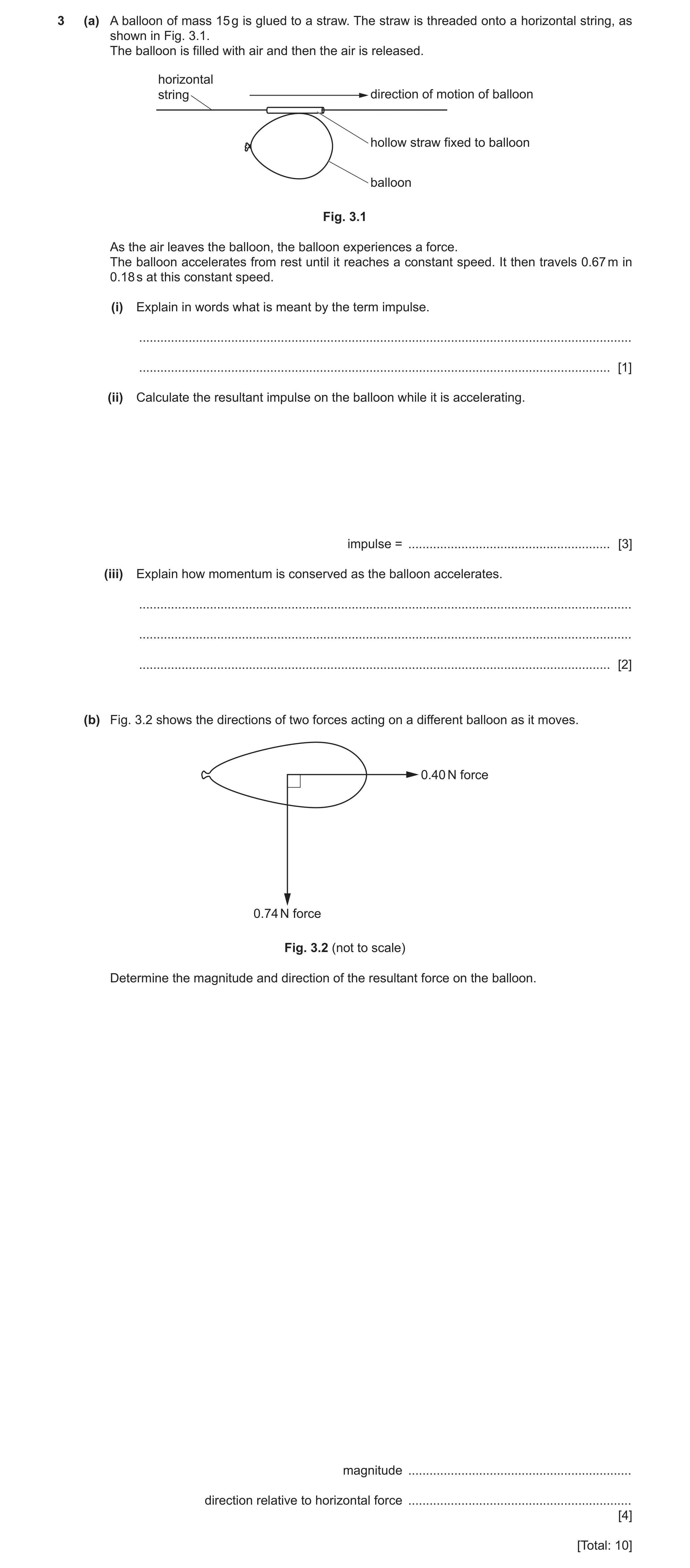
 28 / 37
 29 / 37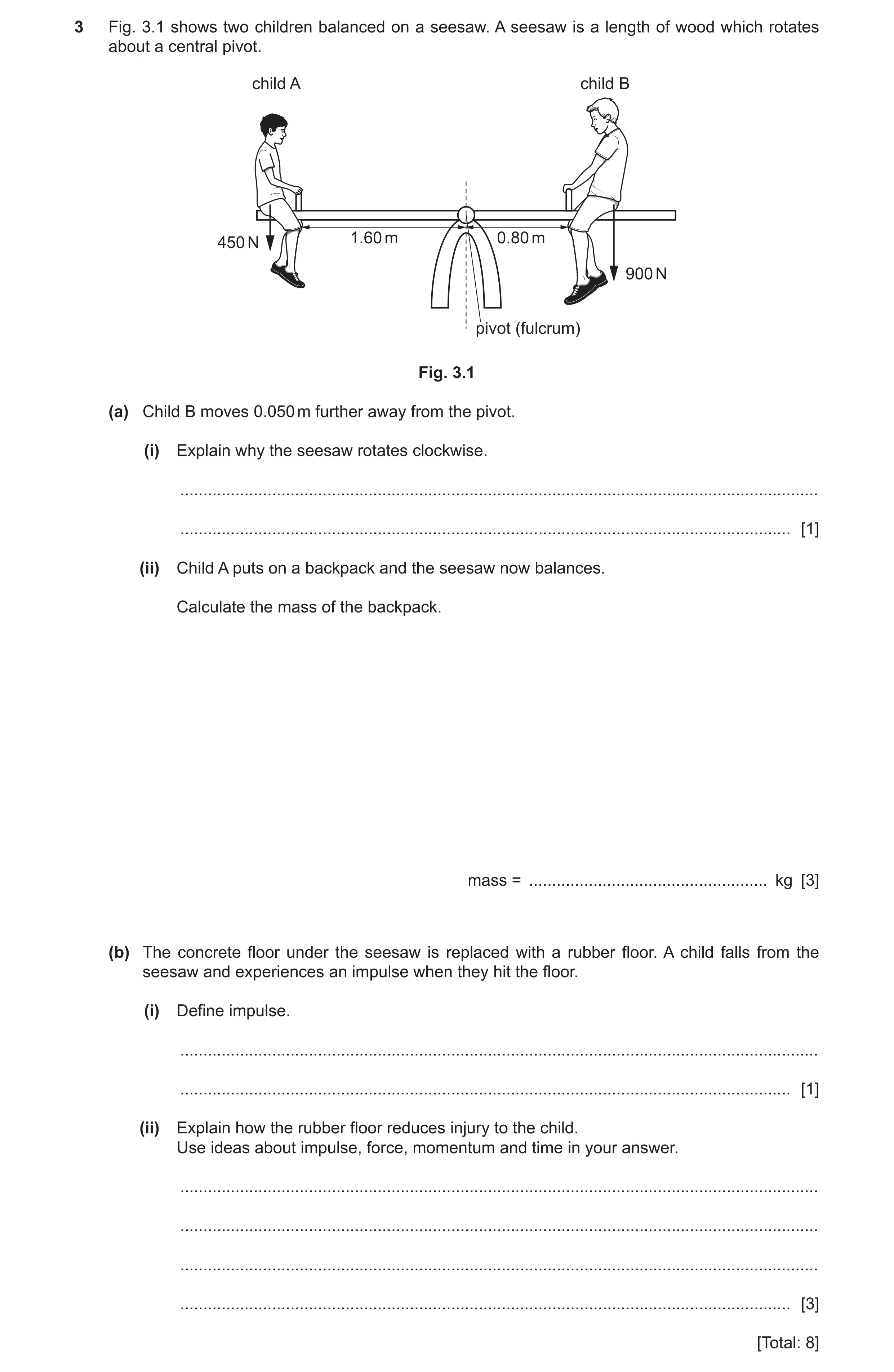
 33 / 37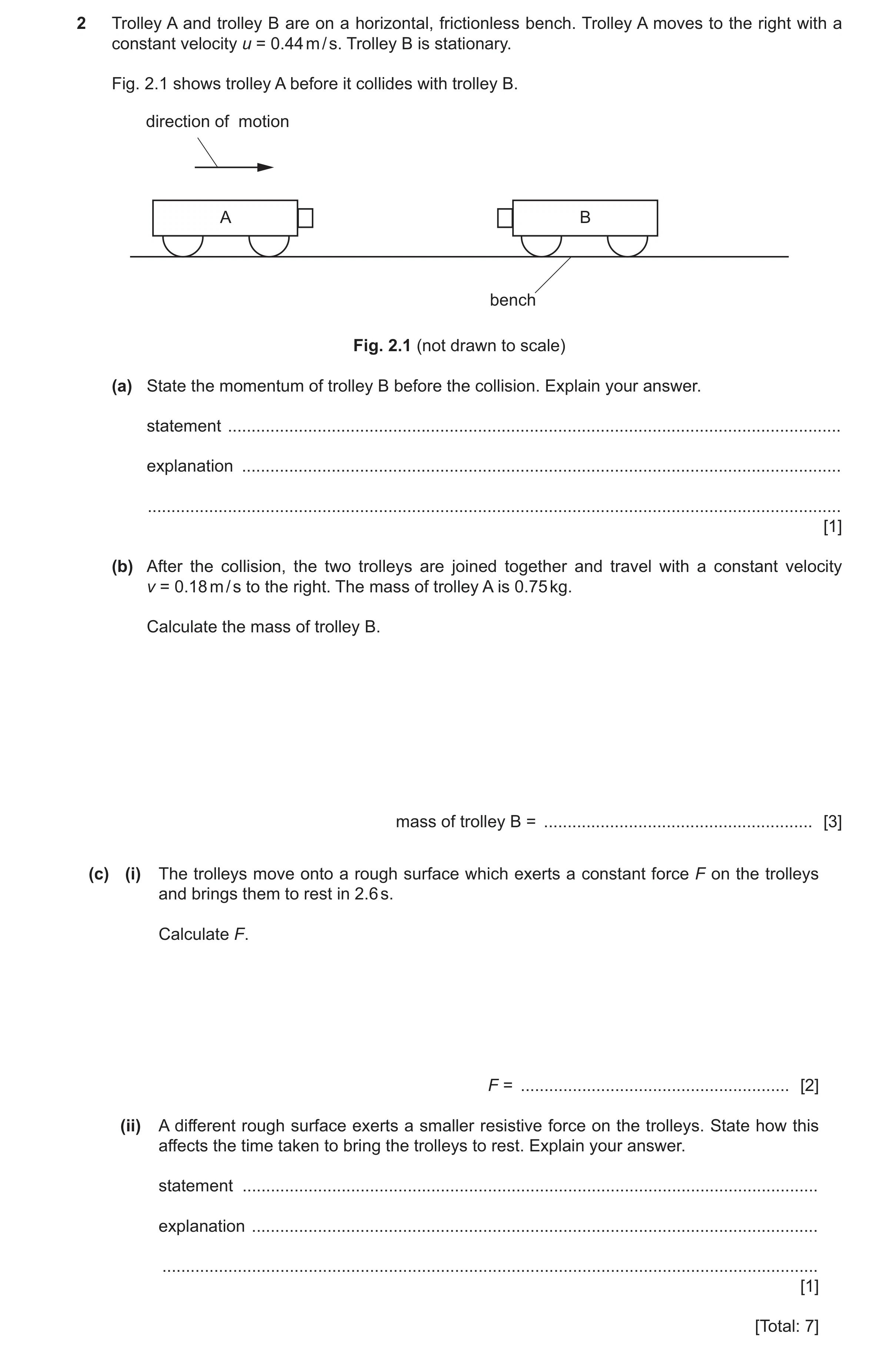
 8
8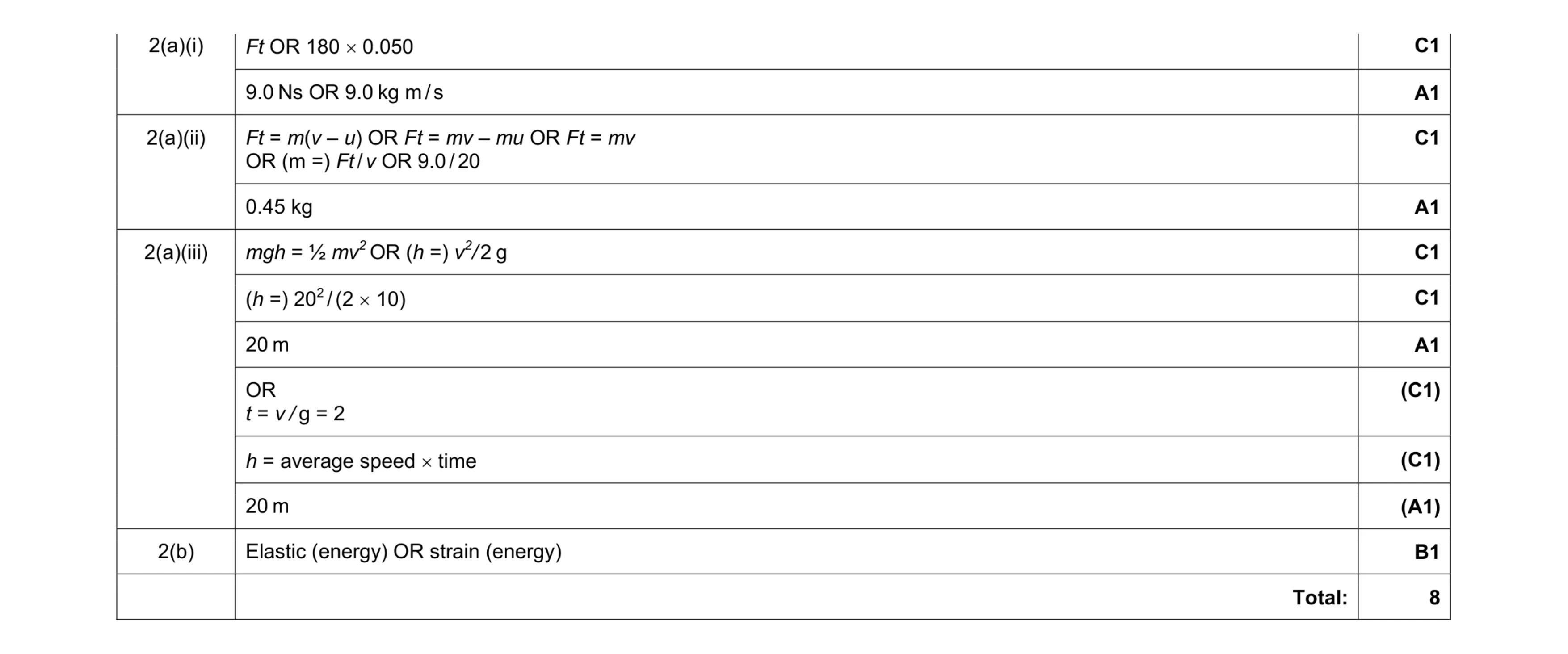 8
8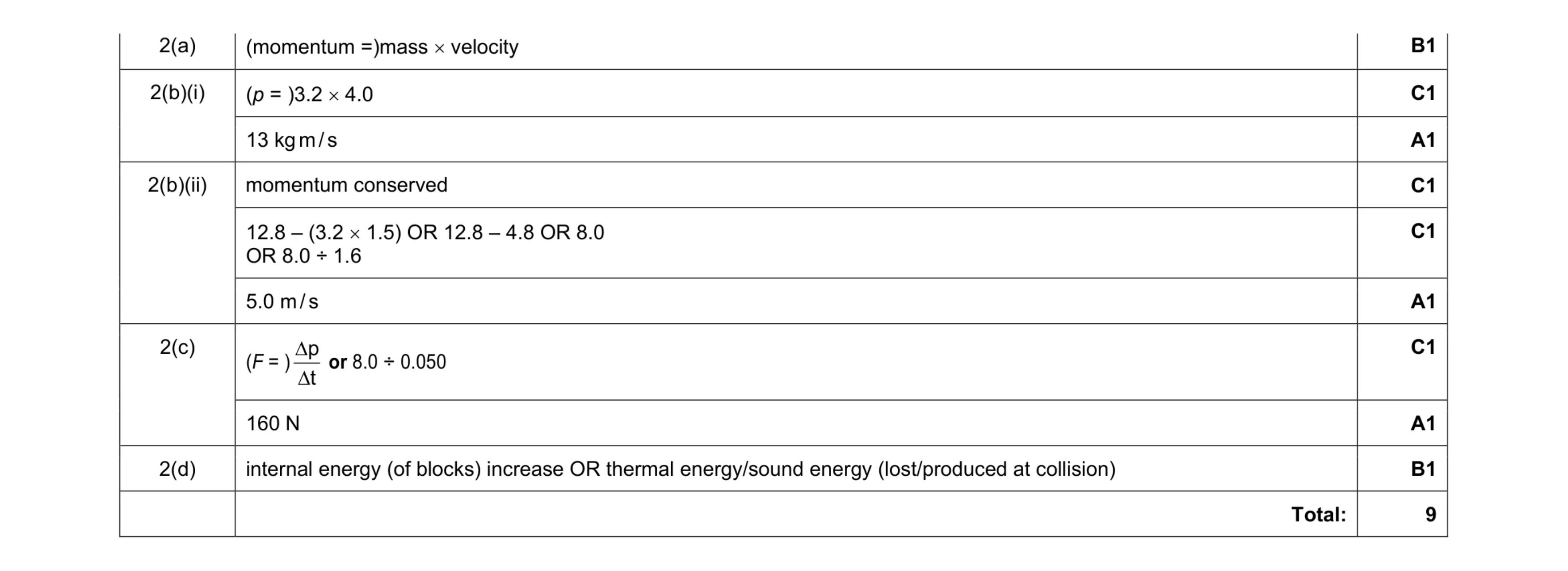 9
9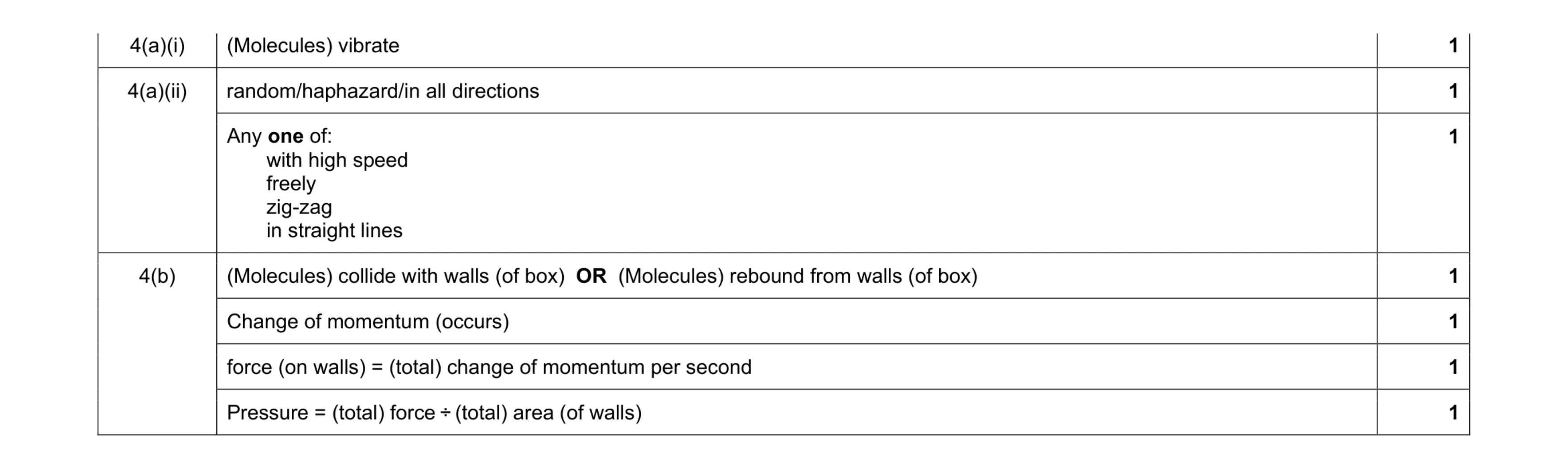 7
7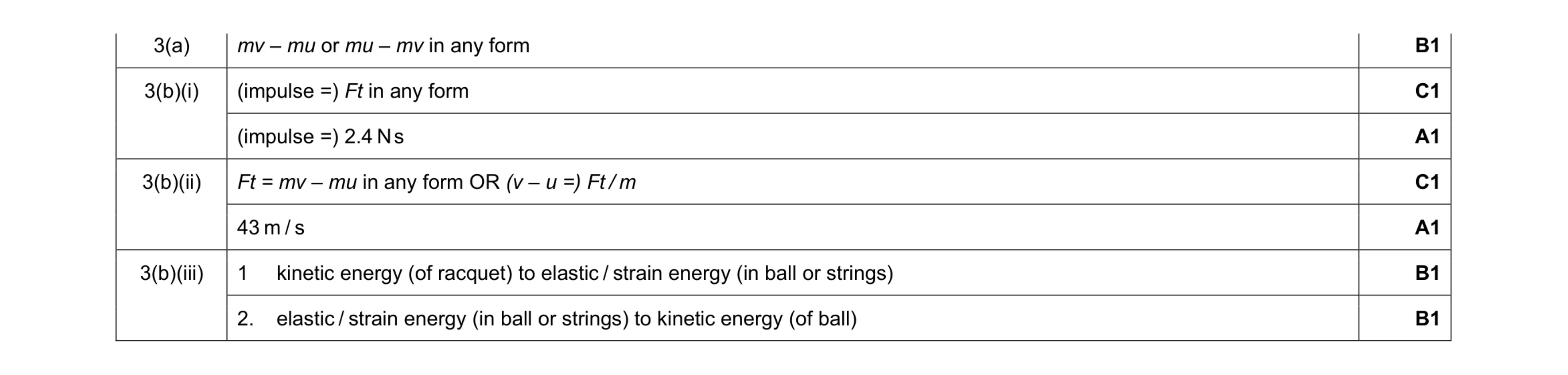 7
7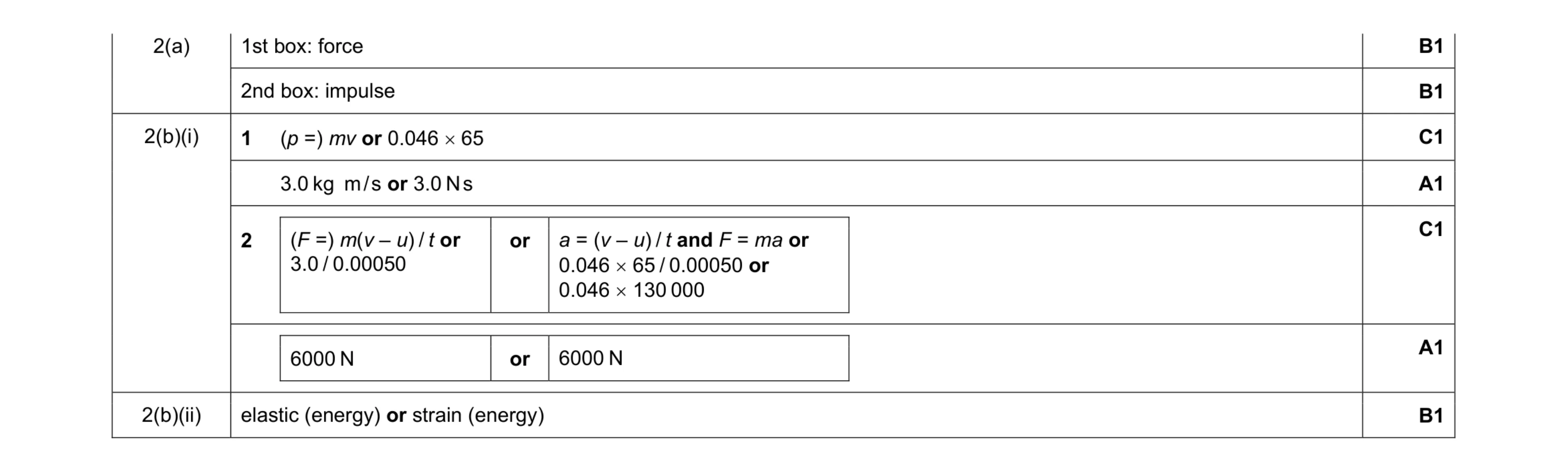 7
7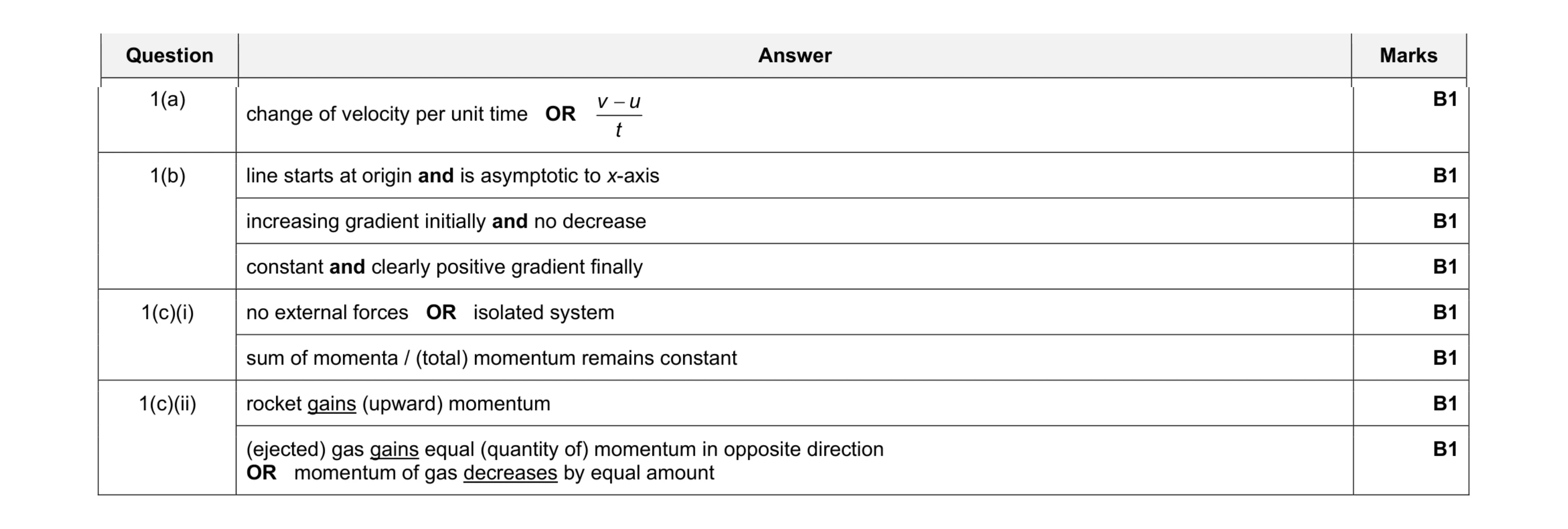 8
8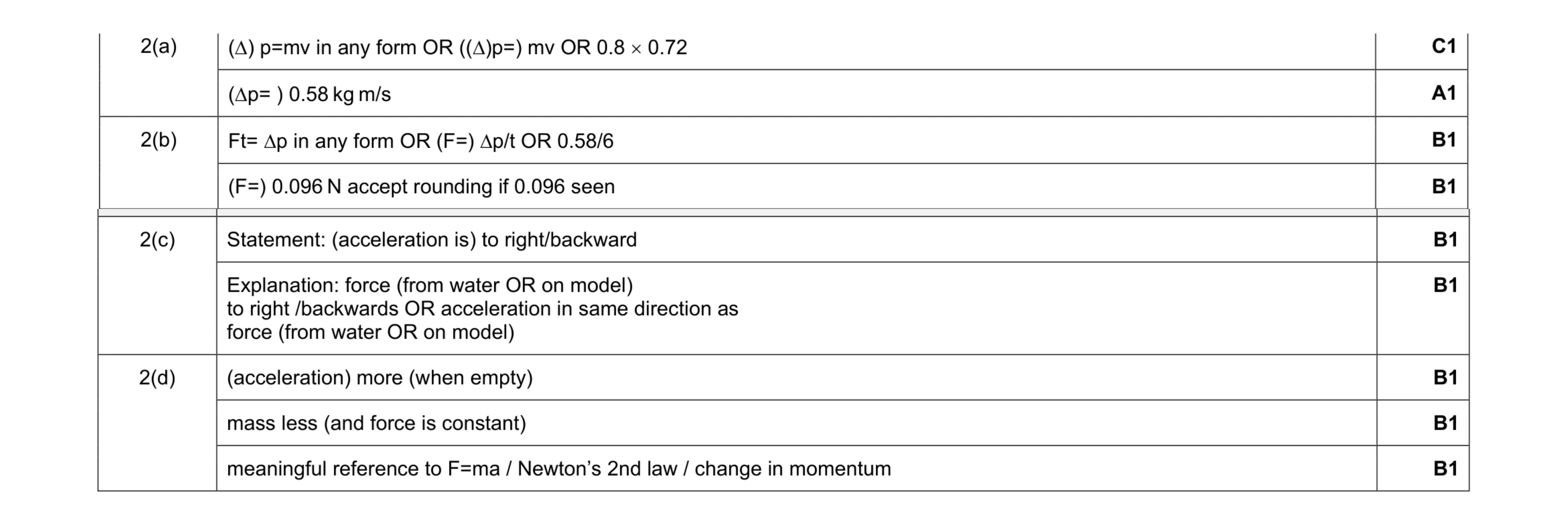 9
9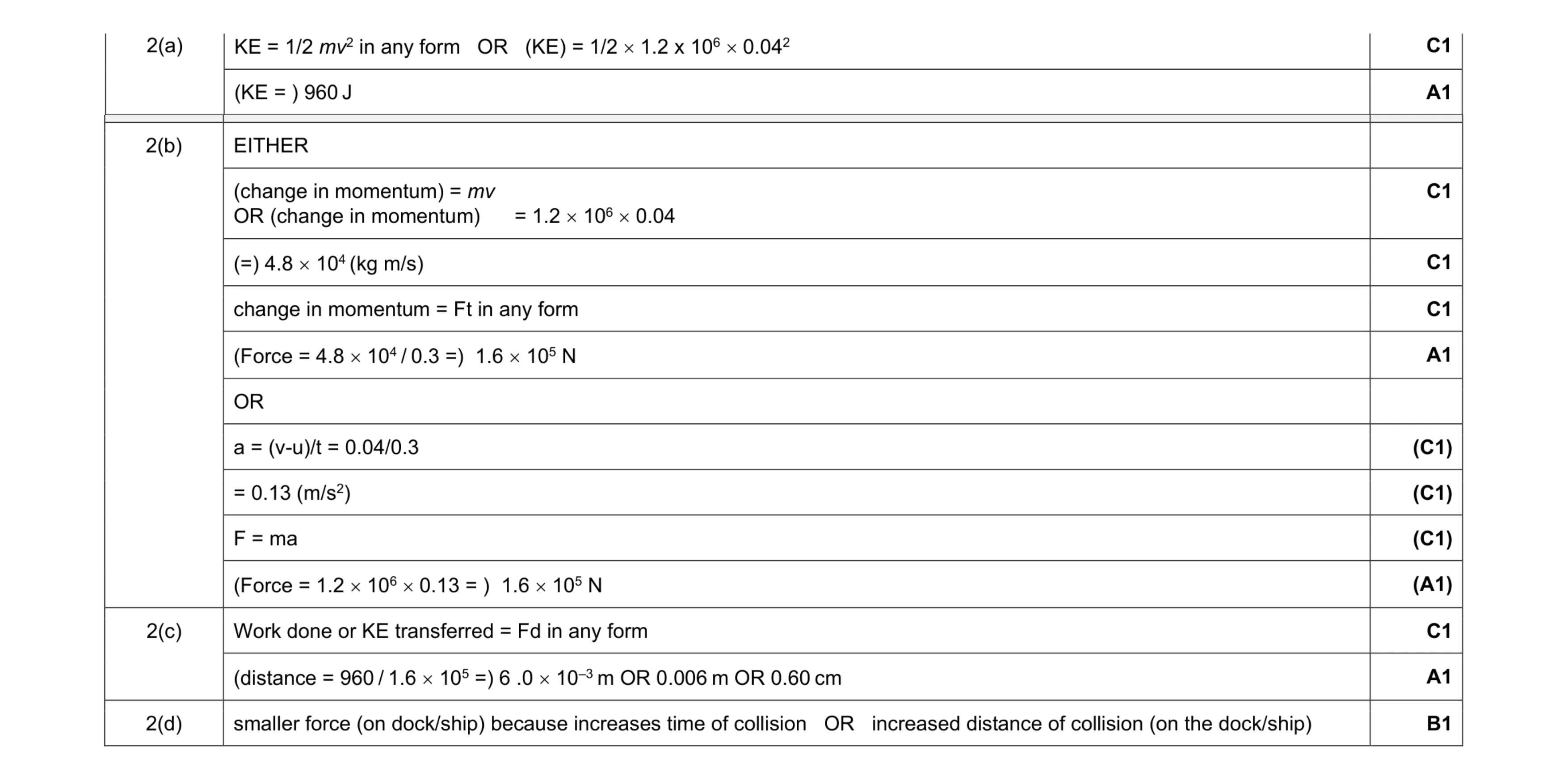 9
9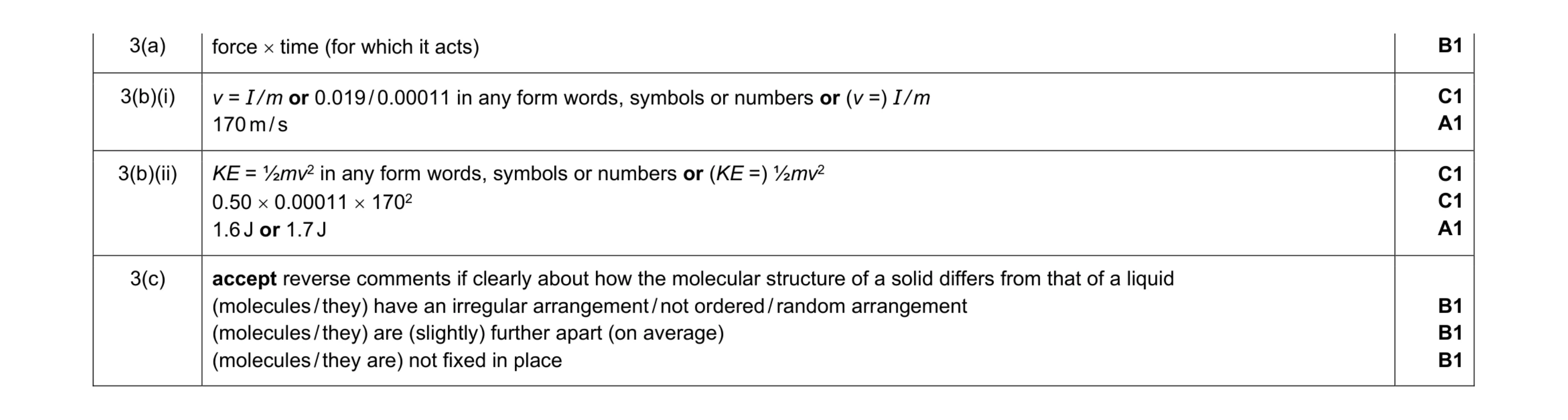 9
9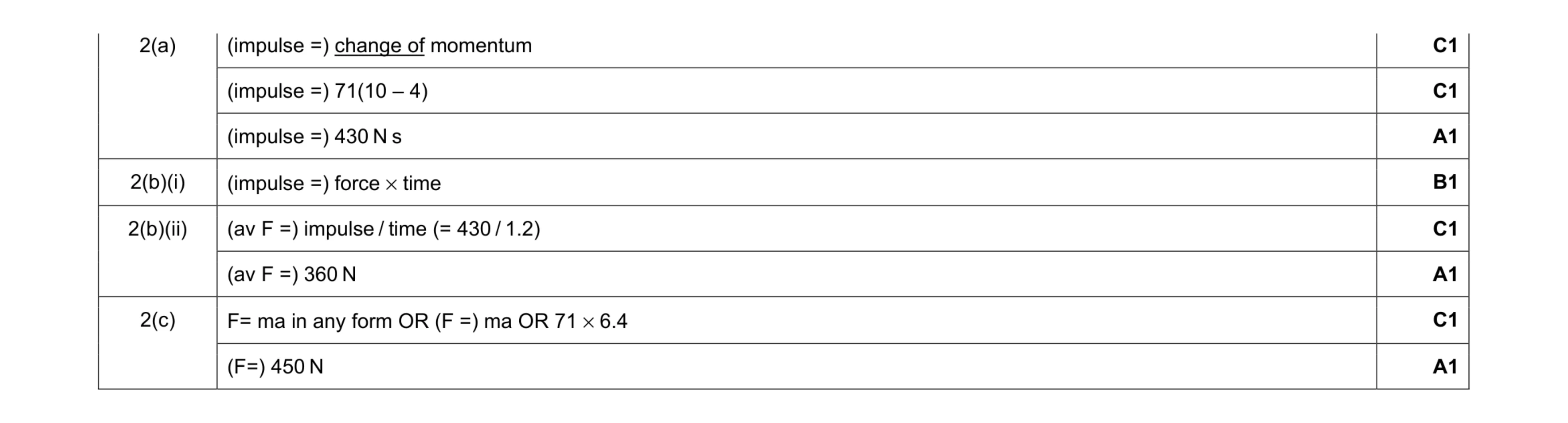 8
8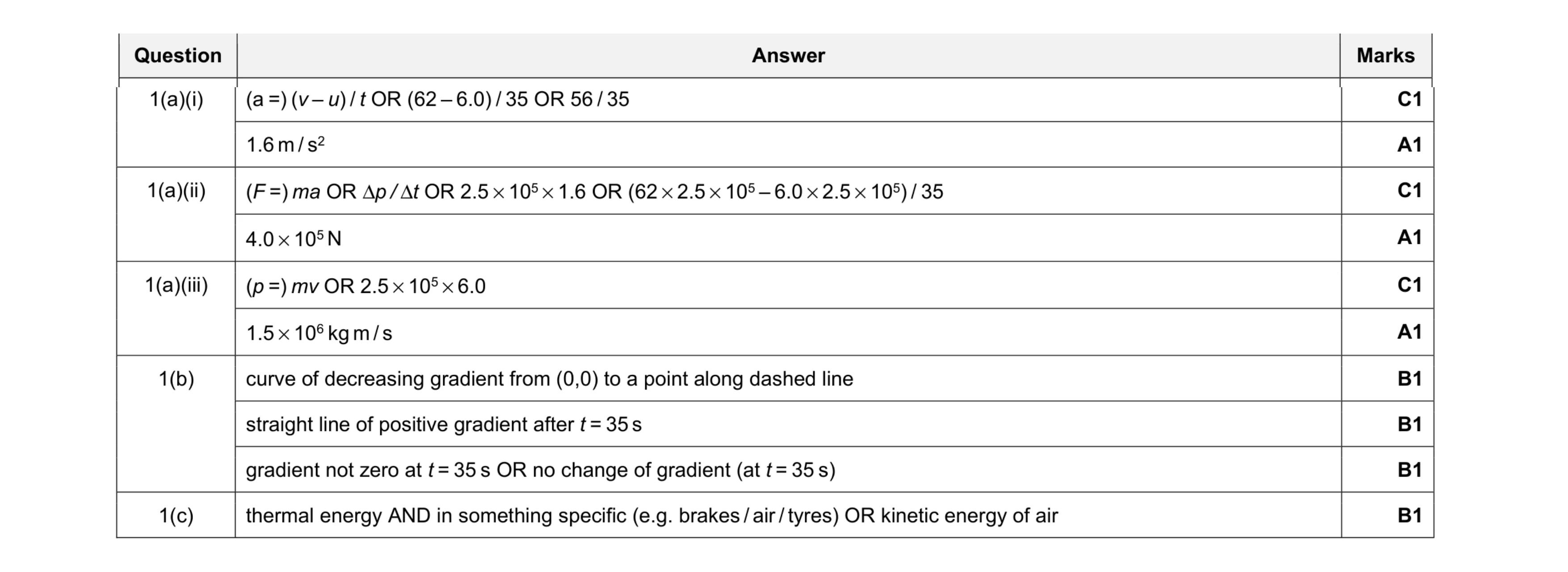 10
10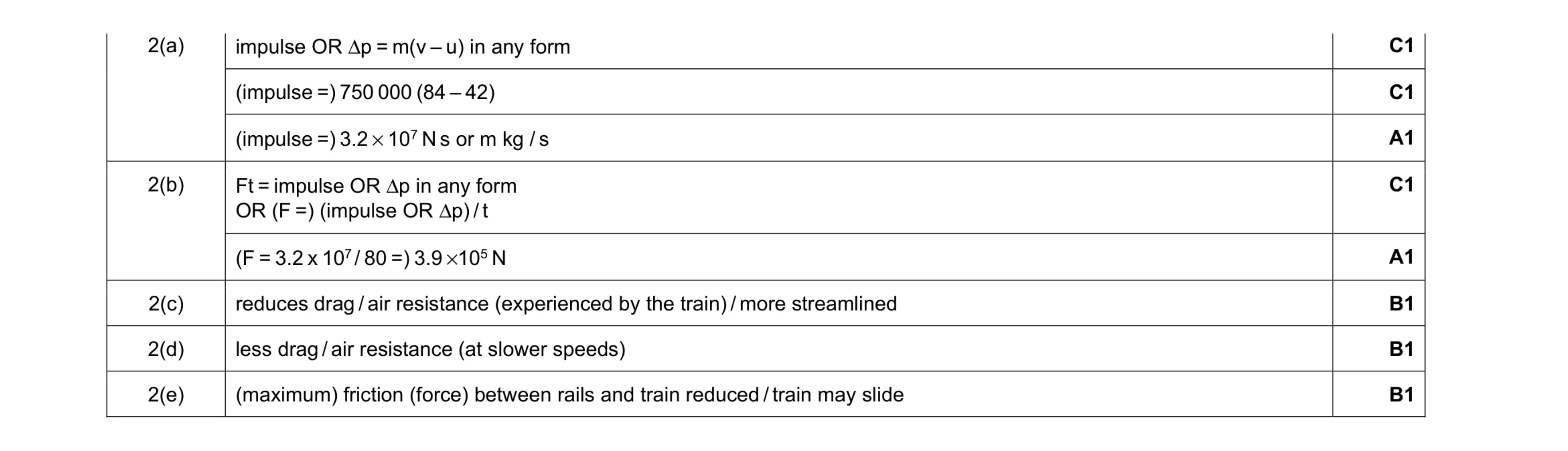 8
8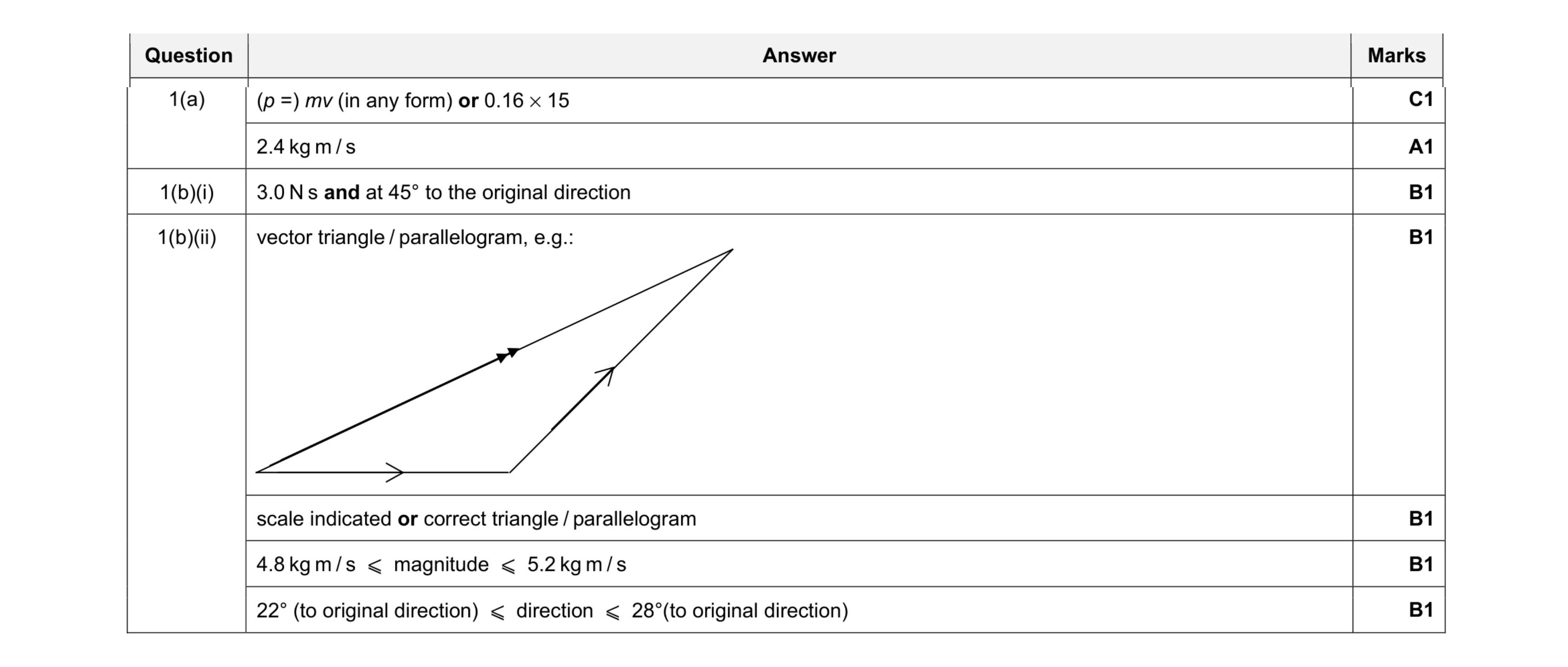 7
7 5
5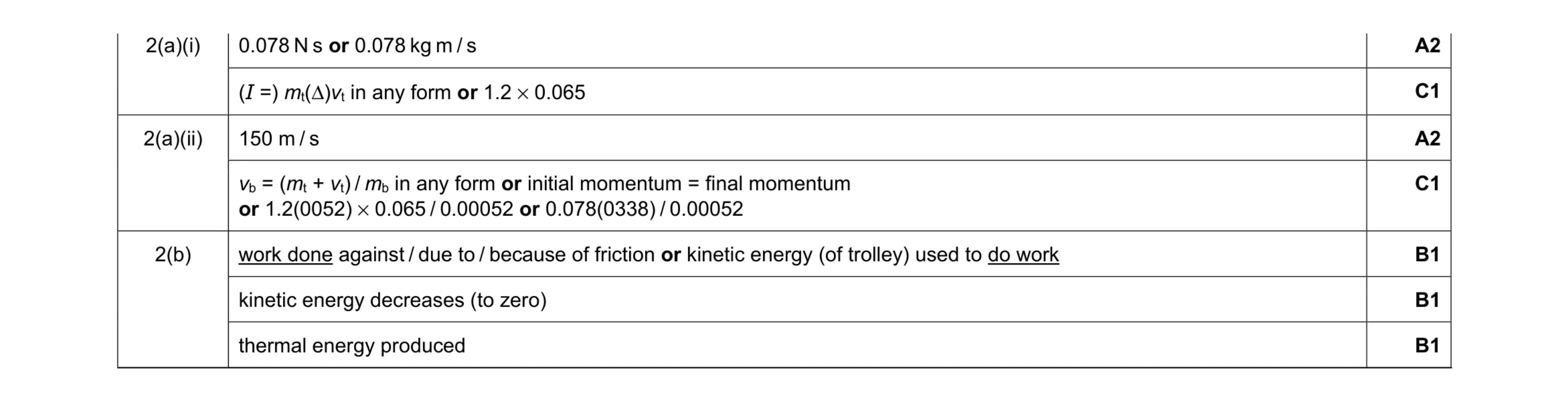 7
7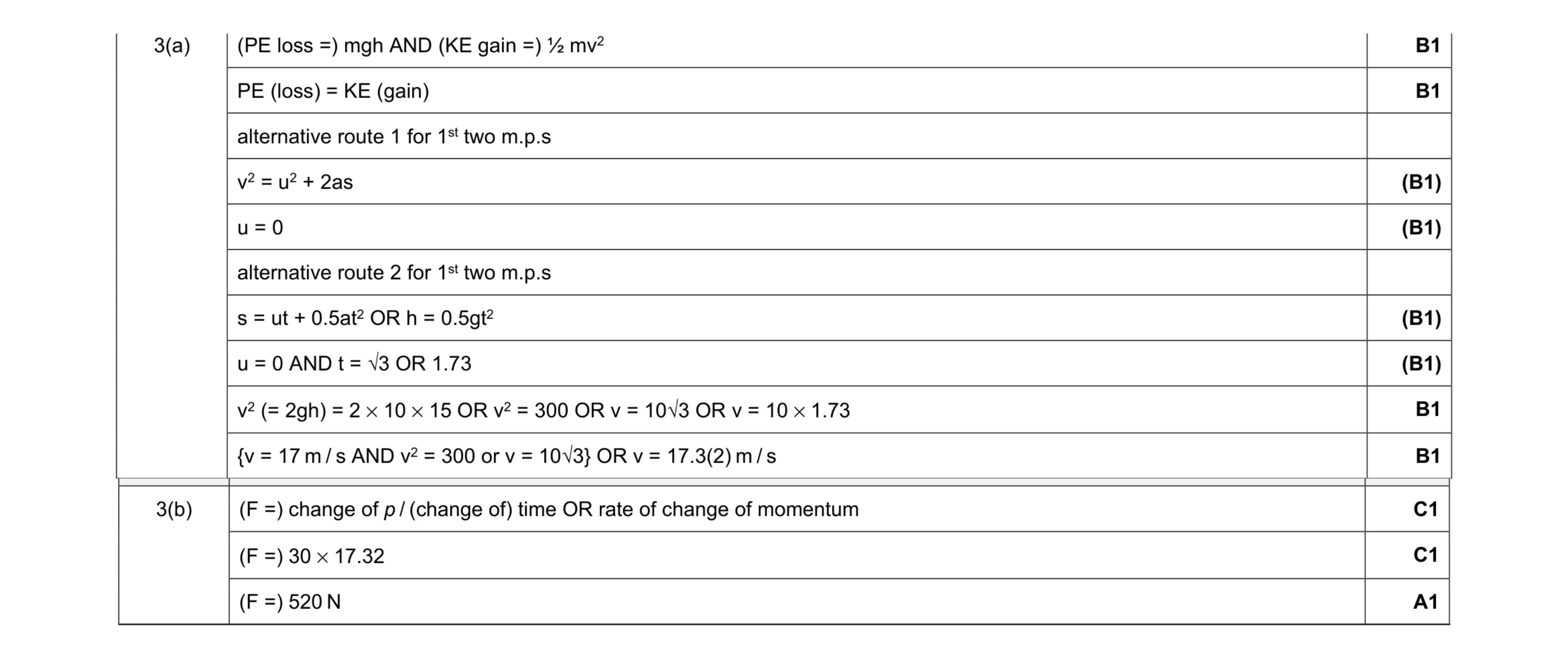 7
7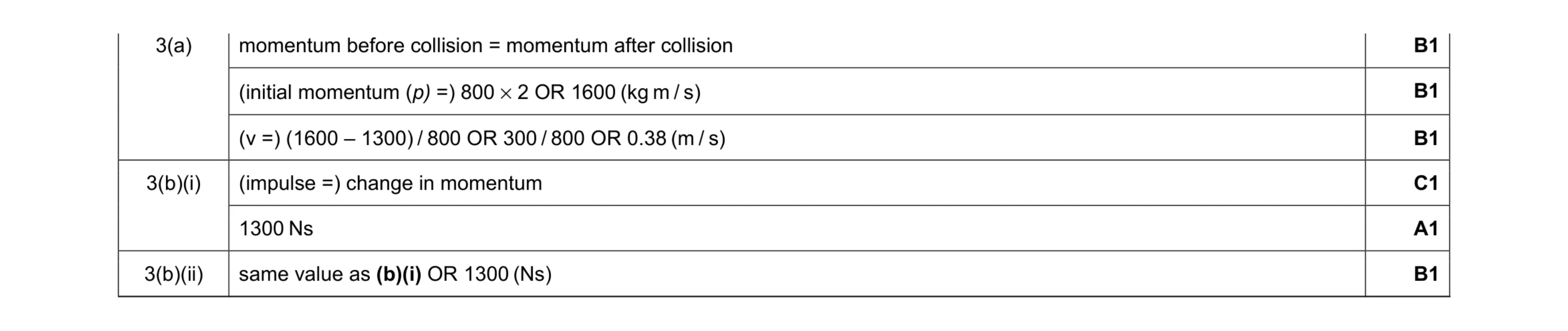 6
6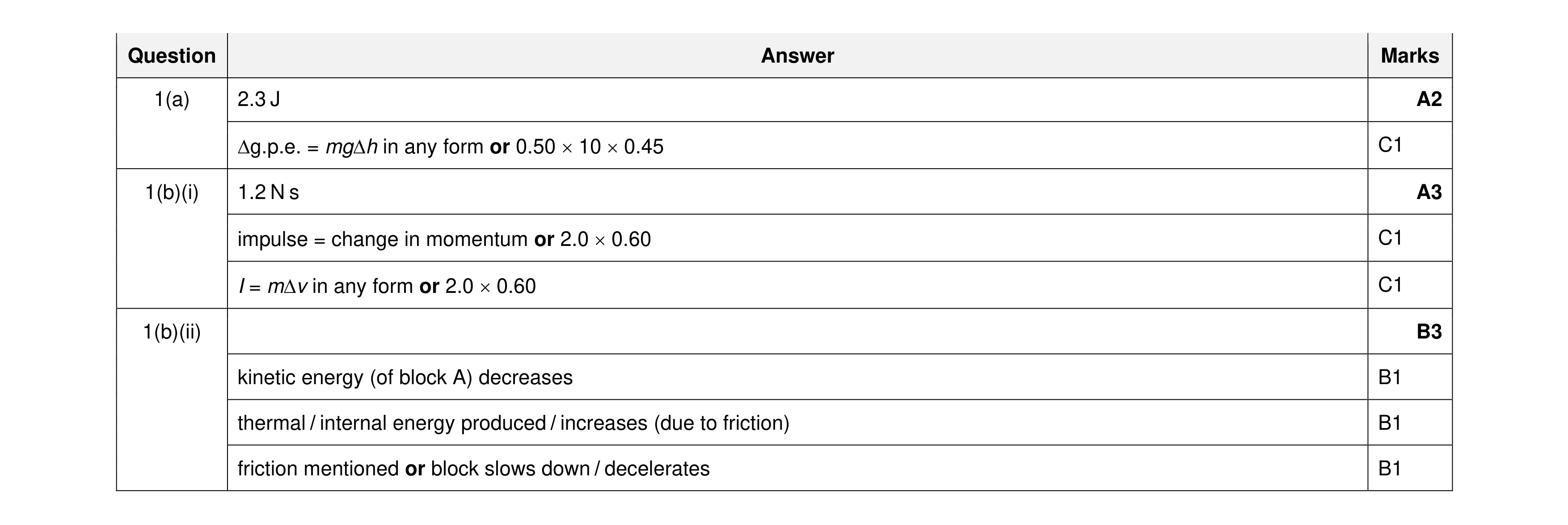 8
8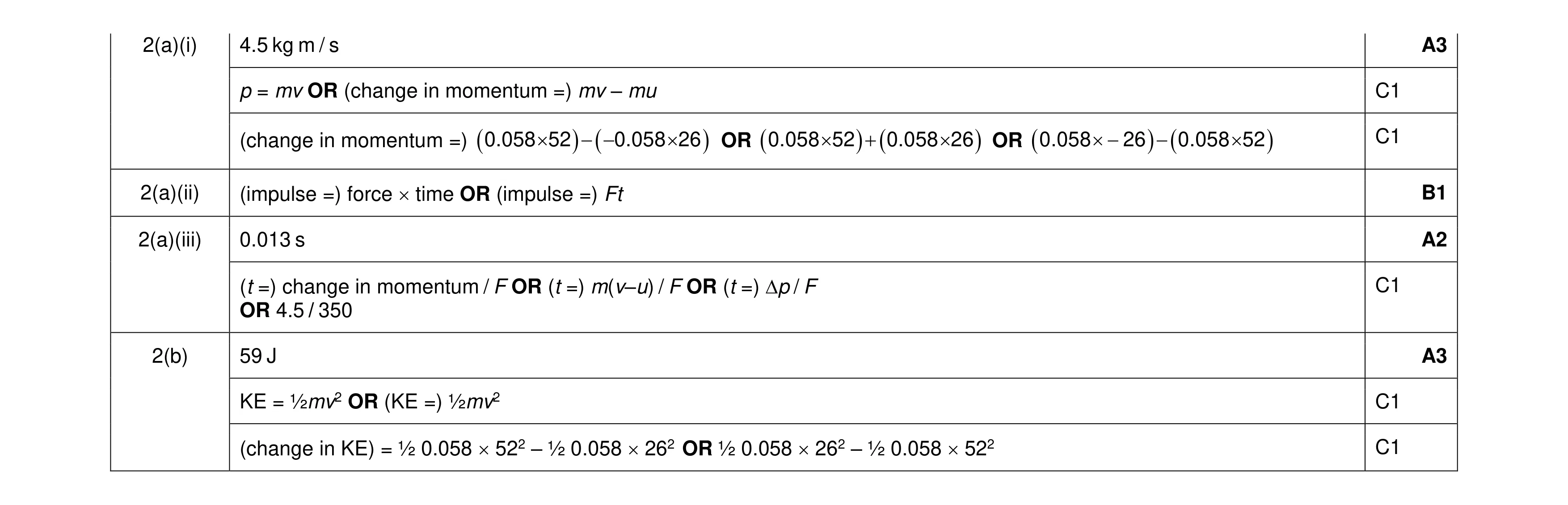 9
9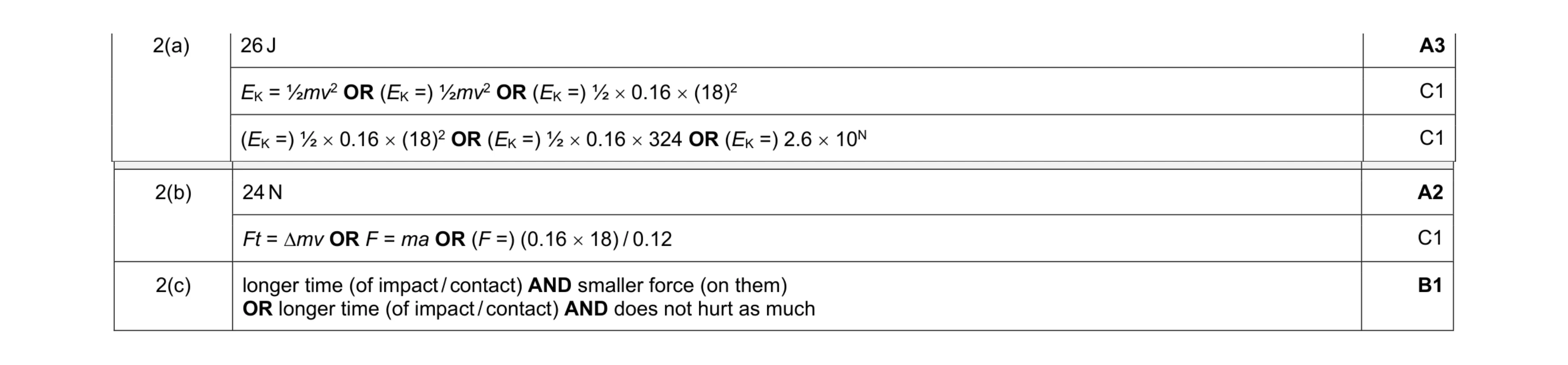 6
6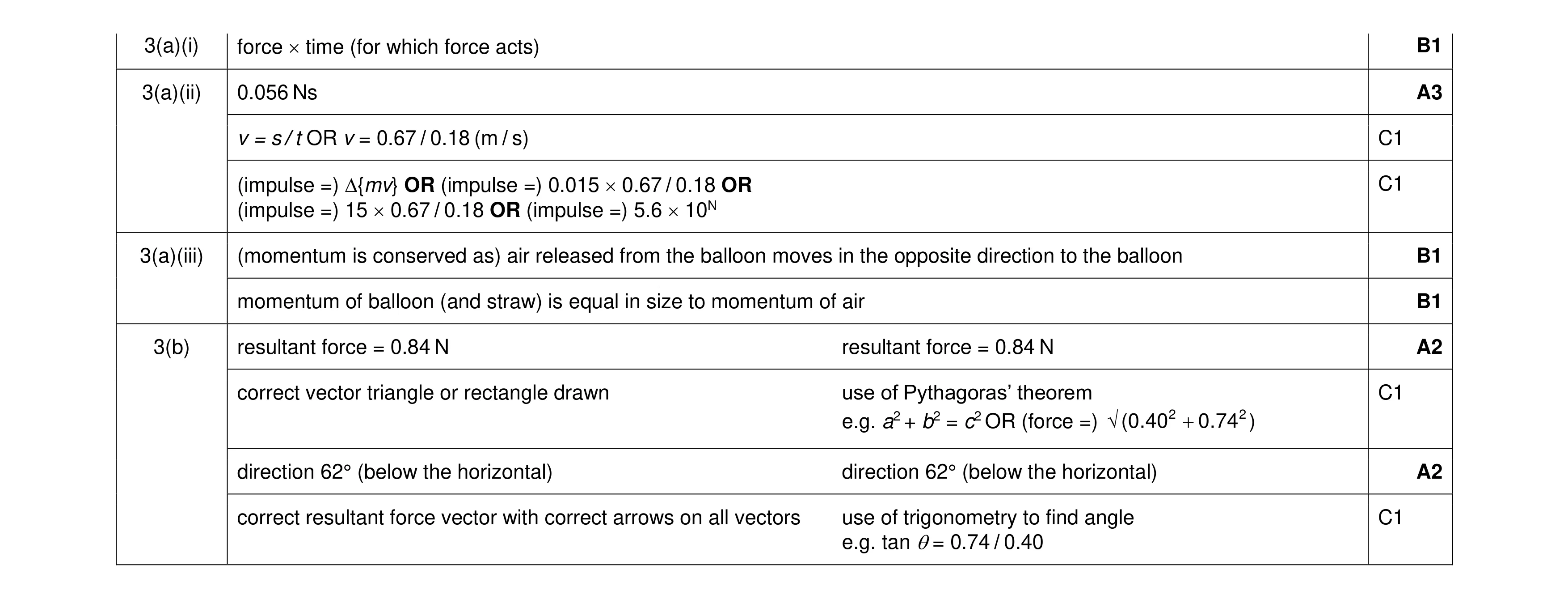 10
10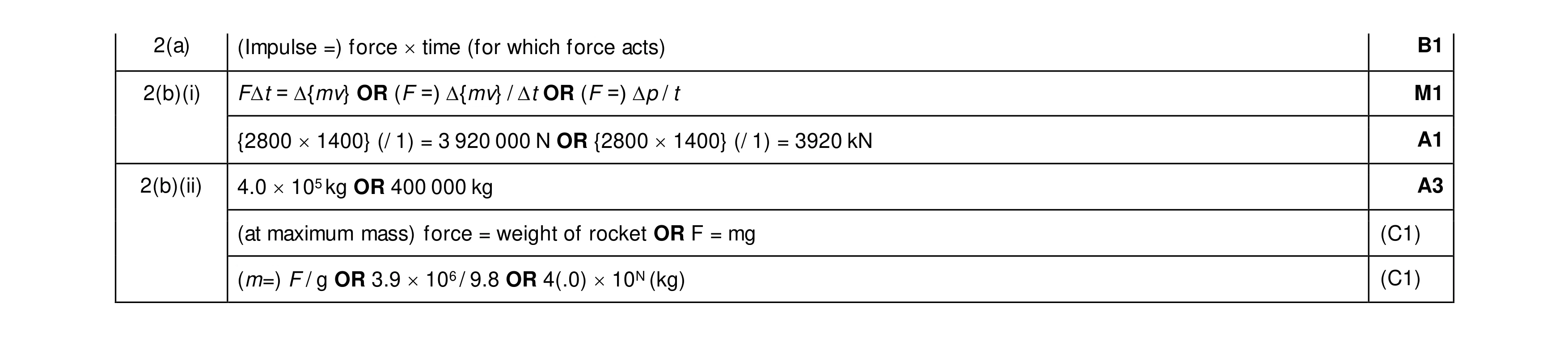 6
6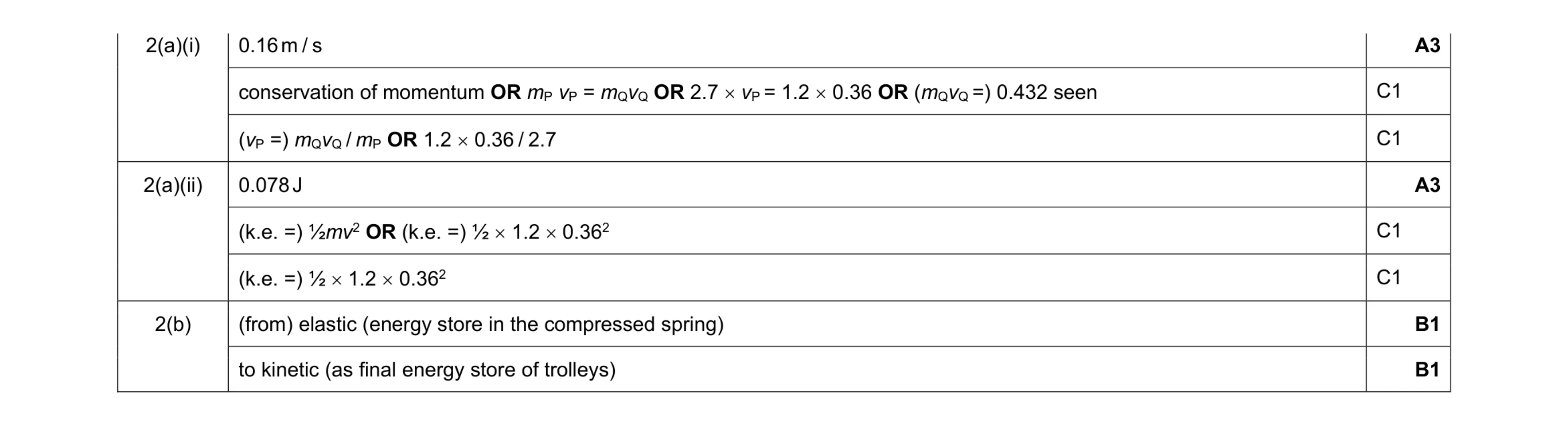 8
8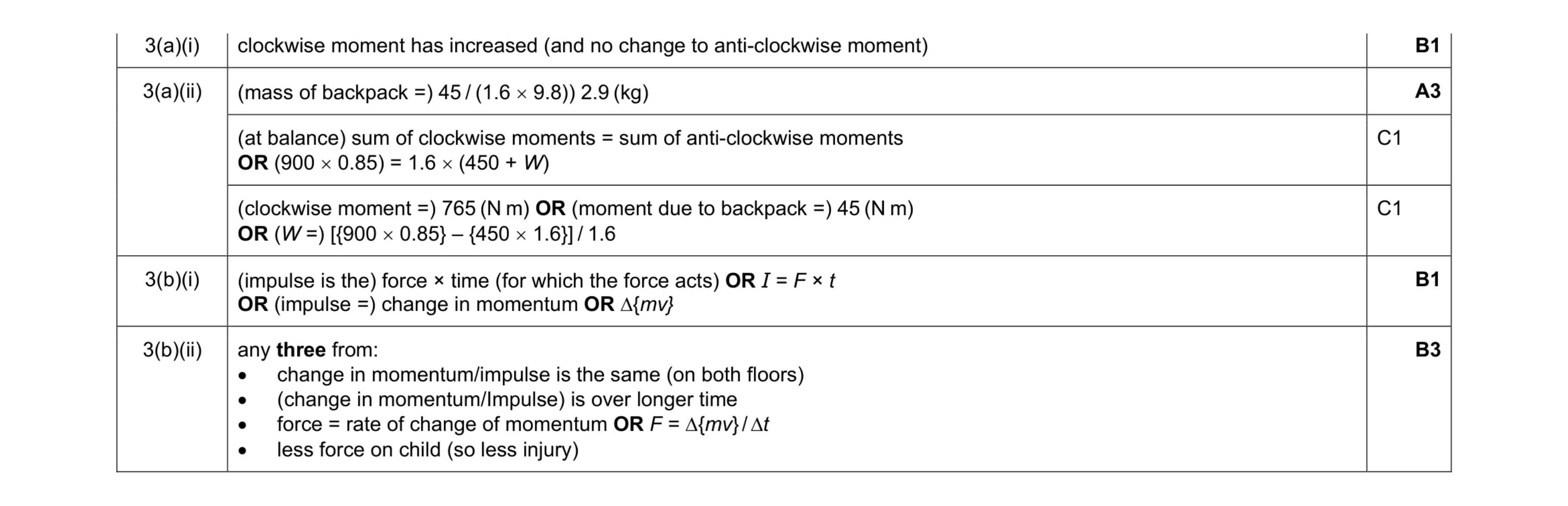 8
8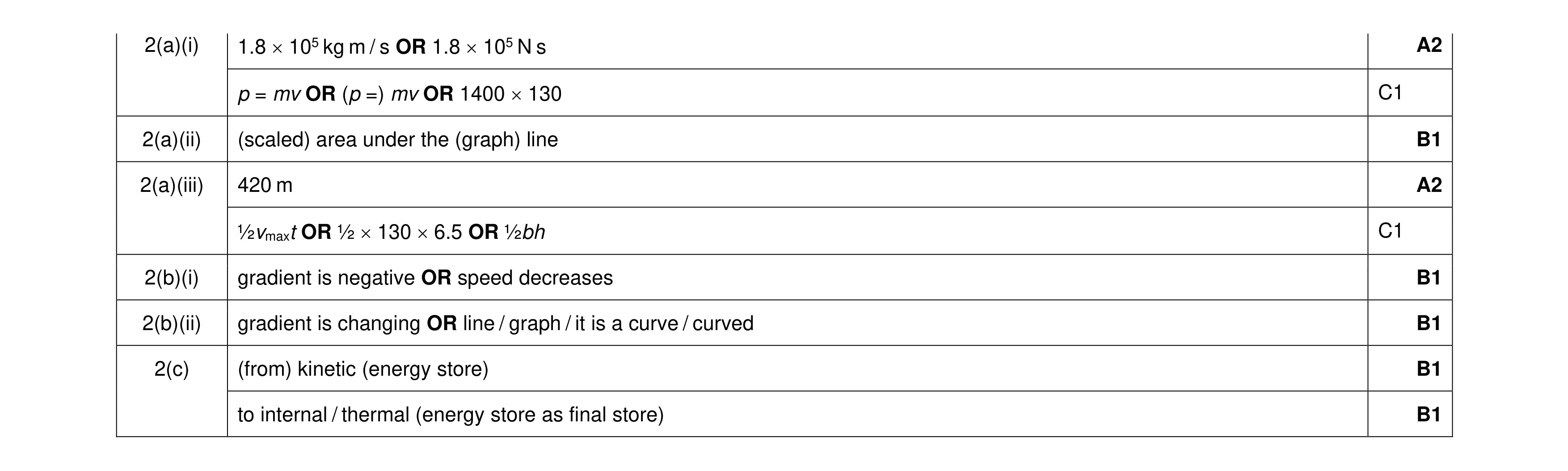 9
9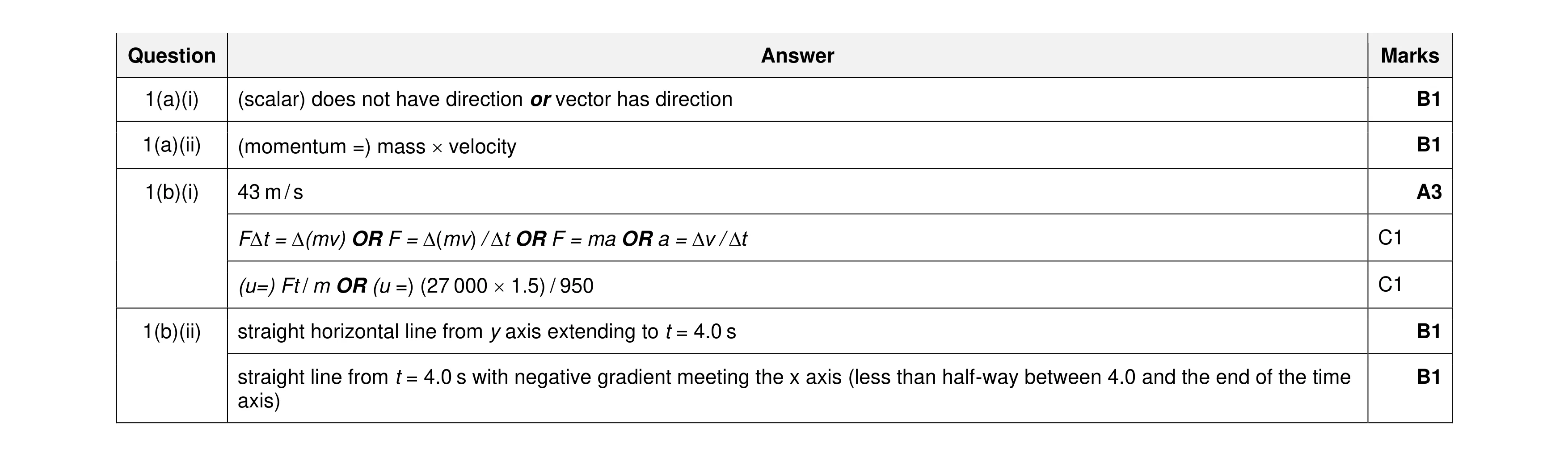 7
7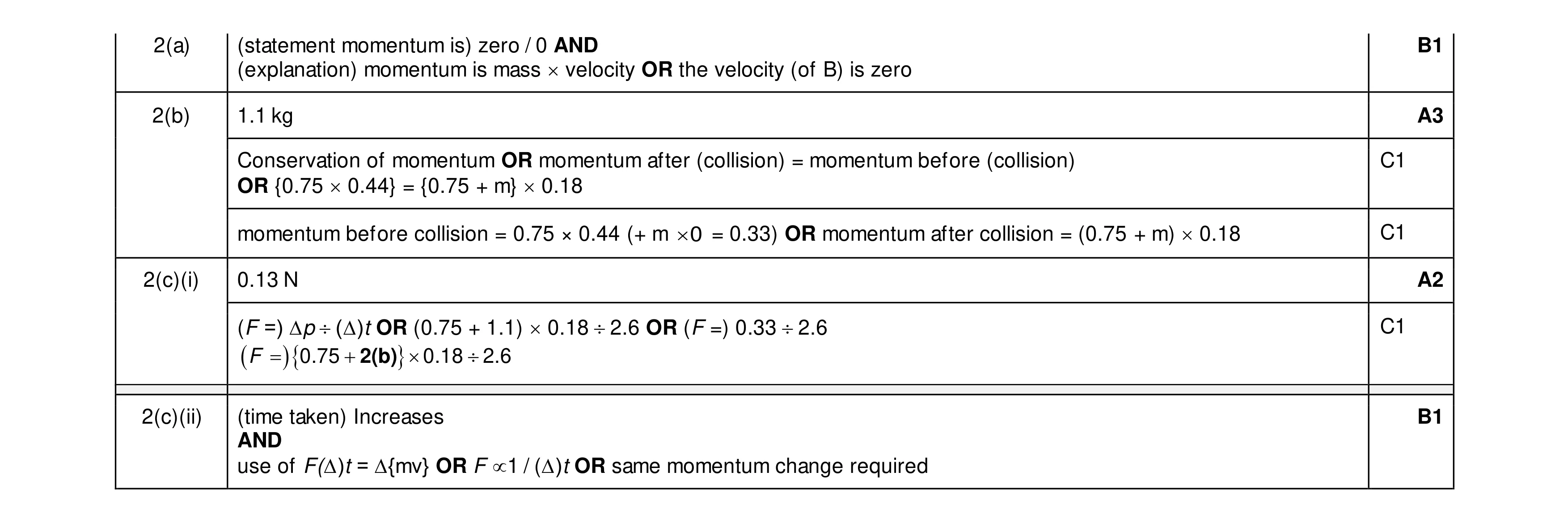 7
7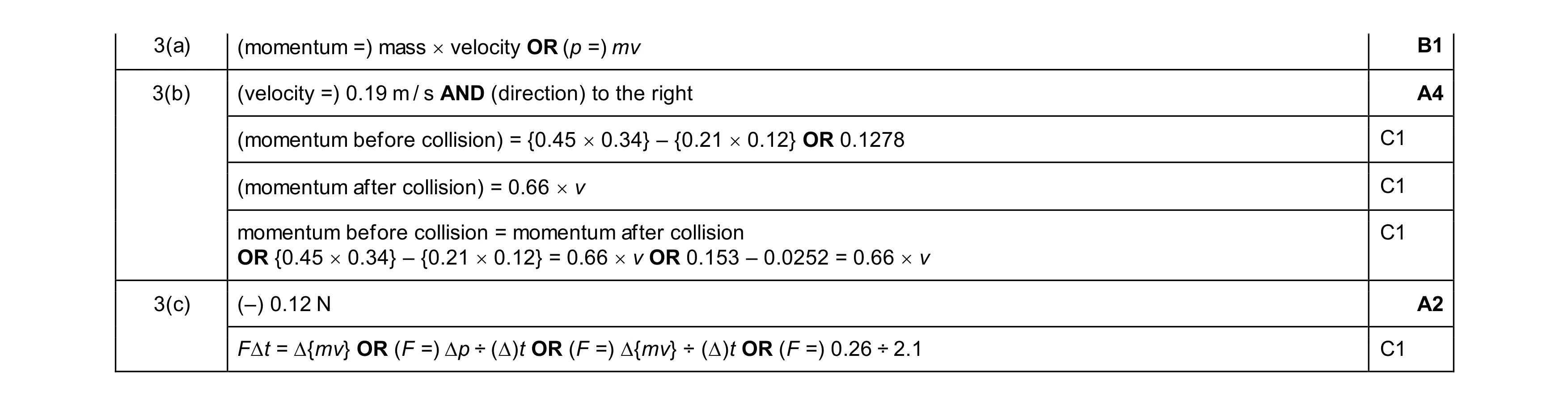 7
7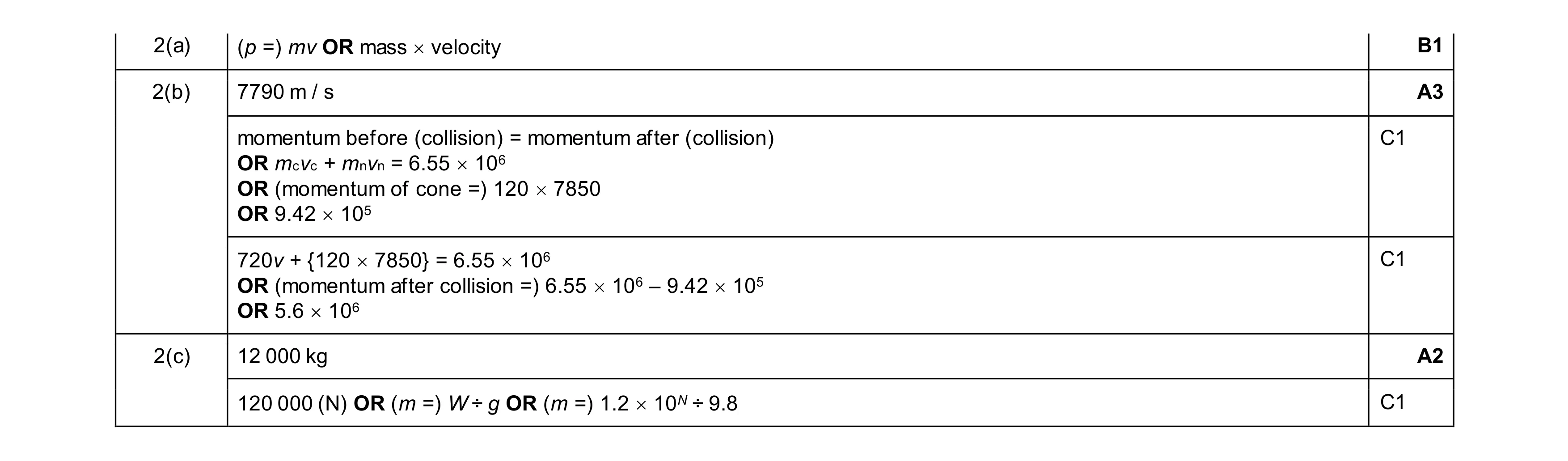 6
6