Questions as text
Q1 · With which types of wave can the Doppler shift be observed? 9702/12 Feb/March 2016
20 With which types of wave can the Doppler shift be observed? A all types of wave B light and sound waves only C sound waves and water waves only D sound waves only
1 marks
Answer: A
This question in 9702/12 Feb/March 2016
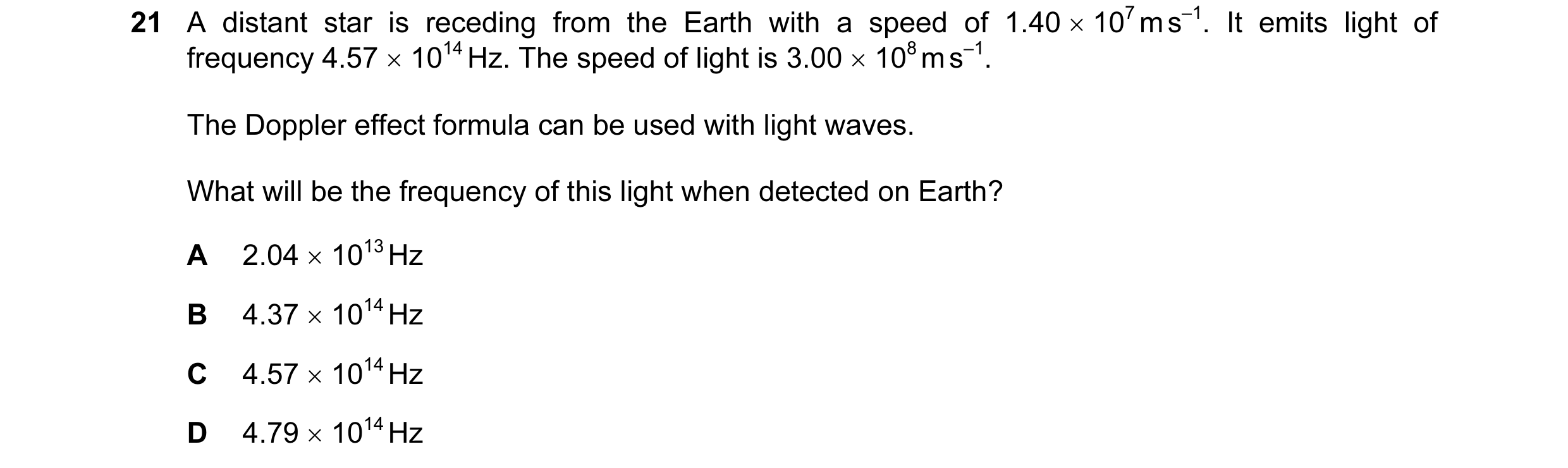
Q2 · A distant star is receding from the Earth with a speed of 1.40 × 10⁷ m s–1 9702/12 Feb/March 2016
21 A distant star is receding from the Earth with a speed of 1.40 × 10⁷ m s–1. It emits light of frequency 4.57 × 10¹⁴ Hz. The speed of light is 3.00 × 10⁸ m s–1. The Doppler effect formula can be used with light waves. What will be the frequency of this light when detected on Earth? A 2.04 × 10¹³ Hz B 4.37 × 10¹⁴ Hz C 4.57 × 10¹⁴ Hz D 4.79 × 10¹⁴ Hz
1 marks
Answer: B
This question in 9702/12 Feb/March 2016
Q3 · A source of sound of frequency 1000 Hz moves away from a stationary observer at a speed… 9702/12 May/June 2016
23 A source of sound of frequency 1000 Hz moves away from a stationary observer at a speed of 30.0 m s–1. The speed of sound is 330 m s–1. What is the frequency of the sound heard by the observer? A 909 Hz B 917 Hz C 1090 Hz D 1100 Hz
1 marks
Answer: B
This question in 9702/12 May/June 2016
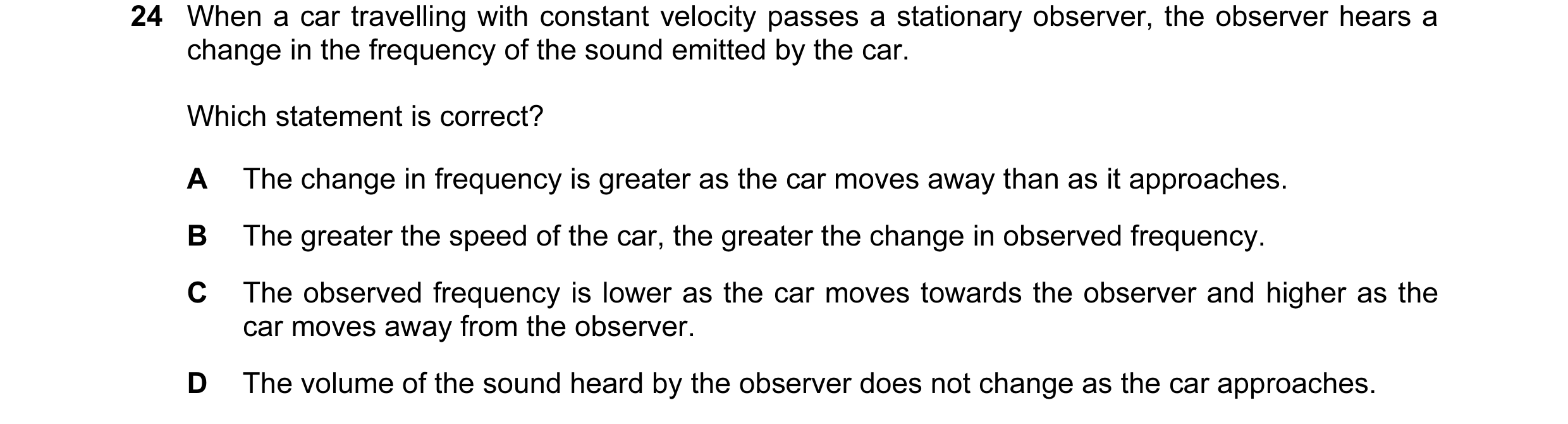
Q4 · When a car travelling with constant velocity passes a stationary observer, the observer… 9702/13 May/June 2016
24 When a car travelling with constant velocity passes a stationary observer, the observer hears a change in the frequency of the sound emitted by the car. Which statement is correct? A The change in frequency is greater as the car moves away than as it approaches. B The greater the speed of the car, the greater the change in observed frequency. C The observed frequency is lower as the car moves towards the observer and higher as the car moves away from the observer. D The volume of the sound heard by the observer does not change as the car approaches.
1 marks
Answer: B
This question in 9702/13 May/June 2016
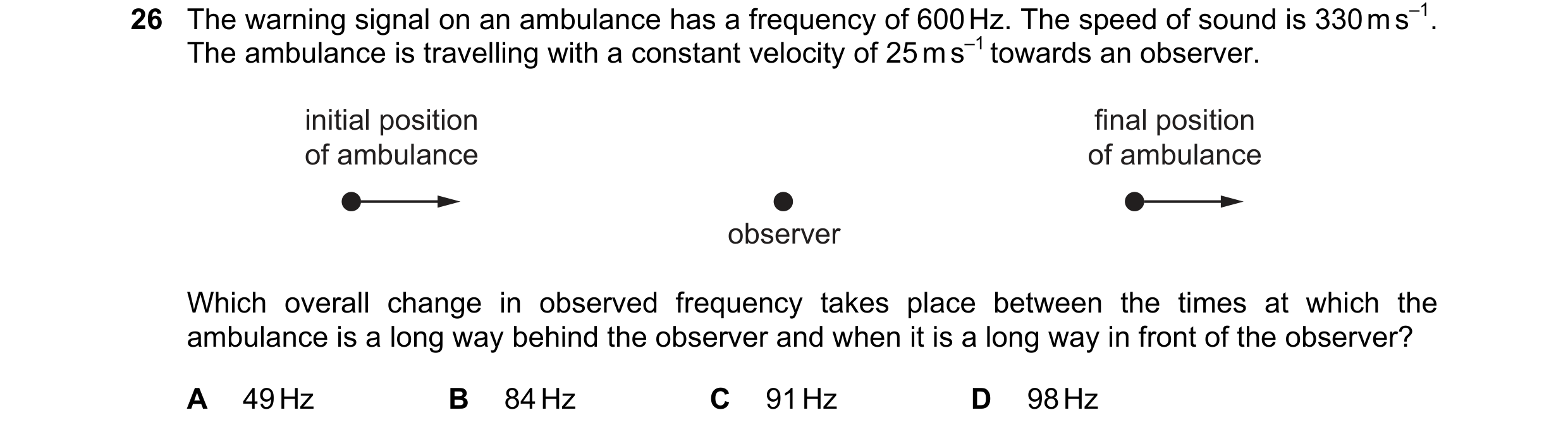
Q5 · The warning signal on an ambulance has a frequency of 600 Hz 9702/11 Oct/Nov 2016
26 The warning signal on an ambulance has a frequency of 600 Hz. The speed of sound is 330 m s–1. The ambulance is travelling with a constant velocity of 25 m s–1 towards an observer. initial position final position of ambulance of ambulance observer Which overall change in observed frequency takes place between the times at which the ambulance is a long way behind the observer and when it is a long way in front of the observer? A 49 Hz B 84 Hz C 91 Hz D 98 Hz
1 marks
Answer: C
This question in 9702/11 Oct/Nov 2016
Q6 · The warning signal on an ambulance has a frequency of 600 Hz 9702/13 Oct/Nov 2016
26 The warning signal on an ambulance has a frequency of 600 Hz. The speed of sound is 330 m s–1. The ambulance is travelling with a constant velocity of 25 m s–1 towards an observer. initial position final position of ambulance of ambulance observer Which overall change in observed frequency takes place between the times at which the ambulance is a long way behind the observer and when it is a long way in front of the observer? A 49 Hz B 84 Hz C 91 Hz D 98 Hz
1 marks
Answer: C
This question in 9702/13 Oct/Nov 2016
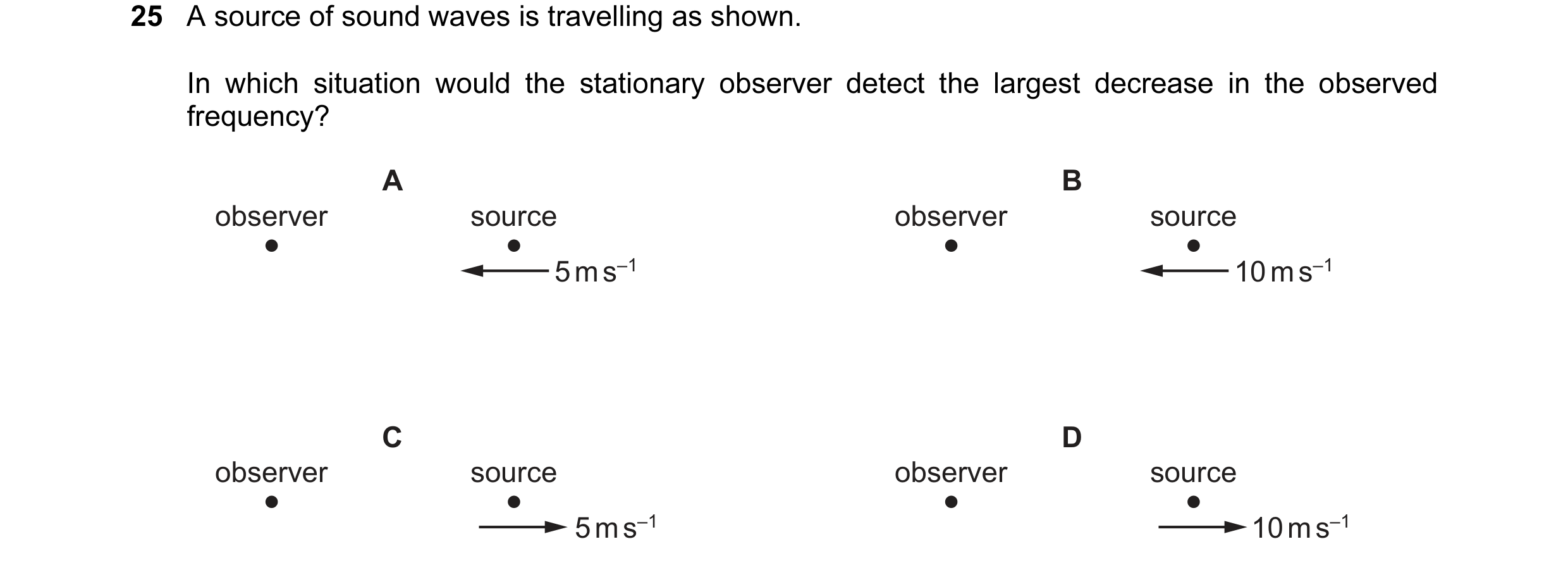
Q7 · A source of sound waves is travelling as shown 9702/12 Feb/March 2017
25 A source of sound waves is travelling as shown. In which situation would the stationary observer detect the largest decrease in the observed frequency? A B observer source observer source 5 m s–1 10 m s–1 C D observer source observer source 5 m s–1 10 m s–1
1 marks
Answer: D
This question in 9702/12 Feb/March 2017
Q8 · A car travelling in a straight line at a speed of 30 m s–1 passes near a stationary… 9702/11 May/June 2017
25 A car travelling in a straight line at a speed of 30 m s–1 passes near a stationary observer while sounding its horn. The true frequency of sound from the horn is 400 Hz. The speed of sound in air is 336 m s–1. What is the change in the frequency of the sound heard by the observer as the car passes? A 39 Hz B 66 Hz C 72 Hz D 78 Hz
1 marks
Answer: C
This question in 9702/11 May/June 2017
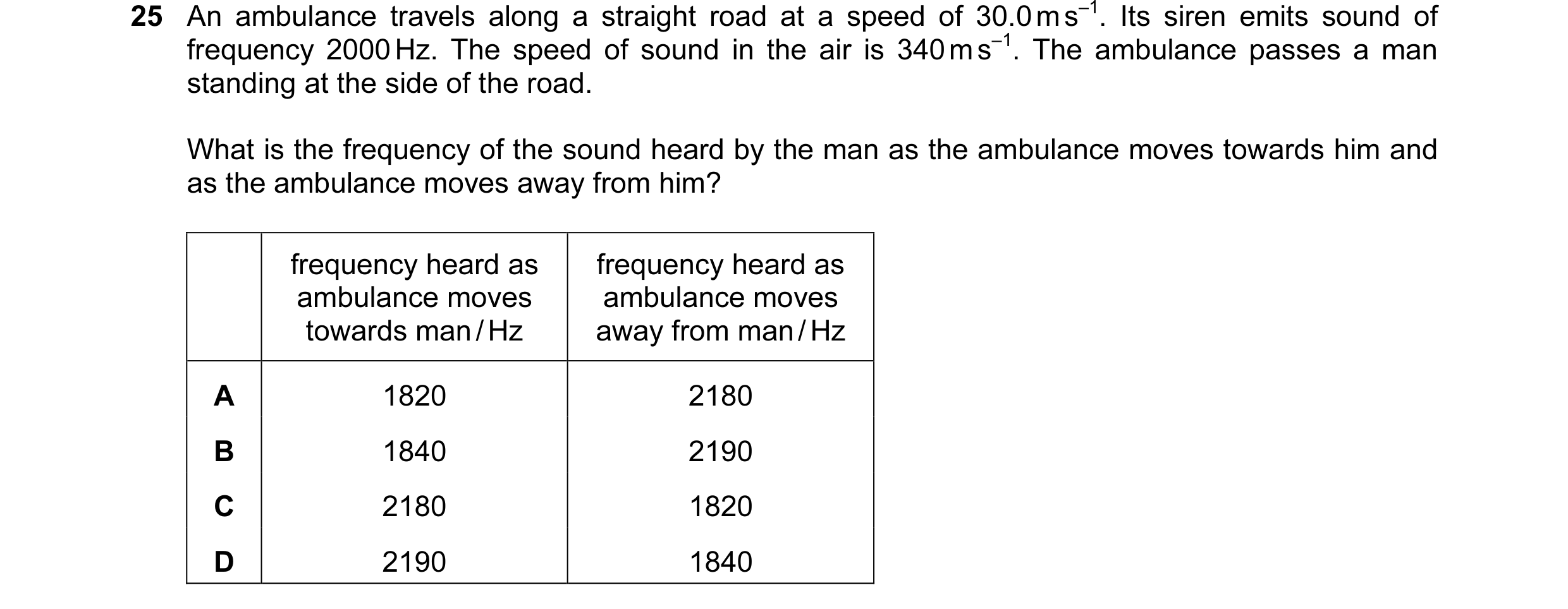
Q9 · An ambulance travels along a straight road at a speed of 30.0 m s–1 9702/12 May/June 2017
25 An ambulance travels along a straight road at a speed of 30.0 m s–1. Its siren emits sound of frequency 2000 Hz. The speed of sound in the air is 340 m s–1. The ambulance passes a man standing at the side of the road. What is the frequency of the sound heard by the man as the ambulance moves towards him and as the ambulance moves away from him? frequency heard as frequency heard as ambulance moves ambulance moves towards man / Hz away from man / Hz A 1820 2180 B 1840 2190 C 2180 1820 D 2190 1840
1 marks
Answer: D
This question in 9702/12 May/June 2017
Q10 · A high-speed train approaches a stationary observer at a speed of 80 m s–1 9702/13 May/June 2017
24 A high-speed train approaches a stationary observer at a speed of 80 m s–1. The train’s horn emits a sound of frequency 250 Hz. The speed of sound is 340 m s–1. What is the observed frequency of the sound from the horn? A 190 Hz B 200 Hz C 310 Hz D 330 Hz
1 marks
Answer: D
This question in 9702/13 May/June 2017
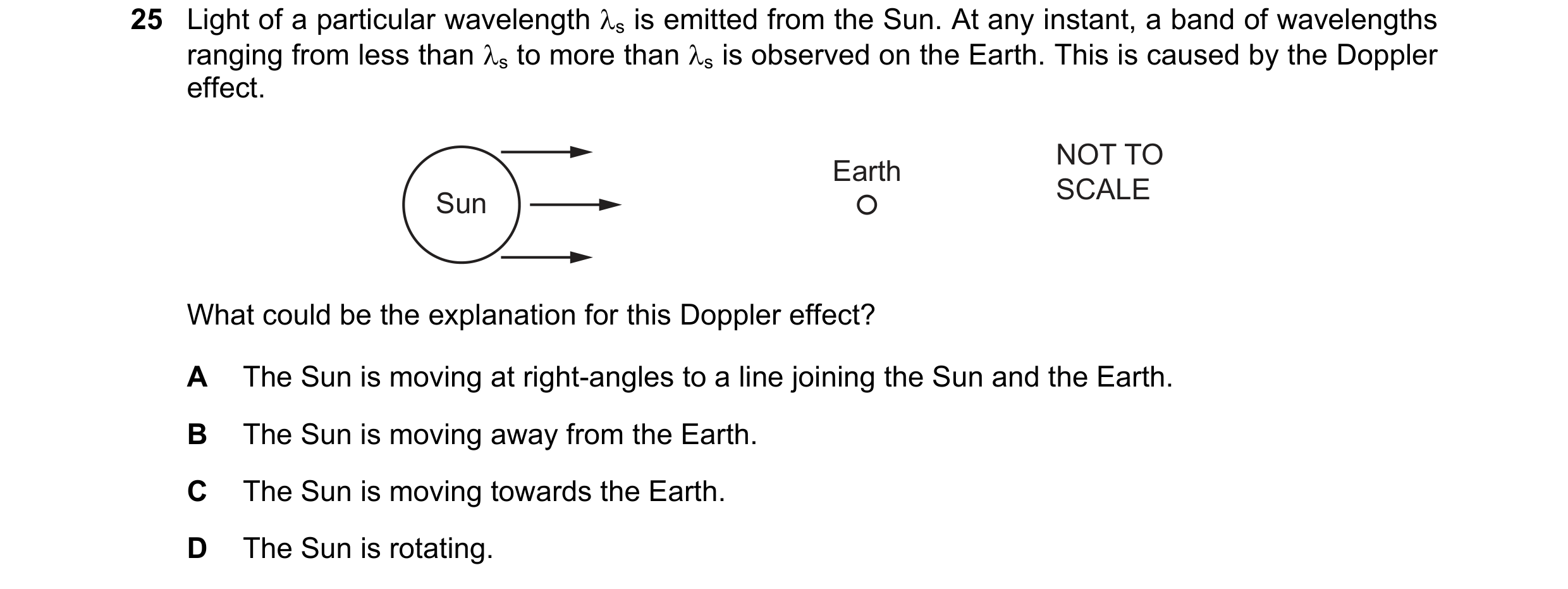
Q11 · Light of a particular wavelength λs is emitted from the Sun 9702/11 Oct/Nov 2017
25 Light of a particular wavelength λs is emitted from the Sun. At any instant, a band of wavelengths ranging from less than λs to more than λs is observed on the Earth. This is caused by the Doppler effect. NOT TO Earth SCALE Sun What could be the explanation for this Doppler effect? A The Sun is moving at right-angles to a line joining the Sun and the Earth. B The Sun is moving away from the Earth. C The Sun is moving towards the Earth. D The Sun is rotating.
1 marks
Answer: D
This question in 9702/11 Oct/Nov 2017
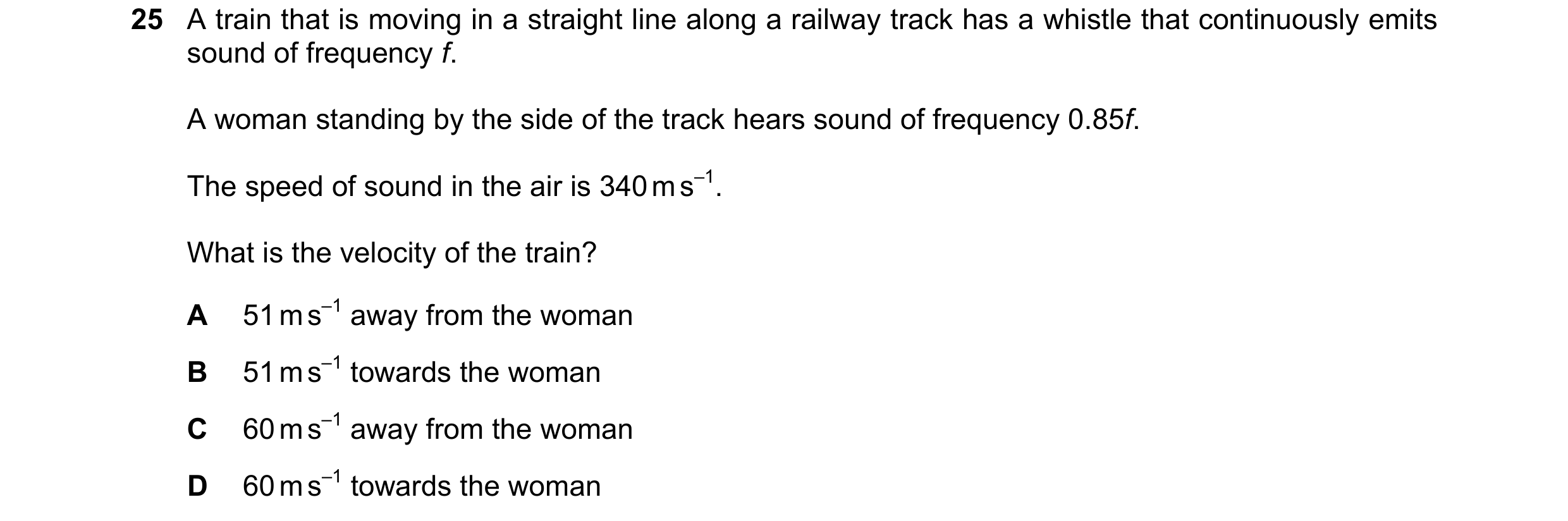
Q12 · A train that is moving in a straight line along a railway track has a whistle that… 9702/12 Oct/Nov 2017
25 A train that is moving in a straight line along a railway track has a whistle that continuously emits sound of frequency f. A woman standing by the side of the track hears sound of frequency 0.85f. The speed of sound in the air is 340 m s–1. What is the velocity of the train? A 51 m s–1 away from the woman B 51 m s–1 towards the woman C 60 m s–1 away from the woman D 60 m s–1 towards the woman
1 marks
Answer: C
This question in 9702/12 Oct/Nov 2017
Q13 · A source of sound of frequency F at point Z is moving at a steady speed 9702/13 Oct/Nov 2017
25 A source of sound of frequency F at point Z is moving at a steady speed. The pattern of the emitted wavefronts is shown. X X Z Z Y Y Which row describes the frequencies of the sound heard by stationary observers at X and Y? frequency frequency heard at X heard at Y A <F <F B <F >F C >F <F D >F >F
1 marks
Answer: C
This question in 9702/13 Oct/Nov 2017
Q14 · A car travelling at a steady speed in a straight line passes close to a stationary… 9702/13 Oct/Nov 2017
26 A car travelling at a steady speed in a straight line passes close to a stationary observer. The observer measures the frequency of the sound from the engine. As the car approaches, the observed frequency is 220 Hz. When the car moves away, the observed frequency is 180 Hz. The speed of sound in air is 340 m s–1. What is the speed of the car? A 8.5 m s–1 B 31 m s–1 C 34 m s–1 D 38 m s–1
1 marks
Answer: C
This question in 9702/13 Oct/Nov 2017
Q15 · A vehicle carries a microwave transmitter that emits microwaves of a constant frequency 9702/12 Feb/March 2018
24 A vehicle carries a microwave transmitter that emits microwaves of a constant frequency. A stationary observer has a microwave receiver. The vehicle moves directly towards the observer at constant speed. The observer detects microwaves of frequency Fo. The vehicle then accelerates, still moving towards the observer, travels at higher steady speed for a time and then decelerates until it stops. What is the variation in the frequency of the microwaves that are detected by the observer? A The observed frequency will fall, then remain steady then return to the frequency Fo. B The observed frequency will fall, then remain steady then rise to a higher frequency than Fo. C The observed frequency will rise, then remain steady then fall to a lower frequency than Fo. D The observed frequency will rise, then remain steady then return to the frequency Fo.
1 marks
Answer: C
This question in 9702/12 Feb/March 2018
Q16 · A binary star consists of two stars rotating around a common centre 9702/11 May/June 2018
24 A binary star consists of two stars rotating around a common centre. Light from one of the stars is observed on the Earth. binary star observer on Earth The observed frequency of the light varies between a minimum frequency fmin and a maximum frequency fmax, as shown. fmax observed frequency fmin 0 time The rate of rotation of the binary star increases. What is the change to fmax and the change to fmin? fmax fmin A decreases decreases B decreases increases C increases decreases D increases increases
1 marks
Answer: C
This question in 9702/11 May/June 2018
Q17 · An astronomer observes the light from a star that is moving away from the Earth 9702/12 May/June 2018
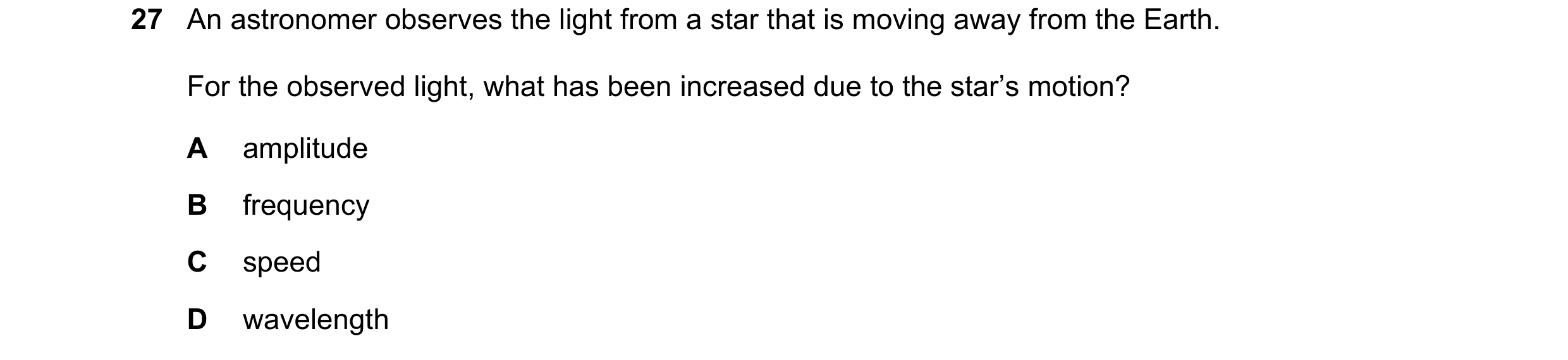
27 An astronomer observes the light from a star that is moving away from the Earth. For the observed light, what has been increased due to the star’s motion? A amplitude B frequency C speed D wavelength
1 marks
Answer: D
This question in 9702/12 May/June 2018
Q18 · A police car travels at a velocity of 30.0 m s–1 directly towards a stationary observer 9702/13 May/June 2018
23 A police car travels at a velocity of 30.0 m s–1 directly towards a stationary observer. The horn of the car emits sound of frequency 2000 Hz. The speed of sound is 340 m s–1. What is the frequency of the sound heard by the observer? A 1840 Hz B 2000 Hz C 2180 Hz D 2190 Hz
1 marks
Answer: D
This question in 9702/13 May/June 2018
Q19 · A jet aircraft travels at a speed of 0.8v where v is the speed of sound 9702/11 Oct/Nov 2018
24 A jet aircraft travels at a speed of 0.8v where v is the speed of sound. The aircraft approaches a stationary observer. The frequency of sound emitted by the aircraft is 100 Hz. Which frequency does the observer hear? A 56 Hz B 180 Hz C 400 Hz D 500 Hz
1 marks
Answer: D
This question in 9702/11 Oct/Nov 2018
Q20 · A police car has a two-tone siren emitting sound of frequencies of 700 Hz and 1000 Hz 9702/12 Oct/Nov 2018
25 A police car has a two-tone siren emitting sound of frequencies of 700 Hz and 1000 Hz. The police car is travelling at a speed of 40.0 m s–1 towards a stationary observer. The speed of sound in the air is 340 m s–1. What is the difference between the two frequencies of the sound that is heard by the observer? A 268 Hz B 300 Hz C 335 Hz D 340 Hz
1 marks
Answer: D
This question in 9702/12 Oct/Nov 2018
Q21 · A bat flies directly towards a fixed ultrasound detector at a speed of 25.0 m s–1… 9702/13 Oct/Nov 2018
24 A bat flies directly towards a fixed ultrasound detector at a speed of 25.0 m s–1 emitting pulses of ultrasound of frequency 40.0 kHz. The speed of sound in air is 330 m s–1. Which frequency does the ultrasound detector record? A 37.0 kHz B 37.2 kHz C 43.0 kHz D 43.3 kHz
1 marks
Answer: D
This question in 9702/13 Oct/Nov 2018
Q22 · A buzzer emitting sound of frequency 846 Hz is attached to a string and rotated in a… 9702/12 Feb/March 2019
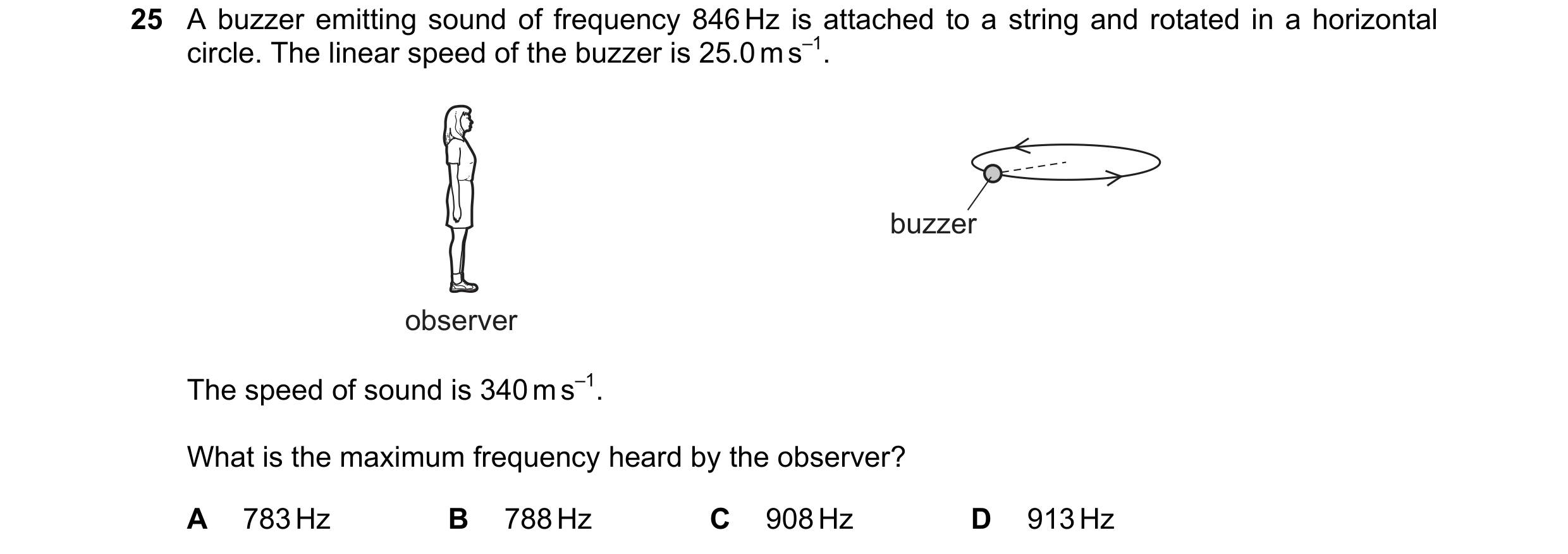
25 A buzzer emitting sound of frequency 846 Hz is attached to a string and rotated in a horizontal circle. The linear speed of the buzzer is 25.0 m s–1. buzzer observer The speed of sound is 340 m s–1. What is the maximum frequency heard by the observer? A 783 Hz B 788 Hz C 908 Hz D 913 Hz
1 marks
Answer: D
This question in 9702/12 Feb/March 2019
Q23 · A stationary insect on the surface of water creates circular waves with its legs, as… 9702/11 May/June 2019
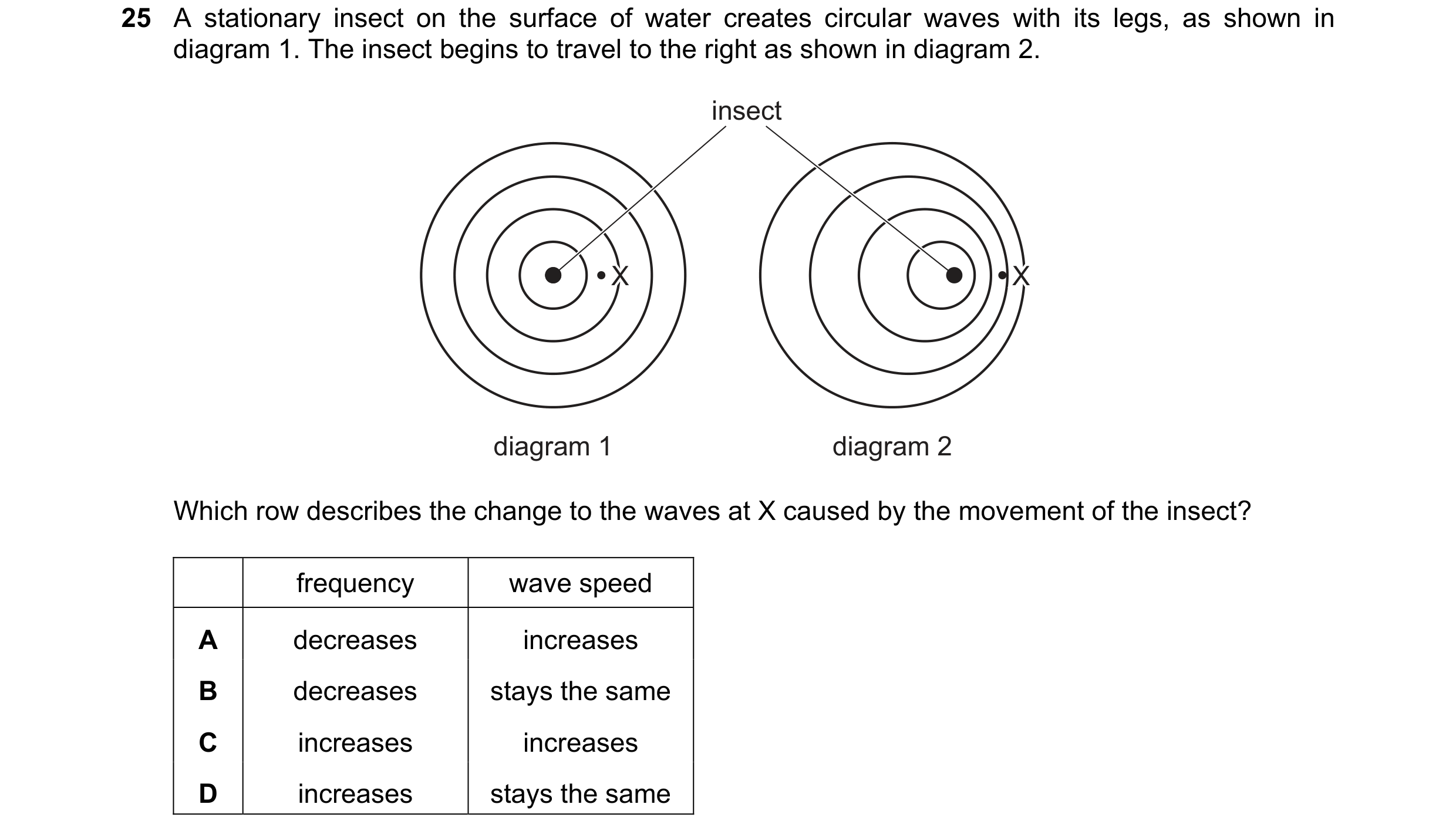
25 A stationary insect on the surface of water creates circular waves with its legs, as shown in diagram 1. The insect begins to travel to the right as shown in diagram 2. insect X X diagram 1 diagram 2 Which row describes the change to the waves at X caused by the movement of the insect? frequency wave speed A decreases increases B decreases stays the same C increases increases D increases stays the same
1 marks
Answer: D
This question in 9702/11 May/June 2019
Q24 · A toy motorboat moving with constant velocity v vibrates up and down on the surface of a… 9702/11 May/June 2019
26 A toy motorboat moving with constant velocity v vibrates up and down on the surface of a pond. This causes the boat to act as a source of circular water waves of frequency 2.0 Hz. The speed of the waves is 1.5 m s–1. A man, standing at the edge of the pond, observes that the waves from the boat approach him with a frequency of 3.0 Hz. The formula for Doppler effect calculations with sound waves may also be used for water waves. What is a possible value of v? speed / m s–1 direction A 0.50 directly away from the man B 0.50 directly towards the man C 0.75 directly away from the man D 0.75 directly towards the man
1 marks
Answer: B
This question in 9702/11 May/June 2019
Q25 · In one of the first experiments to demonstrate the Doppler effect, a train was filled… 9702/12 May/June 2019
26 In one of the first experiments to demonstrate the Doppler effect, a train was filled with trumpeters all playing a note of frequency 440 Hz. The difference in observed frequency of the note as the train directly approached a stationary observer was 22 Hz. The speed of sound was 340 m s–1. At which speed was the train moving? A 15.4 m s–1 B 16.2 m s–1 C 17.0 m s–1 D 17.9 m s–1
1 marks
Answer: B
This question in 9702/12 May/June 2019
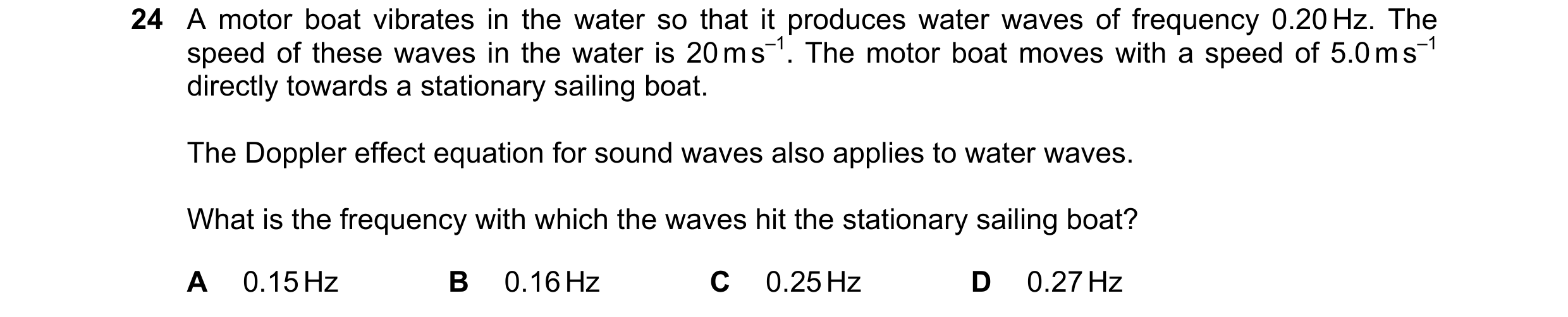
Q26 · A motor boat vibrates in the water so that it produces water waves of frequency 0.20 Hz 9702/13 May/June 2019
24 A motor boat vibrates in the water so that it produces water waves of frequency 0.20 Hz. The speed of these waves in the water is 20 m s–1. The motor boat moves with a speed of 5.0 m s–1 directly towards a stationary sailing boat. The Doppler effect equation for sound waves also applies to water waves. What is the frequency with which the waves hit the stationary sailing boat? A 0.15 Hz B 0.16 Hz C 0.25 Hz D 0.27 Hz
1 marks
Answer: D
This question in 9702/13 May/June 2019
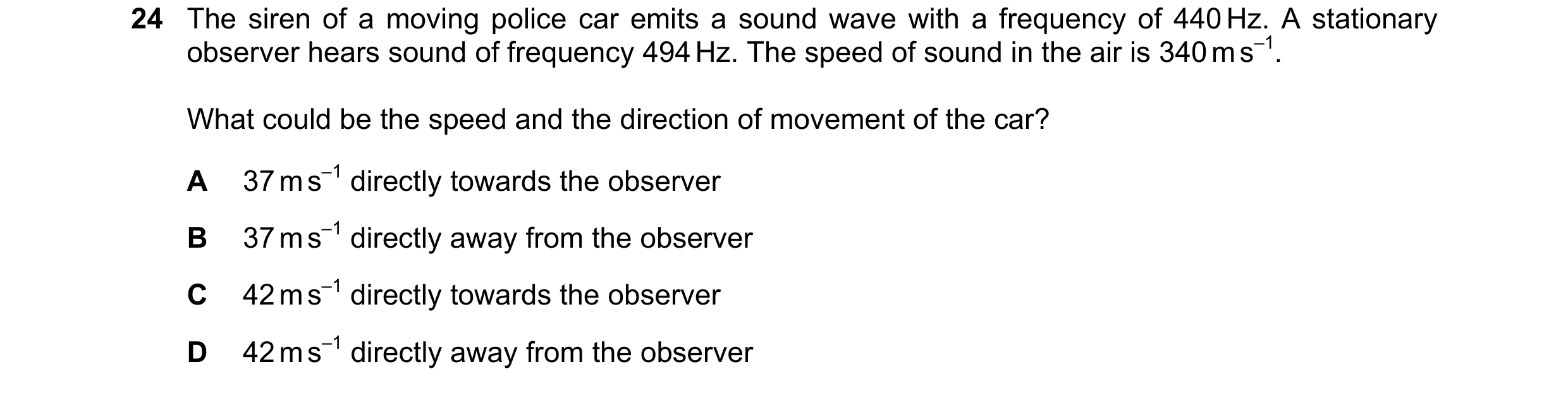
Q27 · The siren of a moving police car emits a sound wave with a frequency of 440 Hz 9702/11 Oct/Nov 2019
24 The siren of a moving police car emits a sound wave with a frequency of 440 Hz. A stationary observer hears sound of frequency 494 Hz. The speed of sound in the air is 340 m s–1. What could be the speed and the direction of movement of the car? A 37 m s–1 directly towards the observer B 37 m s–1 directly away from the observer C 42 m s–1 directly towards the observer D 42 m s–1 directly away from the observer
1 marks
Answer: A
This question in 9702/11 Oct/Nov 2019
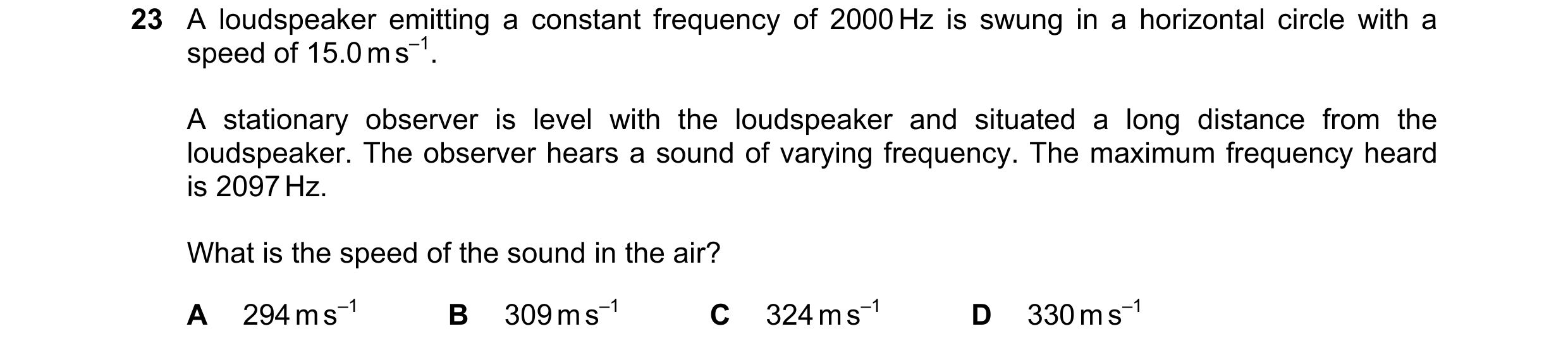
Q28 · A loudspeaker emitting a constant frequency of 2000 Hz is swung in a horizontal circle… 9702/12 Oct/Nov 2019
23 A loudspeaker emitting a constant frequency of 2000 Hz is swung in a horizontal circle with a speed of 15.0 m s–1. A stationary observer is level with the loudspeaker and situated a long distance from the loudspeaker. The observer hears a sound of varying frequency. The maximum frequency heard is 2097 Hz. What is the speed of the sound in the air? A 294 m s–1 B 309 m s–1 C 324 m s–1 D 330 m s–1
1 marks
Answer: C
This question in 9702/12 Oct/Nov 2019
Q29 · A siren emits sound of frequency 1000 Hz 9702/13 Oct/Nov 2019
24 A siren emits sound of frequency 1000 Hz. The siren moves at 20 m s–1 towards an observer who is standing still. The speed of sound in the air is 330 m s–1. Which expression would correctly give the frequency heard by the observer? 1000 × 330 A 330 + 20 1000 × 330 B 330 − 20 1000 (330 + 20) C 330 1000 (330 − 20) D 330
1 marks
Answer: B
This question in 9702/13 Oct/Nov 2019
Q30 · An observer is situated at the top of a tall tower 9702/12 Feb/March 2020
24 An observer is situated at the top of a tall tower. An aeroplane emitting sound at a frequency of 1000 Hz approaches the observer at a speed of 165 m s–1. The speed of sound is 330 m s–1. What is the frequency of the sound received by the observer? A 330 Hz B 667 Hz C 1000 Hz D 2000 Hz
1 marks
Answer: D
This question in 9702/12 Feb/March 2020
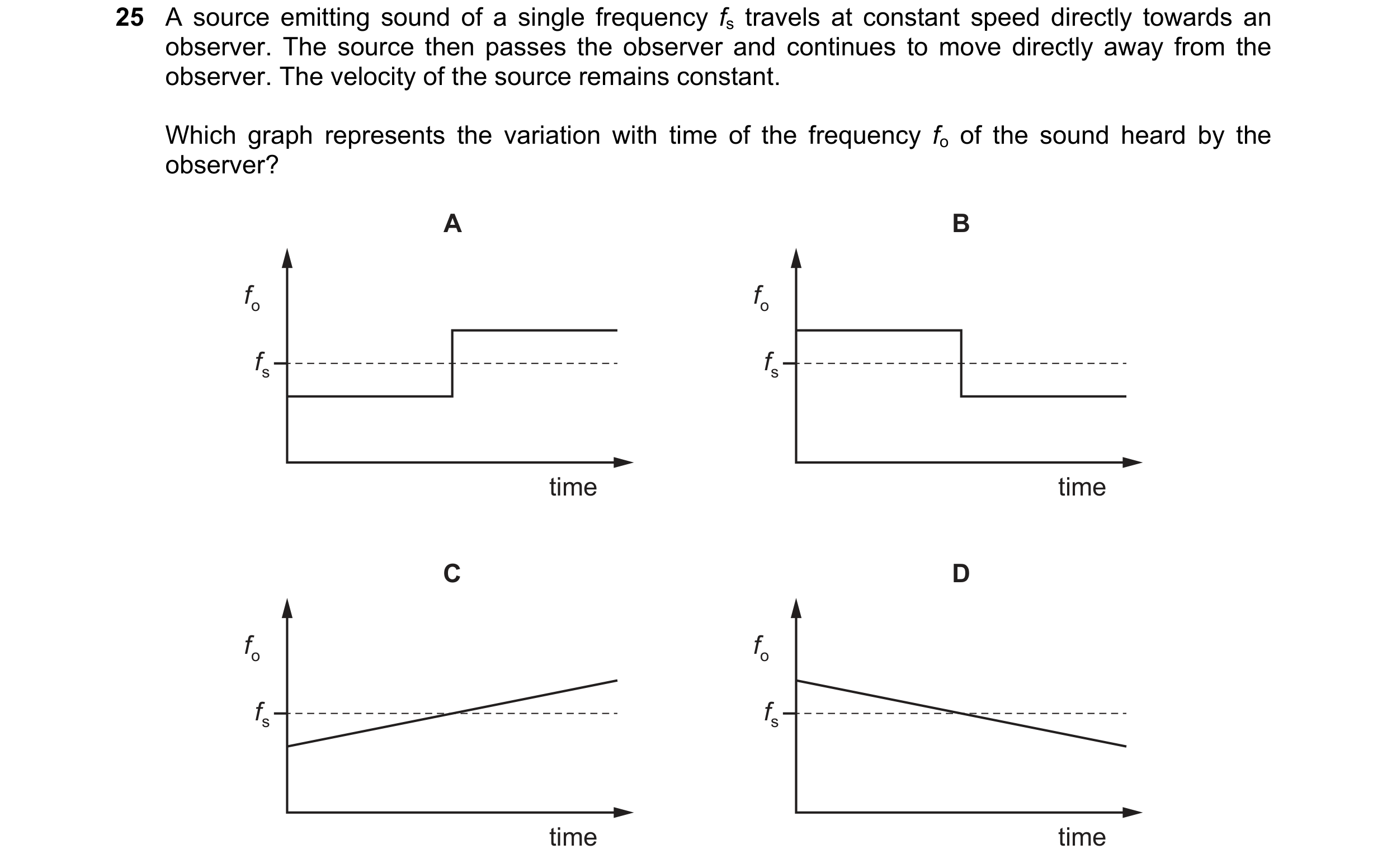
Q31 · A source emitting sound of a single frequency fs travels at constant speed directly… 9702/11 May/June 2020
25 A source emitting sound of a single frequency fs travels at constant speed directly towards an observer. The source then passes the observer and continues to move directly away from the observer. The velocity of the source remains constant. Which graph represents the variation with time of the frequency fo of the sound heard by the observer? A B fo fo fs fs time time C D fo fo fs fs time time
1 marks
Answer: B
This question in 9702/11 May/June 2020
Q32 · A stationary person measures the speed and wavelength of the sound from a horn on a… 9702/12 May/June 2020
25 A stationary person measures the speed and wavelength of the sound from a horn on a stationary vehicle. The person then repeats the measurements when the vehicle is approaching at a constant speed. Which row describes the measured wavelength and the measured speed of the sound wave from the moving vehicle when compared with the sound wave from the stationary vehicle? wavelength of speed of the sound wave the sound wave A longer greater B shorter greater C longer same D shorter same
1 marks
Answer: D
This question in 9702/12 May/June 2020
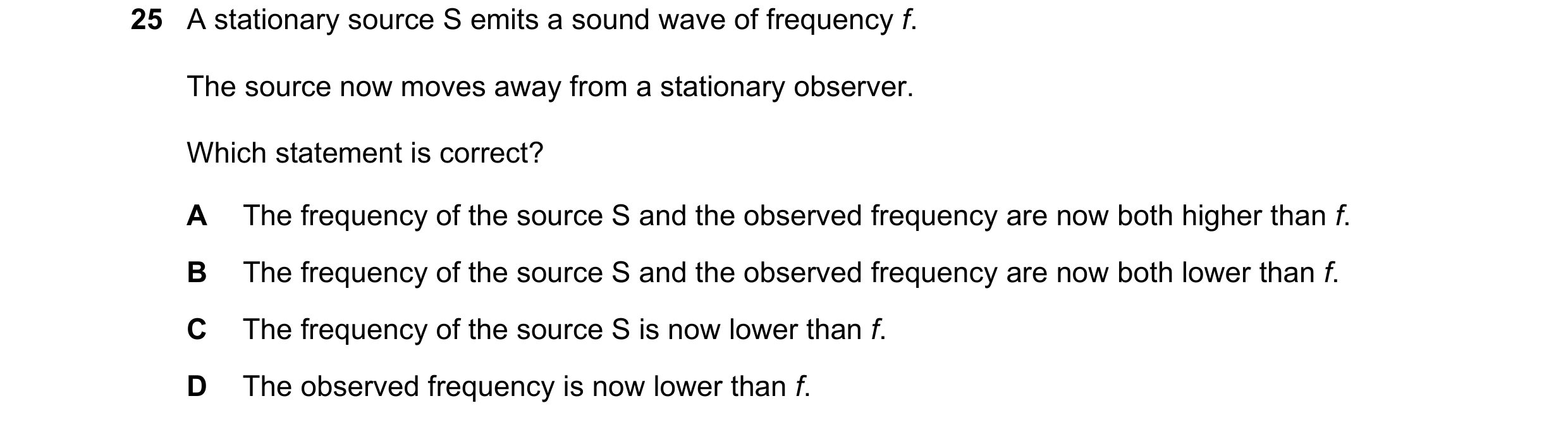
Q33 · A stationary source S emits a sound wave of frequency f 9702/13 May/June 2020
25 A stationary source S emits a sound wave of frequency f. The source now moves away from a stationary observer. Which statement is correct? A The frequency of the source S and the observed frequency are now both higher than f. B The frequency of the source S and the observed frequency are now both lower than f. C The frequency of the source S is now lower than f. D The observed frequency is now lower than f.
1 marks
Answer: D
This question in 9702/13 May/June 2020
Q34 · A source of sound of frequency 1000 Hz directly approaches a stationary observer 9702/11 Oct/Nov 2020
24 A source of sound of frequency 1000 Hz directly approaches a stationary observer. The observer measures the frequency of the received sound to be 1500 Hz. The speed of sound in still air is 330 m s–1. What is the speed of the source of sound? A 110 m s–1 B 165 m s–1 C 220 m s–1 D 330 m s–1
1 marks
Answer: A
This question in 9702/11 Oct/Nov 2020
Q35 · An emergency vehicle sounds its siren as it accelerates along a straight road between two… 9702/12 Oct/Nov 2020
25 An emergency vehicle sounds its siren as it accelerates along a straight road between two points X and Y, as shown in the diagram. direction of travel X Y emergency road vehicle The frequency of the sound emitted by the siren is 750 Hz. A person stands at X and another person stands at Y. What describes the sounds heard by the people at X and at Y as the vehicle accelerates? sound heard by person at X sound heard by person at Y A higher than 750 Hz, lower than 750 Hz, increasing in frequency decreasing in frequency B higher than 750 Hz, lower than 750 Hz, decreasing in frequency increasing in frequency C lower than 750 Hz, higher than 750 Hz, decreasing in frequency increasing in frequency D lower than 750 Hz, higher than 750 Hz, increasing in frequency decreasing in frequency
1 marks
Answer: C
This question in 9702/12 Oct/Nov 2020
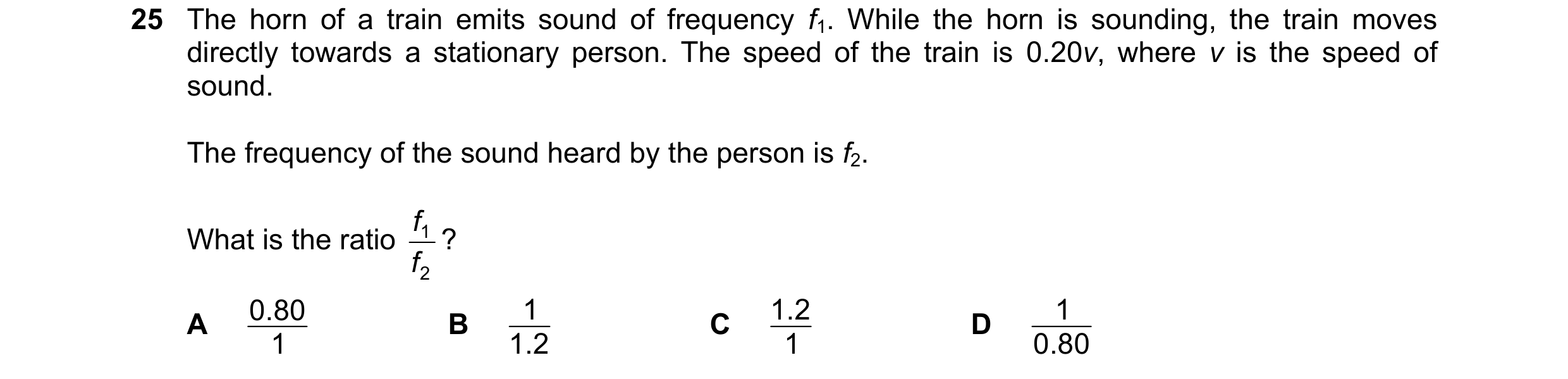
Q36 · The horn of a train emits sound of frequency f1 9702/13 Oct/Nov 2020
25 The horn of a train emits sound of frequency f1. While the horn is sounding, the train moves directly towards a stationary person. The speed of the train is 0.20v, where v is the speed of sound. The frequency of the sound heard by the person is f2. f ? What is the ratio 1 f 2 0.80 1 1.2 1 A B 1.2 C 1 D 0.80 1
1 marks
Answer: A
This question in 9702/13 Oct/Nov 2020
Q37 · A source of sound of frequency F at point Z is moving at a steady speed 9702/12 Feb/March 2021
24 A source of sound of frequency F at point Z is moving at a steady speed. The pattern of the emitted wavefronts is shown. X X Z Z Y Y Which row describes the frequencies of the sound heard by stationary observers at X and Y? frequency frequency heard at X heard at Y A <F <F B <F >F C >F <F D >F >F
1 marks
Answer: C
This question in 9702/12 Feb/March 2021
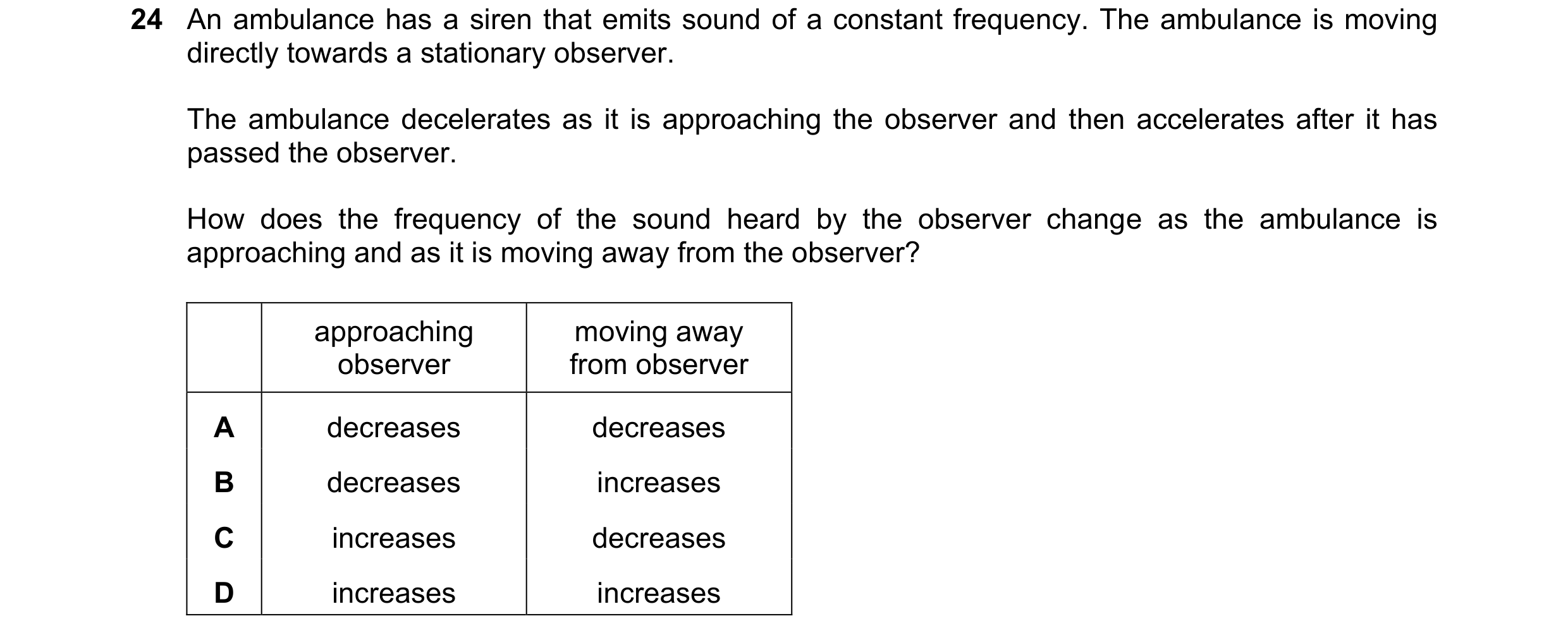
Q38 · An ambulance has a siren that emits sound of a constant frequency 9702/11 May/June 2021
24 An ambulance has a siren that emits sound of a constant frequency. The ambulance is moving directly towards a stationary observer. The ambulance decelerates as it is approaching the observer and then accelerates after it has passed the observer. How does the frequency of the sound heard by the observer change as the ambulance is approaching and as it is moving away from the observer? approaching moving away observer from observer A decreases decreases B decreases increases C increases decreases D increases increases
1 marks
Answer: A
This question in 9702/11 May/June 2021
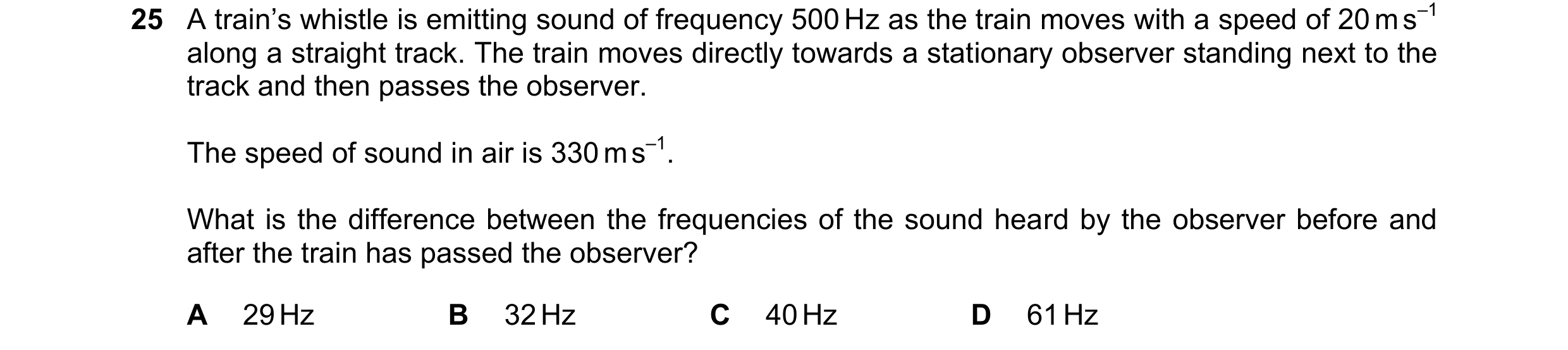
Q39 · A train’s whistle is emitting sound of frequency 500 Hz as the train moves with a speed… 9702/13 May/June 2021
25 A train’s whistle is emitting sound of frequency 500 Hz as the train moves with a speed of 20 m s–1 along a straight track. The train moves directly towards a stationary observer standing next to the track and then passes the observer. The speed of sound in air is 330 m s–1. What is the difference between the frequencies of the sound heard by the observer before and after the train has passed the observer? A 29 Hz B 32 Hz C 40 Hz D 61 Hz
1 marks
Answer: D
This question in 9702/13 May/June 2021
Q40 · With which waves can the Doppler effect be observed? 9702/11 Oct/Nov 2021
24 With which waves can the Doppler effect be observed? A all waves including sound and light B light waves only C sound and light waves only D sound waves only
1 marks
Answer: A
This question in 9702/11 Oct/Nov 2021
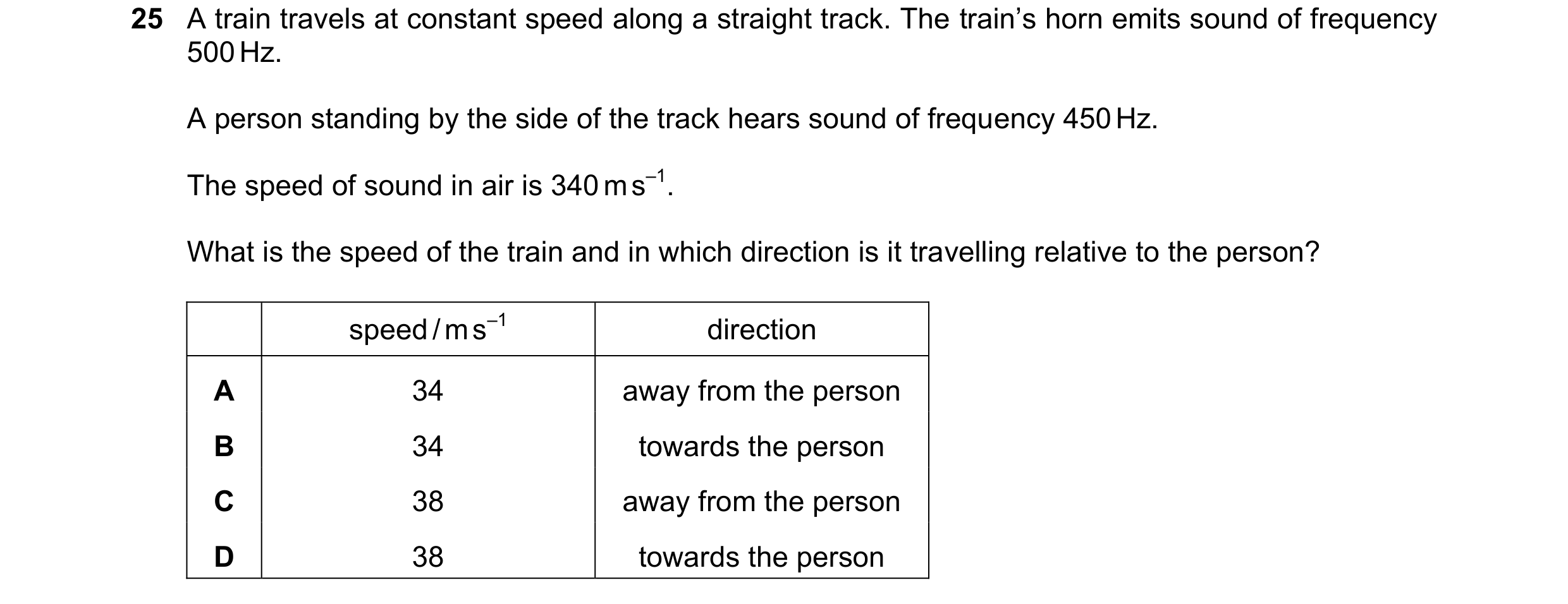
Q41 · A train travels at constant speed along a straight track 9702/13 Oct/Nov 2021
25 A train travels at constant speed along a straight track. The train’s horn emits sound of frequency 500 Hz. A person standing by the side of the track hears sound of frequency 450 Hz. The speed of sound in air is 340 m s–1. What is the speed of the train and in which direction is it travelling relative to the person? speed / m s–1 direction A 34 away from the person B 34 towards the person C 38 away from the person D 38 towards the person
1 marks
Answer: C
This question in 9702/13 Oct/Nov 2021
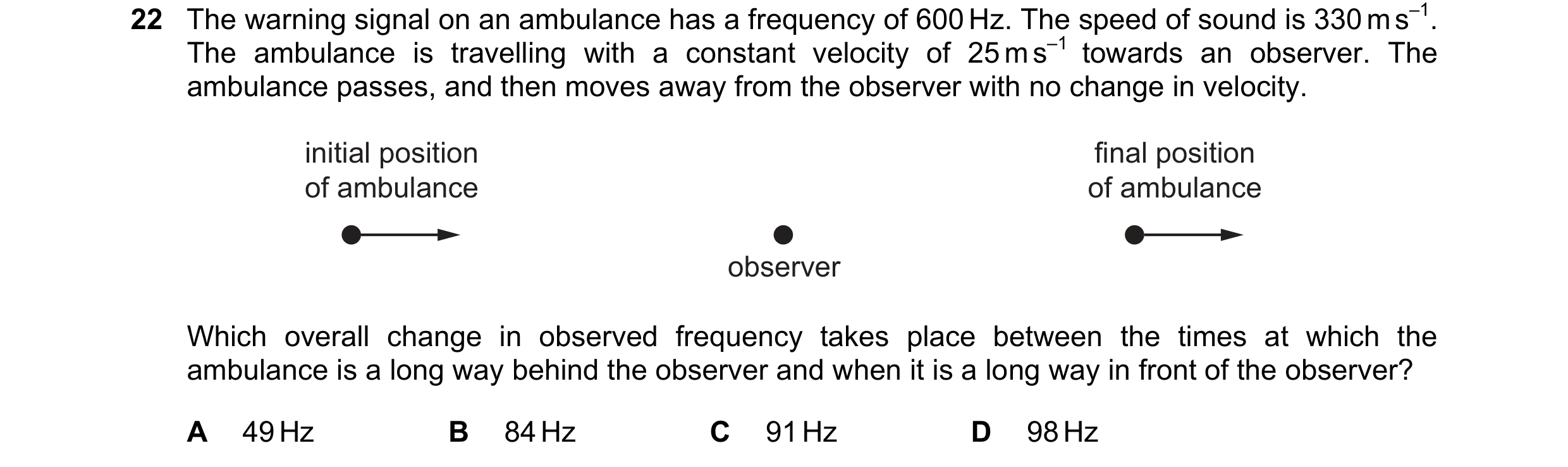
Q42 · The warning signal on an ambulance has a frequency of 600 Hz 9702/12 Feb/March 2022
22 The warning signal on an ambulance has a frequency of 600 Hz. The speed of sound is 330 m s–1. The ambulance is travelling with a constant velocity of 25 m s–1 towards an observer. The ambulance passes, and then moves away from the observer with no change in velocity. initial position final position of ambulance of ambulance observer Which overall change in observed frequency takes place between the times at which the ambulance is a long way behind the observer and when it is a long way in front of the observer? A 49 Hz B 84 Hz C 91 Hz D 98 Hz
1 marks
Answer: C
This question in 9702/12 Feb/March 2022
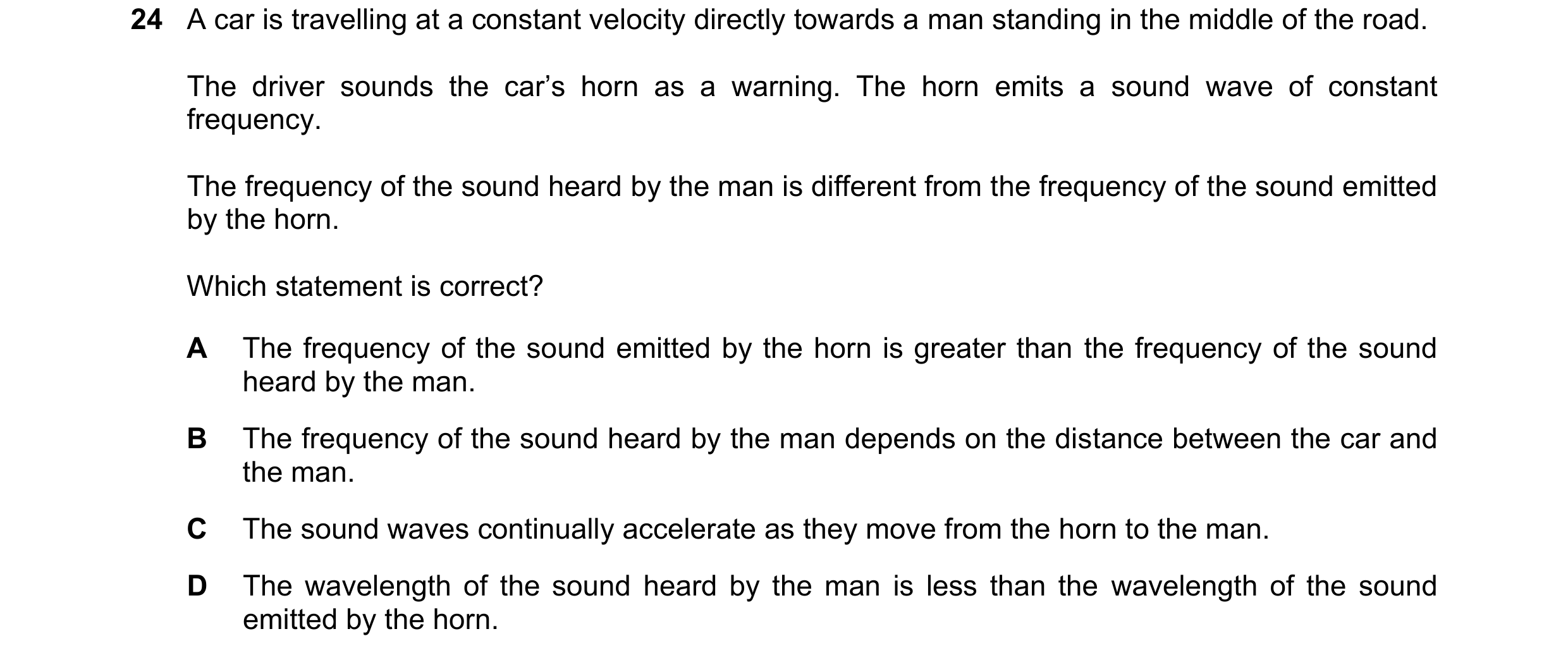
Q43 · A car is travelling at a constant velocity directly towards a man standing in the middle… 9702/11 May/June 2022
24 A car is travelling at a constant velocity directly towards a man standing in the middle of the road. The driver sounds the car’s horn as a warning. The horn emits a sound wave of constant frequency. The frequency of the sound heard by the man is different from the frequency of the sound emitted by the horn. Which statement is correct? A The frequency of the sound emitted by the horn is greater than the frequency of the sound heard by the man. B The frequency of the sound heard by the man depends on the distance between the car and the man. C The sound waves continually accelerate as they move from the horn to the man. D The wavelength of the sound heard by the man is less than the wavelength of the sound emitted by the horn.
1 marks
Answer: D
This question in 9702/11 May/June 2022
Q44 · A source emits a sound wave of a single frequency 9702/12 May/June 2022
24 A source emits a sound wave of a single frequency. The Doppler effect causes a different frequency of sound to be heard by a stationary observer. What is a requirement for the Doppler effect to occur? A a source that is moving as it produces the sound wave B a source that produces a polarised sound wave C a source that produces a sound wave of changing amplitude D a source that produces a sound wave of changing frequency
1 marks
Answer: A
This question in 9702/12 May/June 2022
Q45 · A jet aircraft travels at a speed of 0.80v, where v is the speed of sound 9702/11 Oct/Nov 2022
24 A jet aircraft travels at a speed of 0.80v, where v is the speed of sound. The aircraft directly approaches a stationary observer. The frequency of sound emitted by the aircraft is 100 Hz. Which frequency does the observer hear? A 56 Hz B 180 Hz C 400 Hz D 500 Hz
1 marks
Answer: D
This question in 9702/11 Oct/Nov 2022
Q46 · A miniature loudspeaker, initially at rest, falls vertically from a window in a high… 9702/12 Oct/Nov 2022
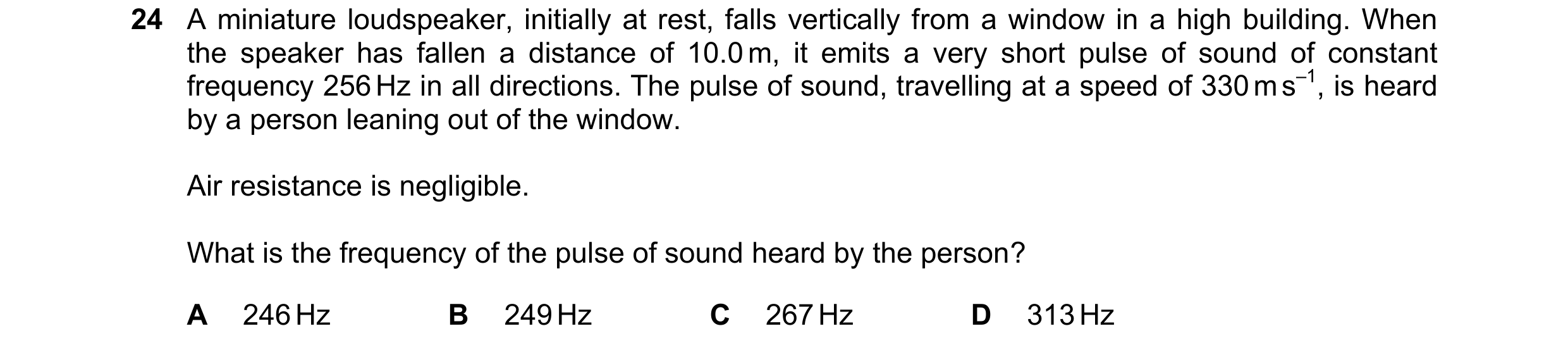
24 A miniature loudspeaker, initially at rest, falls vertically from a window in a high building. When the speaker has fallen a distance of 10.0 m, it emits a very short pulse of sound of constant frequency 256 Hz in all directions. The pulse of sound, travelling at a speed of 330 m s–1, is heard by a person leaning out of the window. Air resistance is negligible. What is the frequency of the pulse of sound heard by the person? A 246 Hz B 249 Hz C 267 Hz D 313 Hz
1 marks
Answer: A
This question in 9702/12 Oct/Nov 2022
Q47 · An observer is standing on a railway platform 9702/13 Oct/Nov 2022
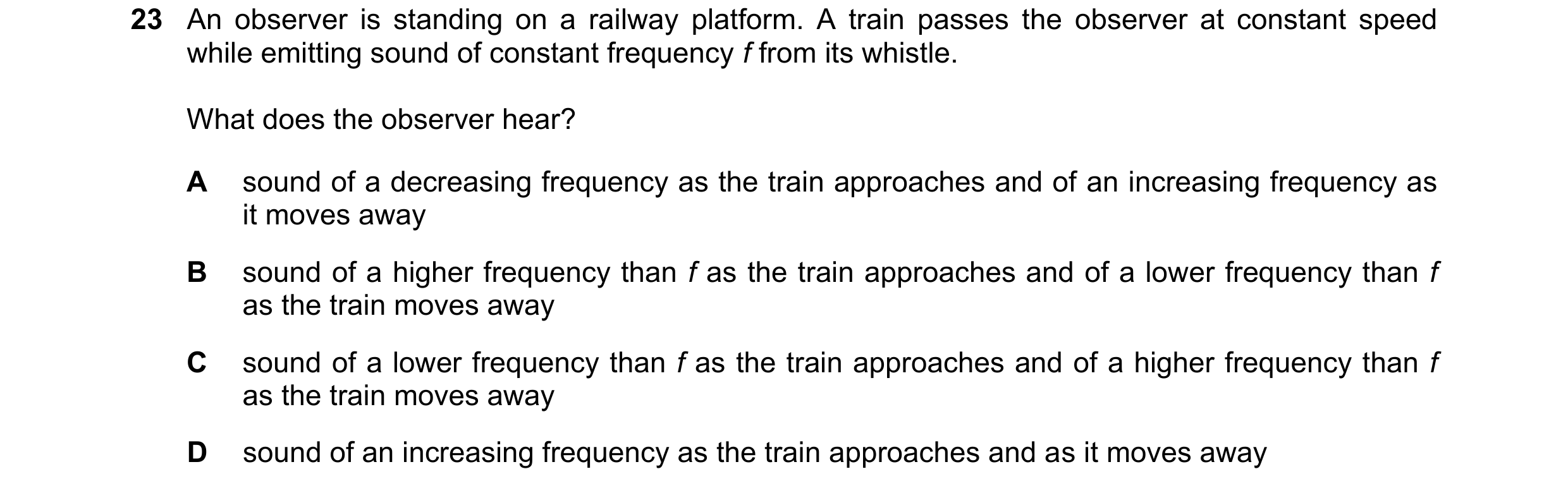
23 An observer is standing on a railway platform. A train passes the observer at constant speed while emitting sound of constant frequency f from its whistle. What does the observer hear? A sound of a decreasing frequency as the train approaches and of an increasing frequency as it moves away B sound of a higher frequency than f as the train approaches and of a lower frequency than f as the train moves away C sound of a lower frequency than f as the train approaches and of a higher frequency than f as the train moves away D sound of an increasing frequency as the train approaches and as it moves away
1 marks
Answer: B
This question in 9702/13 Oct/Nov 2022
Q48 · An observer hears a sound wave emitted from a moving source 9702/12 Feb/March 2023
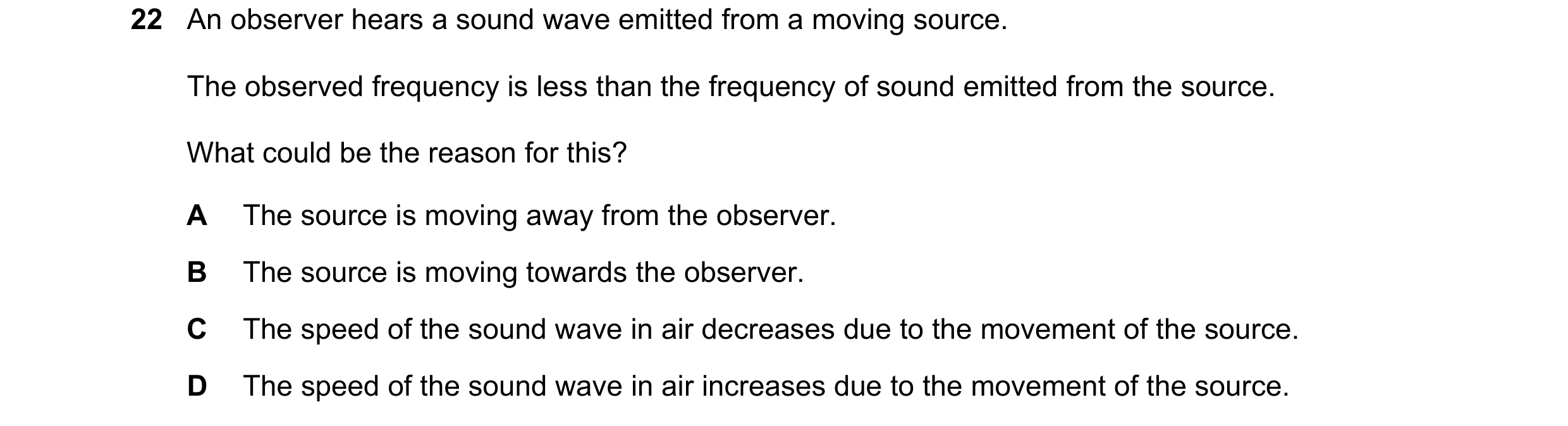
22 An observer hears a sound wave emitted from a moving source. The observed frequency is less than the frequency of sound emitted from the source. What could be the reason for this? A The source is moving away from the observer. B The source is moving towards the observer. C The speed of the sound wave in air decreases due to the movement of the source. D The speed of the sound wave in air increases due to the movement of the source.
1 marks
Answer: A
This question in 9702/12 Feb/March 2023
Q49 · A car travels at a constant speed along a straight line PQ 9702/11 May/June 2023
22 A car travels at a constant speed along a straight line PQ. A loudspeaker attached to the car emits sound of constant frequency f. A stationary observer is at point O. O P Q What does the observer hear as the car moves from P towards Q? A a frequency less than f that decreases as the car moves from P towards Q B a frequency less than f that increases as the car moves from P towards Q C a frequency more than f that decreases as the car moves from P towards Q D a frequency more than f that increases as the car moves from P towards Q
1 marks
Answer: C
This question in 9702/11 May/June 2023
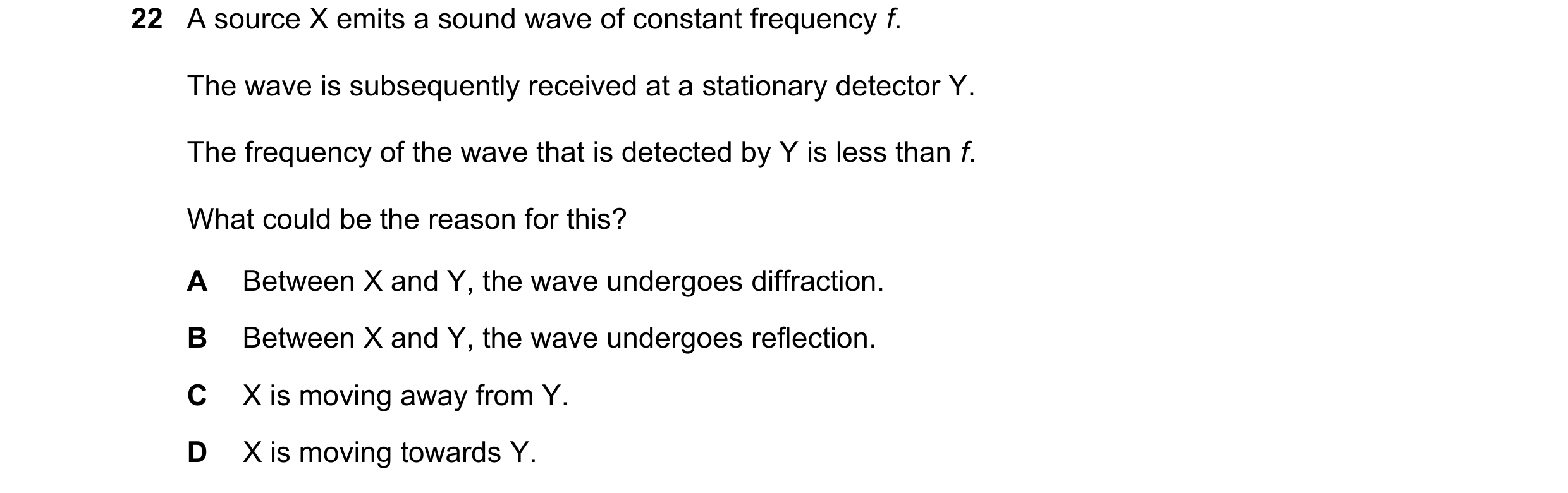
Q50 · A source X emits a sound wave of constant frequency f 9702/12 May/June 2023
22 A source X emits a sound wave of constant frequency f. The wave is subsequently received at a stationary detector Y. The frequency of the wave that is detected by Y is less than f. What could be the reason for this? A Between X and Y, the wave undergoes diffraction. B Between X and Y, the wave undergoes reflection. C X is moving away from Y. D X is moving towards Y.
1 marks
Answer: C
This question in 9702/12 May/June 2023
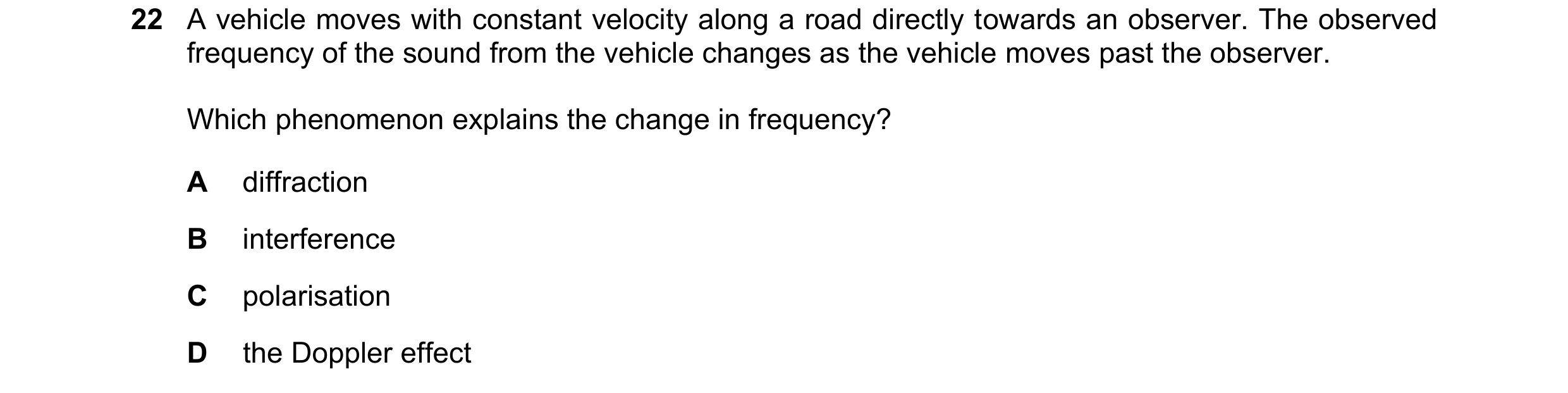
Q51 · A vehicle moves with constant velocity along a road directly towards an observer 9702/13 May/June 2023
22 A vehicle moves with constant velocity along a road directly towards an observer. The observed frequency of the sound from the vehicle changes as the vehicle moves past the observer. Which phenomenon explains the change in frequency? A diffraction B interference C polarisation D the Doppler effect
1 marks
Answer: D
This question in 9702/13 May/June 2023
Q52 · A source of sound waves is moving at a constant speed directly towards a stationary… 9702/12 Oct/Nov 2023
22 A source of sound waves is moving at a constant speed directly towards a stationary observer. The sound waves have a speed of 340 m s–1 and a frequency of 480 Hz. The observer hears sound waves of frequency 650 Hz. What is the speed of the source? A 89 m s–1 B 120 m s–1 C 250 m s–1 D 340 m s–1
1 marks
Answer: A
This question in 9702/12 Oct/Nov 2023
Q53 · A loudspeaker emits sound of frequency fs 9702/13 Oct/Nov 2023
22 A loudspeaker emits sound of frequency fs. The loudspeaker is attached to a car that moves with increasing speed directly towards a stationary observer. Which statement describes the frequency of the sound heard by the observer? A a frequency greater than fs and increasing B a frequency greater than fs but decreasing C a frequency less than fs and decreasing D a frequency less than fs but increasing
1 marks
Answer: A
This question in 9702/13 Oct/Nov 2023
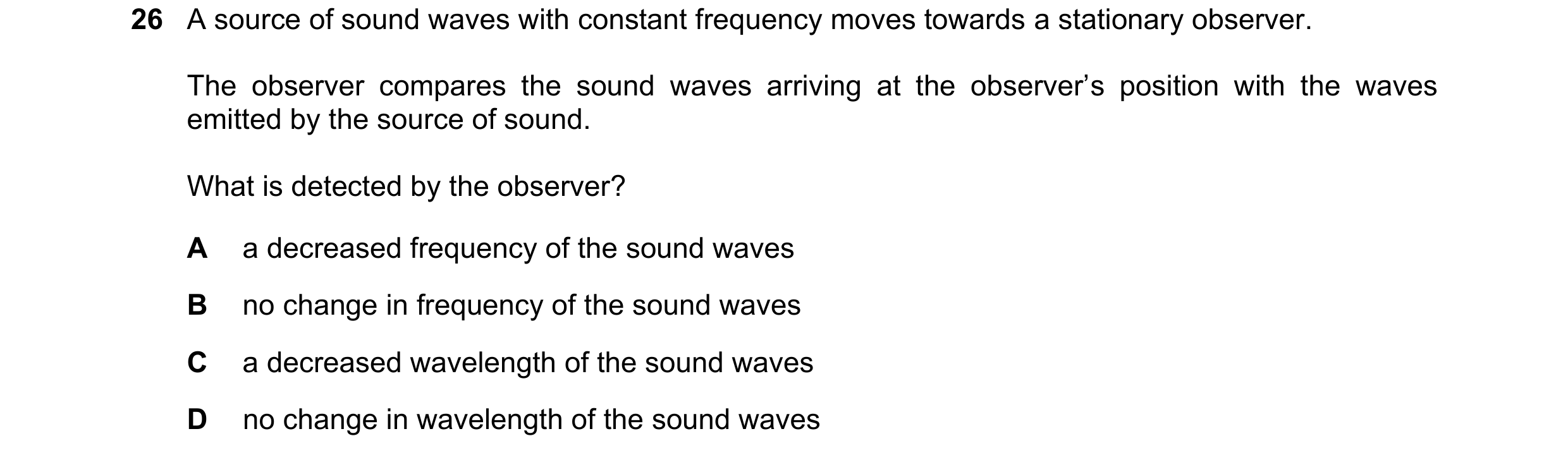
Q54 · A source of sound waves with constant frequency moves towards a stationary observer 9702/12 Feb/March 2024
26 A source of sound waves with constant frequency moves towards a stationary observer. The observer compares the sound waves arriving at the observer’s position with the waves emitted by the source of sound. What is detected by the observer? A a decreased frequency of the sound waves B no change in frequency of the sound waves C a decreased wavelength of the sound waves D no change in wavelength of the sound waves
1 marks
Answer: C
This question in 9702/12 Feb/March 2024
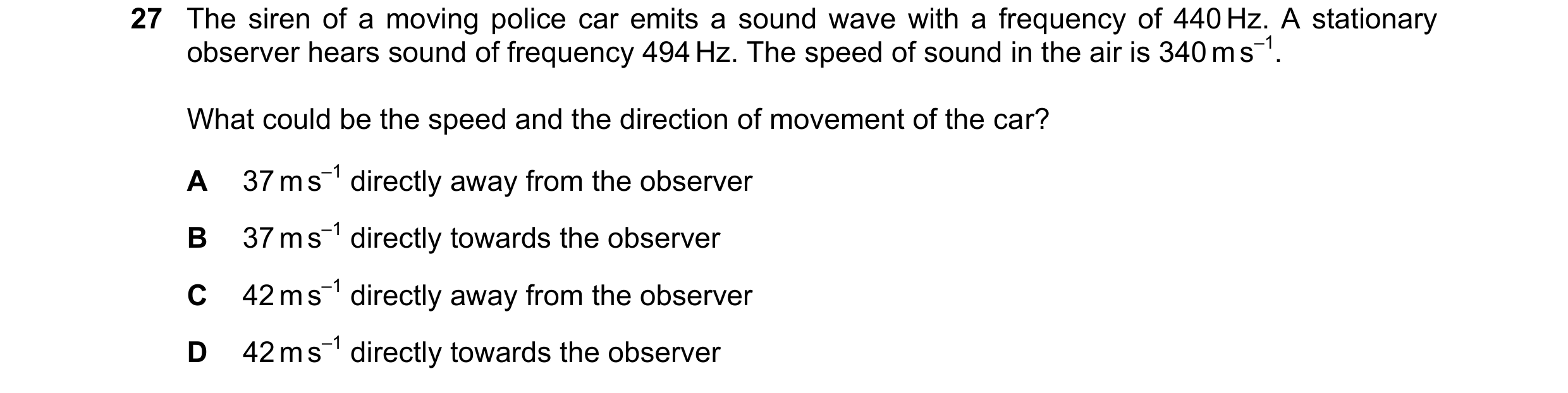
Q55 · The siren of a moving police car emits a sound wave with a frequency of 440 Hz 9702/11 May/June 2024
27 The siren of a moving police car emits a sound wave with a frequency of 440 Hz. A stationary observer hears sound of frequency 494 Hz. The speed of sound in the air is 340 m s–1. What could be the speed and the direction of movement of the car? A 37 m s–1 directly away from the observer B 37 m s–1 directly towards the observer C 42 m s–1 directly away from the observer D 42 m s–1 directly towards the observer
1 marks
Answer: B
This question in 9702/11 May/June 2024
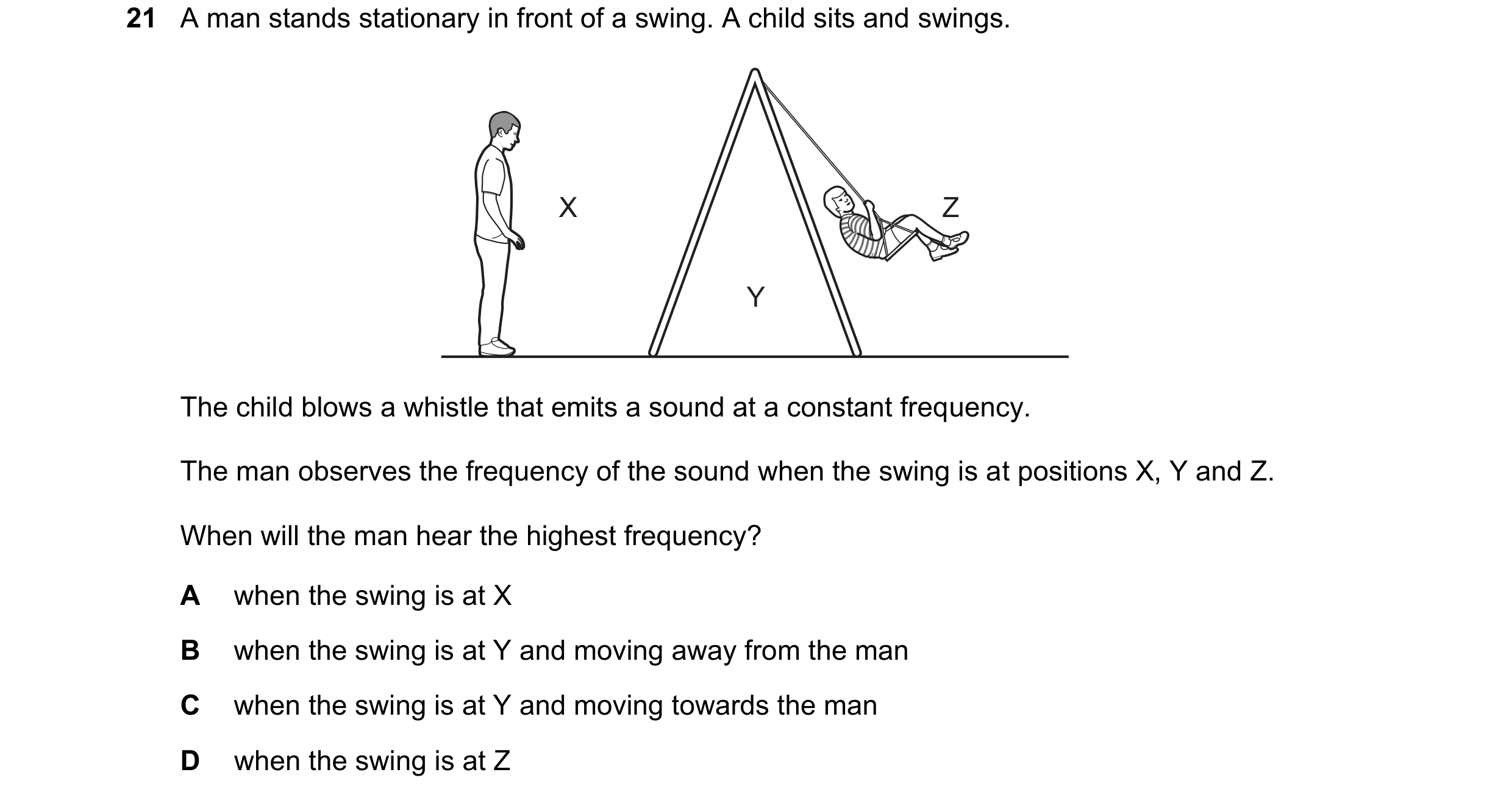
Q56 · A man stands stationary in front of a swing 9702/12 May/June 2024
21 A man stands stationary in front of a swing. A child sits and swings. X Z Y The child blows a whistle that emits a sound at a constant frequency. The man observes the frequency of the sound when the swing is at positions X, Y and Z. When will the man hear the highest frequency? A when the swing is at X B when the swing is at Y and moving away from the man C when the swing is at Y and moving towards the man D when the swing is at Z
1 marks
Answer: C
This question in 9702/12 May/June 2024
Q57 · An ambulance siren emits a sound with a single frequency f 9702/13 May/June 2024
24 An ambulance siren emits a sound with a single frequency f. The ambulance travels towards, passes close to, and then travels away from a stationary observer. Which statement describes the frequency of the sound detected by the observer as the ambulance passes the observer? A equal to f and decreasing B equal to f and increasing C greater than f and constant D less than f and constant
1 marks
Answer: A
This question in 9702/13 May/June 2024
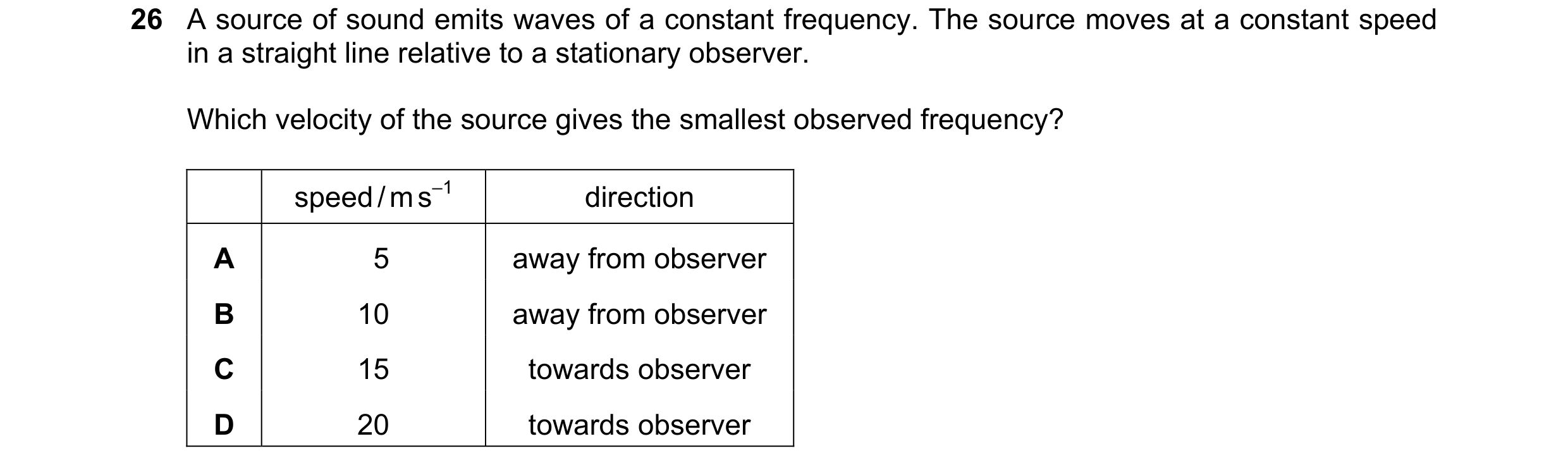
Q58 · A source of sound emits waves of a constant frequency 9702/12 Oct/Nov 2024
26 A source of sound emits waves of a constant frequency. The source moves at a constant speed in a straight line relative to a stationary observer. Which velocity of the source gives the smallest observed frequency? speed / m s–1 direction A 5 away from observer B 10 away from observer C 15 towards observer D 20 towards observer
1 marks
Answer: B
This question in 9702/12 Oct/Nov 2024
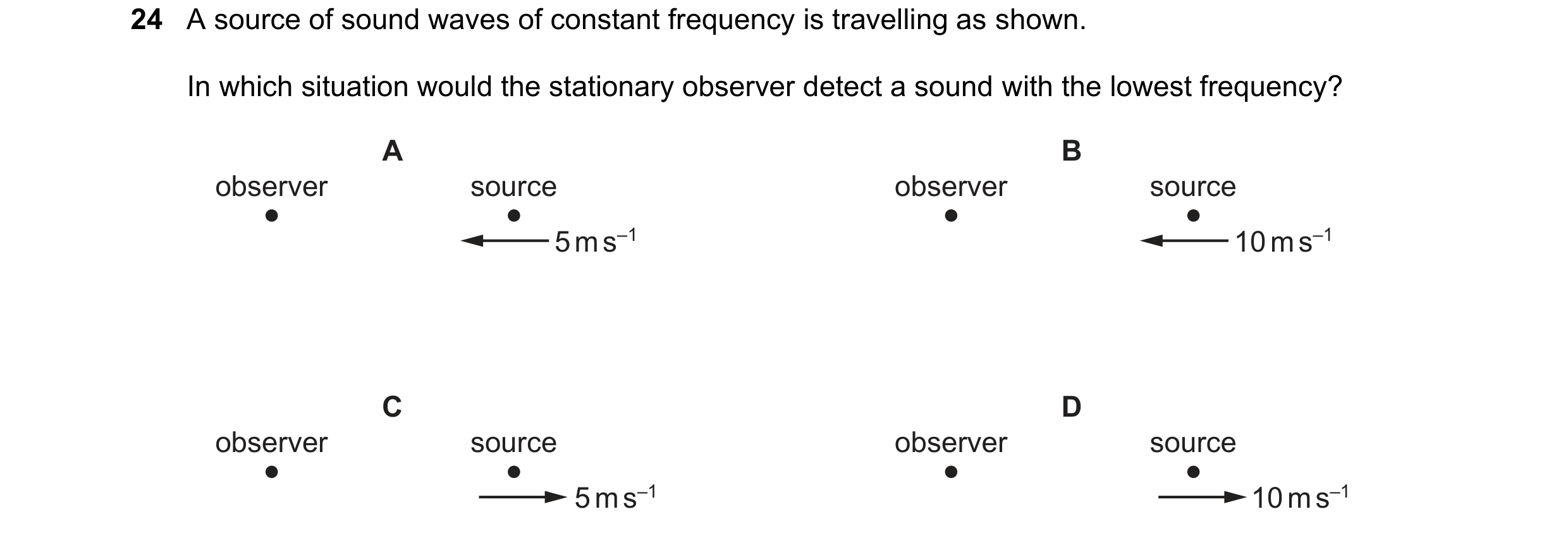
Q59 · A source of sound waves of constant frequency is travelling as shown 9702/13 Oct/Nov 2024
24 A source of sound waves of constant frequency is travelling as shown. In which situation would the stationary observer detect a sound with the lowest frequency? A B observer source observer source 5 m s–1 10 m s–1 C D observer source observer source 5 m s–1 10 m s–1
1 marks
Answer: D
This question in 9702/13 Oct/Nov 2024
Q60 · The diagram shows a car travelling at a constant speed in a straight line between person… 9702/12 Feb/March 2025
24 The diagram shows a car travelling at a constant speed in a straight line between person P and person Q from point X to point Y. person P person Q X Y The car sounds its horn continuously as it travels. The horn emits sound of constant frequency. Which statements about what person P and person Q hear during the motion of the car are correct? 1 Person P hears a sound of increasing frequency. 2 Person Q hears a sound of decreasing frequency. 3 Person Q always hears a sound of higher frequency than person P. A 1, 2 and 3 B 1 and 2 only C 3 only D none of them
1 marks
Answer: C
This question in 9702/12 Feb/March 2025
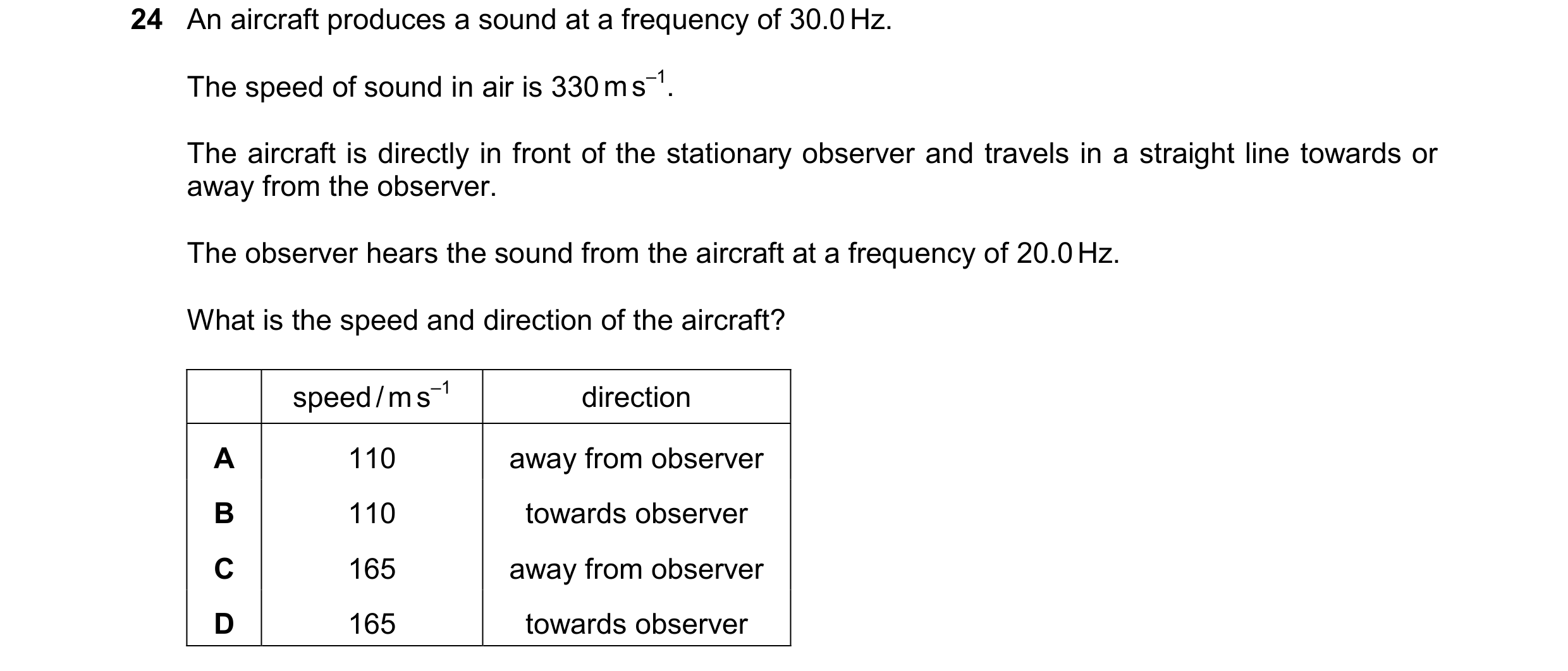
Q61 · An aircraft produces a sound at a frequency of 30.0 Hz 9702/11 May/June 2025
24 An aircraft produces a sound at a frequency of 30.0 Hz. The speed of sound in air is 330 m s–1. The aircraft is directly in front of the stationary observer and travels in a straight line towards or away from the observer. The observer hears the sound from the aircraft at a frequency of 20.0 Hz. What is the speed and direction of the aircraft? speed / m s–1 direction A 110 away from observer B 110 towards observer C 165 away from observer D 165 towards observer
1 marks
Answer: C
This question in 9702/11 May/June 2025
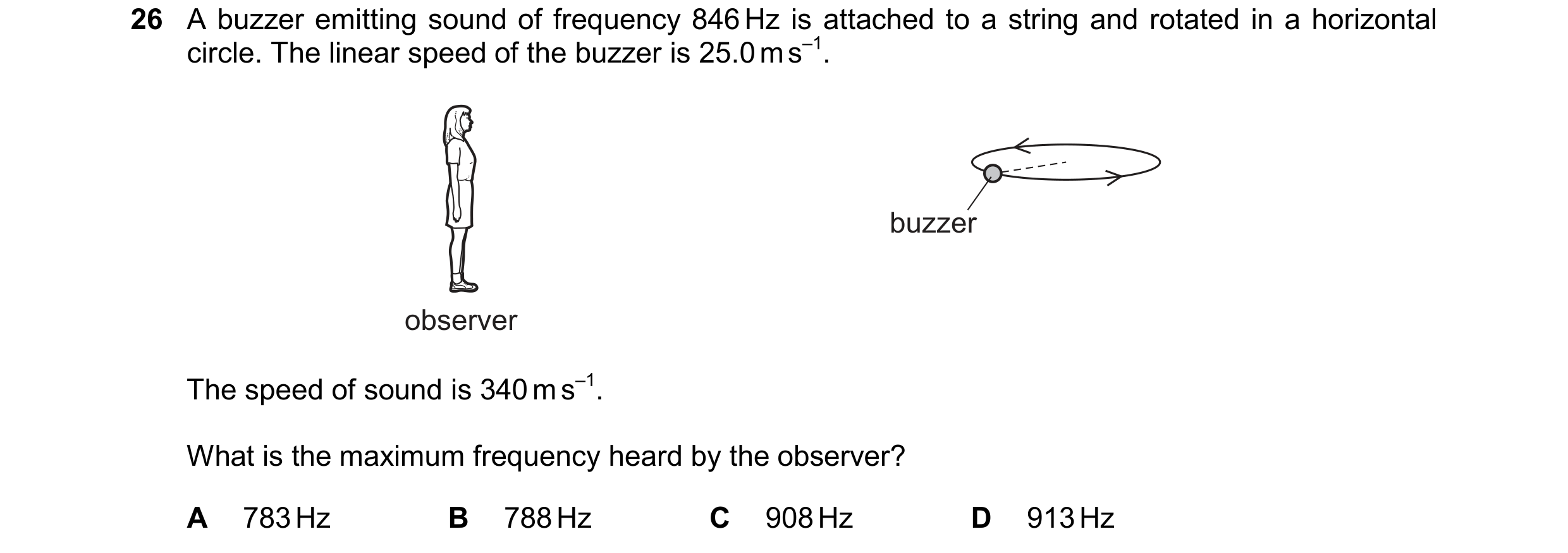
Q62 · A buzzer emitting sound of frequency 846 Hz is attached to a string and rotated in a… 9702/12 May/June 2025
26 A buzzer emitting sound of frequency 846 Hz is attached to a string and rotated in a horizontal circle. The linear speed of the buzzer is 25.0 m s–1. buzzer observer The speed of sound is 340 m s–1. What is the maximum frequency heard by the observer? A 783 Hz B 788 Hz C 908 Hz D 913 Hz
1 marks
Answer: D
This question in 9702/12 May/June 2025
Q63 · A vehicle is moving with a speed of 30.0 m s–1 directly towards a stationary observer 9702/14 May/June 2025
22 A vehicle is moving with a speed of 30.0 m s–1 directly towards a stationary observer. The horn of the vehicle emits sound of frequency 440 Hz. The speed of sound in air is 340 m s–1. What is the frequency of the sound heard by the observer? A 401 Hz B 404 Hz C 479 Hz D 483 Hz
1 marks
Answer: D
This question in 9702/14 May/June 2025
Q64 · A dolphin is swimming at a speed of 16.0 m s–1 directly towards a stationary underwater… 9702/11 Oct/Nov 2025
27 A dolphin is swimming at a speed of 16.0 m s–1 directly towards a stationary underwater microphone. The dolphin emits a sound of frequency 122 kHz. The speed of sound in water is 1480 m s–1. What is the frequency of sound detected by the microphone? A 1300 Hz B 1330 Hz C 121 kHz D 123 kHz
1 marks
Answer: D
This question in 9702/11 Oct/Nov 2025
Q65 · A moving source emits sound of frequency 1200 Hz 9702/12 Oct/Nov 2025
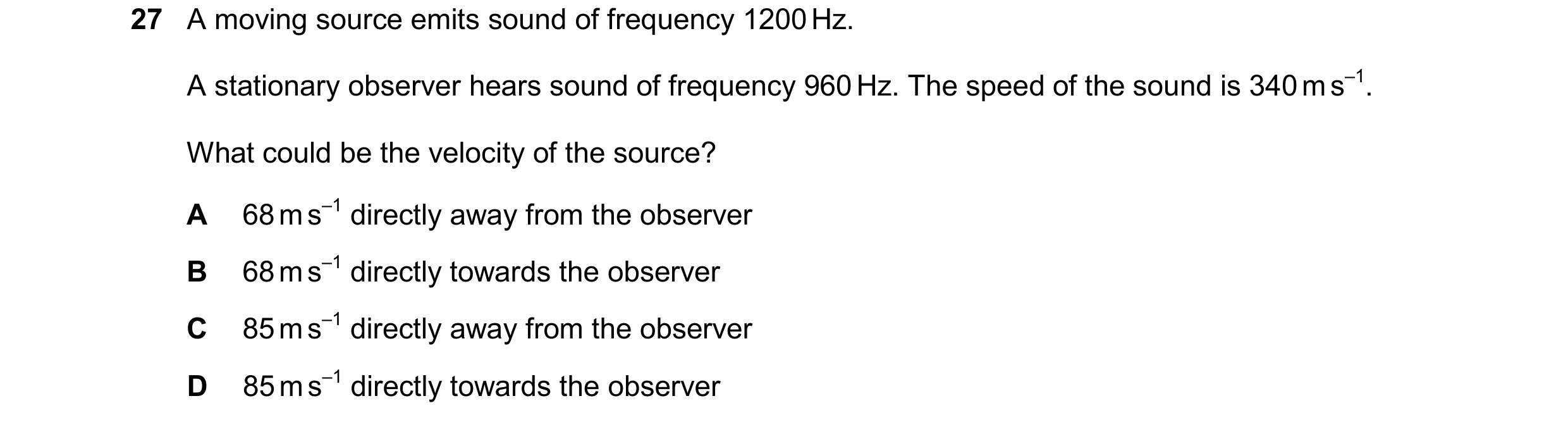
27 A moving source emits sound of frequency 1200 Hz. A stationary observer hears sound of frequency 960 Hz. The speed of the sound is 340 m s–1. What could be the velocity of the source? A 68 m s–1 directly away from the observer B 68 m s–1 directly towards the observer C 85 m s–1 directly away from the observer D 85 m s–1 directly towards the observer
1 marks
Answer: C
This question in 9702/12 Oct/Nov 2025
Q66 · A dolphin is swimming at a speed of 16.0 m s–1 directly towards a stationary underwater… 9702/13 Oct/Nov 2025
27 A dolphin is swimming at a speed of 16.0 m s–1 directly towards a stationary underwater microphone. The dolphin emits a sound of frequency 122 kHz. The speed of sound in water is 1480 m s–1. What is the frequency of sound detected by the microphone? A 1300 Hz B 1330 Hz C 121 kHz D 123 kHz
1 marks
Answer: D
This question in 9702/13 Oct/Nov 2025
Q67 · An aircraft flies at a velocity vs directly away from a stationary observer 9702/14 Oct/Nov 2025
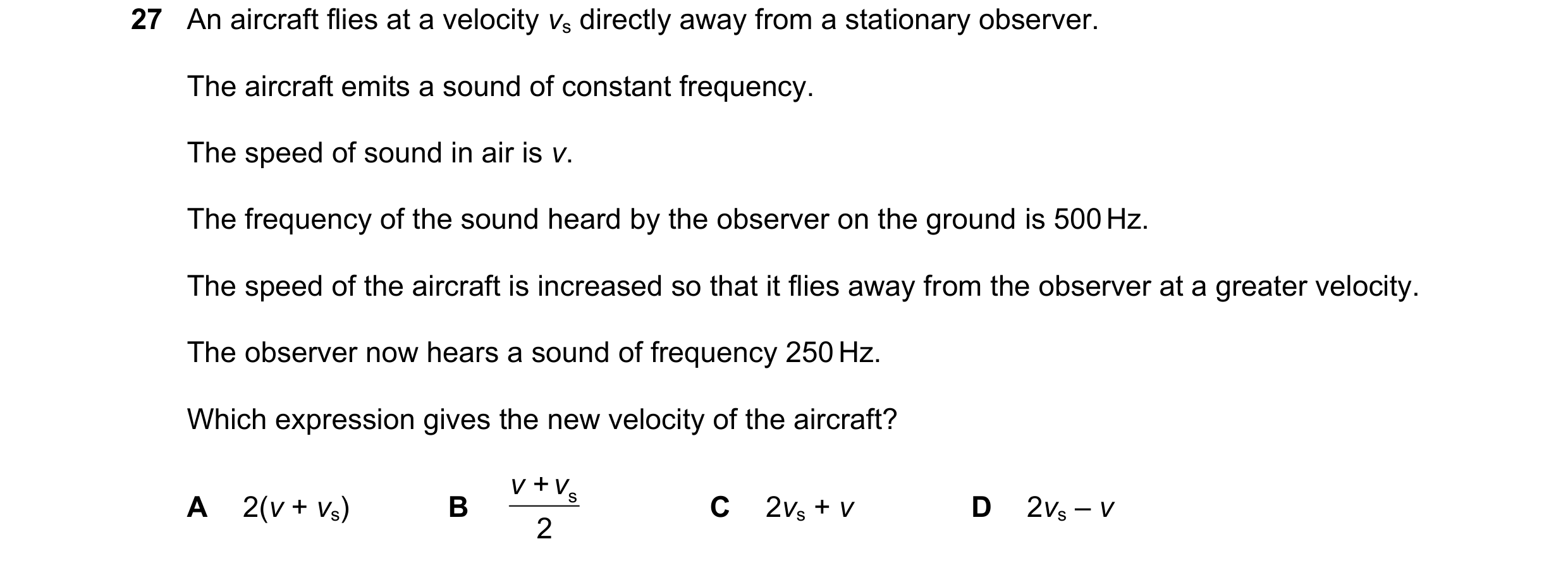
27 An aircraft flies at a velocity vs directly away from a stationary observer. The aircraft emits a sound of constant frequency. The speed of sound in air is v. The frequency of the sound heard by the observer on the ground is 500 Hz. The speed of the aircraft is increased so that it flies away from the observer at a greater velocity. The observer now hears a sound of frequency 250 Hz. Which expression gives the new velocity of the aircraft? v + v A 2(v + vs) B s C 2vs + v D 2vs – v 2
1 marks
Answer: C
This question in 9702/14 Oct/Nov 2025


 1 / 18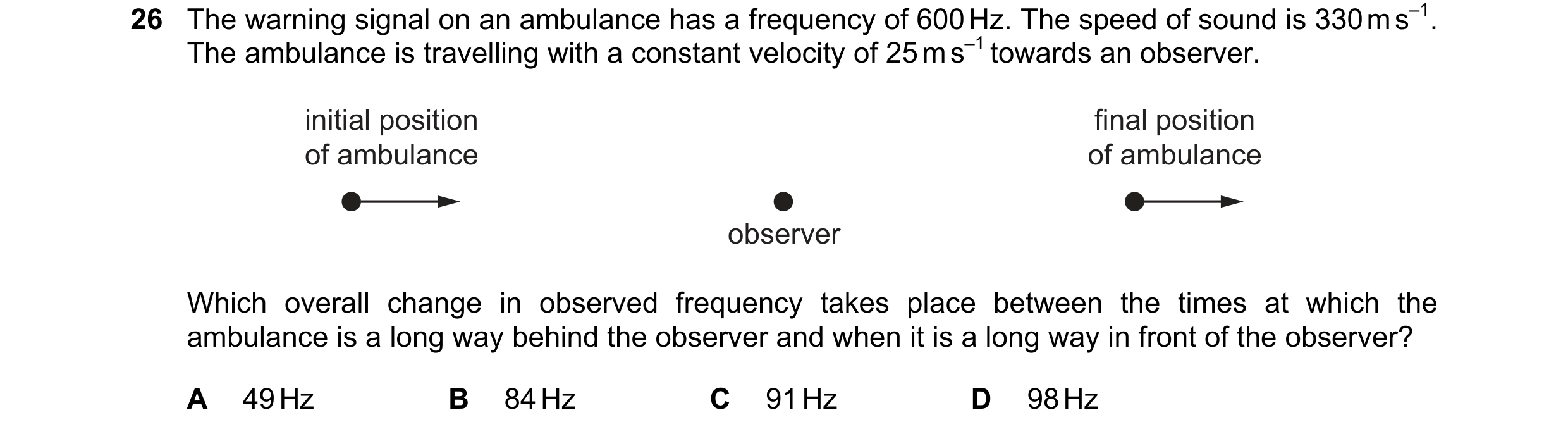

 2 / 18
 3 / 18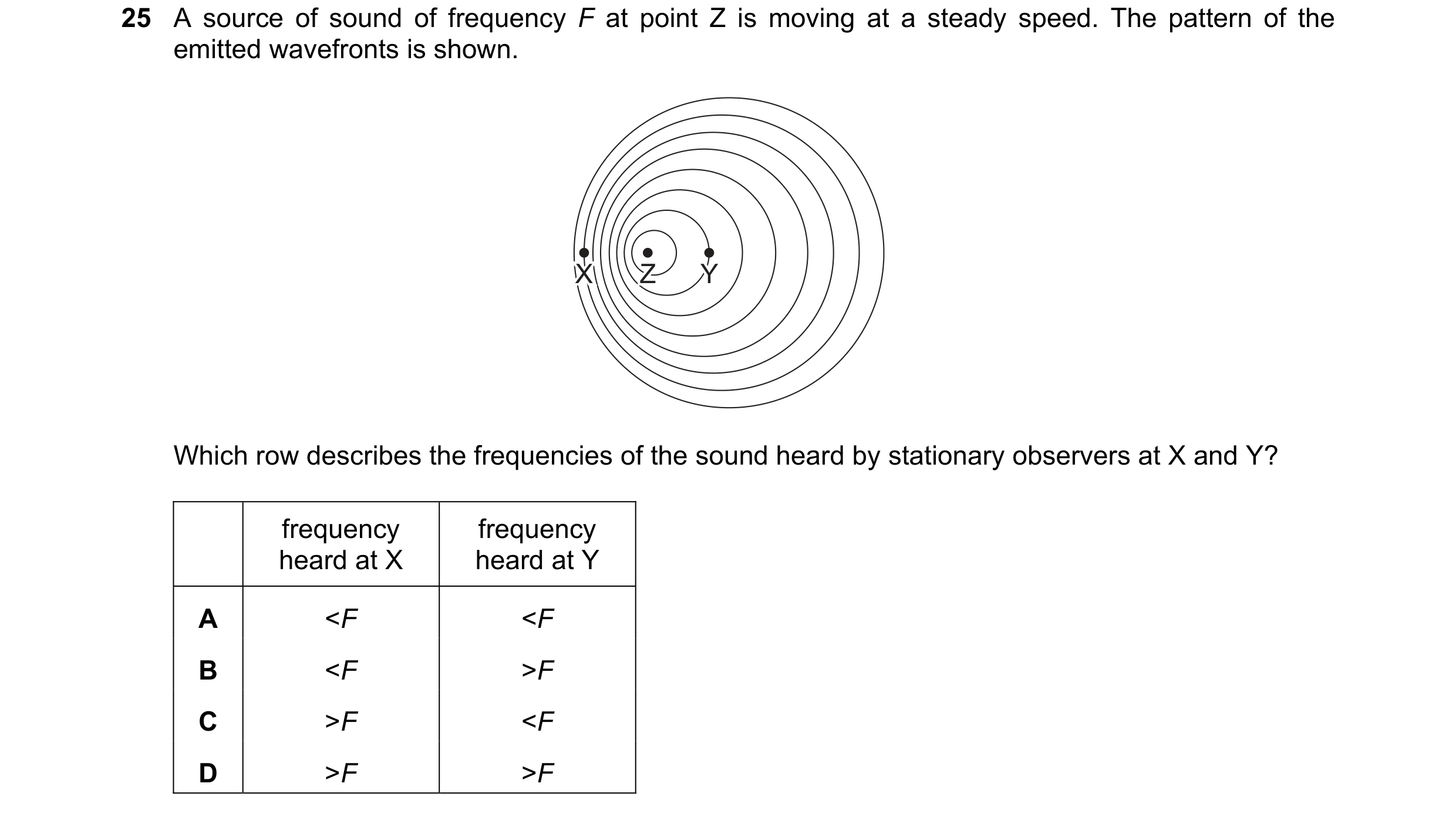
 4 / 18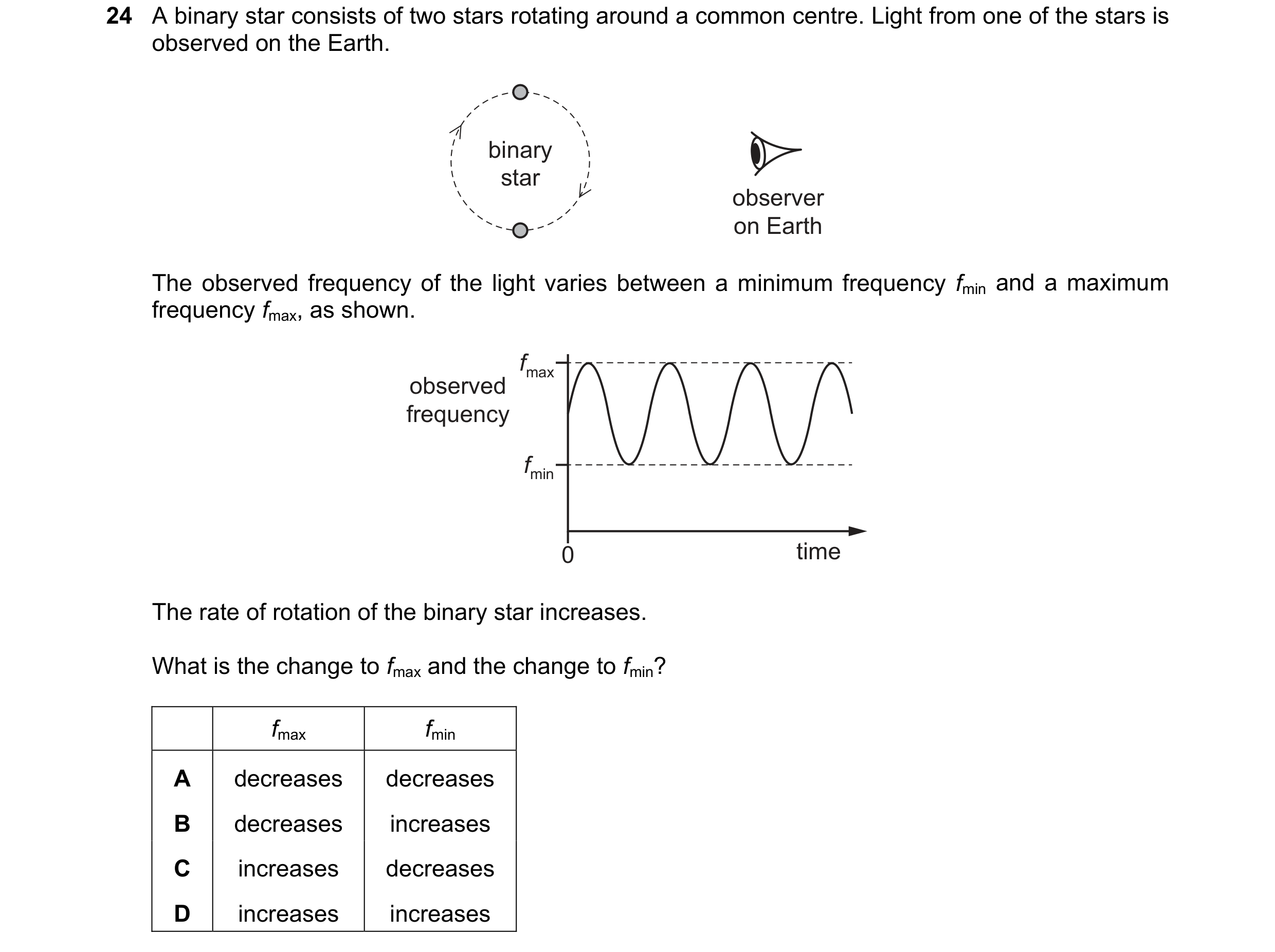

 5 / 18

 6 / 18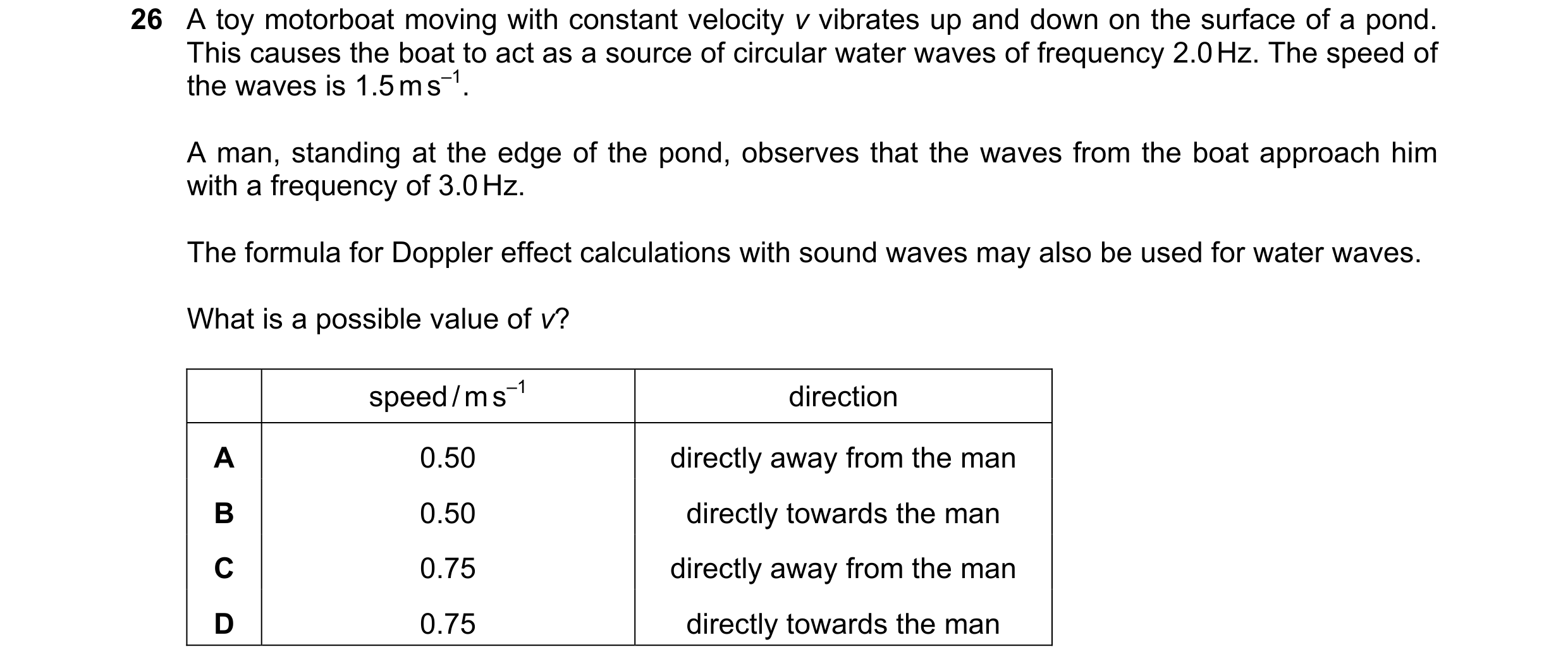

 7 / 18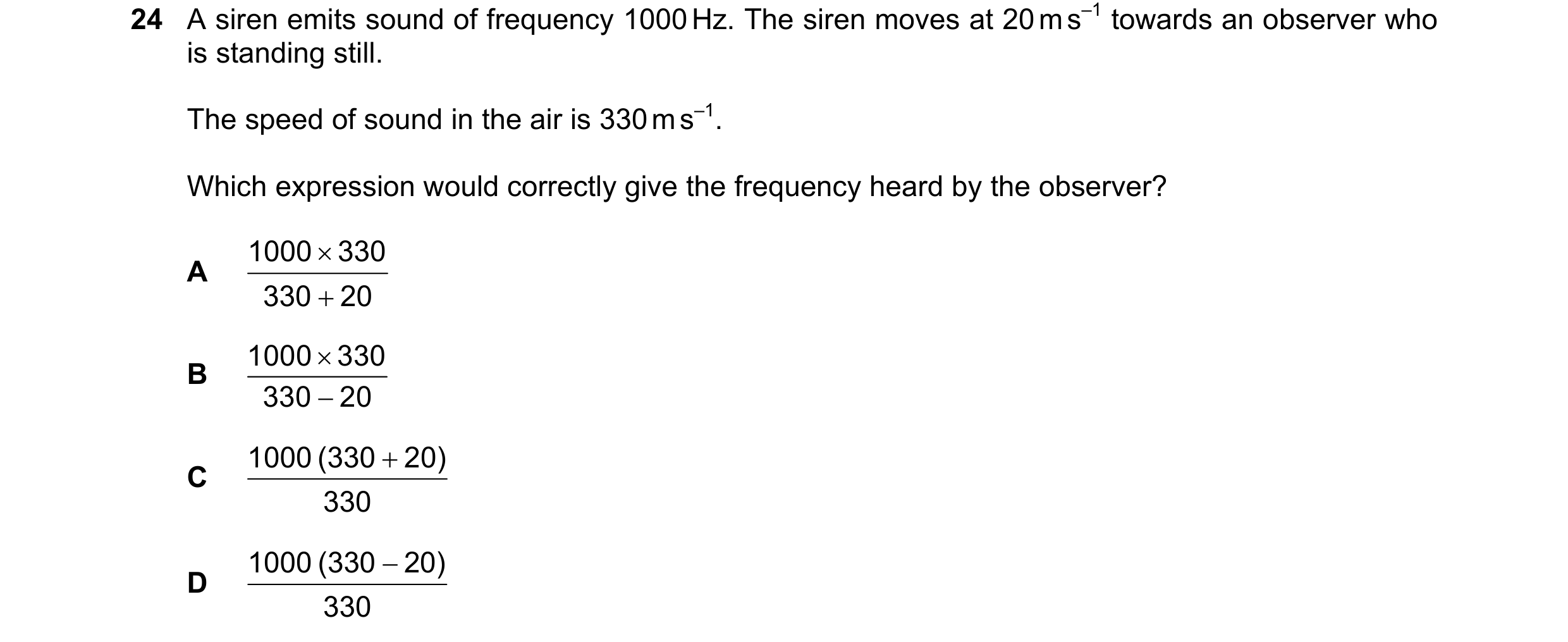

 8 / 18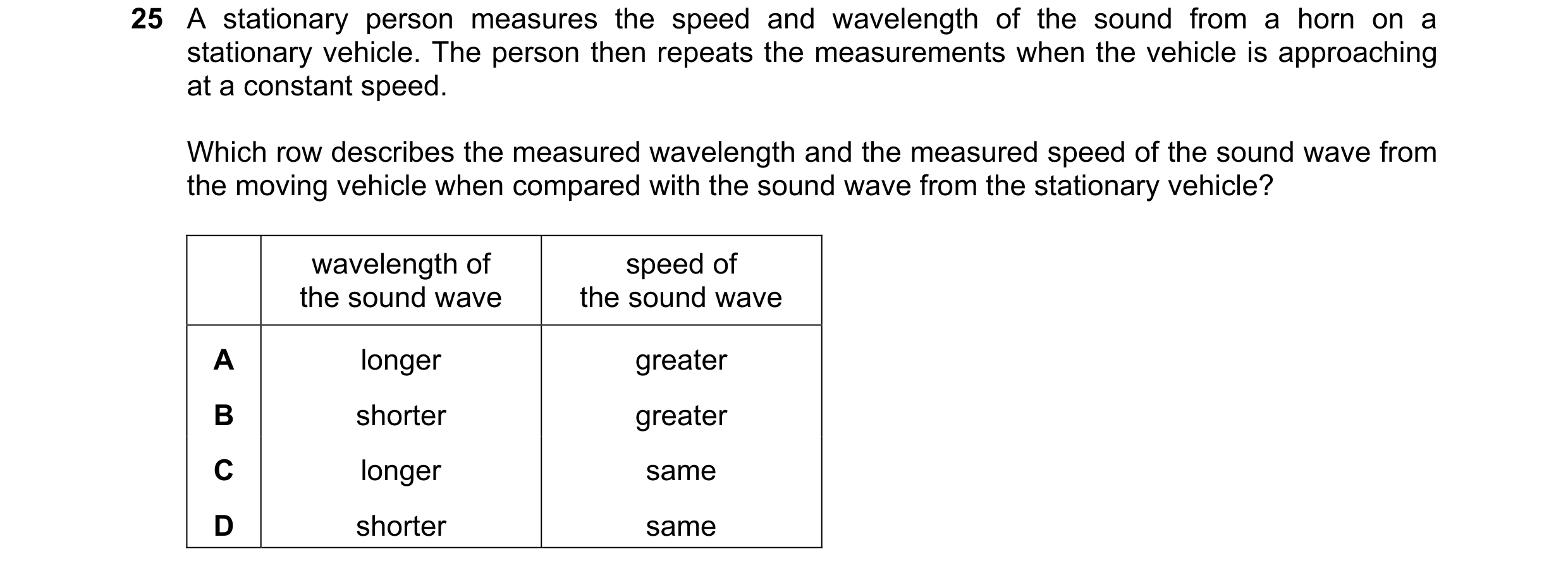
 9 / 18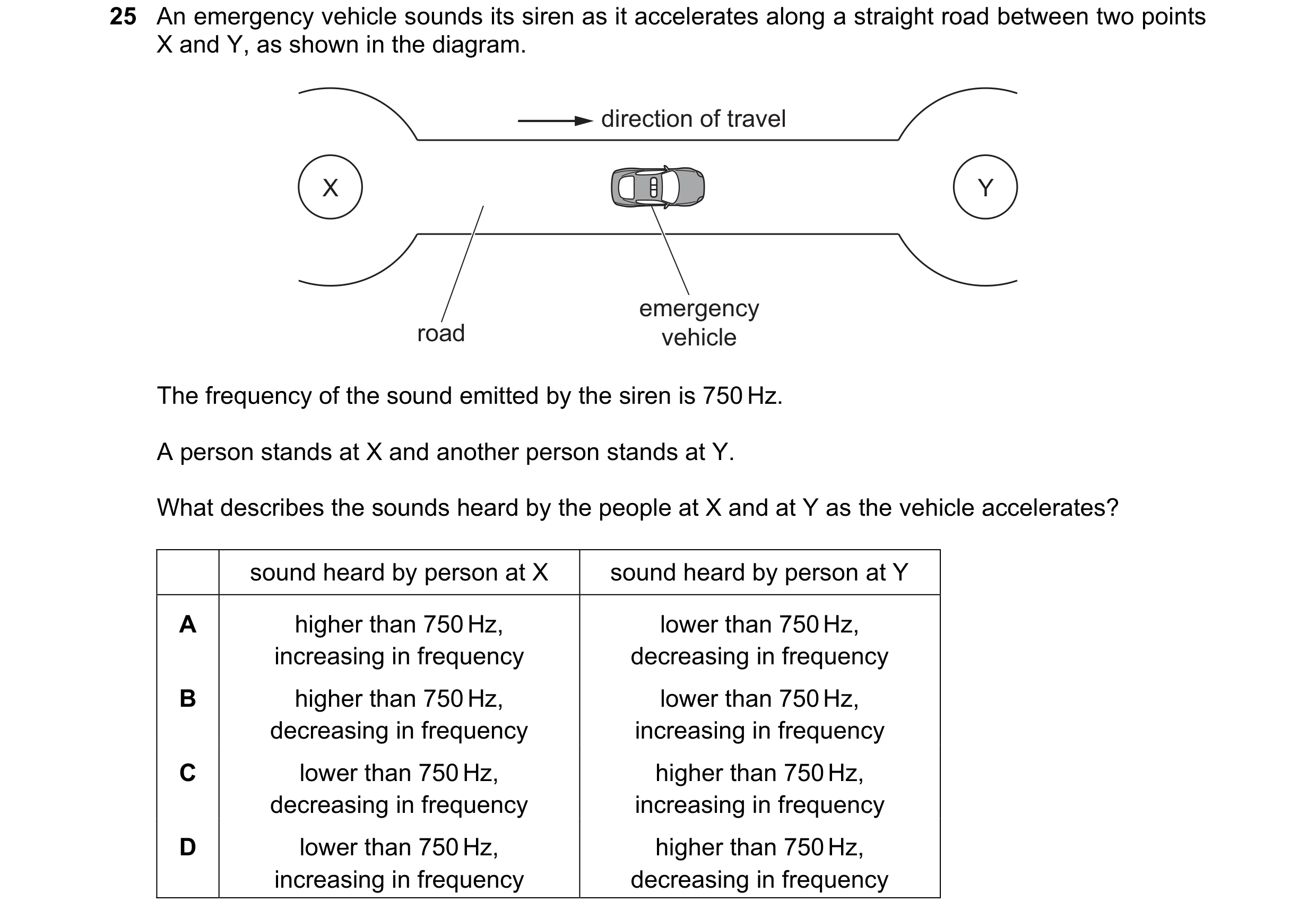
 10 / 18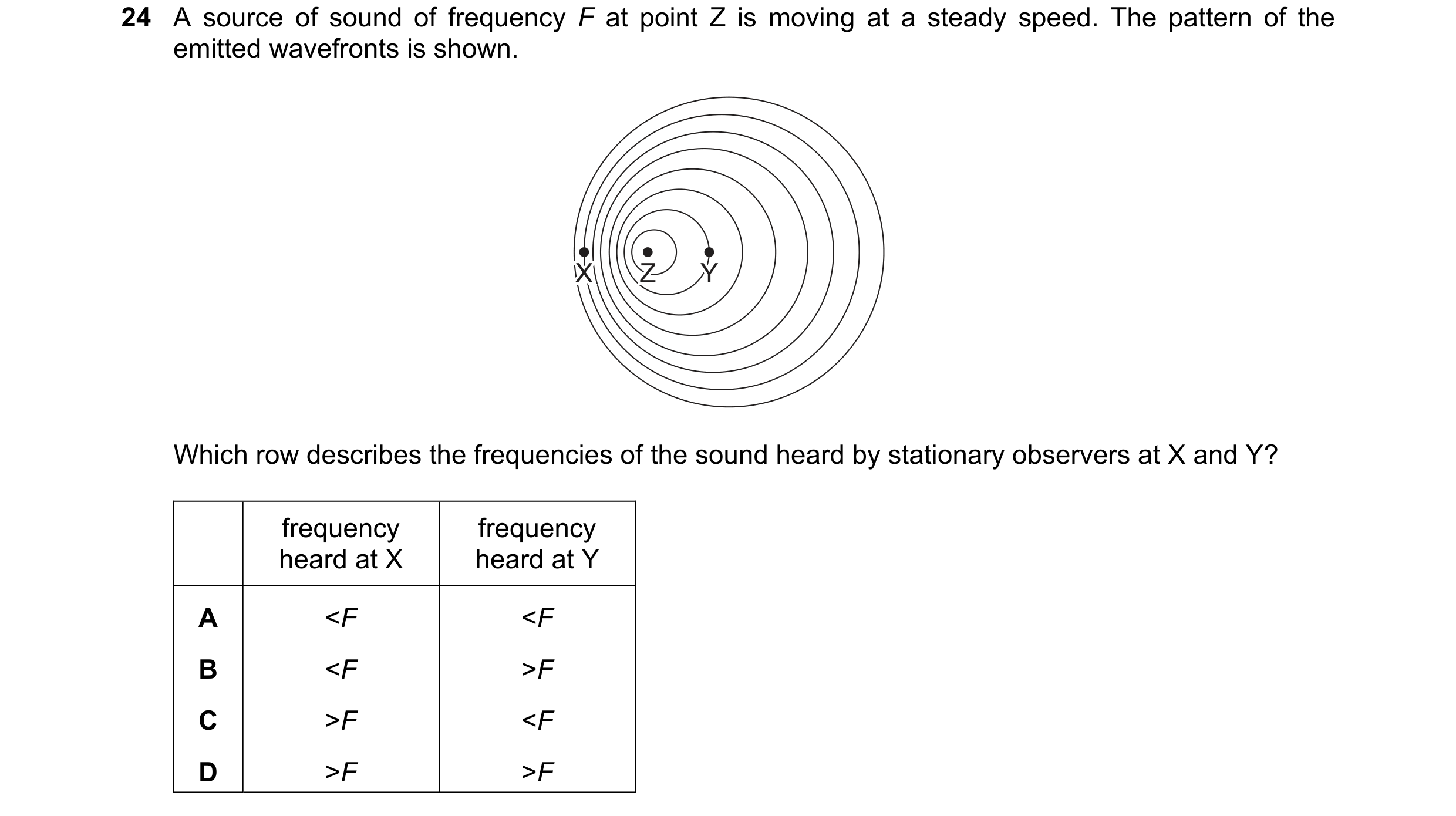
 11 / 18
 12 / 18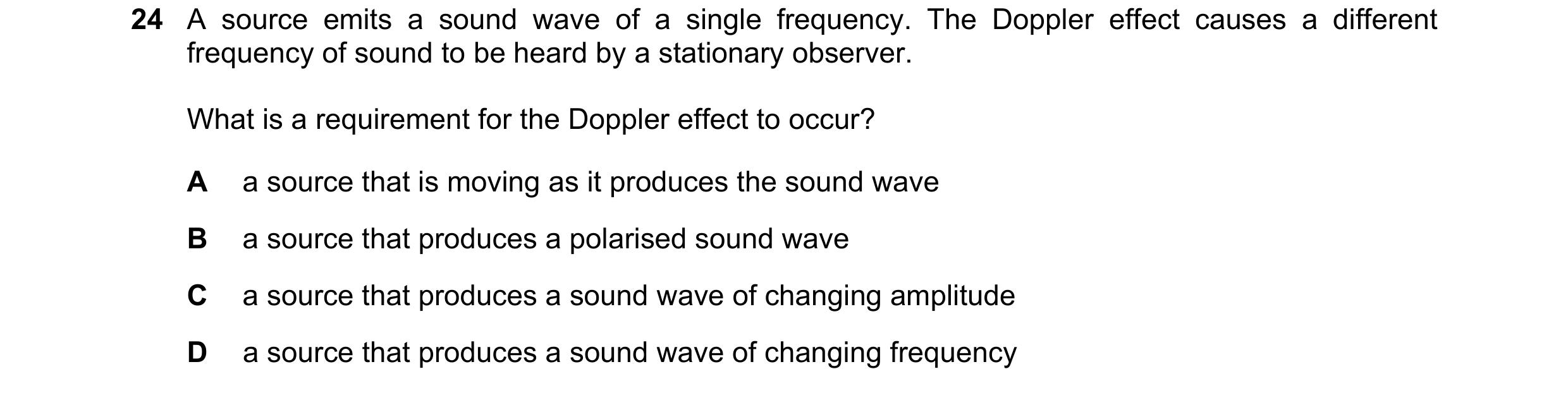

 13 / 18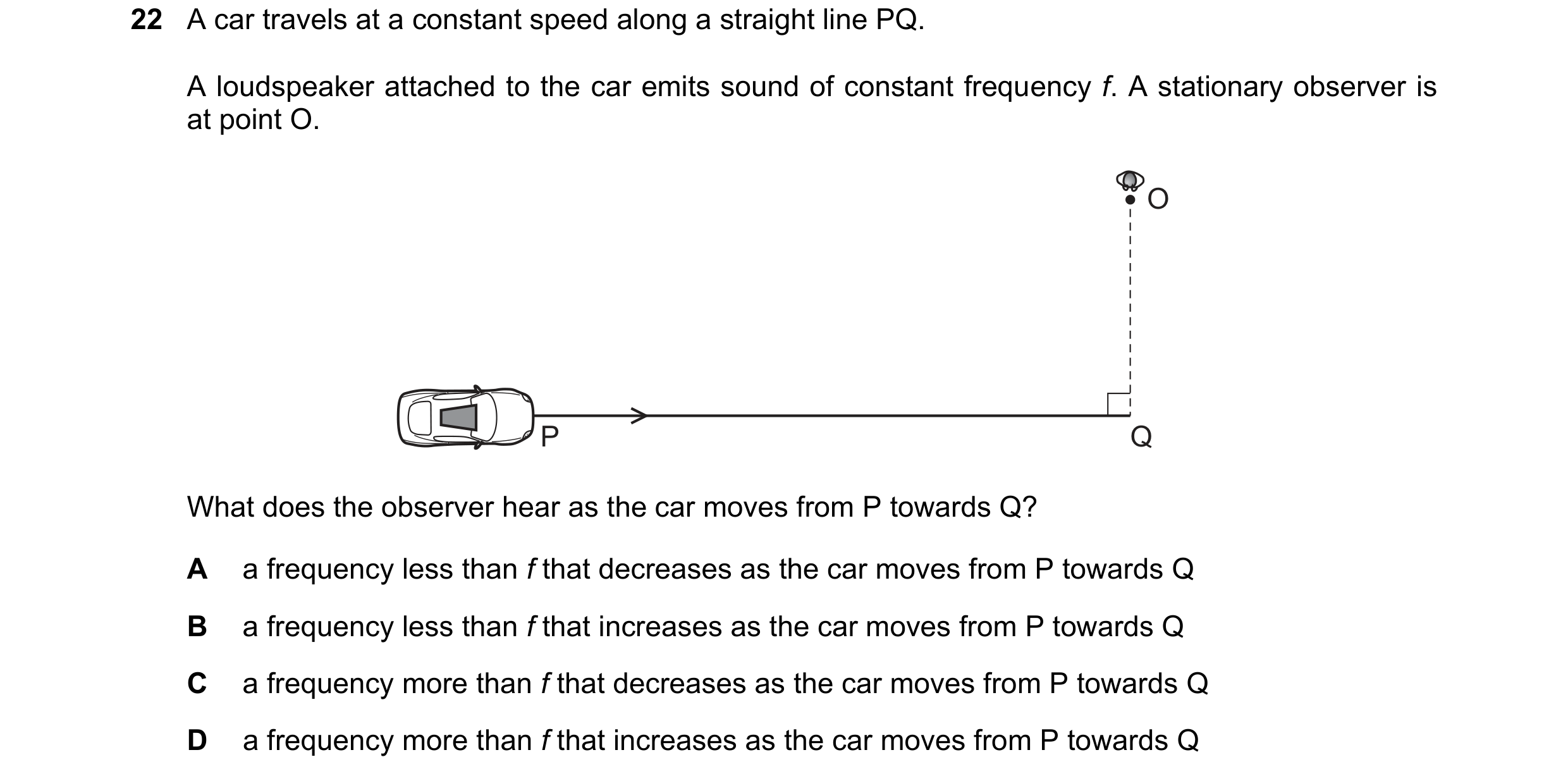
 14 / 18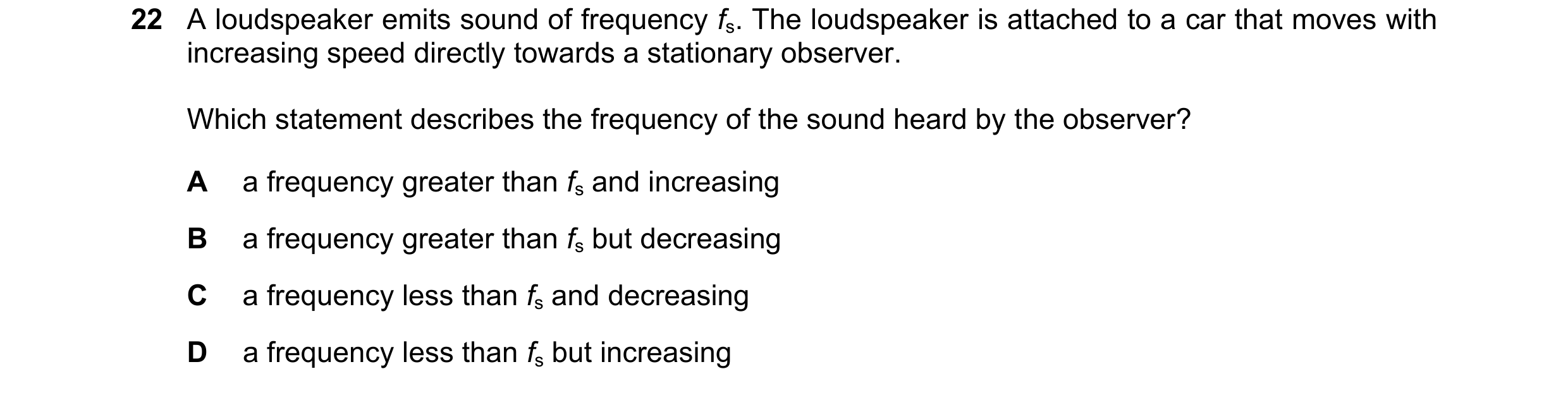
 15 / 18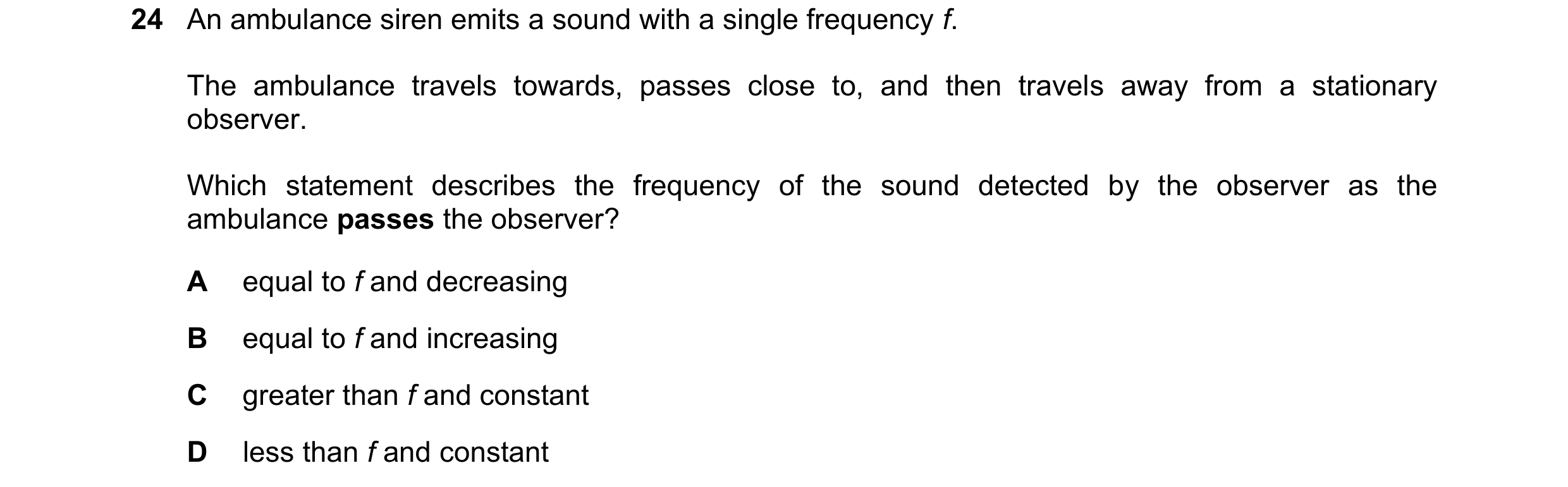
 16 / 18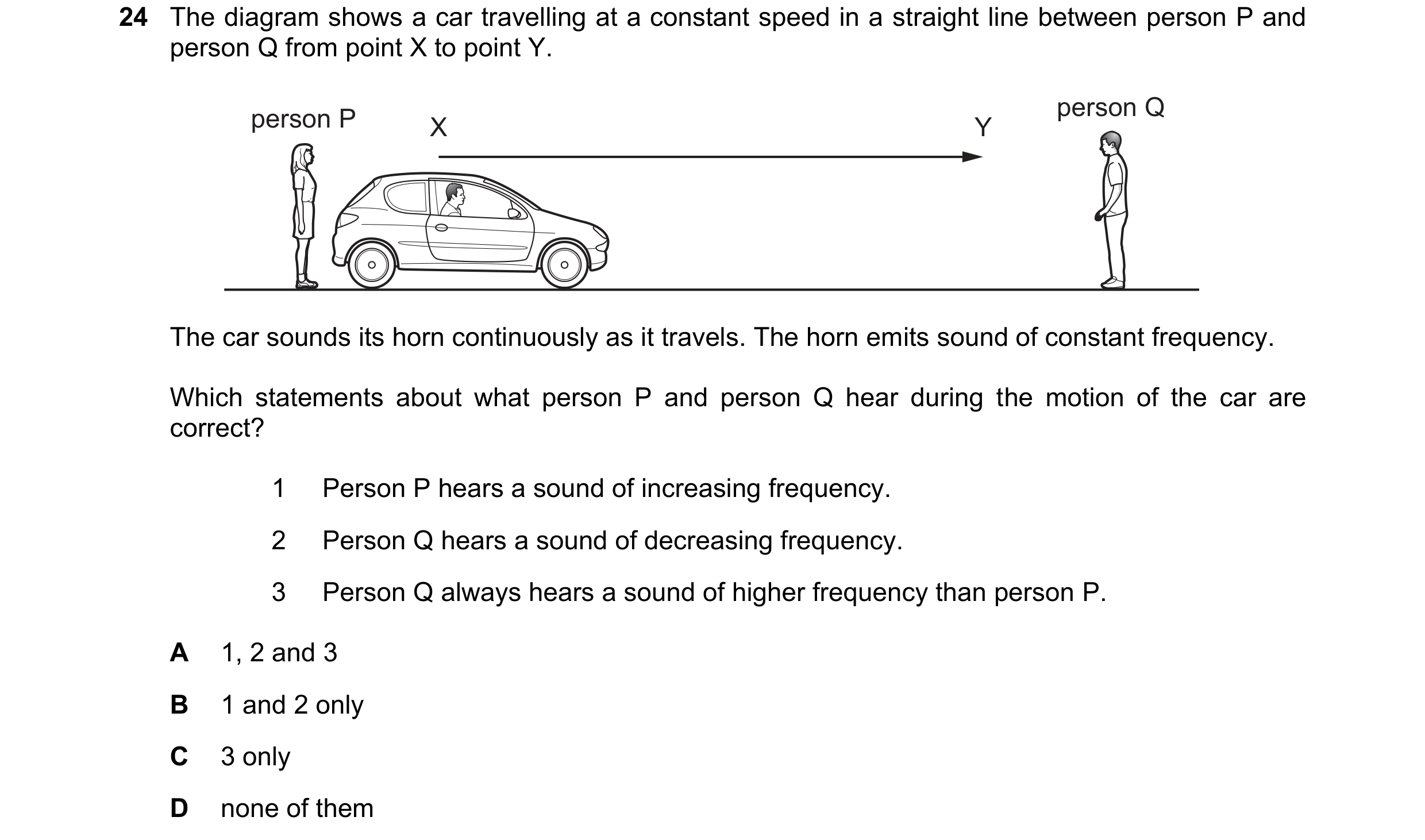
 17 / 18


 18 / 18