Questions as text
Q1 · State what is meant by the Doppler effect 9702/22 Feb/March 2017
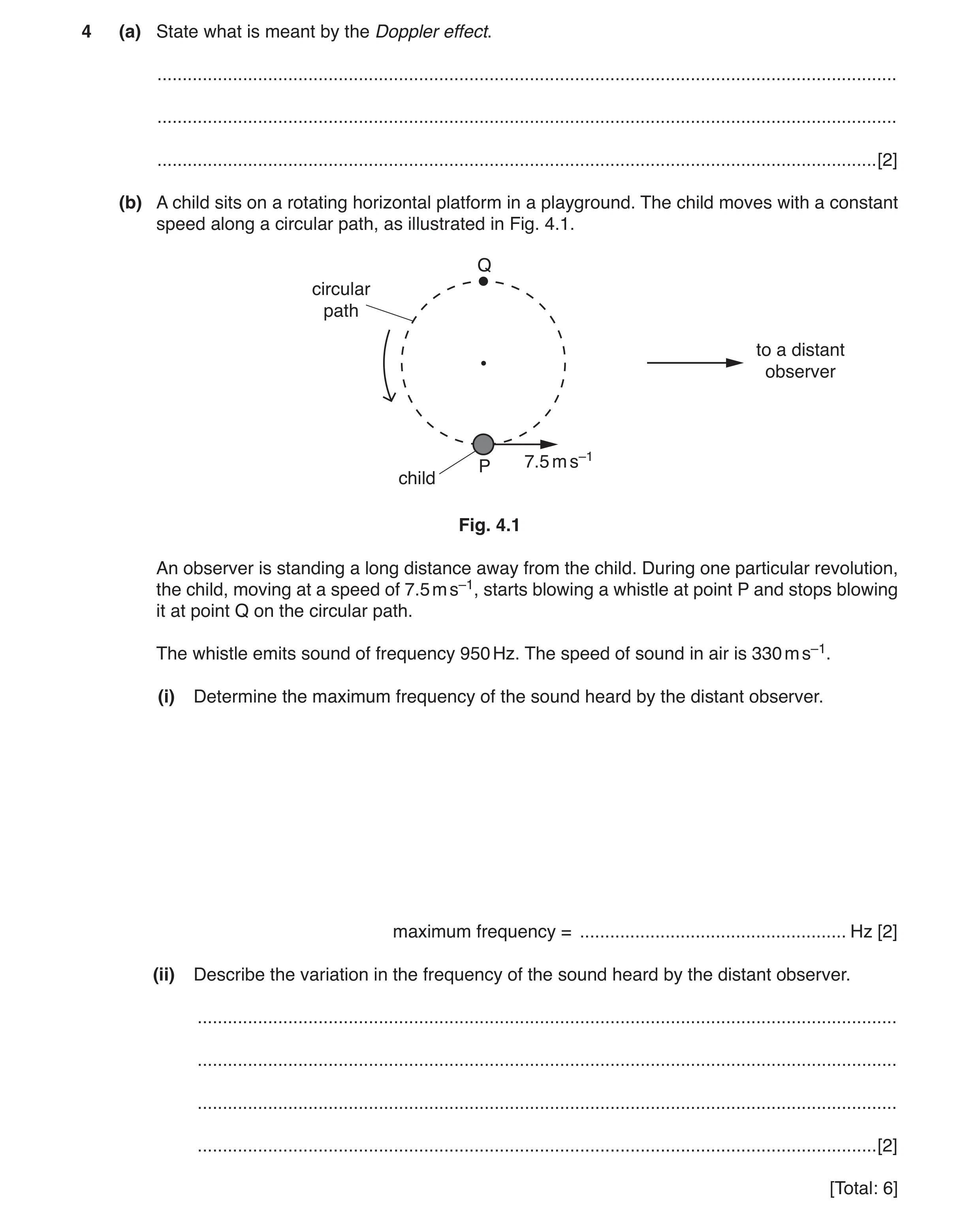
4 (a) State what is meant by the Doppler effect. … … … [2] (b) A child sits on a rotating horizontal platform in a playground. The child moves with a constant speed along a circular path, as illustrated in Fig. 4.1. Q circular path to a distant observer 7.5 m s–1 P child Fig. 4.1 An observer is standing a long distance away from the child. During one particular revolution, the child, moving at a speed of 7.5 m s–1, starts blowing a whistle at point P and stops blowing it at point Q on the circular path. The whistle emits sound of frequency 950 Hz. The speed of sound in air is 330 m s–1. (i) Determine the maximum frequency of the sound heard by the distant observer. maximum frequency = … Hz [2] (ii) Describe the variation in the frequency of the sound heard by the distant observer. … … … … [2] [Total: 6]
6 marks
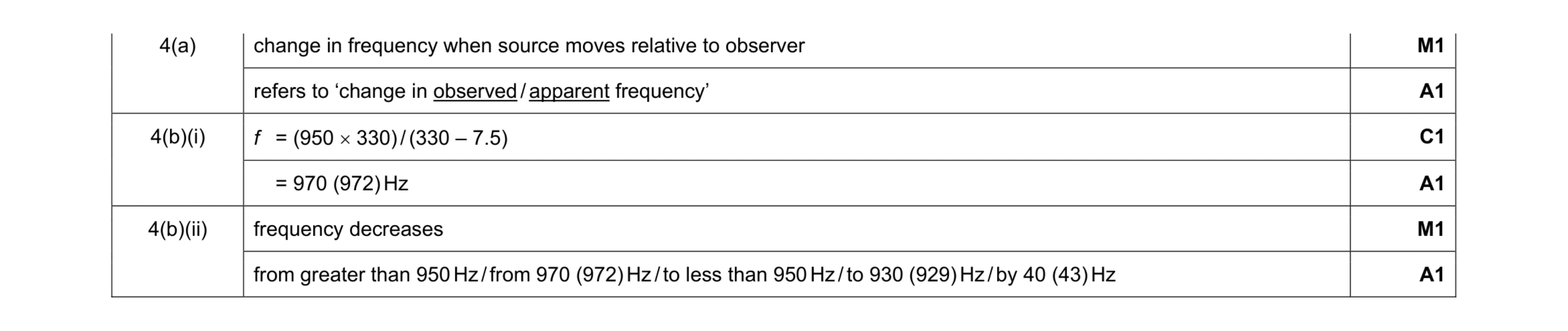
Mark scheme: 4(a) change in frequency when source moves relative to observer M1 refers to ‘change in observed / apparent frequency’ A1 4(b)(i) f = (950 × 330) / (330 – 7.5) C1 = 970 (972) Hz A1 4(b)(ii) frequency decreases M1 from greater than 950 Hz / from 970 (972) Hz / to less than 950 Hz / to 930 (929) Hz / by 40 (43) Hz A1
This question in 9702/22 Feb/March 2017
Q2 · A child on a sledge slides down a steep hill and then travels in a straight line up an… 9702/22 May/June 2018
3 A child on a sledge slides down a steep hill and then travels in a straight line up an ice-covered slope, as illustrated in Fig. 3.1. ice-covered slope child and sledge total mass 70 kg B 18 m s–1 A Fig. 3.1 (not to scale) The sledge passes point A with speed 18 m s–1 at time t = 0 and then comes to rest at point B. The child applies a brake to the sledge at point B. The brake does not keep the sledge stationary and it immediately slides back down the slope towards A. The variation with time t of the velocity v of the sledge from t = 0 to t = 24 s is shown in Fig. 3.2. 20 v / m s–1 10 0 0 4 8 12 16 20 24 t / s –10 Fig. 3.2 (a) State the time taken for the sledge to travel from A to B. time = … s [1] (b) Determine the displacement of the sledge up the slope from point A at time t = 24 s. displacement = … m [3] (c) Show that the acceleration of the sledge as it moves from B back towards A is 0.50 m s–2. [2] (d) The child and sledge have a total mass of 70 kg. The component of the total weight of the child and sledge that acts down the slope is 80 N. Determine (i) the frictional force on the sledge as it moves from B towards A, frictional force = … N [2] (ii) the angle θ of the slope to the horizontal. θ = … ° [2] (e) The child on the sledge blows a whistle between t = 4.0 s and t = 8.0 s. The whistle emits sound of frequency 900 Hz. The speed of the sound in the air is 340 m s–1. A man standing at point A hears the sound. Use Fig. 3.2 to (i) determine the initial frequency of the sound heard by the man, initial frequency = … Hz [2] (ii) describe and explain qualitatively the variation, if any, in the frequency of the sound heard by the man. … … [1] [Total: 13]
13 marks
Mark scheme: 3(a) time = 12 s A1 3(b) distance (up slope) = ½ × 12 × 18 (= 108) C1 distance (down slope) = ½ × 12 × 6 (= 36) C1 displacement from A = 108 – 36 = 72 m A1 3(c) v = u + at or a = gradient or a = ∆v / (∆)t C1 a = 6 / 12 = 0.50 (m s–2) (other points from the line may be used) A1 or v2 = u2 + 2as and u = 0 or v2 = 2as (C1) a = 6.02 / (2 × 36) = 0.50 (m s–2) (A1) or s = ut + ½at2 and u = 0 or s = ½at2 (C1) a = 2 × 36 / 122 = 0.50 (m s–2) (A1) or s = vt – ½at2 (C1) a = 2 × (6 × 12 – 36) / 122 = 0.50 (m s–2) (A1) Question Answer Marks 3(d)(i) F = 70 × 0.50 (= 35) C1 frictional force = 80 – 35 = 45 N A1 3(d)(ii) sin θ = 80 / (70 × 9.81) C1 θ = 6.7° A1 3(e)(i) f0 = (900 × 340) / (340 + 12) C1 = 870 Hz A1 3(e)(ii) speed/velocity (of sledge) decreases and (so) frequency increases B1
This question in 9702/22 May/June 2018
Q3 · State Newton’s second law of motion 9702/22 May/June 2019
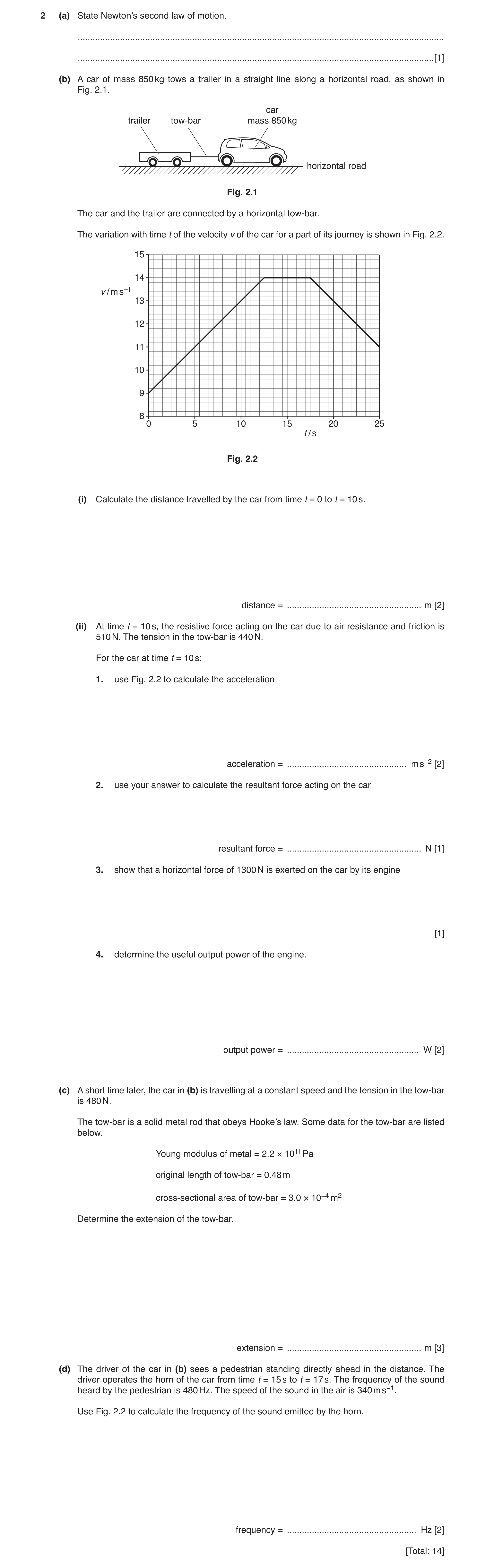
2 (a) State Newton’s second law of motion. … … [1] (b) A car of mass 850 kg tows a trailer in a straight line along a horizontal road, as shown in Fig. 2.1. car trailer tow-bar mass 850 kg horizontal road Fig. 2.1 The car and the trailer are connected by a horizontal tow-bar. The variation with time t of the velocity v of the car for a part of its journey is shown in Fig. 2.2. 15 14 v / m s–1 13 12 11 10 9 8 0 5 10 15 20 25 t / s Fig. 2.2 (i) Calculate the distance travelled by the car from time t = 0 to t = 10 s. distance = … m [2] (ii) At time t = 10 s, the resistive force acting on the car due to air resistance and friction is 510 N. The tension in the tow-bar is 440 N. For the car at time t = 10 s: 1. use Fig. 2.2 to calculate the acceleration acceleration = … m s−2 [2] 2. use your answer to calculate the resultant force acting on the car resultant force = … N [1] 3. show that a horizontal force of 1300 N is exerted on the car by its engine [1] 4. determine the useful output power of the engine. output power = … W [2] (c) A short time later, the car in (b) is travelling at a constant speed and the tension in the tow-bar is 480 N. The tow-bar is a solid metal rod that obeys Hooke’s law. Some data for the tow-bar are listed below. Young modulus of metal = 2.2 × 10¹¹ Pa original length of tow-bar = 0.48 m cross-sectional area of tow-bar = 3.0 × 10⁻⁴ m2 Determine the extension of the tow-bar. extension = … m [3] (d) The driver of the car in (b) sees a pedestrian standing directly ahead in the distance. The driver operates the horn of the car from time t = 15 s to t = 17 s. The frequency of the sound heard by the pedestrian is 480 Hz. The speed of the sound in the air is 340 m s−1. Use Fig. 2.2 to calculate the frequency of the sound emitted by the horn. frequency = … Hz [2] [Total: 14]
14 marks
Mark scheme: 2(a) (resultant) force proportional/equal to/is rate of change of momentum B1 2(b)(i) distance = area under graph or s = ½ (u + v) t = ½ × (9 + 13) × 10 or s = ut + ½at 2 = (9 × 10) + (½ × 0.40 × 10²) or s = vt – ½at 2 = (13 × 10) – (½ × 0.40 × 10²) or v 2 = u 2 + 2as 132 = 92 + (2 × 0.40 × s) C1 distance = 110 m A1 Question Answer Marks 2(b)(ii) 1. a = gradient or a = (v – u) / t or a = ∆v / (∆)t e.g. a = (14 – 9) / 12.5 or (13 – 9) / 10 C1 a = 0.40 m s–2 A1 2. resultant force = 850 × 0.40 = 340 N A1 3. (F =) 510 + 440 + 340 = 1300 (N) A1 4. P = Fv C1 = 1300 × 13 = 1.7 × 10⁴ W A1 2(c) E = σ / ε C1 E = (F / A) / (∆L / L) or E = FL / A∆L C1 ∆L = (480 × 0.48) / (3.0 × 10–4 × 2.2 × 1011) = 3.5 × 10⁻⁶ m A1 2(d) fo = fs v / (v – vs) 480 = fs × 340 / (340 – 14) C1 fs = 460 Hz A1
This question in 9702/22 May/June 2019
Q4 · A dolphin is swimming under water at a constant speed of 4.50 m s–1 9702/22 Feb/March 2020
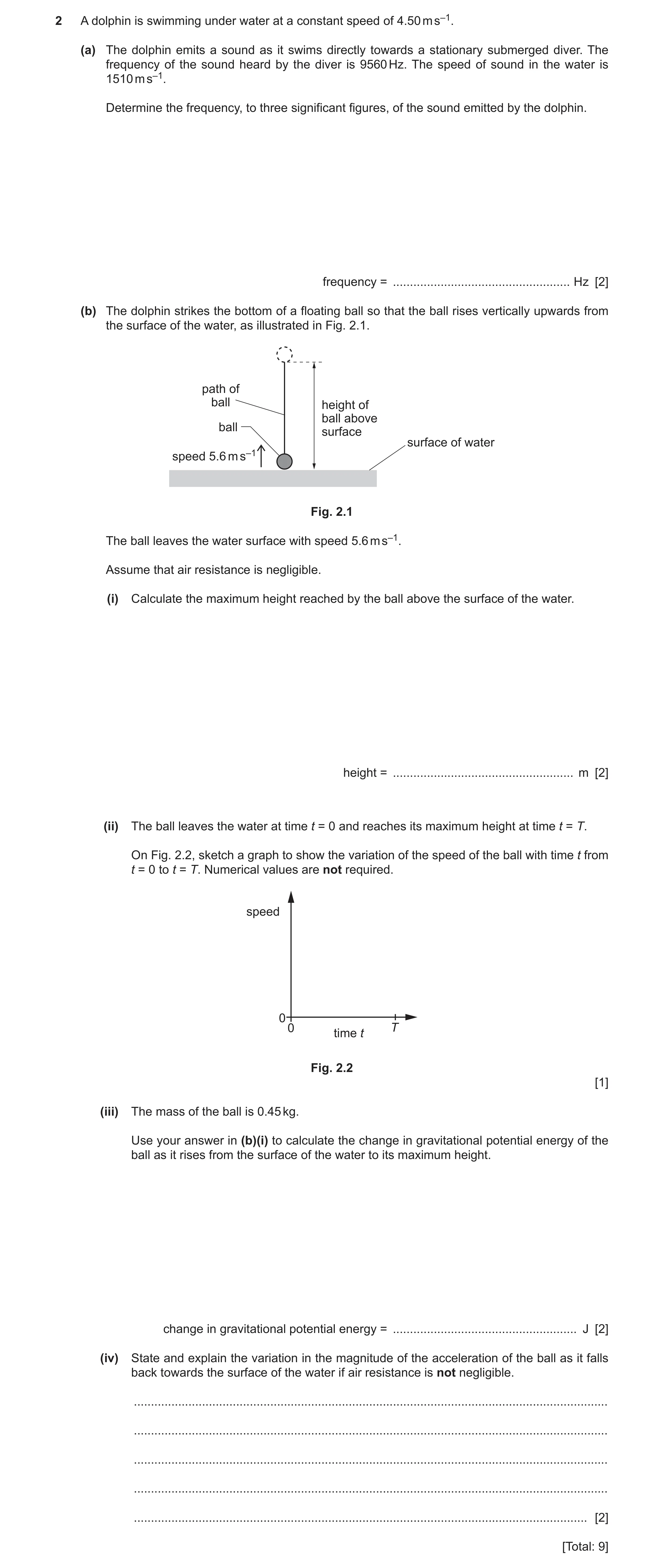
2 A dolphin is swimming under water at a constant speed of 4.50 m s–1. (a) The dolphin emits a sound as it swims directly towards a stationary submerged diver. The frequency of the sound heard by the diver is 9560 Hz. The speed of sound in the water is 1510 m s–1. Determine the frequency, to three significant figures, of the sound emitted by the dolphin. frequency = … Hz [2] (b) The dolphin strikes the bottom of a floating ball so that the ball rises vertically upwards from the surface of the water, as illustrated in Fig. 2.1. path of ball height of ball above ball surface surface of water speed 5.6 m s–1 Fig. 2.1 The ball leaves the water surface with speed 5.6 m s–1. Assume that air resistance is negligible. (i) Calculate the maximum height reached by the ball above the surface of the water. height = … m [2] (ii) The ball leaves the water at time t = 0 and reaches its maximum height at time t = T. On Fig. 2.2, sketch a graph to show the variation of the speed of the ball with time t from t = 0 to t = T. Numerical values are not required. speed 0 0 T time t Fig. 2.2 [1] (iii) The mass of the ball is 0.45 kg. Use your answer in (b)(i) to calculate the change in gravitational potential energy of the ball as it rises from the surface of the water to its maximum height. change in gravitational potential energy = … J [2] (iv) State and explain the variation in the magnitude of the acceleration of the ball as it falls back towards the surface of the water if air resistance is not negligible. … … … … … [2] [Total: 9]
9 marks
Mark scheme: 2(a) f0 = fS v / (v – vS) 9560 = f × 1510 / (1510 – 4.50) C1 f = 9530 Hz A1 2(b)(i) v 2 = u 2 + 2as height = 5.62 / (2 × 9.81) C1 = 1.6 m A1 2(b)(ii) downward sloping straight line starting from a point on the speed axis and ending at point (T, 0) B1 Question Answer Marks 2(b)(iii) (Δ)E = mg(Δ)h = 0.45 × 9.81 × 1.6 C1 = 7.1 J A1 2(b)(iv) air resistance increases (and weight constant) B1 (resultant force decreases so) acceleration decreases B1
This question in 9702/22 Feb/March 2020
Q5 · A source of sound is attached to a rope and then swung at a constant speed in a… 9702/22 Feb/March 2021
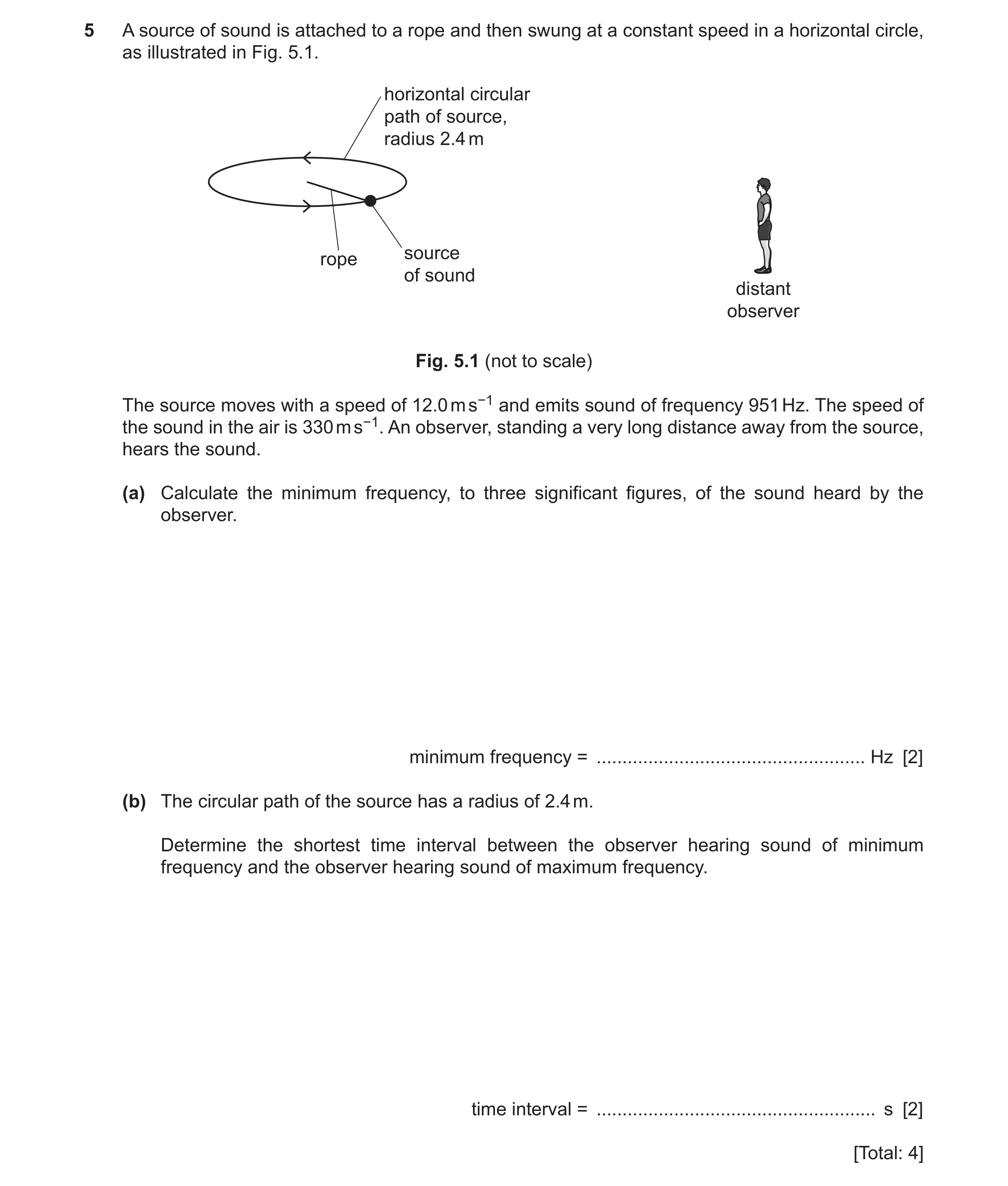
5 A source of sound is attached to a rope and then swung at a constant speed in a horizontal circle, as illustrated in Fig. 5.1. horizontal circular path of source, radius 2.4 m source rope of sound distant observer Fig. 5.1 (not to scale) The source moves with a speed of 12.0 m s−1 and emits sound of frequency 951 Hz. The speed of the sound in the air is 330 m s−1. An observer, standing a very long distance away from the source, hears the sound. (a) Calculate the minimum frequency, to three significant figures, of the sound heard by the observer. minimum frequency = … Hz [2] (b) The circular path of the source has a radius of 2.4 m. Determine the shortest time interval between the observer hearing sound of minimum frequency and the observer hearing sound of maximum frequency. time interval = … s [2] [Total: 4]
4 marks
Mark scheme: 5(a) fo = fs v / (v + vs) fo = 951 × 330 / (330 + 12) = 918 Hz A1 5(b) t = d / 12 = (π × 2.4 ) / 12 C1 = 0.63 s A1
This question in 9702/22 Feb/March 2021
Q6 · By reference to the direction of transfer of energy, state what is meant by a… 9702/21 Oct/Nov 2021
4 (a) By reference to the direction of transfer of energy, state what is meant by a longitudinal wave. … … [1] (b) A vehicle travels at constant speed around a wide circular track. It continuously sounds its horn, which emits a single note of frequency 1.2 kHz. An observer is a large distance away from the track, as shown in the view from above in Fig. 4.1. direction of travel vehicle observer track Fig. 4.1 (not to scale) Fig. 4.2 shows the variation with time of the frequency f of the sound of the horn that is detected by the observer. The time taken for the vehicle to travel once around the track is T. 1.6 f / kHz 1.4 1.2 1.0 0.8 0 T 2T 3T time Fig. 4.2 (i) Explain why the frequency of the sound detected by the observer is sometimes above and sometimes below 1.2 kHz. … … … … [2] (ii) State the name of the phenomenon in (b)(i). … [1] (iii) On Fig. 4.1, mark with a letter X the position of the vehicle when it emitted the sound that is detected at time T. [1] (iv) On Fig. 4.1, mark with a letter Y the position of the vehicle when it emitted the sound that 9T is detected at time . [1] 4 (c) The speed of the sound in the air is 320 m s–1. Use Fig. 4.2 to determine the speed of the vehicle in (b). speed = … m s–1 [3] [Total: 9]
9 marks
Mark scheme: 4(a) oscillations (of particles) are parallel to (the direction of) energy transfer B1 4(b)(i) (frequency varies as) vehicle moves relative to (stationary) observer C1 (vehicle) moving towards (observer) gives higher (observed) frequency (than 1.2 kHz) and (vehicle) moving away (from observer) gives lower (observed) frequency (than 1.2 kHz) A1 4(b)(ii) Doppler effect B1 4(b)(iii) position of vehicle labelled ‘X’ at top (12 o’clock) position on track B1 4(b)(iv) position of vehicle labelled ‘Y’ at right-hand edge (3 o’clock) position on track B1 4(c) maximum frequency = 1.40 (kHz) or 1.40 × 10³ (Hz) C1 1.40 = (1.2 × 320) / (320 – v) C1 v = 46 m s–1 A1 or minimum frequency = 1.05 (kHz) or 1.05 × 10³ (Hz) (C1) 1.05 = (1.2 × 320) / (320 + v) (C1) v = 46 m s–1 (A1)
This question in 9702/21 Oct/Nov 2021
Q7 · A child sits on the ground next to a remote-controlled toy car 9702/22 Oct/Nov 2021
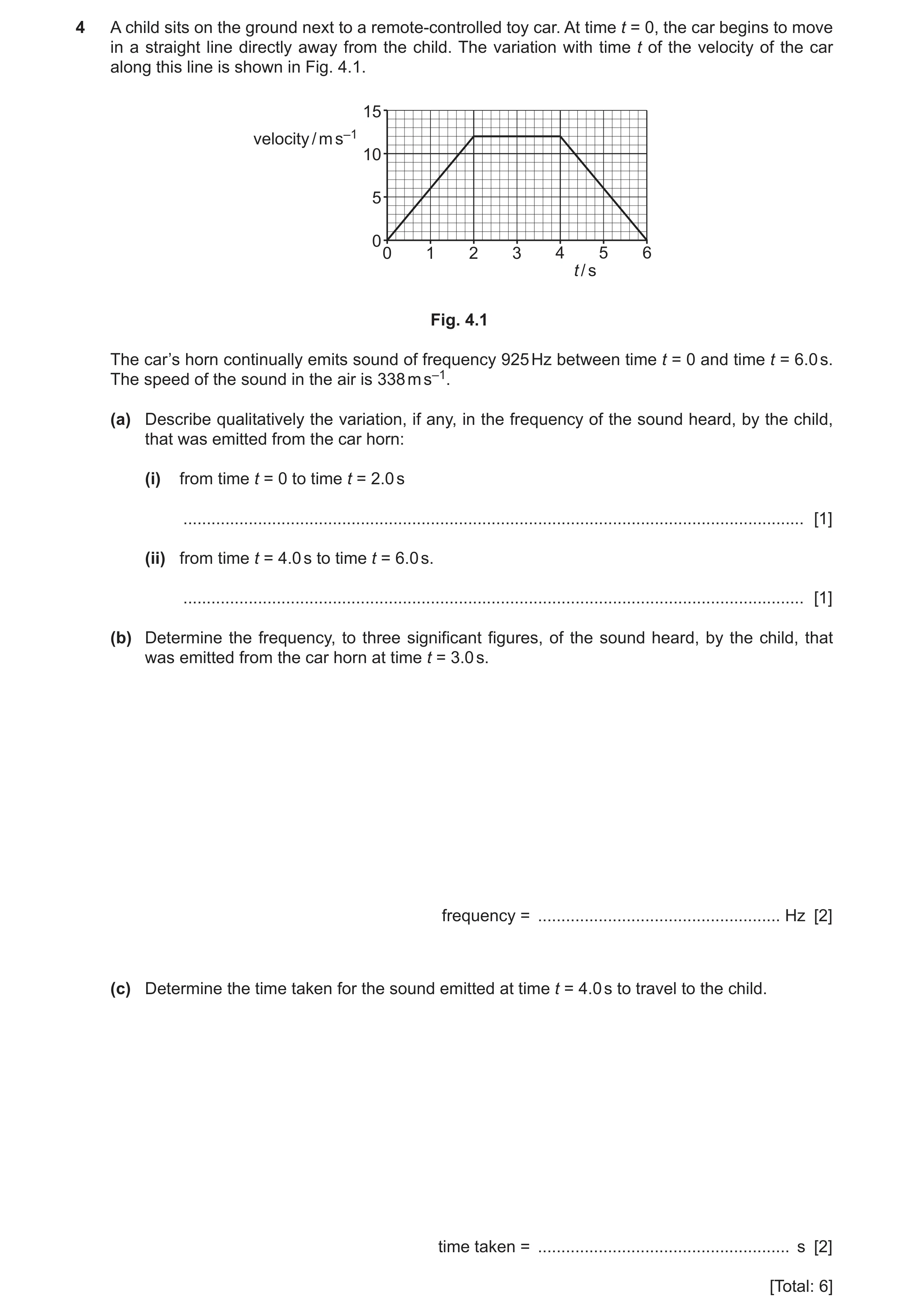
4 A child sits on the ground next to a remote-controlled toy car. At time t = 0, the car begins to move in a straight line directly away from the child. The variation with time t of the velocity of the car along this line is shown in Fig. 4.1. 15 velocity / m s–1 10 5 00 1 2 3 4 5 6 t / s Fig. 4.1 The car’s horn continually emits sound of frequency 925 Hz between time t = 0 and time t = 6.0 s. The speed of the sound in the air is 338 m s–1. (a) Describe qualitatively the variation, if any, in the frequency of the sound heard, by the child, that was emitted from the car horn: (i) from time t = 0 to time t = 2.0 s … [1] (ii) from time t = 4.0 s to time t = 6.0 s. … [1] (b) Determine the frequency, to three significant figures, of the sound heard, by the child, that was emitted from the car horn at time t = 3.0 s. frequency = … Hz [2] (c) Determine the time taken for the sound emitted at time t = 4.0 s to travel to the child. time taken = … s [2] [Total: 6]
6 marks
Mark scheme: 4(a)(i) decrease(s) B1 4(a)(ii) increase(s) B1 4(b) fo = fs v / (v + vs) = 925 × 338 / (338 + 12) C1 = 893 Hz A1 4(c) distance = (½ × 2 × 12) + (2 × 12) ( = 36 m) C1 time taken = 36 / 338 = 0.11 s A1
This question in 9702/22 Oct/Nov 2021
Q8 · A train travels at a constant high speed along a straight horizontal track towards an… 9702/21 Oct/Nov 2023
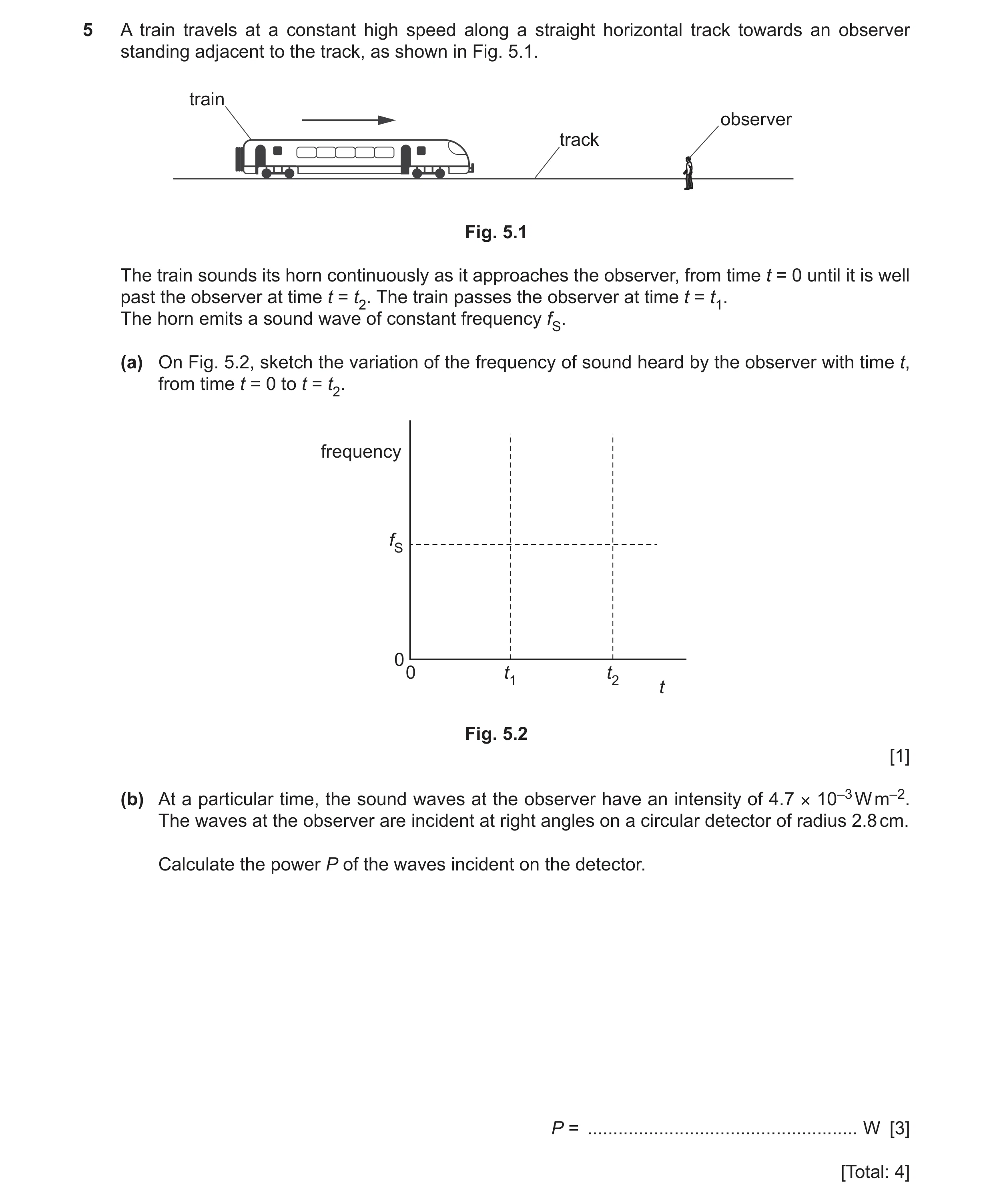
5 A train travels at a constant high speed along a straight horizontal track towards an observer standing adjacent to the track, as shown in Fig. 5.1. train observer track Fig. 5.1 The train sounds its horn continuously as it approaches the observer, from time t = 0 until it is well past the observer at time t = t2. The train passes the observer at time t = t1. The horn emits a sound wave of constant frequency fS. (a) On Fig. 5.2, sketch the variation of the frequency of sound heard by the observer with time t, from time t = 0 to t = t2. frequency fS 0 0 t1 t2 t Fig. 5.2 [1] (b) At a particular time, the sound waves at the observer have an intensity of 4.7 × 10⁻³ W m–2. The waves at the observer are incident at right angles on a circular detector of radius 2.8 cm. Calculate the power P of the waves incident on the detector. P = … W [3] [Total: 4]
4 marks
Mark scheme: 5(a) sketch: approximately horizontal line above horizontal dashed line from t = 0 to t = t1 A1 and approximately horizontal line below horizontal dashed line from t = t1 to t = t2 5(b) I = P / A C1 A = 0.0282 or 2.82 C1 ( = 2.46 10–3 or 24.6) P = 4.7 10–3 2.46 10–3 A1 = 1.2 10–5 W
This question in 9702/21 Oct/Nov 2023
Q9 · A stationary wave is formed on a string XY that has a length of 0.48 m 9702/23 Oct/Nov 2024
5 (a) A stationary wave is formed on a string XY that has a length of 0.48 m. Fig. 5.1 shows the string at one instant in time. 0.48 m X Y Fig. 5.1 The speed of the wave on the string is 1400 m s–1. (i) On Fig. 5.1, draw a cross (×) at one position that is a node and another cross at one position that is an antinode. Label the node N and the antinode A. [1] (ii) Show that the wavelength of the wave produced is 0.32 m. Explain your reasoning. [1] (iii) Calculate the frequency of the wave. frequency = … Hz [2] (b) A source of sound waves of frequency 780 Hz is on a rotating platform. The speed of the source is 39 m s–1. The sound is detected by an observer that is a large distance from the rotating platform, as shown in Fig. 5.2. source of sound, observer speed 39 m s–1 platform Fig. 5.2 (not to scale) (i) The speed of sound in air is 320 m s–1. Calculate the maximum frequency of the sound detected by the observer. maximum frequency = … Hz [2] (ii) At time t = 0, the observer detects the sound emitted by the source when it was in the position shown in Fig. 5.2. On Fig. 5.3, sketch the variation with t of the frequency f of the sound detected by the observer for one complete rotation of the platform. Calculations are not required. f 0 t Fig. 5.3 [2] [Total: 8]
8 marks
Mark scheme: 5(a)(i) cross labelled N marked at the intersection of the solid and dashed lines or at X or Y B1 and cross labelled A marked at a peak or a trough 5(a)(ii) (XY is 1.5 wavelengths, so) wavelength = 0.48 (2 / 3) = 0.32 m B1 or (wavelength is twice node–node distance so) / 2 = 0.48 / 3 = 0.16 m and wavelength = 0.16 2 = 0.32 m 5(a)(iii) v = f C1 frequency = 1400 / 0.32 A1 = 4400 Hz 5(b)(i) fo = fsv / (v – vs) C1 fo = (780 320) / (320 – 39) maximum frequency = 890 Hz A1 5(b)(ii) line showing f varying both above and below a mean frequency and returning to the original start value of f B1 a single cycle of a smoothly oscillating curve of correct phase (starting at mean position, falling to a trough, then rising to a B1 peak, ending at mean position)
This question in 9702/23 Oct/Nov 2024
Q10 · A stationary loudspeaker emits sound of constant frequency 9702/22 Feb/March 2025
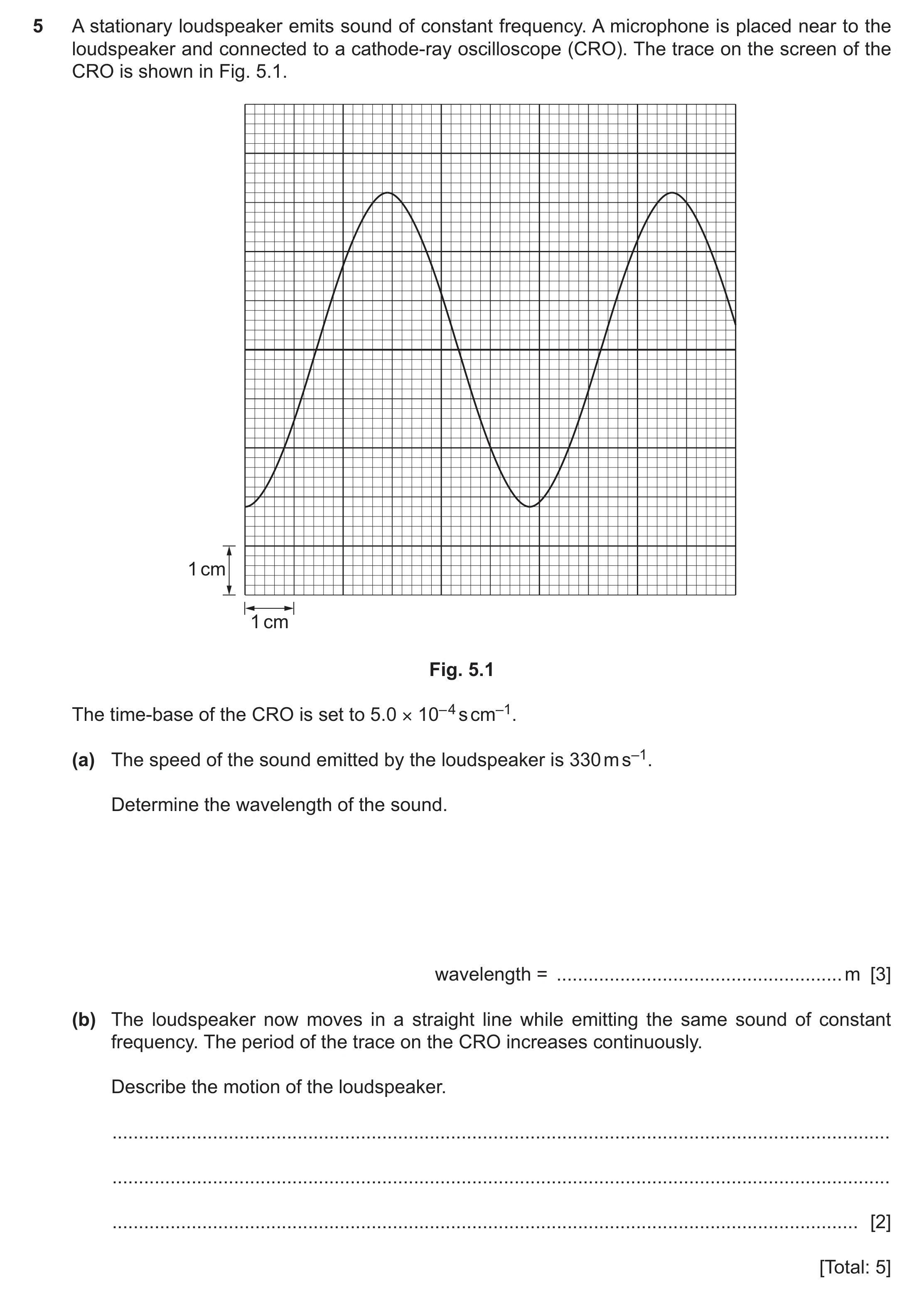
5 A stationary loudspeaker emits sound of constant frequency. A microphone is placed near to the loudspeaker and connected to a cathode-ray oscilloscope (CRO). The trace on the screen of the CRO is shown in Fig. 5.1. 1 cm 1 cm Fig. 5.1 The time-base of the CRO is set to 5.0 × 10– 4 s cm–1. (a) The speed of the sound emitted by the loudspeaker is 330 m s–1. Determine the wavelength of the sound. wavelength = … m [3] (b) The loudspeaker now moves in a straight line while emitting the same sound of constant frequency. The period of the trace on the CRO increases continuously. Describe the motion of the loudspeaker. … … … [2] [Total: 5]
5 marks
Mark scheme: 5(a) T = 5.8 5.0 10–4 C1 = 2.9 10–3 = vT or v = f and f = 1 / T C1 = 330 2.9 10–3 or = 330 / 345 A1 = 0.96 m 5(b) (loudspeaker) moves away (from the microphone) B1 at an increasing speed / whilst accelerating B1
This question in 9702/22 Feb/March 2025
 1 / 16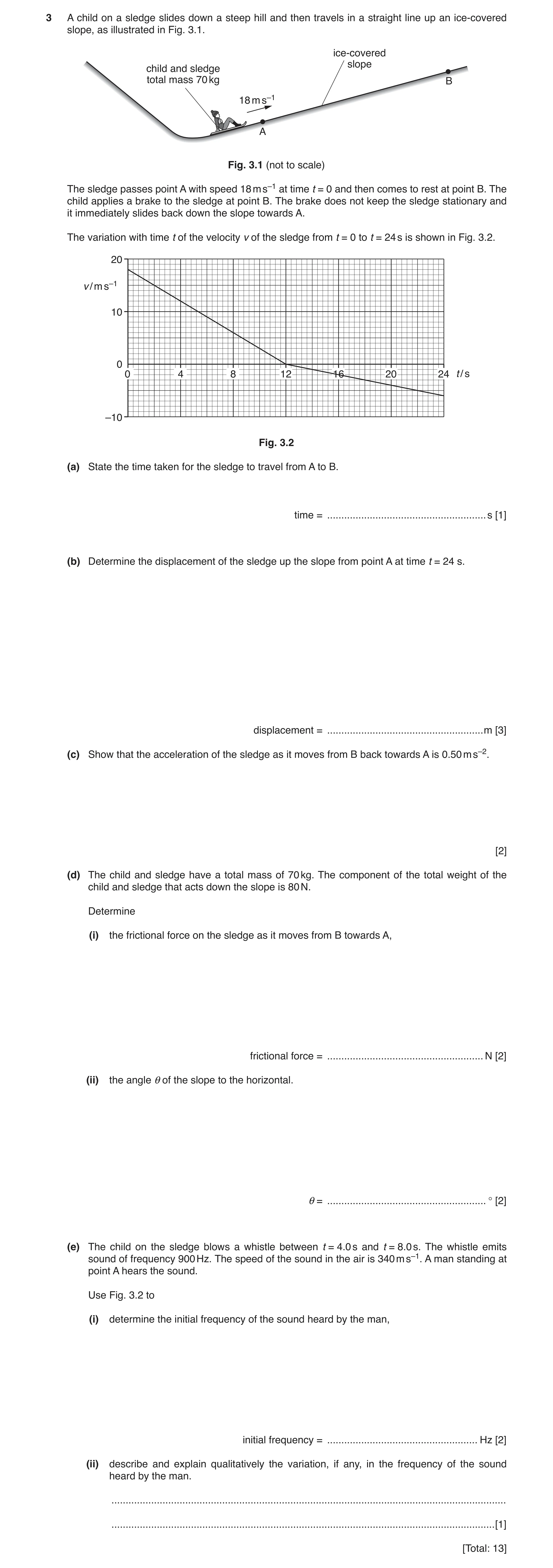
 9 / 16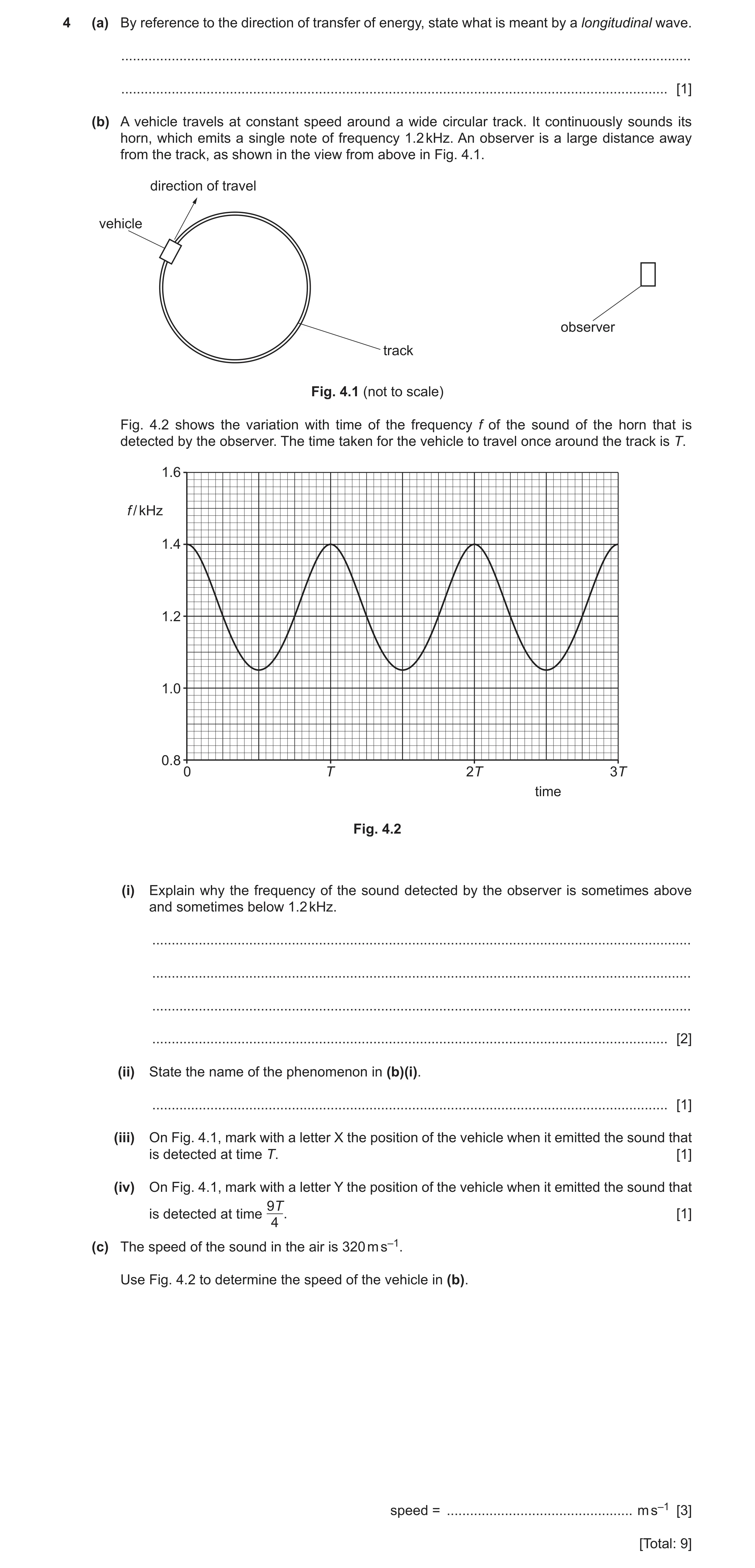
 12 / 16
 13 / 16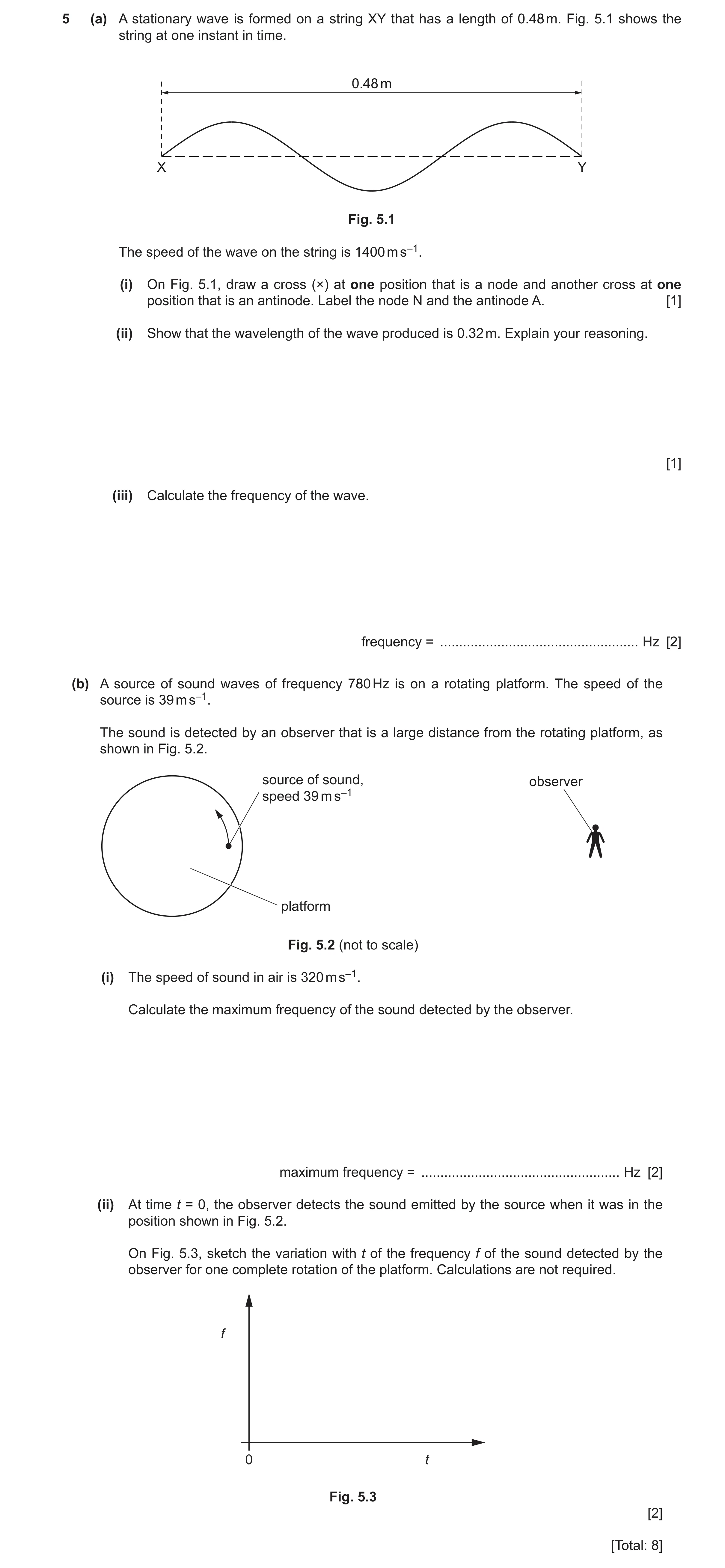
 16 / 16
 6
6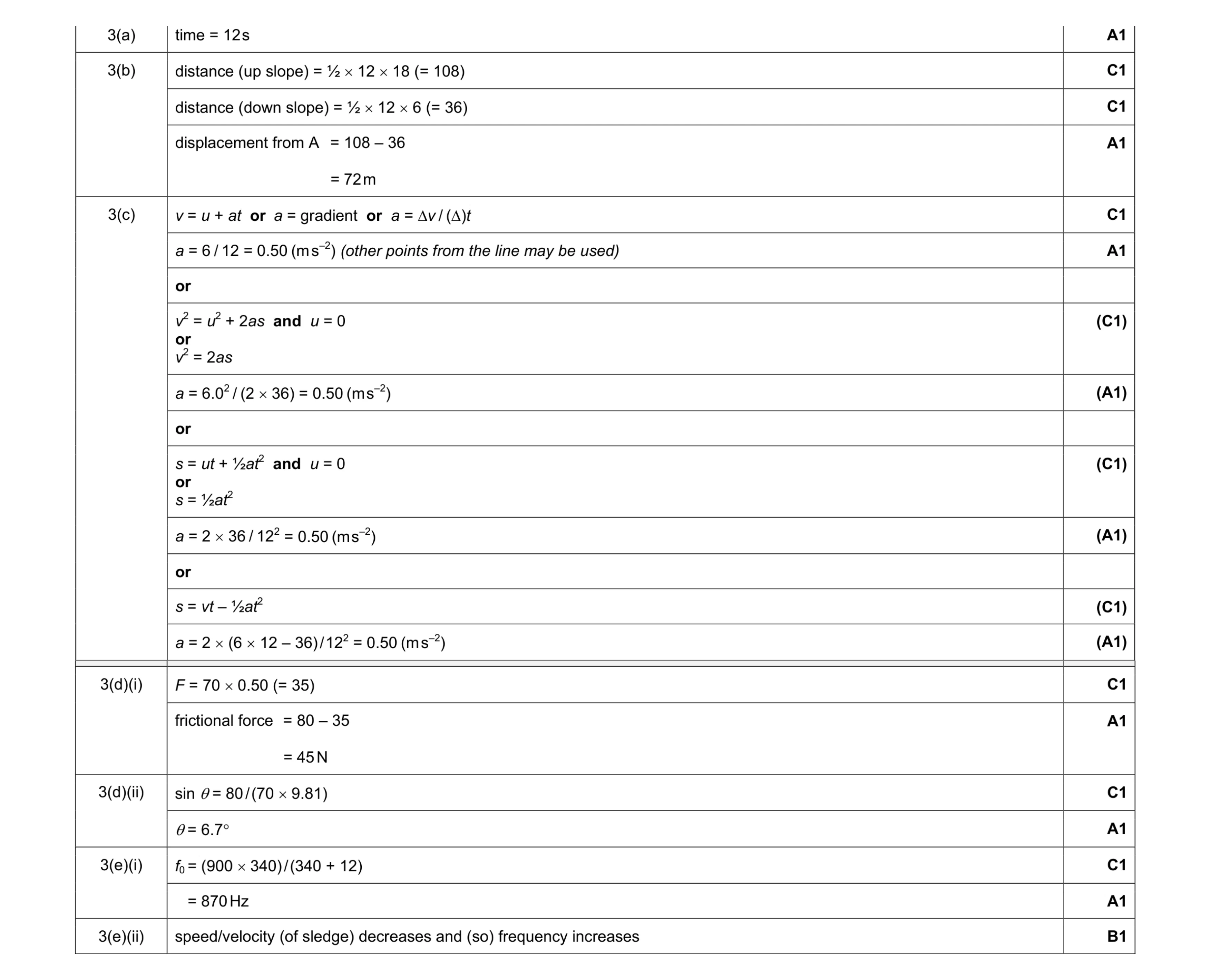 13
13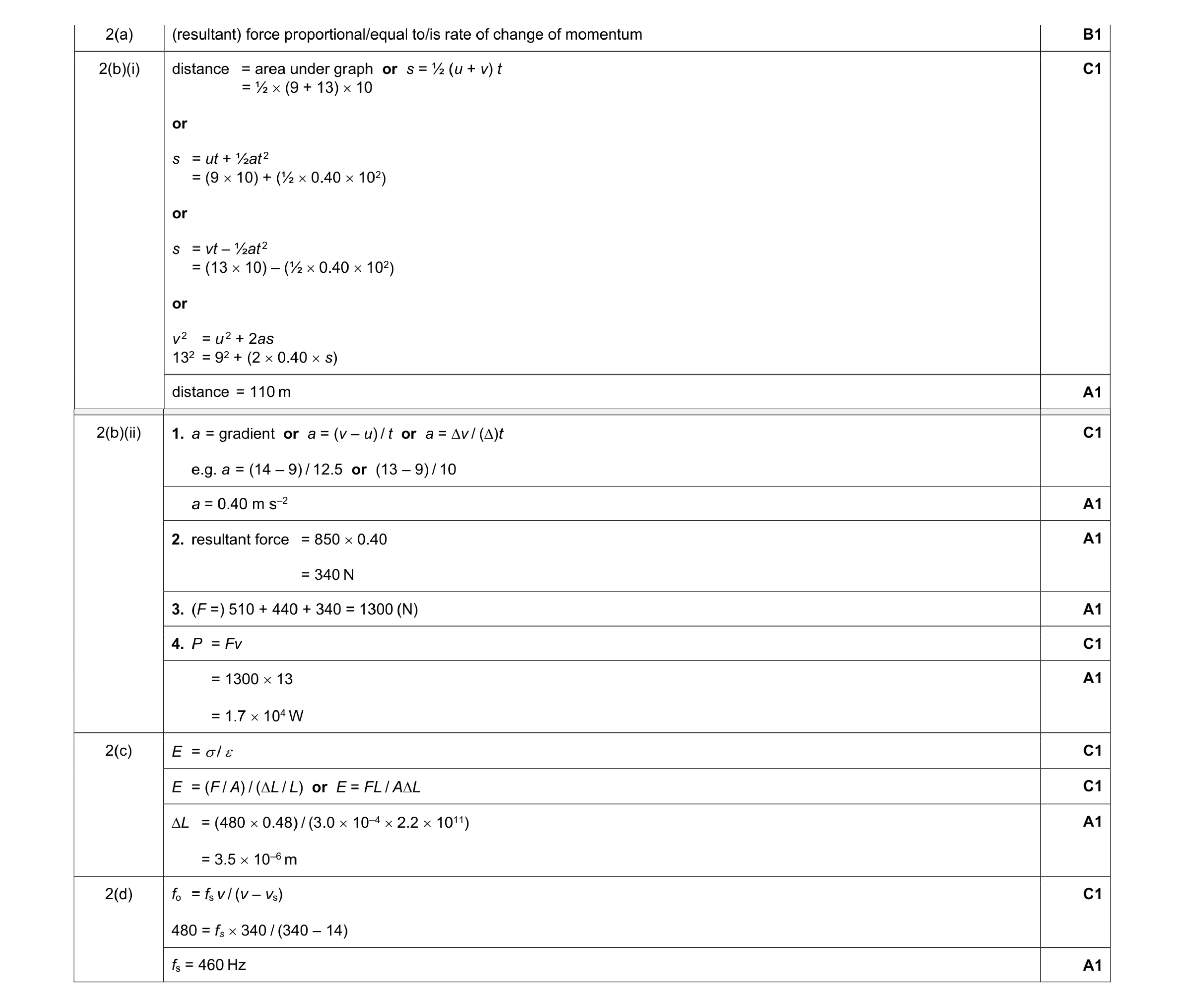 14
14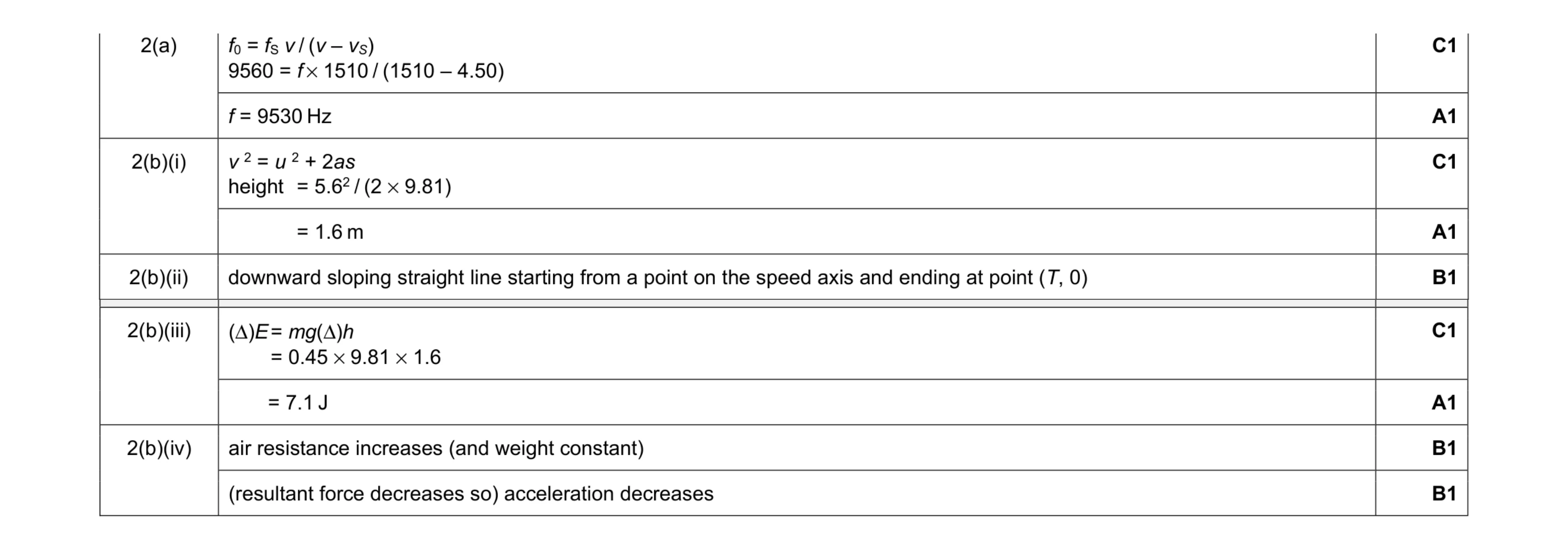 9
9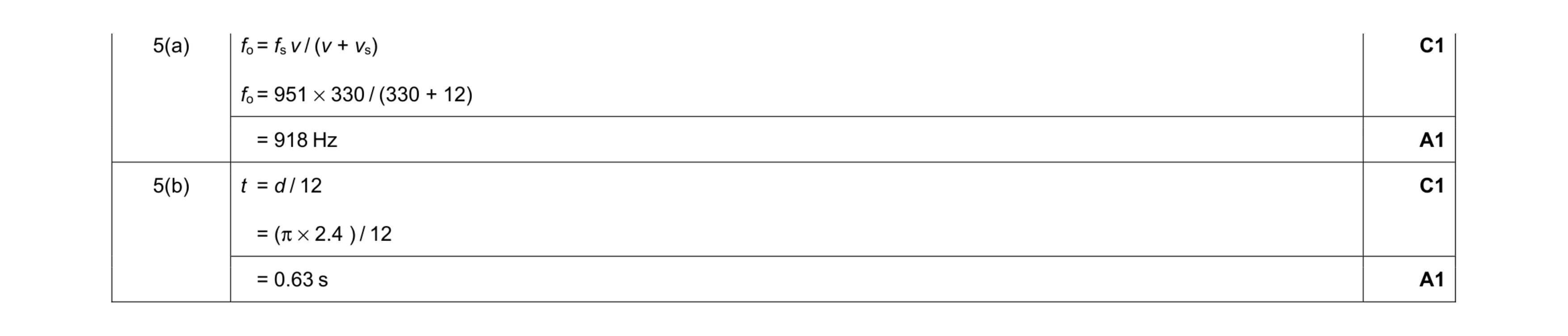 4
4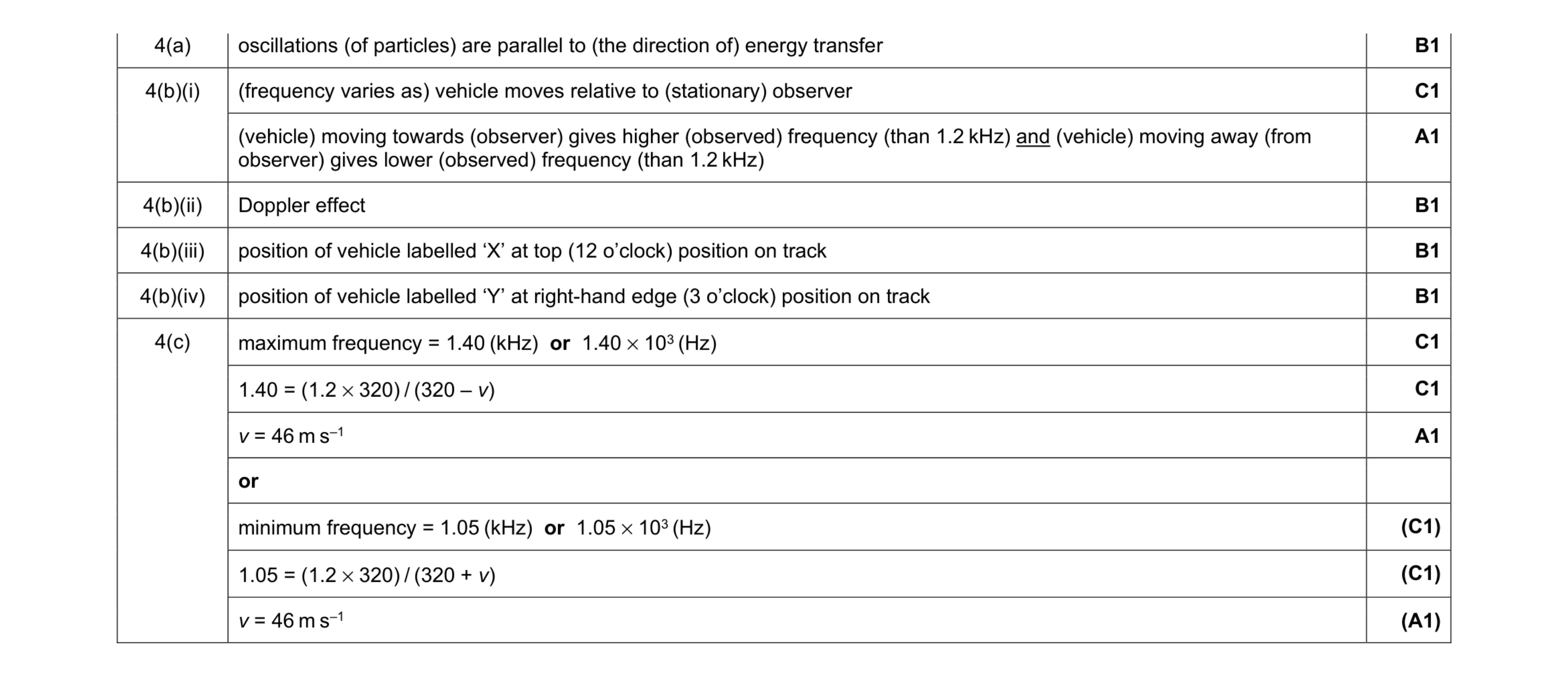 9
9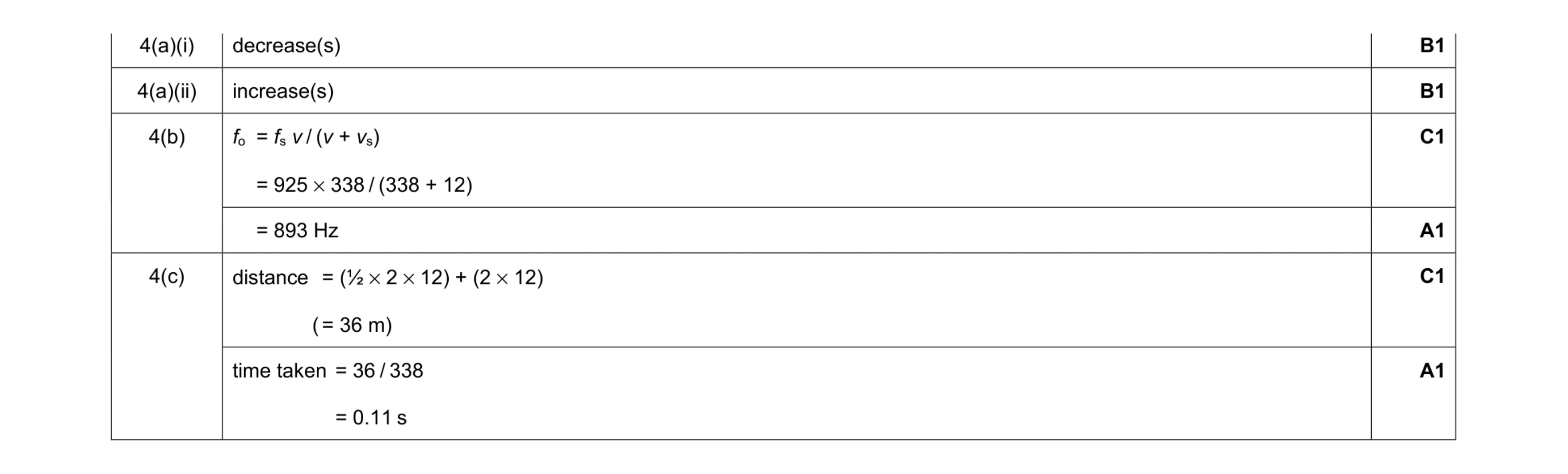 6
6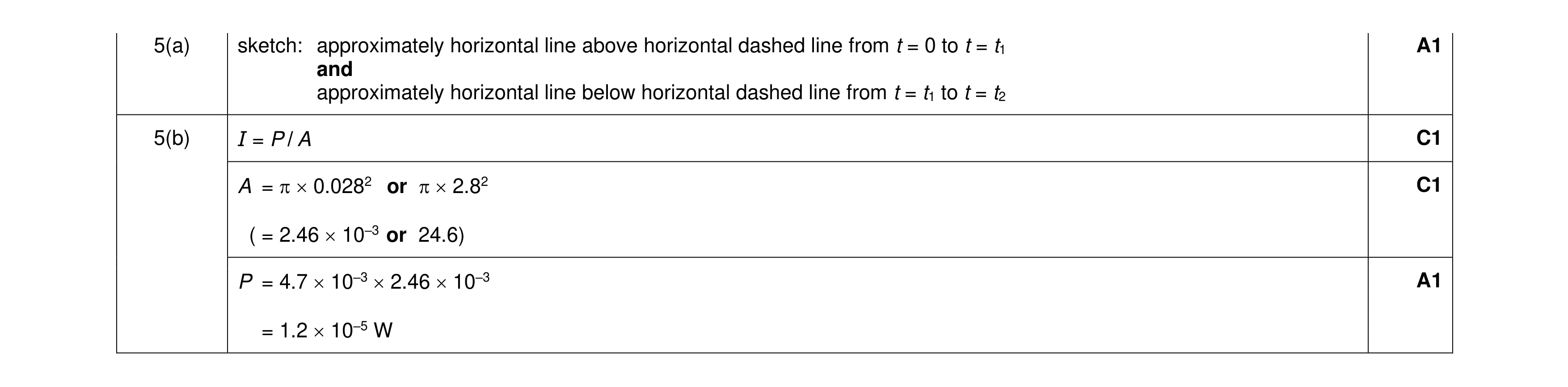 4
4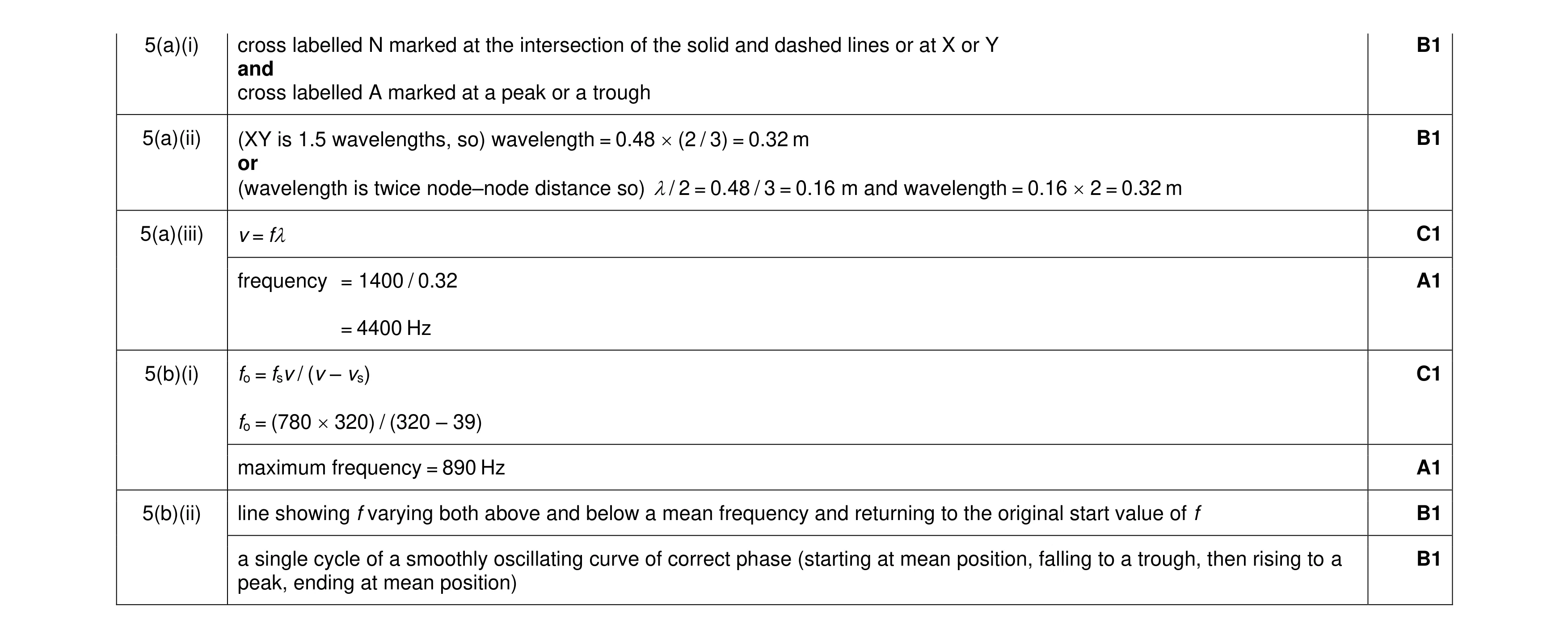 8
8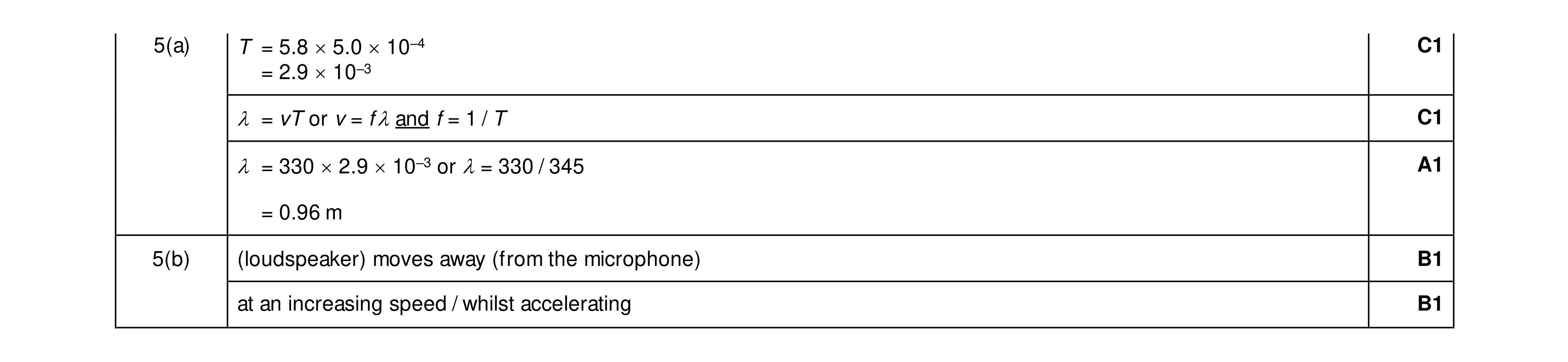 5
5