Questions as text
Q1 · When demand for a good increases, equilibrium price stays the same 9708/11 May/June 2006
9 When demand for a good increases, equilibrium price stays the same. What is its elasticity of supply? A –1 B zero C +1 D infinite
1 marks
Answer: D
This question in 9708/11 May/June 2006
Q2 · A product has a low price elasticity of supply 9708/11 Oct/Nov 2006
10 A product has a low price elasticity of supply. What might explain this? A The product has a low opportunity cost. B The product has a perishable nature. C The product is classed as an inferior good. D The product is considered to be a necessity.
1 marks
Answer: B
This question in 9708/11 Oct/Nov 2006
Q3 · A manufacturer’s ability to increase supply in the short run will be greater A if labour… 9708/11 May/June 2007
8 A manufacturer’s ability to increase supply in the short run will be greater A if labour is immobile. B if the product is perishable. C if there is spare capacity. D if unemployment is low.
1 marks
Answer: C
This question in 9708/11 May/June 2007
Q4 · The price of a firm’s product rises by 12 % 9708/11 Oct/Nov 2007
8 The price of a firm’s product rises by 12 %. After one week the firm is only able to produce the same quantity but after one month it can increase the quantity by 6 %. How would price elasticity of supply be described after one week and after one month? after one week after one month A infinite elastic B infinite inelastic C zero elastic D zero inelastic
1 marks
Answer: D
This question in 9708/11 Oct/Nov 2007
Q5 · What would increase the price elasticity of supply of a firm’s products? 9708/11 May/June 2008
9 What would increase the price elasticity of supply of a firm’s products? A a decrease in the period of time that stocks can be kept B a decrease in the time that it takes to produce the products C an increase in the cost of capital goods employed by the firm D an increase in the level of employment in the area
1 marks
Answer: B
This question in 9708/11 May/June 2008
Q6 · A government wishes to impose a tax on a good so that the consumer and not the producer… 9708/12 Oct/Nov 2009
5 A government wishes to impose a tax on a good so that the consumer and not the producer pays most of the tax increase. Which type of elasticity would best achieve this aim? A high price elasticity of supply B low price elasticity of supply C unitary price elasticity of supply D perfectly inelastic price elasticity of supply
1 marks
Answer: A
This question in 9708/12 Oct/Nov 2009
Q7 · In the diagram OS1 and OS2 are two straight-line supply curves 9708/11 Oct/Nov 2010
13 In the diagram OS1 and OS2 are two straight-line supply curves. S1 S2 price O quantity As price increases, the elasticity of supply A decreases along both OS1 and OS2. B increases less rapidly along OS1 than along OS2. C increases more rapidly along OS1 than along OS2. D is constant along both OS1 and OS2.
1 marks
Answer: D
This question in 9708/11 Oct/Nov 2010
Q8 · In the diagram OS1 and OS2 are two straight-line supply curves 9708/12 Oct/Nov 2010
13 In the diagram OS1 and OS2 are two straight-line supply curves. S1 S2 price O quantity As price increases, the elasticity of supply A decreases along both OS1 and OS2. B increases less rapidly along OS1 than along OS2. C increases more rapidly along OS1 than along OS2. D is constant along both OS1 and OS2.
1 marks
Answer: D
This question in 9708/12 Oct/Nov 2010
Q9 · In the diagram OS1 and OS2 are two straight-line supply curves 9708/13 Oct/Nov 2010
12 In the diagram OS1 and OS2 are two straight-line supply curves. S1 S2 price O quantity As price increases, the elasticity of supply A decreases along both OS1 and OS2. B increases less rapidly along OS1 than along OS2. C increases more rapidly along OS1 than along OS2. D is constant along both OS1 and OS2.
1 marks
Answer: D
This question in 9708/13 Oct/Nov 2010
Q10 · A refinery which processes oil into petrol (gas) is faced with the following conditions 9708/11 May/June 2011
10 A refinery which processes oil into petrol (gas) is faced with the following conditions. 1 It is working at full capacity. 2 Its petrol storage tanks are full. 3 It has received delivery of a new fleet of petrol tankers to transport its petrol. 4 It requires six months to train new workers to qualify in safety procedures. Which of the conditions will tend to make the supply of petrol relatively price inelastic? A 1 and 2 B 1 and 4 C 2 and 3 D 3 and 4
1 marks
Answer: B
This question in 9708/11 May/June 2011
Q11 · A refinery which processes oil into petrol (gas) is faced with the following conditions 9708/12 May/June 2011
9 A refinery which processes oil into petrol (gas) is faced with the following conditions. 1 It is working at full capacity. 2 Its petrol storage tanks are full. 3 It has received delivery of a new fleet of petrol tankers to transport its petrol. 4 It requires six months to train new workers to qualify in safety procedures. Which of the conditions will tend to make the supply of petrol relatively price inelastic? A 1 and 2 B 1 and 4 C 2 and 3 D 3 and 4
1 marks
Answer: B
This question in 9708/12 May/June 2011
Q12 · A refinery which processes oil into petrol (gas) is faced with the following conditions 9708/13 May/June 2011
8 A refinery which processes oil into petrol (gas) is faced with the following conditions. 1 It is working at full capacity. 2 Its petrol storage tanks are full. 3 It has received delivery of a new fleet of petrol tankers to transport its petrol. 4 It requires six months to train new workers to qualify in safety procedures. Which of the conditions will tend to make the supply of petrol relatively price inelastic? A 1 and 2 B 1 and 4 C 2 and 3 D 3 and 4
1 marks
Answer: B
This question in 9708/13 May/June 2011
Q13 · A firm estimates that the price elasticity of supply of its product is 0.4 9708/11 Oct/Nov 2011
10 A firm estimates that the price elasticity of supply of its product is 0.4. Should the firm be concerned by this figure? A No, as it implies that the firm will be able to raise revenue by raising price. B No, as it suggests there are few substitutes for the product. C Yes, as it indicates that the firm is not able to adjust supply easily when demand changes. D Yes, as it means that demand for its product is increasing at a slow rate.
1 marks
Answer: C
This question in 9708/11 Oct/Nov 2011
Q14 · The diagram shows three supply curves 9708/11 Oct/Nov 2011
11 The diagram shows three supply curves. S1 price S2 S3 O quantity What can be concluded about the price elasticity of supply of the curves? A As price rises, the price elasticity of supply of S2 will increase. B At any price, the price elasticity of supply of S1 will be less than that of S3. C At any price, the price elasticity of supply of S2 will be higher than that of S3. D The price elasticity of supply of all three curves will be the same.
1 marks
Answer: D
This question in 9708/11 Oct/Nov 2011
Q15 · A manufacturer has estimated that the price elasticity of supply of ice cream is +1.5 9708/12 Oct/Nov 2011
8 A manufacturer has estimated that the price elasticity of supply of ice cream is +1.5. If the demand for ice cream rises and price increases by 10 %, how much more will the manufacturer supply to the market? A 0.15 % B 1.5 % C 15 % D 50 %
1 marks
Answer: C
This question in 9708/12 Oct/Nov 2011
Q16 · When is a rise in the price of a product likely to cause more resources to be allocated… 9708/12 Oct/Nov 2011
13 When is a rise in the price of a product likely to cause more resources to be allocated to its production? A if demand increases when the supply curve is perfectly inelastic B if the demand curve shifts to the right when the supply curve is inelastic C if supply increases when the demand curve is perfectly inelastic D if the supply curve shifts to the left when the demand curve is elastic
1 marks
Answer: B
This question in 9708/12 Oct/Nov 2011
Q17 · A firm estimates that the price elasticity of supply of its product is 0.4 9708/13 Oct/Nov 2011
8 A firm estimates that the price elasticity of supply of its product is 0.4. Should the firm be concerned by this figure? A No, as it implies that the firm will be able to raise revenue by raising price. B No, as it suggests there are few substitutes for the product. C Yes, as it indicates that the firm is not able to adjust supply easily when demand changes. D Yes, as it means that demand for its product is increasing at a slow rate.
1 marks
Answer: C
This question in 9708/13 Oct/Nov 2011
Q18 · The diagram shows three supply curves 9708/13 Oct/Nov 2011
9 The diagram shows three supply curves. S1 price S2 S3 O quantity What can be concluded about the price elasticity of supply of the curves? A As price rises, the price elasticity of supply of S2 will increase. B At any price, the price elasticity of supply of S1 will be less than that of S3. C At any price, the price elasticity of supply of S2 will be higher than that of S3. D The price elasticity of supply of all three curves will be the same.
1 marks
Answer: D
This question in 9708/13 Oct/Nov 2011
Q19 · The table gives the short-run supply schedules of three firms X, Y and Z, which comprise… 9708/12 May/June 2012
6 The table gives the short-run supply schedules of three firms X, Y and Z, which comprise an industry. price quantity supplied (units) ($) firm X firm Y firm Z 1 100 – – 2 150 50 – 3 200 80 70 4 250 150 100 Which is a point on the short-run supply schedule of the industry? quantity price supplied ($) (units) A 2 300 B 3 350 C 3 450 D 4 1150
1 marks
Answer: B
This question in 9708/12 May/June 2012
Q20 · The market for tractors is supplied by two firms, X and Y, each initially having 50 % of… 9708/13 May/June 2012
9 The market for tractors is supplied by two firms, X and Y, each initially having 50 % of the market. A 10 % increase in the price of tractors leads to an increase in output from firm X of 10 % and from firm Y of 20 %. What is the price elasticity of supply of tractors in this market? A 1 B 1.5 C 2 D 3
1 marks
Answer: B
This question in 9708/13 May/June 2012
Q21 · In a market economy, demand for a product rises and price increases but output remains… 9708/11 Oct/Nov 2012
11 In a market economy, demand for a product rises and price increases but output remains unchanged. What could explain this? A a lack of financial incentives for entrepreneurs B a perfectly inelastic supply of factors of production C consumer influence exceeding producer influence D social benefits equalling private benefits
1 marks
Answer: B
This question in 9708/11 Oct/Nov 2012
Q22 · A government aims to stabilise the incomes received by farmers 9708/11 Oct/Nov 2012
18 A government aims to stabilise the incomes received by farmers. To achieve this it uses a policy of buying and selling farm products on the free market. When will it not need to respond to changes in the supply of farm products? A when elasticity of supply of farm products is zero B when farmers produce record harvests C when price elasticity of demand for farm products is unitary D when weather conditions can be accurately predicted
1 marks
Answer: C
This question in 9708/11 Oct/Nov 2012
Q23 · A supply curve is represented by the equation, quantity supplied = 10 + 5P, where P = the… 9708/12 May/June 2013
9 A supply curve is represented by the equation, quantity supplied = 10 + 5P, where P = the price of the product. Which price rise would cause the quantity supplied to double? A $1 to $2 B $1 to $3 C $1 to $4 D $1 to $5
1 marks
Answer: C
This question in 9708/12 May/June 2013
Q24 · Firm Z is one of a number of firms producing televisions 9708/12 May/June 2013
10 Firm Z is one of a number of firms producing televisions. What would cause firm Z’s supply curve to shift to the left whilst the market supply curve for televisions shifts to the right? A Firm Z benefits more from advances in technology than the other firms in the industry. B Firm Z experiences a strike whilst more firms enter the industry. C Firm Z passes on more of a tax to its customers than the other firms in the industry. D Firm Z reduces its costs of raw materials whilst other firms in the industry lower their wage costs.
1 marks
Answer: B
This question in 9708/12 May/June 2013
Q25 · The supply function of good X is given by the equation QS = 10PX where PX is the price of… 9708/13 May/June 2013
8 The supply function of good X is given by the equation QS = 10PX where PX is the price of the good and QS is the quantity supplied. What can be deduced from the equation about the elasticity of supply of good X? A It is equal to 0.0. B It is equal to 0.1. C It is equal to 1.0. D It is equal to 10.0.
1 marks
Answer: C
This question in 9708/13 May/June 2013
Q26 · The supply function for a good can be written as Q = 2P + 10, where Q is the quantity… 9708/11 Oct/Nov 2013
10 The supply function for a good can be written as Q = 2P + 10, where Q is the quantity supplied in kilos and P is the price per kilo in dollars. The price rises from $10 to $15 per kilo. The value of price elasticity of supply for this price increase lies in a range from A 1 to 4 1 . B 3 to 2 1 . C 2 to 4 3 . D 1 4 1 to 1 2 1 . 6 8 3
1 marks
Answer: C
This question in 9708/11 Oct/Nov 2013
Q27 · The diagram shows a supply curve 9708/11 May/June 2014
11 The diagram shows a supply curve. S price O quantity Which statement describes the price elasticity of supply along this curve? A It diminishes as quantity increases. B It is constant and greater than unity at all quantities. C It is constant and less than unity at all quantities. D It increases as quantity increases.
1 marks
Answer: A
This question in 9708/11 May/June 2014
Q28 · The diagram shows four different straight line supply curves 9708/12 May/June 2014
10 The diagram shows four different straight line supply curves. S1 S2 S3 S4 price O quantity What can be concluded from the diagram? A S1 has unitary elasticity. B S2 has zero elasticity. C S3 has a constant elasticity. D S4 has infinite elasticity.
1 marks
Answer: D
This question in 9708/12 May/June 2014
Q29 · A firm makes televisions 9708/13 May/June 2014
10 A firm makes televisions. What does the elasticity of supply for the firm represent? A the need to increase production because of a successful advertising campaign B the possibility of switching production from other goods the firm makes to televisions C the speed at which additional fixed factors used to produce televisions can be obtained D the way the firm’s production changes as a result of a change in price of televisions
1 marks
Answer: D
This question in 9708/13 May/June 2014
Q30 · When demand for a good increases, equilibrium price stays the same 9708/11 Oct/Nov 2014
10 When demand for a good increases, equilibrium price stays the same. What is the good’s elasticity of supply? A –1 B zero C +1 D infinite
1 marks
This question in 9708/11 Oct/Nov 2014
Q31 · A manufacturer has estimated that the price elasticity of supply of ice cream is +1.5 9708/11 Oct/Nov 2014
11 A manufacturer has estimated that the price elasticity of supply of ice cream is +1.5. If the demand for ice cream rises and price increases by 10%, how much more will the manufacturer supply to the market? A 0.15% B 1.5% C 15% D 150%
1 marks
This question in 9708/11 Oct/Nov 2014
Q32 · In the diagram OS1 and OS2 are two straight-line supply curves 9708/12 Oct/Nov 2014
10 In the diagram OS1 and OS2 are two straight-line supply curves. S1 S2 price O quantity As price increases, the elasticity of supply A decreases along both OS1 and OS2. B increases less rapidly along OS1 than along OS2. C increases more rapidly along OS1 than along OS2. D is constant along OS1 and along OS2.
1 marks
Answer: D
This question in 9708/12 Oct/Nov 2014
Q33 · The diagram shows three supply curves 9708/13 Oct/Nov 2014
10 The diagram shows three supply curves. S1 price S2 S3 O quantity What can be concluded about the price elasticity of supply of the curves? A As price rises, the price elasticity of supply of S2 will increase. B At any price, the price elasticity of supply of S1 will be less than that of S3. C At any price, the price elasticity of supply of S2 will be higher than that of S3. D The price elasticity of supply of each curve is constant.
1 marks
Answer: D
This question in 9708/13 Oct/Nov 2014
Q34 · Demand for shoes increases which pushes up their price 9708/13 Oct/Nov 2014
11 Demand for shoes increases which pushes up their price. Firm Y increases its supply more quickly than firm Z. What would explain this difference in the speed of their responses? A Firm Y has limited stocks of unsold shoes whereas firm Z has plentiful stocks of unsold shoes. B Firm Y has spare capacity in its factories whereas firm Z’s factories are working at full capacity. C Firm Y’s shoes are handmade whereas firm Z’s shoes are made by machine. D Firm Y’s shoes need raw materials which are in short supply whereas firm Z’s shoes need raw materials which are in plentiful supply.
1 marks
Answer: B
This question in 9708/13 Oct/Nov 2014
Q35 · Four firms supply the market 9708/11 May/June 2015
8 Four firms supply the market. The market supply is 50 units at $20 and 100 units at $40. The table shows the market share of each firm at the two prices. Which firm does not have a normal upward-sloping supply curve? market share (%) market share (%) at $20 at $40 A 10% 10% B 20% 50% C 30% 20% D 40% 20%
1 marks
Answer: D
This question in 9708/11 May/June 2015
Q36 · The price of a good doubles but firms are able to increase production by only 10% 9708/11 May/June 2015
9 The price of a good doubles but firms are able to increase production by only 10%. This is an example of A excess supply. B inelastic supply. C market disequilibrium. D market failure.
1 marks
Answer: B
This question in 9708/11 May/June 2015
Q37 · The price of a firm’s product rises by 12% 9708/12 May/June 2015
10 The price of a firm’s product rises by 12%. After one week the firm is only able to produce the same quantity but after one month it can increase the quantity by 6%. How would the price elasticity of supply be described after one week and after one month? after one week after one month A infinite elastic B infinite inelastic C zero elastic D zero inelastic
1 marks
Answer: D
This question in 9708/12 May/June 2015
Q38 · What is the likely nature of the price elasticity of supply of a crop such as rice? 9708/13 May/June 2015
10 What is the likely nature of the price elasticity of supply of a crop such as rice? A highly elastic in both the short and the long run as rice is an essential product B highly elastic in the short run and more inelastic in the long run as production methods improve C highly inelastic in both the short and the long run as the land area of a country is fixed D highly inelastic in the short run and more elastic in the long run as it takes time to plant rice
1 marks
Answer: D
This question in 9708/13 May/June 2015
Q39 · Good X and good Y are in joint supply 9708/11 Oct/Nov 2015
6 Good X and good Y are in joint supply. When would an increase in the supply of good X not lead to a change in the price of good X? A Good X has a perfect price elasticity of demand. B Good X has a perfect price inelasticity of demand. C Good Y has a perfect price elasticity of demand. D Good Y has a perfect price inelasticity of demand.
1 marks
Answer: A
This question in 9708/11 Oct/Nov 2015
Q40 · The diagram shows a supply curve for beef 9708/12 Oct/Nov 2015
9 The diagram shows a supply curve for beef. S price O quantity What explains why the supply curve for beef slopes upwards? A An increase in the demand for beef will bring about an increase in supply. B Farmers’ productivity rises as the price rises. C Increased production leads to a reduction in costs. D The cost of additional beef production rises as output increases.
1 marks
Answer: D
This question in 9708/12 Oct/Nov 2015
Q41 · Which business is likely to be the slowest to alter its output in response to a sustained… 9708/12 Oct/Nov 2015
10 Which business is likely to be the slowest to alter its output in response to a sustained increase in demand for its product? A a fast-food restaurant B a household cleaning service C a newspaper printer D an oil exploration company
1 marks
Answer: D
This question in 9708/12 Oct/Nov 2015
Q42 · A product has a high price elasticity of supply 9708/13 Oct/Nov 2015
10 A product has a high price elasticity of supply. What might explain this? A The product has a high opportunity cost. B The product has a non-perishable nature. C The product is classed as an inferior good. D The product is considered to be a luxury.
1 marks
Answer: B
This question in 9708/13 Oct/Nov 2015
Q43 · What is price elasticity of supply? 9708/12 Feb/March 2016
9 What is price elasticity of supply? A the change in the quantity supplied when a price changes B the change in the quantity supplied when demand changes C the comparison of the proportionate change in supply to the proportionate change in demand D the comparison of the proportionate change in supply to the proportionate change in price
1 marks
Answer: D
This question in 9708/12 Feb/March 2016
Q44 · A specific tax is placed upon each bottle of perfume sold 9708/12 Feb/March 2016
11 A specific tax is placed upon each bottle of perfume sold. In the diagram, SS is the supply curve before tax, StSt is the supply curve after tax. D St S W R price U Q X P T St D S O Y Z quantity Which area represents that part of the tax revenue paid by producers? A ORWY B PQUT C PRWT D QRWU
1 marks
Answer: B
This question in 9708/12 Feb/March 2016
Q45 · In calculating the short-run supply schedule for a firm, what is assumed to remain… 9708/11 May/June 2016
5 In calculating the short-run supply schedule for a firm, what is assumed to remain unchanged? A the number of consumers B the price of the good C the quantities of all factors D the state of technology
1 marks
Answer: D
This question in 9708/11 May/June 2016
Q46 · The price elasticity of supply of an ‘App’ for a phone is perfectly elastic 9708/11 May/June 2016
9 The price elasticity of supply of an ‘App’ for a phone is perfectly elastic. The current selling price for the ‘App’ is $10 and 200 ‘Apps’ are sold per day. The ‘App’ becomes more popular and, as a result, demand increases by 50% at every price. What will be the outcome of the change in demand? A The price increases by 50% and the firm’s revenue increases by 50%. B The price increases by less than 50% and the firm’s revenue increases by less than 50%. C The price stays the same and the firm’s revenue increases by 50%. D The price stays the same and the firm’s revenue increases by an infinite amount.
1 marks
Answer: C
This question in 9708/11 May/June 2016
Q47 · A product with infinite elasticity of supply has sales of 1000 units a week at a price of… 9708/11 May/June 2016
15 A product with infinite elasticity of supply has sales of 1000 units a week at a price of $1 per unit. Price elasticity of demand is 1.5 over the relevant range. The government imposes a tax of 10%. What will be the government’s weekly tax revenue? A $15 B $85 C $100 D $150
1 marks
Answer: B
This question in 9708/11 May/June 2016
Q48 · SX, SY and SZ are the supply curves of goods X, Y and Z 9708/12 May/June 2016
9 SX, SY and SZ are the supply curves of goods X, Y and Z. SX SY SZ 10 price ($) 5 0 2.5 5 10 20 quantity supplied If the price of all three goods rises from $5 to $10, what are their price elasticity of supply values? good X good Y good Z A equal to 1 equal to 1 equal to 1 B equal to 1 greater than 1 greater than 1 C less than 1 equal to 1 greater than 1 D less than 1 greater than 1 greater than 1
1 marks
Answer: A
This question in 9708/12 May/June 2016
Q49 · A manufacturer’s ability to increase supply in the short run will be greater A if labour… 9708/13 May/June 2016
10 A manufacturer’s ability to increase supply in the short run will be greater A if labour is immobile. B if spare capacity exists. C if the product is perishable. D if unemployment is low.
1 marks
Answer: B
This question in 9708/13 May/June 2016
Q50 · A product has a low price elasticity of supply 9708/11 Oct/Nov 2016
9 A product has a low price elasticity of supply. What might explain this? A The product has a low opportunity cost. B The product has a perishable nature. C The product is classed as an inferior good. D The product is considered to be a necessity.
1 marks
Answer: B
This question in 9708/11 Oct/Nov 2016
Q51 · A firm is producing 100 units at price $10 9708/11 Oct/Nov 2016
10 A firm is producing 100 units at price $10. The price elasticity of supply is 0.5, and price is raised to $12. What is the new level of output? A 75 B 110 C 125 D 150
1 marks
Answer: B
This question in 9708/11 Oct/Nov 2016
Q52 · What would increase the price elasticity of supply of a firm’s products? 9708/12 Oct/Nov 2016
10 What would increase the price elasticity of supply of a firm’s products? A a decrease in the period of time that stocks can be kept B a decrease in the time that it takes to produce the products C an increase in the cost of capital goods employed by the firm D an increase in the level of employment in the area
1 marks
Answer: B
This question in 9708/12 Oct/Nov 2016
Q53 · A firm estimates that the price elasticity of supply of its product is 0.4 9708/13 Oct/Nov 2016
10 A firm estimates that the price elasticity of supply of its product is 0.4. Should the firm be concerned by this figure? A No, as it implies that the firm will be able to raise revenue by raising price. B No, as it suggests there are few substitutes for the product. C Yes, as it means that demand for its product is increasing at a slow rate. D Yes, as it shows that the firm is not able to adjust supply easily when demand changes.
1 marks
Answer: D
This question in 9708/13 Oct/Nov 2016
Q54 · Which change will lower the price elasticity of supply of a product? 9708/12 Feb/March 2017
8 Which change will lower the price elasticity of supply of a product? A It becomes easier to store the product. B Output of the product nears full capacity. C The production process becomes less complex. D Workers become more mobile.
1 marks
Answer: B
This question in 9708/12 Feb/March 2017
Q55 · The initial market for a product is represented by the demand and supply curves D1 and S1… 9708/12 Feb/March 2017
15 The initial market for a product is represented by the demand and supply curves D1 and S1 respectively. A subsidy is then introduced, represented by the shift of S1 to S2 (+ subsidy). S1 price of product T P R S2 (+ subsidy) N Q D1 O A B quantity of product What is the incidence of the subsidy for the consumer and producer? consumer producer A PN NA B QR TR C QT QB D TR QR
1 marks
Answer: B
This question in 9708/12 Feb/March 2017
Q56 · A firm establishes that the price elasticity of supply of its product has a value of 0.3 9708/11 May/June 2017
9 A firm establishes that the price elasticity of supply of its product has a value of 0.3. What is likely to be true about the firm? A It has unused productive capacity. B It has unsold stock of its product. C It uses a high proportion of perishable raw materials. D It uses factors of production that are easily substituted.
1 marks
Answer: C
This question in 9708/11 May/June 2017
Q57 · A bottle making business announced it had introduced a new production system 9708/12 May/June 2017
9 A bottle making business announced it had introduced a new production system. As a result the quantity produced per week could be increased or reduced much more easily when the price of bottles changed. What term describes this change? A a less elastic demand B a less elastic supply C a more elastic demand D a more elastic supply
1 marks
Answer: D
This question in 9708/12 May/June 2017
Q58 · The supply function for a good can be written as Q = 2P + 10, where Q is the quantity… 9708/12 May/June 2017
10 The supply function for a good can be written as Q = 2P + 10, where Q is the quantity supplied in kilos and P is the price per kilo in dollars. The price falls from $15 to $10 per kilo. The value of price elasticity of supply for this price change lies in a range from A 1 to 4 1 . B 3 to 2 1 . C 2 to 4 3 . D 1 4 1 to 1 2 1 . 6 8 3
1 marks
Answer: C
This question in 9708/12 May/June 2017
Q59 · A firm has a perfectly elastic supply curve at the market price of $10 9708/13 May/June 2017
8 A firm has a perfectly elastic supply curve at the market price of $10. Which statement about the firm is correct? A At any price above $10 quantity supplied is zero. B At any price below $10 quantity supplied is infinite. C At price $10 the firm will supply any quantity. D At price $10 the firm will break even.
1 marks
Answer: C
This question in 9708/13 May/June 2017
Q60 · The supply function for a good can be written as Q = 2P + 10, where Q is the quantity… 9708/13 May/June 2017
9 The supply function for a good can be written as Q = 2P + 10, where Q is the quantity supplied in kilos and P is the price per kilo in dollars. The price rises from $10 to $15 per kilo. The value of price elasticity of supply for this price increase lies in a range from A 1 to 4 1 . B 3 to 2 1 . C 2 to 4 3 . D 1 4 1 to 1 2 1 . 6 8 3
1 marks
Answer: C
This question in 9708/13 May/June 2017
Q61 · A supply curve is represented by the equation, quantity supplied = 10 + 5P, where P = the… 9708/11 Oct/Nov 2017
6 A supply curve is represented by the equation, quantity supplied = 10 + 5P, where P = the price of the product. Which price rise would cause the quantity supplied to double? A $1 to $2 B $1 to $3 C $1 to $4 D $1 to $5
1 marks
Answer: C
This question in 9708/11 Oct/Nov 2017
Q62 · Over a four year period, as the price of new houses increases, the price elasticity of… 9708/12 Oct/Nov 2017
8 Over a four year period, as the price of new houses increases, the price elasticity of supply for new houses falls, as shown. All new houses were sold. supply of new price of new price elasticity houses houses ($) of supply year 1 10 000 100 000 – year 2 10 250 110 000 0.25 year 3 10 450 125 000 0.13 year 4 10 600 140 000 0.12 What shows price elasticity of supply became more inelastic from year to year? A Dollar revenues to house builders declined each year. B Each year, the government released more land for house building. C The proportionate price change was greater than the proportionate supply change. D The proportionate price change was the same as the proportionate supply change.
1 marks
Answer: C
This question in 9708/12 Oct/Nov 2017
Q63 · The diagram shows the market for heating oil 9708/12 Oct/Nov 2017
16 The diagram shows the market for heating oil. S price D O quantity If the government introduces a production subsidy, how will the financial benefit be shared between consumers and producers? A It will be shared equally between producer and consumer. B It will go entirely to the producer. C The majority will go to the consumer. D The majority will go to the producer.
1 marks
Answer: D
This question in 9708/12 Oct/Nov 2017
Q64 · The diagram shows four supply curves 9708/13 Oct/Nov 2017
7 The diagram shows four supply curves. 1 2 3 4 price 4 3 2 1 O quantity Which statement about the price elasticities of the curves is correct? A Curve 1 has constant infinite elasticity. B Curve 2 has elasticity greater than curve 4 over its whole length. C Curve 3 has increasing elasticity as price rises. D Curve 4 has decreasing elasticity as price rises.
1 marks
Answer: D
This question in 9708/13 Oct/Nov 2017
Q65 · The data shows both short-term and long-term changes in the quantities of a product that… 9708/13 Oct/Nov 2017
8 The data shows both short-term and long-term changes in the quantities of a product that are supplied to a market in response to an increase in its price from $20 to $25 per unit. quantity supplied at a price of $20 per unit 400 per week quantity supplied after short-term adjustments 440 per week when price rises to $25 per unit quantity supplied after long-term adjustments 560 per week when price rises to $25 per unit What are the short-term and long-term price elasticities of supply for the product? short-term long-term A 0.4 1.6 B 2 8 C 2.5 0.625 D 8 32
1 marks
Answer: A
This question in 9708/13 Oct/Nov 2017
Q66 · The table shows three different prices and quantities supplied per week of two products… 9708/12 Feb/March 2018
7 The table shows three different prices and quantities supplied per week of two products, X and Y. price of X quantity price of Y quantity ($) supplied of X ($) supplied of Y 10 80 30 60 15 100 40 64 20 110 50 80 Which statement about price elasticity of supply (PES) is correct? A The PES of X is elastic for a fall in its price from $15 to $10. B The PES of X is unitary for a rise in its price from $15 to $20. C The PES of Y is elastic for a fall in its price from $40 to $30. D The PES of Y is unitary for a rise in its price from $40 to $50.
1 marks
Answer: D
This question in 9708/12 Feb/March 2018
Q67 · What would be the price elasticity of supply of cell (mobile) phones if their price rose… 9708/11 May/June 2018
8 What would be the price elasticity of supply of cell (mobile) phones if their price rose from US$100 to US$110 and the quantity supplied rose from 200 to 250? A 0.2 B 0.4 C 2.5 D 5.0
1 marks
Answer: C
This question in 9708/11 May/June 2018
Q68 · A product has a high price elasticity of supply 9708/11 May/June 2018
9 A product has a high price elasticity of supply. What might explain this? A The product has a high opportunity cost. B The product has a non-perishable nature. C The product is classed as an inferior good. D The product is considered to be a luxury.
1 marks
Answer: B
This question in 9708/11 May/June 2018
Q69 · The demand for houses in London has caused house prices to rise considerably in the last… 9708/11 May/June 2018
11 The demand for houses in London has caused house prices to rise considerably in the last five years. Many people cannot now afford to buy a house. What can be concluded from this? A On a demand and supply diagram for houses there has been a movement up the demand curve. B On a demand and supply diagram for houses there has been a movement up the supply curve. C The price elasticity of demand for houses is greater than one. D The price elasticity of supply of houses is zero.
1 marks
Answer: B
This question in 9708/11 May/June 2018
Q70 · The price elasticity of supply of a good is +2 9708/12 May/June 2018
8 The price elasticity of supply of a good is +2. The quantity supplied originally was 200 units. The price increases by 30%. What will the quantity supplied be after the price increase? A 80 units B 140 units C 260 units D 320 units
1 marks
Answer: D
This question in 9708/12 May/June 2018
Q71 · The curve in the diagram shows a relationship between the price and the quantity of a… 9708/13 May/June 2018
9 The curve in the diagram shows a relationship between the price and the quantity of a product. It has not been given a label. price O quantity What is an accurate description of the curve? A a perfectly elastic demand curve B a perfectly inelastic supply curve C a relatively elastic supply curve D a unitary elastic demand curve
1 marks
Answer: B
This question in 9708/13 May/June 2018
Q72 · What is it necessary to know in order to calculate the price elasticity of supply of a… 9708/11 Oct/Nov 2018
8 What is it necessary to know in order to calculate the price elasticity of supply of a product when its price changes? A the amount of the price change; the quantity demanded at the original price; the quantity supplied at the new price B the equilibrium market price; the quantity demanded at equilibrium; the quantity supplied at equilibrium C the original and new market price; the quantity supplied at the original price; the quantity supplied at the new price D the quantity demanded at the new price; the price change; the quantity supplied at the new price
1 marks
Answer: C
This question in 9708/11 Oct/Nov 2018
Q73 · The government fixes a minimum price for a product above the current equilibrium price 9708/11 Oct/Nov 2018
9 The government fixes a minimum price for a product above the current equilibrium price. Which value for the product’s price elasticity of supply will result in the smallest excess supply in its market? A between zero and one B greater than one C one D zero
1 marks
Answer: D
This question in 9708/11 Oct/Nov 2018
Q74 · Which statement best describes the meaning of price elasticity of supply? 9708/12 Oct/Nov 2018
8 Which statement best describes the meaning of price elasticity of supply? A how much price changes when there has been a change in supply B how much supply changes when there is a change in demand C how much supply changes when there is a change in price D how much supply changes when there is a change in the price of a substitute
1 marks
Answer: C
This question in 9708/12 Oct/Nov 2018
Q75 · Which statement about price elasticity of supply is correct? 9708/13 Oct/Nov 2018
7 Which statement about price elasticity of supply is correct? A It cannot change in the short run. B It increases as the time period lengthens. C It is infinite in the momentary time period. D It is zero in the long run.
1 marks
Answer: B
This question in 9708/13 Oct/Nov 2018
Q76 · At a price of $4 a manufacturer supplies 20 units of a good per week 9708/13 Oct/Nov 2018
8 At a price of $4 a manufacturer supplies 20 units of a good per week. The value of the price elasticity of supply is 2 over the range of price. How many goods will be supplied at $5? A 10 B 25 C 30 D 40
1 marks
Answer: C
This question in 9708/13 Oct/Nov 2018
Q77 · The diagram shows a supply curve for beef 9708/12 Feb/March 2019
5 The diagram shows a supply curve for beef. S price O quantity What explains why the supply curve for beef slopes upwards? A An increase in the demand for beef will bring about an increase in supply. B Farmers’ productivity rises as the price rises. C Increased production leads to a reduction in costs. D The cost of additional beef production rises as output increases.
1 marks
Answer: D
This question in 9708/12 Feb/March 2019
Q78 · For which supply curve is the value of price elasticity of supply not the same at all… 9708/12 Feb/March 2019
12 For which supply curve is the value of price elasticity of supply not the same at all points on the curve? S1 S2 price S3 S4 O quantity A S1 B S2 C S3 D S4
1 marks
Answer: C
This question in 9708/12 Feb/March 2019
Q79 · Consumers receive an increase in their incomes 9708/11 May/June 2019
11 Consumers receive an increase in their incomes. Which circumstances will cause the quantity of the product sold to increase the most? price elasticity of nature of the product supply of the product A inferior good price elastic B inferior good price inelastic C normal good price elastic D normal good price inelastic
1 marks
Answer: C
This question in 9708/11 May/June 2019
Q80 · The table shows the quantity of a product supplied at two different prices by four firms… 9708/11 May/June 2019
13 The table shows the quantity of a product supplied at two different prices by four firms, A, B, C and D. Which firm has a price elasticity of supply equal to 1 when the price falls from $10 to $8? price of product ($) 10 8 A 500 300 B 500 350 C 500 400 D 500 450
1 marks
Answer: C
This question in 9708/11 May/June 2019
Q81 · The diagram shows the supply of limestone from quarry X and quarry Y at two prices 9708/12 May/June 2019
5 The diagram shows the supply of limestone from quarry X and quarry Y at two prices. price of SX limestone SY P2 P1 O Q1 Q2 quantity supplied What is the measure of the responsiveness of supply as the price increases from P1 to P2? SX SY A 0 >1 B <1 1 C 1 <1 D >1 0
1 marks
Answer: A
This question in 9708/12 May/June 2019
Q82 · When is the supply curve for a car manufacturing firm most likely to be price elastic? 9708/13 May/June 2019
8 When is the supply curve for a car manufacturing firm most likely to be price elastic? A when the firm finds it difficult to recruit new labour B when the firm has a large quantity of stock C when the firm is operating in the short run D when the firm is operating near to full capacity
1 marks
Answer: B
This question in 9708/13 May/June 2019
Q83 · The diagram shows a market for wheat 9708/13 May/June 2019
9 The diagram shows a market for wheat. 100 price of wheat S P2 P1 D 0 0 Q2 Q1 Q3 100 quantity of wheat What is the response of demand for and supply of wheat when the price of wheat falls from P2 to P1? demand supply A elastic elastic B elastic inelastic C inelastic elastic D inelastic inelastic
1 marks
Answer: C
This question in 9708/13 May/June 2019
Q84 · The diagrams show the supply curves in four different markets 9708/13 May/June 2019
12 The diagrams show the supply curves in four different markets. In which market is the price elasticity of supply always equal to one? A B price price S S O O quantity quantity C D S price price S O O quantity quantity
1 marks
Answer: D
This question in 9708/13 May/June 2019
Q85 · What is price elasticity of supply? 9708/11 Oct/Nov 2019
11 What is price elasticity of supply? A the change in the quantity supplied when a price changes B the change in the quantity supplied when demand changes C the comparison of the proportionate change in supply to the proportionate change in demand D the comparison of the proportionate change in supply to the proportionate change in price
1 marks
Answer: D
This question in 9708/11 Oct/Nov 2019
Q86 · A government increased a specific tax on shoes 9708/12 Oct/Nov 2019
10 A government increased a specific tax on shoes. The resulting increase in the price of shoes was paid mainly by the consumer and not by the producer. What must be true for this to happen? A The price elasticity of demand was less than the price elasticity of supply. B The price elasticity of demand was unitary. C The price elasticity of supply was less than one. D The price elasticity of supply was inelastic while the price elasticity of demand was elastic.
1 marks
Answer: A
This question in 9708/12 Oct/Nov 2019
Q87 · A subsidy is given to the producers of a good with perfectly elastic demand 9708/12 Oct/Nov 2019
18 A subsidy is given to the producers of a good with perfectly elastic demand. What will be the outcome? A Consumer and producer receive equal amounts of subsidy. B There will be no change in price; the incidence of the subsidy will fall on the producer. C There will be a large increase in quantity consumed; the incidence of the subsidy will fall on the consumer. D There will be no change in the quantity consumed; the incidence of the subsidy will fall on the consumer.
1 marks
Answer: B
This question in 9708/12 Oct/Nov 2019
Q88 · The diagram shows the supply curve for bananas 9708/13 Oct/Nov 2019
5 The diagram shows the supply curve for bananas. price S ($ per kg) 6 5 0 100 150 quantity (kg) What is the price elasticity of supply when there is a rise in price from $5 to $6? A –2.5 B +0.4 C +2 D +2.5
1 marks
Answer: D
This question in 9708/13 Oct/Nov 2019
Q89 · What causes an inelastic market supply curve for an agricultural crop such as wheat? 9708/13 Oct/Nov 2019
6 What causes an inelastic market supply curve for an agricultural crop such as wheat? A a government decision to import crops at times of shortage B an efficient use of fertilisers causing crop production to rise C the storage of excess production for future sale D the very long time required to produce additional output
1 marks
Answer: D
This question in 9708/13 Oct/Nov 2019
Q90 · In each diagram the initial supply is S1 and the new supply after subsidy is S2 9708/13 Oct/Nov 2019
16 In each diagram the initial supply is S1 and the new supply after subsidy is S2. The subsidy is identical in each case. Which diagram shows the greatest incidence of the subsidy on the consumers? A B S1 S1 price S2 price S2 P3 P3 P1 P1 P2 P2 D D O Q1 Q2 quantity O Q1 Q2 quantity C D price price P3 S1 P3 S1 P1 P1 S2 P2 S2 P2 D D O Q1 Q2 quantity O Q1 Q2 quantity
1 marks
Answer: C
This question in 9708/13 Oct/Nov 2019
Q91 · When will a manufacturer’s ability to increase the quantity supplied in the short run be… 9708/12 Feb/March 2020
6 When will a manufacturer’s ability to increase the quantity supplied in the short run be greater? A when labour is immobile B when spare capacity exists C when the product is perishable D when unemployment is low
1 marks
Answer: B
This question in 9708/12 Feb/March 2020
Q92 · Four firms produce furniture 9708/12 Feb/March 2020
13 Four firms produce furniture. The table shows the price elasticity of supply (PES) for each firm. If the price of furniture rises by 5% which firm would experience an increase in quantity supplied of 2.5%? PES for firm furniture A 2.5 B 2.0 C 0.6 D 0.5
1 marks
Answer: D
This question in 9708/12 Feb/March 2020
Q93 · How might a firm raise the value of the price elasticity of supply for its product? 9708/11 May/June 2020
10 How might a firm raise the value of the price elasticity of supply for its product? A decrease the amount of labour that it employs B employ new technology to increase its productive capacity C increase advertising expenditure to generate more revenue D reduce the level of stocks in order to cut costs
1 marks
Answer: B
This question in 9708/11 May/June 2020
Q94 · A specific tax is imposed on a product for which the elasticity of supply is zero 9708/11 May/June 2020
14 A specific tax is imposed on a product for which the elasticity of supply is zero. Which statement is correct? A The burden of this tax will fall entirely on consumers. B The burden of this tax will fall entirely on suppliers. C The burden of this tax will fall mainly on consumers. D The burden of this tax will fall mainly on suppliers.
1 marks
Answer: B
This question in 9708/11 May/June 2020
Q95 · A good has a price elasticity of supply of 2.0 9708/12 May/June 2020
10 A good has a price elasticity of supply of 2.0. The current quantity supplied is 300 units per week at a market price of $20 per unit. The firm raises the price to $25 per unit. What will the new quantity supplied be per week? A 150 units B 375 units C 400 units D 450 units
1 marks
Answer: D
This question in 9708/12 May/June 2020
Q96 · The diagram shows the supply curve of a product 9708/12 May/June 2020
12 The diagram shows the supply curve of a product. S 20 price ($) 15 10 5 0 quantity The government imposes a specific indirect tax of $5 on the product. How will the price elasticity of supply of the product change? A from elastic (>1) to inelastic (<1) B from inelastic (<1) to elastic (>1) C from inelastic (<1) to unitary (=1) D from unitary (=1) to elastic (>1)
1 marks
Answer: D
This question in 9708/12 May/June 2020
Q97 · The supply (S) of a product is determined by the equation S = 10 + 10P when P is the… 9708/13 May/June 2020
11 The supply (S) of a product is determined by the equation S = 10 + 10P when P is the price of the product in $. What is the product’s price elasticity of supply when its price rises from $1 to $2? A 0.5 B 1.0 C 2.0 D 5.0
1 marks
Answer: A
This question in 9708/13 May/June 2020
Q98 · The diagram shows four supply curves 9708/11 Oct/Nov 2020
7 The diagram shows four supply curves. W X price Y Z O quantity Which statement about the price elasticity of these supply curves is correct? A W has elasticity of 0 that will rise as price rises. B X has elasticity greater than 1 that will be constant as price rises. C Y has elasticity greater than 1 that will fall as price rises. D Z has elasticity of 0 that is constant as quantity rises.
1 marks
Answer: C
This question in 9708/11 Oct/Nov 2020
Q99 · An increase in the popularity of air conditioning units has resulted in their price… 9708/12 Oct/Nov 2020
10 An increase in the popularity of air conditioning units has resulted in their price increasing by 20%. In response to this the quantity supplied increased by 30%. What can be concluded from this? A price elasticity of supply = 0 B price elasticity of supply < 1 C price elasticity of supply = 1 D price elasticity of supply > 1
1 marks
Answer: D
This question in 9708/12 Oct/Nov 2020
Q100 · A firm estimates that the price elasticity of supply of its product is 0.4 9708/12 Oct/Nov 2020
13 A firm estimates that the price elasticity of supply of its product is 0.4. Should the firm be concerned by this figure? A No, as it implies that the firm will be able to raise revenue by raising price. B No, as it suggests there are few substitutes for the product. C Yes, as it means that demand for its product is increasing at a slow rate. D Yes, as it shows that the firm is not able to adjust supply easily when demand changes.
1 marks
Answer: D
This question in 9708/12 Oct/Nov 2020
Q101 · What is the likely price elasticity of supply of highly perishable goods and goods that… 9708/12 Feb/March 2021
10 What is the likely price elasticity of supply of highly perishable goods and goods that have low stocks? highly goods that perishable have low goods stocks A elastic elastic B elastic inelastic C inelastic elastic D inelastic inelastic
1 marks
Answer: D
This question in 9708/12 Feb/March 2021
Q102 · Which statement about price elasticity of supply is correct? 9708/12 May/June 2021
5 Which statement about price elasticity of supply is correct? A It cannot change in the short run. B It increases as the time period lengthens. C It is infinite in the momentary time period. D It is zero in the long run.
1 marks
Answer: B
This question in 9708/12 May/June 2021
Q103 · A product has a low price elasticity of supply 9708/13 May/June 2021
7 A product has a low price elasticity of supply. What might explain this? A The product has a low opportunity cost. B The product is highly perishable. C The product is classed as an inferior good. D The product is considered to be a necessity.
1 marks
Answer: B
This question in 9708/13 May/June 2021
Q104 · A car manufacturer estimates that the price elasticity of supply of its cars is +2.5 9708/13 May/June 2021
8 A car manufacturer estimates that the price elasticity of supply of its cars is +2.5. What will be the impact of a 10% increase in price? A a 2.5% fall in total revenue B a 25% rise in total revenue C a 2.5% fall in quantity supplied D a 25% rise in quantity supplied
1 marks
Answer: D
This question in 9708/13 May/June 2021
Q105 · The world trade price of cars in country Y is US$10 000 9708/13 May/June 2021
24 The world trade price of cars in country Y is US$10 000. At this price domestic car producers supply 100 000 cars to the market and domestic consumers purchase 200 000 cars. The government of country Y imposes a 10% tariff on imported cars. Under which conditions will this tariff raise the most revenue for the government? price elasticity price elasticity of of supply of car demand for cars producers in in country Y country Y A +0.5 –0.5 B +0.5 –1.5 C +1.5 –0.5 D +1.5 –1.5
1 marks
Answer: A
This question in 9708/13 May/June 2021
Q106 · The diagram shows four supply curves 9708/11 Oct/Nov 2021
9 The diagram shows four supply curves. 1 2 3 4 price 4 3 2 1 O quantity Which statement about the price elasticities of the curves is correct? A Curve 1 has constant infinite elasticity. B Curve 2 has elasticity greater than curve 4 over its whole length. C Curve 3 has increasing elasticity as price rises. D Curve 4 has decreasing elasticity as price rises.
1 marks
Answer: D
This question in 9708/11 Oct/Nov 2021
Q107 · The demand for a good increases 9708/11 Oct/Nov 2021
11 The demand for a good increases. Under which circumstances will the quantity supplied of the good rise the most? A It is an agricultural good that has an annual growing cycle and requires a cool climate. B It is an agricultural good that is perishable and very expensive to store. C It is a manufactured good that uses unskilled labour and there is unemployment in the economy. D It is a manufactured good that uses capital-intensive production and it is currently at full capacity.
1 marks
Answer: C
This question in 9708/11 Oct/Nov 2021
Q108 · Which supply curve shows that the price elasticity of supply of the good is always equal… 9708/12 Oct/Nov 2021
5 Which supply curve shows that the price elasticity of supply of the good is always equal to 1? A a straight line that intersects the horizontal axis B a straight line that intersects the vertical axis C a straight line that passes through the origin D a straight line that is vertical to the horizontal axis
1 marks
Answer: C
This question in 9708/12 Oct/Nov 2021
Q109 · The diagram shows three supply curves 9708/12 Oct/Nov 2021
12 The diagram shows three supply curves. S1 price S2 S3 O quantity What can be concluded about the price elasticity of supply of the curves? A As price rises, the price elasticity of supply of S2 will increase. B At any price, the price elasticity of supply of S1 will be less than that of S3. C At any price, the price elasticity of supply of S2 will be higher than that of S3. D The price elasticity of supply of each curve is constant.
1 marks
Answer: D
This question in 9708/12 Oct/Nov 2021
Q110 · The diagram shows four supply curves 9708/13 Oct/Nov 2021
9 The diagram shows four supply curves. For which curve is the price elasticity of supply constant? A price B C D O quantity
1 marks
Answer: C
This question in 9708/13 Oct/Nov 2021
Q111 · A government wishes to impose a tax on a good so that the consumer pays most of the tax… 9708/13 Oct/Nov 2021
14 A government wishes to impose a tax on a good so that the consumer pays most of the tax increase. Which type of elasticity would best achieve this aim? A high price elasticity of supply B low price elasticity of supply C unitary price elasticity of supply D perfectly inelastic price elasticity of supply
1 marks
Answer: A
This question in 9708/13 Oct/Nov 2021
Q112 · The diagram shows a supply curve for chicken 9708/12 Feb/March 2022
5 The diagram shows a supply curve for chicken. S price O quantity What explains why the supply curve for chicken slopes upwards? A An increase in the demand for chicken will bring about a rise in supply. B Farmers’ productivity rises as the price rises. C Increased production leads to a reduction in costs. D The cost of additional chicken production rises as output increases.
1 marks
Answer: D
This question in 9708/12 Feb/March 2022
Q113 · A firm estimates that the price elasticity of supply of its product is +1.5 9708/12 Feb/March 2022
10 A firm estimates that the price elasticity of supply of its product is +1.5. What does this indicate? A The firm has available stock. B The firm has no excess capacity. C The firm operates in a competitive market. D The firm raises its price by 10% and its total revenue increases by 15%.
1 marks
Answer: A
This question in 9708/12 Feb/March 2022
Q114 · What is price elasticity of supply? 9708/11 May/June 2022
9 What is price elasticity of supply? A the change in the quantity supplied when a price changes B the change in the quantity supplied when demand changes C the comparison of the proportionate change in supply to the proportionate change in demand D the comparison of the proportionate change in supply to the proportionate change in price
1 marks
Answer: D
This question in 9708/11 May/June 2022
Q115 · In which situation is the price elasticity of supply for a product most likely to be… 9708/12 May/June 2022
5 In which situation is the price elasticity of supply for a product most likely to be relatively low? A Demand for the product comes from a wide range of customers. B Producers in closely related industries can easily switch to making the product. C Manufacture of the product requires highly skilled labour. D The main raw material used in the production of the product is in abundant supply.
1 marks
Answer: C
This question in 9708/12 May/June 2022
Q116 · The supply of a new drug to relieve muscle pain is very inelastic over a short period of… 9708/13 May/June 2022
6 The supply of a new drug to relieve muscle pain is very inelastic over a short period of time. The supply of printed newspapers is much more elastic over the same time period. What could explain the difference in elasticity of supply of the drug and printed newspapers in this time period? new drug printed newspapers A cost per unit is low cost per unit is high B discovery is by chance takes longer to produce C research and development essential excess capacity in printing D similar products available similar products unavailable
1 marks
Answer: C
This question in 9708/13 May/June 2022
Q117 · What is likely to decrease the price elasticity of supply (PES) of a product? 9708/14 May/June 2022
7 What is likely to decrease the price elasticity of supply (PES) of a product? A an increase in advertising the product B an increase in the firm's ability to substitute capital for labour C an increase in the time during which the product can be stored D an increase in the time required to produce the product
1 marks
Answer: D
This question in 9708/14 May/June 2022
Q118 · SX, SY and SZ are the supply curves of goods X, Y and Z 9708/14 May/June 2022
8 SX, SY and SZ are the supply curves of goods X, Y and Z. SX SY SZ 10 price ($) 5 0 2.5 5 10 20 quantity supplied If the price of all three goods rises from $5 to $10, what are their price elasticity of supply values? good X good Y good Z A equal to 1 equal to 1 equal to 1 B equal to 1 greater than 1 greater than 1 C less than 1 equal to 1 greater than 1 D less than 1 greater than 1 greater than 1
1 marks
Answer: A
This question in 9708/14 May/June 2022
Q119 · Which statement defines the price elasticity of supply? 9708/11 Oct/Nov 2022
7 Which statement defines the price elasticity of supply? A It is a measure of how the price of a good responds to a change in the quantity supplied. B It is a measure of how the quantity supplied of a good responds to a change in its price. C It is a measure of how the supply of a good responds to a change in its cost of production. D It is a measure of how the supply of good X responds to a change in the price of good Y.
1 marks
Answer: B
This question in 9708/11 Oct/Nov 2022
Q120 · When is the supply curve for a car manufacturing firm most likely to be price elastic? 9708/11 Oct/Nov 2022
12 When is the supply curve for a car manufacturing firm most likely to be price elastic? A when the firm finds it difficult to recruit new labour B when the firm has a large quantity of stock C when the firm is operating in the short run D when the firm is operating near to full capacity
1 marks
Answer: B
This question in 9708/11 Oct/Nov 2022
Q121 · A concert arena has a fixed capacity that allows it to sell 10 000 tickets for a concert 9708/11 Oct/Nov 2022
17 A concert arena has a fixed capacity that allows it to sell 10 000 tickets for a concert. The current equilibrium price for a ticket is $10. The owners of the arena decide to set a minimum price for a ticket. Under which conditions will there be the most unsold tickets? minimum ticket price elasticity of price ($) demand for tickets A 11 inelastic B 11 elastic C 12 inelastic D 12 elastic
1 marks
Answer: D
This question in 9708/11 Oct/Nov 2022
Q122 · The price elasticity of the supply of yoghurt is +1.5 9708/12 Oct/Nov 2022
7 The price elasticity of the supply of yoghurt is +1.5. If the demand for yoghurt rises and price rises by 20%, how much more will be supplied to the market? A 0.3% B 3.0% C 13.3% D 30%
1 marks
Answer: D
This question in 9708/12 Oct/Nov 2022
Q123 · The diagram shows two linear supply curves labelled S1 and S2, where S2 is a 45 line 9708/12 Oct/Nov 2022
9 The diagram shows two linear supply curves labelled S1 and S2, where S2 is a 45 line. S1 S2 price O quantity Which statement about the price elasticity of supply is correct? A The price elasticity of supply is different at every point along both S1 and S2. B The price elasticity of supply of S1 is elastic and S2 is unit elastic. C The price elasticity of supply of S1 is inelastic and S2 is unit elastic. D The price elasticity of supply is unit elastic at every point along both S1 and S2.
1 marks
Answer: D
This question in 9708/12 Oct/Nov 2022
Q124 · A product has a high price elasticity of supply 9708/12 Oct/Nov 2022
12 A product has a high price elasticity of supply. What might explain this? A It has a high opportunity cost. B It has a non-perishable nature. C It is classed as an inferior good. D It is classed as a luxury good.
1 marks
Answer: B
This question in 9708/12 Oct/Nov 2022
Q125 · What causes an inelastic market supply curve for an agricultural crop such as wheat? 9708/13 Oct/Nov 2022
9 What causes an inelastic market supply curve for an agricultural crop such as wheat? A a government decision to import crops at times of shortage B an efficient use of fertilisers causing crop production to rise C the storage of excess production for future sale D the very long time required to produce additional output
1 marks
Answer: D
This question in 9708/13 Oct/Nov 2022
Q126 · The final of a major sports event is held in a stadium which has a fixed capacity of 40… 9708/13 Oct/Nov 2022
11 The final of a major sports event is held in a stadium which has a fixed capacity of 40 000 people. The price for a seat is set at PF, but when the tickets go on sale all tickets are sold very quickly with many disappointed people unable to buy a ticket. Which diagram best represents this? A B S S price price PF PF D D O O 40 000 40 000 quantity quantity C D S S price PF price PF D D O O 40 000 40 000 quantity quantity
1 marks
Answer: B
This question in 9708/13 Oct/Nov 2022
Q127 · A supply curve is represented by the equation quantity supplied = 10 + 5P where P = the… 9708/12 Feb/March 2023
5 A supply curve is represented by the equation quantity supplied = 10 + 5P where P = the price of the product. Which price rise would cause the quantity supplied to double? A $1 to $2 B $1 to $3 C $1 to $4 D $1 to $5
1 marks
Answer: C
This question in 9708/12 Feb/March 2023
Q128 · Which diagram illustrates unitary elasticity of supply? 9708/12 Feb/March 2023
6 Which diagram illustrates unitary elasticity of supply? A B S S price price O quantity O quantity C D S price price S O quantity O quantity
1 marks
Answer: C
This question in 9708/12 Feb/March 2023
Q129 · When the price of good X is $2.00, the quantity supplied is 100 000 9708/11 May/June 2023
7 When the price of good X is $2.00, the quantity supplied is 100 000. The price elasticity of supply of good X is 0.8 in the short run and 1.4 in the long run. The price of good X increases to $2.20. What is the increase in the quantity supplied of good X between the short run and the long run? A 6000 B 60 000 C 114 000 D 140 000
1 marks
Answer: A
This question in 9708/11 May/June 2023
Q130 · The diagram shows the supply curve of a firm 9708/12 May/June 2023
11 The diagram shows the supply curve of a firm. price S O quantity Which statement about the price elasticity of supply (PES) along this curve is correct? A PES is greater than unity at all points along the supply curve. B PES is the same at all points along the supply curve. C PES is elastic when the price is low and becomes more inelastic when the price rises. D PES rises when the supply rises.
1 marks
Answer: D
This question in 9708/12 May/June 2023
Q131 · The diagram shows four supply curves 9708/13 May/June 2023
12 The diagram shows four supply curves. W X price Y Z O quantity Which statement about the price elasticity of these supply curves is correct? A W has elasticity of 0 that will rise as price rises. B X has elasticity greater than 1 that will be constant as price rises. C Y has elasticity greater than 1 that will fall as price rises. D Z has elasticity of 0 that is constant as quantity rises.
1 marks
Answer: C
This question in 9708/13 May/June 2023
Q132 · Product X has a price elasticity of supply (PES) of +2, whilst product Y has a PES of +0.2 9708/13 May/June 2023
13 Product X has a price elasticity of supply (PES) of +2, whilst product Y has a PES of +0.2. Which statement about products X and Y is correct? A X has more substitutes than Y. B A 20% price fall would lead to a greater decrease in production of Y than of X. C After a price rise, it is more difficult to increase Y’s output than X’s. D After a price fall of 10%, more people would buy X than would buy Y.
1 marks
Answer: C
This question in 9708/13 May/June 2023
Q133 · The supply, S, of a product is determined by the equation S = 10 + 10P where P is the… 9708/11 Oct/Nov 2023
9 The supply, S, of a product is determined by the equation S = 10 + 10P where P is the price of the product in $. What is the product’s price elasticity of supply when its price rises from $1 to $2? A 0.5 B 1.0 C 2.0 D 5.0
1 marks
Answer: A
This question in 9708/11 Oct/Nov 2023
Q134 · Which event is most likely to enable firms to respond to an increase in demand by… 9708/11 Oct/Nov 2023
12 Which event is most likely to enable firms to respond to an increase in demand by increasing supply rather than by raising price? A Firms reduce their expenditure on the training of workers. B Import duties are increased on machines that increase the speed of production. C The government introduces buffer stock schemes for the goods produced by the firm. D Trade unions become strong, leading to poor labour productivity.
1 marks
Answer: C
This question in 9708/11 Oct/Nov 2023
Q135 · What is the most likely cause of the continuous increase in prices of famous paintings by… 9708/12 Oct/Nov 2023
13 What is the most likely cause of the continuous increase in prices of famous paintings by now dead artists? A the increasing technological ability to copy famous paintings perfectly B the popular view that famous paintings are an appreciating asset C the totally inelastic supply of famous paintings by dead artists D the wish of governments to treat art galleries as merit goods
1 marks
Answer: B
This question in 9708/12 Oct/Nov 2023
Q136 · The supply curve for a firm is a horizontal straight line 9708/13 Oct/Nov 2023
6 The supply curve for a firm is a horizontal straight line. What can be concluded from this statement? A Quantity supplied is infinite at the given price. B Quantity supplied is infinite below the given price. C Quantity supplied remains constant at all prices. D Quantity supplied is perfectly inelastic.
1 marks
Answer: A
This question in 9708/13 Oct/Nov 2023
Q137 · The pressure to reduce the use of fossil fuels has led to oil companies reducing the… 9708/13 Oct/Nov 2023
9 The pressure to reduce the use of fossil fuels has led to oil companies reducing the level of investment in the exploration of new reserves. What will be the long-run effect of such a policy on the market for oil? market change price change A upward movement price decreases along the demand curve B downward movement price increases along the demand curve C supply shifts to the left price increases D supply shifts to the left price decreases
1 marks
Answer: C
This question in 9708/13 Oct/Nov 2023
Q138 · A firm is producing 100 units at a price of $10 9708/13 Oct/Nov 2023
11 A firm is producing 100 units at a price of $10. The price elasticity of supply is 0.5 and the price is raised to $12. What is the new level of output? A 75 B 110 C 125 D 150
1 marks
Answer: B
This question in 9708/13 Oct/Nov 2023
Q139 · The price elasticity of the supply of yoghurt is estimated to be +1.5 9708/12 Feb/March 2024
9 The price elasticity of the supply of yoghurt is estimated to be +1.5. If the demand for yoghurt rises and price rises by 20%, how much more will be supplied to the market? A 0.3% B 3.0% C 13.3% D 30%
1 marks
Answer: D
This question in 9708/12 Feb/March 2024
Q140 · Four firms supply the market 9708/11 May/June 2024
7 Four firms supply the market. The market supply is 50 units at $20 and 100 units at $40. The table shows the market share of each firm at the two prices. Which firm does not have a normal upward-sloping supply curve? % market share % market share at $20 at $40 A 10 10 B 20 50 C 30 20 D 40 20
1 marks
Answer: D
This question in 9708/11 May/June 2024
Q141 · The diagram shows the movement of the supply curve for a product from S1 to S2 9708/12 May/June 2024
7 The diagram shows the movement of the supply curve for a product from S1 to S2. S1 price S2 P O Q1 Q2 quantity At price P, what happens to the price elasticity of supply for the product and the producer surplus when the supply curve moves? price elasticity producer of supply surplus A more elastic decreases B more elastic increases C unchanged decreases D unchanged increases
1 marks
Answer: D
This question in 9708/12 May/June 2024
Q142 · Which business is likely to be the slowest to alter its output in response to a sustained… 9708/13 May/June 2024
6 Which business is likely to be the slowest to alter its output in response to a sustained increase in demand for its product? A a fast-food restaurant B a household cleaning service C a newspaper printer D an oil exploration company
1 marks
Answer: D
This question in 9708/13 May/June 2024
Q143 · The diagram shows the supply curve of a product 9708/13 May/June 2024
14 The diagram shows the supply curve of a product. S 20 price ($) 15 10 5 0 quantity The government imposes a specific indirect tax of $5 on the product. How will the price elasticity of supply of the product change? A from elastic (>1) to inelastic (<1) B from inelastic (<1) to elastic (>1) C from inelastic (<1) to unitary (=1) D from unitary (=1) to elastic (>1)
1 marks
Answer: D
This question in 9708/13 May/June 2024
Q144 · Which elasticity would a shortage of skilled workers affect? 9708/11 Oct/Nov 2024
10 Which elasticity would a shortage of skilled workers affect? A cross elasticity of demand B income elasticity of demand C price elasticity of demand D price elasticity of supply
1 marks
Answer: D
This question in 9708/11 Oct/Nov 2024
Q145 · A specific tax is imposed on a product for which the elasticity of supply is zero 9708/11 Oct/Nov 2024
13 A specific tax is imposed on a product for which the elasticity of supply is zero. Which statement is correct? A The burden of this tax will fall entirely on consumers. B The burden of this tax will fall entirely on suppliers. C The burden of this tax will fall mainly on consumers. D The burden of this tax will fall mainly on suppliers.
1 marks
Answer: B
This question in 9708/11 Oct/Nov 2024
Q146 · A firm produces a good using a very labour-intensive process 9708/12 Oct/Nov 2024
7 A firm produces a good using a very labour-intensive process. There is an increase in the price of the good. Under which conditions will the supply of the firm’s good be most price elastic? nature of the level of labour employed unemployment in by the firm the economy A skilled high B skilled low C unskilled high D unskilled low
1 marks
Answer: C
This question in 9708/12 Oct/Nov 2024
Q147 · The diagram shows four supply curves 9708/12 Oct/Nov 2024
9 The diagram shows four supply curves. Which curve has a price elasticity of supply of 1 for all levels of quantity supplied? A B C price D O amount supplied per period
1 marks
Answer: A
This question in 9708/12 Oct/Nov 2024
Q148 · The supply, S, of a product is determined by the equation S = 10 + 10P, when P is the… 9708/13 Oct/Nov 2024
8 The supply, S, of a product is determined by the equation S = 10 + 10P, when P is the price of the product. What is the price elasticity of supply when the price changes from $1 to $2? A 0 B 0.5 C 1.0 D 2.0
1 marks
Answer: B
This question in 9708/13 Oct/Nov 2024
Q149 · What will influence the value of the price elasticity of supply of a good? 9708/12 Feb/March 2025
6 What will influence the value of the price elasticity of supply of a good? A the level of producer surplus B the time period under consideration C the total income spent on the good D whether the good is a necessity
1 marks
Answer: B
This question in 9708/12 Feb/March 2025
Q150 · What would best explain why the price elasticity of supply (PES) is likely to be lower… 9708/11 May/June 2025
8 What would best explain why the price elasticity of supply (PES) is likely to be lower for fresh vegetables grown within a country compared to the PES of goods manufactured in that country? A Alternative supplies can be flown in from foreign producers. B A positive price change encourages a positive output change along the supply curve. C Fresh vegetables has a horizontal supply curve. D There is a seasonal time lag involved in planting and harvesting more fresh vegetables.
1 marks
Answer: D
This question in 9708/11 May/June 2025
Q151 · The price of a loaf of bread increases from $2.00 to $2.20 9708/12 May/June 2025
8 The price of a loaf of bread increases from $2.00 to $2.20. SSR price of bread $ SLR 2.20 2.00 0 0 100 105 120 loaves per day What is the bakery’s price elasticity of supply (PES) in the short run and in the long run when the price of a loaf of bread increases? short run long run A 0.5 2.0 B 0.5 1.4 C 2.0 0.7 D 2.0 0.5
1 marks
Answer: A
This question in 9708/12 May/June 2025
Q152 · A theatre has a fixed number of tickets to sell for each performance 9708/13 May/June 2025
6 A theatre has a fixed number of tickets to sell for each performance. What is the price elasticity of supply? A perfectly elastic B perfectly inelastic C unit elastic and negative D unit elastic and positive
1 marks
Answer: B
This question in 9708/13 May/June 2025
Q153 · A construction firm estimates that the price elasticity of supply in building a nuclear… 9708/13 May/June 2025
11 A construction firm estimates that the price elasticity of supply in building a nuclear power plant is +0.1. What might explain this? A The firm can easily find new land as required. B The firm is competing with many other construction firms. C The firm needs time to hire the highly skilled labour required. D There is a lack of close substitutes for nuclear power.
1 marks
Answer: C
This question in 9708/13 May/June 2025
Q154 · The curve in the diagram shows a relationship between the price and the quantity of a… 9708/11 Oct/Nov 2025
7 The curve in the diagram shows a relationship between the price and the quantity of a product. It has not been given a label. price O quantity What is an accurate description of the curve? A a perfectly elastic demand curve B a perfectly inelastic supply curve C a relatively elastic supply curve D a unitary elastic demand curve
1 marks
Answer: B
This question in 9708/11 Oct/Nov 2025
Q155 · Four firms produce furniture 9708/13 Oct/Nov 2025
10 Four firms produce furniture. The table shows the price elasticity of supply (PES) for each firm. If the price of furniture rises by 5% which firm would experience an increase in quantity supplied of 2.5%? PES for firm furniture A 2.5 B 2.0 C 0.6 D 0.5
1 marks
Answer: D
This question in 9708/13 Oct/Nov 2025
Q156 · A government provides a subsidy for a product with a perfectly price inelastic demand 9708/13 Oct/Nov 2025
15 A government provides a subsidy for a product with a perfectly price inelastic demand. What prevents producers from benefiting from this subsidy? The subsidy causes a large reduction in the price of the product, as its price elasticity of demand A is infinite. The subsidy causes a large reduction in the price of the product, as its price elasticity of demand B is zero. The subsidy causes a small reduction in the price of the product, as its price elasticity of demand C is relatively elastic. The subsidy causes a small reduction in the price of the product, as its price elasticity of demand D is relatively inelastic.
1 marks
Answer: B
This question in 9708/13 Oct/Nov 2025
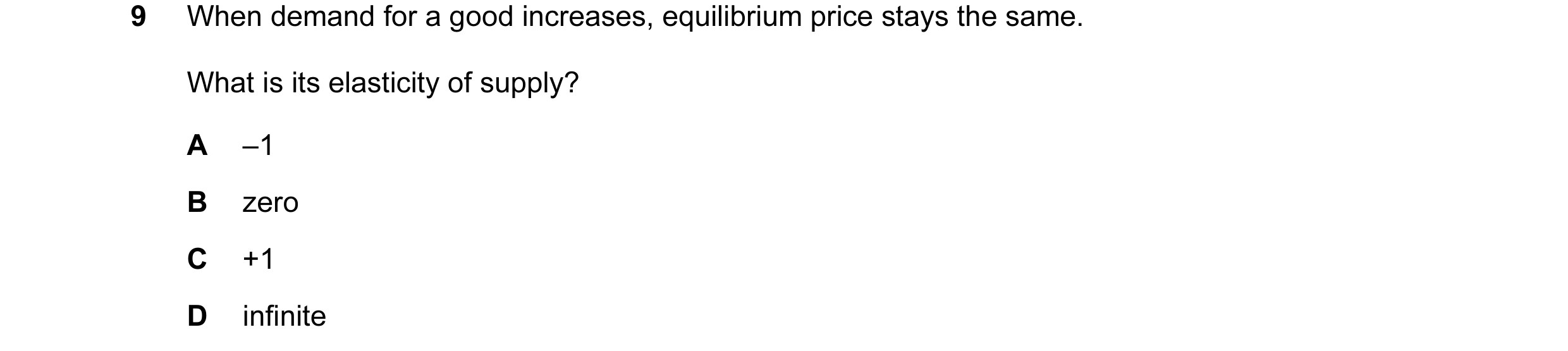
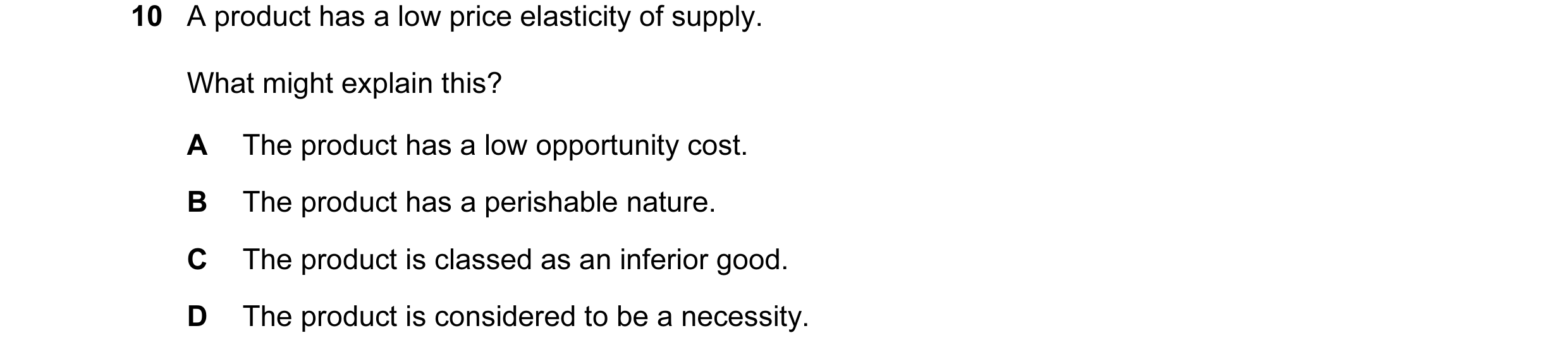

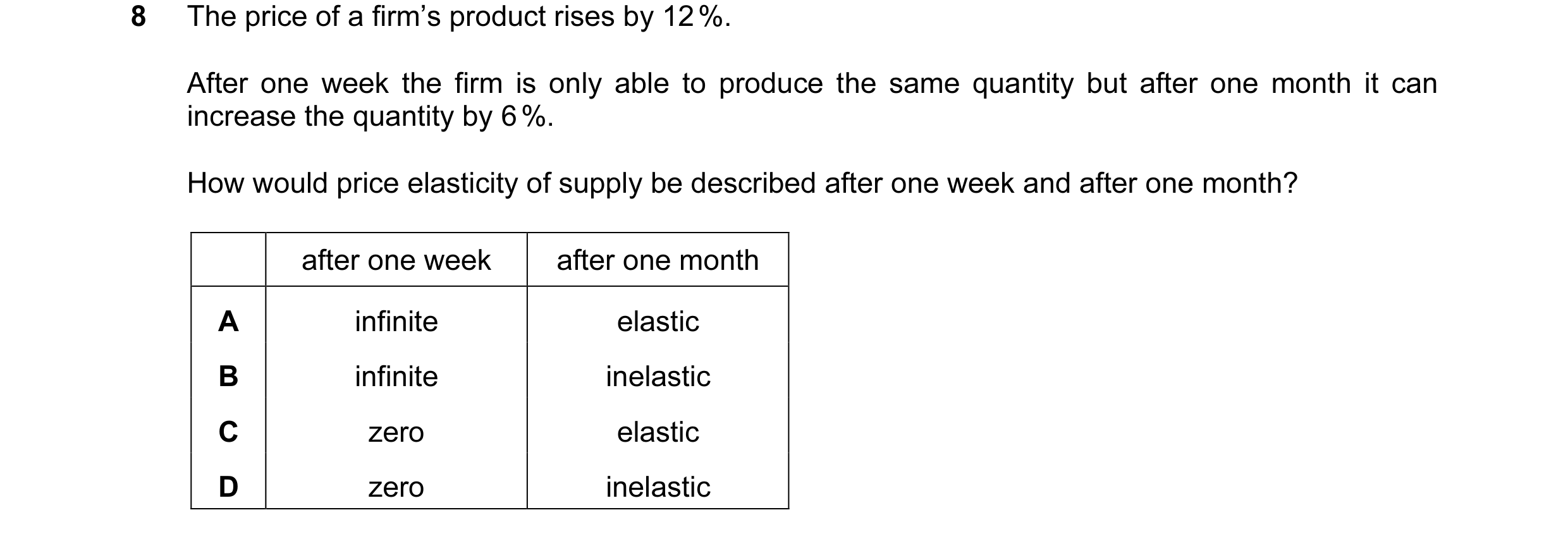
 1 / 41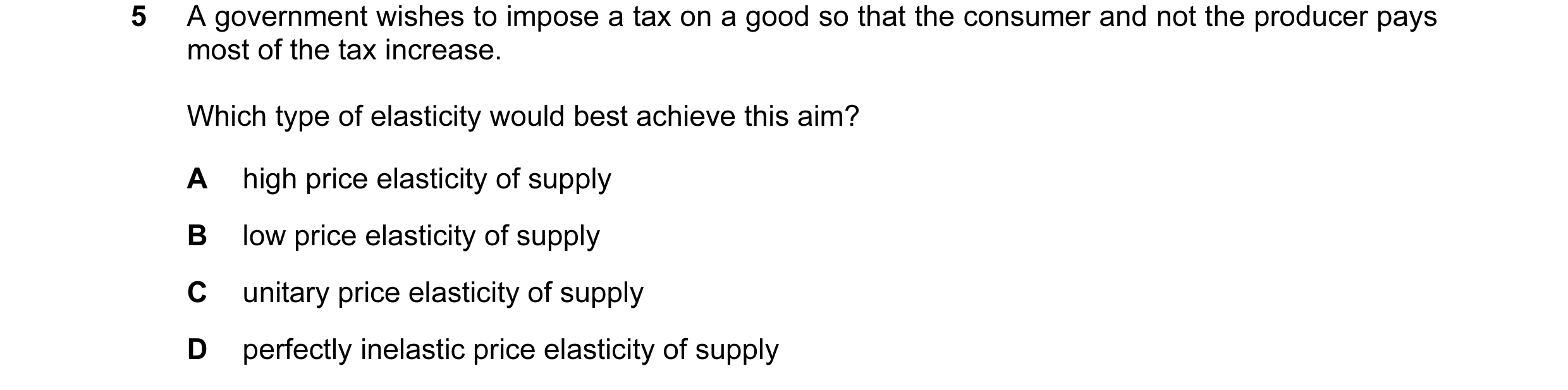
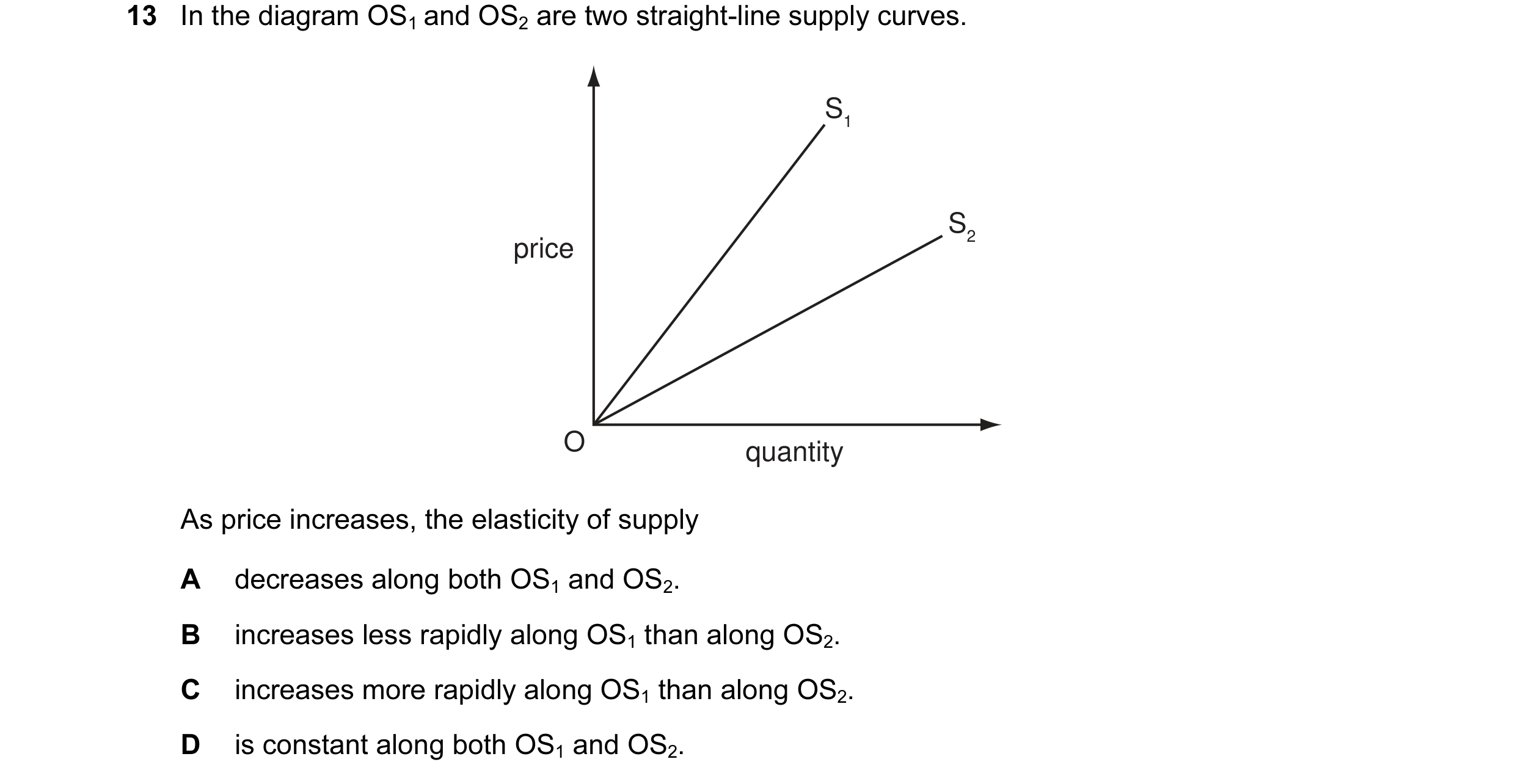
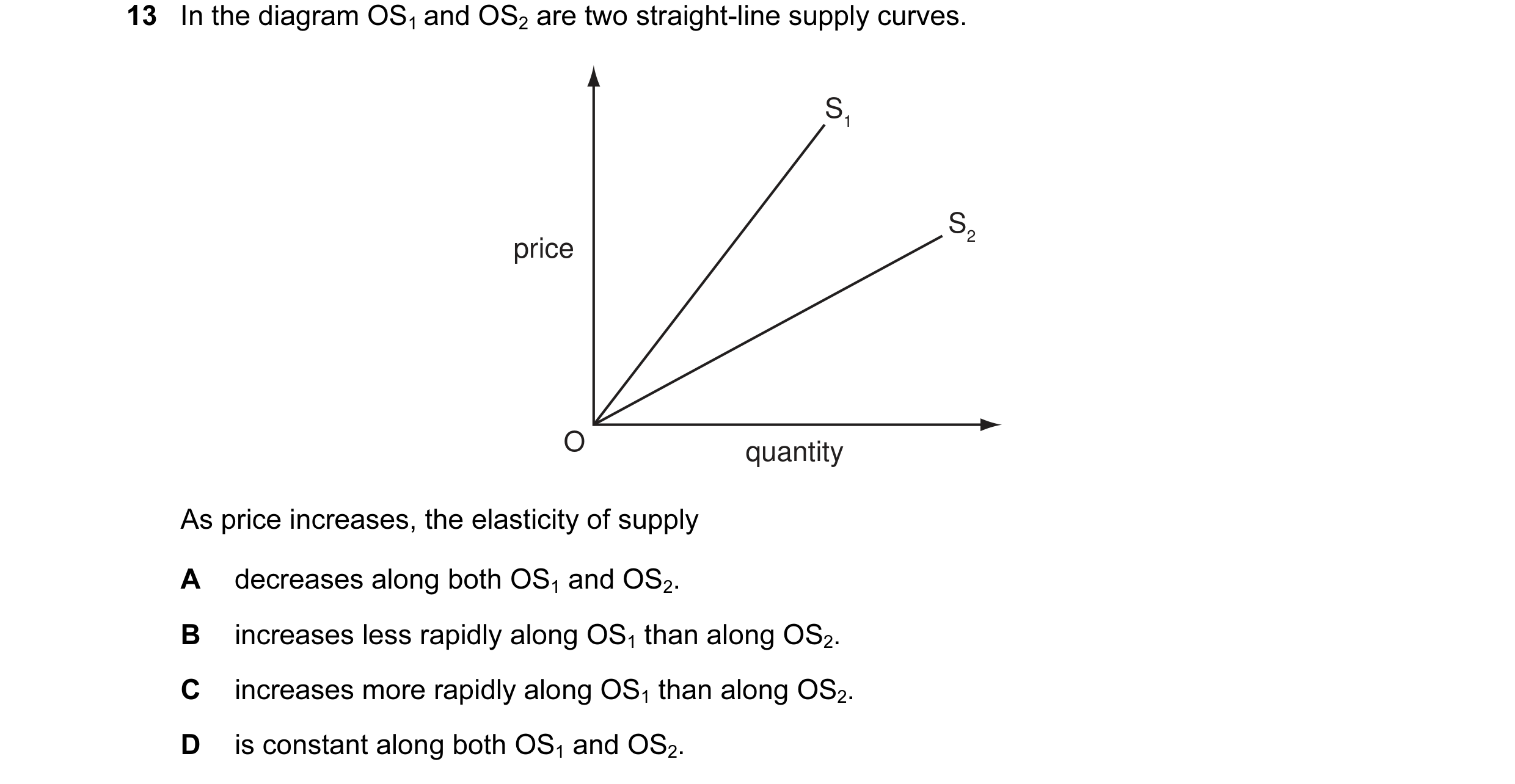 2 / 41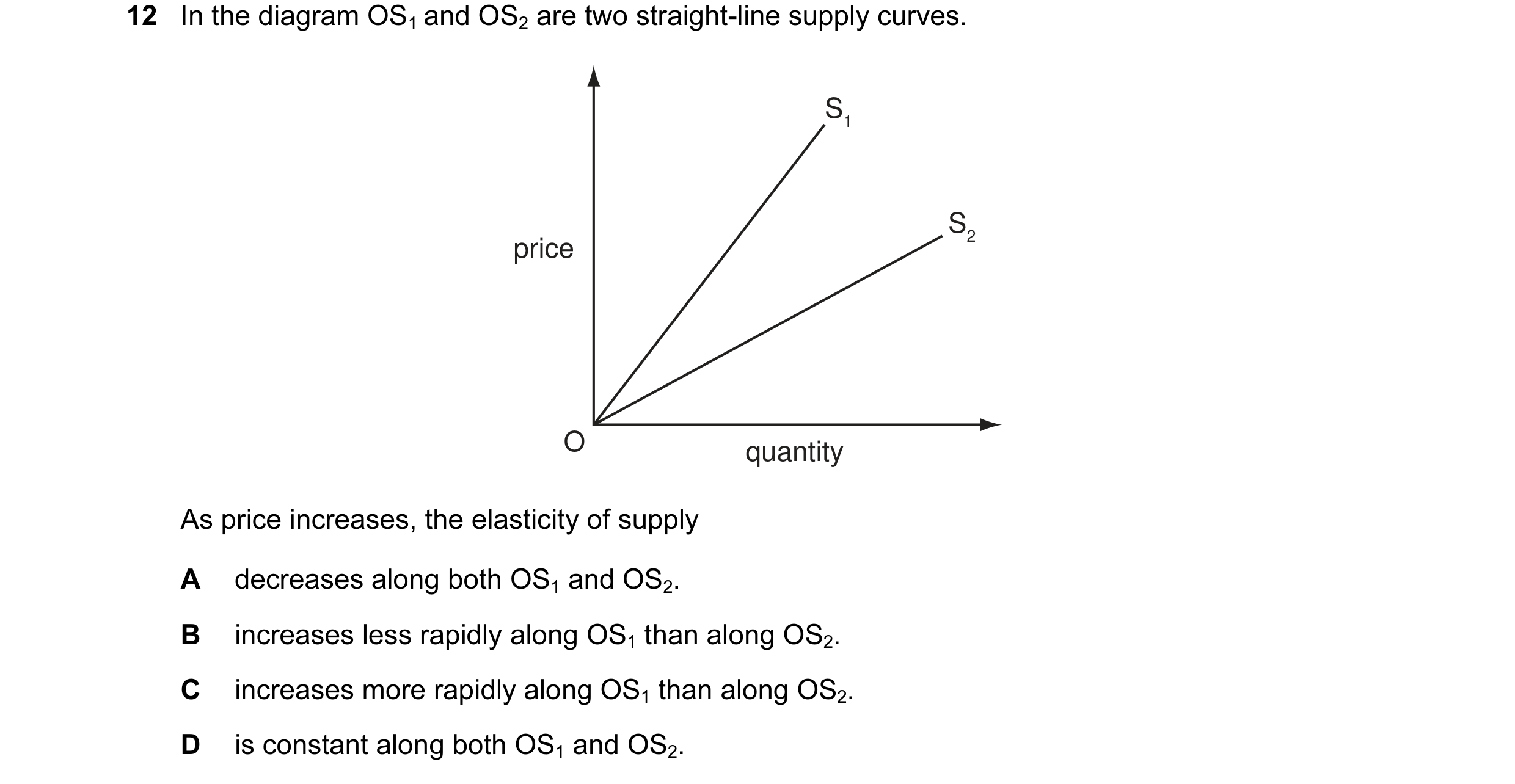
 3 / 41
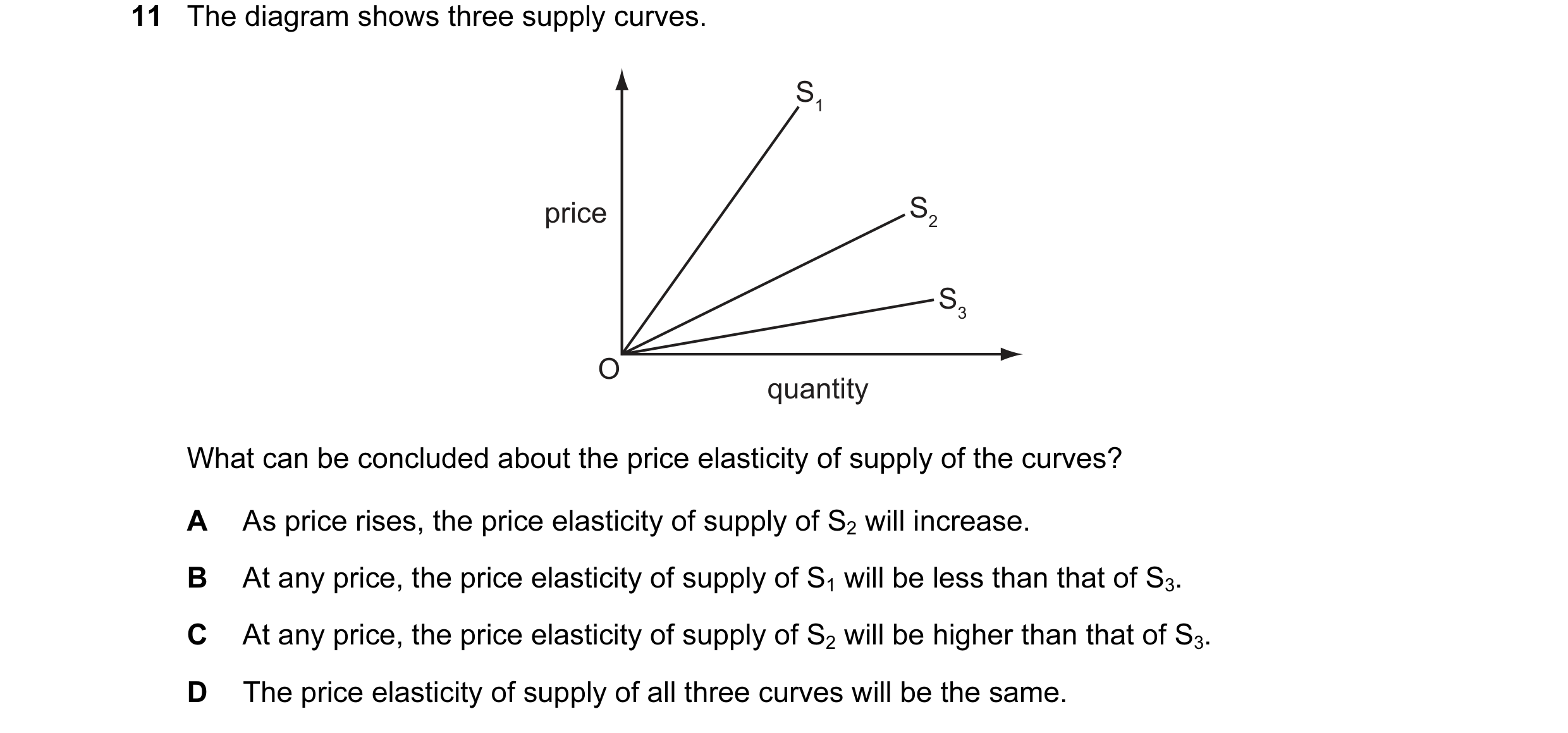

 4 / 41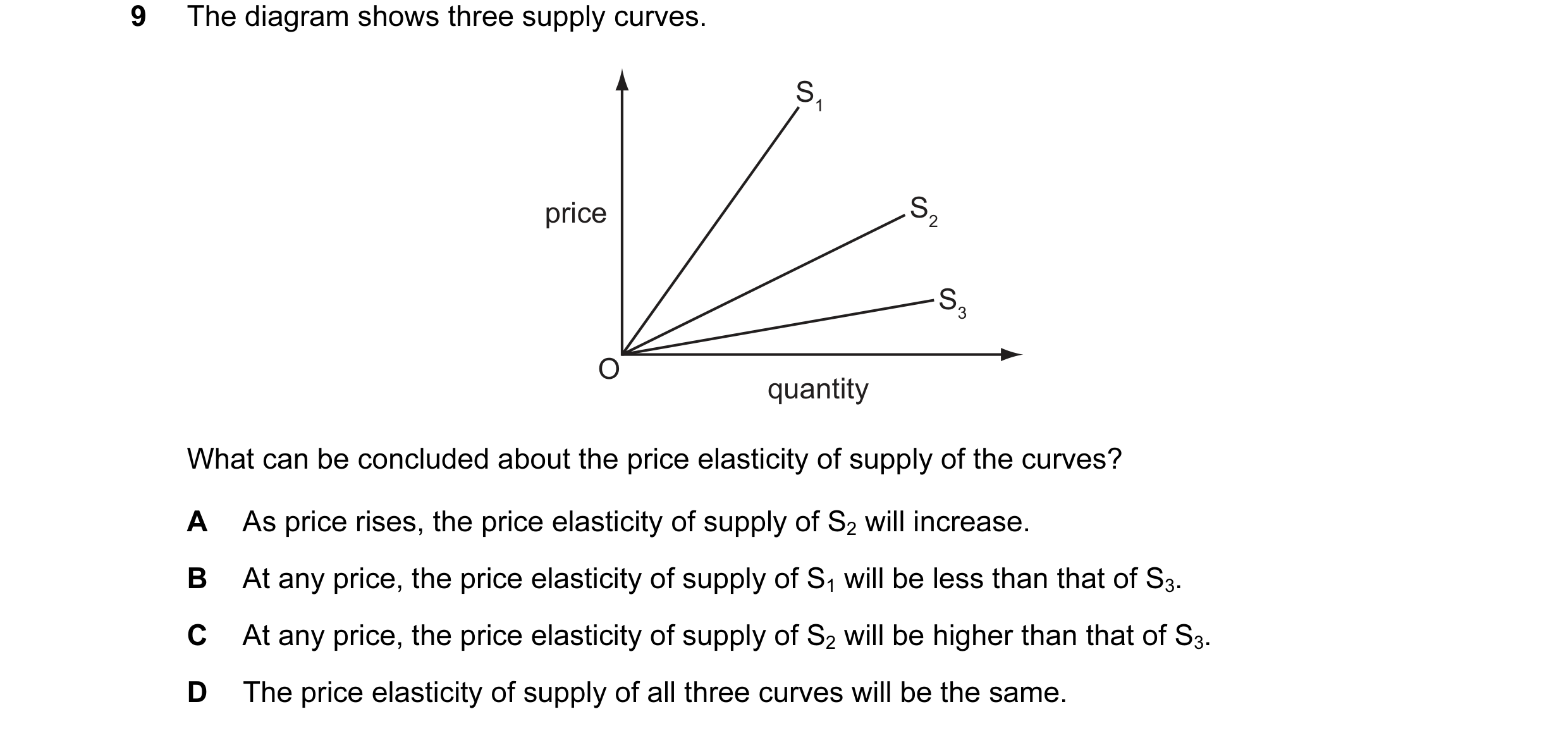
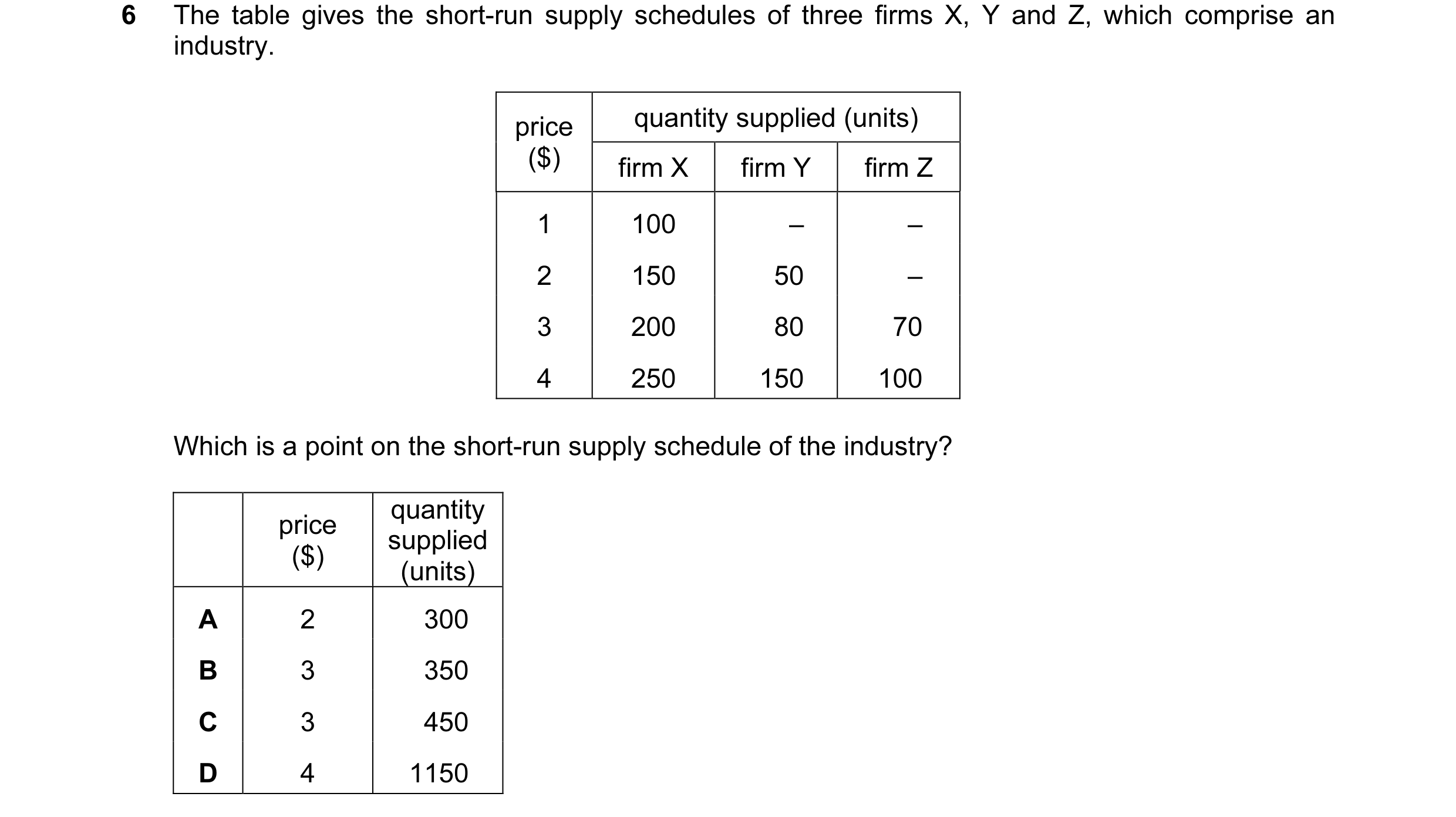
 5 / 41

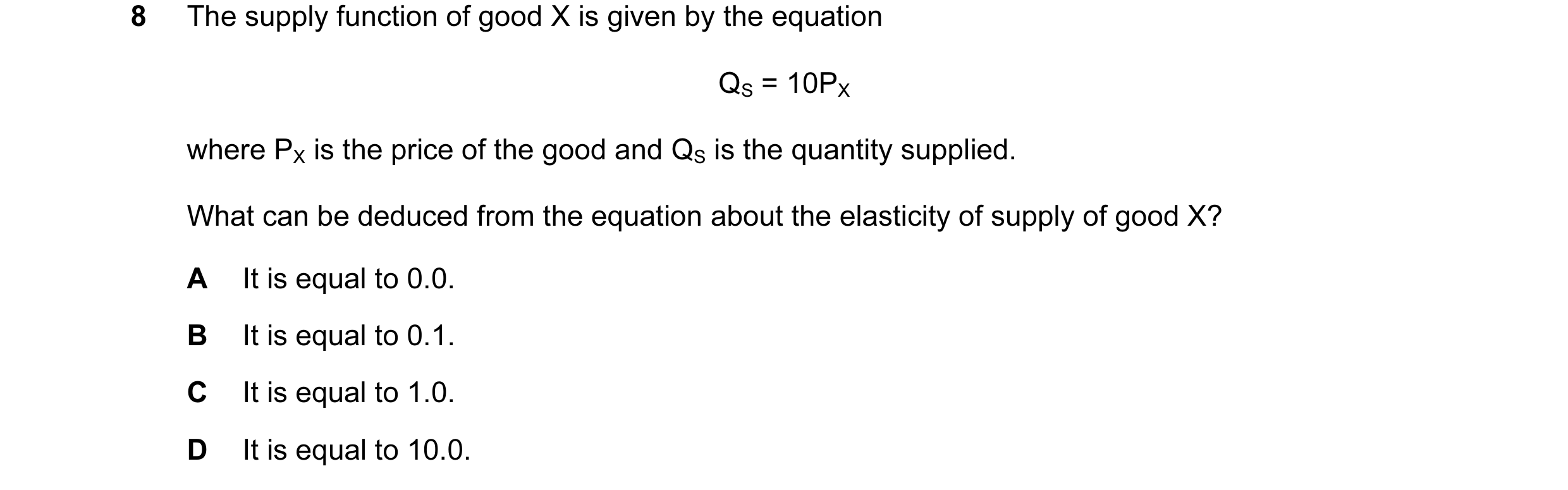 6 / 41
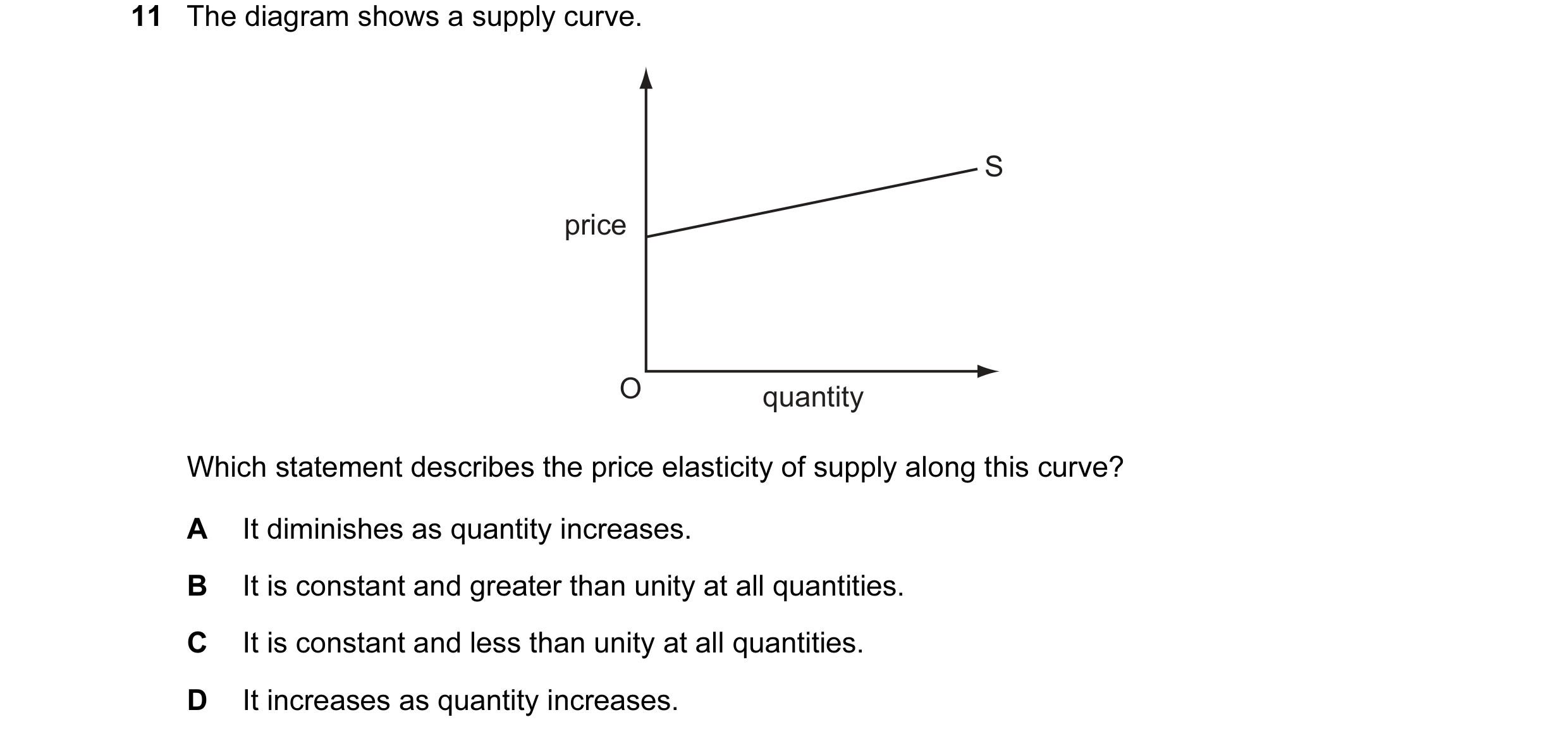
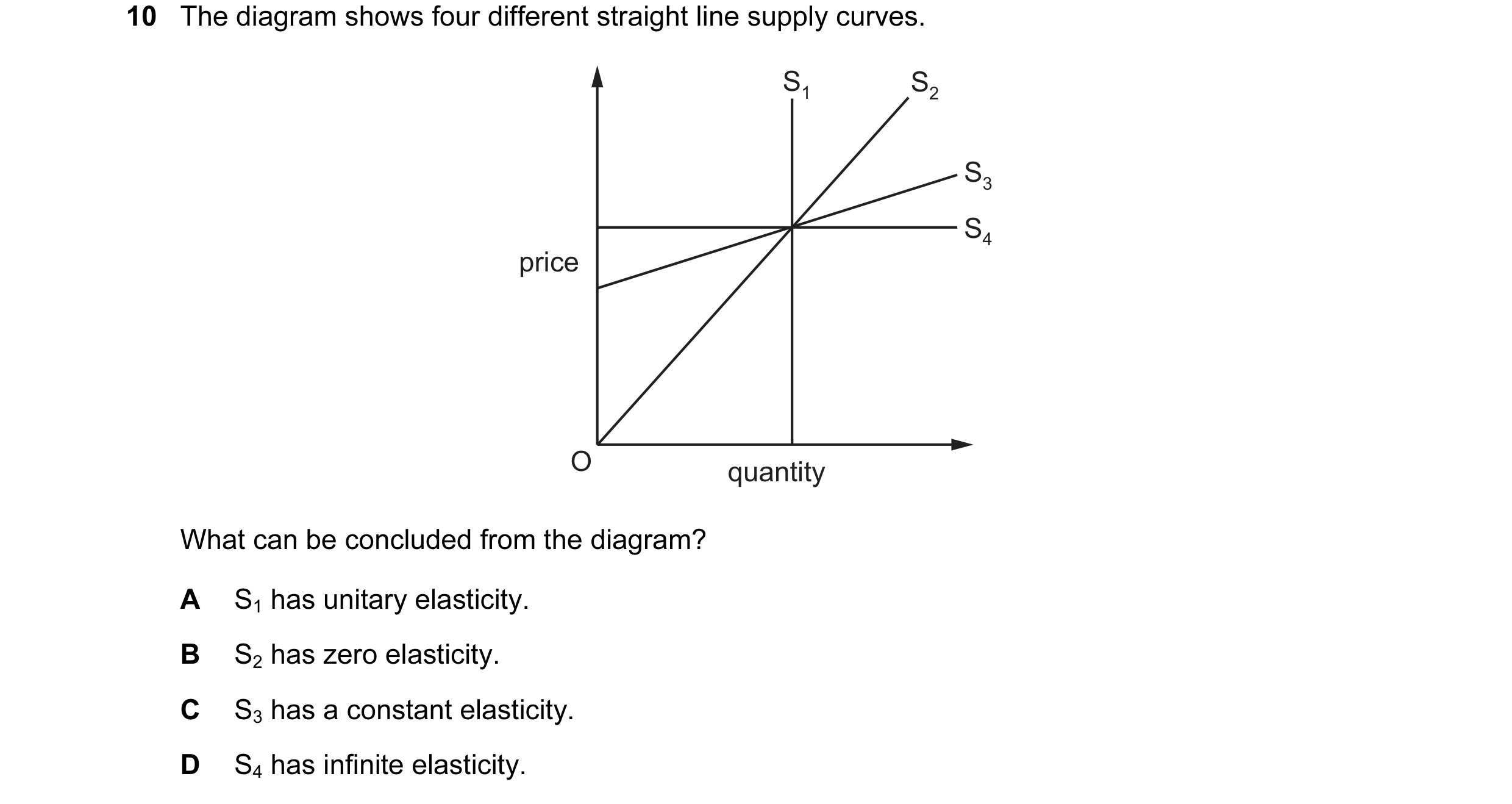 7 / 41

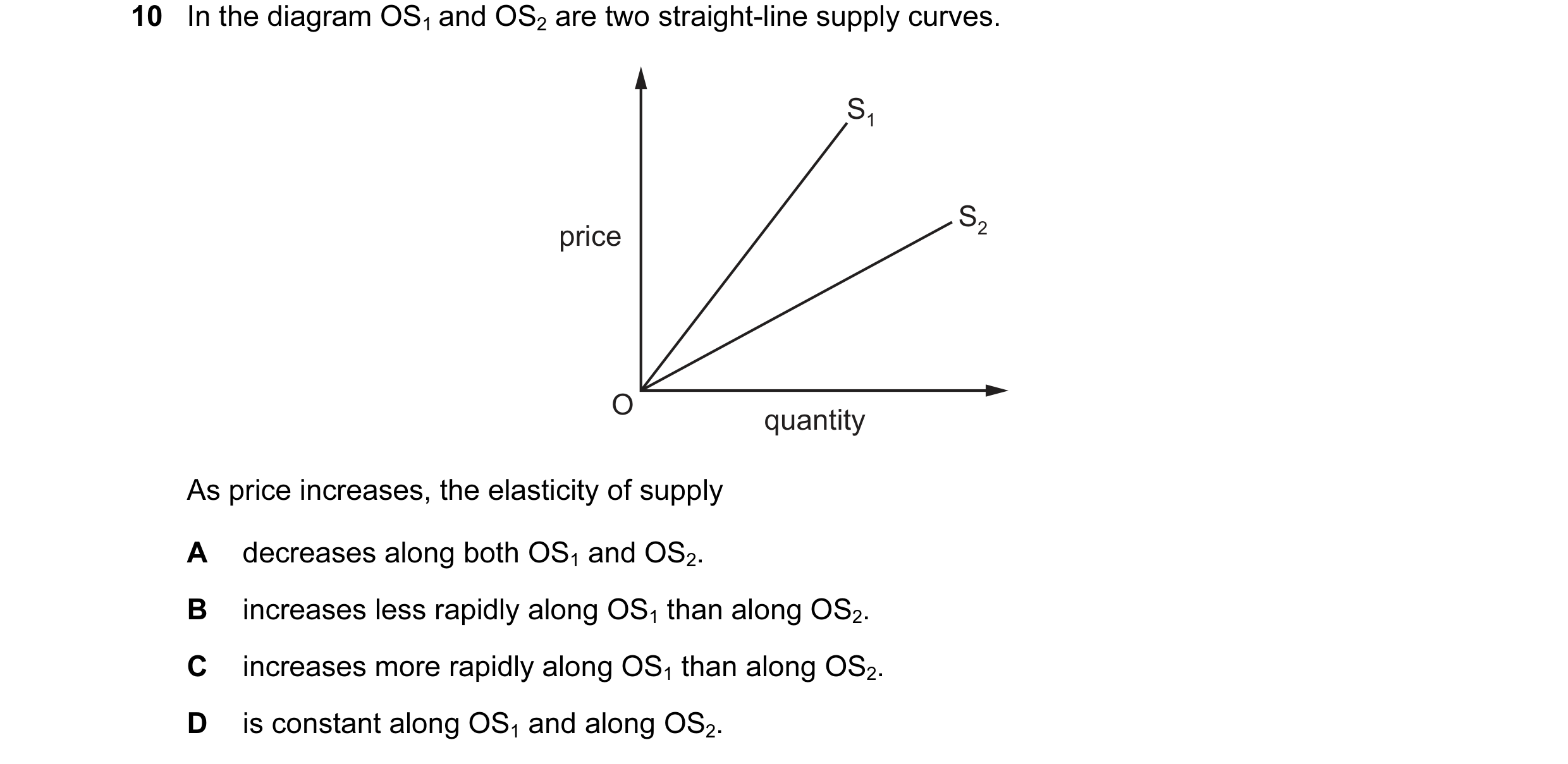 8 / 41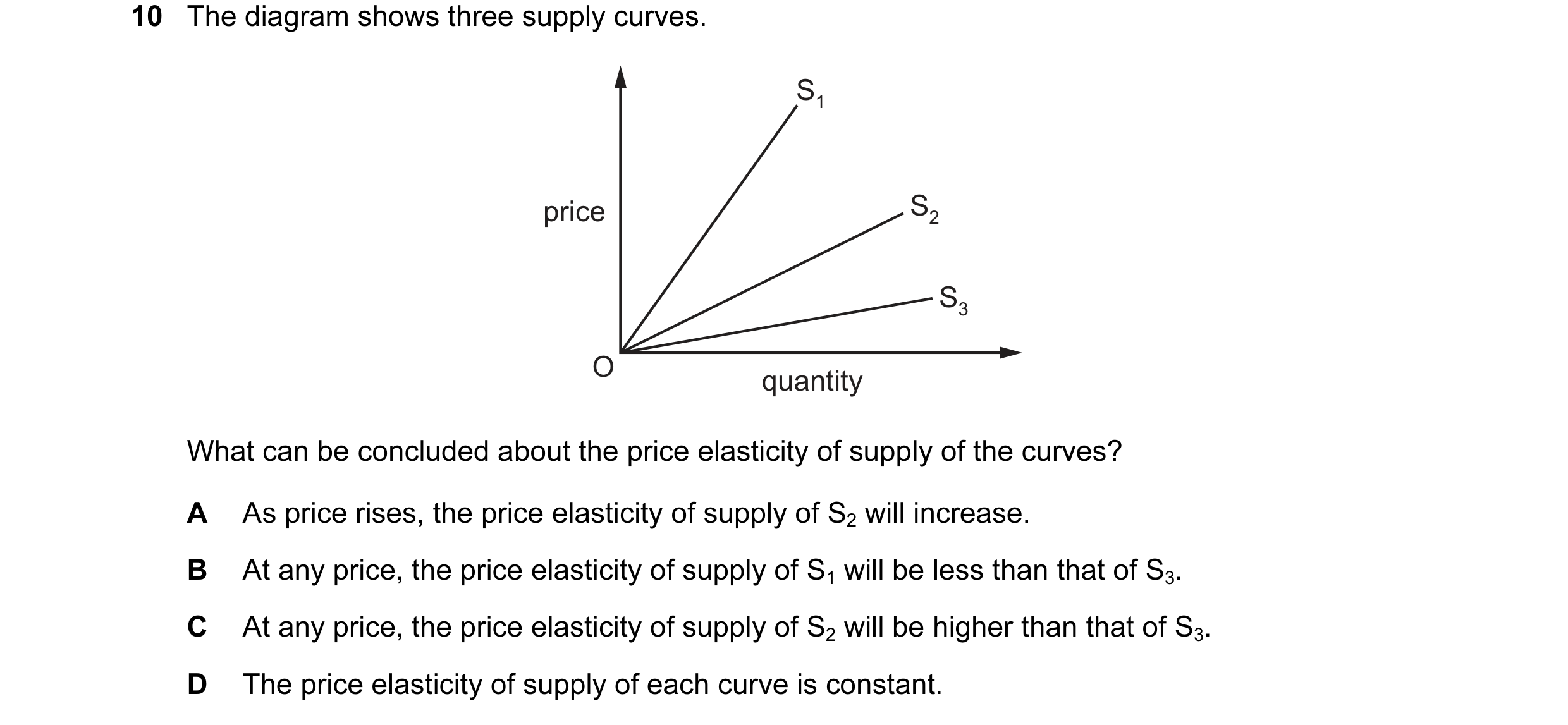
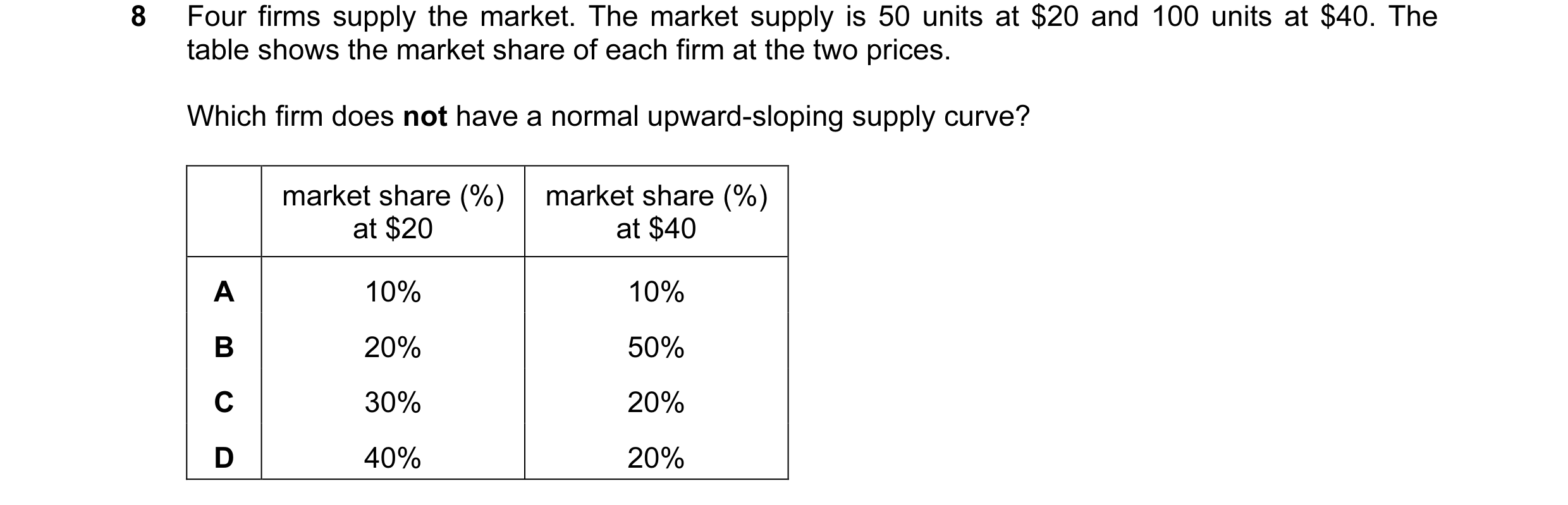
 9 / 41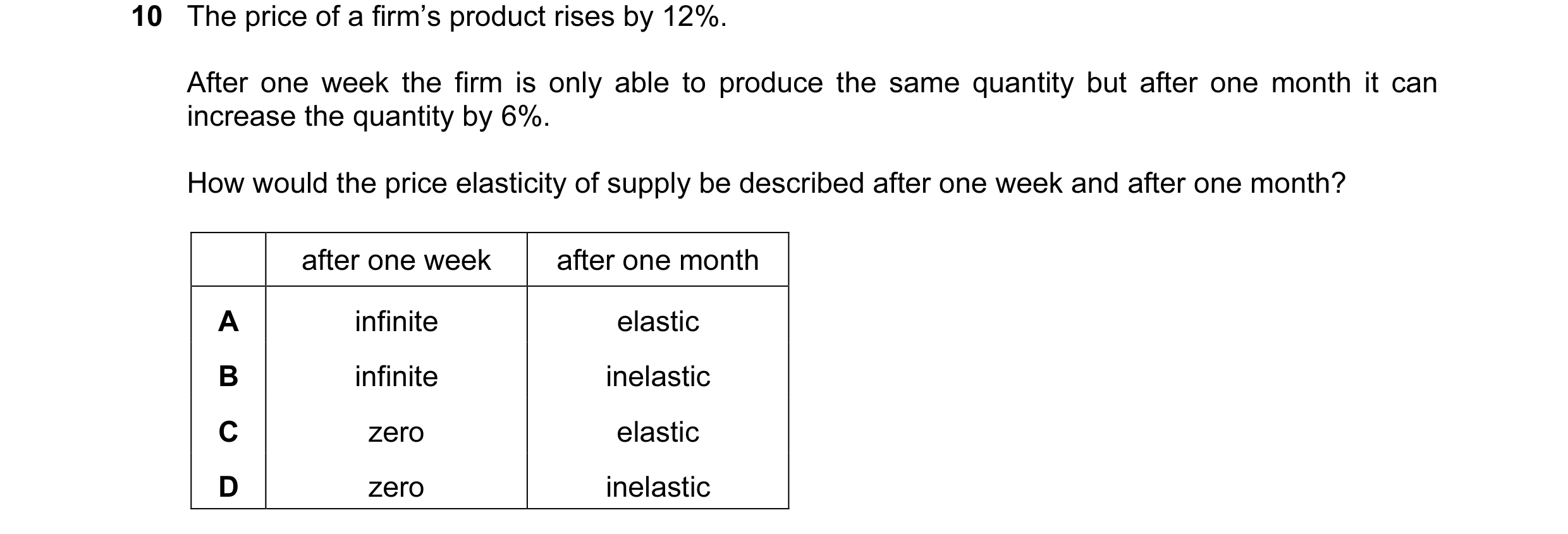
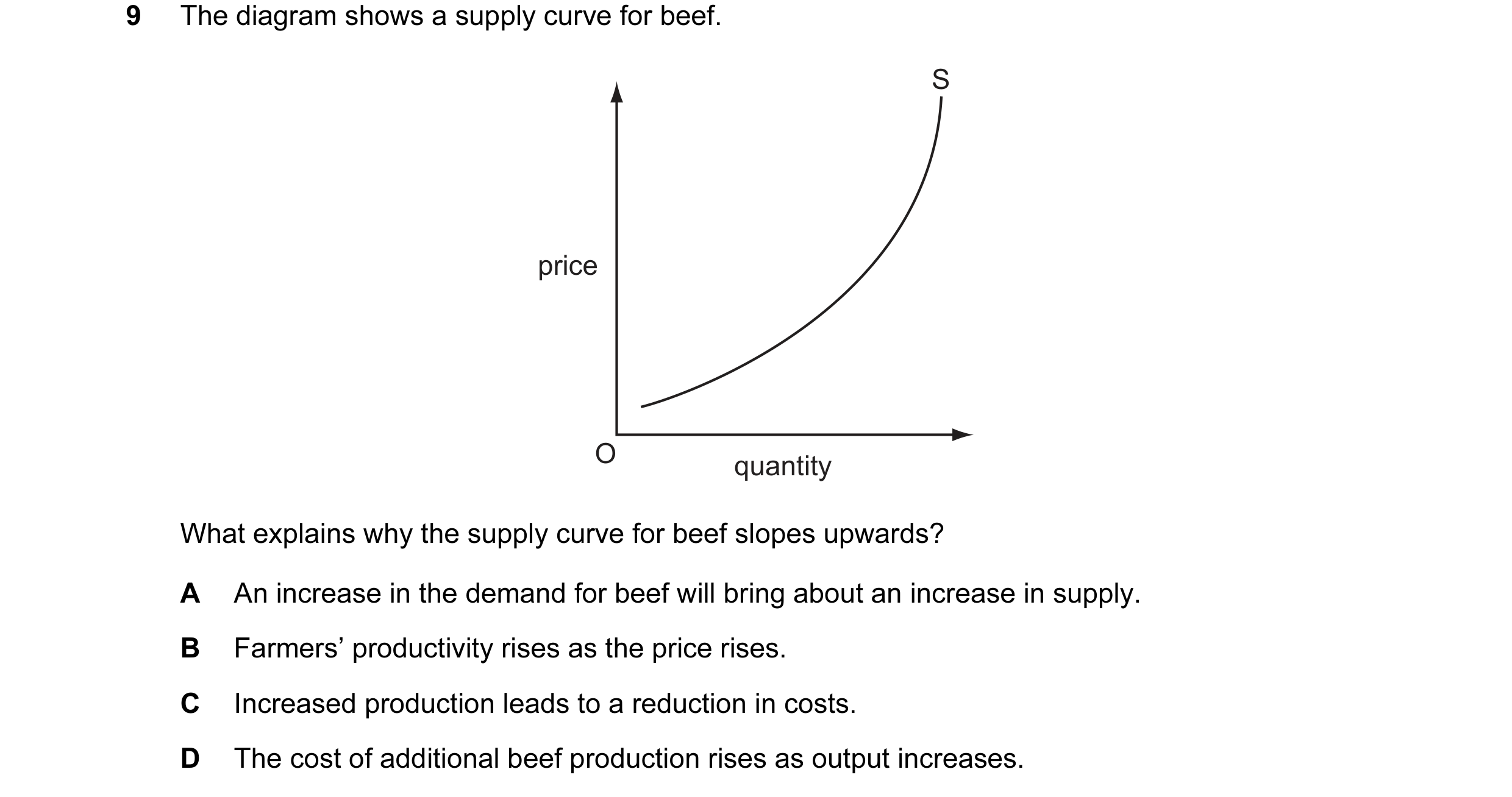 10 / 41

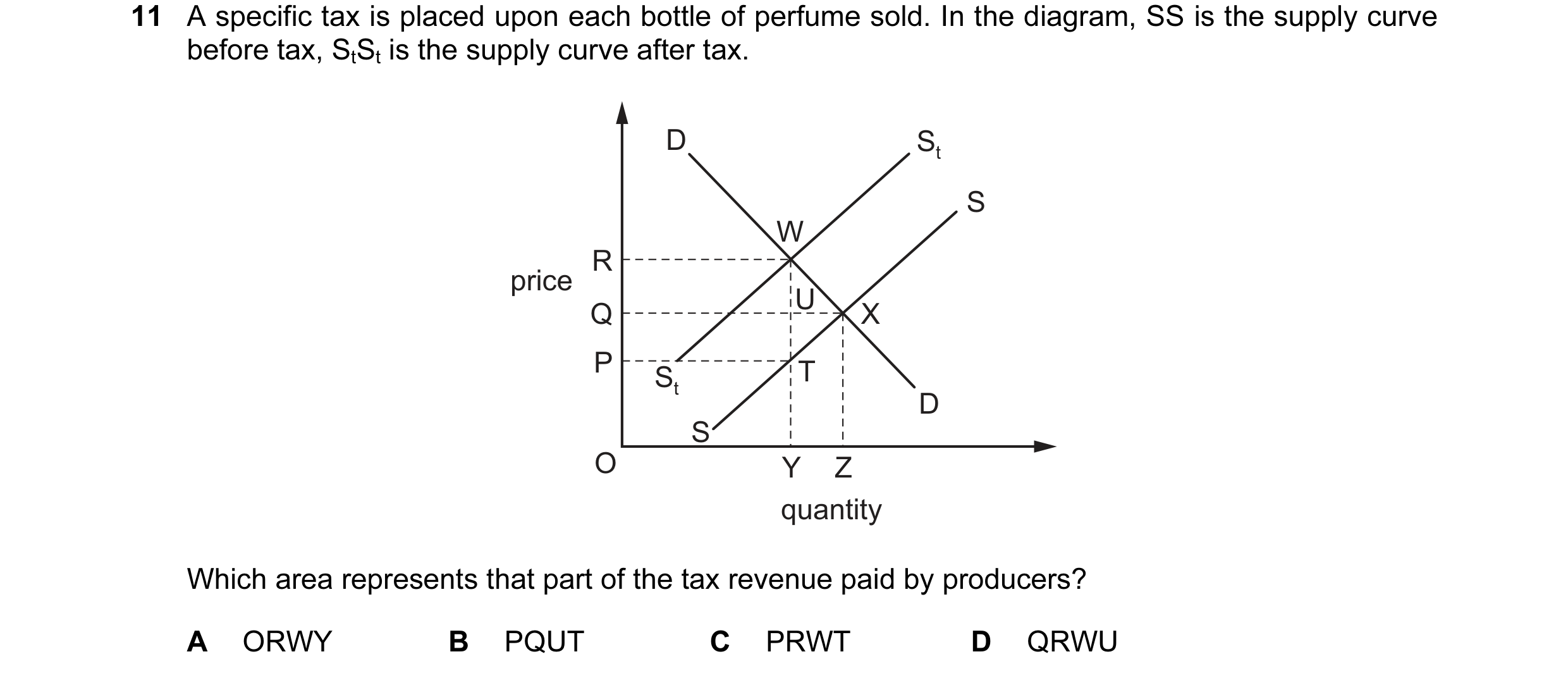
 11 / 41

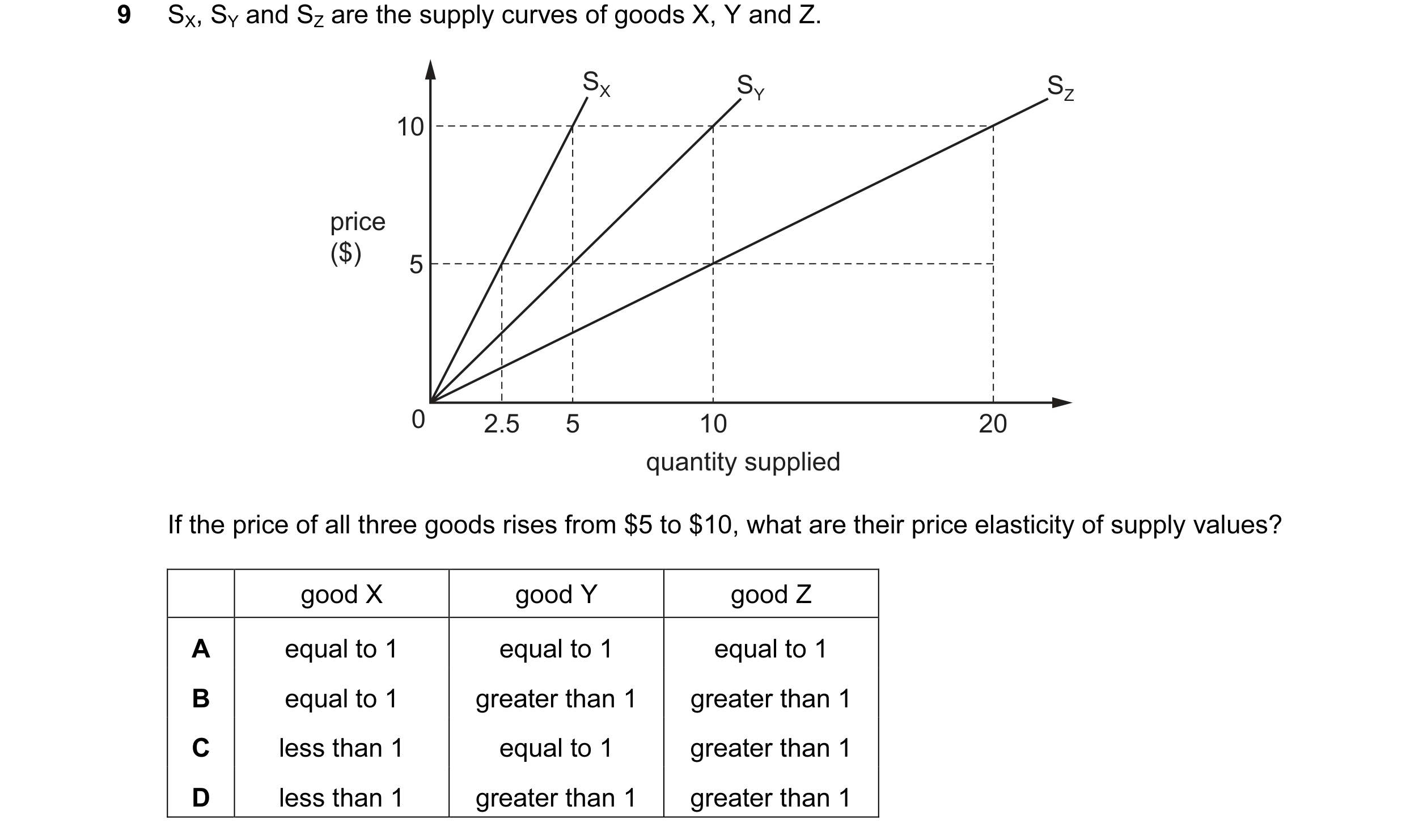
 12 / 41


 13 / 41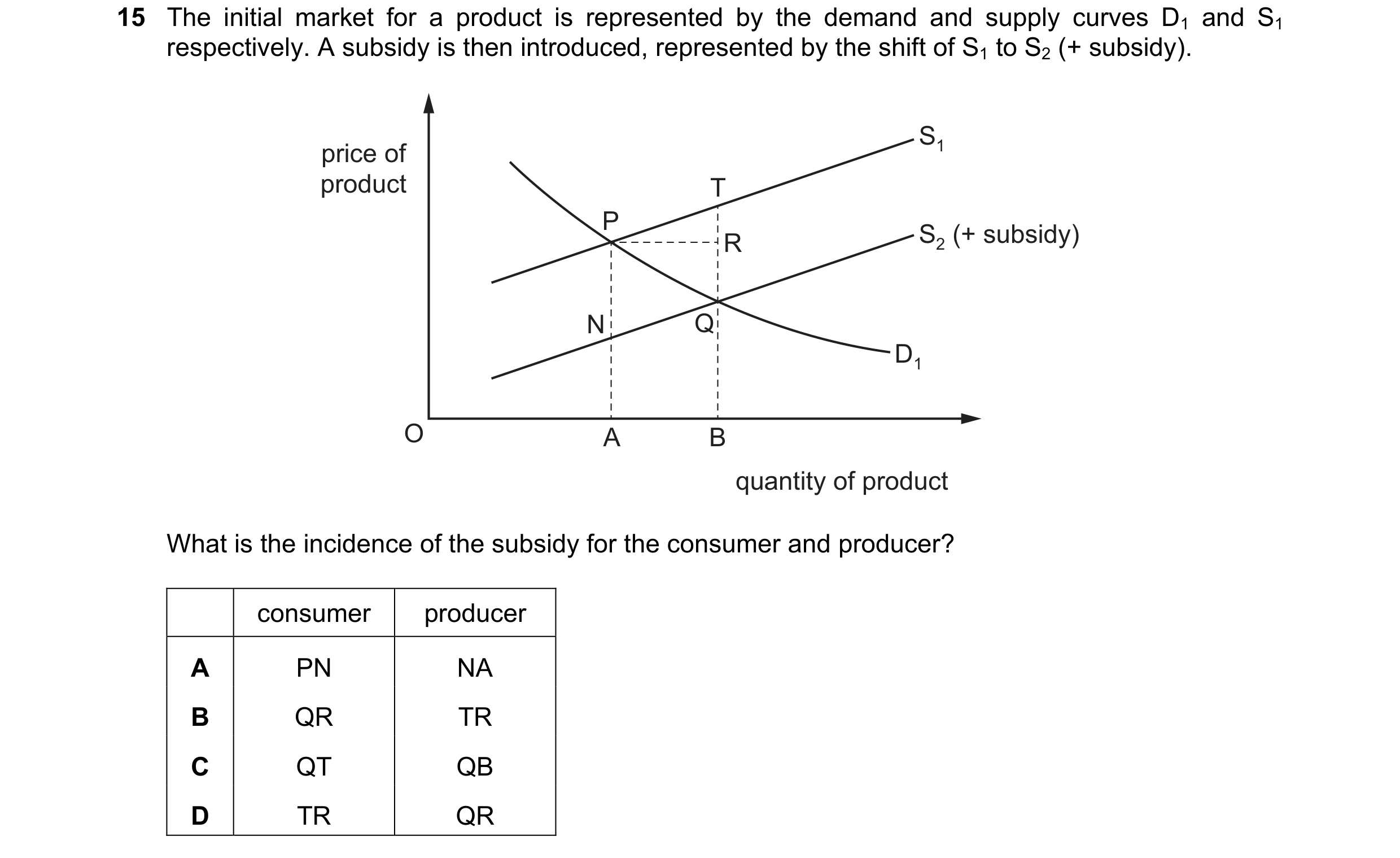
 14 / 41


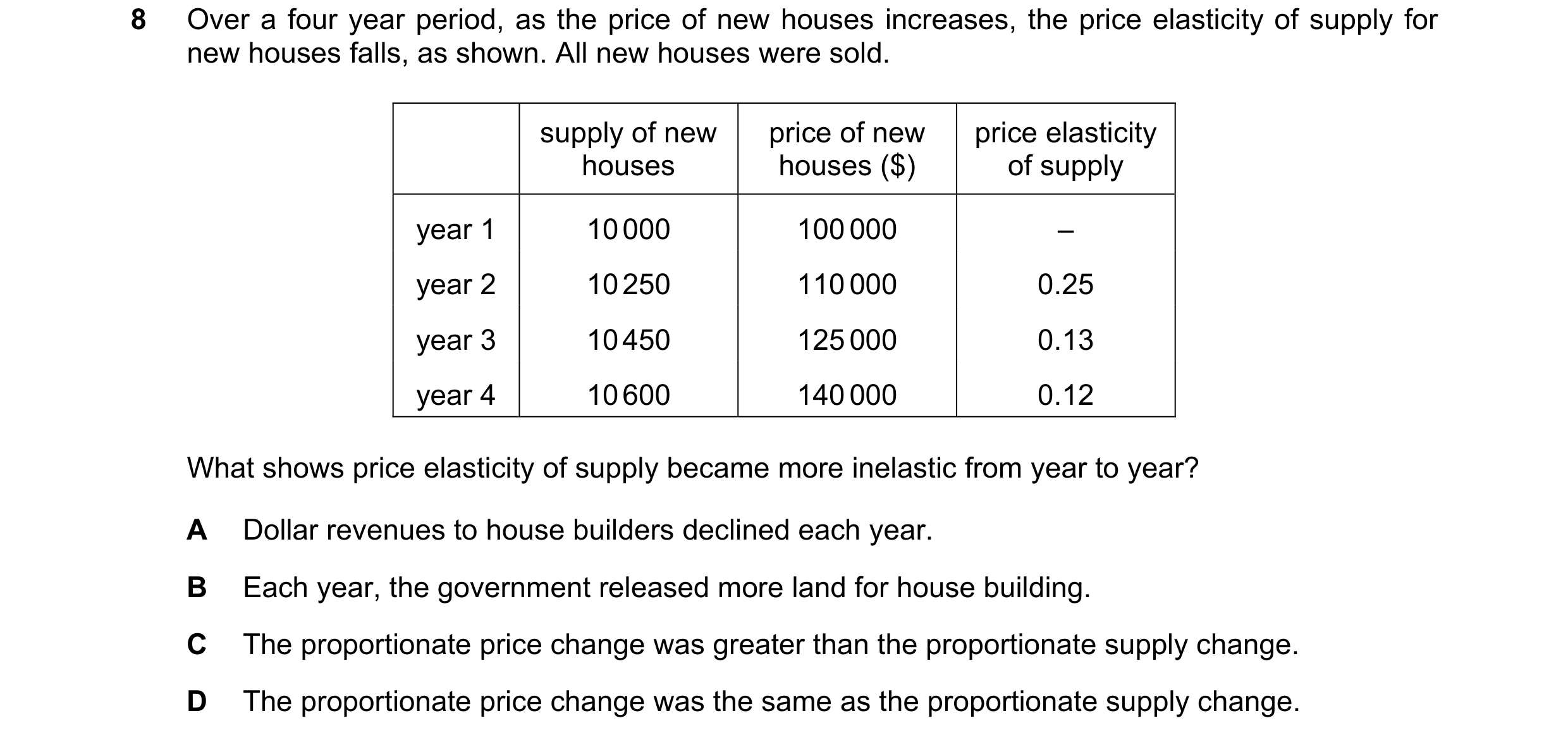 15 / 41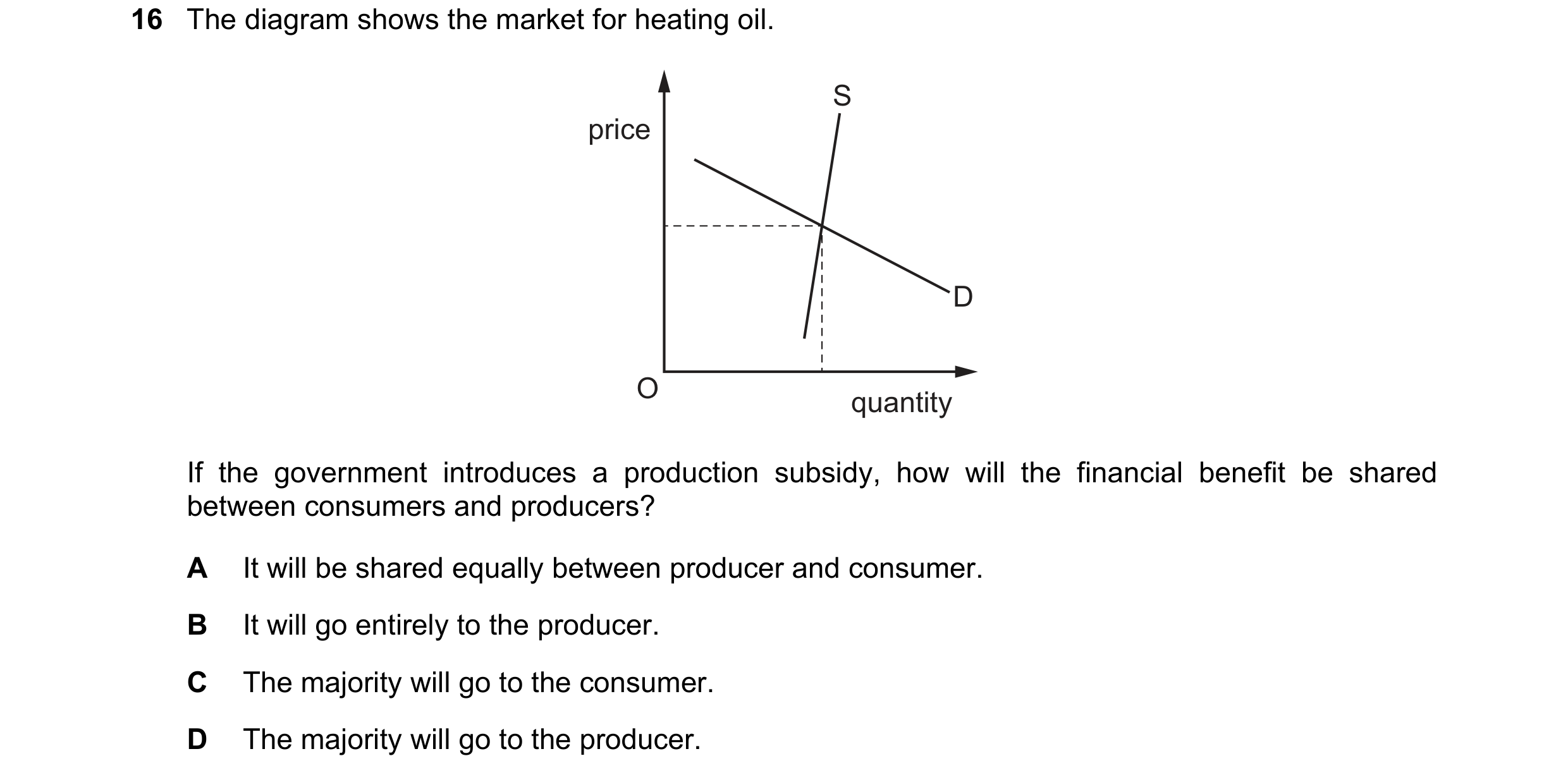
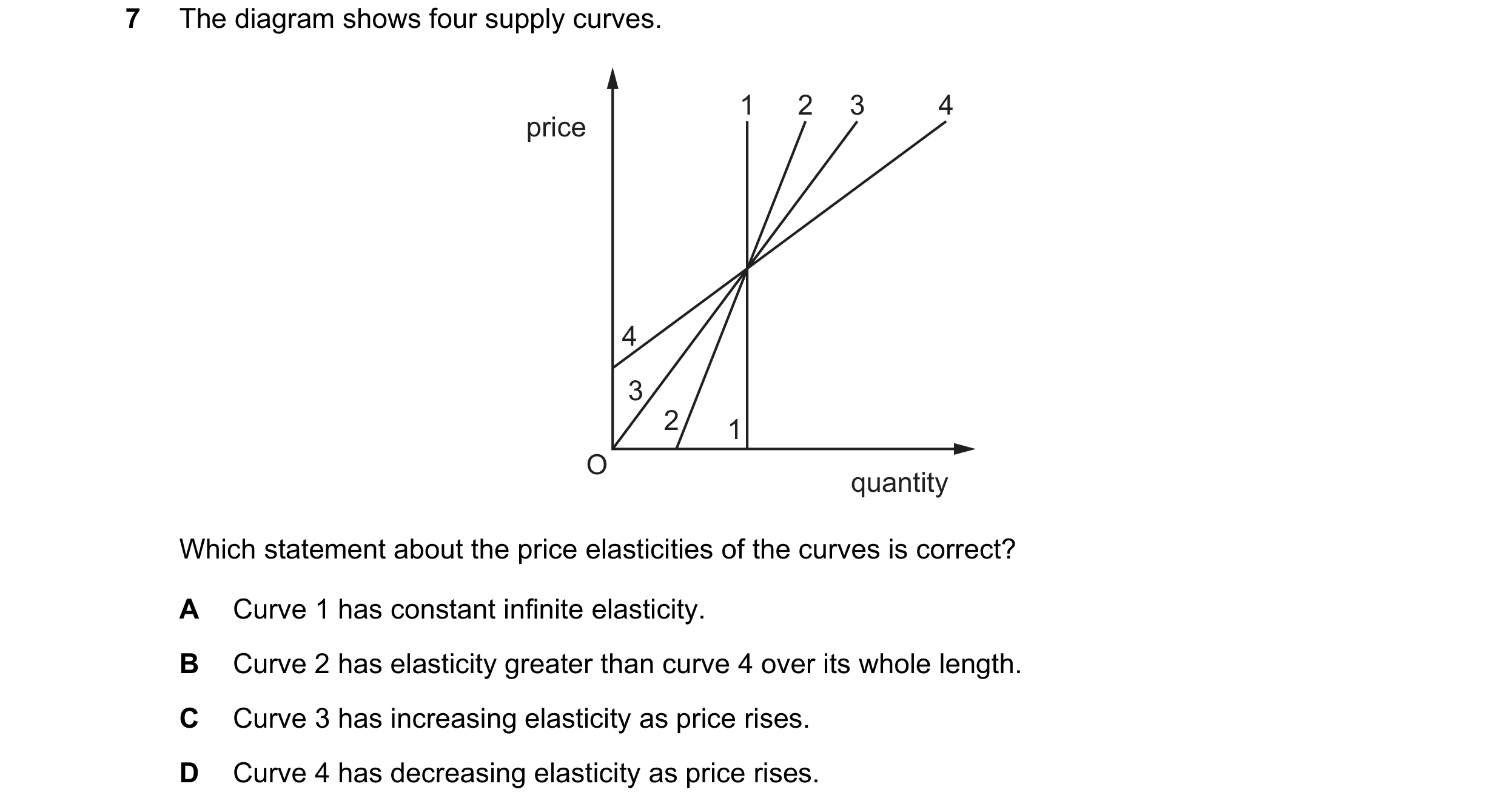 16 / 41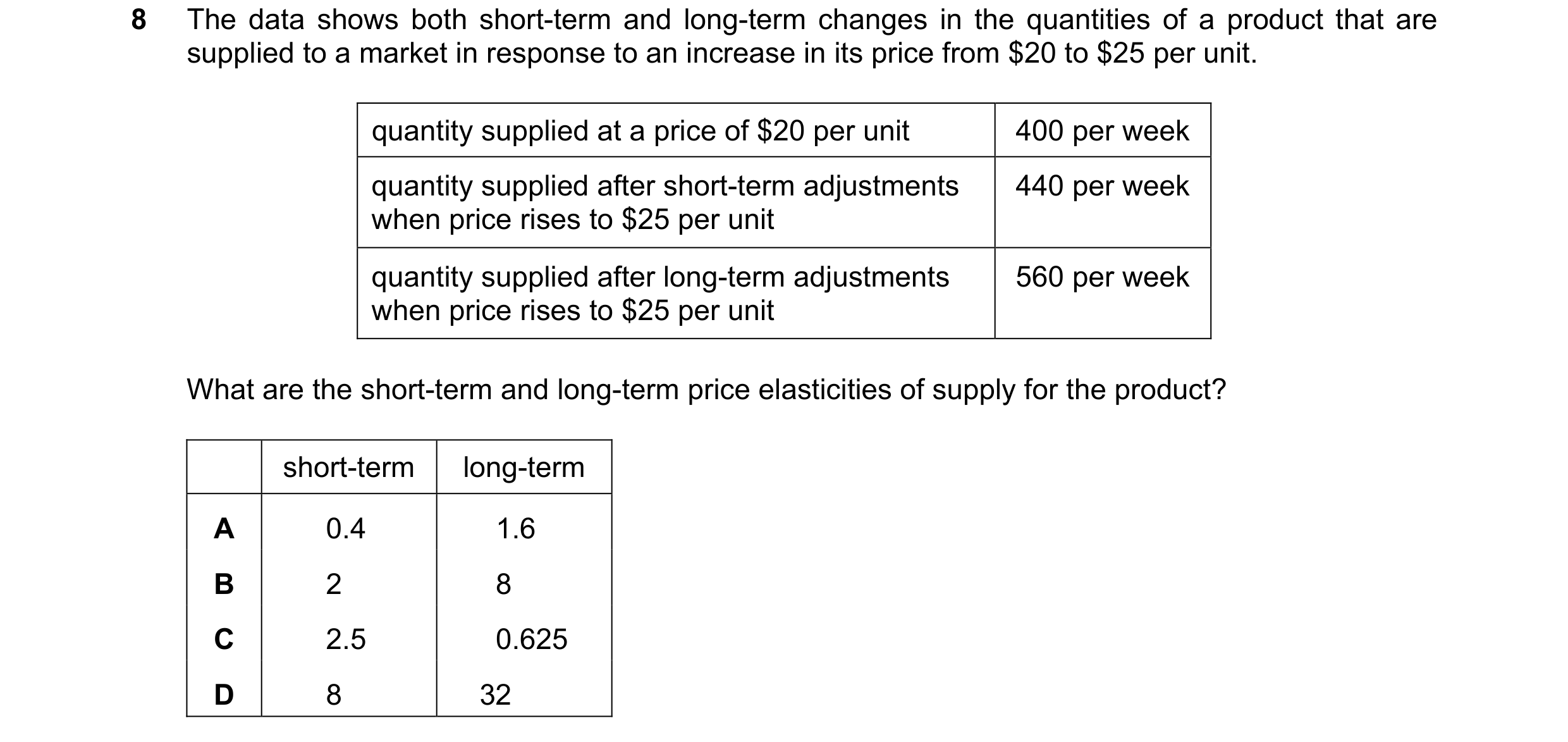
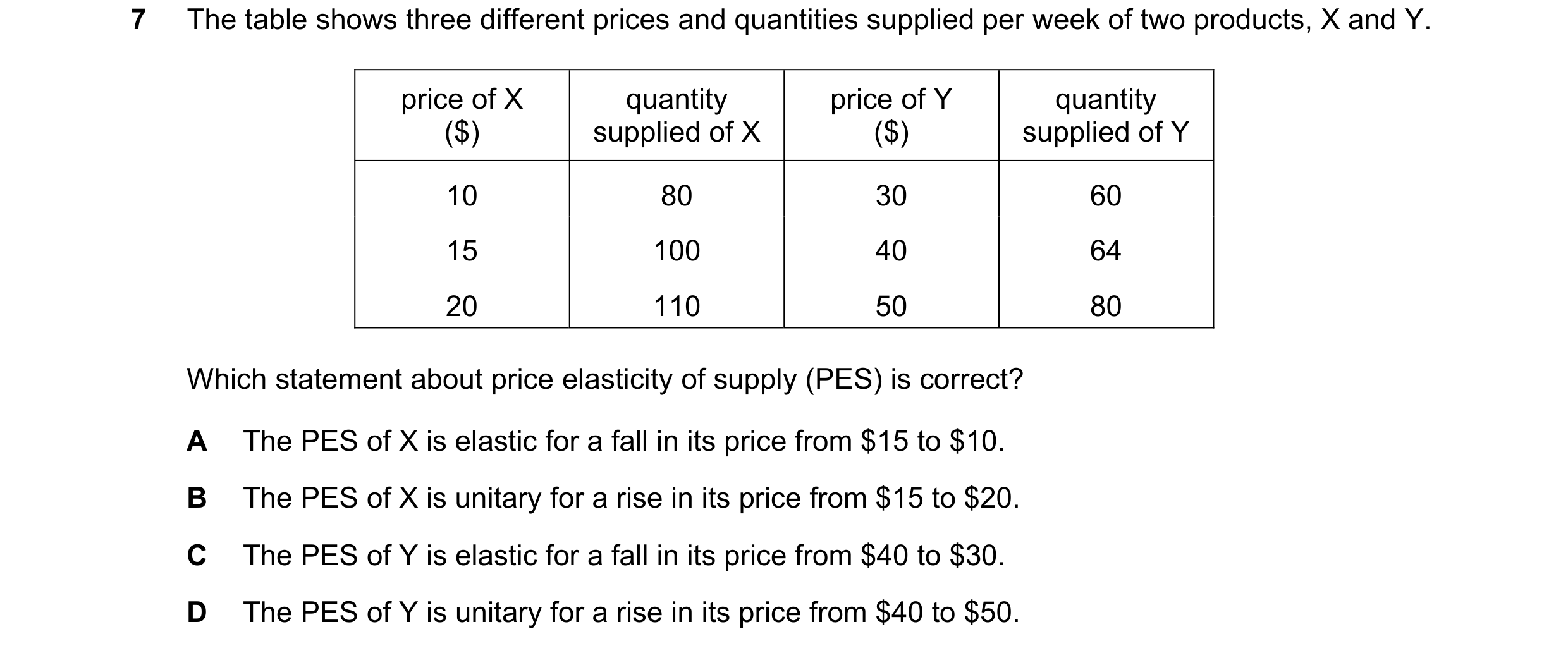

 17 / 41

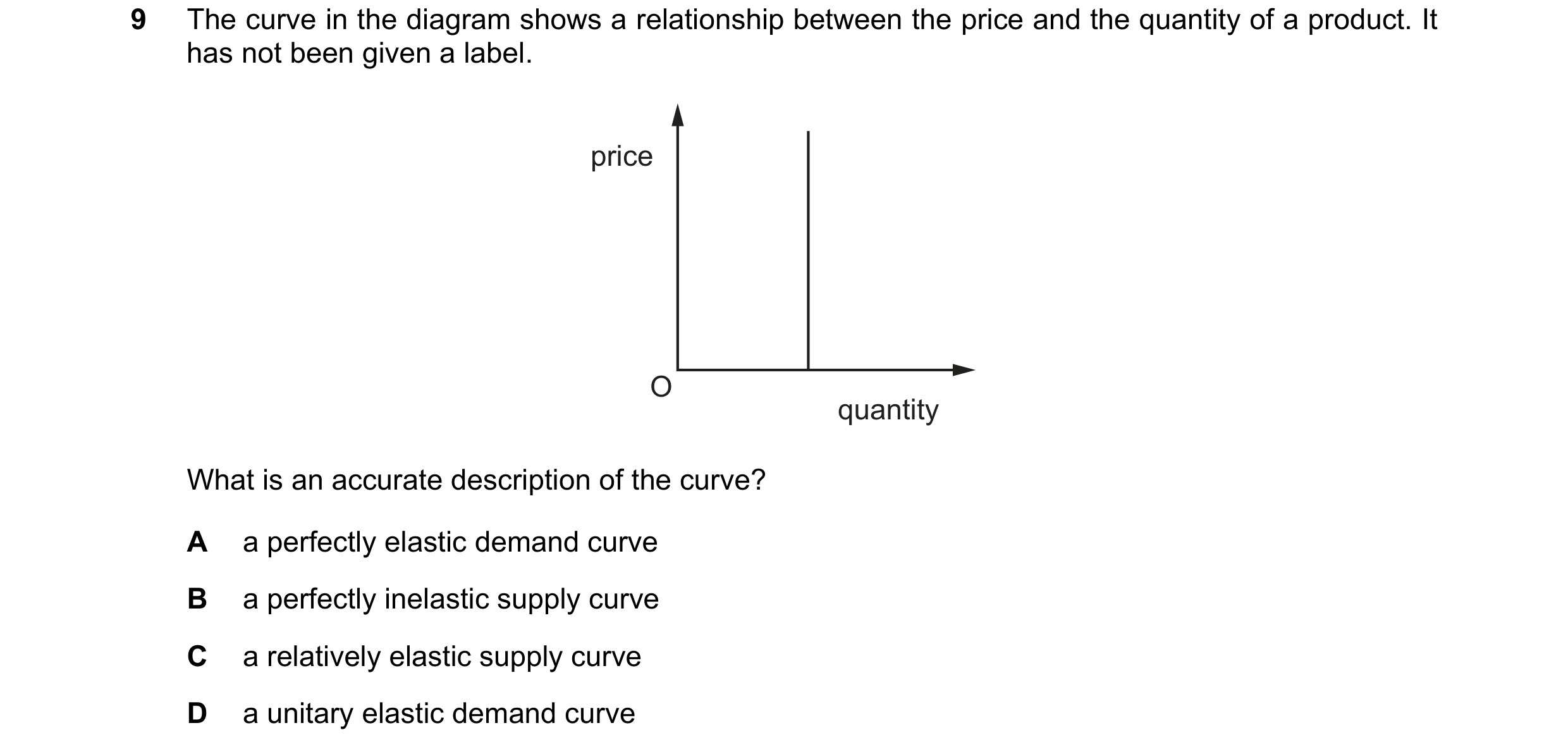
 18 / 41



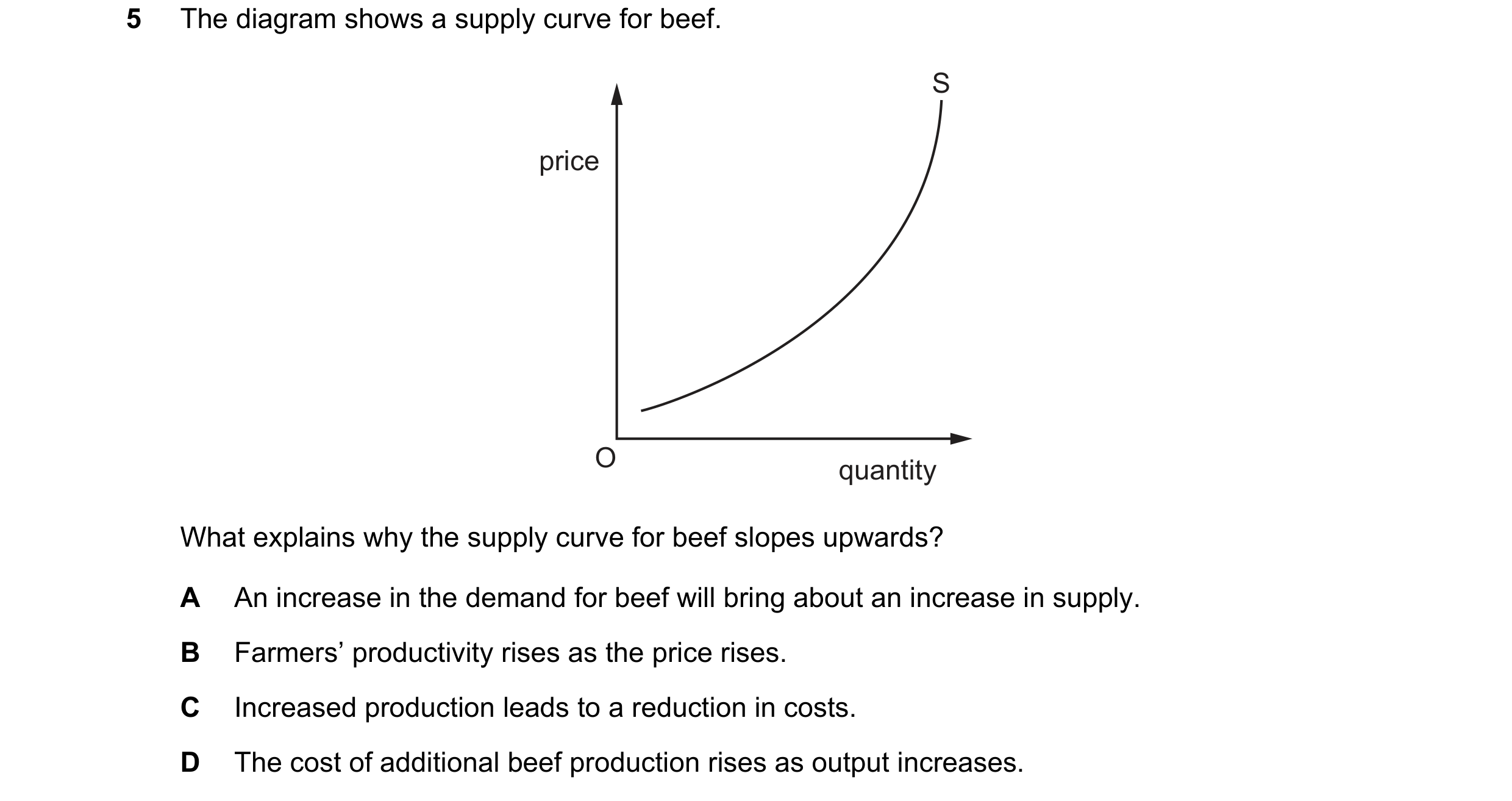 19 / 41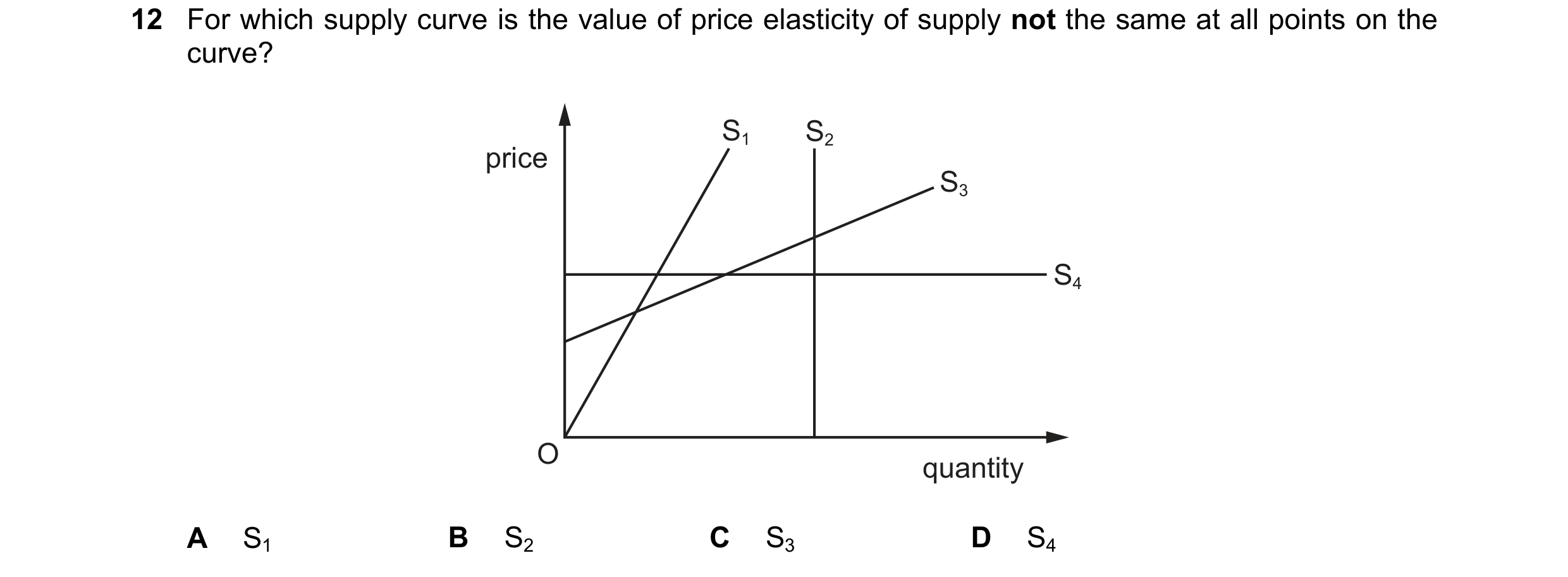
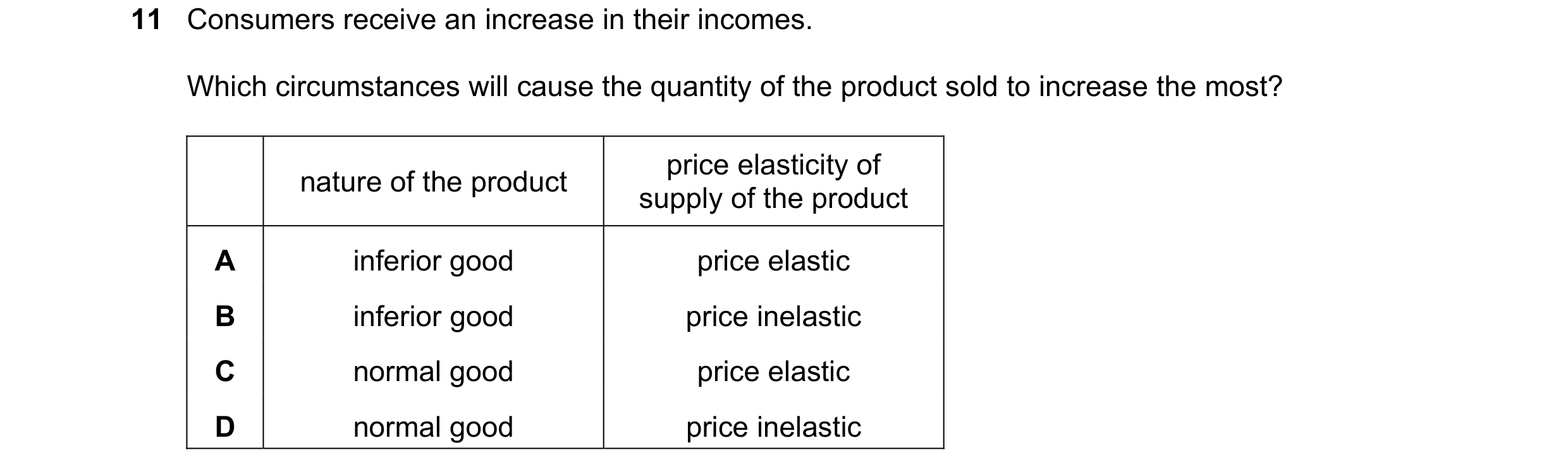
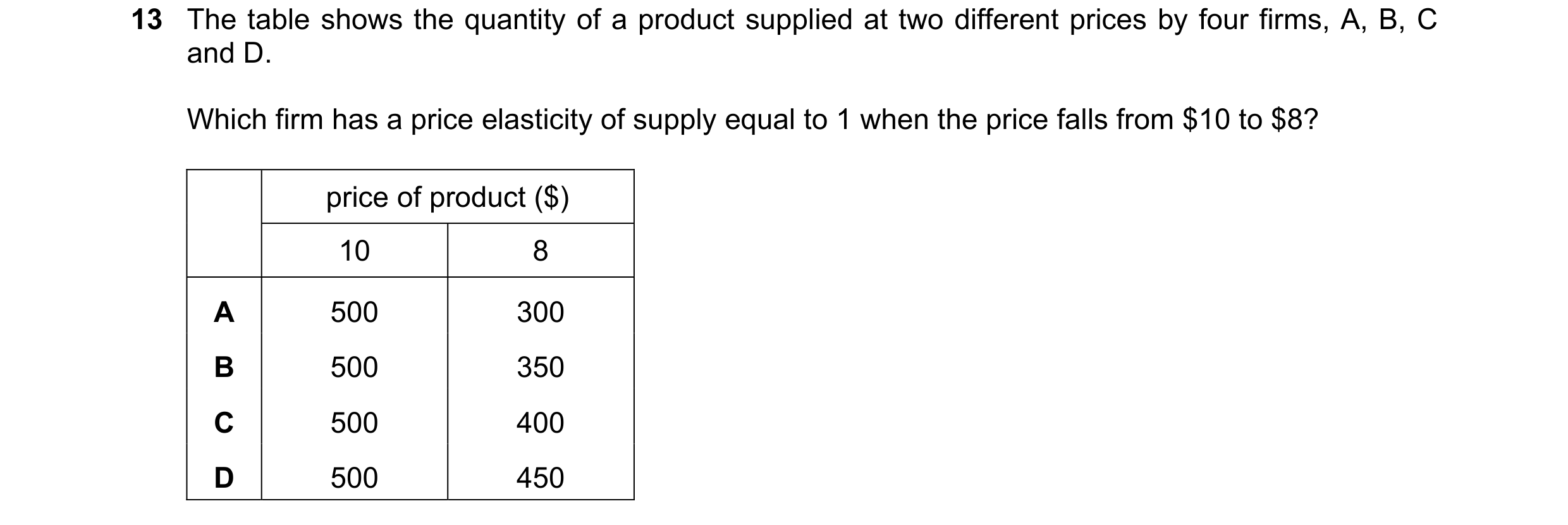 20 / 41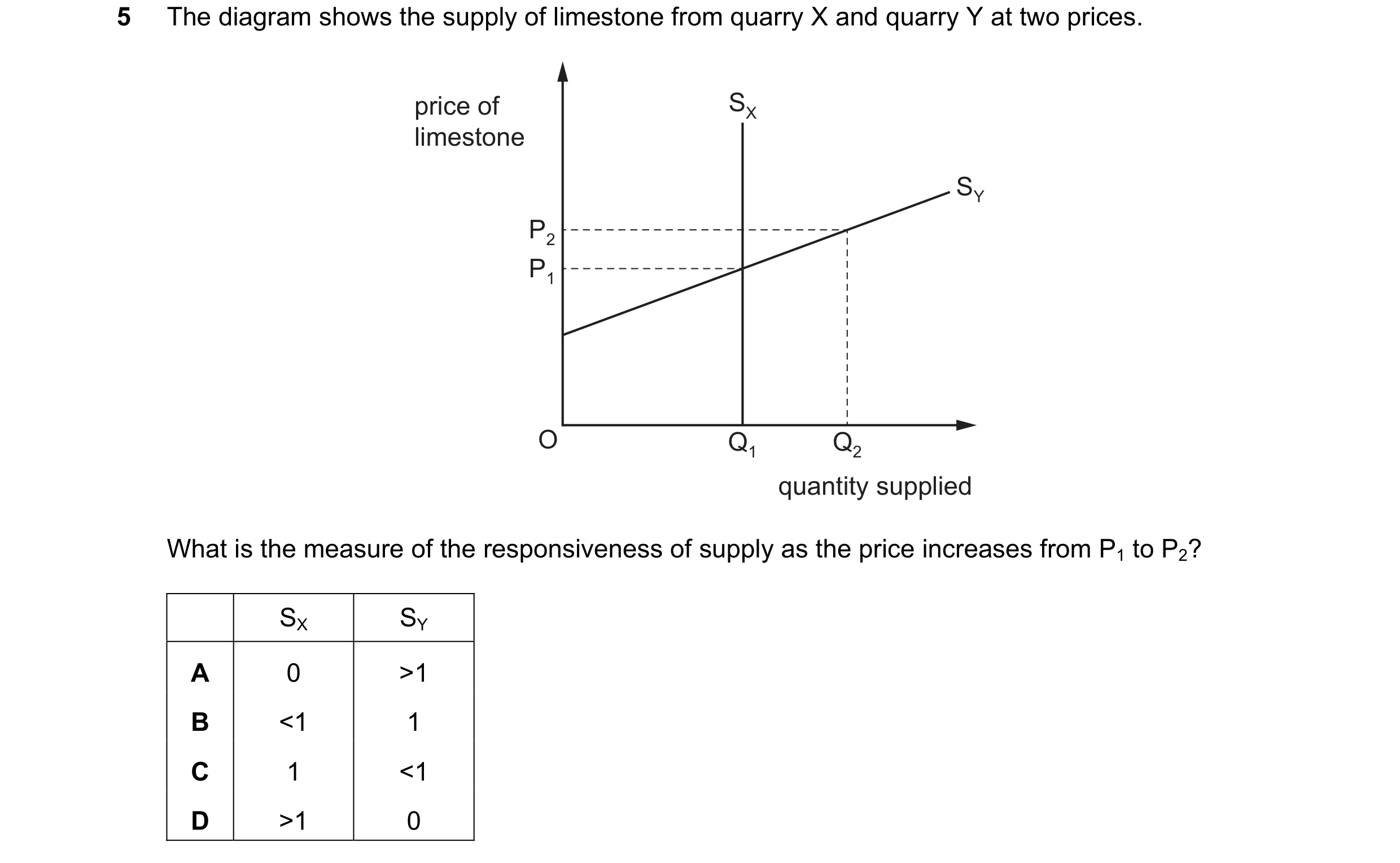
 21 / 41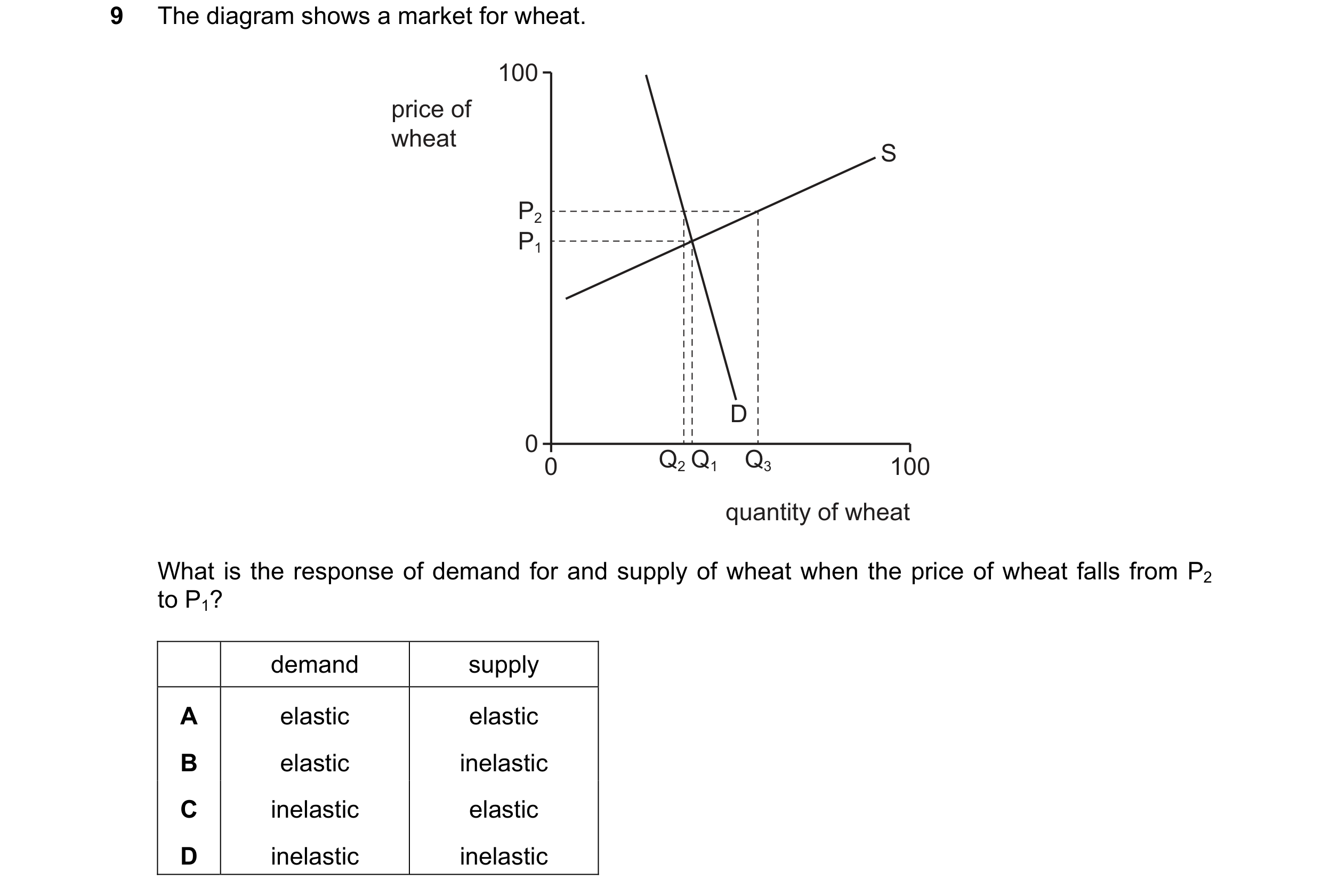
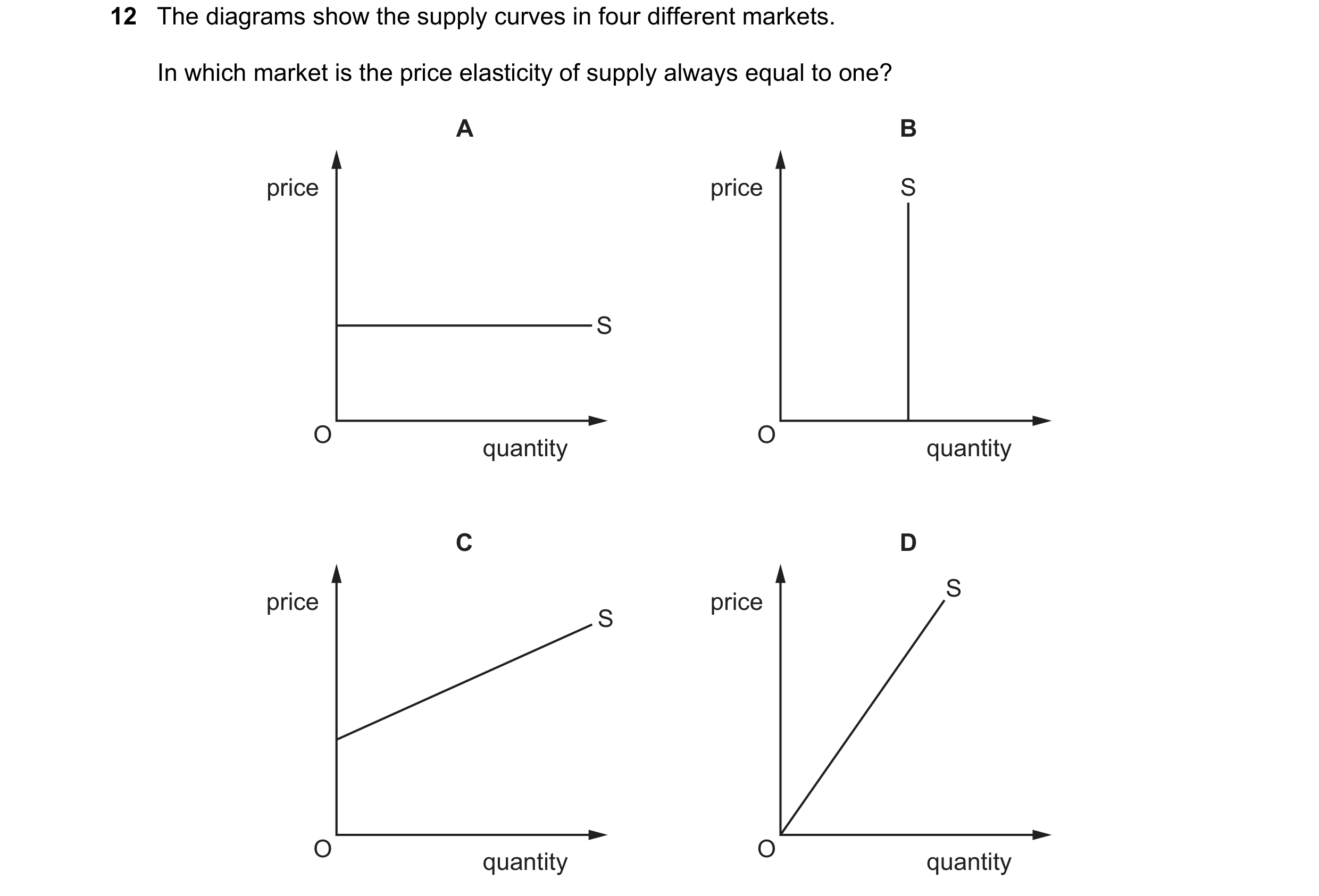 22 / 41
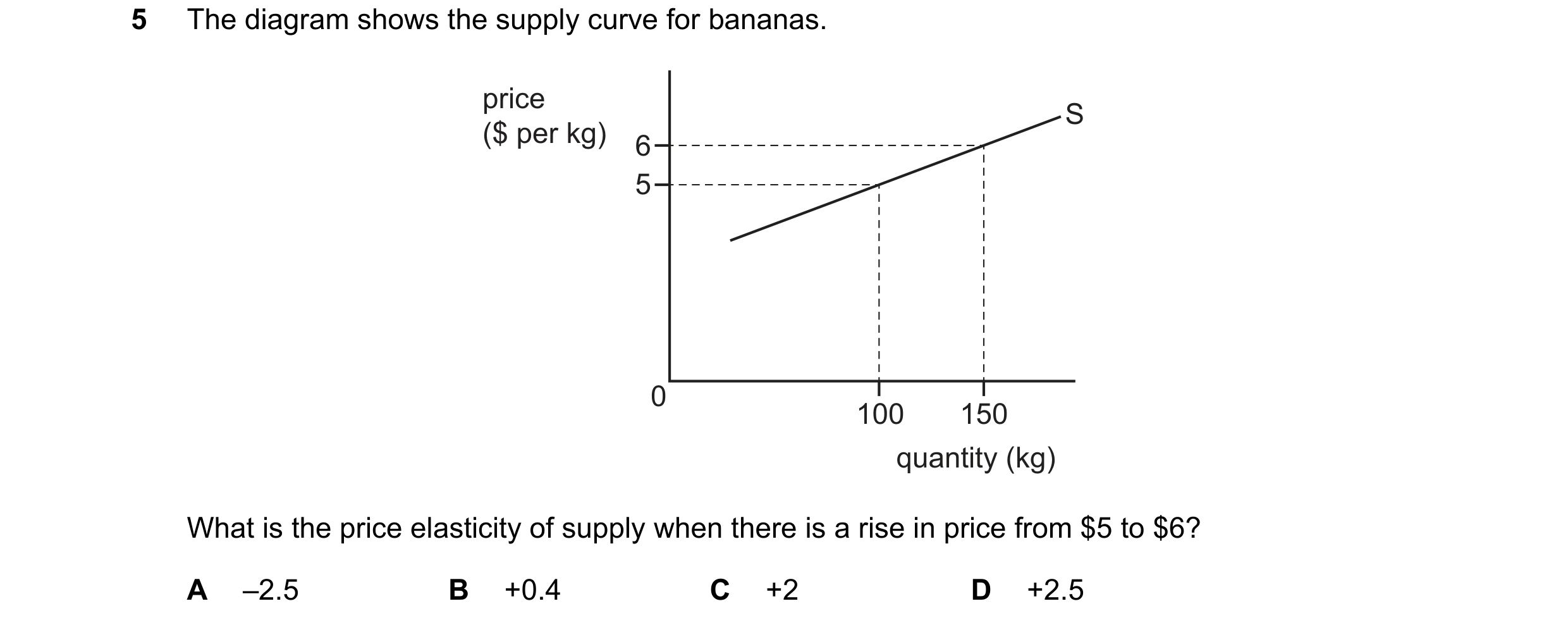
 23 / 41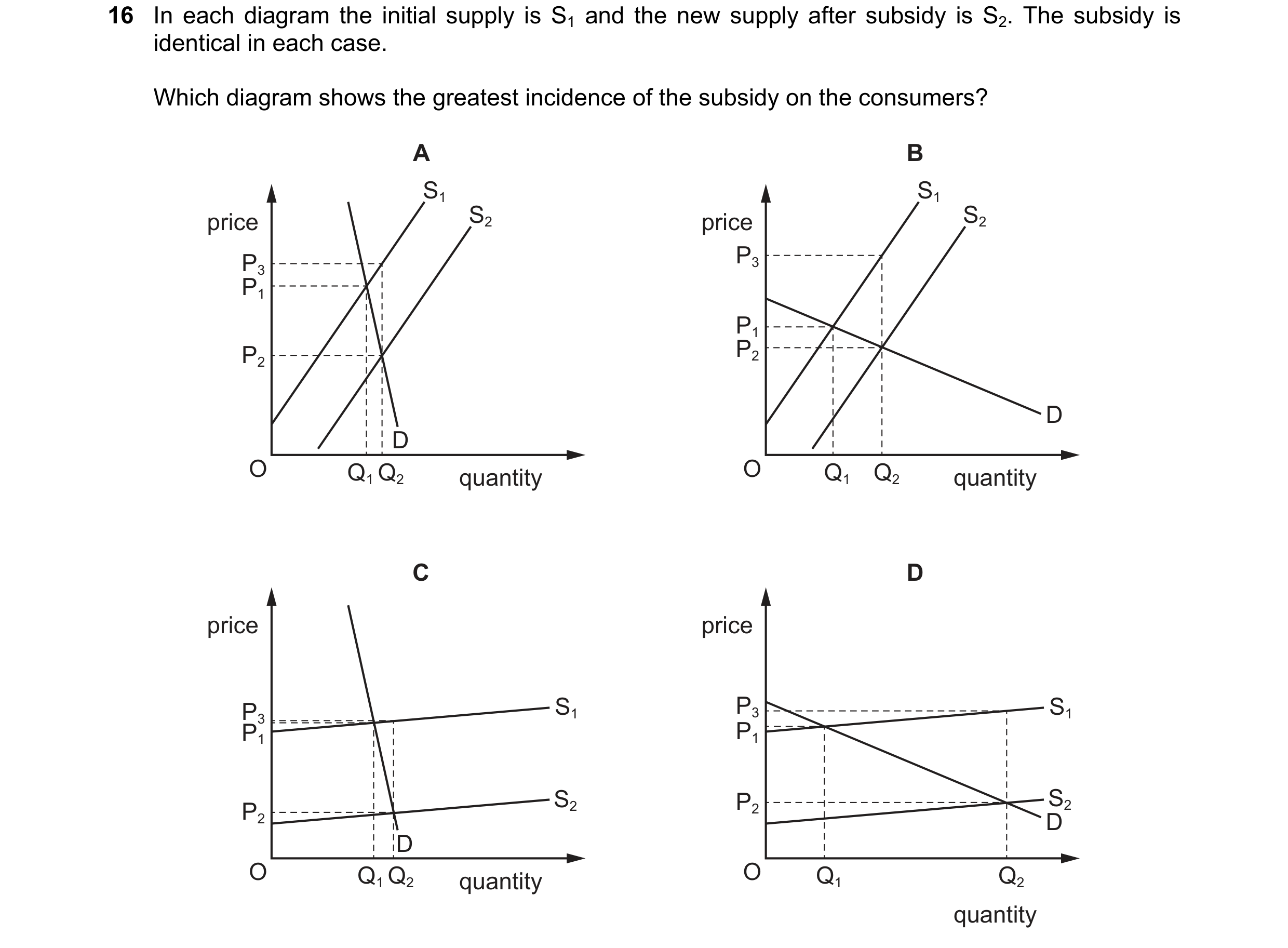

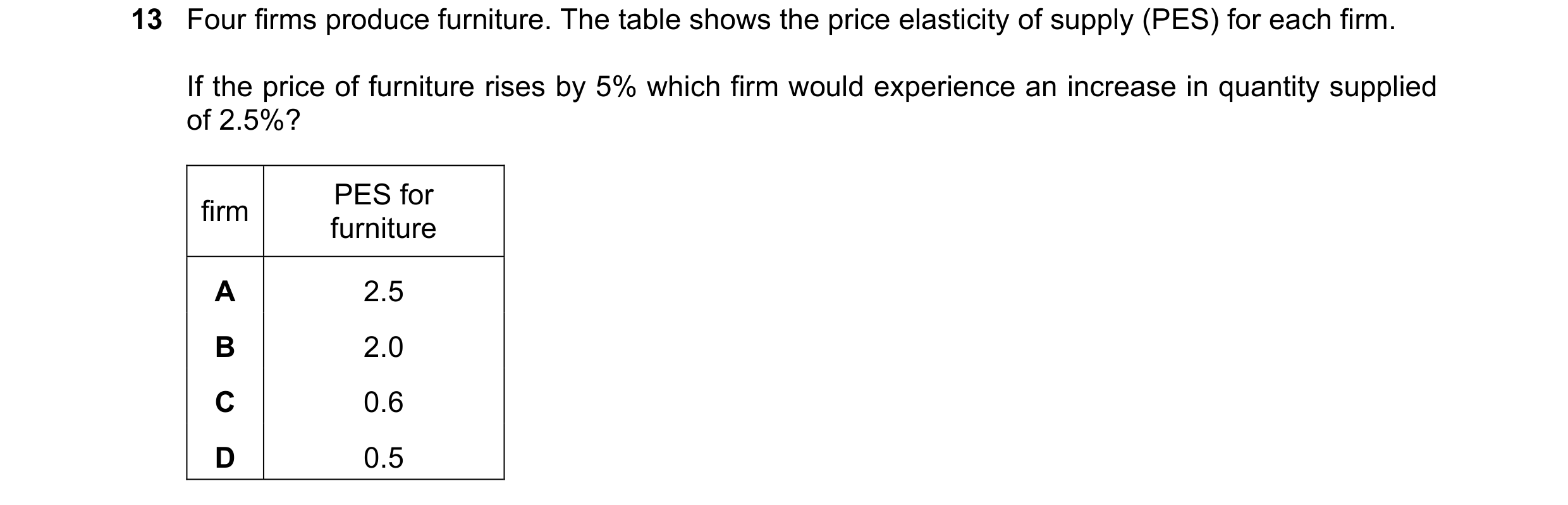 24 / 41
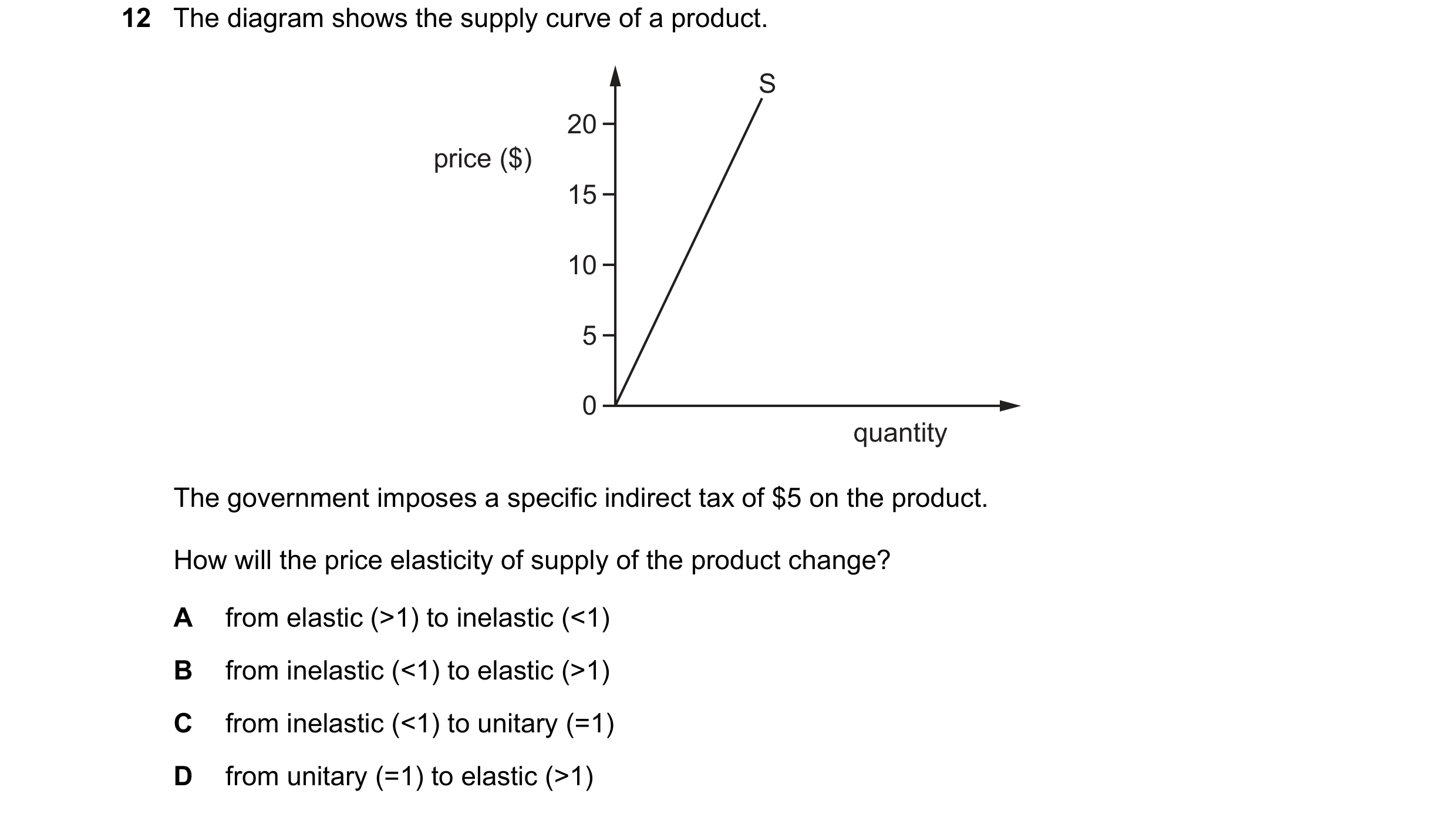 25 / 41
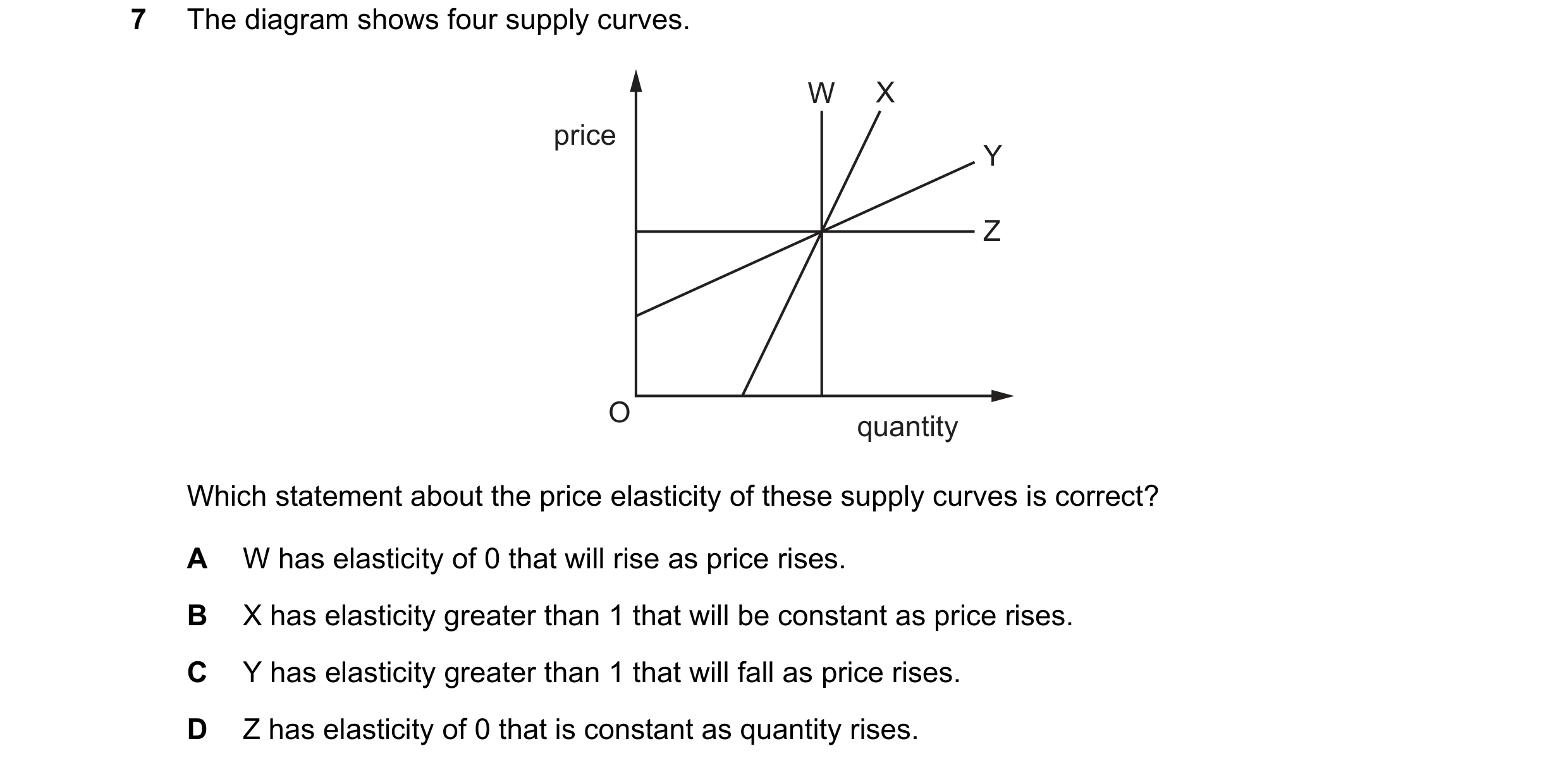
 26 / 41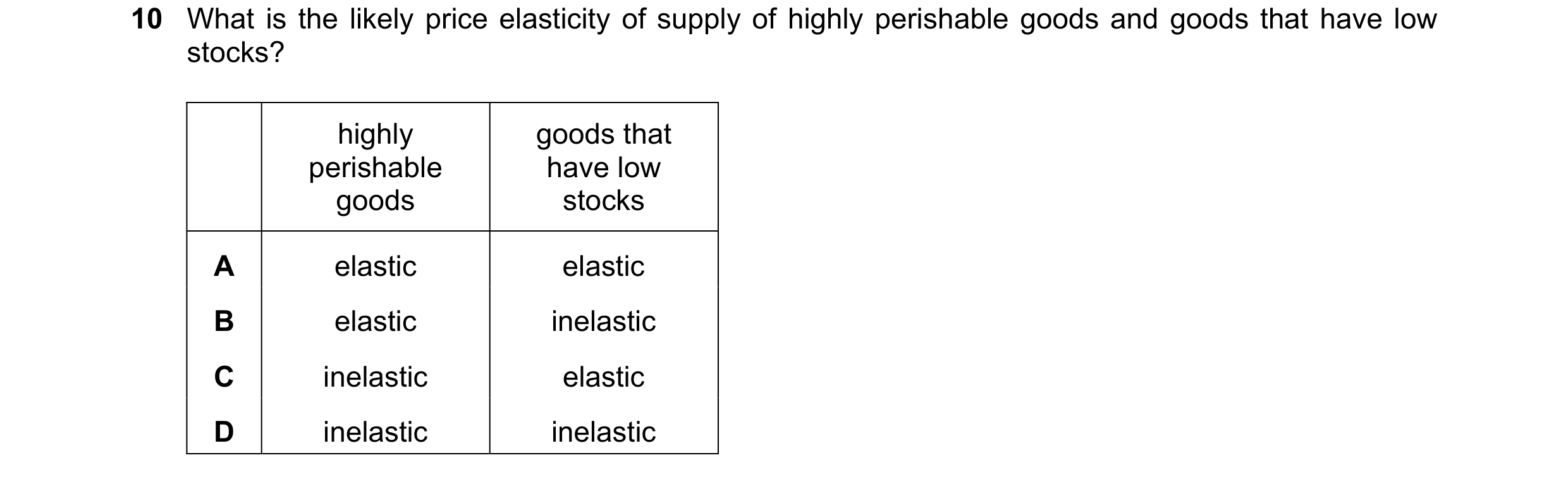

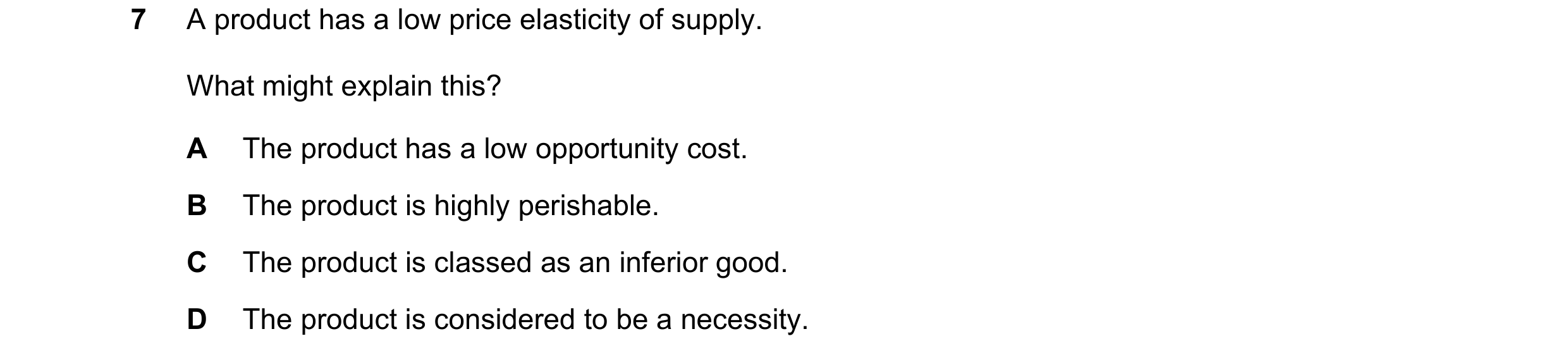
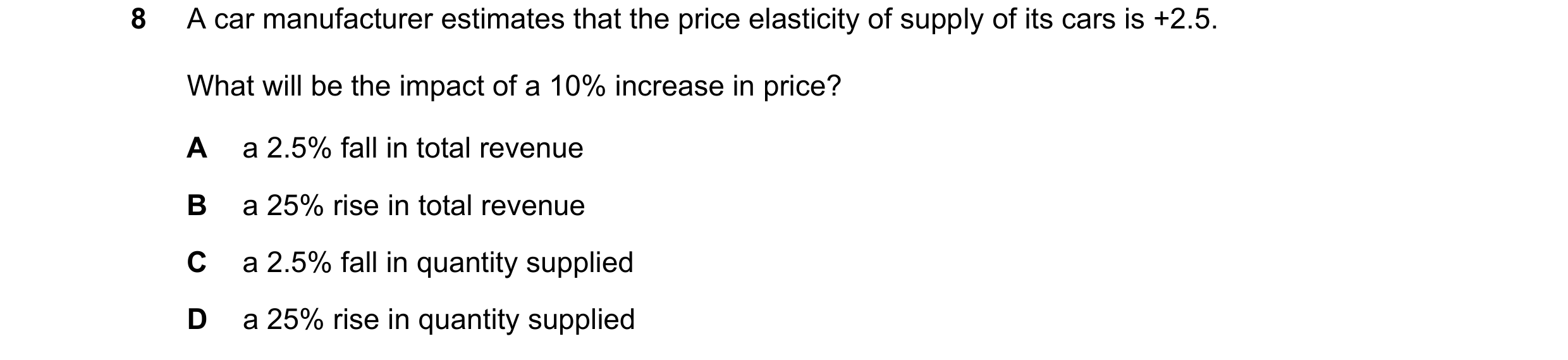 27 / 41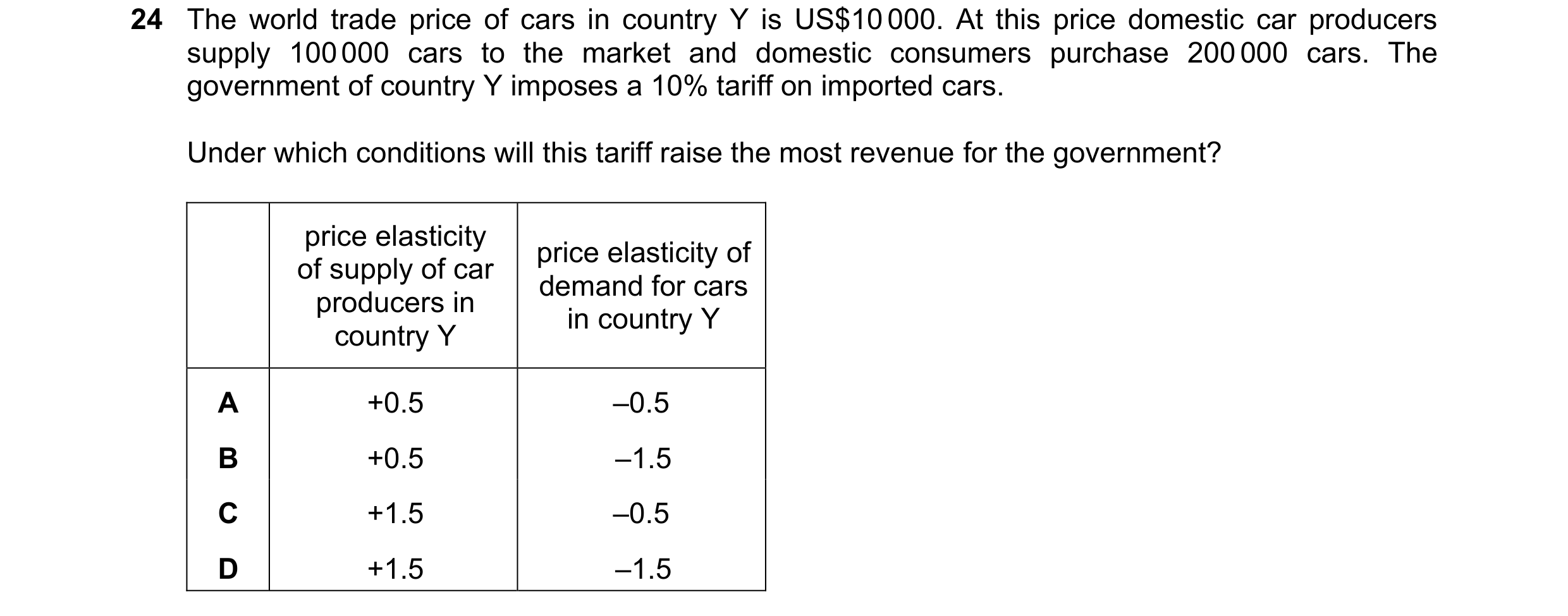
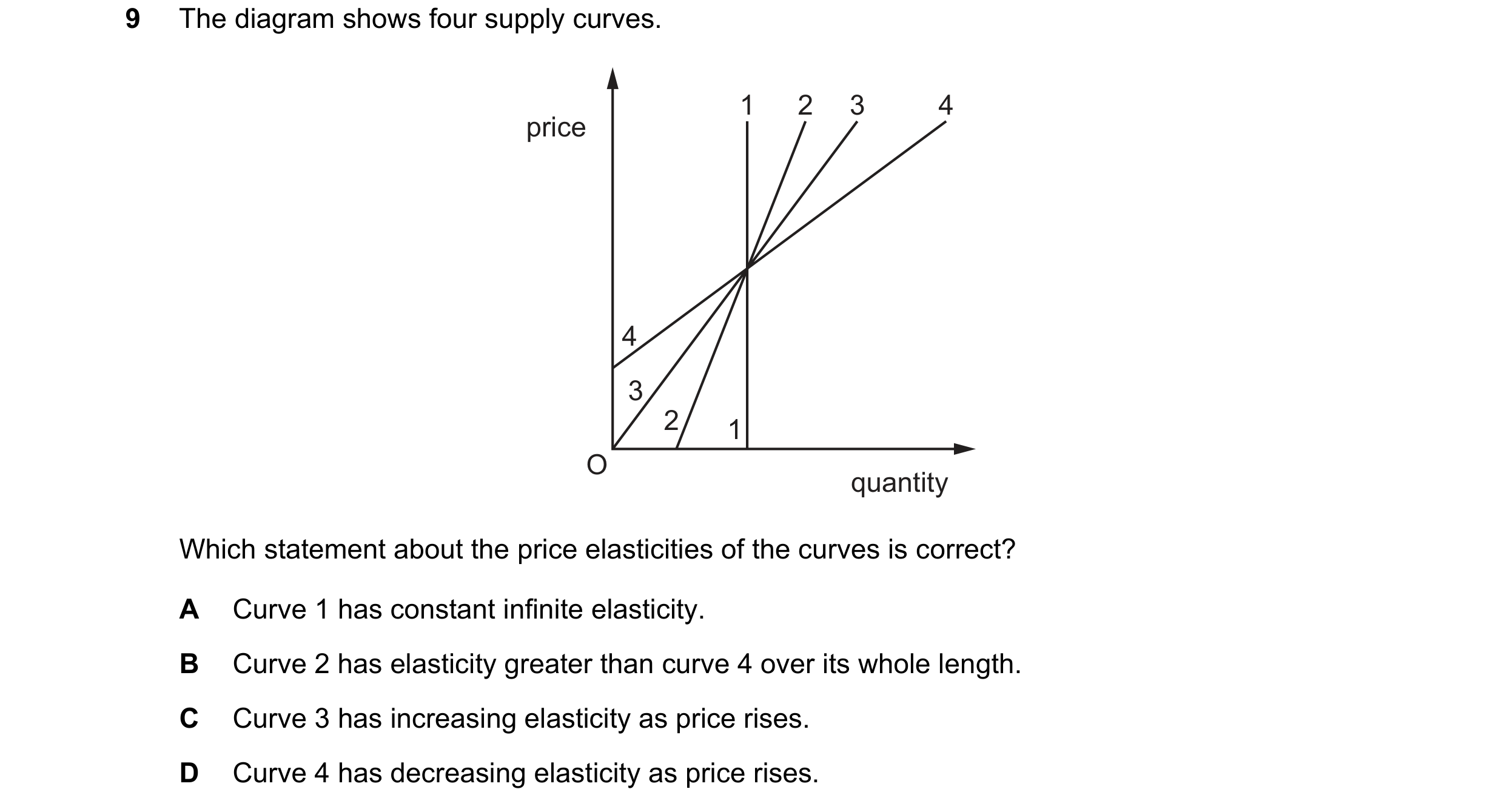
 28 / 41
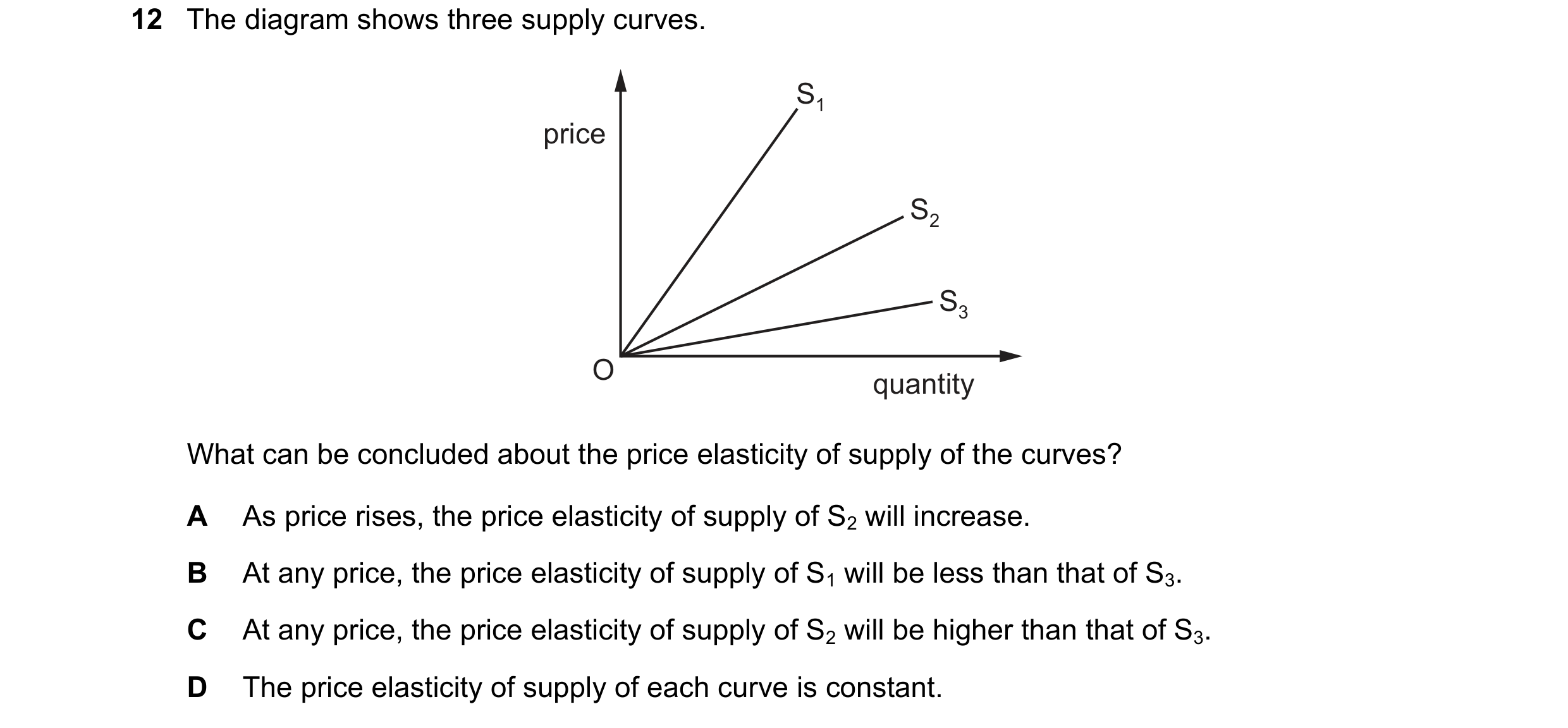
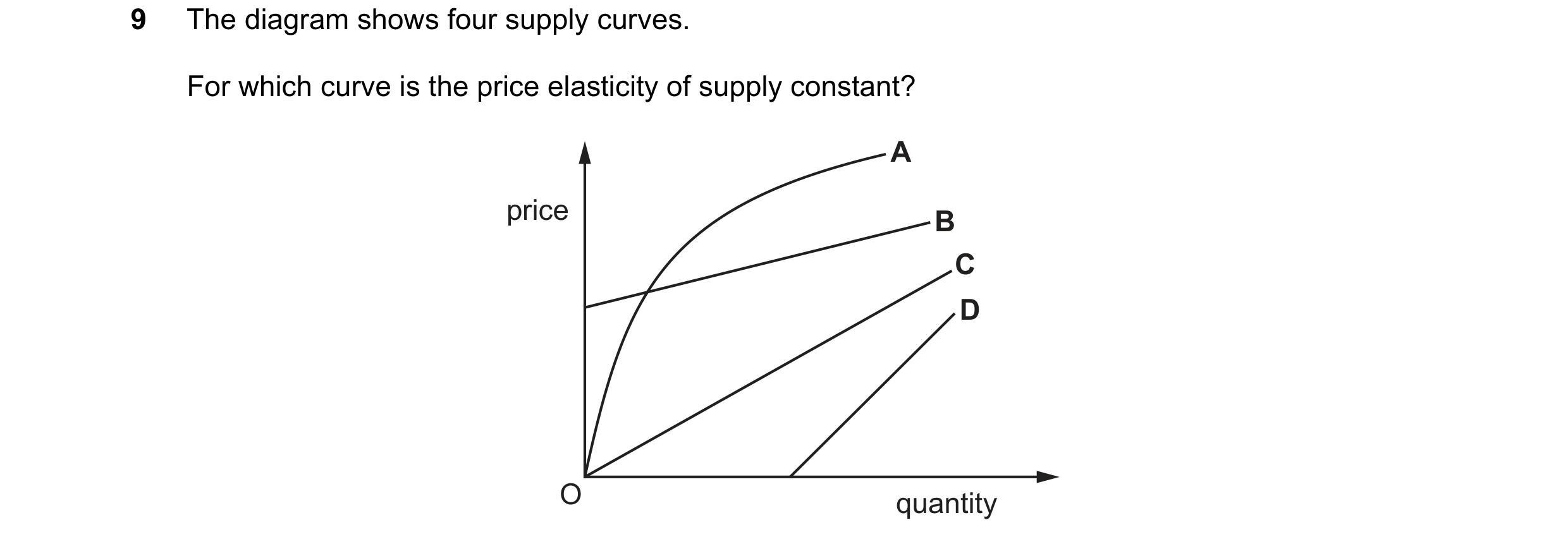
 29 / 41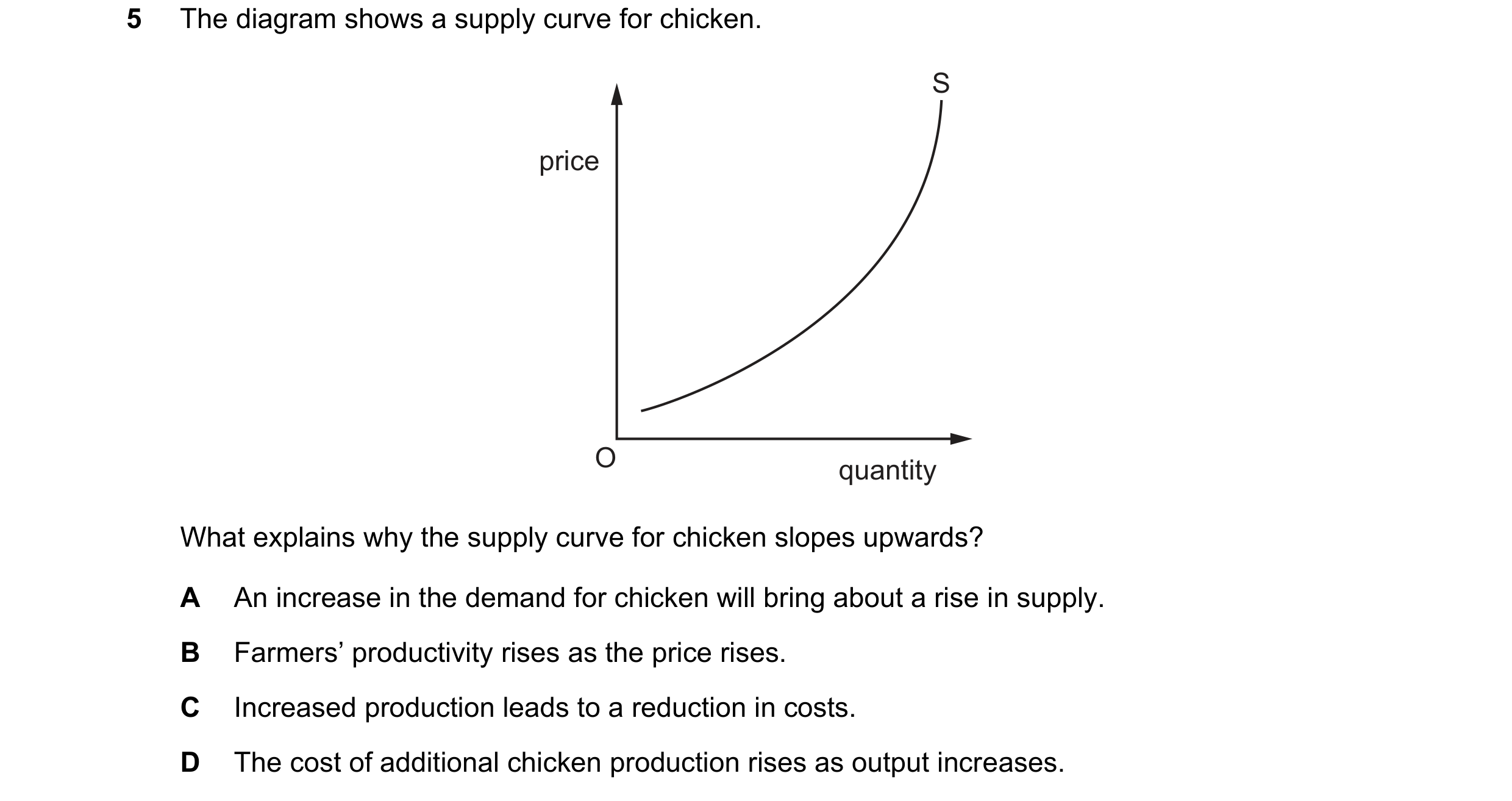

 30 / 41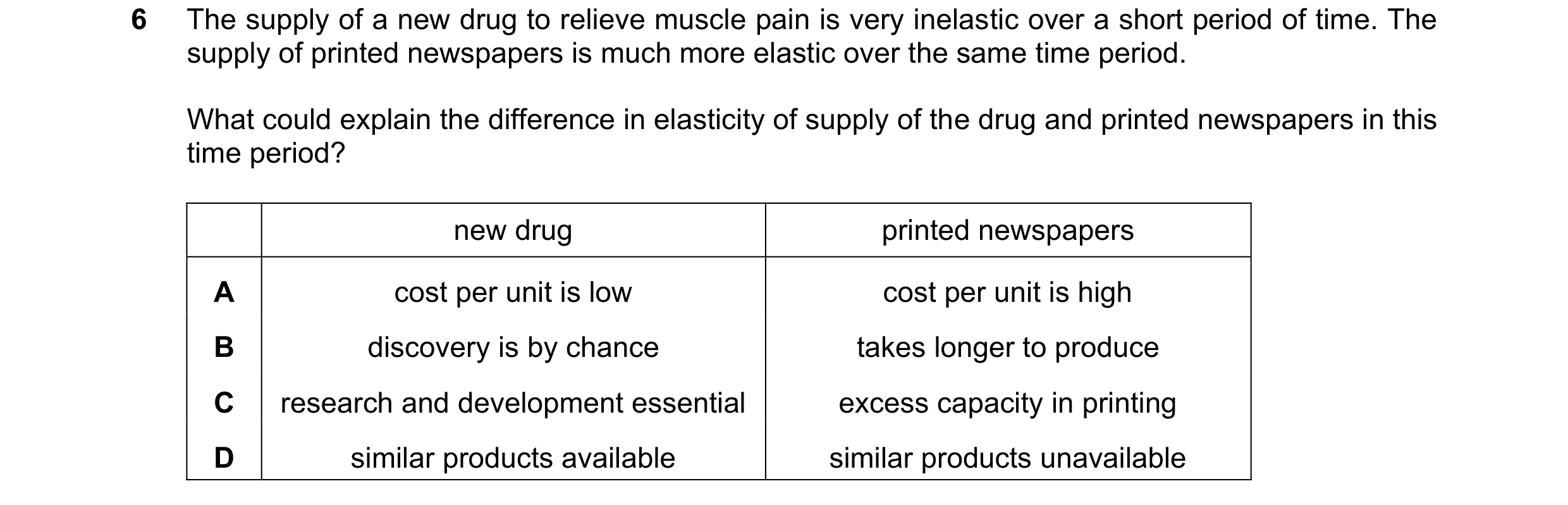

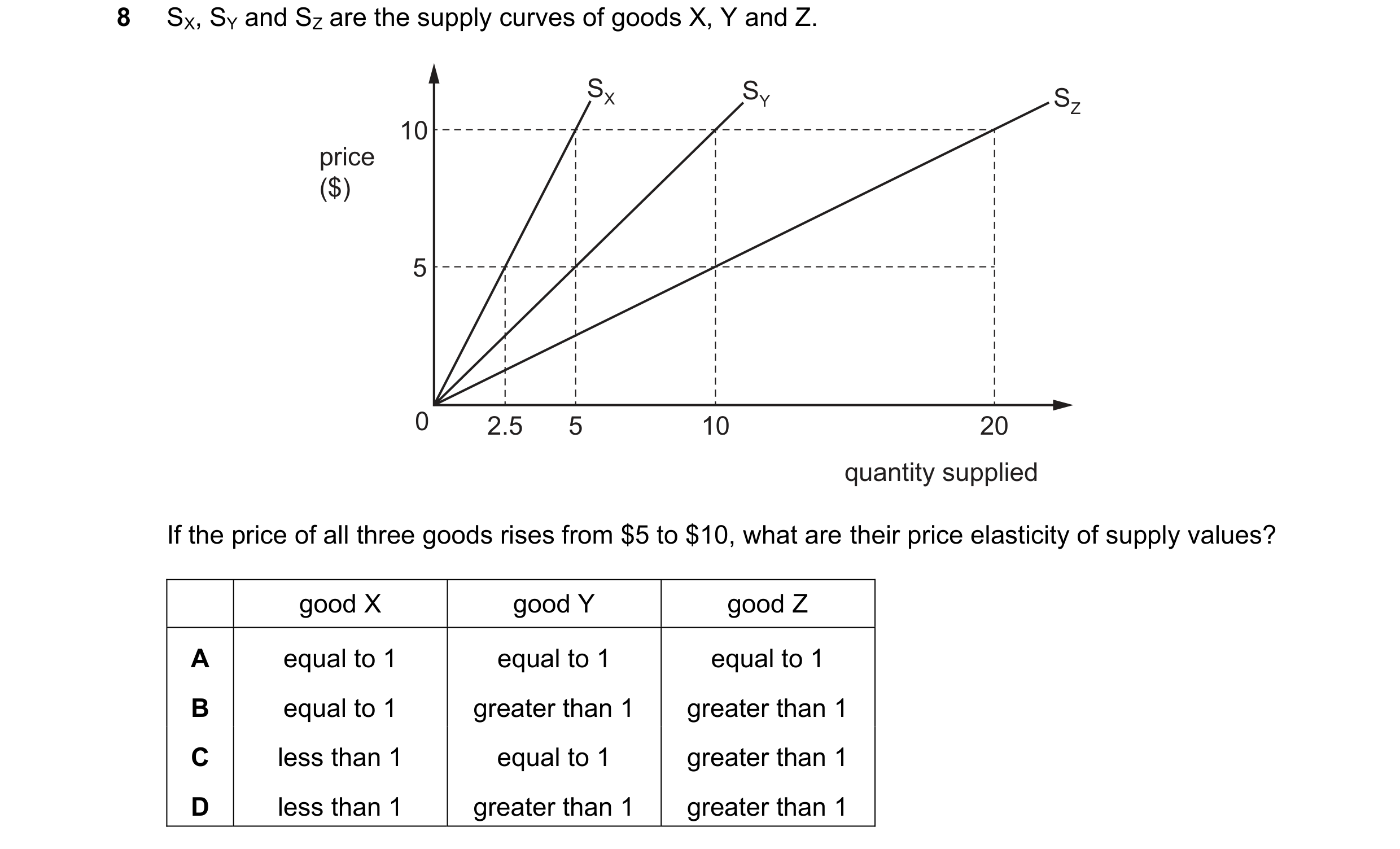
 31 / 41
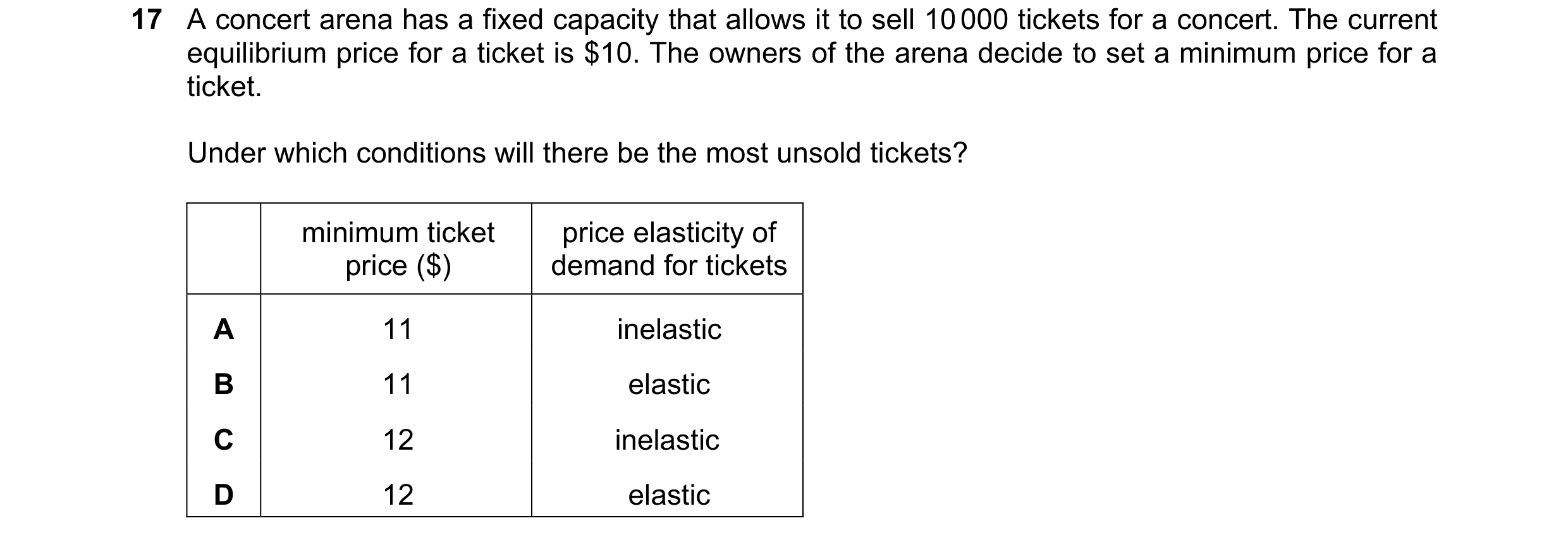

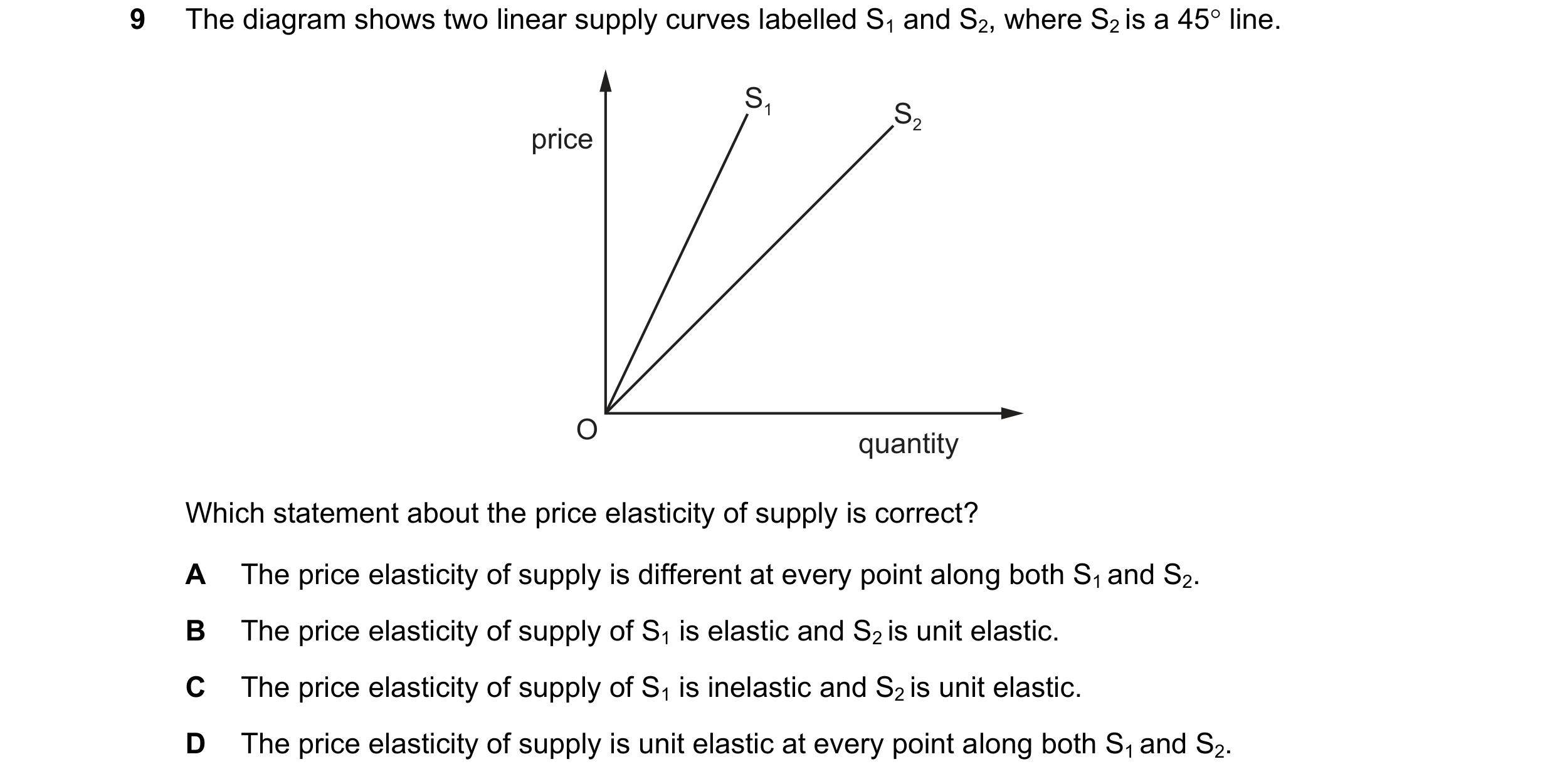 32 / 41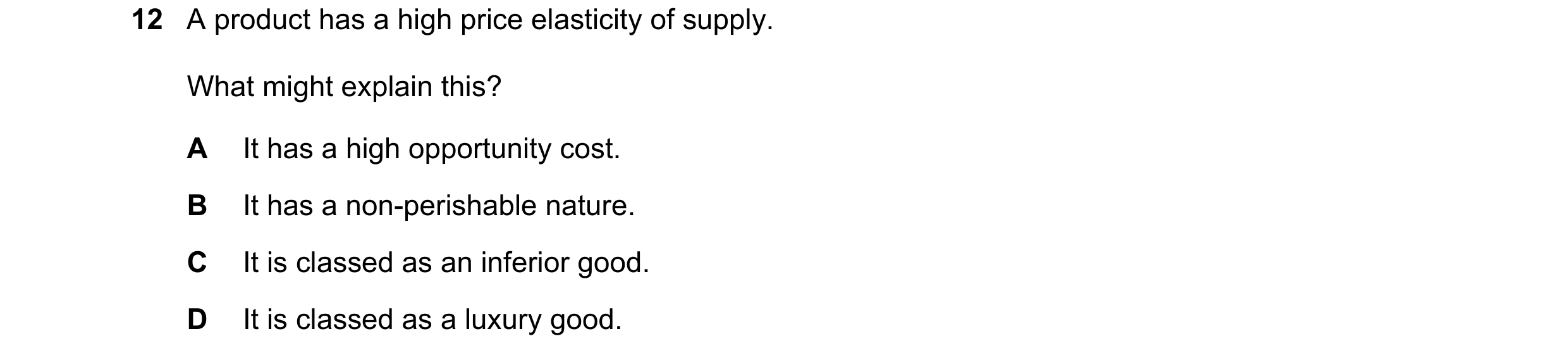

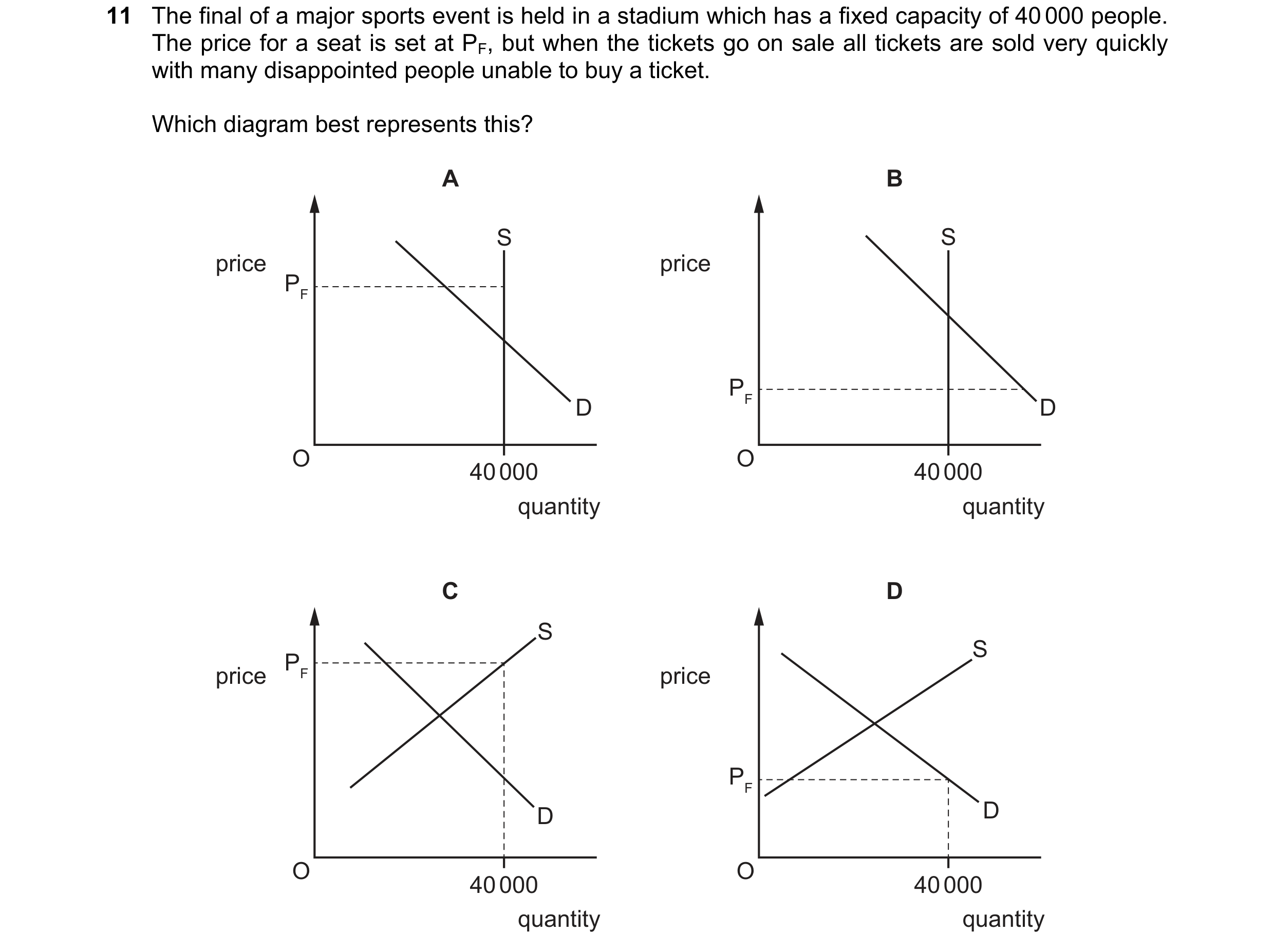 33 / 41
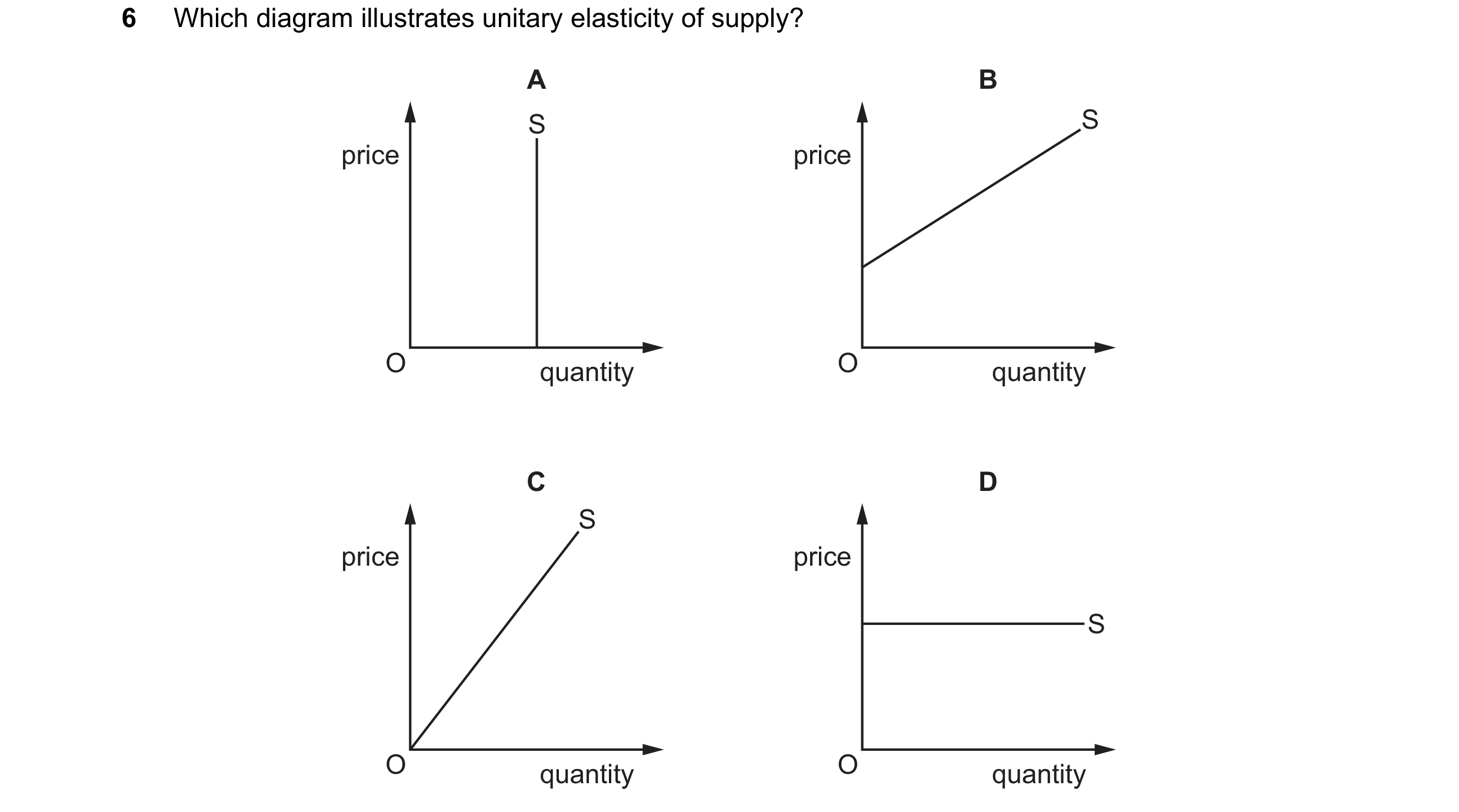
 34 / 41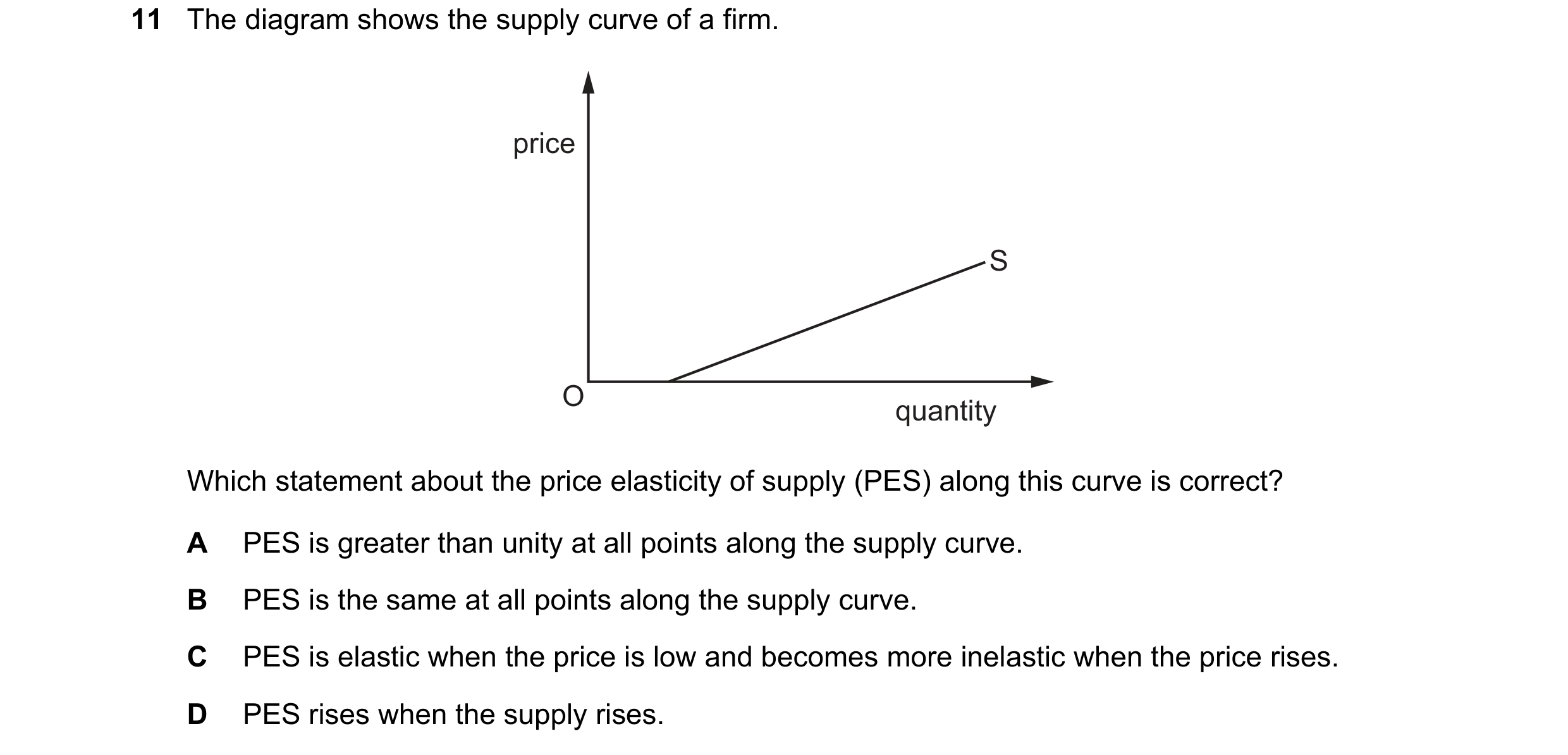
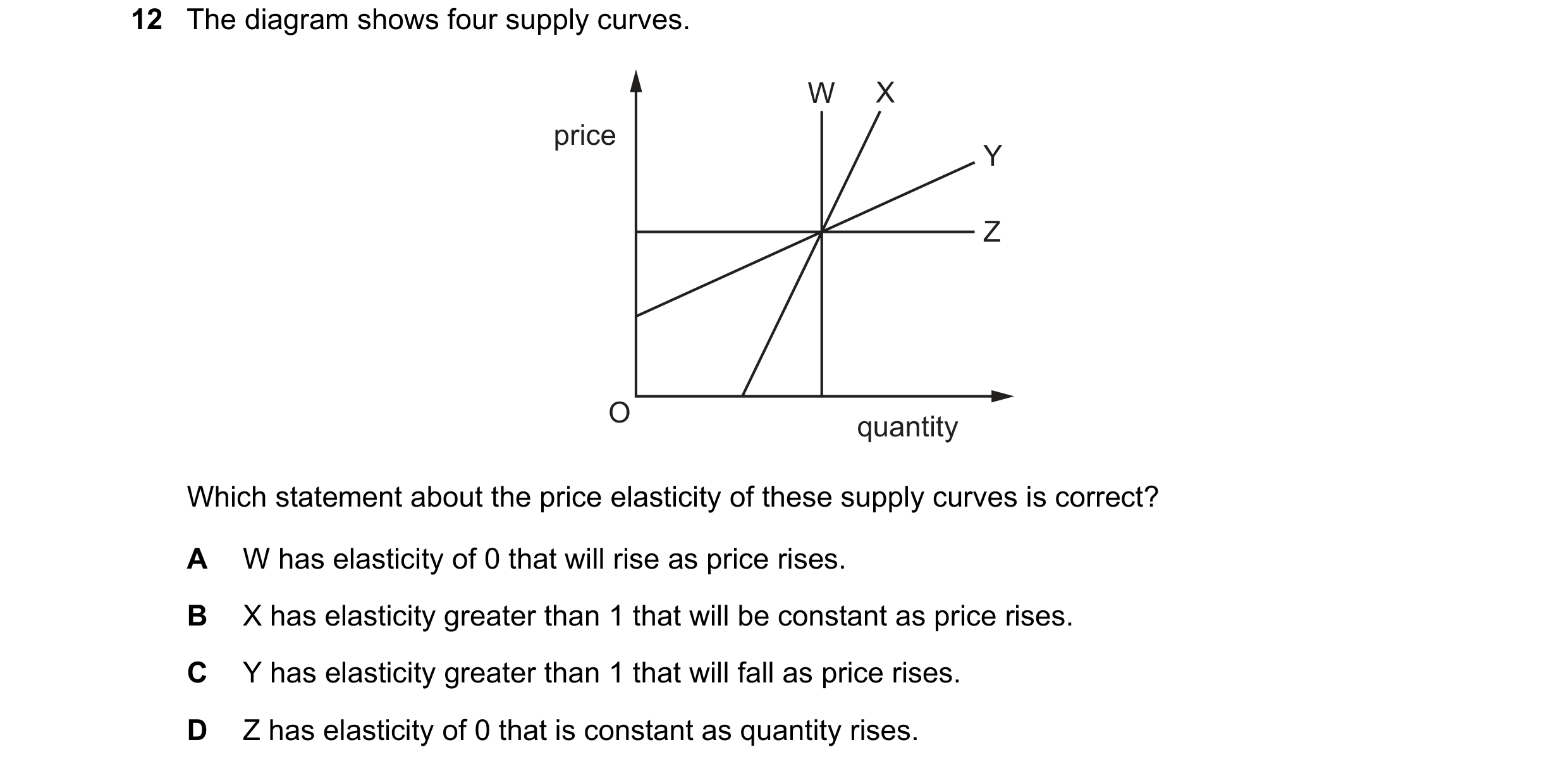
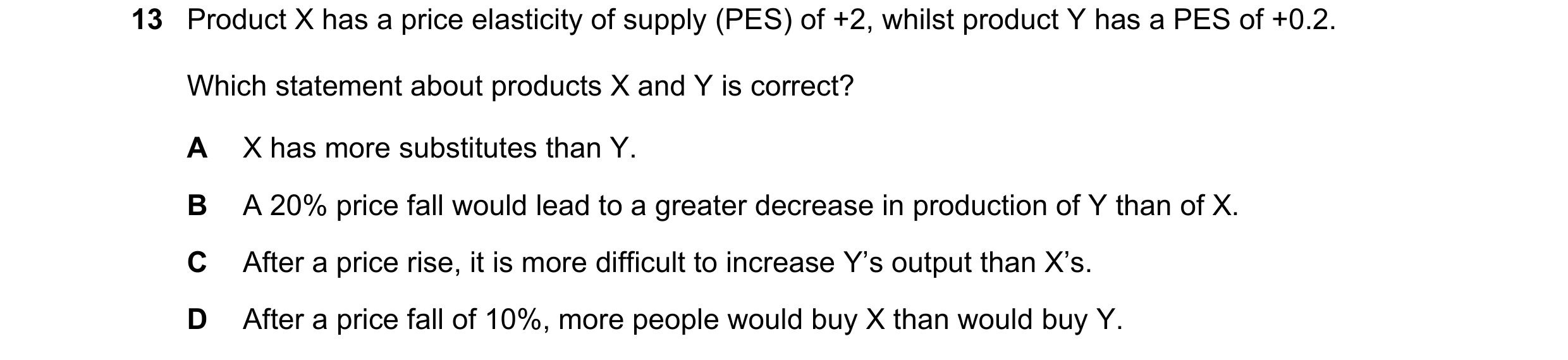 35 / 41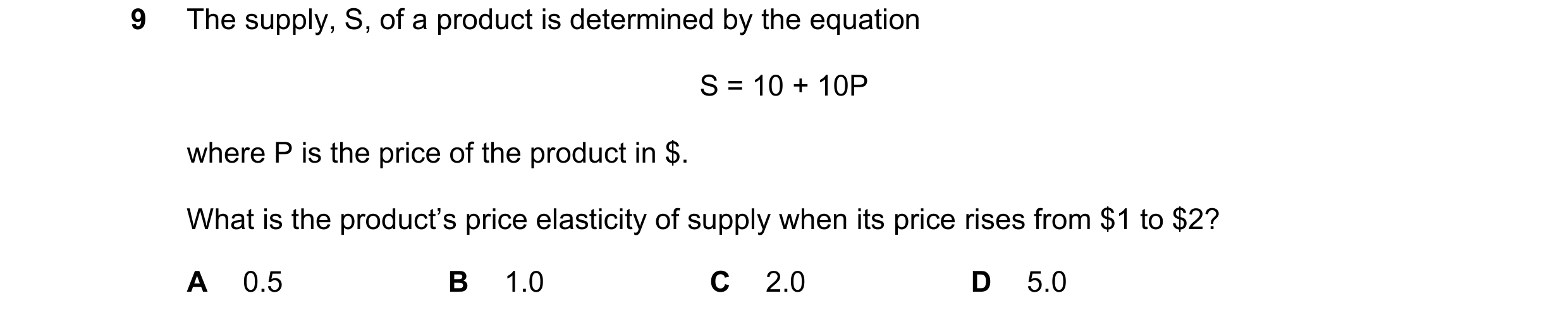
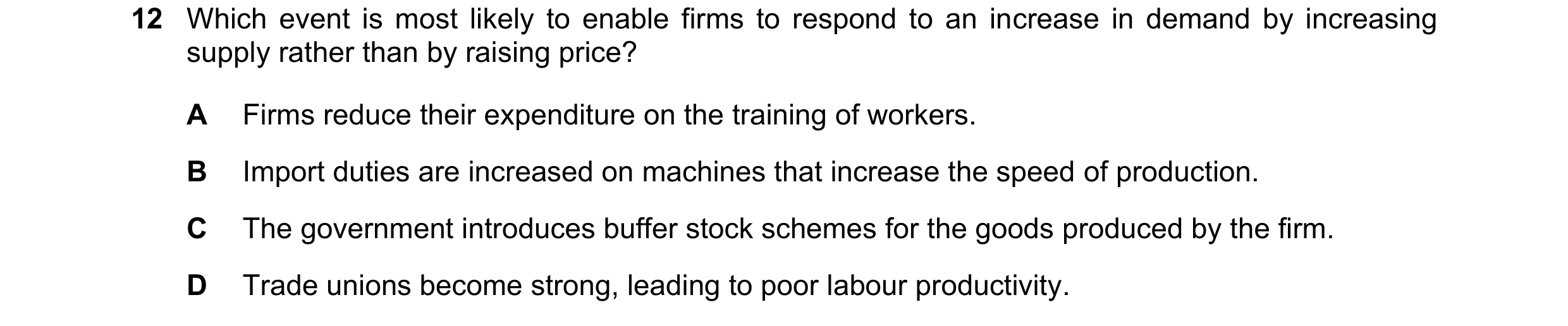
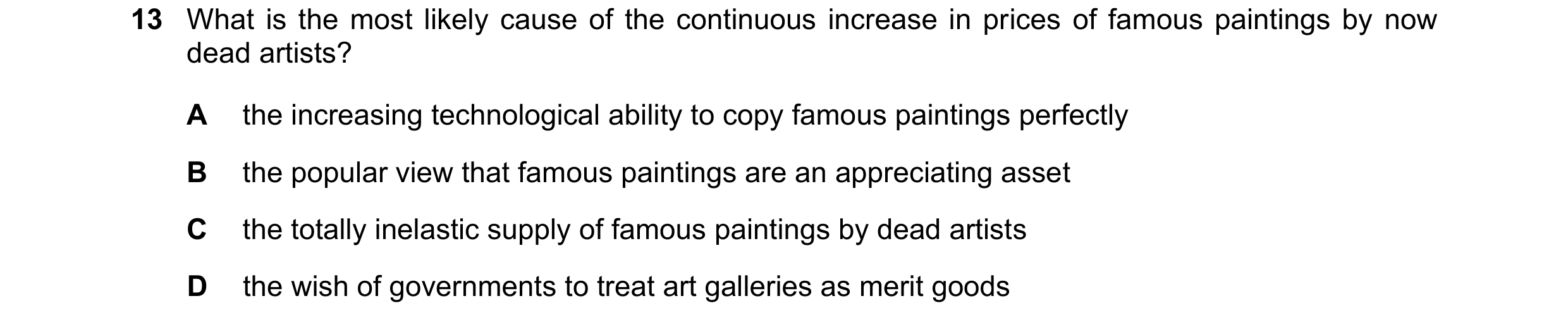
 36 / 41

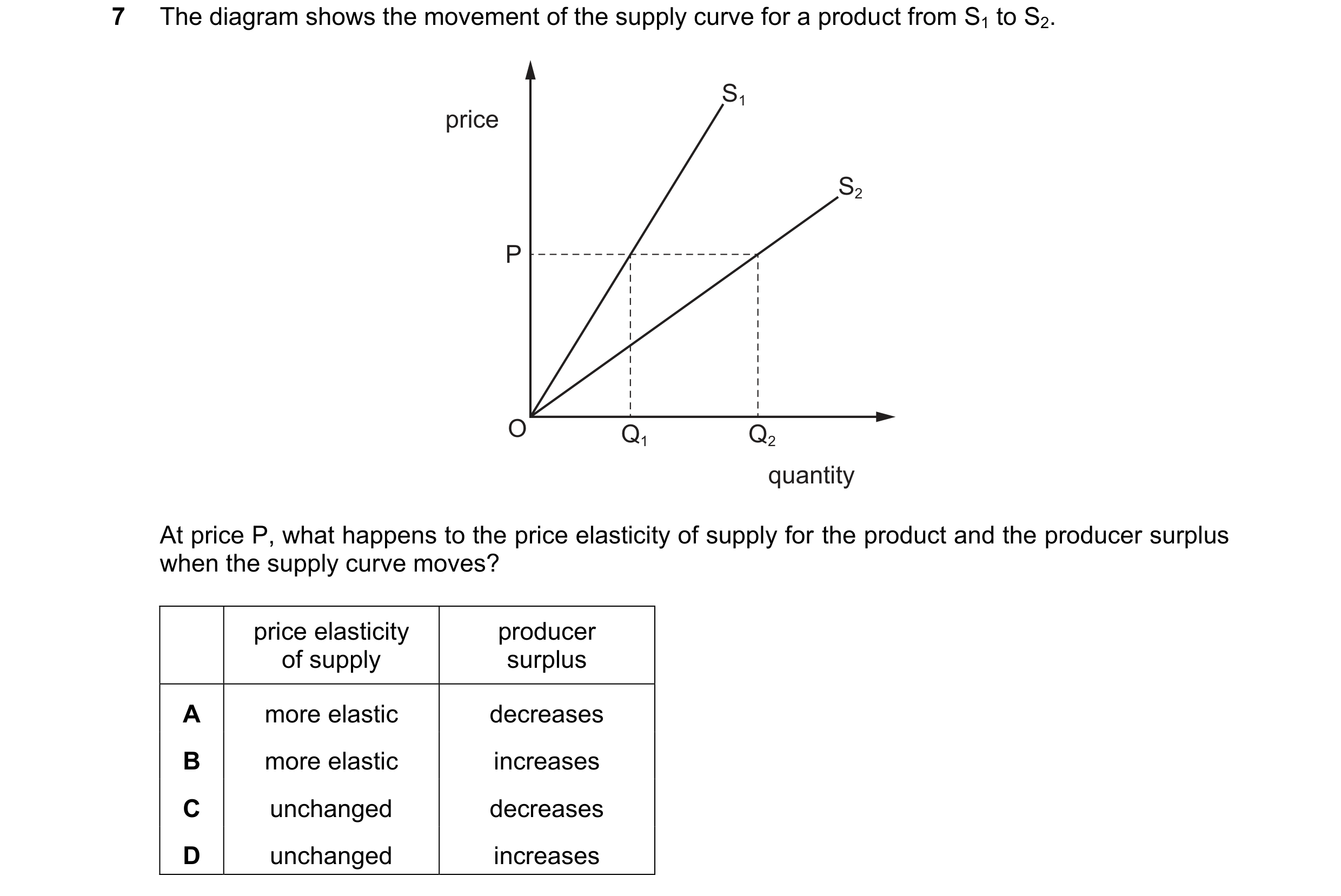 37 / 41
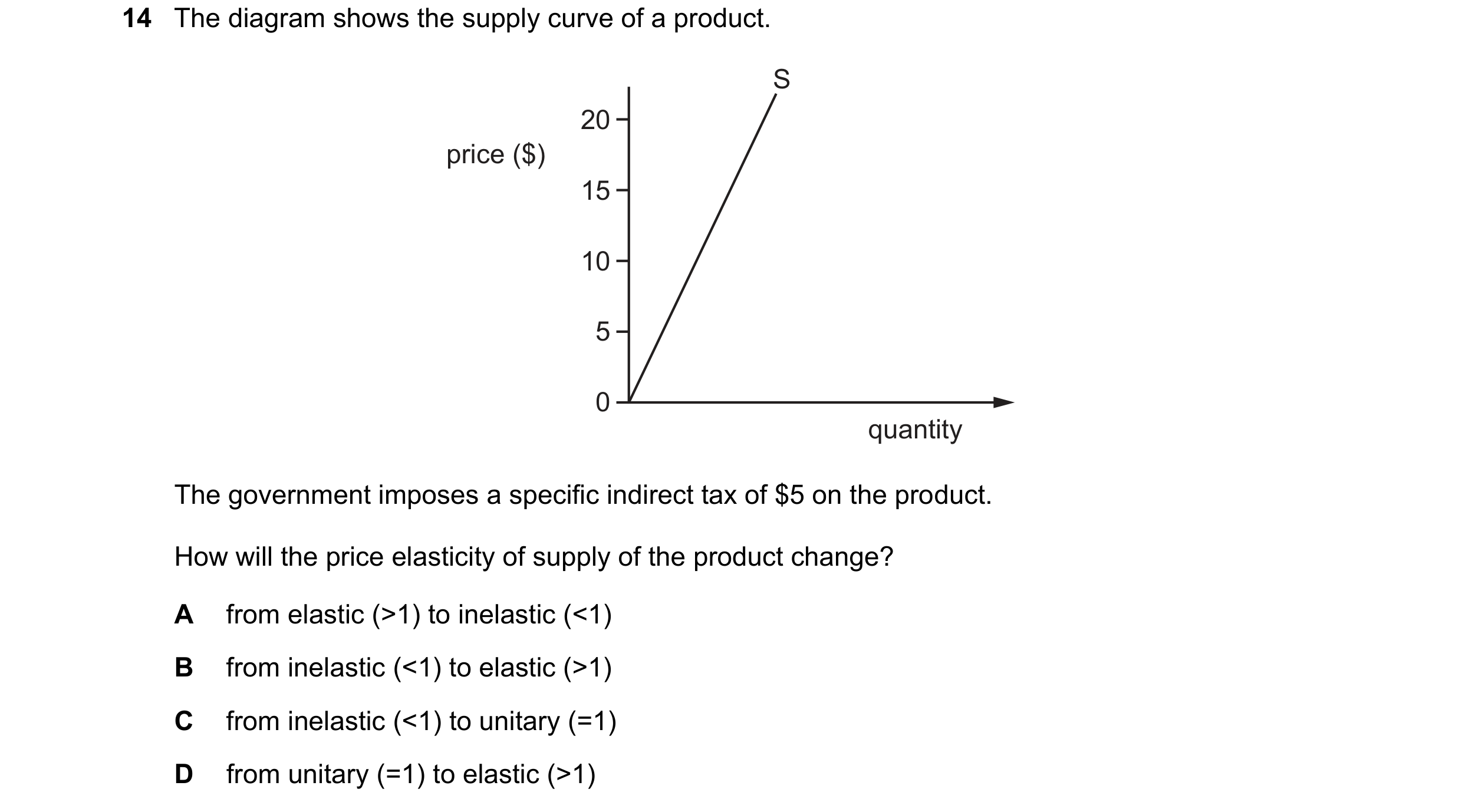

 38 / 41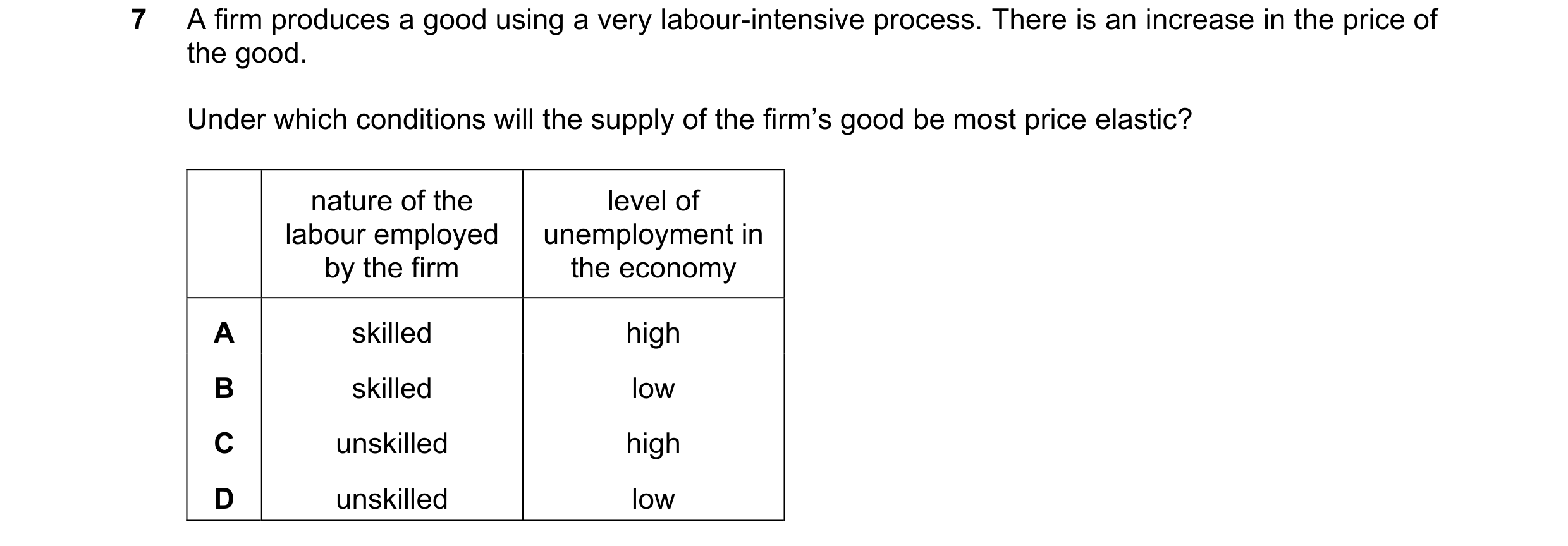
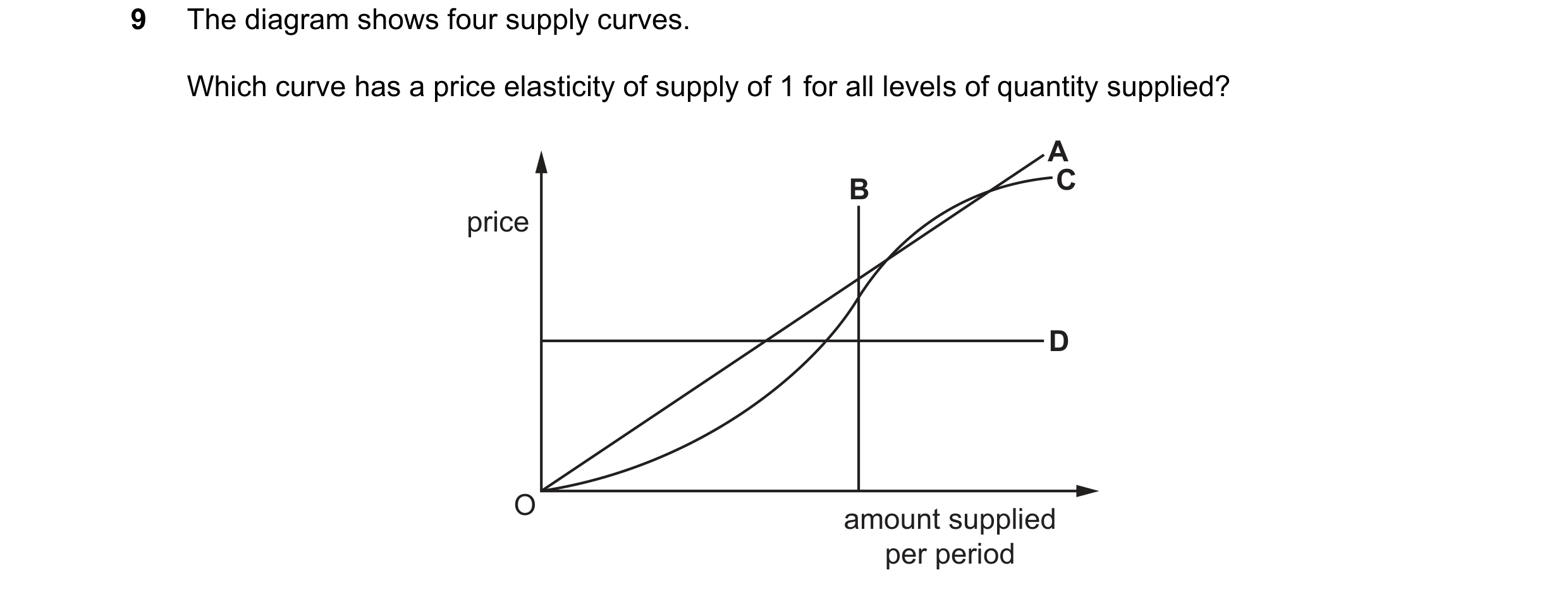


 39 / 41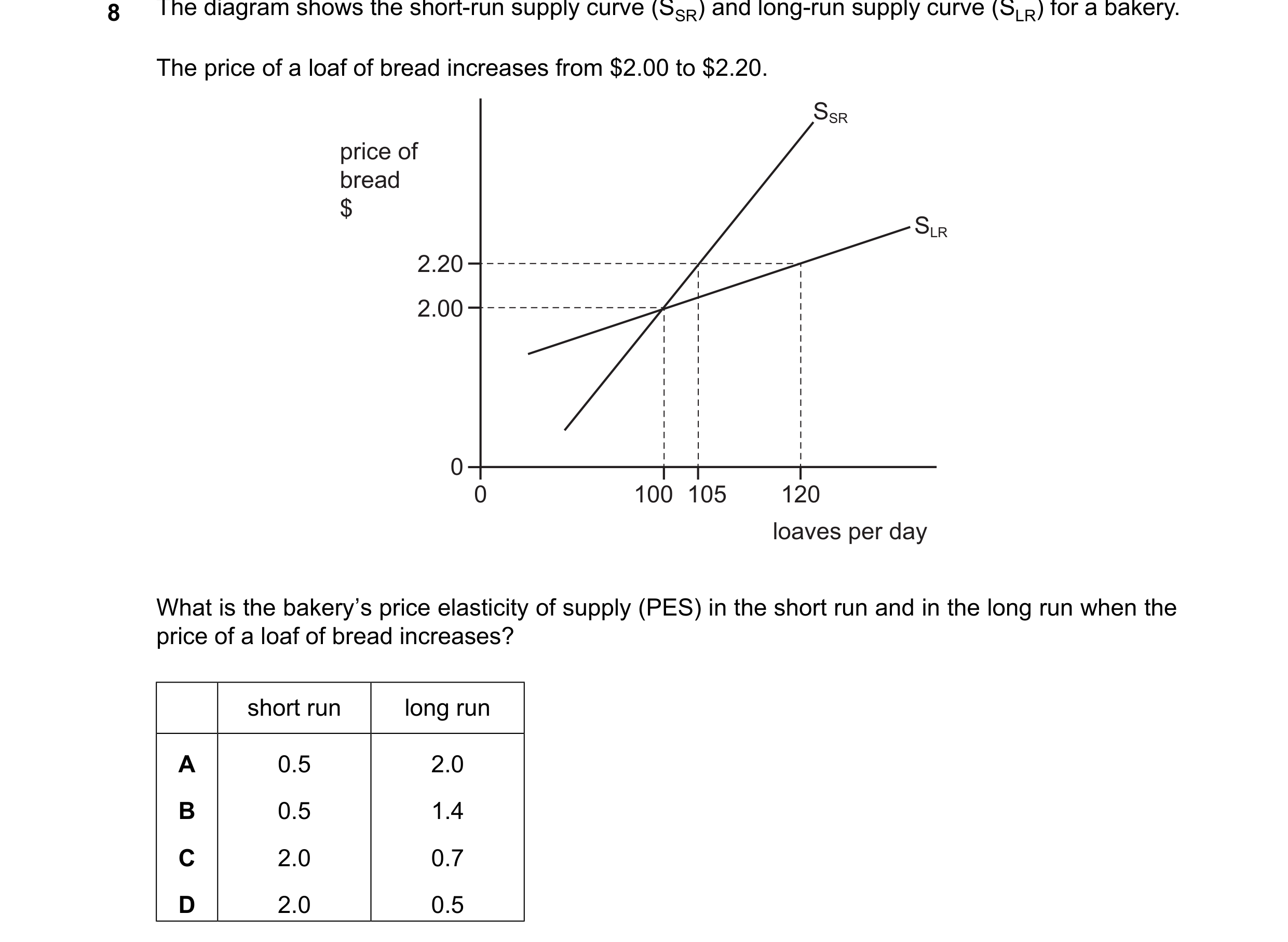
 40 / 41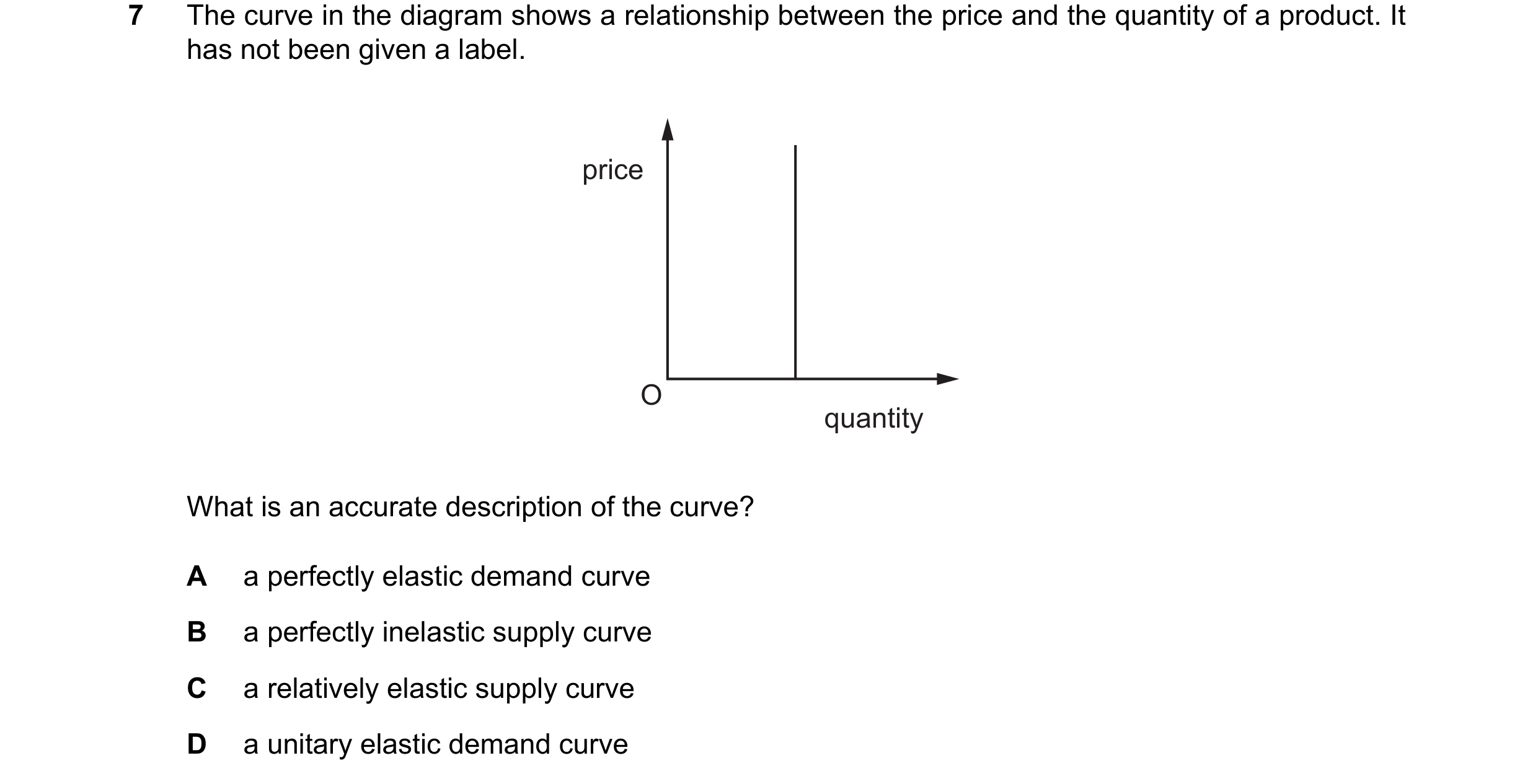
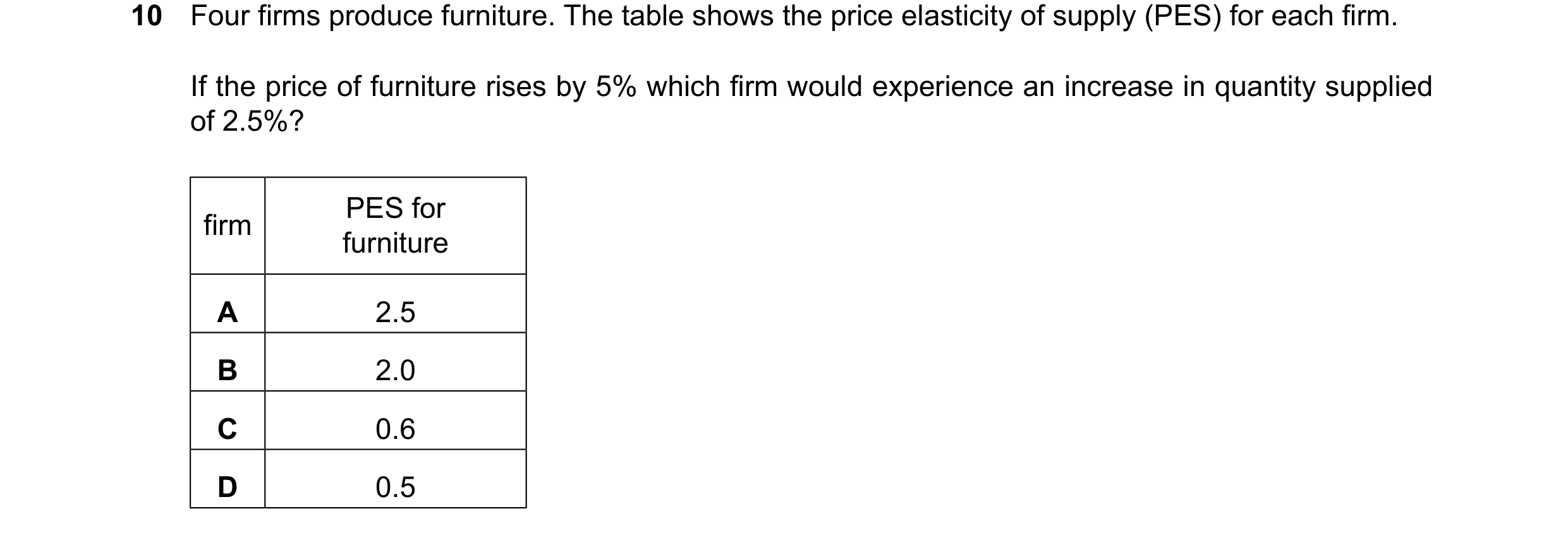
 41 / 41