Cambridge A Level Economics 9708 — 2023 Oct/Nov Paper 1 · Variant 3
9708/13/O/N/23 · 30 questions · 30 marks · ≈34 min
The question paper and its mark scheme, free to read here and free to download. This is Cambridge’s own paper, exactly as it was sat.
Question paper12 pages
Mark scheme3 pages
Answers below. Sit the paper first if you are practising.
Questions as text
Q1 · A factory introduces an automated production line to take advantage of division of labour
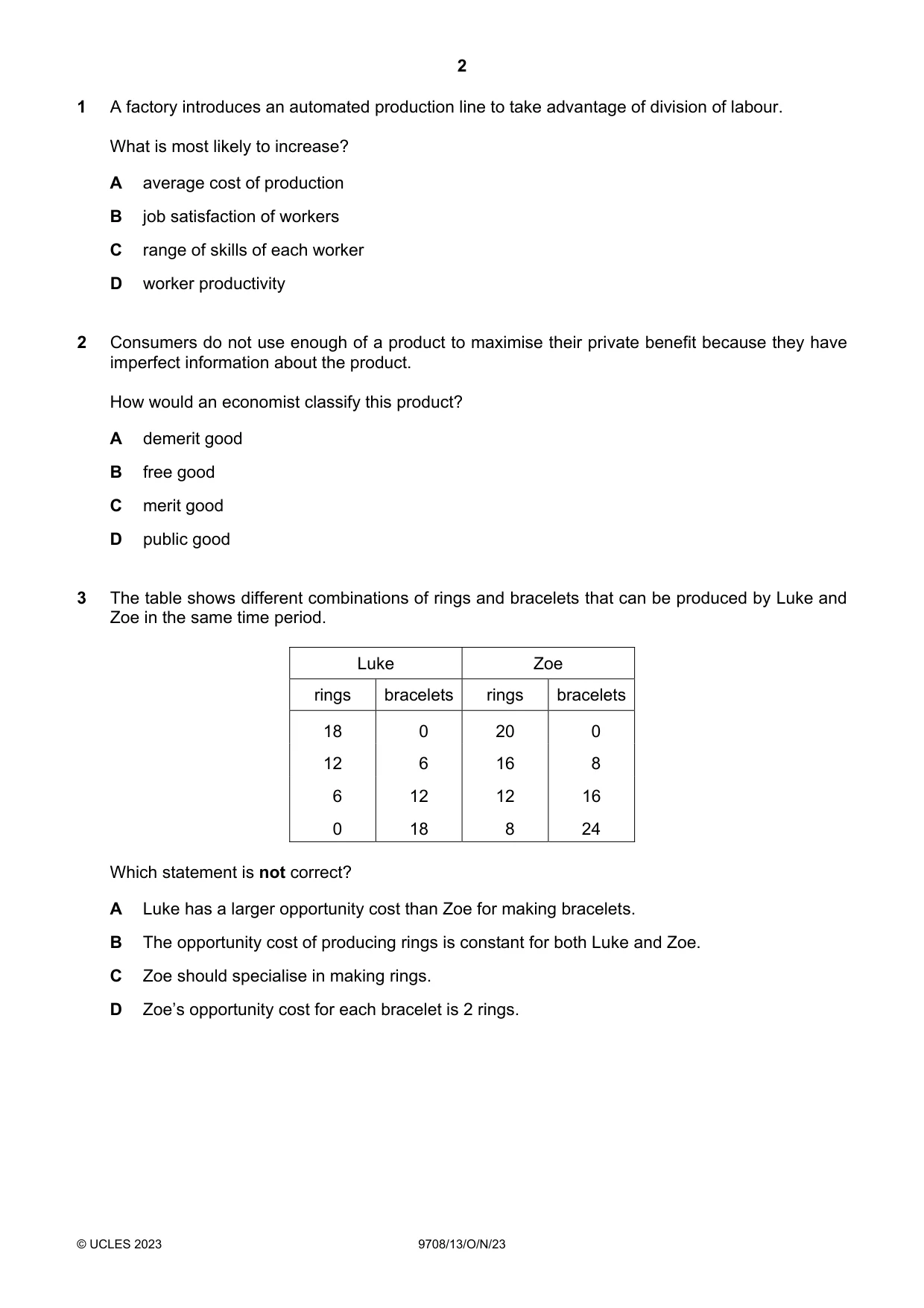
1 A factory introduces an automated production line to take advantage of division of labour. What is most likely to increase? A average cost of production B job satisfaction of workers C range of skills of each worker D worker productivity
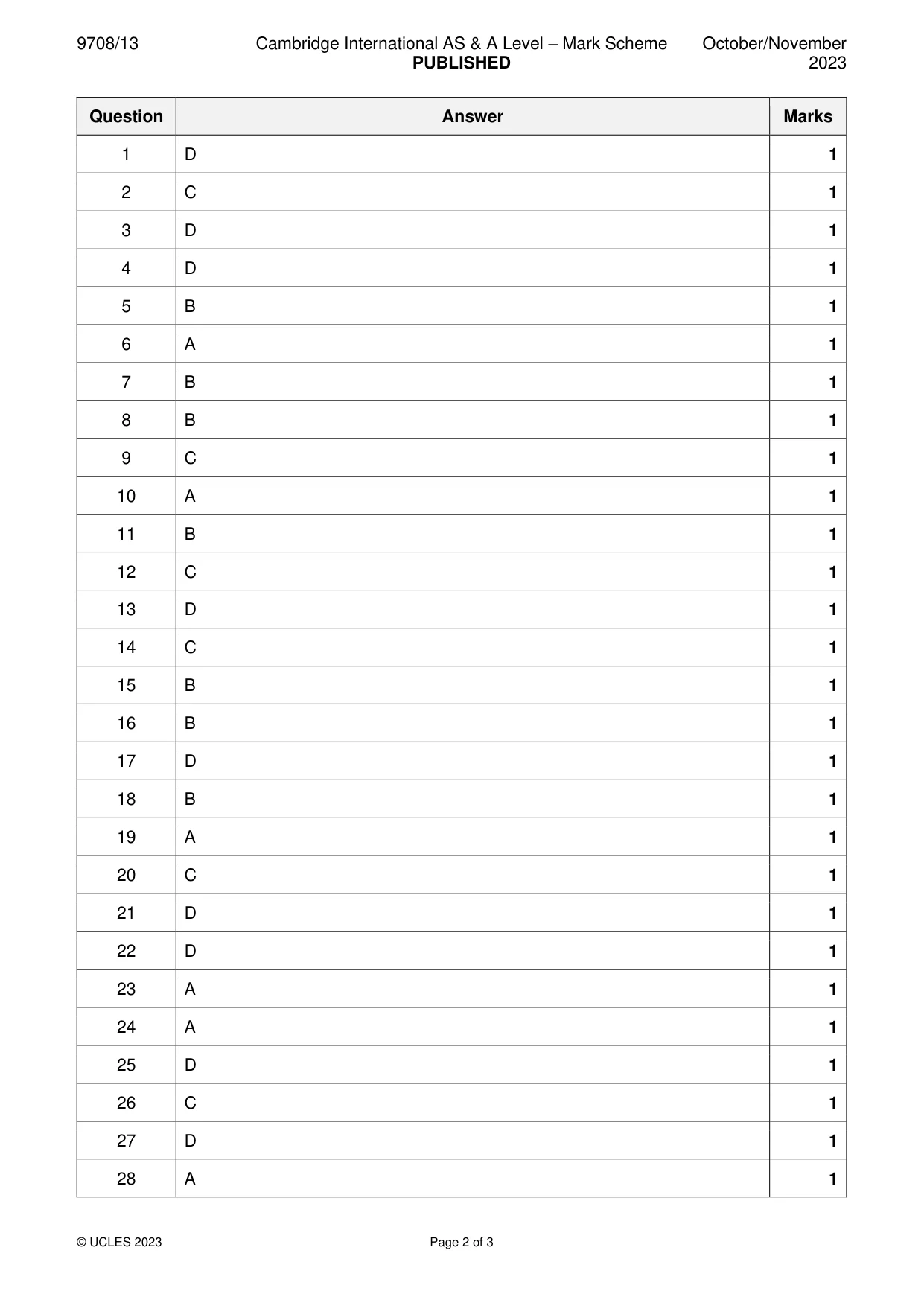
Mark scheme: D
Q2 · Consumers do not use enough of a product to maximise their private benefit because they…
2 Consumers do not use enough of a product to maximise their private benefit because they have imperfect information about the product. How would an economist classify this product? A demerit good B free good C merit good D public good
Mark scheme: C
Q3 · The table shows different combinations of rings and bracelets that can be produced by…
3 The table shows different combinations of rings and bracelets that can be produced by Luke and Zoe in the same time period. Luke Zoe rings bracelets rings bracelets 18 0 20 0 12 6 16 8 6 12 12 16 0 18 8 24 Which statement is not correct? A Luke has a larger opportunity cost than Zoe for making bracelets. B The opportunity cost of producing rings is constant for both Luke and Zoe. C Zoe should specialise in making rings. D Zoe’s opportunity cost for each bracelet is 2 rings.
Mark scheme: D
Q4 · What is an example of a free good?
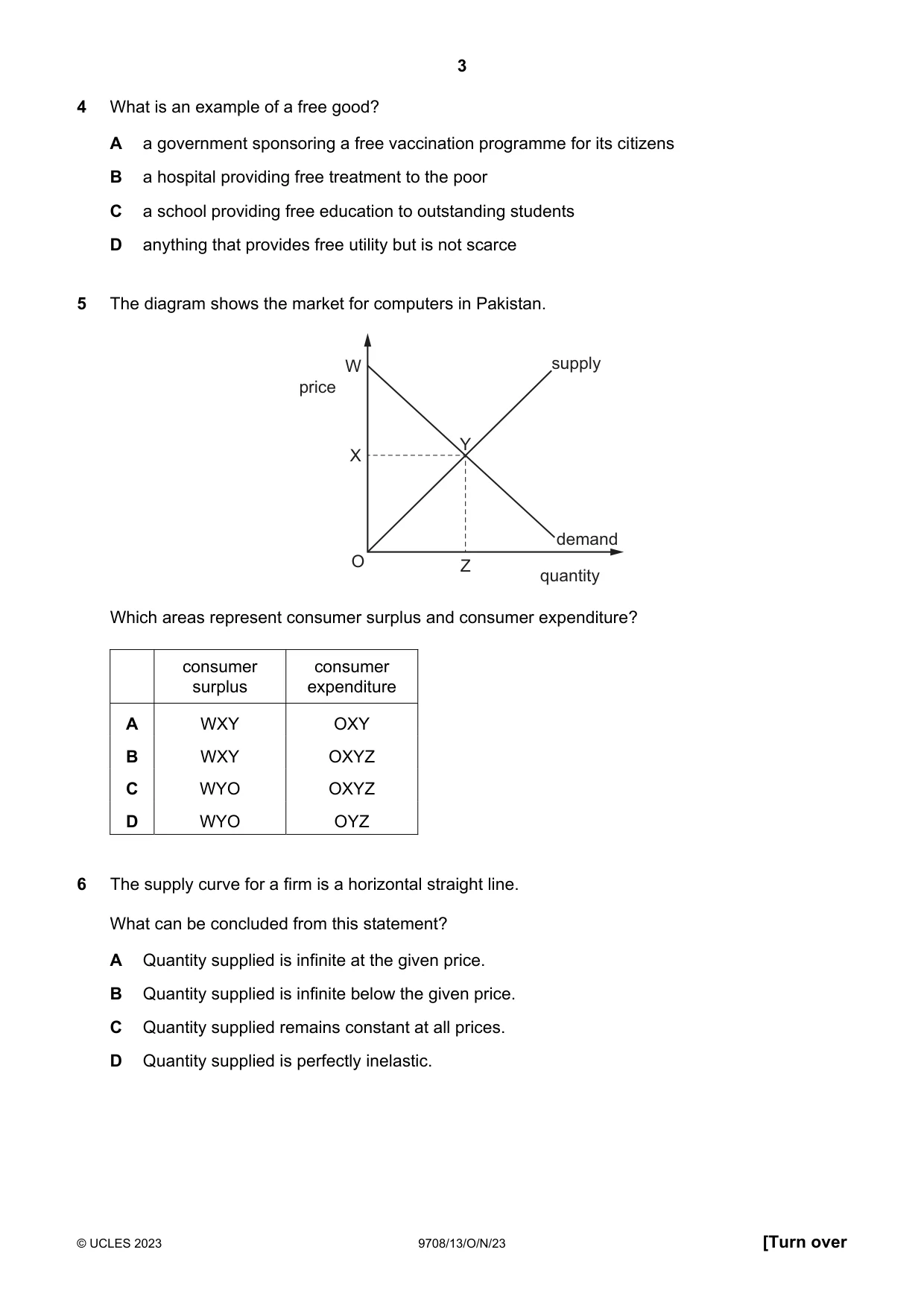
4 What is an example of a free good? A a government sponsoring a free vaccination programme for its citizens B a hospital providing free treatment to the poor C a school providing free education to outstanding students D anything that provides free utility but is not scarce
Mark scheme: D
Q5 · The diagram shows the market for computers in Pakistan
5 The diagram shows the market for computers in Pakistan. W supply price Y X demand O Z quantity Which areas represent consumer surplus and consumer expenditure? consumer consumer surplus expenditure A WXY OXY B WXY OXYZ C WYO OXYZ D WYO OYZ
Mark scheme: B
Q6 · The supply curve for a firm is a horizontal straight line
6 The supply curve for a firm is a horizontal straight line. What can be concluded from this statement? A Quantity supplied is infinite at the given price. B Quantity supplied is infinite below the given price. C Quantity supplied remains constant at all prices. D Quantity supplied is perfectly inelastic.
Mark scheme: A
Q7 · When the incomes of consumers of good X fall by 5%, under which conditions will the…
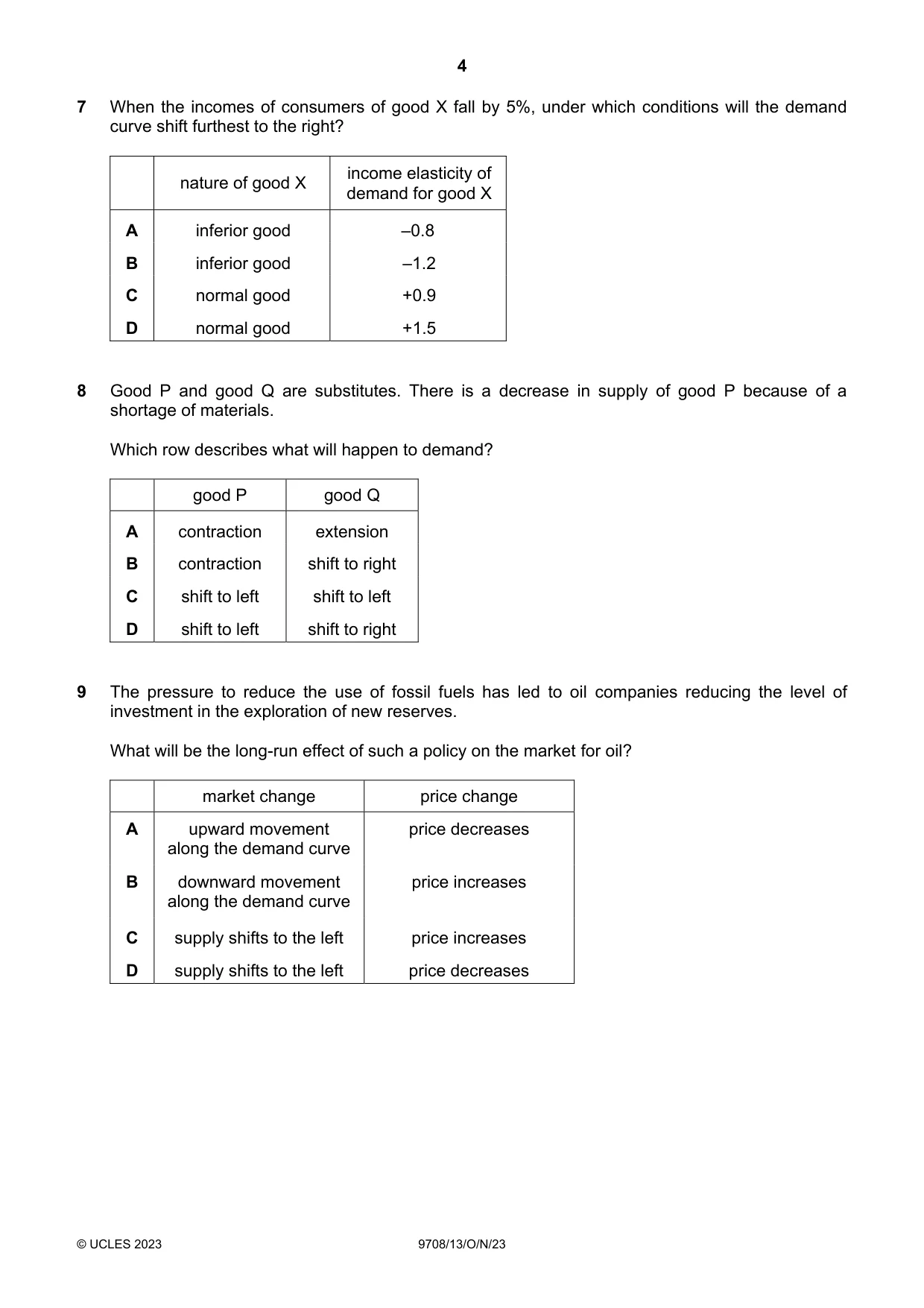
7 When the incomes of consumers of good X fall by 5%, under which conditions will the demand curve shift furthest to the right? income elasticity of nature of good X demand for good X A inferior good –0.8 B inferior good –1.2 C normal good +0.9 D normal good +1.5
Mark scheme: B
More questions on Price elasticity, income elasticity and cross elasticity of demand
Q8 · Good P and good Q are substitutes
8 Good P and good Q are substitutes. There is a decrease in supply of good P because of a shortage of materials. Which row describes what will happen to demand? good P good Q A contraction extension B contraction shift to right C shift to left shift to left D shift to left shift to right
Mark scheme: B
Q9 · The pressure to reduce the use of fossil fuels has led to oil companies reducing the…
9 The pressure to reduce the use of fossil fuels has led to oil companies reducing the level of investment in the exploration of new reserves. What will be the long-run effect of such a policy on the market for oil? market change price change A upward movement price decreases along the demand curve B downward movement price increases along the demand curve C supply shifts to the left price increases D supply shifts to the left price decreases
Mark scheme: C
Q10 · The price elasticity of demand for a product is –0.6
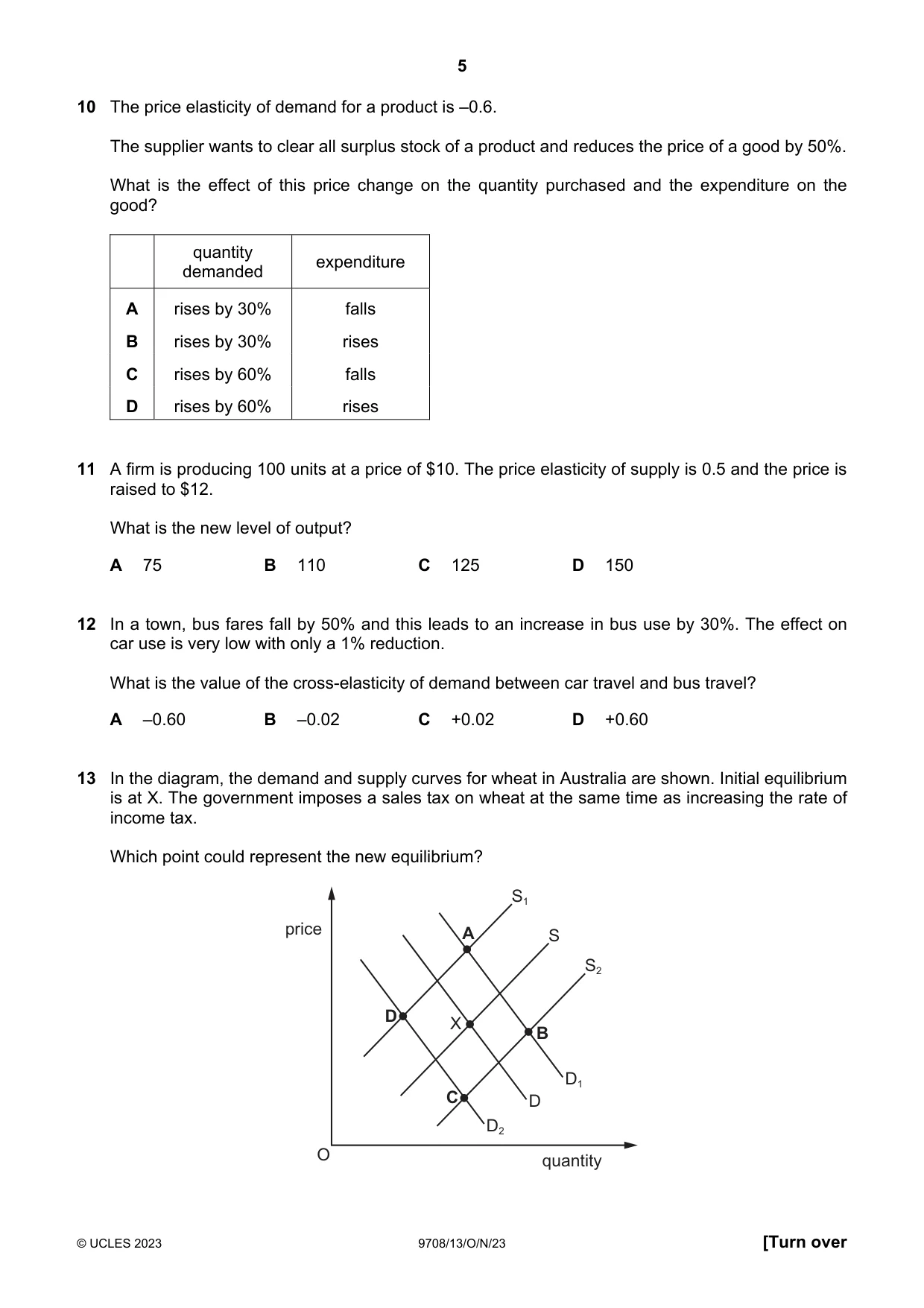
10 The price elasticity of demand for a product is –0.6. The supplier wants to clear all surplus stock of a product and reduces the price of a good by 50%. What is the effect of this price change on the quantity purchased and the expenditure on the good? quantity expenditure demanded A rises by 30% falls B rises by 30% rises C rises by 60% falls D rises by 60% rises
Mark scheme: A
More questions on Price elasticity, income elasticity and cross elasticity of demand
Q11 · A firm is producing 100 units at a price of $10
11 A firm is producing 100 units at a price of $10. The price elasticity of supply is 0.5 and the price is raised to $12. What is the new level of output? A 75 B 110 C 125 D 150
Mark scheme: B
Q12 · In a town, bus fares fall by 50% and this leads to an increase in bus use by 30%
12 In a town, bus fares fall by 50% and this leads to an increase in bus use by 30%. The effect on car use is very low with only a 1% reduction. What is the value of the cross-elasticity of demand between car travel and bus travel? A –0.60 B –0.02 C +0.02 D +0.60
Mark scheme: C
More questions on Price elasticity, income elasticity and cross elasticity of demand
Q13 · In the diagram, the demand and supply curves for wheat in Australia are shown
13 In the diagram, the demand and supply curves for wheat in Australia are shown. Initial equilibrium is at X. The government imposes a sales tax on wheat at the same time as increasing the rate of income tax. Which point could represent the new equilibrium? S1 price S A S2 D X B D1 C D D2 O quantity
Mark scheme: D
Q14 · A free market is currently experiencing excess supply at a price of P1
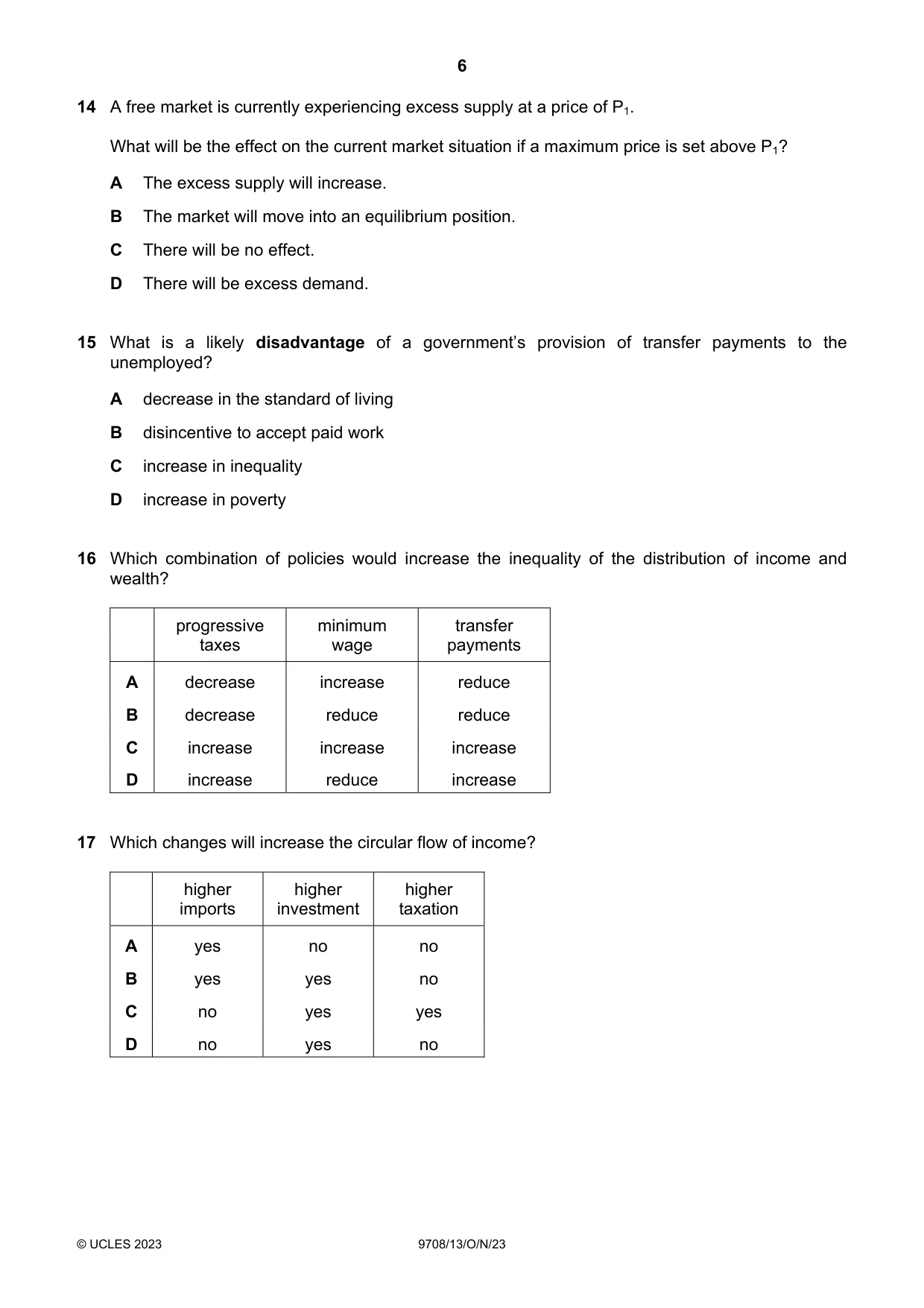
14 A free market is currently experiencing excess supply at a price of P1. What will be the effect on the current market situation if a maximum price is set above P1? A The excess supply will increase. B The market will move into an equilibrium position. C There will be no effect. D There will be excess demand.
Mark scheme: C
More questions on Methods and effects of government intervention in markets
Q15 · What is a likely disadvantage of a government’s provision of transfer payments to the…
15 What is a likely disadvantage of a government’s provision of transfer payments to the unemployed? A decrease in the standard of living B disincentive to accept paid work C increase in inequality D increase in poverty
Mark scheme: B
Q16 · Which combination of policies would increase the inequality of the distribution of income…
16 Which combination of policies would increase the inequality of the distribution of income and wealth? progressive minimum transfer taxes wage payments A decrease increase reduce B decrease reduce reduce C increase increase increase D increase reduce increase
Mark scheme: B
Q17 · Which changes will increase the circular flow of income?
17 Which changes will increase the circular flow of income? higher higher higher imports investment taxation A yes no no B yes yes no C no yes yes D no yes no
Mark scheme: D
More questions on Introduction to the circular flow of income
Q18 · An economy in equilibrium has a trade deficit of $20bn and a budget surplus of $20bn
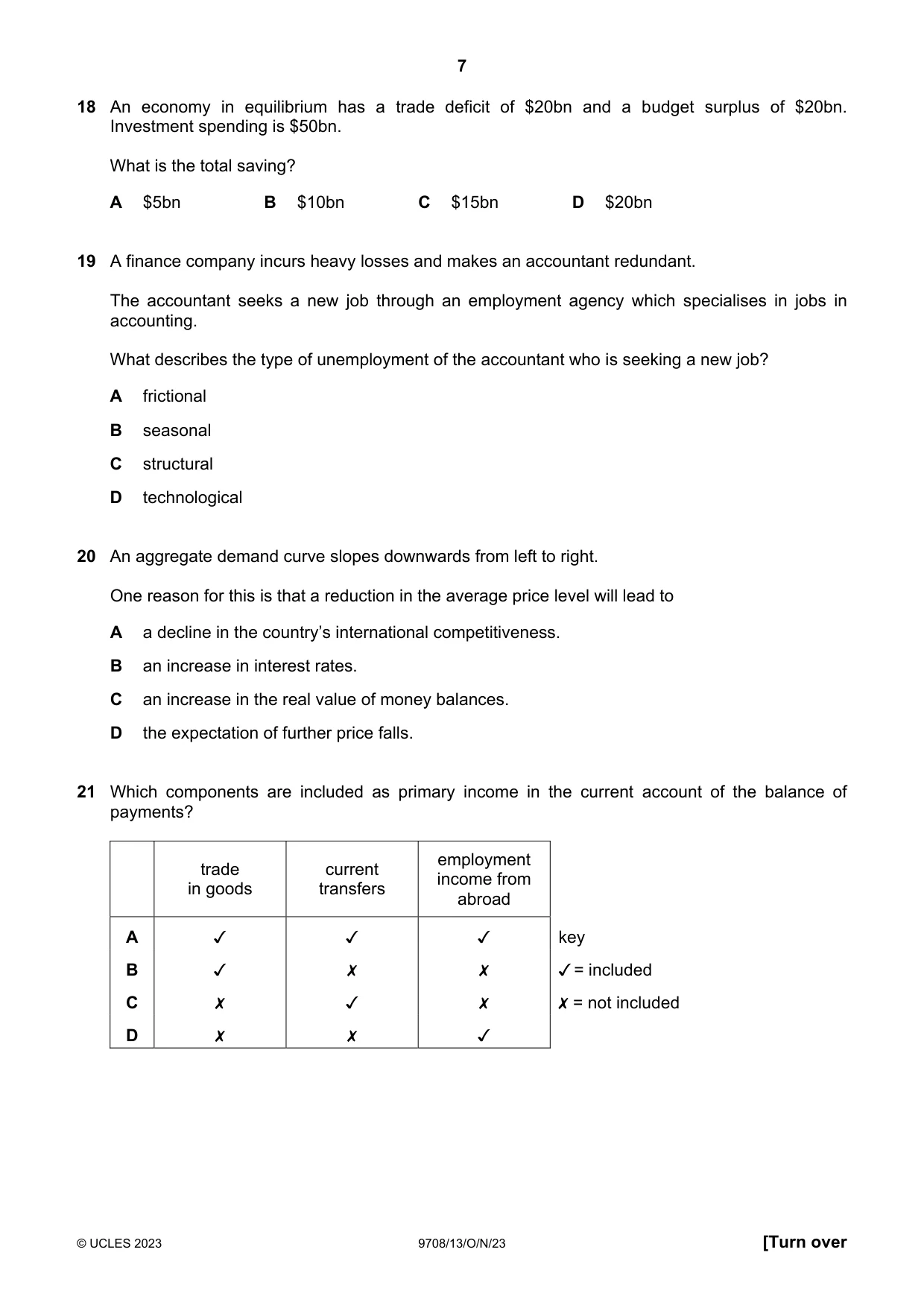
18 An economy in equilibrium has a trade deficit of $20bn and a budget surplus of $20bn. Investment spending is $50bn. What is the total saving? A $5bn B $10bn C $15bn D $20bn
Mark scheme: B
More questions on Introduction to the circular flow of income
Q19 · A finance company incurs heavy losses and makes an accountant redundant
19 A finance company incurs heavy losses and makes an accountant redundant. The accountant seeks a new job through an employment agency which specialises in jobs in accounting. What describes the type of unemployment of the accountant who is seeking a new job? A frictional B seasonal C structural D technological
Mark scheme: A
Q20 · An aggregate demand curve slopes downwards from left to right
20 An aggregate demand curve slopes downwards from left to right. One reason for this is that a reduction in the average price level will lead to A a decline in the country’s international competitiveness. B an increase in interest rates. C an increase in the real value of money balances. D the expectation of further price falls.
Mark scheme: C
More questions on Aggregate Demand and Aggregate Supply analysis
Q21 · Which components are included as primary income in the current account of the balance of…
21 Which components are included as primary income in the current account of the balance of payments? trade current employment in goods transfers income from abroad “ Y v v key ° Y x x / = included c x v x X = not included D x x y
Mark scheme: D
More questions on Current account of the balance of payments
Q22 · What is not included in the measurement of national income?
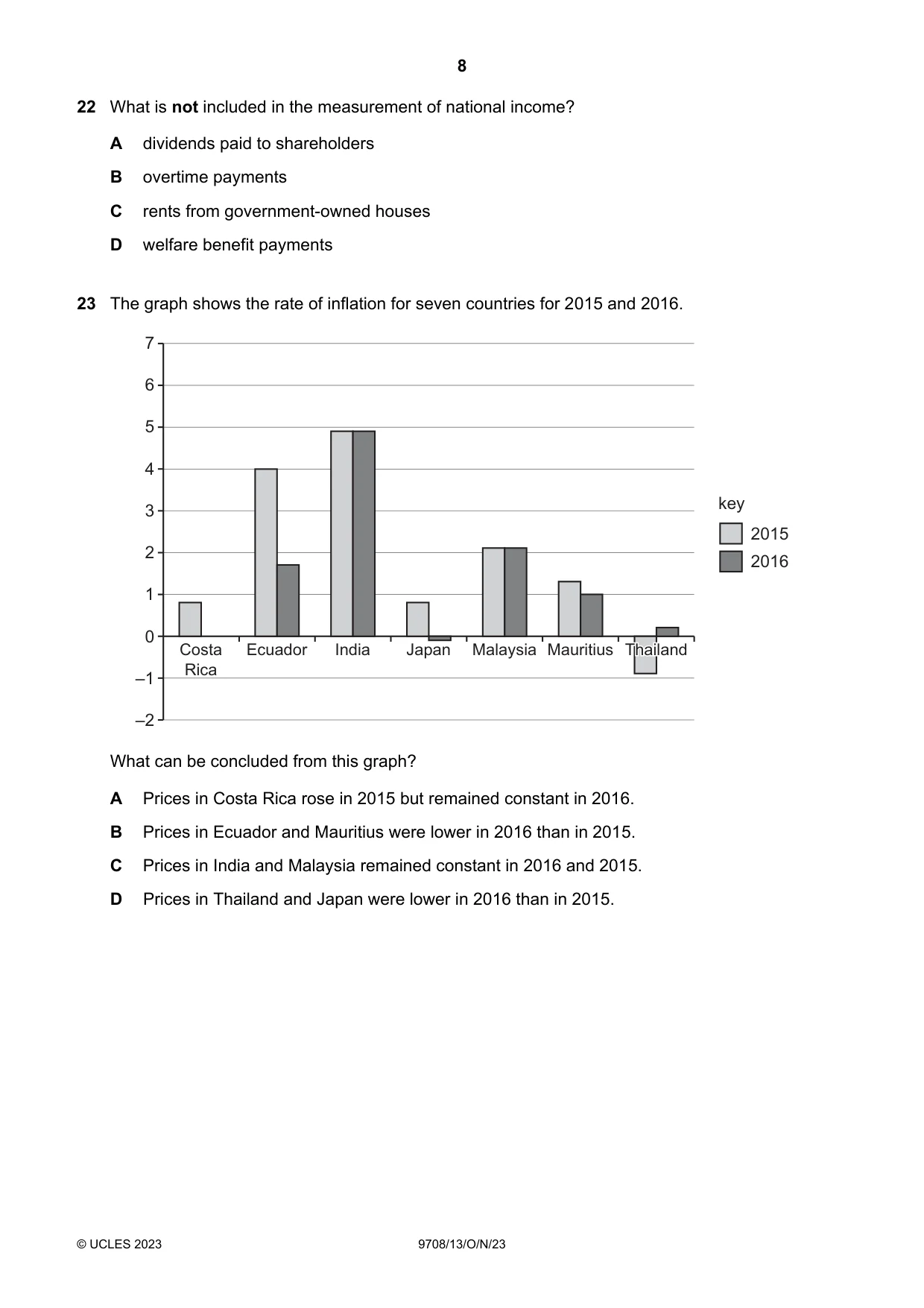
22 What is not included in the measurement of national income? A dividends paid to shareholders B overtime payments C rents from government-owned houses D welfare benefit payments
Mark scheme: D
Q23 · The graph shows the rate of inflation for seven countries for 2015 and 2016
23 The graph shows the rate of inflation for seven countries for 2015 and 2016. 7 6 5 4 3 key 2015 2 2016 1 0 Costa Ecuador India Japan Malaysia Mauritius Thailand Thailand Thailand Rica –1 –2 What can be concluded from this graph? A Prices in Costa Rica rose in 2015 but remained constant in 2016. B Prices in Ecuador and Mauritius were lower in 2016 than in 2015. C Prices in India and Malaysia remained constant in 2016 and 2015. D Prices in Thailand and Japan were lower in 2016 than in 2015.
Mark scheme: A
Q24 · Country R and country S are going to trade 1 unit of product X for 2 1 unit of product Y
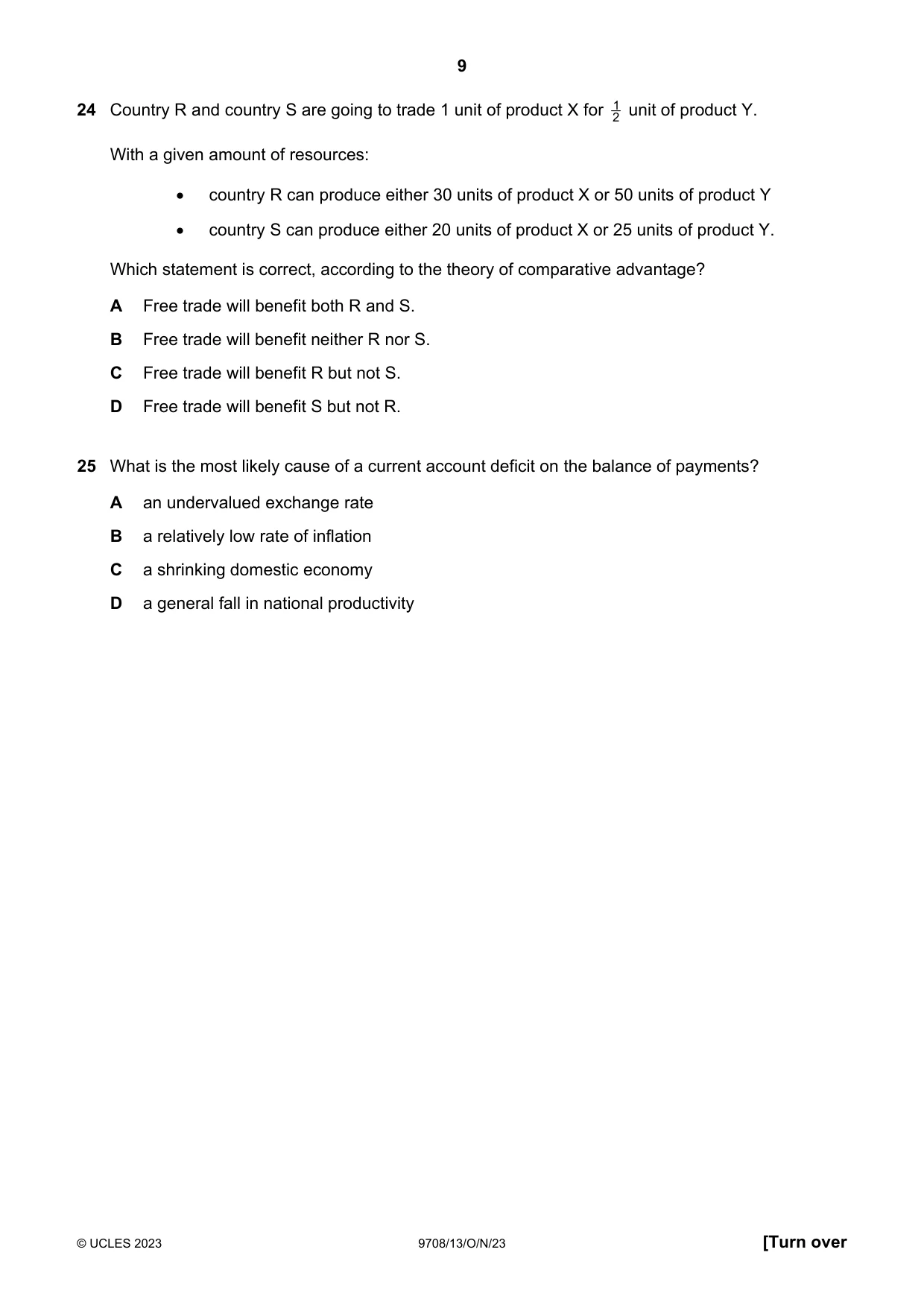
24 Country R and country S are going to trade 1 unit of product X for 2 1 unit of product Y. With a given amount of resources: country R can produce either 30 units of product X or 50 units of product Y country S can produce either 20 units of product X or 25 units of product Y. Which statement is correct, according to the theory of comparative advantage? A Free trade will benefit both R and S. B Free trade will benefit neither R nor S. C Free trade will benefit R but not S. D Free trade will benefit S but not R.
Mark scheme: A
Q25 · What is the most likely cause of a current account deficit on the balance of payments?
25 What is the most likely cause of a current account deficit on the balance of payments? A an undervalued exchange rate B a relatively low rate of inflation C a shrinking domestic economy D a general fall in national productivity
Mark scheme: D
More questions on Current account of the balance of payments
Q26 · The diagram shows the long-run aggregate supply (LRAS) and aggregate demand (AD) curves…
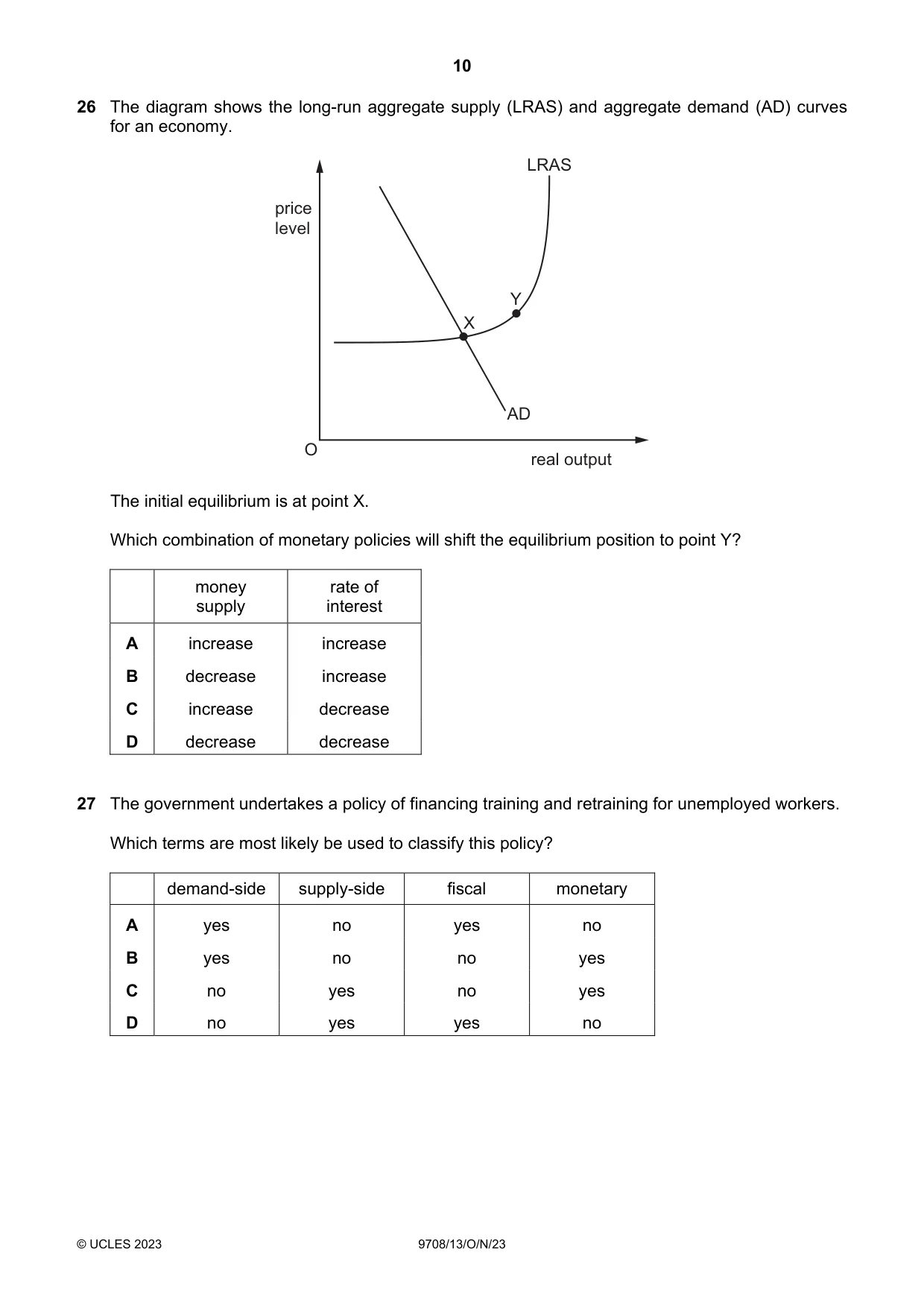
26 The diagram shows the long-run aggregate supply (LRAS) and aggregate demand (AD) curves for an economy. LRAS price level Y X AD O real output The initial equilibrium is at point X. Which combination of monetary policies will shift the equilibrium position to point Y? money rate of supply interest A increase increase B decrease increase C increase decrease D decrease decrease
Mark scheme: C
Q27 · The government undertakes a policy of financing training and retraining for unemployed…
27 The government undertakes a policy of financing training and retraining for unemployed workers. Which terms are most likely be used to classify this policy? demand-side supply-side fiscal monetary A yes no yes no B yes no no yes C no yes no yes D no yes yes no
Mark scheme: D
Q28 · Which combination of initial equilibrium and supply-side policy is likely to be least…
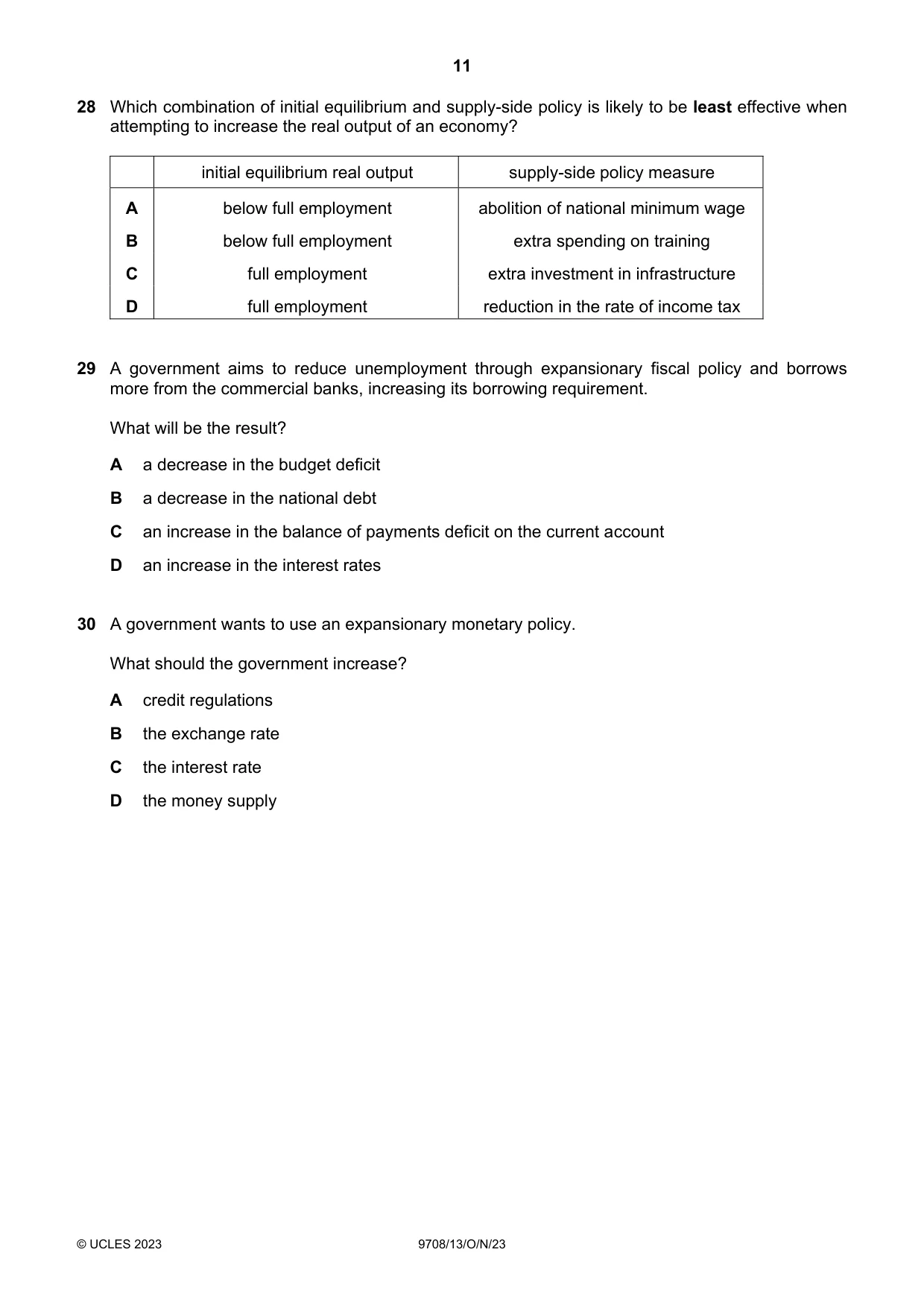
28 Which combination of initial equilibrium and supply-side policy is likely to be least effective when attempting to increase the real output of an economy? initial equilibrium real output supply-side policy measure A below full employment abolition of national minimum wage B below full employment extra spending on training C full employment extra investment in infrastructure D full employment reduction in the rate of income tax
Mark scheme: A
Q29 · A government aims to reduce unemployment through expansionary fiscal policy and borrows…
29 A government aims to reduce unemployment through expansionary fiscal policy and borrows more from the commercial banks, increasing its borrowing requirement. What will be the result? A a decrease in the budget deficit B a decrease in the national debt C an increase in the balance of payments deficit on the current account D an increase in the interest rates
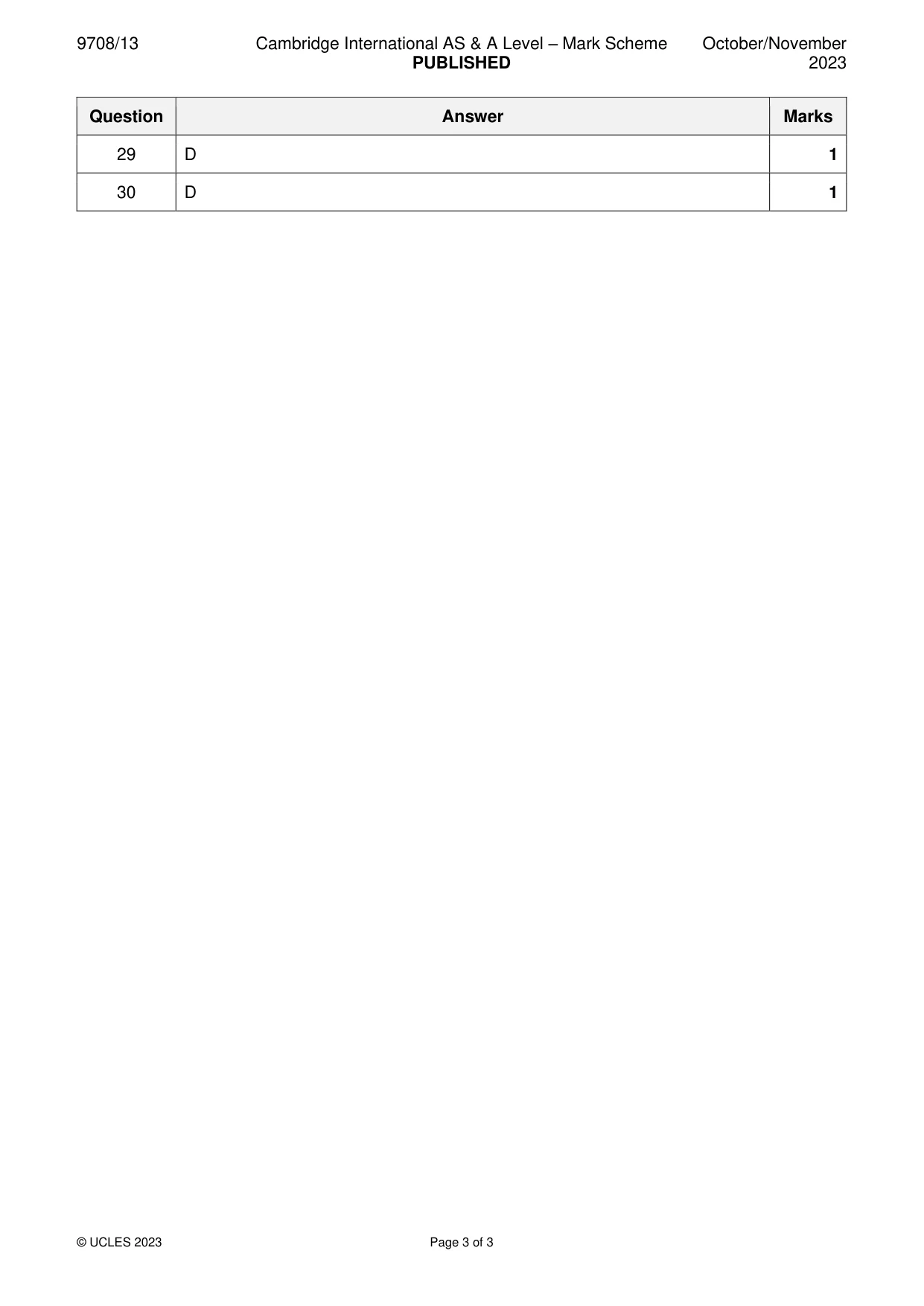
Mark scheme: D
Q30 · A government wants to use an expansionary monetary policy
30 A government wants to use an expansionary monetary policy. What should the government increase? A credit regulations B the exchange rate C the interest rate D the money supply
Mark scheme: D
What was in this paper
The subtopics covered by these 30 questions, and how many questions each got. Open one in a new tab to see every Cambridge question on it.
3The interaction of demand and supply3Addressing income and wealth inequality2Current account of the balance of payments2Introduction to the circular flow of income2Monetary policy2Price elasticity of supply2Supply-side policy2Aggregate Demand and Aggregate Supply analysis1Classification of goods and services1Consumer and producer surplus1Factors of production1Fiscal policy1Methods and effects of government intervention in markets1National income statistics1Price stability1Production possibility curves1Scarcity, choice and opportunity cost1The reasons for international trade1Unemployment1What you needed in this session
Cambridge’s own grade thresholds for 2023 Oct/Nov, Paper 1 · Variant 3. A higher threshold means an easier paper — the bar moves with how the cohort did.