Questions as text
Q1 · Which combination is most likely to result in lower rates of pay? 0455/11 Oct/Nov 2004
16 Which combination is most likely to result in lower rates of pay? supply of workers productivity of workers A falls falls B falls rises C rises falls D rises rises
1 marks
Answer: C
This question in 0455/11 Oct/Nov 2004
Q2 · Point X shows the original equilibrium in the market for nurses in a country 0455/11 Oct/Nov 2004
17 Point X shows the original equilibrium in the market for nurses in a country. There is a fall in the number of people who wish to be trained as nurses. What is the new equilibrium point? A X B D wage rate C D1 D2 O number of nurses employed
1 marks
Answer: A
This question in 0455/11 Oct/Nov 2004
Q3 · Why is a surgeon likely to have a higher wage rate than a hospital porter? 0455/11 May/June 2006
14 Why is a surgeon likely to have a higher wage rate than a hospital porter? A The surgeon has been in the job a longer time. B The surgeon has a longer training period. C The surgeon is older. D The surgeon is in a trade union.
1 marks
Answer: B
This question in 0455/11 May/June 2006
Q4 · What is an advantage for a worker in part-time rather than full-time employment? 0455/11 May/June 2006
15 What is an advantage for a worker in part-time rather than full-time employment? A a higher wage B greater employment protection C more opportunity for other activities D greater chance of promotion
1 marks
Answer: C
This question in 0455/11 May/June 2006
Q5 · On completing your studies, you decide you want to work in an organisation that is big… 0455/11 May/June 2006
17 On completing your studies, you decide you want to work in an organisation that is big enough to give you a chance of promotion but where weekend or shift work will not normally be required. Which would be the best one to choose? A a dental surgery B a hairdressing salon C an income tax office D a newspaper publisher
1 marks
Answer: C
This question in 0455/11 May/June 2006
Q6 · Which feature of working in an occupation might tend to keep the basic wage rate down? 0455/11 Oct/Nov 2006
14 Which feature of working in an occupation might tend to keep the basic wage rate down? A handling dangerous materials B receiving commission payments C undertaking training D working unsocial hours
1 marks
Answer: B
This question in 0455/11 Oct/Nov 2006
Q7 · An athlete needs an income and also needs time for training and competitions 0455/11 Oct/Nov 2006
15 An athlete needs an income and also needs time for training and competitions. Which occupation is most appropriate for the athlete? A department store manager who is paid a salary B livestock farmer working for profit C assembly-line worker who is paid a wage D self-employed photographer
1 marks
Answer: D
This question in 0455/11 Oct/Nov 2006
Q8 · Which change would be most likely to cause the earnings of hotel managers in Mauritius to… 0455/11 Oct/Nov 2006
16 Which change would be most likely to cause the earnings of hotel managers in Mauritius to rise more than the earnings of sugar cane workers there? A a decrease in the supply of sugar cane workers in Mauritius B a decrease in the price of hotel rooms in Mauritius C an increase in the productivity of hotel managers in Mauritius D an increase in the price of sugar cane from Mauritius
1 marks
Answer: C
This question in 0455/11 Oct/Nov 2006
Q9 · On average, male employees are paid more than female employees 0455/11 Oct/Nov 2006
17 On average, male employees are paid more than female employees. What could be a reason for this? A A higher percentage of female employees belong to trade unions. B A higher percentage of females work in unskilled occupations. C Females have a longer working life. D There are fewer female employees.
1 marks
Answer: B
This question in 0455/11 Oct/Nov 2006
Q10 · The graph shows women’s wages as a percentage of men’s wages in year 1 and year 2 0455/11 May/June 2007
18 The graph shows women’s wages as a percentage of men’s wages in year 1 and year 2. 85 80 75 year 2 70 percent 65 year 1 60 55 27 30 35 40 45 50 55 60 62 age Which statement is shown by the graph to be true? A Younger women earn more than older women. B Women’s wages remain roughly the same between the ages of 40–50. C In year 2, all women were earning more than men. D In year 2, women were earning a higher percentage of men’s wages than in year 1.
1 marks
Answer: D
This question in 0455/11 May/June 2007
Q11 · Male workers on average get paid more than female workers 0455/11 Oct/Nov 2007
18 Male workers on average get paid more than female workers. What might explain this? A Male workers have better qualifications. B Female workers are more likely to be in trade unions. C Male workers live nearer to their place of work. D Female workers are less likely to take time off work.
1 marks
Answer: A
This question in 0455/11 Oct/Nov 2007
Q12 · What would an individual be doing to be described as a worker in the secondary sector? 0455/11 May/June 2008
15 What would an individual be doing to be described as a worker in the secondary sector? A working in a firm that grows fruit trees and plants B working in a firm that produces machines for other firms C working in a government passport office D working in the reception area of a hospital
1 marks
Answer: B
This question in 0455/11 May/June 2008
Q13 · A supermarket wishes to recruit a qualified manager for a senior position to control the… 0455/11 May/June 2008
16 A supermarket wishes to recruit a qualified manager for a senior position to control the stocks of goods. Some work will be required at night as the supermarket is open 24 hours. A good salary is being offered. Which applicant would be most likely to be suitable for the position? A a person currently employed as a supervisor in another supermarket B a person who has experience of managing a small newsagents C a person who has to travel a long way and has demanding family commitments D a person who has recently graduated in Economics
1 marks
Answer: A
This question in 0455/11 May/June 2008
Q14 · What is the most likely reason for a firm to offer higher wages to recruit more staff? 0455/11 May/June 2008
17 What is the most likely reason for a firm to offer higher wages to recruit more staff? A falling incomes B falling output C falling prices D falling unemployment
1 marks
Answer: D
This question in 0455/11 May/June 2008
Q15 · In the UK in 2003, average hourly earnings for plumbers were higher than average hourly… 0455/11 Oct/Nov 2008
15 In the UK in 2003, average hourly earnings for plumbers were higher than average hourly earnings for teachers. What was most likely to have caused this? A Plumbers were in short supply. B Plumbers had a shorter training period than teachers. C Plumbers had further to travel to work. D Plumbers worked longer hours than teachers.
1 marks
Answer: A
This question in 0455/11 Oct/Nov 2008
Q16 · What is most likely to cause an increase in wages in an industry? 0455/11 Oct/Nov 2008
16 What is most likely to cause an increase in wages in an industry? A a decrease in employment B a decrease in trade union power C an improvement in working conditions D an increase in the responsibilities of workers
1 marks
Answer: D
This question in 0455/11 Oct/Nov 2008
Q17 · Why are farm workers likely to be paid a lower wage rate than workers in manufacturing? 0455/11 May/June 2009
12 Why are farm workers likely to be paid a lower wage rate than workers in manufacturing? A Farm workers are more likely to be in a trade union. B Farm workers are more likely to have a shorter working life. C Farm workers are more likely to have poorer working conditions. D Farm workers are more likely to produce goods with a lower value.
1 marks
Answer: D
This question in 0455/11 May/June 2009
Q18 · Changes in demand mean that the government of Bangladesh hopes to switch some production… 0455/11 May/June 2009
20 Changes in demand mean that the government of Bangladesh hopes to switch some production from clothes made by low-paid, unskilled workers to medicines produced by highly-trained technicians. What policies would enable Bangladesh to achieve this switch in employment and production? A demolish clothes factories and decrease imports B encourage immigration of foreign labour and introduce tariffs on clothing C invest in education and purchase new machines D substitute labour for machines and encourage emigration of workers from Bangladesh
1 marks
Answer: C
This question in 0455/11 May/June 2009
Q19 · What is most likely to cause an immediate decrease in the size of the working population? 0455/11 May/June 2009
25 What is most likely to cause an immediate decrease in the size of the working population? A a fall in the average size of families B a fall in the birth rate C a reduction in the age of retirement D an increase in net immigration
1 marks
Answer: C
This question in 0455/11 May/June 2009
Q20 · In 2007 the average annual pay of a scientist in the UK was £37 290 0455/11 Oct/Nov 2009
12 In 2007 the average annual pay of a scientist in the UK was £37 290. The average annual pay of a laboratory technician was £26 157. What could explain this difference in earnings? A Laboratory technicians have stronger bargaining power than scientists. B Laboratory technicians have to work more unsociable hours than scientists. C The period of training for scientists is longer than that for laboratory technicians. D The supply of scientists is high relative to demand for their services.
1 marks
Answer: C
This question in 0455/11 Oct/Nov 2009
Q21 · The graph shows the labour force of a country from 2003-2015 0455/11 Oct/Nov 2009
21 The graph shows the labour force of a country from 2003-2015. 17 male 16 15 14 millions 13 female 12 11 0 2003 2004 2005 2006 2007 2008 2009 2010 2011 2012 2013 2014 2015 estimates projections What may be concluded from the graph? A Between 2003 and 2015, women will become a higher percentage of the labour force. B It is estimated that more girls than boys will be born between 2003 and 2005. C The labour force will remain relatively unchanged after 2006 at approximately 16 million. D The total population of the country in 2010-2011 will be approximately 28 million.
1 marks
Answer: A
This question in 0455/11 Oct/Nov 2009
Q22 · What is an example of occupational mobility of labour? 0455/11 May/June 2010
13 What is an example of occupational mobility of labour? A A Japanese car manufacturer locates in England. B A nurse returns to work after her children have grown up. C A student takes an evening job in a restaurant. D Farm workers retrain as call-centre workers.
1 marks
Answer: D
This question in 0455/11 May/June 2010
Q23 · What is an example of occupational mobility of labour? 0455/12 May/June 2010
10 What is an example of occupational mobility of labour? A A Japanese car manufacturer locates in England. B A nurse returns to work after her children have grown up. C A student takes an evening job in a restaurant. D Farm workers retrain as call-centre workers.
1 marks
Answer: D
This question in 0455/12 May/June 2010
Q24 · What is the most likely reason for a worker preferring to be employed by the government… 0455/11 Oct/Nov 2010
11 What is the most likely reason for a worker preferring to be employed by the government rather than by a firm in the private sector? A more chance of a fast changing environment B more chance to work in a large organisation C more opportunity to gain from successful risk taking D more possibility of productivity bonuses
1 marks
Answer: B
This question in 0455/11 Oct/Nov 2010
Q25 · ‘There are actors who earn extremely high incomes.’ What best explains this? 0455/11 Oct/Nov 2010
12 ‘There are actors who earn extremely high incomes.’ What best explains this? A Acting is a popular career. B Actors have regular employment. C Actors work short hours. D Some actors have a unique talent.
1 marks
Answer: D
This question in 0455/11 Oct/Nov 2010
Q26 · What might be a direct benefit to the individual worker of a specialised job? 0455/11 Oct/Nov 2010
13 What might be a direct benefit to the individual worker of a specialised job? A Specialisation can enable the worker to become more skilled. B Specialisation enables a better quality product to be produced. C Specialisation enables the firm to introduce more machinery. D Specialisation makes better use of resources.
1 marks
Answer: A
This question in 0455/11 Oct/Nov 2010
Q27 · What might be a direct benefit to the individual worker of a specialised job? 0455/12 Oct/Nov 2010
9 What might be a direct benefit to the individual worker of a specialised job? A Specialisation can enable the worker to become more skilled. B Specialisation enables a better quality product to be produced. C Specialisation enables the firm to introduce more machinery. D Specialisation makes better use of resources.
1 marks
Answer: A
This question in 0455/12 Oct/Nov 2010
Q28 · What is the most likely reason for a worker preferring to be employed by the government… 0455/12 Oct/Nov 2010
12 What is the most likely reason for a worker preferring to be employed by the government rather than by a firm in the private sector? A more chance of a fast changing environment B more chance to work in a large organisation C more opportunity to gain from successful risk taking D more possibility of productivity bonuses
1 marks
Answer: B
This question in 0455/12 Oct/Nov 2010
Q29 · ‘There are actors who earn extremely high incomes.’ What best explains this? 0455/12 Oct/Nov 2010
13 ‘There are actors who earn extremely high incomes.’ What best explains this? A Acting is a popular career. B Actors have regular employment. C Actors work short hours. D Some actors have a unique talent.
1 marks
Answer: D
This question in 0455/12 Oct/Nov 2010
Q30 · ‘There are actors who earn extremely high incomes.’ What best explains this? 0455/13 Oct/Nov 2010
9 ‘There are actors who earn extremely high incomes.’ What best explains this? A Acting is a popular career. B Actors have regular employment. C Actors work short hours. D Some actors have a unique talent.
1 marks
Answer: D
This question in 0455/13 Oct/Nov 2010
Q31 · What might be a direct benefit to the individual worker of a specialised job? 0455/13 Oct/Nov 2010
10 What might be a direct benefit to the individual worker of a specialised job? A Specialisation can enable the worker to become more skilled. B Specialisation enables a better quality product to be produced. C Specialisation enables the firm to introduce more machinery. D Specialisation makes better use of resources.
1 marks
Answer: A
This question in 0455/13 Oct/Nov 2010
Q32 · Why might factory workers have higher wage rates than agricultural workers? 0455/11 May/June 2011
13 Why might factory workers have higher wage rates than agricultural workers? A Factory workers are in greater supply. B Factory workers face fewer risks of accidents. C Factory workers have cleaner working conditions. D Factory workers use more productive equipment.
1 marks
Answer: D
This question in 0455/11 May/June 2011
Q33 · A musician has a choice of playing for an orchestra in either England or Germany 0455/11 May/June 2011
14 A musician has a choice of playing for an orchestra in either England or Germany. Which combination of incomes and cost of living is most likely to cause her to choose the German orchestra? Incomes and cost of living in Germany compared with those in England pre-tax (gross) income after-tax (net) income cost of living A higher higher higher B higher lower lower C lower higher higher D lower higher lower
1 marks
Answer: D
This question in 0455/11 May/June 2011
Q34 · Why might factory workers have higher wage rates than agricultural workers? 0455/12 May/June 2011
12 Why might factory workers have higher wage rates than agricultural workers? A Factory workers are in greater supply. B Factory workers face fewer risks of accidents. C Factory workers have cleaner working conditions. D Factory workers use more productive equipment.
1 marks
Answer: D
This question in 0455/12 May/June 2011
Q35 · A musician has a choice of playing for an orchestra in either England or Germany 0455/12 May/June 2011
13 A musician has a choice of playing for an orchestra in either England or Germany. Which combination of incomes and cost of living is most likely to cause her to choose the German orchestra? Incomes and cost of living in Germany compared with those in England pre-tax (gross) income after-tax (net) income cost of living A higher higher higher B higher lower lower C lower higher higher D lower higher lower
1 marks
Answer: D
This question in 0455/12 May/June 2011
Q36 · Why might factory workers have higher wage rates than agricultural workers? 0455/13 May/June 2011
12 Why might factory workers have higher wage rates than agricultural workers? A Factory workers are in greater supply. B Factory workers face fewer risks of accidents. C Factory workers have cleaner working conditions. D Factory workers use more productive equipment.
1 marks
Answer: D
This question in 0455/13 May/June 2011
Q37 · A musician has a choice of playing for an orchestra in either England or Germany 0455/13 May/June 2011
13 A musician has a choice of playing for an orchestra in either England or Germany. Which combination of incomes and cost of living is most likely to cause her to choose the German orchestra? Incomes and cost of living in Germany compared with those in England pre-tax (gross) income after-tax (net) income cost of living A higher higher higher B higher lower lower C lower higher higher D lower higher lower
1 marks
Answer: D
This question in 0455/13 May/June 2011
Q38 · What is likely to cause wages in an occupation to be high? 0455/11 May/June 2012
10 What is likely to cause wages in an occupation to be high? A a low level of responsibility B high unemployment C pleasant working conditions D the need for special skills
1 marks
Answer: D
This question in 0455/11 May/June 2012
Q39 · Cleaning the streets can be an unpleasant job and yet in many countries it is badly paid 0455/12 May/June 2012
10 Cleaning the streets can be an unpleasant job and yet in many countries it is badly paid. What is likely to be the reason for this? A There is a high degree of trade union membership among these workers. B There is a high supply of labour because the work is unskilled. C There is a high demand for staff in busy urban areas. D There is a long working year because there are few holidays.
1 marks
Answer: B
This question in 0455/12 May/June 2012
Q40 · Cleaning the streets can be an unpleasant job and yet in many countries it is badly paid 0455/13 May/June 2012
10 Cleaning the streets can be an unpleasant job and yet in many countries it is badly paid. What is likely to be the reason for this? A There is a high degree of trade union membership among these workers. B There is a high supply of labour because the work is unskilled. C There is a high demand for staff in busy urban areas. D There is a long working year because there are few holidays.
1 marks
Answer: B
This question in 0455/13 May/June 2012
Q41 · On average, doctors earn more than bus drivers 0455/11 Oct/Nov 2012
1 On average, doctors earn more than bus drivers. Which change would be likely to reduce the earnings gap between doctors and bus drivers? A a decrease in the profits earned by bus companies B a decrease in the qualifications needed to be a doctor C an increase in demand for medical care D an increase in the number of people passing the driving test
1 marks
Answer: B
This question in 0455/11 Oct/Nov 2012
Q42 · On average, doctors earn more than bus drivers 0455/12 Oct/Nov 2012
10 On average, doctors earn more than bus drivers. Which change would be likely to reduce the earnings gap between doctors and bus drivers? A a decrease in the profits earned by bus companies B a decrease in the qualifications needed to be a doctor C an increase in demand for medical care D an increase in the number of people passing the driving test
1 marks
Answer: B
This question in 0455/12 Oct/Nov 2012
Q43 · What is usually true of workers approaching retirement when they are compared with new… 0455/13 Oct/Nov 2012
26 What is usually true of workers approaching retirement when they are compared with new entrants to the workforce? A They will be more adaptable. B They will be more experienced. C They will be more mobile. D They will be physically stronger.
1 marks
Answer: B
This question in 0455/13 Oct/Nov 2012
Q44 · Which of the following is most likely to limit wage increases in an industry? 0455/11 May/June 2013
12 Which of the following is most likely to limit wage increases in an industry? A an increased demand for the industry’s product B a rise in the industry’s profits C a rise in wages for workers in similar jobs D the replacement of workers with robots
1 marks
Answer: D
This question in 0455/11 May/June 2013
Q45 · Differences in earnings between higher paid and lower paid jobs have widened in developed… 0455/11 May/June 2013
14 Differences in earnings between higher paid and lower paid jobs have widened in developed countries. What is the most likely reason for this? A Immigration of unskilled workers has reduced. B The demand for highly skilled workers has increased. C Unemployment rates have remained low. D Women are paid the same rates as men.
1 marks
Answer: B
This question in 0455/11 May/June 2013
Q46 · Each worker in a firm specialises in performing one task 0455/12 May/June 2013
11 Each worker in a firm specialises in performing one task. The firm then decides that each worker should carry out a variety of tasks. Which benefit will the firm be expecting to gain from the change? A a decrease in the equipment workers need to be given B a decrease in the time it takes to train workers C an increase in the ability to cover for absent staff D an increase in the skill gained from repetition
1 marks
Answer: C
This question in 0455/12 May/June 2013
Q47 · The diagram shows how the weekly earnings of four workers changed between ages 16 and 64 0455/12 May/June 2013
14 The diagram shows how the weekly earnings of four workers changed between ages 16 and 64. Which line is most likely to represent the change in the weekly earnings of an unskilled, manual labourer? A average weekly earnings B C D 16 32 48 64 age
1 marks
Answer: D
This question in 0455/12 May/June 2013
Q48 · Which of the following is most likely to limit wage increases in an industry? 0455/13 May/June 2013
21 Which of the following is most likely to limit wage increases in an industry? A an increased demand for the industry’s product B a rise in the industry’s profits C a rise in wages for workers in similar jobs D the replacement of workers with robots
1 marks
Answer: D
This question in 0455/13 May/June 2013
Q49 · Differences in earnings between higher paid and lower paid jobs have widened in developed… 0455/13 May/June 2013
23 Differences in earnings between higher paid and lower paid jobs have widened in developed countries. What is the most likely reason for this? A Immigration of unskilled workers has reduced. B The demand for highly skilled workers has increased. C Unemployment rates have remained low. D Women are paid the same rates as men.
1 marks
Answer: B
This question in 0455/13 May/June 2013
Q50 · What might be a direct benefit to the individual worker of a specialised job? 0455/11 Oct/Nov 2013
21 What might be a direct benefit to the individual worker of a specialised job? A Specialisation enables a better quality product to be produced. B Specialisation enables the firm to introduce more machinery. C Specialisation enables the worker to become more skilled. D Specialisation makes better use of resources.
1 marks
Answer: C
This question in 0455/11 Oct/Nov 2013
Q51 · The table shows the change in the labour force in Bangladesh between 2006 and 2009 0455/11 Oct/Nov 2013
30 The table shows the change in the labour force in Bangladesh between 2006 and 2009. group 2006 (millions) 2009 (millions) urban male labour force 8.9 9.7 urban female labour force 2.8 3.1 total urban labour force 11.7 12.8 rural male labour force 28.5 30.5 rural female labour force 9.3 10.4 total rural labour force 37.8 40.9 Which statement is most likely to be consistent with these statistics? A Farming is the major employer in the economy. B Male workers are more mobile than female workers. C The absolute increase in the labour force is greater in urban areas than rural areas. D The supply of female workers has fallen.
1 marks
Answer: A
This question in 0455/11 Oct/Nov 2013
Q52 · What might be a direct benefit to the individual worker of a specialised job? 0455/12 Oct/Nov 2013
12 What might be a direct benefit to the individual worker of a specialised job? A Specialisation enables a better quality product to be produced. B Specialisation enables the firm to introduce more machinery. C Specialisation enables the worker to become more skilled. D Specialisation makes better use of resources.
1 marks
Answer: C
This question in 0455/12 Oct/Nov 2013
Q53 · The table shows the change in the labour force in Bangladesh between 2006 and 2009 0455/12 Oct/Nov 2013
25 The table shows the change in the labour force in Bangladesh between 2006 and 2009. group 2006 (millions) 2009 (millions) urban male labour force 8.9 9.7 urban female labour force 2.8 3.1 total urban labour force 11.7 12.8 rural male labour force 28.5 30.5 rural female labour force 9.3 10.4 total rural labour force 37.8 40.9 Which statement is most likely to be consistent with these statistics? A Farming is the major employer in the economy. B Male workers are more mobile than female workers. C The absolute increase in the labour force is greater in urban areas than rural areas. D The supply of female workers has fallen.
1 marks
Answer: A
This question in 0455/12 Oct/Nov 2013
Q54 · What might be a direct benefit to the individual worker of a specialised job? 0455/13 Oct/Nov 2013
12 What might be a direct benefit to the individual worker of a specialised job? A Specialisation enables a better quality product to be produced. B Specialisation enables the firm to introduce more machinery. C Specialisation enables the worker to become more skilled. D Specialisation makes better use of resources.
1 marks
Answer: C
This question in 0455/13 Oct/Nov 2013
Q55 · The table shows the average monthly wage in Bahraini Dinars (BHD) for different groups of… 0455/13 Oct/Nov 2013
14 The table shows the average monthly wage in Bahraini Dinars (BHD) for different groups of workers in Bahrain in 2011. private sector public sector average monthly wage (BHD) 291 952 Bahraini citizen monthly wage (BHD) 589 910 non-Bahraini citizen monthly wage (BHD) 214 1208 Which statement is most likely to be consistent with these statistics? A Bahraini citizens are more productive than non-Bahraini citizens in the public sector. B The demand for Bahraini citizens is greater in the private sector than the public sector. C The public sector employs better educated workers than the private sector in Bahrain. D There is a greater supply of non-Bahraini citizens in the public sector than the private sector.
1 marks
Answer: C
This question in 0455/13 Oct/Nov 2013
Q56 · Some lawyers charge very high rates per hour for their services 0455/13 Oct/Nov 2013
15 Some lawyers charge very high rates per hour for their services. What best explains this? A The lawyers are very skilled. B The lawyers work long hours. C The lawyers work part-time and need a high hourly rate. D The law profession is a popular career.
1 marks
Answer: A
This question in 0455/13 Oct/Nov 2013
Q57 · Why are unskilled workers paid less than skilled workers? 0455/11 May/June 2014
9 Why are unskilled workers paid less than skilled workers? A There is a higher demand for unskilled labour than skilled labour. B There is a larger supply of unskilled labour than skilled labour. C Unskilled labour belong to trade unions. D Unskilled labour is more productive than skilled labour.
1 marks
Answer: B
This question in 0455/11 May/June 2014
Q58 · Between 2009 and 2010 the number of potential jobs for qualified law students fell by 16% 0455/11 May/June 2014
10 Between 2009 and 2010 the number of potential jobs for qualified law students fell by 16%. During the same period the total number of applicants for places on law courses increased. What is the most likely explanation for this? A an economic recession and an increase in general unemployment B an increase in crime rates and the possibility of high salaries in the legal profession C an increase in the retirement age for existing lawyers and an increase in law course fees D the merger of law firms and the closure of law courses
1 marks
Answer: A
This question in 0455/11 May/June 2014
Q59 · In a particular industry, male workers on average are paid more than female workers 0455/12 May/June 2014
9 In a particular industry, male workers on average are paid more than female workers. What might explain this? A Female workers are less likely to take time off work. B Female workers are more likely to be in trade unions. C Male workers have higher qualifications. D Male workers live nearer to their place of work.
1 marks
Answer: C
This question in 0455/12 May/June 2014
Q60 · Increasing numbers of qualified medical workers from developing economies migrate to… 0455/12 May/June 2014
26 Increasing numbers of qualified medical workers from developing economies migrate to developed economies. What explains this migration? A There are better working conditions in hospitals and clinics in developed economies. B There are fewer patients requiring medical treatment in developing countries. C There is a lack of training opportunities for medical staff in developed economies. D There is an oversupply of qualified medical workers in developing countries.
1 marks
Answer: A
This question in 0455/12 May/June 2014
Q61 · A trade union is negotiating a wage rise for its members 0455/13 May/June 2014
12 A trade union is negotiating a wage rise for its members. What will increase the chance of the wage rise being granted? A The company’s product has many substitutes. B The economy is entering a period of recession. C The government has made strike action illegal. D Wages are a small part of the company’s costs.
1 marks
Answer: D
This question in 0455/13 May/June 2014
Q62 · Between 2009 and 2010 the number of potential jobs for qualified law students fell by 16% 0455/13 May/June 2014
13 Between 2009 and 2010 the number of potential jobs for qualified law students fell by 16%. During the same period the total number of applicants for places on law courses increased. What is the most likely explanation for this? A an economic recession and an increase in general unemployment B an increase in crime rates and the possibility of high salaries in the legal profession C an increase in the retirement age for existing lawyers and an increase in law course fees D the merger of law firms and the closure of law courses
1 marks
Answer: A
This question in 0455/13 May/June 2014
Q63 · Why are unskilled workers paid less than skilled workers? 0455/13 May/June 2014
14 Why are unskilled workers paid less than skilled workers? A There is a higher demand for unskilled labour than skilled labour. B There is a larger supply of unskilled labour than skilled labour. C Unskilled labour belong to trade unions. D Unskilled labour is more productive than skilled labour.
1 marks
Answer: B
This question in 0455/13 May/June 2014
Q64 · In which occupations do wages tend to be lowest? 0455/11 Oct/Nov 2014
11 In which occupations do wages tend to be lowest? A in those where the work is dangerous B in those where there is an excess supply of labour C in those where workers are paid on a monthly basis D in those where workers need long training
1 marks
Answer: B
This question in 0455/11 Oct/Nov 2014
Q65 · In which occupations do wages tend to be lowest? 0455/12 Oct/Nov 2014
9 In which occupations do wages tend to be lowest? A in those where the work is dangerous B in those where there is an excess supply of labour C in those where workers are paid on a monthly basis D in those where workers need long training
1 marks
Answer: B
This question in 0455/12 Oct/Nov 2014
Q66 · In which occupations do wages tend to be lowest? 0455/13 Oct/Nov 2014
9 In which occupations do wages tend to be lowest? A in those where the work is dangerous B in those where there is an excess supply of labour C in those where workers are paid on a monthly basis D in those where workers need long training
1 marks
Answer: B
This question in 0455/13 Oct/Nov 2014
Q67 · The construction industry in Dubai relies on many migrant workers from India 0455/13 Oct/Nov 2014
11 The construction industry in Dubai relies on many migrant workers from India. Which combination of changes in the economies of Dubai and India would be most likely to increase the wages of construction workers in Dubai? Dubai economy Indian economy A decrease in economic activity decrease in economic activity B decrease in economic activity increase in economic activity C increase in economic activity decrease in economic activity D increase in economic activity increase in economic activity
1 marks
Answer: D
This question in 0455/13 Oct/Nov 2014
Q68 · A bus driver works longer hours if the wage rate increases 0455/11 May/June 2015
11 A bus driver works longer hours if the wage rate increases. As his earnings increase there reaches a point when he prefers more leisure to work. Which supply curve, S, represents this situation? A B C D S S wage S wage wage wage S rate rate rate rate O worker O worker O worker O worker hours hours hours hours
1 marks
Answer: C
This question in 0455/11 May/June 2015
Q69 · A trade union and employers agree a minimum wage (W1) which is above the market… 0455/12 May/June 2015
10 A trade union and employers agree a minimum wage (W1) which is above the market equilibrium wage (W) for that industry. supply of labour W1 W wage demand for labour O Q labour employed What is the effect of paying the minimum wage (W1)? A demand for workers will exceed the supply B fewer workers will be employed C some workers will continue to be paid at wage W D workers will be less willing to work for the minimum wage
1 marks
Answer: B
This question in 0455/12 May/June 2015
Q70 · In choosing their occupation, people often take into account aspects of the job other… 0455/12 May/June 2015
11 In choosing their occupation, people often take into account aspects of the job other than pay. Which would not be a good match for the aspects of employment a worker is looking for? desired aspect occupation A a wish for an outdoor lifestyle army officer and to develop teamwork B a wish for foreign travel airline pilot and to have responsibility C a wish for public respect and heart surgeon to undertake precise work D a wish to work with the general marine biologist public and investigate nature
1 marks
Answer: D
This question in 0455/12 May/June 2015
Q71 · A bus company wishes to recruit a qualified senior manager to be responsible for… 0455/13 May/June 2015
11 A bus company wishes to recruit a qualified senior manager to be responsible for coordinating bus timetables and managing staff. Some work will be required at night as the company also operates bus services at night. It is offering a good salary. Which applicant would be most likely to be offered the position? A a person employed as a manager of a small taxi company B a person employed as a supervisor in another bus company C a recently qualified business graduate D a trade union representative from another bus company with extensive family commitments
1 marks
Answer: B
This question in 0455/13 May/June 2015
Q72 · The wage rate of a worker is reduced 0455/12 Oct/Nov 2015
11 The wage rate of a worker is reduced. Which combination of characteristics of the job is most likely to cause the worker to stay in the job? additional unsocial job security bonuses hours A high high many B high high none C low low many D low low none
1 marks
Answer: B
This question in 0455/12 Oct/Nov 2015
Q73 · A government finance minister said that the purchasing power of most people’s incomes had… 0455/12 Feb/March 2016
9 A government finance minister said that the purchasing power of most people’s incomes had risen in the last year. What must have increased for the purchasing power to rise? A money wages B net income after tax C real wages D wage rates
1 marks
Answer: C
This question in 0455/12 Feb/March 2016
Q74 · The table shows the change in incomes for a number of occupations between 2003 and 2013 0455/12 Feb/March 2016
10 The table shows the change in incomes for a number of occupations between 2003 and 2013. change in occupation income % builders 80 plumbers 60 electricians 50 police officers 12 teachers 10 nurses –5 What can be concluded from the table? A All occupations were better off in 2013 than in 2003. B Builders earned the highest income in 2013. C Electricians earned 40% more than teachers in 2013. D Non-manual workers had lower percentage increases in income than manual workers.
1 marks
Answer: D
This question in 0455/12 Feb/March 2016
Q75 · In the diagram, D1D1 and S1S1 represent the demand for and the supply of labour 0455/11 May/June 2016
10 In the diagram, D1D1 and S1S1 represent the demand for and the supply of labour. W indicates a legal minimum wage. An influx of immigrant labour causes the supply curve for labour to shift from S1S1 to S2S2. D1 S1 S2 W wage ($) S1 D1 S2 0 1 2 3 4 5 6 7 8 9 10 labour (millions) How many people will be employed if the minimum wage legislation is then abolished? A 4 million B 5 million C 6 million D 7 million
1 marks
Answer: D
This question in 0455/11 May/June 2016
Q76 · In the diagram, D1D1 and S1S1 represent the demand for and the supply of labour 0455/12 May/June 2016
10 In the diagram, D1D1 and S1S1 represent the demand for and the supply of labour. W indicates a legal minimum wage. An influx of immigrant labour causes the supply curve for labour to shift from S1S1 to S2S2. D1 S1 S2 W wage ($) S1 D1 S2 0 1 2 3 4 5 6 7 8 9 10 labour (millions) How many people will be employed if the minimum wage legislation is then abolished? A 4 million B 5 million C 6 million D 7 million
1 marks
Answer: D
This question in 0455/12 May/June 2016
Q77 · In the diagram, D1D1 and S1S1 represent the demand for and the supply of labour 0455/13 May/June 2016
10 In the diagram, D1D1 and S1S1 represent the demand for and the supply of labour. W indicates a legal minimum wage. An influx of immigrant labour causes the supply curve for labour to shift from S1S1 to S2S2. D1 S1 S2 W wage ($) S1 D1 S2 0 1 2 3 4 5 6 7 8 9 10 labour (millions) How many people will be employed if the minimum wage legislation is then abolished? A 4 million B 5 million C 6 million D 7 million
1 marks
Answer: D
This question in 0455/13 May/June 2016
Q78 · What might be a disadvantage to a trade union when arguing for an increase in its… 0455/12 Oct/Nov 2016
8 What might be a disadvantage to a trade union when arguing for an increase in its members’ pay? A an increase in imports of a cheaper, similar product B the closure of a local training college resulting in fewer potential workers C the development of a new and profitable brand of the company’s product D the development of new techniques that increase productivity
1 marks
This question in 0455/12 Oct/Nov 2016
Q79 · What could increase the ability of a trade union to gain a pay rise for its members in a… 0455/13 Oct/Nov 2016
8 What could increase the ability of a trade union to gain a pay rise for its members in a coat factory? A a decrease in the demand for coats B a decrease in the number of people willing to work in the coat industry C a decrease in the productivity of workers making coats D a decrease in the sale of coat exports
1 marks
Answer: B
This question in 0455/13 Oct/Nov 2016
Q80 · The diagram shows the choices for an individual between leisure and earnings 0455/12 Feb/March 2017
3 The diagram shows the choices for an individual between leisure and earnings. He currently earns $25 a day. 24 hours of leisure 18 per day 12 6 0 0 20 40 60 80 100 earnings ($) What is the opportunity cost for the person if he accepts more work and earns $75 a day? A $25 B $50 C 6 hours of leisure a day D 12 hours of leisure a day
1 marks
Answer: D
This question in 0455/12 Feb/March 2017
Q81 · Why are some assembly workers poorly paid? 0455/12 Feb/March 2017
8 Why are some assembly workers poorly paid? A because their work is exhausting B because their work is repetitive C because their work is unskilled D because they work long hours
1 marks
Answer: C
This question in 0455/12 Feb/March 2017
Q82 · The table shows the change in income for selected occupations between 1995 and 2015 0455/12 Feb/March 2017
9 The table shows the change in income for selected occupations between 1995 and 2015. change in occupation income % car assembly workers 110 builders 110 teachers 60 nurses 30 shop assistants –5 What can be concluded from the table? A Car assembly workers and builders earned the same in 2015. B Everyone was better off in 2015 than 1995. C Nurses earned less than teachers in 2015. D Secondary sector workers received the highest percentage increase.
1 marks
Answer: D
This question in 0455/12 Feb/March 2017
Q83 · When is a firm most likely to reduce its demand for labour? 0455/12 Feb/March 2017
13 When is a firm most likely to reduce its demand for labour? A when the demand for the final good increases B when the firm’s profitability increases C when the price of labour decreases D when the productivity of labour decreases
1 marks
Answer: D
This question in 0455/12 Feb/March 2017
Q84 · In a year the rate of inflation in a country was 3% 0455/12 Feb/March 2017
23 In a year the rate of inflation in a country was 3%. During that year company managers’ salaries rose by 6% and office workers’ wages rose by 2%. What happened to real income (purchasing power)? company office managers workers A fell fell B fell rose C rose fell D rose rose
1 marks
Answer: C
This question in 0455/12 Feb/March 2017
Q85 · In which type of work are employees most likely to earn their highest income at a… 0455/11 May/June 2017
9 In which type of work are employees most likely to earn their highest income at a relatively young age? A manual building work B professional legal work C skilled craft work D university teaching work
1 marks
Answer: A
This question in 0455/11 May/June 2017
Q86 · What is most likely to be used to support a claim for wage increases in an industry? 0455/12 May/June 2017
9 What is most likely to be used to support a claim for wage increases in an industry? A a decrease in the industry’s sales B a decrease in the need for specialist training C an increase in cheap imports of a rival product D an increase in wages in a similar industry
1 marks
Answer: D
This question in 0455/12 May/June 2017
Q87 · In South Africa, the number of skilled workers is relatively low 0455/12 May/June 2017
11 In South Africa, the number of skilled workers is relatively low. However, average wages in South Africa are double the average wage in Brazil and Turkey and they are 1.6 times higher than in Malaysia. What may be concluded from this information? A Malaysian workers are more skilled than South African workers. B Prices in South Africa are double those in Brazil. C South Africa’s labour productivity is low. D South African trade union bargaining power is strong.
1 marks
Answer: D
This question in 0455/12 May/June 2017
Q88 · A student needs to borrow $60 000 to pay for a five-year university course in medicine 0455/13 May/June 2017
8 A student needs to borrow $60 000 to pay for a five-year university course in medicine. What would motivate the student to borrow to pay for the course? A Debts must be repaid within the first five years of work. B Further training in hospitals must follow graduation. C High earnings are expected in the long-run. D Many skills gained on the course are non-transferable.
1 marks
Answer: C
This question in 0455/13 May/June 2017
Q89 · Which worker is most likely to risk facing a falling income towards the end of their… 0455/13 May/June 2017
10 Which worker is most likely to risk facing a falling income towards the end of their career? A a manager in an engineering firm B a manual worker in a building firm C a supervisor in a retail firm D an office worker in an advertising firm
1 marks
Answer: B
This question in 0455/13 May/June 2017
Q90 · What is the most likely reason why airline pilots earn more than agricultural workers? 0455/13 May/June 2017
11 What is the most likely reason why airline pilots earn more than agricultural workers? A Agricultural work is difficult. B Pilots work regular hours. C There is a surplus of agricultural workers. D There is no shortage of pilots.
1 marks
Answer: C
This question in 0455/13 May/June 2017
Q91 · A job offers employees piecework, commission, paid holidays and a company pension 0455/11 Oct/Nov 2017
8 A job offers employees piecework, commission, paid holidays and a company pension. Which are non-wage factors? A commission and company pension B company pension and paid holidays C paid holidays and piecework D piecework and commission
1 marks
Answer: B
This question in 0455/11 Oct/Nov 2017
Q92 · The typical pattern of income over a person’s whole lifetime is shown by which diagram? 0455/11 Oct/Nov 2017
10 The typical pattern of income over a person’s whole lifetime is shown by which diagram? A B C D income income income income O O O O lifetime lifetime lifetime lifetime
1 marks
Answer: C
This question in 0455/11 Oct/Nov 2017
Q93 · When choosing an occupation people often consider things other than the wage-rate 0455/11 Oct/Nov 2017
11 When choosing an occupation people often consider things other than the wage-rate. What would not be a good match for the type of work that is desired? desired aspect occupation A detailed work; career structure lawyer B outdoor lifestyle; regular hours farmer C part-time hours; work with people supermarket assistant D technical knowledge; responsibility telephone engineer
1 marks
Answer: B
This question in 0455/11 Oct/Nov 2017
Q94 · Although there are higher paid jobs in offices many workers stay in low-paid jobs on farms 0455/12 Oct/Nov 2017
10 Although there are higher paid jobs in offices many workers stay in low-paid jobs on farms. What might explain this in developing economies? A Agricultural workers lack the necessary education and skills. B Governments plan to increase indirect taxes on services. C Manual workers are being replaced by machines. D Workers on farms have high labour mobility.
1 marks
Answer: A
This question in 0455/12 Oct/Nov 2017
Q95 · The diagram shows two curves 0455/12 Oct/Nov 2017
11 The diagram shows two curves. One is the demand for labour, the other is the supply of labour. A government fixes a minimum wage (MW) that must be paid by employers. wage W MW O labour employed What will be the effect of this minimum wage? A fewer workers will be employed B no change in the market equilibrium C no worker will be paid wage W D supply of labour will exceed demand
1 marks
Answer: B
This question in 0455/12 Oct/Nov 2017
Q96 · Which workers are most likely to gain the highest increase in wages from a pay rise of 2%? 0455/13 Oct/Nov 2017
9 Which workers are most likely to gain the highest increase in wages from a pay rise of 2%? A airline pilots B farm workers C nurses D shop assistants
1 marks
Answer: A
This question in 0455/13 Oct/Nov 2017
Q97 · A female accountant in a private firm earns $80 per hour; a male Professor of Finance in… 0455/13 Oct/Nov 2017
10 A female accountant in a private firm earns $80 per hour; a male Professor of Finance in a government university earns $40 per hour. Each works the same number of hours. What could explain the difference in earnings? A It is difficult to measure the output per hour in each profession. B Pay in the private sector is profit-related but is not in the public sector. C Qualifications of accountants are lower than those of Professors of Finance. D Women are generally given preference over men in professional jobs.
1 marks
Answer: B
This question in 0455/13 Oct/Nov 2017
Q98 · Each of the four sets of descriptions in the table refers to a person applying for a job 0455/13 Oct/Nov 2017
11 Each of the four sets of descriptions in the table refers to a person applying for a job. Which person is likely to receive higher pay? A skilled experienced younger worker B skilled inexperienced older worker C unskilled experienced older worker D unskilled inexperienced younger worker
1 marks
Answer: A
This question in 0455/13 Oct/Nov 2017
Q99 · What is likely to lead to an increase in the wages of university lecturers? 0455/11 May/June 2018
9 What is likely to lead to an increase in the wages of university lecturers? A an increase in the fringe benefits provided to university lecturers B an increase in the tuition fees paid by university students C government policies reducing the length of the training for university lecturers D increased demand from students to study at university
1 marks
Answer: D
This question in 0455/11 May/June 2018
Q100 · What will be likely to increase the wages of airline pilots? 0455/12 May/June 2018
9 What will be likely to increase the wages of airline pilots? A Incomes increase in the world’s major economies. B Terrorist attacks decrease tourist travel. C The cost of aviation fuel rises. D The world economy goes into recession.
1 marks
Answer: A
This question in 0455/12 May/June 2018
Q101 · What could affect the size of the labour force in an economy? 0455/12 Oct/Nov 2018
10 What could affect the size of the labour force in an economy? A the existence of a trade union B the government’s immigration policy C the quality of university graduates D the ratio of male to female employees
1 marks
Answer: B
This question in 0455/12 Oct/Nov 2018
Q102 · What might cause an increase in the earnings of a doctor in a government health service? 0455/13 Oct/Nov 2018
9 What might cause an increase in the earnings of a doctor in a government health service? A an increasing number of doctors graduate from university each year B an increasing number of people need health care C the government spends less on the nation’s health services D the population becomes more aware of healthy eating
1 marks
Answer: B
This question in 0455/13 Oct/Nov 2018
Q103 · What could discourage women from seeking employment? 0455/12 Feb/March 2019
8 What could discourage women from seeking employment? A More education and training are provided. B More flexible and part-time jobs are available. C There are fewer promotion opportunities for women. D There is a shift in employment to the services sector.
1 marks
Answer: C
This question in 0455/12 Feb/March 2019
Q104 · Carlos has been offered a new job with a large multinational company 0455/11 May/June 2019
8 Carlos has been offered a new job with a large multinational company. He is undecided whether to accept the position. What is a non-wage factor he might consider? A bonus payments B holiday entitlement C overtime rate D salary level
1 marks
Answer: B
This question in 0455/11 May/June 2019
Q105 · The table shows the change in real incomes for a number of occupations between 1985 and… 0455/11 May/June 2019
11 The table shows the change in real incomes for a number of occupations between 1985 and 2015. change in occupation real income % doctors 153 lawyers 114 accountants 60 bricklayers 37 bus and coach drivers 19 fork-lift truck drivers –5 What can be concluded from the table? A All occupations were better off in 2015 than in 1985. B Fork-lift truck drivers earned the lowest wages in 2015. C Doctors have earned more than lawyers since 1985. D Professionals received higher percentage increases in income than manual workers.
1 marks
Answer: D
This question in 0455/11 May/June 2019
Q106 · The table shows the change in real incomes for a number of occupations between 1985 and… 0455/12 May/June 2019
11 The table shows the change in real incomes for a number of occupations between 1985 and 2015. change in occupation real income % doctors 153 lawyers 114 accountants 60 bricklayers 37 bus and coach drivers 19 fork-lift truck drivers –5 What can be concluded from the table? A All occupations were better off in 2015 than in 1985. B Fork-lift truck drivers earned the lowest wages in 2015. C Doctors have earned more than lawyers since 1985. D Professionals received higher percentage increases in income than manual workers.
1 marks
Answer: D
This question in 0455/12 May/June 2019
Q107 · The demand for gas in a country becomes price-inelastic 0455/13 May/June 2019
8 The demand for gas in a country becomes price-inelastic. What will happen as a result? A Gas workers will be less likely to be successful in obtaining wage increases. B Gas workers will be more likely to be successful in obtaining wage increases. C Total expenditure on gas by consumers will fall when its price rises. D Total expenditure on gas by consumers will rise when its price falls.
1 marks
Answer: B
This question in 0455/13 May/June 2019
Q108 · The table shows the change in real incomes for a number of occupations between 1985 and… 0455/13 May/June 2019
11 The table shows the change in real incomes for a number of occupations between 1985 and 2015. change in occupation real income % doctors 153 lawyers 114 accountants 60 bricklayers 37 bus and coach drivers 19 fork-lift truck drivers –5 What can be concluded from the table? A All occupations were better off in 2015 than in 1985. B Fork-lift truck drivers earned the lowest wages in 2015. C Doctors have earned more than lawyers since 1985. D Professionals received higher percentage increases in income than manual workers.
1 marks
Answer: D
This question in 0455/13 May/June 2019
Q109 · What is an example of a non-wage factor? 0455/11 Oct/Nov 2019
8 What is an example of a non-wage factor? A bonus B commission C fringe benefits D overtime rates
1 marks
Answer: C
This question in 0455/11 Oct/Nov 2019
Q110 · A musician has a choice of playing for an orchestra in either Germany or England 0455/11 Oct/Nov 2019
11 A musician has a choice of playing for an orchestra in either Germany or England. Which combination of incomes and cost of living is most likely to cause her to choose the German orchestra? Incomes and cost of living in Germany compared with those in England pre-tax (gross) income after-tax (net) income cost of living A higher higher higher B higher lower lower C lower higher higher D lower higher lower
1 marks
Answer: D
This question in 0455/11 Oct/Nov 2019
Q111 · What is a disadvantage of being a specialist skilled worker? 0455/12 Oct/Nov 2019
8 What is a disadvantage of being a specialist skilled worker? A Career opportunities are abundant. B Earnings are related to the level of skill. C It may be difficult to find work locally. D Labour supply is elastic and plentiful.
1 marks
Answer: C
This question in 0455/12 Oct/Nov 2019
Q112 · A musician has a choice of playing for an orchestra in either Germany or England 0455/12 Oct/Nov 2019
11 A musician has a choice of playing for an orchestra in either Germany or England. Which combination of incomes and cost of living is most likely to cause her to choose the German orchestra? Incomes and cost of living in Germany compared with those in England pre-tax (gross) income after-tax (net) income cost of living A higher higher higher B higher lower lower C lower higher higher D lower higher lower
1 marks
Answer: D
This question in 0455/12 Oct/Nov 2019
Q113 · What is most likely to increase the occupational mobility of labour? 0455/13 Oct/Nov 2019
8 What is most likely to increase the occupational mobility of labour? A building more houses B increased spending on re-training schemes C increased total government spending D increasing the information on job availability
1 marks
Answer: B
This question in 0455/13 Oct/Nov 2019
Q114 · A country experiences a long strike by railway workers 0455/12 Feb/March 2020
4 A country experiences a long strike by railway workers. What would be the macroeconomic impact of such a strike? A National output would fall. B Railway workers would lose income. C The demand for taxi services would rise. D The profits of railway operators would fall.
1 marks
This question in 0455/12 Feb/March 2020
Q115 · Which statement explains why the pay of doctors is usually higher than the pay of… 0455/12 Feb/March 2020
10 Which statement explains why the pay of doctors is usually higher than the pay of hospital cleaners? A Doctors have a higher opportunity cost in qualifying. B Doctors have a more elastic supply than hospital cleaners. C Hospital cleaners belong to trade unions with stronger bargaining powers. D Hospital cleaners have a more inelastic demand than doctors.
1 marks
This question in 0455/12 Feb/March 2020
Q116 · The wage of labour in a firm increases 0455/11 May/June 2020
8 The wage of labour in a firm increases. What is the most likely effect on the production process? A Capital replaces labour immediately. B Capital replaces labour in the long run. C Labour replaces capital immediately. D Labour replaces capital in the long run.
1 marks
Answer: B
This question in 0455/11 May/June 2020
Q117 · The graph shows women’s wages as a percentage of men’s wages in year 1 and year 2 0455/11 May/June 2020
10 The graph shows women’s wages as a percentage of men’s wages in year 1 and year 2. 85 percent 80 75 year 2 70 65 year 1 60 55 27 30 35 40 45 50 55 60 62 age Which statement is shown by the graph to be true? A Younger women earn more than older women. B Women’s wages remain about the same between the ages of 40–50. C In year 2, all women were earning more than men. D In year 2, women were earning a higher percentage of men’s wages than in year 1.
1 marks
Answer: D
This question in 0455/11 May/June 2020
Q118 · The graph shows women’s wages as a percentage of men’s wages in year 1 and year 2 0455/12 May/June 2020
10 The graph shows women’s wages as a percentage of men’s wages in year 1 and year 2. 85 percent 80 75 year 2 70 65 year 1 60 55 27 30 35 40 45 50 55 60 62 age Which statement is shown by the graph to be true? A Younger women earn more than older women. B Women’s wages remain about the same between the ages of 40–50. C In year 2, all women were earning more than men. D In year 2, women were earning a higher percentage of men’s wages than in year 1.
1 marks
Answer: D
This question in 0455/12 May/June 2020
Q119 · What is a disadvantage to employers of switching to production using division of labour? 0455/13 May/June 2020
8 What is a disadvantage to employers of switching to production using division of labour? A average cost decreases B flexibility of workers is lost C repetition of tasks saves time D training time decreases
1 marks
Answer: B
This question in 0455/13 May/June 2020
Q120 · The graph shows women’s wages as a percentage of men’s wages in year 1 and year 2 0455/13 May/June 2020
10 The graph shows women’s wages as a percentage of men’s wages in year 1 and year 2. 85 percent 80 75 year 2 70 65 year 1 60 55 27 30 35 40 45 50 55 60 62 age Which statement is shown by the graph to be true? A Younger women earn more than older women. B Women’s wages remain about the same between the ages of 40–50. C In year 2, all women were earning more than men. D In year 2, women were earning a higher percentage of men’s wages than in year 1.
1 marks
Answer: D
This question in 0455/13 May/June 2020
Q121 · Why do women, on average, earn less than men? 0455/11 Oct/Nov 2020
9 Why do women, on average, earn less than men? A Women may be less able than men. B Women are not eligible for government jobs. C Women may not work as hard as men. D Women often face discrimination in the workplace.
1 marks
Answer: D
This question in 0455/11 Oct/Nov 2020
Q122 · When is it most likely that the demand for labour in an industry increases? 0455/11 Oct/Nov 2020
14 When is it most likely that the demand for labour in an industry increases? A When the demand for the industry’s product increases. B When the level of immigration into the country increases. C When the level of qualifications needed to work in the industry decreases. D When the level of wages paid in the industry increases.
1 marks
Answer: A
This question in 0455/11 Oct/Nov 2020
Q123 · What does not have an effect on wages in a free market economy? 0455/12 Oct/Nov 2020
9 What does not have an effect on wages in a free market economy? A danger levels in the workplace B government regulations C the number of people willing and able to work D the years of training required
1 marks
Answer: B
This question in 0455/12 Oct/Nov 2020
Q124 · In which occupation would wages tend to increase? 0455/13 Oct/Nov 2020
8 In which occupation would wages tend to increase? A in those where a worker is paid weekly B in those where a worker needs less training C in those where there is an excess demand for labour D in those where work becomes less dangerous
1 marks
Answer: C
This question in 0455/13 Oct/Nov 2020
Q125 · Which government policy measure would cause an increase in a country’s supply of labour? 0455/13 Oct/Nov 2020
19 Which government policy measure would cause an increase in a country’s supply of labour? A increasing unemployment benefits B lowering interest rates C raising income tax D raising the age of retirement
1 marks
Answer: D
This question in 0455/13 Oct/Nov 2020
Q126 · In low-income countries, fewer girls than boys become skilled design engineers 0455/11 May/June 2021
10 In low-income countries, fewer girls than boys become skilled design engineers. What might explain this situation? A Girls are only interested in low-wage jobs. B Girls do not favour heavy manual work. C Girls have fewer opportunities to complete higher education. D It costs more for girls to be trained as design engineers.
1 marks
Answer: C
This question in 0455/11 May/June 2021
Q127 · The diagram shows the demand for and supply of labour in an industry 0455/11 May/June 2021
11 The diagram shows the demand for and supply of labour in an industry. The original equilibrium is X. A trade union then negotiates a wage rate of W. wage rate S ($) W X D O R S T quantity of labour What identifies the change in employment? A OR B OT C RS D RT
1 marks
Answer: C
This question in 0455/11 May/June 2021
Q128 · What would be a disadvantage of specialisation for a worker? 0455/12 May/June 2021
10 What would be a disadvantage of specialisation for a worker? A a low price of the product that they make B boredom due to repetition of the same task C higher quality of the good D the opportunity to undertake training
1 marks
Answer: B
This question in 0455/12 May/June 2021
Q129 · The diagram shows a market for labour 0455/12 May/June 2021
11 The diagram shows a market for labour. X is the original equilibrium. A trade union negotiates a minimum wage at W, and the government restricts the supply of immigrant labour. What is the new equilibrium? S2 wages S1 ($) B A C D W X D O quantity of labour
1 marks
Answer: B
This question in 0455/12 May/June 2021
Q130 · What condition in an economy would encourage immigration of labour? 0455/13 May/June 2021
2 What condition in an economy would encourage immigration of labour? A high cost of housing B preference for domestic over foreign qualifications C reduced quotas for foreign workers D shortage of skilled workers
1 marks
Answer: D
This question in 0455/13 May/June 2021
Q131 · In a year, two changes occurred in a company 0455/13 May/June 2021
23 In a year, two changes occurred in a company. Company directors’ salaries increased by 15%. Office workers’ wages increased by 5%. The rate of inflation was 3.4%. What happened to real income? company directors’ office workers’ real income real income A fell fell B fell rose C rose fell D rose rose
1 marks
Answer: D
This question in 0455/13 May/June 2021
Q132 · What will increase the demand for labour in an industry? 0455/11 Oct/Nov 2021
9 What will increase the demand for labour in an industry? A a decrease in labour productivity in that industry B a decrease in the demand for the good made in that industry C an increase in labour productivity in that industry D an increase in wages in that industry
1 marks
Answer: C
This question in 0455/11 Oct/Nov 2021
Q133 · Which government policies will both reduce the difference in income between low-paid and… 0455/11 Oct/Nov 2021
10 Which government policies will both reduce the difference in income between low-paid and high- paid workers? A a decrease in the maximum wage and a more regressive income tax system B a decrease in the maximum wage and a reduction in trade union power C an increase in the minimum wage and a more progressive income tax system D an increase in the minimum wage and a more regressive income tax system
1 marks
Answer: C
This question in 0455/11 Oct/Nov 2021
Q134 · Wages for nurses decrease, while working hours for pilots decrease 0455/11 Oct/Nov 2021
11 Wages for nurses decrease, while working hours for pilots decrease. Assuming other factors do not change, what is the likely effect on the number of individuals choosing to become nurses or pilots? nurses pilots A decrease decrease B decrease increase C increase decrease D increase increase
1 marks
Answer: B
This question in 0455/11 Oct/Nov 2021
Q135 · The diagrams show the wage rates of cleaners (OWc) and nurses (OWn) 0455/12 Oct/Nov 2021
10 The diagrams show the wage rates of cleaners (OWc) and nurses (OWn). cleaners nurses wage S wage S rate rate Wn M M Wc D D O employment O employment What is the result if a national minimum wage of OM is introduced? wage rate of wage rate of cleaners nurses A fall rise B no change fall C rise fall D rise no change
1 marks
Answer: D
This question in 0455/12 Oct/Nov 2021
Q136 · Which result of increased specialisation in a firm is an advantage for the firm, but a… 0455/12 Oct/Nov 2021
11 Which result of increased specialisation in a firm is an advantage for the firm, but a disadvantage for some of the workers in the firm? A greater mechanisation B higher labour productivity C higher skill levels D longer training times
1 marks
Answer: A
This question in 0455/12 Oct/Nov 2021
Q137 · Which change affecting an economy’s labour market promotes economic growth? 0455/13 Oct/Nov 2021
18 Which change affecting an economy’s labour market promotes economic growth? A increasing trade union strike action B lowering the age of retirement C reducing training of workers D removing immigration controls
1 marks
Answer: D
This question in 0455/13 Oct/Nov 2021
Q138 · Which government action will not add directly to the quantity or quality of human… 0455/11 May/June 2022
19 Which government action will not add directly to the quantity or quality of human resources? A improvement in health facilities B investment in education and training C provision of better food and nutrition D reclamation of land from the sea
1 marks
Answer: D
This question in 0455/11 May/June 2022
Q139 · A government introduces a series of economic measures 0455/12 May/June 2022
19 A government introduces a series of economic measures. What is a supply-side policy measure? A building more affordable homes to improve labour mobility B controlling consumer spending to reduce inflation C lowering interest rates to encourage purchase of expensive goods D raising pensions to help retired people pay their fuel bills
1 marks
Answer: A
This question in 0455/12 May/June 2022
Q140 · The retail trade in a country has unemployed workers in one region and job vacancies in… 0455/12 May/June 2022
21 The retail trade in a country has unemployed workers in one region and job vacancies in another region. What could explain this? A Costs of employing workers are lower when there is unemployment. B It is more expensive to live in the area where the retail jobs are available. C Retailing demands the same skills everywhere. D The geographical mobility of labour has increased.
1 marks
Answer: B
This question in 0455/12 May/June 2022
Q141 · What is likely to cause an immediate decrease in the size of the labour force? 0455/12 May/June 2022
25 What is likely to cause an immediate decrease in the size of the labour force? A a fall in the average size of families B a fall in the birth rate C a reduction in the age of retirement D an increase in net immigration
1 marks
Answer: C
This question in 0455/12 May/June 2022
Q142 · What might prevent an individual choosing a particular occupation? 0455/13 May/June 2022
12 What might prevent an individual choosing a particular occupation? A little opportunity for career progression B low cost of travelling to work C no risk to personal health D wage rate above national minimum wage
1 marks
Answer: A
This question in 0455/13 May/June 2022
Q143 · What is likely to cause an immediate decrease in the size of the labour force? 0455/13 May/June 2022
25 What is likely to cause an immediate decrease in the size of the labour force? A a fall in the average size of families B a fall in the birth rate C a reduction in the age of retirement D an increase in net immigration
1 marks
Answer: C
This question in 0455/13 May/June 2022
Q144 · A musician has a choice of playing for an orchestra in either Germany or England 0455/11 Oct/Nov 2022
12 A musician has a choice of playing for an orchestra in either Germany or England. Which combination of incomes and cost of living is most likely to cause her to choose the German orchestra? incomes and cost of living in Germany compared with those in England pre-tax (gross) income after-tax (net) income cost of living A higher higher higher B higher lower lower C lower higher higher D lower higher lower
1 marks
Answer: D
This question in 0455/11 Oct/Nov 2022
Q145 · The diagram shows the choices for an individual between leisure and earnings 0455/12 Feb/March 2023
2 The diagram shows the choices for an individual between leisure and earnings. 24 hours of 20 leisure per day 16 X 12 Y 8 4 0 20 40 60 80 100 120 earnings $ The person decides to take a job that gives more leisure time. What is the opportunity cost to the individual of moving from position Y to position X? A $20 B $80 C 4 hours of leisure per day D 12 hours of leisure per day
1 marks
Answer: A
This question in 0455/12 Feb/March 2023
Q146 · The graphs show the supply of labour in four occupations 0455/12 Feb/March 2023
12 The graphs show the supply of labour in four occupations. Which graph shows that people prefer leisure to work above a certain income? A B S S wage wage rate rate O O quantity of labour quantity of labour C D wage wage S rate rate S O O quantity of labour quantity of labour
1 marks
Answer: D
This question in 0455/12 Feb/March 2023
Q147 · What would be likely to happen within a country if its government granted more work… 0455/12 Feb/March 2023
13 What would be likely to happen within a country if its government granted more work permits to doctors coming from other countries? A increased demand for doctors B increased productivity of doctors C increased salaries for doctors D increased supply of doctors
1 marks
Answer: D
This question in 0455/12 Feb/March 2023
Q148 · What is most likely to increase the geographical mobility of labour? 0455/13 May/June 2023
3 What is most likely to increase the geographical mobility of labour? A an increase in the amount of credit available to firms B an increase in the quantity of low-cost housing C an increase in spending by firms on research and development D an increase in spending by government on apprenticeships and training
1 marks
Answer: B
This question in 0455/13 May/June 2023
Q149 · What is not a reason for differences in the earnings of airline pilots in a particular… 0455/12 Oct/Nov 2023
13 What is not a reason for differences in the earnings of airline pilots in a particular country? A bargaining power of employees B discrimination C government policies D inflation
1 marks
Answer: D
This question in 0455/12 Oct/Nov 2023
Q150 · The diagrams show the wage rates of cleaners (OWc) and nurses (OWn) 0455/12 May/June 2024
10 The diagrams show the wage rates of cleaners (OWc) and nurses (OWn). cleaners nurses wage S wage S rates rates Wn M M Wc D D O employment O employment What is the result if a national minimum wage of OM is introduced? wage rates wage rates of cleaners of nurses A fall rise B no change fall C rise fall D rise no change
1 marks
Answer: D
This question in 0455/12 May/June 2024
Q151 · In the diagram, X represents the original equilibrium point in the labour market for… 0455/13 May/June 2024
5 In the diagram, X represents the original equilibrium point in the labour market for engineers. An increase in the skills of engineers results in an increase in productivity. Which point represents the new equilibrium in the labour market for engineers? wage S2 A S1 B S3 X C D D3 D1 D2 O quantity of labour
1 marks
Answer: B
This question in 0455/13 May/June 2024
Q152 · Bus drivers receive a wage of $15 000 a year 0455/11 Oct/Nov 2024
11 Bus drivers receive a wage of $15 000 a year. The government introduces a national minimum wage. Under which circumstances will the largest number of bus drivers become unemployed as a result of the minimum wage? national minimum demand for wage (per year) bus travel $ A 15 000 increasing B 15 000 unchanged C 18 000 increasing D 18 000 unchanged
1 marks
Answer: D
This question in 0455/11 Oct/Nov 2024
Q153 · How would a change in the demand for labour affect the labour market in an occupation? 0455/12 Oct/Nov 2024
11 How would a change in the demand for labour affect the labour market in an occupation? change in demand change in the change in quantity for labour equilibrium wage of labour supplied A decrease decrease extend B decrease increase contract C increase decrease contract D increase increase extend
1 marks
Answer: D
This question in 0455/12 Oct/Nov 2024
Q154 · The diagram shows the choices for an individual between leisure and earnings 0455/13 Oct/Nov 2024
3 The diagram shows the choices for an individual between leisure and earnings. 18 hours of 15 leisure per day 12 X 9 Y 6 3 0 10 20 30 40 50 60 earnings $ What is the opportunity cost to the individual of the extra earnings when moving from position X to position Y? A $10 B $40 C 3 hours of leisure per day D 6 hours of leisure per day
1 marks
Answer: C
This question in 0455/13 Oct/Nov 2024
Q155 · A country wishes to increase the supply of nurses 0455/13 Oct/Nov 2024
12 A country wishes to increase the supply of nurses. What would be the most effective way of achieving this? A extending the training period for nurses B improving the working conditions of nurses C increasing the national minimum wage D reducing grants for trainee nurses
1 marks
Answer: B
This question in 0455/13 Oct/Nov 2024
Q156 · Employers based in large cities often pay employees special allowances above standard pay… 0455/13 Oct/Nov 2024
13 Employers based in large cities often pay employees special allowances above standard pay rates. What is the most likely reason for this? A Job security and promotion prospects tend to be restricted. B Living costs and transport costs tend to be high. C There are few alternative job opportunities available. D Trade unions negotiate nationwide wage levels.
1 marks
Answer: B
This question in 0455/13 Oct/Nov 2024
Q157 · At higher wage rates an individual prefers to work shorter hours than receive extra income 0455/12 Feb/March 2025
11 At higher wage rates an individual prefers to work shorter hours than receive extra income. Which curve shows this? A B S wage wage rate rate S O O hours worked hours worked C D S wage wage rate rate S O O hours worked hours worked
1 marks
Answer: C
This question in 0455/12 Feb/March 2025
Q158 · Which action by employers is most likely to reduce long-term economic growth? 0455/12 Feb/March 2025
22 Which action by employers is most likely to reduce long-term economic growth? A allowing workers time off to attend retraining courses B encouraging workers to work flexibly in different roles C granting workers regular short breaks during the working day D replacing skilled workers with semi-skilled workers
1 marks
Answer: D
This question in 0455/12 Feb/March 2025
Q159 · What is likely to increase the occupational mobility of labour? 0455/11 May/June 2025
1 What is likely to increase the occupational mobility of labour? A increasing entry requirements to professions B increasing retraining of workers C introducing job specialisation D introducing subsidised transport
1 marks
Answer: B
This question in 0455/11 May/June 2025
Q160 · A bus driver initially works longer hours if the wage rate increases 0455/11 May/June 2025
12 A bus driver initially works longer hours if the wage rate increases. As his earnings increase, there reaches a point when he prefers more leisure than extra work. Which supply curve, S, represents this situation? A B C D S S wage wage wage wage rate S rate rate rate S O worker O worker O worker O worker hours hours hours hours
1 marks
Answer: C
This question in 0455/11 May/June 2025
Q161 · A firm chooses to become more capital-intensive 0455/11 May/June 2025
15 A firm chooses to become more capital-intensive. What is least likely to have increased? A interest rates B minimum wages C the power of trade unions D the productivity of capital
1 marks
Answer: A
This question in 0455/11 May/June 2025
Q162 · Sanjay, a coal miner, became unemployed when the only local mine closed 0455/12 May/June 2025
2 Sanjay, a coal miner, became unemployed when the only local mine closed. He lives in a village near family and friends and would like to stay in the same village. What is the cause of Sanjay’s occupational immobility? A a desire to live near family and friends B no relevant skills C the cost of travelling for work D unaffordable housing
1 marks
Answer: B
This question in 0455/12 May/June 2025
Q163 · The table shows the average wage in four countries, A, B, C and D 0455/12 May/June 2025
10 The table shows the average wage in four countries, A, B, C and D. In which country is there the greatest relative wage discrimination against female employees? male female $ $ A 100 80 B 120 60 C 140 100 D 300 200
1 marks
Answer: B
This question in 0455/12 May/June 2025
Q164 · A restaurant employs two chefs who make all of the meals that are served to customers 0455/12 May/June 2025
12 A restaurant employs two chefs who make all of the meals that are served to customers. What is most likely to increase the productivity of the chefs? A a decrease in the number of customers in the restaurant B a decrease in the chefs’ pay C an increase in the quality of the food D an increase in training for the chefs
1 marks
Answer: D
This question in 0455/12 May/June 2025
Q165 · What is a non-wage factor influencing an individual’s choice of occupation? 0455/13 May/June 2025
11 What is a non-wage factor influencing an individual’s choice of occupation? A the availability of overtime work B the hourly rate of pay C the opportunity to get a financial bonus D the risk of unemployment
1 marks
Answer: D
This question in 0455/13 May/June 2025
Q166 · Workers in the secondary sector of an economy earn more on average than workers in the… 0455/13 May/June 2025
12 Workers in the secondary sector of an economy earn more on average than workers in the tertiary sector. Which combination will most likely increase differences in wages between workers in the secondary and tertiary sector of an economy? secondary sector tertiary sector A increased productivity increased supply of workers B decreased demand for products decreased productivity of workers C increased supply of workers increased demand for products D weaker bargaining strengths of trade unions decreased minimum wage
1 marks
Answer: A
This question in 0455/13 May/June 2025
Q167 · A worker decides to leave their job as a bus driver and take a job as a lorry driver 0455/11 Oct/Nov 2025
2 A worker decides to leave their job as a bus driver and take a job as a lorry driver. What will increase the opportunity cost of this decision? A an increase in the holidays for lorry drivers B an increase in the income tax paid by bus drivers C an increase in the wages of bus drivers D an increase in the wages of lorry drivers
1 marks
Answer: C
This question in 0455/11 Oct/Nov 2025
Q168 · The wages of school teachers are rising 0455/11 Oct/Nov 2025
12 The wages of school teachers are rising. What is least likely to be the cause of this? A decreased membership of teaching trade unions B increased awareness among parents about the importance of education C more restrictions on the immigration of teachers from other countries D the opening of new schools by the government
1 marks
Answer: A
This question in 0455/11 Oct/Nov 2025
Q169 · The table shows the patterns of employment in selected industries in two years 0455/11 Oct/Nov 2025
23 The table shows the patterns of employment in selected industries in two years. employment in millions industry year 1 year 2 agriculture 8 6 fishing 4 4 hospitality 8 10 manufacturing 12 10 retailing 8 10 total 40 40 How did the patterns of employment change between year 1 and year 2? secondary sector tertiary sector A fell rose B fell unchanged C rose fell D unchanged rose
1 marks
Answer: A
This question in 0455/11 Oct/Nov 2025
Q170 · In which occupations do wages tend to be lowest? 0455/12 Oct/Nov 2025
12 In which occupations do wages tend to be lowest? A in those where the work is dangerous B in those where there is an excess supply of labour C in those where workers belong to trade unions D in those where workers need long training
1 marks
Answer: B
This question in 0455/12 Oct/Nov 2025
Q171 · What is least likely to increase the geographical mobility of labour? 0455/13 Oct/Nov 2025
1 What is least likely to increase the geographical mobility of labour? A greater provision of information about available jobs B improved roads and communication network C increased opportunities for education and training D strengthened family ties and relationships
1 marks
Answer: D
This question in 0455/13 Oct/Nov 2025
Q172 · Worker X earns less than worker Y 0455/13 Oct/Nov 2025
11 Worker X earns less than worker Y. What is most likely to be true of worker X? A They have a longer period of training than worker Y. B They have a longer working day than worker Y. C They have skills that are more in demand than worker Y. D They have weaker bargaining power than worker Y.
1 marks
Answer: D
This question in 0455/13 Oct/Nov 2025
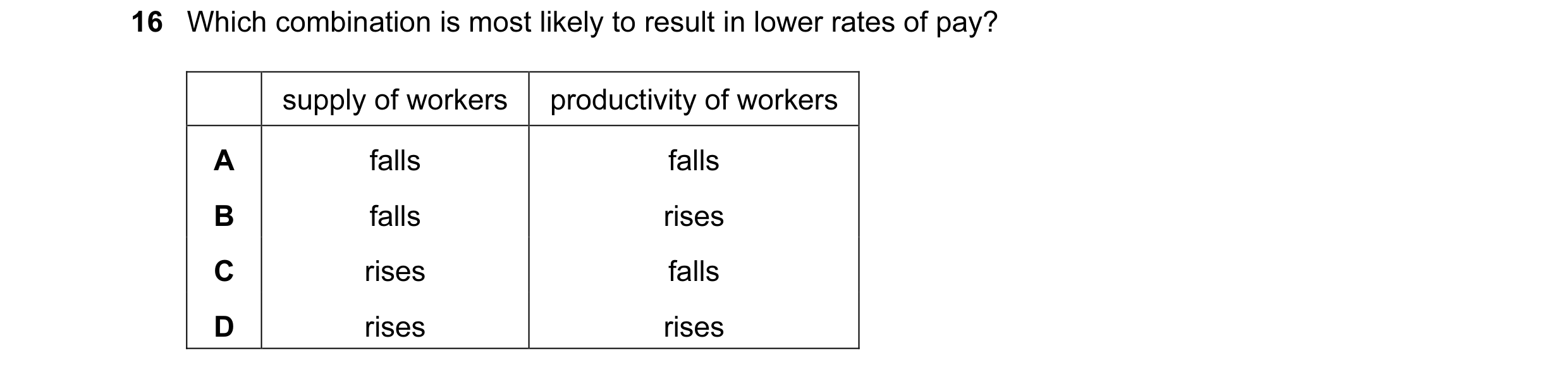
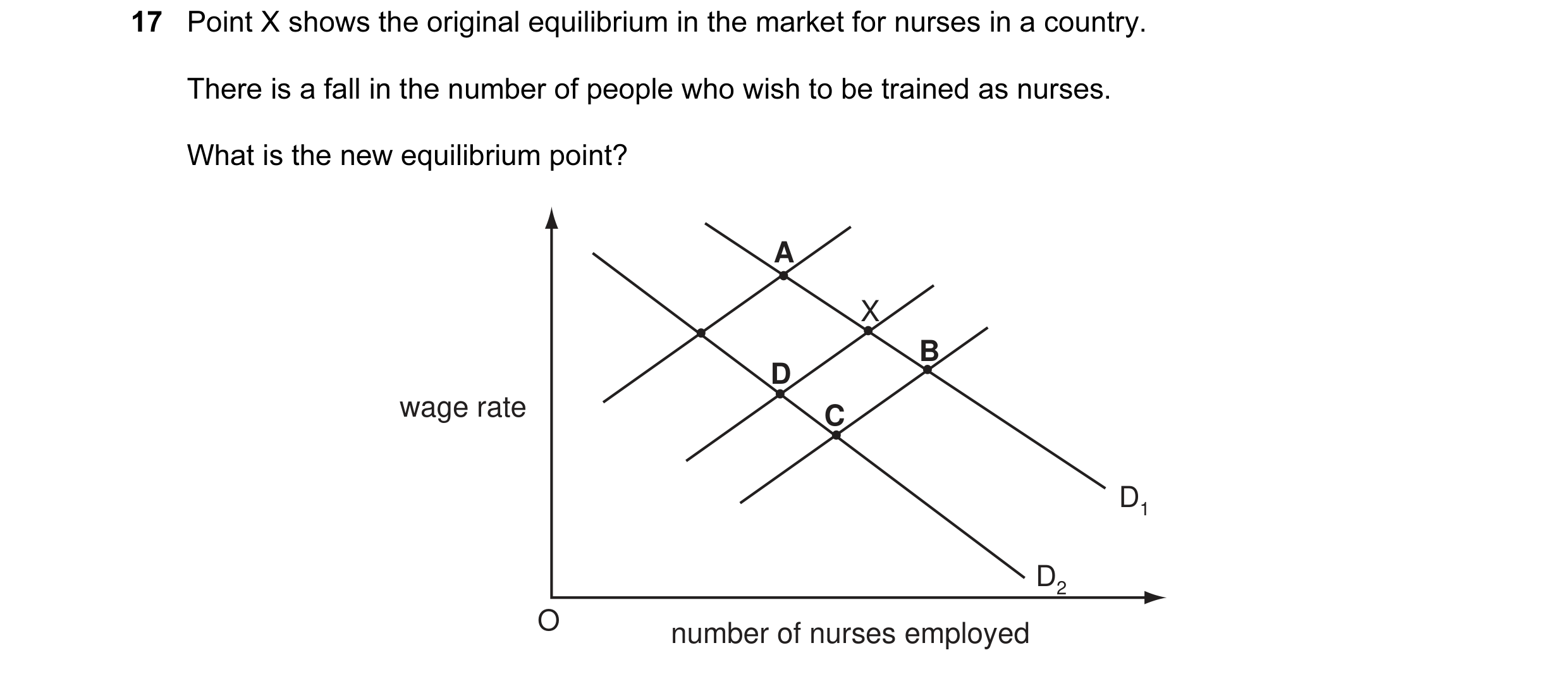


 1 / 42

 2 / 42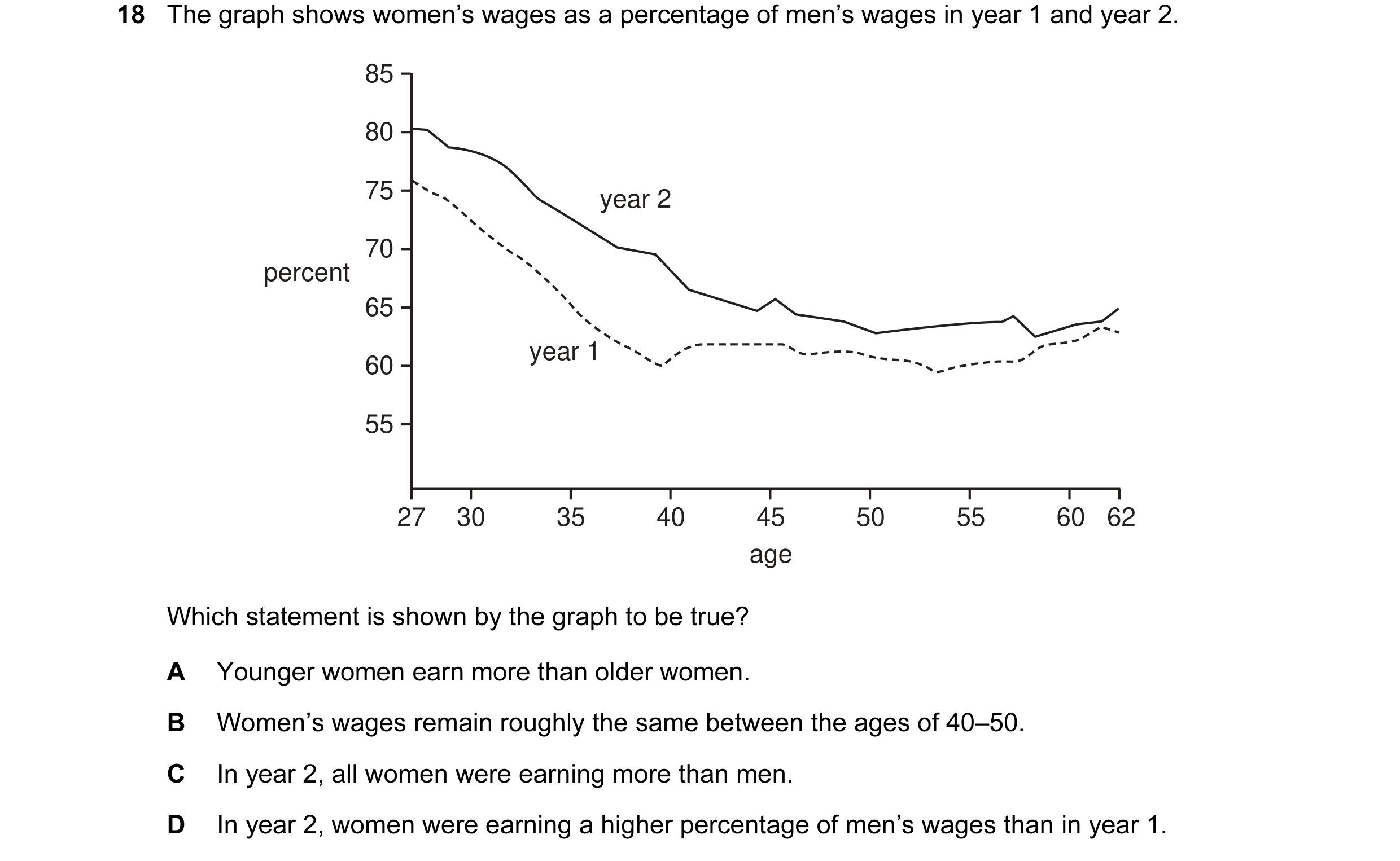


 3 / 42


 4 / 42
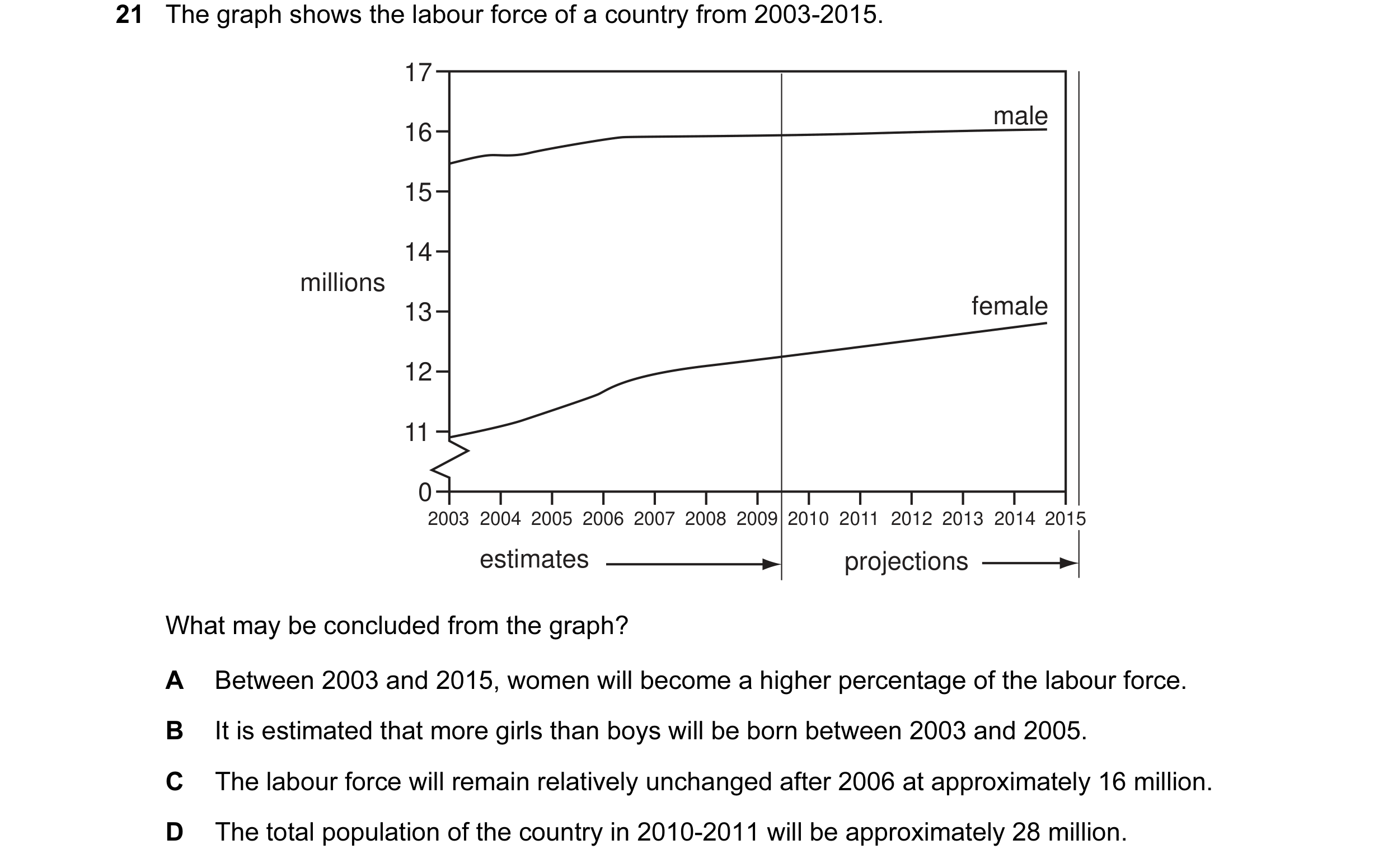

 5 / 42



 6 / 42


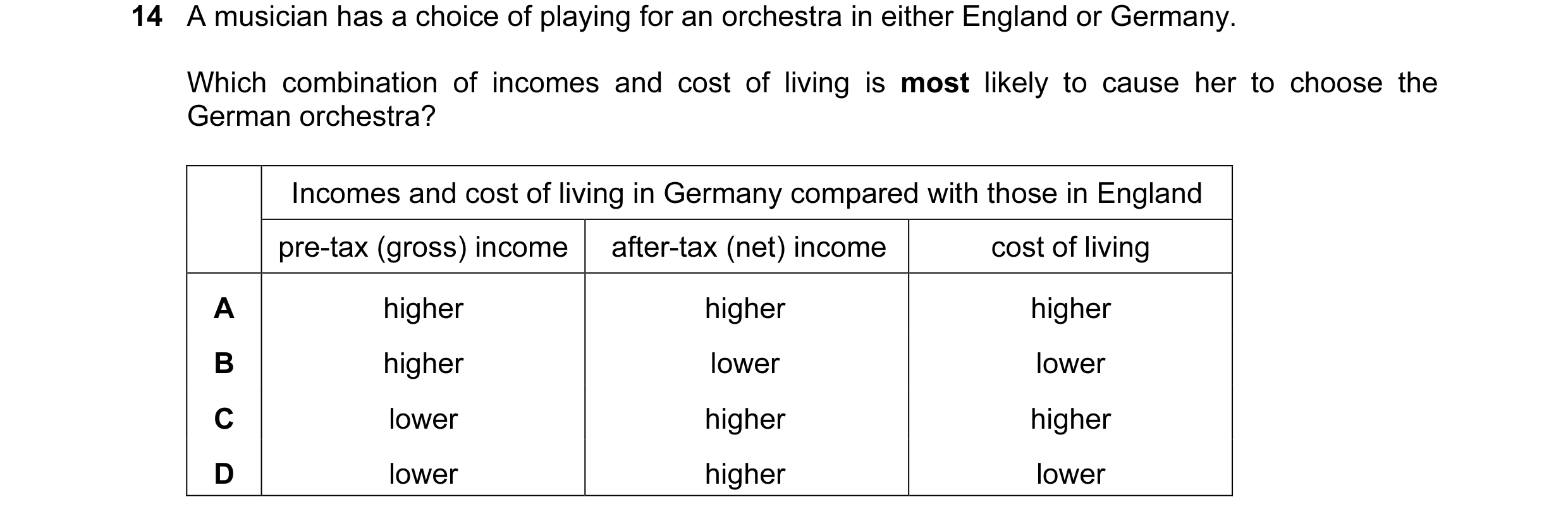
 7 / 42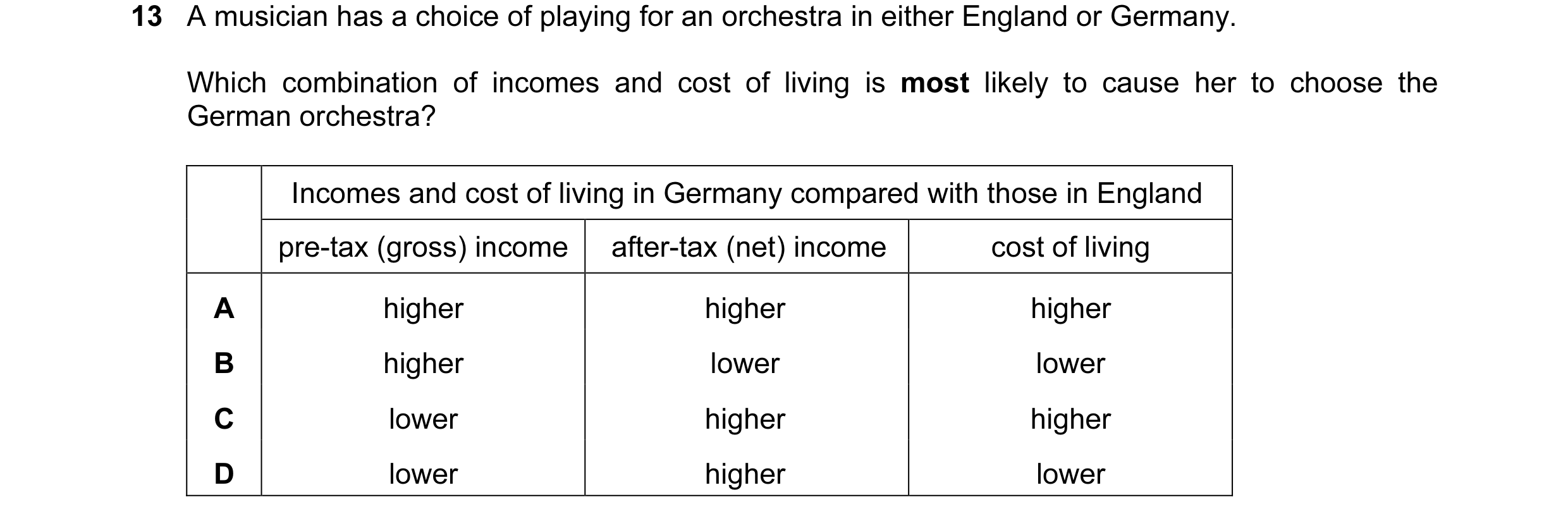

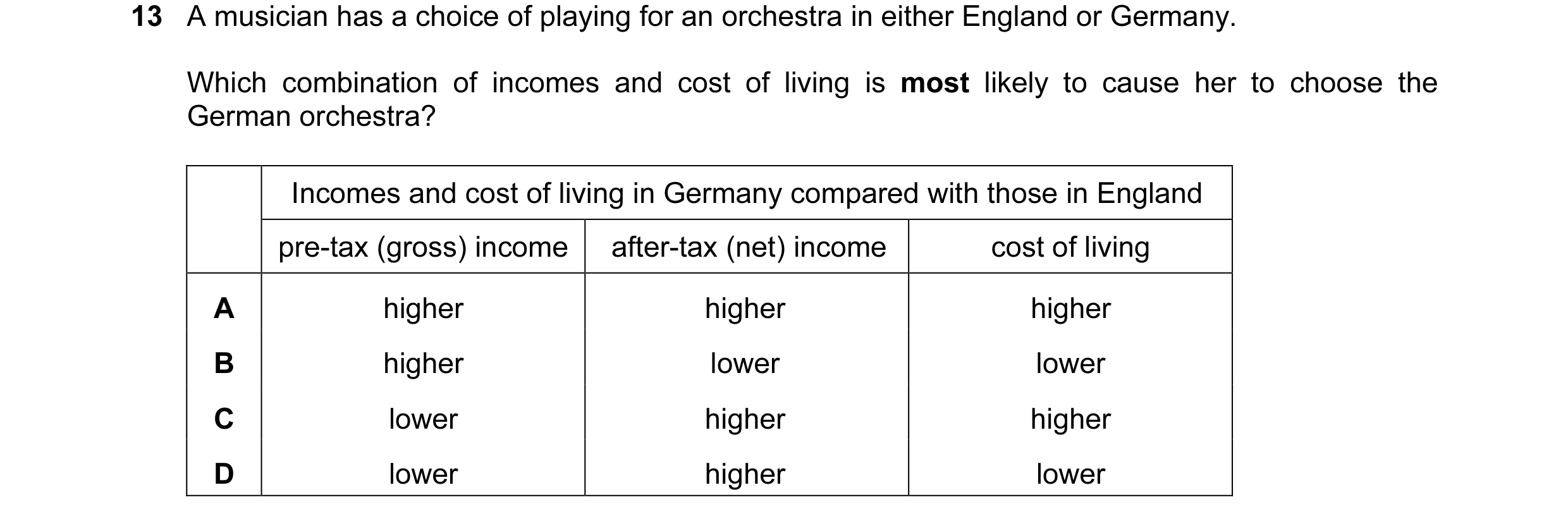

 8 / 42

 9 / 42
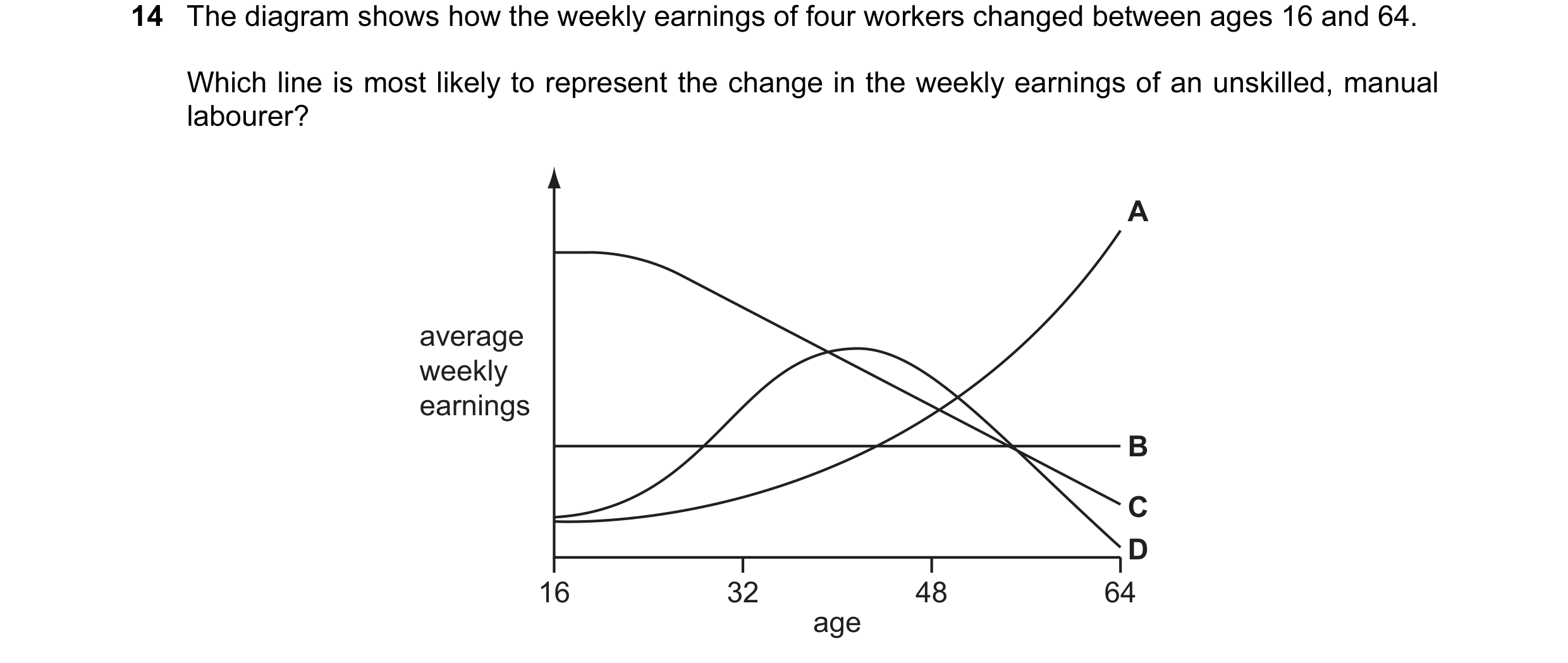
 10 / 42

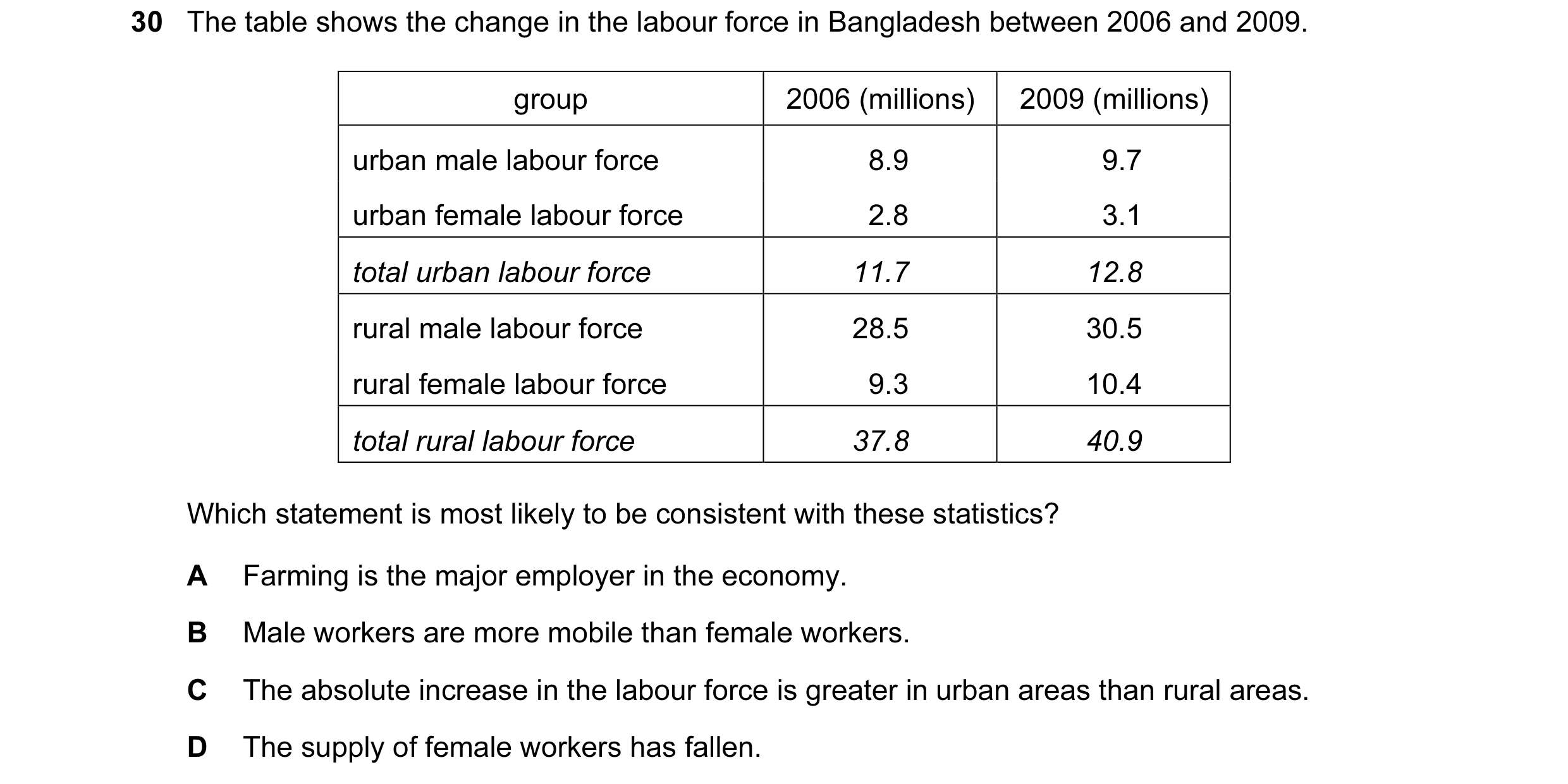
 11 / 42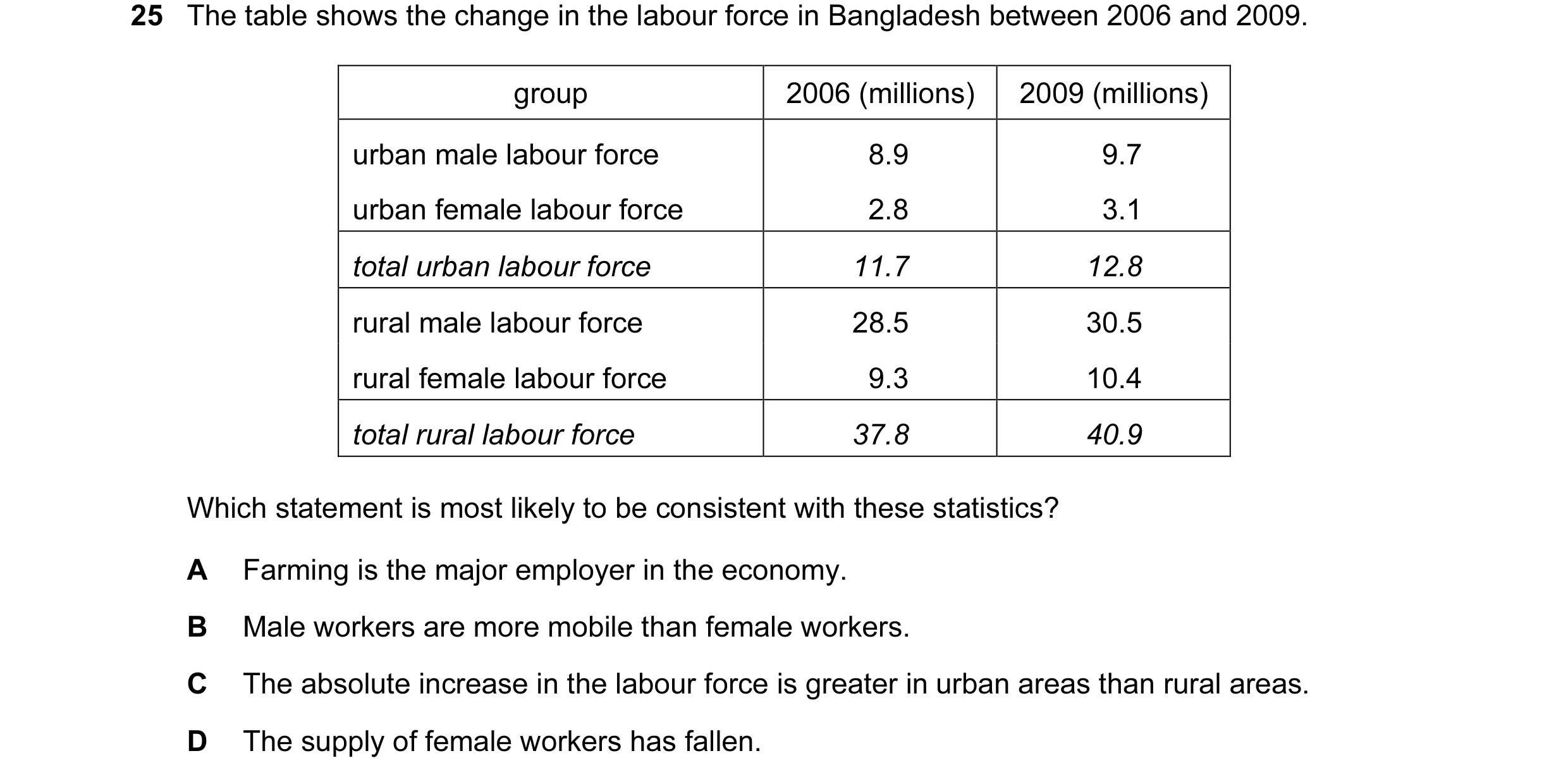

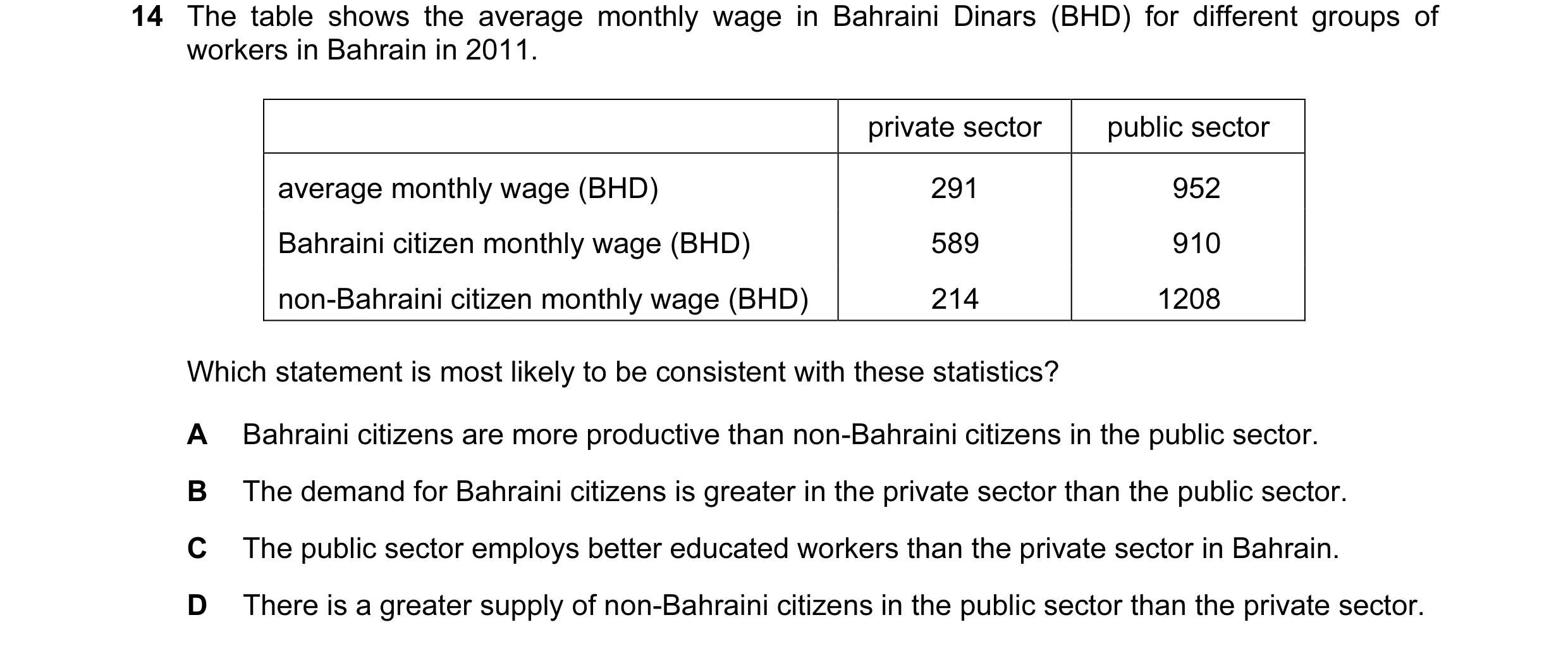
 12 / 42

 13 / 42




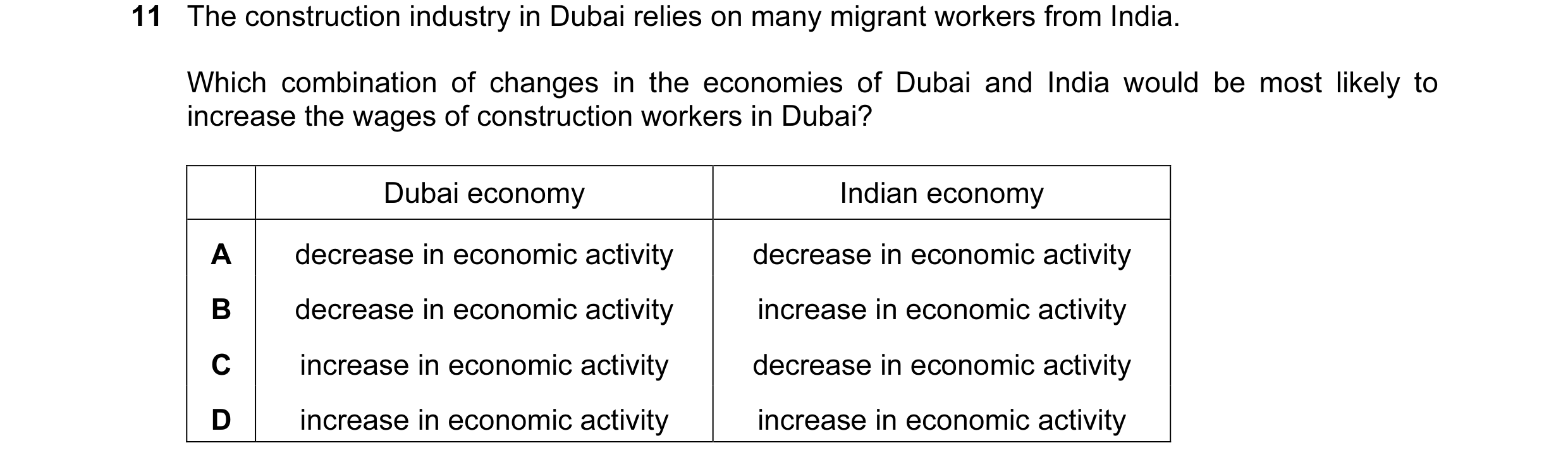 14 / 42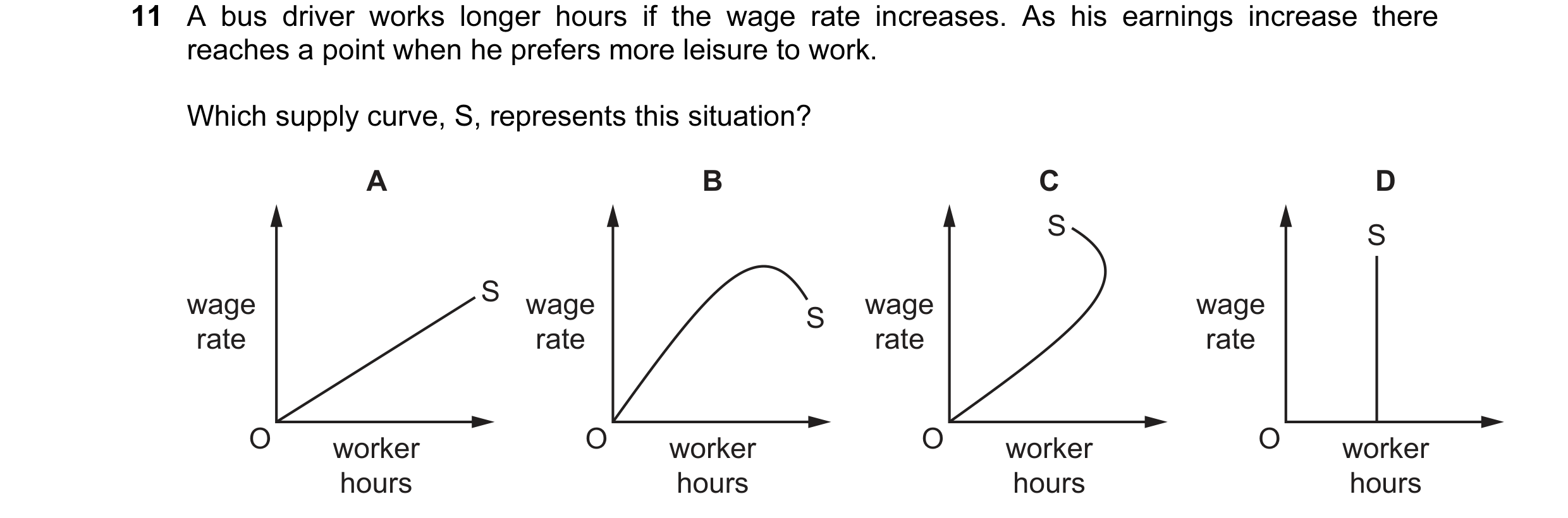
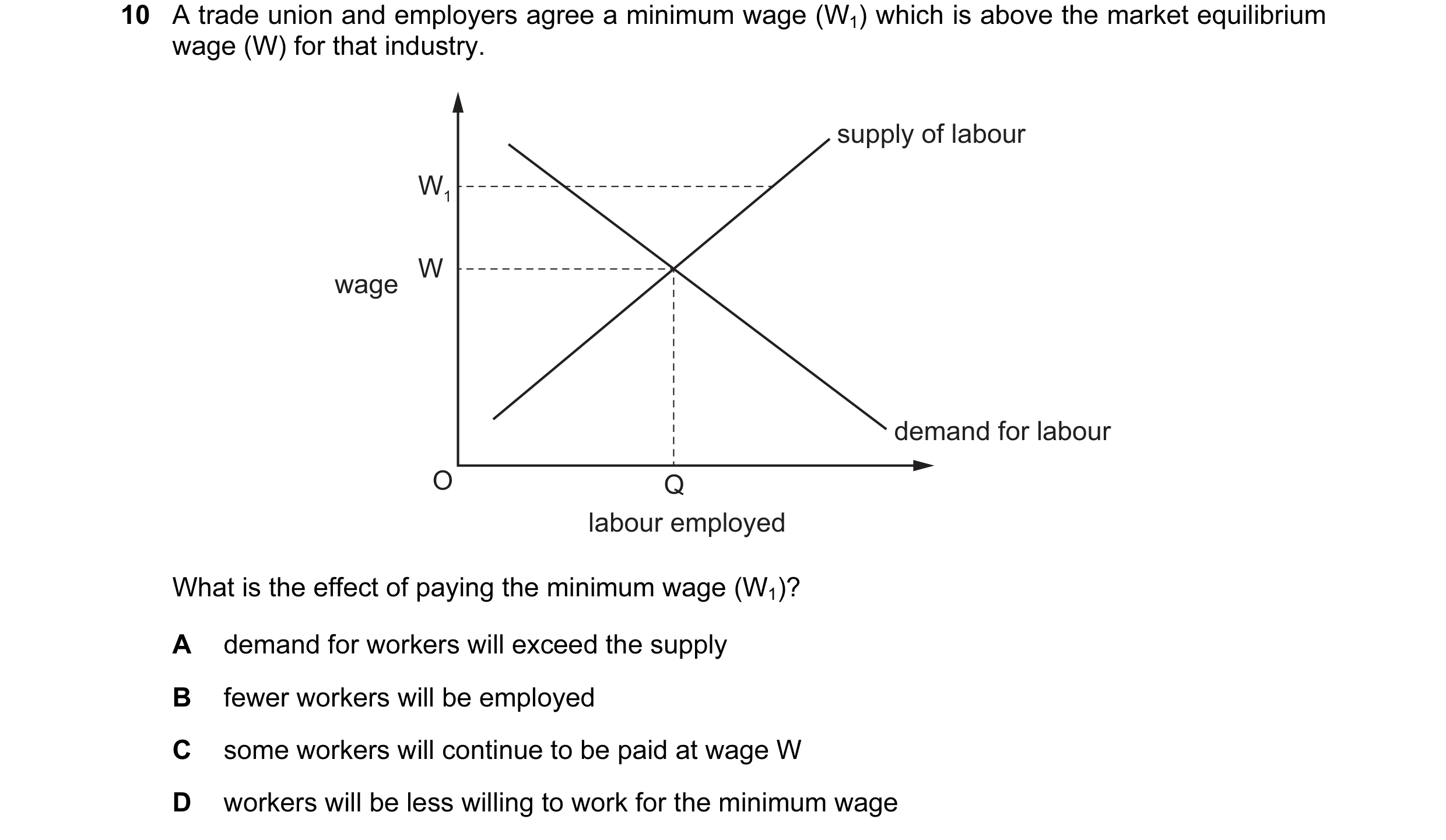
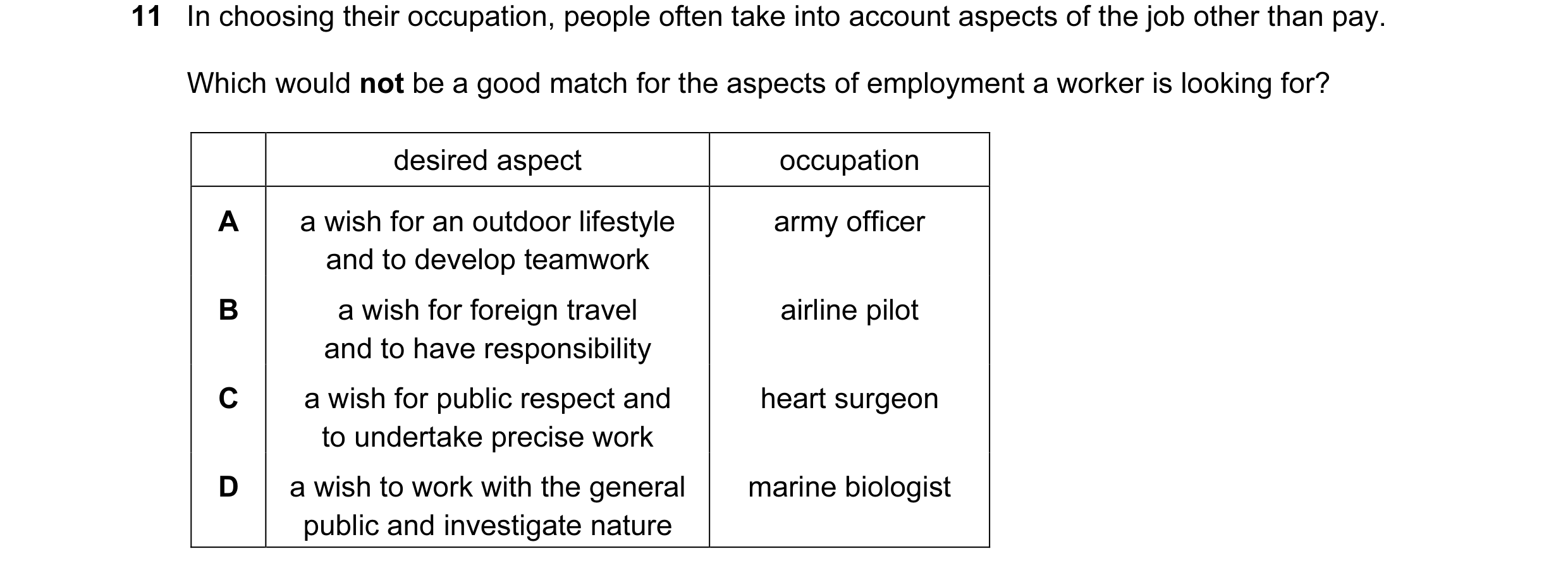 15 / 42
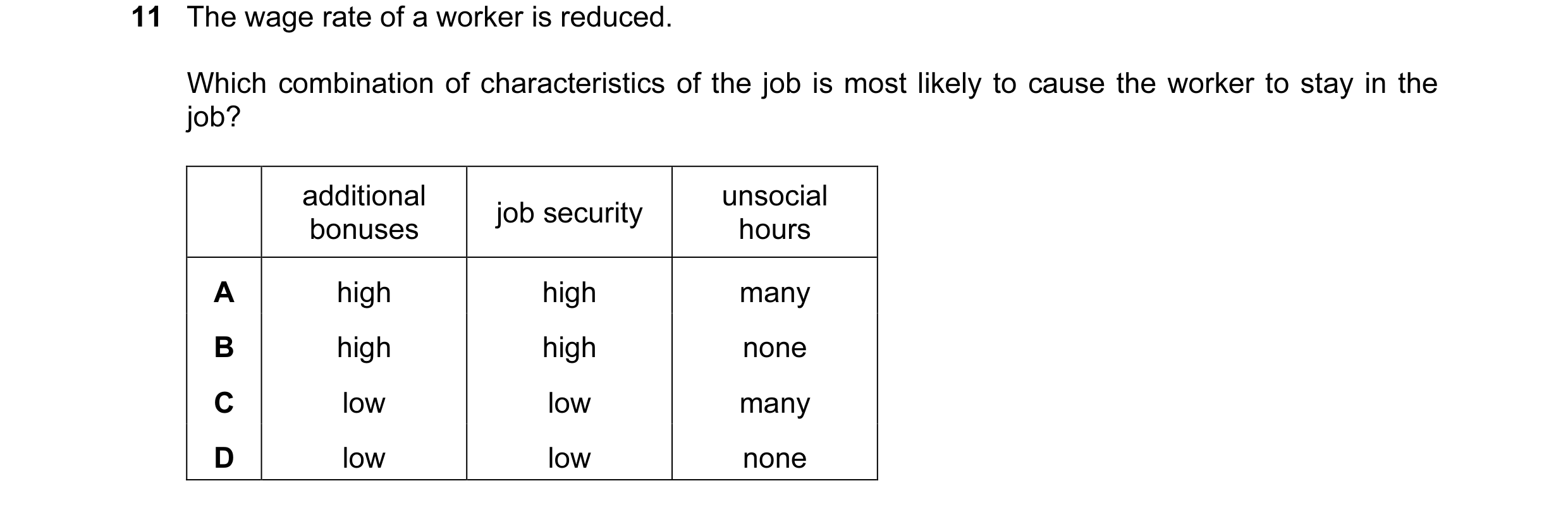
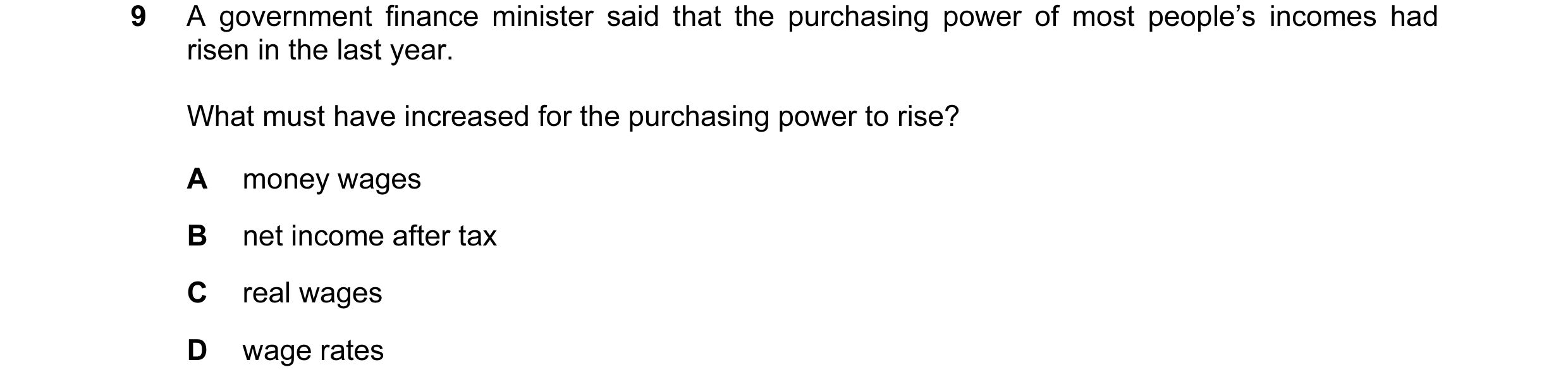 16 / 42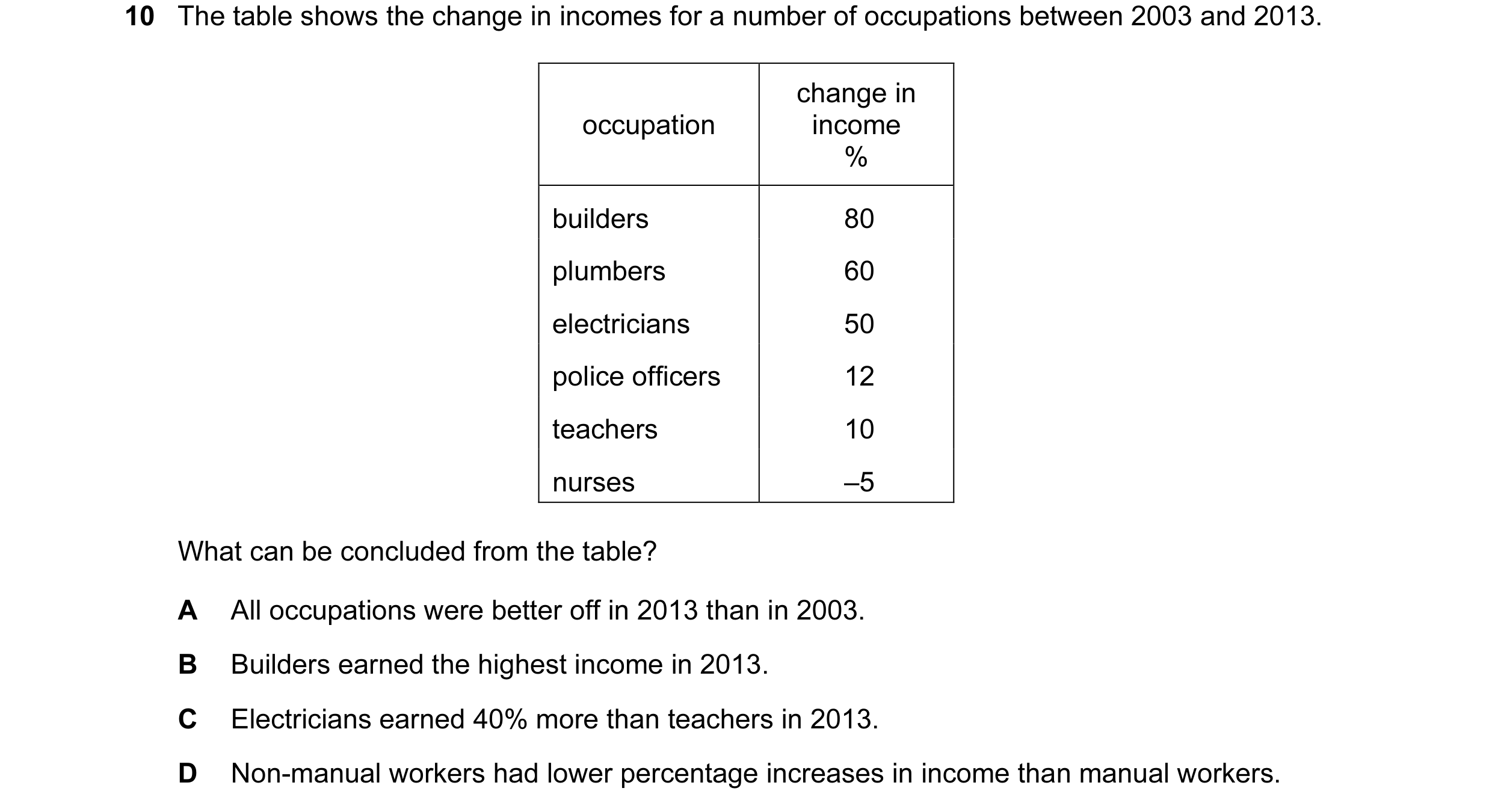
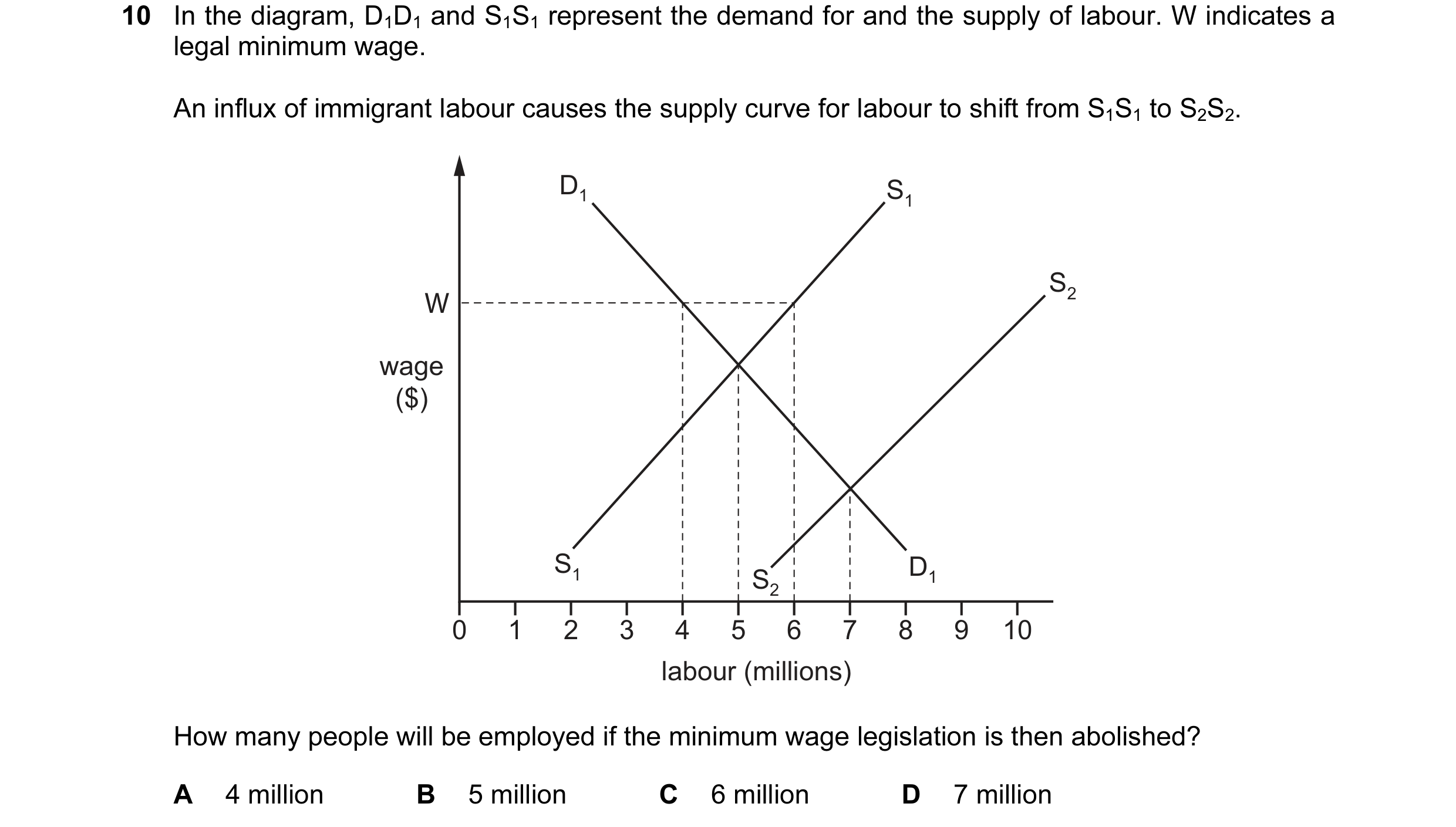 17 / 42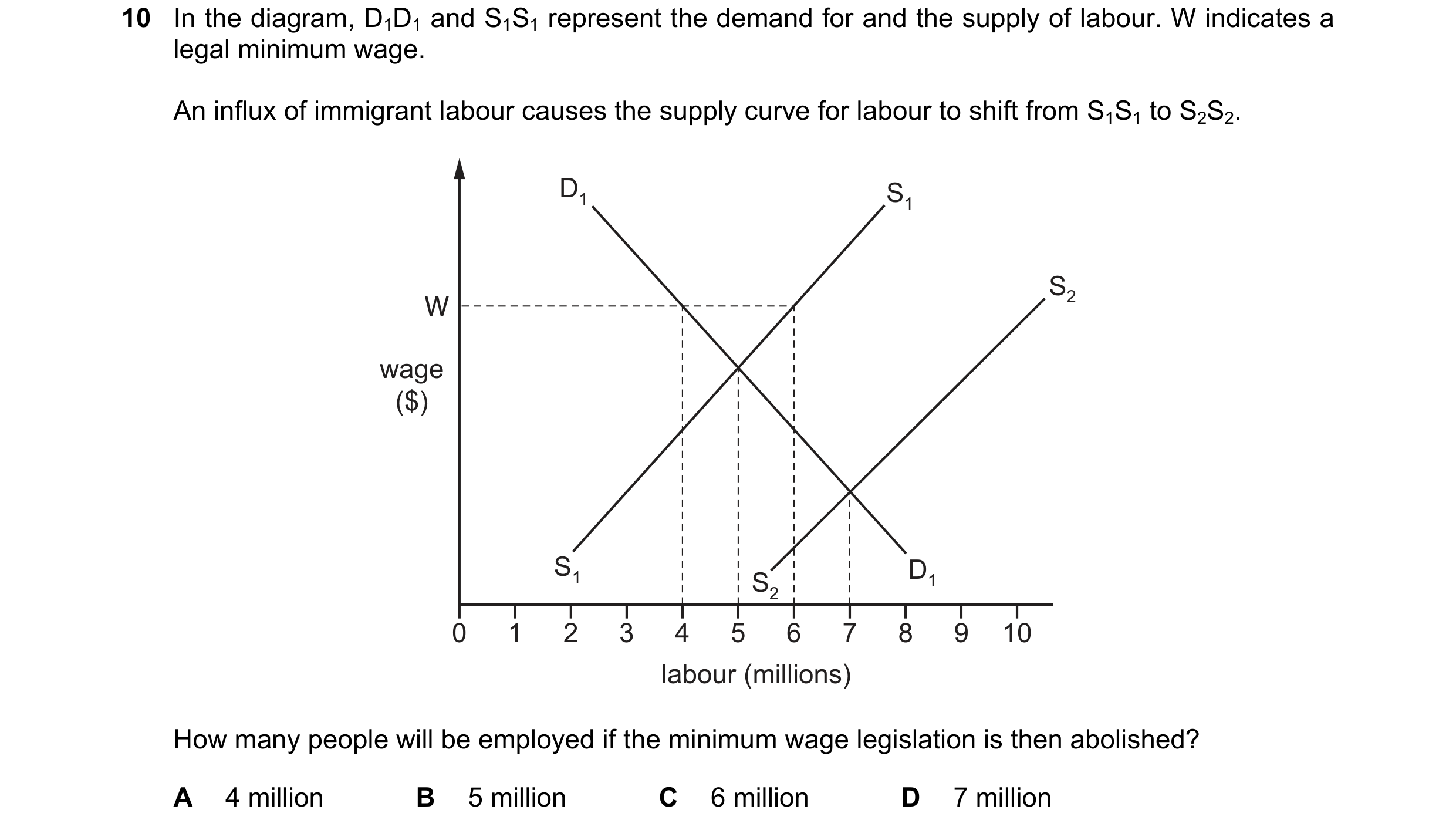
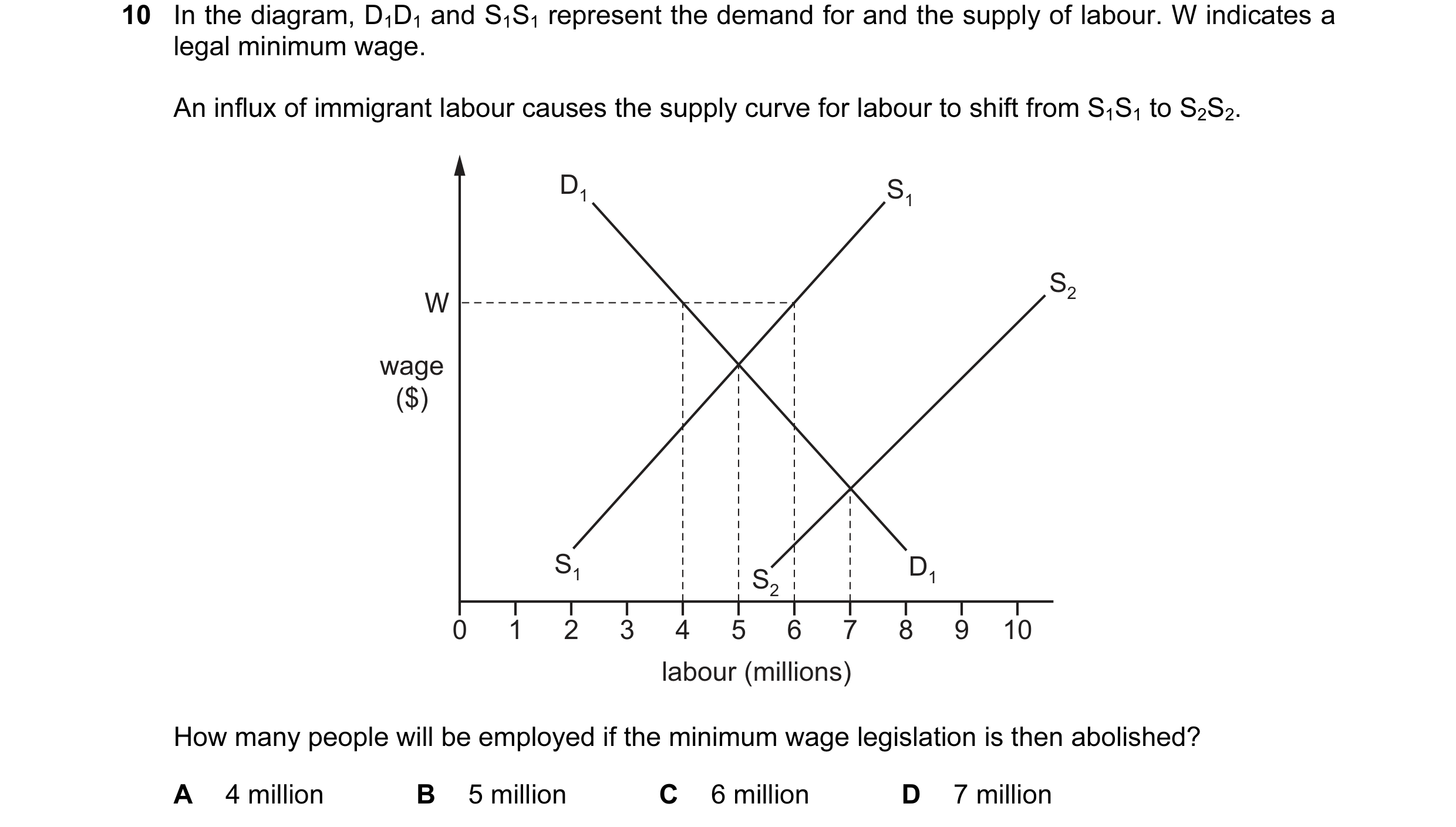
 18 / 42
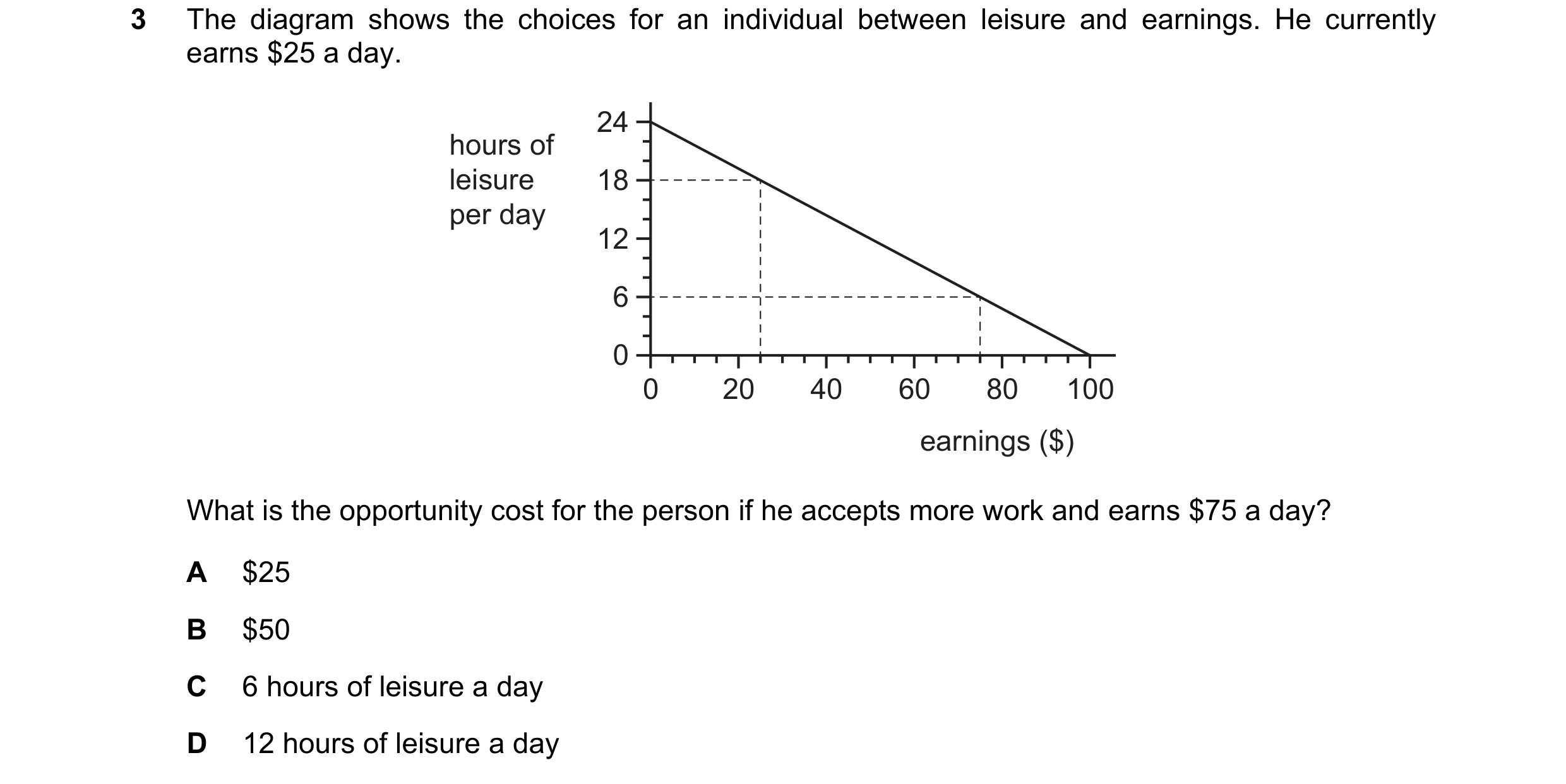
 19 / 42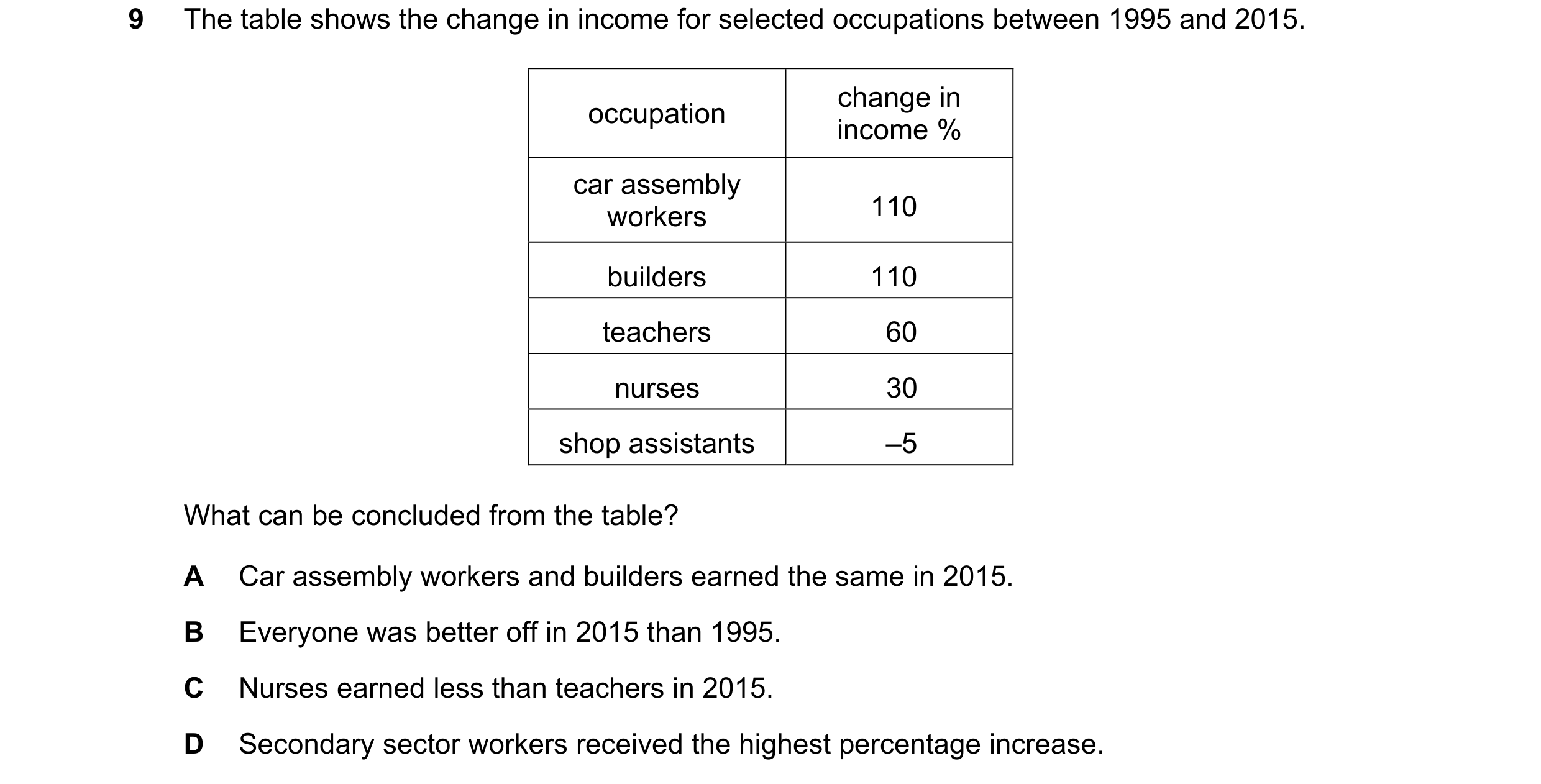

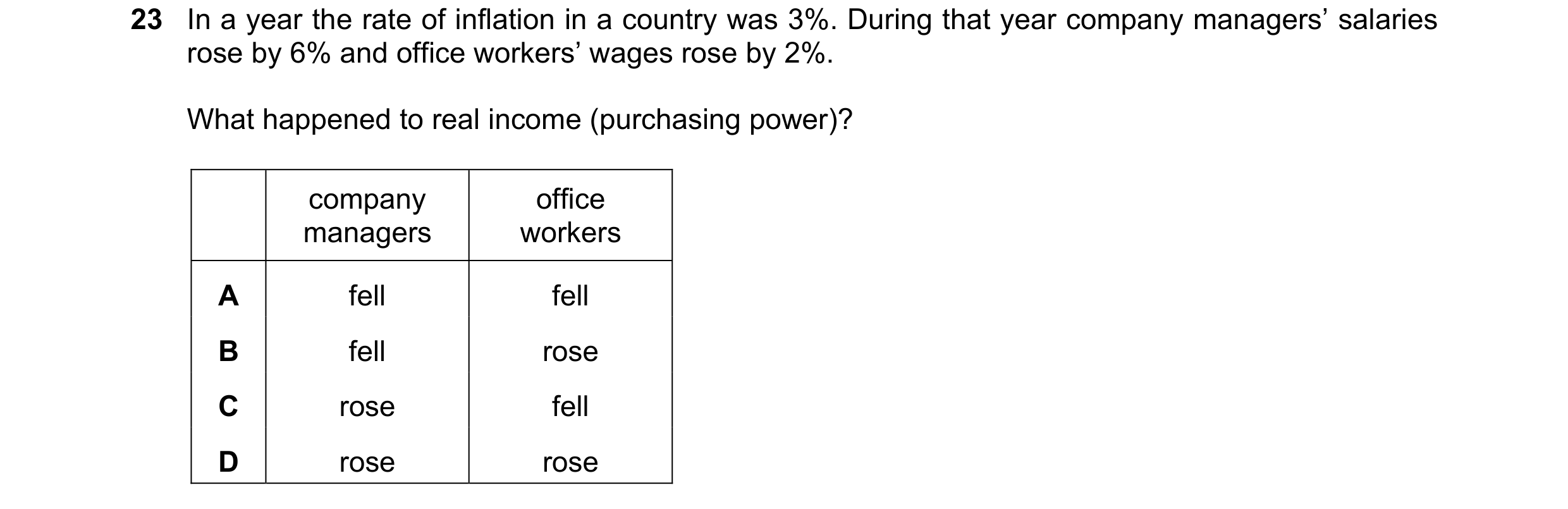
 20 / 42



 21 / 42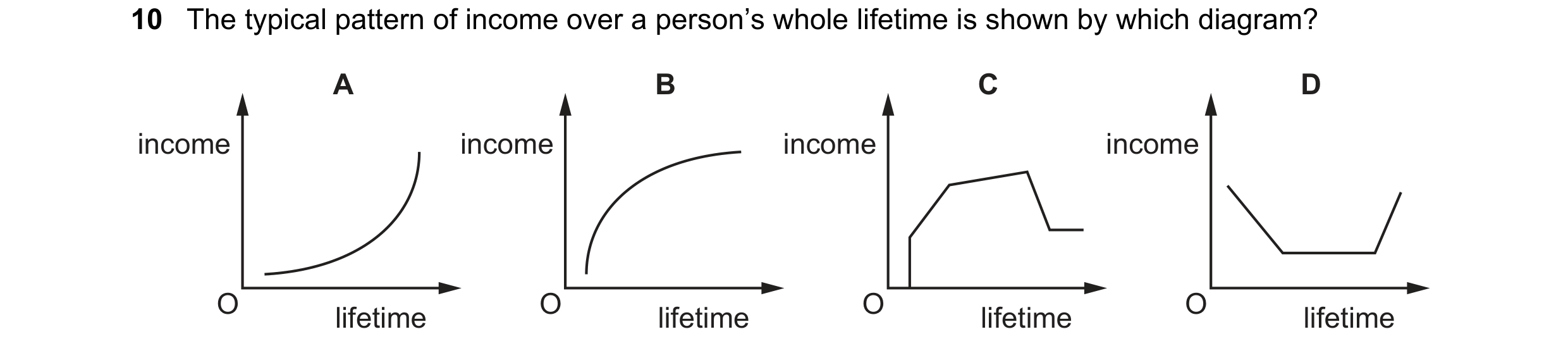
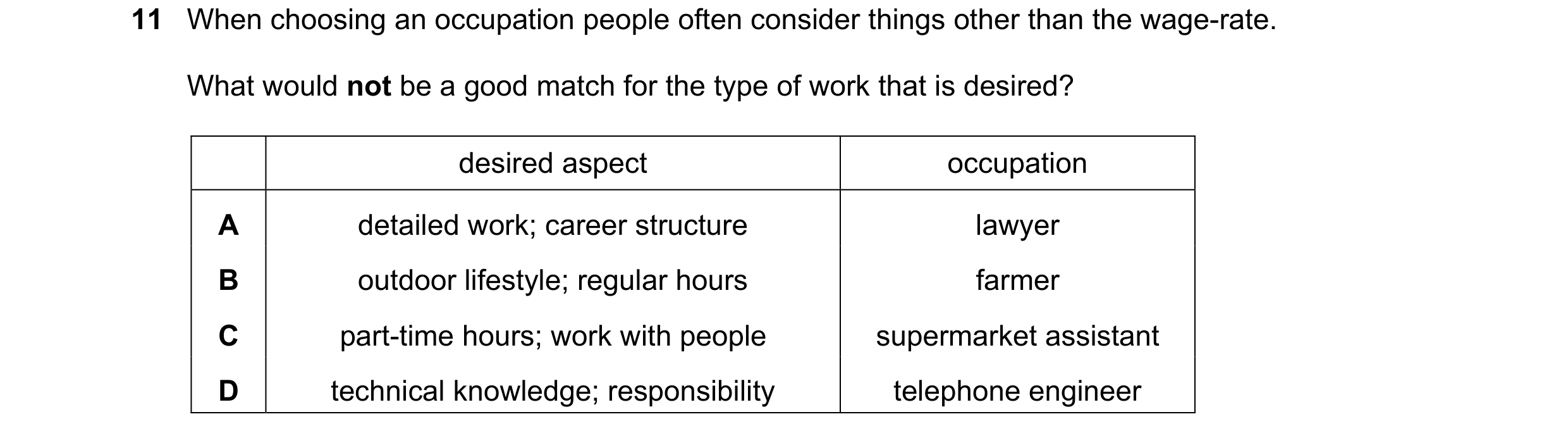

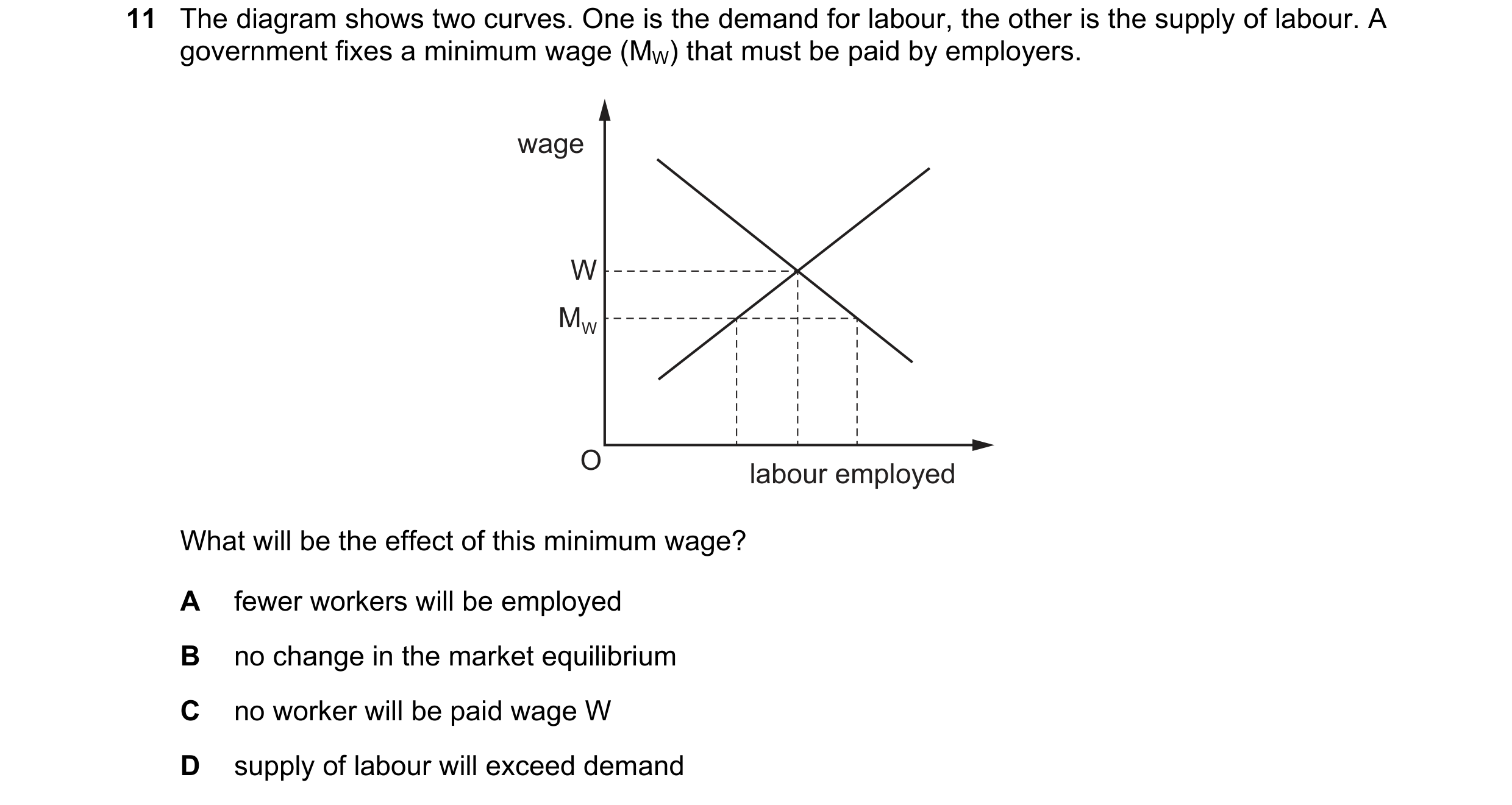 22 / 42

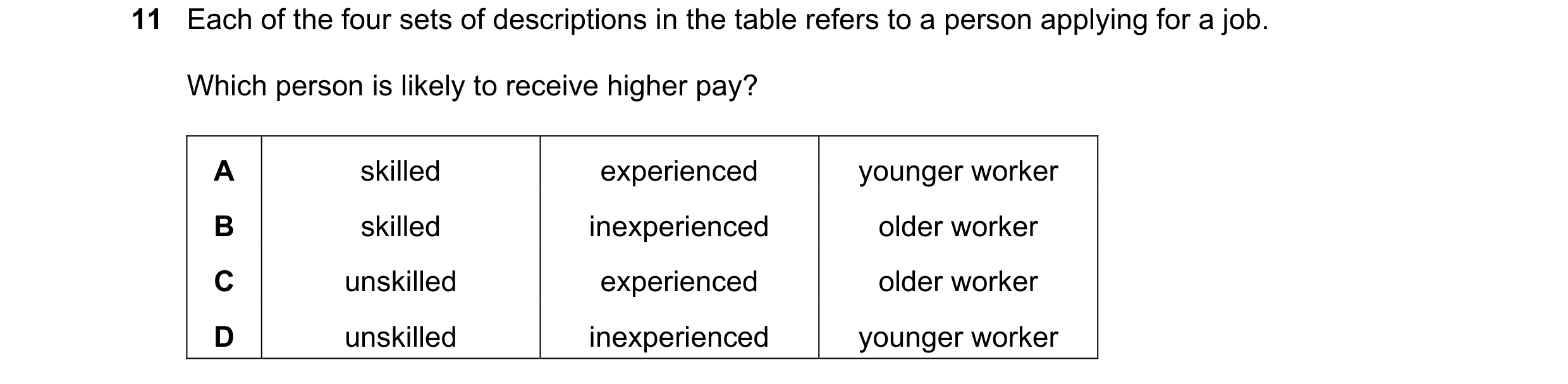


 23 / 42

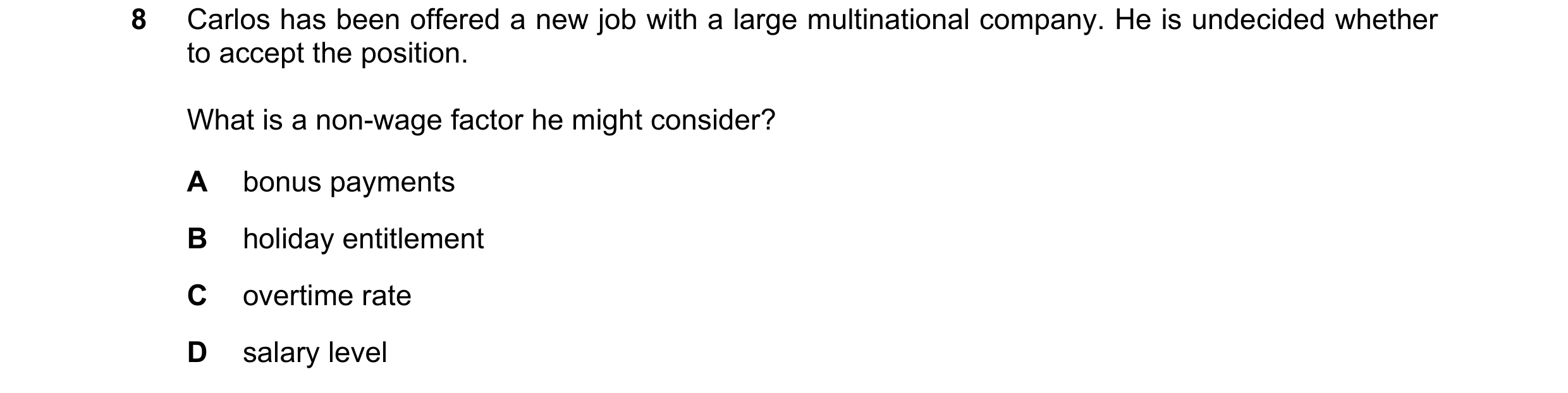
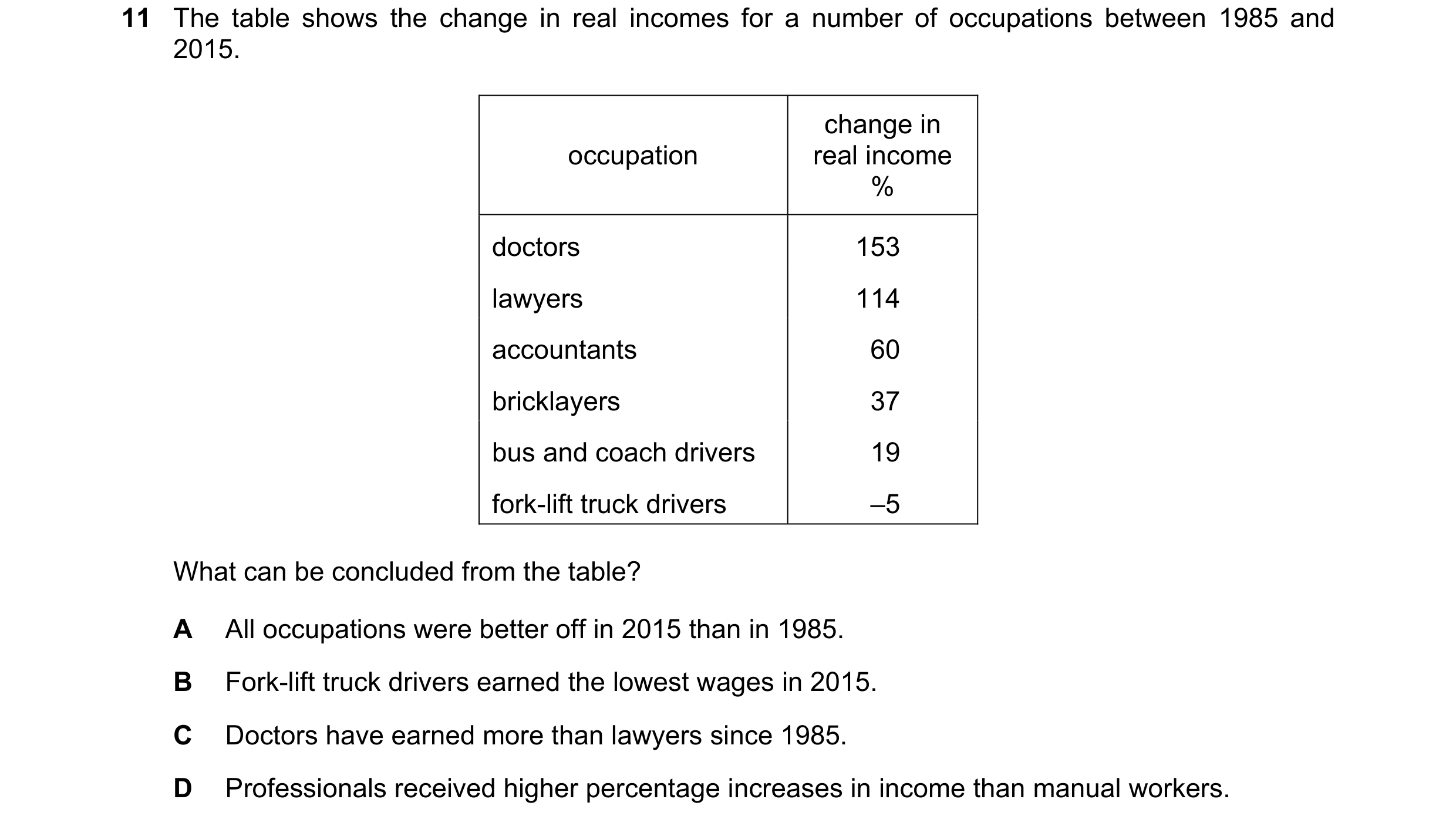 24 / 42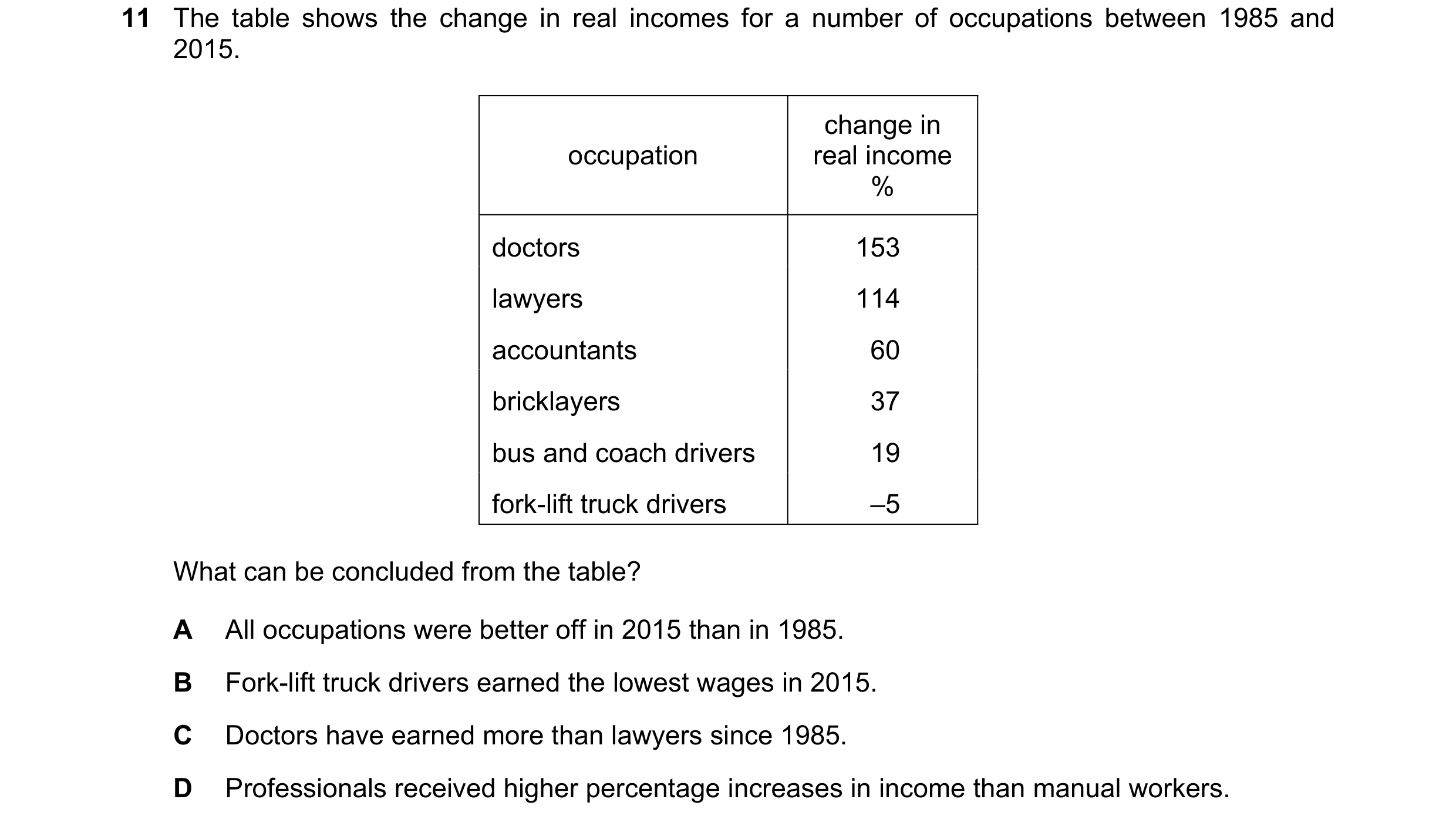

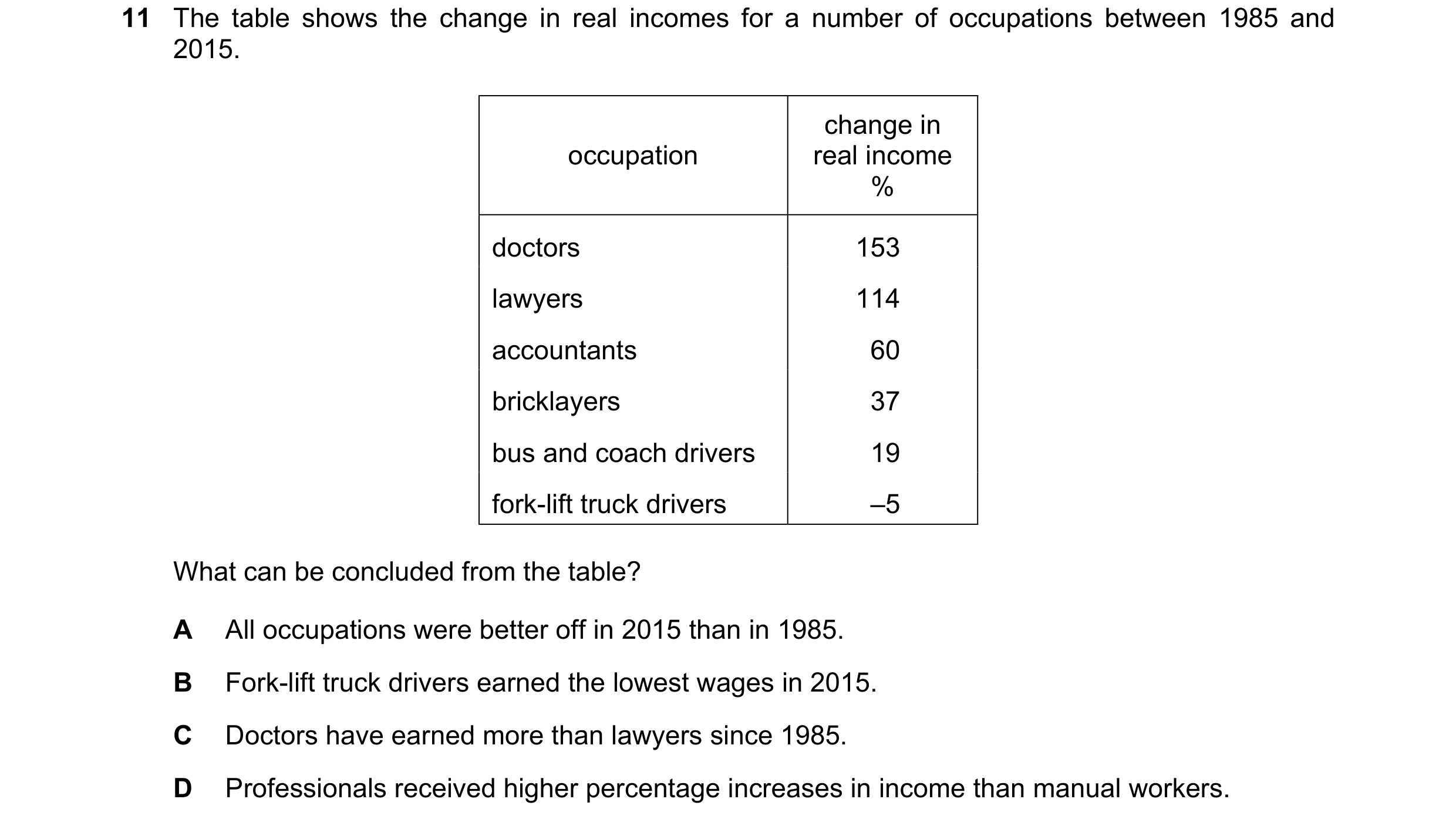 25 / 42
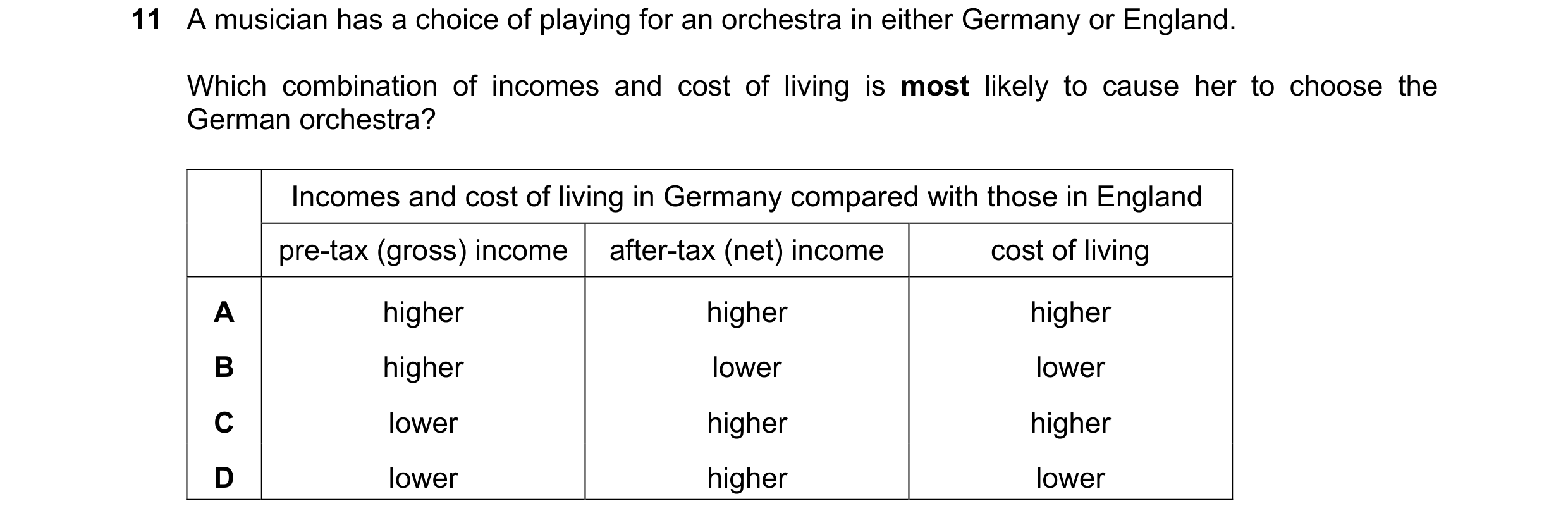

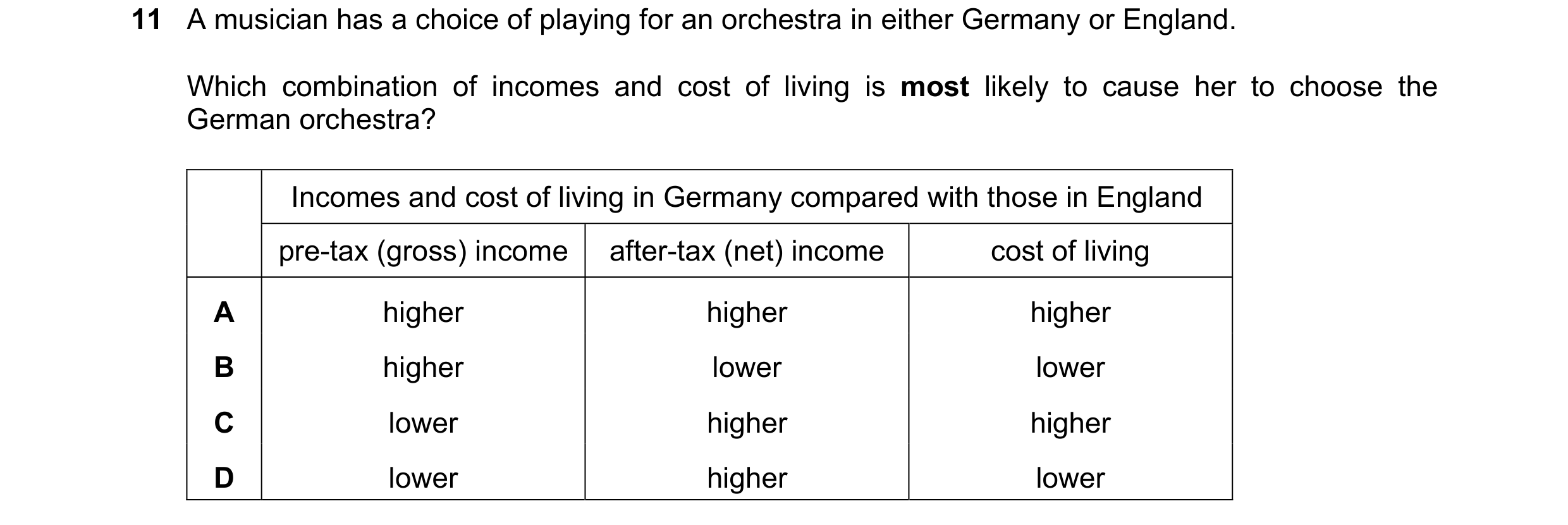
 26 / 42

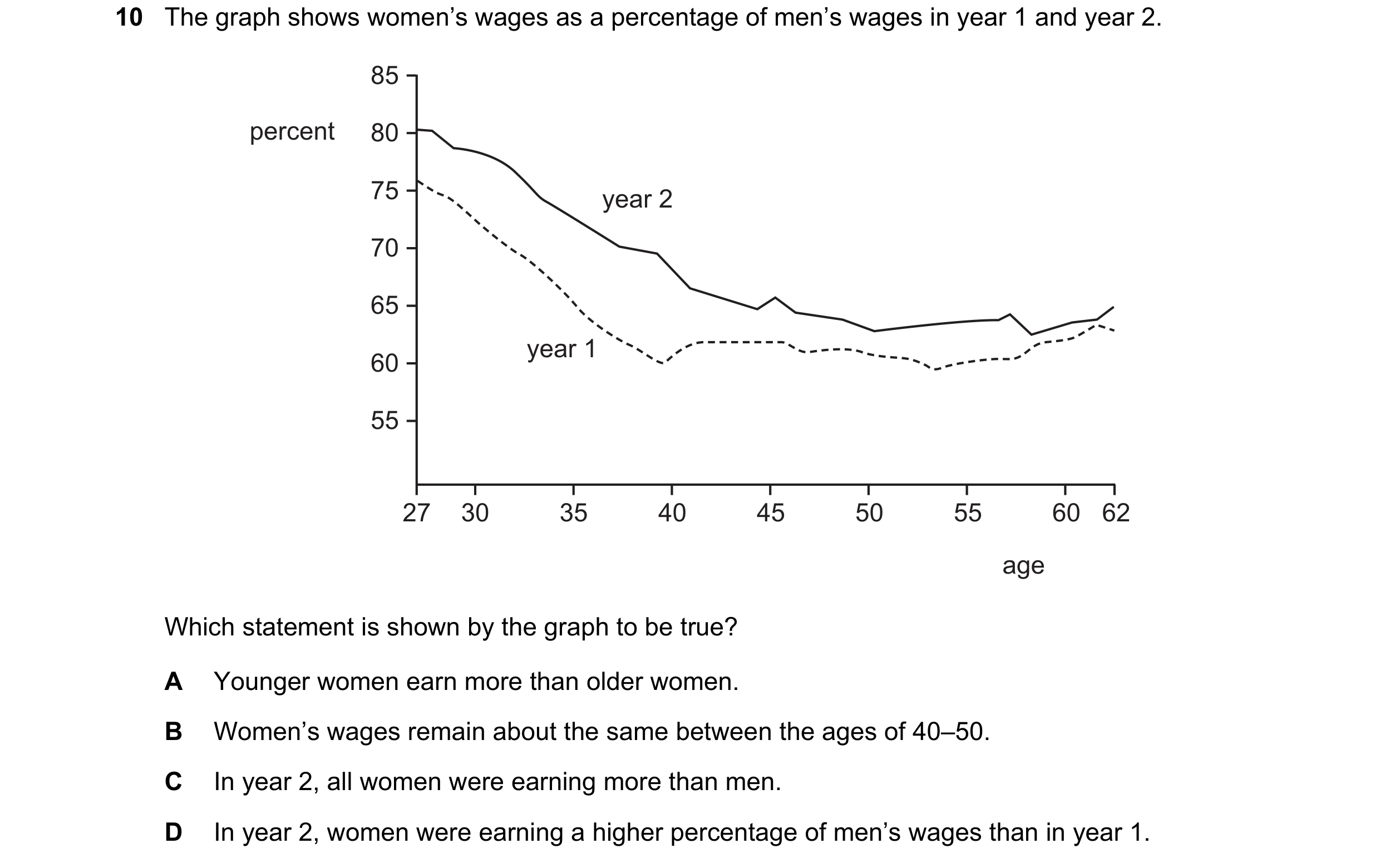 27 / 42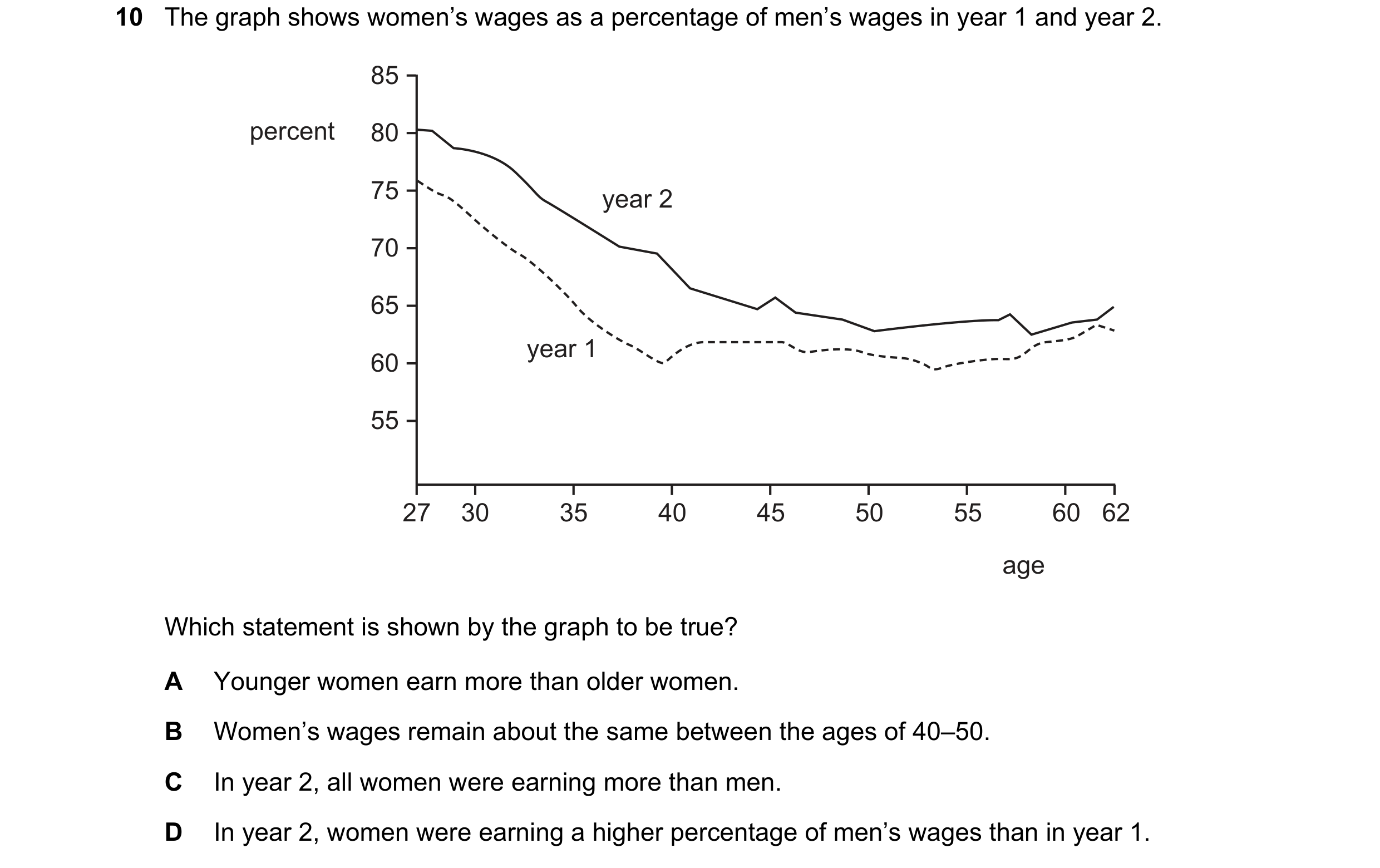
 28 / 42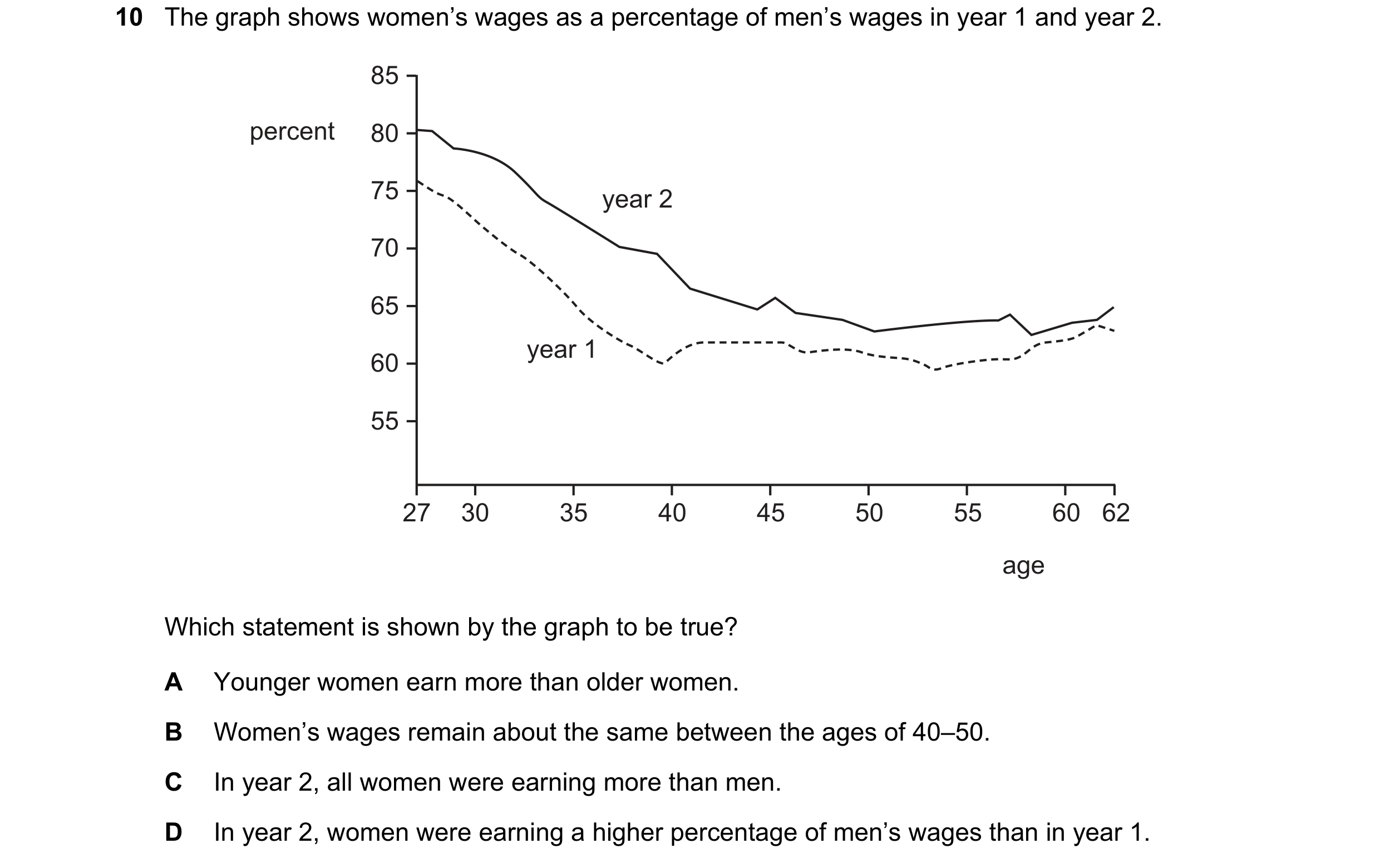


 29 / 42

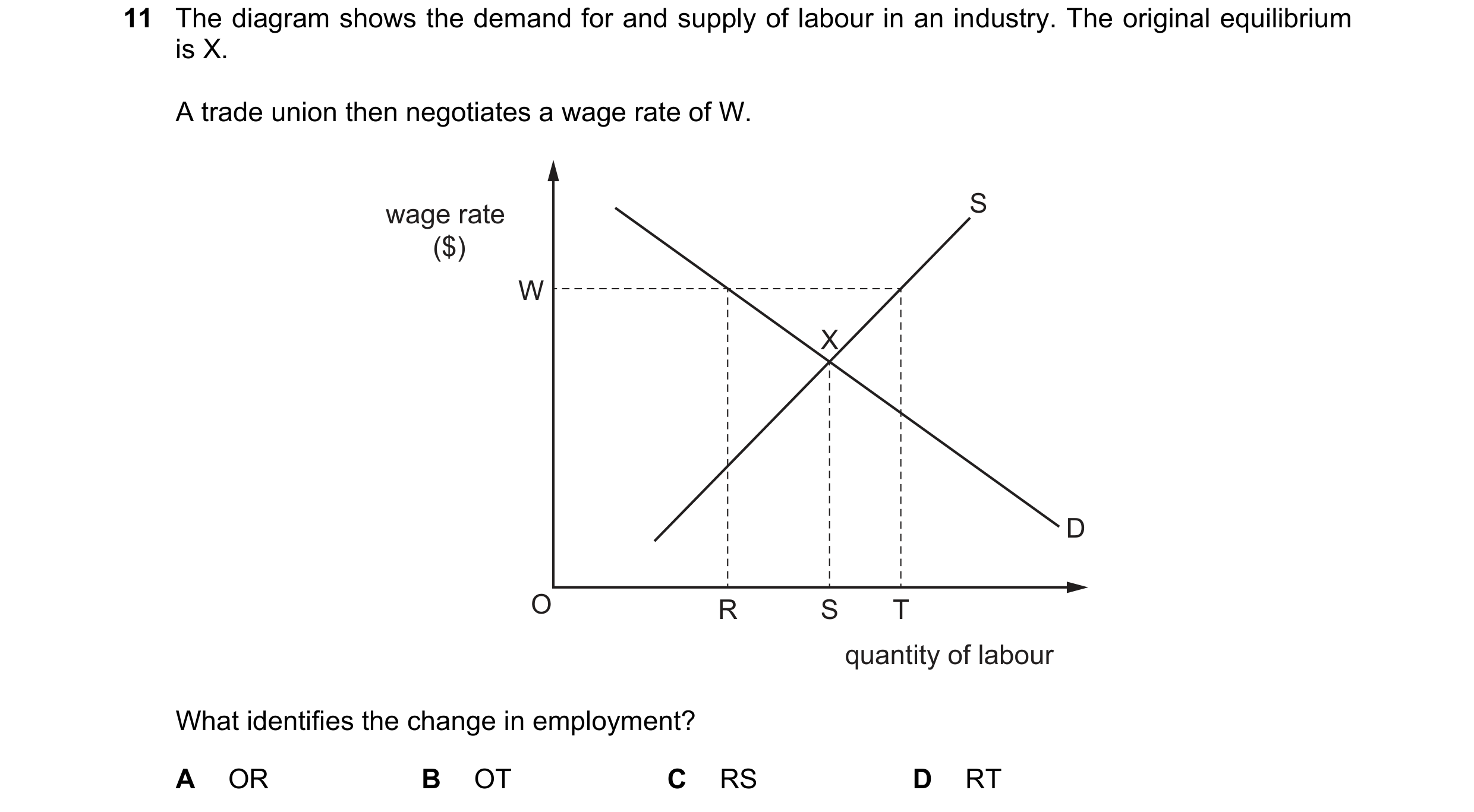 30 / 42
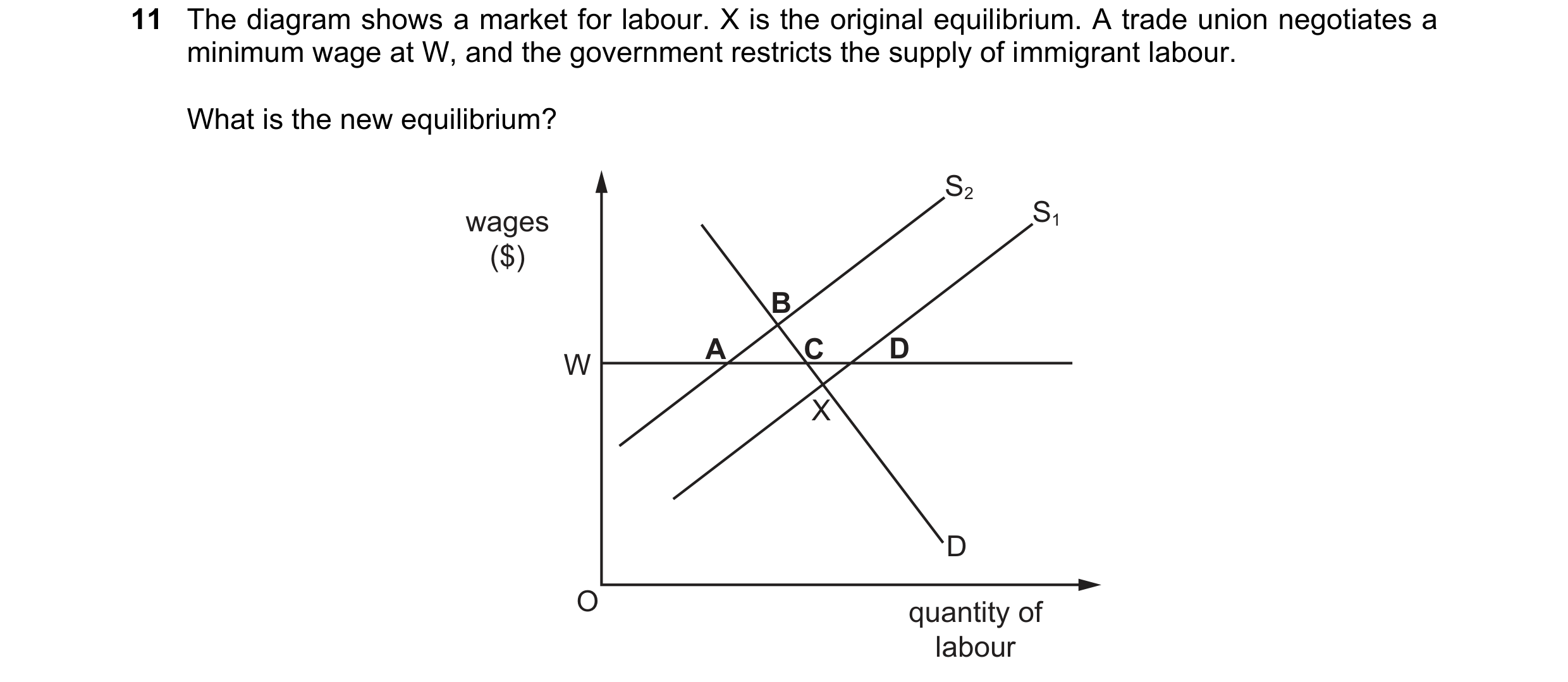

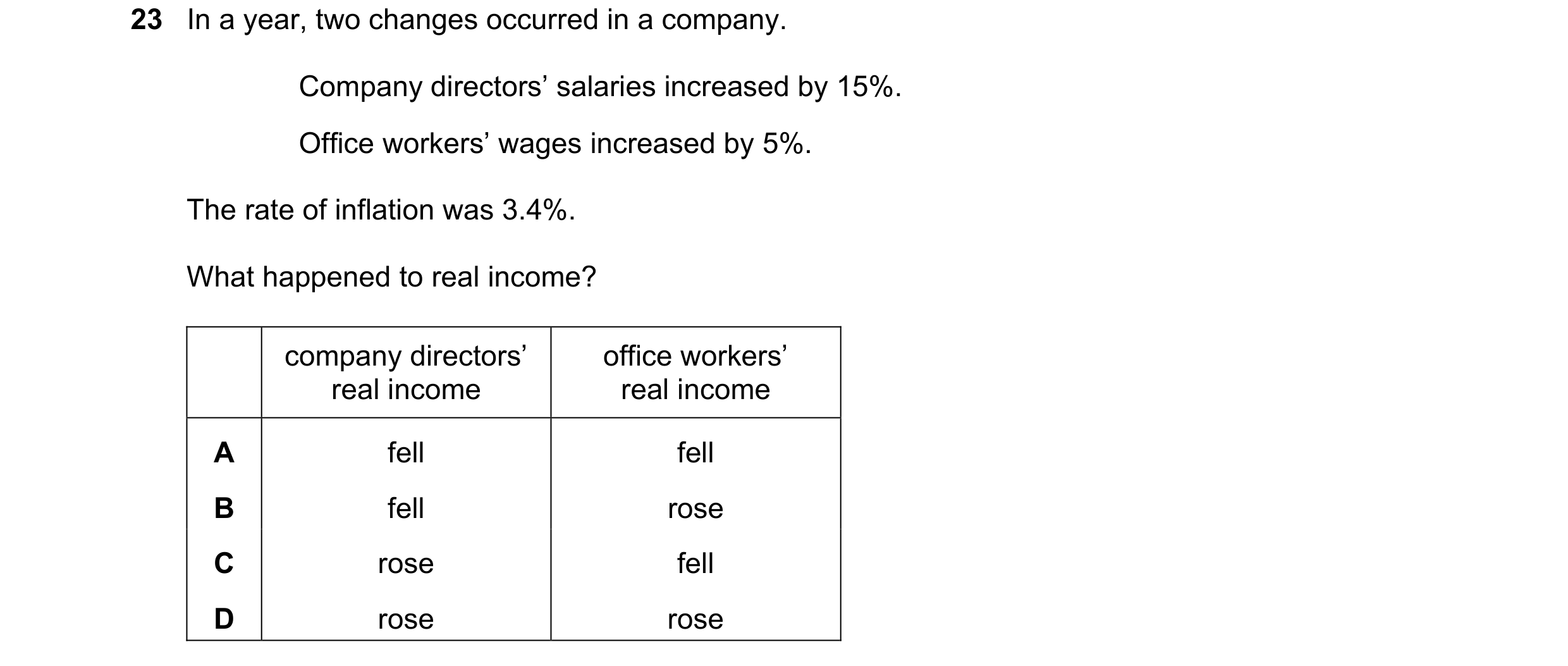 31 / 42
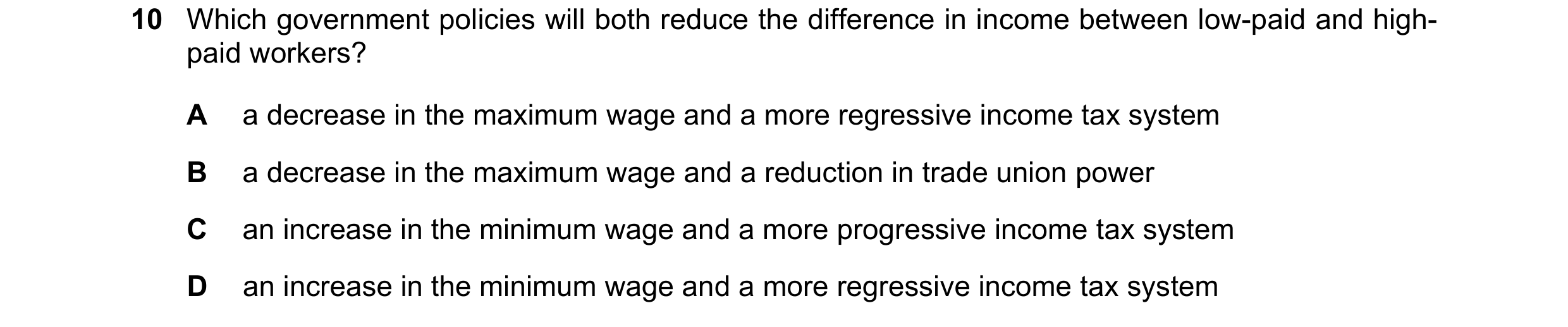
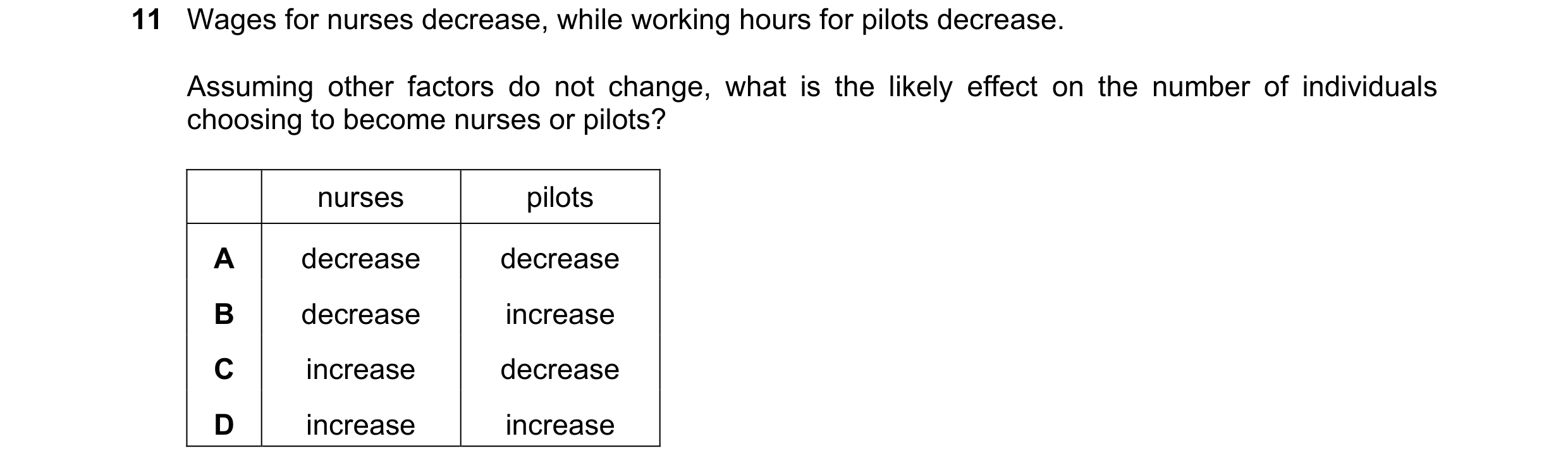
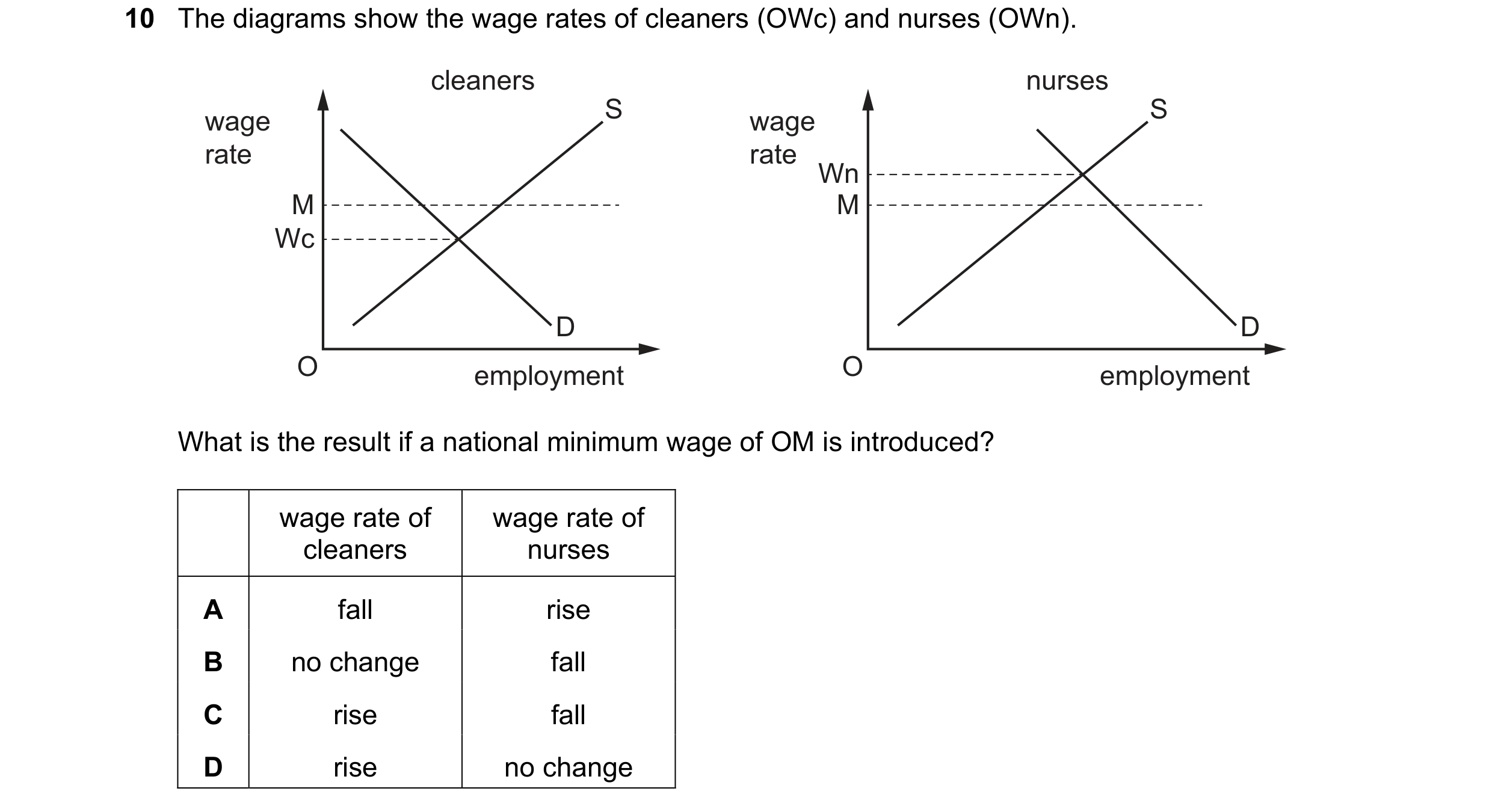 32 / 42



 33 / 42

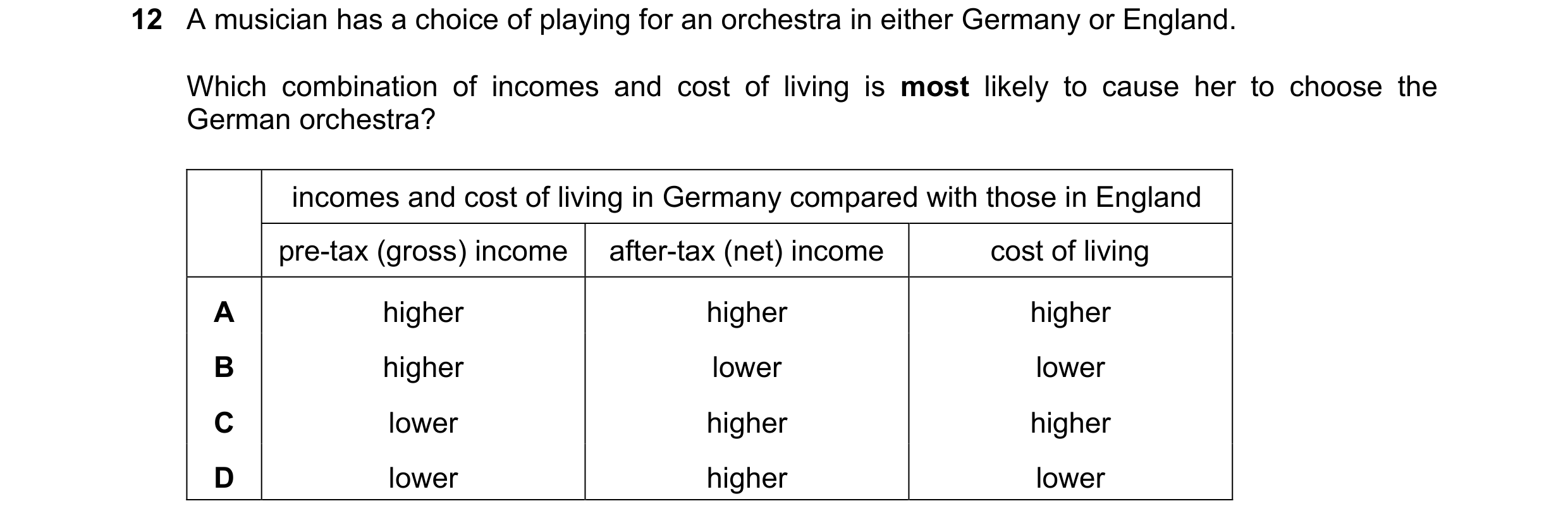
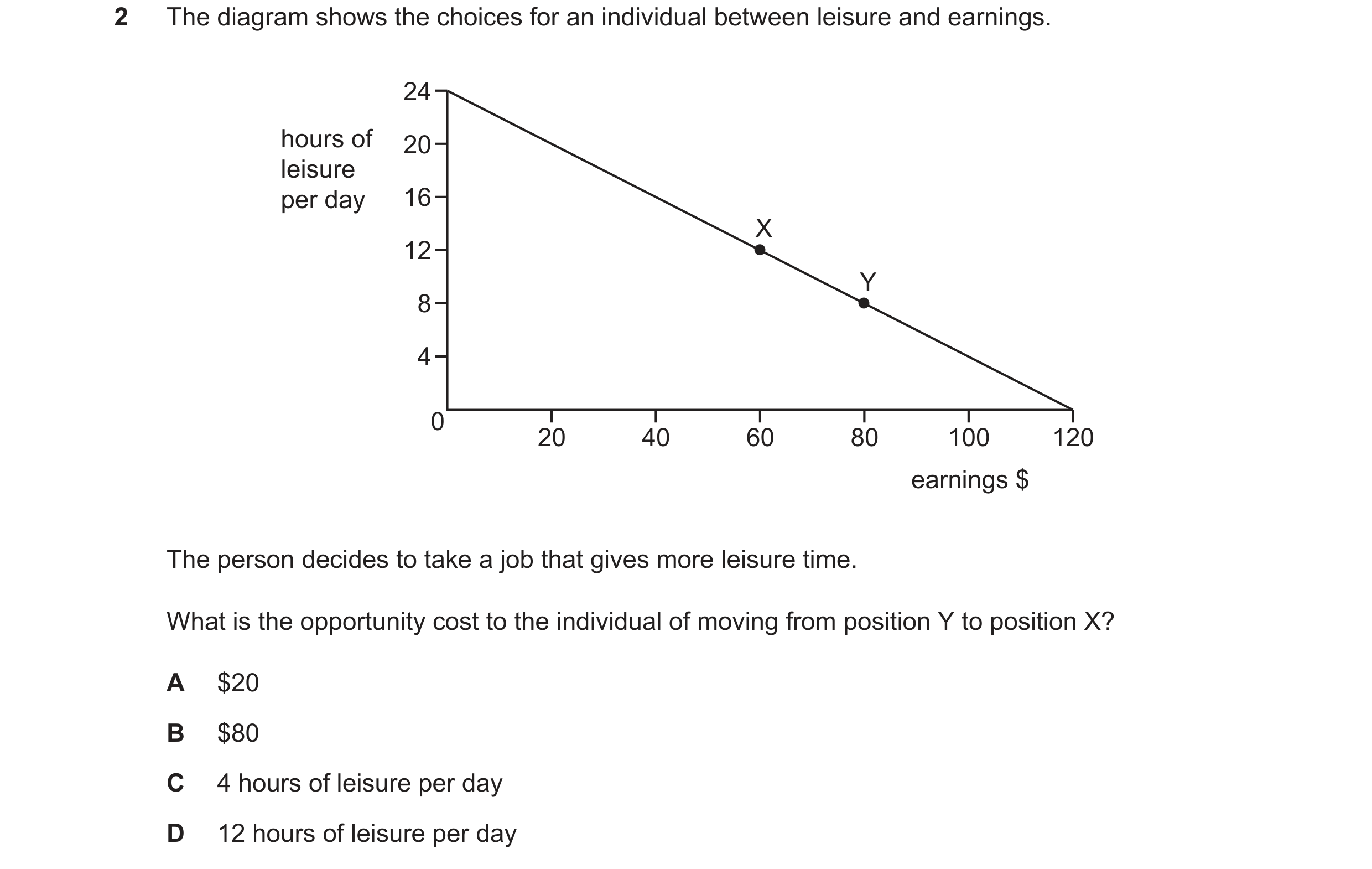 34 / 42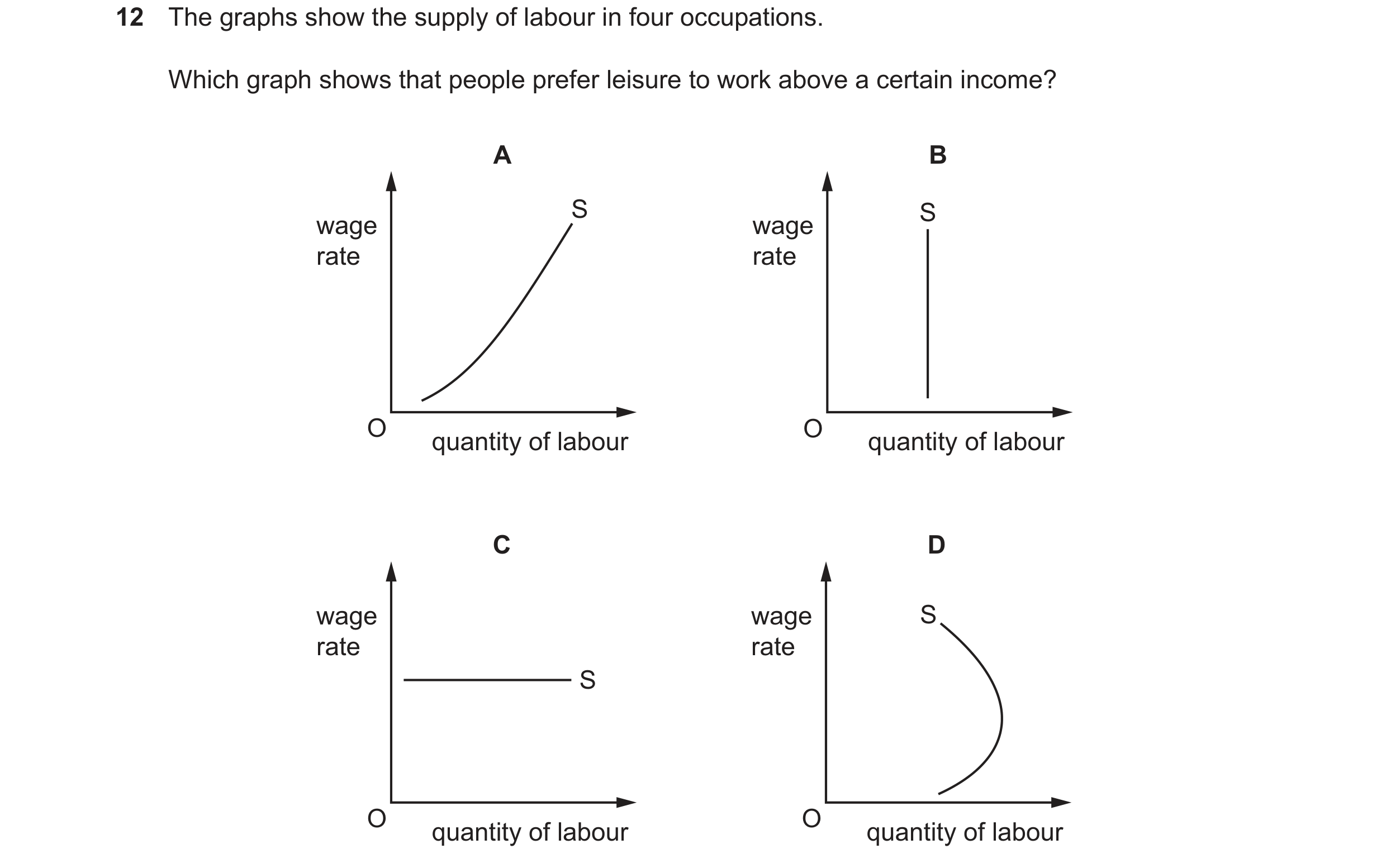

 35 / 42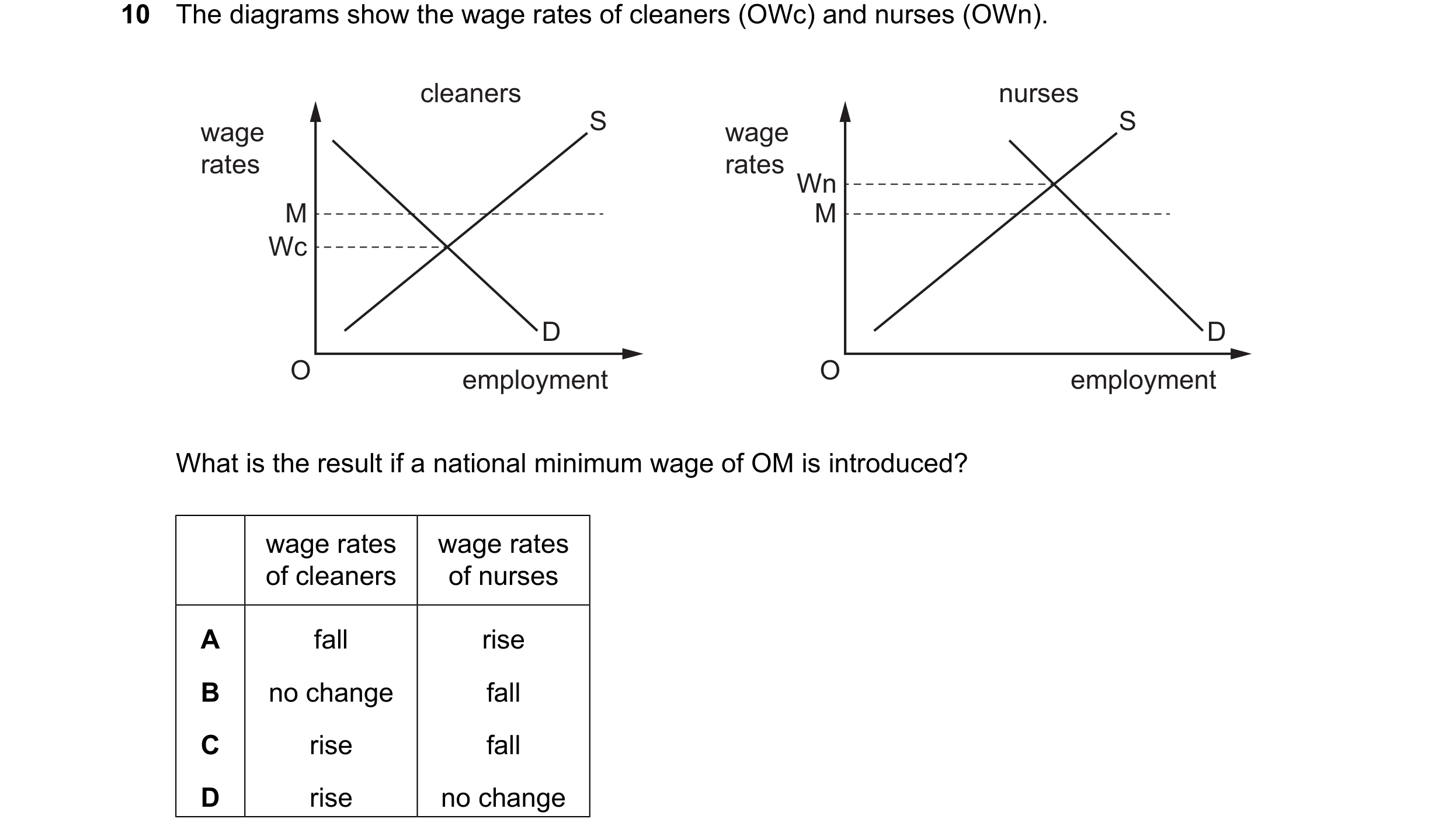
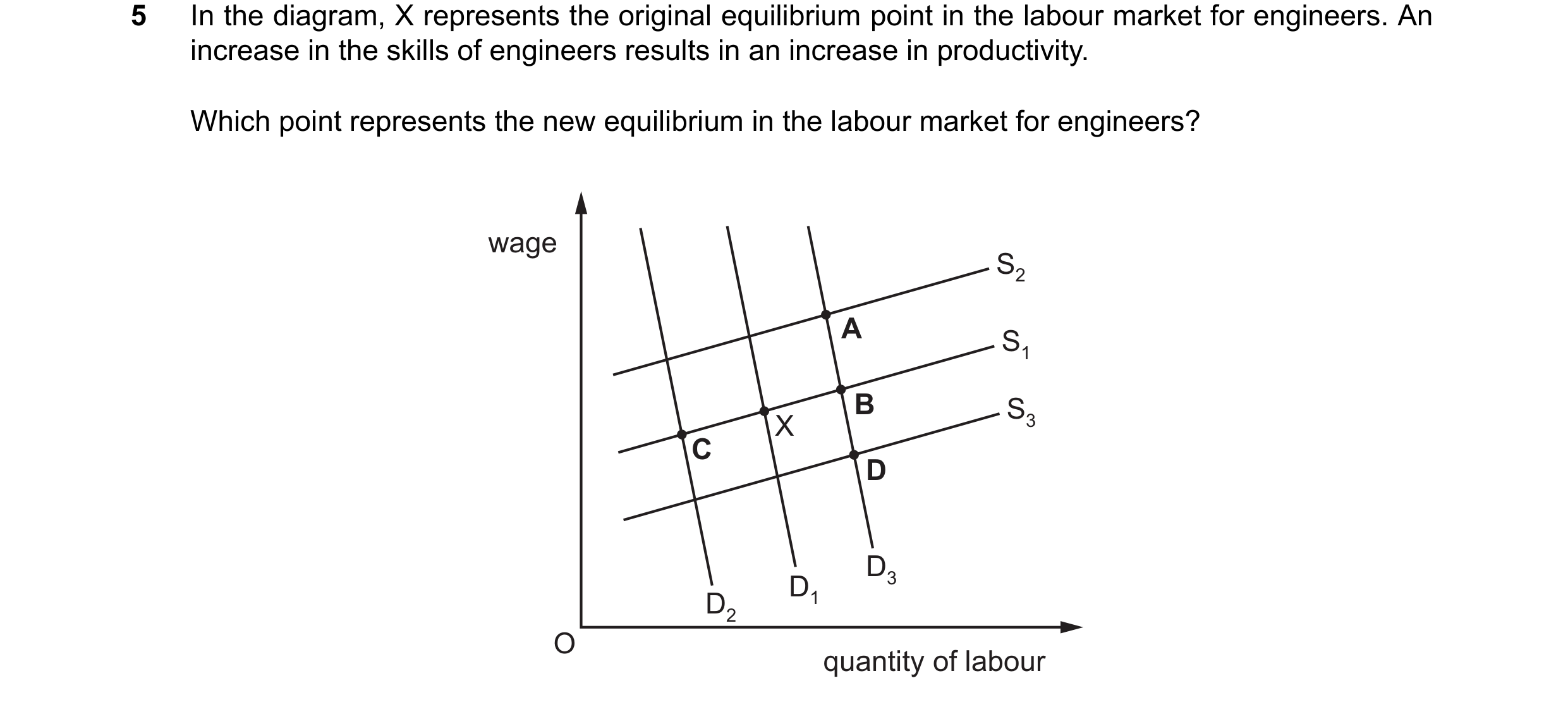 36 / 42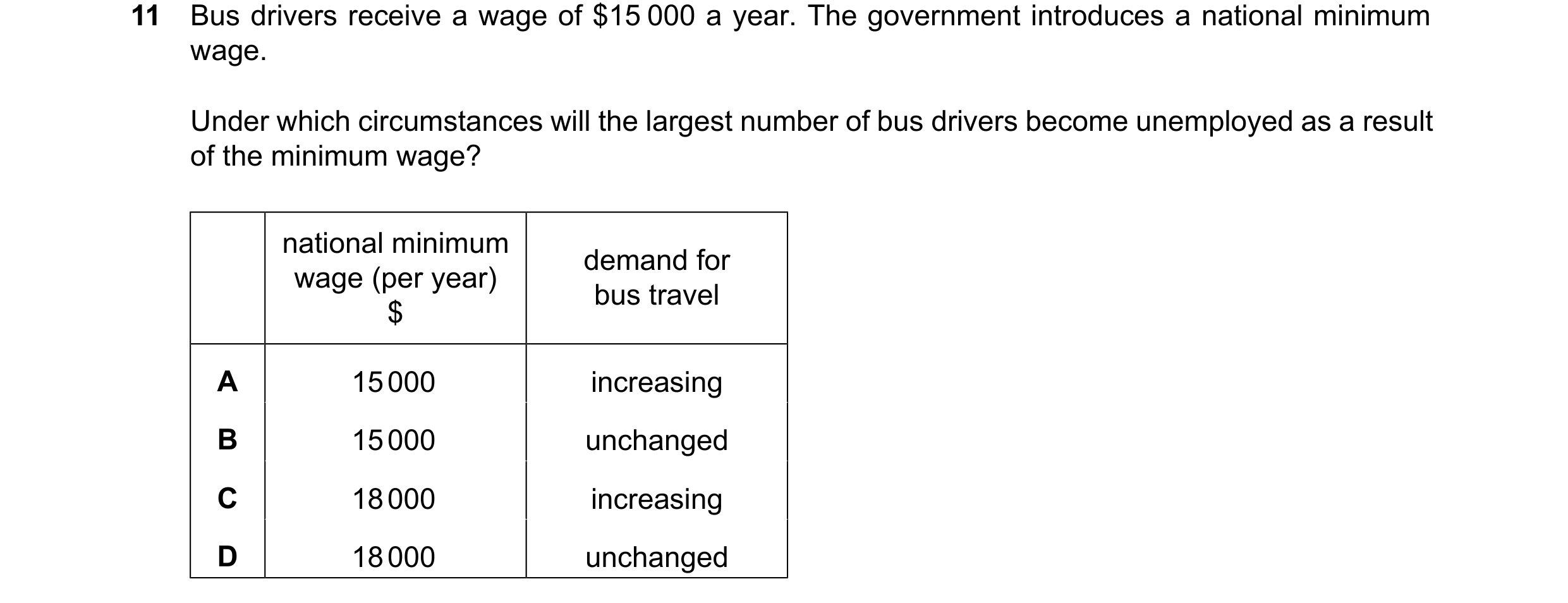
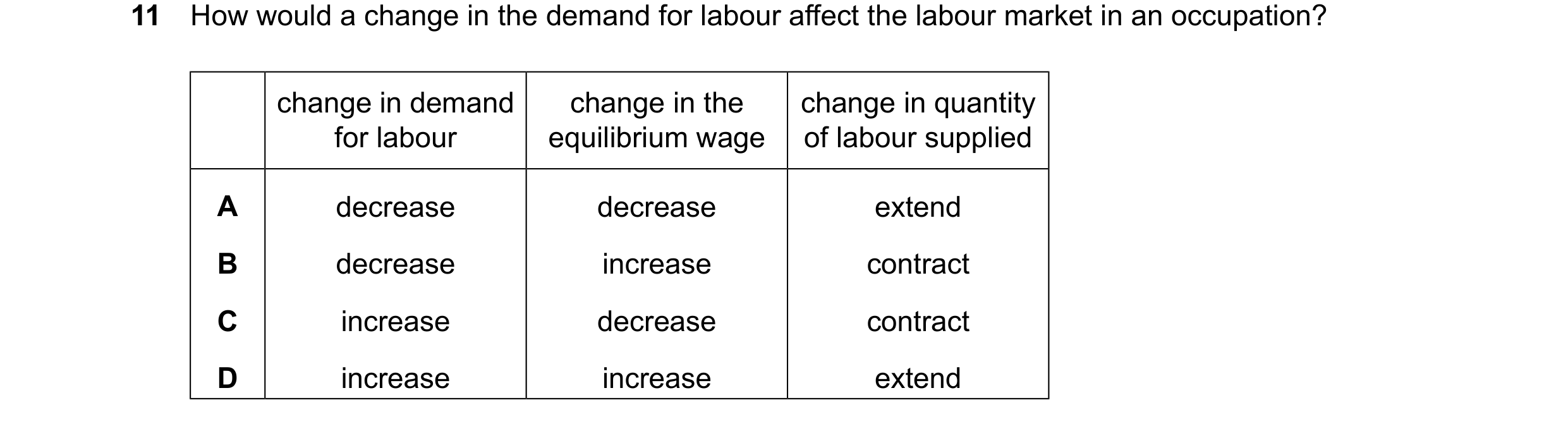
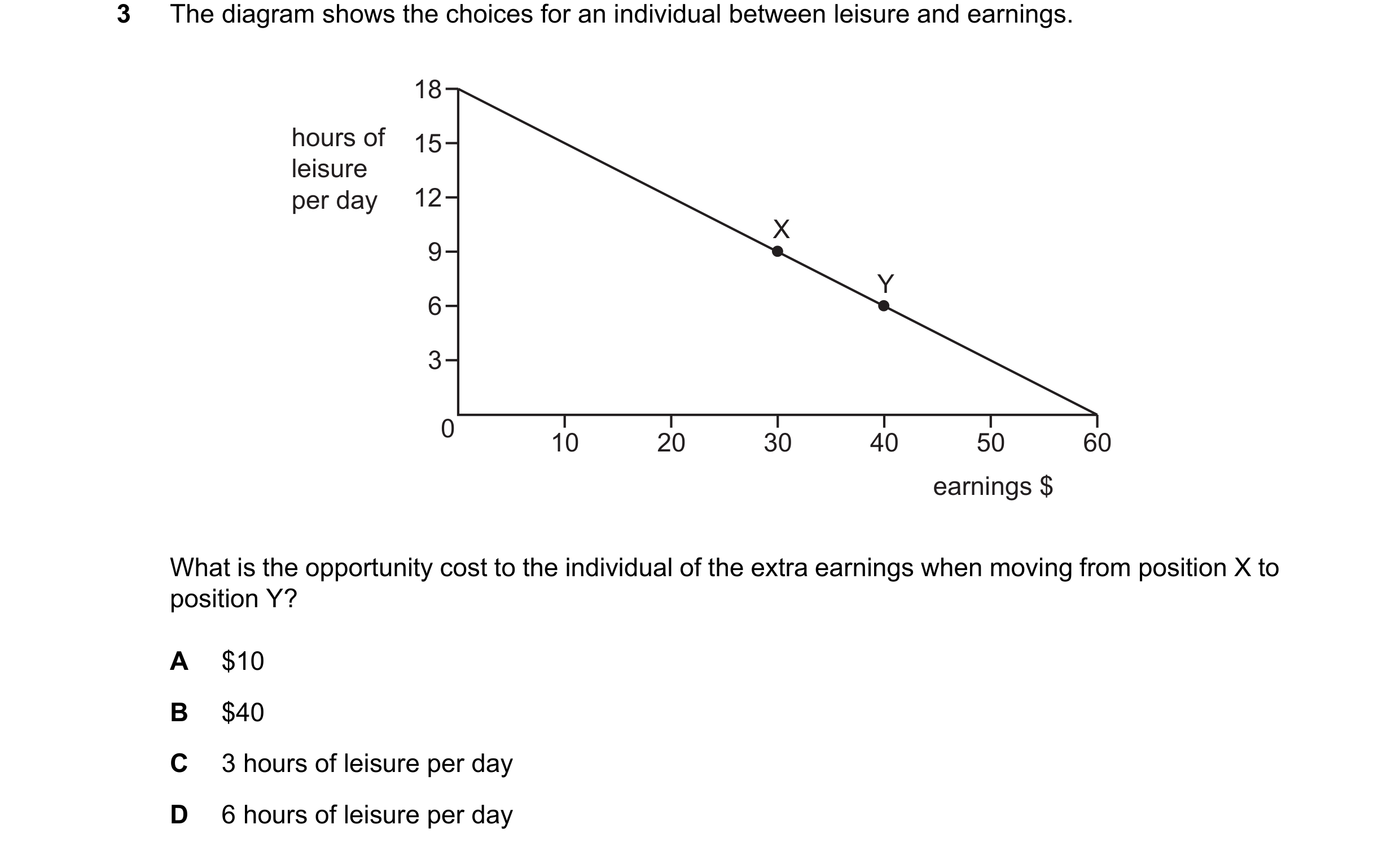 37 / 42

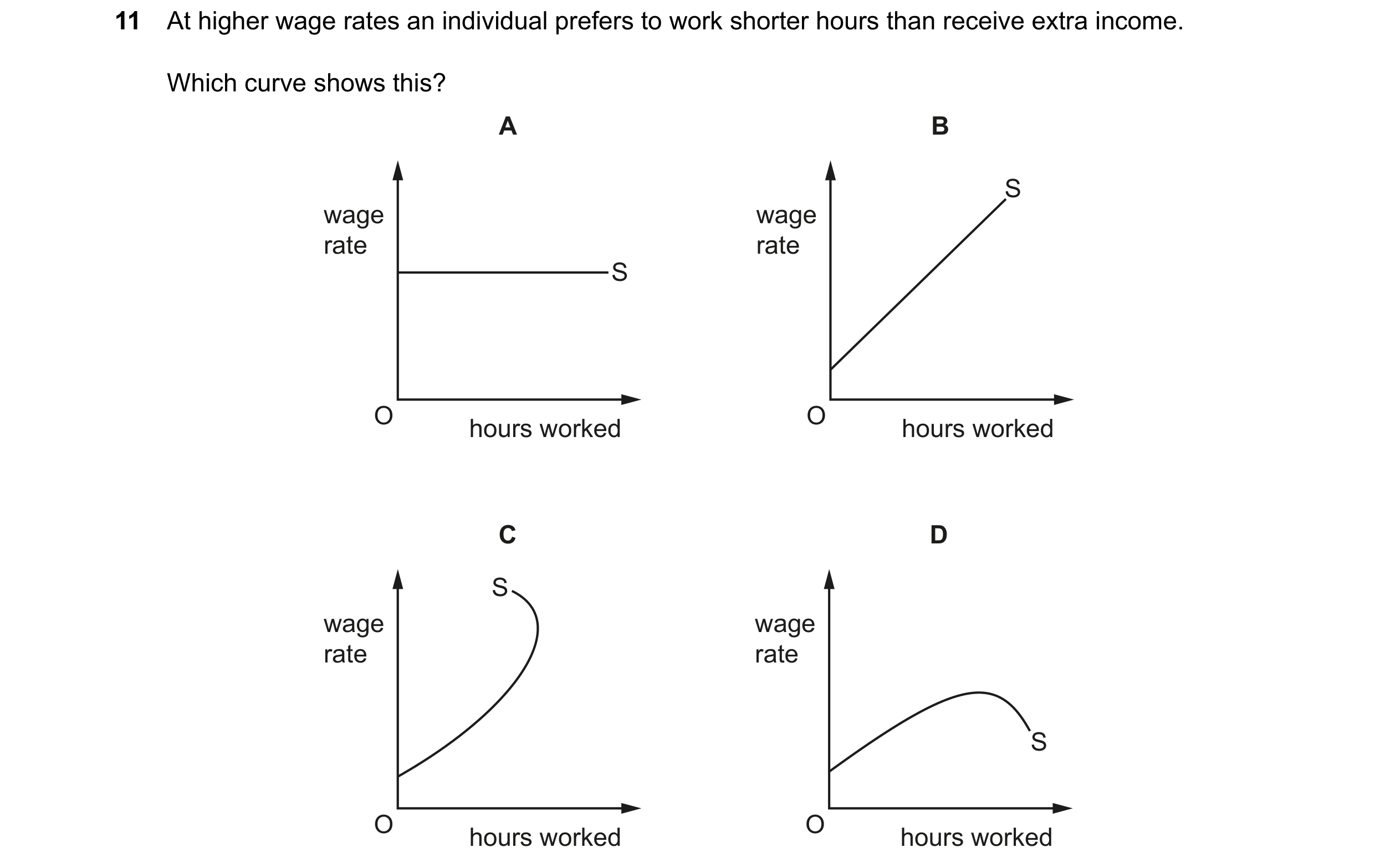
 38 / 42
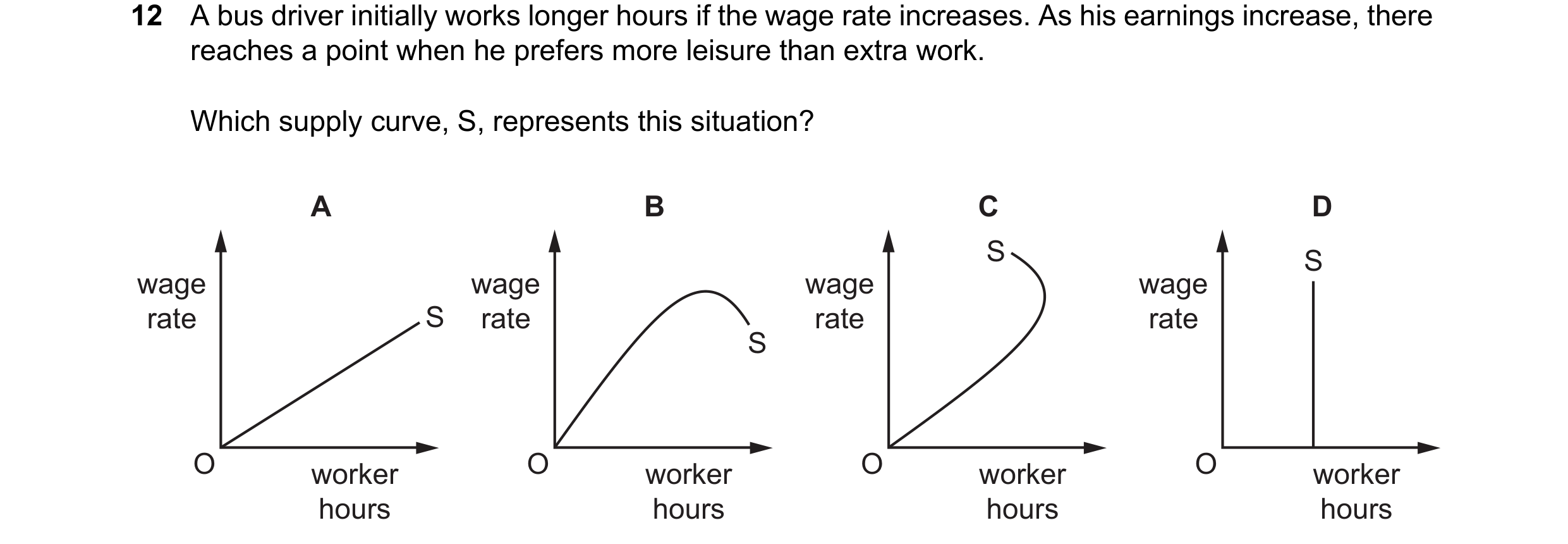

 39 / 42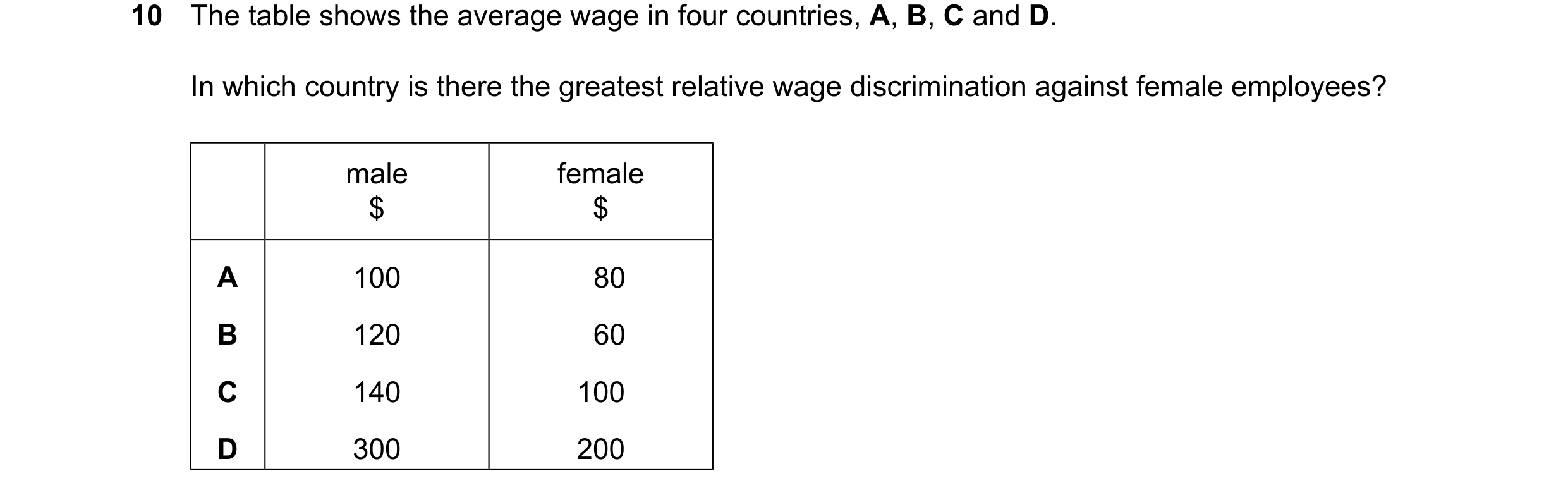

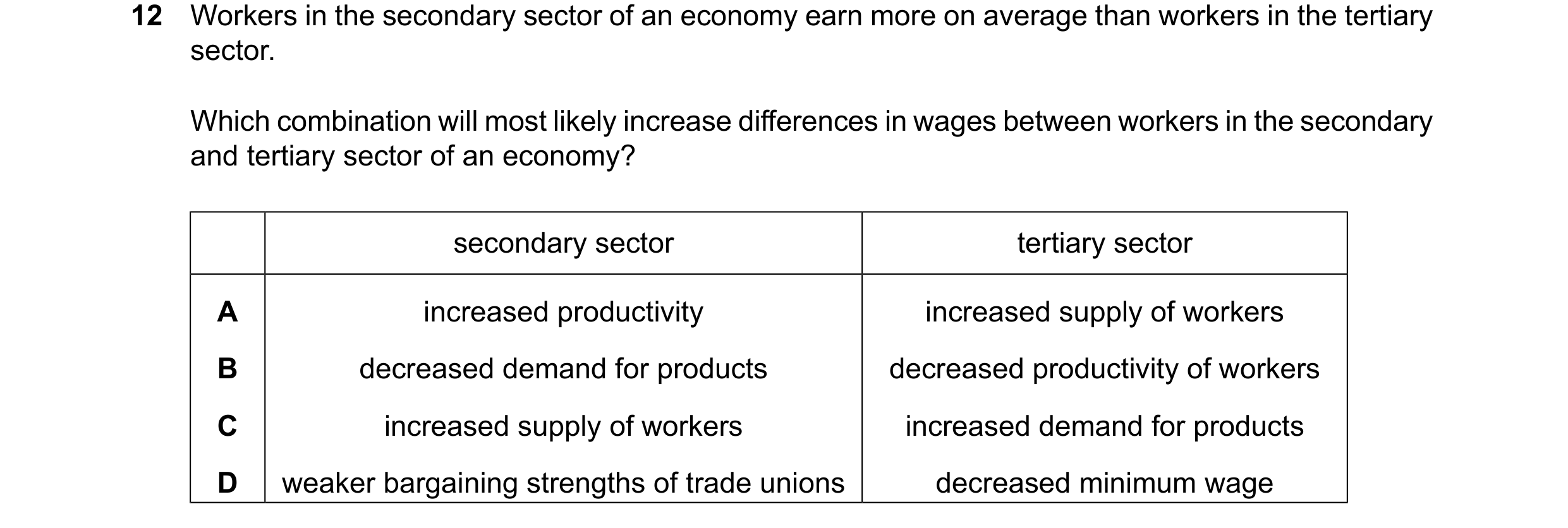
 40 / 42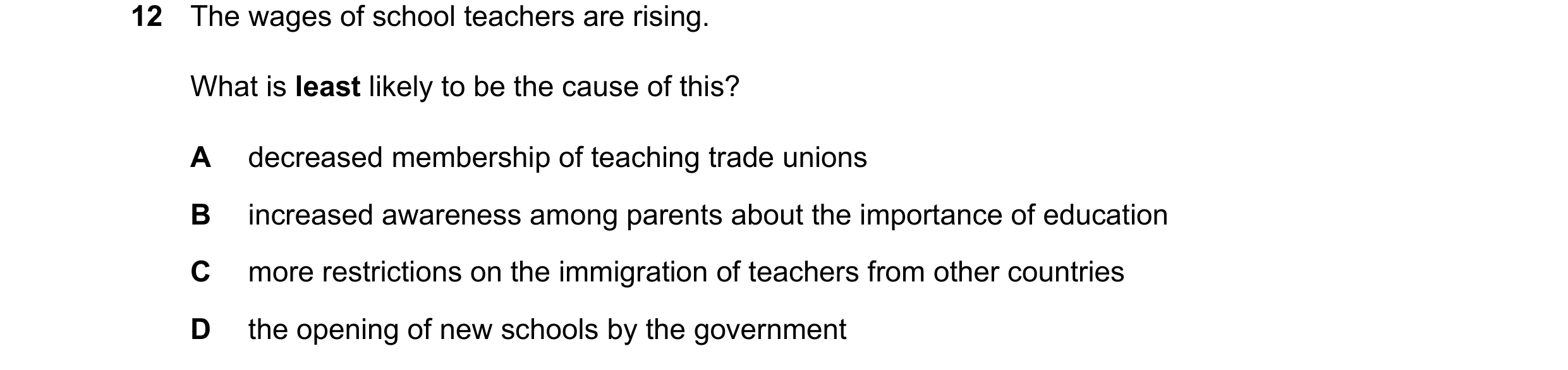
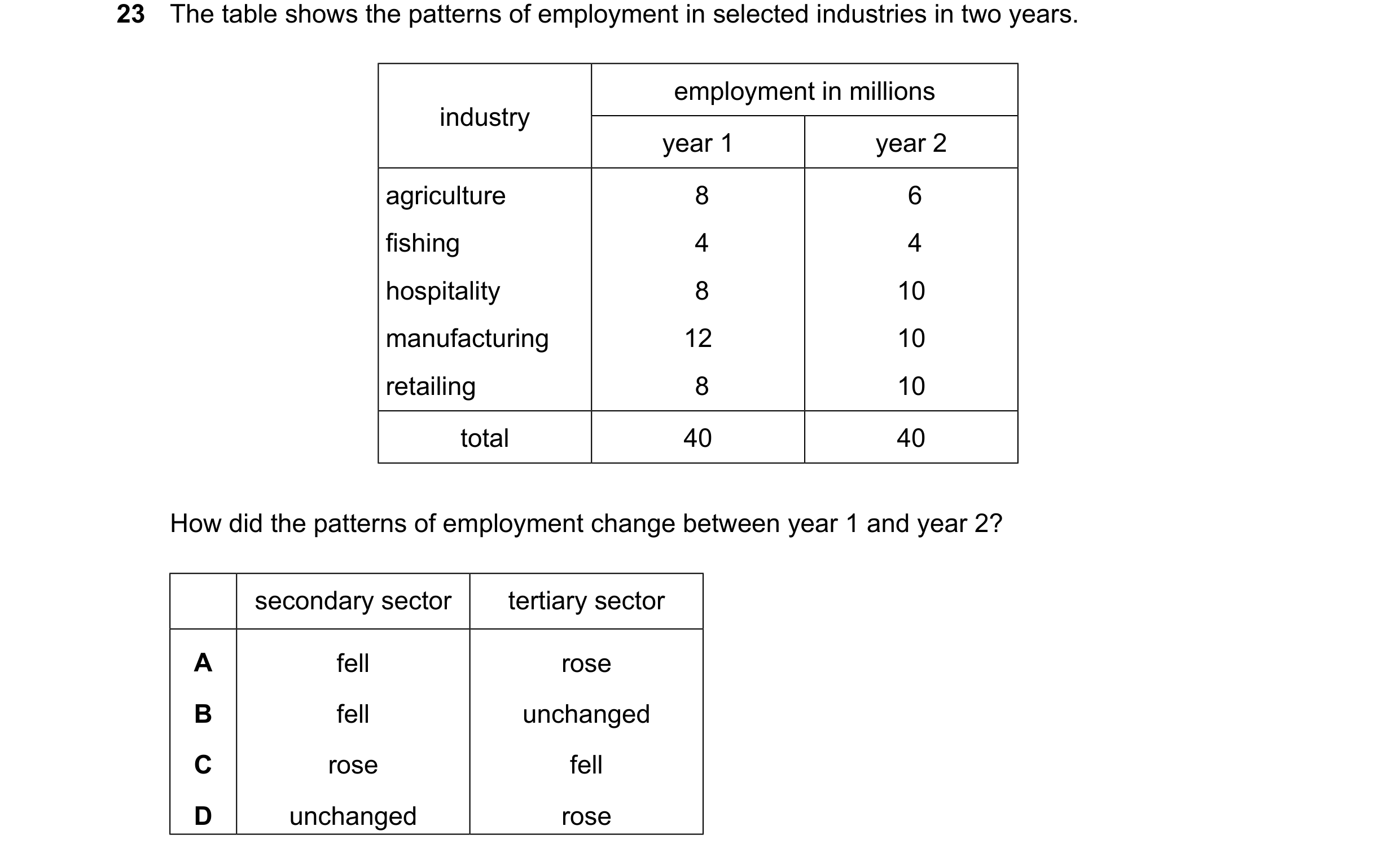

 41 / 42
 42 / 42