Questions as text
Q1 · A woman playing a quiz game starts with no money, but correctly answers the question that… 0455/11 Oct/Nov 2004
2 A woman playing a quiz game starts with no money, but correctly answers the question that is worth $4000. The next question is worth $10 000 but if she answers incorrectly she will leave the game with no money. What is her opportunity cost of choosing to answer the $10 000 question if her answer is incorrect? A nothing B $4000 C $6000 D $10 000
1 marks
Answer: B
This question in 0455/11 Oct/Nov 2004
Q2 · Construction companies are building new houses on land previously used for farming 0455/11 May/June 2006
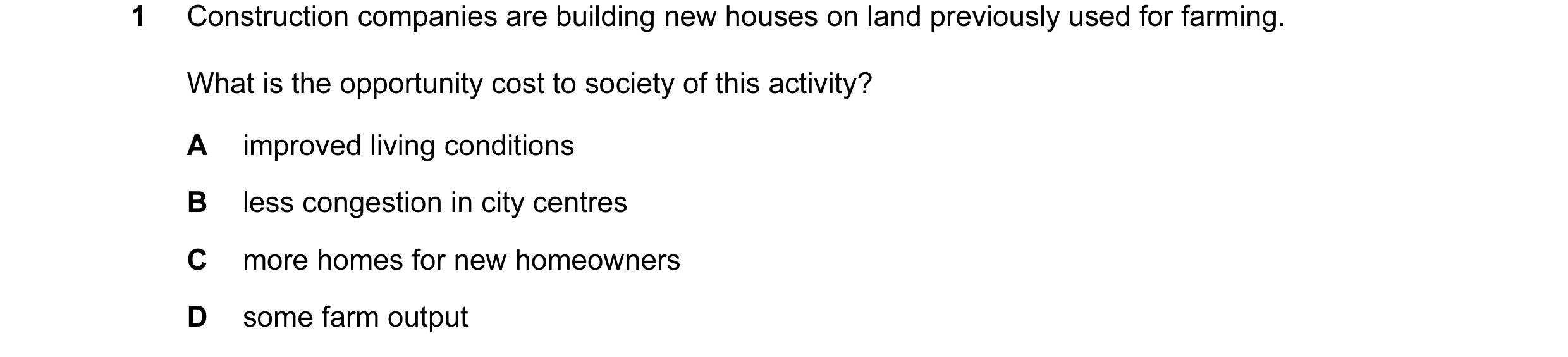
1 Construction companies are building new houses on land previously used for farming. What is the opportunity cost to society of this activity? A improved living conditions B less congestion in city centres C more homes for new homeowners D some farm output
1 marks
Answer: D
This question in 0455/11 May/June 2006
Q3 · What is most likely to cause queues of consumers to appear regularly outside shops in a… 0455/11 May/June 2006
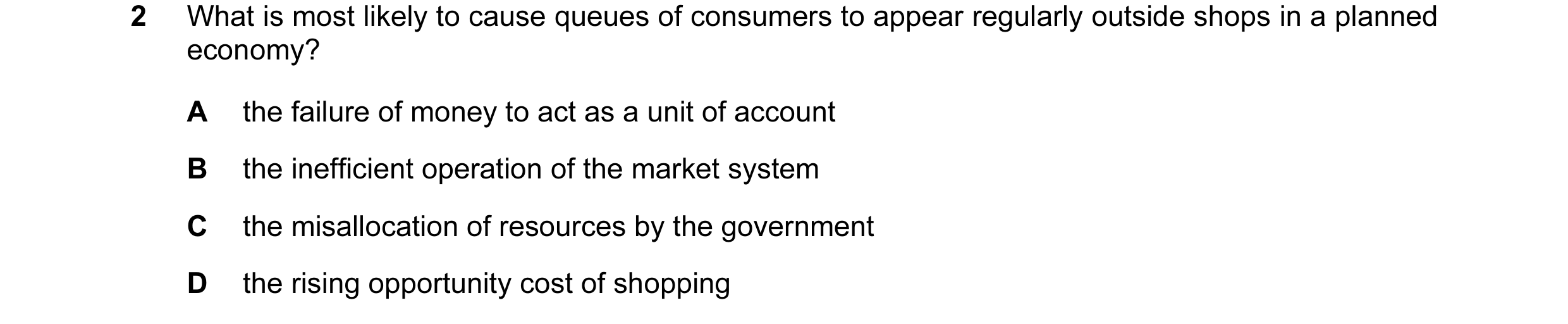
2 What is most likely to cause queues of consumers to appear regularly outside shops in a planned economy? A the failure of money to act as a unit of account B the inefficient operation of the market system C the misallocation of resources by the government D the rising opportunity cost of shopping
1 marks
Answer: C
This question in 0455/11 May/June 2006
Q4 · The central area of a country produces tea for which it has an ideal climate 0455/11 May/June 2006
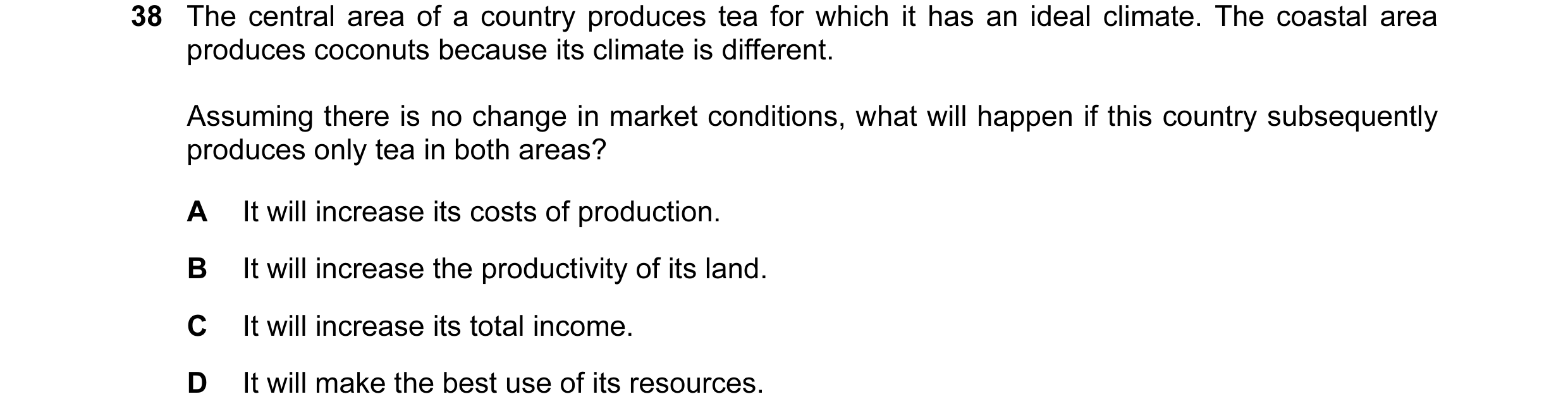
38 The central area of a country produces tea for which it has an ideal climate. The coastal area produces coconuts because its climate is different. Assuming there is no change in market conditions, what will happen if this country subsequently produces only tea in both areas? A It will increase its costs of production. B It will increase the productivity of its land. C It will increase its total income. D It will make the best use of its resources.
1 marks
Answer: A
This question in 0455/11 May/June 2006
Q5 · A government decides to spend more on defence and therefore cannot spend as much on… 0455/11 Oct/Nov 2006
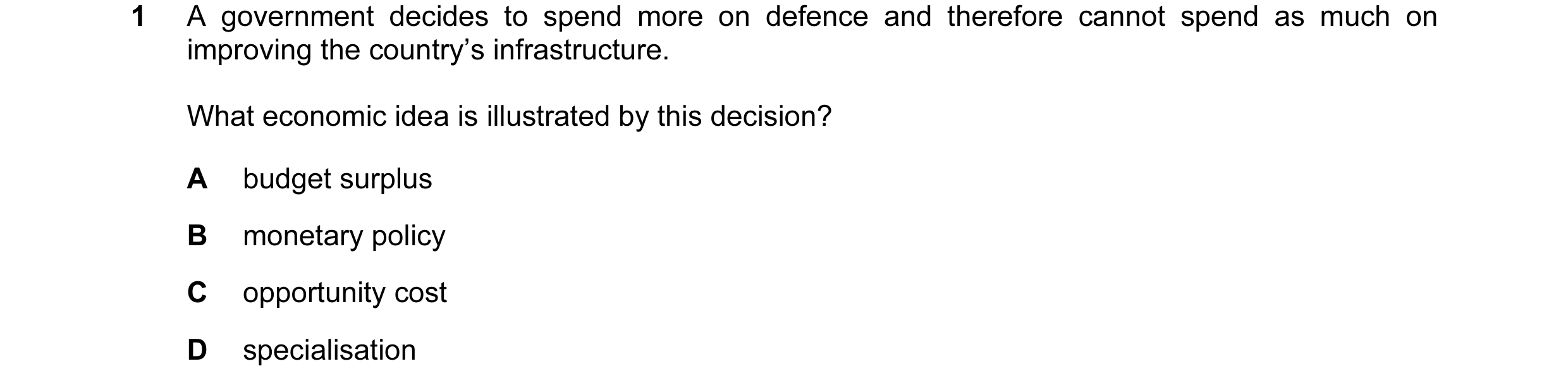
1 A government decides to spend more on defence and therefore cannot spend as much on improving the country’s infrastructure. What economic idea is illustrated by this decision? A budget surplus B monetary policy C opportunity cost D specialisation
1 marks
Answer: C
This question in 0455/11 Oct/Nov 2006
Q6 · A government is faced with the choice of raising taxation or cutting public spending 0455/11 May/June 2007
4 A government is faced with the choice of raising taxation or cutting public spending. Of what is this an example? A conservation of resources B monetary policy C opportunity cost D substitution of factors
1 marks
Answer: C
This question in 0455/11 May/June 2007
Q7 · Commercial companies are reclaiming marsh land to construct golf courses 0455/11 Oct/Nov 2007
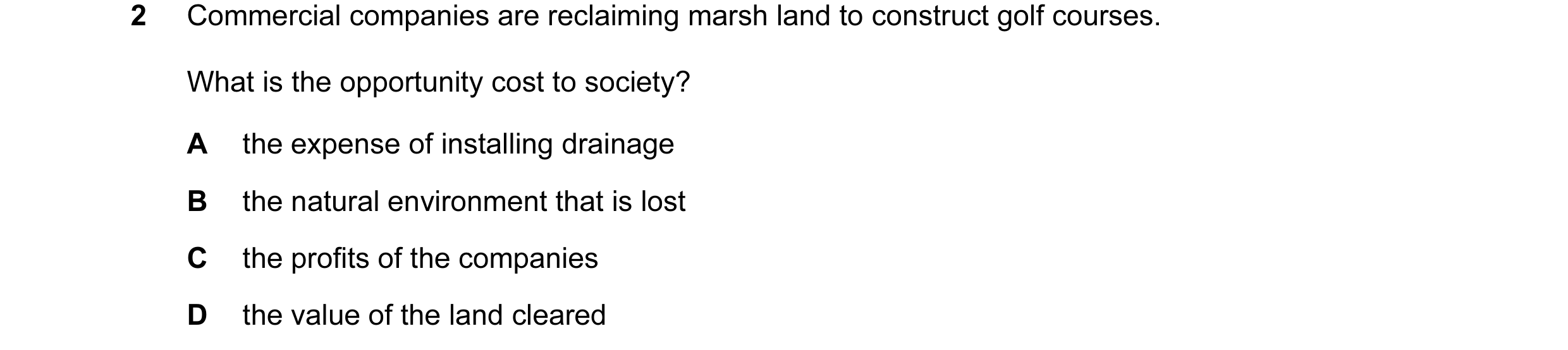
2 Commercial companies are reclaiming marsh land to construct golf courses. What is the opportunity cost to society? A the expense of installing drainage B the natural environment that is lost C the profits of the companies D the value of the land cleared
1 marks
Answer: B
This question in 0455/11 Oct/Nov 2007
Q8 · The table shows the various combinations of food and clothing which a village can produce… 0455/11 May/June 2008
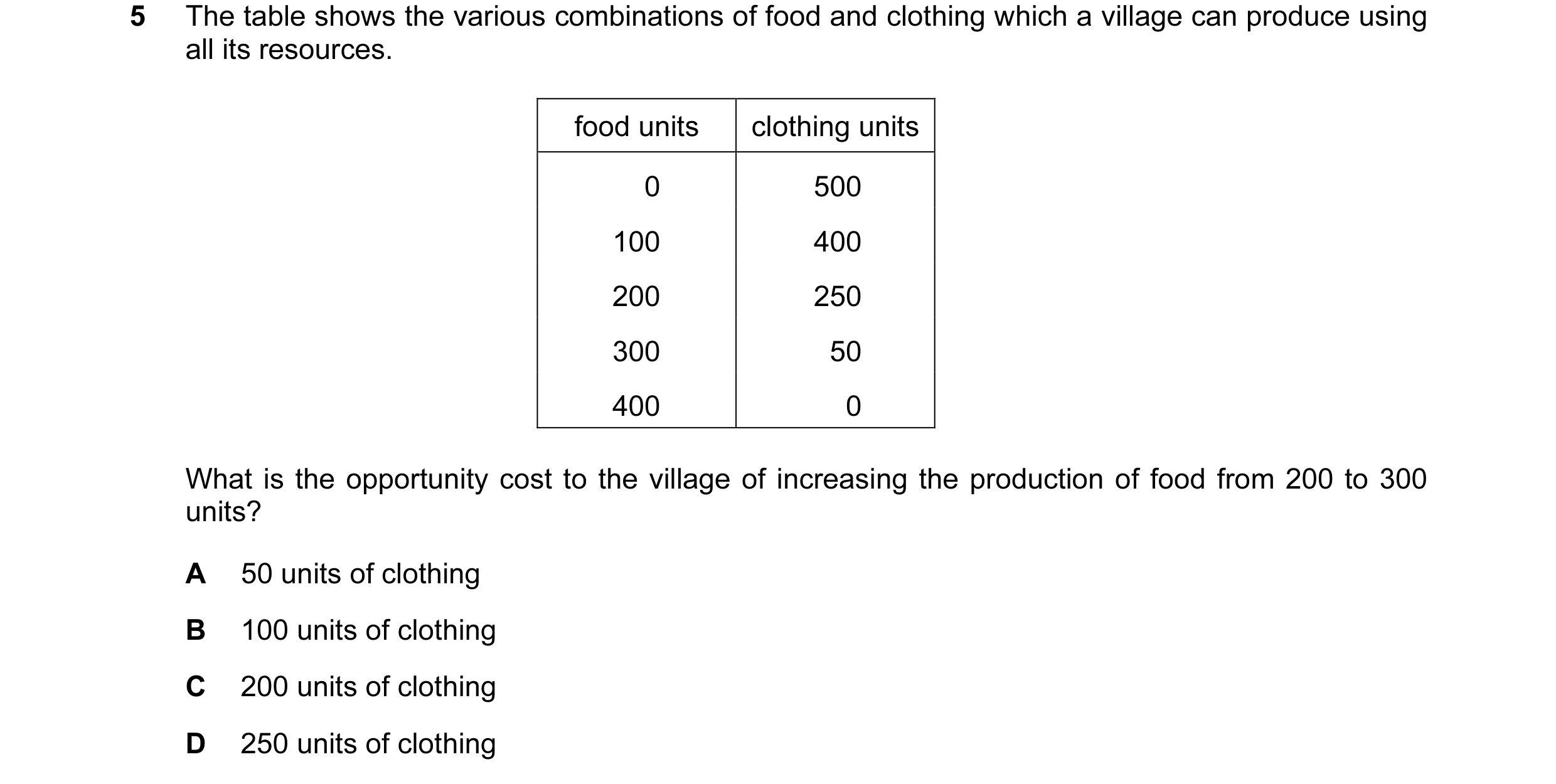
5 The table shows the various combinations of food and clothing which a village can produce using all its resources. food units clothing units 0 500 100 400 200 250 300 50 400 0 What is the opportunity cost to the village of increasing the production of food from 200 to 300 units? A 50 units of clothing B 100 units of clothing C 200 units of clothing D 250 units of clothing
1 marks
Answer: C
This question in 0455/11 May/June 2008
Q9 · In 2001 a government enquiry approved a major new air terminal for London, which would… 0455/11 May/June 2008
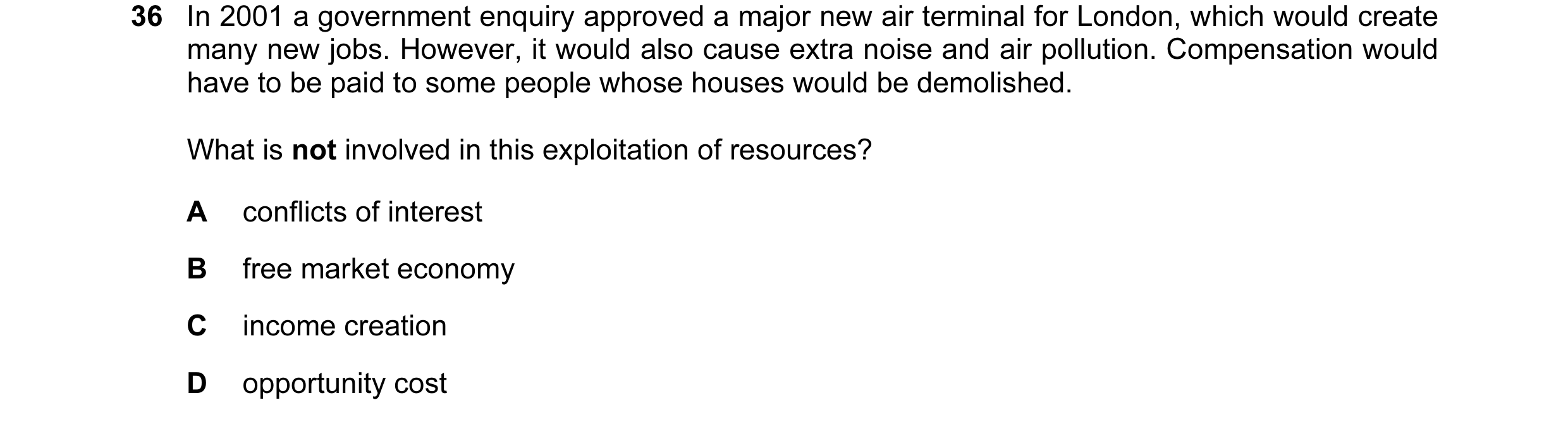
36 In 2001 a government enquiry approved a major new air terminal for London, which would create many new jobs. However, it would also cause extra noise and air pollution. Compensation would have to be paid to some people whose houses would be demolished. What is not involved in this exploitation of resources? A conflicts of interest B free market economy C income creation D opportunity cost
1 marks
Answer: B
This question in 0455/11 May/June 2008
Q10 · A charity sold tickets at $5 each 0455/11 Oct/Nov 2008
5 A charity sold tickets at $5 each. A prize of $100 was given to the owner of the winning ticket. A student bought a ticket, but did not win. What is the opportunity cost to the student? A $5 B $100 C what could have been bought with the $5 D what could have been bought with the $100
1 marks
Answer: C
This question in 0455/11 Oct/Nov 2008
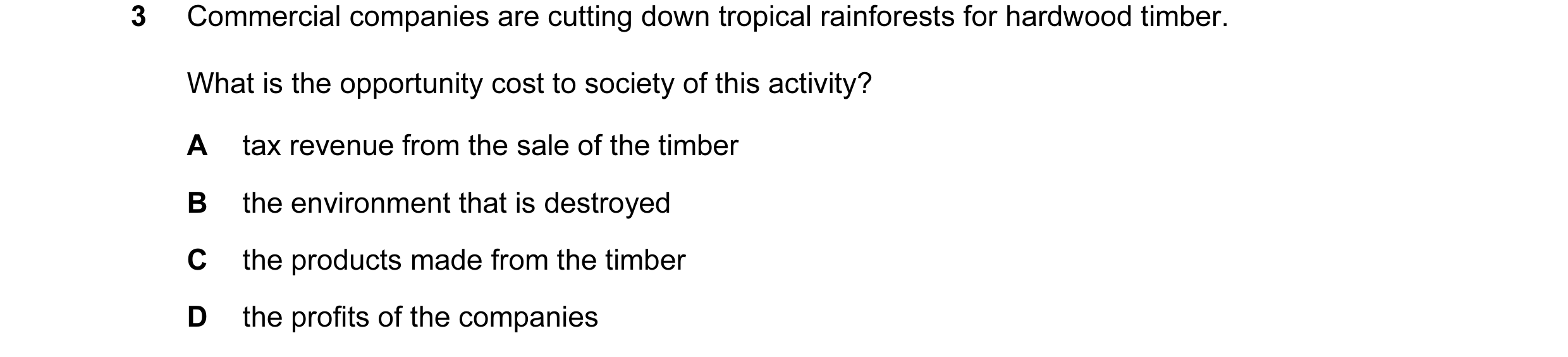
Q11 · Commercial companies are cutting down tropical rainforests for hardwood timber 0455/11 May/June 2009
3 Commercial companies are cutting down tropical rainforests for hardwood timber. What is the opportunity cost to society of this activity? A tax revenue from the sale of the timber B the environment that is destroyed C the products made from the timber D the profits of the companies
1 marks
Answer: B
This question in 0455/11 May/June 2009
Q12 · What, according to the definition of opportunity cost, is sacrificed when a decision is… 0455/11 Oct/Nov 2009
2 What, according to the definition of opportunity cost, is sacrificed when a decision is taken? A an identical alternative B any possible alternative C the least valuable alternative D the next best alternative
1 marks
Answer: D
This question in 0455/11 Oct/Nov 2009
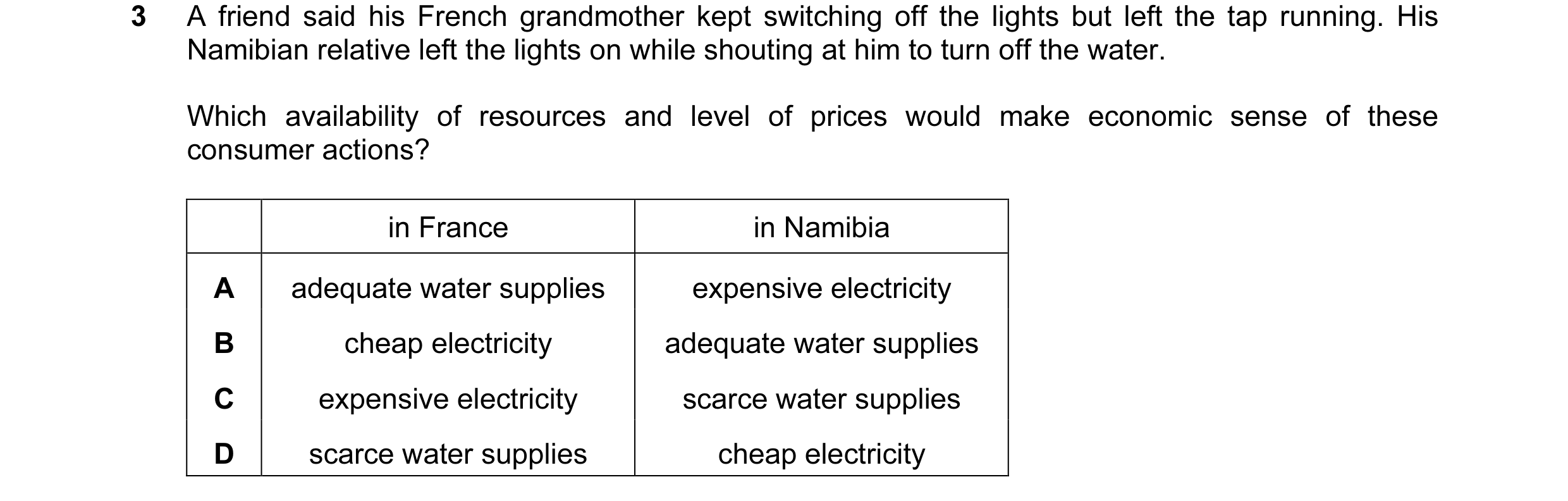
Q13 · A friend said his French grandmother kept switching off the lights but left the tap… 0455/11 Oct/Nov 2009
3 A friend said his French grandmother kept switching off the lights but left the tap running. His Namibian relative left the lights on while shouting at him to turn off the water. Which availability of resources and level of prices would make economic sense of these consumer actions? in France in Namibia A adequate water supplies expensive electricity B cheap electricity adequate water supplies C expensive electricity scarce water supplies D scarce water supplies cheap electricity
1 marks
Answer: C
This question in 0455/11 Oct/Nov 2009
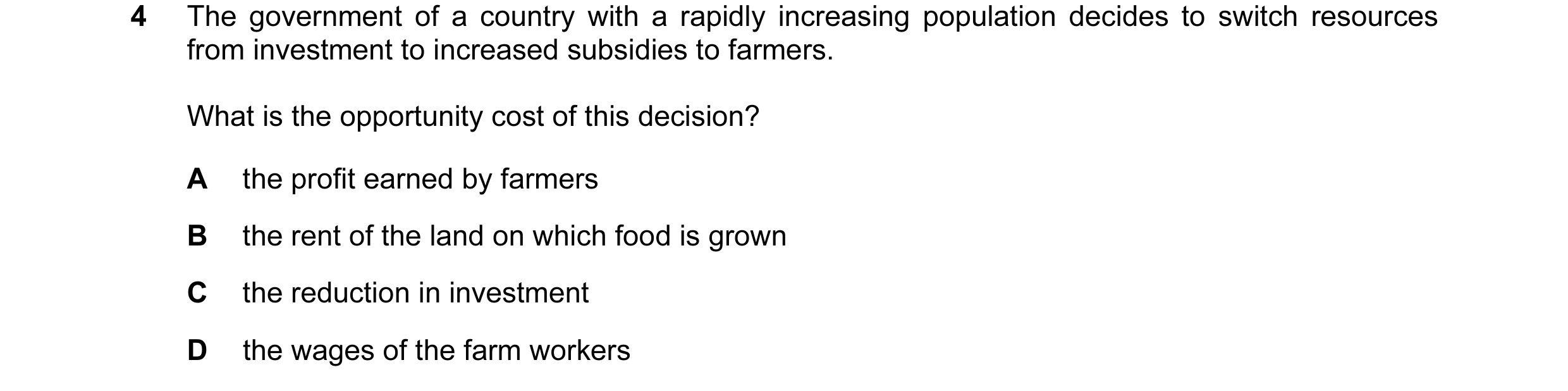
Q14 · The government of a country with a rapidly increasing population decides to switch… 0455/11 May/June 2010
4 The government of a country with a rapidly increasing population decides to switch resources from investment to increased subsidies to farmers. What is the opportunity cost of this decision? A the profit earned by farmers B the rent of the land on which food is grown C the reduction in investment D the wages of the farm workers
1 marks
Answer: C
This question in 0455/11 May/June 2010
Q15 · The government of a country with a rapidly increasing population decides to switch… 0455/12 May/June 2010
3 The government of a country with a rapidly increasing population decides to switch resources from investment to increased subsidies to farmers. What is the opportunity cost of this decision? A the profit earned by farmers B the rent of the land on which food is grown C the reduction in investment D the wages of the farm workers
1 marks
Answer: C
This question in 0455/12 May/June 2010
Q16 · What makes choice an important element in the basic economic problem? 0455/11 Oct/Nov 2010
1 What makes choice an important element in the basic economic problem? A Increased demand leads to higher market prices. B Limited resources have many alternative uses. C Reaching a market equilibrium may take a long time. D Scarce economic resources are distributed equally.
1 marks
Answer: B
This question in 0455/11 Oct/Nov 2010
Q17 · A government is faced with the choice of spending on either education or healthcare 0455/11 Oct/Nov 2010
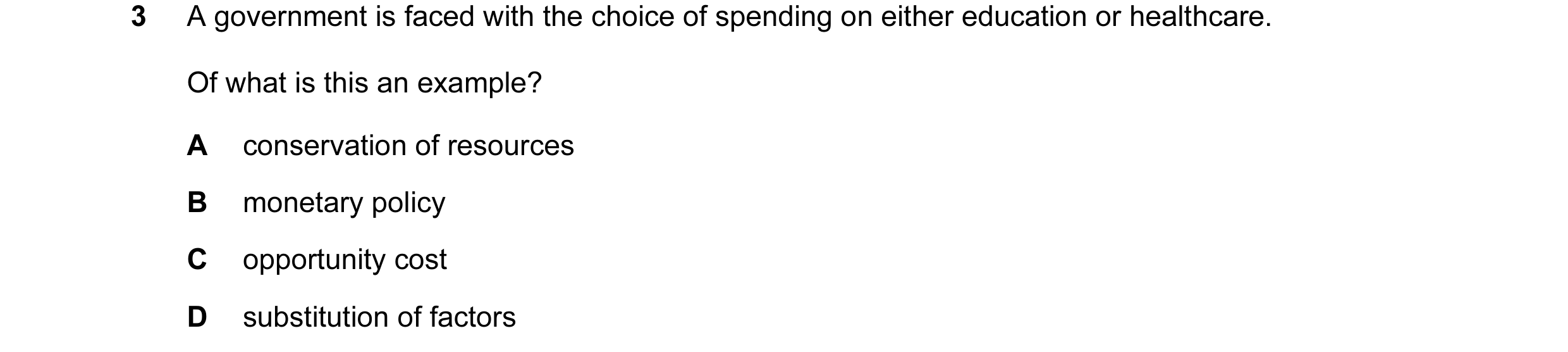
3 A government is faced with the choice of spending on either education or healthcare. Of what is this an example? A conservation of resources B monetary policy C opportunity cost D substitution of factors
1 marks
Answer: C
This question in 0455/11 Oct/Nov 2010
Q18 · A government is faced with the choice of spending on either education or healthcare 0455/12 Oct/Nov 2010
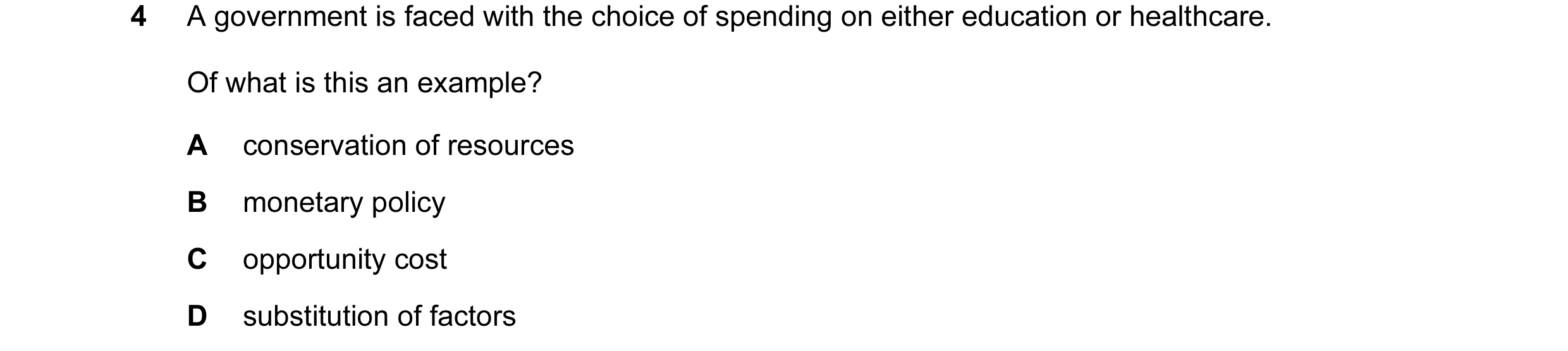
4 A government is faced with the choice of spending on either education or healthcare. Of what is this an example? A conservation of resources B monetary policy C opportunity cost D substitution of factors
1 marks
Answer: C
This question in 0455/12 Oct/Nov 2010
Q19 · A government is faced with the choice of spending on either education or healthcare 0455/13 Oct/Nov 2010
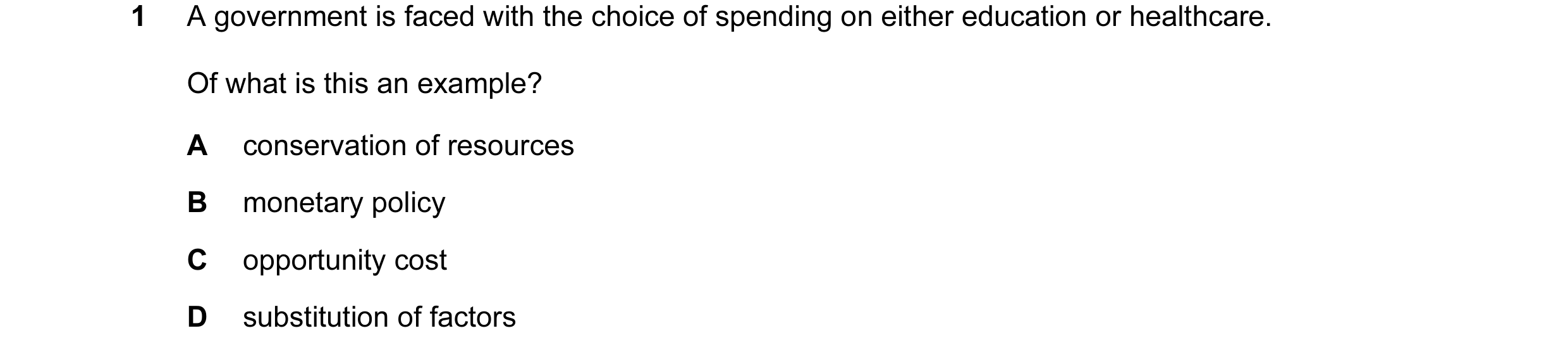
1 A government is faced with the choice of spending on either education or healthcare. Of what is this an example? A conservation of resources B monetary policy C opportunity cost D substitution of factors
1 marks
Answer: C
This question in 0455/13 Oct/Nov 2010
Q20 · What makes choice an important element in the basic economic problem? 0455/13 Oct/Nov 2010
3 What makes choice an important element in the basic economic problem? A Increased demand leads to higher market prices. B Limited resources have many alternative uses. C Reaching a market equilibrium may take a long time. D Scarce economic resources are distributed equally.
1 marks
Answer: B
This question in 0455/13 Oct/Nov 2010
Q21 · A firm decides to stop manufacturing ovens and to produce washing machines instead 0455/11 May/June 2011
3 A firm decides to stop manufacturing ovens and to produce washing machines instead. What is the opportunity cost to the firm? A the additional washing machines produced B the cost of producing ovens C the cost of producing washing machines D the loss of the production of ovens
1 marks
Answer: D
This question in 0455/11 May/June 2011
Q22 · A firm decides to stop manufacturing ovens and to produce washing machines instead 0455/12 May/June 2011
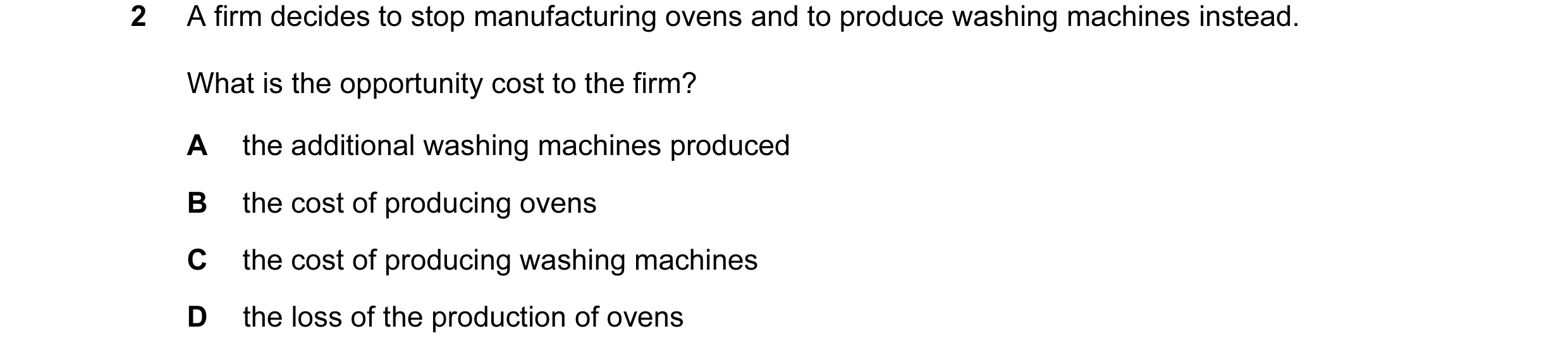
2 A firm decides to stop manufacturing ovens and to produce washing machines instead. What is the opportunity cost to the firm? A the additional washing machines produced B the cost of producing ovens C the cost of producing washing machines D the loss of the production of ovens
1 marks
Answer: D
This question in 0455/12 May/June 2011
Q23 · A firm decides to stop manufacturing ovens and to produce washing machines instead 0455/13 May/June 2011
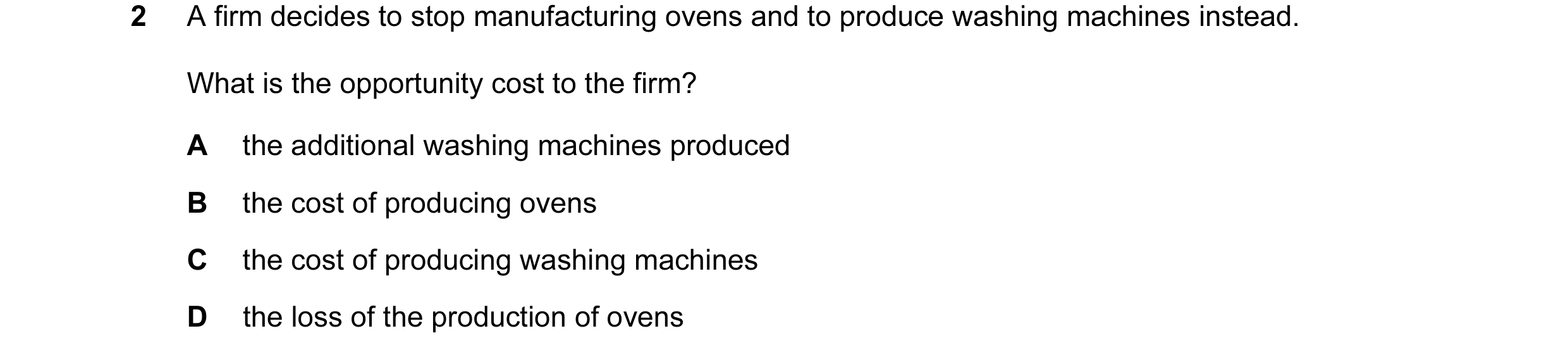
2 A firm decides to stop manufacturing ovens and to produce washing machines instead. What is the opportunity cost to the firm? A the additional washing machines produced B the cost of producing ovens C the cost of producing washing machines D the loss of the production of ovens
1 marks
Answer: D
This question in 0455/13 May/June 2011
Q24 · What is meant by the economic problem? 0455/13 May/June 2011
4 What is meant by the economic problem? A how to achieve efficiency with the existence of fixed resources and limited wants B how to allocate resources between public and private sectors C how to balance unlimited wants against finite resources D how to decide which methods to use to exploit all resources
1 marks
Answer: C
This question in 0455/13 May/June 2011
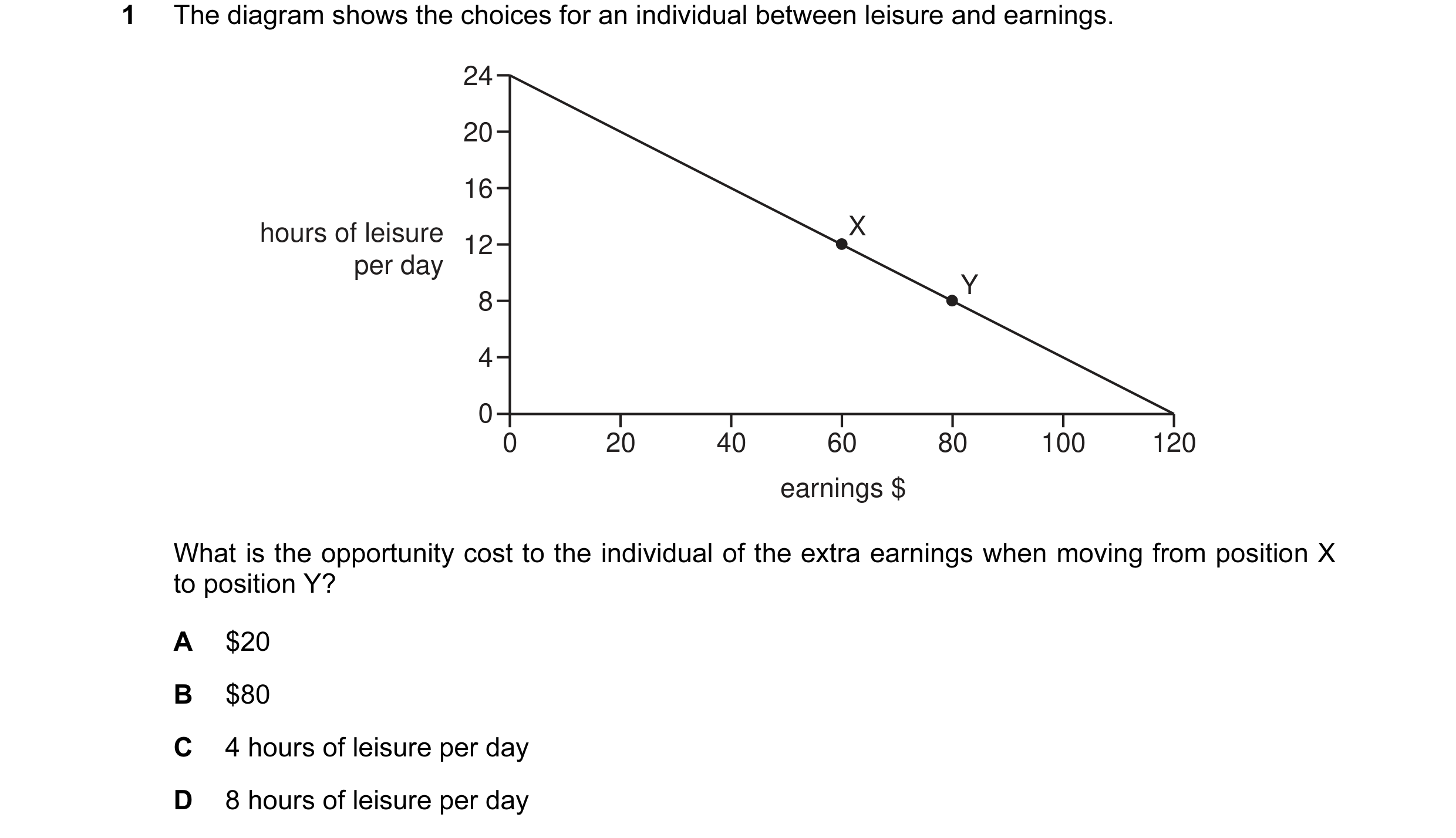
Q25 · The diagram shows the choices for an individual between leisure and earnings 0455/11 Oct/Nov 2011
3 The diagram shows the choices for an individual between leisure and earnings. 24 20 16 hours of leisure X 12 per day Y 8 4 0 0 20 40 60 80 100 120 earnings $ What is the opportunity cost to the individual of the extra earnings when moving from position X to position Y? A $20 B $80 C 4 hours of leisure per day D 8 hours of leisure per day
1 marks
Answer: C
This question in 0455/11 Oct/Nov 2011
Q26 · The diagram shows the choices for an individual between leisure and earnings 0455/12 Oct/Nov 2011
1 The diagram shows the choices for an individual between leisure and earnings. 24 20 16 hours of leisure X 12 per day Y 8 4 0 0 20 40 60 80 100 120 earnings $ What is the opportunity cost to the individual of the extra earnings when moving from position X to position Y? A $20 B $80 C 4 hours of leisure per day D 8 hours of leisure per day
1 marks
Answer: C
This question in 0455/12 Oct/Nov 2011
Q27 · The diagram shows the choices for an individual between leisure and earnings 0455/13 Oct/Nov 2011
2 The diagram shows the choices for an individual between leisure and earnings. 24 20 16 hours of leisure X 12 per day Y 8 4 0 0 20 40 60 80 100 120 earnings $ What is the opportunity cost to the individual of the extra earnings when moving from position X to position Y? A $20 B $80 C 4 hours of leisure per day D 8 hours of leisure per day
1 marks
Answer: C
This question in 0455/13 Oct/Nov 2011
Q28 · Every business organisation faces the problem of satisfying wants 0455/13 Oct/Nov 2011
3 Every business organisation faces the problem of satisfying wants. What is the reason why wants are not fully satisfied? A An economy can only produce a limited amount of goods and services. B Governments cannot print enough money to pay for goods and services. C There is an over-production of goods and services by business organisations. D Workers are too skilled for the requirements of the jobs available.
1 marks
Answer: A
This question in 0455/13 Oct/Nov 2011
Q29 · A student leaves school and decides to spend the next two years at a college to improve… 0455/11 May/June 2012
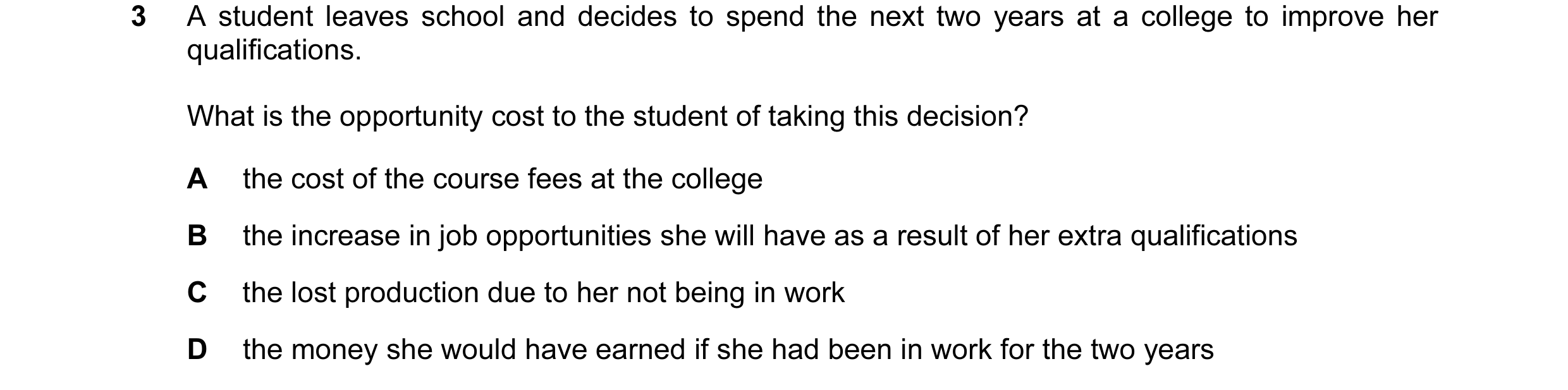
3 A student leaves school and decides to spend the next two years at a college to improve her qualifications. What is the opportunity cost to the student of taking this decision? A the cost of the course fees at the college B the increase in job opportunities she will have as a result of her extra qualifications C the lost production due to her not being in work D the money she would have earned if she had been in work for the two years
1 marks
Answer: D
This question in 0455/11 May/June 2012
Q30 · A student leaves school and decides to spend the next two years at a college to improve… 0455/12 May/June 2012
3 A student leaves school and decides to spend the next two years at a college to improve her qualifications. What is the opportunity cost to the student of taking this decision? A the cost of the course fees at the college B the increase in job opportunities she will have as a result of her extra qualifications C the lost production due to her not being in work D the money she would have earned if she had been in work for the two years
1 marks
Answer: D
This question in 0455/12 May/June 2012
Q31 · A student leaves school and decides to spend the next two years at a college to improve… 0455/13 May/June 2012
3 A student leaves school and decides to spend the next two years at a college to improve her qualifications. What is the opportunity cost to the student of taking this decision? A the cost of the course fees at the college B the increase in job opportunities she will have as a result of her extra qualifications C the lost production due to her not being in work D the money she would have earned if she had been in work for the two years
1 marks
Answer: D
This question in 0455/13 May/June 2012
Q32 · In China the government is concerned about the level of poverty and the need for more… 0455/12 Oct/Nov 2012
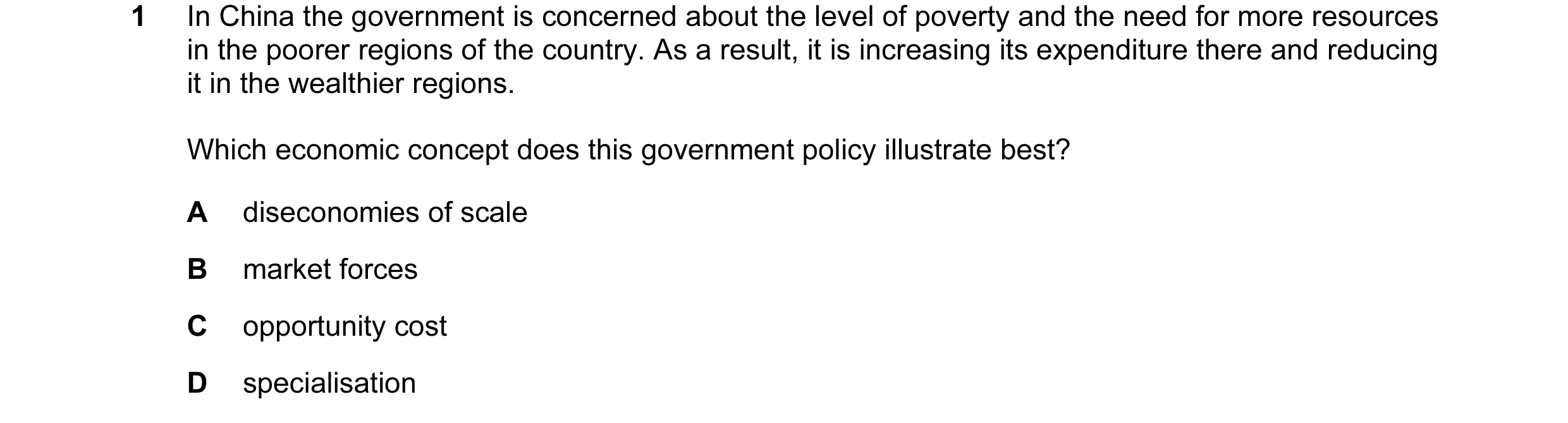
1 In China the government is concerned about the level of poverty and the need for more resources in the poorer regions of the country. As a result, it is increasing its expenditure there and reducing it in the wealthier regions. Which economic concept does this government policy illustrate best? A diseconomies of scale B market forces C opportunity cost D specialisation
1 marks
Answer: C
This question in 0455/12 Oct/Nov 2012
Q33 · Sam wrote a list of how he would prefer to spend his Saturday afternoon 0455/11 Oct/Nov 2013
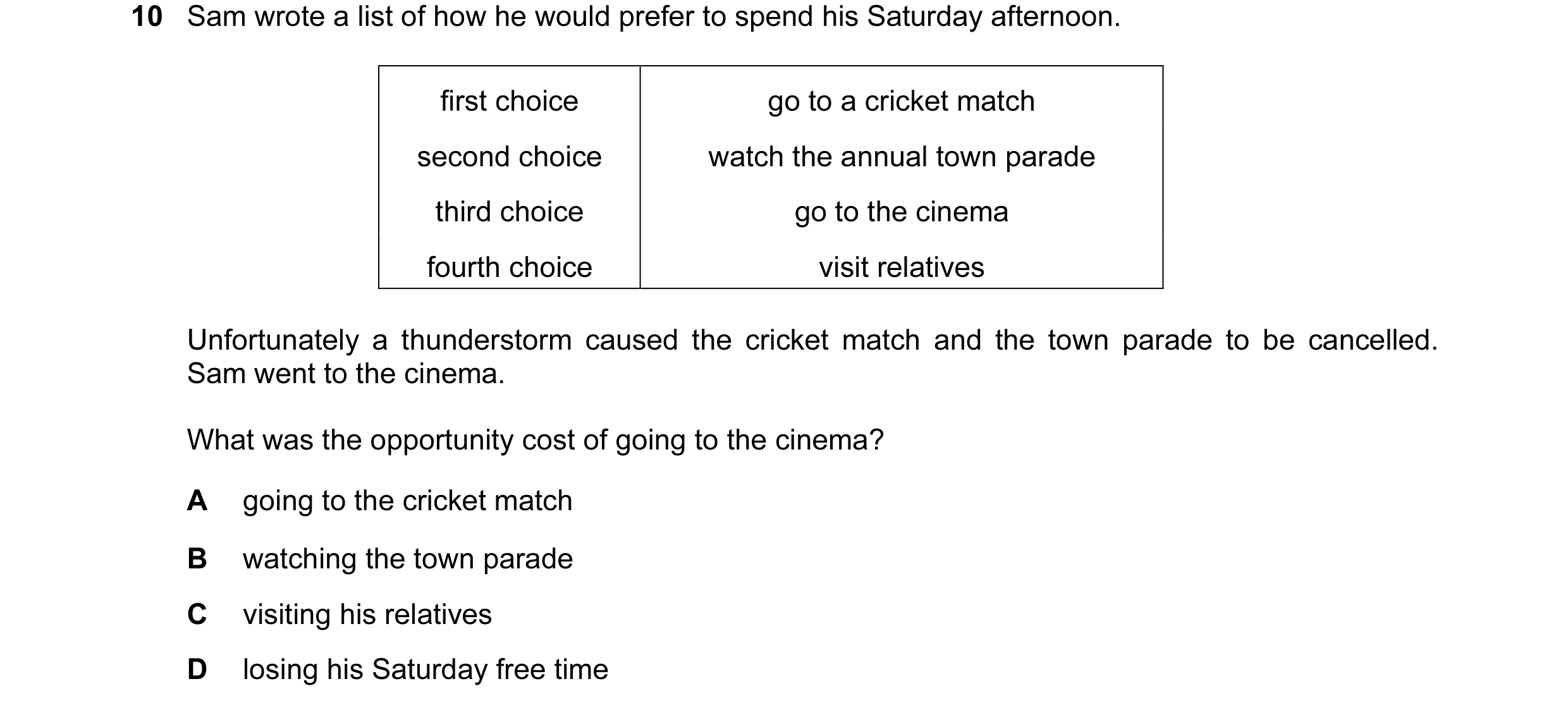
10 Sam wrote a list of how he would prefer to spend his Saturday afternoon. first choice go to a cricket match second choice watch the annual town parade third choice go to the cinema fourth choice visit relatives Unfortunately a thunderstorm caused the cricket match and the town parade to be cancelled. Sam went to the cinema. What was the opportunity cost of going to the cinema? A going to the cricket match B watching the town parade C visiting his relatives D losing his Saturday free time
1 marks
Answer: C
This question in 0455/11 Oct/Nov 2013
Q34 · Sam wrote a list of how he would prefer to spend his Saturday afternoon 0455/12 Oct/Nov 2013
1 Sam wrote a list of how he would prefer to spend his Saturday afternoon. first choice go to a cricket match second choice watch the annual town parade third choice go to the cinema fourth choice visit relatives Unfortunately a thunderstorm caused the cricket match and the town parade to be cancelled. Sam went to the cinema. What was the opportunity cost of going to the cinema? A going to the cricket match B watching the town parade C visiting his relatives D losing his Saturday free time
1 marks
Answer: C
This question in 0455/12 Oct/Nov 2013
Q35 · A generating station was built to supply electricity to a rural village in Africa 0455/13 Oct/Nov 2013
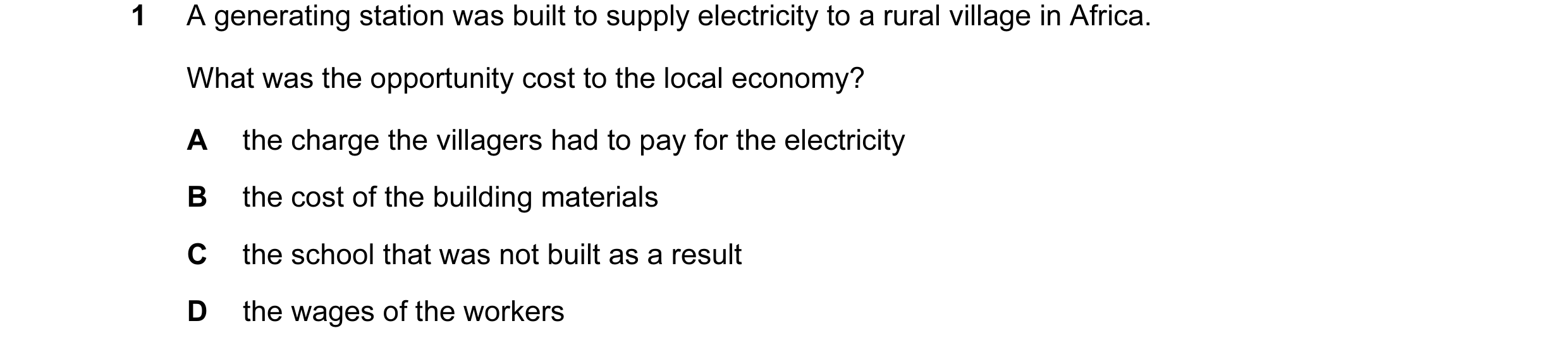
1 A generating station was built to supply electricity to a rural village in Africa. What was the opportunity cost to the local economy? A the charge the villagers had to pay for the electricity B the cost of the building materials C the school that was not built as a result D the wages of the workers
1 marks
Answer: C
This question in 0455/13 Oct/Nov 2013
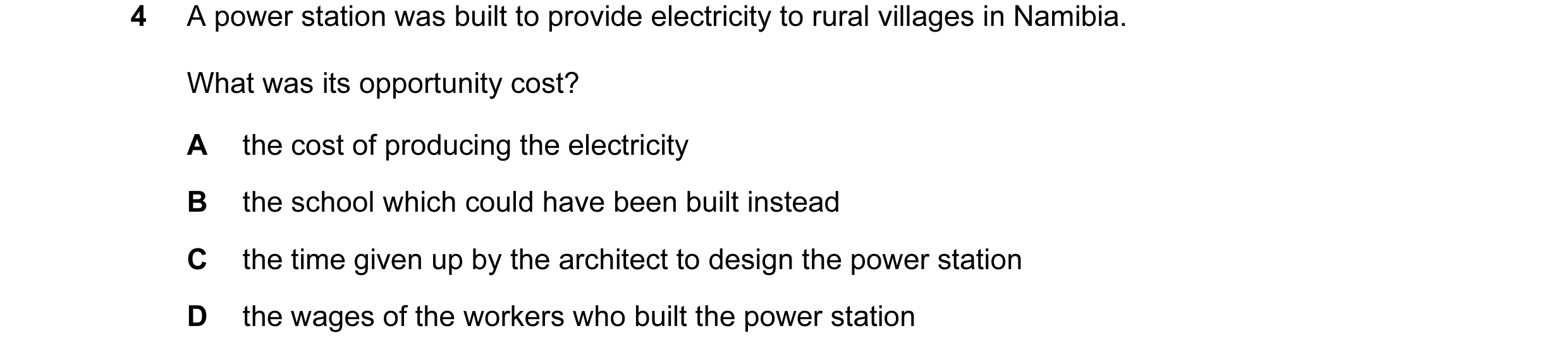
Q36 · A power station was built to provide electricity to rural villages in Namibia 0455/11 May/June 2014
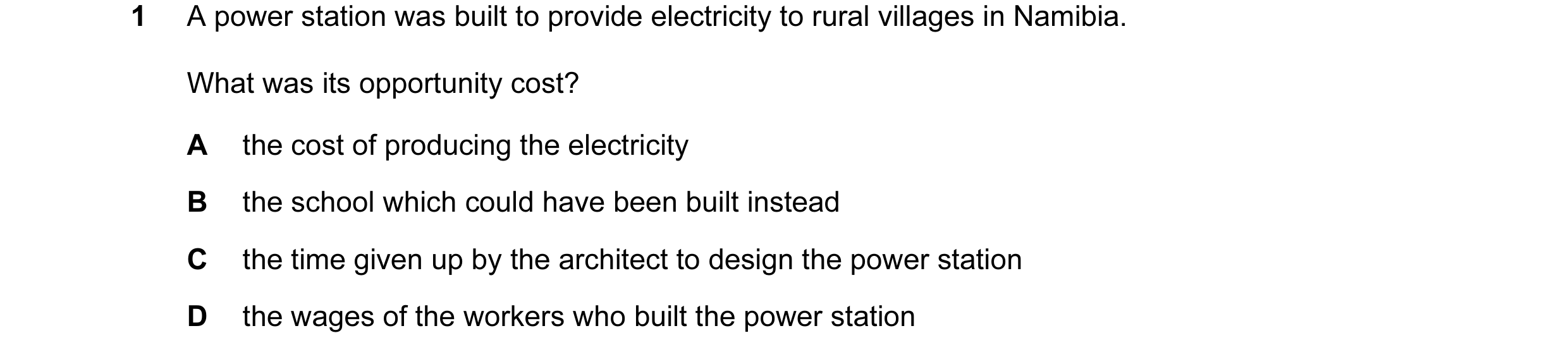
1 A power station was built to provide electricity to rural villages in Namibia. What was its opportunity cost? A the cost of producing the electricity B the school which could have been built instead C the time given up by the architect to design the power station D the wages of the workers who built the power station
1 marks
Answer: B
This question in 0455/11 May/June 2014
Q37 · Using all available resources, an economy produces different combinations of two types of… 0455/11 May/June 2014
2 Using all available resources, an economy produces different combinations of two types of goods, clothes and food, shown by the production possibility curve (PPC) below. 100 units clothes O 50 units food What does the PPC indicate? A It is more efficient to produce more of clothes than food. B It is only possible to increase the output of clothes by reducing the output of food. C The best situation is to produce equal units of clothes and food. D The cost of producing a unit of clothes is always higher than that of food.
1 marks
Answer: B
This question in 0455/11 May/June 2014
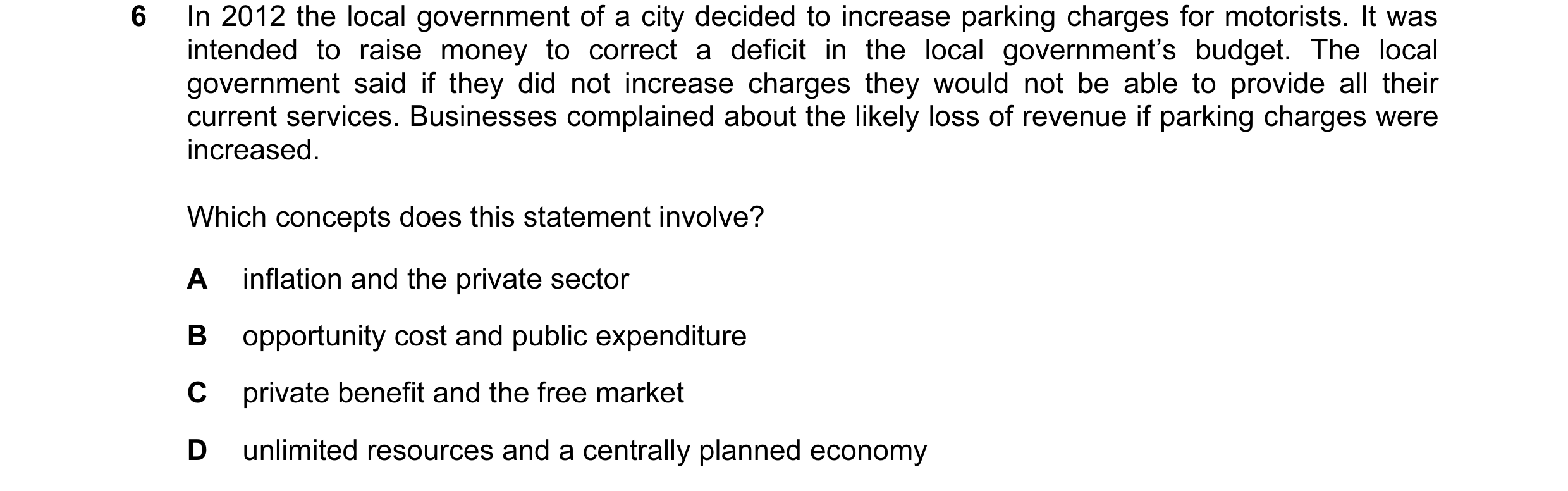
Q38 · In 2012 the local government of a city decided to increase parking charges for motorists 0455/12 May/June 2014
6 In 2012 the local government of a city decided to increase parking charges for motorists. It was intended to raise money to correct a deficit in the local government’s budget. The local government said if they did not increase charges they would not be able to provide all their current services. Businesses complained about the likely loss of revenue if parking charges were increased. Which concepts does this statement involve? A inflation and the private sector B opportunity cost and public expenditure C private benefit and the free market D unlimited resources and a centrally planned economy
1 marks
Answer: B
This question in 0455/12 May/June 2014
Q39 · A power station was built to provide electricity to rural villages in Namibia 0455/13 May/June 2014
4 A power station was built to provide electricity to rural villages in Namibia. What was its opportunity cost? A the cost of producing the electricity B the school which could have been built instead C the time given up by the architect to design the power station D the wages of the workers who built the power station
1 marks
Answer: B
This question in 0455/13 May/June 2014
Q40 · In the diagram, what does the production possibility line PQ illustrate? 0455/13 Oct/Nov 2014
2 In the diagram, what does the production possibility line PQ illustrate? P product Y O product X Q A constant opportunity cost B decreasing opportunity cost C diseconomies of scale D economies of scale
1 marks
Answer: A
This question in 0455/13 Oct/Nov 2014
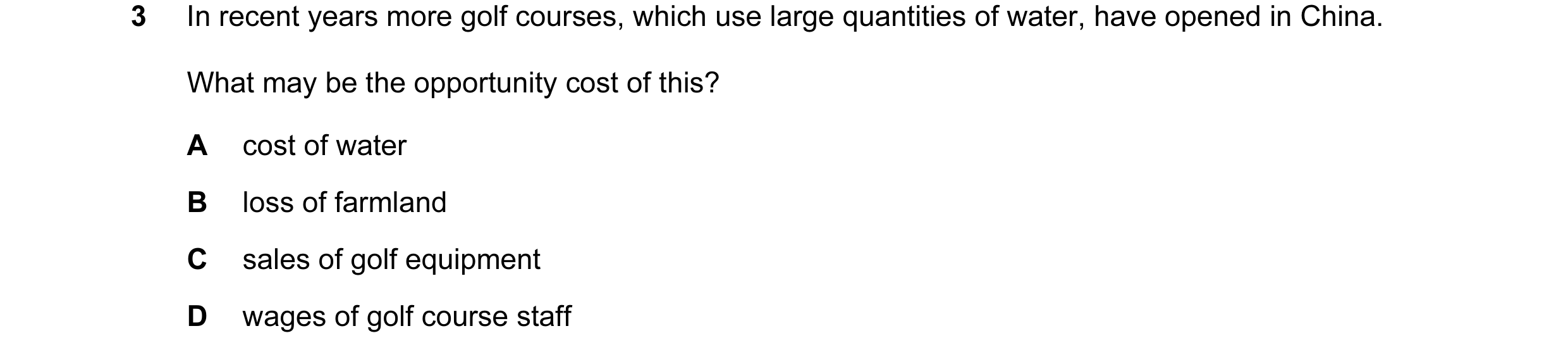
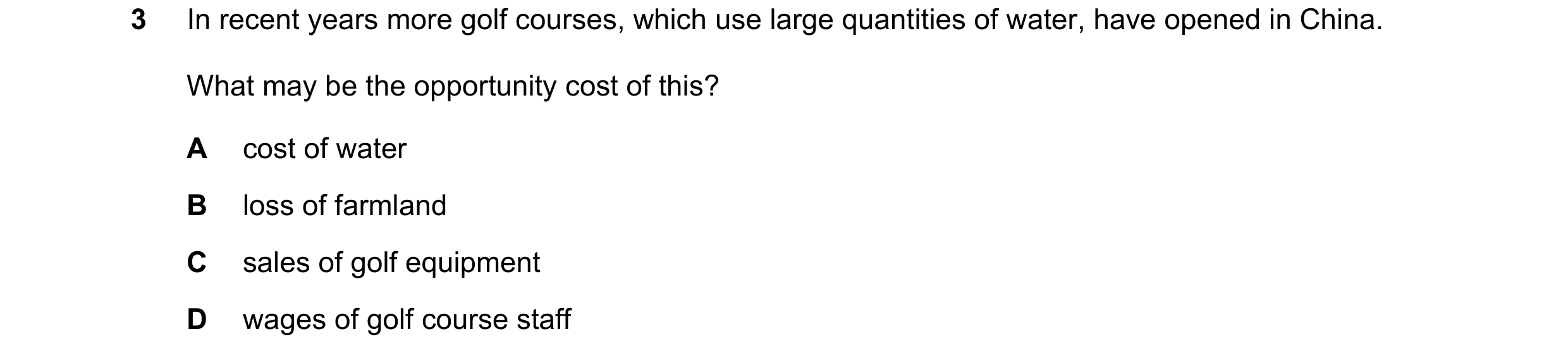
Q41 · In recent years more golf courses, which use large quantities of water, have opened in… 0455/13 Oct/Nov 2014
3 In recent years more golf courses, which use large quantities of water, have opened in China. What may be the opportunity cost of this? A cost of water B loss of farmland C sales of golf equipment D wages of golf course staff
1 marks
Answer: B
This question in 0455/13 Oct/Nov 2014
Q42 · A person makes sandwiches at home for five hours each day 0455/11 May/June 2015
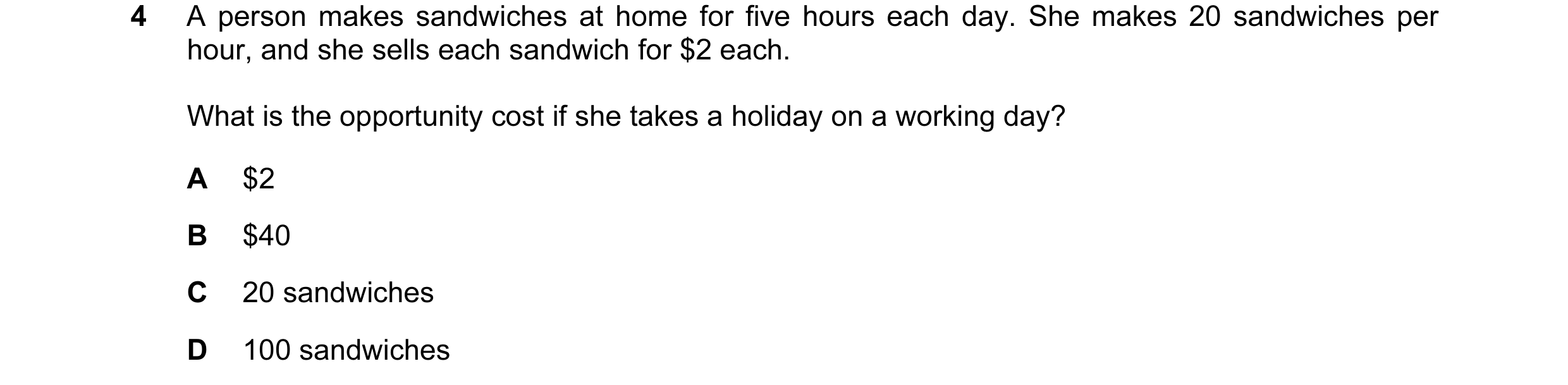
4 A person makes sandwiches at home for five hours each day. She makes 20 sandwiches per hour, and she sells each sandwich for $2 each. What is the opportunity cost if she takes a holiday on a working day? A $2 B $40 C 20 sandwiches D 100 sandwiches
1 marks
Answer: D
This question in 0455/11 May/June 2015
Q43 · A person makes sandwiches at home for five hours each day 0455/12 May/June 2015
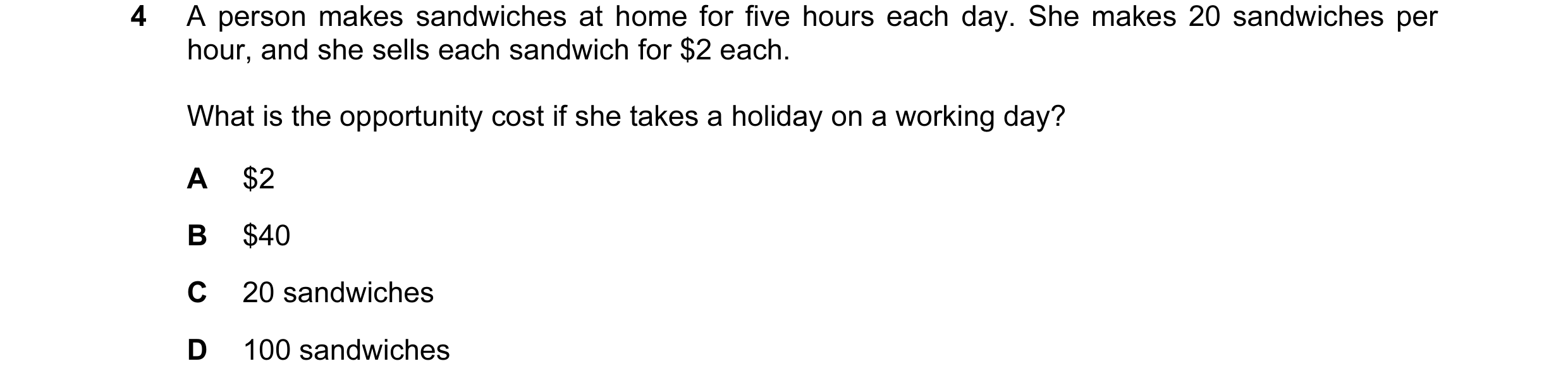
4 A person makes sandwiches at home for five hours each day. She makes 20 sandwiches per hour, and she sells each sandwich for $2 each. What is the opportunity cost if she takes a holiday on a working day? A $2 B $40 C 20 sandwiches D 100 sandwiches
1 marks
Answer: D
This question in 0455/12 May/June 2015
Q44 · A person makes sandwiches at home for five hours each day 0455/13 May/June 2015
4 A person makes sandwiches at home for five hours each day. She makes 20 sandwiches per hour, and she sells each sandwich for $2 each. What is the opportunity cost if she takes a holiday on a working day? A $2 B $40 C 20 sandwiches D 100 sandwiches
1 marks
Answer: D
This question in 0455/13 May/June 2015
Q45 · A large supermarket applied to build on land which was in an area of natural beauty 0455/13 May/June 2015
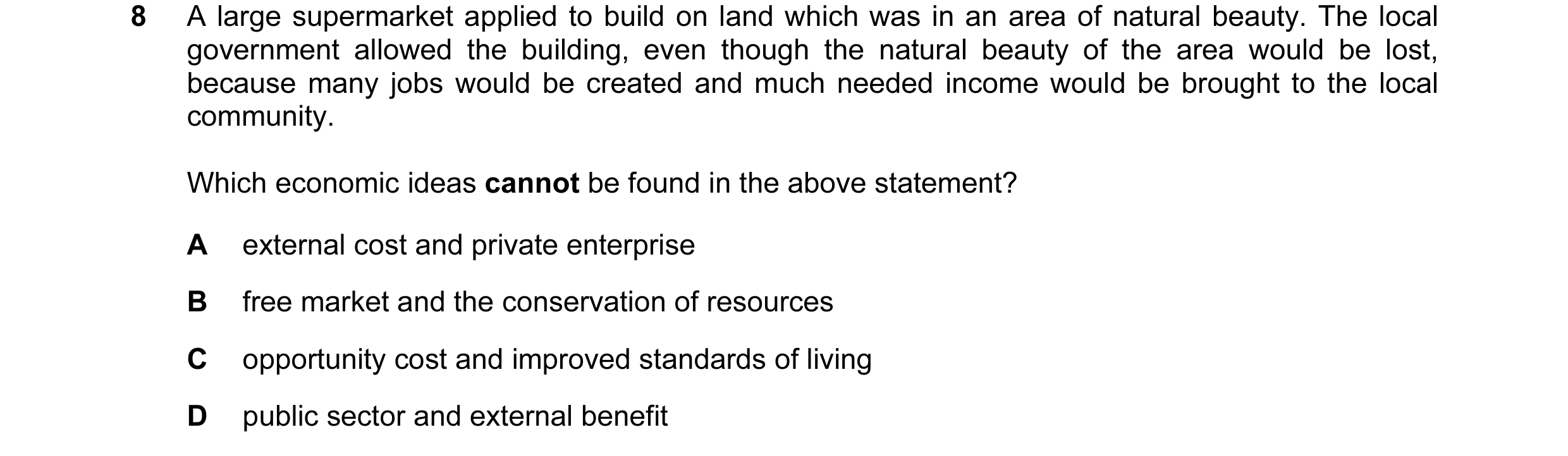
8 A large supermarket applied to build on land which was in an area of natural beauty. The local government allowed the building, even though the natural beauty of the area would be lost, because many jobs would be created and much needed income would be brought to the local community. Which economic ideas cannot be found in the above statement? A external cost and private enterprise B free market and the conservation of resources C opportunity cost and improved standards of living D public sector and external benefit
1 marks
Answer: B
This question in 0455/13 May/June 2015
Q46 · Why is choice an important part of the basic economic problem? 0455/11 Oct/Nov 2015
2 Why is choice an important part of the basic economic problem? A Choice is necessary to achieve an equilibrium price. B Limited resources have many uses. C Manufacturers produce a large variety of foods. D The market leads to an unequal distribution of goods.
1 marks
Answer: B
This question in 0455/11 Oct/Nov 2015
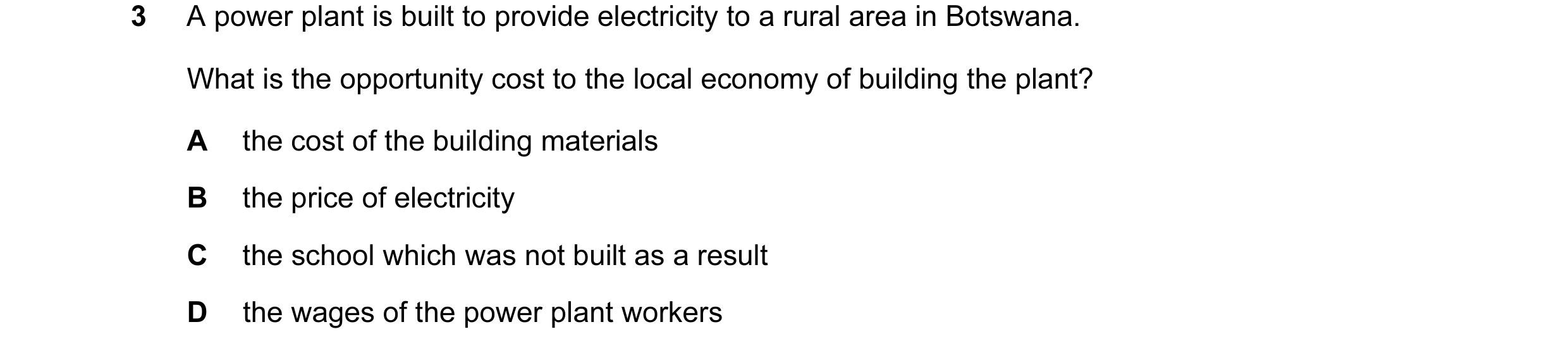
Q47 · A power plant is built to provide electricity to a rural area in Botswana 0455/11 Oct/Nov 2015
3 A power plant is built to provide electricity to a rural area in Botswana. What is the opportunity cost to the local economy of building the plant? A the cost of the building materials B the price of electricity C the school which was not built as a result D the wages of the power plant workers
1 marks
Answer: C
This question in 0455/11 Oct/Nov 2015
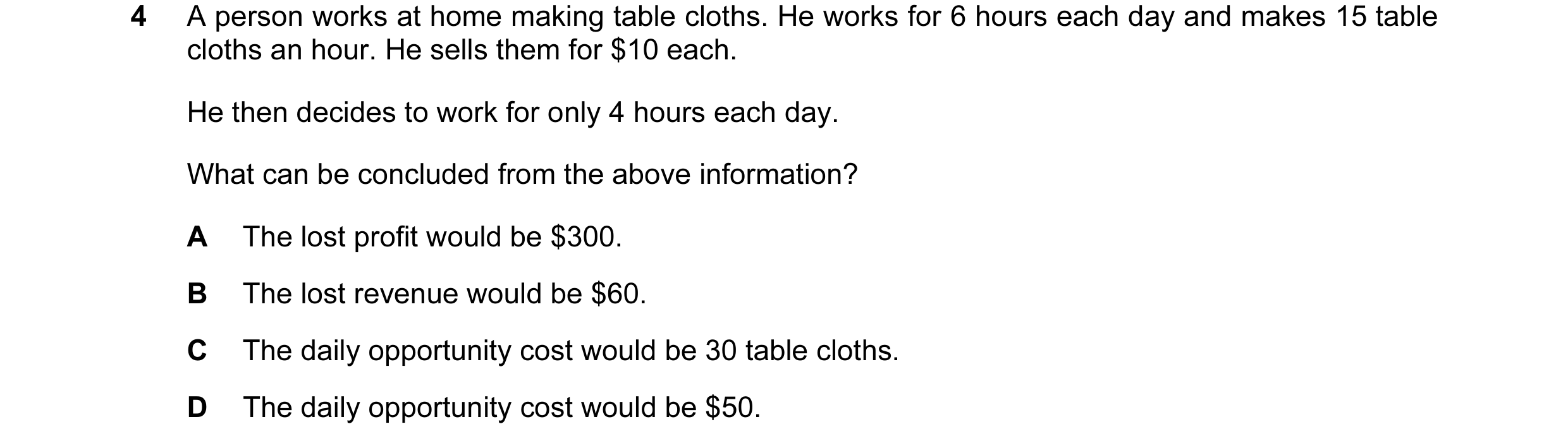
Q48 · A person works at home making table cloths 0455/12 Oct/Nov 2015
4 A person works at home making table cloths. He works for 6 hours each day and makes 15 table cloths an hour. He sells them for $10 each. He then decides to work for only 4 hours each day. What can be concluded from the above information? A The lost profit would be $300. B The lost revenue would be $60. C The daily opportunity cost would be 30 table cloths. D The daily opportunity cost would be $50.
1 marks
Answer: C
This question in 0455/12 Oct/Nov 2015
Q49 · A country raises the school leaving age from 15 to 17 years 0455/12 Feb/March 2016
3 A country raises the school leaving age from 15 to 17 years. What is the opportunity cost of this increased period of school education to the young people affected? A costs of training and employing more teachers B financial help necessary for school leavers who go to university C government expenditure on building extra classrooms D lost income from paid employment because of school attendance
1 marks
Answer: D
This question in 0455/12 Feb/March 2016
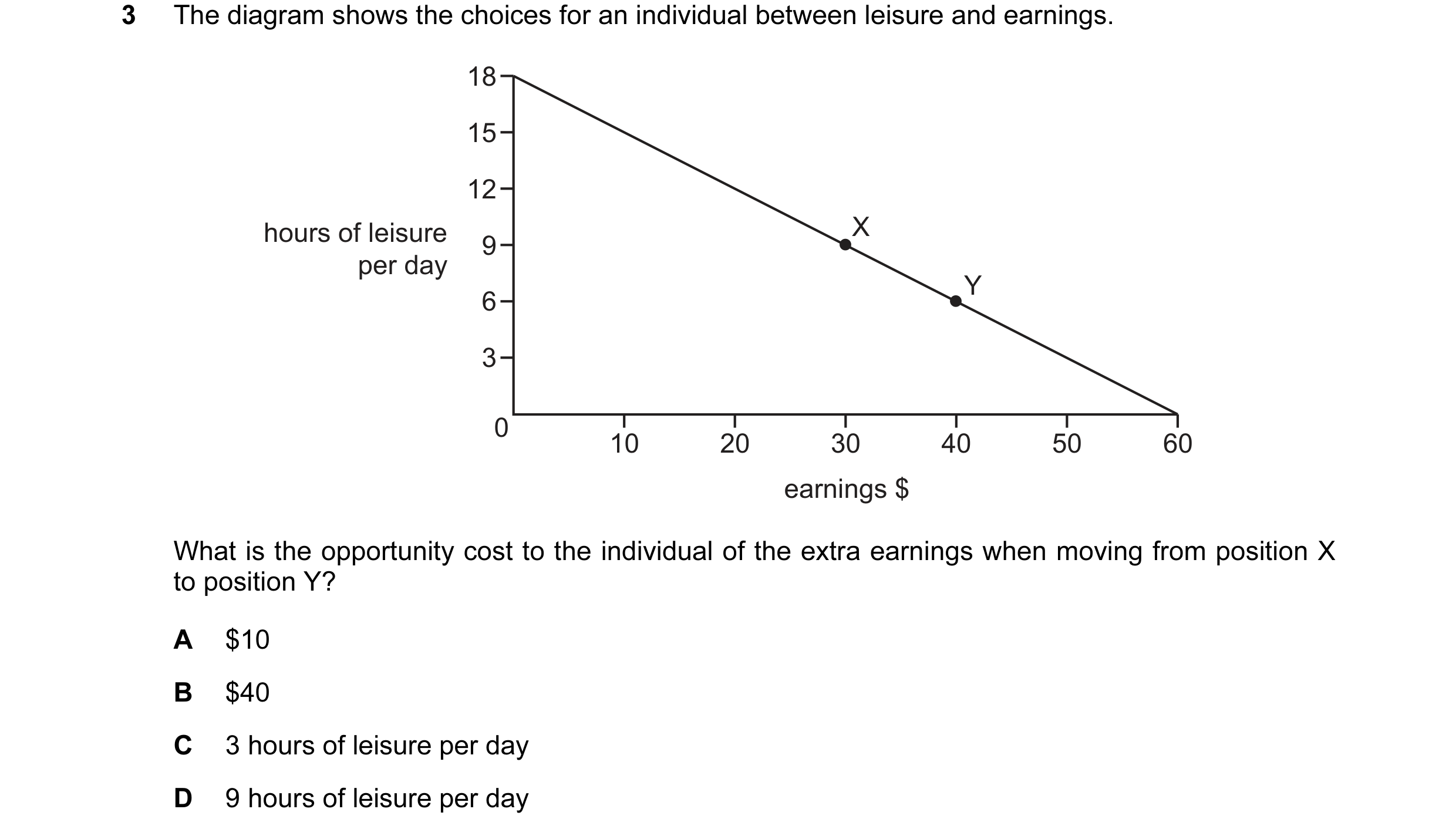
Q50 · The diagram shows the choices for an individual between leisure and earnings 0455/11 May/June 2016
3 The diagram shows the choices for an individual between leisure and earnings. 18 15 12 hours of leisure X 9 per day Y 6 3 0 10 20 30 40 50 60 earnings $ What is the opportunity cost to the individual of the extra earnings when moving from position X to position Y? A $10 B $40 C 3 hours of leisure per day D 9 hours of leisure per day
1 marks
Answer: C
This question in 0455/11 May/June 2016
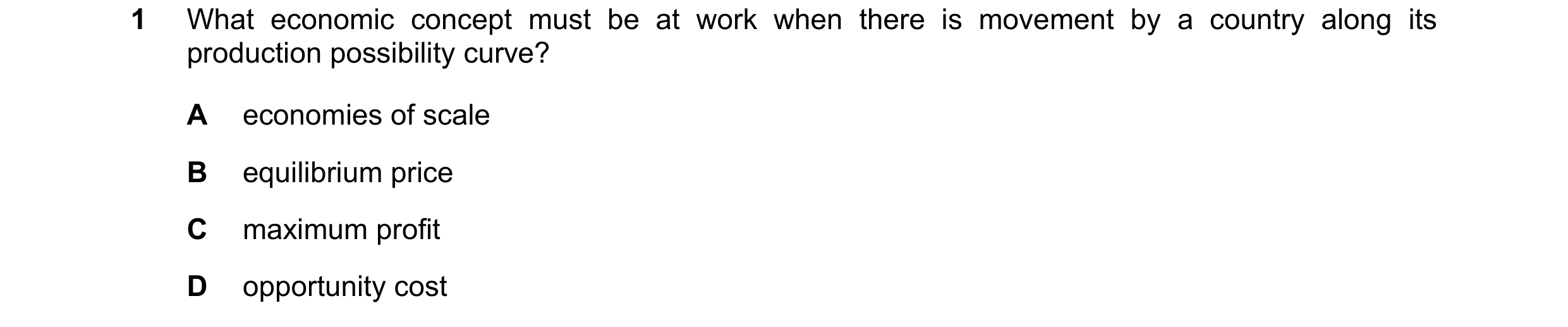
Q51 · What economic concept must be at work when there is movement by a country along its… 0455/12 May/June 2016
1 What economic concept must be at work when there is movement by a country along its production possibility curve? A economies of scale B equilibrium price C maximum profit D opportunity cost
1 marks
Answer: D
This question in 0455/12 May/June 2016
Q52 · The diagram shows the choices for an individual between leisure and earnings 0455/12 May/June 2016
2 The diagram shows the choices for an individual between leisure and earnings. 24 20 16 hours of leisure X 12 per day Y 8 4 0 20 40 60 80 100 120 earnings $ The person decides to take a job that gives more leisure time. What is the opportunity cost to the individual of moving from position Y to position X? A $20 B $80 C 4 hours of leisure per day D 12 hours of leisure per day
1 marks
Answer: A
This question in 0455/12 May/June 2016
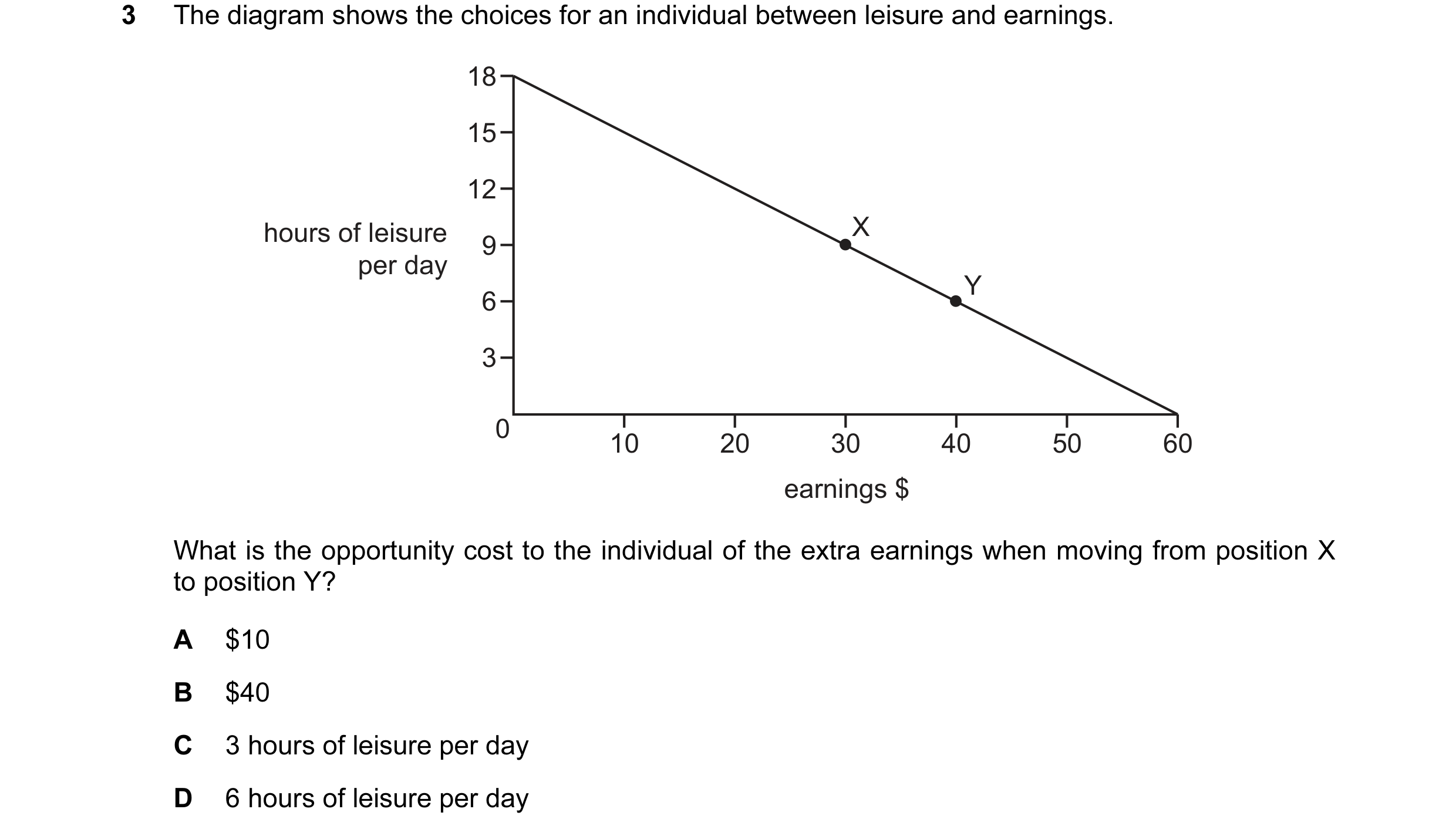
Q53 · The diagram shows the choices for an individual between leisure and earnings 0455/13 May/June 2016
3 The diagram shows the choices for an individual between leisure and earnings. 18 15 12 hours of leisure X 9 per day Y 6 3 0 10 20 30 40 50 60 earnings $ What is the opportunity cost to the individual of the extra earnings when moving from position X to position Y? A $10 B $40 C 3 hours of leisure per day D 6 hours of leisure per day
1 marks
Answer: C
This question in 0455/13 May/June 2016
Q54 · What could be the opportunity cost of a nuclear power station? 0455/12 Oct/Nov 2016
2 What could be the opportunity cost of a nuclear power station? A the running costs of the power station B a coal-fired power station C the current value of the power station D the cost of building the power station
1 marks
This question in 0455/12 Oct/Nov 2016
Q55 · What could be the opportunity cost of a nuclear power station? 0455/13 Oct/Nov 2016
2 What could be the opportunity cost of a nuclear power station? A the running costs of the power station B a coal-fired power station C the current value of the power station D the cost of building the power station
1 marks
Answer: B
This question in 0455/13 Oct/Nov 2016
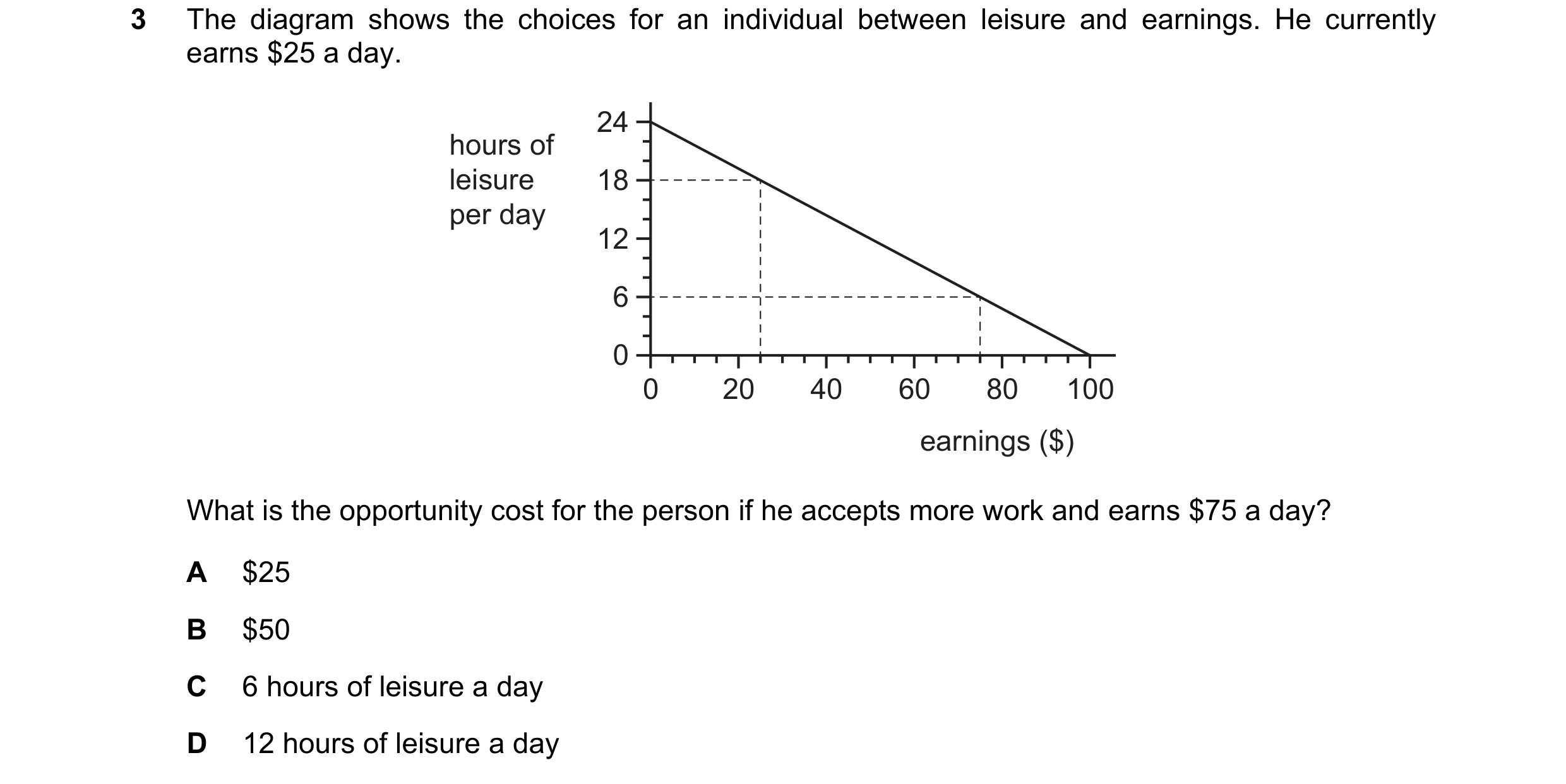
Q56 · The diagram shows the choices for an individual between leisure and earnings 0455/12 Feb/March 2017
3 The diagram shows the choices for an individual between leisure and earnings. He currently earns $25 a day. 24 hours of leisure 18 per day 12 6 0 0 20 40 60 80 100 earnings ($) What is the opportunity cost for the person if he accepts more work and earns $75 a day? A $25 B $50 C 6 hours of leisure a day D 12 hours of leisure a day
1 marks
Answer: D
This question in 0455/12 Feb/March 2017
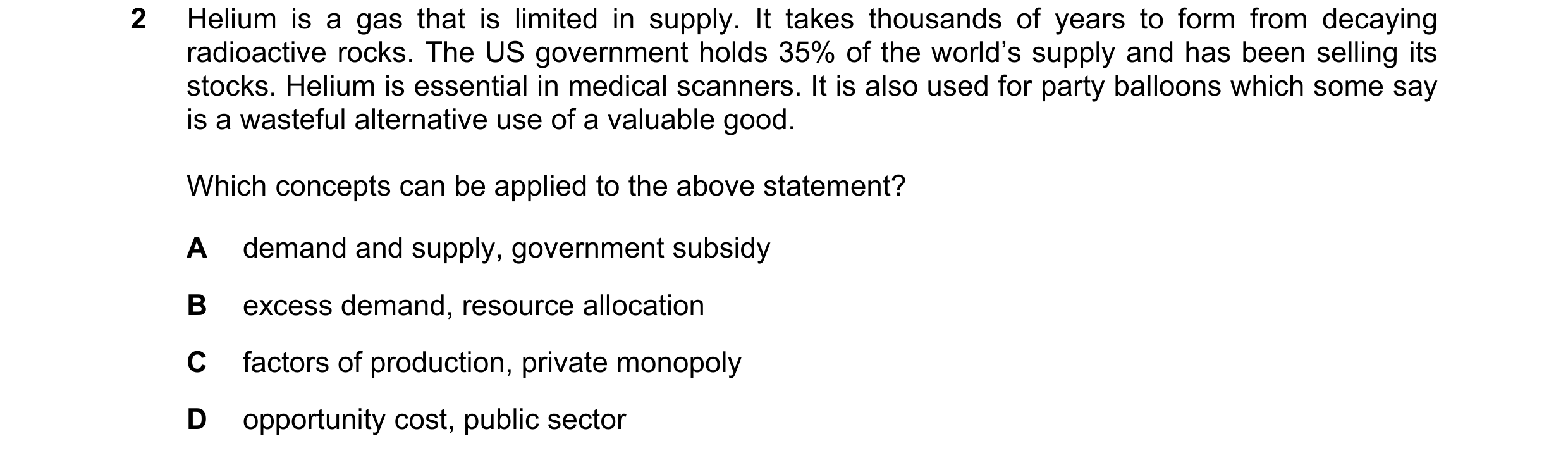
Q57 · Helium is a gas that is limited in supply 0455/11 May/June 2017
2 Helium is a gas that is limited in supply. It takes thousands of years to form from decaying radioactive rocks. The US government holds 35% of the world’s supply and has been selling its stocks. Helium is essential in medical scanners. It is also used for party balloons which some say is a wasteful alternative use of a valuable good. Which concepts can be applied to the above statement? A demand and supply, government subsidy B excess demand, resource allocation C factors of production, private monopoly D opportunity cost, public sector
1 marks
Answer: D
This question in 0455/11 May/June 2017
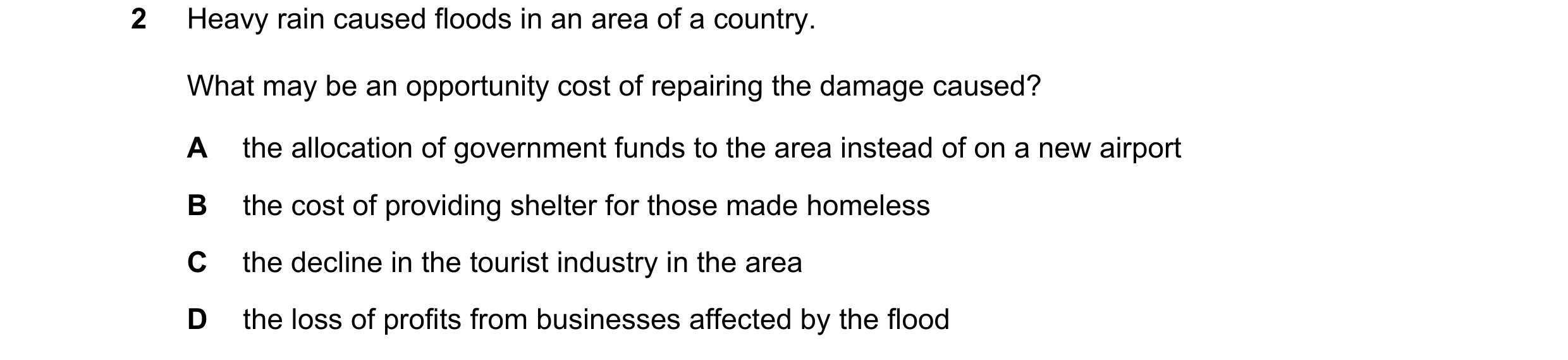
Q58 · Heavy rain caused floods in an area of a country 0455/12 May/June 2017
2 Heavy rain caused floods in an area of a country. What may be an opportunity cost of repairing the damage caused? A the allocation of government funds to the area instead of on a new airport B the cost of providing shelter for those made homeless C the decline in the tourist industry in the area D the loss of profits from businesses affected by the flood
1 marks
Answer: A
This question in 0455/12 May/June 2017
Q59 · A person can make 10 items to sell on a craft stall in a day 0455/13 May/June 2017
2 A person can make 10 items to sell on a craft stall in a day. What is the opportunity cost if the person decides to paint a picture instead? A 10 craft items B the cost of the materials for the craft items C the cost of the paint for the picture D the value of the picture
1 marks
Answer: A
This question in 0455/13 May/June 2017
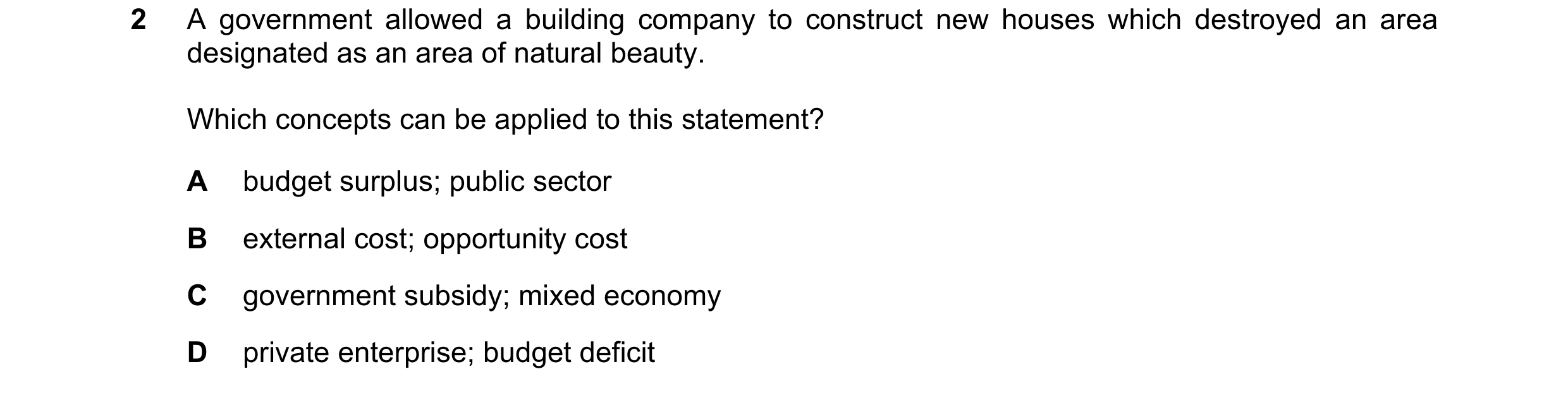
Q60 · A government allowed a building company to construct new houses which destroyed an area… 0455/12 Oct/Nov 2017
2 A government allowed a building company to construct new houses which destroyed an area designated as an area of natural beauty. Which concepts can be applied to this statement? A budget surplus; public sector B external cost; opportunity cost C government subsidy; mixed economy D private enterprise; budget deficit
1 marks
Answer: B
This question in 0455/12 Oct/Nov 2017
Q61 · A government decides to spend more on defence and cannot spend money on a new airport 0455/13 Oct/Nov 2017
2 A government decides to spend more on defence and cannot spend money on a new airport. Which concepts can be applied to the above statement? A budget surplus; external cost B factor of production; private monopoly C public sector; opportunity cost D trade surplus; budget deficit
1 marks
Answer: C
This question in 0455/13 Oct/Nov 2017
Q62 · The Norwegian government chose to spend the profits from oil on stocks, bonds and property 0455/11 May/June 2018
1 The Norwegian government chose to spend the profits from oil on stocks, bonds and property. The possibility of improving domestic infrastructure, therefore, was not taken. Which economic concept does this best illustrate? A cost of production B finite resources C opportunity cost D production possibility frontier
1 marks
Answer: C
This question in 0455/11 May/June 2018
Q63 · In economics, natural sunlight is classified as a free good 0455/12 May/June 2018
1 In economics, natural sunlight is classified as a free good. What is the reason for this? A Sunlight is a gift of nature. B Sunlight is a renewable resource. C There is no opportunity cost of using sunlight. D Unlimited amounts of sunlight can be consumed.
1 marks
Answer: C
This question in 0455/12 May/June 2018
Q64 · The diagram shows the production possibility curve (PPC) for an economy 0455/11 Oct/Nov 2018
3 The diagram shows the production possibility curve (PPC) for an economy. capital goods X Y Z O consumer goods What will happen to the opportunity cost of producing more units of consumer goods in terms of capital goods as the economy moves down its PPC from point X to point Z? A It will decrease continuously from point X to point Z. B It will decrease up to point Y and then increase towards point Z. C It will increase continuously from point X to point Z. D It will increase up to point Y and then decrease towards point Z.
1 marks
Answer: C
This question in 0455/11 Oct/Nov 2018
Q65 · A farmer reduces the land used to grow wheat from 80 hectares to 60 hectares and… 0455/12 Feb/March 2019
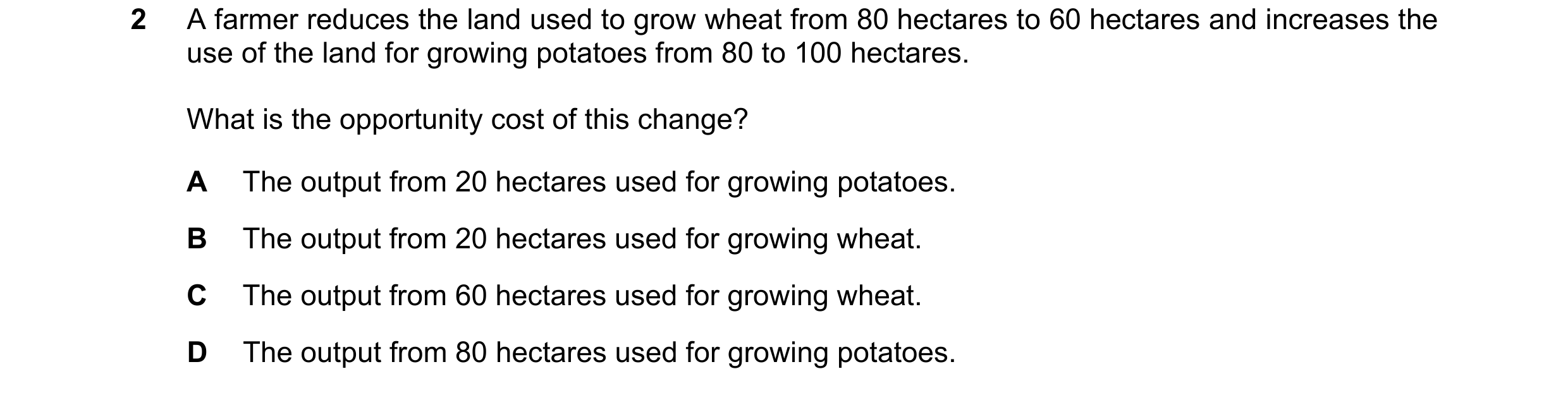
2 A farmer reduces the land used to grow wheat from 80 hectares to 60 hectares and increases the use of the land for growing potatoes from 80 to 100 hectares. What is the opportunity cost of this change? A The output from 20 hectares used for growing potatoes. B The output from 20 hectares used for growing wheat. C The output from 60 hectares used for growing wheat. D The output from 80 hectares used for growing potatoes.
1 marks
Answer: B
This question in 0455/12 Feb/March 2019
Q66 · The diagram shows a production possibility curve (PPC) 0455/11 May/June 2019
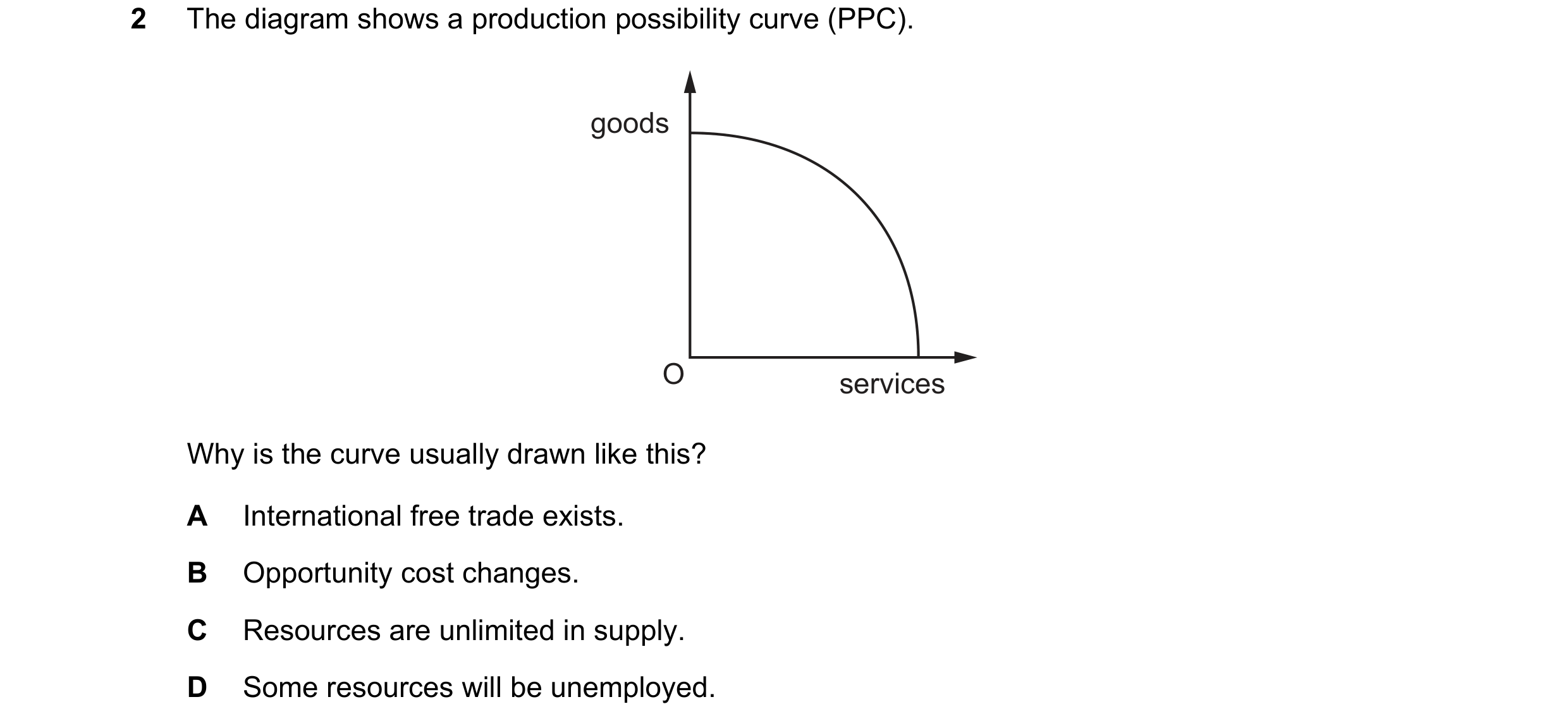
2 The diagram shows a production possibility curve (PPC). goods O services Why is the curve usually drawn like this? A International free trade exists. B Opportunity cost changes. C Resources are unlimited in supply. D Some resources will be unemployed.
1 marks
Answer: B
This question in 0455/11 May/June 2019
Q67 · In recent years more golf courses, which use large quantities of water, have opened in… 0455/11 May/June 2019
3 In recent years more golf courses, which use large quantities of water, have opened in China. What may be the opportunity cost of this? A cost of water B loss of farmland C sales of golf equipment D wages of golf course staff
1 marks
Answer: B
This question in 0455/11 May/June 2019
Q68 · In recent years more golf courses, which use large quantities of water, have opened in… 0455/12 May/June 2019
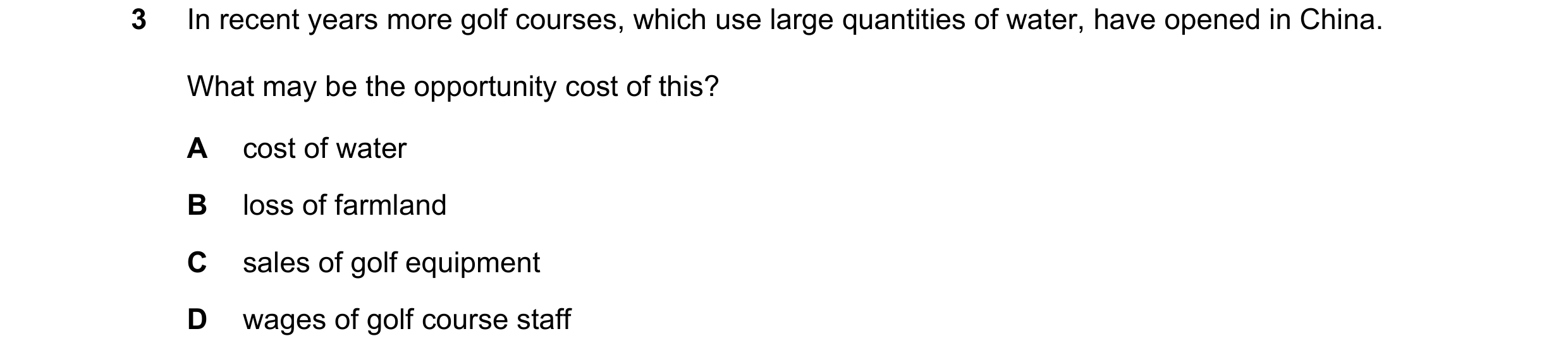
3 In recent years more golf courses, which use large quantities of water, have opened in China. What may be the opportunity cost of this? A cost of water B loss of farmland C sales of golf equipment D wages of golf course staff
1 marks
Answer: B
This question in 0455/12 May/June 2019
Q69 · In recent years more golf courses, which use large quantities of water, have opened in… 0455/13 May/June 2019
3 In recent years more golf courses, which use large quantities of water, have opened in China. What may be the opportunity cost of this? A cost of water B loss of farmland C sales of golf equipment D wages of golf course staff
1 marks
Answer: B
This question in 0455/13 May/June 2019
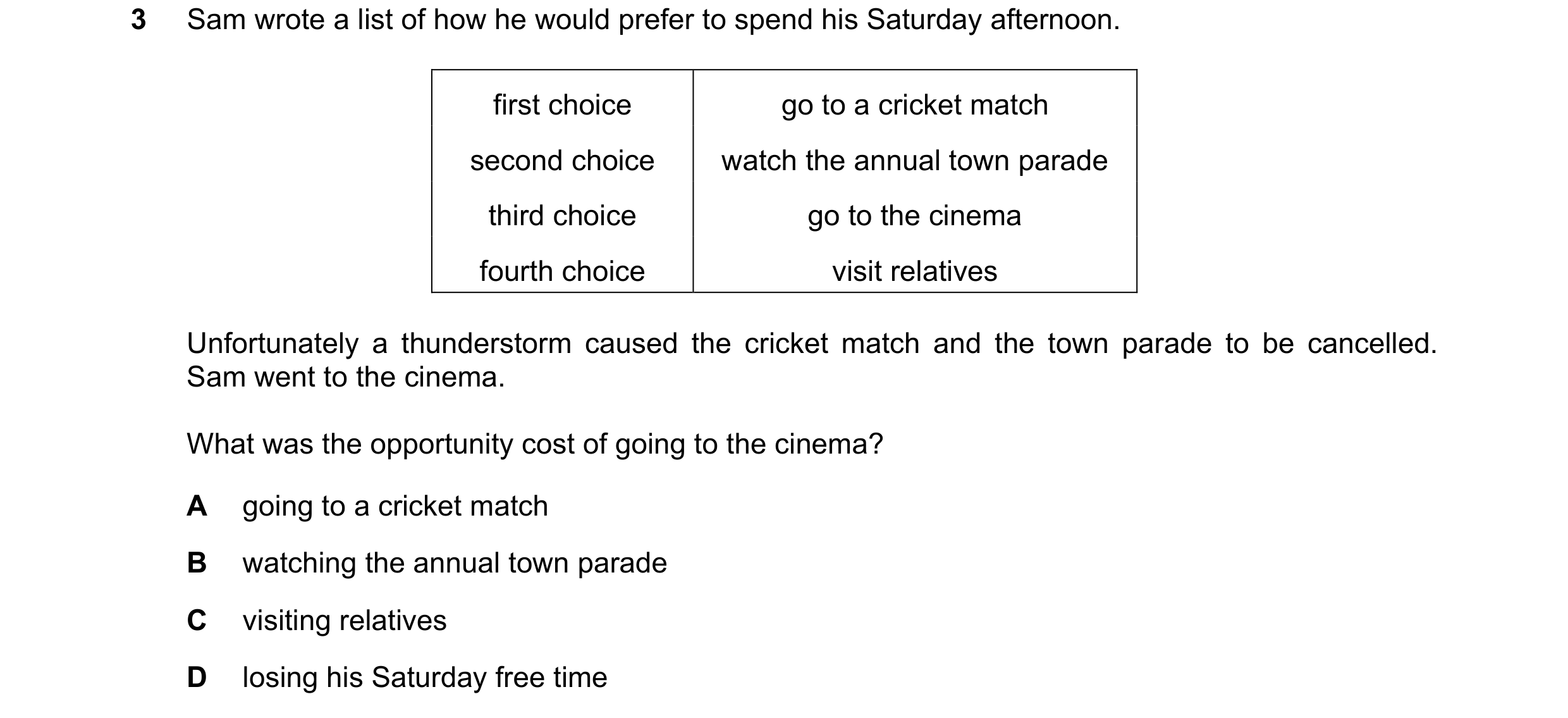
Q70 · Sam wrote a list of how he would prefer to spend his Saturday afternoon 0455/11 Oct/Nov 2019
3 Sam wrote a list of how he would prefer to spend his Saturday afternoon. first choice go to a cricket match second choice watch the annual town parade third choice go to the cinema fourth choice visit relatives Unfortunately a thunderstorm caused the cricket match and the town parade to be cancelled. Sam went to the cinema. What was the opportunity cost of going to the cinema? A going to a cricket match B watching the annual town parade C visiting relatives D losing his Saturday free time
1 marks
Answer: C
This question in 0455/11 Oct/Nov 2019
Q71 · Sam wrote a list of how he would prefer to spend his Saturday afternoon 0455/12 Oct/Nov 2019
3 Sam wrote a list of how he would prefer to spend his Saturday afternoon. first choice go to a cricket match second choice watch the annual town parade third choice go to the cinema fourth choice visit relatives Unfortunately a thunderstorm caused the cricket match and the town parade to be cancelled. Sam went to the cinema. What was the opportunity cost of going to the cinema? A going to a cricket match B watching the annual town parade C visiting relatives D losing his Saturday free time
1 marks
Answer: C
This question in 0455/12 Oct/Nov 2019
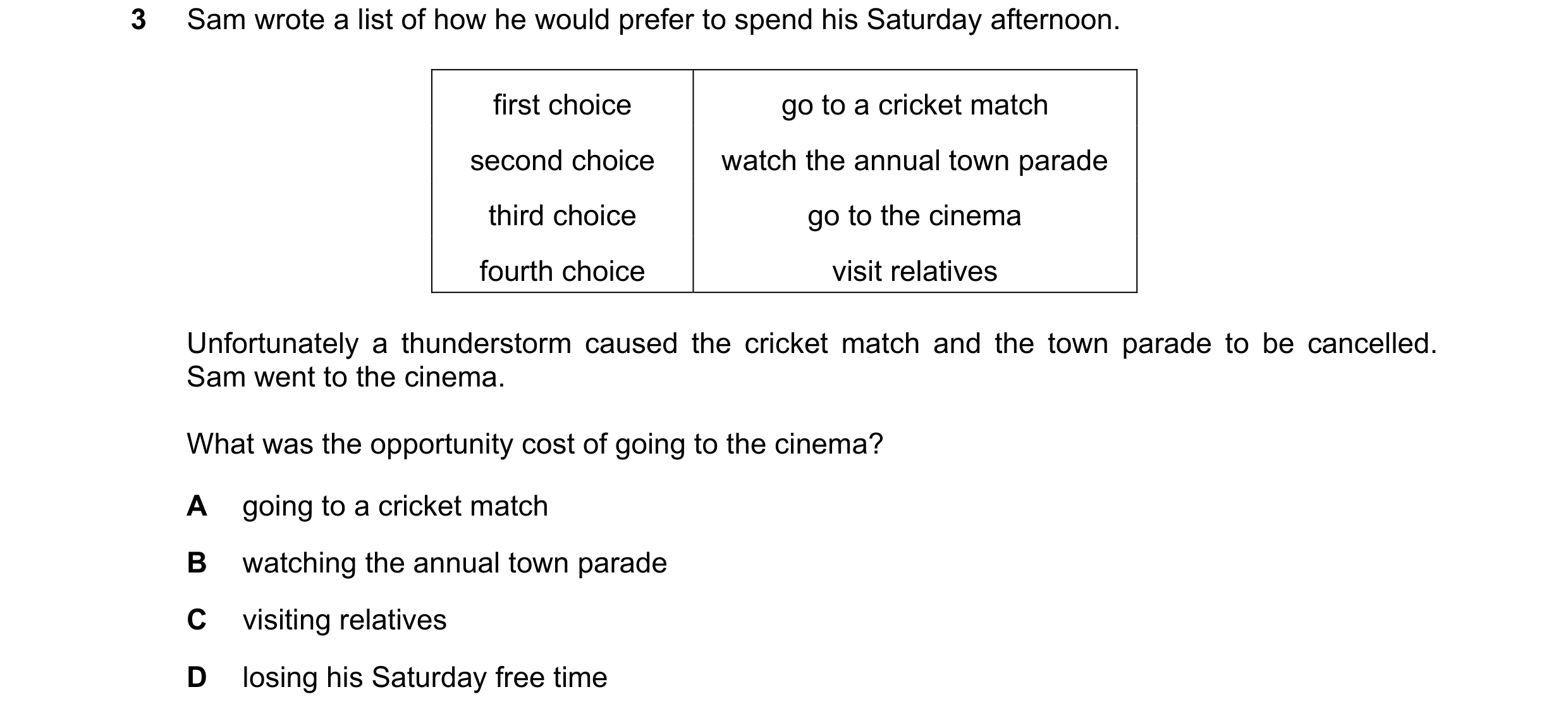
Q72 · Sam wrote a list of how he would prefer to spend his Saturday afternoon 0455/13 Oct/Nov 2019
3 Sam wrote a list of how he would prefer to spend his Saturday afternoon. first choice go to a cricket match second choice watch the annual town parade third choice go to the cinema fourth choice visit relatives Unfortunately a thunderstorm caused the cricket match and the town parade to be cancelled. Sam went to the cinema. What was the opportunity cost of going to the cinema? A going to a cricket match B watching the annual town parade C visiting relatives D losing his Saturday free time
1 marks
Answer: C
This question in 0455/13 Oct/Nov 2019
Q73 · A deposit of shale oil is discovered in an area of farming 0455/12 Feb/March 2020
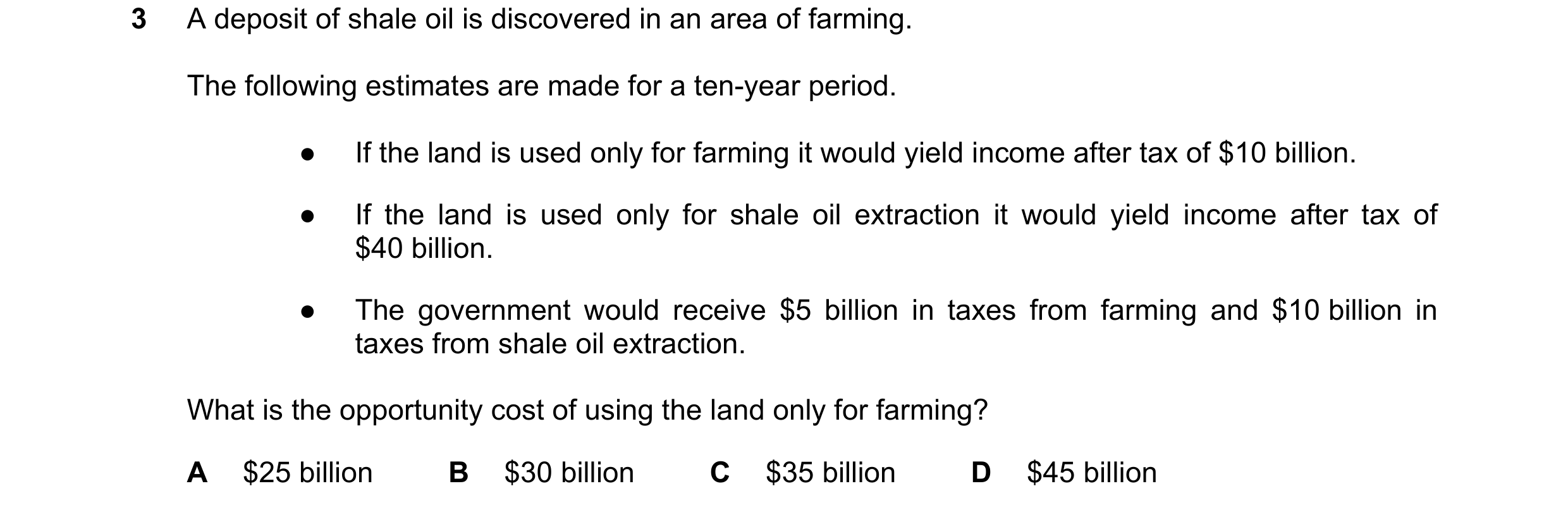
3 A deposit of shale oil is discovered in an area of farming. The following estimates are made for a ten-year period. ● If the land is used only for farming it would yield income after tax of $10 billion. ● If the land is used only for shale oil extraction it would yield income after tax of $40 billion. ● The government would receive $5 billion in taxes from farming and $10 billion in taxes from shale oil extraction. What is the opportunity cost of using the land only for farming? A $25 billion B $30 billion C $35 billion D $45 billion
1 marks
This question in 0455/12 Feb/March 2020
Q74 · A student decides to take up a two year apprenticeship for which she will earn $10 000… 0455/12 May/June 2020
3 A student decides to take up a two year apprenticeship for which she will earn $10 000 per year. After that she expects to earn $25 000 per year. She could take an unskilled job which pays $16 000 per year instead of the apprenticeship. What is the opportunity cost in the two years of completing the apprenticeship? A $10 000 B $12 000 C $25 000 D $32 000
1 marks
Answer: B
This question in 0455/12 May/June 2020
Q75 · A farmer decides to grow potatoes instead of wheat 0455/13 May/June 2020
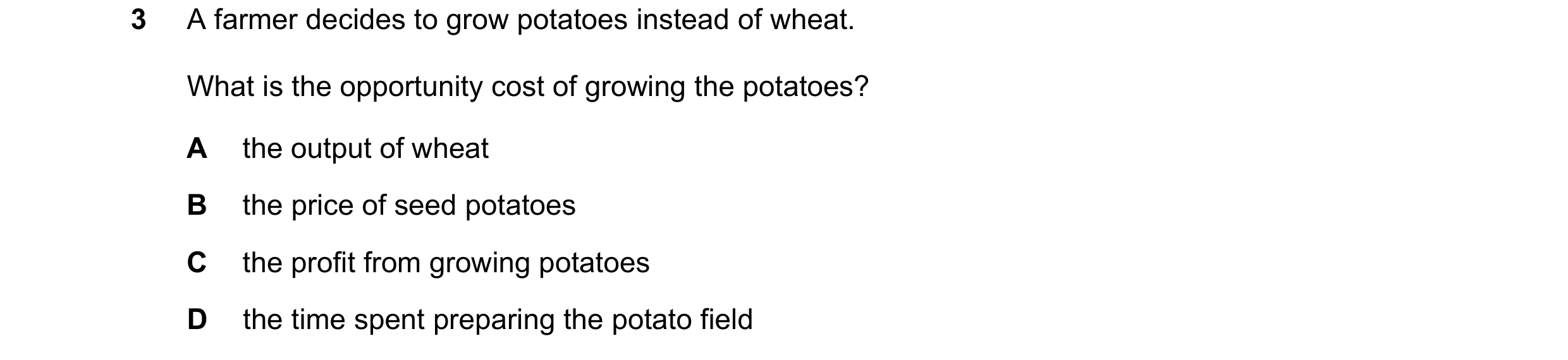
3 A farmer decides to grow potatoes instead of wheat. What is the opportunity cost of growing the potatoes? A the output of wheat B the price of seed potatoes C the profit from growing potatoes D the time spent preparing the potato field
1 marks
Answer: A
This question in 0455/13 May/June 2020
Q76 · A government is not allowed to increase its military spending 0455/13 May/June 2020
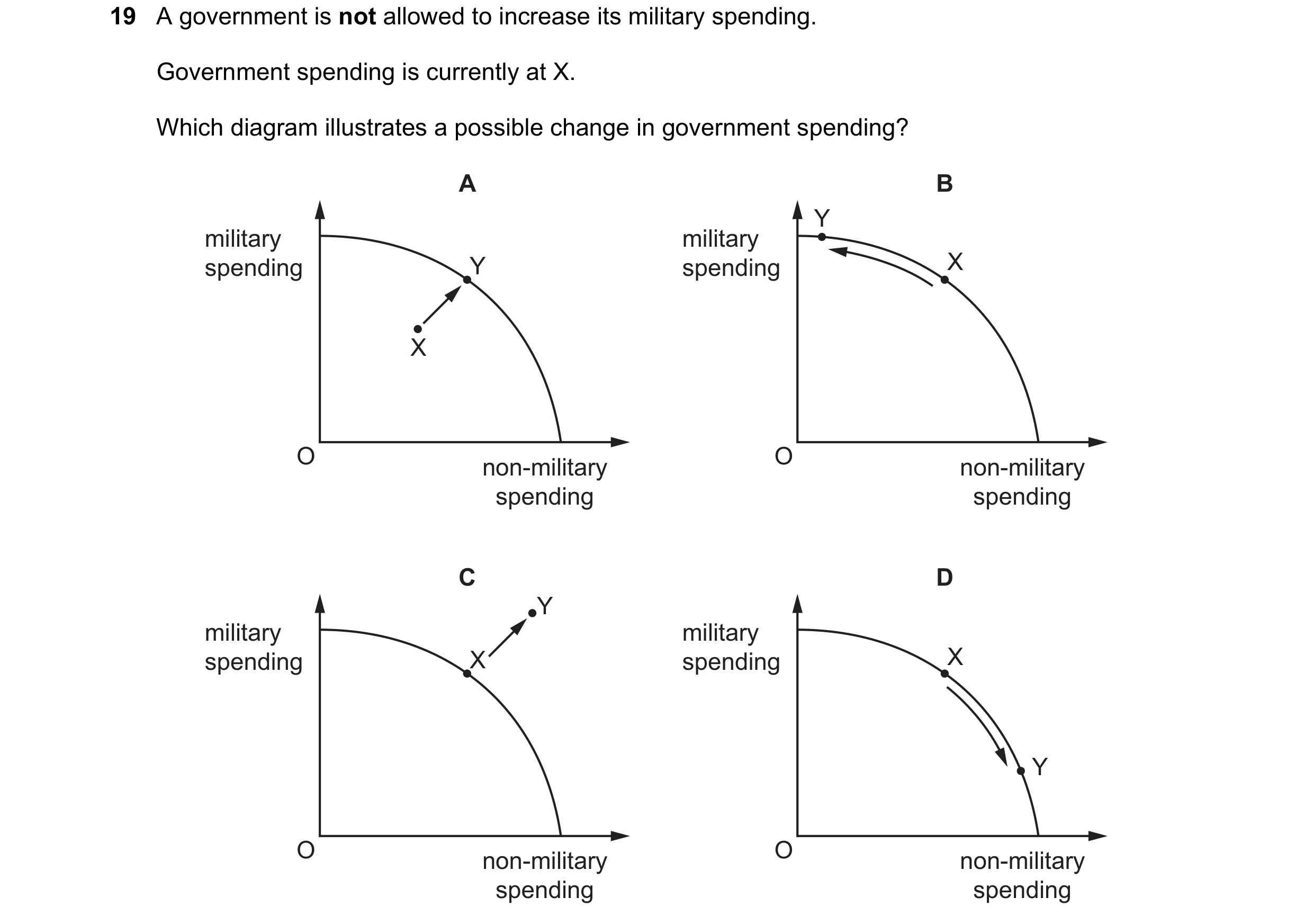
19 A government is not allowed to increase its military spending. Government spending is currently at X. Which diagram illustrates a possible change in government spending? A B Y military military spending Y spending X X O O non-military non-military spending spending C D Y military military spending X spending X Y O O non-military non-military spending spending
1 marks
Answer: D
This question in 0455/13 May/June 2020
Q77 · The diagram shows an economy’s production possibility curve (PPC) 0455/11 Oct/Nov 2020
3 The diagram shows an economy’s production possibility curve (PPC). The economy moves from point X to point Y. capital goods X Y O consumer goods What is the most likely effect of this change? A Different quantities of the goods are produced. B More people are employed. C There is an immediate fall in gross domestic product. D There is an increase in investment.
1 marks
Answer: A
This question in 0455/11 Oct/Nov 2020
Q78 · Why do consumers have to make choices when spending their income? 0455/13 Oct/Nov 2020
1 Why do consumers have to make choices when spending their income? A Advertising encourages consumer spending. B Consumers have unlimited incomes. C Consumer wants cannot all be satisfied with their income. D Not all products will be attractive to consumers.
1 marks
Answer: C
This question in 0455/13 Oct/Nov 2020
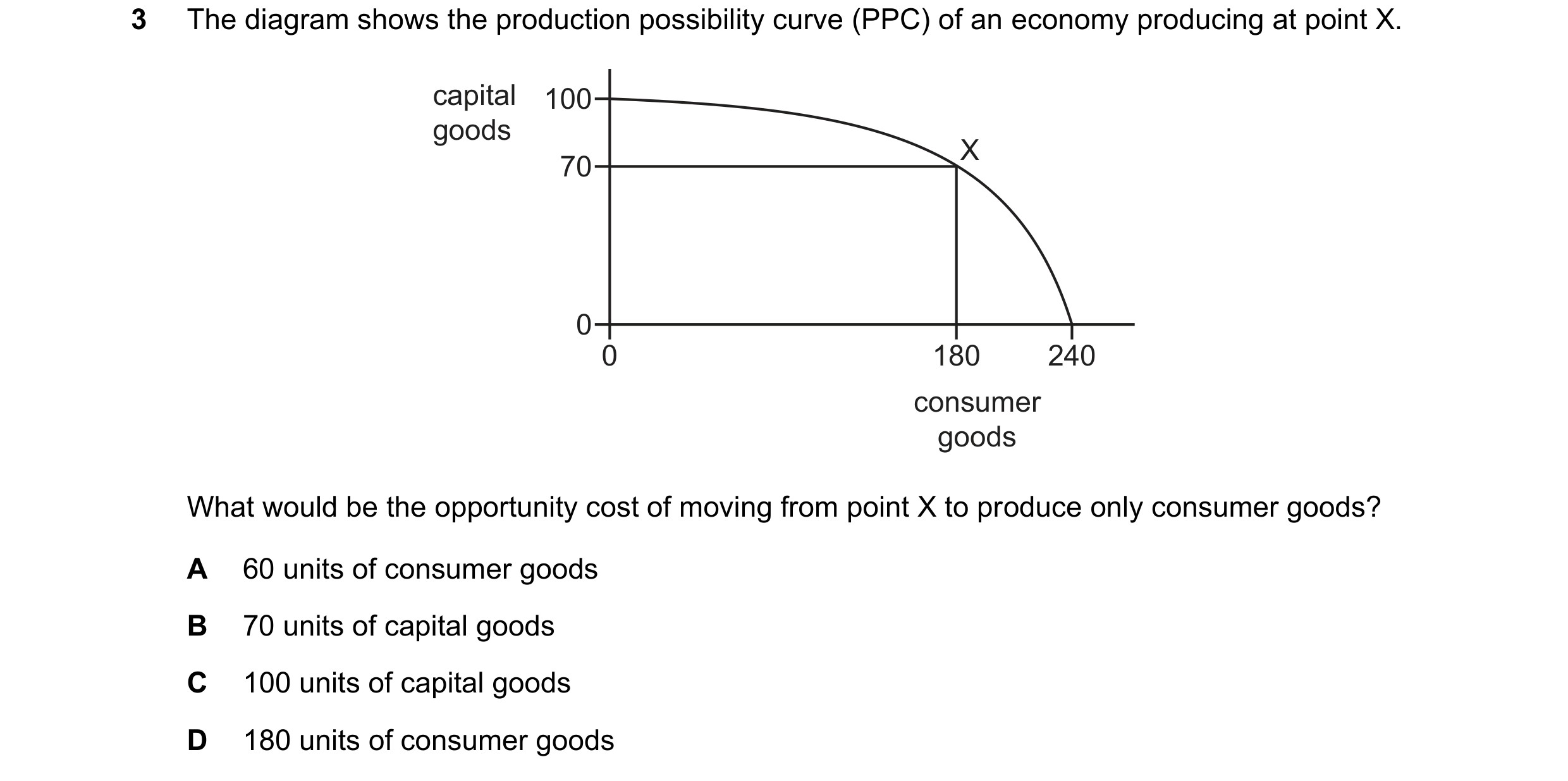
Q79 · The diagram shows the production possibility curve (PPC) of an economy producing at point… 0455/13 Oct/Nov 2020
3 The diagram shows the production possibility curve (PPC) of an economy producing at point X. capital 100 goods X 70 0 0 180 240 consumer goods What would be the opportunity cost of moving from point X to produce only consumer goods? A 60 units of consumer goods B 70 units of capital goods C 100 units of capital goods D 180 units of consumer goods
1 marks
Answer: B
This question in 0455/13 Oct/Nov 2020
Q80 · The table shows the maximum production possibilities for goods and services for a country 0455/12 Feb/March 2021
3 The table shows the maximum production possibilities for goods and services for a country. goods services (millions of units) (millions of units) 100 0 80 20 60 40 40 60 20 80 0 100 The country originally produced only goods but now produces 20 million units of services. The country continues to operate at maximum production possibility. What is the opportunity cost for this country? A 20 million units of goods B 100 million units of goods C 20 million units of services D zero
1 marks
Answer: A
This question in 0455/12 Feb/March 2021
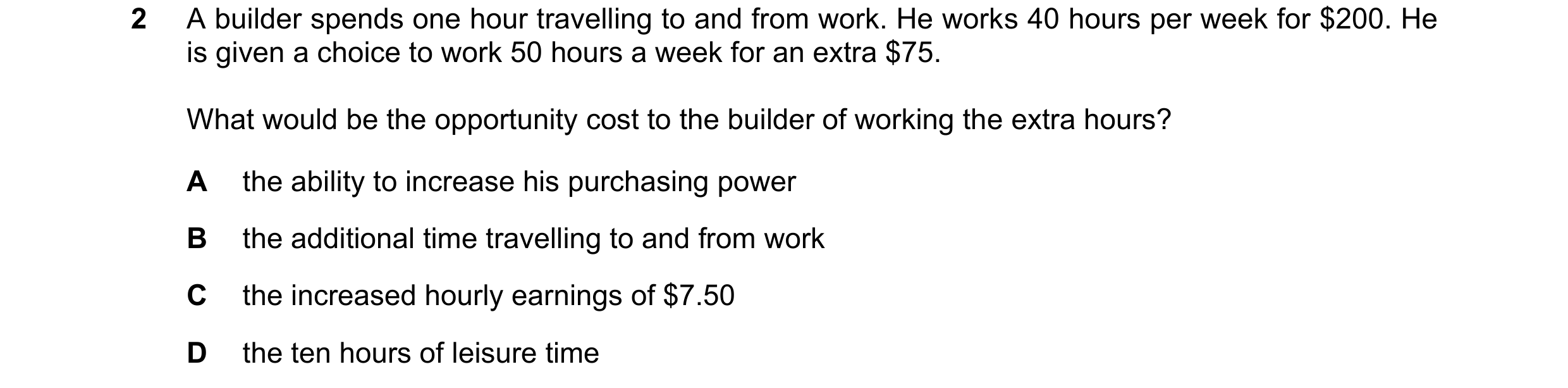
Q81 · A builder spends one hour travelling to and from work 0455/11 May/June 2021
2 A builder spends one hour travelling to and from work. He works 40 hours per week for $200. He is given a choice to work 50 hours a week for an extra $75. What would be the opportunity cost to the builder of working the extra hours? A the ability to increase his purchasing power B the additional time travelling to and from work C the increased hourly earnings of $7.50 D the ten hours of leisure time
1 marks
Answer: D
This question in 0455/11 May/June 2021
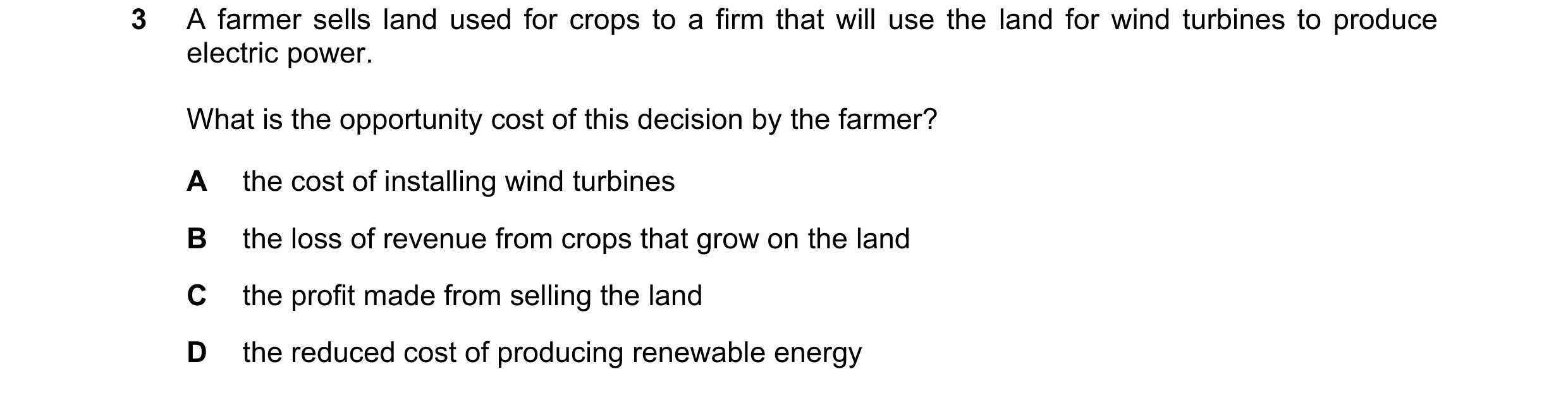
Q82 · A farmer sells land used for crops to a firm that will use the land for wind turbines to… 0455/12 May/June 2021
3 A farmer sells land used for crops to a firm that will use the land for wind turbines to produce electric power. What is the opportunity cost of this decision by the farmer? A the cost of installing wind turbines B the loss of revenue from crops that grow on the land C the profit made from selling the land D the reduced cost of producing renewable energy
1 marks
Answer: B
This question in 0455/12 May/June 2021
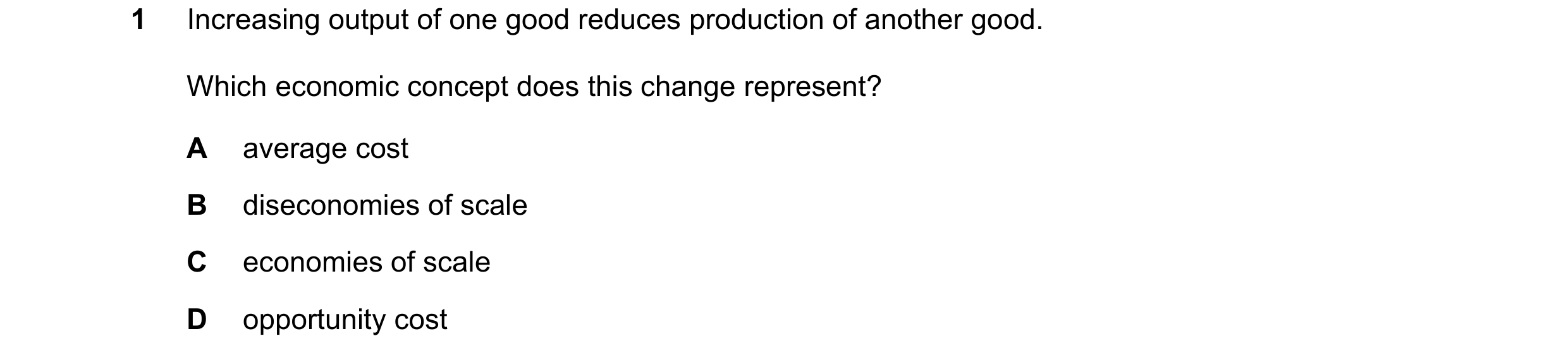
Q83 · Increasing output of one good reduces production of another good 0455/13 May/June 2021
1 Increasing output of one good reduces production of another good. Which economic concept does this change represent? A average cost B diseconomies of scale C economies of scale D opportunity cost
1 marks
Answer: D
This question in 0455/13 May/June 2021
Q84 · The production possibility curve (PPC) shows the hours per day that a person has for… 0455/13 May/June 2021
3 The production possibility curve (PPC) shows the hours per day that a person has for either work or leisure. R 15 work S 12 (hours) T 9 U 6 V 3 W 0 0 3 6 9 12 15 leisure (hours) This person works 6 hours a day but then decides to work 9 hours a day. Which movement shows this change? A T to R B T to U C U to V D U to T
1 marks
Answer: D
This question in 0455/13 May/June 2021
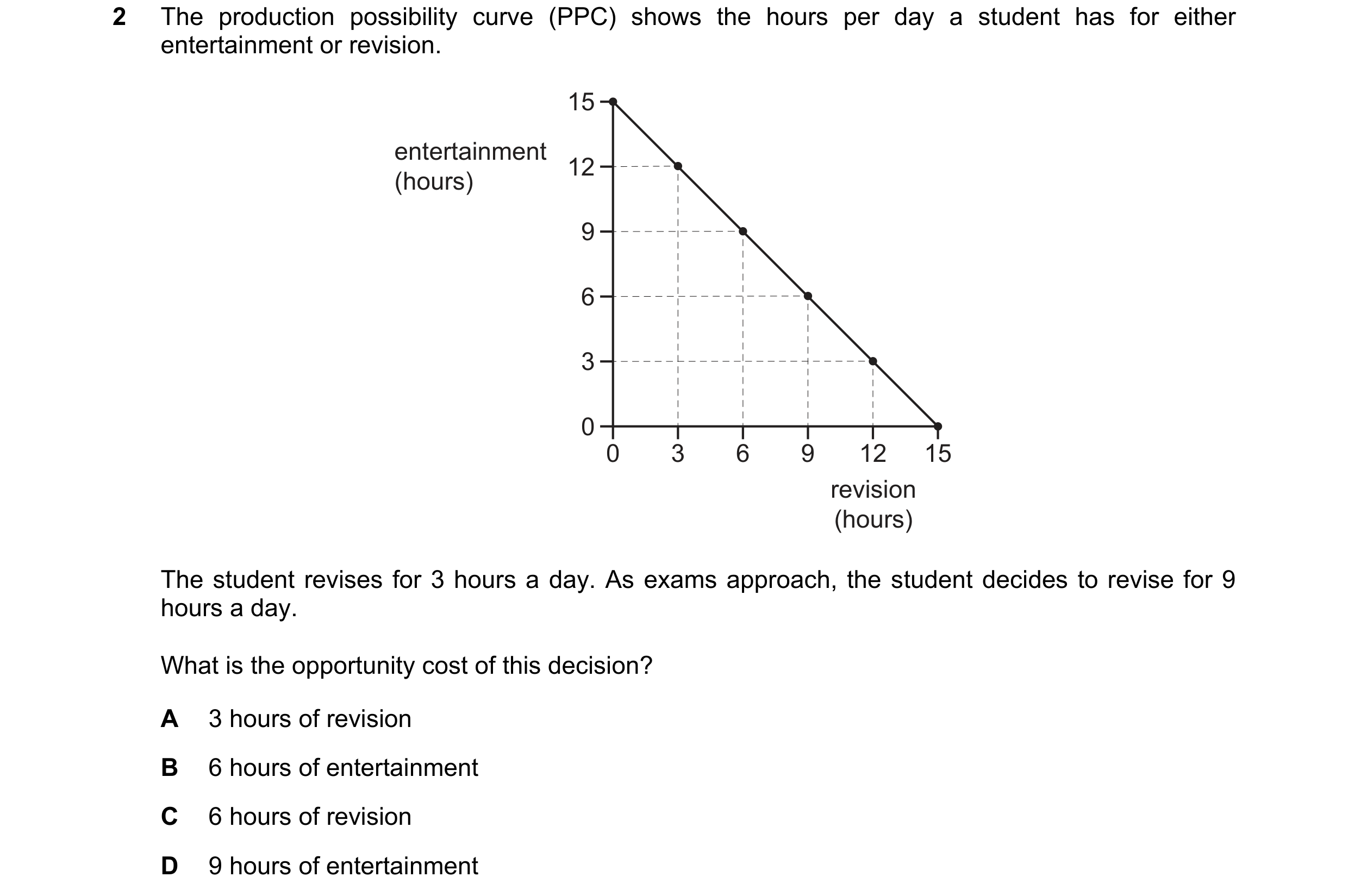
Q85 · The production possibility curve (PPC) shows the hours per day a student has for either… 0455/11 Oct/Nov 2021
2 The production possibility curve (PPC) shows the hours per day a student has for either entertainment or revision. 15 entertainment 12 (hours) 9 6 3 0 0 3 6 9 12 15 revision (hours) The student revises for 3 hours a day. As exams approach, the student decides to revise for 9 hours a day. What is the opportunity cost of this decision? A 3 hours of revision B 6 hours of entertainment C 6 hours of revision D 9 hours of entertainment
1 marks
Answer: B
This question in 0455/11 Oct/Nov 2021
Q86 · Helium is a gas that is limited in supply because it takes thousands of years to form 0455/11 Oct/Nov 2021
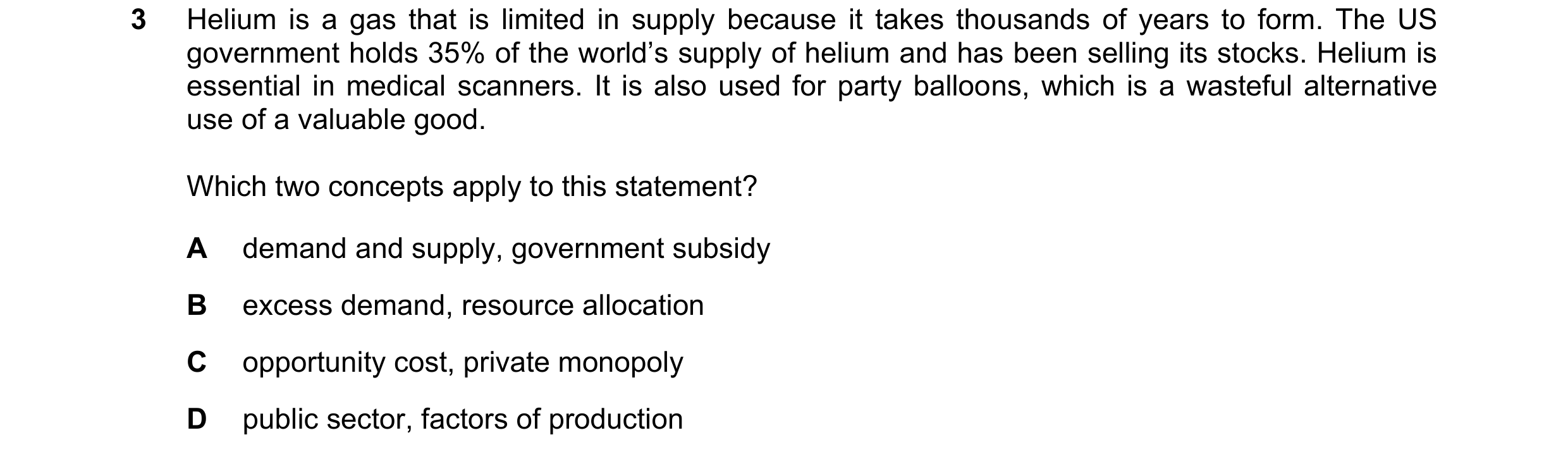
3 Helium is a gas that is limited in supply because it takes thousands of years to form. The US government holds 35% of the world’s supply of helium and has been selling its stocks. Helium is essential in medical scanners. It is also used for party balloons, which is a wasteful alternative use of a valuable good. Which two concepts apply to this statement? A demand and supply, government subsidy B excess demand, resource allocation C opportunity cost, private monopoly D public sector, factors of production
1 marks
Answer: D
This question in 0455/11 Oct/Nov 2021
Q87 · What is an opportunity cost for a consumer spending money on a holiday? 0455/12 Oct/Nov 2021
2 What is an opportunity cost for a consumer spending money on a holiday? A the potential interest earned if the holiday money had been saved B the price paid for an air ticket to the holiday destination C the rubbish created during the holiday which affects the local community D the satisfaction that the consumer gains from the holiday
1 marks
Answer: A
This question in 0455/12 Oct/Nov 2021
Q88 · Helium is a gas that is limited in supply because it takes thousands of years to form 0455/12 Oct/Nov 2021
3 Helium is a gas that is limited in supply because it takes thousands of years to form. The US government holds 35% of the world’s supply of helium and has been selling its stocks. Helium is essential in medical scanners. It is also used for party balloons, which is a wasteful alternative use of a valuable good. Which two concepts apply to this statement? A demand and supply, government subsidy B excess demand, resource allocation C opportunity cost, private monopoly D public sector, factors of production
1 marks
Answer: D
This question in 0455/12 Oct/Nov 2021
Q89 · Which diagram shows an opportunity cost by movement from point X to point Y? 0455/13 Oct/Nov 2021
2 Which diagram shows an opportunity cost by movement from point X to point Y? A B capital capital goods Y goods Y X X O O consumer consumer goods goods C D Y capital capital Y goods X goods X O O consumer consumer goods goods
1 marks
Answer: C
This question in 0455/13 Oct/Nov 2021
Q90 · A student has nothing to do on a Friday evening 0455/11 May/June 2022
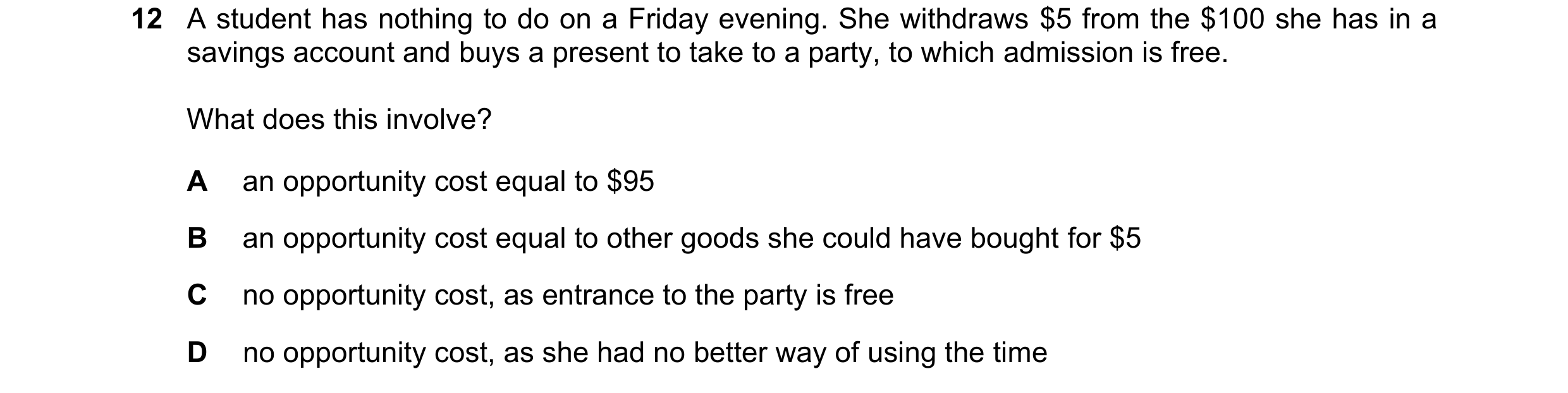
12 A student has nothing to do on a Friday evening. She withdraws $5 from the $100 she has in a savings account and buys a present to take to a party, to which admission is free. What does this involve? A an opportunity cost equal to $95 B an opportunity cost equal to other goods she could have bought for $5 C no opportunity cost, as entrance to the party is free D no opportunity cost, as she had no better way of using the time
1 marks
Answer: B
This question in 0455/11 May/June 2022
Q91 · A student has nothing to do on a Friday evening 0455/12 May/June 2022
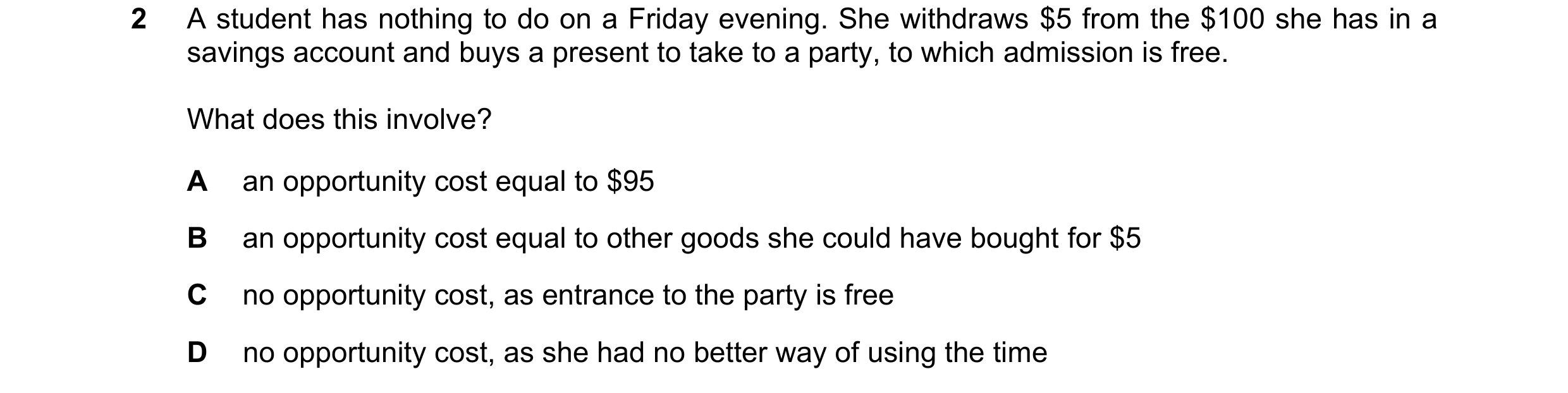
2 A student has nothing to do on a Friday evening. She withdraws $5 from the $100 she has in a savings account and buys a present to take to a party, to which admission is free. What does this involve? A an opportunity cost equal to $95 B an opportunity cost equal to other goods she could have bought for $5 C no opportunity cost, as entrance to the party is free D no opportunity cost, as she had no better way of using the time
1 marks
Answer: B
This question in 0455/12 May/June 2022
Q92 · A student has nothing to do on a Friday evening 0455/13 May/June 2022
2 A student has nothing to do on a Friday evening. She withdraws $5 from the $100 she has in a savings account and buys a present to take to a party, to which admission is free. What does this involve? A an opportunity cost equal to $95 B an opportunity cost equal to other goods she could have bought for $5 C no opportunity cost, as entrance to the party is free D no opportunity cost, as she had no better way of using the time
1 marks
Answer: B
This question in 0455/13 May/June 2022
Q93 · The Chinese government is concerned about the level of poverty and the need for more… 0455/12 Oct/Nov 2022
1 The Chinese government is concerned about the level of poverty and the need for more resources in low-income regions of the country. As a result, it is increasing its expenditure in those regions and reducing it in high-income regions. Which economic concept does this government policy illustrate? A diseconomies of scale B market forces C opportunity cost D specialisation
1 marks
Answer: C
This question in 0455/12 Oct/Nov 2022
Q94 · The diagram shows the choices for an individual between leisure and earnings 0455/12 Feb/March 2023
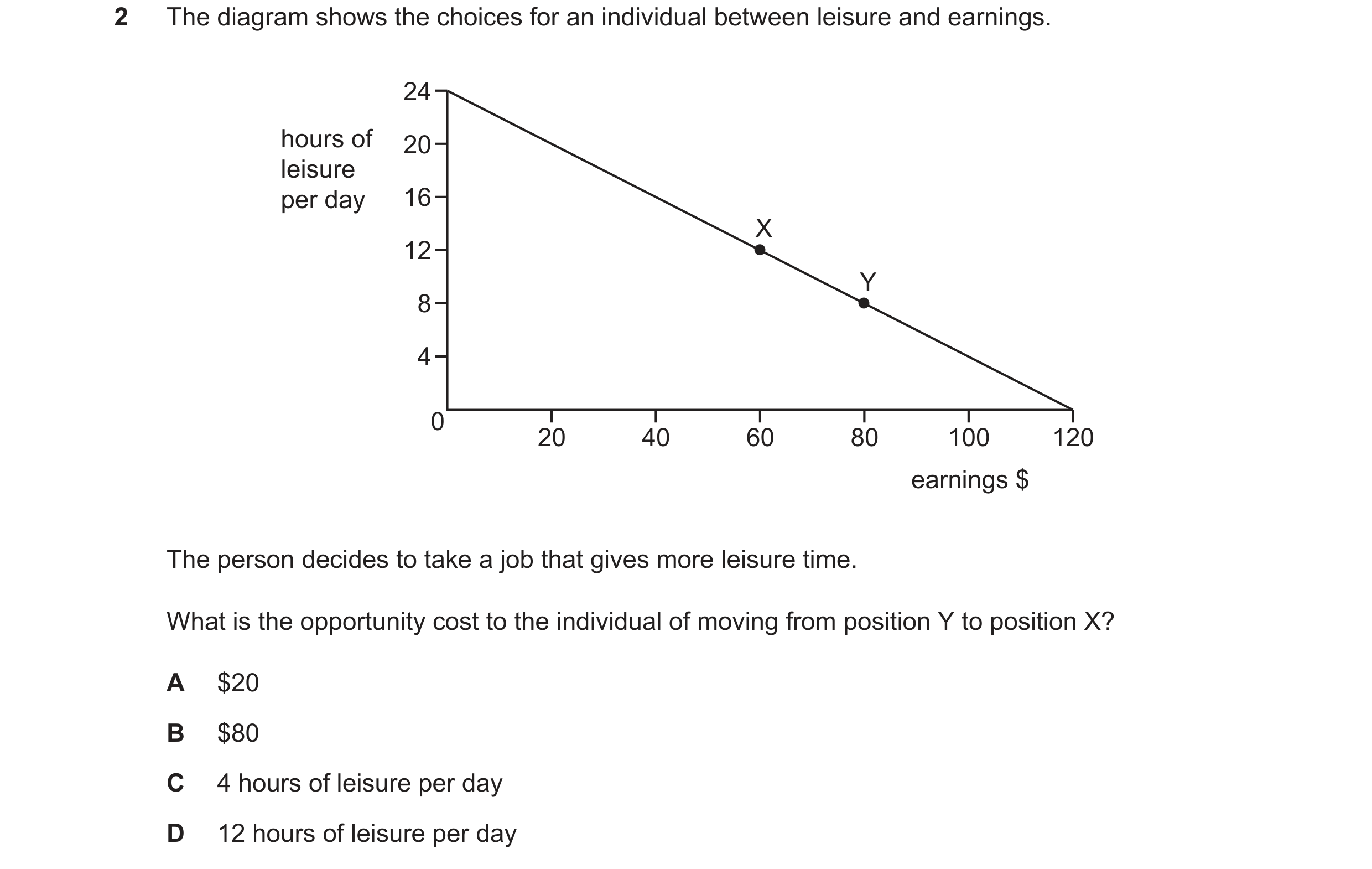
2 The diagram shows the choices for an individual between leisure and earnings. 24 hours of 20 leisure per day 16 X 12 Y 8 4 0 20 40 60 80 100 120 earnings $ The person decides to take a job that gives more leisure time. What is the opportunity cost to the individual of moving from position Y to position X? A $20 B $80 C 4 hours of leisure per day D 12 hours of leisure per day
1 marks
Answer: A
This question in 0455/12 Feb/March 2023
Q95 · A student defined opportunity cost as ‘the alternative given up when a course of action… 0455/12 Feb/March 2023
3 A student defined opportunity cost as ‘the alternative given up when a course of action is followed’. Why is this definition inadequate? A The ‘next best’ alternative is not stressed. B The type of economic system is not identified. C There is no mention of money values. D There is no reference to finite resources and unlimited wants.
1 marks
Answer: A
This question in 0455/12 Feb/March 2023
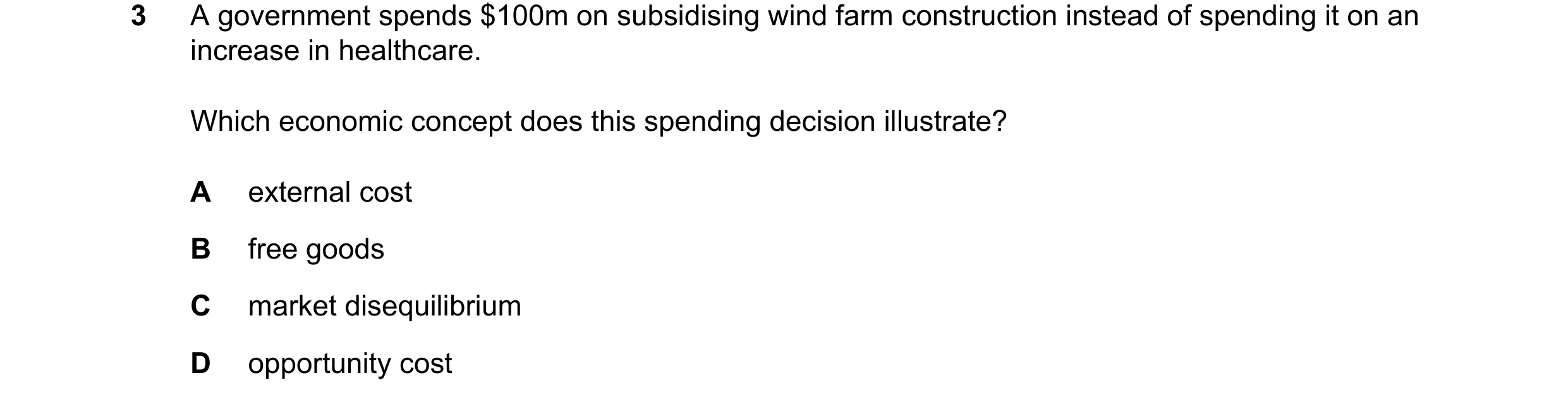
Q96 · A government spends $100m on subsidising wind farm construction instead of spending it on… 0455/12 May/June 2023
3 A government spends $100m on subsidising wind farm construction instead of spending it on an increase in healthcare. Which economic concept does this spending decision illustrate? A external cost B free goods C market disequilibrium D opportunity cost
1 marks
Answer: D
This question in 0455/12 May/June 2023
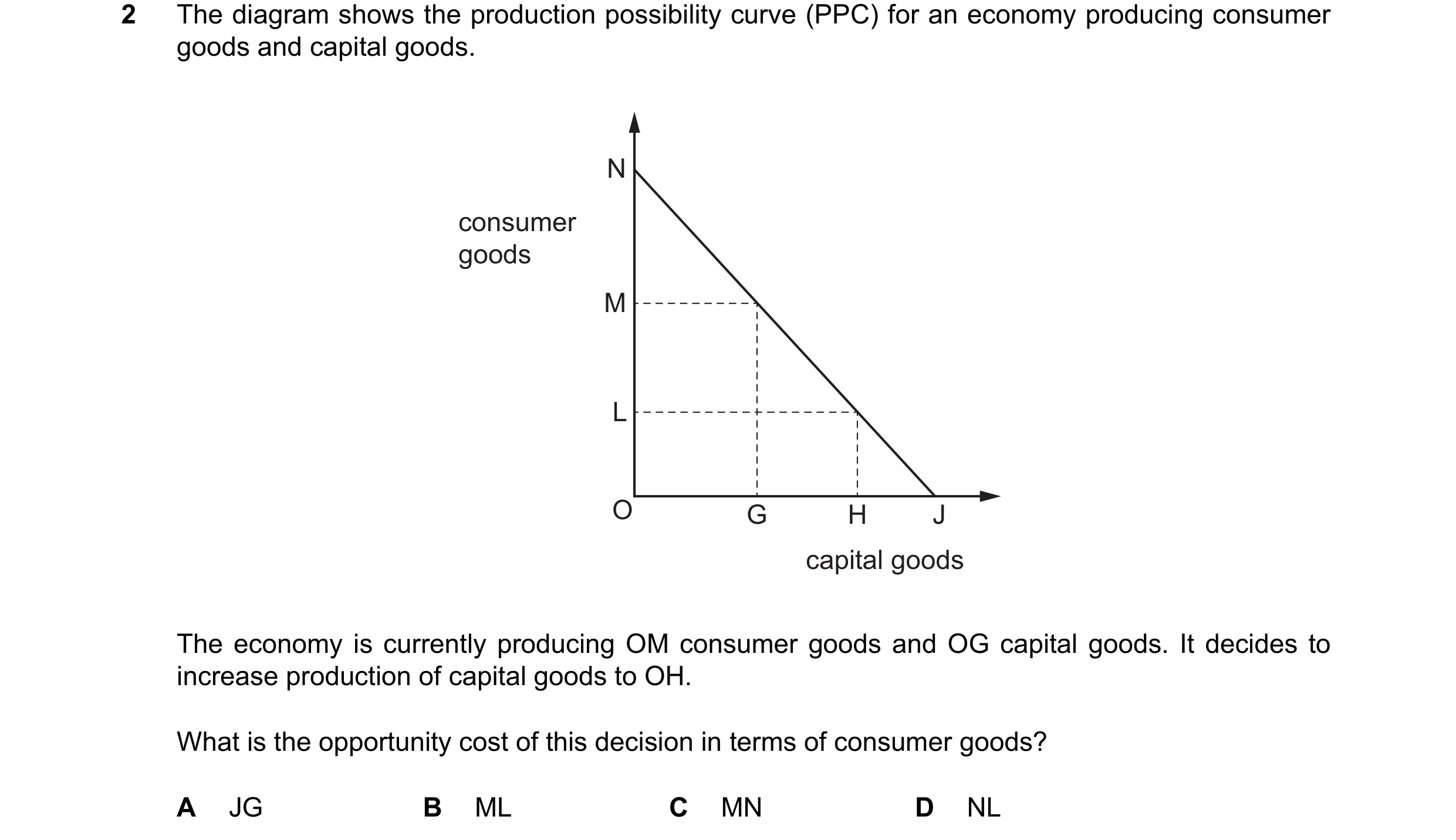
Q97 · The diagram shows the production possibility curve (PPC) for an economy producing… 0455/11 Oct/Nov 2023
2 The diagram shows the production possibility curve (PPC) for an economy producing consumer goods and capital goods. N consumer goods M L O G H J capital goods The economy is currently producing OM consumer goods and OG capital goods. It decides to increase production of capital goods to OH. What is the opportunity cost of this decision in terms of consumer goods? A JG B ML C MN D NL
1 marks
Answer: B
This question in 0455/11 Oct/Nov 2023
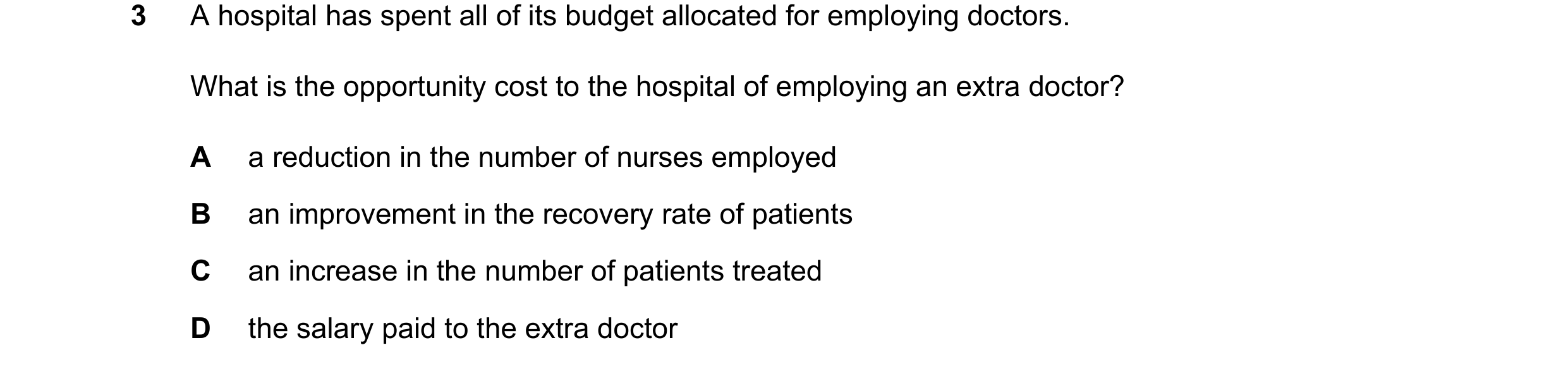
Q98 · A hospital has spent all of its budget allocated for employing doctors 0455/11 Oct/Nov 2023
3 A hospital has spent all of its budget allocated for employing doctors. What is the opportunity cost to the hospital of employing an extra doctor? A a reduction in the number of nurses employed B an improvement in the recovery rate of patients C an increase in the number of patients treated D the salary paid to the extra doctor
1 marks
Answer: A
This question in 0455/11 Oct/Nov 2023
Q99 · A consumer has $10 to spend 0455/13 Oct/Nov 2023
1 A consumer has $10 to spend. A meal costs $9 and a drink costs $5. What would describe the situation if the consumer did not have enough money to purchase both the meal and the drink? A excess demand B free goods C market failure D the economic problem
1 marks
Answer: D
This question in 0455/13 Oct/Nov 2023
Q100 · A government announces that it will spend an extra $10bn on healthcare, financed by… 0455/12 Feb/March 2024
2 A government announces that it will spend an extra $10bn on healthcare, financed by reducing expenditure on defence. What is the economic concept represented by this decision? A expansionary monetary policy B increased spending on a public good C opportunity cost D the operation of the market mechanism
1 marks
Answer: C
This question in 0455/12 Feb/March 2024
Q101 · A student decides to take up a two-year apprenticeship for which she will earn $10 000… 0455/12 May/June 2024
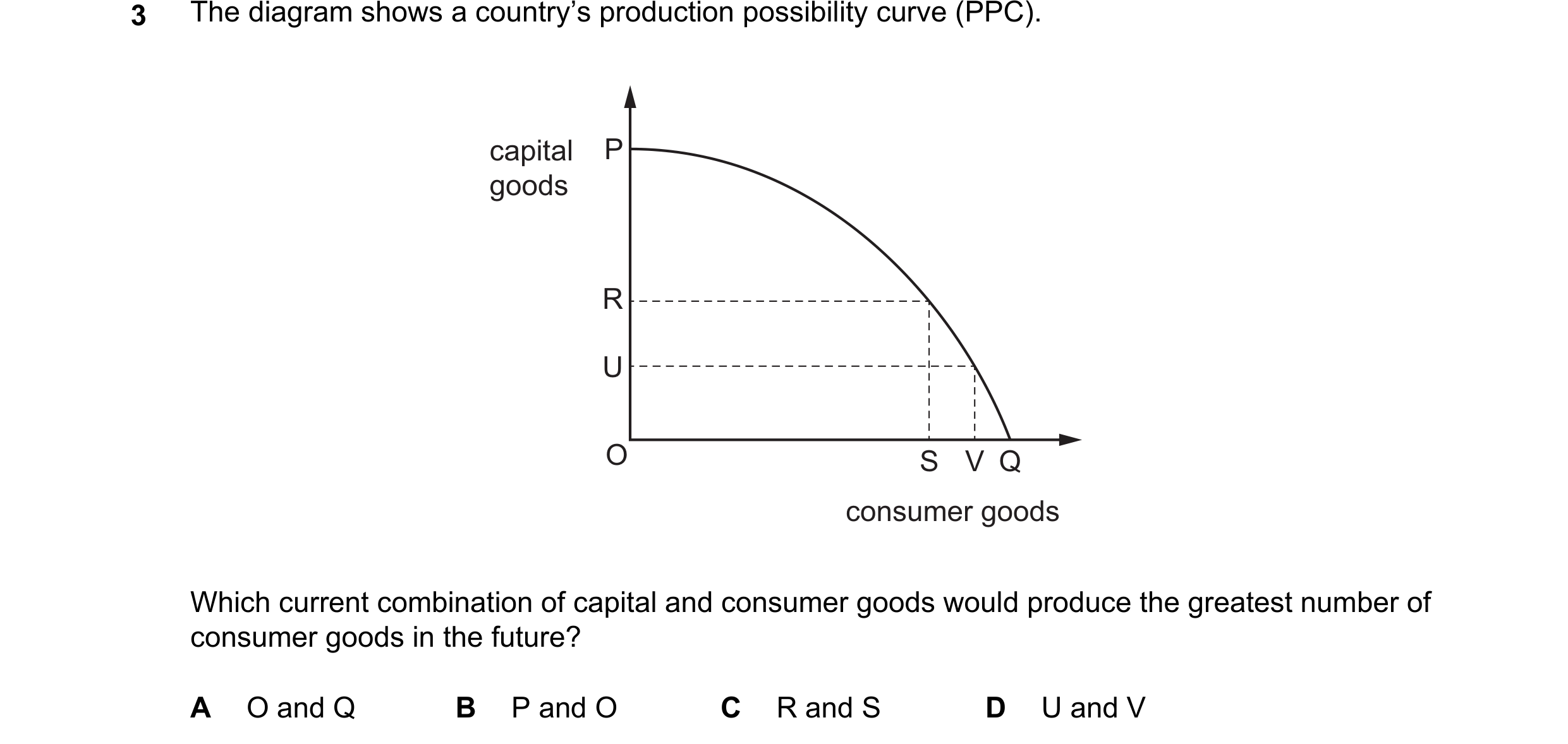
2 A student decides to take up a two-year apprenticeship for which she will earn $10 000 per year. After that, she expects to earn $25 000 per year. She could take an unskilled job which pays $16 000 per year instead of the apprenticeship. What is the opportunity cost in the two years of completing the apprenticeship? A $10 000 B $12 000 C $25 000 D $32 000 The diagram shows a country’s production possibility curve (PPC).
1 marks
Answer: B
This question in 0455/12 May/June 2024
Q102 · Capital P goods R U O S V Q consumer goods Which current combination of capital and… 0455/12 May/June 2024
3 capital P goods R U O S V Q consumer goods Which current combination of capital and consumer goods would produce the greatest number of consumer goods in the future? A O and Q B P and O C R and S D U and V
1 marks
Answer: B
This question in 0455/12 May/June 2024
Q103 · A deposit of shale oil is discovered in an area of farming 0455/13 May/June 2024
3 A deposit of shale oil is discovered in an area of farming. The following estimates are made for a ten-year period. • If the land is used only for farming, it would yield income after tax of $10 billion. • If the land is used only for shale oil extraction, it would yield income after tax of $40 billion. • The government would receive $5 billion in taxes from farming and $10 billion in taxes from shale oil extraction. What is the opportunity cost of using the land only for farming? A $25 billion B $30 billion C $35 billion D $45 billion
1 marks
Answer: C
This question in 0455/13 May/June 2024
Q104 · What has an opportunity cost in consumption? 0455/11 Oct/Nov 2024
1 What has an opportunity cost in consumption? A air B food C sea water D sunlight
1 marks
Answer: B
This question in 0455/11 Oct/Nov 2024
Q105 · The diagram shows the production possibility curve (PPC) for an economy 0455/11 Oct/Nov 2024
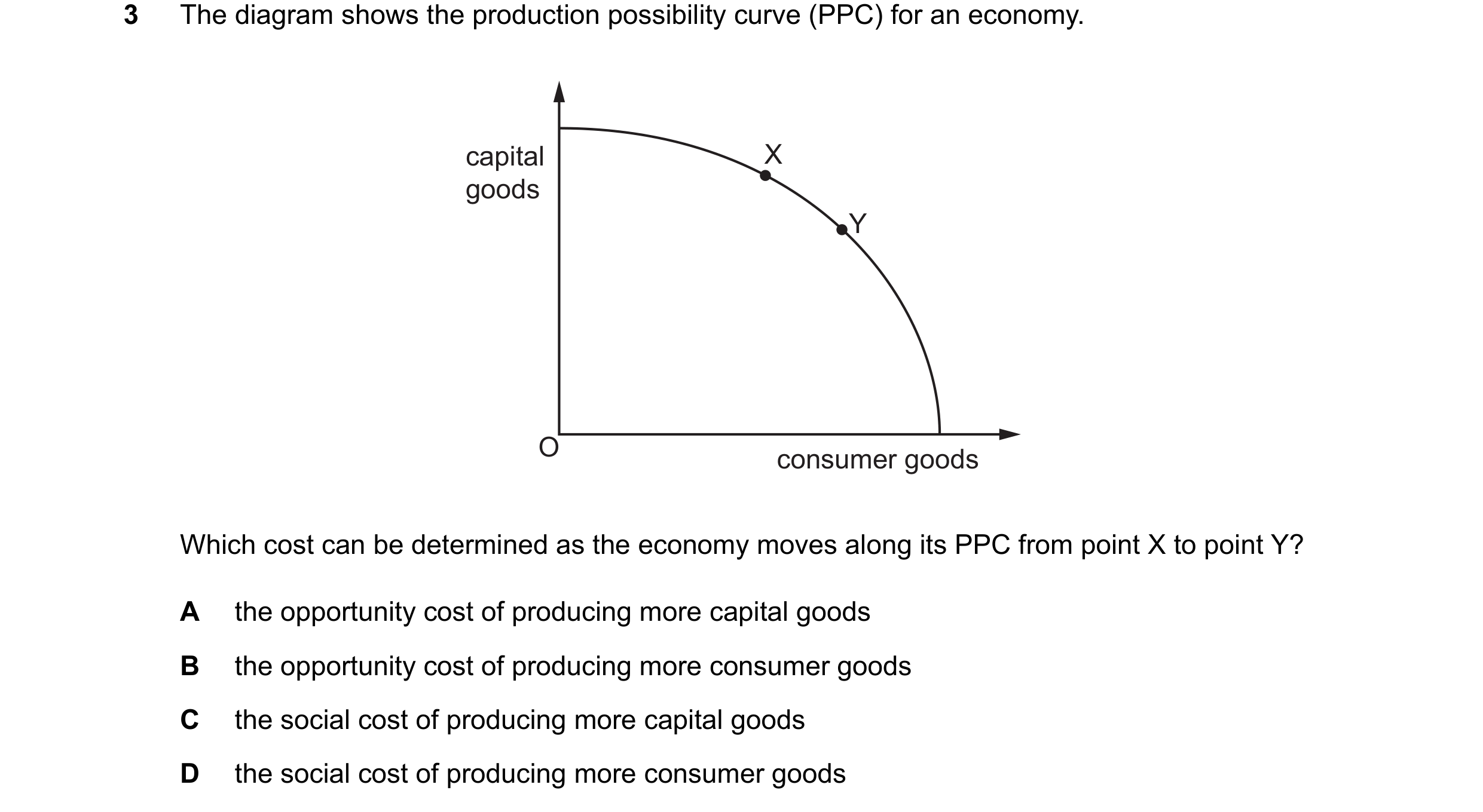
3 The diagram shows the production possibility curve (PPC) for an economy. capital X goods Y O consumer goods Which cost can be determined as the economy moves along its PPC from point X to point Y? A the opportunity cost of producing more capital goods B the opportunity cost of producing more consumer goods C the social cost of producing more capital goods D the social cost of producing more consumer goods
1 marks
Answer: B
This question in 0455/11 Oct/Nov 2024
Q106 · What is opportunity cost? 0455/12 Oct/Nov 2024
2 What is opportunity cost? A the allocation of resources in an economy B the cost to the individual when they consume a good C the lack of goods and services available to satisfy unlimited wants D the next best alternative forgone when making an economic decision
1 marks
Answer: D
This question in 0455/12 Oct/Nov 2024
Q107 · The diagram shows a production possibility curve (PPC) for an economy that produces two… 0455/12 Oct/Nov 2024
3 The diagram shows a production possibility curve (PPC) for an economy that produces two goods, X and Y. Which point shows the greatest opportunity cost of producing one more unit of good X? A good Y B D C O good X
1 marks
Answer: C
This question in 0455/12 Oct/Nov 2024
Q108 · The diagram shows the choices for an individual between leisure and earnings 0455/13 Oct/Nov 2024
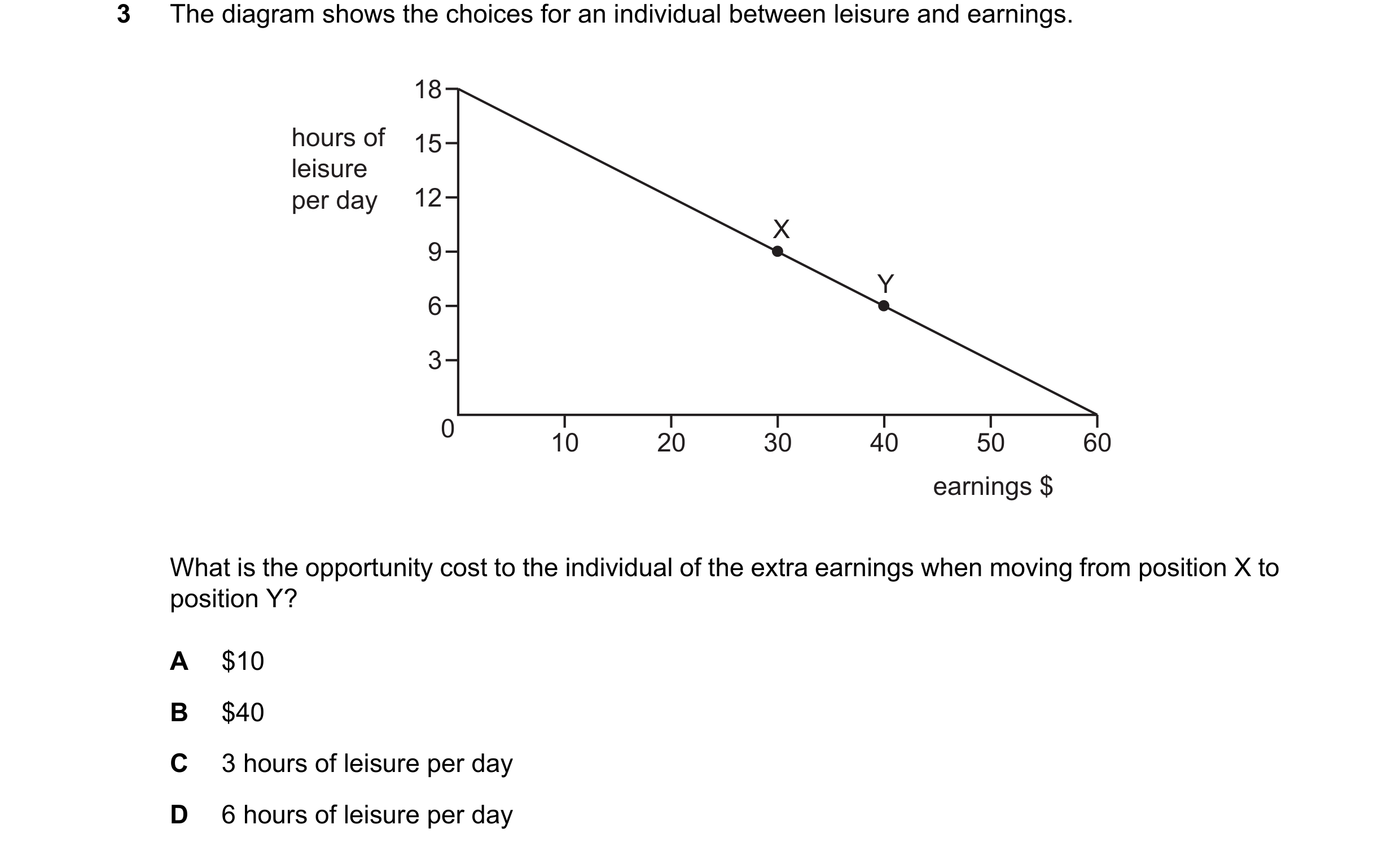
3 The diagram shows the choices for an individual between leisure and earnings. 18 hours of 15 leisure per day 12 X 9 Y 6 3 0 10 20 30 40 50 60 earnings $ What is the opportunity cost to the individual of the extra earnings when moving from position X to position Y? A $10 B $40 C 3 hours of leisure per day D 6 hours of leisure per day
1 marks
Answer: C
This question in 0455/13 Oct/Nov 2024
Q109 · An economics graduate chooses to work in a bank rather than teach economics which was the… 0455/12 Feb/March 2025
2 An economics graduate chooses to work in a bank rather than teach economics which was the next best alternative. Which cost is incurred as a result of this decision? A external cost B internal cost C opportunity cost D private cost
1 marks
Answer: C
This question in 0455/12 Feb/March 2025
Q110 · A person works at home making small cakes 0455/13 May/June 2025
2 A person works at home making small cakes. She can make 30 cakes an hour and works for four hours a day. The total cost of the ingredients is $50 and she sells the cakes for $2 each. What is the opportunity cost if she takes a working day for a holiday? A $50 B $240 C 30 cakes D 120 cakes
1 marks
Answer: D
This question in 0455/13 May/June 2025
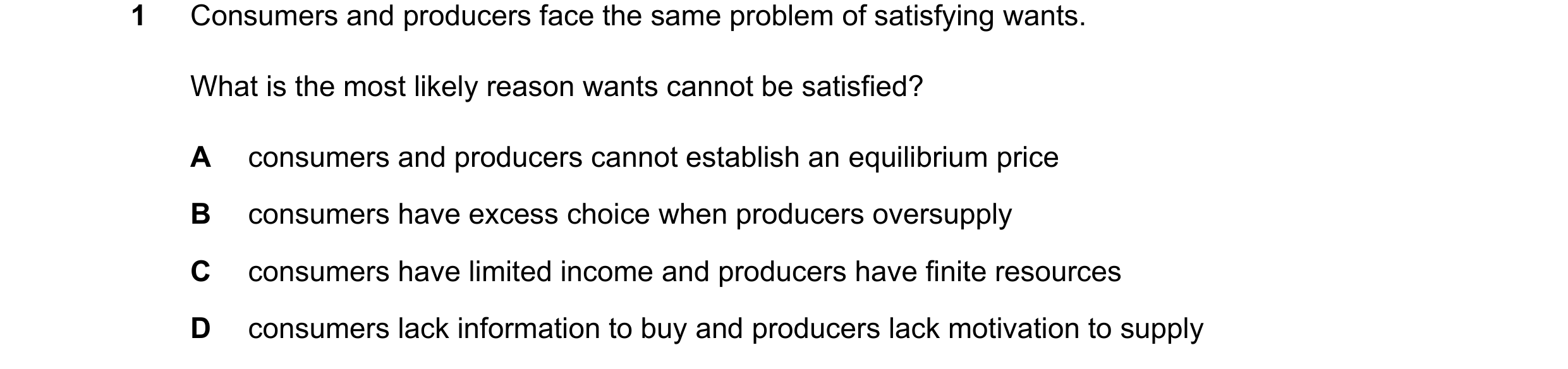
Q111 · Consumers and producers face the same problem of satisfying wants 0455/11 Oct/Nov 2025
1 Consumers and producers face the same problem of satisfying wants. What is the most likely reason wants cannot be satisfied? A consumers and producers cannot establish an equilibrium price B consumers have excess choice when producers oversupply C consumers have limited income and producers have finite resources D consumers lack information to buy and producers lack motivation to supply
1 marks
Answer: C
This question in 0455/11 Oct/Nov 2025
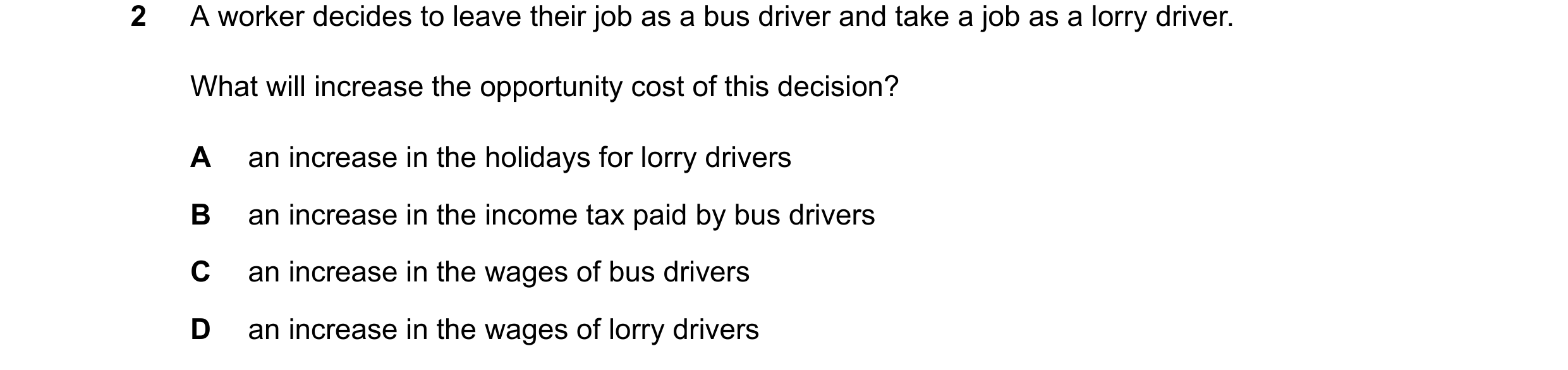
Q112 · A worker decides to leave their job as a bus driver and take a job as a lorry driver 0455/11 Oct/Nov 2025
2 A worker decides to leave their job as a bus driver and take a job as a lorry driver. What will increase the opportunity cost of this decision? A an increase in the holidays for lorry drivers B an increase in the income tax paid by bus drivers C an increase in the wages of bus drivers D an increase in the wages of lorry drivers
1 marks
Answer: C
This question in 0455/11 Oct/Nov 2025
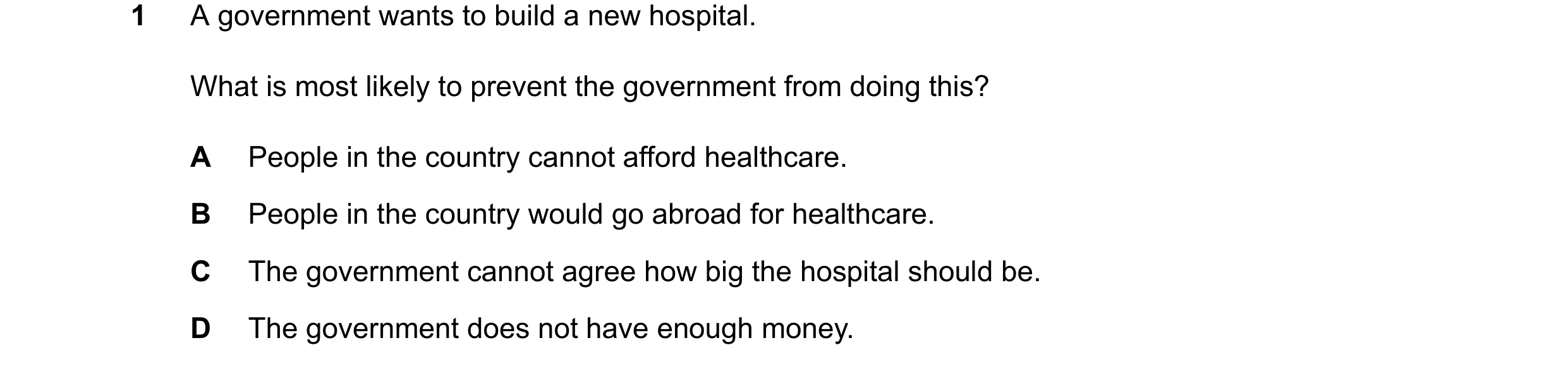
Q113 · A government wants to build a new hospital 0455/12 Oct/Nov 2025
1 A government wants to build a new hospital. What is most likely to prevent the government from doing this? A People in the country cannot afford healthcare. B People in the country would go abroad for healthcare. C The government cannot agree how big the hospital should be. D The government does not have enough money.
1 marks
Answer: D
This question in 0455/12 Oct/Nov 2025
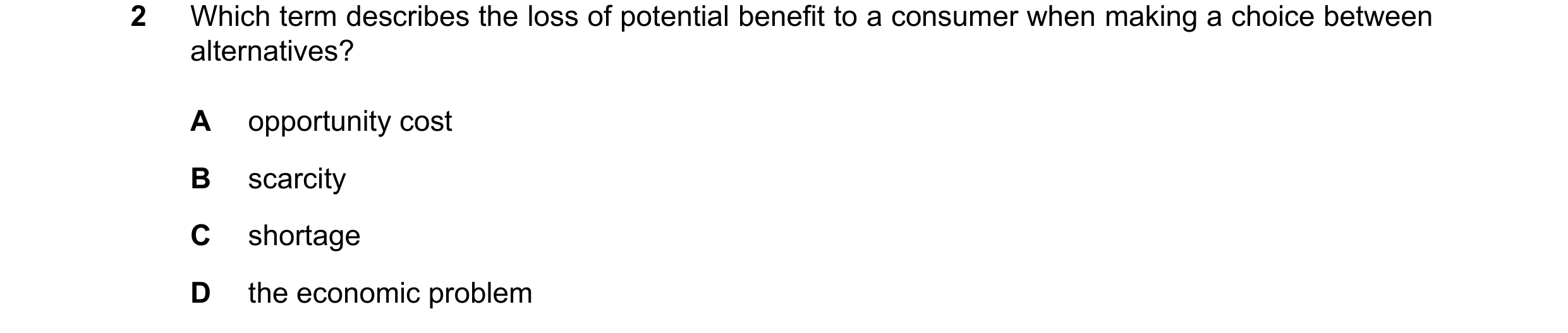
Q114 · Which term describes the loss of potential benefit to a consumer when making a choice… 0455/12 Oct/Nov 2025
2 Which term describes the loss of potential benefit to a consumer when making a choice between alternatives? A opportunity cost B scarcity C shortage D the economic problem
1 marks
Answer: A
This question in 0455/12 Oct/Nov 2025
Q115 · Which value does opportunity cost measure? 0455/13 Oct/Nov 2025
2 Which value does opportunity cost measure? A environmental damage B next best alternative forgone C output of labour D price paid
1 marks
Answer: B
This question in 0455/13 Oct/Nov 2025

 1 / 32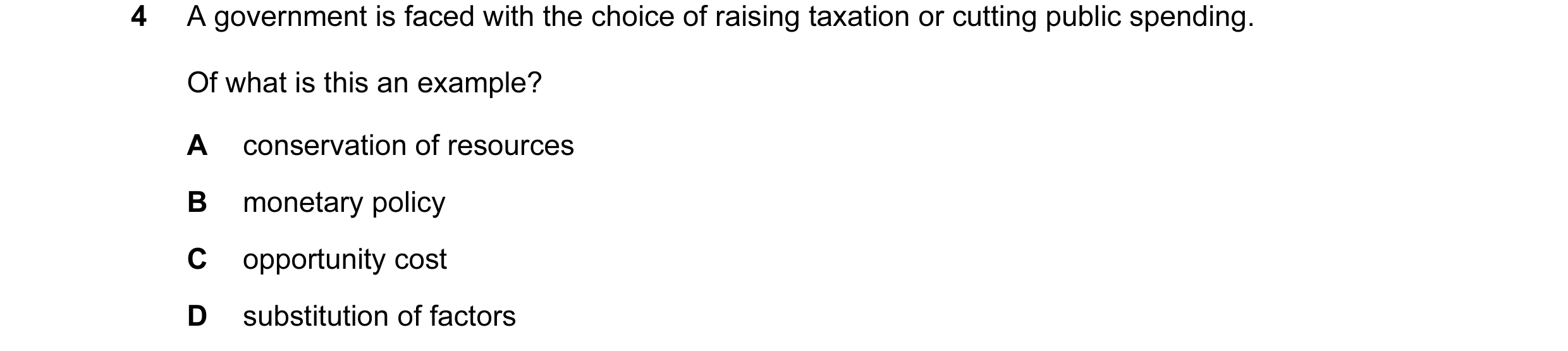
 2 / 32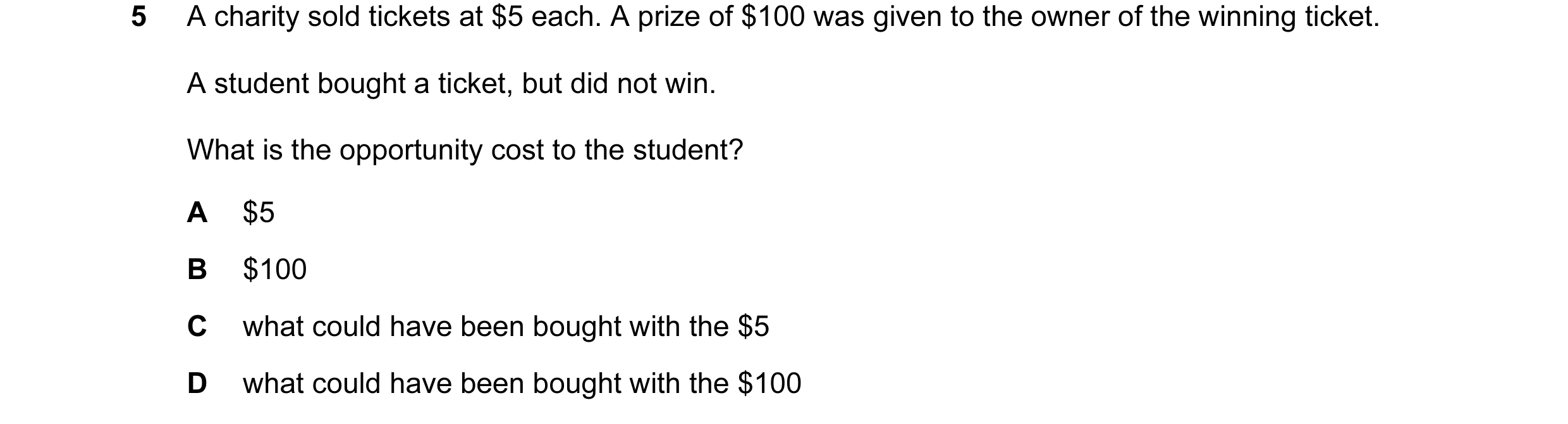

 3 / 32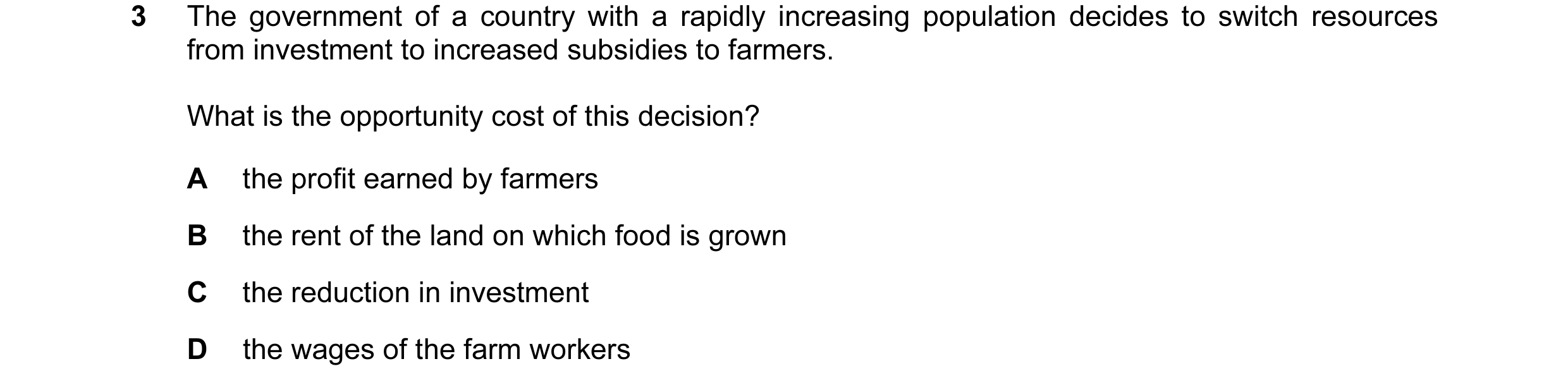

 4 / 32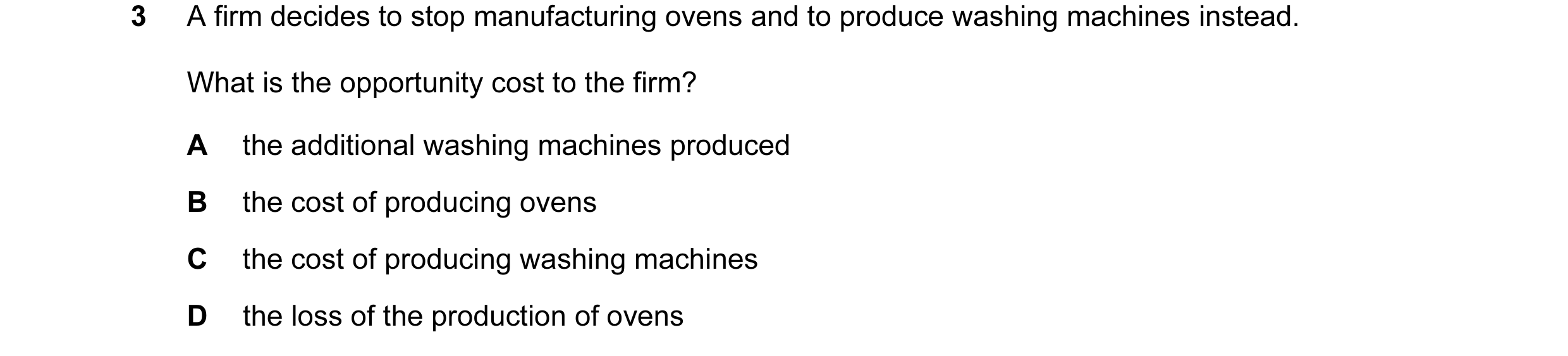
 5 / 32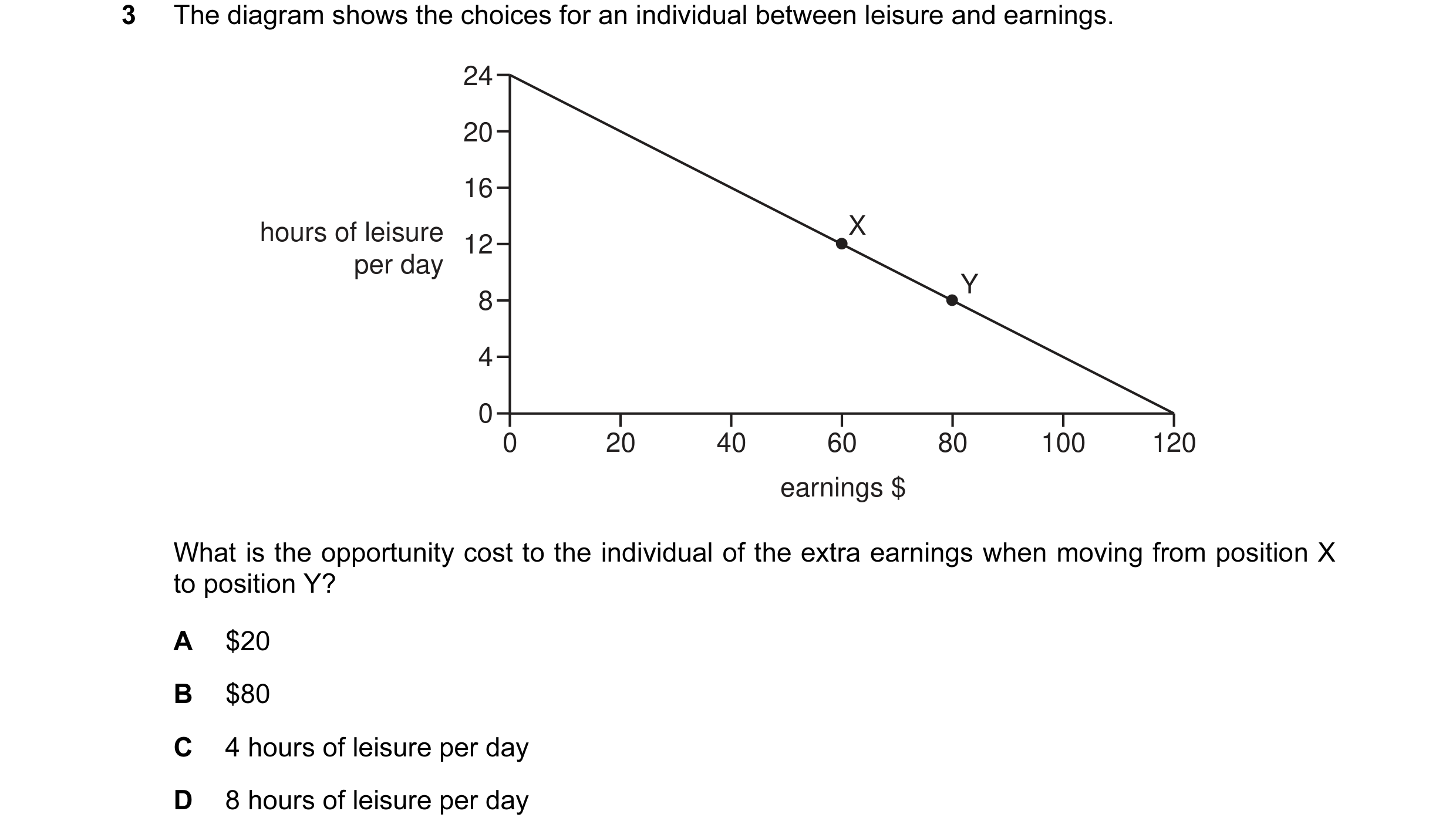
 6 / 32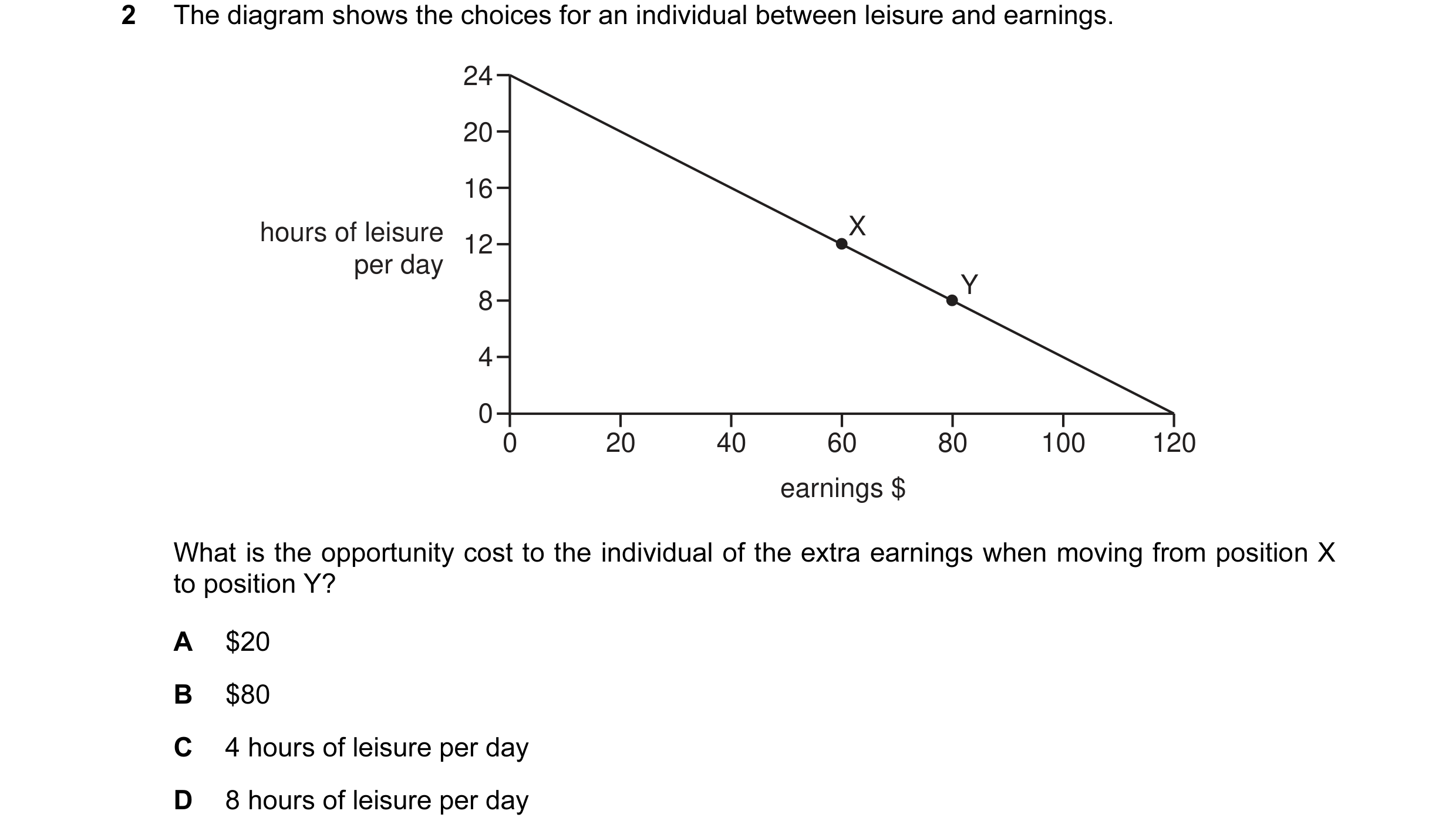
 7 / 32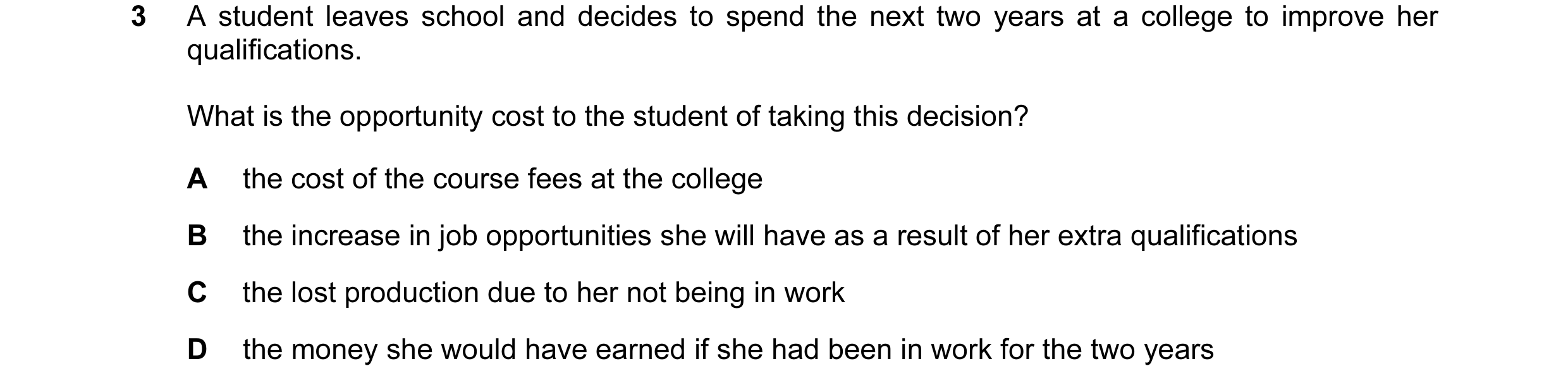
 8 / 32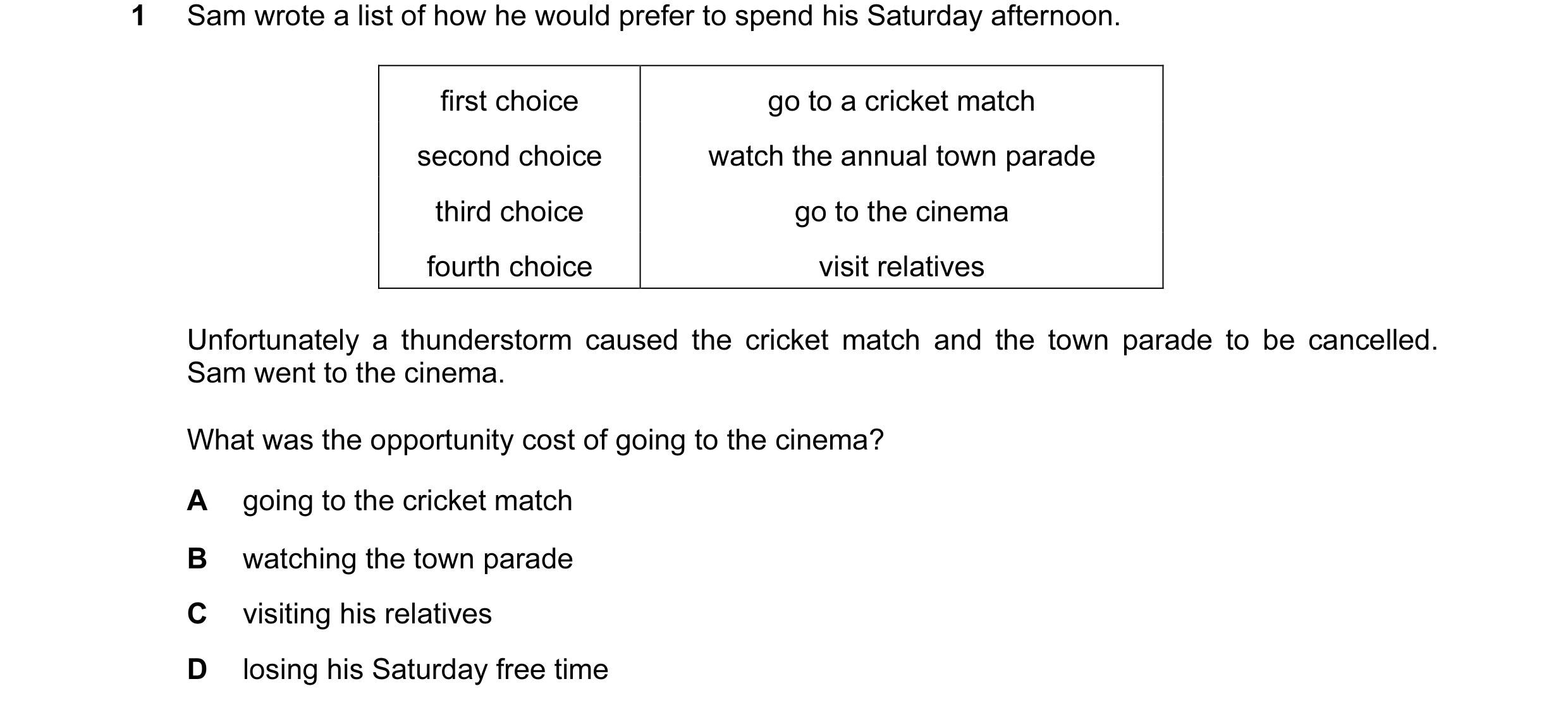
 9 / 32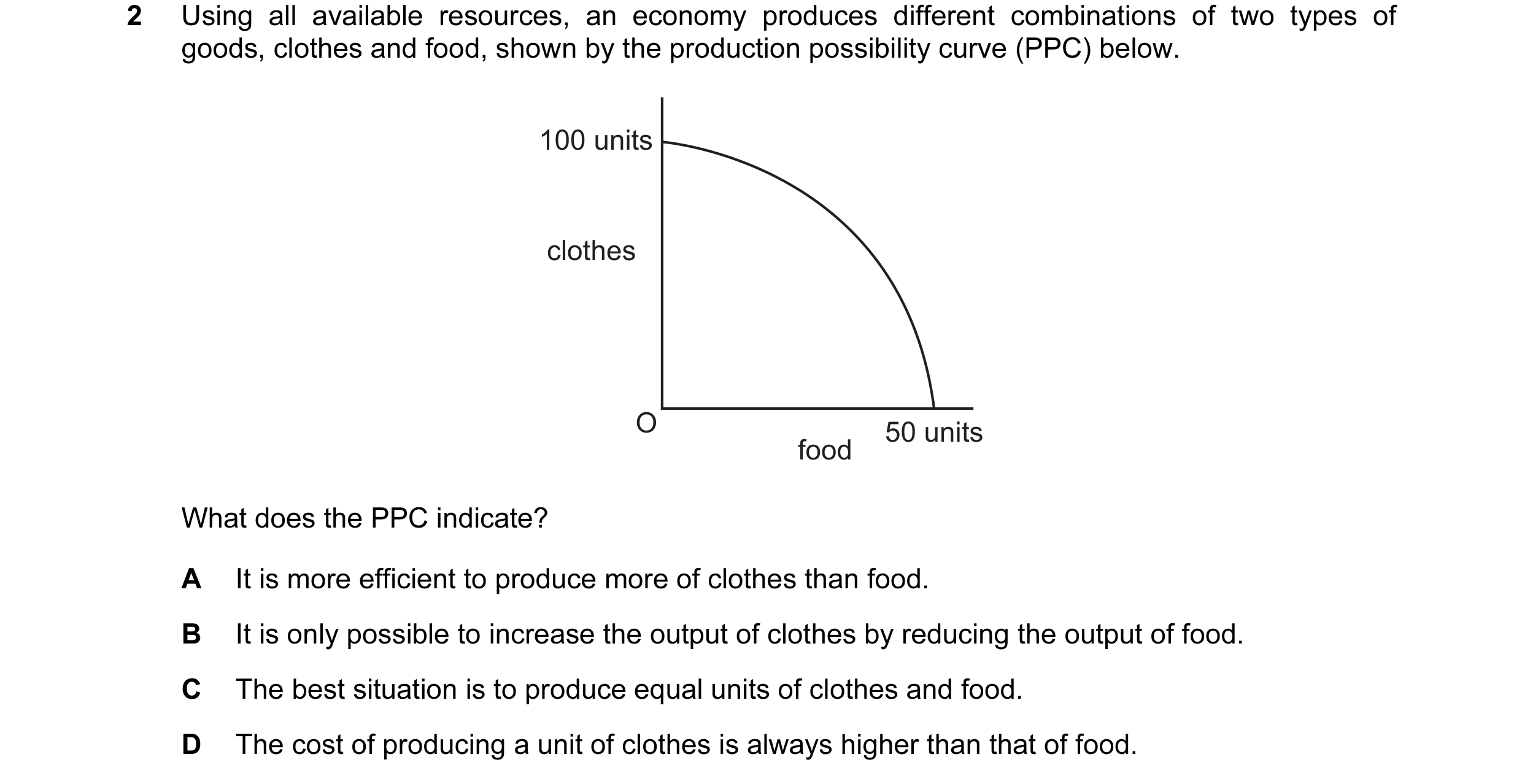
 10 / 32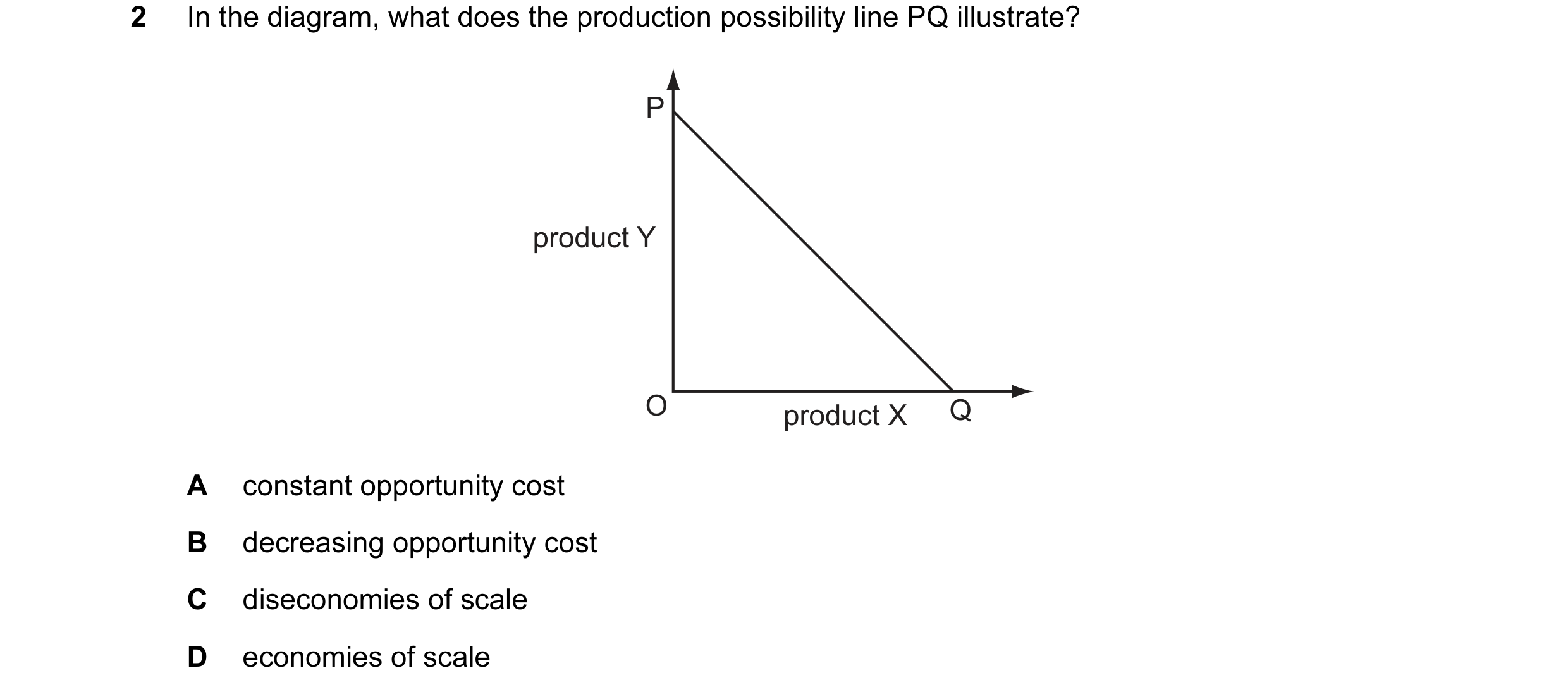
 11 / 32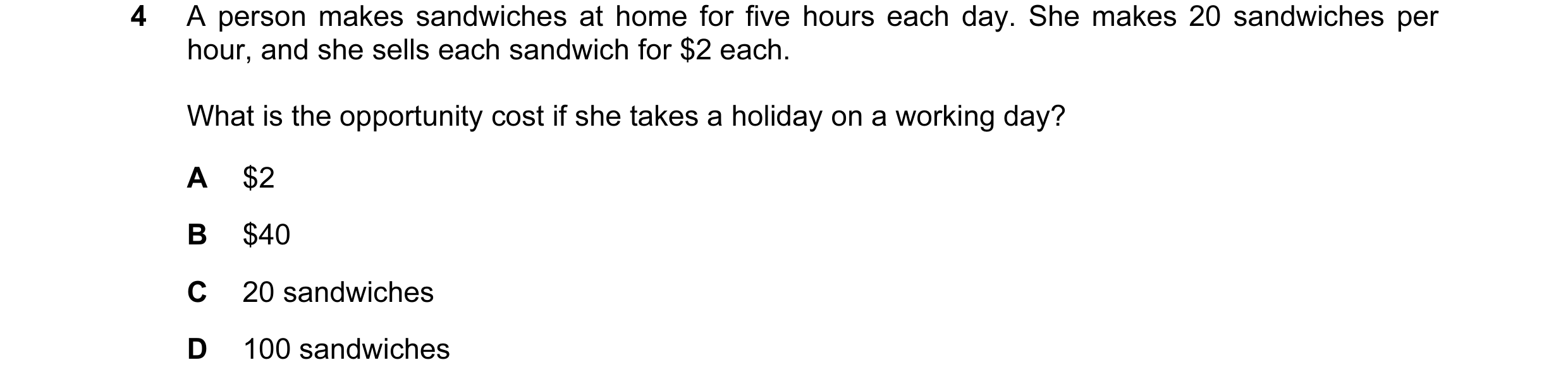

 12 / 32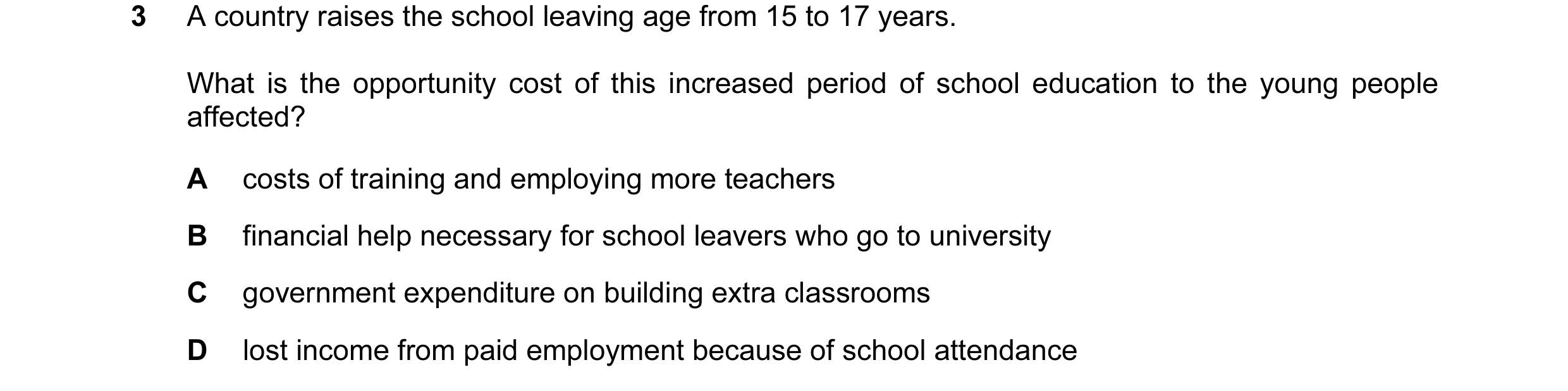
 13 / 32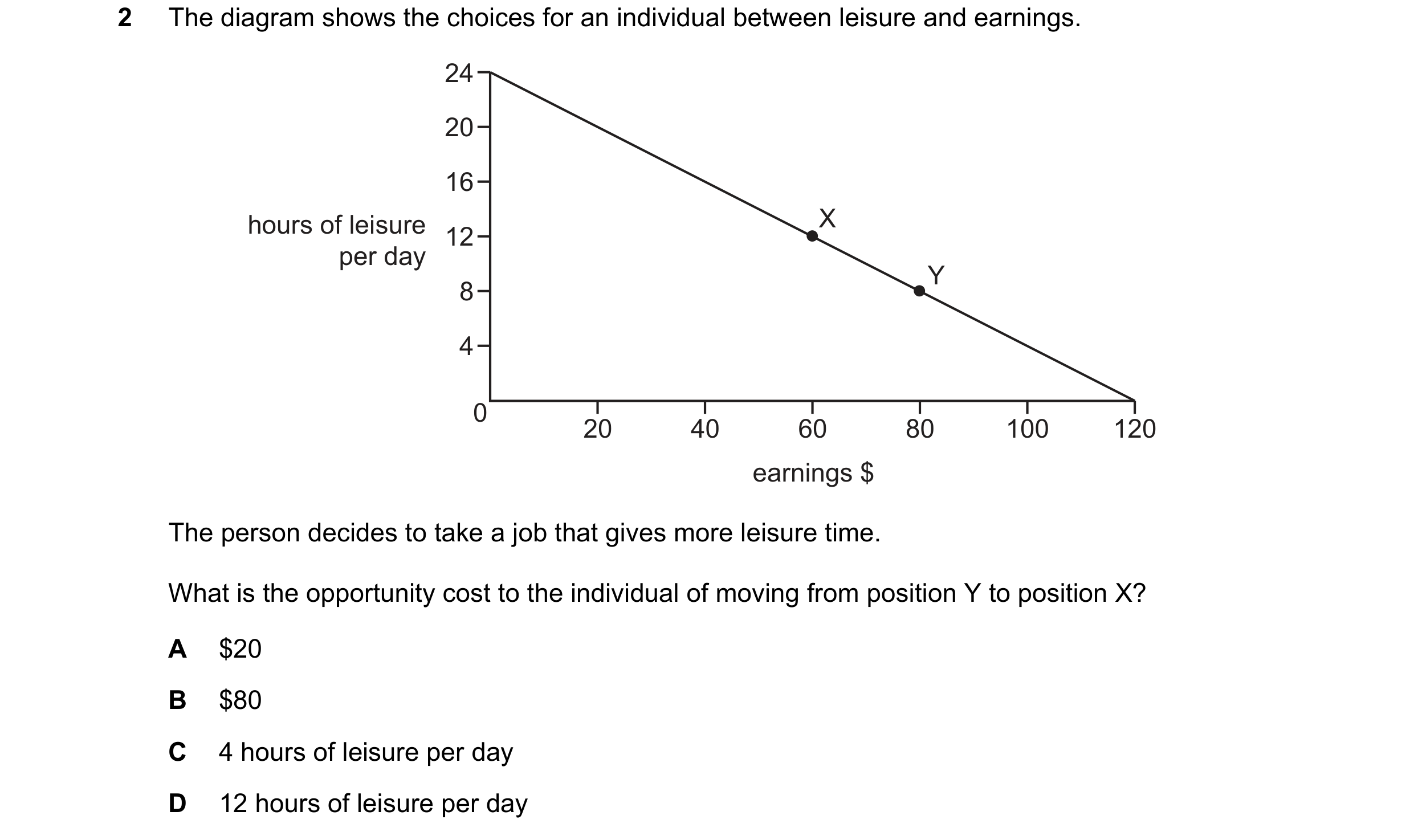
 14 / 32
 15 / 32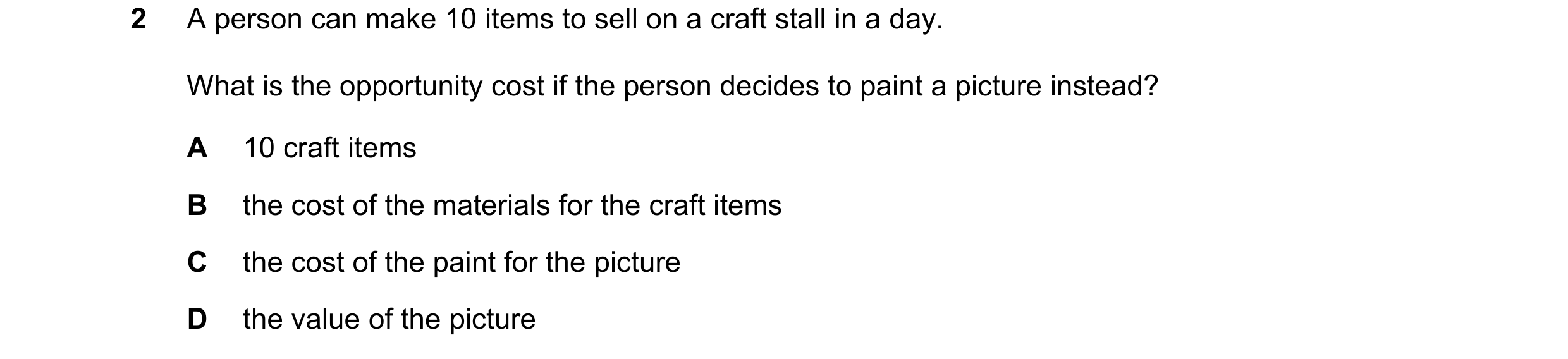
 16 / 32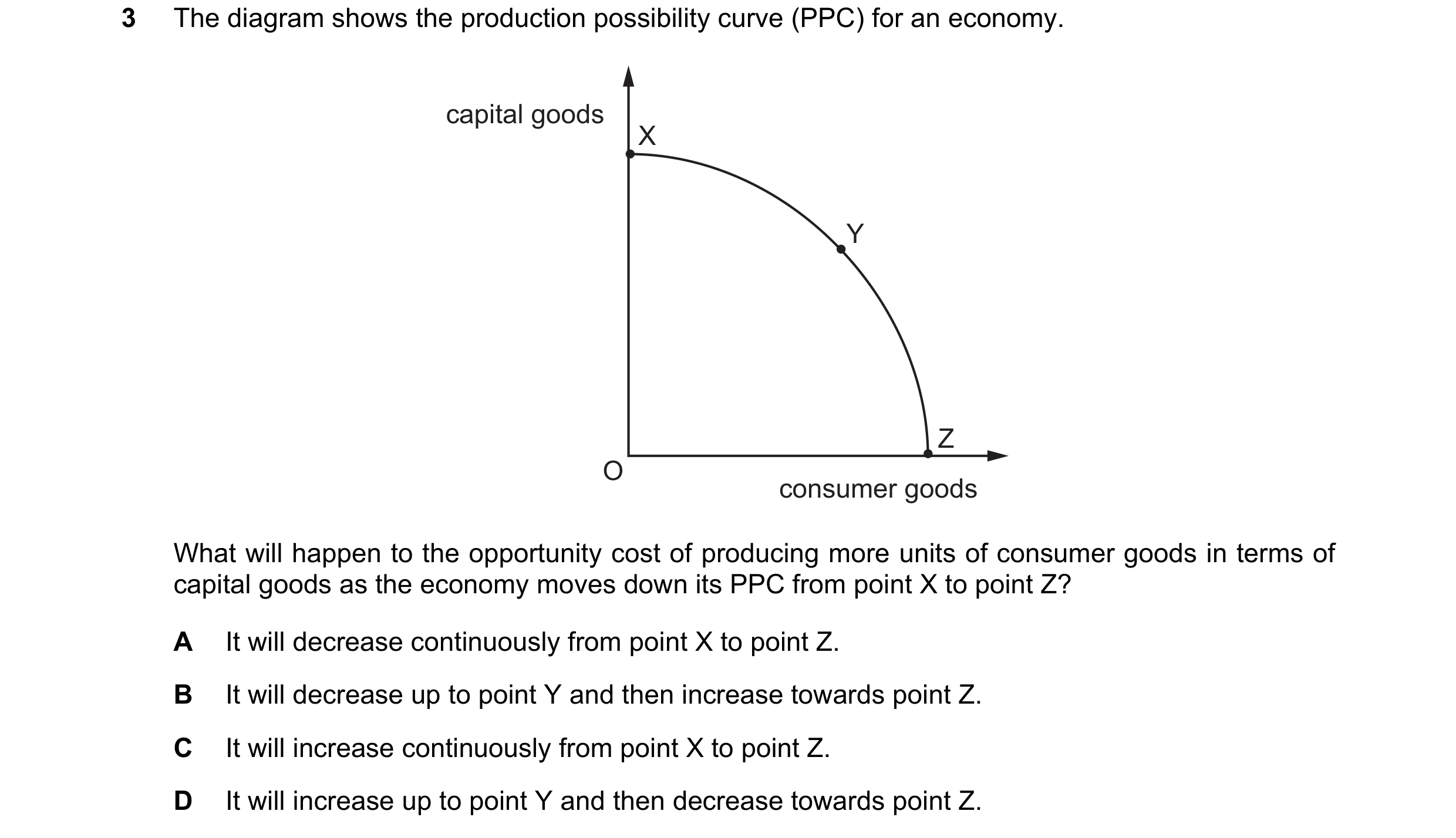
 17 / 32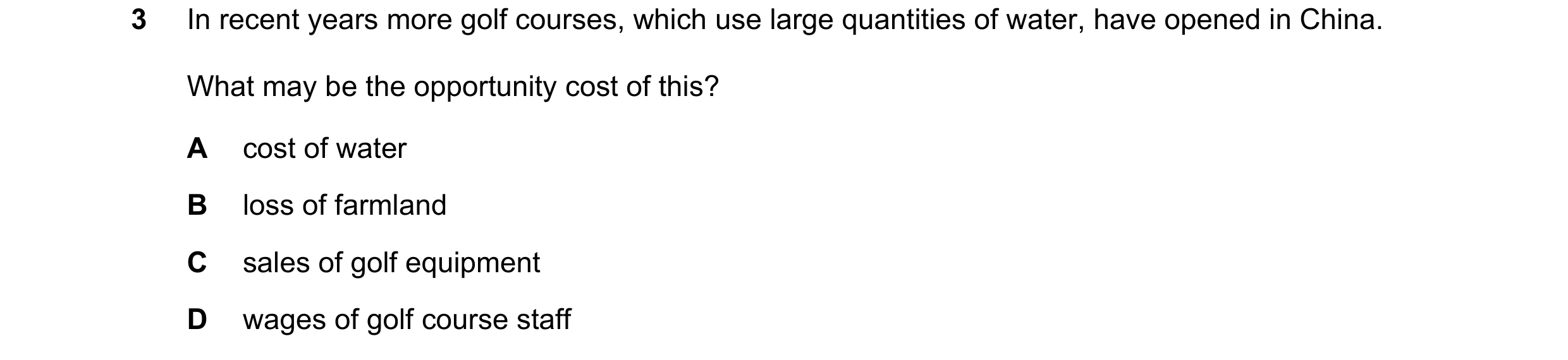
 18 / 32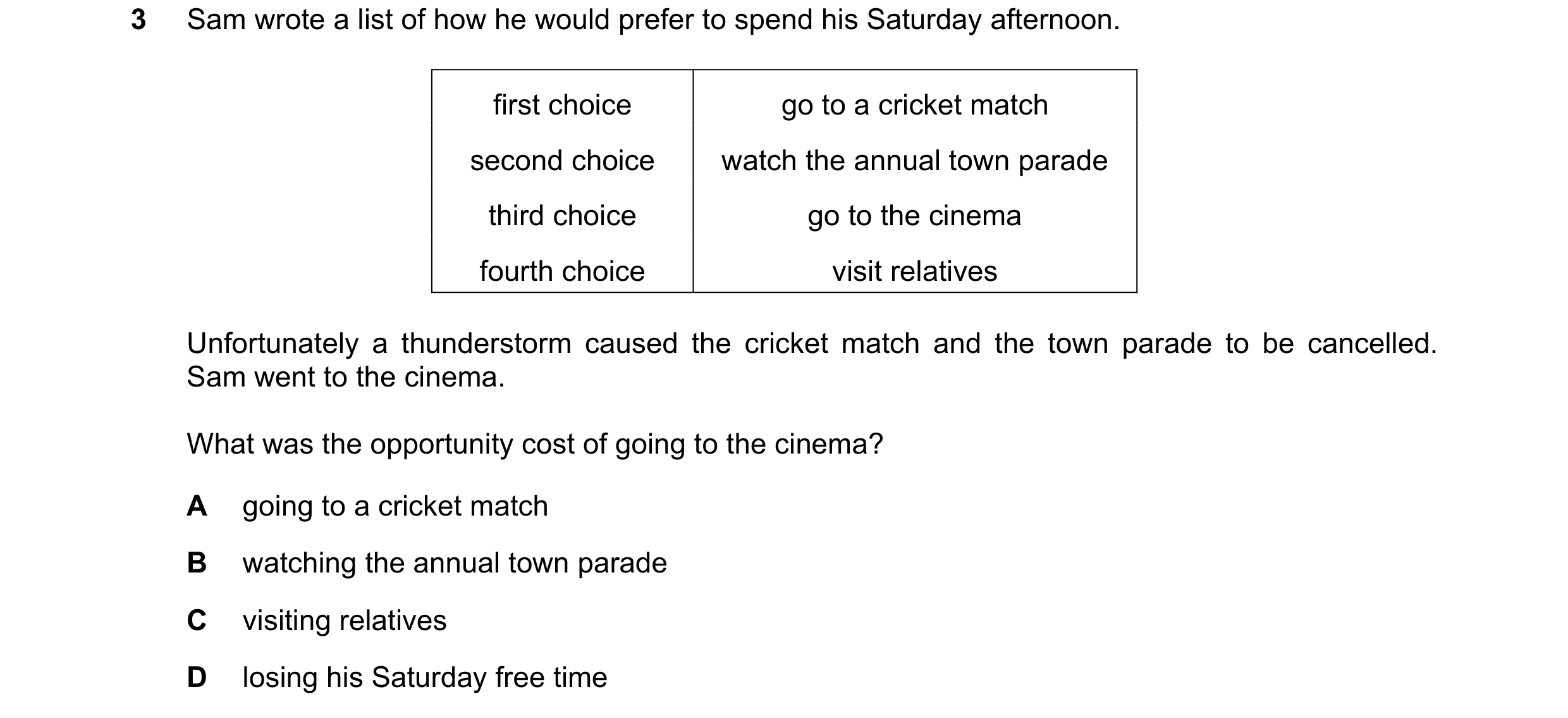
 19 / 32
 20 / 32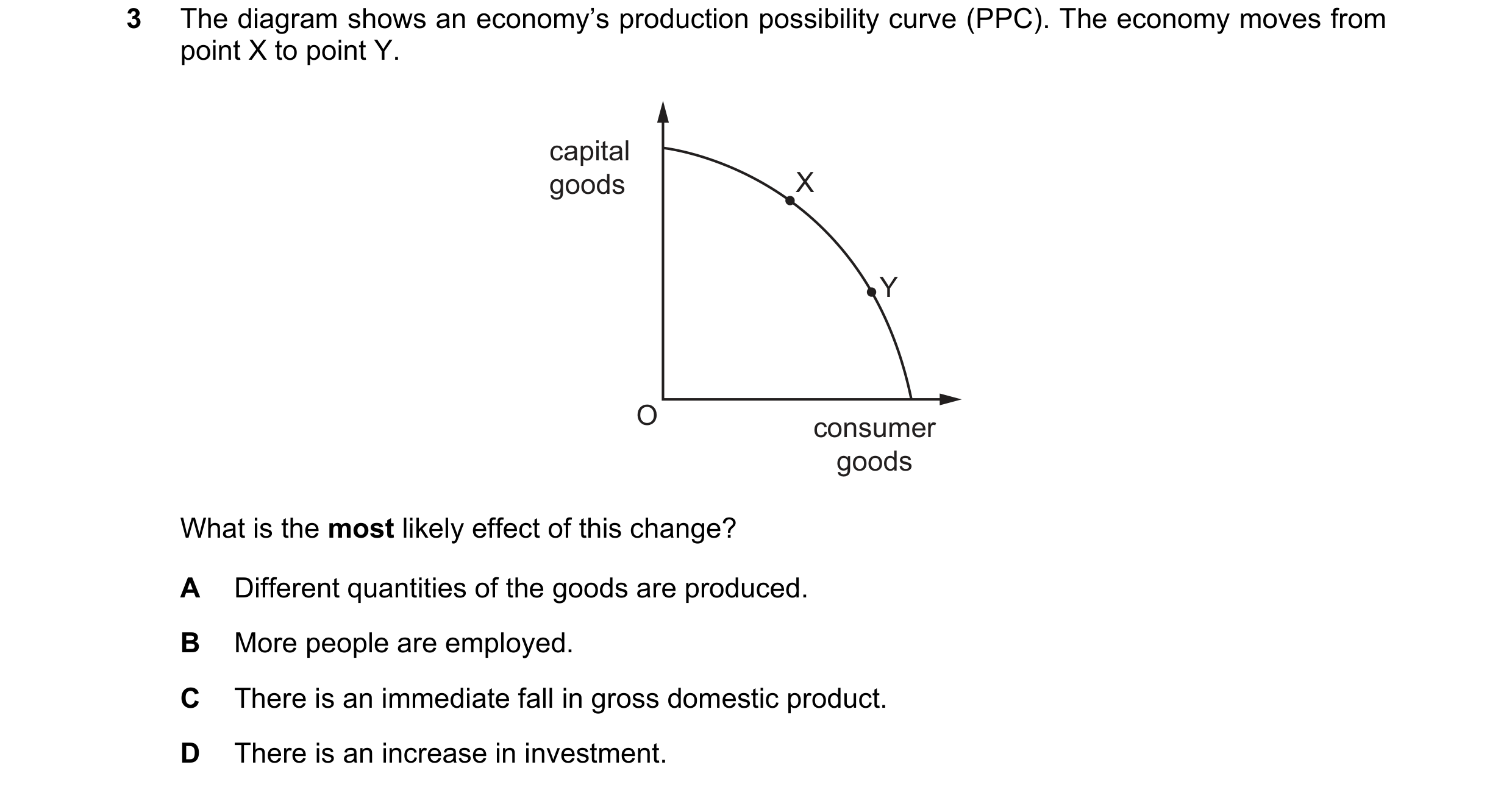

 21 / 32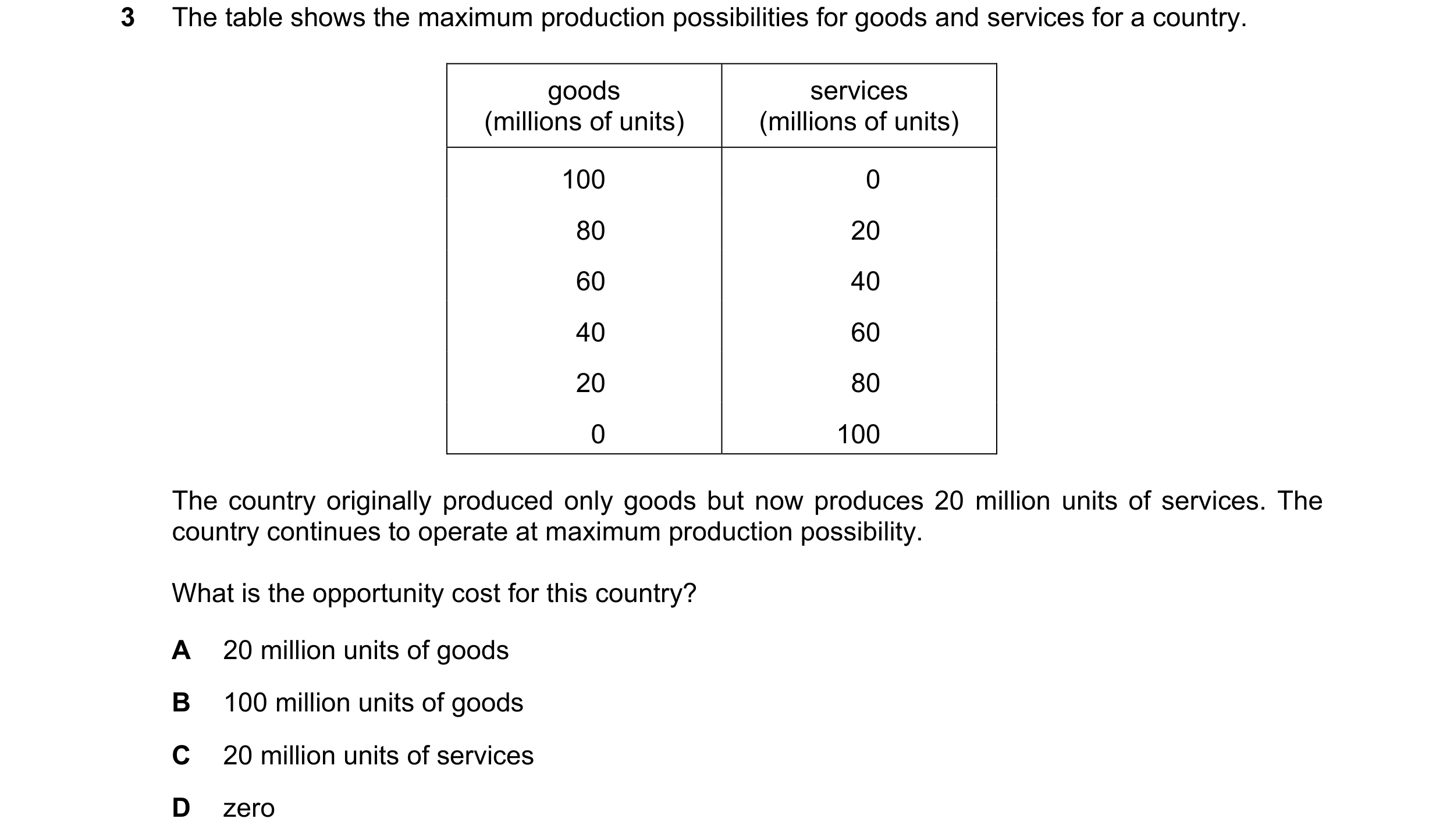
 22 / 32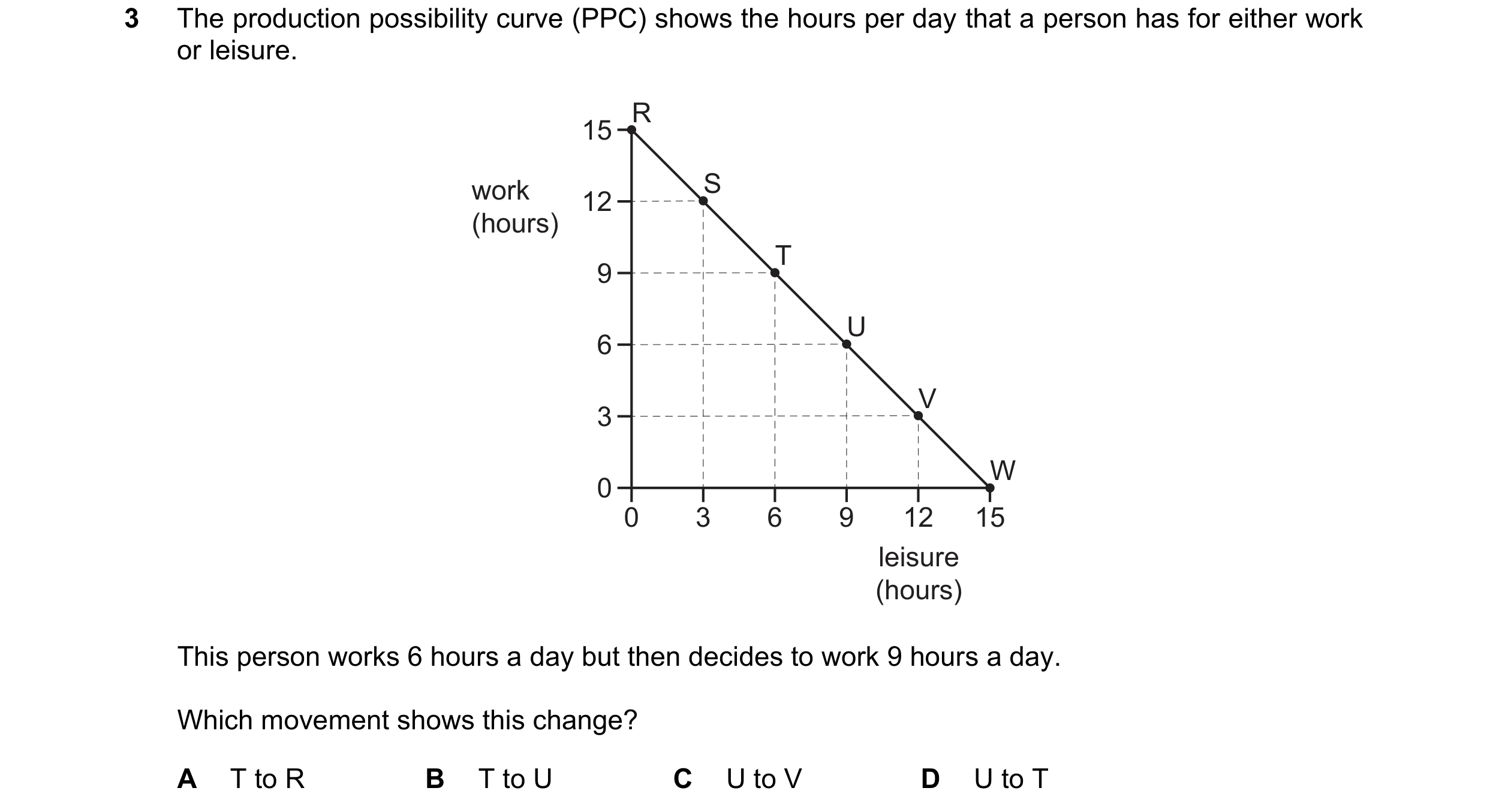
 23 / 32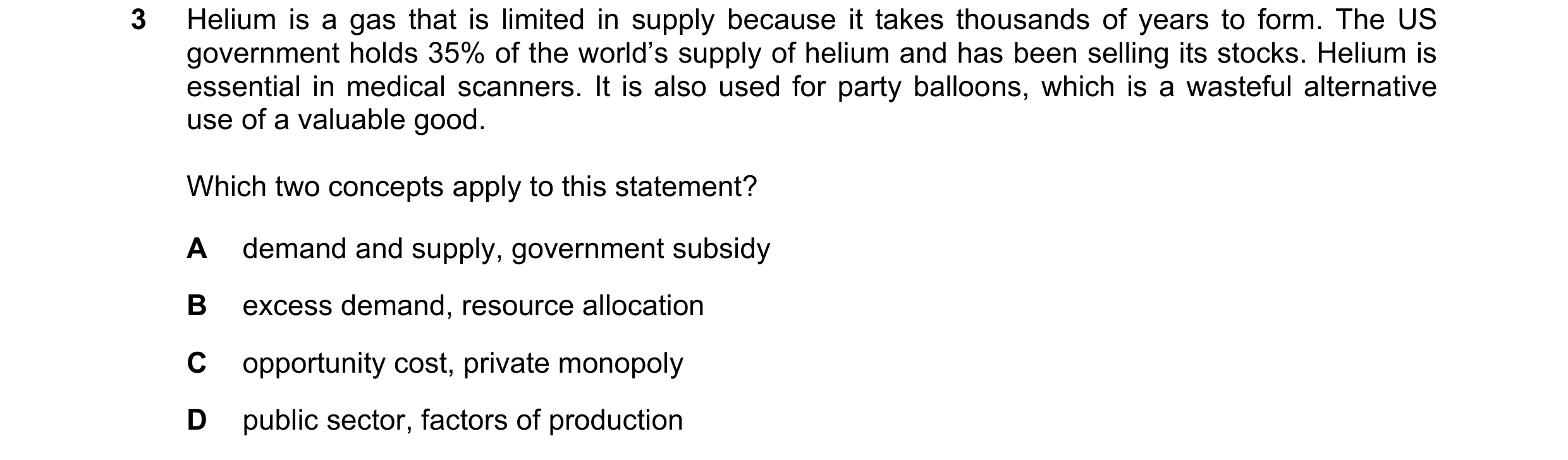

 24 / 32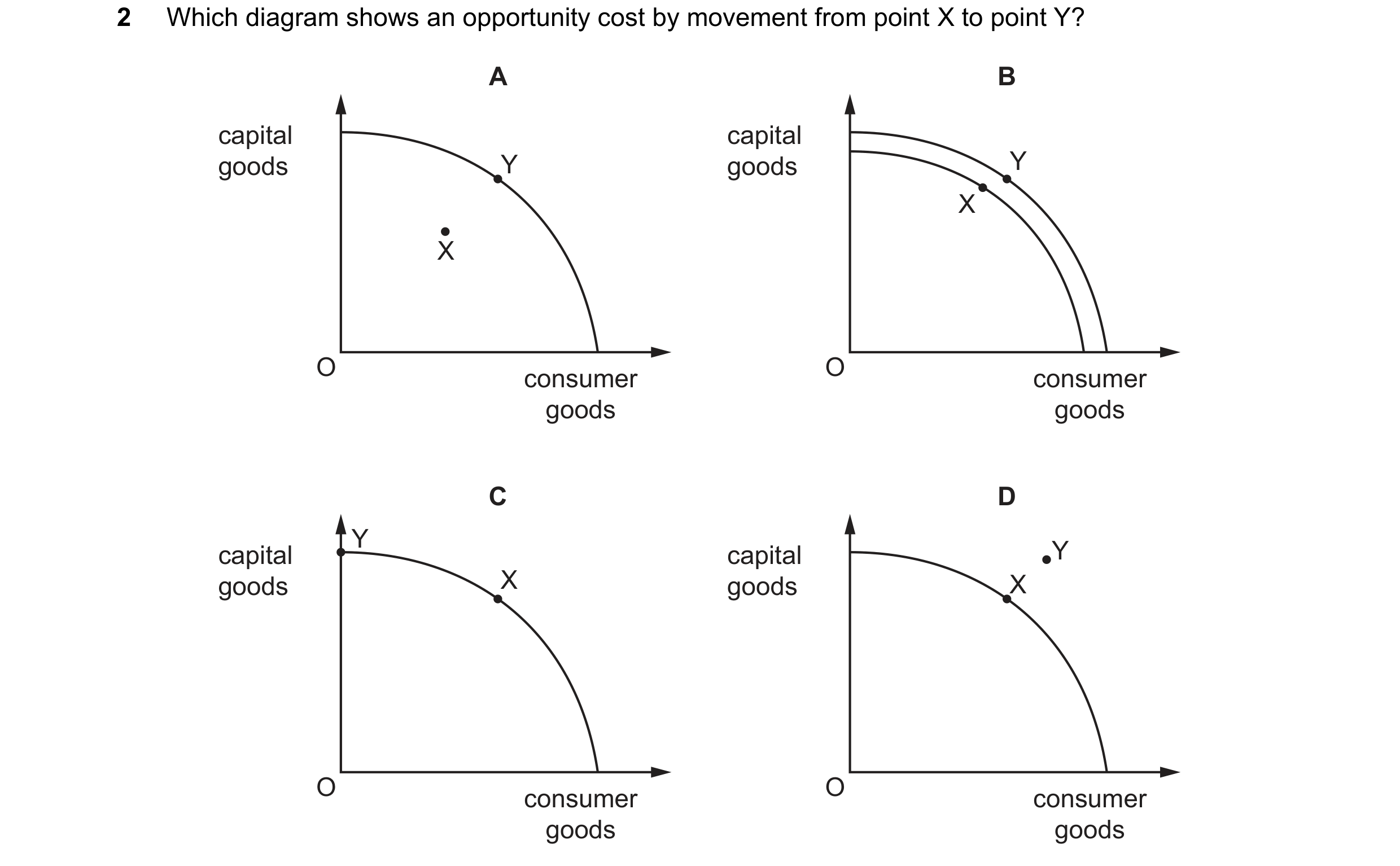
 25 / 32
 26 / 32
 27 / 32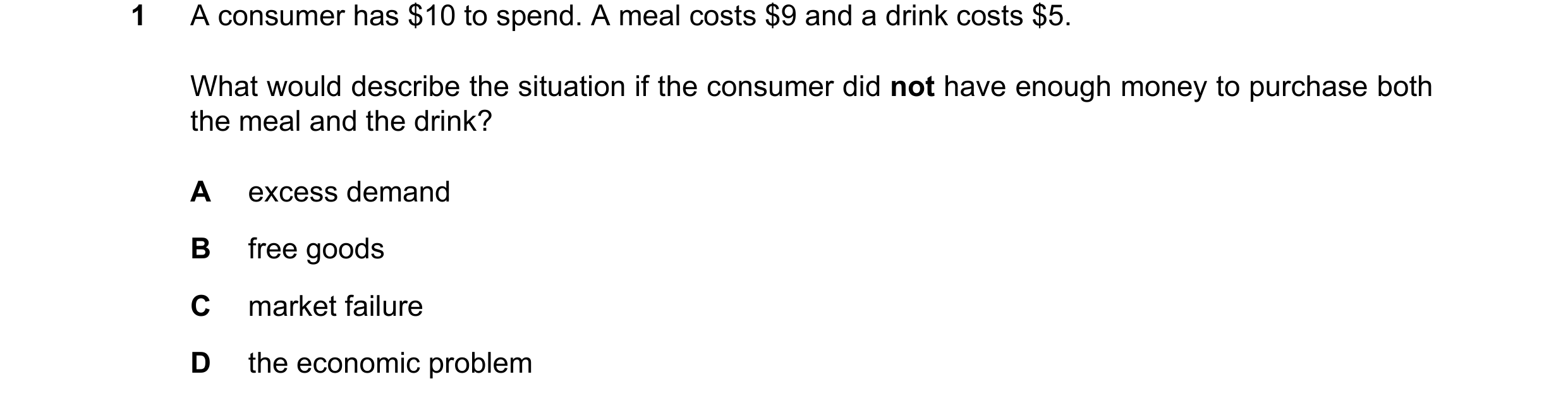
 28 / 32

 29 / 32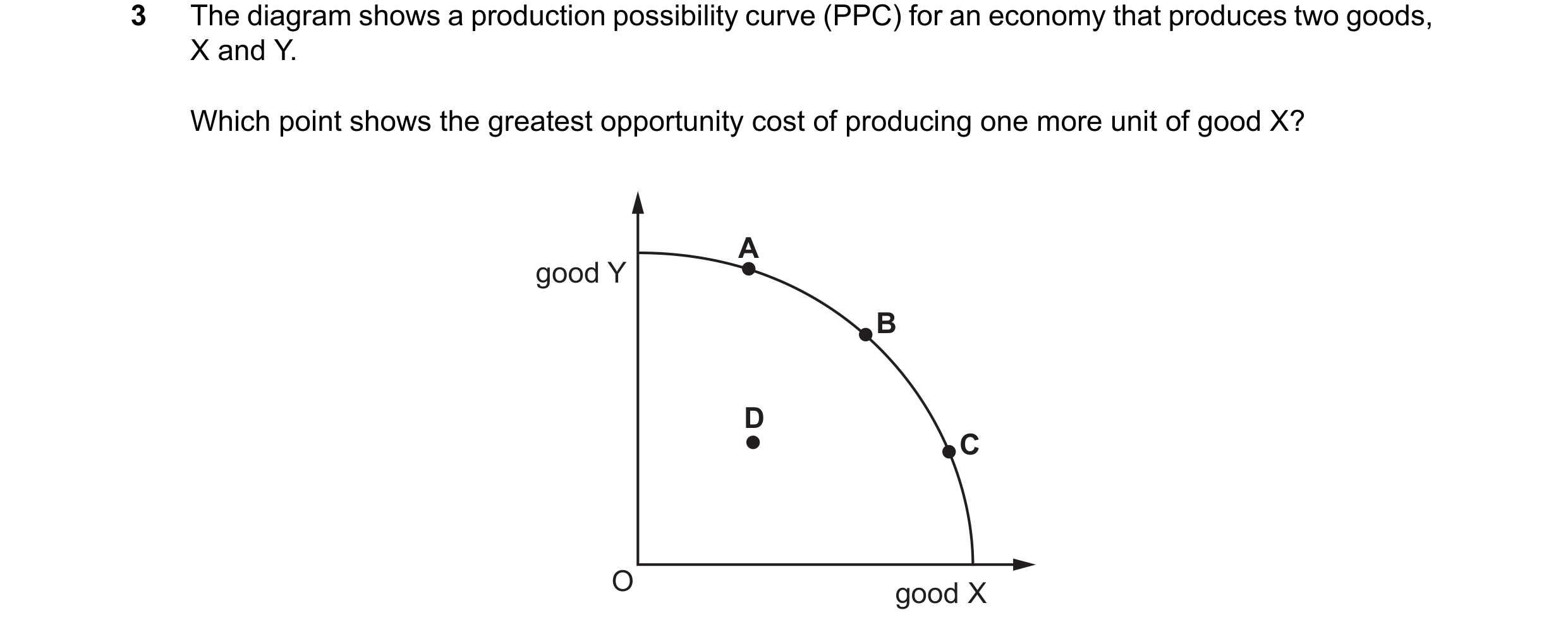
 30 / 32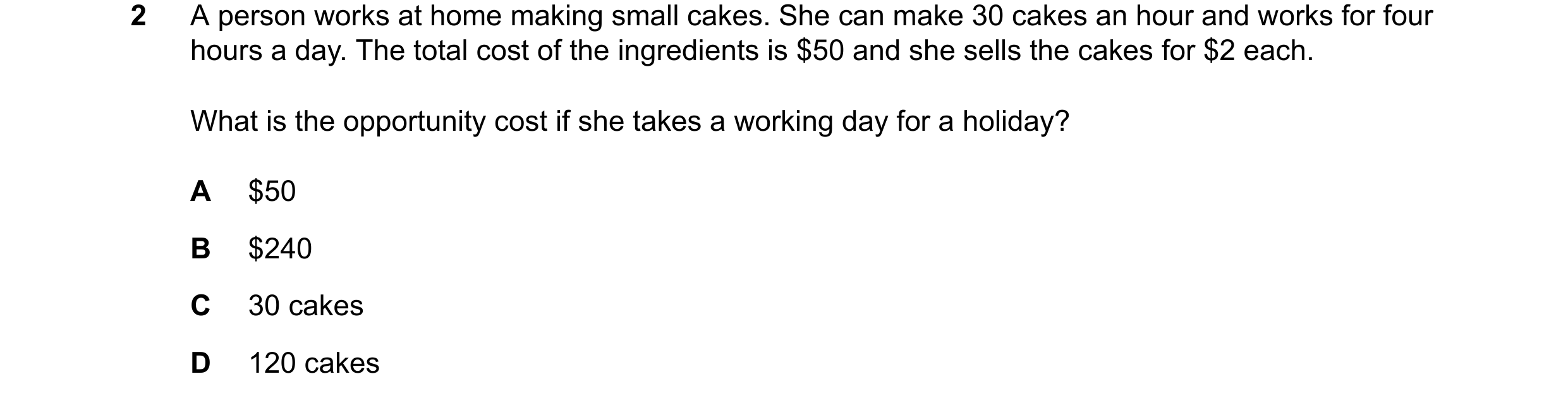
 31 / 32
 32 / 32