Questions as text
Q1 · In which situation does diffraction occur? 9702/11 Oct/Nov 2005
27 In which situation does diffraction occur? A A wave bounces back from a surface. B A wave passes from one medium into another. C A wave passes through an aperture. D Waves from two identical sources are superposed.
1 marks
Answer: C
This question in 9702/11 Oct/Nov 2005
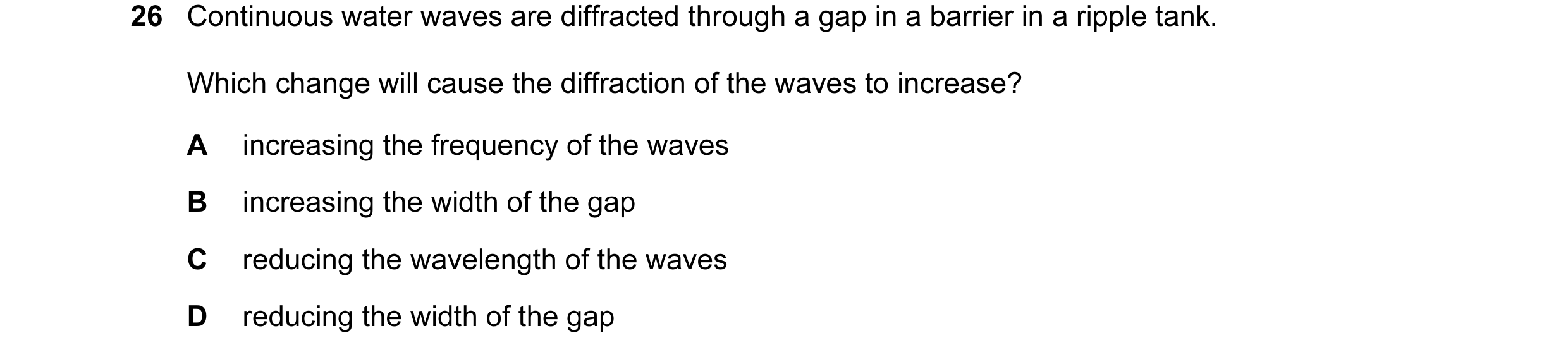
Q2 · Continuous water waves are diffracted through a gap in a barrier in a ripple tank 9702/11 Oct/Nov 2006
26 Continuous water waves are diffracted through a gap in a barrier in a ripple tank. Which change will cause the diffraction of the waves to increase? A increasing the frequency of the waves B increasing the width of the gap C reducing the wavelength of the waves D reducing the width of the gap
1 marks
Answer: D
This question in 9702/11 Oct/Nov 2006
Q3 · Diffraction is the name given to the A addition of two coherent waves to produce a… 9702/11 May/June 2009
22 Diffraction is the name given to the A addition of two coherent waves to produce a stationary wave pattern. B bending of waves round an obstacle. C change of direction when waves cross the boundary between one medium and another. D splitting of white light into colours.
1 marks
Answer: B
This question in 9702/11 May/June 2009
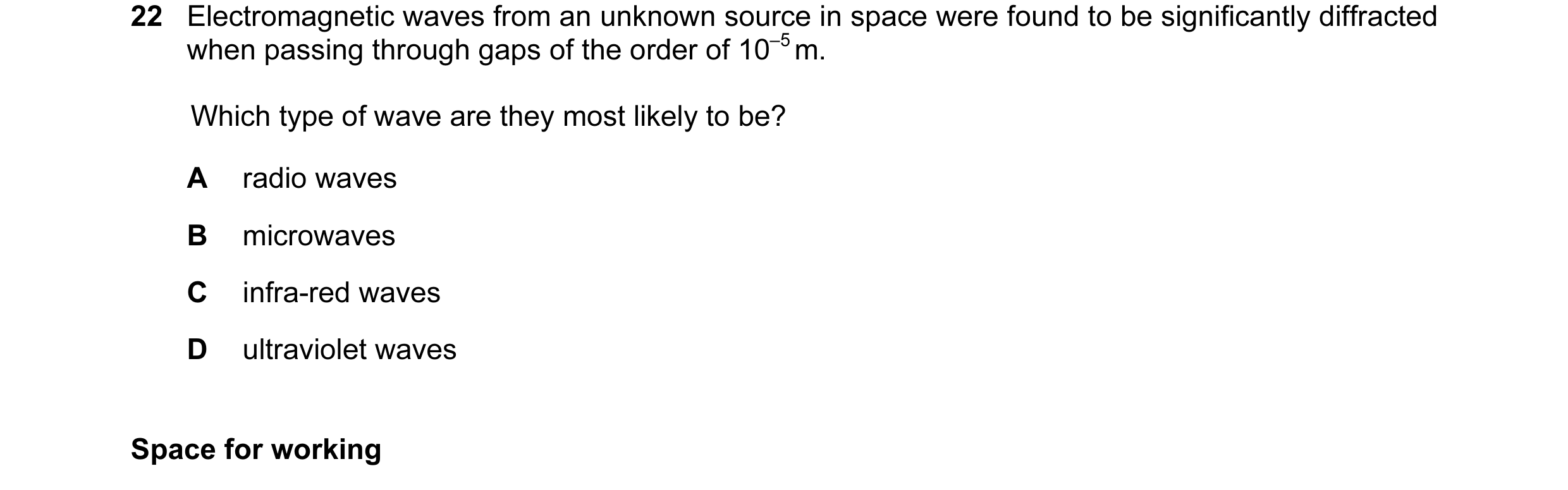
Q4 · Electromagnetic waves from an unknown source in space were found to be significantly… 9702/11 May/June 2010
22 Electromagnetic waves from an unknown source in space were found to be significantly diffracted when passing through gaps of the order of 10–5 m. Which type of wave are they most likely to be? A radio waves B microwaves C infra-red waves D ultraviolet waves Space for working
1 marks
Answer: C
This question in 9702/11 May/June 2010
Q5 · A ripple tank experiment in which plane waves are diffracted through a narrow slit in a… 9702/11 May/June 2010
24 Diagram 1 shows a ripple tank experiment in which plane waves are diffracted through a narrow slit in a metal sheet. Diagram 2 shows the same tank with a slit of greater width. In each case, the pattern of the waves incident on the slit and the emergent pattern are shown. vibrating vibrating bar bar diagram 1 diagram 2 Which action would cause the waves in diagram 1 to be diffracted less and so produce an emergent pattern closer to that shown in diagram 2? A increasing the frequency of vibration of the bar B increasing the speed of the waves by making the water in the tank deeper C reducing the amplitude of vibration of the bar D reducing the length of the vibrating bar Space for working
1 marks
Answer: A
This question in 9702/11 May/June 2010
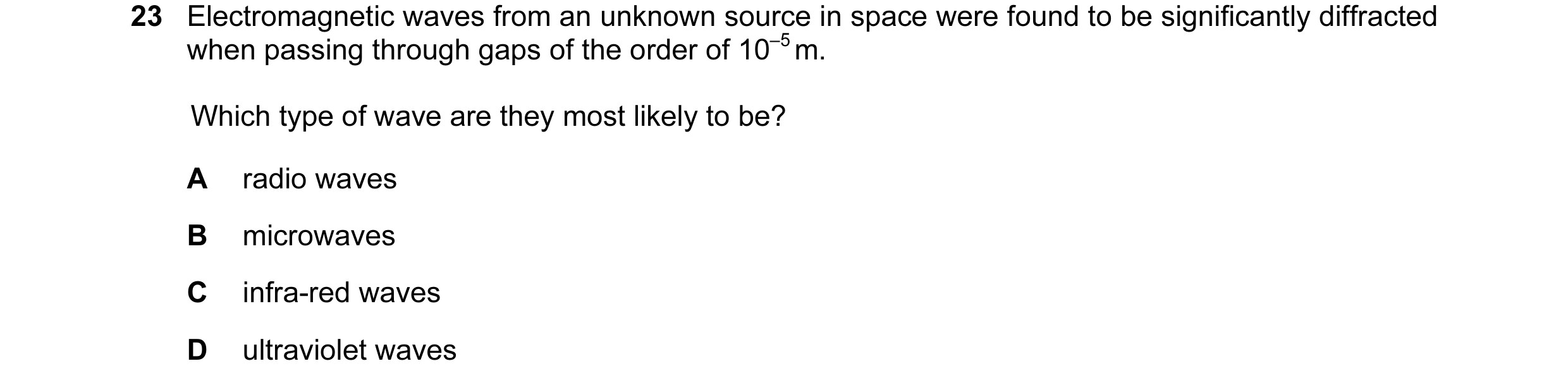
Q6 · Electromagnetic waves from an unknown source in space were found to be significantly… 9702/13 May/June 2010
23 Electromagnetic waves from an unknown source in space were found to be significantly diffracted when passing through gaps of the order of 10–5 m. Which type of wave are they most likely to be? A radio waves B microwaves C infra-red waves D ultraviolet waves
1 marks
Answer: C
This question in 9702/13 May/June 2010
Q7 · A ripple tank experiment in which plane waves are diffracted through a narrow slit in a… 9702/13 May/June 2010
25 Diagram 1 shows a ripple tank experiment in which plane waves are diffracted through a narrow slit in a metal sheet. Diagram 2 shows the same tank with a slit of greater width. In each case, the pattern of the waves incident on the slit and the emergent pattern are shown. vibrating vibrating bar bar diagram 1 diagram 2 Which action would cause the waves in diagram 1 to be diffracted less and so produce an emergent pattern closer to that shown in diagram 2? A increasing the frequency of vibration of the bar B increasing the speed of the waves by making the water in the tank deeper C reducing the amplitude of vibration of the bar D reducing the length of the vibrating bar Space for working
1 marks
Answer: A
This question in 9702/13 May/June 2010
Q8 · Which electromagnetic wave would cause the most significant diffraction effect for an… 9702/13 Oct/Nov 2010
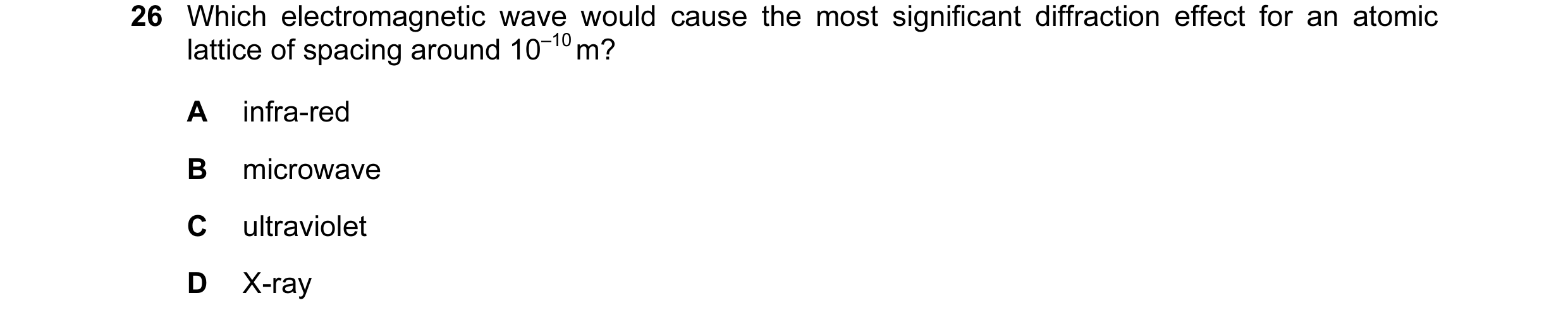
26 Which electromagnetic wave would cause the most significant diffraction effect for an atomic lattice of spacing around 10–10 m? A infra-red B microwave C ultraviolet D X-ray
1 marks
Answer: D
This question in 9702/13 Oct/Nov 2010
Q9 · In which situation does diffraction occur? 9702/12 May/June 2011
28 In which situation does diffraction occur? A A wave bounces back from a surface. B A wave passes from one medium into another. C A wave passes through an aperture. D Waves from two identical sources are superposed.
1 marks
Answer: C
This question in 9702/12 May/June 2011
Q10 · A monochromatic plane wave of speed c and wavelength λ is diffracted at a small aperture 9702/12 May/June 2012
29 A monochromatic plane wave of speed c and wavelength λ is diffracted at a small aperture. The diagram illustrates successive wavefronts. X P Y After what time will some portion of the wavefront XY reach point P? A 3λ B 2 λ C 3 λ D 4 λ 2 c c c c Space for working
1 marks
Answer: C
This question in 9702/12 May/June 2012
Q11 · Diffraction can be observed when a wave passes an obstruction 9702/13 Oct/Nov 2012
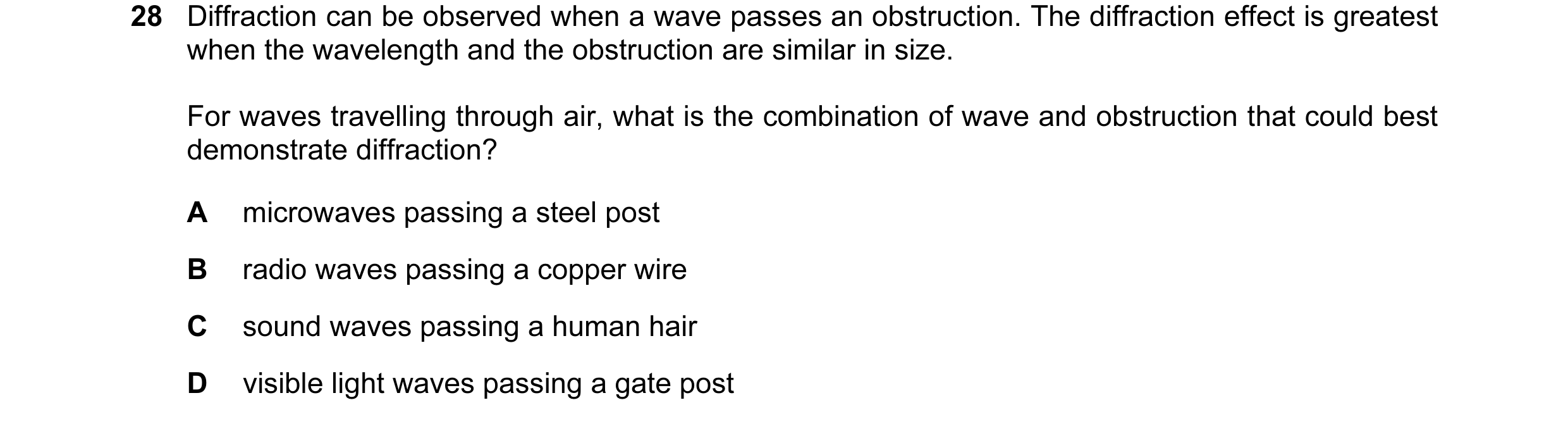
28 Diffraction can be observed when a wave passes an obstruction. The diffraction effect is greatest when the wavelength and the obstruction are similar in size. For waves travelling through air, what is the combination of wave and obstruction that could best demonstrate diffraction? A microwaves passing a steel post B radio waves passing a copper wire C sound waves passing a human hair D visible light waves passing a gate post
1 marks
Answer: A
This question in 9702/13 Oct/Nov 2012
Q12 · Electromagnetic waves from an unknown source in space were found to be significantly… 9702/13 Oct/Nov 2013
24 Electromagnetic waves from an unknown source in space were found to be significantly diffracted when passing through gaps of the order of 10–5 m. Which type of wave are they most likely to be? A radio waves B microwaves C infra-red waves D ultraviolet waves
1 marks
Answer: C
This question in 9702/13 Oct/Nov 2013
Q13 · What is meant by diffraction? 9702/13 Oct/Nov 2013
28 What is meant by diffraction? A Addition of two coherent waves to produce a stationary wave pattern. B Bending of waves round an obstacle. C Change of direction when waves cross the boundary between one medium and another. D Splitting of white light into colours. Space for working
1 marks
Answer: B
This question in 9702/13 Oct/Nov 2013
Q14 · Plane wavefronts in a ripple tank pass through a gap as shown 9702/13 Oct/Nov 2014
28 Plane wavefronts in a ripple tank pass through a gap as shown. P Q Which property of the wave will be different at Q compared with P? A velocity B frequency C amplitude D wavelength Space for working
1 marks
Answer: C
This question in 9702/13 Oct/Nov 2014
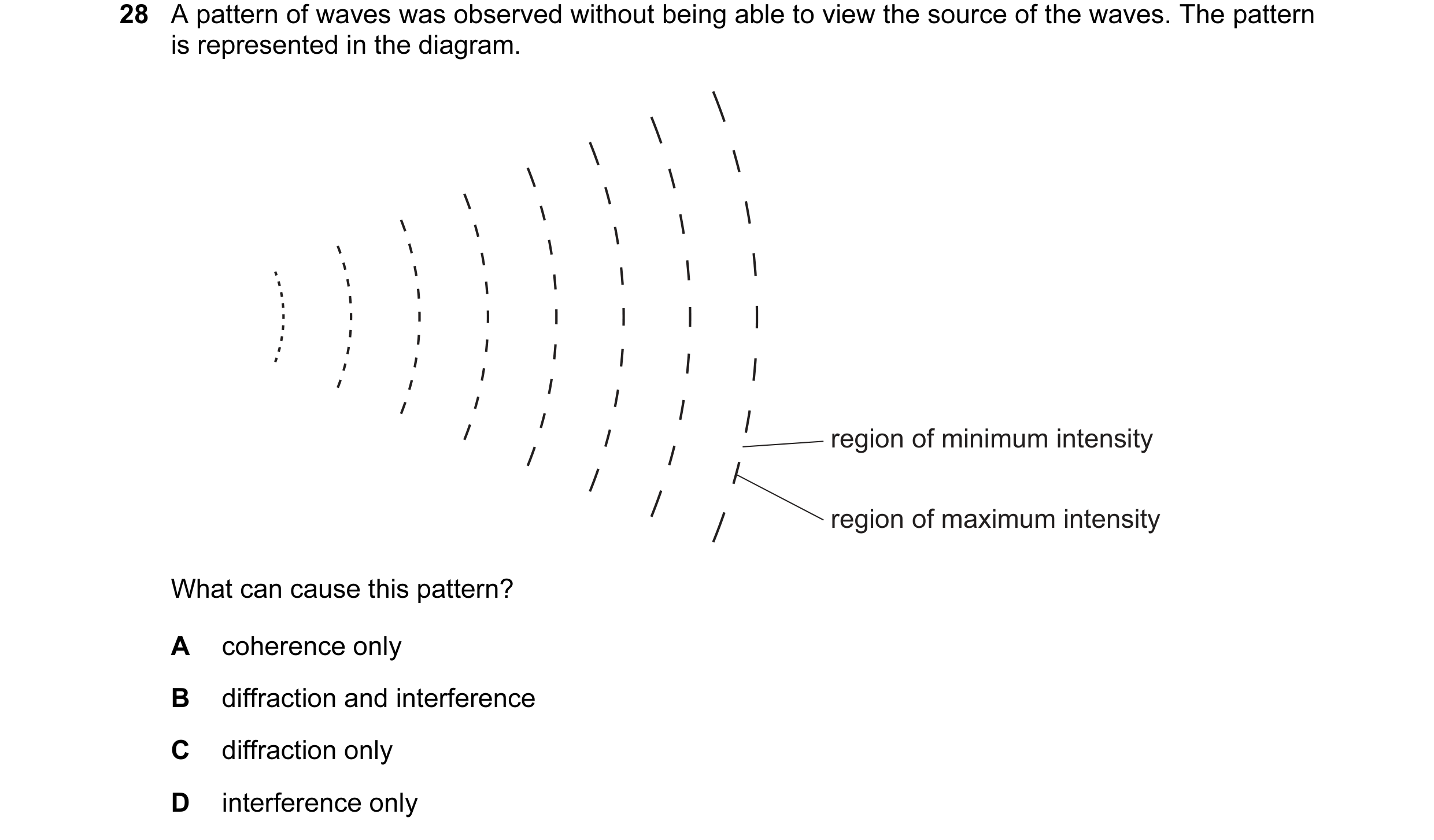
Q15 · A pattern of waves was observed without being able to view the source of the waves 9702/12 May/June 2015
28 A pattern of waves was observed without being able to view the source of the waves. The pattern is represented in the diagram. region of minimum intensity region of maximum intensity What can cause this pattern? A coherence only B diffraction and interference C diffraction only D interference only
1 marks
Answer: B
This question in 9702/12 May/June 2015
Q16 · Which electromagnetic wave would cause the most significant diffraction effect for an… 9702/13 May/June 2015
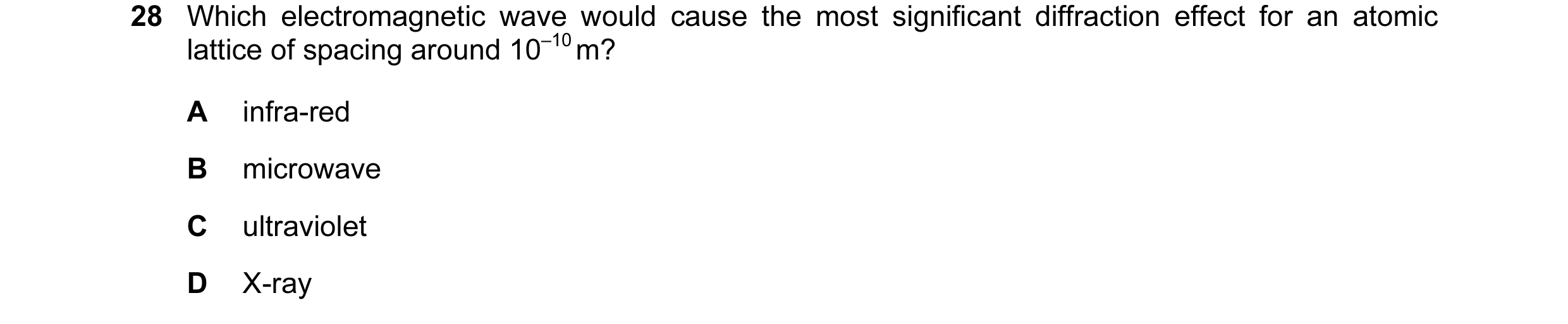
28 Which electromagnetic wave would cause the most significant diffraction effect for an atomic lattice of spacing around 10–10 m? A infra-red B microwave C ultraviolet D X-ray
1 marks
Answer: D
This question in 9702/13 May/June 2015
Q17 · Water waves of wavelength λ are diffracted as they pass through a gap of width d in a… 9702/11 Oct/Nov 2015
28 Water waves of wavelength λ are diffracted as they pass through a gap of width d in a barrier. Which combination of wavelength and gap width would produce the greatest angle of diffraction? gap width wavelength A 1 d 2λ 2 B 1 d 1 λ 2 2 C 2d 2λ D 2d 1 λ 2
1 marks
Answer: A
This question in 9702/11 Oct/Nov 2015
Q18 · The following statements describe the diffraction of waves passing through a narrow slit 9702/13 Oct/Nov 2015
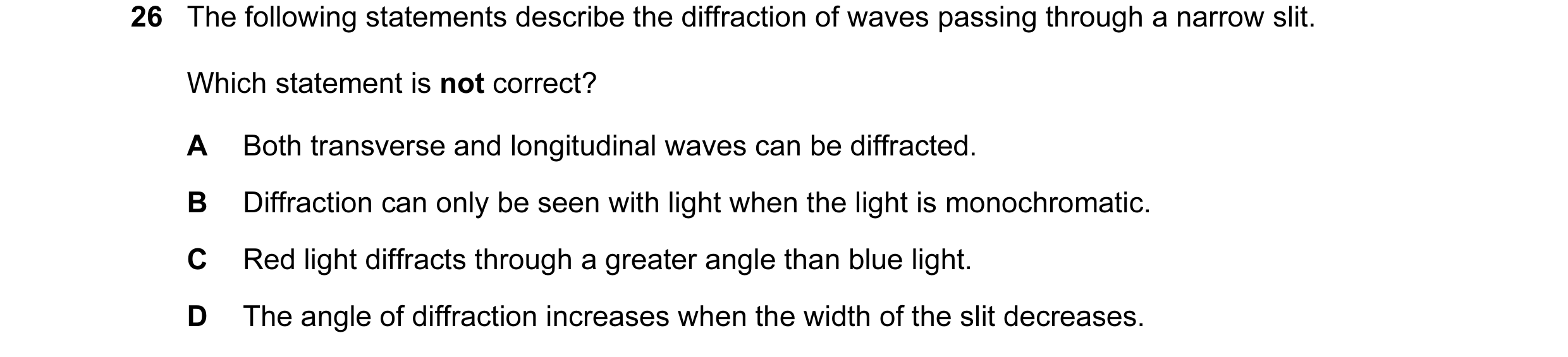
26 The following statements describe the diffraction of waves passing through a narrow slit. Which statement is not correct? A Both transverse and longitudinal waves can be diffracted. B Diffraction can only be seen with light when the light is monochromatic. C Red light diffracts through a greater angle than blue light. D The angle of diffraction increases when the width of the slit decreases.
1 marks
Answer: B
This question in 9702/13 Oct/Nov 2015
Q19 · Diffraction is a term used to describe one aspect of wave behaviour 9702/12 Feb/March 2016
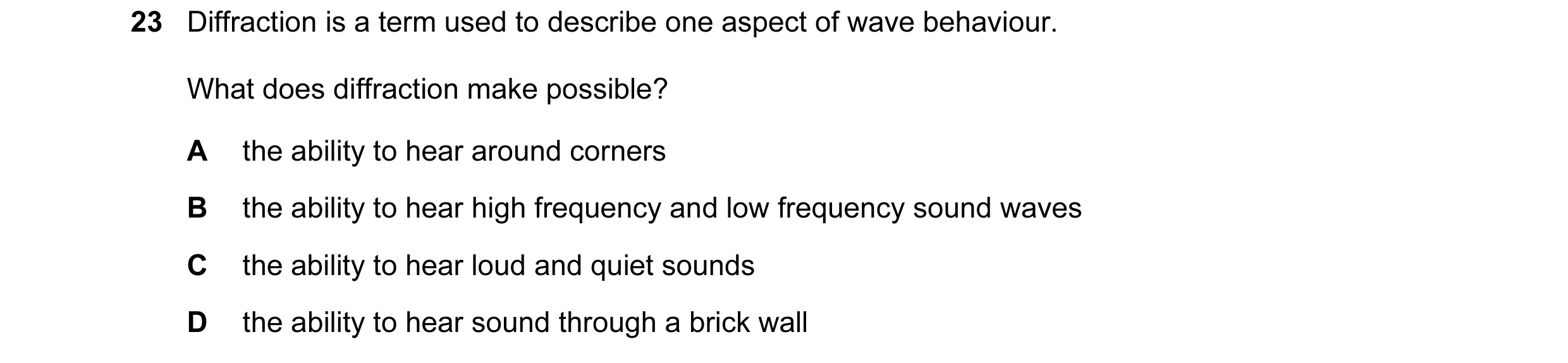
23 Diffraction is a term used to describe one aspect of wave behaviour. What does diffraction make possible? A the ability to hear around corners B the ability to hear high frequency and low frequency sound waves C the ability to hear loud and quiet sounds D the ability to hear sound through a brick wall
1 marks
Answer: A
This question in 9702/12 Feb/March 2016
Q20 · Continuous water waves are diffracted through a gap in a barrier in a ripple tank 9702/11 May/June 2016
25 Continuous water waves are diffracted through a gap in a barrier in a ripple tank. Which change will cause the diffraction of the waves to increase? A increasing the frequency of the waves B increasing the width of the gap C reducing the wavelength of the waves D reducing the width of the gap
1 marks
Answer: D
This question in 9702/11 May/June 2016
Q21 · Which statement is an example of the diffraction of light? 9702/12 May/June 2016
26 Which statement is an example of the diffraction of light? A the addition of the amplitudes of two beams of light which are in phase B the change in direction of a beam of light when passing from air into water C the separation of a beam of white light into a spectrum of colours using a prism D the spreading of a beam of light as it passes through a small hole
1 marks
Answer: D
This question in 9702/12 May/June 2016
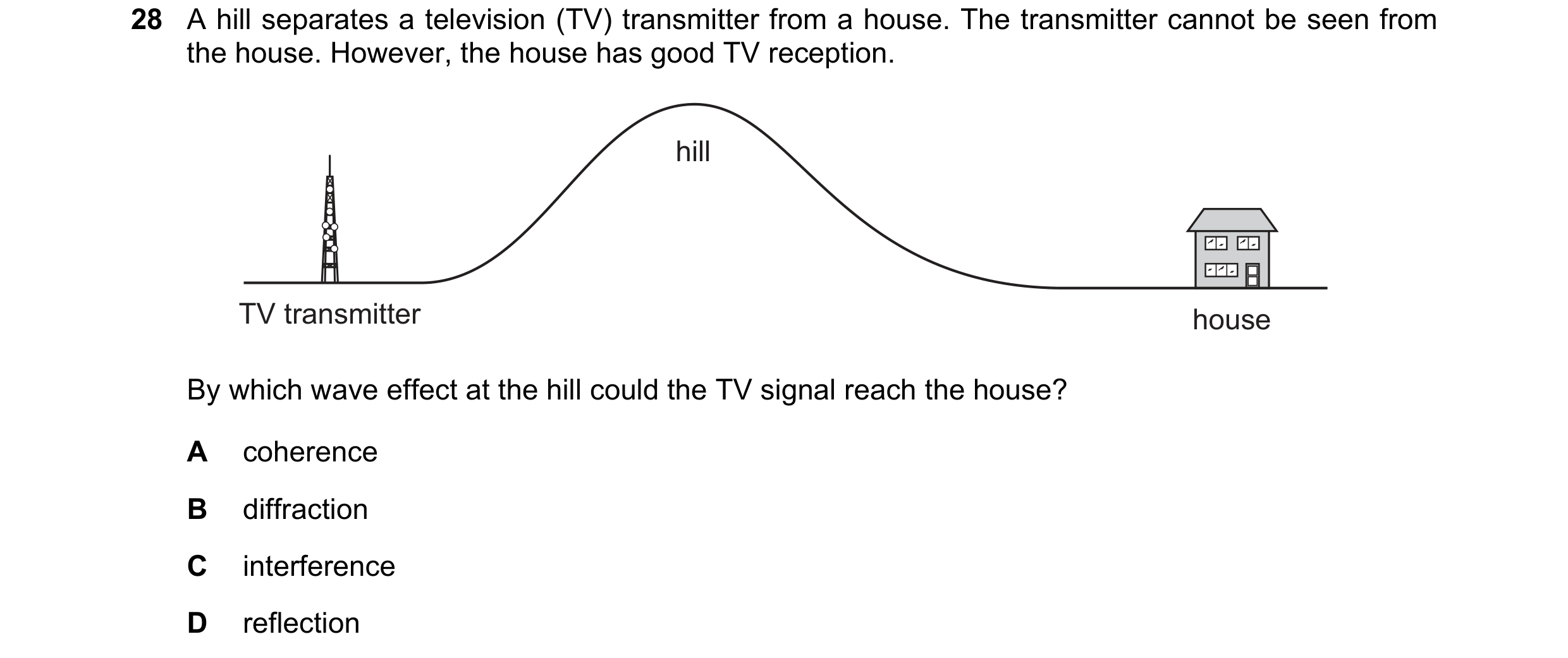
Q22 · A hill separates a television (TV) transmitter from a house 9702/13 May/June 2016
26 A hill separates a television (TV) transmitter from a house. The transmitter cannot be seen from the house. However, the house has good TV reception. hill TV transmitter house By which wave effect at the hill could the TV signal reach the house? A coherence B diffraction C interference D reflection
1 marks
Answer: B
This question in 9702/13 May/June 2016
Q23 · Diagrams X and Y show the passage of water waves around an obstacle and through a gap 9702/11 Oct/Nov 2016
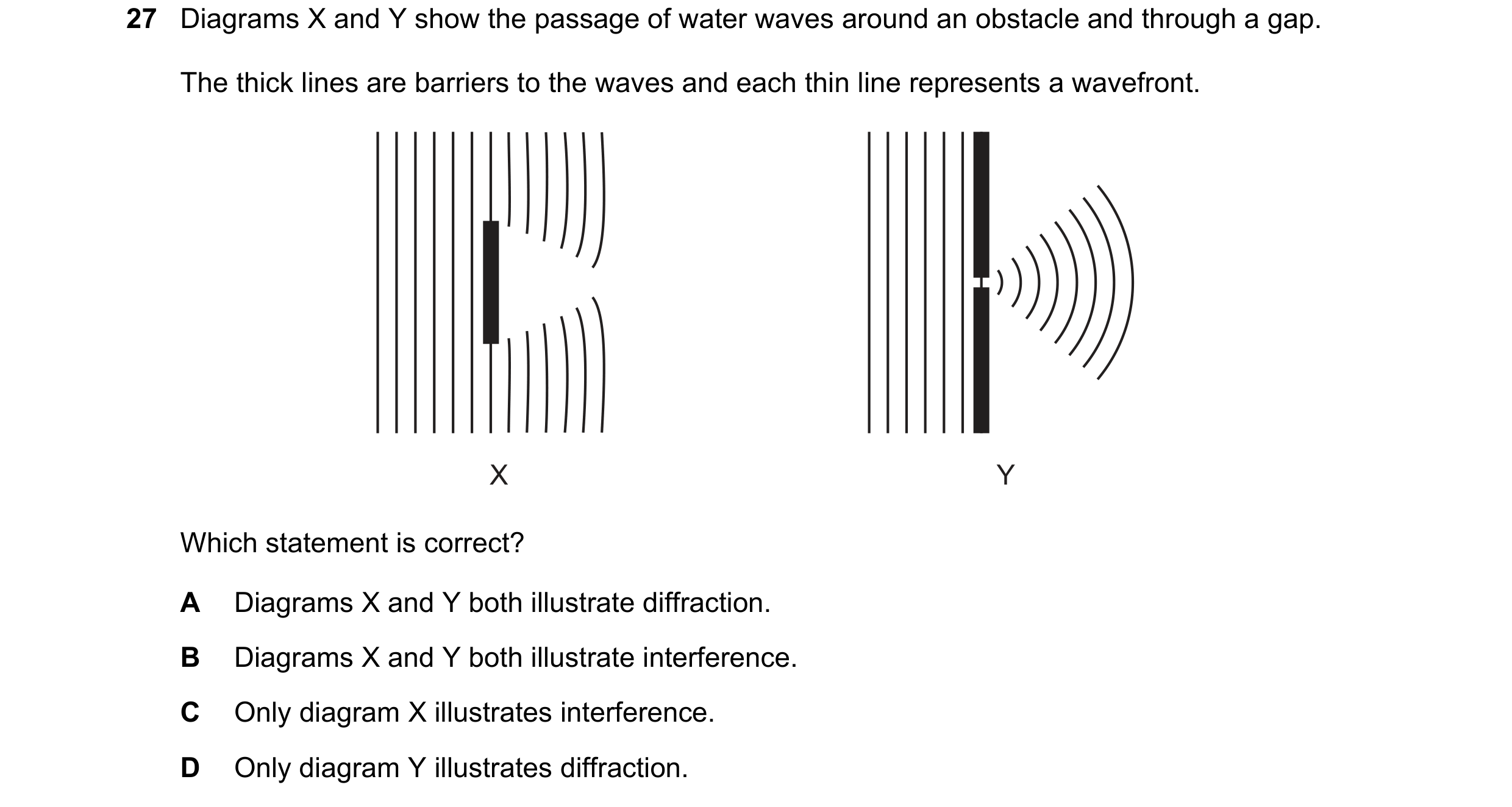
27 Diagrams X and Y show the passage of water waves around an obstacle and through a gap. The thick lines are barriers to the waves and each thin line represents a wavefront. X Y Which statement is correct? A Diagrams X and Y both illustrate diffraction. B Diagrams X and Y both illustrate interference. C Only diagram X illustrates interference. D Only diagram Y illustrates diffraction.
1 marks
Answer: A
This question in 9702/11 Oct/Nov 2016
Q24 · Diagrams X and Y show the passage of water waves around an obstacle and through a gap 9702/13 Oct/Nov 2016
27 Diagrams X and Y show the passage of water waves around an obstacle and through a gap. The thick lines are barriers to the waves and each thin line represents a wavefront. X Y Which statement is correct? A Diagrams X and Y both illustrate diffraction. B Diagrams X and Y both illustrate interference. C Only diagram X illustrates interference. D Only diagram Y illustrates diffraction.
1 marks
Answer: A
This question in 9702/13 Oct/Nov 2016
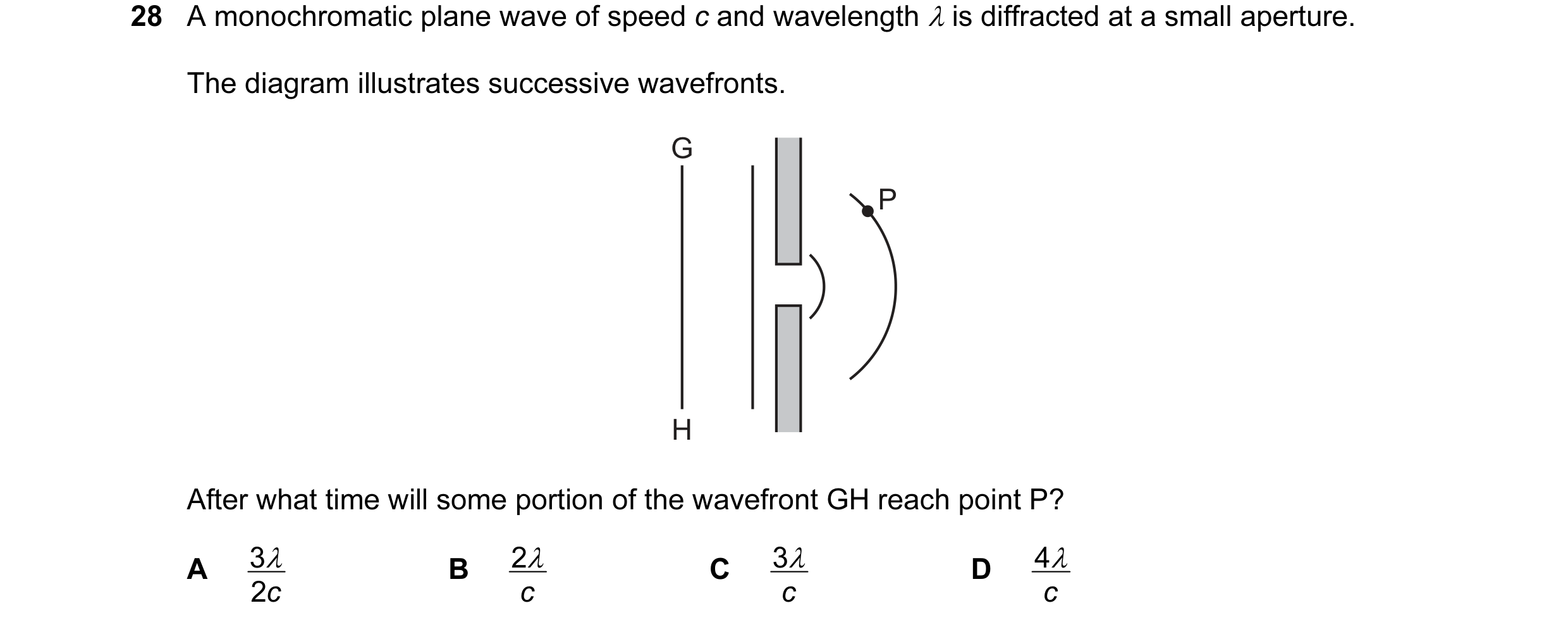
Q25 · A monochromatic plane wave of speed c and wavelength λ is diffracted at a small aperture 9702/12 Feb/March 2017
28 A monochromatic plane wave of speed c and wavelength λ is diffracted at a small aperture. The diagram illustrates successive wavefronts. G P H After what time will some portion of the wavefront GH reach point P? A 3λ B 2 λ C 3 λ D 4 λ 2 c c c c
1 marks
Answer: C
This question in 9702/12 Feb/March 2017
Q26 · Diffraction can be observed when a wave passes an obstruction 9702/11 Oct/Nov 2017
24 Diffraction can be observed when a wave passes an obstruction. The diffraction effect is greatest when the wavelength and the obstruction are similar in size. For waves travelling through air, what is the combination of wave and obstruction that could best demonstrate diffraction? A microwaves passing a steel post B radio waves passing a copper wire C sound waves passing a human hair D visible light waves passing a gate post
1 marks
Answer: A
This question in 9702/11 Oct/Nov 2017
Q27 · A bar vibrates with frequency f to produce water waves in a ripple tank 9702/11 Oct/Nov 2017
29 A bar vibrates with frequency f to produce water waves in a ripple tank. bar vibrating with frequency f barrier with gap of width x The waves pass through a gap of width x in a barrier so that diffraction occurs. Which combination of vibration frequency and gap width will produce the smallest angle of diffraction? vibration gap width frequency f x A 2 2 f B 2x 2 x C 2f 2 D 2f 2x
1 marks
Answer: D
This question in 9702/11 Oct/Nov 2017
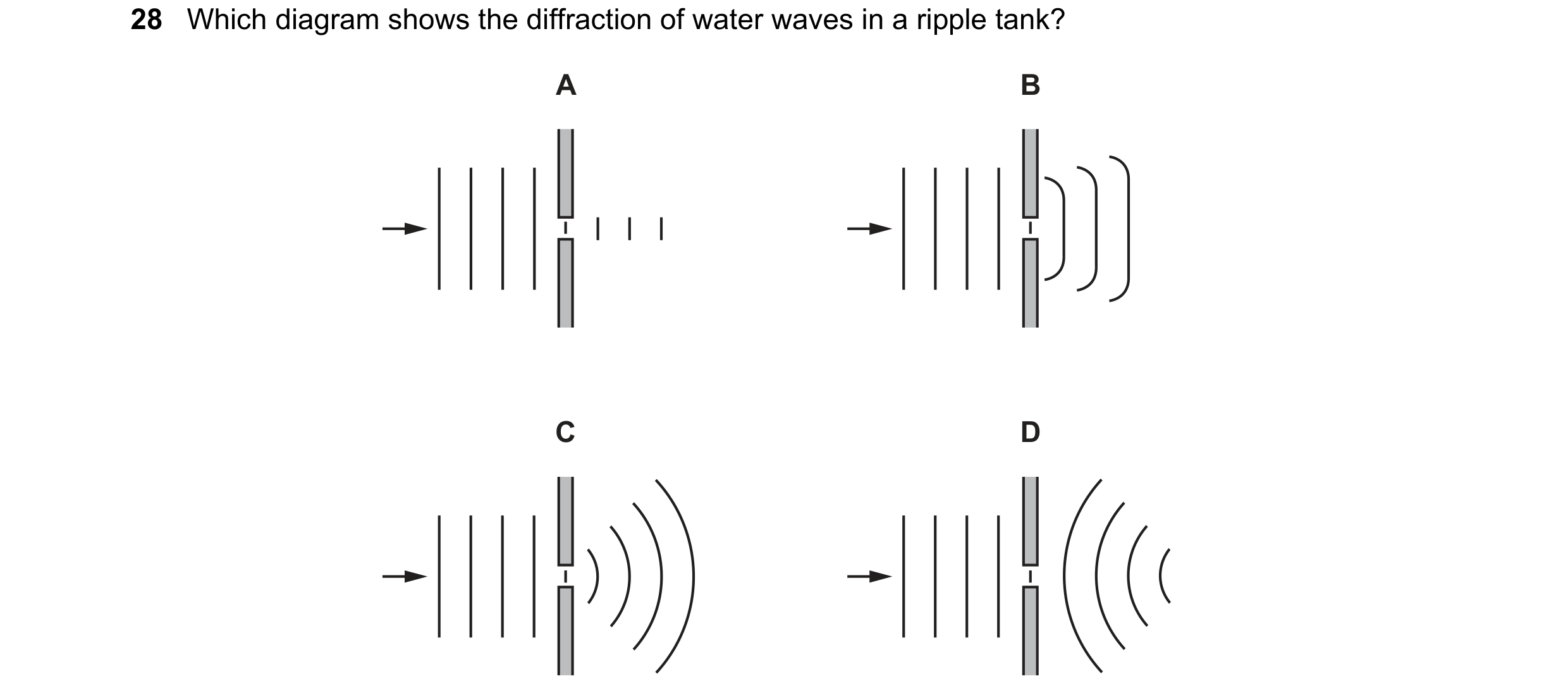
Q28 · Which diagram shows the diffraction of water waves in a ripple tank? 9702/12 Oct/Nov 2017
28 Which diagram shows the diffraction of water waves in a ripple tank? A B C D
1 marks
Answer: C
This question in 9702/12 Oct/Nov 2017
Q29 · A hill stands between a radio transmitter and a house, as shown 9702/12 Oct/Nov 2017
29 A hill stands between a radio transmitter and a house, as shown. hill house radio transmitter The radio transmitter cannot be seen from the house, but radio waves from the transmitter are received at the house. Why is this? A The wavelength of light is longer than the wavelength of radio waves so there is more diffraction of light over the hill. B The wavelength of light is shorter than the wavelength of radio waves so there is more diffraction of light over the hill. C The wavelength of radio waves is longer than the wavelength of light so there is more diffraction of radio waves over the hill. D The wavelength of radio waves is shorter than the wavelength of light so there is more diffraction of radio waves over the hill.
1 marks
Answer: C
This question in 9702/12 Oct/Nov 2017
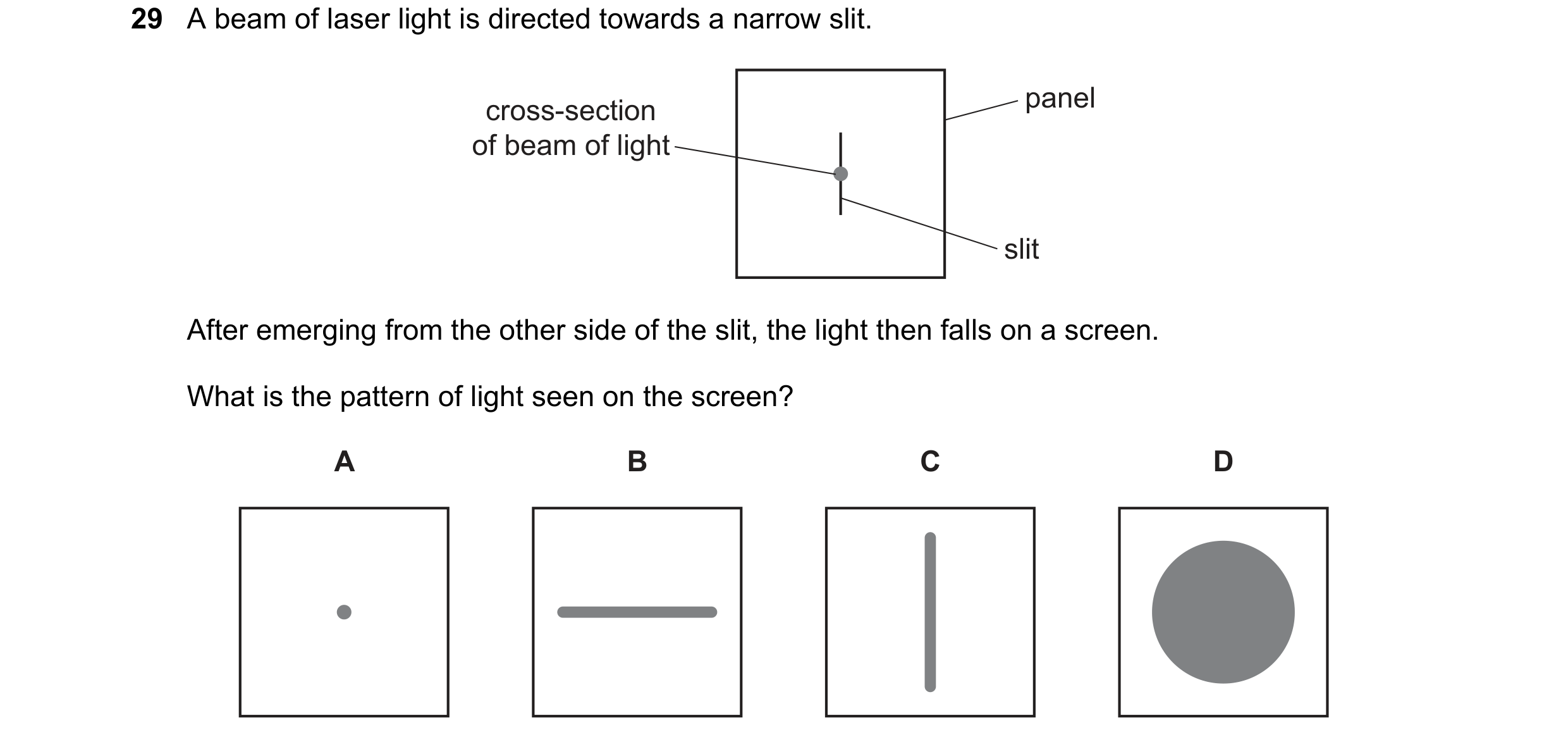
Q30 · A beam of laser light is directed towards a narrow slit 9702/13 Oct/Nov 2017
29 A beam of laser light is directed towards a narrow slit. cross-section panel of beam of light slit After emerging from the other side of the slit, the light then falls on a screen. What is the pattern of light seen on the screen? A B C D
1 marks
Answer: B
This question in 9702/13 Oct/Nov 2017
Q31 · Which statement gives a condition that enables diffraction to occur? 9702/12 Feb/March 2018
29 Which statement gives a condition that enables diffraction to occur? A A source of waves moves towards a stationary observer. B A wave is partially blocked by an obstacle. C Two coherent waves are superposed. D Two waves of equal speed and frequency are travelling through the same part of a medium in opposite directions.
1 marks
Answer: B
This question in 9702/12 Feb/March 2018
Q32 · A water wave in a ripple tank is diffracted as it passes through a gap in a barrier 9702/13 May/June 2018
25 A water wave in a ripple tank is diffracted as it passes through a gap in a barrier. Which two factors affect the angle of diffraction of the wave? A the amplitude and frequency of the incident wave B the amplitude of the incident wave and the width of the gap C the wavelength and amplitude of the incident wave D the wavelength of the incident wave and the width of the gap
1 marks
Answer: D
This question in 9702/13 May/June 2018
Q33 · What is an example of the diffraction of a wave? 9702/11 Oct/Nov 2018
27 What is an example of the diffraction of a wave? A laser light travelling along an optic fibre B light waves forming images on a cinema screen C microwaves passing the edge of a metal plate D sound waves diverging as they pass through air
1 marks
Answer: C
This question in 9702/11 Oct/Nov 2018
Q34 · What happens when waves pass through a gap equal to their wavelength? 9702/12 Oct/Nov 2018
28 What happens when waves pass through a gap equal to their wavelength? A There is diffraction and the wavelength decreases. B There is diffraction and the wavelength stays the same. C There is no diffraction and the wavelength decreases. D There is no diffraction and the wavelength stays the same.
1 marks
Answer: B
This question in 9702/12 Oct/Nov 2018
Q35 · In which situation does diffraction occur? 9702/13 Oct/Nov 2018
27 In which situation does diffraction occur? A A wave bounces back from a surface. B A wave passes from one medium into another. C A wave passes through an aperture. D Waves from two identical sources are superposed.
1 marks
Answer: C
This question in 9702/13 Oct/Nov 2018
Q36 · The diagrams show the diffraction of water waves in a ripple tank as they pass through a… 9702/11 May/June 2019
28 The diagrams show the diffraction of water waves in a ripple tank as they pass through a gap between two barriers. Which diagram is correct? A B C D
1 marks
Answer: B
This question in 9702/11 May/June 2019
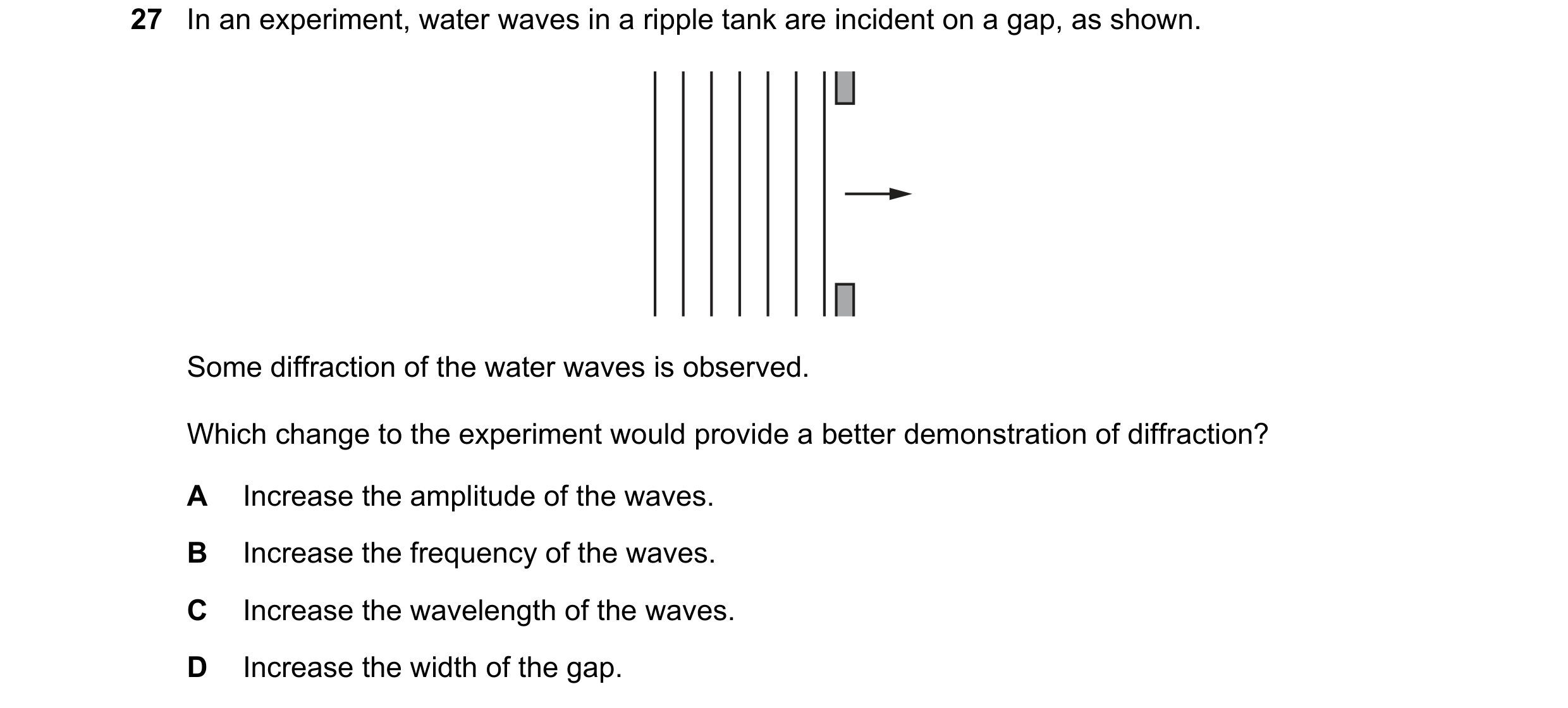
Q37 · In an experiment, water waves in a ripple tank are incident on a gap, as shown 9702/13 May/June 2019
27 In an experiment, water waves in a ripple tank are incident on a gap, as shown. Some diffraction of the water waves is observed. Which change to the experiment would provide a better demonstration of diffraction? A Increase the amplitude of the waves. B Increase the frequency of the waves. C Increase the wavelength of the waves. D Increase the width of the gap.
1 marks
Answer: C
This question in 9702/13 May/June 2019
Q38 · Water waves of wavelength λ are incident normally on an obstacle with a narrow gap 9702/11 Oct/Nov 2019
27 Water waves of wavelength λ are incident normally on an obstacle with a narrow gap. The width of the gap is equal to λ. The waves from the gap emerge over an angle θ as shown. λ λ incident diffracted θ water waves water waves The gap is slowly widened. Which changes, if any, occur to θ and to the wavelength of the emerging waves? θ wavelength A decreases remains the same B increases remains the same C remains the same decreases D remains the same increases
1 marks
Answer: A
This question in 9702/11 Oct/Nov 2019
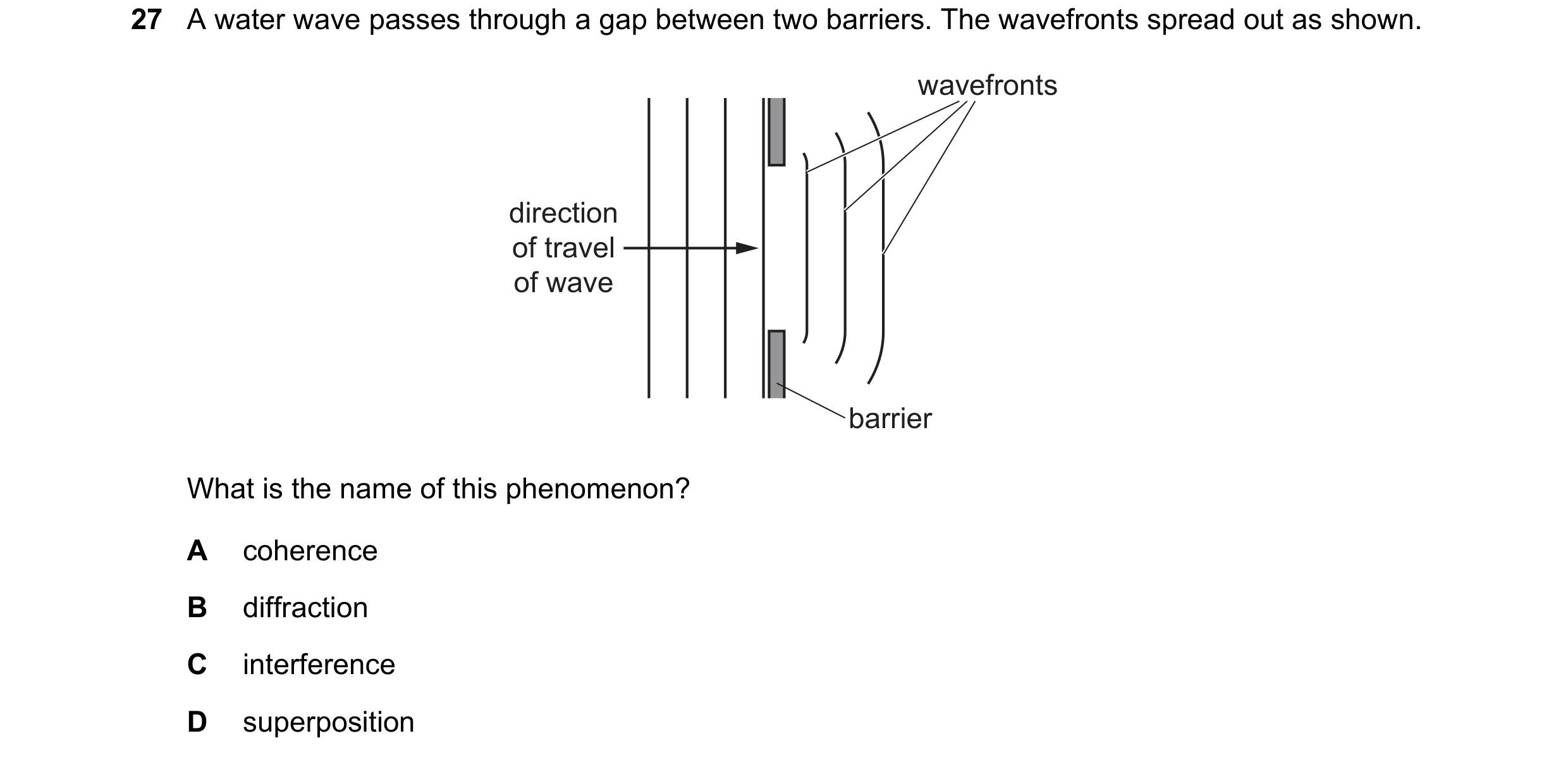
Q39 · A water wave passes through a gap between two barriers 9702/12 Feb/March 2020
27 A water wave passes through a gap between two barriers. The wavefronts spread out as shown. wavefronts direction of travel of wave barrier What is the name of this phenomenon? A coherence B diffraction C interference D superposition
1 marks
Answer: B
This question in 9702/12 Feb/March 2020
Q40 · Which statement must be true for diffraction to occur when a wave passes through a gap? 9702/11 May/June 2020
28 Which statement must be true for diffraction to occur when a wave passes through a gap? A The wave is able to travel in a vacuum. B The wave is progressive. C The wave has a large amplitude. D The wave has a long wavelength.
1 marks
Answer: B
This question in 9702/11 May/June 2020
Q41 · A hill separates a television (TV) transmitter from a house 9702/12 May/June 2020
28 A hill separates a television (TV) transmitter from a house. The transmitter cannot be seen from the house. However, the house has good TV reception. hill TV transmitter house By which wave effect at the hill could the TV signal reach the house? A coherence B diffraction C interference D reflection
1 marks
Answer: B
This question in 9702/12 May/June 2020
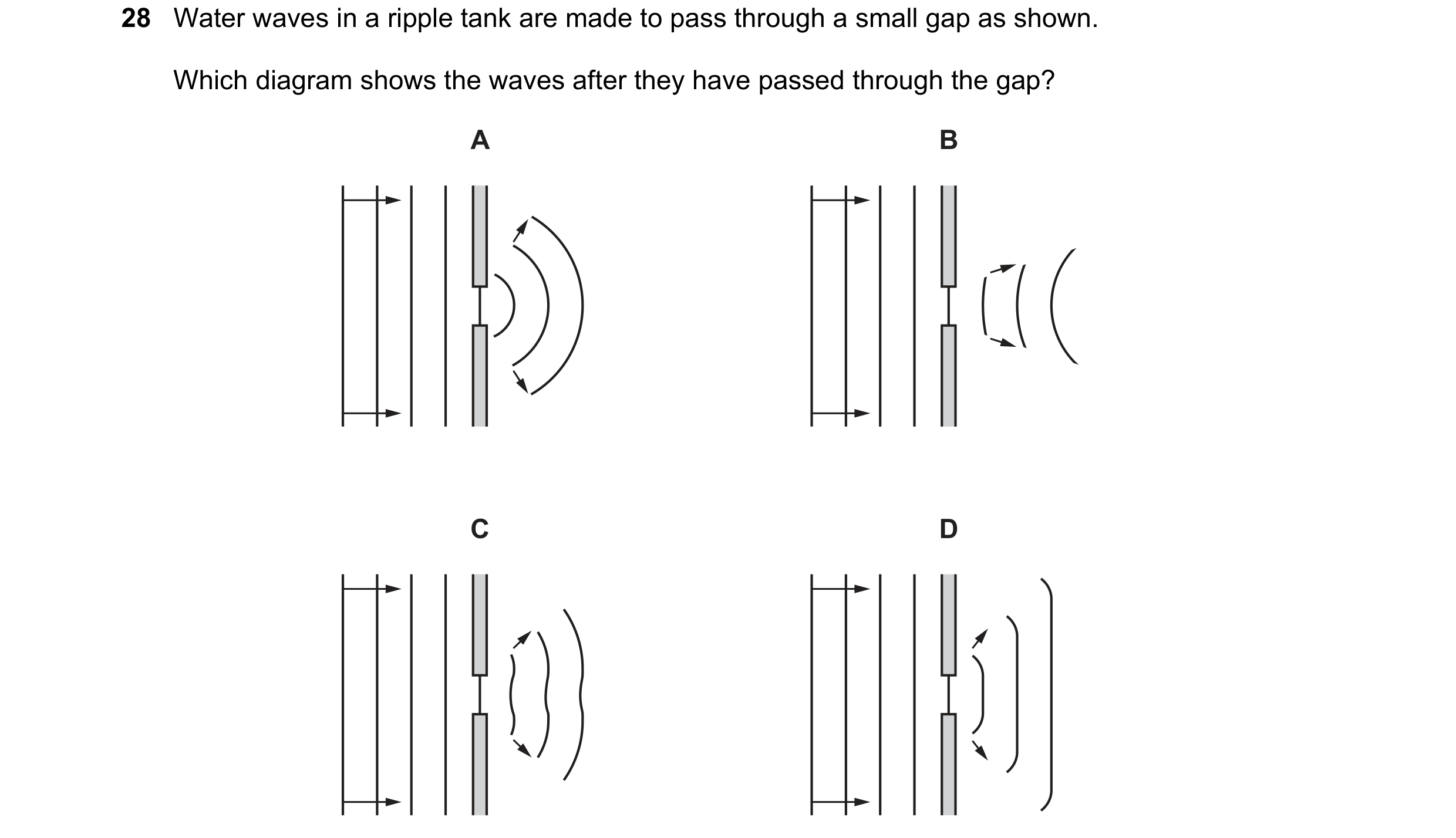
Q42 · Water waves in a ripple tank are made to pass through a small gap as shown 9702/13 May/June 2020
28 Water waves in a ripple tank are made to pass through a small gap as shown. Which diagram shows the waves after they have passed through the gap? A B C D
1 marks
Answer: A
This question in 9702/13 May/June 2020
Q43 · Which waves would best demonstrate diffraction through a doorway? 9702/11 Oct/Nov 2020
27 Which waves would best demonstrate diffraction through a doorway? A sound waves B ultraviolet waves C visible light waves D X-rays
1 marks
Answer: A
This question in 9702/11 Oct/Nov 2020
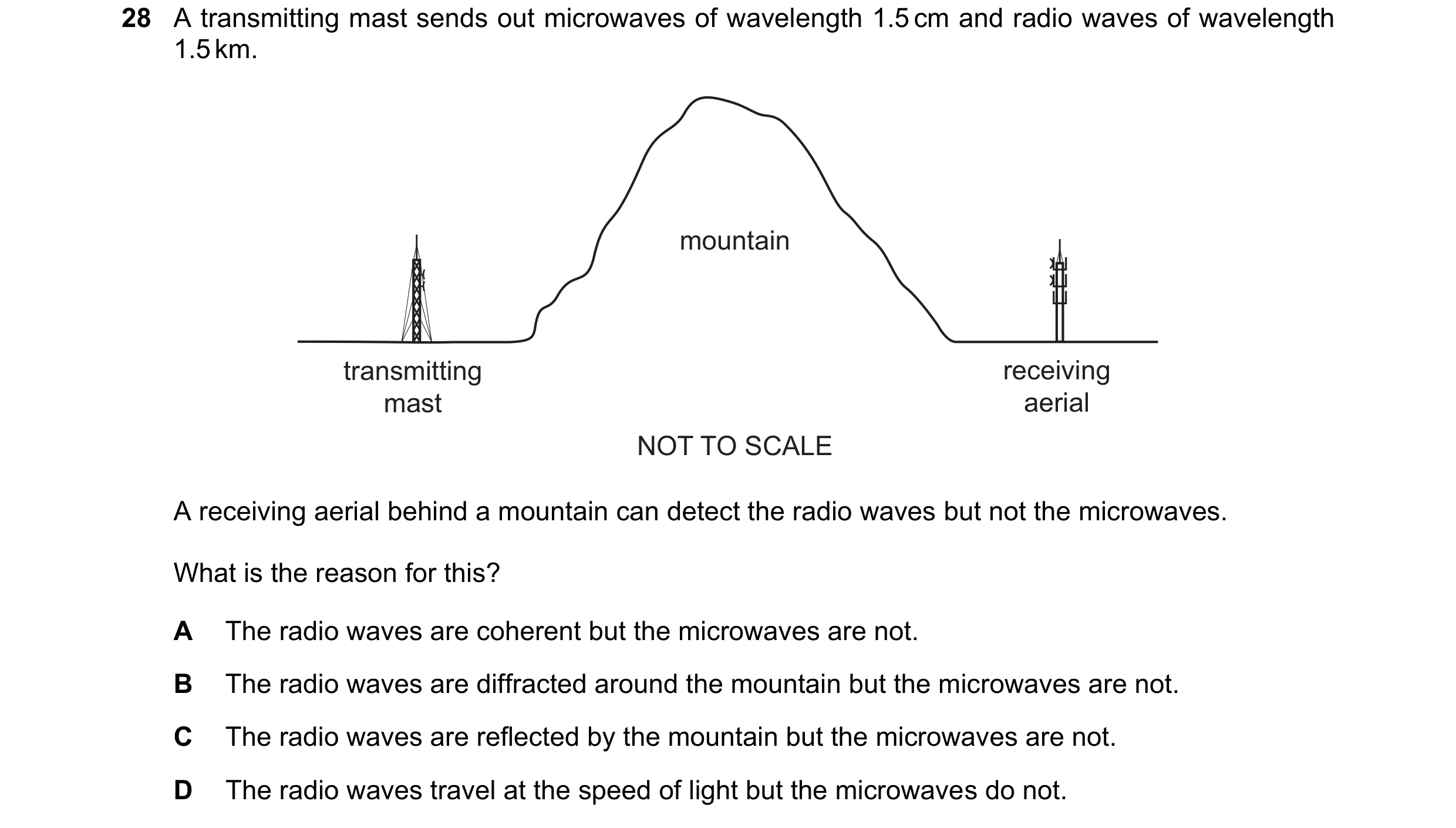
Q44 · A transmitting mast sends out microwaves of wavelength 1.5 cm and radio waves of… 9702/12 Oct/Nov 2020
28 A transmitting mast sends out microwaves of wavelength 1.5 cm and radio waves of wavelength 1.5 km. mountain transmitting receiving mast aerial NOT TO SCALE A receiving aerial behind a mountain can detect the radio waves but not the microwaves. What is the reason for this? A The radio waves are coherent but the microwaves are not. B The radio waves are diffracted around the mountain but the microwaves are not. C The radio waves are reflected by the mountain but the microwaves are not. D The radio waves travel at the speed of light but the microwaves do not.
1 marks
Answer: B
This question in 9702/12 Oct/Nov 2020
Q45 · What is meant by diffraction? 9702/13 Oct/Nov 2020
28 What is meant by diffraction? A the change in observed frequency when a wave source moves relative to an observer B the formation of nodes and antinodes by two progressive waves travelling in opposite directions C the spreading of a wave around the edge of an obstacle D the superposition of two waves when they meet
1 marks
Answer: C
This question in 9702/13 Oct/Nov 2020
Q46 · A water wave is diffracted as it passes through a gap between two barriers in a ripple… 9702/12 Feb/March 2021
27 A water wave is diffracted as it passes through a gap between two barriers in a ripple tank. The wave is observed to ‘spread out’ as it moves through the gap. Which two factors both affect the amount of diffraction observed? A the amplitude and frequency of the incident wave B the amplitude of the incident wave and the width of the gap C the wavelength and amplitude of the incident wave D the wavelength of the incident wave and the width of the gap
1 marks
Answer: D
This question in 9702/12 Feb/March 2021
Q47 · Which wave behaviour is shown in the diagram? 9702/11 May/June 2021
27 Which wave behaviour is shown in the diagram? horizon sea wall sea sea wall beach wavefronts A diffraction B Doppler shift C interference D superposition
1 marks
Answer: A
This question in 9702/11 May/June 2021
Q48 · The speed of sound in air is 330 m s–1 9702/13 May/June 2021
28 The speed of sound in air is 330 m s–1. Which size of architectural features in a large concert hall would best diffract sound waves of frequency 0.44 kHz? A 1.3 mm B 750 mm C 7.5 m D 17 m
1 marks
Answer: B
This question in 9702/13 May/June 2021
Q49 · A water wave in a ripple tank is diffracted as it passes through a gap in a barrier 9702/11 Oct/Nov 2021
27 A water wave in a ripple tank is diffracted as it passes through a gap in a barrier. Which two factors affect the angle of diffraction of the wave? A the amplitude and frequency of the incident wave B the amplitude of the incident wave and the width of the gap C the wavelength and amplitude of the incident wave D the wavelength of the incident wave and the width of the gap
1 marks
Answer: D
This question in 9702/11 Oct/Nov 2021
Q50 · A smooth surface has bumps on the surface that are smaller than the wavelength of visible… 9702/13 Oct/Nov 2021
26 A smooth surface has bumps on the surface that are smaller than the wavelength of visible light. What is the approximate maximum size of the largest bumps on the surface? A 20 nm B 350 nm C 720 nm D 5.0 m
1 marks
Answer: B
This question in 9702/13 Oct/Nov 2021
Q51 · Which diagram shows the diffraction of water waves in a ripple tank? 9702/13 Oct/Nov 2021
28 Which diagram shows the diffraction of water waves in a ripple tank? A B C D
1 marks
Answer: C
This question in 9702/13 Oct/Nov 2021
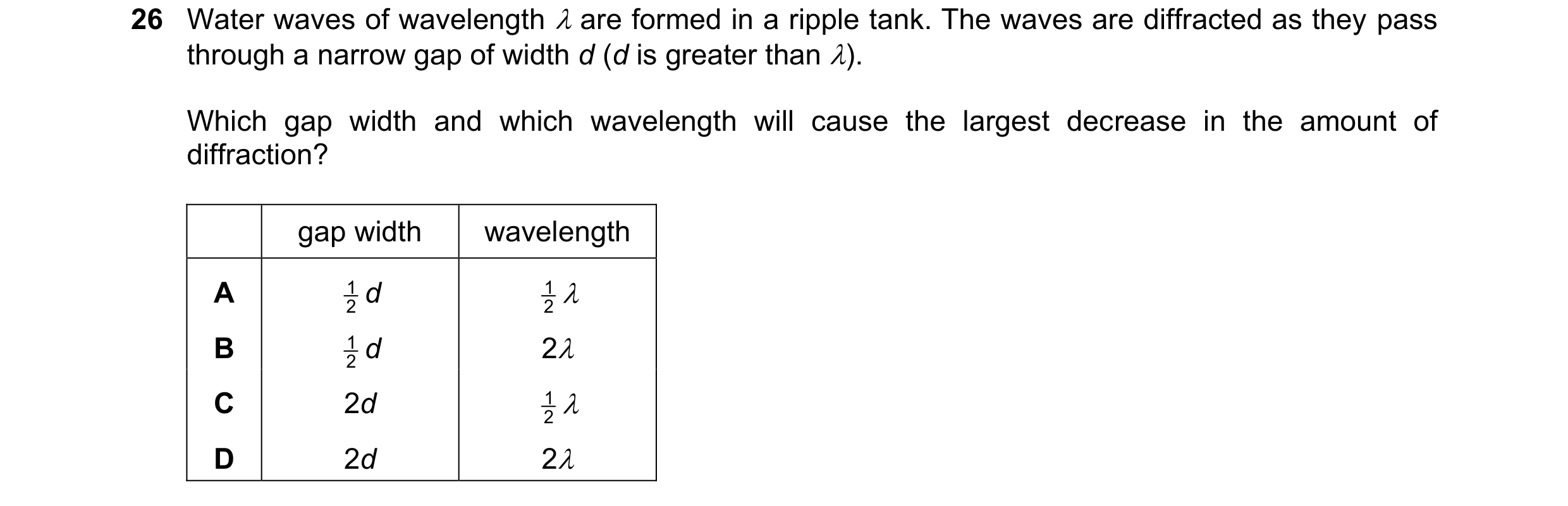
Q52 · Water waves of wavelength are formed in a ripple tank 9702/12 Feb/March 2022
26 Water waves of wavelength are formed in a ripple tank. The waves are diffracted as they pass through a narrow gap of width d (d is greater than ). Which gap width and which wavelength will cause the largest decrease in the amount of diffraction? gap width wavelength A 1 d 1 2 2 B 1 d 2 2 C 2d 1 2 D 2d 2
1 marks
Answer: C
This question in 9702/12 Feb/March 2022
Q53 · Water waves of wavelength 4 are incident normally on an obstacle with a narrow gap 9702/11 May/June 2022
28 Water waves of wavelength 4 are incident normally on an obstacle with a narrow gap. The width
of the gap is equal to 2. The waves from the gap emerge over an angle @, as shown.
incident
water waves
emerging
water waves
The gap is slowly widened.
Which changes, if any, occur to @and to the wavelength of the emerging waves?
0 wavelength
A decreases remains the same
B increases remains the same
Cc remains the same decreases
D remains the same increases
1 marks
Answer: A
This question in 9702/11 May/June 2022
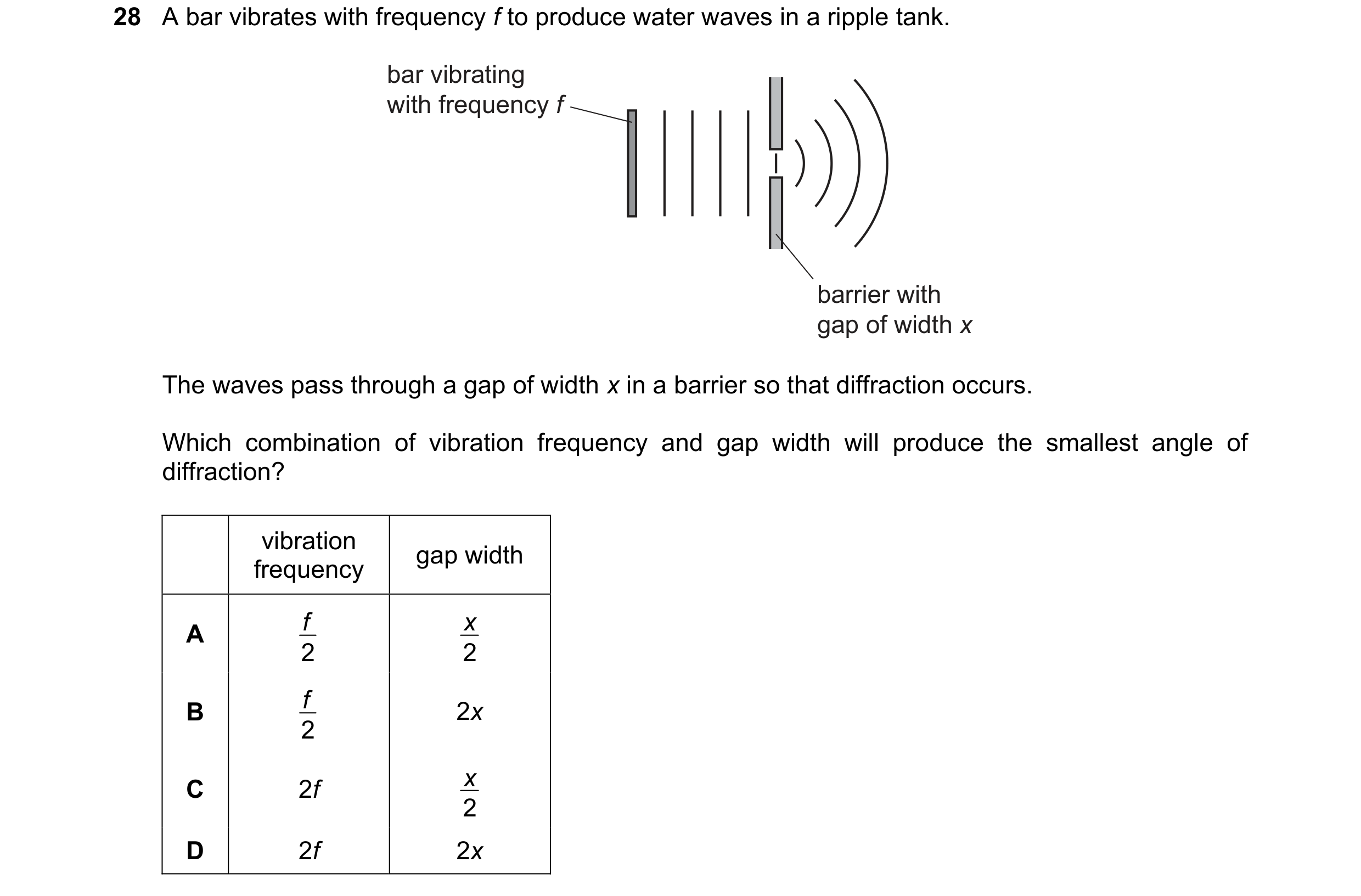
Q54 · A bar vibrates with frequency f to produce water waves in a ripple tank 9702/12 May/June 2022
28 A bar vibrates with frequency f to produce water waves in a ripple tank. bar vibrating with frequency f barrier with gap of width x The waves pass through a gap of width x in a barrier so that diffraction occurs. Which combination of vibration frequency and gap width will produce the smallest angle of diffraction? vibration gap width frequency f x A 2 2 f B 2x 2 x C 2f 2 D 2f 2x
1 marks
Answer: D
This question in 9702/12 May/June 2022
Q55 · A wave on the surface of water passes through a gap between two barriers and is… 9702/11 Oct/Nov 2022
28 A wave on the surface of water passes through a gap between two barriers and is diffracted, as shown. barrier barrier What happens when the frequency of the wave is halved? A Less diffraction is observed. B More diffraction is observed. C There is no diffraction. D The same amount of diffraction is observed.
1 marks
Answer: B
This question in 9702/11 Oct/Nov 2022
Q56 · In which situation does diffraction occur? 9702/12 Oct/Nov 2022
28 In which situation does diffraction occur? A A wave bounces back from a surface. B A wave passes from one medium into another. C A wave passes through a gap in a barrier. D Waves from two identical sources are superposed.
1 marks
Answer: C
This question in 9702/12 Oct/Nov 2022
Q57 · A sound wave of wavelength 0.50 m passes through a doorway of width 1.0 m between two… 9702/13 Oct/Nov 2022
27 A sound wave of wavelength 0.50 m passes through a doorway of width 1.0 m between two rooms. Which change increases the amount of diffraction that takes place? A Double the amplitude of the sound wave. B Double the width of the doorway. C Halve the frequency of the sound wave. D Halve the period of the sound wave.
1 marks
Answer: C
This question in 9702/13 Oct/Nov 2022
Q58 · A transmitting mast sends out microwaves of wavelength 1.5 cm and radio waves of… 9702/12 Feb/March 2023
27 A transmitting mast sends out microwaves of wavelength 1.5 cm and radio waves of wavelength 1.5 km. mountain transmitting receiving mast aerial NOT TO SCALE A receiving aerial behind a mountain can detect the radio waves but not the microwaves. What is the reason for this? A The radio waves are coherent but the microwaves are not. B The radio waves are diffracted around the mountain but the microwaves are not. C The radio waves are reflected by the mountain but the microwaves are not. D The radio waves travel at the speed of light but the microwaves do not.
1 marks
Answer: B
This question in 9702/12 Feb/March 2023
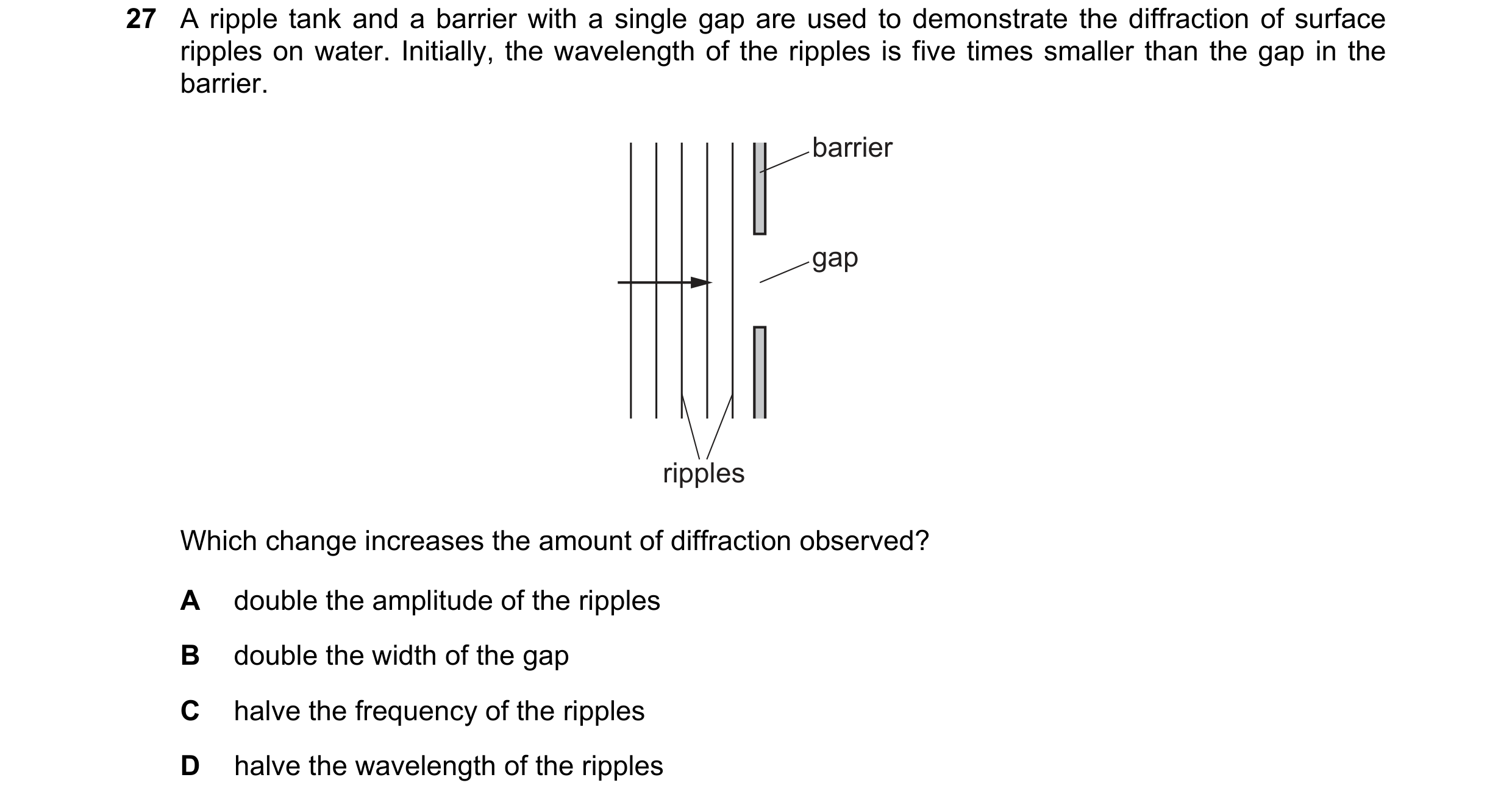
Q59 · A ripple tank and a barrier with a single gap are used to demonstrate the diffraction of… 9702/11 May/June 2023
27 A ripple tank and a barrier with a single gap are used to demonstrate the diffraction of surface ripples on water. Initially, the wavelength of the ripples is five times smaller than the gap in the barrier. barrier gap ripples Which change increases the amount of diffraction observed? A double the amplitude of the ripples B double the width of the gap C halve the frequency of the ripples D halve the wavelength of the ripples
1 marks
Answer: C
This question in 9702/11 May/June 2023
Q60 · A continuous progressive water wave in a ripple tank passes through a gap in a barrier… 9702/12 May/June 2023
27 A continuous progressive water wave in a ripple tank passes through a gap in a barrier and diffracts. The width of the gap is greater than the wavelength of the wave. Which change causes the wave to spread over a larger angle as it passes through the gap? A a small decrease in the wavelength of the wave B a small decrease in the width of the gap C a small increase in the frequency of the wave D a small increase in the height of the barrier
1 marks
Answer: B
This question in 9702/12 May/June 2023
Q61 · An experiment is set up to demonstrate the diffraction of water waves in a ripple tank 9702/13 May/June 2023
27 An experiment is set up to demonstrate the diffraction of water waves in a ripple tank. The waves pass through a gap of width w and some diffraction of the waves is observed. The wavelength of the waves is now doubled. What is the new gap width needed to cause the same amount of diffraction as before? A 0.5w B w C 2w D 4w
1 marks
Answer: C
This question in 9702/13 May/June 2023
Q62 · A teacher is explaining diffraction to a group of students 9702/12 Oct/Nov 2023
27 A teacher is explaining diffraction to a group of students. Which piece of apparatus is most appropriate for the teacher to use to demonstrate diffraction? A a long spring B a ripple tank C a rope D a stretched string
1 marks
Answer: B
This question in 9702/12 Oct/Nov 2023
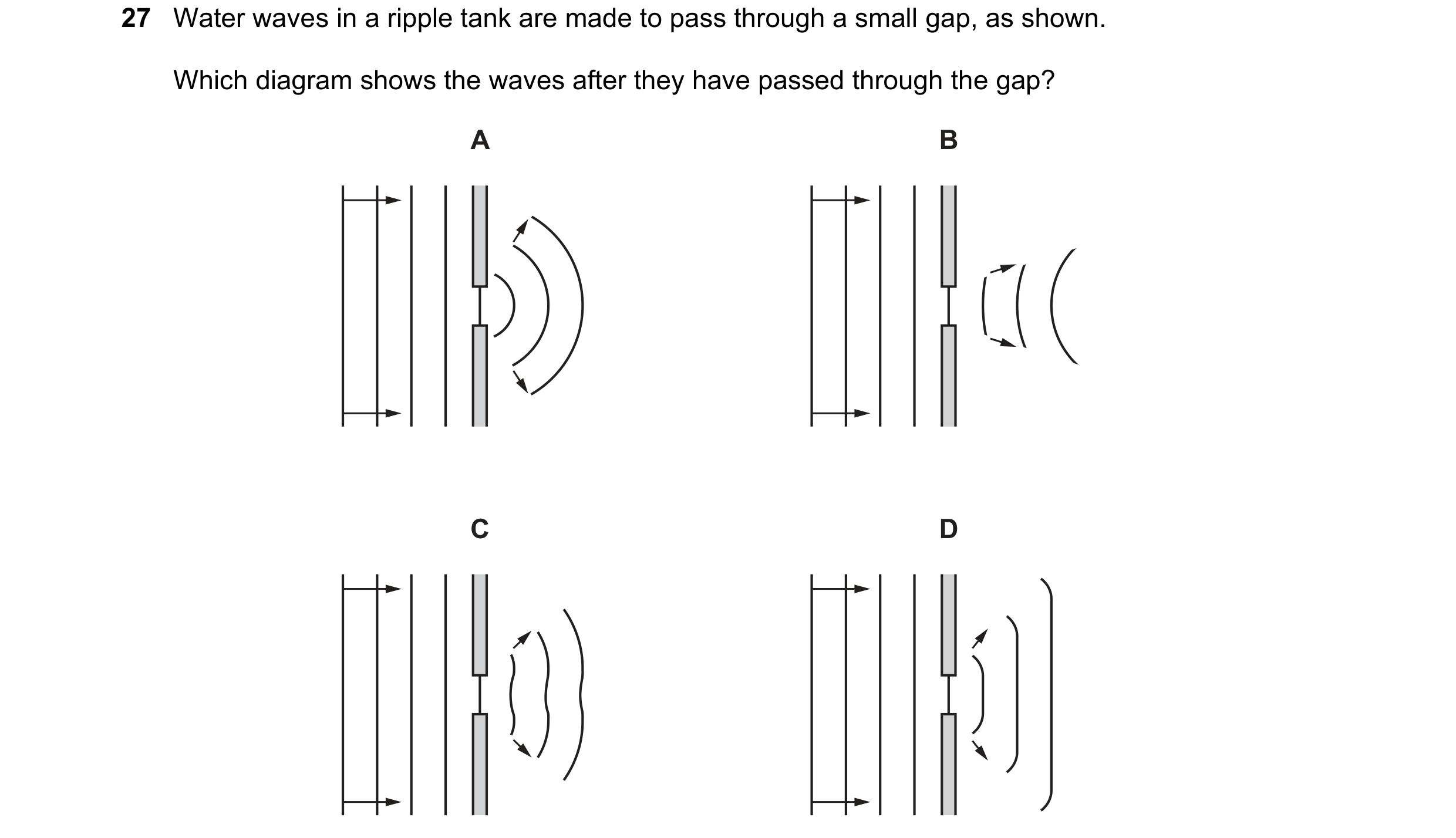
Q63 · Water waves in a ripple tank are made to pass through a small gap, as shown 9702/13 Oct/Nov 2023
27 Water waves in a ripple tank are made to pass through a small gap, as shown. Which diagram shows the waves after they have passed through the gap? A B C D
1 marks
Answer: A
This question in 9702/13 Oct/Nov 2023
Q64 · A loudspeaker is playing music in a room 9702/12 May/June 2024
22 A loudspeaker is playing music in a room. The door to the room is open and has a width of 0.80 m. Sound waves of many different frequencies pass through the doorway and diffract. The speed of sound in air is 340 m s–1. Which frequency of sound wave diffracts the most as it passes through the doorway? A 2.4 10–3 Hz B 8.0 10–1 Hz C 2.7 102 Hz D 4.3 102 Hz
1 marks
Answer: D
This question in 9702/12 May/June 2024
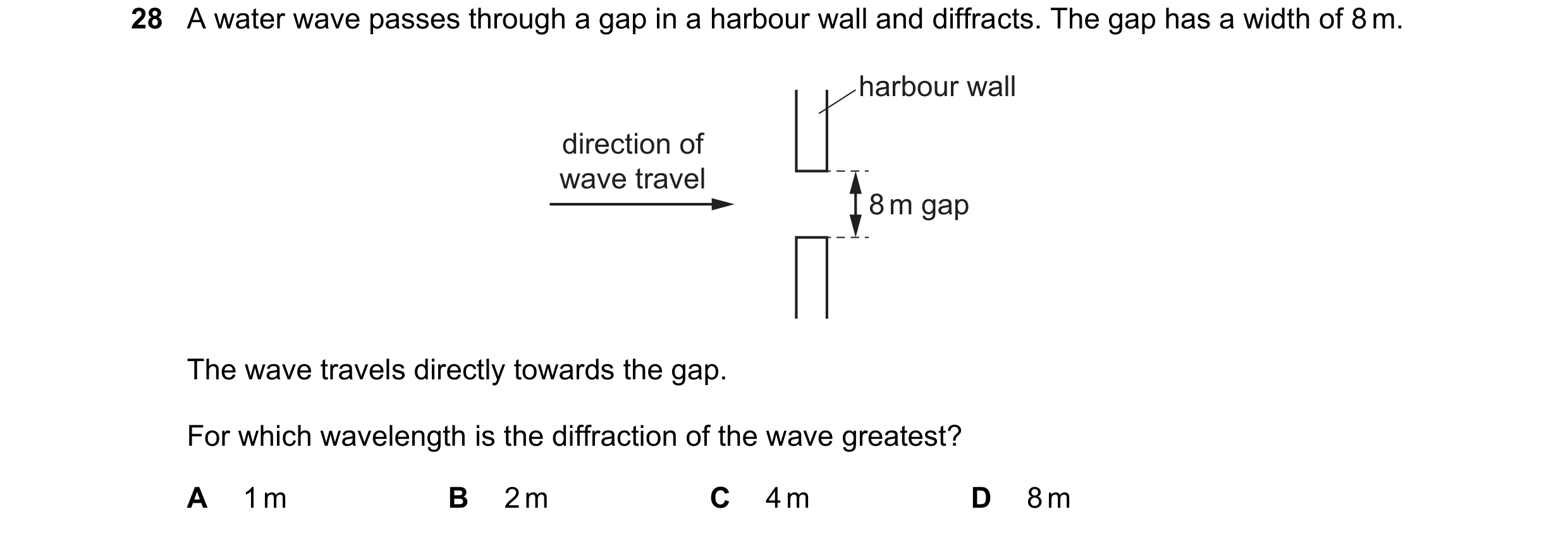
Q65 · A water wave passes through a gap in a harbour wall and diffracts 9702/13 May/June 2024
28 A water wave passes through a gap in a harbour wall and diffracts. The gap has a width of 8 m. harbour wall direction of wave travel 8 m gap The wave travels directly towards the gap. For which wavelength is the diffraction of the wave greatest? A 1 m B 2 m C 4 m D 8 m
1 marks
Answer: D
This question in 9702/13 May/June 2024
Q66 · An electromagnetic wave is diffracted as it passes through a single slit 9702/12 Oct/Nov 2024
29 An electromagnetic wave is diffracted as it passes through a single slit. The width of the slit is larger than the wavelength of the wave. Which change will decrease the amount of diffraction of the wave? A Decrease the frequency of the wave. B Decrease the time period of the wave. C Decrease the width of the slit. D Increase the wavelength of the wave.
1 marks
Answer: B
This question in 9702/12 Oct/Nov 2024
Q67 · A vibrating bar produces surface water waves in a ripple tank 9702/13 Oct/Nov 2024
30 A vibrating bar produces surface water waves in a ripple tank. The wavelength of the waves is 5.0 cm and they pass through a gap of width 20 cm. 5.0 cm ripple tank 20 cm vibrating shallow water bar barrier with gap Which change will increase the amount of diffraction that is observed? A decreasing the distance between the bar and the gap B decreasing the frequency of the wave C increasing the amplitude of the wave D increasing the width of the gap
1 marks
Answer: B
This question in 9702/13 Oct/Nov 2024
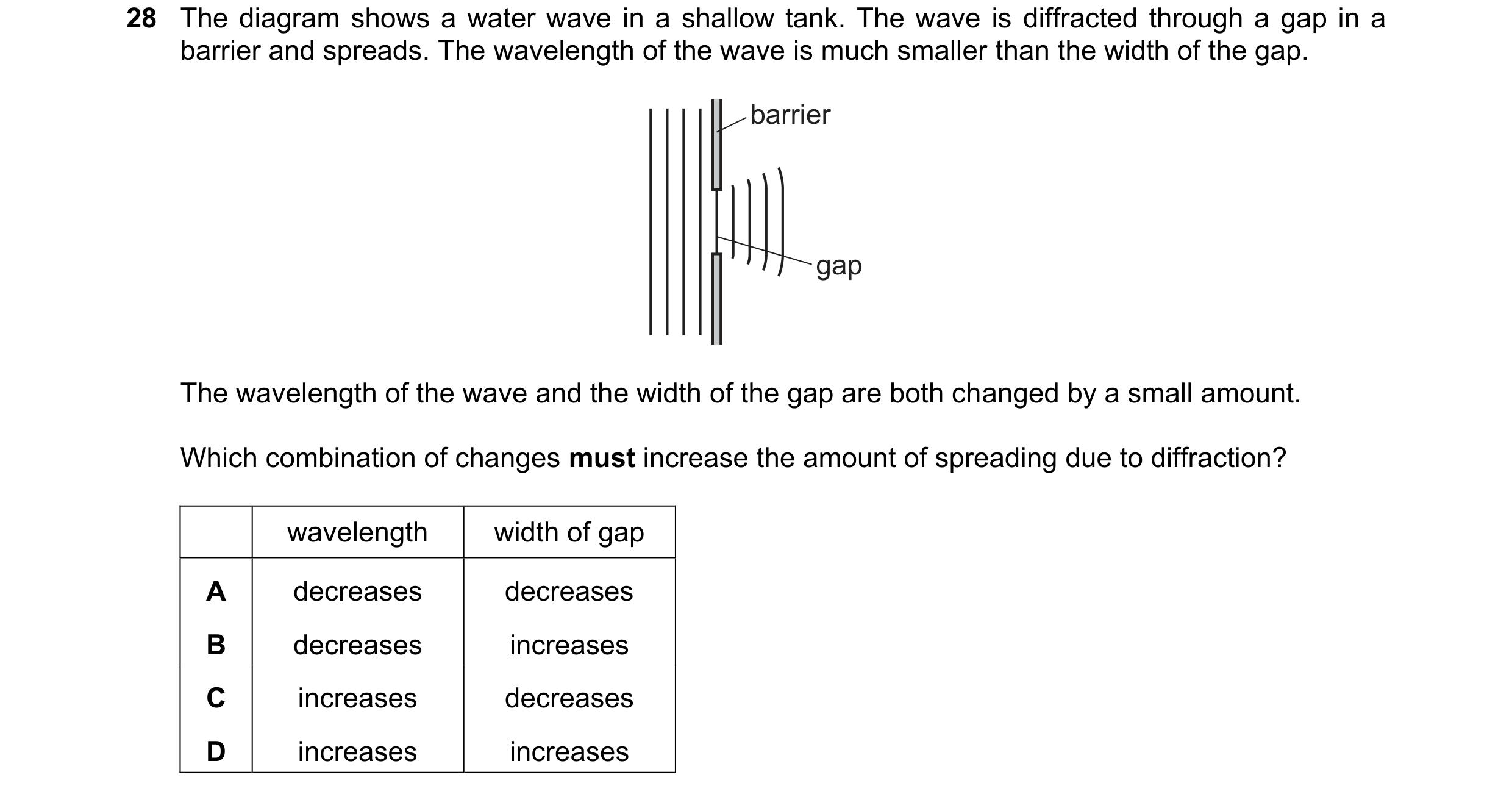
Q68 · The diagram shows a water wave in a shallow tank 9702/12 Feb/March 2025
28 The diagram shows a water wave in a shallow tank. The wave is diffracted through a gap in a barrier and spreads. The wavelength of the wave is much smaller than the width of the gap. barrier gap The wavelength of the wave and the width of the gap are both changed by a small amount. Which combination of changes must increase the amount of spreading due to diffraction? wavelength width of gap A decreases decreases B decreases increases C increases decreases D increases increases
1 marks
Answer: C
This question in 9702/12 Feb/March 2025
Q69 · A ripple tank contains water at a constant depth 9702/13 May/June 2025
30 A ripple tank contains water at a constant depth. A water wave of constant frequency travels towards a gap in a barrier placed in the ripple tank. The gap is made smaller. Which diagram represents the wave before and after the barrier? A B C D
1 marks
Answer: D
This question in 9702/13 May/June 2025
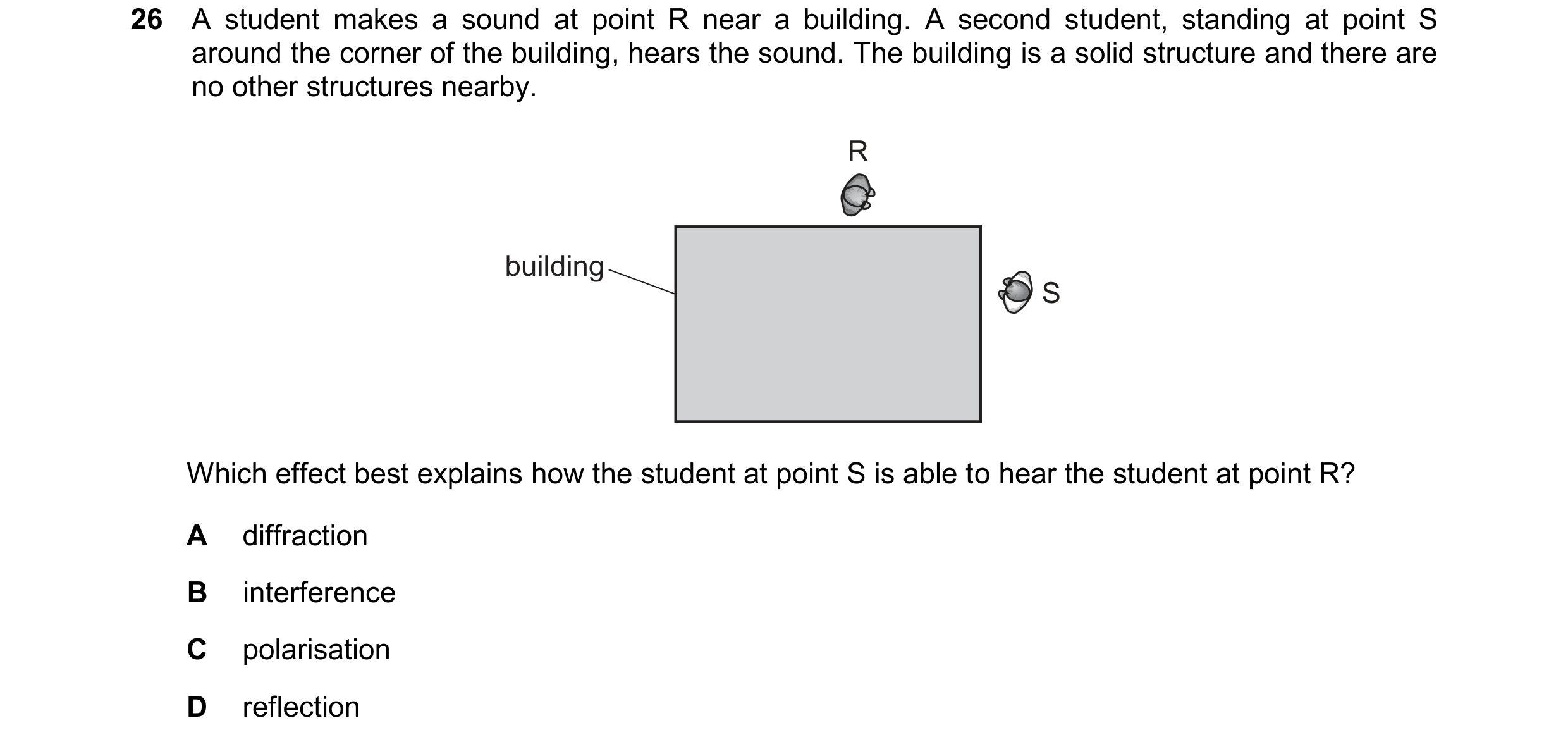
Q70 · A student makes a sound at point R near a building 9702/14 May/June 2025
26 A student makes a sound at point R near a building. A second student, standing at point S around the corner of the building, hears the sound. The building is a solid structure and there are no other structures nearby. R building S Which effect best explains how the student at point S is able to hear the student at point R? A diffraction B interference C polarisation D reflection
1 marks
Answer: A
This question in 9702/14 May/June 2025
Q71 · A light wave passes through a single slit and a diffraction pattern forms 9702/12 Oct/Nov 2025
28 A light wave passes through a single slit and a diffraction pattern forms. What happens to the frequency and the speed of the wave when it is diffracted? frequency speed A decreases increases B increases decreases C no change decreases D no change no change
1 marks
Answer: D
This question in 9702/12 Oct/Nov 2025
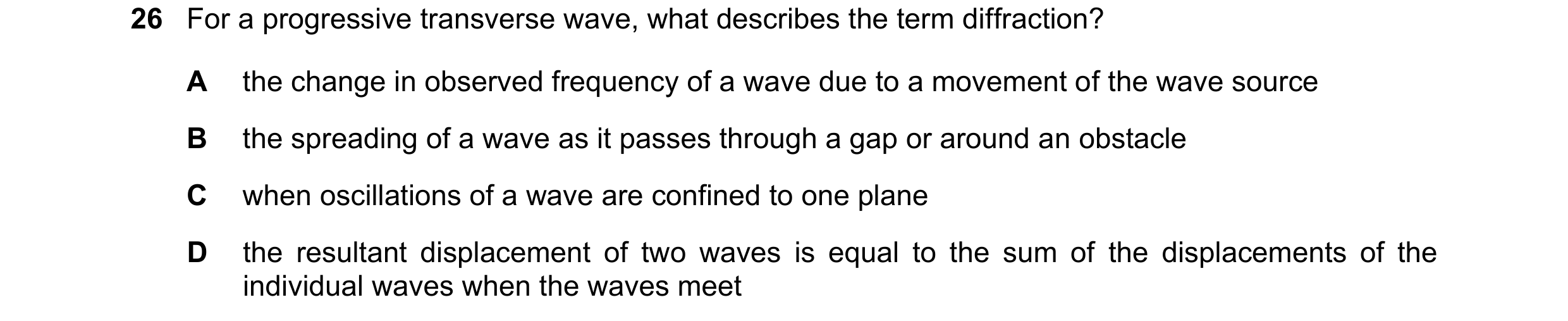
Q72 · For a progressive transverse wave, what describes the term diffraction? 9702/14 Oct/Nov 2025
26 For a progressive transverse wave, what describes the term diffraction? A the change in observed frequency of a wave due to a movement of the wave source B the spreading of a wave as it passes through a gap or around an obstacle C when oscillations of a wave are confined to one plane D the resultant displacement of two waves is equal to the sum of the displacements of the individual waves when the waves meet
1 marks
Answer: B
This question in 9702/14 Oct/Nov 2025


 1 / 25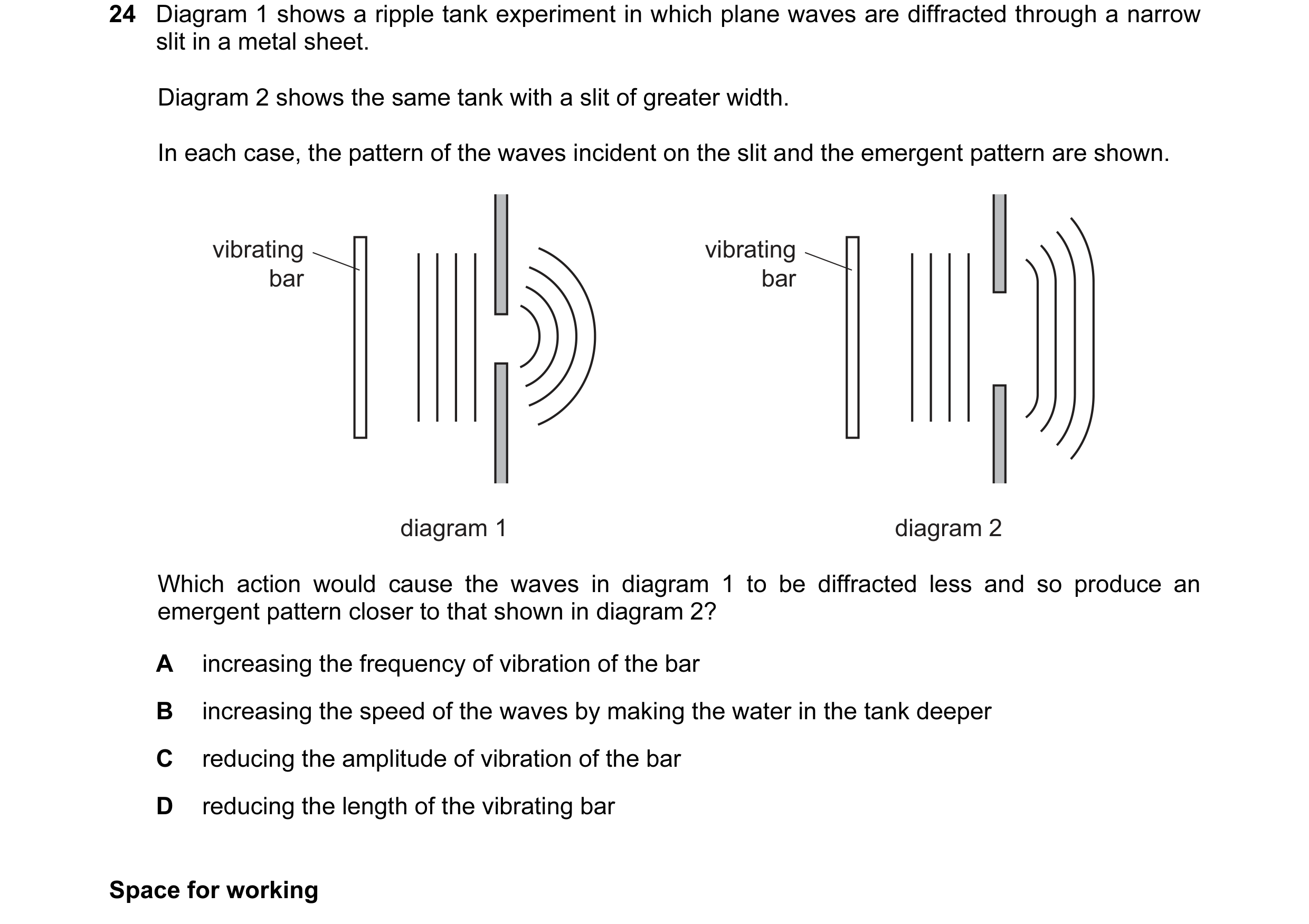
 2 / 25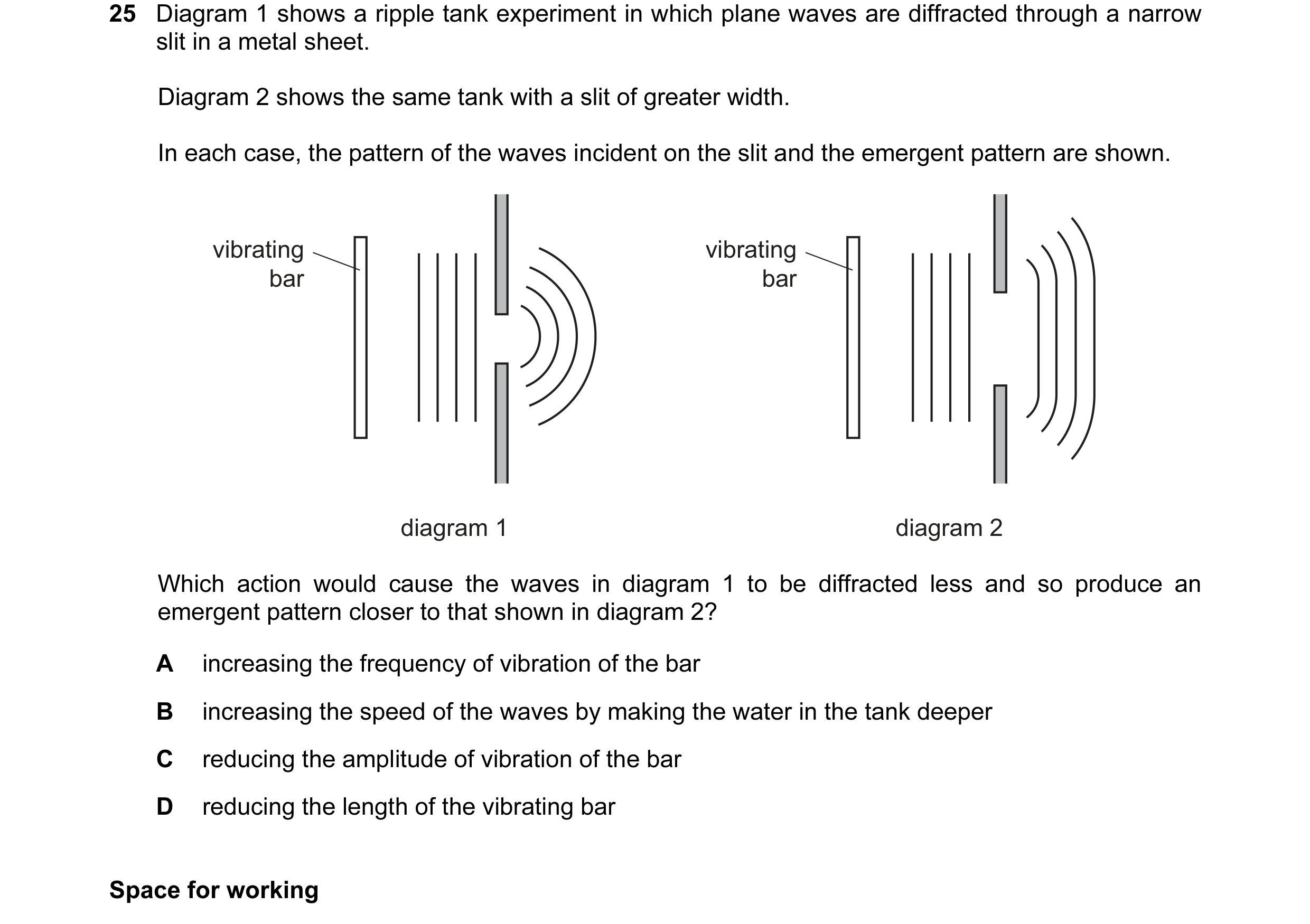
 3 / 25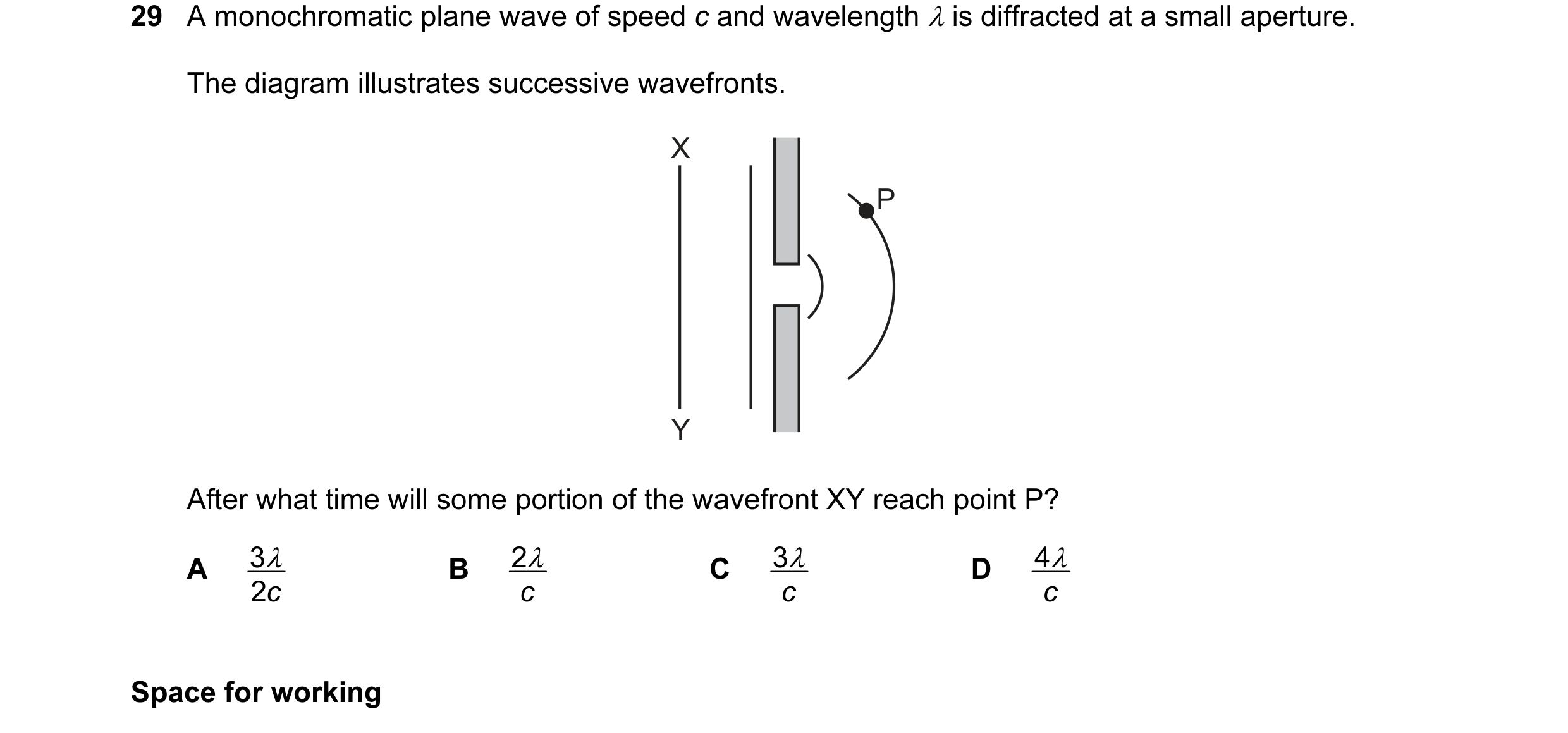
 4 / 25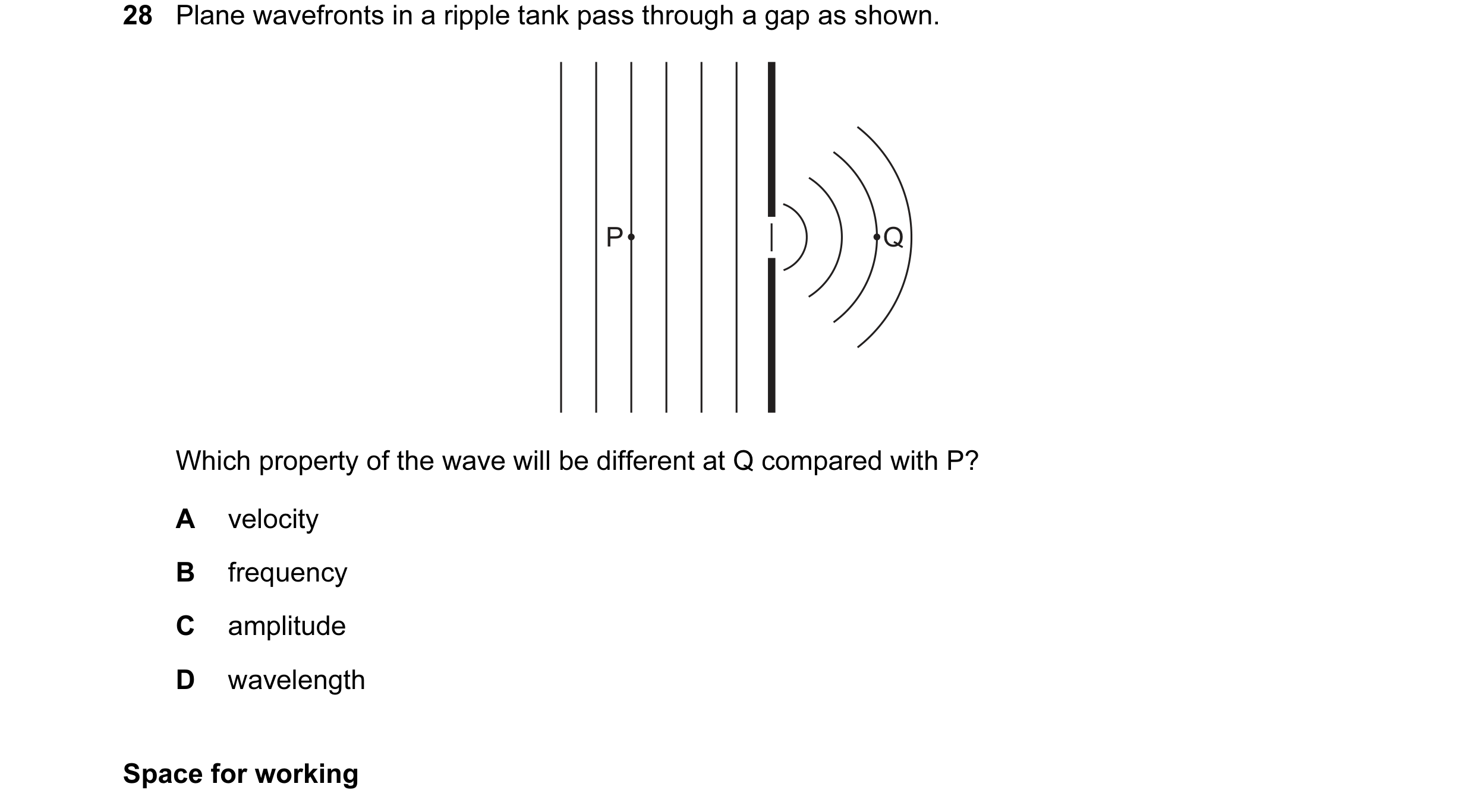
 5 / 25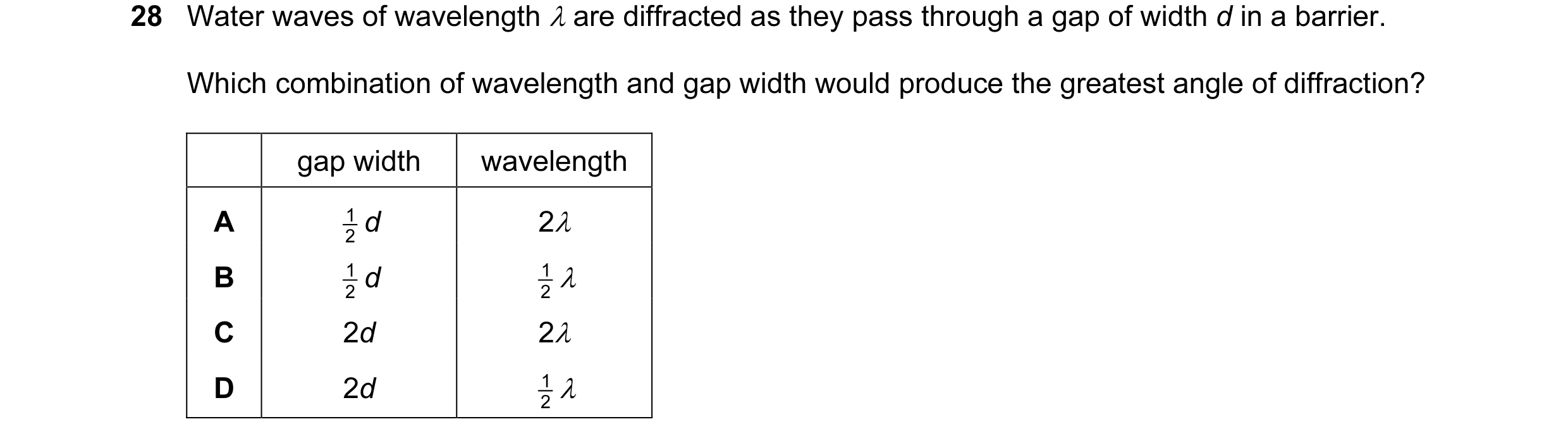
 6 / 25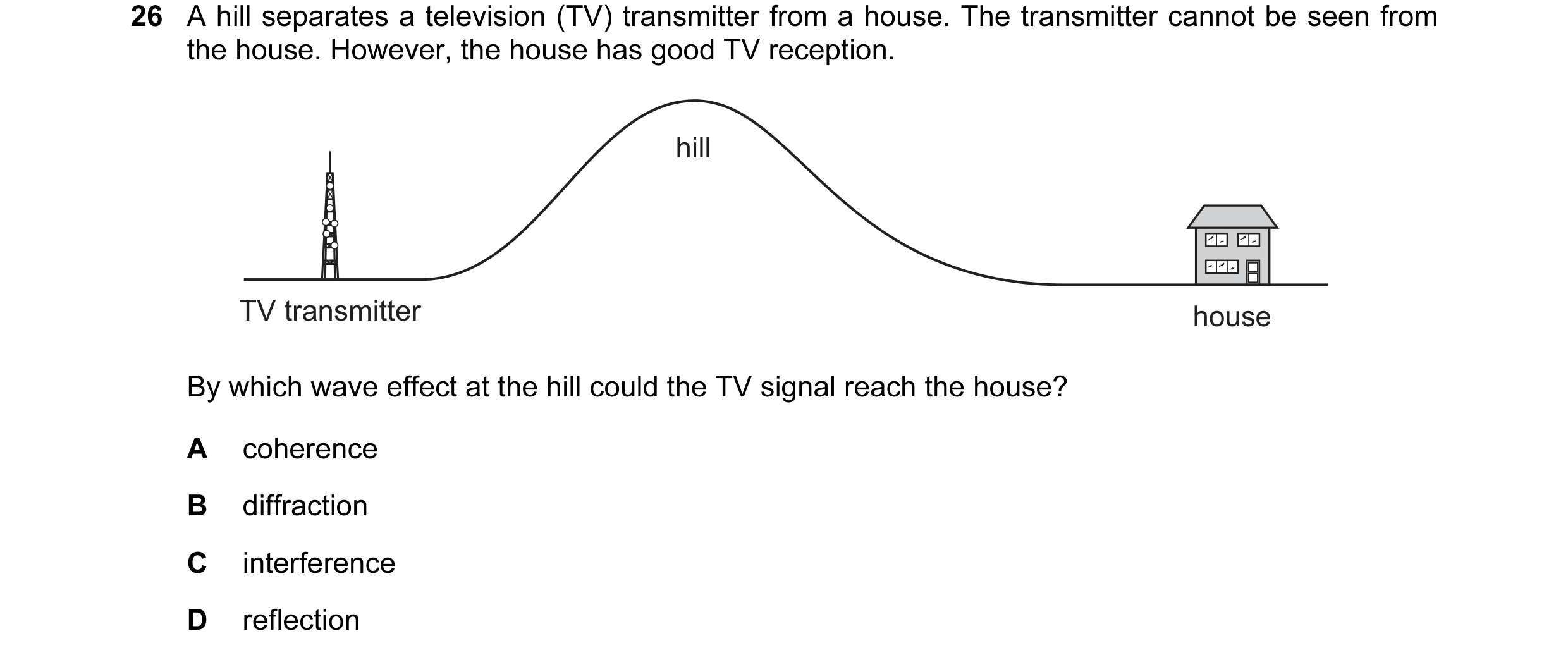
 7 / 25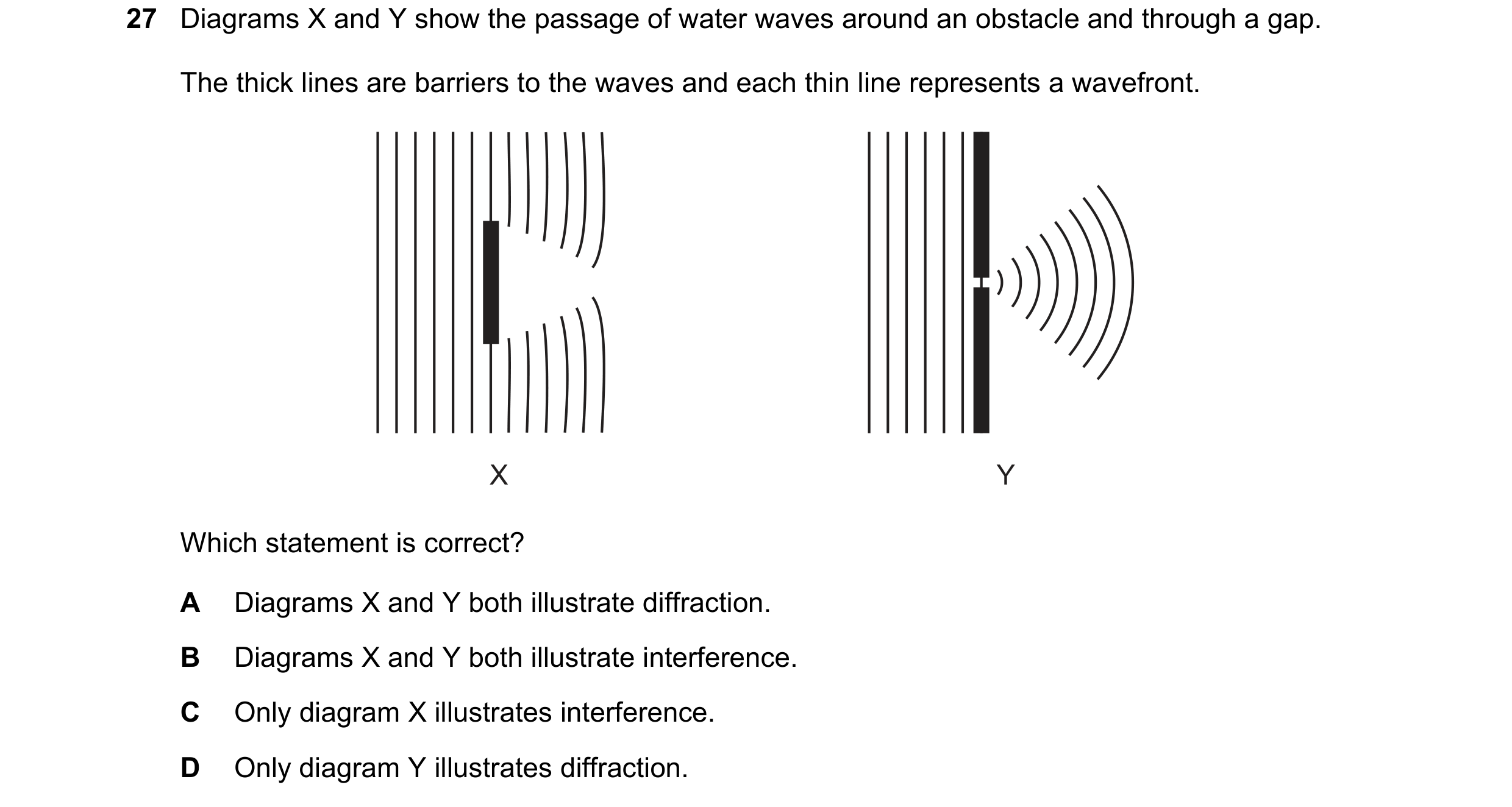
 8 / 25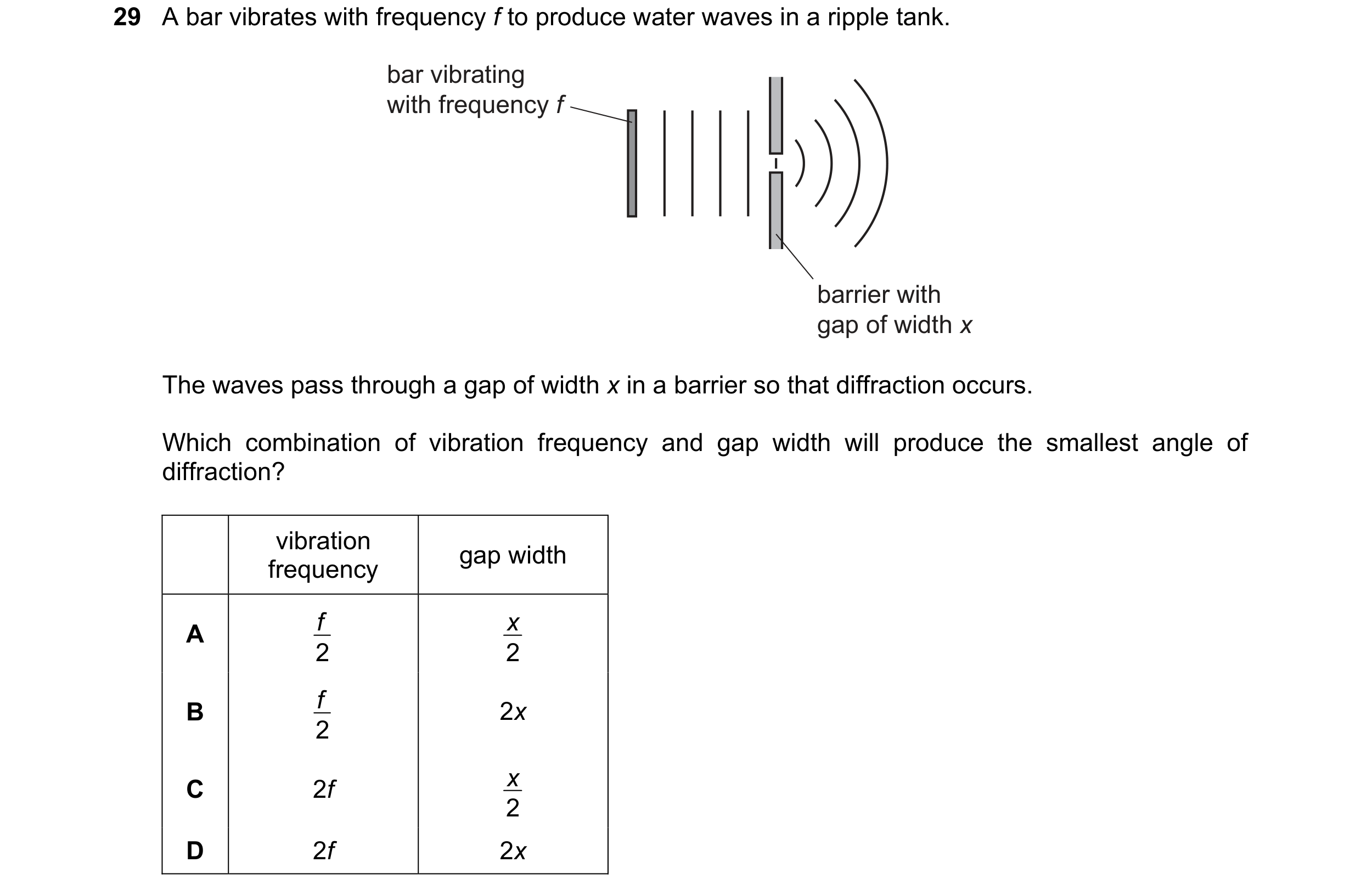
 9 / 25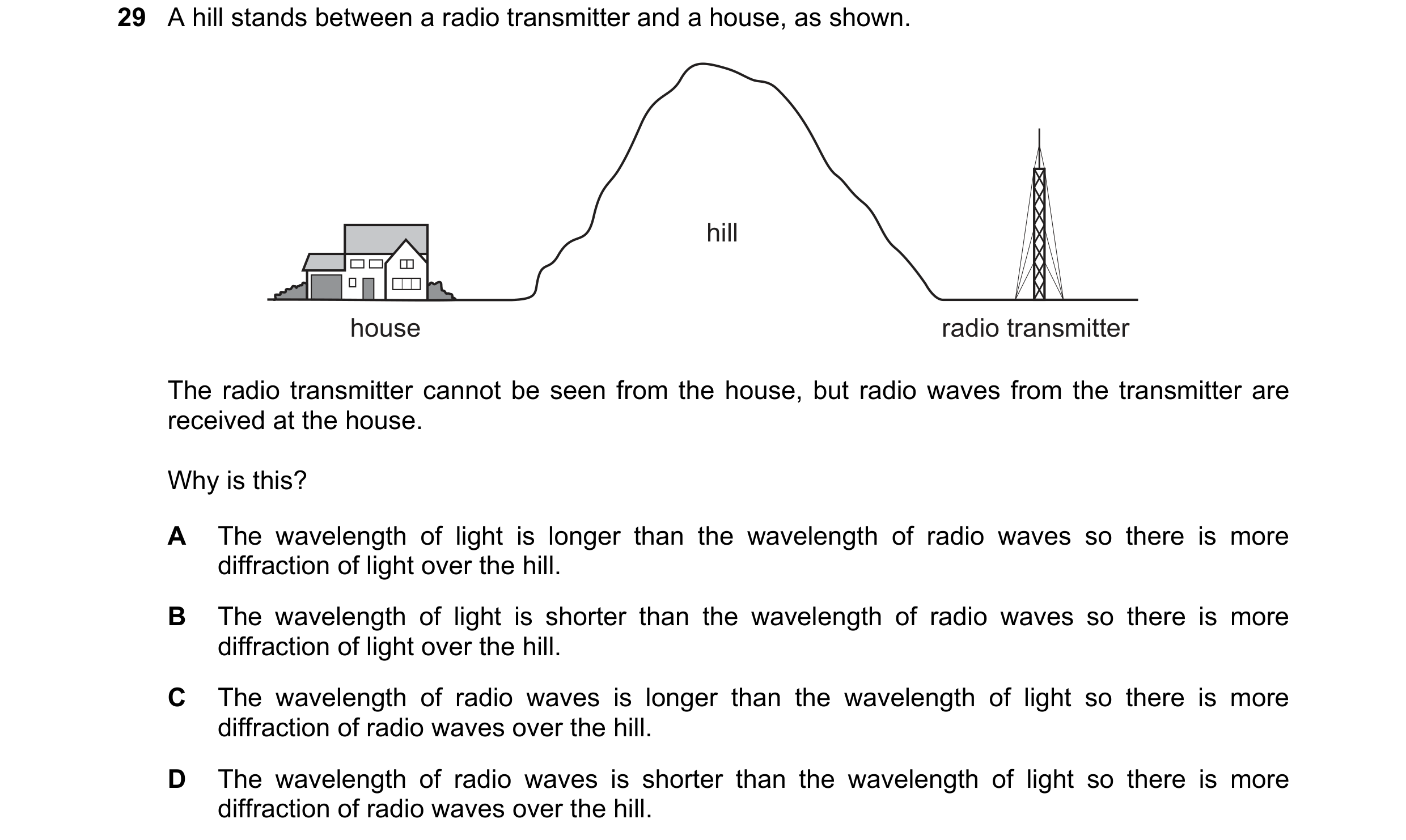
 10 / 25


 11 / 25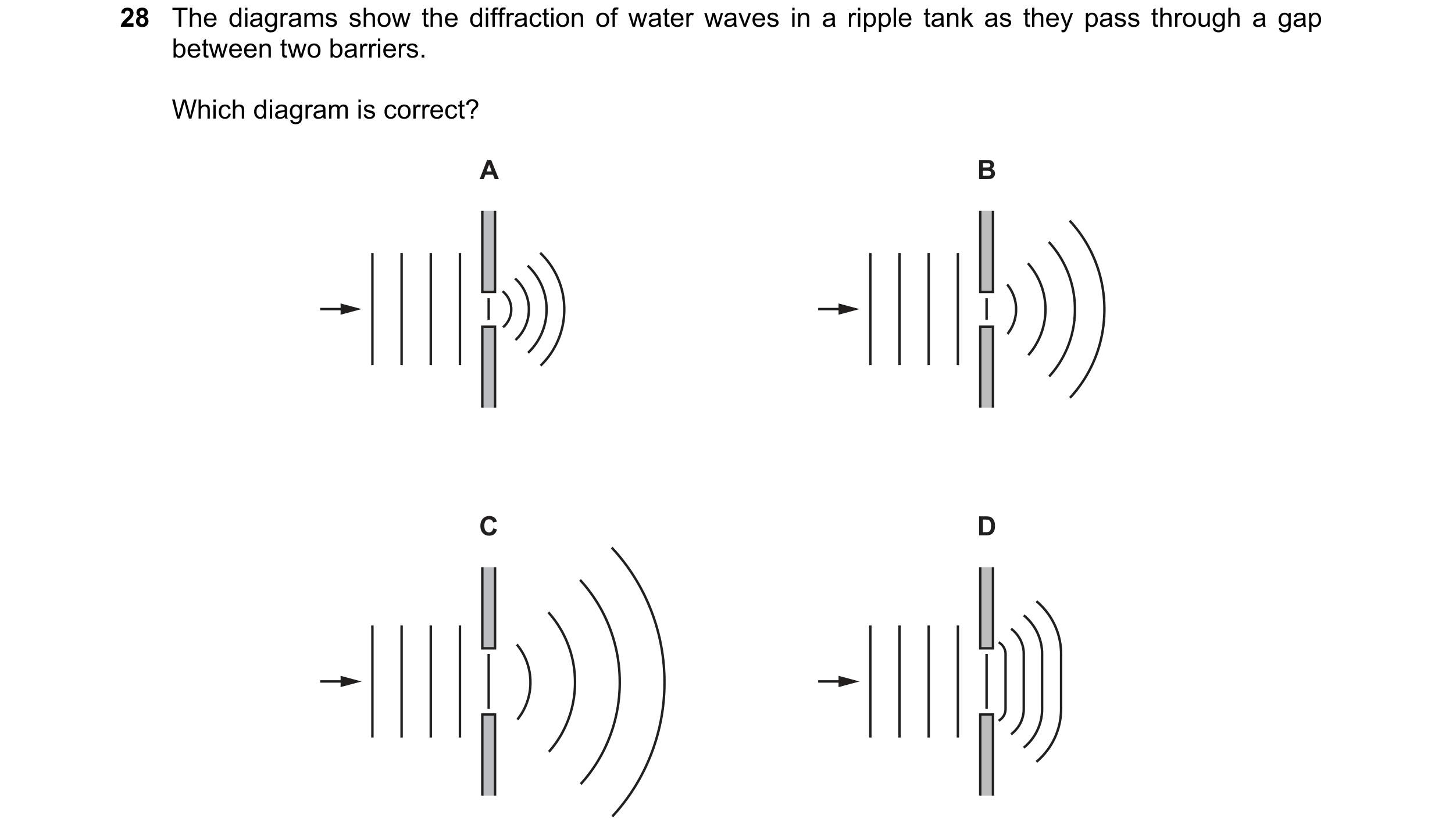
 12 / 25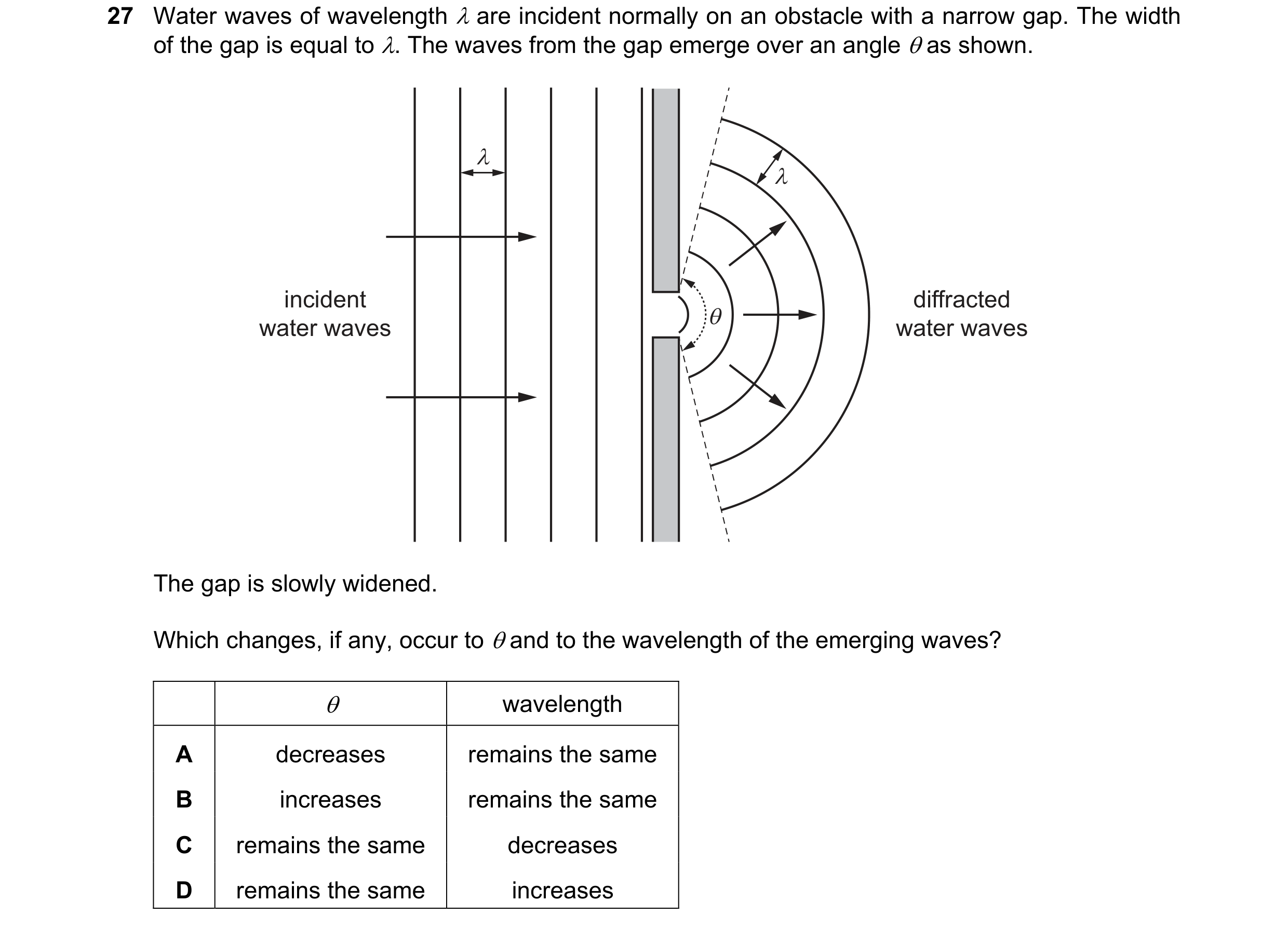
 13 / 25
 14 / 25
 15 / 25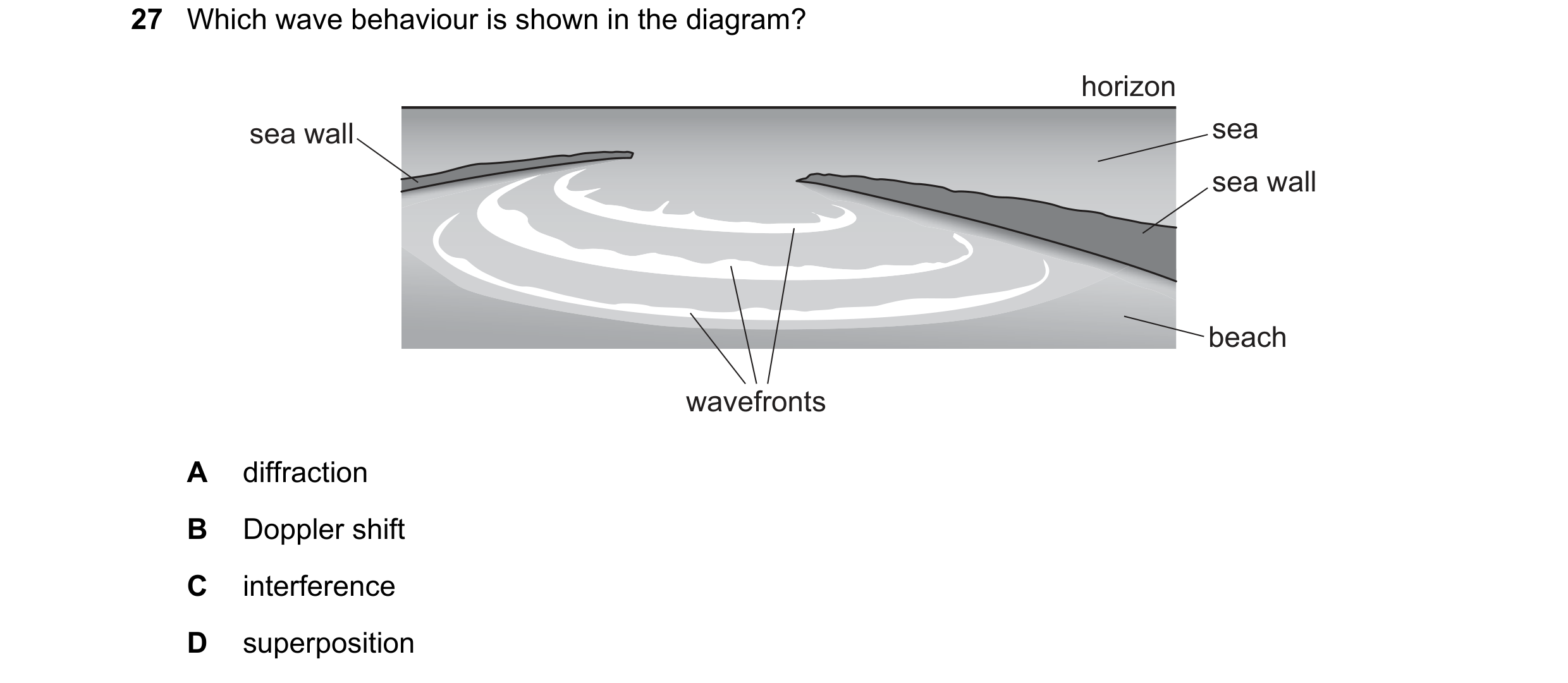

 16 / 25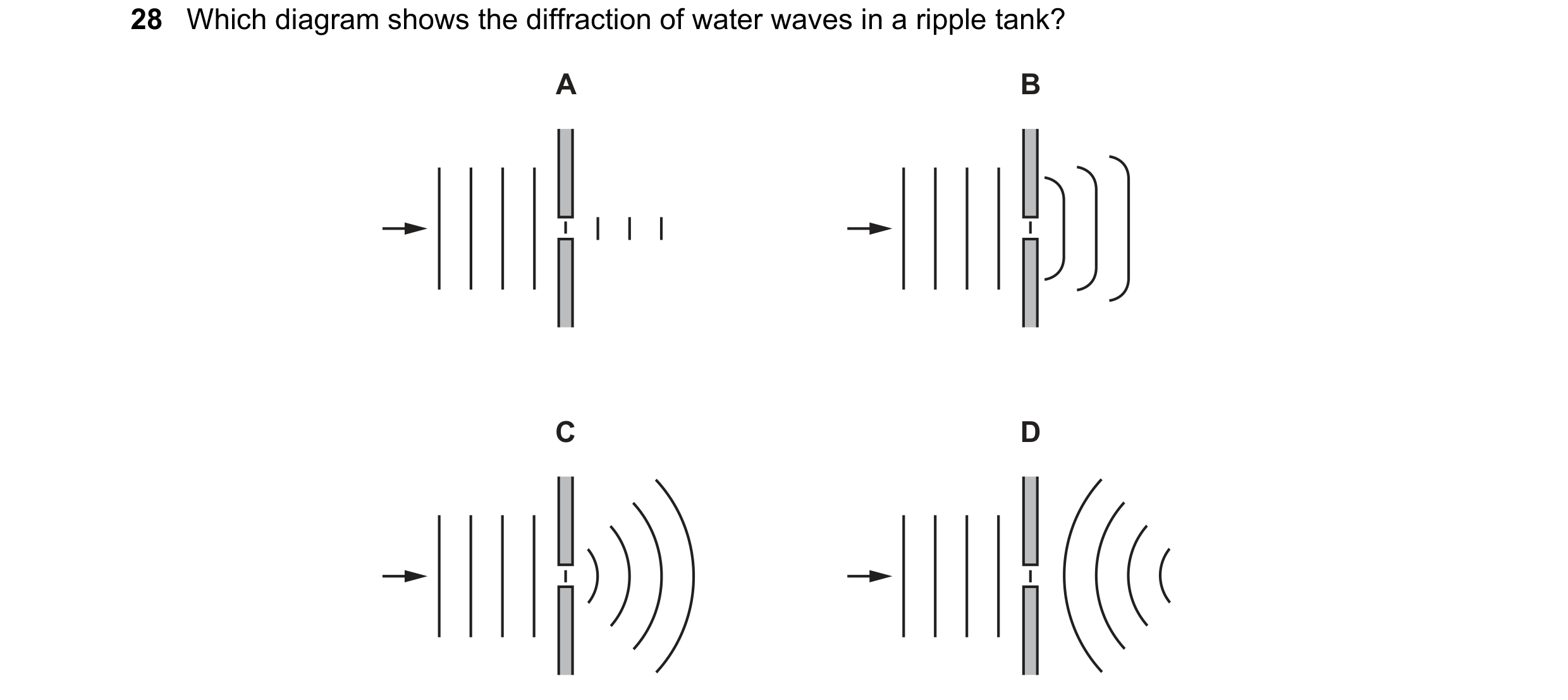
 17 / 25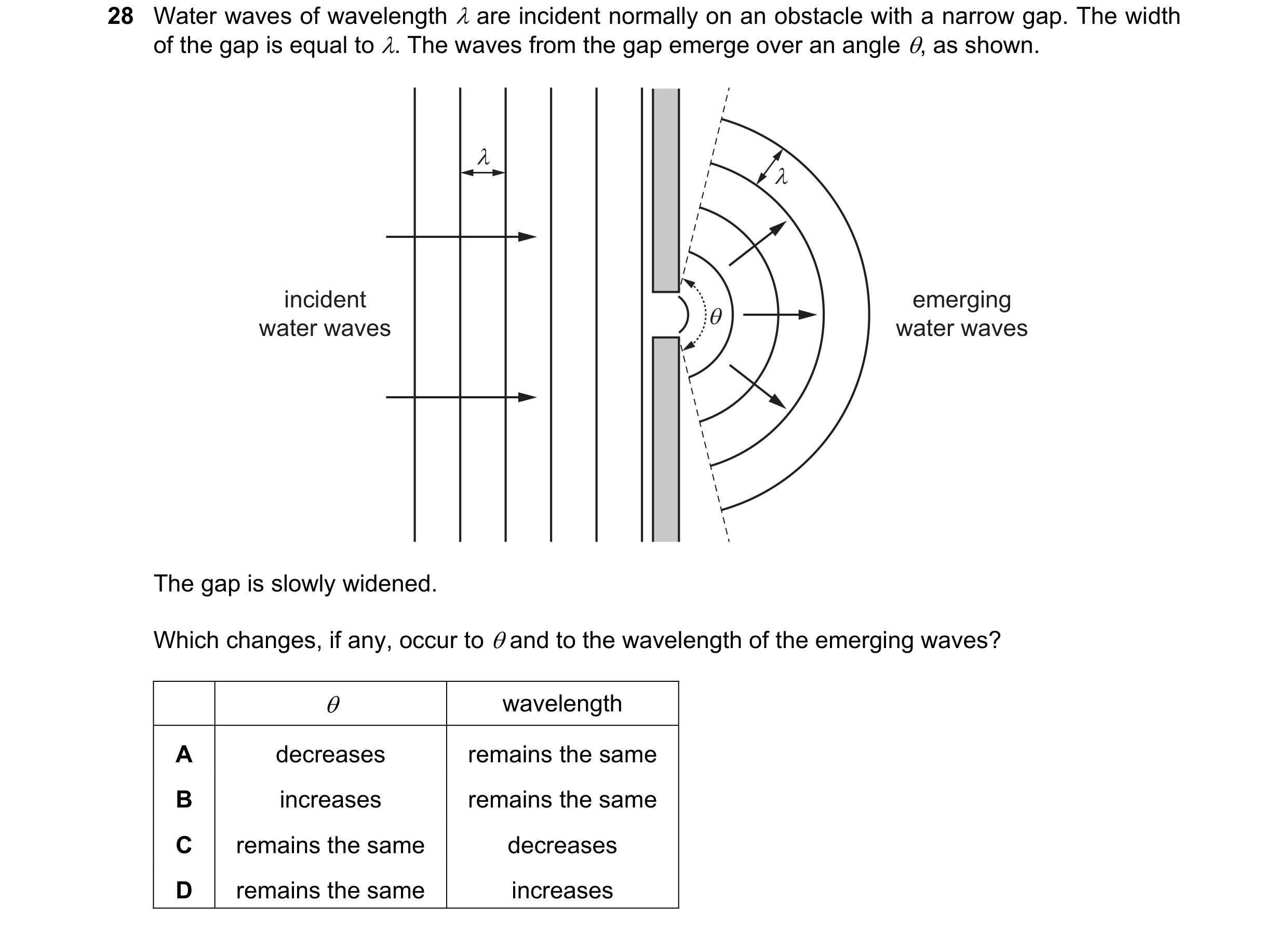
 18 / 25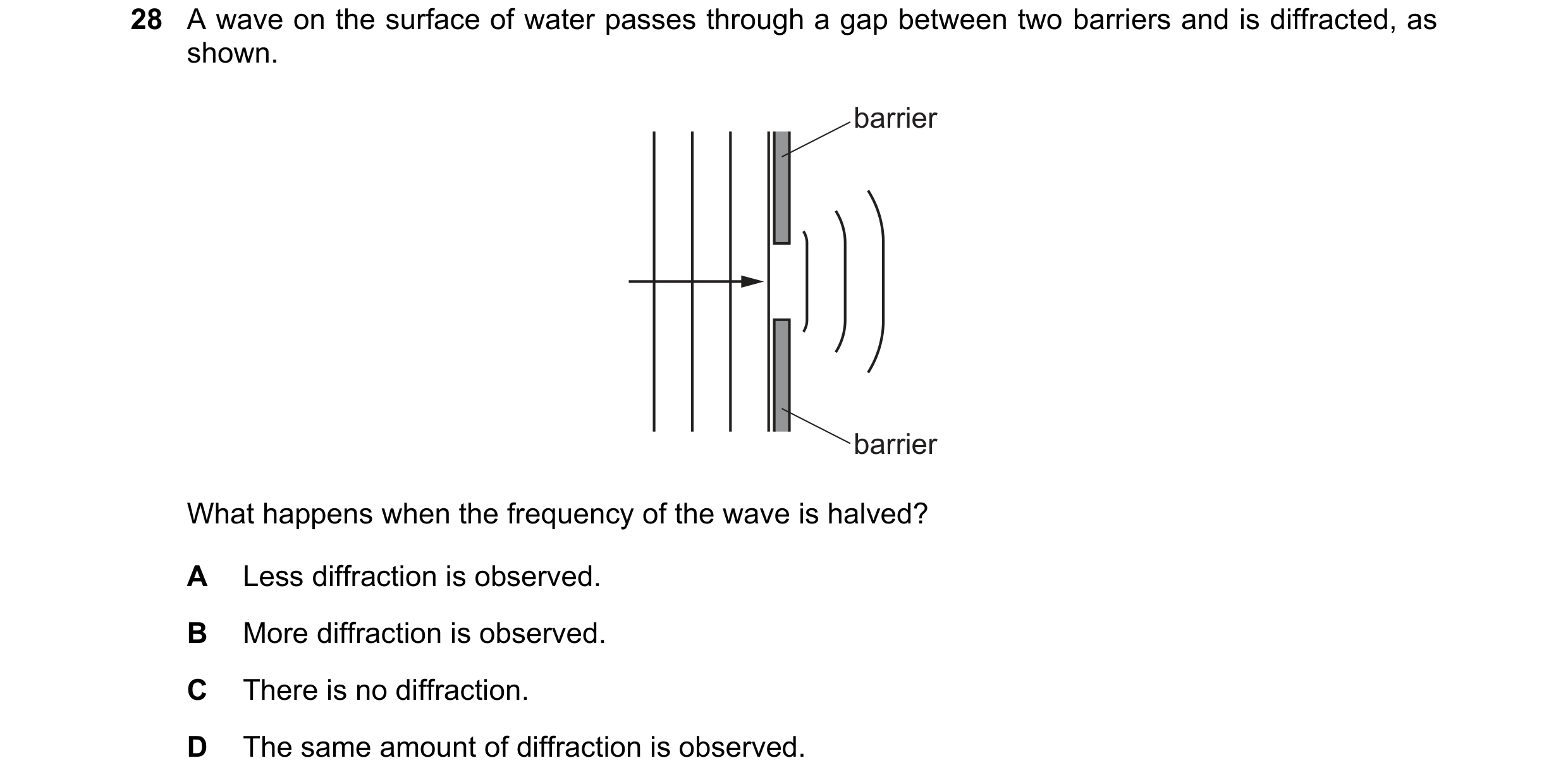

 19 / 25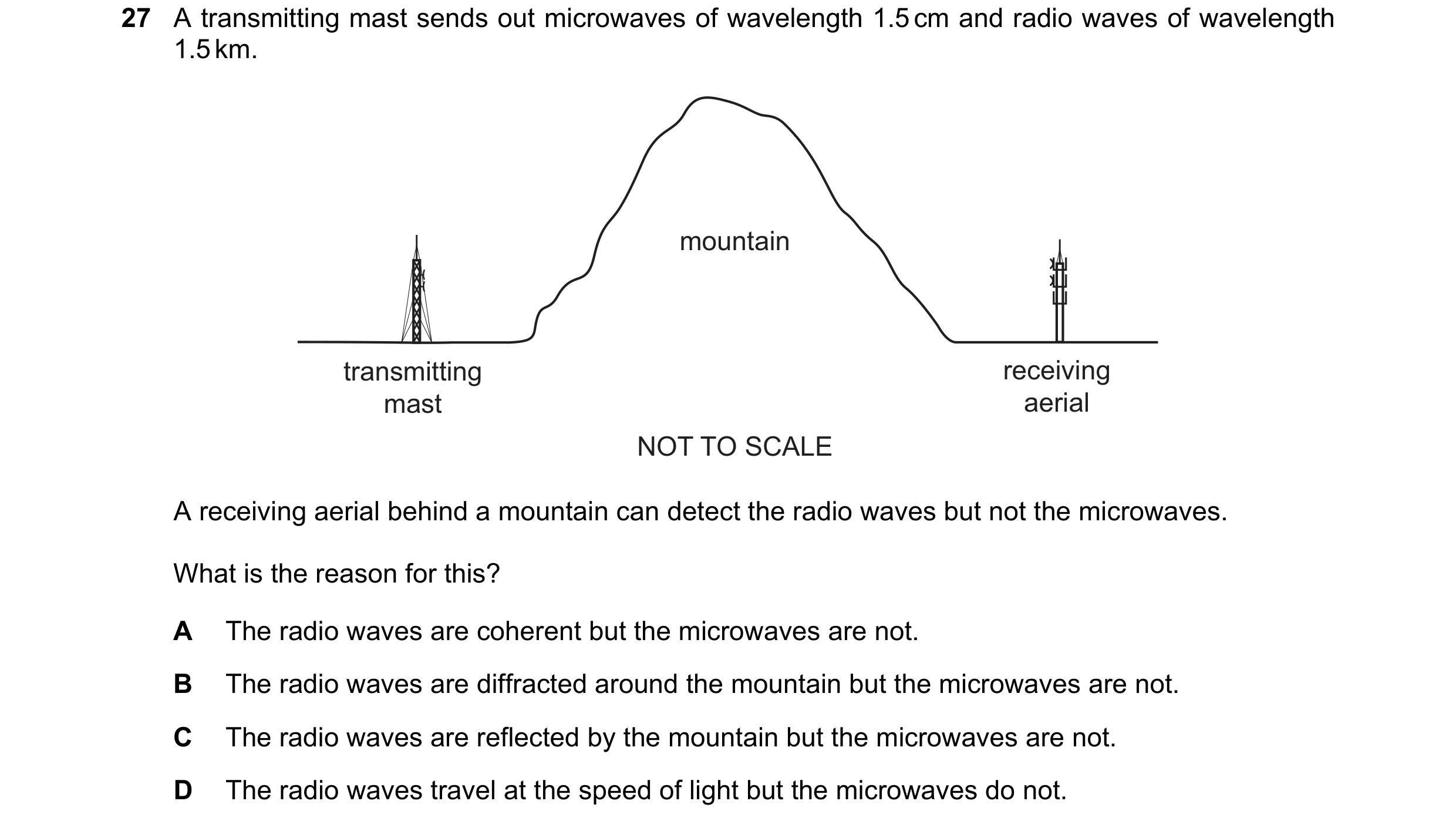
 20 / 25
 21 / 25
 22 / 25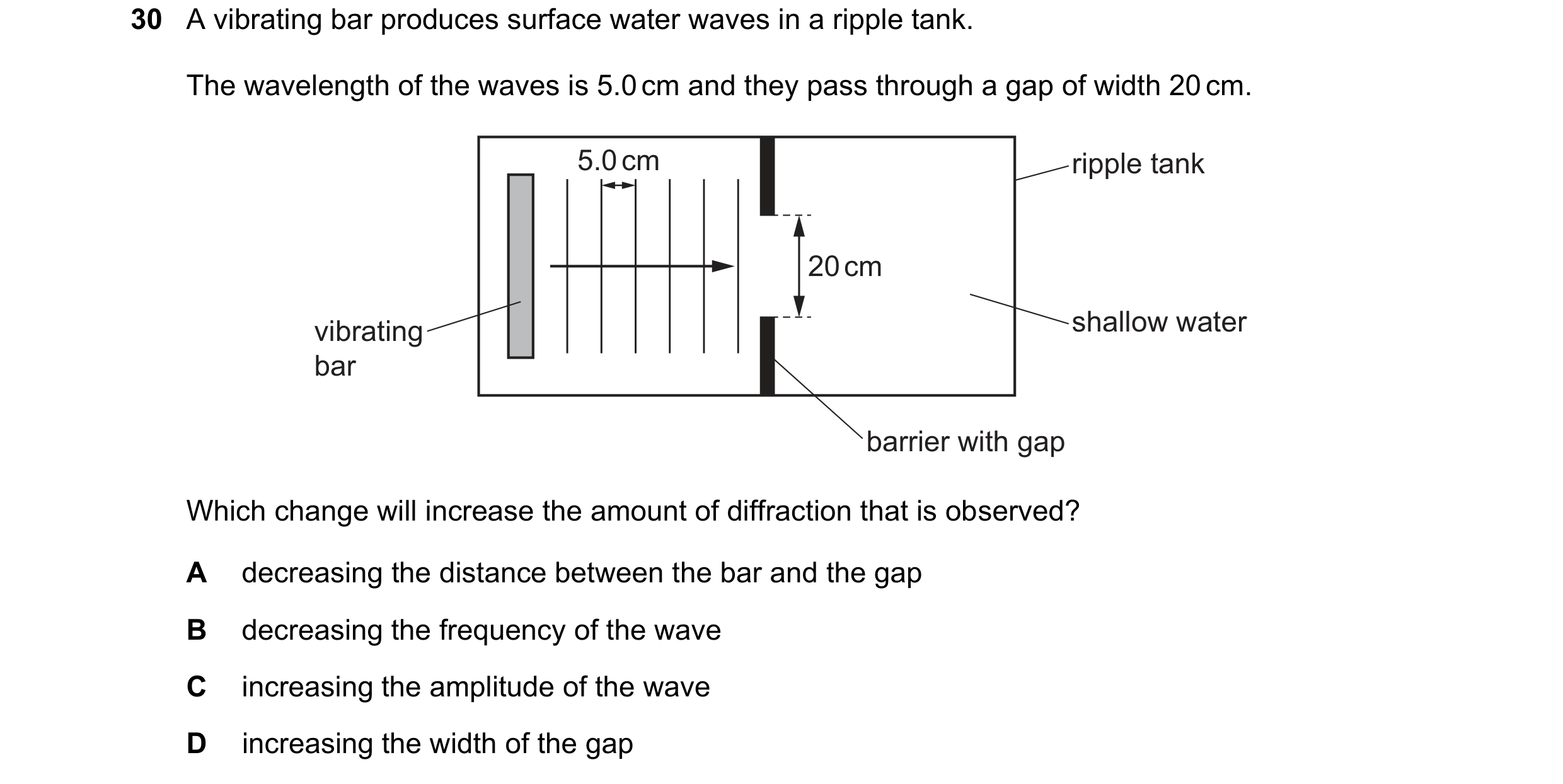
 23 / 25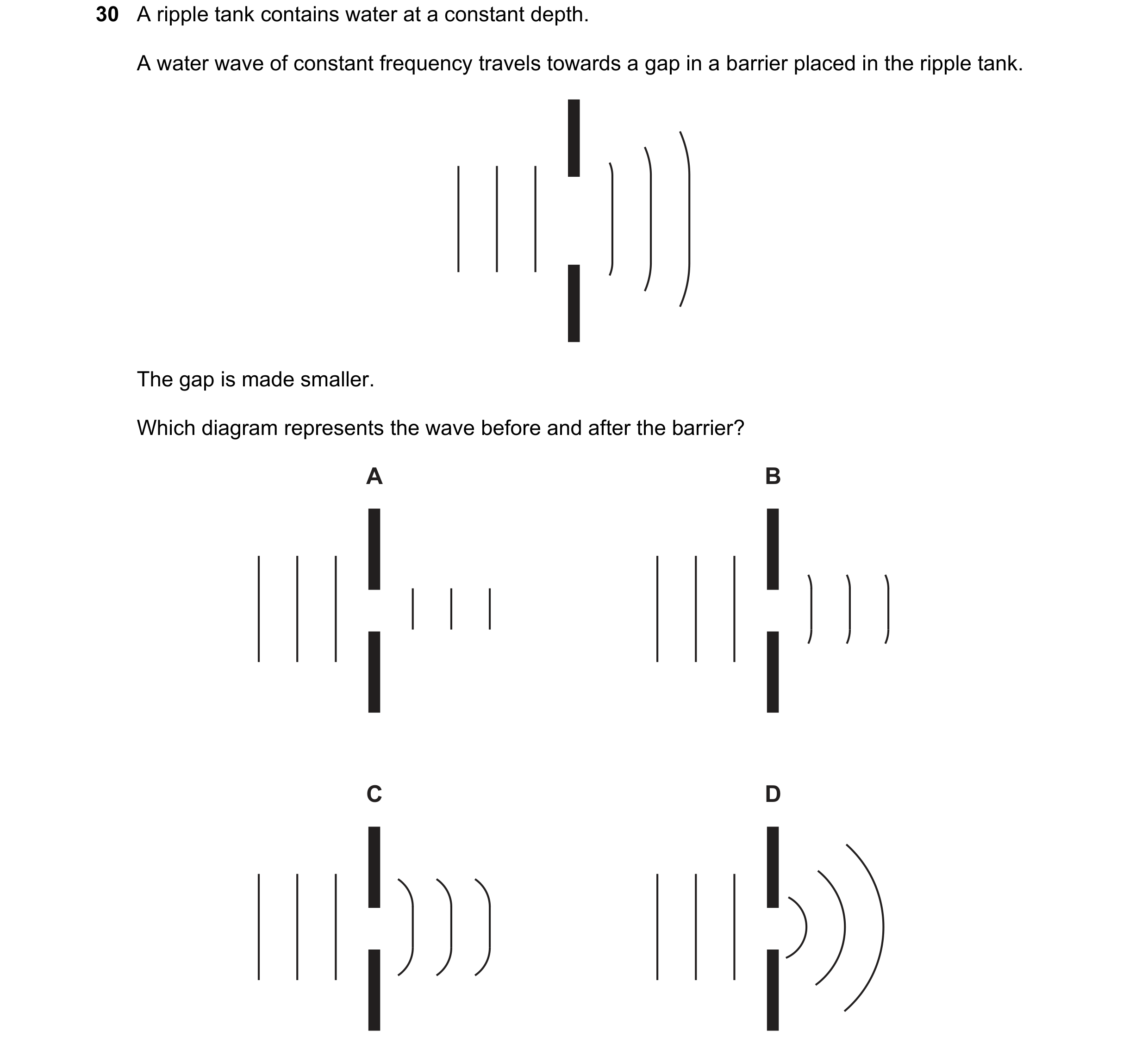
 24 / 25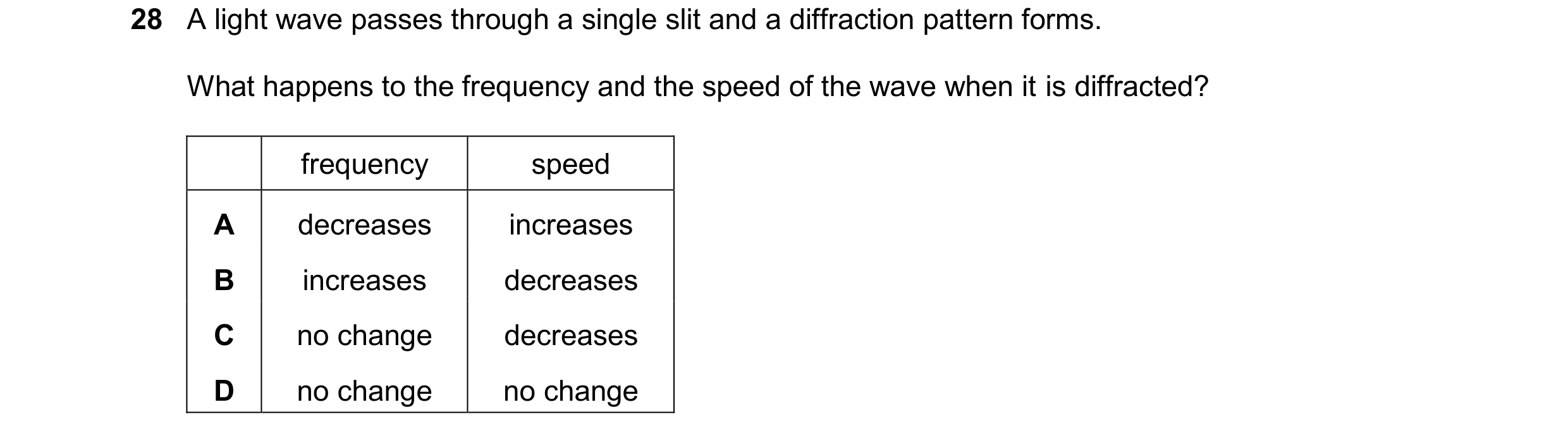
 25 / 25