Questions as text
Q1 · Explain what is meant by the diffraction of a wave 9702/21 Oct/Nov 2008
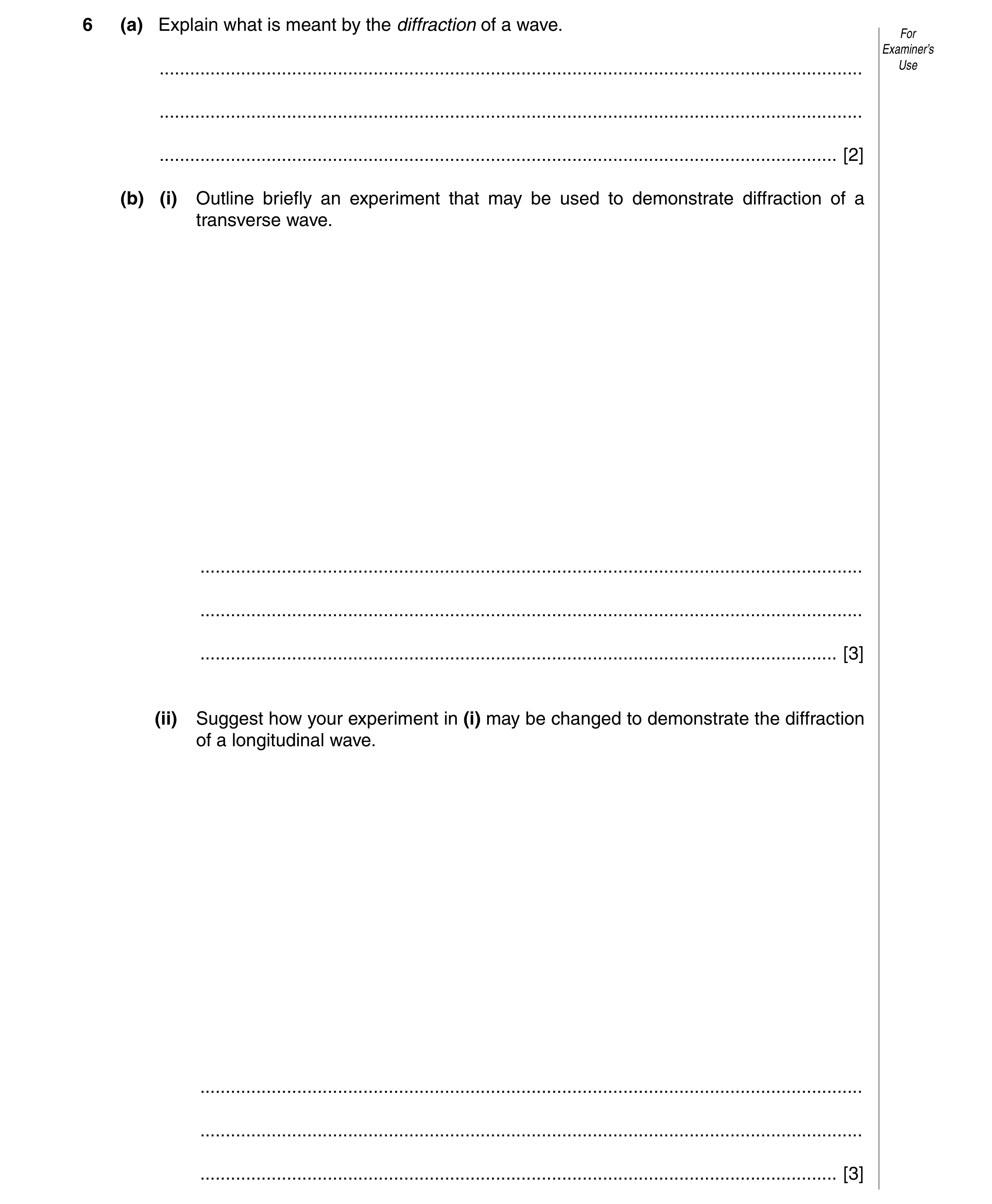
6 (a) Explain what is meant by the diffraction of a wave. For Examiner’s … Use … … [2] (b) (i) Outline briefly an experiment that may be used to demonstrate diffraction of a transverse wave. … … … [3] (ii) Suggest how your experiment in (i) may be changed to demonstrate the diffraction of a longitudinal wave. … … … [3]
8 marks
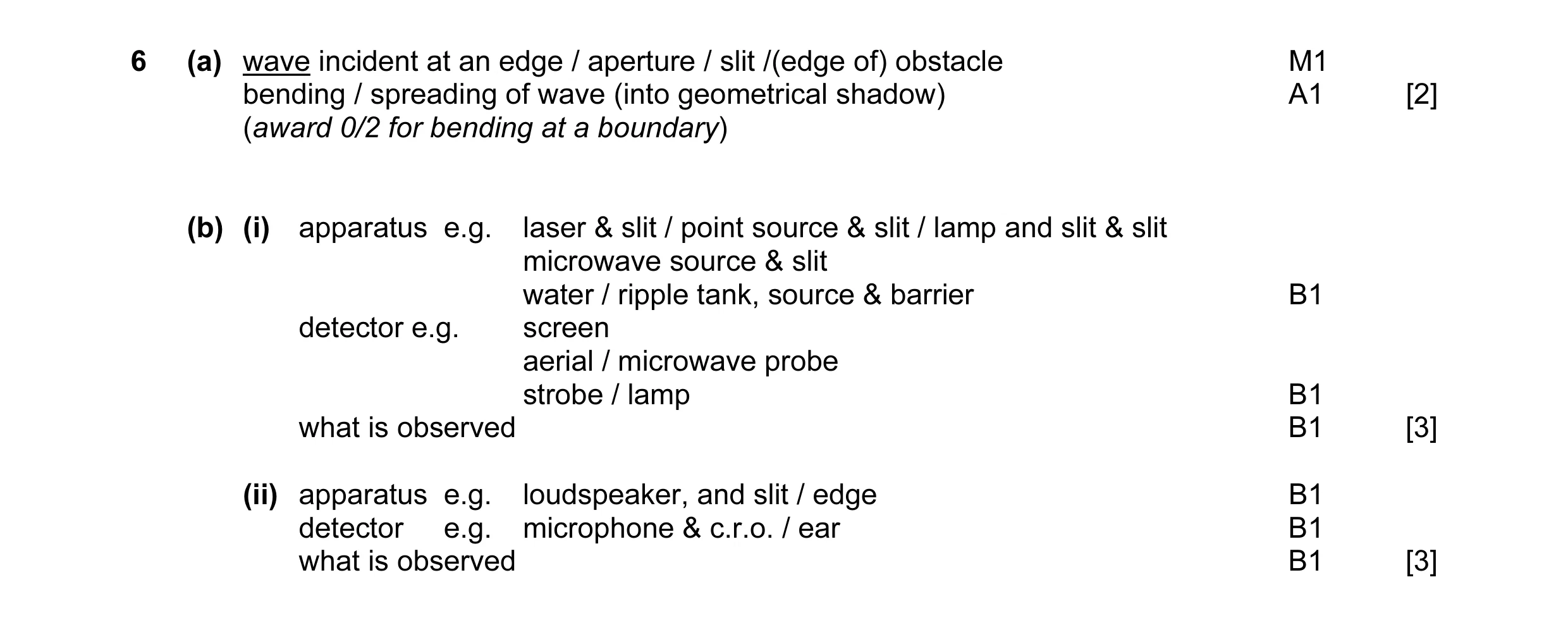
Mark scheme: 6 (a) wave incident at an edge / aperture / slit /(edge of) obstacle M1 bending / spreading of wave (into geometrical shadow) A1 [2] (award 0/2 for bending at a boundary) (b) (i) apparatus e.g. laser & slit / point source & slit / lamp and slit & slit microwave source & slit water / ripple tank, source & barrier B1 detector e.g. screen aerial / microwave probe strobe / lamp B1 what is observed B1 [3] (ii) apparatus e.g. loudspeaker, and slit / edge B1 detector e.g. microphone & c.r.o. / ear B1 what is observed B1 [3]
This question in 9702/21 Oct/Nov 2008
Q2 · State what is meant by the diffraction of a wave 9702/21 May/June 2010
4 (a) State what is meant by the diffraction of a wave. For Examiner’s … Use … … [2] (b) A laser produces a narrow beam of coherent light of wavelength 632 nm. The beam is incident normally on a diffraction grating, as shown in Fig. 4.1. diffraction grating X laser light P 76 cm wavelength 632 nm Y 165 cm screen Fig. 4.1 Spots of light are observed on a screen placed parallel to the grating. The distance between the grating and the screen is 165 cm. The brightest spot is P. The spots formed closest to P and on each side of P are X and Y. X and Y are separated by a distance of 76 cm. Calculate the number of lines per metre on the grating. number per metre = … [4] (c) The grating in (b) is now rotated about an axis parallel to the incident laser beam, as For shown in Fig. 4.2. Examiner’s Use diffraction diffraction grating grating laser laser light light before rotation after rotation Fig. 4.2 State what effect, if any, this rotation will have on the positions of the spots P, X and Y. … … … … [2] (d) In another experiment using the apparatus in (b), a student notices that the distances XP and PY, as shown in Fig. 4.1, are not equal. Suggest a reason for this difference. … … [1]
9 marks
Mark scheme: 4 (a) when a wave (front) passes by/incident on an edge/slit ….…..…………………… M1 wave bends/spreads (into the geometrical shadow) …………..…………………… A1 [2] 38 (b) tan θ = 165 θ = 13° …………….………………………………..…………………………………… C1 d sin θ = nλ …………….………………………………..……….……………………… C1 d = 2.82 × 10⁻⁶ …………….……………………………….……………………………. C1 number = (1/d =) 3.6 × 10⁵ ……………….……………………………………………. A1 [4] (c) P remains in same position …………………………………………………………… B1 X and Y rotate through 90° …………………………………… … ……………………. B1 [2] (d) either screen not parallel to grating or grating not normal to (incident) light …………………………………………. B1 [1]
This question in 9702/21 May/June 2010
Q3 · State what is meant by the diffraction of a wave 9702/21 Oct/Nov 2010
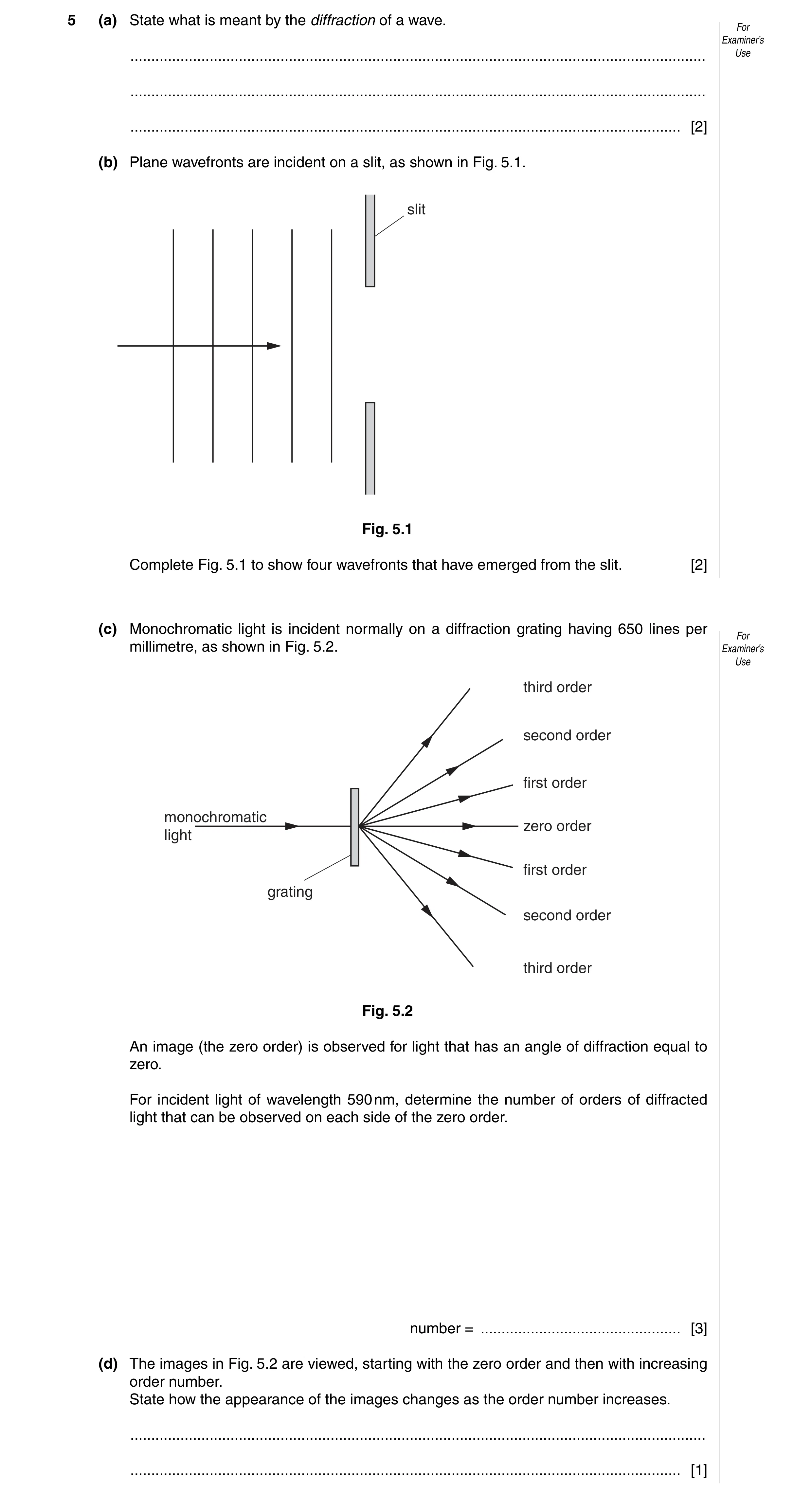
5 (a) State what is meant by the diffraction of a wave. For Examiner’s … Use … … [2] (b) Plane wavefronts are incident on a slit, as shown in Fig. 5.1. slit Fig. 5.1 Complete Fig. 5.1 to show four wavefronts that have emerged from the slit. [2] (c) Monochromatic light is incident normally on a diffraction grating having 650 lines per For millimetre, as shown in Fig. 5.2. Examiner’s Use third order second order first order monochromatic zero order light first order grating second order third order Fig. 5.2 An image (the zero order) is observed for light that has an angle of diffraction equal to zero. For incident light of wavelength 590 nm, determine the number of orders of diffracted light that can be observed on each side of the zero order. number = … [3] (d) The images in Fig. 5.2 are viewed, starting with the zero order and then with increasing order number. State how the appearance of the images changes as the order number increases. … … [1]
8 marks
Mark scheme: 5 (a) when a wave passes through a slit / by an edge M1 the wave spreads out / changes direction A1 [2] (b) diagram: wavelength unchanged M1 wavefront flat at centre, curving into geometrical shadow A1 [2] (c) d sin θ = nλ C1 for θ = 90° 1 / (650 × 103) = n × 590 × 10–9 M1 n = 2.6 number of orders is 2 A1 [3] (d) intensity / brightness decreases (as order increases) B1 [1] 2
This question in 9702/21 Oct/Nov 2010
Q4 · Monochromatic light is diffracted by a diffraction grating 9702/23 May/June 2012
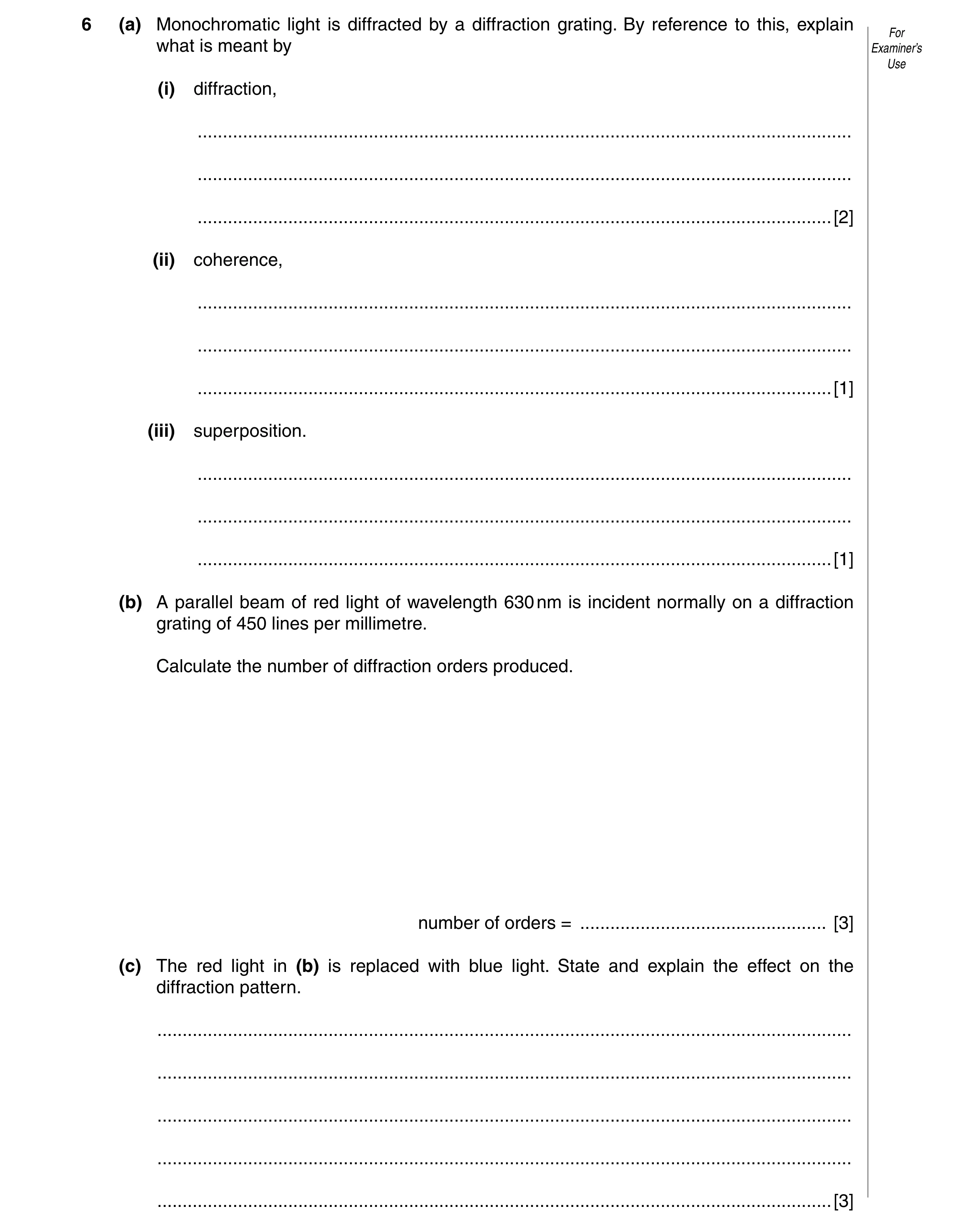
6 (a) Monochromatic light is diffracted by a diffraction grating. By reference to this, explain For what is meant by Examiner’s Use (i) diffraction, … … … [2] (ii) coherence, … … … [1] (iii) superposition. … … … [1] (b) A parallel beam of red light of wavelength 630 nm is incident normally on a diffraction grating of 450 lines per millimetre. Calculate the number of diffraction orders produced. number of orders = … [3] (c) The red light in (b) is replaced with blue light. State and explain the effect on the diffraction pattern. … … … … … [3]
10 marks
Mark scheme: 6 (a) (i) diffraction bending/spreading of light at edge/slit B1 this occurs at each slit B1 [2] (ii) constant phase difference between each of the waves B1 [1] (iii) (when the waves meet) the resultant displacement is the sum of the displacements of each wave B1 [1] (b) d sinθ = nλ n = d / λ = 1 / 450 × 103 × 630 × 10–9 C1 n = 3.52 M1 hence number of orders = 3 A1 [3] (c) λ blue is less than λ red M1 more orders seen A1 each order is at a smaller angle than for the equivalent red A1 [3]
This question in 9702/23 May/June 2012
Q5 · Describe the diffraction of monochromatic light as it passes through a diffraction grating 9702/21 Oct/Nov 2012
4 (a) Describe the diffraction of monochromatic light as it passes through a diffraction grating. For Examiner’s … Use … … [2] (b) White light is incident on a diffraction grating, as shown in Fig. 4.1. spectrum (first order) white light white (zero order) diffraction spectrum (first order) grating screen Fig. 4.1 (not to scale) The diffraction pattern formed on the screen has white light, called zero order, and coloured spectra in other orders. (i) Describe how the principle of superposition is used to explain 1. white light at the zero order, … … … [2] 2. the difference in position of red and blue light in the first-order spectrum. … … … [2] (ii) Light of wavelength 625 nm produces a second-order maximum at an angle of 61.0° For to the incident direction. Examiner’s Determine the number of lines per metre of the diffraction grating. Use number of lines = … m–1 [2] (iii) Calculate the wavelength of another part of the visible spectrum that gives a maximum for a different order at the same angle as in (ii). wavelength = ……………………..…….. nm [2]
10 marks
Mark scheme: 4 (a) waves pass through the elements / gaps / slits in the grating M1 spread into geometric shadow A1 [2] (b) (i) 1. displacements add to give resultant displacement B1 each wavelength travels the same path difference or are in phase B1 hence produce a maximum A0 [2] 2. to obtain a maximum the path difference must be λ or phase difference 360° / 2π rad B1 λ of red and blue are different B1 hence maxima at different angles / positions A0 [2] (ii) nλ = d sin θ C1 N = sin 61° / (2 × 625 × 10–9) = 7.0 × 10⁵ A1 [2] (iii) nλ = 2 × 625 is a constant (1250) C1 n = 1 → λ = 1250 outside visible n = 3 → λ = 417 in visible n = 4 → λ = 312.5 outside visible λ = 420 nm A1 [2]
This question in 9702/21 Oct/Nov 2012
Q6 · State what is meant by diffraction and by interference 9702/21 May/June 2015
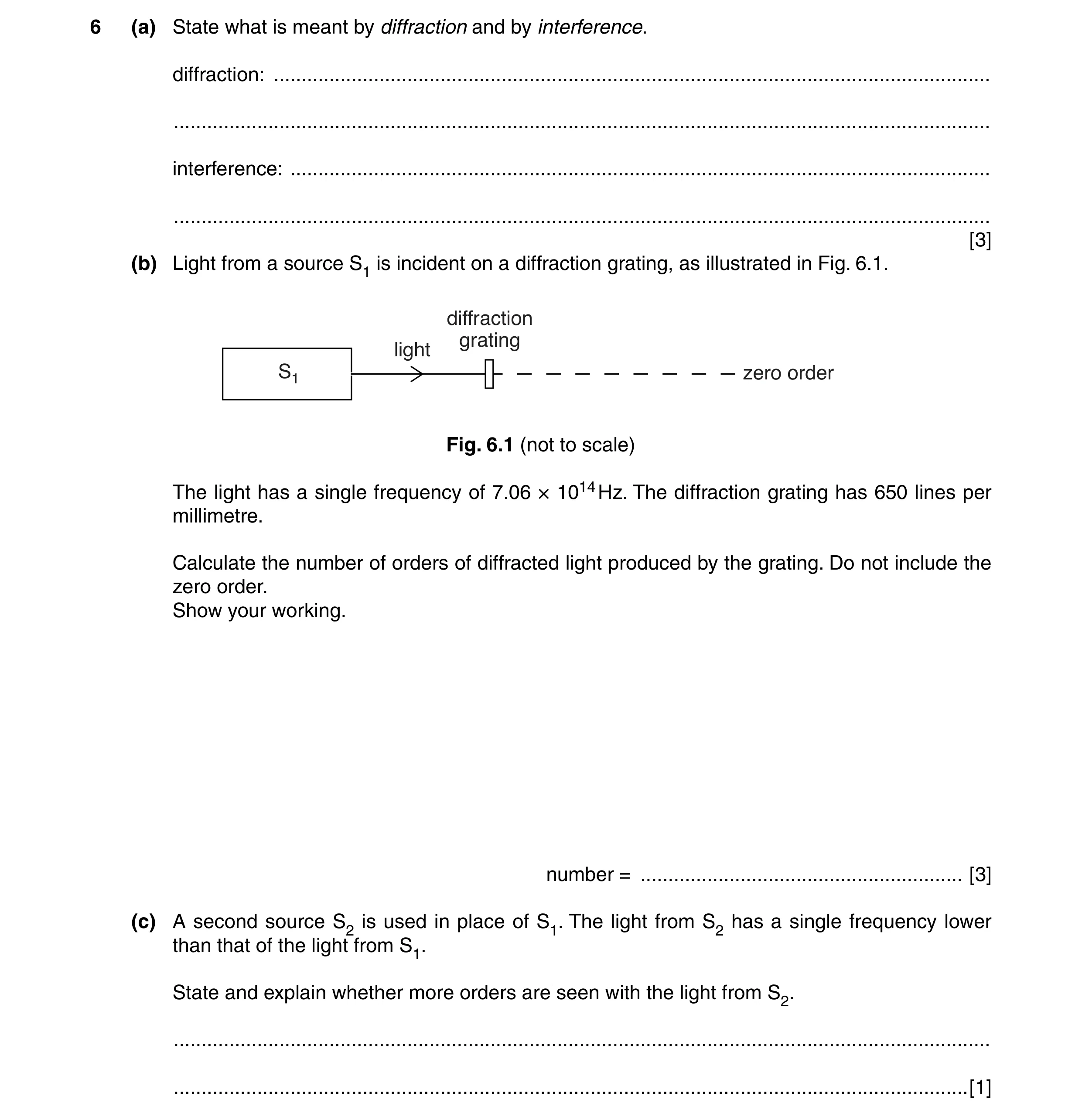
6 (a) State what is meant by diffraction and by interference. diffraction: … … interference: … … [3] (b) Light from a source S1 is incident on a diffraction grating, as illustrated in Fig. 6.1. diffraction grating light S1 zero order Fig. 6.1 (not to scale) The light has a single frequency of 7.06 × 10¹⁴ Hz. The diffraction grating has 650 lines per millimetre. Calculate the number of orders of diffracted light produced by the grating. Do not include the zero order. Show your working. number = … [3] (c) A second source S2 is used in place of S1. The light from S2 has a single frequency lower than that of the light from S1. State and explain whether more orders are seen with the light from S2. … … [1]
7 marks
Mark scheme: 6 (a) diffraction is the spreading of a wave as it passes through a slit or past an edge B1 when two (or more) waves superpose/meet/overlap M1 resultant displacement is the sum of the displacement of each wave A1 [3] (b) nλ = d sin θ and v = fλ C1 max order number for θ = 90° hence n (= f / vN) = 7.06 × 10¹⁴ / (3 × 108 × 650 × 103) M1 n = 3.6 hence number of orders = 3 A1 [3] (c) greater wavelength so fewer orders seen A1 [1]
This question in 9702/21 May/June 2015
Q7 · State what is meant by the diffraction of a wave 9702/21 Oct/Nov 2016
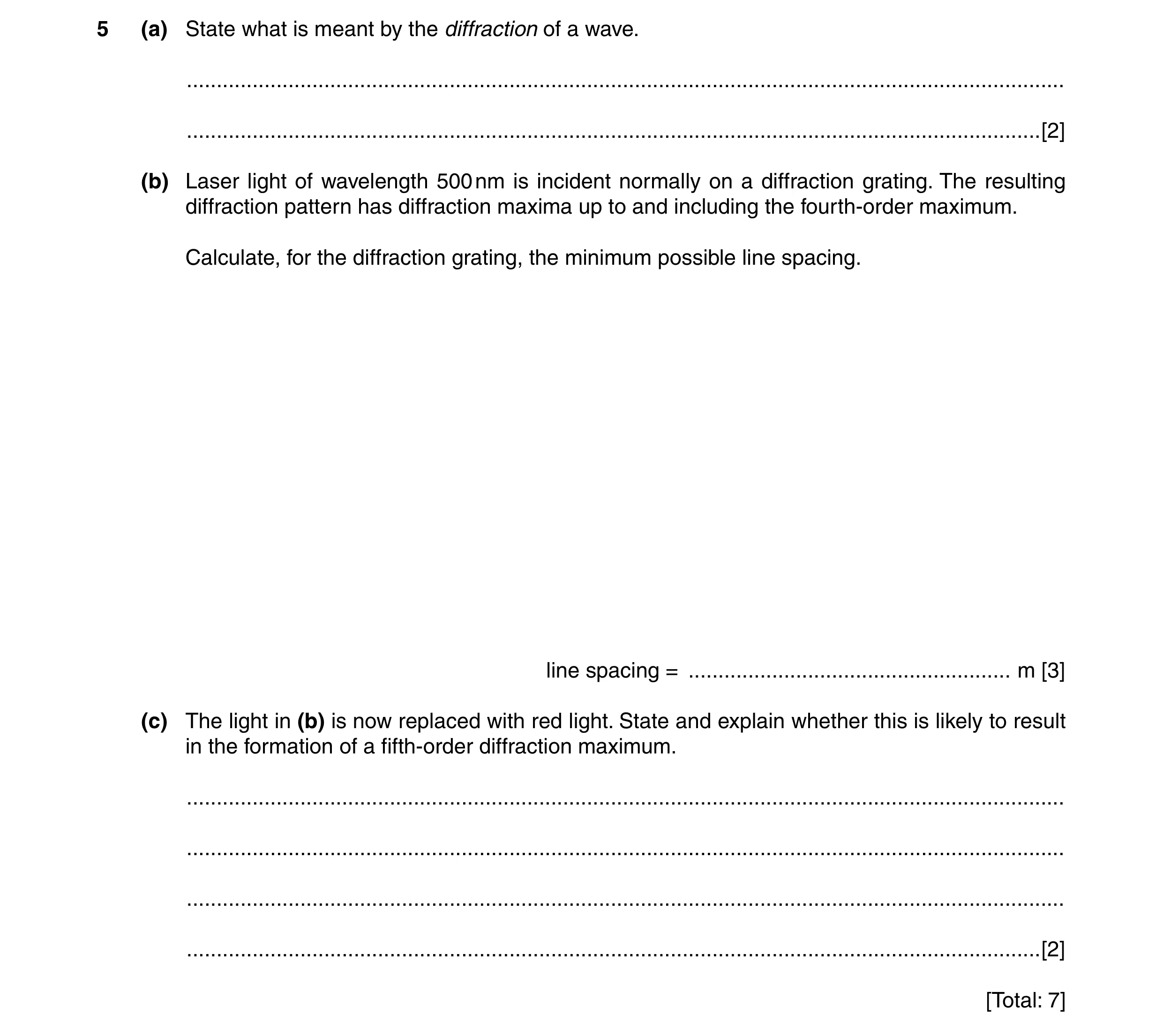
5 (a) State what is meant by the diffraction of a wave. … … [2] (b) Laser light of wavelength 500 nm is incident normally on a diffraction grating. The resulting diffraction pattern has diffraction maxima up to and including the fourth-order maximum. Calculate, for the diffraction grating, the minimum possible line spacing. line spacing = … m [3] (c) The light in (b) is now replaced with red light. State and explain whether this is likely to result in the formation of a fifth-order diffraction maximum. … … … … [2] [Total: 7]
7 marks
Mark scheme: 5 (a) wave incident on/passes by or through an aperture/edge B1 wave spreads (into geometrical shadow) B1 [2] (b) nλ= d sinθ C1 substitution of θ= 90° or sinθ= 1 C1 4 × 500 × 10–9 = d × sin 90° line spacing = 2.0 × 10⁻⁶ m A1 [3] (c) wavelength of red light is longer (than 500 nm) M1 (each order/fourth order is now at a greater angle so) the fifth-order maximum cannot be formed/not formed A1 [2] work done or energy (transform ed) (from electrical to other forms)
This question in 9702/21 Oct/Nov 2016
Q8 · State what is meant by the diffraction of a wave 9702/22 Oct/Nov 2016
4 (a) State what is meant by the diffraction of a wave. … … [2] (b) An arrangement for demonstrating the interference of light is shown in Fig. 4.1. laser light Y dark fringe 2.0 mm 0.41 mm X central bright fringe wavelength 580 nm Z dark fringe ' double slit screen Fig. 4.1 (not to scale) The wavelength of the light from the laser is 580 nm. The separation of the slits is 0.41 mm. The perpendicular distance between the double slit and the screen is D. Coherent light emerges from the slits and an interference pattern is observed on the screen. The central bright fringe is produced at point X. The closest dark fringes to point X are produced at points Y and Z. The distance XY is 2.0 mm. (i) Explain why a bright fringe is produced at point X. … … … … [2] (ii) State the difference in the distances, in nm, from each slit to point Y. distance = … nm [1] (iii) Calculate the distance D. D = … m [3] (iv) The intensity of the light passing through the two slits was initially the same. The intensity of the light through one of the slits is now reduced. Compare the appearance of the fringes before and after the change of intensity. … … … … [2] [Total: 10]
10 marks
Mark scheme: 4 (a) wave incident on/passes by or through an aperture/edge B1 wave spreads (into geometrical shadow) B1 [2] (b) (i) waves (from slits) overlap (at point X) B1 path difference (from slits to X) is zero/ phase difference (between the two waves) is zero (so constructive interference gives bright fringe) B1 [2] (ii) difference in distances = λ/ 2 = 580 / 2 = 290 nm A1 [1] (iii) λ= ax / D C1 D = [0.41 × 10–3 × (2 × 2.0 × 10–3)] / 580 × 10–9 C1 = 2.8 m A1 [3] (iv) same separation/fringe width/number of fringes bright fringe(s)/central bright fringe/(fringe at) X less bright dark fringe(s)/(fringe at) Y/(fringe at) Z brighter contrast between fringes decreases Any two of the above four points, 1 mark each B2 [2]
This question in 9702/22 Oct/Nov 2016
Q9 · State what is meant by the diffraction of a wave 9702/23 Oct/Nov 2016
5 (a) State what is meant by the diffraction of a wave. … … [2] (b) Laser light of wavelength 500 nm is incident normally on a diffraction grating. The resulting diffraction pattern has diffraction maxima up to and including the fourth-order maximum. Calculate, for the diffraction grating, the minimum possible line spacing. line spacing = … m [3] (c) The light in (b) is now replaced with red light. State and explain whether this is likely to result in the formation of a fifth-order diffraction maximum. … … … … [2] [Total: 7]
7 marks
Mark scheme: 5 (a) wave incident on/passes by or through an aperture/edge B1 wave spreads (into geometrical shadow) B1 [2] (b) nλ= d sinθ C1 substitution of θ= 90° or sinθ= 1 C1 4 × 500 × 10–9 = d × sin 90° line spacing = 2.0 × 10⁻⁶ m A1 [3] (c) wavelength of red light is longer (than 500 nm) M1 (each order/fourth order is now at a greater angle so) the fifth-order maximum cannot be formed/not formed A1 [2] work done or energy (transform ed) (from electrical to other forms)
This question in 9702/23 Oct/Nov 2016
Q10 · For a progressive wave, state what is meant by wavelength 9702/21 May/June 2021
4 (a) For a progressive wave, state what is meant by wavelength. … … [1] (b) A light wave from a laser has a wavelength of 460 nm in a vacuum. Calculate the period of the wave. period = … s [3] (c) The light from the laser is incident normally on a diffraction grating. Describe the diffraction of the light waves at the grating. … … … [2] (d) A diffraction grating is used with different wavelengths of visible light. The angle θ of the fourth-order maximum from the zero-order (central) maximum is measured for each wavelength. The variation with wavelength λ of sin θ is shown in Fig. 4.1. sin θ 0 0 400 700 λ/ nm Fig. 4.1 (i) The gradient of the graph is G. Determine an expression, in terms of G, for the distance d between the centres of two adjacent slits in the diffraction grating. d = … [2] (ii) On Fig. 4.1, sketch a graph to show the results that would be obtained for the second-order maxima. [2] [Total: 10]
10 marks
Mark scheme: 4(a) distance moved by wavefront/energy during one cycle/oscillation/period (of source) or minimum distance between two wavefronts or distance between two adjacent wavefronts B1 4(b) v = λ / T or v = fλ and f = 1 / T C1 T = 460 × 10–9 / 3.00 × 10⁸ C1 = 1.5 × 10⁻¹⁵ s A1 4(c) waves pass through/enter the slit(s) B1 waves spread (into geometric shadow) B1 4(d)(i) nλ = d sinθ C1 G = sinθ / λ d = 4 / G A1 4(d)(ii) straight line from 400 nm to 700 nm that is always below printed line M1 straight line has smaller gradient than printed line and is 5 small squares high at wavelength of 700 nm A1
This question in 9702/21 May/June 2021
Q11 · A beam of vertically polarised light is incident normally on a polarising filter, as… 9702/22 Oct/Nov 2023
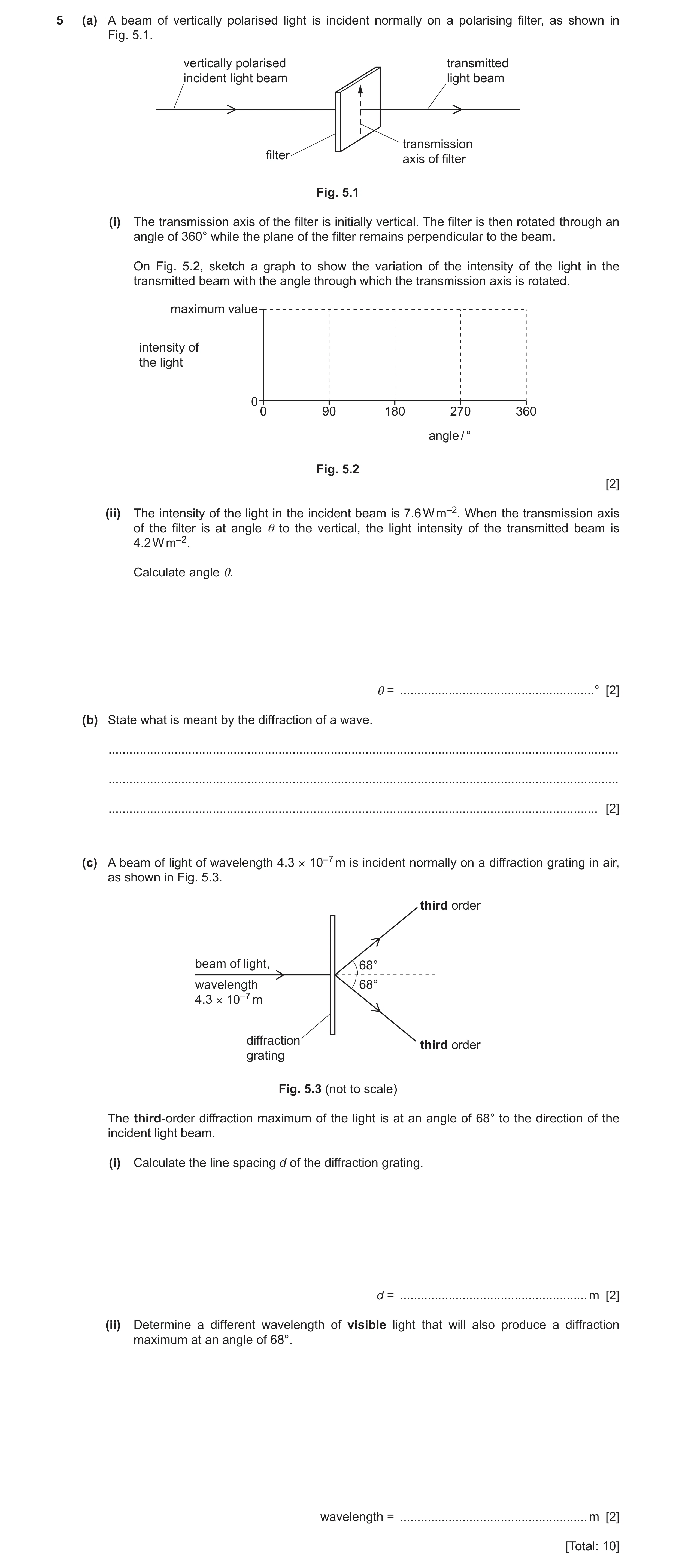
5 (a) A beam of vertically polarised light is incident normally on a polarising filter, as shown in Fig. 5.1. vertically polarised transmitted incident light beam light beam transmission filter axis of filter Fig. 5.1 (i) The transmission axis of the filter is initially vertical. The filter is then rotated through an angle of 360° while the plane of the filter remains perpendicular to the beam. On Fig. 5.2, sketch a graph to show the variation of the intensity of the light in the transmitted beam with the angle through which the transmission axis is rotated. maximum value intensity of the light 0 0 90 180 270 360 angle / ° Fig. 5.2 [2] (ii) The intensity of the light in the incident beam is 7.6 W m–2. When the transmission axis of the filter is at angle θ to the vertical, the light intensity of the transmitted beam is 4.2 W m–2. Calculate angle θ. θ = … ° [2] (b) State what is meant by the diffraction of a wave. … … … [2] (c) A beam of light of wavelength 4.3 × 10⁻⁷ m is incident normally on a diffraction grating in air, as shown in Fig. 5.3. third order beam of light, 68° wavelength 68° 4.3 × 10⁻⁷ m diffraction third order grating Fig. 5.3 (not to scale) The third‑order diffraction maximum of the light is at an angle of 68° to the direction of the incident light beam. (i) Calculate the line spacing d of the diffraction grating. d = … m [2] (ii) Determine a different wavelength of visible light that will also produce a diffraction maximum at an angle of 68°. wavelength = … m [2] [Total: 10]
10 marks
Mark scheme: 5(a)(i) light intensity has maximum value at 0°, 180°, 360° and zero intensity at 90°, 270° M1 ‘sinusoidally-shaped’ curve A1 5(a)(ii) 4.2 = 7.6 cos2 C1 = 42° A1 5(b) wave passes (through) an aperture B1 or wave passes (by / through / around) an edge wave spreads (into geometrical shadow) B1 5(c)(i) n= d sin C1 d = (3 4.3 10–7) / sin 68° A1 = 1.4 10–6 m 5(c)(ii) 1.4 10–6 sin 68° = 2 C1 or 3 4.3 10–7 = 2 = 6.5 10–7 m A1
This question in 9702/22 Oct/Nov 2023
Q12 · State what is meant by diffraction 9702/23 May/June 2025
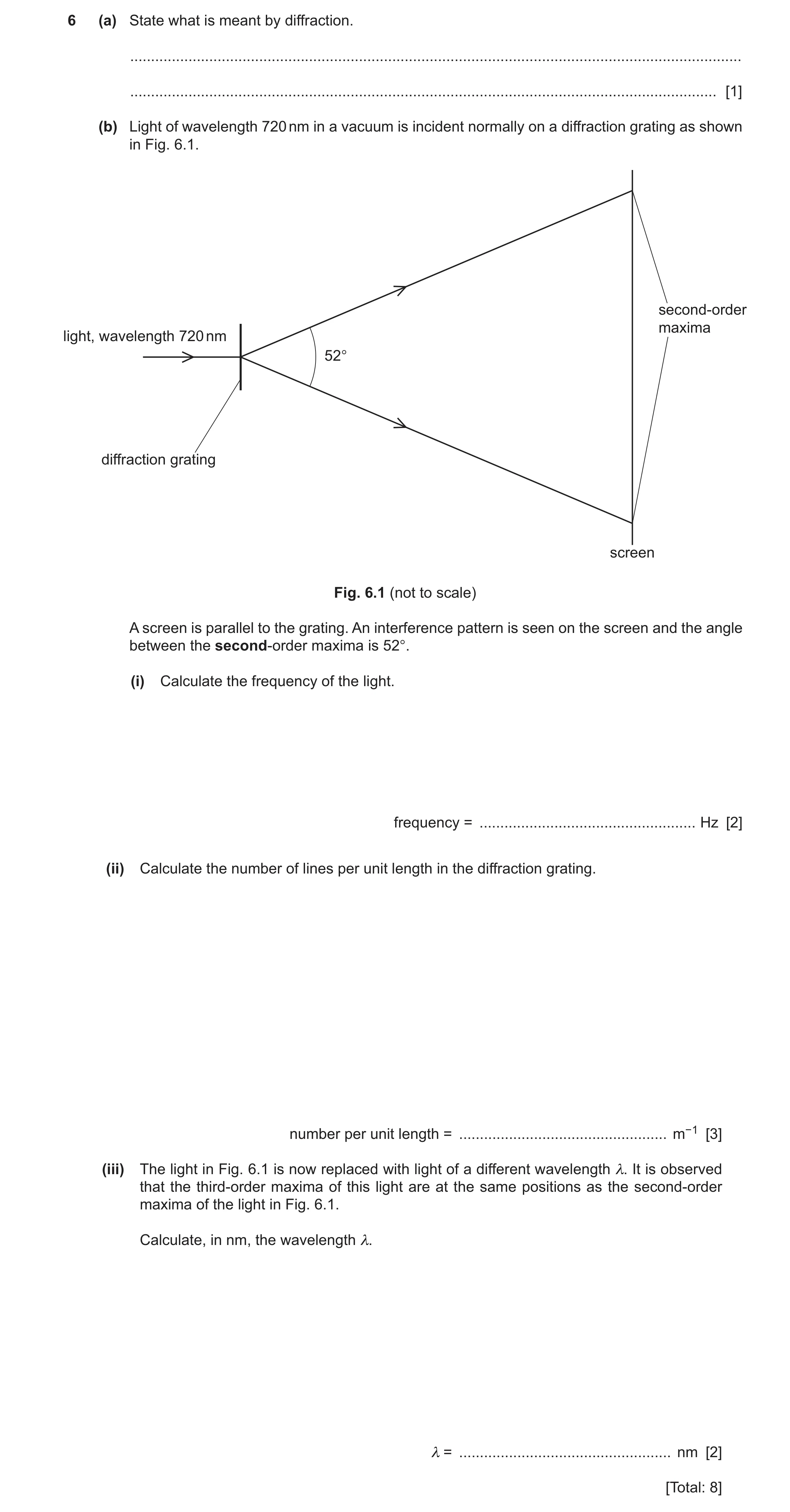
6 (a) State what is meant by diffraction. … … [1] (b) Light of wavelength 720 nm in a vacuum is incident normally on a diffraction grating as shown in Fig. 6.1. second-order maxima light, wavelength 720 nm 52° diffraction grating screen Fig. 6.1 (not to scale) A screen is parallel to the grating. An interference pattern is seen on the screen and the angle between the second-order maxima is 52°. (i) Calculate the frequency of the light. frequency = … Hz [2] (ii) Calculate the number of lines per unit length in the diffraction grating. number per unit length = … m−1 [3] (iii) The light in Fig. 6.1 is now replaced with light of a different wavelength λ. It is observed that the third-order maxima of this light are at the same positions as the second-order maxima of the light in Fig. 6.1. Calculate, in nm, the wavelength λ. λ = … nm [2] [Total: 8]
8 marks
Mark scheme: 6(a) wave passes (through) an aperture and spreads B1 or wave passes (by / through / around) an edge and spreads 6(b)(i) v = f C1 f = 3.00 108 / 720 10−9 A1 = 4.2 1014 Hz 6(b)(ii) d = nλ / sin θ C1 d = (2 720 10−9) / sin 26 C1 (= 3.3 10−6 m) A1 number of lines per m = 1 / (3.3 10−6) = 3.0 105 m−1 6(b)(iii) 1 C1 3 = 720 2 or sin 26 = 3 3.0 105 = 480 nm A1
This question in 9702/23 May/June 2025
Q13 · State what is meant by diffraction of a wave 9702/23 Oct/Nov 2025
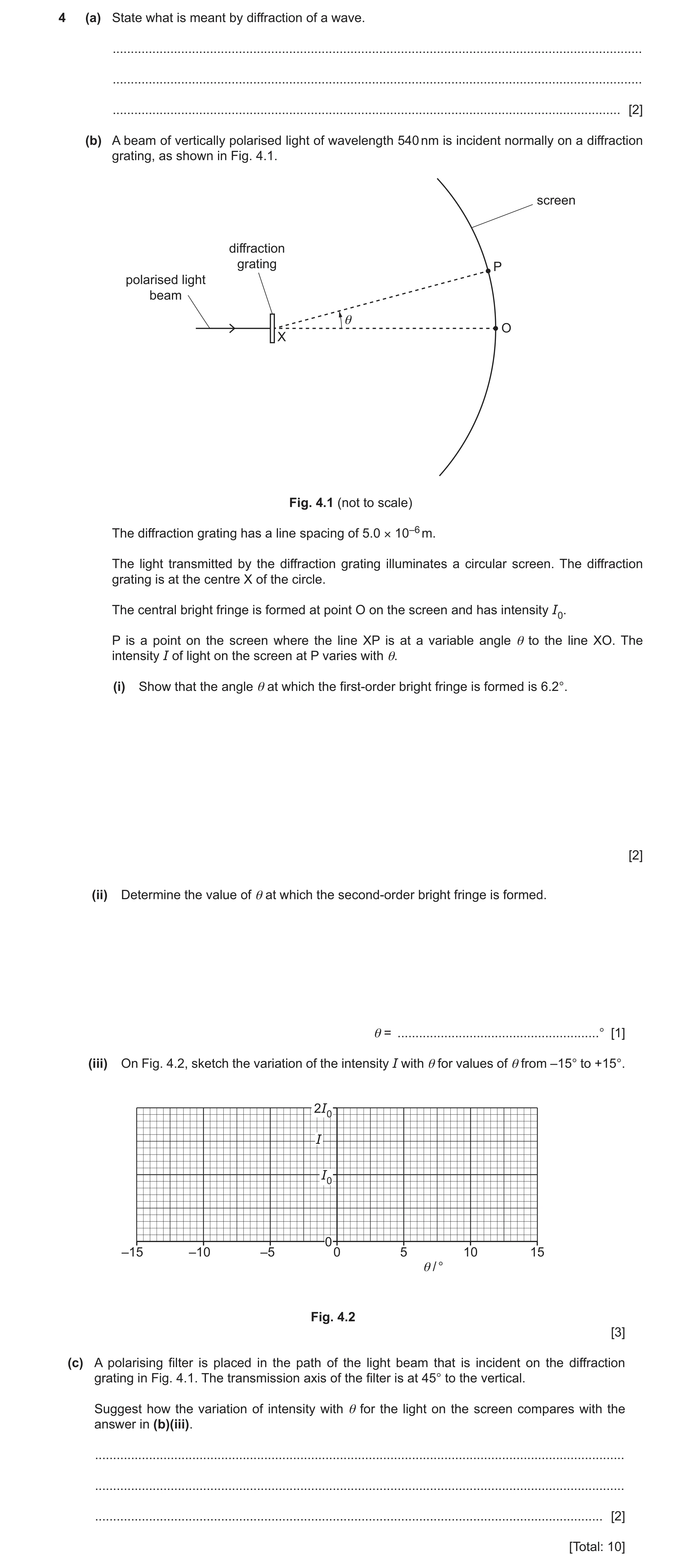
4 (a) State what is meant by diffraction of a wave. … … … [2] (b) A beam of vertically polarised light of wavelength 540 nm is incident normally on a diffraction grating, as shown in Fig. 4.1. screen diffraction grating P polarised light beam θ O X Fig. 4.1 (not to scale) The diffraction grating has a line spacing of 5.0 × 10⁻⁶ m. The light transmitted by the diffraction grating illuminates a circular screen. The diffraction grating is at the centre X of the circle. The central bright fringe is formed at point O on the screen and has intensity I0. P is a point on the screen where the line XP is at a variable angle θ to the line XO. The intensity I of light on the screen at P varies with θ. (i) Show that the angle θ at which the first-order bright fringe is formed is 6.2°. [2] (ii) Determine the value of θ at which the second-order bright fringe is formed. θ = … ° [1] (iii) On Fig. 4.2, sketch the variation of the intensity I with θ for values of θ from –15° to +15°. 2I0 I I0 0 –15 –10 –5 0 5 10 15 θ / ° Fig. 4.2 [3] (c) A polarising filter is placed in the path of the light beam that is incident on the diffraction grating in Fig. 4.1. The transmission axis of the filter is at 45° to the vertical. Suggest how the variation of intensity with θ for the light on the screen compares with the answer in (b)(iii). … … … [2] [Total: 10]
10 marks
Mark scheme: 4(a) wave passing through gap / aperture B1 (wave) spreads (out) B1 4(b)(i) n = d sin C1 = sin–1 [(540 10–9) / (5.0 10–6)] = 6.2° A1 4(b)(ii) = 12° A1 4(b)(iii) peaks / maxima shown at = 0, ±6° and ±12° B1 peaks / maxima and zero intensity in between B1 central peak / maxima at intensity I0 and the other peaks all equal to or less than I0 B1 4(c) peaks / maxima all at the same angles (as before) B1 intensity (of all peaks / maxima) halved B1
This question in 9702/23 Oct/Nov 2025
 1 / 19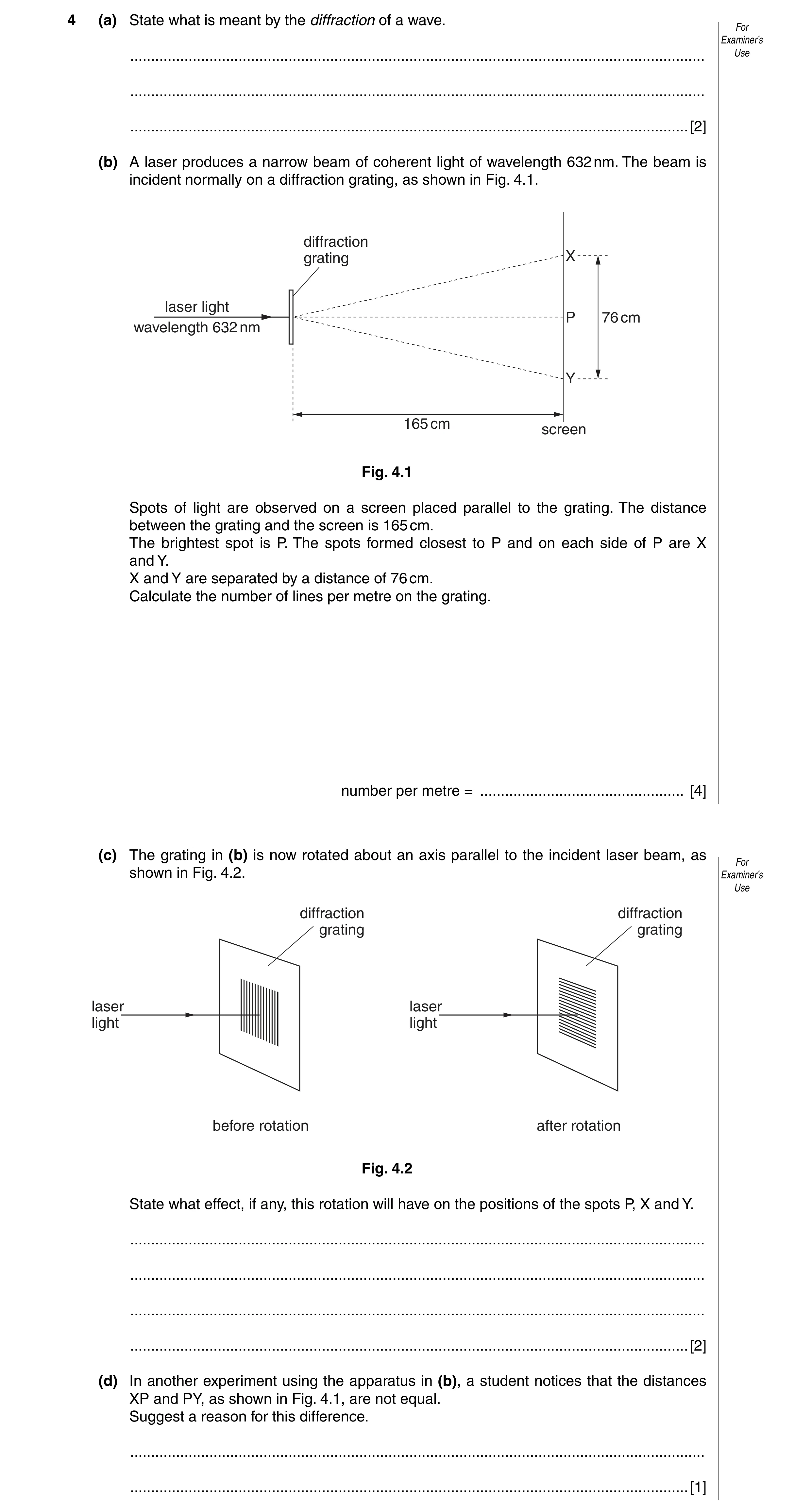
 6 / 19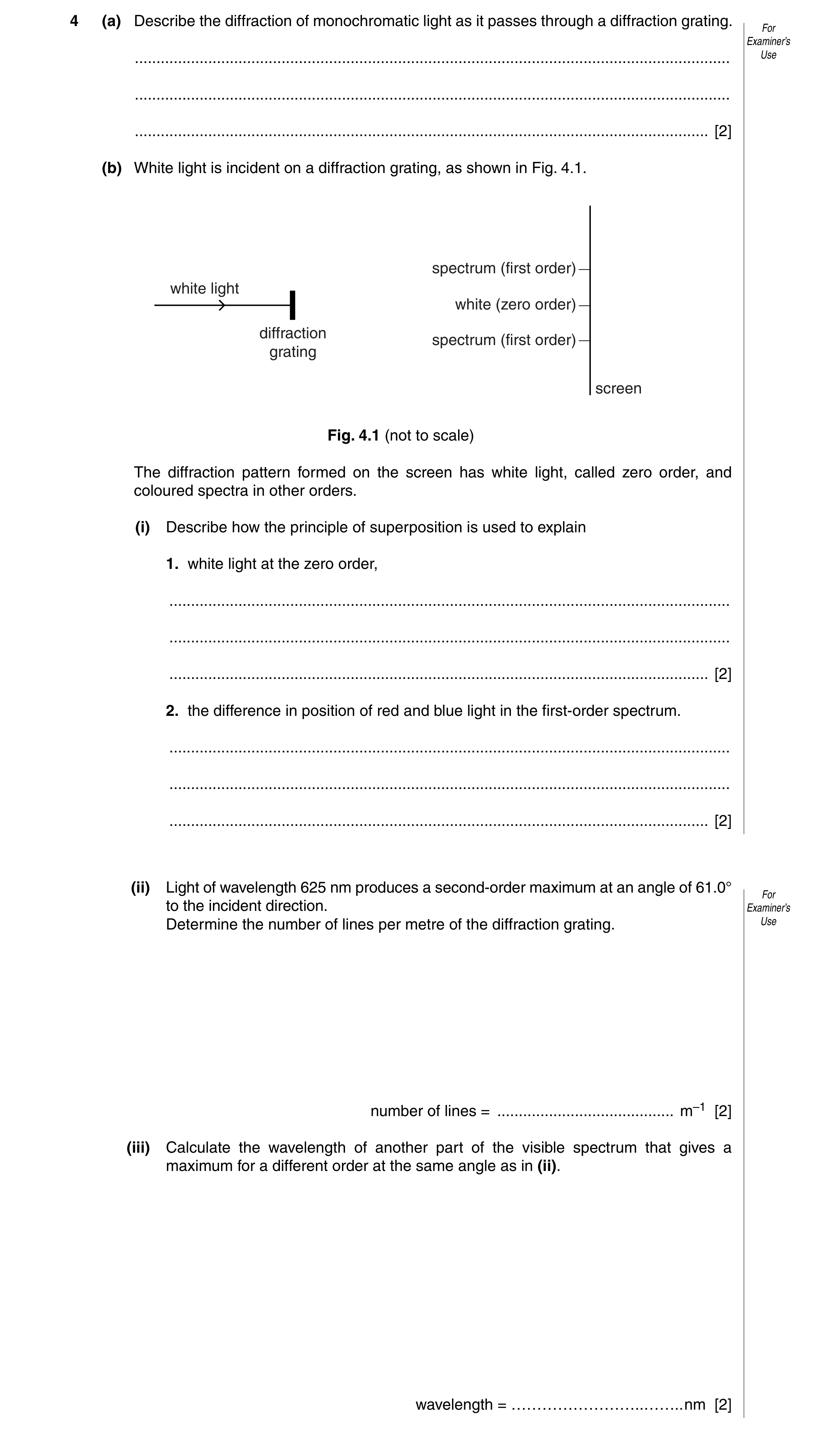
 9 / 19
 10 / 19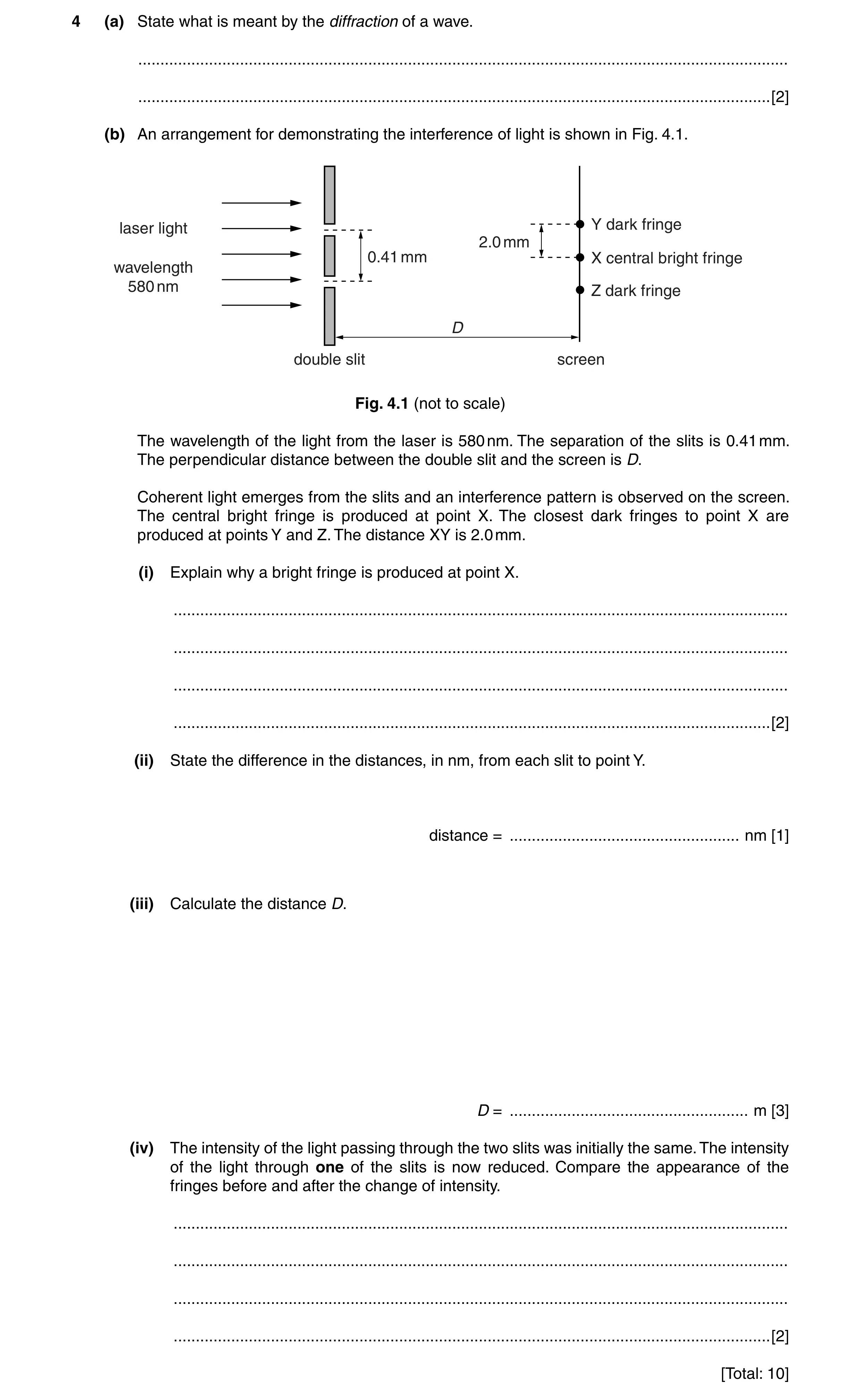
 12 / 19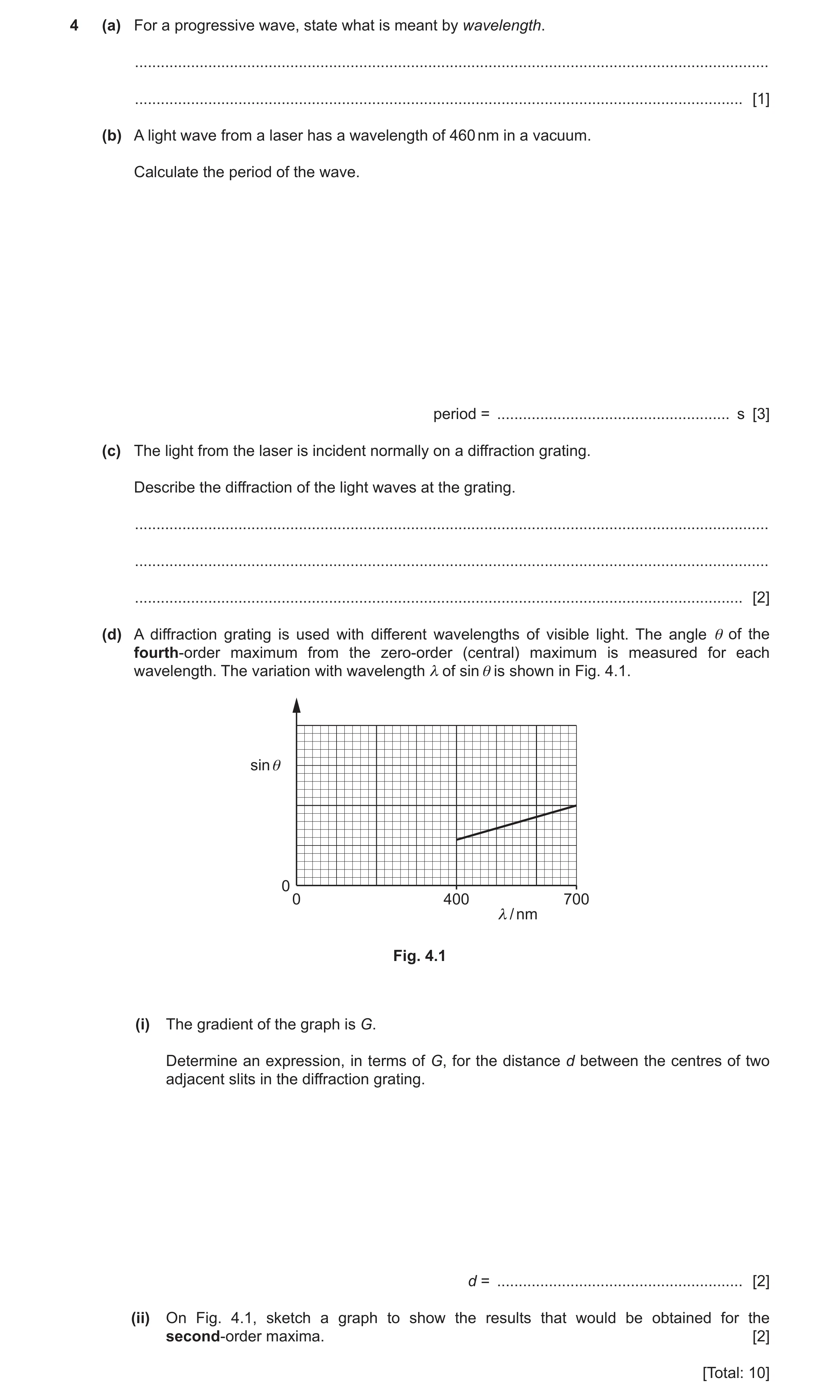
 8
8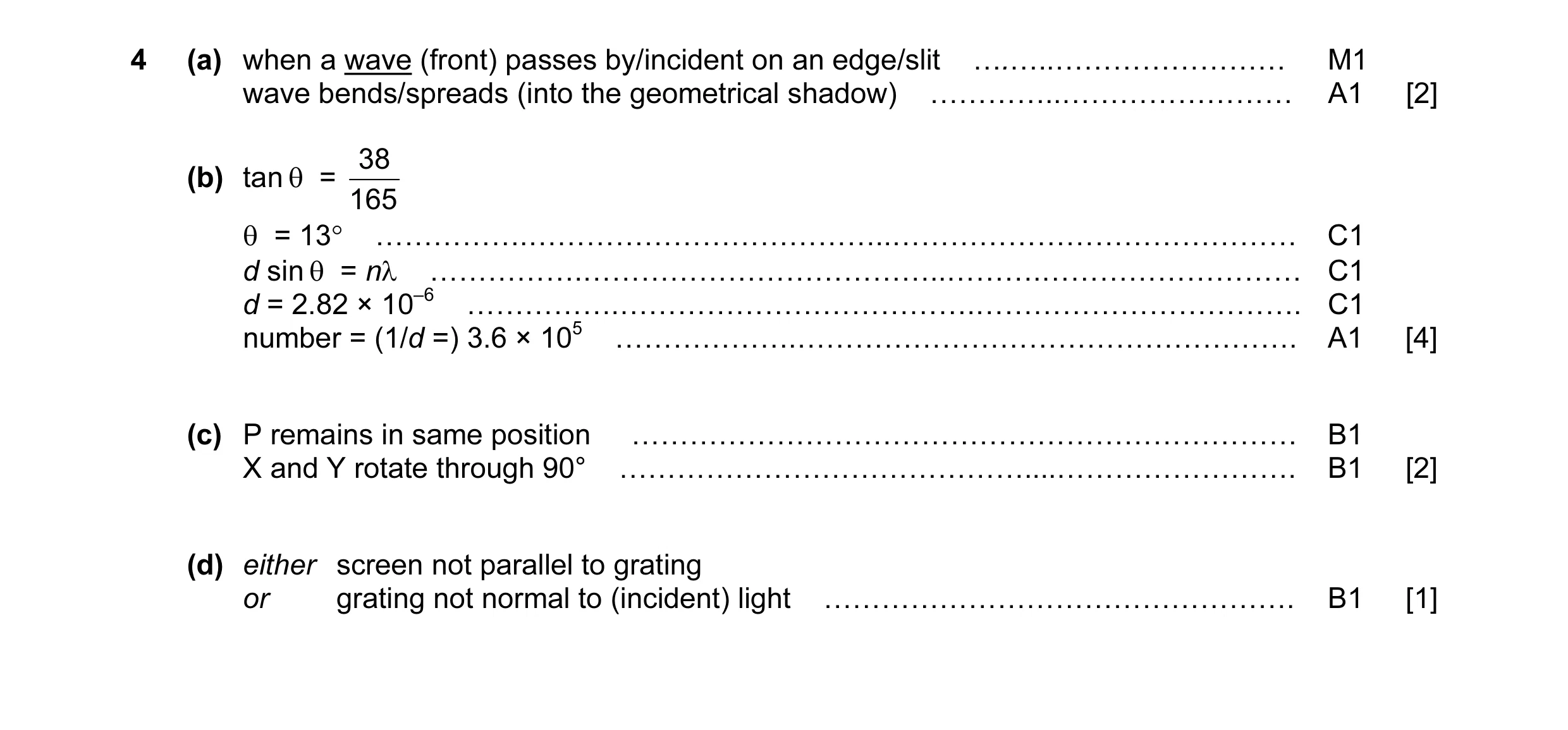 9
9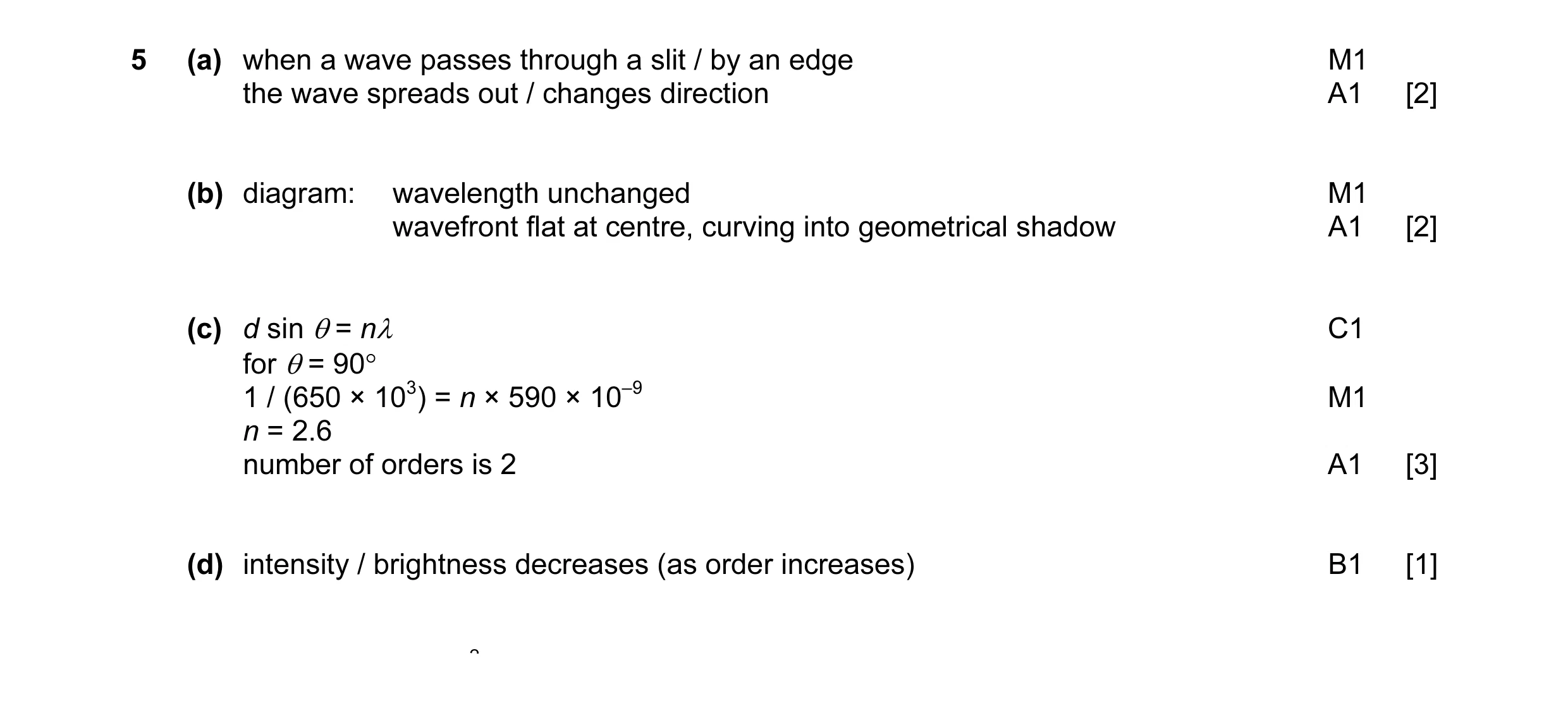 8
8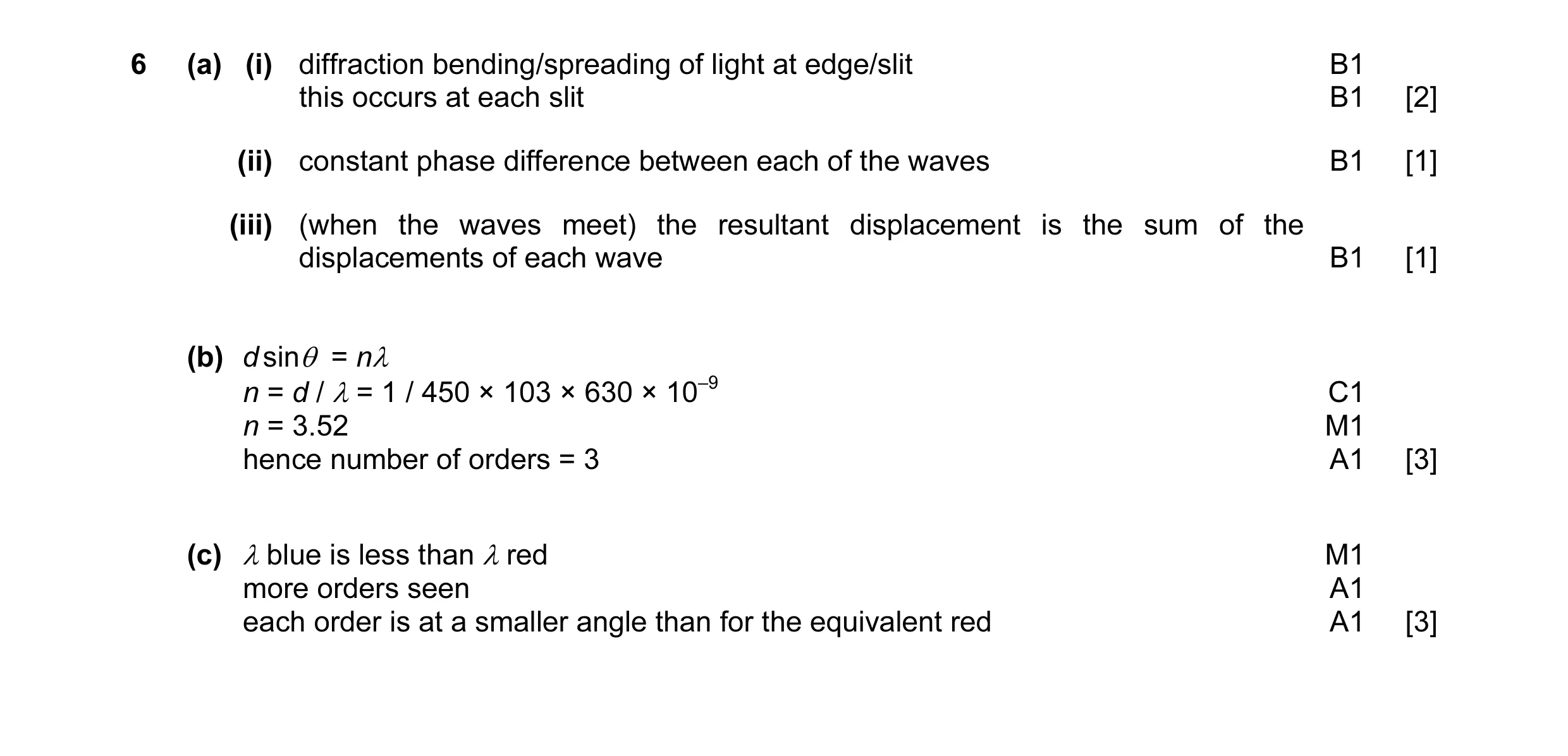 10
10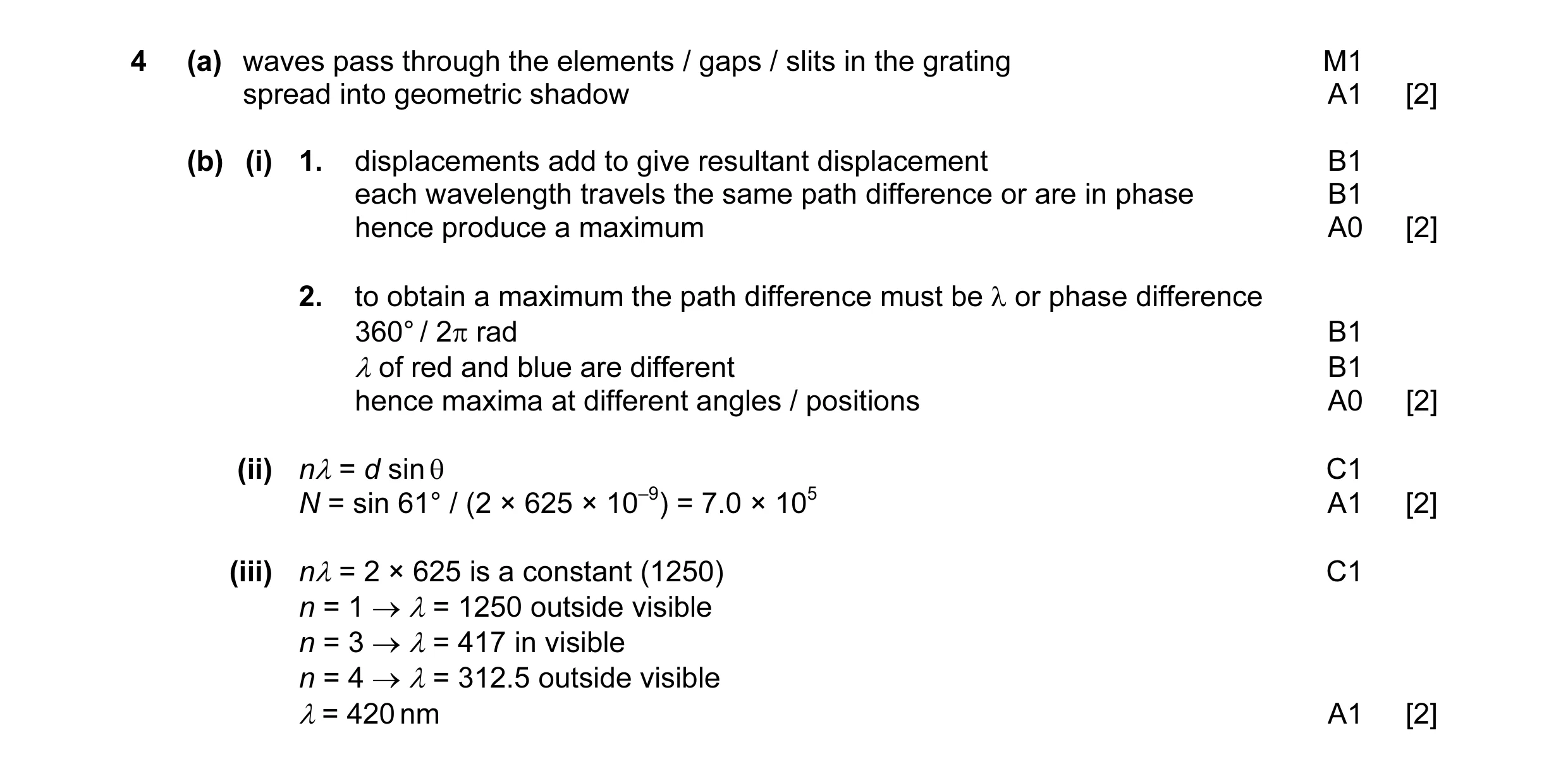 10
10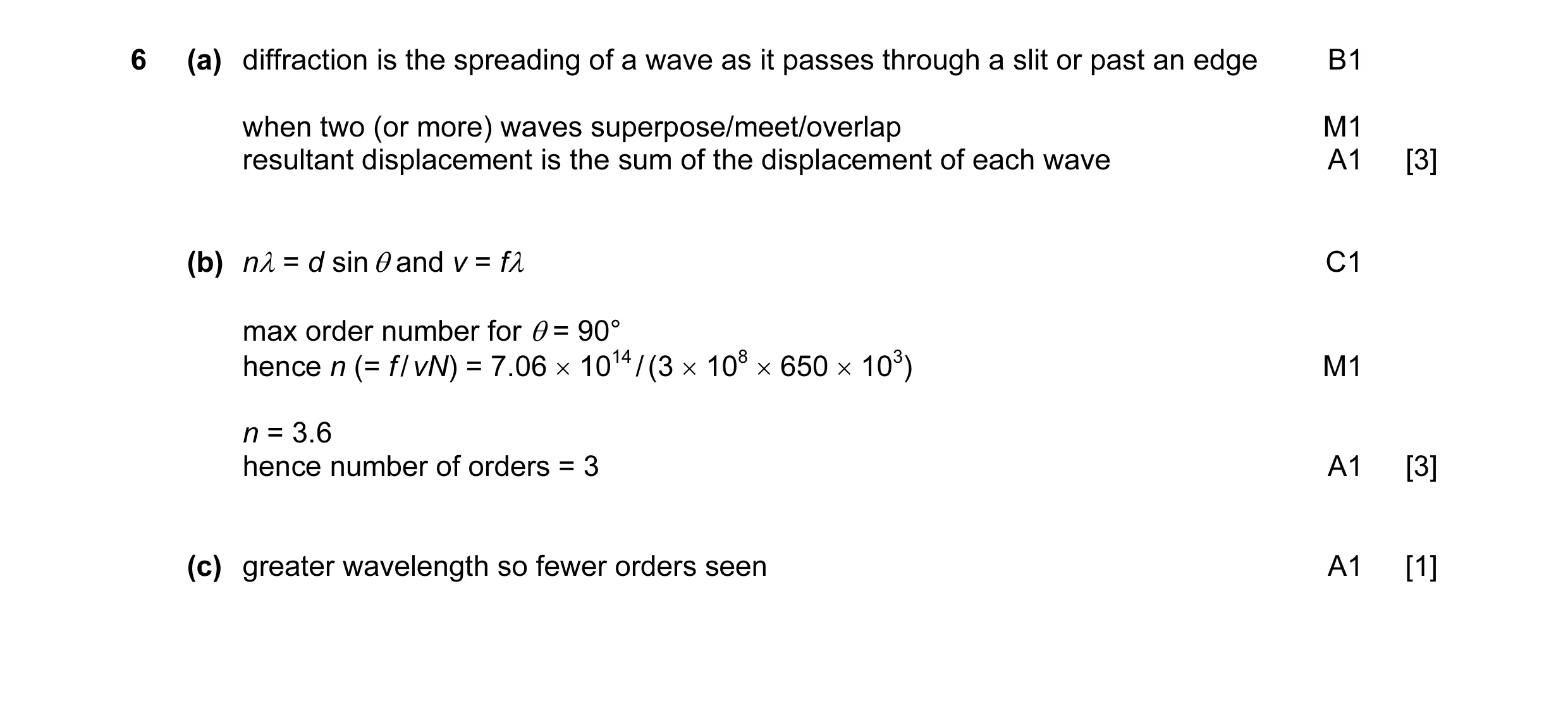 7
7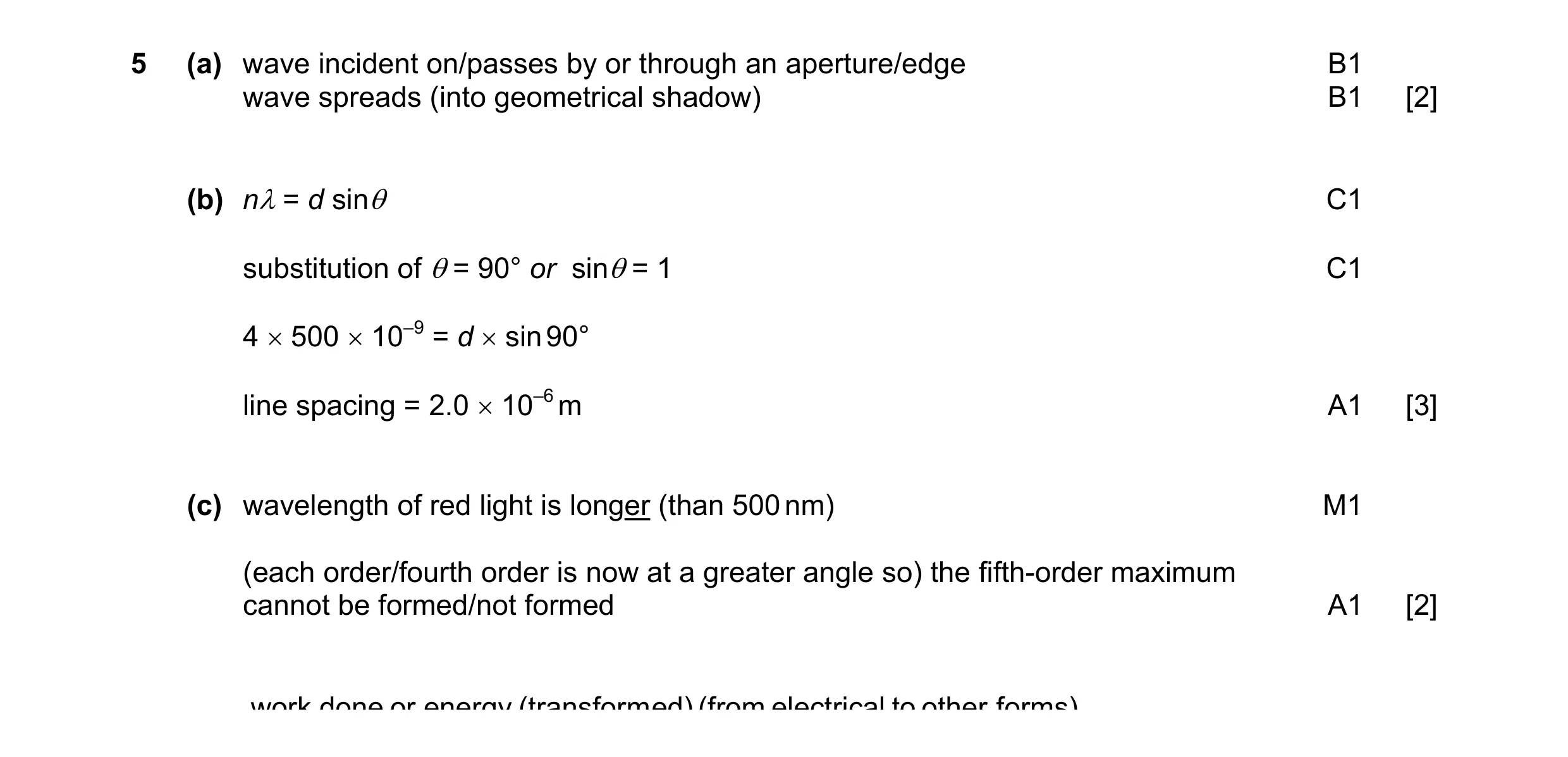 7
7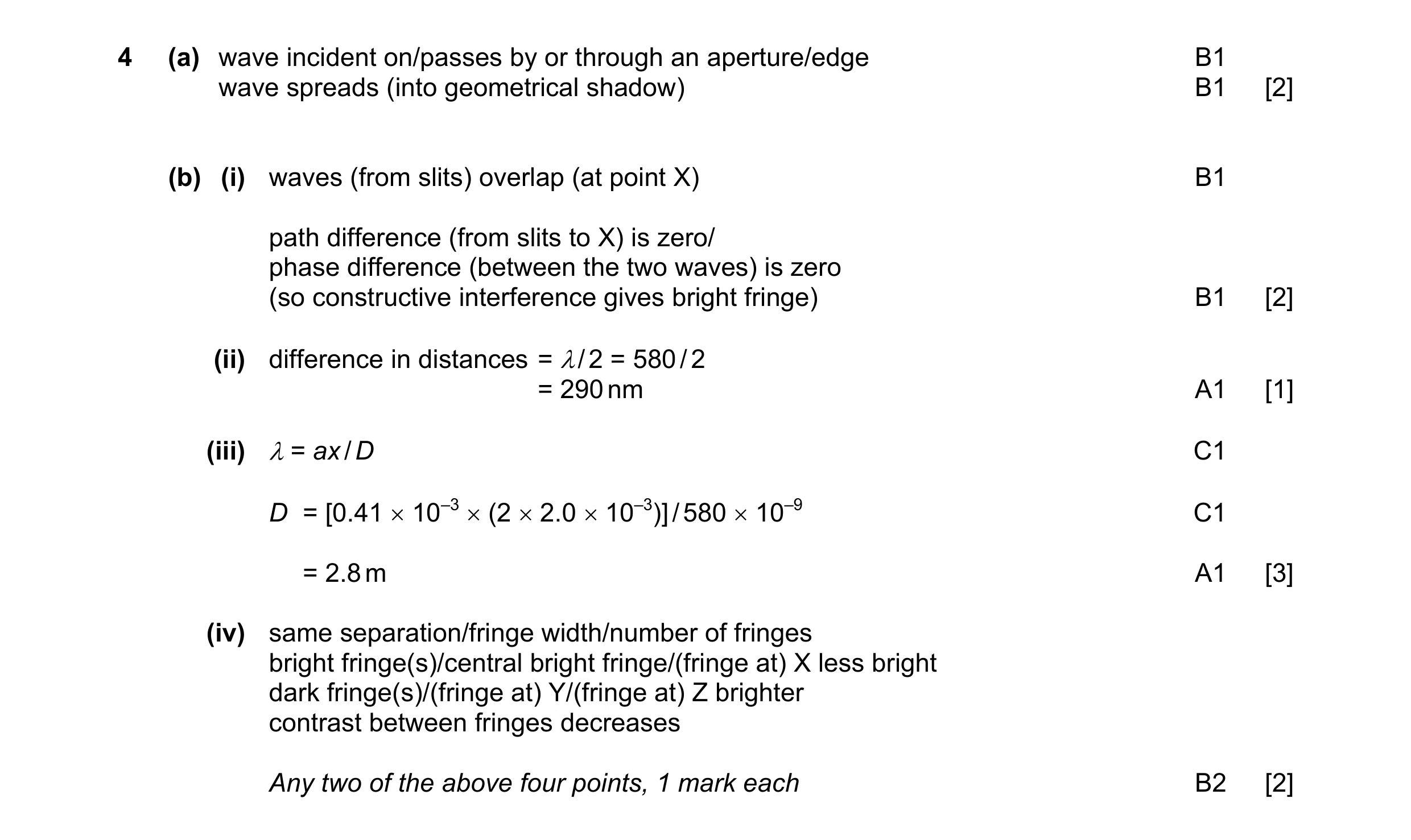 10
10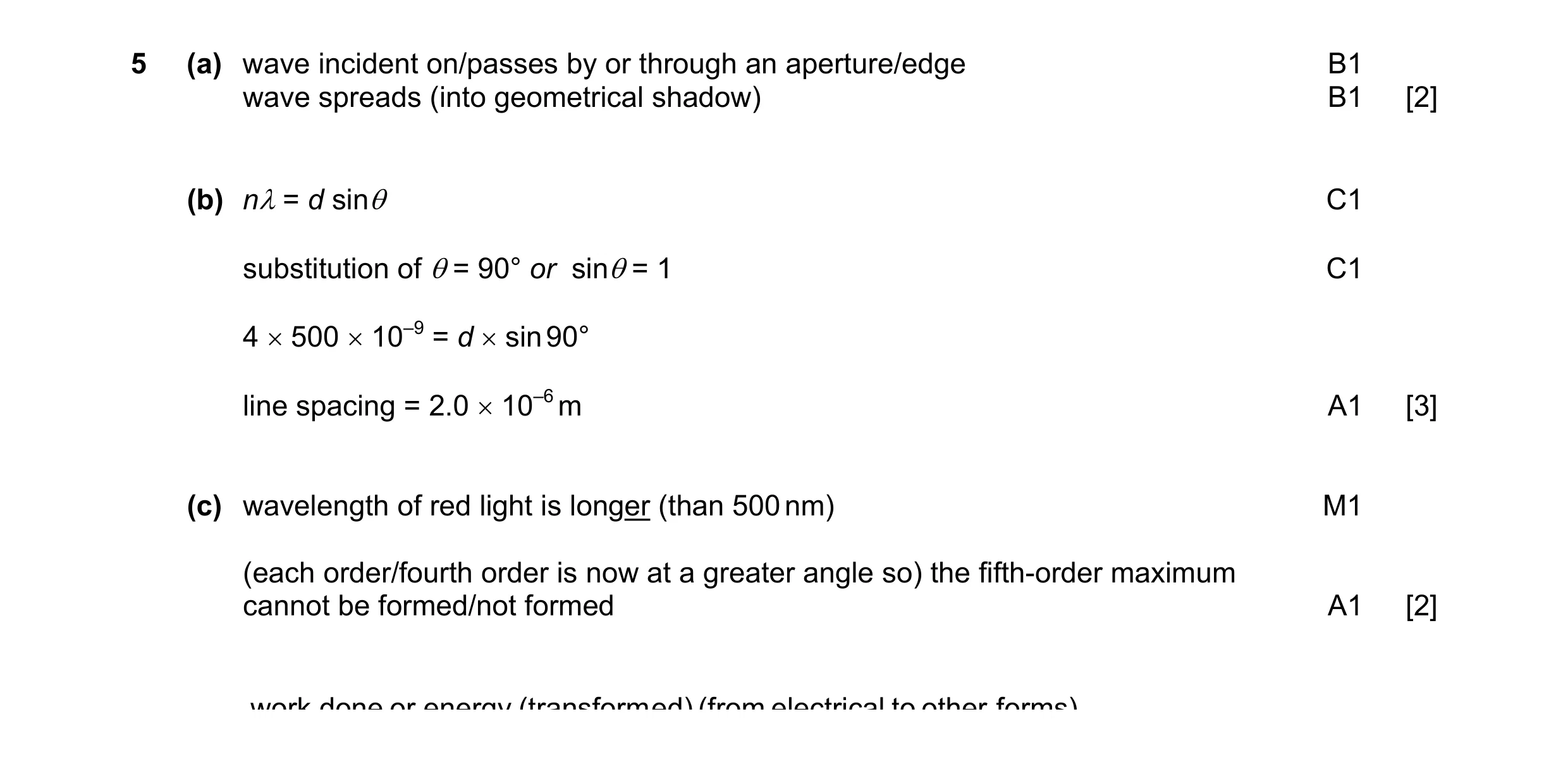 7
7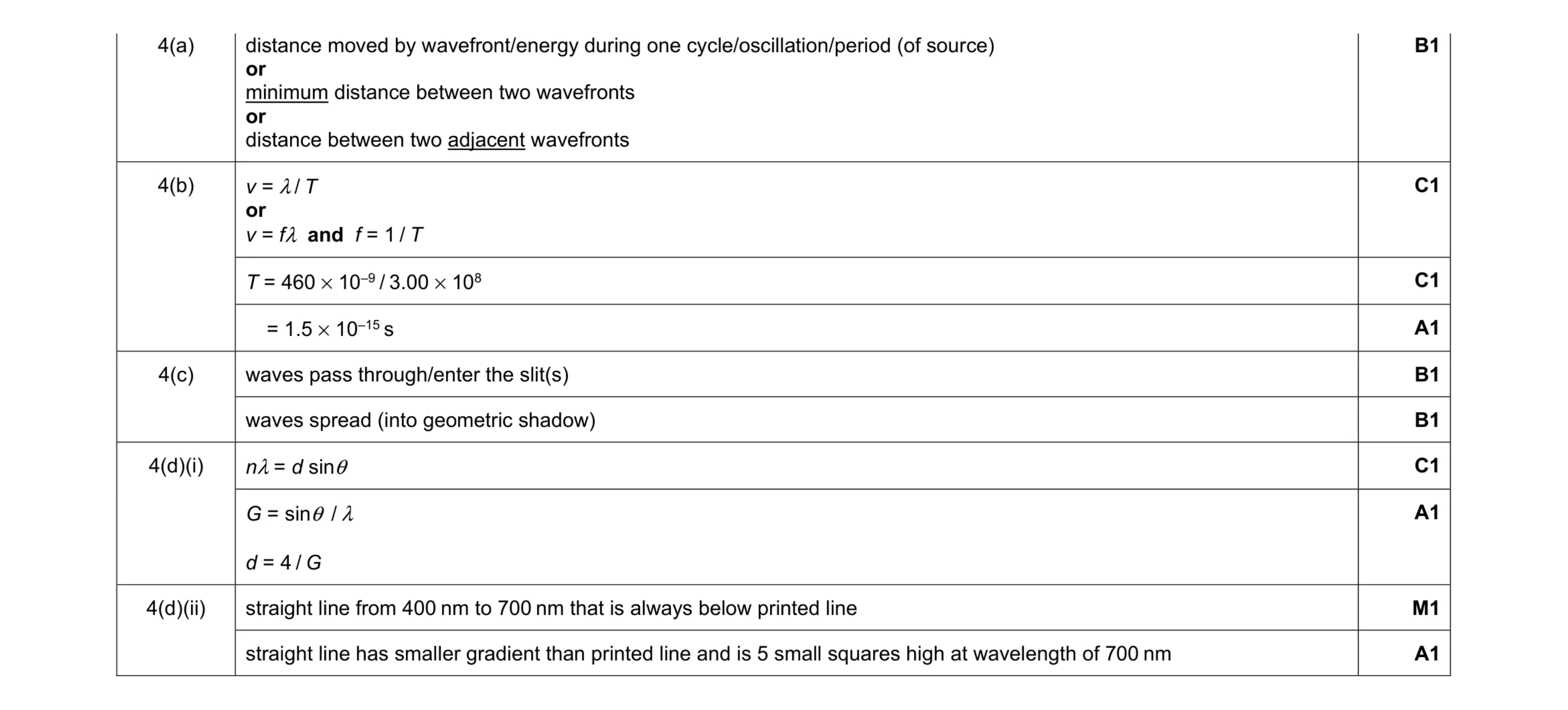 10
10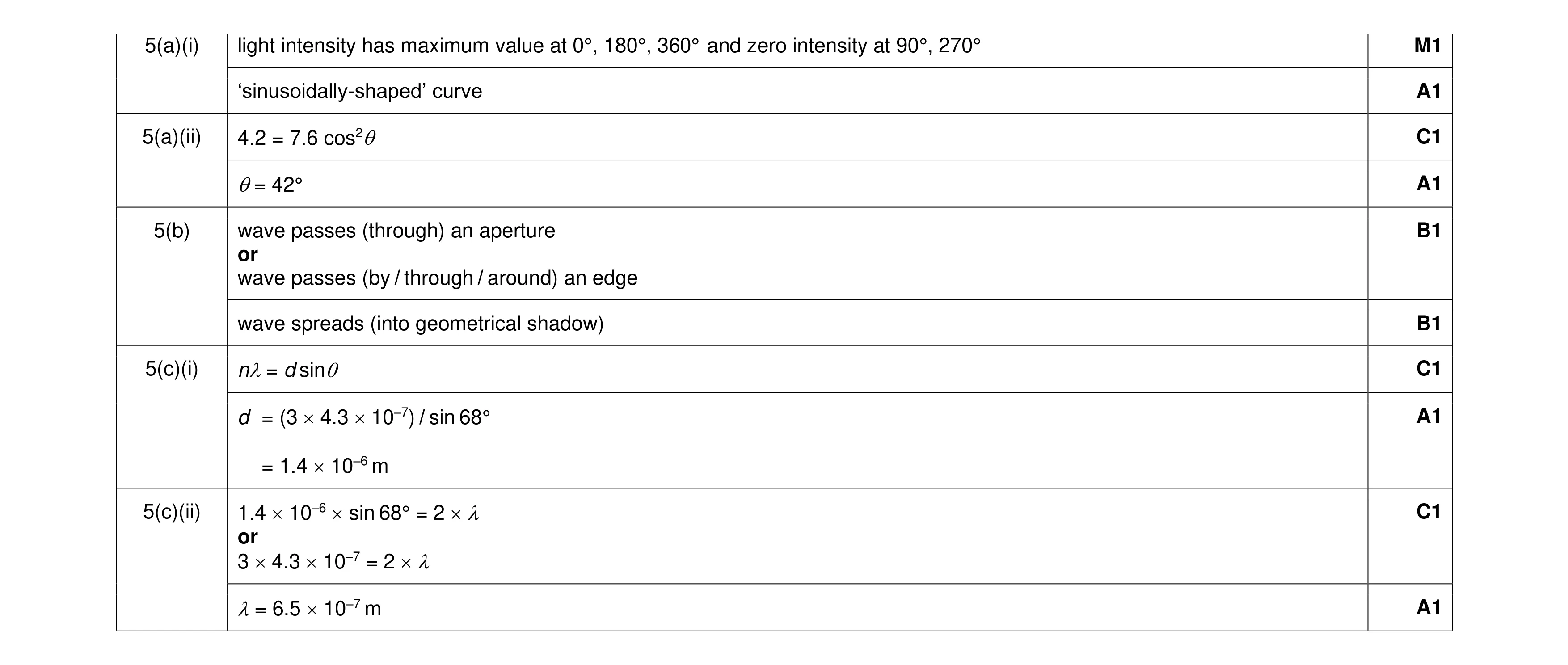 10
10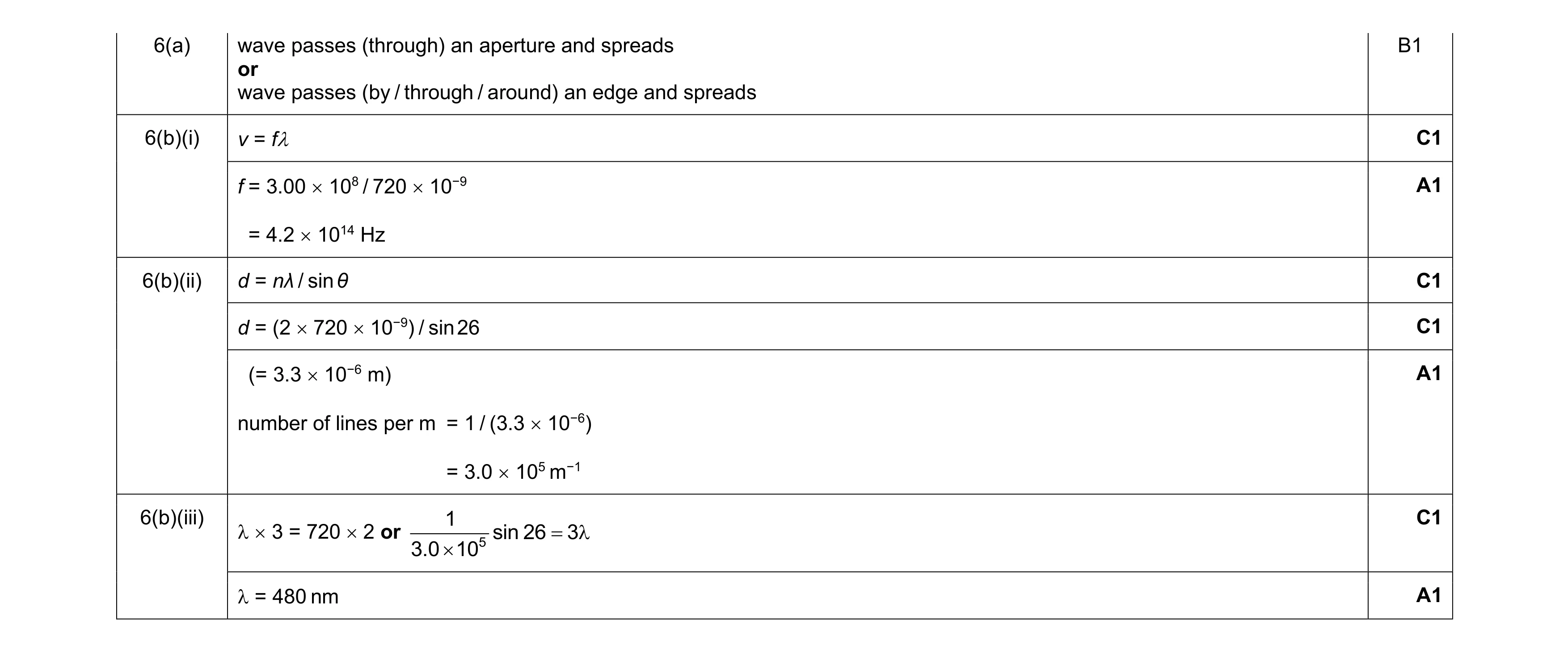 8
8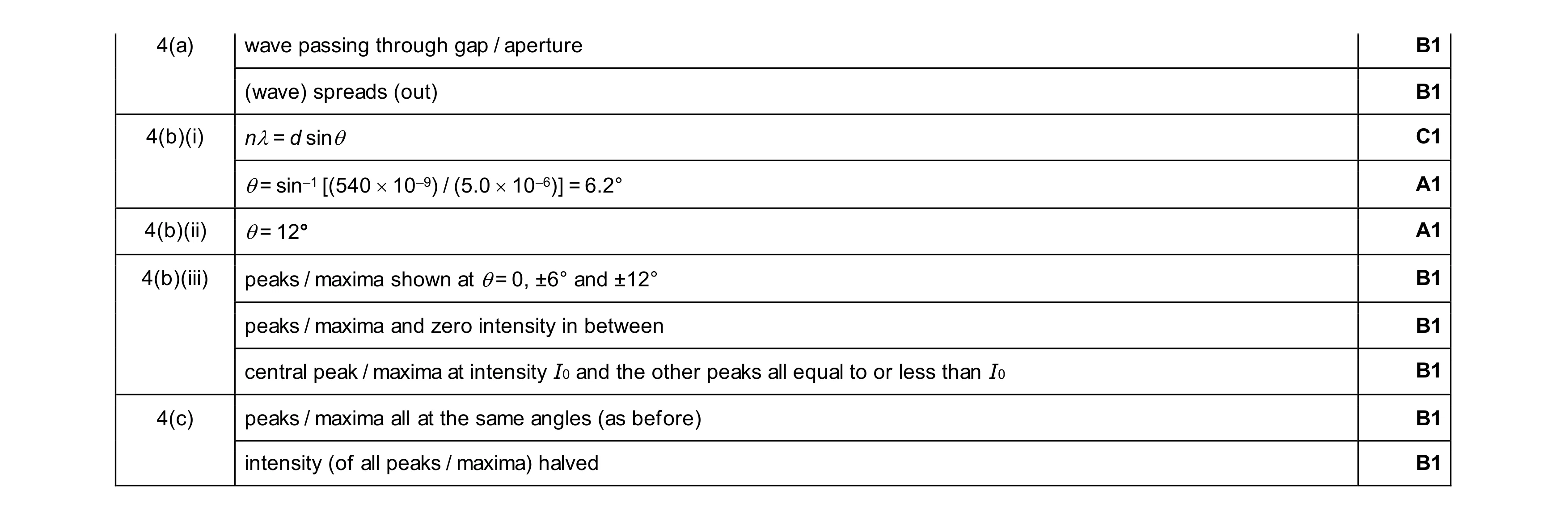 10
10