Questions as text
Q1 · Five different types of power station are listed 0654/41 Oct/Nov 2017
3 (a) Five different types of power station are listed. A hydroelectric B gas-fired C nuclear D oil-fired E tidal (i) State the letters of the three types of power station that use a boiler to turn water into steam. … [1] (ii) State the letters of the two types of power station that use renewable energy sources. … [1] (b) Overhead power transmission cables supply electrical energy to a town. Energy losses in the transmission cables can be reduced if the voltage for transmission is increased. (i) Name the device that steps up the voltage of the electricity before transmission. … [1] (ii) It is suggested that less energy is lost during transmission if the resistance of the cable is changed. The resistance of the cable is initially 8.0 Ω. It is suggested that the diameter of the cable should be doubled. Use the relationship • resistance is inversely proportional to (diameter)2 to calculate the resistance of a similar cable that has twice the diameter. resistance = … Ω [2] (c) (i) In a nuclear power station, nuclear fission of uranium-235 atoms takes place. Describe what happens to the atoms of uranium-235 during nuclear fission. … … [1] (ii) Another isotope of uranium, uranium-234, decays by alpha (α) emission to produce an isotope of thorium. Use the correct nuclide notation to complete the symbol equation for this decay process. … … 234 [3] 92U … Th + … He
9 marks
Mark scheme: 2 3(a)(i) B, C and D ; 1 3(a)(ii) A and E ; 1 3(b)(i) transformer ; 1 3(b)(ii) 4 seen in calculation ; 2 (Ω) ; 2 3(c)(i) nuclei are split ; 1 3(c)(ii) 230Th ; 90Th ; 4He ; 3
This question in 0654/41 Oct/Nov 2017
Q2 · A snowboarder moving down a ski slope 0654/41 Oct/Nov 2017
9 Fig. 9.1 shows a snowboarder moving down a ski slope. Fig. 9.1 (a) Fig. 9.2 shows a speed-time graph for the snowboarder. 6 5 4 speed 3 m / s 2 1 0 0 5 10 15 20 25 30 time / s Fig. 9.2 The mass of the snowboarder is 75 kg. (i) Calculate the maximum kinetic energy of the snowboarder. State the formula you use and show your working. formula working kinetic energy = … J [3] (ii) Calculate the acceleration of the snowboarder in the first 10 seconds. Show your working. State the unit of your answer. acceleration = … unit … [3] (iii) Calculate the force required to produce the acceleration of the snowboarder you calculated in (a)(ii). State the formula you use and show your working. formula working force = … N [2] (b) The snowboarder is exposed to infra-red and ultraviolet radiation from the Sun. Infra-red and ultraviolet radiation are both parts of the electromagnetic spectrum. (i) Place the radiations infra-red and ultraviolet in their correct positions in the incomplete electromagnetic spectrum in Fig. 9.3. visible γ-rays radio waves light Fig. 9.3 [1] (ii) State the speed at which ultraviolet waves travel from the Sun to the Earth in km / s. Give a reason for your answer. speed … km / s reason … … [2] (c) Some snow is steadily heated in a beaker. The temperature of the snow is measured as it is heated. Fig. 9.4 shows a graph of the results. temperature / °C 0 time / minutes W X Y Z Fig. 9.4 Explain why the temperature of the snow does not increase in section X. Use the term latent heat of fusion in your answer. … … … … [2]
13 marks
Mark scheme: 9(a)(i) maximum speed = 5.0 m/s ; KE = ½ mv2 OR ½ × 75 × 5 × 5 ; = 940 (J) ; 3 9(a)(ii) v t ∆ OR 4/10 OR 5/12.5 ; = 0.4 ; m/s2 ; 3 9(a)(iii) F = ma OR = 75 × 0.4 ; = 30 (N) ; 2 9(b)(i) ultraviolet written in correct box AND infra-red written in correct box ; 1 9(b)(ii) 300 000 (km/s) ; because all electromagnetic waves travel at this speed ; 2 9(c) latent heat of fusion required to melt snow ; to break bonds (between molecules)/to overcome attractive forces (between molecules) / to increase potential energy of the molecules ; 2
This question in 0654/41 Oct/Nov 2017
Q3 · A student is listening to music on her computer using headphones 0654/42 Oct/Nov 2017
3 (a) A student is listening to music on her computer using headphones. (i) State the useful energy transformation that happens in the headphones. from … energy to … energy [1] (ii) Fig. 3.1 shows the heat sink on a computer chip. heat sink black metal fins computer chip Fig. 3.1 The heat sink allows unwanted thermal energy to be transferred away from the chip. Suggest two features of the heat sink that allow thermal energy to be transferred away from the chip. Explain why each feature transfers thermal energy efficiently. feature 1 … because … … feature 2 … because … … [2] (b) The student watches her teacher set up a radiation detector in the school science laboratory. A sealed radioactive source, strontium-90, is placed on the bench next to the radiation detector. Strontium-90 emits β-particles. A small count rate is measured. (i) When the teacher repeats the experiment a few minutes later, the count rate measured is slightly higher. Suggest one reason for this. … … [1] (ii) Strontium-90 decays by beta (β) emission to produce an isotope of yttrium. Use the correct nuclide notation to complete the symbol equation for this decay process. … … 9038Sr … Y + … e [3] (c) The teacher asks the student to test one of the springs from a chair. Fig. 3.2 shows the chair. spring Fig. 3.2 The student measures the extension of the spring for different stretching forces. She plots the graph shown in Fig. 3.3. 10.0 8.0 extension / mm 6.0 4.0 2.0 0 0 20 40 60 80 100 120 140 force / N Fig. 3.3 (i) The force changes the shape of the spring. State one other effect that a force can have on a body. … [1] (ii) Use Fig. 3.3 to predict the force needed to give an extension of 10.0 mm. … N [1] (iii) State the assumption you have made to make your prediction in (ii). … … … [1]
10 marks
Mark scheme: 3(a)(i) electrical to sound ; 1 3(a)(ii) lots of fins – large surface area or large surface area – more, conduction / convection / radiation / transfer, of heat / energy ; black fins – black is a good emitter of radiation ; metal fins – metal is a good conductor of heat ; max 2 3(b)(i) decay is a random process / ref to background radiation ; 1 3(b)(ii) mass number correct ; atomic number correct ; both numbers correct ; 3 3(c)(i) change in, speed / direction, of motion ; 1 Question Answer Marks 3(c)(ii) 133 N ; 1 3(c)(iii) the force needed to extend a spring is directly proportional to the extension / elastic limit not exceeded ; 1
This question in 0654/42 Oct/Nov 2017
Q4 · State the name of the electromagnetic wave that is used in mobile (cell) phone… 0654/43 Oct/Nov 2017
6 (a) (i) State the name of the electromagnetic wave that is used in mobile (cell) phone communication. … [1] (ii) State the speed at which all electromagnetic waves travel. … [1] (b) Fig. 6.1 shows the information found on a mobile phone charger. input: a.c. 240 V, 50 Hz, 80 mA output: d.c. 5.3 V, 500 mA Fig. 6.1 The charger contains a transformer to reduce the voltage. The primary (input) coil has 2500 turns. Calculate the number of turns on the secondary (output) coil. State the formula you use and show your working. formula working number of turns = … [2] (c) The ring tone on a mobile phone can be changed. Fig. 6.2 shows the sound trace made by four sound waves on an oscilloscope screen. P Q R S Fig. 6.2 State the letter that shows a sound trace from a ring tone which would be a loud sound with a high pitch, … quiet sound with a low pitch. … [1] (d) A student calculates the work done when she lifts her mobile phone through a vertical distance of 50 cm. The mobile phone weighs 0.9 N. Each of the boxes contains a possible stage in her calculation. Link the three boxes with lines that show how the student correctly calculated the work done. formula: W = F ÷ D W = F × D W = D ÷ F calculation: = 0.9 ÷ 50 = 0.9 × 50 = 0.9 × 0.5 answer: = 0.018 J = 45 J = 0.45 J [2]
7 marks
Mark scheme: 6(a)(i) microwaves ; 1 6(a)(ii) 300 000 000 / 3 × 10⁸ m / s ; 1 6(b) S S P P V N V N = OR ( ) 2500 5.3 240 s N × = ; = 55 (turns) ; 2 6(c) P then S ; 1 6(d) use of W = F × D ; answer 0.45 J ; 2
This question in 0654/43 Oct/Nov 2017
Q5 · A bat emitting ultrasound waves to detect obstacles and prey 0654/41 Oct/Nov 2018
6 (a) Fig. 6.1 shows a bat emitting ultrasound waves to detect obstacles and prey. Fig. 6.1 (i) Ultrasound waves are sound waves with a frequency higher than humans can hear. The range of frequencies emitted by a bat is from 2000 Hz to 110 000 Hz. State whether a bat emits any frequencies audible to a human. Explain your answer. … … … [1] (ii) A bat emits a pulse of ultrasound of wavelength 9 × 10⁻³ m. The speed of sound in air is 330 m / s. Calculate the frequency of the ultrasound pulse. State the formula you use and show your working. formula working frequency = … Hz [2] (iii) Ultrasound waves pass through the air as a series of rarefactions and compressions. Describe the difference between a compression and a rarefaction. … … [1] (iv) Describe, in terms of compressions, what is meant by the wavelength of the ultrasound wave. … … [1] (b) Some bats can detect ultraviolet radiation. Ultraviolet radiation is part of the electromagnetic spectrum. (i) State the speed at which all electromagnetic waves travel in a vacuum. State the units of your answer. speed = … units … [1] (ii) Fig. 6.2 shows an incomplete electromagnetic spectrum. On Fig. 6.2, place ultraviolet in the correct position. visible radioγ-rays microwaves light waves Fig. 6.2 [1] (iii) State where, in the electromagnetic spectrum shown in Fig. 6.2, the waves with the highest frequencies are found. … [1] (c) A bat flies at 9 m / s. (i) Calculate the time it takes the bat to fly 200 m at this speed. State the formula you use and show your working. formula working time = … s [2] (ii) The mass of the bat is 200 g. Calculate the kinetic energy of the bat when moving at 9 m / s. State the formula you use and show your working. formula working kinetic energy = … J [2]
12 marks
Mark scheme: 6(a)(i) Yes, because human normally hears up to 20 000 Hz ; 1 6(a)(ii) frequency = speed / wavelength or 3 330 9 10− × or 330 0.009 ; 37 000 (Hz) ; 2 6(a)(iii) compression region of high pressure / where the particles are close together or rarefaction region of low pressure / where particles are further apart ; 1 6(a)(iv) distance between two (consecutive) compressions ; 1 6(b)(i) 300 000 000 m / s ; 1 6(b)(ii) box to the left of visible light ; 1 6(b)(iii) left hand side / gamma ; 1 6(c)(i) distance time= speed or 200 9 ; = 22 (s) ; 2 6(c)(ii) 2 1 KE mv 2 = or 1 0.2 9 9 2 × × × ; 8.1 (J) ; 2
This question in 0654/41 Oct/Nov 2018
Q6 · The body of a car is usually made from steel 0654/43 Oct/Nov 2018
12 (a) The body of a car is usually made from steel. The bodies of some cars are made from aluminium. Suggest a simple way of deciding whether the body of a car is made from either steel or aluminium. Explain your answer. … … … [1] (b) In a car, relays are often used as switches in electrical circuits that use large currents. Explain why relays are used in this way. … … … [1] (c) A car driver uses mirrors to see behind the car. Fig. 12.1 shows a ray of light striking a mirror. mirror Fig. 12.1 (i) On Fig. 12.1, draw the normal at the point where the ray strikes the mirror and label with the word normal. [1] (ii) On Fig. 12.1, draw the reflected ray and label with the words reflected ray. [1] (iii) On Fig. 12.1, mark the angle of reflection and label with the letter r. [1] (d) Fig. 12.2 shows a black car and a white car. Fig. 12.2 The cars are parked next to each other on a sunny day. Suggest why the black car gets hotter than the white car. … … [1] (e) The black car accelerates up a hill. Apart from thermal energy, state two forms of energy gained by the car as it accelerates up the hill. 1 … energy 2 … energy [2] (f) During a journey, the black car travels 1500 m along a straight road in 90 s. The driving force of the car’s engine is 14 000 N. (i) Calculate the work done by the driving force. State the formula you use and show your working. formula working work done = … J [2] (ii) Calculate the useful power output from the car’s engine during this period. State the formula you use, show your working and state the unit of your answer. formula working power = … unit … [3]
13 marks
Mark scheme: 12(a) use a magnet (no mark) steel is magnetic / attracted to a magnet ; 1 12(b) to switch high current circuits using a small current circuit / so a high current circuit can be switched safely / so that a switch with a low current rating can be used to switch a high current ; 1 12(c)(i) normal drawn and labelled ; 1 12(c)(ii) reflected ray drawn with approx. correct angle of reflection ; 1 12(c)(iii) correctly labelled angle of reflection ; 1 12(d) black surfaces are better absorbers of thermal radiation (than white surfaces) / white surfaces are better reflectors of thermal radiation (than black surfaces) ; 1 12(e) kinetic ; gravitational (potential) ; 2 12(f)(i) work = force × distance or 14 000 × 1500 ; = 21 000 000 (J) ; 2 12(f)(ii) power = energy time or work time or 21000000 90 ; = 230 000 ; W ; 3
This question in 0654/43 Oct/Nov 2018
Q7 · A solar-powered golf cart, with solar cells on the roof 0654/41 May/June 2019
12 Fig. 12.1 shows a solar-powered golf cart, with solar cells on the roof. Fig. 12.1 The solar cells produce electrical energy using solar energy. The Sun is the source of this energy. (a) Name two energy resources that do not have the Sun as their source of energy. 1 … 2 … [1] (b) During the golf cart’s journey, the temperature in the tyres increases. The volume of air in the tyres does not change. Explain in terms of molecules the effect on the pressure of a gas due to an increase in temperature at constant volume. … … … … [2] (c) The golf cart often travels across sloping fields so stability is important in its design. Fig. 12.2 shows the cart on a slope. X Fig. 12.2 The centre of mass of the golf cart is shown by the letter X. State the effect of raising the centre of mass of the golf cart on its stability. … … [1] (d) A spectator takes a photograph of a golfer with a camera. The camera uses a thin converging lens to focus light rays onto the light sensor inside the camera. (i) Complete the ray diagram in Fig. 12.3 to show this. camera lens light rays light from golfer sensor Fig. 12.3 [1] (ii) The lens is made from glass. Glass has a refractive index of 1.33. Define refractive index in terms of the speed of light in a vacuum and in glass. … … [1] (iii) The image produced by the lens on the light sensor is a real image. Describe the difference between a real image and a virtual image. … … [1] (e) Describe in terms of the forces between the atoms why solids have a fixed shape. … … [1] [Total: 8]
8 marks
Mark scheme: 12(a) any two from geothermal nuclear tidal ; 1 12(b) increase in pressure because molecules are moving faster / have more KE ; collide with walls of tyre more frequently / at greater speed / with greater force ; 2 12(c) less stable ; 1 12(d)(i) two straight rays brought to a focus on the light sensor ; 1 12(d)(ii) speed of light in vacuum ÷ speed of light in glass ; 1 12(d)(iii) real image can be projected onto a screen / is formed where the light rays converge ; virtual image is one from which the light rays appear to come from that image ; max 1 12(e) (fixed shape because) strong forces (keep particles in regular / fixed arrangement) ; 1
This question in 0654/41 May/June 2019
Q8 · In 1971, an astronaut hit a golf ball on the surface of the Moon 0654/42 May/June 2019
3 (a) In 1971, an astronaut hit a golf ball on the surface of the Moon. The golf ball had a mass of 46 g and initially travelled at 50 m / s. (i) Calculate the kinetic energy of the golf ball when travelling at 50 m / s. Show your working. kinetic energy = … J [3] (ii) Describe the difference between the terms speed and velocity. … … … [1] (b) On the Moon, an astronaut suspends masses on a spring and measures the extension of the spring in mm as shown in Fig. 3.1 lo le extension = le – lo Fig. 3.1 Fig. 3.2 shows the results of the experiment. 20 15 extension 10 of spring / mm 5 0 0 100 200 300 400 500 600 mass / g Fig. 3.2 (i) Use Fig. 3.2 to determine the range of masses where Hooke’s Law is obeyed. Explain your answer. range of masses from … g to … g explanation … [2] (ii) The astronaut repeats the experiment with an identical spring on Earth. Each 100 g mass produces a greater extension of the spring on Earth. Calculate the mass that would need to be used on Earth to obtain the same extension as the addition of 300 g on the Moon. The gravitational field strength on Earth is 10 N / kg and on the Moon is 1.6 N / kg. Show your working. mass = … g [2] (c) The astronaut is exposed to infra-red waves that travel from the Sun to the Moon. (i) Name this method of energy transfer. … [1] (ii) Name the type of nuclear reaction taking place in the Sun that releases energy. … [1]
10 marks
Mark scheme: 3(a)(i) g to kg conversion ; (KE) = ½ mv2 / ½ × 0.046 × 50 × 50 ; = 57.5 (J) ; 3 3(a)(ii) speed has magnitude (only) and velocity has magnitude and direction ; 1 3(b)(i) from 0 to 400 g ; extension directly proportional to mass / straight line ; 2 3(b)(ii) working e.g. 1.6 / 10 × 300 ; = 48 (g) ; 2 3(c)(i) radiation ; 1 3(c)(ii) fusion ; 1
This question in 0654/42 May/June 2019
Q9 · The forces acting on an aircraft 0654/43 May/June 2019
3 (a) Fig. 3.1 shows the forces acting on an aircraft. P S Q R Fig. 3.1 Four forces P, Q, R and S are shown. (i) Compare the sizes of forces Q and S when the aircraft is accelerating. … … [1] (ii) State which force is the weight of the aircraft. … [1] (iii) Complete the sentence below to describe the relationship between the mass and the weight of an object. Weight is the effect of a … field on a mass. [1] (b) Fig. 3.2 is the speed-time graph for an aircraft during take-off. 70 60 speed m / s 50 40 30 20 10 0 0 10 20 30 40 50 time / s Fig. 3.2 Calculate the acceleration between 5 s and 45 s. Show your working. State the units of your answer. acceleration = … units … [3] (c) State the two types of energy gained as the aircraft continues to accelerate and gain height after take-off. 1 … energy 2 … energy [1] (d) The aircraft engines are noisy. Sound waves from the engines pass through the air as a series of compressions and rarefactions. (i) State what is meant by a compression. … … [1] (ii) Describe the wavelength of a sound wave in terms of compressions. … … [1] [Total: 9]
9 marks
Mark scheme: 3(a)(i) Q is greater than S ; 1 3(a)(ii) R ; 1 3(a)(iii) gravitational ; 1 3(b) (acceleration =) change in speed/time or 50 / 40 ; = 1.3 / 1.25 ; m/s2 ; 3 3(c) kinetic and gravitational potential energy ; 1 3(d)(i) region of high pressure / where particles are closer together ; 1 3(d)(ii) distance between two successive compressions ; 1
This question in 0654/43 May/June 2019
Q10 · A gardener using a leaf-blower 0654/43 May/June 2019
12 (a) Fig. 12.1 shows a gardener using a leaf-blower. Fig. 12.1 Fig. 12.2 shows the energy input and outputs for the leaf-blower. useful total energy energy output input wasted energy output Fig. 12.2 Calculate the efficiency of the leaf-blower as a percentage. Show your working. efficiency = … % [2] (b) When used the leaf-blower takes a current of 3.0 A. Calculate the charge that flows through the leaf-blower when it is used for 180 seconds. Show your working. charge = … C [1] (c) The leaf-blower contains a small electric motor powered by a battery. Fig. 12.3 shows a simple electric motor powered by a battery. coil N S electric current Q Fig. 12.3 (i) State the name of the component labelled Q on Fig. 12.3. name of component Q … [1] (ii) Draw an arrow on Fig. 12.3 to show the direction of the magnetic field. [1] (iii) Explain why the coil moves when an electric current passes through it. … … … … [3] [Total: 8]
8 marks
Mark scheme: 12(a) = 37.5% ; 2 12(b) (charge = current x time = 3 × 180 =) 540 (C) ; 1 12(c)(i) split ring commutator ; 1 12(c)(ii) arrow from N pole to S pole ; 1 12(c)(iii) current produces magnetic field (around coil) ; magnetic field interacts with other magnetic field ; force exerted (on current carrying conductor in magnetic field) ; 3
This question in 0654/43 May/June 2019
Q11 · An aircraft has a mass of 400 000 kg 0654/41 Oct/Nov 2019
9 (a) An aircraft has a mass of 400 000 kg. Calculate the kinetic energy of the aircraft when the aircraft is travelling at 50 m / s. kinetic energy = … kJ [2] (b) The pilot says that the velocity of the aircraft is 50 m / s. The co-pilot says that the speed of the aircraft is 50 m / s. State the difference between the terms velocity and speed. … … [1] (c) Fig. 9.1 shows an aircraft passenger pulling her suitcase. Fig. 9.1 The passenger pulls the suitcase with a horizontal force of 15 N for 150 m. (i) State the formula that relates force, work done and distance moved. … [1] (ii) Calculate the work done on the suitcase by the passenger. State the unit of your answer. work = … unit … [2] [Total: 6]
6 marks
Mark scheme: 9(a) 1 2 mv2 OR 1 2 × 400000 × 50 × 50 ; = 500 000 (kJ) ; 2 9(b) velocity has direction but speed does not ; 1 9(c)(i) work done = force × distance (moved in direction of force) ; 1 9(c)(ii) 2250 ; J ; 2
This question in 0654/41 Oct/Nov 2019
Q12 · X-rays and γ-radiation are both used in hospitals 0654/42 Oct/Nov 2019
3 (a) X-rays and γ-radiation are both used in hospitals. (i) Place X-rays and γ-radiation in their correct places in the incomplete electromagnetic spectrum in Fig. 3.1. infra-red visible light ultraviolet Fig. 3.1 [2] (ii) Suggest one use of γ-radiation in a hospital. … [1] (b) A hospital has a generator for use in an emergency if the mains electricity supply fails. The generator is powered by an engine that uses diesel fuel. (i) Describe the three energy transfers involved in generating electrical energy from diesel fuel. 1 … 2 … 3 … [3] (ii) The generator is described as having an efficiency of 25%. Describe what is meant by this statement. … … … [1] (c) The isotope strontium-89 is used in the treatment of bone cancer. Strontium-89 decays by beta-particle emission to produce yttrium-89. Use the correct nuclide notation to complete the symbol equation for this β-decay process. 8938Sr … + … [2] [Total: 9]
9 marks
Mark scheme: 3(a)(i) X rays to right of UV ; gamma in far right box ; 2 3(a)(ii) cancer treatment / sterilising medical instruments / radioactive tracers ; 1 3(b)(i) chemical energy to thermal energy ; thermal to kinetic energy ; kinetic energy to electrical energy ; 3 3(b)(ii) 25% of energy input is transferred to, useful output / electrical energy ; 1 3(c) 89 Y ; 39 ; 0 e ; -1 ; 2
This question in 0654/42 Oct/Nov 2019
Q13 · A golf cart used to carry golfers and their golf clubs around a golf course 0654/43 Oct/Nov 2019
9 Fig. 9.1 shows a golf cart used to carry golfers and their golf clubs around a golf course. Fig. 9.1 (a) The cart contains an electric motor powered by a 36 V battery. The power rating of the motor is 3000 W. (i) Calculate the maximum current that passes through the motor. current = … A [2] (ii) Calculate the charge flowing through the motor when it is used at a maximum current for 5 minutes. charge = … C [2] (iii) Fig. 9.2 shows a simple d.c. electric motor. N S Fig. 9.2 On Fig. 9.2, label the split-ring commutator with the letter X and the coil with the letter C. [2] (b) A golfer hits a golf ball. At one moment, the golf ball has 22.5 J of kinetic energy. The mass of the golf ball is 50 g. Calculate the speed of the golf ball at that moment. speed = … m / s [2] [Total: 8]
8 marks
Mark scheme: 9(a)(i) current = power / voltage OR 3000 / 36 ; 83 (A) ; 2 9(a)(ii) charge = current × time OR 83 × 5 × 60 ; 25 000 (C) ; 2 9(a)(iii) split ring commutator correctly labelled (X) ; coil correctly labelled (C) ; 2 9(b) E = ½ mv2 OR v = √ (2 E / m) OR √ (2 × 22.5 / 0.05) ; = 30 (m / s) ; 2
This question in 0654/43 Oct/Nov 2019
Q14 · An elephant of mass 3800 kg is moving at 0.4 m / s 0654/41 May/June 2020
3 (a) An elephant of mass 3800 kg is moving at 0.4 m / s. Calculate the kinetic energy of the elephant. kinetic energy = … J [2] (b) The elephant stands with all four feet on the ground. The area of each foot is 0.06 m2. The gravitational field strength is 10 N / kg. Calculate the pressure exerted by the elephant on the ground. pressure = … N / m2 [3] (c) Infrasound is a very low frequency sound wave which is below the lowest frequency that a human is able to hear. Elephants communicate with each other using infrasound. Suggest a possible frequency for infrasound. Explain your answer. frequency … Hz explanation … … [1] (d) Fig. 3.1 represents the infrasound wave travelling through the air as a series of compressions and rarefactions. Fig. 3.1 (i) On Fig. 3.1 label one compression with the letter C. [1] (ii) On Fig. 3.1 use a double headed arrow ( ) to indicate one wavelength. [1] (iii) Describe the difference between a compression and a rarefaction in terms of particles in air. … … [1] [Total: 9]
9 marks
Mark scheme: 3(a) KE = 1 2 mv2 or KE = 1 2 × 3800 × 0.4 × 0.4; = 300 (J); 3(b) area = 4 × 0.06 (m2) or weight = 38 000 N; pressure = force /area = 38 000 / 0.24; = 160 000 (N/m2); 3 3(c) value between 0Hz and 20Hz no mark because 20Hz is the minimum audible frequency for a human; 1 3(d)(i) compression correctly labelled with a C; 1 3d(ii) one wavelength correctly shown with a double headed arrow (↔); 1 Question Answer Marks 3(d)(iii) (region of) high pressure / low pressure or particles closer together / further apart; 1
This question in 0654/41 May/June 2020
Q15 · A farmer drives his tractor at a constant speed 0654/41 Oct/Nov 2020
6 (a) A farmer drives his tractor at a constant speed. Fig. 6.1 shows four forces P, Q, R and S acting on the tractor. S R P Q Fig. 6.1 (i) State the letter corresponding to the gravitational force acting on the tractor. … [1] (ii) Force P is 1500 N. State the value of force R. Explain your answer. force R = … N explanation … … [2] (b) The tractor accelerates. The force causing this acceleration is 4200 N. The weight of the tractor is 35 000 N. The gravitational field strength g is 10 N / kg. Calculate the acceleration of the tractor. acceleration = … m / s2 [3] (c) The tractor has very wide tyres as shown in Fig. 6.2. Fig. 6.2 The tractor sinks into the soil if the pressure acting on the ground is too large. Explain why having wider tyres reduces the pressure of the tractor on the ground. … … … [2] (d) The farmer lifts a bucket of water from a well. The bucket of water has a weight of 120 N and is lifted through a vertical distance of 18 m. Calculate the work done. work done = … J [2] [Total: 10]
10 marks
Mark scheme: 6(a)(i) Q ; 1 6(a)(ii) 1500 (N) ; constant speed / forces are balanced / resultant is zero ; 2 6(b) mass = 3500 kg ; force / mass or 4200 / 3500 ; acceleration = 1.2 (m / s2) ; 3 Question Answer Marks 6(c) larger (surface) area ; (so pressure is less as) P = F / A ; 2 6(d) (work done =) force × distance or 120 × 18 ; = 2160 (J) ; 2
This question in 0654/41 Oct/Nov 2020
Q16 · A golfer swings her golf club to hit a stationary golf ball of mass 0.05 kg 0654/42 Oct/Nov 2020
3 (a) A golfer swings her golf club to hit a stationary golf ball of mass 0.05 kg. (i) State the kinetic energy of the golf ball before it is hit. kinetic energy = … J [1] (ii) The speed of the golf ball immediately after it has been hit is 35 m / s. Calculate the kinetic energy of the golf ball when it is moving at 35 m / s. kinetic energy = … J [2] (b) When the golfer hits the ball, she hears a sound. Sound waves are longitudinal waves and pass through the air as a series of compressions and rarefactions. (i) State what is meant by a longitudinal wave. … … [1] (ii) Describe one difference between a compression and a rarefaction. … … [1] (iii) Fig. 3.1 shows a sound wave travelling through the air. Fig. 3.1 On Fig. 3.1, label a compression with the letter C and a rarefaction with the letter R. [2] (c) Part of a golf club is made of solid metal. Explain why solids have a fixed shape. Use ideas about the forces between atoms in your answer. … … [1] [Total: 8]
8 marks
Mark scheme: 3(a)(i) 0 (J) ; 1 3(a)(ii) KE = 1 / 2mv2 or working ; 31 (J) ; 2 3(b)(i) longitudinal wave oscillates / vibrates parallel to direction of movement of wave / energy transfer ; 1 3(b)(ii) compression is region of, high pressure or molecules / particles, closer together / ORA ; 1 Question Answer Marks 3(b)(iii) compression correctly labelled ; rarefaction correctly labelled ; 2 3(c) strong forces of attraction between atoms hold atoms together in a fixed position ; 1
This question in 0654/42 Oct/Nov 2020
Q17 · A horse of mass 450 kg accelerates constantly from rest and reaches a maximum speed of 9… 0654/42 Oct/Nov 2020
6 (a) A horse of mass 450 kg accelerates constantly from rest and reaches a maximum speed of 9 m /s after 3 seconds. In this time, the horse has travelled 13.5 m. (i) Show that the force that causes the acceleration of the horse is 1350 N. [3] (ii) Calculate the work done by the horse in travelling 13.5 m. work done = … J [2] (b) The horse stands with all four hooves in contact with the ground. The horse exerts a force of 4500 N on the ground. Each hoof of the horse has an area of 90 cm2. Calculate the pressure, in N / m2, exerted by the horse on the ground. pressure = … N / m2 [3] (c) Horseshoes are usually made from either iron or steel. Describe one difference between the magnetic properties of iron and steel. … … [1] (d) The audible frequency range for horses is from 14 Hz to 25 000 Hz. Compare this range to that of a human. … … [1] (e) A horse is treated for cancer using the isotope iridium-192. The iridium-192 is injected into the cancer. Iridium-192 decays by β-emission to produce an isotope of platinum. Use nuclide notation to complete the symbol equation for the β-decay process. 192 … … lr Pt + β [2] 77 … … [Total: 12]
12 marks
Mark scheme: 6(a)(i) acceleration = 9/3 = 3 m/s2 ; force = mass × acceleration ; working or 3 × 450 (= 1350 N) ; 6(a)(ii) work done = force × distance / 1350 × 13.5 ; = 18 200 (J) ; 2 6(b) 90 × 4 = 360 (cm2) = 0.036 m2 ; pressure = force / area or 4500 / 0.036 ; pressure = 125 000 (N/m2) ; 3 6(c) iron, magnetises / loses magnetism, quicker ; steel, magnetises / loses magnetism, slower ; max 1 1 6(d) humans have smaller audible range ; 1 6(e) − → + β 192 192 0 77 78 1 r Pt I ;; 2
This question in 0654/42 Oct/Nov 2020
Q18 · A boat has a mass of 2000 kg 0654/43 Oct/Nov 2020
6 (a) A boat has a mass of 2000 kg. (i) State the kinetic energy of the boat when the boat is not moving. kinetic energy = … J [1] (ii) Calculate the kinetic energy of the boat when it moves at a constant speed of 11 m / s. kinetic energy = … J [2] (b) The boat reaches the entrance to a harbour. Fig. 6.1 shows five wavefronts approaching the narrow harbour entrance. sea wavefront direction of travel of waves harbour wall harbour land entrance Fig. 6.1 On Fig. 6.1, draw two wavefronts after they pass through the harbour entrance. [2] (c) There is water on the deck of the boat. The water slowly evaporates. State two conditions that could change so that the water evaporates faster. 1 … 2 … [2] (d) A seabird of mass 1.2 kg lands on the deck of the boat. The total area of the seabird’s two feet in contact with the deck is 5.4 cm2. Calculate the pressure exerted by the seabird on the deck when it is standing on two feet. The gravitational field strength g is 10 N / kg. pressure = … N / cm2 [3] [Total: 10]
10 marks
Mark scheme: 6(a)(i) 0 (J); 1 6(a)(ii) (ke =) ½mv2 or ½ × 2000 × 112 or ½ × 2000 × 121; (ke =) 121 000 (J); 2 6(b) wavefronts curve as shown ; wavelength unchanged ; 2 Question Answer Marks 6(c) (increase) temperature ; (more) air flow ; (increase) surface area of puddle ; humidity ; AVP ; max 2 2 6(d) (W =) mg / 1.2 × 10 / 12 ; (p =) F / A / 12 / 5.4 ; pressure = 2.2 (N / cm2); 3
This question in 0654/43 Oct/Nov 2020
Q19 · A tennis player throwing a ball in the air before the player hits the ball 0654/42 Feb/March 2021
3 Fig. 3.1 shows a tennis player throwing a ball in the air before the player hits the ball. Fig. 3.1 (a) The ball has a mass of 56.25 g and is thrown vertically upwards with a velocity of 8.0 m / s. (i) Calculate the kinetic energy of the ball immediately after it leaves the player’s hand. kinetic energy = … J [3] (ii) The tennis player notices that the ball has a velocity of zero when it reaches its maximum height. Name the form of energy stored by the ball at its maximum height. … [1] (b) Fig. 3.2 shows the tennis player hitting the same ball with the racket. Fig. 3.2 This causes the ball to accelerate at 1600 m / s2. Calculate the force applied to the ball by the racket. force = … N [2] (c) A student removes one of the nylon strings from the racket to investigate how it deforms when tensile forces are applied. Fig. 3.3 shows the equipment used. ruler nylon string pointer mass hanger Fig. 3.3 The student adds masses to the mass hanger and records the extension of the nylon string. Fig. 3.4 shows the results from this investigation. 70 60 force / N 50 40 30 20 10 0 0 1 2 3 4 5 6 7 extension / mm Fig. 3.4 (i) Use Fig. 3.4 to find the force required to give an extension of 3 mm. force = … N [1] (ii) State Hooke’s law. … … [1] (iii) Describe how the graph in Fig. 3.4 shows that the nylon string does not obey Hooke’s law. … … … … [2] [Total: 10]
10 marks
Mark scheme: 3(a)(i) m = 0.05625 kg ; (KE=) ½ mv2 / 0.5 × 0.05625 × 8.02 ; 1.8 (J) ; 3 3(a)(ii) gravitational potential energy ; 1 3(b) (f =) ma / 0.05625 × 1600 ; 90 (N) ; 2 3(c)(i) 33 (N) ; 1 3(c)(ii) extension is directly proportional to the force applied ; 1 3(c)(iii) the graph is, a curve / not a straight line ; force is not directly proportional to extension ; 2
This question in 0654/42 Feb/March 2021
Q20 · Electricity may be obtained using the sources listed 0654/42 Feb/March 2021
6 (a) Electricity may be obtained using the sources listed. fossil fuels geothermal solar tidal wind (i) State which of the sources of energy is non-renewable. … [1] (ii) State which two of the sources of energy are not dependent on the Sun. … and … .[1] (b) Many types of power station use steam to turn a turbine attached to a generator. Explain, in terms of the forces and distances between molecules and the motion of molecules, why steam is able to fill its container. … … … … … … [3] (c) Fig. 6.1 shows a diagram of a simple a.c. generator. coil N S a.c. output Fig. 6.1 (i) Explain why the generator produces an a.c. output. … … … … … … [3] (ii) On the grid provided in Fig. 6.2, sketch a graph of voltage output against time for this generator. You must show at least one full cycle. voltage output 0 time Fig. 6.2 [1] [Total: 9]
9 marks
Mark scheme: 6(a)(i) fossil fuels ; 1 6(a)(ii) geothermal and tidal ; 1 6(b) any three from: particles are free to move / particle movement is random ; rapid movement of particles / high kinetic energy of particles ; particles are far apart / low particle density ; forces between molecules are, weak / zero ; 3 Question Answer Marks 6(c)(i) any two from: the coil turns ; in a magnetic field / cuts a magnetic field / experiences a changing magnetic flux ; induces emf ; plus: changes direction every half turn ; 3 6(c)(ii) sine wave ; 1
This question in 0654/42 Feb/March 2021
Q21 · A circuit used by a student to investigate the resistance of a metal wire 0654/41 May/June 2021
3 Fig. 3.1 shows a circuit used by a student to investigate the resistance of a metal wire. A wire V Fig. 3.1 (a) Suggest why a fixed resistor has been included in the circuit. … … [1] (b) When the switch is closed, the voltmeter reads 1.2 V and the ammeter reads 0.40 A. (i) Calculate the resistance of the wire. resistance = … Ω [2] (ii) Calculate the amount of energy dissipated by the wire in 15 seconds. State the unit of your answer. energy = … unit = … [3] (iii) State the energy transfer happening in the wire as current passes through it. from … energy to … energy [1] (c) The wire is replaced with a second wire made of the same metal and of the same length but with twice the cross‑sectional area. Determine the resistance of the second wire. resistance = … Ω [1] (d) The student wants to calculate the cross‑sectional area of the wire. State the quantity the student needs to measure and suggest a suitable measuring instrument to use. quantity … measuring instrument … [2] (e) Fig. 3.2 shows the wire being placed in between the poles of a permanent magnet. This causes a force to act on the wire. N direction of current S Fig. 3.2 (i) Draw an arrow on Fig. 3.2 to show the direction of the force acting on the wire. [1] (ii) State two ways to increase the size of the force acting on the wire. 1 … … 2 … … [2] [Total: 13]
13 marks
Mark scheme: 3(a) to reduce the potential difference across wire / to reduce the current through the wire / to stop wire melting / heating ; 1 3(b)(i) R = V / I or 1.2 / 0.40 ; 3.0 (Ω) ; 2 3(b)(ii) (E=) VIt or 0.40x1.2x15 ; 7.2 ; joules / J ; 3 3(b)(iii) electrical and thermal ; 1 3(c) 1.5 (Ω) ; 1 3(d) measure the diameter ; use a micrometer screw gauge ; 2 3(e)(i) downwards arrow ; 1 3(e)(ii) increase current ; increase strength of the magnetic field ; 2
This question in 0654/41 May/June 2021
Q22 · Metals are good conductors of thermal energy 0654/42 May/June 2021
6 (a) Metals are good conductors of thermal energy. Describe the two mechanisms of energy transfer that make metals good thermal conductors. 1 … … 2 … … [2] (b) A student investigates how the surface colour of an object affects how fast the object loses thermal energy. Fig. 6.1 shows the equipment used. thermometer thermometer Fig. 6.1 She uses two identical aluminium cans one of which has been painted black and the other white. She fills both cans with an equal volume of hot water at the same temperature and records the temperature of the water every minute for 60 minutes. Fig. 6.2 shows her results. 100 temperature 80 / °C 60 Q 40 P 20 0 0 10 20 30 40 50 60 time / min Fig. 6.2 (i) Use the information in Fig. 6.2 to state the temperature of the room. … °C [1] (ii) State which line in Fig. 6.2, P or Q, is for the can painted black. Explain your answer in terms of energy transfer by radiation. line … explanation … … … … [2] (c) The student reheats the water in one of the cans using an electric immersion heater. The heater has a power rating of 1.5 kW and is switched on for 120 seconds. (i) Calculate the amount of energy used by the electric immersion heater. energy = … J [3] (ii) State the amount of electrical work done by the heater during this process. … [1] (d) During the experiment, the student spills some water on the table. The water evaporates. State two ways to increase the rate of evaporation. 1 … … 2 … … [2] [Total: 11]
11 marks
Mark scheme: 6(a) vibration of particles / atoms / ions ; transfer by electrons ; 2 6(b)(i) 20(°C) ; 1 6(b)(ii) P, takes less time to cool to room temp / cools quicker ; black emits, radiation / heat energy / energy, more quickly than white ; 2 6(c)(i) 1500 / 1.5 × 10³ ; (E =) Pxt / 1500 × 120 ; 180 000 (J) ; 3 6(c)(ii) 180 000 (J) ; 1 6(d) any two from: increase temperature ; increase surface area ; draught over surface ; AVP ; 2
This question in 0654/42 May/June 2021
Q23 · A sprinter runs a 200 m race in 25 seconds 0654/43 May/June 2021
6 (a) A sprinter runs a 200 m race in 25 seconds. (i) Calculate the average speed of the sprinter. average speed = … m / s [2] (ii) The sprinter has a mass of 90 kg. Calculate the average kinetic energy of the sprinter. average kinetic energy = … J [2] (b) Fig. 6.1 shows the forces acting on the sprinter during the race. 110 N 240 N Fig. 6.1 (i) Calculate the resultant force acting on the sprinter. resultant force = … N [1] (ii) Describe how these forces would change the motion of the sprinter. … … … … [2] [Total: 7]
7 marks
Mark scheme: 6(a)(i) (speed =) d / t or 200 / 25 ; 8 (m / s) ; 2 6(a)(ii) (KE =) ½ mv2 or ½ × 90 × 82 ; 2880 (J) ; 2 6(b)(i) (240 – 110 =) 130 (N) ; 1 6(b)(ii) resultant force forward ; sprinter will accelerate / speed up ; 2
This question in 0654/43 May/June 2021
Q24 · A rollercoaster ride at a theme park 0654/42 Oct/Nov 2021
6 Fig. 6.1 shows a rollercoaster ride at a theme park. The rollercoaster travels on a frictionless track. rollercoaster car A E C B D ground level Fig. 6.1 (a) Use a letter from A to E to state the position at which the rollercoaster car has: • the least gravitational potential energy … • less kinetic energy than it does at position E … • the most kinetic energy. … [2] (b) The rollercoaster car has a mass of 750 kg. At position C the rollercoaster car is 36 m above the ground level and is moving at 20 m/s. (i) Calculate the gravitational potential energy lost by the rollercoaster car as it travels from C to the ground level. gravitational field strength g = 10 N / kg gravitational potential energy = … J [2] (ii) Calculate the kinetic energy of the rollercoaster car at C. kinetic energy = … J [2] (iii) State the change in the total energy of the rollercoaster car as it travels on the frictionless track from C to ground level. change in total energy = … J [1] (c) Fig. 6.2 shows a speed-time graph for the rollercoaster car’s journey between positions D and E. 40 30 speed 20 m / s 10 0 0 1 2 3 4 5 6 time / s Fig. 6.2 (i) Use Fig. 6.2 to determine the change in speed of the rollercoaster car between t = 2 s and t = 4 s. change in speed = … m / s [1] (ii) Calculate the acceleration of the rollercoaster car between t = 2 s and t = 4 s. acceleration = … m / s2 [2] (iii) Use Fig. 6.2 to describe the motion of the rollercoaster car between t = 0 s and t = 5 s. … … … … … [3] [Total: 13]
13 marks
Mark scheme: 6(a)(i) D, A, D ;; 2 6(b)(i) (GPE =) mgh or 750 × 10 × 36 ; 270 000 (J) ; 2 6(b)(ii) (KE=) ½ mv2 or ½ × 750 × 202 ; 150 000 (J) ; 2 6(b)(iii) 0 (J) ; 1 6(c)(i) (–)22 (m / s) ; 1 6(c)(ii) a = Δv / t or (–)22 / 2 ; (–)11 (m / s2) ; 2 6(c)(iii) decelerating / negative acceleration / slowing down ; non-constant (deceleration), at start / before 2 s ; constant (deceleration), at end / after 2 s ; 3
This question in 0654/42 Oct/Nov 2021
Q25 · State the speed of visible light in a vacuum 0654/42 Oct/Nov 2021
12 (a) (i) State the speed of visible light in a vacuum. … m/s [1] (ii) Red light has a wavelength of 7.1 × 10⁻⁷ m. Use your answer to (a)(i) to calculate the frequency of red light. frequency = … Hz [2] (b) A laser is a device which emits a ray of light. Fig. 12.1 shows a beam of red light from a laser passing through a rectangular glass block. Fig. 12.1 (i) Name the process shown in Fig. 12.1. … [1] (ii) Describe what causes the process shown in Fig. 12.1. … … [2] (c) The laser used in Fig. 12.1 has a useful power output of 1200 W and is 80% efficient. Calculate the power input of the laser. power input = … W [2] [Total: 8]
8 marks
Mark scheme: 12(a)(i) 3 × 10⁸ (m / s) ; 1 12(a)(ii) (f =) v / λ or 3 × 10⁸ / 7.1 × 10⁻⁷ ; 4.23 × 10¹⁴ (Hz) ; 2 12(b)(i) refraction ; 1 12(b)(ii) change of speed (of the light) ; at the boundary (between materials / different densities) ; 2 12(c) (useful output ÷ eff) × 100 or (1200÷80) × 100 or 1200 ÷ 0.8 ; 1500 (W) ; 2
This question in 0654/42 Oct/Nov 2021
Q26 · Different energy sources can be used to generate electricity 0654/43 Oct/Nov 2021
6 Different energy sources can be used to generate electricity. (a) Draw a circle around each energy source which is non-renewable. coal hydroelectric natural gas solar tidal wind [2] (b) Fig. 6.1 shows a diagram of a geothermal power station. Cold water is heated by hot rocks to produce steam which drives a turbine that turns a generator. turbine generator steam cooling tower injection hot water well Fig. 6.1 The geothermal power station can generate 0.72 kJ of electrical energy from 6.0 kJ of thermal energy. (i) Calculate the efficiency of the geothermal power station. efficiency = … % [2] (ii) Suggest an environmental advantage of using geothermal energy instead of coal to generate electricity. … … [1] (c) The powerstation uses a large a.c. generator. Fig. 6.2 shows a simple a.c. generator. coil N S X a.c. output Fig. 6.2 (i) Define the term electromotive force (e.m.f.). … … [1] (ii) Describe how turning the coil produces an a.c. output from the coil. … … … … [2] (iii) Name the component labelled X in Fig. 6.2. Describe two functions of component X in this generator. component name … 1. … … 2. … … [3] [Total: 11]
11 marks
Mark scheme: 6(a) coal ; natural gas ; 2 6(b)(i) (efficiency =) useful output 100% total input × OR 0.72 6.0 × 100% ; 12% ; 2 6(b)(ii) does not release greenhouse gases / carbon dioxide / cause global warming / climate change / AVP ; 1 6(c)(i) energy supplied by a source in driving charge around a complete circuit ; 1 6(c)(ii) coil cuts magnetic field / experiences a changing magnetic field ; direction of induced current / emf changes every half turn ; 2 6(c)(iii) slip-ring(s) ; to prevent wires tangling ; to maintain electrical contact ; 3
This question in 0654/43 Oct/Nov 2021
Q27 · A car travels at 12 m /s for 15 seconds 0654/43 Oct/Nov 2021
9 (a) A car travels at 12 m /s for 15 seconds. The driver applies the brakes which brings the car to rest after 25 seconds of braking. The deceleration is constant. (i) On the grid, draw a speed / time graph for this car’s journey. 15 speed / m / s 10 5 0 0 10 20 30 40 50 time / s [2] Fig. 9.1 (ii) Show that the deceleration of the car during the braking period is 0.48 m / s2. [1] (iii) The mass of the car is 1200 kg. Calculate the size of the braking force. force = … N [2] (iv) The braking distance of the car is 150 m. Using your answer from 9(a)(iii) calculate the work done by the brakes. work done = … J [2] (b) Describe the main energy transfer that happens when the car brakes. from … energy to … energy [2] [Total: 9]
9 marks
Mark scheme: 9(a)(i) horizontal line drawn at 12 m / s for 15 s ; straight line drawn from 12 m / s to 0 m / s taking 25 s ; 2 9(a)(ii) (a =) 12 / 25 (= 0.48 m / s2) ; 1 9(a)(iii) (F =) ma or 1200 × 0.48 ; 576 (N) ; 2 9(a)(iv) (W =) f × d or 576 × 150 ; 86 400 (J) ; 2 9(b) kinetic; thermal ; 2
This question in 0654/43 Oct/Nov 2021
Question 28 0654/42 Feb/March 2022
3 Fig. 3.1 shows an electric train. Fig. 3.1 (a) The train has a total mass of 680 000 kg. During one journey, the train travels 180 km in 1 hour. (i) Show that the average speed of the train during this journey is 50 m / s. [1] (ii) Calculate the average kinetic energy of the train during this journey. kinetic energy = … J [2] (b) When the train passes through a station, the driver sounds a horn. (i) In air, the frequency of the sound from the horn is 250 Hz and the wavelength is 1.32 m. Calculate the speed of sound in air. speed of sound in air = … m / s [2] (ii) Describe how the sound wave travels through the air. … … … … [2] (c) The rails for the track are made of steel which has a density of 8100 kg / m3. (i) A length of rail has a mass of 324 kg. Calculate the volume of each length of rail. volume = … m3 [2] (ii) Fig. 3.2 shows two lengths of train track. Fig. 3.2 Explain why the lengths of train track are laid with small gaps between them. … … … … … … [2] [Total: 11]
11 marks
Mark scheme: 3(a)(i) 180 000 / 3600 (= 50 m / s) ; 1 3(a)(ii) (KE = ) ½ mv2 or ½ × 680 000 × 502 ; (KE = ) 850 000 000 (J) ; 2 3(b)(i) (v = ) f λ or 250 × 1.32 ; (v = ) 330 (m / s) ; 2 3(b)(ii) vibrations / oscillations, of (air) particles ; rarefaction and compressions ; 2 3(c)(i) (V = ) m / ρ (in any form) or 324 / 8100 ; (V = ) 0.04 (m3) ; 2 3(c)(ii) when the temperature of the tracks increases, the tracks will expand ; the gaps prevent buckling of the tracks / owtte ; 2
This question in 0654/42 Feb/March 2022
Question 29 0654/42 Feb/March 2022
6 Fig. 6.1 shows a child’s slide. The slide is made from plastic and is 1.8 m high. 1.8 m Fig. 6.1 (a) Calculate the work done in lifting a 15 kg child to the top of the slide. State the unit for your answer. The gravitational field strength g is 10 N / kg. work done = … unit … [3] (b) Fig. 6.2 shows how the speed of the child changes as they slide down the plastic slide. 3.0 speed 2.0 m / s 1.0 0 0 0.5 1.0 1.5 2.0 time / s Fig. 6.2 Describe how the motion of the child changes as they slide down the plastic slide. … … … … … [2] (c) As the child slides down the plastic slide, they become positively charged. Describe how the child becomes positively charged. … … … … … … [3] (d) A plastic slide is made from either black plastic or white plastic. Complete the sentences below using the words more or less. A white plastic slide will absorb infrared radiation … than a black plastic slide. A white plastic slide will reflect infrared radiation … than a black plastic slide. On a sunny day, a white plastic slide will heat up … than a black plastic slide. [1] [Total: 9]
9 marks
Mark scheme: 6(a) (Wd =) mgh or 15 × 10 × 1.8 ; (Wd = ) 270 ; Joules / J ; 6(b) acceleration ; non-constant acceleration / high then low acceleration ; 2 6(c) transfer of electrons ; from the child / to the slide ; due to friction ; 3 6(d) less more less ; 1
This question in 0654/42 Feb/March 2022
Q30 · A 35 kg child sliding down a long wire called a zipline 0654/42 May/June 2022
3 Fig. 3.1 shows a 35 kg child sliding down a long wire called a zipline. X 18 m Y Fig. 3.1 (a) The child moves from point X to point Y. Point X is 18 m vertically above point Y. (i) Show that as the child moves from point X to point Y, the change in gravitational potential energy is 6300 J. The gravitational field strength, g, is 10 N / kg. [1] (ii) As the child moves from point X to point Y, she gains kinetic energy before being slowed by a braking system. The speed of the child at point Y is 14 m / s. Calculate the kinetic energy of the child at point Y. kinetic energy = … J [2] (b) The zipline uses a thick cable made of steel. The zipline’s steel cable heats up as the child slides from point X to point Y. (i) State the name of the force which causes the steel cable to heat up. … [1] (ii) State the name of the process that transfers thermal energy in steel. … [1] (iii) Describe, in terms of particles, how energy is transferred by the process named in (b)(ii). … … … … [2] (c) Fig. 3.2 shows a section of the zipline’s steel cable. Fig. 3.2 The section of steel cable has a mass of 4.2 kg and a volume of 5.0 × 10⁻⁴ m3. Calculate the density of the steel cable. density = … kg / m3 [2] (d) Fig. 3.3 shows an extension‑load graph for the steel cable. 0.75 0.50 extension / mm 0.25 0 0 25 50 75 100 load / kN Fig. 3.3 (i) On Fig. 3.3, label the limit of proportionality with a P. [1] (ii) Use Fig. 3.3 to calculate the spring constant of the steel cable in N / m. spring constant = … N / m [2] [Total: 12]
12 marks
Mark scheme: 3(a)(i) 1 3(a)(ii) (KE =) ½ mv2 or ½ 35 142 ; 3430 (J) ; 2 3(b)(i) friction ; 1 3(b)(ii) conduction ; 1 3(b)(iii) idea of vibrations / oscillations, from particle to particle ; transferred by electrons ; 2 3(c) ( =) m / V or 4.2 / 5.0 10–4 ; 8400 (kg / m3) ; 2 3(d)(i) P at 100,0.5 ; 1 3(d)(ii) (k =) F / x or 100 000 / 0.0005 ; 200 000 000 (N / m) ; 2
This question in 0654/42 May/June 2022
Question 31 0654/43 May/June 2022
6 Fig. 6.1 shows a cheetah. Cheetahs are the fastest land animal and have a top speed of 30 m / s. Fig. 6.1 (a) State the difference between speed and velocity. … … [1] (b) Fig. 6.2 shows a speed–time graph for a cheetah’s journey. 30 25 20 speed 15 m / s 10 5 0 0 2 4 6 8 10 time / s Fig. 6.2 Describe the motion of the cheetah shown in Fig. 6.2. … … … … … … [3] (c) The mass of the cheetah is 42 kg. Calculate the kinetic energy of the cheetah when it is running at its maximum speed of 30 m / s. kinetic energy = … J [2] (d) A cheetah drinks water from a puddle. Over time, the water in the puddle evaporates. Evaporation and boiling both turn liquid water into a gas. (i) State one difference between evaporation and boiling. … … [1] (ii) State two ways to increase the rate of evaporation from the puddle. 1 … … 2 … … [2] [Total: 9]
9 marks
Mark scheme: 6(a) velocity has direction / ORA ; 1 6(b) acceleration ; constant followed by non-constant ; constant speed / zero acceleration ; 3 6(c) (KE =) ½ mv2 OR ½ 42 302 ; 18 900 (J); 2 6(d)(i) Any one from evaporation can occur at any temperature / boiling only happens at the boiling point ; evaporation happens only at the surface / boiling happens throughout the liquid; during evaporation only the molecules with the highest (kinetic) energy leave / during boiling all molecules have enough energy to leave ; evaporation can occur using the internal energy of the system / boiling requires an external source of heat ; evaporation produces cooling / boiling does not ; evaporation is a slow process / boiling is a rapid process ; 1 6(d)(ii) increase temperature ; increase surface area ; increase draught ; max 2 2
This question in 0654/43 May/June 2022
Q32 · A forklift truck lifting a crate 0654/43 May/June 2022
12 Fig. 12.1 shows a forklift truck lifting a crate. crate height = 2.2 m Fig. 12.1 (a) The forklift truck does 2750 J of work on the crate when the crate is lifted through a height of 2.2 m. The gravitational field strength, g, is 10 N / kg. Calculate the mass of the crate. mass = … kg [2] (b) Fig. 12.2 shows the same forklift truck after it has lowered the crate. crate Fig. 12.2 Explain why the forklift truck is more stable after it has lowered the crate. Use ideas about centre of mass in your answer. … … [1] (c) The forklift truck uses an electric motor to lift the crate. Fig. 12.3 shows a simple d.c. motor. coil Y N X Z S – + Fig. 12.3 (i) A current flows through the coil. Draw arrows on Fig. 12.3 to show the direction of the force acting on points X and Z on the coil. [1] (ii) State why point Y does not experience a force. … … [1] (d) A β-particle passes between the poles of a permanent magnet. (i) Suggest why a β-particle is deflected when moving through a magnetic field. … … … … [2] (ii) State and explain how the deflection direction of an α-particle would differ from that of the β-particle. … … … … [2]
9 marks
Mark scheme: 12(a) (m =) W / gh OR 2750 10 2.2 ; 125 (kg) ; 2 12(b) lower centre of mass ; 1 12(c)(i) X arrow pointing up AND Z arrow pointing down ; 1 12(c)(ii) the current is parallel to the magnetic field ; 1 12(d)(i) experiences a force ; it is a charged particle ; 2 Question Answer Marks 12(d)(ii) opposite direction ; because the charge is opposite / is positive and is negative ; OR less deflection ; due to (much) larger mass ; max 2 2
This question in 0654/43 May/June 2022
Q33 · A crane lifting a wooden crate 0654/41 Oct/Nov 2022
3 Fig. 3.1 shows a crane lifting a wooden crate. pivot 5.0 m crate 1200 N counterweight Fig. 3.1 (a) The crane is in equilibrium. (i) The 1200 N counterweight is 5.0 m away from the pivot. Calculate the moment of the counterweight about the pivot. moment = … Nm [2] (ii) Determine the moment of the crate about the pivot. moment = … Nm [1] (b) The crate gains 105 kJ of gravitational potential energy as it is lifted through a height of 42 m. Calculate the mass of the crate. The gravitational field strength, g, is 10 N / kg. mass = … kg [2] (c) The crane uses an electric motor. Fig. 3.2 shows a simple d.c. motor. coil rotates clockwise force N S Q _ + force metal or graphite brush contact Fig. 3.2 (i) State the name of the component labelled Q in Fig. 3.2. … [1] (ii) Draw an arrow on Fig. 3.2 to show the direction of the magnetic field. [1] (iii) State two ways to increase the speed at which the coil rotates. 1 … … 2 … … [2] [Total: 9]
9 marks
Mark scheme: 3(a)(i) (M =) F d OR 1200 5 ; 2 (M =) 6000 (Nm) ; 3(a)(ii) 6000 ; 1 3(b) (m =) GPE / (gh) or 105000/(42 10) or 105000 / 420 ; 2 (m =) 250 (kg) ; 3(c)(i) split–ring commutator ; 1 3(c)(ii) arrow drawn N to S ; 1 3(c)(iii) any two from: 2 increase the current ; increase magnetic field strength ; increase number of turns on the coil ;
This question in 0654/41 Oct/Nov 2022
Q34 · A man in a canoe on a lake 0654/43 Oct/Nov 2022
3 Fig. 3.1 shows a man in a canoe on a lake. The combined mass of the man and the canoe is 120 kg. Fig. 3.1 (a) The canoe moves at a speed of 4.0 m / s. (i) Calculate the kinetic energy of the man and the canoe. kinetic energy = … J [2] (ii) The canoe takes 5.0 s to slow down to a speed of 0.5 m / s. Calculate the constant deceleration of the canoe. deceleration = … m / s2 [3] (iii) On Fig. 3.2 draw a speed–time graph to show the canoe’s deceleration. 4.0 3.5 3.0 2.5 speed 2.0 m / s 1.5 1.0 0.5 0 0 1 2 3 4 5 time / s Fig. 3.2 [1] (b) The canoe exerts a pressure of 0.5 kPa on the surface of the water. Calculate the area of canoe in contact with the surface of the water. The gravitational field strength, g, is 10 N / kg. area = … m2 [3] (c) Fig. 3.3 shows water waves on the surface of the lake. Fig. 3.3 (i) On Fig. 3.3, draw a double headed arrow (↕ or ↔) to show the wavelength of the wave. [1] (ii) Use the words below to complete the sentences about waves. You can use each word once, more than once or not at all. compression energy force longitudinal matter perpendicular parallel rarefaction transverse Waves transfer … without transferring … . A water wave is an example of a … wave. In a water wave the oscillations are … to the direction of the wave. [2] [Total: 12]
12 marks
Mark scheme: 3(a)(i) (KE =) ½ mv2 or ½ 120 42 ; 2 960 (J) ; 3(a)(ii) (v =) 3.5 (m / s) ; 3 (a =) v / t or 3.5 / 5.0 ; 0.7 (m / s2) ; 3(a)(iii) 1 ; 3(b) (W =) mg or 120 10 or 1200 (N) ; 3 (A =) W / P or 1200 / 500 ; 2.4 (m2) ; 3(c)(i) correct arrow showing one complete wavelength ; 1 3(c)(ii) energy AND matter ; 2 transverse AND perpendicular ;
This question in 0654/43 Oct/Nov 2022
Q35 · A person removing a damaged branch from a tree 0654/42 Feb/March 2023
2 Fig. 2.1 shows a person removing a damaged branch from a tree. Fig. 2.1 (a) The damaged branch has a mass of 225 kg and is lowered 5.2 m to the ground. Calculate the change in gravitational potential energy (GPE) of the branch as it is lowered to the ground. The gravitational field strength, g = 10 N / kg. change in GPE = … J [2] (b) The damage to the tree was caused by a lightning strike during a thunderstorm. (i) A scientist estimates that the lightning strike transferred 6000 C of charge in 0.20 s. Calculate the average current in the lightning strike. current = … A [2] (ii) The thunderstorm produces both light and sound waves. Explain why an observer sees the light before they hear the sound. … … … … [2] (c) Lightning is caused by electrostatic charges in clouds. Fig. 2.2 shows how charge can form an electric field inside the cloud. positive charge + + + + + + + + electric field _ _ _ _ _ _ _ _ negative charge Fig. 2.2 (i) Fig. 2.2 shows negative charge at the base of the cloud. State the name of the particles that provide this negative charge. … [1] (ii) Describe what is meant by an electric field. … … [1] (d) Thunderstorms can produce gamma radiation and X‑rays as well as visible light. Use the phrases to complete the sentences. You may use each phrase once, more than once or not at all. less than more than the same as The speed of visible light is … the speed of X‑rays. The wavelength of gamma radiation is … the wavelength of visible light. The frequency of X‑rays is … the frequency of gamma radiation. [2] (e) When lightning passes through the air, it heats the air up to 10 000 °C. State and explain what happens to the volume of the air when the temperature increases. Use ideas about molecules in your answer. … … … … [2] [Total: 12]
12 marks
Mark scheme: 2(a) evidence of (GPE =) mgh (in any form) or 225 10 5.2 ; 2 (GPE =) 11 700 (J) ; 2(b)(i) evidence of (I =) Q / t (in any form) or 6000 / 0.20 ; 2 (I =) 30 000 (A) ; 2(b)(ii) light travels faster than sound ; 2 both waves travel the same distance / over a large distance the difference in time is noticeable ; 2(c)(i) electrons ; 1 2(c)(ii) a region in which charged particles experience a force ; 1 2(d) the same as ; 2 less than AND less than ; 2(e) (volume) increases / expands ; 2 molecules, have more (kinetic) energy / move faster or molecules move further apart ;
This question in 0654/42 Feb/March 2023
Q36 · A simple circuit containing a heater and a thermistor 0654/42 Feb/March 2023
9 (a) Fig. 9.1 shows a simple circuit containing a heater and a thermistor. heater thermistor Fig. 9.1 Use Fig. 9.1 to explain how increasing the temperature of the thermistor changes the power output of the heater. … … … … … … [3] (b) Fig. 9.2 shows an electric kettle. Fig. 9.2 The kettle has a power rating of 3000 W. It takes 336 kJ of energy to heat some water from room temperature to 100 °C. Calculate the time it will take for the kettle to heat the water from room temperature to 100 °C. time = … s [3] (c) Hot water is poured into two similar cups with lids. One cup is black and the other is white. The temperature of the water in each cup is measured every minute for 15 minutes. Fig. 9.3 shows the results. 80.0 70.0 60.0 50.0 temperature / °C 40.0 30.0 A B 20.0 10.0 0 0 1.0 2.0 3.0 4.0 5.0 6.0 7.0 8.0 9.0 10.0 11.0 12.0 13.0 14.0 15.0 time / minutes Fig. 9.3 State and explain which colour cup gives the results labelled A. A shows the results for the … cup. explanation … … … … [2] (d) Some water is spilt on a table and forms a droplet which acts like a convex lens. Convex lenses can form real and virtual images. Describe the difference between a real image and a virtual image. … … … [1] [Total: 9]
9 marks
Mark scheme: 9(a) resistance of thermistor decreases; 3 current / potential difference, of the heater increases ; power output increases ; 9(b) evidence of unit conversion or 336 000 (J) 3 evidence of (t =) E / P (in any form) or 336 000 / 3000 ; (t =) 112 (s) ; 9(c) white (cup) and 2 white emits less, (IR) radiation / thermal energy, than black ; white / A, cools down more slowly (in 15 minutes) ; 9(d) a real image can be formed on a screen / is formed from real rays of light / is formed from converging rays / AVP ; 1
This question in 0654/42 Feb/March 2023
Q37 · A boiler that uses combustion of natural gas to heat water 0654/41 May/June 2023
6 Fig. 6.1 shows a boiler that uses combustion of natural gas to heat water. water Fig. 6.1 (a) Natural gas is a non‑renewable energy source. Describe one environmental impact of using natural gas in this way. … … [1] (b) The boiler has an efficiency of 90%. The combustion of natural gas provides an input energy of 1.50 kJ. Calculate the useful energy output from the boiler. useful energy output = … kJ [2] (c) Thermal energy is transferred through the water in the boiler by convection. Describe the process of convection in terms of density changes. … … … … [2] (d) Light from the gas flame has a wavelength of 4.6 × 10⁻⁷ m. (i) Calculate the frequency of the light from the flame. frequency = … Hz [3] (ii) The light from the flame is a transverse wave. Complete the sentences to describe the differences between a transverse wave and a longitudinal wave. Transverse waves are produced by vibrations acting … to the direction of energy transfer. Longitudinal waves are produced by vibrations acting … to the direction of energy transfer. An example of a longitudinal wave is a … wave. [2] [Total: 10]
10 marks
Mark scheme: 6(a) (releases CO2) contributes to global warming / causes climate change / (enhanced) greenhouse effect ; 1 6(b) (output = ) efficiency input / 0.9 1.50 ; (output = ) 1.35 (kJ) ; 2 6(c) density of water decreases as it is heated ; less dense / heated water rises ; 2 6(d)(i) 3 108 (m / s) ; (frequency = ) speed / wavelength / 3 108/4.6 10–7 ; (frequency = ) 6.5 1014 (Hz) ; 3 6(d)(ii) perpendicular and parallel ; sound ; 2
This question in 0654/41 May/June 2023
Q38 · The average power output over a summer’s day from a solar panel made from solar cells 0654/42 May/June 2023
6 (a) Fig. 6.1 shows the average power output over a summer’s day from a solar panel made from solar cells. 4.0 3.5 3.0 2.5 power output / kW 2.0 1.5 1.0 0.5 0.0 04:00 06:00 08:00 10:00 12:00 14:00 16:00 18:00 20:00 time of day Fig. 6.1 (i) State the time at which the power output of the solar panel is at its maximum. time of day … [1] (ii) Suggest one reason why the power output of the solar panel is at a maximum at this time. … … [1] (b) Table 6.1 gives some data about different types of power stations. Table 6.1 power station fuel efficiency output voltage output power / % / kV / MW P coal 30 22 1500 Q natural gas 40 31 1000 R uranium 30 23 1300 Use Table 6.1 to complete each sentence. Each letter, P, Q or R, can be used once, more than once or not at all. The power station that produces the least carbon dioxide is power station … . The power station that releases the most energy per second is power station … . The power station with the generator that produces the largest current is power station … . [2] (c) Power stations use transformers to increase the output voltage. Fig. 6.2 shows a simple transformer. X input voltage output voltage secondary coil primary coil Fig. 6.2 (i) State the name of the part of the transformer labelled X. … [1] (ii) Describe how the output voltage across the secondary coil is produced. … … … … … … [3] (iii) Fig. 6.2 shows a step‑up transformer containing 8 turns in the primary coil and 17 turns in the secondary coil. The input voltage across the primary coil is 22 kV. Calculate the output voltage across the secondary coil. output voltage = … kV [2] [Total: 10]
10 marks
Mark scheme: 6(a)(i) 12:00 ; 1 6(a)(ii) the light is incident at (almost) 90° / ref to maximum light intensity / the sun is highest in the sky / directly above the solar panel / AVP ; 1 6(b) R P P ;; 2 6(c)(i) (soft-iron) core ; 1 6(c)(ii) alternating / changing, current / voltage, in primary coil ; produces a, changing / alternating, magnetic field (in the soft-iron core) ; which induces an, (alternating) voltage / emf / potential difference (in the secondary coil) ; 3 6(c)(iii) (Vs =) Vp Ns / Np or 22 17 / 8 ; (Vs =) 47 (kV) ; 2
This question in 0654/42 May/June 2023
Q39 · Wind turbines used to generate electricity 0654/43 May/June 2023
6 Fig. 6.1 shows wind turbines used to generate electricity. Fig. 6.1 (a) Fig. 6.2 shows how the power output of one wind turbine changes with wind speed. 350 300 250 power output 200 / kW 150 100 50 0 0.0 5.0 10.0 15.0 20.0 25.0 30.0 35.0 wind speed m / s Fig. 6.2 On one particular day, the wind speed is 10 m / s. Calculate the energy generated by one wind turbine in 1 hour (3600 seconds). energy = … J [3] (b) The wind turbine uses a generator to produce electricity. Fig. 6.3 shows a simple a.c. generator. S N voltage output Fig. 6.3 (i) Describe how a simple a.c. generator produces a voltage output. … … … … … … [3] (ii) On Fig. 6.4, sketch a graph of voltage output against time for a simple a.c. generator rotating with a constant speed. voltage output time Fig. 6.4 [2] (c) Turbines and generators can also be used to convert the kinetic energy of tidal water into electrical energy. (i) The efficiency of a tidal generator is 80% when the tidal water moves at 5.0 m / s. Calculate the mass of water which would need to pass through the tidal generator to produce 1400 J of electrical energy from kinetic energy. mass = … kg [3] (ii) State one advantage of using tidal generators to produce electricity instead of traditional fossil fuel power stations. … … [1] [Total: 12]
12 marks
Mark scheme: 6(a) (P =) 50 (kW) ; (E =) Pxt / 50 000 3600 ; (E =) 1.8 108 (J) ; 6(b)(i) coil turns / rotates ; magnetic field through the coil changes / coil, moves across / cuts, magnetic field ; (e.m.f. / voltage output is) induced / ref to induction ; 3 6(b)(ii) sinusoidal wave ; with constant amplitude and constant time period ; 2 6(c)(i) (KE = ) 1400 / 0.8 / 1750 (J) ; (m =) 2KE / v2 / 2 1750/25 ; (m =) 140 (kg) ; OR: ½ m.52 0.8 = 1400 ; m = 1400 25 0.8 2 ; = 140 (kg) ; 3 6(c)(ii) doesn’t release, CO2 / greenhouse gases, / doesn’t contribute to, global warming / climate change, / won’t run out / renewable ; 1
This question in 0654/43 May/June 2023
Q40 · A bee collecting pollen from a flower 0654/41 Oct/Nov 2023
6 Fig. 6.1 shows a bee collecting pollen from a flower. Fig. 6.1 (a) The maximum speed of a bee is 5.8 m / s. (i) Calculate the maximum distance a bee can travel in 60 seconds. maximum distance = … m [2] (ii) The mass of the bee is 0.20 g. Calculate the kinetic energy of the bee when it is moving at 5.8 m / s. kinetic energy = … J [3] (b) The flower uses brightly coloured petals to attract the bee. The petals reflect ultraviolet light and visible light, both of which are part of the electromagnetic spectrum. State one similarity and one difference between visible light and ultraviolet light. similarity … … difference … … [2] (c) The bee becomes positively charged as it flies through the air. Suggest how this charge is produced. … … … … … [3] (d) When suspended in water, the pollen from the flower can be used to study Brownian motion. Describe how Brownian motion provides evidence for the kinetic molecular model of matter. … … … … … [3] [Total: 13]
13 marks
Mark scheme: 6(a)(i) (d =) v t / (d =) 5.8 60 ; 2 348 or 350 (m) ; 6(a)(ii) conversion: (0.20 g =) 0.00020 kg ; 3 (KE =) ½ mv2 / ½ 0.00020 5.82 ; (KE =) 0.0034 or 3.4 10–3 (J) ; 6(b) similarity: travel at speed of light / transverse waves ; 2 difference: (visible light has lower) frequency / (visible light has longer) wavelength / ORA ; 6(c) friction (with air) ; 3 (negative) electrons (move) ; (electrons move) off (surface of) bee ; 6(d) random motion (of pollen grains / particles) ; 3 caused by collisions with water / molecules / other particles ; (movement because of idea of) fast(er) moving small(er) particles ;
This question in 0654/41 Oct/Nov 2023
Q41 · Light is a transverse wave which is refracted by a transparent material 0654/42 Oct/Nov 2023
6 Light is a transverse wave which is refracted by a transparent material. (a) Fig. 6.1 shows the refraction of a ray of light as it enters a transparent block. transparent block NOT TO SCALE 45° Fig. 6.1 (i) The refractive index of the transparent block is 1.55. The angle of incidence is 45°. Calculate the angle of refraction. angle of refraction = … ° [2] (ii) Information can be transmitted using the total internal reflection of light in an optical fibre. Fig. 6.2 shows a ray of light entering an optical fibre. Fig. 6.2 On Fig. 6.2 complete the ray diagram to show how an optical fibre can transmit light along the fibre. [2] (iii) State what is meant by the term critical angle. … … [1] (b) Lasers are used to produce light of one single wavelength. A battery powered laser has a power output of 0.0060 W and an efficiency of 40%. (i) Calculate the power input provided by the laser’s batteries. power input = … W [2] (ii) A battery of three 1.5 V cells in a laser provides 20.0 C of charge before the cells need replacing. Calculate how long this battery will power the laser for. time = … s [3] [Total: 10]
10 marks
Mark scheme: 6(a)(i) sin45 2 sin r = ; 1.55 (r =) 27(°) ; 6(a)(ii) 2 only TIR ; correct angles ; 6(a)(iii) minimum angle of incidence for TIR to occur ; 1 6(b)(i) 0.0060 power output 2 (efficiency =) 100 or (efficiency =) 100 ; 40 power input (power input =) 0.015 (W) ; 6(b)(ii) (I =) P / V or 0.015 / 4.5 or 0.00333 (A) ; 3 (t = Q / I =) 20.0 / 0.00333 ; (t =) 6000 (s) ;
This question in 0654/42 Oct/Nov 2023
Question 42 0654/42 Oct/Nov 2023
9 Fig. 9.1 shows a simple d.c. motor with a coil of wire containing 100 turns. 1.2 N axis of coil N S 35 cm – + Fig. 9.1 (a) The current in the coil causes forces to act on the coil, which make it turn about its axis. (i) Fig. 9.1 shows a force of 1.2 N acting at 90° to the coil, at a distance of 3.5 cm from the axis. Calculate the moment of the force on the coil. moment = … Nm [3] (ii) Suggest how the magnitude of the force in (a)(i) changes when both the number of turns on the coil is doubled and the current is doubled. … … [2] (b) Fig. 9.2 shows a toy boat. The toy boat uses a motor similar to that shown in Fig. 9.1 to propel the toy boat across a pond. Fig. 9.2 The toy boat has a mass of 0.60 kg and travels at a maximum speed of 3.0 m / s. Calculate the maximum kinetic energy of the toy boat. State the unit for your answer. kinetic energy = … unit … [3] (c) Fig. 9.3 shows a speed-time graph for part of the toy boat’s journey. 3.0 2.5 2.0 toy boat’s journey speed m / s 1.5 1.0 0.5 0.0 0 0.5 1.0 1.5 2.0 2.5 3.0 3.5 time / minutes Fig. 9.3 (i) Use Fig. 9.3 to describe the motion of the toy boat for this part of the journey. … … … [2] (ii) Suggest why the shape of this graph is not a realistic description of the motion of the toy boat at 1.5 minutes. … … … [1] [Total: 11]
11 marks
Mark scheme: 9(a)(i) (3.5 cm =) 0.035 (m) ; 3 (moment =) f d / 1.2 0.035 ; (moment =) 0.042 (N m) ; or (35 cm =) 0.35 (m) ; (moment =) f d / 1.2 0.35 ; (moment =) 0.42 (N m); 9(a)(ii) increases ; 2 by a factor of 4; 9(b) (kinetic energy =) ½ mv2 or ½ 0.60 3.02 ; 3 (kinetic energy = ) 2.7 ; J / joules ; 9(c)(i) initially / in first 1.5 mins, constant acceleration ; 2 then / after 1.5 min, acceleration is zero / constant speed ; 9(c)(ii) (idea that) change in acceleration would take some time / change more gradually / graph would be a curve at 1.5 mins ; 1
This question in 0654/42 Oct/Nov 2023
Q43 · Tellurium is a rare element which exists as several isotopes, some of which are unstable 0654/43 Oct/Nov 2023
9 Tellurium is a rare element which exists as several isotopes, some of which are unstable. (a) A nucleus of tellurium-109 decays by emitting an alpha-particle. (i) Describe the effect of emitting an alpha-particle on the proton number (Z), number of neutrons and nucleon number (A) of a nucleus. proton number (Z) … number of neutrons: … nucleon number (A) … [2] (ii) The decay of tellurium-109 produces an isotope of tin. The half-life of tellurium-109 is 4.63 s. Calculate the time taken for a sample of pure tellurium-109 to contain 87.5% tin. time = … s [3] (b) Stable isotopes of tellurium can be used to make solar cells. (i) State one advantage and one disadvantage of using solar cells to generate electricity. advantage … … disadvantage … … [2] (ii) Suggest why it is an advantage for a solar cell to be coloured black. … … [1] (iii) Fig. 9.1 shows a panel of solar cells. 0.5 m 1.5 m Fig. 9.1 On a sunny day, there is 1400 W / m2 of sunlight hitting the solar cells shown in Fig. 9.1. The solar cells have an efficiency of 16%. Calculate the power output from the solar cells. power output = … W [3] [Total: 11]
11 marks
Mark scheme: 9(a)(i) reduces by 2 2 reduces by 2 reduces by 4 ;; one or two correct - 1 mark three correct - 2 marks 9(a)(ii) 12.5% of Te remaining ; 3 3 half-lives ; (4.63 3 = ) 13.89 or 13.9 (s) ; 9(b)(i) (advantage) doesn’t produce CO2 / contribute to global warming / climate change / AVP ; 2 (disadvantage) doesn’t work at night / need large area / AVP ; 9(b)(ii) black absorbs the most / is a good absorber of light / radiation ; 1 9(b)(iii) (power input = ) 1.5 0.5 1400 / 0.75 1400 / 1050 (W) ; 3 (power output =) power input efficiency / 100 / 1050 0.16 ; (power output =) 168 (W) ; or 1400 0.16 = 224 ; 224 0.75 ; 168 (W) ;
This question in 0654/43 Oct/Nov 2023
Q44 · A large electromagnet used to lift scrap metal 0654/42 Feb/March 2024
12 Fig. 12.1 shows a large electromagnet used to lift scrap metal. electromagnet crane car Fig. 12.1 (a) The electromagnet lifts the car to a height of 15 m. The car has a mass of 1200 kg. Calculate the work done on the car when it is lifted to a height of 15 m. The gravitational field strength is g = 10 N / kg. work done = … J [2] (b) The electromagnet is made from a solenoid. Fig. 12.2 shows a solenoid. current current current Fig. 12.2 (i) On Fig. 12.2 draw the pattern of the magnetic field produced when a current passes through the solenoid. Include an arrow showing the direction of the magnetic field. [2] (ii) The solenoid uses a current of 50 A. Calculate the amount of charge which flows through the solenoid in 30 s. State the unit for your answer. charge = … unit … [3] (iii) The solenoid has a resistance of 5.0 Ω when the current is 50 A. Calculate the power of the electromagnet. power = … W [4] (c) Electromagnets can be made much stronger than permanent magnets. State one other advantage of using an electromagnet to lift scrap metal. … … [1] [Total: 12]
12 marks
Mark scheme: 12(a) (W =) mgh / 1200 10 15 ; 2 (W =) 180 000 (J) ; 12(b)(i) correct shape of field ; 2 correct direction indicated on at least one field line ; 12(b)(ii) (Q =) It / 50 30 ; 3 (Q =) 1500 ; C / coulombs ; 12(b)(iii) (V =) IR / 50 5.0 ; 4 (V =) 250 (V) ; (P =) IV / 50 250 ; (P =) 12 500 (W) ; 12(c) can be switch off / on; 1
This question in 0654/42 Feb/March 2024
Q45 · The path taken by an alpha particle as it passes through an electric field 0654/43 May/June 2024
12 (a) Fig. 12.1 shows the path taken by an alpha particle as it passes through an electric field. + – + – + – + – + – alpha beta gamma Fig. 12.1 (i) On Fig. 12.1, draw the paths taken by a beta particle and a gamma ray as they pass through the electric field. [2] (ii) Draw four lines to give the nature, relative ionising ability and relative penetrating ability of an alpha particle. has no mass has a relative mass of 4 has a relative mass of 1 has no charge has a relative charge of +2 an alpha particle has a relative charge of –1 has a high ionising ability has a low ionising ability has a high penetrating ability has a low penetrating ability [3] (b) Nuclear power stations use nuclear fission to generate electricity. (i) A nuclear power station generates 6.7 × 10⁶ J of energy per day. The efficiency of the power station is 89%. Calculate the useful energy output from the power station in one year. useful energy output in one year = … J [3] (ii) State one advantage of generating electricity using nuclear fission compared to using fossil fuels. … … [1] (iii) The nuclear power station uses a generator to produce electrical energy. Fig. 12.2 shows a diagram of a simple a.c. generator. permanent magnets S slip rings coil N output potential difference Fig. 12.2 Describe how a simple a.c. generator produces an output potential difference. Include a description of the role of the slip rings in your answer. … … … … … … [4] [Total: 13]
13 marks
Mark scheme: 12(a)(i) beta curves to left ; gamma moves straight through ; 2 12(a)(ii) has a relative mass of 4 ; has a relative charge of +2 ; has a high ionising ability and has a low penetrating ability ; 3 12(b)(i) (useful energy output =) 89 6.7 106 /100 / 5.96 106 J per day ; (useful energy output =) 5.96 106 365 ; (useful energy output =) 2.2 109 (J) ; 3 12(b)(ii) does not release carbon dioxide / contribute to global warming / climate change ; 1 12(b)(iii) coil rotates ; coil cuts magnetic field / experiences a changing magnetic field ; emf / current is induced in the coil ; slip rings maintain electrical contact / prevent wires from tangling / ; 4
This question in 0654/43 May/June 2024
Q46 · A car is moving at 9.0 m / s along a flat horizontal road 0654/41 Oct/Nov 2024
12 A car is moving at 9.0 m / s along a flat horizontal road. The driver applies the brakes, and the car slows down and stops. (a) Fig. 12.1 shows a speed–time graph for the car as it brakes. 12.0 10.0 8.0 speed 6.0 m / s 4.0 2.0 0 0 1.0 2.0 3.0 4.0 5.0 6.0 7.0 time / s Fig. 12.1 (i) Complete the sentence to describe one energy transfer that takes place. The kinetic energy of the car is transferred to … energy of the surroundings. [1] (ii) The braking force acting on the car is 2500 N. Calculate the work done by the braking force in stopping the car. work done = … J [3] (b) Fig. 12.2 shows the driver pushing the brake pedal with his foot. pivot brake pedal 0.22 m 35 N Fig. 12.2 The driver applies a force of 35 N on the brake pedal. The force is applied 0.22 m from the pivot. Calculate the moment of the force about the pivot. moment = … N m [2] (c) When the brakes are applied, a lamp switches on to alert other drivers. (i) The lamp uses a current of 3.0 A and has a power output of 36 W. Calculate the potential difference across the lamp. potential difference = … V [2] (ii) The lamp emits light with a wavelength of 7.5 × 10⁻⁷ m. Calculate the frequency of the light emitted by the lamp. State the unit for your answer. frequency = … unit … [4]
12 marks
Mark scheme: 12(a)(i) thermal ; 1 12(a)(ii) (area under the graph to determine distance) 0.5 9.0 6.0 or 27 (m) ; 3 evidence of W = Fd or 2500 27 ; 68 000 (J) ; 12(b) evidence of moment = Fd or 35 0.22 ; 2 7.7 (N m) ; 12(c)(i) evidence of V = P ÷ I or 36 ÷ 3.(0) ; 2 12 (V) ; 12(c)(ii) use of 3 108 (m / s) ; 4 evidence of f = v ÷ or 3 108 ÷ 7.5 10–7 ; 4.0 1014 ; Hz ;
This question in 0654/41 Oct/Nov 2024
Q47 · Angler fish live in the sea at depths of up to 2000 m 0654/42 Oct/Nov 2024
6 Angler fish live in the sea at depths of up to 2000 m. Fig. 6.1 shows an angler fish. light-emitting lure Fig. 6.1 (a) The angler fish has a light-emitting lure to attract smaller fish. (i) The frequency of light emitted by the lure is 5.0 × 10¹⁴ Hz and the wavelength of the light is 4.5 × 10 –7 m. Calculate the speed of light in water. speed = … m / s [2] (ii) Use your answer to (a)(i) to calculate the refractive index of water. refractive index = … [3] (b) An angler fish of mass 28 kg moves at 0.11 m / s. (i) Calculate the kinetic energy of the angler fish. kinetic energy = … J [2] (ii) Fig. 6.2 shows the forces acting on the angler fish when it moves at a constant speed of 0.11 m / s. upthrust 0.11 m / s force B drag force A Fig. 6.2 Use Fig. 6.2 to complete the sentences to explain why the angler fish is moving at a constant speed. Force A is called the … . Force A has the same magnitude as the … , and force B has the same magnitude as the … . There is no resultant force acting on the angler fish. Therefore, there is no … , so the angler fish moves at constant speed. [3] [Total: 10]
10 marks
Mark scheme: 6(a)(i) evidence of v = f λ or (5.0 1014) (4.5 10–7) ; 2 2.3 108 (m / s) ; 6(a)(ii) use of 3.0 108 (m / s) ; 3 evidence of n = c ÷ v or 3 108 ÷ 2.3 108 ; 1.3 ; 6(b)(i) (evidence of KE =) ½ mv2 or 0.5 28 0.112 ; 2 (KE =) 0.17 (J) ; 6(b)(ii) weight ; 3 upthrust and drag ; acceleration ;
This question in 0654/42 Oct/Nov 2024
Q48 · A diagram of a nuclear power station used to generate electricity 0654/43 Oct/Nov 2024
12 Fig. 12.1 shows a diagram of a nuclear power station used to generate electricity. boiler control rod steam fuel rod moderator steam turbine generator to cooling tower reactor pump condenser Fig. 12.1 (a) (i) State the process in the reactor that releases energy. … [1] (ii) Complete the sentence about energy resources. The Sun is the source of energy for all our energy resources except nuclear, … and tidal. [1] (b) (i) Describe, in terms of molecules, how the steam exerts pressure on the walls of the boiler. … … … … [2] (ii) The steam in the boiler has a constant volume. State what happens to the pressure of the steam if the temperature of the steam is increased. … [1] (c) The power station uses an alternating current (a.c.) generator to generate electricity. Fig. 12.2 shows a simple a.c. generator. direction of rotation S coil N output potential difference Fig. 12.2 (i) Describe how a simple a.c. generator produces an output potential difference (p.d.). … … … … … [2] (ii) The generator converts kinetic energy into electrical energy. The efficiency of the generator is 75%. Calculate the kinetic energy required to produce 3600 J of electrical energy. kinetic energy = … J [2] (d) The fuel rod contains uranium-235 (23592U). Uranium-235 decays by alpha emission. Use correct nuclide notation to complete the decay equation for uranium-235. 235 … … 92U … Th + … α [2] [Total: 11]
11 marks
Mark scheme: 12(a)(i) (nuclear) fission ; 1 12(a)(ii) geothermal ; 1 12(b)(i) molecules (of steam) collide with the walls / container ; 2 (collisions) exert a force (on the walls) ; 12(b)(ii) increases ; 1 12(c)(i) rotating coil experiences a changing magnetic, field / flux ; 2 (output p.d.) is induced / reference to electromagnetic induction ; 12(c)(ii) evidence of (KE / input energy) = output / efficiency 100 or 3600 / 75 100 ; 2 4800 (J) ; 12(d) 235 231 4 2 92 U → 90Th + 2 thorium correct ; alpha correct ;
This question in 0654/43 Oct/Nov 2024
Q49 · Circle two vector quantities 0654/42 Feb/March 2025
9 (a) Circle two vector quantities. acceleration speed temperature time weight [2] (b) Fig. 9.1 shows the speed–time graph for a car travelling along a straight horizontal road. 25 20 15 speed m / s 10 5 0 0 50 100 150 200 250 300 350 400 time / s Fig. 9.1 (i) Describe the motion of the car between time = 250 s and time = 375 s. … … … [2] (ii) Calculate the acceleration of the car in the first 40 s. State the unit. acceleration = … unit … [3] (c) (i) Complete the sentence to describe the changes to the energy stores when the car accelerates. The amount of energy in the … energy store decreases and the amount of energy in the kinetic energy store … . [2] (ii) When the car is travelling at constant speed there are changes to the amount of energy stored in two energy stores. State the name of the energy stores and describe these changes. … … … [1] [Total: 10]
10 marks
Mark scheme: 9(a) acceleration ; 2 weight ; 9(b)(i) constant speed ; 2 (constant) deceleration ; 9(b)(ii) evidence of a=v / t or a = 20 / 40 or gradient ; 3 0.50 ; m / s2 or m s–2 ; 9(c)(i) chemical ; 2 increases ; 9(c)(ii) chemical and thermal 1 and amount of energy in the chemical energy store decreases / amount of energy increases in the thermal energy store of surroundings ;
This question in 0654/42 Feb/March 2025
Q50 · Circle all the vector quantities 0654/43 May/June 2025
9 (a) (i) Circle all the vector quantities. energy gravitational field strength temperature time weight [2] (ii) Define the term velocity. … … [2] (b) Fig. 9.1 shows the speed–time graph for a cyclist travelling along a straight horizontal road. 6.0 5.0 4.0 speed 3.0 m / s 2.0 1.0 0 0 10 20 30 40 50 60 70 time / s Fig. 9.1 Calculate the acceleration of the cyclist during the first 12 seconds. acceleration = … m / s2 [2] (c) (i) In a crash test, a car experiences a deceleration of 35 m / s2. deceleration of car Calculate the ratio: acceleration due to gravity ratio = … [1] (ii) Before the crash, the car has a velocity of 28 m / s. The kinetic energy of the car is 470 kJ. Calculate the mass of the car. mass = … kg [2] [Total: 9]
9 marks
Mark scheme: 9(a)(i) weight; 2 gravitational field strength; 9(a)(ii) speed / distance travelled per unit time; 2 in a given direction; 9(b) evidence of a = ∆v / ∆t or gradient or 5.4 / 12; 2 0.45 (m/s²); 9(c)(i) (−)3.6; 1 9(c)(ii) evidence of E=0.5mv² / ½ mv² or 470 000 = 0.5 m 28²; 2 1200 (kg);
This question in 0654/43 May/June 2025
Q51 · A simple torch (flashlight) is made from a battery connected to a lamp 0654/43 Oct/Nov 2025
9 (a) A simple torch (flashlight) is made from a battery connected to a lamp. (i) State the name of the energy store in the battery. … [1] (ii) Describe how energy is transferred from this store to the lamp when the lamp is lit. … … [1] (b) A ball of mass 0.56 kg is dropped from a height of 9.4 m above the ground. (i) Calculate the gravitational potential energy transferred by the ball. gravitational potential energy = … J [2] (ii) Calculate the speed at which the ball hits the ground. Air resistance is negligible. speed = … m / s [2] (c) (i) The ball rebounds to a height of 8.2 m. Air resistance is negligible. Suggest why the ball does not reach a height of 9.4 m after it bounces. … … … [2] (ii) Calculate the percentage efficiency of the energy transfer in the bounce. percentage efficiency = … % [2] [Total: 10]
10 marks
Mark scheme: 9(a)(i) chemical ; 1 9(a)(ii) (electrical) current / (electrical) work done ; 1 9(b)(i) (Ep =) mgh or (Ep =) 0.56 9.8 9.4 ; 2 52 (J) ; 9(b)(ii) (Ek =) ½mv² (in any form) or 52 = 0.5 0.56 v² ; 2 14 (m / s) ; 9(c)(i) work is done ; 2 compressing ball / deforming ball / by ball on the ground ; 9(c)(ii) useful energy output 8.2 2 evidence of efficiency = or or 0.87 or 0.56 9.8 8.2 or 45 ; total energy input 9.4 87(%) ;
This question in 0654/43 Oct/Nov 2025
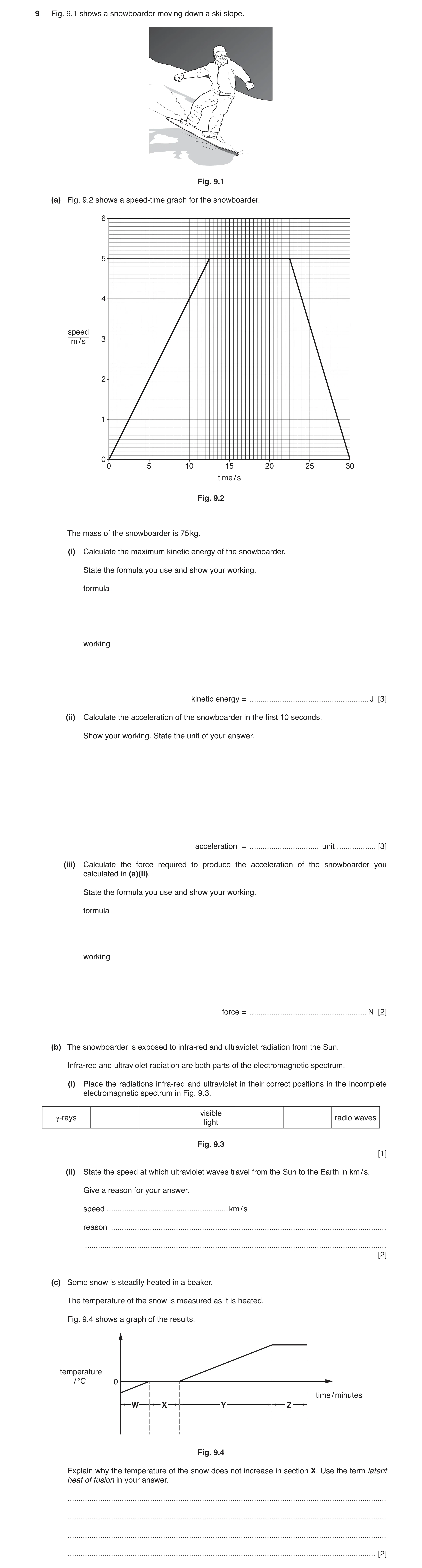
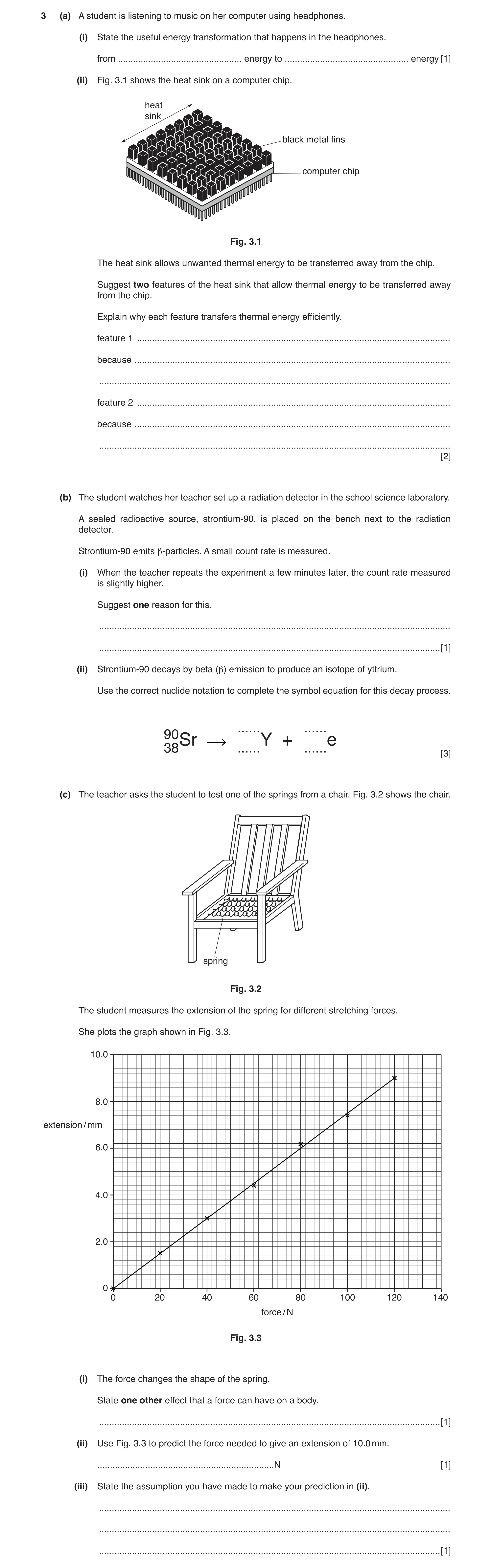
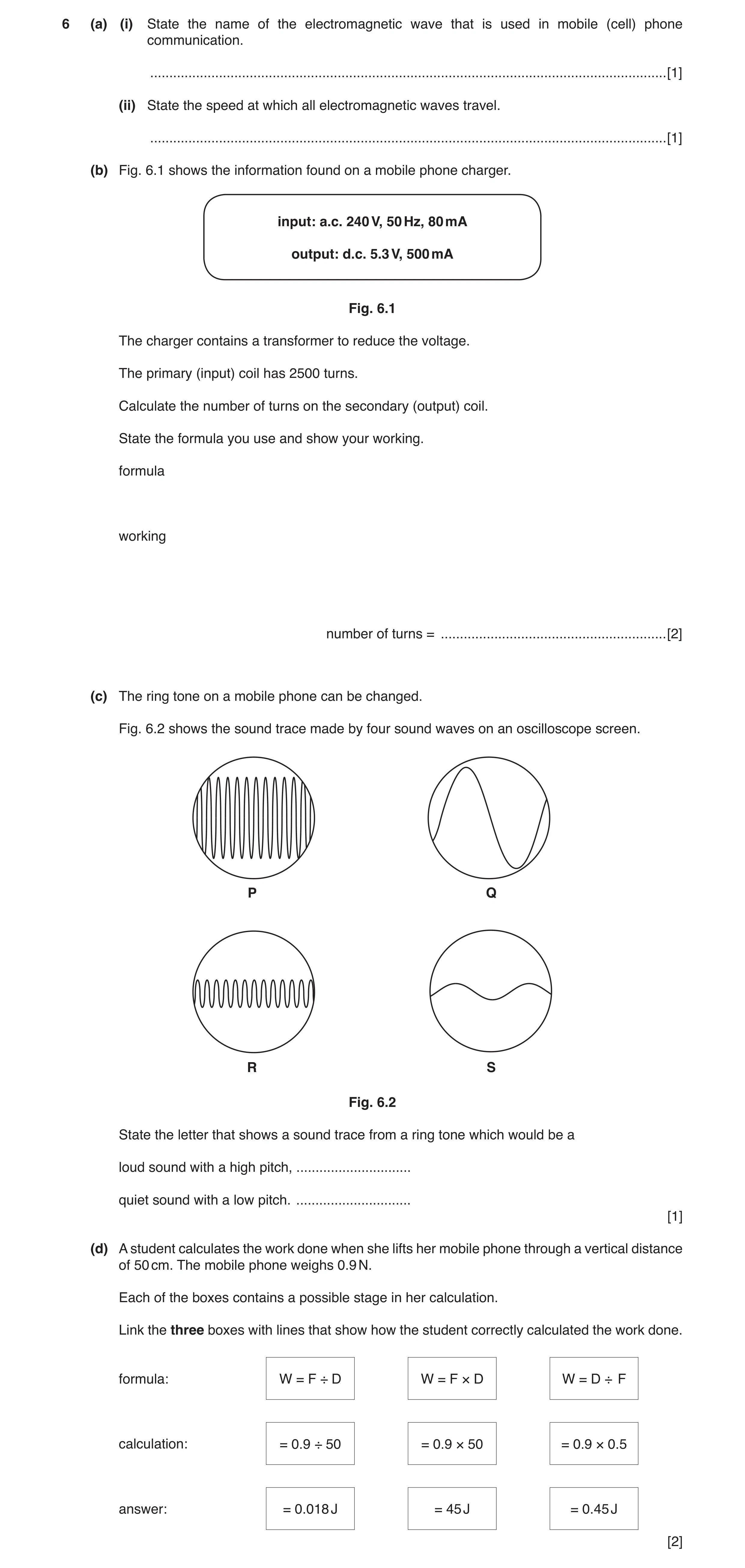
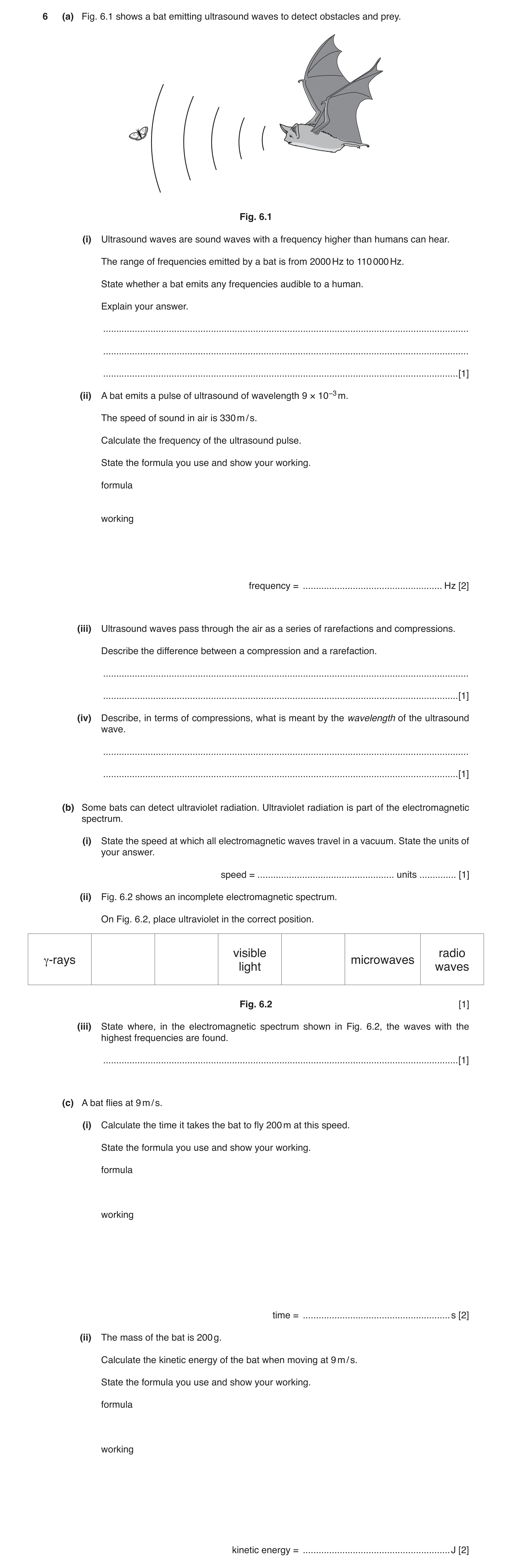
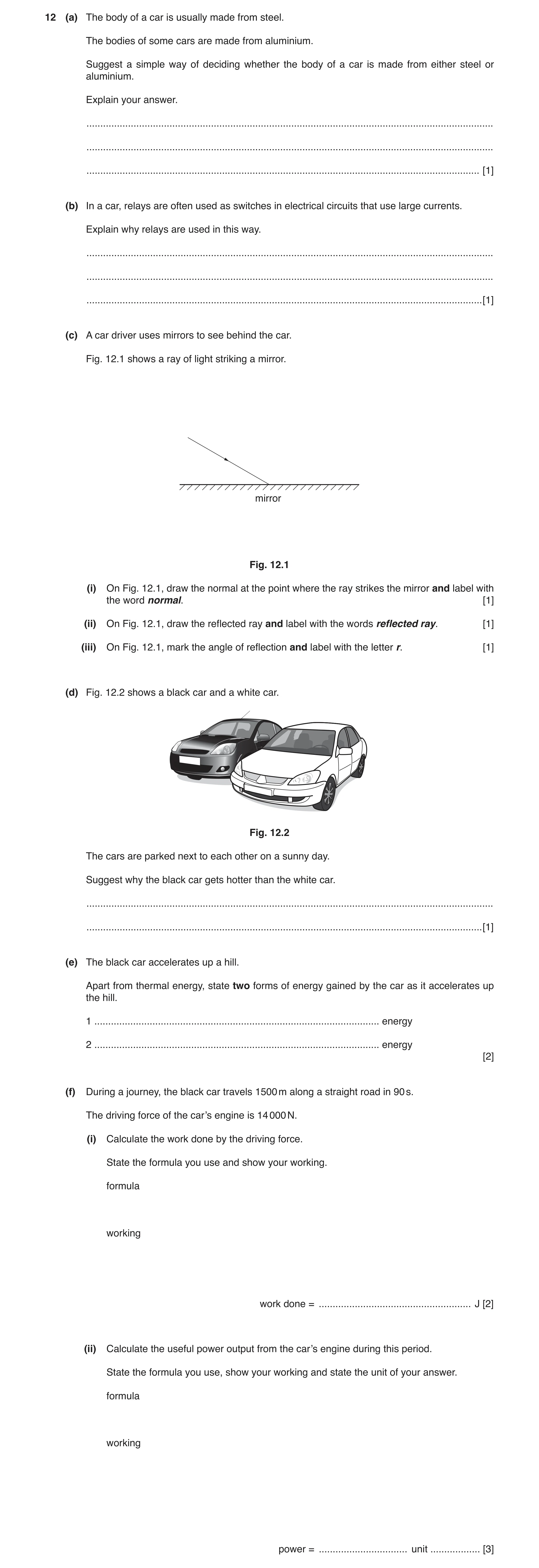
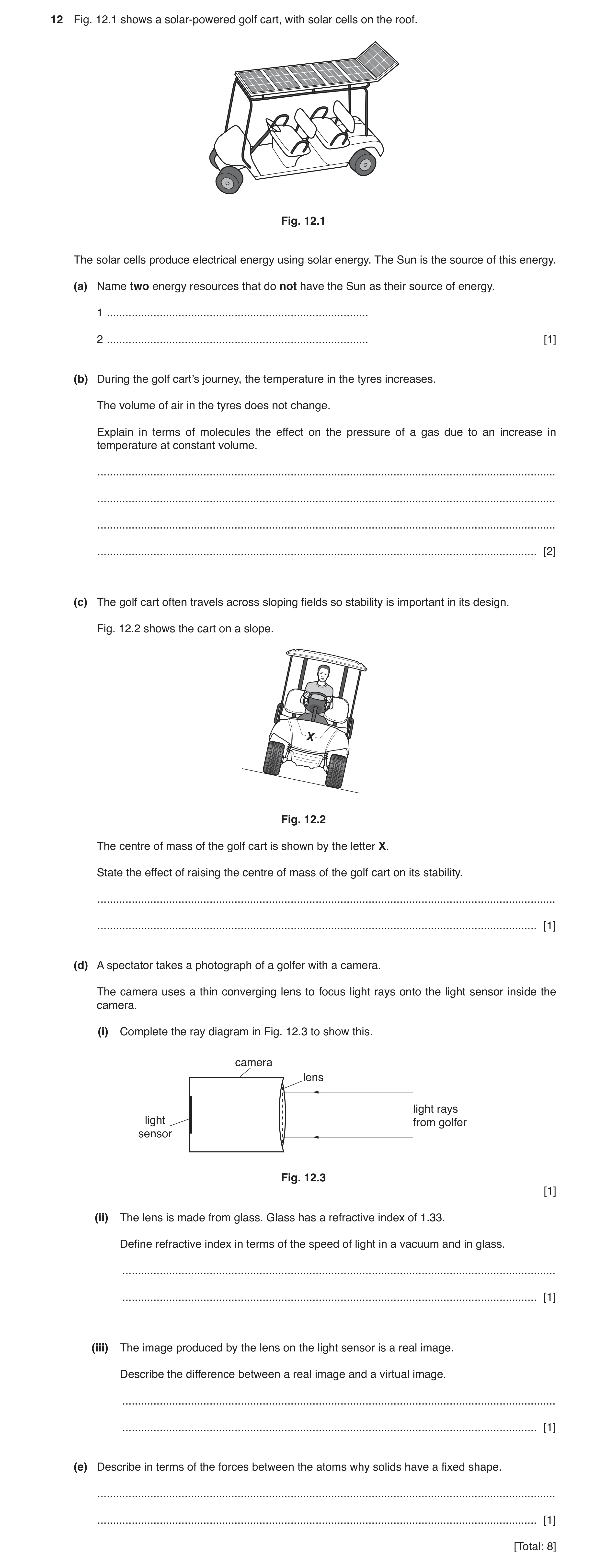
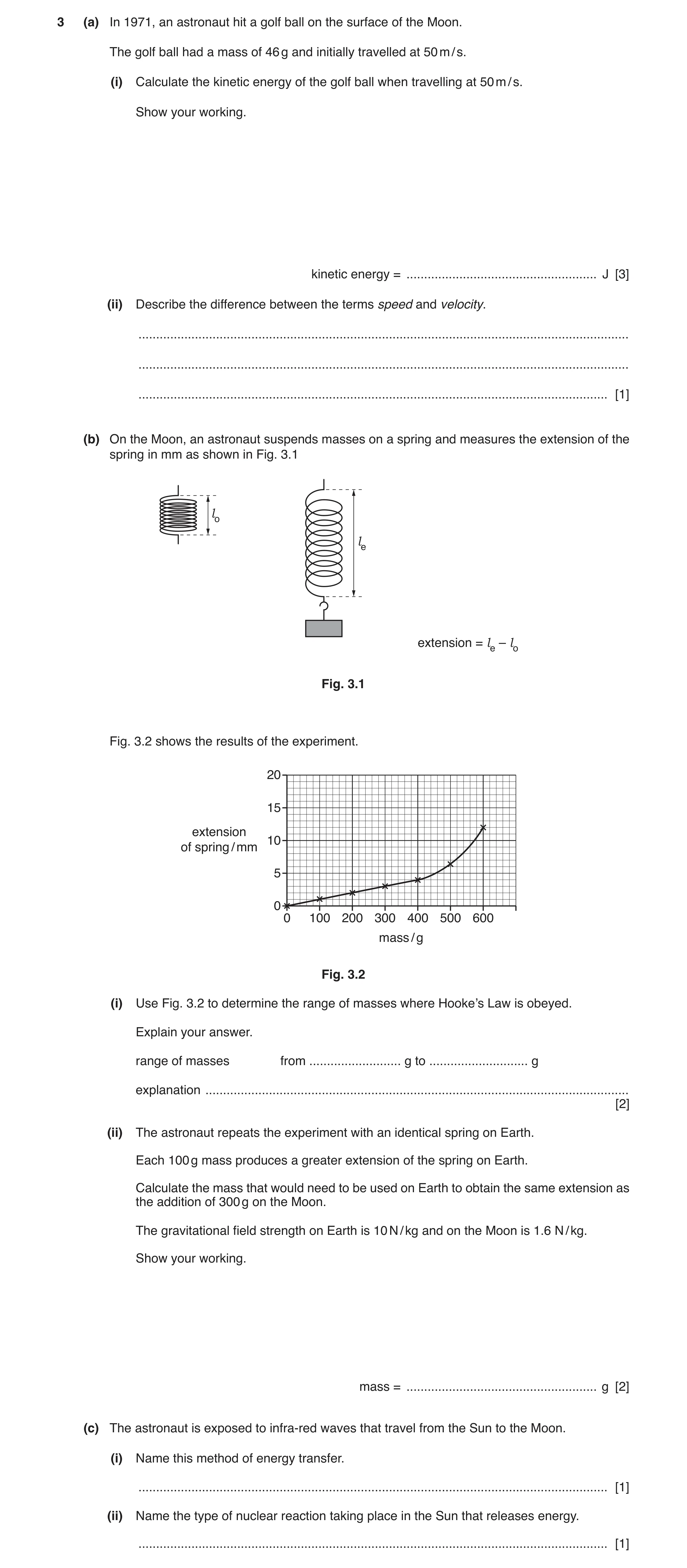
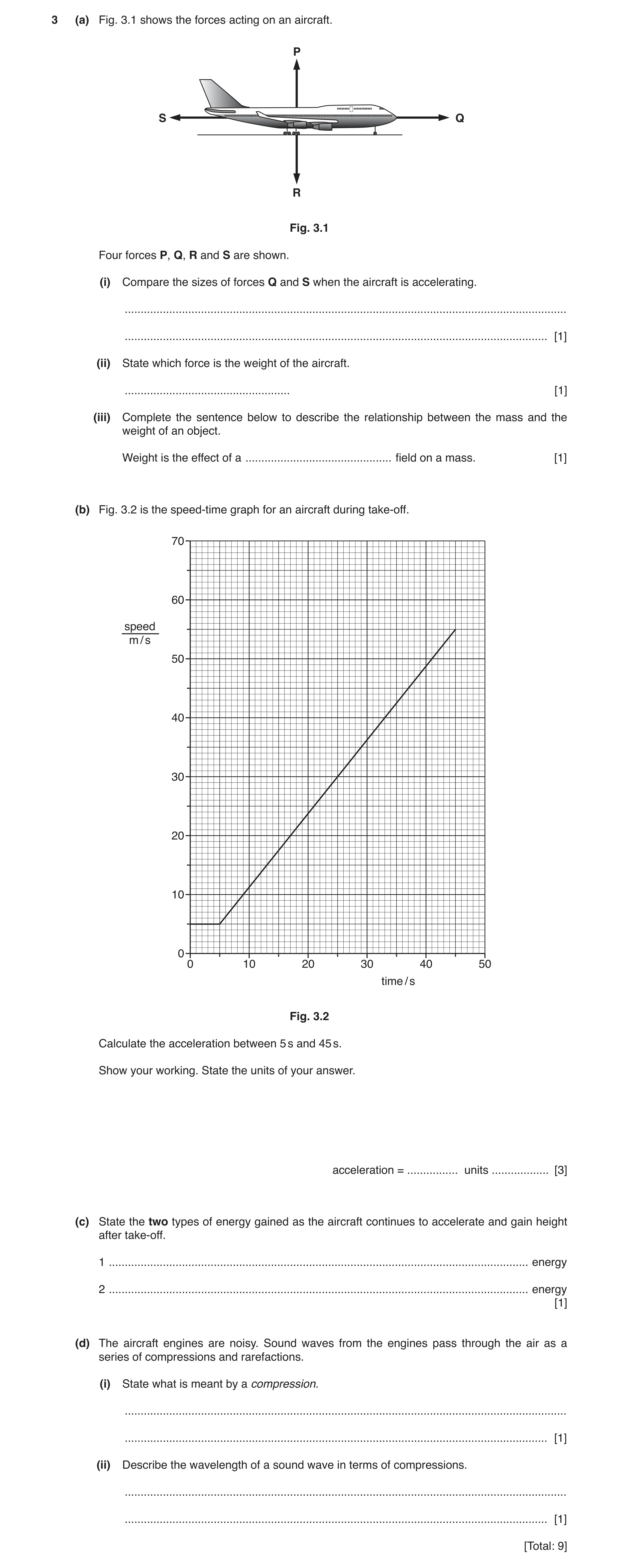
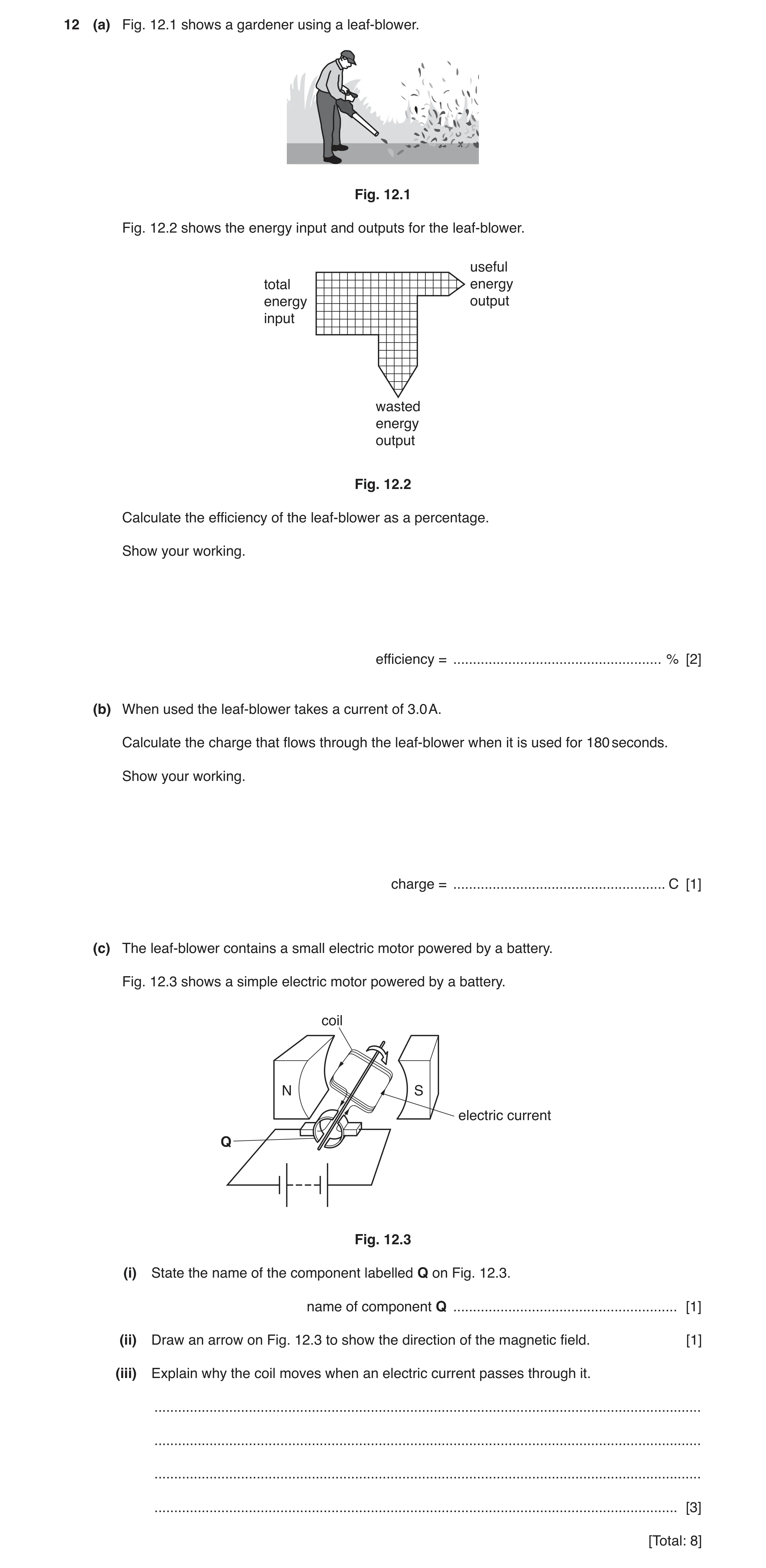
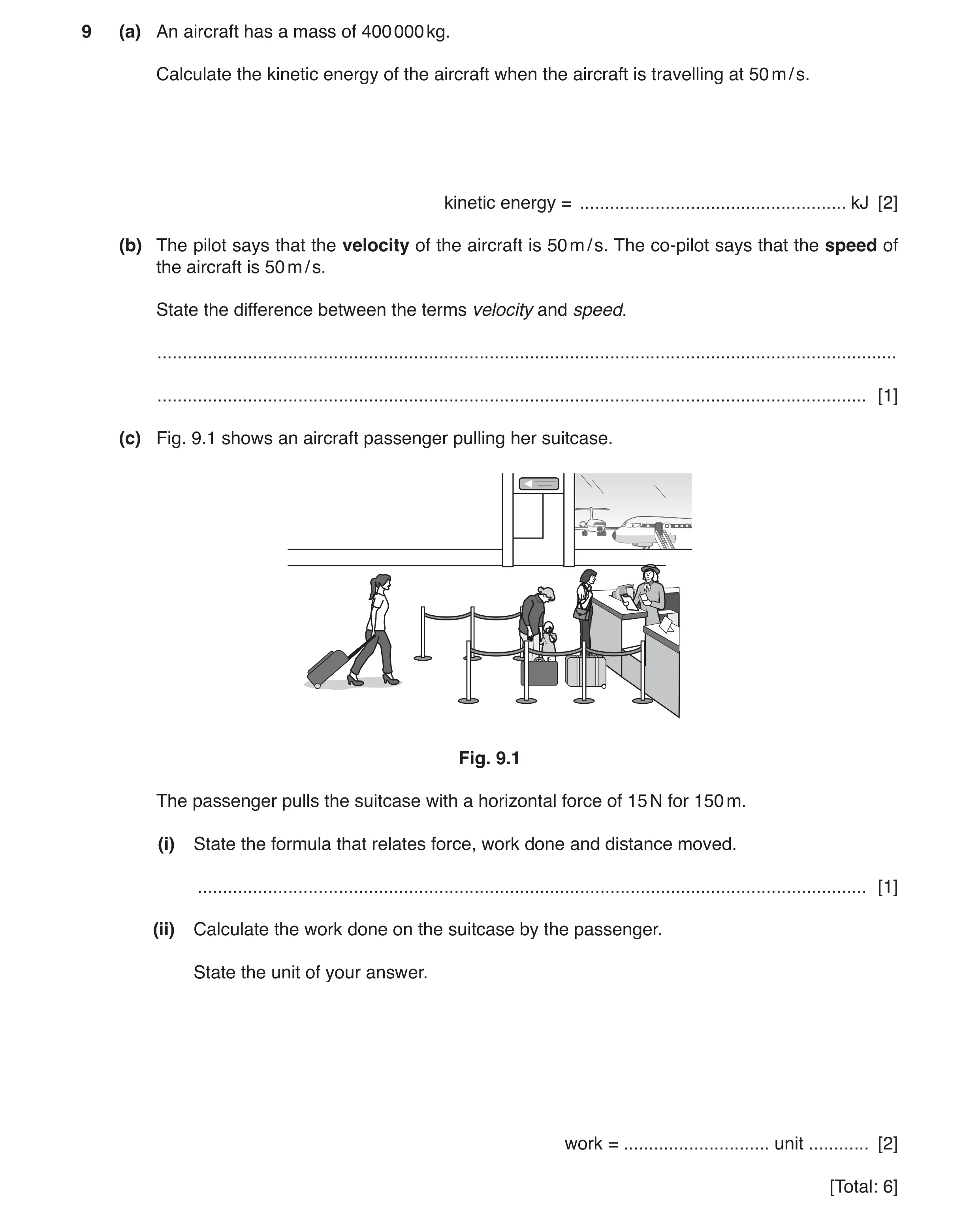 22 / 87
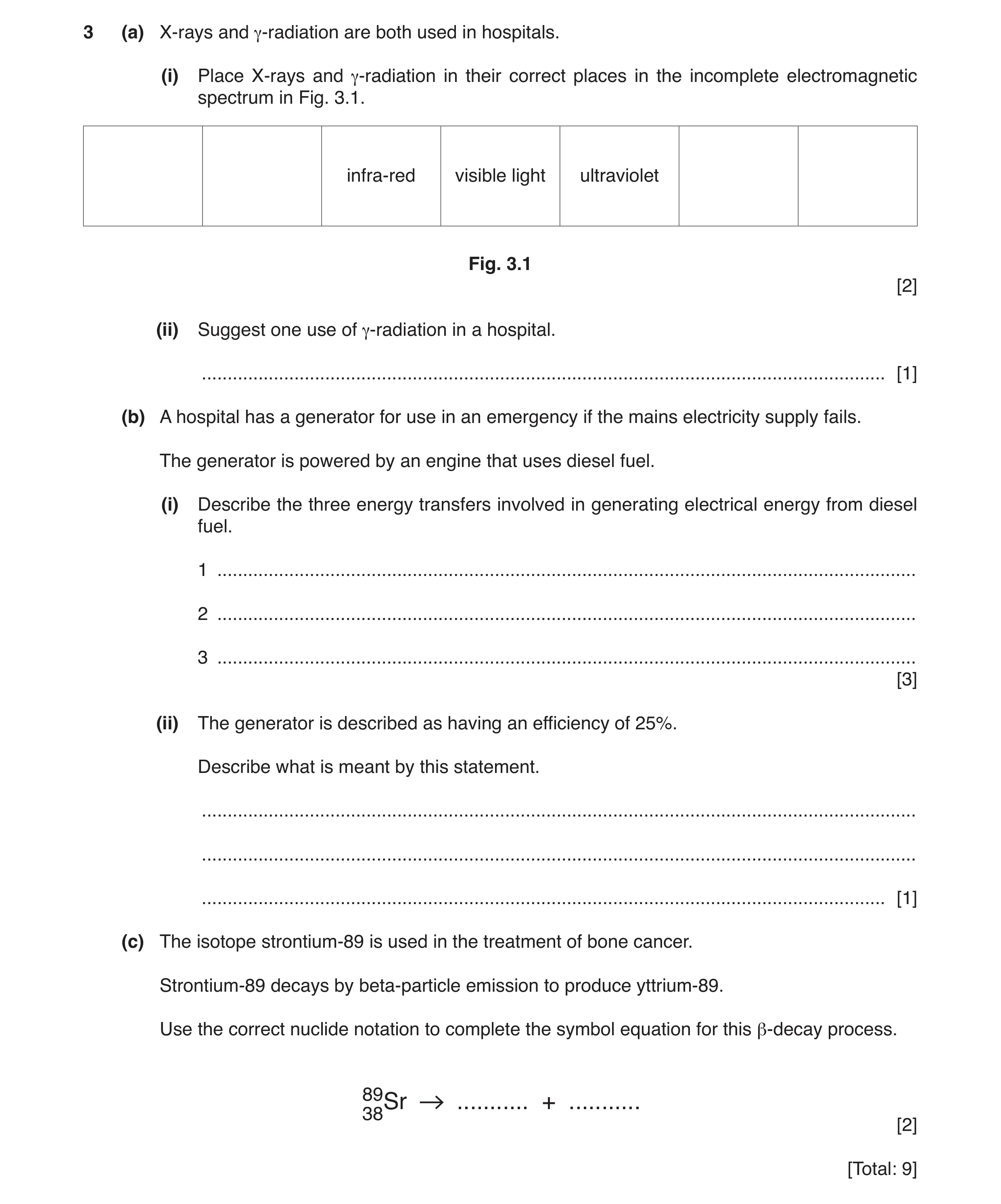 23 / 87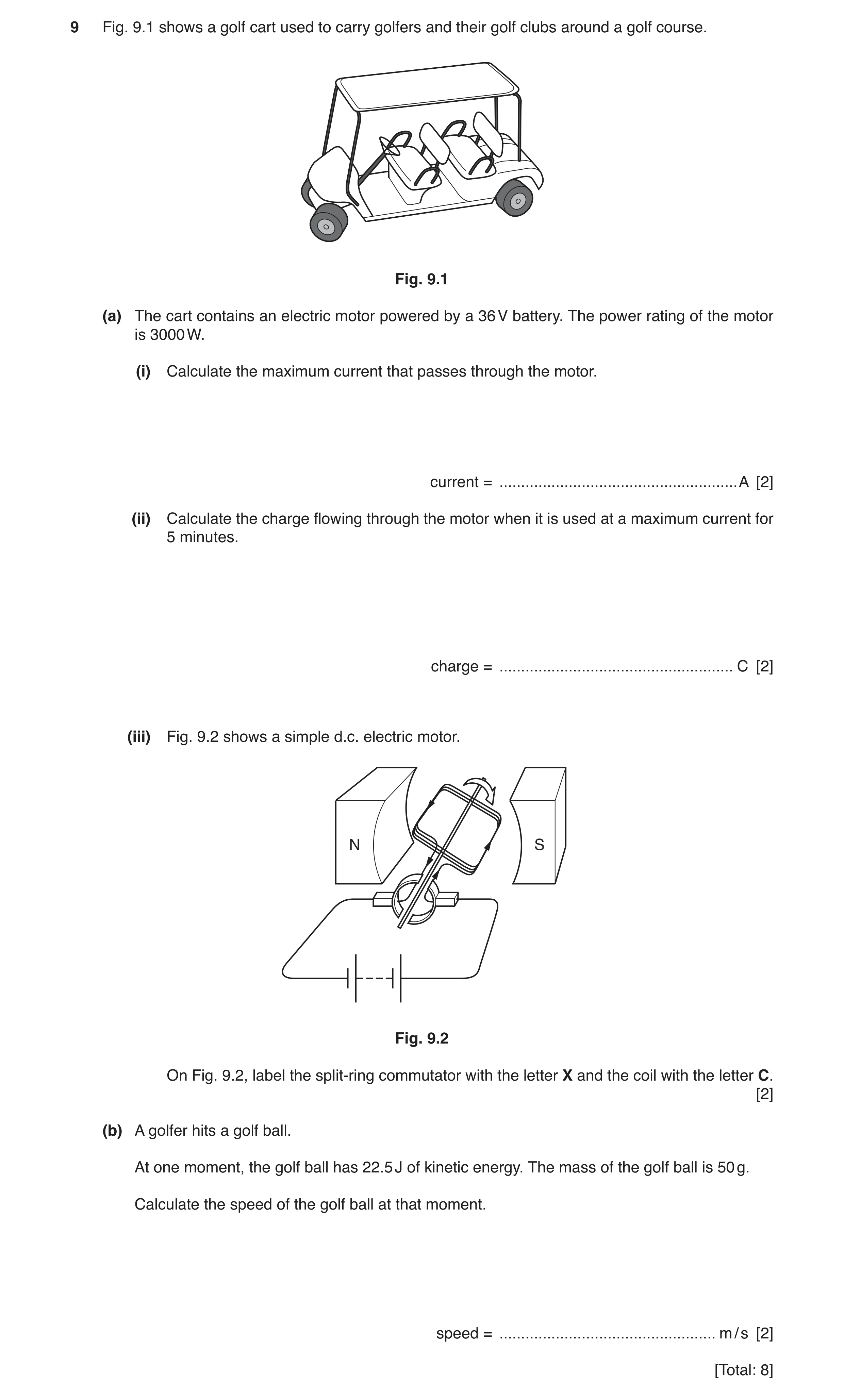
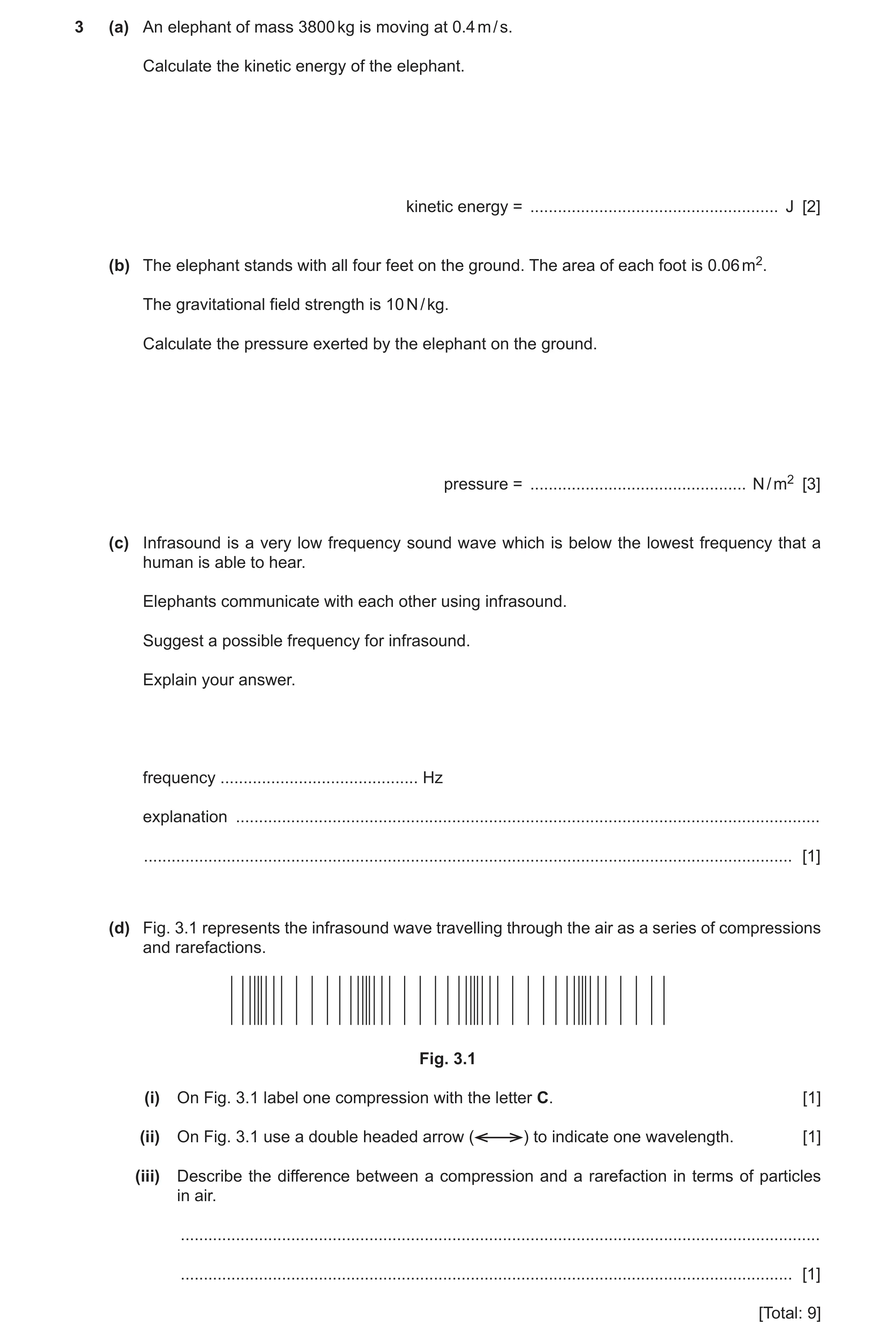
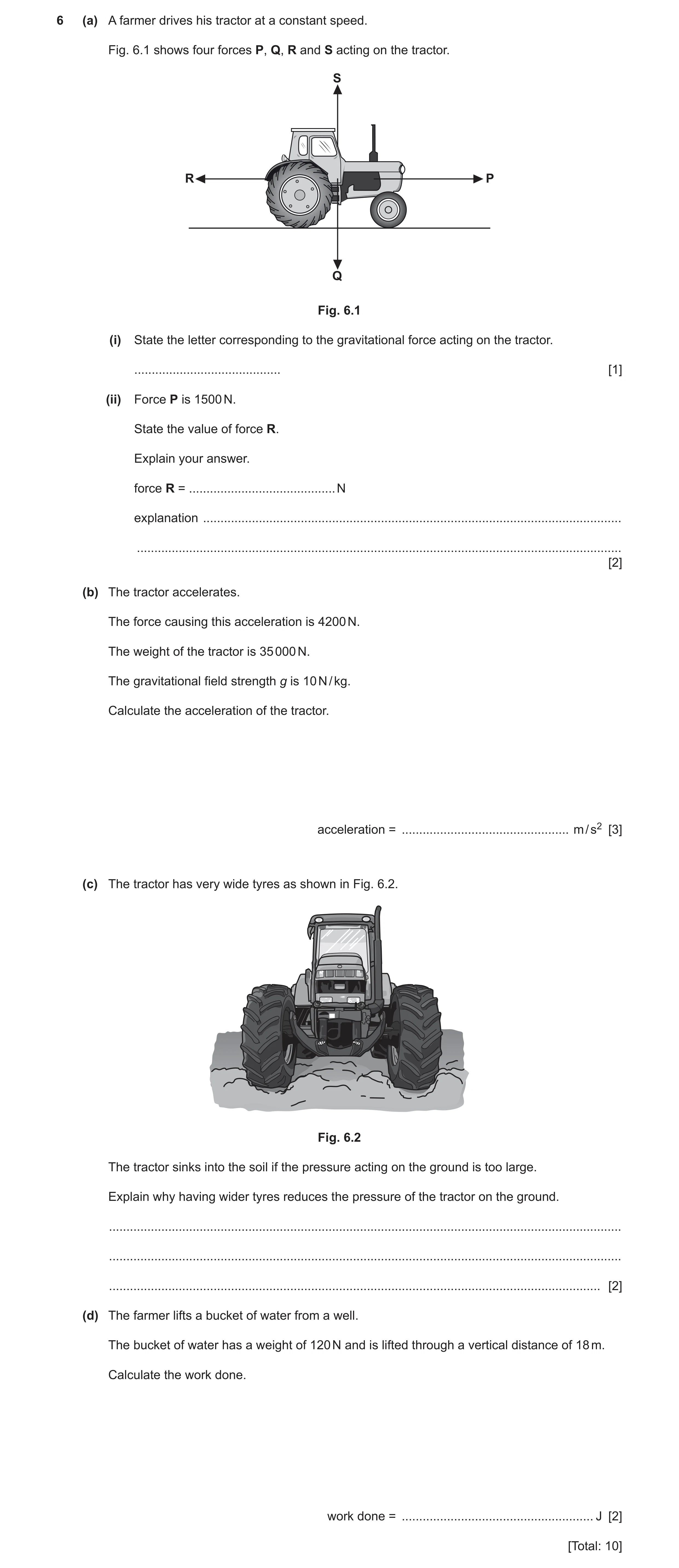
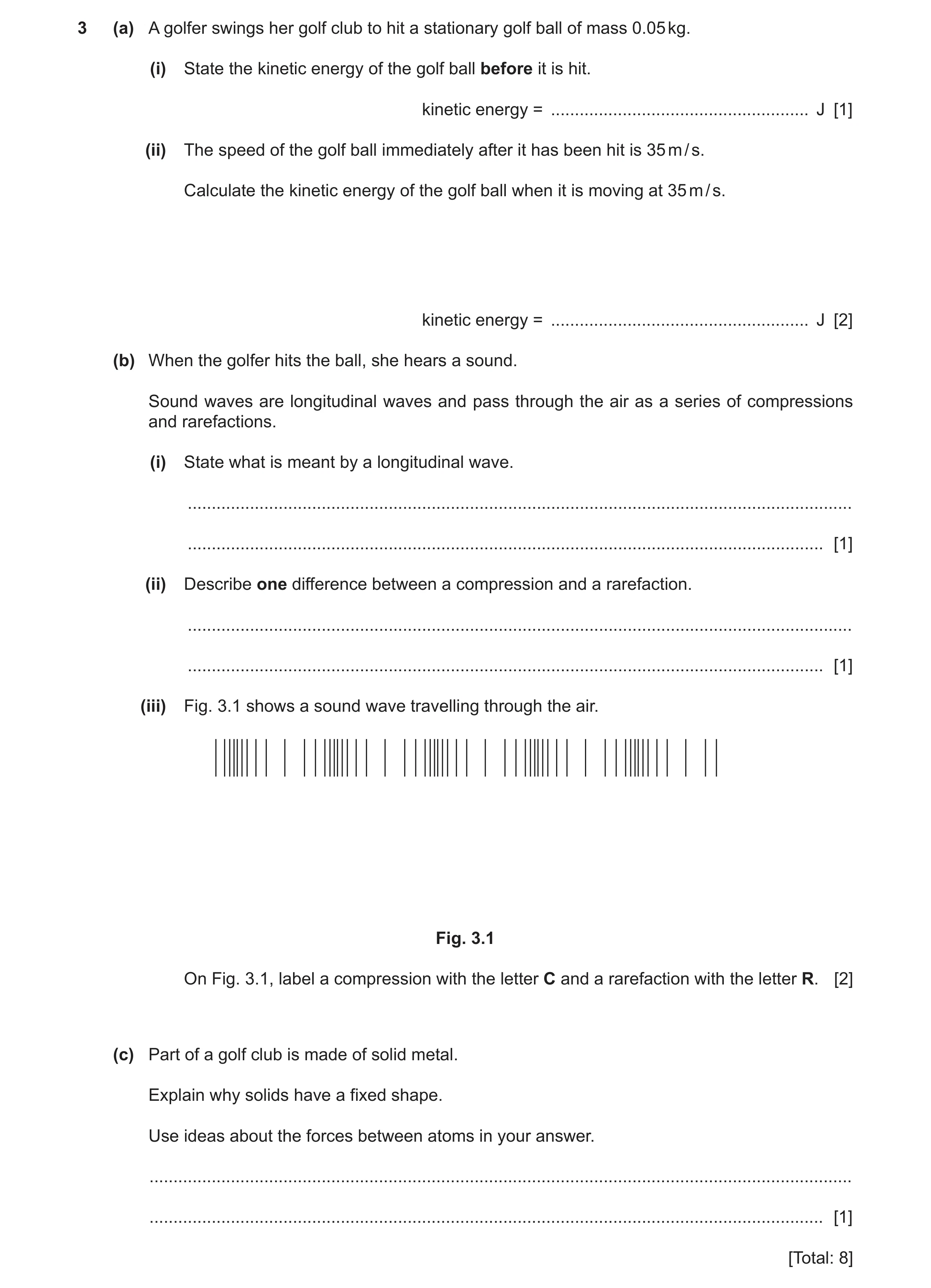 28 / 87
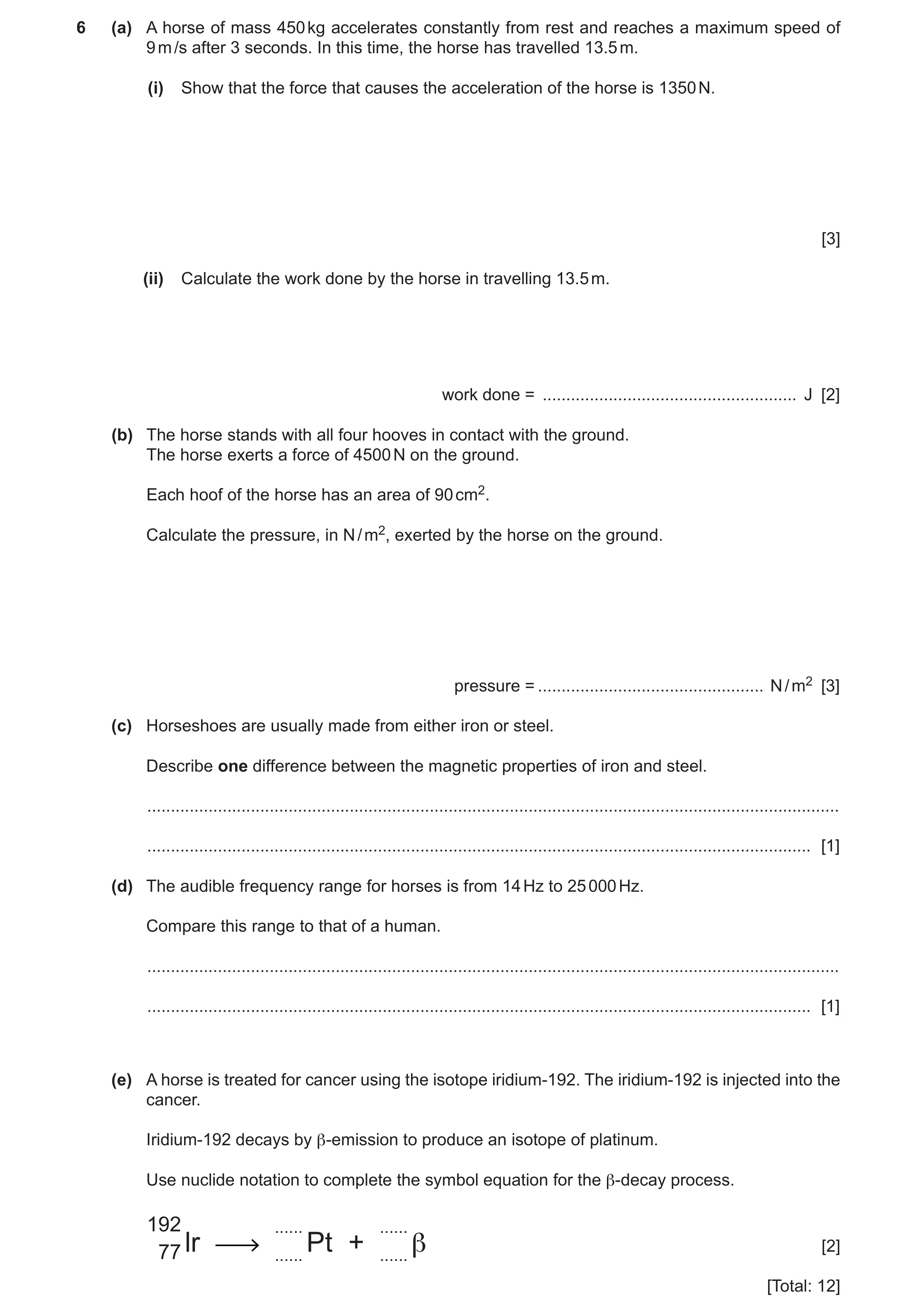 29 / 87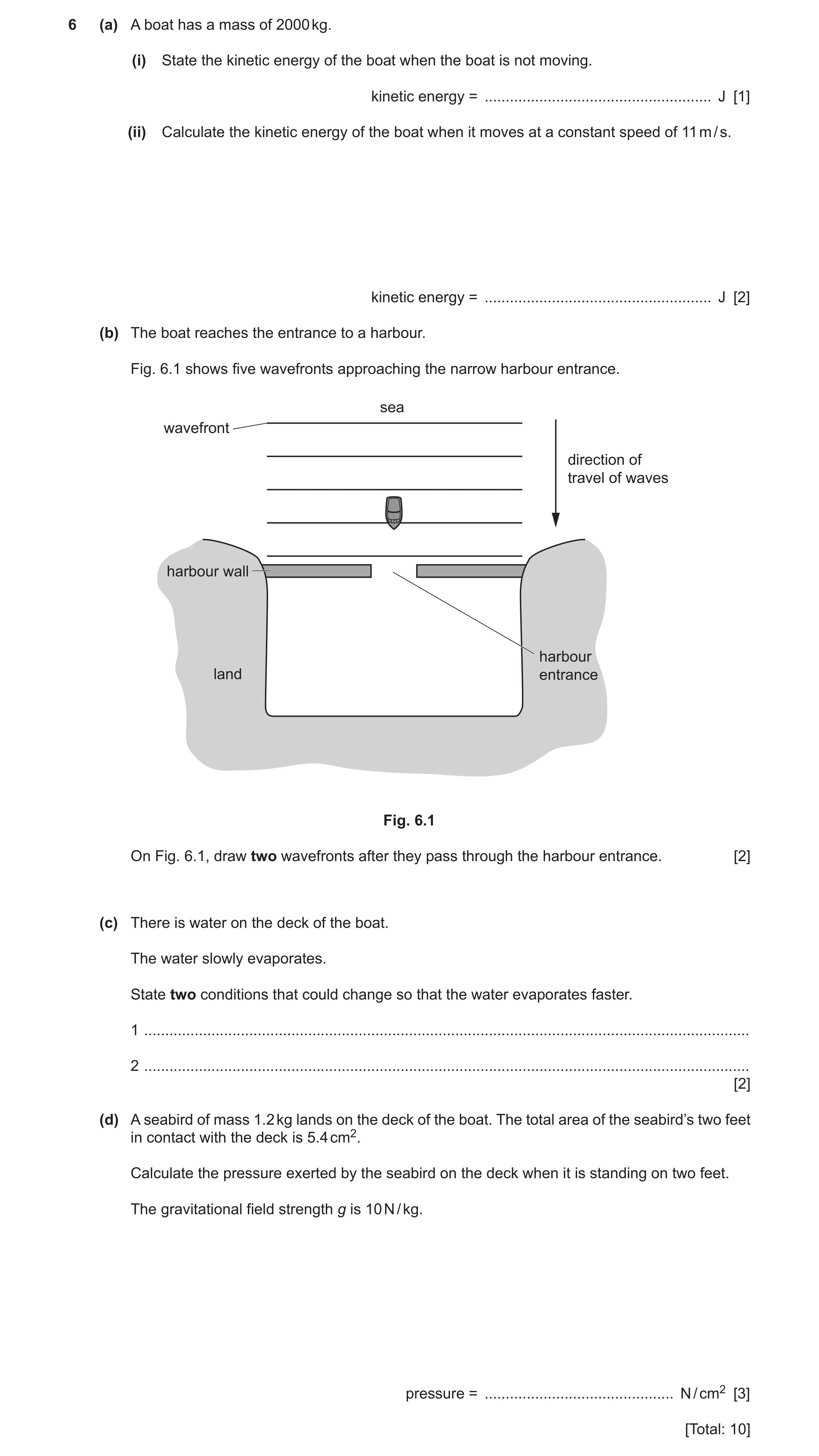
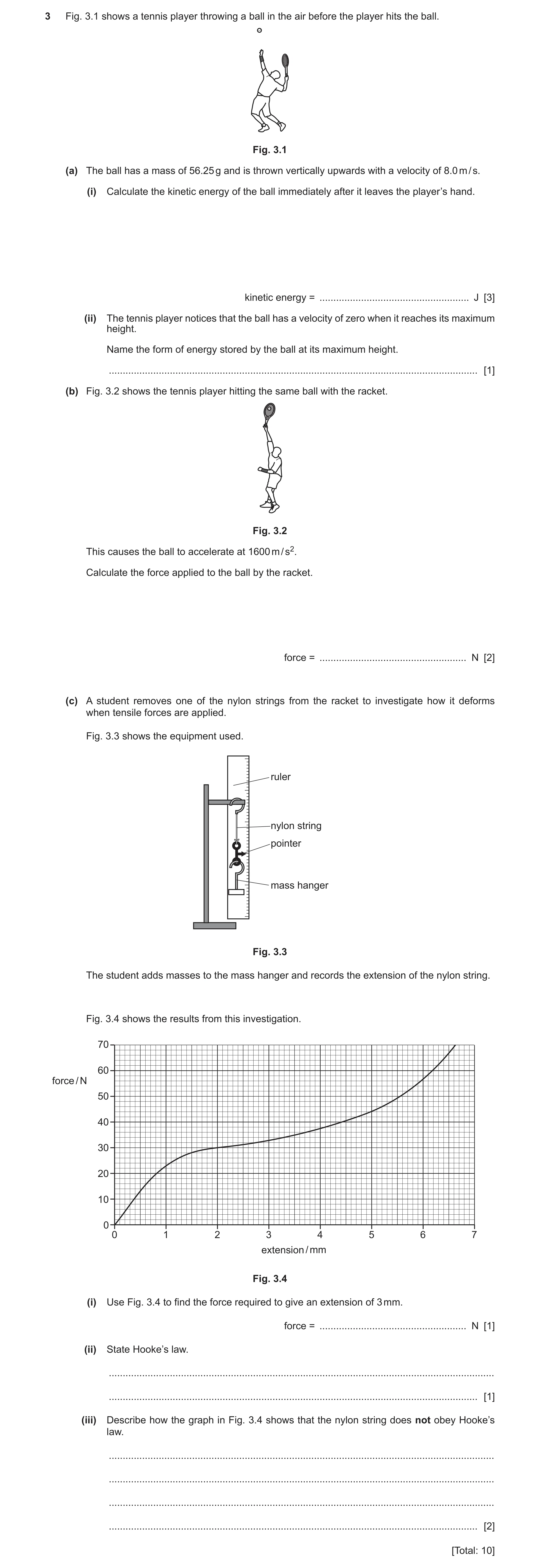
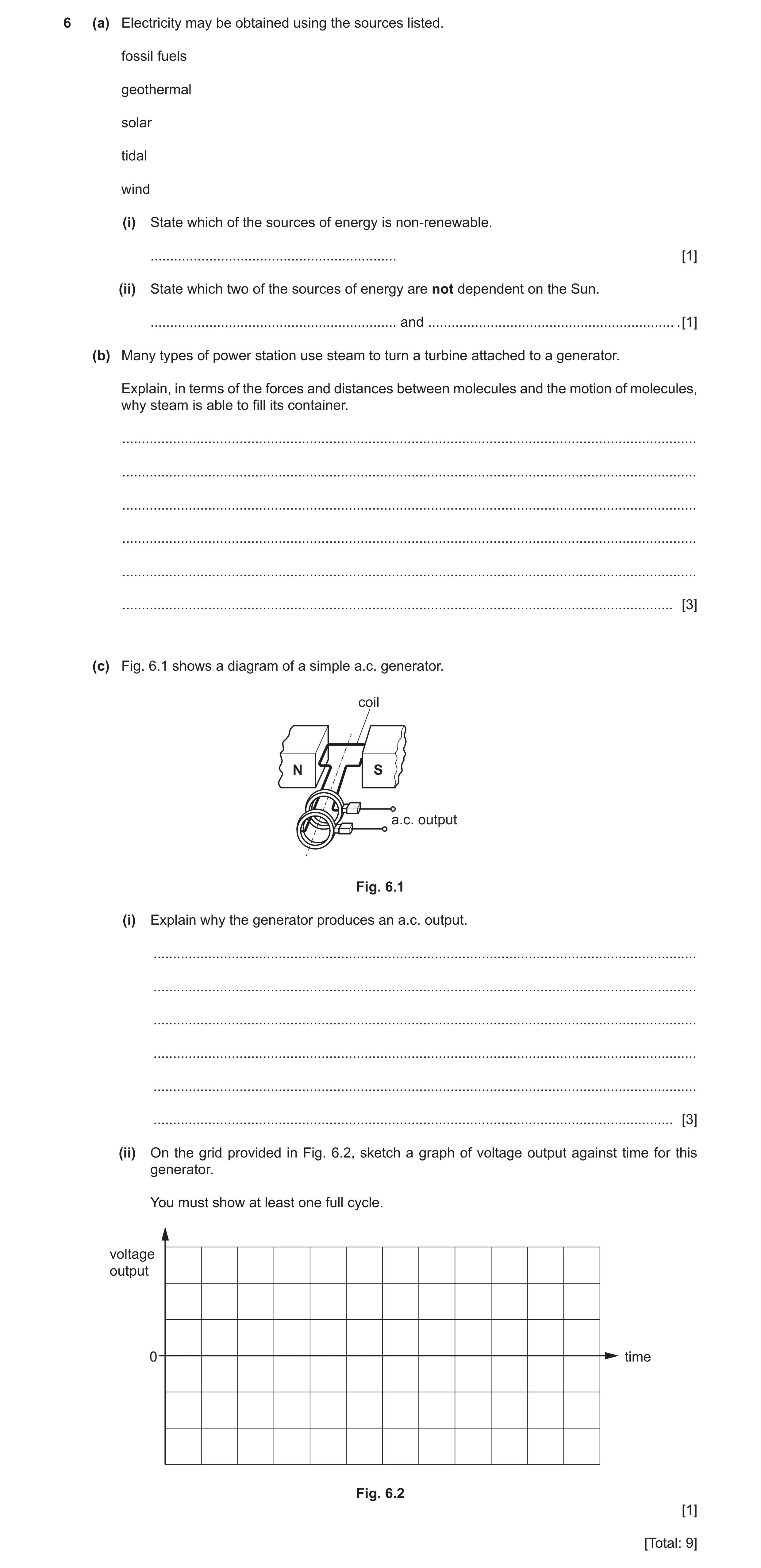
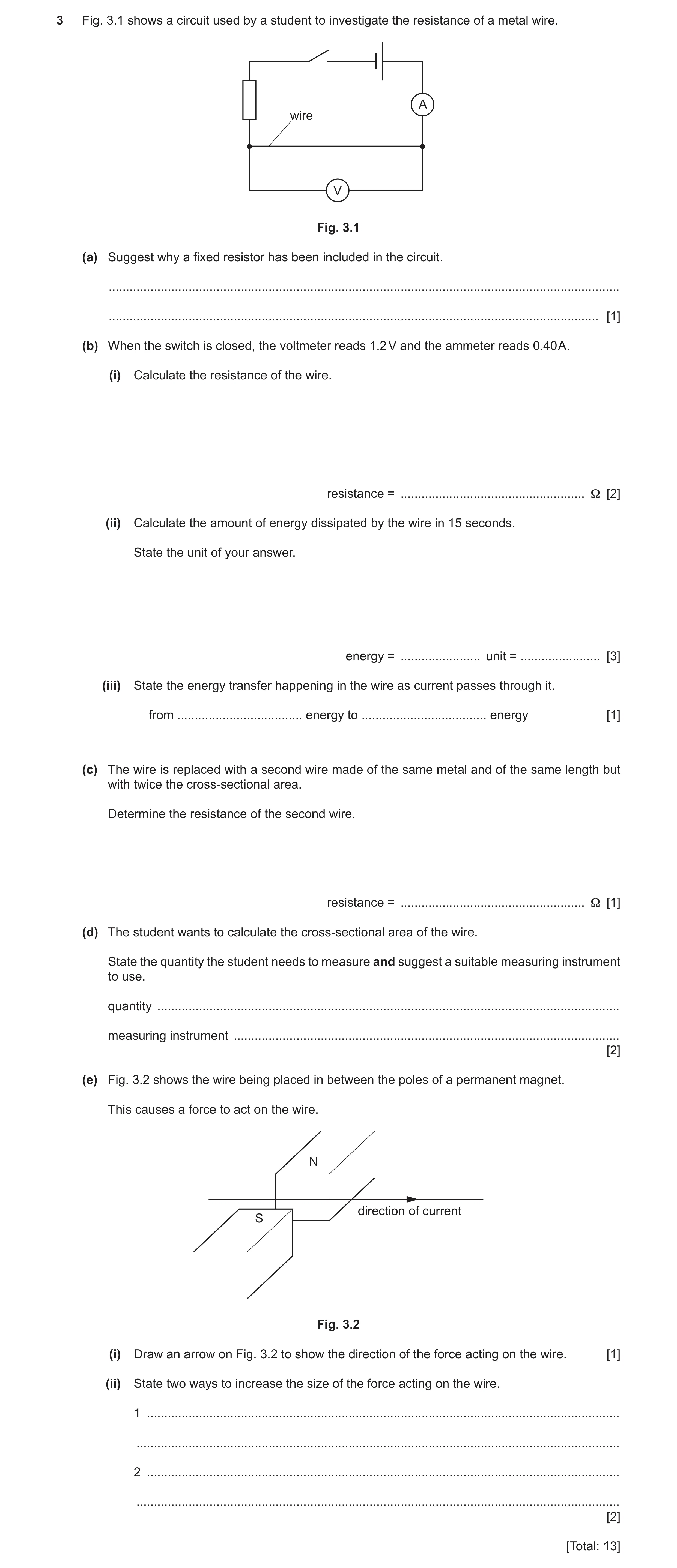
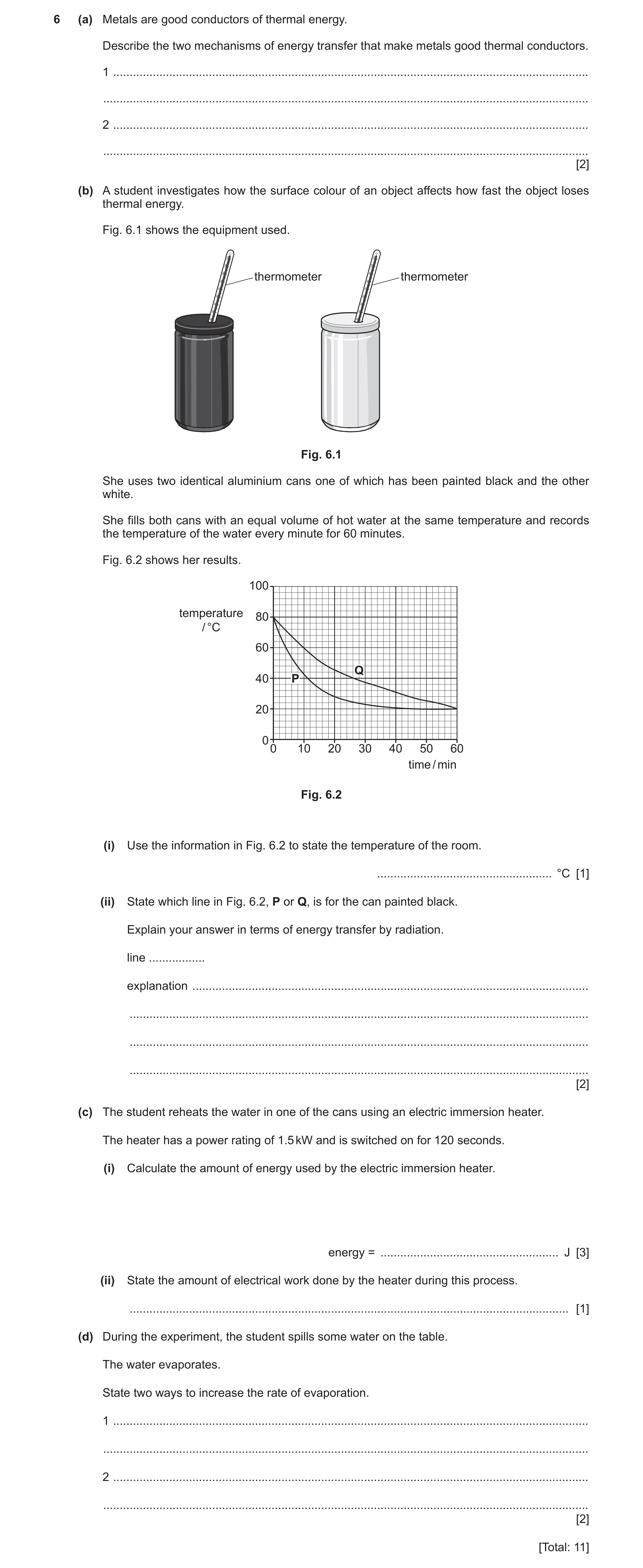
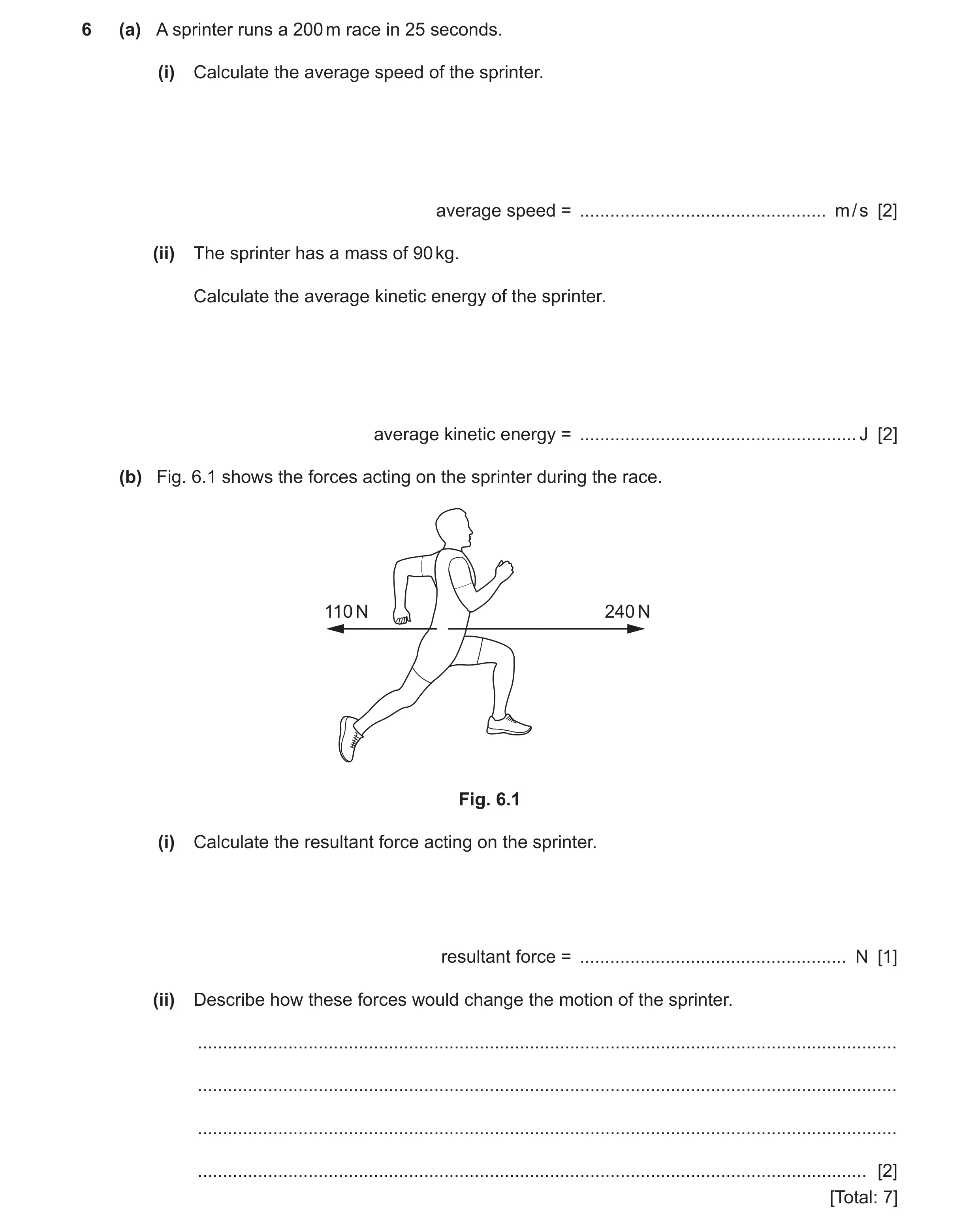 39 / 87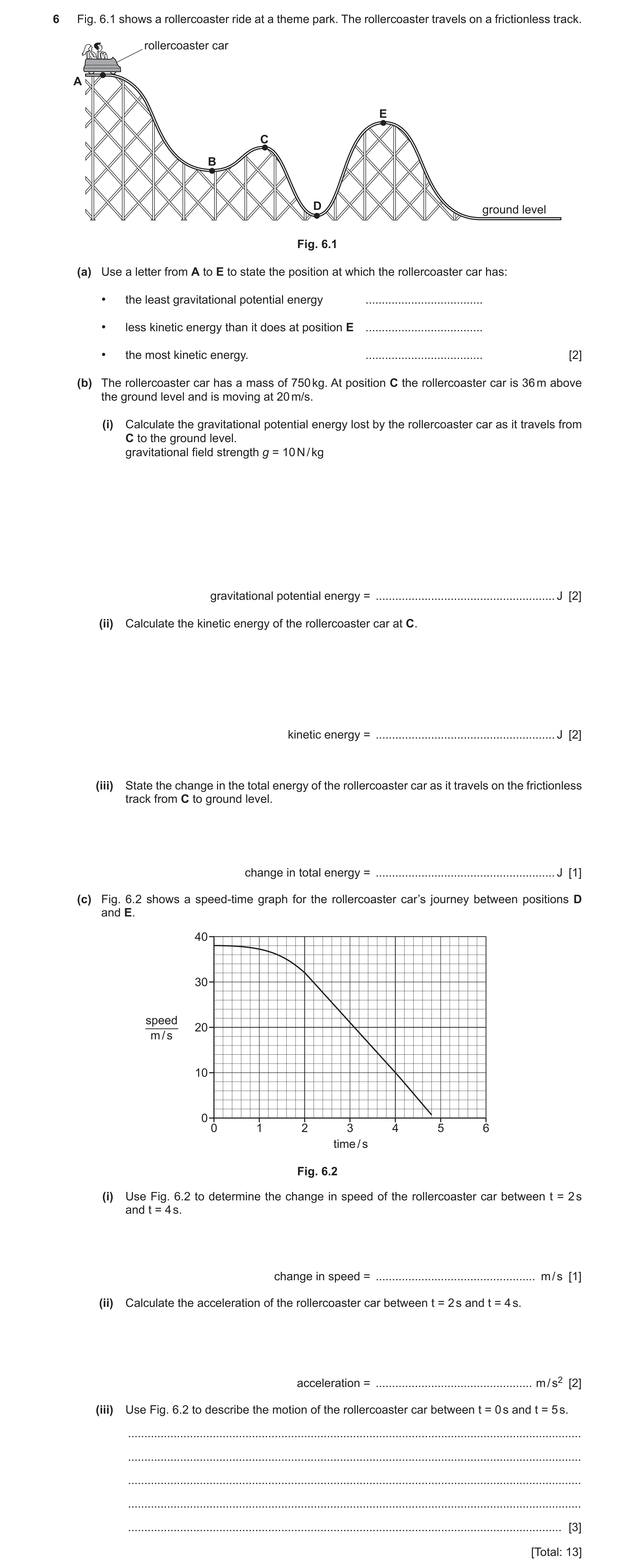
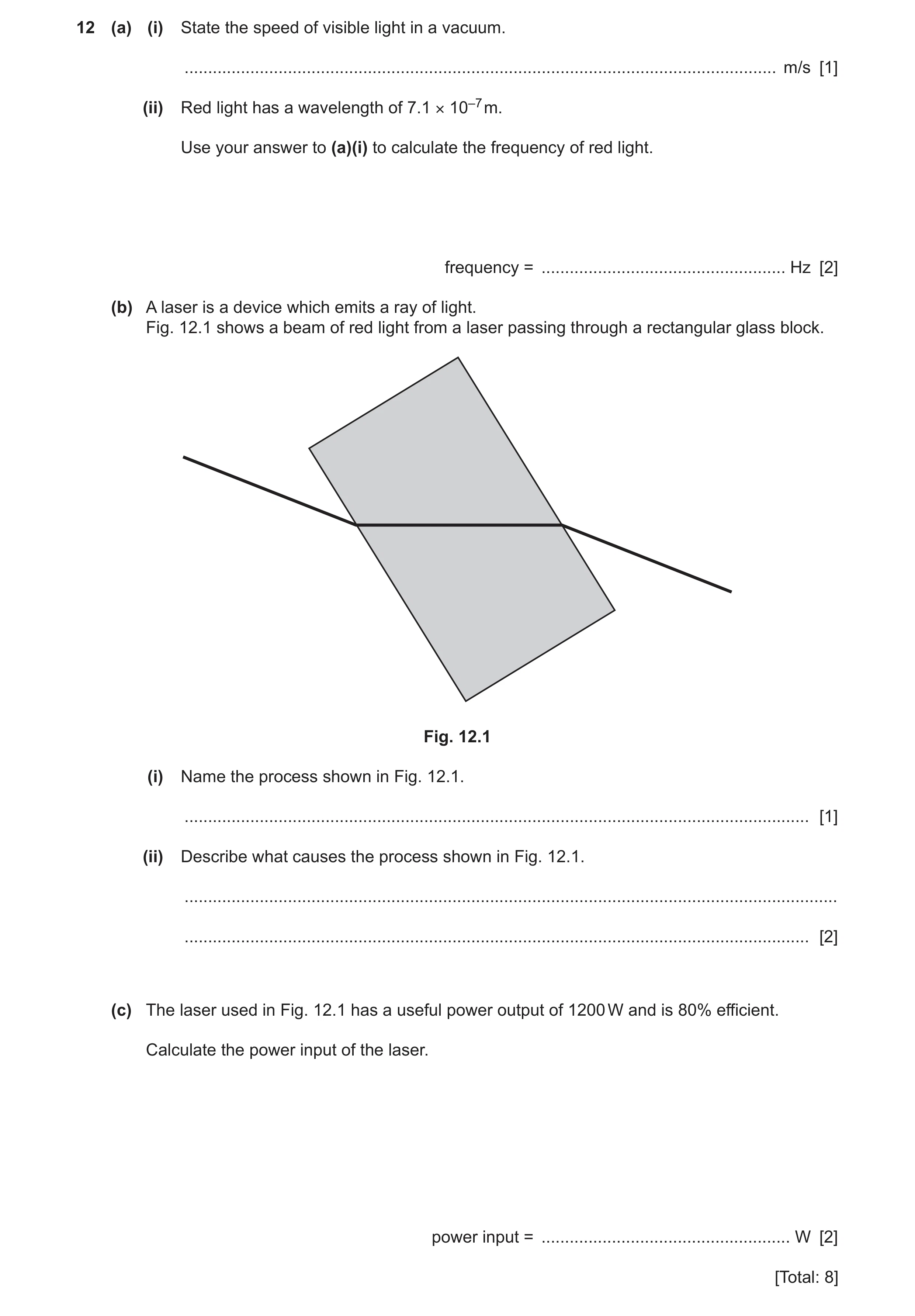 42 / 87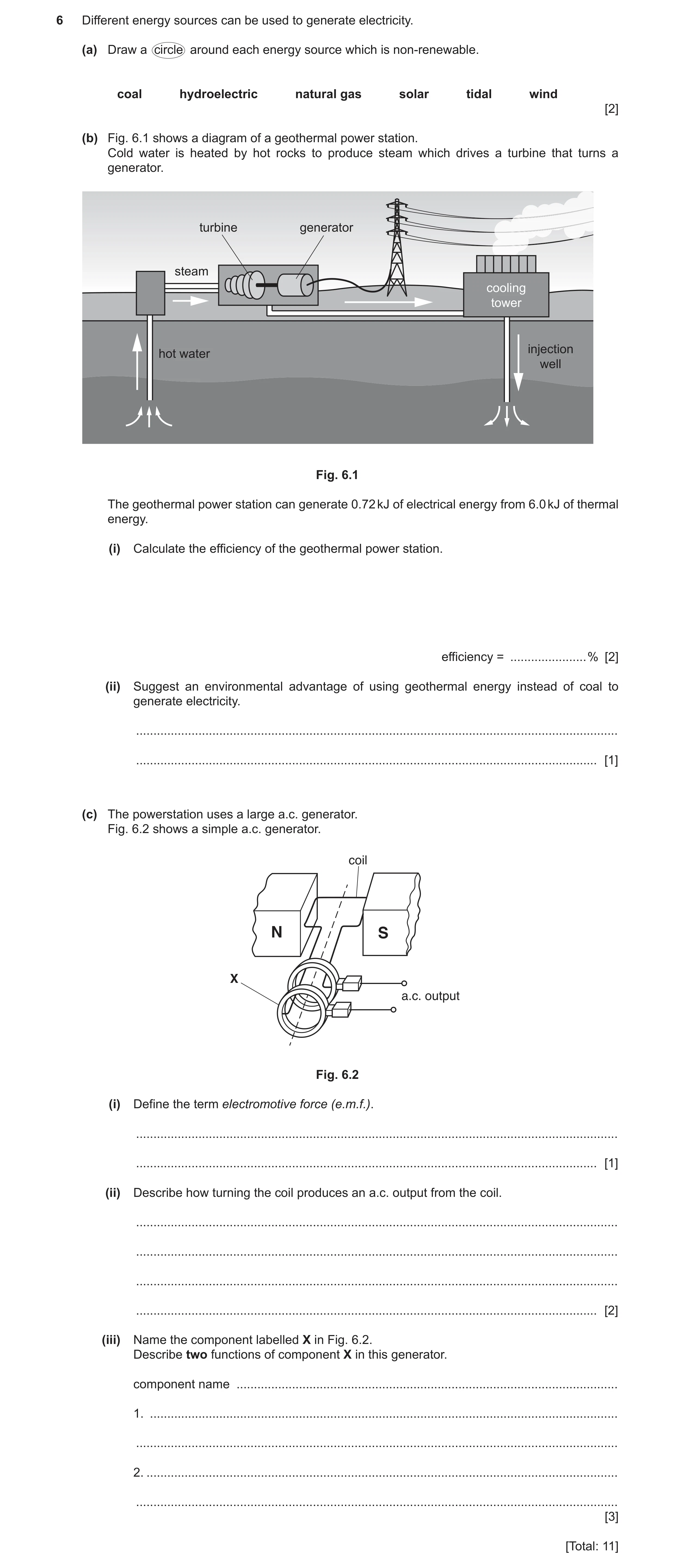
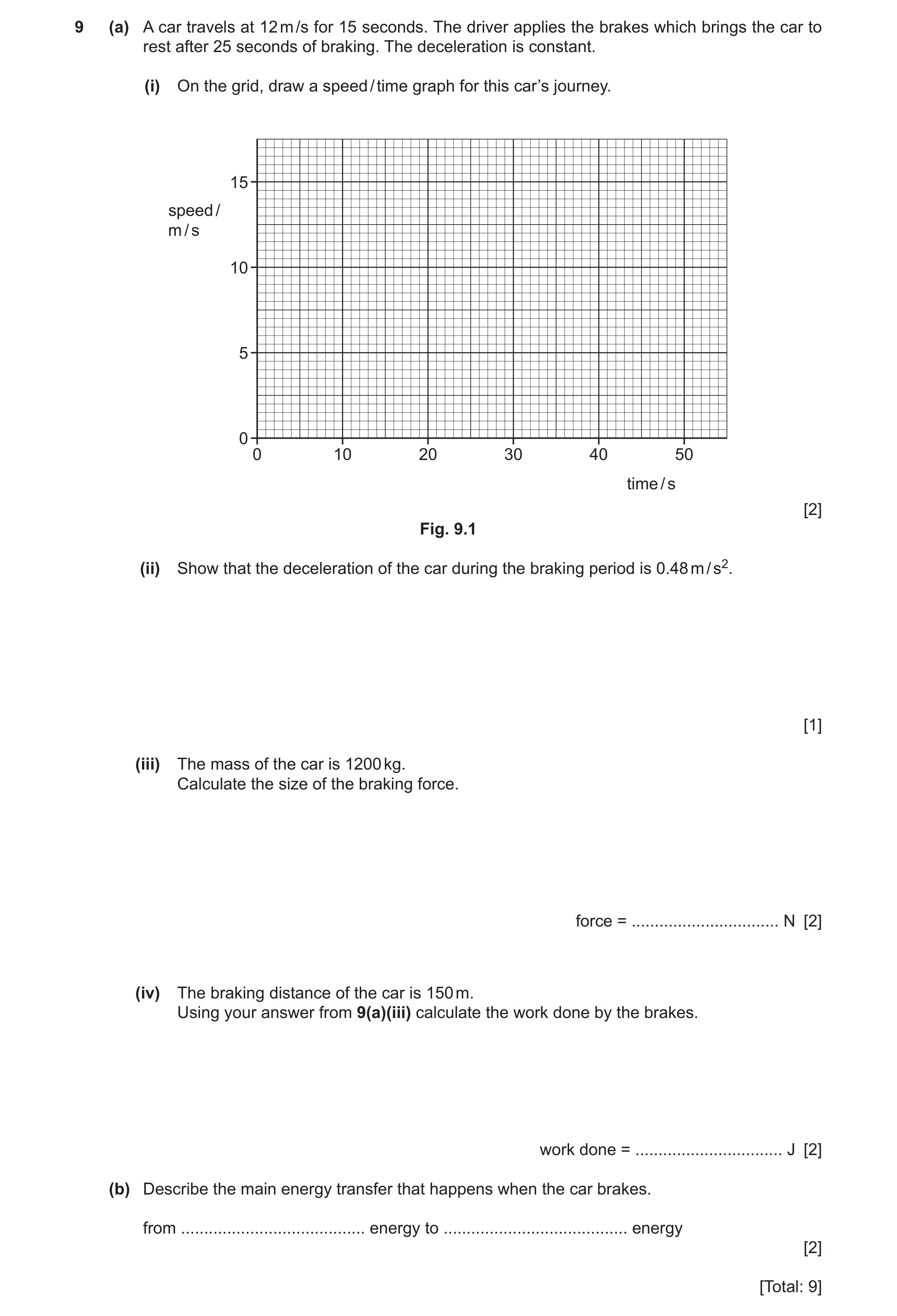
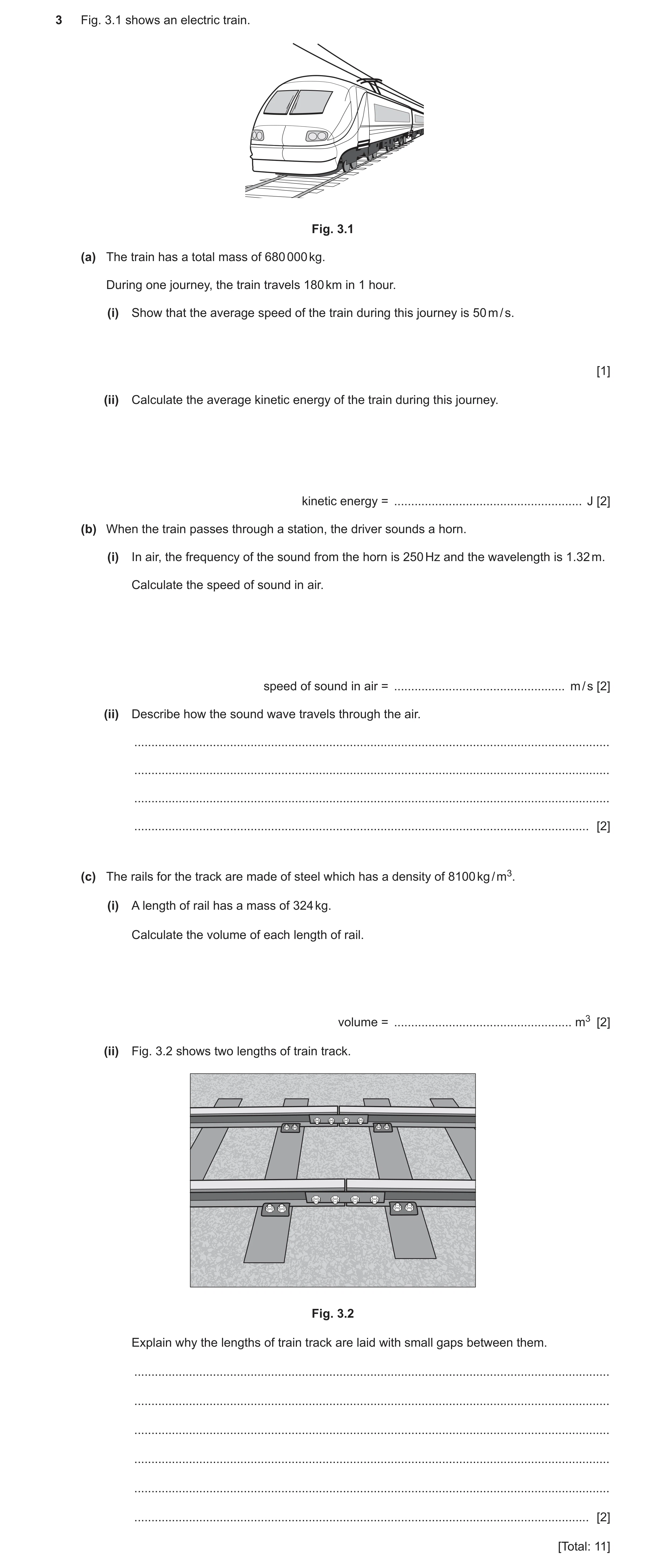
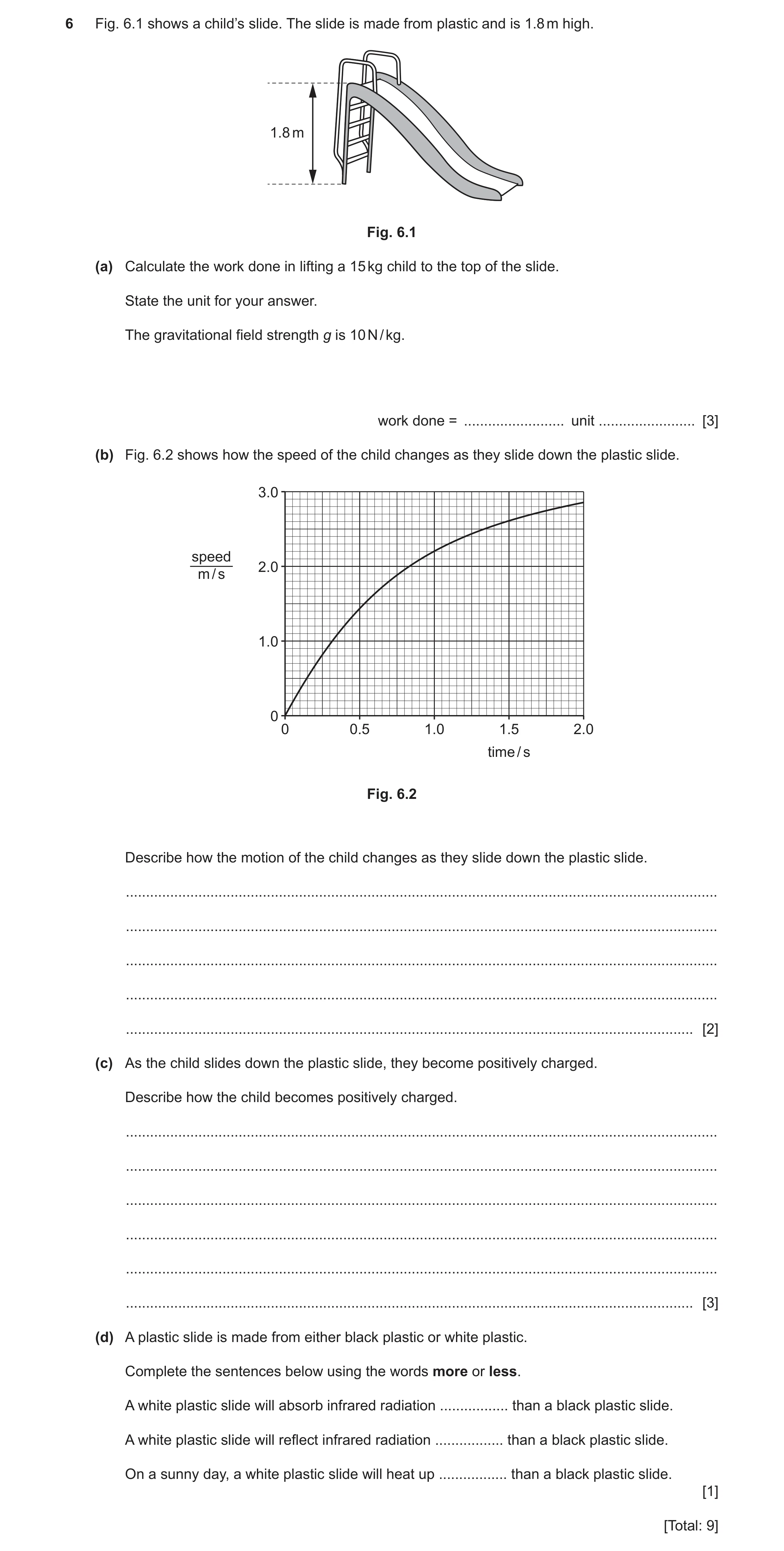
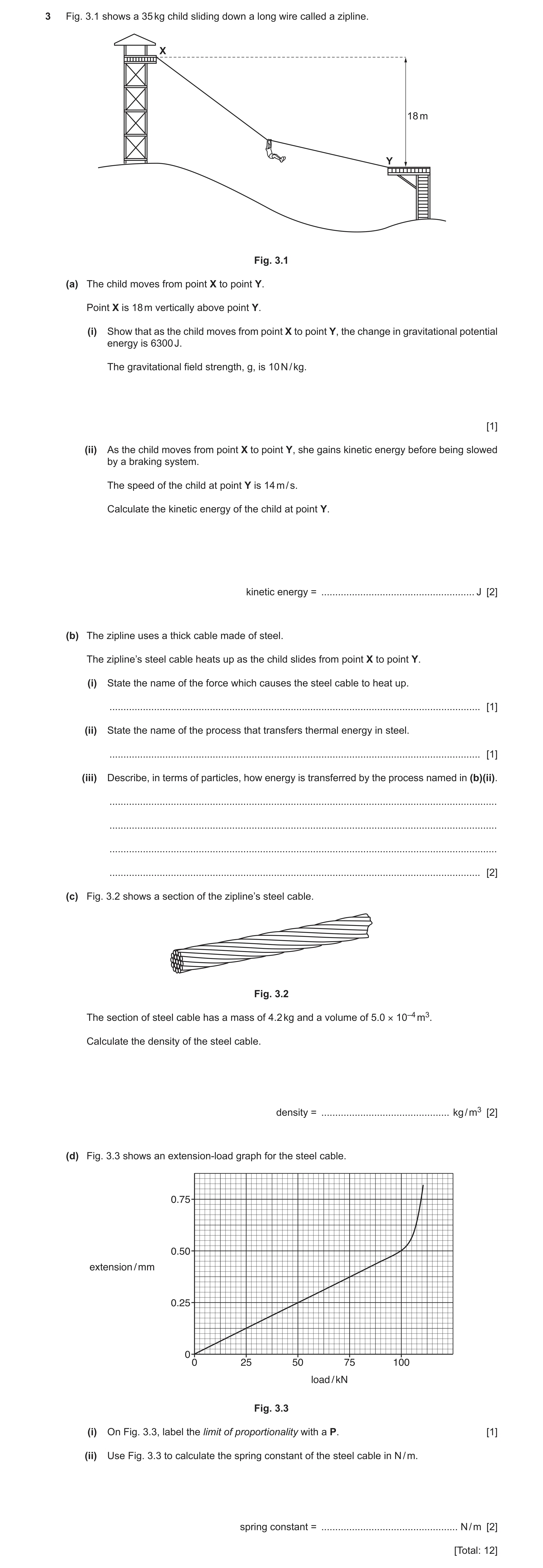
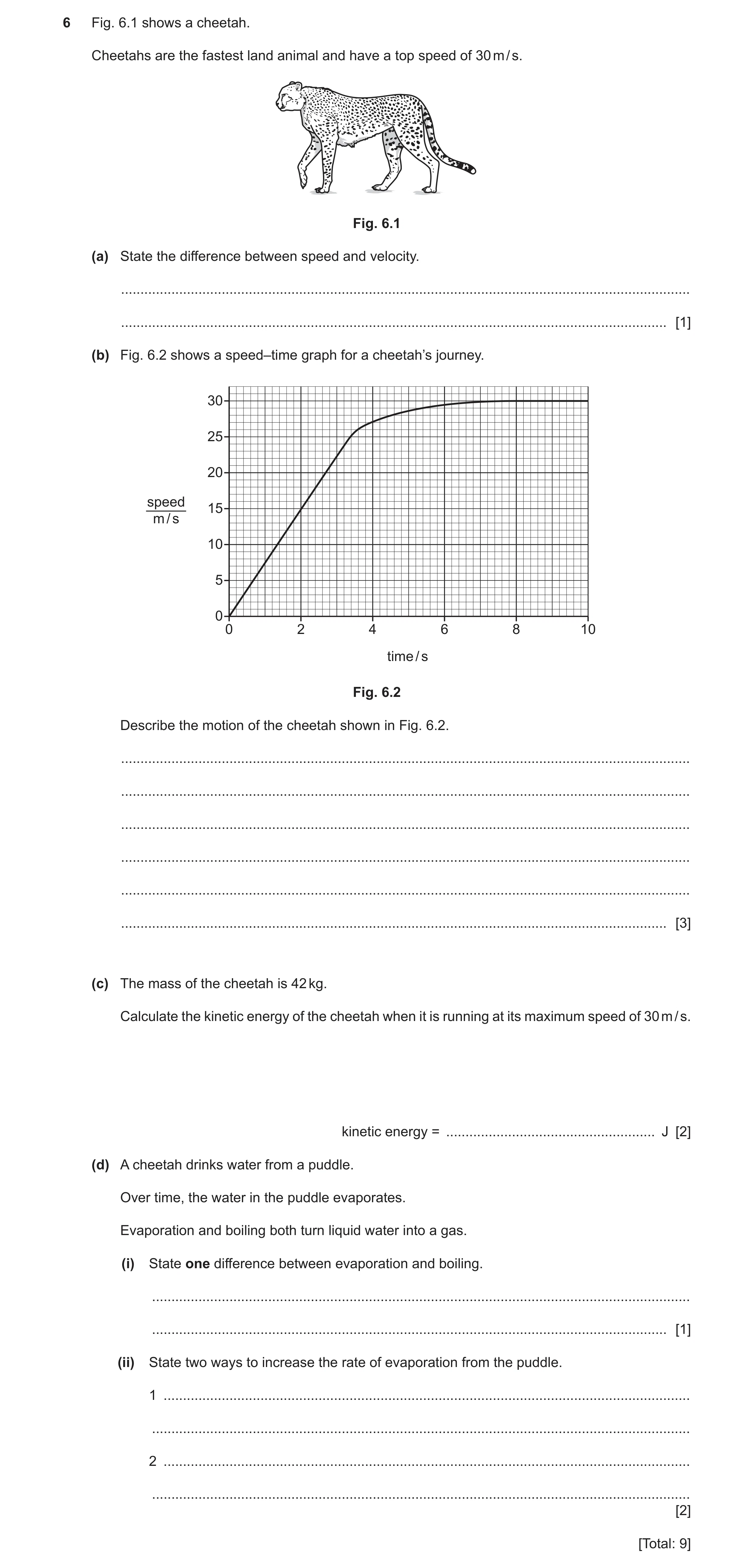
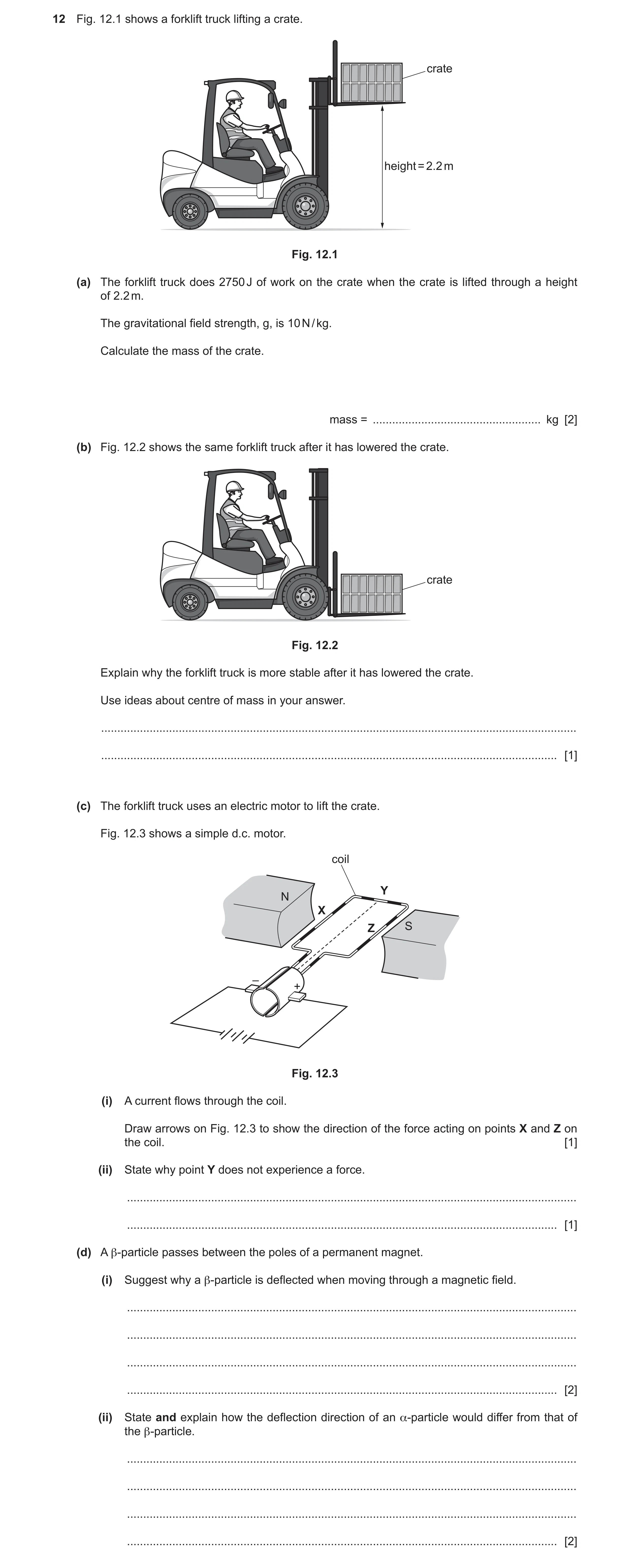
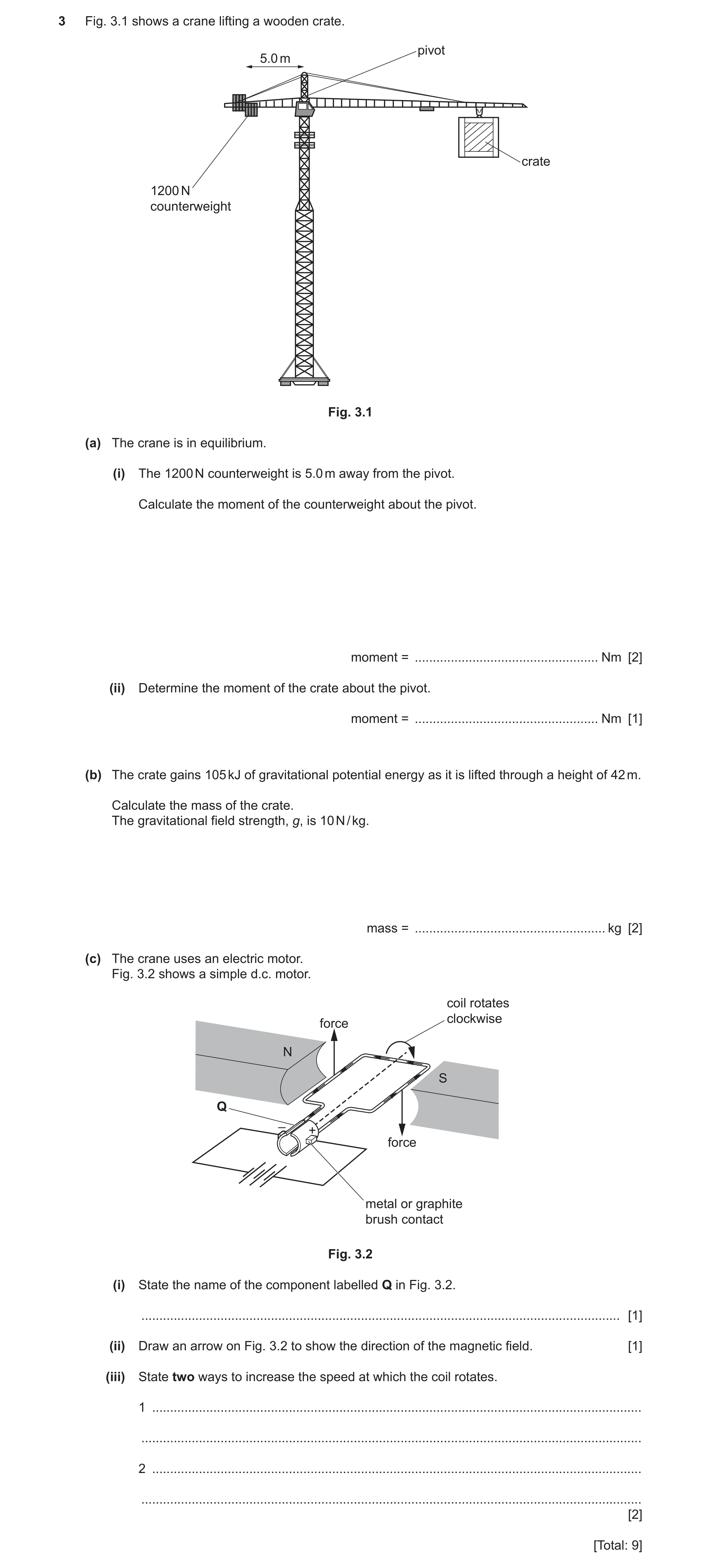
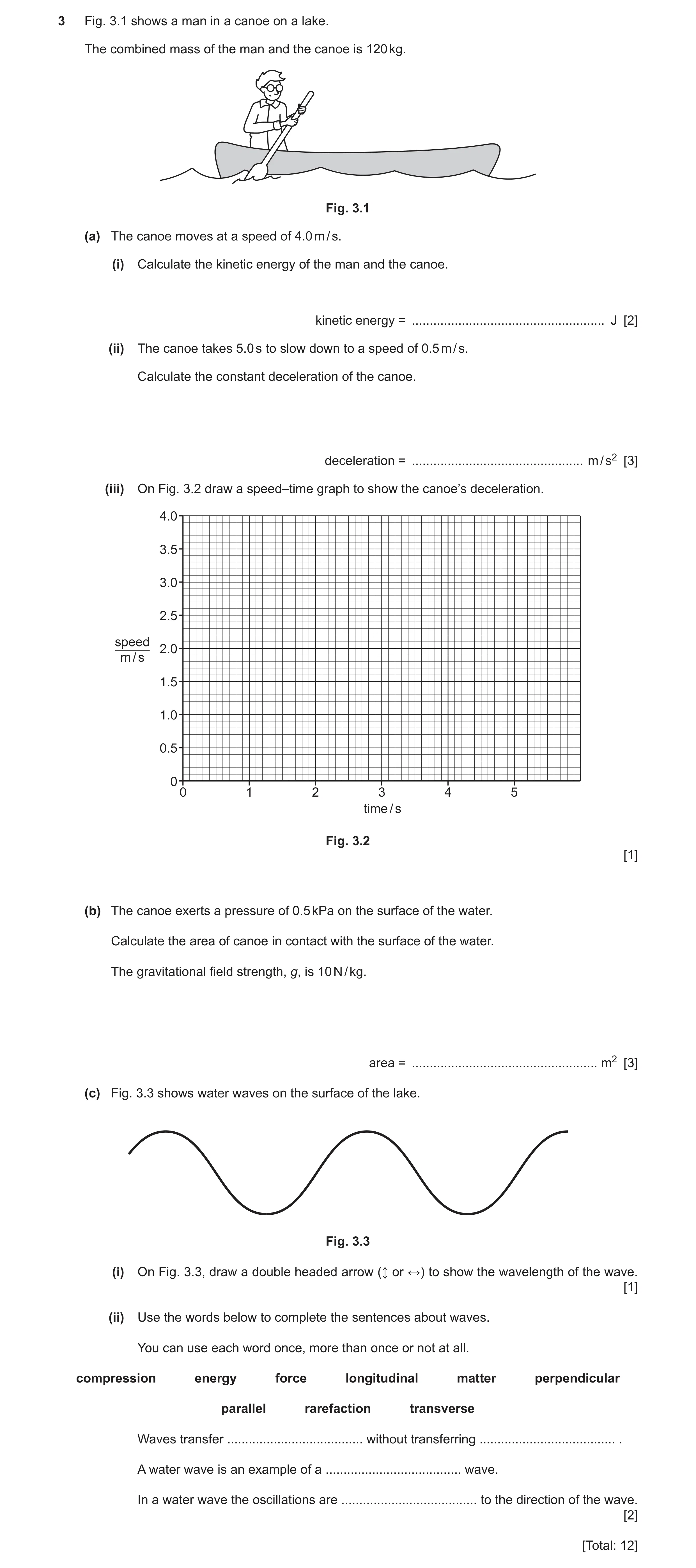
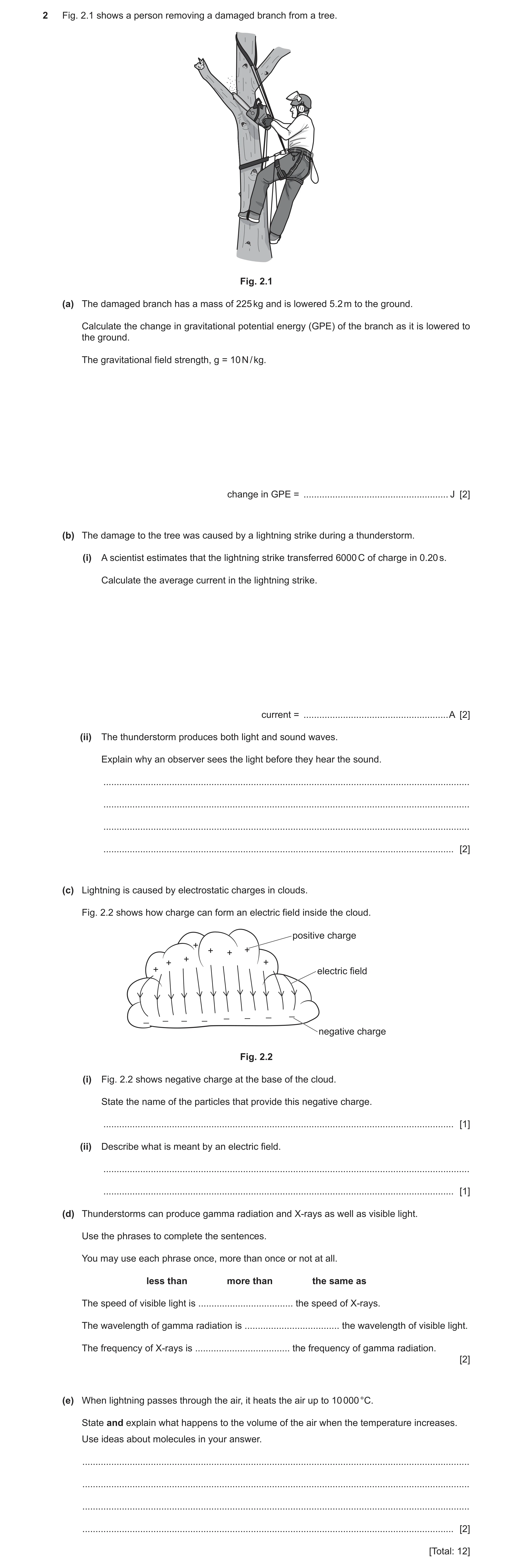
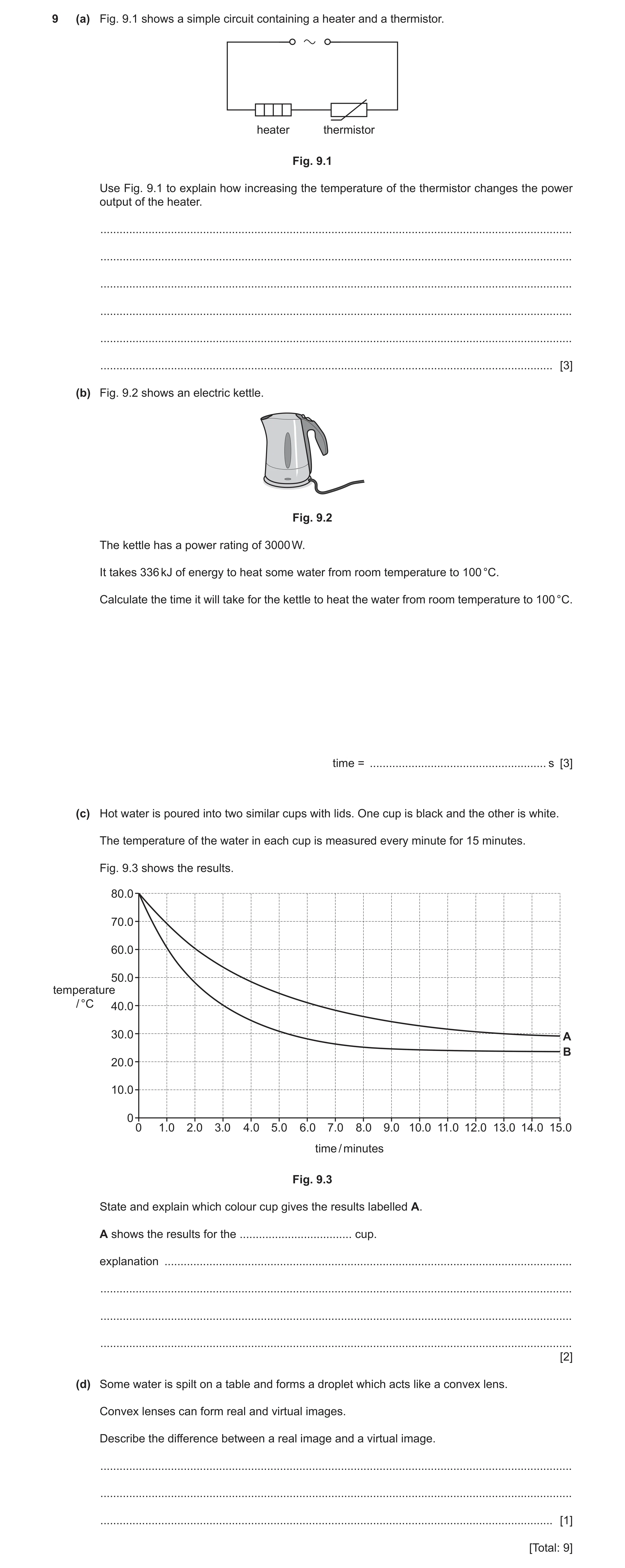
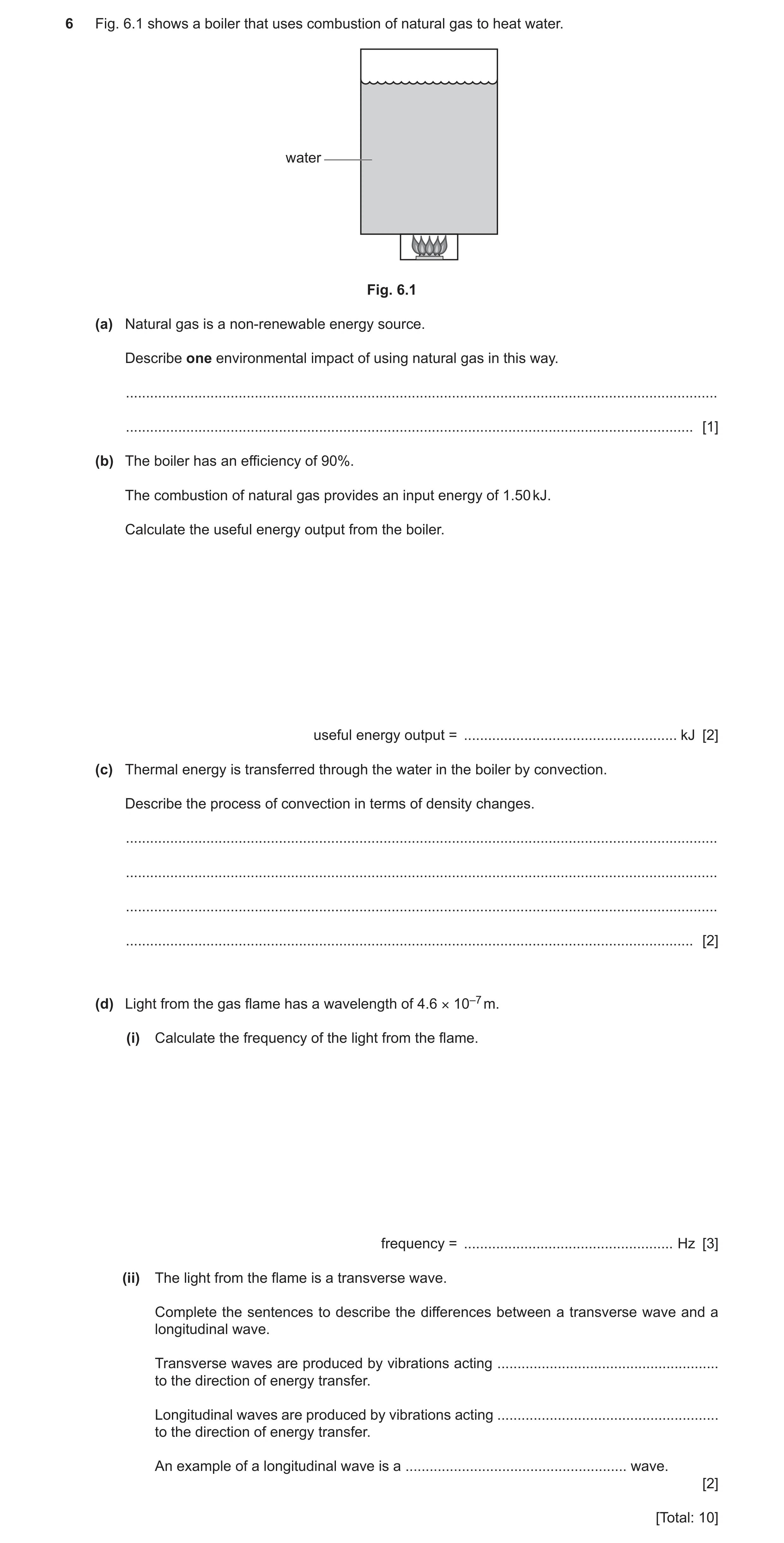
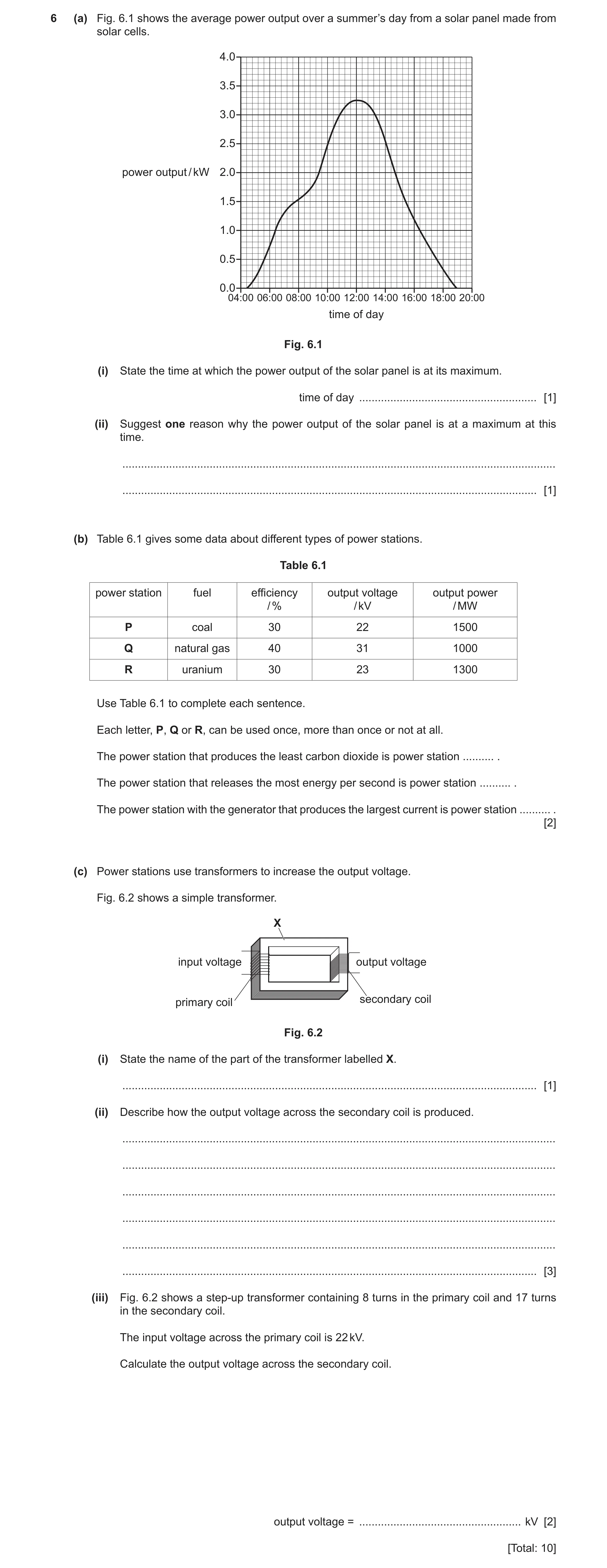
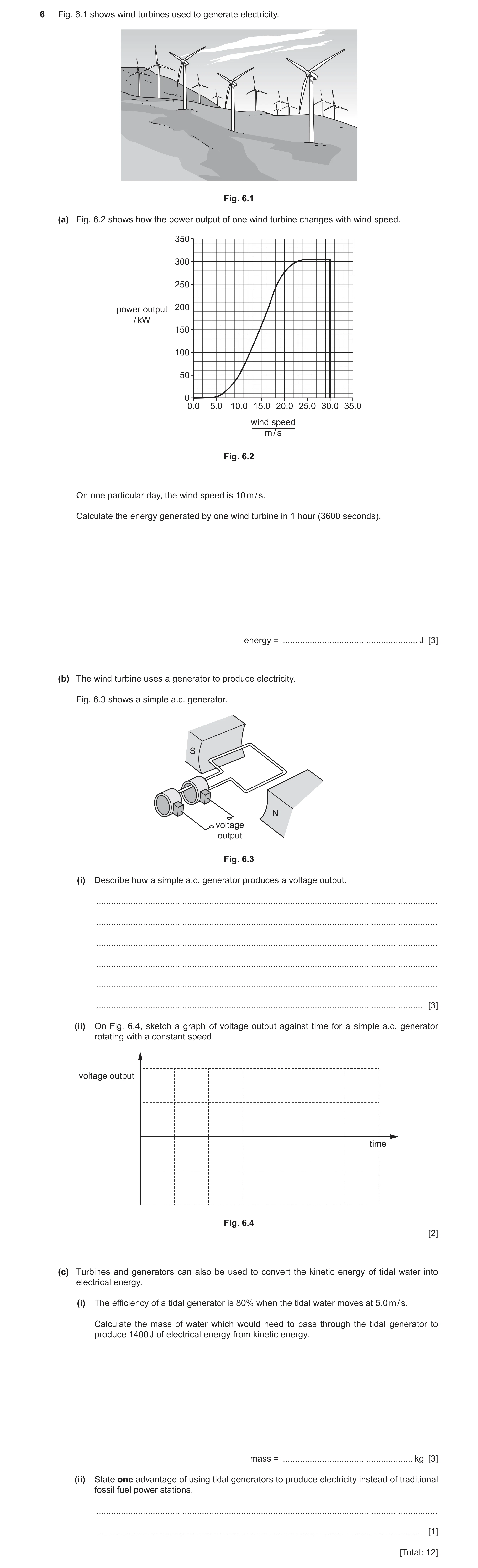
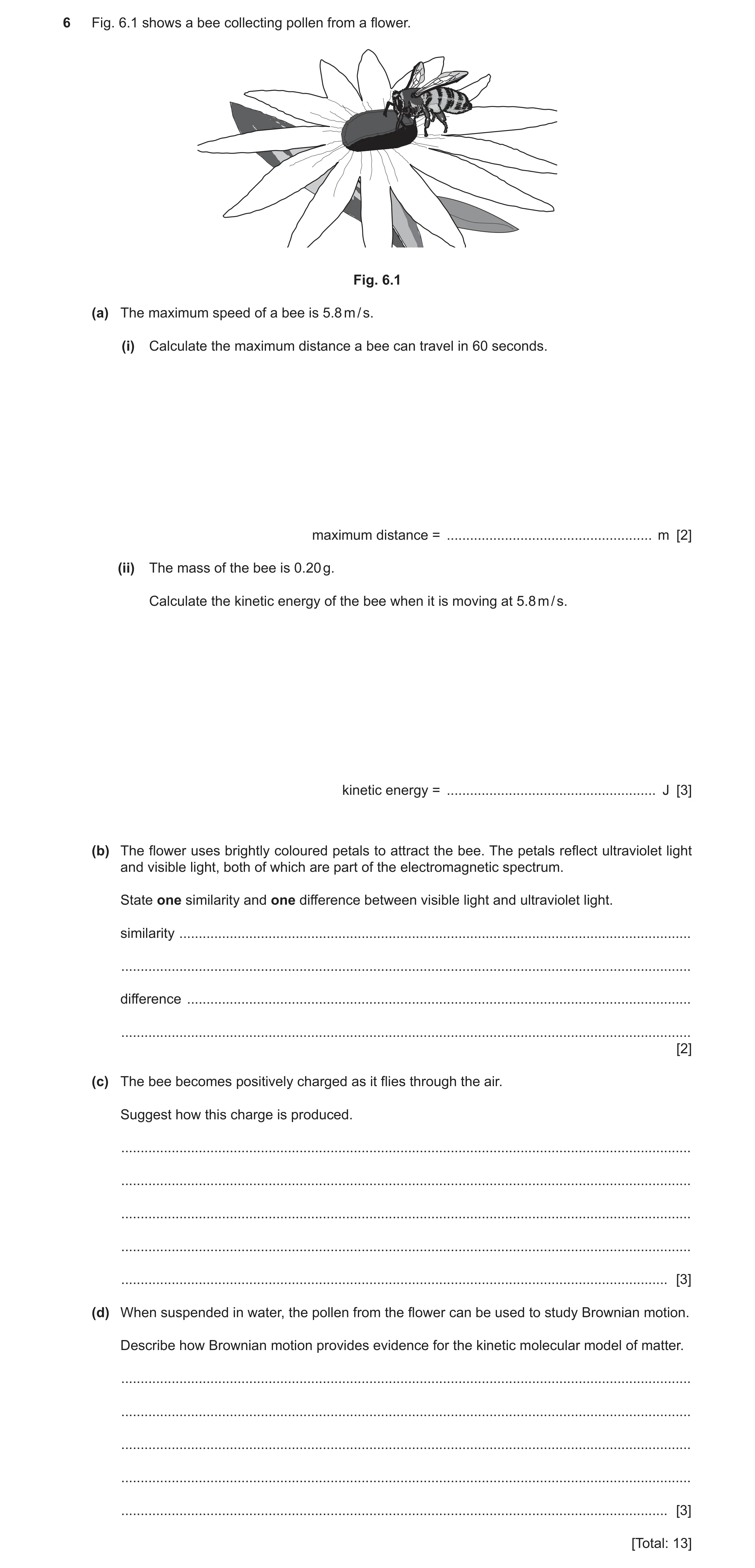
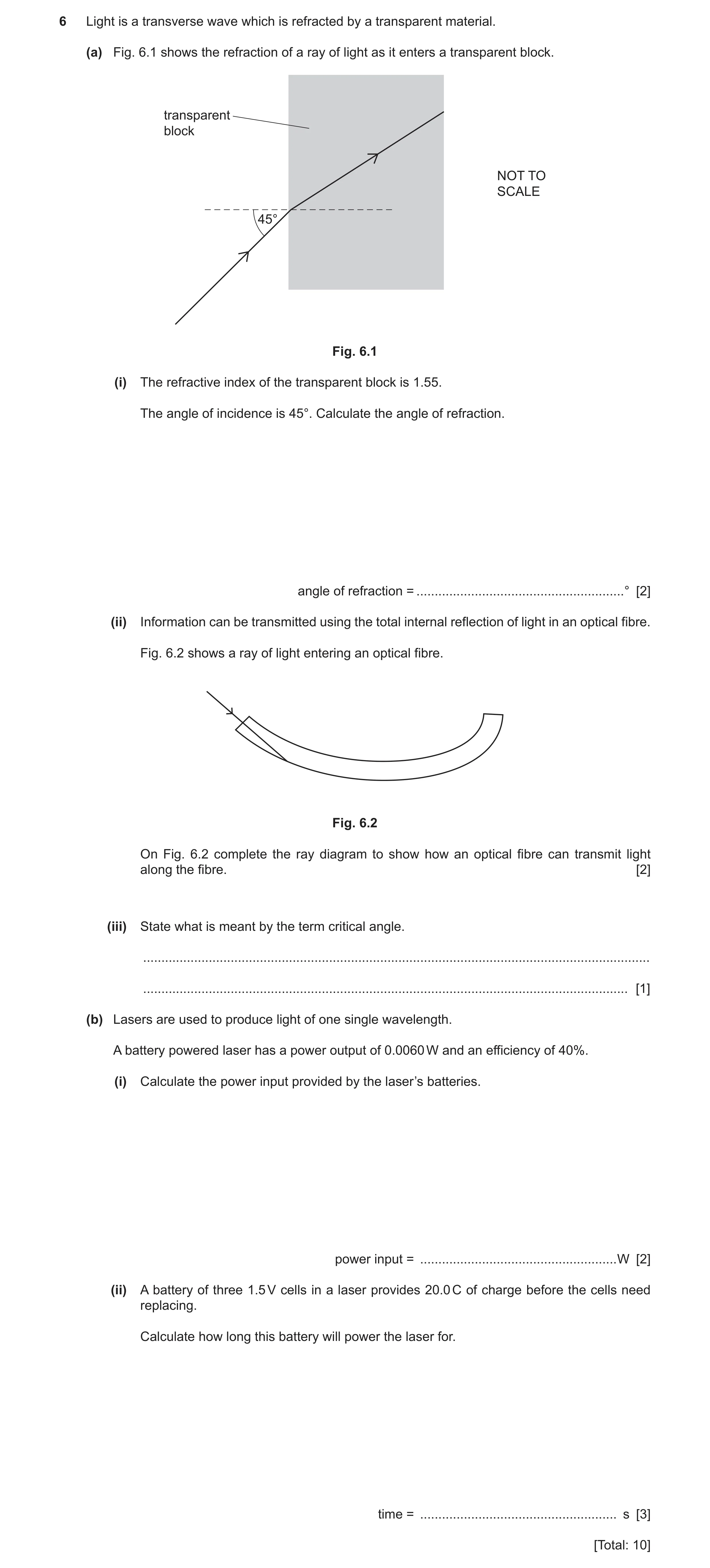
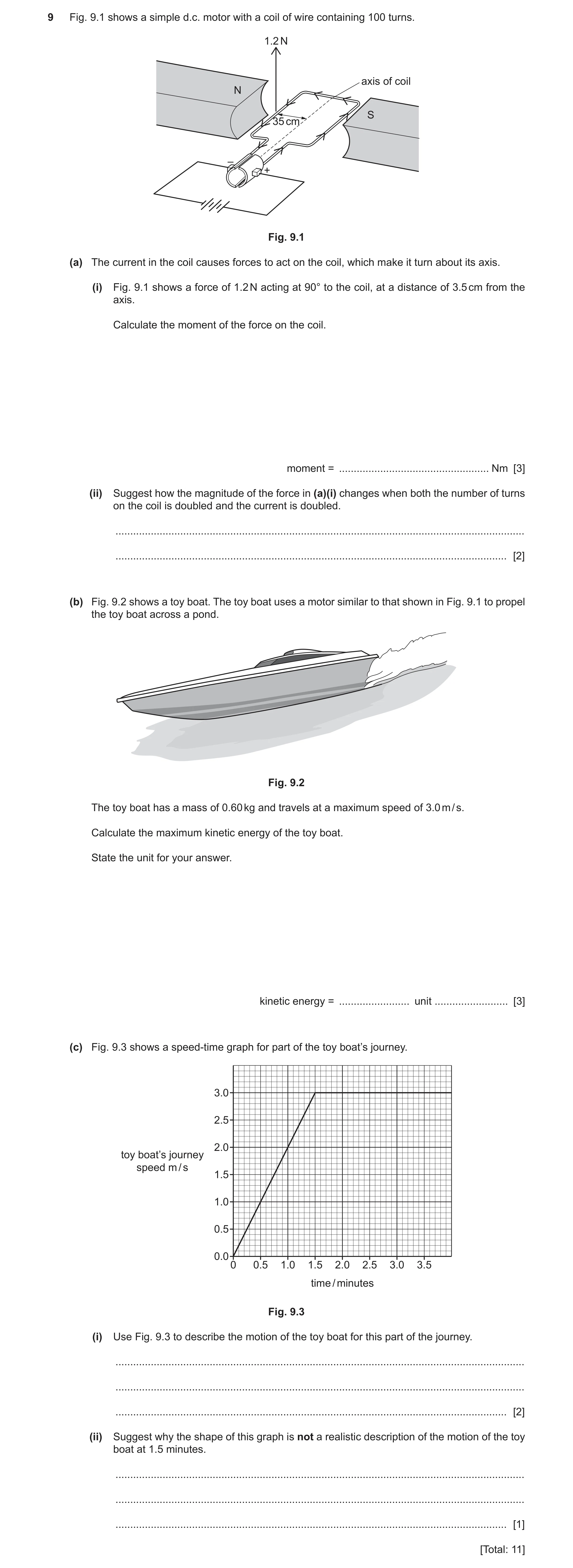
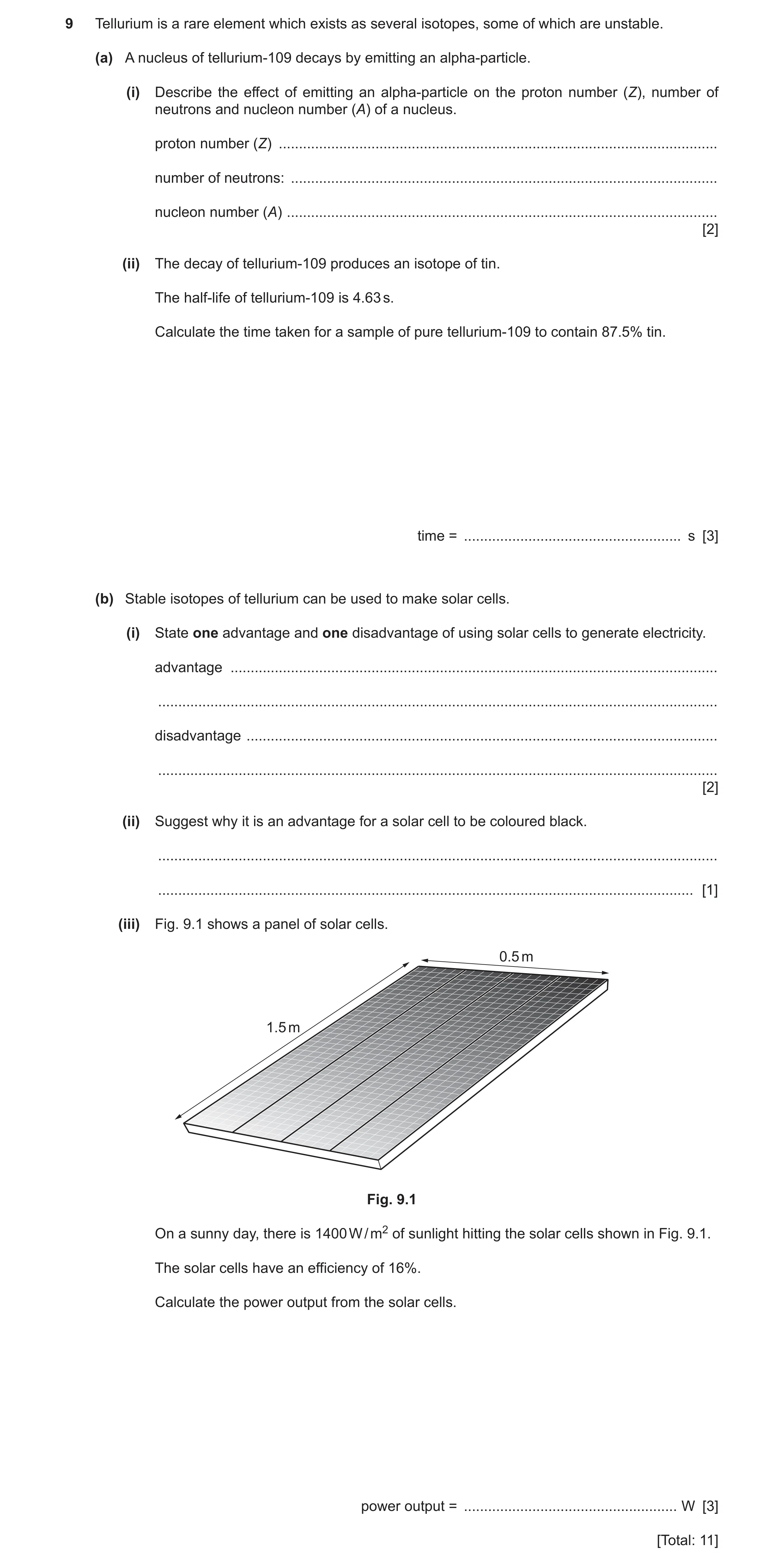
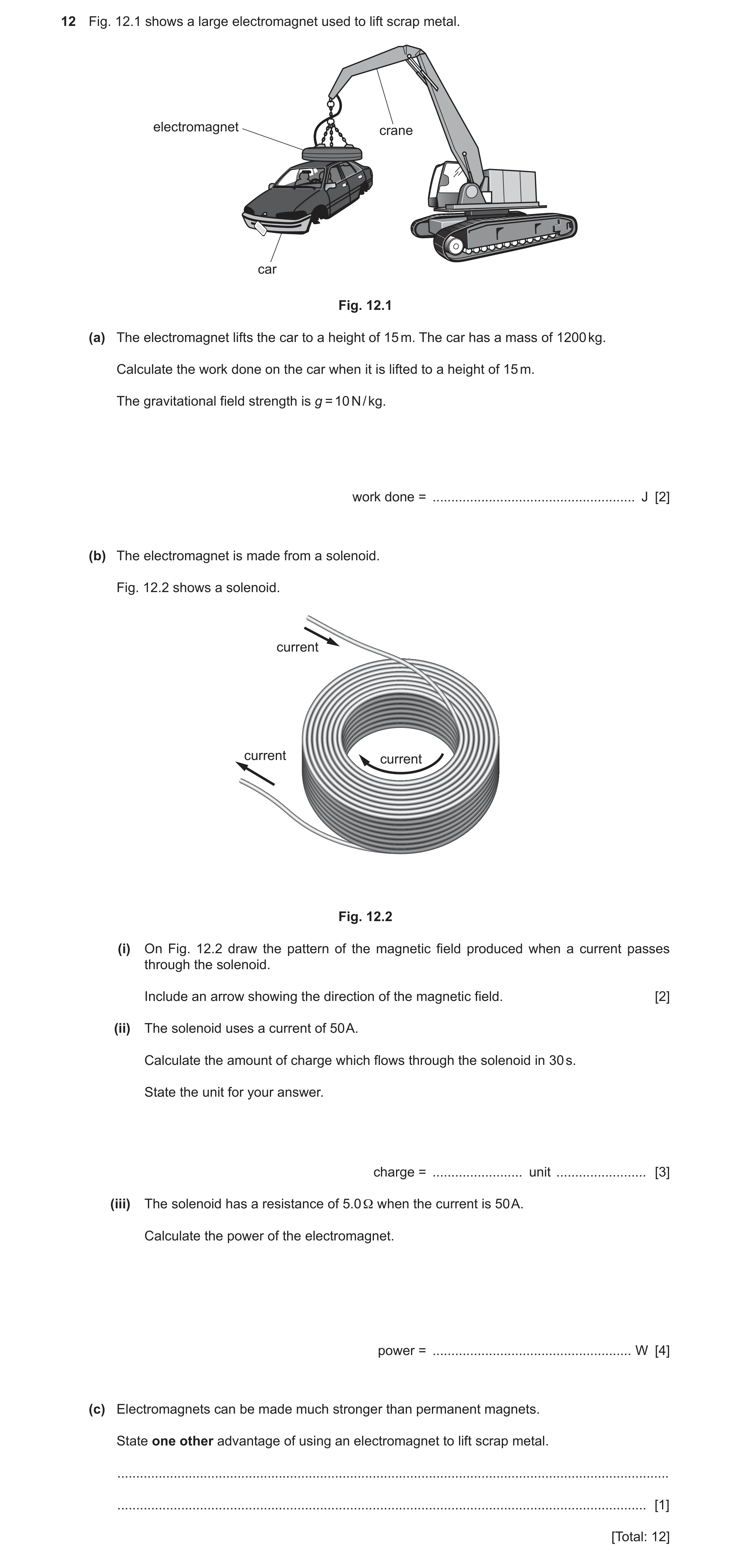
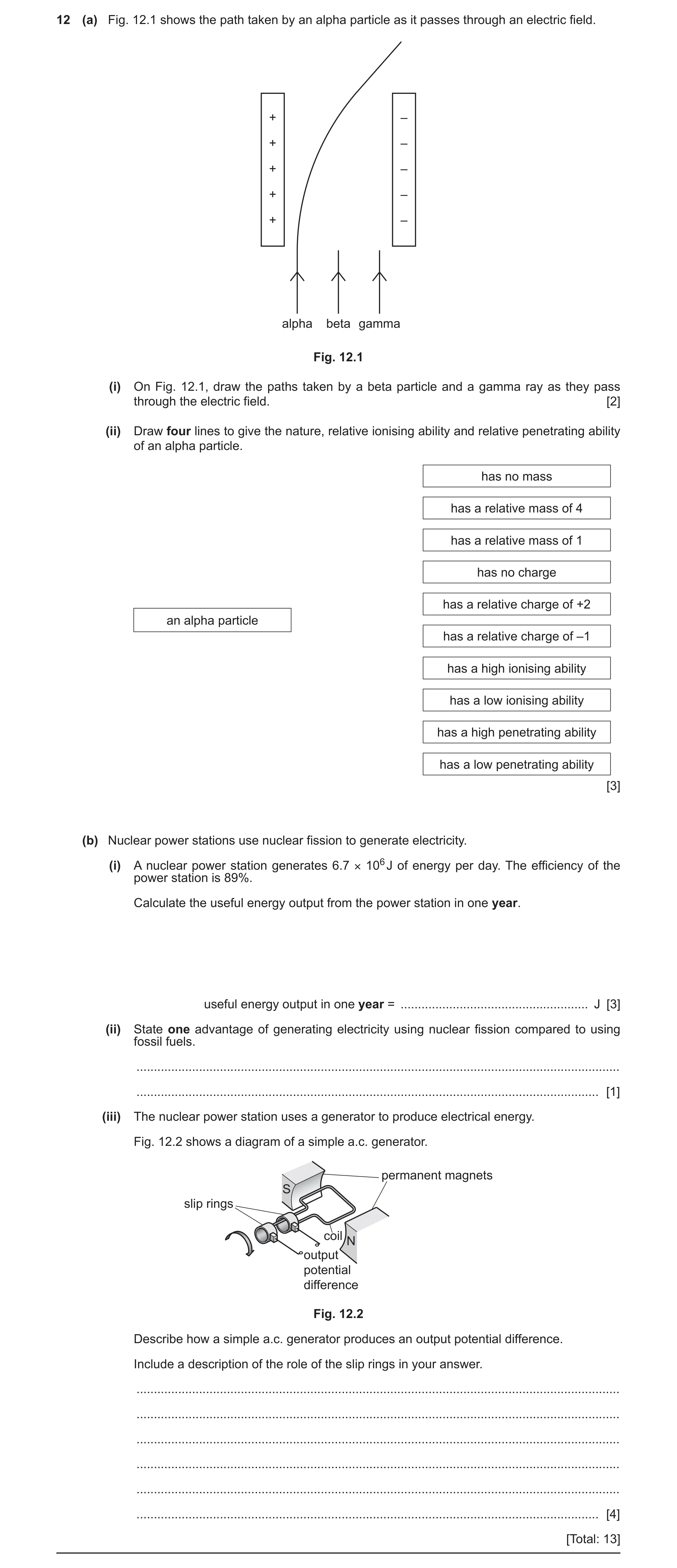
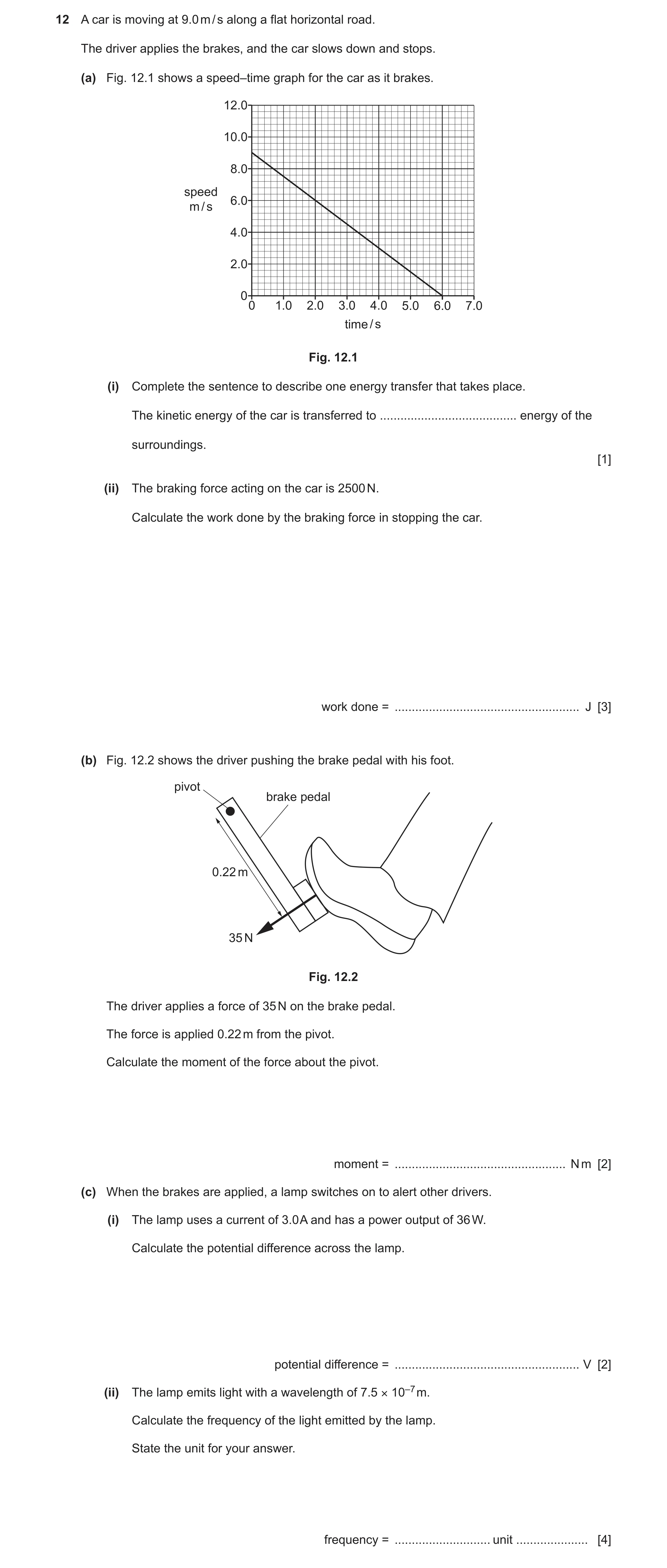
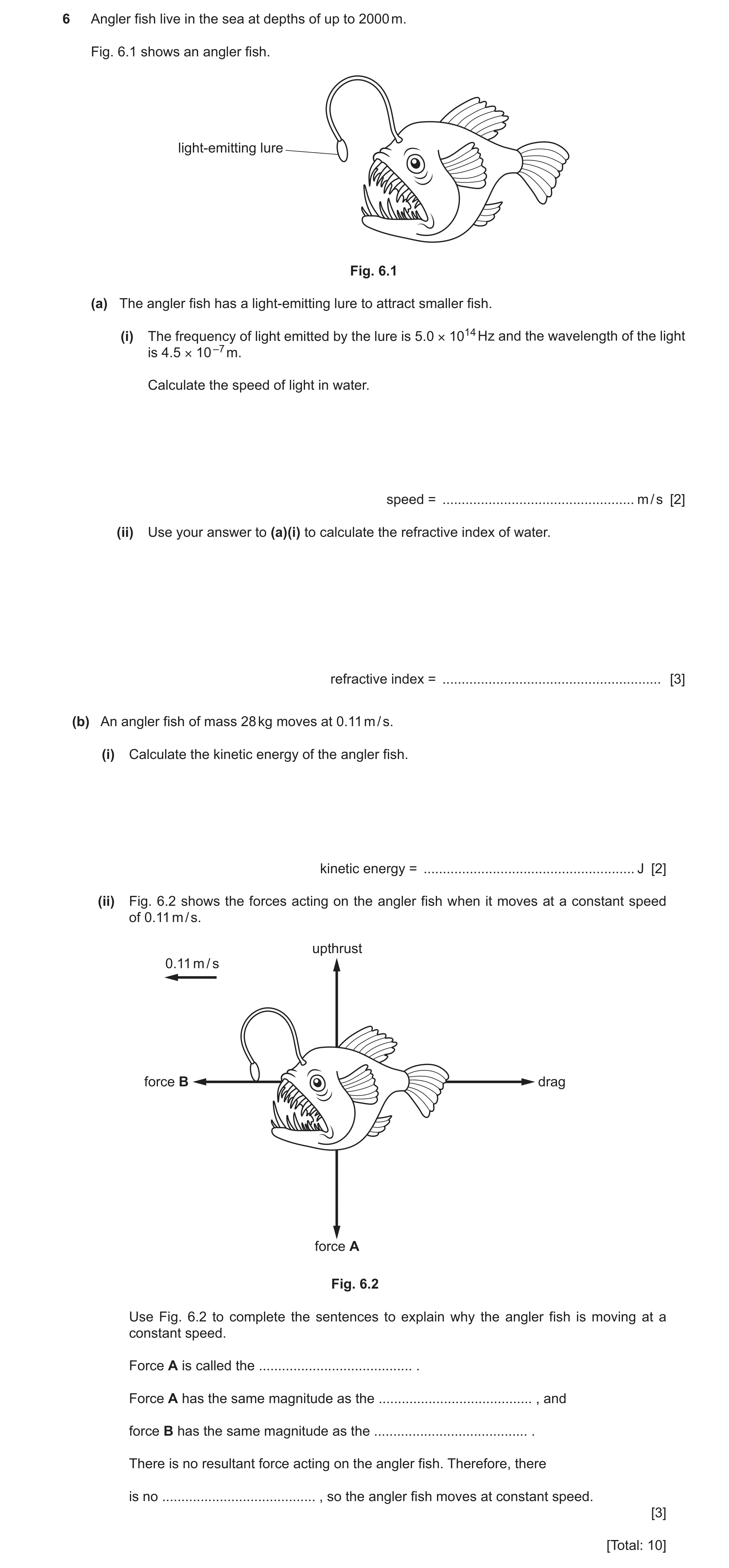
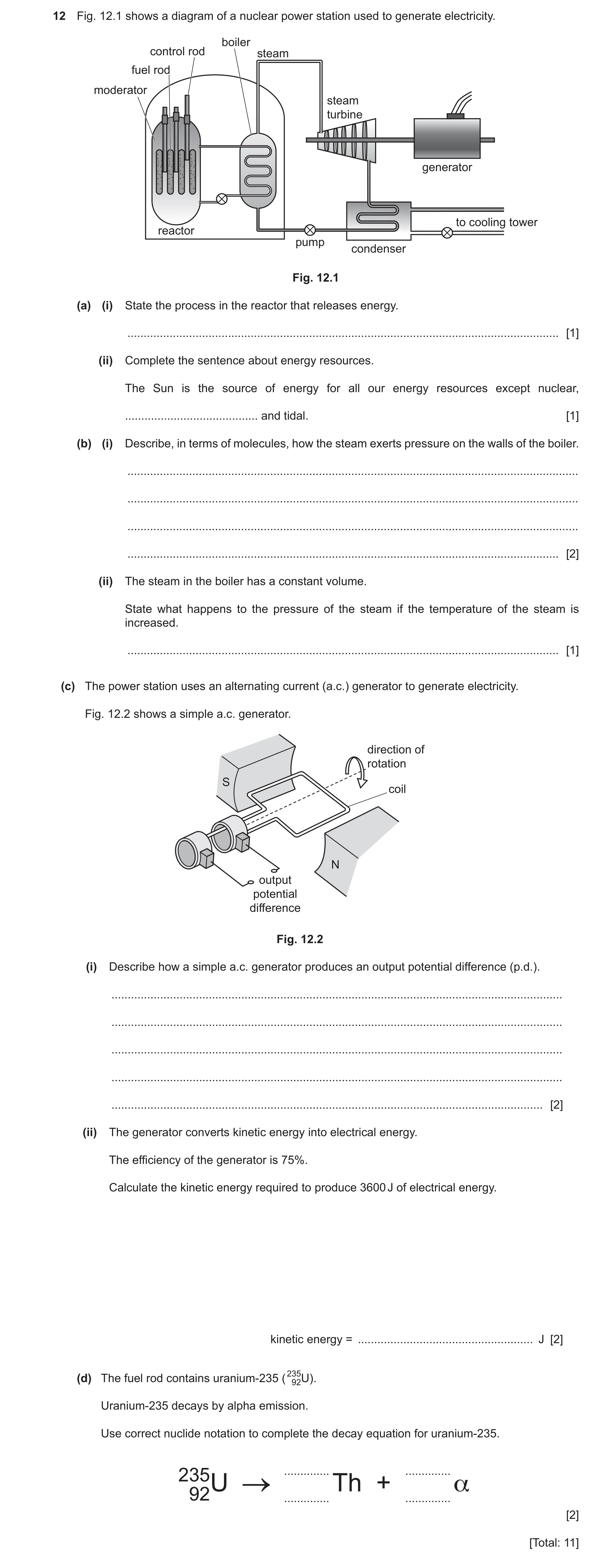
![Question 49: (a) Circle two vector quantities. acceleration speed temperature time weight [2] (b) Fig. 9.1 shows the speed–time graph for a car travelli…](https://img.pastlit.com/crops/08b2c75a-c309-4a7a-9c51-b158e998f79b/q9.webp)
![Question 50: (a) (i) Circle all the vector quantities. energy gravitational field strength temperature time weight [2] (ii) Define the term velocity. ..…](https://img.pastlit.com/crops/5f469ae5-3ce9-4e60-9f50-777dbb641736/q9.webp)
 87 / 87
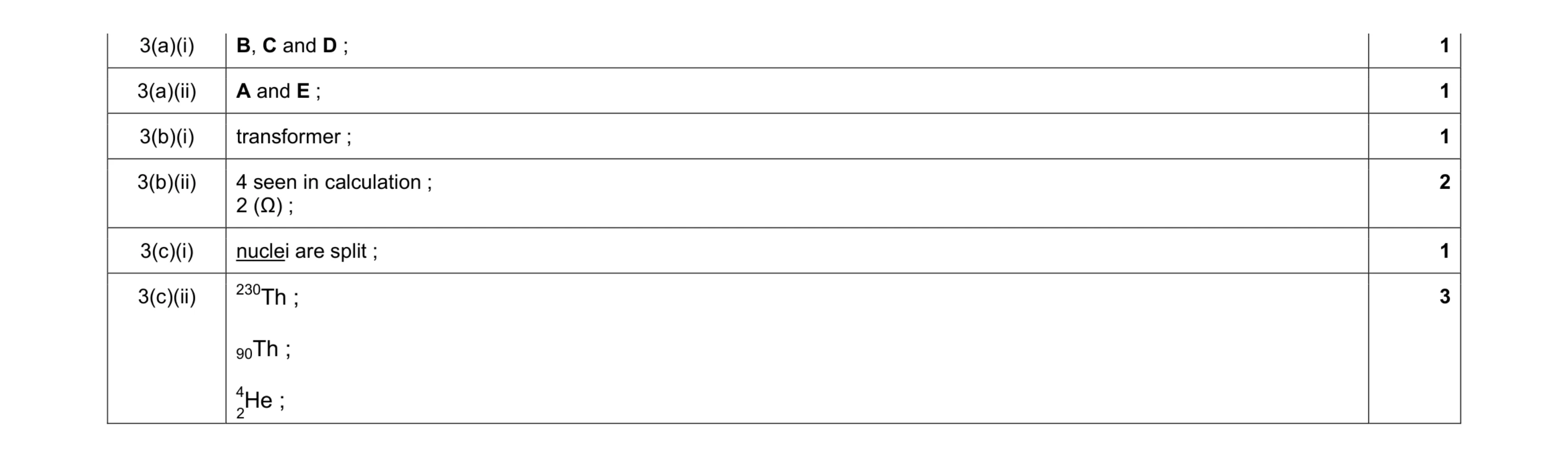 9
9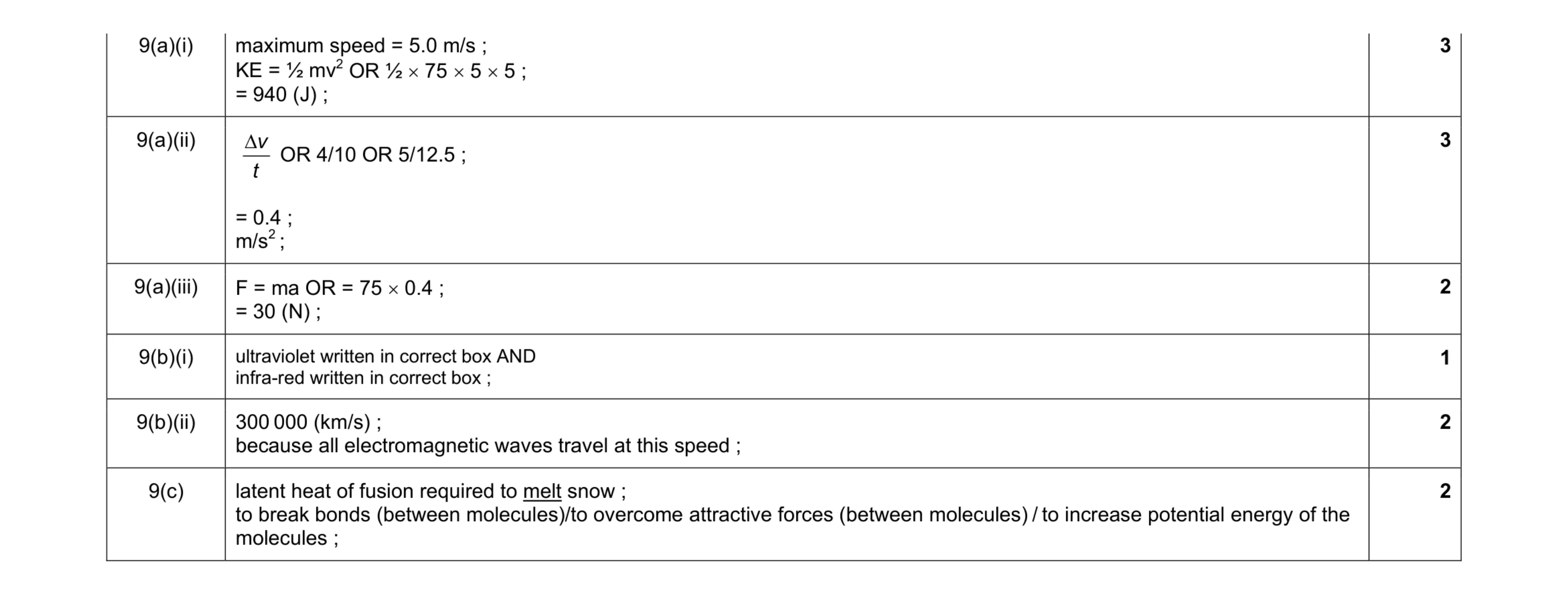 13
13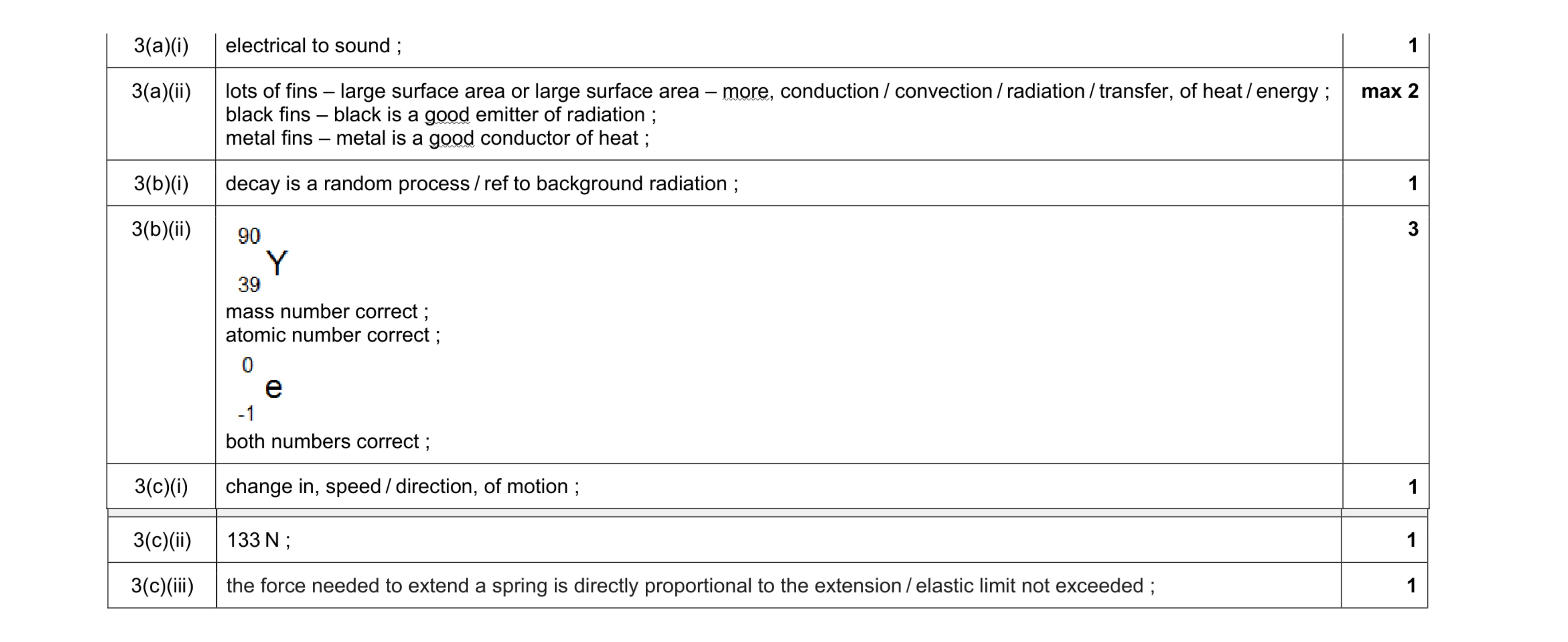 10
10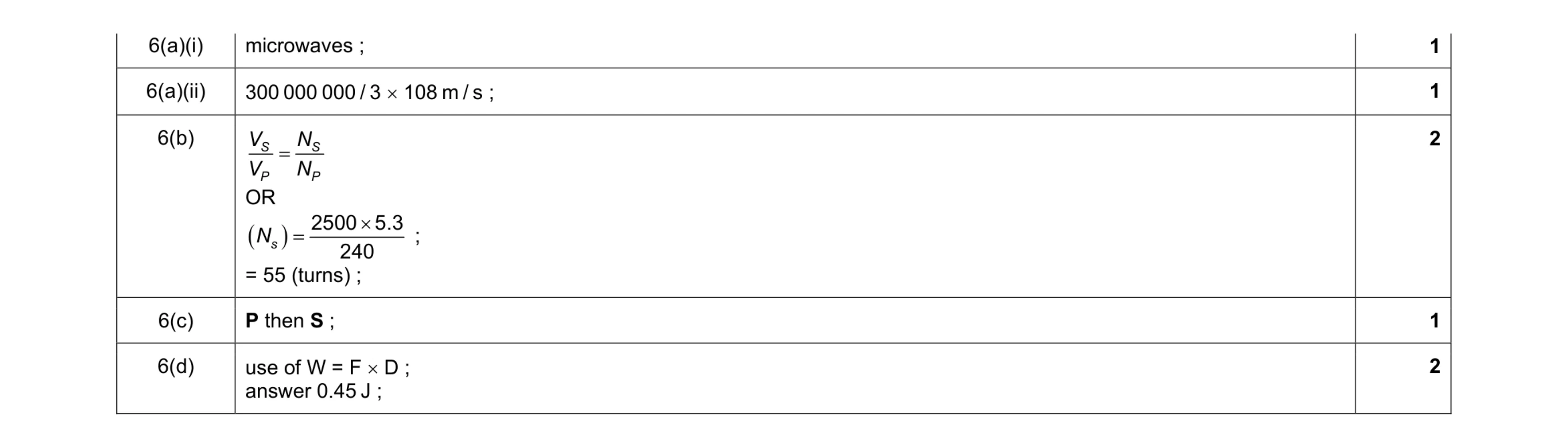 7
7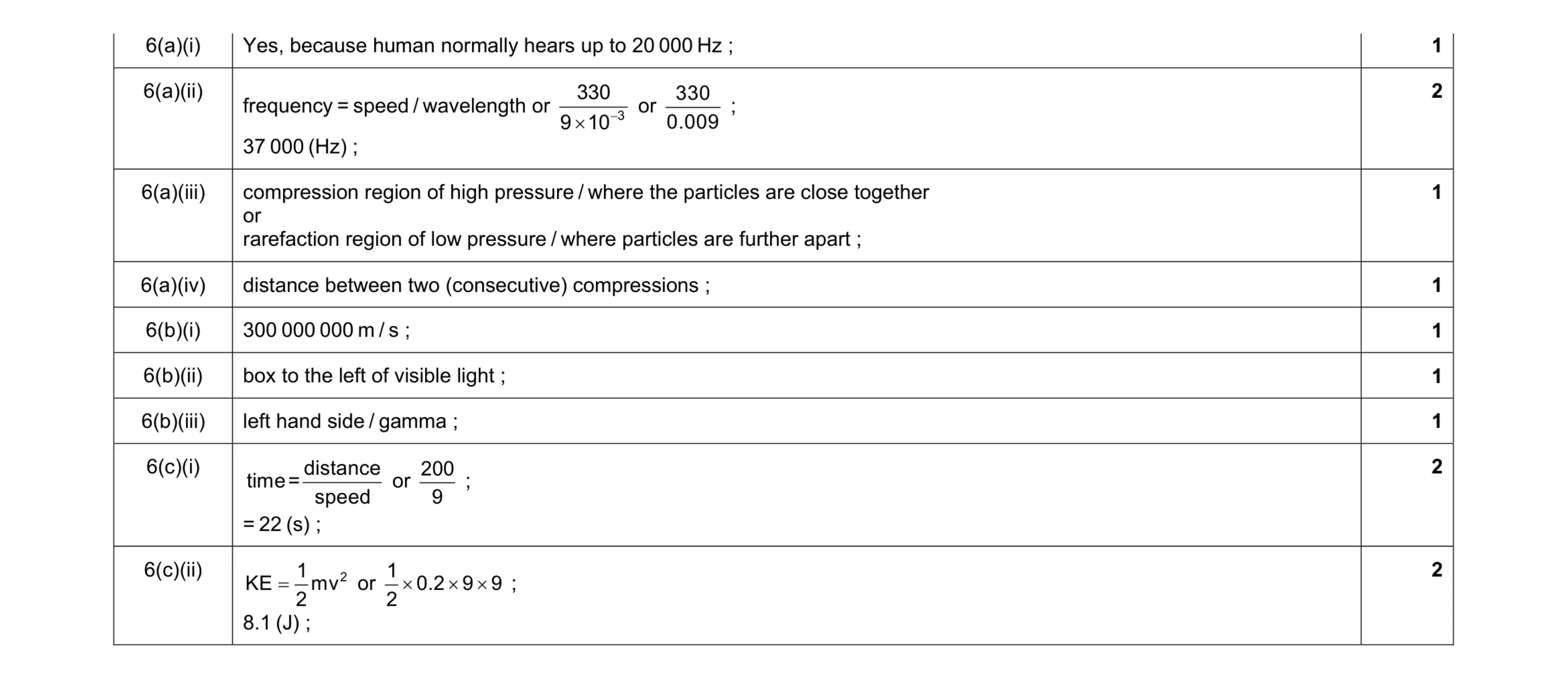 12
12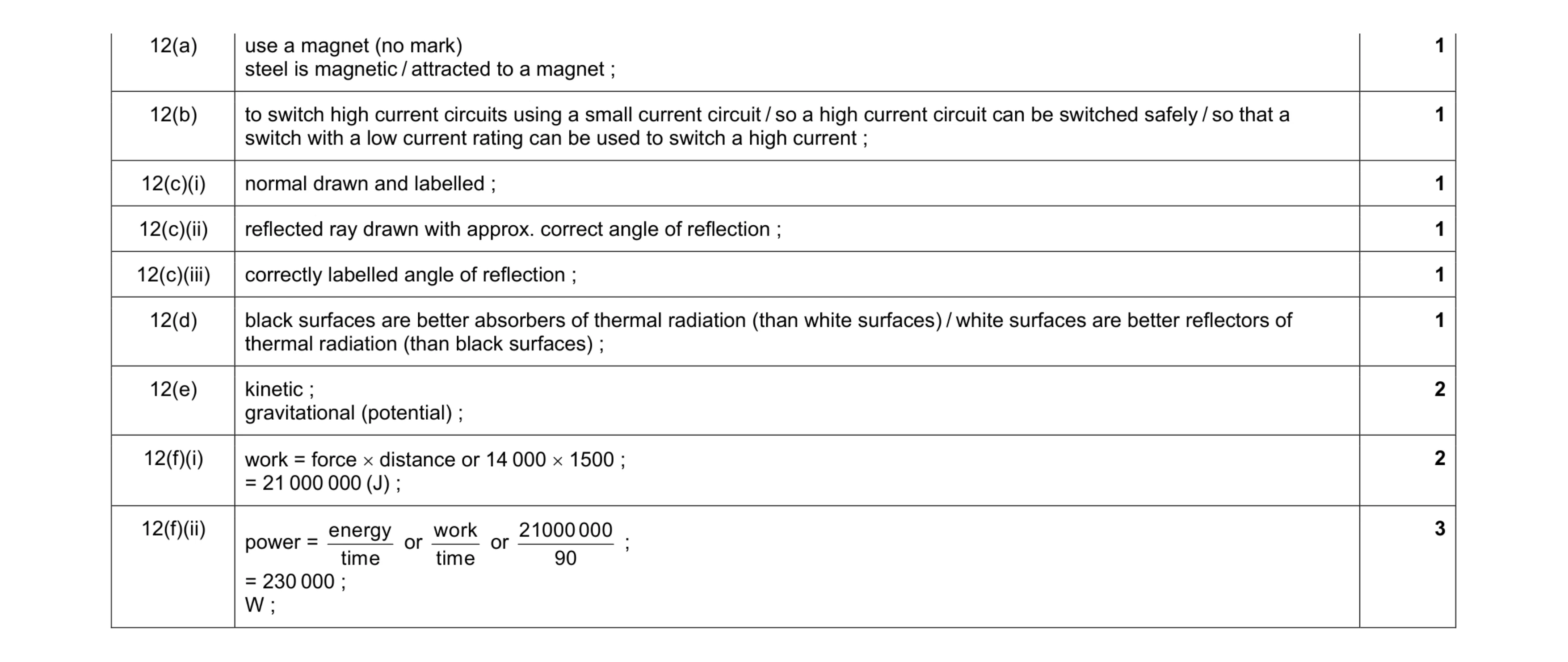 13
13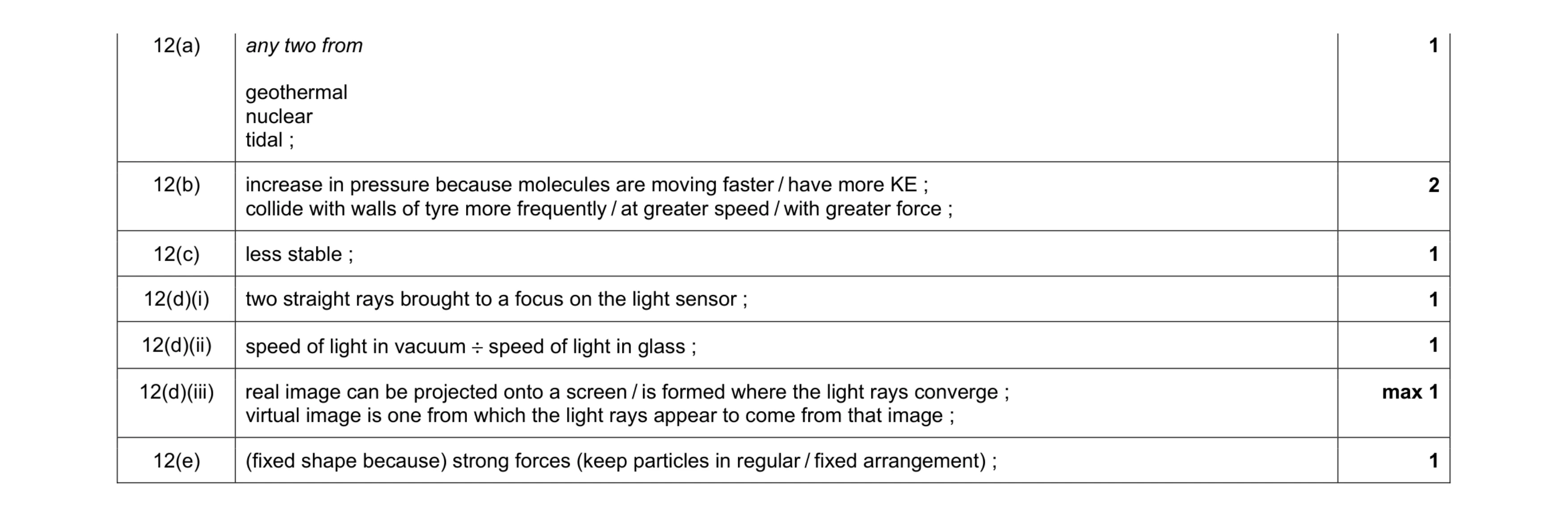 8
8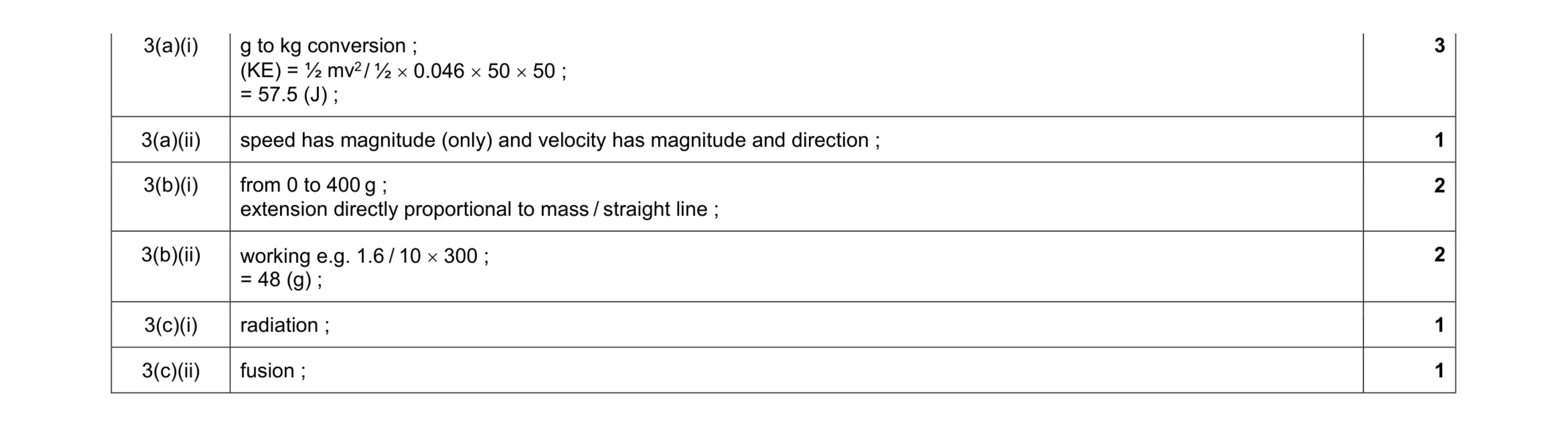 10
10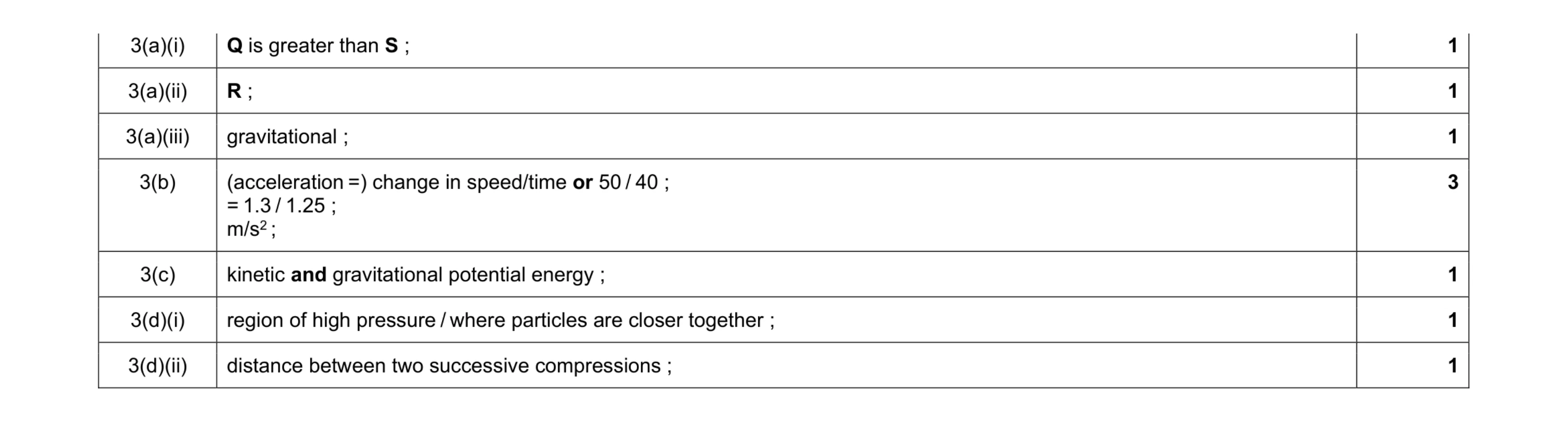 9
9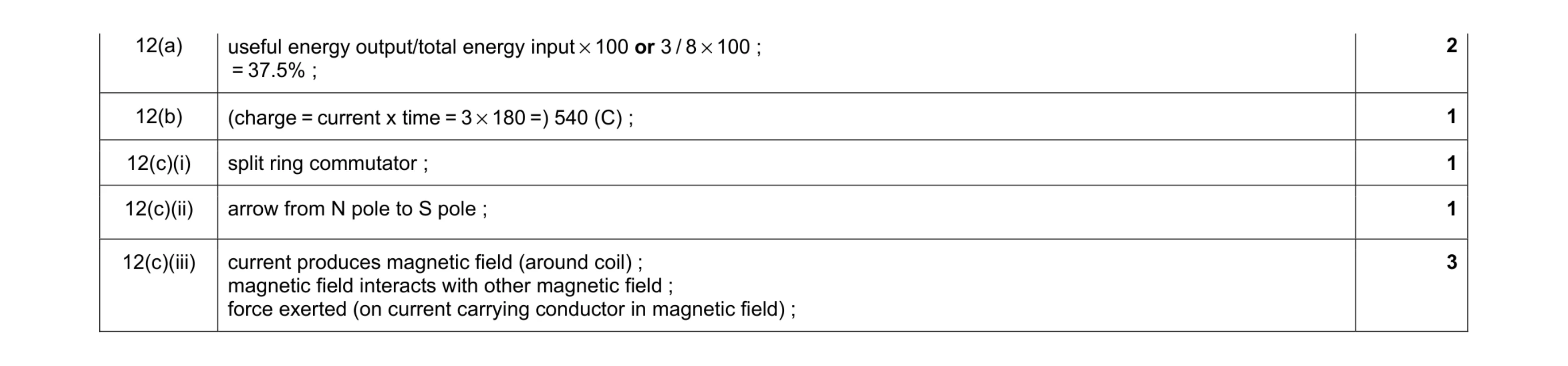 8
8 6
6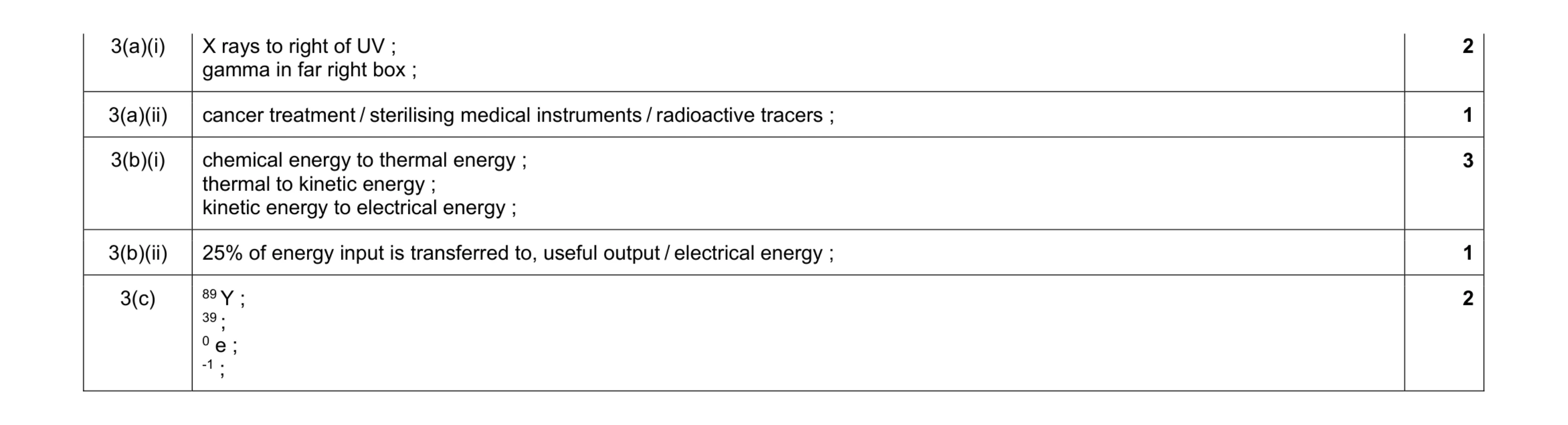 9
9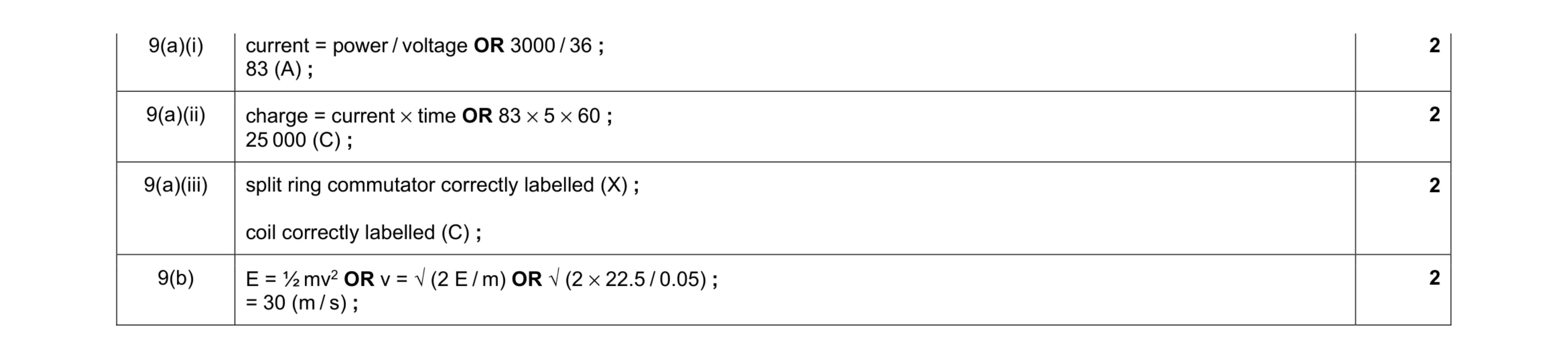 8
8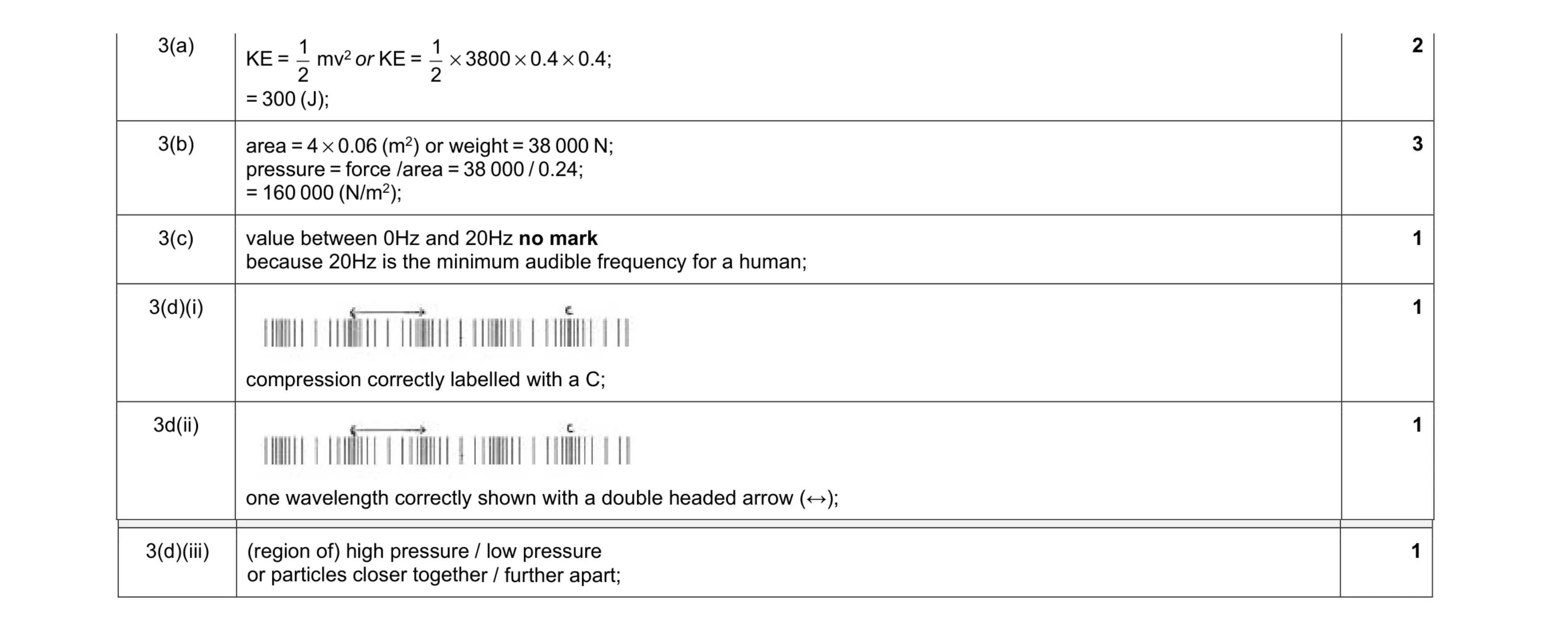 9
9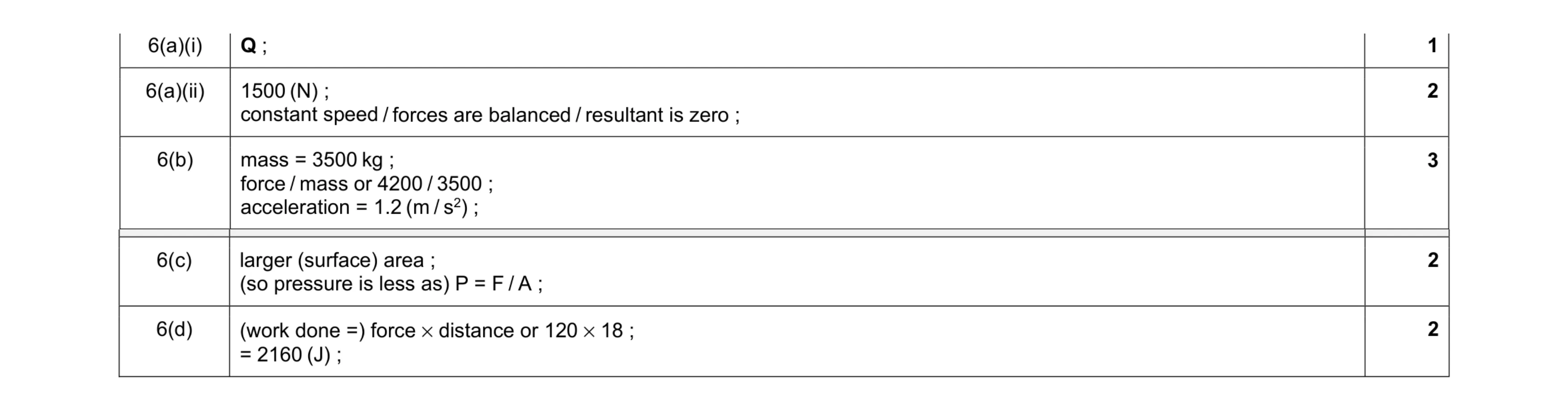 10
10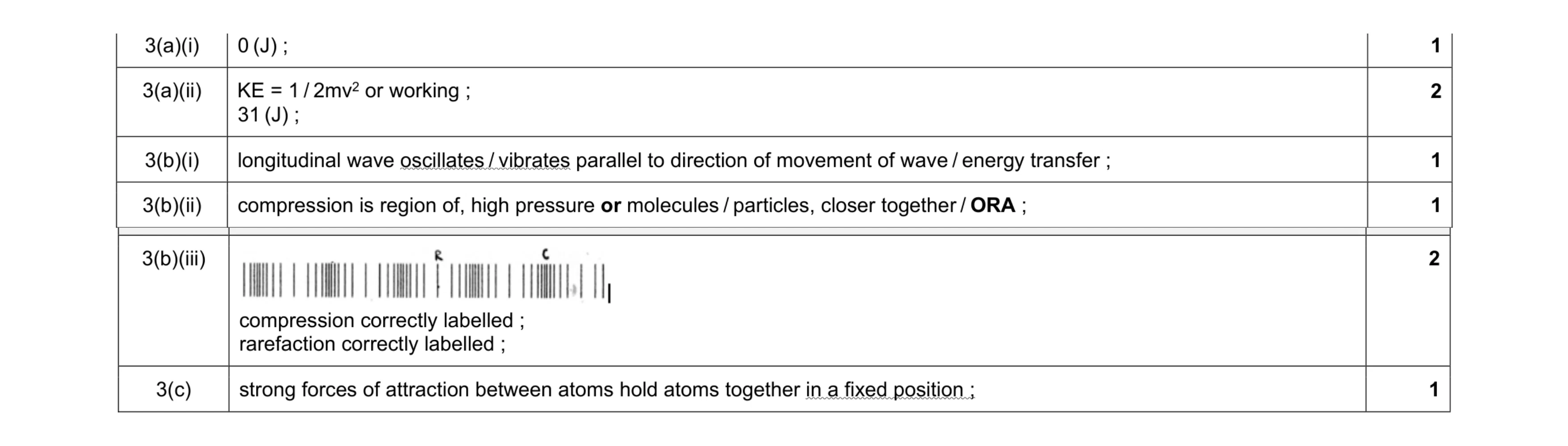 8
8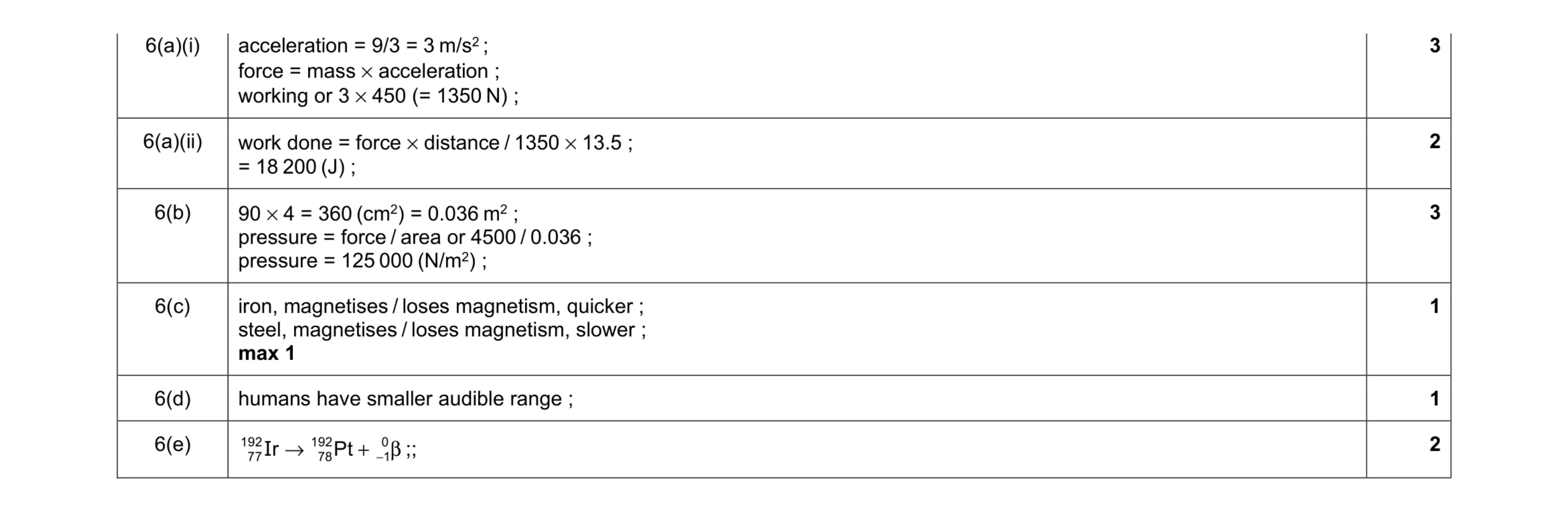 12
12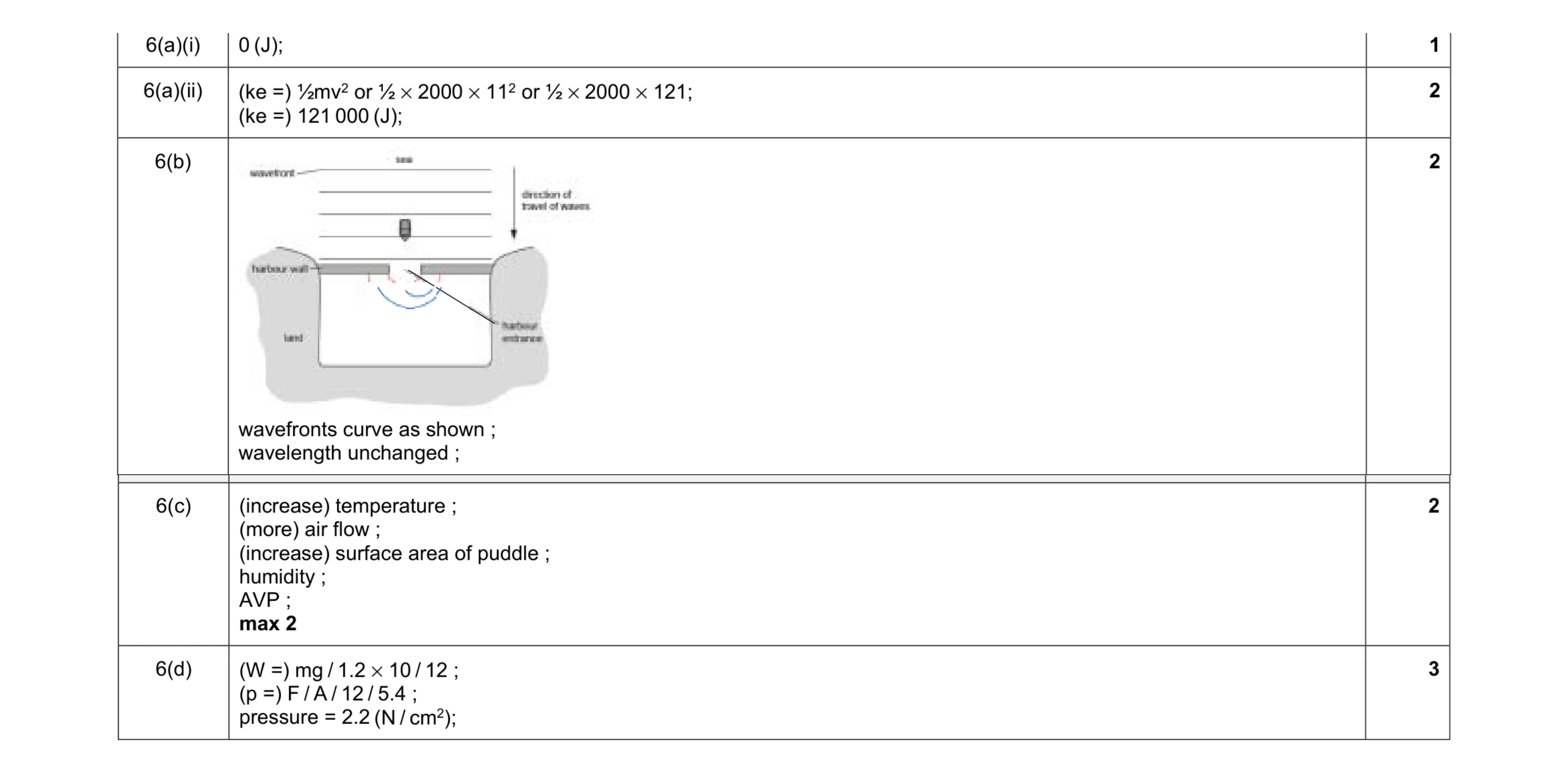 10
10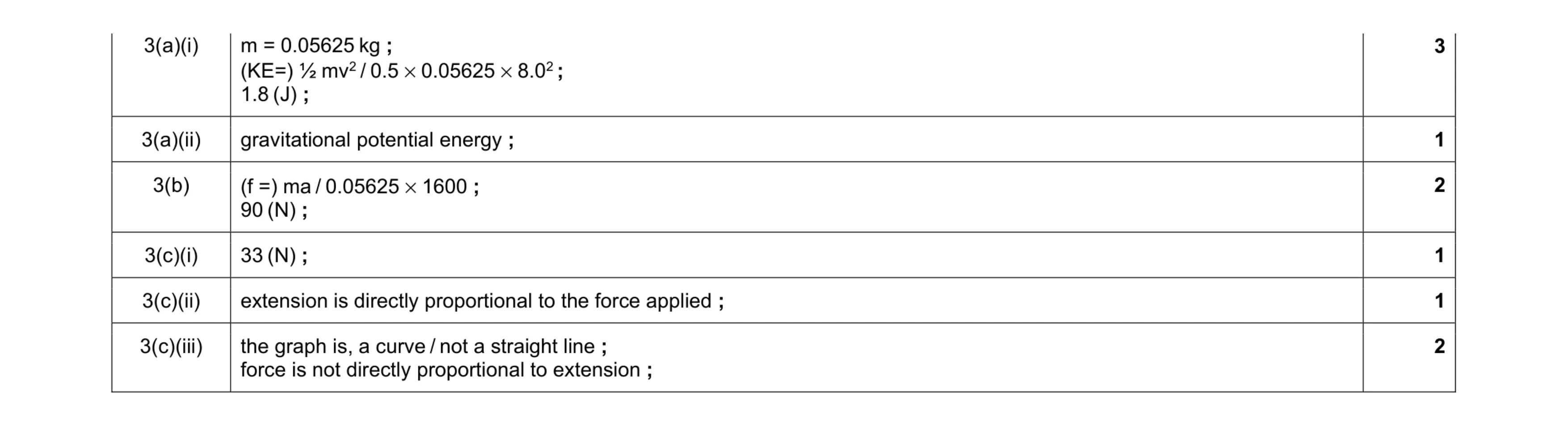 10
10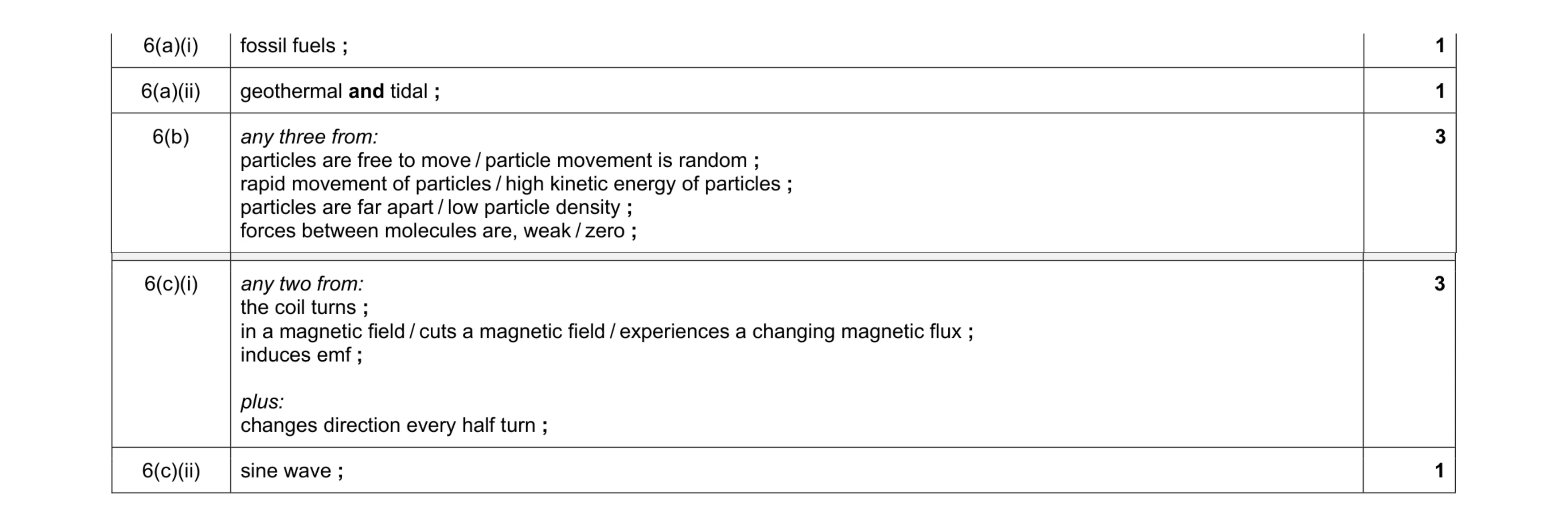 9
9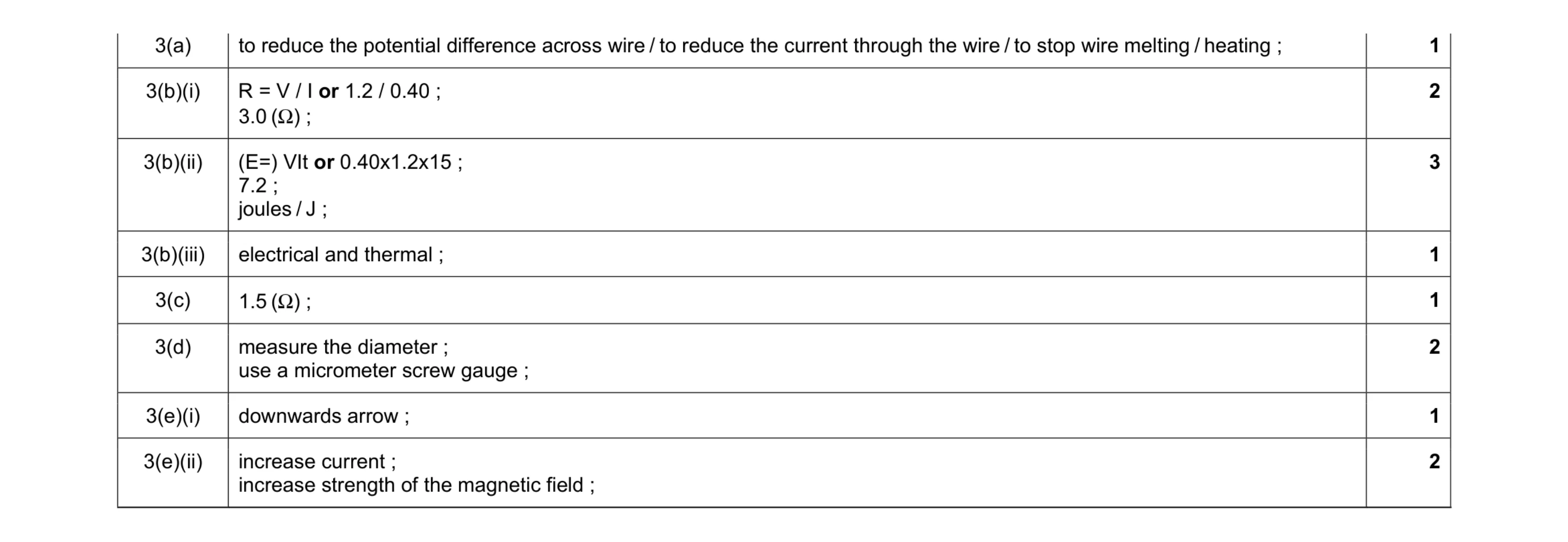 13
13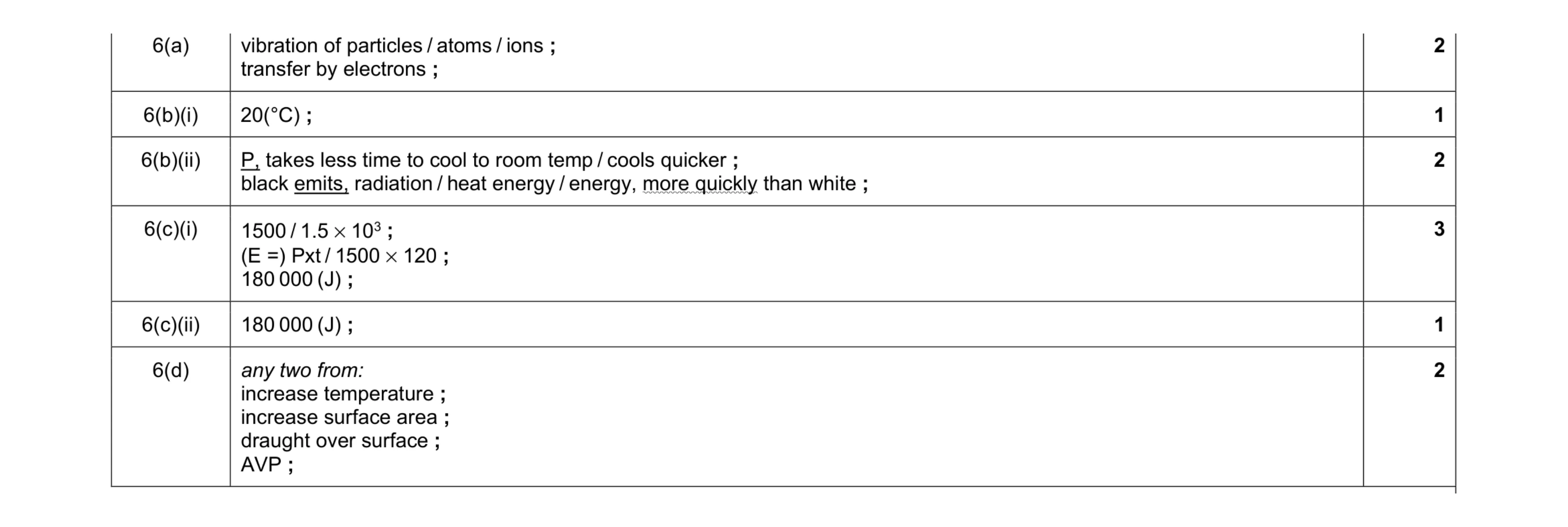 11
11 7
7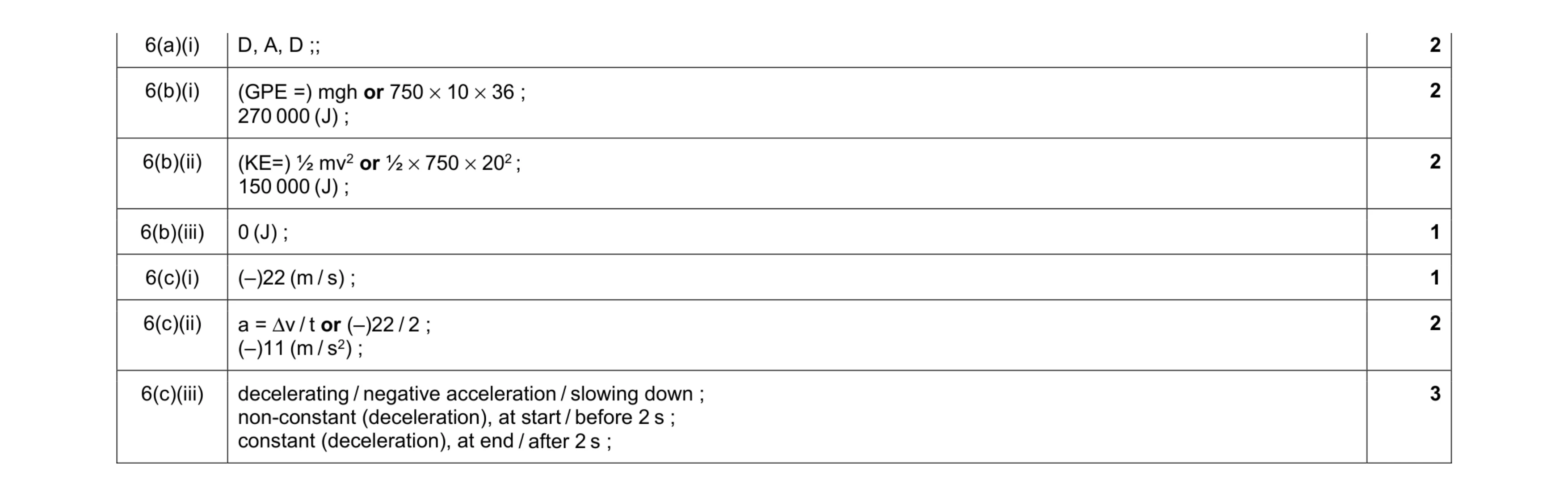 13
13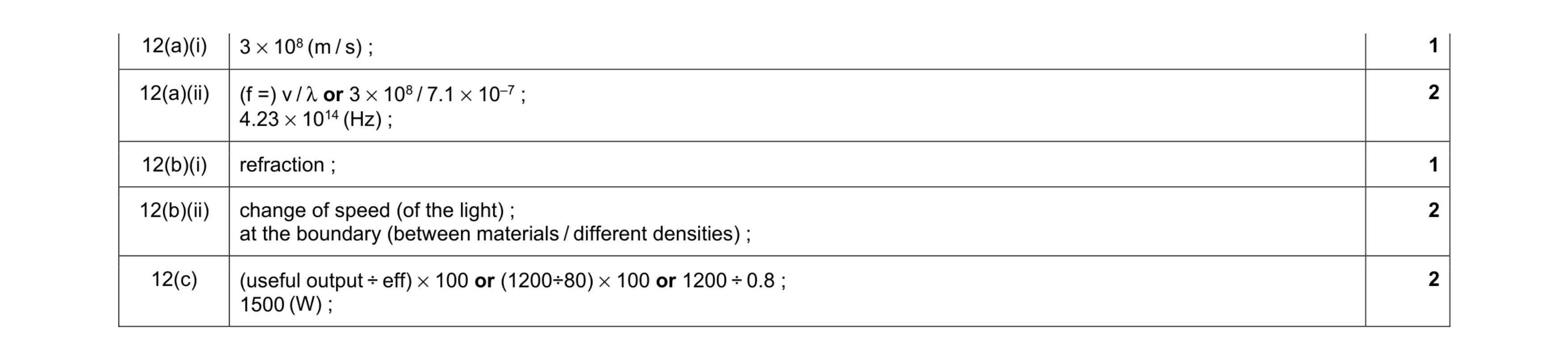 8
8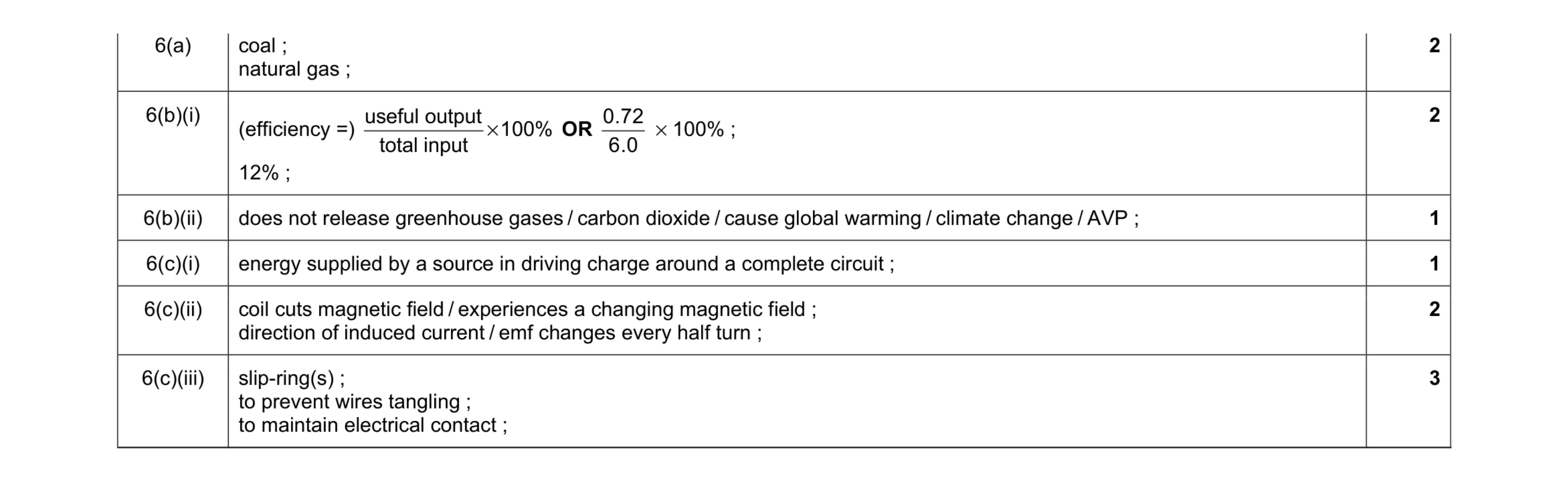 11
11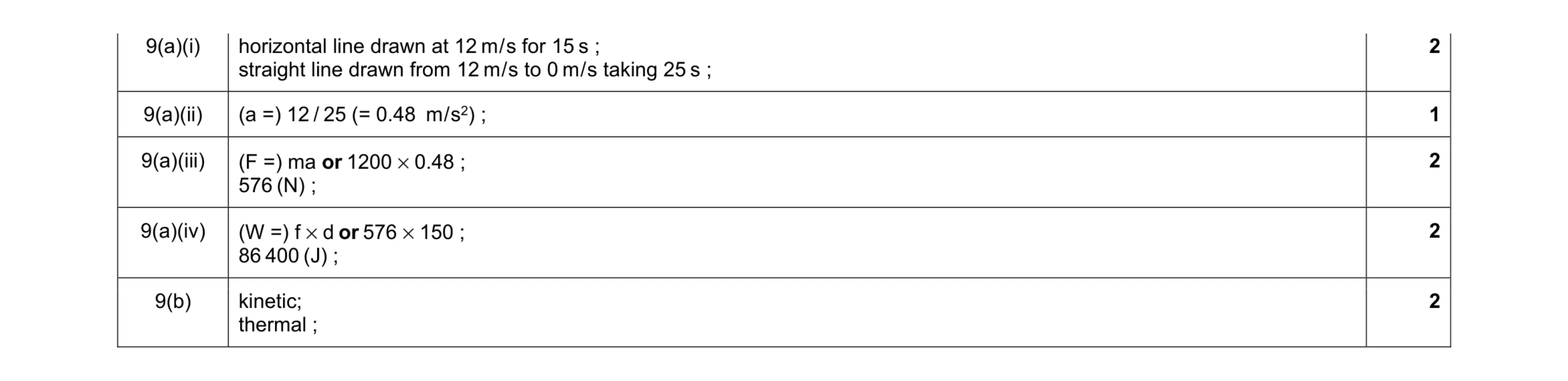 9
9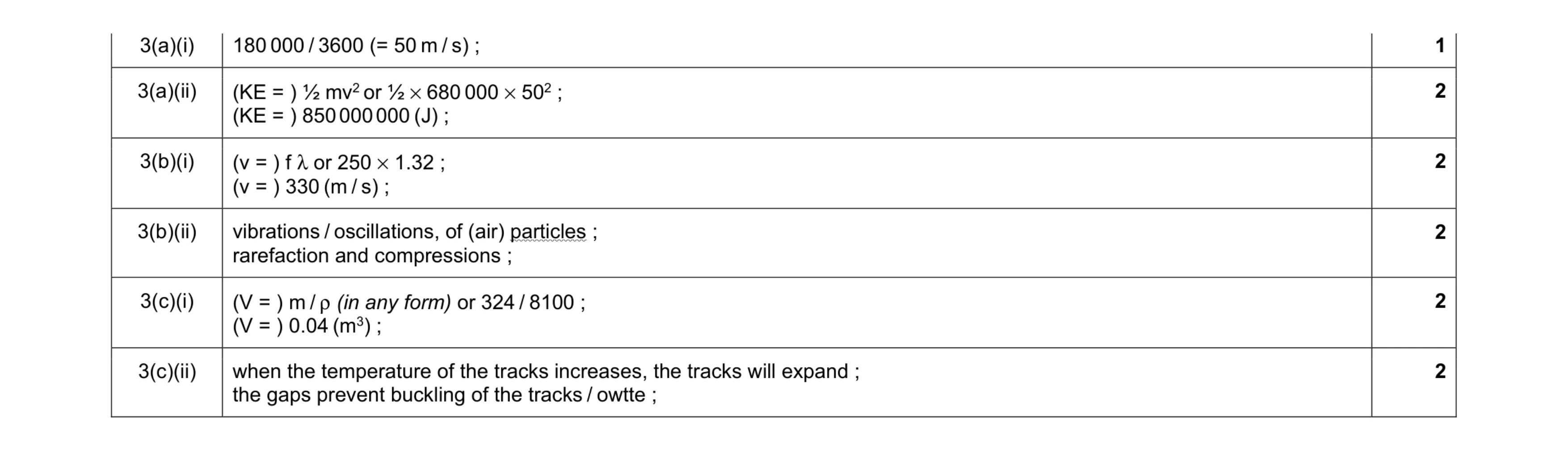 11
11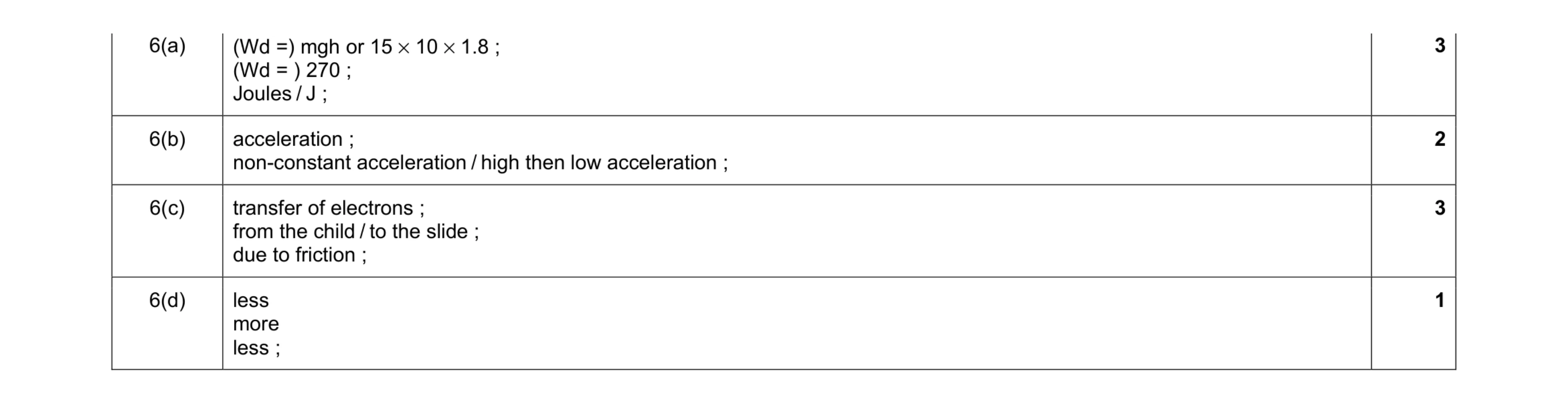 9
9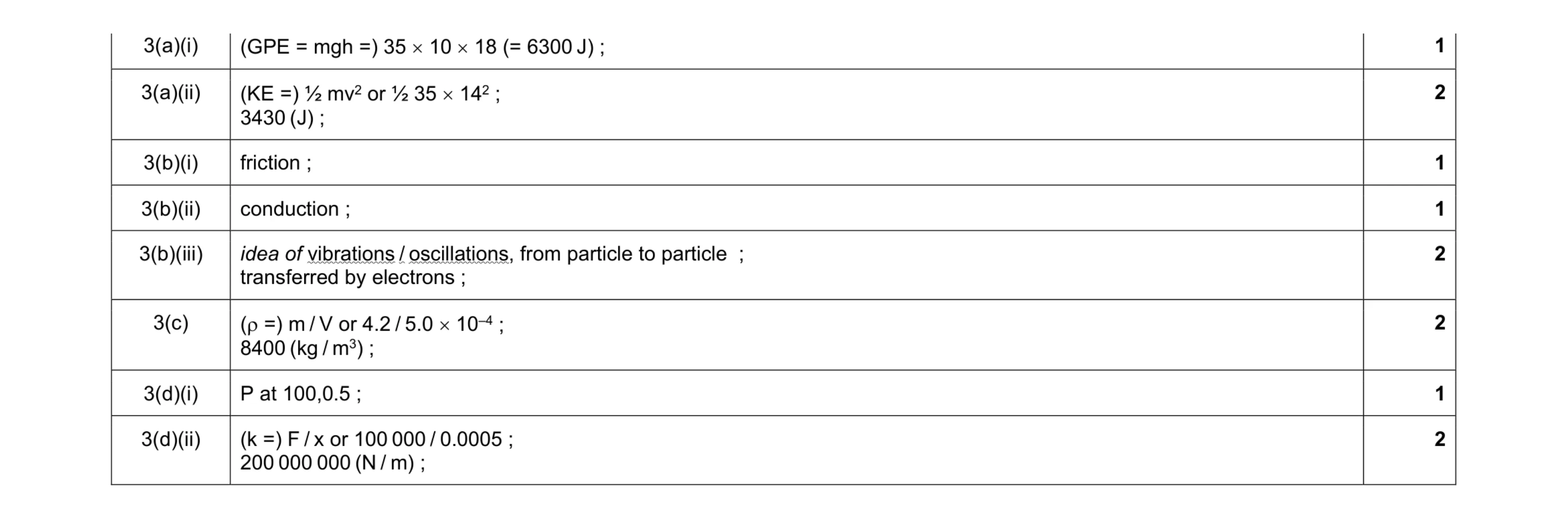 12
12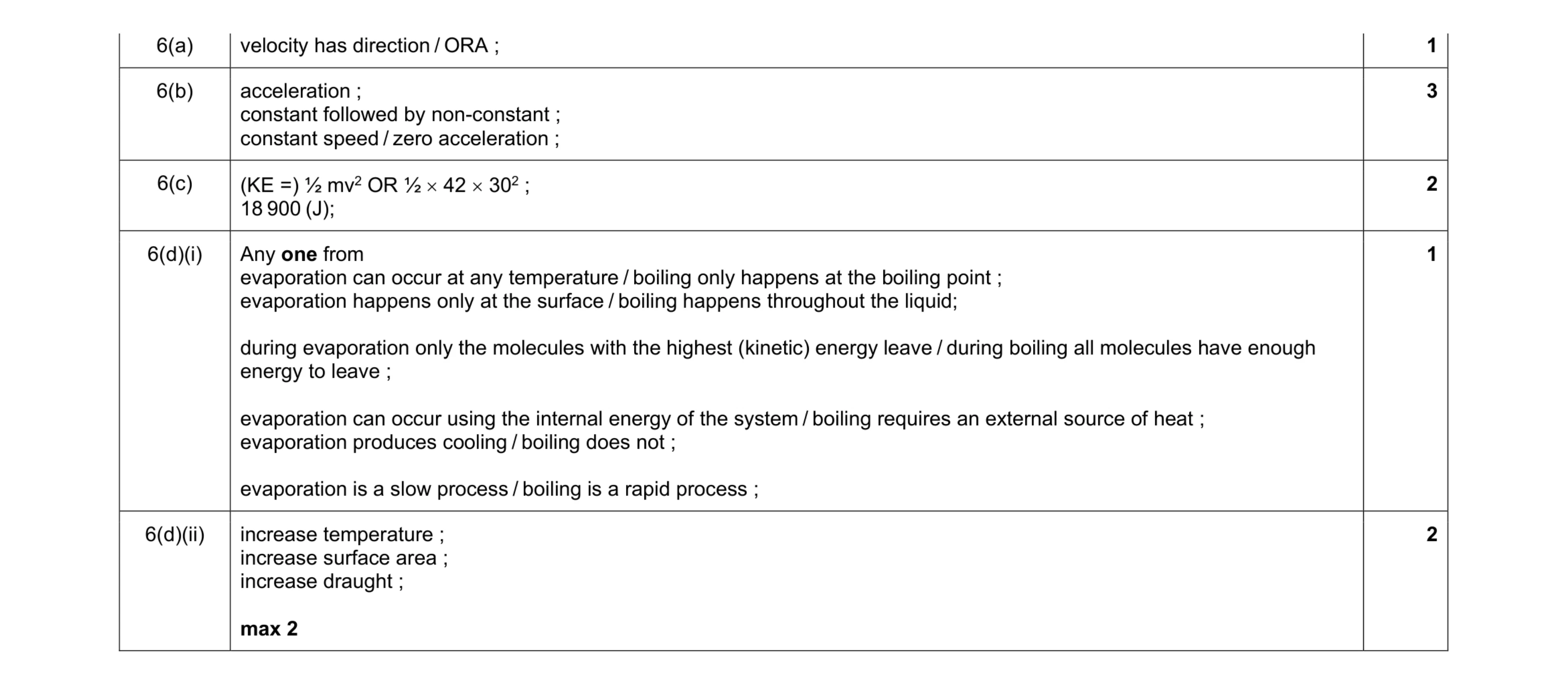 9
9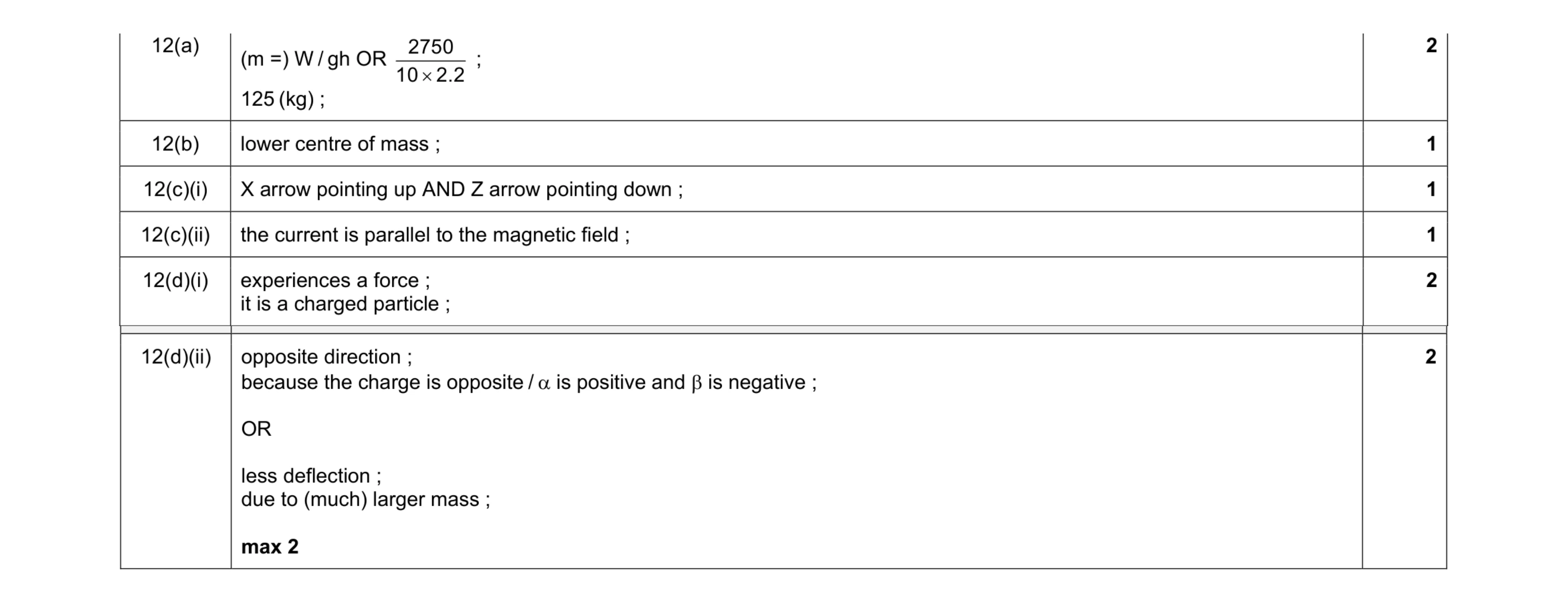 9
9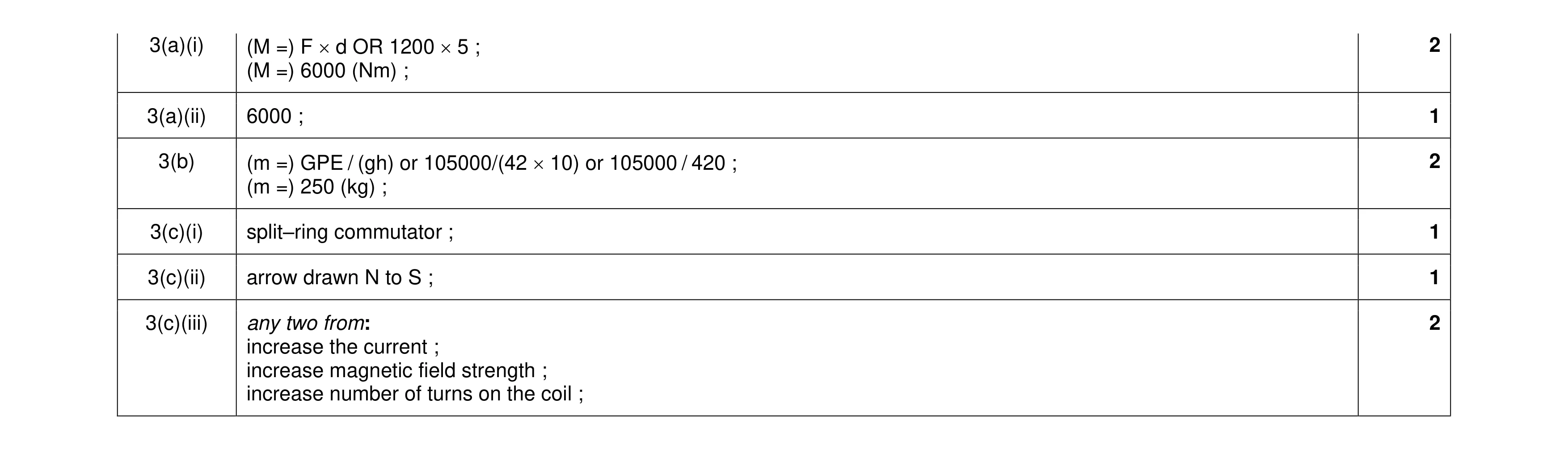 9
9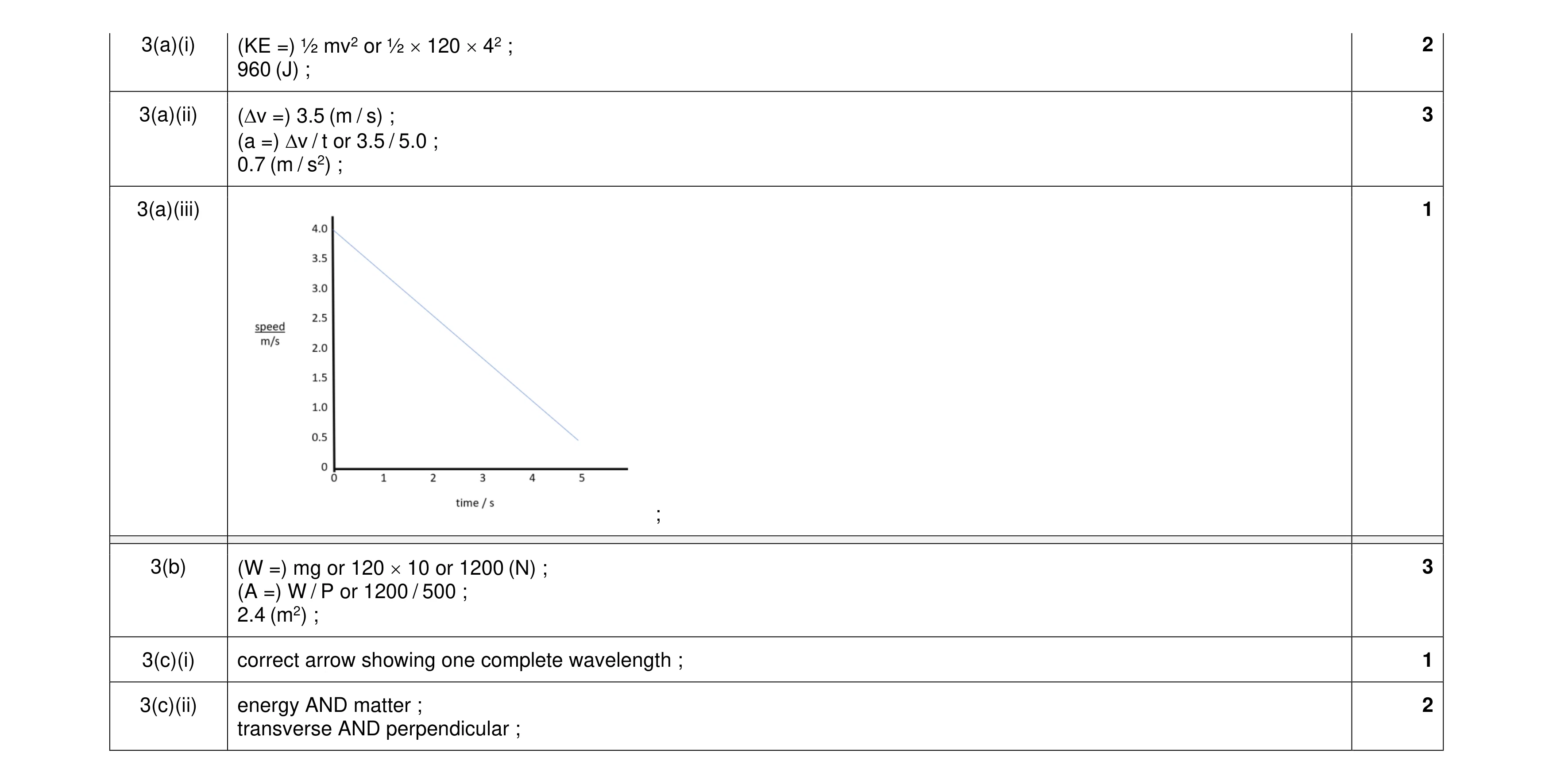 12
12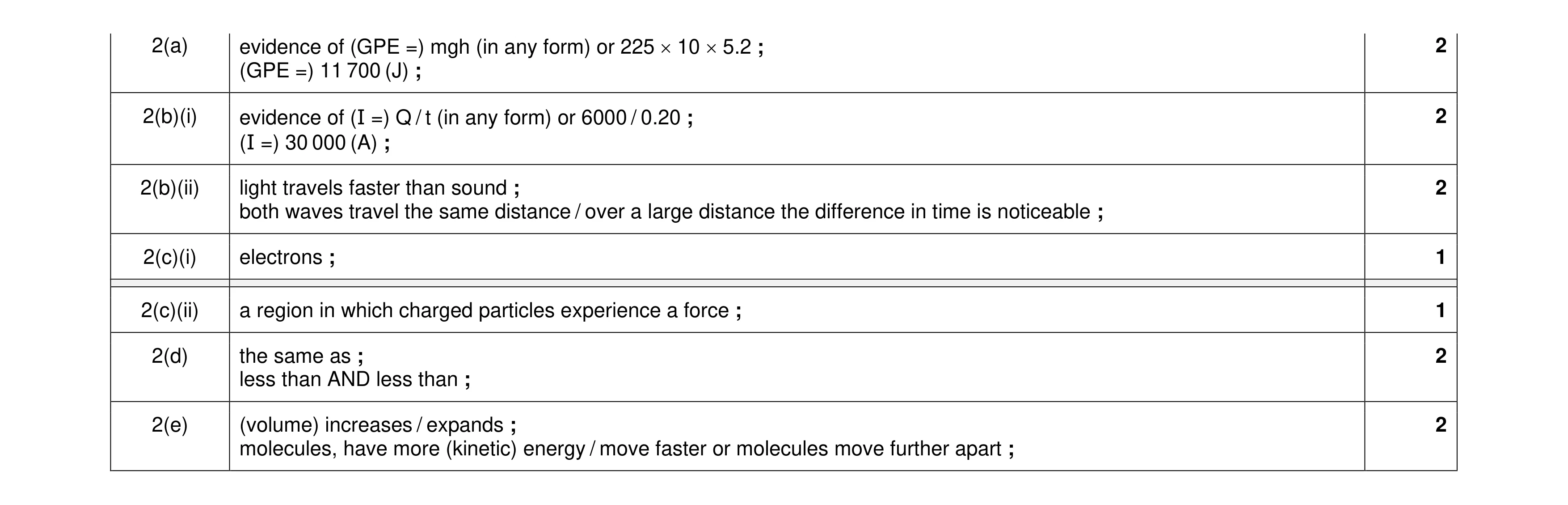 12
12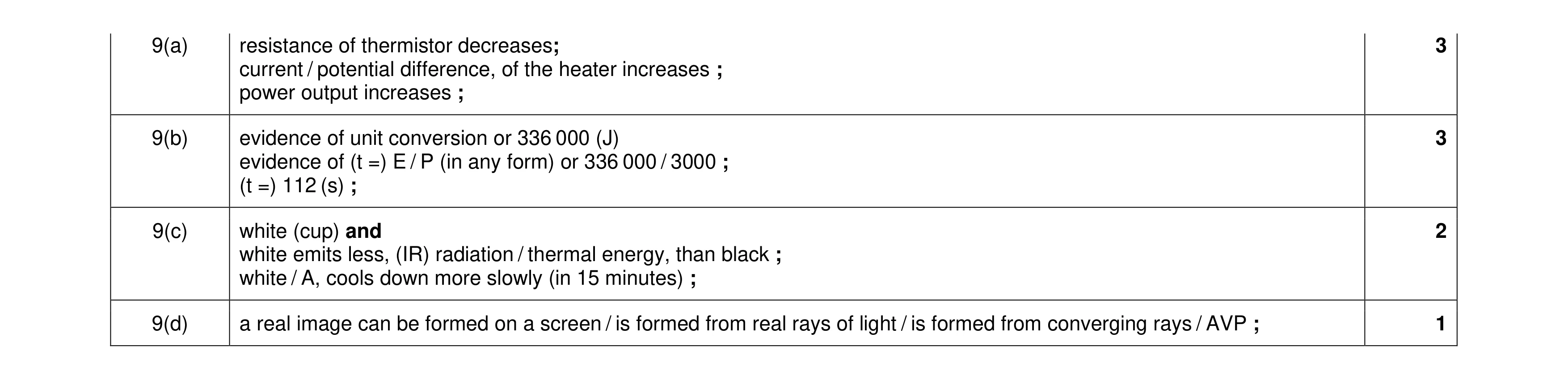 9
9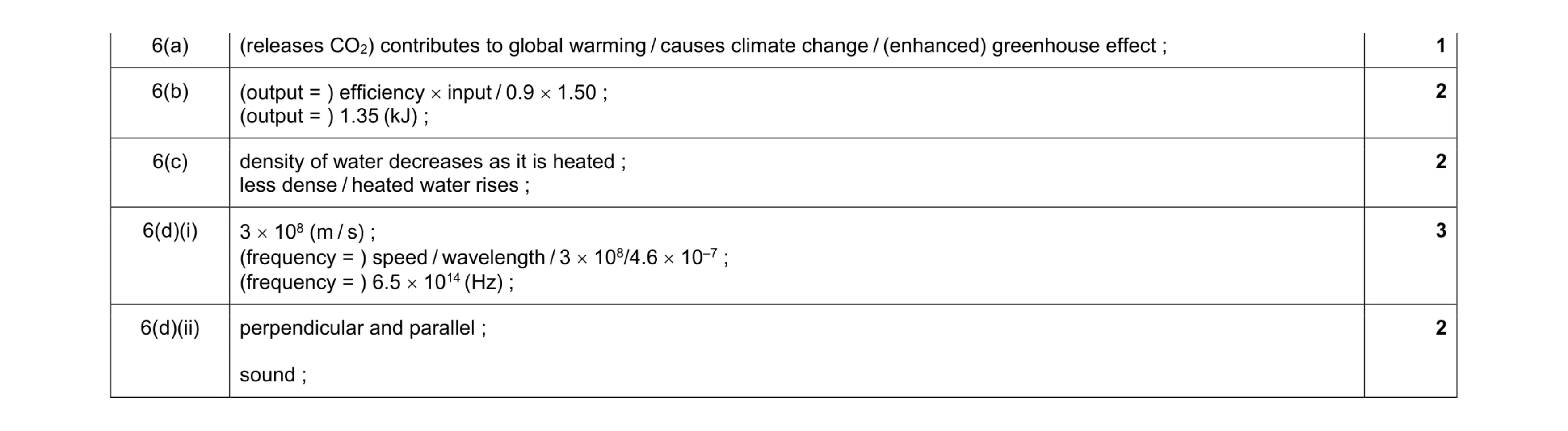 10
10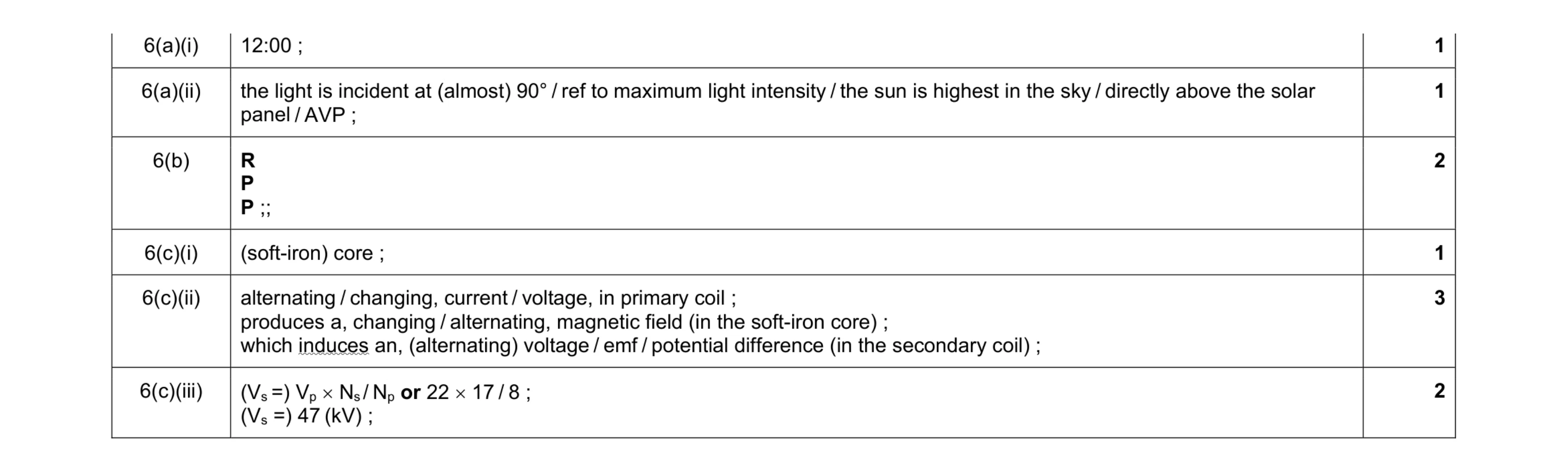 10
10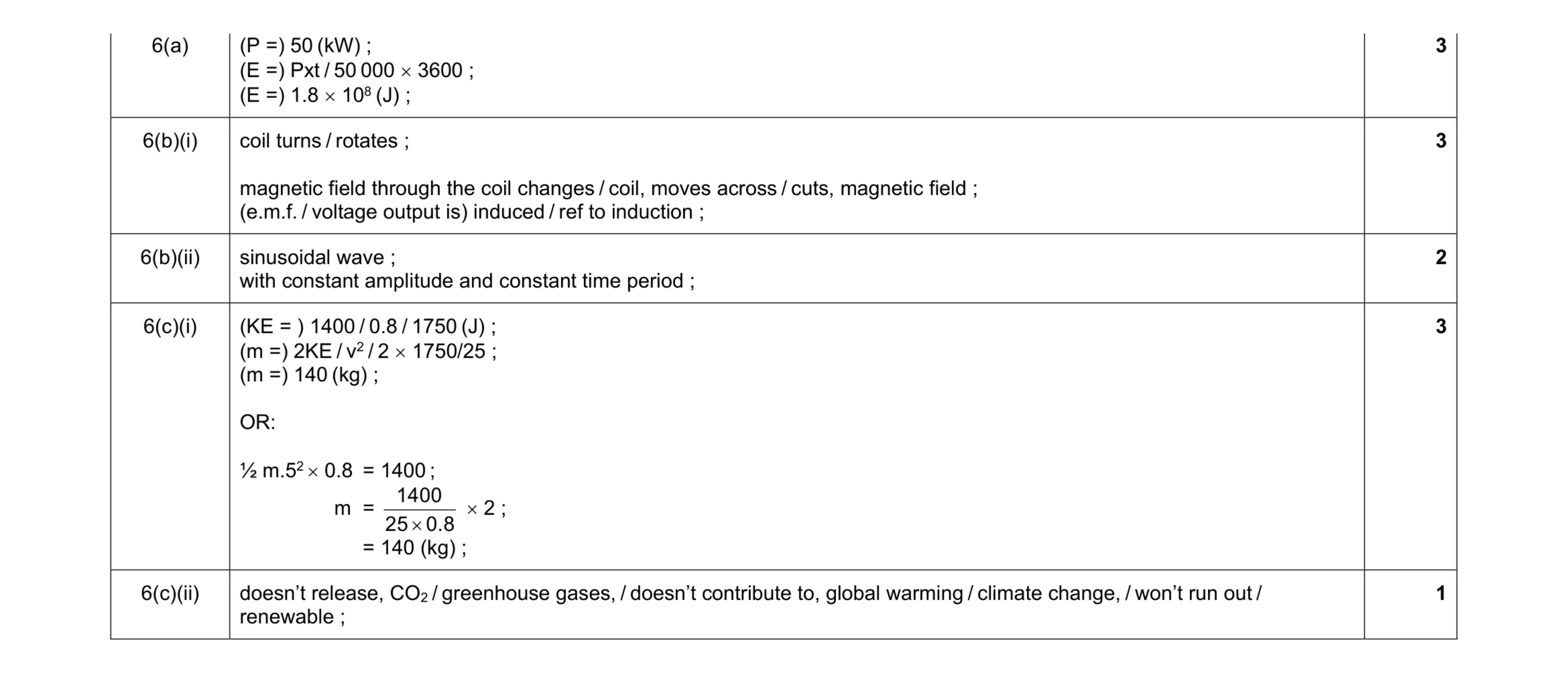 12
12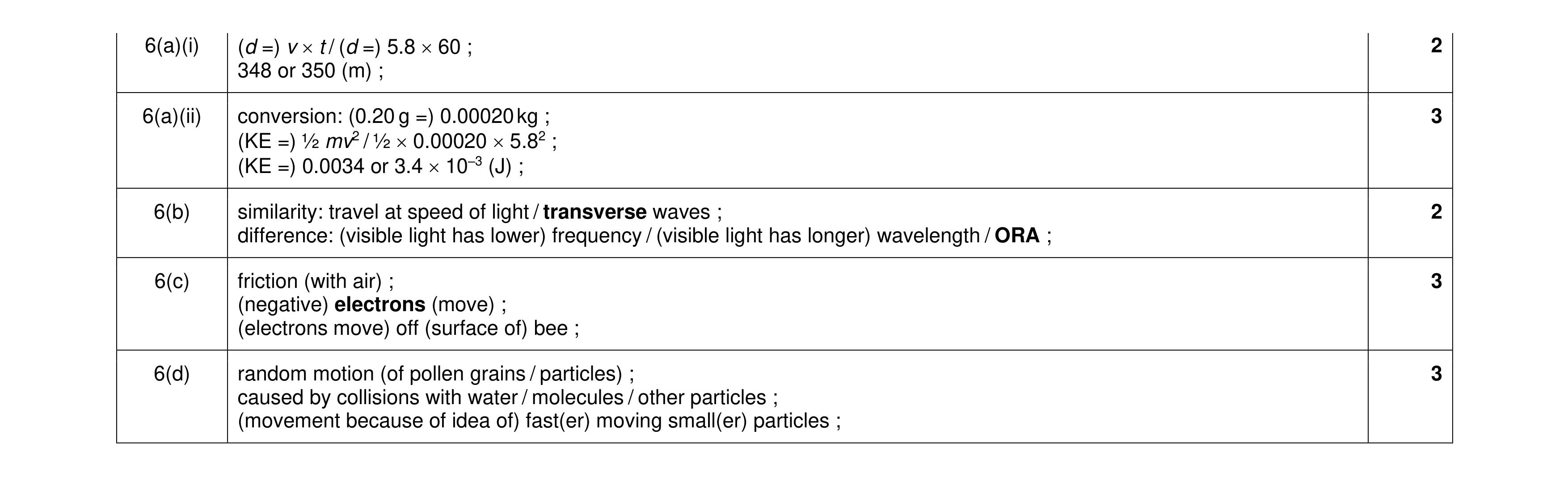 13
13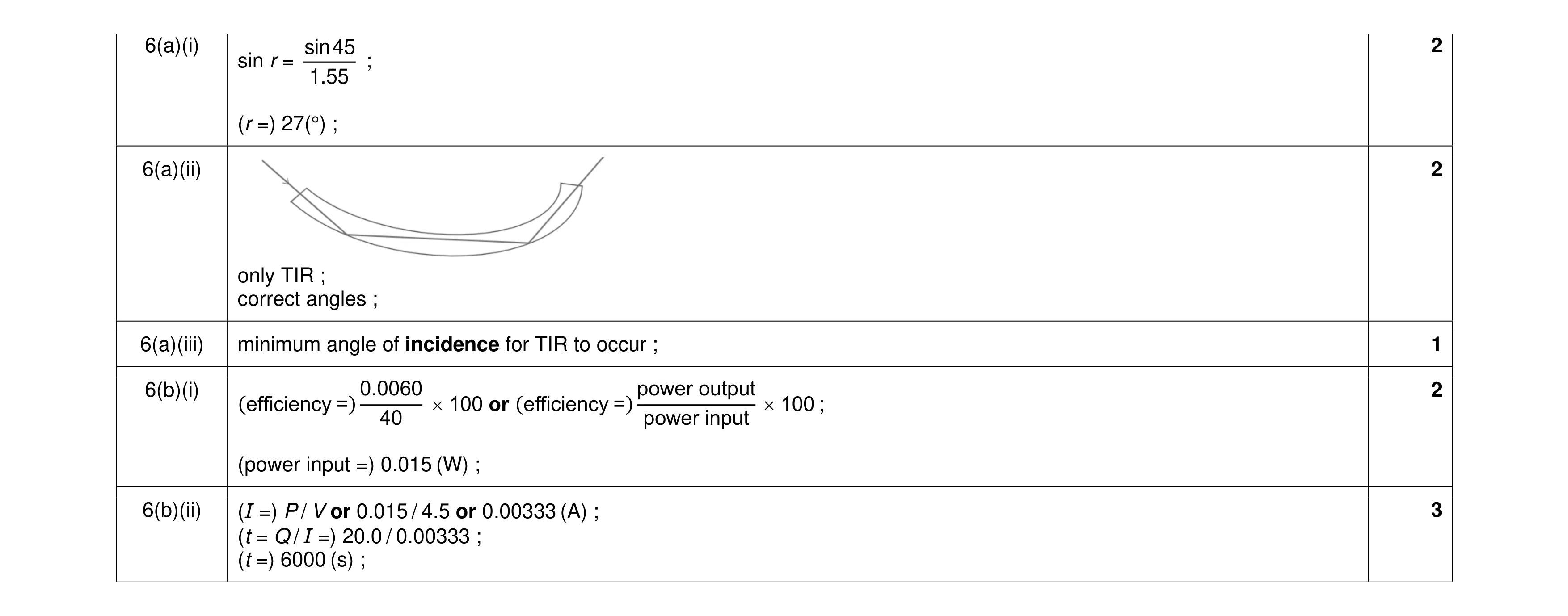 10
10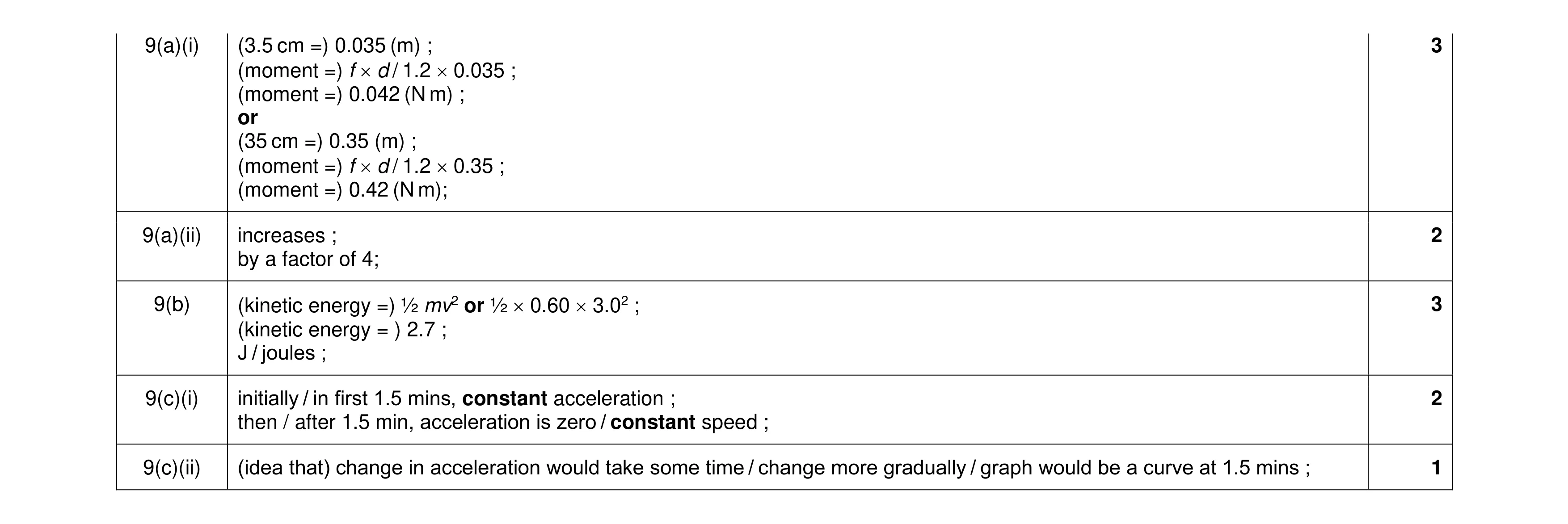 11
11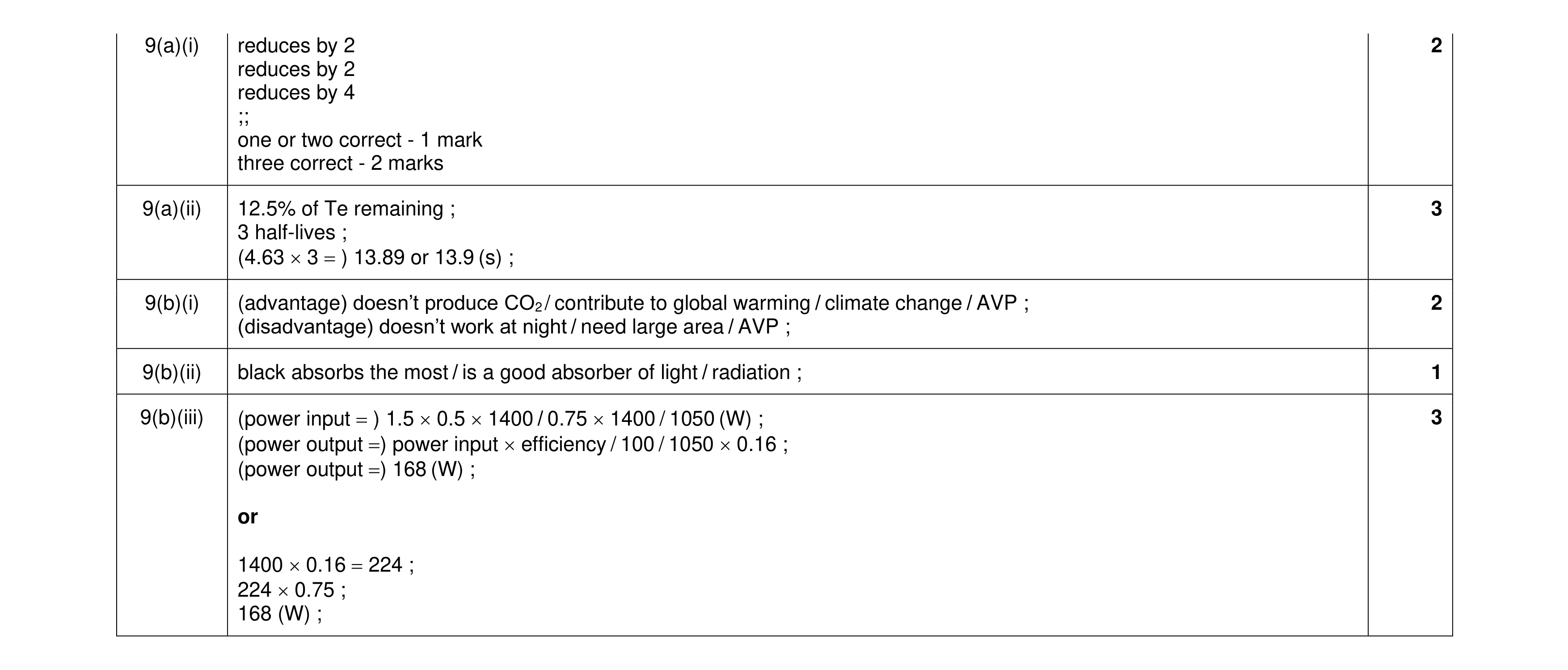 11
11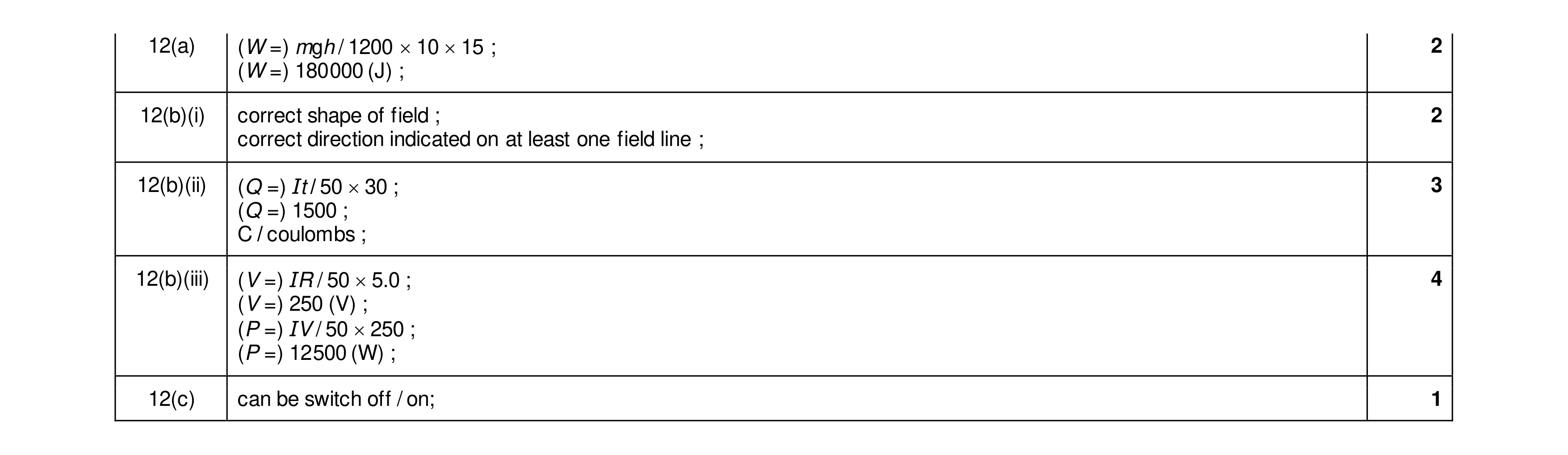 12
12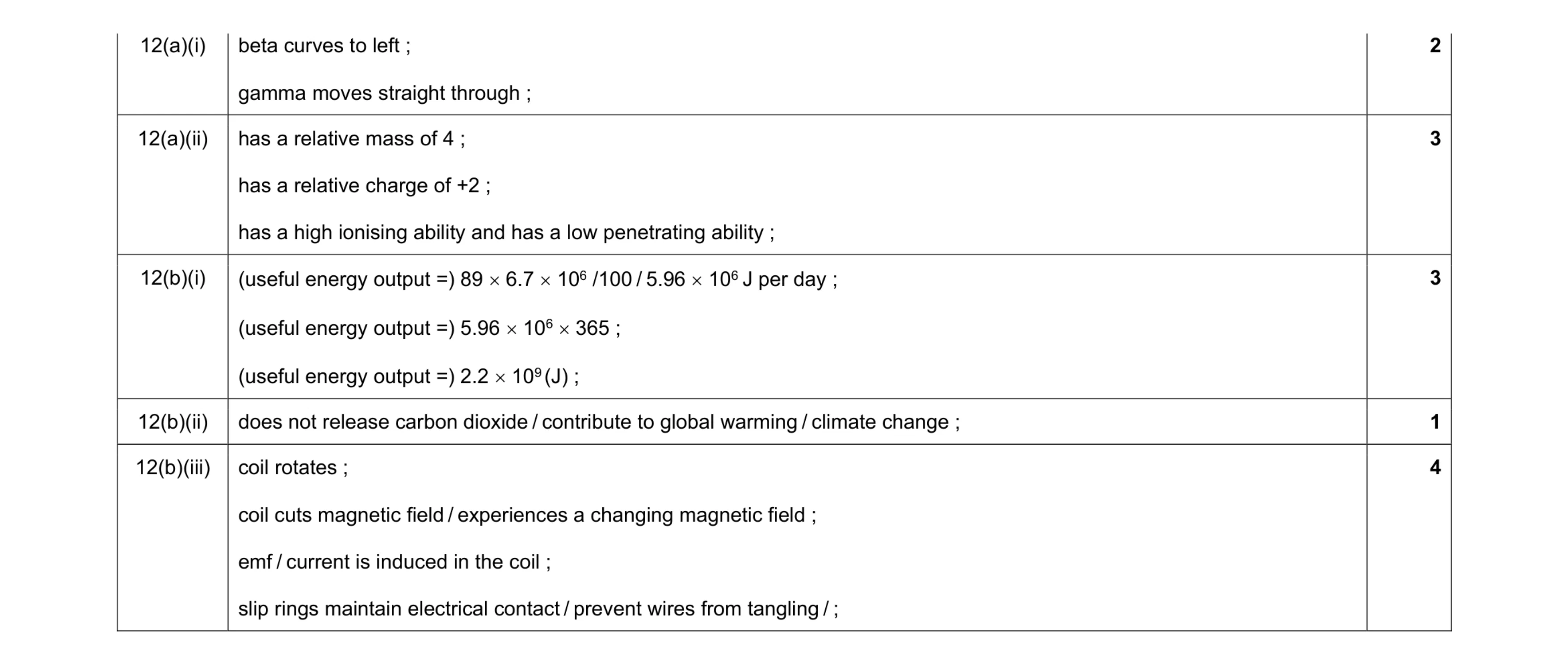 13
13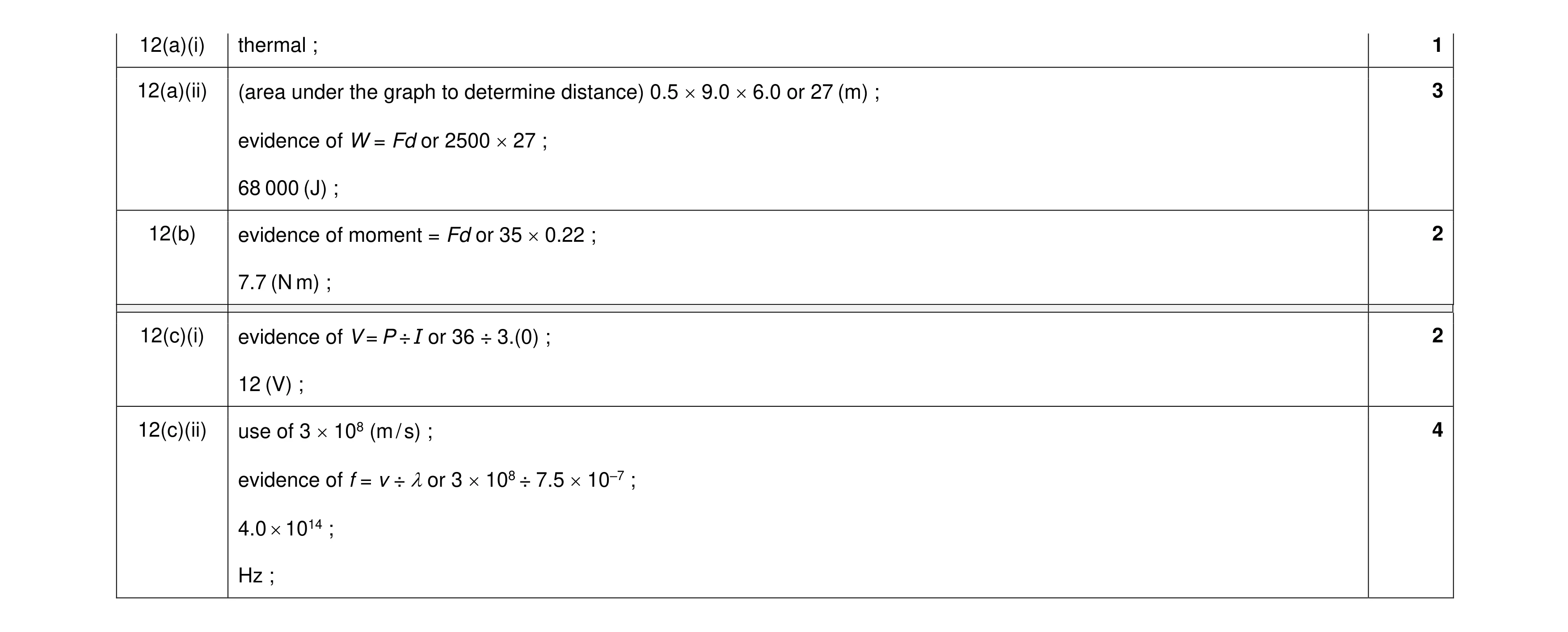 12
12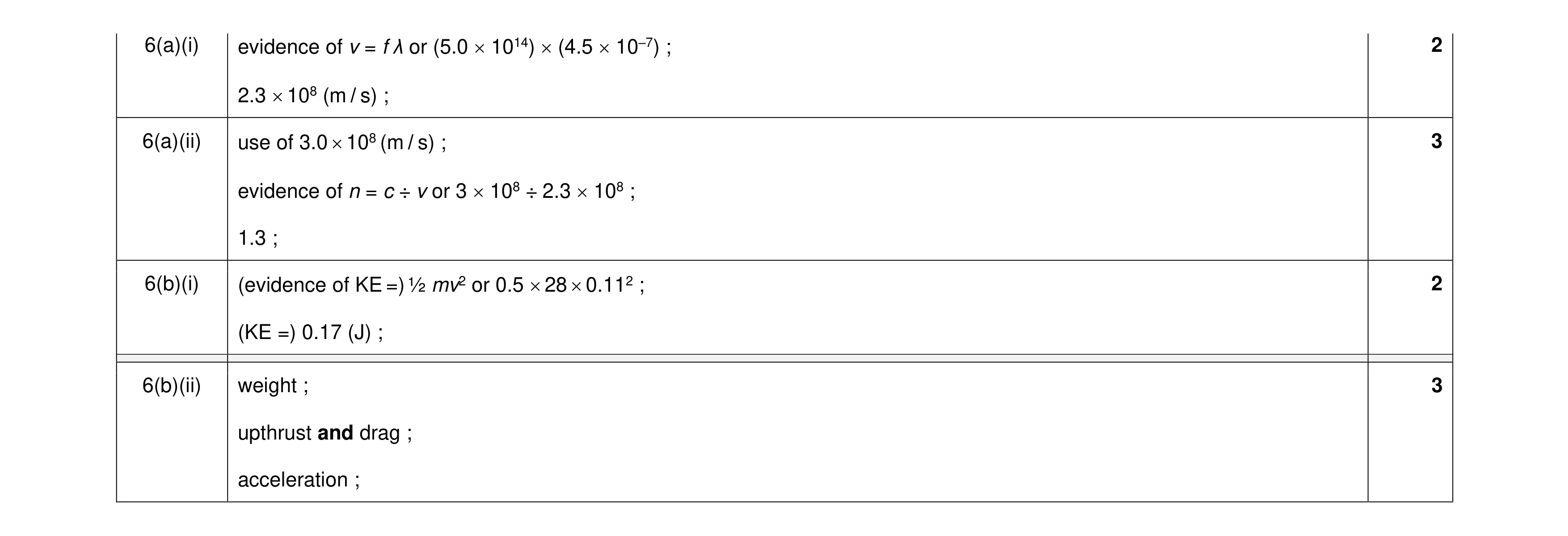 10
10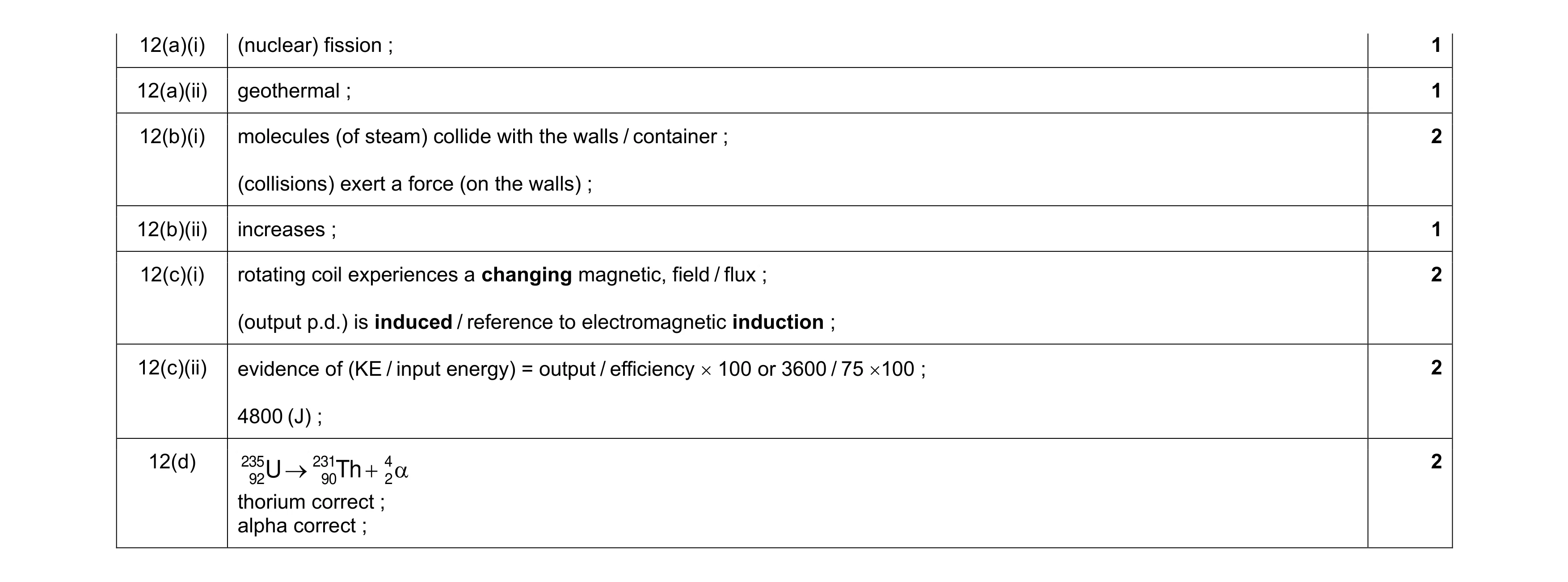 11
11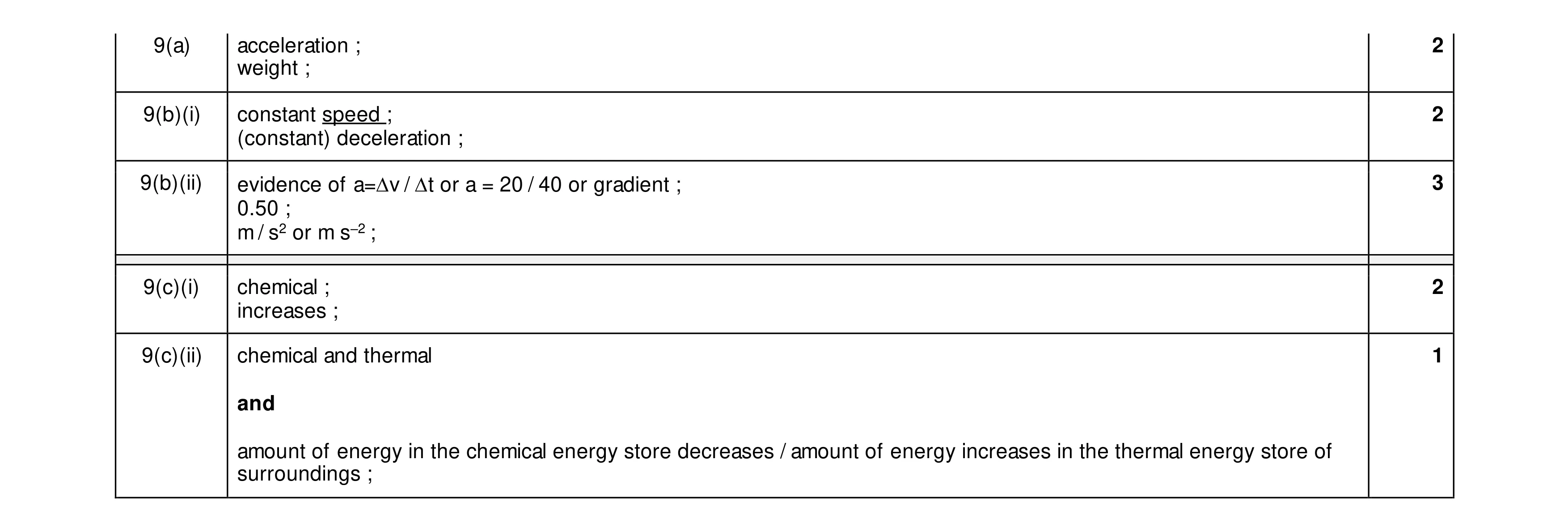 10
10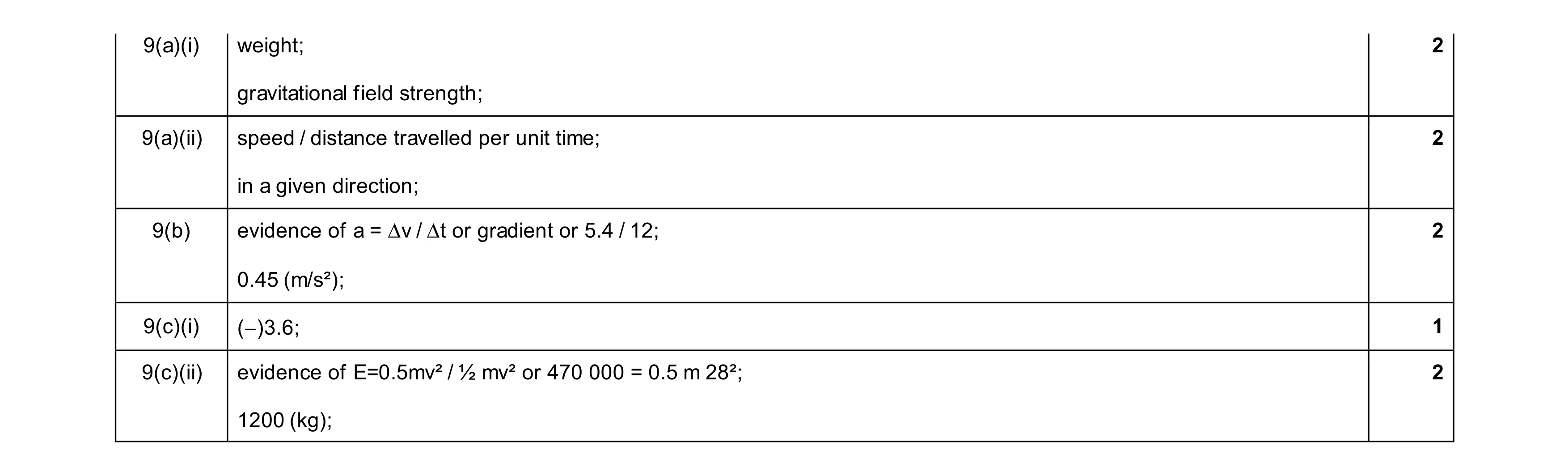 9
9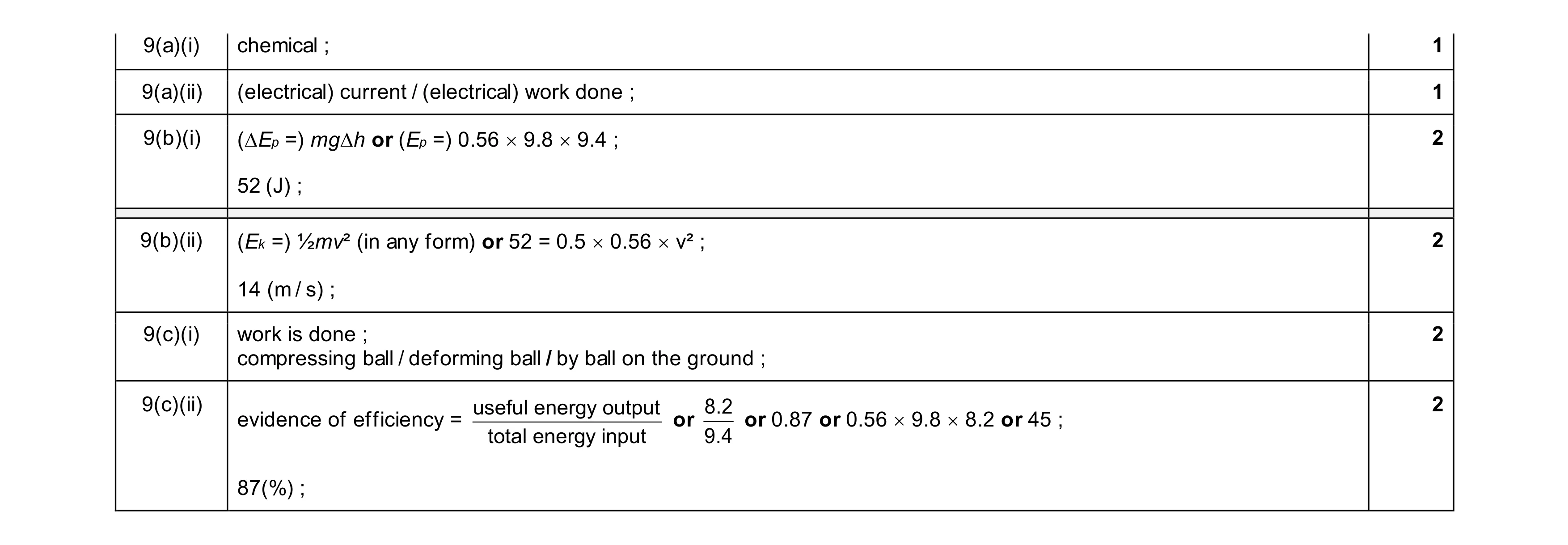 10
10