Cambridge IGCSE Sciences - Co-ordinated (Double) 0654 — 2024 Oct/Nov Paper 4 · Variant 1
0654/41/O/N/24 · 12 questions · 120 marks · ≈135 min
The question paper and its mark scheme, free to read here and free to download. This is Cambridge’s own paper, exactly as it was sat.
Question paper24 pages

Mark scheme14 pages
Answers below. Sit the paper first if you are practising.
Questions as text
Q1 · A diagram of the alimentary canal and associated organs in humans
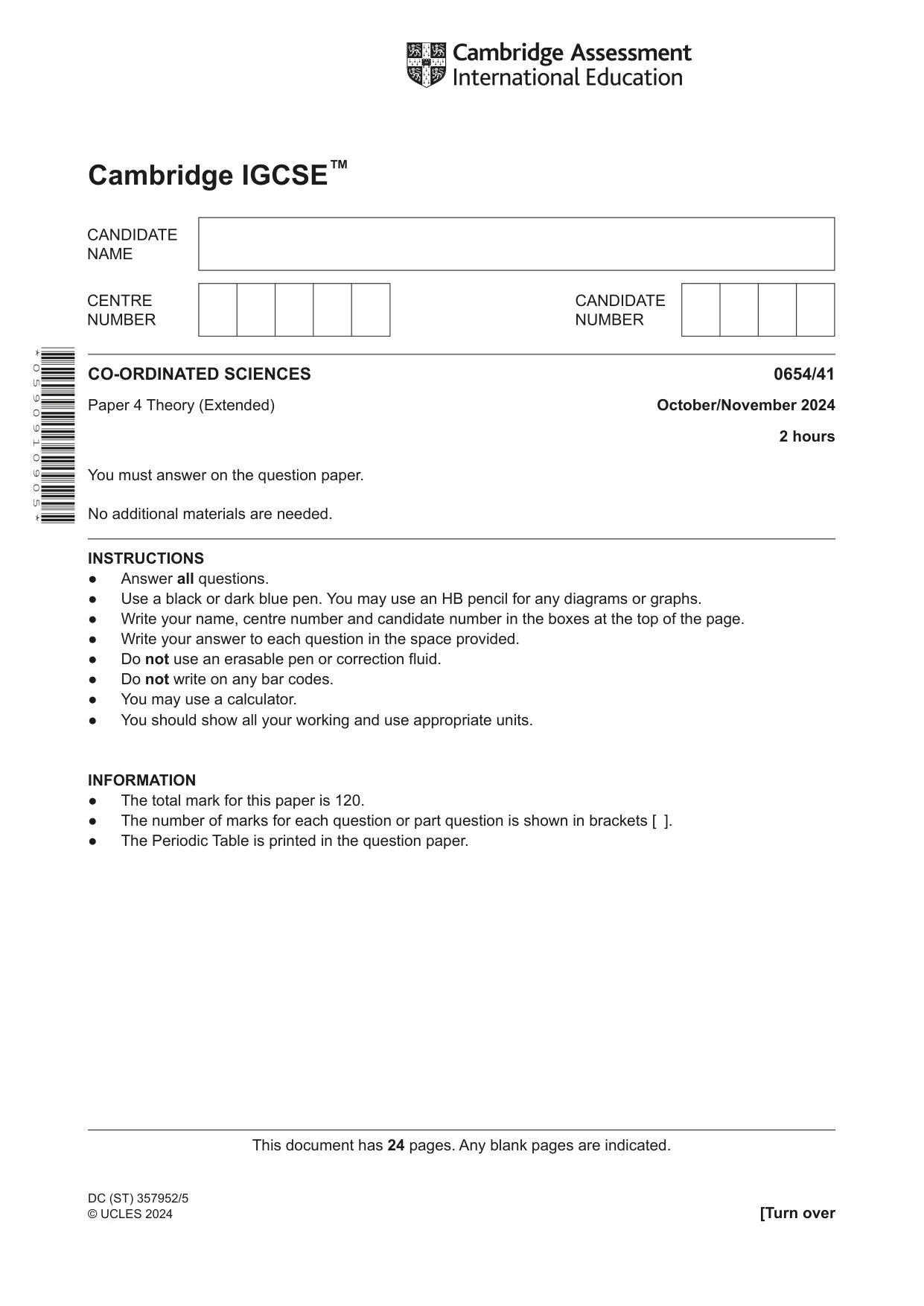
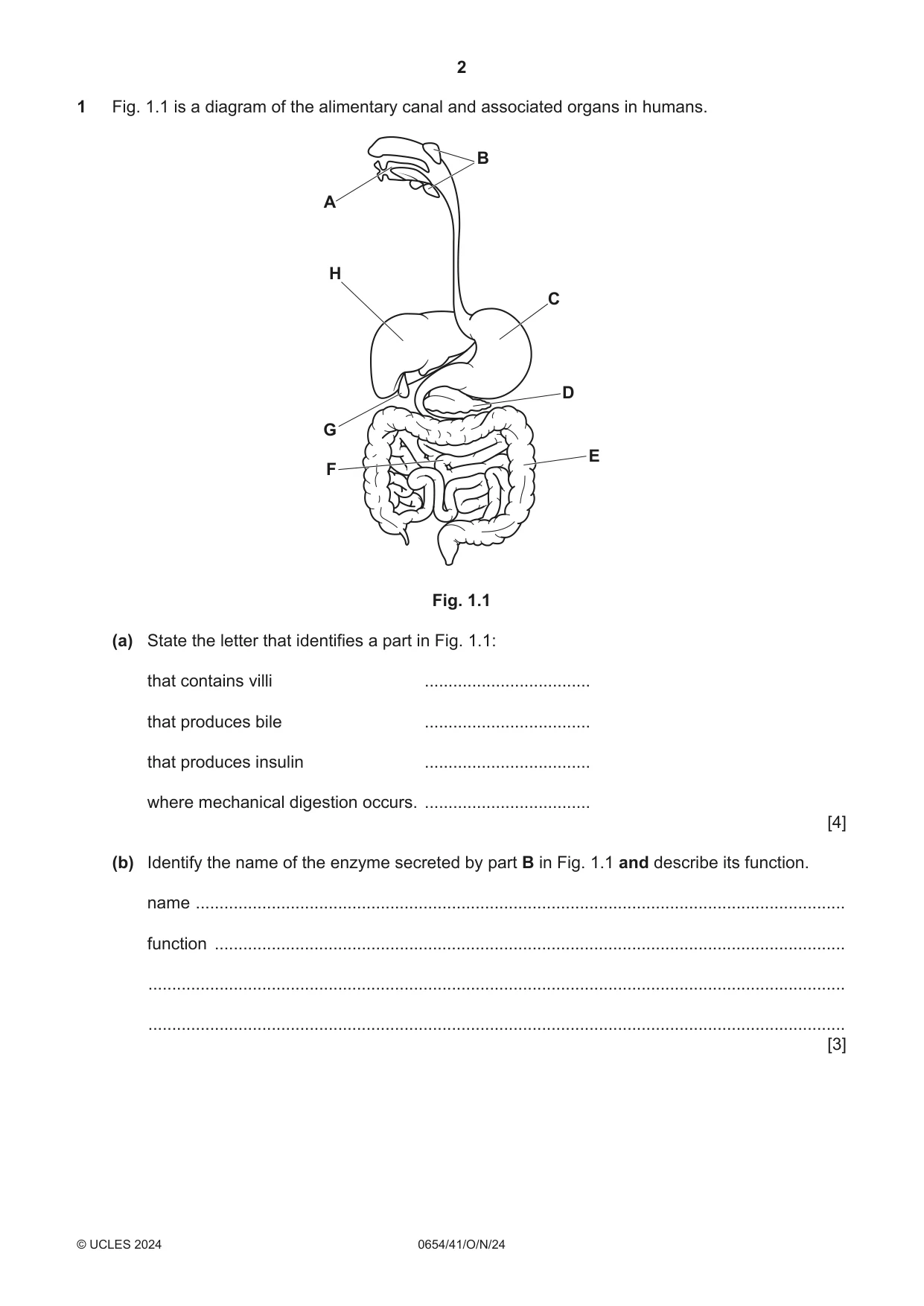
1 Fig. 1.1 is a diagram of the alimentary canal and associated organs in humans. B A H C D G E F Fig. 1.1 (a) State the letter that identifies a part in Fig. 1.1: that contains villi ................................... that produces bile ................................... that produces insulin ................................... where mechanical digestion occurs. ................................... [4] (b) Identify the name of the enzyme secreted by part B in Fig. 1.1 and describe its function. name ......................................................................................................................................... function ..................................................................................................................................... ................................................................................................................................................... ................................................................................................................................................... [3] (c) Teeth are involved in the process of digestion. State the names of two different types of teeth. 1 ................................................................................................................................................ 2 ................................................................................................................................................ [2] (d) Outline the different roles of bile in digestion. ................................................................................................................................................... ................................................................................................................................................... ................................................................................................................................................... ................................................................................................................................................... ................................................................................................................................................... ................................................................................................................................................... ................................................................................................................................................... ............................................................................................................................................. [4] [Total: 13]
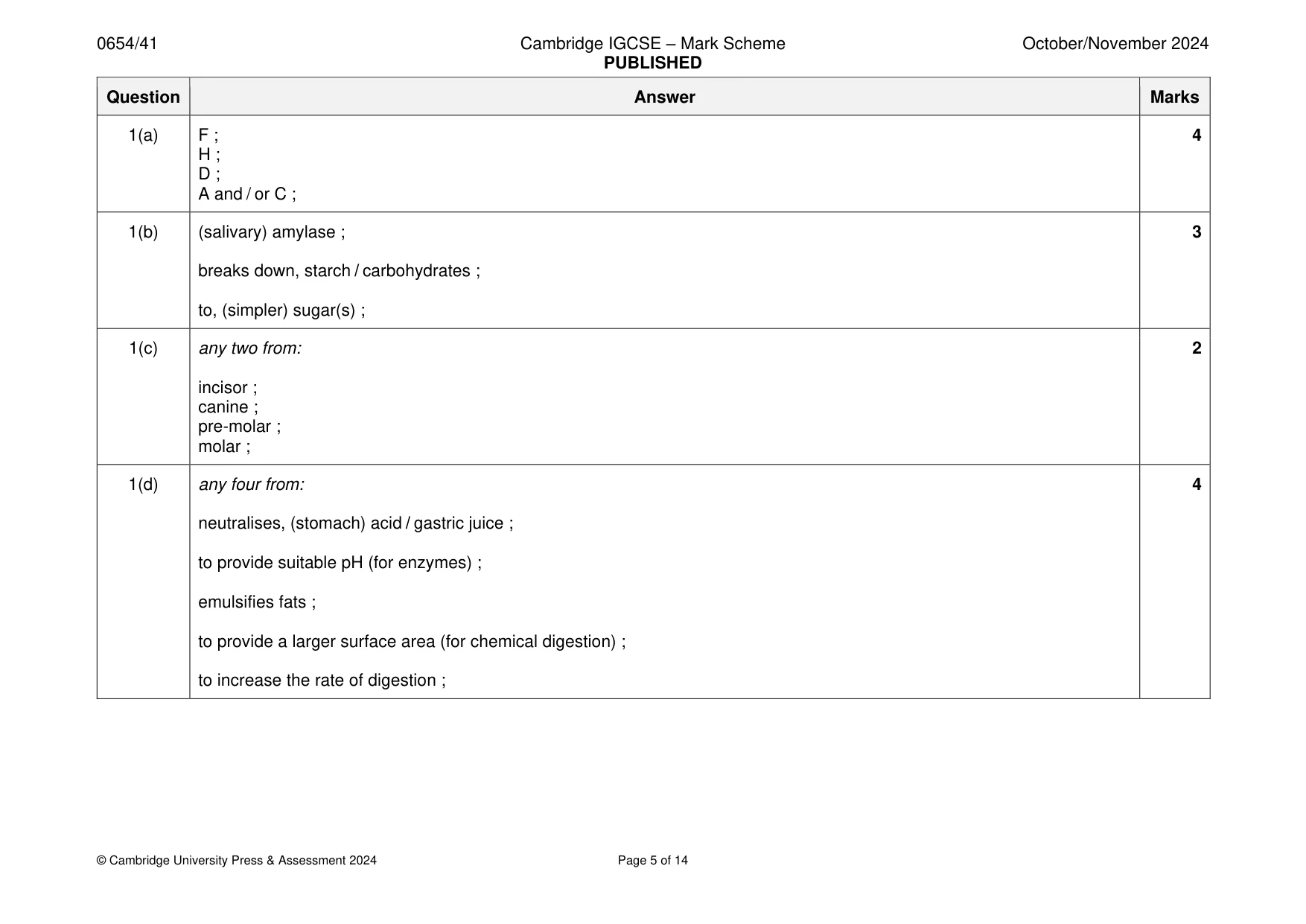
Mark scheme: Question Answer Marks 1(a) F ; 4 H ; D ; A and / or C ; 1(b) (salivary) amylase ; 3 breaks down, starch / carbohydrates ; to, (simpler) sugar(s) ; 1(c) any two from: 2 incisor ; canine ; pre-molar ; molar ; 1(d) any four from: 4 neutralises, (stomach) acid / gastric juice ; to provide suitable pH (for enzymes) ; emulsifies fats ; to provide a larger surface area (for chemical digestion) ; to increase the rate of digestion ;
Q2 · The arrangement and movement of particles in solids, liquids and gases are different
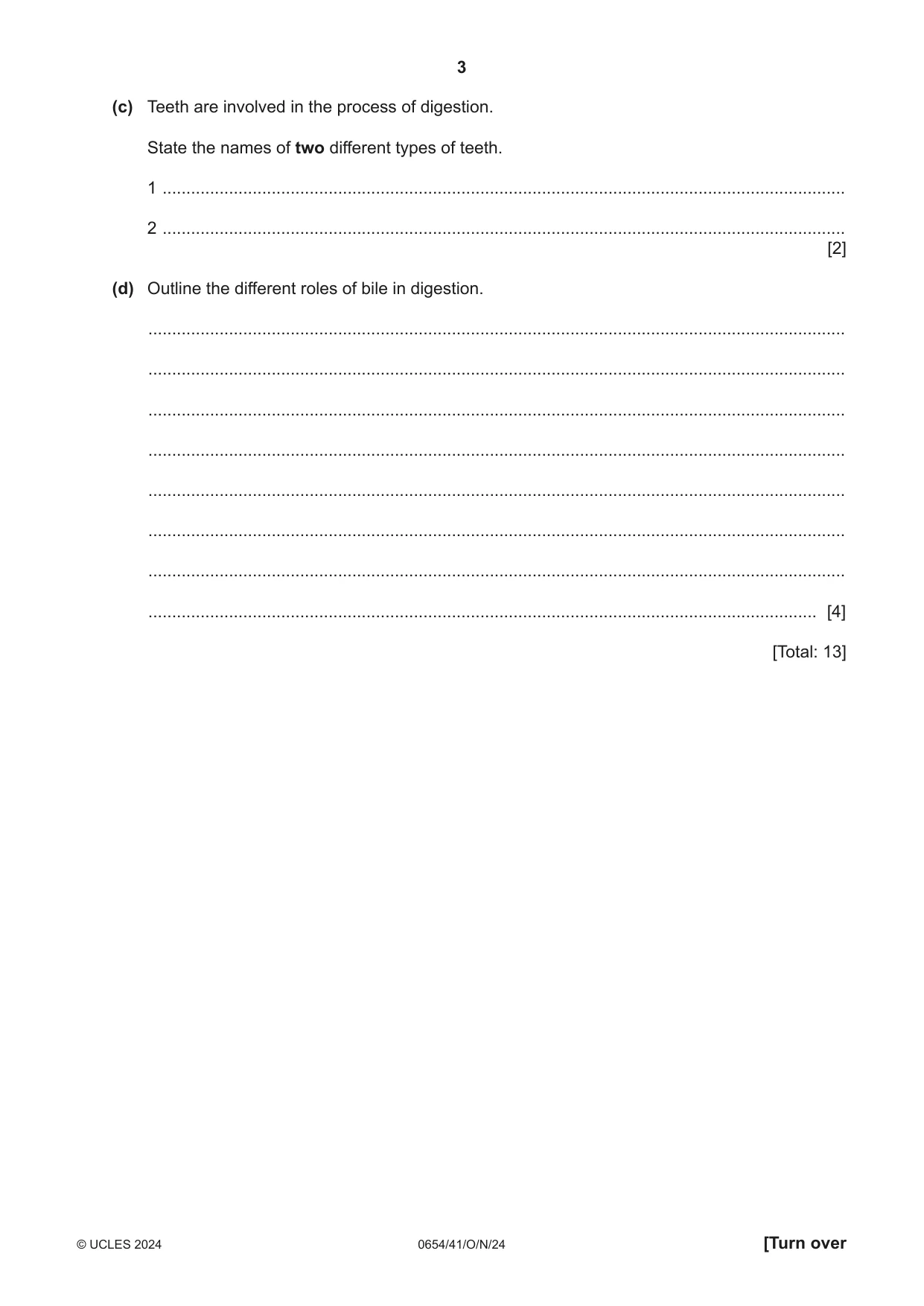
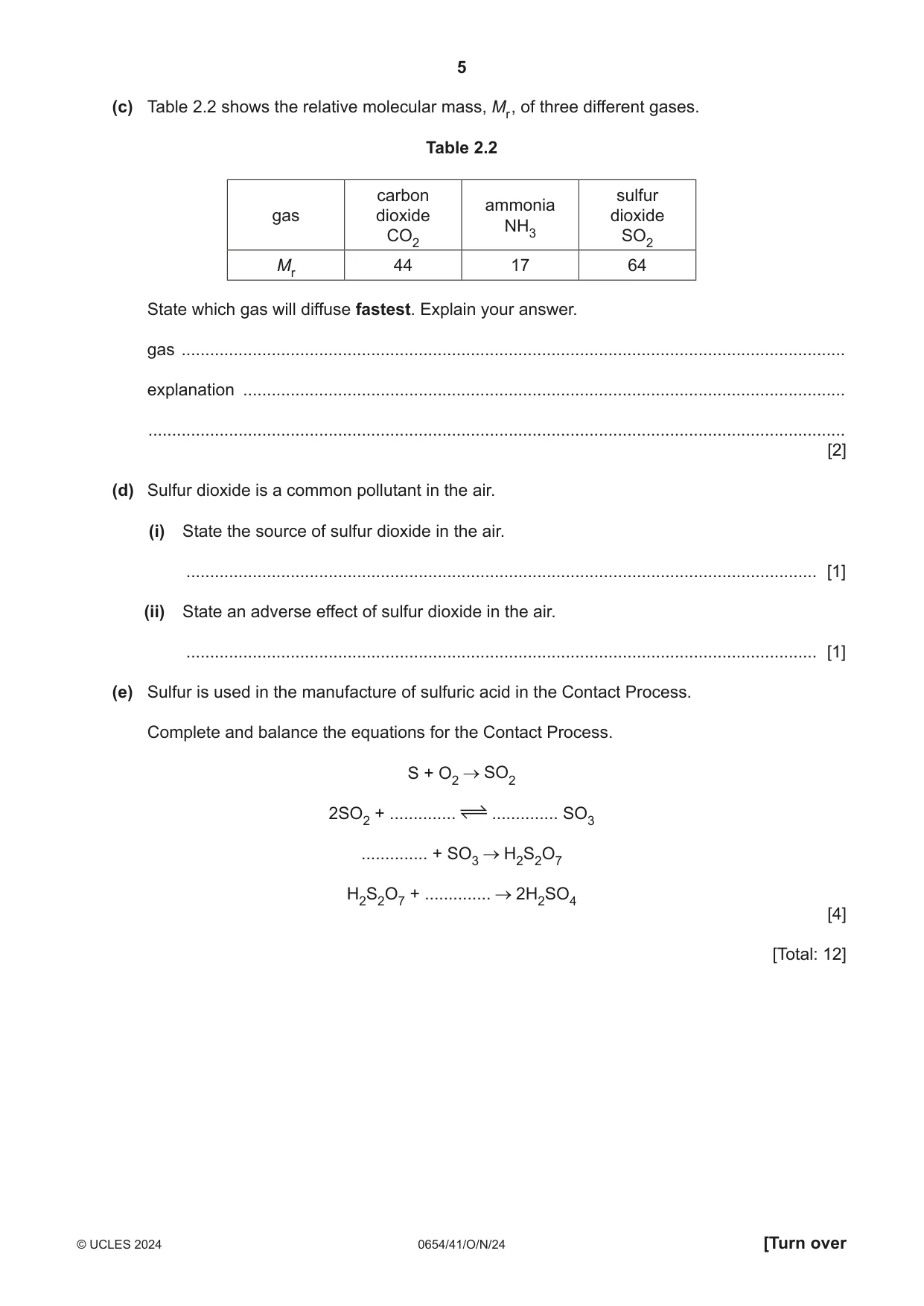
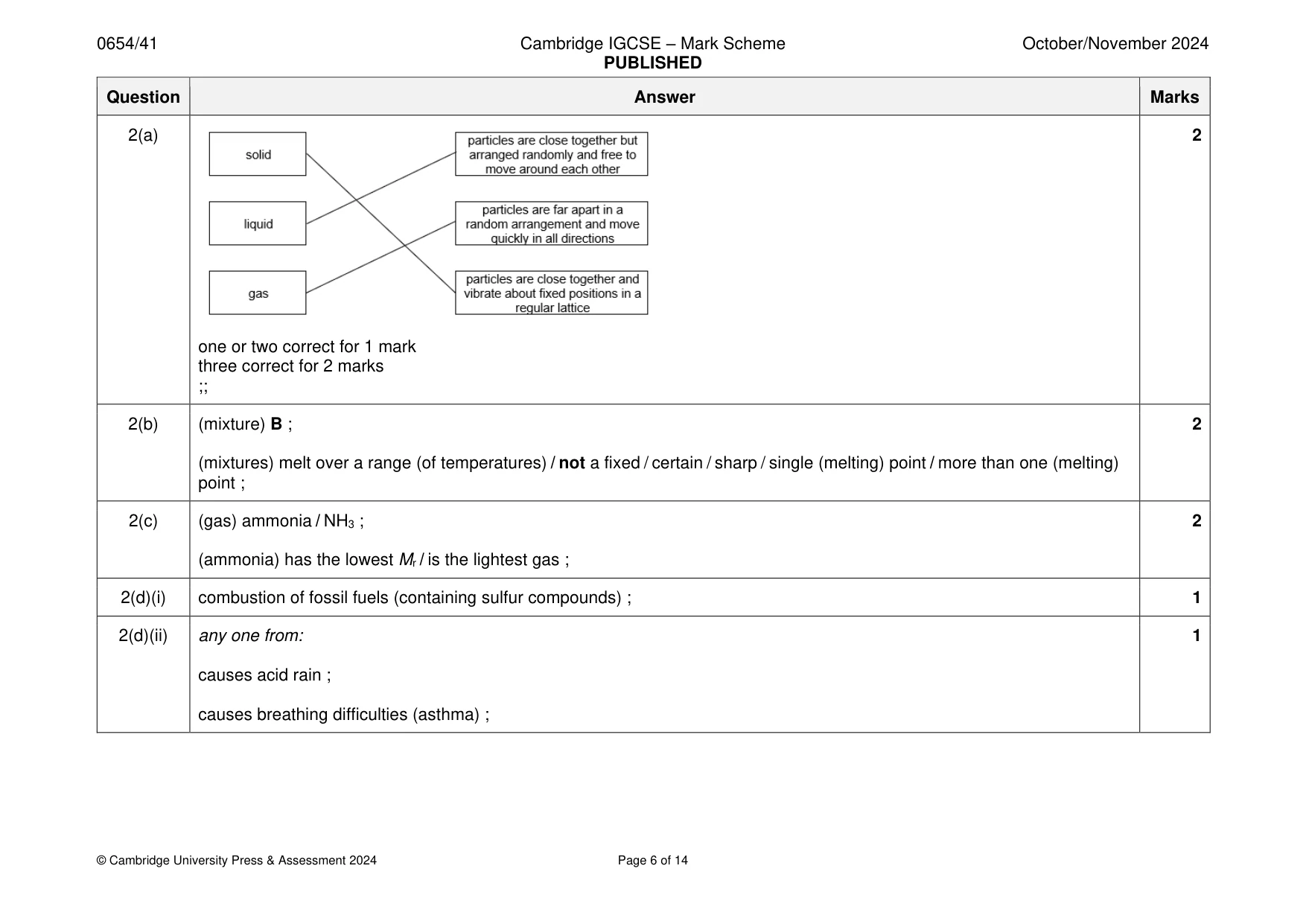
2 The arrangement and movement of particles in solids, liquids and gases are different. (a) Draw one line from each state of matter to the arrangement and movement of particles. state of matter arrangement and movement of particles particles are close together but solid arranged randomly and free to move around each other particles are far apart in a random liquid arrangement and move quickly in all directions particles are close together and gas vibrate about fixed positions in a regular lattice [2] (b) A student tests the melting point of four different solids. Table 2.1 shows their results. Table 2.1 solid A B C D melting point / °C 72 81– 88 104 61 State which of the four solids, A, B, C or D, is a mixture. Explain your answer. mixture ...................................................................................................................................... explanation ............................................................................................................................... ................................................................................................................................................... [2] (c) Table 2.2 shows the relative molecular mass, Mr , of three different gases. Table 2.2 carbon sulfur ammonia gas dioxide dioxide NH3 CO2 SO2 Mr 44 17 64 State which gas will diffuse fastest. Explain your answer. gas ............................................................................................................................................ explanation ............................................................................................................................... ................................................................................................................................................... [2] (d) Sulfur dioxide is a common pollutant in the air. (i) State the source of sulfur dioxide in the air. ..................................................................................................................................... [1] (ii) State an adverse effect of sulfur dioxide in the air. ..................................................................................................................................... [1] (e) Sulfur is used in the manufacture of sulfuric acid in the Contact Process. Complete and balance the equations for the Contact Process. S + O2 SO2 2SO2 + .............. .............. SO3 .............. + SO3 H2S2O7 H2S2O7 + .............. 2H2SO4 [4] [Total: 12]
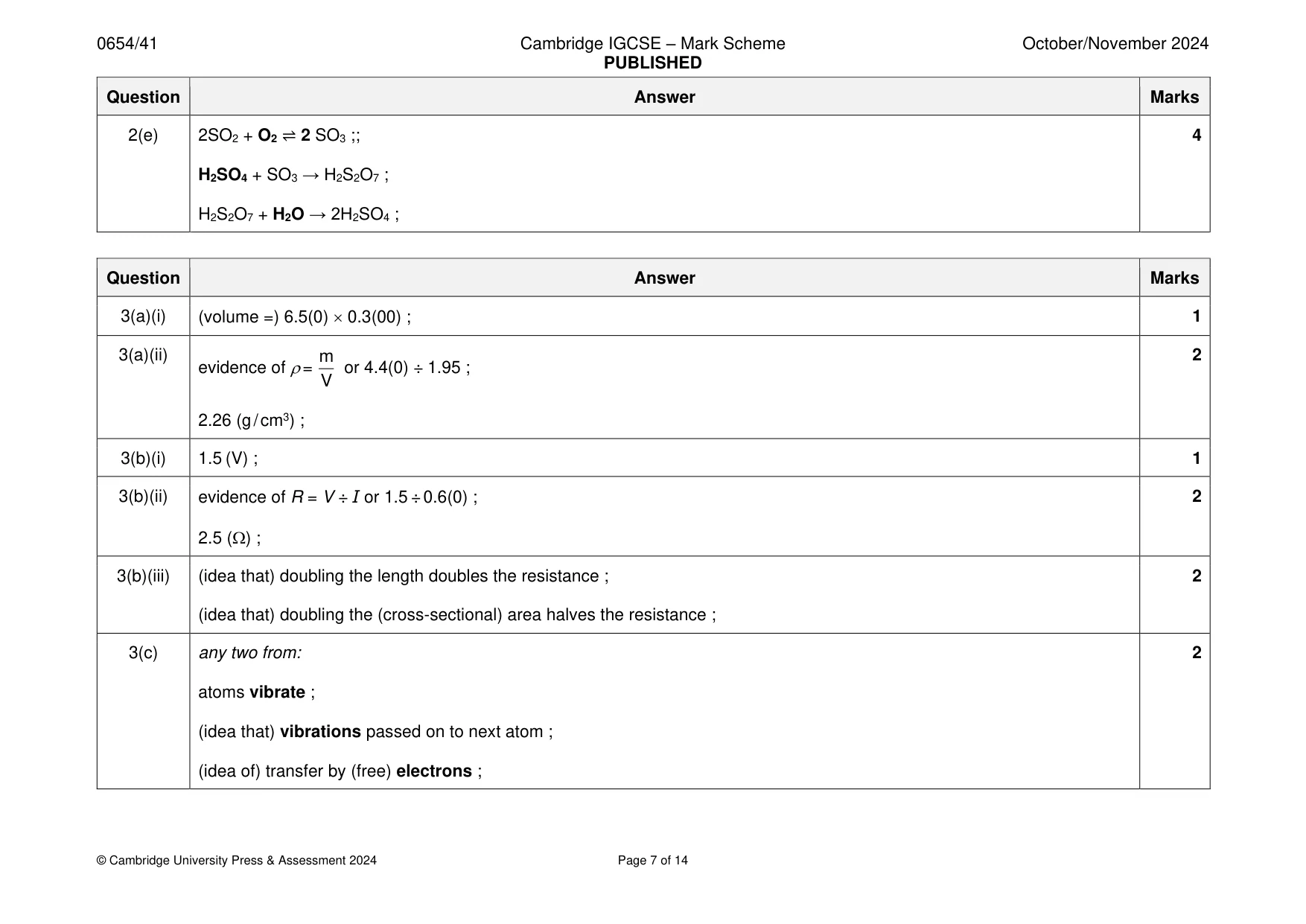
Mark scheme: 2(a) 2 one or two correct for 1 mark three correct for 2 marks ;; 2(b) (mixture) B ; 2 (mixtures) melt over a range (of temperatures) / not a fixed / certain / sharp / single (melting) point / more than one (melting) point ; 2(c) (gas) ammonia / NH3 ; 2 (ammonia) has the lowest Mr / is the lightest gas ; 2(d)(i) combustion of fossil fuels (containing sulfur compounds) ; 1 2(d)(ii) any one from: 1 causes acid rain ; causes breathing difficulties (asthma) ; 2(e) 2SO2 + O2 ⇌ 2 SO3 ;; 4 H2SO4 + SO3 → H2S2O7 ; H2S2O7 + H2O → 2H2SO4 ;
Q3 · A student investigates the properties of graphite
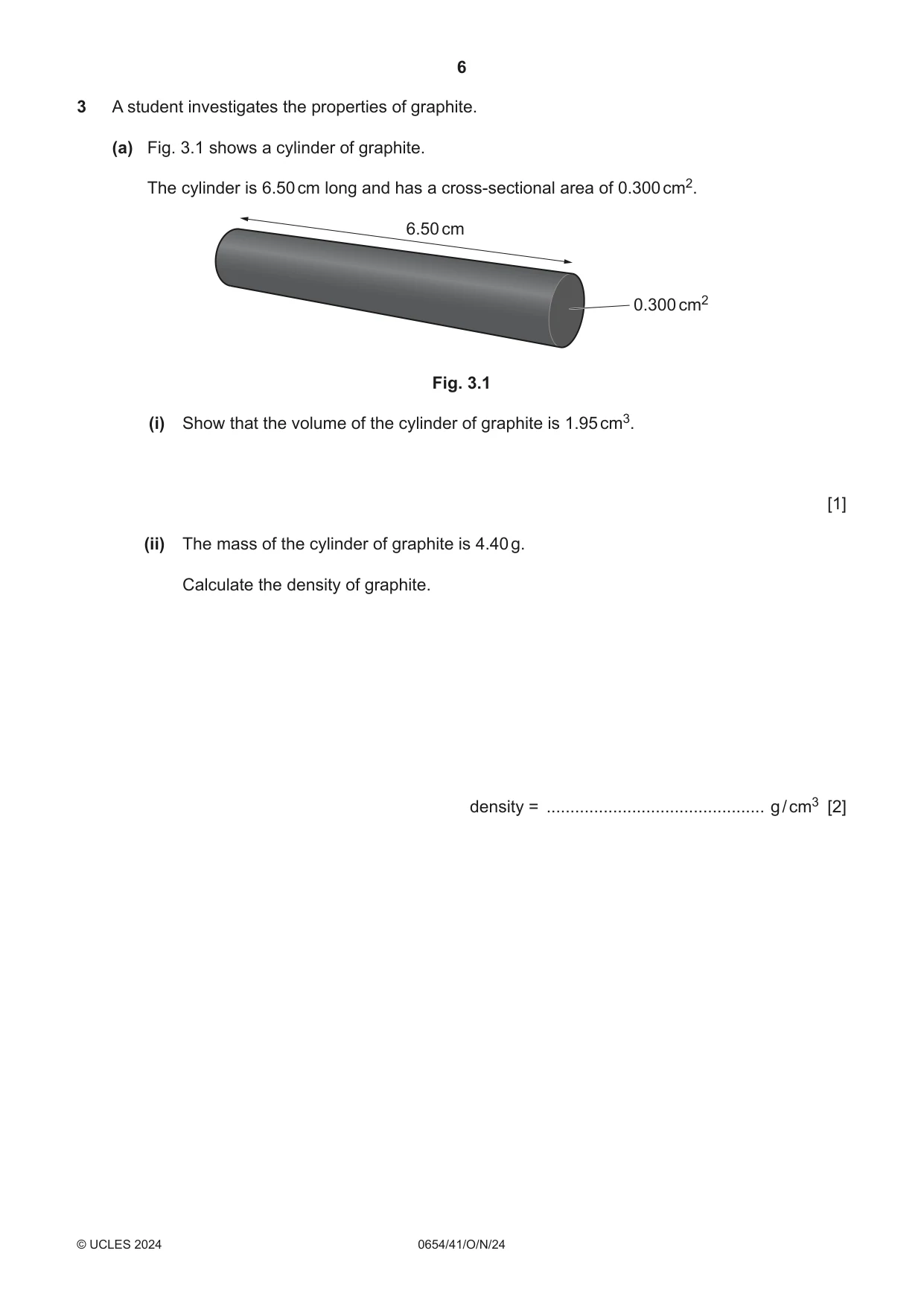
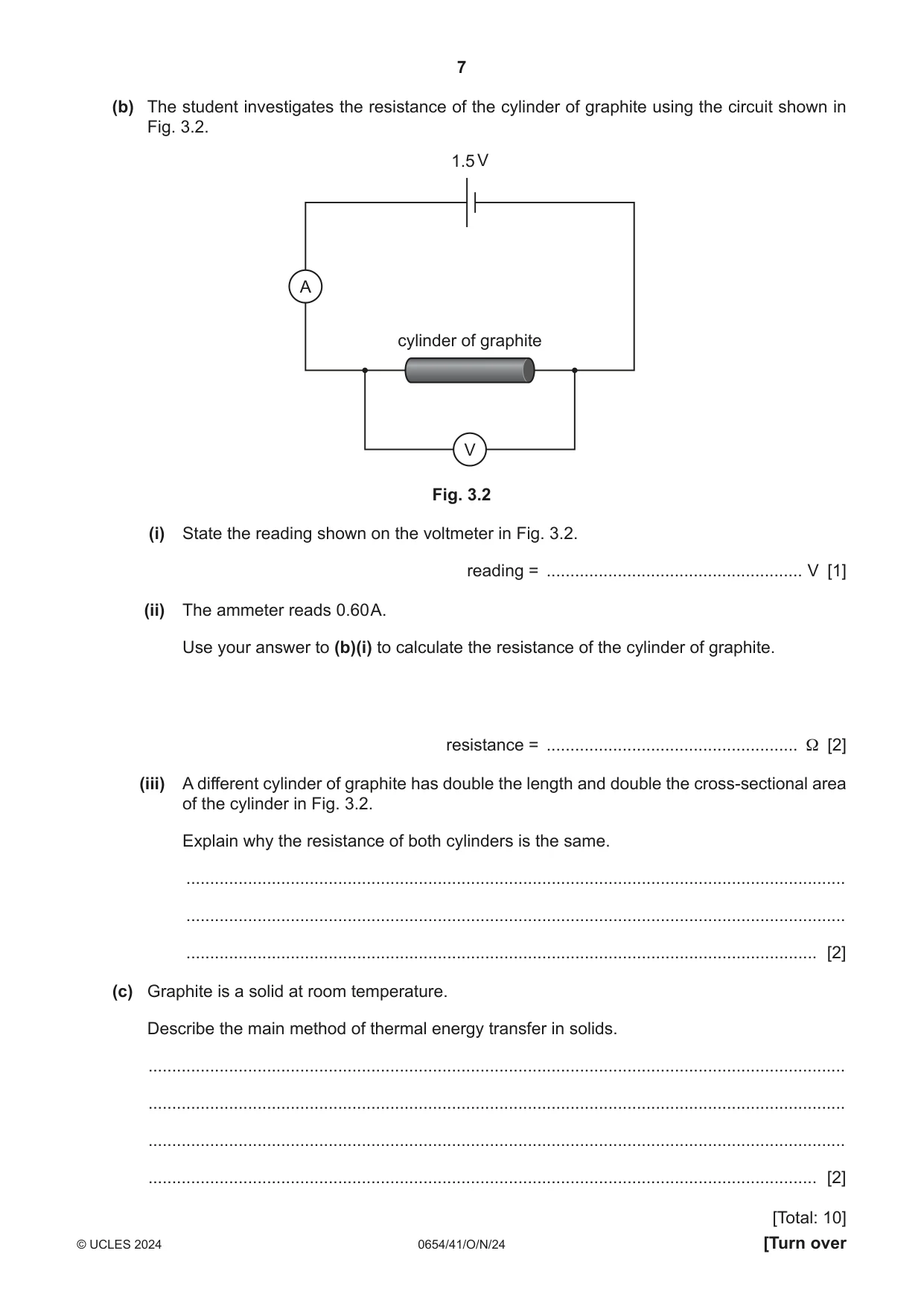
3 A student investigates the properties of graphite. (a) Fig. 3.1 shows a cylinder of graphite. The cylinder is 6.50 cm long and has a cross‑sectional area of 0.300 cm2. 6.50 cm 0.300 cm2 Fig. 3.1 (i) Show that the volume of the cylinder of graphite is 1.95 cm3. [1] (ii) The mass of the cylinder of graphite is 4.40 g. Calculate the density of graphite. density = .............................................. g / cm3 [2] (b) The student investigates the resistance of the cylinder of graphite using the circuit shown in Fig. 3.2. 1.5 V A cylinder of graphite V Fig. 3.2 (i) State the reading shown on the voltmeter in Fig. 3.2. reading = ...................................................... V [1] (ii) The ammeter reads 0.60 A. Use your answer to (b)(i) to calculate the resistance of the cylinder of graphite. resistance = ..................................................... Ω [2] (iii) A different cylinder of graphite has double the length and double the cross‑sectional area of the cylinder in Fig. 3.2. Explain why the resistance of both cylinders is the same. ........................................................................................................................................... ........................................................................................................................................... ..................................................................................................................................... [2] (c) Graphite is a solid at room temperature. Describe the main method of thermal energy transfer in solids. ................................................................................................................................................... ................................................................................................................................................... ................................................................................................................................................... ............................................................................................................................................. [2] [Total: 10]
Mark scheme: 3(a)(i) (volume =) 6.5(0) 0.3(00) ; 1 3(a)(ii) m 2 evidence of = or 4.4(0) ÷ 1.95 ; V 2.26 (g / cm3) ; 3(b)(i) 1.5 (V) ; 1 3(b)(ii) evidence of R = V ÷ I or 1.5 ÷ 0.6(0) ; 2 2.5 () ; 3(b)(iii) (idea that) doubling the length doubles the resistance ; 2 (idea that) doubling the (cross-sectional) area halves the resistance ; 3(c) any two from: 2 atoms vibrate ; (idea that) vibrations passed on to next atom ; (idea of) transfer by (free) electrons ;
Q4 · A student monitors their heart rate during vigorous exercise for 30 minutes
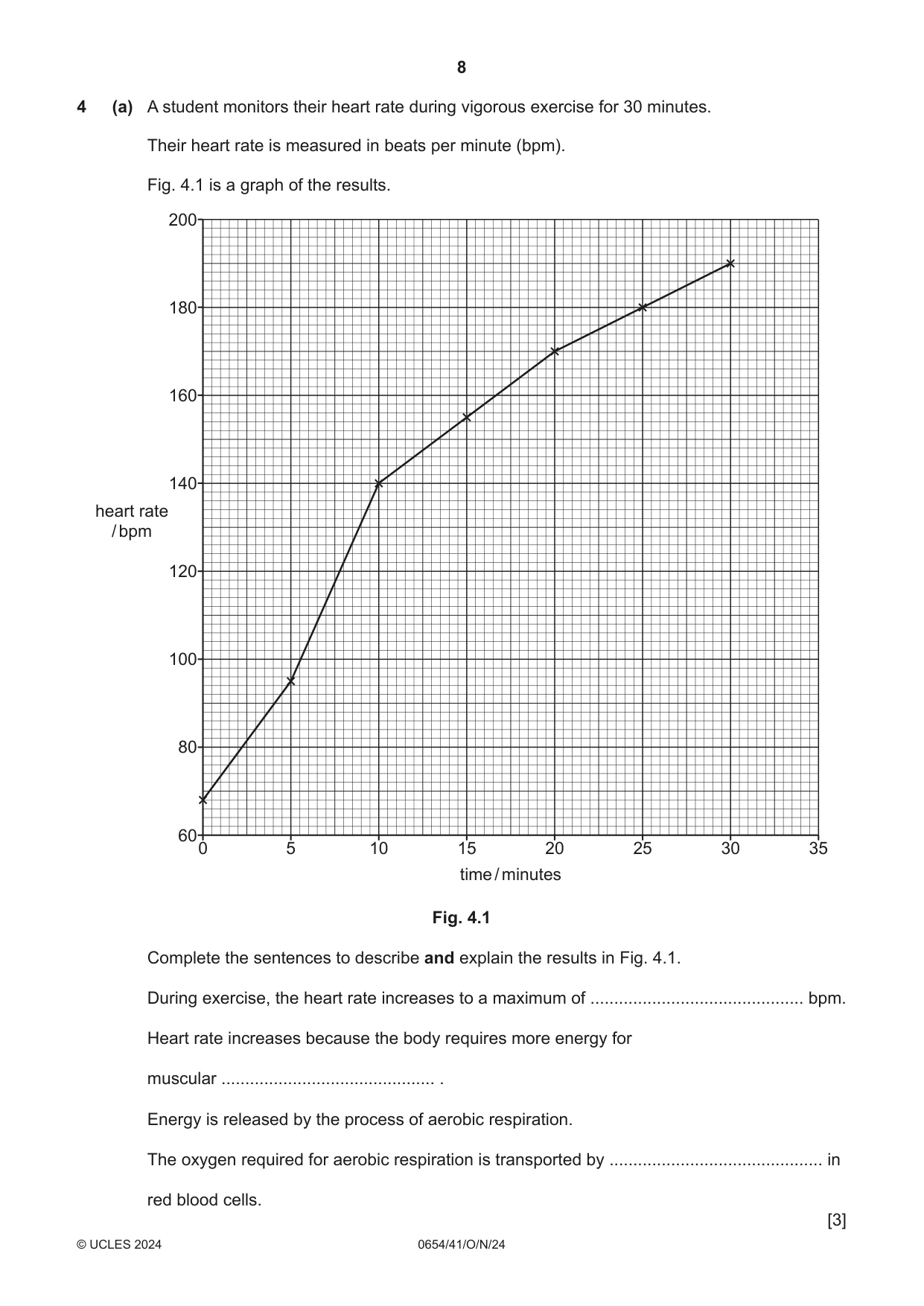
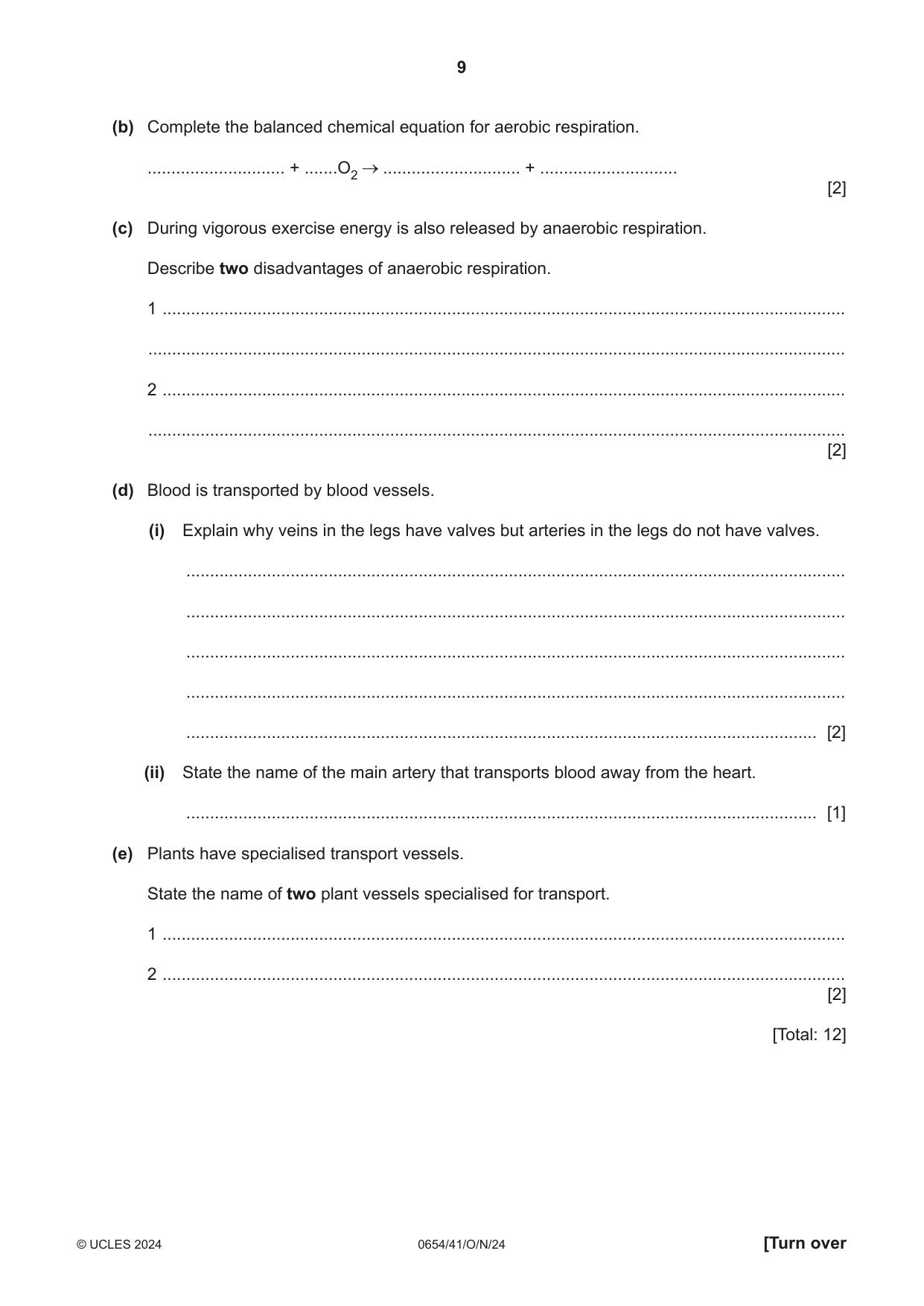
4 (a) A student monitors their heart rate during vigorous exercise for 30 minutes. Their heart rate is measured in beats per minute (bpm). Fig. 4.1 is a graph of the results. 200 180 160 140 heart rate / bpm 120 100 80 60 0 5 10 15 20 25 30 35 time / minutes Fig. 4.1 Complete the sentences to describe and explain the results in Fig. 4.1. During exercise, the heart rate increases to a maximum of ............................................. bpm. Heart rate increases because the body requires more energy for muscular ............................................. . Energy is released by the process of aerobic respiration. The oxygen required for aerobic respiration is transported by ............................................. in red blood cells. [3] (b) Complete the balanced chemical equation for aerobic respiration. ............................. + .......O2 ............................. + ............................. [2] (c) During vigorous exercise energy is also released by anaerobic respiration. Describe two disadvantages of anaerobic respiration. 1 ................................................................................................................................................ ................................................................................................................................................... 2 ................................................................................................................................................ ................................................................................................................................................... [2] (d) Blood is transported by blood vessels. (i) Explain why veins in the legs have valves but arteries in the legs do not have valves. ........................................................................................................................................... ........................................................................................................................................... ........................................................................................................................................... ........................................................................................................................................... ..................................................................................................................................... [2] (ii) State the name of the main artery that transports blood away from the heart. ..................................................................................................................................... [1] (e) Plants have specialised transport vessels. State the name of two plant vessels specialised for transport. 1 ................................................................................................................................................ 2 ................................................................................................................................................ [2] [Total: 12]
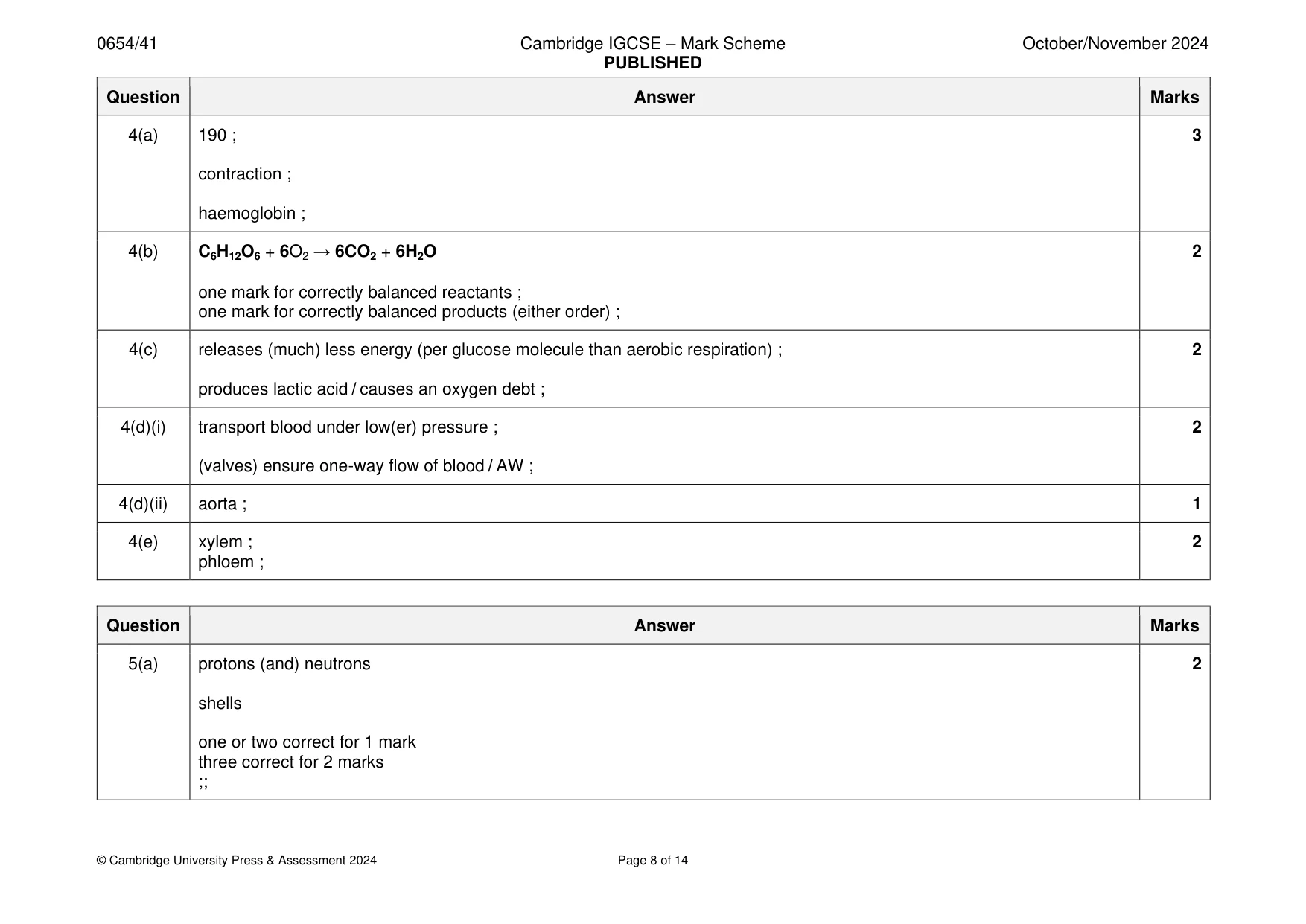
Mark scheme: 4(a) 190 ; 3 contraction ; haemoglobin ; 4(b) C6H12O6 + 6O2 → 6CO2 + 6H2O 2 one mark for correctly balanced reactants ; one mark for correctly balanced products (either order) ; 4(c) releases (much) less energy (per glucose molecule than aerobic respiration) ; 2 produces lactic acid / causes an oxygen debt ; 4(d)(i) transport blood under low(er) pressure ; 2 (valves) ensure one-way flow of blood / AW ; 4(d)(ii) aorta ; 1 4(e) xylem ; 2 phloem ;
Q5 · Complete the sentences about the structure of an atom
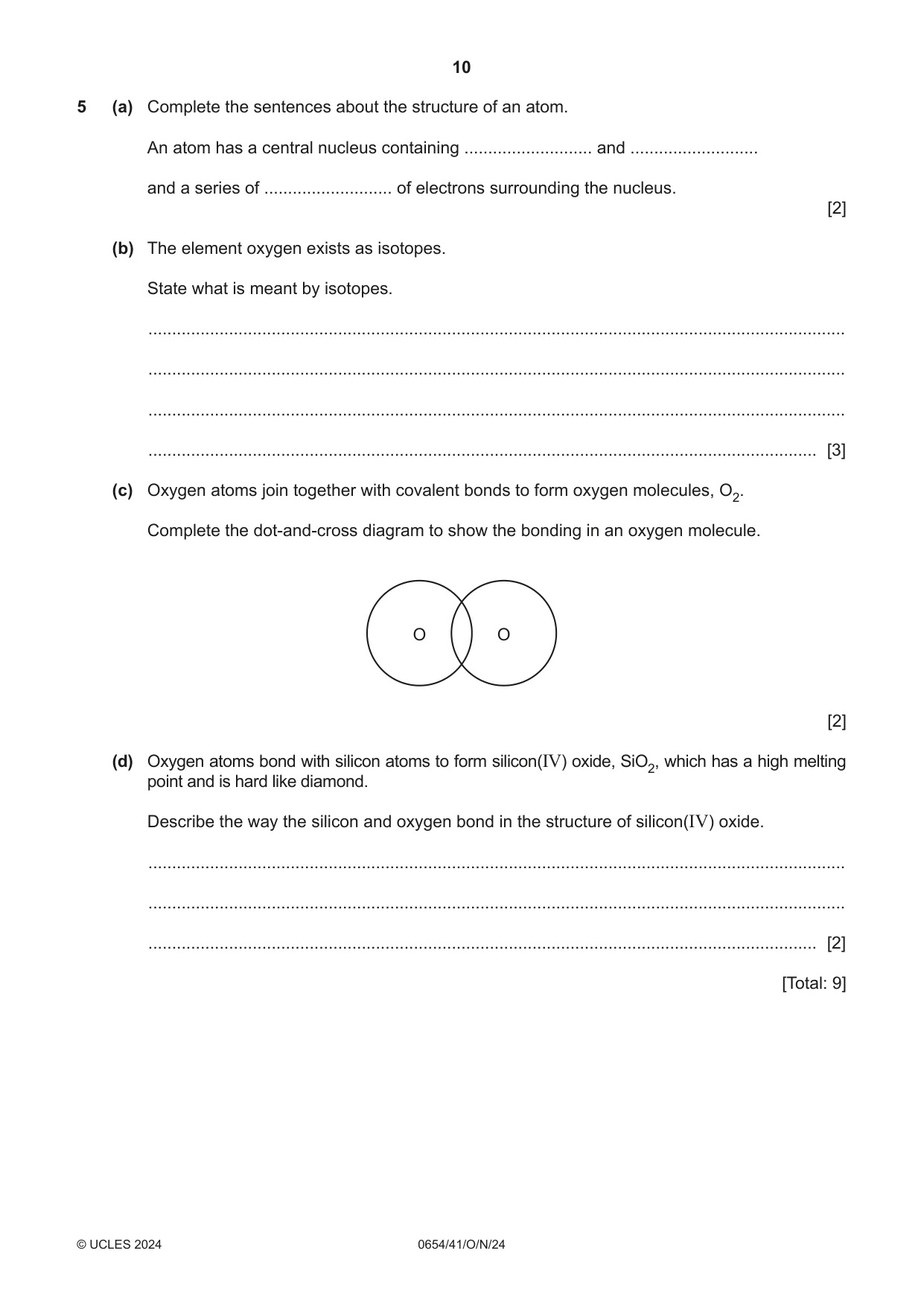
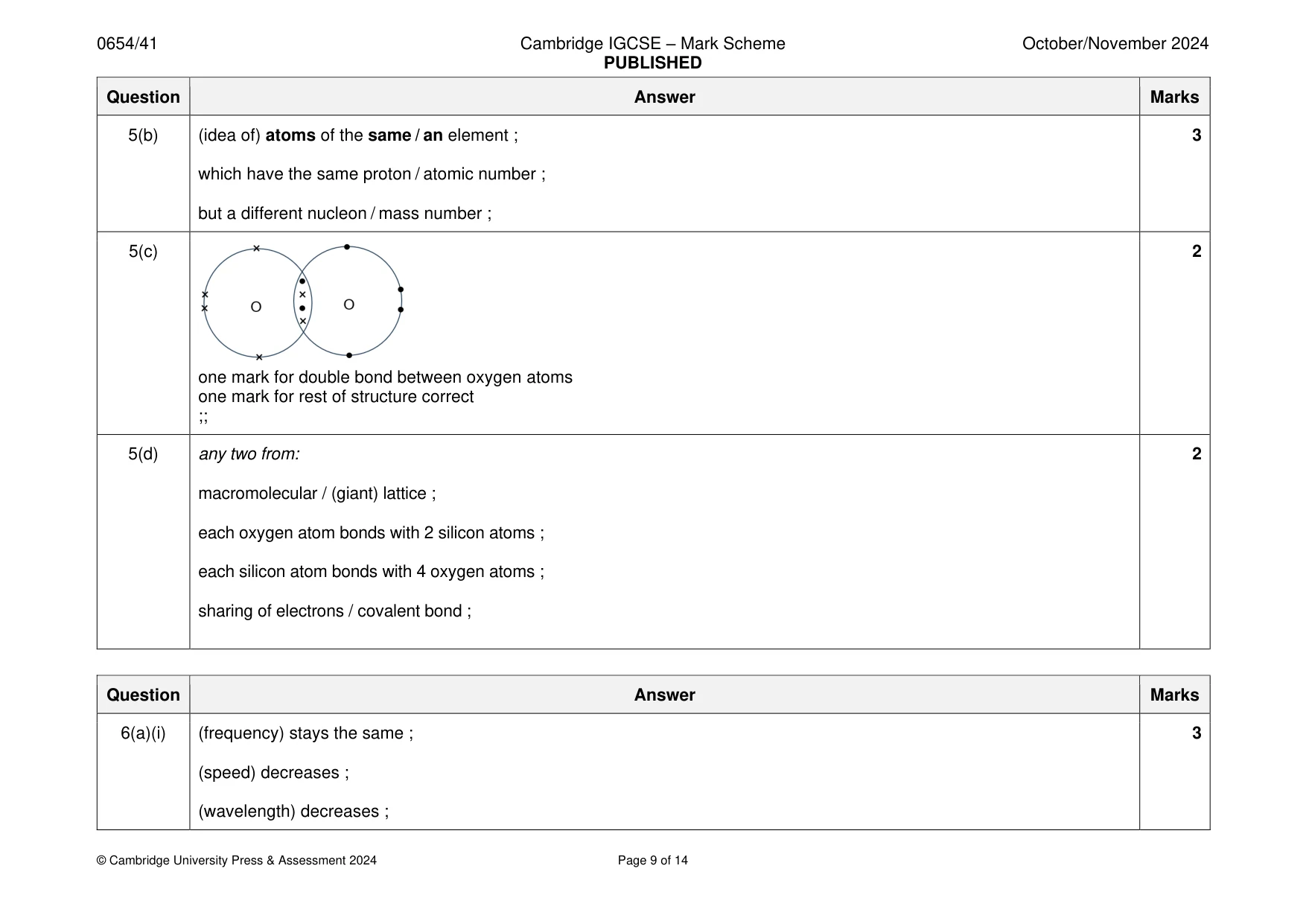
5 (a) Complete the sentences about the structure of an atom. An atom has a central nucleus containing ........................... and ........................... and a series of ........................... of electrons surrounding the nucleus. [2] (b) The element oxygen exists as isotopes. State what is meant by isotopes. ................................................................................................................................................... ................................................................................................................................................... ................................................................................................................................................... ............................................................................................................................................. [3] (c) Oxygen atoms join together with covalent bonds to form oxygen molecules, O2. Complete the dot‑and‑cross diagram to show the bonding in an oxygen molecule. O O [2] (d) Oxygen atoms bond with silicon atoms to form silicon(IV) oxide, SiO2, which has a high melting point and is hard like diamond. Describe the way the silicon and oxygen bond in the structure of silicon(IV) oxide. ................................................................................................................................................... ................................................................................................................................................... ............................................................................................................................................. [2] [Total: 9]
Mark scheme: 5(a) protons (and) neutrons 2 shells one or two correct for 1 mark three correct for 2 marks ;; 5(b) (idea of) atoms of the same / an element ; 3 which have the same proton / atomic number ; but a different nucleon / mass number ; 5(c) 2 one mark for double bond between oxygen atoms one mark for rest of structure correct ;; 5(d) any two from: 2 macromolecular / (giant) lattice ; each oxygen atom bonds with 2 silicon atoms ; each silicon atom bonds with 4 oxygen atoms ; sharing of electrons / covalent bond ;
Q6 · A mobile phone (cell phone) on a wireless charging pad
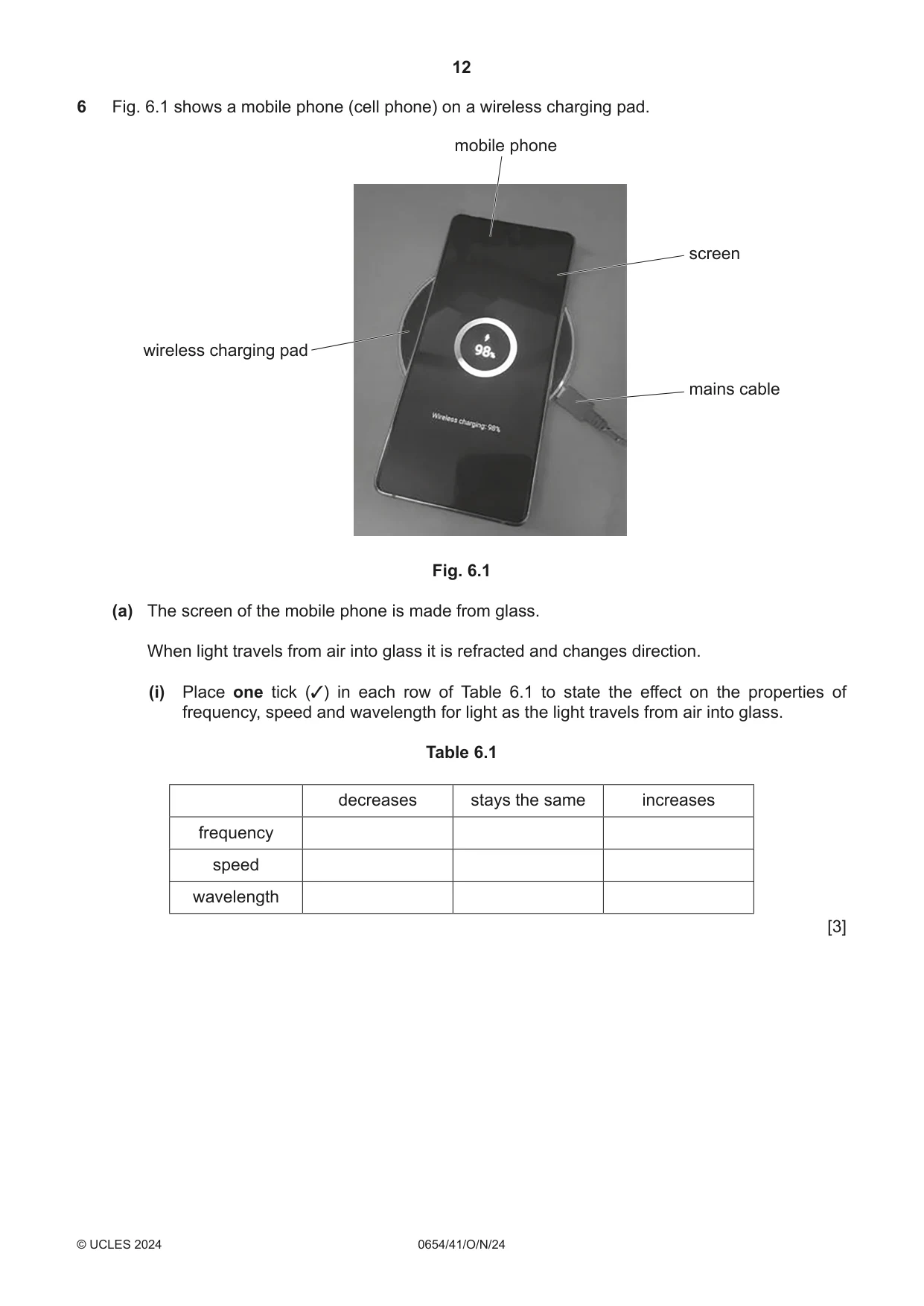
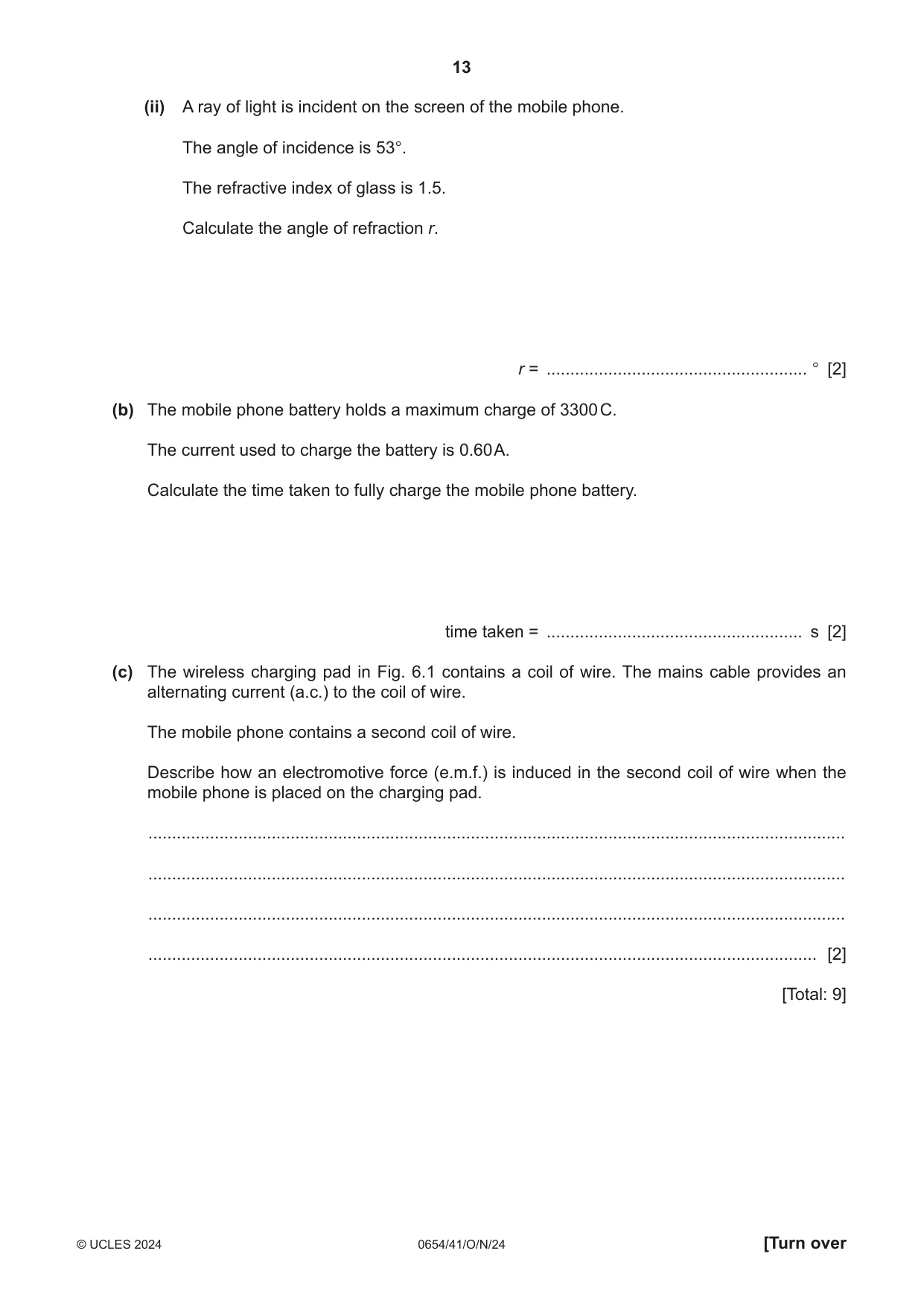
6 Fig. 6.1 shows a mobile phone (cell phone) on a wireless charging pad. mobile phone screen wireless charging pad mains cable Fig. 6.1 (a) The screen of the mobile phone is made from glass. When light travels from air into glass it is refracted and changes direction. (i) Place one tick (3) in each row of Table 6.1 to state the effect on the properties of frequency, speed and wavelength for light as the light travels from air into glass. Table 6.1 decreases stays the same increases frequency speed wavelength [3] (ii) A ray of light is incident on the screen of the mobile phone. The angle of incidence is 53°. The refractive index of glass is 1.5. Calculate the angle of refraction r. r = ....................................................... ° [2] (b) The mobile phone battery holds a maximum charge of 3300 C. The current used to charge the battery is 0.60 A. Calculate the time taken to fully charge the mobile phone battery. time taken = ...................................................... s [2] (c) The wireless charging pad in Fig. 6.1 contains a coil of wire. The mains cable provides an alternating current (a.c.) to the coil of wire. The mobile phone contains a second coil of wire. Describe how an electromotive force (e.m.f.) is induced in the second coil of wire when the mobile phone is placed on the charging pad. ................................................................................................................................................... ................................................................................................................................................... ................................................................................................................................................... ............................................................................................................................................. [2] [Total: 9]
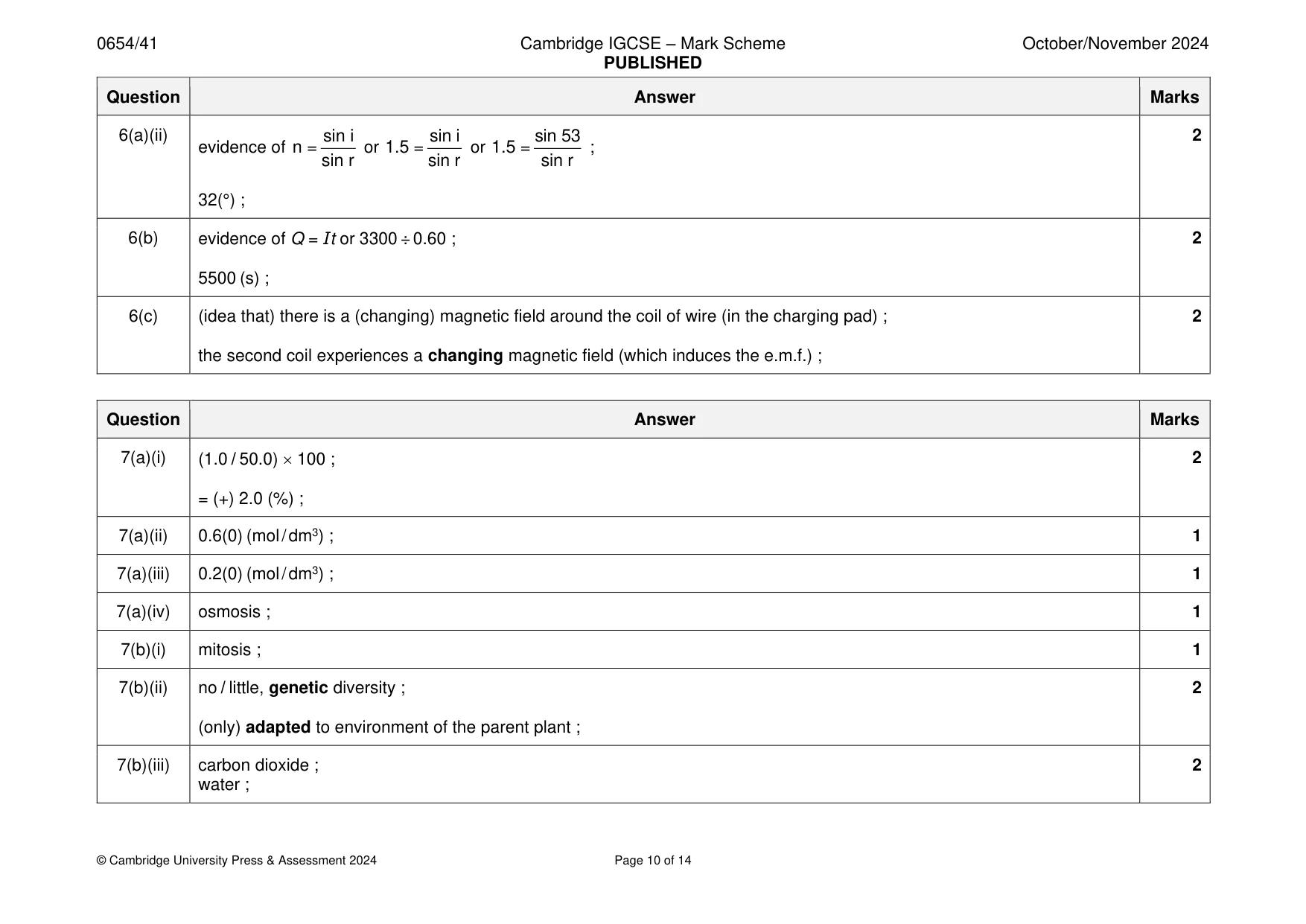
Mark scheme: 6(a)(i) (frequency) stays the same ; 3 (speed) decreases ; (wavelength) decreases ; 6(a)(ii) sin i sin i sin 53 2 evidence of n = or 1.5 = or 1.5 = ; sin r sin r sin r 32(°) ; 6(b) evidence of Q = It or 3300 ÷ 0.60 ; 2 5500 (s) ; 6(c) (idea that) there is a (changing) magnetic field around the coil of wire (in the charging pad) ; 2 the second coil experiences a changing magnetic field (which induces the e.m.f.) ;
Q7 · A student cuts cylinders of potato of almost identical size and measures the length of…
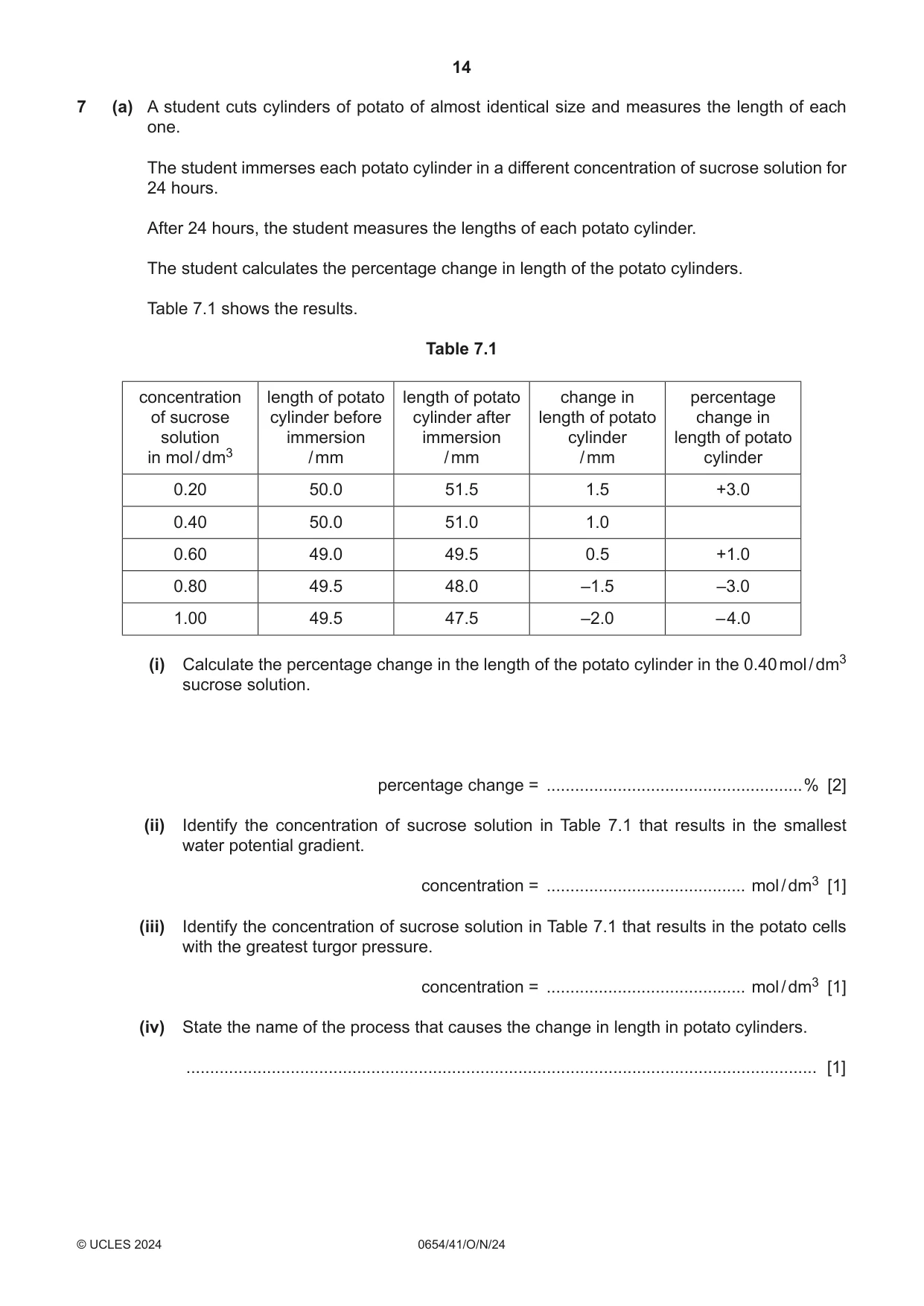
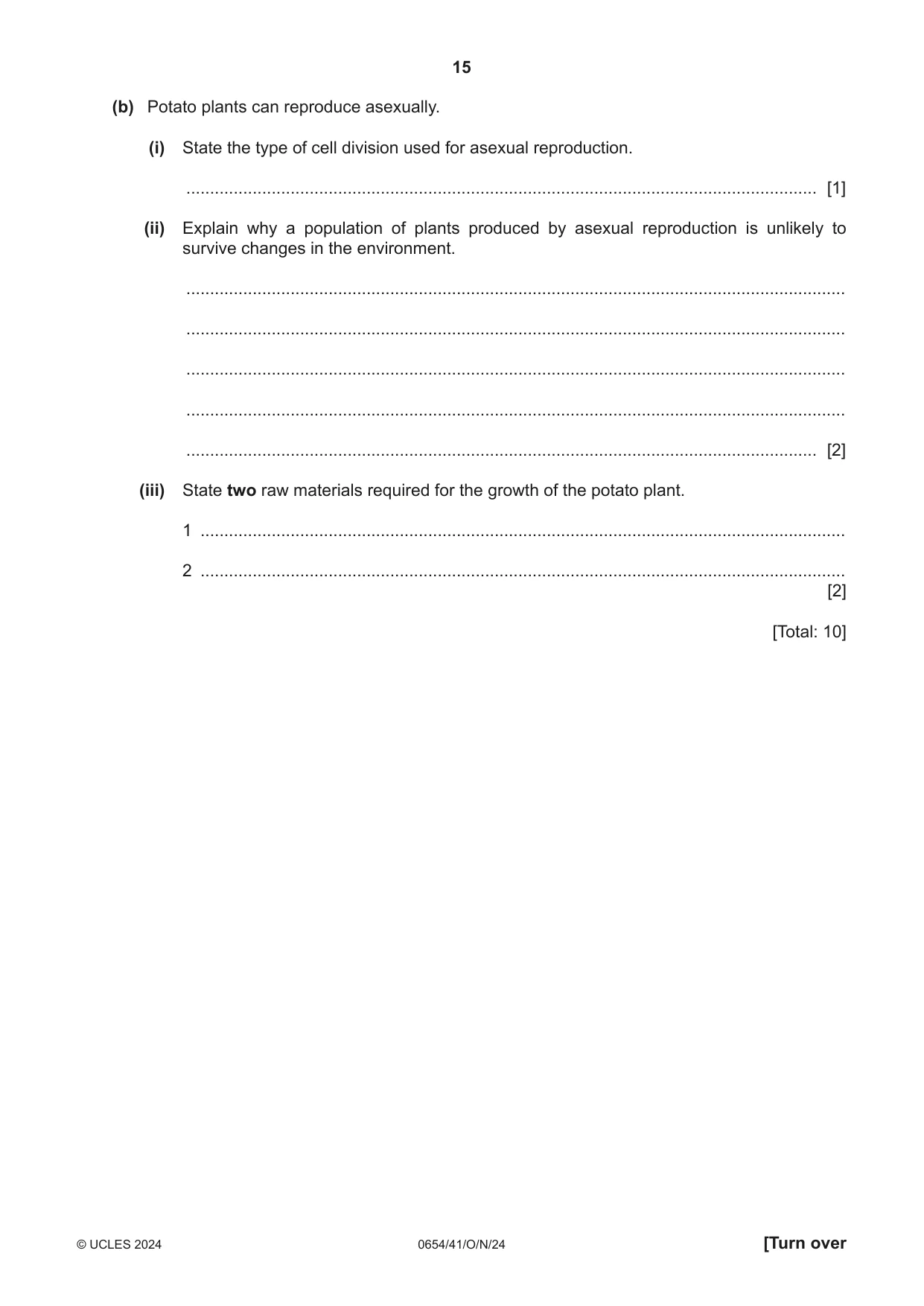
7 (a) A student cuts cylinders of potato of almost identical size and measures the length of each one. The student immerses each potato cylinder in a different concentration of sucrose solution for 24 hours. After 24 hours, the student measures the lengths of each potato cylinder. The student calculates the percentage change in length of the potato cylinders. Table 7.1 shows the results. Table 7.1 concentration length of potato length of potato change in percentage of sucrose cylinder before cylinder after length of potato change in solution immersion immersion cylinder length of potato in mol / dm3 / mm / mm / mm cylinder 0.20 50.0 51.5 1.5 +3.0 0.40 50.0 51.0 1.0 0.60 49.0 49.5 0.5 +1.0 0.80 49.5 48.0 –1.5 –3.0 1.00 49.5 47.5 –2.0 – 4.0 (i) Calculate the percentage change in the length of the potato cylinder in the 0.40 mol / dm3 sucrose solution. percentage change = ......................................................% [2] (ii) Identify the concentration of sucrose solution in Table 7.1 that results in the smallest water potential gradient. concentration = .......................................... mol / dm3 [1] (iii) Identify the concentration of sucrose solution in Table 7.1 that results in the potato cells with the greatest turgor pressure. concentration = .......................................... mol / dm3 [1] (iv) State the name of the process that causes the change in length in potato cylinders. ..................................................................................................................................... [1] (b) Potato plants can reproduce asexually. (i) State the type of cell division used for asexual reproduction. ..................................................................................................................................... [1] (ii) Explain why a population of plants produced by asexual reproduction is unlikely to survive changes in the environment. ........................................................................................................................................... ........................................................................................................................................... ........................................................................................................................................... ........................................................................................................................................... ..................................................................................................................................... [2] (iii) State two raw materials required for the growth of the potato plant. 1 ........................................................................................................................................ 2 ........................................................................................................................................ [2] [Total: 10]
Mark scheme: 7(a)(i) (1.0 / 50.0) 100 ; 2 = (+) 2.0 (%) ; 7(a)(ii) 0.6(0) (mol / dm3) ; 1 7(a)(iii) 0.2(0) (mol / dm3) ; 1 7(a)(iv) osmosis ; 1 7(b)(i) mitosis ; 1 7(b)(ii) no / little, genetic diversity ; 2 (only) adapted to environment of the parent plant ; 7(b)(iii) carbon dioxide ; 2 water ;
Q8 · A student investigates the reaction between zinc and dilute nitric acid, HNO3
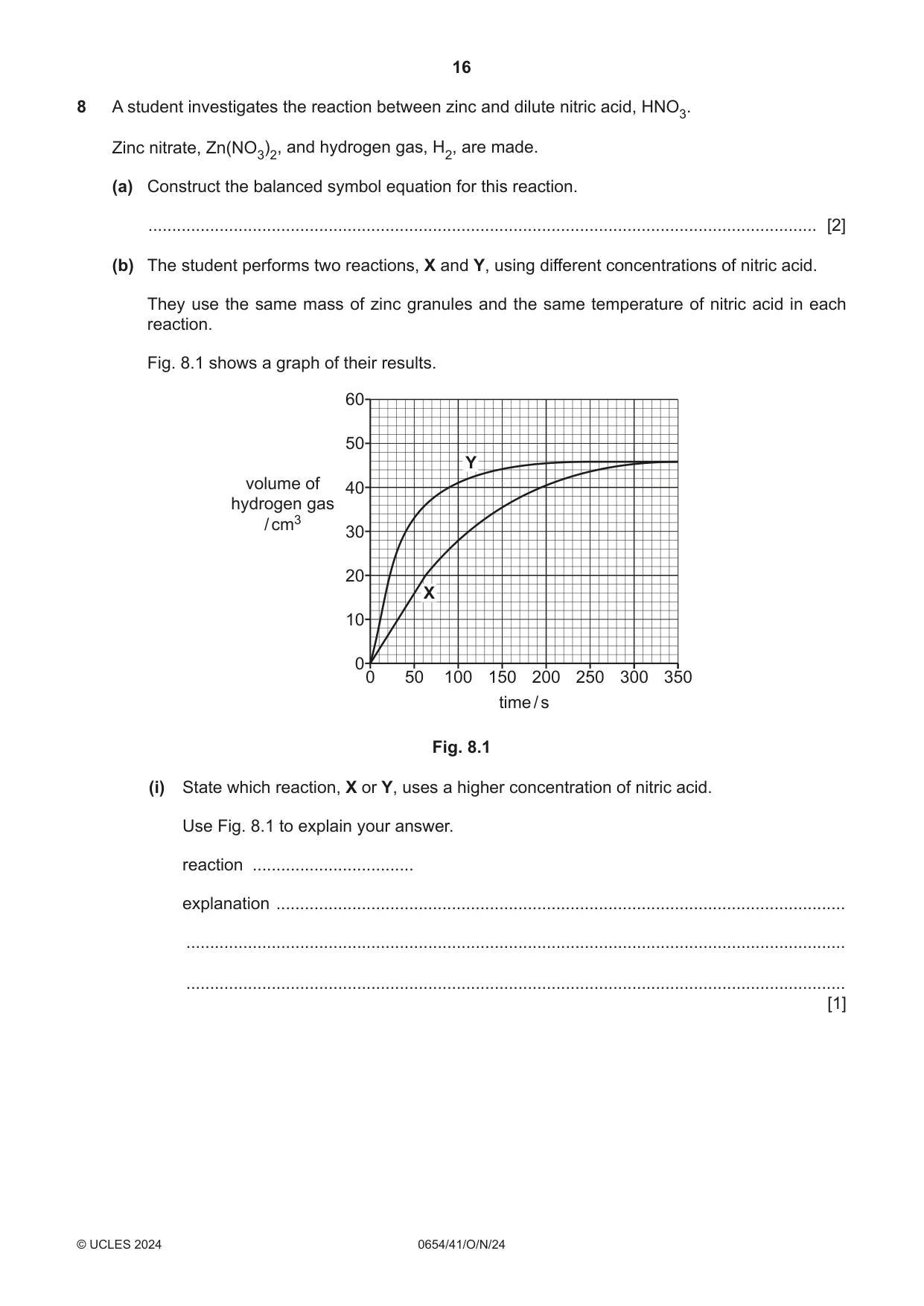
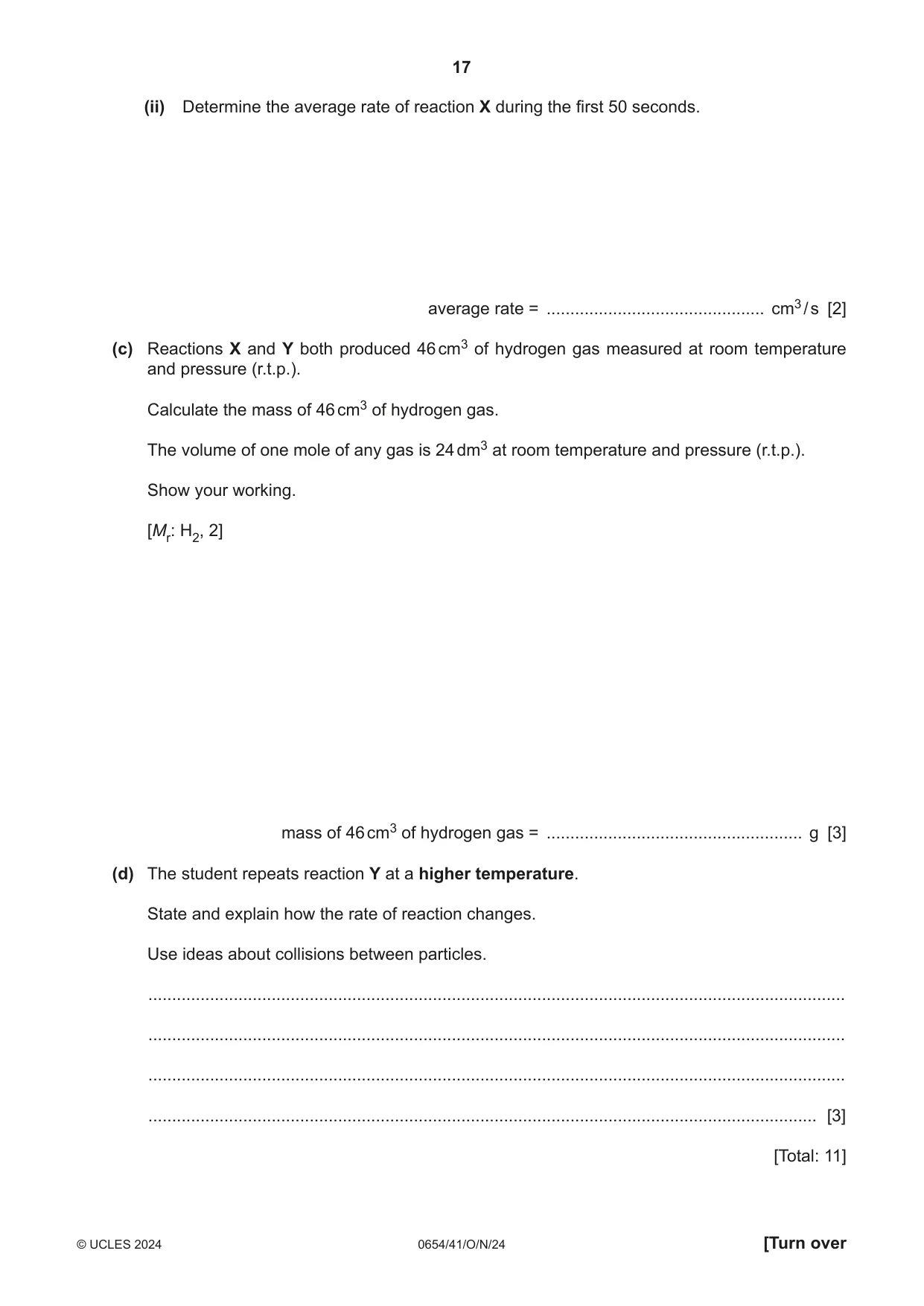
8 A student investigates the reaction between zinc and dilute nitric acid, HNO3. Zinc nitrate, Zn(NO3)2, and hydrogen gas, H2, are made. (a) Construct the balanced symbol equation for this reaction. ............................................................................................................................................. [2] (b) The student performs two reactions, X and Y, using different concentrations of nitric acid. They use the same mass of zinc granules and the same temperature of nitric acid in each reaction. Fig. 8.1 shows a graph of their results. 60 50 Y volume of 40 hydrogen gas / cm3 30 20 X 10 0 0 50 100 150 200 250 300 350 time / s Fig. 8.1 (i) State which reaction, X or Y, uses a higher concentration of nitric acid. Use Fig. 8.1 to explain your answer. reaction .................................. explanation ........................................................................................................................ ........................................................................................................................................... ........................................................................................................................................... [1] (ii) Determine the average rate of reaction X during the first 50 seconds. average rate = .............................................. cm3 / s [2] (c) Reactions X and Y both produced 46 cm3 of hydrogen gas measured at room temperature and pressure (r.t.p.). Calculate the mass of 46 cm3 of hydrogen gas. The volume of one mole of any gas is 24 dm3 at room temperature and pressure (r.t.p.). Show your working. [Mr: H2, 2] mass of 46 cm3 of hydrogen gas = ...................................................... g [3] (d) The student repeats reaction Y at a higher temperature. State and explain how the rate of reaction changes. Use ideas about collisions between particles. ................................................................................................................................................... ................................................................................................................................................... ................................................................................................................................................... ............................................................................................................................................. [3] [Total: 11]
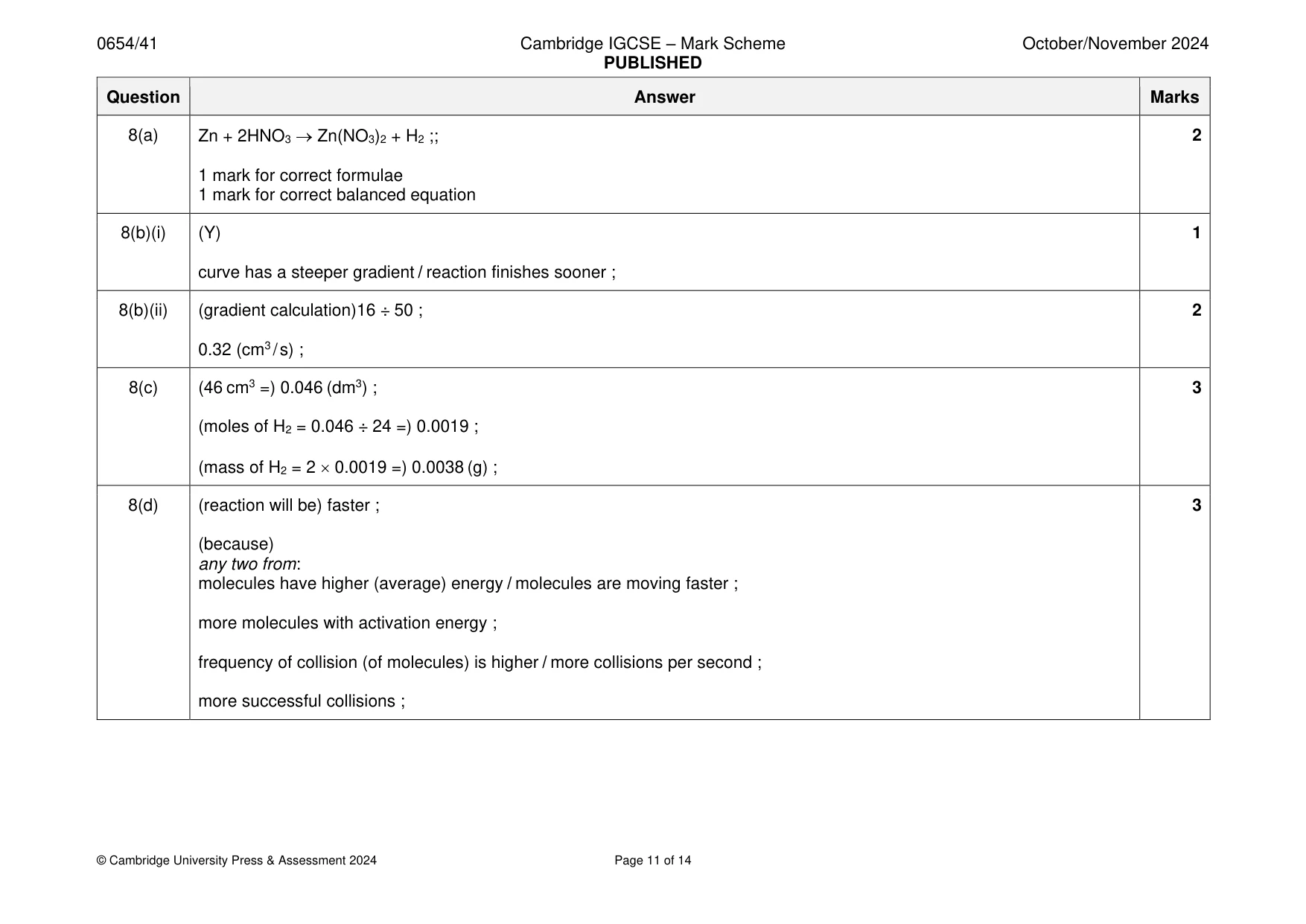
Mark scheme: 8(a) Zn + 2HNO3 → Zn(NO3)2 + H2 ;; 2 1 mark for correct formulae 1 mark for correct balanced equation 8(b)(i) (Y) 1 curve has a steeper gradient / reaction finishes sooner ; 8(b)(ii) (gradient calculation)16 ÷ 50 ; 2 0.32 (cm3 / s) ; 8(c) (46 cm3 =) 0.046 (dm3) ; 3 (moles of H2 = 0.046 ÷ 24 =) 0.0019 ; (mass of H2 = 2 0.0019 =) 0.0038 (g) ; 8(d) (reaction will be) faster ; 3 (because) any two from: molecules have higher (average) energy / molecules are moving faster ; more molecules with activation energy ; frequency of collision (of molecules) is higher / more collisions per second ; more successful collisions ;
Q9 · Tritium (31H) is an isotope of hydrogen
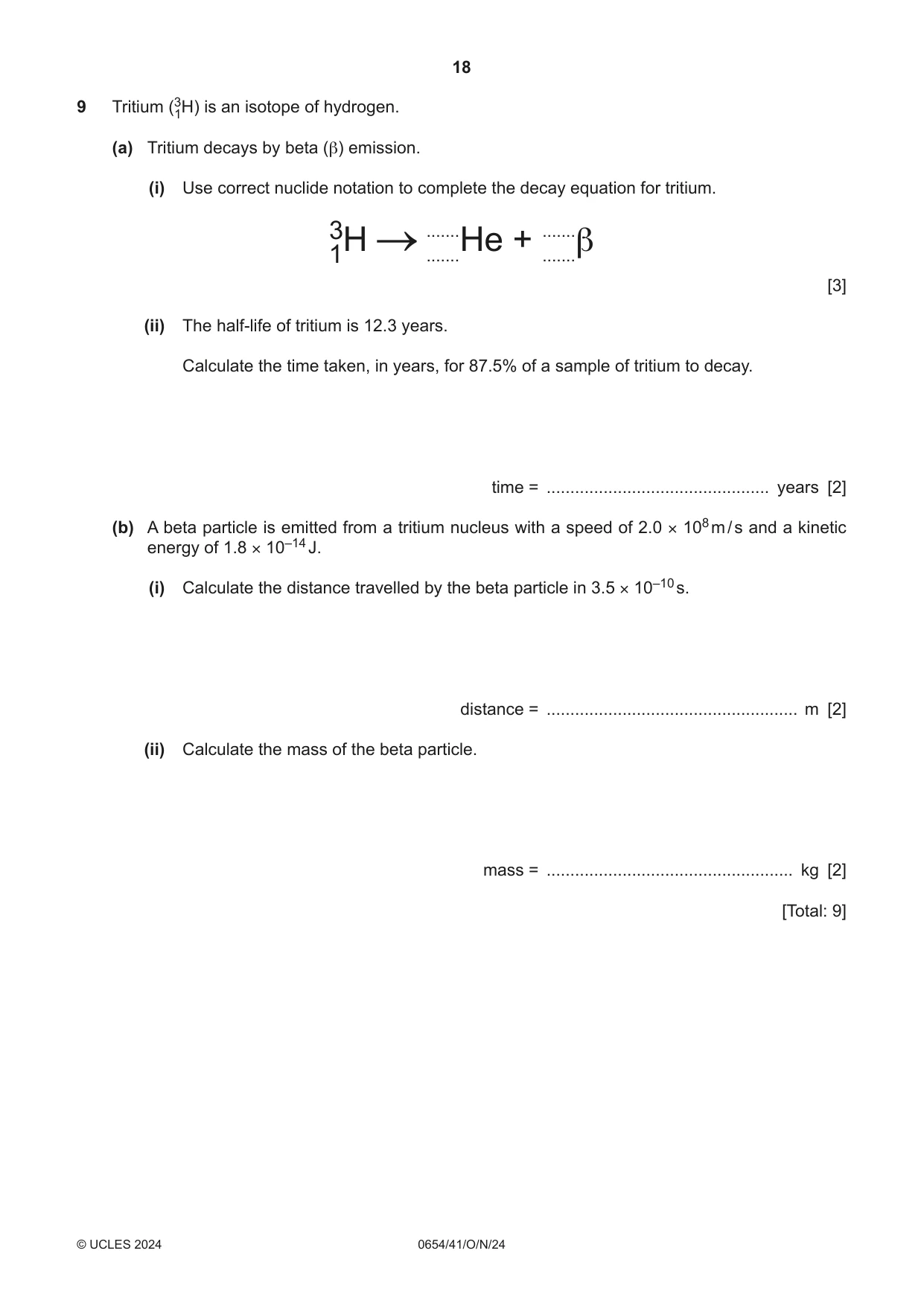
9 Tritium (31H) is an isotope of hydrogen. (a) Tritium decays by beta (β) emission. (i) Use correct nuclide notation to complete the decay equation for tritium. 1H3 ..............He + ..............β [3] (ii) The half‑life of tritium is 12.3 years. Calculate the time taken, in years, for 87.5% of a sample of tritium to decay. time = ............................................... years [2] (b) A beta particle is emitted from a tritium nucleus with a speed of 2.0 × 10⁸ m / s and a kinetic energy of 1.8 × 10⁻¹⁴ J. (i) Calculate the distance travelled by the beta particle in 3.5 × 10⁻¹⁰ s. distance = ..................................................... m [2] (ii) Calculate the mass of the beta particle. mass = .................................................... kg [2] [Total: 9]
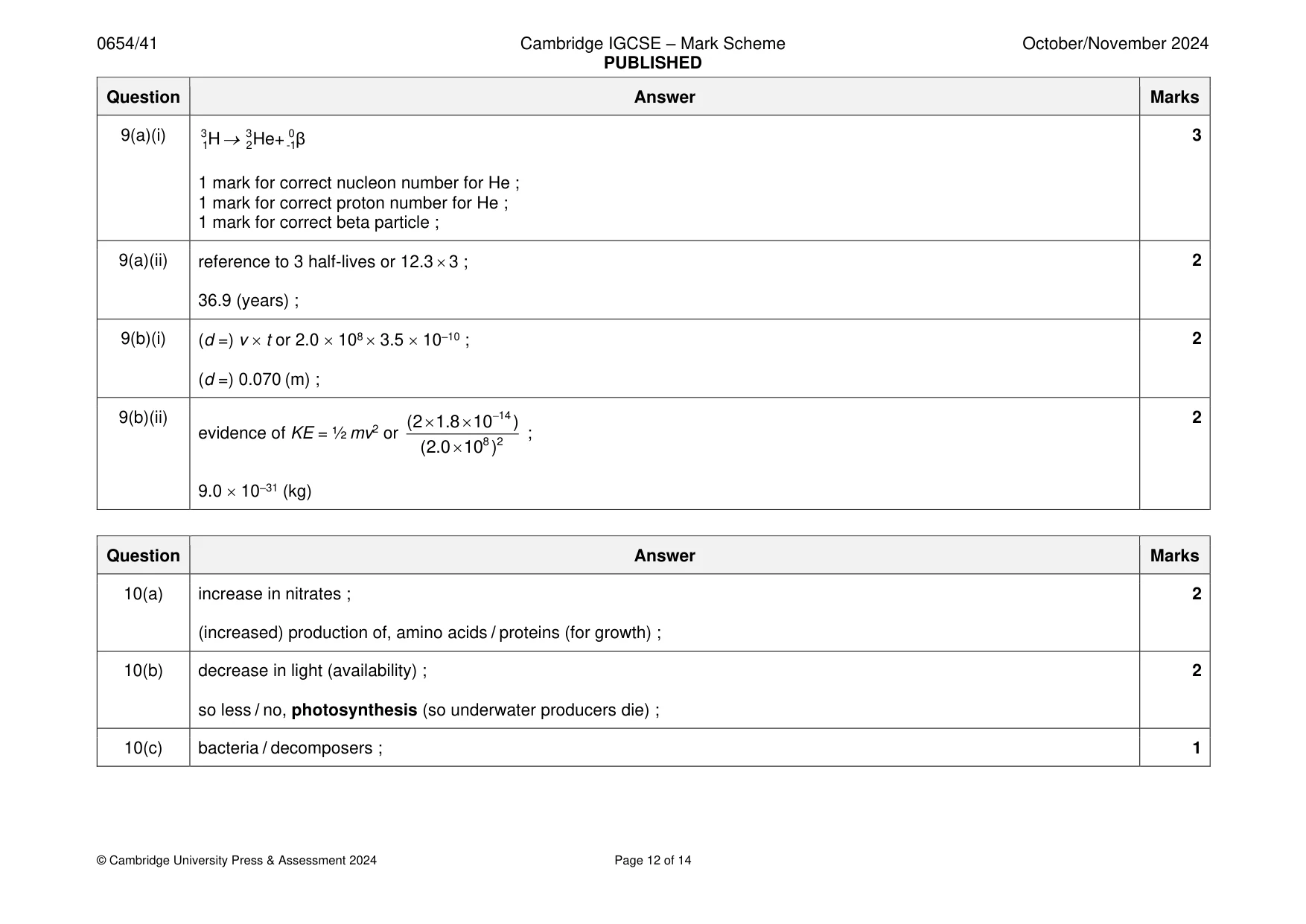
Mark scheme: 9(a)(i) 3 1H → 32 He+ -10 β 3 1 mark for correct nucleon number for He ; 1 mark for correct proton number for He ; 1 mark for correct beta particle ; 9(a)(ii) reference to 3 half-lives or 12.3 3 ; 2 36.9 (years) ; 9(b)(i) (d =) v t or 2.0 108 3.5 10–10 ; 2 (d =) 0.070 (m) ; 9(b)(ii) (2 1.8 10 −14 ) 2 evidence of KE = ½ mv2 or ; (2.0 108 )2 9.0 10–31 (kg)
Q10 · Scientists investigate eutrophication in a lake
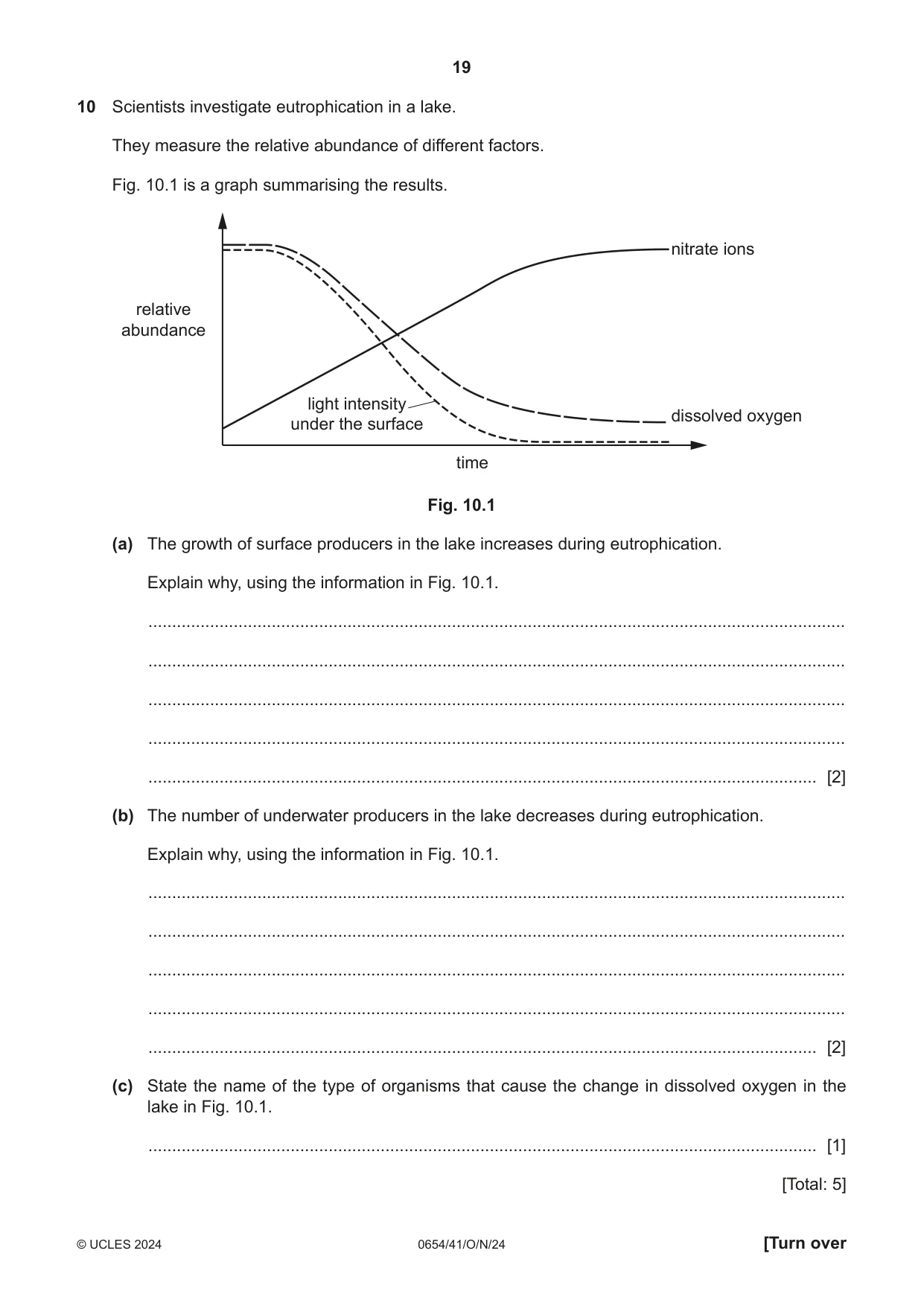
10 Scientists investigate eutrophication in a lake. They measure the relative abundance of different factors. Fig. 10.1 is a graph summarising the results. nitrate ions relative abundance light intensity dissolved oxygen under the surface time Fig. 10.1 (a) The growth of surface producers in the lake increases during eutrophication. Explain why, using the information in Fig. 10.1. ................................................................................................................................................... ................................................................................................................................................... ................................................................................................................................................... ................................................................................................................................................... ............................................................................................................................................. [2] (b) The number of underwater producers in the lake decreases during eutrophication. Explain why, using the information in Fig. 10.1. ................................................................................................................................................... ................................................................................................................................................... ................................................................................................................................................... ................................................................................................................................................... ............................................................................................................................................. [2] (c) State the name of the type of organisms that cause the change in dissolved oxygen in the lake in Fig. 10.1. ............................................................................................................................................. [1] [Total: 5]
Mark scheme: 10(a) increase in nitrates ; 2 (increased) production of, amino acids / proteins (for growth) ; 10(b) decrease in light (availability) ; 2 so less / no, photosynthesis (so underwater producers die) ; 10(c) bacteria / decomposers ; 1
Q11 · Aluminium is extracted by electrolysis from the ore bauxite that contains aluminium…
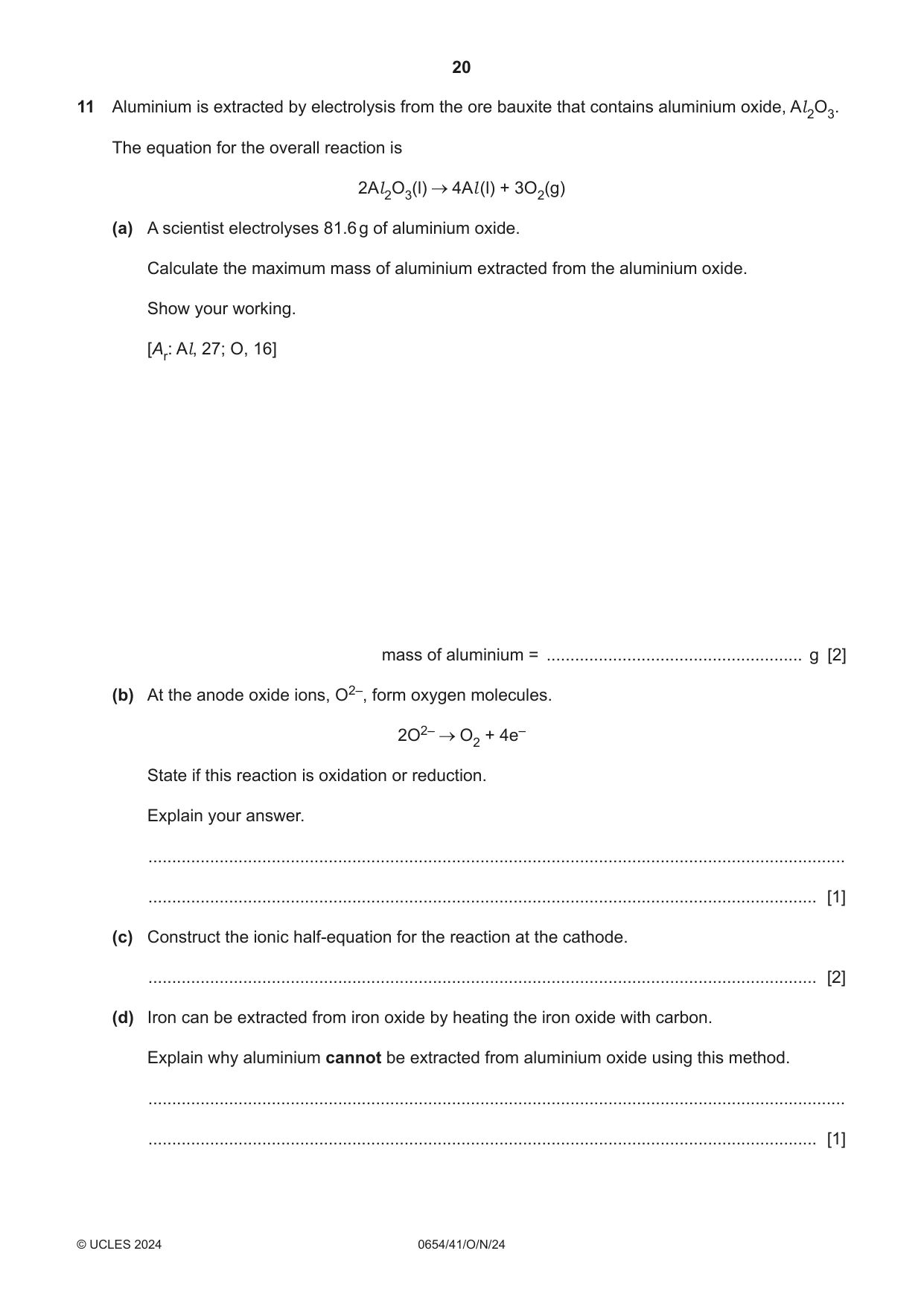
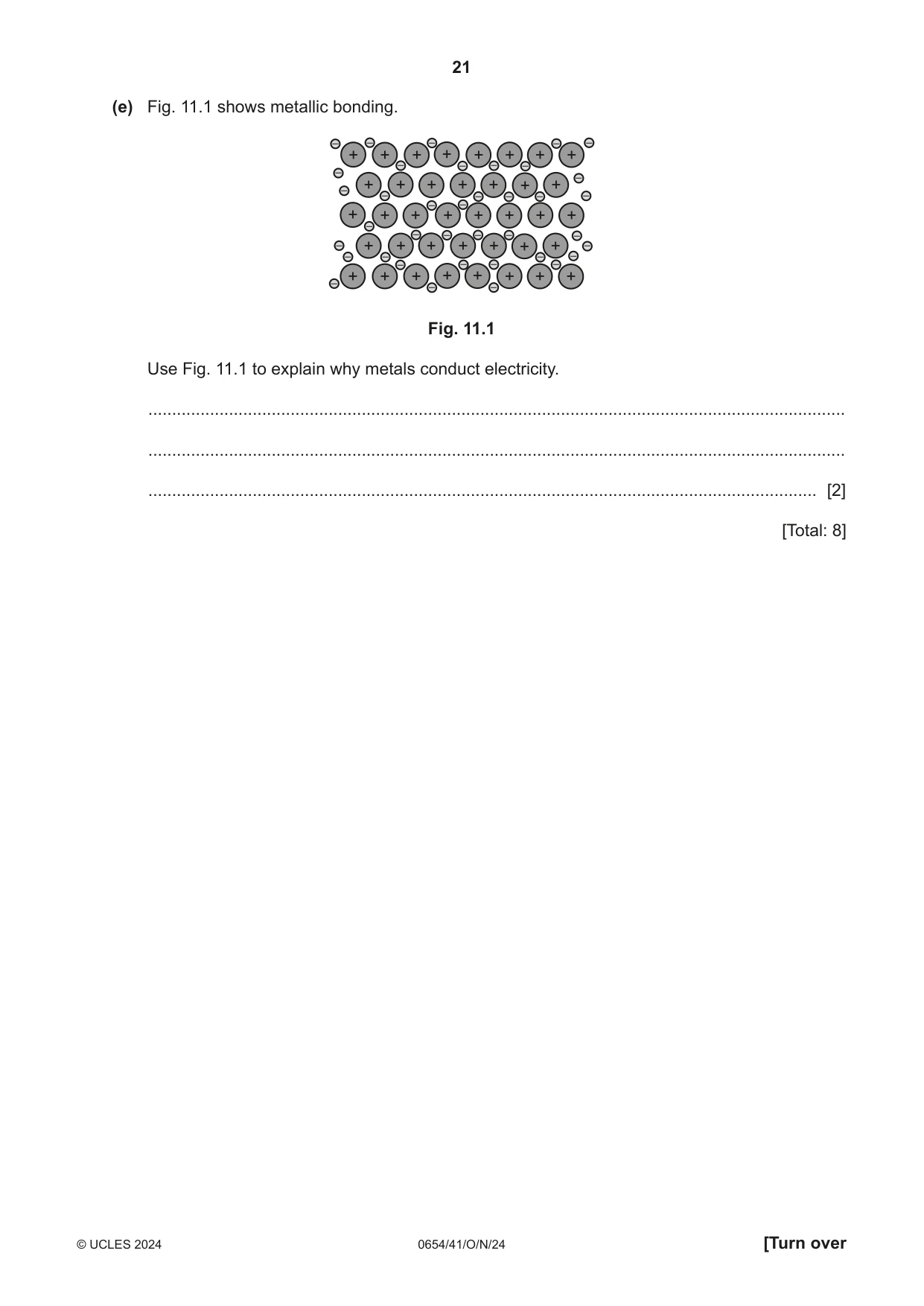
11 Aluminium is extracted by electrolysis from the ore bauxite that contains aluminium oxide, Al 2O3. The equation for the overall reaction is 2Al 2O3(l) 4Al (l) + 3O2(g) (a) A scientist electrolyses 81.6 g of aluminium oxide. Calculate the maximum mass of aluminium extracted from the aluminium oxide. Show your working. [Ar: Al, 27; O, 16] mass of aluminium = ...................................................... g [2] (b) At the anode oxide ions, O2–, form oxygen molecules. 2O2– O2 + 4e– State if this reaction is oxidation or reduction. Explain your answer. ................................................................................................................................................... ............................................................................................................................................. [1] (c) Construct the ionic half‑equation for the reaction at the cathode. ............................................................................................................................................. [2] (d) Iron can be extracted from iron oxide by heating the iron oxide with carbon. Explain why aluminium cannot be extracted from aluminium oxide using this method. ................................................................................................................................................... ............................................................................................................................................. [1] (e) Fig. 11.1 shows metallic bonding. – – – – – + + + + + + + + – – – – – – + + + + + + + – – – – – – – – + + + + + + + + – – – – – – – – + + + + + + + – – – – – – – – – + + + – + + – + + + Fig. 11.1 Use Fig. 11.1 to explain why metals conduct electricity. ................................................................................................................................................... ................................................................................................................................................... ............................................................................................................................................. [2] [Total: 8]
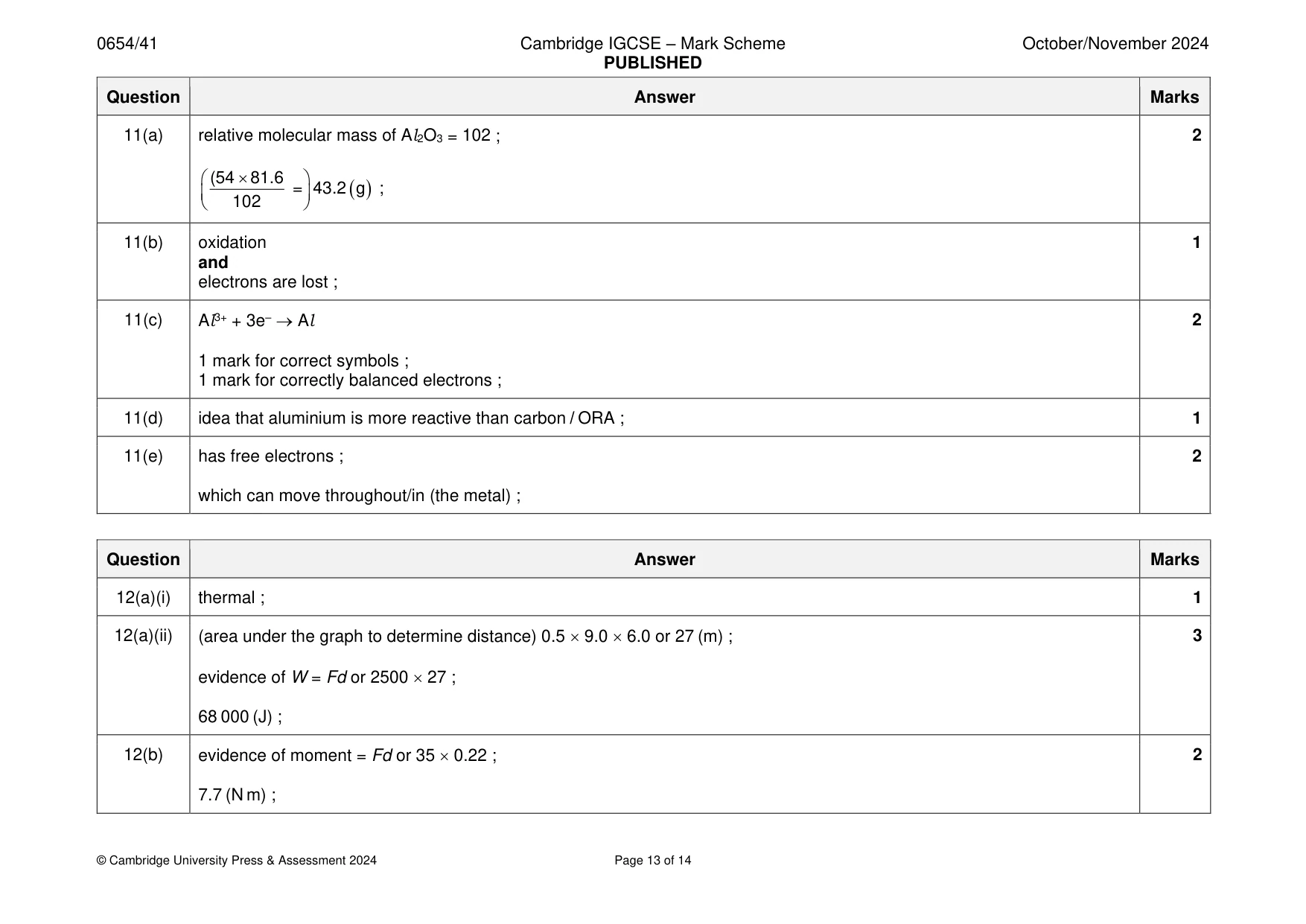
Mark scheme: 11(a) relative molecular mass of Al2O3 = 102 ; 2 (54 81.6 g ) ; = 43.2 ( 102 11(b) oxidation 1 and electrons are lost ; 11(c) Al3+ + 3e– → Al 2 1 mark for correct symbols ; 1 mark for correctly balanced electrons ; 11(d) idea that aluminium is more reactive than carbon / ORA ; 1 11(e) has free electrons ; 2 which can move throughout/in (the metal) ;
Q12 · A car is moving at 9.0 m / s along a flat horizontal road
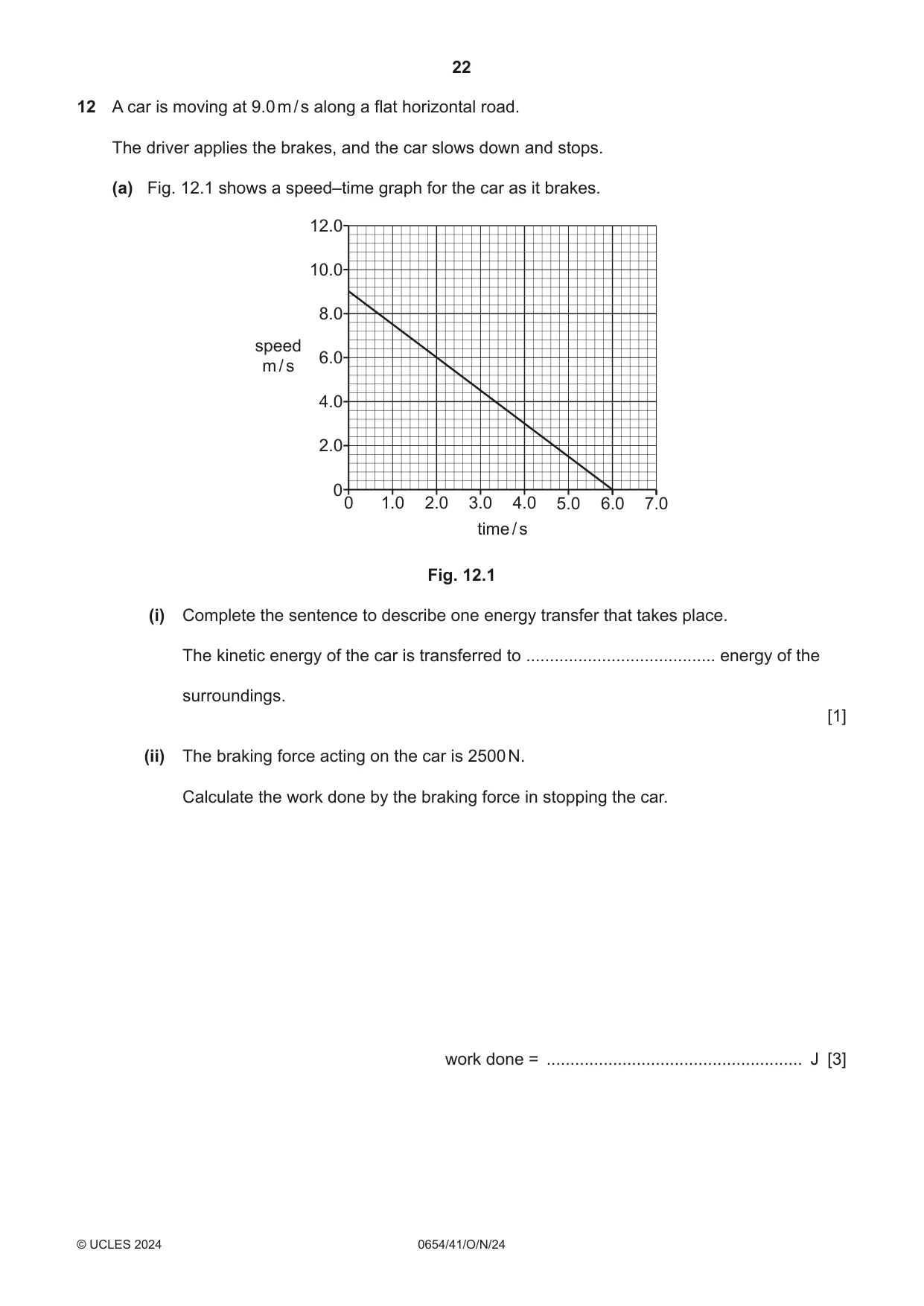
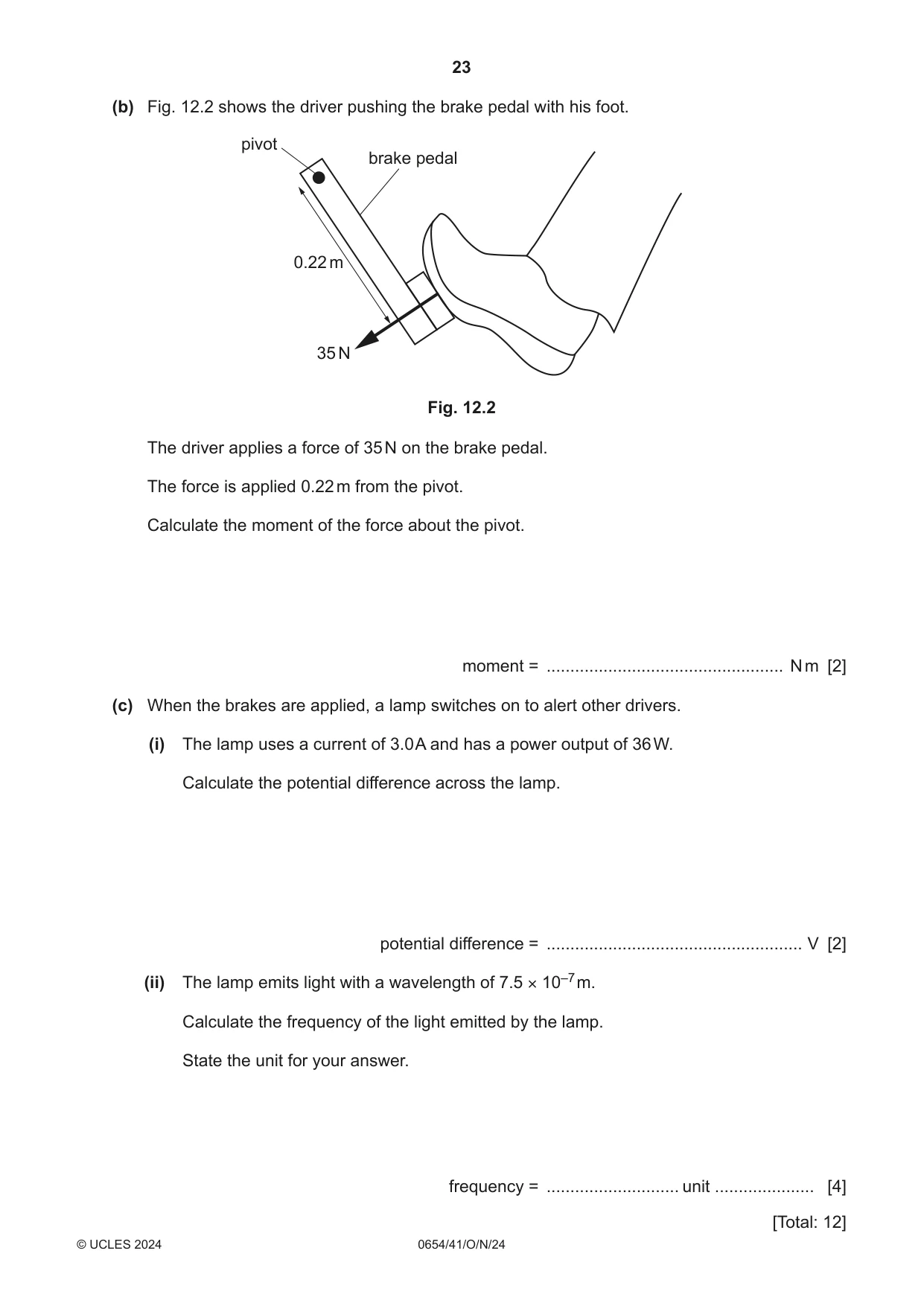
12 A car is moving at 9.0 m / s along a flat horizontal road. The driver applies the brakes, and the car slows down and stops. (a) Fig. 12.1 shows a speed–time graph for the car as it brakes. 12.0 10.0 8.0 speed 6.0 m / s 4.0 2.0 0 0 1.0 2.0 3.0 4.0 5.0 6.0 7.0 time / s Fig. 12.1 (i) Complete the sentence to describe one energy transfer that takes place. The kinetic energy of the car is transferred to ........................................ energy of the surroundings. [1] (ii) The braking force acting on the car is 2500 N. Calculate the work done by the braking force in stopping the car. work done = ...................................................... J [3] (b) Fig. 12.2 shows the driver pushing the brake pedal with his foot. pivot brake pedal 0.22 m 35 N Fig. 12.2 The driver applies a force of 35 N on the brake pedal. The force is applied 0.22 m from the pivot. Calculate the moment of the force about the pivot. moment = .................................................. N m [2] (c) When the brakes are applied, a lamp switches on to alert other drivers. (i) The lamp uses a current of 3.0 A and has a power output of 36 W. Calculate the potential difference across the lamp. potential difference = ...................................................... V [2] (ii) The lamp emits light with a wavelength of 7.5 × 10⁻⁷ m. Calculate the frequency of the light emitted by the lamp. State the unit for your answer. frequency = ............................ unit ..................... [4]
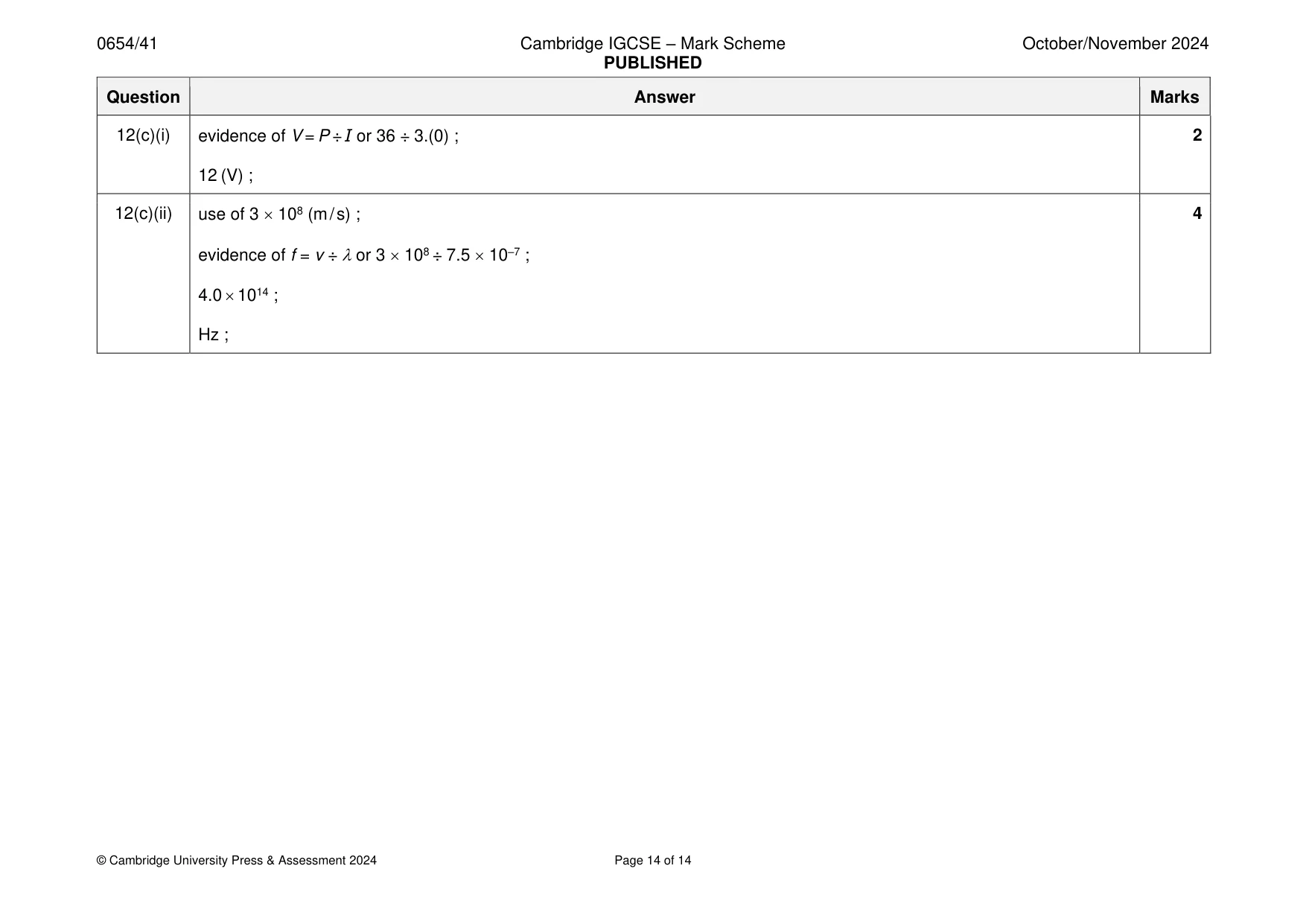
Mark scheme: 12(a)(i) thermal ; 1 12(a)(ii) (area under the graph to determine distance) 0.5 9.0 6.0 or 27 (m) ; 3 evidence of W = Fd or 2500 27 ; 68 000 (J) ; 12(b) evidence of moment = Fd or 35 0.22 ; 2 7.7 (N m) ; 12(c)(i) evidence of V = P ÷ I or 36 ÷ 3.(0) ; 2 12 (V) ; 12(c)(ii) use of 3 108 (m / s) ; 4 evidence of f = v ÷ or 3 108 ÷ 7.5 10–7 ; 4.0 1014 ; Hz ;
What was in this paper
The subtopics covered by these 12 questions, and how many questions each got. Open one in a new tab to see every Cambridge question on it.
What you needed in this session
Cambridge’s own grade thresholds for 2024 Oct/Nov, Paper 4 · Variant 1. A higher threshold means an easier paper — the bar moves with how the cohort did.