Cambridge IGCSE Sciences - Co-ordinated (Double) 0654 — 2025 Feb/March Paper 4 · Variant 2
0654/42/F/M/25 · 12 questions · 120 marks · 120 min
The question paper and its mark scheme, free to read here and free to download. This is Cambridge’s own paper, exactly as it was sat.
Question paper28 pages


Mark scheme13 pages
Answers below. Sit the paper first if you are practising.
Questions as text
Q1 · A cross-section through a leaf
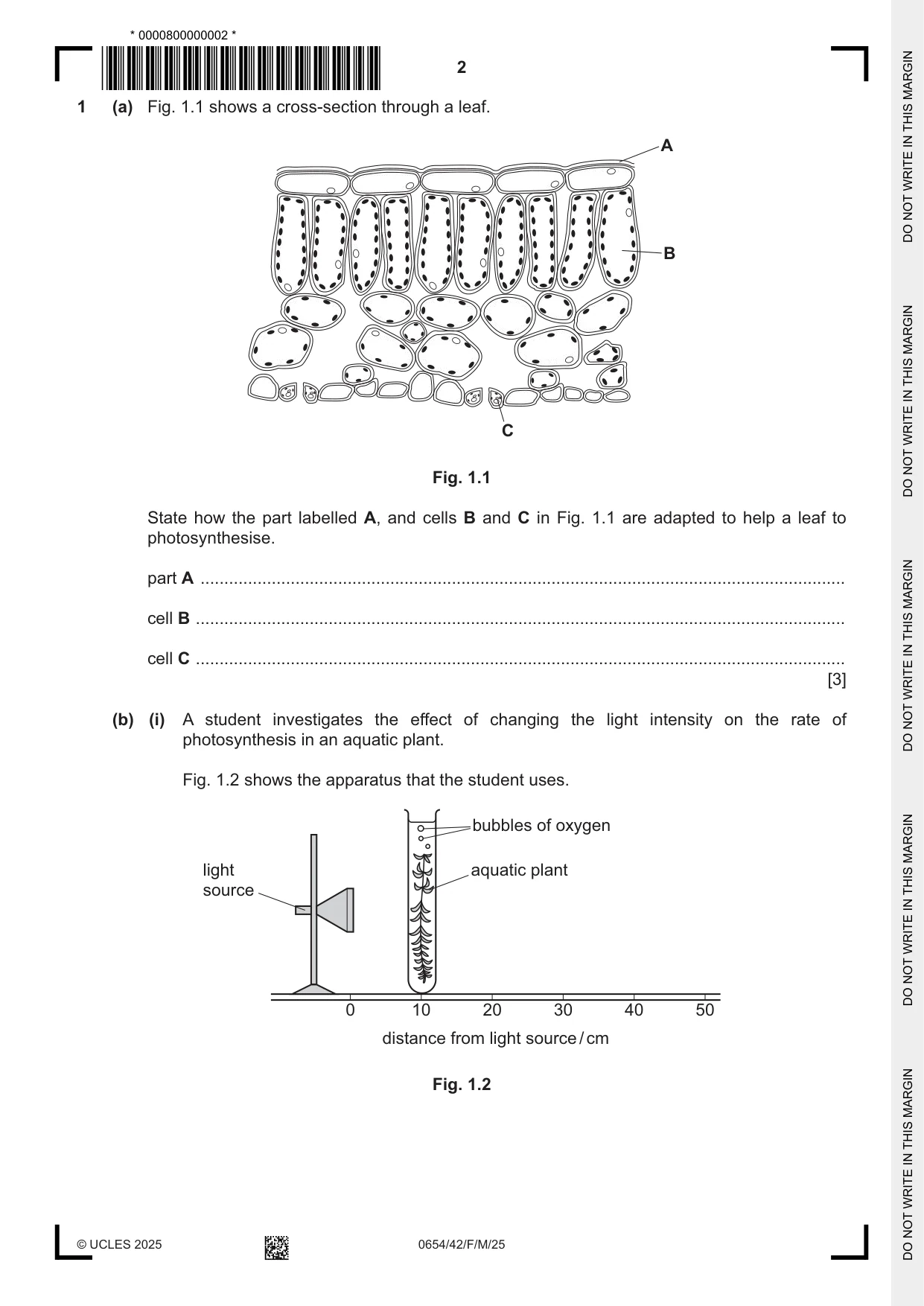
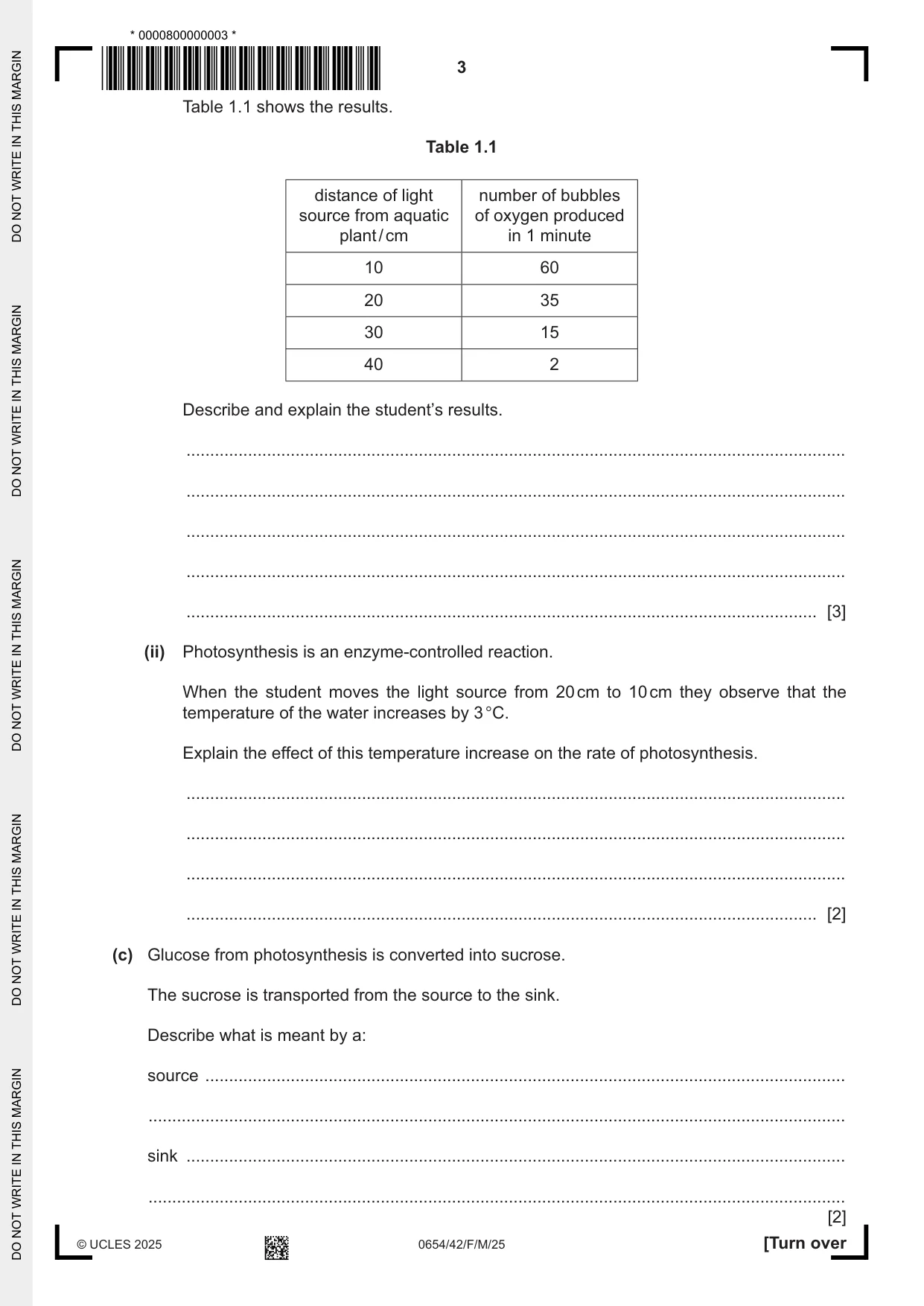
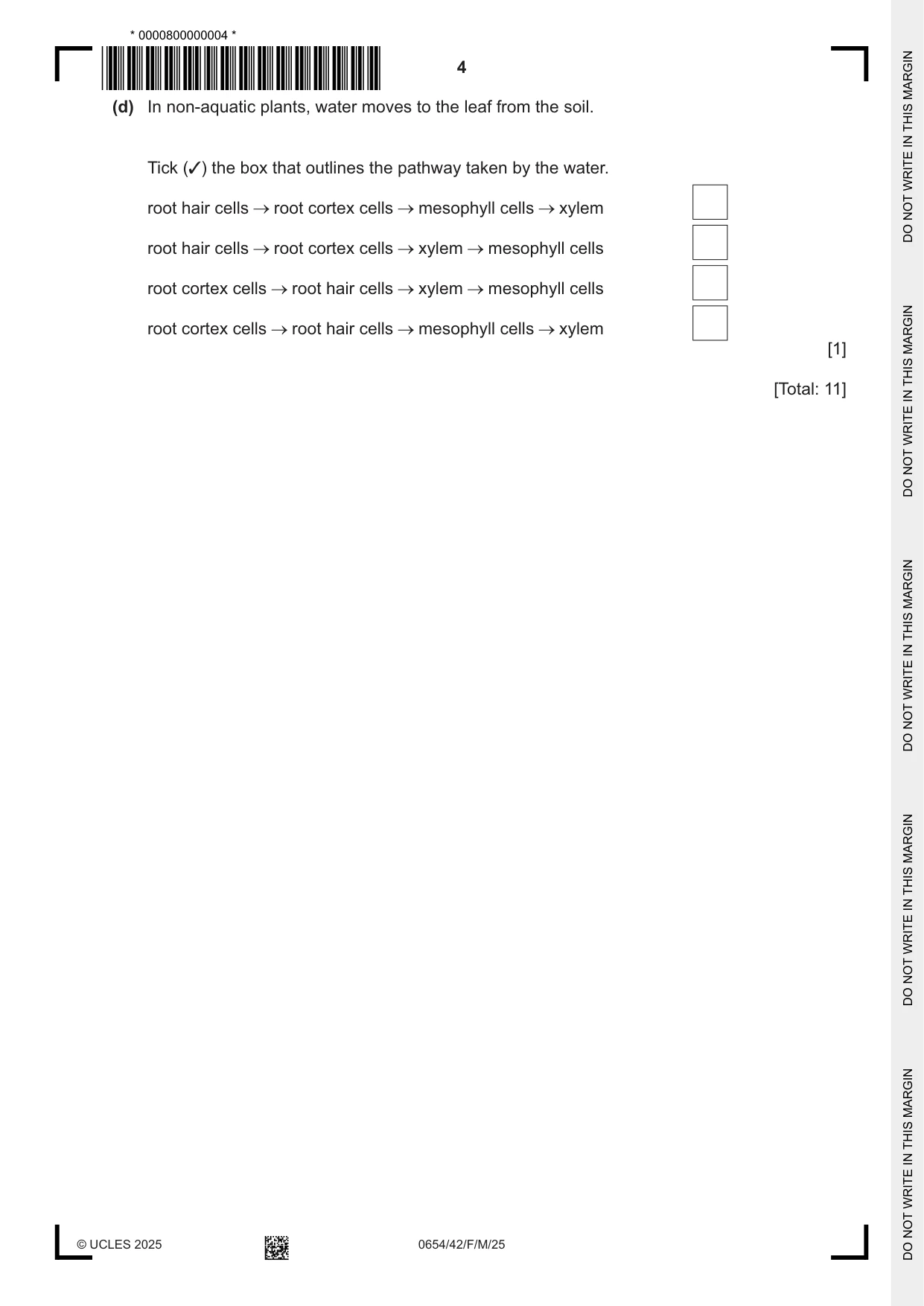
1 (a) Fig. 1.1 shows a cross-section through a leaf. A B C Fig. 1.1 State how the part labelled A, and cells B and C in Fig. 1.1 are adapted to help a leaf to photosynthesise. part A ........................................................................................................................................ cell B ......................................................................................................................................... cell C ......................................................................................................................................... [3] (b) (i) A student investigates the effect of changing the light intensity on the rate of photosynthesis in an aquatic plant. Fig. 1.2 shows the apparatus that the student uses. bubbles of oxygen light aquatic plant source 0 10 20 30 40 50 distance from light source / cm Fig. 1.2 Table 1.1 shows the results. Table 1.1 distance of light number of bubbles source from aquatic of oxygen produced plant / cm in 1 minute 10 60 20 35 30 15 40 2 Describe and explain the student’s results. ........................................................................................................................................... ........................................................................................................................................... ........................................................................................................................................... ........................................................................................................................................... ..................................................................................................................................... [3] (ii) Photosynthesis is an enzyme-controlled reaction. When the student moves the light source from 20 cm to 10 cm they observe that the temperature of the water increases by 3 °C. Explain the effect of this temperature increase on the rate of photosynthesis. ........................................................................................................................................... ........................................................................................................................................... ........................................................................................................................................... ..................................................................................................................................... [2] (c) Glucose from photosynthesis is converted into sucrose. The sucrose is transported from the source to the sink. Describe what is meant by a: source ....................................................................................................................................... ................................................................................................................................................... sink ........................................................................................................................................... ................................................................................................................................................... [2] (d) In non-aquatic plants, water moves to the leaf from the soil. Tick (✓) the box that outlines the pathway taken by the water. root hair cells root cortex cells mesophyll cells xylem root hair cells root cortex cells xylem mesophyll cells root cortex cells root hair cells xylem mesophyll cells root cortex cells root hair cells mesophyll cells xylem [1] [Total: 11]
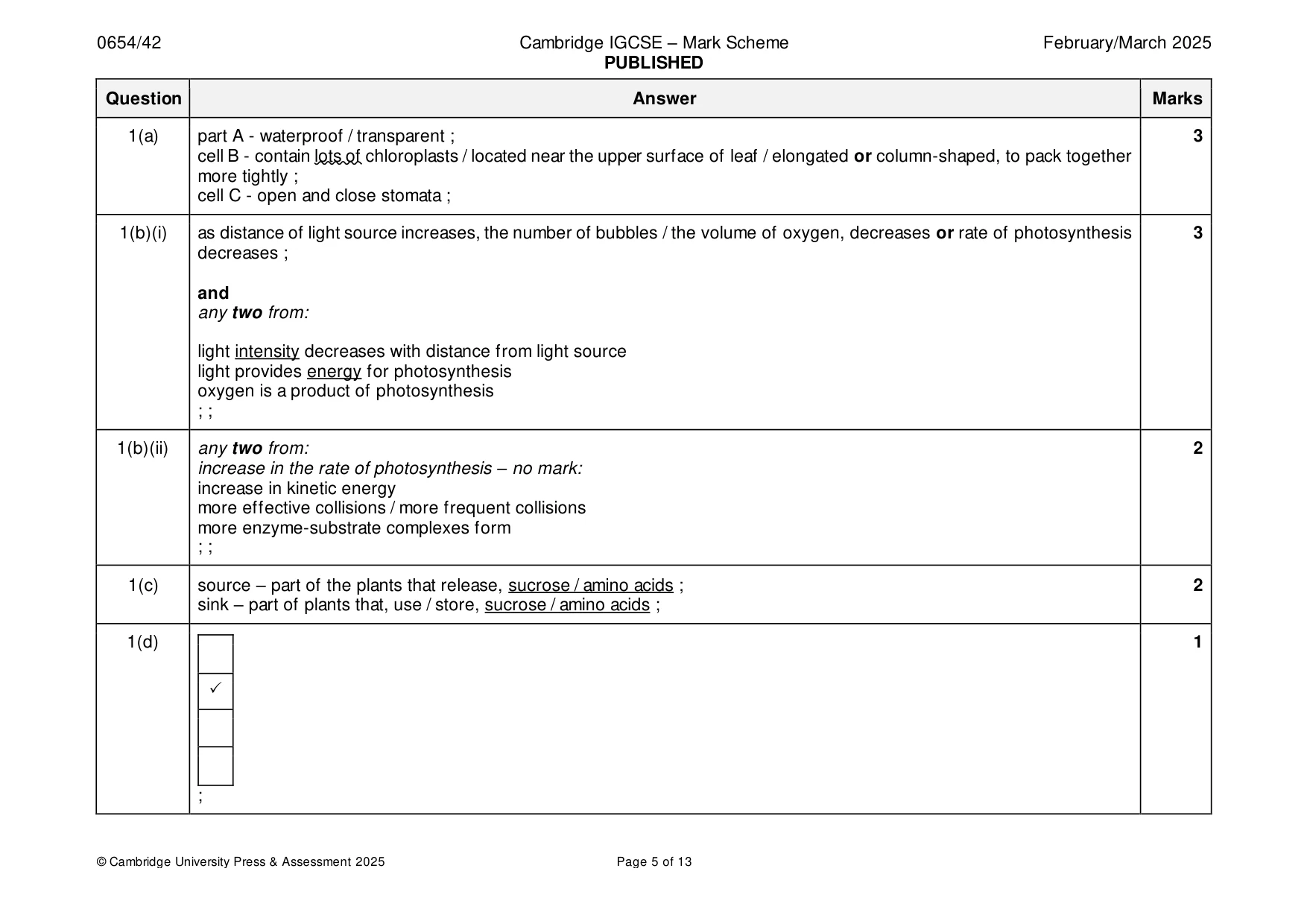
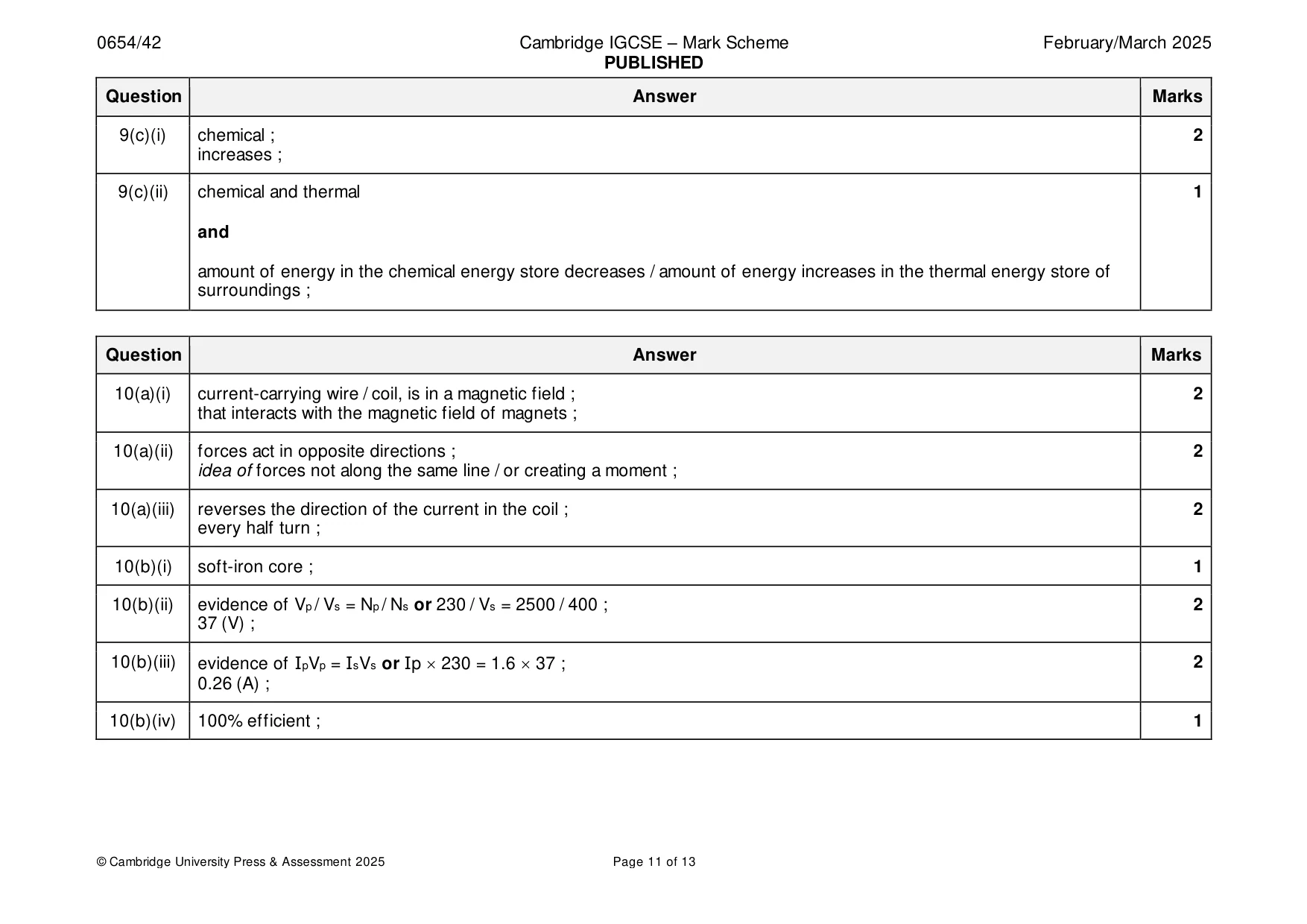
Mark scheme: Question Answer Marks 1(a) part A - waterproof / transparent ; 3 cell B - contain lots of chloroplasts / located near the upper surface of leaf / elongated or column-shaped, to pack together more tightly ; cell C - open and close stomata ; 1(b)(i) as distance of light source increases, the number of bubbles / the volume of oxygen, decreases or rate of photosynthesis 3 decreases ; and any two from: light intensity decreases with distance from light source light provides energy for photosynthesis oxygen is a product of photosynthesis ; ; 1(b)(ii) any two from: 2 increase in the rate of photosynthesis – no mark: increase in kinetic energy more effective collisions / more frequent collisions more enzyme-substrate complexes form ; ; 1(c) source – part of the plants that release, sucrose / amino acids ; 2 sink – part of plants that, use / store, sucrose / amino acids ; 1(d) 1 ;
Q2 · Water moves into plant cells by osmosis
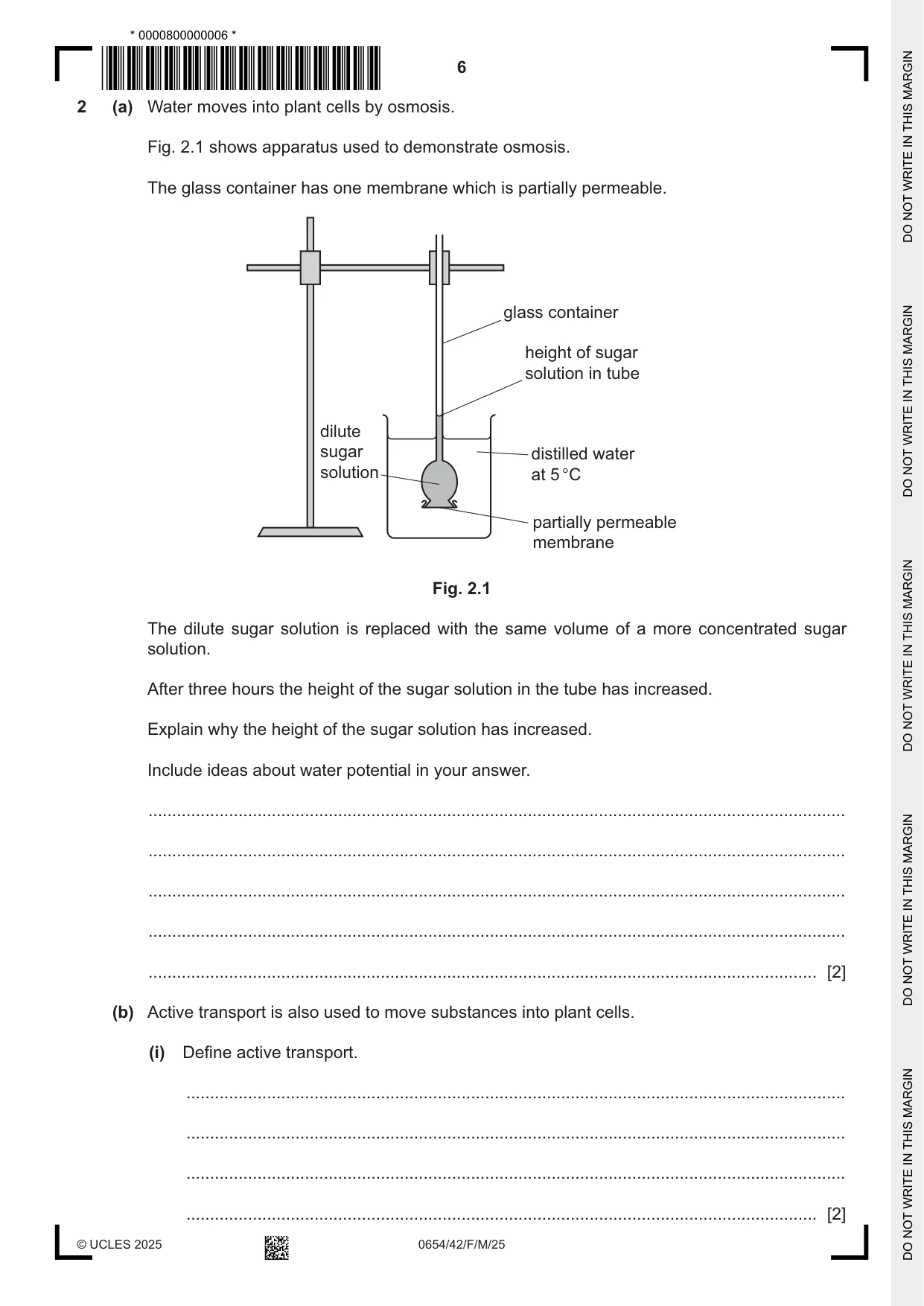
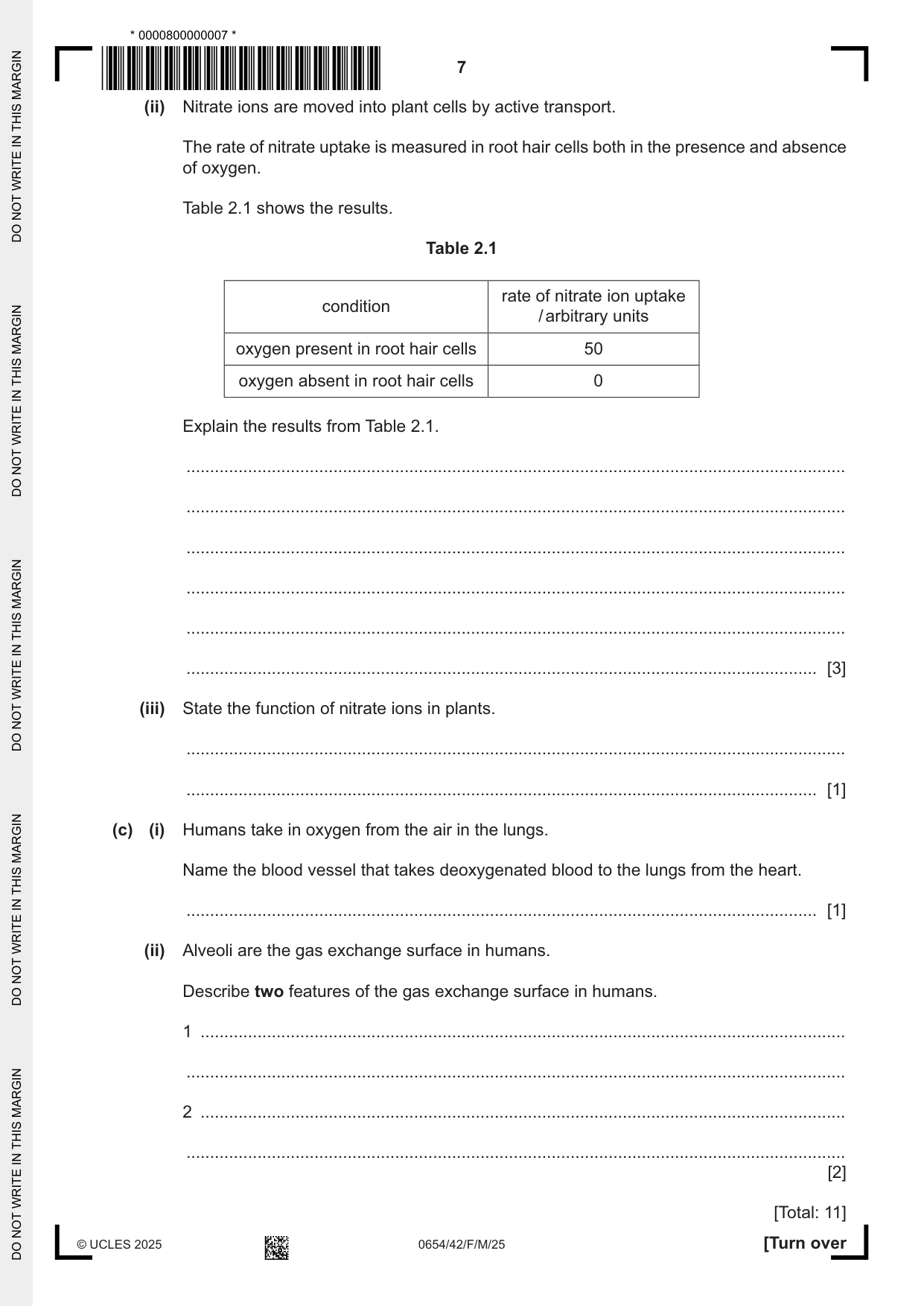
2 (a) Water moves into plant cells by osmosis. Fig. 2.1 shows apparatus used to demonstrate osmosis. The glass container has one membrane which is partially permeable. glass container height of sugar solution in tube dilute sugar distilled water solution at 5 °C partially permeable membrane Fig. 2.1 The dilute sugar solution is replaced with the same volume of a more concentrated sugar solution. After three hours the height of the sugar solution in the tube has increased. Explain why the height of the sugar solution has increased. Include ideas about water potential in your answer. ................................................................................................................................................... ................................................................................................................................................... ................................................................................................................................................... ................................................................................................................................................... ............................................................................................................................................. [2] (b) Active transport is also used to move substances into plant cells. (i) Define active transport. ........................................................................................................................................... ........................................................................................................................................... ........................................................................................................................................... ..................................................................................................................................... [2] (ii) Nitrate ions are moved into plant cells by active transport. The rate of nitrate uptake is measured in root hair cells both in the presence and absence of oxygen. Table 2.1 shows the results. Table 2.1 rate of nitrate ion uptake condition / arbitrary units oxygen present in root hair cells 50 oxygen absent in root hair cells 0 Explain the results from Table 2.1. ........................................................................................................................................... ........................................................................................................................................... ........................................................................................................................................... ........................................................................................................................................... ........................................................................................................................................... ..................................................................................................................................... [3] (iii) State the function of nitrate ions in plants. ........................................................................................................................................... ..................................................................................................................................... [1] (c) (i) Humans take in oxygen from the air in the lungs. Name the blood vessel that takes deoxygenated blood to the lungs from the heart. ..................................................................................................................................... [1] (ii) Alveoli are the gas exchange surface in humans. Describe two features of the gas exchange surface in humans. 1 ........................................................................................................................................ ........................................................................................................................................... 2 ........................................................................................................................................ ........................................................................................................................................... [2] [Total: 11]
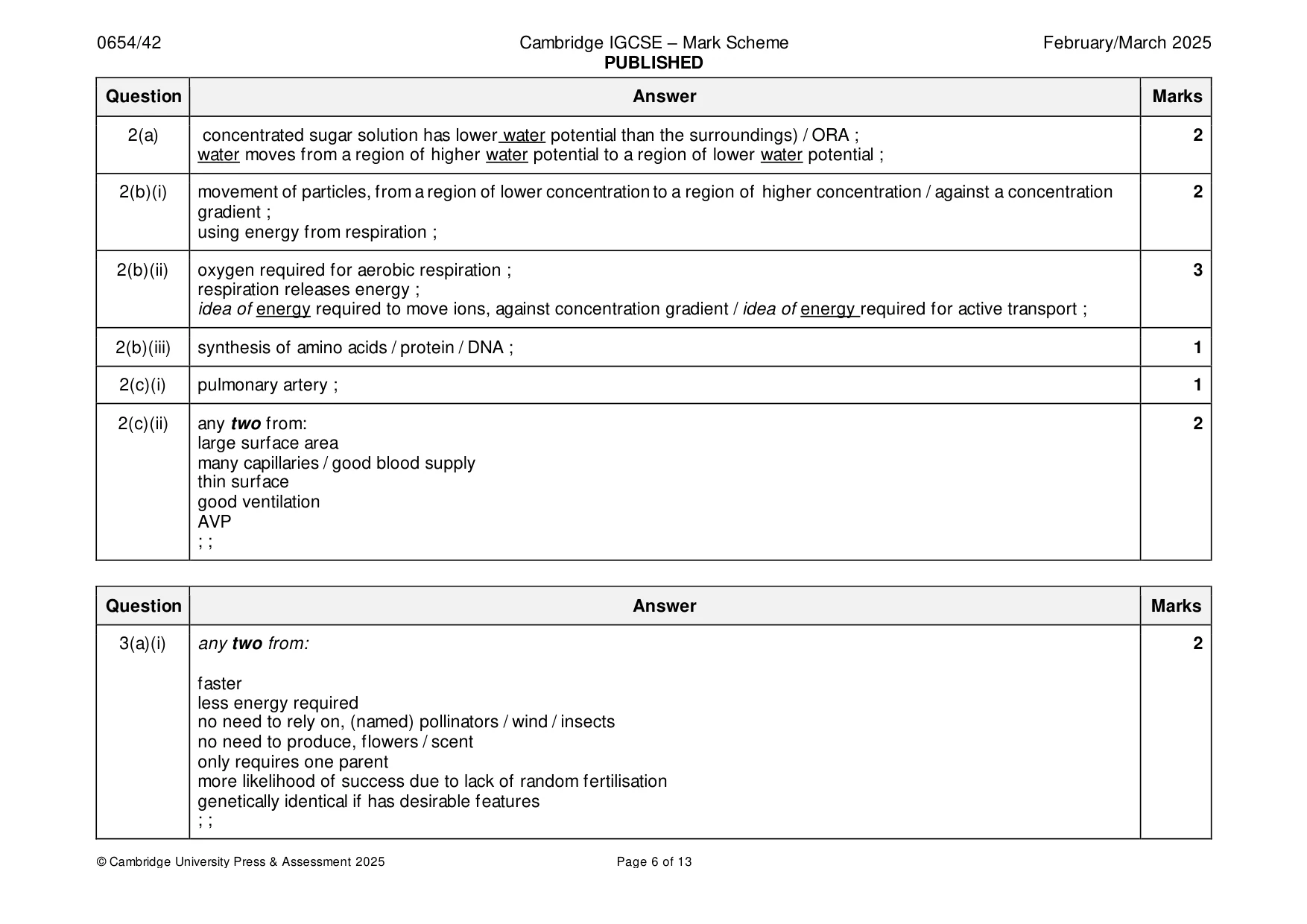
Mark scheme: 2(a) concentrated sugar solution has lower water potential than the surroundings) / ORA ; 2 water moves from a region of higher water potential to a region of lower water potential ; 2(b)(i) movement of particles, from a region of lower concentration to a region of higher concentration / against a concentration 2 gradient ; using energy from respiration ; 2(b)(ii) oxygen required for aerobic respiration ; 3 respiration releases energy ; idea of energy required to move ions, against concentration gradient / idea of energy required for active transport ; 2(b)(iii) synthesis of amino acids / protein / DNA ; 1 2(c)(i) pulmonary artery ; 1 2(c)(ii) any two from: 2 large surface area many capillaries / good blood supply thin surface good ventilation AVP ; ;
Q3 · A violet plant bought from a shop
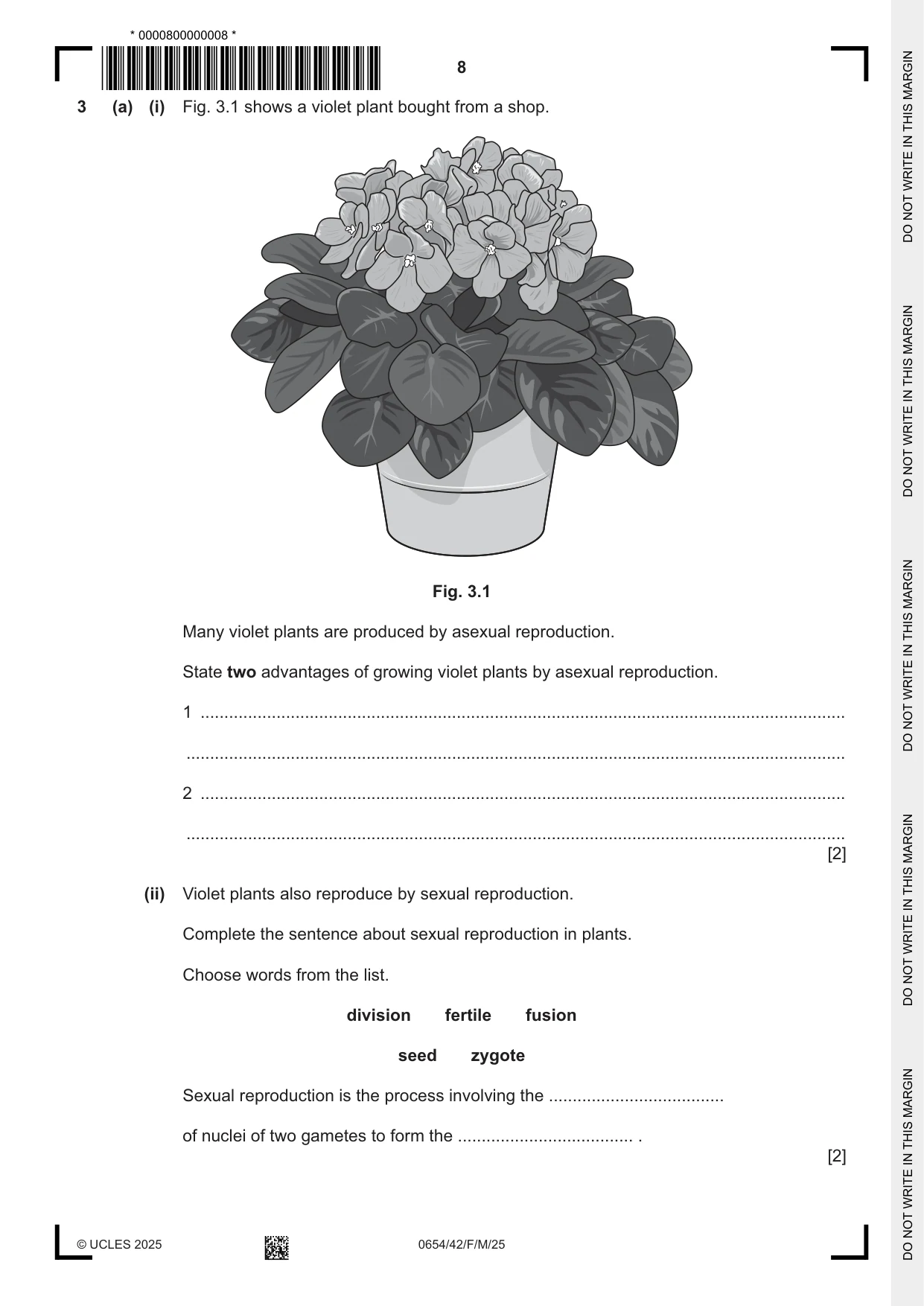
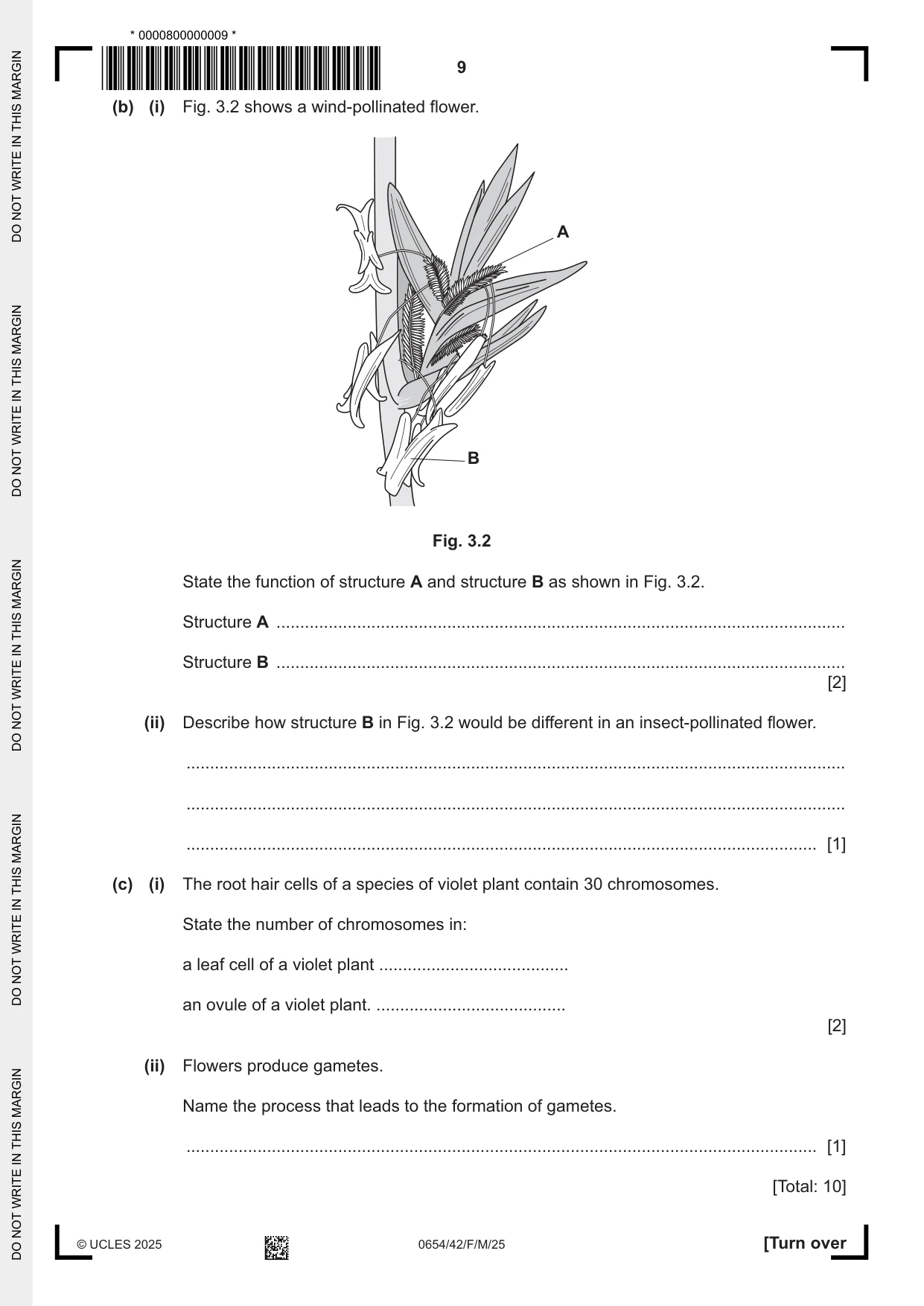
3 (a) (i) Fig. 3.1 shows a violet plant bought from a shop. Fig. 3.1 Many violet plants are produced by asexual reproduction. State two advantages of growing violet plants by asexual reproduction. 1 ........................................................................................................................................ ........................................................................................................................................... 2 ........................................................................................................................................ ........................................................................................................................................... [2] (ii) Violet plants also reproduce by sexual reproduction. Complete the sentence about sexual reproduction in plants. Choose words from the list. division fertile fusion seed zygote Sexual reproduction is the process involving the ..................................... of nuclei of two gametes to form the ..................................... . [2] (b) (i) Fig. 3.2 shows a wind-pollinated flower. A B Fig. 3.2 State the function of structure A and structure B as shown in Fig. 3.2. Structure A ........................................................................................................................ Structure B ........................................................................................................................ [2] (ii) Describe how structure B in Fig. 3.2 would be different in an insect-pollinated flower. ........................................................................................................................................... ........................................................................................................................................... ..................................................................................................................................... [1] (c) (i) The root hair cells of a species of violet plant contain 30 chromosomes. State the number of chromosomes in: a leaf cell of a violet plant ........................................ an ovule of a violet plant. ........................................ [2] (ii) Flowers produce gametes. Name the process that leads to the formation of gametes. ..................................................................................................................................... [1] [Total: 10]
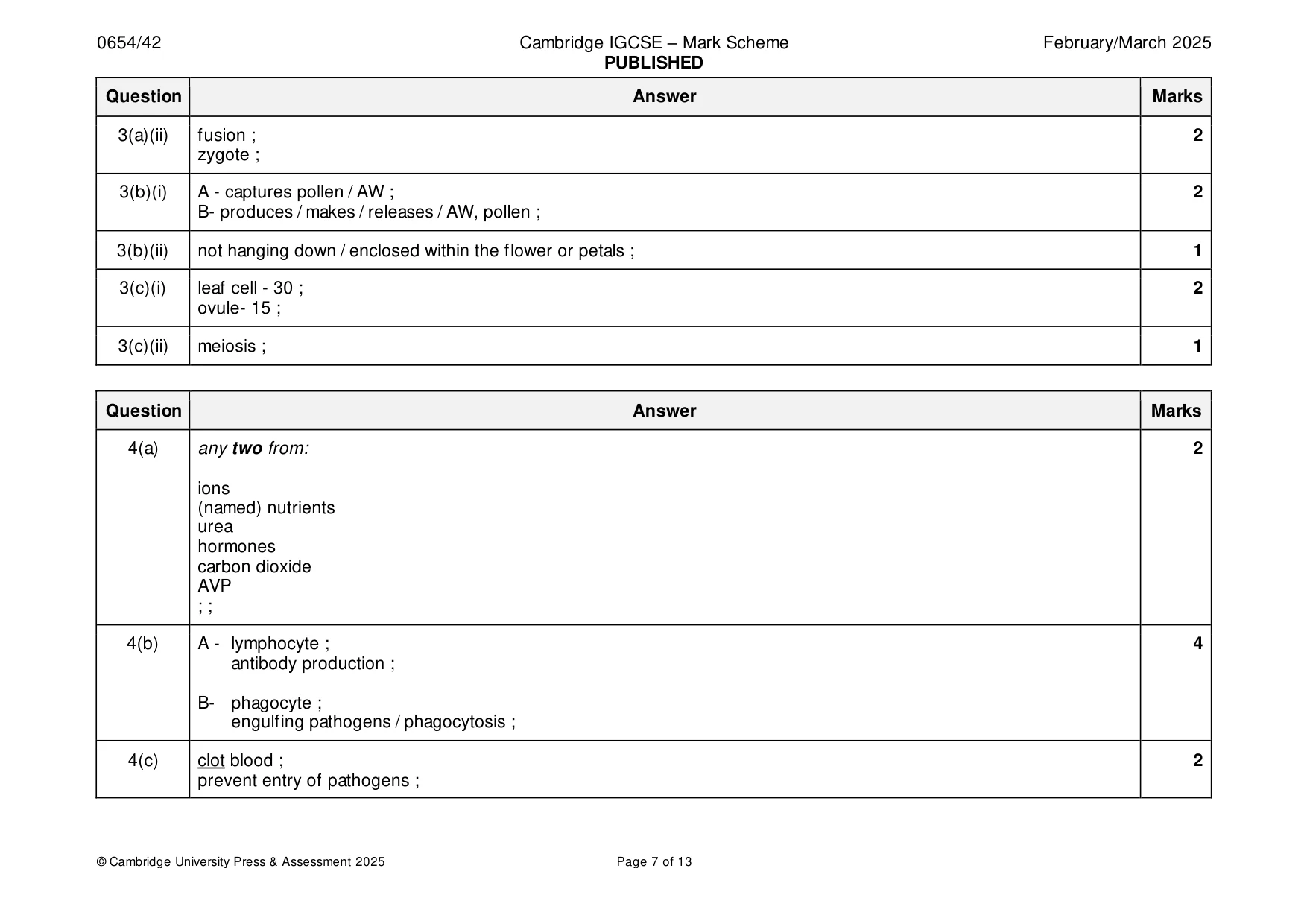
Mark scheme: 3(a)(i) any two from: 2 faster less energy required no need to rely on, (named) pollinators / wind / insects no need to produce, flowers / scent only requires one parent more likelihood of success due to lack of random fertilisation genetically identical if has desirable features ; ; 3(a)(ii) fusion ; 2 zygote ; 3(b)(i) A - captures pollen / AW ; 2 B- produces / makes / releases / AW, pollen ; 3(b)(ii) not hanging down / enclosed within the flower or petals ; 1 3(c)(i) leaf cell - 30 ; 2 ovule- 15 ; 3(c)(ii) meiosis ; 1
Q4 · Blood plasma transports blood cells and platelets
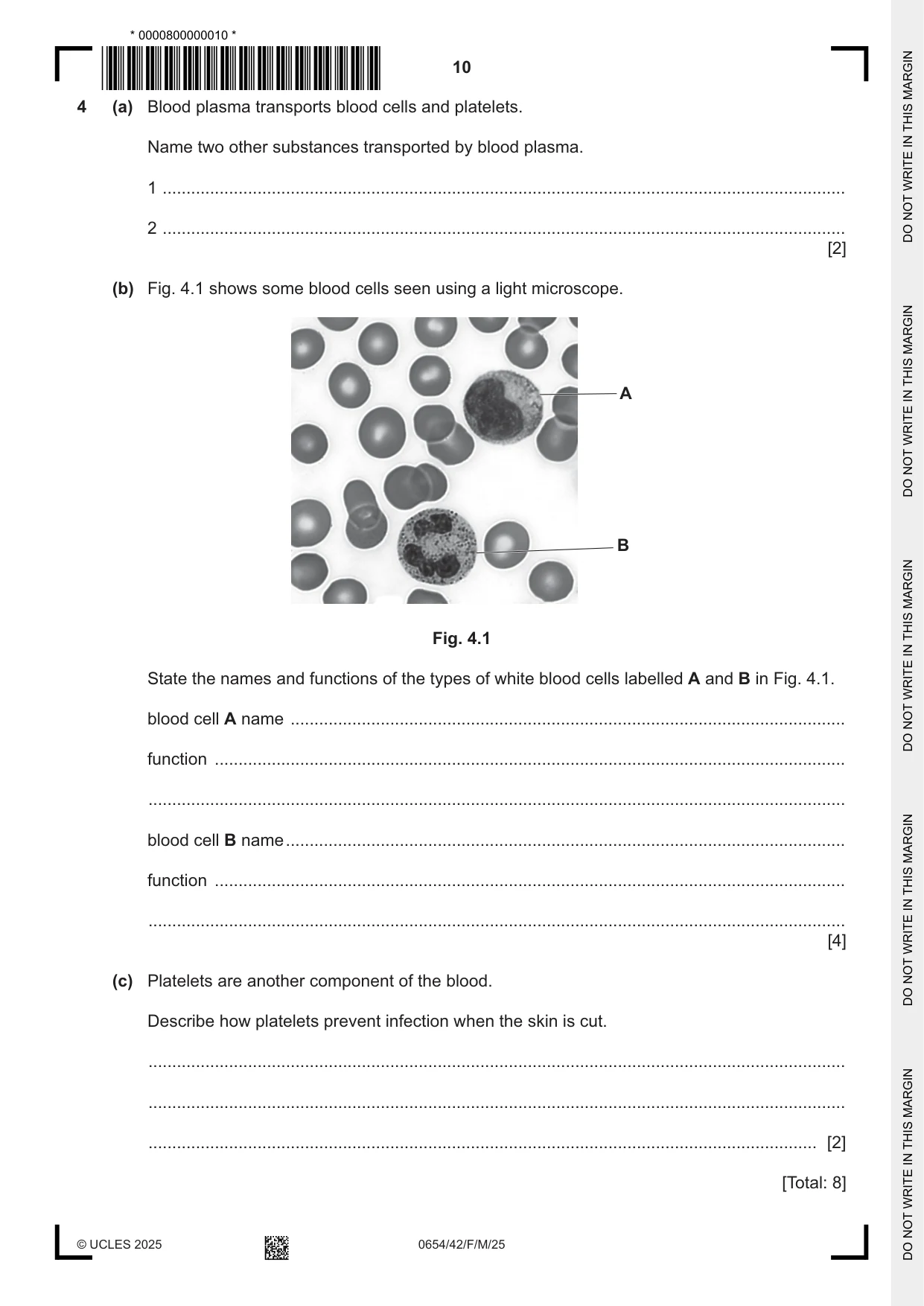
4 (a) Blood plasma transports blood cells and platelets. Name two other substances transported by blood plasma. 1 ................................................................................................................................................ 2 ................................................................................................................................................ [2] (b) Fig. 4.1 shows some blood cells seen using a light microscope. A B Fig. 4.1 State the names and functions of the types of white blood cells labelled A and B in Fig. 4.1. blood cell A name ..................................................................................................................... function ..................................................................................................................................... ................................................................................................................................................... blood cell B name ...................................................................................................................... function ..................................................................................................................................... ................................................................................................................................................... [4] (c) Platelets are another component of the blood. Describe how platelets prevent infection when the skin is cut. ................................................................................................................................................... ................................................................................................................................................... ............................................................................................................................................. [2] [Total: 8]
Mark scheme: 4(a) any two from: 2 ions (named) nutrients urea hormones carbon dioxide AVP ; ; 4(b) A - lymphocyte ; 4 antibody production ; B- phagocyte ; engulfing pathogens / phagocytosis ; 4(c) clot blood ; 2 prevent entry of pathogens ;
Q5 · The electronic configuration of an aluminium atom
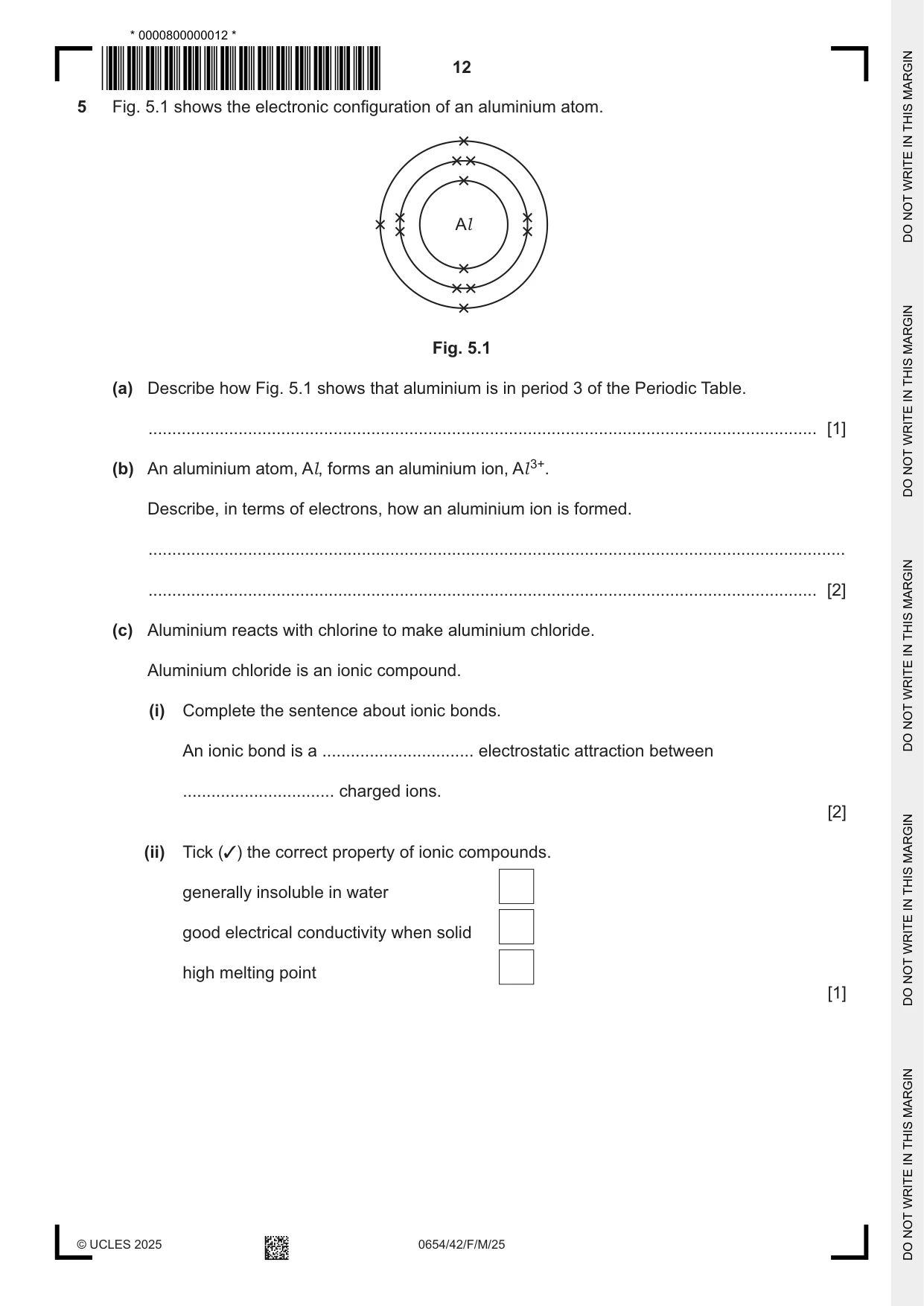
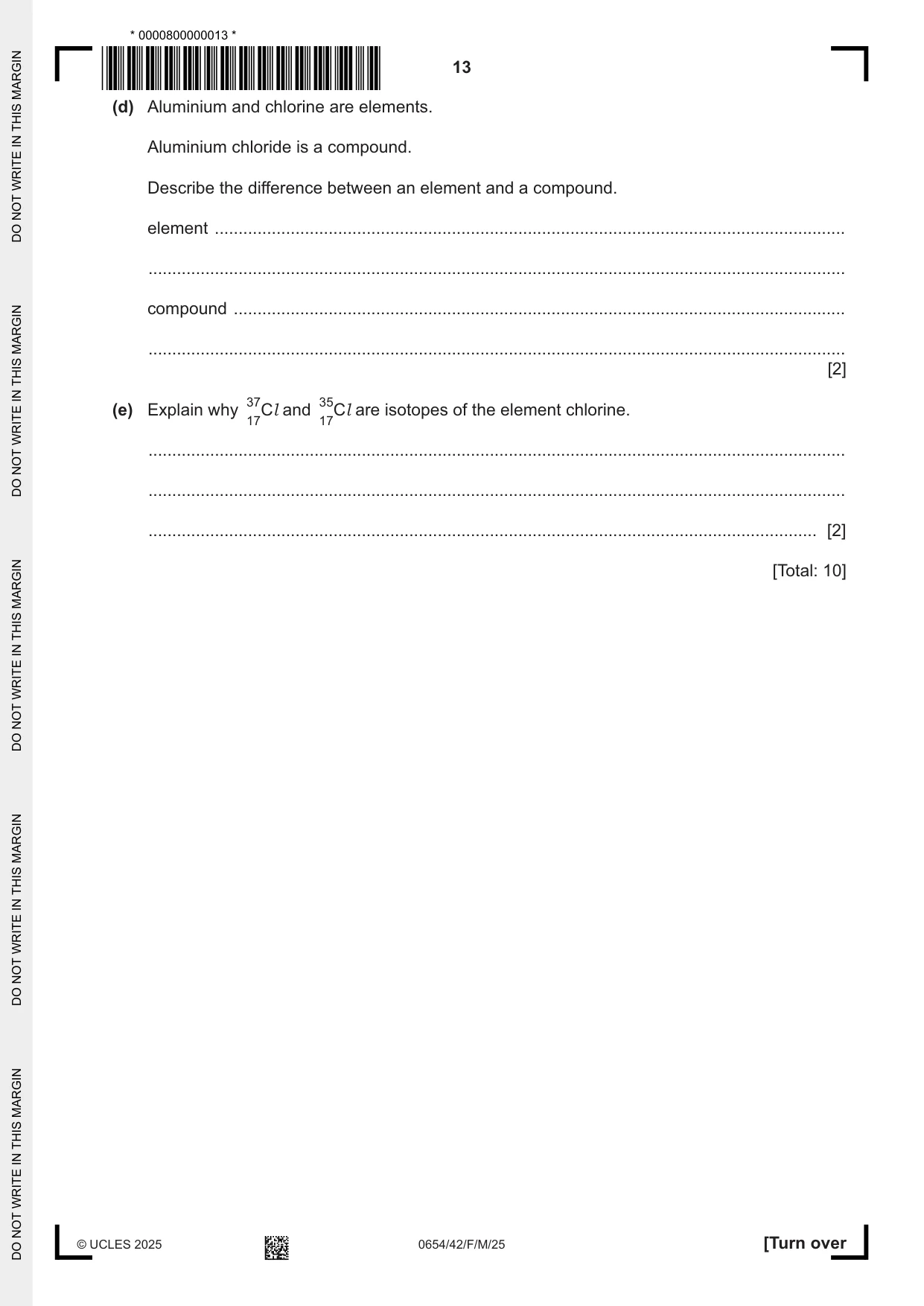
5 Fig. 5.1 shows the electronic configuration of an aluminium atom. Al Fig. 5.1 (a) Describe how Fig. 5.1 shows that aluminium is in period 3 of the Periodic Table. ............................................................................................................................................. [1] (b) An aluminium atom, Al, forms an aluminium ion, Al 3+. Describe, in terms of electrons, how an aluminium ion is formed. ................................................................................................................................................... ............................................................................................................................................. [2] (c) Aluminium reacts with chlorine to make aluminium chloride. Aluminium chloride is an ionic compound. (i) Complete the sentence about ionic bonds. An ionic bond is a ................................ electrostatic attraction between ................................ charged ions. [2] (ii) Tick (✓) the correct property of ionic compounds. generally insoluble in water good electrical conductivity when solid high melting point [1] (d) Aluminium and chlorine are elements. Aluminium chloride is a compound. Describe the difference between an element and a compound. element ..................................................................................................................................... ................................................................................................................................................... compound ................................................................................................................................. ................................................................................................................................................... [2] 37 35 (e) Explain why 17Cl and 17Cl are isotopes of the element chlorine. ................................................................................................................................................... ................................................................................................................................................... ............................................................................................................................................. [2] [Total: 10]
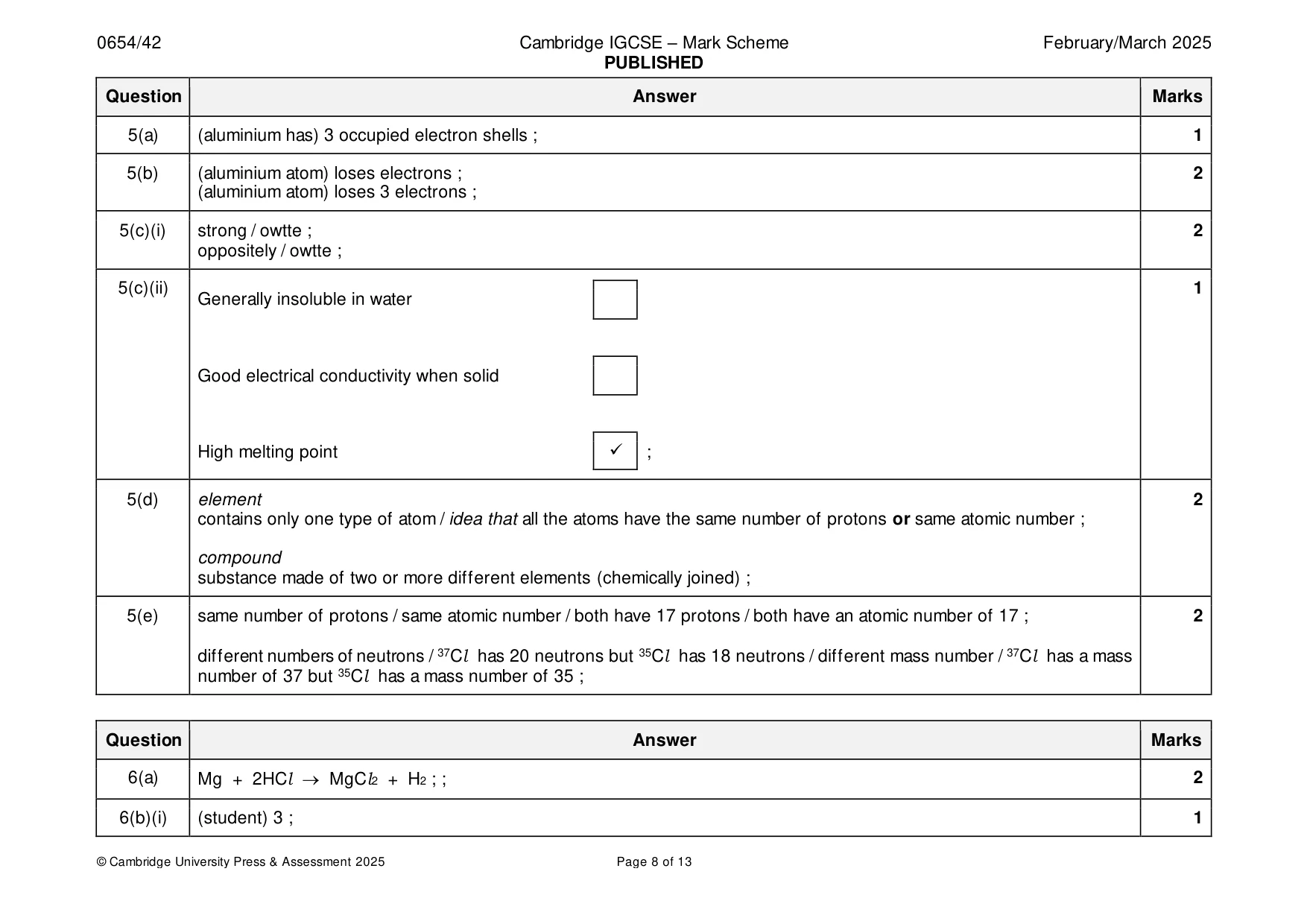
Mark scheme: 5(a) (aluminium has) 3 occupied electron shells ; 1 5(b) (aluminium atom) loses electrons ; 2 (aluminium atom) loses 3 electrons ; 5(c)(i) strong / owtte ; 2 oppositely / owtte ; 5(c)(ii) 1 Generally insoluble in water Good electrical conductivity when solid High melting point ✓ ; 5(d) element 2 contains only one type of atom / idea that all the atoms have the same number of protons or same atomic number ; compound substance made of two or more different elements (chemically joined) ; 5(e) same number of protons / same atomic number / both have 17 protons / both have an atomic number of 17 ; 2 different numbers of neutrons / 37Cl has 20 neutrons but 35Cl has 18 neutrons / different mass number / 37Cl has a mass number of 37 but 35Cl has a mass number of 35 ;
Q6 · Magnesium reacts with dilute hydrochloric acid
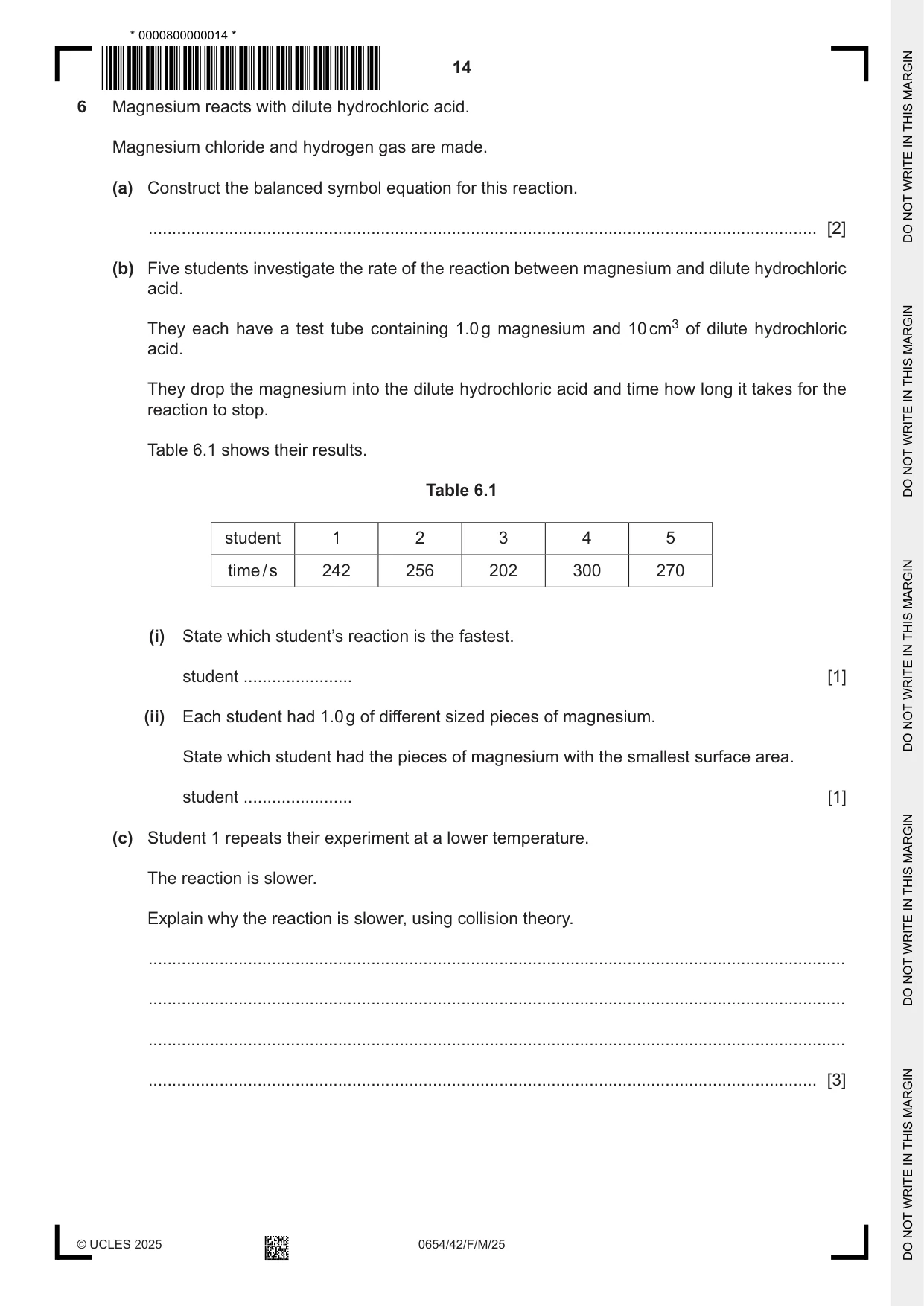
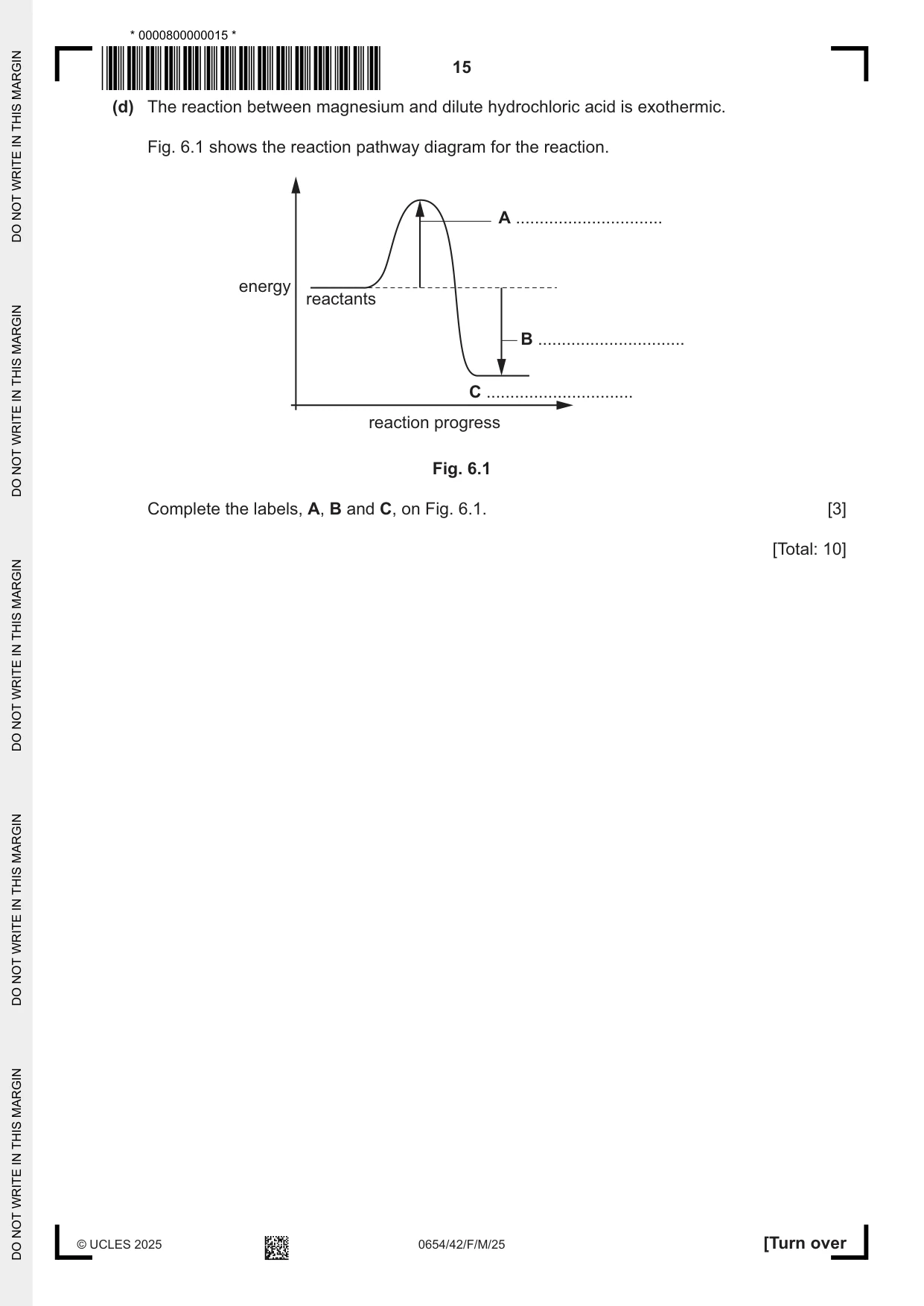
6 Magnesium reacts with dilute hydrochloric acid. Magnesium chloride and hydrogen gas are made. (a) Construct the balanced symbol equation for this reaction. ............................................................................................................................................. [2] (b) Five students investigate the rate of the reaction between magnesium and dilute hydrochloric acid. They each have a test tube containing 1.0 g magnesium and 10 cm3 of dilute hydrochloric acid. They drop the magnesium into the dilute hydrochloric acid and time how long it takes for the reaction to stop. Table 6.1 shows their results. Table 6.1 student 1 2 3 4 5 time / s 242 256 202 300 270 (i) State which student’s reaction is the fastest. student ....................... [1] (ii) Each student had 1.0 g of different sized pieces of magnesium. State which student had the pieces of magnesium with the smallest surface area. student ....................... [1] (c) Student 1 repeats their experiment at a lower temperature. The reaction is slower. Explain why the reaction is slower, using collision theory. ................................................................................................................................................... ................................................................................................................................................... ................................................................................................................................................... ............................................................................................................................................. [3] (d) The reaction between magnesium and dilute hydrochloric acid is exothermic. Fig. 6.1 shows the reaction pathway diagram for the reaction. A ............................... energy reactants B ............................... C ............................... reaction progress Fig. 6.1 Complete the labels, A, B and C, on Fig. 6.1. [3] [Total: 10]
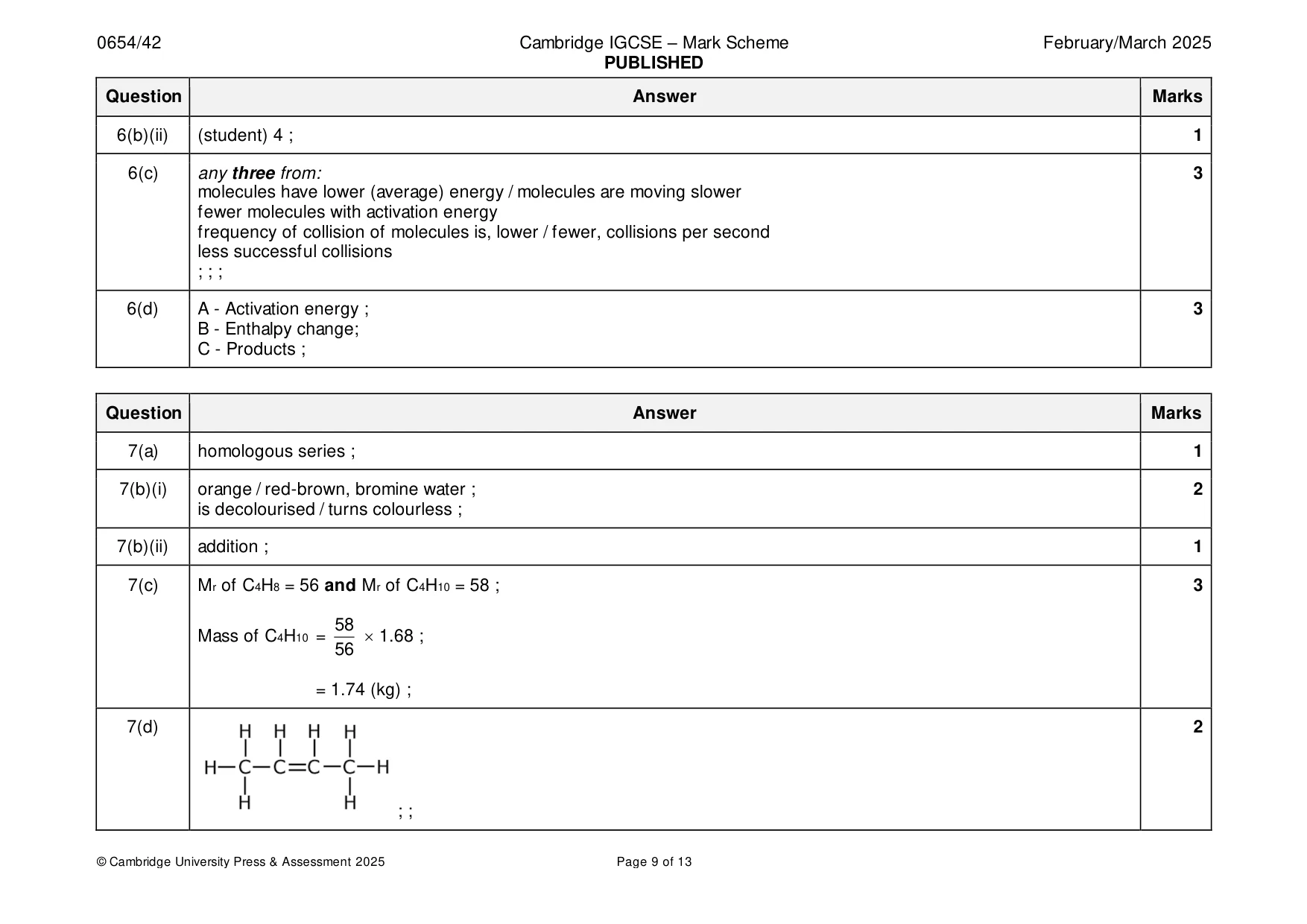
Mark scheme: 6(a) Mg + 2HCl → MgCl2 + H2 ; ; 2 6(b)(i) (student) 3 ; 1 6(b)(ii) (student) 4 ; 1 6(c) any three from: 3 molecules have lower (average) energy / molecules are moving slower fewer molecules with activation energy frequency of collision of molecules is, lower / fewer, collisions per second less successful collisions ; ; ; 6(d) A - Activation energy ; 3 B - Enthalpy change; C - Products ;
Q7 · The alkenes are a family of similar compounds with similar chemical properties
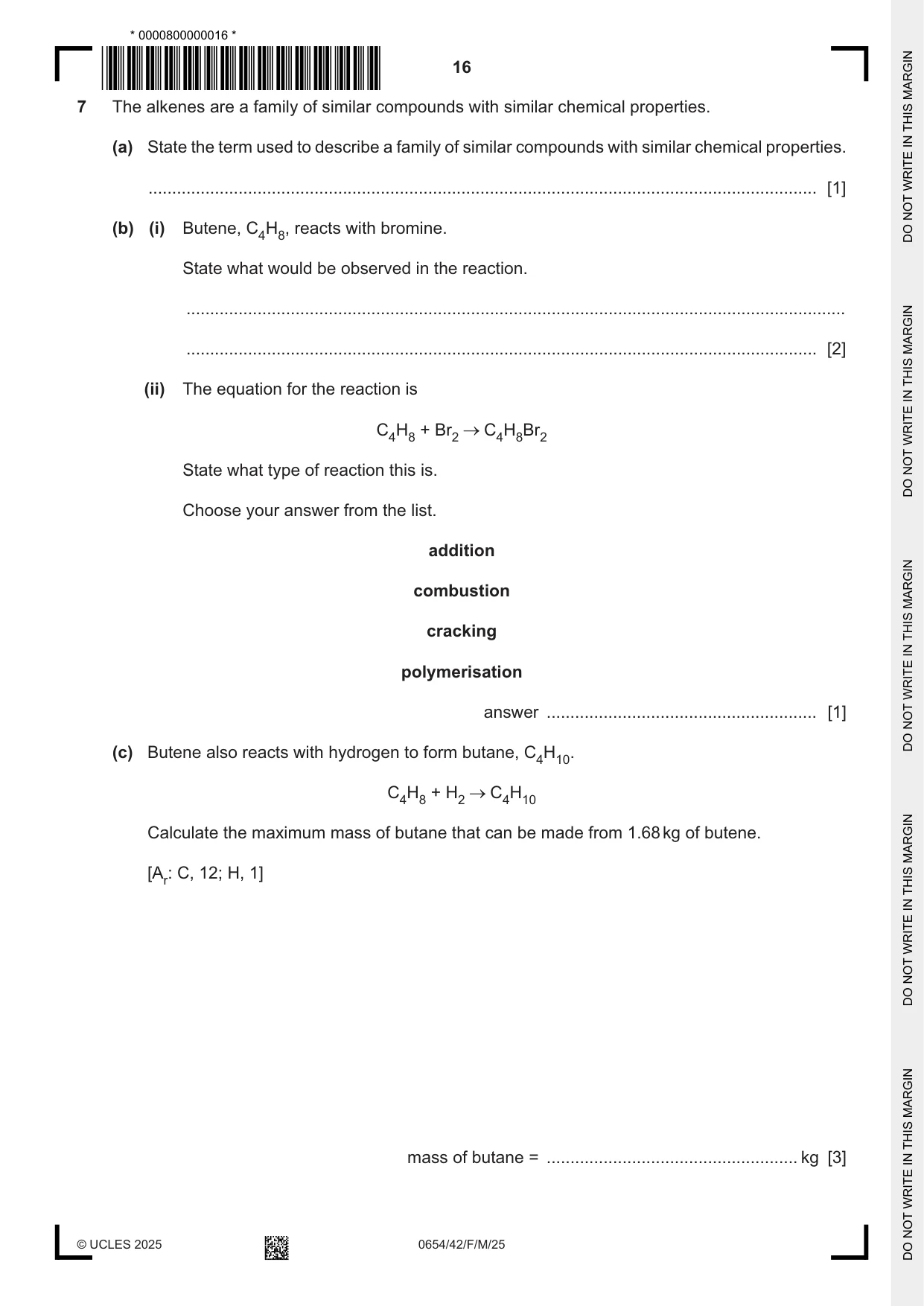
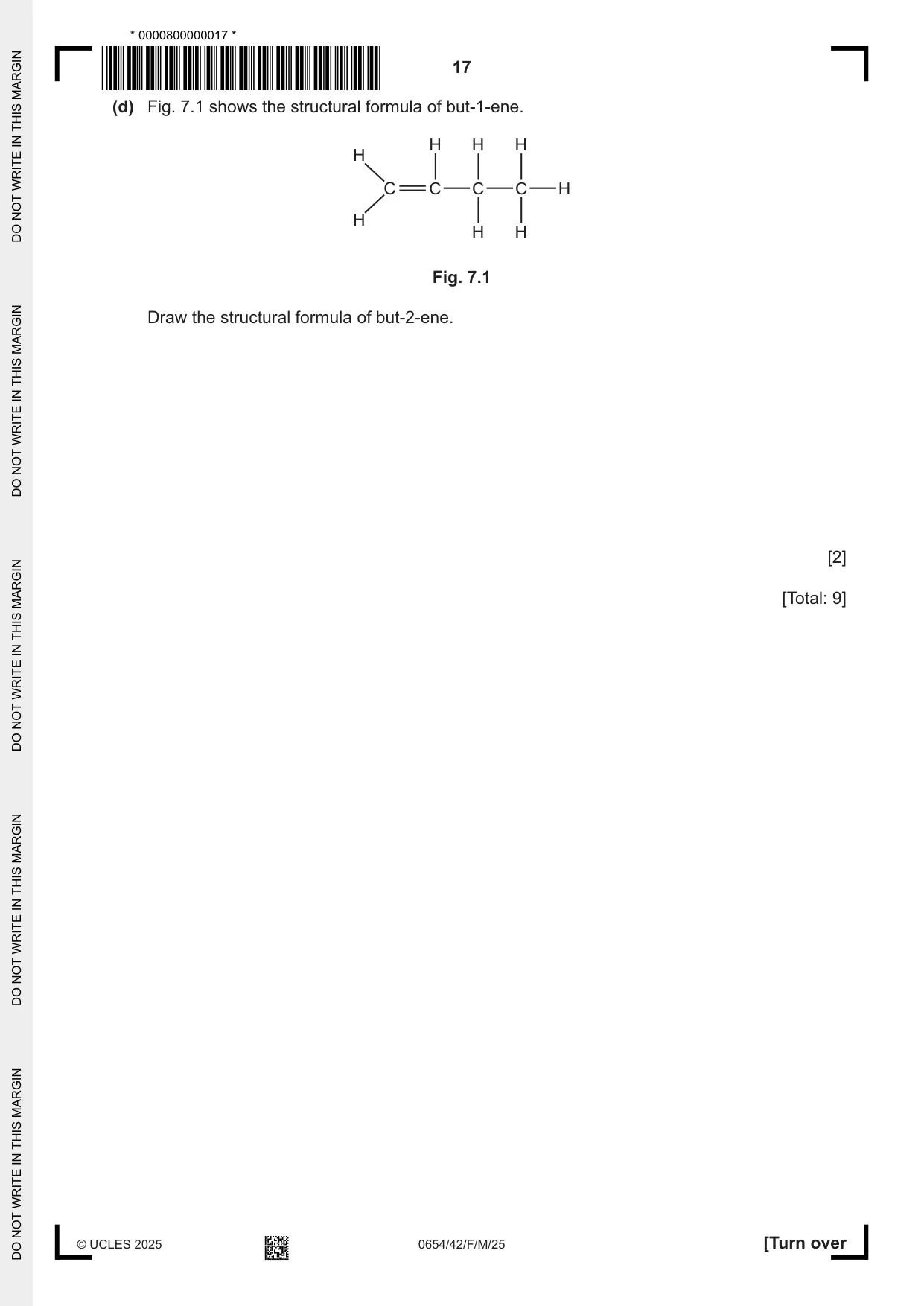
7 The alkenes are a family of similar compounds with similar chemical properties. (a) State the term used to describe a family of similar compounds with similar chemical properties. ............................................................................................................................................. [1] (b) (i) Butene, C4H8, reacts with bromine. State what would be observed in the reaction. ........................................................................................................................................... ..................................................................................................................................... [2] (ii) The equation for the reaction is C4H8 + Br2 C4H8Br2 State what type of reaction this is. Choose your answer from the list. addition combustion cracking polymerisation answer ......................................................... [1] (c) Butene also reacts with hydrogen to form butane, C4H10. C4H8 + H2 C4H10 Calculate the maximum mass of butane that can be made from 1.68 kg of butene. [Ar: C, 12; H, 1] mass of butane = ..................................................... kg [3] (d) Fig. 7.1 shows the structural formula of but-1-ene. H H H H C C C C H H H H Fig. 7.1 Draw the structural formula of but-2-ene. [2] [Total: 9]
Mark scheme: 7(a) homologous series ; 1 7(b)(i) orange / red-brown, bromine water ; 2 is decolourised / turns colourless ; 7(b)(ii) addition ; 1 7(c) Mr of C4H8 = 56 and Mr of C4H10 = 58 ; 3 58 Mass of C4H10 = 1.68 ; 56 = 1.74 (kg) ; 7(d) 2 ; ;
Q8 · The electrolysis of aqueous copper sulfate using graphite electrodes
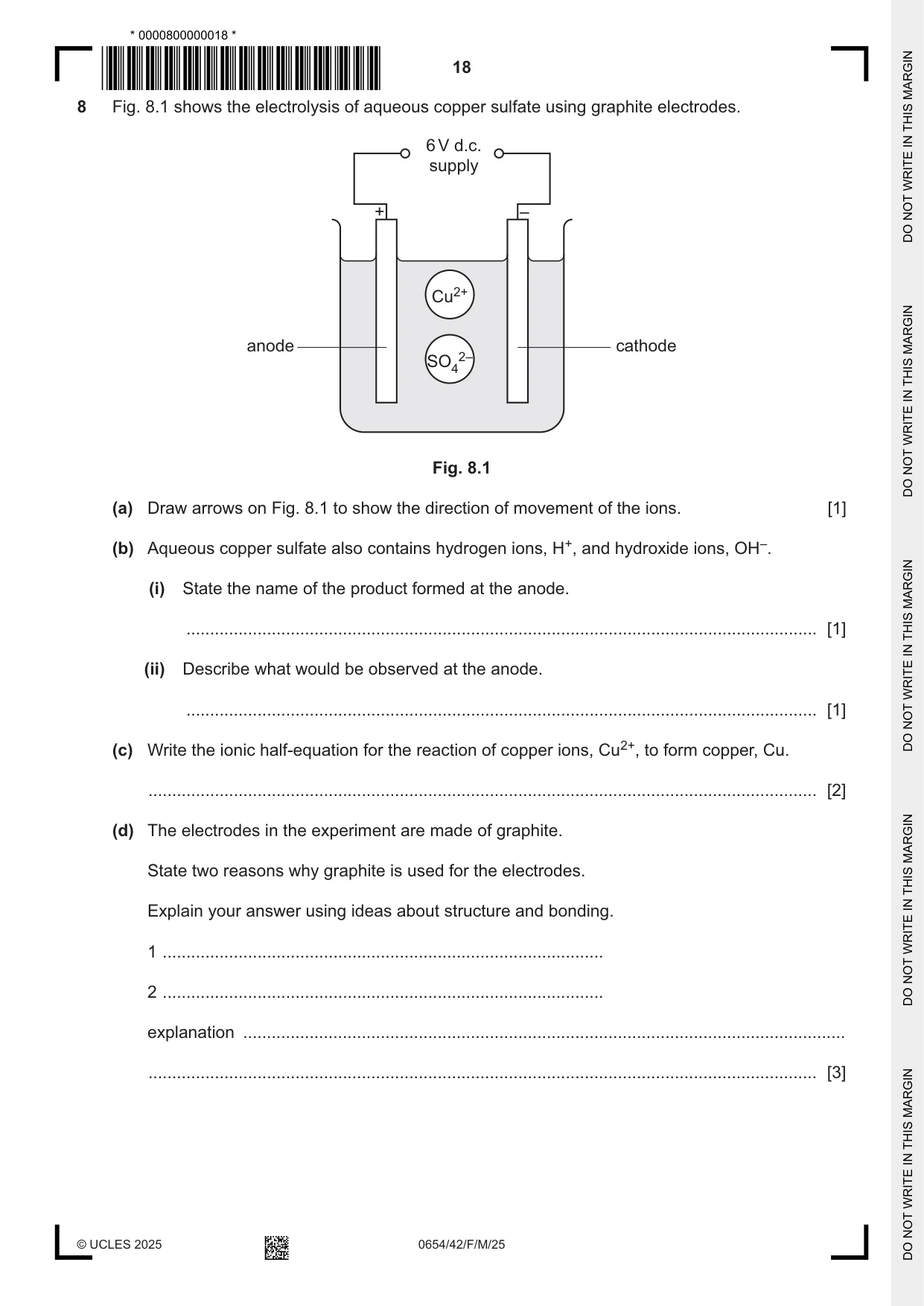
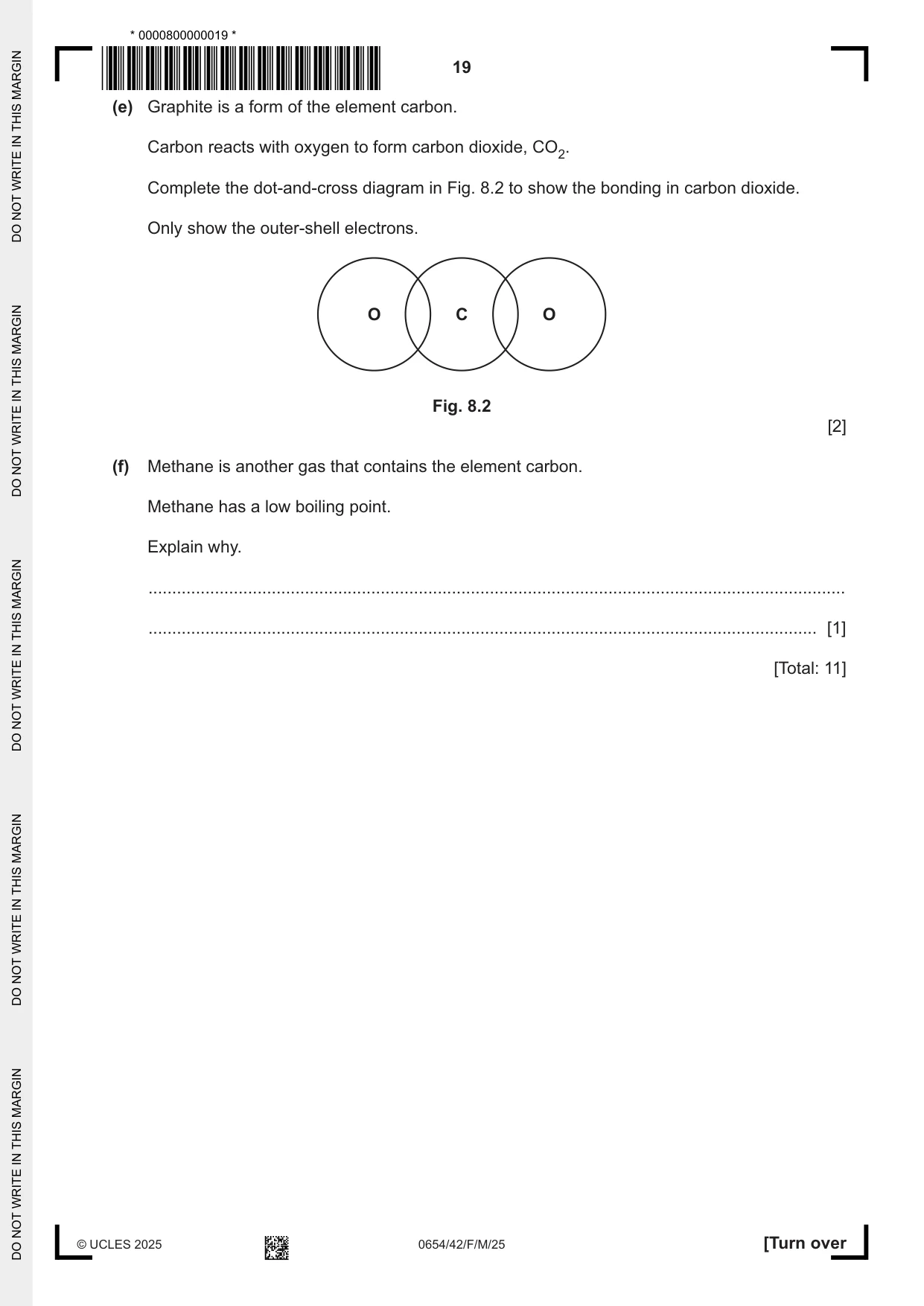
8 Fig. 8.1 shows the electrolysis of aqueous copper sulfate using graphite electrodes. 6 V d.c. supply + – Cu2+ anode cathode SO42– Fig. 8.1 (a) Draw arrows on Fig. 8.1 to show the direction of movement of the ions. [1] (b) Aqueous copper sulfate also contains hydrogen ions, H+, and hydroxide ions, OH–. (i) State the name of the product formed at the anode. ..................................................................................................................................... [1] (ii) Describe what would be observed at the anode. ..................................................................................................................................... [1] (c) Write the ionic half-equation for the reaction of copper ions, Cu2+, to form copper, Cu. ............................................................................................................................................. [2] (d) The electrodes in the experiment are made of graphite. State two reasons why graphite is used for the electrodes. Explain your answer using ideas about structure and bonding. 1 ............................................................................................. 2 ............................................................................................. explanation ............................................................................................................................... ............................................................................................................................................. [3] (e) Graphite is a form of the element carbon. Carbon reacts with oxygen to form carbon dioxide, CO2. Complete the dot-and-cross diagram in Fig. 8.2 to show the bonding in carbon dioxide. Only show the outer-shell electrons. O C O Fig. 8.2 [2] (f) Methane is another gas that contains the element carbon. Methane has a low boiling point. Explain why. ................................................................................................................................................... ............................................................................................................................................. [1] [Total: 11]
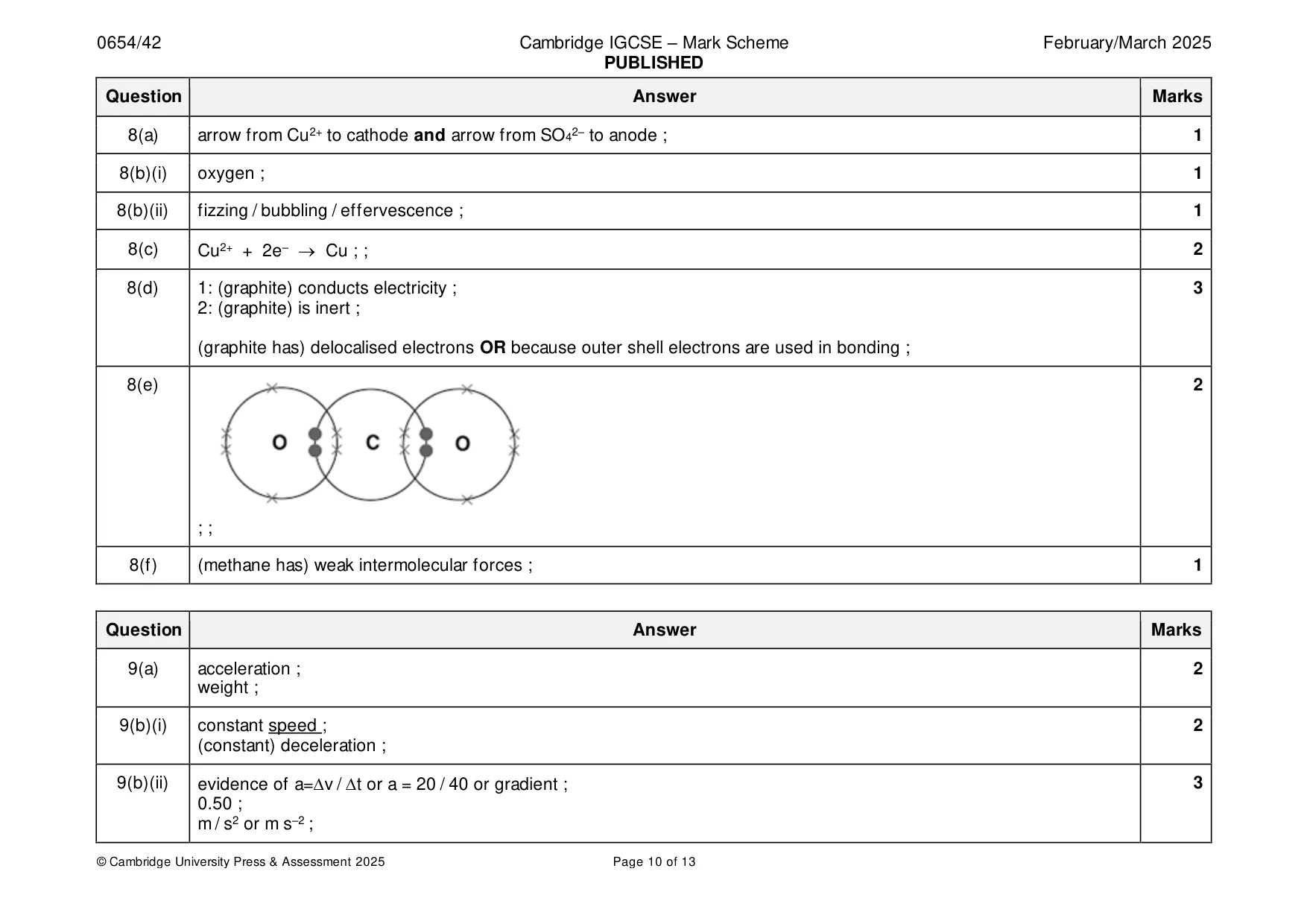
Mark scheme: 8(a) arrow from Cu2+ to cathode and arrow from SO42– to anode ; 1 8(b)(i) oxygen ; 1 8(b)(ii) fizzing / bubbling / effervescence ; 1 8(c) Cu2+ + 2e– → Cu ; ; 2 8(d) 1: (graphite) conducts electricity ; 3 2: (graphite) is inert ; (graphite has) delocalised electrons OR because outer shell electrons are used in bonding ; 8(e) 2 ; ; 8(f) (methane has) weak intermolecular forces ; 1
Q9 · Circle two vector quantities
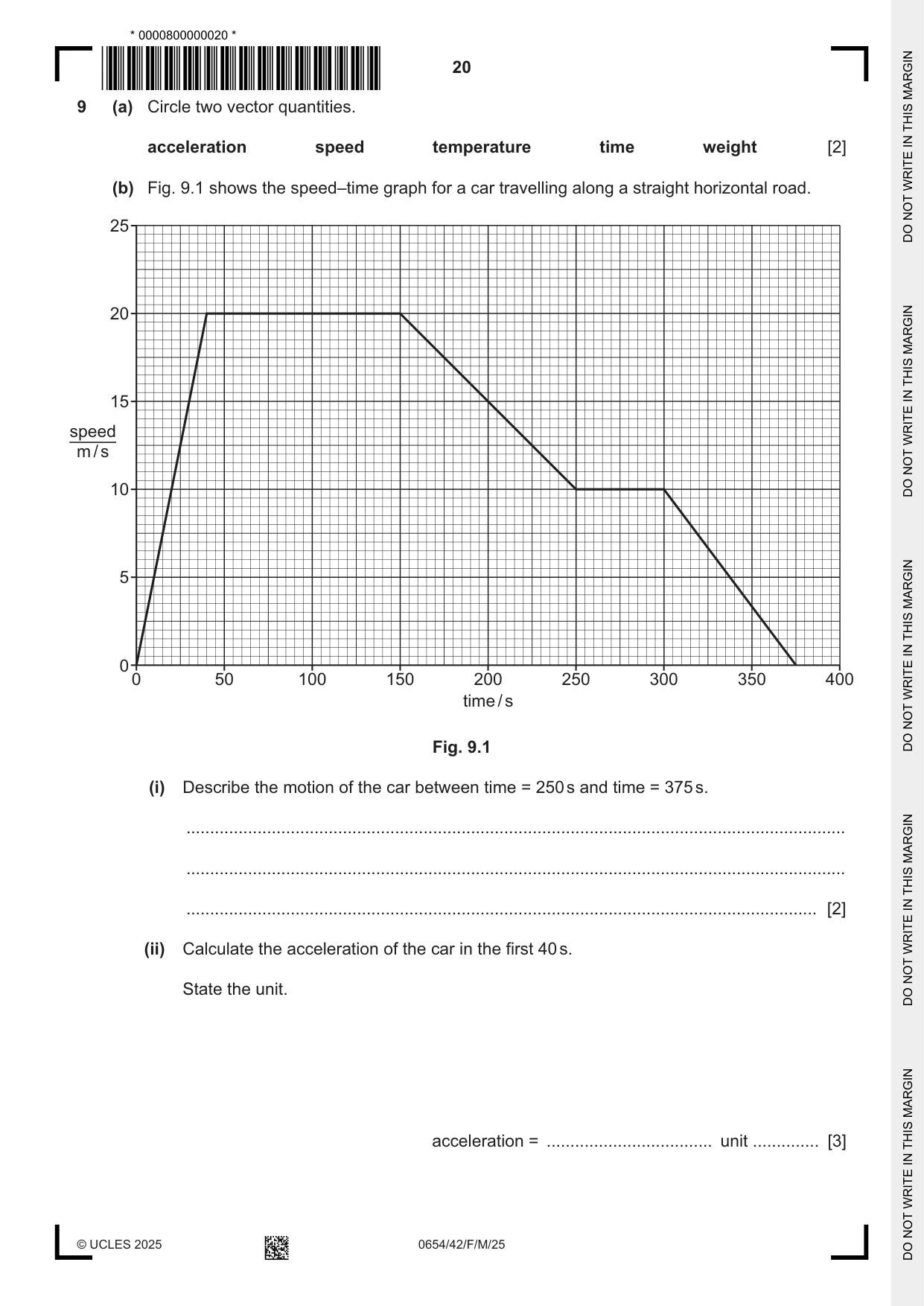
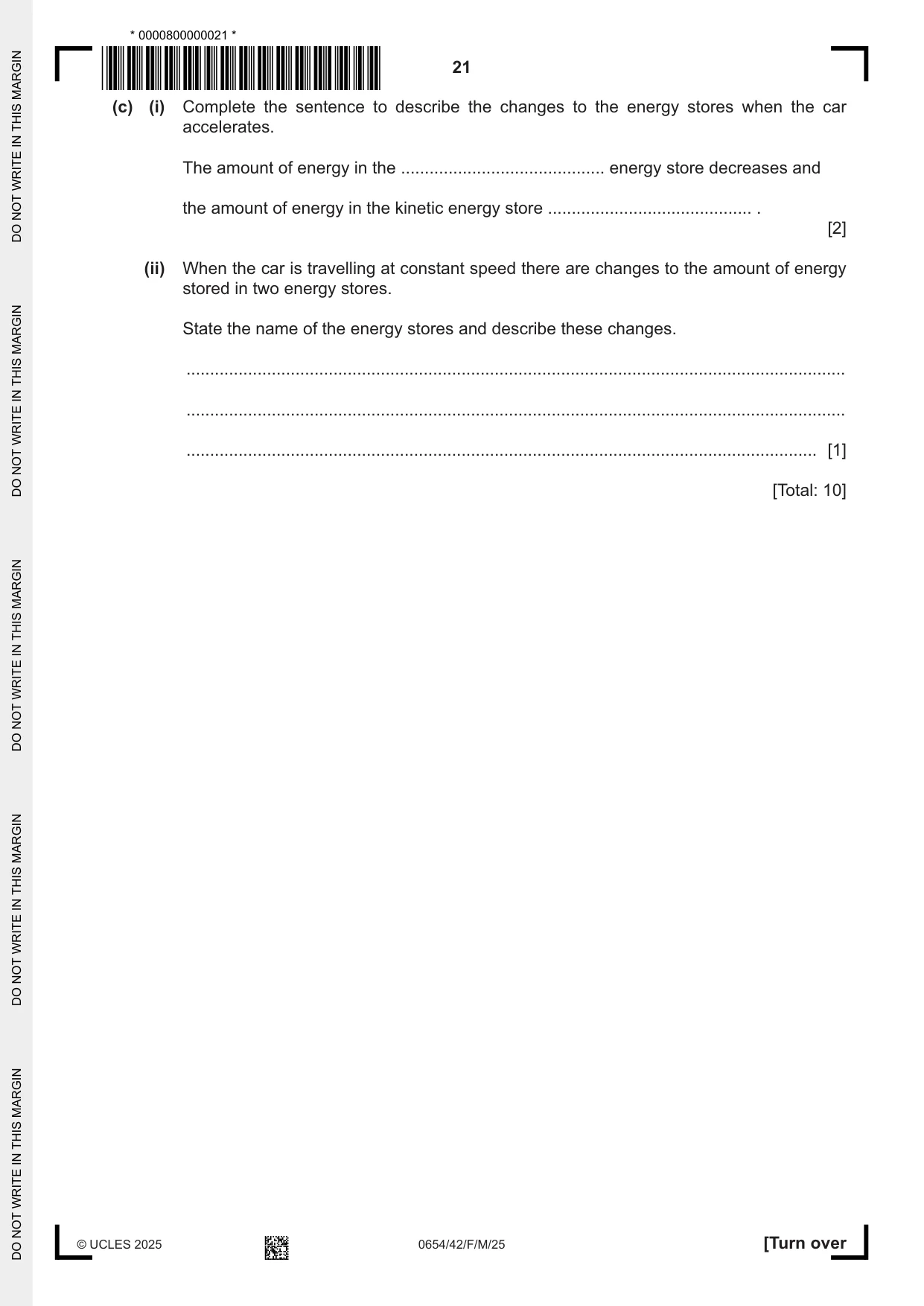
9 (a) Circle two vector quantities. acceleration speed temperature time weight [2] (b) Fig. 9.1 shows the speed–time graph for a car travelling along a straight horizontal road. 25 20 15 speed m / s 10 5 0 0 50 100 150 200 250 300 350 400 time / s Fig. 9.1 (i) Describe the motion of the car between time = 250 s and time = 375 s. ........................................................................................................................................... ........................................................................................................................................... ..................................................................................................................................... [2] (ii) Calculate the acceleration of the car in the first 40 s. State the unit. acceleration = ................................... unit .............. [3] (c) (i) Complete the sentence to describe the changes to the energy stores when the car accelerates. The amount of energy in the ........................................... energy store decreases and the amount of energy in the kinetic energy store ........................................... . [2] (ii) When the car is travelling at constant speed there are changes to the amount of energy stored in two energy stores. State the name of the energy stores and describe these changes. ........................................................................................................................................... ........................................................................................................................................... ..................................................................................................................................... [1] [Total: 10]
Mark scheme: 9(a) acceleration ; 2 weight ; 9(b)(i) constant speed ; 2 (constant) deceleration ; 9(b)(ii) evidence of a=v / t or a = 20 / 40 or gradient ; 3 0.50 ; m / s2 or m s–2 ; 9(c)(i) chemical ; 2 increases ; 9(c)(ii) chemical and thermal 1 and amount of energy in the chemical energy store decreases / amount of energy increases in the thermal energy store of surroundings ;
Question 10
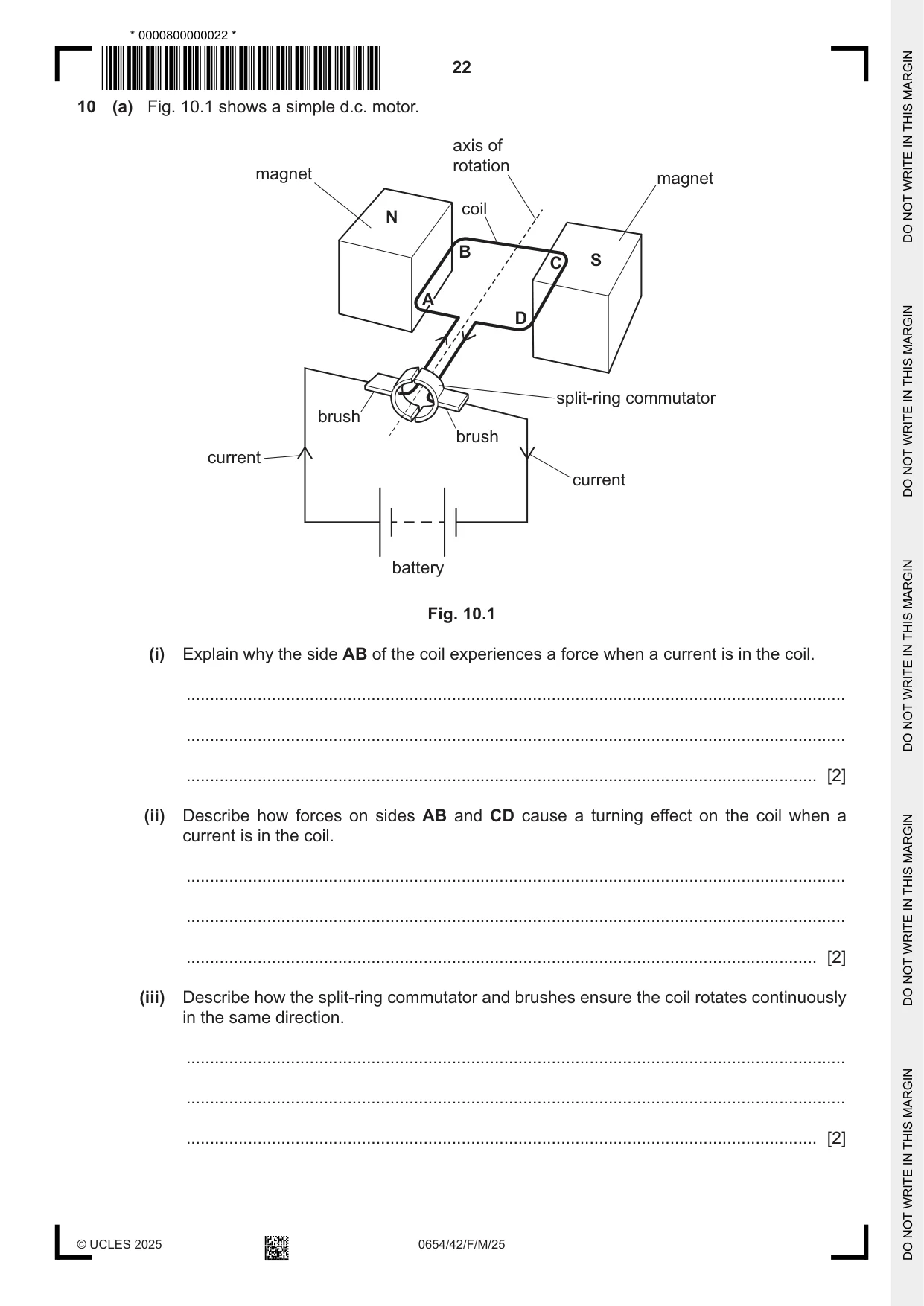
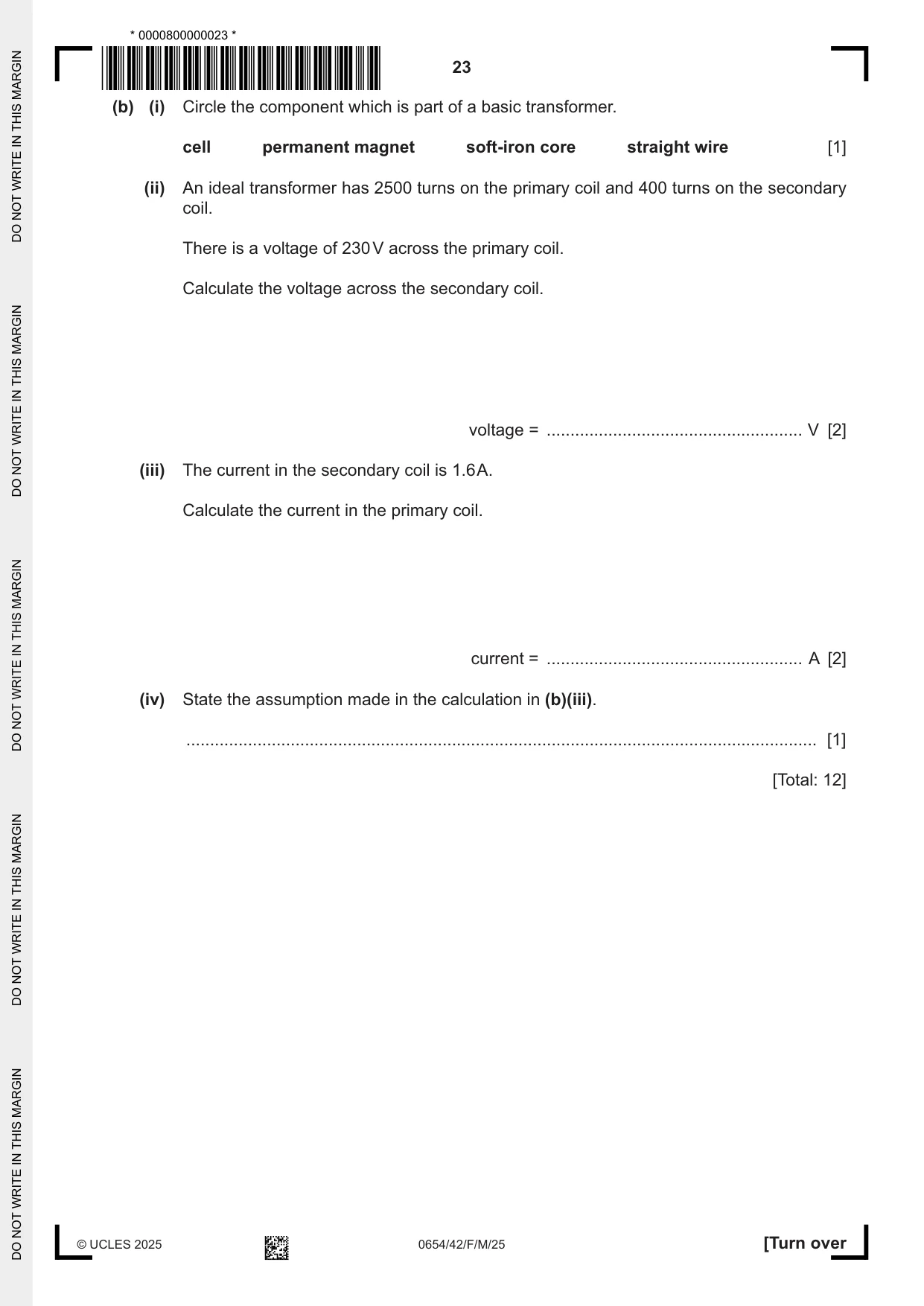
10 (a) Fig. 10.1 shows a simple d.c. motor. axis of rotation magnet magnet coil N B C S A D split-ring commutator brush brush current current battery Fig. 10.1 (i) Explain why the side AB of the coil experiences a force when a current is in the coil. ........................................................................................................................................... ........................................................................................................................................... ..................................................................................................................................... [2] (ii) Describe how forces on sides AB and CD cause a turning effect on the coil when a current is in the coil. ........................................................................................................................................... ........................................................................................................................................... ..................................................................................................................................... [2] (iii) Describe how the split-ring commutator and brushes ensure the coil rotates continuously in the same direction. ........................................................................................................................................... ........................................................................................................................................... ..................................................................................................................................... [2] (b) (i) Circle the component which is part of a basic transformer. cell permanent magnet soft‑iron core straight wire [1] (ii) An ideal transformer has 2500 turns on the primary coil and 400 turns on the secondary coil. There is a voltage of 230 V across the primary coil. Calculate the voltage across the secondary coil. voltage = ...................................................... V [2] (iii) The current in the secondary coil is 1.6 A. Calculate the current in the primary coil. current = ...................................................... A [2] (iv) State the assumption made in the calculation in (b)(iii). ..................................................................................................................................... [1] [Total: 12]
Mark scheme: 10(a)(i) current-carrying wire / coil, is in a magnetic field ; 2 that interacts with the magnetic field of magnets ; 10(a)(ii) forces act in opposite directions ; 2 idea of forces not along the same line / or creating a moment ; 10(a)(iii) reverses the direction of the current in the coil ; 2 every half turn ; 10(b)(i) soft-iron core ; 1 10(b)(ii) evidence of Vp / Vs = Np / Ns or 230 / Vs = 2500 / 400 ; 2 37 (V) ; 10(b)(iii) evidence of IpVp = IsVs or Ip 230 = 1.6 37 ; 2 0.26 (A) ; 10(b)(iv) 100% efficient ; 1
Q11 · 38Sr is a radioactive isotope
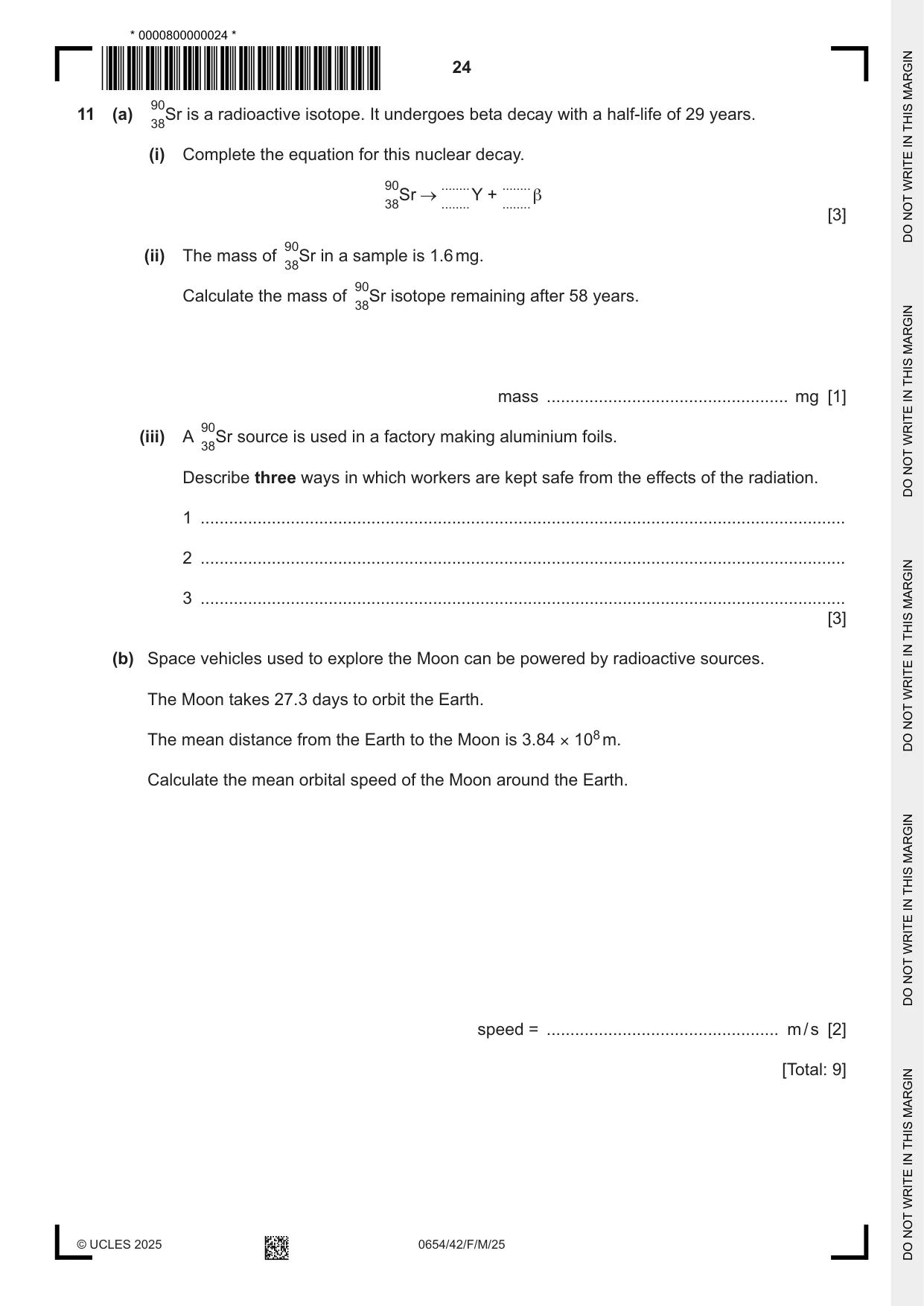
11 (a) 38Sr is a radioactive isotope. It undergoes beta decay with a half-life of 29 years. (i) Complete the equation for this nuclear decay. 90 ........ ........ 38Sr ........ Y + ........ β [3] 90 (ii) The mass of 38Sr in a sample is 1.6 mg. 90 Calculate the mass of 38Sr isotope remaining after 58 years. mass ................................................... mg [1] 90 (iii) A 38Sr source is used in a factory making aluminium foils. Describe three ways in which workers are kept safe from the effects of the radiation. 1 ........................................................................................................................................ 2 ........................................................................................................................................ 3 ........................................................................................................................................ [3] (b) Space vehicles used to explore the Moon can be powered by radioactive sources. The Moon takes 27.3 days to orbit the Earth. The mean distance from the Earth to the Moon is 3.84 × 10⁸ m. Calculate the mean orbital speed of the Moon around the Earth. speed = ................................................. m / s [2] [Total: 9]
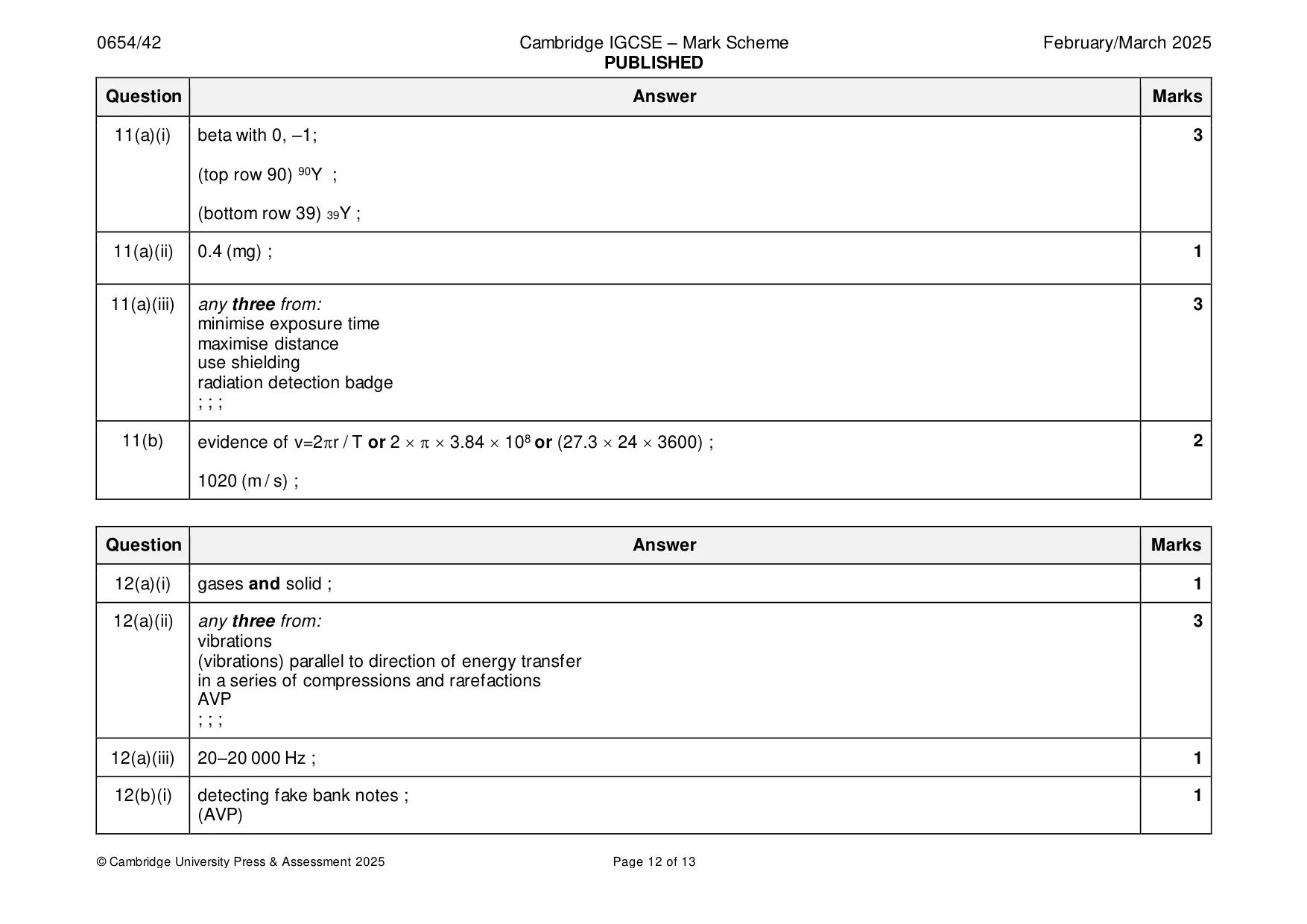
Mark scheme: 11(a)(i) beta with 0, –1; 3 (top row 90) 90Y ; (bottom row 39) 39Y ; 11(a)(ii) 0.4 (mg) ; 1 11(a)(iii) any three from: 3 minimise exposure time maximise distance use shielding radiation detection badge ; ; ; 11(b) evidence of v=2r / T or 2 3.84 108 or (27.3 24 3600) ; 2 1020 (m / s) ;
Q12 · Sound travels at different speeds in solids, liquids and gases
12 (a) (i) Sound travels at different speeds in solids, liquids and gases. Identify the state of matter in which sound travels: the slowest ........................................... the fastest ........................................... [1] (ii) Describe how sound travels through air. ........................................................................................................................................... ........................................................................................................................................... ........................................................................................................................................... ..................................................................................................................................... [3] (iii) State the frequency range of human hearing. ..................................................................................................................................... [1] (b) (i) State one use for ultraviolet radiation. ..................................................................................................................................... [1] (ii) State one danger of ultraviolet radiation. ..................................................................................................................................... [1] (c) An infrared wave has a frequency of 2.2 × 10¹² Hz. The speed of light is 3.0 × 10⁸ m / s. Calculate the wavelength of the infrared wave. wavelength = ..................................................... m [2] [Total: 9]
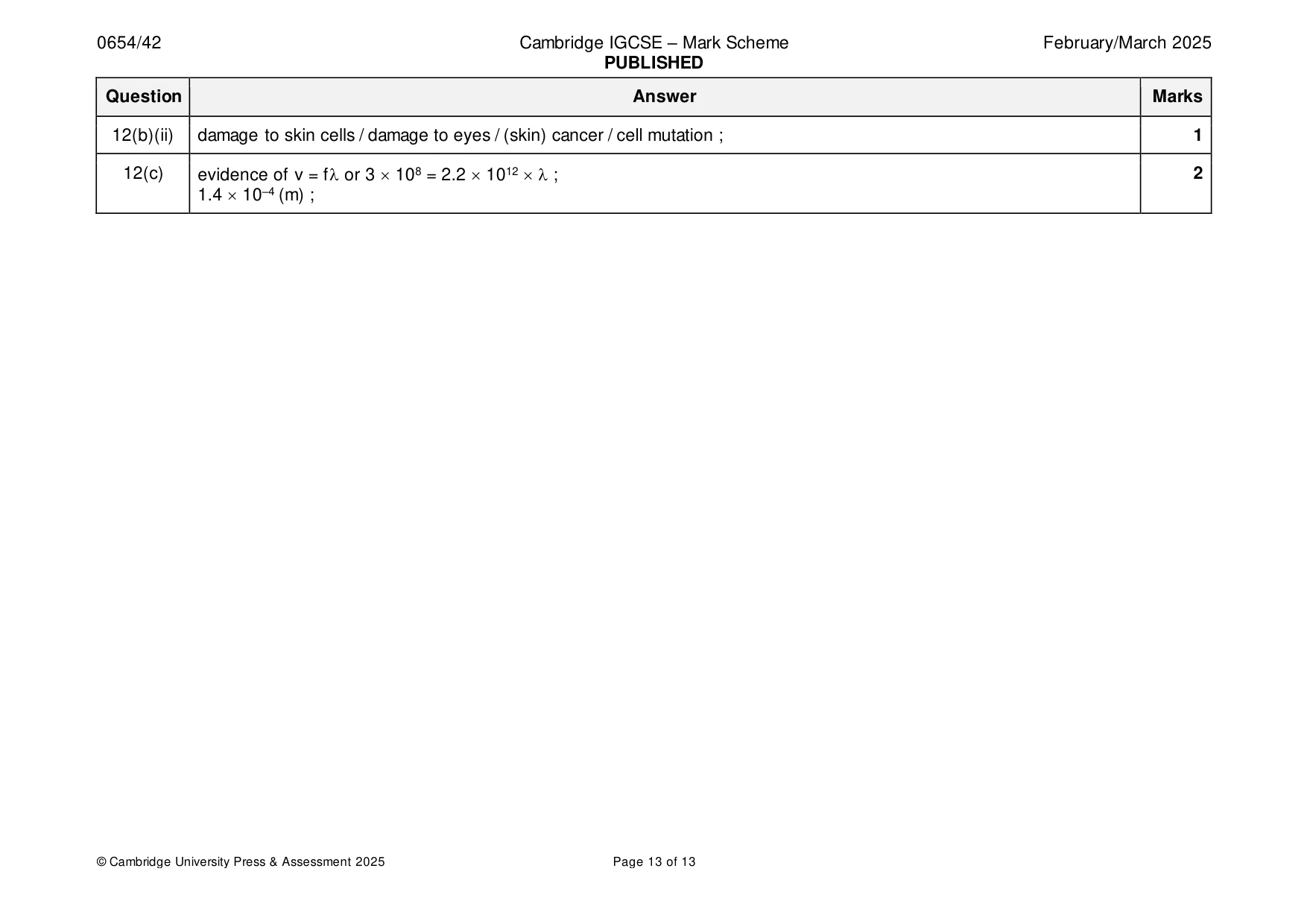
Mark scheme: 12(a)(i) gases and solid ; 1 12(a)(ii) any three from: 3 vibrations (vibrations) parallel to direction of energy transfer in a series of compressions and rarefactions AVP ; ; ; 12(a)(iii) 20–20 000 Hz ; 1 12(b)(i) detecting fake bank notes ; 1 (AVP) 12(b)(ii) damage to skin cells / damage to eyes / (skin) cancer / cell mutation ; 1 12(c) evidence of v = f or 3 108 = 2.2 1012 ; 2 1.4 10–4 (m) ;
What was in this paper
The subtopics covered by these 12 questions, and how many questions each got. Open one in a new tab to see every Cambridge question on it.
What you needed in this session
Cambridge’s own grade thresholds for 2025 Feb/March, Paper 4 · Variant 2. A higher threshold means an easier paper — the bar moves with how the cohort did.