Cambridge IGCSE Sciences - Co-ordinated (Double) 0654 — 2025 Oct/Nov Paper 4 · Variant 3
0654/43/O/N/25 · 12 questions · 120 marks · 120 min
The question paper and its mark scheme, free to read here and free to download. This is Cambridge’s own paper, exactly as it was sat.
Question paper28 pages
Mark scheme17 pages
Answers below. Sit the paper first if you are practising.
Questions as text
Q1 · Plants and bacteria are made of cells
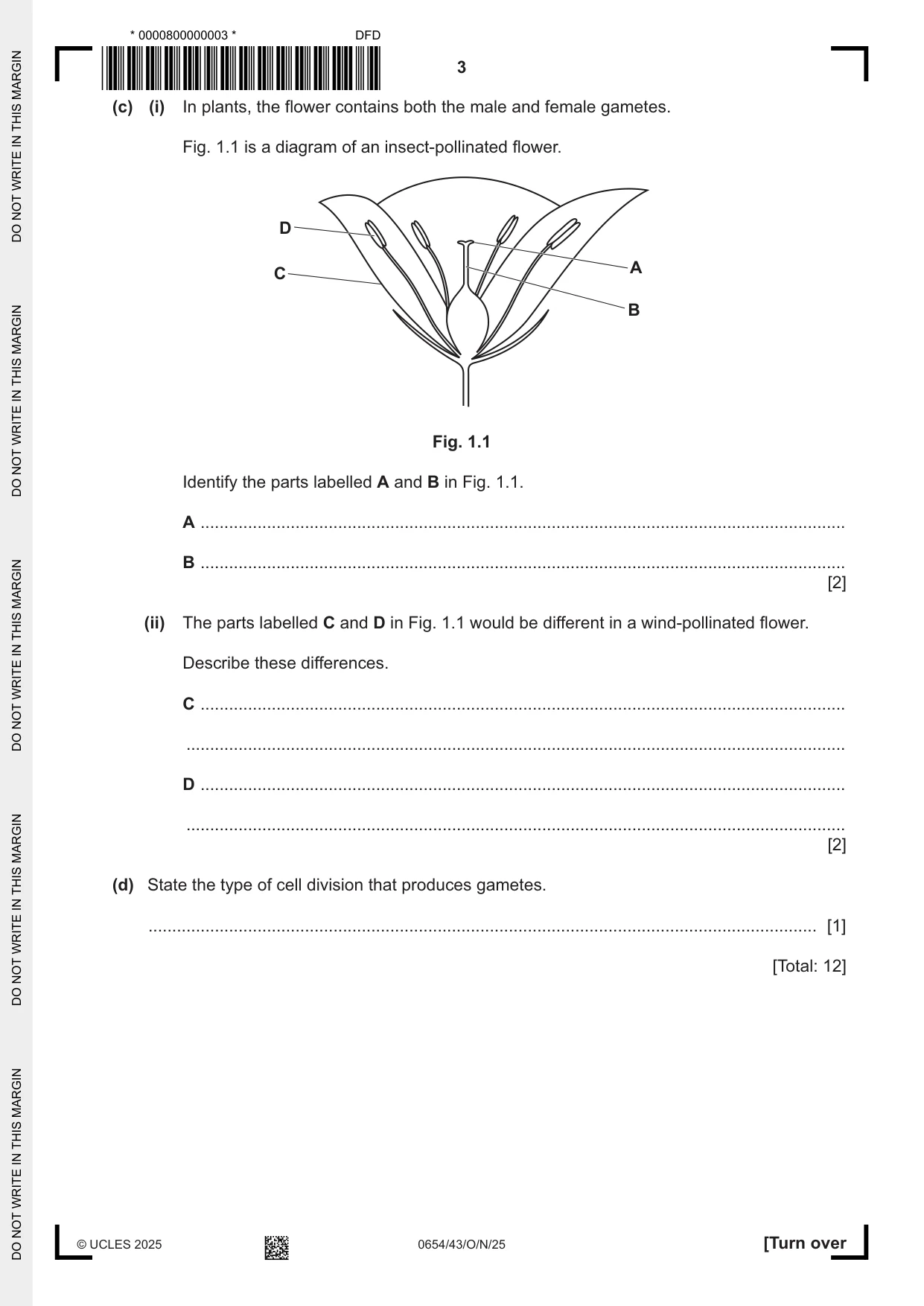
1 (a) Plants and bacteria are made of cells. State two ways the plant cells and bacterial cells are similar and two ways that they are different. similar 1 ................................................................................................................................................ 2 ................................................................................................................................................ different 1 ................................................................................................................................................ 2 ................................................................................................................................................ [4] (b) (i) Plant cells can divide by mitosis. Complete the sentence about mitosis. The exact replication of ....................................................... occurs before mitosis. [1] (ii) Plants can reproduce by sexual reproduction. State one advantage and one disadvantage of sexual reproduction. advantage ......................................................................................................................... disadvantage ..................................................................................................................... [2] (c) (i) In plants, the flower contains both the male and female gametes. Fig. 1.1 is a diagram of an insect-pollinated flower. D A C B Fig. 1.1 Identify the parts labelled A and B in Fig. 1.1. A ........................................................................................................................................ B ........................................................................................................................................ [2] (ii) The parts labelled C and D in Fig. 1.1 would be different in a wind-pollinated flower. Describe these differences. C ........................................................................................................................................ ........................................................................................................................................... D ........................................................................................................................................ ........................................................................................................................................... [2] (d) State the type of cell division that produces gametes. ............................................................................................................................................. [1] [Total: 12]
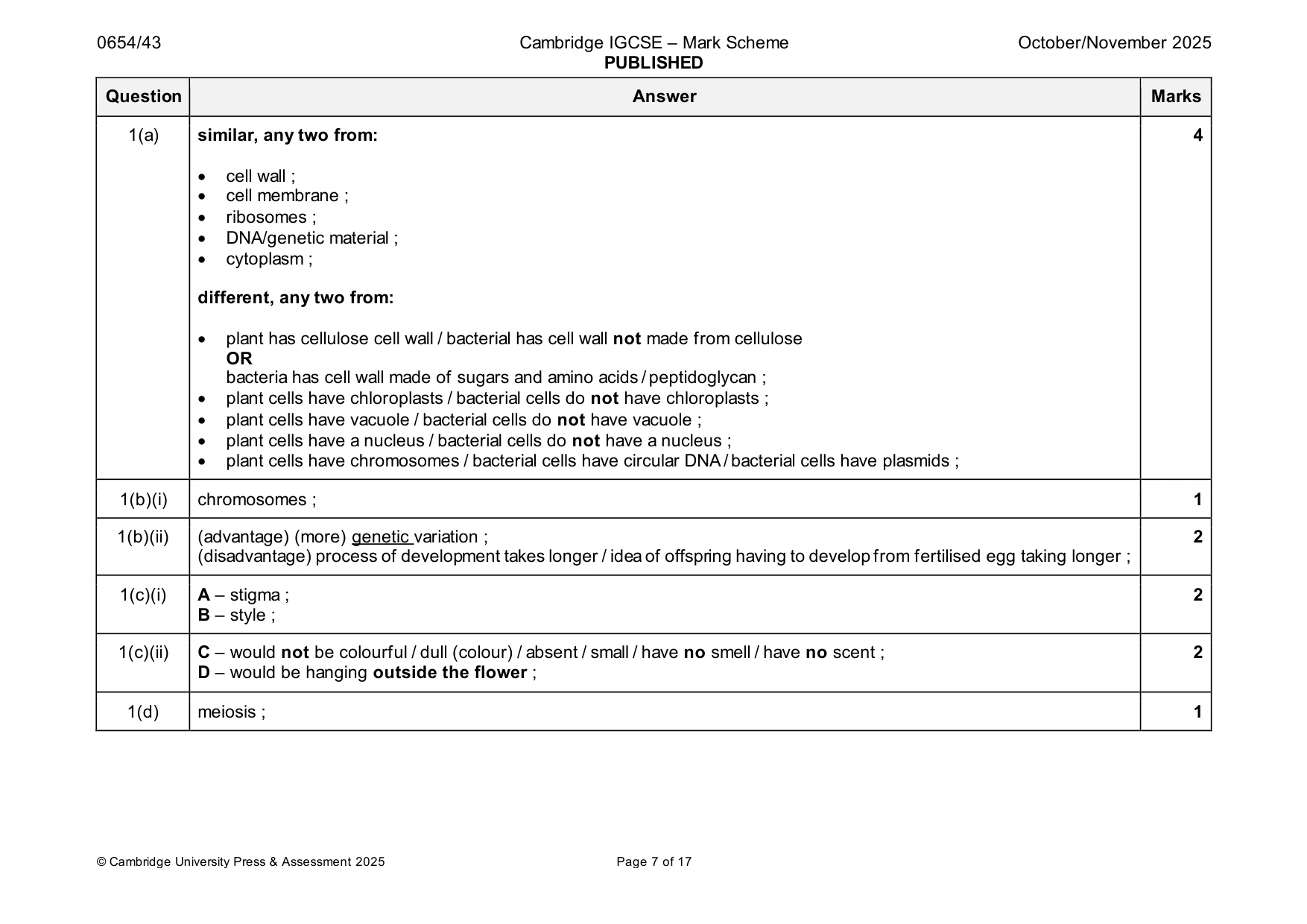
Mark scheme: Question Answer Marks 1(a) similar, any two from: 4 • cell wall ; • cell membrane ; • ribosomes ; • DNA/genetic material ; • cytoplasm ; different, any two from: • plant has cellulose cell wall / bacterial has cell wall not made from cellulose OR bacteria has cell wall made of sugars and amino acids / peptidoglycan ; • plant cells have chloroplasts / bacterial cells do not have chloroplasts ; • plant cells have vacuole / bacterial cells do not have vacuole ; • plant cells have a nucleus / bacterial cells do not have a nucleus ; • plant cells have chromosomes / bacterial cells have circular DNA / bacterial cells have plasmids ; 1(b)(i) chromosomes ; 1 1(b)(ii) (advantage) (more) genetic variation ; 2 (disadvantage) process of development takes longer / idea of offspring having to develop from fertilised egg taking longer ; 1(c)(i) A – stigma ; 2 B – style ; 1(c)(ii) C – would not be colourful / dull (colour) / absent / small / have no smell / have no scent ; 2 D – would be hanging outside the flower ; 1(d) meiosis ; 1
Q2 · Active transport is used in the uptake of mineral ions from the soil into the root hair…
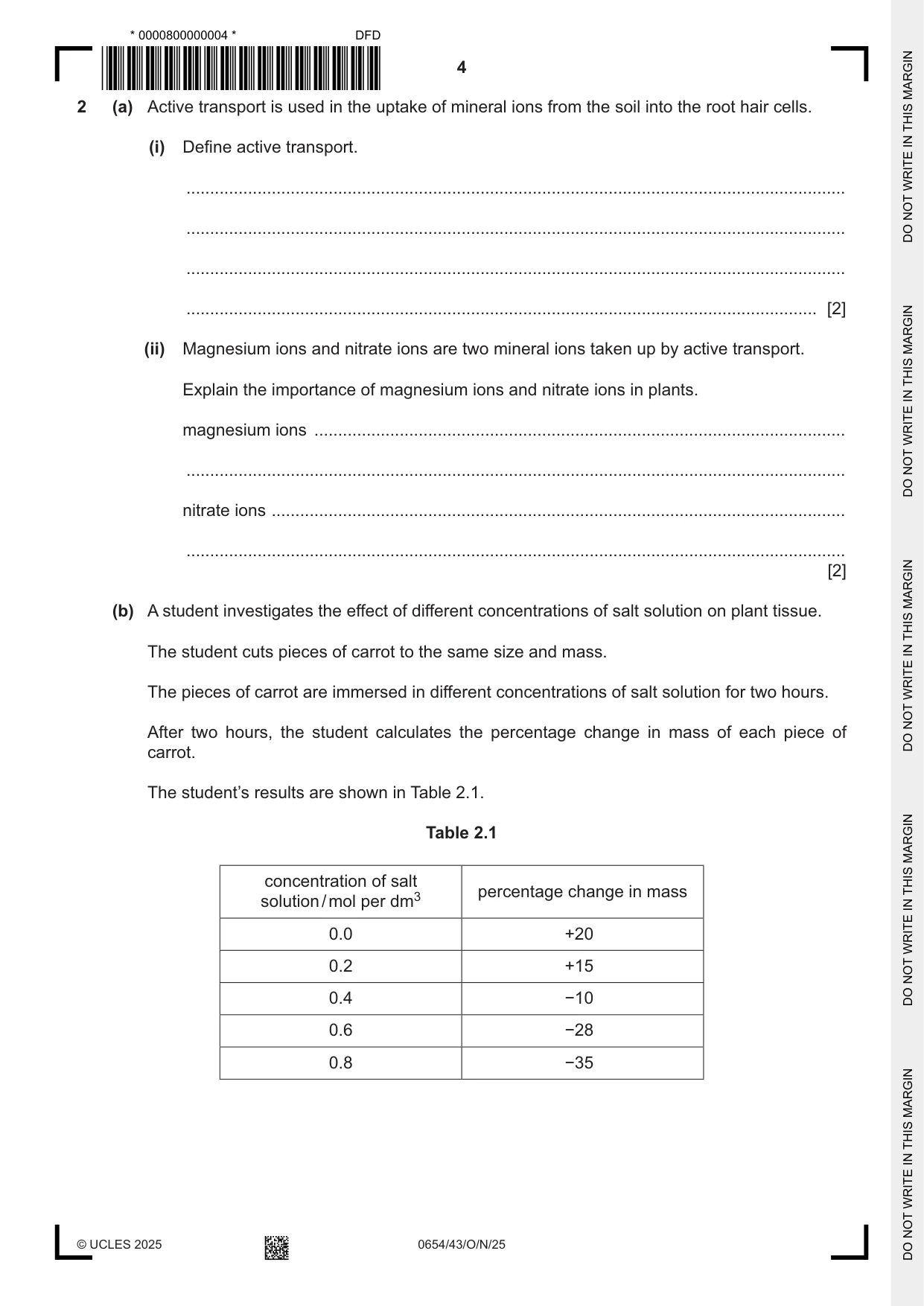
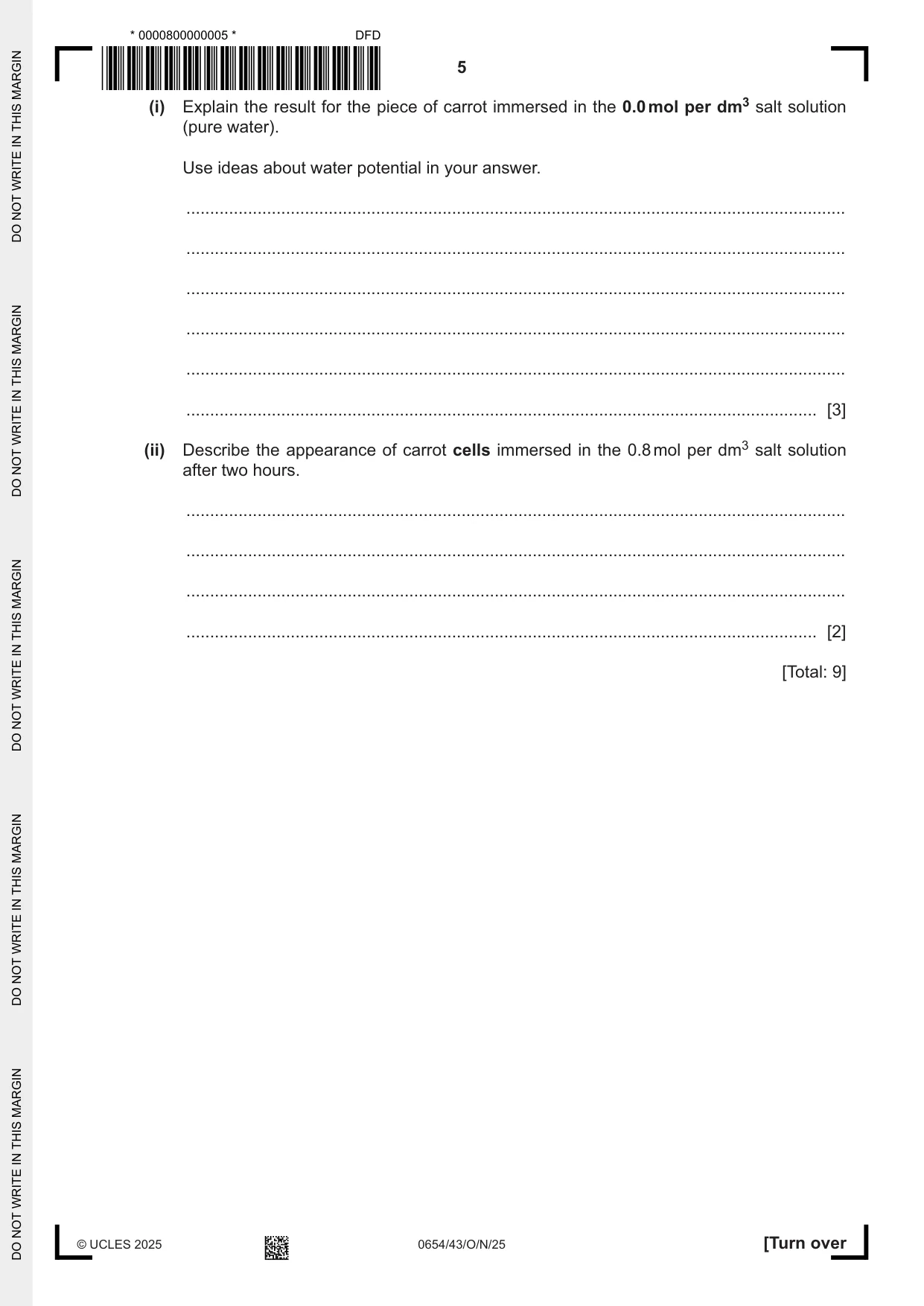
2 (a) Active transport is used in the uptake of mineral ions from the soil into the root hair cells. (i) Define active transport. ........................................................................................................................................... ........................................................................................................................................... ........................................................................................................................................... ..................................................................................................................................... [2] (ii) Magnesium ions and nitrate ions are two mineral ions taken up by active transport. Explain the importance of magnesium ions and nitrate ions in plants. magnesium ions ................................................................................................................ ........................................................................................................................................... nitrate ions ......................................................................................................................... ........................................................................................................................................... [2] (b) A student investigates the effect of different concentrations of salt solution on plant tissue. The student cuts pieces of carrot to the same size and mass. The pieces of carrot are immersed in different concentrations of salt solution for two hours. After two hours, the student calculates the percentage change in mass of each piece of carrot. The student’s results are shown in Table 2.1. Table 2.1 concentration of salt percentage change in mass solution / mol per dm3 0.0 +20 0.2 +15 0.4 −10 0.6 −28 0.8 −35 (i) Explain the result for the piece of carrot immersed in the 0.0 mol per dm3 salt solution (pure water). Use ideas about water potential in your answer. ........................................................................................................................................... ........................................................................................................................................... ........................................................................................................................................... ........................................................................................................................................... ........................................................................................................................................... ..................................................................................................................................... [3] (ii) Describe the appearance of carrot cells immersed in the 0.8 mol per dm3 salt solution after two hours. ........................................................................................................................................... ........................................................................................................................................... ........................................................................................................................................... ..................................................................................................................................... [2] [Total: 9]
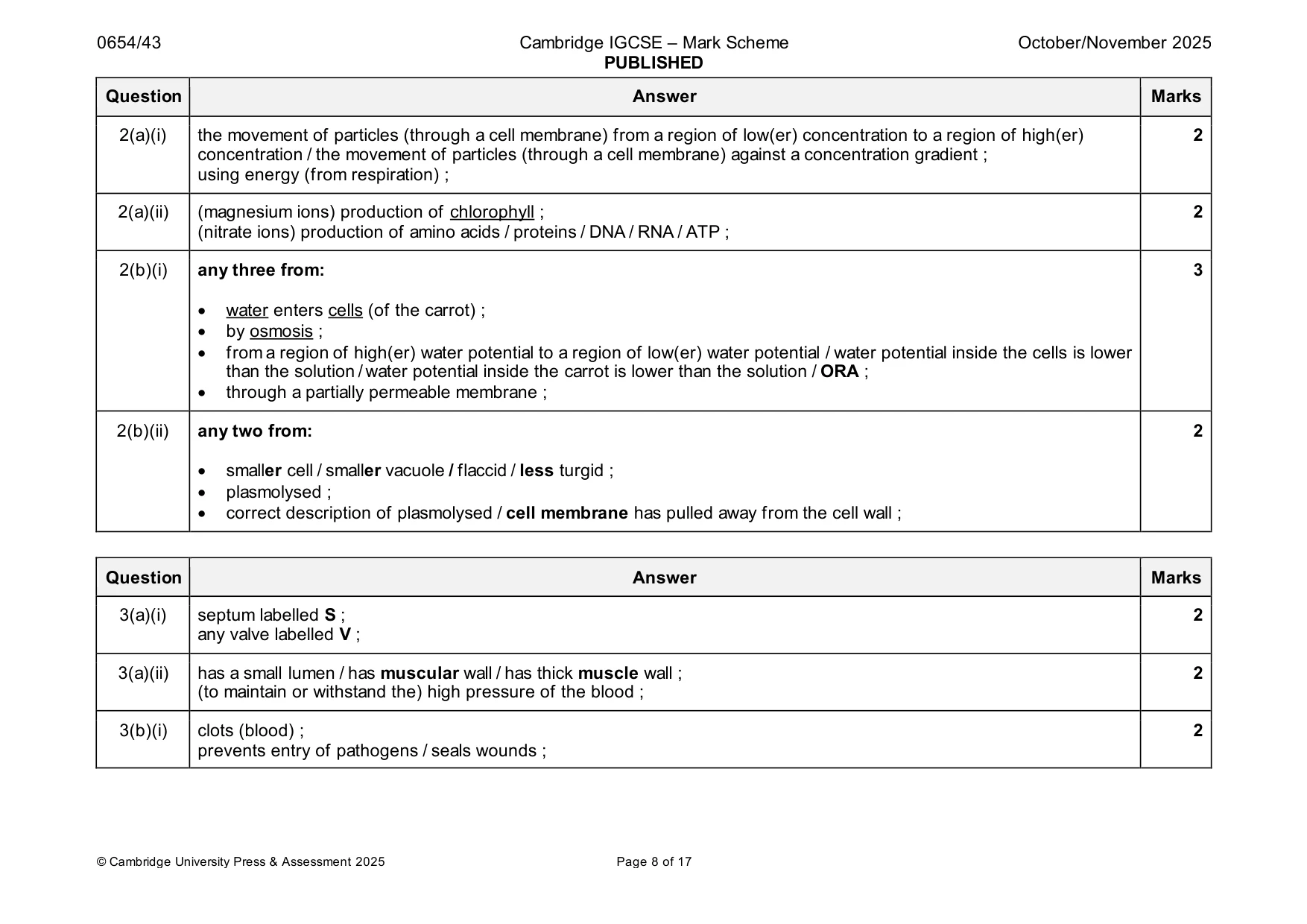
Mark scheme: 2(a)(i) the movement of particles (through a cell membrane) from a region of low(er) concentration to a region of high(er) 2 concentration / the movement of particles (through a cell membrane) against a concentration gradient ; using energy (from respiration) ; 2(a)(ii) (magnesium ions) production of chlorophyll ; 2 (nitrate ions) production of amino acids / proteins / DNA / RNA / ATP ; 2(b)(i) any three from: 3 • water enters cells (of the carrot) ; • by osmosis ; • from a region of high(er) water potential to a region of low(er) water potential / water potential inside the cells is lower than the solution / water potential inside the carrot is lower than the solution / ORA ; • through a partially permeable membrane ; 2(b)(ii) any two from: 2 • smaller cell / smaller vacuole / flaccid / less turgid ; • plasmolysed ; • correct description of plasmolysed / cell membrane has pulled away from the cell wall ;
Q3 · A diagram of the heart and associated blood vessels
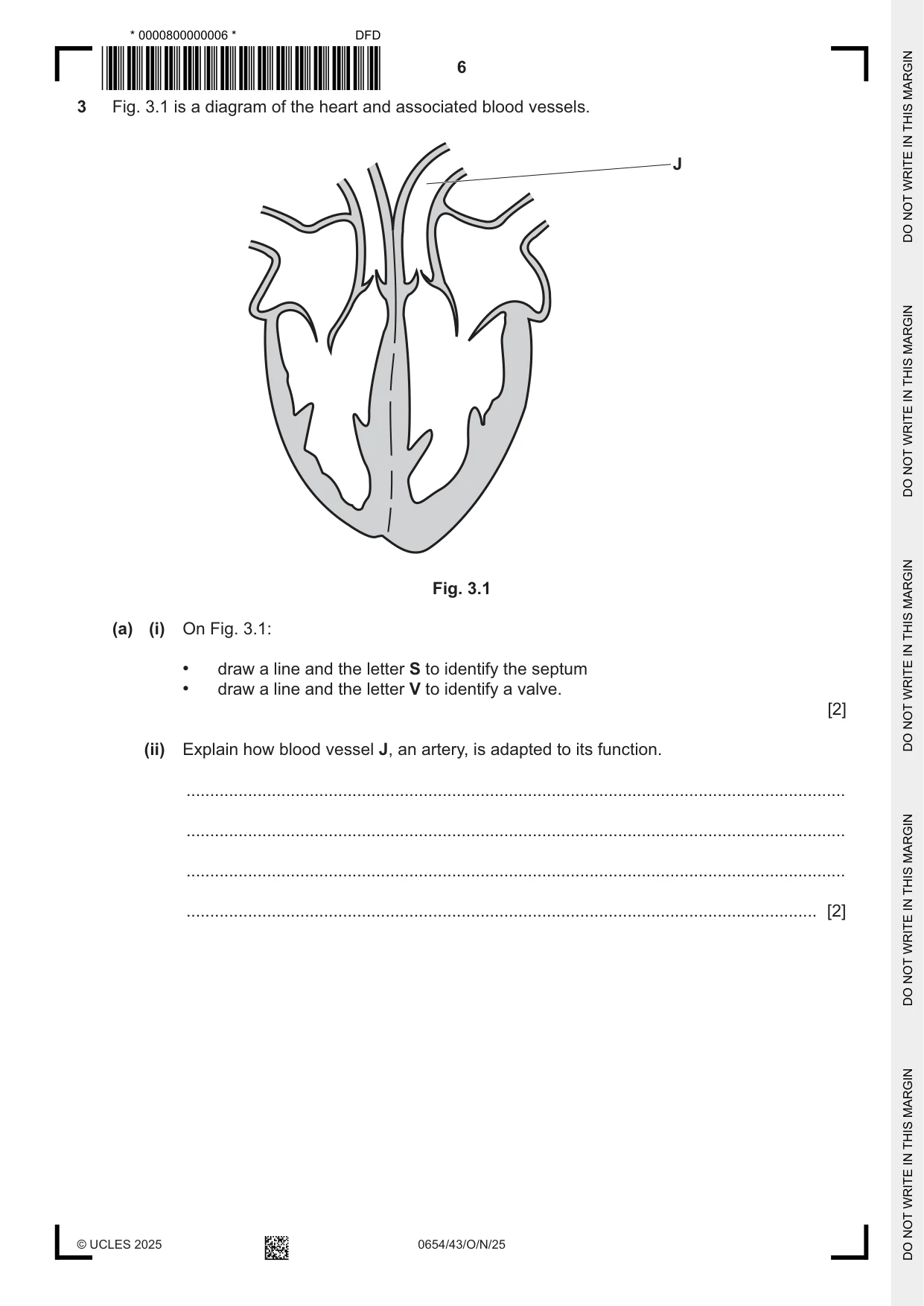
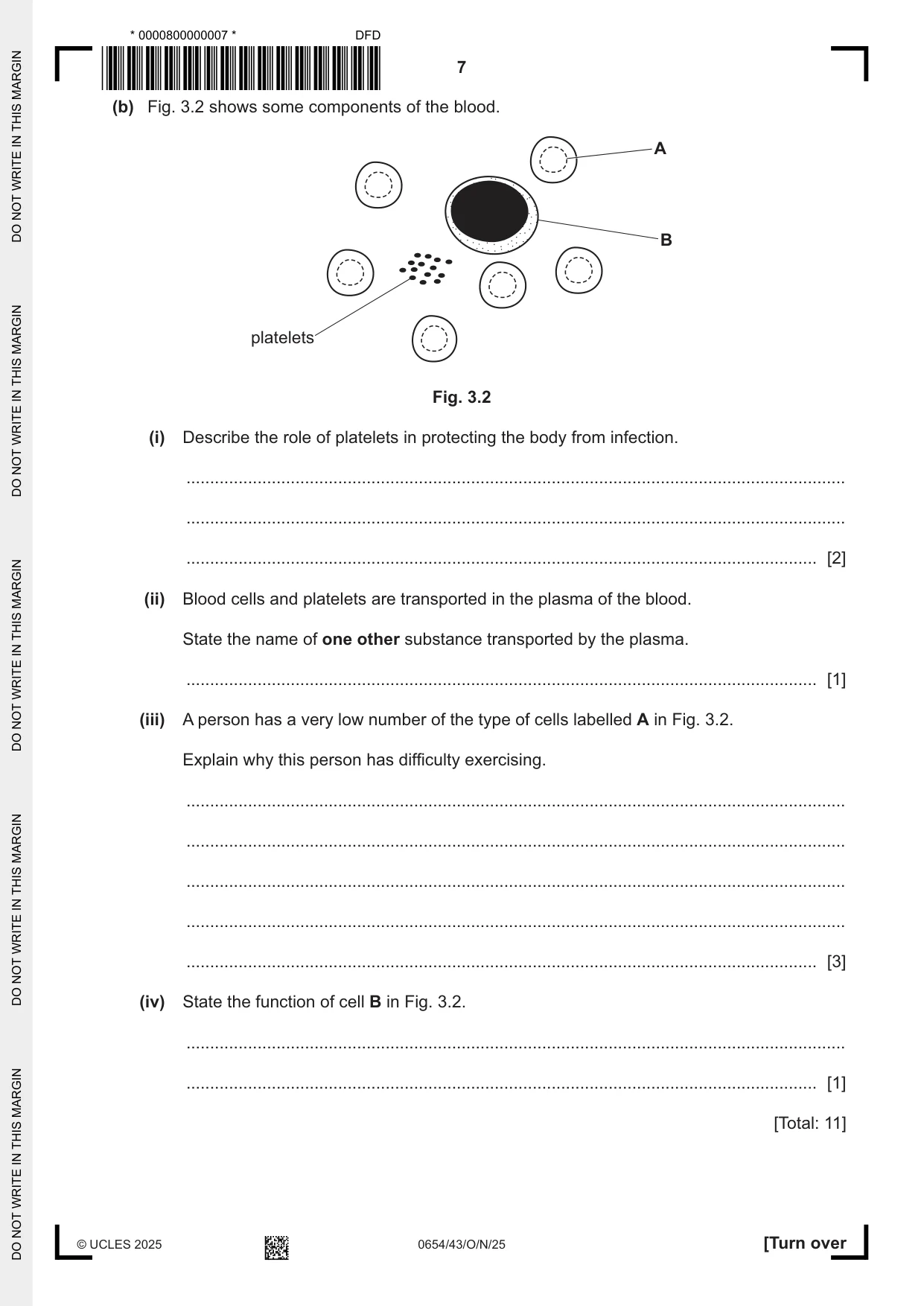
3 Fig. 3.1 is a diagram of the heart and associated blood vessels. J Fig. 3.1 (a) (i) On Fig. 3.1: • draw a line and the letter S to identify the septum • draw a line and the letter V to identify a valve. [2] (ii) Explain how blood vessel J, an artery, is adapted to its function. ........................................................................................................................................... ........................................................................................................................................... ........................................................................................................................................... ..................................................................................................................................... [2] (b) Fig. 3.2 shows some components of the blood. A B platelets Fig. 3.2 (i) Describe the role of platelets in protecting the body from infection. ........................................................................................................................................... ........................................................................................................................................... ..................................................................................................................................... [2] (ii) Blood cells and platelets are transported in the plasma of the blood. State the name of one other substance transported by the plasma. ..................................................................................................................................... [1] (iii) A person has a very low number of the type of cells labelled A in Fig. 3.2. Explain why this person has difficulty exercising. ........................................................................................................................................... ........................................................................................................................................... ........................................................................................................................................... ........................................................................................................................................... ..................................................................................................................................... [3] (iv) State the function of cell B in Fig. 3.2. ........................................................................................................................................... ..................................................................................................................................... [1] [Total: 11]
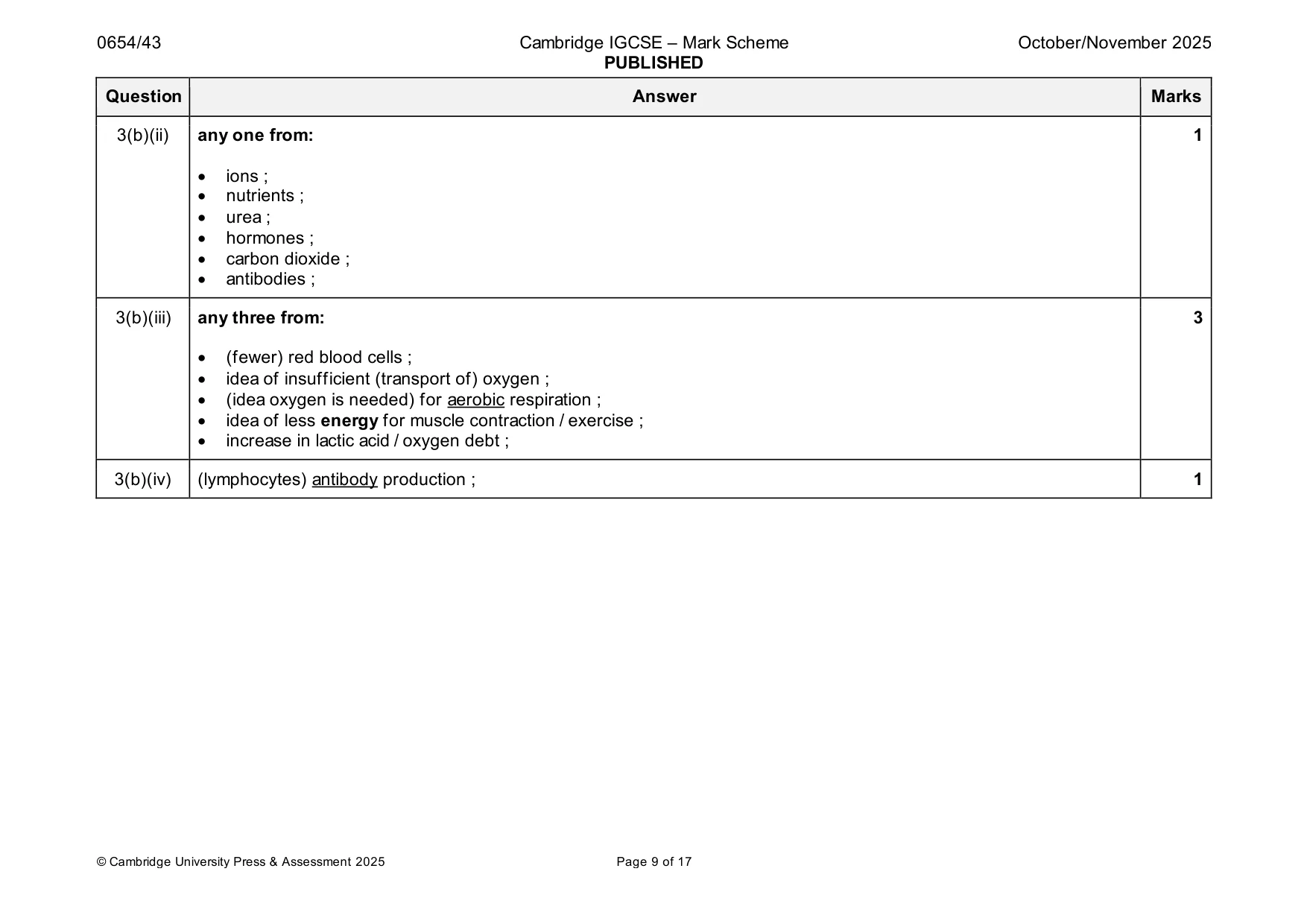
Mark scheme: 3(a)(i) septum labelled S ; 2 any valve labelled V ; 3(a)(ii) has a small lumen / has muscular wall / has thick muscle wall ; 2 (to maintain or withstand the) high pressure of the blood ; 3(b)(i) clots (blood) ; 2 prevents entry of pathogens / seals wounds ; 3(b)(ii) any one from: 1 • ions ; • nutrients ; • urea ; • hormones ; • carbon dioxide ; • antibodies ; 3(b)(iii) any three from: 3 • (fewer) red blood cells ; • idea of insufficient (transport of) oxygen ; • (idea oxygen is needed) for aerobic respiration ; • idea of less energy for muscle contraction / exercise ; • increase in lactic acid / oxygen debt ; 3(b)(iv) (lymphocytes) antibody production ; 1
Q4 · Variation occurs in all organisms
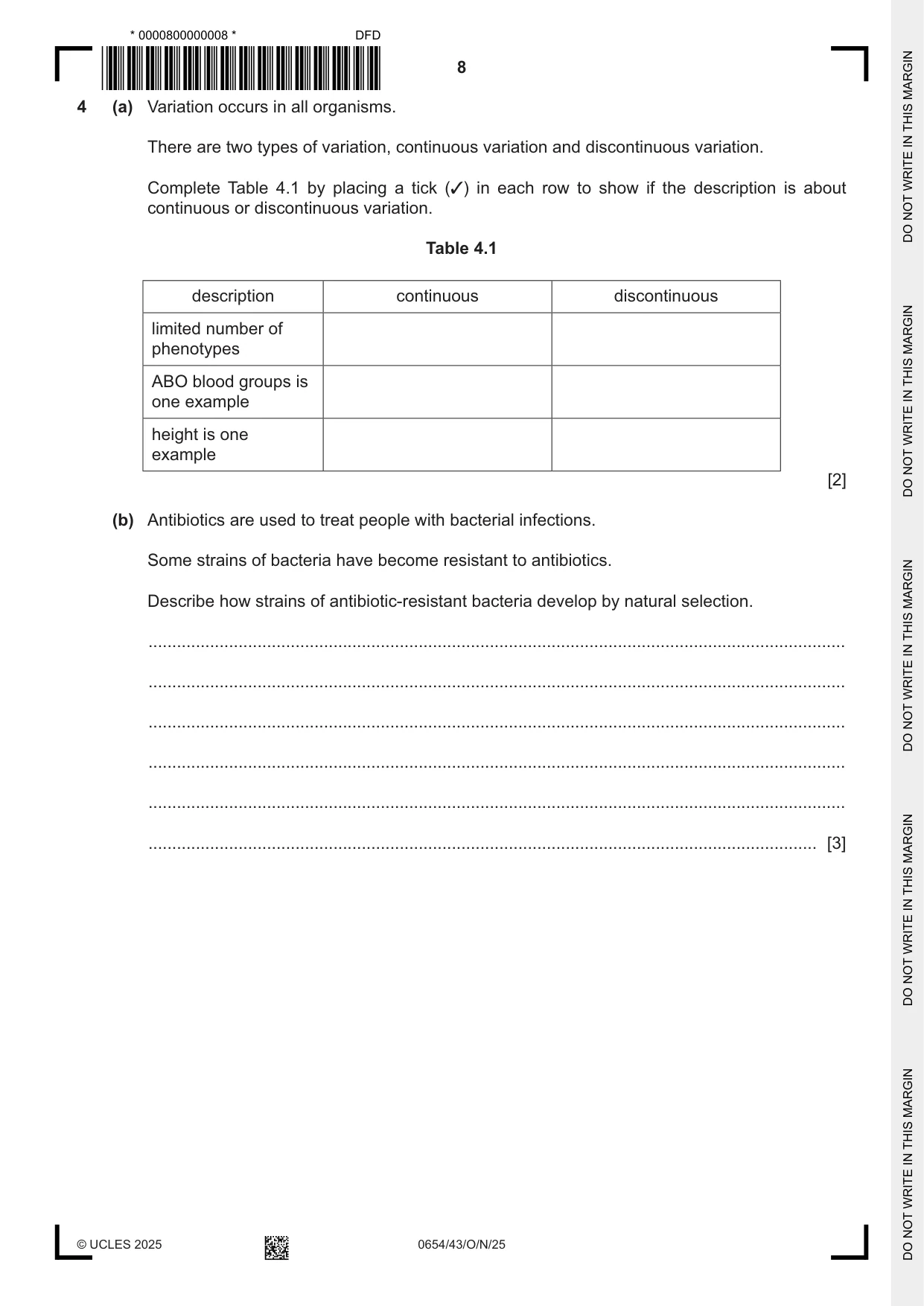
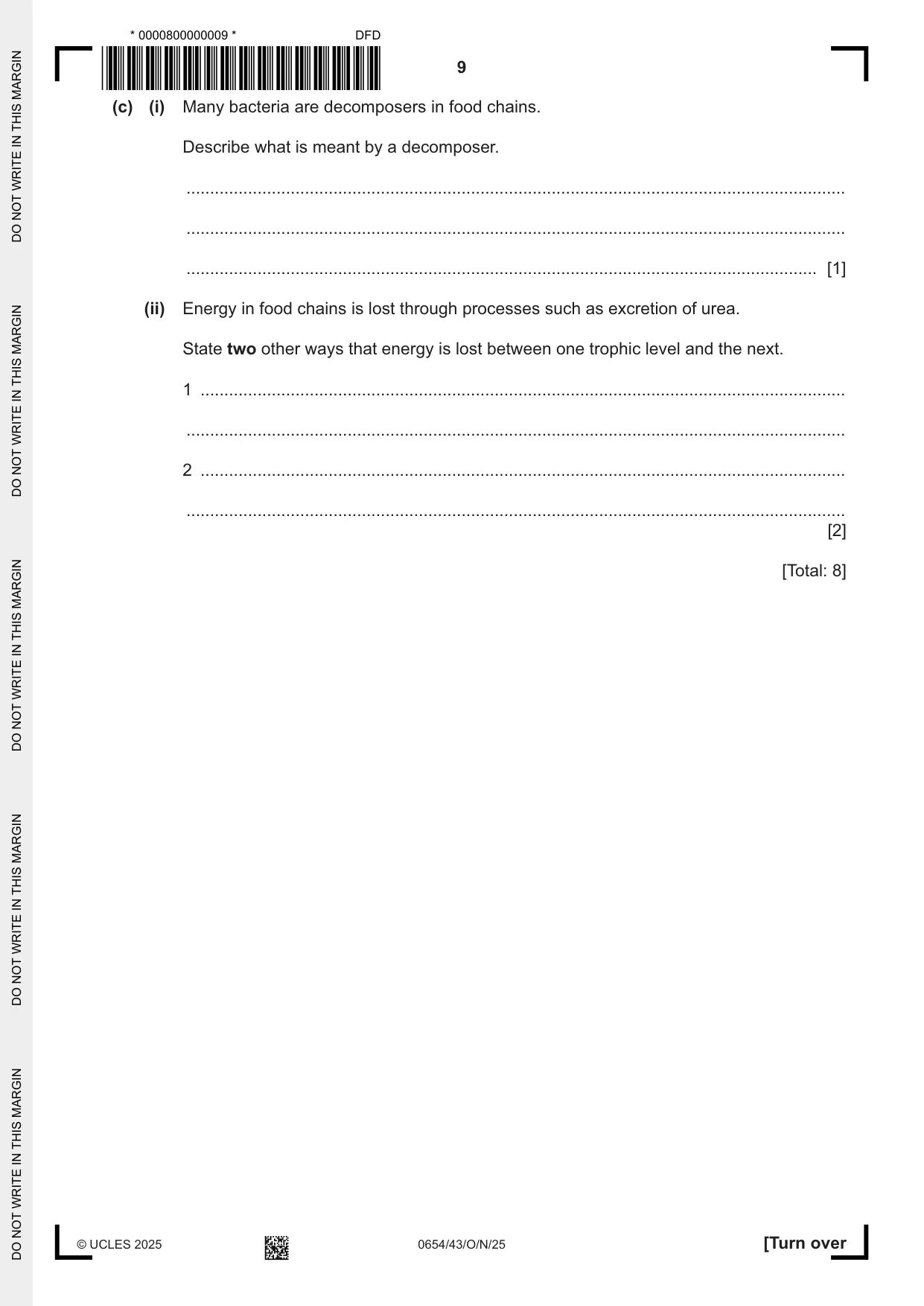
4 (a) Variation occurs in all organisms. There are two types of variation, continuous variation and discontinuous variation. Complete Table 4.1 by placing a tick (3) in each row to show if the description is about continuous or discontinuous variation. Table 4.1 description continuous discontinuous limited number of phenotypes ABO blood groups is one example height is one example [2] (b) Antibiotics are used to treat people with bacterial infections. Some strains of bacteria have become resistant to antibiotics. Describe how strains of antibiotic-resistant bacteria develop by natural selection. ................................................................................................................................................... ................................................................................................................................................... ................................................................................................................................................... ................................................................................................................................................... ................................................................................................................................................... ............................................................................................................................................. [3] (c) (i) Many bacteria are decomposers in food chains. Describe what is meant by a decomposer. ........................................................................................................................................... ........................................................................................................................................... ..................................................................................................................................... [1] (ii) Energy in food chains is lost through processes such as excretion of urea. State two other ways that energy is lost between one trophic level and the next. 1 ........................................................................................................................................ ........................................................................................................................................... 2 ........................................................................................................................................ ........................................................................................................................................... [2] [Total: 8]
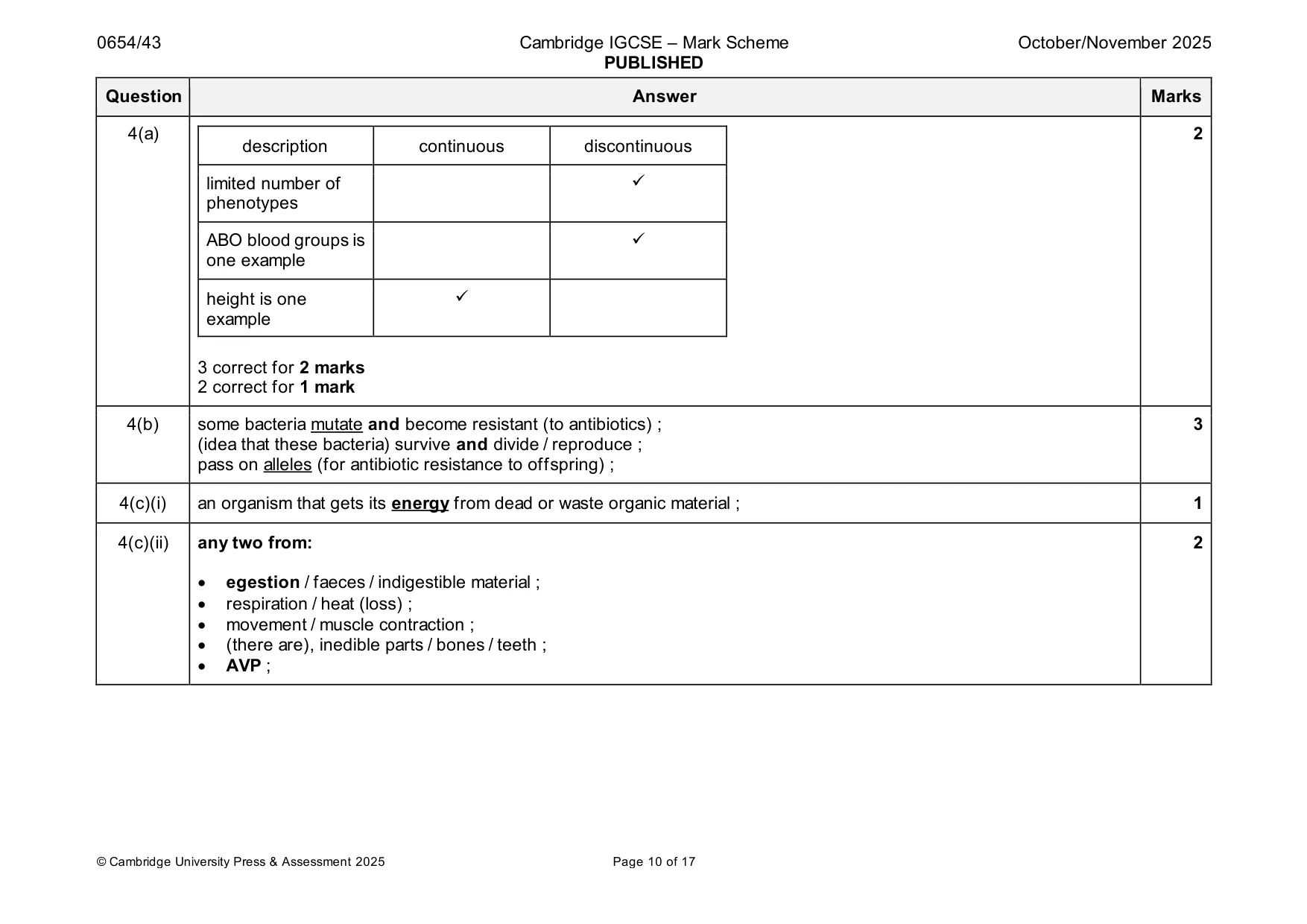
Mark scheme: 4(a) 2 description continuous discontinuous limited number of ✓ phenotypes ABO blood groups is ✓ one example height is one ✓ example 3 correct for 2 marks 2 correct for 1 mark 4(b) some bacteria mutate and become resistant (to antibiotics) ; 3 (idea that these bacteria) survive and divide / reproduce ; pass on alleles (for antibiotic resistance to offspring) ; 4(c)(i) an organism that gets its energy from dead or waste organic material ; 1 4(c)(ii) any two from: 2 • egestion / faeces / indigestible material ; • respiration / heat (loss) ; • movement / muscle contraction ; • (there are), inedible parts / bones / teeth ; • AVP ;
Q5 · The displayed formulas of some organic compounds
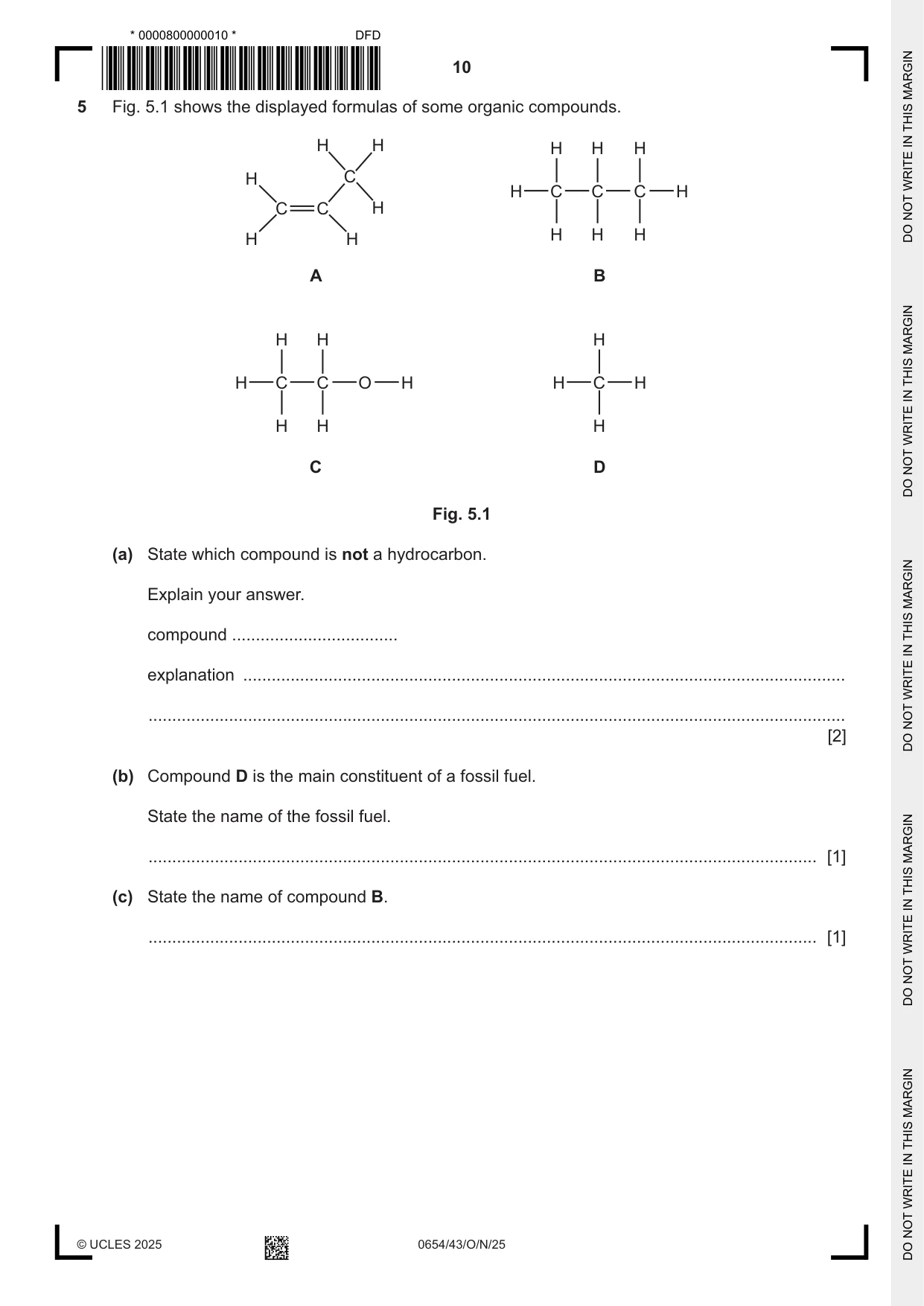
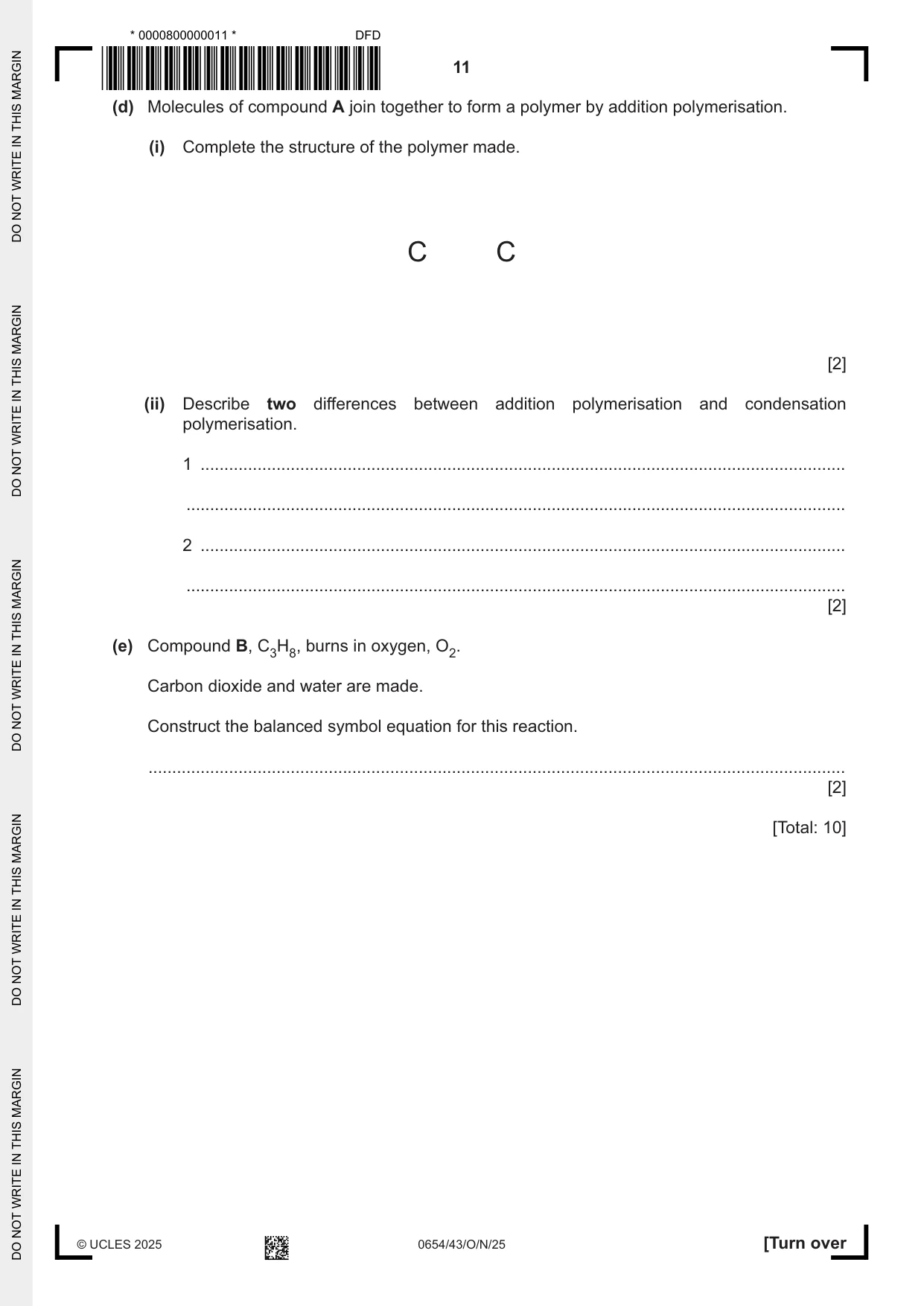
5 Fig. 5.1 shows the displayed formulas of some organic compounds. H H H H H H C H C C C H C C H H H H H H A B H H H H C C O H H C H H H H C D Fig. 5.1 (a) State which compound is not a hydrocarbon. Explain your answer. compound ................................... explanation ............................................................................................................................... ................................................................................................................................................... [2] (b) Compound D is the main constituent of a fossil fuel. State the name of the fossil fuel. ............................................................................................................................................. [1] (c) State the name of compound B. ............................................................................................................................................. [1] (d) Molecules of compound A join together to form a polymer by addition polymerisation. (i) Complete the structure of the polymer made. C C [2] (ii) Describe two differences between addition polymerisation and condensation polymerisation. 1 ........................................................................................................................................ ........................................................................................................................................... 2 ........................................................................................................................................ ........................................................................................................................................... [2] (e) Compound B, C3H8, burns in oxygen, O2. Carbon dioxide and water are made. Construct the balanced symbol equation for this reaction. ................................................................................................................................................... [2] [Total: 10]
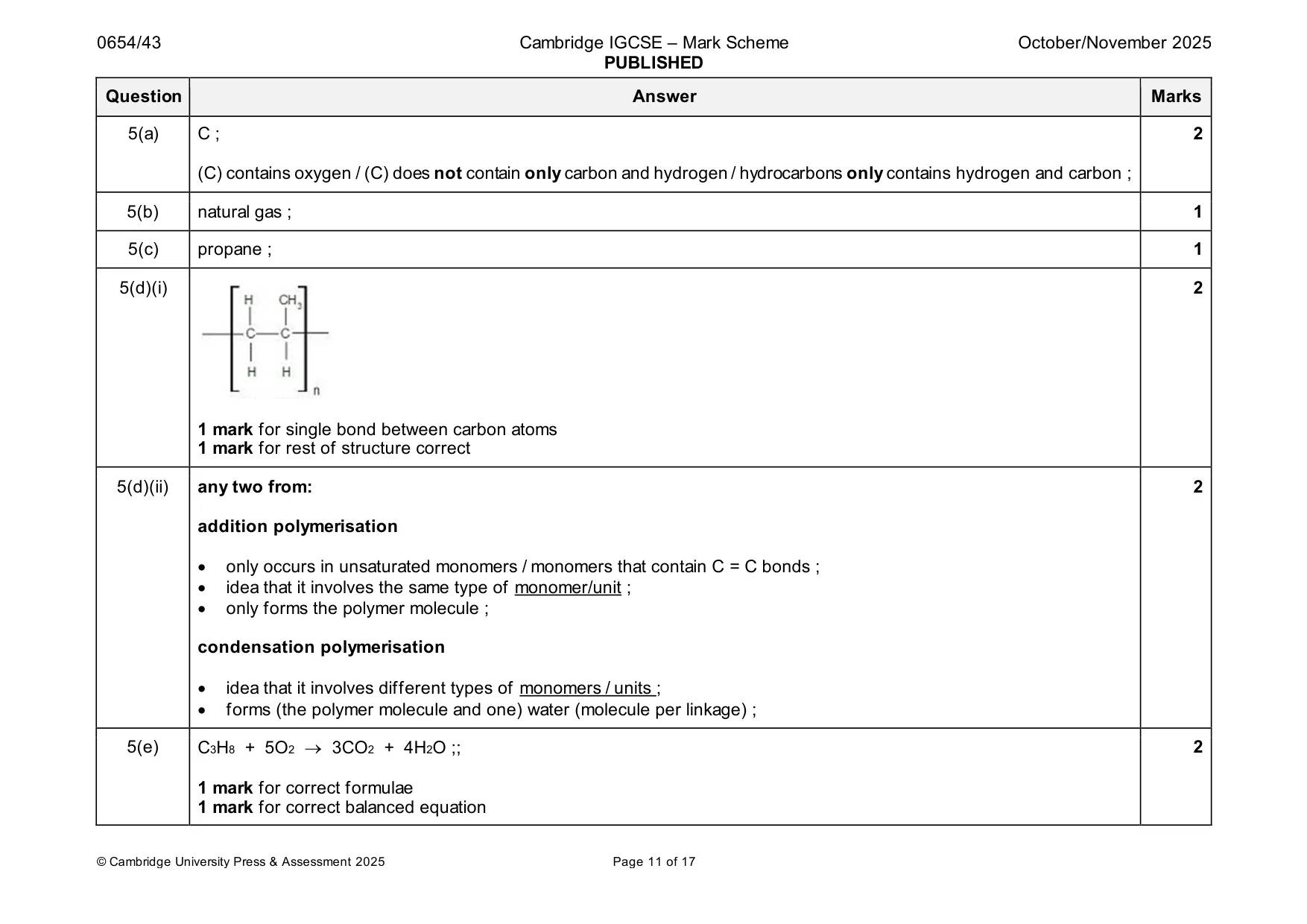
Mark scheme: 5(a) C ; 2 (C) contains oxygen / (C) does not contain only carbon and hydrogen / hydrocarbons only contains hydrogen and carbon ; 5(b) natural gas ; 1 5(c) propane ; 1 5(d)(i) 2 1 mark for single bond between carbon atoms 1 mark for rest of structure correct 5(d)(ii) any two from: 2 addition polymerisation • only occurs in unsaturated monomers / monomers that contain C = C bonds ; • idea that it involves the same type of monomer/unit ; • only forms the polymer molecule ; condensation polymerisation • idea that it involves different types of monomers / units ; • forms (the polymer molecule and one) water (molecule per linkage) ; 5(e) C3H8 + 5O2 → 3CO2 + 4H2O ;; 2 1 mark for correct formulae 1 mark for correct balanced equation
Q6 · Some information about the particles in atoms
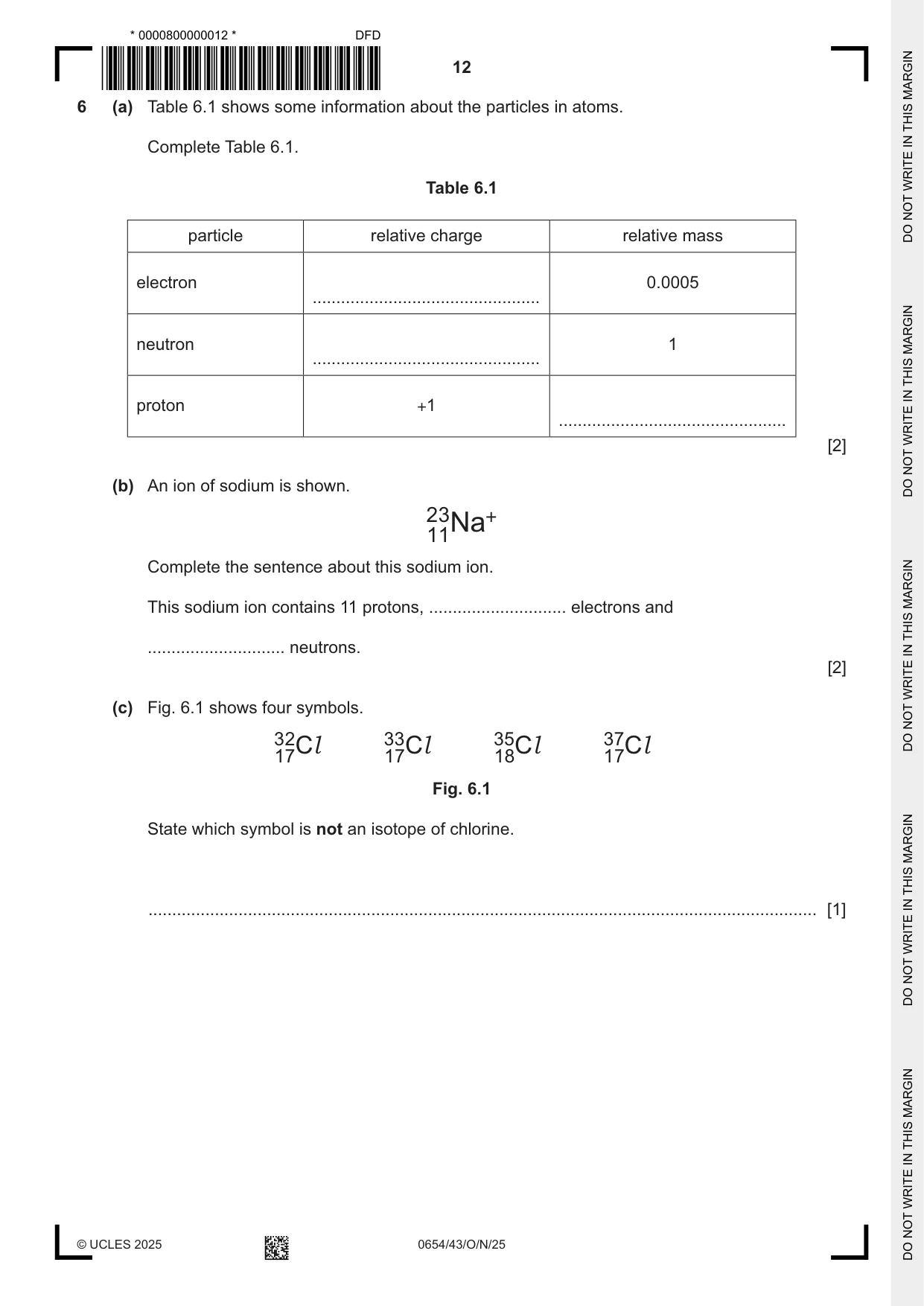
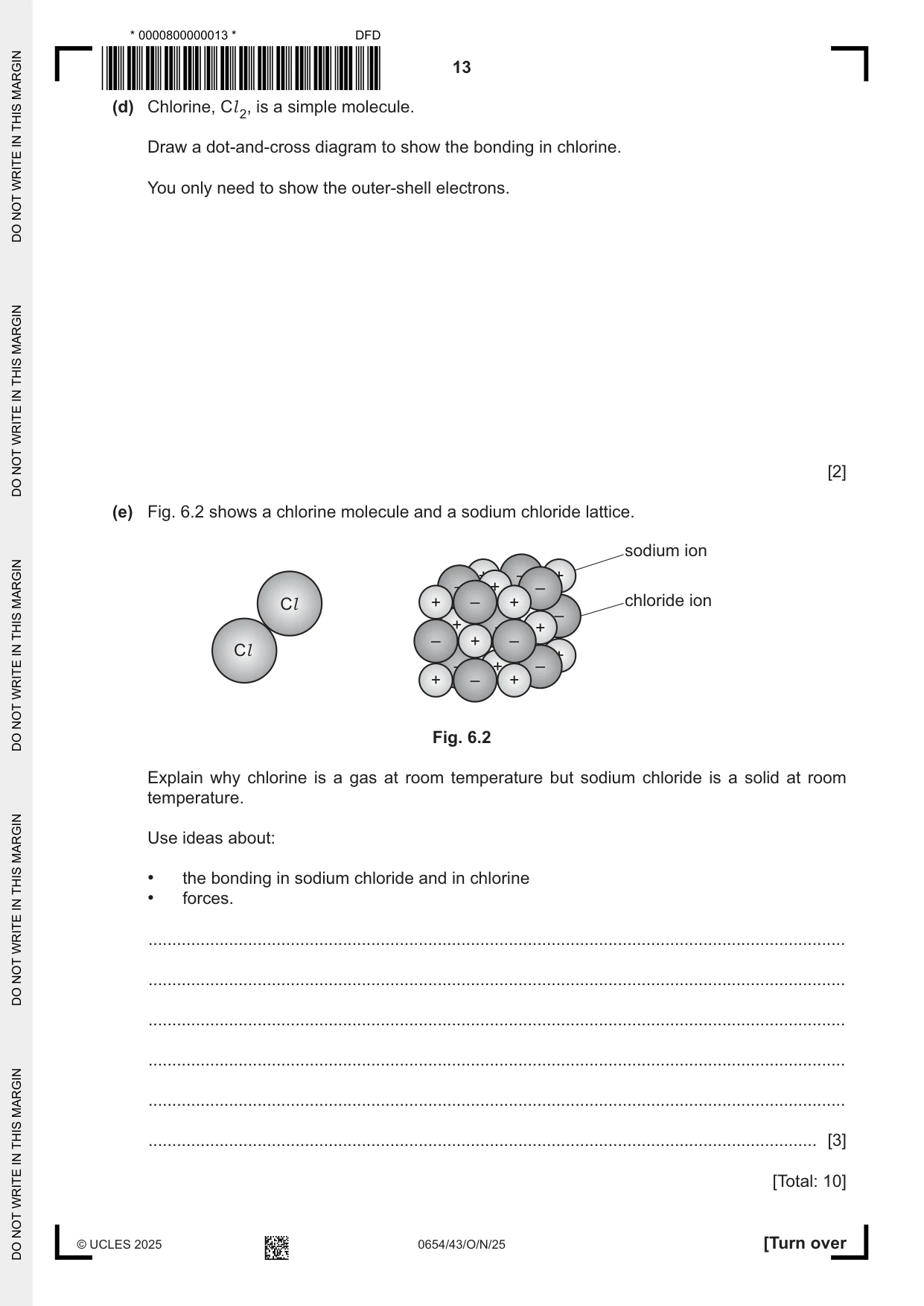
6 (a) Table 6.1 shows some information about the particles in atoms. Complete Table 6.1. Table 6.1 particle relative charge relative mass electron 0.0005 ................................................ neutron 1 ................................................ proton +1 ................................................ [2] (b) An ion of sodium is shown. 2 3 1 1Na+ Complete the sentence about this sodium ion. This sodium ion contains 11 protons, ............................. electrons and ............................. neutrons. [2] (c) Fig. 6.1 shows four symbols. 3 2 3 3 3 5 3 7 1 7Cl 1 7Cl 1 8Cl 1 7Cl Fig. 6.1 State which symbol is not an isotope of chlorine. ............................................................................................................................................. [1] (d) Chlorine, Cl 2, is a simple molecule. Draw a dot-and-cross diagram to show the bonding in chlorine. You only need to show the outer-shell electrons. [2] (e) Fig. 6.2 shows a chlorine molecule and a sodium chloride lattice. sodium ion + – + – + – Cl + – + chloride ion – + – + – + – Cl + – + – + – + Fig. 6.2 Explain why chlorine is a gas at room temperature but sodium chloride is a solid at room temperature. Use ideas about: • the bonding in sodium chloride and in chlorine • forces. ................................................................................................................................................... ................................................................................................................................................... ................................................................................................................................................... ................................................................................................................................................... ................................................................................................................................................... ............................................................................................................................................. [3] [Total: 10]
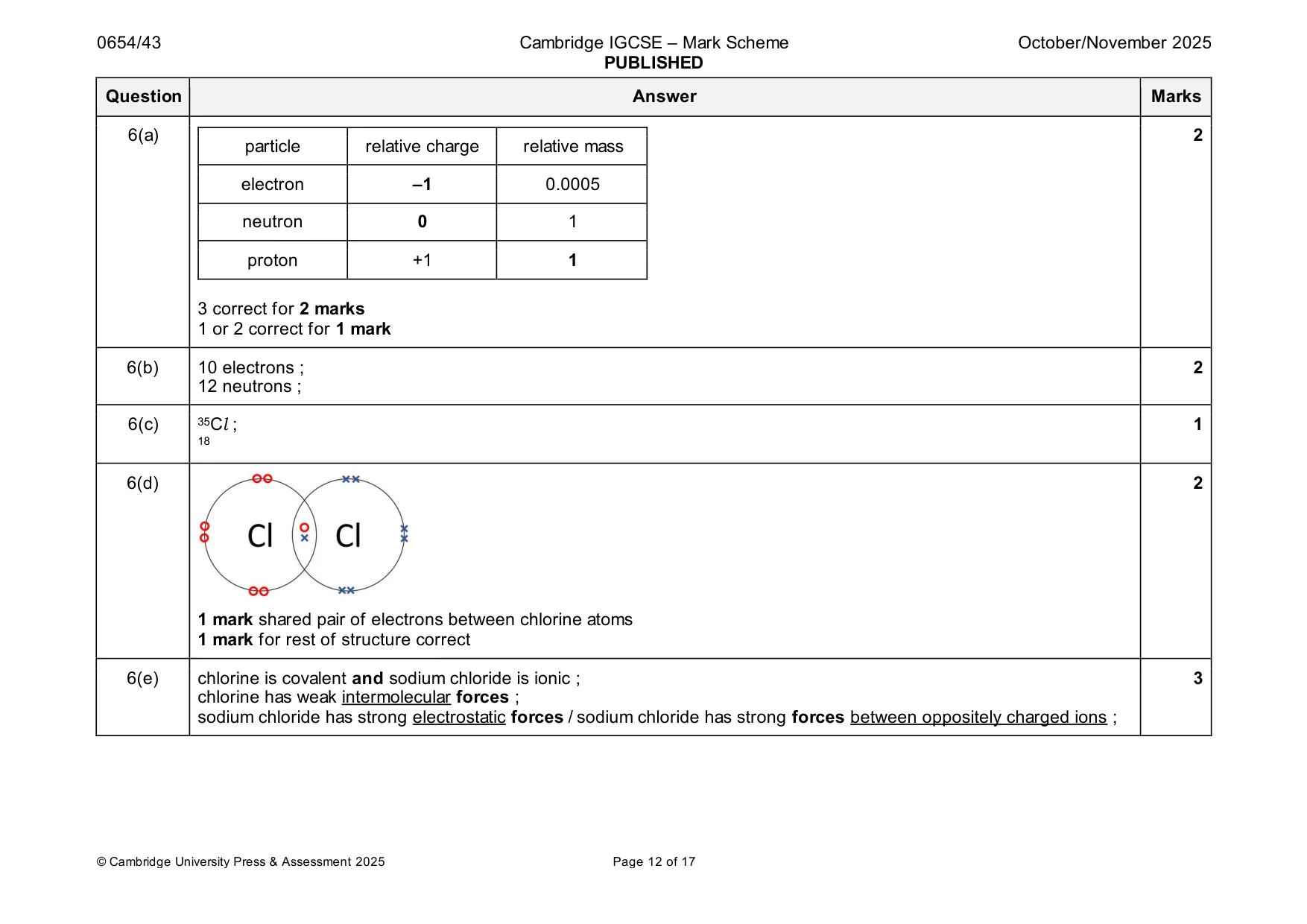
Mark scheme: 6(a) 2 particle relative charge relative mass electron –1 0.0005 neutron 0 1 proton +1 1 3 correct for 2 marks 1 or 2 correct for 1 mark 6(b) 10 electrons ; 2 12 neutrons ; 6(c) 35Cl ; 1 18 6(d) 2 1 mark shared pair of electrons between chlorine atoms 1 mark for rest of structure correct 6(e) chlorine is covalent and sodium chloride is ionic ; 3 chlorine has weak intermolecular forces ; sodium chloride has strong electrostatic forces / sodium chloride has strong forces between oppositely charged ions ;
Q7 · A student investigates the decomposition of hydrogen peroxide, H2O2
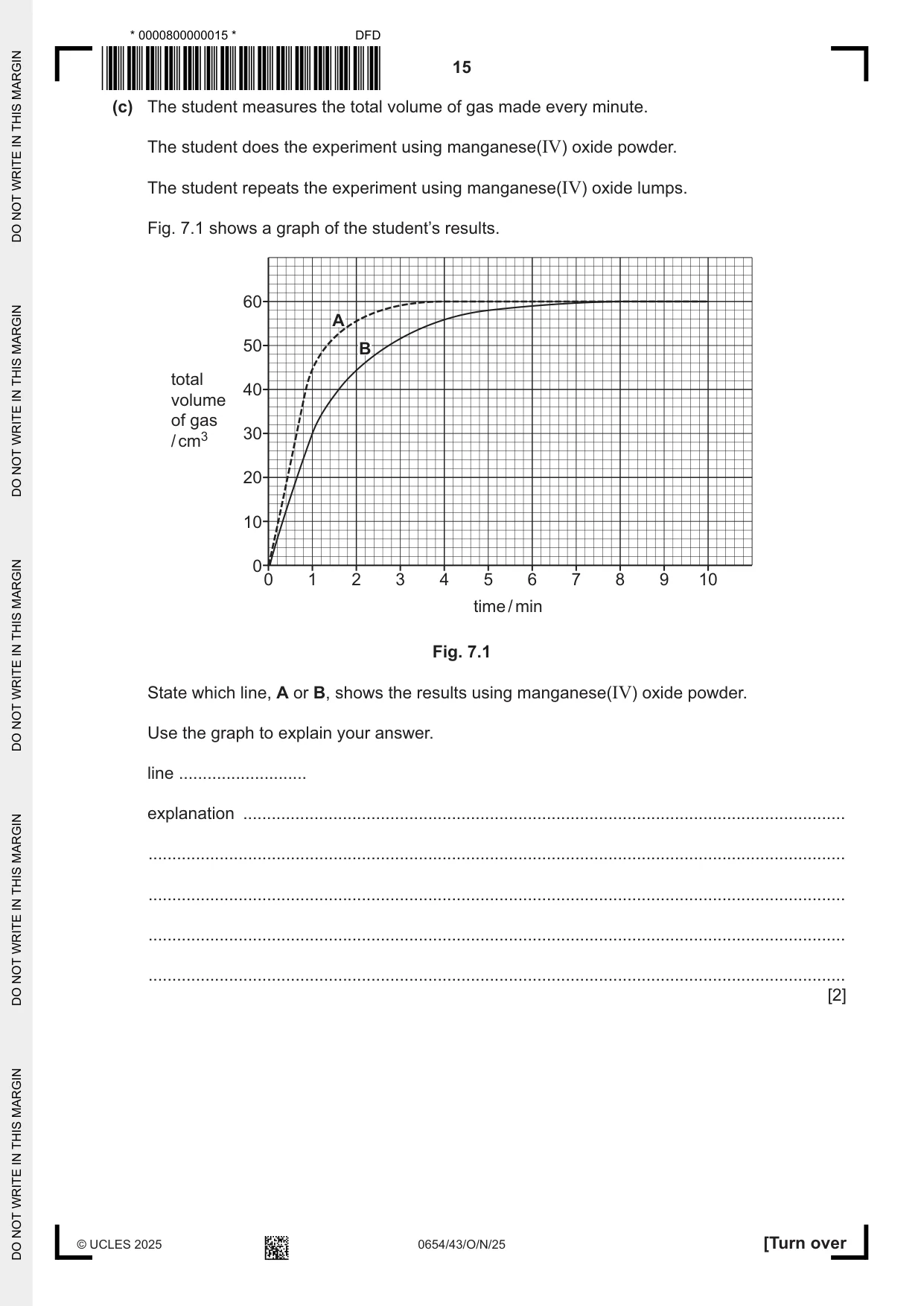
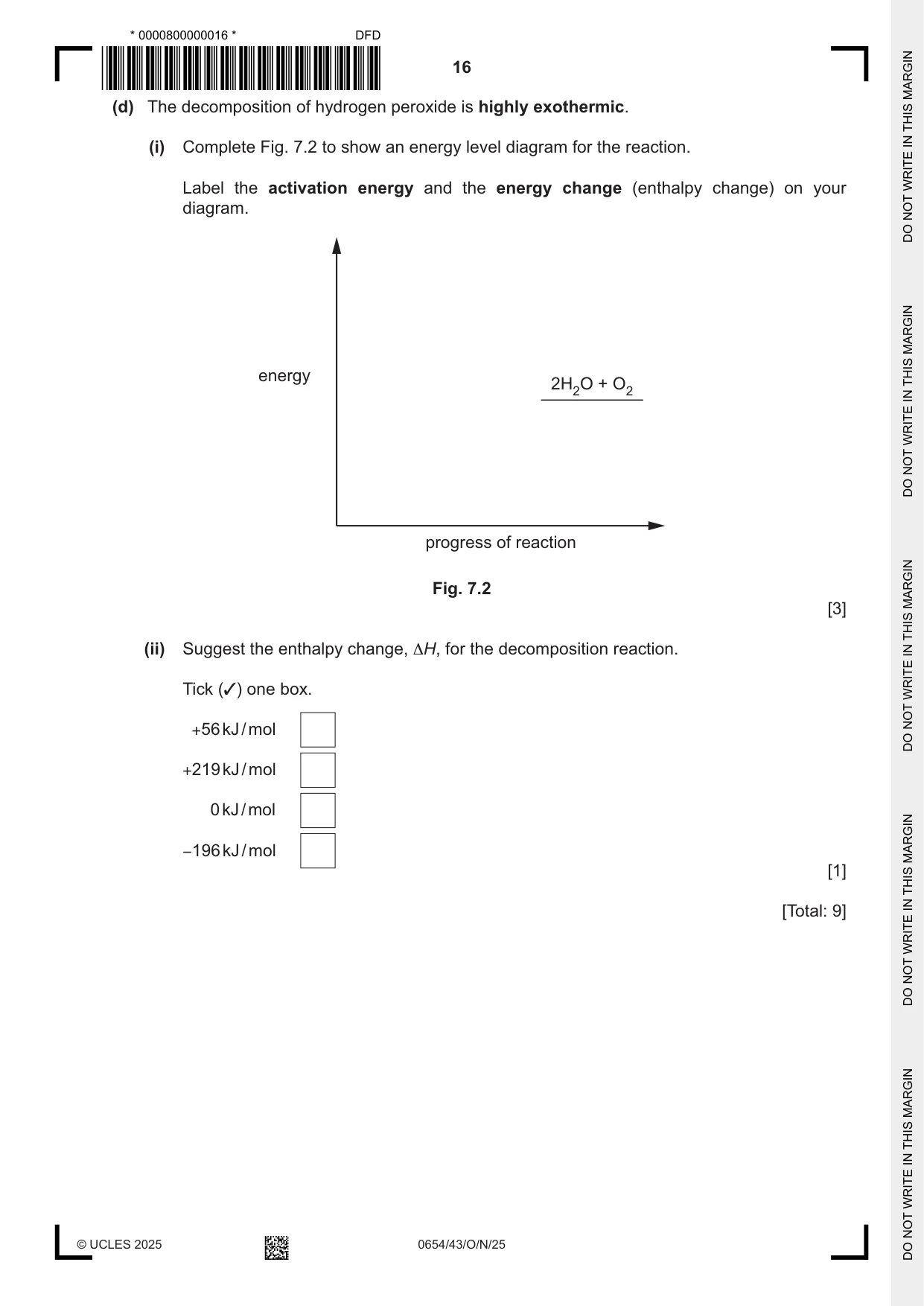
7 A student investigates the decomposition of hydrogen peroxide, H2O2. The equation for the reaction is shown. 2H2O2(aq) 2H2O(l) + O2(g) (a) Describe a test and its positive result to identify the gas made in the reaction. test ............................................................................................................................................ result ......................................................................................................................................... [2] (b) The student uses manganese(IV) oxide as a catalyst in the reaction. The catalyst speeds up the reaction. State why the catalyst speeds up the reaction. ................................................................................................................................................... ................................................................................................................................................... ............................................................................................................................................. [1] (c) The student measures the total volume of gas made every minute. The student does the experiment using manganese(IV) oxide powder. The student repeats the experiment using manganese(IV) oxide lumps. Fig. 7.1 shows a graph of the student’s results. 60 A 50 B total 40 volume of gas / cm3 30 20 10 0 0 1 2 3 4 5 6 7 8 9 10 time / min Fig. 7.1 State which line, A or B, shows the results using manganese(IV) oxide powder. Use the graph to explain your answer. line ........................... explanation ............................................................................................................................... ................................................................................................................................................... ................................................................................................................................................... ................................................................................................................................................... ................................................................................................................................................... [2] (d) The decomposition of hydrogen peroxide is highly exothermic. (i) Complete Fig. 7.2 to show an energy level diagram for the reaction. Label the activation energy and the energy change (enthalpy change) on your diagram. energy 2H2O + O2 progress of reaction Fig. 7.2 [3] (ii) Suggest the enthalpy change, ΔH, for the decomposition reaction. Tick (3) one box. +56 kJ / mol +219 kJ / mol 0 kJ / mol −196 kJ / mol [1] [Total: 9]
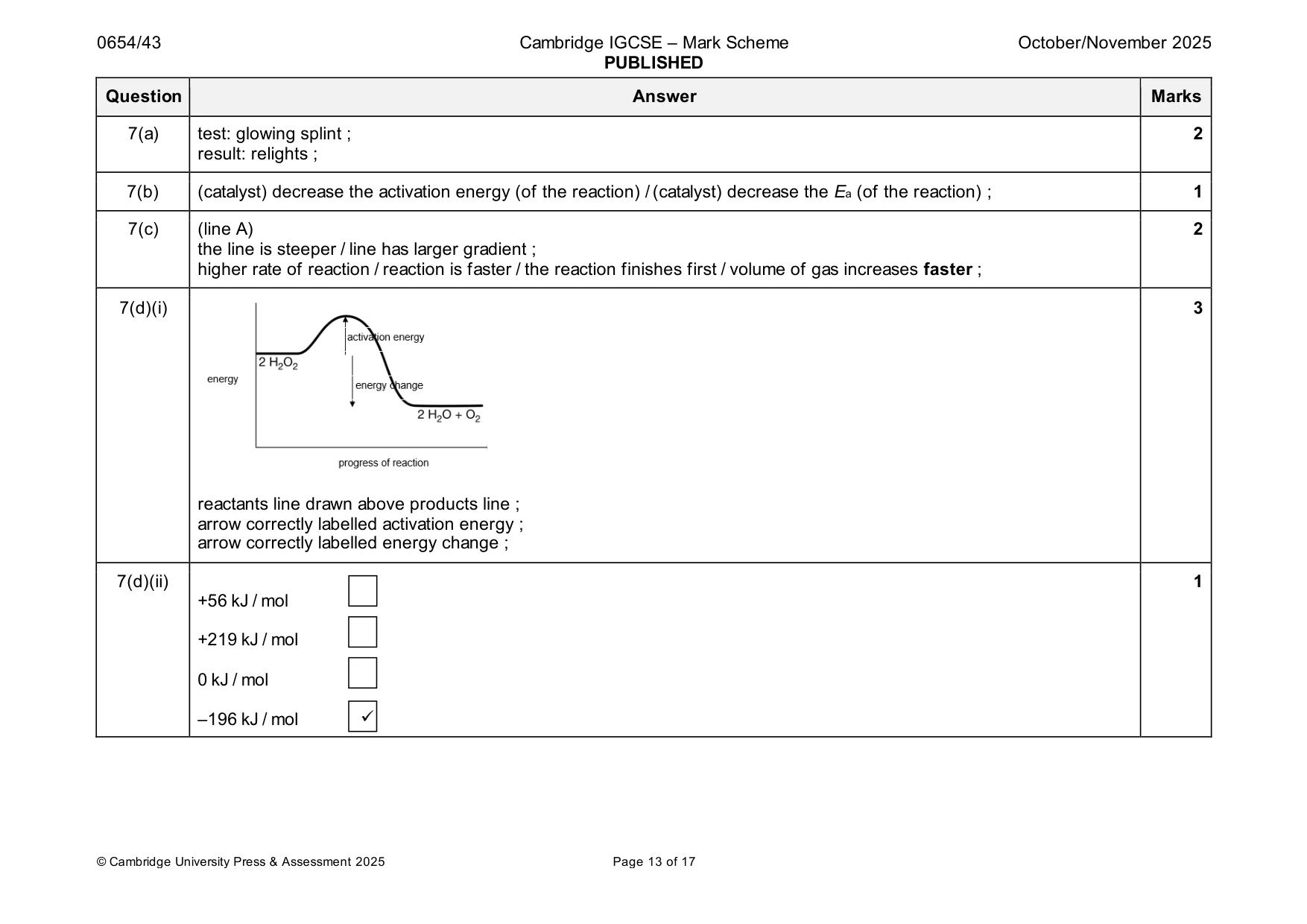
Mark scheme: 7(a) test: glowing splint ; 2 result: relights ; 7(b) (catalyst) decrease the activation energy (of the reaction) / (catalyst) decrease the Ea (of the reaction) ; 1 7(c) (line A) 2 the line is steeper / line has larger gradient ; higher rate of reaction / reaction is faster / the reaction finishes first / volume of gas increases faster ; 7(d)(i) 3 reactants line drawn above products line ; arrow correctly labelled activation energy ; arrow correctly labelled energy change ; 7(d)(ii) 1 +56 kJ / mol +219 kJ / mol 0 kJ / mol –196 kJ / mol ✓
Q8 · Iron is extracted from hematite by reduction of iron(III) oxide in a blast furnace
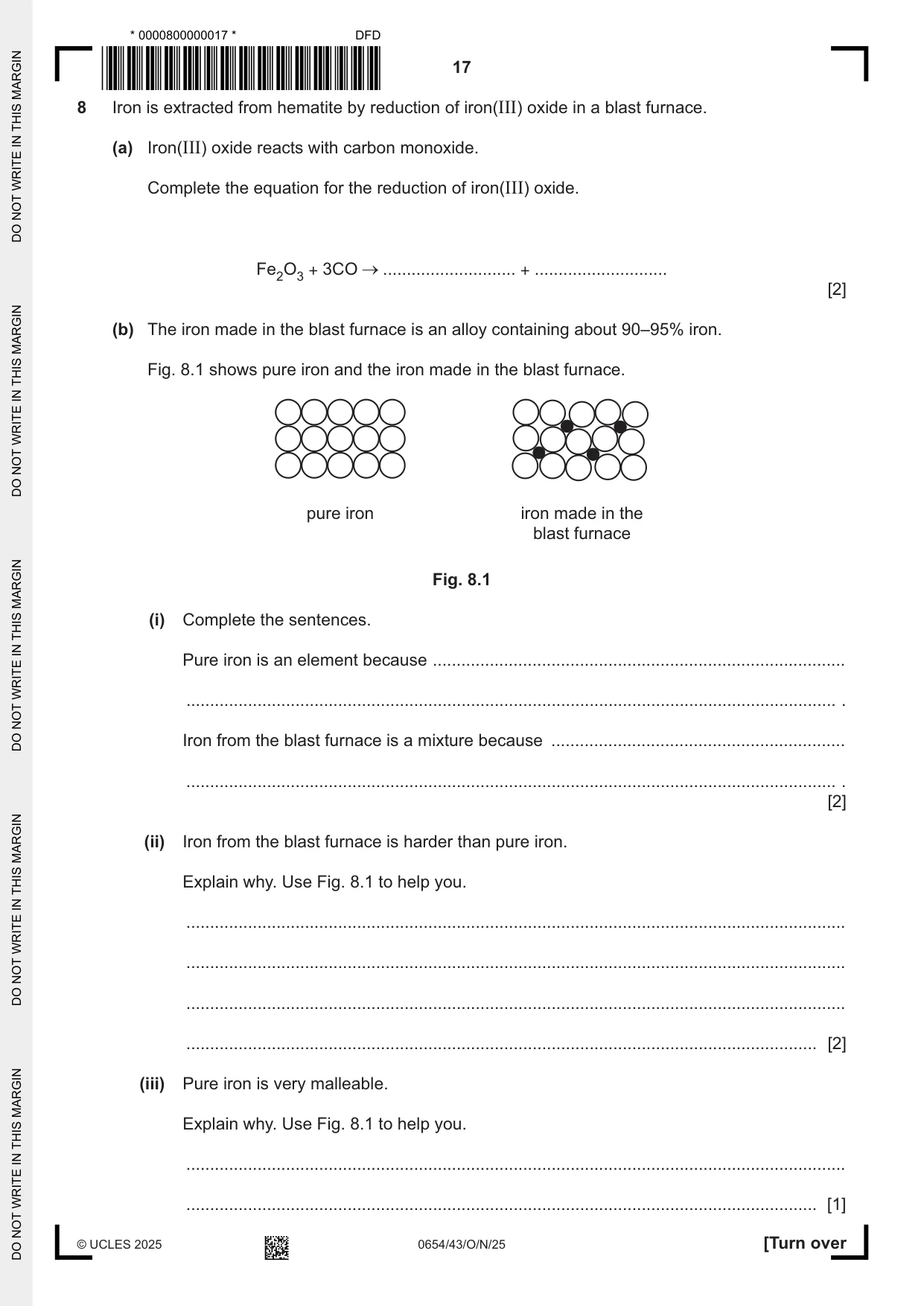
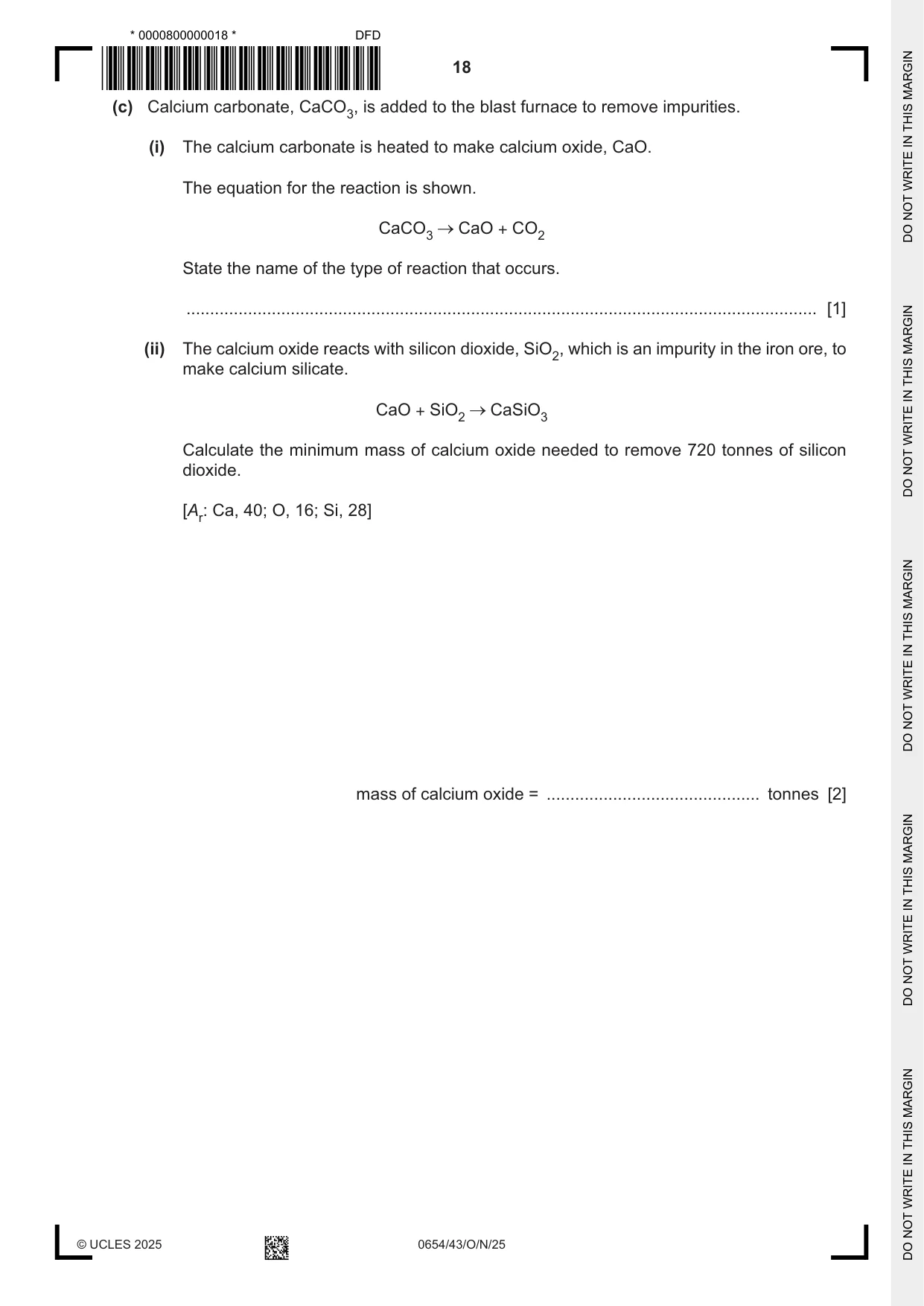
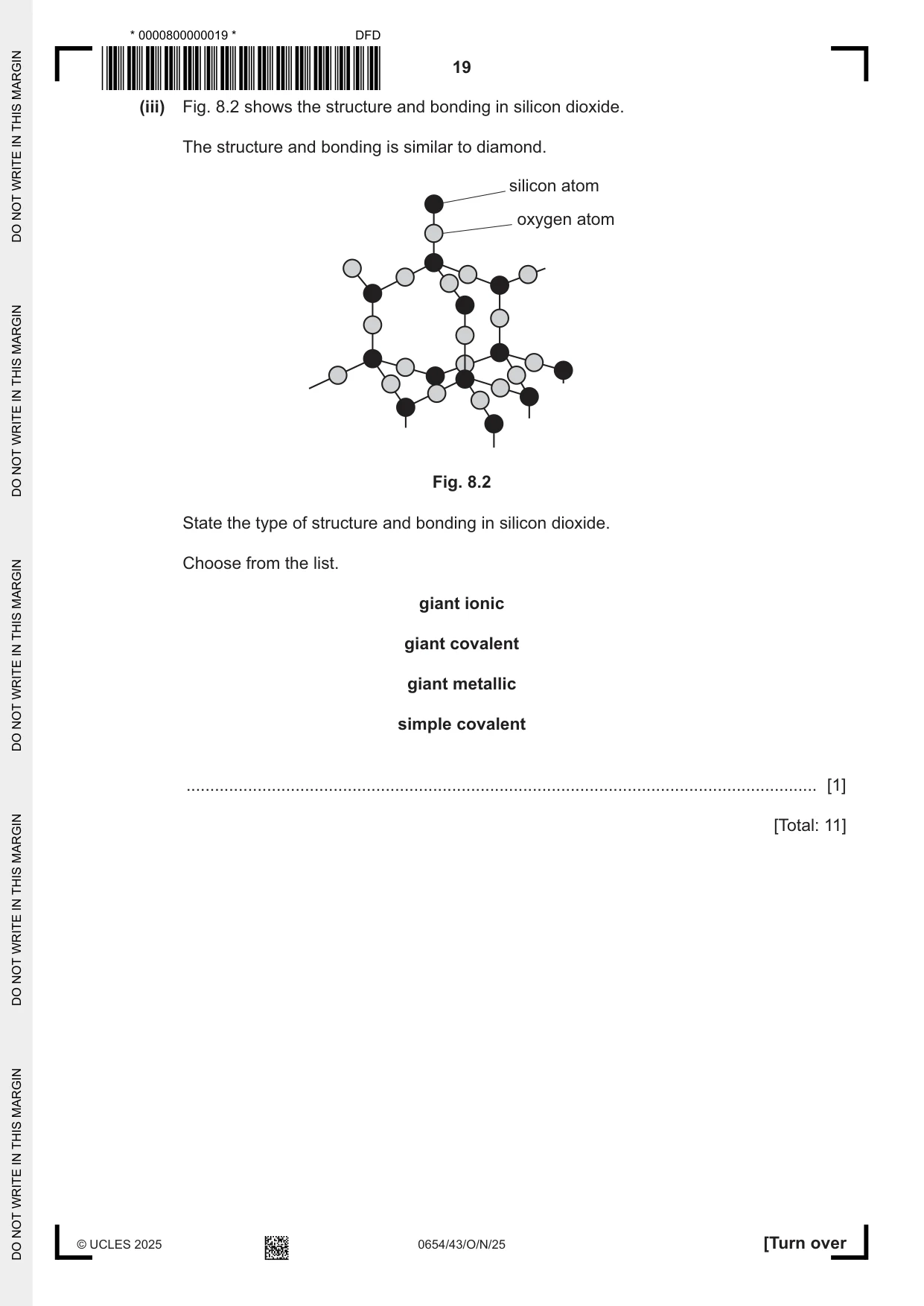
8 Iron is extracted from hematite by reduction of iron(III) oxide in a blast furnace. (a) Iron(III) oxide reacts with carbon monoxide. Complete the equation for the reduction of iron(III) oxide. Fe2O3 + 3CO ............................ + ............................ [2] (b) The iron made in the blast furnace is an alloy containing about 90–95% iron. Fig. 8.1 shows pure iron and the iron made in the blast furnace. pure iron iron made in the blast furnace Fig. 8.1 (i) Complete the sentences. Pure iron is an element because ....................................................................................... ......................................................................................................................................... . Iron from the blast furnace is a mixture because .............................................................. ......................................................................................................................................... . [2] (ii) Iron from the blast furnace is harder than pure iron. Explain why. Use Fig. 8.1 to help you. ........................................................................................................................................... ........................................................................................................................................... ........................................................................................................................................... ..................................................................................................................................... [2] (iii) Pure iron is very malleable. Explain why. Use Fig. 8.1 to help you. ........................................................................................................................................... ..................................................................................................................................... [1] (c) Calcium carbonate, CaCO3, is added to the blast furnace to remove impurities. (i) The calcium carbonate is heated to make calcium oxide, CaO. The equation for the reaction is shown. CaCO3 CaO + CO2 State the name of the type of reaction that occurs. ..................................................................................................................................... [1] (ii) The calcium oxide reacts with silicon dioxide, SiO2, which is an impurity in the iron ore, to make calcium silicate. CaO + SiO2 CaSiO3 Calculate the minimum mass of calcium oxide needed to remove 720 tonnes of silicon dioxide. [Ar: Ca, 40; O, 16; Si, 28] mass of calcium oxide = ............................................. tonnes [2] (iii) Fig. 8.2 shows the structure and bonding in silicon dioxide. The structure and bonding is similar to diamond. silicon atom oxygen atom Fig. 8.2 State the type of structure and bonding in silicon dioxide. Choose from the list. giant ionic giant covalent giant metallic simple covalent ..................................................................................................................................... [1] [Total: 11]
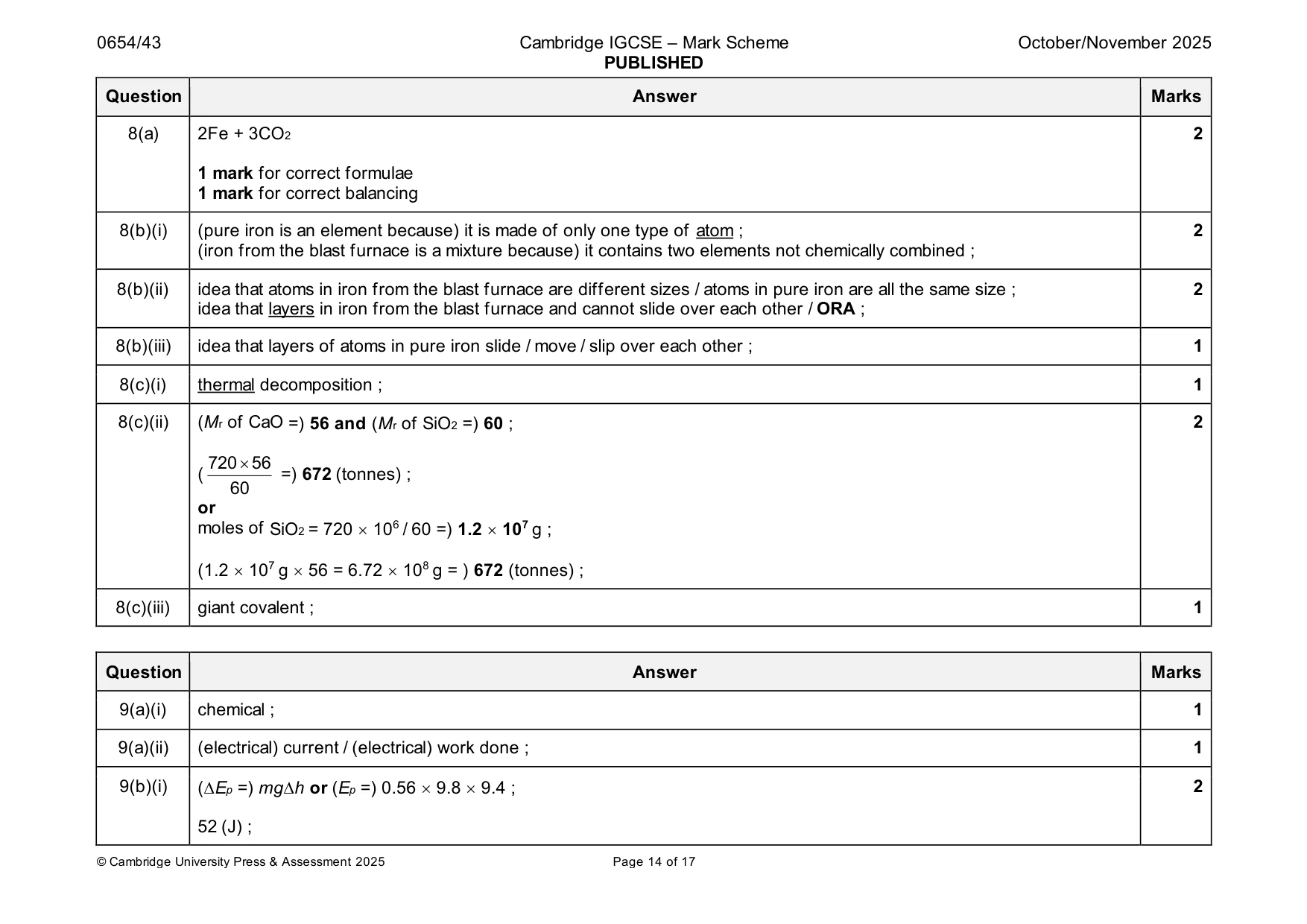
Mark scheme: 8(a) 2Fe + 3CO2 2 1 mark for correct formulae 1 mark for correct balancing 8(b)(i) (pure iron is an element because) it is made of only one type of atom ; 2 (iron from the blast furnace is a mixture because) it contains two elements not chemically combined ; 8(b)(ii) idea that atoms in iron from the blast furnace are different sizes / atoms in pure iron are all the same size ; 2 idea that layers in iron from the blast furnace and cannot slide over each other / ORA ; 8(b)(iii) idea that layers of atoms in pure iron slide / move / slip over each other ; 1 8(c)(i) thermal decomposition ; 1 8(c)(ii) (Mr of CaO =) 56 and (Mr of SiO2 =) 60 ; 2 720 56 ( =) 672 (tonnes) ; 60 or moles of SiO2 = 720 106 / 60 =) 1.2 107 g ; (1.2 107 g 56 = 6.72 108 g = ) 672 (tonnes) ; 8(c)(iii) giant covalent ; 1
Q9 · A simple torch (flashlight) is made from a battery connected to a lamp
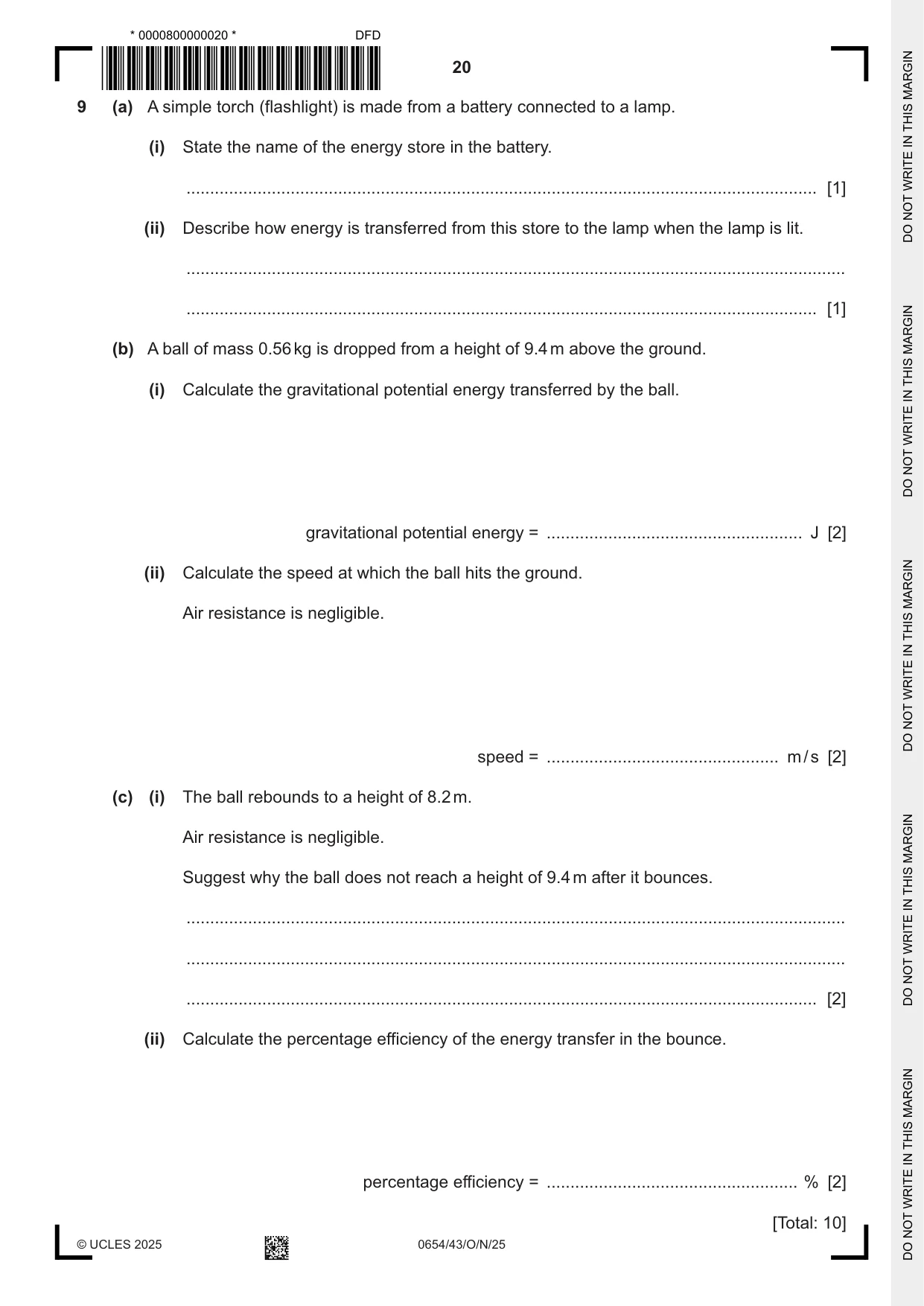
9 (a) A simple torch (flashlight) is made from a battery connected to a lamp. (i) State the name of the energy store in the battery. ..................................................................................................................................... [1] (ii) Describe how energy is transferred from this store to the lamp when the lamp is lit. ........................................................................................................................................... ..................................................................................................................................... [1] (b) A ball of mass 0.56 kg is dropped from a height of 9.4 m above the ground. (i) Calculate the gravitational potential energy transferred by the ball. gravitational potential energy = ...................................................... J [2] (ii) Calculate the speed at which the ball hits the ground. Air resistance is negligible. speed = ................................................. m / s [2] (c) (i) The ball rebounds to a height of 8.2 m. Air resistance is negligible. Suggest why the ball does not reach a height of 9.4 m after it bounces. ........................................................................................................................................... ........................................................................................................................................... ..................................................................................................................................... [2] (ii) Calculate the percentage efficiency of the energy transfer in the bounce. percentage efficiency = ..................................................... % [2] [Total: 10]
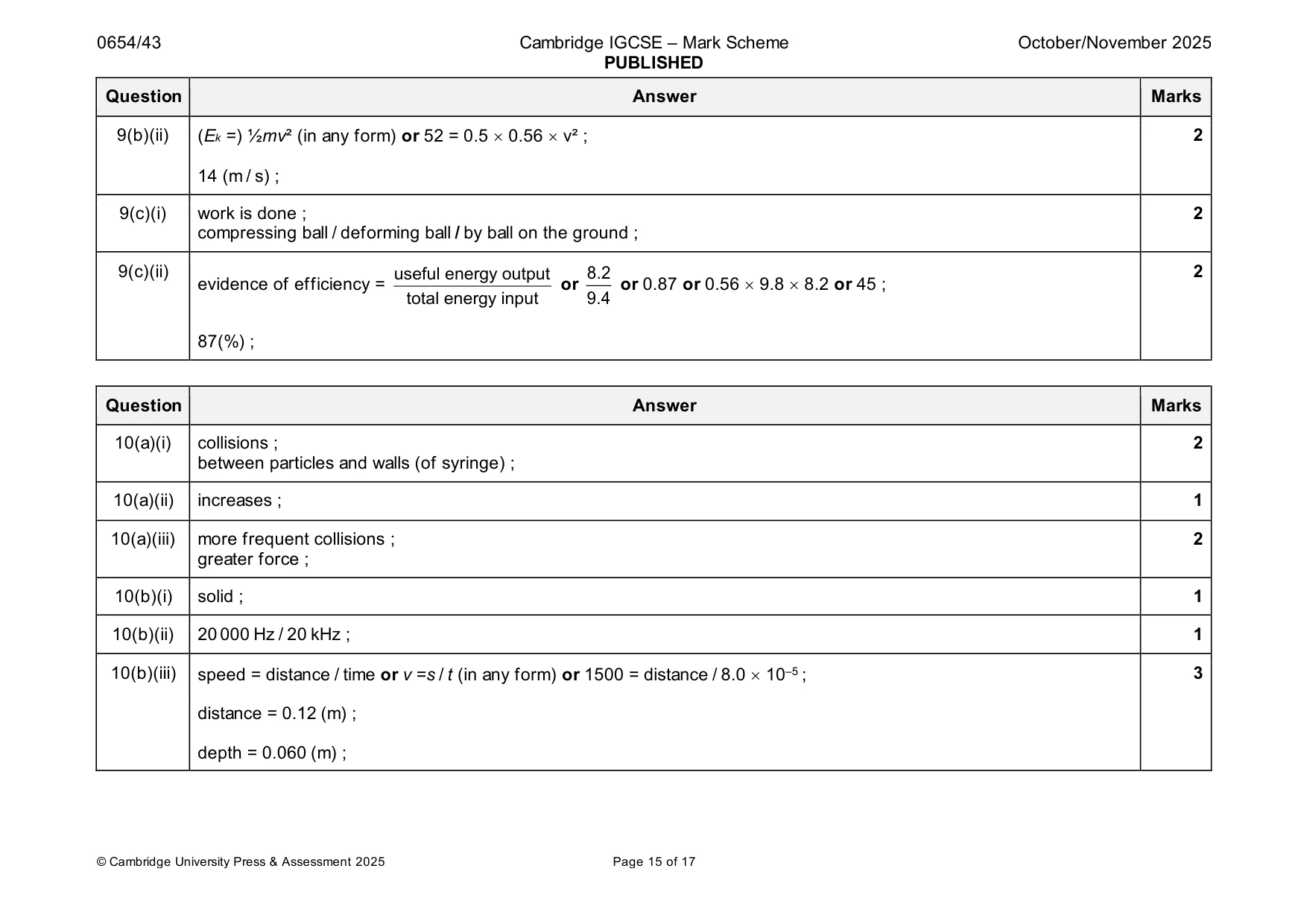
Mark scheme: 9(a)(i) chemical ; 1 9(a)(ii) (electrical) current / (electrical) work done ; 1 9(b)(i) (Ep =) mgh or (Ep =) 0.56 9.8 9.4 ; 2 52 (J) ; 9(b)(ii) (Ek =) ½mv² (in any form) or 52 = 0.5 0.56 v² ; 2 14 (m / s) ; 9(c)(i) work is done ; 2 compressing ball / deforming ball / by ball on the ground ; 9(c)(ii) useful energy output 8.2 2 evidence of efficiency = or or 0.87 or 0.56 9.8 8.2 or 45 ; total energy input 9.4 87(%) ;
Q10 · A sealed syringe contains a sample of gas as shown in Fig
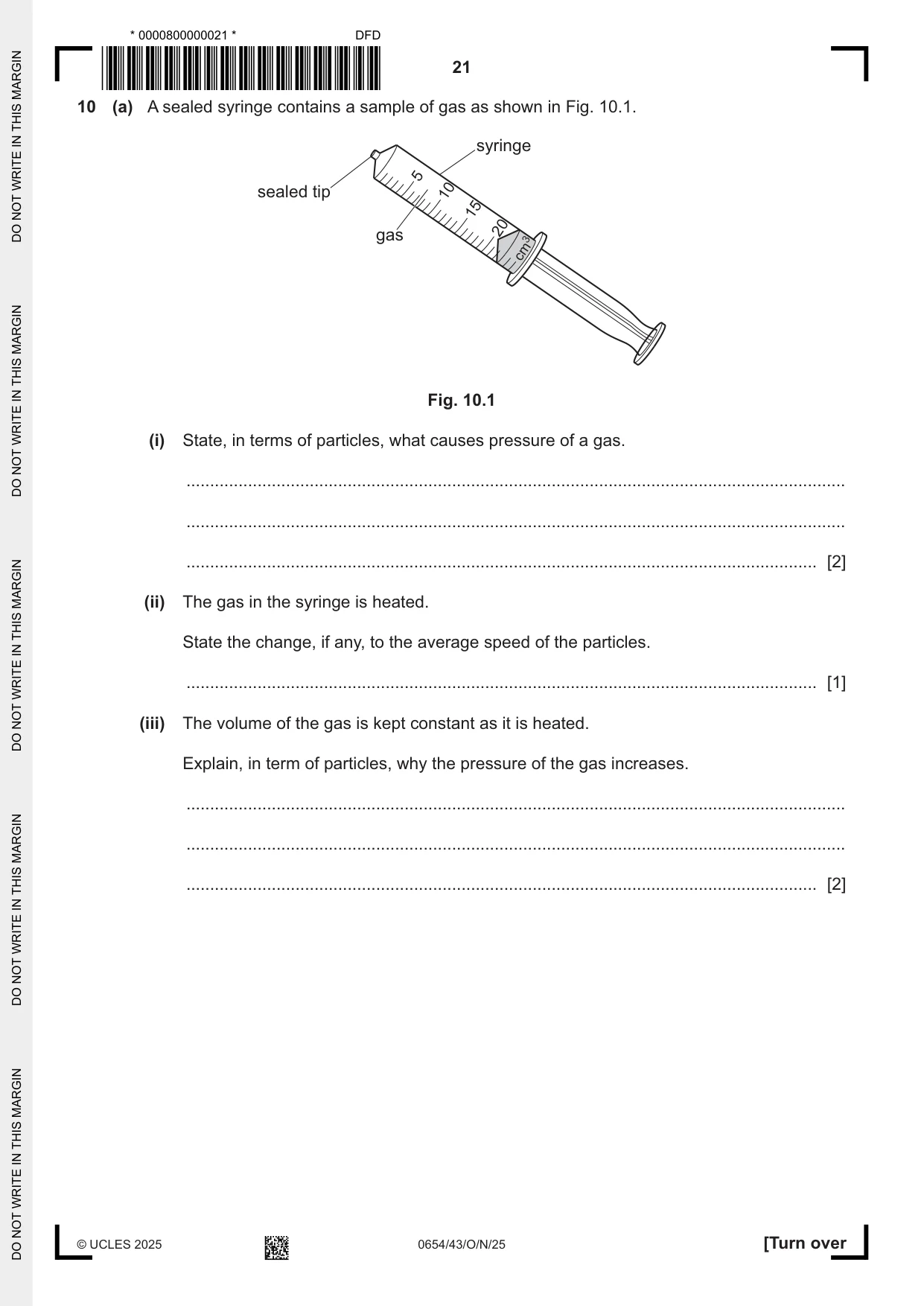
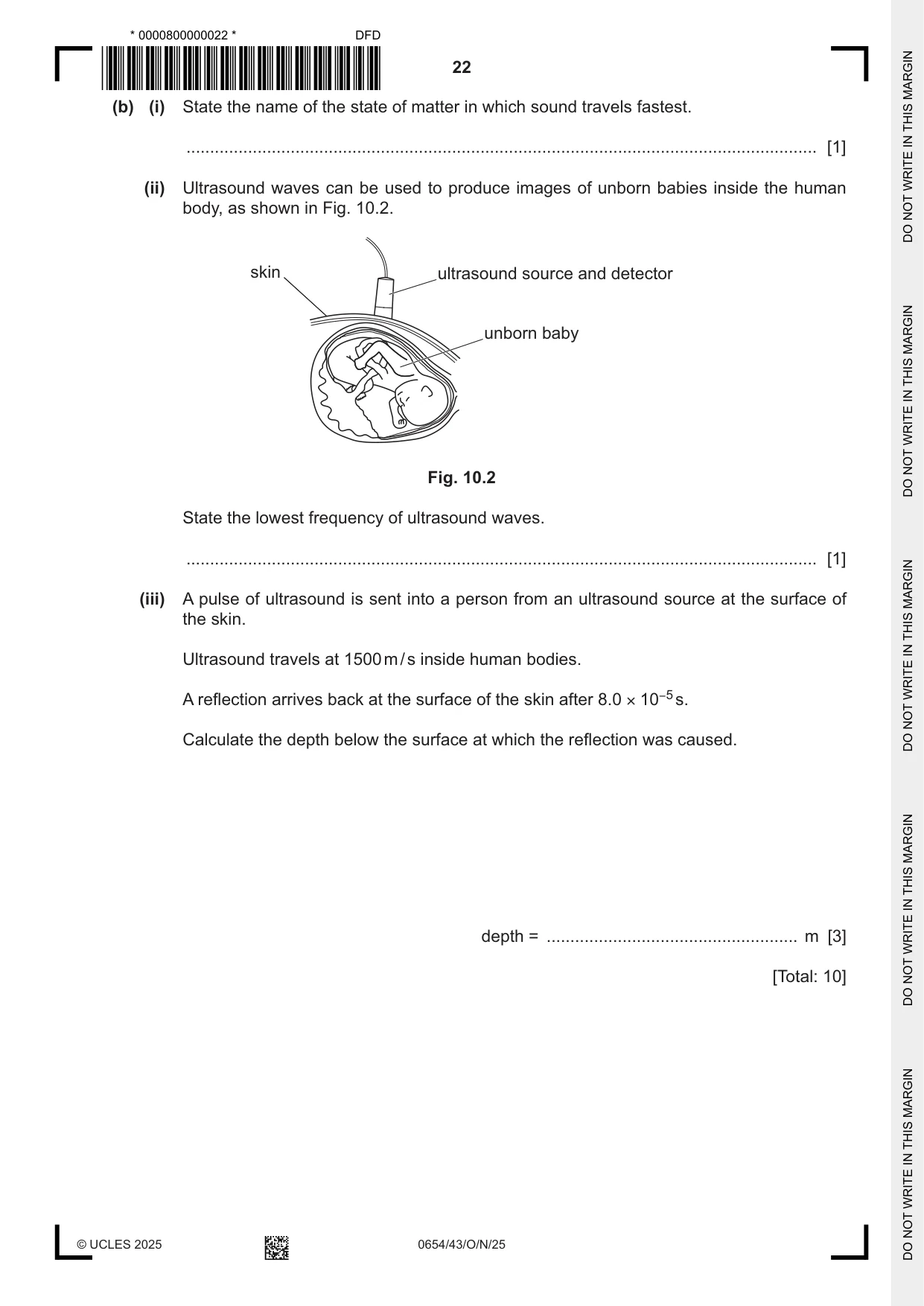
10 (a) A sealed syringe contains a sample of gas as shown in Fig. 10.1. syringe 5 sealed tip 10 15 gas 20 cm3 Fig. 10.1 (i) State, in terms of particles, what causes pressure of a gas. ........................................................................................................................................... ........................................................................................................................................... ..................................................................................................................................... [2] (ii) The gas in the syringe is heated. State the change, if any, to the average speed of the particles. ..................................................................................................................................... [1] (iii) The volume of the gas is kept constant as it is heated. Explain, in term of particles, why the pressure of the gas increases. ........................................................................................................................................... ........................................................................................................................................... ..................................................................................................................................... [2] (b) (i) State the name of the state of matter in which sound travels fastest. ..................................................................................................................................... [1] (ii) Ultrasound waves can be used to produce images of unborn babies inside the human body, as shown in Fig. 10.2. skin ultrasound source and detector unborn baby Fig. 10.2 State the lowest frequency of ultrasound waves. ..................................................................................................................................... [1] (iii) A pulse of ultrasound is sent into a person from an ultrasound source at the surface of the skin. Ultrasound travels at 1500 m / s inside human bodies. A reflection arrives back at the surface of the skin after 8.0 × 10⁻⁵ s. Calculate the depth below the surface at which the reflection was caused. depth = ..................................................... m [3] [Total: 10]
Mark scheme: 10(a)(i) collisions ; 2 between particles and walls (of syringe) ; 10(a)(ii) increases ; 1 10(a)(iii) more frequent collisions ; 2 greater force ; 10(b)(i) solid ; 1 10(b)(ii) 20 000 Hz / 20 kHz ; 1 10(b)(iii) speed = distance / time or v =s / t (in any form) or 1500 = distance / 8.0 10–5 ; 3 distance = 0.12 (m) ; depth = 0.060 (m) ;
Q11 · State the age of the Universe according to the Big Bang Theory
11 (a) (i) State the age of the Universe according to the Big Bang Theory. ..................................................................................................................................... [1] (ii) State how the Universe began according to the Big Bang Theory. ........................................................................................................................................... ..................................................................................................................................... [2] (b) The distance between Earth and Mars varies between 5.6 × 10¹⁰ m and 4.0 × 10¹¹ m. Calculate the shortest possible time for light to travel from Earth to Mars. time = ...................................................... s [2] (c) (i) New elements form during radioactive decay. 21 0 is radioactive. It decays by emitting an alpha particle. 8 4Po Complete the equation for this nuclear decay. 21 0 ............. ............. Pb + α 8 4Po ............. ............. [2] (ii) Initially a sample of 21 0 has a mass of 560 g. 8 4Po The half-life of 21 0 is 3.1 minutes. 8 4Po Calculate the mass of 21 0 remaining after 12.4 minutes. 8 4Po mass = ...................................................... g [2] [Total: 9]
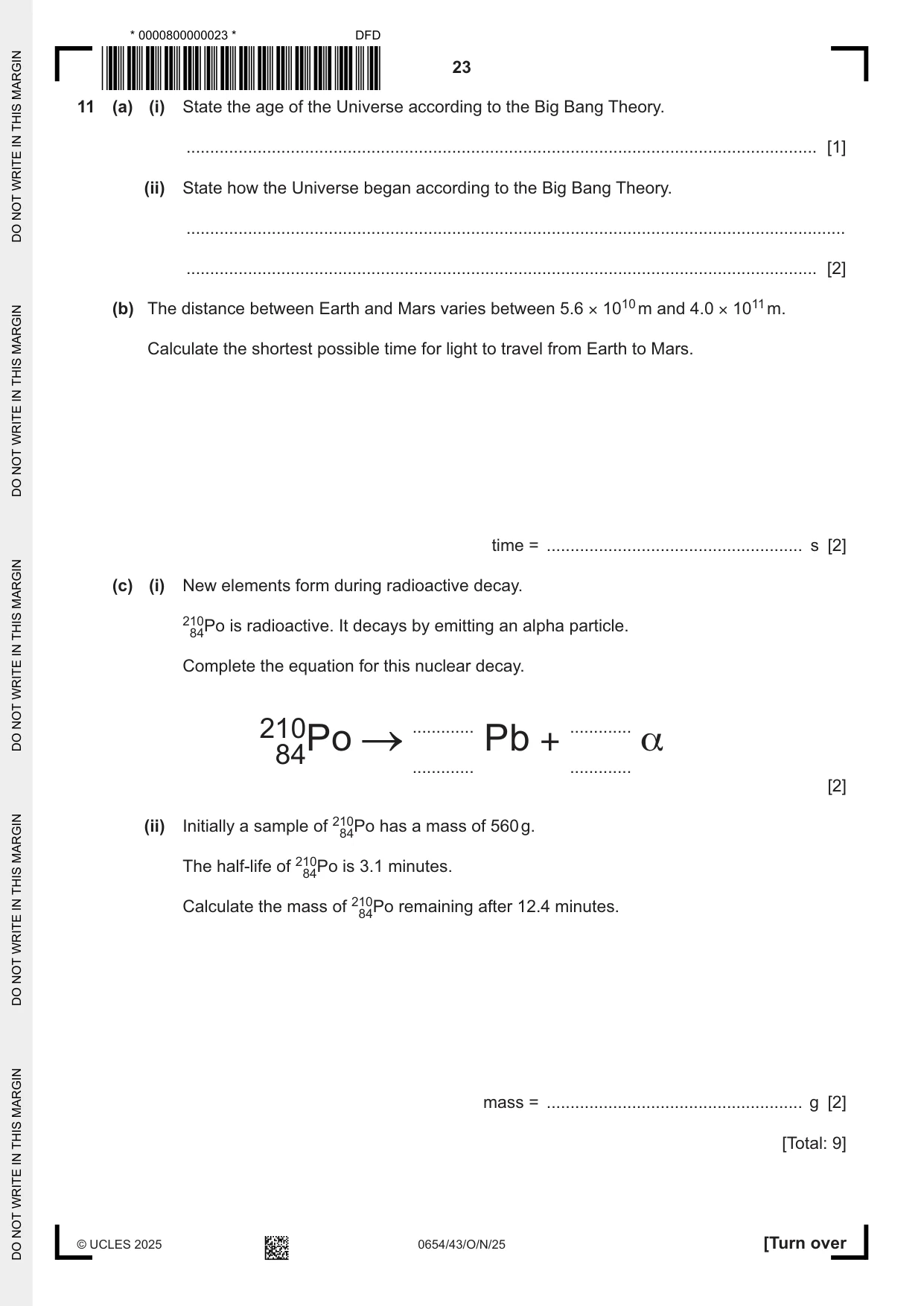
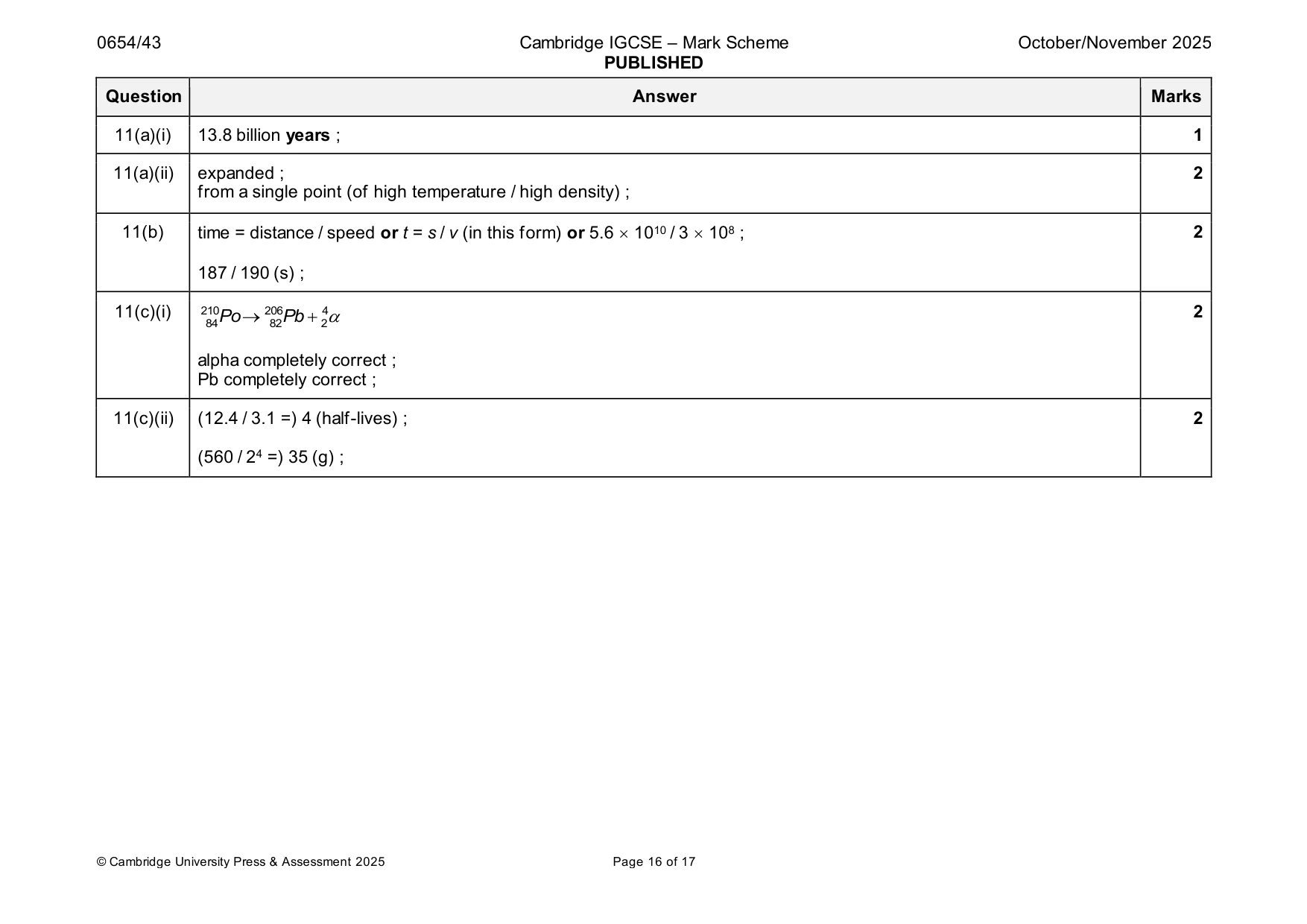
Mark scheme: 11(a)(i) 13.8 billion years ; 1 11(a)(ii) expanded ; 2 from a single point (of high temperature / high density) ; 11(b) time = distance / speed or t = s / v (in this form) or 5.6 1010 / 3 108 ; 2 187 / 190 (s) ; 11(c)(i) 210 206 4 2 84 Po → 82 Pb + 2 alpha completely correct ; Pb completely correct ; 11(c)(ii) (12.4 / 3.1 =) 4 (half-lives) ; 2 (560 / 24 =) 35 (g) ;
Q12 · Describe the construction of a step-up transformer
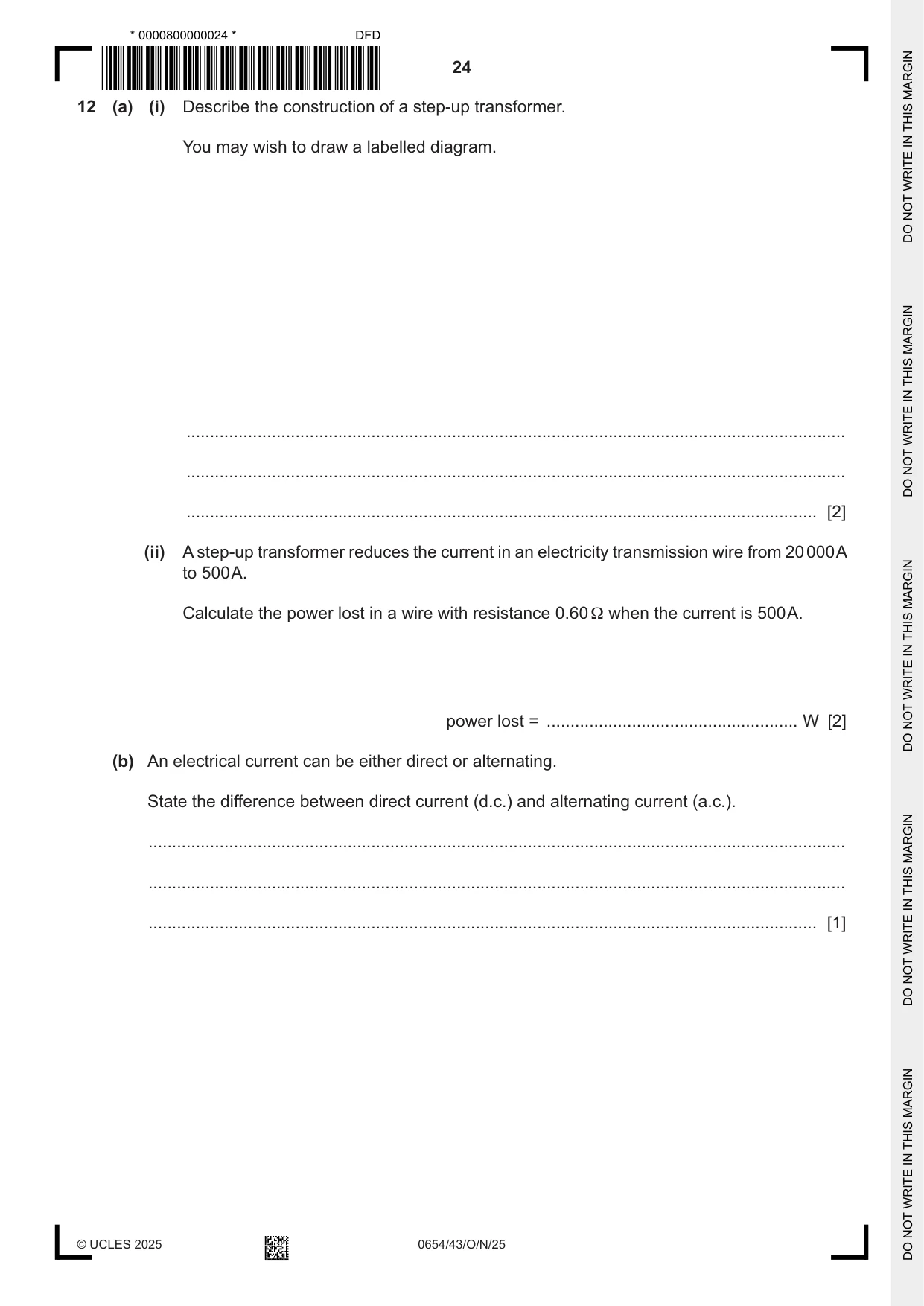
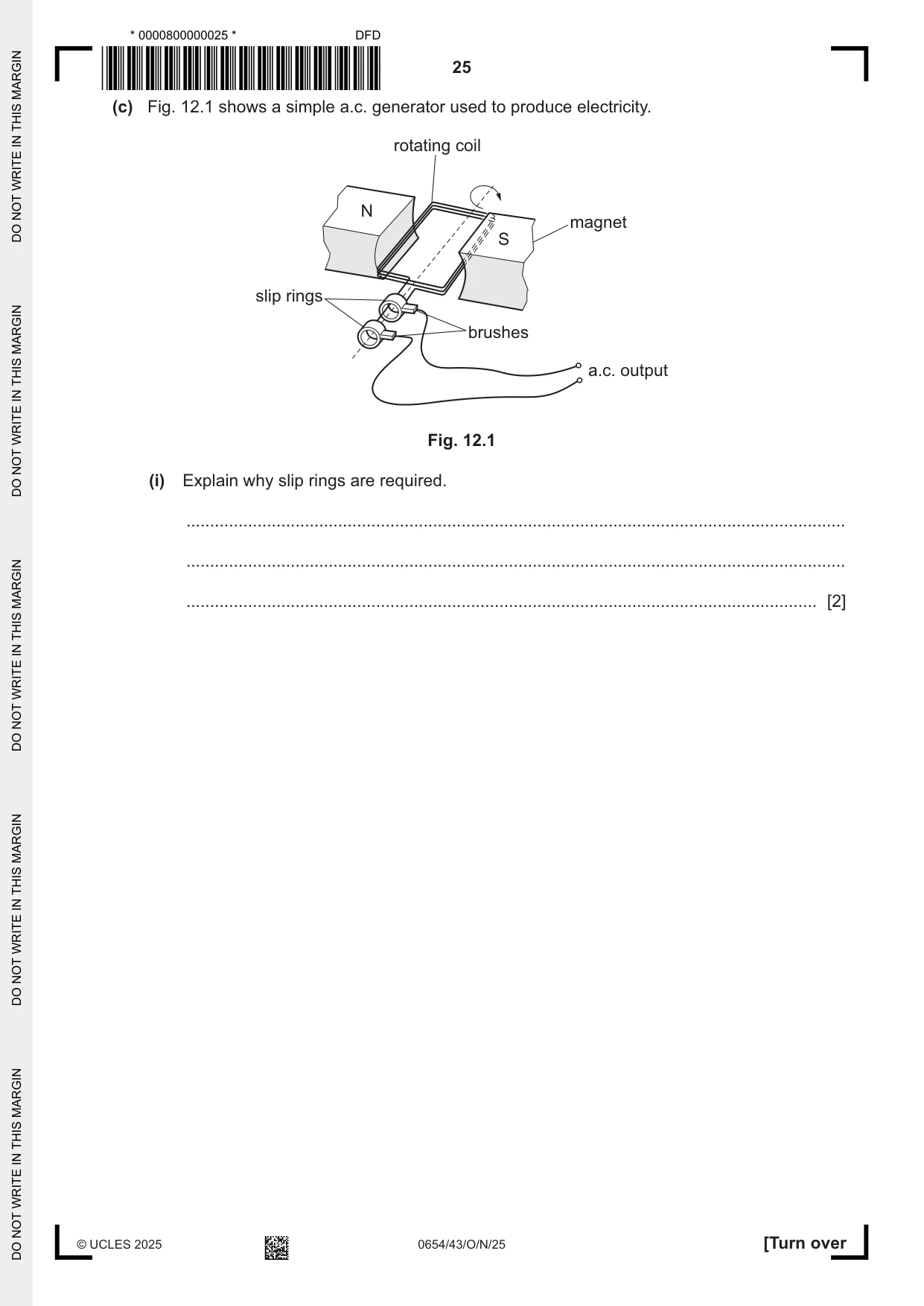
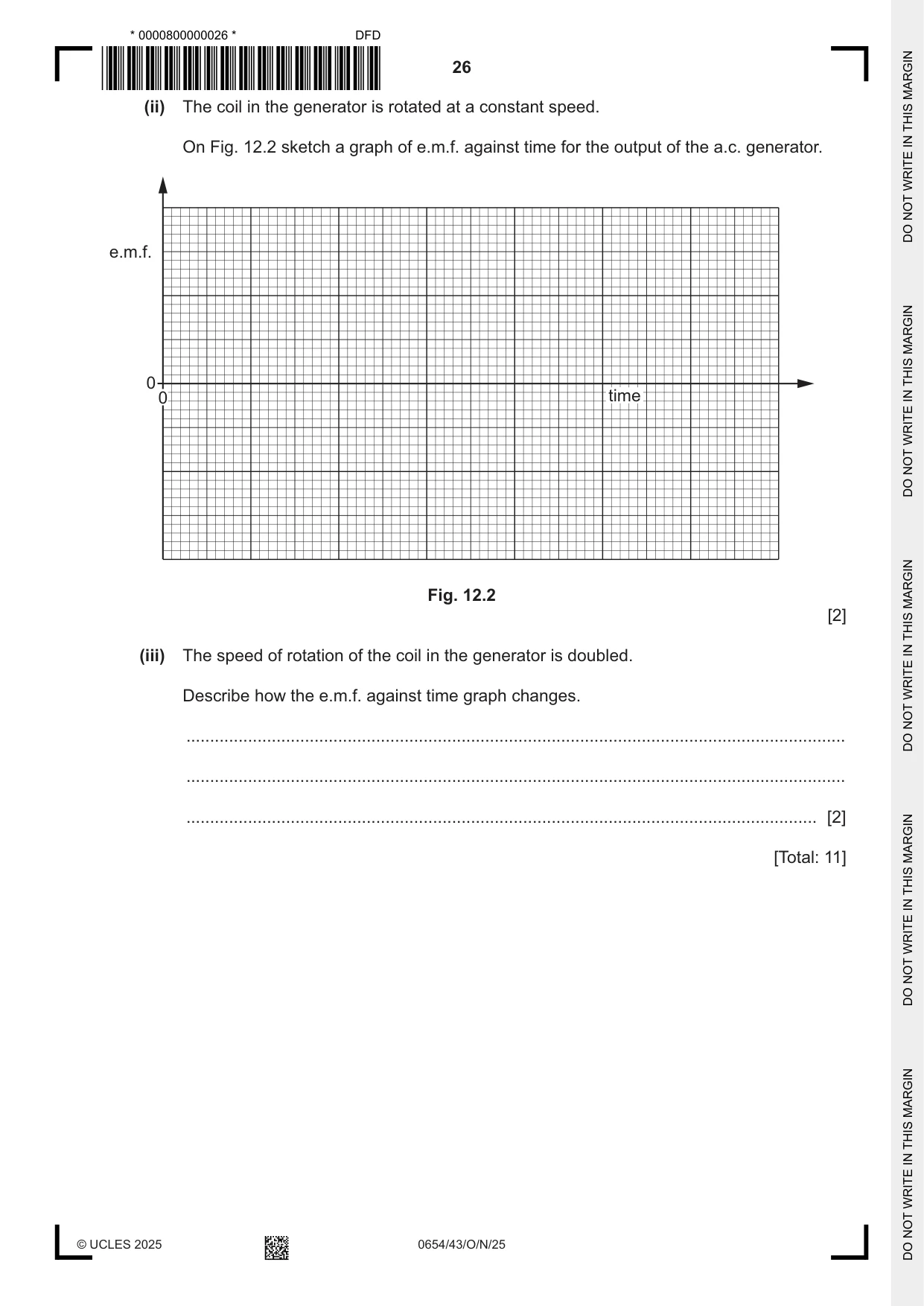
12 (a) (i) Describe the construction of a step-up transformer. You may wish to draw a labelled diagram. ........................................................................................................................................... ........................................................................................................................................... ..................................................................................................................................... [2] (ii) A step-up transformer reduces the current in an electricity transmission wire from 20 000 A to 500 A. Calculate the power lost in a wire with resistance 0.60 Ω when the current is 500 A. power lost = ..................................................... W [2] (b) An electrical current can be either direct or alternating. State the difference between direct current (d.c.) and alternating current (a.c.). ................................................................................................................................................... ................................................................................................................................................... ............................................................................................................................................. [1] (c) Fig. 12.1 shows a simple a.c. generator used to produce electricity. rotating coil N magnet S slip rings brushes a.c. output Fig. 12.1 (i) Explain why slip rings are required. ........................................................................................................................................... ........................................................................................................................................... ..................................................................................................................................... [2] (ii) The coil in the generator is rotated at a constant speed. On Fig. 12.2 sketch a graph of e.m.f. against time for the output of the a.c. generator. e.m.f. 0 0 time Fig. 12.2 [2] (iii) The speed of rotation of the coil in the generator is doubled. Describe how the e.m.f. against time graph changes. ........................................................................................................................................... ........................................................................................................................................... ..................................................................................................................................... [2] [Total: 11]
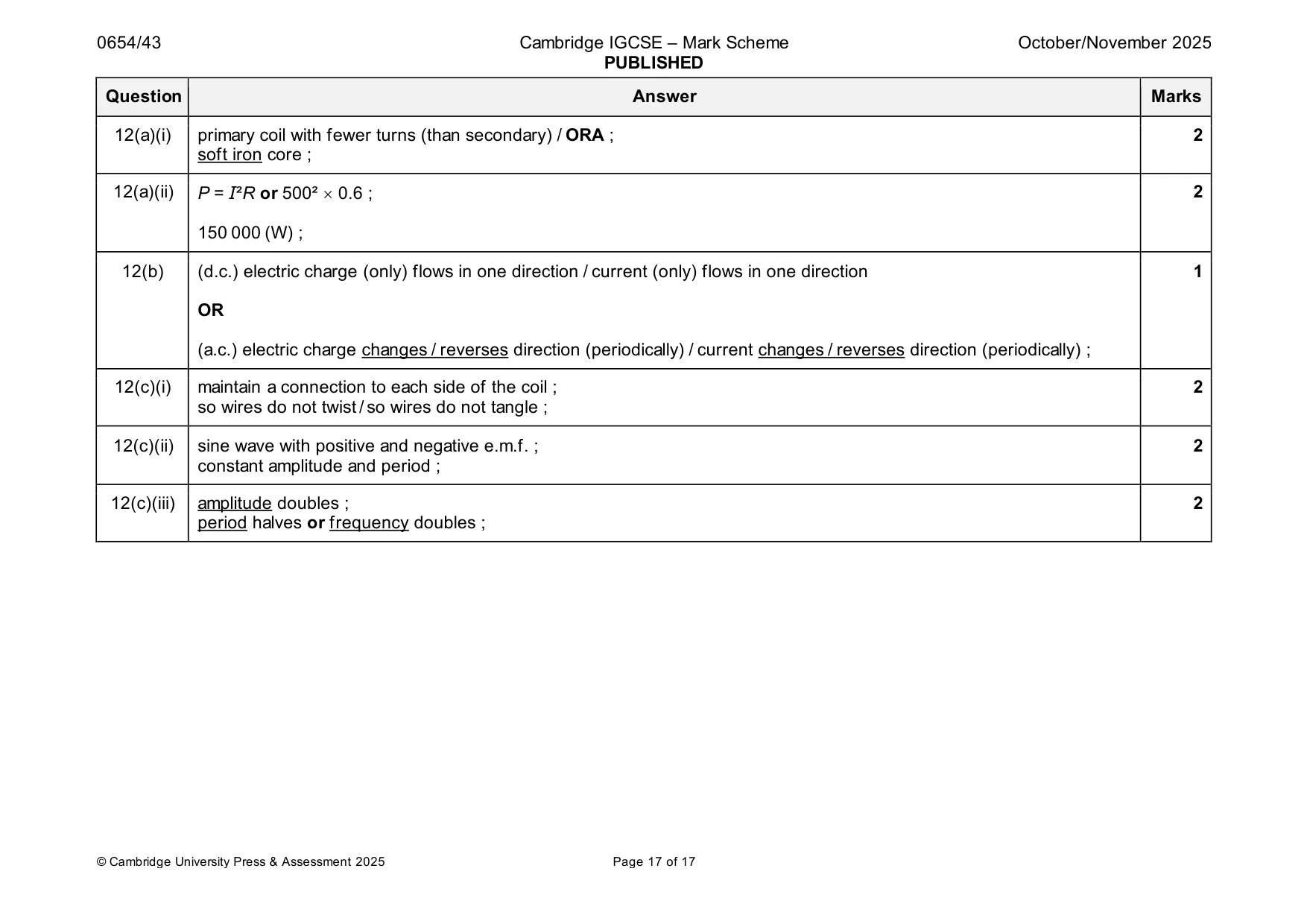
Mark scheme: 12(a)(i) primary coil with fewer turns (than secondary) / ORA ; 2 soft iron core ; 12(a)(ii) P = I²R or 500² 0.6 ; 2 150 000 (W) ; 12(b) (d.c.) electric charge (only) flows in one direction / current (only) flows in one direction 1 OR (a.c.) electric charge changes / reverses direction (periodically) / current changes / reverses direction (periodically) ; 12(c)(i) maintain a connection to each side of the coil ; 2 so wires do not twist / so wires do not tangle ; 12(c)(ii) sine wave with positive and negative e.m.f. ; 2 constant amplitude and period ; 12(c)(iii) amplitude doubles ; 2 period halves or frequency doubles ;
What was in this paper
The subtopics covered by these 12 questions, and how many questions each got. Open one in a new tab to see every Cambridge question on it.
What you needed in this session
Cambridge’s own grade thresholds for 2025 Oct/Nov, Paper 4 · Variant 3. A higher threshold means an easier paper — the bar moves with how the cohort did.