Cambridge IGCSE Sciences - Co-ordinated (Double) 0654 — 2020 May/June Paper 4 · Variant 1
0654/41/M/J/20 · 12 questions · 120 marks · ≈135 min
The question paper and its mark scheme, free to read here and free to download. This is Cambridge’s own paper, exactly as it was sat.
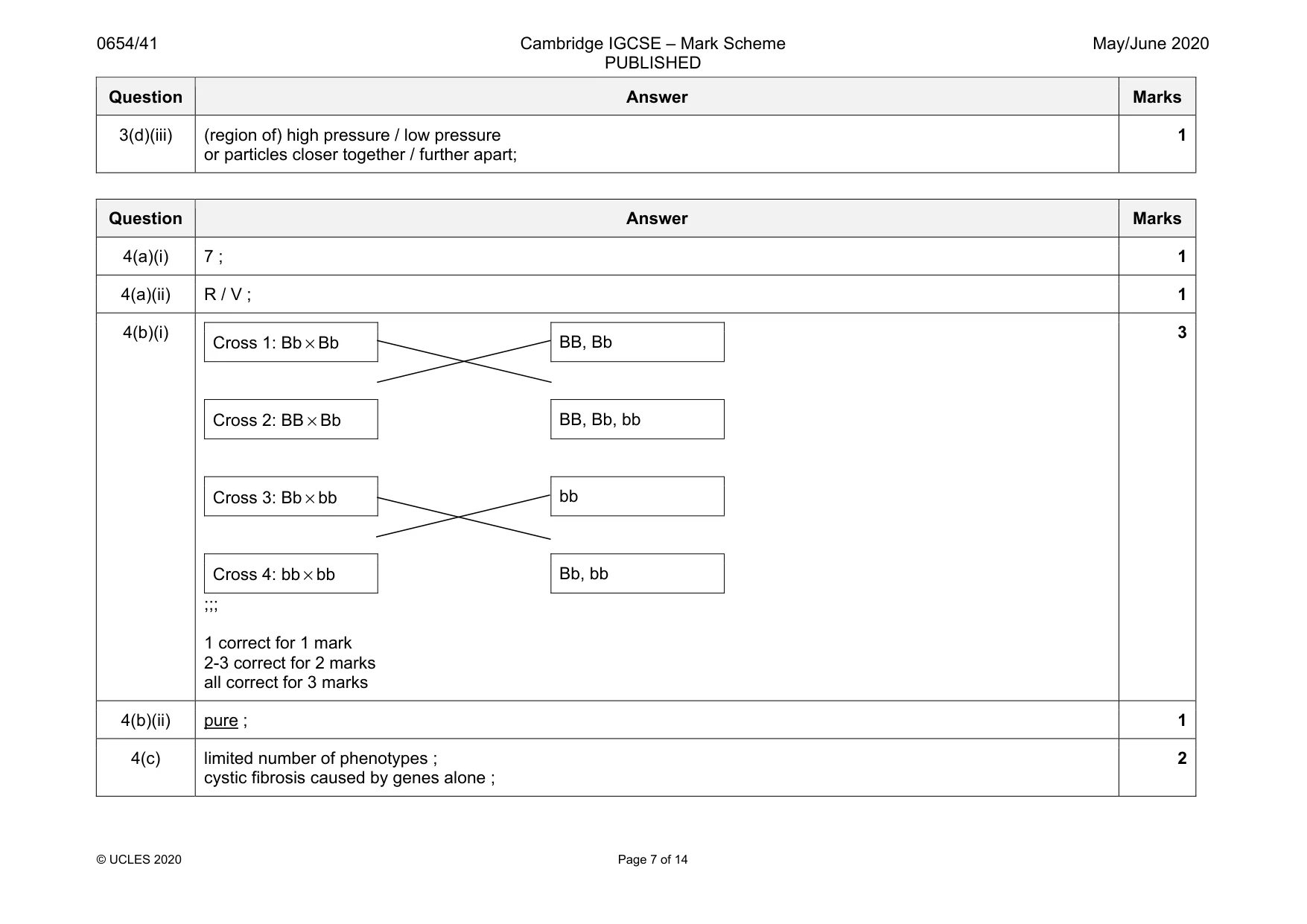
Question paper32 pages


Mark scheme14 pages
Answers below. Sit the paper first if you are practising.
Questions as text
Q1 · A student investigates the effect of temperature on the rate of photosynthesis in elodea…
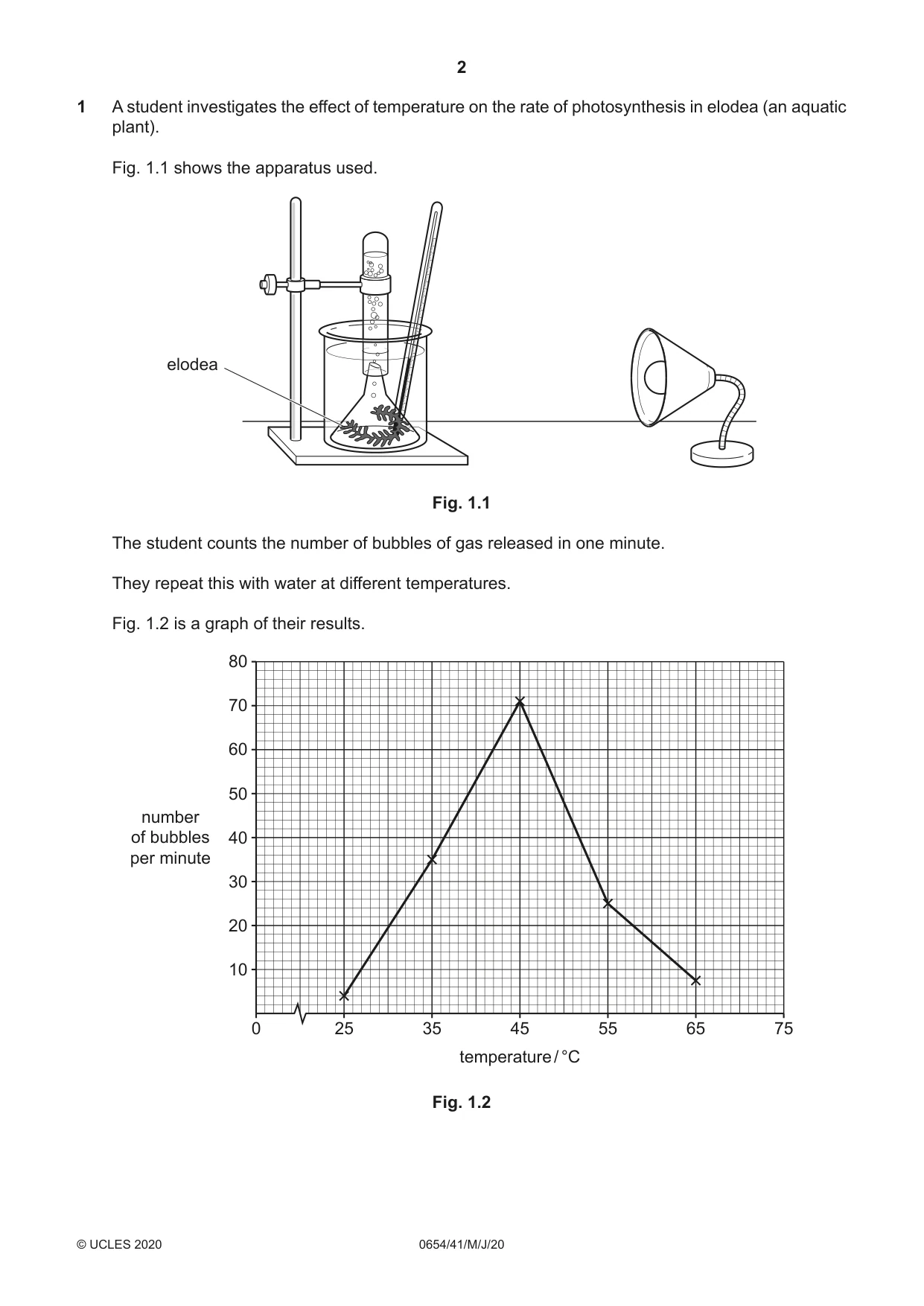
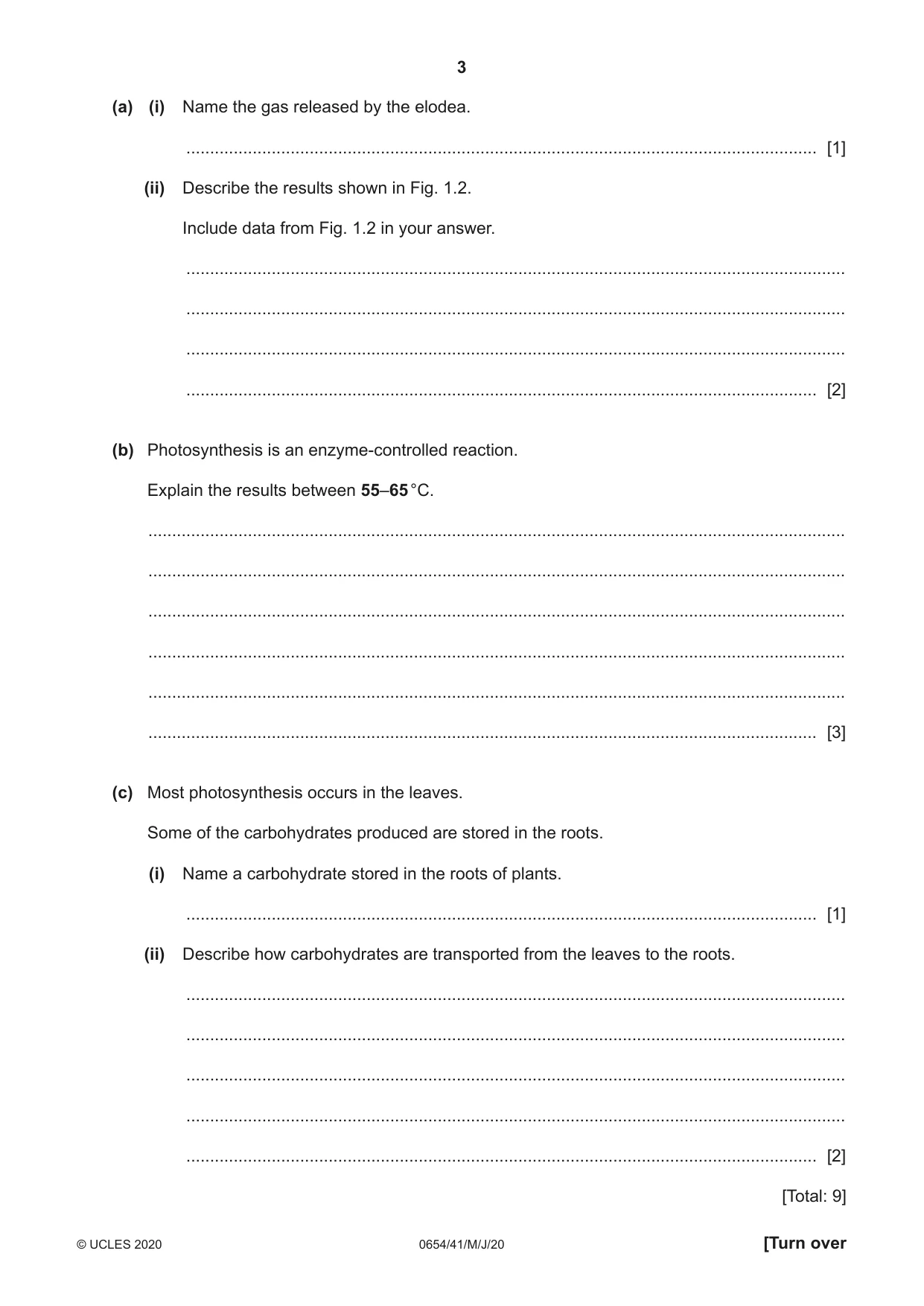
1 A student investigates the effect of temperature on the rate of photosynthesis in elodea (an aquatic plant). Fig. 1.1 shows the apparatus used. elodea Fig. 1.1 The student counts the number of bubbles of gas released in one minute. They repeat this with water at different temperatures. Fig. 1.2 is a graph of their results. 80 70 60 50 number of bubbles 40 per minute 30 20 10 0 25 35 45 55 65 75 temperature / °C Fig. 1.2 (a) (i) Name the gas released by the elodea. ..................................................................................................................................... [1] (ii) Describe the results shown in Fig. 1.2. Include data from Fig. 1.2 in your answer. ........................................................................................................................................... ........................................................................................................................................... ........................................................................................................................................... ..................................................................................................................................... [2] (b) Photosynthesis is an enzyme-controlled reaction. Explain the results between 55–65 °C. ................................................................................................................................................... ................................................................................................................................................... ................................................................................................................................................... ................................................................................................................................................... ................................................................................................................................................... ............................................................................................................................................. [3] (c) Most photosynthesis occurs in the leaves. Some of the carbohydrates produced are stored in the roots. (i) Name a carbohydrate stored in the roots of plants. ..................................................................................................................................... [1] (ii) Describe how carbohydrates are transported from the leaves to the roots. ........................................................................................................................................... ........................................................................................................................................... ........................................................................................................................................... ........................................................................................................................................... ..................................................................................................................................... [2] [Total: 9]
Mark scheme: 1(a)(i) oxygen ; 1 1(a)(ii) the number of bubbles released / rate of photosynthesis increases and decreases (with temperature) ; peak at 45°C / 71 bubbles per minute ; 2 1(b) enzymes denature at high temperature ; active site shape is changed ; substrate can no longer fit ; so rate of, reaction / photosynthesis decreases ; max 3 1(c)(i) starch ; 1 1(c)(ii) ref to translocation ; transported as sucrose ; through the phloem ; max 2
Q2 · Some information about the structure of atoms
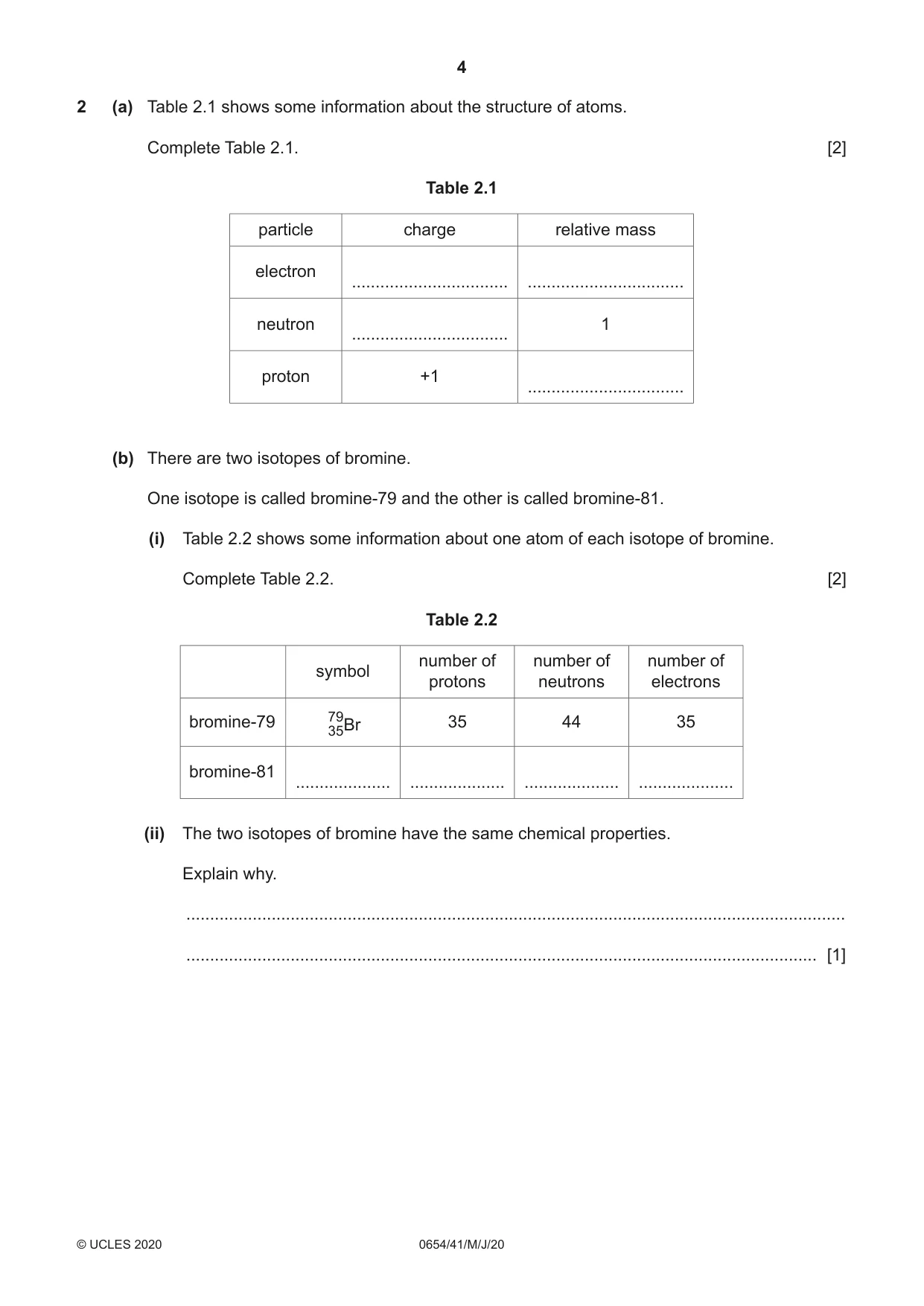
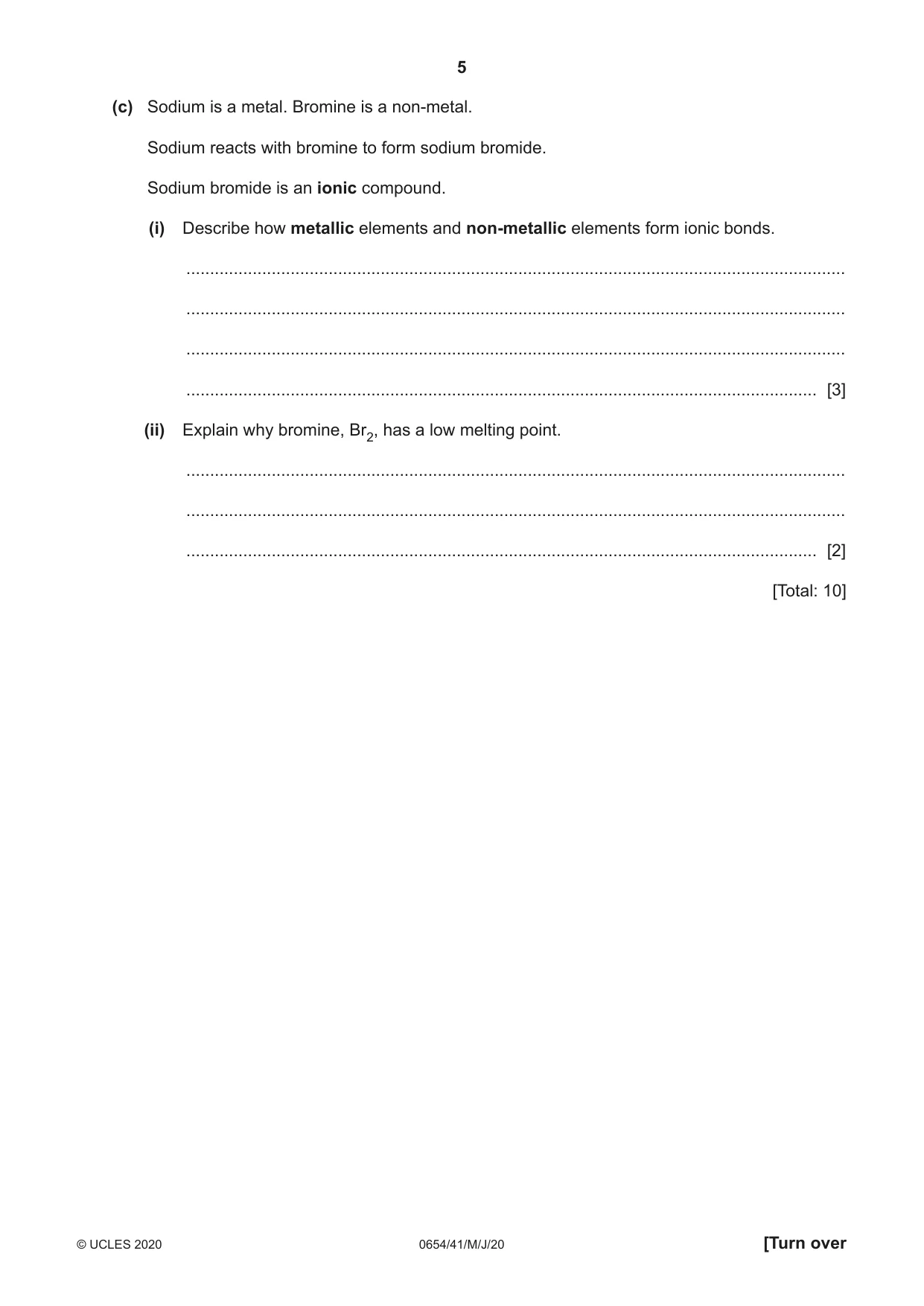
2 (a) Table 2.1 shows some information about the structure of atoms. Complete Table 2.1. [2] Table 2.1 particle charge relative mass electron ................................. ................................. neutron 1 ................................. proton +1 ................................. (b) There are two isotopes of bromine. One isotope is called bromine-79 and the other is called bromine-81. (i) Table 2.2 shows some information about one atom of each isotope of bromine. Complete Table 2.2. [2] Table 2.2 number of number of number of symbol protons neutrons electrons bromine-79 79 35 44 35 35Br bromine-81 .................... .................... .................... .................... (ii) The two isotopes of bromine have the same chemical properties. Explain why. ........................................................................................................................................... ..................................................................................................................................... [1] (c) Sodium is a metal. Bromine is a non-metal. Sodium reacts with bromine to form sodium bromide. Sodium bromide is an ionic compound. (i) Describe how metallic elements and non-metallic elements form ionic bonds. ........................................................................................................................................... ........................................................................................................................................... ........................................................................................................................................... ..................................................................................................................................... [3] (ii) Explain why bromine, Br2, has a low melting point. ........................................................................................................................................... ........................................................................................................................................... ..................................................................................................................................... [2] [Total: 10]
Mark scheme: 2(a) particle charge relative mass electron –1 0.0005 / negligible / 1 ÷ 1835 neutron 0 / no charge 1 proton +1 1 ;; 1 mark for each correct column 2 2(b)(i) symbol – 81 35Br ; protons 35, neutrons 46, electrons 35 ; 2 Question Answer Marks 2(b)(ii) (isotopes have the same properties because) they (both) have the same number of electrons in the outer shell / they (both) have seven electrons in the outer shell ; 1 2(c)(i) metallic elements lose electrons to form positive ions ; non-metallic elements gain electrons to form negative ions ; (there is a) strong attraction between (oppositely charged) ions ; (because of) their opposite (electrical) charges ; max 3 2(c)(ii) bromine is covalent ; weak attractive forces (between molecules) ; 2
Q3 · An elephant of mass 3800 kg is moving at 0.4 m / s
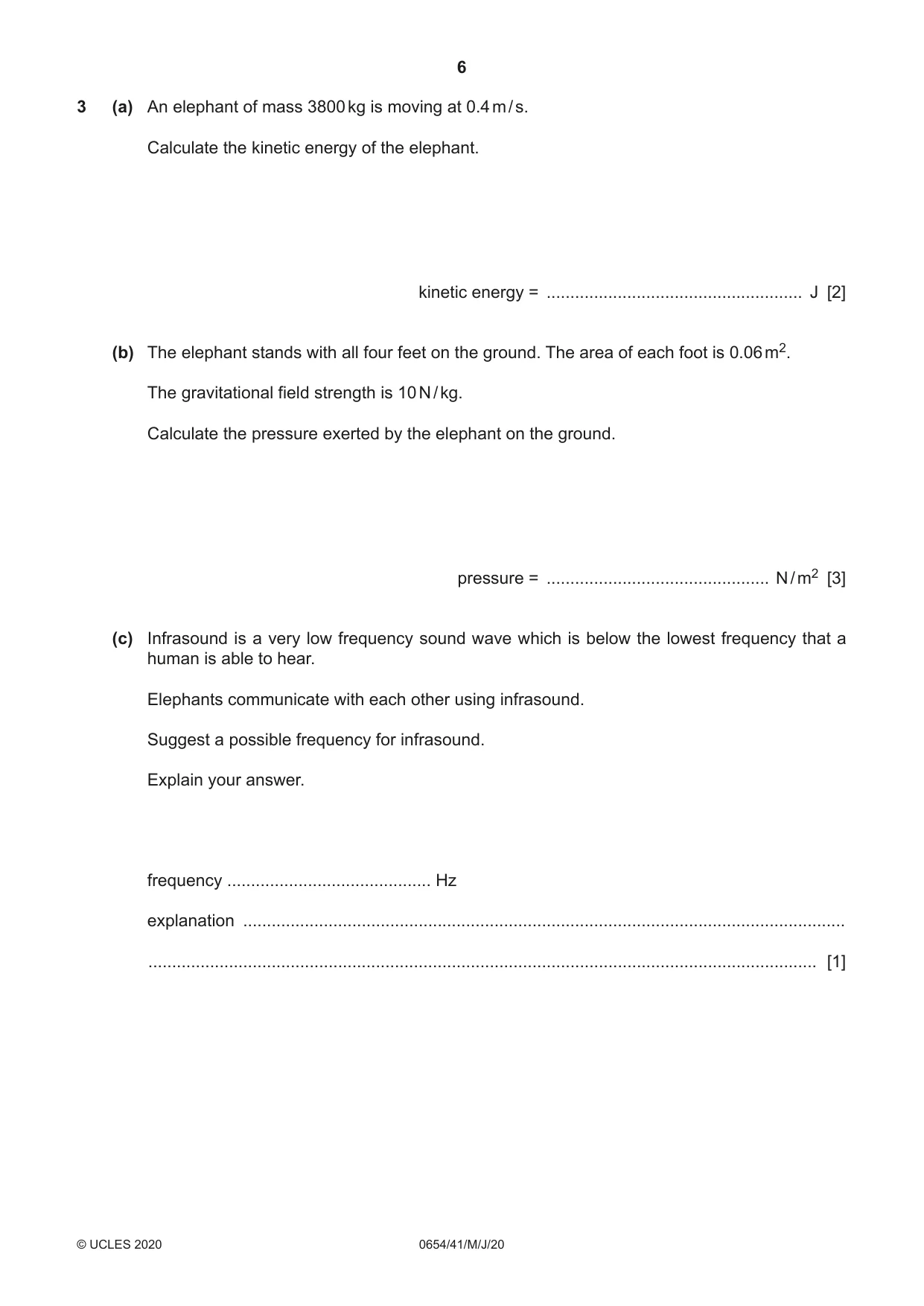
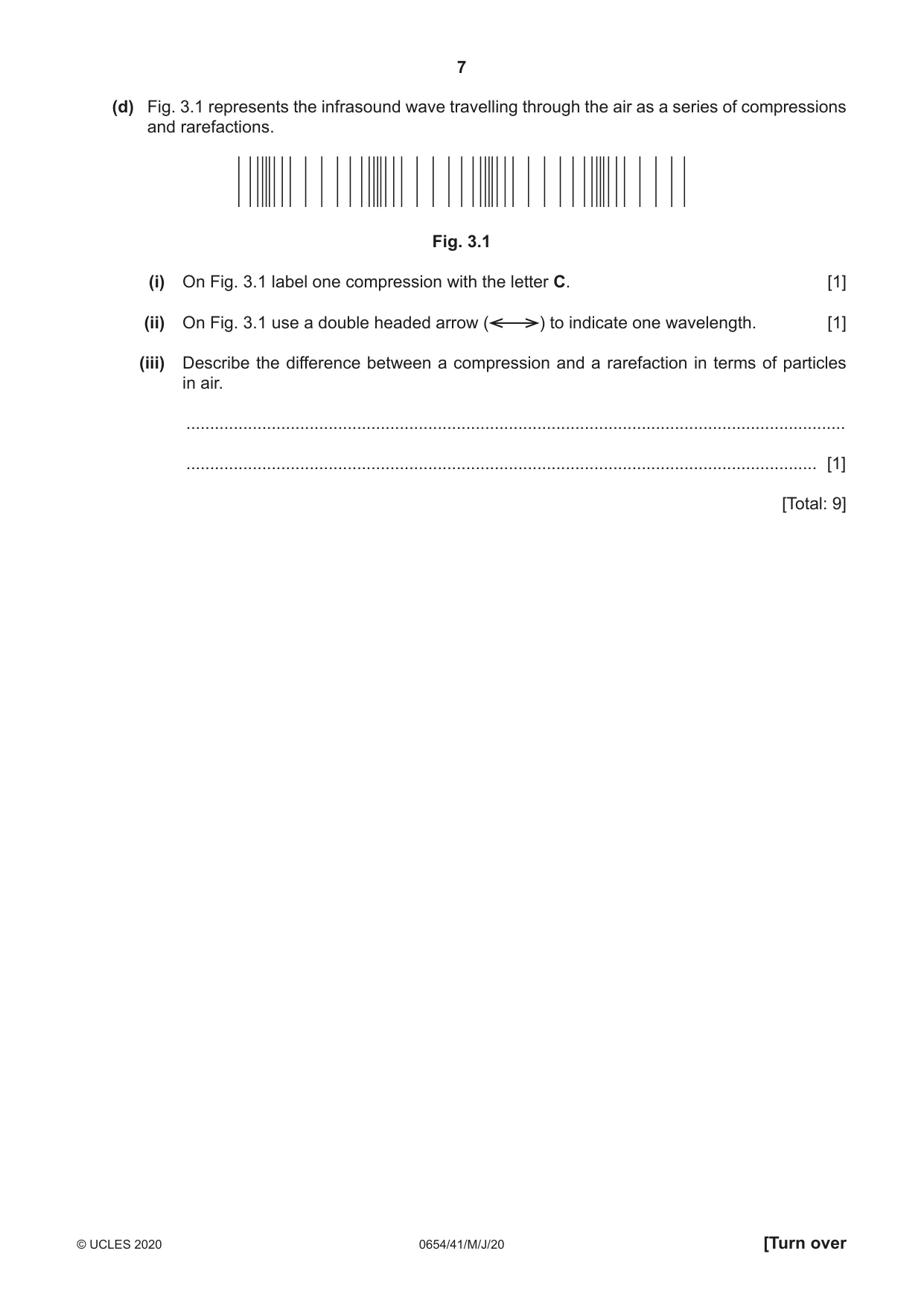
3 (a) An elephant of mass 3800 kg is moving at 0.4 m / s. Calculate the kinetic energy of the elephant. kinetic energy = ...................................................... J [2] (b) The elephant stands with all four feet on the ground. The area of each foot is 0.06 m2. The gravitational field strength is 10 N / kg. Calculate the pressure exerted by the elephant on the ground. pressure = ............................................... N / m2 [3] (c) Infrasound is a very low frequency sound wave which is below the lowest frequency that a human is able to hear. Elephants communicate with each other using infrasound. Suggest a possible frequency for infrasound. Explain your answer. frequency ........................................... Hz explanation ............................................................................................................................... ............................................................................................................................................. [1] (d) Fig. 3.1 represents the infrasound wave travelling through the air as a series of compressions and rarefactions. Fig. 3.1 (i) On Fig. 3.1 label one compression with the letter C. [1] (ii) On Fig. 3.1 use a double headed arrow ( ) to indicate one wavelength. [1] (iii) Describe the difference between a compression and a rarefaction in terms of particles in air. ........................................................................................................................................... ..................................................................................................................................... [1] [Total: 9]
Mark scheme: 3(a) KE = 1 2 mv2 or KE = 1 2 × 3800 × 0.4 × 0.4; = 300 (J); 3(b) area = 4 × 0.06 (m2) or weight = 38 000 N; pressure = force /area = 38 000 / 0.24; = 160 000 (N/m2); 3 3(c) value between 0Hz and 20Hz no mark because 20Hz is the minimum audible frequency for a human; 1 3(d)(i) compression correctly labelled with a C; 1 3d(ii) one wavelength correctly shown with a double headed arrow (↔); 1 Question Answer Marks 3(d)(iii) (region of) high pressure / low pressure or particles closer together / further apart; 1
Q4 · Cystic fibrosis is an inherited disease
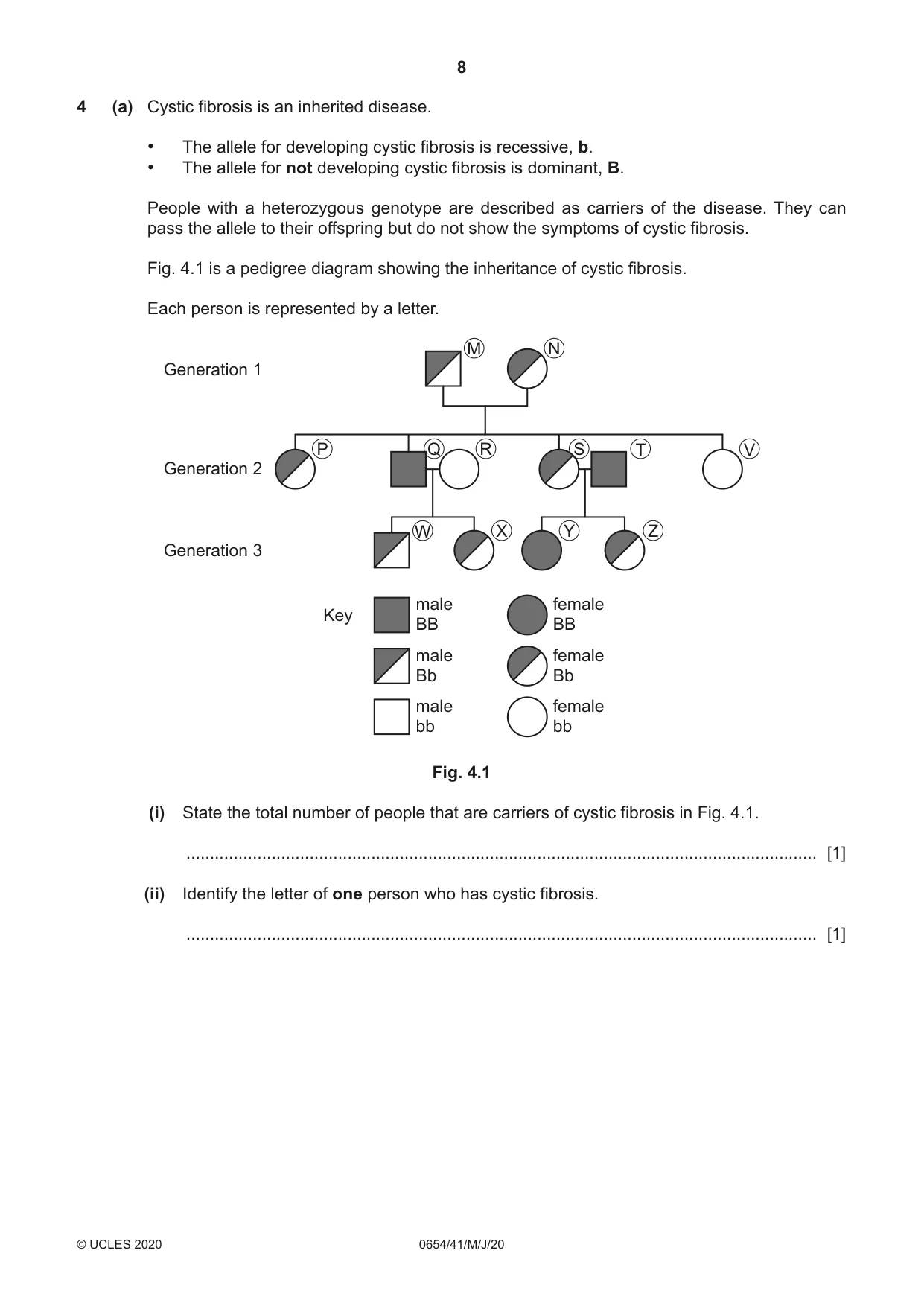
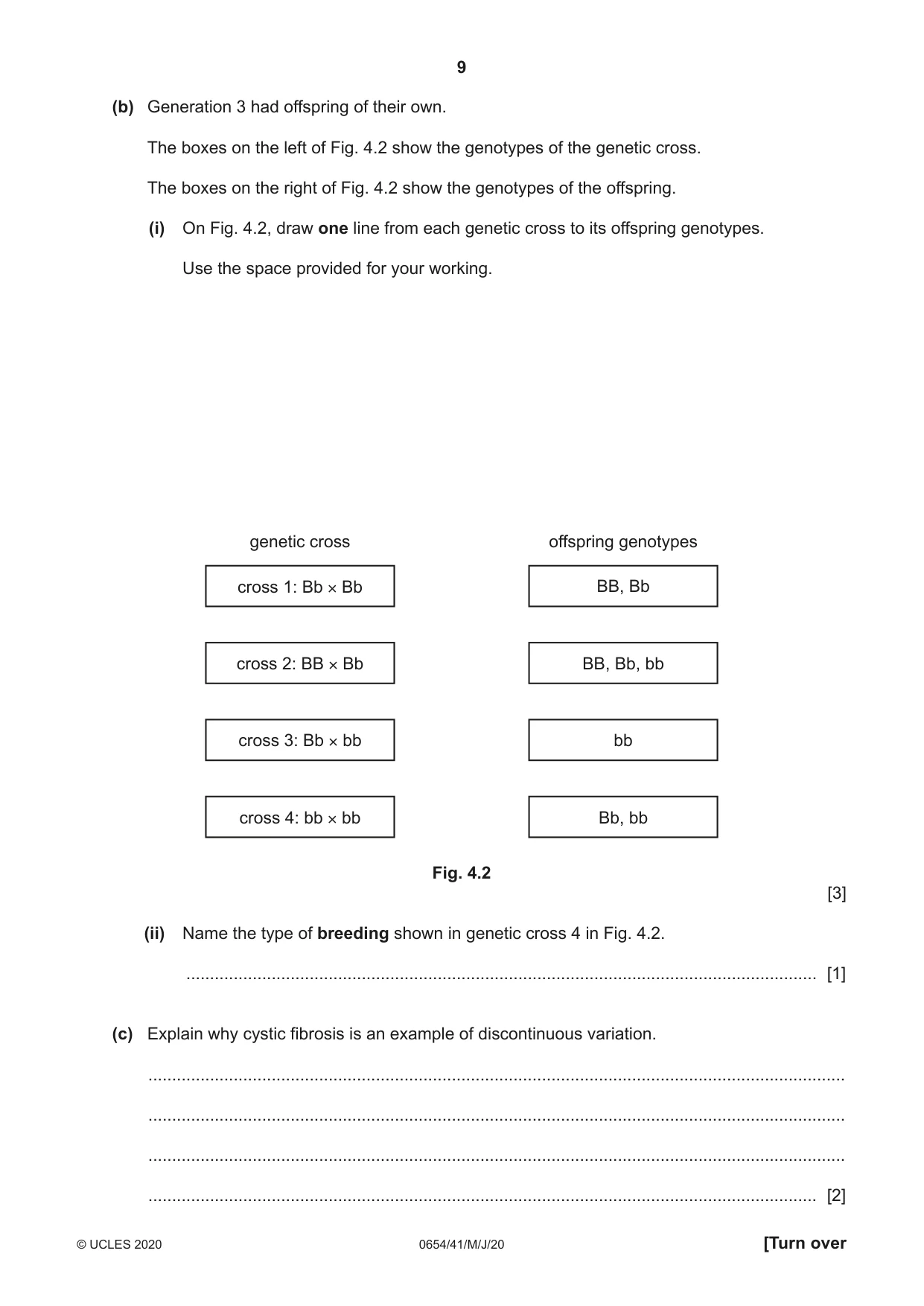
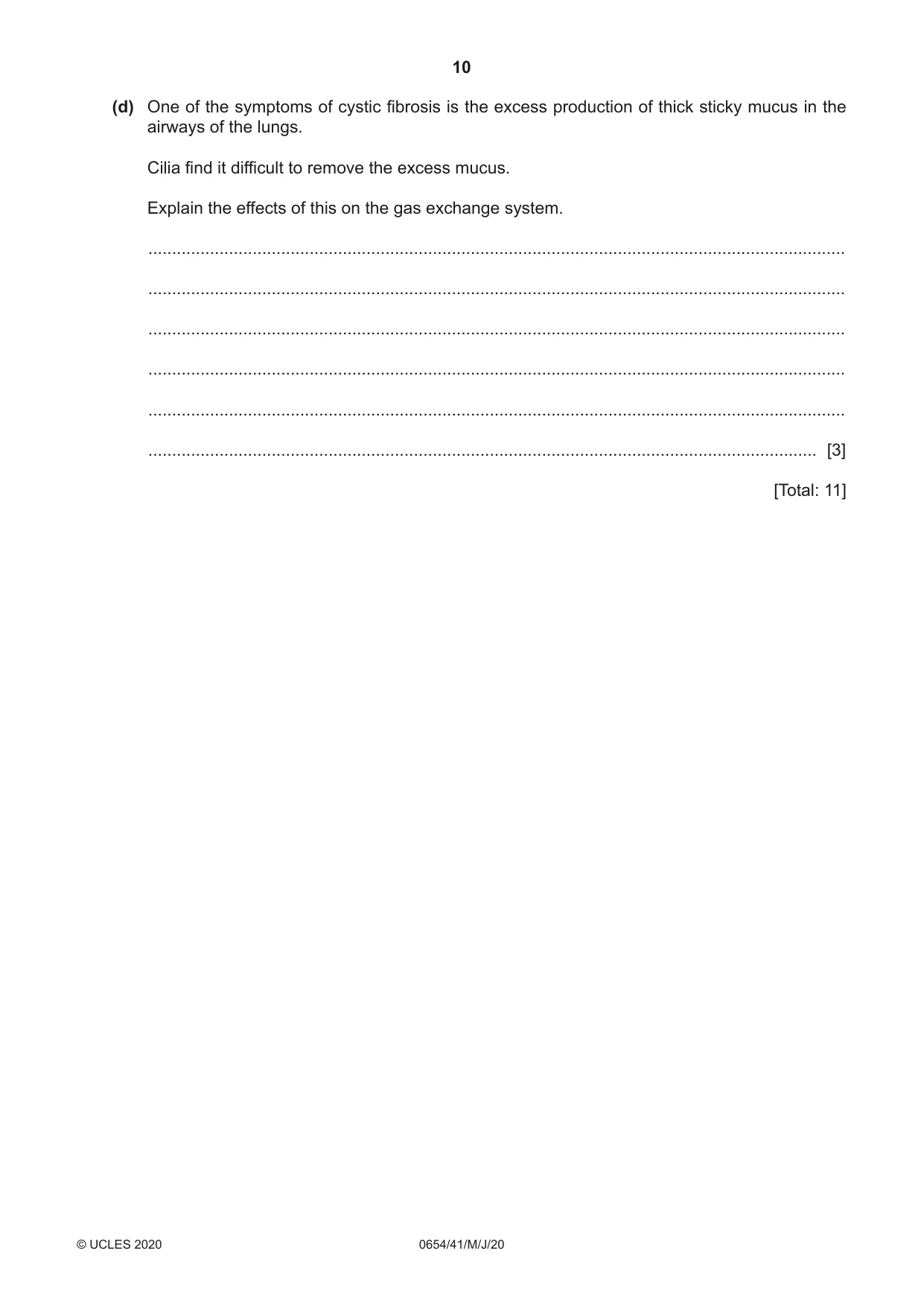
4 (a) Cystic fibrosis is an inherited disease. • The allele for developing cystic fibrosis is recessive, b. • The allele for not developing cystic fibrosis is dominant, B. People with a heterozygous genotype are described as carriers of the disease. They can pass the allele to their offspring but do not show the symptoms of cystic fibrosis. Fig. 4.1 is a pedigree diagram showing the inheritance of cystic fibrosis. Each person is represented by a letter. M N Generation 1 P Q R S T V Generation 2 W X Y Z Generation 3 male female Key BB BB male female Bb Bb male female bb bb Fig. 4.1 (i) State the total number of people that are carriers of cystic fibrosis in Fig. 4.1. ..................................................................................................................................... [1] (ii) Identify the letter of one person who has cystic fibrosis. ..................................................................................................................................... [1] (b) Generation 3 had offspring of their own. The boxes on the left of Fig. 4.2 show the genotypes of the genetic cross. The boxes on the right of Fig. 4.2 show the genotypes of the offspring. (i) On Fig. 4.2, draw one line from each genetic cross to its offspring genotypes. Use the space provided for your working. genetic cross offspring genotypes cross 1: Bb × Bb BB, Bb cross 2: BB × Bb BB, Bb, bb cross 3: Bb × bb bb cross 4: bb × bb Bb, bb Fig. 4.2 [3] (ii) Name the type of breeding shown in genetic cross 4 in Fig. 4.2. ..................................................................................................................................... [1] (c) Explain why cystic fibrosis is an example of discontinuous variation. ................................................................................................................................................... ................................................................................................................................................... ................................................................................................................................................... ............................................................................................................................................. [2] (d) One of the symptoms of cystic fibrosis is the excess production of thick sticky mucus in the airways of the lungs. Cilia find it difficult to remove the excess mucus. Explain the effects of this on the gas exchange system. ................................................................................................................................................... ................................................................................................................................................... ................................................................................................................................................... ................................................................................................................................................... ................................................................................................................................................... ............................................................................................................................................. [3] [Total: 11]
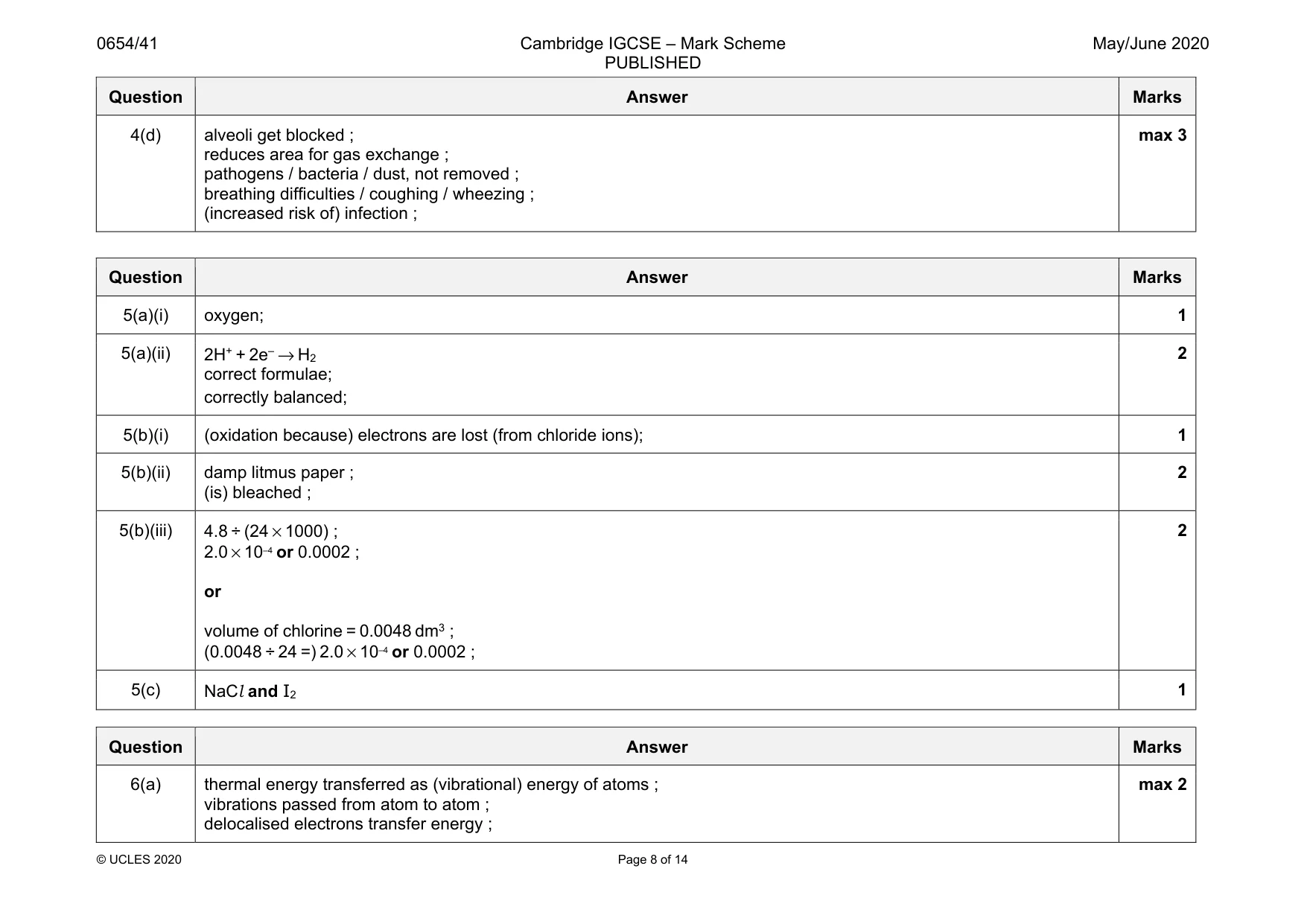
Mark scheme: 4(a)(i) 7 ; 1 4(a)(ii) R / V ; 1 4(b)(i) Cross 1: Bb × Bb BB, Bb Cross 2: BB × Bb BB, Bb, bb Cross 3: Bb × bb bb Cross 4: bb × bb Bb, bb ;;; 1 correct for 1 mark 2-3 correct for 2 marks all correct for 3 marks 3 4(b)(ii) pure ; 1 4(c) limited number of phenotypes ; cystic fibrosis caused by genes alone ; 2 Question Answer Marks 4(d) alveoli get blocked ; reduces area for gas exchange ; pathogens / bacteria / dust, not removed ; breathing difficulties / coughing / wheezing ; (increased risk of) infection ; max 3
Q5 · The electrolysis of dilute sulfuric acid
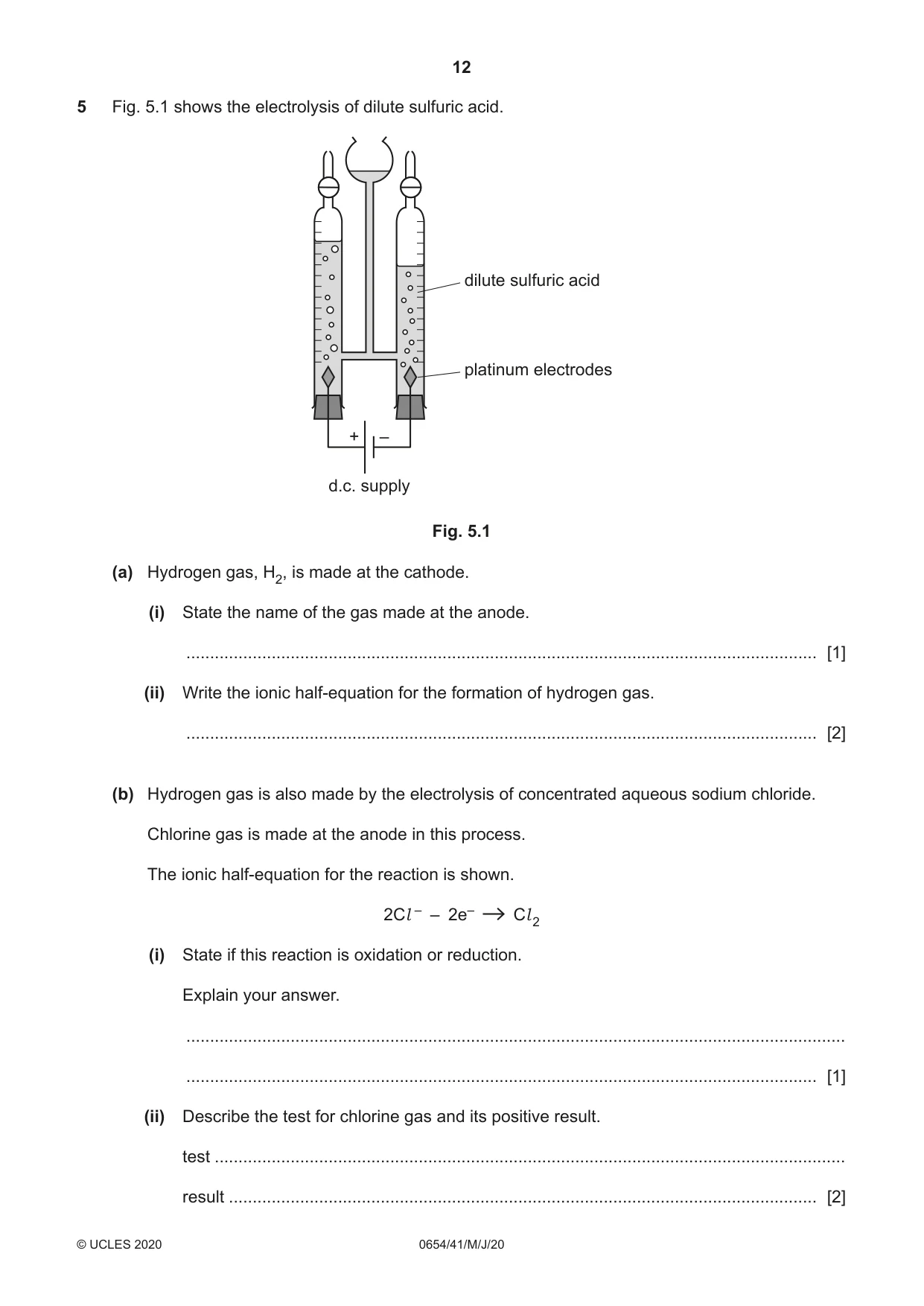
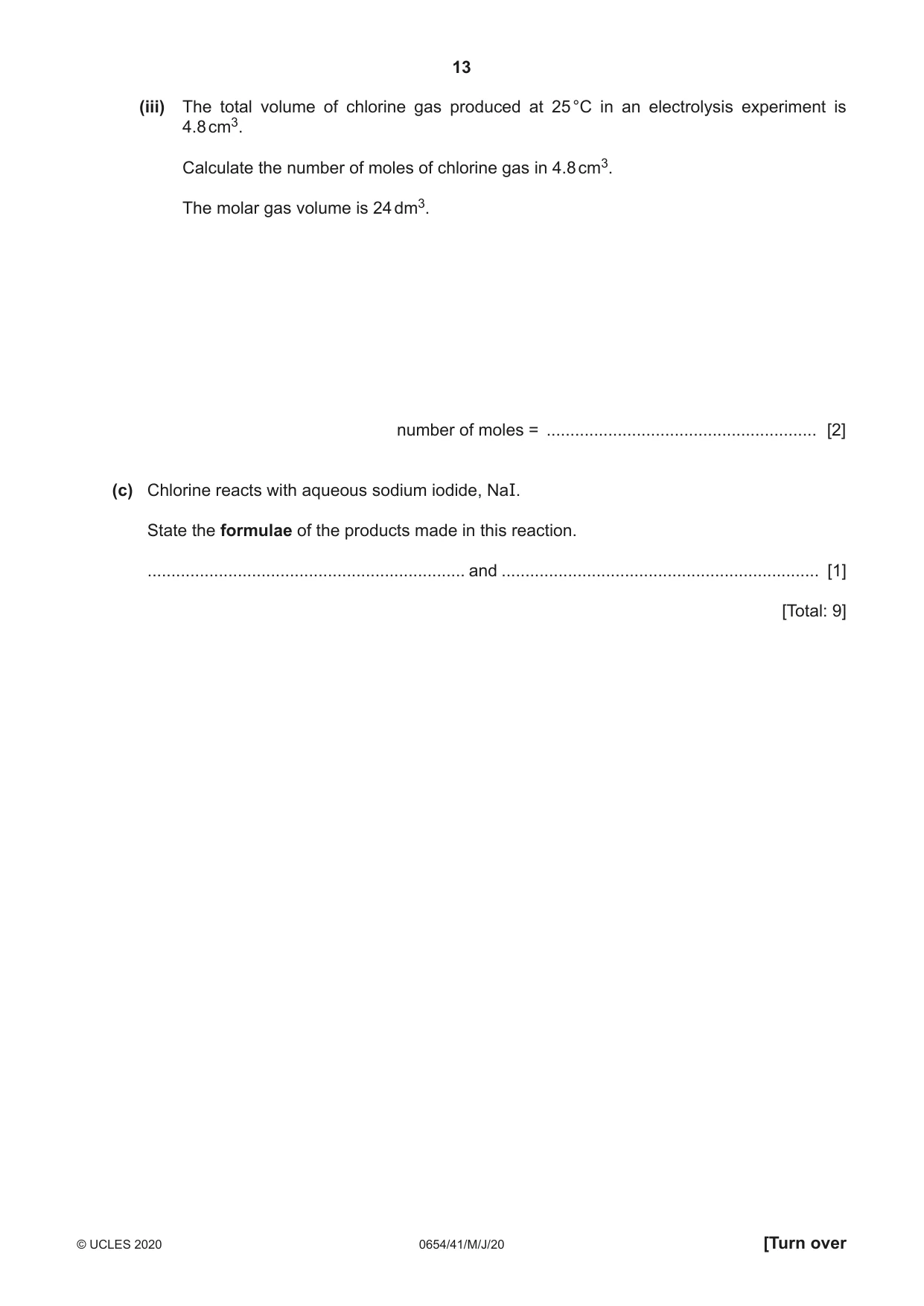
5 Fig. 5.1 shows the electrolysis of dilute sulfuric acid. dilute sulfuric acid platinum electrodes + – d.c. supply Fig. 5.1 (a) Hydrogen gas, H2, is made at the cathode. (i) State the name of the gas made at the anode. ..................................................................................................................................... [1] (ii) Write the ionic half-equation for the formation of hydrogen gas. ..................................................................................................................................... [2] (b) Hydrogen gas is also made by the electrolysis of concentrated aqueous sodium chloride. Chlorine gas is made at the anode in this process. The ionic half-equation for the reaction is shown. 2Cl – – 2e– Cl 2 (i) State if this reaction is oxidation or reduction. Explain your answer. ........................................................................................................................................... ..................................................................................................................................... [1] (ii) Describe the test for chlorine gas and its positive result. test ..................................................................................................................................... result ............................................................................................................................ [2] (iii) The total volume of chlorine gas produced at 25 °C in an electrolysis experiment is 4.8 cm3. Calculate the number of moles of chlorine gas in 4.8 cm3. The molar gas volume is 24 dm3. number of moles = ......................................................... [2] (c) Chlorine reacts with aqueous sodium iodide, NaI. State the formulae of the products made in this reaction. ................................................................... and ................................................................... [1] [Total: 9]
Mark scheme: 5(a)(i) oxygen; 1 5(a)(ii) 2H+ + 2e– → H2 correct formulae; correctly balanced; 2 5(b)(i) (oxidation because) electrons are lost (from chloride ions); 1 5(b)(ii) damp litmus paper ; (is) bleached ; 2 5(b)(iii) 4.8 ÷ (24 × 1000) ; 2.0 × 10⁻⁴ or 0.0002 ; or volume of chlorine = 0.0048 dm3 ; (0.0048 ÷ 24 =) 2.0 × 10⁻⁴ or 0.0002 ; 2 5(c) NaCl and I2 1
Q6 · Describe how thermal energy passes through copper by conduction
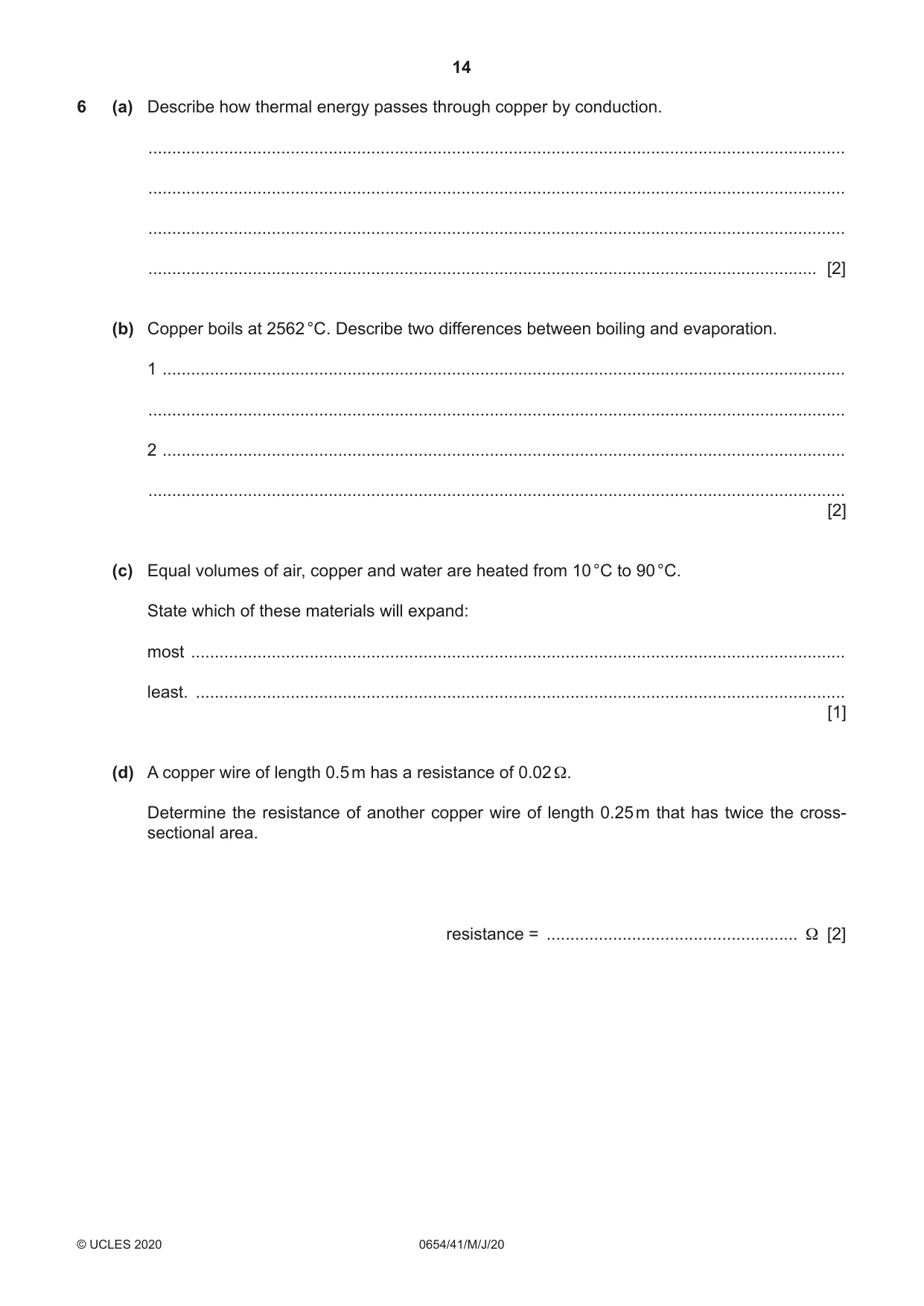
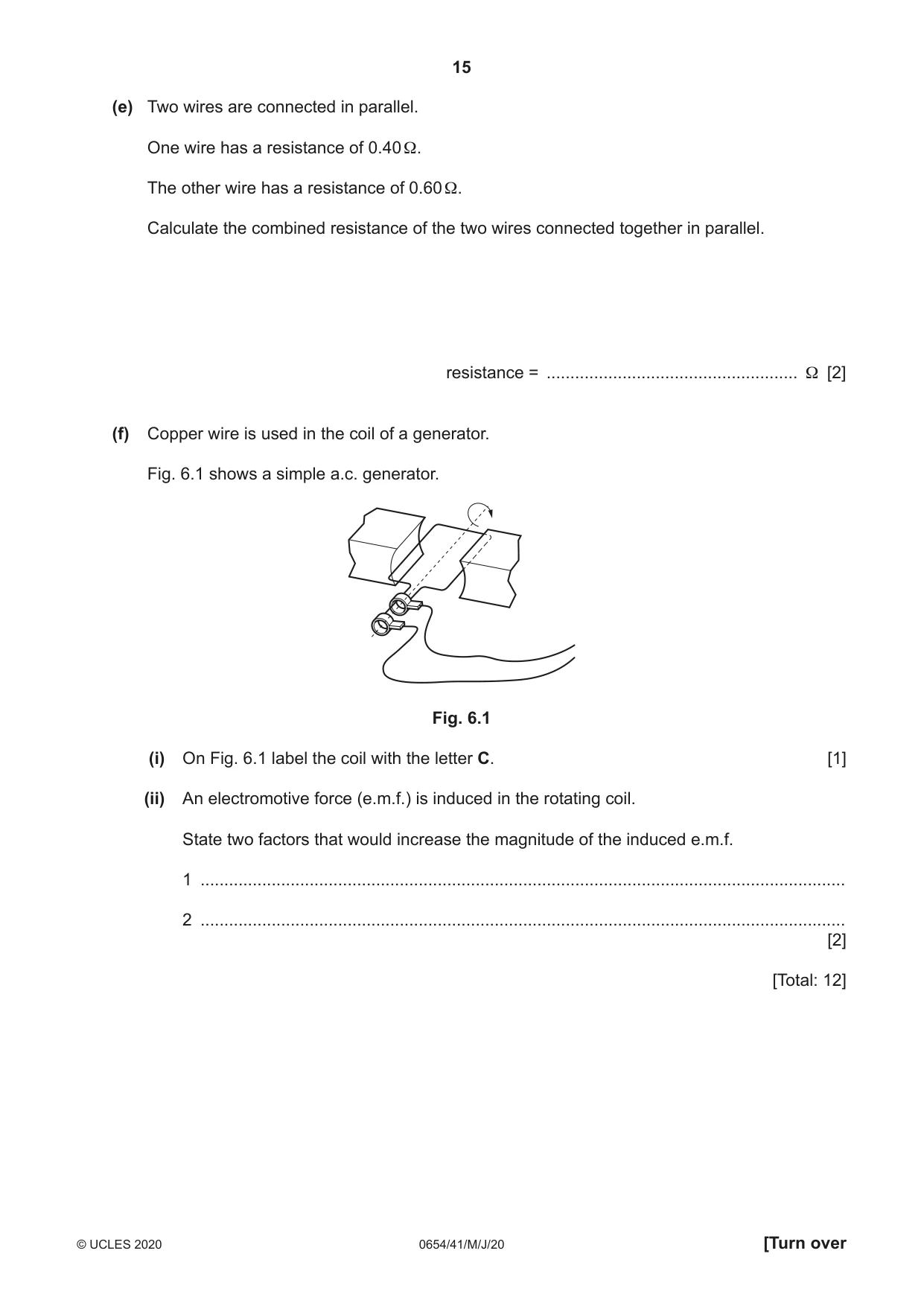
6 (a) Describe how thermal energy passes through copper by conduction. ................................................................................................................................................... ................................................................................................................................................... ................................................................................................................................................... ............................................................................................................................................. [2] (b) Copper boils at 2562 °C. Describe two differences between boiling and evaporation. 1 ................................................................................................................................................ ................................................................................................................................................... 2 ................................................................................................................................................ ................................................................................................................................................... [2] (c) Equal volumes of air, copper and water are heated from 10 °C to 90 °C. State which of these materials will expand: most .......................................................................................................................................... least. ......................................................................................................................................... [1] (d) A copper wire of length 0.5 m has a resistance of 0.02 Ω. Determine the resistance of another copper wire of length 0.25 m that has twice the cross- sectional area. resistance = ..................................................... Ω [2] (e) Two wires are connected in parallel. One wire has a resistance of 0.40 Ω. The other wire has a resistance of 0.60 Ω. Calculate the combined resistance of the two wires connected together in parallel. resistance = ..................................................... Ω [2] (f) Copper wire is used in the coil of a generator. Fig. 6.1 shows a simple a.c. generator. Fig. 6.1 (i) On Fig. 6.1 label the coil with the letter C. [1] (ii) An electromotive force (e.m.f.) is induced in the rotating coil. State two factors that would increase the magnitude of the induced e.m.f. 1 ........................................................................................................................................ 2 ........................................................................................................................................ [2] [Total: 12]
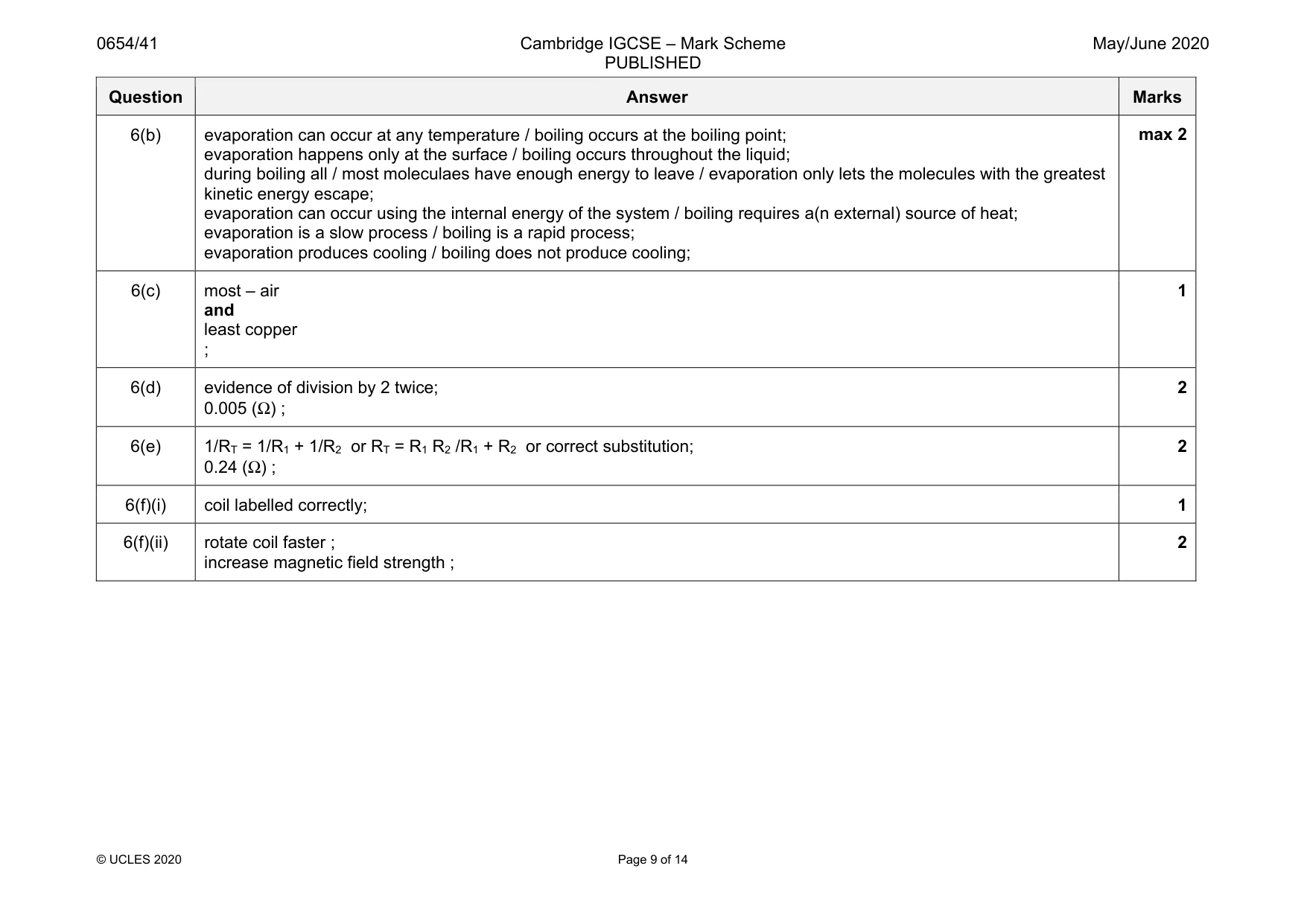
Mark scheme: 6(a) thermal energy transferred as (vibrational) energy of atoms ; vibrations passed from atom to atom ; delocalised electrons transfer energy ; max 2 Question Answer Marks 6(b) evaporation can occur at any temperature / boiling occurs at the boiling point; evaporation happens only at the surface / boiling occurs throughout the liquid; during boiling all / most moleculaes have enough energy to leave / evaporation only lets the molecules with the greatest kinetic energy escape; evaporation can occur using the internal energy of the system / boiling requires a(n external) source of heat; evaporation is a slow process / boiling is a rapid process; evaporation produces cooling / boiling does not produce cooling; max 2 6(c) most – air and least copper ; 1 6(d) evidence of division by 2 twice; 0.005 (Ω) ; 2 6(e) 1/RT = 1/R1 + 1/R2 or RT = R1 R2 /R1 + R2 or correct substitution; 0.24 (Ω) ; 2 6(f)(i) coil labelled correctly; 1 6(f)(ii) rotate coil faster ; increase magnetic field strength ; 2
Q7 · A diagram of a fetus inside a uterus
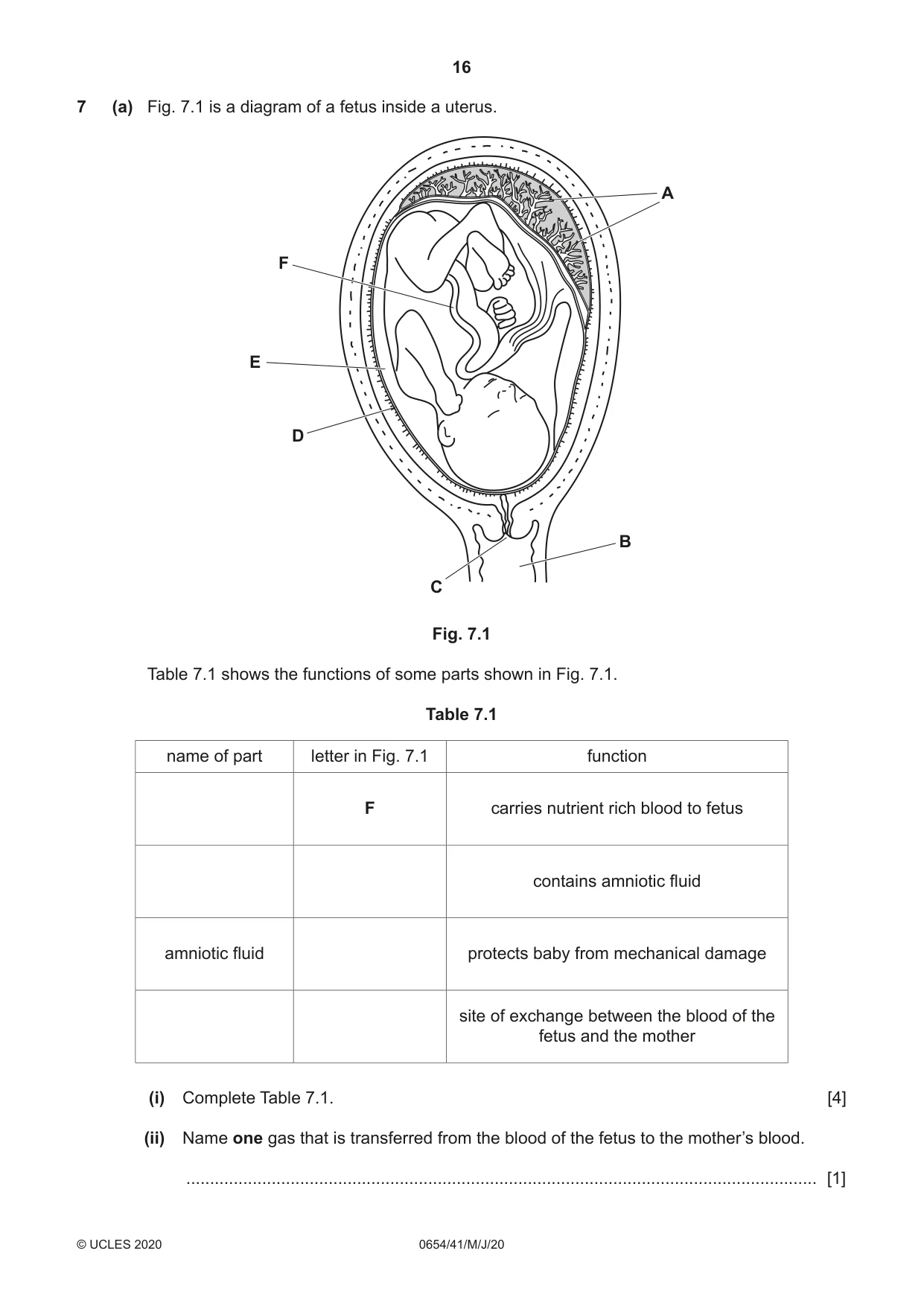
7 (a) Fig. 7.1 is a diagram of a fetus inside a uterus. A F E D B C Fig. 7.1 Table 7.1 shows the functions of some parts shown in Fig. 7.1. Table 7.1 name of part letter in Fig. 7.1 function F carries nutrient rich blood to fetus contains amniotic fluid amniotic fluid protects baby from mechanical damage site of exchange between the blood of the fetus and the mother (i) Complete Table 7.1. [4] (ii) Name one gas that is transferred from the blood of the fetus to the mother’s blood. ..................................................................................................................................... [1] (b) Pregnancy can occur after fertilisation. (i) Name the two types of gametes involved in fertilisation in humans. ..................................................................................................................................... [1] (ii) Name the process that is involved in the production of gametes. ..................................................................................................................................... [1] (iii) Describe two differences between the nuclei in gametes and those in body cells. 1 ........................................................................................................................................ ........................................................................................................................................... 2 ........................................................................................................................................ ........................................................................................................................................... [2] [Total: 9]
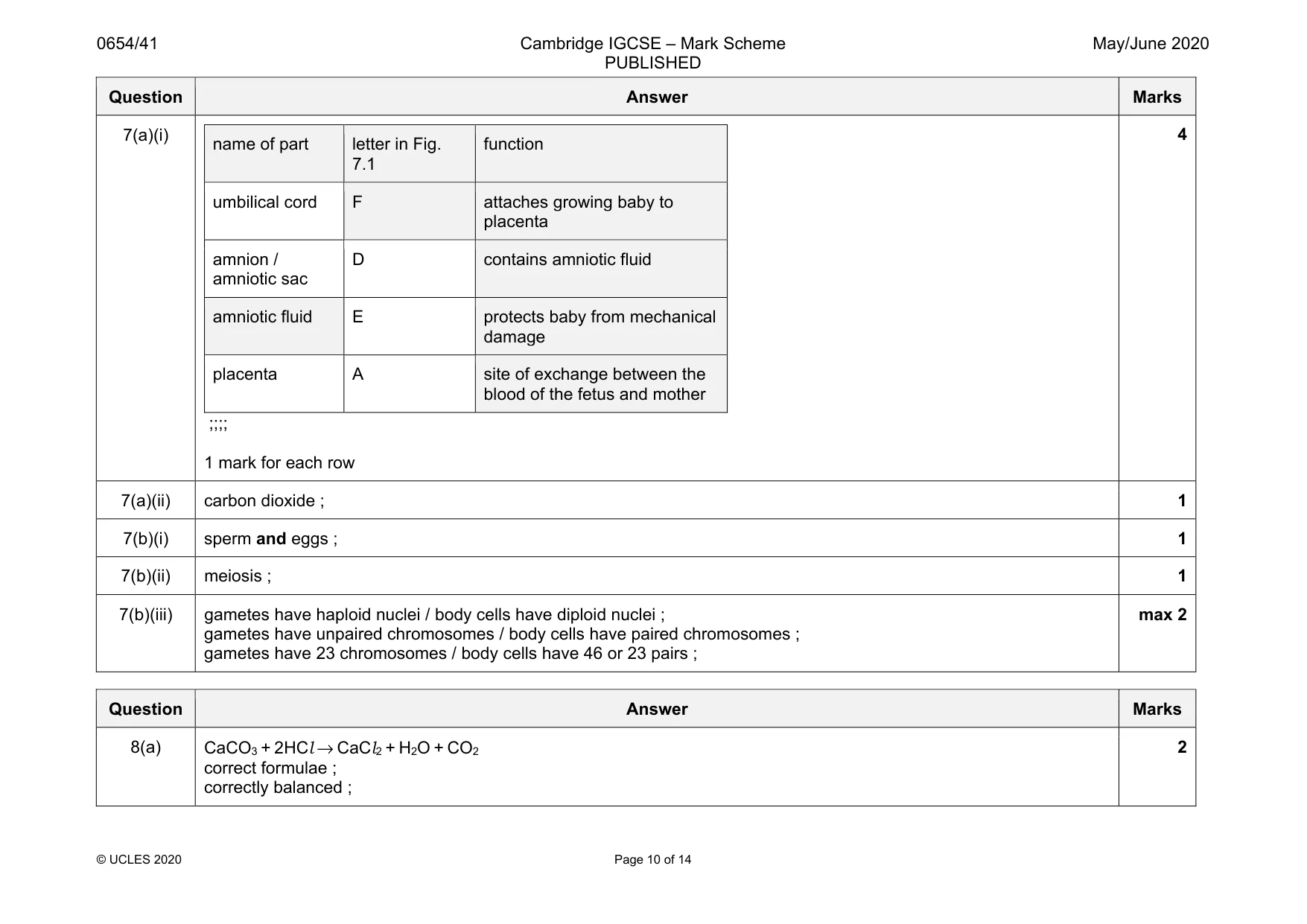
Mark scheme: 7(a)(i) name of part letter in Fig. 7.1 function umbilical cord F attaches growing baby to placenta amnion / amniotic sac D contains amniotic fluid amniotic fluid E protects baby from mechanical damage placenta A site of exchange between the blood of the fetus and mother ;;;; 1 mark for each row 7(a)(ii) carbon dioxide ; 1 7(b)(i) sperm and eggs ; 1 7(b)(ii) meiosis ; 1 7(b)(iii) gametes have haploid nuclei / body cells have diploid nuclei ; gametes have unpaired chromosomes / body cells have paired chromosomes ; gametes have 23 chromosomes / body cells have 46 or 23 pairs ; max 2
Q8 · Calcium carbonate, CaCO3, reacts with dilute hydrochloric acid
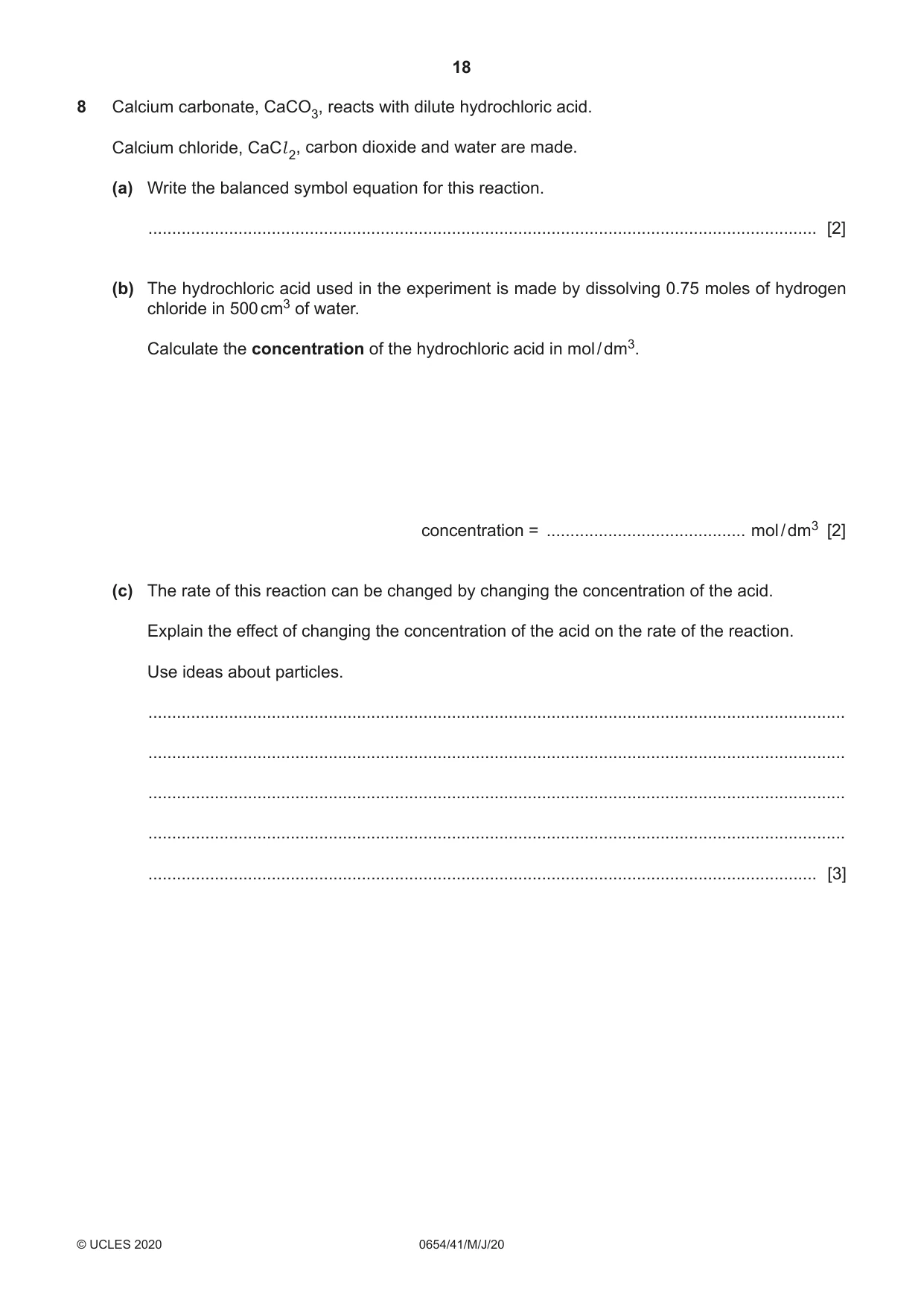
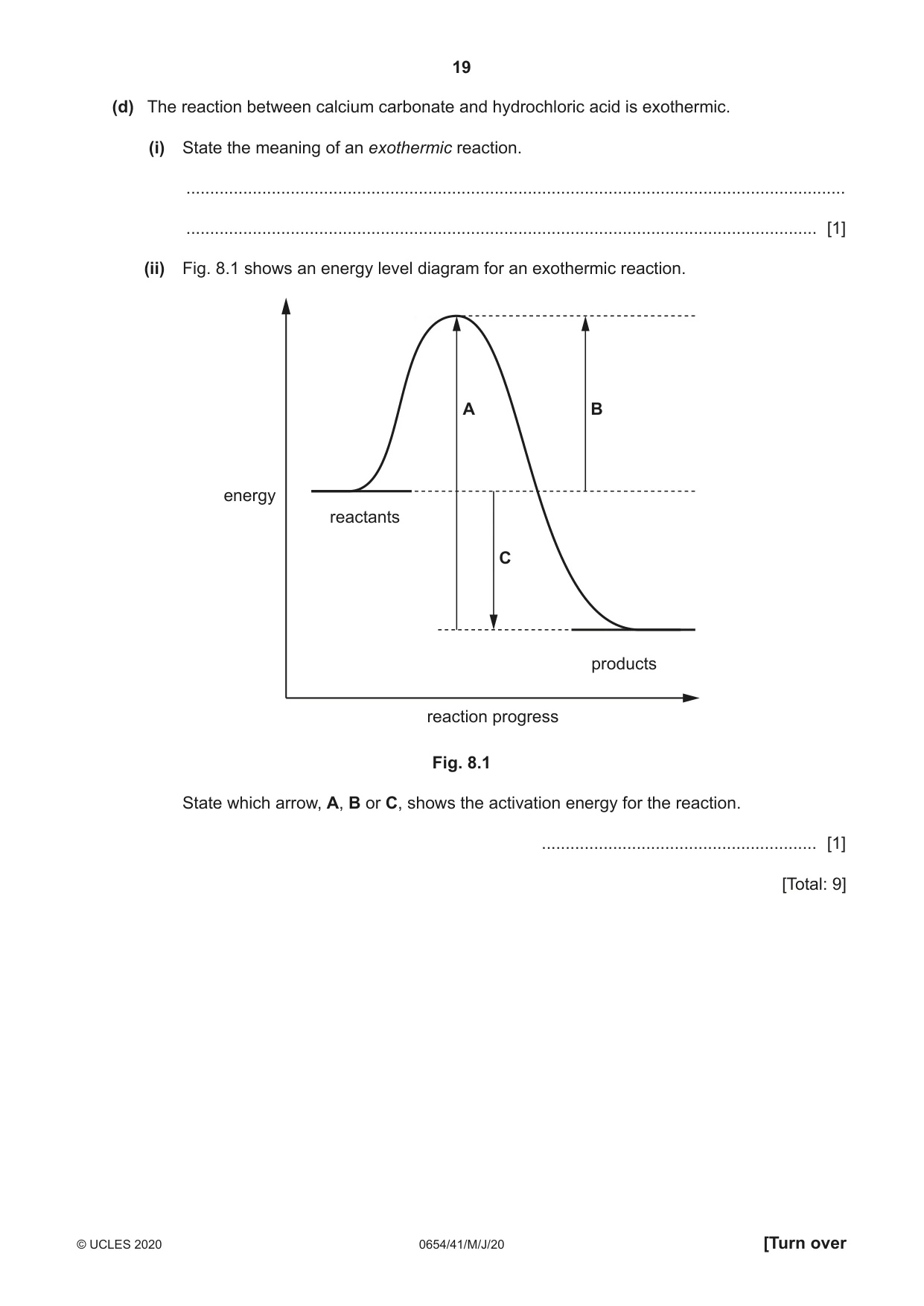
8 Calcium carbonate, CaCO3, reacts with dilute hydrochloric acid. Calcium chloride, CaCl 2, carbon dioxide and water are made. (a) Write the balanced symbol equation for this reaction. ............................................................................................................................................. [2] (b) The hydrochloric acid used in the experiment is made by dissolving 0.75 moles of hydrogen chloride in 500 cm3 of water. Calculate the concentration of the hydrochloric acid in mol / dm3. concentration = .......................................... mol / dm3 [2] (c) The rate of this reaction can be changed by changing the concentration of the acid. Explain the effect of changing the concentration of the acid on the rate of the reaction. Use ideas about particles. ................................................................................................................................................... ................................................................................................................................................... ................................................................................................................................................... ................................................................................................................................................... ............................................................................................................................................. [3] (d) The reaction between calcium carbonate and hydrochloric acid is exothermic. (i) State the meaning of an exothermic reaction. ........................................................................................................................................... ..................................................................................................................................... [1] (ii) Fig. 8.1 shows an energy level diagram for an exothermic reaction. A B energy reactants C products reaction progress Fig. 8.1 State which arrow, A, B or C, shows the activation energy for the reaction. .......................................................... [1] [Total: 9]
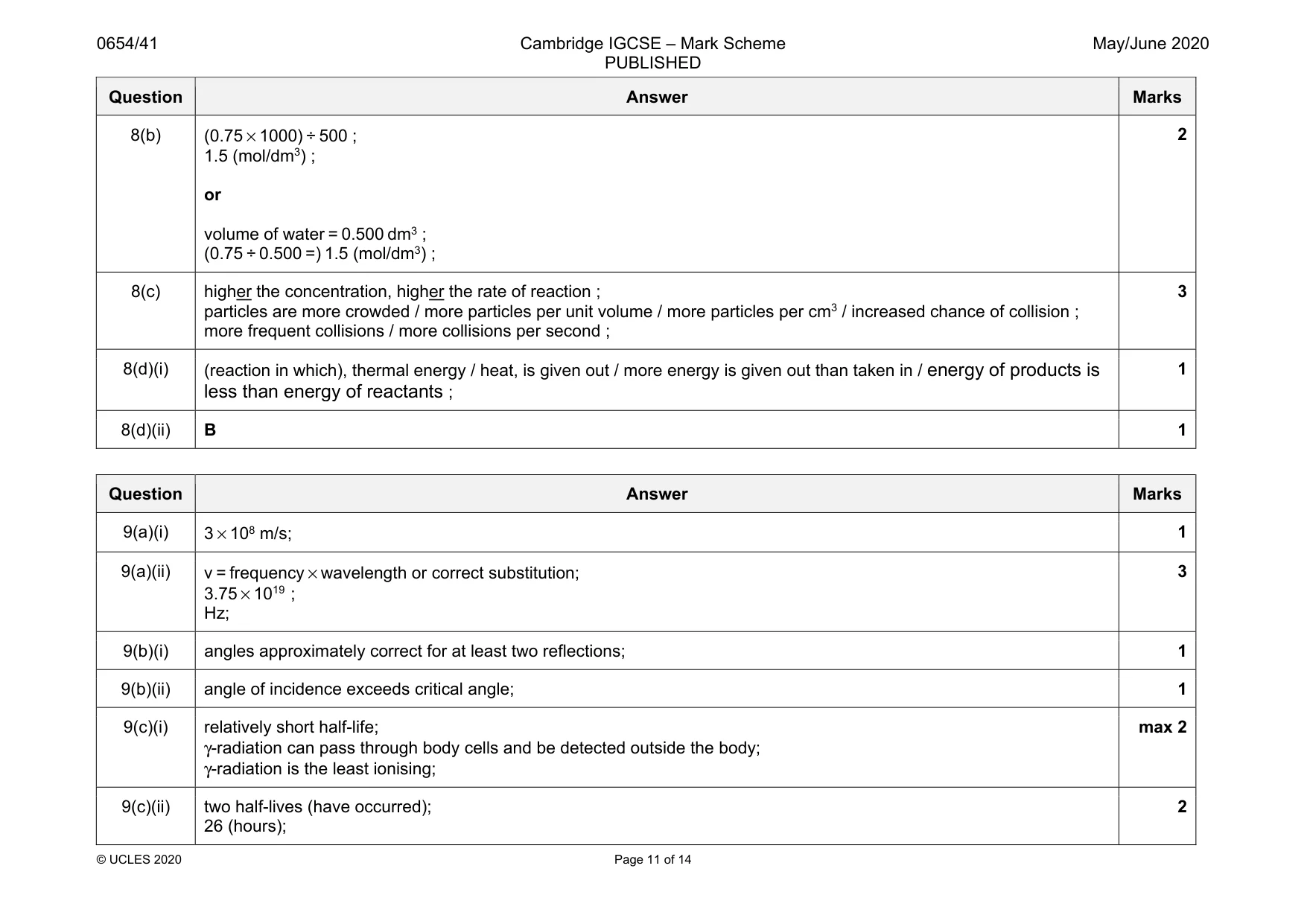
Mark scheme: 8(a) CaCO3 + 2HCl → CaCl2 + H2O + CO2 correct formulae ; correctly balanced ; Question Answer Marks 8(b) (0.75 × 1000) ÷ 500 ; 1.5 (mol/dm3) ; or volume of water = 0.500 dm3 ; (0.75 ÷ 0.500 =) 1.5 (mol/dm3) ; 2 8(c) higher the concentration, higher the rate of reaction ; particles are more crowded / more particles per unit volume / more particles per cm3 / increased chance of collision ; more frequent collisions / more collisions per second ; 3 8(d)(i) (reaction in which), thermal energy / heat, is given out / more energy is given out than taken in / energy of products is less than energy of reactants ; 1 8(d)(ii) B 1
Q9 · Visible light and γ-radiation are both used in hospitals
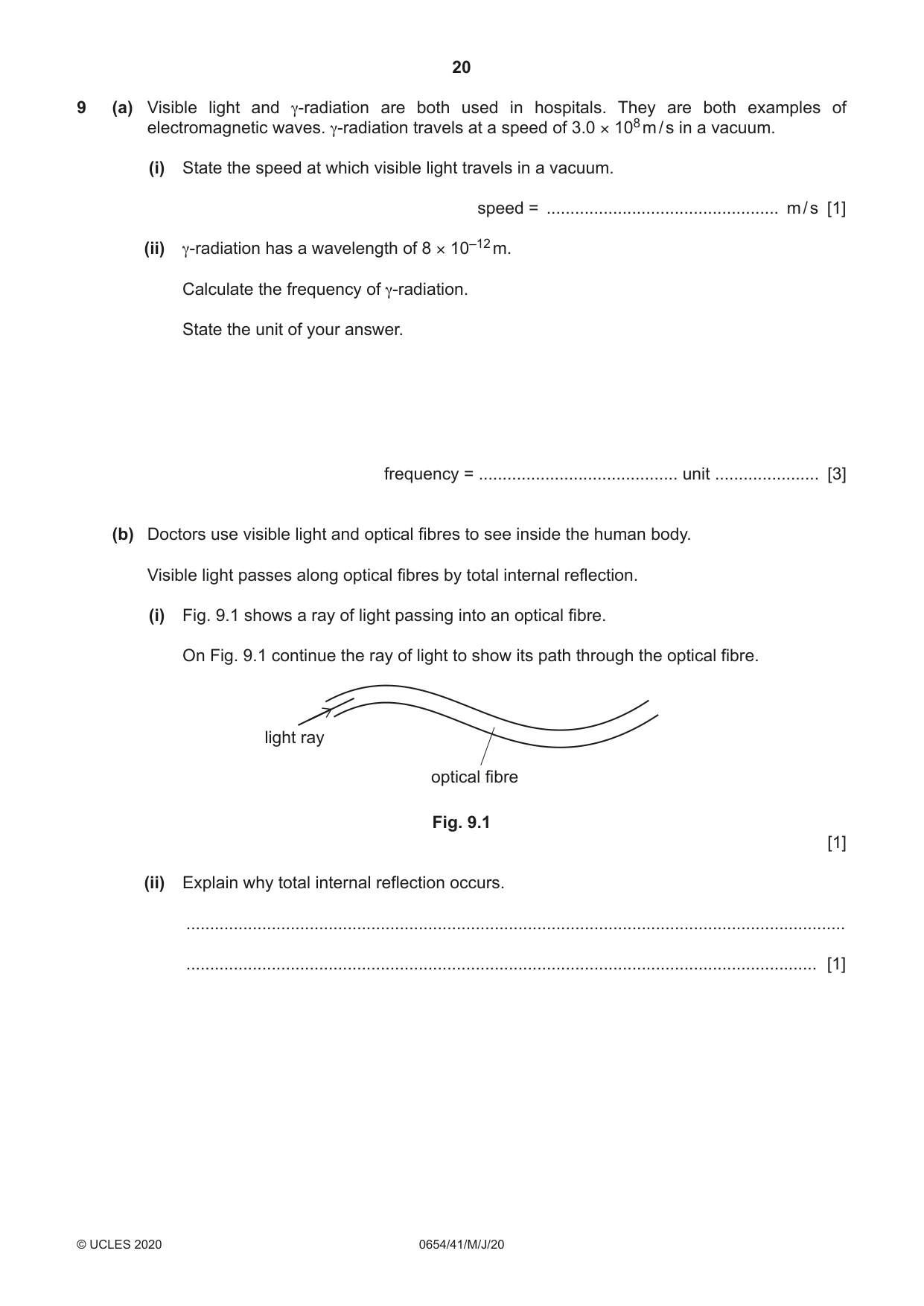
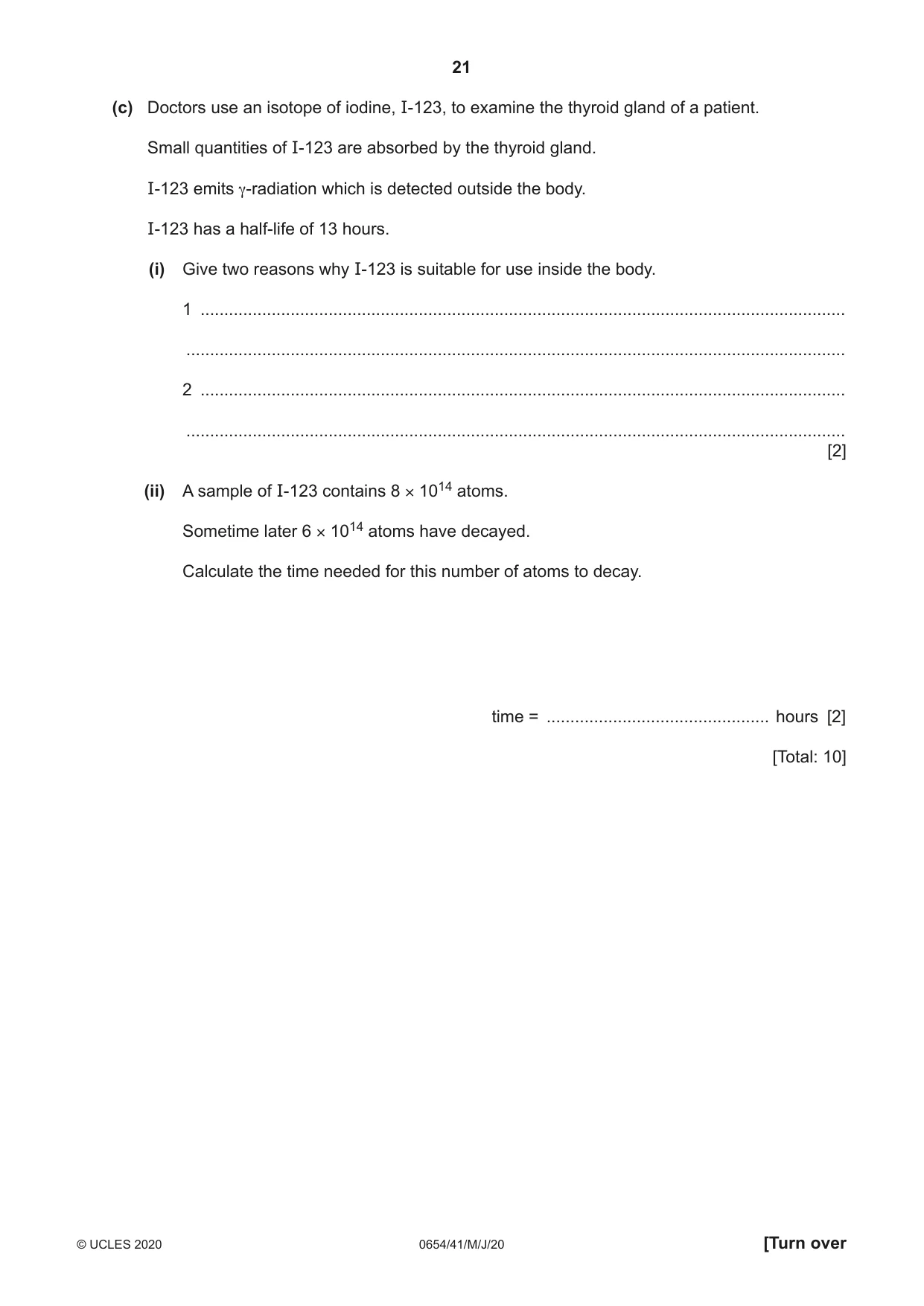
9 (a) Visible light and γ-radiation are both used in hospitals. They are both examples of electromagnetic waves. γ-radiation travels at a speed of 3.0 × 10⁸ m / s in a vacuum. (i) State the speed at which visible light travels in a vacuum. speed = ................................................. m / s [1] (ii) γ-radiation has a wavelength of 8 × 10–12 m. Calculate the frequency of γ-radiation. State the unit of your answer. frequency = .......................................... unit ...................... [3] (b) Doctors use visible light and optical fibres to see inside the human body. Visible light passes along optical fibres by total internal reflection. (i) Fig. 9.1 shows a ray of light passing into an optical fibre. On Fig. 9.1 continue the ray of light to show its path through the optical fibre. light ray optical fibre Fig. 9.1 [1] (ii) Explain why total internal reflection occurs. ........................................................................................................................................... ..................................................................................................................................... [1] (c) Doctors use an isotope of iodine, I-123, to examine the thyroid gland of a patient. Small quantities of I-123 are absorbed by the thyroid gland. I-123 emits γ-radiation which is detected outside the body. I-123 has a half-life of 13 hours. (i) Give two reasons why I-123 is suitable for use inside the body. 1 ........................................................................................................................................ ........................................................................................................................................... 2 ........................................................................................................................................ ........................................................................................................................................... [2] (ii) A sample of I-123 contains 8 × 10¹⁴ atoms. Sometime later 6 × 10¹⁴ atoms have decayed. Calculate the time needed for this number of atoms to decay. time = ............................................... hours [2] [Total: 10]
Mark scheme: 9(a)(i) 3 × 10⁸ m/s; 9(a)(ii) v = frequency × wavelength or correct substitution; 3.75 × 10¹⁹ ; Hz; 3 9(b)(i) angles approximately correct for at least two reflections; 1 9(b)(ii) angle of incidence exceeds critical angle; 1 9(c)(i) relatively short half-life; γ-radiation can pass through body cells and be detected outside the body; γ-radiation is the least ionising; max 2 9(c)(ii) two half-lives (have occurred); 26 (hours); 2
Q10 · Plant shoots respond to stimuli such as light
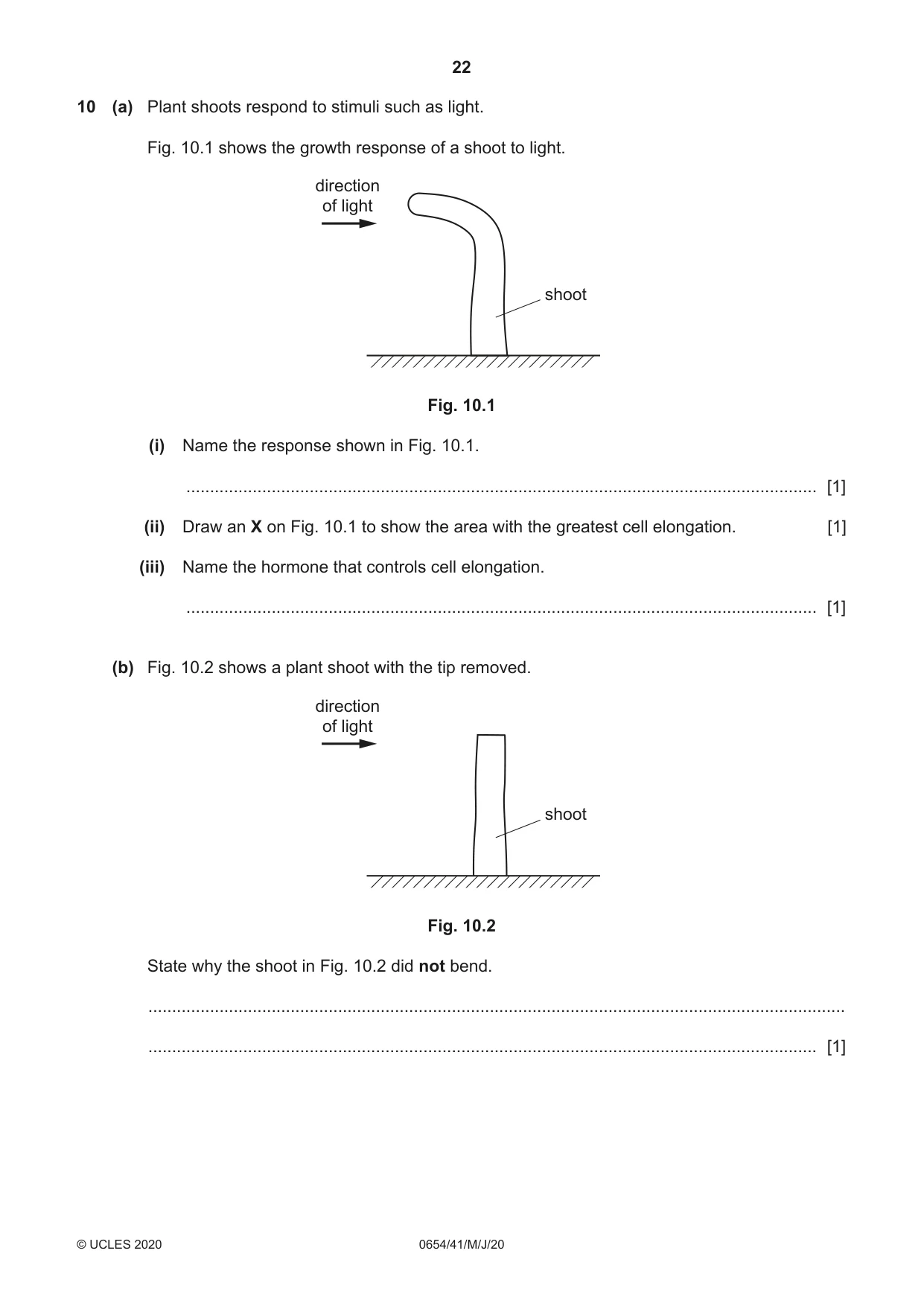
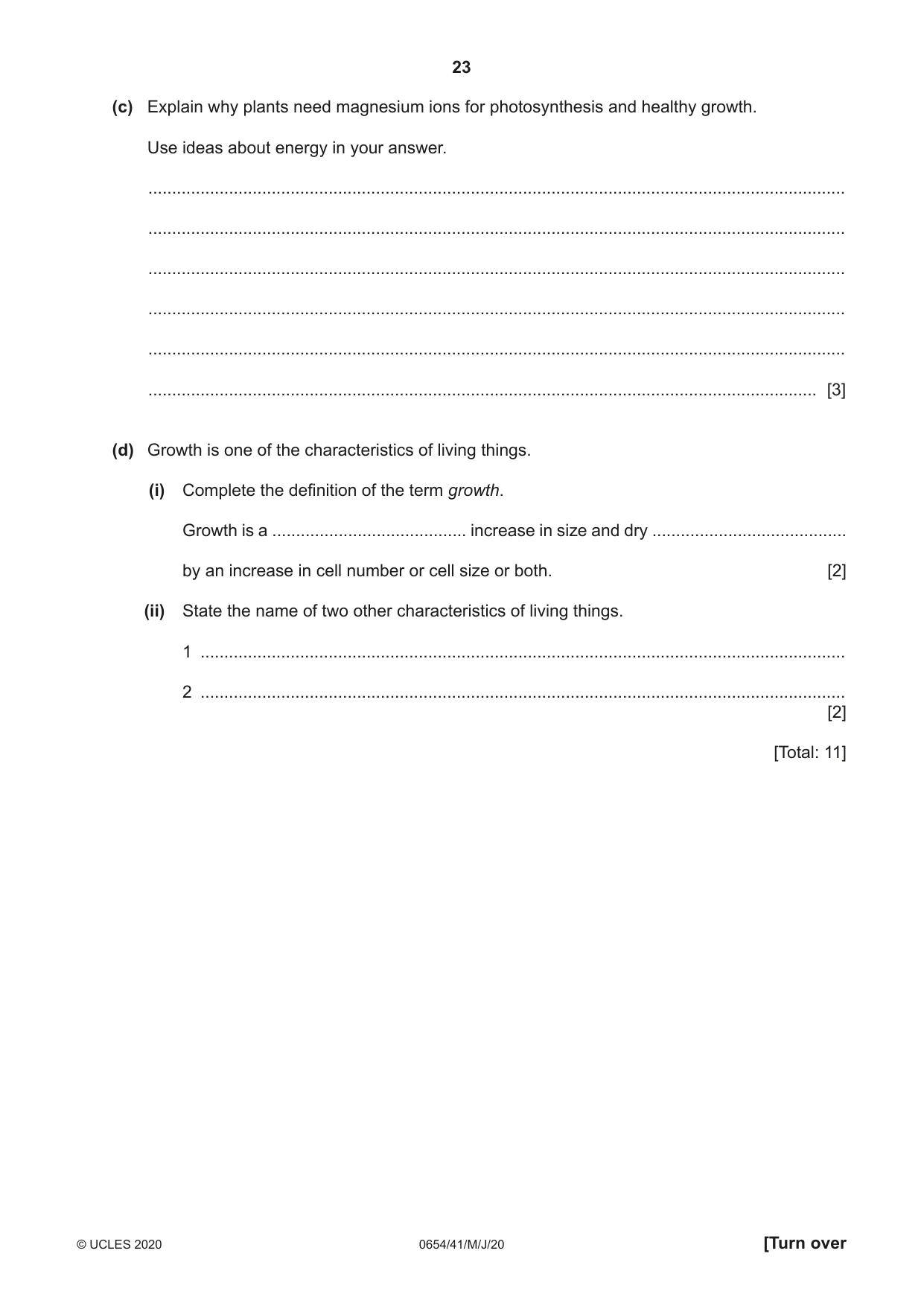
10 (a) Plant shoots respond to stimuli such as light. Fig. 10.1 shows the growth response of a shoot to light. direction of light shoot Fig. 10.1 (i) Name the response shown in Fig. 10.1. ..................................................................................................................................... [1] (ii) Draw an X on Fig. 10.1 to show the area with the greatest cell elongation. [1] (iii) Name the hormone that controls cell elongation. ..................................................................................................................................... [1] (b) Fig. 10.2 shows a plant shoot with the tip removed. direction of light shoot Fig. 10.2 State why the shoot in Fig. 10.2 did not bend. ................................................................................................................................................... ............................................................................................................................................. [1] (c) Explain why plants need magnesium ions for photosynthesis and healthy growth. Use ideas about energy in your answer. ................................................................................................................................................... ................................................................................................................................................... ................................................................................................................................................... ................................................................................................................................................... ................................................................................................................................................... ............................................................................................................................................. [3] (d) Growth is one of the characteristics of living things. (i) Complete the definition of the term growth. Growth is a ......................................... increase in size and dry ......................................... by an increase in cell number or cell size or both. [2] (ii) State the name of two other characteristics of living things. 1 ........................................................................................................................................ 2 ........................................................................................................................................ [2] [Total: 11]
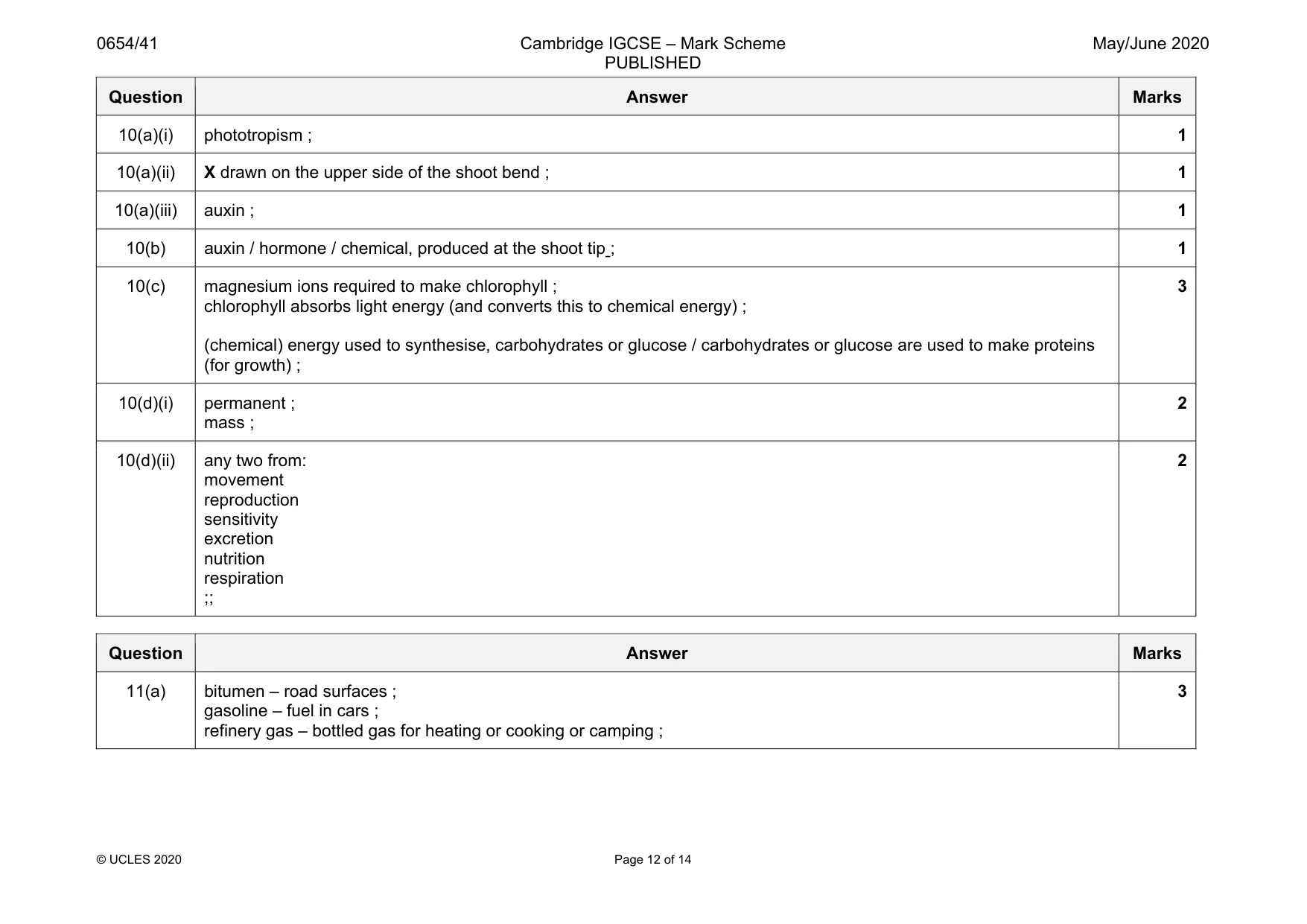
Mark scheme: 10(a)(i) phototropism ; 1 10(a)(ii) X drawn on the upper side of the shoot bend ; 1 10(a)(iii) auxin ; 1 10(b) auxin / hormone / chemical, produced at the shoot tip ; 1 10(c) magnesium ions required to make chlorophyll ; chlorophyll absorbs light energy (and converts this to chemical energy) ; (chemical) energy used to synthesise, carbohydrates or glucose / carbohydrates or glucose are used to make proteins (for growth) ; 3 10(d)(i) permanent ; mass ; 2 10(d)(ii) any two from: movement reproduction sensitivity excretion nutrition respiration ;; 2
Q11 · Petroleum is separated into useful chemicals by fractional distillation
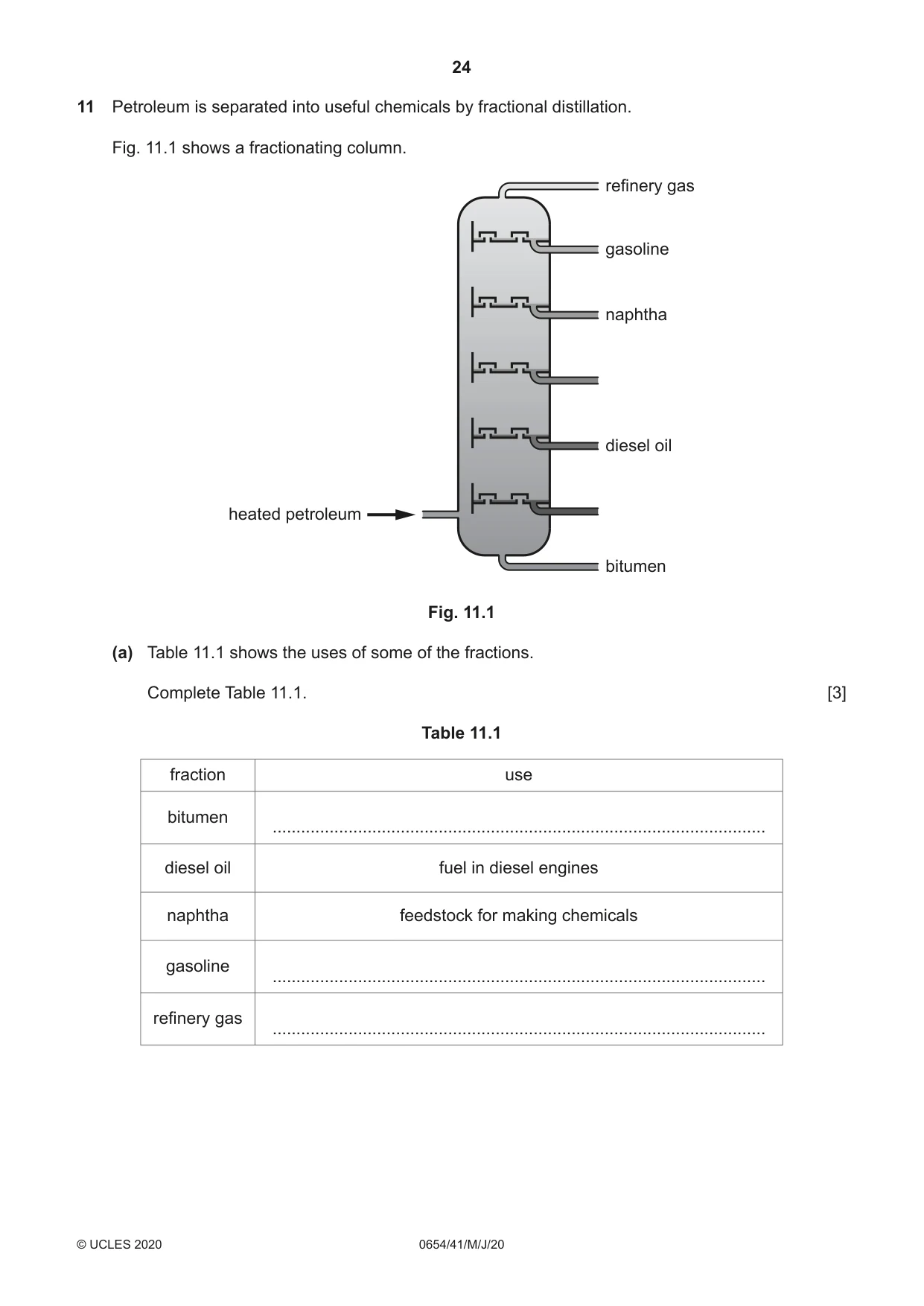
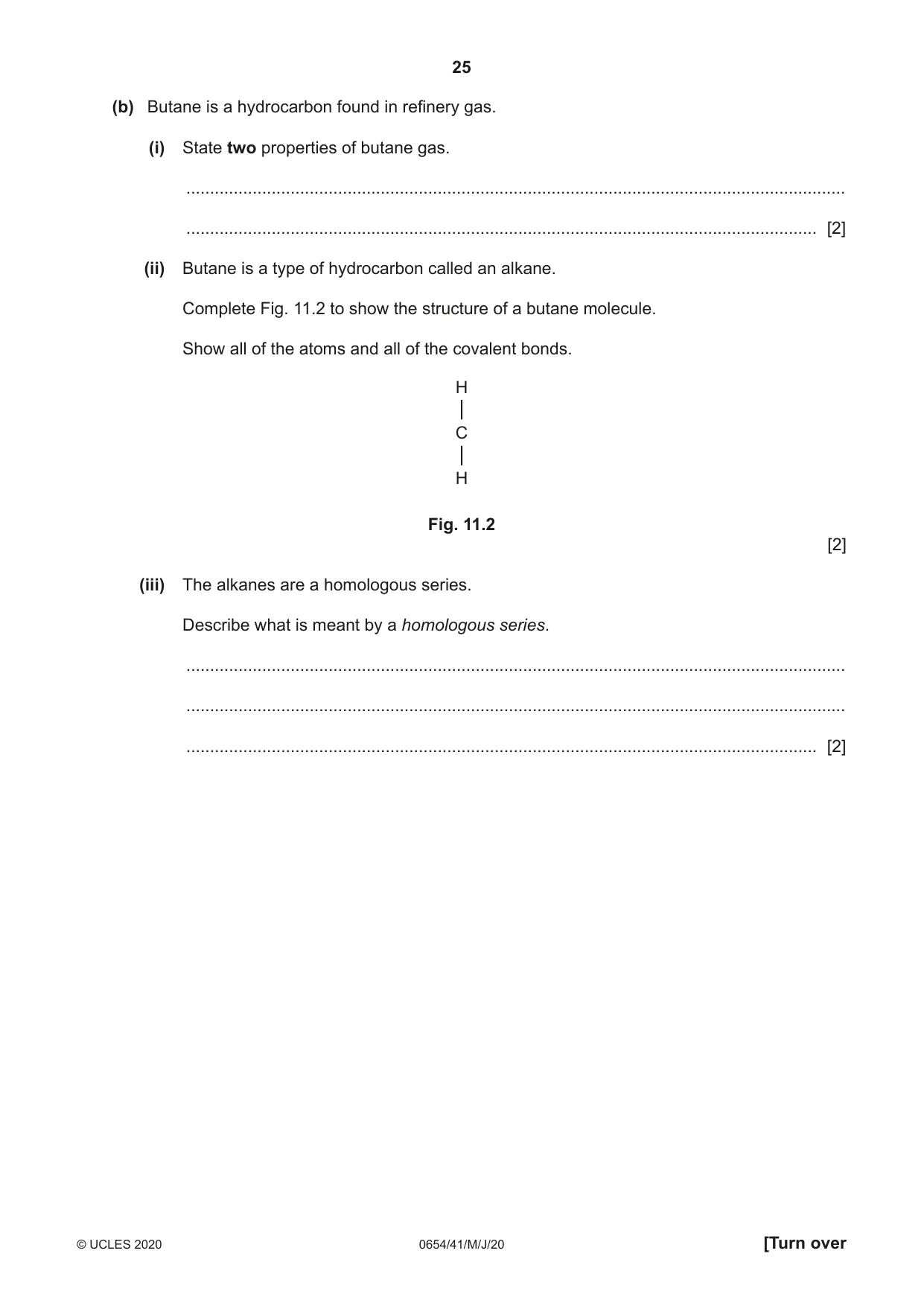
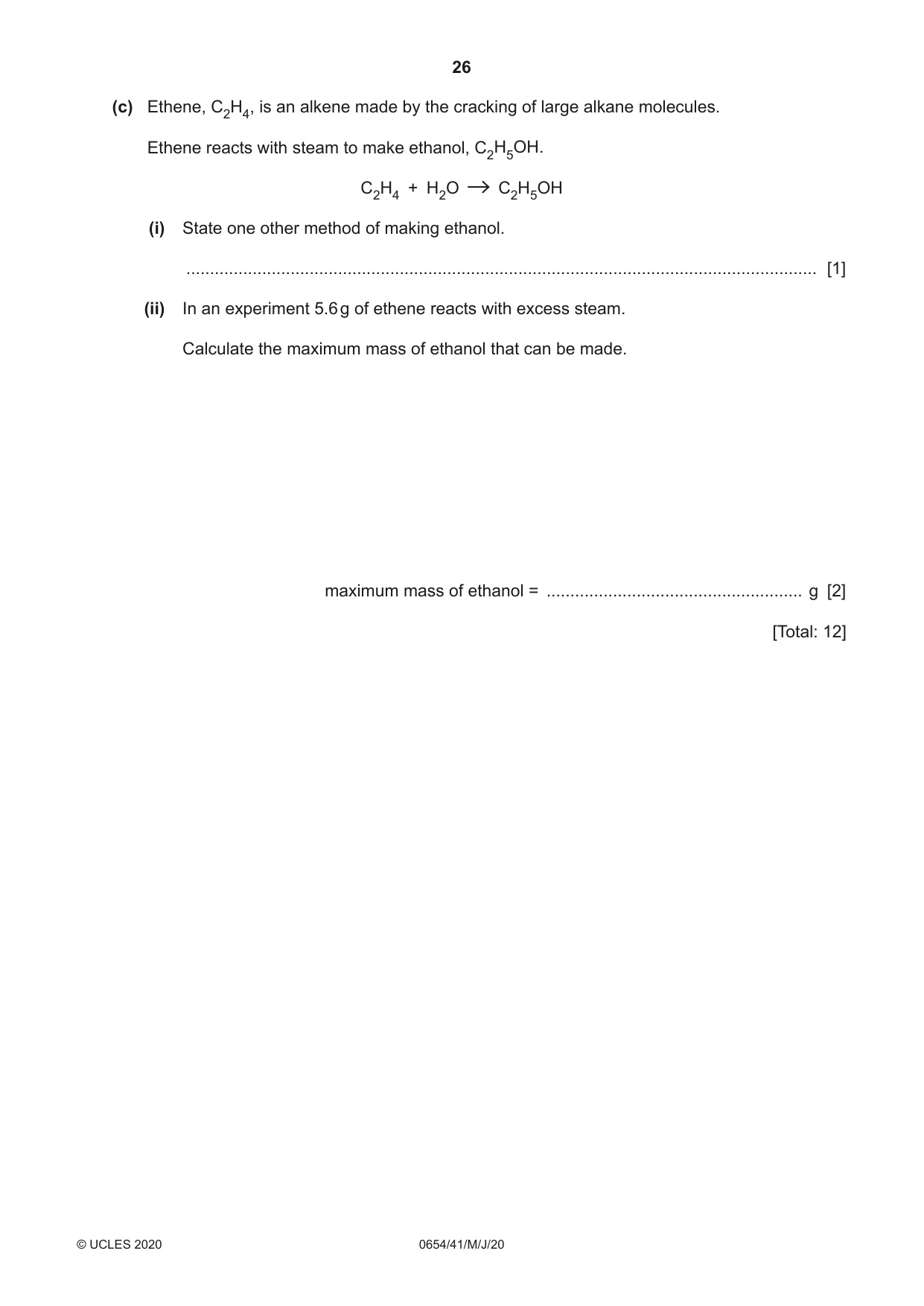
11 Petroleum is separated into useful chemicals by fractional distillation. Fig. 11.1 shows a fractionating column. refinery gas gasoline naphtha diesel oil heated petroleum bitumen Fig. 11.1 (a) Table 11.1 shows the uses of some of the fractions. Complete Table 11.1. [3] Table 11.1 fraction use bitumen ........................................................................................................ diesel oil fuel in diesel engines naphtha feedstock for making chemicals gasoline ........................................................................................................ refinery gas ........................................................................................................ (b) Butane is a hydrocarbon found in refinery gas. (i) State two properties of butane gas. ........................................................................................................................................... ..................................................................................................................................... [2] (ii) Butane is a type of hydrocarbon called an alkane. Complete Fig. 11.2 to show the structure of a butane molecule. Show all of the atoms and all of the covalent bonds. H C H Fig. 11.2 [2] (iii) The alkanes are a homologous series. Describe what is meant by a homologous series. ........................................................................................................................................... ........................................................................................................................................... ..................................................................................................................................... [2] (c) Ethene, C2H4, is an alkene made by the cracking of large alkane molecules. Ethene reacts with steam to make ethanol, C2H5OH. C2H4 + H2O C2H5OH (i) State one other method of making ethanol. ..................................................................................................................................... [1] (ii) In an experiment 5.6 g of ethene reacts with excess steam. Calculate the maximum mass of ethanol that can be made. maximum mass of ethanol = ...................................................... g [2] [Total: 12]
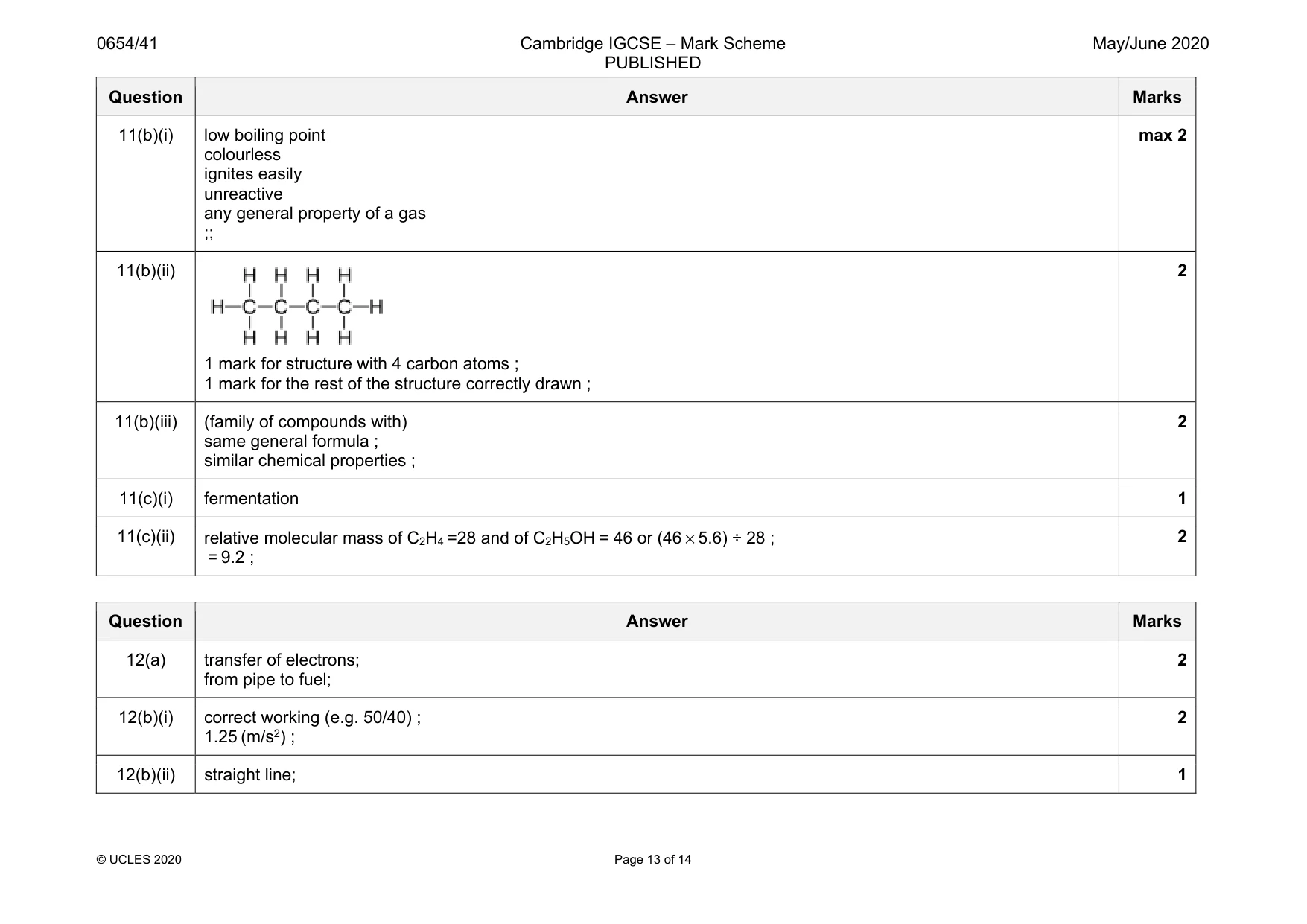
Mark scheme: 11(a) bitumen – road surfaces ; gasoline – fuel in cars ; refinery gas – bottled gas for heating or cooking or camping ; 3 Question Answer Marks 11(b)(i) low boiling point colourless ignites easily unreactive any general property of a gas ;; max 2 11(b)(ii) 1 mark for structure with 4 carbon atoms ; 1 mark for the rest of the structure correctly drawn ; 2 11(b)(iii) (family of compounds with) same general formula ; similar chemical properties ; 2 11(c)(i) fermentation 1 11(c)(ii) relative molecular mass of C2H4 =28 and of C2H5OH = 46 or (46 × 5.6) ÷ 28 ; = 9.2 ; 2
Q12 · An aircraft being refuelled using a plastic pipe
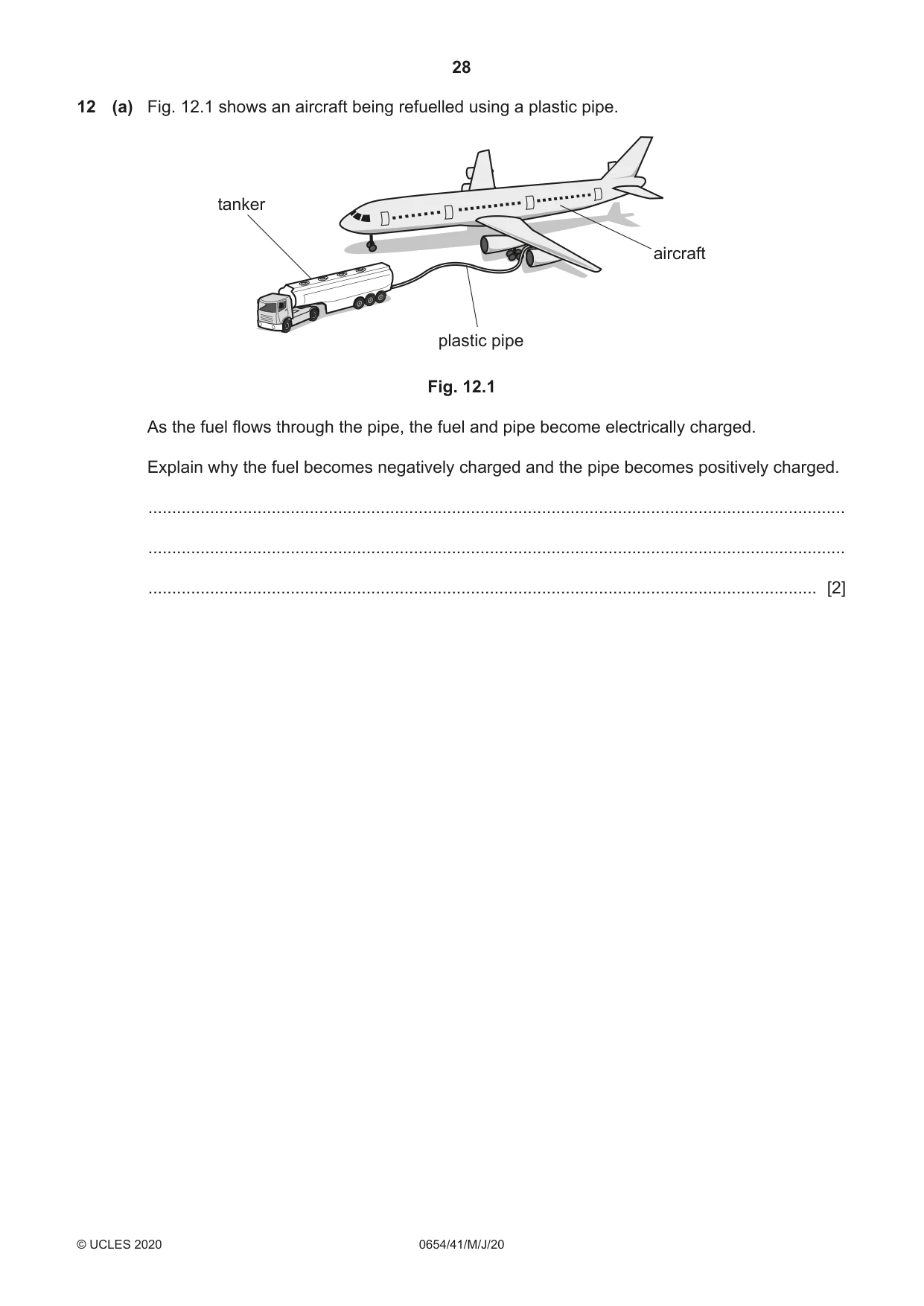
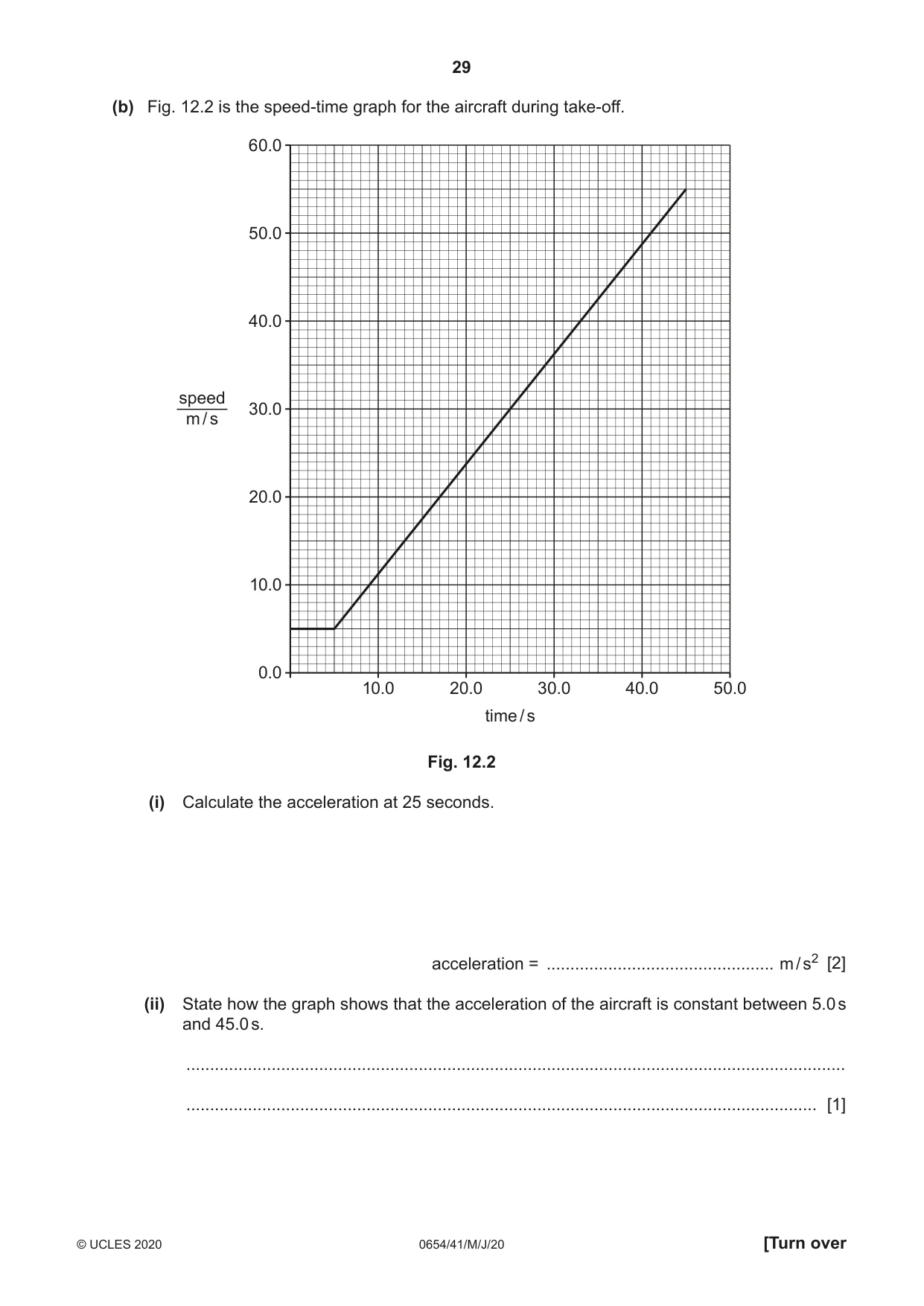
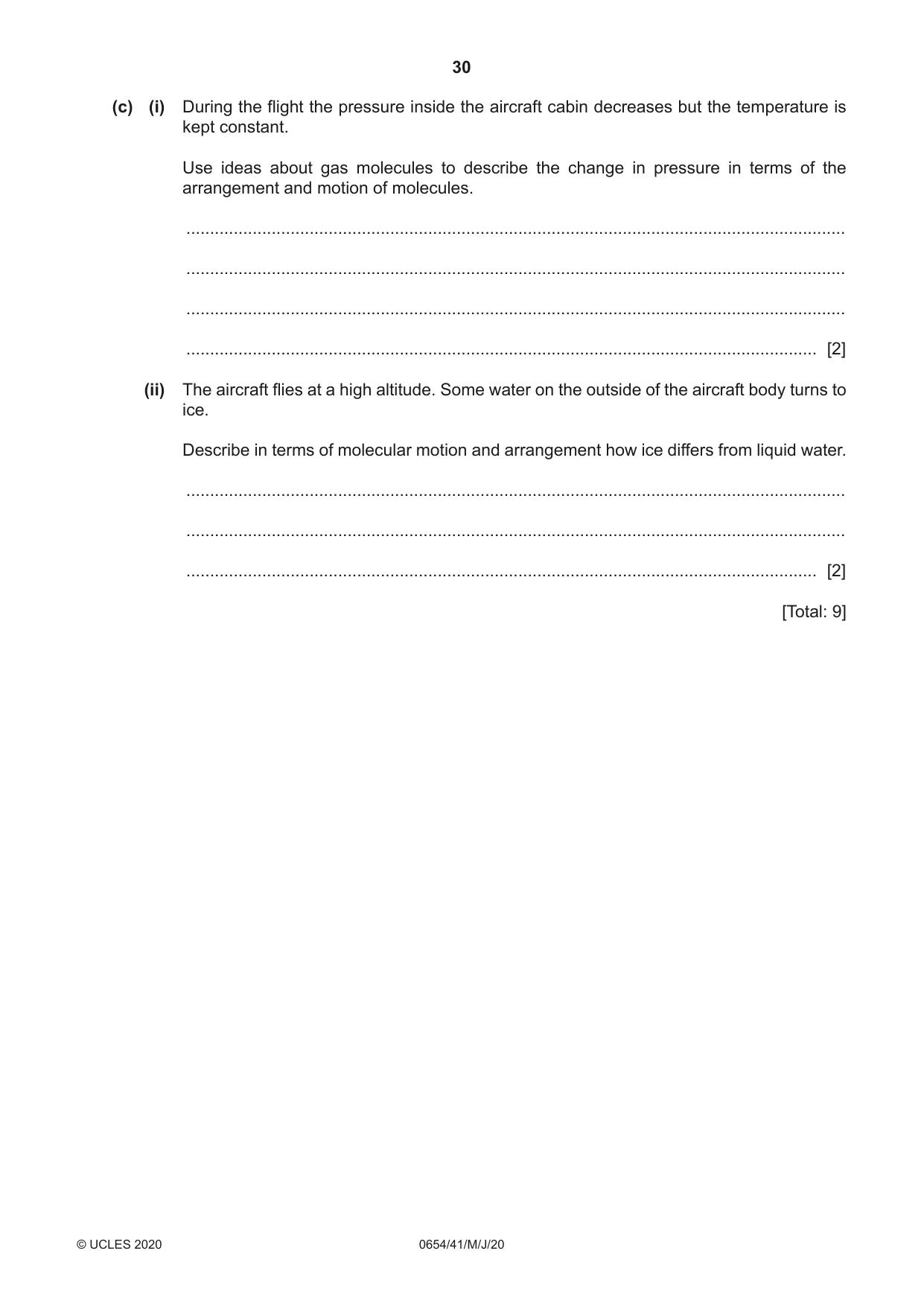
12 (a) Fig. 12.1 shows an aircraft being refuelled using a plastic pipe. tanker aircraft plastic pipe Fig. 12.1 As the fuel flows through the pipe, the fuel and pipe become electrically charged. Explain why the fuel becomes negatively charged and the pipe becomes positively charged. ................................................................................................................................................... ................................................................................................................................................... ............................................................................................................................................. [2] (b) Fig. 12.2 is the speed-time graph for the aircraft during take-off. 60.0 50.0 40.0 speed 30.0 m / s 20.0 10.0 0.0 10.0 20.0 30.0 40.0 50.0 time / s Fig. 12.2 (i) Calculate the acceleration at 25 seconds. acceleration = ................................................ m / s2 [2] (ii) State how the graph shows that the acceleration of the aircraft is constant between 5.0 s and 45.0 s. ........................................................................................................................................... ..................................................................................................................................... [1] (c) (i) During the flight the pressure inside the aircraft cabin decreases but the temperature is kept constant. Use ideas about gas molecules to describe the change in pressure in terms of the arrangement and motion of molecules. ........................................................................................................................................... ........................................................................................................................................... ........................................................................................................................................... ..................................................................................................................................... [2] (ii) The aircraft flies at a high altitude. Some water on the outside of the aircraft body turns to ice. Describe in terms of molecular motion and arrangement how ice differs from liquid water. ........................................................................................................................................... ........................................................................................................................................... ..................................................................................................................................... [2] [Total: 9]
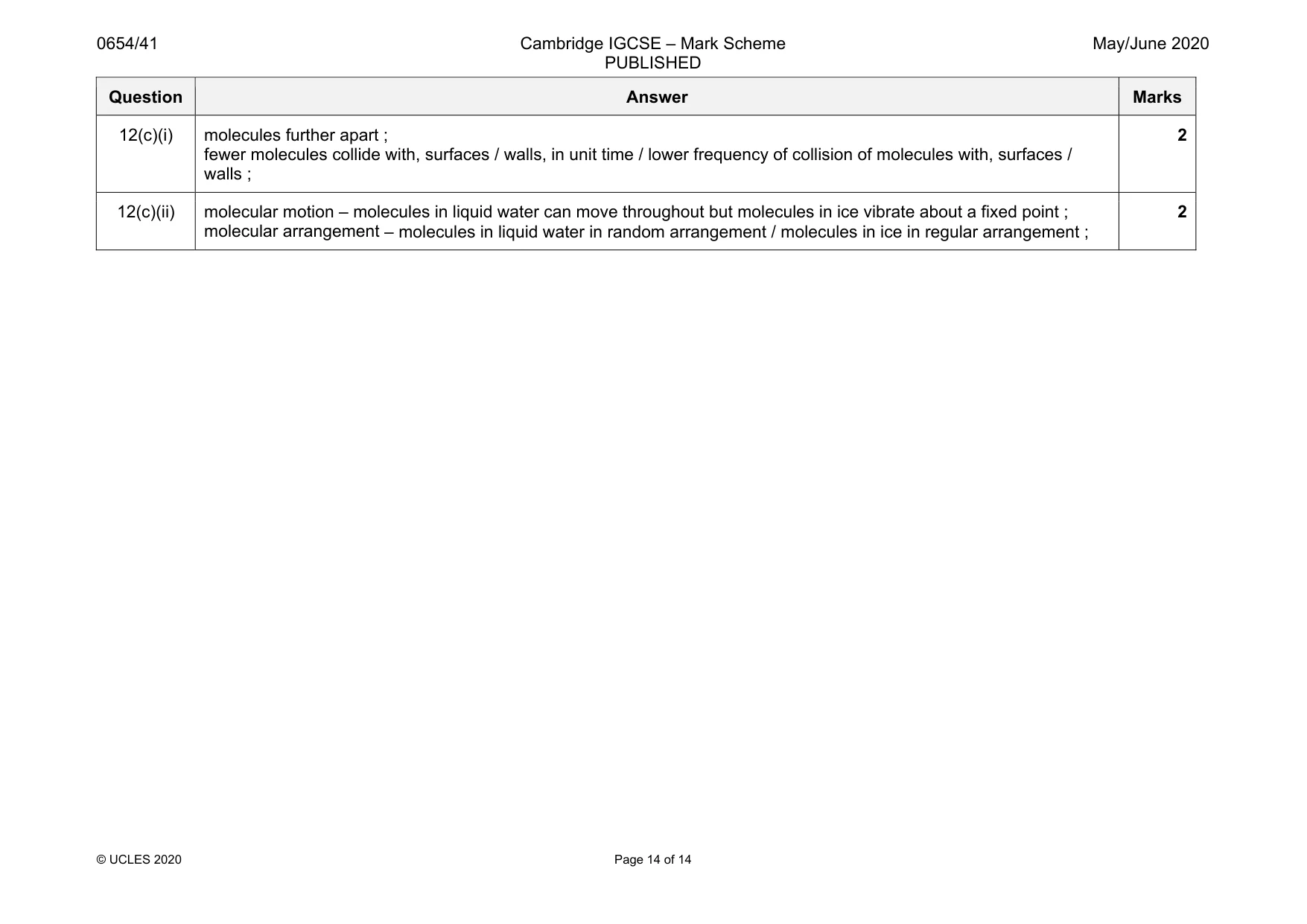
Mark scheme: 12(a) transfer of electrons; from pipe to fuel; 2 12(b)(i) correct working (e.g. 50/40) ; 1.25 (m/s2) ; 2 12(b)(ii) straight line; 1 Question Answer Marks 12(c)(i) molecules further apart ; fewer molecules collide with, surfaces / walls, in unit time / lower frequency of collision of molecules with, surfaces / walls ; 2 12(c)(ii) molecular motion – molecules in liquid water can move throughout but molecules in ice vibrate about a fixed point ; molecular arrangement – molecules in liquid water in random arrangement / molecules in ice in regular arrangement ; 2
What was in this paper
The subtopics covered by these 12 questions, and how many questions each got. Open one in a new tab to see every Cambridge question on it.