Cambridge IGCSE Sciences - Co-ordinated (Double) 0654 — 2021 May/June Paper 4 · Variant 3
0654/43/M/J/21 · 12 questions · 120 marks · ≈135 min
The question paper and its mark scheme, free to read here and free to download. This is Cambridge’s own paper, exactly as it was sat.
Question paper28 pages
Mark scheme14 pages
Answers below. Sit the paper first if you are practising.
Questions as text
Q1 · A photograph of an insect-pollinated flower
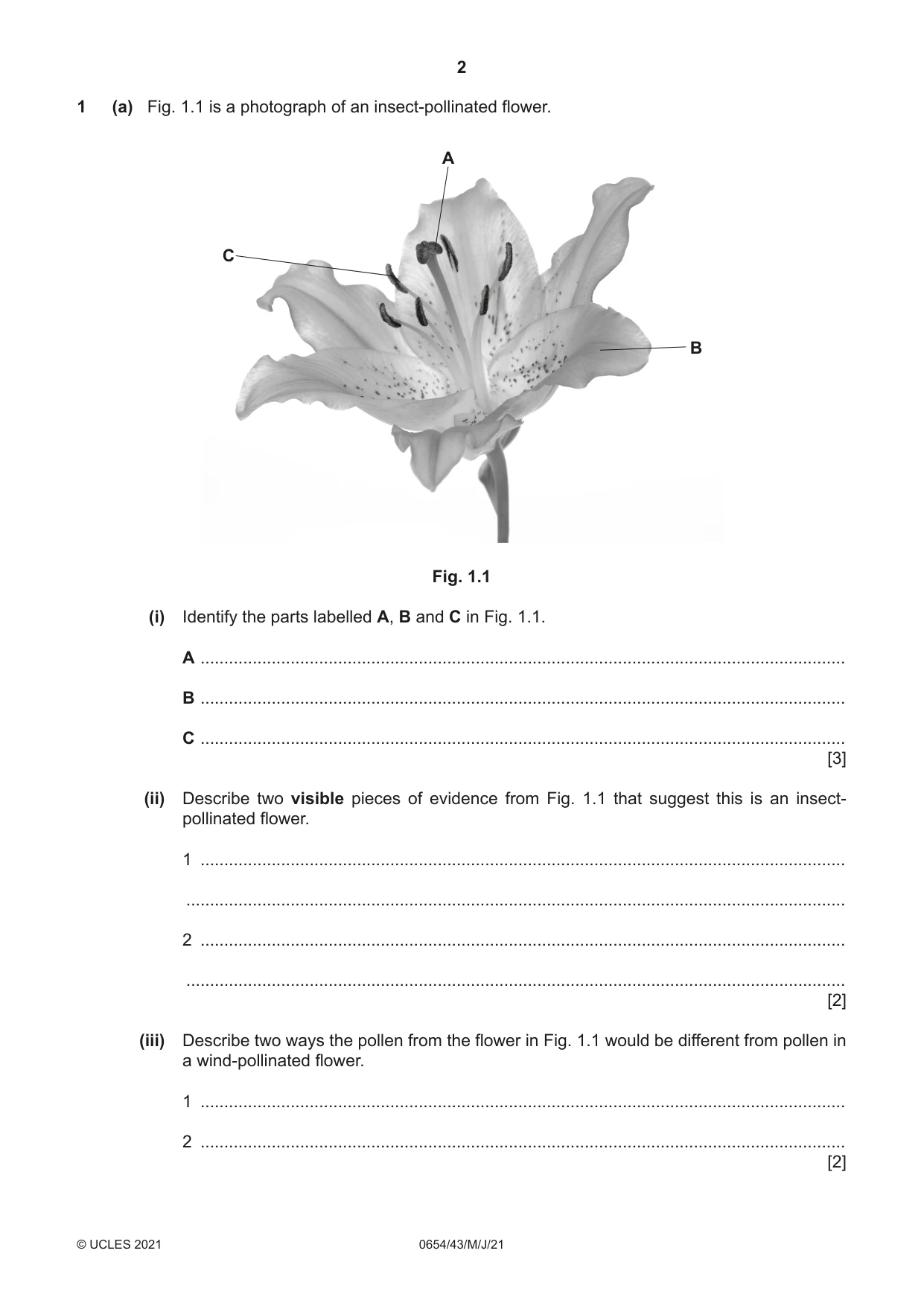
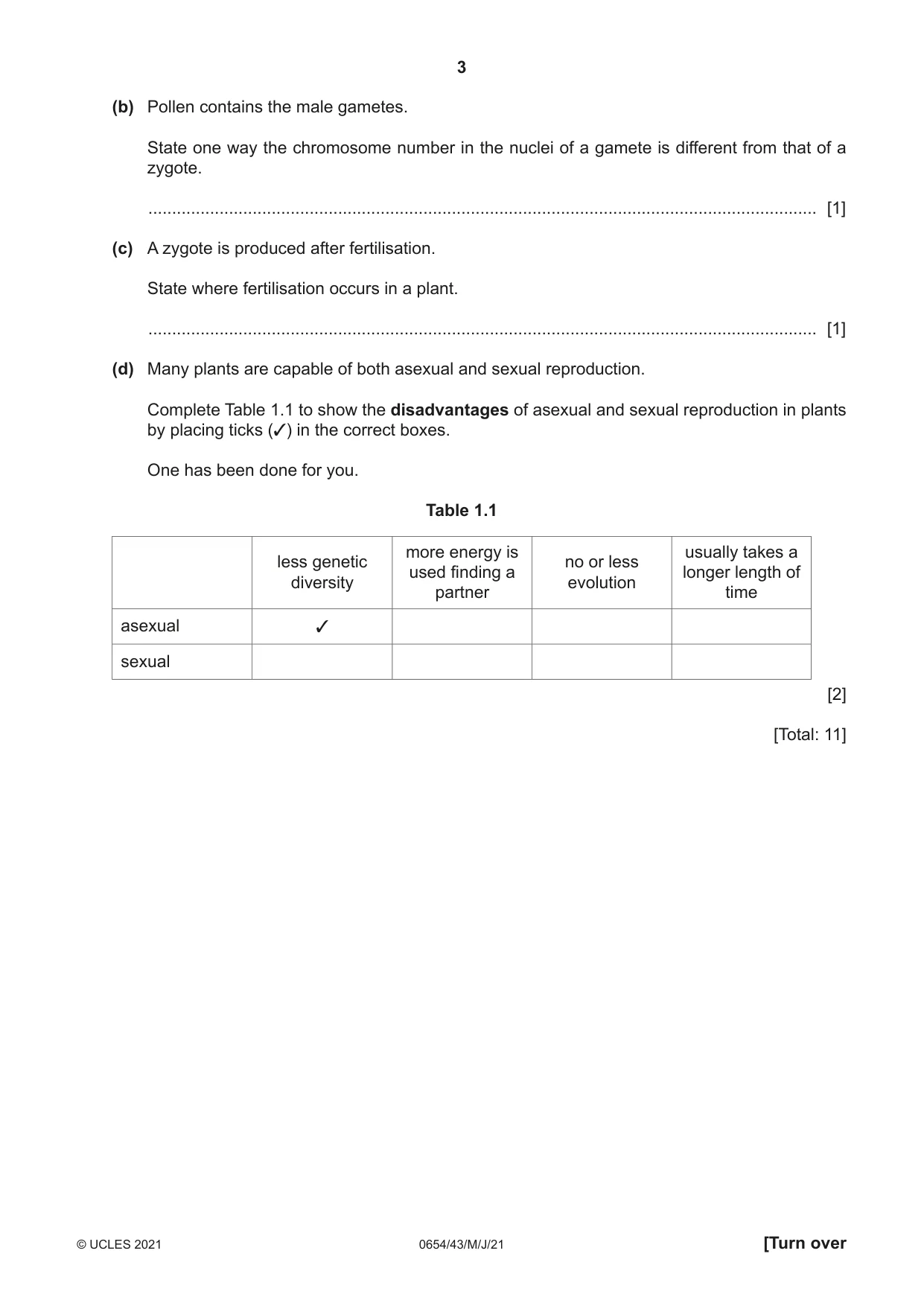
1 (a) Fig. 1.1 is a photograph of an insect-pollinated flower. A C B Fig. 1.1 (i) Identify the parts labelled A, B and C in Fig. 1.1. A ........................................................................................................................................ B ........................................................................................................................................ C ........................................................................................................................................ [3] (ii) Describe two visible pieces of evidence from Fig. 1.1 that suggest this is an insect- pollinated flower. 1 ........................................................................................................................................ ........................................................................................................................................... 2 ........................................................................................................................................ ........................................................................................................................................... [2] (iii) Describe two ways the pollen from the flower in Fig. 1.1 would be different from pollen in a wind-pollinated flower. 1 ........................................................................................................................................ 2 ........................................................................................................................................ [2] (b) Pollen contains the male gametes. State one way the chromosome number in the nuclei of a gamete is different from that of a zygote. ............................................................................................................................................. [1] (c) A zygote is produced after fertilisation. State where fertilisation occurs in a plant. ............................................................................................................................................. [1] (d) Many plants are capable of both asexual and sexual reproduction. Complete Table 1.1 to show the disadvantages of asexual and sexual reproduction in plants by placing ticks (3) in the correct boxes. One has been done for you. Table 1.1 more energy is usually takes a less genetic no or less used finding a longer length of diversity evolution partner time asexual 3 sexual [2] [Total: 11]
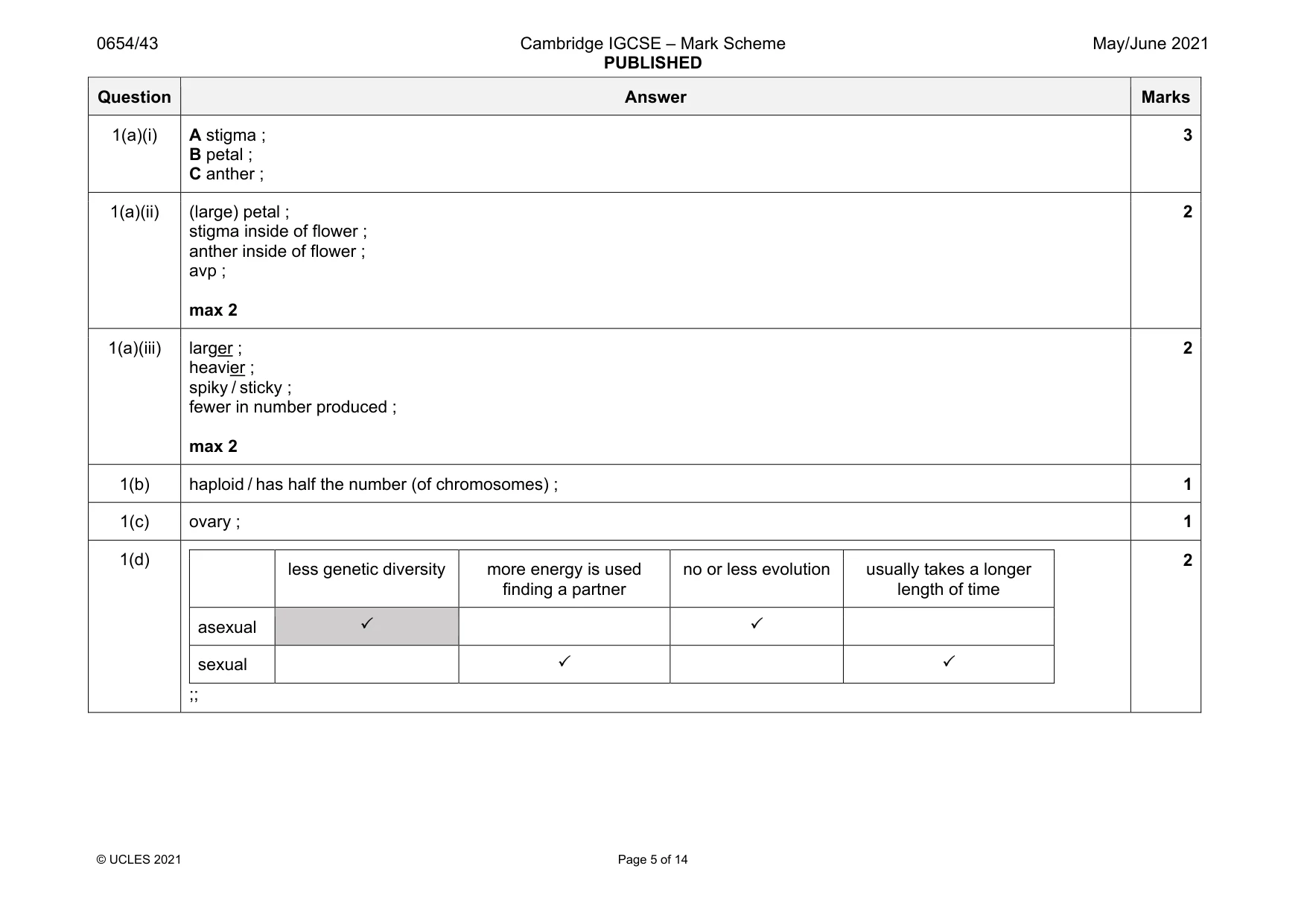
Mark scheme: 1(a)(i) A stigma ; B petal ; C anther ; 3 1(a)(ii) (large) petal ; stigma inside of flower ; anther inside of flower ; avp ; max 2 2 1(a)(iii) larger ; heavier ; spiky / sticky ; fewer in number produced ; max 2 2 1(b) haploid / has half the number (of chromosomes) ; 1 1(c) ovary ; 1 1(d) less genetic diversity more energy is used finding a partner no or less evolution usually takes a longer length of time asexual sexual ;; 2
Q2 · Hydrogen peroxide solution slowly decomposes to make water and oxygen gas
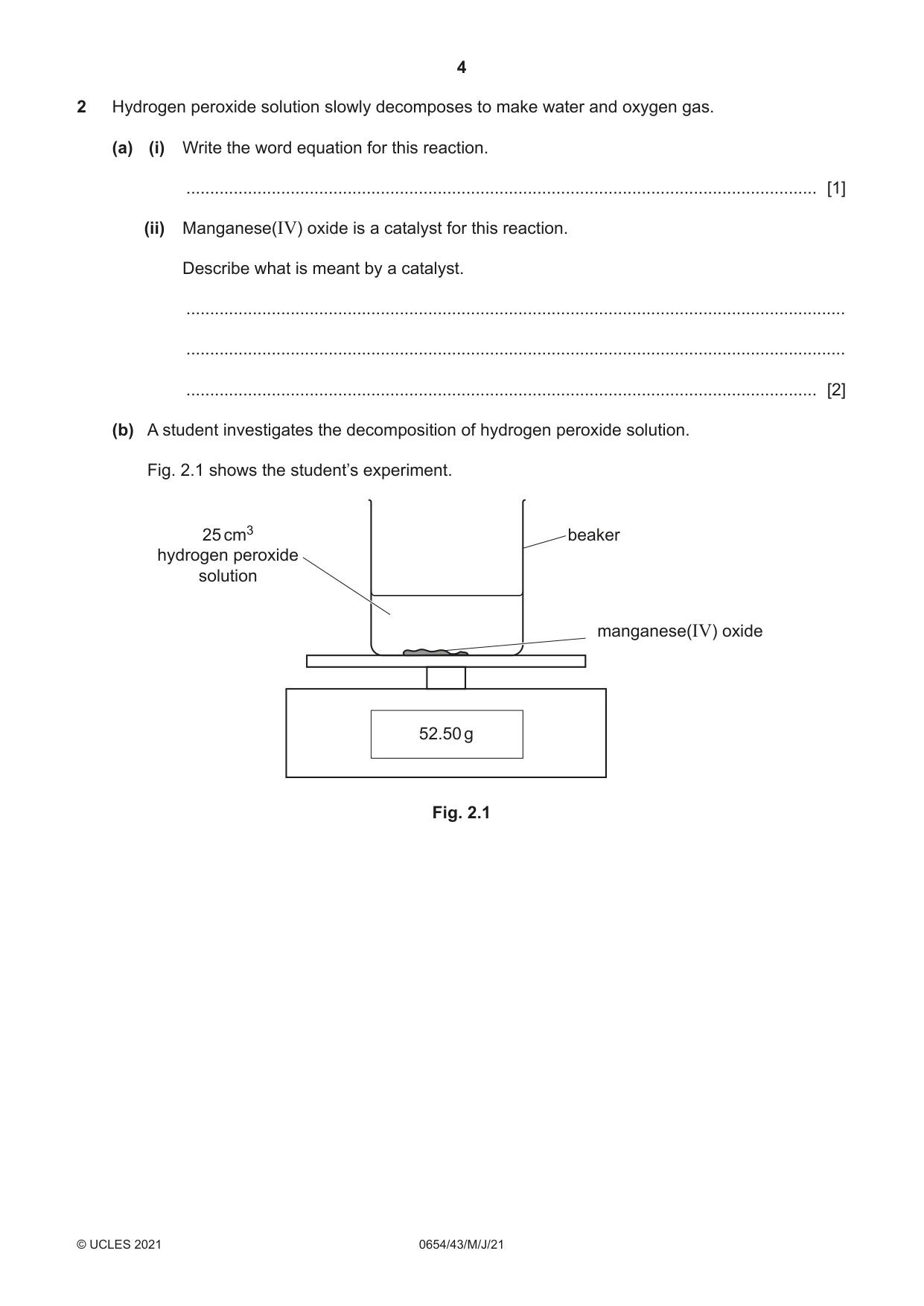
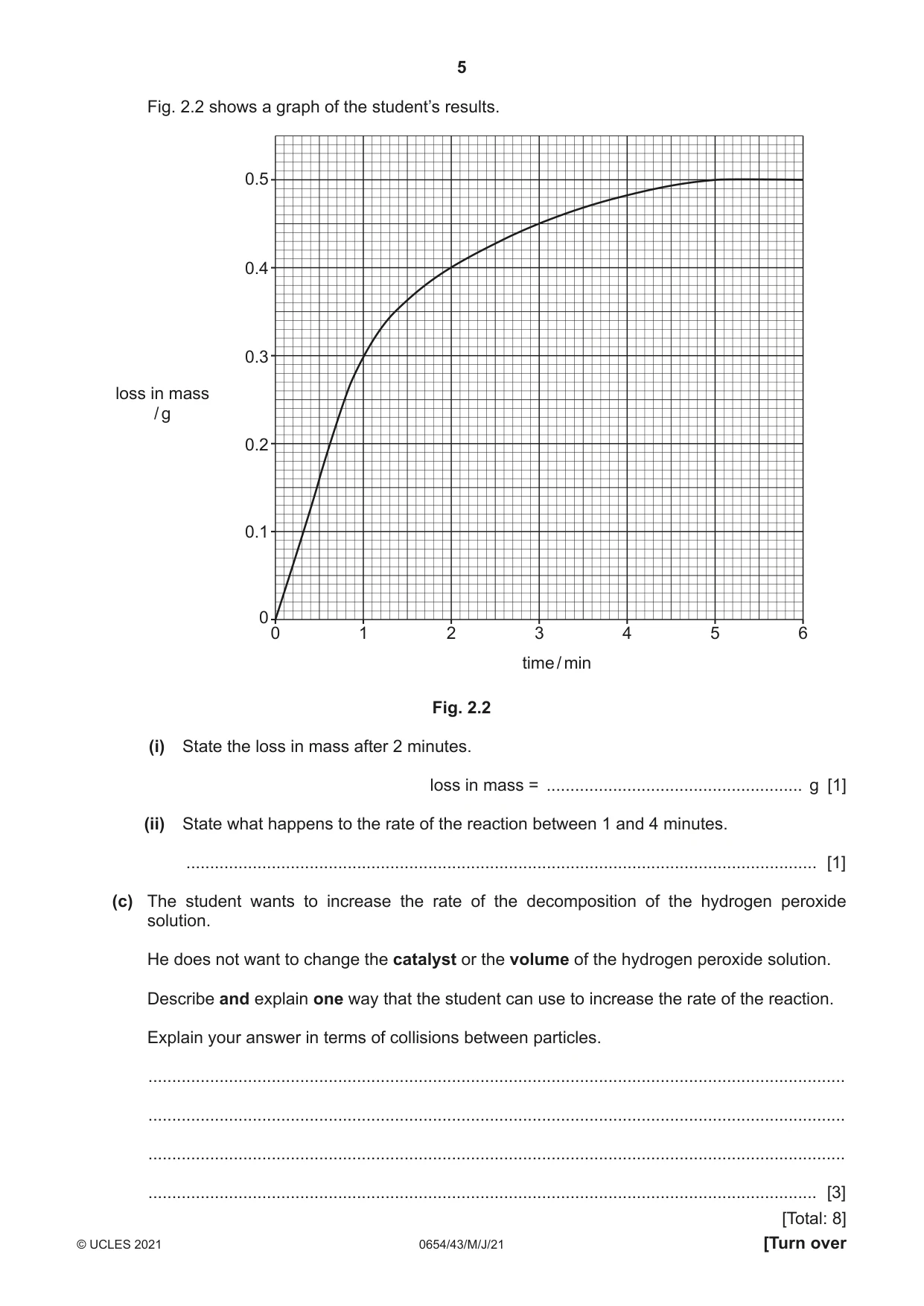
2 Hydrogen peroxide solution slowly decomposes to make water and oxygen gas. (a) (i) Write the word equation for this reaction. ..................................................................................................................................... [1] (ii) Manganese(IV) oxide is a catalyst for this reaction. Describe what is meant by a catalyst. ........................................................................................................................................... ........................................................................................................................................... ..................................................................................................................................... [2] (b) A student investigates the decomposition of hydrogen peroxide solution. Fig. 2.1 shows the student’s experiment. 25 cm3 beaker hydrogen peroxide solution manganese(IV) oxide 52.50 g Fig. 2.1 Fig. 2.2 shows a graph of the student’s results. 0.5 0.4 0.3 loss in mass / g 0.2 0.1 0 0 1 2 3 4 5 6 time / min Fig. 2.2 (i) State the loss in mass after 2 minutes. loss in mass = ...................................................... g [1] (ii) State what happens to the rate of the reaction between 1 and 4 minutes. ..................................................................................................................................... [1] (c) The student wants to increase the rate of the decomposition of the hydrogen peroxide solution. He does not want to change the catalyst or the volume of the hydrogen peroxide solution. Describe and explain one way that the student can use to increase the rate of the reaction. Explain your answer in terms of collisions between particles. ................................................................................................................................................... ................................................................................................................................................... ................................................................................................................................................... ............................................................................................................................................. [3] [Total: 8]
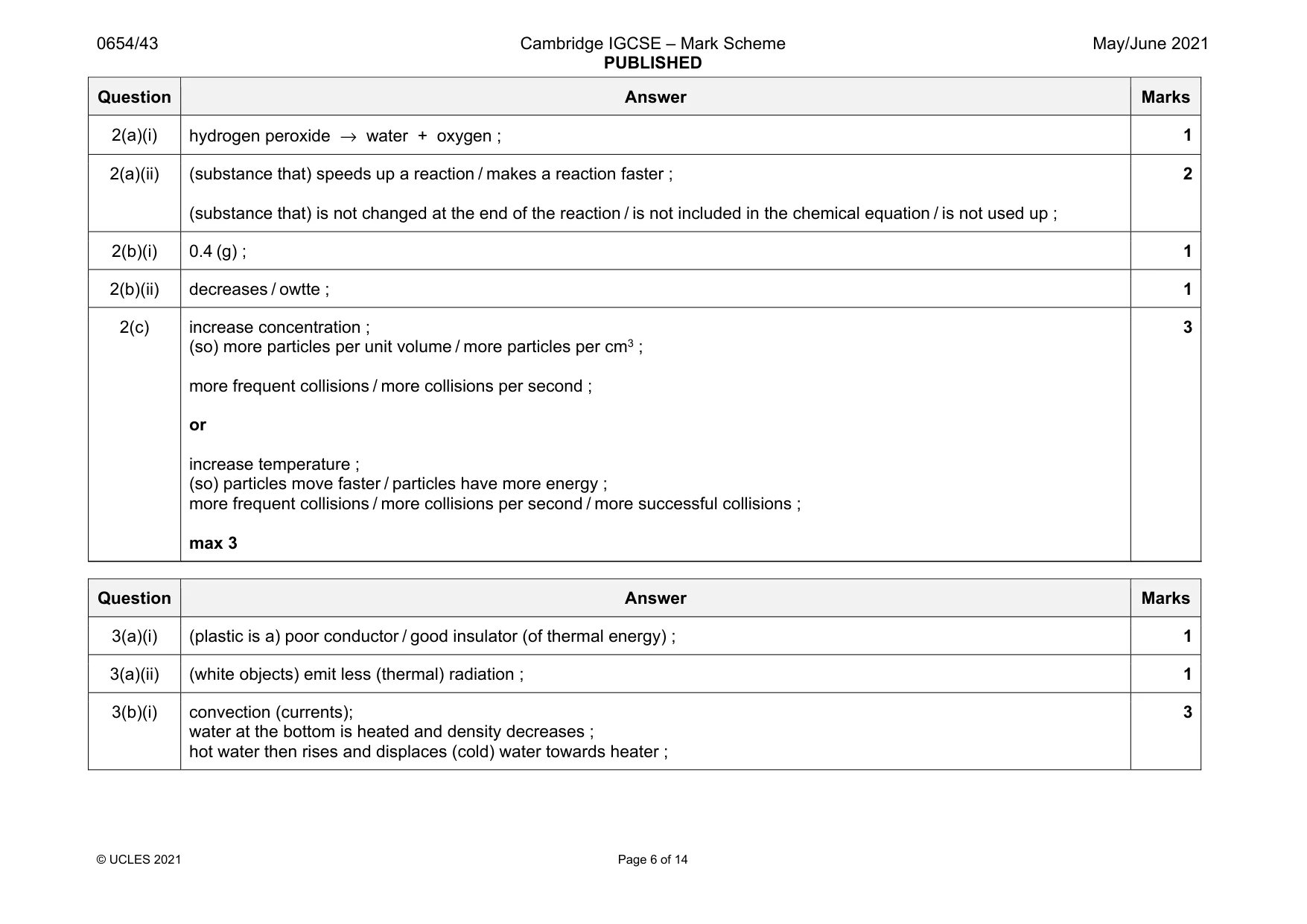
Mark scheme: 2(a)(i) hydrogen peroxide → water + oxygen ; 1 2(a)(ii) (substance that) speeds up a reaction / makes a reaction faster ; (substance that) is not changed at the end of the reaction / is not included in the chemical equation / is not used up ; 2 2(b)(i) 0.4 (g) ; 1 2(b)(ii) decreases / owtte ; 1 2(c) increase concentration ; (so) more particles per unit volume / more particles per cm3 ; more frequent collisions / more collisions per second ; or increase temperature ; (so) particles move faster / particles have more energy ; more frequent collisions / more collisions per second / more successful collisions ; max 3 3
Q3 · A kettle and the label on the bottom of the kettle
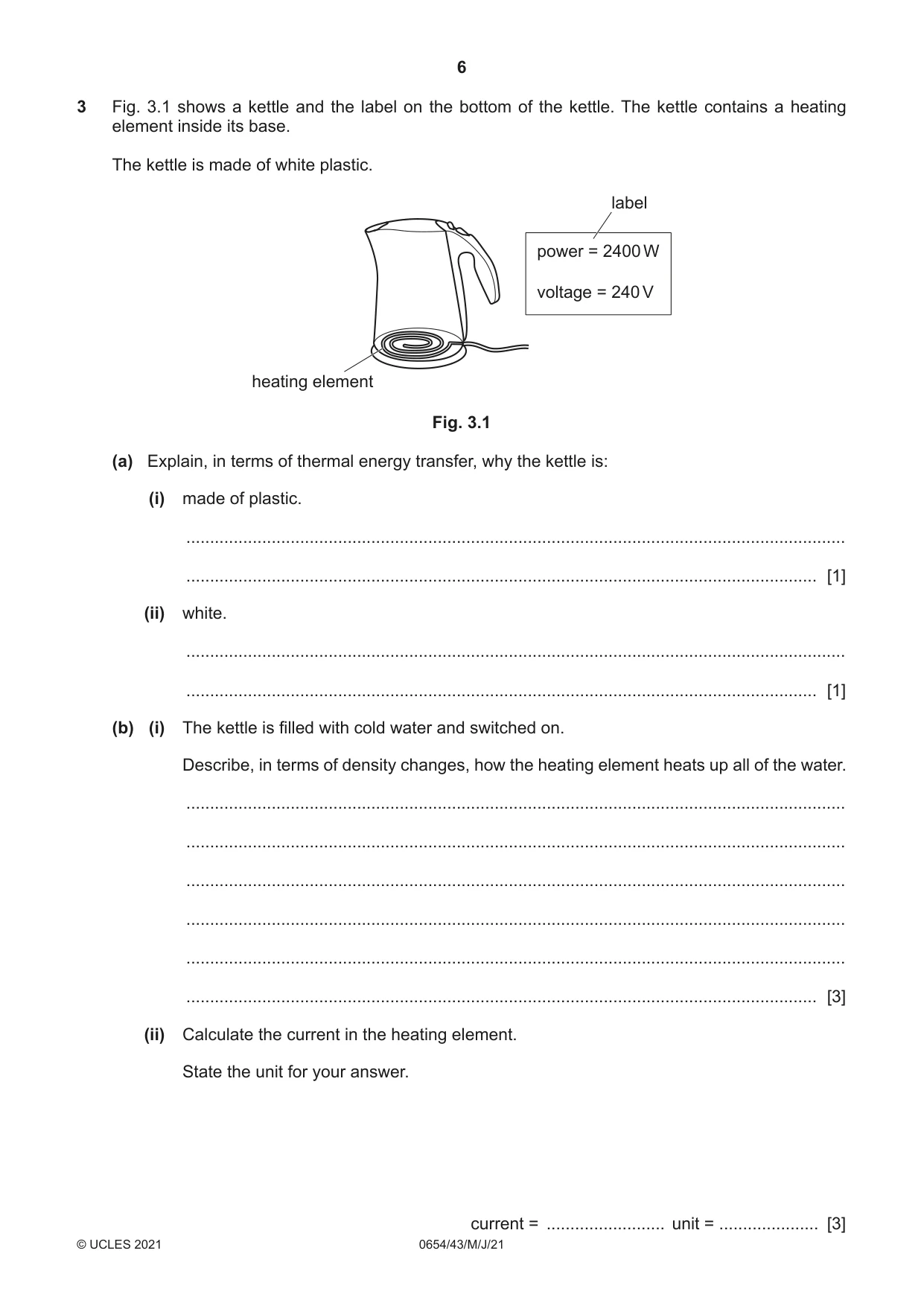
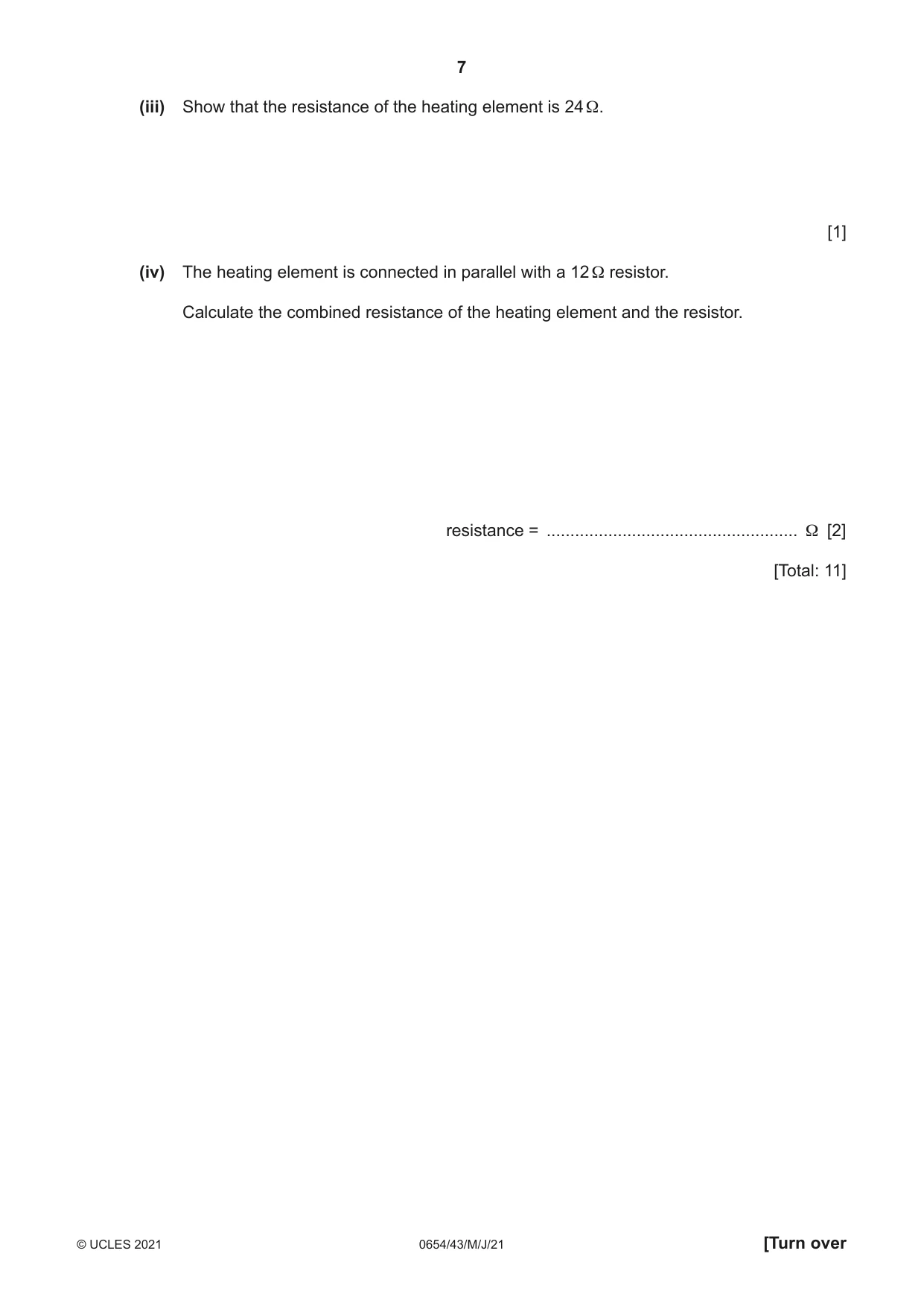
3 Fig. 3.1 shows a kettle and the label on the bottom of the kettle. The kettle contains a heating element inside its base. The kettle is made of white plastic. label power = 2400 W voltage = 240 V heating element Fig. 3.1 (a) Explain, in terms of thermal energy transfer, why the kettle is: (i) made of plastic. ........................................................................................................................................... ..................................................................................................................................... [1] (ii) white. ........................................................................................................................................... ..................................................................................................................................... [1] (b) (i) The kettle is filled with cold water and switched on. Describe, in terms of density changes, how the heating element heats up all of the water. ........................................................................................................................................... ........................................................................................................................................... ........................................................................................................................................... ........................................................................................................................................... ........................................................................................................................................... ..................................................................................................................................... [3] (ii) Calculate the current in the heating element. State the unit for your answer. current = ......................... unit = ..................... [3] (iii) Show that the resistance of the heating element is 24 Ω. [1] (iv) The heating element is connected in parallel with a 12 Ω resistor. Calculate the combined resistance of the heating element and the resistor. resistance = ..................................................... Ω [2] [Total: 11]
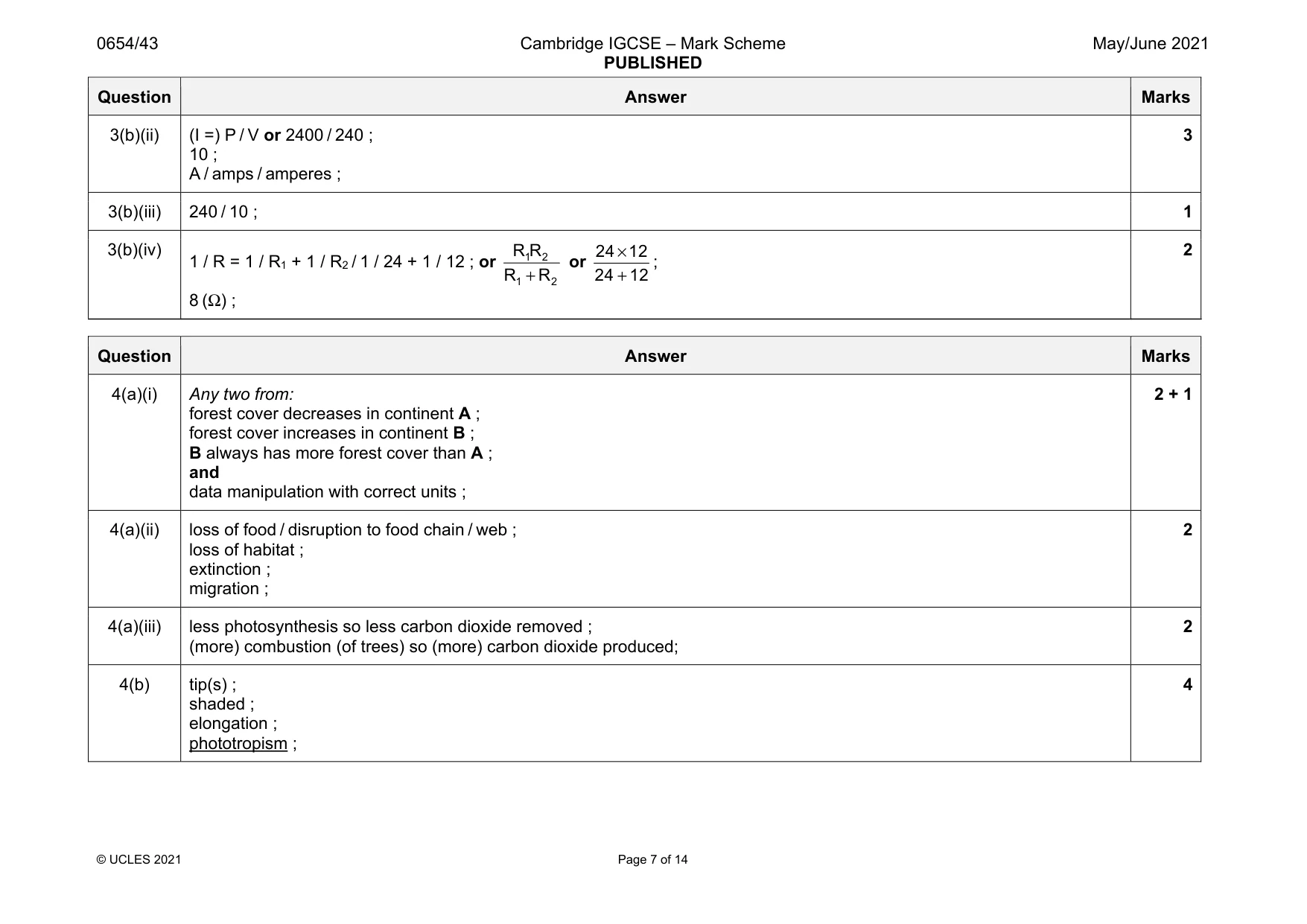
Mark scheme: 3(a)(i) (plastic is a) poor conductor / good insulator (of thermal energy) ; 1 3(a)(ii) (white objects) emit less (thermal) radiation ; 1 3(b)(i) convection (currents); water at the bottom is heated and density decreases ; hot water then rises and displaces (cold) water towards heater ; 3 Question Answer Marks 3(b)(ii) (I =) P / V or 2400 / 240 ; 10 ; A / amps / amperes ; 3 3(b)(iii) 240 / 10 ; 1 3(b)(iv) 1 / R = 1 / R1 + 1 / R2 / 1 / 24 + 1 / 12 ; or 1 2 1 2 R R R R + or 24 12 24 12 × + ; 8 (Ω) ; 2
Q4 · The forest area in two different continents, A and B, in 1990 and 2010
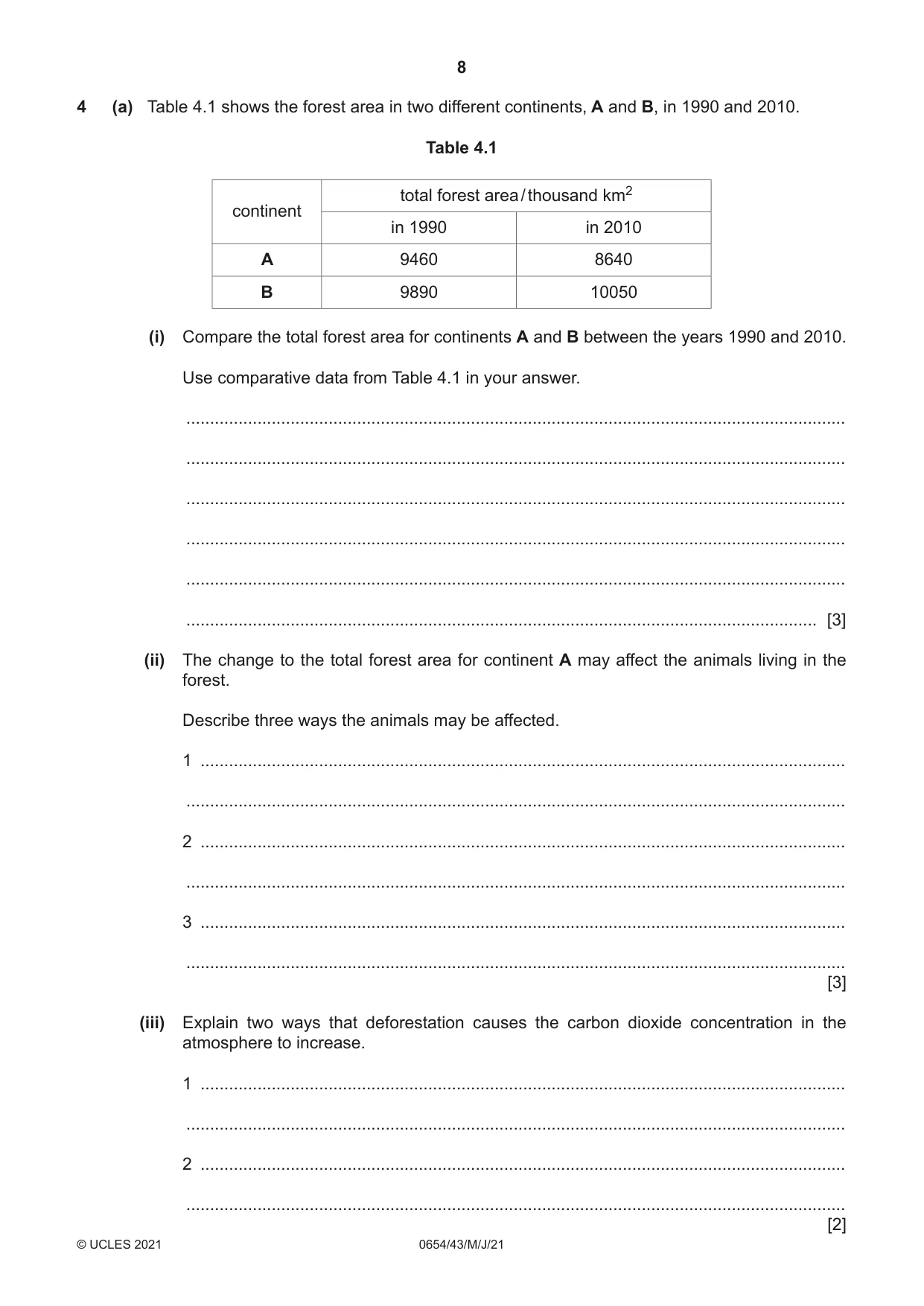
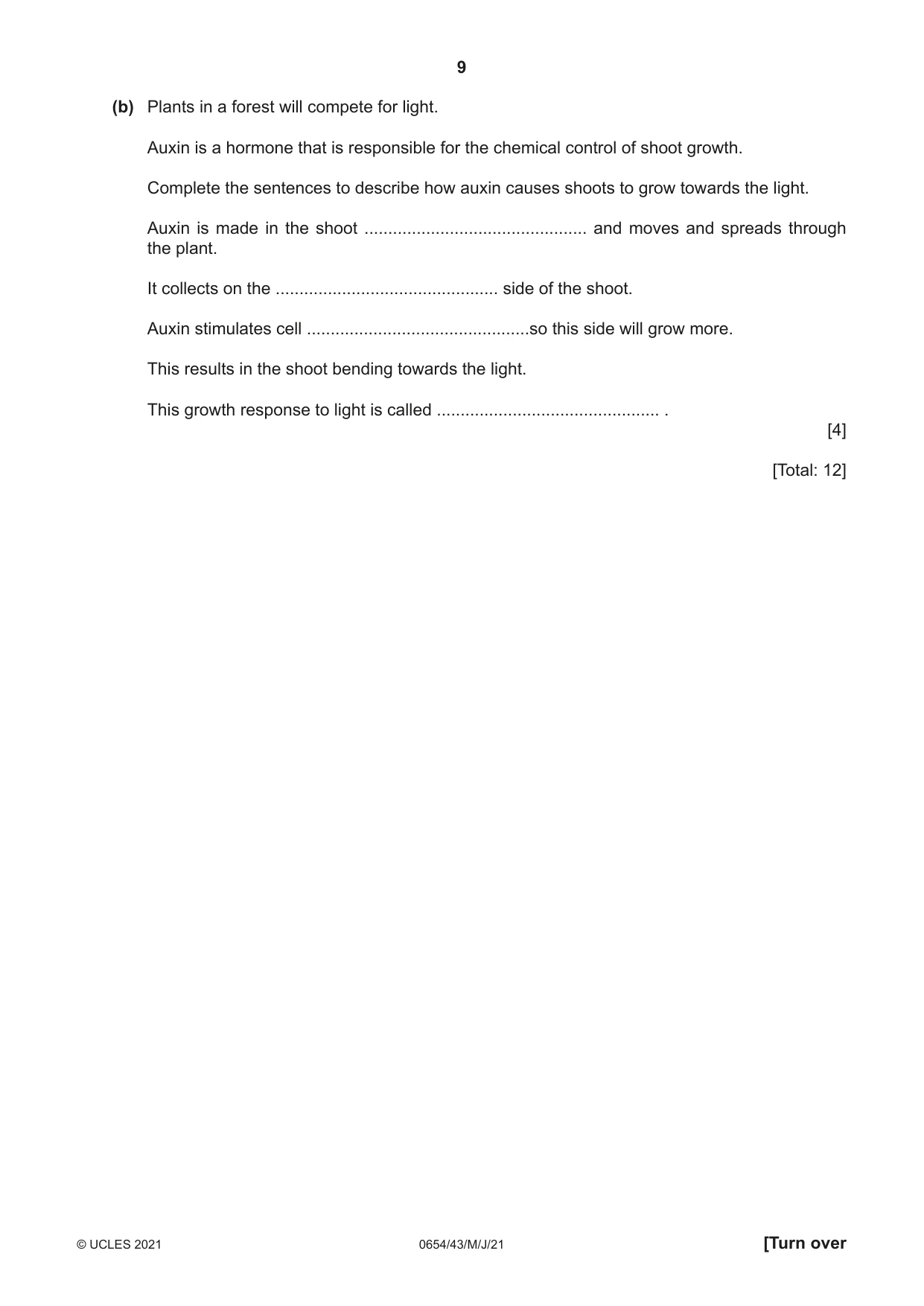
4 (a) Table 4.1 shows the forest area in two different continents, A and B, in 1990 and 2010. Table 4.1 total forest area / thousand km2 continent in 1990 in 2010 A 9460 8640 B 9890 10050 (i) Compare the total forest area for continents A and B between the years 1990 and 2010. Use comparative data from Table 4.1 in your answer. ........................................................................................................................................... ........................................................................................................................................... ........................................................................................................................................... ........................................................................................................................................... ........................................................................................................................................... ..................................................................................................................................... [3] (ii) The change to the total forest area for continent A may affect the animals living in the forest. Describe three ways the animals may be affected. 1 ........................................................................................................................................ ........................................................................................................................................... 2 ........................................................................................................................................ ........................................................................................................................................... 3 ........................................................................................................................................ ........................................................................................................................................... [3] (iii) Explain two ways that deforestation causes the carbon dioxide concentration in the atmosphere to increase. 1 ........................................................................................................................................ ........................................................................................................................................... 2 ........................................................................................................................................ ........................................................................................................................................... [2] (b) Plants in a forest will compete for light. Auxin is a hormone that is responsible for the chemical control of shoot growth. Complete the sentences to describe how auxin causes shoots to grow towards the light. Auxin is made in the shoot ............................................... and moves and spreads through the plant. It collects on the ............................................... side of the shoot. Auxin stimulates cell ...............................................so this side will grow more. This results in the shoot bending towards the light. This growth response to light is called ............................................... . [4] [Total: 12]
Mark scheme: 4(a)(i) Any two from: forest cover decreases in continent A ; forest cover increases in continent B ; B always has more forest cover than A ; and data manipulation with correct units ; 4(a)(ii) loss of food / disruption to food chain / web ; loss of habitat ; extinction ; migration ; 2 4(a)(iii) less photosynthesis so less carbon dioxide removed ; (more) combustion (of trees) so (more) carbon dioxide produced; 2 4(b) tip(s) ; shaded ; elongation ; phototropism ; 4
Q5 · Different methods can be used to extract metals from their ores
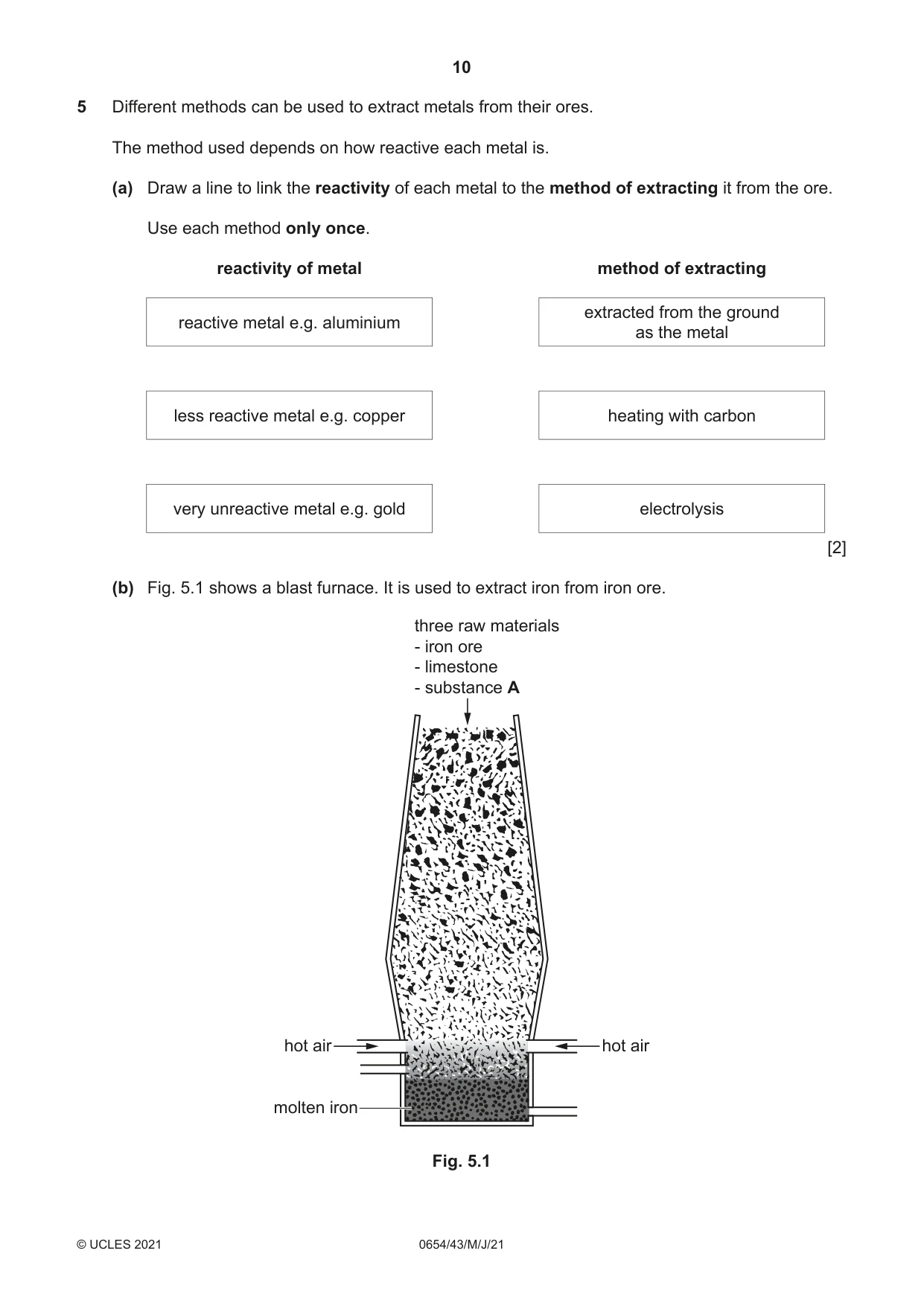
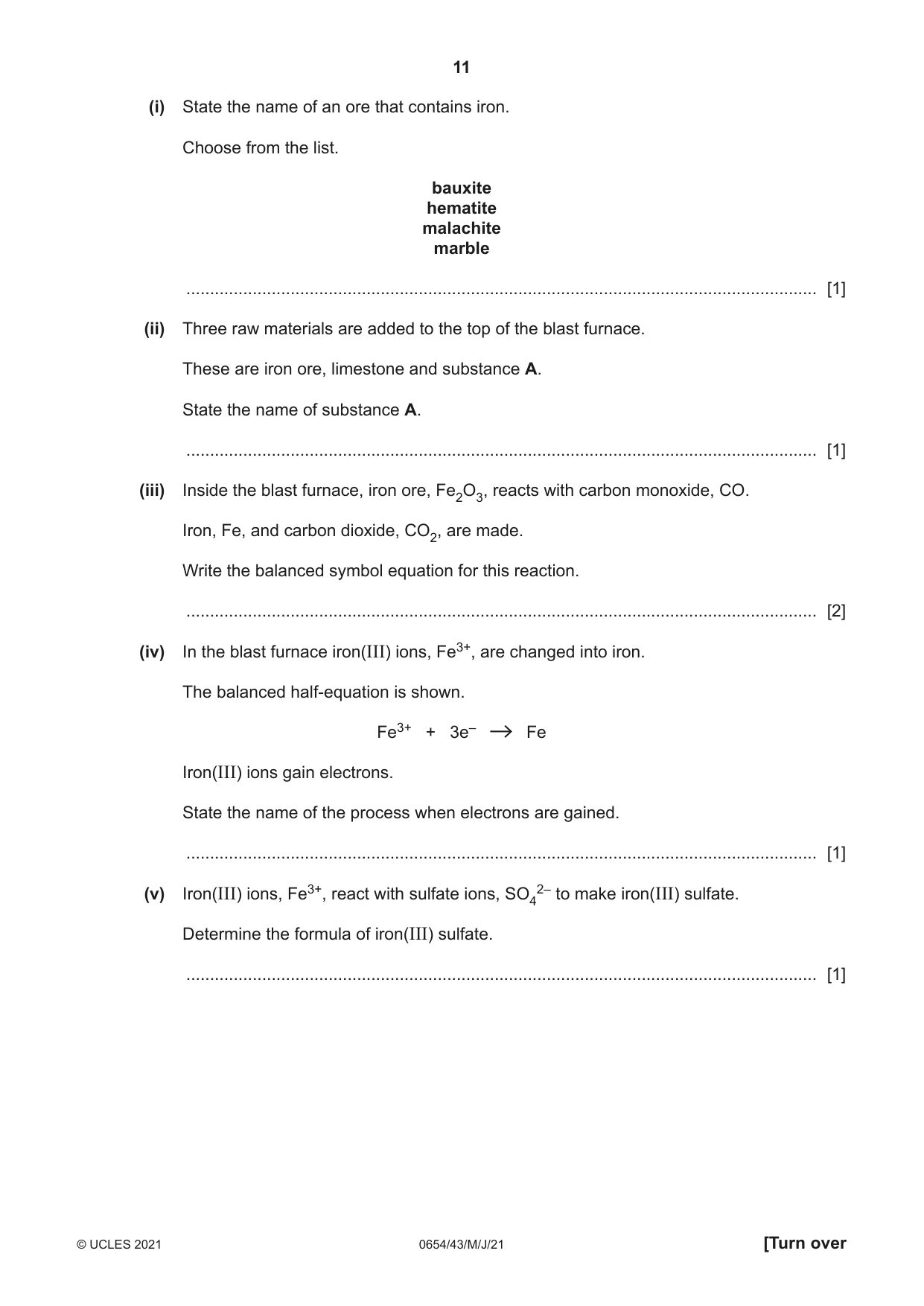
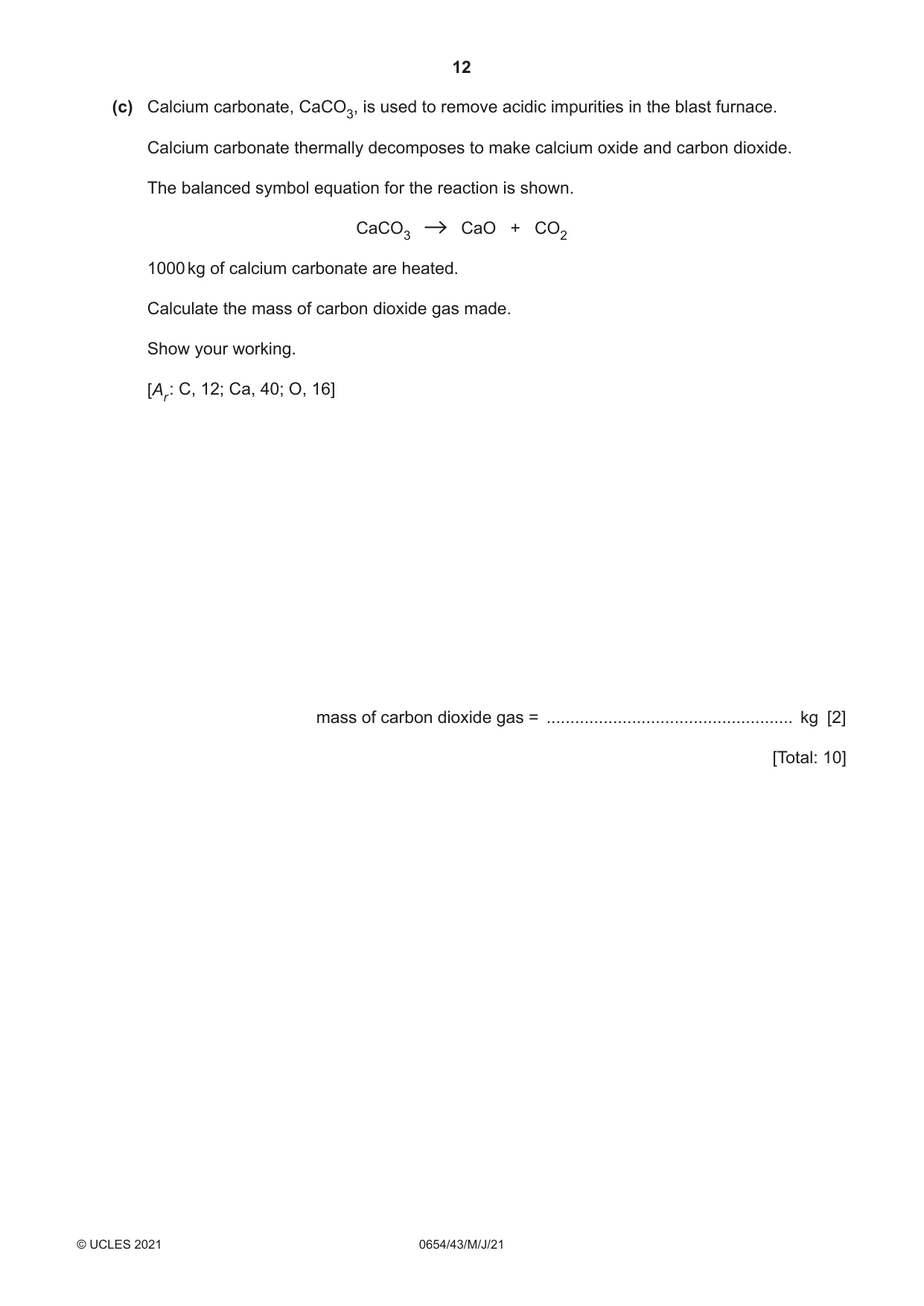
5 Different methods can be used to extract metals from their ores. The method used depends on how reactive each metal is. (a) Draw a line to link the reactivity of each metal to the method of extracting it from the ore. Use each method only once. reactivity of metal method of extracting extracted from the ground reactive metal e.g. aluminium as the metal less reactive metal e.g. copper heating with carbon very unreactive metal e.g. gold electrolysis [2] (b) Fig. 5.1 shows a blast furnace. It is used to extract iron from iron ore. three raw materials - iron ore - limestone - substance A hot air hot air molten iron Fig. 5.1 (i) State the name of an ore that contains iron. Choose from the list. bauxite hematite malachite marble ..................................................................................................................................... [1] (ii) Three raw materials are added to the top of the blast furnace. These are iron ore, limestone and substance A. State the name of substance A. ..................................................................................................................................... [1] (iii) Inside the blast furnace, iron ore, Fe2O3, reacts with carbon monoxide, CO. Iron, Fe, and carbon dioxide, CO2, are made. Write the balanced symbol equation for this reaction. ..................................................................................................................................... [2] (iv) In the blast furnace iron(III) ions, Fe3+, are changed into iron. The balanced half-equation is shown. Fe3+ + 3e– Fe Iron(III) ions gain electrons. State the name of the process when electrons are gained. ..................................................................................................................................... [1] (v) Iron(III) ions, Fe3+, react with sulfate ions, SO42– to make iron(III) sulfate. Determine the formula of iron(III) sulfate. ..................................................................................................................................... [1] (c) Calcium carbonate, CaCO3, is used to remove acidic impurities in the blast furnace. Calcium carbonate thermally decomposes to make calcium oxide and carbon dioxide. The balanced symbol equation for the reaction is shown. CaCO3 CaO + CO2 1000 kg of calcium carbonate are heated. Calculate the mass of carbon dioxide gas made. Show your working. [Ar : C, 12; Ca, 40; O, 16] mass of carbon dioxide gas = .................................................... kg [2] [Total: 10]
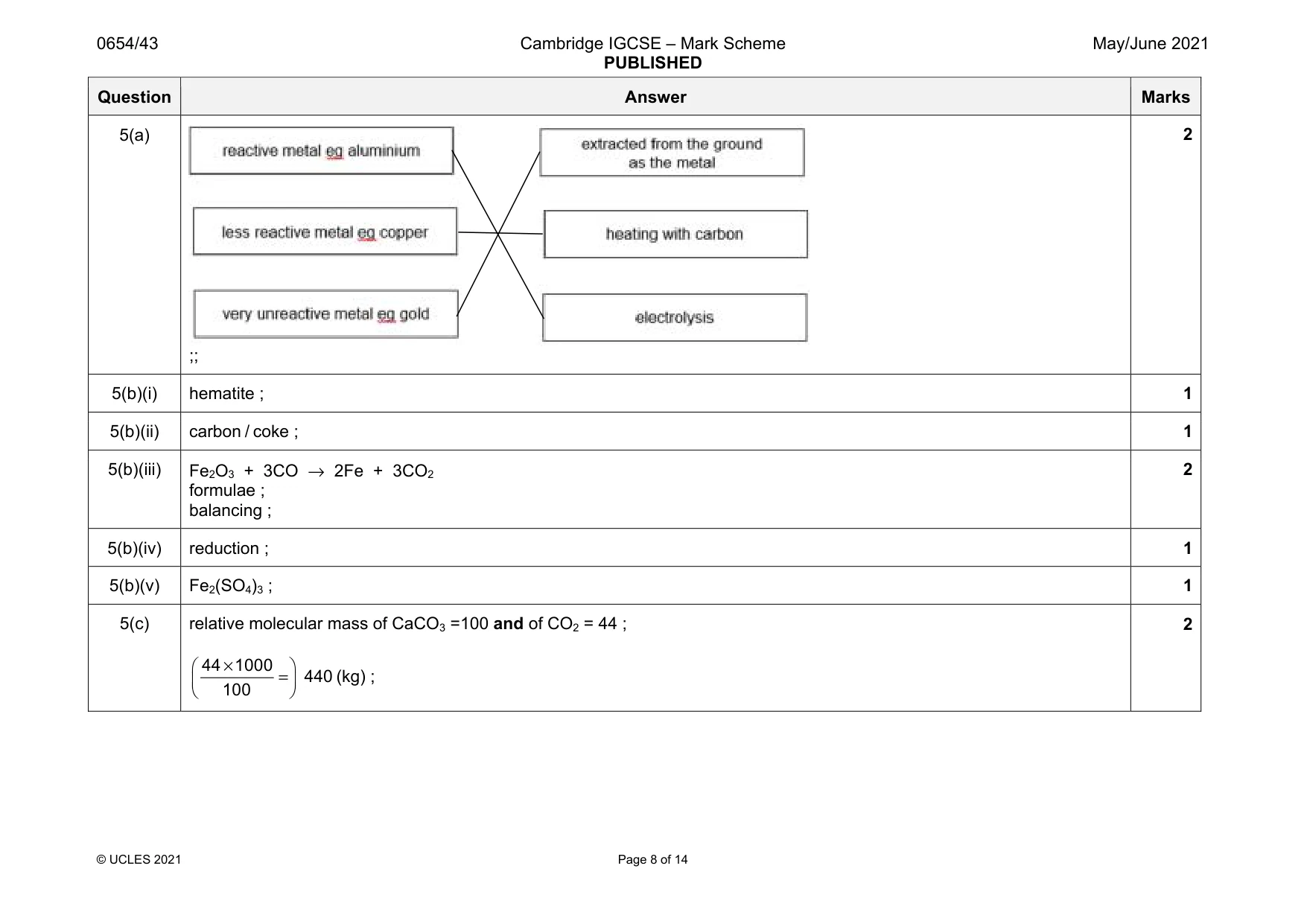
Mark scheme: 5(a) ;; 5(b)(i) hematite ; 1 5(b)(ii) carbon / coke ; 1 5(b)(iii) Fe2O3 + 3CO → 2Fe + 3CO2 formulae ; balancing ; 2 5(b)(iv) reduction ; 1 5(b)(v) Fe2(SO4)3 ; 1 5(c) relative molecular mass of CaCO3 =100 and of CO2 = 44 ; 44 1000 100 × = 440 (kg) ; 2
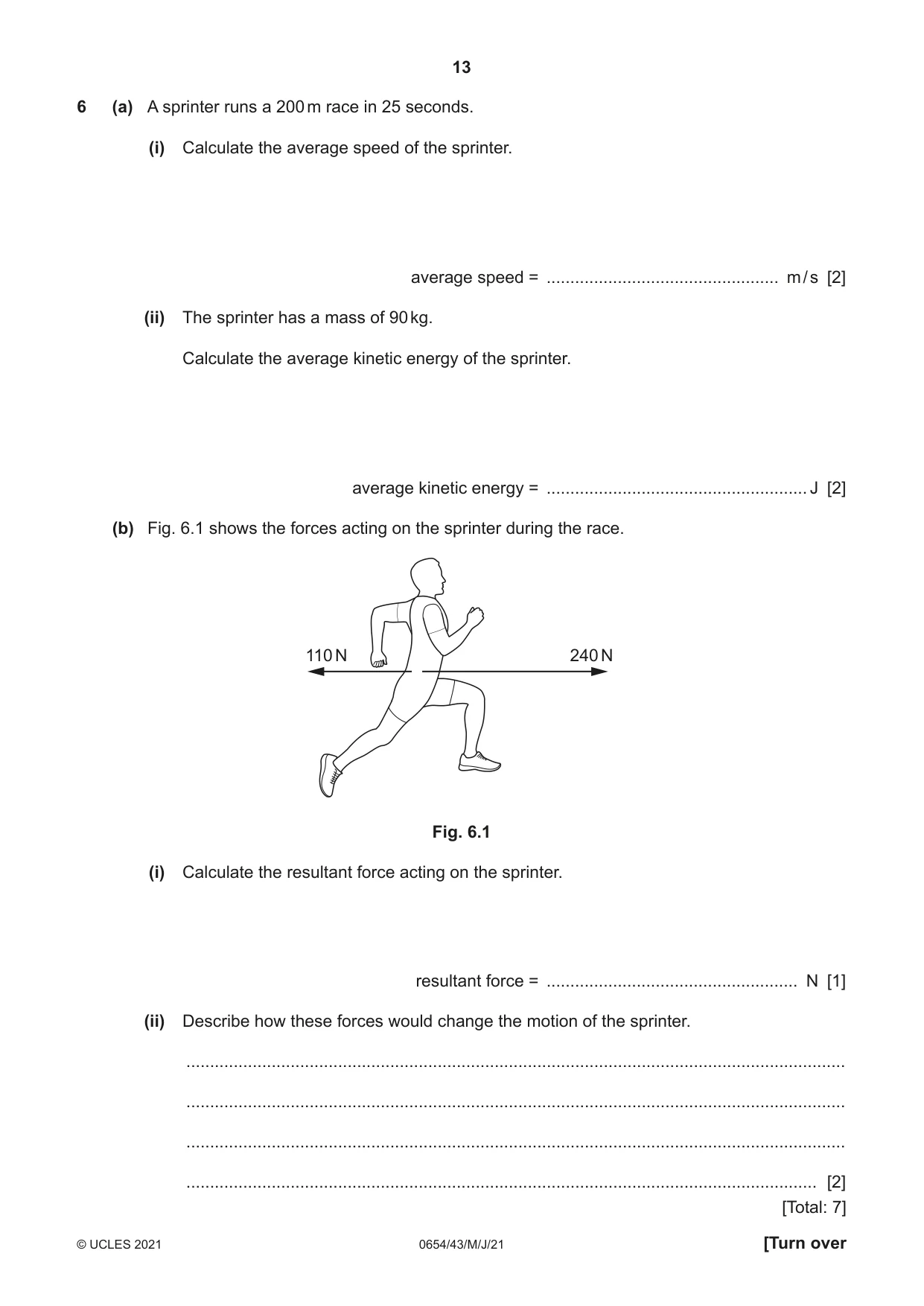
Q6 · A sprinter runs a 200 m race in 25 seconds
6 (a) A sprinter runs a 200 m race in 25 seconds. (i) Calculate the average speed of the sprinter. average speed = ................................................. m / s [2] (ii) The sprinter has a mass of 90 kg. Calculate the average kinetic energy of the sprinter. average kinetic energy = ....................................................... J [2] (b) Fig. 6.1 shows the forces acting on the sprinter during the race. 110 N 240 N Fig. 6.1 (i) Calculate the resultant force acting on the sprinter. resultant force = ..................................................... N [1] (ii) Describe how these forces would change the motion of the sprinter. ........................................................................................................................................... ........................................................................................................................................... ........................................................................................................................................... ..................................................................................................................................... [2] [Total: 7]
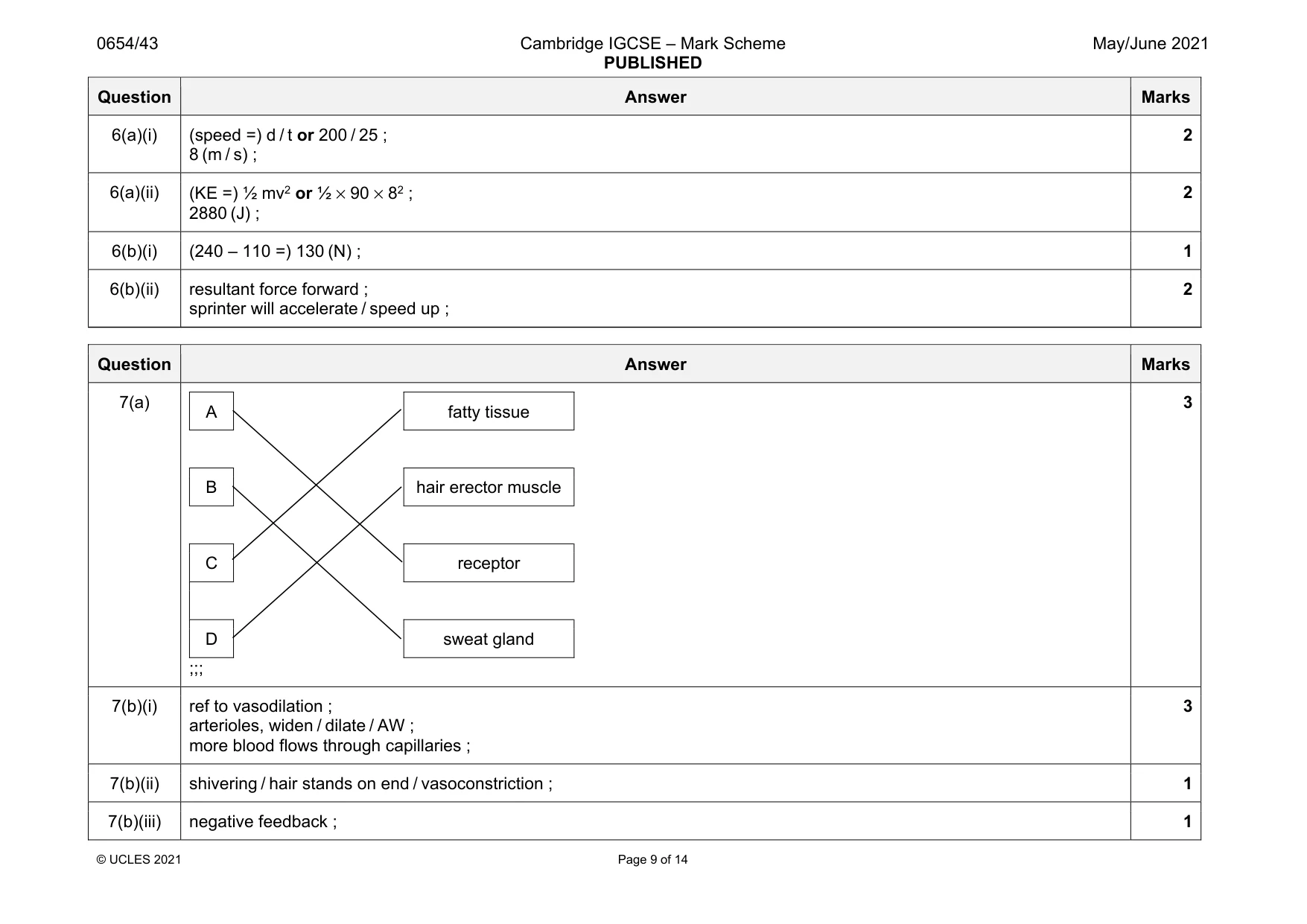
Mark scheme: 6(a)(i) (speed =) d / t or 200 / 25 ; 8 (m / s) ; 2 6(a)(ii) (KE =) ½ mv2 or ½ × 90 × 82 ; 2880 (J) ; 2 6(b)(i) (240 – 110 =) 130 (N) ; 1 6(b)(ii) resultant force forward ; sprinter will accelerate / speed up ; 2
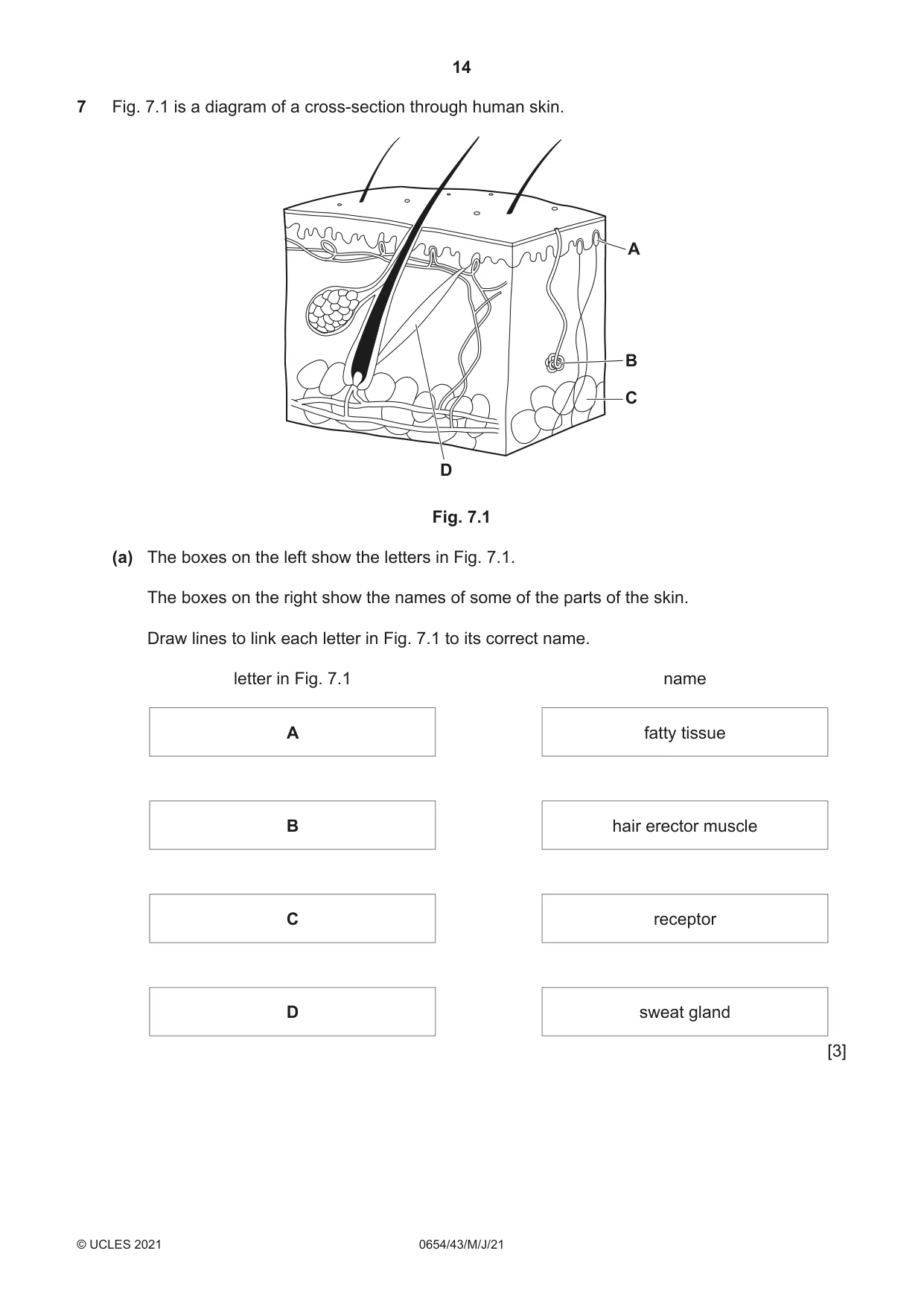
Q7 · A diagram of a cross-section through human skin
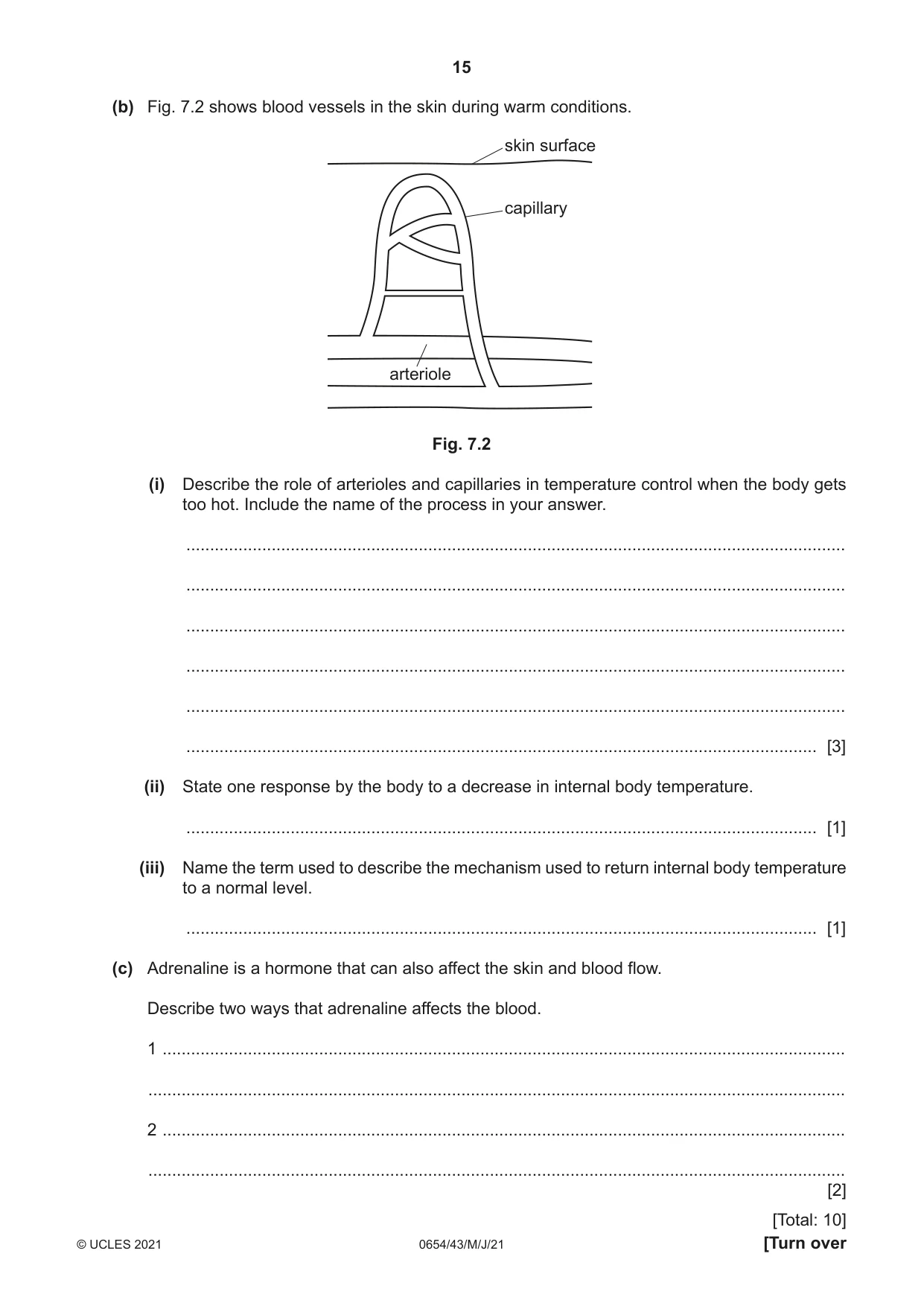
7 Fig. 7.1 is a diagram of a cross-section through human skin. A B C D Fig. 7.1 (a) The boxes on the left show the letters in Fig. 7.1. The boxes on the right show the names of some of the parts of the skin. Draw lines to link each letter in Fig. 7.1 to its correct name. letter in Fig. 7.1 name A fatty tissue B hair erector muscle C receptor D sweat gland [3] (b) Fig. 7.2 shows blood vessels in the skin during warm conditions. skin surface capillary arteriole Fig. 7.2 (i) Describe the role of arterioles and capillaries in temperature control when the body gets too hot. Include the name of the process in your answer. ........................................................................................................................................... ........................................................................................................................................... ........................................................................................................................................... ........................................................................................................................................... ........................................................................................................................................... ..................................................................................................................................... [3] (ii) State one response by the body to a decrease in internal body temperature. ..................................................................................................................................... [1] (iii) Name the term used to describe the mechanism used to return internal body temperature to a normal level. ..................................................................................................................................... [1] (c) Adrenaline is a hormone that can also affect the skin and blood flow. Describe two ways that adrenaline affects the blood. 1 ................................................................................................................................................ ................................................................................................................................................... 2 ................................................................................................................................................ ................................................................................................................................................... [2] [Total: 10]
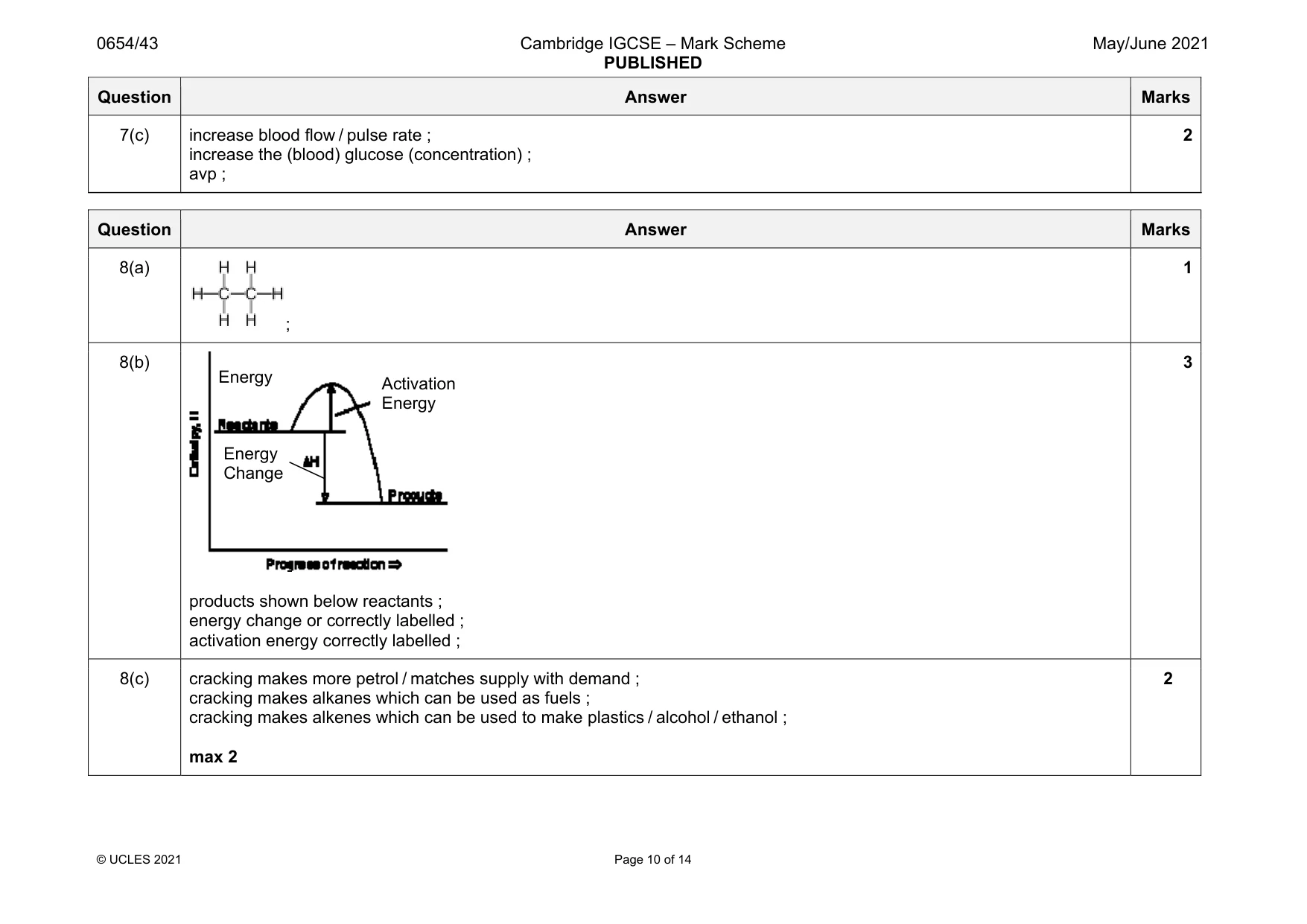
Mark scheme: 7(a) A fatty tissue B hair erector muscle C receptor D sweat gland ;;; 7(b)(i) ref to vasodilation ; arterioles, widen / dilate / AW ; more blood flows through capillaries ; 3 7(b)(ii) shivering / hair stands on end / vasoconstriction ; 1 7(b)(iii) negative feedback ; 1 Question Answer Marks 7(c) increase blood flow / pulse rate ; increase the (blood) glucose (concentration) ; avp ; 2
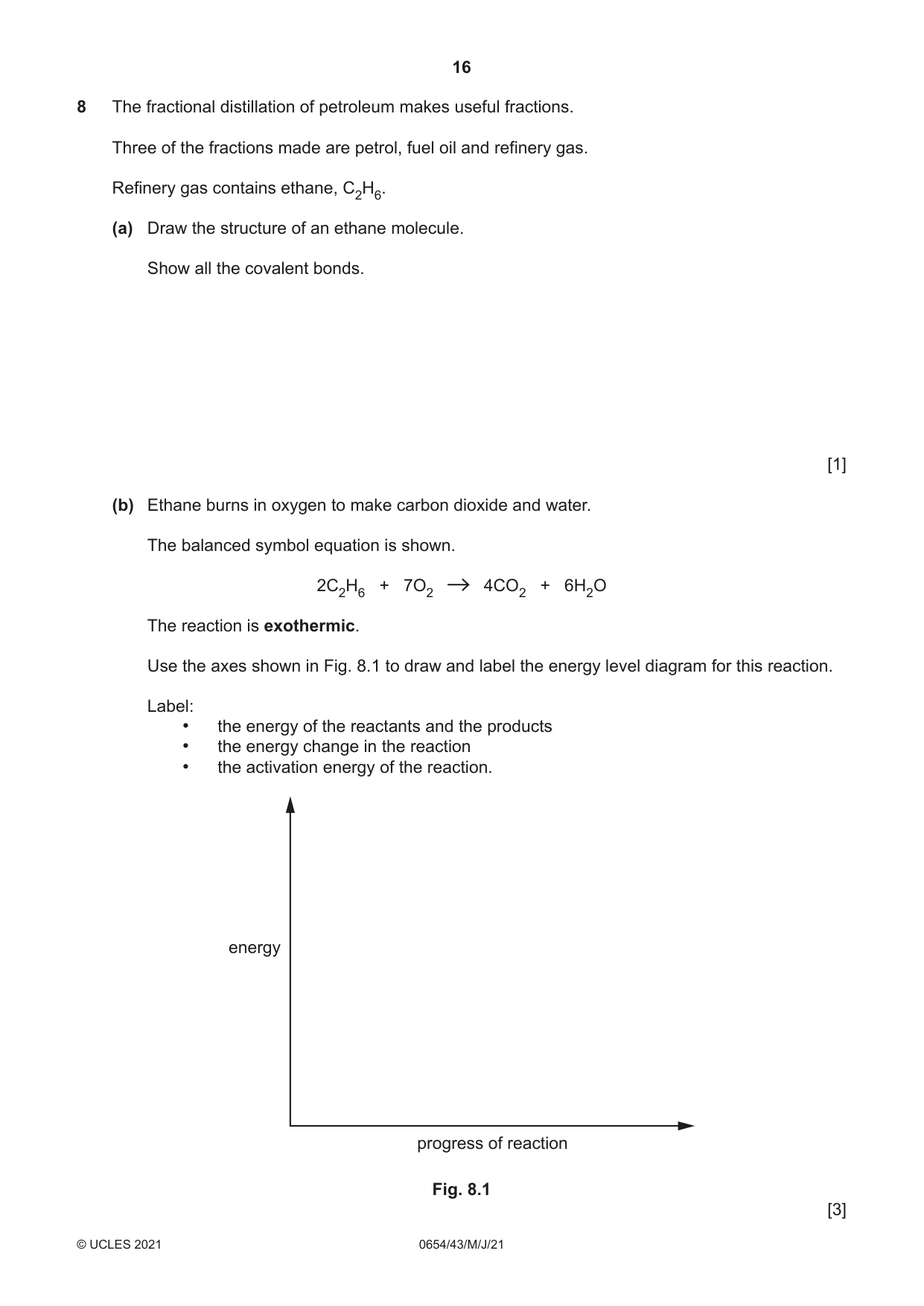
Q8 · The fractional distillation of petroleum makes useful fractions
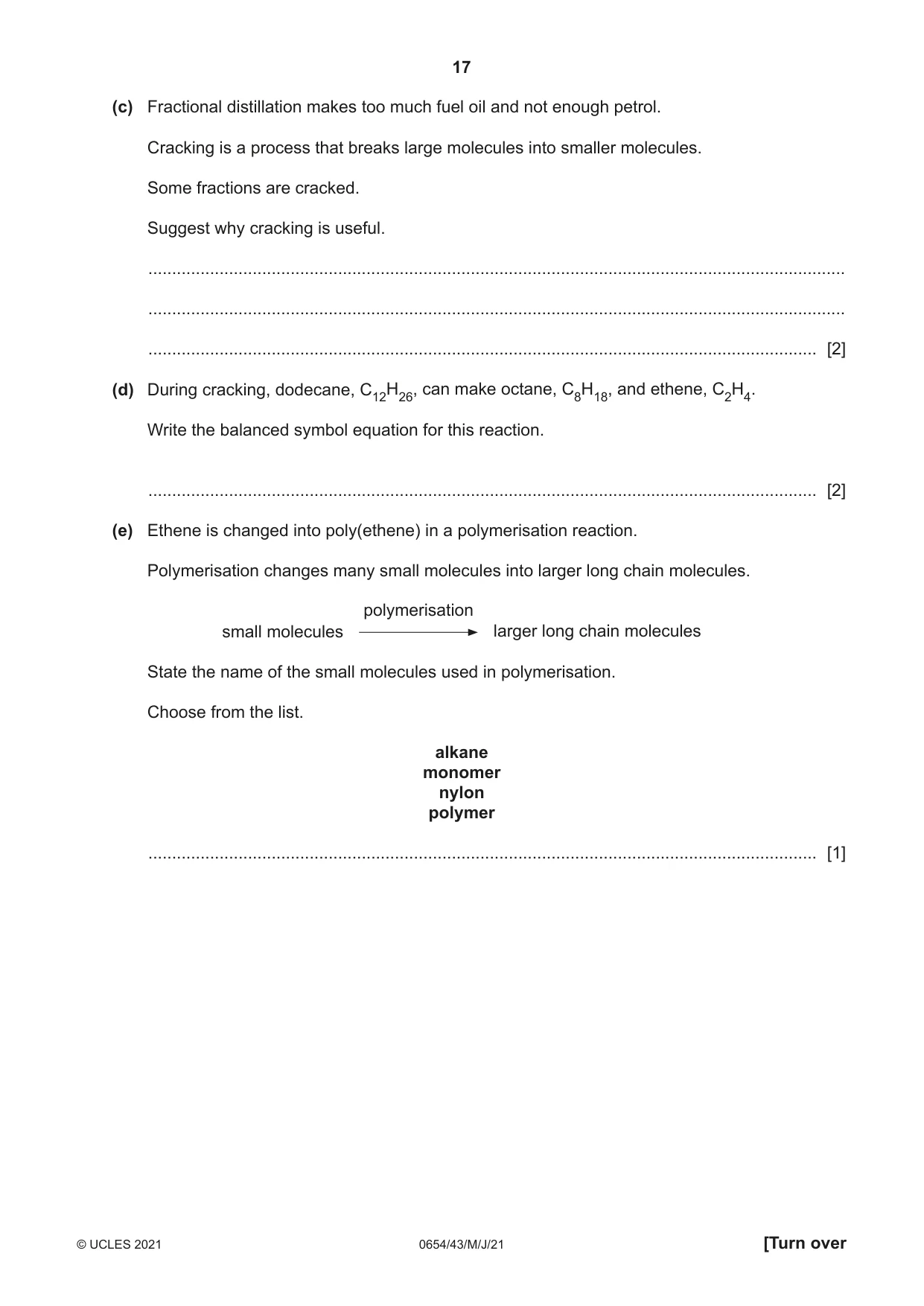
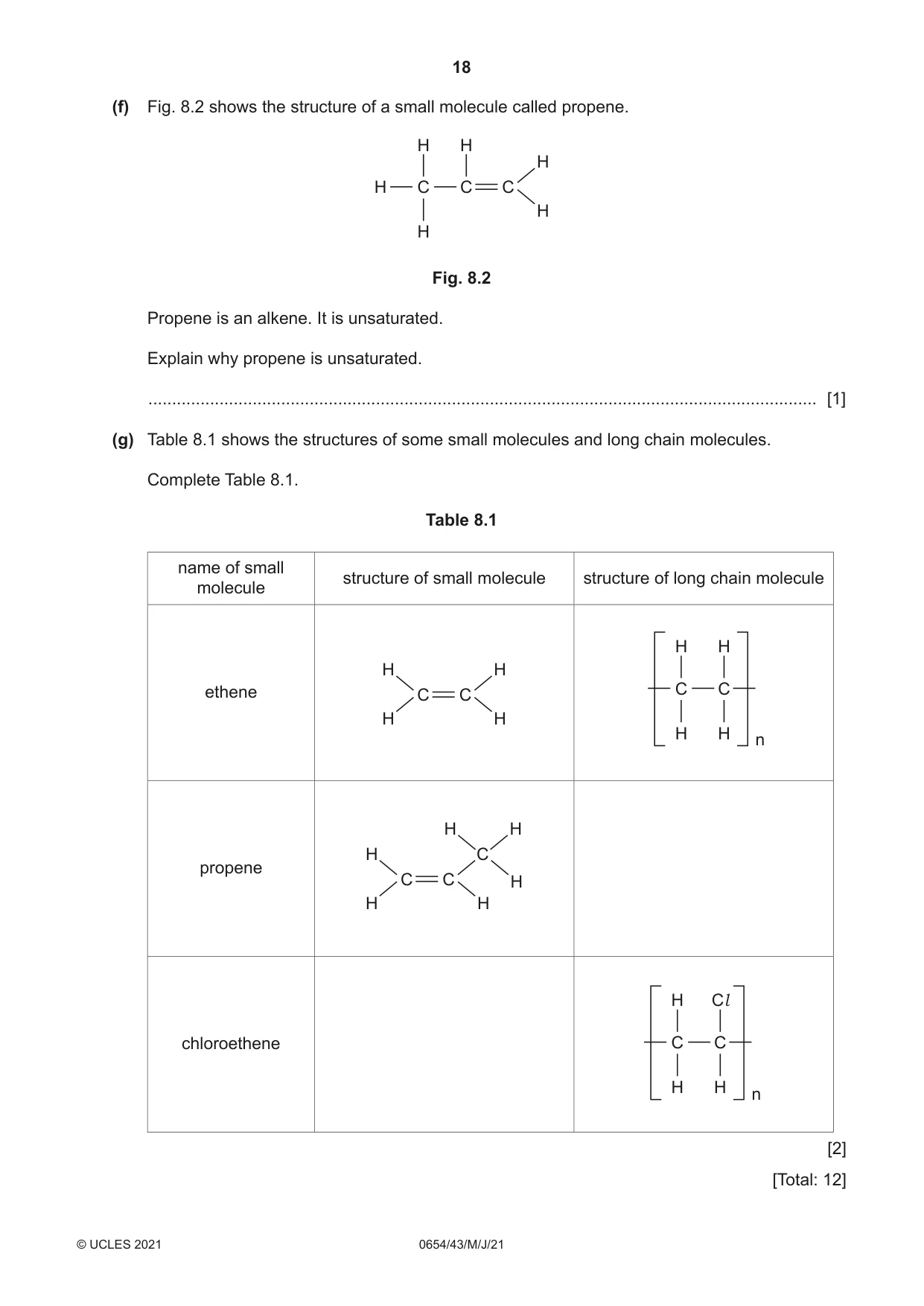
8 The fractional distillation of petroleum makes useful fractions. Three of the fractions made are petrol, fuel oil and refinery gas. Refinery gas contains ethane, C2H6. (a) Draw the structure of an ethane molecule. Show all the covalent bonds. [1] (b) Ethane burns in oxygen to make carbon dioxide and water. The balanced symbol equation is shown. 2C2H6 + 7O2 4CO2 + 6H2O The reaction is exothermic. Use the axes shown in Fig. 8.1 to draw and label the energy level diagram for this reaction. Label: • the energy of the reactants and the products • the energy change in the reaction • the activation energy of the reaction. energy progress of reaction Fig. 8.1 [3] (c) Fractional distillation makes too much fuel oil and not enough petrol. Cracking is a process that breaks large molecules into smaller molecules. Some fractions are cracked. Suggest why cracking is useful. ................................................................................................................................................... ................................................................................................................................................... ............................................................................................................................................. [2] (d) During cracking, dodecane, C12H26, can make octane, C8H18, and ethene, C2H4. Write the balanced symbol equation for this reaction. ............................................................................................................................................. [2] (e) Ethene is changed into poly(ethene) in a polymerisation reaction. Polymerisation changes many small molecules into larger long chain molecules. polymerisation small molecules larger long chain molecules State the name of the small molecules used in polymerisation. Choose from the list. alkane monomer nylon polymer ............................................................................................................................................. [1] (f) Fig. 8.2 shows the structure of a small molecule called propene. H H H H C C C H H Fig. 8.2 Propene is an alkene. It is unsaturated. Explain why propene is unsaturated. ............................................................................................................................................. [1] (g) Table 8.1 shows the structures of some small molecules and long chain molecules. Complete Table 8.1. Table 8.1 name of small structure of small molecule structure of long chain molecule molecule H H H H ethene C C C C H H H H n H H H C propene C C H H H H Cl chloroethene C C H H n [2] [Total: 12]
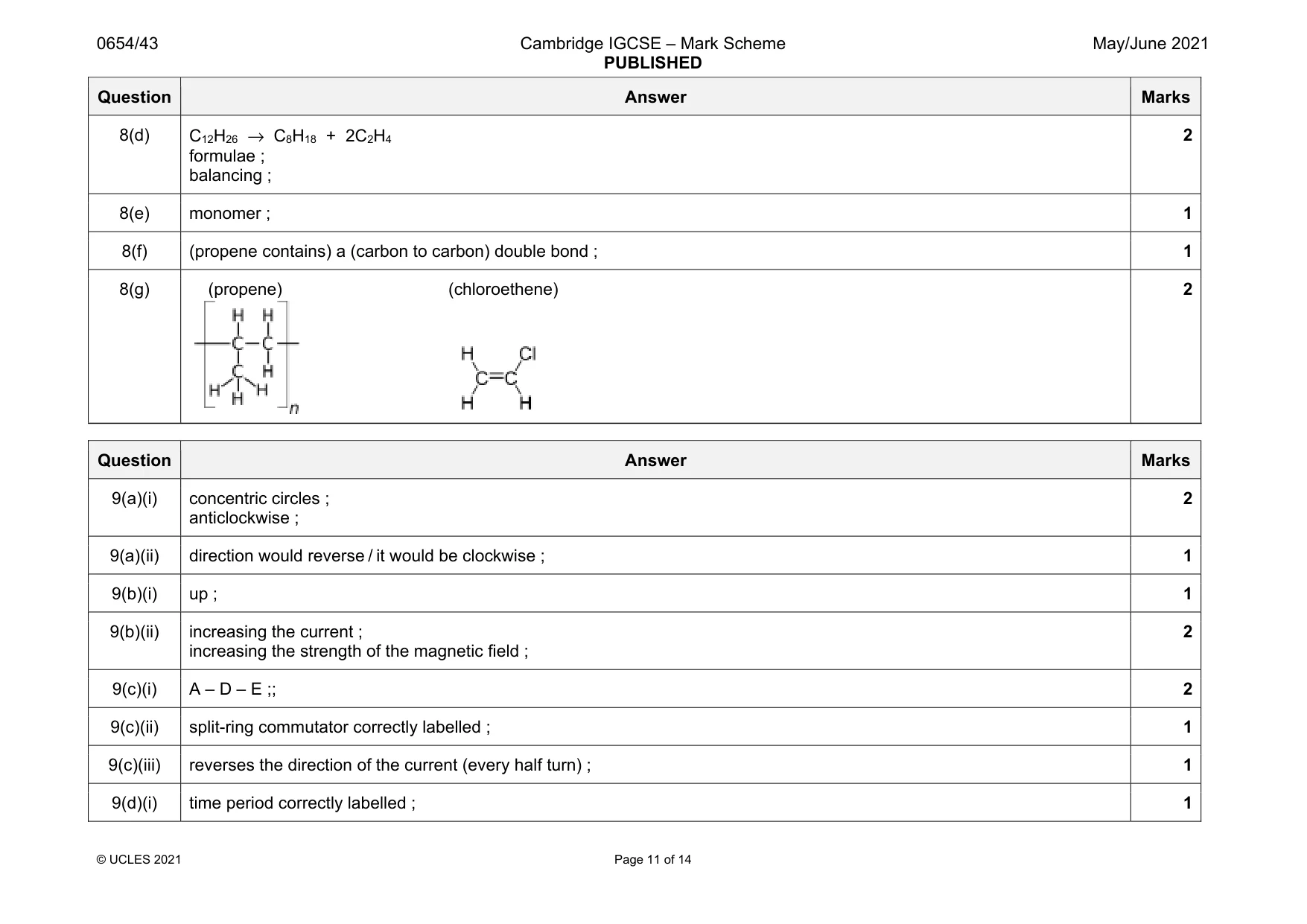
Mark scheme: 8(a) ; 8(b) products shown below reactants ; energy change or correctly labelled ; activation energy correctly labelled ; 3 8(c) cracking makes more petrol / matches supply with demand ; cracking makes alkanes which can be used as fuels ; cracking makes alkenes which can be used to make plastics / alcohol / ethanol ; max 2 2 Activation Energy Energy Energy Change Question Answer Marks 8(d) C12H26 → C8H18 + 2C2H4 formulae ; balancing ; 2 8(e) monomer ; 1 8(f) (propene contains) a (carbon to carbon) double bond ; 1 8(g) (propene) (chloroethene) 2
Q9 · A straight piece of wire carrying a current passing through a sheet of paper
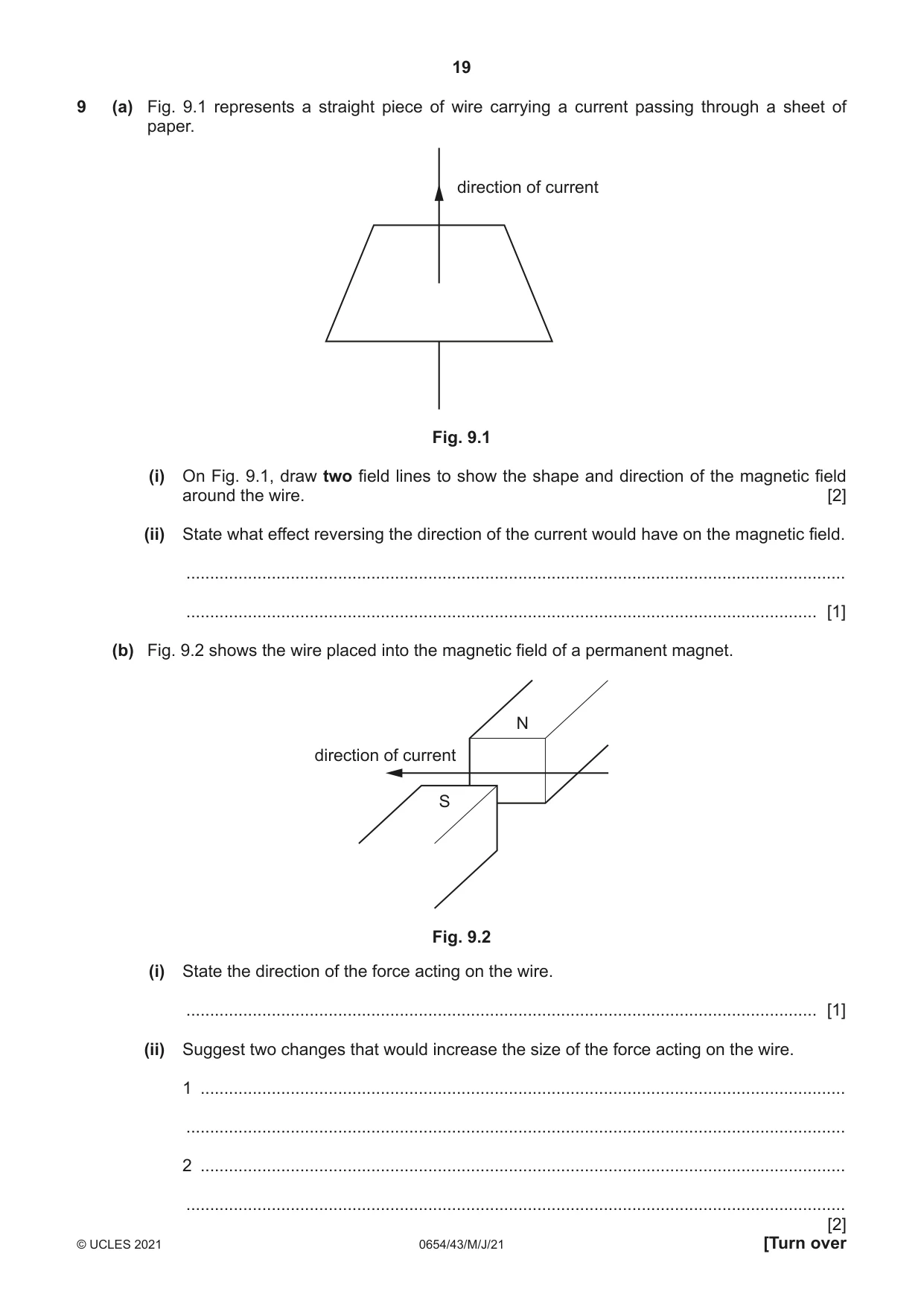
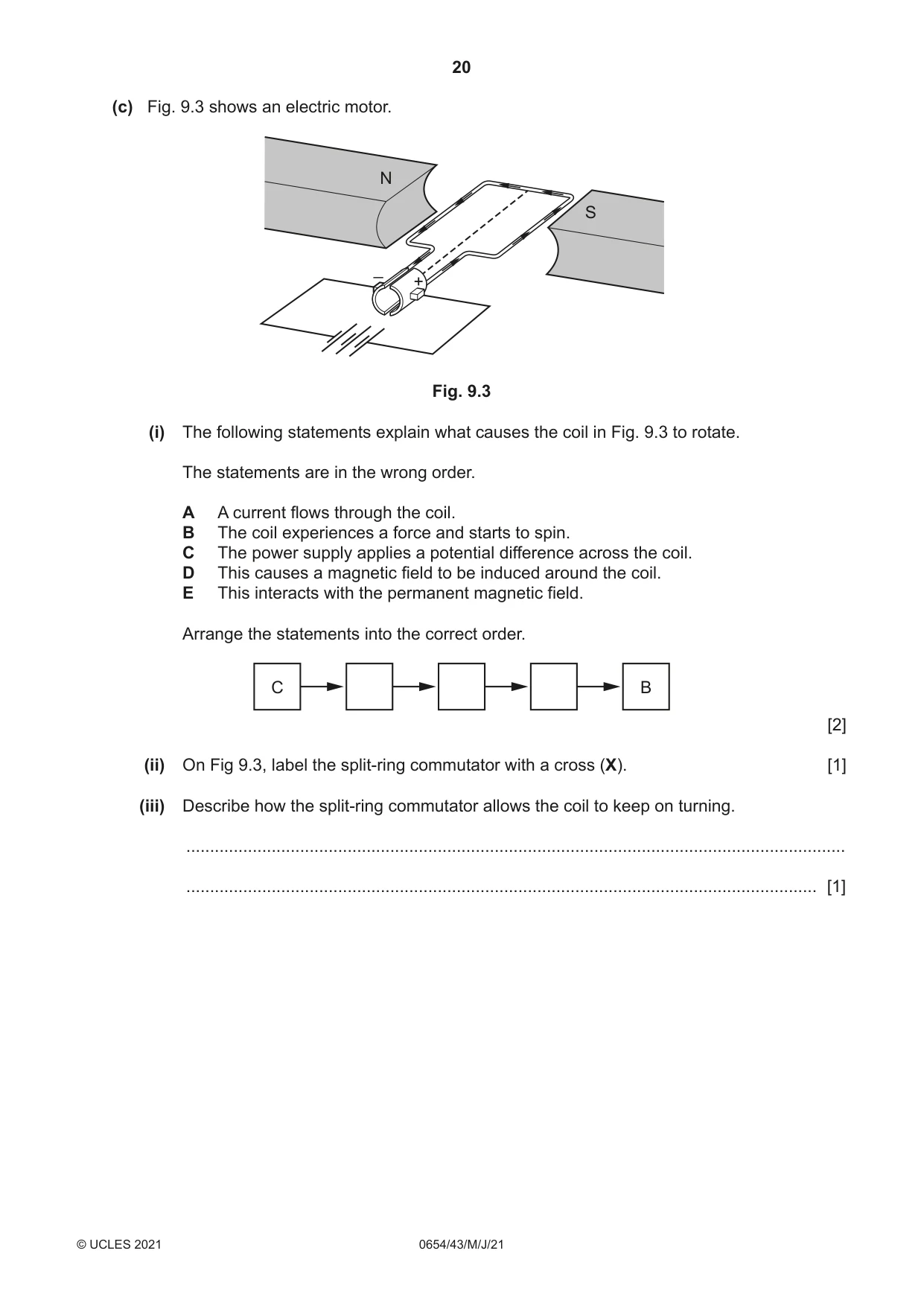
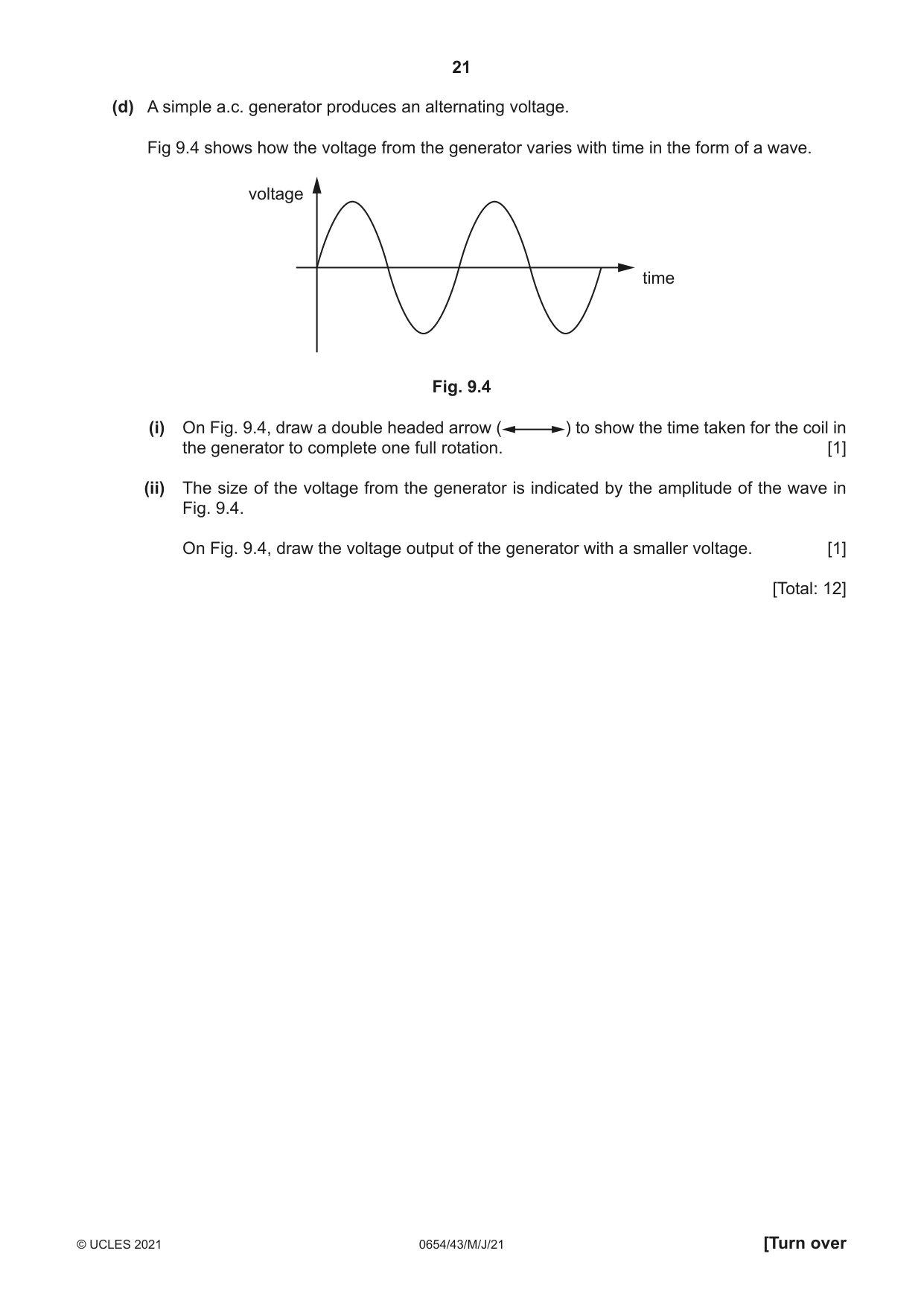
9 (a) Fig. 9.1 represents a straight piece of wire carrying a current passing through a sheet of paper. direction of current Fig. 9.1 (i) On Fig. 9.1, draw two field lines to show the shape and direction of the magnetic field around the wire. [2] (ii) State what effect reversing the direction of the current would have on the magnetic field. ........................................................................................................................................... ..................................................................................................................................... [1] (b) Fig. 9.2 shows the wire placed into the magnetic field of a permanent magnet. N direction of current S Fig. 9.2 (i) State the direction of the force acting on the wire. ..................................................................................................................................... [1] (ii) Suggest two changes that would increase the size of the force acting on the wire. 1 ........................................................................................................................................ ........................................................................................................................................... 2 ........................................................................................................................................ ........................................................................................................................................... (c) Fig. 9.3 shows an electric motor. N S _ + Fig. 9.3 (i) The following statements explain what causes the coil in Fig. 9.3 to rotate. The statements are in the wrong order. A A current flows through the coil. B The coil experiences a force and starts to spin. C The power supply applies a potential difference across the coil. D This causes a magnetic field to be induced around the coil. E This interacts with the permanent magnetic field. Arrange the statements into the correct order. C B [2] (ii) On Fig 9.3, label the split-ring commutator with a cross (X). [1] (iii) Describe how the split-ring commutator allows the coil to keep on turning. ........................................................................................................................................... ..................................................................................................................................... [1] (d) A simple a.c. generator produces an alternating voltage. Fig 9.4 shows how the voltage from the generator varies with time in the form of a wave. voltage time Fig. 9.4 (i) On Fig. 9.4, draw a double headed arrow ( ) to show the time taken for the coil in the generator to complete one full rotation. [1] (ii) The size of the voltage from the generator is indicated by the amplitude of the wave in Fig. 9.4. On Fig. 9.4, draw the voltage output of the generator with a smaller voltage. [1] [Total: 12]
Mark scheme: 9(a)(i) concentric circles ; anticlockwise ; 2 9(a)(ii) direction would reverse / it would be clockwise ; 1 9(b)(i) up ; 1 9(b)(ii) increasing the current ; increasing the strength of the magnetic field ; 2 9(c)(i) A – D – E ;; 2 9(c)(ii) split-ring commutator correctly labelled ; 1 9(c)(iii) reverses the direction of the current (every half turn) ; 1 9(d)(i) time period correctly labelled ; 1 Question Answer Marks 9(d)(ii) sine wave drawn with smaller amplitude ; 1
Q10 · The percentage of oxygen in inspired air, in expired air when resting and in expired air…
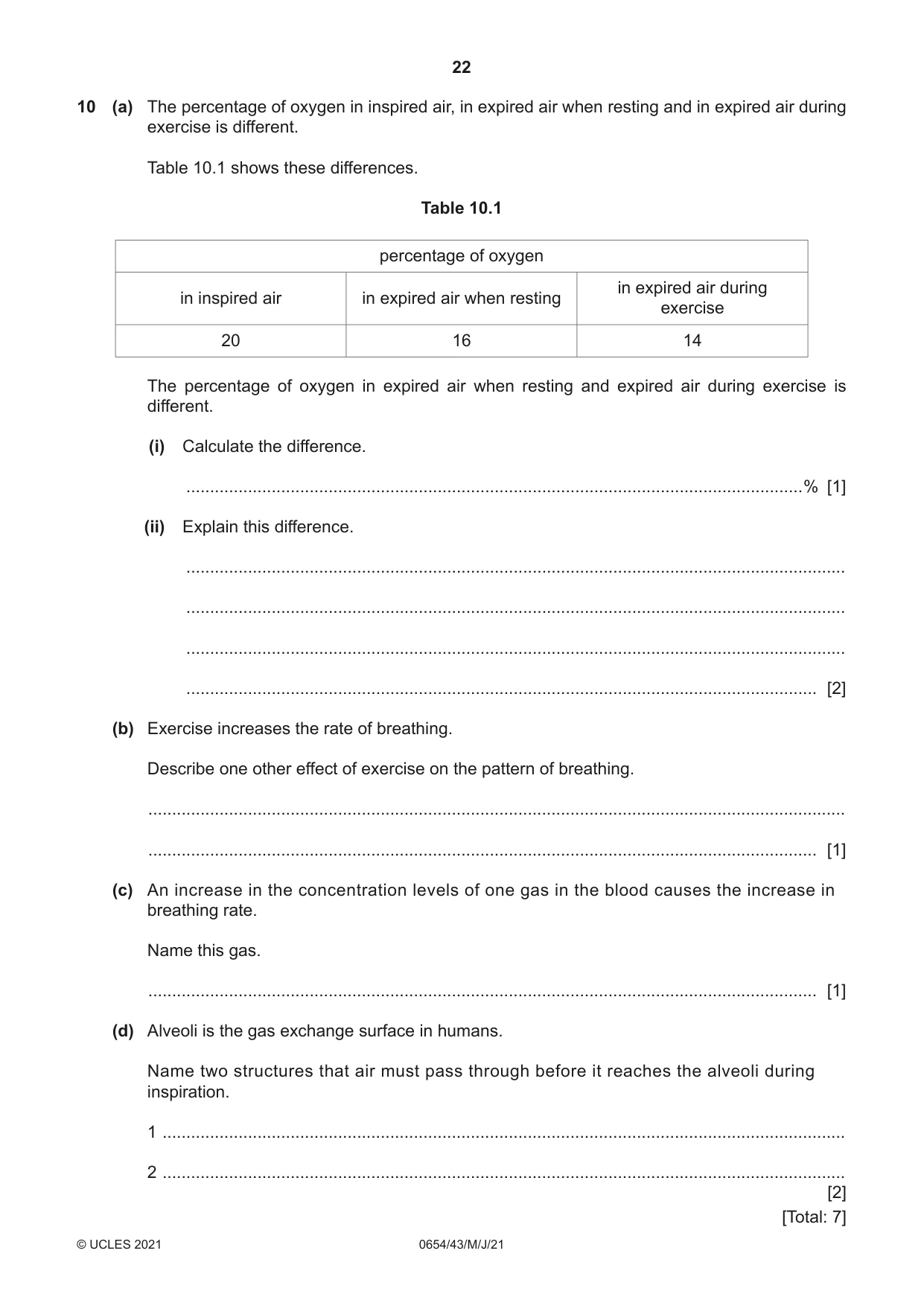
10 (a) The percentage of oxygen in inspired air, in expired air when resting and in expired air during exercise is different. Table 10.1 shows these differences. Table 10.1 percentage of oxygen in expired air during in inspired air in expired air when resting exercise 20 16 14 The percentage of oxygen in expired air when resting and expired air during exercise is different. (i) Calculate the difference. ..................................................................................................................................% [1] (ii) Explain this difference. ........................................................................................................................................... ........................................................................................................................................... ........................................................................................................................................... ..................................................................................................................................... [2] (b) Exercise increases the rate of breathing. Describe one other effect of exercise on the pattern of breathing. ................................................................................................................................................... ............................................................................................................................................. [1] (c) An increase in the concentration levels of one gas in the blood causes the increase in breathing rate. Name this gas. ............................................................................................................................................. [1] (d) Alveoli is the gas exchange surface in humans. Name two structures that air must pass through before it reaches the alveoli during inspiration. 1 ................................................................................................................................................ 2 ................................................................................................................................................ [2] [Total: 7]
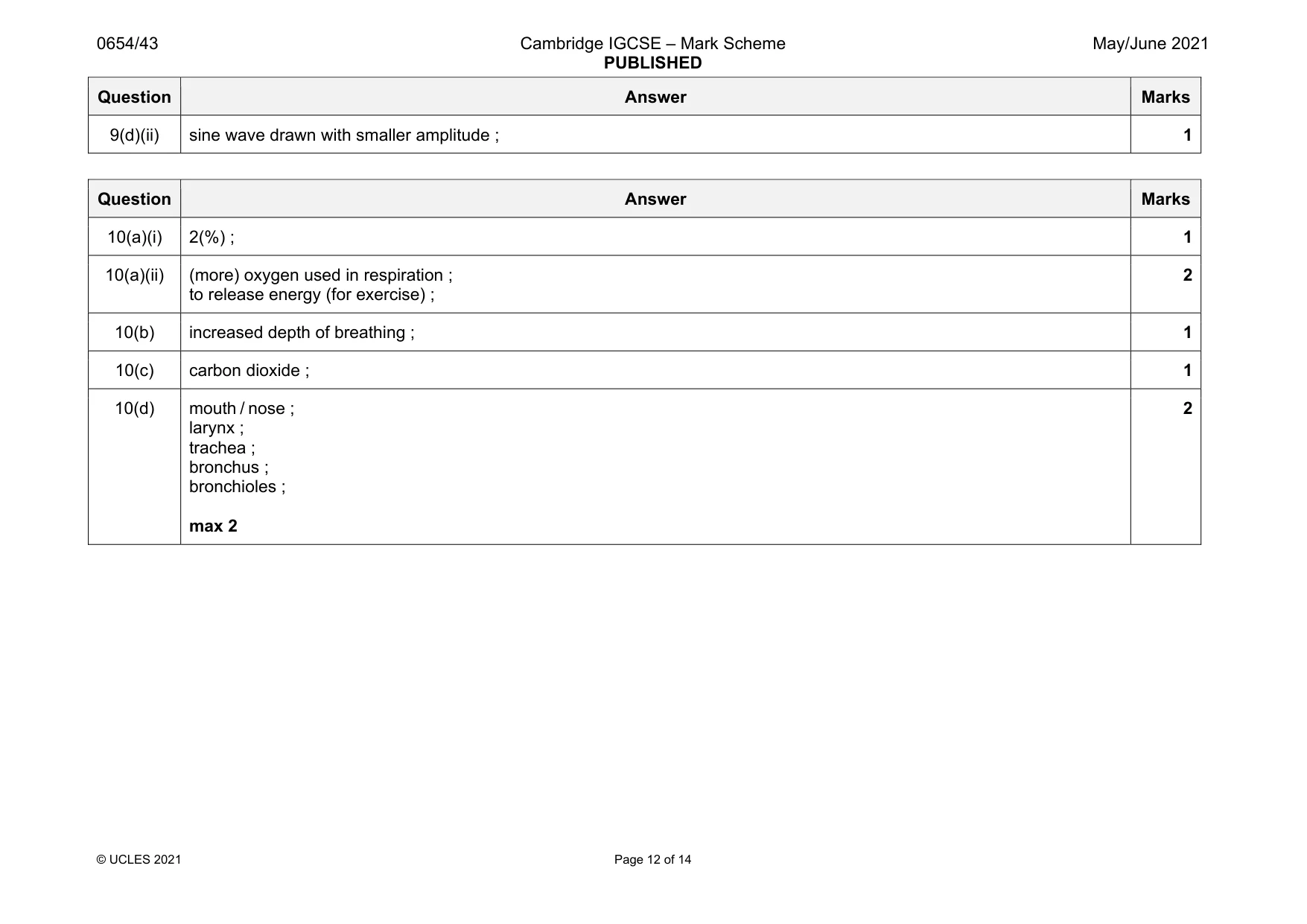
Mark scheme: 10(a)(i) 2(%) ; 1 10(a)(ii) (more) oxygen used in respiration ; to release energy (for exercise) ; 2 10(b) increased depth of breathing ; 1 10(c) carbon dioxide ; 1 10(d) mouth / nose ; larynx ; trachea ; bronchus ; bronchioles ; max 2 2
Q11 · An outline of the Periodic Table
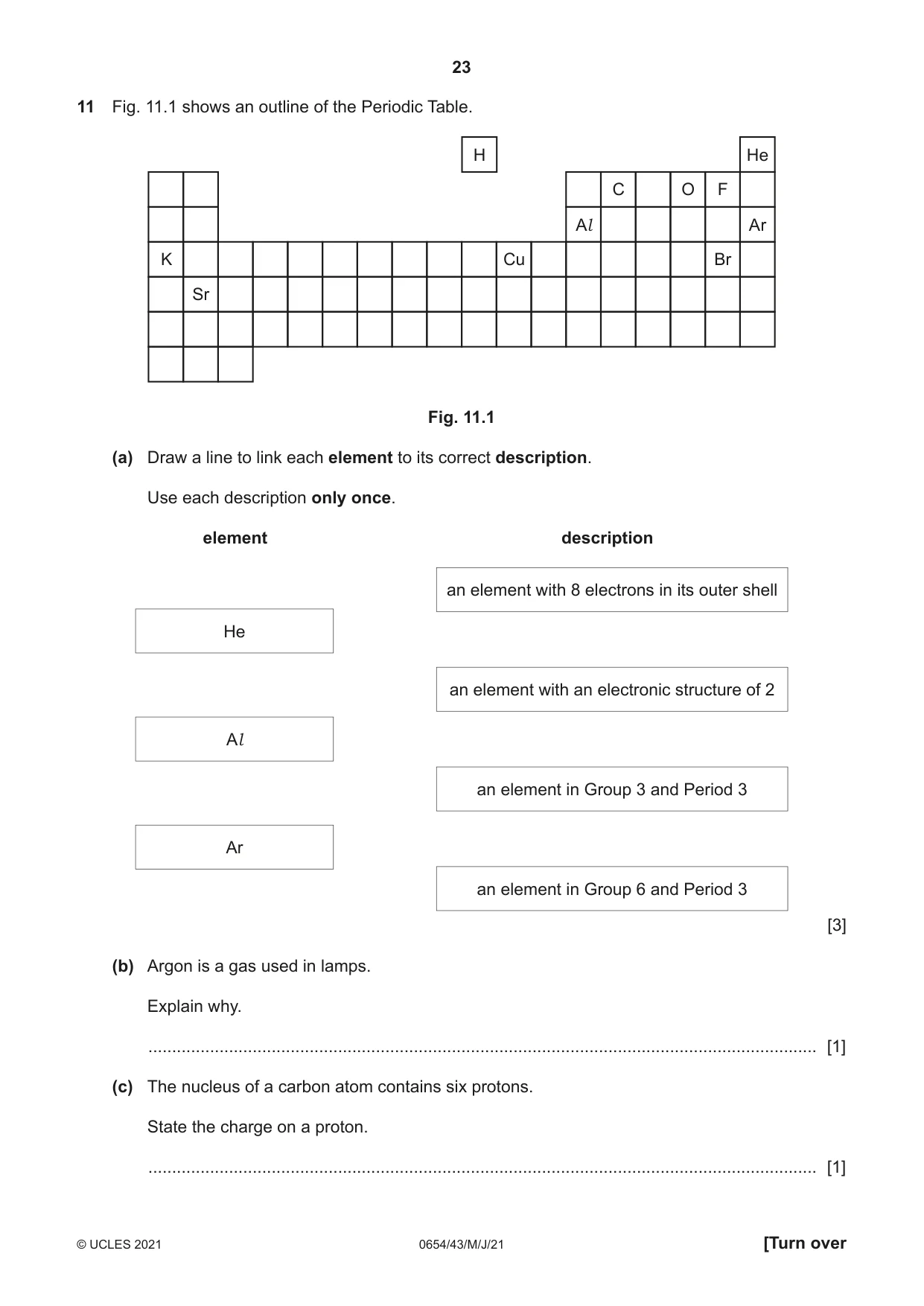
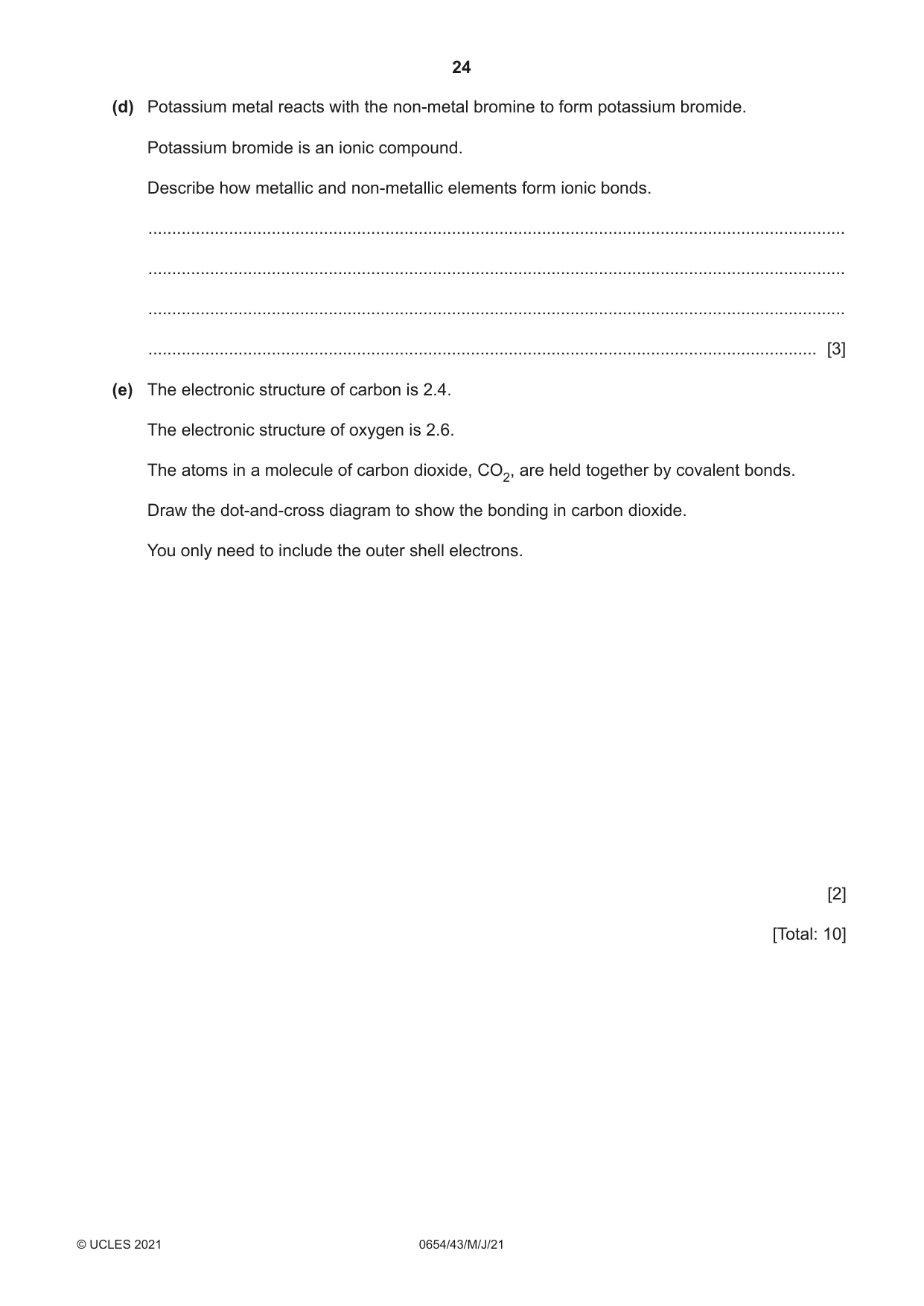
11 Fig. 11.1 shows an outline of the Periodic Table. H He C O F Al Ar K Cu Br Sr Fig. 11.1 (a) Draw a line to link each element to its correct description. Use each description only once. element description an element with 8 electrons in its outer shell He an element with an electronic structure of 2 Al an element in Group 3 and Period 3 Ar an element in Group 6 and Period 3 [3] (b) Argon is a gas used in lamps. Explain why. ............................................................................................................................................. [1] (c) The nucleus of a carbon atom contains six protons. State the charge on a proton. ............................................................................................................................................. [1] (d) Potassium metal reacts with the non-metal bromine to form potassium bromide. Potassium bromide is an ionic compound. Describe how metallic and non-metallic elements form ionic bonds. ................................................................................................................................................... ................................................................................................................................................... ................................................................................................................................................... ............................................................................................................................................. [3] (e) The electronic structure of carbon is 2.4. The electronic structure of oxygen is 2.6. The atoms in a molecule of carbon dioxide, CO2, are held together by covalent bonds. Draw the dot-and-cross diagram to show the bonding in carbon dioxide. You only need to include the outer shell electrons. [2] [Total: 10]
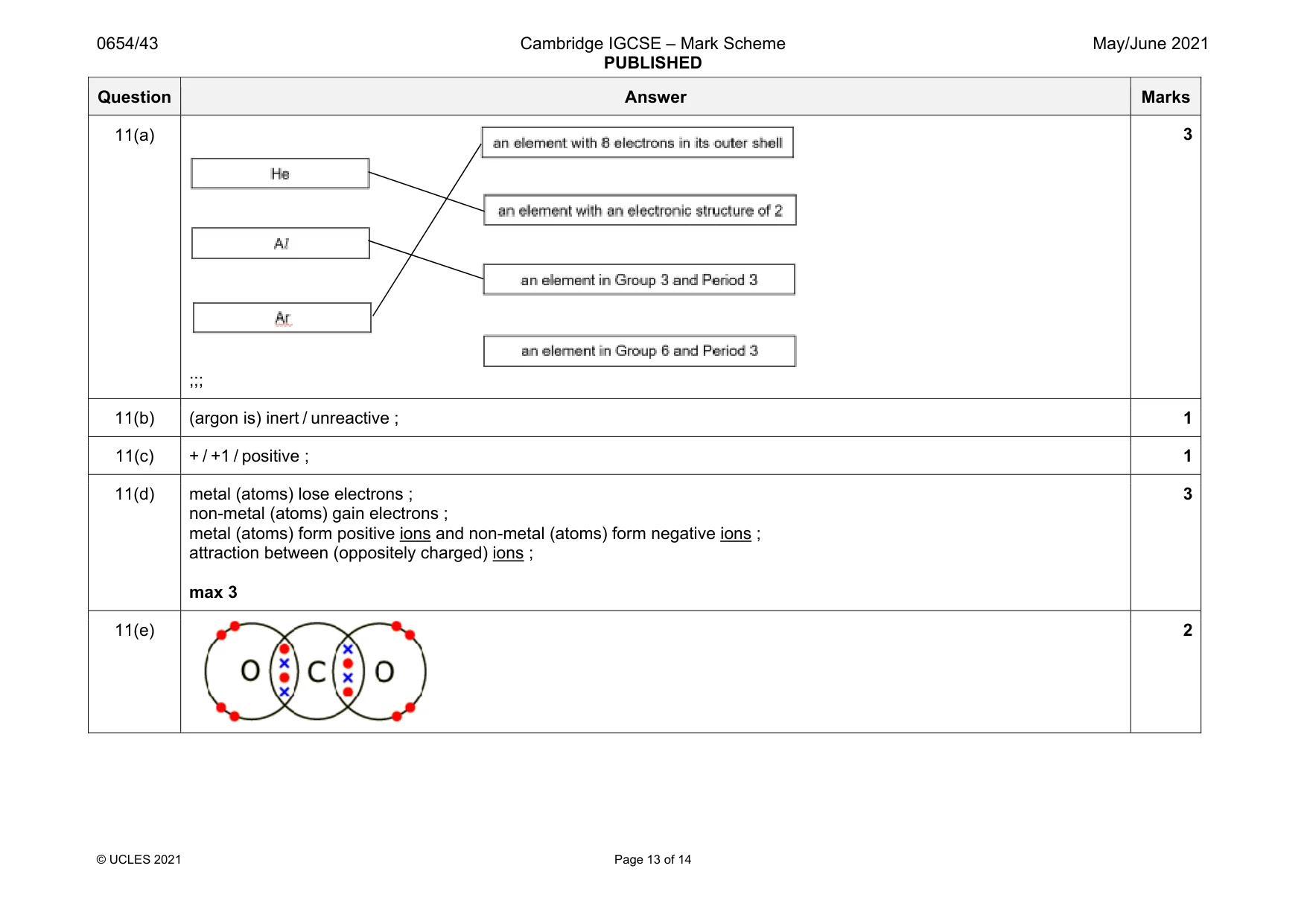
Mark scheme: 11(a) ;;; 11(b) (argon is) inert / unreactive ; 1 11(c) + / +1 / positive ; 1 11(d) metal (atoms) lose electrons ; non-metal (atoms) gain electrons ; metal (atoms) form positive ions and non-metal (atoms) form negative ions ; attraction between (oppositely charged) ions ; max 3 3 11(e) 2
Q12 · The arrangement of molecules in samples of a solid, a liquid and a gas
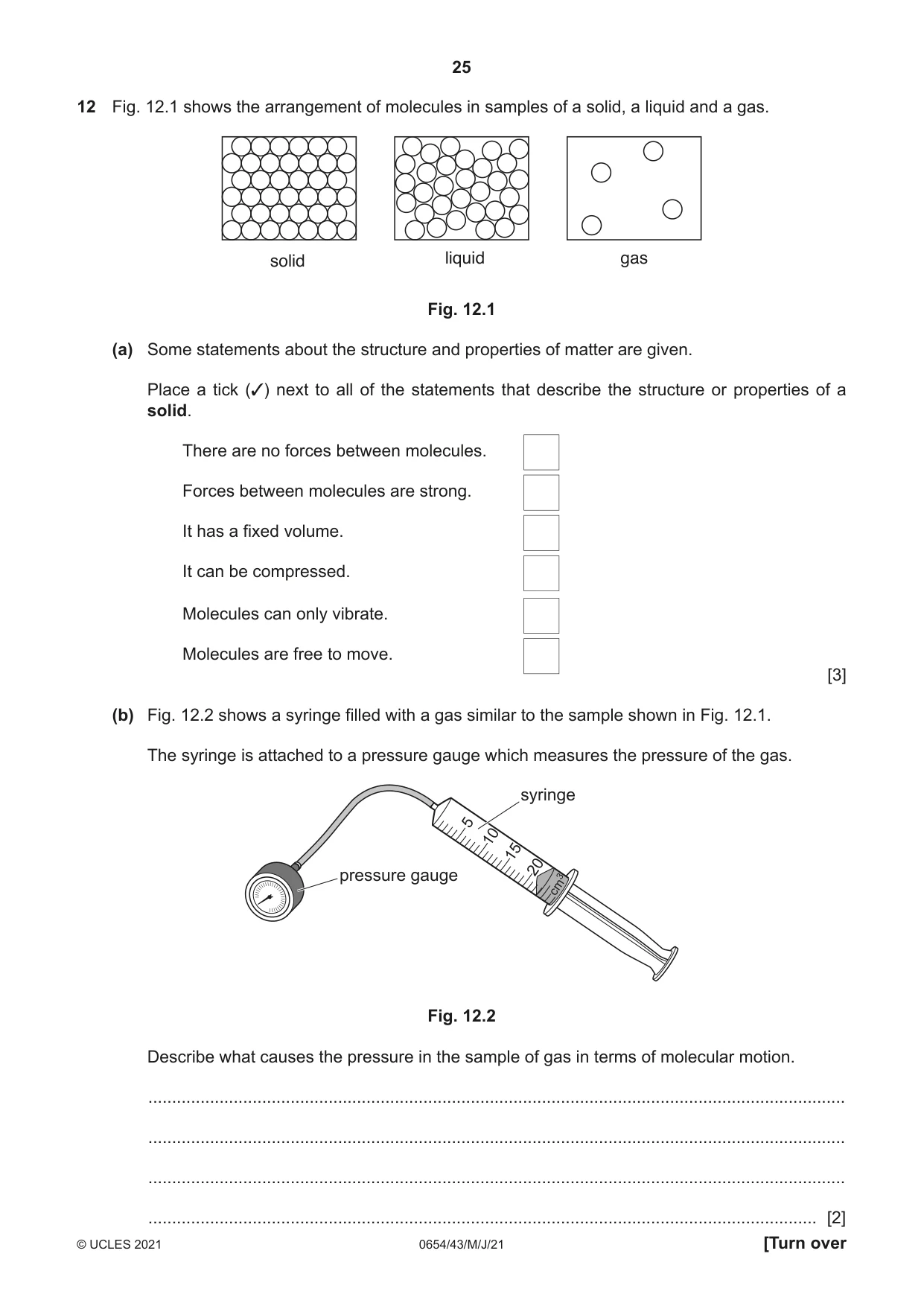
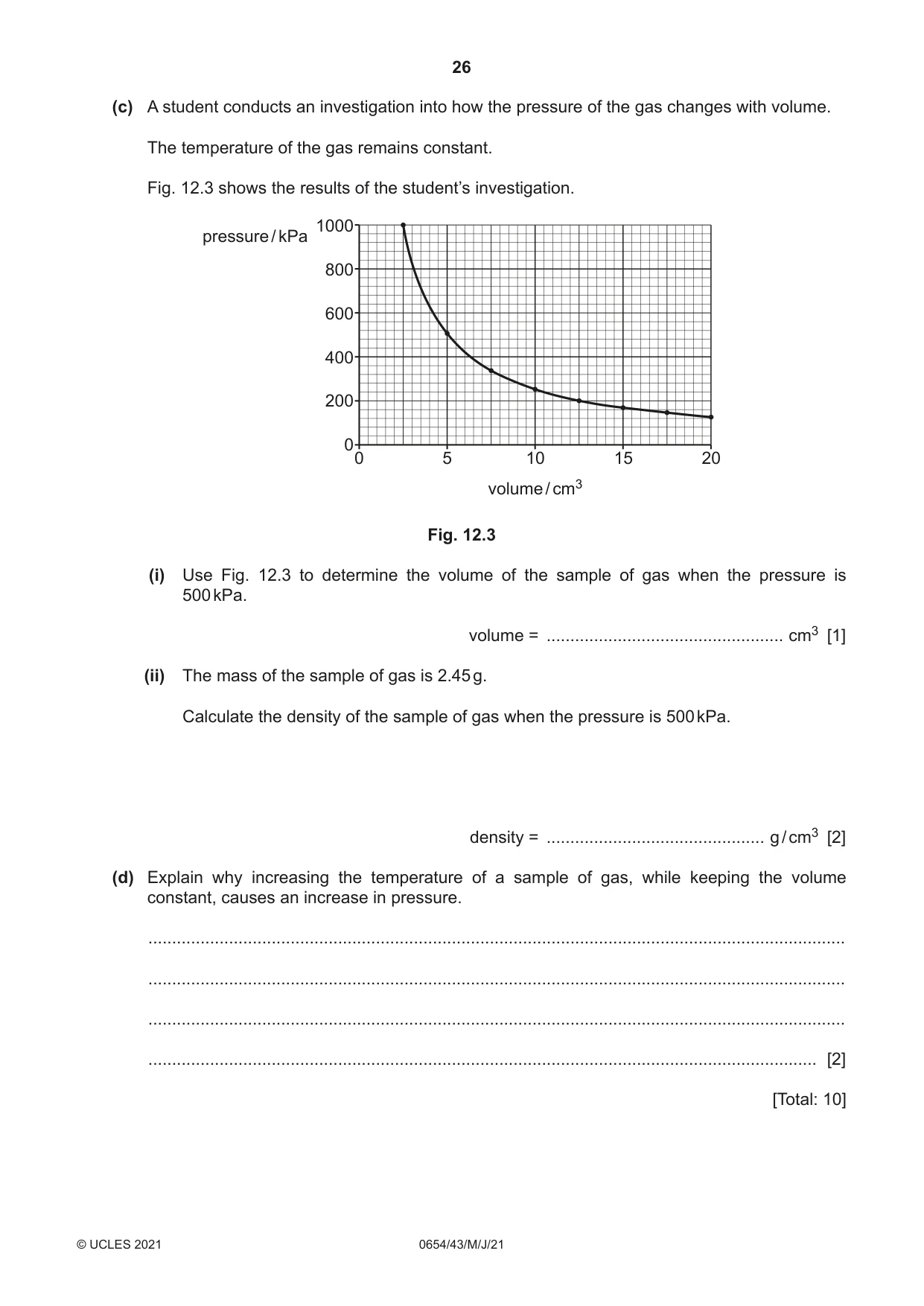
12 Fig. 12.1 shows the arrangement of molecules in samples of a solid, a liquid and a gas. solid liquid gas Fig. 12.1 (a) Some statements about the structure and properties of matter are given. Place a tick (3) next to all of the statements that describe the structure or properties of a solid. There are no forces between molecules. Forces between molecules are strong. It has a fixed volume. It can be compressed. Molecules can only vibrate. Molecules are free to move. [3] (b) Fig. 12.2 shows a syringe filled with a gas similar to the sample shown in Fig. 12.1. The syringe is attached to a pressure gauge which measures the pressure of the gas. syringe 5 10 15 20 pressure gauge cm3 Fig. 12.2 Describe what causes the pressure in the sample of gas in terms of molecular motion. ................................................................................................................................................... ................................................................................................................................................... ................................................................................................................................................... ............................................................................................................................................. [2] (c) A student conducts an investigation into how the pressure of the gas changes with volume. The temperature of the gas remains constant. Fig. 12.3 shows the results of the student’s investigation. 1000 pressure / kPa 800 600 400 200 00 5 10 15 20 volume / cm3 Fig. 12.3 (i) Use Fig. 12.3 to determine the volume of the sample of gas when the pressure is 500 kPa. volume = .................................................. cm3 [1] (ii) The mass of the sample of gas is 2.45 g. Calculate the density of the sample of gas when the pressure is 500 kPa. density = .............................................. g / cm3 [2] (d) Explain why increasing the temperature of a sample of gas, while keeping the volume constant, causes an increase in pressure. ................................................................................................................................................... ................................................................................................................................................... ................................................................................................................................................... ............................................................................................................................................. [2] [Total: 10]
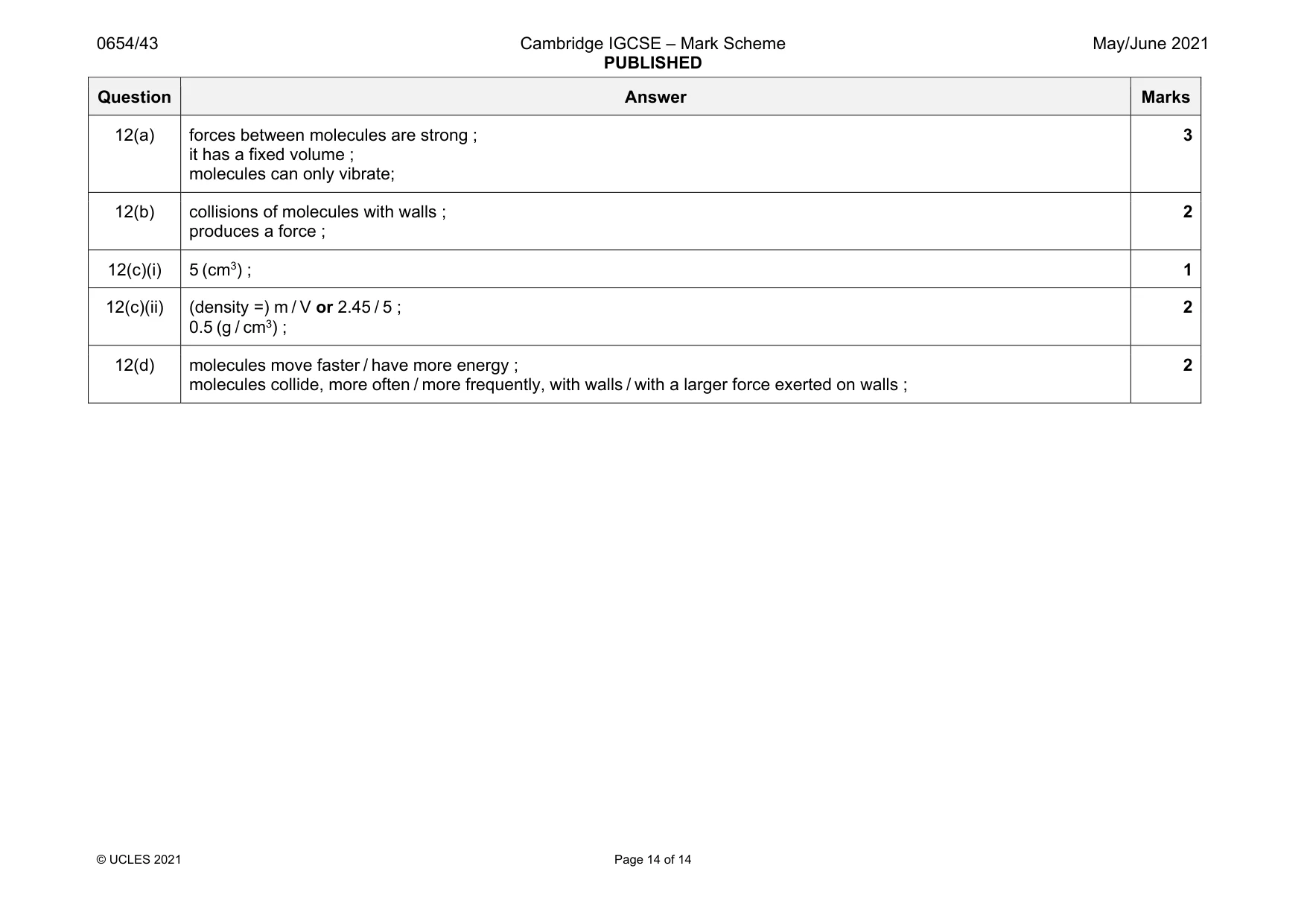
Mark scheme: 12(a) forces between molecules are strong ; it has a fixed volume ; molecules can only vibrate; 3 12(b) collisions of molecules with walls ; produces a force ; 2 12(c)(i) 5 (cm3) ; 1 12(c)(ii) (density =) m / V or 2.45 / 5 ; 0.5 (g / cm3) ; 2 12(d) molecules move faster / have more energy ; molecules collide, more often / more frequently, with walls / with a larger force exerted on walls ; 2
What was in this paper
The subtopics covered by these 12 questions, and how many questions each got. Open one in a new tab to see every Cambridge question on it.
What you needed in this session
Cambridge’s own grade thresholds for 2021 May/June, Paper 4 · Variant 3. A higher threshold means an easier paper — the bar moves with how the cohort did.