Cambridge IGCSE Sciences - Co-ordinated (Double) 0654 — 2020 Oct/Nov Paper 4 · Variant 3
0654/43/O/N/20 · 13 questions · 120 marks · ≈135 min
The question paper and its mark scheme, free to read here and free to download. This is Cambridge’s own paper, exactly as it was sat.
Question paper28 pages


Mark scheme12 pages
Answers below. Sit the paper first if you are practising.
Questions as text
Q1 · A scientist investigates the effect of light intensity, carbon dioxide concentration and…
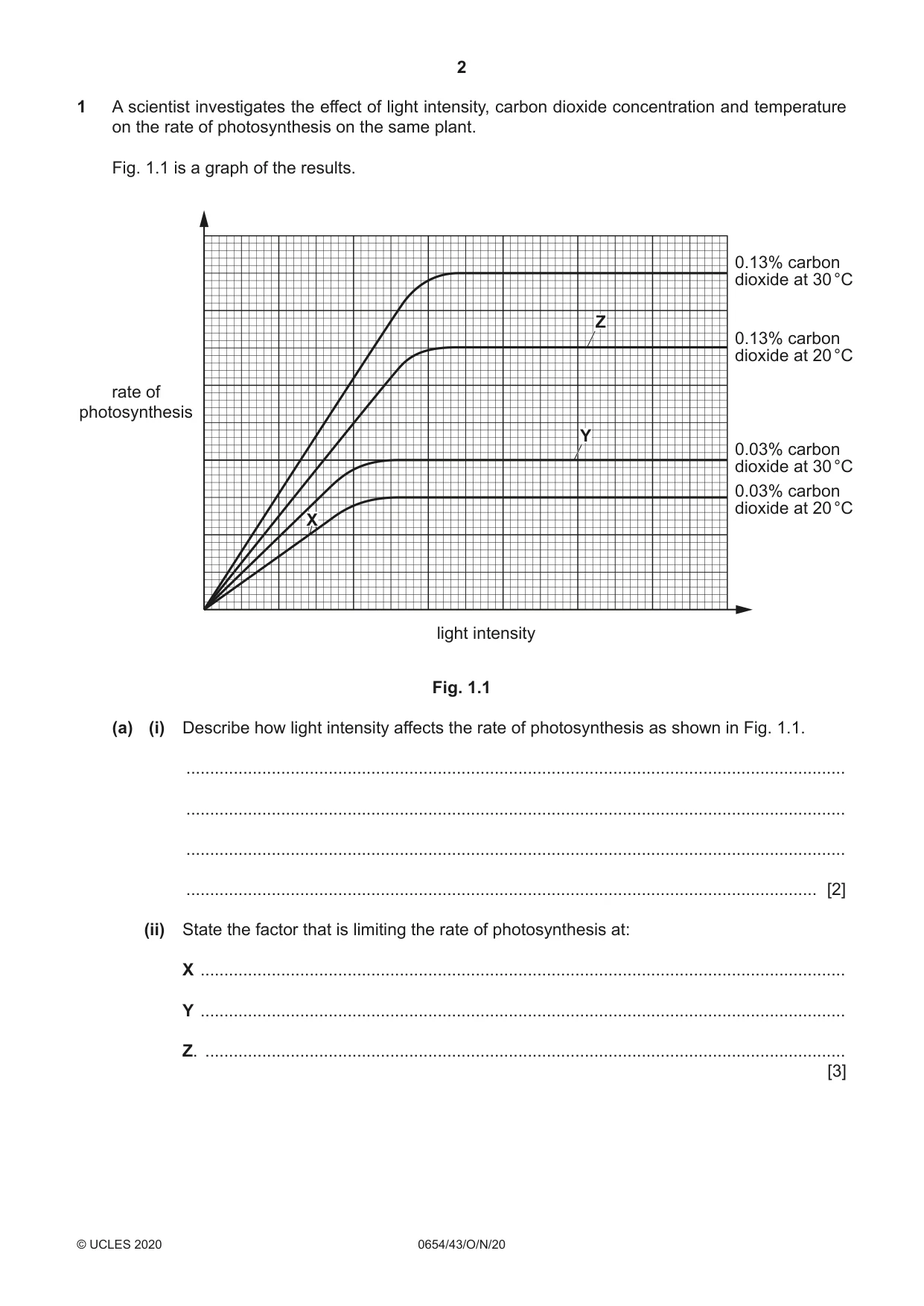
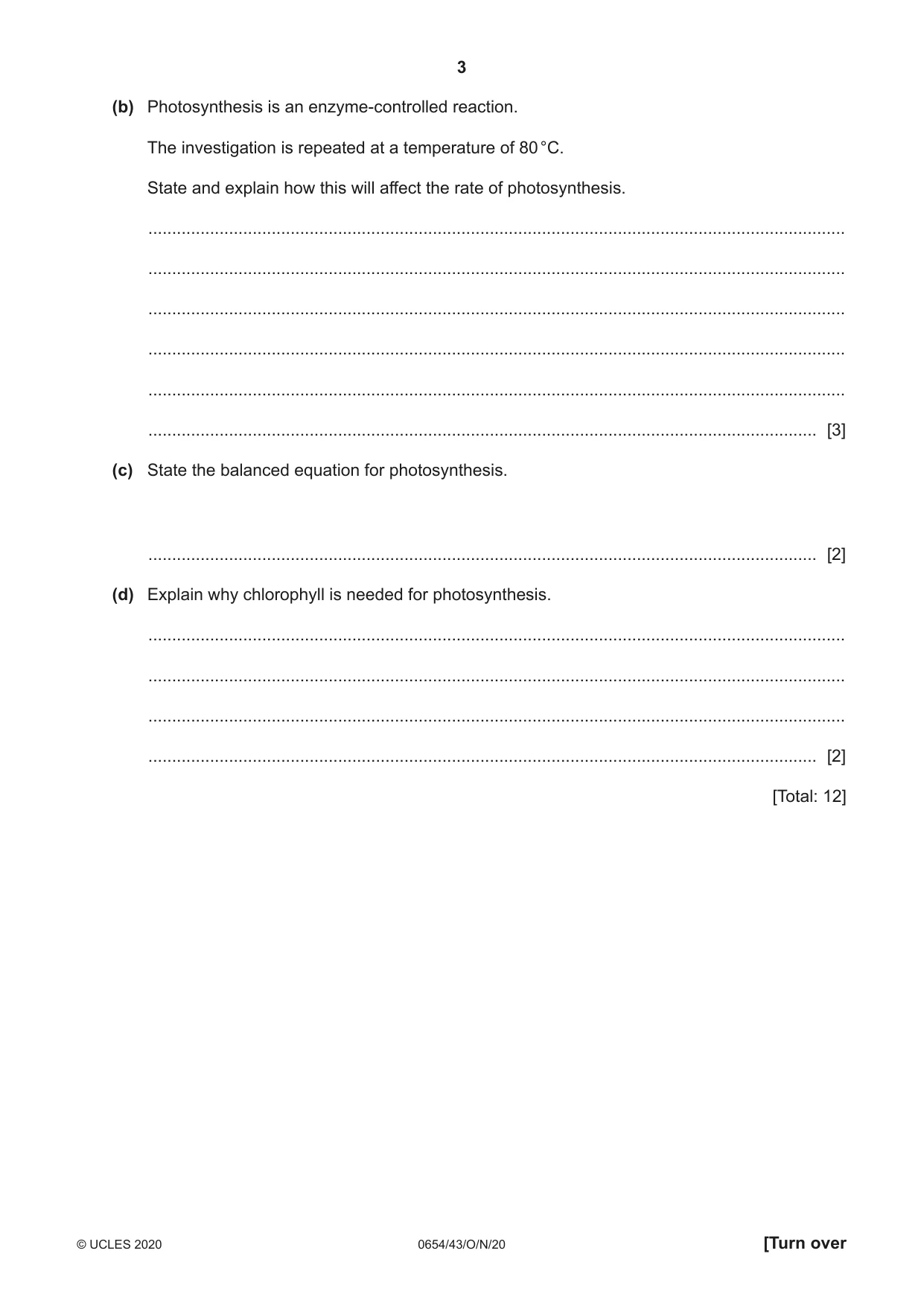
1 A scientist investigates the effect of light intensity, carbon dioxide concentration and temperature on the rate of photosynthesis on the same plant. Fig. 1.1 is a graph of the results. 0.13% carbon dioxide at 30 °C Z 0.13% carbon dioxide at 20 °C rate of photosynthesis Y 0.03% carbon dioxide at 30 °C 0.03% carbon dioxide at 20 °C X light intensity Fig. 1.1 (a) (i) Describe how light intensity affects the rate of photosynthesis as shown in Fig. 1.1. ........................................................................................................................................... ........................................................................................................................................... ........................................................................................................................................... ..................................................................................................................................... [2] (ii) State the factor that is limiting the rate of photosynthesis at: X ........................................................................................................................................ Y ........................................................................................................................................ Z. ....................................................................................................................................... [3] (b) Photosynthesis is an enzyme-controlled reaction. The investigation is repeated at a temperature of 80 °C. State and explain how this will affect the rate of photosynthesis. ................................................................................................................................................... ................................................................................................................................................... ................................................................................................................................................... ................................................................................................................................................... ................................................................................................................................................... ............................................................................................................................................. [3] (c) State the balanced equation for photosynthesis. ............................................................................................................................................. [2] (d) Explain why chlorophyll is needed for photosynthesis. ................................................................................................................................................... ................................................................................................................................................... ................................................................................................................................................... ............................................................................................................................................. [2] [Total: 12]
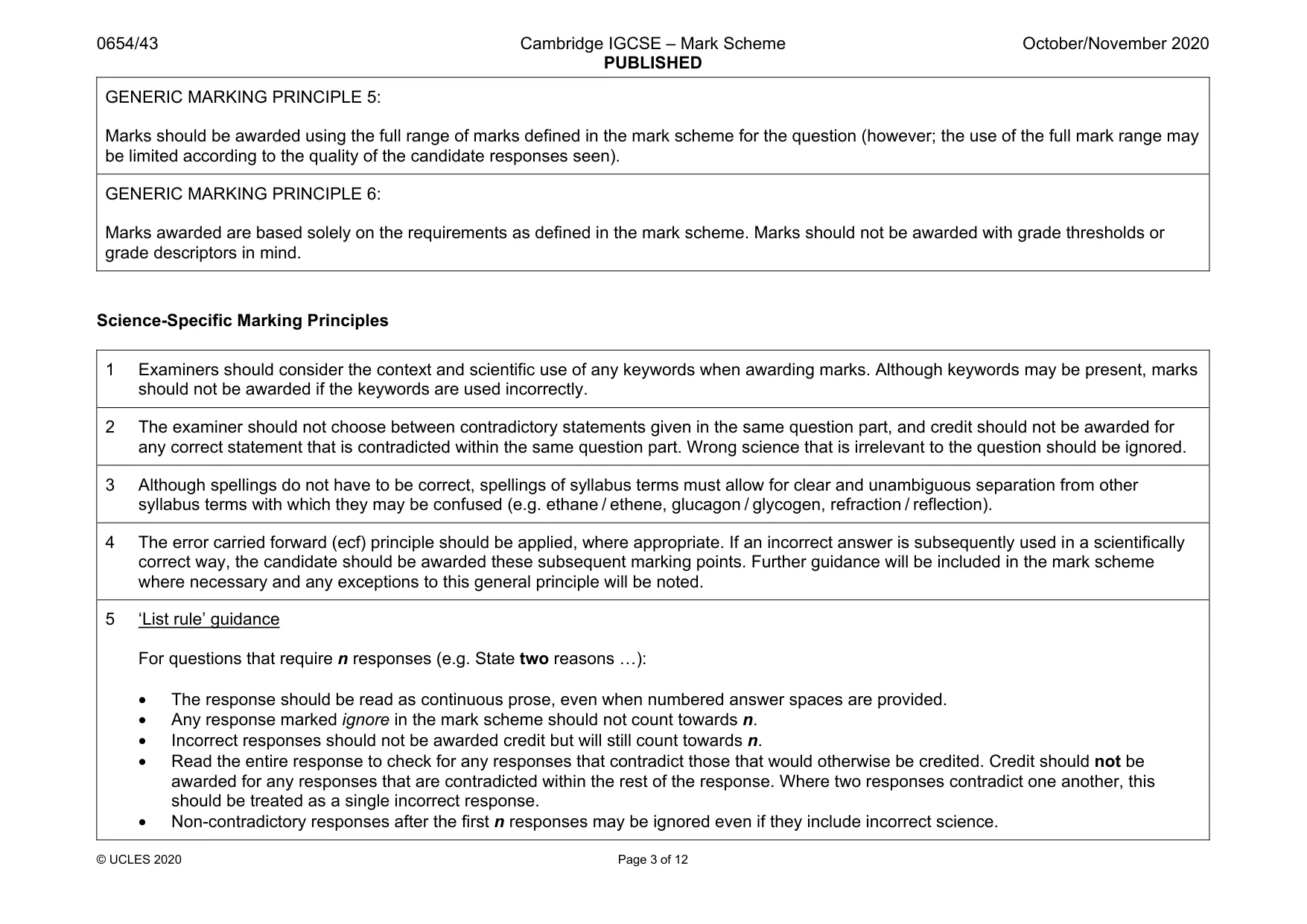
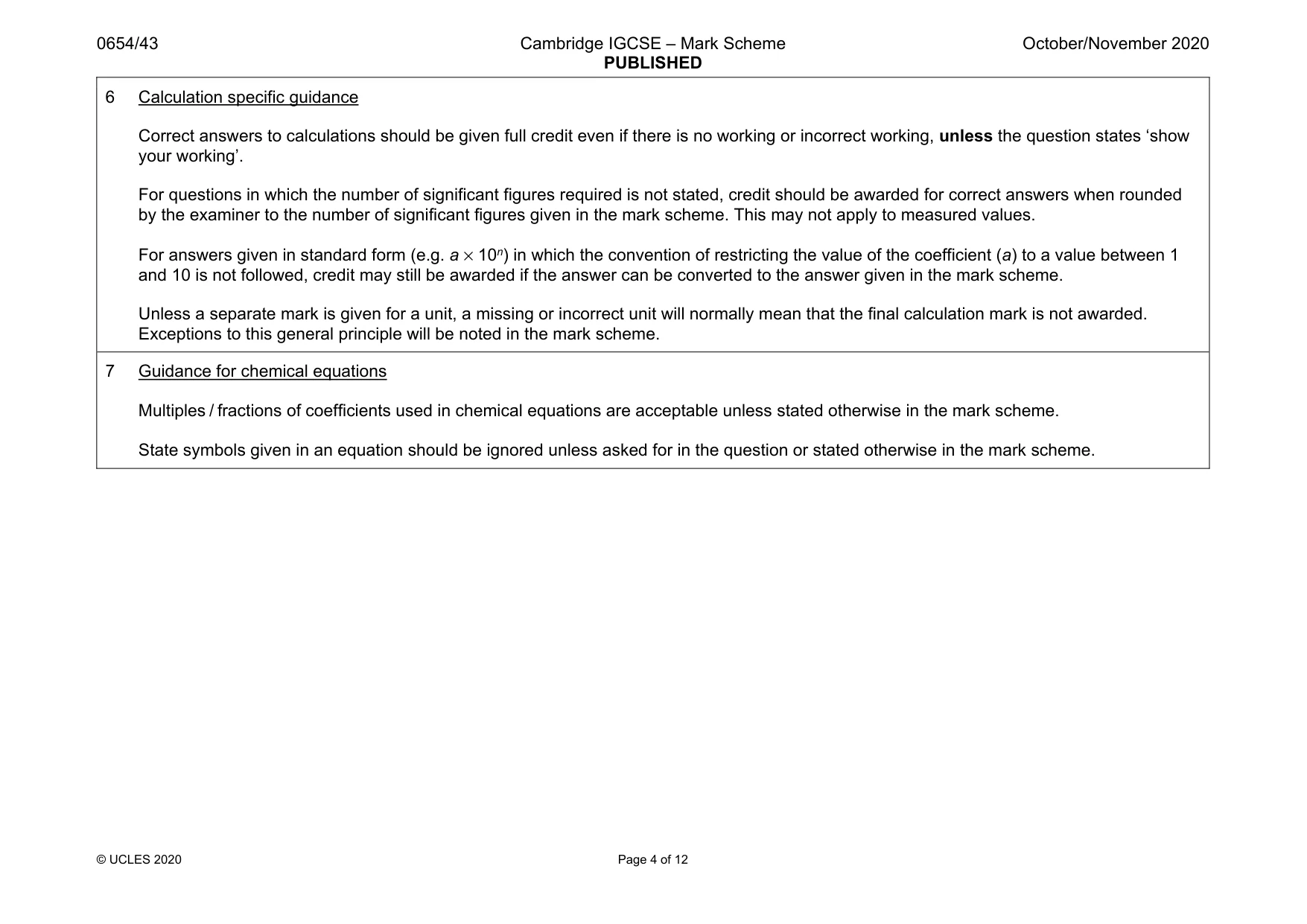
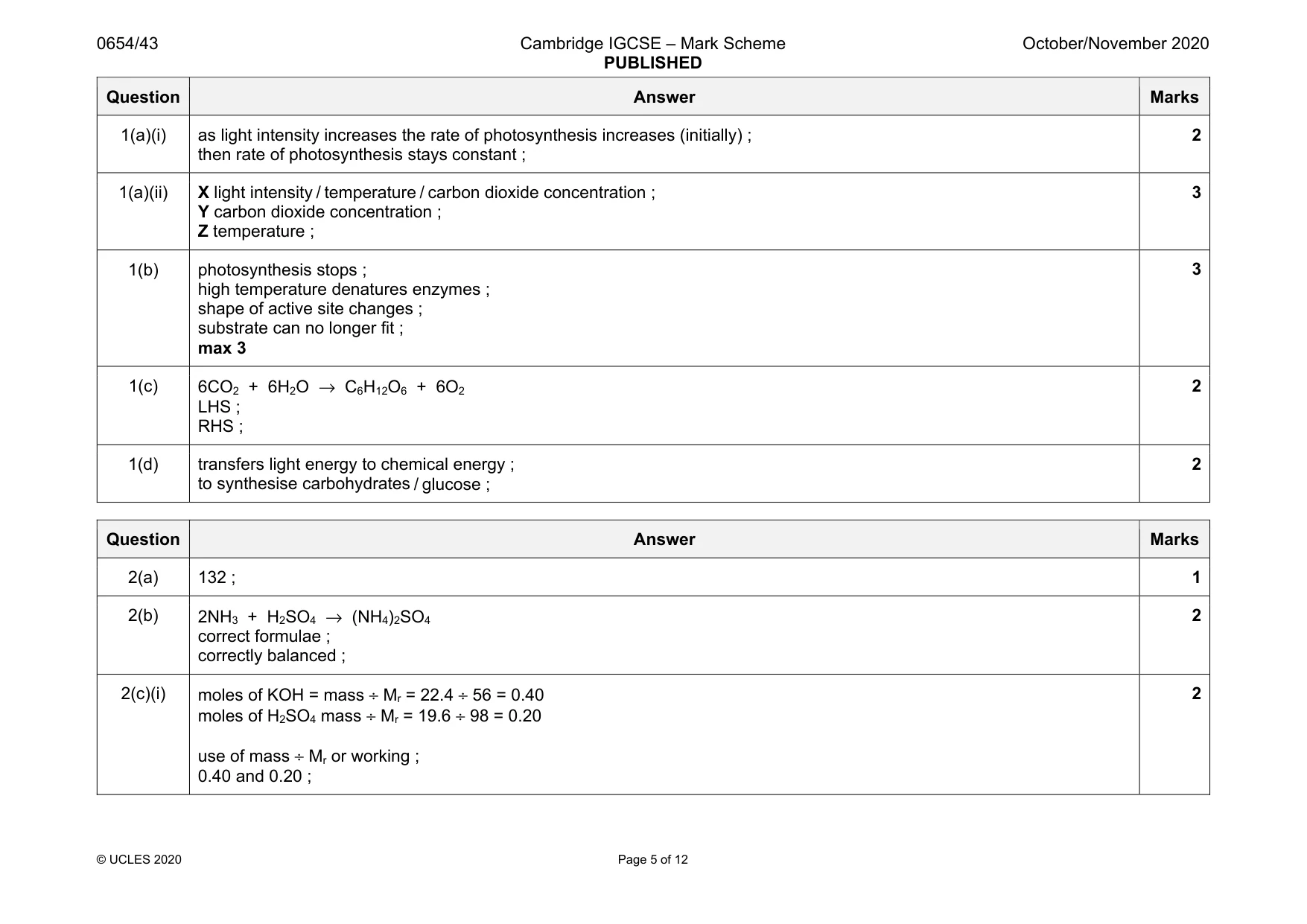
Mark scheme: 1(a)(i) as light intensity increases the rate of photosynthesis increases (initially) ; then rate of photosynthesis stays constant ; 2 1(a)(ii) X light intensity / temperature / carbon dioxide concentration ; Y carbon dioxide concentration ; Z temperature ; 3 1(b) photosynthesis stops ; high temperature denatures enzymes ; shape of active site changes ; substrate can no longer fit ; max 3 3 1(c) 6CO2 + 6H2O → C6H12O6 + 6O2 LHS ; RHS ; 2 1(d) transfers light energy to chemical energy ; to synthesise carbohydrates / glucose ; 2
Q2 · Ammonium sulfate is a fertiliser
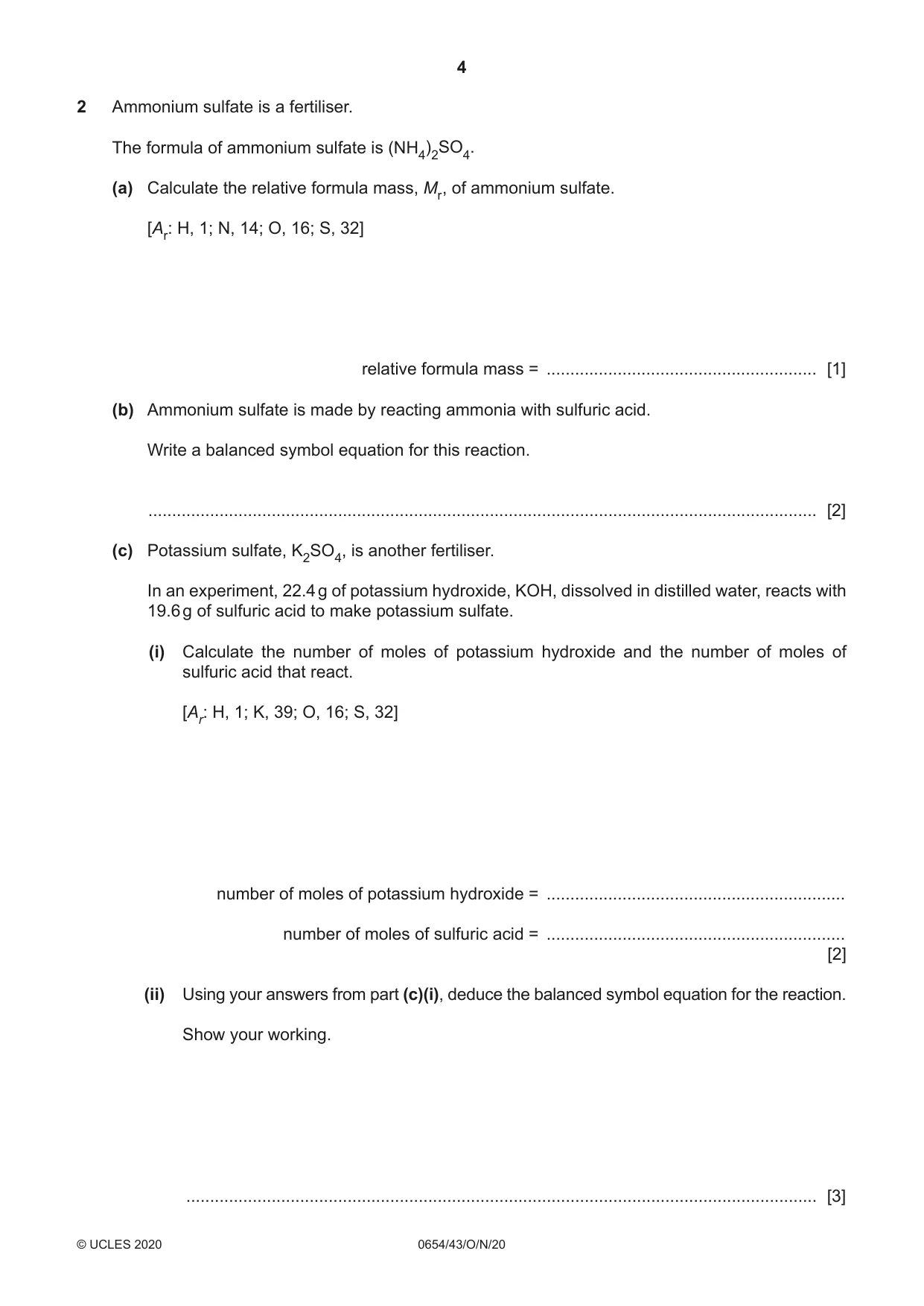
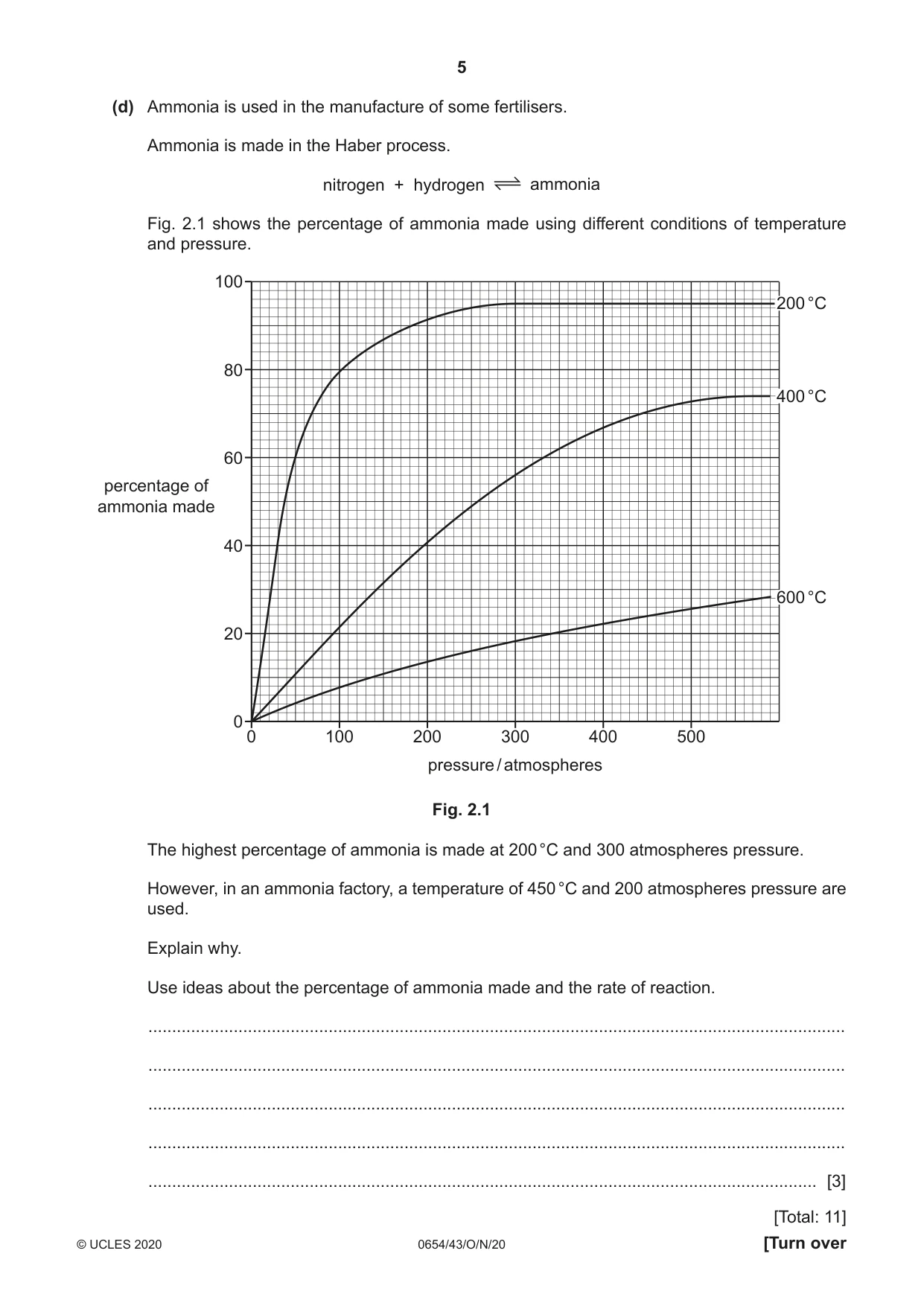
2 Ammonium sulfate is a fertiliser. The formula of ammonium sulfate is (NH4)2SO4. (a) Calculate the relative formula mass, Mr , of ammonium sulfate. [Ar: H, 1; N, 14; O, 16; S, 32] relative formula mass = ......................................................... [1] (b) Ammonium sulfate is made by reacting ammonia with sulfuric acid. Write a balanced symbol equation for this reaction. ............................................................................................................................................. [2] (c) Potassium sulfate, K2SO4, is another fertiliser. In an experiment, 22.4 g of potassium hydroxide, KOH, dissolved in distilled water, reacts with 19.6 g of sulfuric acid to make potassium sulfate. (i) Calculate the number of moles of potassium hydroxide and the number of moles of sulfuric acid that react. [Ar: H, 1; K, 39; O, 16; S, 32] number of moles of potassium hydroxide = ............................................................... number of moles of sulfuric acid = ............................................................... [2] (ii) Using your answers from part (c)(i), deduce the balanced symbol equation for the reaction. Show your working. ..................................................................................................................................... [3] (d) Ammonia is used in the manufacture of some fertilisers. Ammonia is made in the Haber process. nitrogen + hydrogen ammonia Fig. 2.1 shows the percentage of ammonia made using different conditions of temperature and pressure. 100 200 °C 80 400 °C 60 percentage of ammonia made 40 600 °C 20 0 0 100 200 300 400 500 pressure / atmospheres Fig. 2.1 The highest percentage of ammonia is made at 200 °C and 300 atmospheres pressure. However, in an ammonia factory, a temperature of 450 °C and 200 atmospheres pressure are used. Explain why. Use ideas about the percentage of ammonia made and the rate of reaction. ................................................................................................................................................... ................................................................................................................................................... ................................................................................................................................................... ................................................................................................................................................... ............................................................................................................................................. [3] [Total: 11]
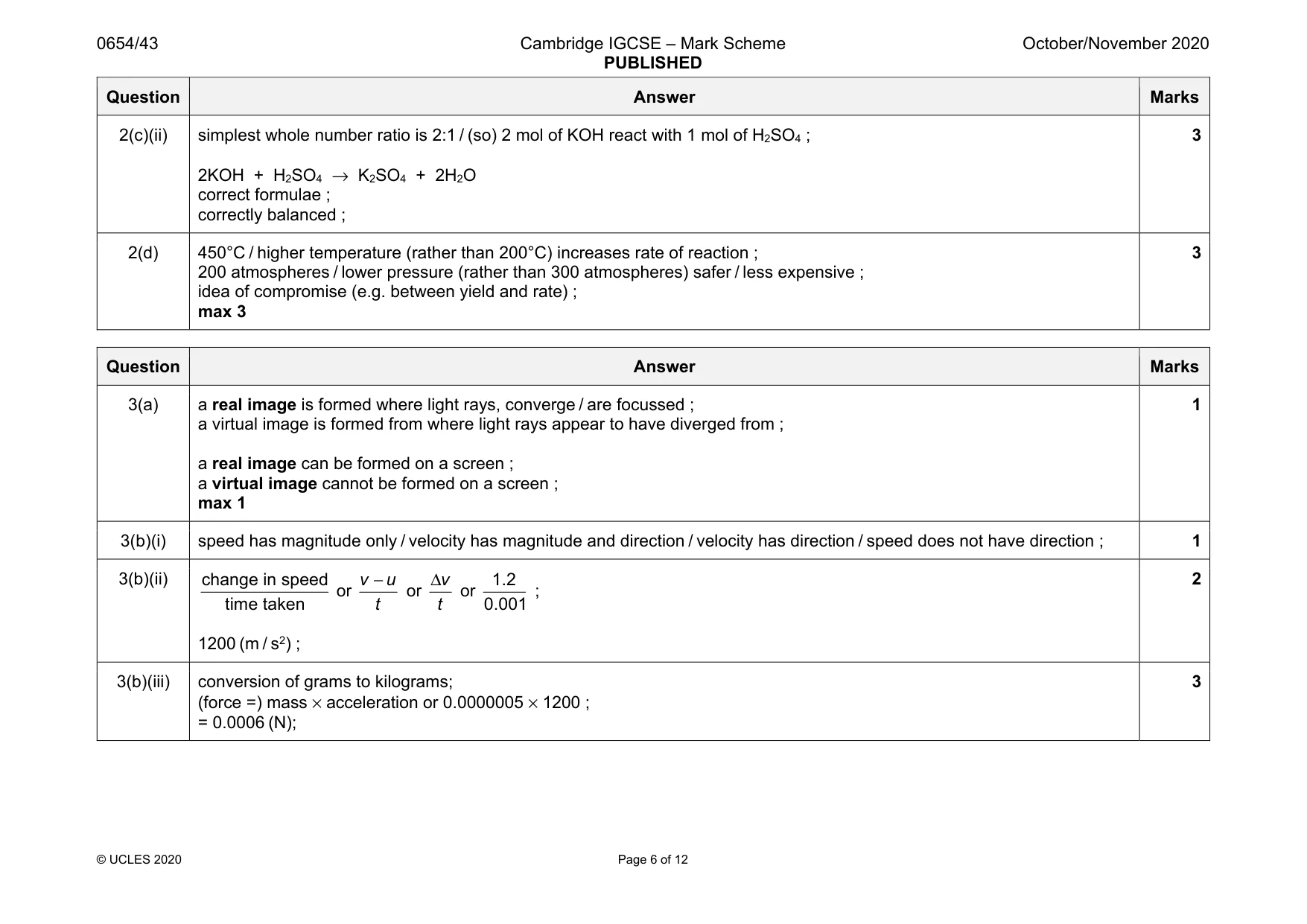
Mark scheme: 2(a) 132 ; 1 2(b) 2NH3 + H2SO4 → (NH4)2SO4 correct formulae ; correctly balanced ; 2 2(c)(i) moles of KOH = mass ÷ Mr = 22.4 ÷ 56 = 0.40 moles of H2SO4 mass ÷ Mr = 19.6 ÷ 98 = 0.20 use of mass ÷ Mr or working ; 0.40 and 0.20 ; 2 Question Answer Marks 2(c)(ii) simplest whole number ratio is 2:1 / (so) 2 mol of KOH react with 1 mol of H2SO4 ; 2KOH + H2SO4 → K2SO4 + 2H2O correct formulae ; correctly balanced ; 3 2(d) 450°C / higher temperature (rather than 200°C) increases rate of reaction ; 200 atmospheres / lower pressure (rather than 300 atmospheres) safer / less expensive ; idea of compromise (e.g. between yield and rate) ; max 3 3
Q3 · A flea is a small insect
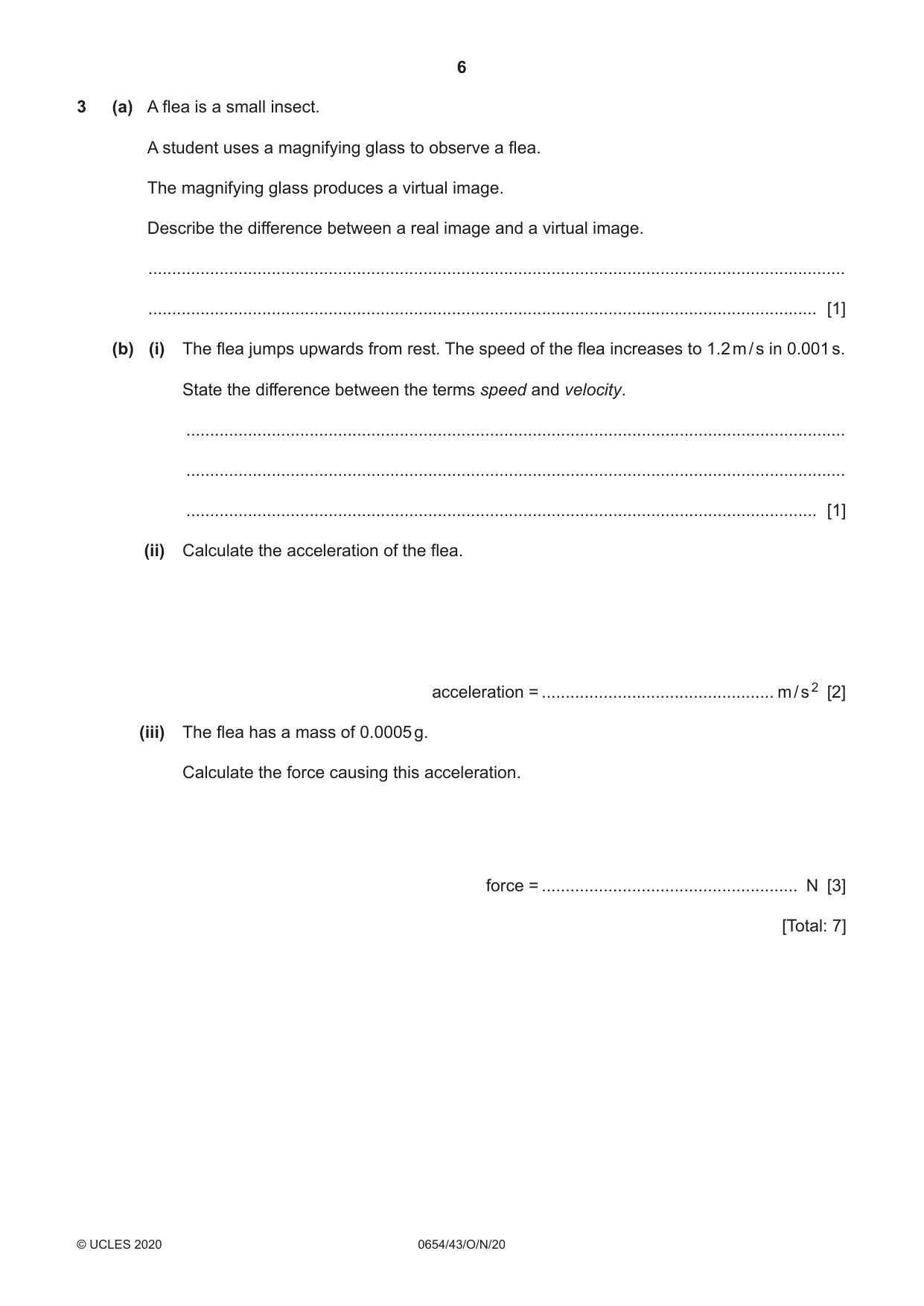
3 (a) A flea is a small insect. A student uses a magnifying glass to observe a flea. The magnifying glass produces a virtual image. Describe the difference between a real image and a virtual image. ................................................................................................................................................... ............................................................................................................................................. [1] (b) (i) The flea jumps upwards from rest. The speed of the flea increases to 1.2 m / s in 0.001 s. State the difference between the terms speed and velocity. ........................................................................................................................................... ........................................................................................................................................... ..................................................................................................................................... [1] (ii) Calculate the acceleration of the flea. acceleration = ................................................. m / s 2 [2] (iii) The flea has a mass of 0.0005 g. Calculate the force causing this acceleration. force = ...................................................... N [3] [Total: 7]
Mark scheme: 3(a) a real image is formed where light rays, converge / are focussed ; a virtual image is formed from where light rays appear to have diverged from ; a real image can be formed on a screen ; a virtual image cannot be formed on a screen ; max 1 3(b)(i) speed has magnitude only / velocity has magnitude and direction / velocity has direction / speed does not have direction ; 1 3(b)(ii) change in speed time taken or − v u t or Δv t or 1.2 0.001 ; 1200 (m / s2) ; 2 3(b)(iii) conversion of grams to kilograms; (force =) mass × acceleration or 0.0000005 × 1200 ; = 0.0006 (N); 3
Q4 · A diagram of the blood vessels in the placenta of the mother and her fetus
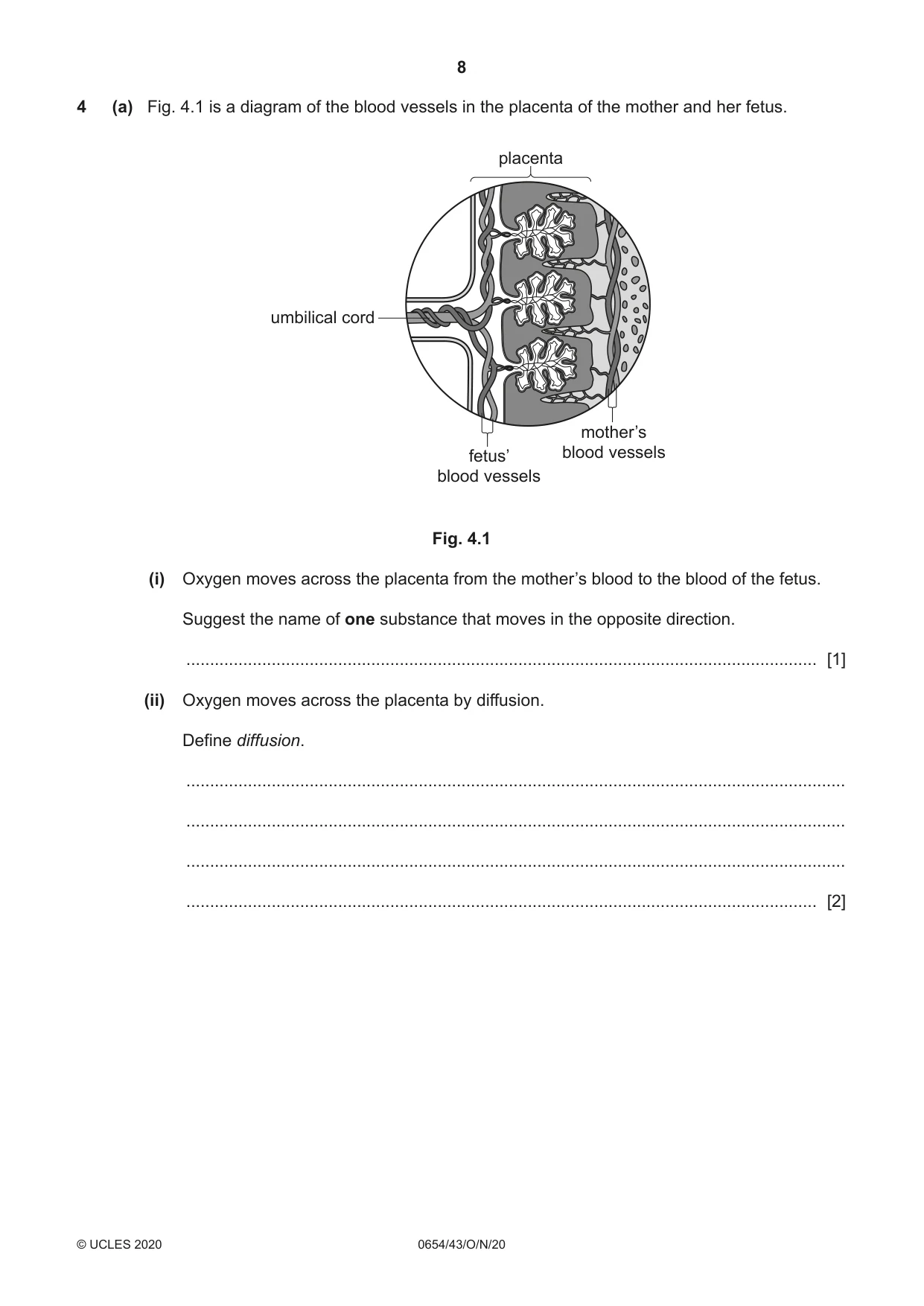
4 (a) Fig. 4.1 is a diagram of the blood vessels in the placenta of the mother and her fetus. placenta umbilical cord mother’s fetus’ blood vessels blood vessels Fig. 4.1 (i) Oxygen moves across the placenta from the mother’s blood to the blood of the fetus. Suggest the name of one substance that moves in the opposite direction. ..................................................................................................................................... [1] (ii) Oxygen moves across the placenta by diffusion. Define diffusion. ........................................................................................................................................... ........................................................................................................................................... ........................................................................................................................................... ..................................................................................................................................... [2] (iii) The placenta is a gas exchange surface. Suggest two features of the placenta that enable efficient gas exchange. 1 ........................................................................................................................................ 2 ........................................................................................................................................ [2] (iv) Name the part of the female reproductive system where: • the fetus develops .................................................................................................................................... • fertilisation occurs .................................................................................................................................... • the female gametes are released. .................................................................................................................................... [3] (b) The process of mitosis is used for growth. (i) State two other uses of mitosis. 1 ........................................................................................................................................ 2 ........................................................................................................................................ [2] (ii) The chromosomes inside the nuclei of cells produced by mitosis are different to those produced by meiosis. Describe two of these differences. 1 ........................................................................................................................................ ........................................................................................................................................... 2 ........................................................................................................................................ ........................................................................................................................................... [2] [Total: 12]
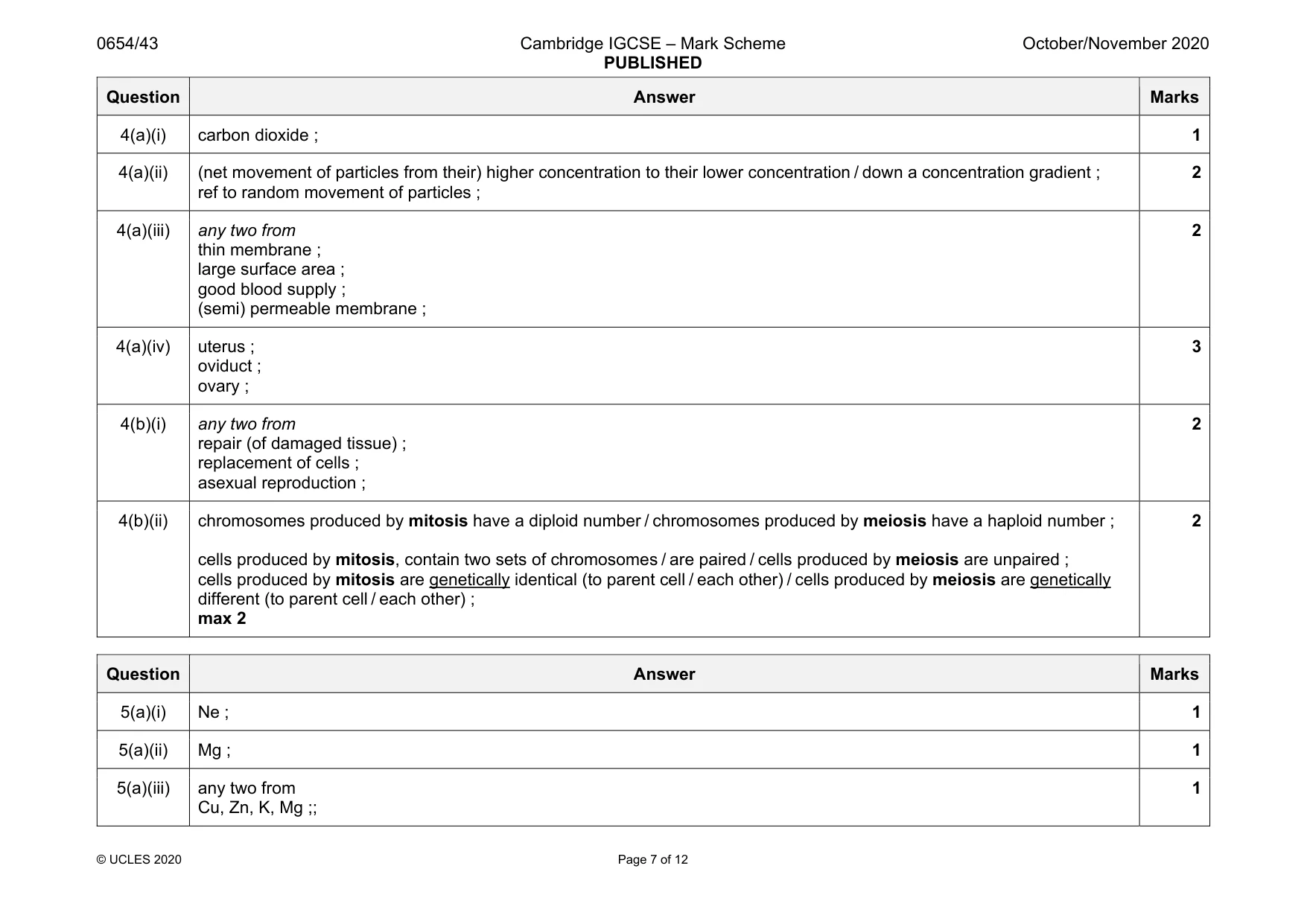
Mark scheme: 4(a)(i) carbon dioxide ; 1 4(a)(ii) (net movement of particles from their) higher concentration to their lower concentration / down a concentration gradient ; ref to random movement of particles ; 2 4(a)(iii) any two from thin membrane ; large surface area ; good blood supply ; (semi) permeable membrane ; 2 4(a)(iv) uterus ; oviduct ; ovary ; 3 4(b)(i) any two from repair (of damaged tissue) ; replacement of cells ; asexual reproduction ; 2 4(b)(ii) chromosomes produced by mitosis have a diploid number / chromosomes produced by meiosis have a haploid number ; cells produced by mitosis, contain two sets of chromosomes / are paired / cells produced by meiosis are unpaired ; cells produced by mitosis are genetically identical (to parent cell / each other) / cells produced by meiosis are genetically different (to parent cell / each other) ; max 2 2
Q5 · Look at the list of atomic symbols
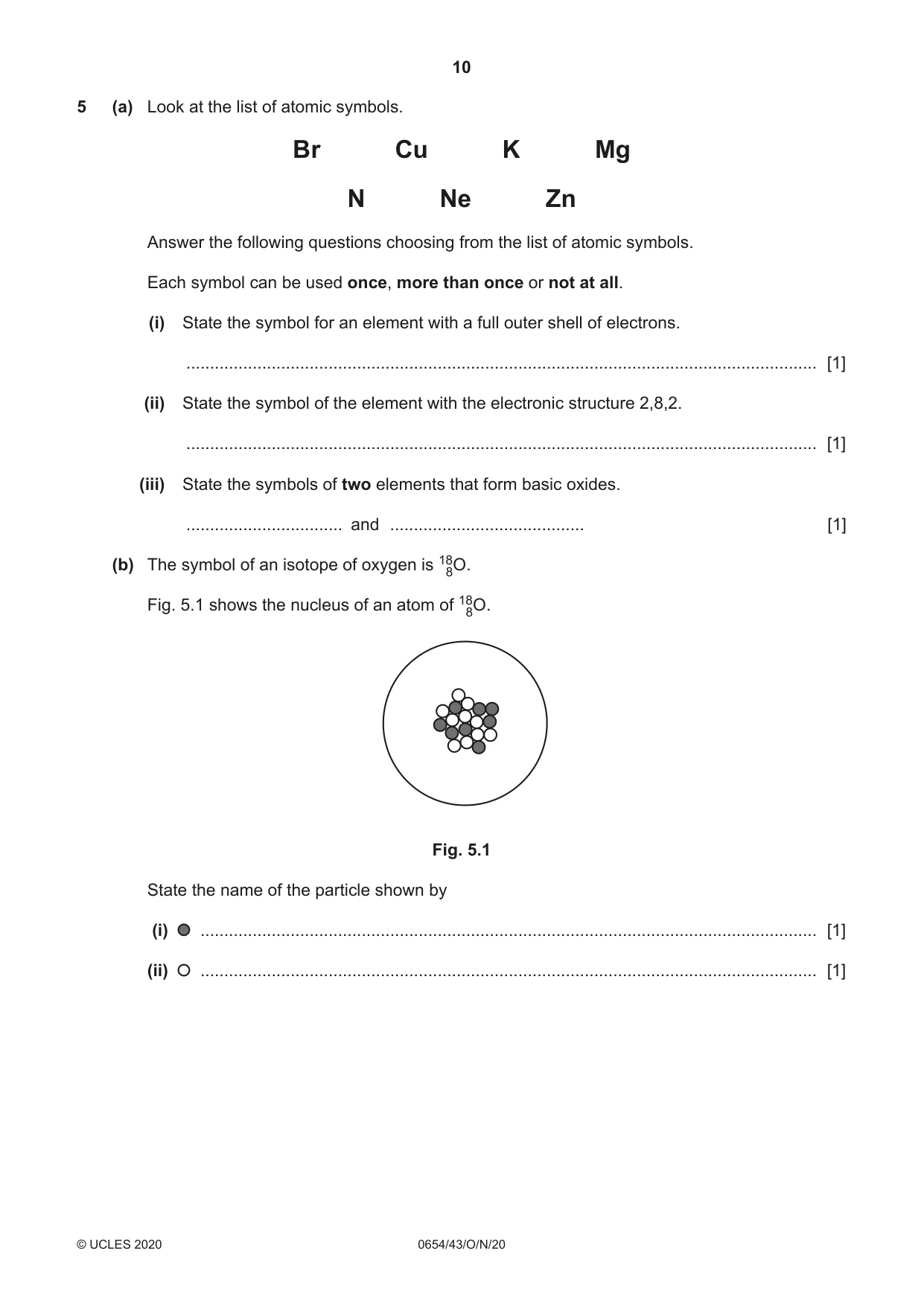
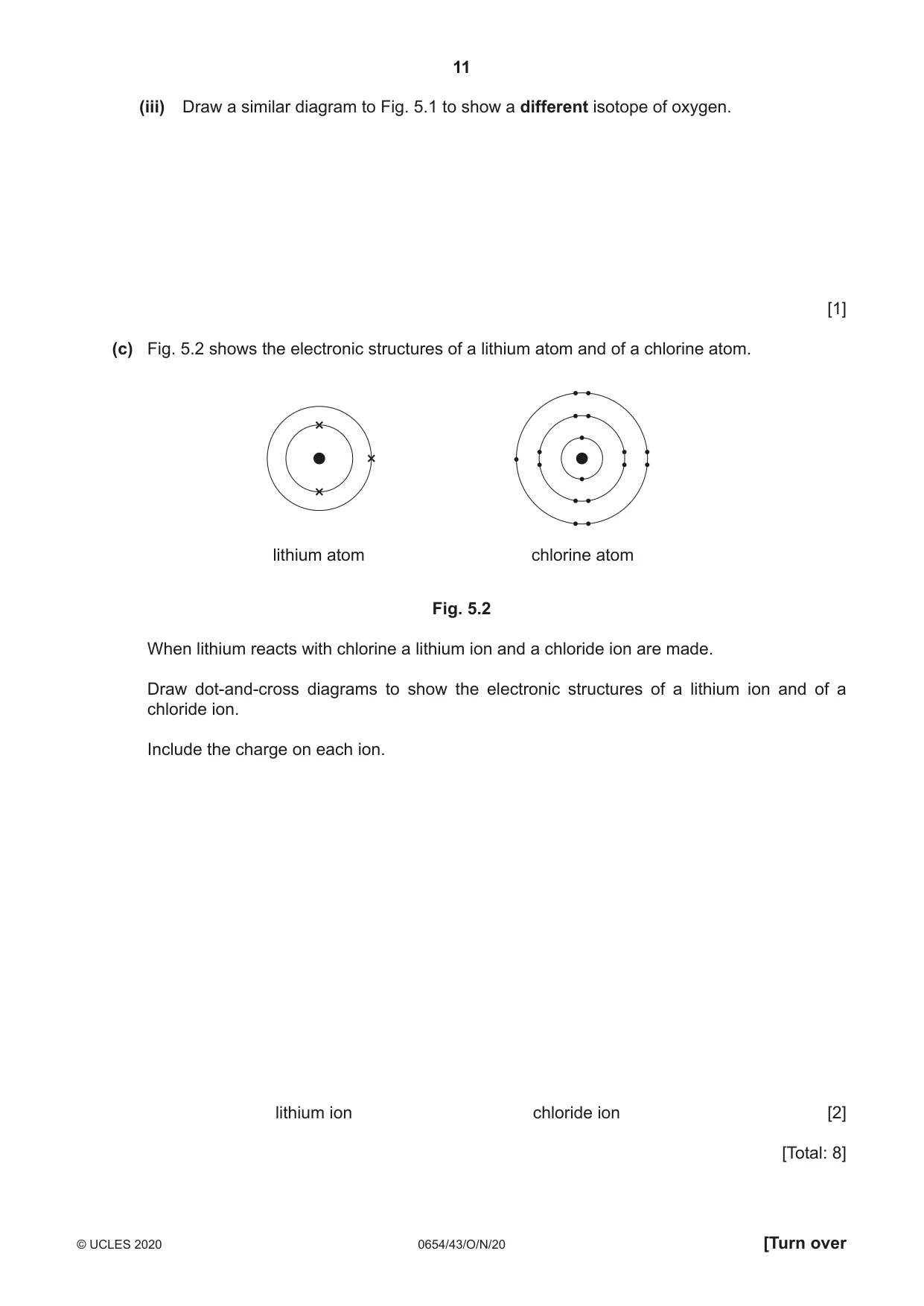
5 (a) Look at the list of atomic symbols. Br Cu K Mg N Ne Zn Answer the following questions choosing from the list of atomic symbols. Each symbol can be used once, more than once or not at all. (i) State the symbol for an element with a full outer shell of electrons. ..................................................................................................................................... [1] (ii) State the symbol of the element with the electronic structure 2,8,2. ..................................................................................................................................... [1] (iii) State the symbols of two elements that form basic oxides. ................................. and ......................................... [1] (b) The symbol of an isotope of oxygen is 188O. Fig. 5.1 shows the nucleus of an atom of 188O. Fig. 5.1 State the name of the particle shown by (i) .................................................................................................................................. [1] (ii) .................................................................................................................................. [1] (iii) Draw a similar diagram to Fig. 5.1 to show a different isotope of oxygen. [1] (c) Fig. 5.2 shows the electronic structures of a lithium atom and of a chlorine atom. lithium atom chlorine atom Fig. 5.2 When lithium reacts with chlorine a lithium ion and a chloride ion are made. Draw dot-and-cross diagrams to show the electronic structures of a lithium ion and of a chloride ion. Include the charge on each ion. lithium ion chloride ion [2] [Total: 8]
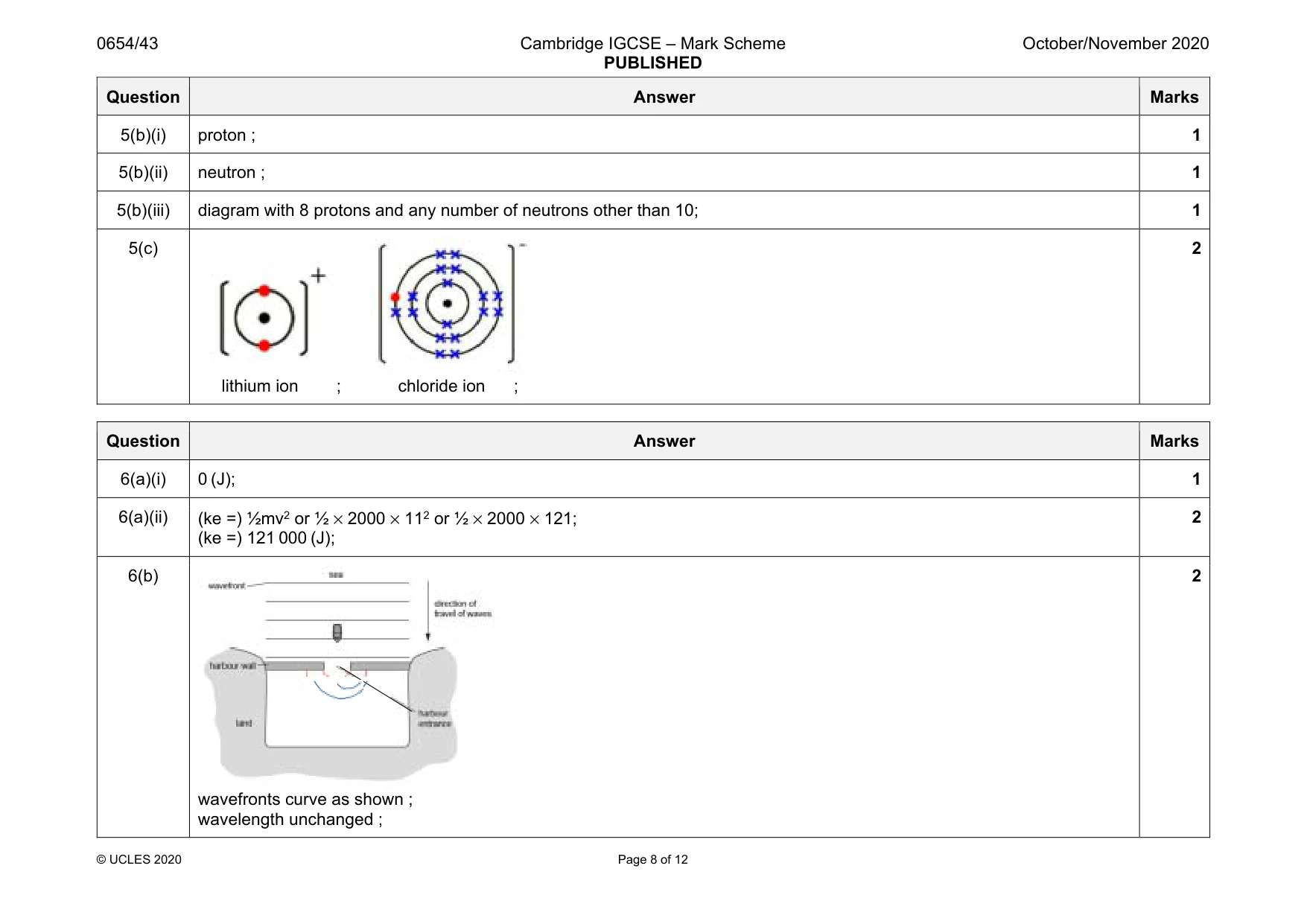
Mark scheme: 5(a)(i) Ne ; 1 5(a)(ii) Mg ; 1 5(a)(iii) any two from Cu, Zn, K, Mg ;; 1 Question Answer Marks 5(b)(i) proton ; 1 5(b)(ii) neutron ; 1 5(b)(iii) diagram with 8 protons and any number of neutrons other than 10; 1 5(c) lithium ion ; chloride ion ; 2
Q6 · A boat has a mass of 2000 kg
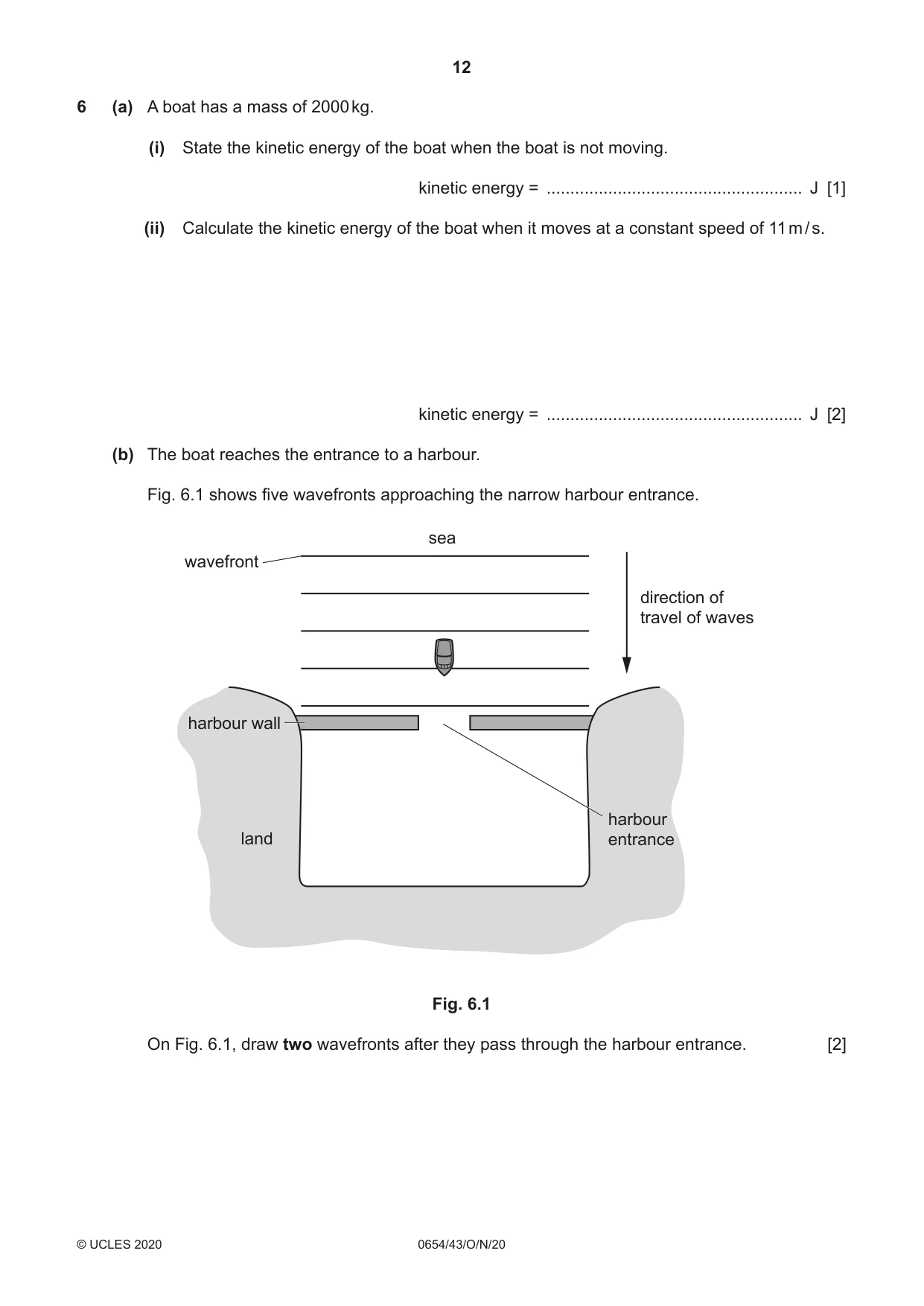
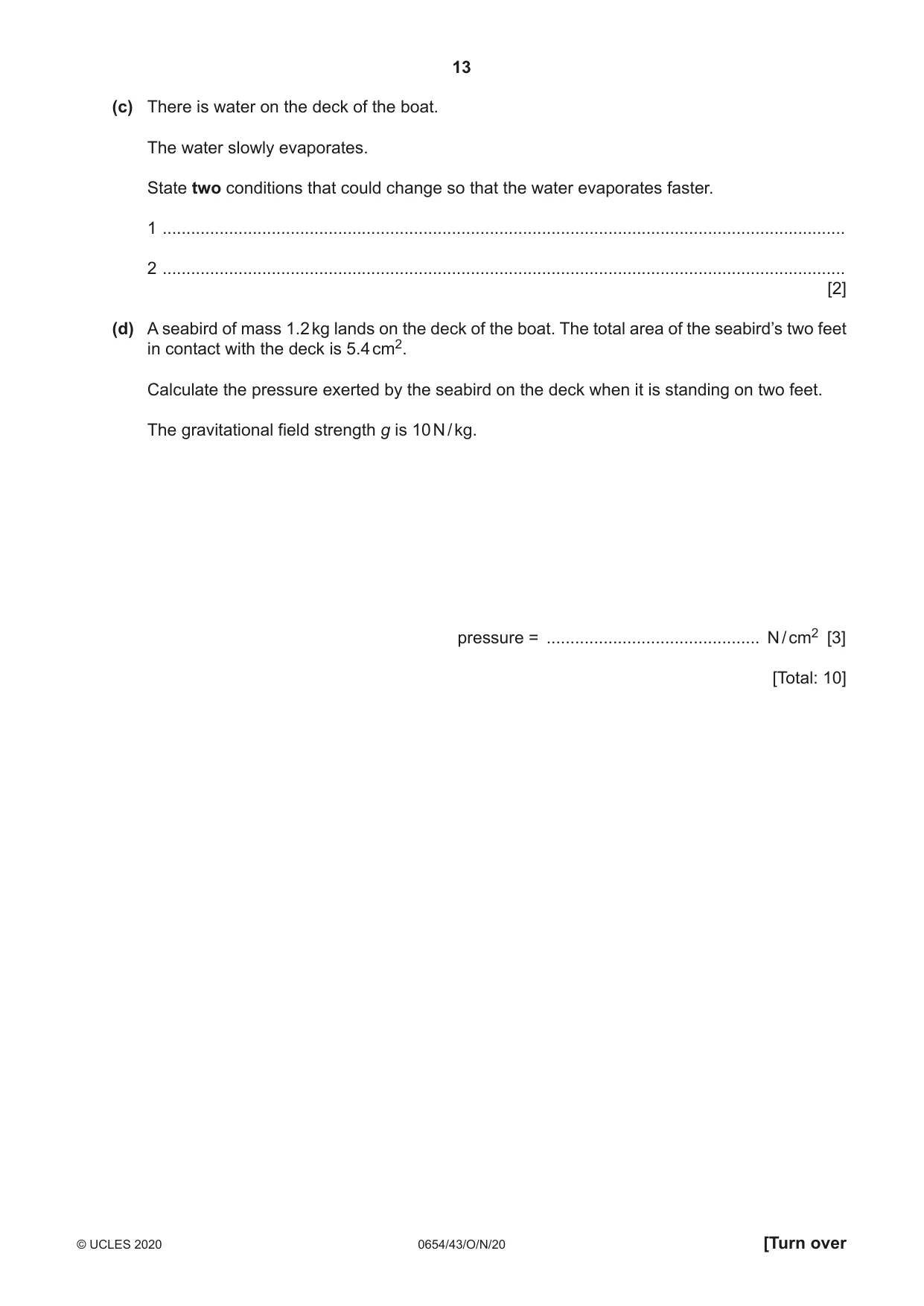
6 (a) A boat has a mass of 2000 kg. (i) State the kinetic energy of the boat when the boat is not moving. kinetic energy = ...................................................... J [1] (ii) Calculate the kinetic energy of the boat when it moves at a constant speed of 11 m / s. kinetic energy = ...................................................... J [2] (b) The boat reaches the entrance to a harbour. Fig. 6.1 shows five wavefronts approaching the narrow harbour entrance. sea wavefront direction of travel of waves harbour wall harbour land entrance Fig. 6.1 On Fig. 6.1, draw two wavefronts after they pass through the harbour entrance. [2] (c) There is water on the deck of the boat. The water slowly evaporates. State two conditions that could change so that the water evaporates faster. 1 ................................................................................................................................................ 2 ................................................................................................................................................ [2] (d) A seabird of mass 1.2 kg lands on the deck of the boat. The total area of the seabird’s two feet in contact with the deck is 5.4 cm2. Calculate the pressure exerted by the seabird on the deck when it is standing on two feet. The gravitational field strength g is 10 N / kg. pressure = ............................................. N / cm2 [3] [Total: 10]
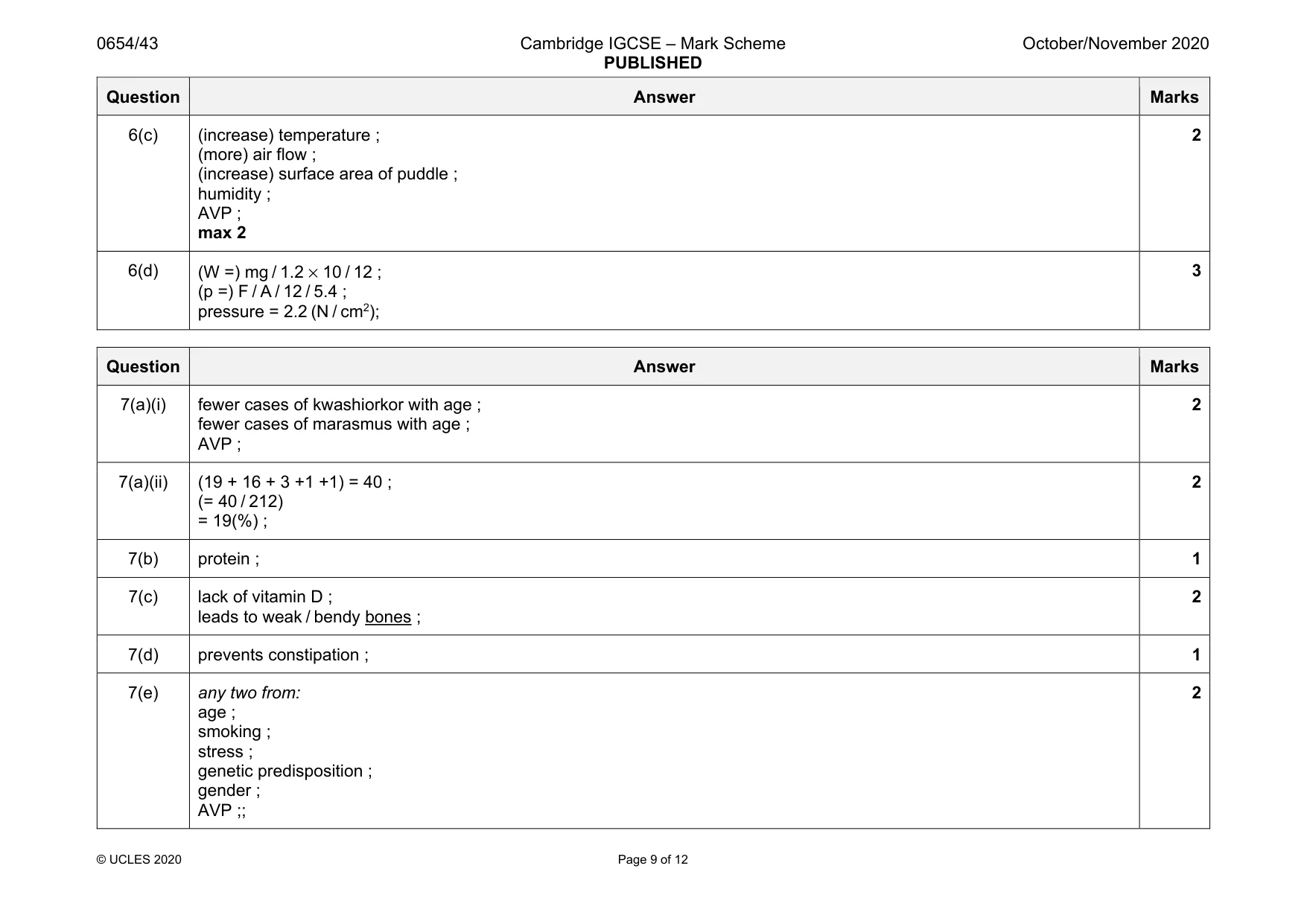
Mark scheme: 6(a)(i) 0 (J); 1 6(a)(ii) (ke =) ½mv2 or ½ × 2000 × 112 or ½ × 2000 × 121; (ke =) 121 000 (J); 2 6(b) wavefronts curve as shown ; wavelength unchanged ; 2 Question Answer Marks 6(c) (increase) temperature ; (more) air flow ; (increase) surface area of puddle ; humidity ; AVP ; max 2 2 6(d) (W =) mg / 1.2 × 10 / 12 ; (p =) F / A / 12 / 5.4 ; pressure = 2.2 (N / cm2); 3
Q7 · The deficiency diseases of children of different ages admitted to a hospital
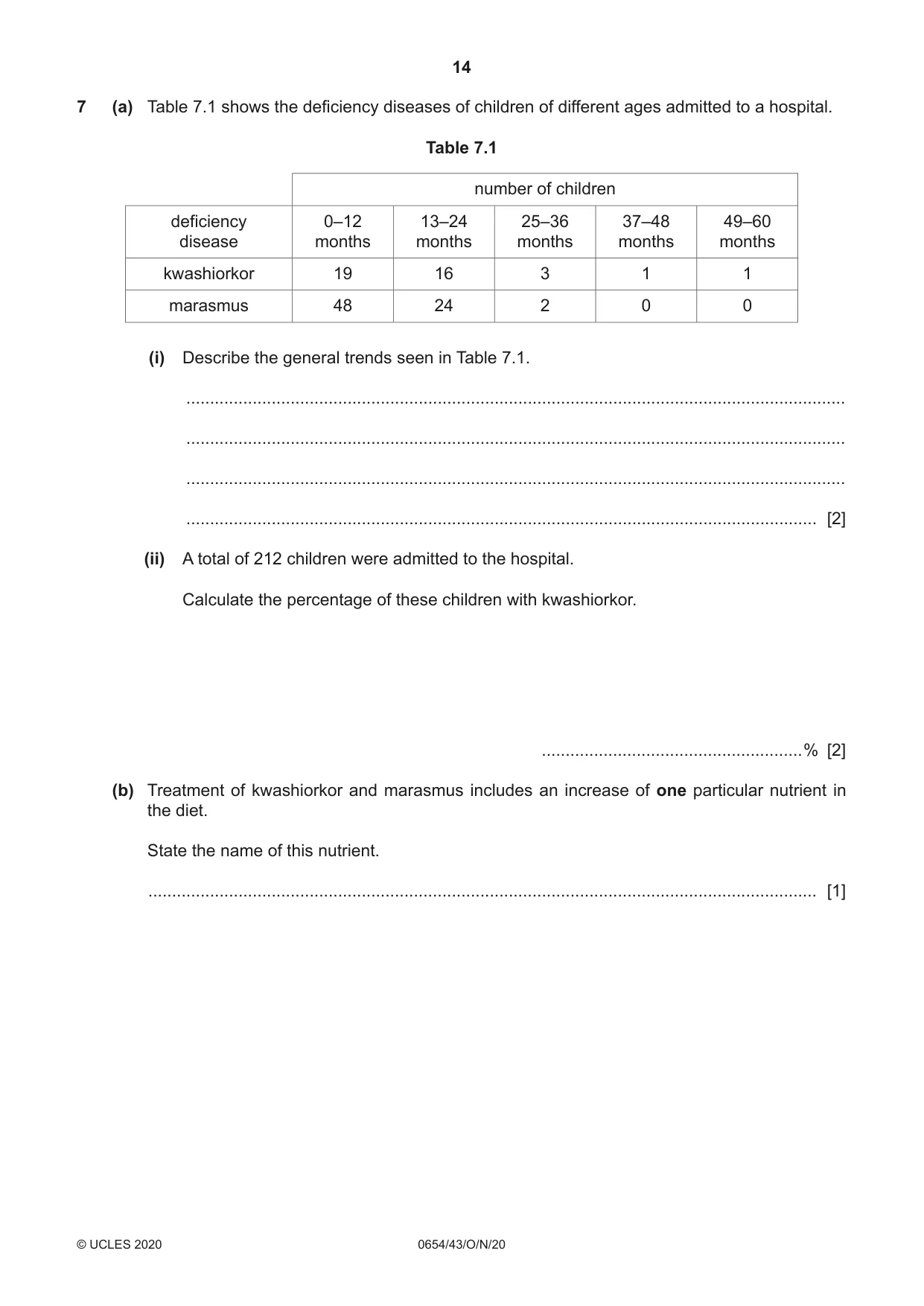
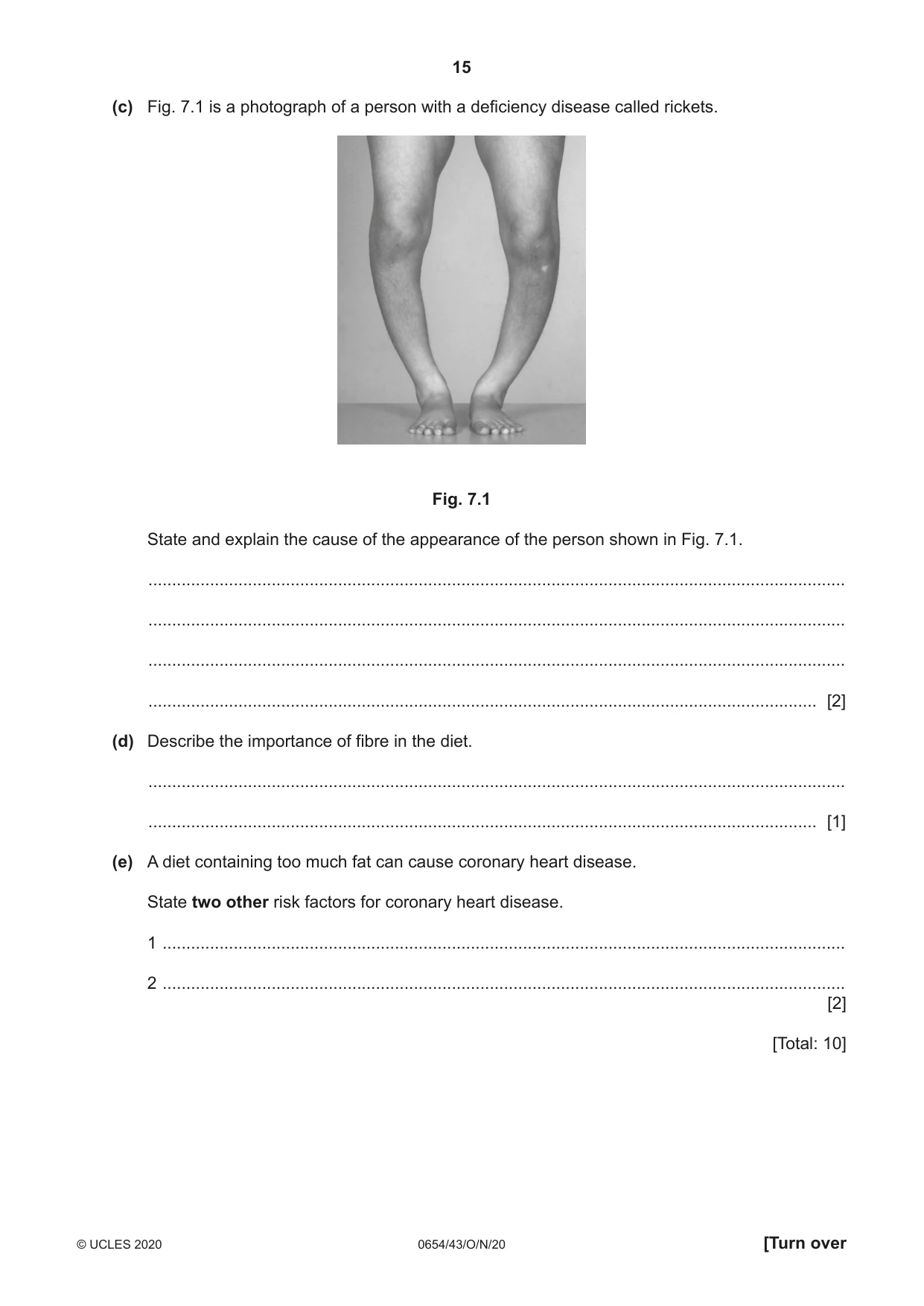
7 (a) Table 7.1 shows the deficiency diseases of children of different ages admitted to a hospital. Table 7.1 number of children deficiency 0–12 13–24 25–36 37–48 49–60 disease months months months months months kwashiorkor 19 16 3 1 1 marasmus 48 24 2 0 0 (i) Describe the general trends seen in Table 7.1. ........................................................................................................................................... ........................................................................................................................................... ........................................................................................................................................... ..................................................................................................................................... [2] (ii) A total of 212 children were admitted to the hospital. Calculate the percentage of these children with kwashiorkor. .......................................................% [2] (b) Treatment of kwashiorkor and marasmus includes an increase of one particular nutrient in the diet. State the name of this nutrient. ............................................................................................................................................. [1] (c) Fig. 7.1 is a photograph of a person with a deficiency disease called rickets. Fig. 7.1 State and explain the cause of the appearance of the person shown in Fig. 7.1. ................................................................................................................................................... ................................................................................................................................................... ................................................................................................................................................... ............................................................................................................................................. [2] (d) Describe the importance of fibre in the diet. ................................................................................................................................................... ............................................................................................................................................. [1] (e) A diet containing too much fat can cause coronary heart disease. State two other risk factors for coronary heart disease. 1 ................................................................................................................................................ 2 ................................................................................................................................................ [2] [Total: 10]
Mark scheme: 7(a)(i) fewer cases of kwashiorkor with age ; fewer cases of marasmus with age ; AVP ; 2 7(a)(ii) (19 + 16 + 3 +1 +1) = 40 ; (= 40 / 212) = 19(%) ; 2 7(b) protein ; 1 7(c) lack of vitamin D ; leads to weak / bendy bones ; 2 7(d) prevents constipation ; 1 7(e) any two from: age ; smoking ; stress ; genetic predisposition ; gender ; AVP ;; 2
Q8 · The structures of ethene and of ethanol
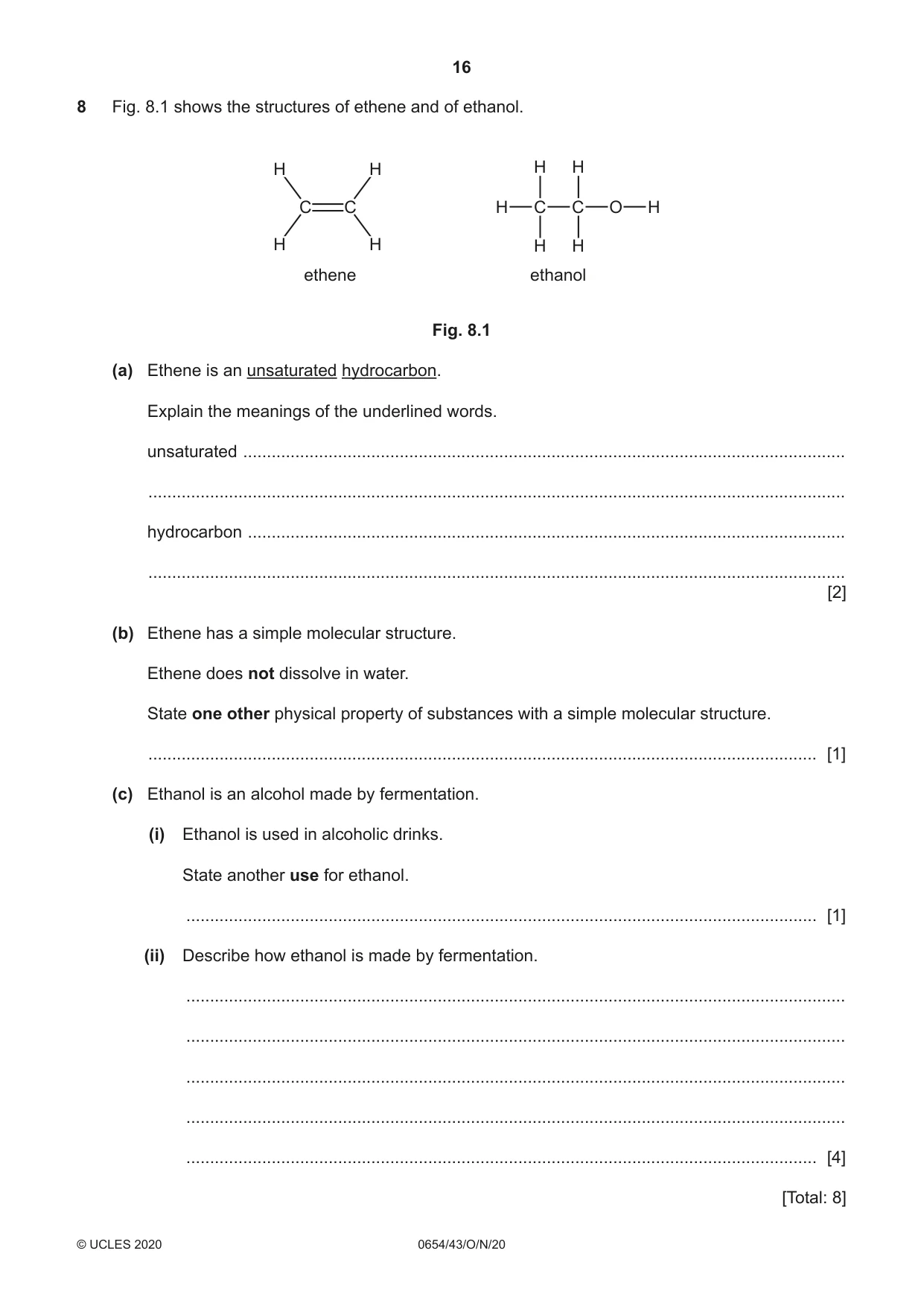
8 Fig. 8.1 shows the structures of ethene and of ethanol. H H H H C C H C C O H H H H H ethene ethanol Fig. 8.1 (a) Ethene is an unsaturated hydrocarbon. Explain the meanings of the underlined words. unsaturated ............................................................................................................................... ................................................................................................................................................... hydrocarbon .............................................................................................................................. ................................................................................................................................................... [2] (b) Ethene has a simple molecular structure. Ethene does not dissolve in water. State one other physical property of substances with a simple molecular structure. ............................................................................................................................................. [1] (c) Ethanol is an alcohol made by fermentation. (i) Ethanol is used in alcoholic drinks. State another use for ethanol. ..................................................................................................................................... [1] (ii) Describe how ethanol is made by fermentation. ........................................................................................................................................... ........................................................................................................................................... ........................................................................................................................................... ........................................................................................................................................... ..................................................................................................................................... [4] [Total: 8]
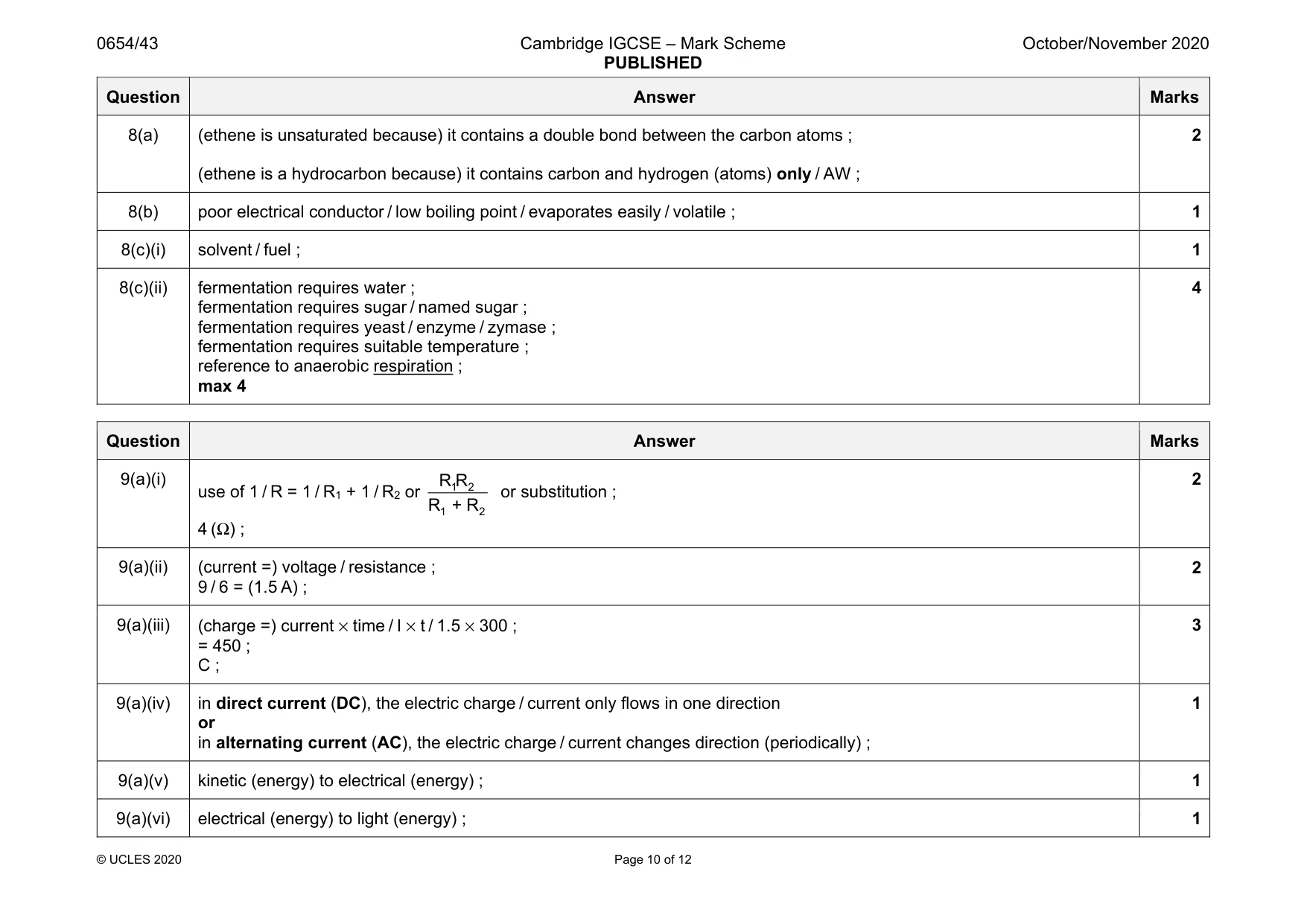
Mark scheme: 8(a) (ethene is unsaturated because) it contains a double bond between the carbon atoms ; (ethene is a hydrocarbon because) it contains carbon and hydrogen (atoms) only / AW ; 2 8(b) poor electrical conductor / low boiling point / evaporates easily / volatile ; 1 8(c)(i) solvent / fuel ; 1 8(c)(ii) fermentation requires water ; fermentation requires sugar / named sugar ; fermentation requires yeast / enzyme / zymase ; fermentation requires suitable temperature ; reference to anaerobic respiration ; max 4 4
Q9 · A bicycle with a front lamp F and a rear lamp R, powered by a 9 V generator (dynamo)
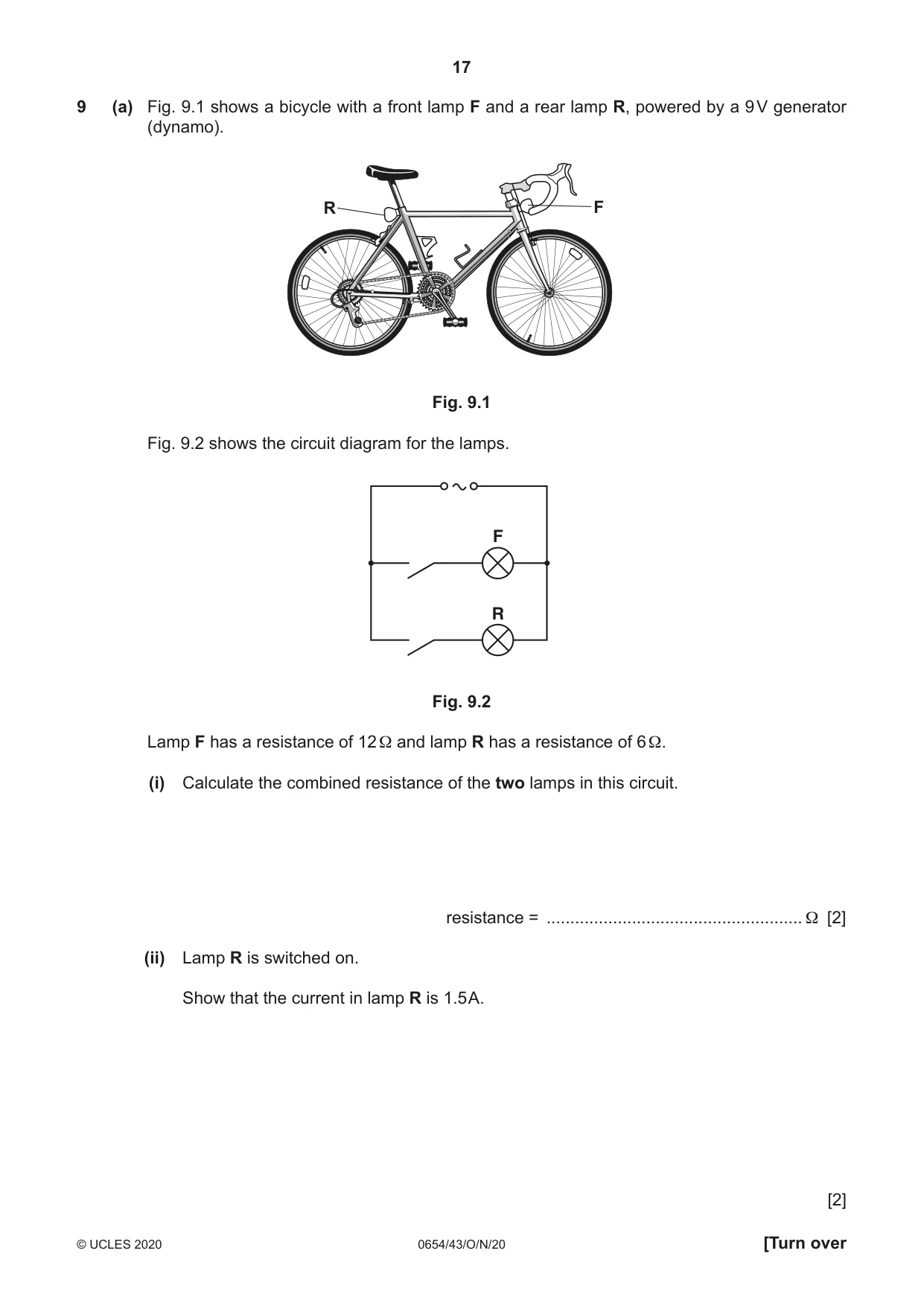
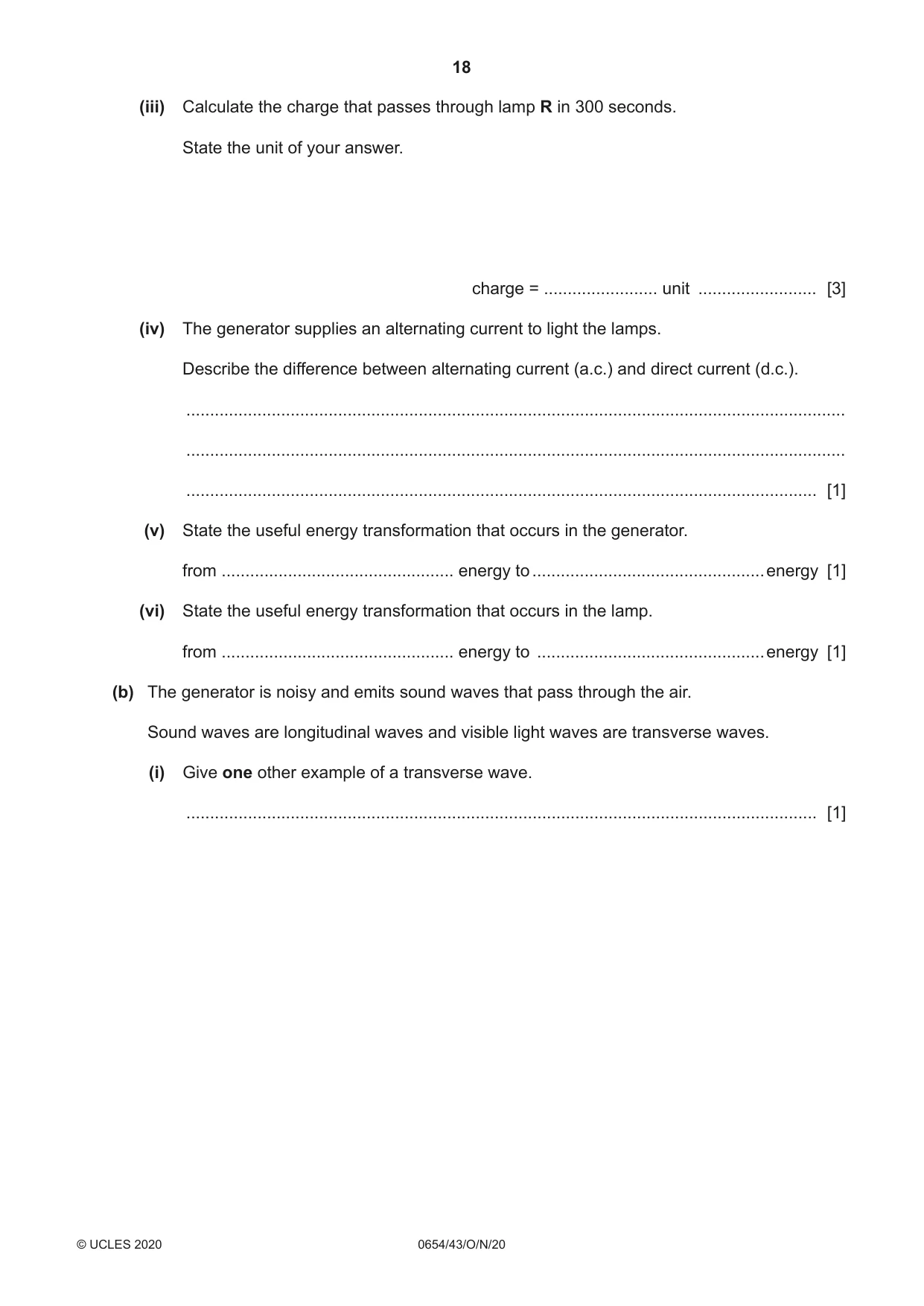
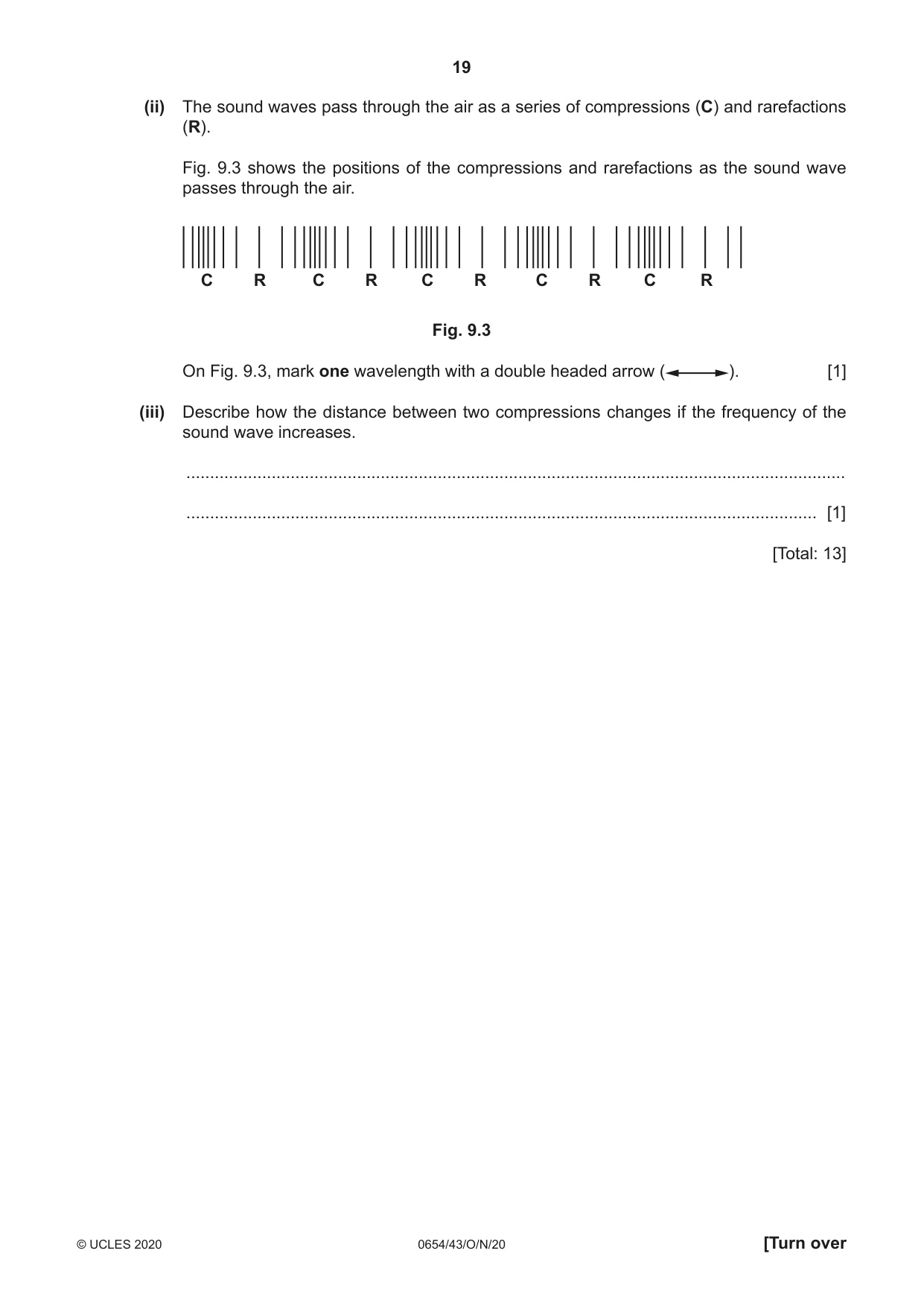
9 (a) Fig. 9.1 shows a bicycle with a front lamp F and a rear lamp R, powered by a 9 V generator (dynamo). R F Fig. 9.1 Fig. 9.2 shows the circuit diagram for the lamps. F R Fig. 9.2 Lamp F has a resistance of 12 Ω and lamp R has a resistance of 6 Ω. (i) Calculate the combined resistance of the two lamps in this circuit. resistance = ...................................................... Ω [2] (ii) Lamp R is switched on. Show that the current in lamp R is 1.5 A. [2] (iii) Calculate the charge that passes through lamp R in 300 seconds. State the unit of your answer. charge = ........................ unit ......................... [3] (iv) The generator supplies an alternating current to light the lamps. Describe the difference between alternating current (a.c.) and direct current (d.c.). ........................................................................................................................................... ........................................................................................................................................... ..................................................................................................................................... [1] (v) State the useful energy transformation that occurs in the generator. from ................................................. energy to .................................................energy [1] (vi) State the useful energy transformation that occurs in the lamp. from ................................................. energy to ................................................energy [1] (b) The generator is noisy and emits sound waves that pass through the air. Sound waves are longitudinal waves and visible light waves are transverse waves. (i) Give one other example of a transverse wave. ..................................................................................................................................... [1] (ii) The sound waves pass through the air as a series of compressions (C) and rarefactions (R). Fig. 9.3 shows the positions of the compressions and rarefactions as the sound wave passes through the air. C R C R C R C R C R Fig. 9.3 On Fig. 9.3, mark one wavelength with a double headed arrow ( ). [1] (iii) Describe how the distance between two compressions changes if the frequency of the sound wave increases. ........................................................................................................................................... ..................................................................................................................................... [1] [Total: 13]
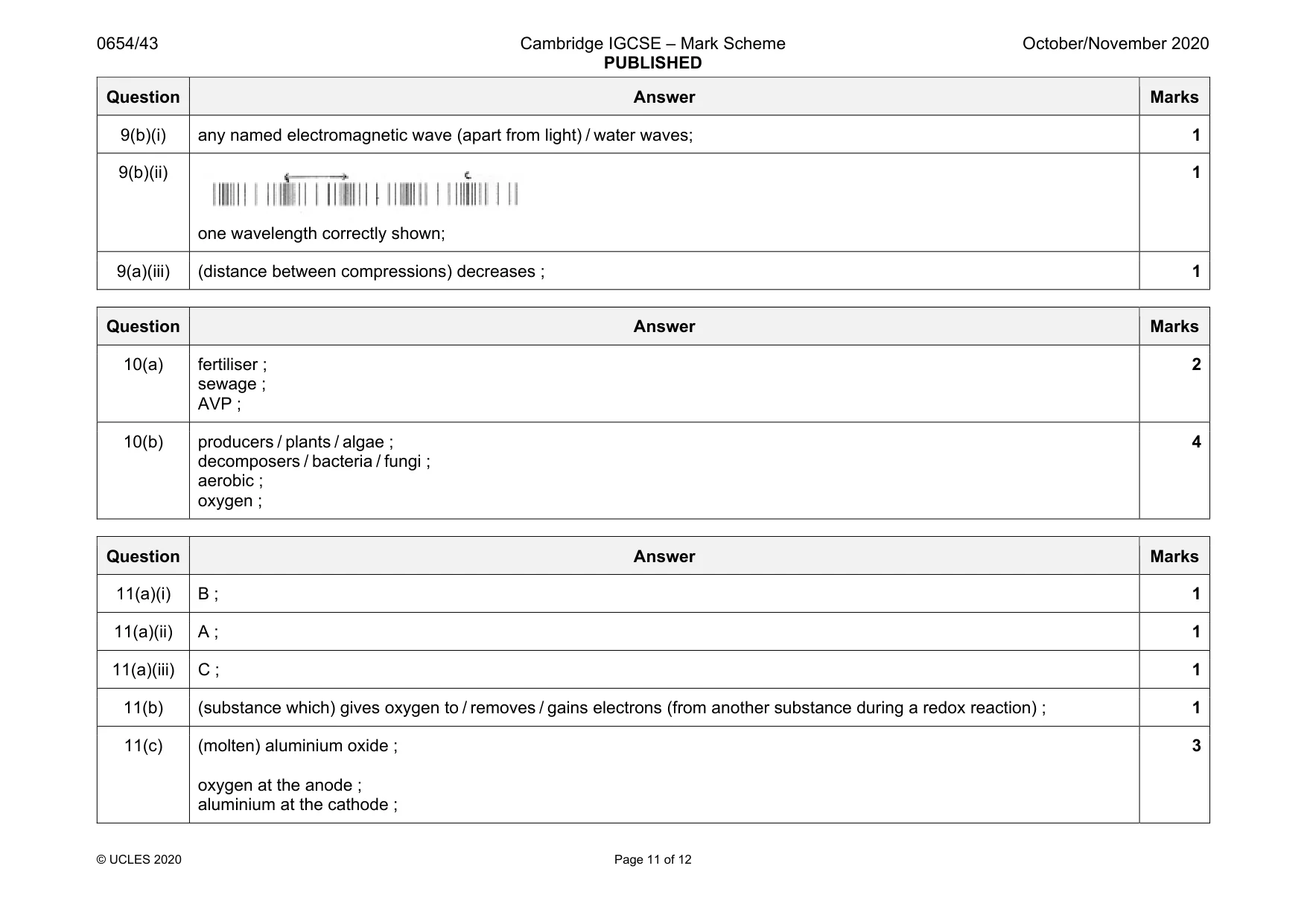
Mark scheme: 9(a)(i) use of 1 / R = 1 / R1 + 1 / R2 or 1 2 1 2 R R R + R or substitution ; 4 (Ω) ; 2 9(a)(ii) (current =) voltage / resistance ; 9 / 6 = (1.5 A) ; 2 9(a)(iii) (charge =) current × time / I × t / 1.5 × 300 ; = 450 ; C ; 3 9(a)(iv) in direct current (DC), the electric charge / current only flows in one direction or in alternating current (AC), the electric charge / current changes direction (periodically) ; 1 9(a)(v) kinetic (energy) to electrical (energy) ; 1 9(a)(vi) electrical (energy) to light (energy) ; 1 Question Answer Marks 9(b)(i) any named electromagnetic wave (apart from light) / water waves; 1 9(b)(ii) one wavelength correctly shown; 1 9(a)(iii) (distance between compressions) decreases ; 1
Q10 · Increasing the concentration of nitrate ions in freshwater can cause eutrophication
10 Increasing the concentration of nitrate ions in freshwater can cause eutrophication. (a) State two sources of nitrate ions which cause water pollution. 1 ................................................................................................................................................ 2 ................................................................................................................................................ [2] (b) Complete the sentences to explain how an increase in nitrate ions in water causes eutrophication. The increased availability of nitrate ions increases the growth of .................................. on the surface of the water. Underwater plants cannot receive light and so cannot photosynthesise. Underwater plants die and are broken down by ............................................... . This causes an increase in ...................................... respiration. Dissolved .......................................... concentration in the water decreases, which causes aquatic organisms to die. [4] [Total: 6]
Mark scheme: 10(a) fertiliser ; sewage ; AVP ; 2 10(b) producers / plants / algae ; decomposers / bacteria / fungi ; aerobic ; oxygen ; 4
Q11 · The equations A, B, C and D represent four possible reactions
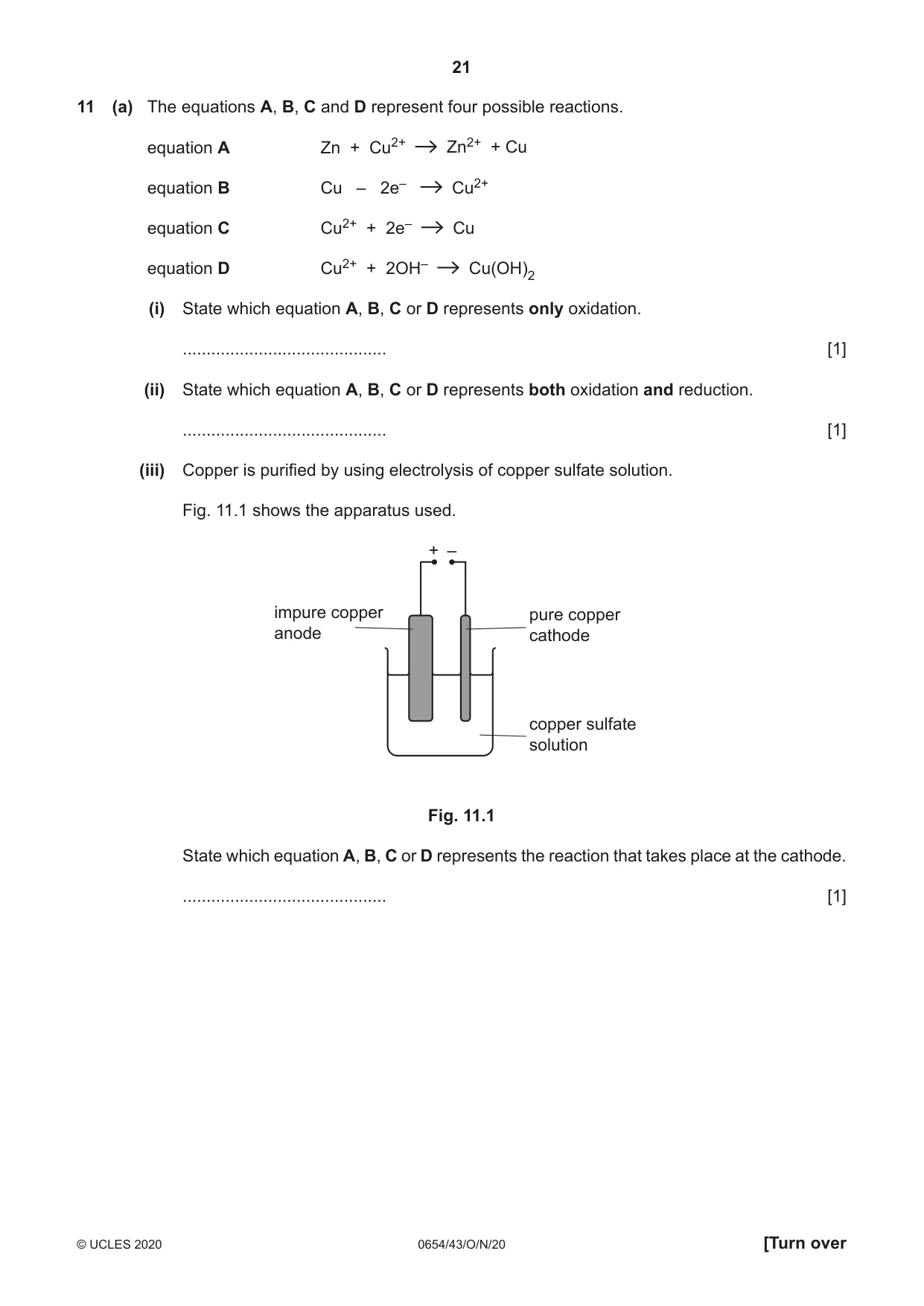
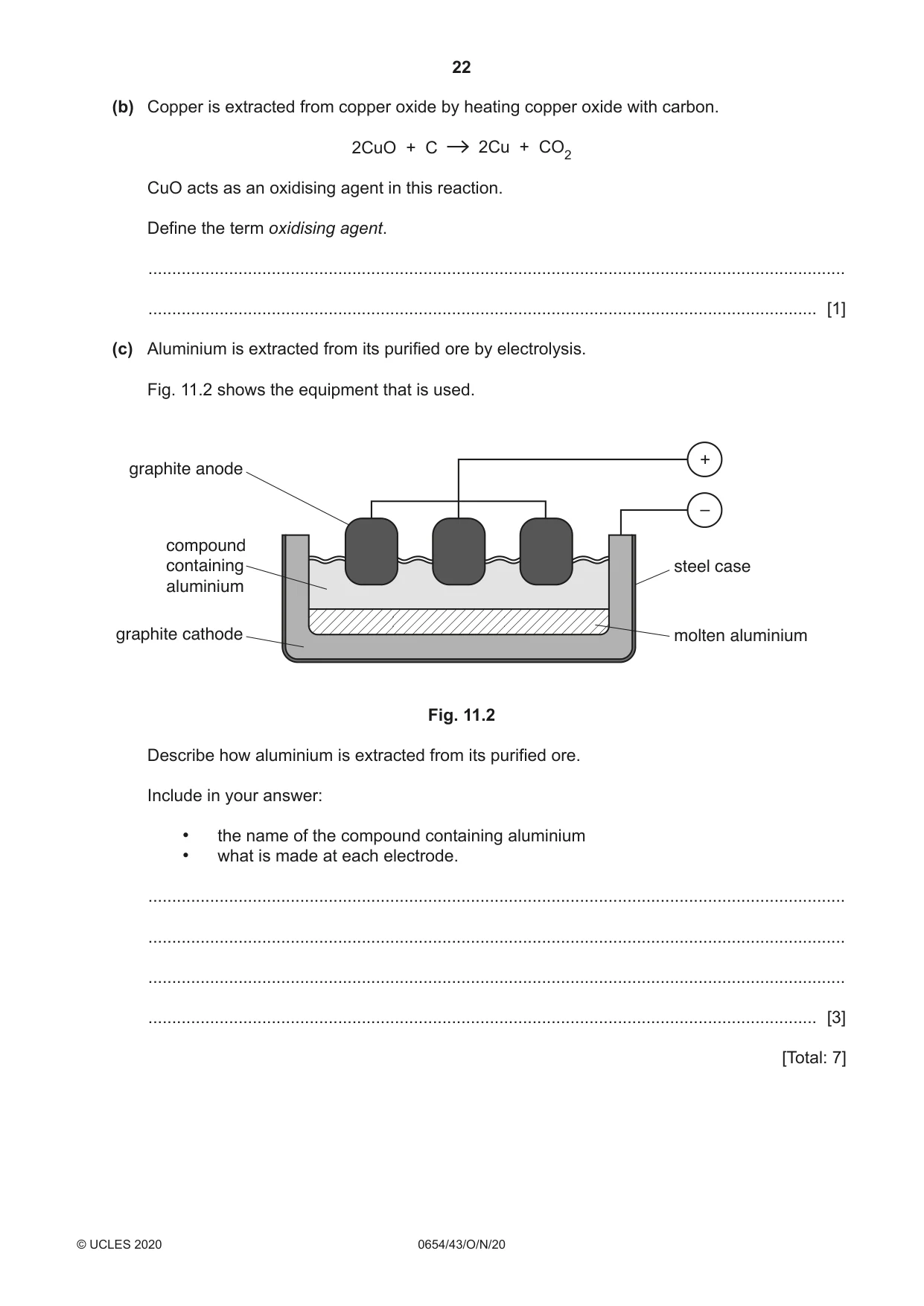
11 (a) The equations A, B, C and D represent four possible reactions. equation A Zn + Cu2+ Zn2+ + Cu equation B Cu – 2e– Cu2+ equation C Cu2+ + 2e– Cu equation D Cu2+ + 2OH– Cu(OH)2 (i) State which equation A, B, C or D represents only oxidation. ........................................... [1] (ii) State which equation A, B, C or D represents both oxidation and reduction. ........................................... [1] (iii) Copper is purified by using electrolysis of copper sulfate solution. Fig. 11.1 shows the apparatus used. + – impure copper pure copper anode cathode copper sulfate solution Fig. 11.1 State which equation A, B, C or D represents the reaction that takes place at the cathode. ........................................... [1] (b) Copper is extracted from copper oxide by heating copper oxide with carbon. 2CuO + C 2Cu + CO2 CuO acts as an oxidising agent in this reaction. Define the term oxidising agent. ................................................................................................................................................... ............................................................................................................................................. [1] (c) Aluminium is extracted from its purified ore by electrolysis. Fig. 11.2 shows the equipment that is used. + graphite anode – compound containing steel case aluminium graphite cathode molten aluminium Fig. 11.2 Describe how aluminium is extracted from its purified ore. Include in your answer: • the name of the compound containing aluminium • what is made at each electrode. ................................................................................................................................................... ................................................................................................................................................... ................................................................................................................................................... ............................................................................................................................................. [3] [Total: 7]
Mark scheme: 11(a)(i) B ; 1 11(a)(ii) A ; 1 11(a)(iii) C ; 1 11(b) (substance which) gives oxygen to / removes / gains electrons (from another substance during a redox reaction) ; 1 11(c) (molten) aluminium oxide ; oxygen at the anode ; aluminium at the cathode ; 3
Q12 · A hot water storage tank in a house
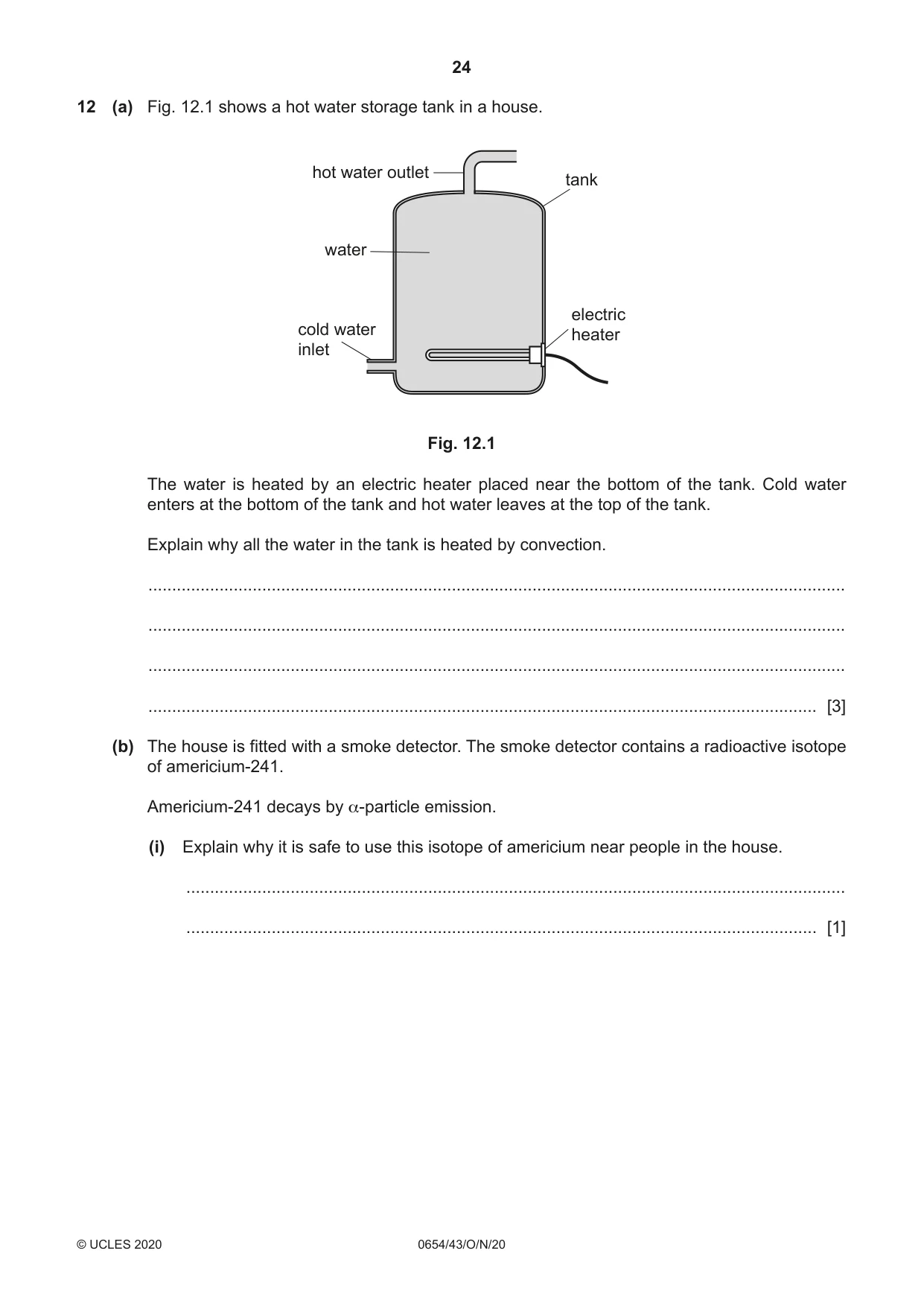
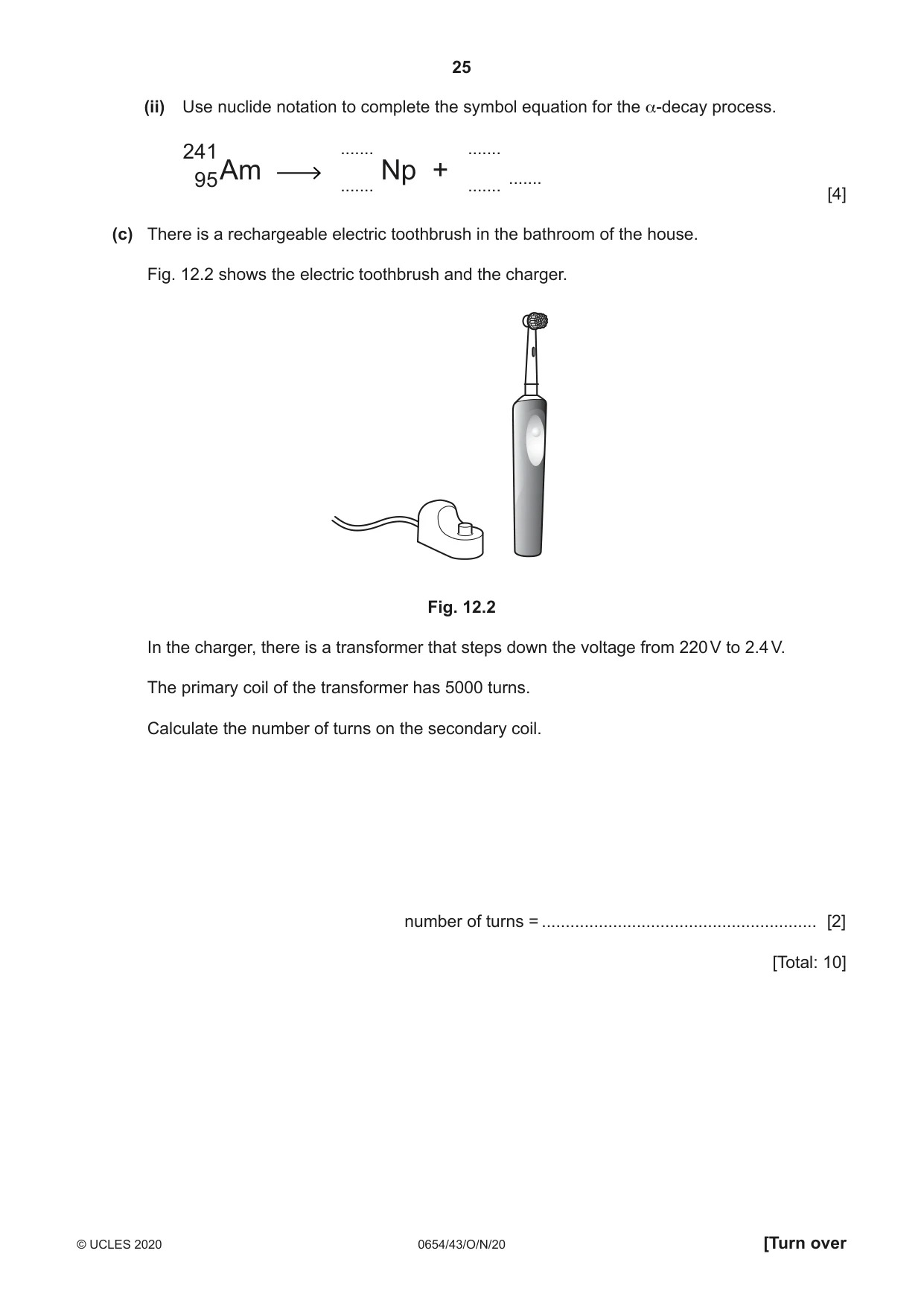
12 (a) Fig. 12.1 shows a hot water storage tank in a house. hot water outlet tank water electric cold water heater inlet Fig. 12.1 The water is heated by an electric heater placed near the bottom of the tank. Cold water enters at the bottom of the tank and hot water leaves at the top of the tank. Explain why all the water in the tank is heated by convection. ................................................................................................................................................... ................................................................................................................................................... ................................................................................................................................................... ............................................................................................................................................. [3] (b) The house is fitted with a smoke detector. The smoke detector contains a radioactive isotope of americium-241. Americium-241 decays by α-particle emission. (i) Explain why it is safe to use this isotope of americium near people in the house. ........................................................................................................................................... ..................................................................................................................................... [1] (ii) Use nuclide notation to complete the symbol equation for the α-decay process. 241 ....... ....... Am Np + ....... 95 ....... ....... [4] (c) There is a rechargeable electric toothbrush in the bathroom of the house. Fig. 12.2 shows the electric toothbrush and the charger. Fig. 12.2 In the charger, there is a transformer that steps down the voltage from 220 V to 2.4 V. The primary coil of the transformer has 5000 turns. Calculate the number of turns on the secondary coil. number of turns = .......................................................... [2] [Total: 10]
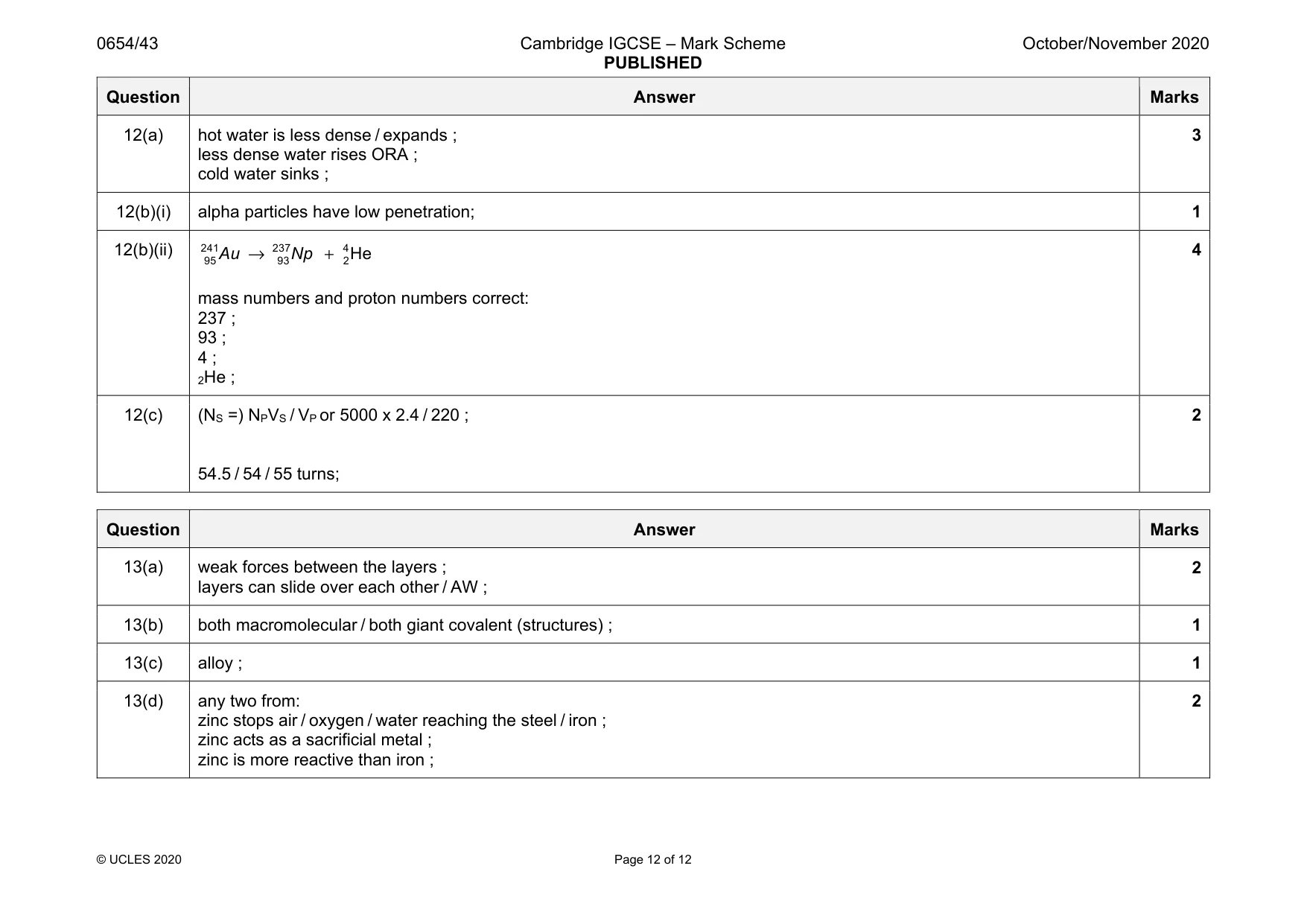
Mark scheme: 12(a) hot water is less dense / expands ; less dense water rises ORA ; cold water sinks ; 3 12(b)(i) alpha particles have low penetration; 1 12(b)(ii) 241 95 Au → + 237 4 93 2 He Np mass numbers and proton numbers correct: 237 ; 93 ; 4 ; 2He ; 4 12(c) (NS =) NPVS / VP or 5000 x 2.4 / 220 ; 54.5 / 54 / 55 turns; 2
Q13 · The structures of graphite and of silicon(IV) oxide
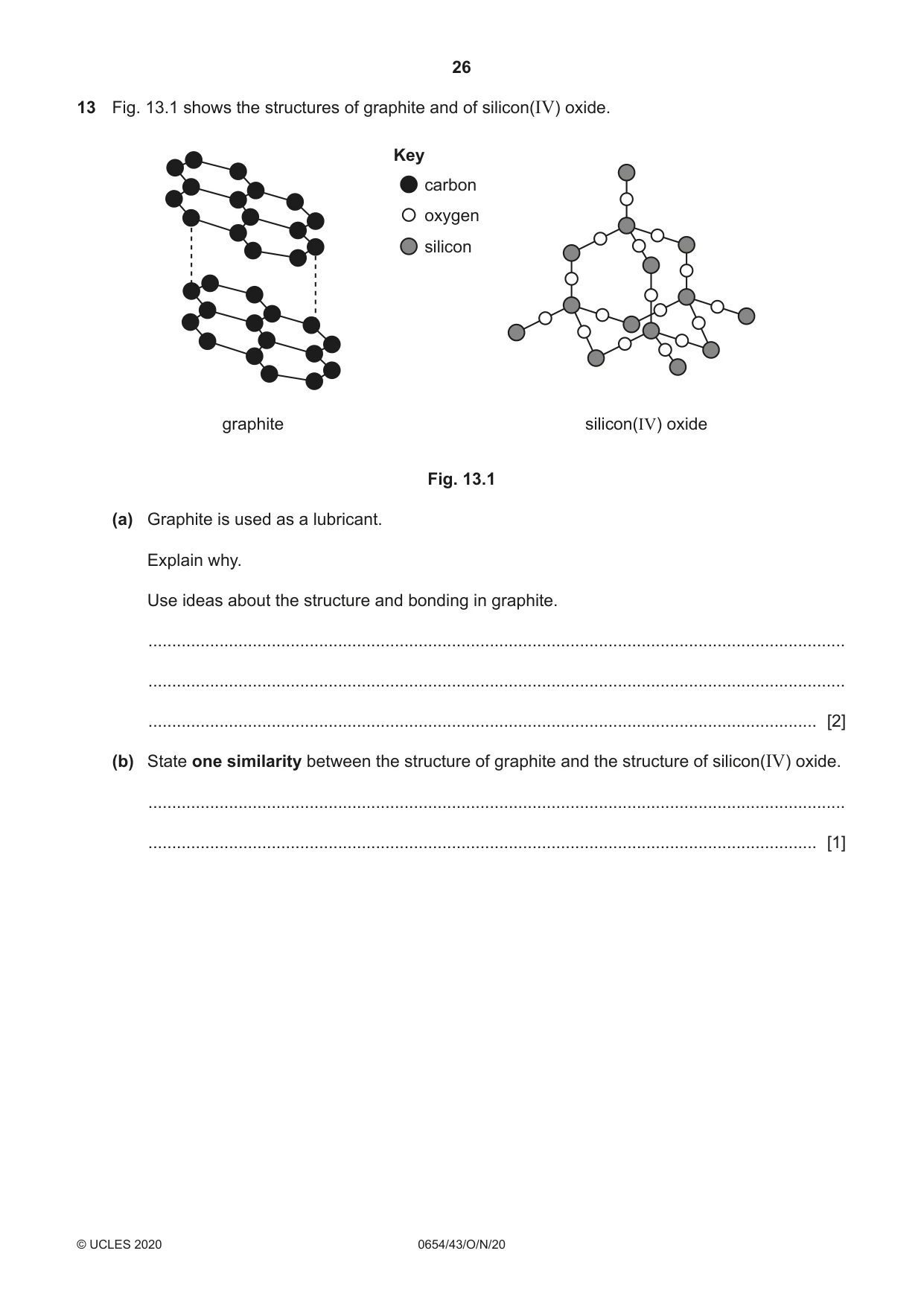
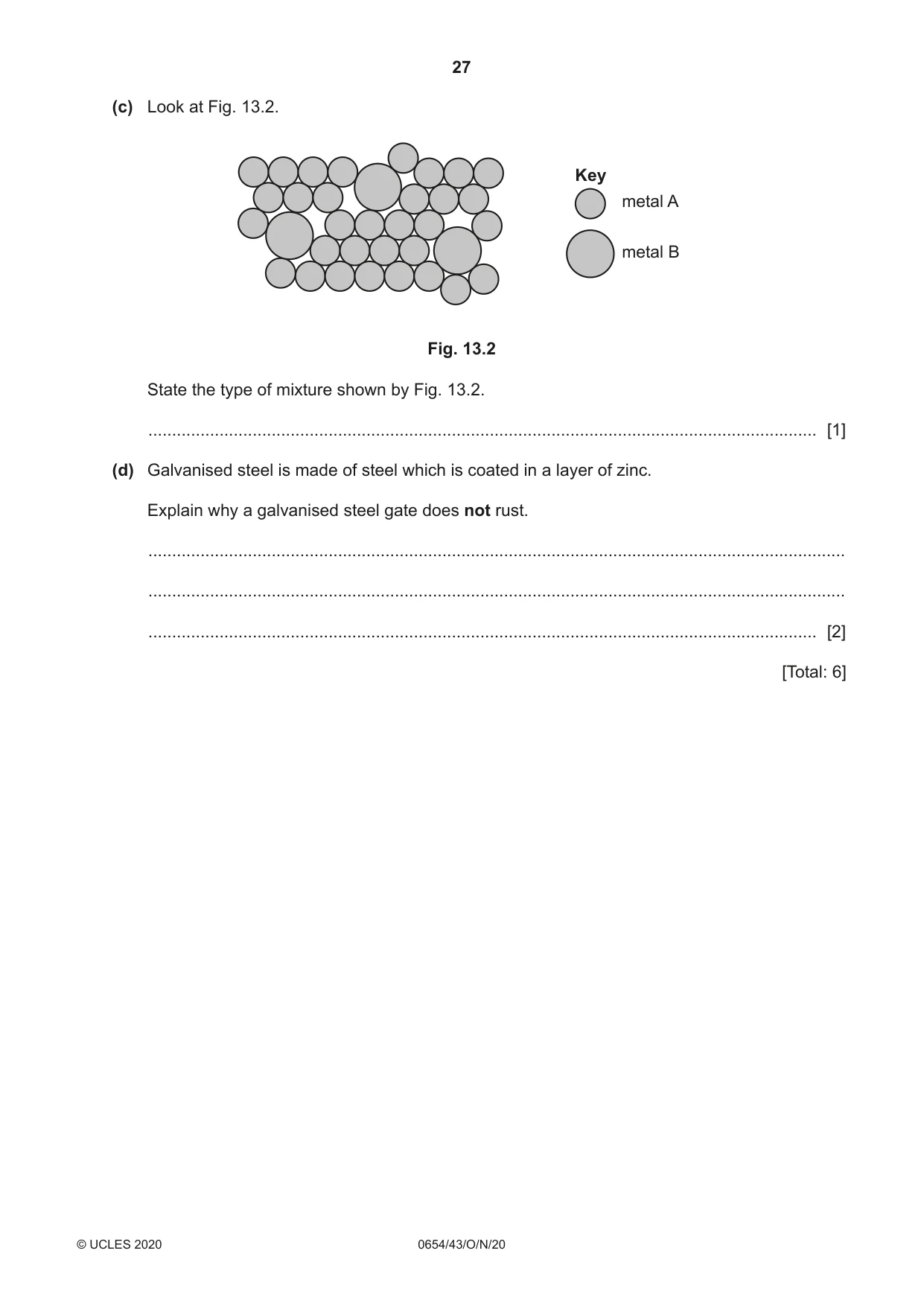
13 Fig. 13.1 shows the structures of graphite and of silicon(IV) oxide. Key carbon oxygen silicon graphite silicon(IV) oxide Fig. 13.1 (a) Graphite is used as a lubricant. Explain why. Use ideas about the structure and bonding in graphite. ................................................................................................................................................... ................................................................................................................................................... ............................................................................................................................................. [2] (b) State one similarity between the structure of graphite and the structure of silicon(IV) oxide. ................................................................................................................................................... ............................................................................................................................................. [1] (c) Look at Fig. 13.2. Key metal A metal B Fig. 13.2 State the type of mixture shown by Fig. 13.2. ............................................................................................................................................. [1] (d) Galvanised steel is made of steel which is coated in a layer of zinc. Explain why a galvanised steel gate does not rust. ................................................................................................................................................... ................................................................................................................................................... ............................................................................................................................................. [2] [Total: 6]
Mark scheme: 13(a) weak forces between the layers ; layers can slide over each other / AW ; 2 13(b) both macromolecular / both giant covalent (structures) ; 1 13(c) alloy ; 1 13(d) any two from: zinc stops air / oxygen / water reaching the steel / iron ; zinc acts as a sacrificial metal ; zinc is more reactive than iron ; 2
What was in this paper
The subtopics covered by these 13 questions, and how many questions each got. Open one in a new tab to see every Cambridge question on it.
What you needed in this session
Cambridge’s own grade thresholds for 2020 Oct/Nov, Paper 4 · Variant 3. A higher threshold means an easier paper — the bar moves with how the cohort did.