Cambridge IGCSE Sciences - Co-ordinated (Double) 0654 — 2025 May/June Paper 4 · Variant 3
0654/43/M/J/25 · 12 questions · 120 marks · 120 min
The question paper and its mark scheme, free to read here and free to download. This is Cambridge’s own paper, exactly as it was sat.
Question paper28 pages


Mark scheme19 pages
Answers below. Sit the paper first if you are practising.
Questions as text
Q1 · The circulatory system of a fish
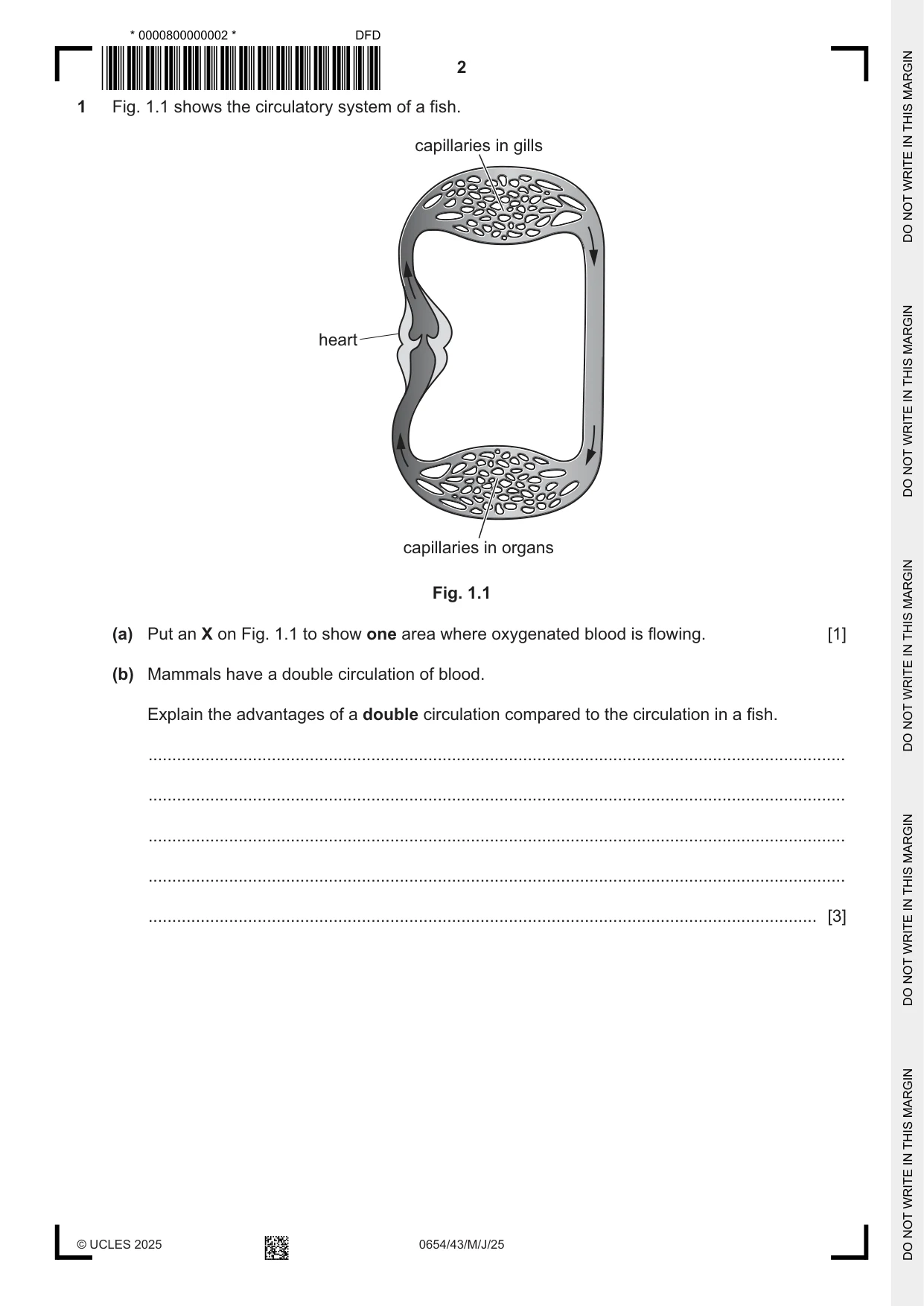
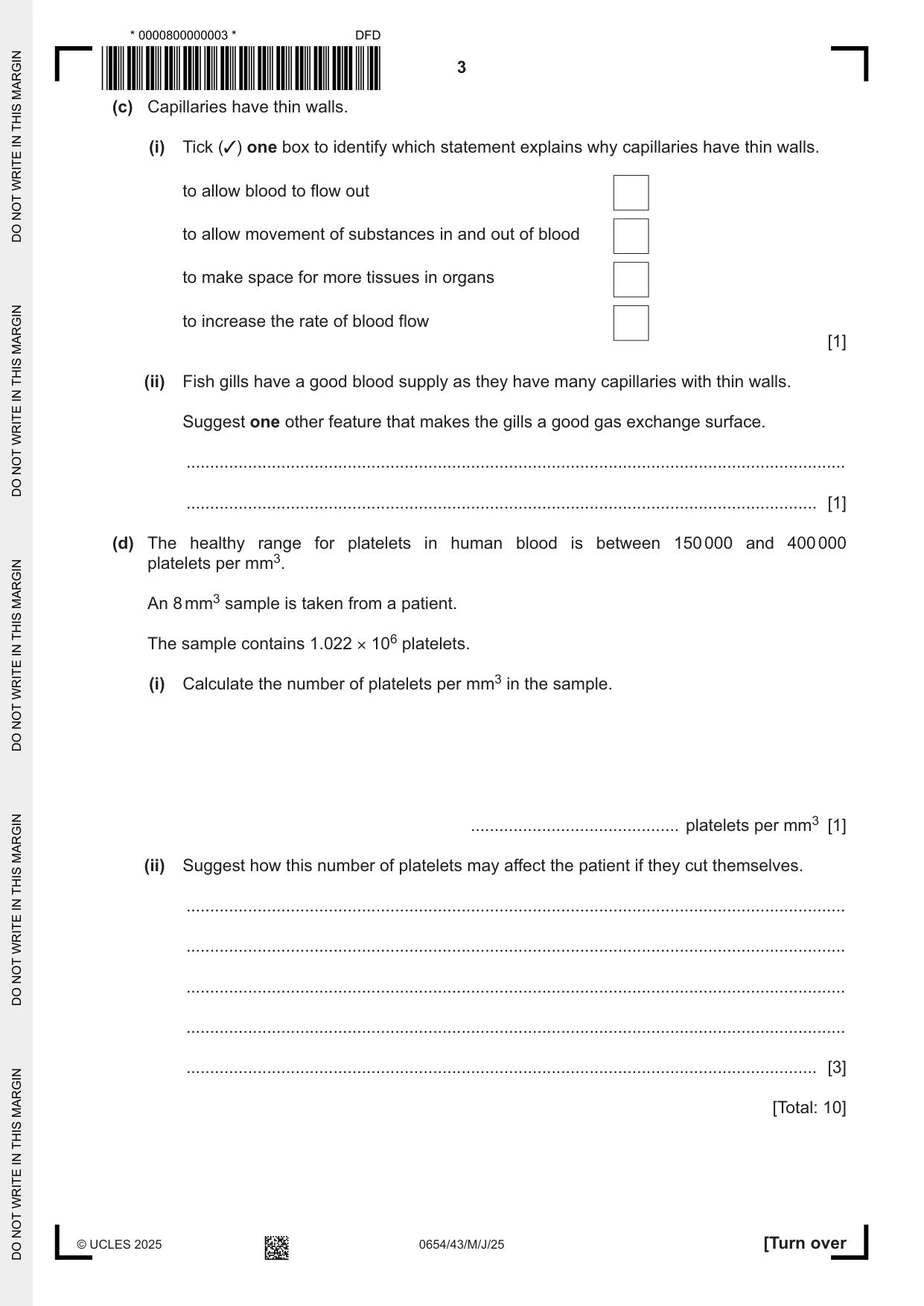
1 Fig. 1.1 shows the circulatory system of a fish. capillaries in gills heart capillaries in organs Fig. 1.1 (a) Put an X on Fig. 1.1 to show one area where oxygenated blood is flowing. [1] (b) Mammals have a double circulation of blood. Explain the advantages of a double circulation compared to the circulation in a fish. ................................................................................................................................................... ................................................................................................................................................... ................................................................................................................................................... ................................................................................................................................................... ............................................................................................................................................. [3] (c) Capillaries have thin walls. (i) Tick (3) one box to identify which statement explains why capillaries have thin walls. to allow blood to flow out to allow movement of substances in and out of blood to make space for more tissues in organs to increase the rate of blood flow [1] (ii) Fish gills have a good blood supply as they have many capillaries with thin walls. Suggest one other feature that makes the gills a good gas exchange surface. ........................................................................................................................................... ..................................................................................................................................... [1] (d) The healthy range for platelets in human blood is between 150 000 and 400 000 platelets per mm3. An 8 mm3 sample is taken from a patient. The sample contains 1.022 × 10⁶ platelets. (i) Calculate the number of platelets per mm3 in the sample. ............................................ platelets per mm3 [1] (ii) Suggest how this number of platelets may affect the patient if they cut themselves. ........................................................................................................................................... ........................................................................................................................................... ........................................................................................................................................... ........................................................................................................................................... ..................................................................................................................................... [3] [Total: 10]
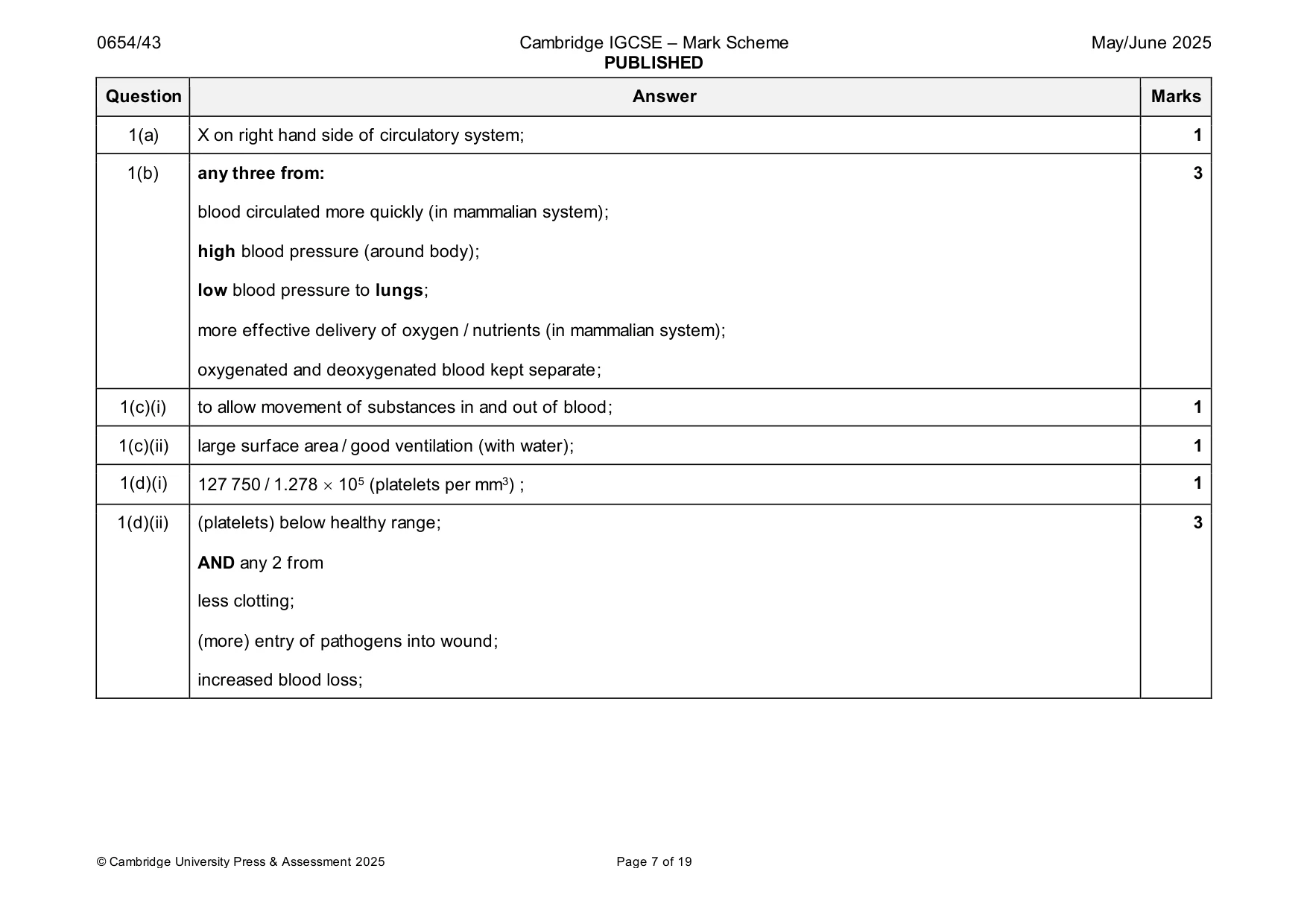
Mark scheme: Question Answer Marks 1(a) X on right hand side of circulatory system; 1 1(b) any three from: 3 blood circulated more quickly (in mammalian system); high blood pressure (around body); low blood pressure to lungs; more effective delivery of oxygen / nutrients (in mammalian system); oxygenated and deoxygenated blood kept separate; 1(c)(i) to allow movement of substances in and out of blood; 1 1(c)(ii) large surface area / good ventilation (with water); 1 1(d)(i) 127 750 / 1.278 105 (platelets per mm3) ; 1 1(d)(ii) (platelets) below healthy range; 3 AND any 2 from less clotting; (more) entry of pathogens into wound; increased blood loss;
Q2 · A patient has been told by his doctor to exercise to reduce his risk of coronary heart…
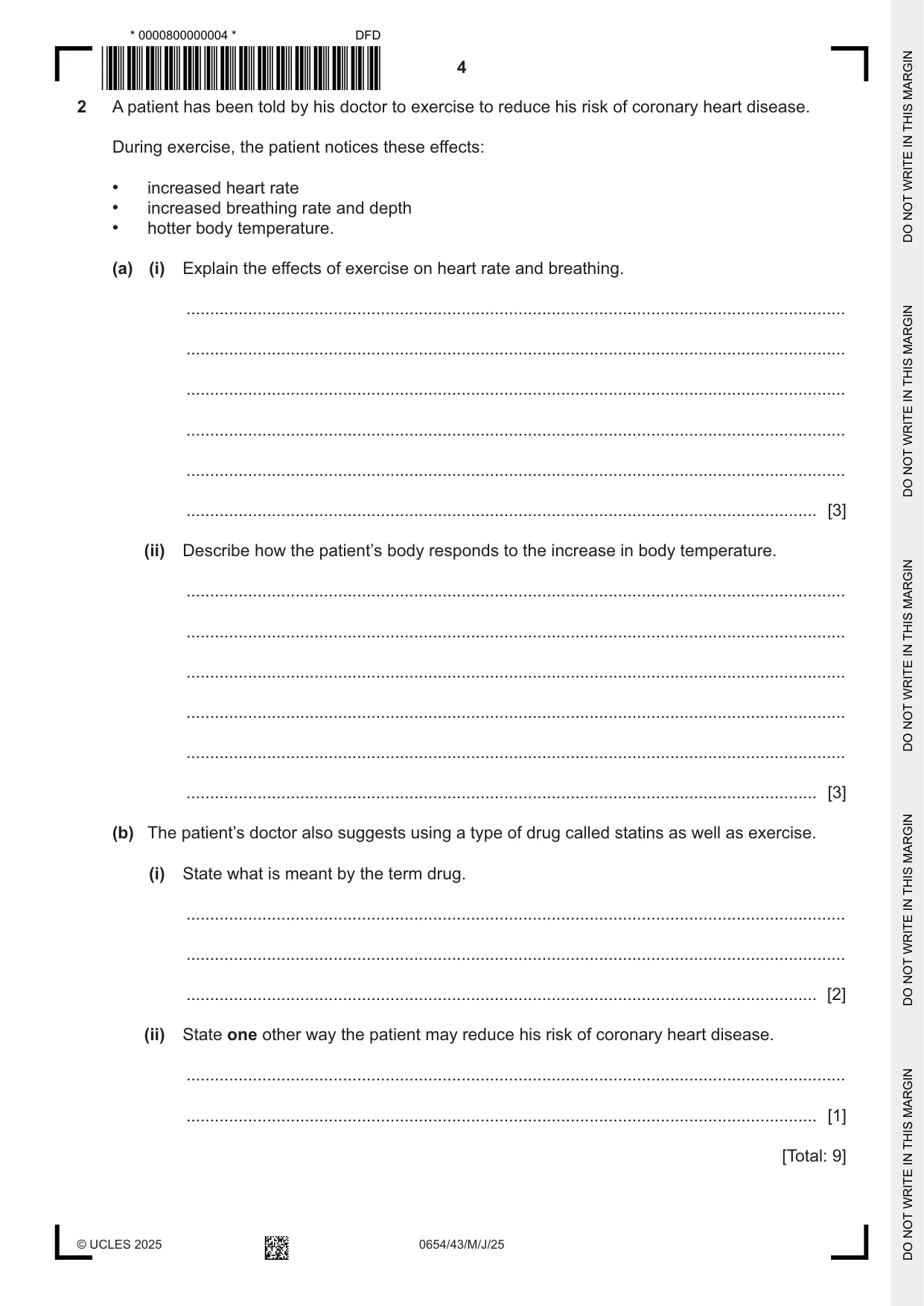
2 A patient has been told by his doctor to exercise to reduce his risk of coronary heart disease. During exercise, the patient notices these effects: • increased heart rate • increased breathing rate and depth • hotter body temperature. (a) (i) Explain the effects of exercise on heart rate and breathing. ........................................................................................................................................... ........................................................................................................................................... ........................................................................................................................................... ........................................................................................................................................... ........................................................................................................................................... ..................................................................................................................................... [3] (ii) Describe how the patient’s body responds to the increase in body temperature. ........................................................................................................................................... ........................................................................................................................................... ........................................................................................................................................... ........................................................................................................................................... ........................................................................................................................................... ..................................................................................................................................... [3] (b) The patient’s doctor also suggests using a type of drug called statins as well as exercise. (i) State what is meant by the term drug. ........................................................................................................................................... ........................................................................................................................................... ..................................................................................................................................... [2] (ii) State one other way the patient may reduce his risk of coronary heart disease. ........................................................................................................................................... ..................................................................................................................................... [1] [Total: 9]
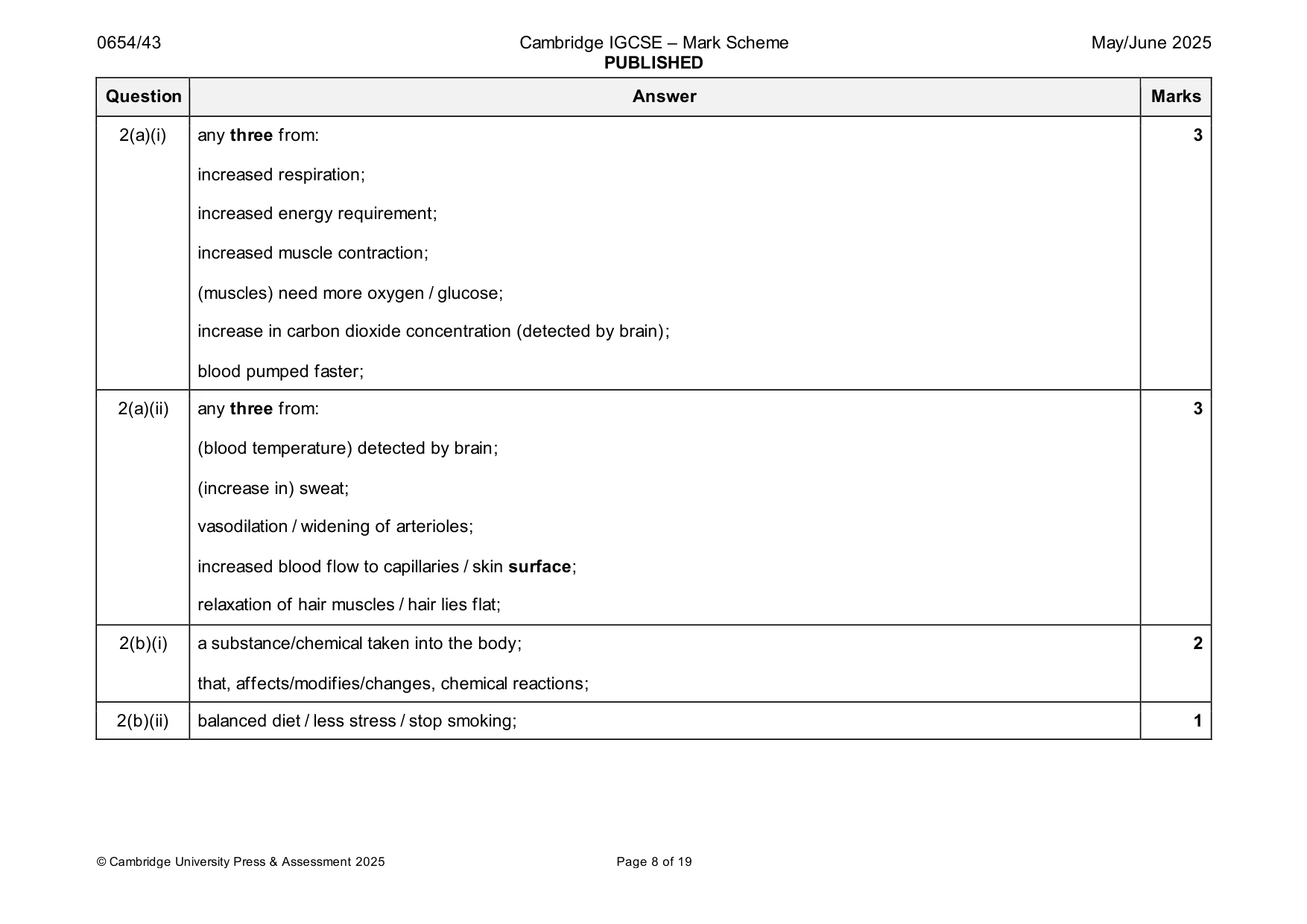
Mark scheme: 2(a)(i) any three from: 3 increased respiration; increased energy requirement; increased muscle contraction; (muscles) need more oxygen / glucose; increase in carbon dioxide concentration (detected by brain); blood pumped faster; 2(a)(ii) any three from: 3 (blood temperature) detected by brain; (increase in) sweat; vasodilation / widening of arterioles; increased blood flow to capillaries / skin surface; relaxation of hair muscles / hair lies flat; 2(b)(i) a substance/chemical taken into the body; 2 that, affects/modifies/changes, chemical reactions; 2(b)(ii) balanced diet / less stress / stop smoking; 1
Q3 · A diagram of the human male reproductive system
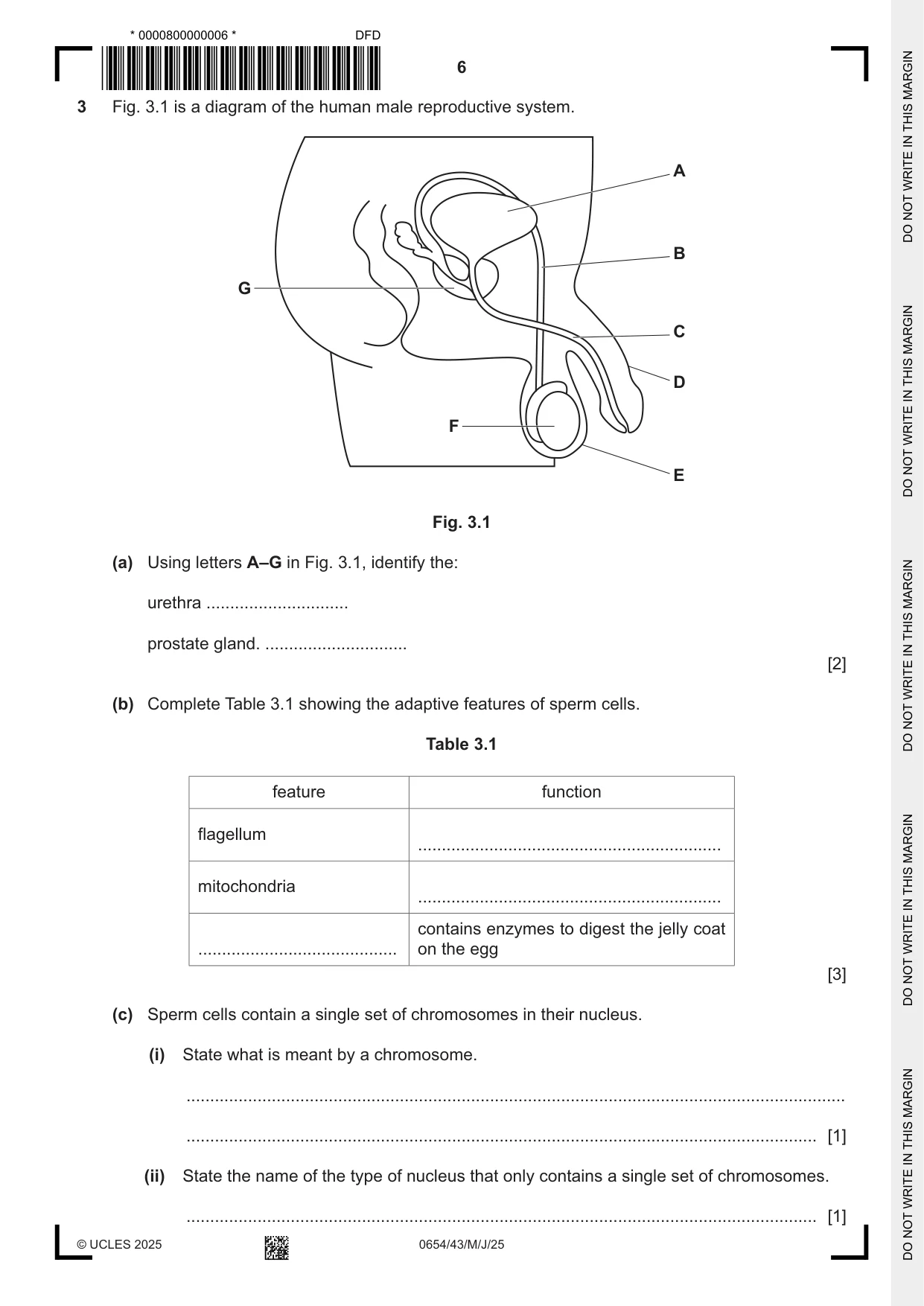
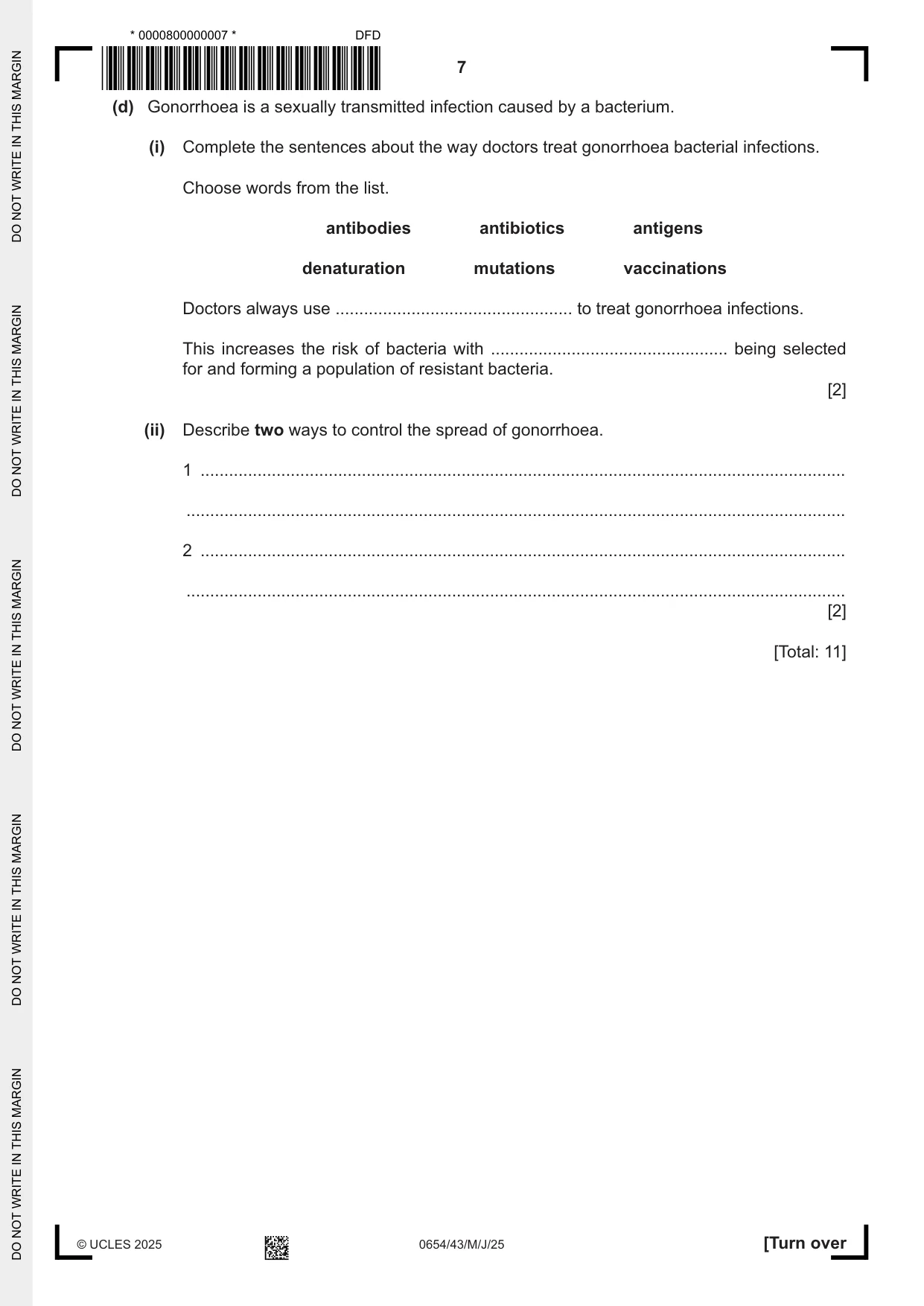
3 Fig. 3.1 is a diagram of the human male reproductive system. A B G C D F E Fig. 3.1 (a) Using letters A–G in Fig. 3.1, identify the: urethra .............................. prostate gland. .............................. [2] (b) Complete Table 3.1 showing the adaptive features of sperm cells. Table 3.1 feature function flagellum ................................................................ mitochondria ................................................................ contains enzymes to digest the jelly coat .......................................... on the egg [3] (c) Sperm cells contain a single set of chromosomes in their nucleus. (i) State what is meant by a chromosome. ........................................................................................................................................... ..................................................................................................................................... [1] (ii) State the name of the type of nucleus that only contains a single set of chromosomes. ..................................................................................................................................... [1] (d) Gonorrhoea is a sexually transmitted infection caused by a bacterium. (i) Complete the sentences about the way doctors treat gonorrhoea bacterial infections. Choose words from the list. antibodies antibiotics antigens denaturation mutations vaccinations Doctors always use .................................................. to treat gonorrhoea infections. This increases the risk of bacteria with .................................................. being selected for and forming a population of resistant bacteria. [2] (ii) Describe two ways to control the spread of gonorrhoea. 1 ........................................................................................................................................ ........................................................................................................................................... 2 ........................................................................................................................................ ........................................................................................................................................... [2] [Total: 11]
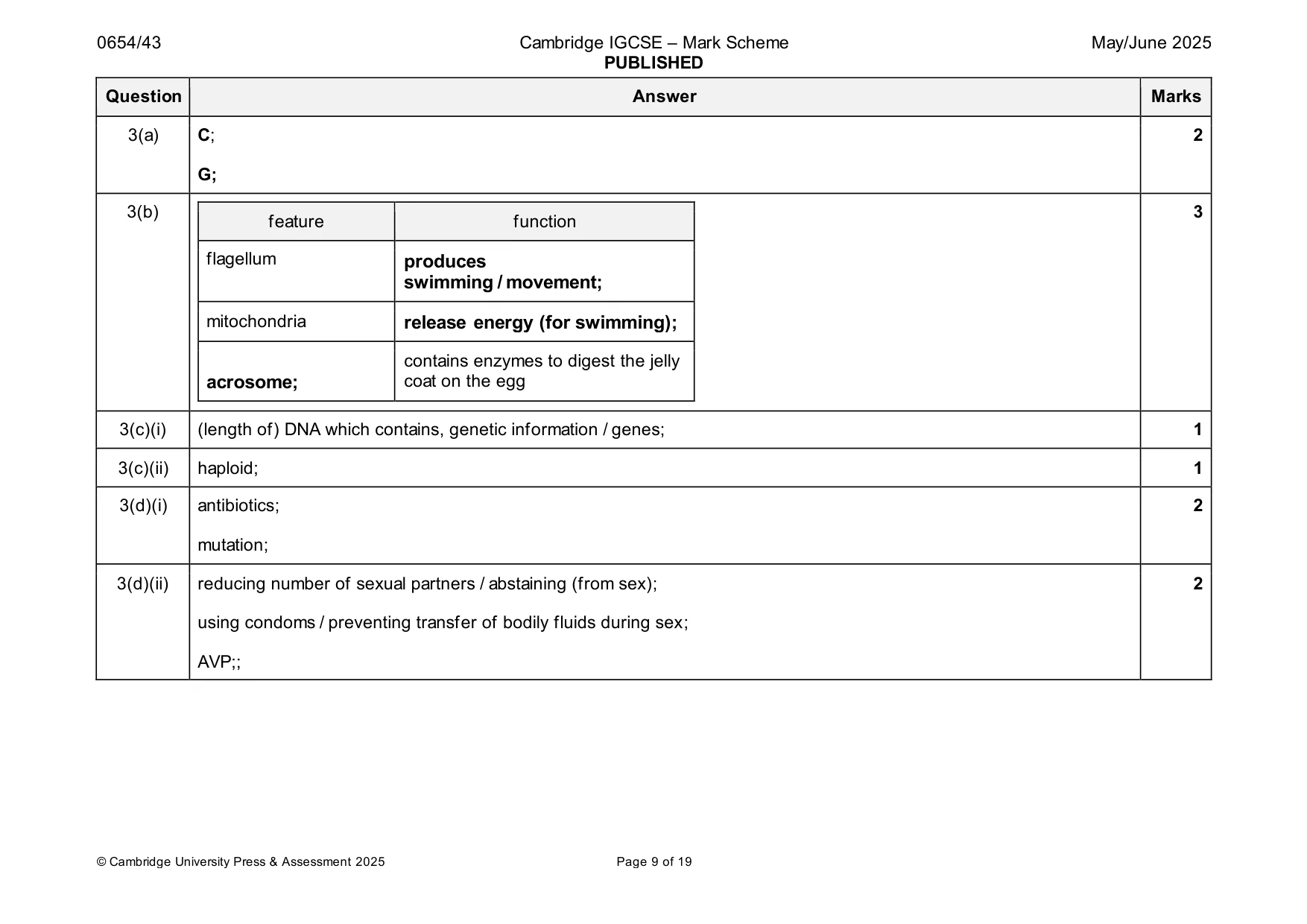
Mark scheme: 3(a) C; 2 G; 3(b) 3 feature function flagellum produces swimming / movement; mitochondria release energy (for swimming); contains enzymes to digest the jelly acrosome; coat on the egg 3(c)(i) (length of) DNA which contains, genetic information / genes; 1 3(c)(ii) haploid; 1 3(d)(i) antibiotics; 2 mutation; 3(d)(ii) reducing number of sexual partners / abstaining (from sex); 2 using condoms / preventing transfer of bodily fluids during sex; AVP;;
Q4 · A diagram of a germinating bean seed
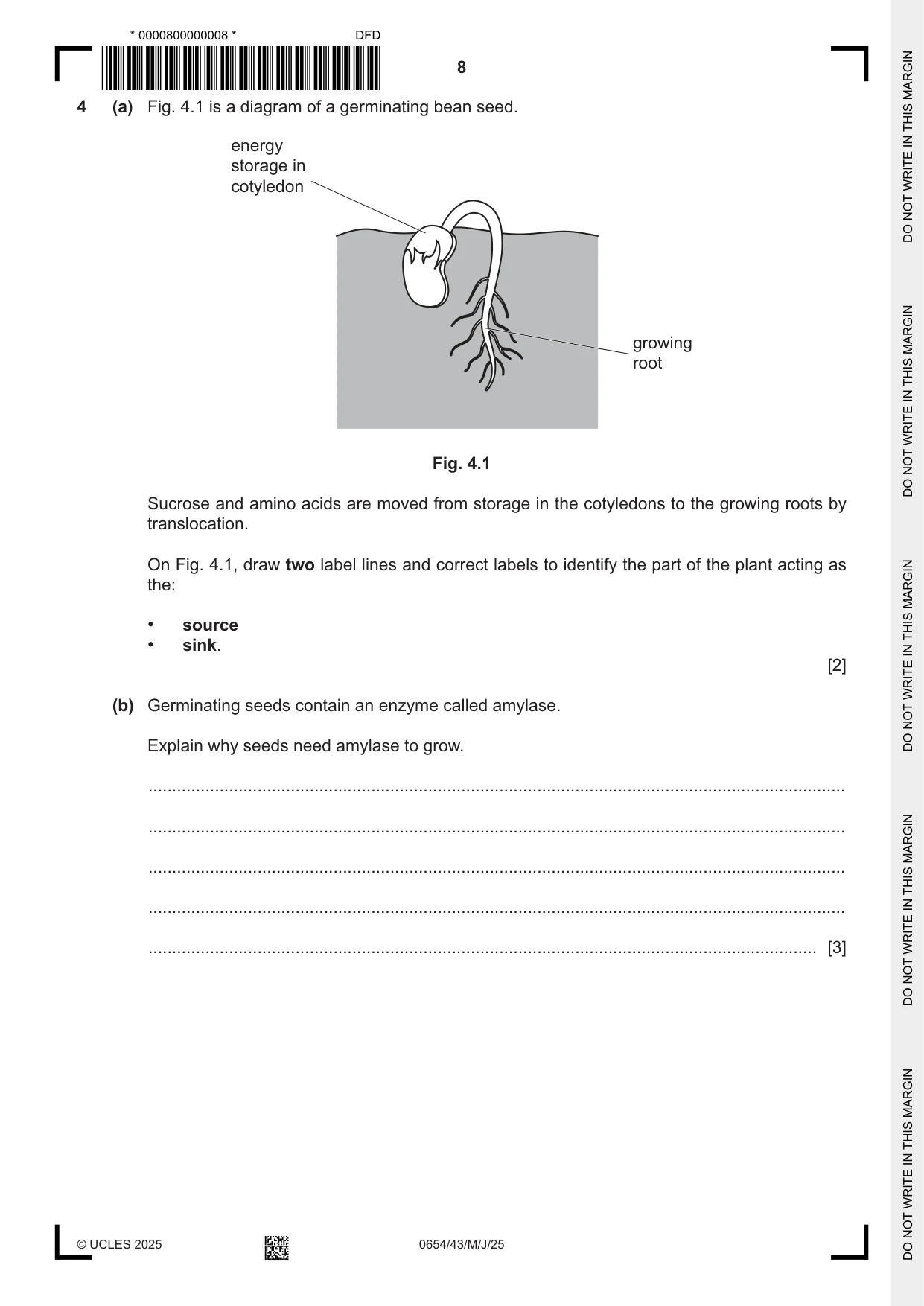
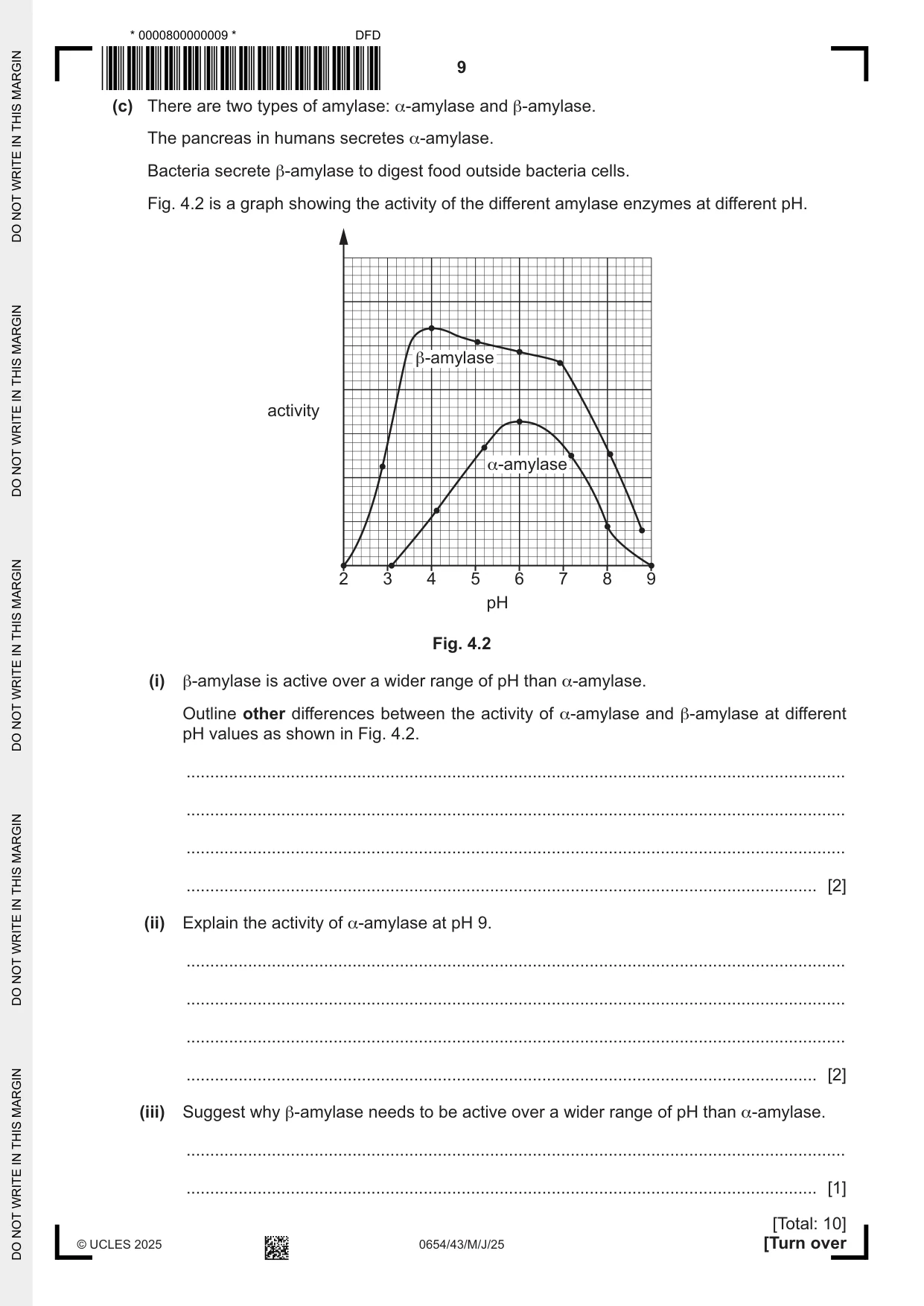
4 (a) Fig. 4.1 is a diagram of a germinating bean seed. energy storage in cotyledon growing root Fig. 4.1 Sucrose and amino acids are moved from storage in the cotyledons to the growing roots by translocation. On Fig. 4.1, draw two label lines and correct labels to identify the part of the plant acting as the: • source • sink. [2] (b) Germinating seeds contain an enzyme called amylase. Explain why seeds need amylase to grow. ................................................................................................................................................... ................................................................................................................................................... ................................................................................................................................................... ................................................................................................................................................... ............................................................................................................................................. [3] (c) There are two types of amylase: α-amylase and β-amylase. The pancreas in humans secretes α-amylase. Bacteria secrete β-amylase to digest food outside bacteria cells. Fig. 4.2 is a graph showing the activity of the different amylase enzymes at different pH. β-amylase activity α-amylase 2 3 4 5 6 7 8 9 pH Fig. 4.2 (i) β-amylase is active over a wider range of pH than α-amylase. Outline other differences between the activity of α-amylase and β-amylase at different pH values as shown in Fig. 4.2. ........................................................................................................................................... ........................................................................................................................................... ........................................................................................................................................... ..................................................................................................................................... [2] (ii) Explain the activity of α-amylase at pH 9. ........................................................................................................................................... ........................................................................................................................................... ........................................................................................................................................... ..................................................................................................................................... [2] (iii) Suggest why β-amylase needs to be active over a wider range of pH than α-amylase. ........................................................................................................................................... ..................................................................................................................................... [1] [Total: 10]
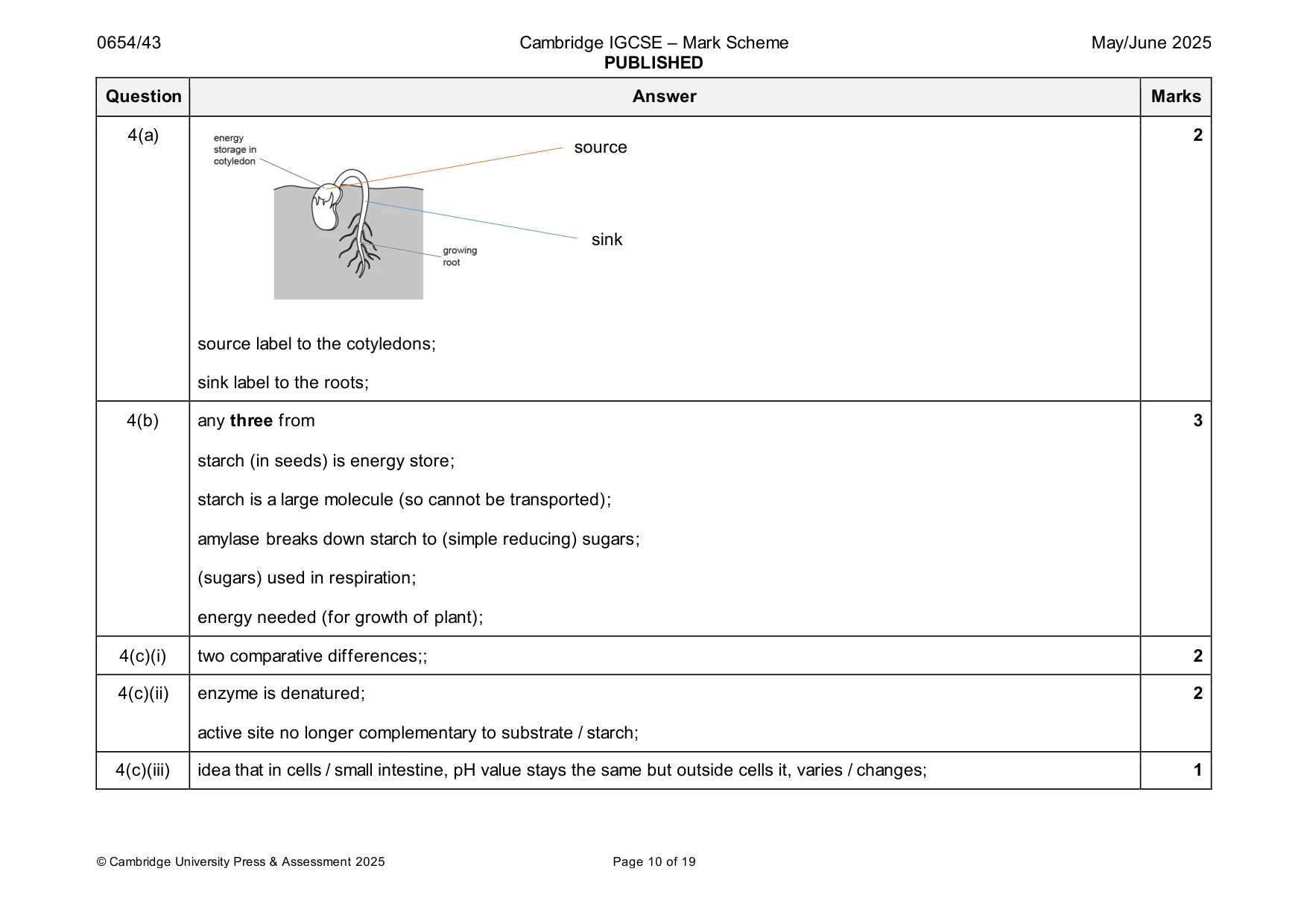
Mark scheme: 4(a) 2 source sink source label to the cotyledons; sink label to the roots; 4(b) any three from 3 starch (in seeds) is energy store; starch is a large molecule (so cannot be transported); amylase breaks down starch to (simple reducing) sugars; (sugars) used in respiration; energy needed (for growth of plant); 4(c)(i) two comparative differences;; 2 4(c)(ii) enzyme is denatured; 2 active site no longer complementary to substrate / starch; 4(c)(iii) idea that in cells / small intestine, pH value stays the same but outside cells it, varies / changes; 1
Q5 · A student investigates black ink using paper chromatography
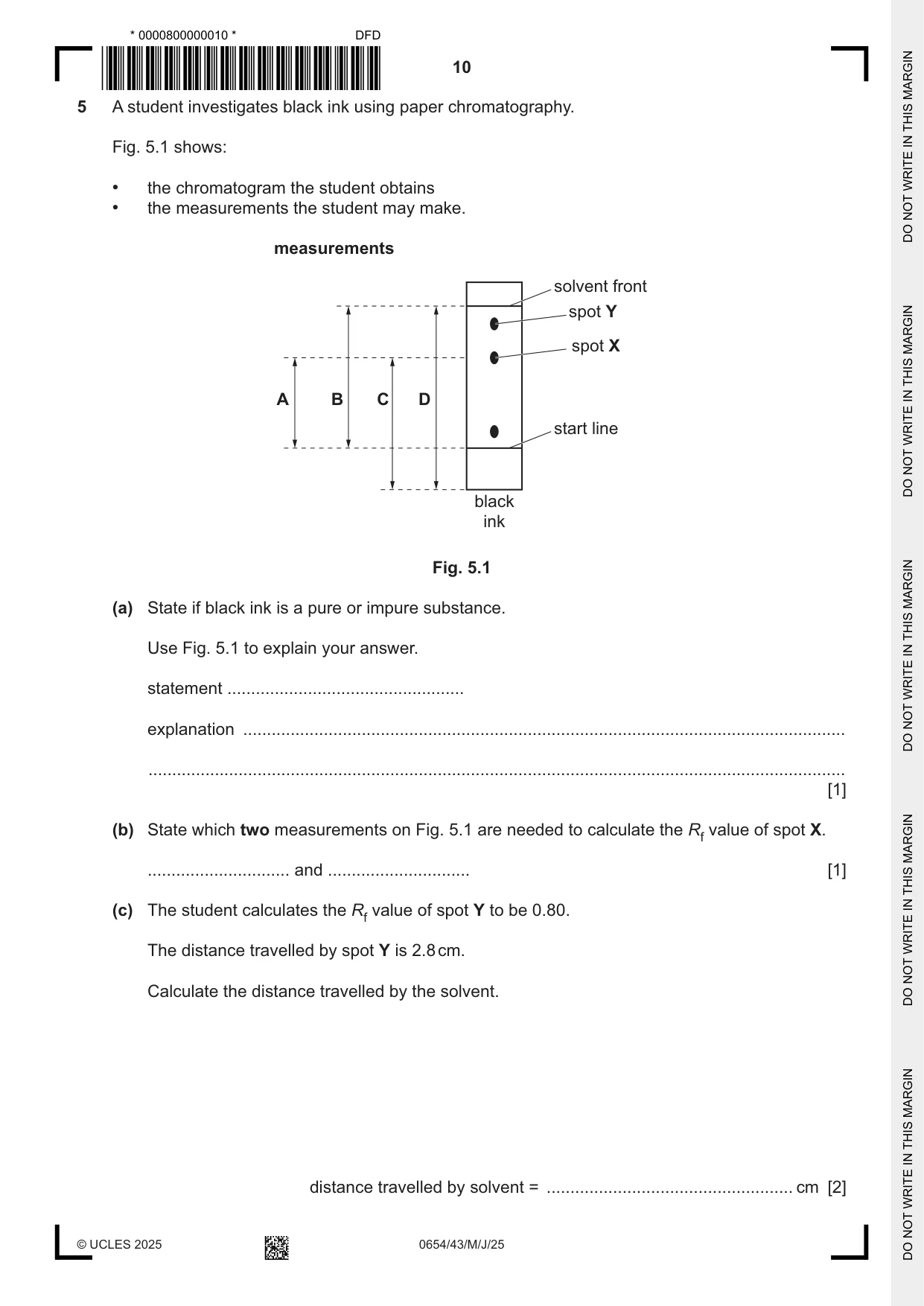
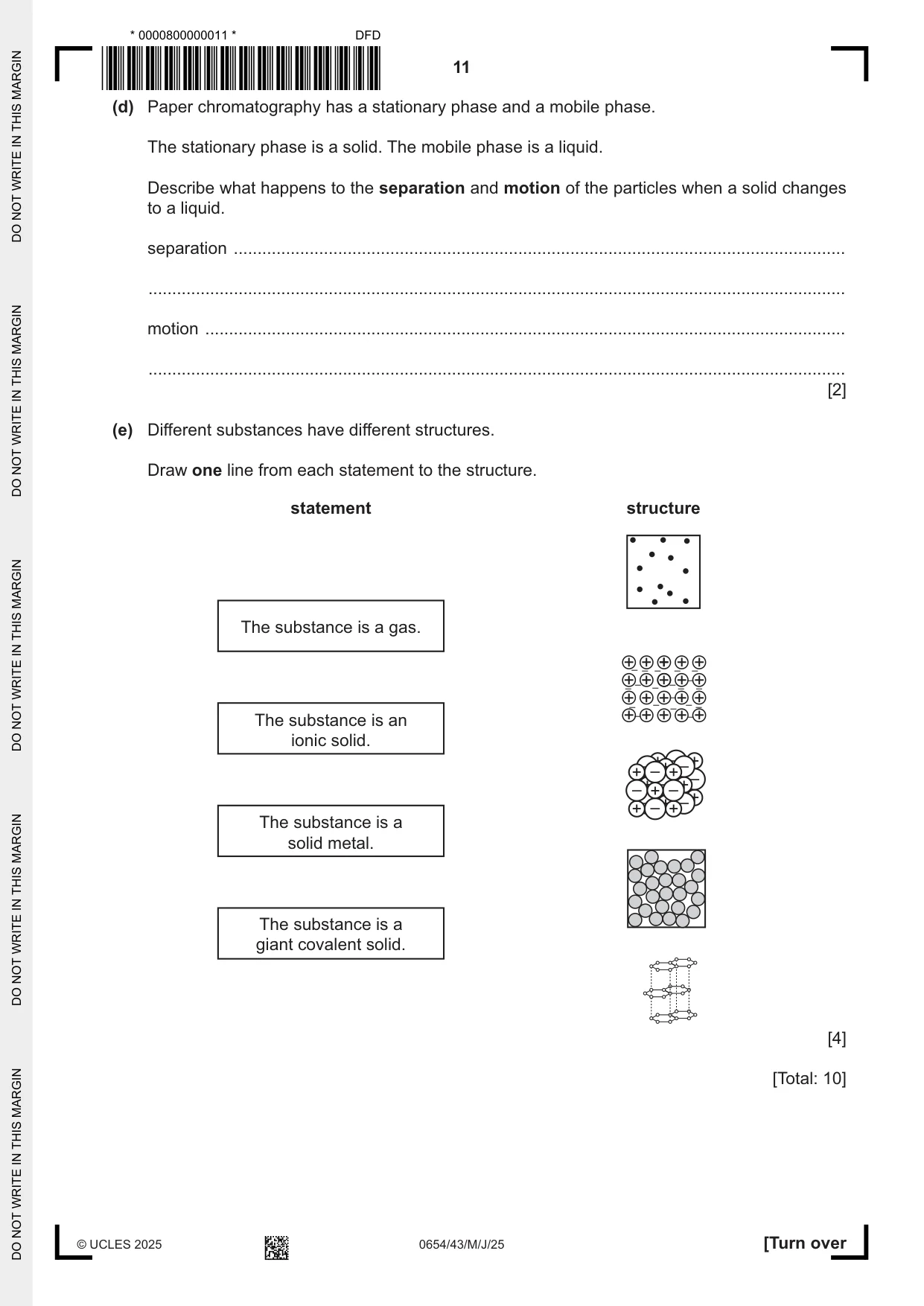
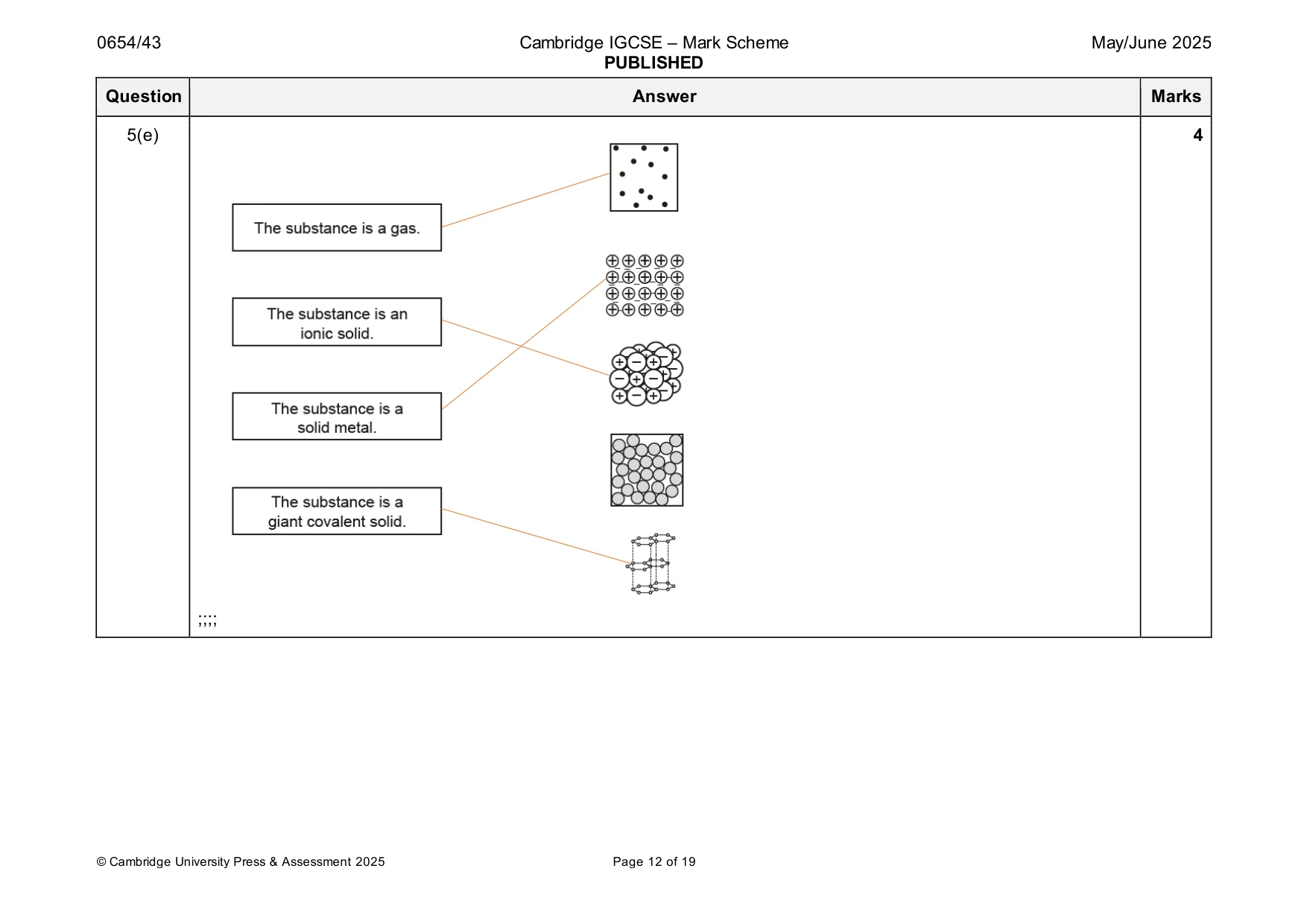
5 A student investigates black ink using paper chromatography. Fig. 5.1 shows: • the chromatogram the student obtains • the measurements the student may make. measurements solvent front spot Y spot X A B C D start line black ink Fig. 5.1 (a) State if black ink is a pure or impure substance. Use Fig. 5.1 to explain your answer. statement .................................................. explanation ............................................................................................................................... ................................................................................................................................................... [1] (b) State which two measurements on Fig. 5.1 are needed to calculate the Rf value of spot X. .............................. and .............................. [1] (c) The student calculates the Rf value of spot Y to be 0.80. The distance travelled by spot Y is 2.8 cm. Calculate the distance travelled by the solvent. distance travelled by solvent = .................................................... cm [2] (d) Paper chromatography has a stationary phase and a mobile phase. The stationary phase is a solid. The mobile phase is a liquid. Describe what happens to the separation and motion of the particles when a solid changes to a liquid. separation ................................................................................................................................. ................................................................................................................................................... motion ....................................................................................................................................... ................................................................................................................................................... [2] (e) Different substances have different structures. Draw one line from each statement to the structure. statement structure The substance is a gas. +– +– –++ –+ –+ +– – + – + – +– – +– +– + –+ ––+– +– The substance is an + – + + + – + ionic solid. – + – – + + – + + – – + – + – – ++ – + – – + + – + + The substance is a solid metal. The substance is a giant covalent solid. [4] [Total: 10]
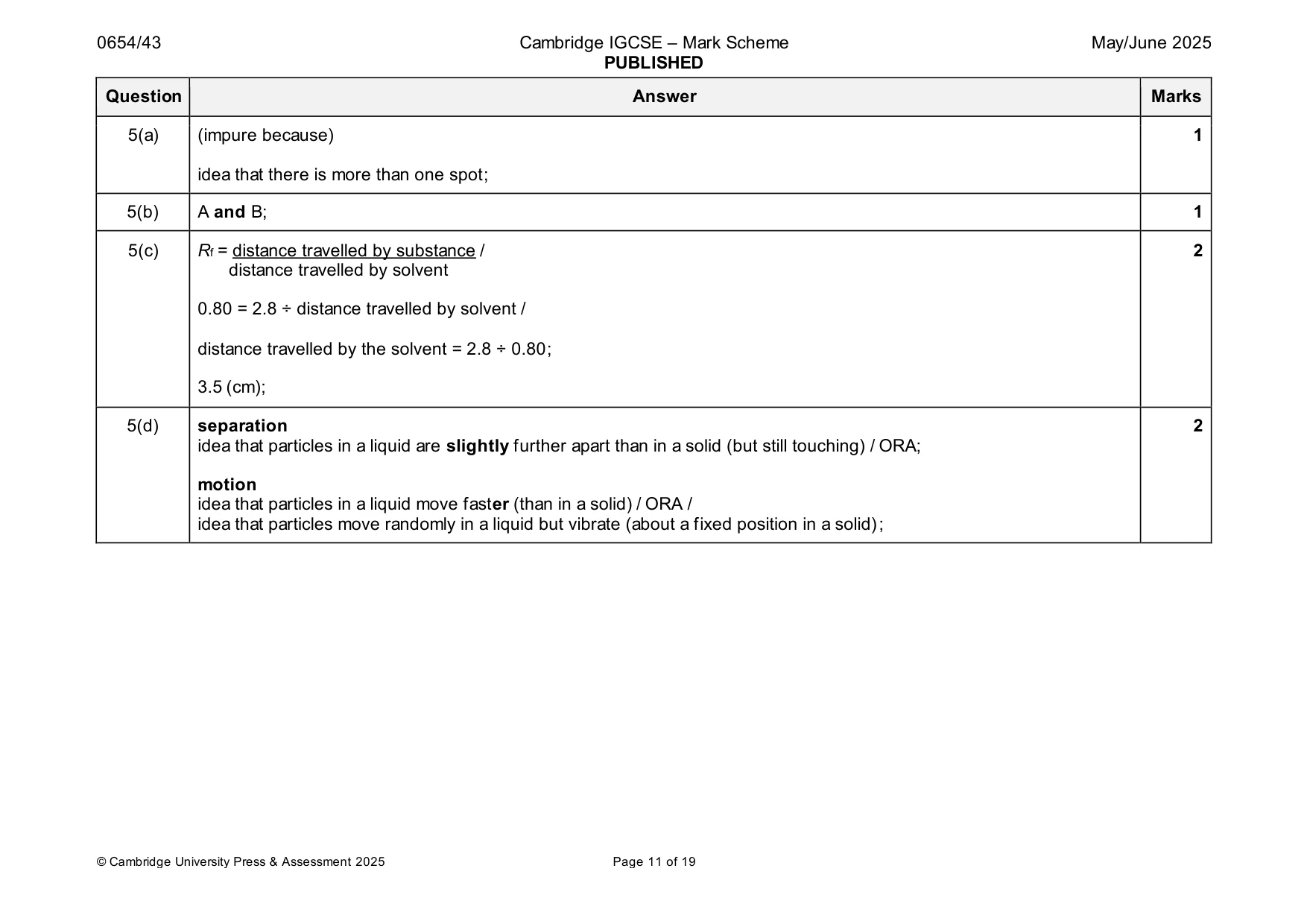
Mark scheme: 5(a) (impure because) 1 idea that there is more than one spot; 5(b) A and B; 1 5(c) Rf = distance travelled by substance / 2 distance travelled by solvent 0.80 = 2.8 ÷ distance travelled by solvent / distance travelled by the solvent = 2.8 ÷ 0.80; 3.5 (cm); 5(d) separation 2 idea that particles in a liquid are slightly further apart than in a solid (but still touching) / ORA; motion idea that particles in a liquid move faster (than in a solid) / ORA / idea that particles move randomly in a liquid but vibrate (about a fixed position in a solid); 5(e) 4 ;;;;
Q6 · The structure of magnesium oxide
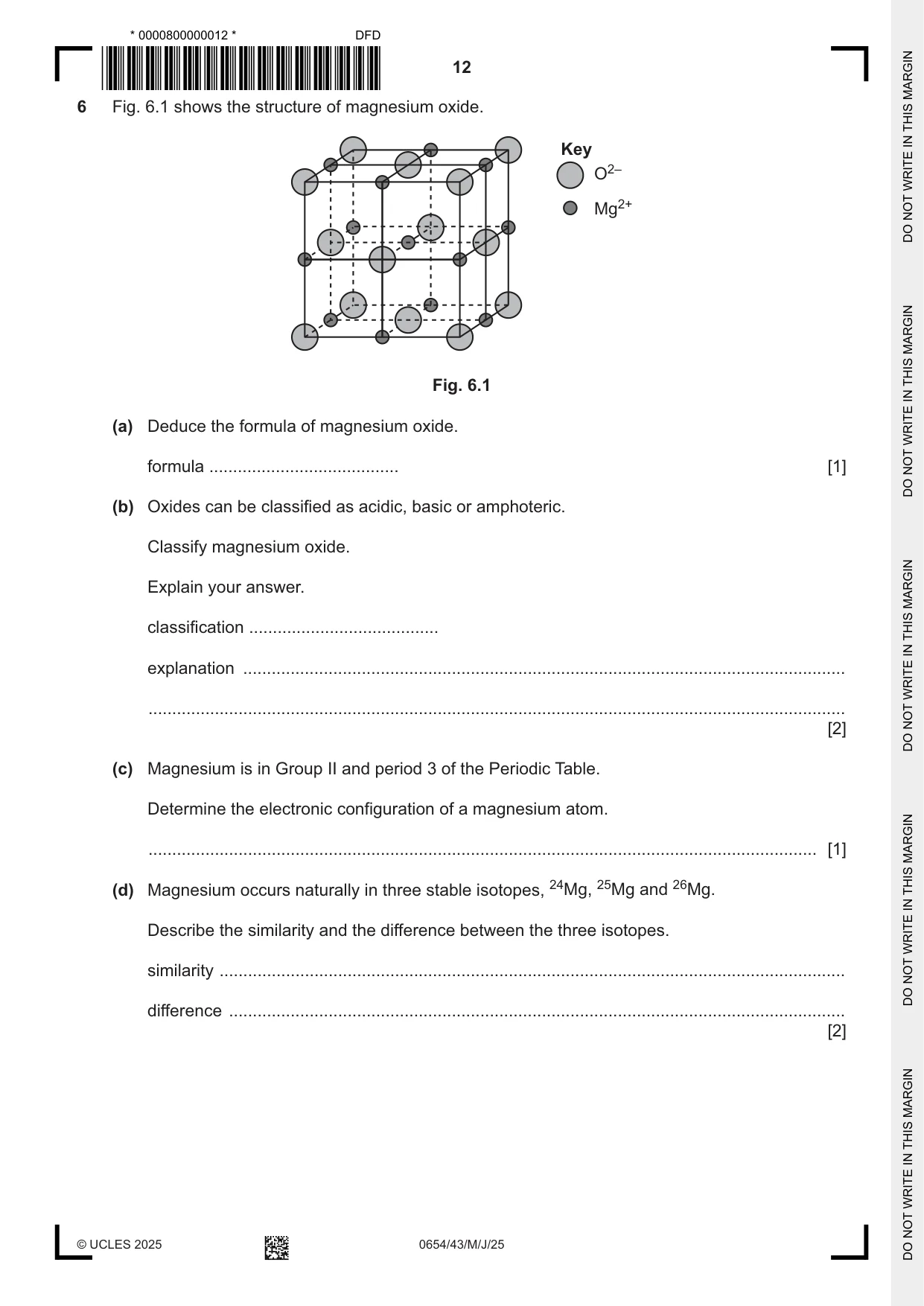
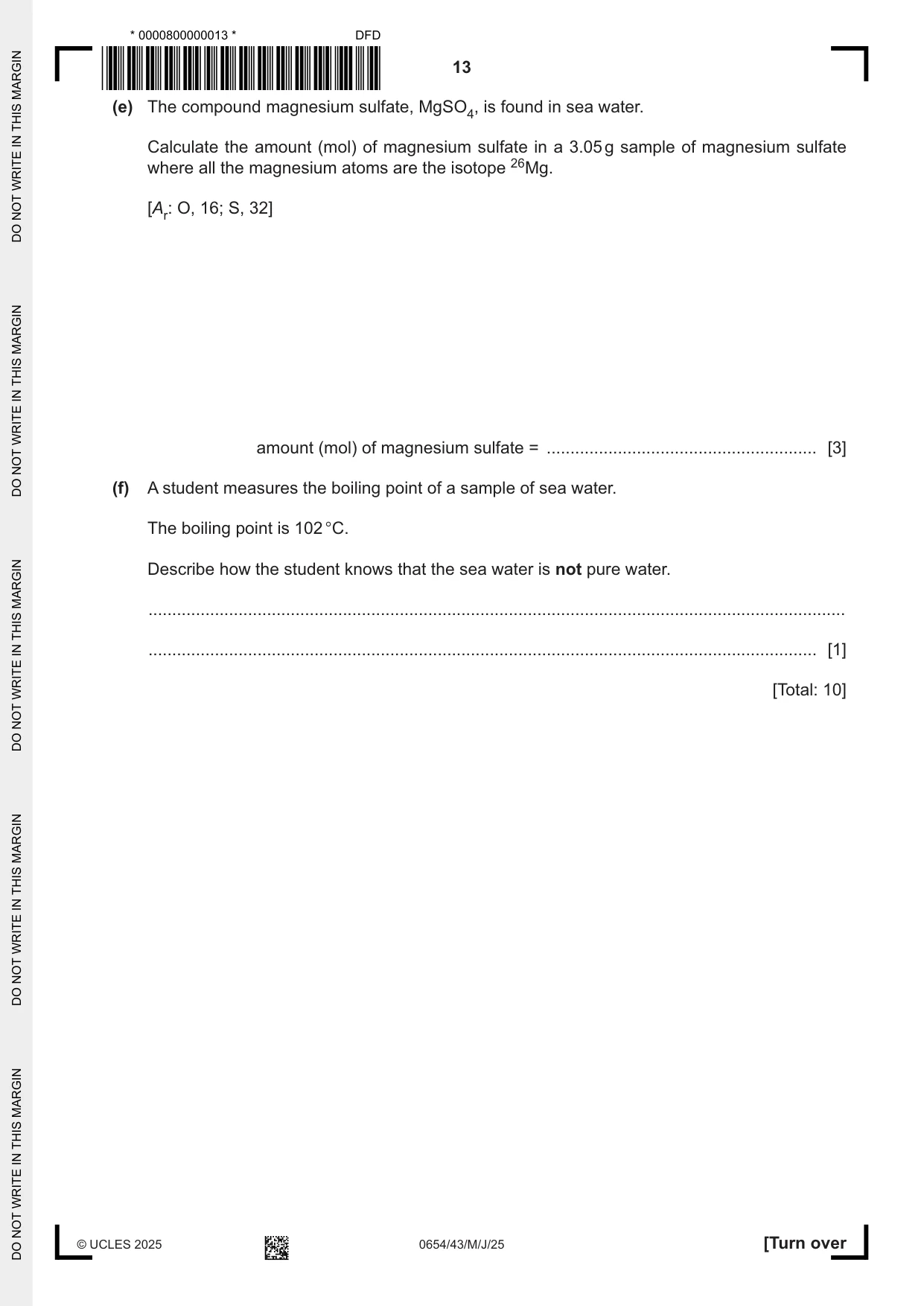
6 Fig. 6.1 shows the structure of magnesium oxide. Key O2– Mg2+ Fig. 6.1 (a) Deduce the formula of magnesium oxide. formula ........................................ [1] (b) Oxides can be classified as acidic, basic or amphoteric. Classify magnesium oxide. Explain your answer. classification ........................................ explanation ............................................................................................................................... ................................................................................................................................................... [2] (c) Magnesium is in Group II and period 3 of the Periodic Table. Determine the electronic configuration of a magnesium atom. ............................................................................................................................................. [1] (d) Magnesium occurs naturally in three stable isotopes, 24Mg, 25Mg and 26Mg. Describe the similarity and the difference between the three isotopes. similarity .................................................................................................................................... difference .................................................................................................................................. [2] (e) The compound magnesium sulfate, MgSO4, is found in sea water. Calculate the amount (mol) of magnesium sulfate in a 3.05 g sample of magnesium sulfate where all the magnesium atoms are the isotope 26Mg. [Ar: O, 16; S, 32] amount (mol) of magnesium sulfate = ......................................................... [3] (f) A student measures the boiling point of a sample of sea water. The boiling point is 102 °C. Describe how the student knows that the sea water is not pure water. ................................................................................................................................................... ............................................................................................................................................. [1] [Total: 10]
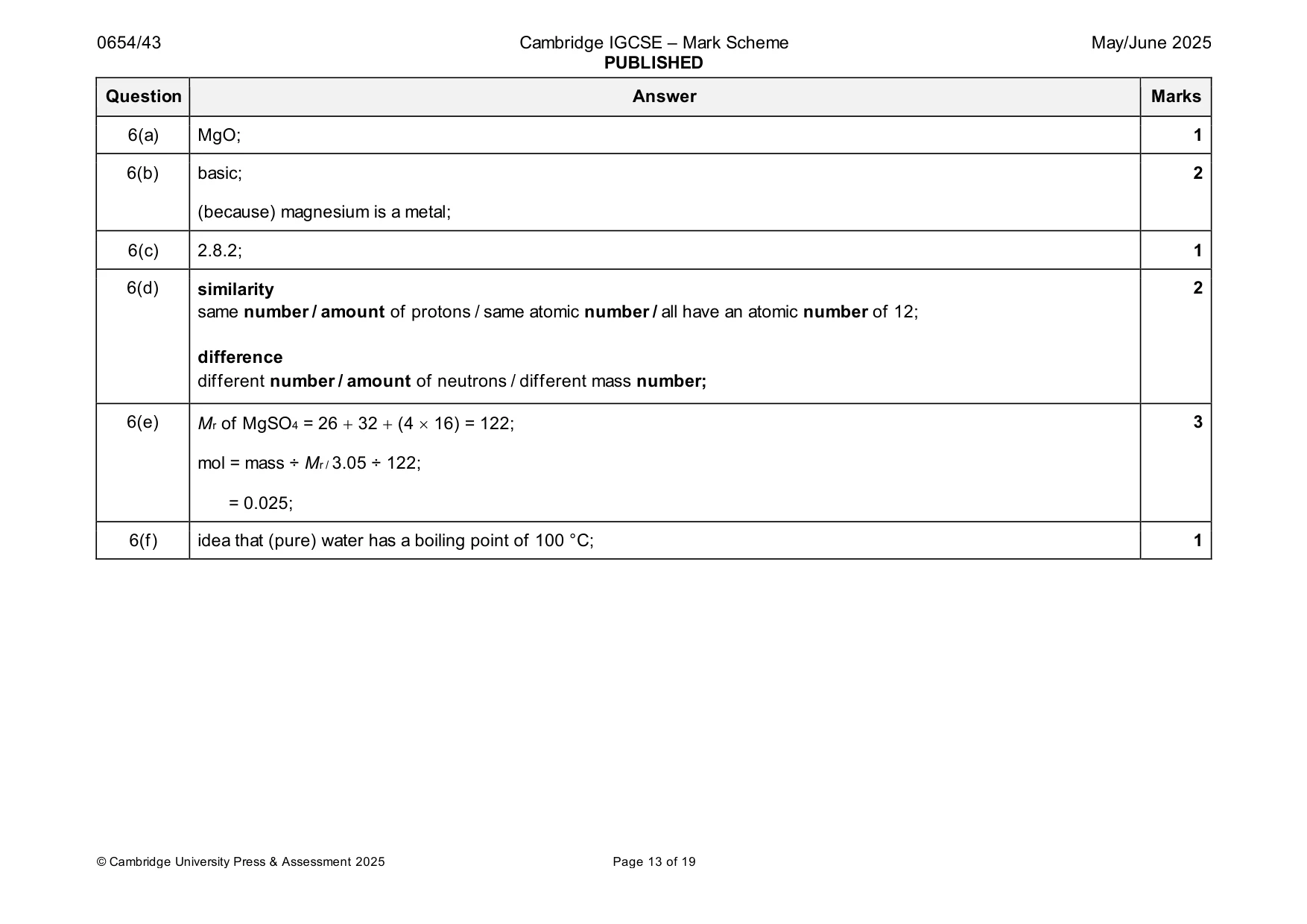
Mark scheme: 6(a) MgO; 1 6(b) basic; 2 (because) magnesium is a metal; 6(c) 2.8.2; 1 6(d) similarity 2 same number / amount of protons / same atomic number / all have an atomic number of 12; difference different number / amount of neutrons / different mass number; 6(e) Mr of MgSO4 = 26 + 32 + (4 16) = 122; 3 mol = mass ÷ Mr / 3.05 ÷ 122; = 0.025; 6(f) idea that (pure) water has a boiling point of 100 °C; 1
Q7 · Look at the structures of the carbon compounds shown in Fig
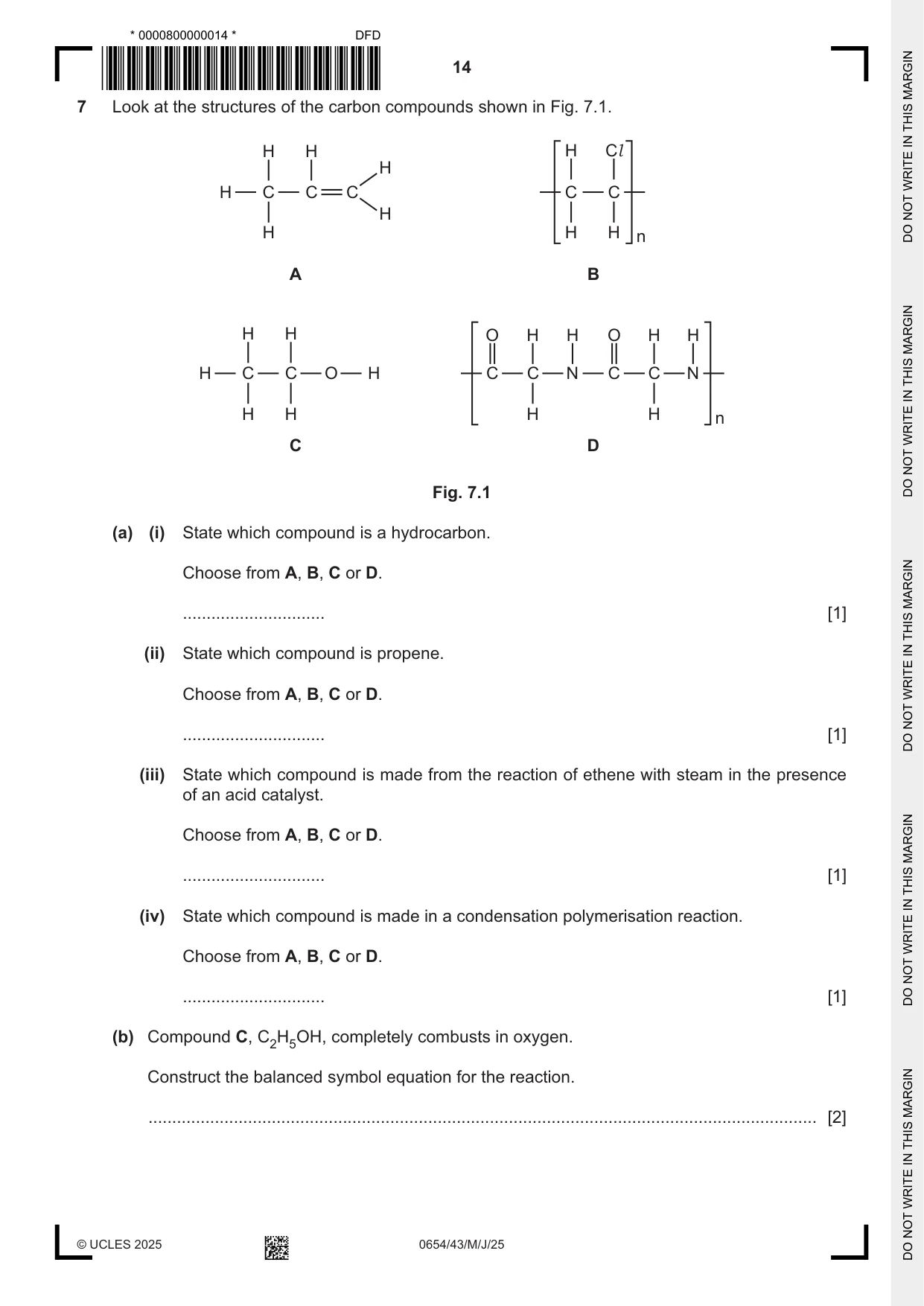
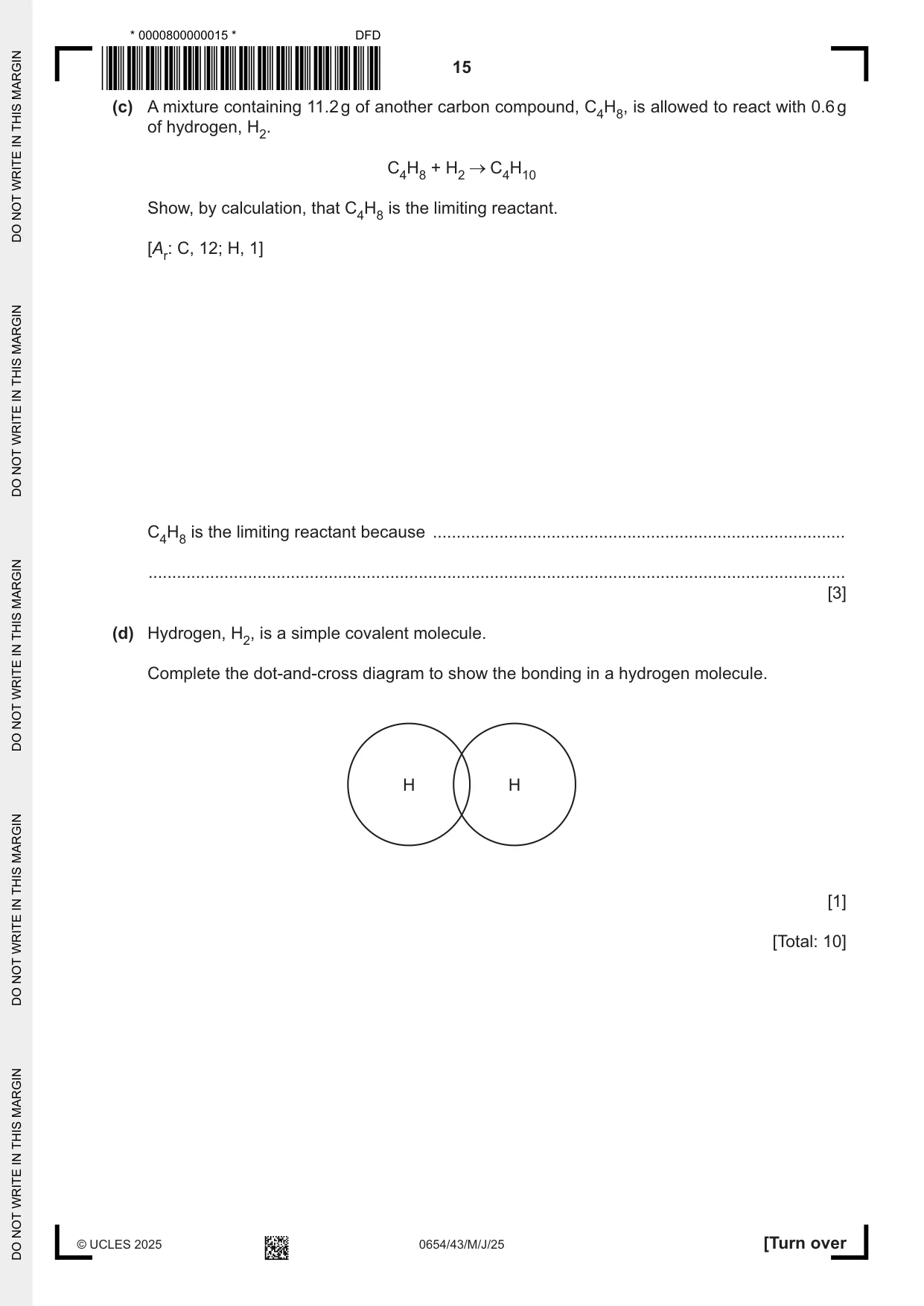
7 Look at the structures of the carbon compounds shown in Fig. 7.1. H H H Cl H H C C C C C H H H H n A B H H O H H O H H H C C O H C C N C C N H H H H n C D Fig. 7.1 (a) (i) State which compound is a hydrocarbon. Choose from A, B, C or D. .............................. [1] (ii) State which compound is propene. Choose from A, B, C or D. .............................. [1] (iii) State which compound is made from the reaction of ethene with steam in the presence of an acid catalyst. Choose from A, B, C or D. .............................. [1] (iv) State which compound is made in a condensation polymerisation reaction. Choose from A, B, C or D. .............................. [1] (b) Compound C, C2H5OH, completely combusts in oxygen. Construct the balanced symbol equation for the reaction. ............................................................................................................................................. [2] (c) A mixture containing 11.2 g of another carbon compound, C4H8, is allowed to react with 0.6 g of hydrogen, H2. C4H8 + H2 C4H10 Show, by calculation, that C4H8 is the limiting reactant. [Ar: C, 12; H, 1] C4H8 is the limiting reactant because ....................................................................................... ................................................................................................................................................... [3] (d) Hydrogen, H2, is a simple covalent molecule. Complete the dot-and-cross diagram to show the bonding in a hydrogen molecule. H H [1] [Total: 10]
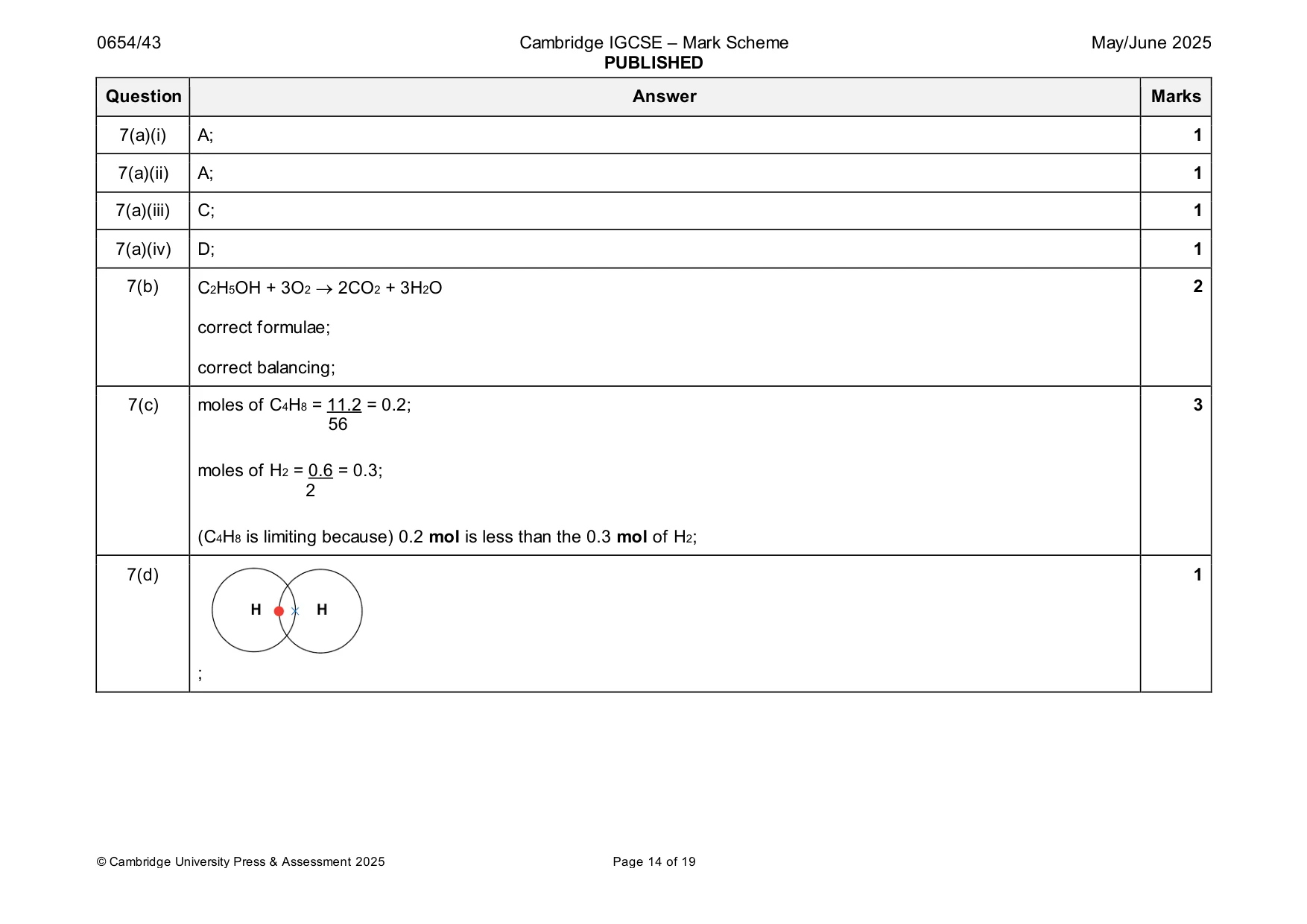
Mark scheme: 7(a)(i) A; 1 7(a)(ii) A; 1 7(a)(iii) C; 1 7(a)(iv) D; 1 7(b) C2H5OH + 3O2 → 2CO2 + 3H2O 2 correct formulae; correct balancing; 7(c) moles of C4H8 = 11.2 = 0.2; 3 56 moles of H2 = 0.6 = 0.3; 2 (C4H8 is limiting because) 0.2 mol is less than the 0.3 mol of H2; 7(d) 1 ; ;
Q8 · A student reacts hydrochloric acid with sodium carbonate
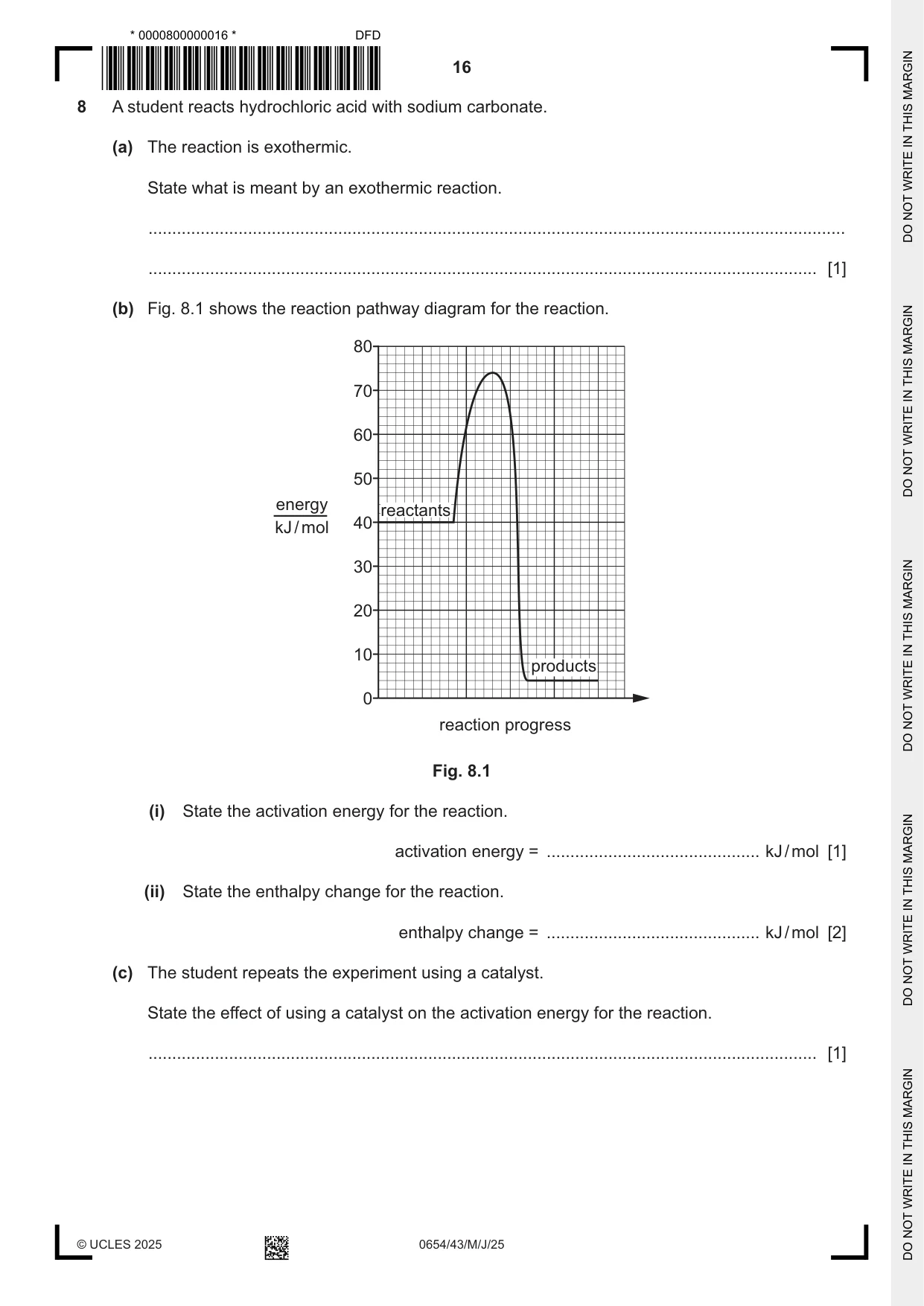
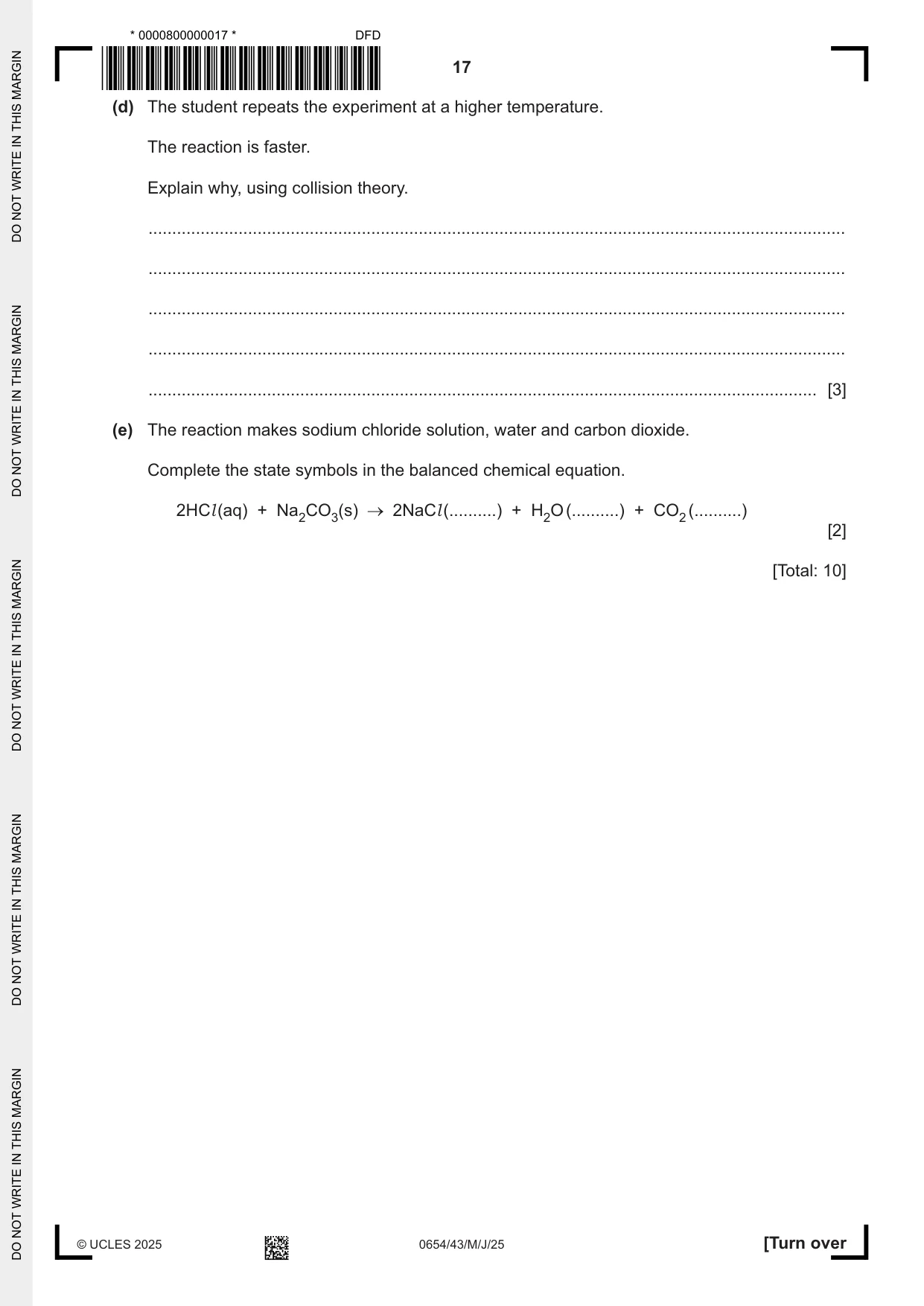
8 A student reacts hydrochloric acid with sodium carbonate. (a) The reaction is exothermic. State what is meant by an exothermic reaction. ................................................................................................................................................... ............................................................................................................................................. [1] (b) Fig. 8.1 shows the reaction pathway diagram for the reaction. 80 70 60 50 energy reactants 40 kJ / mol 30 20 10 products 0 reaction progress Fig. 8.1 (i) State the activation energy for the reaction. activation energy = ............................................. kJ / mol [1] (ii) State the enthalpy change for the reaction. enthalpy change = ............................................. kJ / mol [2] (c) The student repeats the experiment using a catalyst. State the effect of using a catalyst on the activation energy for the reaction. ............................................................................................................................................. [1] (d) The student repeats the experiment at a higher temperature. The reaction is faster. Explain why, using collision theory. ................................................................................................................................................... ................................................................................................................................................... ................................................................................................................................................... ................................................................................................................................................... ............................................................................................................................................. [3] (e) The reaction makes sodium chloride solution, water and carbon dioxide. Complete the state symbols in the balanced chemical equation. 2HCl (aq) + Na2CO3(s) 2NaCl (..........) + H2O (..........) + CO2 (..........) [2] [Total: 10]
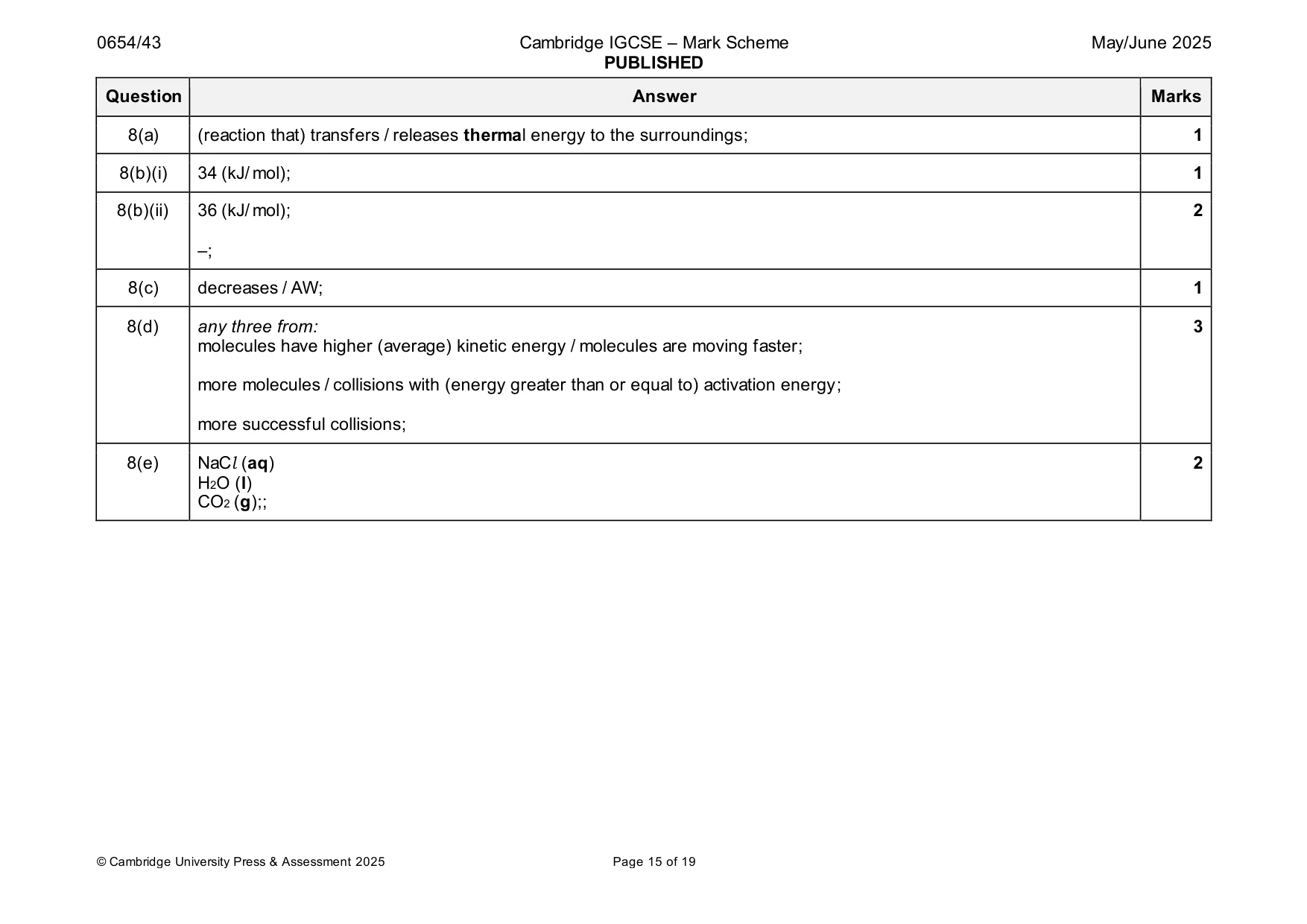
Mark scheme: 8(a) (reaction that) transfers / releases thermal energy to the surroundings; 1 8(b)(i) 34 (kJ/ mol); 1 8(b)(ii) 36 (kJ/ mol); 2 –; 8(c) decreases / AW; 1 8(d) any three from: 3 molecules have higher (average) kinetic energy / molecules are moving faster; more molecules / collisions with (energy greater than or equal to) activation energy; more successful collisions; 8(e) NaCl (aq) 2 H2O (l) CO2 (g);;
Q9 · Circle all the vector quantities
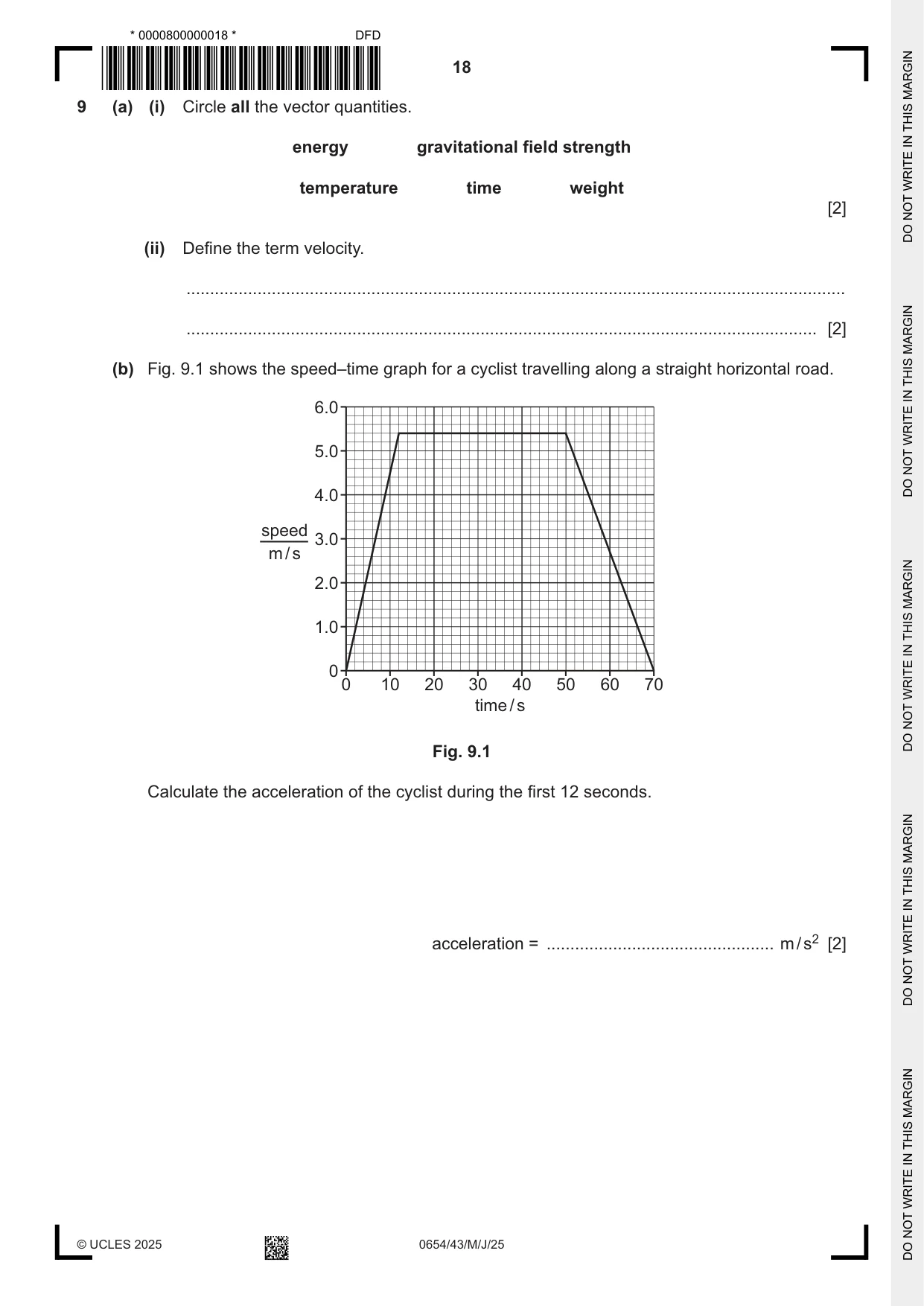
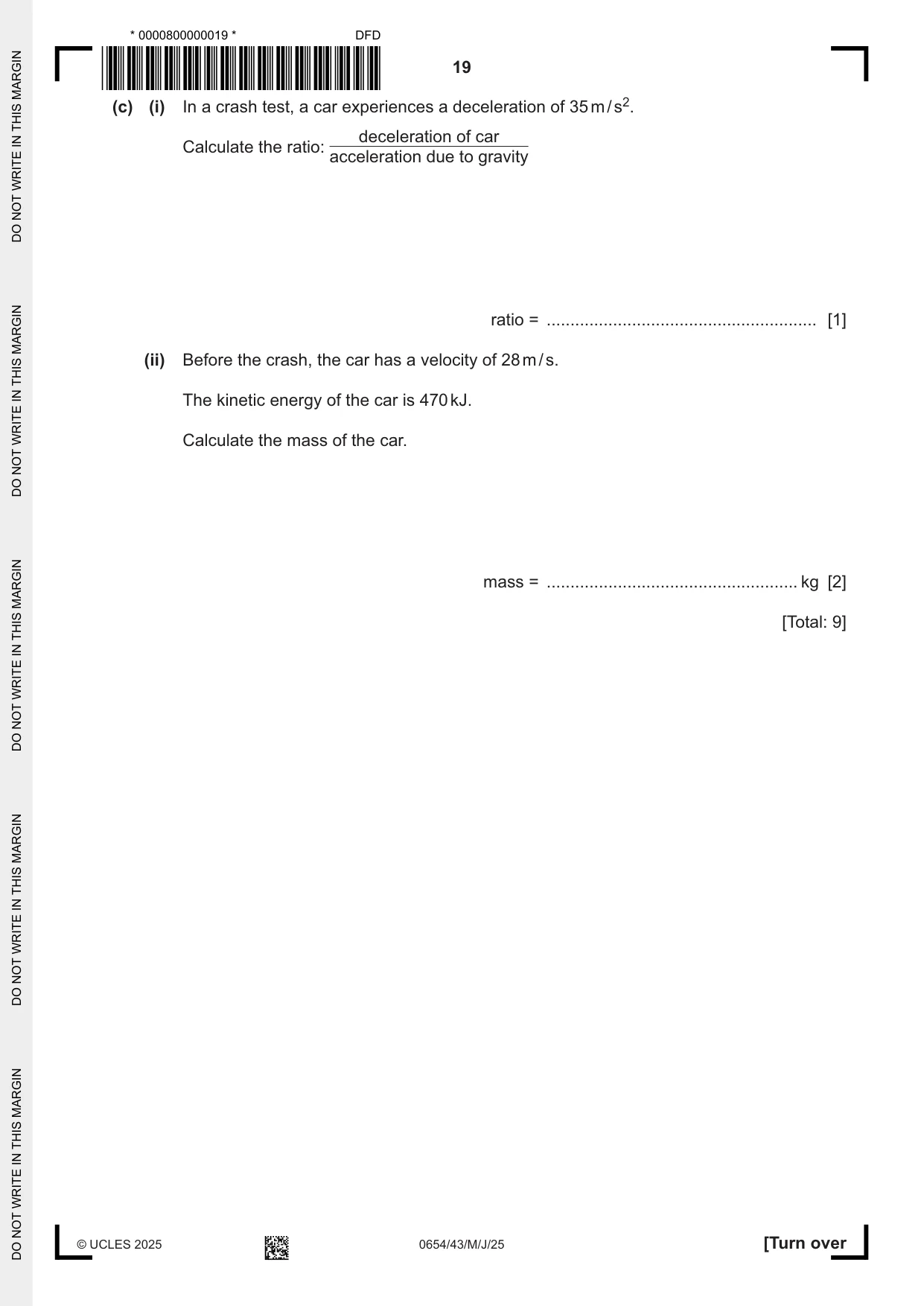
9 (a) (i) Circle all the vector quantities. energy gravitational field strength temperature time weight [2] (ii) Define the term velocity. ........................................................................................................................................... ..................................................................................................................................... [2] (b) Fig. 9.1 shows the speed–time graph for a cyclist travelling along a straight horizontal road. 6.0 5.0 4.0 speed 3.0 m / s 2.0 1.0 0 0 10 20 30 40 50 60 70 time / s Fig. 9.1 Calculate the acceleration of the cyclist during the first 12 seconds. acceleration = ................................................ m / s2 [2] (c) (i) In a crash test, a car experiences a deceleration of 35 m / s2. deceleration of car Calculate the ratio: acceleration due to gravity ratio = ......................................................... [1] (ii) Before the crash, the car has a velocity of 28 m / s. The kinetic energy of the car is 470 kJ. Calculate the mass of the car. mass = ..................................................... kg [2] [Total: 9]
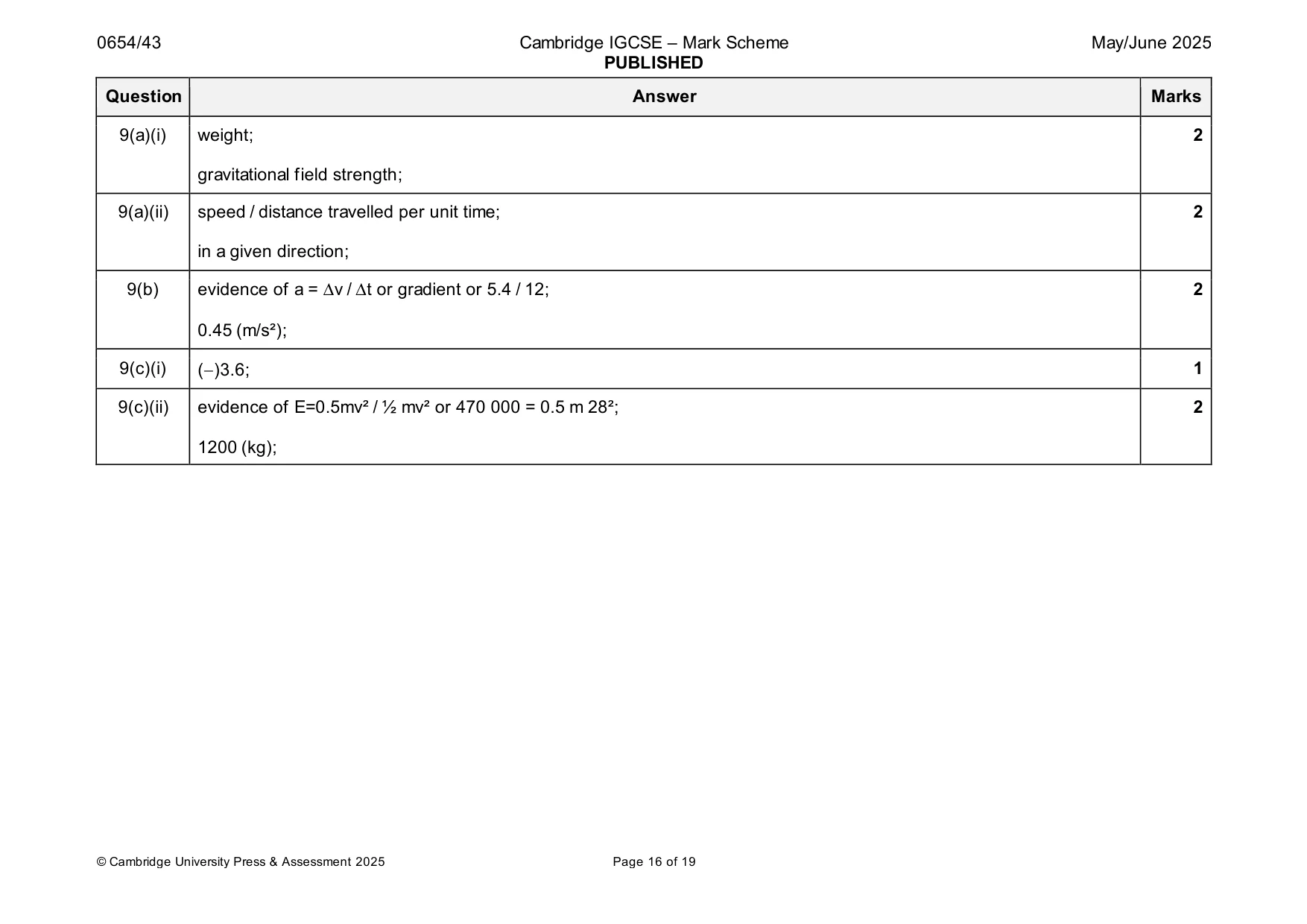
Mark scheme: 9(a)(i) weight; 2 gravitational field strength; 9(a)(ii) speed / distance travelled per unit time; 2 in a given direction; 9(b) evidence of a = ∆v / ∆t or gradient or 5.4 / 12; 2 0.45 (m/s²); 9(c)(i) (−)3.6; 1 9(c)(ii) evidence of E=0.5mv² / ½ mv² or 470 000 = 0.5 m 28²; 2 1200 (kg);
Q10 · State how the Big Bang Theory describes the beginning of the Universe
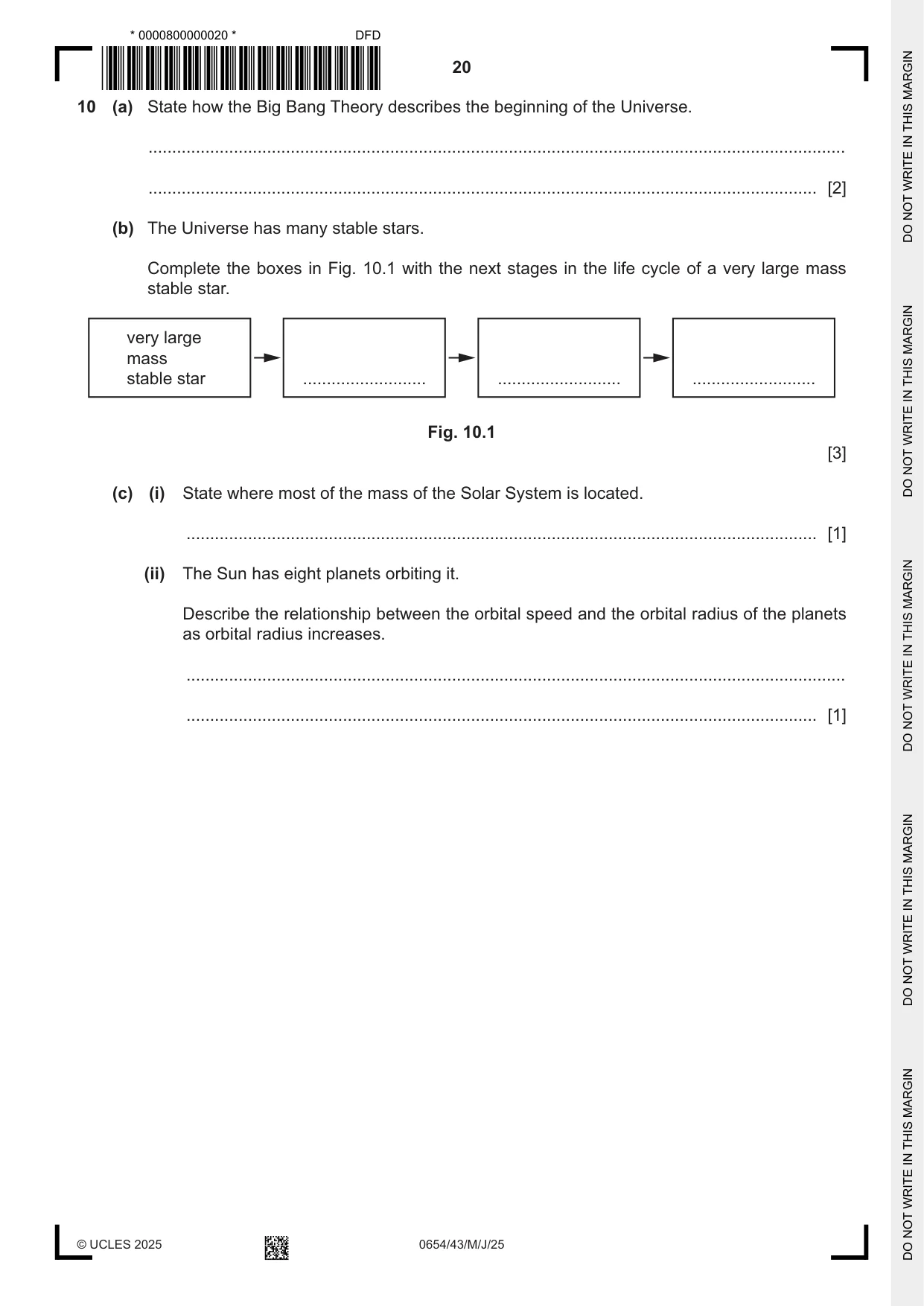
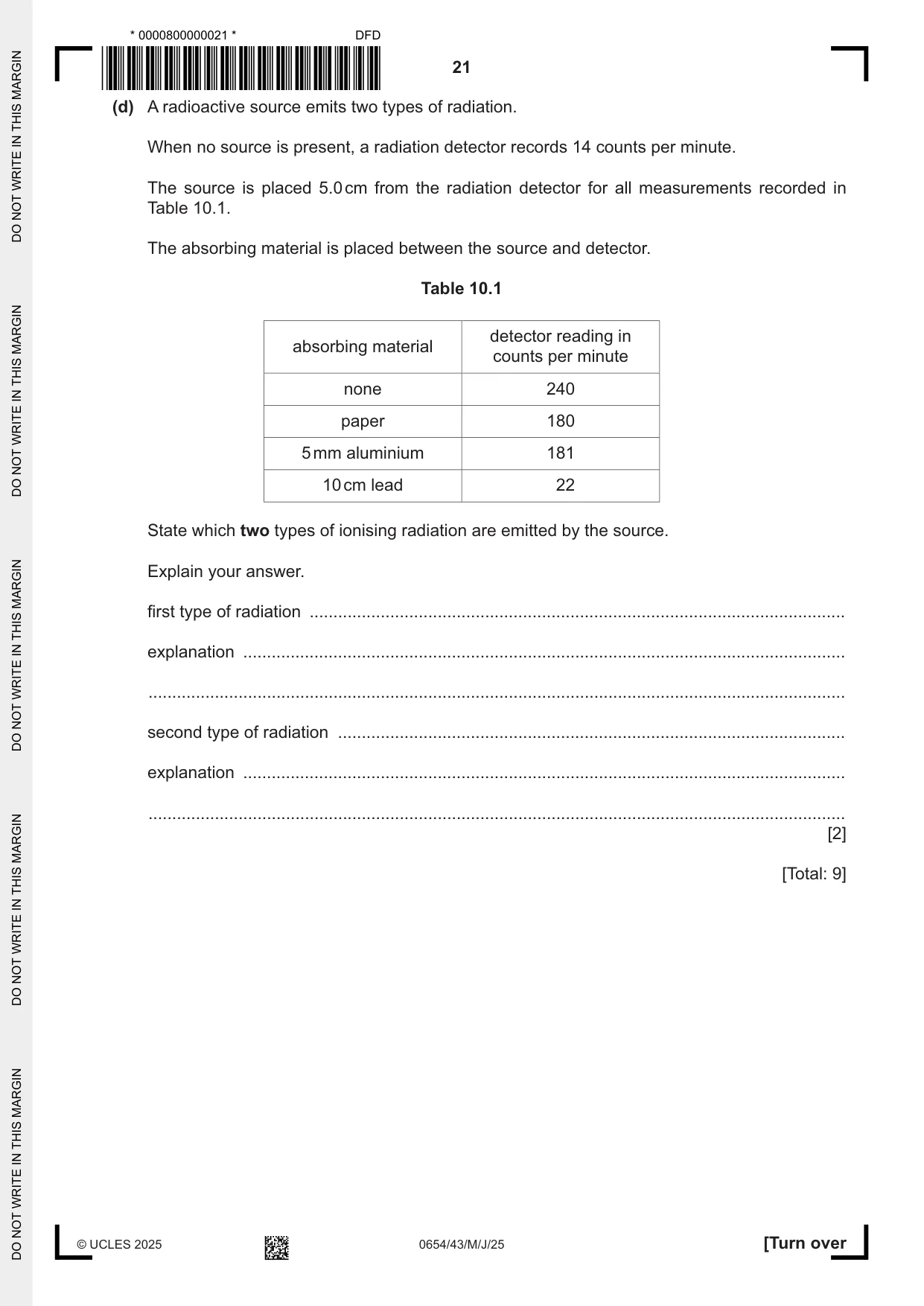
10 (a) State how the Big Bang Theory describes the beginning of the Universe. ................................................................................................................................................... ............................................................................................................................................. [2] (b) The Universe has many stable stars. Complete the boxes in Fig. 10.1 with the next stages in the life cycle of a very large mass stable star. very large mass stable star .......................... .......................... .......................... Fig. 10.1 [3] (c) (i) State where most of the mass of the Solar System is located. ..................................................................................................................................... [1] (ii) The Sun has eight planets orbiting it. Describe the relationship between the orbital speed and the orbital radius of the planets as orbital radius increases. ........................................................................................................................................... ..................................................................................................................................... [1] (d) A radioactive source emits two types of radiation. When no source is present, a radiation detector records 14 counts per minute. The source is placed 5.0 cm from the radiation detector for all measurements recorded in Table 10.1. The absorbing material is placed between the source and detector. Table 10.1 detector reading in absorbing material counts per minute none 240 paper 180 5 mm aluminium 181 10 cm lead 22 State which two types of ionising radiation are emitted by the source. Explain your answer. first type of radiation ................................................................................................................. explanation ............................................................................................................................... ................................................................................................................................................... second type of radiation ........................................................................................................... explanation ............................................................................................................................... ................................................................................................................................................... [2] [Total: 9]
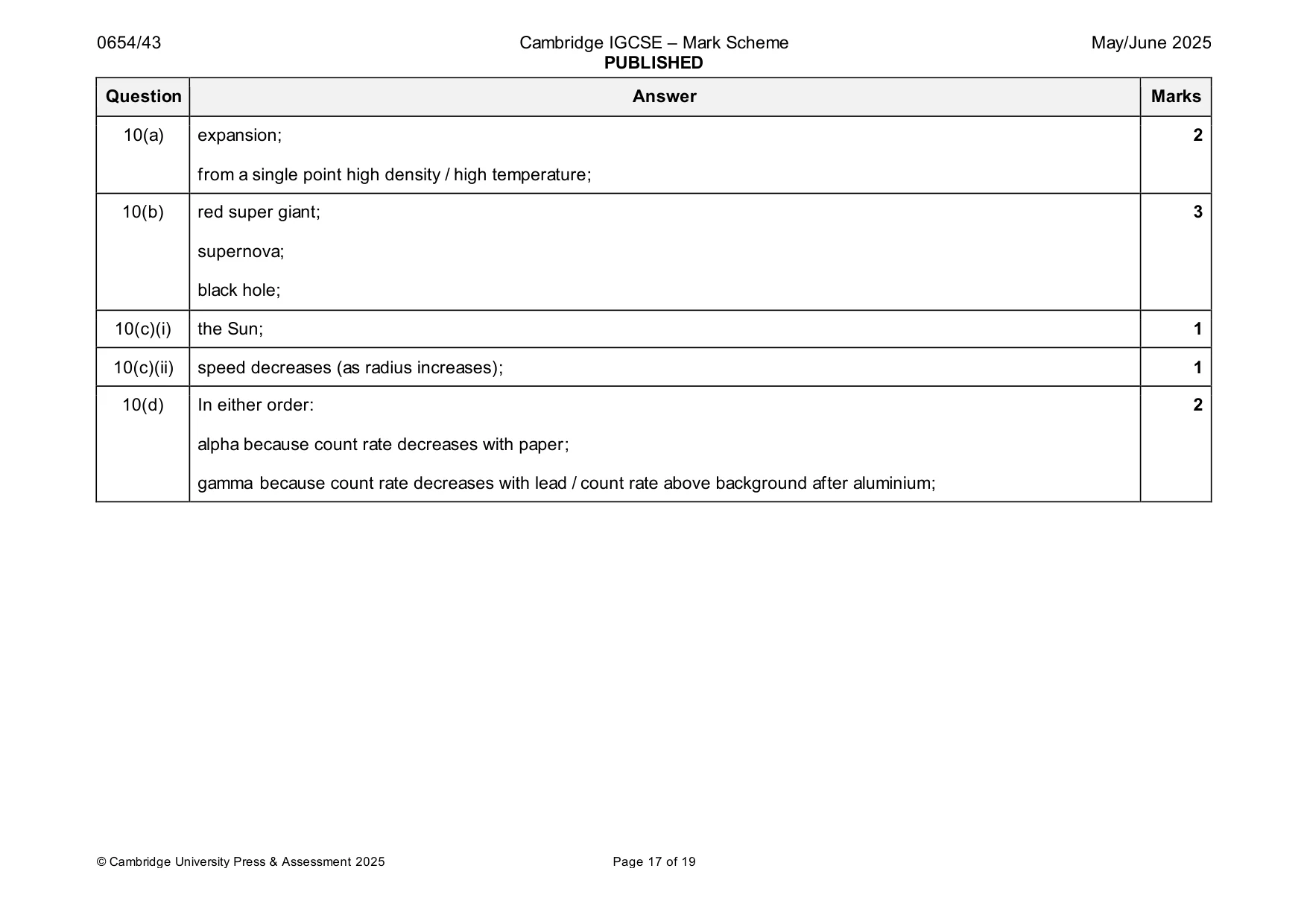
Mark scheme: 10(a) expansion; 2 from a single point high density / high temperature; 10(b) red super giant; 3 supernova; black hole; 10(c)(i) the Sun; 1 10(c)(ii) speed decreases (as radius increases); 1 10(d) In either order: 2 alpha because count rate decreases with paper; gamma because count rate decreases with lead / count rate above background after aluminium;
Q11 · A diagram of a water wave
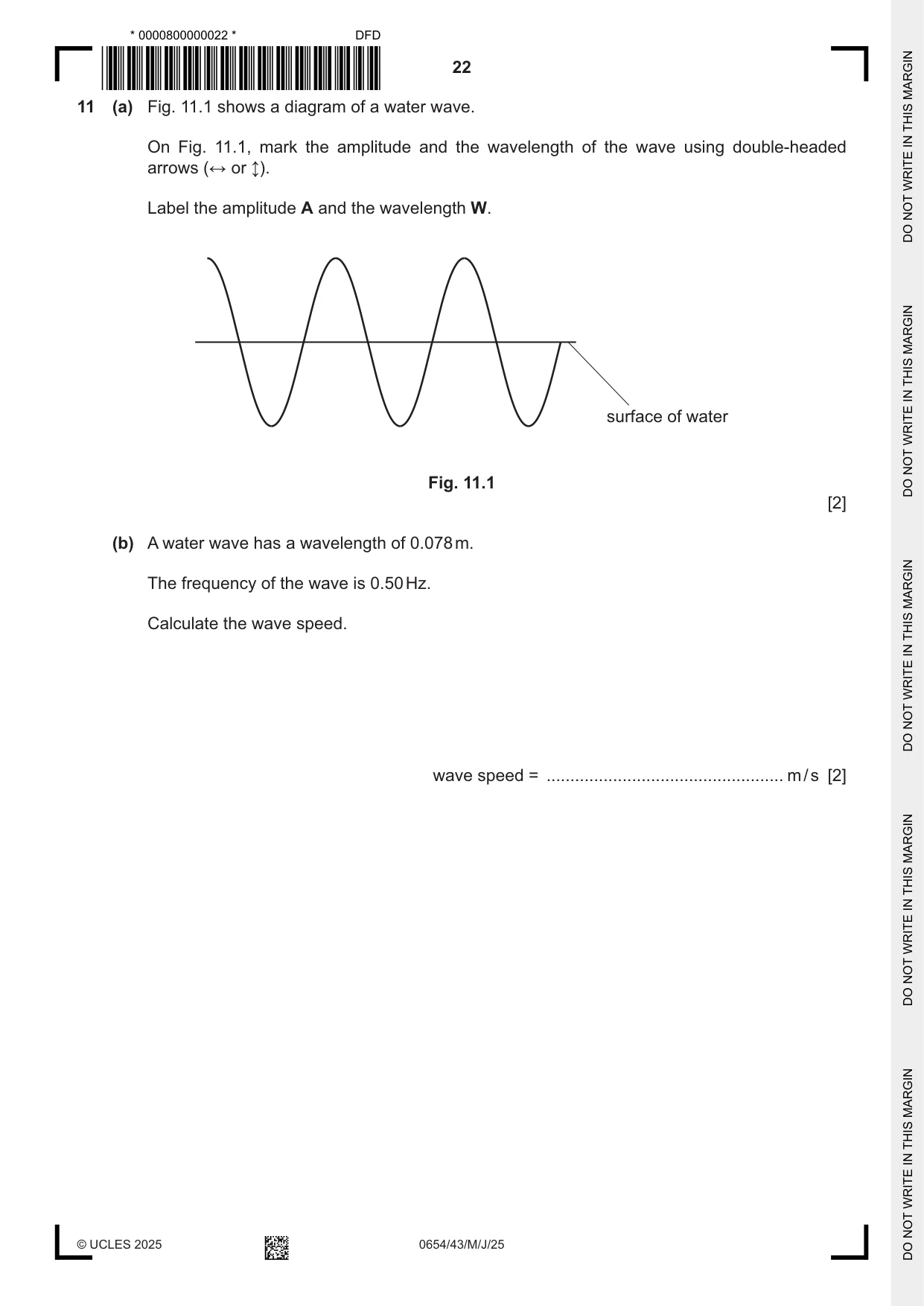
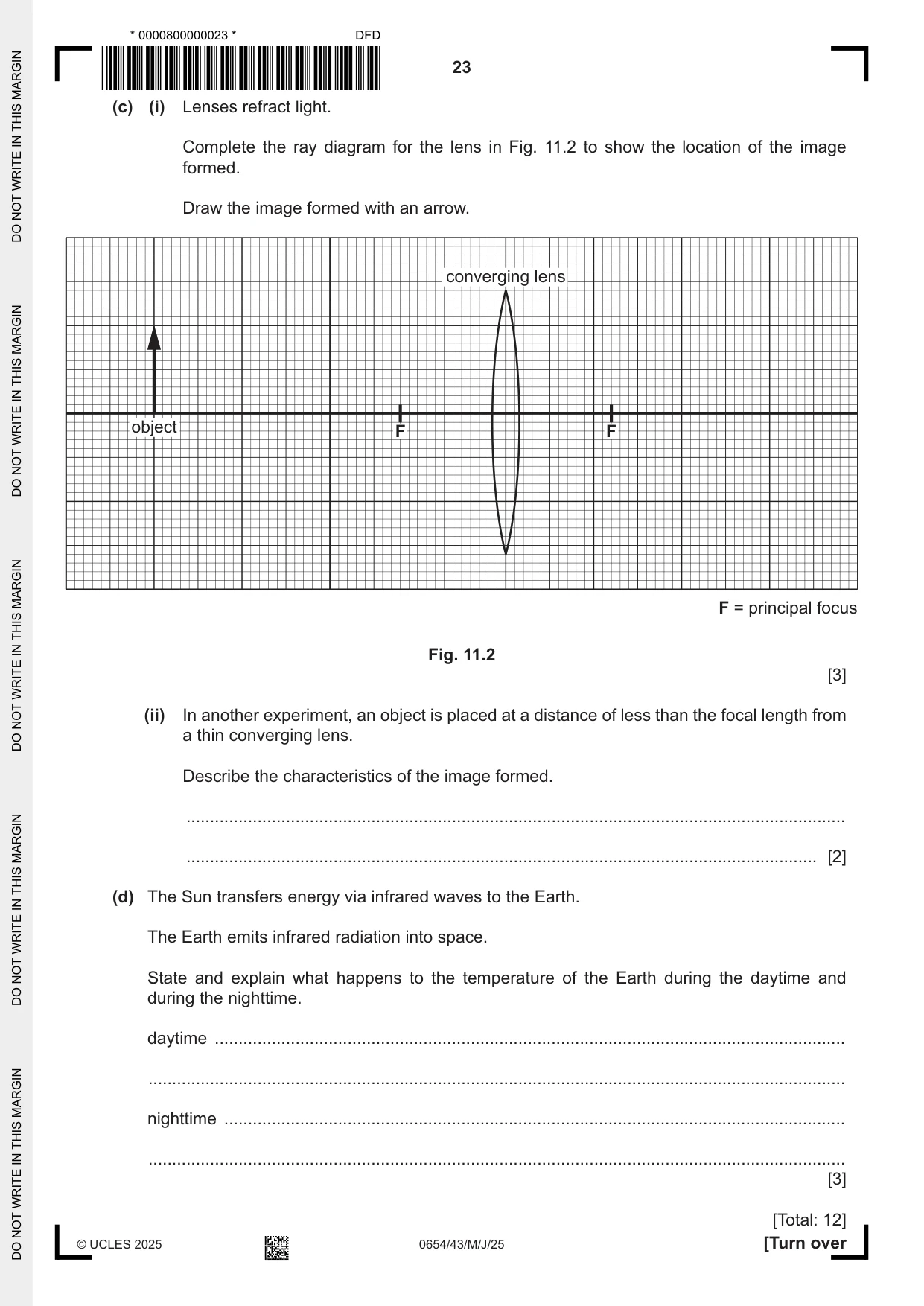
11 (a) Fig. 11.1 shows a diagram of a water wave. On Fig. 11.1, mark the amplitude and the wavelength of the wave using double-headed arrows (↔ or ↕). Label the amplitude A and the wavelength W. surface of water Fig. 11.1 [2] (b) A water wave has a wavelength of 0.078 m. The frequency of the wave is 0.50 Hz. Calculate the wave speed. wave speed = .................................................. m / s [2] (c) (i) Lenses refract light. Complete the ray diagram for the lens in Fig. 11.2 to show the location of the image formed. Draw the image formed with an arrow. converging lens object F F F = principal focus Fig. 11.2 [3] (ii) In another experiment, an object is placed at a distance of less than the focal length from a thin converging lens. Describe the characteristics of the image formed. ........................................................................................................................................... ..................................................................................................................................... [2] (d) The Sun transfers energy via infrared waves to the Earth. The Earth emits infrared radiation into space. State and explain what happens to the temperature of the Earth during the daytime and during the nighttime. daytime ..................................................................................................................................... ................................................................................................................................................... nighttime ................................................................................................................................... ................................................................................................................................................... [3] [Total: 12]
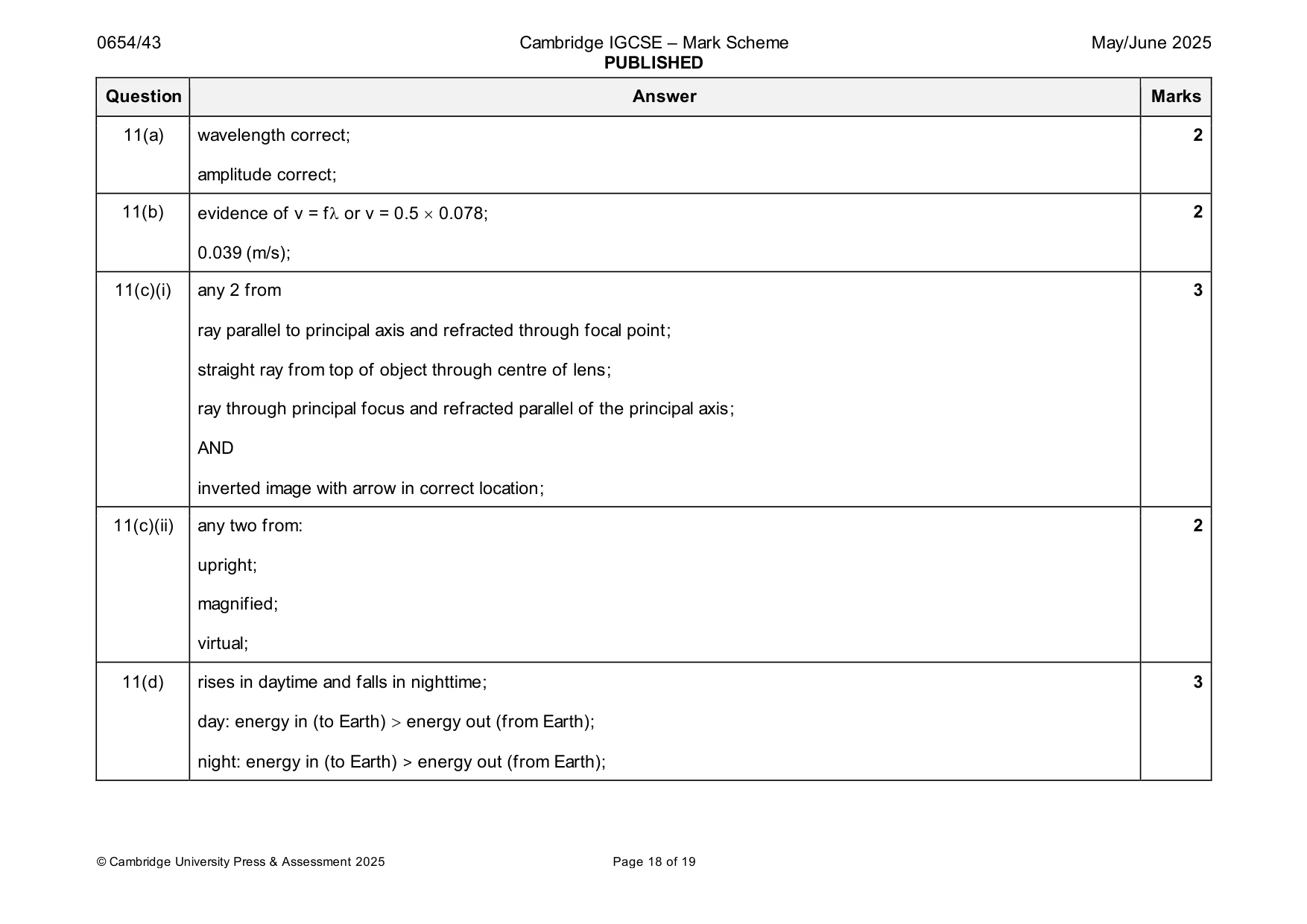
Mark scheme: 11(a) wavelength correct; 2 amplitude correct; 11(b) evidence of v = f or v = 0.5 0.078; 2 0.039 (m/s); 11(c)(i) any 2 from 3 ray parallel to principal axis and refracted through focal point; straight ray from top of object through centre of lens; ray through principal focus and refracted parallel of the principal axis; AND inverted image with arrow in correct location; 11(c)(ii) any two from: 2 upright; magnified; virtual; 11(d) rises in daytime and falls in nighttime; 3 day: energy in (to Earth) energy out (from Earth); night: energy in (to Earth) > energy out (from Earth);
Q12 · Two identical resistors each of resistance 3.8 Ω connected to a cell
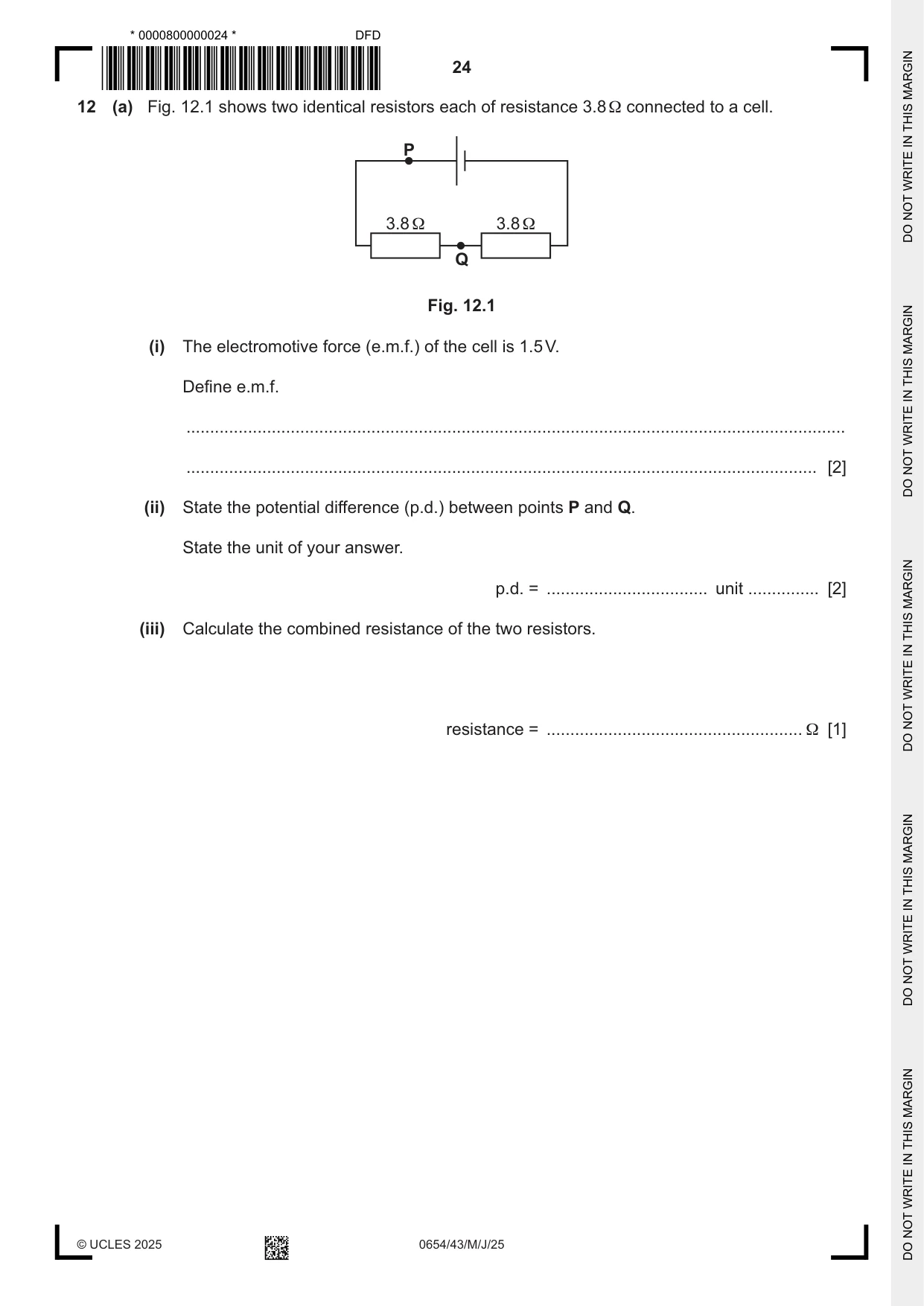
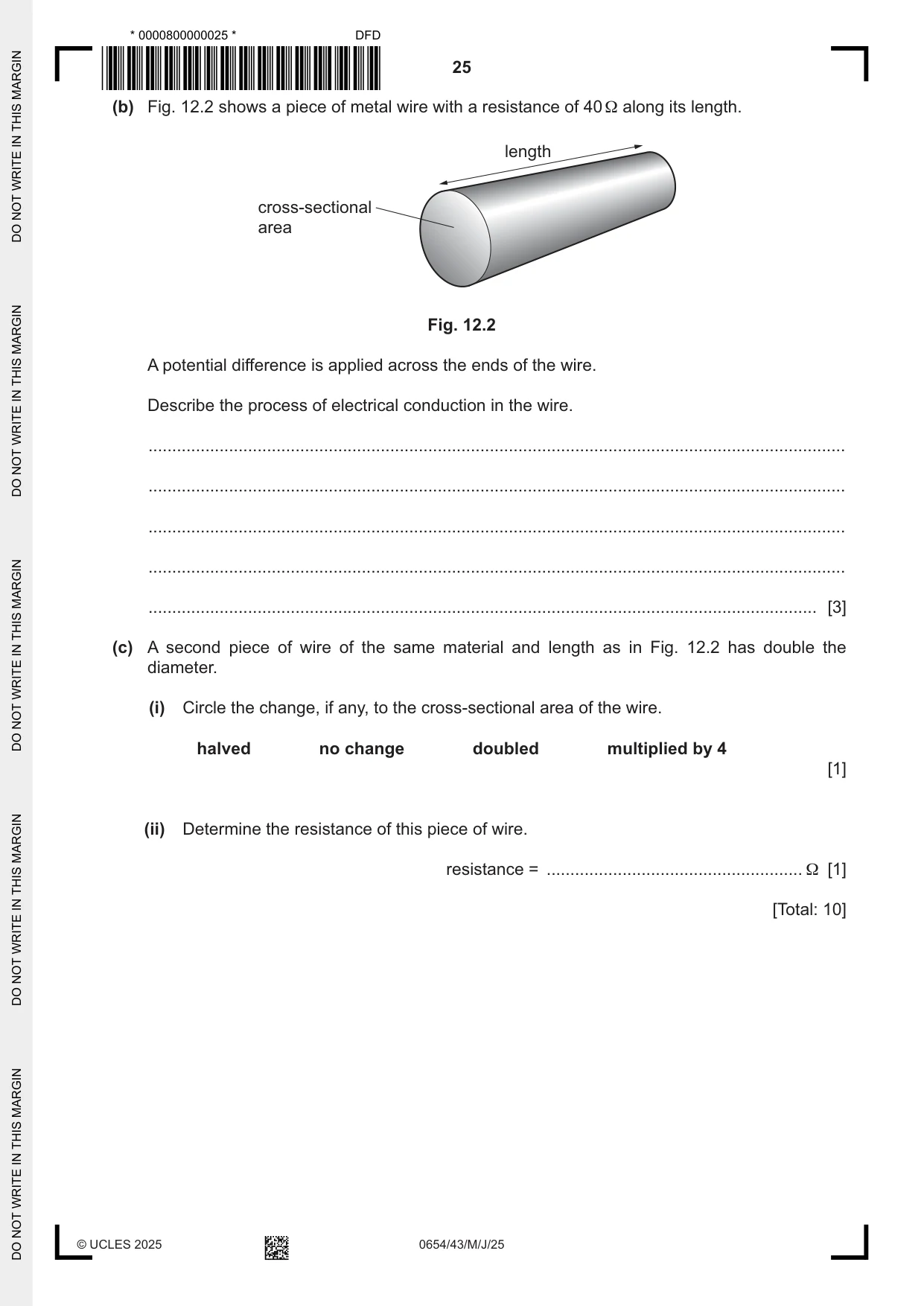
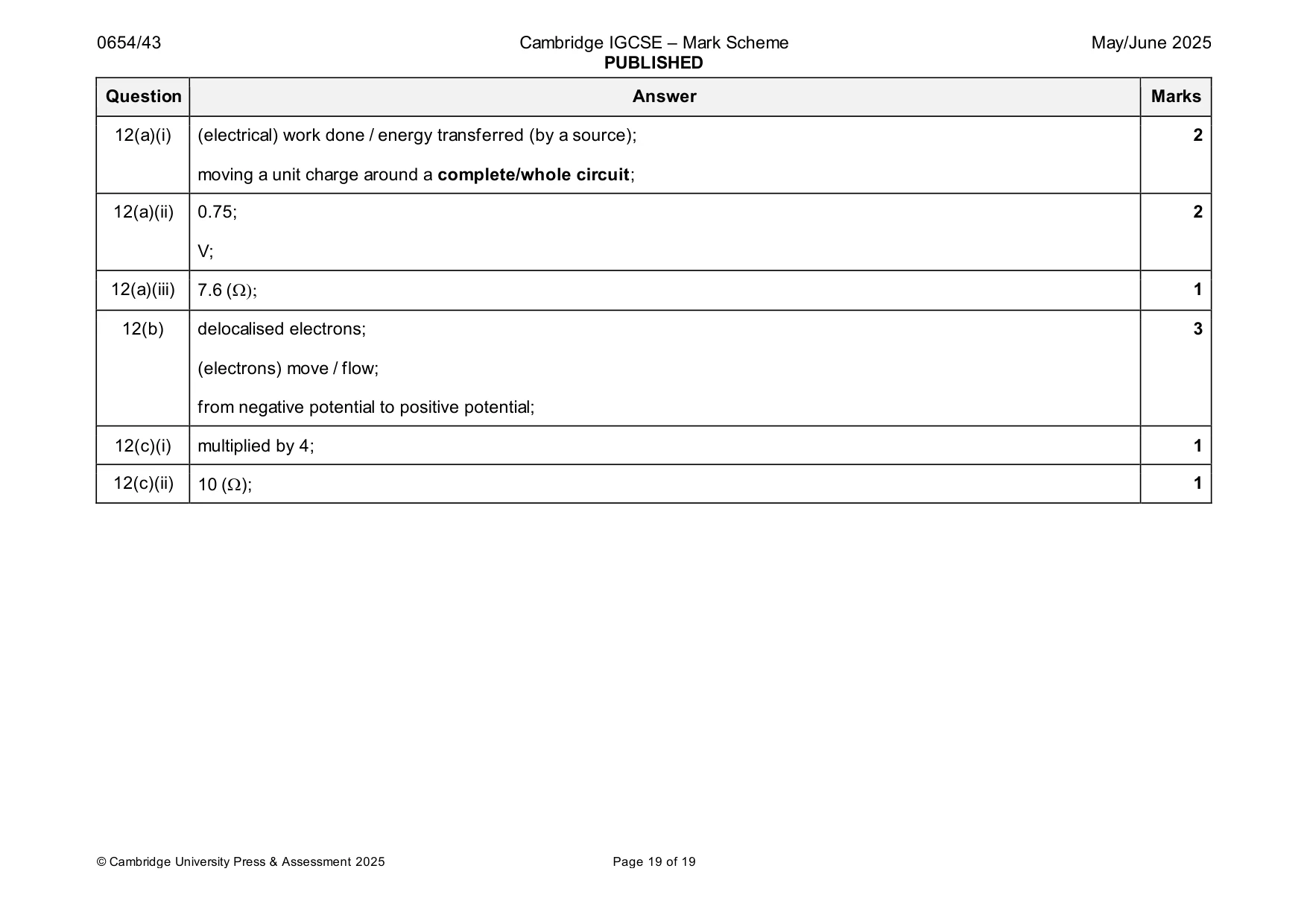
12 (a) Fig. 12.1 shows two identical resistors each of resistance 3.8 Ω connected to a cell. P 3.8 Ω 3.8 Ω Q Fig. 12.1 (i) The electromotive force (e.m.f.) of the cell is 1.5 V. Define e.m.f. ........................................................................................................................................... ..................................................................................................................................... [2] (ii) State the potential difference (p.d.) between points P and Q. State the unit of your answer. p.d. = .................................. unit ............... [2] (iii) Calculate the combined resistance of the two resistors. resistance = ...................................................... Ω [1] (b) Fig. 12.2 shows a piece of metal wire with a resistance of 40 Ω along its length. length cross-sectional area Fig. 12.2 A potential difference is applied across the ends of the wire. Describe the process of electrical conduction in the wire. ................................................................................................................................................... ................................................................................................................................................... ................................................................................................................................................... ................................................................................................................................................... ............................................................................................................................................. [3] (c) A second piece of wire of the same material and length as in Fig. 12.2 has double the diameter. (i) Circle the change, if any, to the cross-sectional area of the wire. halved no change doubled multiplied by 4 [1] (ii) Determine the resistance of this piece of wire. resistance = ...................................................... Ω [1] [Total: 10]
Mark scheme: 12(a)(i) (electrical) work done / energy transferred (by a source); 2 moving a unit charge around a complete/whole circuit; 12(a)(ii) 0.75; 2 V; 12(a)(iii) 7.6 () 1 12(b) delocalised electrons; 3 (electrons) move / flow; from negative potential to positive potential; 12(c)(i) multiplied by 4; 1 12(c)(ii) 10 (); 1
What was in this paper
The subtopics covered by these 12 questions, and how many questions each got. Open one in a new tab to see every Cambridge question on it.
What you needed in this session
Cambridge’s own grade thresholds for 2025 May/June, Paper 4 · Variant 3. A higher threshold means an easier paper — the bar moves with how the cohort did.