Cambridge IGCSE Sciences - Co-ordinated (Double) 0654 — 2020 Oct/Nov Paper 4 · Variant 2
0654/42/O/N/20 · 12 questions · 120 marks · ≈135 min
The question paper and its mark scheme, free to read here and free to download. This is Cambridge’s own paper, exactly as it was sat.
Question paper28 pages

Mark scheme13 pages
Answers below. Sit the paper first if you are practising.
Questions as text
Q1 · A photomicrograph of sperm surrounding an egg cell
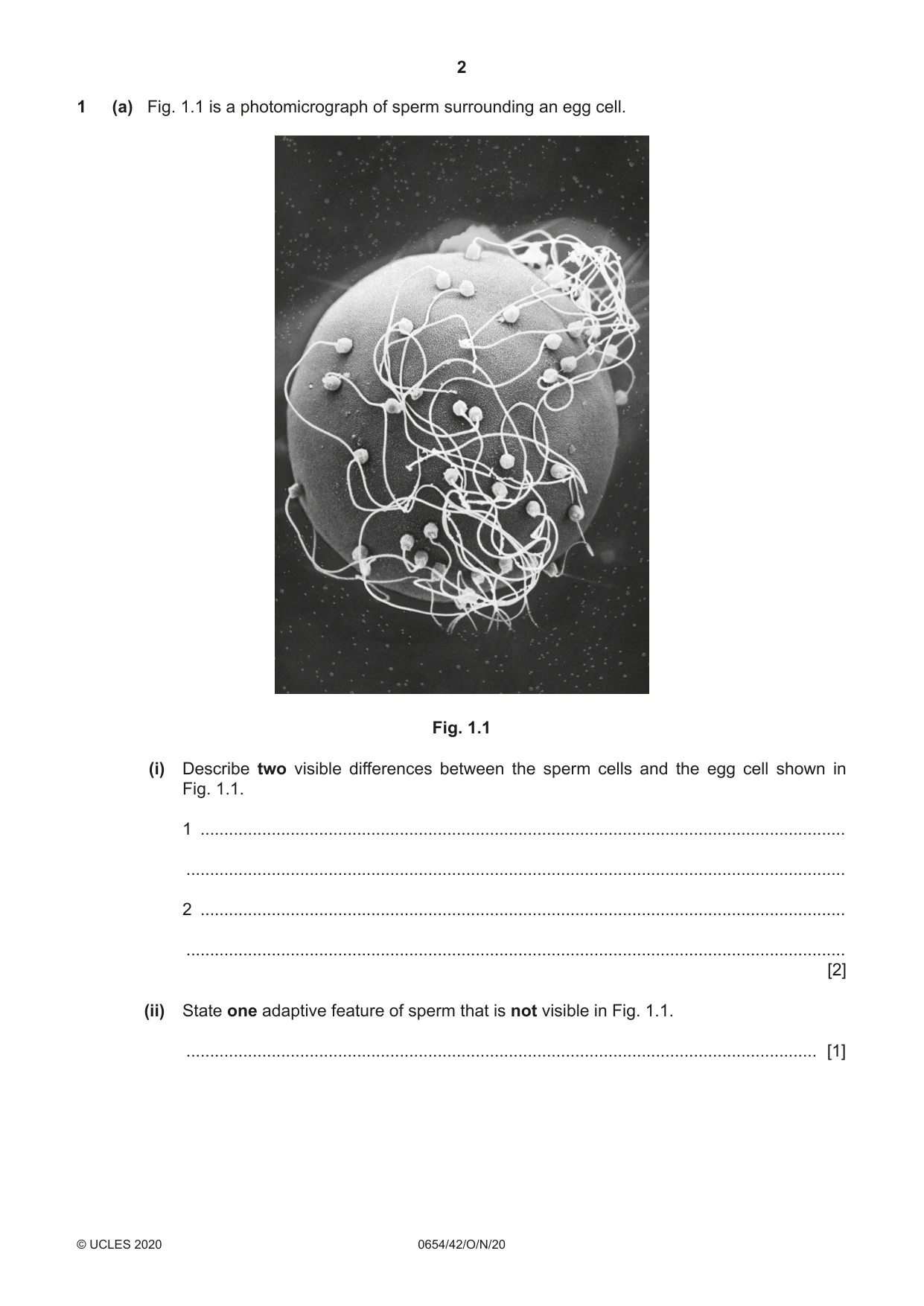
1 (a) Fig. 1.1 is a photomicrograph of sperm surrounding an egg cell. Fig. 1.1 (i) Describe two visible differences between the sperm cells and the egg cell shown in Fig. 1.1. 1 ........................................................................................................................................ ........................................................................................................................................... 2 ........................................................................................................................................ ........................................................................................................................................... [2] (ii) State one adaptive feature of sperm that is not visible in Fig. 1.1. ..................................................................................................................................... [1] (b) The fusion of the nuclei from a sperm and an egg is called fertilisation. (i) State where fertilisation occurs in the female reproductive system. ..................................................................................................................................... [1] (ii) State two parts of the female reproductive system the sperm must pass through before fertilisation. 1 ........................................................................................................................................ 2 ........................................................................................................................................ [2] (iii) After fertilisation, the egg forms a layer that prevents more sperm entering the egg. State the name of this adaptive feature. ..................................................................................................................................... [1] (iv) Complete the sentence to describe the nucleus in a gamete. Gametes contain a .................................................... nucleus containing a single set of .................................................... chromosomes. [2] [Total: 9]
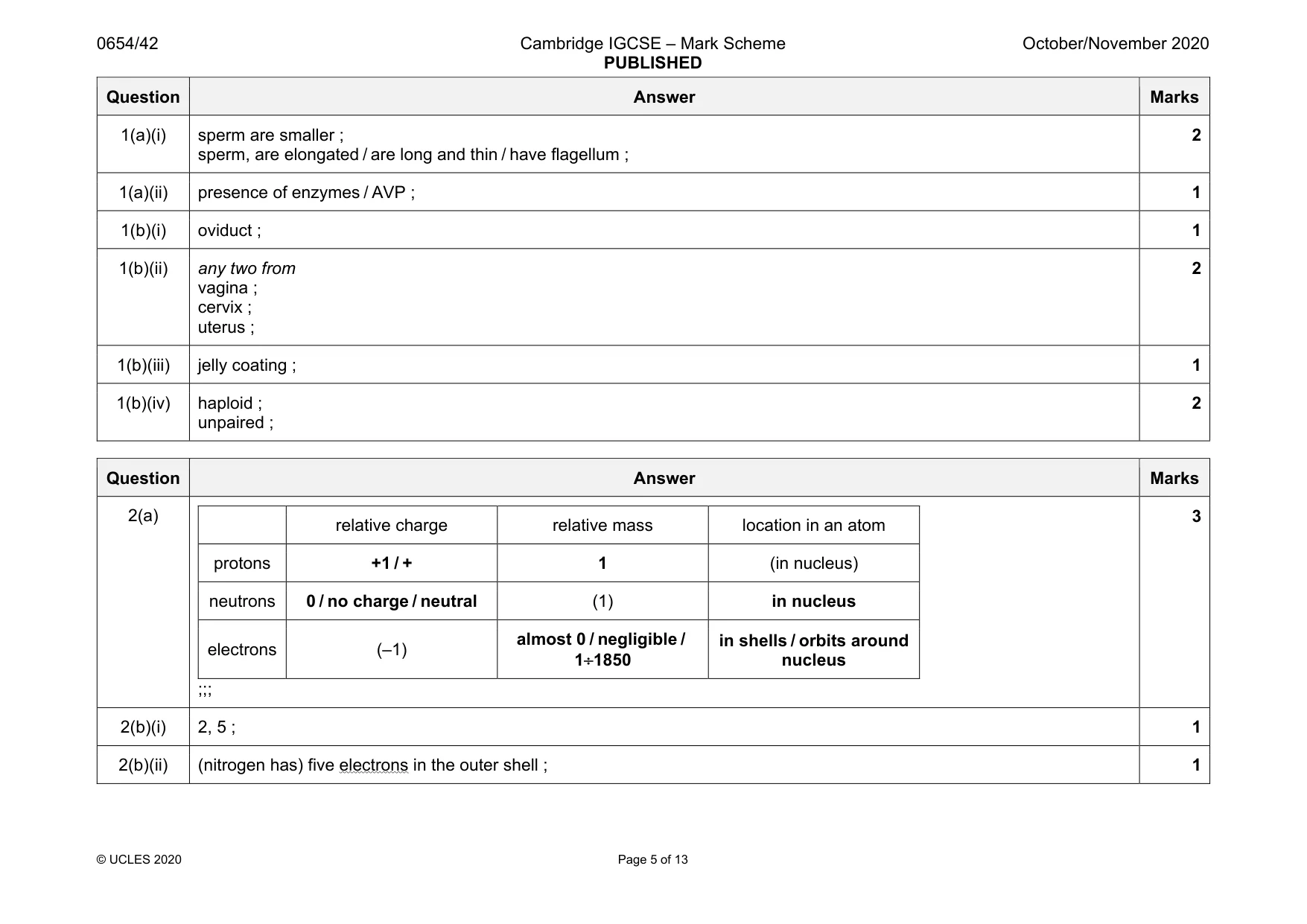
Mark scheme: 1(a)(i) sperm are smaller ; sperm, are elongated / are long and thin / have flagellum ; 2 1(a)(ii) presence of enzymes / AVP ; 1 1(b)(i) oviduct ; 1 1(b)(ii) any two from vagina ; cervix ; uterus ; 2 1(b)(iii) jelly coating ; 1 1(b)(iv) haploid ; unpaired ; 2
Q2 · Atoms contain protons, neutrons and electrons
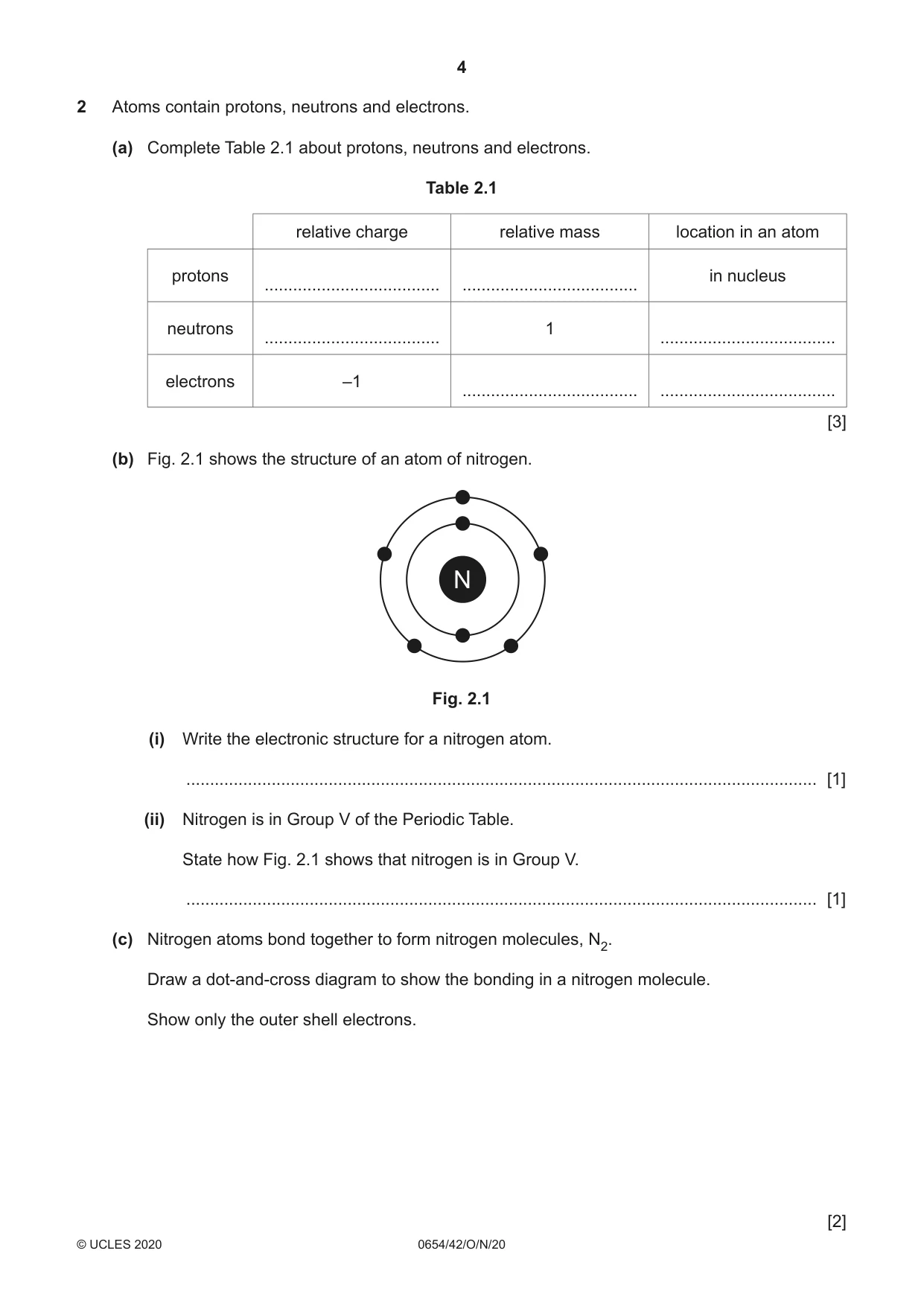
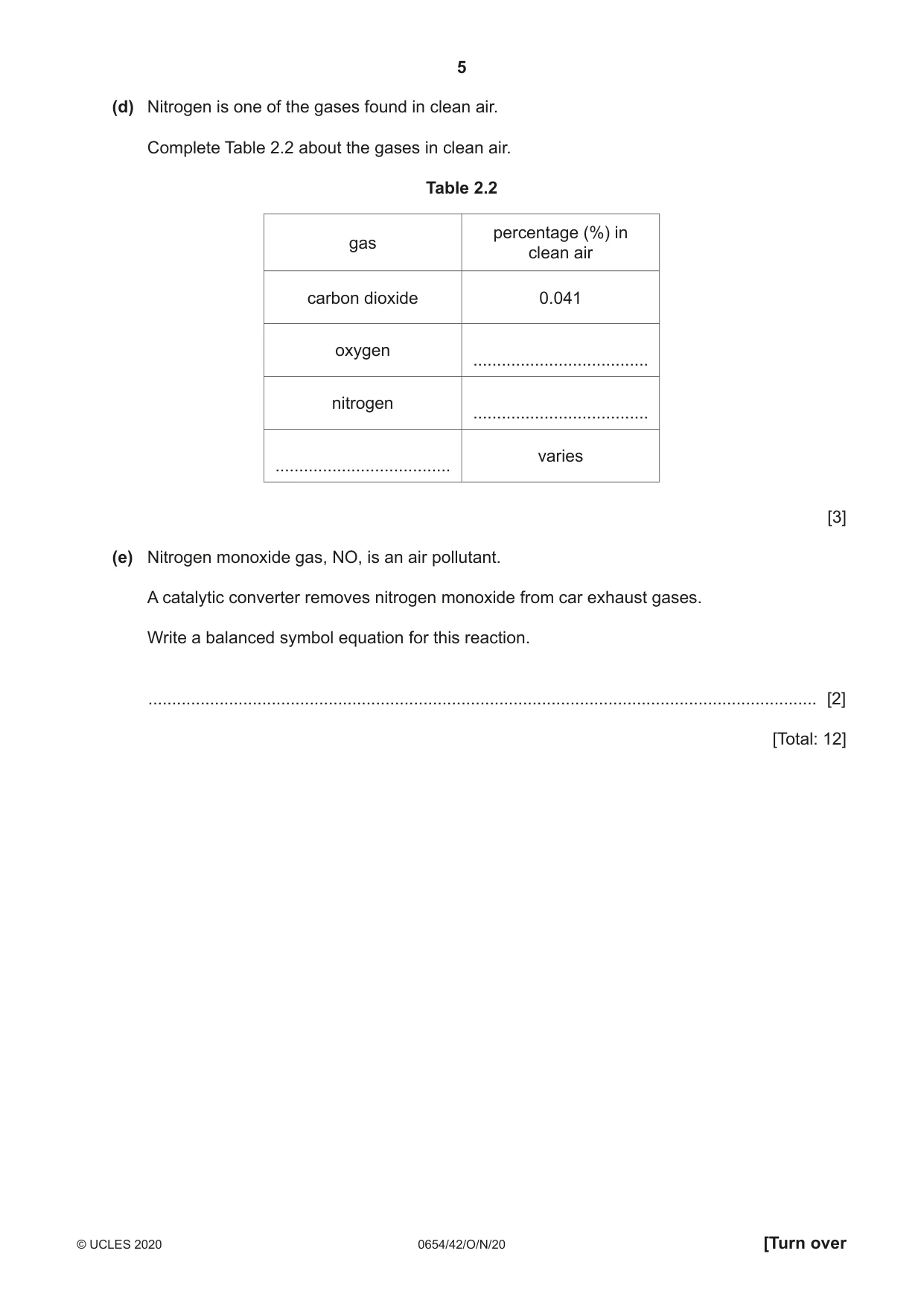
2 Atoms contain protons, neutrons and electrons. (a) Complete Table 2.1 about protons, neutrons and electrons. Table 2.1 relative charge relative mass location in an atom protons in nucleus ..................................... ..................................... neutrons 1 ..................................... ..................................... electrons –1 ..................................... ..................................... [3] (b) Fig. 2.1 shows the structure of an atom of nitrogen. N Fig. 2.1 (i) Write the electronic structure for a nitrogen atom. ..................................................................................................................................... [1] (ii) Nitrogen is in Group V of the Periodic Table. State how Fig. 2.1 shows that nitrogen is in Group V. ..................................................................................................................................... [1] (c) Nitrogen atoms bond together to form nitrogen molecules, N2. Draw a dot-and-cross diagram to show the bonding in a nitrogen molecule. Show only the outer shell electrons. [2] (d) Nitrogen is one of the gases found in clean air. Complete Table 2.2 about the gases in clean air. Table 2.2 percentage (%) in gas clean air carbon dioxide 0.041 oxygen ..................................... nitrogen ..................................... varies ..................................... [3] (e) Nitrogen monoxide gas, NO, is an air pollutant. A catalytic converter removes nitrogen monoxide from car exhaust gases. Write a balanced symbol equation for this reaction. ............................................................................................................................................. [2] [Total: 12]
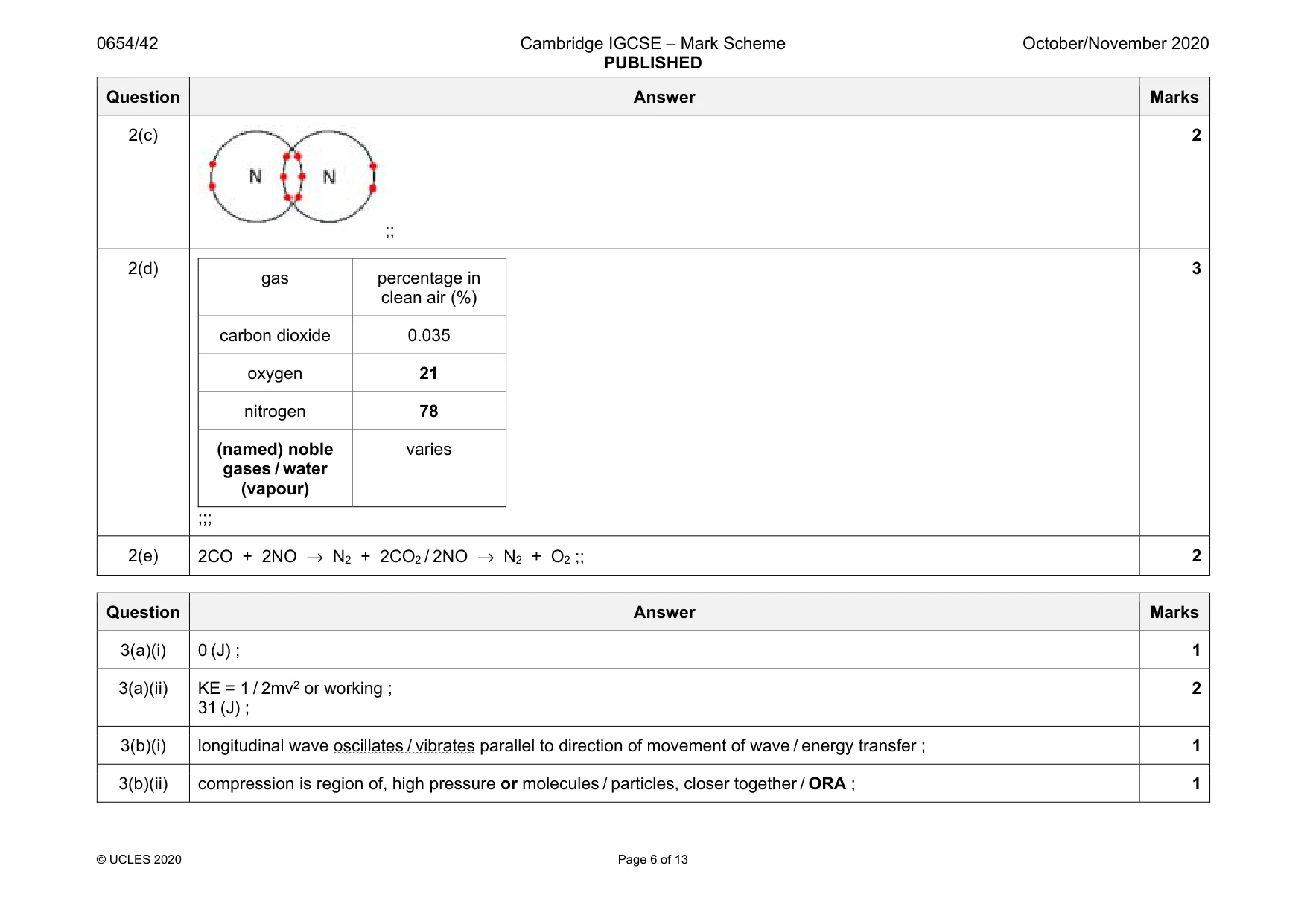
Mark scheme: 2(a) relative charge relative mass location in an atom protons +1 / + 1 (in nucleus) neutrons 0 / no charge / neutral (1) in nucleus electrons (–1) almost 0 / negligible / 1÷1850 in shells / orbits around nucleus ;;; 3 2(b)(i) 2, 5 ; 1 2(b)(ii) (nitrogen has) five electrons in the outer shell ; 1 Question Answer Marks 2(c) ;; 2 2(d) gas percentage in clean air (%) carbon dioxide 0.035 oxygen 21 nitrogen 78 (named) noble gases / water (vapour) varies ;;; 3 2(e) 2CO + 2NO → N2 + 2CO2 / 2NO → N2 + O2 ;; 2
Q3 · A golfer swings her golf club to hit a stationary golf ball of mass 0.05 kg
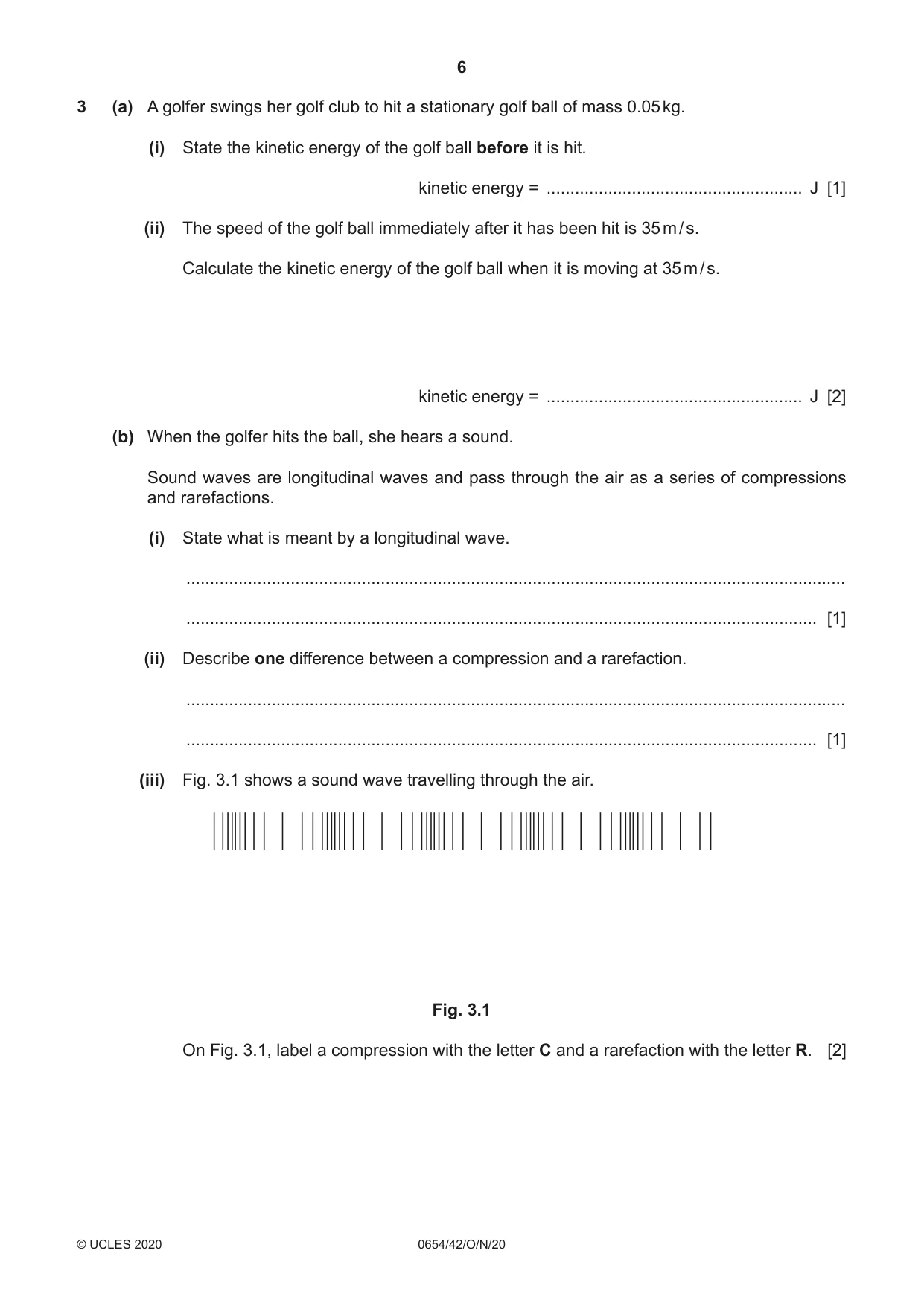
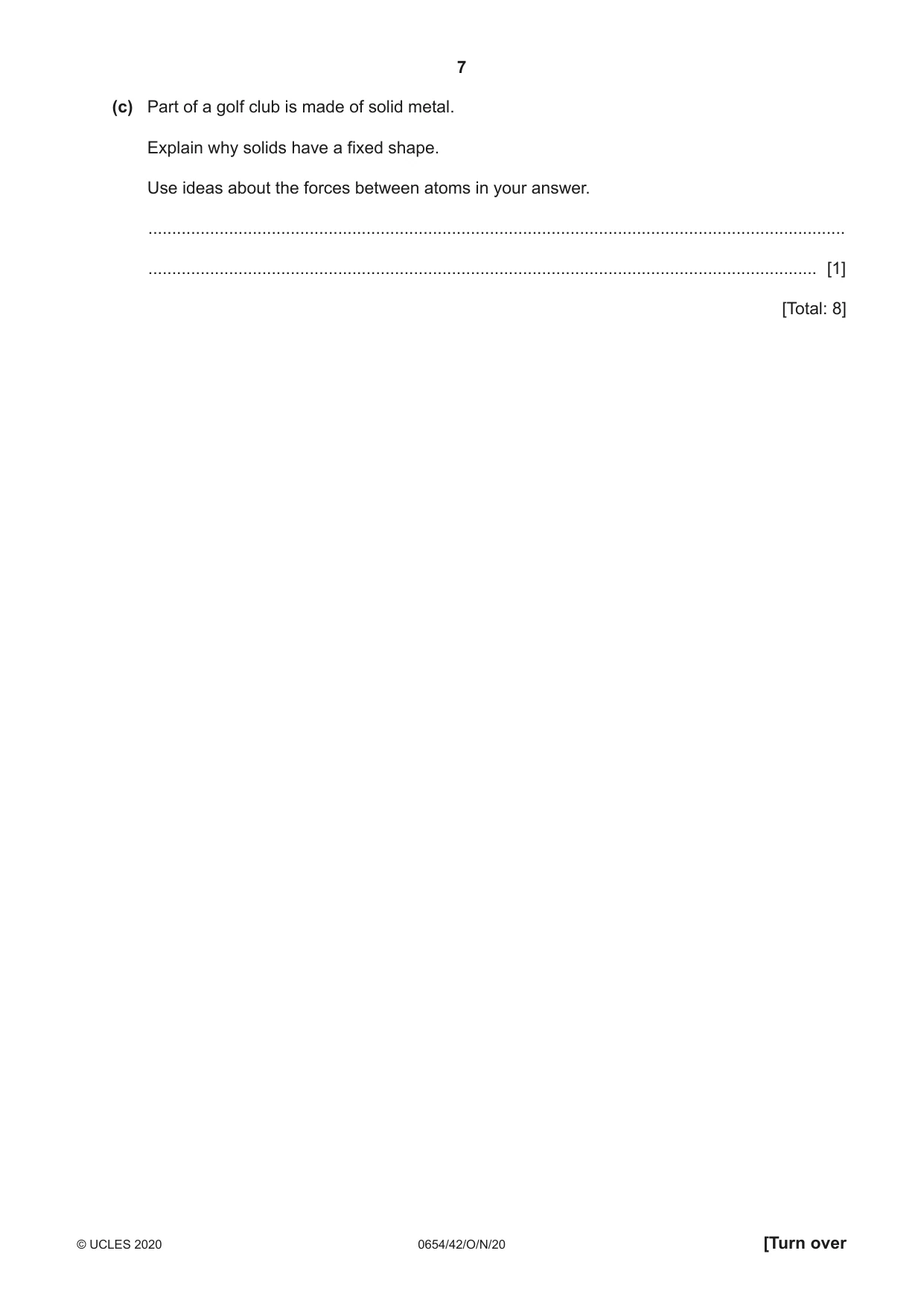
3 (a) A golfer swings her golf club to hit a stationary golf ball of mass 0.05 kg. (i) State the kinetic energy of the golf ball before it is hit. kinetic energy = ...................................................... J [1] (ii) The speed of the golf ball immediately after it has been hit is 35 m / s. Calculate the kinetic energy of the golf ball when it is moving at 35 m / s. kinetic energy = ...................................................... J [2] (b) When the golfer hits the ball, she hears a sound. Sound waves are longitudinal waves and pass through the air as a series of compressions and rarefactions. (i) State what is meant by a longitudinal wave. ........................................................................................................................................... ..................................................................................................................................... [1] (ii) Describe one difference between a compression and a rarefaction. ........................................................................................................................................... ..................................................................................................................................... [1] (iii) Fig. 3.1 shows a sound wave travelling through the air. Fig. 3.1 On Fig. 3.1, label a compression with the letter C and a rarefaction with the letter R. [2] (c) Part of a golf club is made of solid metal. Explain why solids have a fixed shape. Use ideas about the forces between atoms in your answer. ................................................................................................................................................... ............................................................................................................................................. [1] [Total: 8]
Mark scheme: 3(a)(i) 0 (J) ; 1 3(a)(ii) KE = 1 / 2mv2 or working ; 31 (J) ; 2 3(b)(i) longitudinal wave oscillates / vibrates parallel to direction of movement of wave / energy transfer ; 1 3(b)(ii) compression is region of, high pressure or molecules / particles, closer together / ORA ; 1 Question Answer Marks 3(b)(iii) compression correctly labelled ; rarefaction correctly labelled ; 2 3(c) strong forces of attraction between atoms hold atoms together in a fixed position ; 1
Q4 · Researchers estimated the percentage of people that smoke tobacco in a country
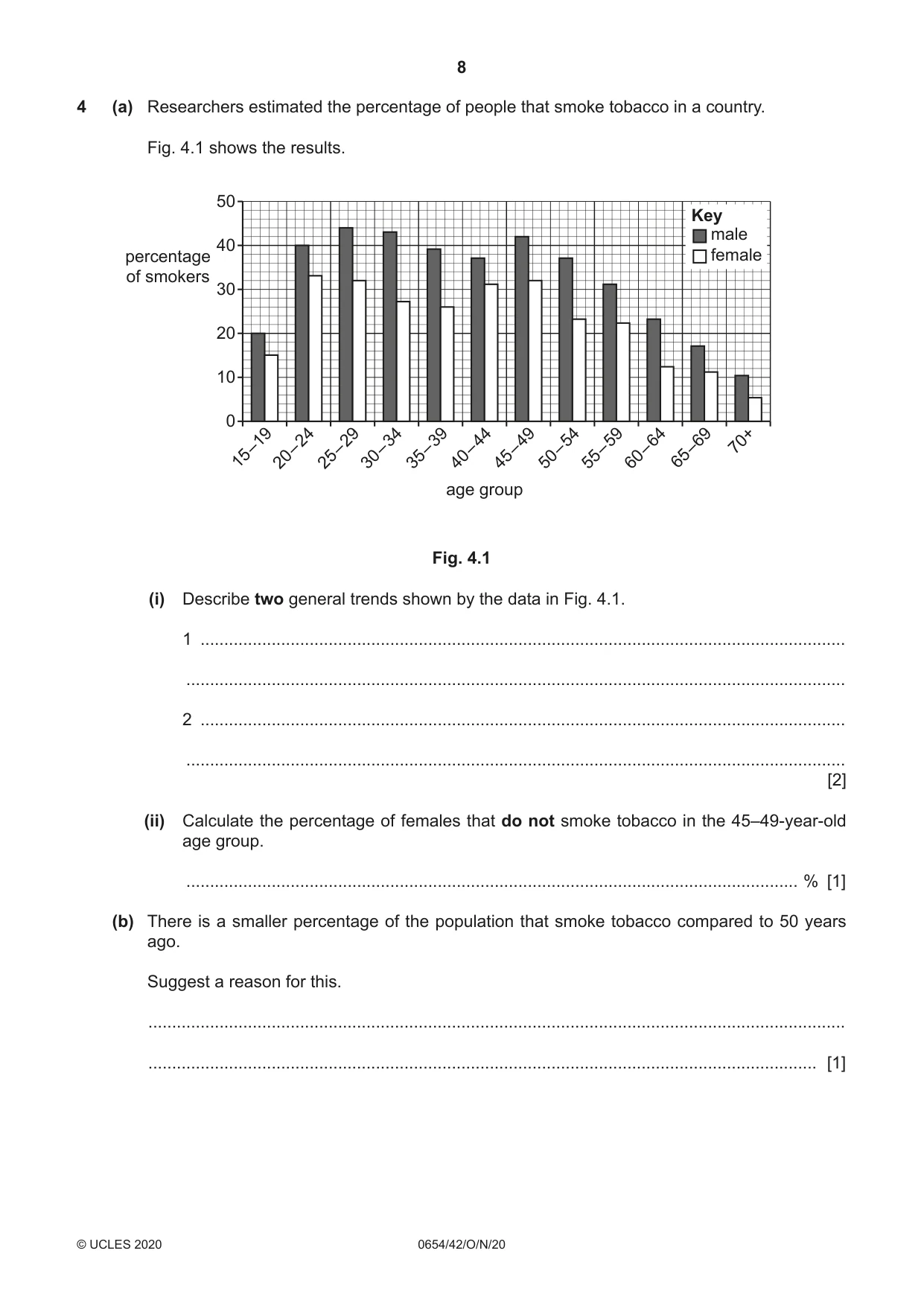
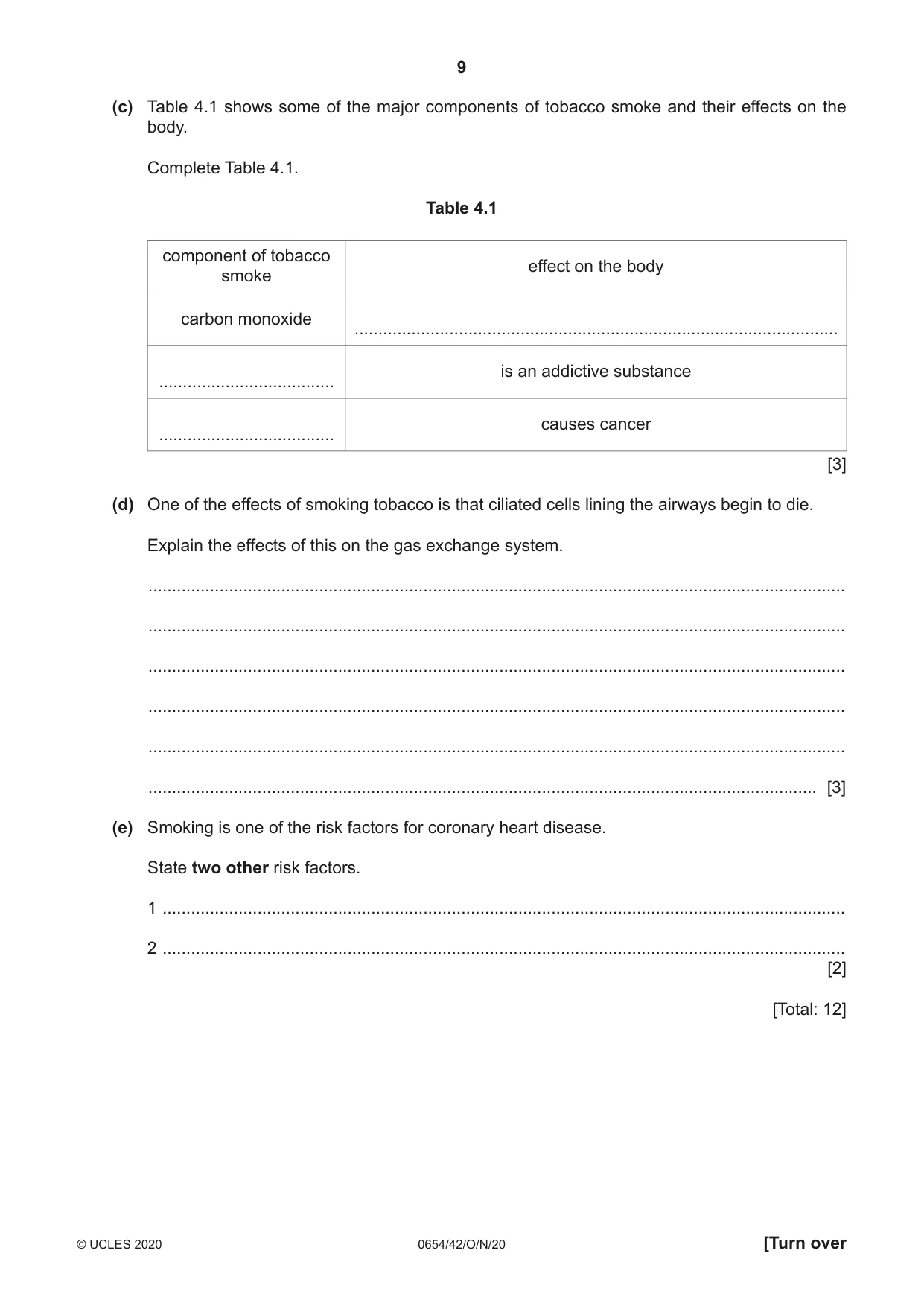
4 (a) Researchers estimated the percentage of people that smoke tobacco in a country. Fig. 4.1 shows the results. 50 Key male 40 percentage female of smokers 30 20 10 0 –19 –24 –29 –34 –39 –44 –49 –54 –59 –64 –69 70+ 15 20 25 30 35 40 45 50 55 60 65 age group Fig. 4.1 (i) Describe two general trends shown by the data in Fig. 4.1. 1 ........................................................................................................................................ ........................................................................................................................................... 2 ........................................................................................................................................ ........................................................................................................................................... [2] (ii) Calculate the percentage of females that do not smoke tobacco in the 45–49-year-old age group. ................................................................................................................................. % [1] (b) There is a smaller percentage of the population that smoke tobacco compared to 50 years ago. Suggest a reason for this. ................................................................................................................................................... ............................................................................................................................................. [1] (c) Table 4.1 shows some of the major components of tobacco smoke and their effects on the body. Complete Table 4.1. Table 4.1 component of tobacco effect on the body smoke carbon monoxide ...................................................................................................... is an addictive substance ..................................... causes cancer ..................................... [3] (d) One of the effects of smoking tobacco is that ciliated cells lining the airways begin to die. Explain the effects of this on the gas exchange system. ................................................................................................................................................... ................................................................................................................................................... ................................................................................................................................................... ................................................................................................................................................... ................................................................................................................................................... ............................................................................................................................................. [3] (e) Smoking is one of the risk factors for coronary heart disease. State two other risk factors. 1 ................................................................................................................................................ 2 ................................................................................................................................................ [2] [Total: 12]
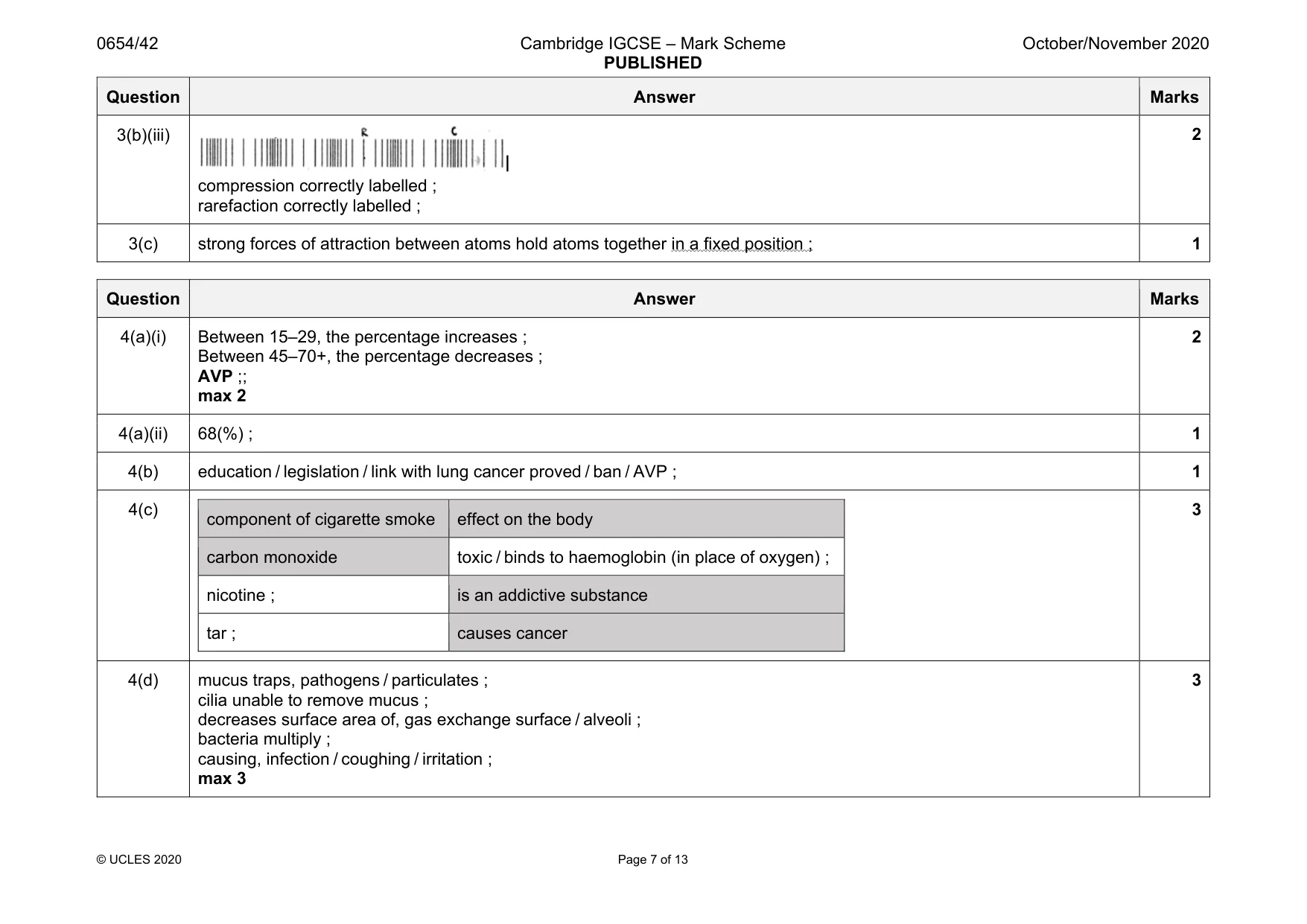
Mark scheme: 4(a)(i) Between 15–29, the percentage increases ; Between 45–70+, the percentage decreases ; AVP ;; max 2 4(a)(ii) 68(%) ; 1 4(b) education / legislation / link with lung cancer proved / ban / AVP ; 1 4(c) component of cigarette smoke effect on the body carbon monoxide toxic / binds to haemoglobin (in place of oxygen) ; nicotine ; is an addictive substance tar ; causes cancer 3 4(d) mucus traps, pathogens / particulates ; cilia unable to remove mucus ; decreases surface area of, gas exchange surface / alveoli ; bacteria multiply ; causing, infection / coughing / irritation ; max 3 3 Question Answer Marks 4(e) any two from: stress ; age ; gender ; diet ; genetic predisposition ; AVP ;; 2
Q5 · Copper is a transition metal
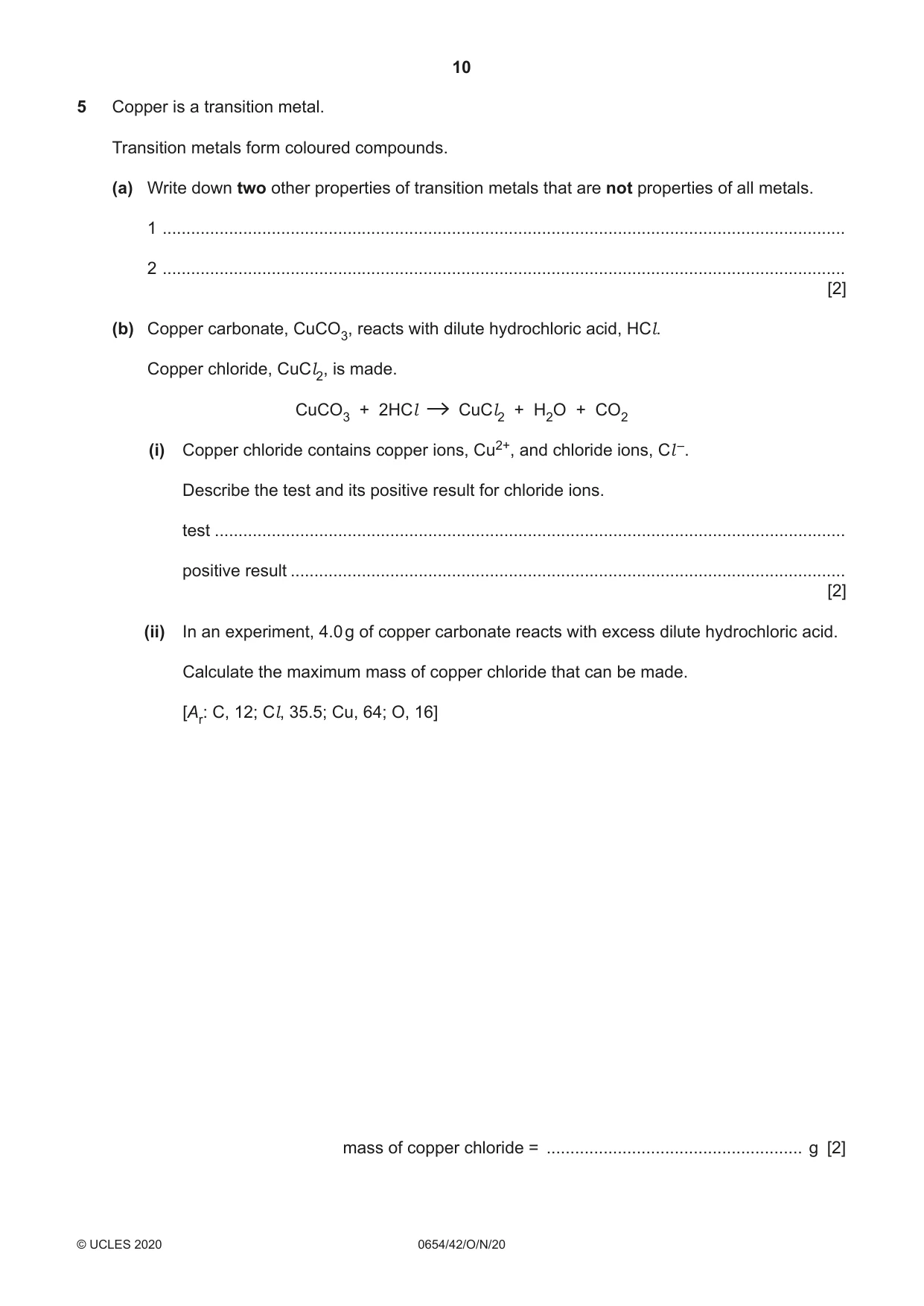
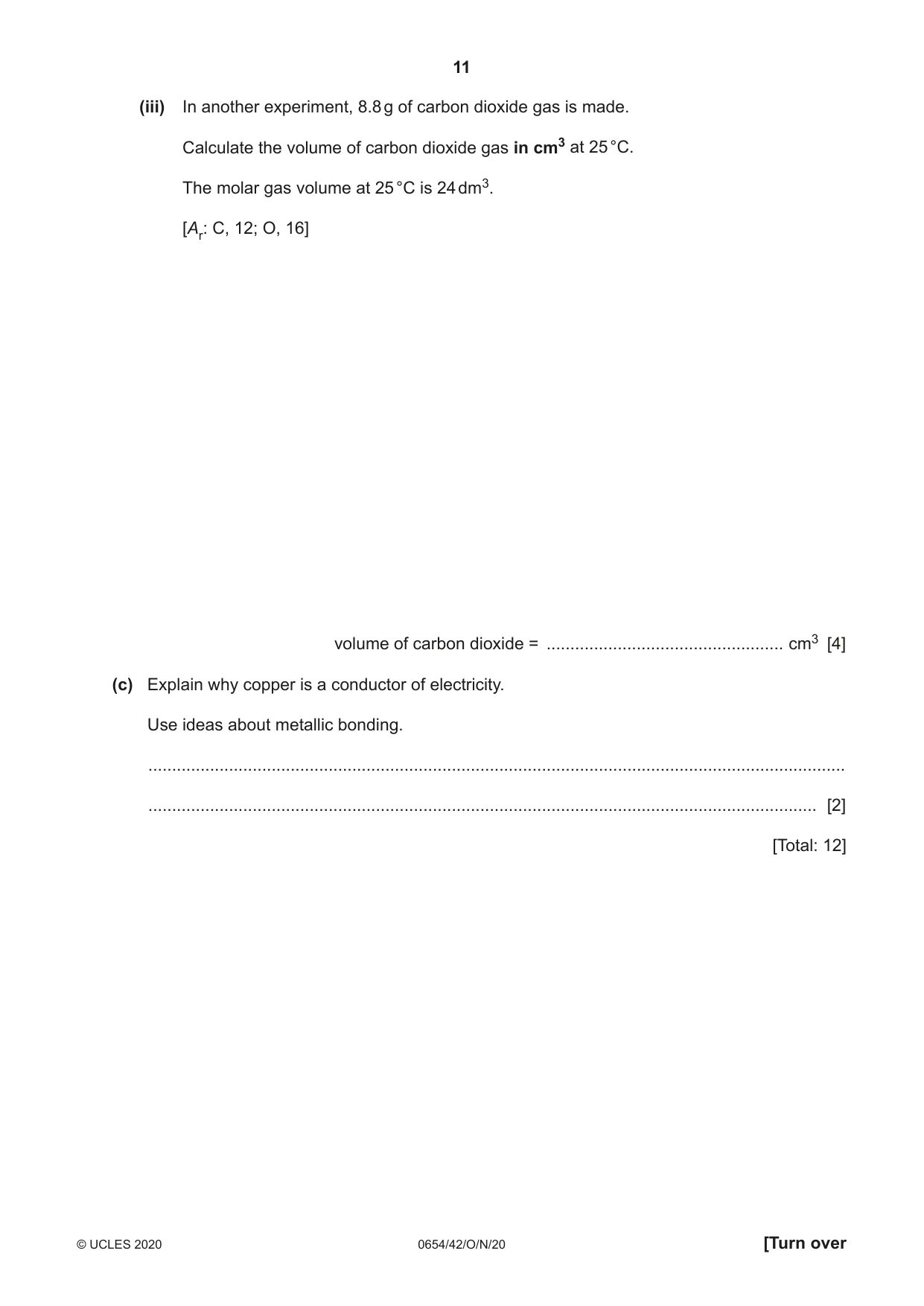
5 Copper is a transition metal. Transition metals form coloured compounds. (a) Write down two other properties of transition metals that are not properties of all metals. 1 ................................................................................................................................................ 2 ................................................................................................................................................ [2] (b) Copper carbonate, CuCO3, reacts with dilute hydrochloric acid, HCl. Copper chloride, CuCl2, is made. CuCO3 + 2HCl CuCl2 + H2O + CO2 (i) Copper chloride contains copper ions, Cu2+, and chloride ions, Cl –. Describe the test and its positive result for chloride ions. test ..................................................................................................................................... positive result ..................................................................................................................... [2] (ii) In an experiment, 4.0 g of copper carbonate reacts with excess dilute hydrochloric acid. Calculate the maximum mass of copper chloride that can be made. [Ar: C, 12; Cl, 35.5; Cu, 64; O, 16] mass of copper chloride = ...................................................... g [2] (iii) In another experiment, 8.8 g of carbon dioxide gas is made. Calculate the volume of carbon dioxide gas in cm3 at 25 °C. The molar gas volume at 25 °C is 24 dm3. [Ar: C, 12; O, 16] volume of carbon dioxide = .................................................. cm3 [4] (c) Explain why copper is a conductor of electricity. Use ideas about metallic bonding. ................................................................................................................................................... ............................................................................................................................................. [2] [Total: 12]
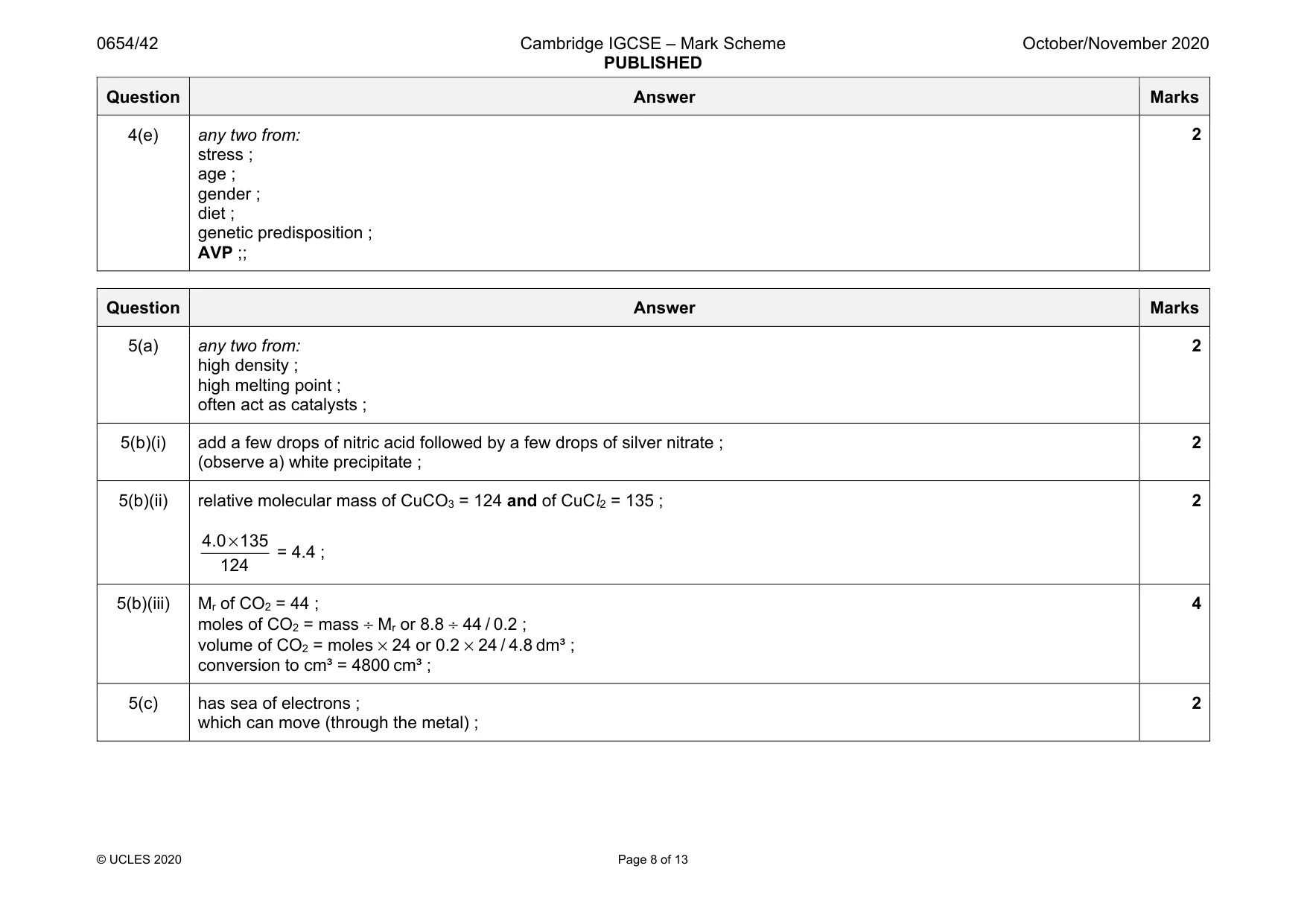
Mark scheme: 5(a) any two from: high density ; high melting point ; often act as catalysts ; 2 5(b)(i) add a few drops of nitric acid followed by a few drops of silver nitrate ; (observe a) white precipitate ; 2 5(b)(ii) relative molecular mass of CuCO3 = 124 and of CuCl2 = 135 ; × 4.0 135 124 = 4.4 ; 2 5(b)(iii) Mr of CO2 = 44 ; moles of CO2 = mass ÷ Mr or 8.8 ÷ 44 / 0.2 ; volume of CO2 = moles × 24 or 0.2 × 24 / 4.8 dm³ ; conversion to cm³ = 4800 cm³ ; 4 5(c) has sea of electrons ; which can move (through the metal) ; 2
Q6 · A horse of mass 450 kg accelerates constantly from rest and reaches a maximum speed of 9…
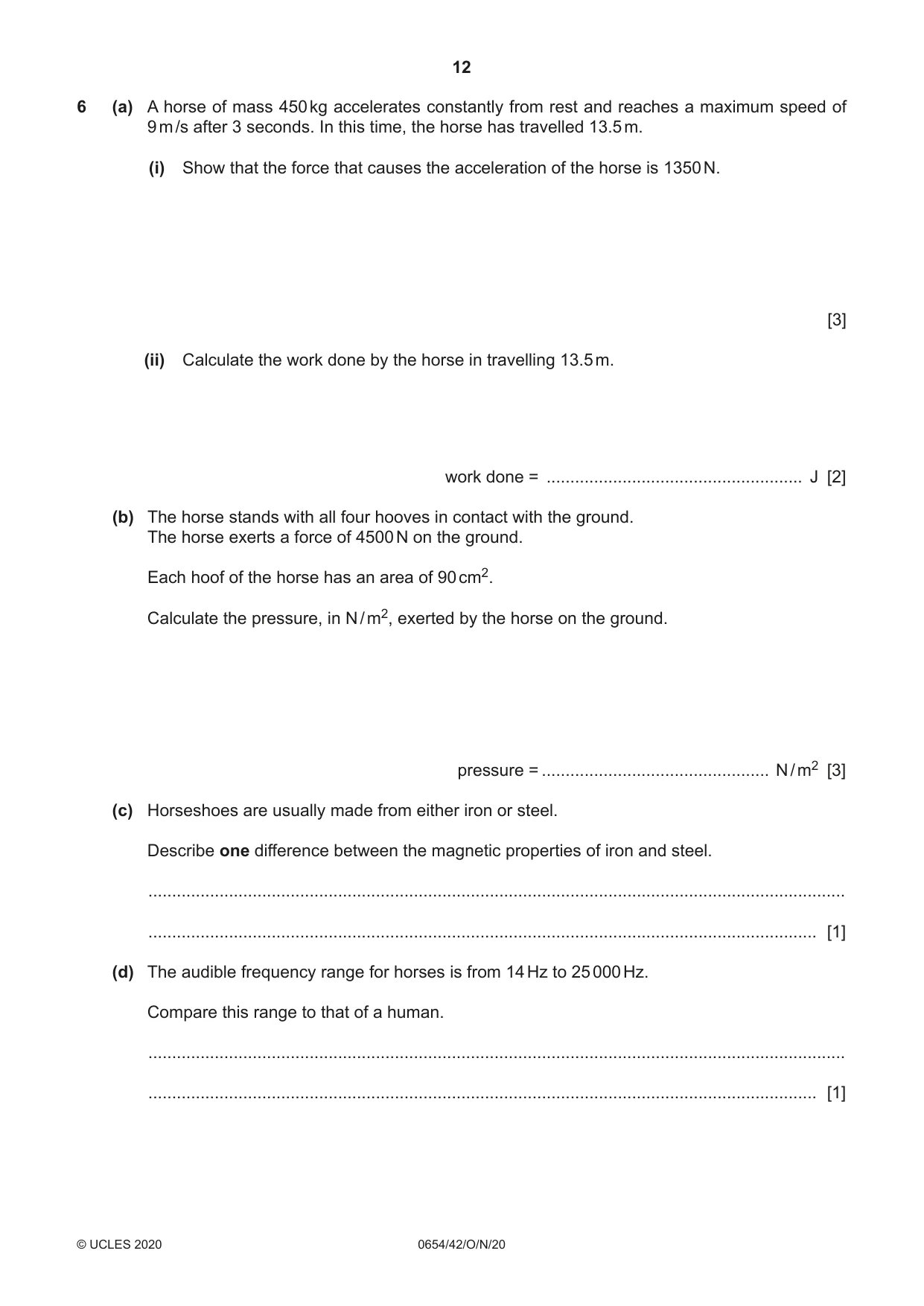
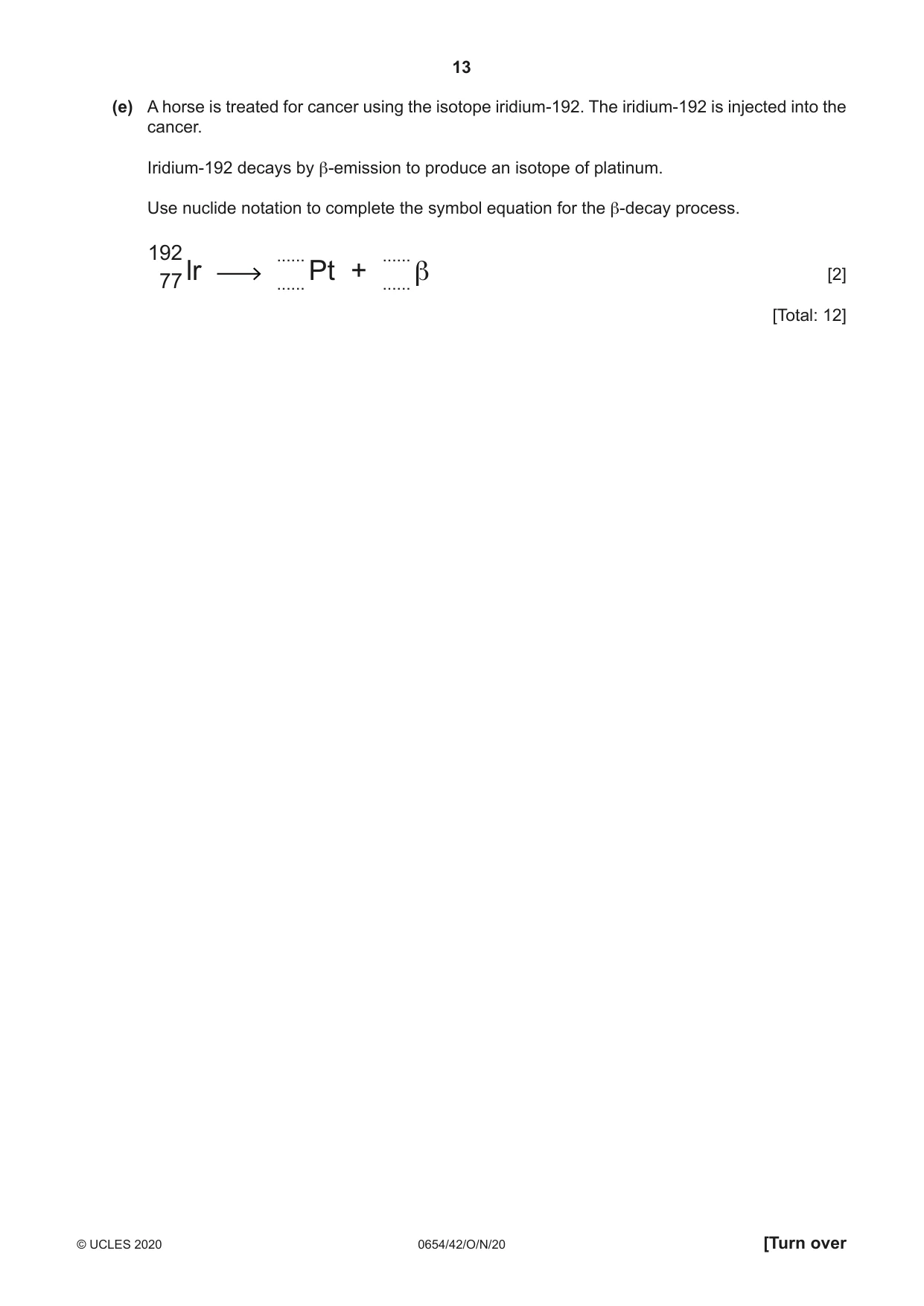
6 (a) A horse of mass 450 kg accelerates constantly from rest and reaches a maximum speed of 9 m /s after 3 seconds. In this time, the horse has travelled 13.5 m. (i) Show that the force that causes the acceleration of the horse is 1350 N. [3] (ii) Calculate the work done by the horse in travelling 13.5 m. work done = ...................................................... J [2] (b) The horse stands with all four hooves in contact with the ground. The horse exerts a force of 4500 N on the ground. Each hoof of the horse has an area of 90 cm2. Calculate the pressure, in N / m2, exerted by the horse on the ground. pressure = ................................................ N / m2 [3] (c) Horseshoes are usually made from either iron or steel. Describe one difference between the magnetic properties of iron and steel. ................................................................................................................................................... ............................................................................................................................................. [1] (d) The audible frequency range for horses is from 14 Hz to 25 000 Hz. Compare this range to that of a human. ................................................................................................................................................... ............................................................................................................................................. [1] (e) A horse is treated for cancer using the isotope iridium-192. The iridium-192 is injected into the cancer. Iridium-192 decays by β-emission to produce an isotope of platinum. Use nuclide notation to complete the symbol equation for the β-decay process. 192 ...... ...... lr Pt + β [2] 77 ...... ...... [Total: 12]
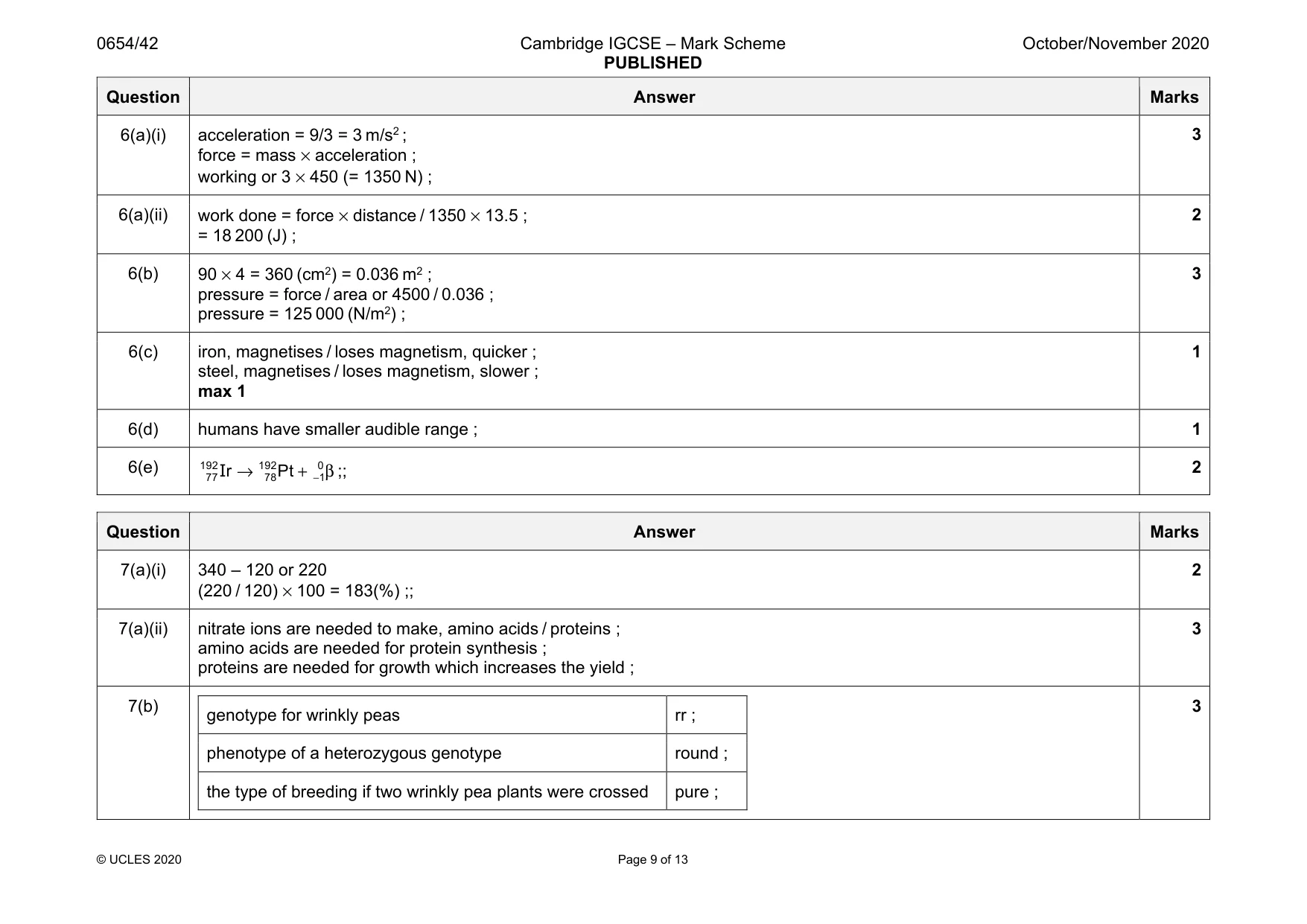
Mark scheme: 6(a)(i) acceleration = 9/3 = 3 m/s2 ; force = mass × acceleration ; working or 3 × 450 (= 1350 N) ; 6(a)(ii) work done = force × distance / 1350 × 13.5 ; = 18 200 (J) ; 2 6(b) 90 × 4 = 360 (cm2) = 0.036 m2 ; pressure = force / area or 4500 / 0.036 ; pressure = 125 000 (N/m2) ; 3 6(c) iron, magnetises / loses magnetism, quicker ; steel, magnetises / loses magnetism, slower ; max 1 1 6(d) humans have smaller audible range ; 1 6(e) − → + β 192 192 0 77 78 1 r Pt I ;; 2
Q7 · The effects of using fertilisers containing nitrate ions on the yield of pea plants
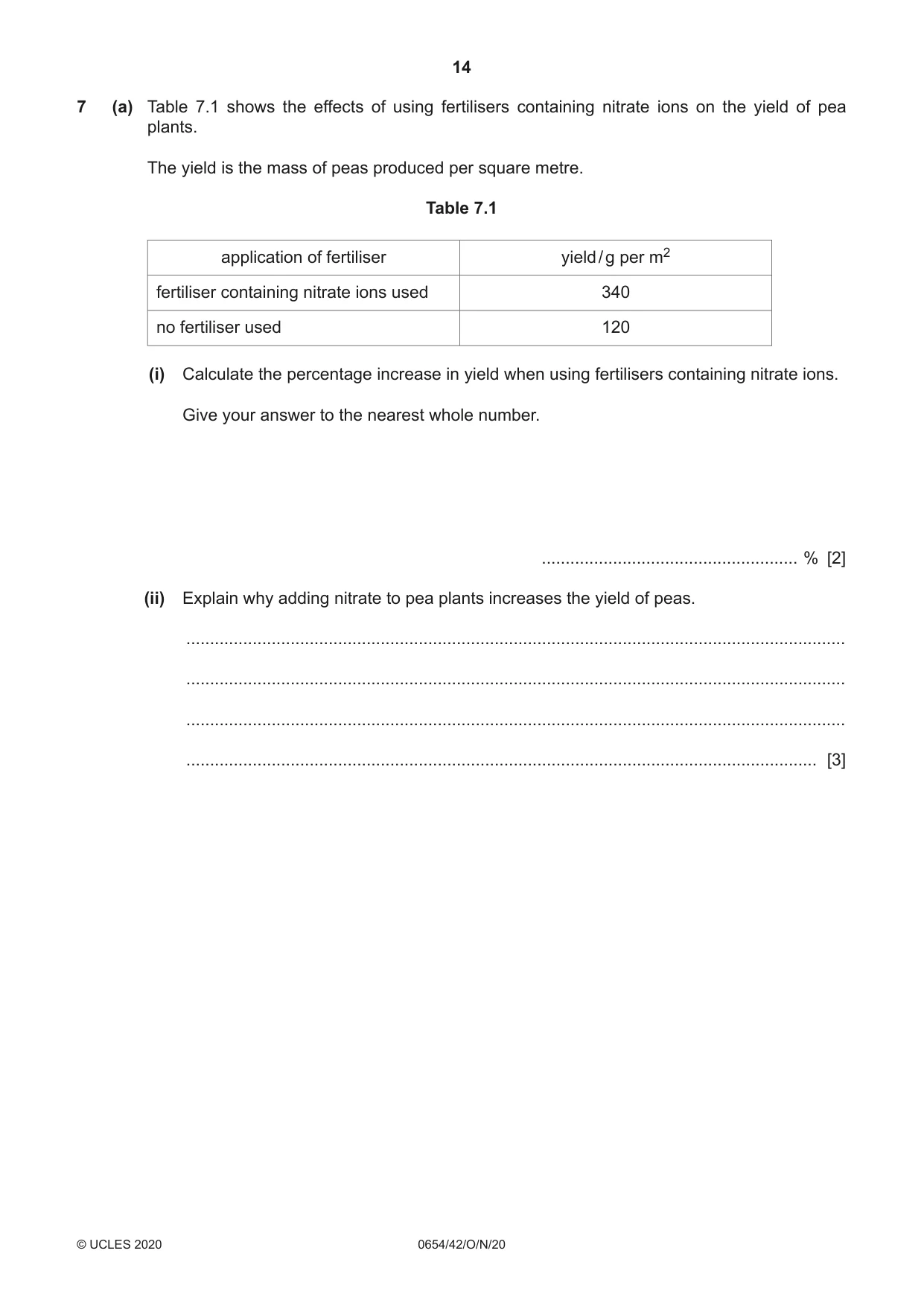
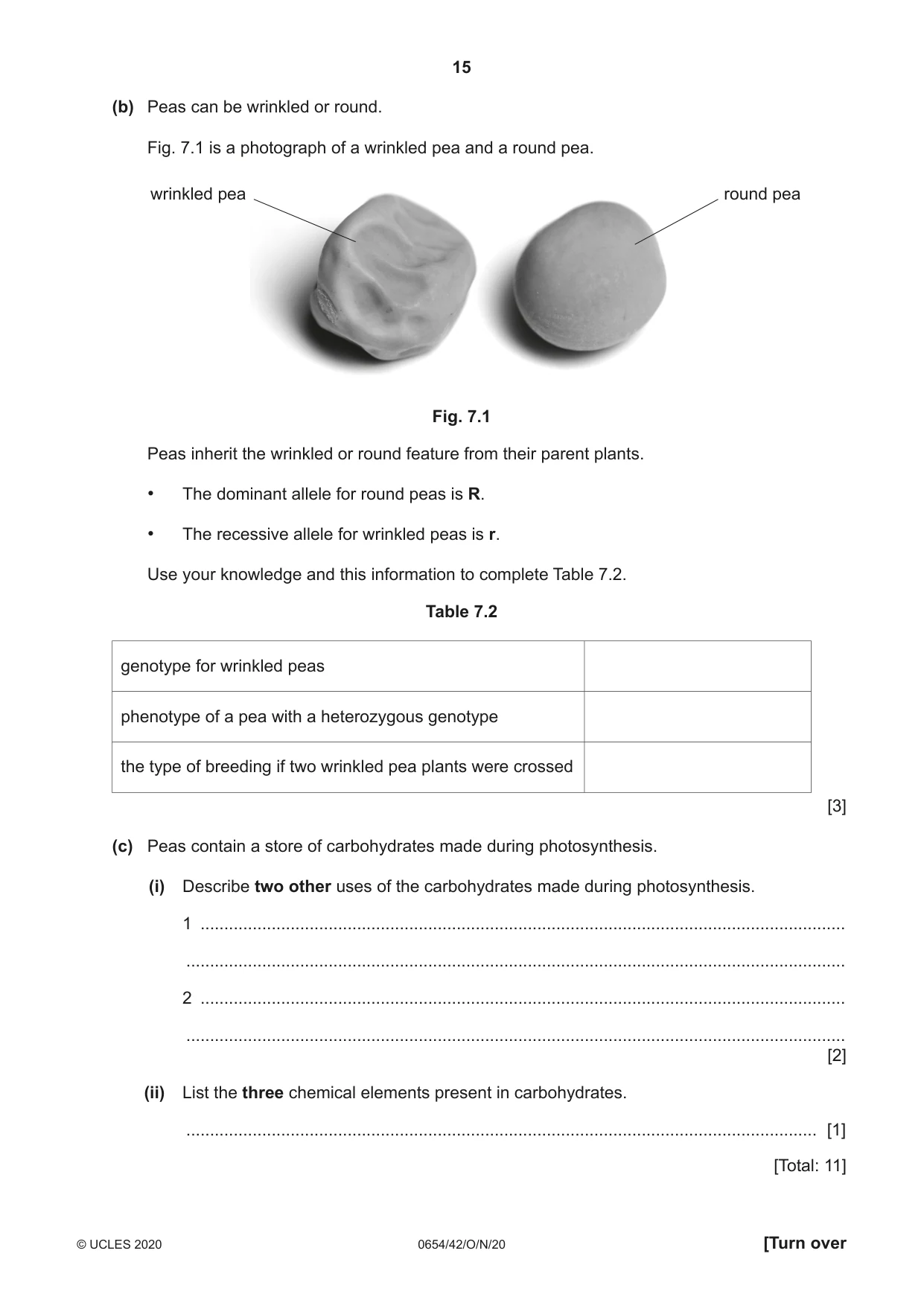
7 (a) Table 7.1 shows the effects of using fertilisers containing nitrate ions on the yield of pea plants. The yield is the mass of peas produced per square metre. Table 7.1 application of fertiliser yield / g per m2 fertiliser containing nitrate ions used 340 no fertiliser used 120 (i) Calculate the percentage increase in yield when using fertilisers containing nitrate ions. Give your answer to the nearest whole number. ...................................................... % [2] (ii) Explain why adding nitrate to pea plants increases the yield of peas. ........................................................................................................................................... ........................................................................................................................................... ........................................................................................................................................... ..................................................................................................................................... [3] (b) Peas can be wrinkled or round. Fig. 7.1 is a photograph of a wrinkled pea and a round pea. wrinkled pea round pea Fig. 7.1 Peas inherit the wrinkled or round feature from their parent plants. • The dominant allele for round peas is R. • The recessive allele for wrinkled peas is r. Use your knowledge and this information to complete Table 7.2. Table 7.2 genotype for wrinkled peas phenotype of a pea with a heterozygous genotype the type of breeding if two wrinkled pea plants were crossed [3] (c) Peas contain a store of carbohydrates made during photosynthesis. (i) Describe two other uses of the carbohydrates made during photosynthesis. 1 ........................................................................................................................................ ........................................................................................................................................... 2 ........................................................................................................................................ ........................................................................................................................................... [2] (ii) List the three chemical elements present in carbohydrates. ..................................................................................................................................... [1] [Total: 11]
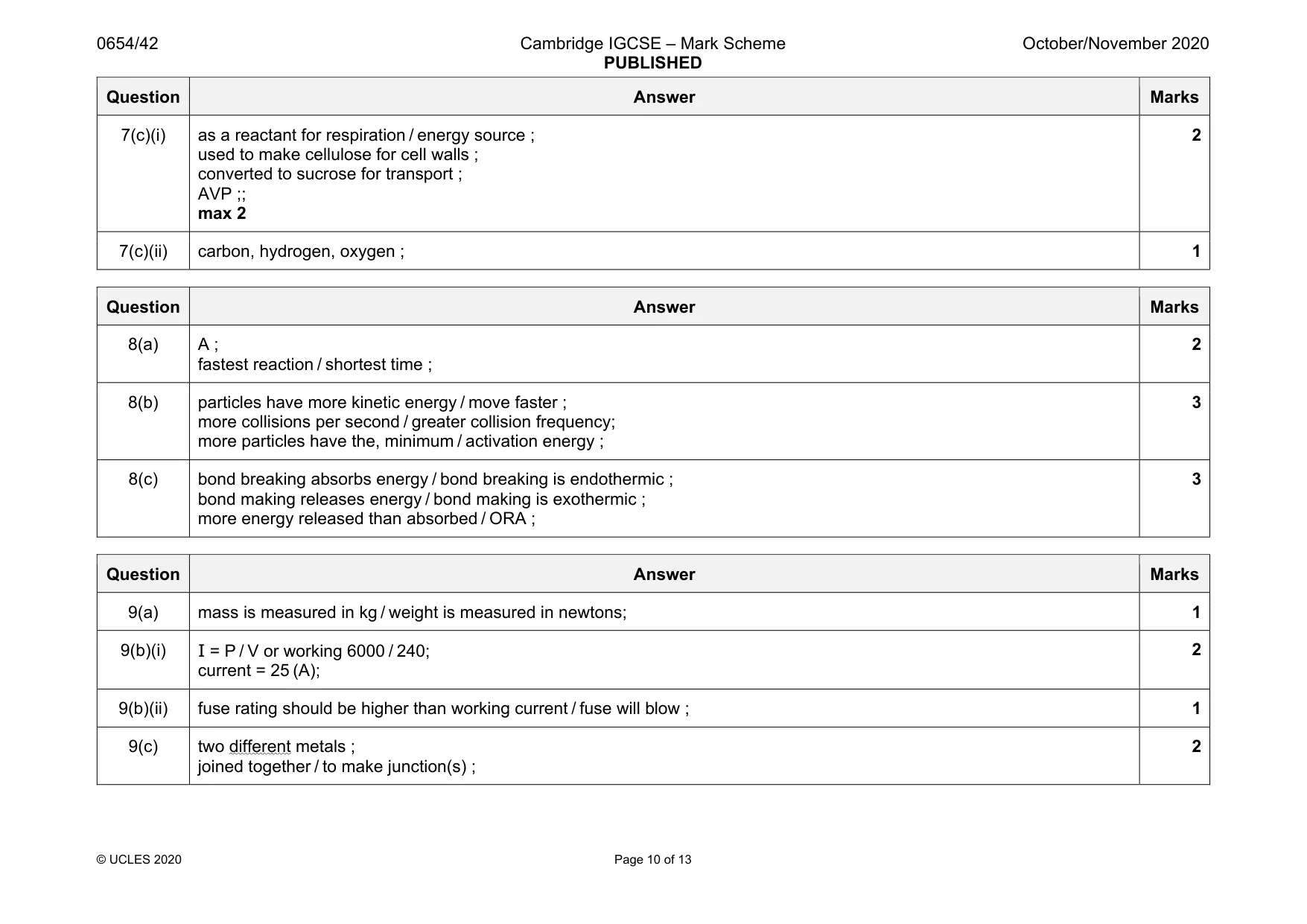
Mark scheme: 7(a)(i) 340 – 120 or 220 (220 / 120) × 100 = 183(%) ;; 2 7(a)(ii) nitrate ions are needed to make, amino acids / proteins ; amino acids are needed for protein synthesis ; proteins are needed for growth which increases the yield ; 3 7(b) genotype for wrinkly peas rr ; phenotype of a heterozygous genotype round ; the type of breeding if two wrinkly pea plants were crossed pure ; 3 Question Answer Marks 7(c)(i) as a reactant for respiration / energy source ; used to make cellulose for cell walls ; converted to sucrose for transport ; AVP ;; max 2 2 7(c)(ii) carbon, hydrogen, oxygen ; 1
Q8 · A student investigates the reaction between sodium thiosulfate solution and dilute…
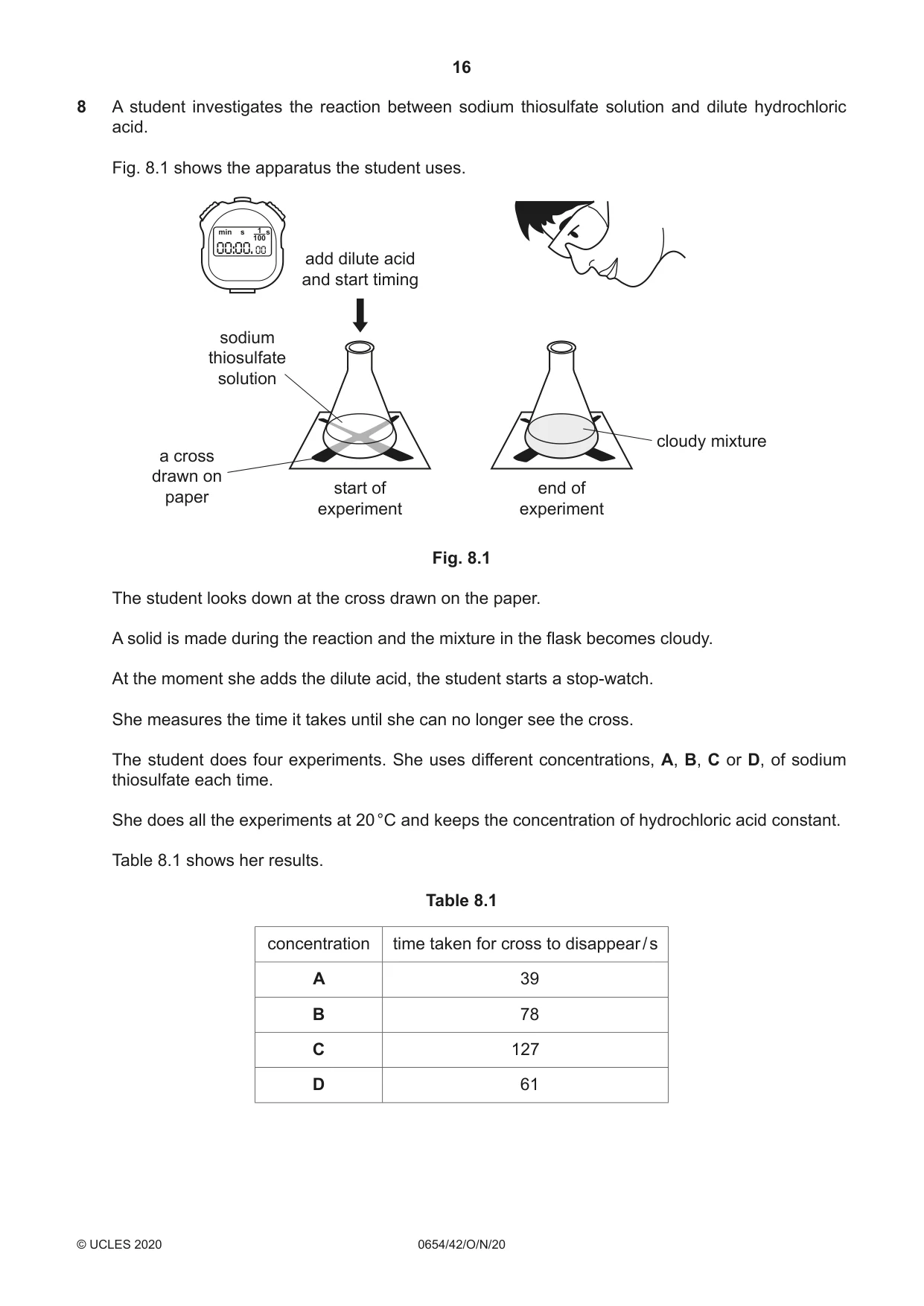
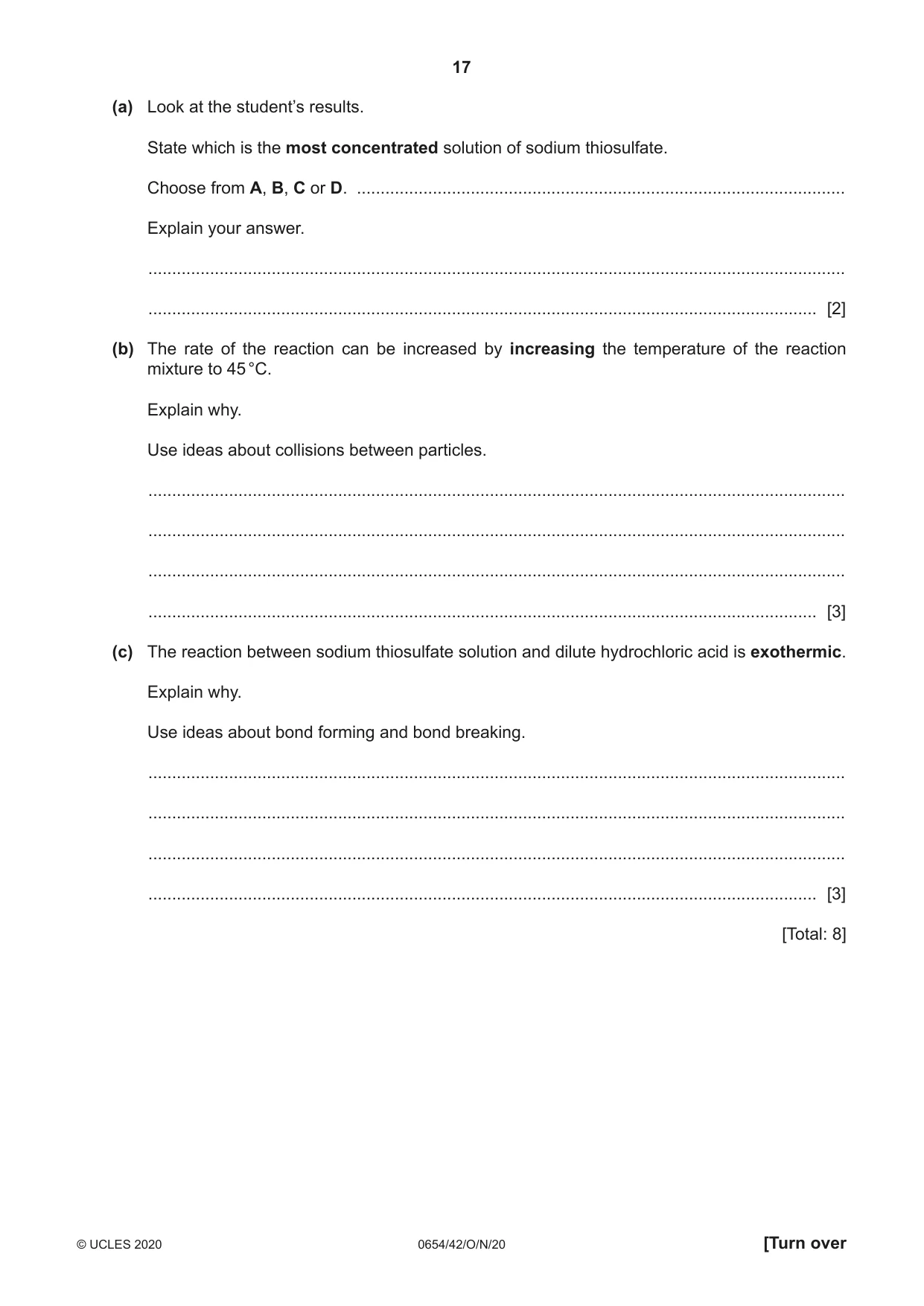
8 A student investigates the reaction between sodium thiosulfate solution and dilute hydrochloric acid. Fig. 8.1 shows the apparatus the student uses. min s 1 s 00:00. 10000 add dilute acid and start timing sodium thiosulfate solution cloudy mixture a cross drawn on start of end of paper experiment experiment Fig. 8.1 The student looks down at the cross drawn on the paper. A solid is made during the reaction and the mixture in the flask becomes cloudy. At the moment she adds the dilute acid, the student starts a stop-watch. She measures the time it takes until she can no longer see the cross. The student does four experiments. She uses different concentrations, A, B, C or D, of sodium thiosulfate each time. She does all the experiments at 20 °C and keeps the concentration of hydrochloric acid constant. Table 8.1 shows her results. Table 8.1 concentration time taken for cross to disappear / s A 39 B 78 C 127 D 61 (a) Look at the student’s results. State which is the most concentrated solution of sodium thiosulfate. Choose from A, B, C or D. ....................................................................................................... Explain your answer. ................................................................................................................................................... ............................................................................................................................................. [2] (b) The rate of the reaction can be increased by increasing the temperature of the reaction mixture to 45 °C. Explain why. Use ideas about collisions between particles. ................................................................................................................................................... ................................................................................................................................................... ................................................................................................................................................... ............................................................................................................................................. [3] (c) The reaction between sodium thiosulfate solution and dilute hydrochloric acid is exothermic. Explain why. Use ideas about bond forming and bond breaking. ................................................................................................................................................... ................................................................................................................................................... ................................................................................................................................................... ............................................................................................................................................. [3] [Total: 8]
Mark scheme: 8(a) A ; fastest reaction / shortest time ; 2 8(b) particles have more kinetic energy / move faster ; more collisions per second / greater collision frequency; more particles have the, minimum / activation energy ; 3 8(c) bond breaking absorbs energy / bond breaking is endothermic ; bond making releases energy / bond making is exothermic ; more energy released than absorbed / ORA ; 3
Q9 · The information booklet about an oven states that the weight of the oven is 45 kg
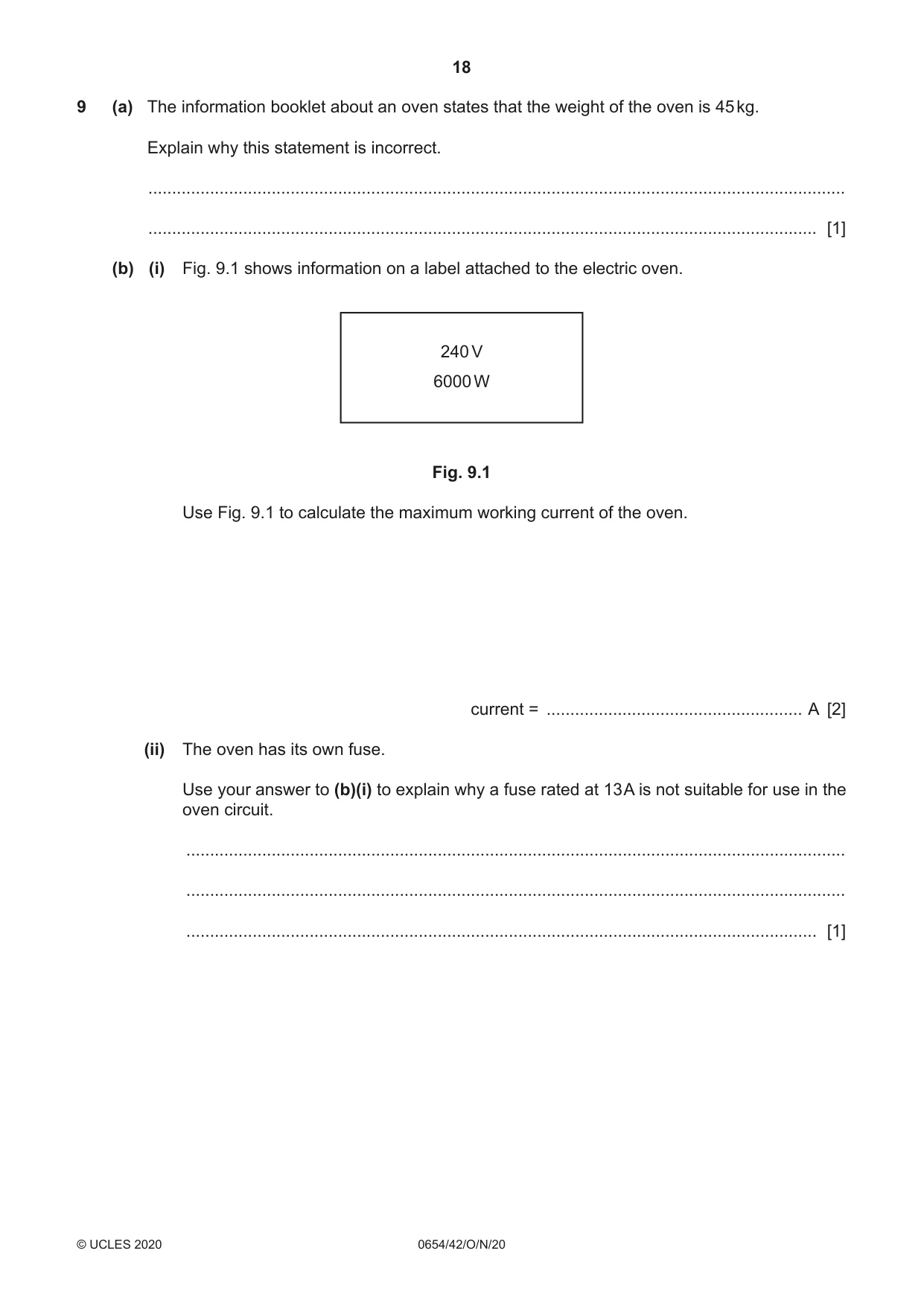
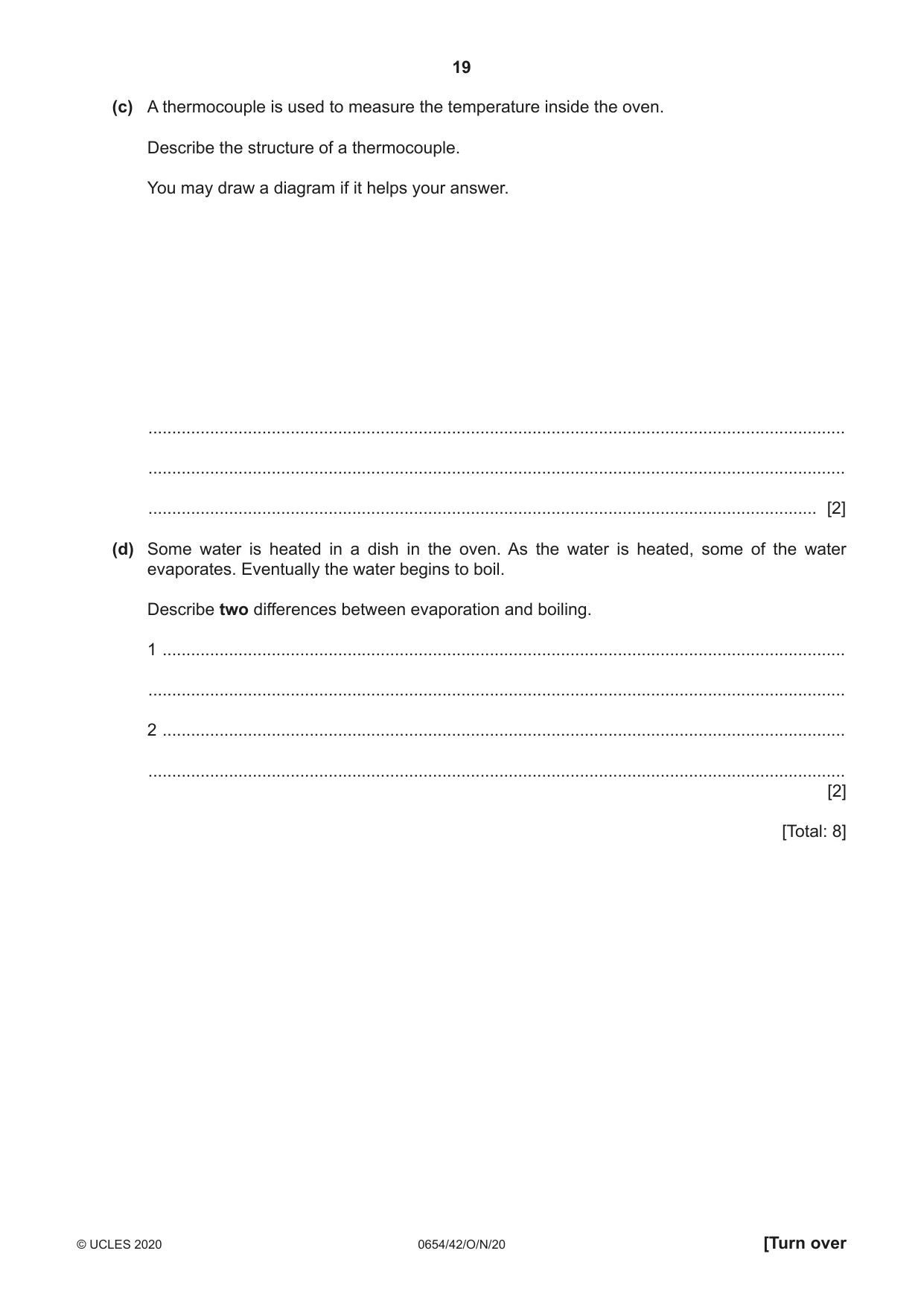
9 (a) The information booklet about an oven states that the weight of the oven is 45 kg. Explain why this statement is incorrect. ................................................................................................................................................... ............................................................................................................................................. [1] (b) (i) Fig. 9.1 shows information on a label attached to the electric oven. 240 V 6000 W Fig. 9.1 Use Fig. 9.1 to calculate the maximum working current of the oven. current = ...................................................... A [2] (ii) The oven has its own fuse. Use your answer to (b)(i) to explain why a fuse rated at 13 A is not suitable for use in the oven circuit. ........................................................................................................................................... ........................................................................................................................................... ..................................................................................................................................... [1] (c) A thermocouple is used to measure the temperature inside the oven. Describe the structure of a thermocouple. You may draw a diagram if it helps your answer. ................................................................................................................................................... ................................................................................................................................................... ............................................................................................................................................. [2] (d) Some water is heated in a dish in the oven. As the water is heated, some of the water evaporates. Eventually the water begins to boil. Describe two differences between evaporation and boiling. 1 ................................................................................................................................................ ................................................................................................................................................... 2 ................................................................................................................................................ ................................................................................................................................................... [2] [Total: 8]
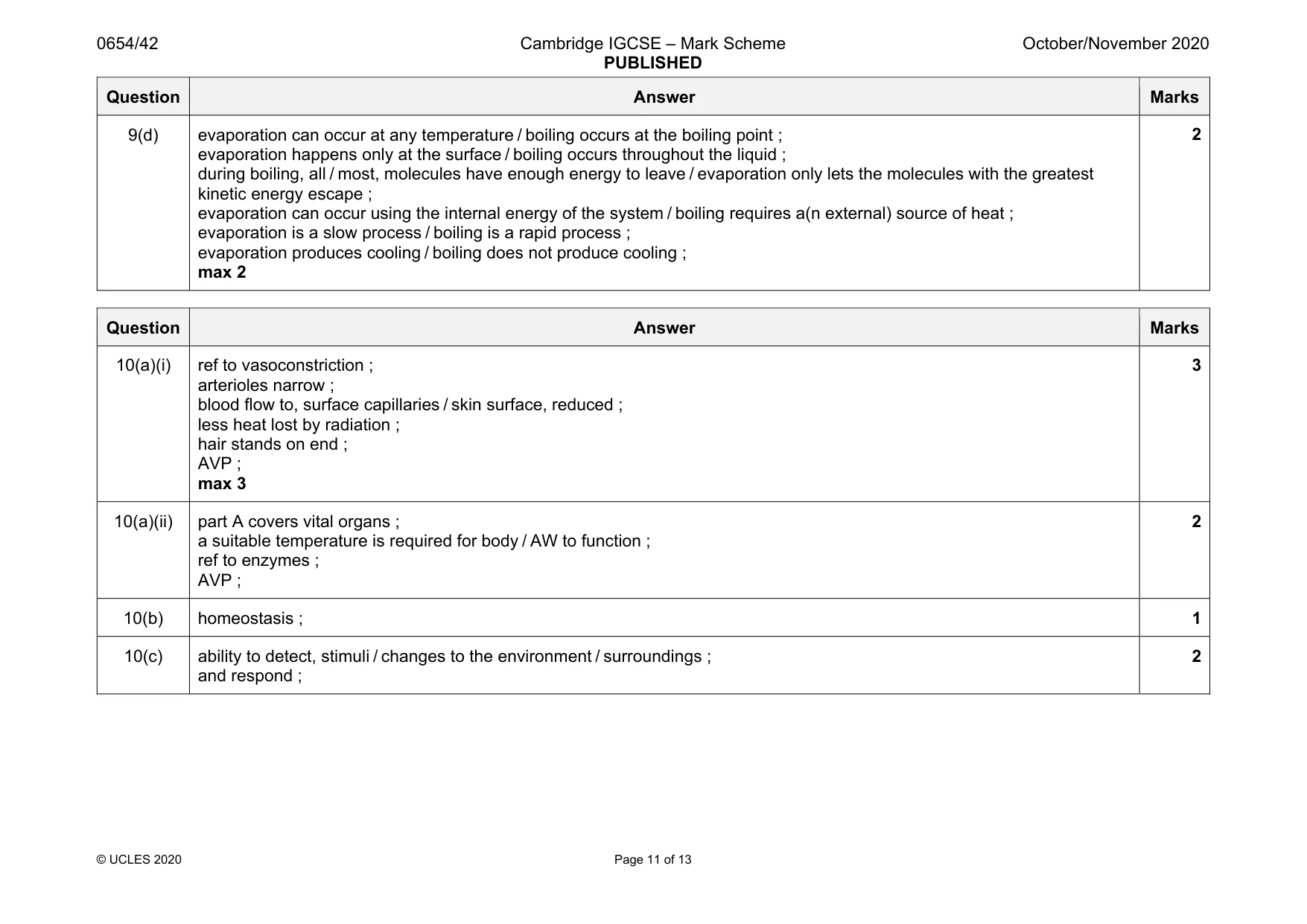
Mark scheme: 9(a) mass is measured in kg / weight is measured in newtons; 1 9(b)(i) I = P / V or working 6000 / 240; current = 25 (A); 2 9(b)(ii) fuse rating should be higher than working current / fuse will blow ; 1 9(c) two different metals ; joined together / to make junction(s) ; 2 Question Answer Marks 9(d) evaporation can occur at any temperature / boiling occurs at the boiling point ; evaporation happens only at the surface / boiling occurs throughout the liquid ; during boiling, all / most, molecules have enough energy to leave / evaporation only lets the molecules with the greatest kinetic energy escape ; evaporation can occur using the internal energy of the system / boiling requires a(n external) source of heat ; evaporation is a slow process / boiling is a rapid process ; evaporation produces cooling / boiling does not produce cooling ; max 2 2
Q10 · The temperature of a person’s skin is recorded in different environmental temperatures
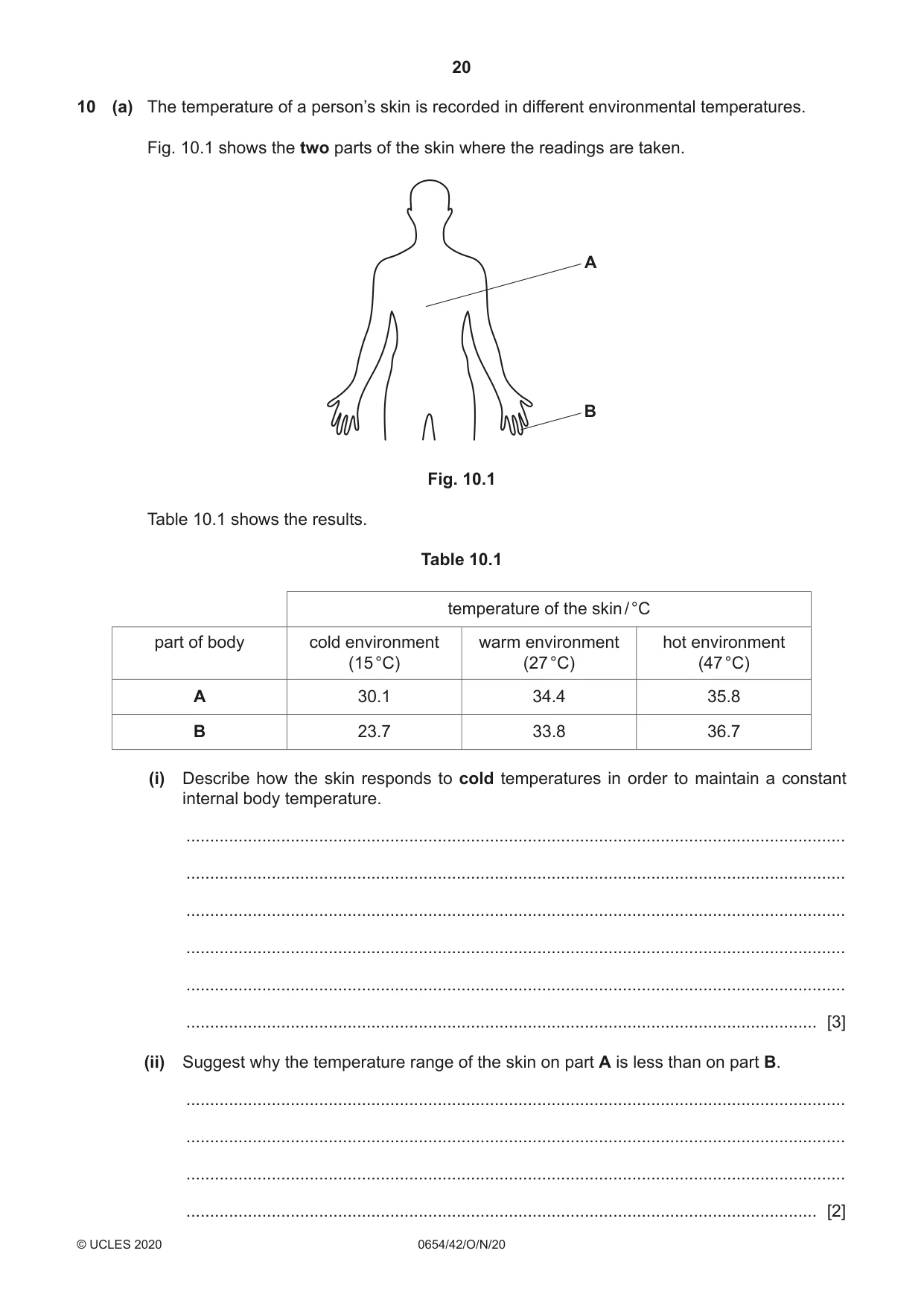
10 (a) The temperature of a person’s skin is recorded in different environmental temperatures. Fig. 10.1 shows the two parts of the skin where the readings are taken. A B Fig. 10.1 Table 10.1 shows the results. Table 10.1 temperature of the skin / °C part of body cold environment warm environment hot environment (15 °C) (27 °C) (47 °C) A 30.1 34.4 35.8 B 23.7 33.8 36.7 (i) Describe how the skin responds to cold temperatures in order to maintain a constant internal body temperature. ........................................................................................................................................... ........................................................................................................................................... ........................................................................................................................................... ........................................................................................................................................... ........................................................................................................................................... ..................................................................................................................................... [3] (ii) Suggest why the temperature range of the skin on part A is less than on part B. ........................................................................................................................................... ........................................................................................................................................... ........................................................................................................................................... ..................................................................................................................................... [2] (b) Body temperature is controlled to keep it within set limits. Name the term used to describe this. ............................................................................................................................................. [1] (c) Temperature control of the body shows that humans have sensitivity to their environment. Define sensitivity. ................................................................................................................................................... ................................................................................................................................................... ................................................................................................................................................... ............................................................................................................................................. [2] [Total: 8]
Mark scheme: 10(a)(i) ref to vasoconstriction ; arterioles narrow ; blood flow to, surface capillaries / skin surface, reduced ; less heat lost by radiation ; hair stands on end ; AVP ; max 3 10(a)(ii) part A covers vital organs ; a suitable temperature is required for body / AW to function ; ref to enzymes ; AVP ; 2 10(b) homeostasis ; 1 10(c) ability to detect, stimuli / changes to the environment / surroundings ; and respond ; 2
Q11 · Propane and propene are both hydrocarbons
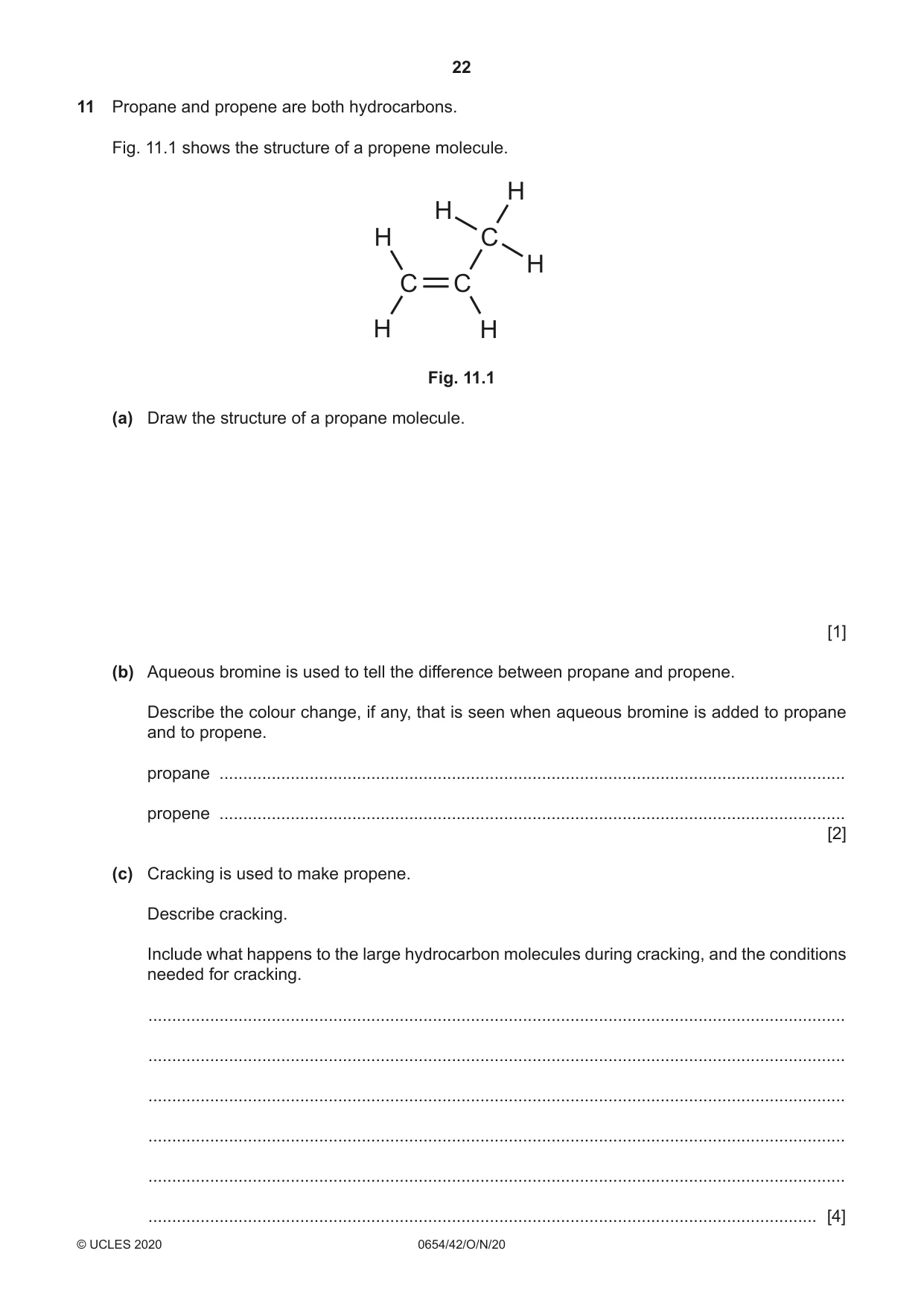
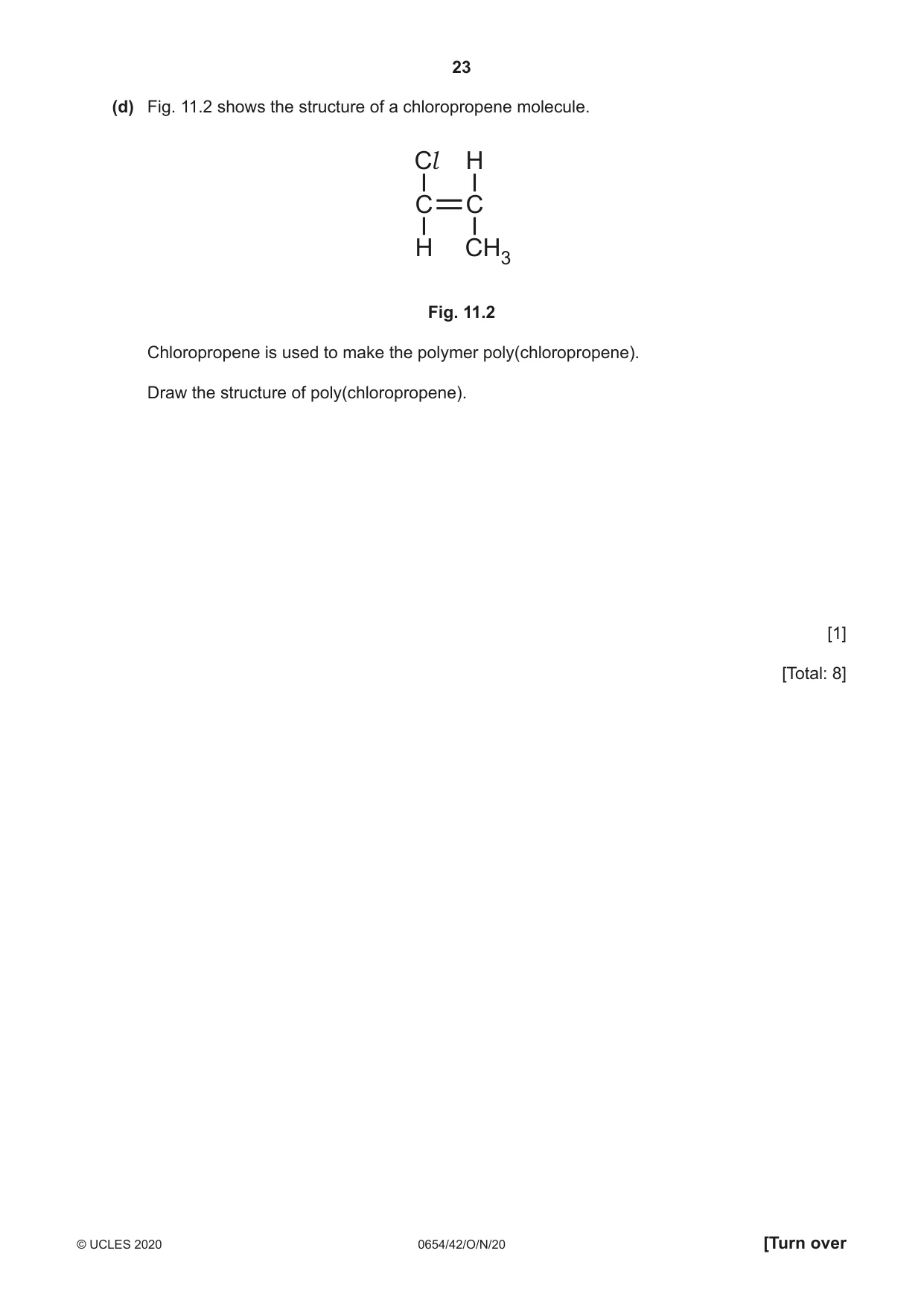
11 Propane and propene are both hydrocarbons. Fig. 11.1 shows the structure of a propene molecule. H H H C H C C H H Fig. 11.1 (a) Draw the structure of a propane molecule. [1] (b) Aqueous bromine is used to tell the difference between propane and propene. Describe the colour change, if any, that is seen when aqueous bromine is added to propane and to propene. propane .................................................................................................................................... propene .................................................................................................................................... [2] (c) Cracking is used to make propene. Describe cracking. Include what happens to the large hydrocarbon molecules during cracking, and the conditions needed for cracking. ................................................................................................................................................... ................................................................................................................................................... ................................................................................................................................................... ................................................................................................................................................... ................................................................................................................................................... ............................................................................................................................................. [4] (d) Fig. 11.2 shows the structure of a chloropropene molecule. Cl H C C H CH3 Fig. 11.2 Chloropropene is used to make the polymer poly(chloropropene). Draw the structure of poly(chloropropene). [1] [Total: 8]
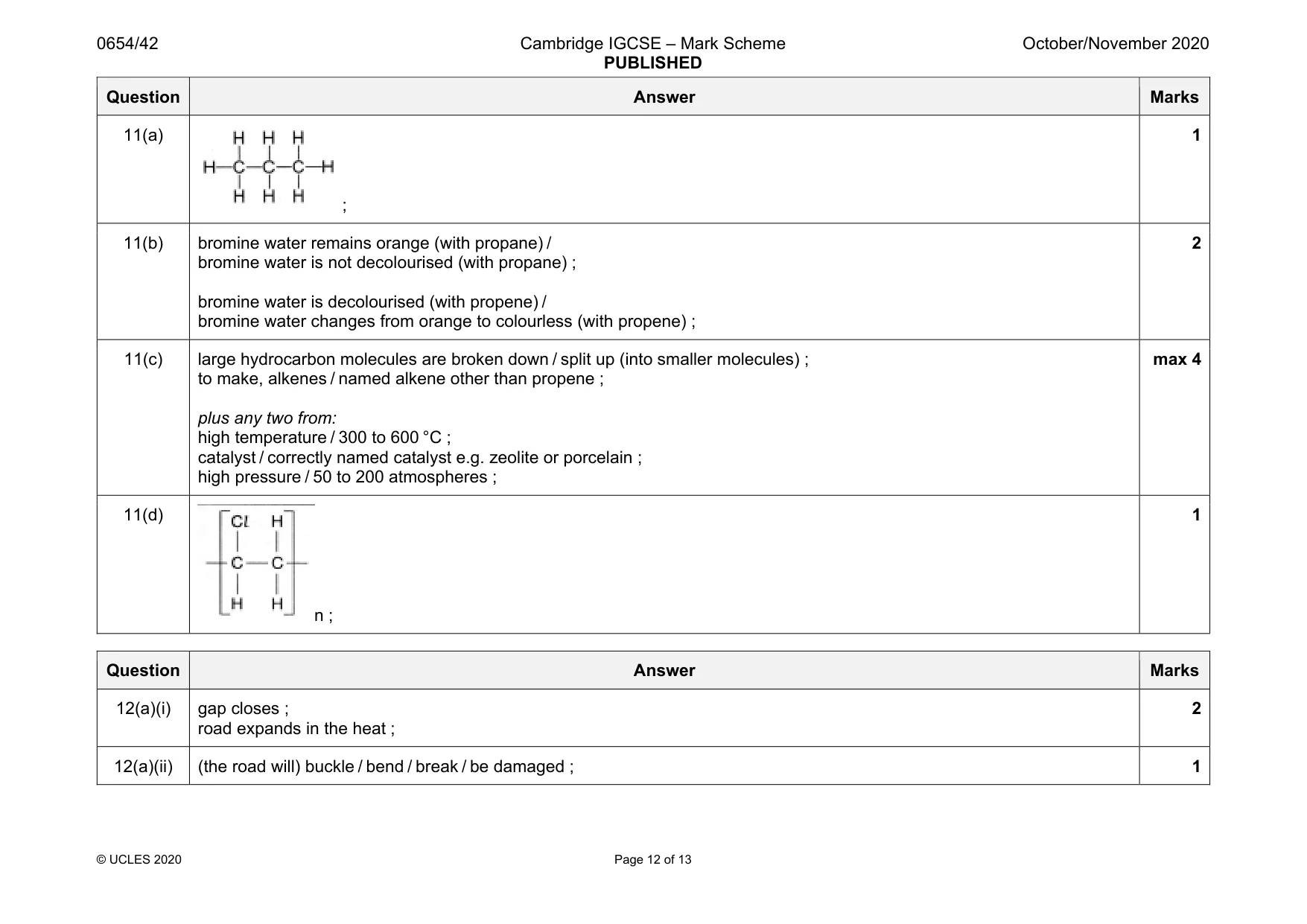
Mark scheme: 11(a) ; 1 11(b) bromine water remains orange (with propane) / bromine water is not decolourised (with propane) ; bromine water is decolourised (with propene) / bromine water changes from orange to colourless (with propene) ; 2 11(c) large hydrocarbon molecules are broken down / split up (into smaller molecules) ; to make, alkenes / named alkene other than propene ; plus any two from: high temperature / 300 to 600 °C ; catalyst / correctly named catalyst e.g. zeolite or porcelain ; high pressure / 50 to 200 atmospheres ; max 4 11(d) n ; 1
Q12 · A truck crossing a bridge
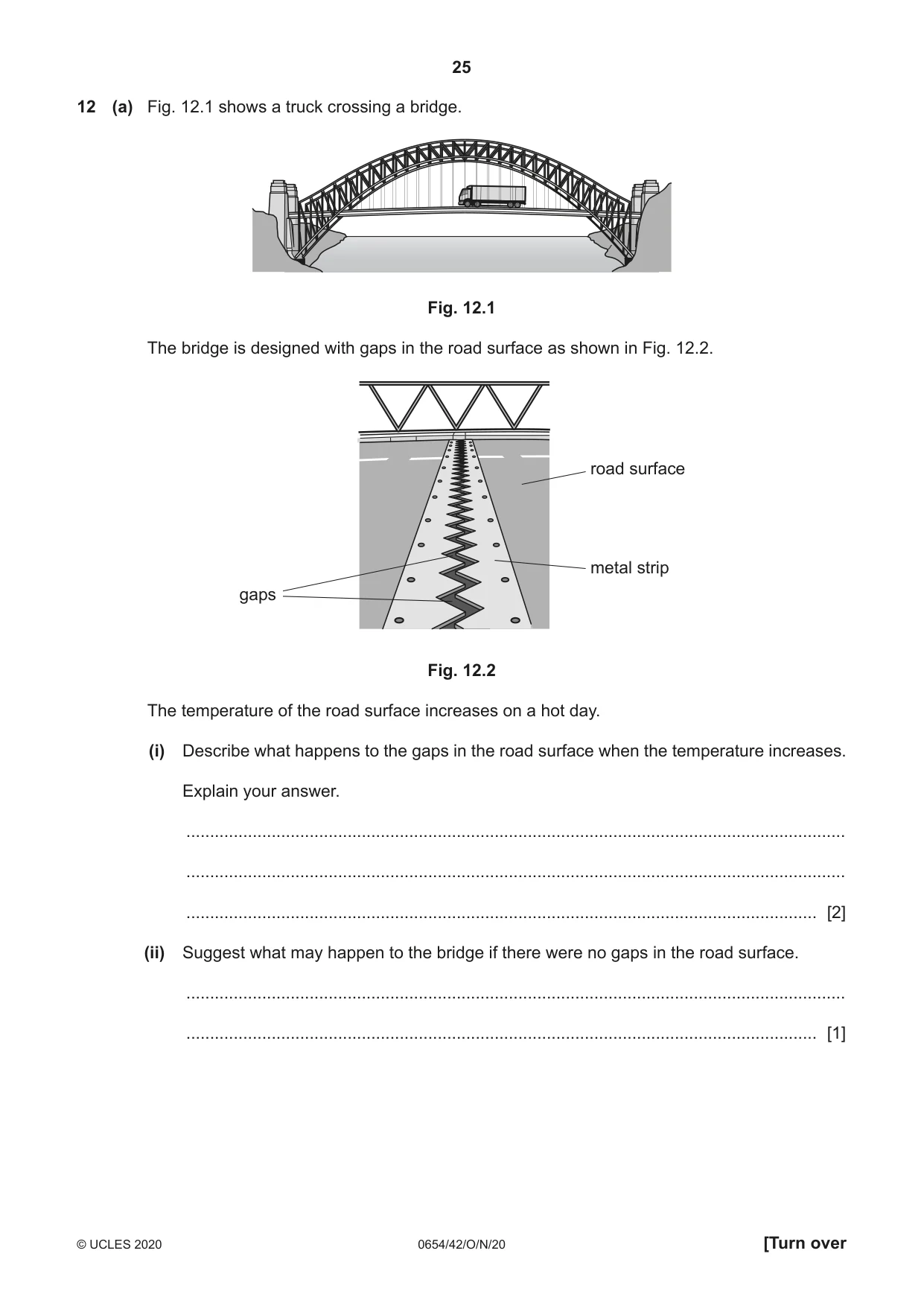
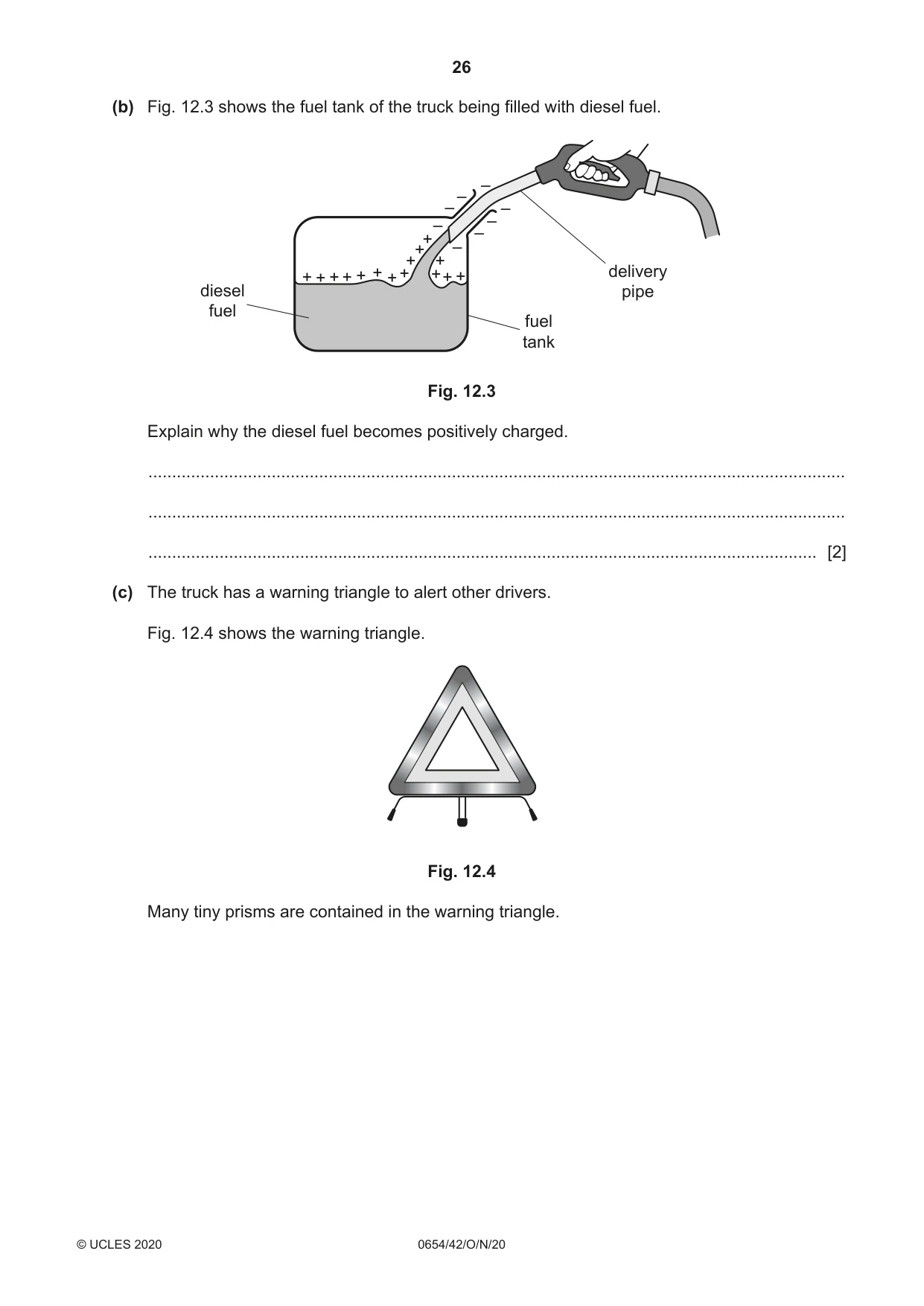
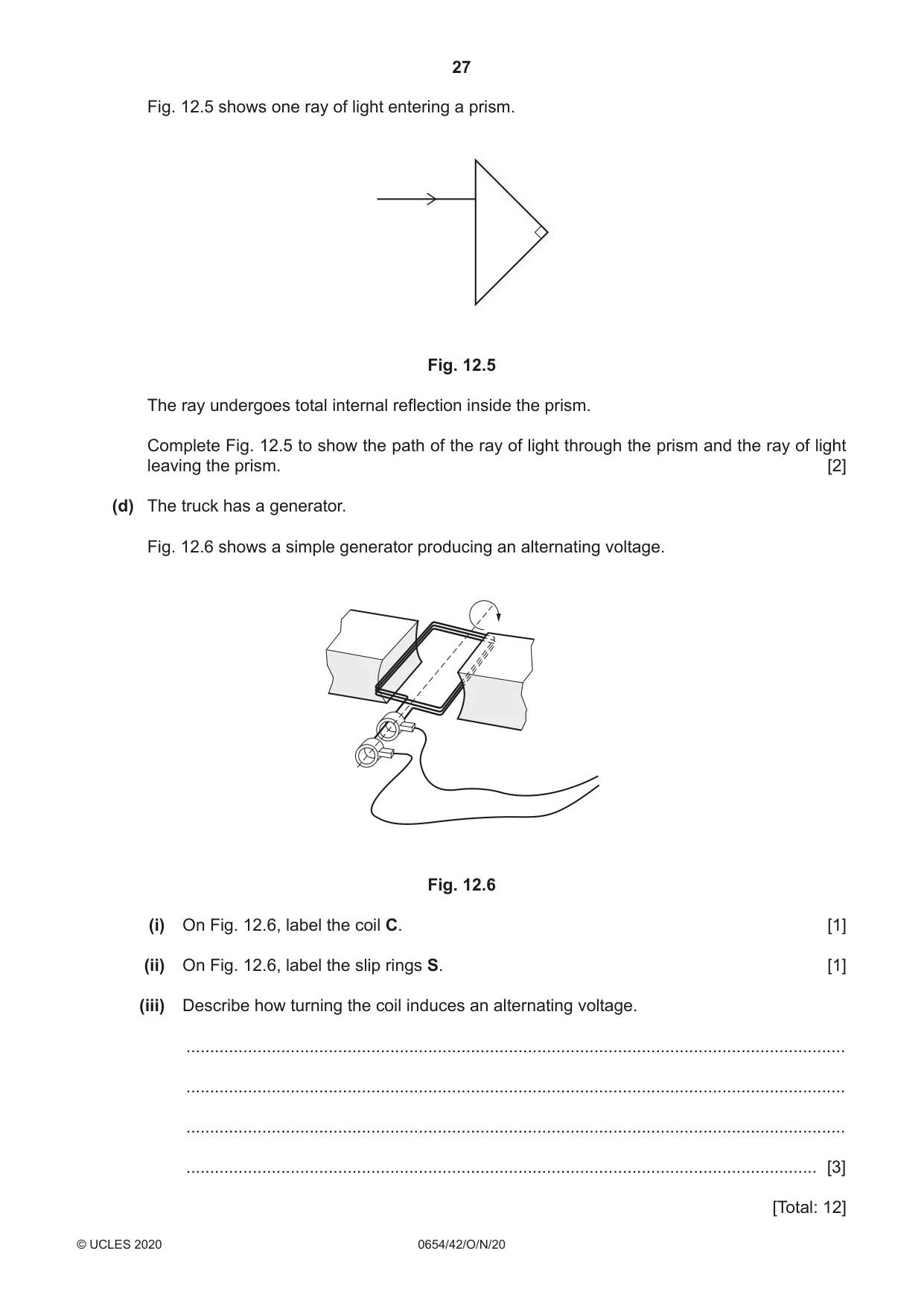
12 (a) Fig. 12.1 shows a truck crossing a bridge. Fig. 12.1 The bridge is designed with gaps in the road surface as shown in Fig. 12.2. road surface metal strip gaps Fig. 12.2 The temperature of the road surface increases on a hot day. (i) Describe what happens to the gaps in the road surface when the temperature increases. Explain your answer. ........................................................................................................................................... ........................................................................................................................................... ..................................................................................................................................... [2] (ii) Suggest what may happen to the bridge if there were no gaps in the road surface. ........................................................................................................................................... ..................................................................................................................................... [1] (b) Fig. 12.3 shows the fuel tank of the truck being filled with diesel fuel. – – – – – – – + + – + + + + + + + + + + ++ + delivery diesel pipe fuel fuel tank Fig. 12.3 Explain why the diesel fuel becomes positively charged. ................................................................................................................................................... ................................................................................................................................................... ............................................................................................................................................. [2] (c) The truck has a warning triangle to alert other drivers. Fig. 12.4 shows the warning triangle. Fig. 12.4 Many tiny prisms are contained in the warning triangle. Fig. 12.5 shows one ray of light entering a prism. Fig. 12.5 The ray undergoes total internal reflection inside the prism. Complete Fig. 12.5 to show the path of the ray of light through the prism and the ray of light leaving the prism. [2] (d) The truck has a generator. Fig. 12.6 shows a simple generator producing an alternating voltage. Fig. 12.6 (i) On Fig. 12.6, label the coil C. [1] (ii) On Fig. 12.6, label the slip rings S. [1] (iii) Describe how turning the coil induces an alternating voltage. ........................................................................................................................................... ........................................................................................................................................... ........................................................................................................................................... ..................................................................................................................................... [3] [Total: 12]
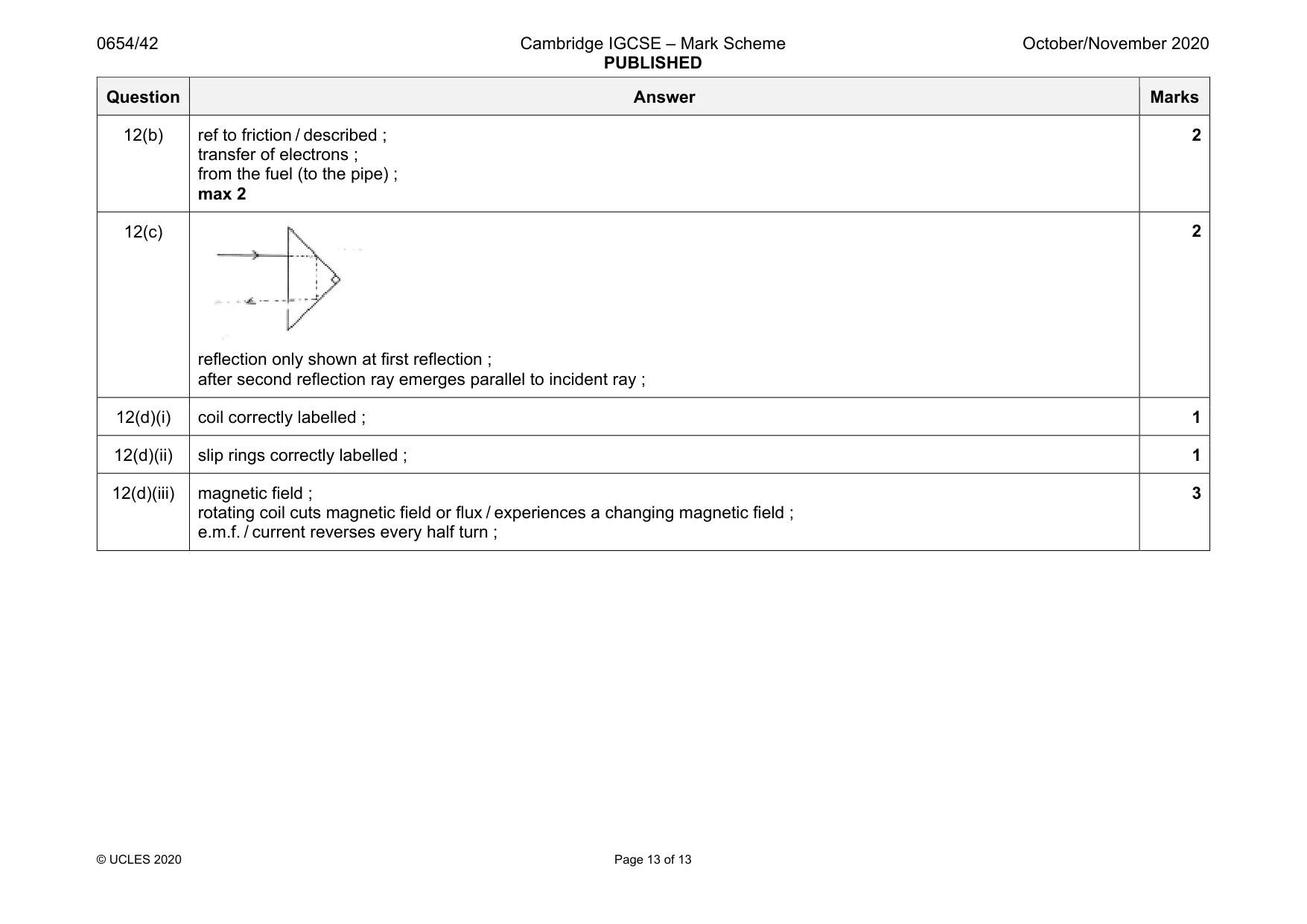
Mark scheme: 12(a)(i) gap closes ; road expands in the heat ; 2 12(a)(ii) (the road will) buckle / bend / break / be damaged ; 1 Question Answer Marks 12(b) ref to friction / described ; transfer of electrons ; from the fuel (to the pipe) ; max 2 2 12(c) reflection only shown at first reflection ; after second reflection ray emerges parallel to incident ray ; 2 12(d)(i) coil correctly labelled ; 1 12(d)(ii) slip rings correctly labelled ; 1 12(d)(iii) magnetic field ; rotating coil cuts magnetic field or flux / experiences a changing magnetic field ; e.m.f. / current reverses every half turn ; 3
What was in this paper
The subtopics covered by these 12 questions, and how many questions each got. Open one in a new tab to see every Cambridge question on it.
What you needed in this session
Cambridge’s own grade thresholds for 2020 Oct/Nov, Paper 4 · Variant 2. A higher threshold means an easier paper — the bar moves with how the cohort did.