Cambridge IGCSE Sciences - Co-ordinated (Double) 0654 — 2022 May/June Paper 4 · Variant 2
0654/42/M/J/22 · 12 questions · 120 marks · ≈135 min
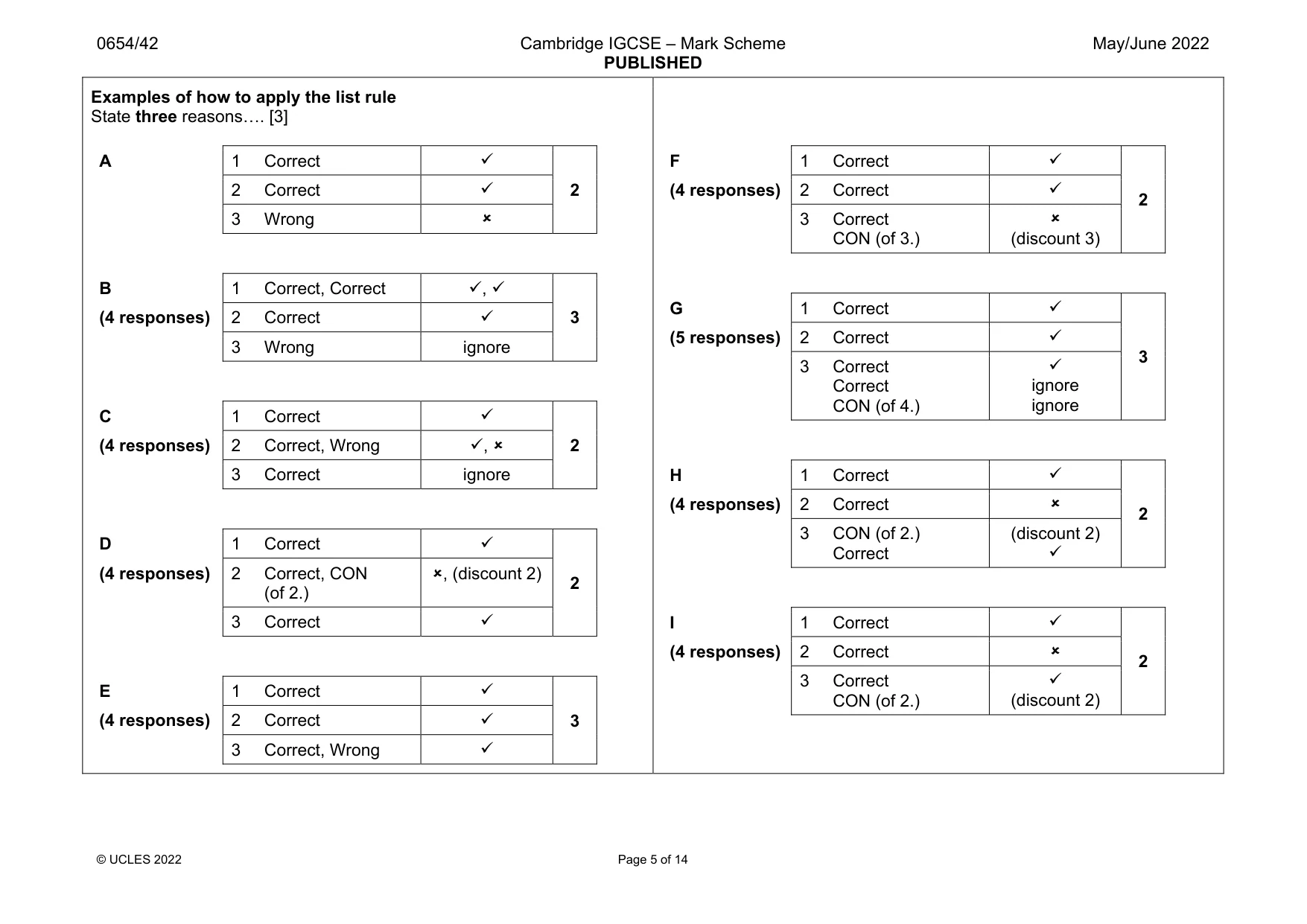
The question paper and its mark scheme, free to read here and free to download. This is Cambridge’s own paper, exactly as it was sat.
Question paper28 pages

Mark scheme14 pages
Answers below. Sit the paper first if you are practising.
Questions as text
Q1 · A student monitors his pulse rate at rest and during exercise
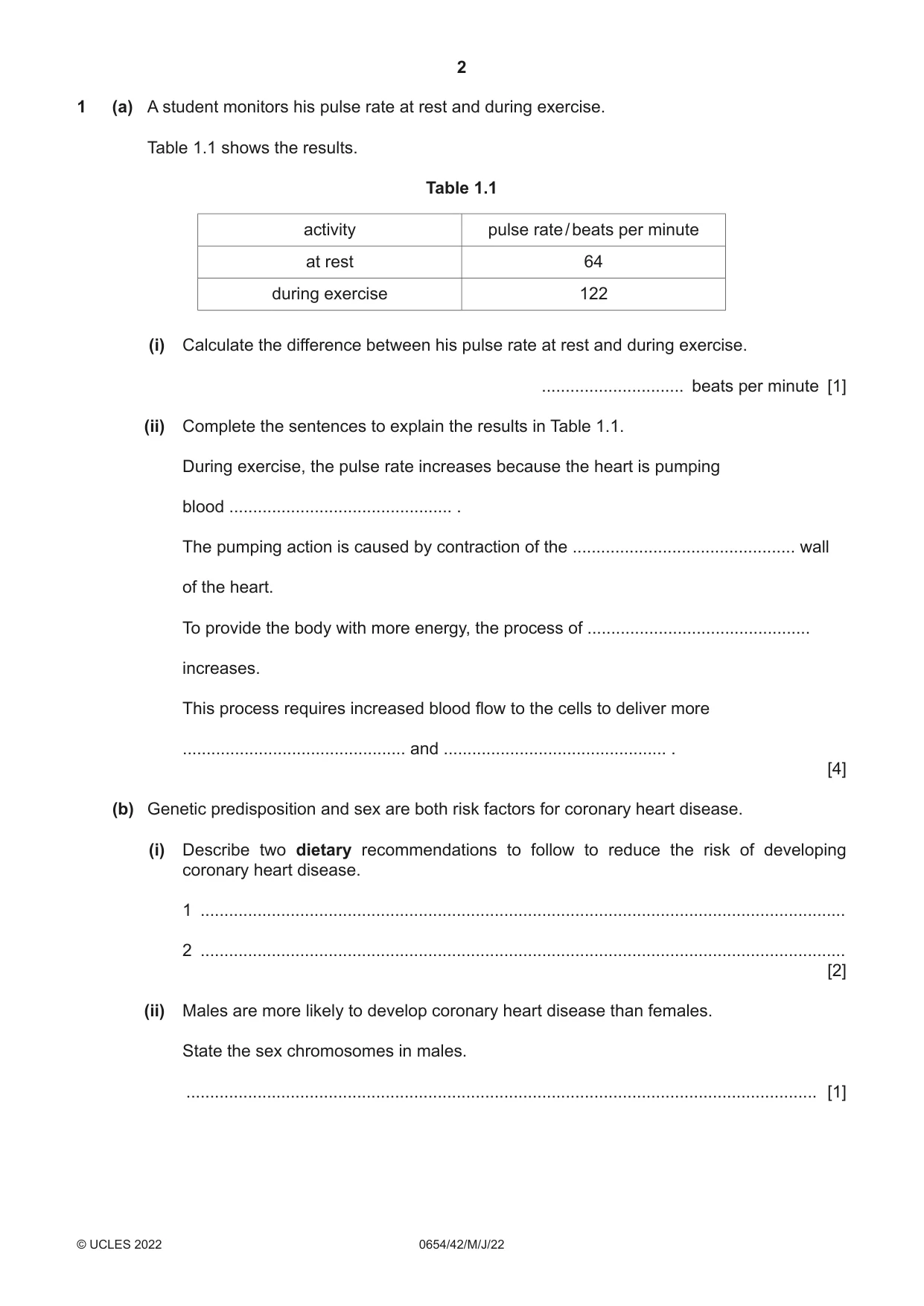
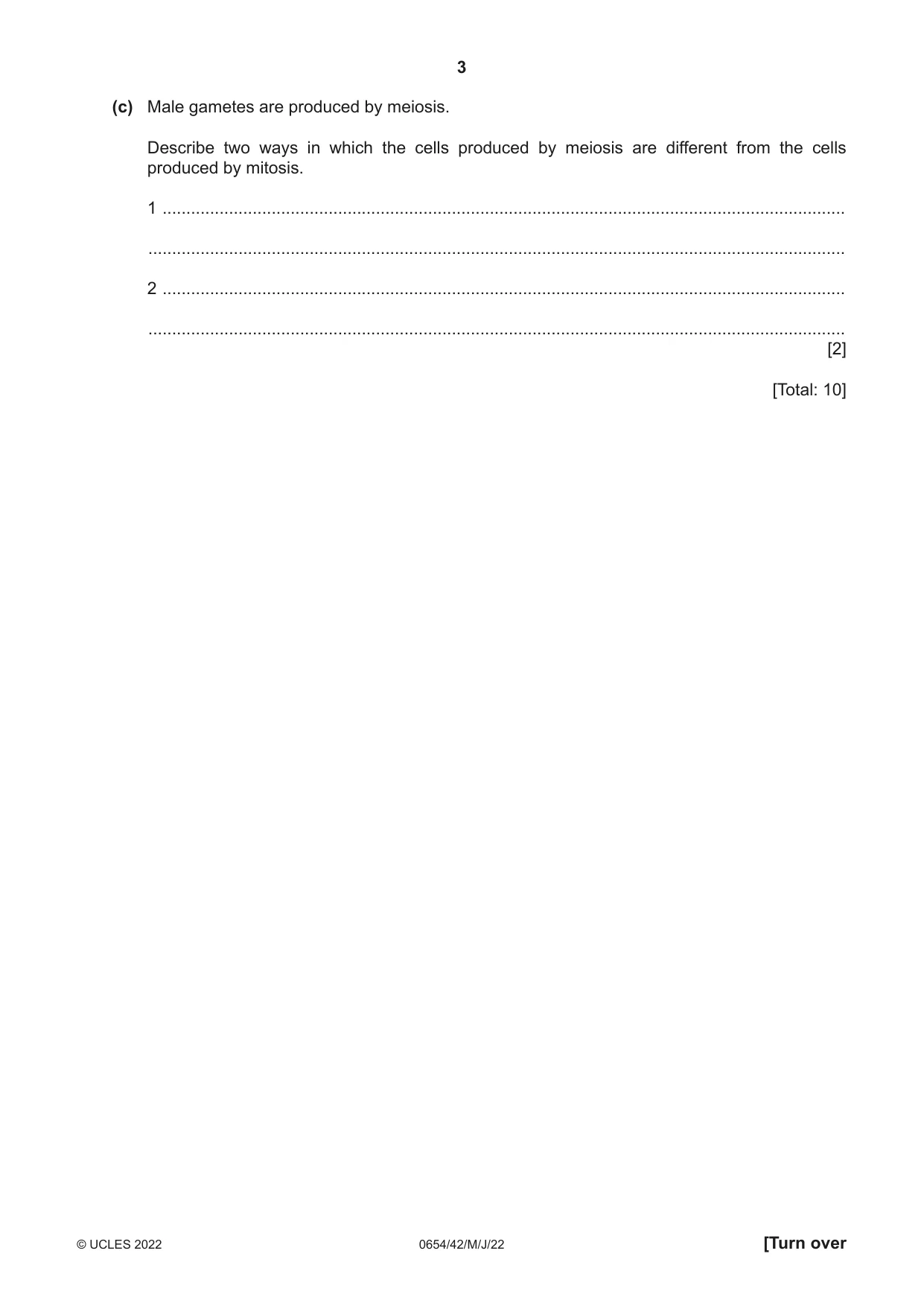
1 (a) A student monitors his pulse rate at rest and during exercise. Table 1.1 shows the results. Table 1.1 activity pulse rate / beats per minute at rest 64 during exercise 122 (i) Calculate the difference between his pulse rate at rest and during exercise. .............................. beats per minute [1] (ii) Complete the sentences to explain the results in Table 1.1. During exercise, the pulse rate increases because the heart is pumping blood ............................................... . The pumping action is caused by contraction of the ............................................... wall of the heart. To provide the body with more energy, the process of ............................................... increases. This process requires increased blood flow to the cells to deliver more ............................................... and ............................................... . [4] (b) Genetic predisposition and sex are both risk factors for coronary heart disease. (i) Describe two dietary recommendations to follow to reduce the risk of developing coronary heart disease. 1 ........................................................................................................................................ 2 ........................................................................................................................................ [2] (ii) Males are more likely to develop coronary heart disease than females. State the sex chromosomes in males. ..................................................................................................................................... [1] (c) Male gametes are produced by meiosis. Describe two ways in which the cells produced by meiosis are different from the cells produced by mitosis. 1 ................................................................................................................................................ ................................................................................................................................................... 2 ................................................................................................................................................ ................................................................................................................................................... [2] [Total: 10]
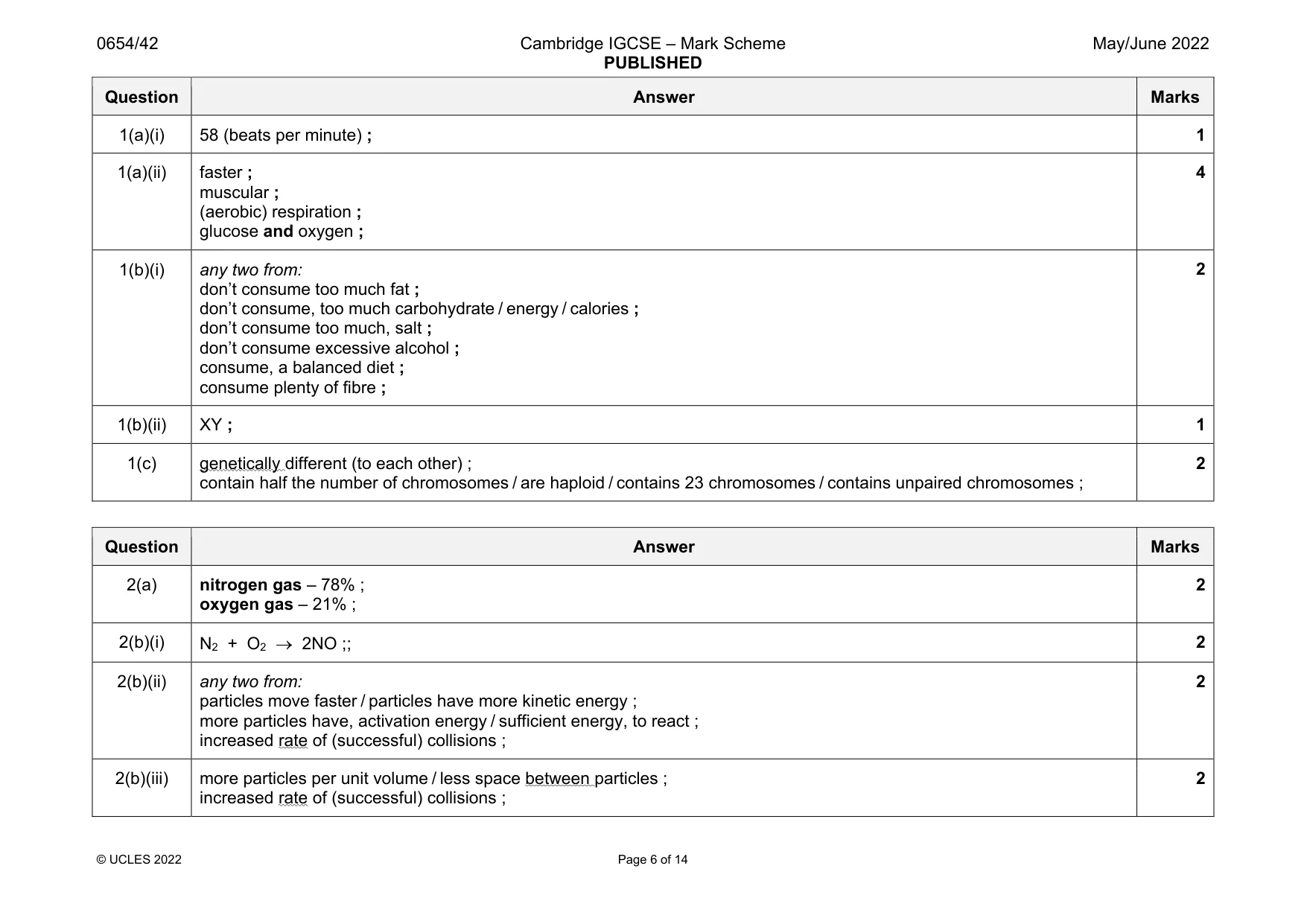
Mark scheme: 1(a)(i) 58 (beats per minute) ; 1 1(a)(ii) faster ; muscular ; (aerobic) respiration ; glucose and oxygen ; 4 1(b)(i) any two from: don’t consume too much fat ; don’t consume, too much carbohydrate / energy / calories ; don’t consume too much, salt ; don’t consume excessive alcohol ; consume, a balanced diet ; consume plenty of fibre ; 2 1(b)(ii) XY ; 1 1(c) genetically different (to each other) ; contain half the number of chromosomes / are haploid / contains 23 chromosomes / contains unpaired chromosomes ; 2
Q2 · Clean air contains nitrogen gas and oxygen gas
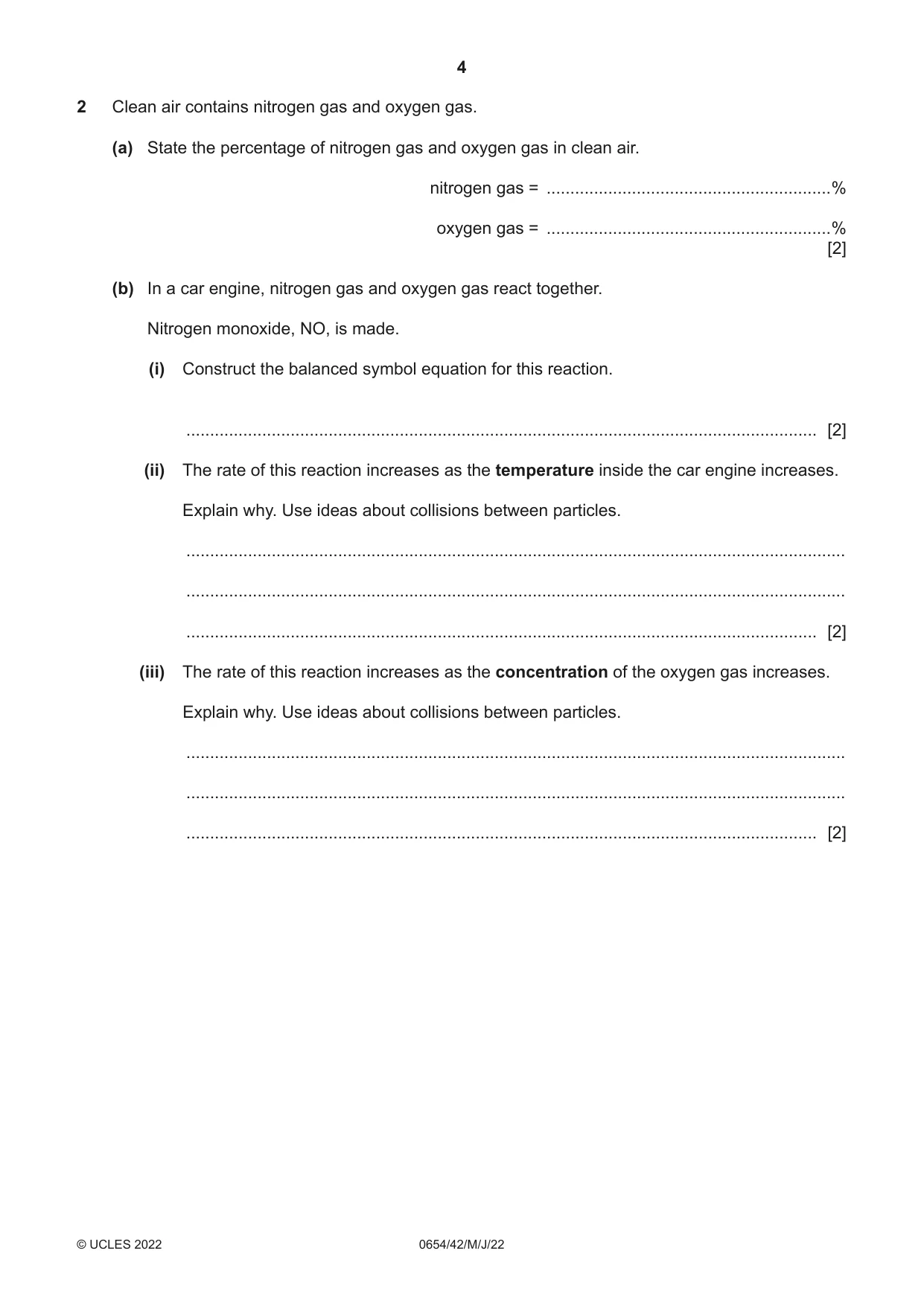
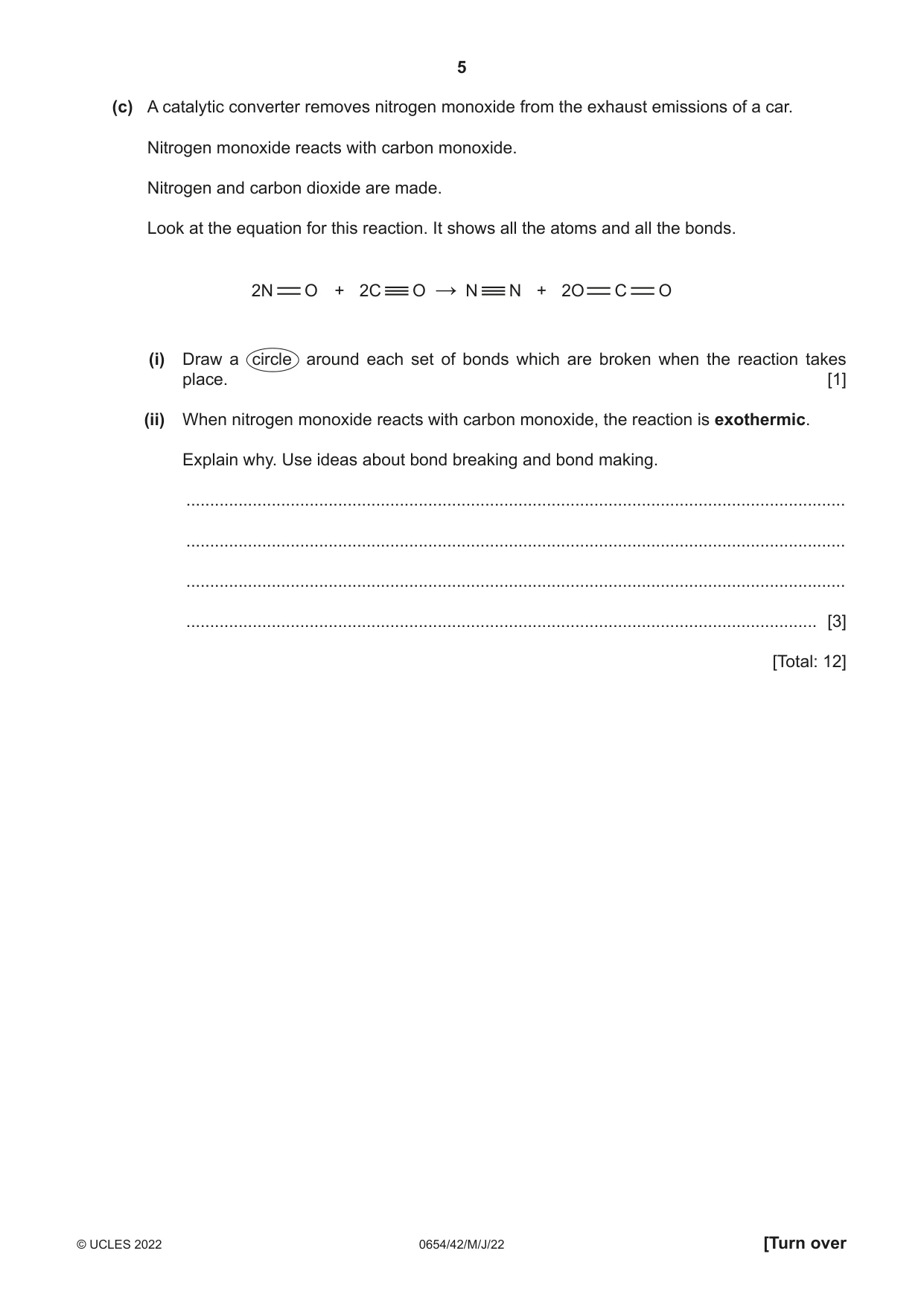
2 Clean air contains nitrogen gas and oxygen gas. (a) State the percentage of nitrogen gas and oxygen gas in clean air. nitrogen gas = ............................................................% oxygen gas = ............................................................% [2] (b) In a car engine, nitrogen gas and oxygen gas react together. Nitrogen monoxide, NO, is made. (i) Construct the balanced symbol equation for this reaction. ..................................................................................................................................... [2] (ii) The rate of this reaction increases as the temperature inside the car engine increases. Explain why. Use ideas about collisions between particles. ........................................................................................................................................... ........................................................................................................................................... ..................................................................................................................................... [2] (iii) The rate of this reaction increases as the concentration of the oxygen gas increases. Explain why. Use ideas about collisions between particles. ........................................................................................................................................... ........................................................................................................................................... ..................................................................................................................................... [2] (c) A catalytic converter removes nitrogen monoxide from the exhaust emissions of a car. Nitrogen monoxide reacts with carbon monoxide. Nitrogen and carbon dioxide are made. Look at the equation for this reaction. It shows all the atoms and all the bonds. 2N O + 2C O → N N + 2O C O (i) Draw a circle around each set of bonds which are broken when the reaction takes place. [1] (ii) When nitrogen monoxide reacts with carbon monoxide, the reaction is exothermic. Explain why. Use ideas about bond breaking and bond making. ........................................................................................................................................... ........................................................................................................................................... ........................................................................................................................................... ..................................................................................................................................... [3] [Total: 12]
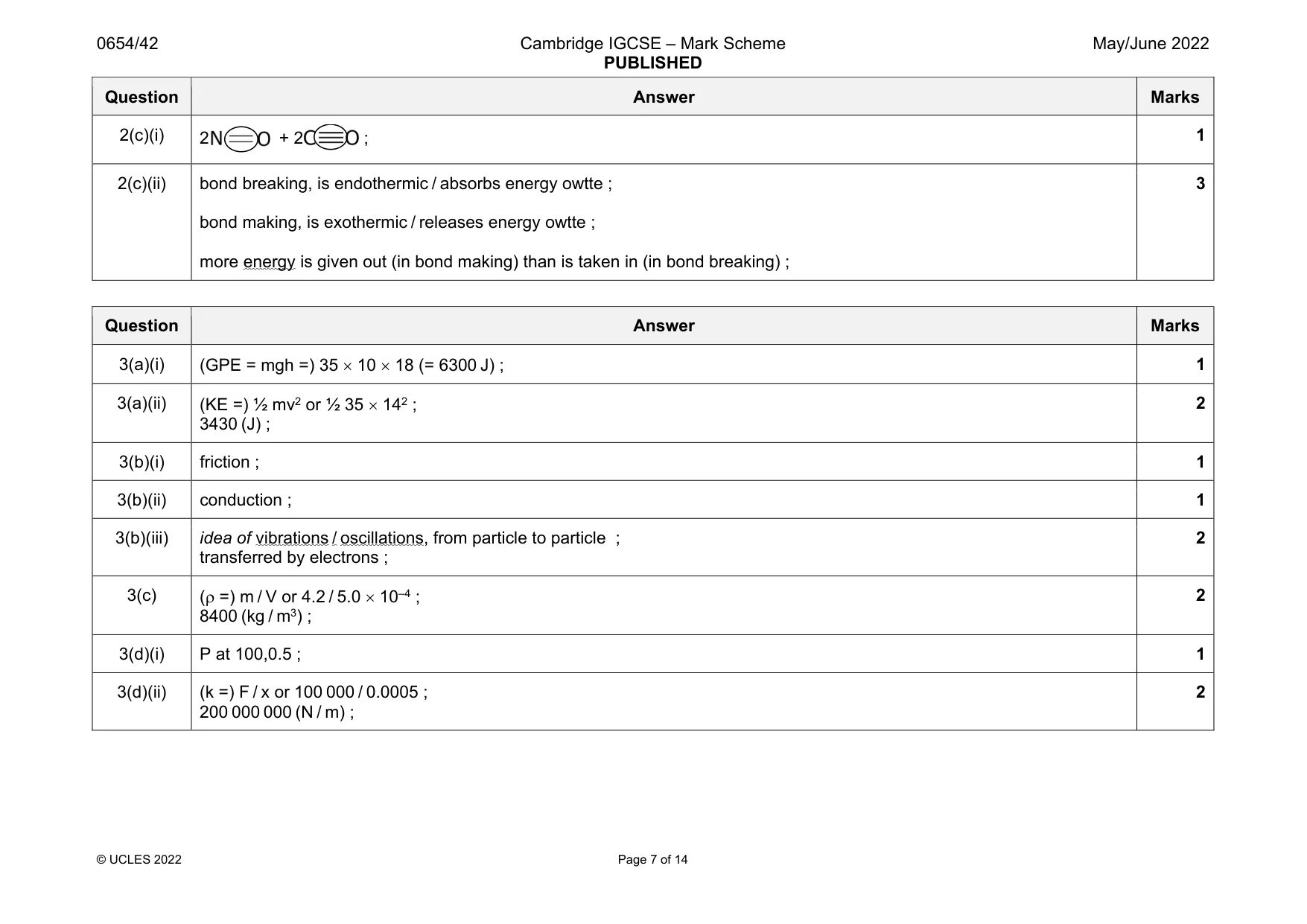
Mark scheme: 2(a) nitrogen gas – 78% ; oxygen gas – 21% ; 2 2(b)(i) N2 + O2 2NO ;; 2 2(b)(ii) any two from: particles move faster / particles have more kinetic energy ; more particles have, activation energy / sufficient energy, to react ; increased rate of (successful) collisions ; 2 2(b)(iii) more particles per unit volume / less space between particles ; increased rate of (successful) collisions ; 2 Question Answer Marks 2(c)(i) 2 + 2 ; 1 2(c)(ii) bond breaking, is endothermic / absorbs energy owtte ; bond making, is exothermic / releases energy owtte ; more energy is given out (in bond making) than is taken in (in bond breaking) ; 3
Q3 · A 35 kg child sliding down a long wire called a zipline
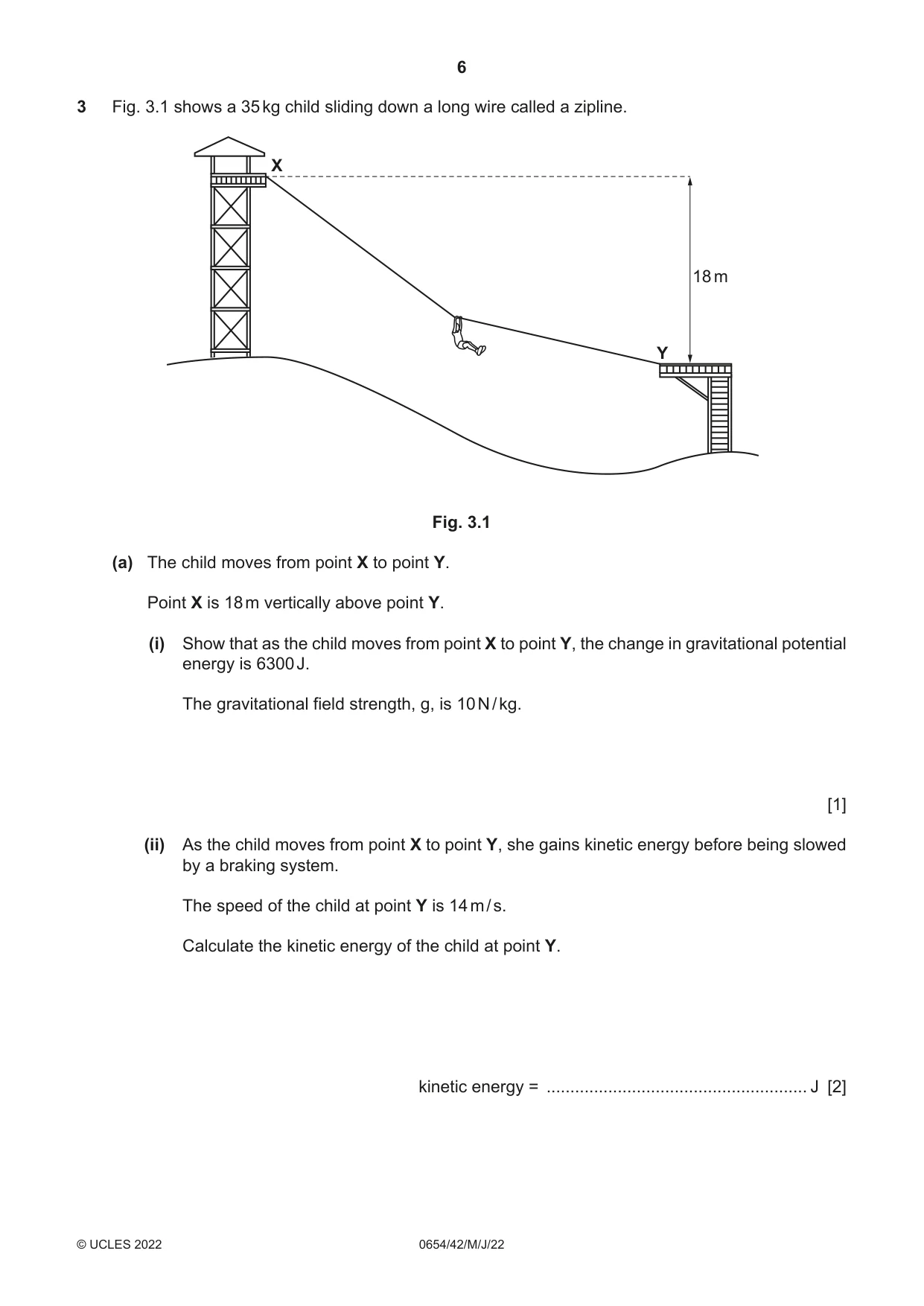
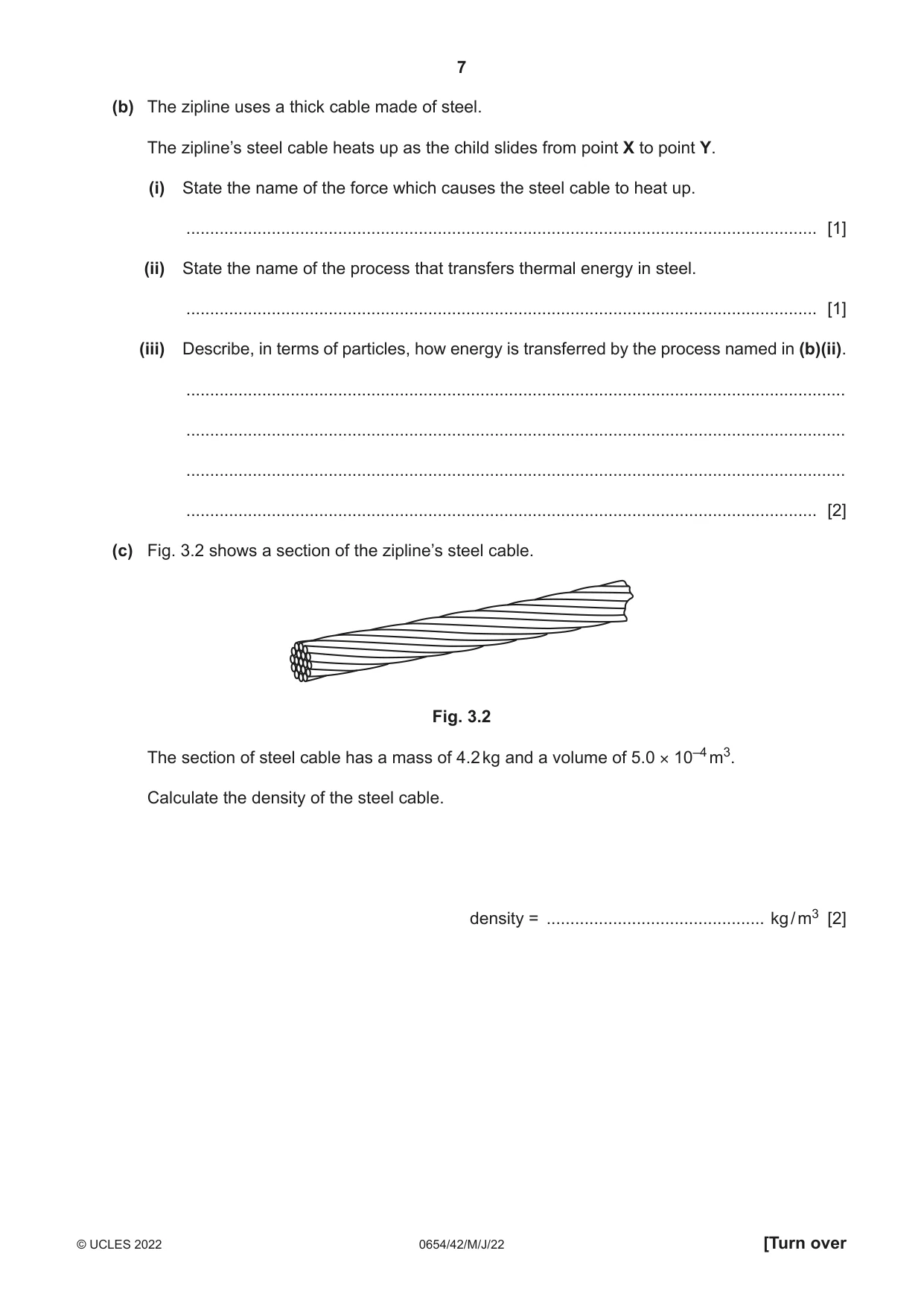
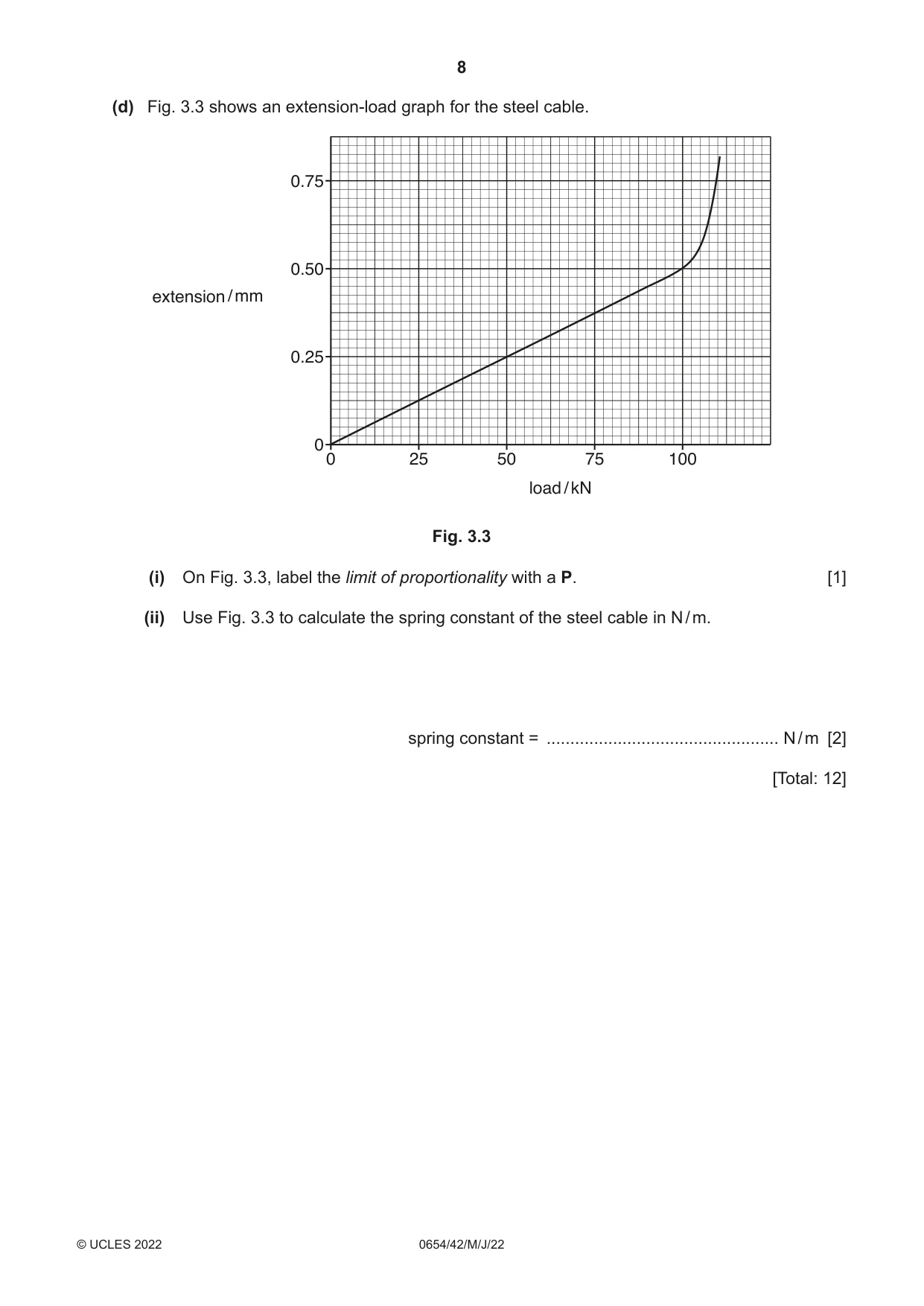
3 Fig. 3.1 shows a 35 kg child sliding down a long wire called a zipline. X 18 m Y Fig. 3.1 (a) The child moves from point X to point Y. Point X is 18 m vertically above point Y. (i) Show that as the child moves from point X to point Y, the change in gravitational potential energy is 6300 J. The gravitational field strength, g, is 10 N / kg. [1] (ii) As the child moves from point X to point Y, she gains kinetic energy before being slowed by a braking system. The speed of the child at point Y is 14 m / s. Calculate the kinetic energy of the child at point Y. kinetic energy = ....................................................... J [2] (b) The zipline uses a thick cable made of steel. The zipline’s steel cable heats up as the child slides from point X to point Y. (i) State the name of the force which causes the steel cable to heat up. ..................................................................................................................................... [1] (ii) State the name of the process that transfers thermal energy in steel. ..................................................................................................................................... [1] (iii) Describe, in terms of particles, how energy is transferred by the process named in (b)(ii). ........................................................................................................................................... ........................................................................................................................................... ........................................................................................................................................... ..................................................................................................................................... [2] (c) Fig. 3.2 shows a section of the zipline’s steel cable. Fig. 3.2 The section of steel cable has a mass of 4.2 kg and a volume of 5.0 × 10⁻⁴ m3. Calculate the density of the steel cable. density = .............................................. kg / m3 [2] (d) Fig. 3.3 shows an extension‑load graph for the steel cable. 0.75 0.50 extension / mm 0.25 0 0 25 50 75 100 load / kN Fig. 3.3 (i) On Fig. 3.3, label the limit of proportionality with a P. [1] (ii) Use Fig. 3.3 to calculate the spring constant of the steel cable in N / m. spring constant = ................................................. N / m [2] [Total: 12]
Mark scheme: 3(a)(i) 1 3(a)(ii) (KE =) ½ mv2 or ½ 35 142 ; 3430 (J) ; 2 3(b)(i) friction ; 1 3(b)(ii) conduction ; 1 3(b)(iii) idea of vibrations / oscillations, from particle to particle ; transferred by electrons ; 2 3(c) ( =) m / V or 4.2 / 5.0 10–4 ; 8400 (kg / m3) ; 2 3(d)(i) P at 100,0.5 ; 1 3(d)(ii) (k =) F / x or 100 000 / 0.0005 ; 200 000 000 (N / m) ; 2
Q4 · A diagram of the carbon cycle
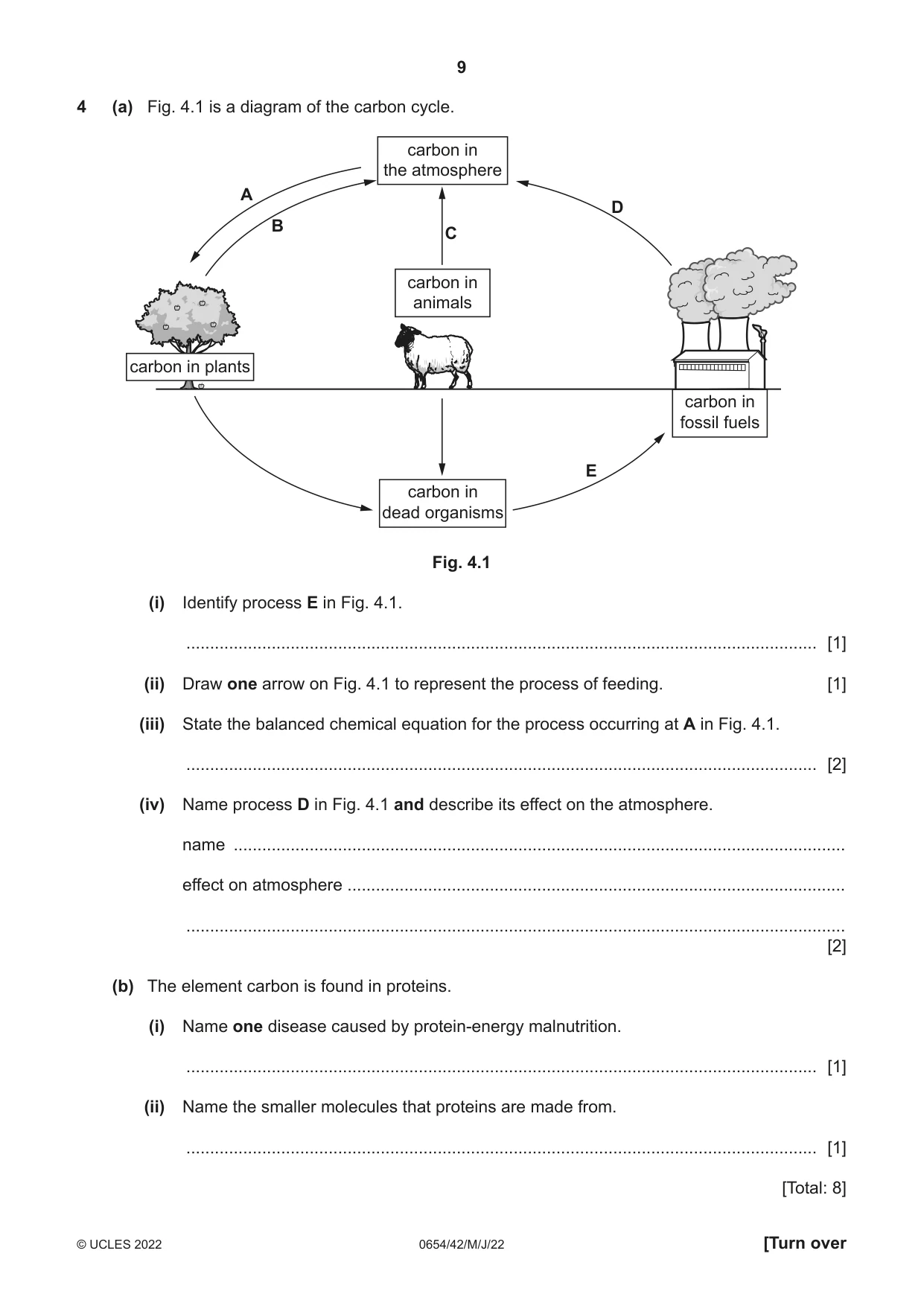
4 (a) Fig. 4.1 is a diagram of the carbon cycle. carbon in the atmosphere A D B C carbon in animals carbon in plants carbon in fossil fuels E carbon in dead organisms Fig. 4.1 (i) Identify process E in Fig. 4.1. ..................................................................................................................................... [1] (ii) Draw one arrow on Fig. 4.1 to represent the process of feeding. [1] (iii) State the balanced chemical equation for the process occurring at A in Fig. 4.1. ..................................................................................................................................... [2] (iv) Name process D in Fig. 4.1 and describe its effect on the atmosphere. name ................................................................................................................................. effect on atmosphere ......................................................................................................... ........................................................................................................................................... [2] (b) The element carbon is found in proteins. (i) Name one disease caused by protein‑energy malnutrition. ..................................................................................................................................... [1] (ii) Name the smaller molecules that proteins are made from. ..................................................................................................................................... [1] [Total: 8]
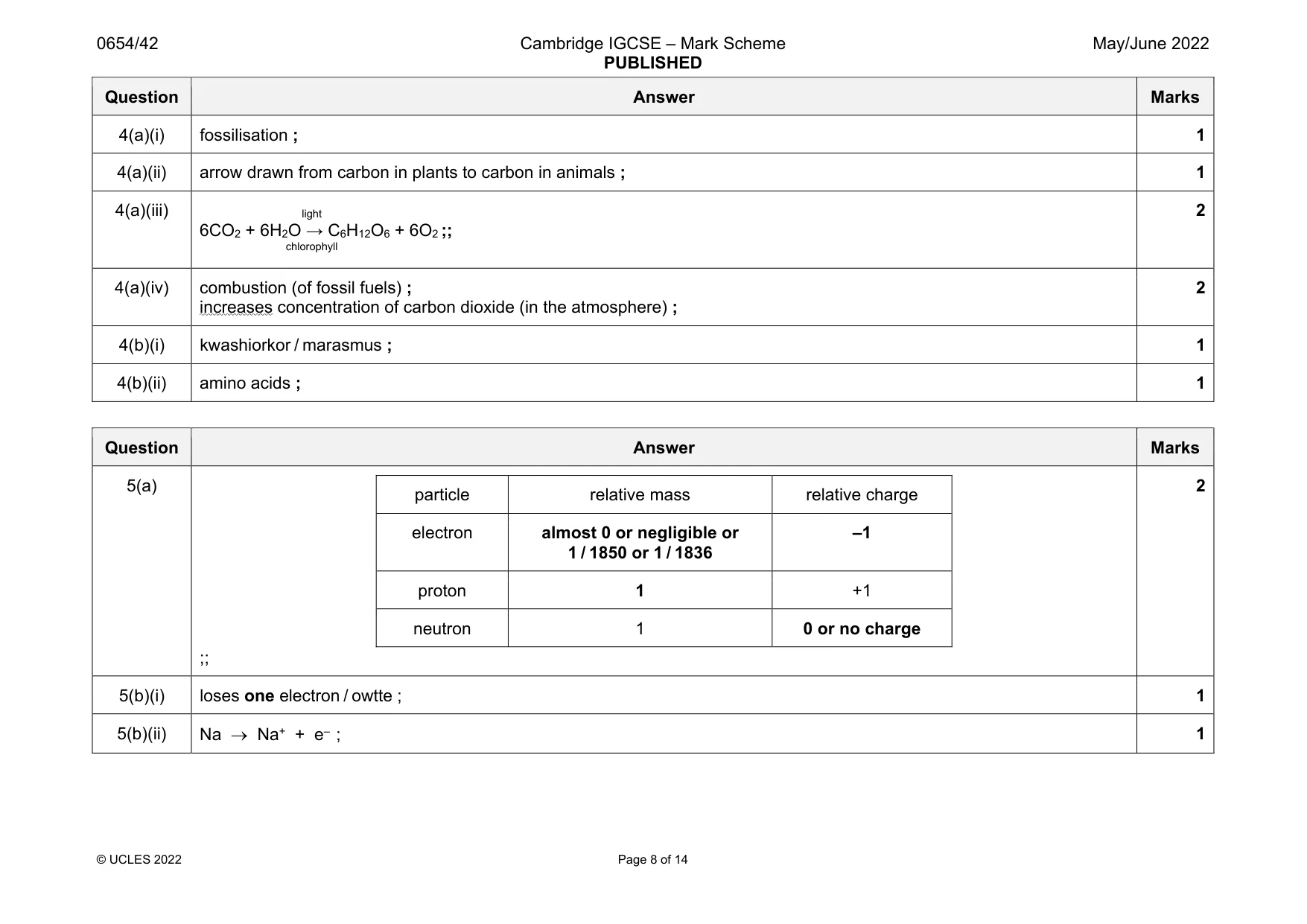
Mark scheme: 4(a)(i) fossilisation ; 1 4(a)(ii) arrow drawn from carbon in plants to carbon in animals ; 1 4(a)(iii) light 6CO2 + 6H2O → C6H12O6 + 6O2 ;; chlorophyll 2 4(a)(iv) combustion (of fossil fuels) ; increases concentration of carbon dioxide (in the atmosphere) ; 2 4(b)(i) kwashiorkor / marasmus ; 1 4(b)(ii) amino acids ; 1
Q5 · Some information about particles found in atoms
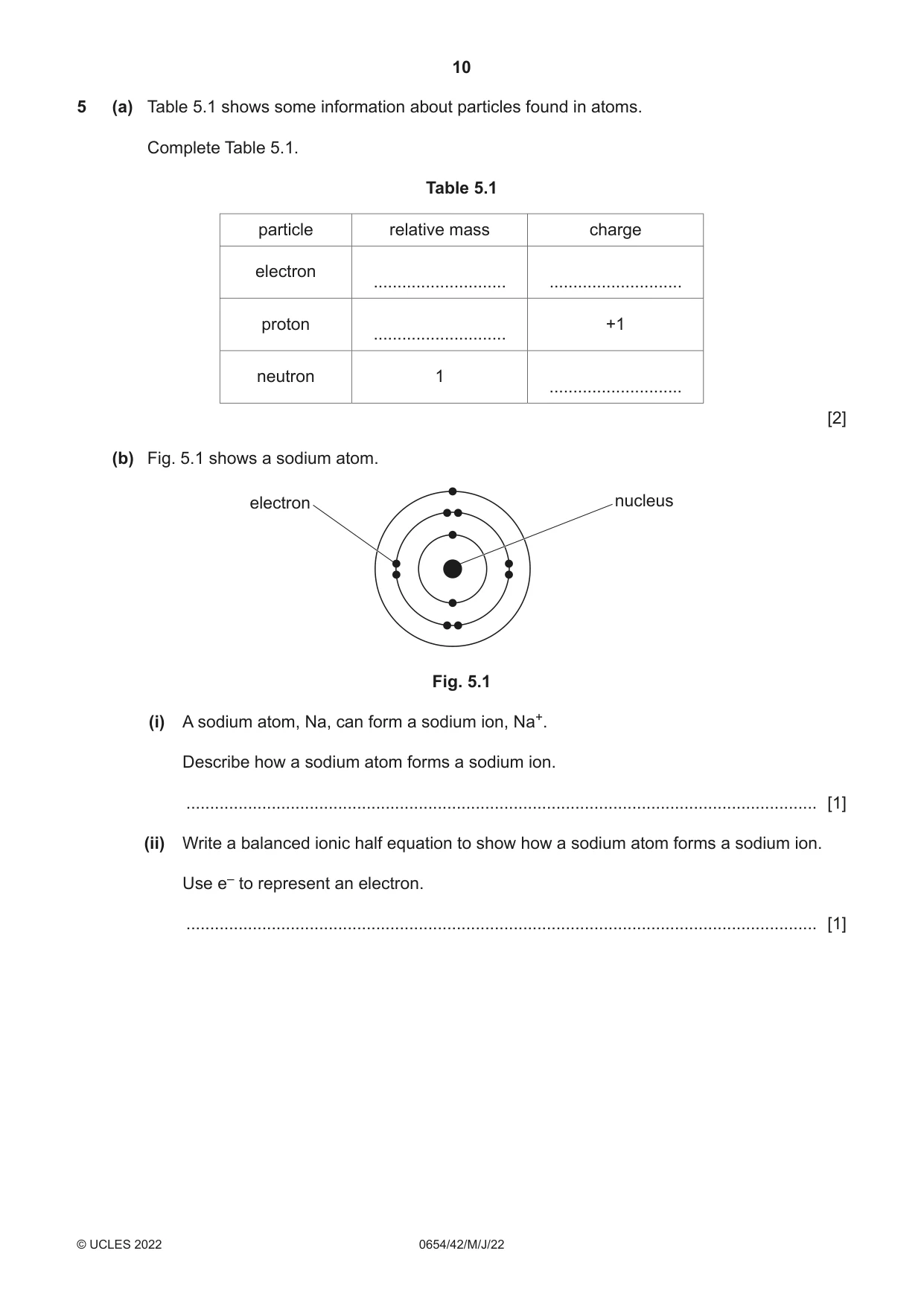
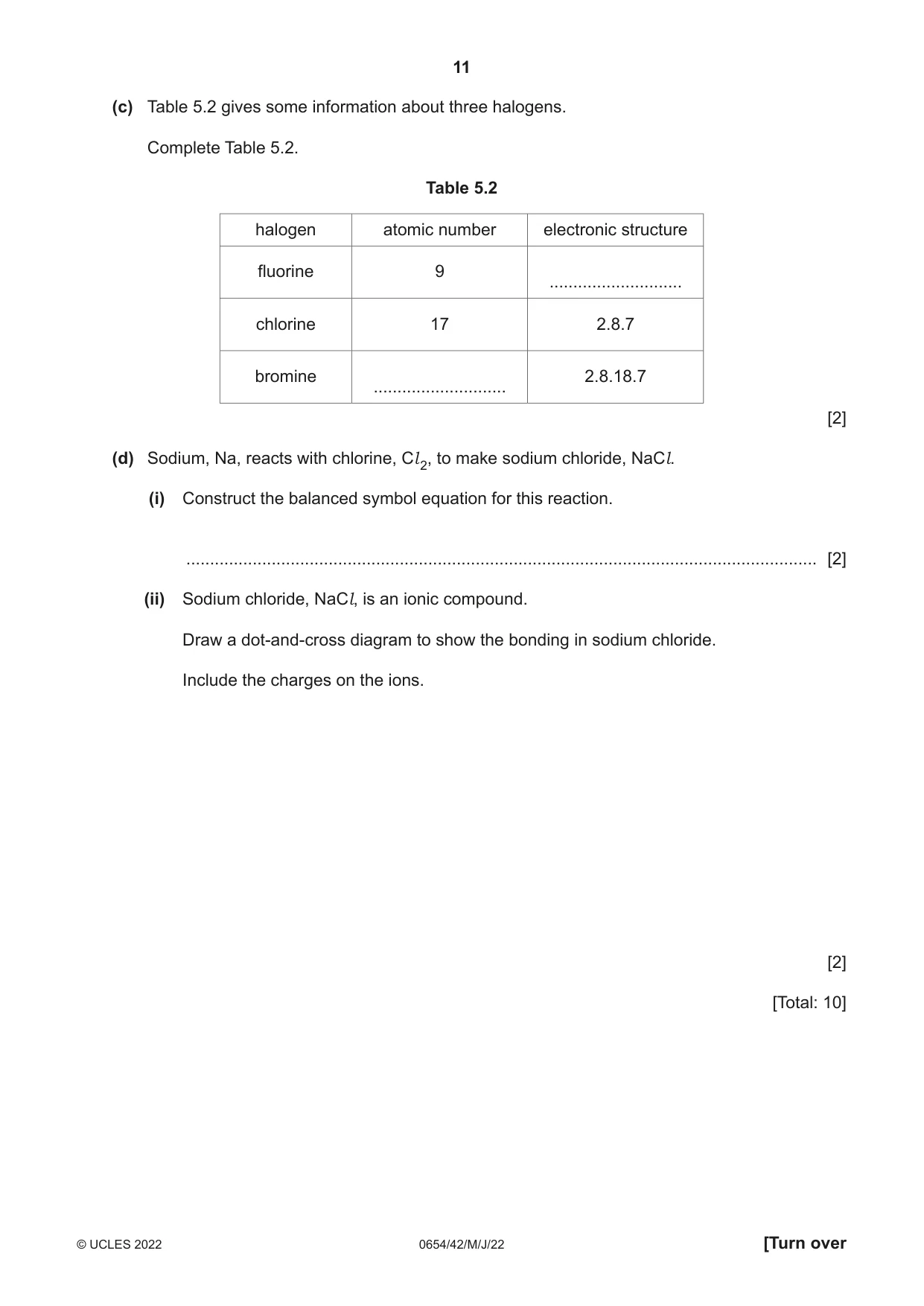
5 (a) Table 5.1 shows some information about particles found in atoms. Complete Table 5.1. Table 5.1 particle relative mass charge electron ............................ ............................ proton +1 ............................ neutron 1 ............................ [2] (b) Fig. 5.1 shows a sodium atom. electron nucleus Fig. 5.1 (i) A sodium atom, Na, can form a sodium ion, Na+. Describe how a sodium atom forms a sodium ion. ..................................................................................................................................... [1] (ii) Write a balanced ionic half equation to show how a sodium atom forms a sodium ion. Use e– to represent an electron. ..................................................................................................................................... [1] (c) Table 5.2 gives some information about three halogens. Complete Table 5.2. Table 5.2 halogen atomic number electronic structure fluorine 9 ............................ chlorine 17 2.8.7 bromine 2.8.18.7 ............................ [2] (d) Sodium, Na, reacts with chlorine, Cl 2, to make sodium chloride, NaCl. (i) Construct the balanced symbol equation for this reaction. ..................................................................................................................................... [2] (ii) Sodium chloride, NaCl, is an ionic compound. Draw a dot‑and‑cross diagram to show the bonding in sodium chloride. Include the charges on the ions. [2] [Total: 10]
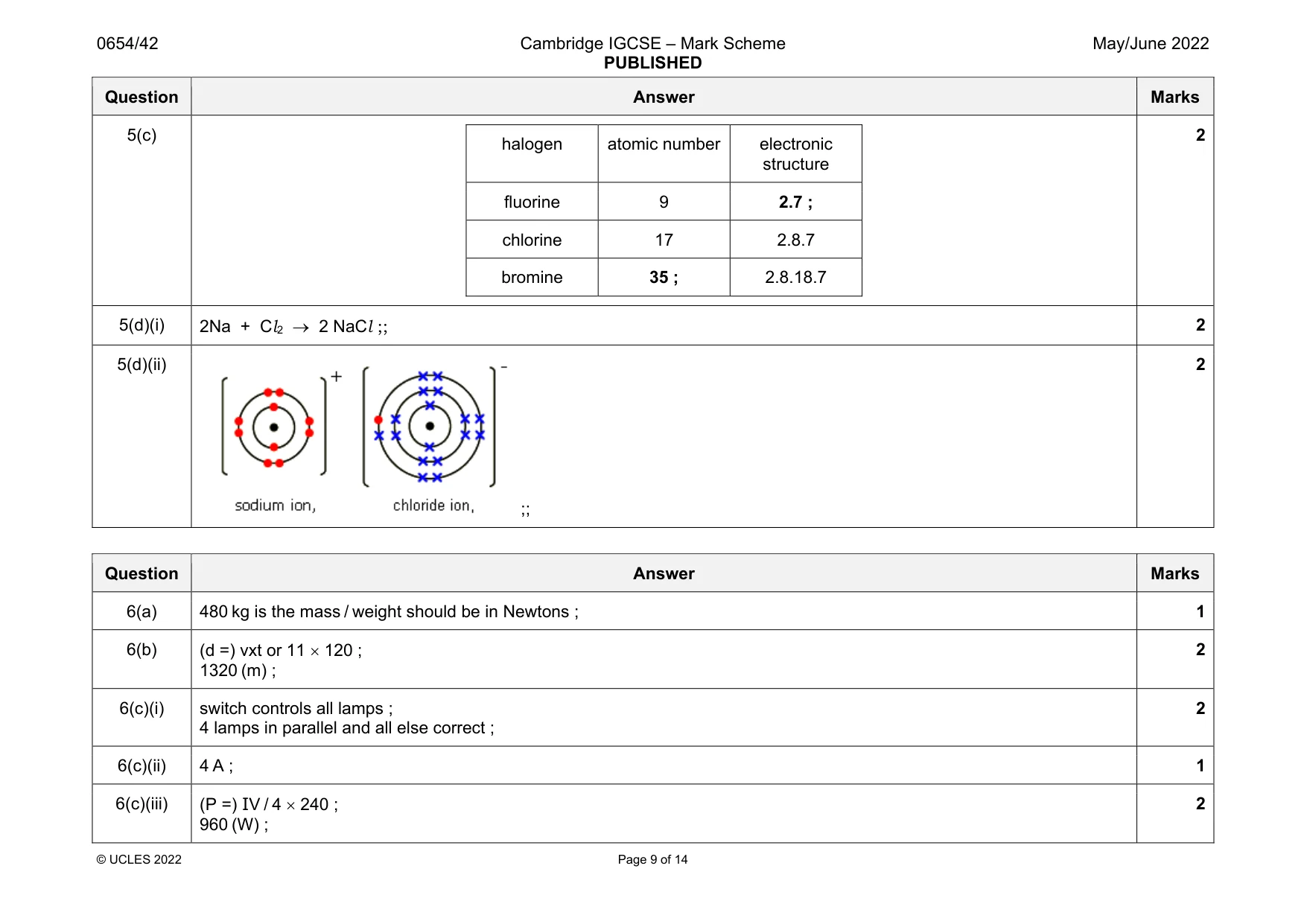
Mark scheme: 5(a) particle relative mass relative charge electron almost 0 or negligible or 1 / 1850 or 1 / 1836 –1 proton 1 +1 neutron 1 0 or no charge ;; 2 5(b)(i) loses one electron / owtte ; 1 5(b)(ii) Na Na+ + e– ; 1 Question Answer Marks 5(c) halogen atomic number electronic structure fluorine 9 2.7 ; chlorine 17 2.8.7 bromine 35 ; 2.8.18.7 2 5(d)(i) 2Na + Cl2 2 NaCl ;; 2 5(d)(ii) ;; 2
Q6 · A baby elephant born in a wildlife sanctuary
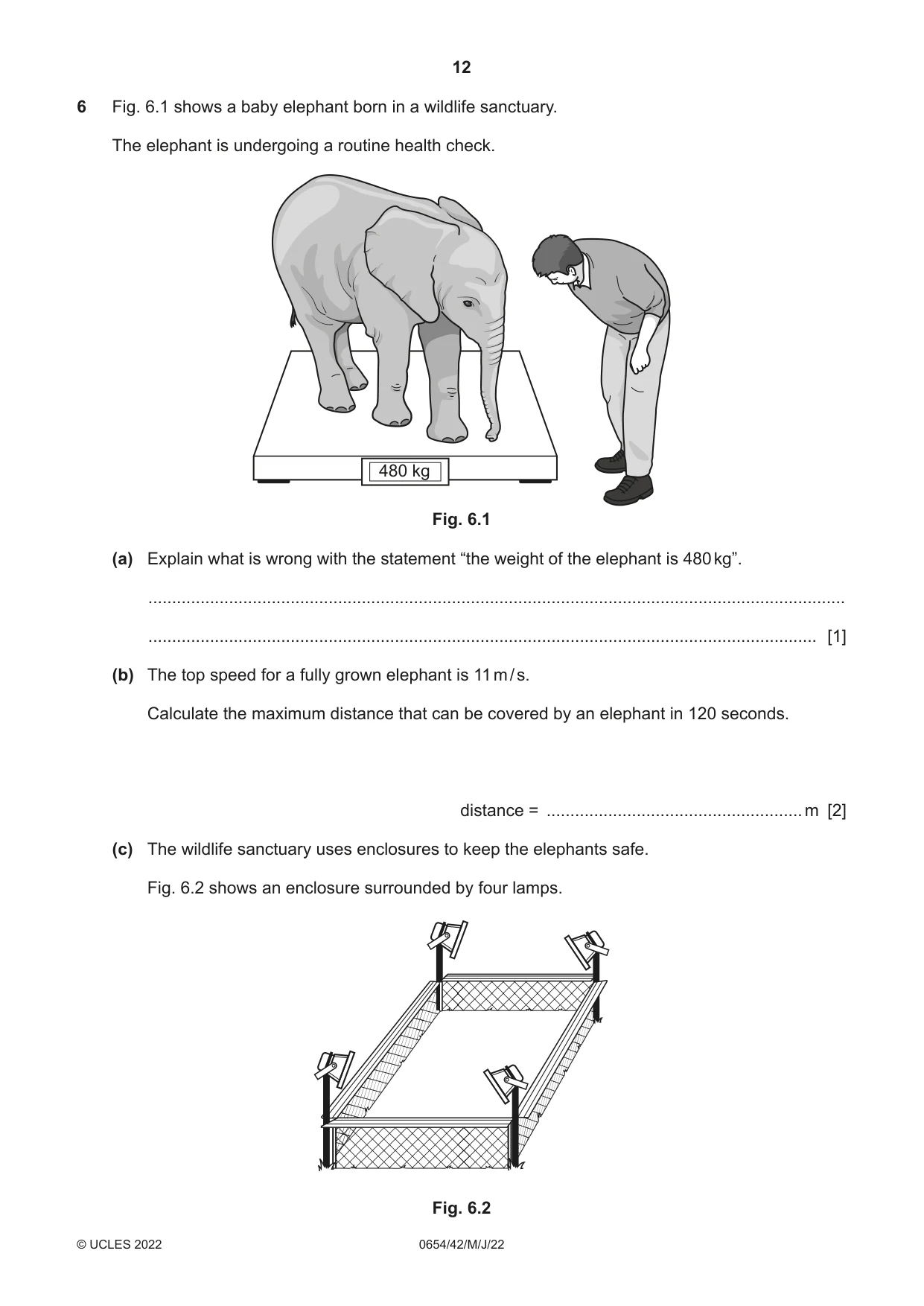
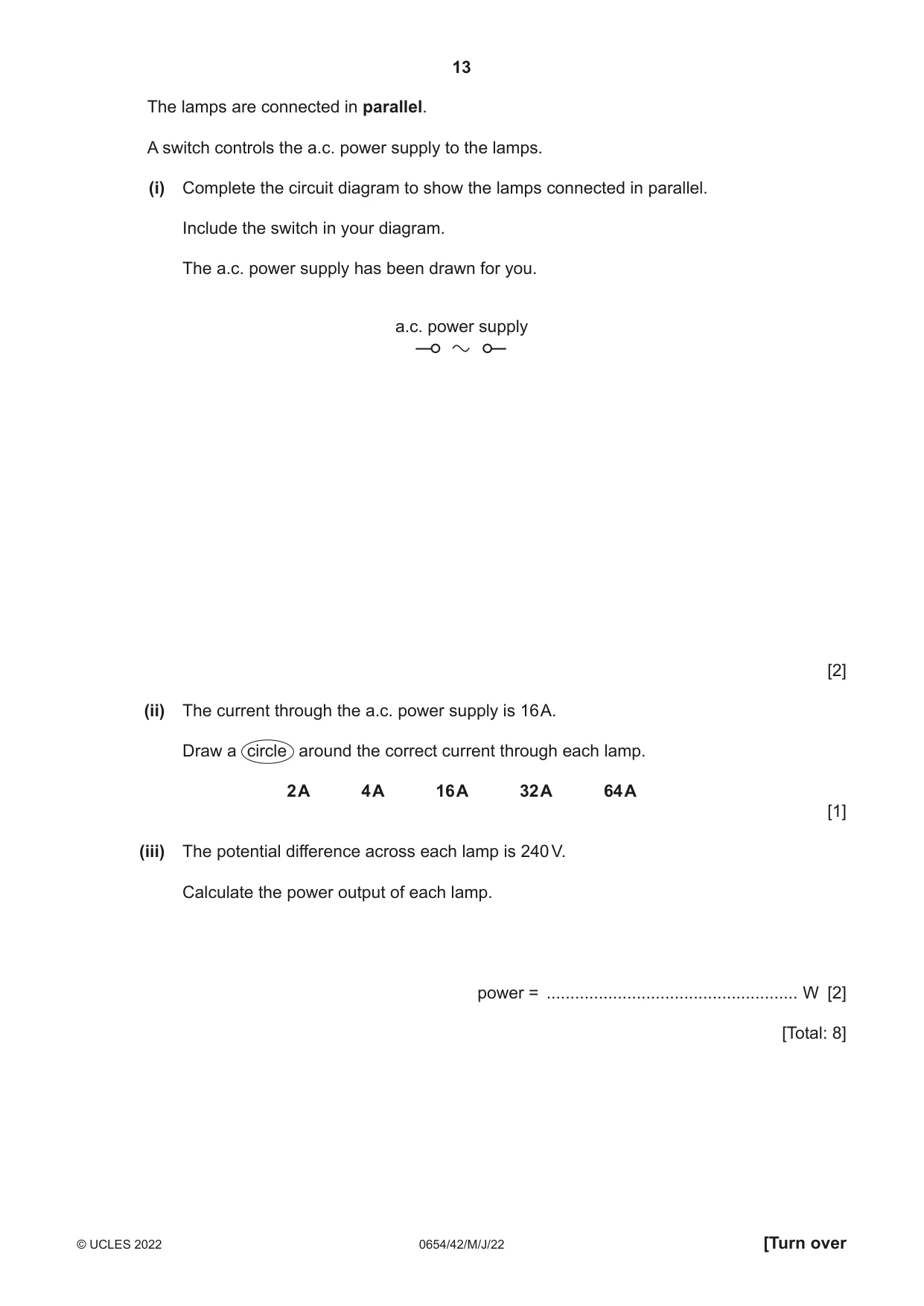
6 Fig. 6.1 shows a baby elephant born in a wildlife sanctuary. The elephant is undergoing a routine health check. 480 kg Fig. 6.1 (a) Explain what is wrong with the statement “the weight of the elephant is 480 kg”. ................................................................................................................................................... ............................................................................................................................................. [1] (b) The top speed for a fully grown elephant is 11 m / s. Calculate the maximum distance that can be covered by an elephant in 120 seconds. distance = ...................................................... m [2] (c) The wildlife sanctuary uses enclosures to keep the elephants safe. Fig. 6.2 shows an enclosure surrounded by four lamps. Fig. 6.2 The lamps are connected in parallel. A switch controls the a.c. power supply to the lamps. (i) Complete the circuit diagram to show the lamps connected in parallel. Include the switch in your diagram. The a.c. power supply has been drawn for you. a.c. power supply [2] (ii) The current through the a.c. power supply is 16 A. Draw a circle around the correct current through each lamp. 2 A 4 A 16 A 32 A 64 A [1] (iii) The potential difference across each lamp is 240 V. Calculate the power output of each lamp. power = ..................................................... W [2] [Total: 8]
Mark scheme: 6(a) 480 kg is the mass / weight should be in Newtons ; 1 6(b) (d =) vxt or 11 120 ; 1320 (m) ; 2 6(c)(i) switch controls all lamps ; 4 lamps in parallel and all else correct ; 2 6(c)(ii) 4 A ; 1 6(c)(iii) (P =) IV / 4 240 ; 960 (W) ; 2
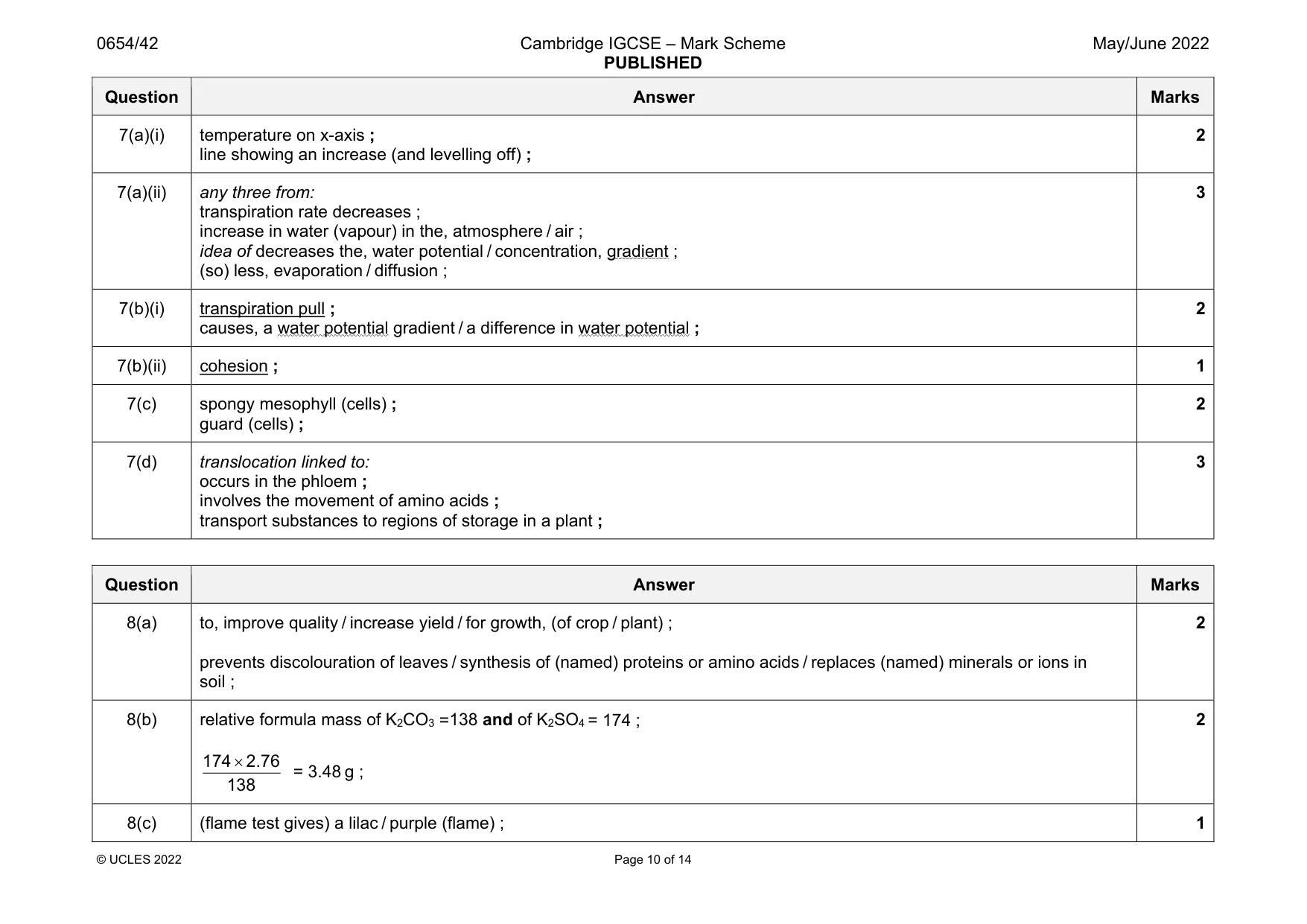
Q7 · A student investigates the effect of temperature on the rate of transpiration
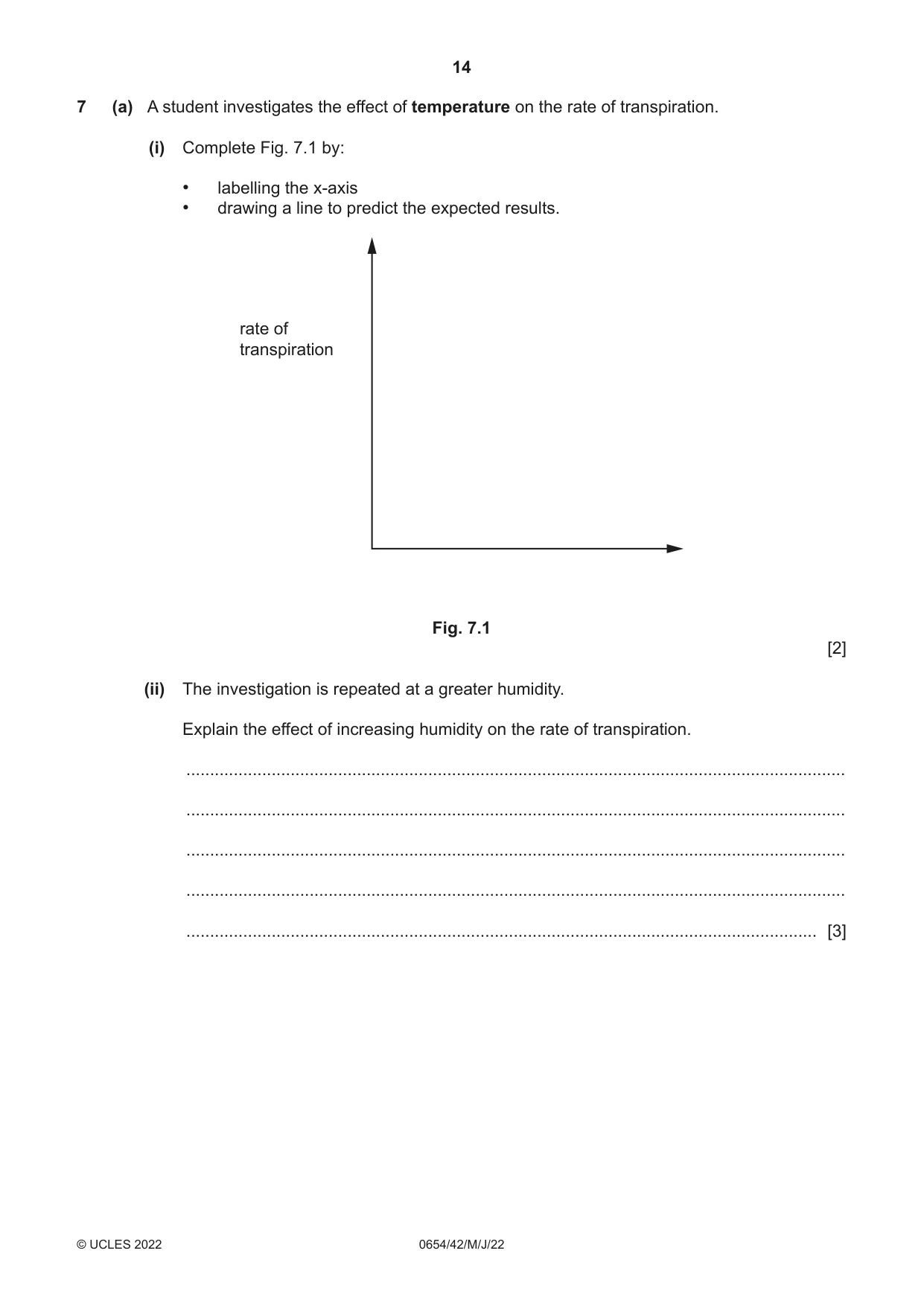
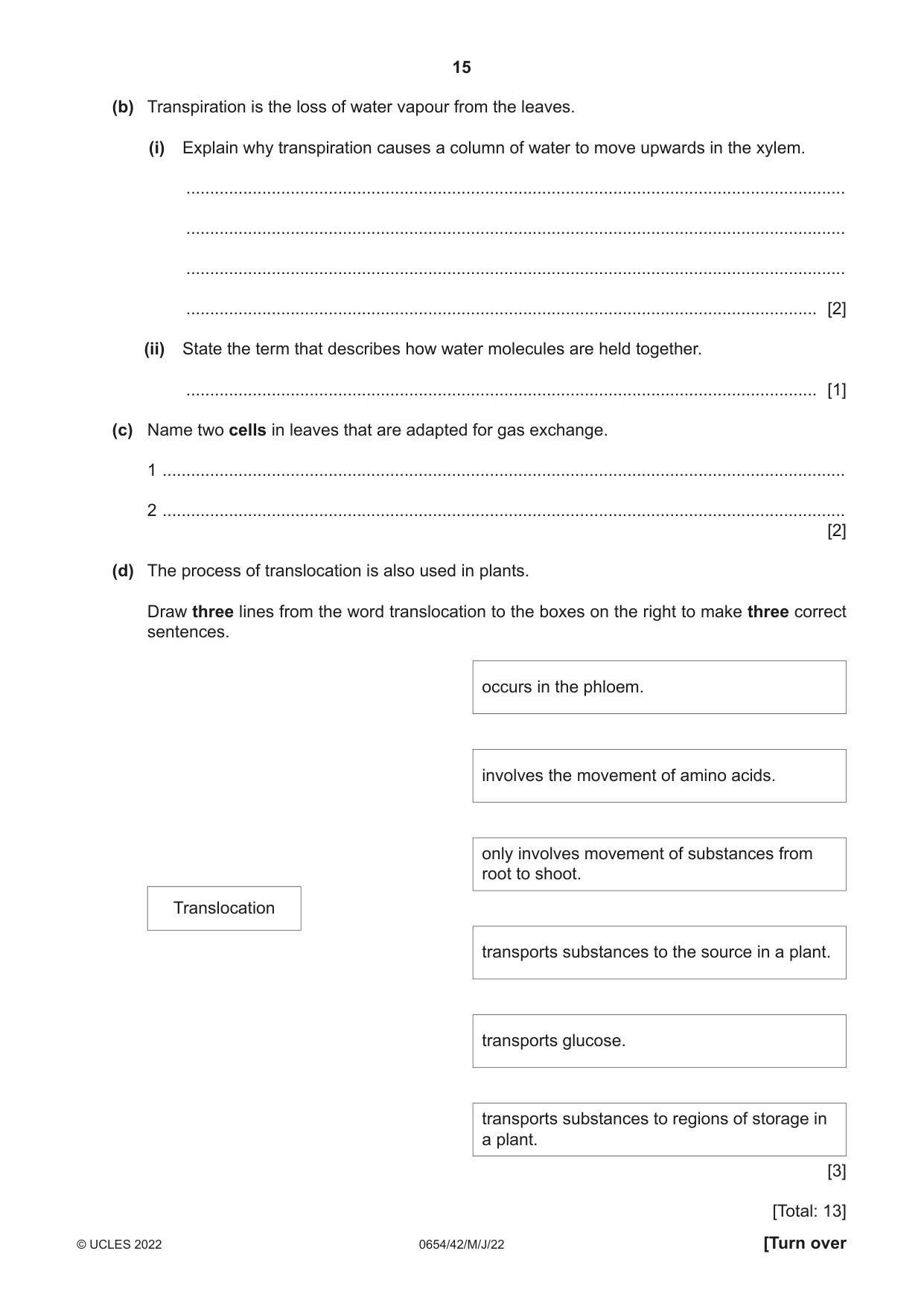
7 (a) A student investigates the effect of temperature on the rate of transpiration. (i) Complete Fig. 7.1 by: • labelling the x‑axis • drawing a line to predict the expected results. rate of transpiration Fig. 7.1 [2] (ii) The investigation is repeated at a greater humidity. Explain the effect of increasing humidity on the rate of transpiration. ........................................................................................................................................... ........................................................................................................................................... ........................................................................................................................................... ........................................................................................................................................... ..................................................................................................................................... [3] (b) Transpiration is the loss of water vapour from the leaves. (i) Explain why transpiration causes a column of water to move upwards in the xylem. ........................................................................................................................................... ........................................................................................................................................... ........................................................................................................................................... ..................................................................................................................................... [2] (ii) State the term that describes how water molecules are held together. ..................................................................................................................................... [1] (c) Name two cells in leaves that are adapted for gas exchange. 1 ................................................................................................................................................ 2 ................................................................................................................................................ [2] (d) The process of translocation is also used in plants. Draw three lines from the word translocation to the boxes on the right to make three correct sentences. occurs in the phloem. involves the movement of amino acids. only involves movement of substances from root to shoot. Translocation transports substances to the source in a plant. transports glucose. transports substances to regions of storage in a plant. [3] [Total: 13]
Mark scheme: 7(a)(i) temperature on x-axis ; line showing an increase (and levelling off) ; 2 7(a)(ii) any three from: transpiration rate decreases ; increase in water (vapour) in the, atmosphere / air ; idea of decreases the, water potential / concentration, gradient ; (so) less, evaporation / diffusion ; 3 7(b)(i) transpiration pull ; causes, a water potential gradient / a difference in water potential ; 2 7(b)(ii) cohesion ; 1 7(c) spongy mesophyll (cells) ; guard (cells) ; 2 7(d) translocation linked to: occurs in the phloem ; involves the movement of amino acids ; transport substances to regions of storage in a plant ; 3
Q8 · Plants need three essential elements: nitrogen, phosphorus and potassium
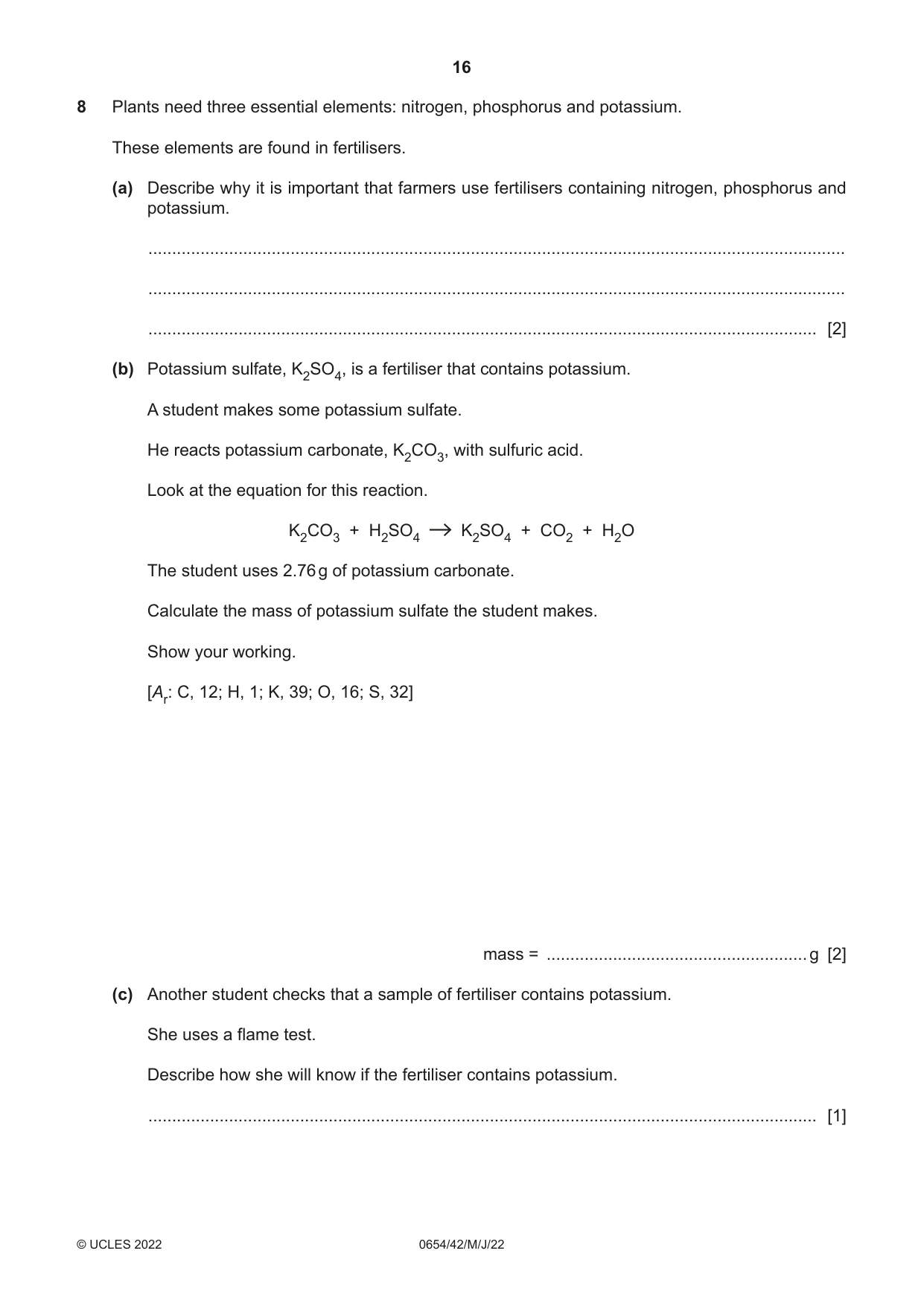
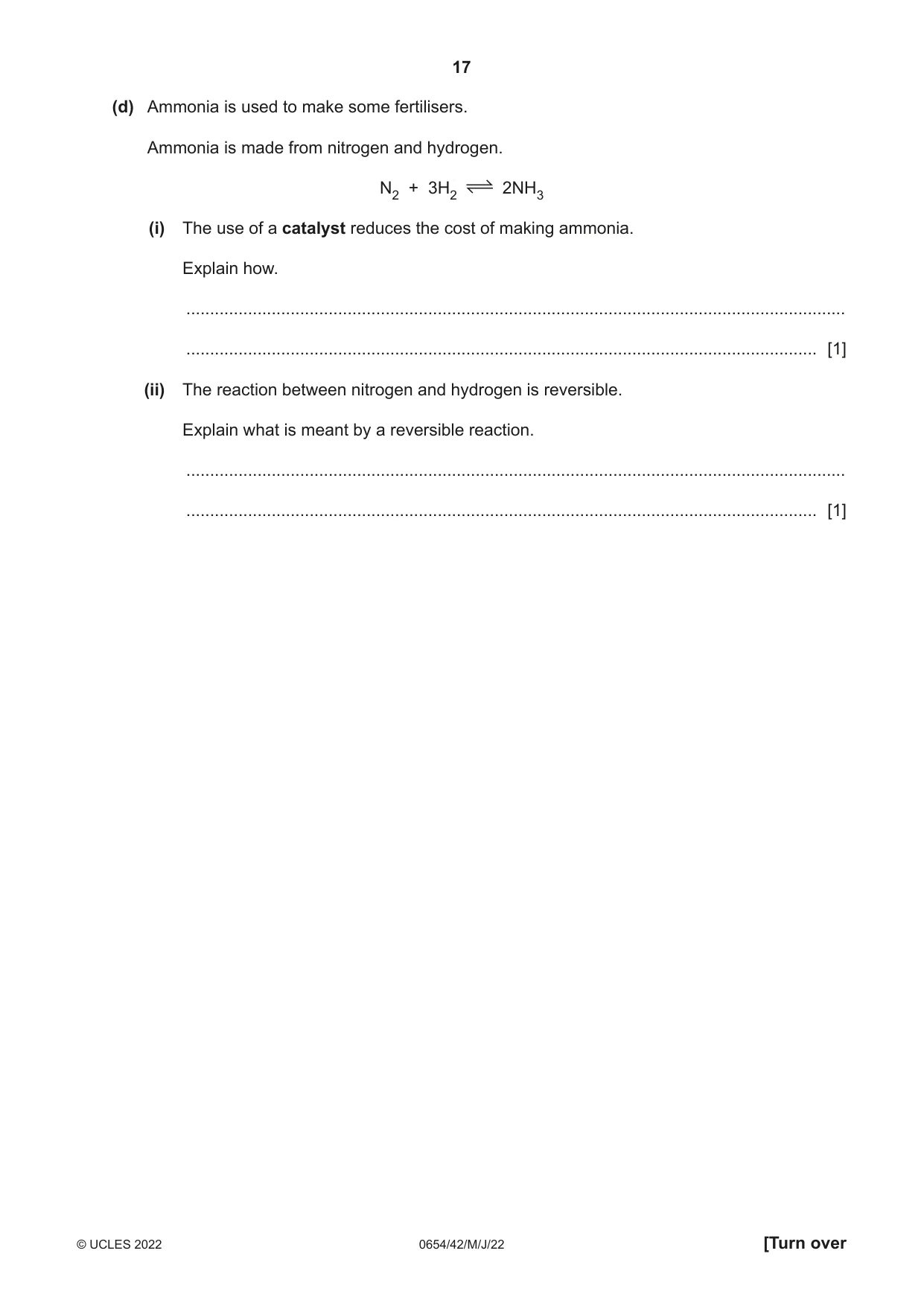
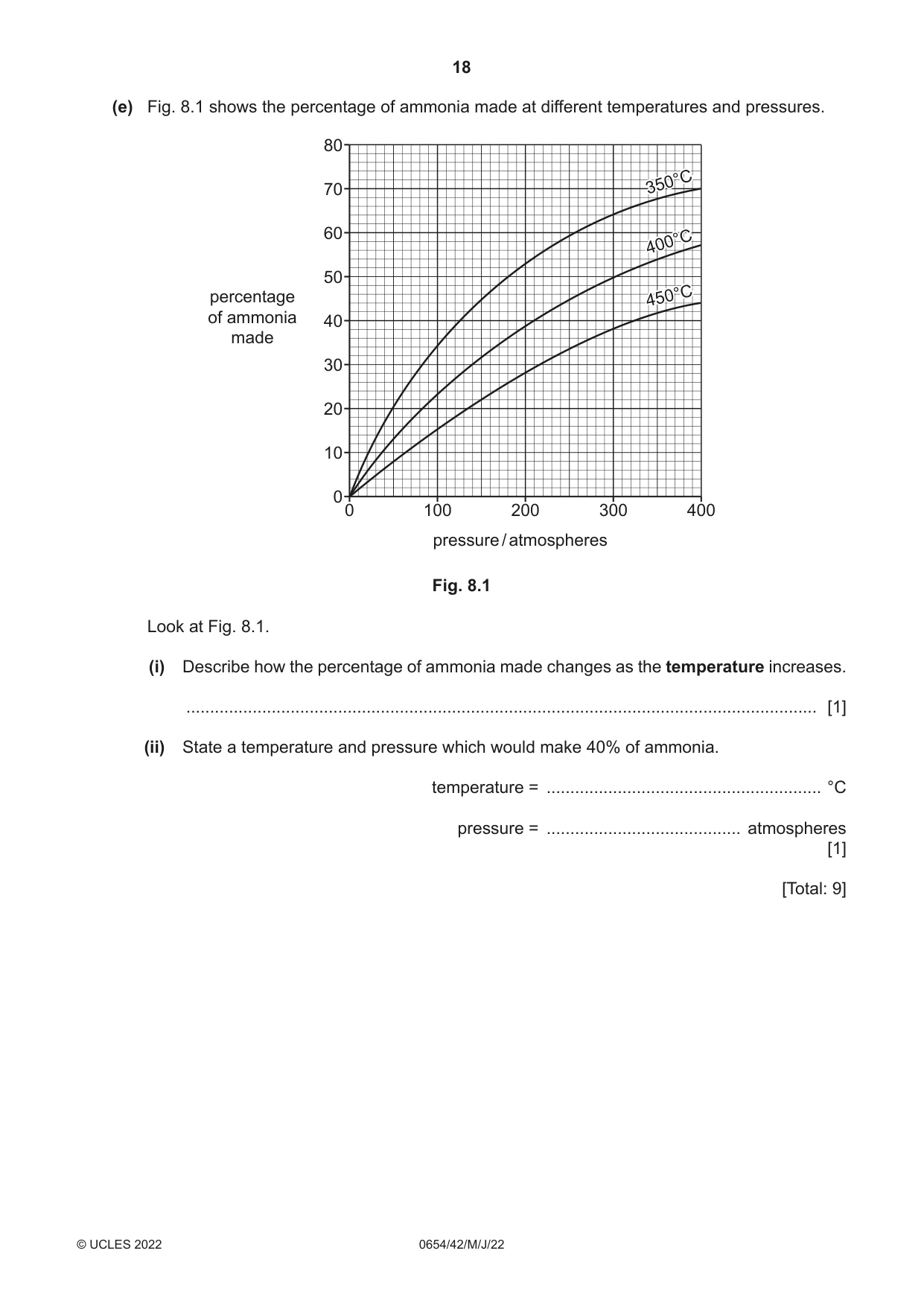
8 Plants need three essential elements: nitrogen, phosphorus and potassium. These elements are found in fertilisers. (a) Describe why it is important that farmers use fertilisers containing nitrogen, phosphorus and potassium. ................................................................................................................................................... ................................................................................................................................................... ............................................................................................................................................. [2] (b) Potassium sulfate, K2SO4, is a fertiliser that contains potassium. A student makes some potassium sulfate. He reacts potassium carbonate, K2CO3, with sulfuric acid. Look at the equation for this reaction. K2CO3 + H2SO4 K2SO4 + CO2 + H2O The student uses 2.76 g of potassium carbonate. Calculate the mass of potassium sulfate the student makes. Show your working. [Ar: C, 12; H, 1; K, 39; O, 16; S, 32] mass = ....................................................... g [2] (c) Another student checks that a sample of fertiliser contains potassium. She uses a flame test. Describe how she will know if the fertiliser contains potassium. ............................................................................................................................................. [1] (d) Ammonia is used to make some fertilisers. Ammonia is made from nitrogen and hydrogen. N2 + 3H2 2NH3 (i) The use of a catalyst reduces the cost of making ammonia. Explain how. ........................................................................................................................................... ..................................................................................................................................... [1] (ii) The reaction between nitrogen and hydrogen is reversible. Explain what is meant by a reversible reaction. ........................................................................................................................................... ..................................................................................................................................... [1] (e) Fig. 8.1 shows the percentage of ammonia made at different temperatures and pressures. 80 70 350°C350°C 60 400°C400°C 50 percentage 450°C450°C of ammonia 40 made 30 20 10 0 0 100 200 300 400 pressure / atmospheres Fig. 8.1 Look at Fig. 8.1. (i) Describe how the percentage of ammonia made changes as the temperature increases. ..................................................................................................................................... [1] (ii) State a temperature and pressure which would make 40% of ammonia. temperature = .......................................................... °C pressure = ......................................... atmospheres [1] [Total: 9]
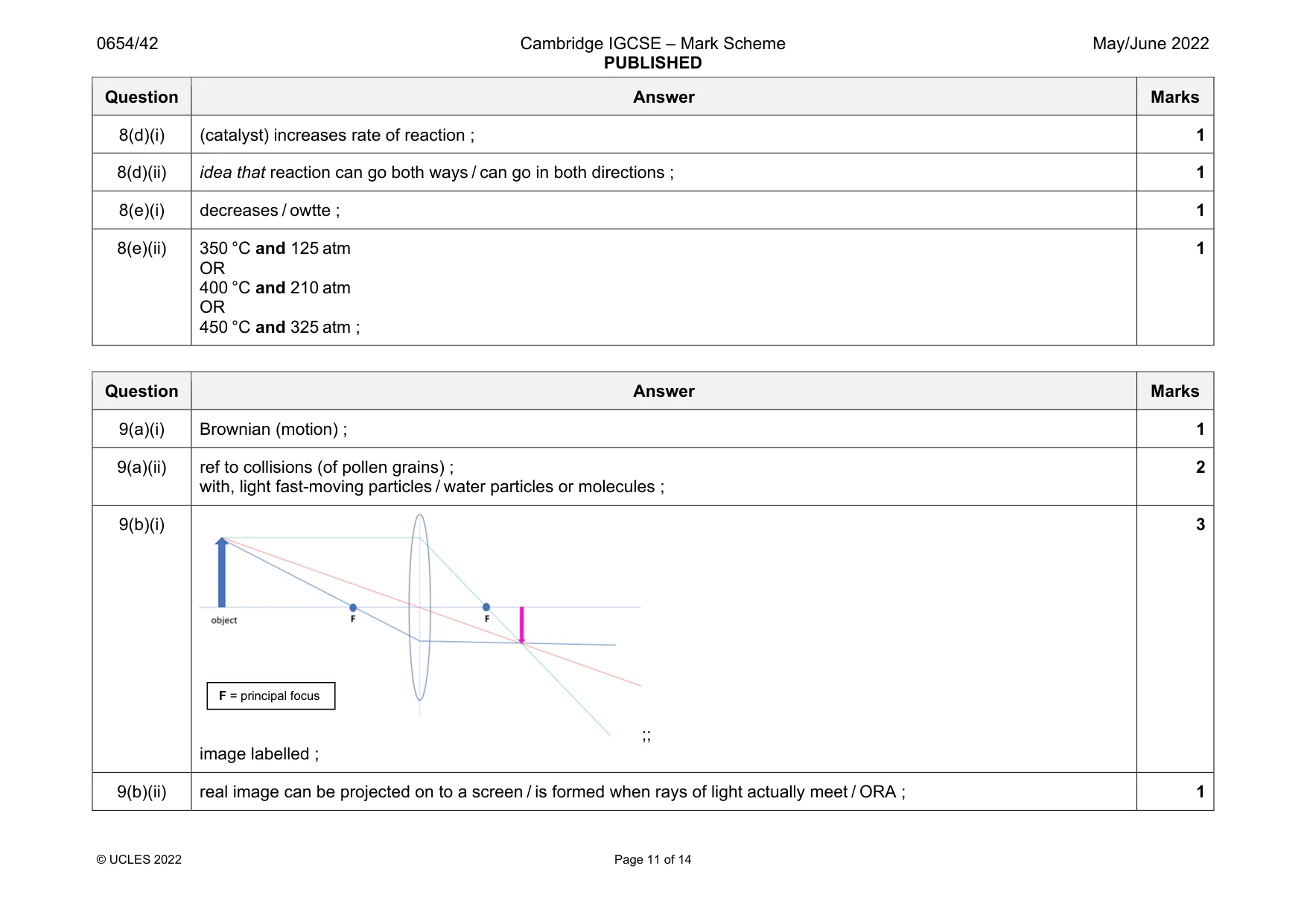
Mark scheme: 8(a) to, improve quality / increase yield / for growth, (of crop / plant) ; prevents discolouration of leaves / synthesis of (named) proteins or amino acids / replaces (named) minerals or ions in soil ; 2 8(b) relative formula mass of K2CO3 =138 and of K2SO4 = 174 ; 174 2.76 138 = 3.48 g ; 2 8(c) (flame test gives) a lilac / purple (flame) ; 1 Question Answer Marks 8(d)(i) (catalyst) increases rate of reaction ; 1 8(d)(ii) idea that reaction can go both ways / can go in both directions ; 1 8(e)(i) decreases / owtte ; 1 8(e)(ii) 350 °C and 125 atm OR 400 °C and 210 atm OR 450 °C and 325 atm ; 1
Q9 · A student investigates the motion of pollen grains in water seen through a microscope
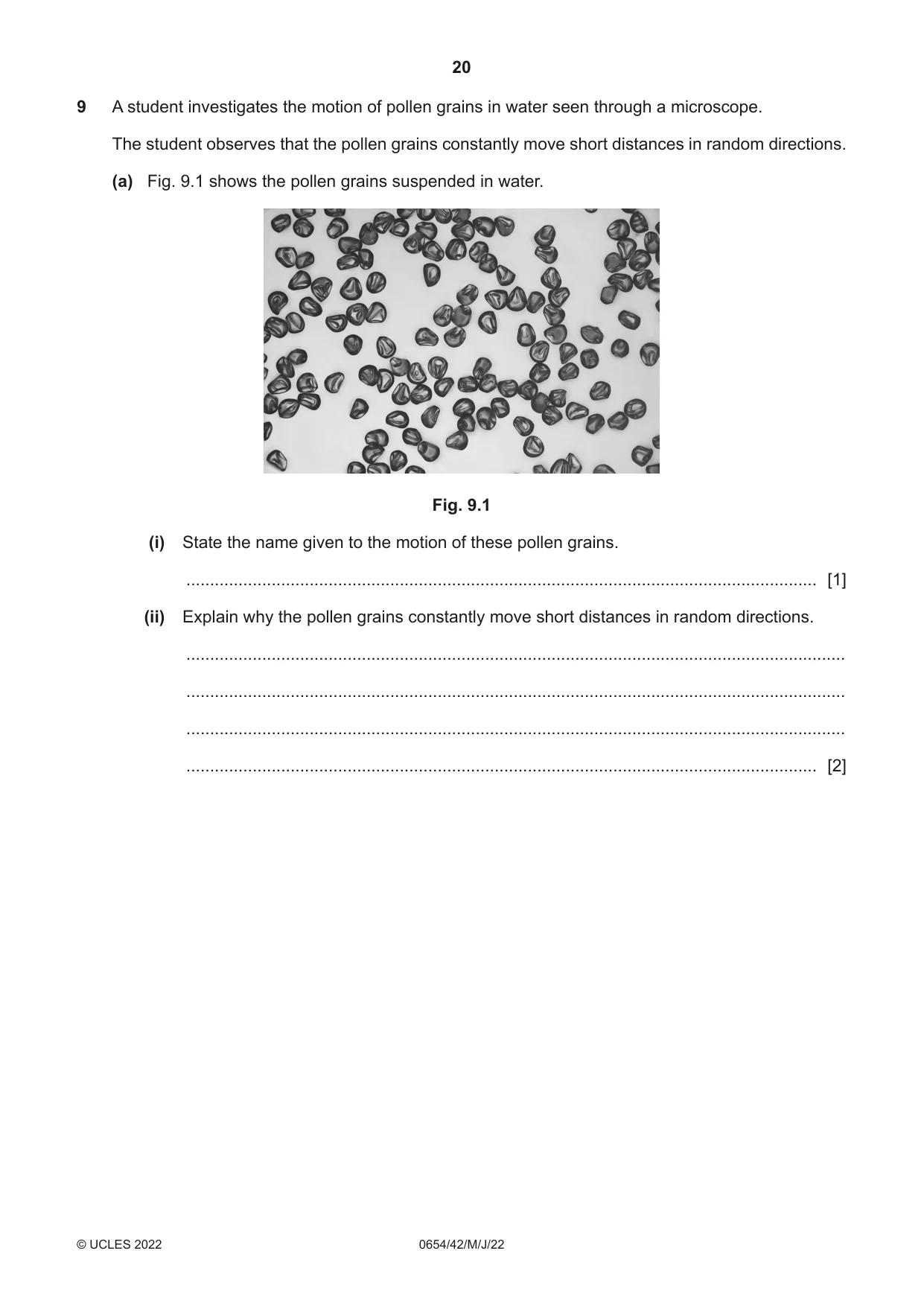
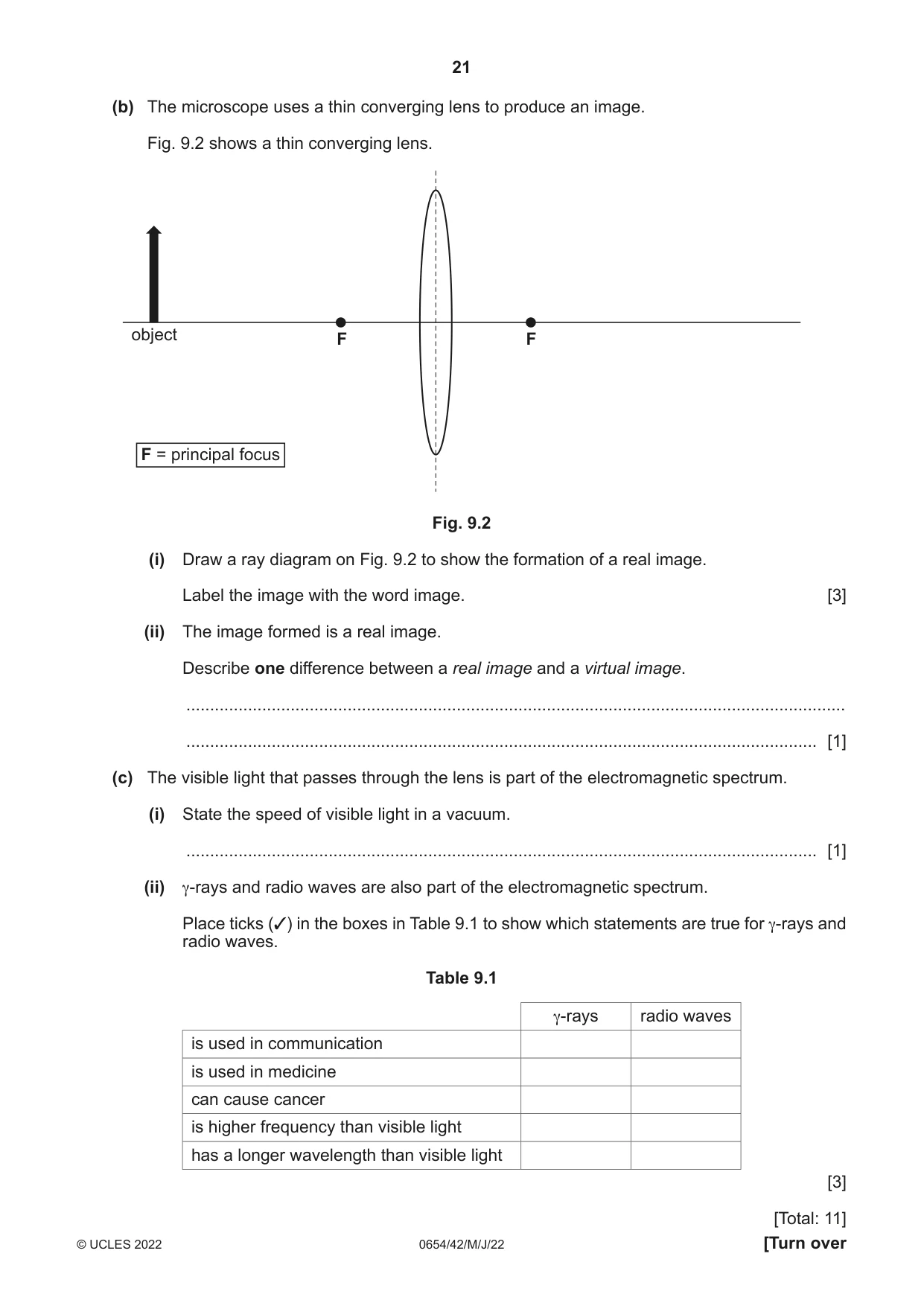
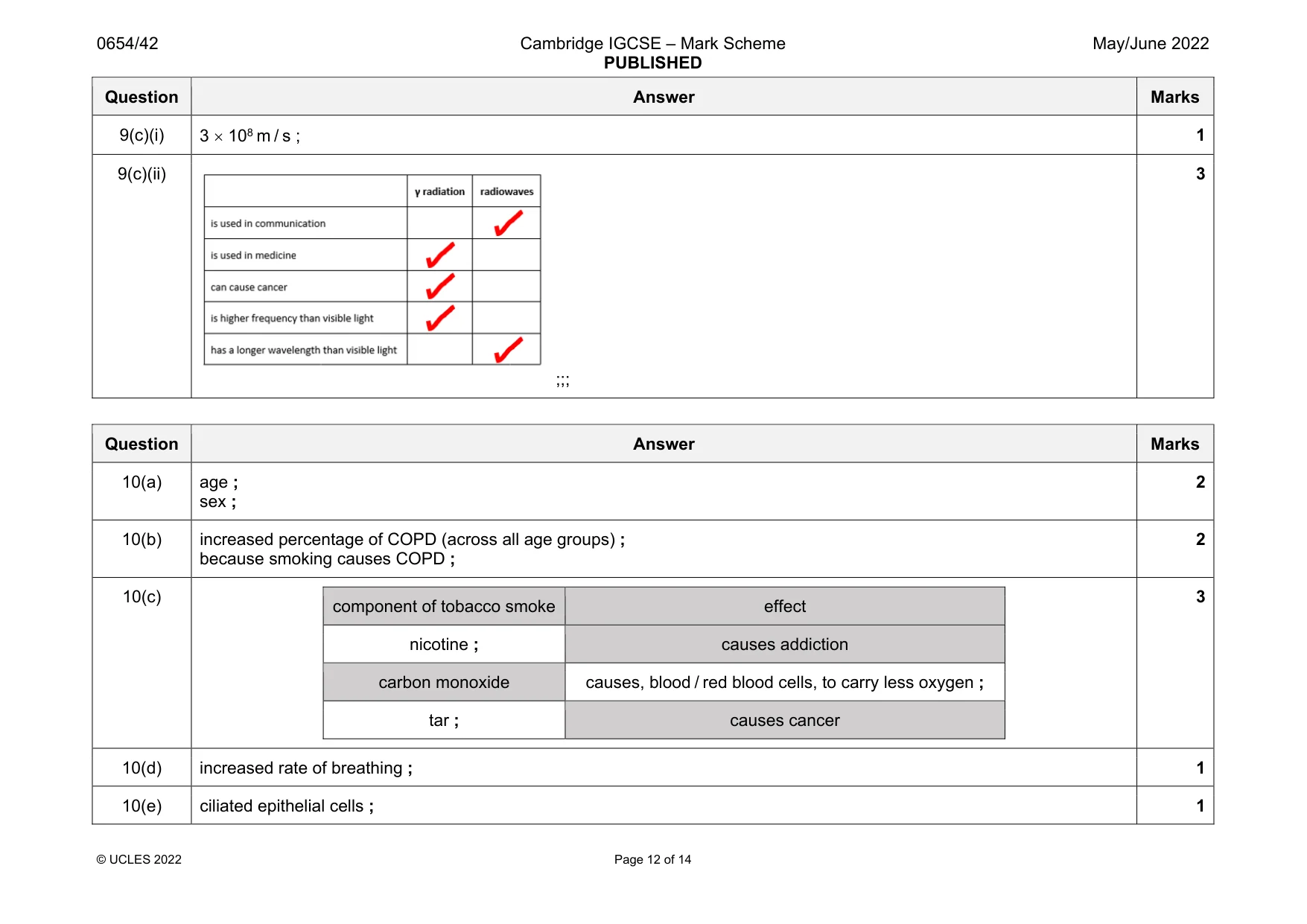
9 A student investigates the motion of pollen grains in water seen through a microscope. The student observes that the pollen grains constantly move short distances in random directions. (a) Fig. 9.1 shows the pollen grains suspended in water. Fig. 9.1 (i) State the name given to the motion of these pollen grains. ..................................................................................................................................... [1] (ii) Explain why the pollen grains constantly move short distances in random directions. ........................................................................................................................................... ........................................................................................................................................... ........................................................................................................................................... ..................................................................................................................................... [2] (b) The microscope uses a thin converging lens to produce an image. Fig. 9.2 shows a thin converging lens. object F F F = principal focus Fig. 9.2 (i) Draw a ray diagram on Fig. 9.2 to show the formation of a real image. Label the image with the word image. [3] (ii) The image formed is a real image. Describe one difference between a real image and a virtual image. ........................................................................................................................................... ..................................................................................................................................... [1] (c) The visible light that passes through the lens is part of the electromagnetic spectrum. (i) State the speed of visible light in a vacuum. ..................................................................................................................................... [1] (ii) γ‑rays and radio waves are also part of the electromagnetic spectrum. Place ticks (✓) in the boxes in Table 9.1 to show which statements are true for γ‑rays and radio waves. Table 9.1 γ‑rays radio waves is used in communication is used in medicine can cause cancer is higher frequency than visible light has a longer wavelength than visible light [3] [Total: 11]
Mark scheme: 9(a)(i) Brownian (motion) ; 1 9(a)(ii) ref to collisions (of pollen grains) ; with, light fast-moving particles / water particles or molecules ; 2 9(b)(i) ;; image labelled ; 3 9(b)(ii) real image can be projected on to a screen / is formed when rays of light actually meet / ORA ; 1 F = principal focus Question Answer Marks 9(c)(i) 3 108 m / s ; 1 9(c)(ii) ;;; 3
Q10 · The percentage of the population of males and females in different age groups with…
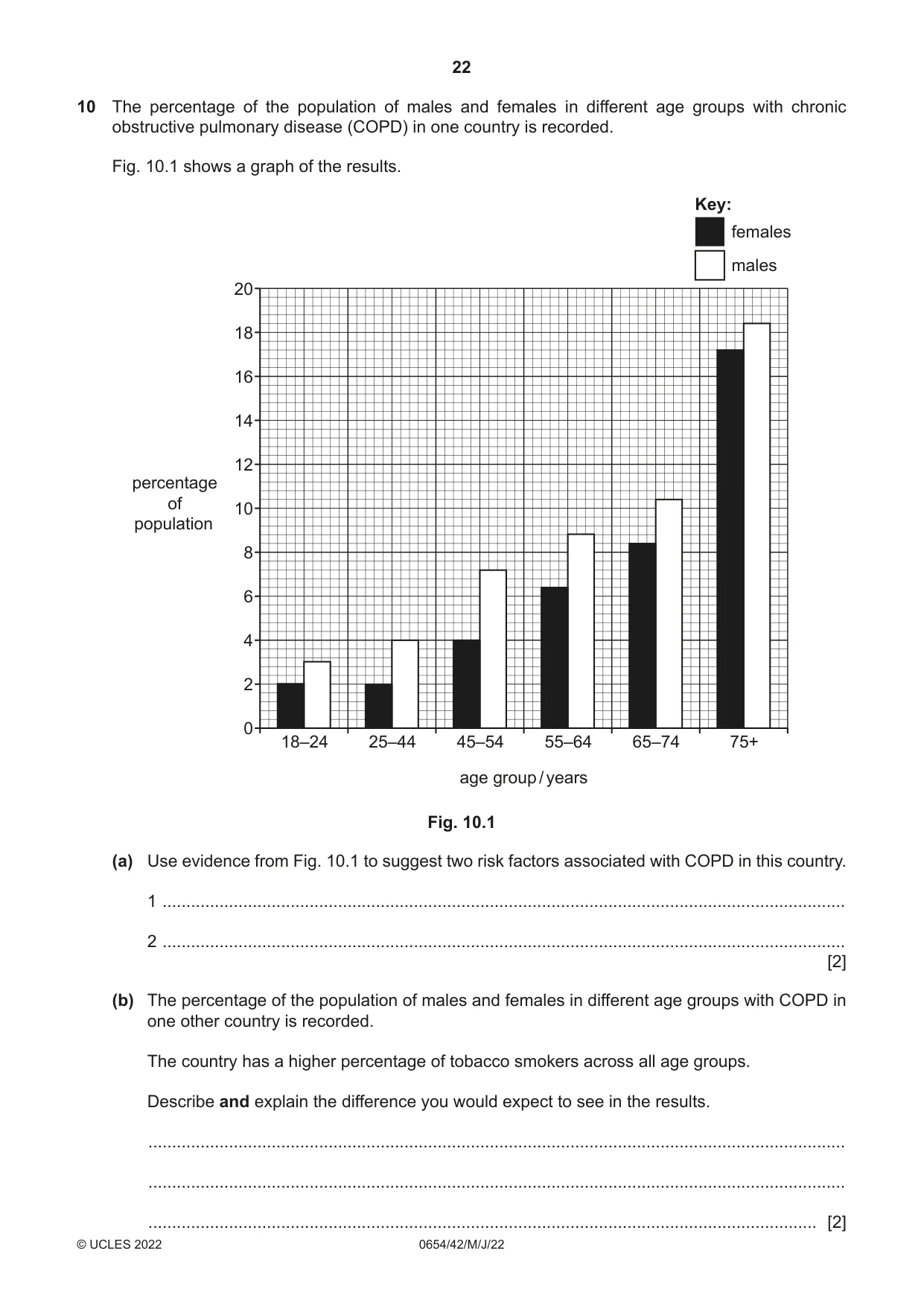
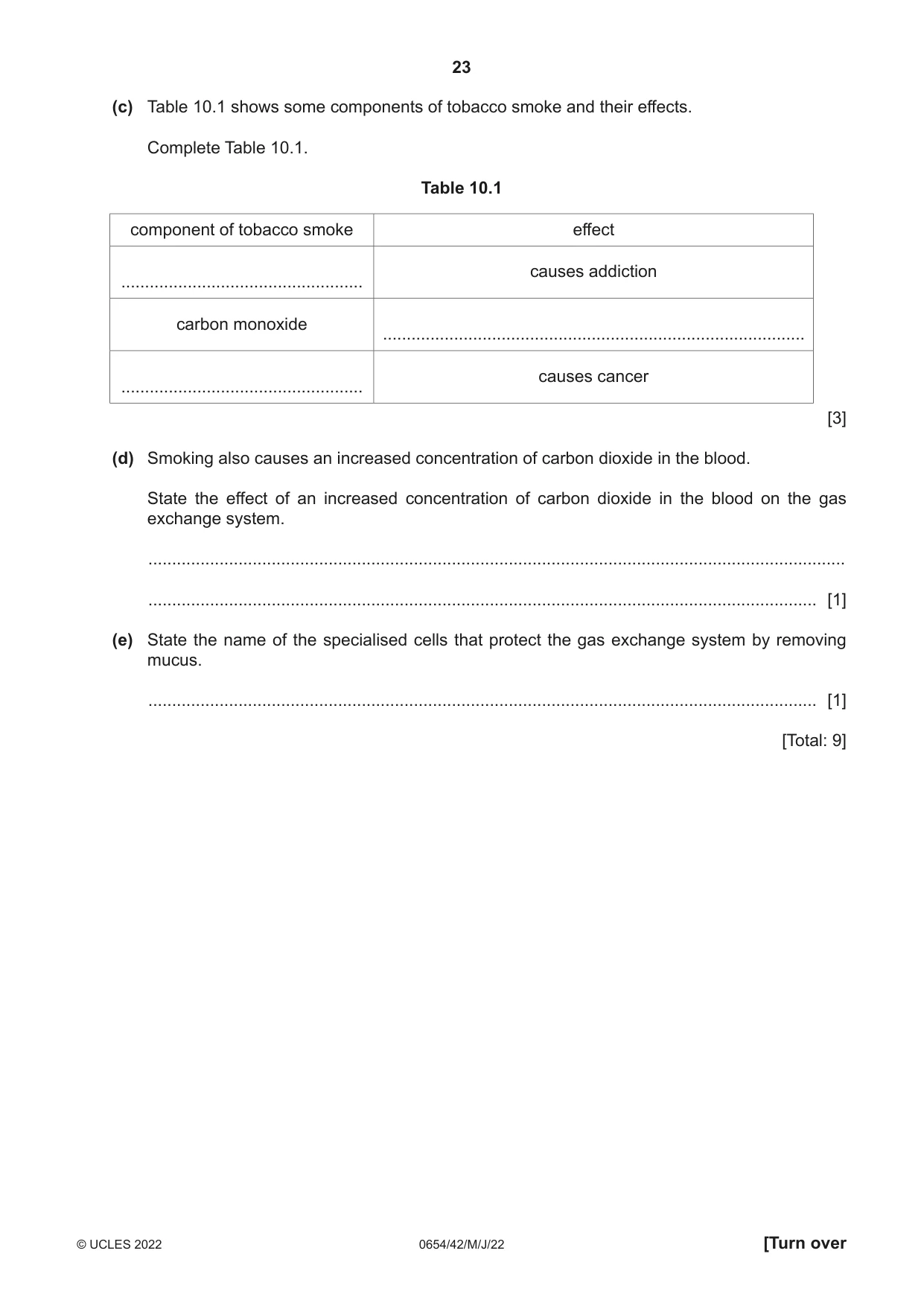
10 The percentage of the population of males and females in different age groups with chronic obstructive pulmonary disease (COPD) in one country is recorded. Fig. 10.1 shows a graph of the results. Key: females males 20 18 16 14 12 percentage of 10 population 8 6 4 2 0 18–24 25–44 45–54 55–64 65–74 75+ age group / years Fig. 10.1 (a) Use evidence from Fig. 10.1 to suggest two risk factors associated with COPD in this country. 1 ................................................................................................................................................ 2 ................................................................................................................................................ [2] (b) The percentage of the population of males and females in different age groups with COPD in one other country is recorded. The country has a higher percentage of tobacco smokers across all age groups. Describe and explain the difference you would expect to see in the results. ................................................................................................................................................... ................................................................................................................................................... ............................................................................................................................................. [2] (c) Table 10.1 shows some components of tobacco smoke and their effects. Complete Table 10.1. Table 10.1 component of tobacco smoke effect causes addiction ................................................... carbon monoxide ......................................................................................... causes cancer ................................................... [3] (d) Smoking also causes an increased concentration of carbon dioxide in the blood. State the effect of an increased concentration of carbon dioxide in the blood on the gas exchange system. ................................................................................................................................................... ............................................................................................................................................. [1] (e) State the name of the specialised cells that protect the gas exchange system by removing mucus. ............................................................................................................................................. [1] [Total: 9]
Mark scheme: 10(a) age ; sex ; 2 10(b) increased percentage of COPD (across all age groups) ; because smoking causes COPD ; 2 10(c) component of tobacco smoke effect nicotine ; causes addiction carbon monoxide causes, blood / red blood cells, to carry less oxygen ; tar ; causes cancer 3 10(d) increased rate of breathing ; 1 10(e) ciliated epithelial cells ; 1
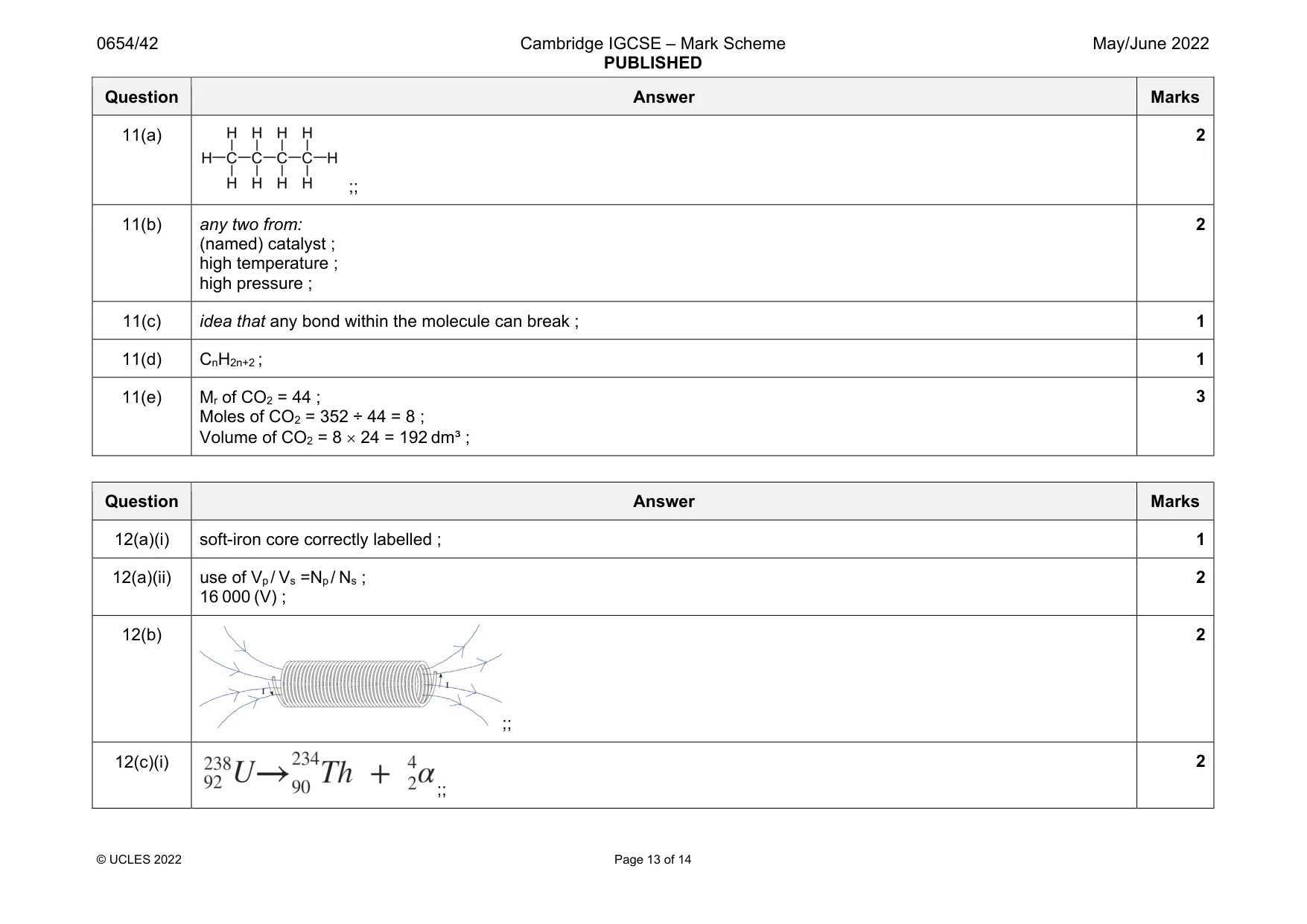
Q11 · Fractional distillation of petroleum makes useful fractions
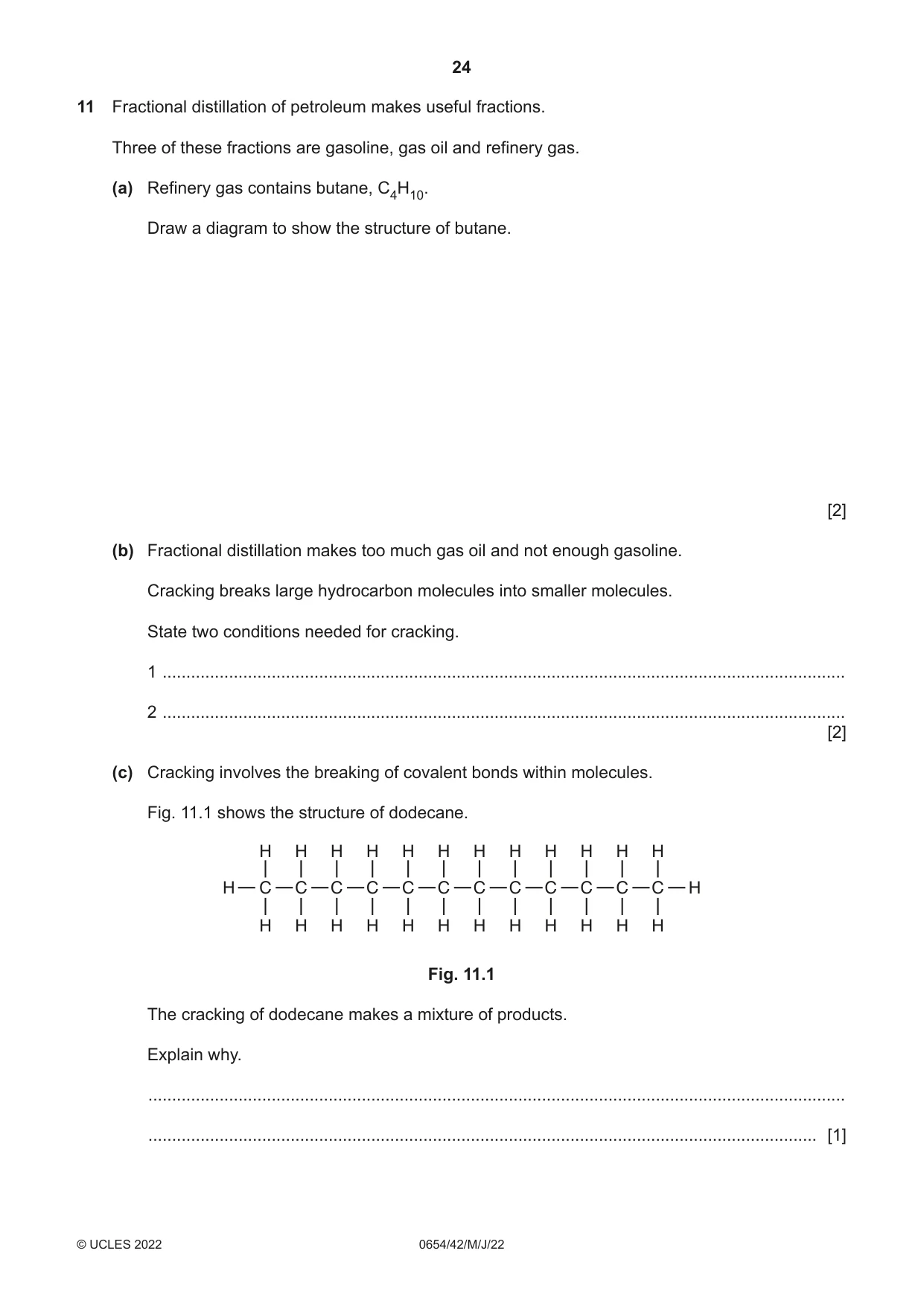
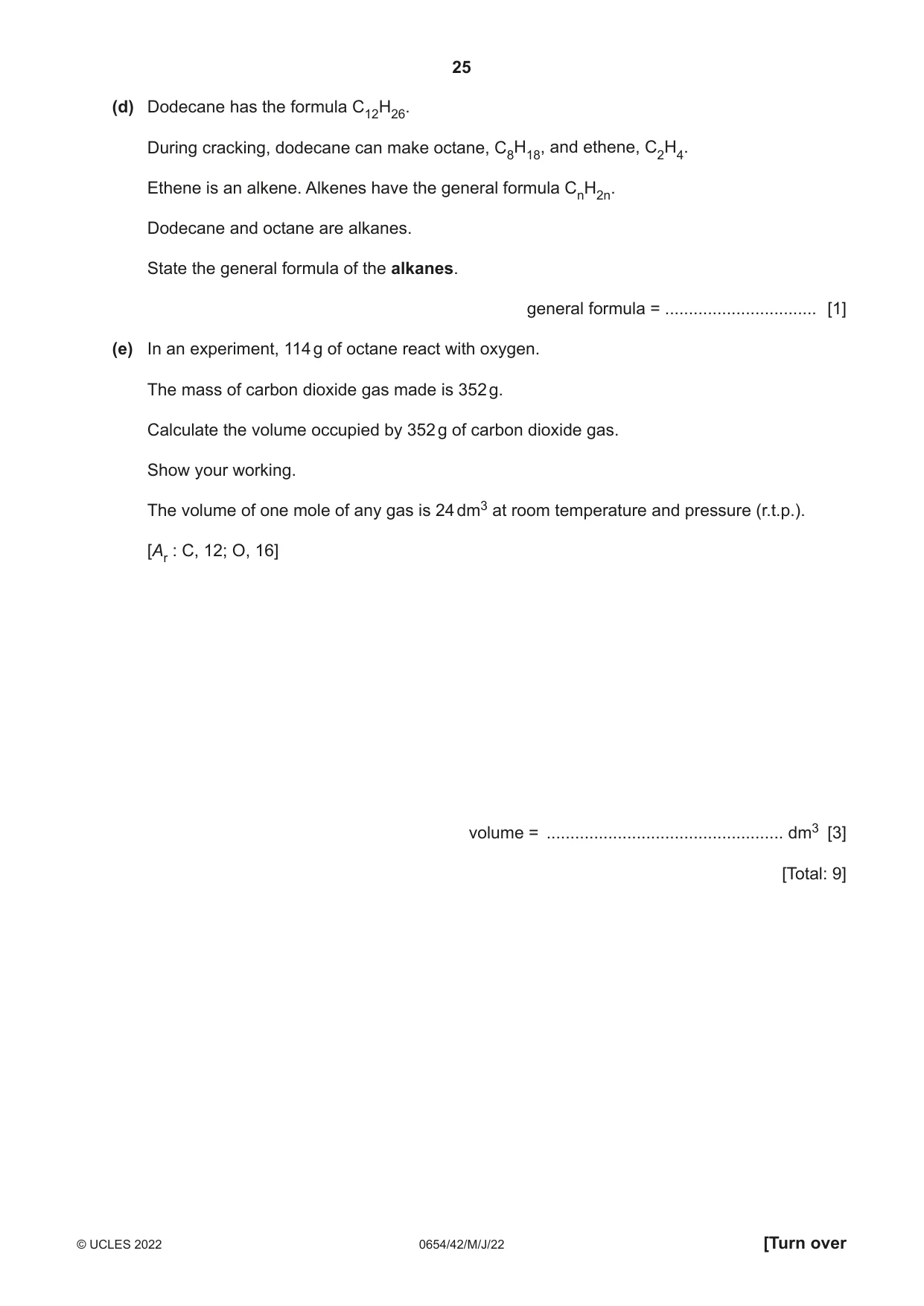
11 Fractional distillation of petroleum makes useful fractions. Three of these fractions are gasoline, gas oil and refinery gas. (a) Refinery gas contains butane, C4H10. Draw a diagram to show the structure of butane. [2] (b) Fractional distillation makes too much gas oil and not enough gasoline. Cracking breaks large hydrocarbon molecules into smaller molecules. State two conditions needed for cracking. 1 ................................................................................................................................................ 2 ................................................................................................................................................ [2] (c) Cracking involves the breaking of covalent bonds within molecules. Fig. 11.1 shows the structure of dodecane. H H H H H H H H H H H H H C C C C C C C C C C C C H H H H H H H H H H H H H Fig. 11.1 The cracking of dodecane makes a mixture of products. Explain why. ................................................................................................................................................... ............................................................................................................................................. [1] (d) Dodecane has the formula C12H26. During cracking, dodecane can make octane, C8H18, and ethene, C2H4. Ethene is an alkene. Alkenes have the general formula CnH2n. Dodecane and octane are alkanes. State the general formula of the alkanes. general formula = ................................ [1] (e) In an experiment, 114 g of octane react with oxygen. The mass of carbon dioxide gas made is 352 g. Calculate the volume occupied by 352 g of carbon dioxide gas. Show your working. The volume of one mole of any gas is 24 dm3 at room temperature and pressure (r.t.p.). [Ar : C, 12; O, 16] volume = .................................................. dm3 [3] [Total: 9]
Mark scheme: 11(a) ;; 2 11(b) any two from: (named) catalyst ; high temperature ; high pressure ; 2 11(c) idea that any bond within the molecule can break ; 1 11(d) CnH2n+2 ; 1 11(e) Mr of CO2 = 44 ; Moles of CO2 = 352 ÷ 44 = 8 ; Volume of CO2 = 8 24 = 192 dm³ ; 3
Question 12
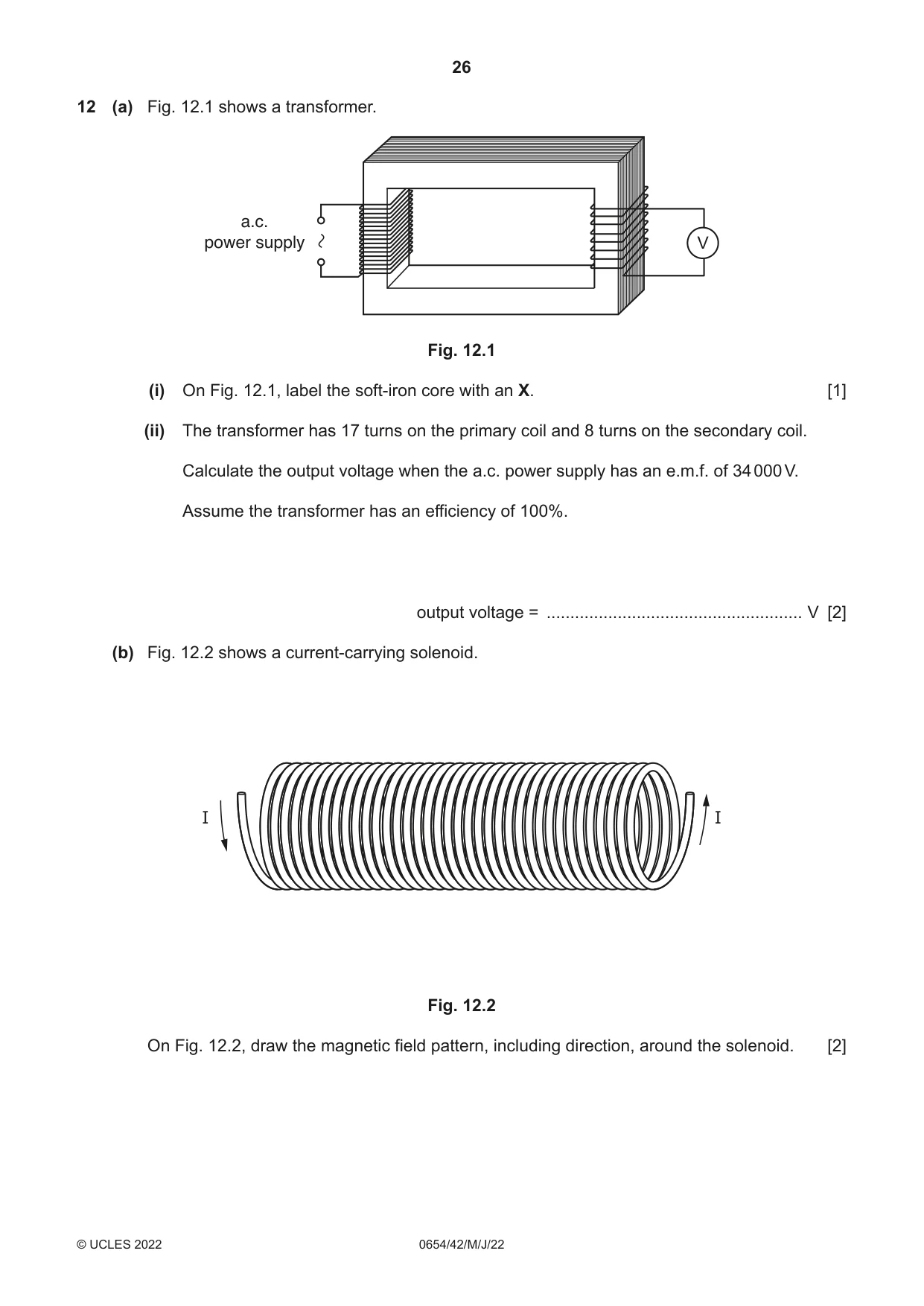
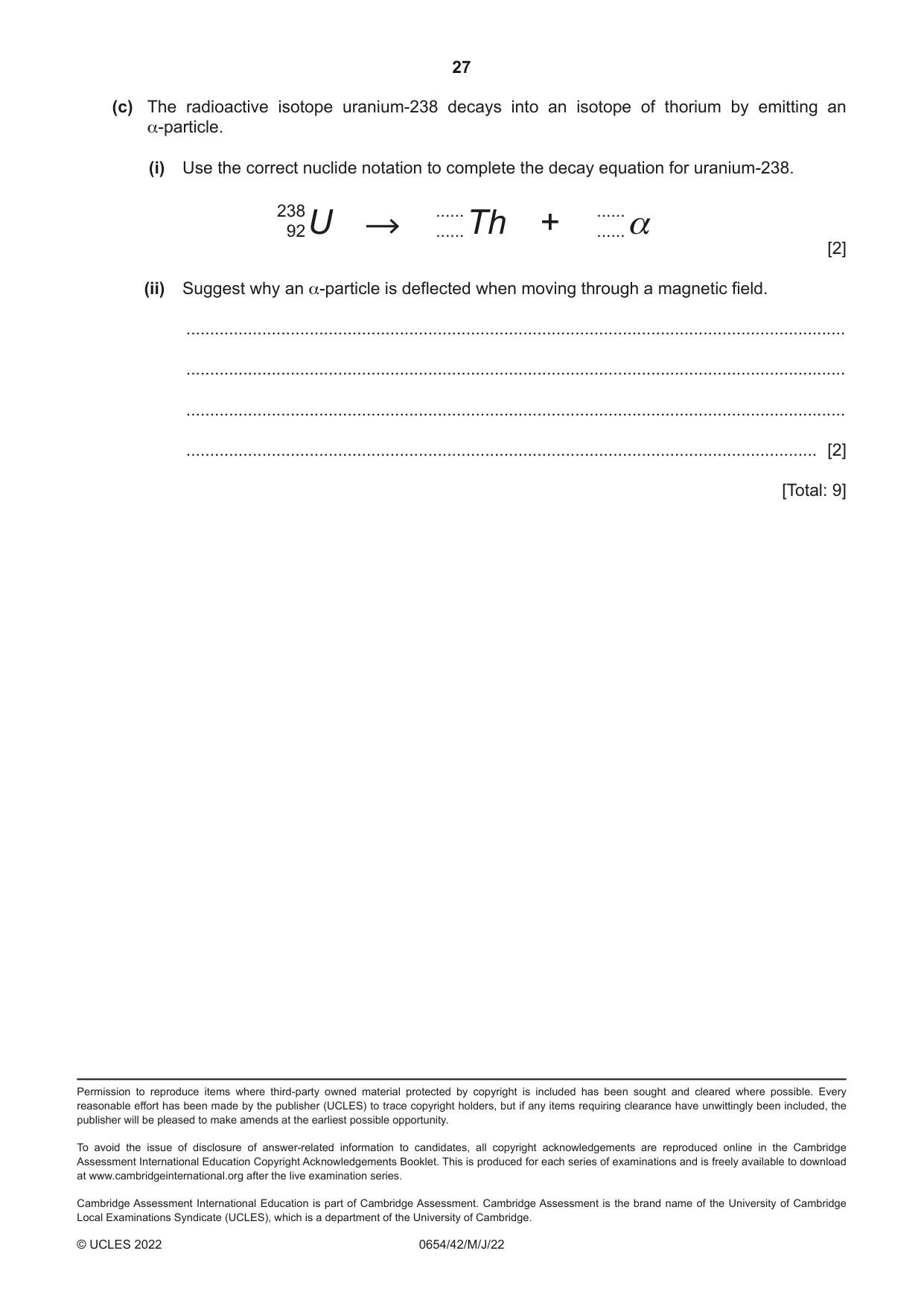
12 (a) Fig. 12.1 shows a transformer. a.c. power supply V Fig. 12.1 (i) On Fig. 12.1, label the soft‑iron core with an X. [1] (ii) The transformer has 17 turns on the primary coil and 8 turns on the secondary coil. Calculate the output voltage when the a.c. power supply has an e.m.f. of 34 000 V. Assume the transformer has an efficiency of 100%. output voltage = ...................................................... V [2] (b) Fig. 12.2 shows a current‑carrying solenoid. I I Fig. 12.2 On Fig. 12.2, draw the magnetic field pattern, including direction, around the solenoid. [2] (c) The radioactive isotope uranium‑238 decays into an isotope of thorium by emitting an α‑particle. (i) Use the correct nuclide notation to complete the decay equation for uranium‑238. 238 ...... ...... 92 U ...... Th + ......α [2] (ii) Suggest why an α‑particle is deflected when moving through a magnetic field. ........................................................................................................................................... ........................................................................................................................................... ........................................................................................................................................... ..................................................................................................................................... [2] [Total: 9]
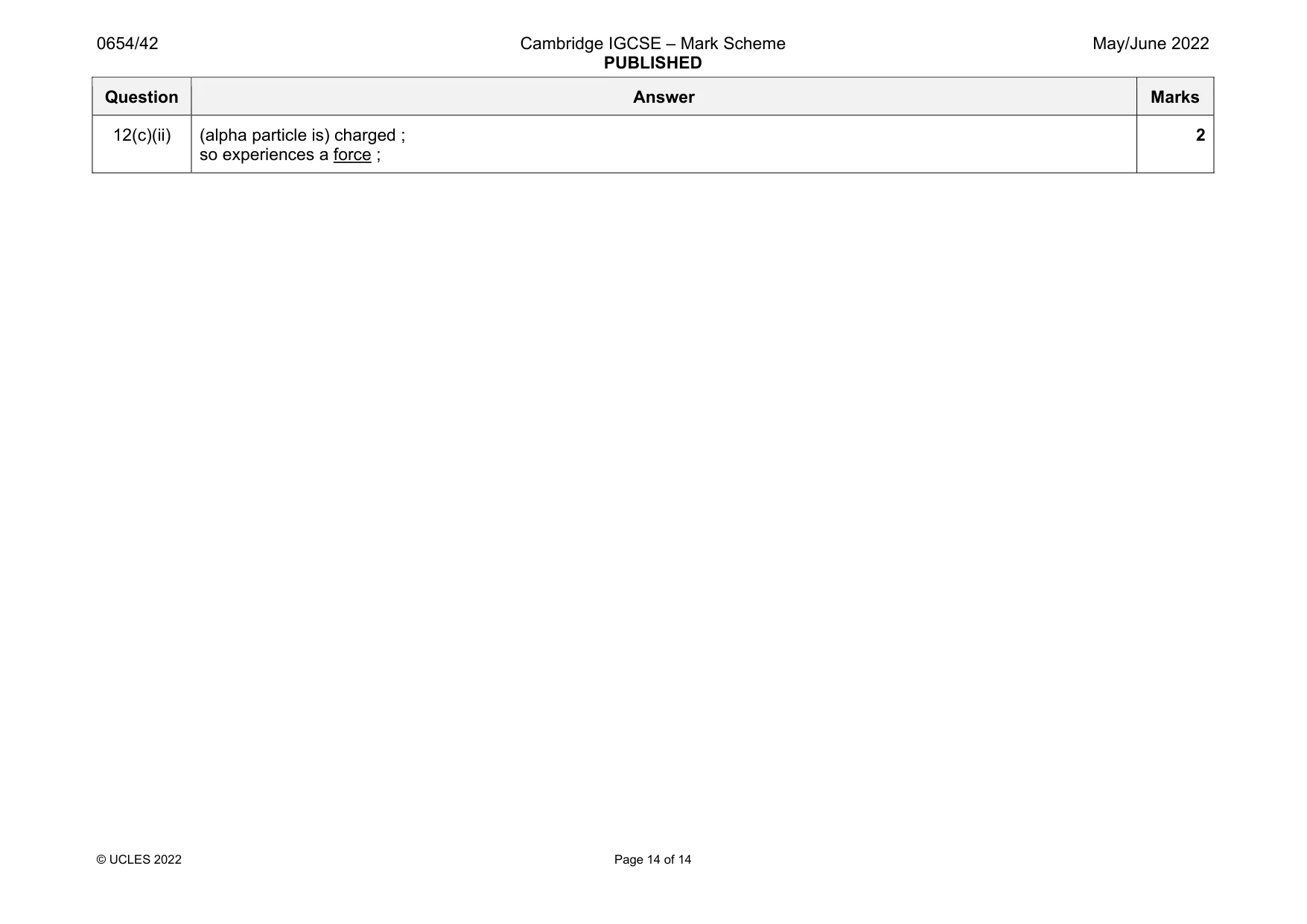
Mark scheme: 12(a)(i) soft-iron core correctly labelled ; 1 12(a)(ii) use of Vp / Vs =Np / Ns ; 16 000 (V) ; 2 12(b) ;; 2 12(c)(i) ;; 2 Question Answer Marks 12(c)(ii) (alpha particle is) charged ; so experiences a force ; 2
What was in this paper
The subtopics covered by these 12 questions, and how many questions each got. Open one in a new tab to see every Cambridge question on it.
What you needed in this session
Cambridge’s own grade thresholds for 2022 May/June, Paper 4 · Variant 2. A higher threshold means an easier paper — the bar moves with how the cohort did.