Cambridge IGCSE Sciences - Co-ordinated (Double) 0654 — 2021 May/June Paper 4 · Variant 2
0654/42/M/J/21 · 13 questions · 120 marks · ≈135 min
The question paper and its mark scheme, free to read here and free to download. This is Cambridge’s own paper, exactly as it was sat.
Question paper28 pages

Mark scheme13 pages
Answers below. Sit the paper first if you are practising.
Questions as text
Q1 · Some plant cells are immersed in a concentrated salt solution
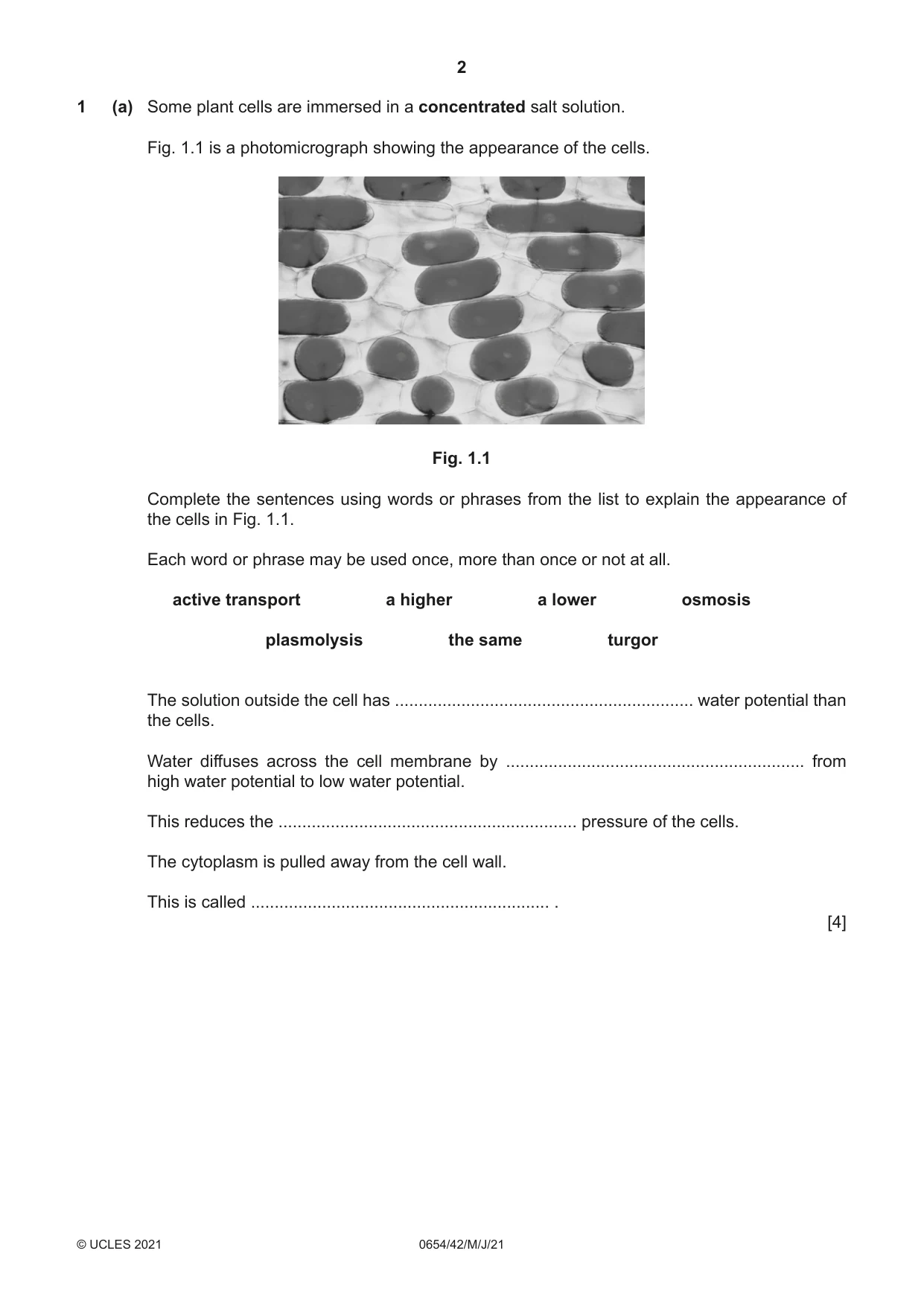
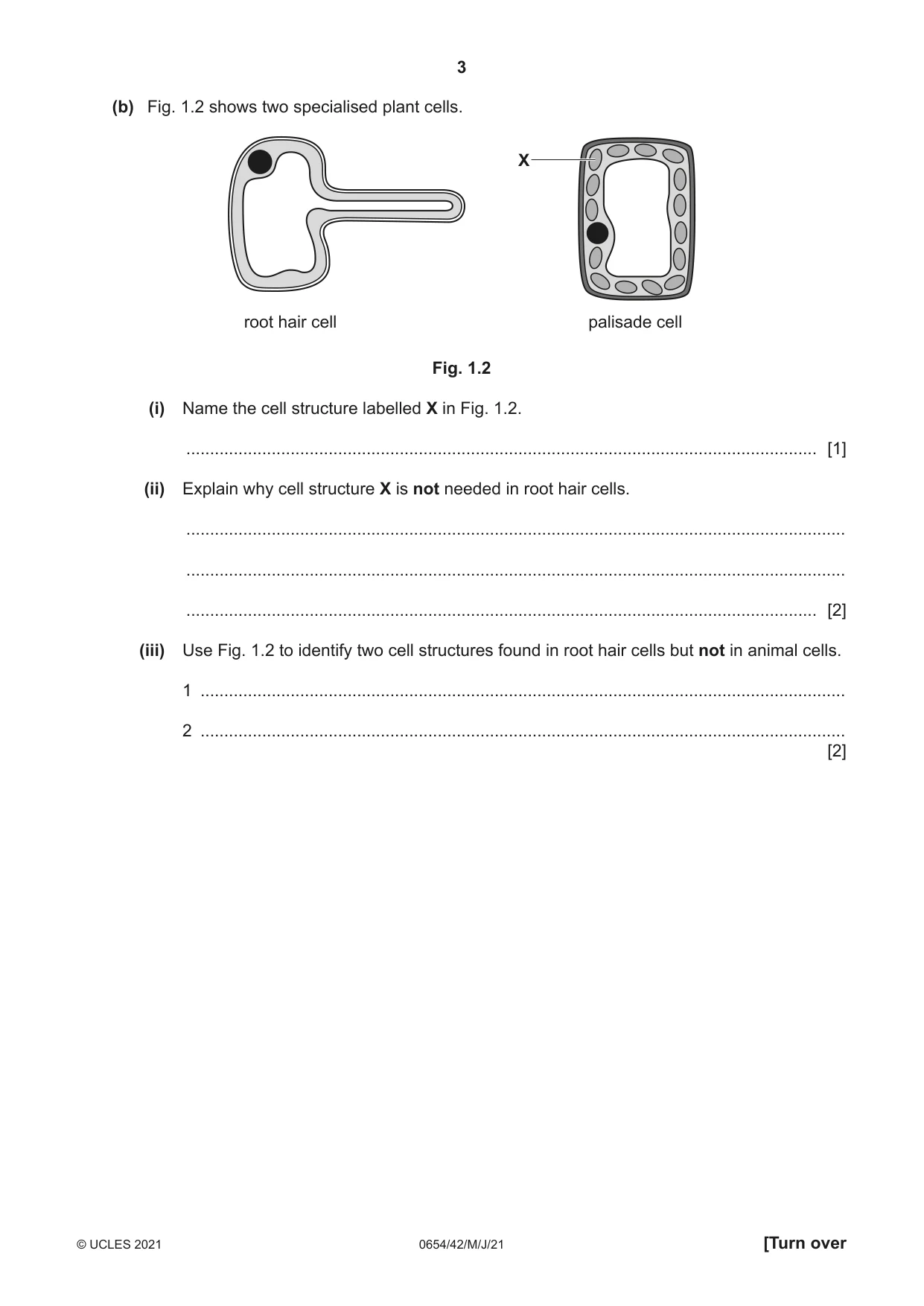
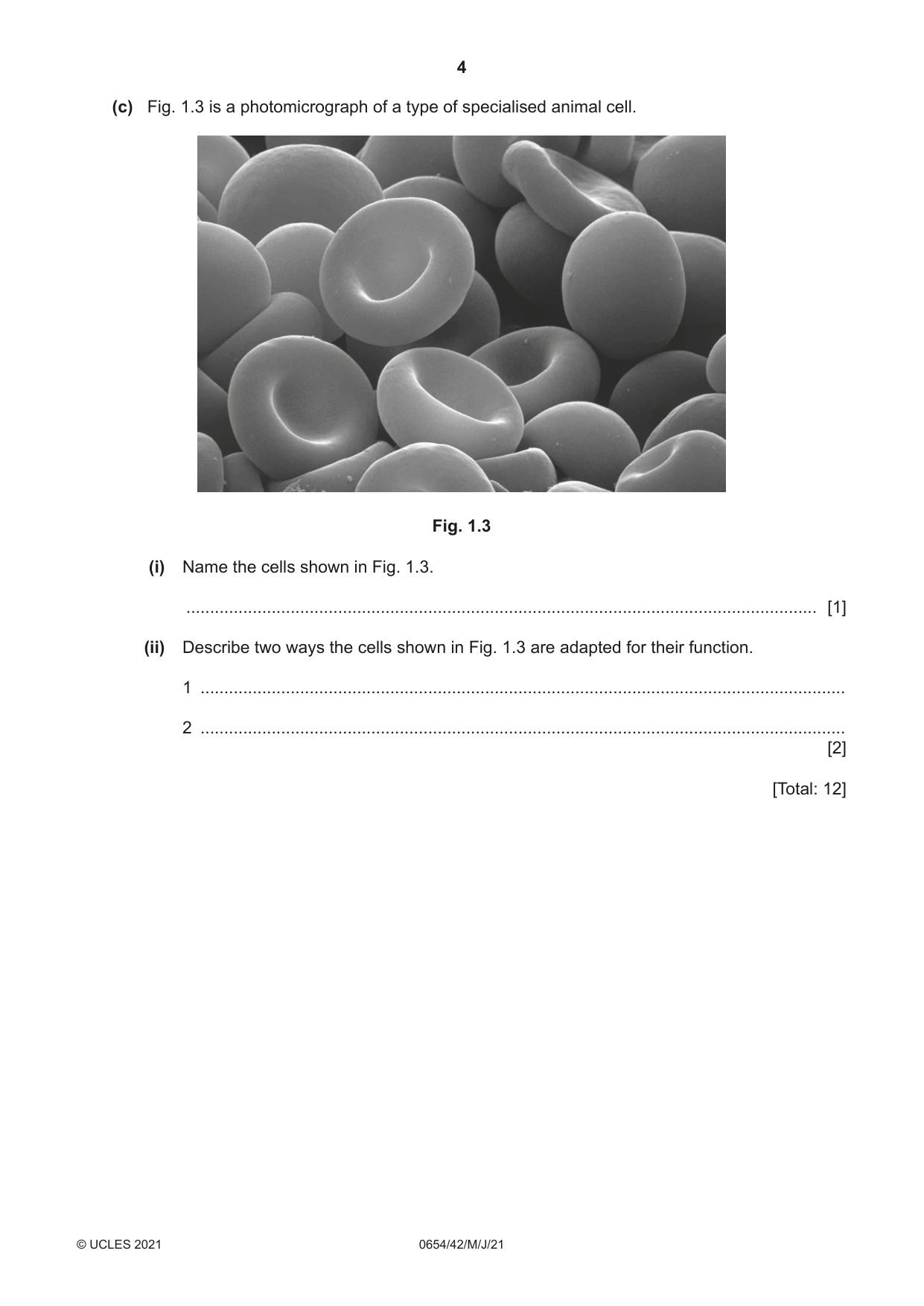
1 (a) Some plant cells are immersed in a concentrated salt solution. Fig. 1.1 is a photomicrograph showing the appearance of the cells. Fig. 1.1 Complete the sentences using words or phrases from the list to explain the appearance of the cells in Fig. 1.1. Each word or phrase may be used once, more than once or not at all. active transport a higher a lower osmosis plasmolysis the same turgor The solution outside the cell has ............................................................... water potential than the cells. Water diffuses across the cell membrane by ............................................................... from high water potential to low water potential. This reduces the ............................................................... pressure of the cells. The cytoplasm is pulled away from the cell wall. This is called ............................................................... . [4] (b) Fig. 1.2 shows two specialised plant cells. X root hair cell palisade cell Fig. 1.2 (i) Name the cell structure labelled X in Fig. 1.2. ..................................................................................................................................... [1] (ii) Explain why cell structure X is not needed in root hair cells. ........................................................................................................................................... ........................................................................................................................................... ..................................................................................................................................... [2] (iii) Use Fig. 1.2 to identify two cell structures found in root hair cells but not in animal cells. 1 ........................................................................................................................................ 2 ........................................................................................................................................ [2] (c) Fig. 1.3 is a photomicrograph of a type of specialised animal cell. Fig. 1.3 (i) Name the cells shown in Fig. 1.3. ..................................................................................................................................... [1] (ii) Describe two ways the cells shown in Fig. 1.3 are adapted for their function. 1 ........................................................................................................................................ 2 ........................................................................................................................................ [2] [Total: 12]
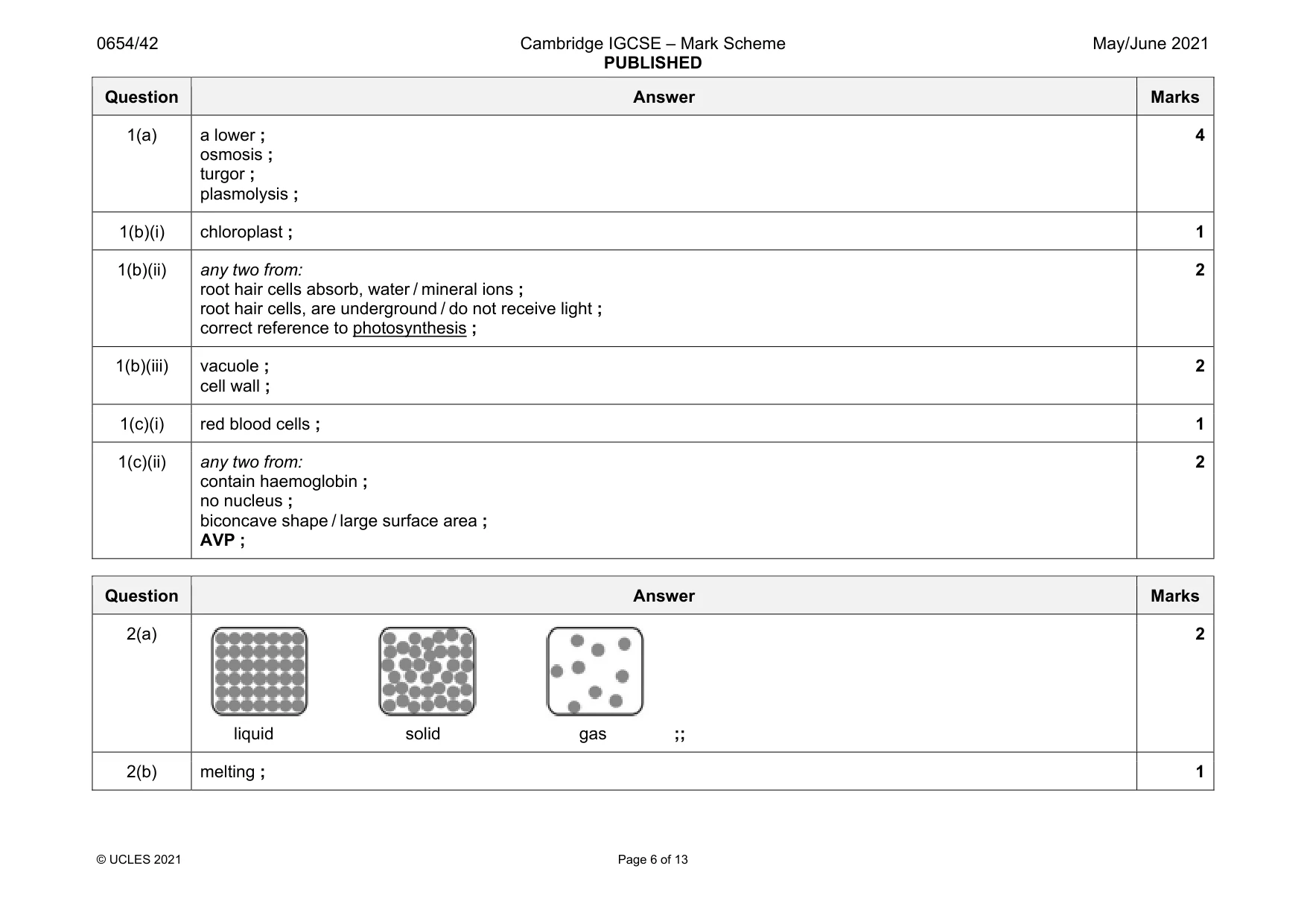
Mark scheme: 1(a) a lower ; osmosis ; turgor ; plasmolysis ; 4 1(b)(i) chloroplast ; 1 1(b)(ii) any two from: root hair cells absorb, water / mineral ions ; root hair cells, are underground / do not receive light ; correct reference to photosynthesis ; 2 1(b)(iii) vacuole ; cell wall ; 2 1(c)(i) red blood cells ; 1 1(c)(ii) any two from: contain haemoglobin ; no nucleus ; biconcave shape / large surface area ; AVP ; 2
Q2 · Solid, liquid and gas are three states of matter
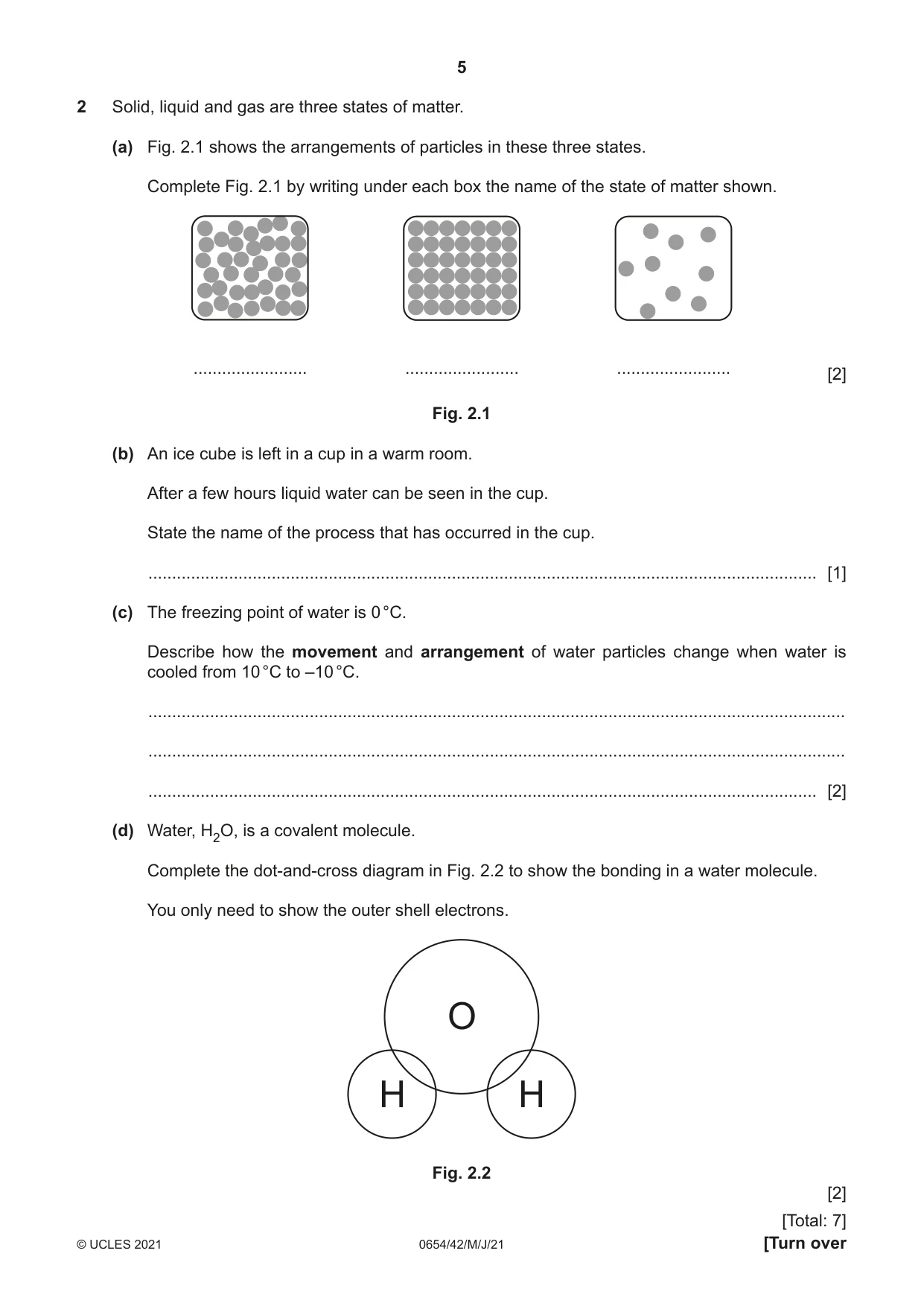
2 Solid, liquid and gas are three states of matter. (a) Fig. 2.1 shows the arrangements of particles in these three states. Complete Fig. 2.1 by writing under each box the name of the state of matter shown. ........................ ........................ ........................ [2] Fig. 2.1 (b) An ice cube is left in a cup in a warm room. After a few hours liquid water can be seen in the cup. State the name of the process that has occurred in the cup. ............................................................................................................................................. [1] (c) The freezing point of water is 0 °C. Describe how the movement and arrangement of water particles change when water is cooled from 10 °C to –10 °C. ................................................................................................................................................... ................................................................................................................................................... ............................................................................................................................................. [2] (d) Water, H2O, is a covalent molecule. Complete the dot-and-cross diagram in Fig. 2.2 to show the bonding in a water molecule. You only need to show the outer shell electrons. O H H Fig. 2.2 [2] [Total: 7]
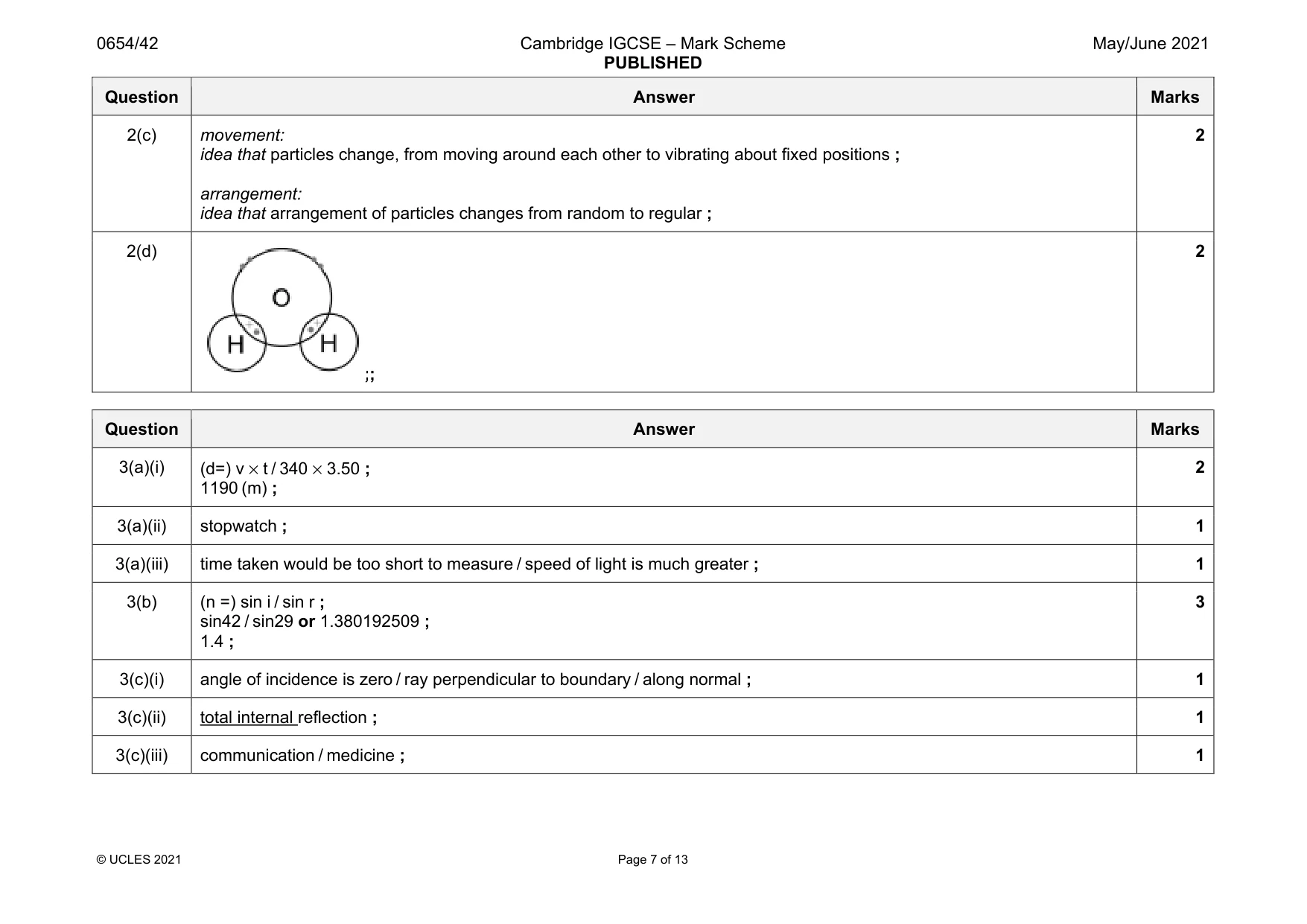
Mark scheme: 2(a) liquid solid gas ;; 2 2(b) melting ; 1 Question Answer Marks 2(c) movement: idea that particles change, from moving around each other to vibrating about fixed positions ; arrangement: idea that arrangement of particles changes from random to regular ; 2 2(d) ;; 2
Q3 · A student observing an exploding firework
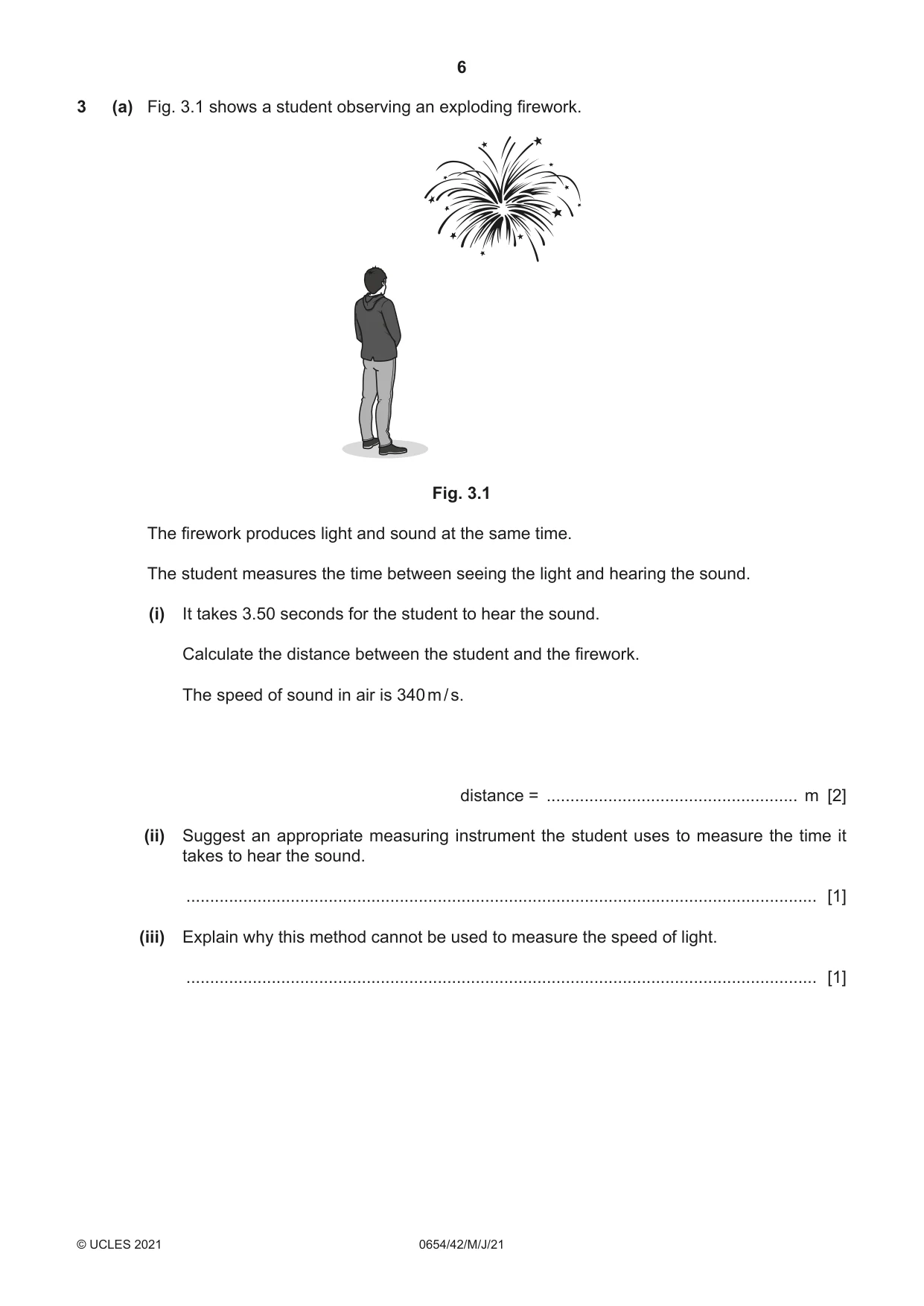
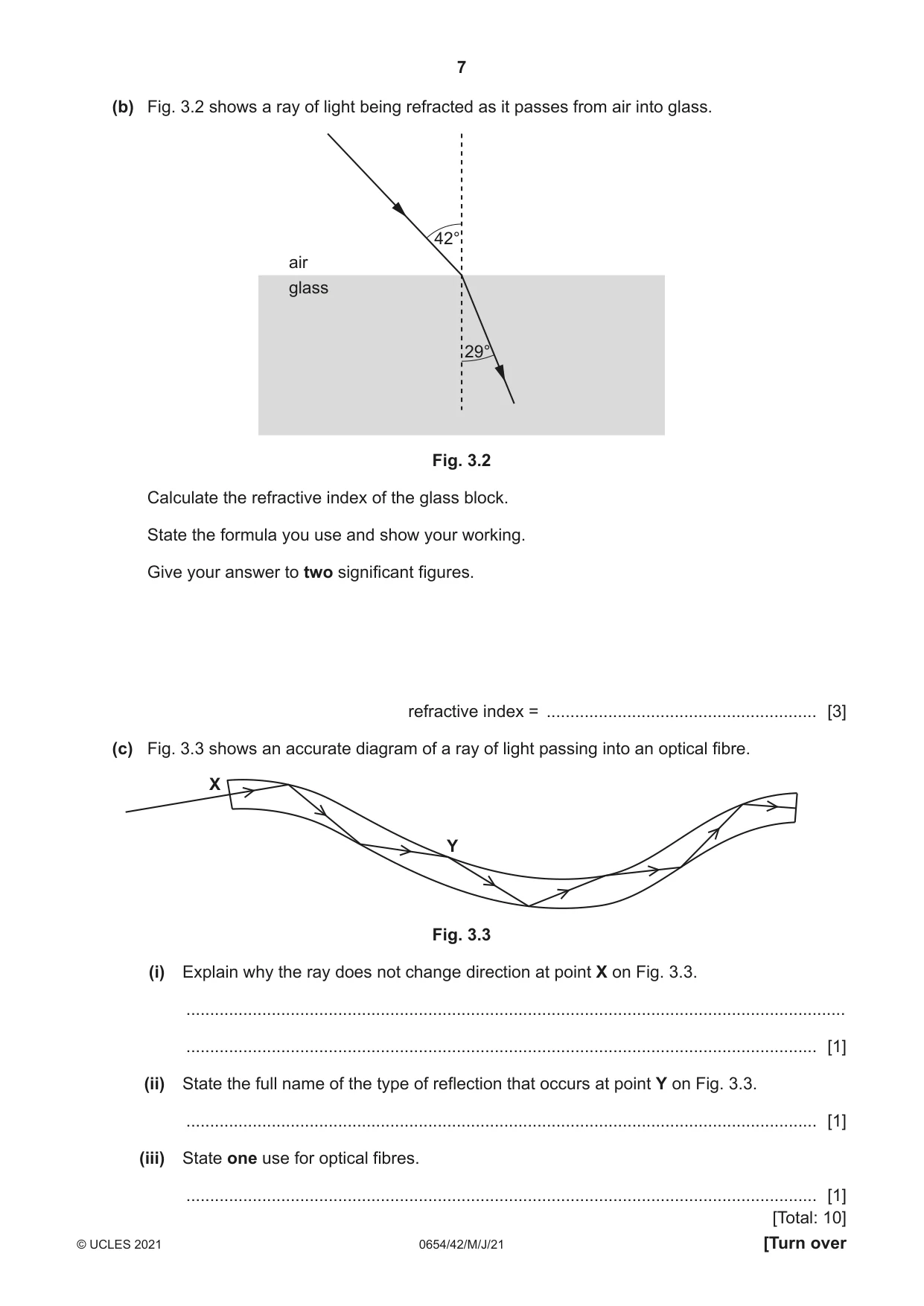
3 (a) Fig. 3.1 shows a student observing an exploding firework. Fig. 3.1 The firework produces light and sound at the same time. The student measures the time between seeing the light and hearing the sound. (i) It takes 3.50 seconds for the student to hear the sound. Calculate the distance between the student and the firework. The speed of sound in air is 340 m / s. distance = ..................................................... m [2] (ii) Suggest an appropriate measuring instrument the student uses to measure the time it takes to hear the sound. ..................................................................................................................................... [1] (iii) Explain why this method cannot be used to measure the speed of light. ..................................................................................................................................... [1] (b) Fig. 3.2 shows a ray of light being refracted as it passes from air into glass. 42° air glass 29° Fig. 3.2 Calculate the refractive index of the glass block. State the formula you use and show your working. Give your answer to two significant figures. refractive index = ......................................................... [3] (c) Fig. 3.3 shows an accurate diagram of a ray of light passing into an optical fibre. X Y Fig. 3.3 (i) Explain why the ray does not change direction at point X on Fig. 3.3. ........................................................................................................................................... ..................................................................................................................................... [1] (ii) State the full name of the type of reflection that occurs at point Y on Fig. 3.3. ..................................................................................................................................... [1] (iii) State one use for optical fibres. ..................................................................................................................................... [1] [Total: 10]
Mark scheme: 3(a)(i) (d=) v × t / 340 × 3.50 ; 1190 (m) ; 2 3(a)(ii) stopwatch ; 1 3(a)(iii) time taken would be too short to measure / speed of light is much greater ; 1 3(b) (n =) sin i / sin r ; sin42 / sin29 or 1.380192509 ; 1.4 ; 3 3(c)(i) angle of incidence is zero / ray perpendicular to boundary / along normal ; 1 3(c)(ii) total internal reflection ; 1 3(c)(iii) communication / medicine ; 1
Q4 · Anaerobic respiration in yeast produces carbon dioxide
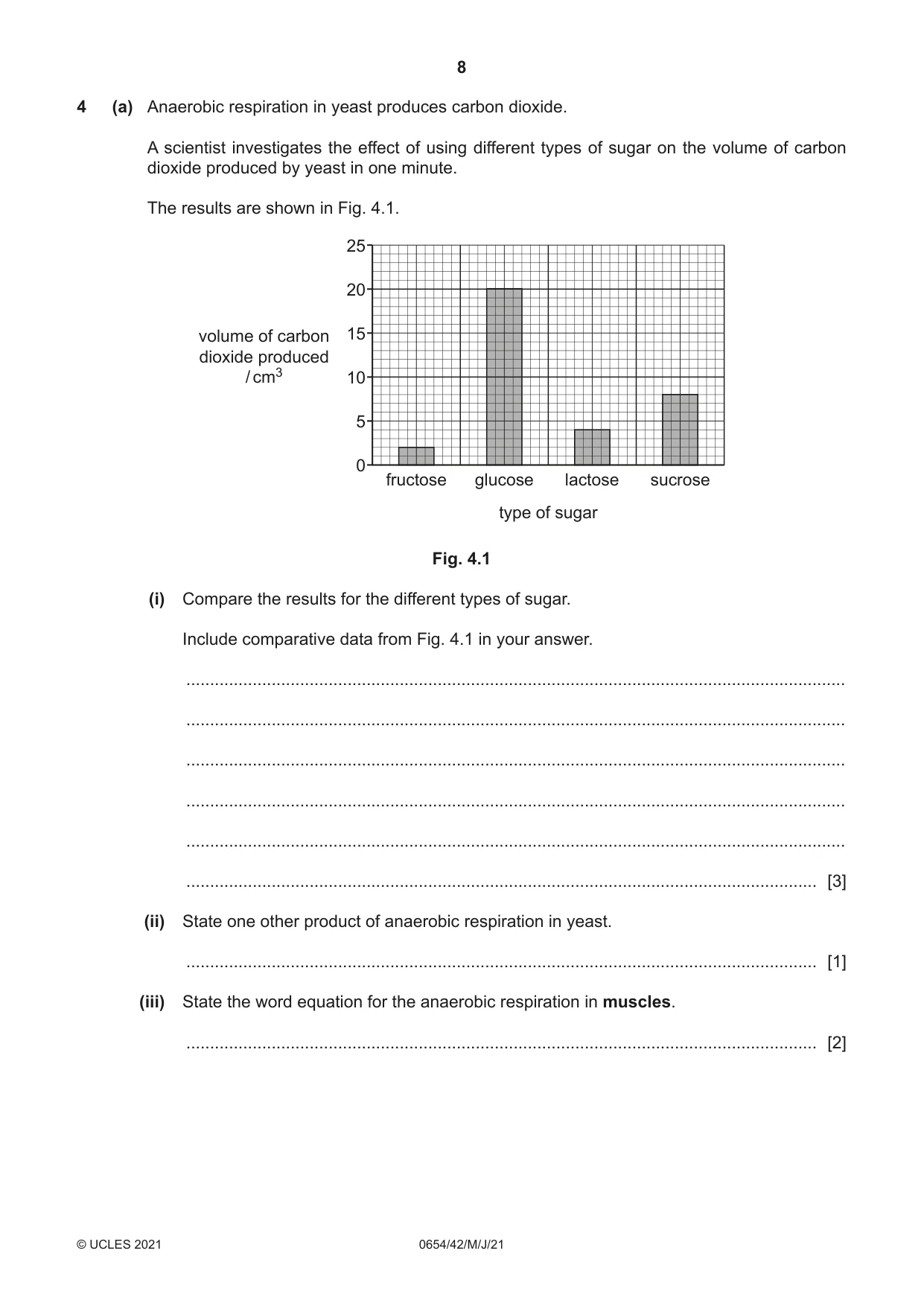
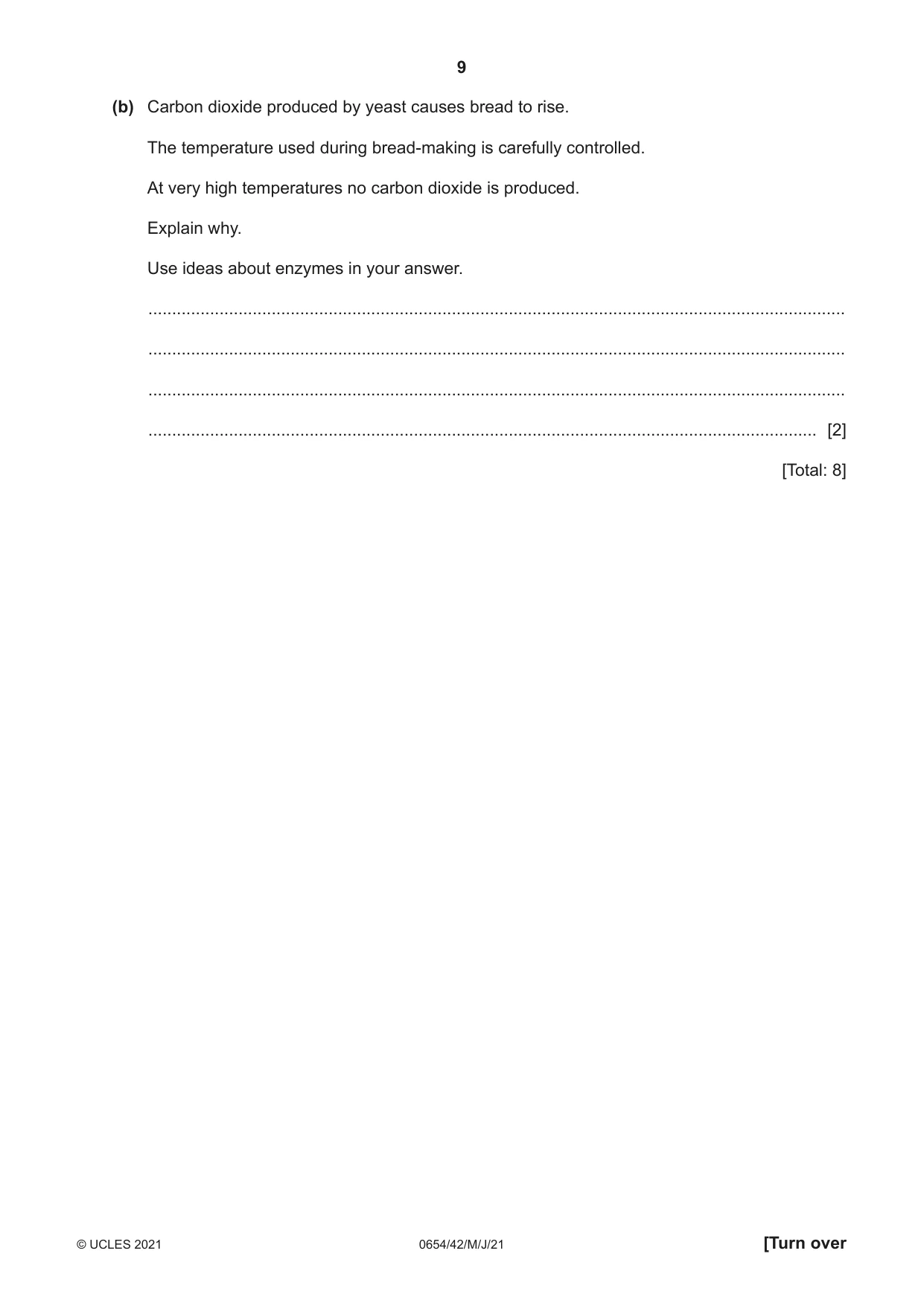
4 (a) Anaerobic respiration in yeast produces carbon dioxide. A scientist investigates the effect of using different types of sugar on the volume of carbon dioxide produced by yeast in one minute. The results are shown in Fig. 4.1. 25 20 volume of carbon 15 dioxide produced / cm3 10 5 0 fructose glucose lactose sucrose type of sugar Fig. 4.1 (i) Compare the results for the different types of sugar. Include comparative data from Fig. 4.1 in your answer. ........................................................................................................................................... ........................................................................................................................................... ........................................................................................................................................... ........................................................................................................................................... ........................................................................................................................................... ..................................................................................................................................... [3] (ii) State one other product of anaerobic respiration in yeast. ..................................................................................................................................... [1] (iii) State the word equation for the anaerobic respiration in muscles. ..................................................................................................................................... [2] (b) Carbon dioxide produced by yeast causes bread to rise. The temperature used during bread-making is carefully controlled. At very high temperatures no carbon dioxide is produced. Explain why. Use ideas about enzymes in your answer. ................................................................................................................................................... ................................................................................................................................................... ................................................................................................................................................... ............................................................................................................................................. [2] [Total: 8]
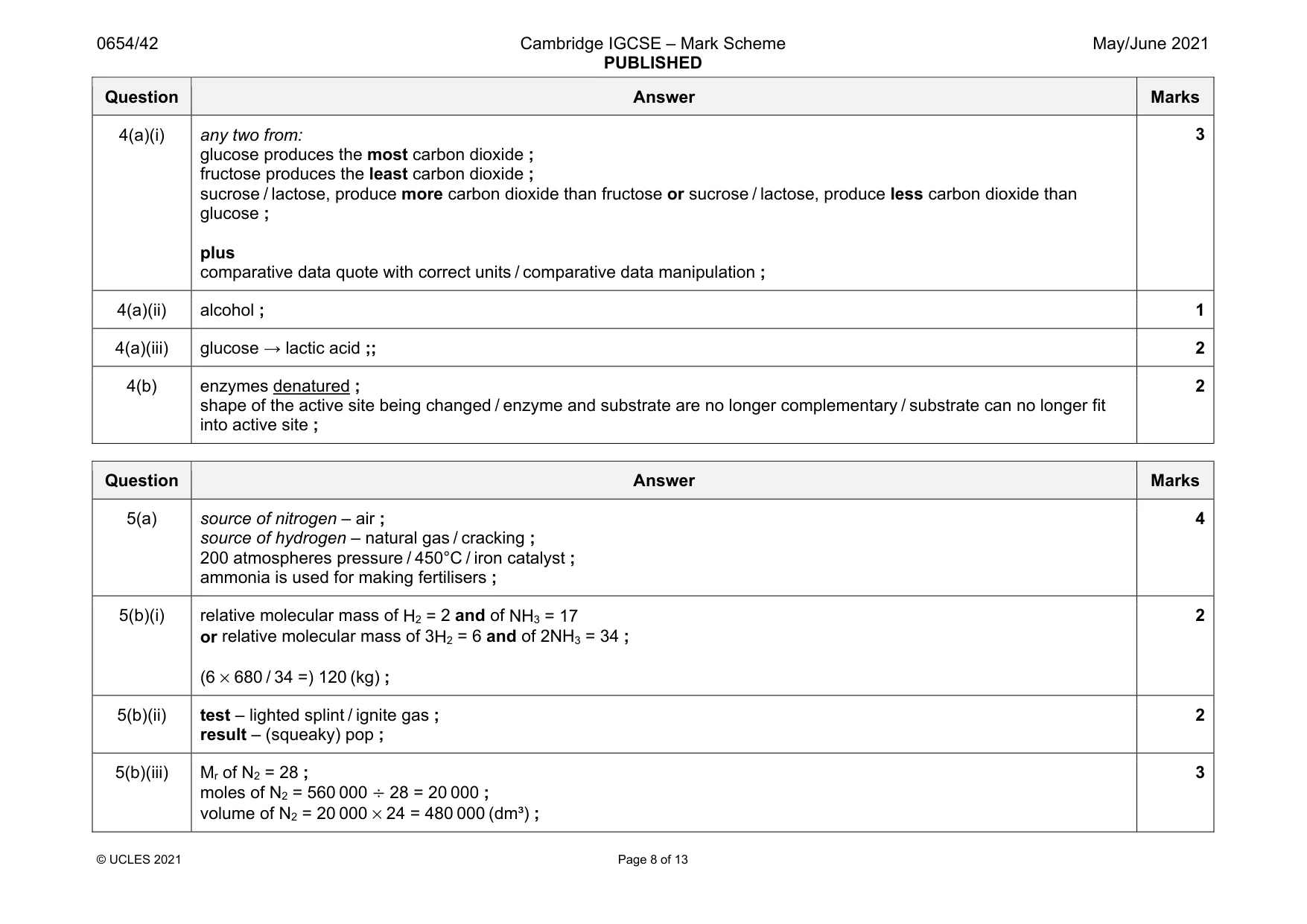
Mark scheme: 4(a)(i) any two from: glucose produces the most carbon dioxide ; fructose produces the least carbon dioxide ; sucrose / lactose, produce more carbon dioxide than fructose or sucrose / lactose, produce less carbon dioxide than glucose ; plus comparative data quote with correct units / comparative data manipulation ; 4(a)(ii) alcohol ; 1 4(a)(iii) glucose → lactic acid ;; 2 4(b) enzymes denatured ; shape of the active site being changed / enzyme and substrate are no longer complementary / substrate can no longer fit into active site ; 2
Q5 · Ammonia, NH3, is made in factories by the Haber process
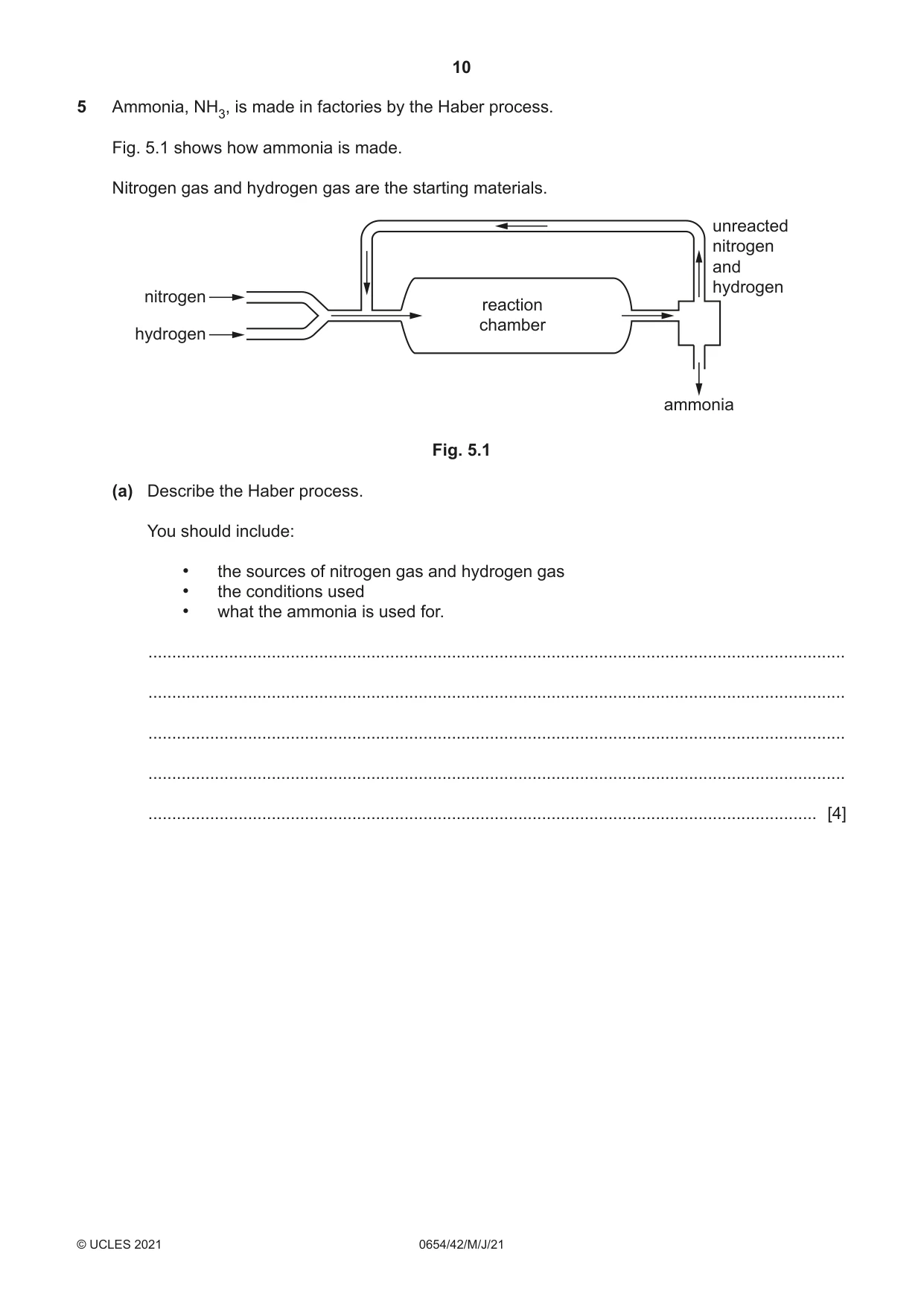
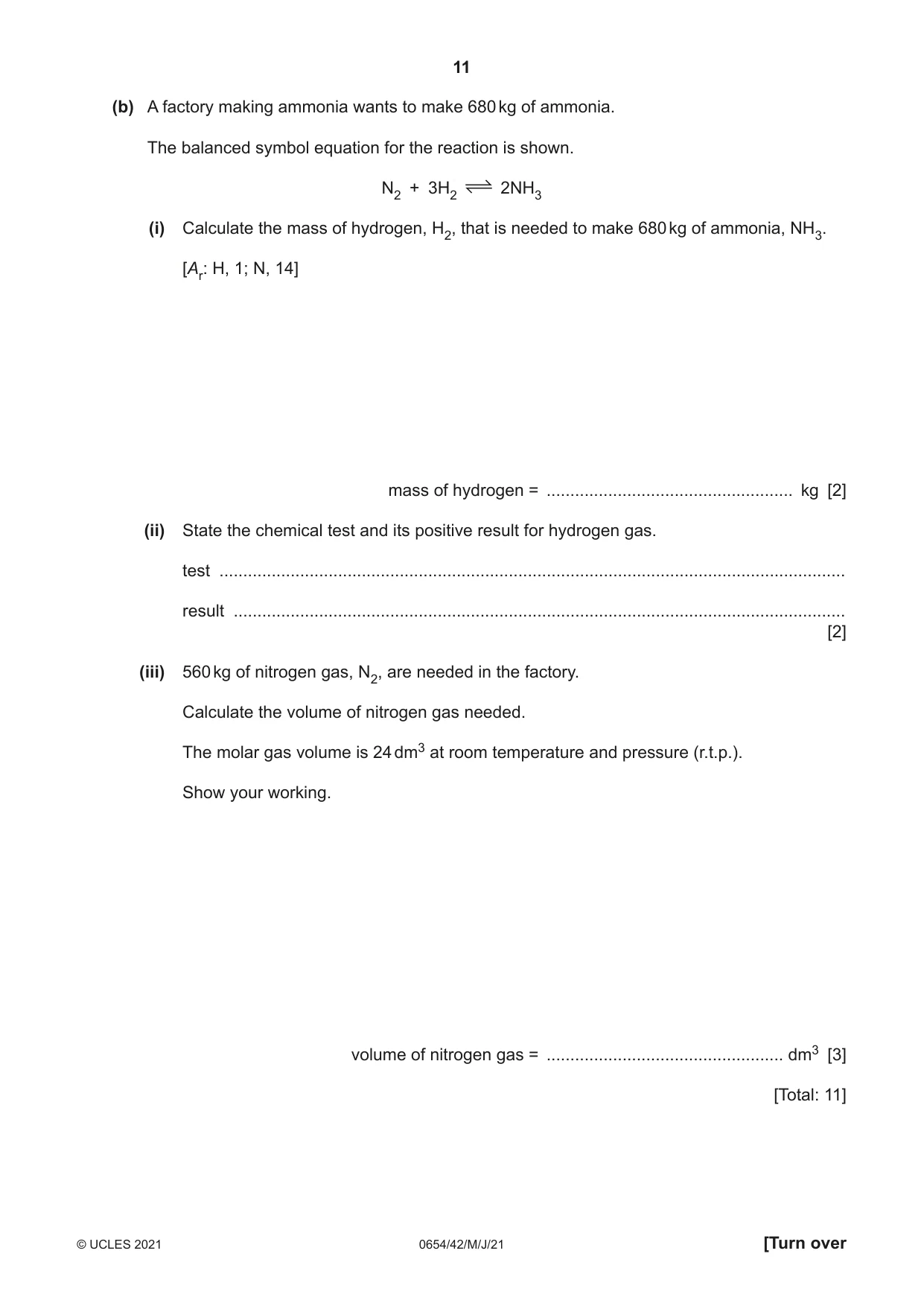
5 Ammonia, NH3, is made in factories by the Haber process. Fig. 5.1 shows how ammonia is made. Nitrogen gas and hydrogen gas are the starting materials. unreacted nitrogen and hydrogen nitrogen reaction chamber hydrogen ammonia Fig. 5.1 (a) Describe the Haber process. You should include: • the sources of nitrogen gas and hydrogen gas • the conditions used • what the ammonia is used for. ................................................................................................................................................... ................................................................................................................................................... ................................................................................................................................................... ................................................................................................................................................... ............................................................................................................................................. [4] (b) A factory making ammonia wants to make 680 kg of ammonia. The balanced symbol equation for the reaction is shown. N2 + 3H2 2NH3 (i) Calculate the mass of hydrogen, H2, that is needed to make 680 kg of ammonia, NH3. [Ar: H, 1; N, 14] mass of hydrogen = .................................................... kg [2] (ii) State the chemical test and its positive result for hydrogen gas. test .................................................................................................................................... result ................................................................................................................................. [2] (iii) 560 kg of nitrogen gas, N2, are needed in the factory. Calculate the volume of nitrogen gas needed. The molar gas volume is 24 dm3 at room temperature and pressure (r.t.p.). Show your working. volume of nitrogen gas = .................................................. dm3 [3] [Total: 11]
Mark scheme: 5(a) source of nitrogen – air ; source of hydrogen – natural gas / cracking ; 200 atmospheres pressure / 450°C / iron catalyst ; ammonia is used for making fertilisers ; 4 5(b)(i) relative molecular mass of H2 = 2 and of NH3 = 17 or relative molecular mass of 3H2 = 6 and of 2NH3 = 34 ; (6 × 680 / 34 =) 120 (kg) ; 2 5(b)(ii) test – lighted splint / ignite gas ; result – (squeaky) pop ; 2 5(b)(iii) Mr of N2 = 28 ; moles of N2 = 560 000 ÷ 28 = 20 000 ; volume of N2 = 20 000 × 24 = 480 000 (dm³) ; 3
Q6 · Metals are good conductors of thermal energy
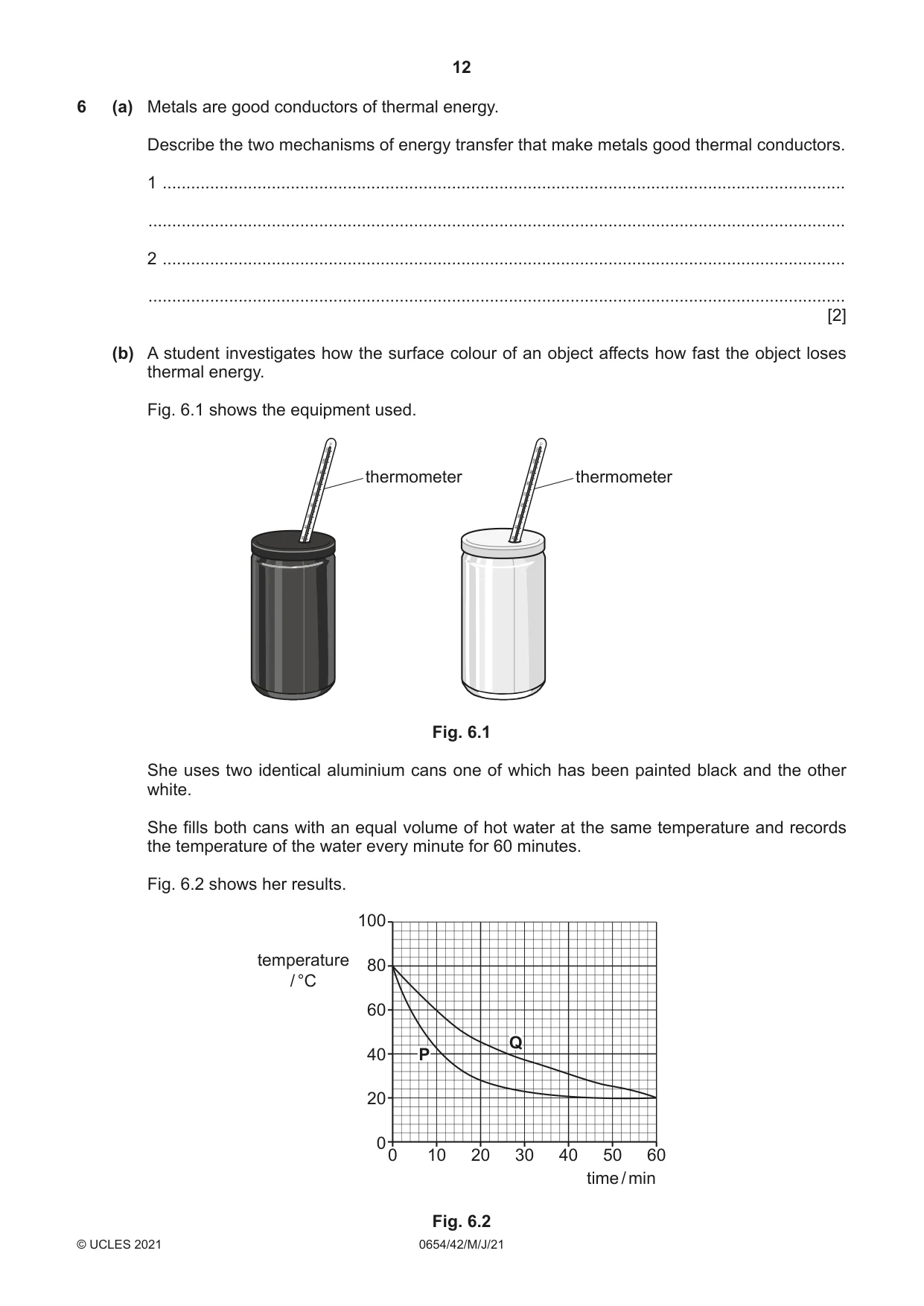
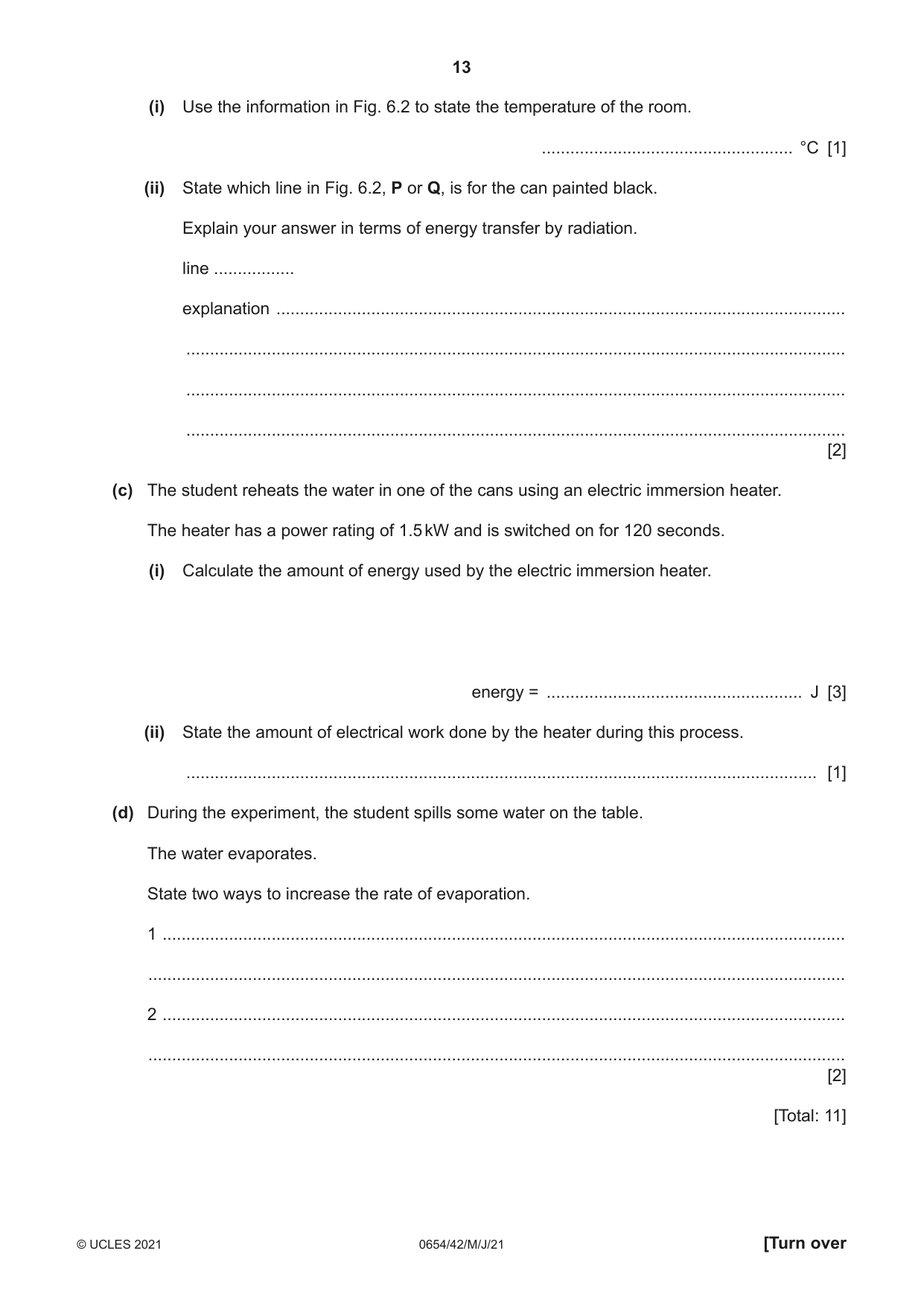
6 (a) Metals are good conductors of thermal energy. Describe the two mechanisms of energy transfer that make metals good thermal conductors. 1 ................................................................................................................................................ ................................................................................................................................................... 2 ................................................................................................................................................ ................................................................................................................................................... [2] (b) A student investigates how the surface colour of an object affects how fast the object loses thermal energy. Fig. 6.1 shows the equipment used. thermometer thermometer Fig. 6.1 She uses two identical aluminium cans one of which has been painted black and the other white. She fills both cans with an equal volume of hot water at the same temperature and records the temperature of the water every minute for 60 minutes. Fig. 6.2 shows her results. 100 temperature 80 / °C 60 Q 40 P 20 0 0 10 20 30 40 50 60 time / min Fig. 6.2 (i) Use the information in Fig. 6.2 to state the temperature of the room. ..................................................... °C [1] (ii) State which line in Fig. 6.2, P or Q, is for the can painted black. Explain your answer in terms of energy transfer by radiation. line ................. explanation ........................................................................................................................ ........................................................................................................................................... ........................................................................................................................................... ........................................................................................................................................... [2] (c) The student reheats the water in one of the cans using an electric immersion heater. The heater has a power rating of 1.5 kW and is switched on for 120 seconds. (i) Calculate the amount of energy used by the electric immersion heater. energy = ...................................................... J [3] (ii) State the amount of electrical work done by the heater during this process. ..................................................................................................................................... [1] (d) During the experiment, the student spills some water on the table. The water evaporates. State two ways to increase the rate of evaporation. 1 ................................................................................................................................................ ................................................................................................................................................... 2 ................................................................................................................................................ ................................................................................................................................................... [2] [Total: 11]
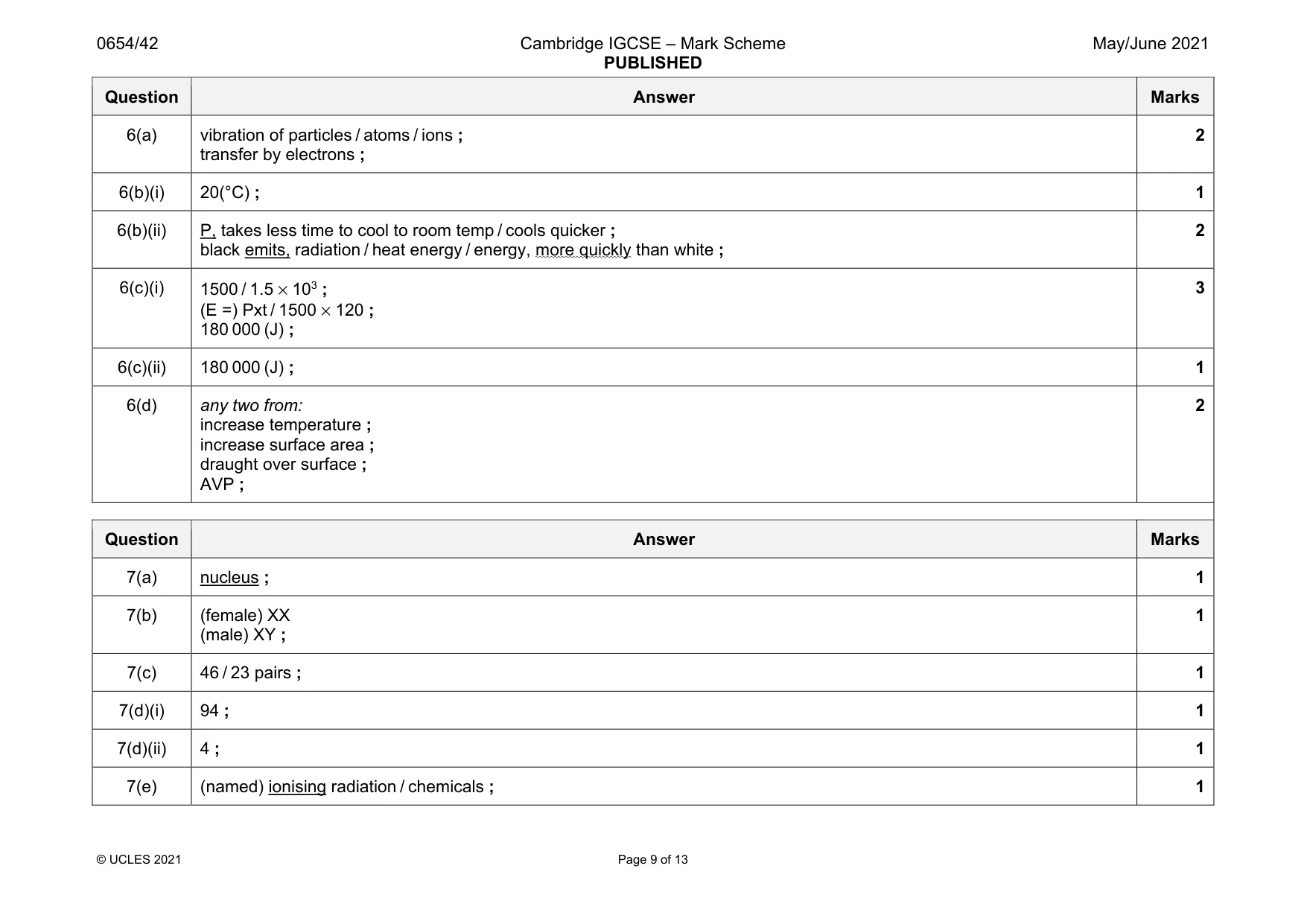
Mark scheme: 6(a) vibration of particles / atoms / ions ; transfer by electrons ; 2 6(b)(i) 20(°C) ; 1 6(b)(ii) P, takes less time to cool to room temp / cools quicker ; black emits, radiation / heat energy / energy, more quickly than white ; 2 6(c)(i) 1500 / 1.5 × 10³ ; (E =) Pxt / 1500 × 120 ; 180 000 (J) ; 3 6(c)(ii) 180 000 (J) ; 1 6(d) any two from: increase temperature ; increase surface area ; draught over surface ; AVP ; 2
Q7 · Different species have different numbers of chromosomes in their cells
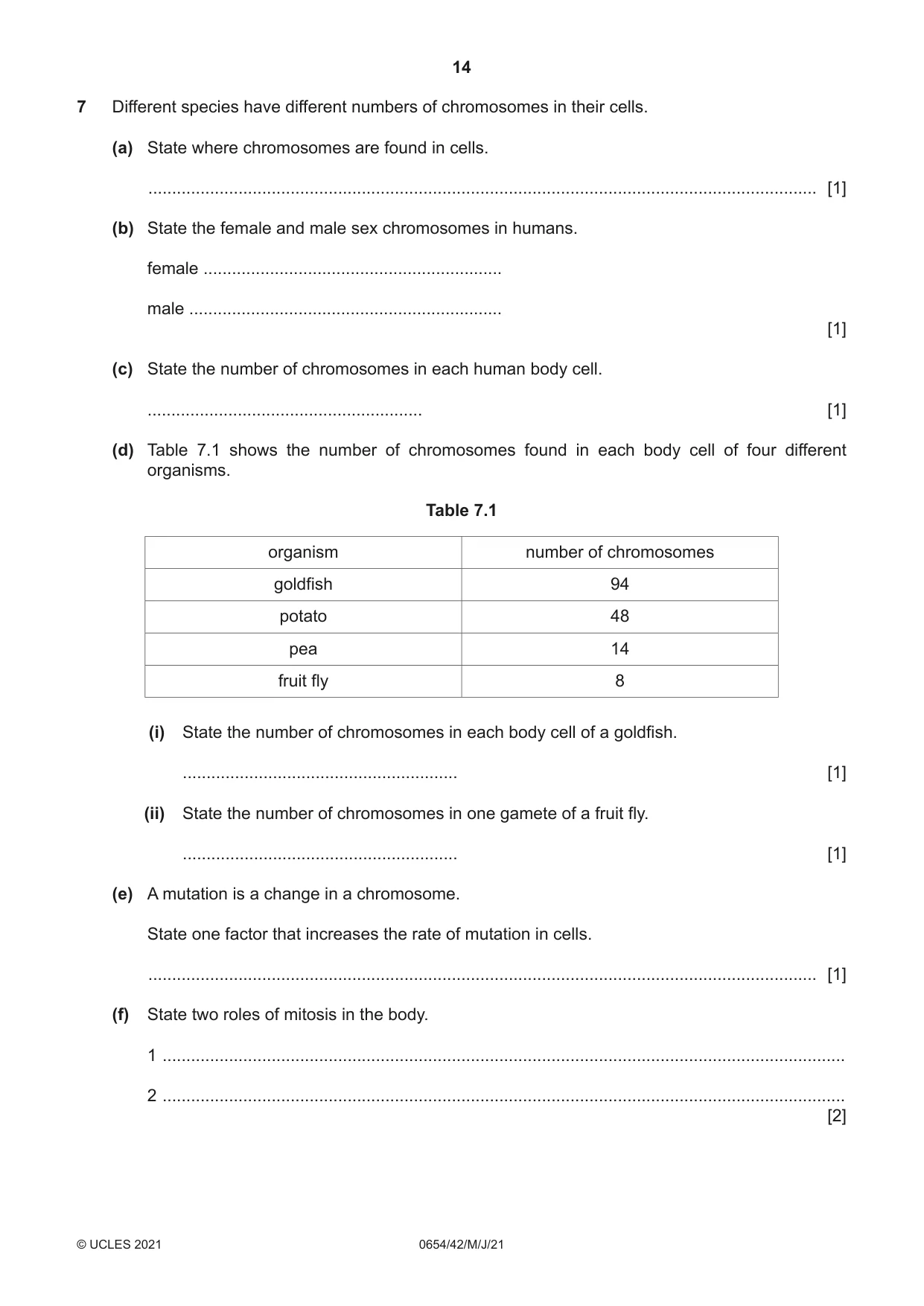
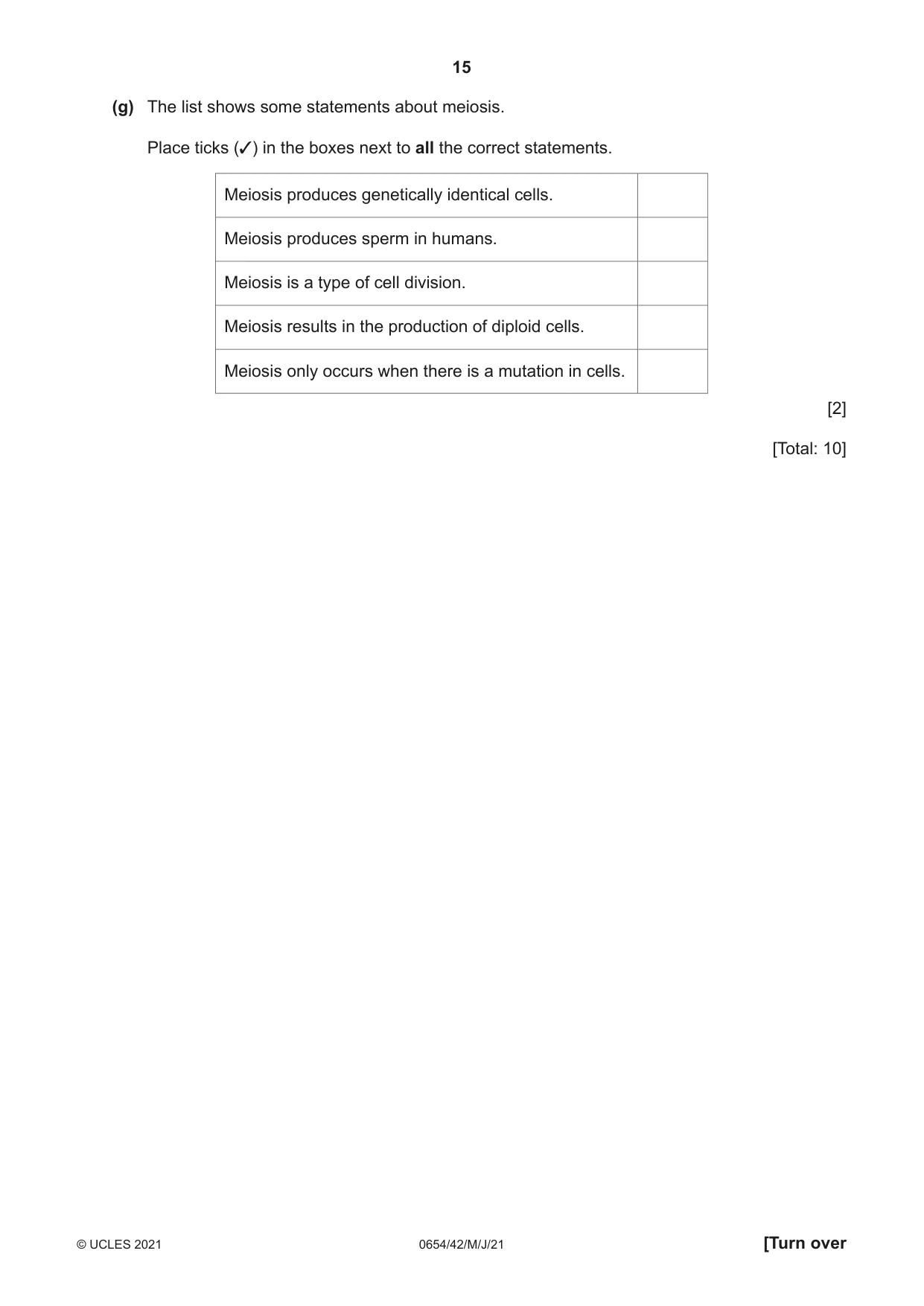
7 Different species have different numbers of chromosomes in their cells. (a) State where chromosomes are found in cells. ............................................................................................................................................. [1] (b) State the female and male sex chromosomes in humans. female ............................................................... male .................................................................. [1] (c) State the number of chromosomes in each human body cell. .......................................................... [1] (d) Table 7.1 shows the number of chromosomes found in each body cell of four different organisms. Table 7.1 organism number of chromosomes goldfish 94 potato 48 pea 14 fruit fly 8 (i) State the number of chromosomes in each body cell of a goldfish. .......................................................... [1] (ii) State the number of chromosomes in one gamete of a fruit fly. .......................................................... [1] (e) A mutation is a change in a chromosome. State one factor that increases the rate of mutation in cells. ............................................................................................................................................. [1] (f) State two roles of mitosis in the body. 1 ................................................................................................................................................ 2 ................................................................................................................................................ [2] (g) The list shows some statements about meiosis. Place ticks (3) in the boxes next to all the correct statements. Meiosis produces genetically identical cells. Meiosis produces sperm in humans. Meiosis is a type of cell division. Meiosis results in the production of diploid cells. Meiosis only occurs when there is a mutation in cells. [2] [Total: 10]
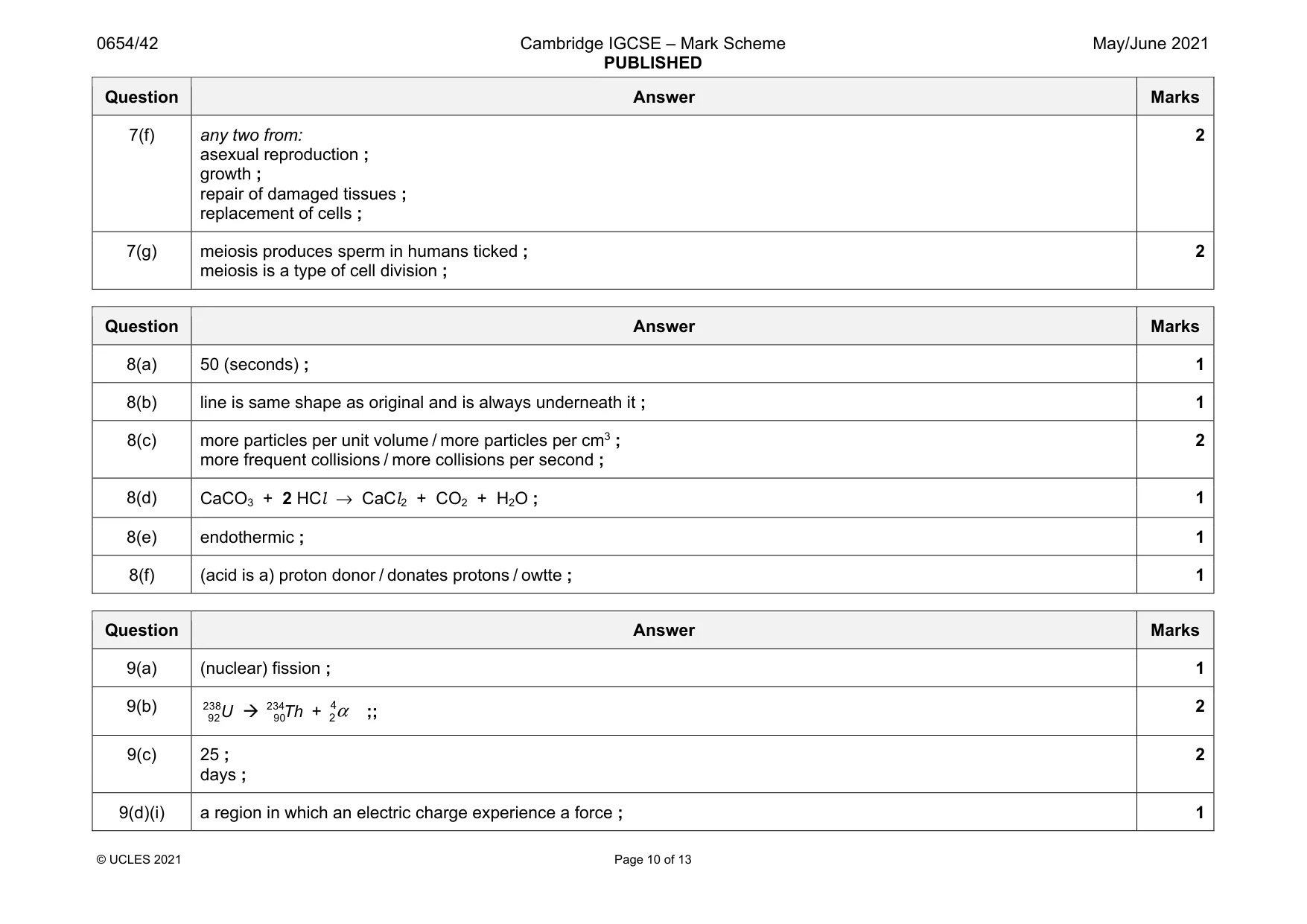
Mark scheme: 7(a) nucleus ; 1 7(b) (female) XX (male) XY ; 1 7(c) 46 / 23 pairs ; 1 7(d)(i) 94 ; 1 7(d)(ii) 4 ; 1 7(e) (named) ionising radiation / chemicals ; 1 Question Answer Marks 7(f) any two from: asexual reproduction ; growth ; repair of damaged tissues ; replacement of cells ; 2 7(g) meiosis produces sperm in humans ticked ; meiosis is a type of cell division ; 2
Q8 · A student is investigating indigestion tablets
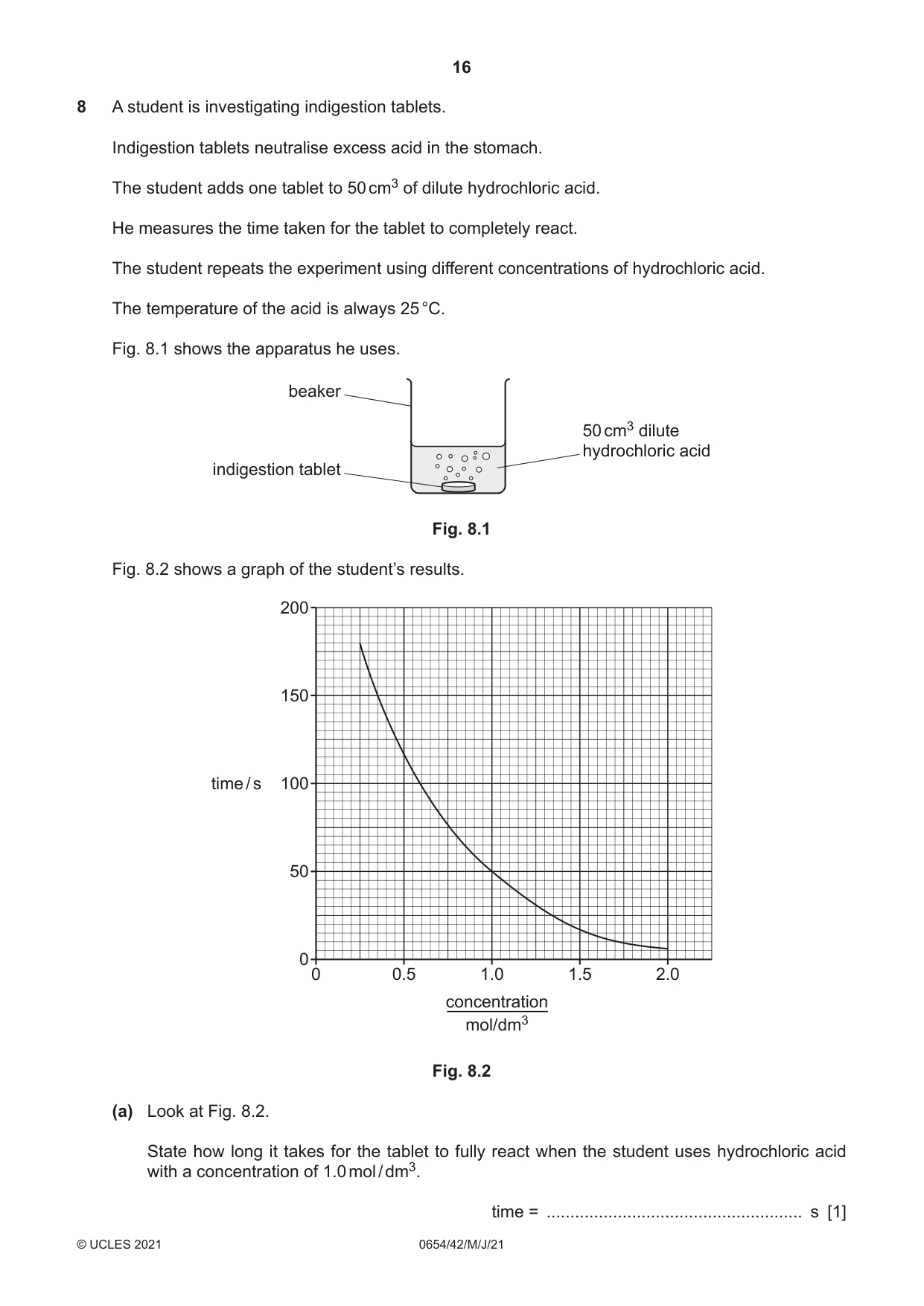
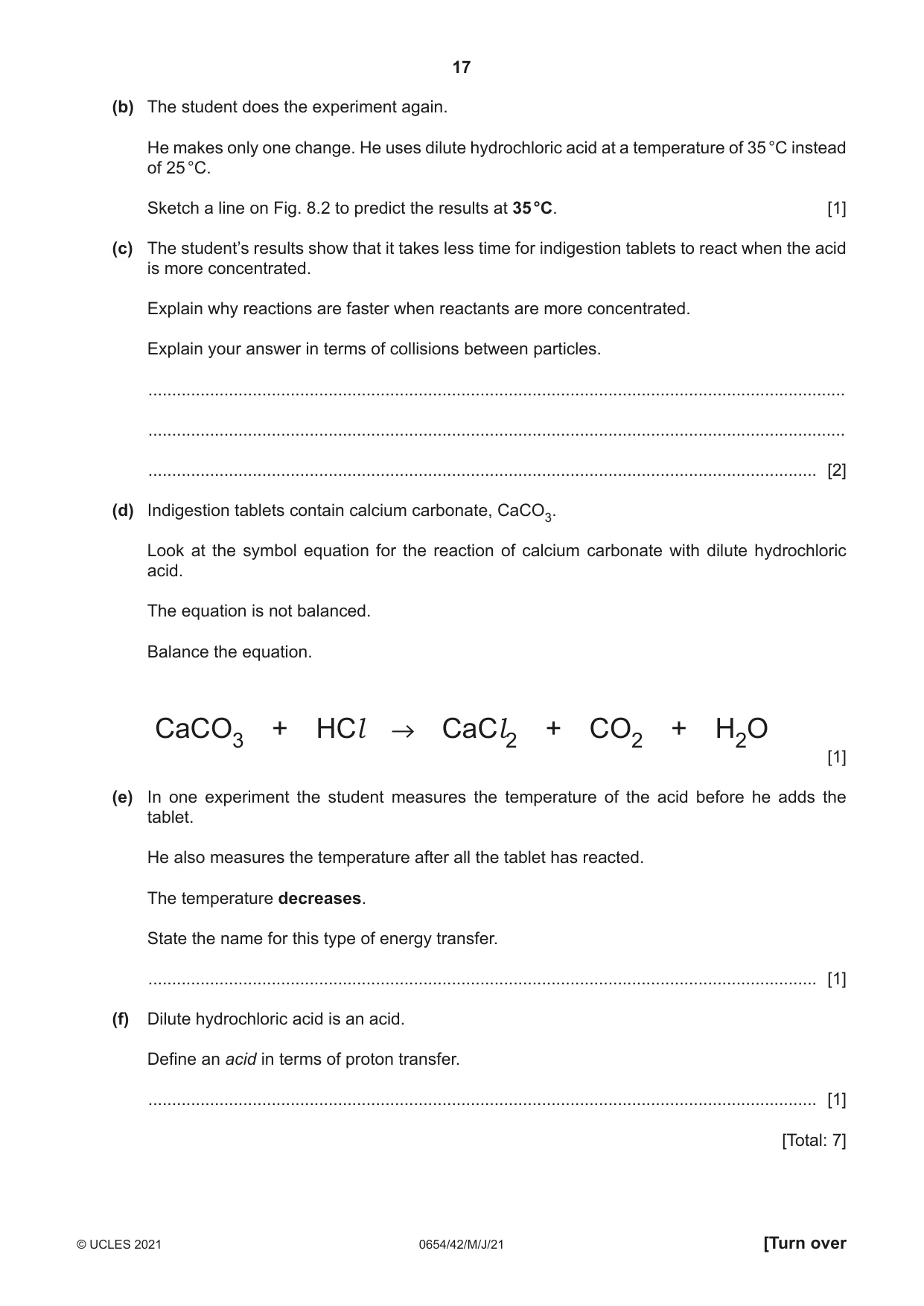
8 A student is investigating indigestion tablets. Indigestion tablets neutralise excess acid in the stomach. The student adds one tablet to 50 cm3 of dilute hydrochloric acid. He measures the time taken for the tablet to completely react. The student repeats the experiment using different concentrations of hydrochloric acid. The temperature of the acid is always 25 °C. Fig. 8.1 shows the apparatus he uses. beaker 50 cm3 dilute hydrochloric acid indigestion tablet Fig. 8.1 Fig. 8.2 shows a graph of the student’s results. 200 150 time / s 100 50 0 0 0.5 1.0 1.5 2.0 concentration mol/dm3 Fig. 8.2 (a) Look at Fig. 8.2. State how long it takes for the tablet to fully react when the student uses hydrochloric acid with a concentration of 1.0 mol / dm3. time = ...................................................... s [1] (b) The student does the experiment again. He makes only one change. He uses dilute hydrochloric acid at a temperature of 35 °C instead of 25 °C. Sketch a line on Fig. 8.2 to predict the results at 35 °C. [1] (c) The student’s results show that it takes less time for indigestion tablets to react when the acid is more concentrated. Explain why reactions are faster when reactants are more concentrated. Explain your answer in terms of collisions between particles. ................................................................................................................................................... ................................................................................................................................................... ............................................................................................................................................. [2] (d) Indigestion tablets contain calcium carbonate, CaCO3. Look at the symbol equation for the reaction of calcium carbonate with dilute hydrochloric acid. The equation is not balanced. Balance the equation. CaCO3 + HCl CaCl2 + CO2 + H2O [1] (e) In one experiment the student measures the temperature of the acid before he adds the tablet. He also measures the temperature after all the tablet has reacted. The temperature decreases. State the name for this type of energy transfer. ............................................................................................................................................. [1] (f) Dilute hydrochloric acid is an acid. Define an acid in terms of proton transfer. ............................................................................................................................................. [1] [Total: 7]
Mark scheme: 8(a) 50 (seconds) ; 1 8(b) line is same shape as original and is always underneath it ; 1 8(c) more particles per unit volume / more particles per cm3 ; more frequent collisions / more collisions per second ; 2 8(d) CaCO3 + 2 HCl → CaCl2 + CO2 + H2O ; 1 8(e) endothermic ; 1 8(f) (acid is a) proton donor / donates protons / owtte ; 1
Q9 · Nuclear power stations use uranium as a fuel
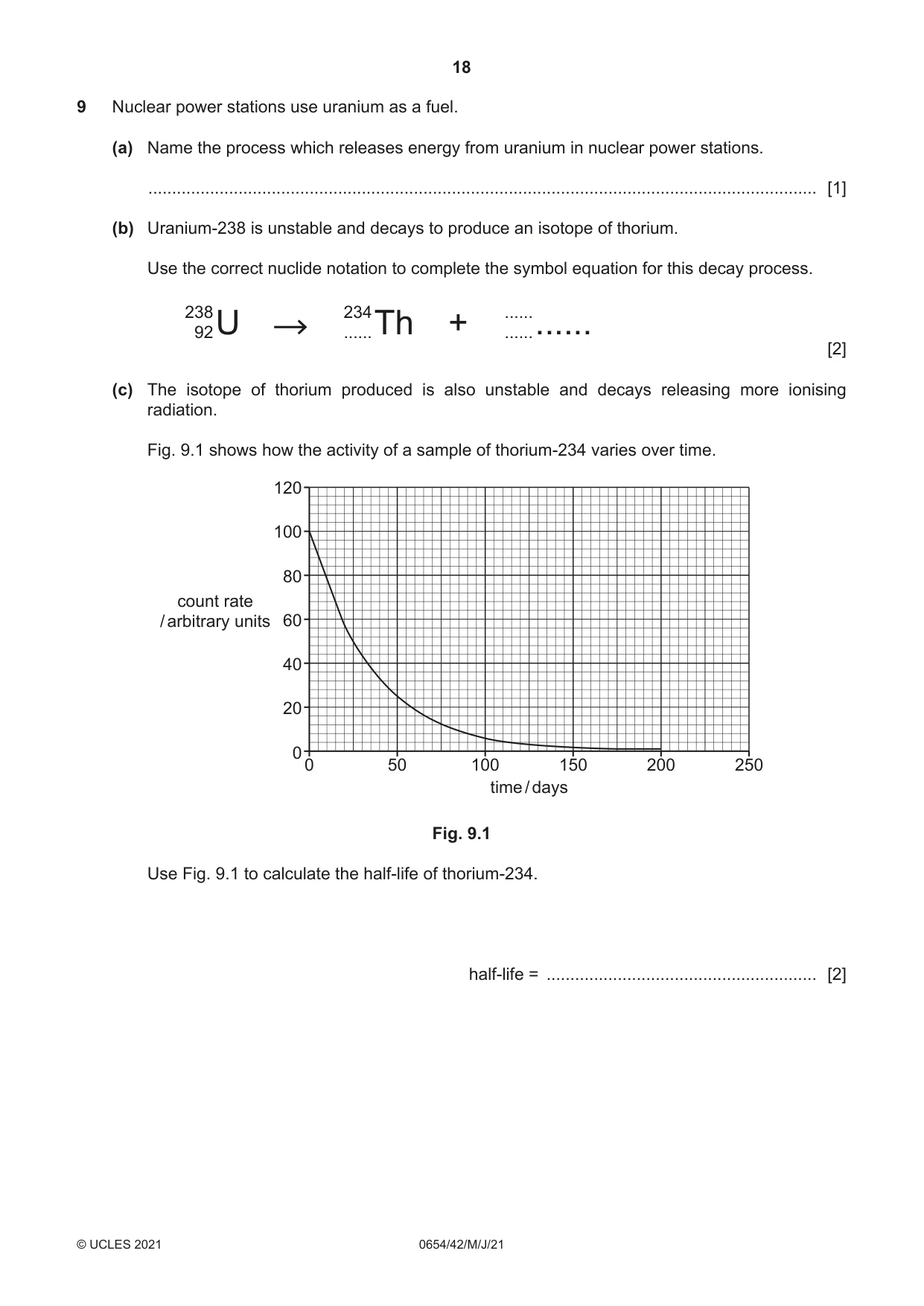
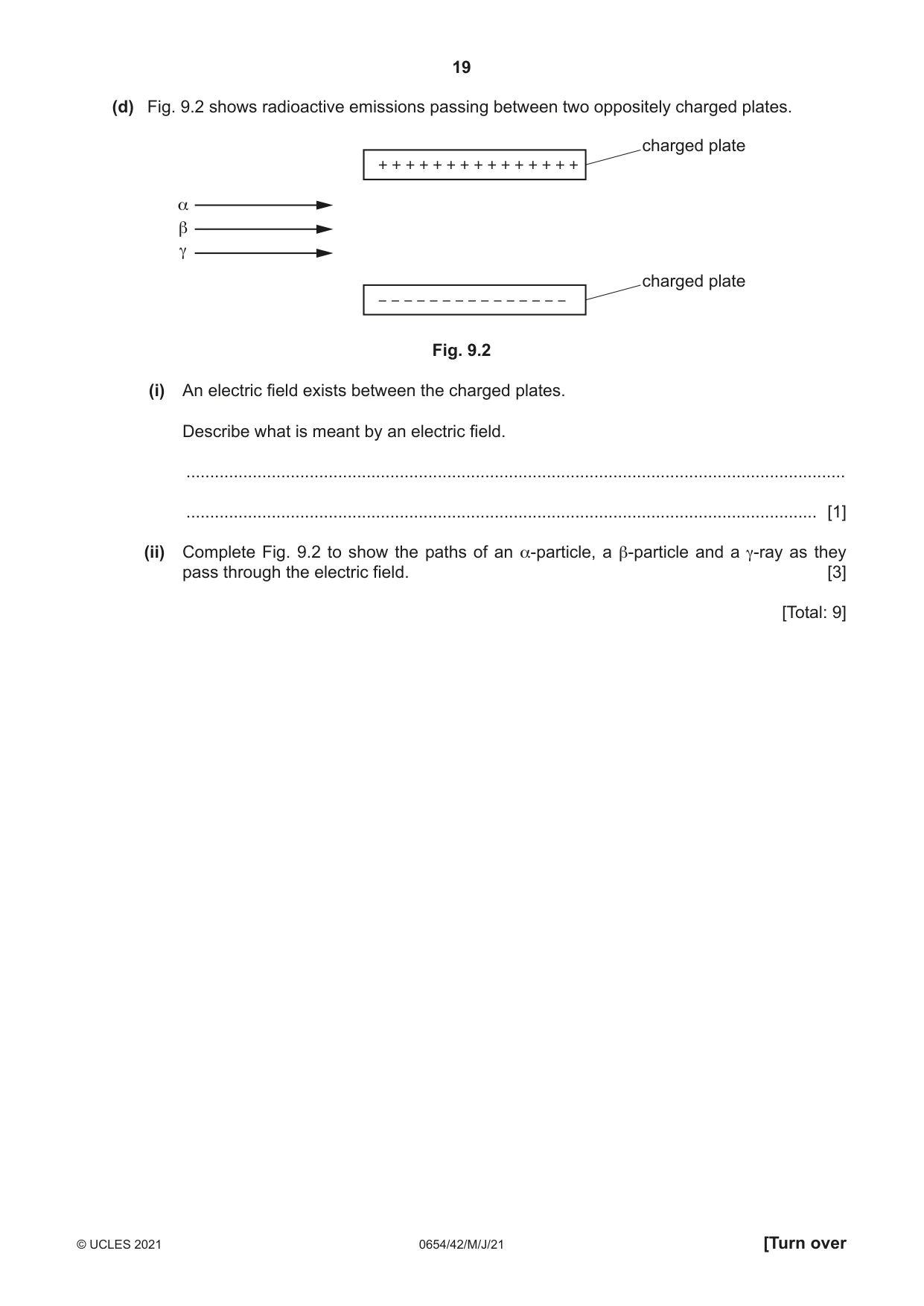
9 Nuclear power stations use uranium as a fuel. (a) Name the process which releases energy from uranium in nuclear power stations. ............................................................................................................................................. [1] (b) Uranium-238 is unstable and decays to produce an isotope of thorium. Use the correct nuclide notation to complete the symbol equation for this decay process. 238 234 ...... 92 U ...... Th + ...... ...... [2] (c) The isotope of thorium produced is also unstable and decays releasing more ionising radiation. Fig. 9.1 shows how the activity of a sample of thorium-234 varies over time. 120 100 80 count rate / arbitrary units 60 40 20 0 0 50 100 150 200 250 time / days Fig. 9.1 Use Fig. 9.1 to calculate the half-life of thorium-234. half-life = ......................................................... [2] (d) Fig. 9.2 shows radioactive emissions passing between two oppositely charged plates. charged plate + + + + + + + + + + + + + + + α β γ charged plate – – – – – – – – – – – – – – – Fig. 9.2 (i) An electric field exists between the charged plates. Describe what is meant by an electric field. ........................................................................................................................................... ..................................................................................................................................... [1] (ii) Complete Fig. 9.2 to show the paths of an α-particle, a β-particle and a γ-ray as they pass through the electric field. [3] [Total: 9]
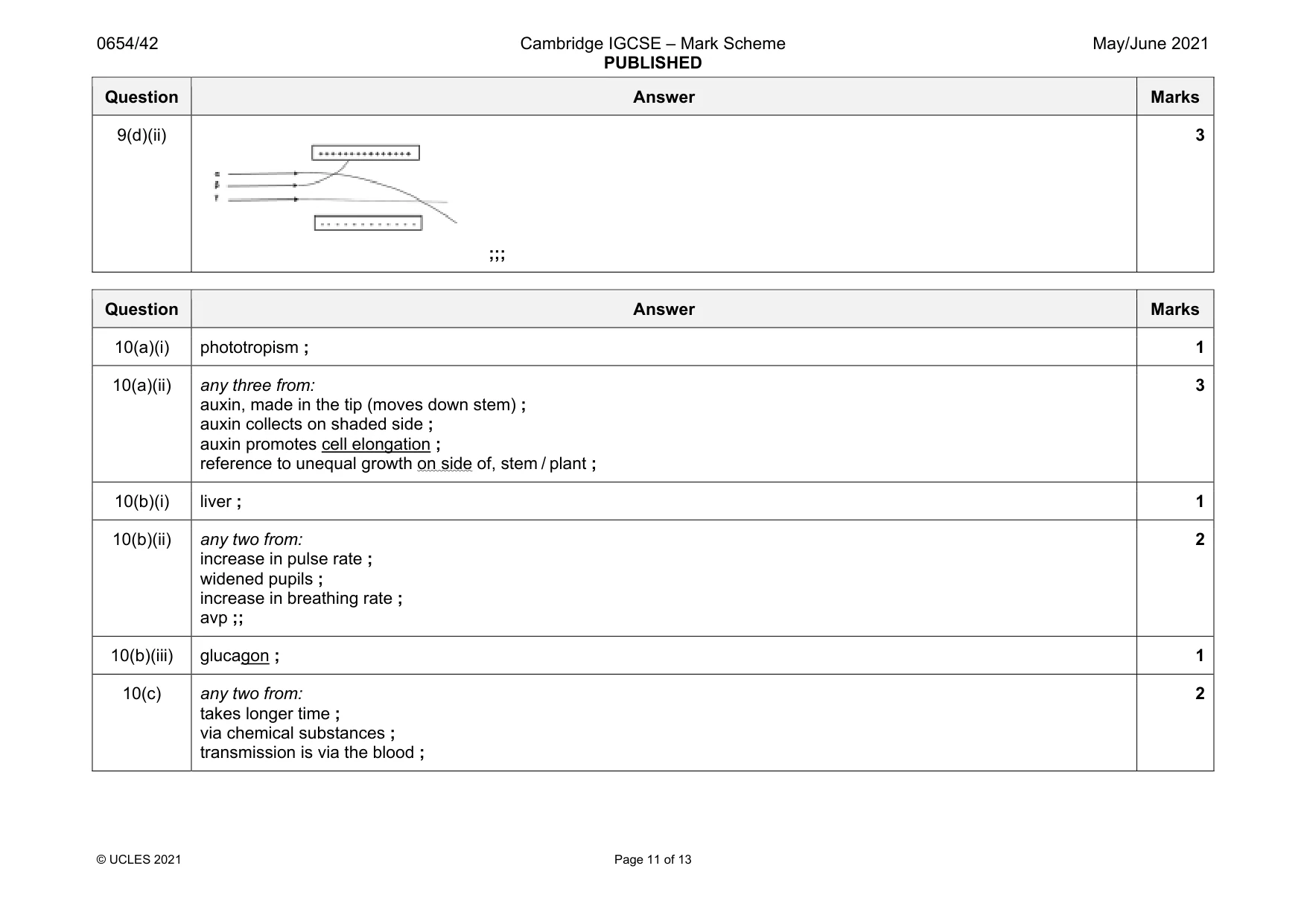
Mark scheme: 9(a) (nuclear) fission ; 1 9(b) 238 92U 234 90Th + 4 2α ;; 2 9(c) 25 ; days ; 2 9(d)(i) a region in which an electric charge experience a force ; 1 Question Answer Marks 9(d)(ii) ;;; 3
Q10 · A plant’s response to light
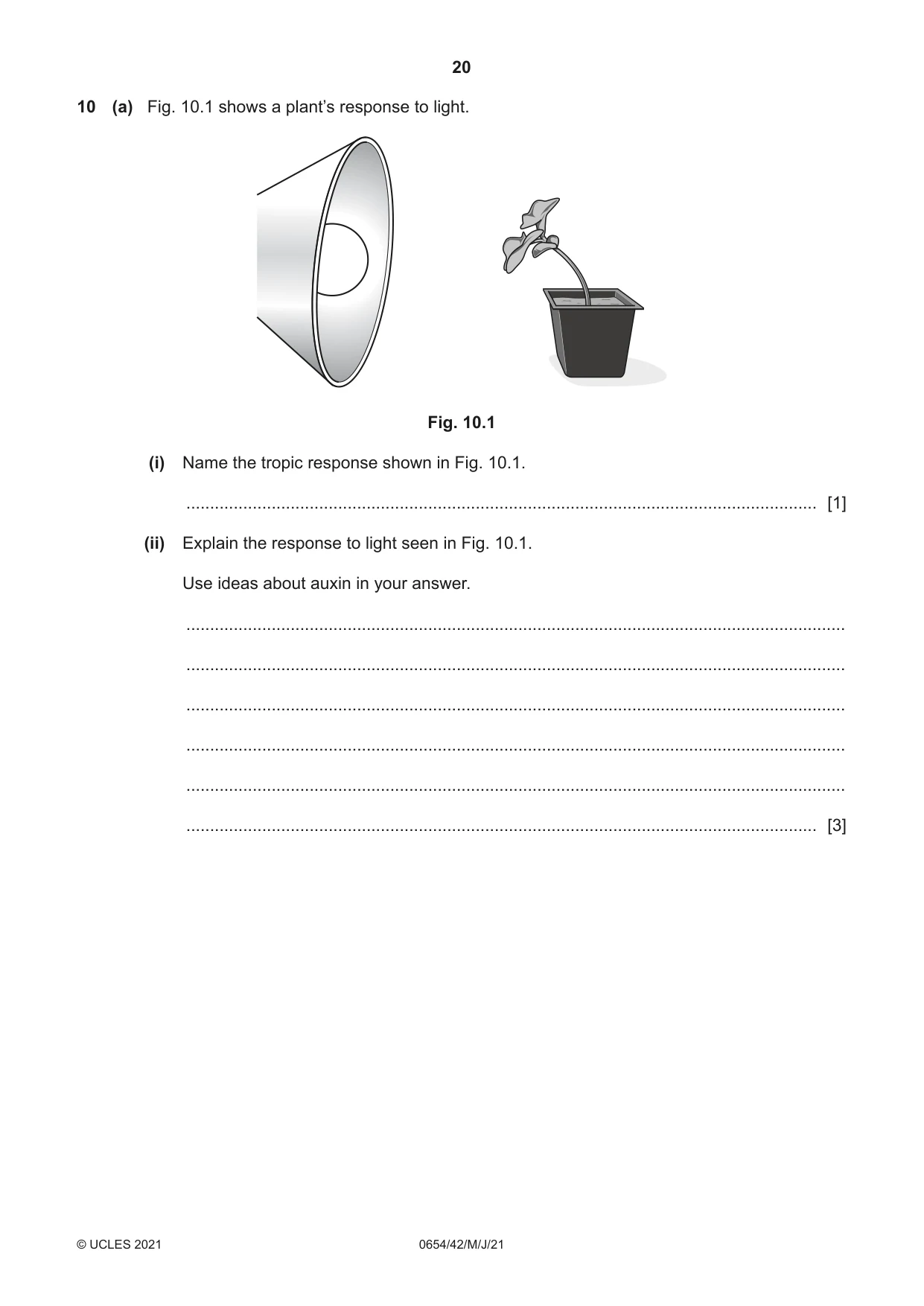
10 (a) Fig. 10.1 shows a plant’s response to light. Fig. 10.1 (i) Name the tropic response shown in Fig. 10.1. ..................................................................................................................................... [1] (ii) Explain the response to light seen in Fig. 10.1. Use ideas about auxin in your answer. ........................................................................................................................................... ........................................................................................................................................... ........................................................................................................................................... ........................................................................................................................................... ........................................................................................................................................... ..................................................................................................................................... [3] (b) Adrenaline is a hormone released in the human body during stressful situations. One of the effects is the increase of blood glucose concentration. (i) Suggest the name of the target organ for this hormonal response. ..................................................................................................................................... [1] (ii) State two other effects of adrenaline on the human body. 1 ........................................................................................................................................ 2 ........................................................................................................................................ [2] (iii) Name one other hormone that increases the blood glucose concentration. ..................................................................................................................................... [1] (c) Describe two ways that the transmission of information by hormonal control is different from nervous control. 1 ................................................................................................................................................ ................................................................................................................................................... 2 ................................................................................................................................................ ................................................................................................................................................... [2] [Total: 10]
Mark scheme: 10(a)(i) phototropism ; 1 10(a)(ii) any three from: auxin, made in the tip (moves down stem) ; auxin collects on shaded side ; auxin promotes cell elongation ; reference to unequal growth on side of, stem / plant ; 3 10(b)(i) liver ; 1 10(b)(ii) any two from: increase in pulse rate ; widened pupils ; increase in breathing rate ; avp ;; 2 10(b)(iii) glucagon ; 1 10(c) any two from: takes longer time ; via chemical substances ; transmission is via the blood ; 2
Q11 · Some information about particles found in an atom
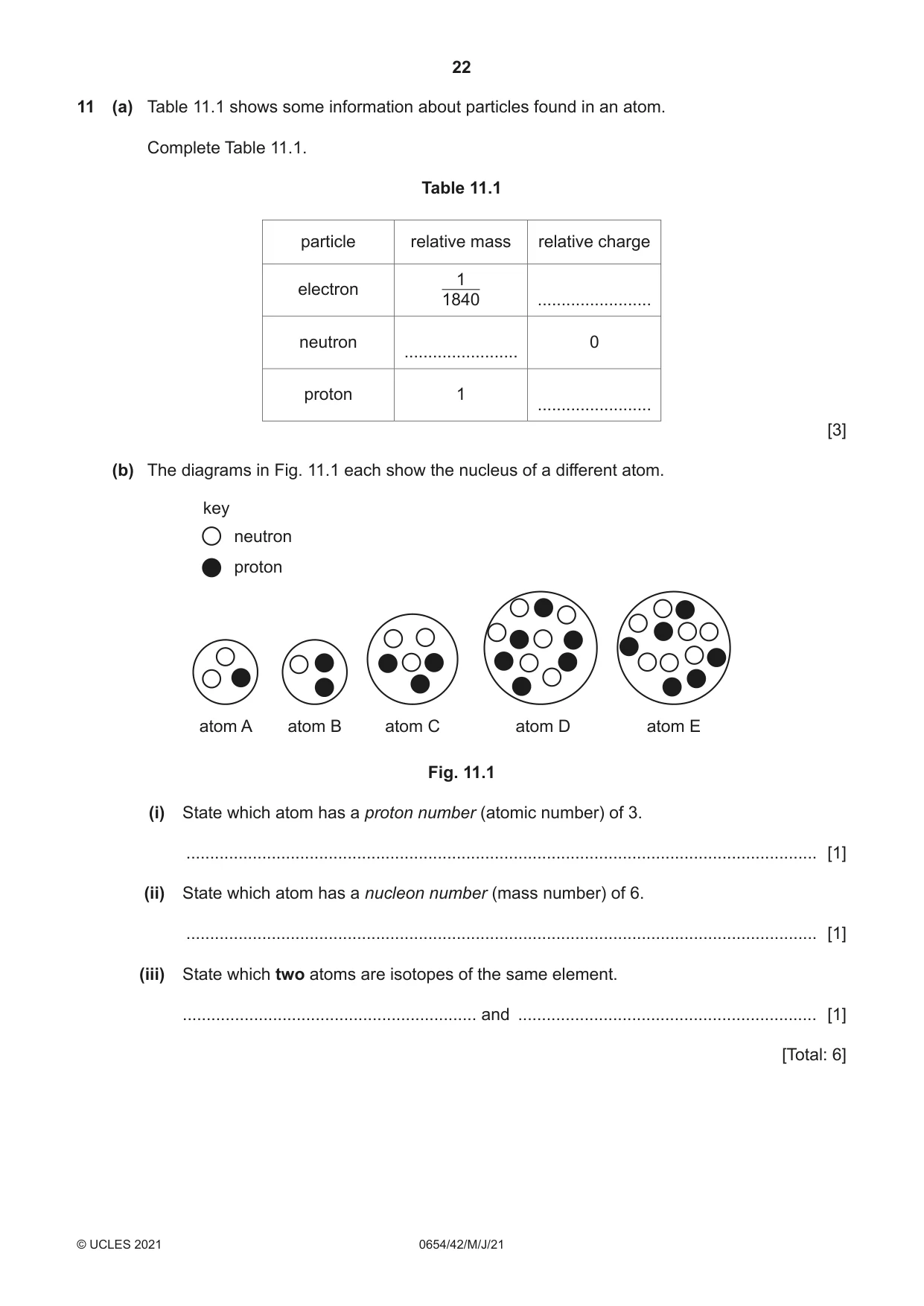
11 (a) Table 11.1 shows some information about particles found in an atom. Complete Table 11.1. Table 11.1 particle relative mass relative charge 1 electron 1840 ........................ neutron 0 ........................ proton 1 ........................ [3] (b) The diagrams in Fig. 11.1 each show the nucleus of a different atom. key neutron proton atom A atom B atom C atom D atom E Fig. 11.1 (i) State which atom has a proton number (atomic number) of 3. ..................................................................................................................................... [1] (ii) State which atom has a nucleon number (mass number) of 6. ..................................................................................................................................... [1] (iii) State which two atoms are isotopes of the same element. .............................................................. and ............................................................... [1] [Total: 6]
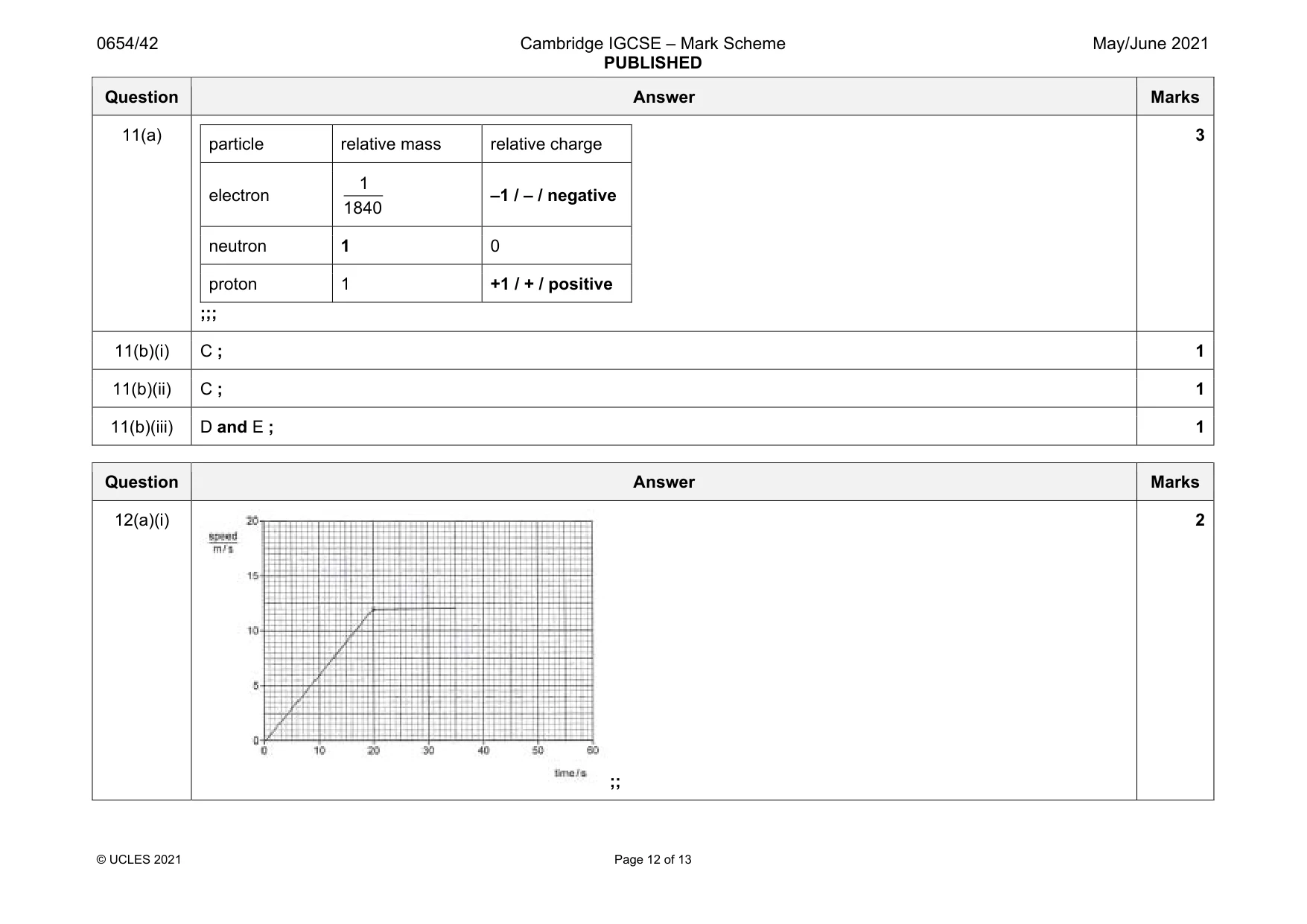
Mark scheme: 11(a) particle relative mass relative charge electron 1 1840 –1 / – / negative neutron 1 0 proton 1 +1 / + / positive ;;; 3 11(b)(i) C ; 1 11(b)(ii) C ; 1 11(b)(iii) D and E ; 1
Question 12
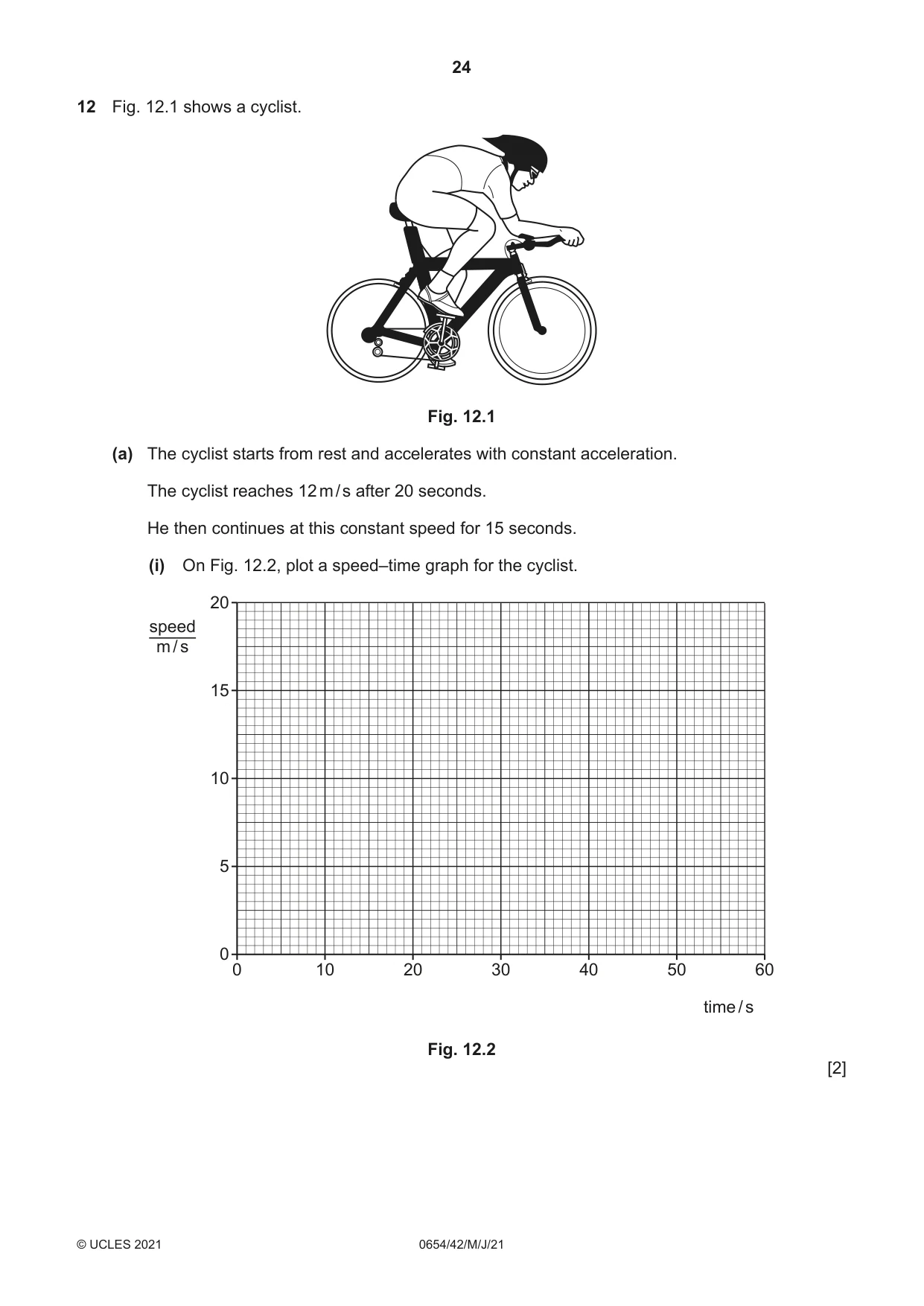
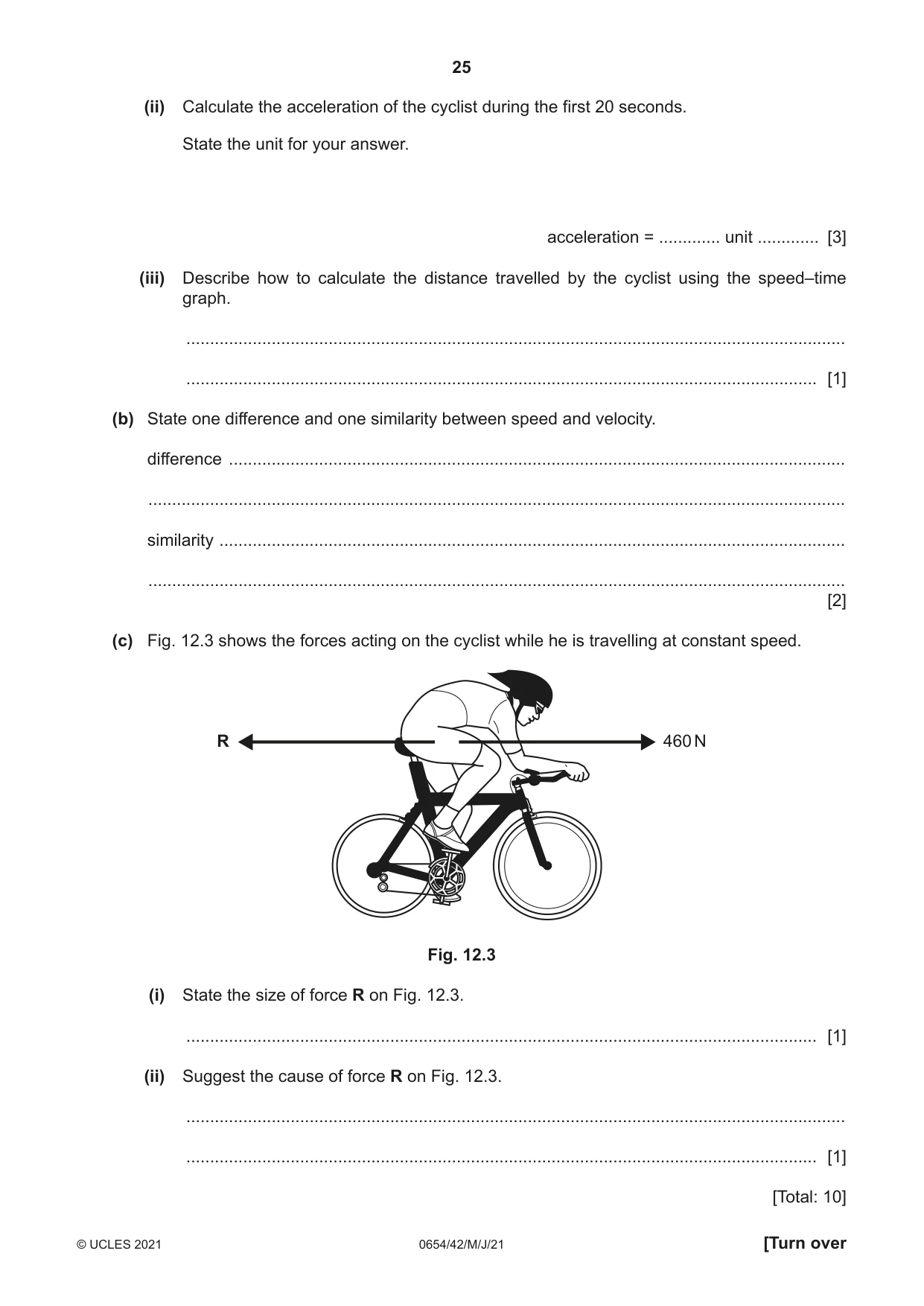
12 Fig. 12.1 shows a cyclist. Fig. 12.1 (a) The cyclist starts from rest and accelerates with constant acceleration. The cyclist reaches 12 m / s after 20 seconds. He then continues at this constant speed for 15 seconds. (i) On Fig. 12.2, plot a speed–time graph for the cyclist. 20 speed m / s 15 10 5 0 0 10 20 30 40 50 60 time / s Fig. 12.2 [2] (ii) Calculate the acceleration of the cyclist during the first 20 seconds. State the unit for your answer. acceleration = ............. unit ............. [3] (iii) Describe how to calculate the distance travelled by the cyclist using the speed–time graph. ........................................................................................................................................... ..................................................................................................................................... [1] (b) State one difference and one similarity between speed and velocity. difference .................................................................................................................................. ................................................................................................................................................... similarity .................................................................................................................................... ................................................................................................................................................... [2] (c) Fig. 12.3 shows the forces acting on the cyclist while he is travelling at constant speed. R 460 N Fig. 12.3 (i) State the size of force R on Fig. 12.3. ..................................................................................................................................... [1] (ii) Suggest the cause of force R on Fig. 12.3. ........................................................................................................................................... ..................................................................................................................................... [1] [Total: 10]
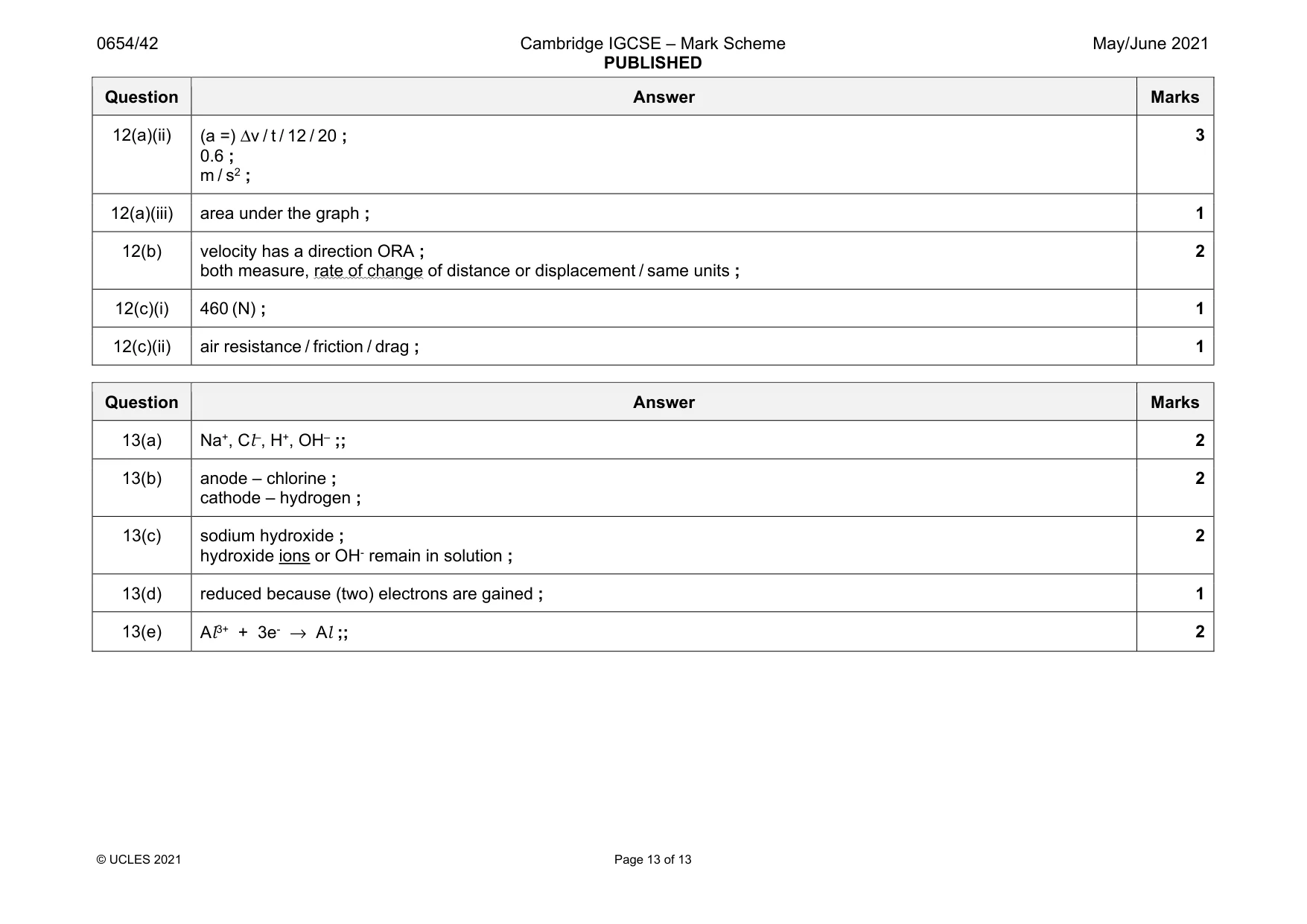
Mark scheme: 12(a)(i) ;; 2 Question Answer Marks 12(a)(ii) (a =) Δv / t / 12 / 20 ; 0.6 ; m / s2 ; 3 12(a)(iii) area under the graph ; 1 12(b) velocity has a direction ORA ; both measure, rate of change of distance or displacement / same units ; 2 12(c)(i) 460 (N) ; 1 12(c)(ii) air resistance / friction / drag ; 1
Q13 · The electrolysis of concentrated aqueous sodium chloride, NaCl, produces two useful gases
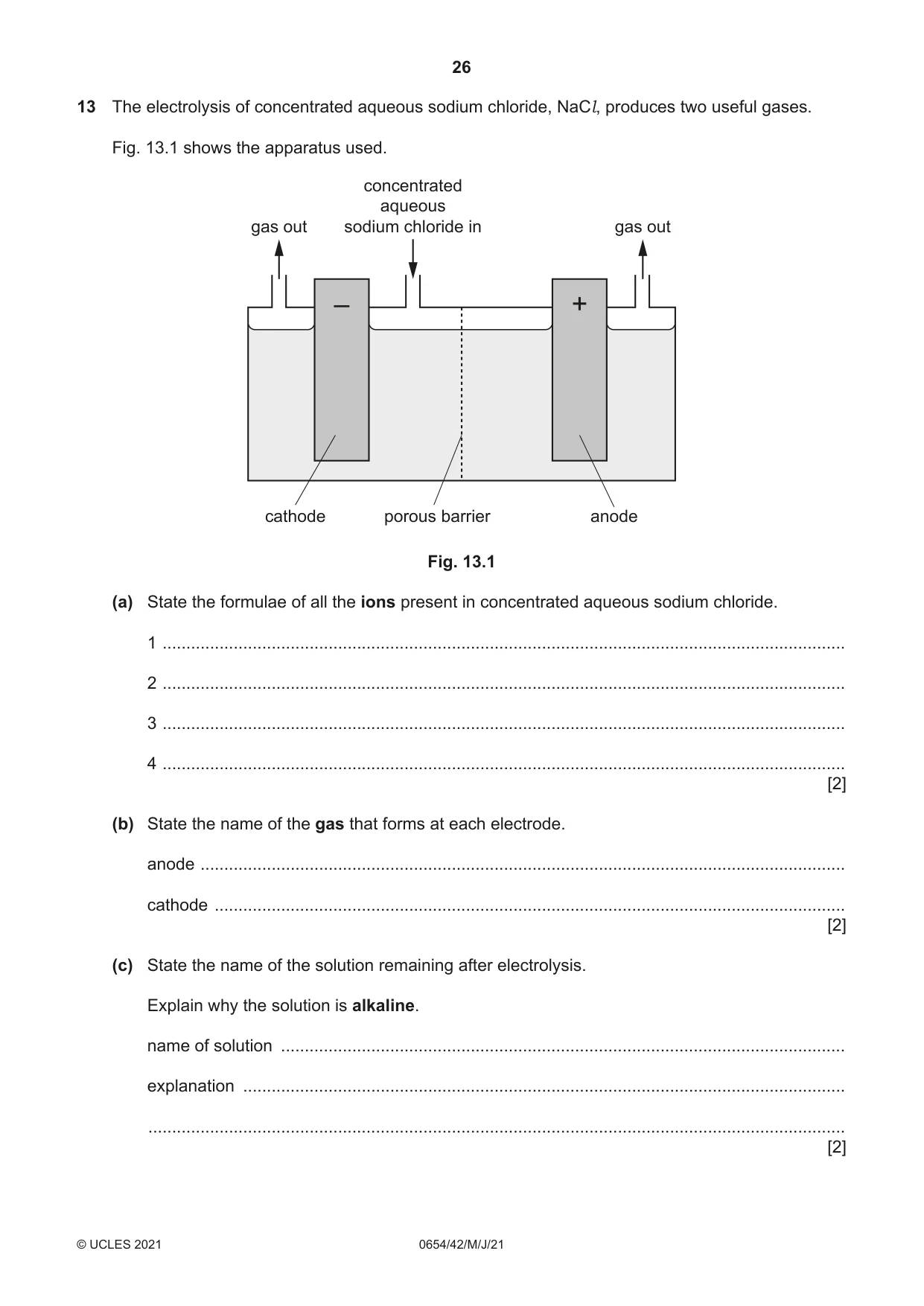
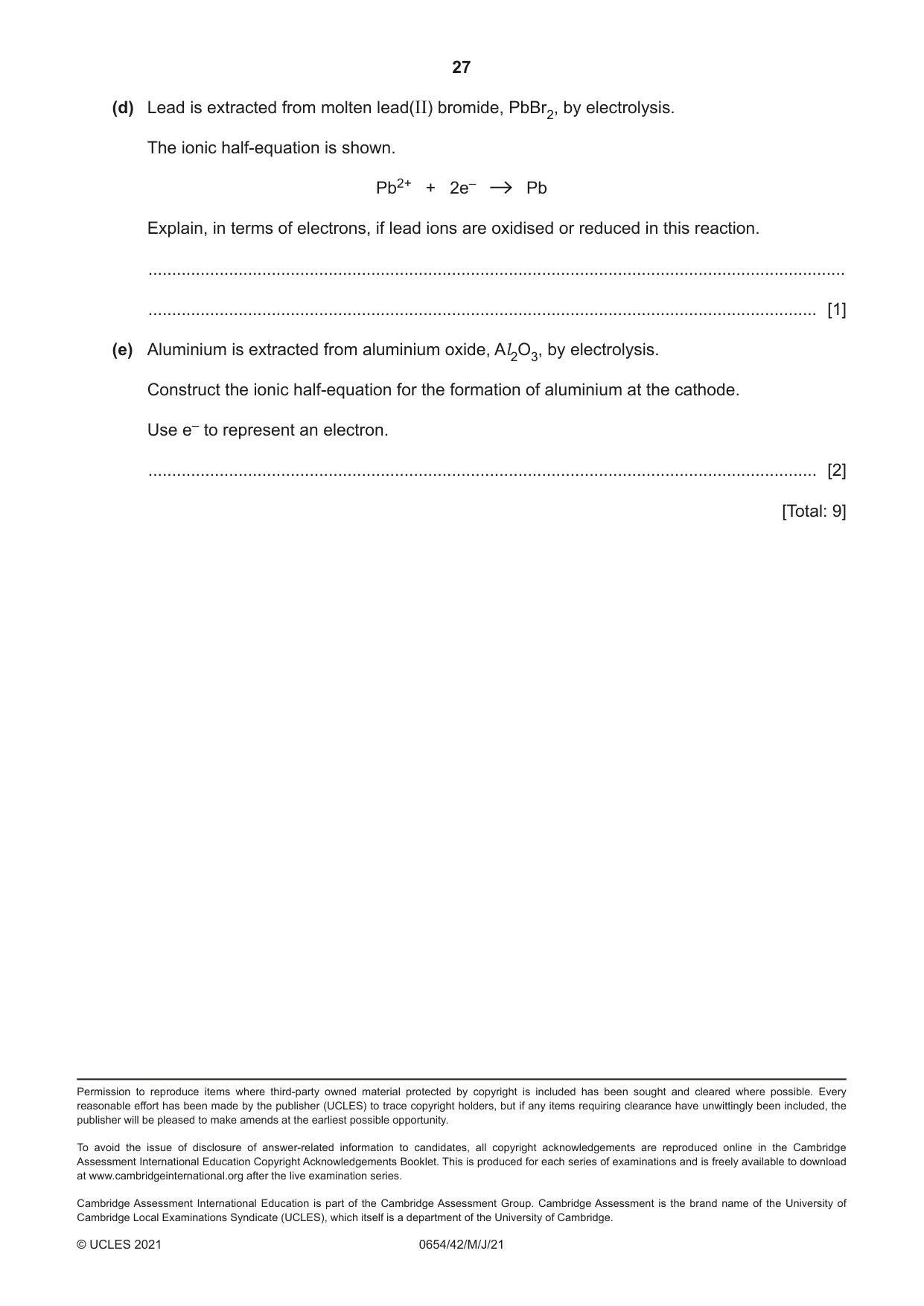
13 The electrolysis of concentrated aqueous sodium chloride, NaCl, produces two useful gases. Fig. 13.1 shows the apparatus used. concentrated aqueous gas out sodium chloride in gas out – + cathode porous barrier anode Fig. 13.1 (a) State the formulae of all the ions present in concentrated aqueous sodium chloride. 1 ................................................................................................................................................ 2 ................................................................................................................................................ 3 ................................................................................................................................................ 4 ................................................................................................................................................ [2] (b) State the name of the gas that forms at each electrode. anode ........................................................................................................................................ cathode ..................................................................................................................................... [2] (c) State the name of the solution remaining after electrolysis. Explain why the solution is alkaline. name of solution ....................................................................................................................... explanation ............................................................................................................................... ................................................................................................................................................... [2] (d) Lead is extracted from molten lead(II) bromide, PbBr2, by electrolysis. The ionic half-equation is shown. Pb2+ + 2e– Pb Explain, in terms of electrons, if lead ions are oxidised or reduced in this reaction. ................................................................................................................................................... ............................................................................................................................................. [1] (e) Aluminium is extracted from aluminium oxide, Al2O3, by electrolysis. Construct the ionic half-equation for the formation of aluminium at the cathode. Use e– to represent an electron. ............................................................................................................................................. [2] [Total: 9]
Mark scheme: 13(a) 13(b) anode – chlorine ; cathode – hydrogen ; 2 13(c) sodium hydroxide ; hydroxide ions or OH- remain in solution ; 2 13(d) reduced because (two) electrons are gained ; 1 13(e) Al3+ + 3e- → Al ;; 2
What was in this paper
The subtopics covered by these 13 questions, and how many questions each got. Open one in a new tab to see every Cambridge question on it.
What you needed in this session
Cambridge’s own grade thresholds for 2021 May/June, Paper 4 · Variant 2. A higher threshold means an easier paper — the bar moves with how the cohort did.