Questions as text
Question 1 0654/31 May/June 2017
2 (a) Fig. 2.1 shows an electric kettle. plastic casing water heating element Fig. 2.1 (i) Name the process by which thermal energy is transferred from the kettle heating element to the water in contact with it. … [1] (ii) Explain why the heating element is at the bottom of the kettle. … … … … [2] (iii) Explain one advantage, other than cost, of using plastic for the casing of the kettle. … … [1] (b) An electric kettle is supplied with 3000 joules of energy each second. The water in the kettle only gains 2600 joules of thermal energy each second. (i) Suggest what happens to the rest of the energy supplied. … [1] (ii) The owner of the kettle thinks that the kettle has a low efficiency. State the meaning of the term efficiency. … … [1] (c) Fig. 2.2 shows an electrical hazard for a kettle. plug copper wire inner insulation to kettle outer insulation Fig. 2.2 State the hazard shown and explain why the hazard is dangerous. hazard … … explanation … … [2] (d) The kettle is switched on and the water reaches its boiling point. (i) State the meaning of the term boiling point. … … [1] (ii) When the water boils, it changes into steam. Water is a liquid and steam is a gas. Fig. 2.3 shows the different arrangement of particles in a gas, liquid and solid. A B C Fig. 2.3 State and explain which diagram, A, B or C, best represents a liquid … explanation … … a gas … explanation … … [2]
11 marks
Mark scheme: 2(a)(i) conduction ; 1 2(a)(ii) to enable / facilitate convection ; description of convection ; 2 2(a)(iii) good (thermal) insulator ; 1 2(b)(i) lost as heat / lost to surroundings / lost as sound energy ; 1 2(b)(ii) useful energy out ÷ total energy in ; 1 2(c) bare copper wire / damaged insulation ; can cause short circuit / electrocution / fire ; 2 2(d)(i) temperature at which (all of) a liquid turns to gas ; 1 2(d)(ii) B – particles close together and randomly arranged ; C – particles widely spaced (and randomly arranged) ; 2
This question in 0654/31 May/June 2017
Q2 · A diagram of a woodland food web 0654/31 May/June 2017
10 Fig. 10.1 is a diagram of a woodland food web. hawk fox butterfly grasshopper mouse rabbit blackberries grass Fig. 10.1 (a) A food web is a network of interconnected food chains. Define the term food chain. … … [2] (b) (i) Use Fig. 10.1 to draw one food chain that contains a rabbit. … [2] (ii) From the food web in Fig. 10.1 name one producer, … carnivore, … herbivore. … [3] (c) In the food web in Fig. 10.1 a disease kills the hawks. Use Fig. 10.1 to suggest and explain the effect this would have on the fox population. … … … … [3] 11 (a) Oil is burned in a power station to generate electricity. Complete the sentences using suitable words to describe how this happens. When oil is burned, … energy is transformed into thermal energy. The thermal energy heats … in a boiler to produce steam. The steam drives a … which turns a generator. [3] (b) (i) A small quantity of radioactive material from a nuclear power station is tested. Describe how a scientist could prove that the material is releasing γ-rays. … … … … [2] (ii) State one way in which the scientist could be harmed by the radiation emitted from the radioactive material. … … [1] (c) An overhead power cable transmits electrical power from a power station to a town. (i) State the effect on the resistance of the cable if the diameter of the cable is decreased. … [1] (ii) Apart from changing the diameter, state one other way of changing the resistance of the cable. … … [1] (d) The overhead power cables are hung from pylons (towers). Fig. 11.1 shows cables hanging between two pylons. Fig. 11.1 The power cables were hung loosely between the two pylons during hot weather. Explain why the cables were hung loosely between the pylons. … … … [2]
20 marks
Mark scheme: 10(a) flow of energy ; from one organism to the next ; 2 10(b)(i) grass → rabbit → fox / grass → rabbit → hawk ;; 2 10(b)(ii) producer grass / blackberries ; carnivore hawk / fox ; herbivore butterfly / grasshopper / mouse / rabbit ; 3 10(c) fewer, mice / rabbits eaten by hawks ; less competition ; more, food / mice / rabbits (for foxes) ; fox population increases ; max 3
This question in 0654/31 May/June 2017
Q3 · A student is climbing a mountain 0654/31 May/June 2017
13 (a) A student is climbing a mountain. State the type of energy gained by the student as she climbs. … energy [1] (b) The student makes a loud noise as she climbs and hears the echo from another mountain a few seconds later. The student knows the distance to the other mountain. Describe how she can calculate a value for the speed of sound in air. … … … … … … [3] (c) On the mountain, the student is exposed to both infra-red and ultraviolet waves. Infra-red and ultraviolet are part of the electromagnetic spectrum. On Fig. 13.1, put infra-red and ultraviolet waves in their correct places in the incomplete electromagnetic spectrum. visible γ-rays microwaves light Fig. 13.1 [2] (d) The student uses a camera to take photographs when she reaches the top of the mountain. The camera uses a converging lens. Fig. 13.2 shows an incomplete ray diagram for a converging lens forming an image. object F F Fig. 13.2 (i) On Fig. 13.2, complete the ray diagram to show the three rays of light after they have passed through the lens. One ray has been drawn for you. [1] (ii) On Fig. 13.2, draw an arrow ↓ to show where the image is formed. [1] (iii) State the name of points F. … [1]
9 marks
Mark scheme: 13(a) gravitational (potential) energy ; 1 13(b) measure the number of seconds / time between noise and echo ; divide distance by time ; divide double the distance / multiply by 2 ; 3 13(c) infra-red to right of visible ; ultraviolet to left of visible ; 2 13(d)(i) middle ray passes through without deviation and bottom ray passes out parallel to principal axis ; 1 13(d)(ii) inverted arrow drawn at intersection of three rays ; 1 13(d)(iii) principal focus / focal point ; 1
This question in 0654/31 May/June 2017
Q4 · Information on the label attached to a television 0654/32 May/June 2017
10 (a) Fig. 10.1 shows information on the label attached to a television. 240 V 720 W Fig. 10.1 State the name of the unit whose symbol is W. … [1] (b) (i) There is a fuse in the electrical supply to the television. Describe how a fuse works. … … … [2] (ii) The fuse in the electrical supply to the television has to be replaced. The current through the television when in use is 3 A. Three fuses with different current ratings are available. 3 A 5 A 13 A Explain why only the 5 A fuse should be used. … … … [2] (c) (i) Radio waves are used in television communication. Draw lines to link other waves in the electromagnetic spectrum to their uses. electromagnetic wave use γ-radiation airport security scanners microwaves mobile phone (cell phone) communication X-rays radioactive medical tracers [2] (ii) Name the electromagnetic wave used in a television remote control. … [1] (d) Two speakers in the television, each with a resistance of 8 Ω, are connected in series. Calculate their combined resistance. Show your working. resistance = … Ω [2]
10 marks
Mark scheme: 10(a) watt ; 1 10(b)(i) melts ; when too much current passes through ; 2 10(b)(ii) must be higher than 3A / not 3A fuse or else it will blow with normal current ; not 13A fuse as too much current could pass through / damage TV / be a fire risk ; 2 10(c)(i) gamma to medical tracers microwaves to mobile phone communication X rays to airport security scanners ;; 2 10(c)(ii) infra-red ; 1 10(d) formula or 8 + 8 ; = 16 (Ω) ; 2
This question in 0654/32 May/June 2017
Q5 · A house has solar panels fitted on the roof 0654/33 May/June 2017
11 (a) A house has solar panels fitted on the roof. State one disadvantage of generating electricity from solar energy. … … [1] (b) Fig. 11.1 shows a hot water storage tank in the house. hot water out tank water electric heater cold water in Fig. 11.1 Complete the sentence below. The electric heater is placed near the bottom of the tank so that all the water can be heated by the process of … . [1] (c) The house is fitted with a smoke detector. The smoke detector contains a radioactive isotope of americium-241, which emits α-particles. (i) State the meaning of the term isotope. … … … [1] (ii) State the composition of α-particles. … … [1] (iii) α-particles are ionising radiation. Explain why ionising radiation is hazardous. … … … [2] (iv) Suggest why the α-particle source poses little or no danger to people passing by the smoke detector. … … [1] (d) Fig. 11.2 shows a woman standing in front of a mirror mounted on a wall in the house. mirror Fig. 11.2 Describe the image formed in the mirror by choosing three words or phrases from the list below. laterally inverted magnified not upside down real same size smaller upside down virtual 1 … 2 … 3 … [2]
9 marks
Mark scheme: 11(a) doesn’t work at night / when there is little light ; 1 11(b) convection ; 1 11(c)(i) atoms of the same element that have same proton number but different neutron number etc. ; 1 11(c)(ii) 2p + 2n / helium nucleus ; 1 11(c)(iii) ionises atoms / molecules in cells ; causes mutation / cancer ; 2 11(c)(iv) alpha particles are absorbed by 5cm of air ; 1 11(d) laterally inverted same size not upside down virtual one correct one mark ; all three correct two marks ; 2
This question in 0654/33 May/June 2017
Q6 · Part of a wave-powered electrical generator 0654/33 May/June 2017
12 Fig. 12.1 shows part of a wave-powered electrical generator. At the bottom, the sea water is able to flow in and out. At the top, air is either pushed out or drawn in. turbine generator water movement causes air to move in and out of the air chamber through the turbine air chamber waves waves make water rise and fall in air chamber Fig. 12.1 (a) Using the information in Fig. 12.1, describe how the kinetic energy of the waves is transferred into electrical energy from the generator. … … … … … [2] (b) Wave energy is an example of a renewable energy resource. State two advantages of using renewable energy resources. 1 … … 2 … … [2] (c) Fig. 12.2 represents a water wave on the ocean. displacement (m) 0.4 0.2 distance (m) 0 1 2 3 4 5 6 7 8 –0.2 –0.4 Fig. 12.2 Determine (i) the amplitude of the wave ………………………………………………… m [1] (ii) the wavelength of the wave ………………………………………………. m [1] (d) Fig. 12.3 shows an iceberg floating in the sea. air water vapour in air iceberg sea water Fig. 12.3 (i) Name the process by which water molecules in the sea become water molecules in the air. … [1] (ii) Name the process by which water changes to ice. … [1] (iii) The density of ice is 0.93 g / cm3. Calculate the volume of 500 g of ice. State the formula you use and show your working formula working volume = … cm3 [2]
10 marks
Mark scheme: 12(a) KE of waves to KE of moving air ; KE of moving air to KE of turbine ; KE of turbine to KE of generator ; KE of generator to electrical energy ; max 2 12(b) will not run out ; fossil fuels can be used for other purposes ; less pollution than using fossil fuels ; max 2 12(c)(i) 0.4 (m) ; 1 12(c)(ii) 4 (m) ; 1 12(d)(i) evaporation ; 1 12(d)(ii) freezing ; 1 12(d)(iii) volume = mass / density ; = 500 / 0.93 = 537.6 (cm3) ; 2
This question in 0654/33 May/June 2017
Q7 · Five different types of power station are shown 0654/31 Oct/Nov 2017
3 (a) Five different types of power station are shown. A geothermal B hydroelectric C gas-fired D nuclear E oil-fired (i) State the letters of the two types of power station for which the Sun is not the source of energy. … and … [1] (ii) State the letter of one type of power station that uses a renewable energy source. … [1] (iii) State the letters of the two types of power station that produce carbon dioxide when generating power. … and … [1] (b) (i) Overhead power cables supply electrical energy to a town. It is suggested that less energy is lost during transmission if the resistance of the cables is reduced. Suggest one way in which the cables could be changed to lower their resistance. … [1] (ii) Overhead power cables are hung from pylons. Fig. 3.1 shows cables hanging between two pylons. Fig. 3.1 Explain why the cables are hung loosely between the two pylons when they are erected during hot weather. … … … [2] (c) In a nuclear power station, nuclear fission of uranium-235 atoms takes place. Describe what happens to the nuclei of atoms of uranium-235 during nuclear fission. … … [1] (d) In a nuclear power station, there are many radioactive isotopes. These sources emit α-particles, β-particles and γ-rays. (i) One of these radiations is part of the electromagnetic spectrum. Write the name of this radiation in the correct position in the incomplete electromagnetic spectrum on Fig. 3.2. visible X-rays infra-red light Fig. 3.2 [2] (ii) Place the three radiations, α-particles, β-particles and γ-rays, in order of their ionising effect. … … … [1] most ionising least ionising
10 marks
Mark scheme: 3(a)(i) A an 3(a)(ii) A or 3(a)(iii) C an 3(b)(i) incre 3(b)(ii) cont dam 3(c) nucl 3(d)(i) γ / ga writte 3(d)(ii) nd D ; B ; nd E ; ease CSA / diam tract in cold wea mage cables / pylo ei split ; amma ; en in left hand b α meter ; ather ; ons ; box ; β γ ; 1 1 1 1 2 1 2 1
This question in 0654/31 Oct/Nov 2017
Q8 · Four swimmers are competing at a swimming pool 0654/31 Oct/Nov 2017
12 Four swimmers are competing at a swimming pool. Fig. 12.1 shows the swimmers starting a race. Fig. 12.1 (a) The swimmers start their race when they hear the starting sound from a loudspeaker. State whether each of the following is an example of a transverse wave or a longitudinal wave. the sound wave produced by the loudspeaker, … the water waves produced by the swimmers in the swimming pool. … [1] (b) One of the water waves on the surface of the swimming pool is shown in Fig. 12.2. Fig. 12.2 On Fig. 12.2, mark with a double headed arrow ( ) one wavelength. [1] (c) The swimmers dive downwards into the water at the start of the race. State the type of energy (i) gained by the swimmers as they start to dive, … [1] (ii) lost by the swimmers as they move downwards. … [1] (d) Fig. 12.3 shows two forces acting on a swimmer as he swims. frictional force driving force 80 N 100 N Fig. 12.3 (i) State the size and direction of the resultant force. size … direction … [2] (ii) State how the speed of the swimmer is changing. Explain your answer. … … … [2] (e) The swimmer gets out of the water and stands by the side of the pool. As he stands there he begins to feel colder. Explain, in terms of the evaporation of water, why he feels colder. … … … … [2] (f) The swimming pool is filled with 480 m3 of water. The density of water is 996 kg / m3. Calculate the mass of water in the swimming pool. State the formula you use and show your working. formula working mass = … kg [2] (g) There are submerged lamps in the pool. Fig. 12.4 shows two light rays from one of these lamps. X Y air water 60° 20° lamp Fig. 12.4 The critical angle for the boundary between water and air is 48°. On Fig. 12.4, complete the paths of the two rays after they reach the surface at X and Y. Explain your answer. … … … [3]
15 marks
Mark scheme: 12(a) sound wave – longitudinal water wave – transverse ; 1 12(b) double headed arrow showing distance between two identical points on two consecutive waves ; 1 12(c)(i) kinetic (energy) ; 1 12(c)(ii) (gravitational) potential (energy) ; 1 12(d)(i) 20 (N) ; forwards / to the right ; 2 Question Answer Marks 12(d)(ii) the swimmers speed increases / acceleration ; resultant force / unbalanced force in direction of motion / to right ; 2 12(e) energy transferred to particles from surroundings (body) ; fastest molecules escape ; average energy of the rest of particles reduced / thermal energy removed from liquid ; max 2 12(f) mass = density × volume or 996 × 480 ; 478 080 (kg) ; 2 12(g) at Y reflection only is shown ; at X refraction (and reflection is shown) ; total internal reflection occurs when angle of incidence exceeds critical angle / angle of incidence = angle of reflection for reflection / refraction away from normal going from denser to less dense medium ; 3
This question in 0654/31 Oct/Nov 2017
Q9 · A boy rides his bicycle along a straight level road 0654/32 Oct/Nov 2017
9 (a) A boy rides his bicycle along a straight level road. Fig. 9.1 shows a distance-time graph for his ride. 800 D CC 600 distance / m 400 200 B A 0 0 20 40 60 80 100 120 time / s Fig. 9.1 (i) Describe the motion of the bicycle between A and B. … [1] (ii) Calculate the speed of the bicycle between B and C. Show your working. speed = … m / s [2] (iii) State the main energy transfer that takes place as the bicycle slows down and stops. from … energy to … energy [1] (b) The bicycle frame is made from a block of aluminium of mass 7.5 kg. The dimensions of the block of aluminium are shown in Fig. 9.2. 12 cm 15 cm 15 cm Fig. 9.2 Calculate the density of this block of aluminium in g / cm3. State the formula you use and show your working. formula working density = … g / cm3 [3] (c) Fig. 9.3 shows a car behind a bicycle at night. Fig. 9.3 A reflector on the back of the bicycle is made from many small red plastic prisms, one of which is shown in Fig. 9.4. A ray of light from the headlamp of the car enters the prism. ray of light from the headlamp of the following car red plastic prism Fig. 9.4 Total internal reflection occurs within the prism. On Fig. 9.4, complete the path taken by the ray of light until it emerges from the prism. [2] (d) The bicycle has a front lamp, A, and a rear lamp, B, powered by the same battery. Fig. 9.5 shows how the lamps are connected. 12 V A B Fig. 9.5 (i) State the name given to this arrangement of lamps in a circuit. … [1] (ii) Lamp A has a resistance of 5.0 Ω. The battery has a voltage of 12 V. Calculate the current flowing through lamp A when the switch is closed. State the formula you use and show your working. formula working current … A [2]
12 marks
Mark scheme: 9(a)(i) accelerating / increasing speed ; 1 9(a)(ii) speed = distance / time / = 560 / 60 ; = 9.33 (m / s) ; 2 9(a)(iii) kinetic energy to thermal / sound ; 1 9(b) volume = 15 × 15 × 12 / = 2700 cm3 ; density = mass/volume or 7500 / 2700 ; = 2.78 (g / cm3) ; 3 9(c) first reflection ; second reflection parallel to incident ray ; 2 9(d)(i) Parallel ; 1 9(d)(ii) I = V / R or 12 / 5 ; = 2.4 (A) ; 2
This question in 0654/32 Oct/Nov 2017
Q10 · Name the electromagnetic wave used in mobile (cell) phone communication 0654/33 Oct/Nov 2017
7 (a) Name the electromagnetic wave used in mobile (cell) phone communication. … [1] (b) Fig. 7.1 shows a mobile phone being charged. charger speaker screen 1 2 3 4 5 6 battery battery 7 8 9 # 0 @ cable microphone Fig. 7.1 Some parts of the mobile phone have been labelled. Name the part of the mobile phone that transfers (i) electrical energy into sound energy, … [1] (ii) electrical energy into stored chemical energy. … [1] (c) A charger for a mobile phone is marked as shown in Fig. 7.2. input: a.c. 240 V, 50 Hz, 80 mA output: d.c. 5300 mV, 500 mA Fig. 7.2 (i) State the physical quantity that has the unit mV. … [1] (ii) State the physical quantity that has the unit Hz. … [1] (d) The ring tone on a mobile phone can be changed. Fig. 7.3 shows the sound trace made by four sound waves on an oscilloscope screen. P Q R S Fig. 7.3 State the letter that shows a sound trace from a ring tone which would be a loud sound with a high pitch, … loud sound with a low pitch. … [1] (e) The sound waves produced by the speaker of the mobile phone are longitudinal waves. The visible light waves emitted from the screen of the mobile phone are transverse waves. Describe the difference between longitudinal wave motion and transverse wave motion. … … … … [1] (f) A student wants to find the work done when she lifts her mobile phone vertically from her desk to her ear. Name the two quantities that the student needs to measure to determine the work done. … and … [2]
9 marks
Mark scheme: 7(a) microwaves ; 1 7(b)(i) speaker ; 1 7(b)(ii) battery ; 1 7(c)(i) potential difference / voltage ; 1 7(c)(ii) frequency (of electricity) ; 1 7(d) P then Q ; 1 Question Answer Marks 7(e) transverse waves - the vibrations are at right angles to the direction of travel / longitudinal waves - the vibrations are along the same direction as the direction of travel ; 1 7(f) weight / force ; (vertical) distance ; 2
This question in 0654/33 Oct/Nov 2017
Q11 · An information booklet about a cooker states that the weight of the cooker is 40 kg 0654/33 Oct/Nov 2017
13 (a) (i) An information booklet about a cooker states that the weight of the cooker is 40 kg. Explain why this statement is incorrect. … … [1] (ii) The booklet also states that the cooker has a high energy efficiency rating. Explain what is meant by the term efficiency. … … [1] (b) Some water is heated in a beaker. Fig. 13.1 shows a graph of the temperature of the water as it is being heated in the beaker. 110 100 90 80 70 60 temperature / ºC 50 40 30 20 10 0 0 100 200 300 400 500 600 700 800 900 1000 time / s Fig. 13.1 (i) Explain why the graph shows that the water boils at 100 °C. … … … [1] (ii) State the temperature rise in the first 600 seconds. … [1] (iii) Complete the sentences using words from the list. Each word may be used once, more than once or not at all. boiling bottom distillation evaporation faster slower smaller steam surface As the water in the beaker is being heated, some water evaporates. This process is called … . This happens when … water molecules escape from the … of the water. [3]
7 marks
Mark scheme: 13(a)(i) weight is measured in newtons / mass would be 40 kg ; 1 13(a)(ii) useful energy output compared to energy input / AW ; 1 13(b)(i) boiling happens at a constant temperature / temperature remains constant at 100 ° C ; 1 13(b)(ii) 80 ° C ; 1 13(b)(iii) evaporation ; faster ; surface ; 3
This question in 0654/33 Oct/Nov 2017
Q12 · The highest and lowest frequencies that four animals can hear 0654/31 Oct/Nov 2018
3 (a) Table 3.1 shows the highest and lowest frequencies that four animals can hear. Table 3.1 animal highest frequency / Hz lowest frequency / Hz bat 110 000 2000 dog 50 000 50 dolphin 130 000 1000 elephant 12 000 5 (i) State, in terms of waves, the meaning of the term frequency. … … [1] (ii) State the range of audible frequencies for a human. highest frequency … Hz lowest frequency … Hz [2] (iii) State which animal in Table 3.1 can hear a sound with the lowest pitch. … [1] (b) Fig. 3.1 shows a bat locating a moth by emitting a pulse of ultrasound waves. Fig. 3.1 The pulse of ultrasound takes 0.4 s to reach the moth and return to the bat after reflection. The speed of ultrasound waves in air is 340 m / s. (i) Calculate the total distance travelled by the ultrasound pulse. State the formula you use and show your working. formula working distance = … m [2] (ii) Use your answer to (b)(i) to calculate the distance between the moth and the bat. distance = … m [1] (c) Some insects are attracted to wind turbines. Bats and birds that are chasing these insects are being killed after flying into wind turbines. (i) State two other disadvantages of using wind turbines to generate electricity. 1 … … 2 … … [2] (ii) Wind is one example of a renewable energy source. State one other renewable energy source. … [1]
10 marks
Mark scheme: 3(a)(i) no of oscillations / vibrations / sec ; 1 3(a)(ii) 20 000 (Hz) ; 20 (Hz) ; 2 3(a)(iii) elephant ; 1 3(b)(i) distance = speed × time or 340 × 0.4 ; 136 (m) ; 2 3(b)(ii) 68 (m) ; 1 3(c)(i) do not work if too much / too little wind ; noisy ; visual pollution ; max 2 3(c)(ii) HEP / solar / tides / waves / geothermal ; 1
This question in 0654/31 Oct/Nov 2018
Q13 · A car on a horizontal road 0654/31 Oct/Nov 2018
12 (a) Fig. 12.1 shows a car on a horizontal road. Two forces acting on the car are shown. 1500 N 2000 N Fig. 12.1 Determine the magnitude and direction of the resultant force on the car. magnitude … N direction … [2] (b) The fuel used in the car is a liquid. Exhaust gases from the car engine leave the car engine through an exhaust pipe made from solid steel. Complete the sentences about solids, liquids and gases. Use only the words solid, liquid or gas. Each word may be used once, more than once or not at all. In a … the particles are closest together. The forces of attraction are weakest in a … . In a … the particles can only vibrate but not move around. [2] (c) A car engine transforms the chemical energy in gasoline (petrol) into thermal energy and sound energy. State two other forms of energy gained by a car when it accelerates up a hill. 1 … energy 2 … energy [2] (d) The red reflectors found on cars use total internal reflection to allow car drivers to see the back of another vehicle. They reflect the light from car headlamps. The reflectors are made of many tiny prisms. Fig. 12.2 shows part of the path of a ray of light in a prism in the reflector. ray of light 45° prism Fig. 12.2 On Fig. 12.2, complete the path of the ray of light to show how the ray emerges from the prism. [2]
8 marks
Mark scheme: 12(a) magnitude = 500 (N) ; direction to right ; 2 12(b) solid gas solid 1 or 2 correct ; 3 correct ; 2 12(c) kinetic energy ; gravitational (potential) energy ; 2 12(d) ray reflects from other surface ; emerges parallel to incident ray ; 2
This question in 0654/31 Oct/Nov 2018
Q14 · Two headlamps on a truck are connected in parallel with a battery 0654/32 Oct/Nov 2018
6 Two headlamps on a truck are connected in parallel with a battery. (a) The circuit also contains: • one switch that controls both headlamps • one fuse that protects both headlamps. Draw a circuit diagram for this circuit using electrical circuit symbols. [4] (b) The battery has a voltage of 12 V and supplies a current of 16 A to each lamp. Calculate the resistance in each lamp when lit. State the formula you use, show your working and give the unit of your answer. formula working resistance = … unit … [3] (c) The truck accelerates up a hill. Apart from thermal energy, state two forms of energy gained by the truck as it accelerates up the hill. 1 … energy 2 … energy [2] (d) The truck has rear view mirrors to help the driver see behind the truck. The truck driver sees a taxi in his mirror as shown in Fig. 6.1. TAXI TAXI Fig. 6.1 Use Fig. 6.1 to describe two characteristics of an image seen in a plane mirror apart from size. 1 … … 2 … … [2] (e) The bodywork of the truck is painted using an electrostatic paint spray gun. The paint droplets leave the spray gun with a negative electric charge. The bodywork is given a positive electric charge. Fig. 6.2 shows part of the process. negatively charged paint droplets positively charged paint bodywork spray gun Fig. 6.2 (i) Explain why the negative charges on the paint droplets and positive charges on the bodywork ensure that most of the paint reaches the bodywork. … … [1] (ii) Explain why the negative charges on the paint droplets ensure that the paint is spread evenly. … … [1]
13 marks
Mark scheme: 6(a) all symbols correct; lamps in parallel; switch in correct place; fuse in correct place; 4 6(b) R = V / I or 12 / 16; = 0.75; Ω; 3 6(c) kinetic; gravitational (potential); 2 6(d) upright; laterally inverted; 2 6(e)(i) opposite charges attract; 1 6(e)(ii) like charges repel; 1
This question in 0654/32 Oct/Nov 2018
Q15 · The speed‑time graph for a journey made by a train 0654/32 Oct/Nov 2018
9 (a) Fig. 9.1 shows the speed‑time graph for a journey made by a train. 30 speed 25 m /s 20 15 10 5 0 0 100 200 300 400 500 600 time / s Fig. 9.1 (i) State the time taken by the train for this journey. … s [1] (ii) The train travels a total distance of 11 250 metres in this journey. Using your answer to (i), calculate the average speed of the train for this journey. State the formula that you use and show your working. formula working … m/s [2] (b) The engine of the train is powered by diesel fuel. The combustion of diesel fuel produces thermal energy, which is transformed into kinetic energy. State the form of energy stored in diesel fuel. … [1] (c) Diesel fuel is made from petroleum (crude oil). Petroleum is a non‑renewable energy source. (i) State one other non‑renewable energy source. … [1] (ii) State one renewable energy source. … [1] (d) Fig. 9.2 shows the forces acting on the train engine when it accelerates. P direction of travel S Q R Fig. 9.2 Four forces P, Q, R and S are shown. The force arrows do not indicate the size of the forces. (i) State which force, P, Q, R or S, is the driving force of the train engine. … [1] (ii) State which force, P, Q, R or S, is the weight of the train engine. … [1] (iii) Compare the size and direction of forces Q and S when the train is accelerating. … … … [2]
10 marks
Mark scheme: 9(a)(i) 600 (s); 1 9(a)(ii) speed = distance / time; 11250 / 600 = 18.8 (m / s) 2 9(b) chemical; 1 9(c)(i) coal, natural gas, peat; 1 9(c)(ii) solar/wind/waves/HEP/geothermal/tides; 1 9(d)(i) Q; 1 9(d)(ii) R; 1 9(d)(iii) opposite directions; Q greater than S; 2
This question in 0654/32 Oct/Nov 2018
Q16 · An electric kettle, an electric fan and a torch (flashlight) all transform electrical… 0654/33 Oct/Nov 2018
3 (a) An electric kettle, an electric fan and a torch (flashlight) all transform electrical energy into other forms of energy. Fig. 3.1 shows a kettle, a fan and a torch. Fig. 3.1 Draw one line from each device to the most useful form of energy that it produces. device most useful energy produced chemical fan kinetic kettle light torch thermal [3] (b) A torch contains two cells, a lamp and a switch connected in series. Draw a circuit diagram for the torch using electrical circuit symbols. [2] (c) The current in the lamp is 0.6 A when the potential difference across it is 3.0 V. Calculate the resistance of the lamp. State the formula you use and show your working. formula working resistance = … Ω [2] (d) Fig. 3.2 shows a single ray from the torch shining on a mirror. X Fig. 3.2 (i) Name the effect that occurs at point X. … [1] (ii) On Fig. 3.2, label the angle of incidence with the letter i. [1] (e) Torches sometimes use rechargeable cells. Solar energy can be used to recharge these cells. Solar energy is a renewable energy source. (i) State one other renewable energy source. … [1] (ii) State one non-renewable energy source. … [1]
11 marks
Mark scheme: 3(a) fan to kinetic ; kettle to thermal ; torch to light ; 3 3(b) symbols correct ; two cells, lamp and switch all in series ; 2 3(c) r = V / I or 3.0 / 0.6 ; 5 (Ω) ; 2 3(d)(i) reflection ; 1 3(d)(ii) angle of incidence (i) correctly labelled ; 1 3(e)(i) wind / waves / HEP / geothermal / tides ; 1 3(e)(ii) oil / coal / natural gas / peat ; 1
This question in 0654/33 Oct/Nov 2018
Q17 · A crane used to construct a wind turbine 0654/31 May/June 2019
12 (a) Fig. 12.1 shows a crane used to construct a wind turbine. The crane lifts a generator and three individual turbine blades. The generator has a weight of 500 000 N. Each blade has a weight of 100 000 N. The crane lifts each item from the ground to a height of 75 m. pivot generator 40 m counterweight m blade 75 Fig. 12.1 (i) State which part of the turbine requires the crane to do the most work in order to lift the part to a height of 75 m. Explain your answer. part … explanation … … [1] (ii) The crane is lifting a blade. Calculate the moment of the weight of the blade about the pivot of the crane. Show your working. turning moment = … Nm [2] (iii) Explain why the counterweight is able to keep this system in equilibrium. … … [1] (b) (i) Complete the sequence of energy transfers in a wind turbine. … energy of the wind … kinetic energy of the moving blade and generator … energy from the generator [2] (ii) State one advantage and one disadvantage of wind turbines as an energy resource. advantage … disadvantage … [2] (c) As the blades of the wind turbine rotate, they produce a low pitch sound. As the wind speed increases, the blades rotate faster and the pitch of the sound increases. (i) State how the frequency of the sound changes as the blades rotate faster. … [1] (ii) The sound the wind turbine blades make is audible to a healthy human ear. State the range of audible frequencies for a human ear. … Hz [1] [Total: 10]
10 marks
Mark scheme: 12(a)(i) (the generator), it is has greatest weight ; 1 12(a)(ii) moment = force × perpendicular distance from pivot or 40 × 100 000 ; 4 000 000 (Nm) ; 2 12(a)(iii) no resultant turning effect ; 1 12(b)(i) kinetic ; electrical ; 2 12(b)(ii) advantage: wind is a renewable energy source ; disadvantage: if no wind means no energy produced ; 2 12(c)(i) increases ; 1 12(c)(ii) 20 Hz to 20 000 Hz ; 1
This question in 0654/31 May/June 2019
Q18 · Four different parts of a cyclist’s journey 0654/32 May/June 2019
3 (a) Fig. 3.1 shows four different parts of a cyclist’s journey. 1. eating food 2. riding along a flat road 3. riding up a hill 4. riding down a hill Fig. 3.1 Complete the sentences about useful energy transformations using words or phrases from the list. You may use each word or phrase once, more than once or not at all. chemical potential gravitational potential kinetic sound thermal The cyclist starts his day by eating food. This provides a store of … energy within the cyclist’s body. This energy in the cyclist’s body is transferred to … energy as the cyclist rides along the flat road. The cyclist rides up a hill and some of the energy is transferred to … energy. When the cyclist rides down a hill he does not need to pedal. The cyclist gains speed as the … energy is transferred to kinetic energy. [3] (b) The cyclist rides the bicycle for a total of 0.5 hours and then stops. The journey was 12 km. Calculate the average speed of the cyclist. Show your working. average speed = … km / h [2] (c) Fig. 3.2 shows the speed-time graph for part of the cyclist’s journey. speed time Fig. 3.2 (i) Label with an X a point where the cyclist is at rest. [1] (ii) Label with a Y a point where the cyclist is moving with changing speed. [1] (iii) Label with a Z a point where the cyclist is moving with constant speed. [1] (d) The cyclist uses a bicycle light. The bicycle light circuit contains a cell, a switch and a lamp. (i) Draw a circuit diagram for the bicycle light. [2] (ii) The potential difference across the lamp is 1.5 V. The current flowing in the circuit is 0.75 A. Calculate the resistance of the lamp. Show your working. resistance = … Ω [2] [Total: 12]
12 marks
Mark scheme: 3(a) chemical potential kinetic gravitational potential gravitational potential 1 correct ; 2 or 3 correct ; all 4 correct ; 3 3(b) speed = distance/time, 12 / 0.5 ; 24 (km/h) ; 2 3(c)(i) X at start or end of the graph ; 1 3(c)(ii) Y on up or down diagonal sections ; 1 3(c)(iii) Z along horizontal flat section ; 1 3(d)(i) symbols correct ; cell, switch and lamp in series ; 2 3(d)(ii) R = V / I or 1.5 / 0.75 ; 2.0 (Ω) ; 2
This question in 0654/32 May/June 2019
Q19 · Petroleum is a non-renewable energy resource used to produce electricity 0654/32 May/June 2019
9 Petroleum is a non-renewable energy resource used to produce electricity. (a) Place a tick (3) in the boxes to correctly describe each energy resource as either renewable or non-renewable. energy resource renewable non-renewable coal geothermal natural gas solar waves [2] (b) State two disadvantages of energy production using wind turbines. 1 … 2 … [2] (c) Fig. 9.1 shows supply cables from a power station supported by pylons. The cables are suspended loosely in hot weather. Fig. 9.1 Explain why the cables must be suspended loosely in hot weather. … … … [2] (d) Fig. 9.2 shows a saucepan of water being heated on an electric cooker. The water is heated to boiling point and continues to boil for 30 minutes. Fig. 9.2 (i) Describe what happens to the temperature of the water while it is boiling. … [1] (ii) The cooker is switched off and the water is allowed to cool. Before heating, the mass of the water in the saucepan was 1000 g. The mass of the water in the saucepan is now 600 g. Determine the mass of water that has been lost from the saucepan. mass of water lost from the saucepan = … g [1] (iii) State what has happened to the water that has been lost from the saucepan. … [1] [Total: 9]
9 marks
Mark scheme: 9(a) energy resource renewable non-renewable coal 9 geothermal 9 natural gas 9 solar 9 waves 9 2, 3 or 4 correct ; 5 correct ; 2 9(b) noise of blades rotating ; no wind means no electricity produced ; 2 9(c) during cold weather cables will contract ; could snap cables / damage pylons ; 2 9(d)(i) remains constant ; 1 9(d)(ii) 1000 – 600 = 400 (g) ; 1 9(d)(iii) converted to steam ; 1
This question in 0654/32 May/June 2019
Q20 · Four different parts of a cyclist’s journey 0654/33 May/June 2019
3 (a) Fig. 3.1 shows four different parts of a cyclist’s journey. 1. eating food 2. riding along a flat road 3. riding up a hill 4. riding down a hill Fig. 3.1 Complete the sentences about useful energy transformations using words or phrases from the list. You may use each word or phrase once, more than once or not at all. chemical potential gravitational potential kinetic sound thermal The cyclist starts his day by eating food. This provides a store of … energy within the cyclist’s body. This energy in the cyclist’s body is transferred to … energy as the cyclist rides along the flat road. The cyclist rides up a hill and some of the energy is transferred to … energy. When the cyclist rides down a hill he does not need to pedal. The cyclist gains speed as the … energy is transferred to kinetic energy. [3] (b) The cyclist rides the bicycle for a total of 0.5 hours and then stops. The journey was 12 km. Calculate the average speed of the cyclist. Show your working. average speed = … km / h [2] (c) Fig. 3.2 shows the speed-time graph for part of the cyclist’s journey. speed time Fig. 3.2 (i) Label with an X a point where the cyclist is at rest. [1] (ii) Label with a Y a point where the cyclist is moving with changing speed. [1] (iii) Label with a Z a point where the cyclist is moving with constant speed. [1] (d) The cyclist uses a bicycle light. The bicycle light circuit contains a cell, a switch and a lamp. (i) Draw a circuit diagram for the bicycle light. [2] (ii) The potential difference across the lamp is 1.5 V. The current flowing in the circuit is 0.75 A. Calculate the resistance of the lamp. Show your working. resistance = … Ω [2] [Total: 12]
12 marks
Mark scheme: 3(a) chemical potential kinetic gravitational potential gravitational potential 1 correct ; 2 or 3 correct ; all 4 correct ; 3 3(b) speed = distance/time, 12 / 0.5 ; 24 (km/h) ; 2 3(c)(i) X at start or end of the graph ; 1 3(c)(ii) Y on up or down diagonal sections ; 1 3(c)(iii) Z along horizontal flat section ; 1 3(d)(i) symbols correct ; cell, switch and lamp in series ; 2 3(d)(ii) R = V / I or 1.5 / 0.75 ; 2.0 (Ω) ; 2
This question in 0654/33 May/June 2019
Q21 · A worker changing a lamp on a lamp post 0654/31 Oct/Nov 2019
3 (a) Fig. 3.1 shows a worker changing a lamp on a lamp post. Fig. 3.1 (i) The worker is lifted up to the top of the lamp post. State the type of energy that has been gained by the worker when he has reached the top of the lamp post. … [1] (ii) As the worker changes the lamp, he drops his screwdriver. State the type of energy that is gained by the screwdriver as it is falling to the ground. … [1] (iii) The worker applies a horizontal force of 10 N to the top of the lamp post. The total height of the post is 10 m. Calculate the moment of the force at the base of the post and state its units. moment = … units … [3] (b) The worker switches on the lamp. The lamp emits visible light. (i) Fig. 3.2 shows an incomplete electromagnetic spectrum. On Fig. 3.2 write visible light in its correct position. gamma ultraviolet radio waves rays Fig. 3.2 [1] (ii) Draw a line from each type of electromagnetic radiation to its use. One of the lines has been drawn for you. type of electromagnetic radiation use of electromagnetic radiation infrared heat sensing camera television signal microwaves transmission airport security bag radio waves checking X-rays telephone transmission [2] (iii) Four types of electromagnetic radiation are listed in (b)(ii). State which of these has the lowest frequency. … [1] (c) The worker drives a van for 15 minutes and travels 8 km. Calculate the average speed of the van in m / s. average speed = … m / s [3] [Total: 12]
12 marks
Mark scheme: 3(a)(i) gravitational potential ; 1 3(a)(ii) kinetic ; 1 3(a)(iii) force x distance or 10 × 10 ; 100 ; Nm ; 3 3(b)(i) visible in centre ; 1 3(b)(ii) IR to heat sensing camera radio waves to TV transmission X-rays to airport security 1 correct for 1 mark ; all 3 correct for 2 marks ; max 2 2 3(b)(iii) radio waves ; 1 3(c) speed = distance/time or s = d/t or 8000/900; 8000 / 900 (conversions to m/s) ; 9 (m/s) ; 3
This question in 0654/31 Oct/Nov 2019
Q22 · Solar cells fitted to the roof of a house 0654/31 Oct/Nov 2019
6 (a) Fig. 6.1 shows solar cells fitted to the roof of a house. They are connected to a washing machine. Fig. 6.1 (i) Complete the energy transfer sequence. Light from the Sun shines on the solar cells to produce … energy. Some of this energy is converted to … energy in the washing machine to increase the temperature of water. [2] (ii) The washing machine is operated during the night. Suggest a renewable energy source that could provide energy during the night. … [1] (iii) The washing machine drum is turned by an electric motor. The turning effect of the motor can be increased by using a stronger magnet inside the motor. State one other way of increasing the turning effect of the motor. … [1] (b) The maximum current in the washing machine circuit is 10 A. (i) State why a fuse should be fitted in the circuit of the washing machine. … … [1] (ii) The washing machine’s fuse needs to be replaced. Four different fuse ratings are available. 3 A 10 A 13 A 30 A State the most appropriate fuse rating, and give a reason for your choice. fuse … A reason … … [2] [Total: 7]
7 marks
Mark scheme: 6(a)(i) electrical; thermal; 2 6(a)(ii) wind/geothermal/biomass; 1 6(a)(iii) increase the number of turns on the coil or increase the current; 1 6(b)(i) to protect the circuit/ to prevent fire/to prevent electrocution/to prevent overheating; 1 6(b)(ii) 13 amp; the fuse will stay intact in normal use and blow with a small increase of current or a 30 amp fuse will allow too much abnormal current to flow and the circuits could be damaged; 2
This question in 0654/31 Oct/Nov 2019
Q23 · A girl is on a bridge over a river 0654/33 Oct/Nov 2019
3 (a) A girl is on a bridge over a river. (i) Complete the sentences by choosing the correct words or phrases from the list. Each word or phrase may be used once, more than once or not at all. chemical constant decreasing friction gravitational potential increasing joules kinetic newtons weight The girl picks up a stone and drops it over the side of the bridge. The stone loses … energy and gains … energy. The stone falls with … acceleration due to gravity. The vertical force acting upwards on the stone as it falls is called … and is due to air resistance. [3] (ii) The river is 30 m below the bridge. After 1.7 s the stone hits the surface of the water. Calculate the average speed of the falling stone. speed = … m / s [2] (iii) State the source of the gravitational field that is accelerating the stone vertically downwards. … [1] (b) The stone enters the water. (i) Describe how the force of water acting on the stone affects the downwards motion of the stone. … [1] (ii) The stone enters the water with 450 J of kinetic energy. 200 J is transferred to kinetic energy of the water. 100 J is transferred to thermal energy of the water. 2 J is transferred to sound energy. Determine the remaining kinetic energy of the stone. remaining kinetic energy = … J [1] (c) A hydroelectric power station is being built in the river valley. (i) Describe how electrical energy is obtained from the water behind a hydroelectric dam. … … … [2] (ii) The power cables from the power station are supported by pylons. Fig. 3.1 shows the arrangement of the cables between the pylons. Fig. 3.1 Describe the effect of cold weather on the length of the cables between the pylons. … [1] (iii) The pylons are spaced equally so that the weight of the cables on each side of the pylon balance. This means the pylons are in equilibrium. State the resultant turning effect on the pylons. … [1] [Total: 12]
12 marks
Mark scheme: 3(a)(i) gravitational potential and kinetic ; constant ; friction ; 3 3(a)(ii) s = d / t or 30 / 1.7 ; 18 (m / s) ; 2 3(a)(iii) Earth ; 1 3(b)(i) it slows it down / causes it to decelerate ; 1 3(b)(ii) 148 (J) ; 1 3(c)(i) water stored behind the dam flows through turbines / water used to provide KE to turbines / GPE to kinetic energy ; turbines turn generators to produce electricity ; 2 3(c)(ii) they contract, get shorter ; 1 3(c)(iii) zero, none ; 1
This question in 0654/33 Oct/Nov 2019
Q24 · A skier at the top of a slope 0654/31 May/June 2020
3 (a) Fig. 3.1 shows a skier at the top of a slope. Fig. 3.1 (i) The skier travels 310.5 m in 20 s. Calculate the average speed of the skier. average speed = … m / s [2] (ii) Fig. 3.2 shows a speed-time graph of the skier. 25 20 speed m / s 15 10 5 0 0 2 4 6 8 10 12 14 16 18 20 time / s Fig. 3.2 Use Fig. 3.2 to determine the distance travelled while the skier has constant acceleration during the first 8 seconds. distance = … m [2] (iii) State the name of the force that impedes the skier’s motion. … [1] (b) (i) The skier has a mass of 85 kg. The gravitational field strength g is 10 N / kg. Calculate the weight of the skier. weight = … N [2] (ii) State the source of the gravitational field that causes the skier to accelerate down a slope. … [1] (iii) When the skier goes to the top of a slope, he does work. As he climbs, his gravitational potential energy increases. Choose from the list the correct word to complete the sentence below. created gained lost transferred The work done by the skier is equal to the total energy … . [1] [Total: 9]
9 marks
Mark scheme: 3(a)(i) speed = distance / time; 15.5 (m/s); 2 3(a)(ii) area under graph from 0 s to 8 s; 23 × 8 × 0.5 = 92 (m); 2 3(a)(iii) friction ; 1 Question Answer Marks 3(b)(i) weight = mass × g / W = mg / 85 × 10 ; = 850 (N); 2 3(b)(ii) the Earth; 1 3(b)(iii) transferred; 1
This question in 0654/31 May/June 2020
Q25 · Solar cells can be used to generate electricity for a house 0654/31 May/June 2020
6 (a) Solar cells can be used to generate electricity for a house. State one advantage and one disadvantage, apart from cost, of solar cells. advantage … disadvantage … [2] (b) Fig. 6.1 shows an ice cube and a thermometer in a glass of water. Fig. 6.1 (i) The water provides thermal energy which melts the ice. State what happens to the temperature of the ice as it is melting. … [1] (ii) Fig. 6.2 shows that more ice cubes have been added to the glass of water. Fig. 6.2 The ice cubes reduce the temperature of the water. The scale on the liquid-in-glass thermometer shows this decrease in temperature. Explain this action of the liquid-in-glass thermometer. Use ideas about particles in your answer. … … … [2] (iii) The water in the glass is evaporating. Describe evaporation in terms of the motion of the water molecules. … … [2] [Total: 7]
7 marks
Mark scheme: 6(a) advantage – renewable source ; disadvantage – cannot produce electricity when it is dark ; 2 6(b)(i) remains constant (at 0°C); 1 6(b)(ii) the liquid contracts / particles closer together ; idea of particles having less (kinetic) energy; 2 6(b)(iii) escape of water molecules from the surface; escape of more energetic molecules; 2
This question in 0654/31 May/June 2020
Q26 · A car is driven along a road 0654/31 Oct/Nov 2020
6 (a) A car is driven along a road. (i) State the type of energy the car has due to its motion. (ii) During the journey, the car becomes electrostatically charged. State what has been added to or removed from the car for it to become charged. (iii) After the journey, the car needs to be refuelled at a gasoline (petrol) station. State the type of energy stored in the fuel. (iv) Not all of the energy stored in the fuel is transferred to the forward motion of the car. Explain why this is. (b) An electric car may be recharged by solar cells. Complete the sentences to describe how a solar cell can provide energy. Light energy from the … is absorbed by the solar cell. The solar cell changes the light energy to … energy. [2] (c) The electric car has a powerful d.c. motor. The turning effect of the motor can be increased by increasing the number of turns on the coil in the motor. State one other way to increase the turning effect of the d.c. motor. (d) (i) The two headlamps of the car are powered by the car battery. The lamps are connected in parallel. Complete the circuit diagram in Fig. 6.1 to show the two lamps connected in parallel, both controlled by one switch. The battery has been drawn for you. Fig. 6.1 [3] (ii) State one advantage of connecting the lamps in parallel. [Total: 11]
11 marks
Mark scheme: 6(a)(i) kinetic ; 1 6(a)(ii) electrons ; 1 6(a)(iii) chemical potential ; 1 6(a)(iv) energy transferred to other forms / energy lost to the surroundings / energy lost as thermal energy ; AVP ; 1 6(b) Sun ; electrical ; 2 6(c) increase the strength of the magnetic field / increase the current ; 1 6(d)(i) correct symbols for switch and lamp ; lamps connected in parallel ; one switch controlling both ; 3 6(d)(ii) if one fails, the other will still light up ; 1
This question in 0654/31 Oct/Nov 2020
Q27 · A building is kept warm by heating its solid concrete floor 0654/32 Oct/Nov 2020
9 (a) A building is kept warm by heating its solid concrete floor. (i) Describe the change in the motion of molecules in a solid as the temperature rises. … [1] (ii) Some water spills onto the warm floor and evaporates. Describe evaporation in terms of the motion of the water molecules. … … [2] (b) Thermal energy from the warm floor is transferred to the air which rises. State the name of this process. … [1] (c) An infrared camera is used to measure the rise in temperature of the concrete floor. Place infrared into the incomplete electromagnetic spectrum in Fig. 9.1. gamma radio ultraviolet rays waves Fig. 9.1 [1] (d) A worker in the building is using a hammer. Hammering on concrete produces sound waves. (i) Label with the letter A the double-headed arrow on Fig. 9.2 that shows the amplitude of the sound wave. time Fig. 9.2 [1] (ii) State the approximate range of audible frequencies for a healthy human ear. from … Hz to … Hz [1] (e) The roof of the building is fitted with solar cells. State one advantage and one disadvantage of generating electricity using solar cells apart from cost. advantage … disadvantage … [2] [Total: 9]
9 marks
Mark scheme: 9(a)(i) increased vibration; 1 9(a)(ii) escape of more energetic molecules; from the surface of the liquid; 2 9(b) convection; 1 9(c) gamma rays ultraviolet infrared; 1 9(d)(i) A on the arrow from the x axis to the top of the crest; 1 9(d)(ii) 20 (Hz) to 20 000 (Hz); 1 9(e) advantage: renewable ; disadvantage: does not work in the dark / less electricity produced when it is cloudy; 2
This question in 0654/32 Oct/Nov 2020
Q28 · A car is driven along a road 0654/33 Oct/Nov 2020
6 (a) A car is driven along a road. (i) State the type of energy the car has due to its motion. … [1] (ii) During the journey, the car becomes electrostatically charged. State what has been added to or removed from the car for it to become charged. … [1] (iii) After the journey, the car needs to be refuelled at a gasoline (petrol) station. State the type of energy stored in the fuel. … [1] (iv) Not all of the energy stored in the fuel is transferred to the forward motion of the car. Explain why this is. … … [1] (b) An electric car may be recharged by solar cells. Complete the sentences to describe how a solar cell can provide energy. Light energy from the … is absorbed by the solar cell. The solar cell changes the light energy to … energy. [2] (c) The electric car has a powerful d.c. motor. The turning effect of the motor can be increased by increasing the number of turns on the coil in the motor. State one other way to increase the turning effect of the d.c. motor. … [1] (d) (i) The two headlamps of the car are powered by the car battery. The lamps are connected in parallel. Complete the circuit diagram in Fig. 6.1 to show the two lamps connected in parallel, both controlled by one switch. The battery has been drawn for you. Fig. 6.1 [3] (ii) State one advantage of connecting the lamps in parallel. … [1] [Total: 11]
11 marks
Mark scheme: 6(a)(i) kinetic ; 1 6(a)(ii) electrons ; 1 6(a)(iii) chemical potential ; 1 6(a)(iv) energy transferred to other forms / energy lost to the surroundings / energy lost as thermal energy ; AVP ; 1 6(b) Sun ; electrical ; 2 6(c) increase the strength of the magnetic field / increase the current ; 1 6(d)(i) correct symbols for switch and lamp ; lamps connected in parallel ; one switch controlling both ; 3 6(d)(ii) if one fails, the other will still light up ; 1
This question in 0654/33 Oct/Nov 2020
Q29 · An aircraft on a runway 0654/32 Feb/March 2021
9 (a) Fig. 9.1 shows an aircraft on a runway. A D B C Fig. 9.1 Use the letters A, B, C or D to complete the sentences. Each letter may be used once, more than once or not at all. When the aircraft is at rest on the runway, force A is equal to force … and also force B is equal to force … . When the aircraft starts to accelerate along the runway, forces … and … are unbalanced. [2] (b) Fig. 9.2 shows the speed-time graph for the aircraft during part of its flight when it is travelling at constant height. Q R P speed time Fig. 9.2 (i) Label with a cross (X) a part of the flight when the aircraft is accelerating. [1] (ii) State which section of the graph shows the aircraft travelling with no acceleration. Explain your answer. section … explanation … [1] (c) The aircraft fuel is a non-renewable energy source obtained from petroleum. (i) Identify the form of energy stored in aircraft fuel. … [1] (ii) Name two renewable energy sources. 1 … 2 … [2] [Total: 7]
7 marks
Mark scheme: 9(a) (A =) C and (B =) D; in that order B and D; in either order 2 9(b)(i) P or R; 1 9(b)(ii) Q (no mark) constant speed; 1 9(c)(i) chemical ; 1 9(c)(ii) Any two from solar tidal geothermal HEP wind;; 2
This question in 0654/32 Feb/March 2021
Q30 · An astronaut travels to the Moon in a spacecraft 0654/31 Oct/Nov 2021
12 (a) An astronaut travels to the Moon in a spacecraft. The weight of the spacecraft at take-off is 25 000 000 N. When the spacecraft blasts off from Earth, it is pushed upwards by a force of 32 000 000 N. Calculate the resultant upward force on the spacecraft. resultant force = … N [1] (b) The spacecraft has solar panels to gather energy from the Sun. This energy is stored in batteries on the spacecraft. (i) Complete the sentences to describe the energy conversion that takes place in this process. The Sun’s light energy is transformed into … energy by the solar panels. This energy is stored as … energy in the batteries. [2] (ii) Solar energy is a renewable energy source. State one other renewable energy source. … [1] (c) The spacecraft travels 386 000 km from Earth to the Moon in 72 hours. Calculate the average speed of the spacecraft in km / s. Show your working. average speed = … km / s [3] (d) On Earth, the astronaut has a mass of 80 kg and a weight of 800 N. On the Moon the astronaut has a mass of 80 kg and a weight of 135 N. Describe the difference between mass and weight. … … [1] (e) The astronaut communicates with Earth using radio waves. (i) Fig. 12.1 shows an incomplete electromagnetic spectrum. X-rays ultraviolet microwaves Fig. 12.1 Place radio waves in the correct place in Fig. 12.1. [1] (ii) Explain why it is not possible for the astronaut to communicate with Earth using sound waves. … … … [1] (iii) Fig. 12.2 shows a sound wave. On Fig. 12.2 label with a double headed arrow ( or ) one wavelength of the sound wave. Fig. 12.2 [1] [Total: 11]
11 marks
Mark scheme: 12(a) 7 000 000 N ; 1 12(b)(i) electrical ; chemical potential ; 2 12(b)(ii) waves / HEP / tides / geothermal / wind ; 1 12(c) 72 hours = 259 200 s ; speed = distance ÷ time or 386 000÷ 259 200 ; 1.49 km / s ; 3 12(d) mass is the actual amount of material contained in a body (measured in kg or g) ; OR weight is the force exerted by the gravity on that object; 1 12(e)(i) radio waves in right hand box ; 1 12(e)(ii) sound waves need a medium / cannot travel through a vacuum ; 1 12(e)(iii) (double headed arrow from) peak to peak OR from trough to trough OR equivalent ; 1
This question in 0654/31 Oct/Nov 2021
Q31 · Choose words from the list below to complete the sentences that describe the energy… 0654/32 Oct/Nov 2021
9 (a) Choose words from the list below to complete the sentences that describe the energy changes occurring when a wind turbine is used. Each word may be used once, more than once or not at all. electrical kinetic light potential thermal sound The kinetic energy of the wind is transferred to the … energy of the moving rotor blades of the wind turbine. The useful output energy from the wind turbine is … energy. The wind turbine makes sound energy which is unwanted. Another unwanted form of energy made by wind turbines is … energy. [2] (b) State one advantage of using wind rather than coal to generate electricity. … … [1] (c) (i) One disadvantage of wind turbines is they give out very low frequency sound waves. State what is meant by the frequency of a wave. … … [1] (ii) The frequency of the sound waves produced is very low. A healthy human ear can only just hear this sound. Suggest a value for this frequency. … Hz [1] (d) Magnets are used in the generators of wind turbines. Fig. 9.1 shows a bar magnet. S N Fig. 9.1 On Fig. 9.1, draw the pattern and direction of the magnetic field lines around the magnet. [2] (e) Another method of generating electricity is to use nuclear fission in a nuclear power station. During nuclear fission, α‑particles, β‑particles and γ‑rays may be released from atoms. (i) Complete Table 9.1 to show the properties of α‑particles, β‑particles and γ‑rays. Table 9.1 radiation ionising ability nature penetrating ability α‑particle high helium nucleus β‑particle medium medium electromagnetic γ‑ray wave [3] (ii) Describe what happens to the nucleus of an atom during nuclear fission. … … [1] [Total: 11]
11 marks
Mark scheme: 9(a) kinetic electrical thermal ;; 2 9(b) does not use up a fossil fuel ; does not produce CO2 / cause global warming etc. ; renewable ; AVP ; max 1 1 9(c)(i) number of waves produced per second / passing a fixed point per second ; 1 9(c)(ii) in range from 20 Hz to 50 Hz ; 1 Question Answer Marks 9(d) correct field lines ; arrows from N to S ; 2 9(e)(i) α – low penetrating ability ; β – electron ; γ – low ionising ability and high penetrating ability ; 3 9(e)(ii) splits ; 1
This question in 0654/32 Oct/Nov 2021
Q32 · Four forces, P, Q, R and S, acting on a bus travelling along a level road at constant… 0654/32 Feb/March 2022
12 (a) Fig. 12.1 shows four forces, P, Q, R and S, acting on a bus travelling along a level road at constant speed. P S Q road R Fig. 12.1 (i) State which force is the weight of the bus. force … [1] (ii) Force Q is 500 000 N. State the size of force S. force S = … N [1] (b) The bus uses stored chemical energy from fuel to accelerate up a hill. Some of this energy is transferred to thermal energy and sound energy. State two other forms of energy transferred to the bus as it accelerates up the hill. 1 … energy 2 … energy [2] (c) The bus gets very hot on a sunny day. State the method of thermal energy transfer between the Sun and the Earth. … [1] (d) Some of the bus is made of iron. Other parts are made of steel. Iron and steel are both magnetic. Describe one difference between the magnetic properties of soft iron and the magnetic properties of steel. … … … [1] (e) The fuel used by the bus is produced from petroleum. Petroleum is a non-renewable energy source. Name one other non-renewable energy source and one renewable energy source. non-renewable energy source … renewable energy source … [2] (f) The air in the tyres of the bus warms up during a journey. Describe how the motion of the molecules inside the tyres changes as the air warms up. … … [1] [Total: 9]
9 marks
Mark scheme: 12(a)(i) R; 1 12(a)(ii) 500 000 N; 1 12(b) kinetic energy; gravitational potential energy; 2 12(c) radiation; 1 12(d) iron magnetises quicker / iron loses magnetism quicker; 1 Question Answer Marks 12(e) coal / natural gas; hydroelectric / solar / tidal / waves / geothermal / biogas / wind; 2 12(f) gain KE / move faster; 1
This question in 0654/32 Feb/March 2022
Q33 · Many types of radiation are used in hospitals 0654/31 May/June 2022
6 Many types of radiation are used in hospitals. (a) Fig. 6.1 shows an infrared thermometer used to measure body temperature. 36.6 Fig. 6.1 (i) Place infrared radiation in the correct place in the incomplete electromagnetic spectrum shown in Fig. 6.2. increasing frequency X-rays ultraviolet radio waves Fig. 6.2 [1] (ii) Electromagnetic radiation is used in hospitals. On Fig. 6.3, draw one straight line from each radiation to its correct medical use. One line has been drawn for you. radiation use γ-radiation treating cancer infrared radiation diagnosing broken bones X-rays measuring body temperatures Fig. 6.3 [1] (b) Ionising radiation from radioactive sources is used in hospitals. (i) Place α-radiation, β-radiation and γ-radiation in order of their relative ionising effect. greatest ionising effect … … least ionising effect … [1] (ii) State one harmful effect of ionising radiation on the human body. … … [1] (c) The isotope iodine-131 is used in hospitals. (i) State the meaning of the term isotope. … … [1] (ii) The half-life of iodine-131 is 8 days. A sample of iodine-131 is left for 16 days. The mass of iodine-131 remaining is 0.05 g. Calculate the mass of iodine-131 in the sample at the start. mass = … g [2] (d) In the hospital, the audible frequency range of a patient’s hearing is measured. The result is a range from 100 Hz to 15 000 Hz. State how this compares to the average range of audible frequencies for a healthy human ear. … … … [2] (e) A power station supplies electricity to the hospital. The power station uses petroleum as a fuel. Complete Fig. 6.4 to show the energy transformations that occur in the power station. … potential thermal … electrical energy energy energy energy Fig. 6.4 [2] [Total: 11]
11 marks
Mark scheme: 6(a)(i) infrared placed in third box from the right; 1 6(a)(ii) -radiation linked to treating cancer and X-rays linked to diagnosing broken bones; 1 6(b)(i) ; 1 Question Answer Marks 6(b)(ii) cancer / mutation; 1 6(c)(i) (atoms of an element that have the) same number of protons but different numbers of neutrons; 1 6(c)(ii) 2 half-lives (or evidence of 2 2); mass at start = 0.2 g; 2 6(d) statement of average range; 100 Hz is higher than average low value; 15 000 Hz is lower than average high value; Max 2 marks 2 6(e) chemical; kinetic; 2
This question in 0654/31 May/June 2022
Q34 · A large snow tractor used in Antarctica 0654/31 May/June 2022
12 (a) Fig. 12.1 shows a large snow tractor used in Antarctica. large tracks Fig. 12.1 The snow tractor has large continuous tracks. These tracks allow the snow tractor to move across the snow without sinking. Explain why a tractor with normal wheels would sink into the snow. … … … [2] (b) When gasoline (petrol) burns in the engine of the snow tractor, carbon dioxide gas and water vapour are produced. State which of the diagrams, X, Y or Z in Fig. 12.2, shows the arrangement of gaseous carbon dioxide molecules. Give a reason for your answer. X Y Z Fig. 12.2 diagram … reason … … [1] (c) (i) The snow tractor accelerates. State the form of energy gained as the tractor accelerates. … [1] (ii) The snow tractor moves up a hill at constant speed. State the form of energy gained as the tractor moves up the hill. … [1] (d) Fig. 12.3 shows a distance-time graph for the snow tractor moving at constant speed. 8 7 6 5 distance / m 4 3 2 1 0 2 4 6 8 10 12 14 16 time / s Fig. 12.3 Calculate this constant speed. speed = … m / s [2] [Total: 7]
7 marks
Mark scheme: 12(a) area is less ; so pressure is greater; 2 12(b) Z (no mark) molecules are separated; 1 12(c)(i) kinetic; 1 12(c)(ii) gravitational potential; 1 12(d) speed = distance / time or correct numbers from graph; 0.5 (m / s); 2
This question in 0654/31 May/June 2022
Q35 · A farmer uses solar panels to generate the electricity needed for his farm 0654/32 May/June 2022
6 (a) A farmer uses solar panels to generate the electricity needed for his farm. Suggest why the farmer should have an alternative method of generating electricity rather than relying on just solar energy. … … [1] (b) Fig. 6.1 shows the farmer driving his tractor. Four forces, A, B, C and D, are acting on the tractor. A D B C Fig. 6.1 The tractor is moving at constant speed. The weight of the tractor is 40 000 N. (i) State which force, A, B, C or D, is the weight of the tractor. force … [1] (ii) Calculate the mass of the tractor. The gravitational field strength, g, is 10 N / kg. mass = … kg [2] (iii) Force B is 2000 N. State the value of force D. Explain your answer. force D = … N explanation … … [2] (c) The tractor uses diesel fuel. State the form of energy stored in the diesel fuel. … [1] (d) The farmer drives his tractor across a field. Fig. 6.2 shows the speed-time graph for the tractor. 3 2 speed m / s 1 0 5 10 15 20 time / s Fig. 6.2 (i) State the maximum speed of the tractor. speed = … m / s [1] (ii) On Fig. 6.2, mark with an X a time when the tractor is moving with changing speed. [1] (iii) Calculate the distance travelled by the tractor between time = 15 s and time = 20 s. distance = … m [2] [Total: 11]
11 marks
Mark scheme: 6(a) electricity will not be generated at night; 1 6(b)(i) C; 1 6(b)(ii) W = mg or m = W / g or mass = 40 000 / 10; mass = 4000 (kg); 2 6(b)(iii) 2000 N; (no resultant force) because constant speed; 2 6(c) chemical (potential) ; 1 6(d)(i) 2.0 m / s; 1 6(d)(ii) any time between 0 and 5 s or between 15 and 20 s; 1 6(d)(iii) evidence of working ½ 5 2 or area under graph; 5 (m) ; 2
This question in 0654/32 May/June 2022
Q36 · During a journey, a car becomes positively charged with static electricity 0654/32 May/June 2022
12 (a) During a journey, a car becomes positively charged with static electricity. State the name of the charged particles that have been removed from the car. … [1] (b) The car has two headlamps powered by the car battery. The lamps are connected in parallel. Complete the circuit diagram in Fig. 12.1 to show two lamps connected in parallel both controlled by one switch. The battery has been drawn for you. Fig. 12.1 [2] (c) The driver of the car changes a wheel. Fig. 12.2 shows a wheel nut being loosened by a spanner. 1200 N wheel nut spanner 55 cm Fig. 12.2 The driver uses a force of 1200 N on the spanner. Calculate the moment of this force on the wheel nut in Nm. moment = … Nm [3] (d) The car driver uses a mirror to see behind the car. Fig. 12.3 shows the driver looking into a plane mirror. He can see the reflection of a street lamp. X mirror driver incident ray Y street lamp Fig. 12.3 (i) State the name of the line labelled XY. … [1] (ii) On Fig. 12.3, label the angle of incidence with the letter i. [1] (iii) Circle two words or phrases that correctly describe the image of the street lamp seen in the mirror. larger laterally inverted same size smaller upside down [2] [Total: 10]
10 marks
Mark scheme: 12(a) electrons; 1 12(b) all symbols correct; lamps in parallel and switch in correct place; 2 12(c) 55 cm = 0.55 m; moment = force distance or 1200 0.55 or 1200 55; moment = 660 (Nm) ; 3 12(d)(i) normal; 1 12(d)(ii) angle of incidence identified; 1 12(d)(iii) same size; laterally inverted; 2
This question in 0654/32 May/June 2022
Q37 · A farmer uses solar panels to generate the electricity needed for his farm 0654/33 May/June 2022
6 (a) A farmer uses solar panels to generate the electricity needed for his farm. Suggest why the farmer should have an alternative method of generating electricity rather than relying on just solar energy. … … [1] (b) Fig. 6.1 shows the farmer driving his tractor. Four forces, A, B, C and D, are acting on the tractor. A D B C Fig. 6.1 The tractor is moving at constant speed. The weight of the tractor is 40 000 N. (i) State which force, A, B, C or D, is the weight of the tractor. force … [1] (ii) Calculate the mass of the tractor. The gravitational field strength, g, is 10 N / kg. mass = … kg [2] (iii) Force B is 2000 N. State the value of force D. Explain your answer. force D = … N explanation … … [2] (c) The tractor uses diesel fuel. State the form of energy stored in the diesel fuel. … [1] (d) The farmer drives his tractor across a field. Fig. 6.2 shows the speed-time graph for the tractor. 3 2 speed m / s 1 0 5 10 15 20 time / s Fig. 6.2 (i) State the maximum speed of the tractor. speed = … m / s [1] (ii) On Fig. 6.2, mark with an X a time when the tractor is moving with changing speed. [1] (iii) Calculate the distance travelled by the tractor between time = 15 s and time = 20 s. distance = … m [2] [Total: 11]
11 marks
Mark scheme: 6(a) electricity will not be generated at night; 1 6(b)(i) C; 1 6(b)(ii) W = mg or m = W / g or mass = 40 000 / 10; mass = 4000 (kg); 2 6(b)(iii) 2000 N; (no resultant force) because constant speed; 2 6(c) chemical (potential) ; 1 6(d)(i) 2.0 m / s; 1 6(d)(ii) any time between 0 and 5 s or between 15 and 20 s; 1 6(d)(iii) evidence of working ½ 5 2 or area under graph; 5 (m) ; 2
This question in 0654/33 May/June 2022
Q38 · During a journey, a car becomes positively charged with static electricity 0654/33 May/June 2022
12 (a) During a journey, a car becomes positively charged with static electricity. State the name of the charged particles that have been removed from the car. … [1] (b) The car has two headlamps powered by the car battery. The lamps are connected in parallel. Complete the circuit diagram in Fig. 12.1 to show two lamps connected in parallel both controlled by one switch. The battery has been drawn for you. Fig. 12.1 [2] (c) The driver of the car changes a wheel. Fig. 12.2 shows a wheel nut being loosened by a spanner. 1200 N wheel nut spanner 55 cm Fig. 12.2 The driver uses a force of 1200 N on the spanner. Calculate the moment of this force on the wheel nut in Nm. moment = … Nm [3] (d) The car driver uses a mirror to see behind the car. Fig. 12.3 shows the driver looking into a plane mirror. He can see the reflection of a street lamp. X mirror driver incident ray Y street lamp Fig. 12.3 (i) State the name of the line labelled XY. … [1] (ii) On Fig. 12.3, label the angle of incidence with the letter i. [1] (iii) Circle two words or phrases that correctly describe the image of the street lamp seen in the mirror. larger laterally inverted same size smaller upside down [2] [Total: 10]
10 marks
Mark scheme: 12(a) electrons; 1 12(b) all symbols correct; lamps in parallel and switch in correct place; 2 12(c) 55 cm = 0.55 m; moment = force distance or 1200 0.55 or 1200 55; moment = 660 (Nm) ; 3 12(d)(i) normal; 1 12(d)(ii) angle of incidence identified; 1 12(d)(iii) same size; laterally inverted; 2
This question in 0654/33 May/June 2022
Q39 · Thermal energy is released, by combustion, in a gas-fired power station 0654/32 Oct/Nov 2022
3 (a) Thermal energy is released, by combustion, in a gas-fired power station. Describe how the thermal energy released is transferred into electrical energy in the power station. … … … … … [3] (b) State one advantage and one disadvantage of a nuclear power station compared with a gas-fired power station. advantage … … disadvantage … … [2] (c) Cobalt-60 is produced in a nuclear power station. (i) A sample of cobalt-60 has a mass of 2 g. The half-life of cobalt-60 is 5.25 years. Calculate the mass of cobalt-60 remaining after 21 years. mass = … g [2] (ii) Cobalt-60 decays by emitting β-particles and γ-rays. State the charge on a β-particle. charge = … [1] (iii) Place α-particles, β-particles and γ-rays in order of their penetrating abilities. most penetrating … … least penetrating … [1] (iv) Suggest a safe way of storing a small sample of cobalt-60. … … [1] [Total: 10]
10 marks
Mark scheme: 3(a) thermal energy turns water to steam ; 3 steam drives turbine ; turbine drives generator ; 3(b) advantage – nuclear not reliant on fossil fuels / no CO2 produced ; 2 disadvantage – nuclear accidents / disposal of nuclear waste ; 3(c)(i) 4 half-lives ; 2 0.125 (g) ; 3(c)(ii) –1 ; 1 3(c)(iii) most penetrating 1 least penetrating ; 3(c)(iv) in a lead lined container ; 1
This question in 0654/32 Oct/Nov 2022
Q40 · An elephant pushing a log up a hill 0654/32 Oct/Nov 2022
6 (a) Fig. 6.1 shows an elephant pushing a log up a hill. Fig. 6.1 (i) State the two quantities that need to be measured to calculate the work done by the elephant on the log. 1 … 2 … [2] (ii) State the form of energy gained by the elephant as it moves up the hill at constant speed. … [1] (b) The elephant has a mass of 3500 kg and the log has a mass of 180 kg. (i) Calculate the combined weight of the elephant and the tree trunk. The gravitational field strength, g, is 10 N / kg. weight = … N [2] (ii) The volume of the elephant is 3.4 m3. Calculate the average density of the elephant. density = … kg / m3 [2] (c) A scientist takes some measurements of the elephant. Table 6.1 shows the measurements taken. Complete Table 6.1 with suitable units for these measurements. One has been done for you. Table 6.1 measurement size unit area of one foot 0.13 length of a tusk 0.75 mass of elephant 3500 kg body temperature 35.9 [2] [Total: 9]
9 marks
Mark scheme: 6(a)(i) force ; 2 distance ; 6(a)(ii) gravitational potential energy ; 1 6(b)(i) W = mg (symbols or words) or (3500 + 180) 10 ; 2 = 36 800 (N) ; 6(b)(ii) density = mass ÷ volume (symbols or words) or 3500 ÷ 3.4 ; 2 1029 (kg / m3) ; 6(c) 2 measurement size unit area of one foot 0.13 m2 length of a tusk 0.75 m mass of elephant 3500 kg body temperature 35.9 °C 2 correct ; 3 correct ;
This question in 0654/32 Oct/Nov 2022
Q41 · An athlete running on a level road 0654/32 Feb/March 2023
6 (a) Fig. 6.1 shows an athlete running on a level road. Four forces A, B, C and D act on the runner. A D B C Fig. 6.1 Force B is the driving force which moves the athlete forward. State the names of forces C and D. C … D … [2] (b) Complete the sentence to describe how forces change a body. Forces may change the direction of motion of a body, the … of a body and the … of a body. [2] (c) The athlete runs up a hill at constant speed. Use words or phrases from the list below to complete the sentences about the energy transfers taking place. Each word or phrase may be used once, more than once or not at all. chemical potential gravitational potential kinetic light Stored … energy from food is transferred to … energy as the athlete moves. As the athlete moves up the hill his store of … energy increases. The speed of the athlete is constant when moving up the hill, so his … energy remains constant. [2] (d) Explain why the athlete’s power output is greater when he runs faster. … … … [1] (e) A photographer takes a photograph of the athlete using a digital camera with a thin converging lens as shown in Fig. 6.2. Two rays of light are shown passing from the head of the athlete to the lens. ray 1 ray 2 F F thin image converging sensor principal focus = F lens Fig. 6.2 (i) A focused image of the athlete’s head is formed on the image sensor. Complete Fig. 6.2 to show how these two rays pass from the lens to form the image on the sensor. [2] (ii) On Fig. 6.2, draw a double headed arrow (↔) to show the focal length of the lens. [1] (iii) Circle two words or phrases that describe the image formed. diminished enlarged inverted same size upright [2] [Total: 12]
12 marks
Mark scheme: 6(a) C weight ; 2 D drag / air resistance ; 6(b) Any two from 2 size ; shape ; speed ; 6(c) chemical potential 2 kinetic gravitational potential kinetic ;; 6(d) rate of work done increases; 1 6(e)(i) ray 1 refracts through F and meets ray 2 on the image sensor ; 2 ray 2 continues in a straight line onto image sensor ; 6(e)(ii) focal length correctly shown ; 1 6(e)(iii) inverted ; 2 diminished ;
This question in 0654/32 Feb/March 2023
Question 42 0654/32 May/June 2023
9 (a) Fig. 9.1 shows an electric circuit. A1 A2 filament filament lamp X lamp Y Fig. 9.1 (i) When the switch is closed, ammeter A2 shows a reading of 0.6 A. State the reading on ammeter A1. … A [1] (ii) On Fig. 9.1, draw a voltmeter to measure the potential difference across lamp Y. [2] (b) Lamp X has a resistance of 2 Ω and lamp Y has a resistance of 4 Ω. Calculate the potential difference across lamp Y. State the unit of your answer. potential difference = … unit … [3] (c) An electric current transfers energy from the battery to the lamps. (i) State two forms of energy emitted by filament lamps. 1 … 2 … [2] (ii) State the energy store in the battery (cells) that is decreasing when the circuit is switched on. … [1] [Total: 9]
9 marks
Mark scheme: 9(a)(i) 0.6(A) ; 1 9(a)(ii) correct symbol ; across lamp Y ; 2 9(b) PD = current x resistance (in any form) or 0.6 4 ; = 2.4 ; volts / V ; 3 9(c)(i) light ; thermal ; (in either order) 2 Question Answer Marks 9(c)(ii) chemical (potential) ; 1
This question in 0654/32 May/June 2023
Question 43 0654/33 May/June 2023
9 (a) Fig. 9.1 shows an electric circuit. A1 A2 filament filament lamp X lamp Y Fig. 9.1 (i) When the switch is closed, ammeter A2 shows a reading of 0.6 A. State the reading on ammeter A1. … A [1] (ii) On Fig. 9.1, draw a voltmeter to measure the potential difference across lamp Y. [2] (b) Lamp X has a resistance of 2 Ω and lamp Y has a resistance of 4 Ω. Calculate the potential difference across lamp Y. State the unit of your answer. potential difference = … unit … [3] (c) An electric current transfers energy from the battery to the lamps. (i) State two forms of energy emitted by filament lamps. 1 … 2 … [2] (ii) State the energy store in the battery (cells) that is decreasing when the circuit is switched on. … [1] [Total: 9]
9 marks
Mark scheme: 9(a)(i) 0.6(A) ; 1 9(a)(ii) correct symbol ; across lamp Y ; 2 9(b) PD = current x resistance (in any form) or 0.6 4 ; = 2.4 ; volts / V ; 3 9(c)(i) light ; thermal ; (in either order) 2 Question Answer Marks 9(c)(ii) chemical (potential) ; 1
This question in 0654/33 May/June 2023
Q44 · An oil tanker is carrying petroleum 0654/33 May/June 2023
12 (a) An oil tanker is carrying petroleum. Petroleum is a non-renewable energy source. Identify the energy sources in Table 12.1 as renewable or non-renewable by placing a tick (3) for each one in the correct column. One has been done for you. Table 12.1 energy source renewable non-renewable coal hydroelectric (HEP) natural gas solar 3 tidal [2] (b) Fig. 12.1 shows a speed–time graph for the oil tanker. The graph is divided into sections P, Q, R and S. 6 S 5 4 speed 3 R m / s 2 Q 1 P 0 0 100 200 300 400 500 600 700 800 900 1000 time / s Fig. 12.1 (i) State a section of the graph (P, Q, R or S) when the oil tanker is travelling at a constant speed and state this speed. section … speed … m / s [1] (ii) State the section of the graph (P, Q, R or S) when the oil tanker has the greatest acceleration. Explain your answer. section … explanation … … [1] (iii) Calculate the distance travelled by the oil tanker during section P. distance = … m [2] (c) The captain of the oil tanker uses a telescope to look at another ship. The telescope uses a converging lens to focus the light and form an image of the other ship. Fig. 12.2 shows two parallel light rays passing through a convex lens. F Fig. 12.2 (i) Complete the light rays in Fig. 12.2 to show how the light rays are focused by the lens at point F. [1] (ii) State the name of point F. … [1] (d) Fig. 12.3 shows a wave similar to a water wave on the surface of the sea. A C D B E Fig. 12.3 (i) State which letter, A, B, C, D or E, is the amplitude of the wave. letter … [1] (ii) State which letter, A, B, C, D or E, is the wavelength of the wave. letter … [1] [Total: 10]
10 marks
Mark scheme: 12(a) energy source renewable non-renewable coal hydroelectric (HEP) natural gas solar tidal 2 or 3 correct ; 4 correct ; 12(b)(i) section Q and 1 (m / s) OR section S and 5 (m / s) ; 1 12(b)(ii) section R AND greatest gradient ; 1 12(b)(iii) area under graph or 1/2 1 300 ; 150 (m) ; 2 12(c)(i) both rays meet at F ; 1 12(c)(ii) principal focus ; 1 Question Answer Marks 12(d)(i) B ; 1 12(d)(ii) E ; 1
This question in 0654/33 May/June 2023
Q45 · How the energy transfers in a television when 100 J of electrical energy are supplied 0654/32 Oct/Nov 2023
6 (a) Fig. 6.1 shows how the energy transfers in a television when 100 J of electrical energy are supplied. thermal 30 J light 65 J electrical sound 100 J Fig. 6.1 (i) Calculate the energy transferred as sound. energy = … J [1] (ii) Complete the sentences using the energy transfers shown in Fig. 6.1. The television is designed to transfer … energy to … energy and … energy. … energy is wasted by the television. [3] (iii) The weight of the television is 120 N. Calculate the mass of the television. The gravitational force on unit mass, g, is 10 N / kg. mass = … kg [2] (b) Fig. 6.2 shows the power socket which supplies electricity to a television, a laptop and a printer. to printer to to television laptop Fig. 6.2 (i) State the electrical hazard visible on Fig. 6.2. … … [1] (ii) Explain why the hazard identified in (b)(i) is not safe. … … … [1] (c) A ray of light from the television is reflected by a mirror. This is shown in Fig. 6.3. X a d b c mirror ray of light NOT TO SCALE Y Fig. 6.3 (i) State the name of the line XY. … [1] (ii) State which angle, a, b, c or d, is the angle of incidence. … [1] (iii) State the relationship between the angle of incidence and the angle of reflection. … [1] [Total: 11]
11 marks
Mark scheme: 6(a)(i) 5 (J) ; 1 6(a)(ii) electrical ; 3 light and sound ; thermal ; 6(a)(iii) weight = mass g (in any form) or mass = 120 ÷ 10 ; 2 = 12 (kg) ; 6(b)(i) frayed cables ; 1 6(b)(ii) danger of electrocution / short circuit ; 1 6(c)(i) normal ; 1 6(c)(ii) b ; 1 6(c)(iii) angle of incidence equals angle of reflection ; 1
This question in 0654/32 Oct/Nov 2023
Q46 · Complete the following sentences using the words shown 0654/32 Feb/March 2024
12 (a) Complete the following sentences using the words shown. Each term may be used once, more than once or not at all. current ohms charge newtons resistance volts A flow of electrons is called a … . Electromotive force (e.m.f.) is measured in … . To calculate the resistance of a component you divide the voltage by the … . [3] (b) Energy transfers occur when electrical energy is supplied to a lamp. Fig. 12.1 shows a lamp and the energy transfers. useful output = 40J of light energy wasted energy total input = 400J of electrical energy Fig. 12.1 Use information from Fig. 12.1 to calculate the wasted energy. wasted energy = … J [1] (c) Fig. 12.2 shows a ray of light from the lamp entering a glass block. glass block ray of light Fig. 12.2 (i) On Fig. 12.2 continue the path of the ray into the block as it is refracted. [1] (ii) On Fig. 12.2 label the angle of incidence with an i and the angle of refraction with an r. [1] (d) Fig. 12.3 represents a visible light wave. length of vibration distance Fig. 12.3 (i) On Fig. 12.3 use a double-headed arrow (↔ or ↕) and the letter W to show one wavelength. [1] (ii) On Fig. 12.3 use a double-headed arrow (↔ or ↕) and the letter A to show the amplitude of the wave. [1] [Total: 8]
8 marks
Mark scheme: 12(a) current ; 3 volts ; current ; 12(b) 360 (J ); 1 12(c)(i) ray drawn correctly ; 1 12(c)(ii) i and r labelled correctly ; 1 C 12(d)(i) one wavelength correctly shown ; 1 12(d)(ii) amplitude correctly shown ; 1
This question in 0654/32 Feb/March 2024
Q47 · The driver of a car fills the fuel tank with gasoline (petrol) 0654/31 May/June 2024
12 (a) The driver of a car fills the fuel tank with gasoline (petrol). As the gasoline flows into the fuel tank, the gasoline becomes charged. (i) State the force that causes the gasoline to become charged. … [1] (ii) State the name and the charge on the particles transferred when the gasoline becomes charged. name … charge … [2] (b) Some of the gasoline spills onto the hand of the driver. The gasoline evaporates and the driver’s hand cools down. Explain this cooling effect. Use ideas about molecules in your answer. … … … . … [2] (c) (i) During a journey in the car, the car engine transfers 5.8 × 10⁷ J of useful energy to the car. State the work done on the car by the car engine. State the unit of your answer. work done = … unit … [2] (ii) During the journey, the air in the tyres of the car warms up. Describe what happens to the motion of the air particles in the tyres as the air warms up. … … [1] (d) The windscreen wipers on the car are powered by an electric motor. The turning effect on the current‑carrying coil in the electric motor can be increased by increasing the magnetic field strength. (i) State one other way to increase the turning effect on the coil. … [1] (ii) The moment of a force is a measure of its turning effect. Complete the sentence to describe how to calculate the moment of a force. The moment of a force is calculated by multiplying the … by the perpendicular distance from the … . [2] [Total: 11]
11 marks
Mark scheme: 12(a)(i) friction ; 1 12(a)(ii) electron ; negative ; 2 12(b) the most energetic molecules escape ; average speed / energy of remaining molecules is lower ; 2 12(c)(i) 5.8 107 ; J ; 2 12(c)(ii) move faster ; 1 12(d)(i) increase current / voltage or increase number of turns ; 1 12(d)(ii) force ; pivot ; 2
This question in 0654/31 May/June 2024
Q48 · The two boxes on the left each contain the name of an energy resource 0654/32 Oct/Nov 2024
9 (a) The two boxes on the left each contain the name of an energy resource. The four boxes on the right contain advantages or disadvantages of the energy resources. Draw two lines from each energy resource to the advantages or disadvantages of the energy resource. name of energy resource advantages or disadvantages of energy resource non-polluting coal non-renewable polluting geothermal renewable [2] (b) The statements, A to E, describe processes in a coal-burning power station. They are not in the correct order. A Coal burns to produce thermal energy. B A turbine drives a generator. C Steam is produced. D Steam turns a turbine. E Thermal energy boils water. (i) Use the letters B to E to complete the sequence to describe how the power station generates electricity. A … … … … electricity is generated [2] (ii) State the boiling point of water. … °C [1] (c) When coal is burned in a power station, the energy in the coal is transferred to the energy outputs shown in Table 9.1. The energy outputs are shown as percentages of the total energy from the coal. Table 9.1 energy output % electrical energy 25 thermal energy in gases released 15 thermal energy from the cooling tower 60 (i) Explain why Table 9.1 shows that energy is conserved in the processes in the power station. … … [1] (ii) The power station in Table 9.1 produces a lot of thermal energy. Explain why the power station is not efficient. … … [1] (d) The electricity generated from the power station is supplied to a house to power the lighting circuit. Lamps for lighting in the house are connected in a parallel circuit and not in a series circuit. (i) Complete the circuit diagrams to show the difference between a series circuit and a parallel circuit. Use two lamps in each circuit. parallel circuit series circuit 12 V 12 V [3] (ii) State one advantage of connecting lamps in parallel in a lighting circuit. … … [1] [Total: 11]
11 marks
Mark scheme: 9(a) coal to non-renewable and polluting ; 2 geothermal to renewable and non-polluting ; 9(b)(i) A → E → C → D → B 2 E and C correct ; D and B correct ; 9(b)(ii) 100 (°C) ; 1 9(c)(i) numbers add up to a hundred ; 1 9(c)(ii) thermal energy is not useful / useful energy output is only 25% ; 1 9(d)(i) correct symbol for lamp ; 3 series circuit correct ; parallel circuit correct ; 9(d)(ii) any one from : 1 all the lamps can be switched on independently all lamps get full mains voltage if one lamp fails the others can still work ;
This question in 0654/32 Oct/Nov 2024
Q49 · The two boxes on the left each contain the name of an energy resource 0654/33 Oct/Nov 2024
9 (a) The two boxes on the left each contain the name of an energy resource. The four boxes on the right contain advantages or disadvantages of the energy resources. Draw two lines from each energy resource to the advantages or disadvantages of the energy resource. name of energy resource advantages or disadvantages of energy resource non-polluting coal non-renewable polluting geothermal renewable [2] (b) The statements, A to E, describe processes in a coal-burning power station. They are not in the correct order. A Coal burns to produce thermal energy. B A turbine drives a generator. C Steam is produced. D Steam turns a turbine. E Thermal energy boils water. (i) Use the letters B to E to complete the sequence to describe how the power station generates electricity. A … … … … electricity is generated [2] (ii) State the boiling point of water. … °C [1] (c) When coal is burned in a power station, the energy in the coal is transferred to the energy outputs shown in Table 9.1. The energy outputs are shown as percentages of the total energy from the coal. Table 9.1 energy output % electrical energy 25 thermal energy in gases released 15 thermal energy from the cooling tower 60 (i) Explain why Table 9.1 shows that energy is conserved in the processes in the power station. … … [1] (ii) The power station in Table 9.1 produces a lot of thermal energy. Explain why the power station is not efficient. … … [1] (d) The electricity generated from the power station is supplied to a house to power the lighting circuit. Lamps for lighting in the house are connected in a parallel circuit and not in a series circuit. (i) Complete the circuit diagrams to show the difference between a series circuit and a parallel circuit. Use two lamps in each circuit. parallel circuit series circuit 12 V 12 V [3] (ii) State one advantage of connecting lamps in parallel in a lighting circuit. … … [1] [Total: 11]
11 marks
Mark scheme: 9(a) coal to non-renewable and polluting ; 2 geothermal to renewable and non-polluting ; 9(b)(i) A → E → C → D → B 2 E and C correct ; D and B correct ; 9(b)(ii) 100 (°C) ; 1 9(c)(i) numbers add up to a hundred ; 1 9(c)(ii) thermal energy is not useful / useful energy output is only 25% ; 1 9(d)(i) correct symbol for lamp ; 3 series circuit correct ; parallel circuit correct ; 9(d)(ii) any one from : 1 all the lamps can be switched on independently all lamps get full mains voltage if one lamp fails the others can still work ;
This question in 0654/33 Oct/Nov 2024
Q50 · A student walks to school 0654/32 Feb/March 2025
9 (a) A student walks to school. Fig. 9.1 shows a speed–time graph for part of the journey. 0.5 0.4 0.3 speed m / s 0.2 0.1 0 0 200 400 600 800 time / s Fig. 9.1 (i) Write the letter C on a part of the graph where the student is walking at constant speed. [1] (ii) State a time when the student accelerates. time = … s [1] (iii) State the maximum speed of the student. maximum speed = … m / s [1] (b) In the classroom, the student uses a laptop computer. Fig. 9.2 shows the power cable from the mains supply to the laptop. The power cable insulation is damaged. Fig. 9.2 State one danger of using this laptop with damaged insulation. … … [1] (c) Fig. 9.3 shows a ray of light reflecting off the laptop screen. laptop screen ray of light Fig. 9.3 (i) On Fig. 9.3, label the angle of incidence with the letter i and the angle of reflection with the letter r. [2] (ii) State the relationship between the angle of incidence and the angle of reflection. … … [1] (d) The student watches the teacher demonstrate an experiment using the isotope strontium-90. Strontium-90 is radioactive and emits β-particles. (i) State the charge on a β-particle. … [1] (ii) State one method of storing safely a small quantity of strontium-90 in a school. … … [1] (e) Fig. 9.4 shows the student sitting on a chair. Fig. 9.4 Fig. 9.5 shows the student balancing on the chair which is tilted backwards. Fig. 9.5 Explain why the student and chair fall over when the chair is tilted further backwards. Use ideas about centre of gravity and moments in your answer. … … … … [2] [Total: 11]
11 marks
Mark scheme: 9(a)(i) C anywhere between t = 0 and t = 400 or between t = 440 and t = 800 ; 1 9(a)(ii) anywhere from t = 400(s) to t = 440(s) ; 1 9(a)(iii) 0.4 (m / s) ; 1 9(b) electrocution/electric shock; 1 9(c)(i) i indicated correctly on the figure ; 2 r indicated correctly on the figure ; 9(c)(ii) angle of incidence = angle of reflection ; 1 9(d)(i) negative/minus 1 / – ; 1 9(d)(ii) in lead container ; 1 9(e) centre of gravity is not over the base ; 2 moment produced (by weight) ;
This question in 0654/32 Feb/March 2025
Q51 · An elephant pushing a tree trunk along at a constant speed 0654/32 Feb/March 2025
11 (a) Fig. 11.1 shows an elephant pushing a tree trunk along at a constant speed. The elephant exerts a constant force of 1500 N to move the tree trunk 20 m in the direction of the force. Fig. 11.1 (i) Calculate the work done by the elephant when the tree trunk is moved 20 m. work done = … unit … [3] (ii) The elephant stands with all four feet on the ground. The area of each foot in contact with the ground is 0.070 m2. The weight of the elephant is 36 000 N. Calculate the pressure exerted on the ground due to the elephant. pressure = … N / m2 [3] (b) Table 11.1 shows the highest- and lowest-frequency sounds that four animals are able to hear. Table 11.1 highest frequency lowest frequency animal / Hz / Hz bat 110 000 2000 dog 50 000 50 elephant 12 000 5 mouse 100 000 1000 (i) State which animal in Table 11.1 has the smallest audible frequency range. … [1] (ii) State the approximate range of frequencies audible to humans. from … Hz to … Hz [1] [Total: 8]
8 marks
Mark scheme: 11(a)(i) work done = force distance (in any form) or 1500 20 ; 3 30 000 ; J ; 11(a)(ii) evidence of 4 ; 3 pressure = force / area (in any form) or 36 000 / 4 0.07 ; 130 000 (N / m2) ; 11(b)(i) elephant ; 1 11(b)(ii) 20 Hz to 20 000Hz ; 1
This question in 0654/32 Feb/March 2025
Q52 · Complete Table 12.1 by drawing the circuit symbol for each electrical component 0654/31 Oct/Nov 2025
12 (a) Complete Table 12.1 by drawing the circuit symbol for each electrical component. Table 12.1 component circuit symbol motor variable resistor [2] (b) Fig. 12.1 shows a house with solar panels on the roof. The solar panels contain many solar cells. solar panels Fig. 12.1 State one advantage and one disadvantage of generating electricity using solar cells. advantage … … disadvantage … … [2] (c) A washing machine in the house uses electricity generated from the solar cells. Fig. 12.2 shows the washing machine connected to a 230 V supply. Fig. 12.2 (i) The washing machine uses 2500 W of power when switched on. Calculate the current in the washing machine. current = … A [2] (ii) The water in the washing machine is heated by a heating element. A current of 3.0 A passes through the heating element when the voltage across the heating element is 230 V. Calculate the resistance of the heating element. resistance = … Ω [2] (iii) Inside the washing machine, some of the water evaporates. During evaporation water changes state from liquid to gas. Describe the process of evaporation in terms of particles. … … … … [2] [Total: 10]
10 marks
Mark scheme: 12(a) correct symbols for: 2 • motor ; • variable resistor ; 12(b) advantage – renewable / does not produce CO2 ; 2 disadvantage – does not work at night / does not work in poor light / not always available ; 12(c)(i) P = IV (in any form) 2 OR (current =) 2500 / 230 ; 11 (A) ; 12(c)(ii) R = V / I (in any form) 2 OR (resistance =) 230 / 3 ; 77 () ; 12(c)(iii) fastest molecules / most energetic molecules ; 2 escape from surface ;
This question in 0654/31 Oct/Nov 2025
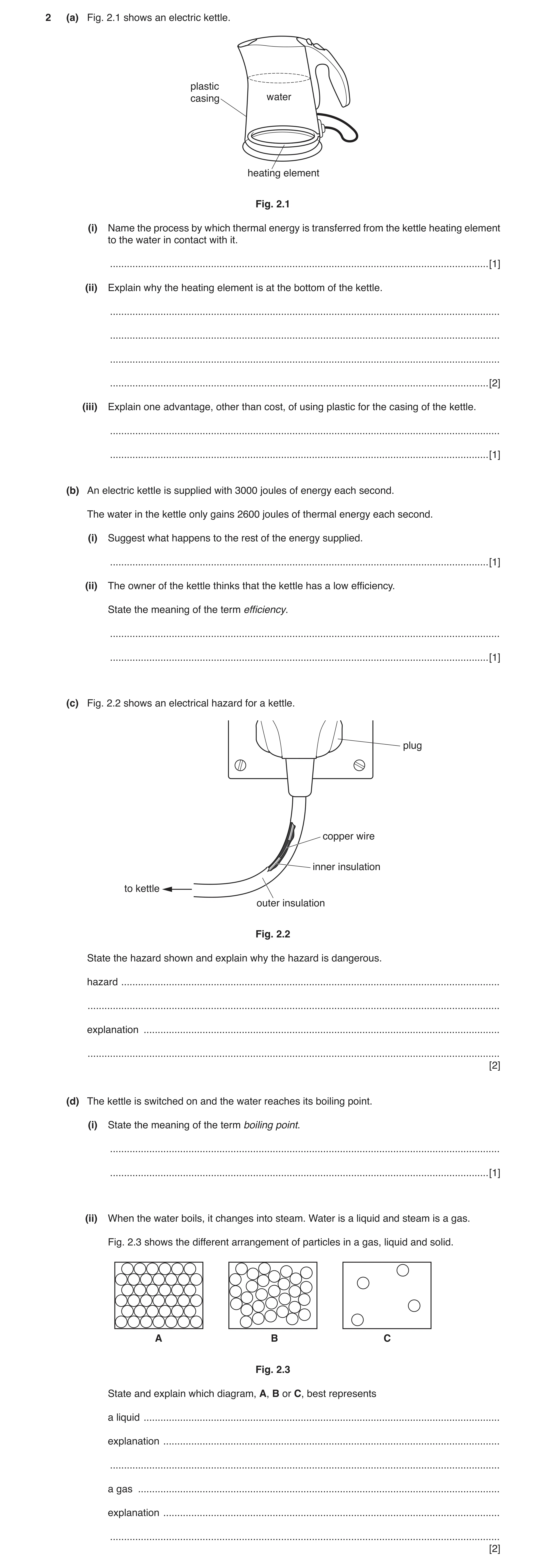
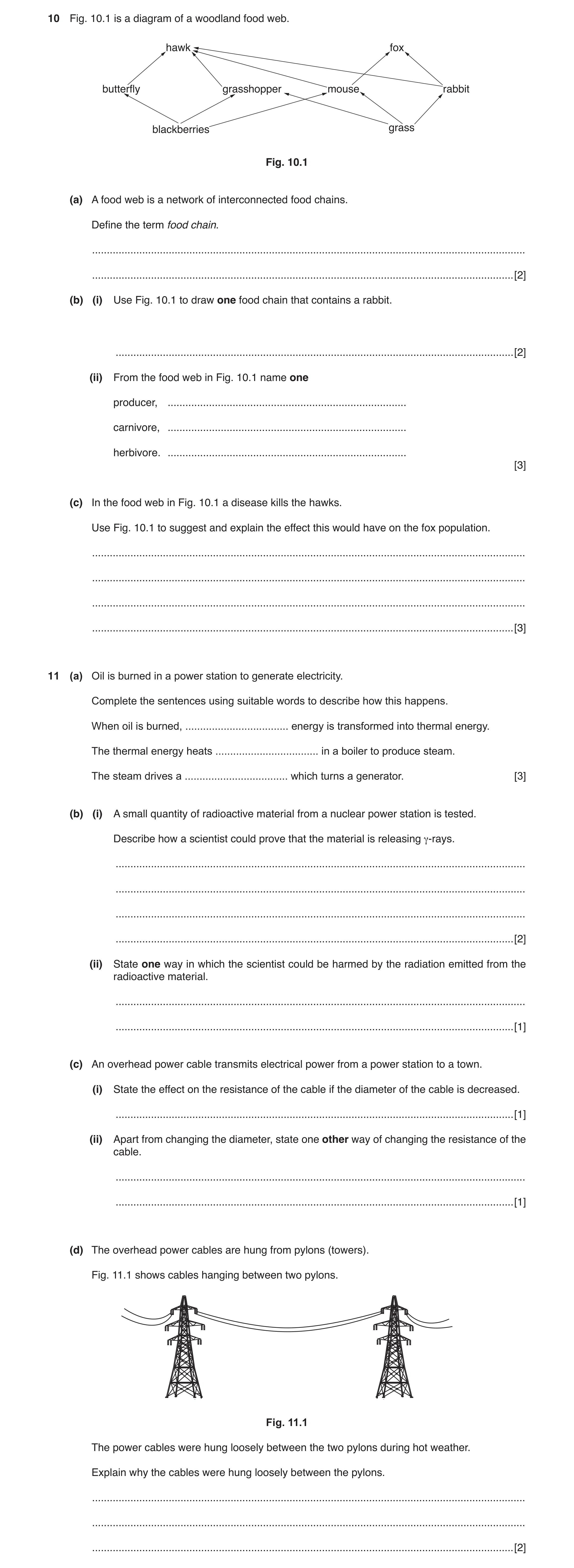
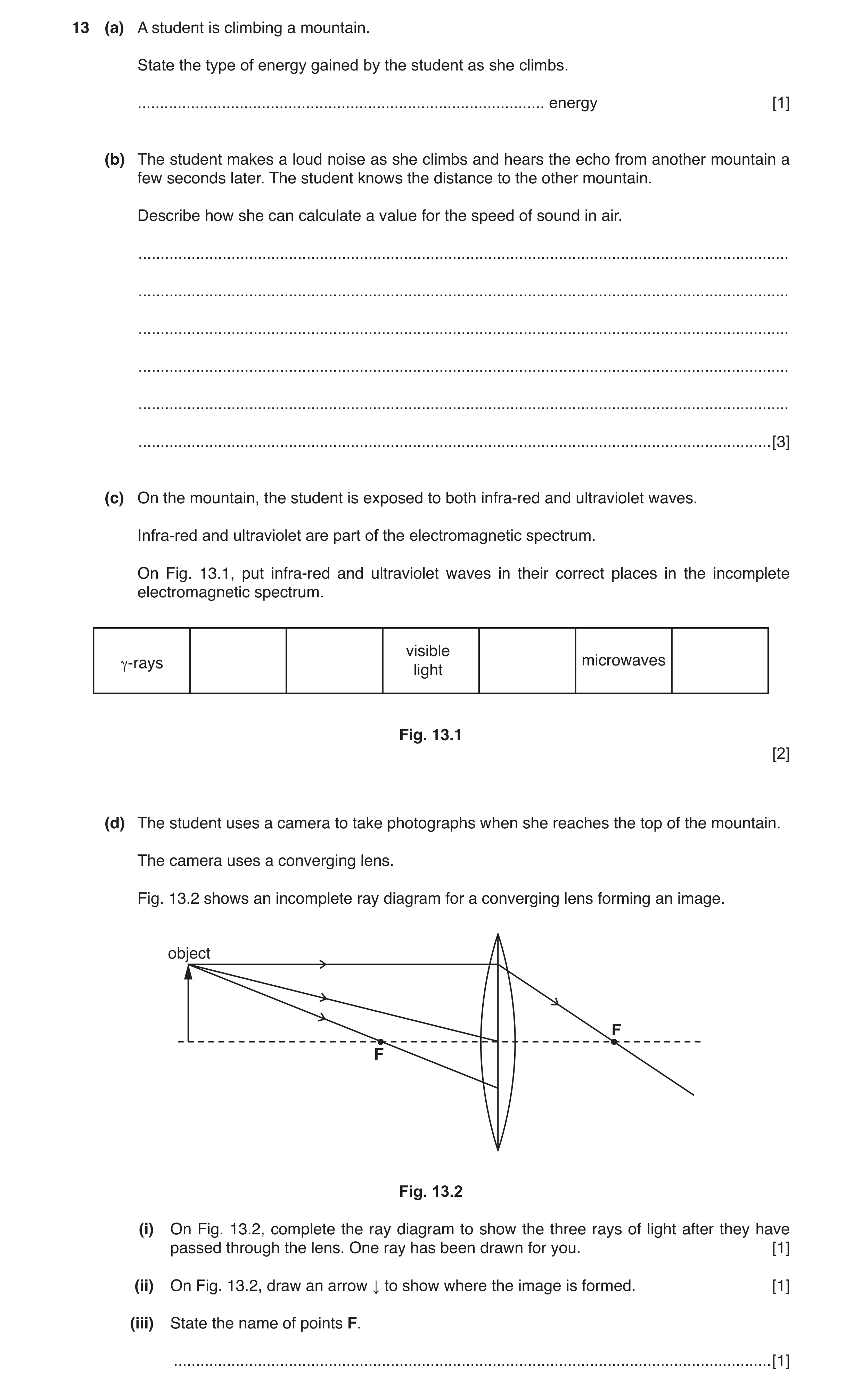
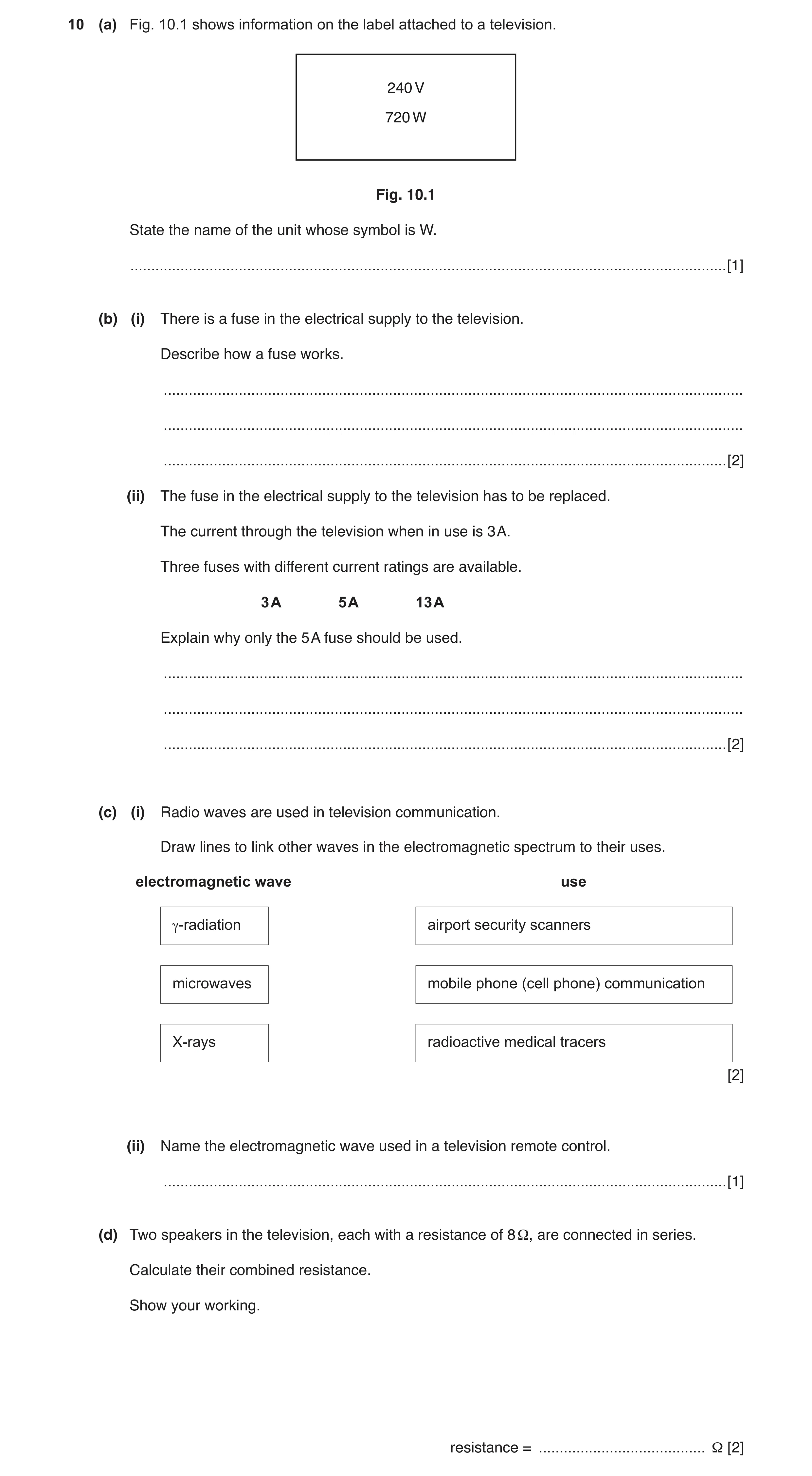
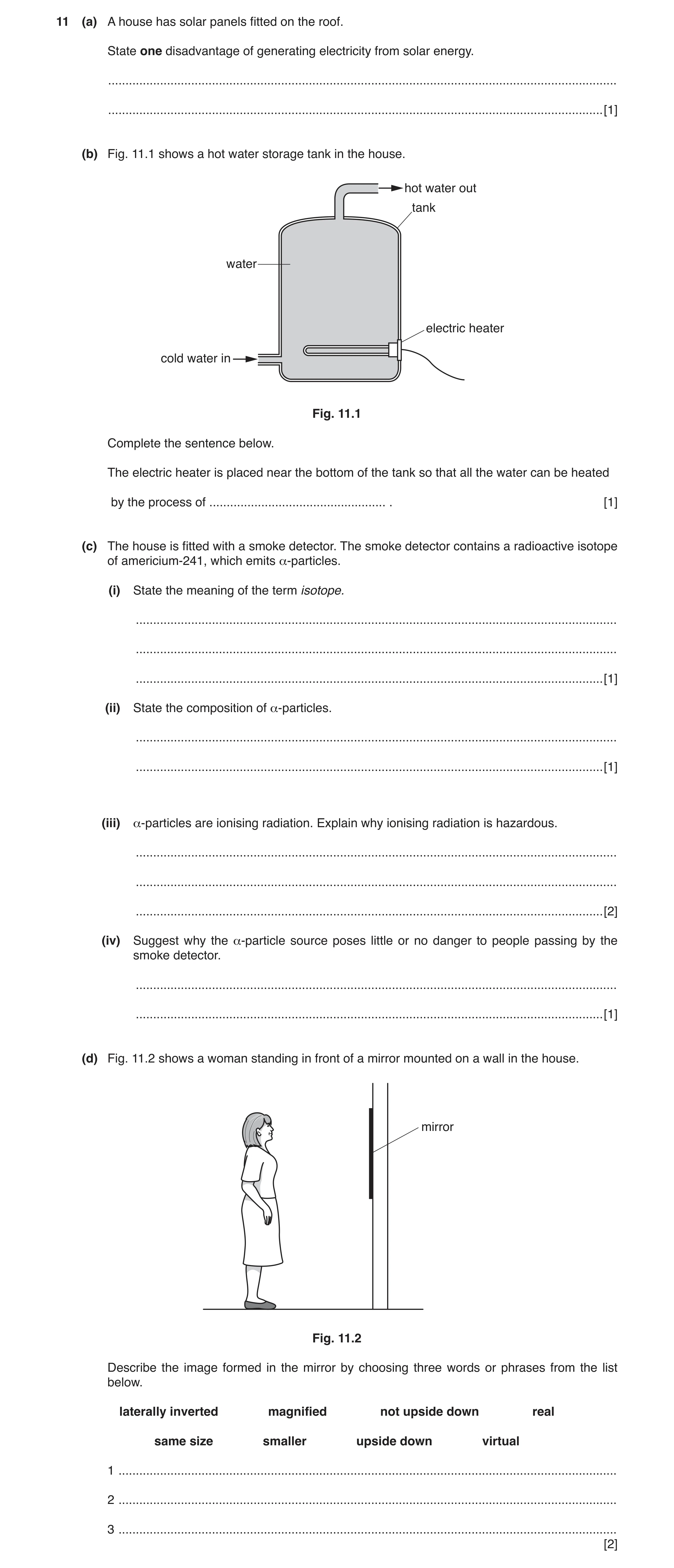
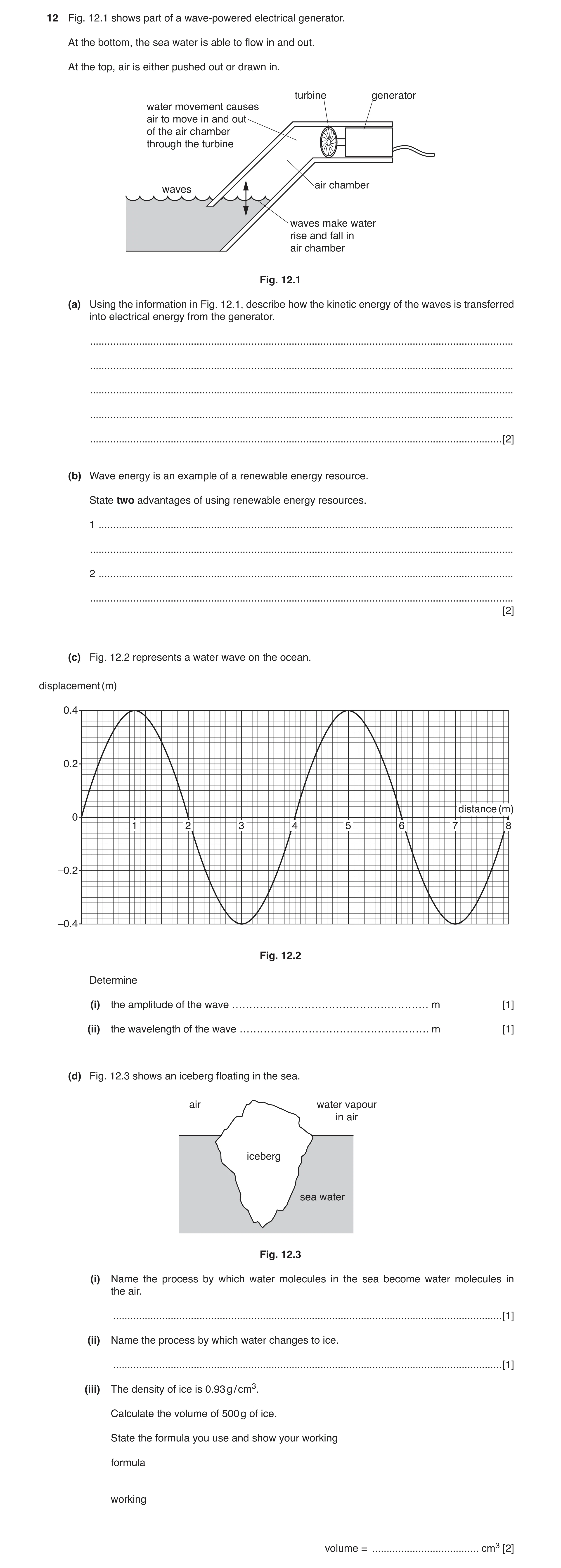
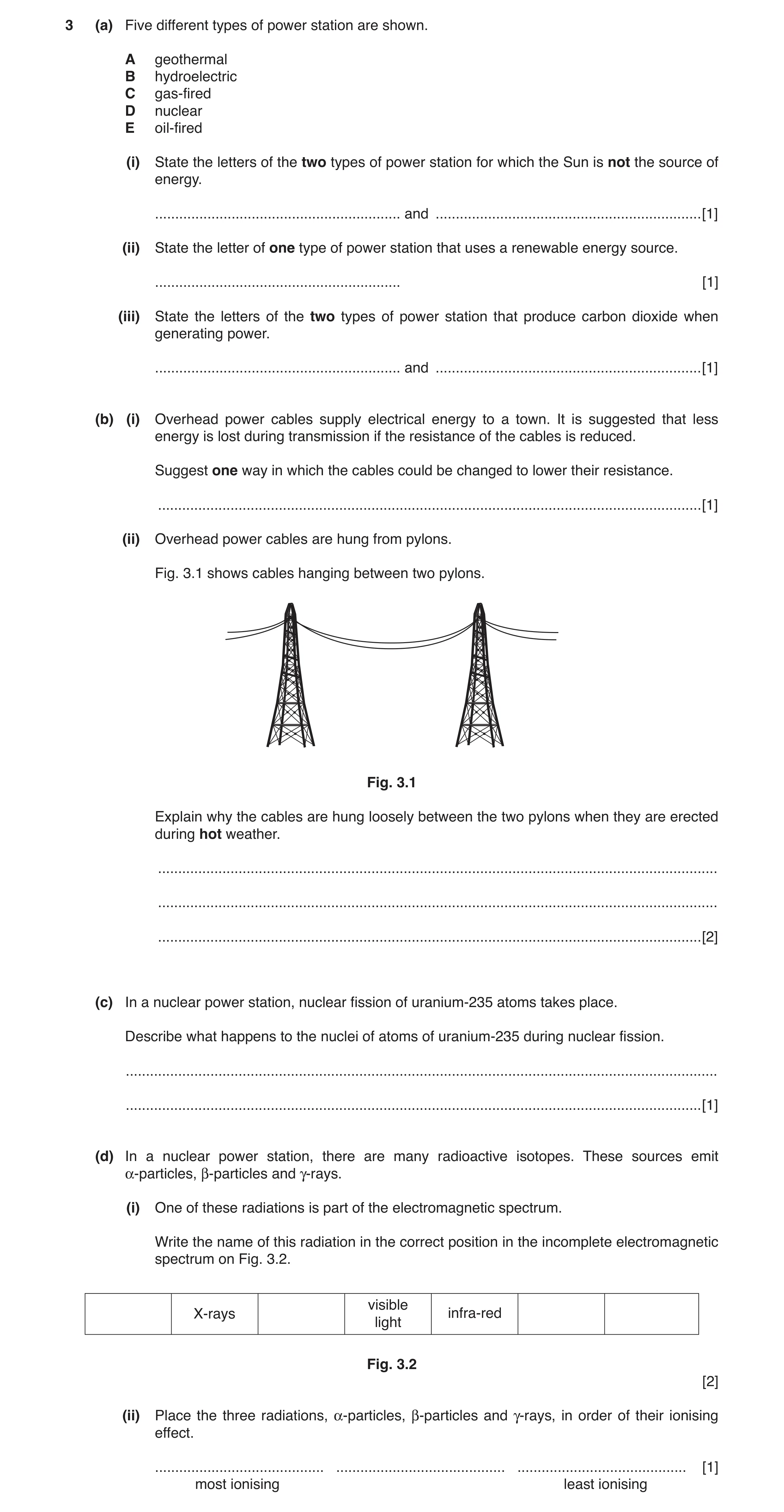
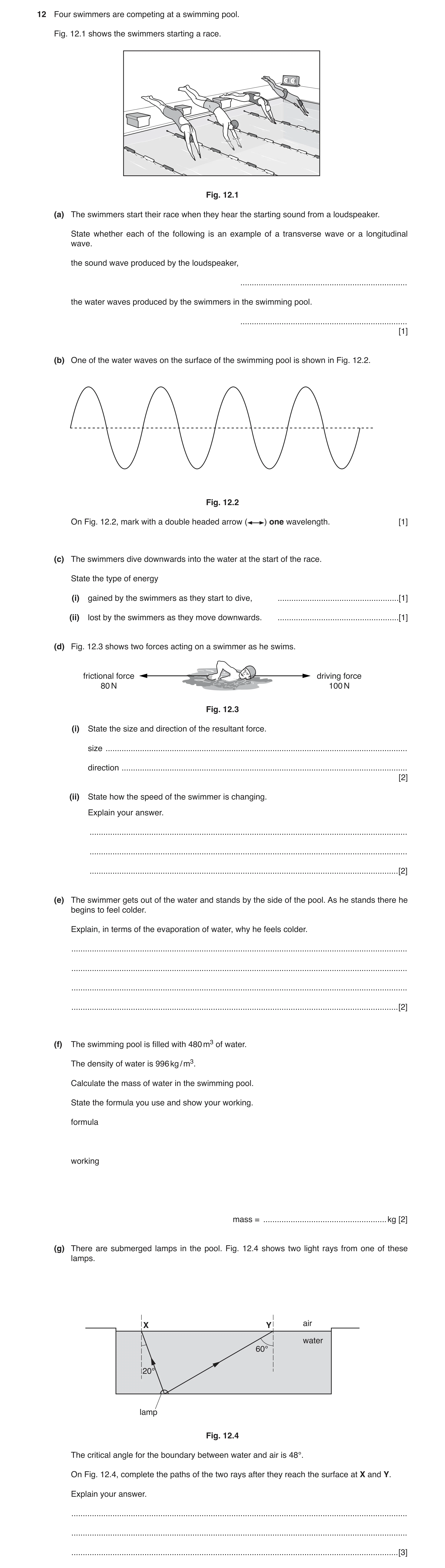
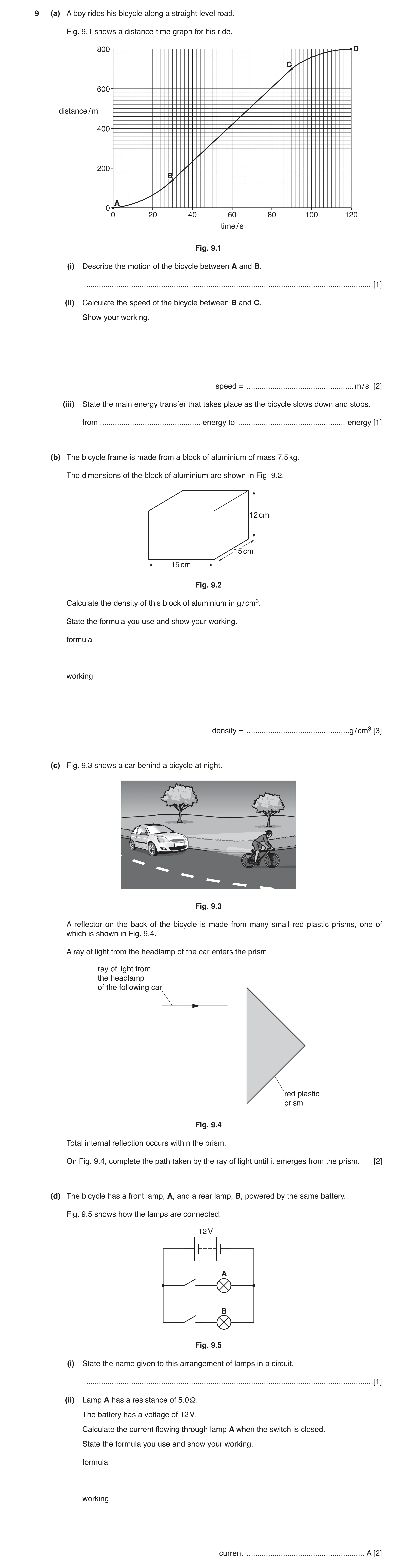
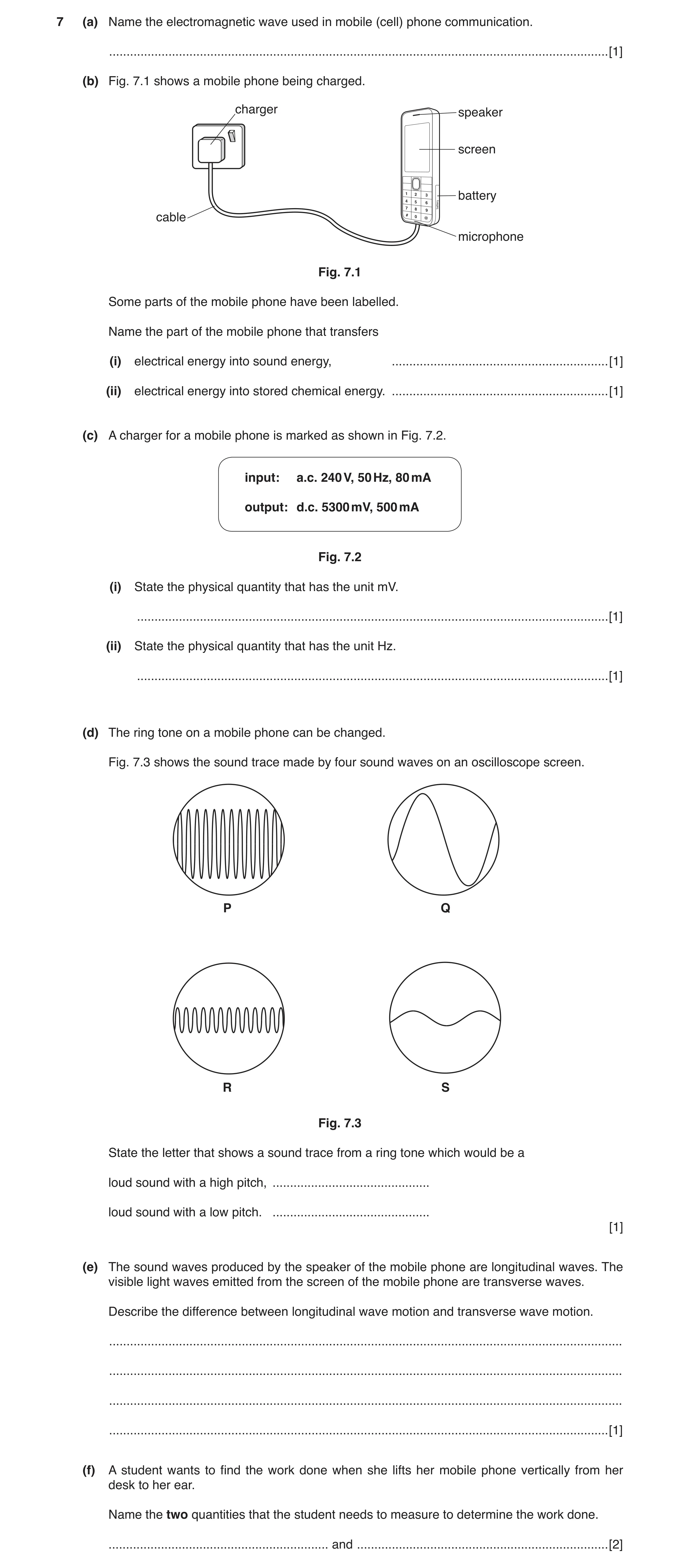
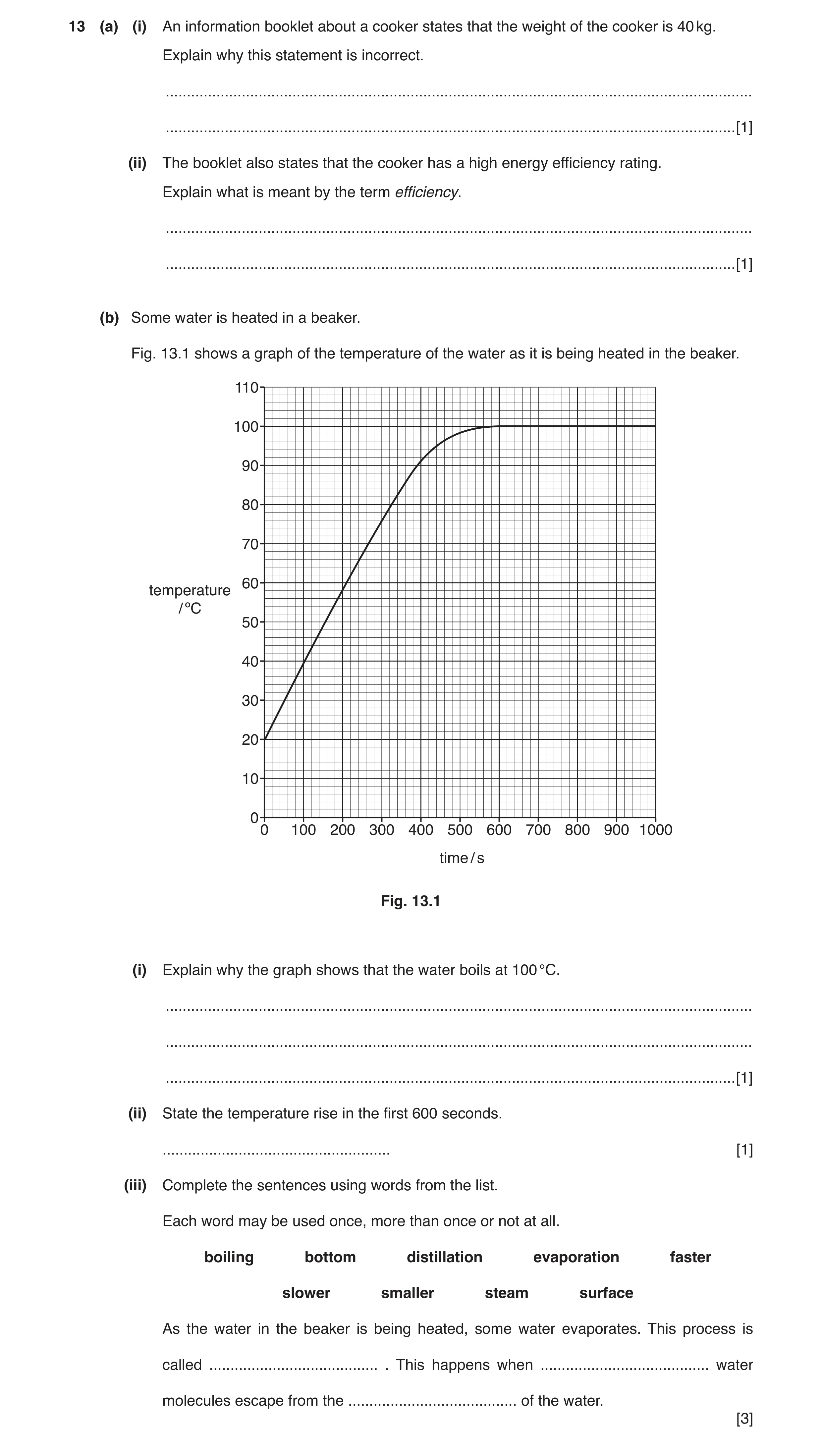
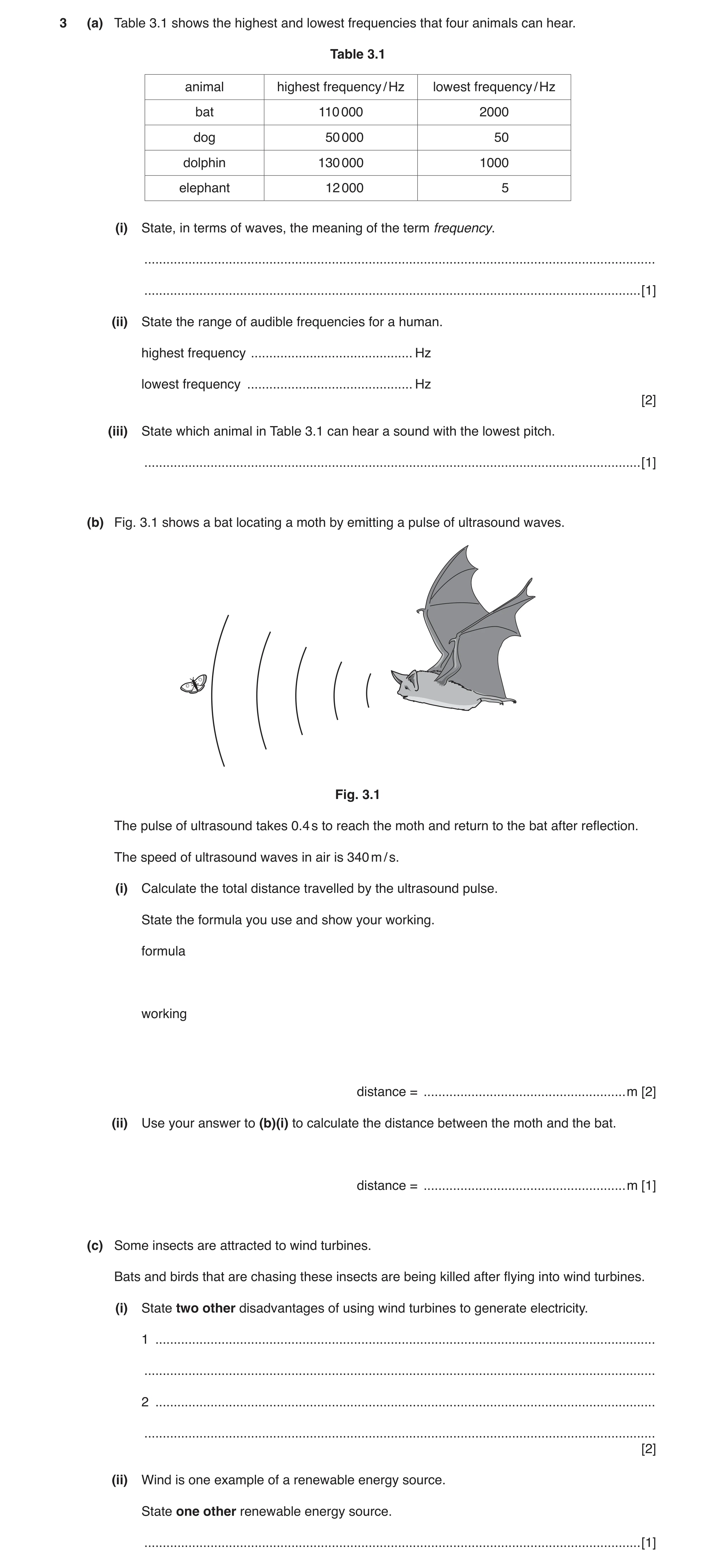
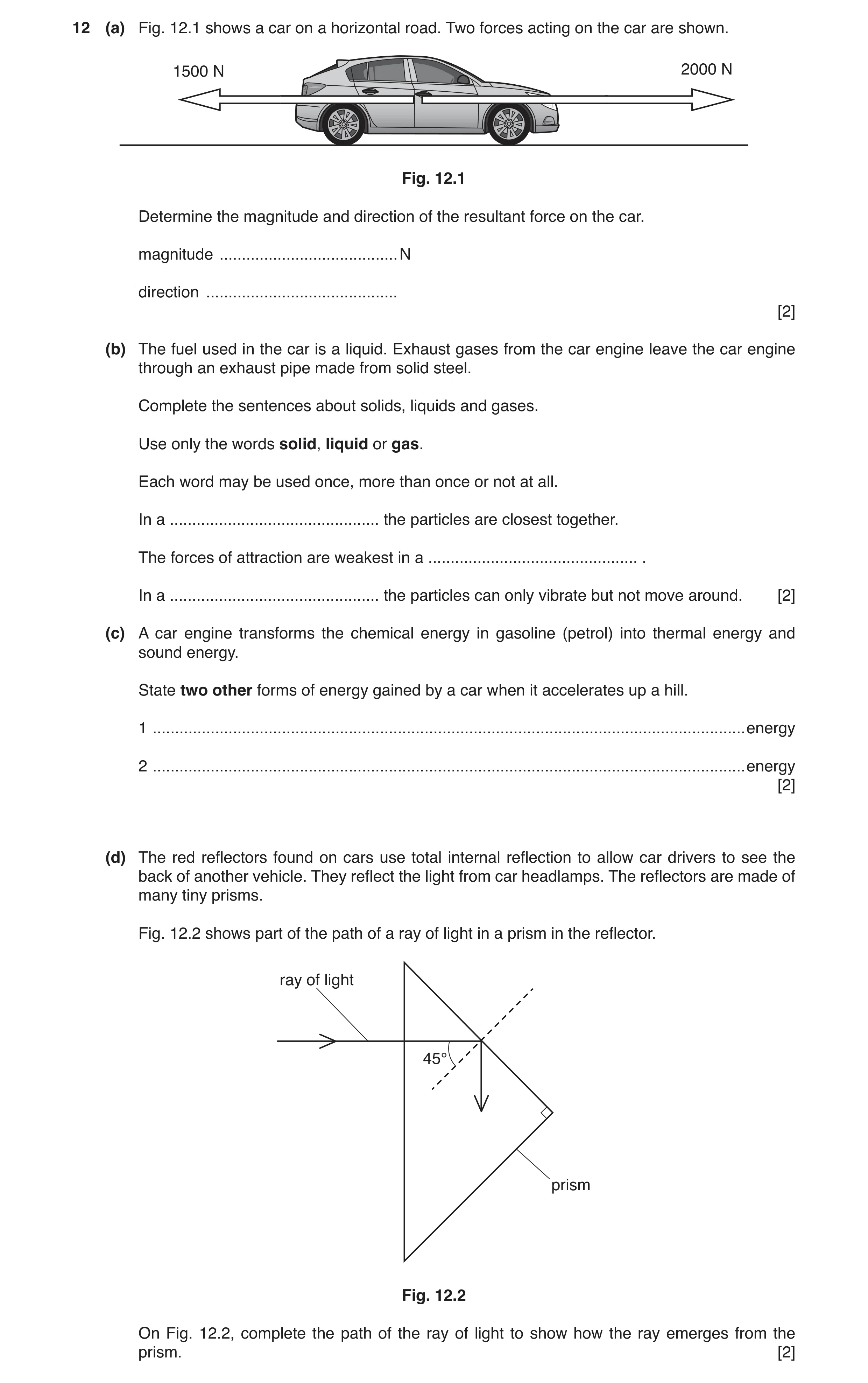
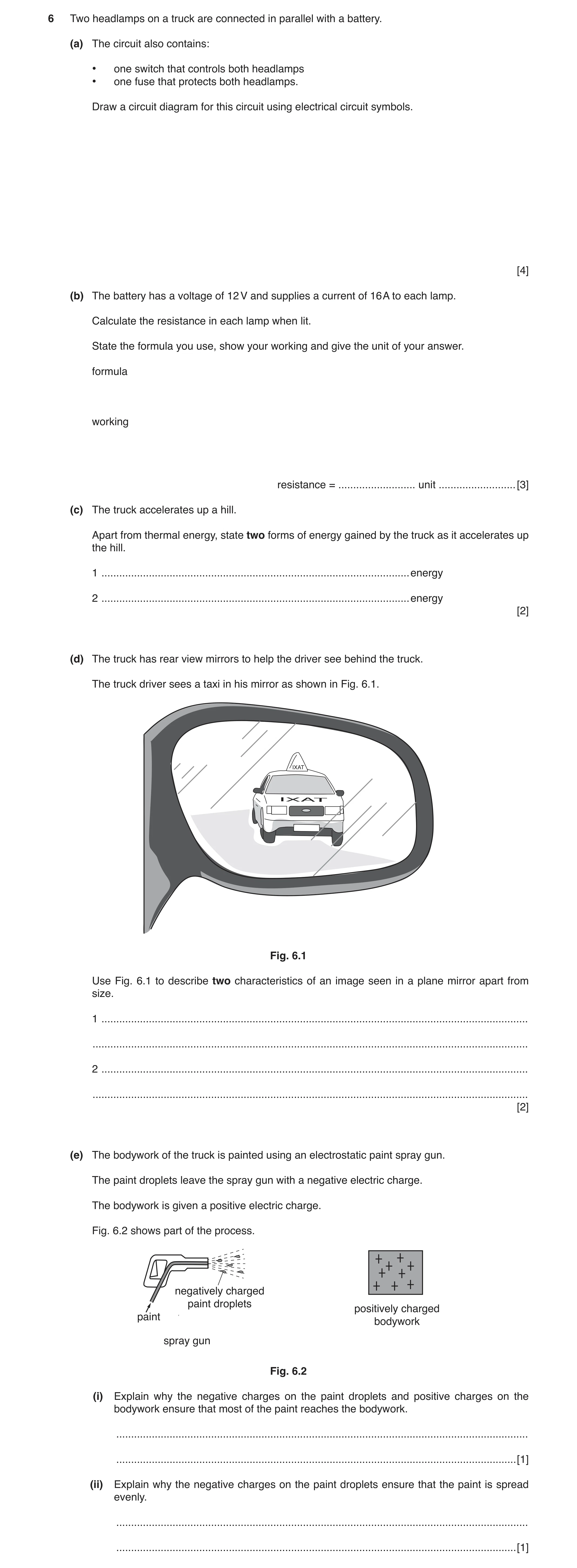
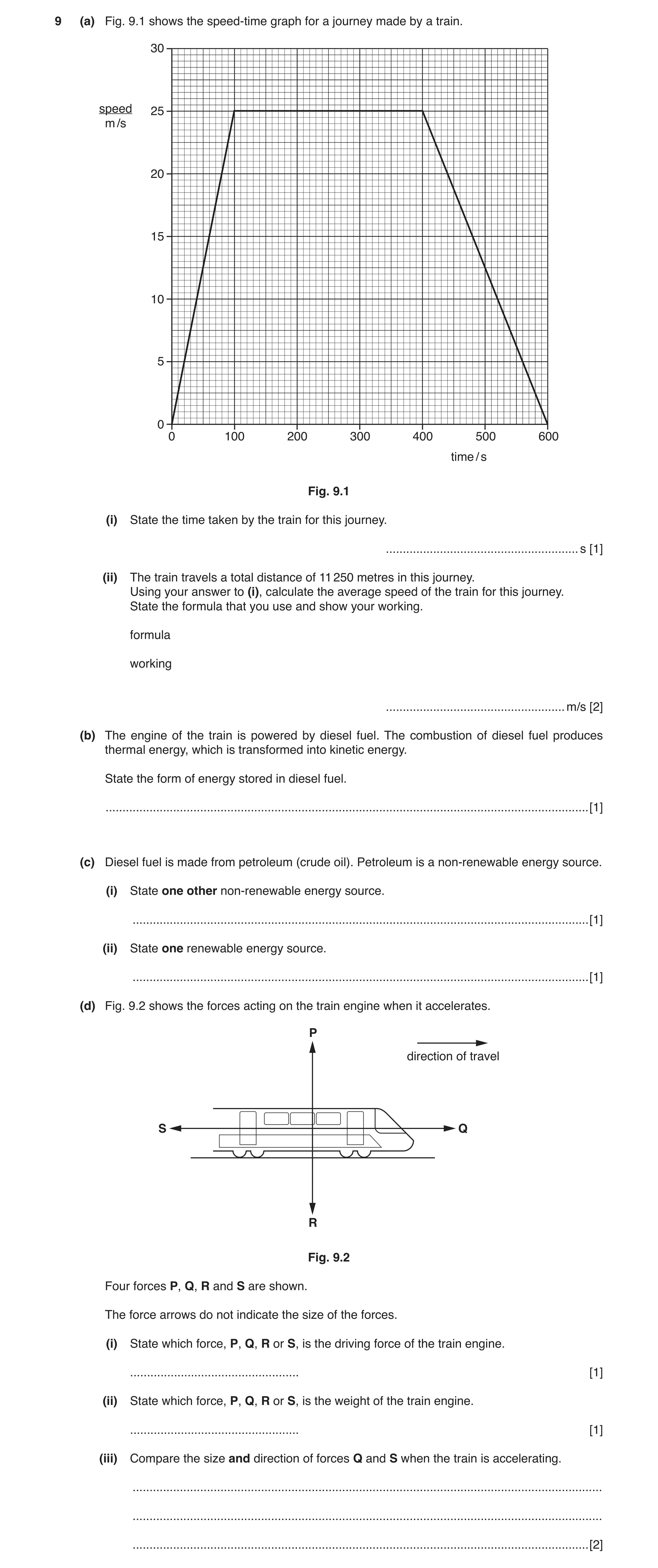
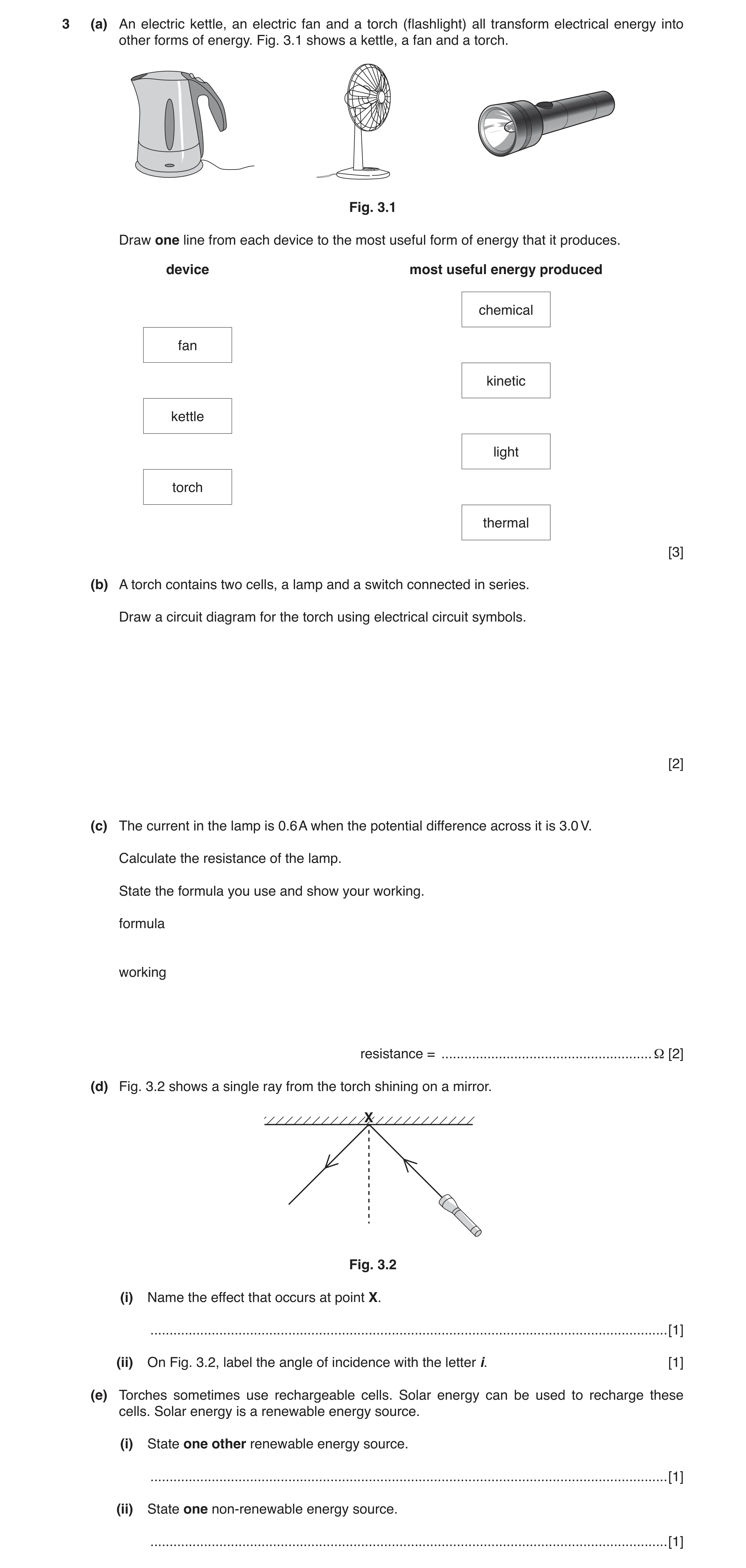
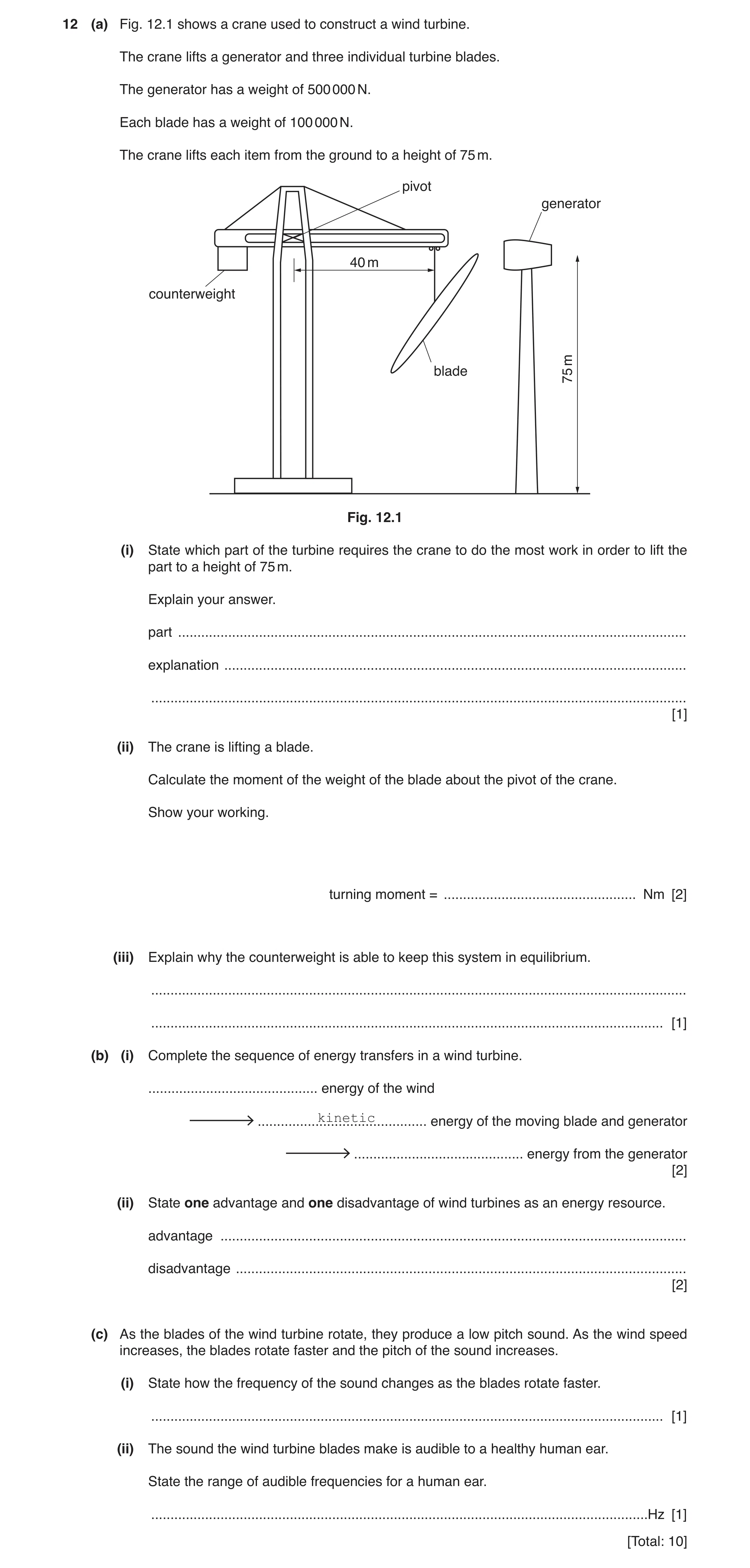
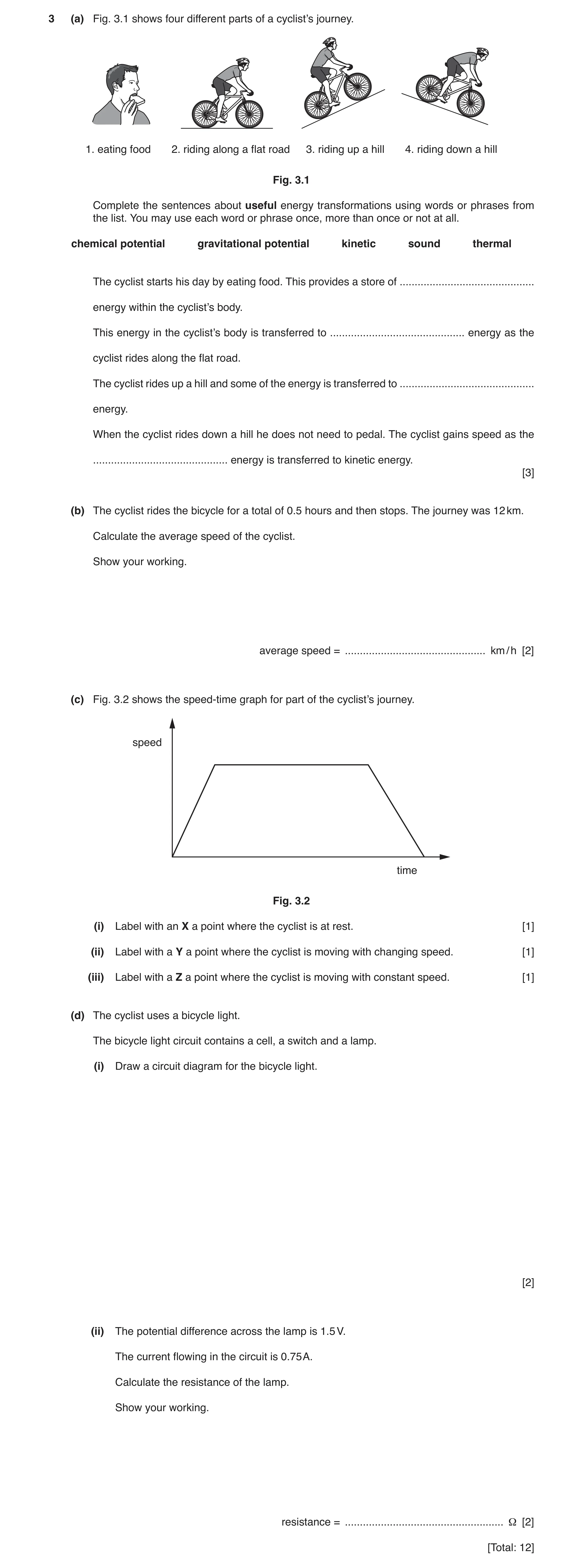
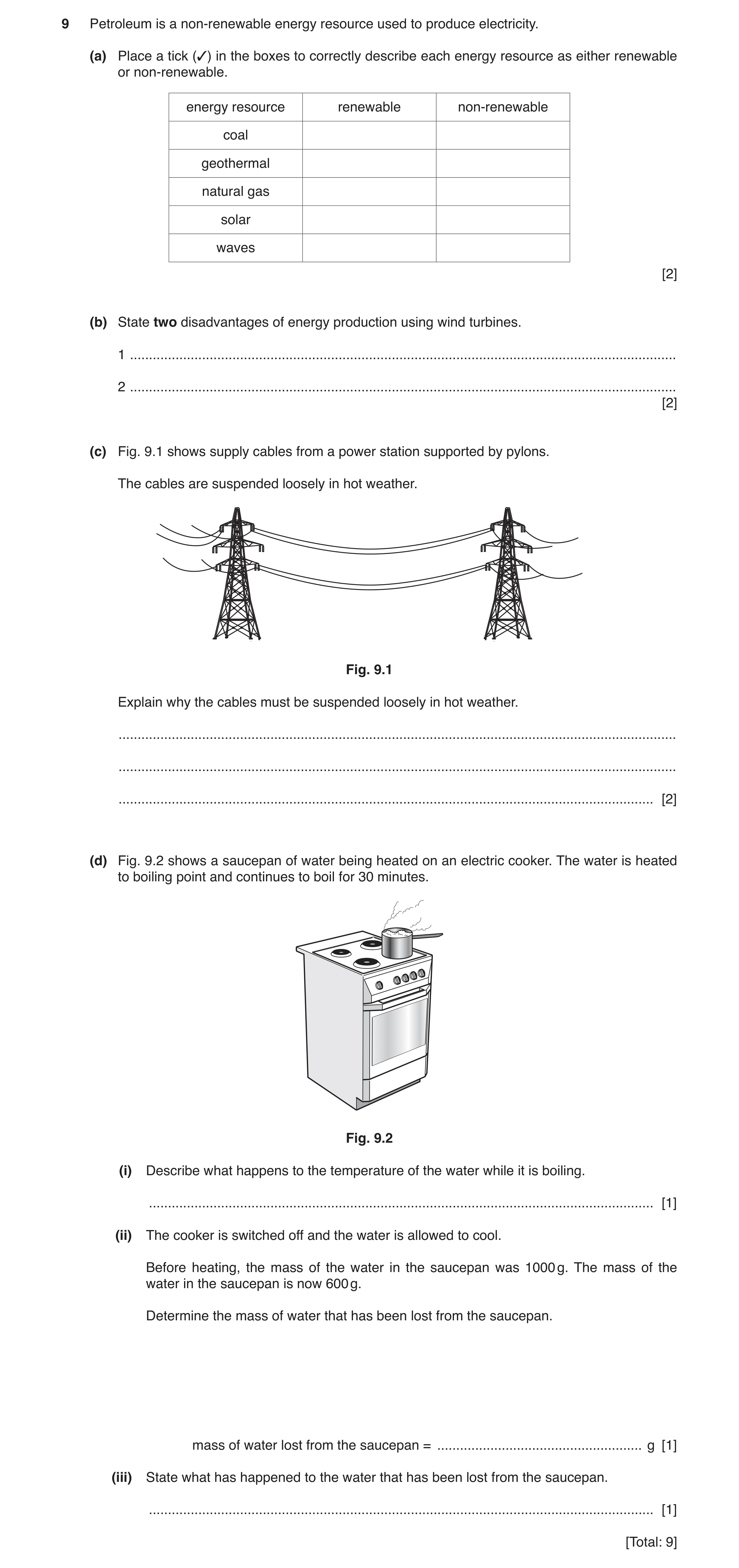
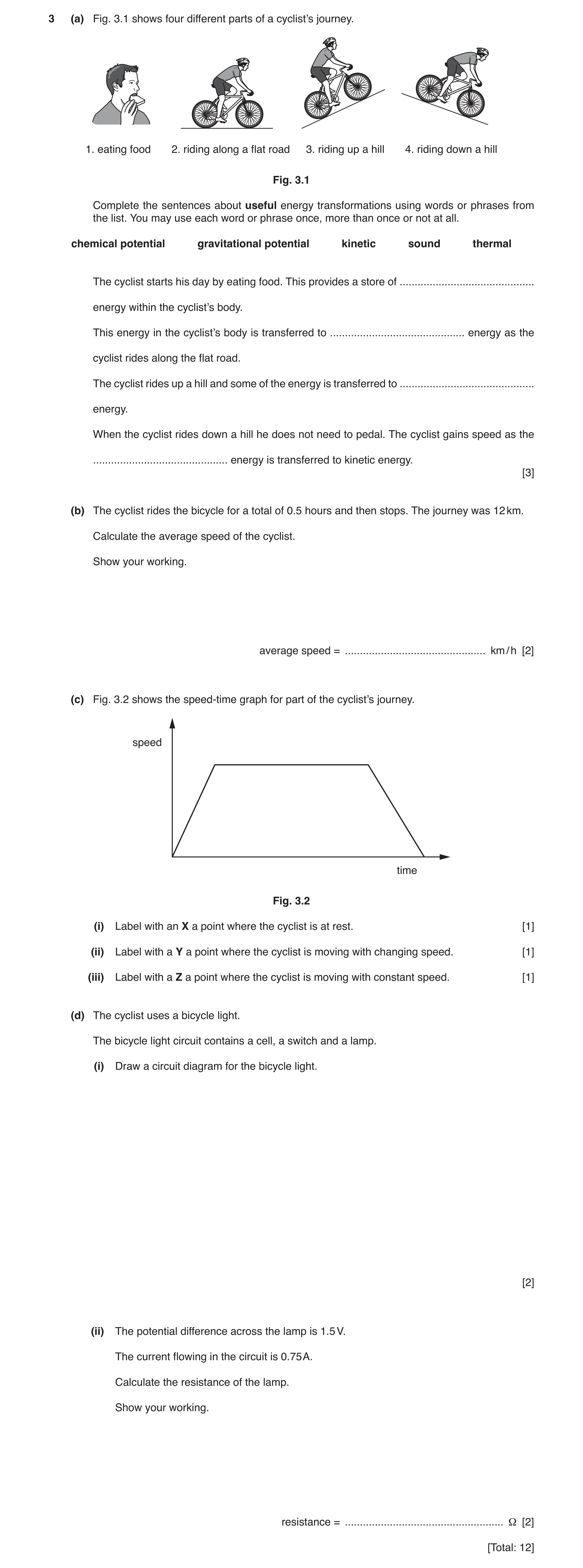
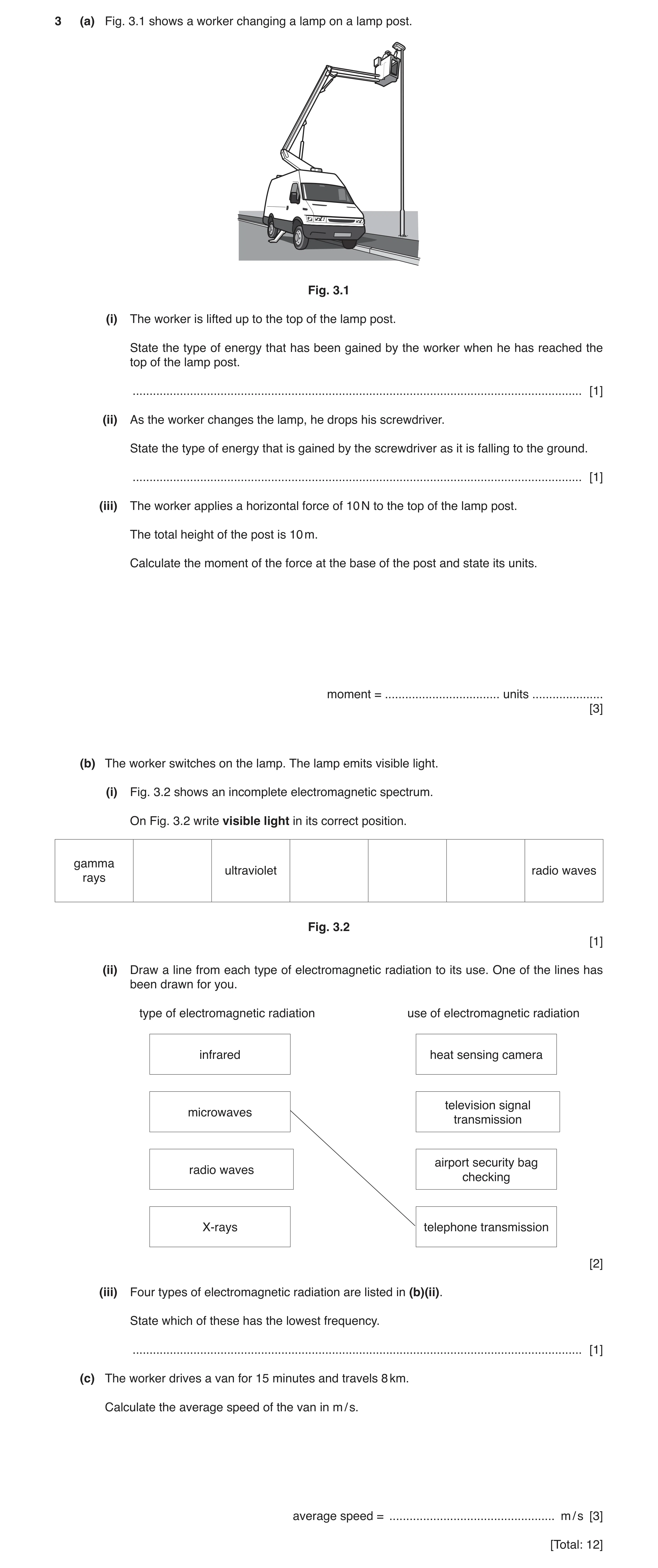
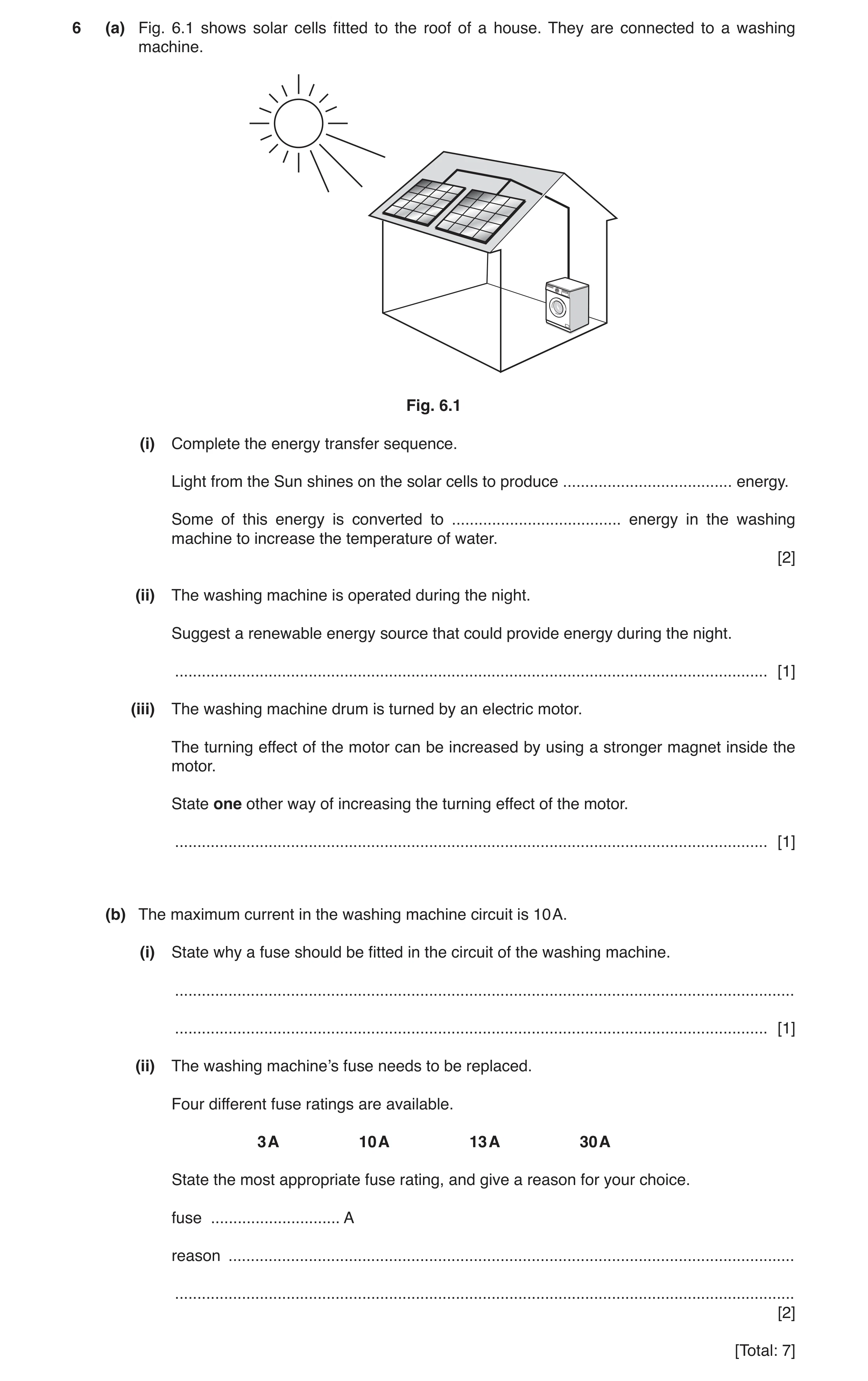
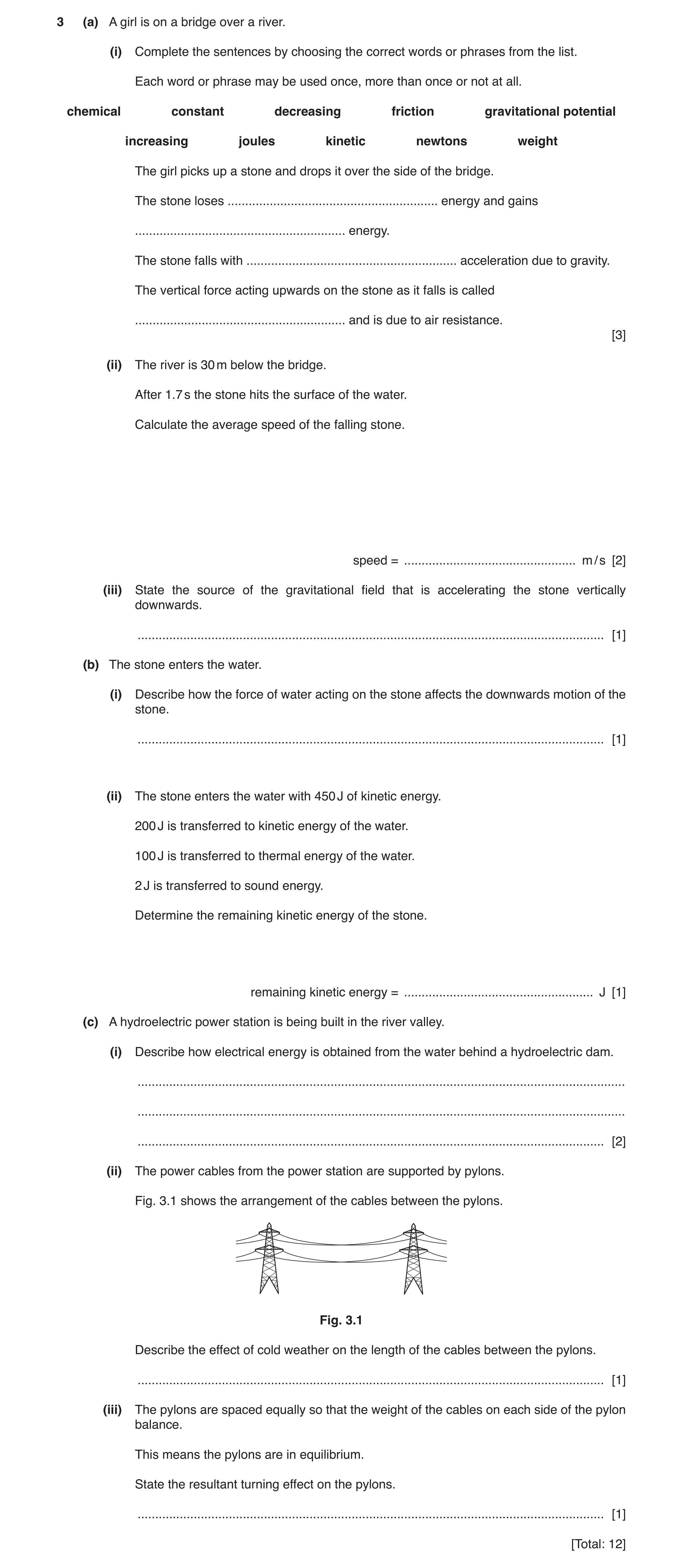
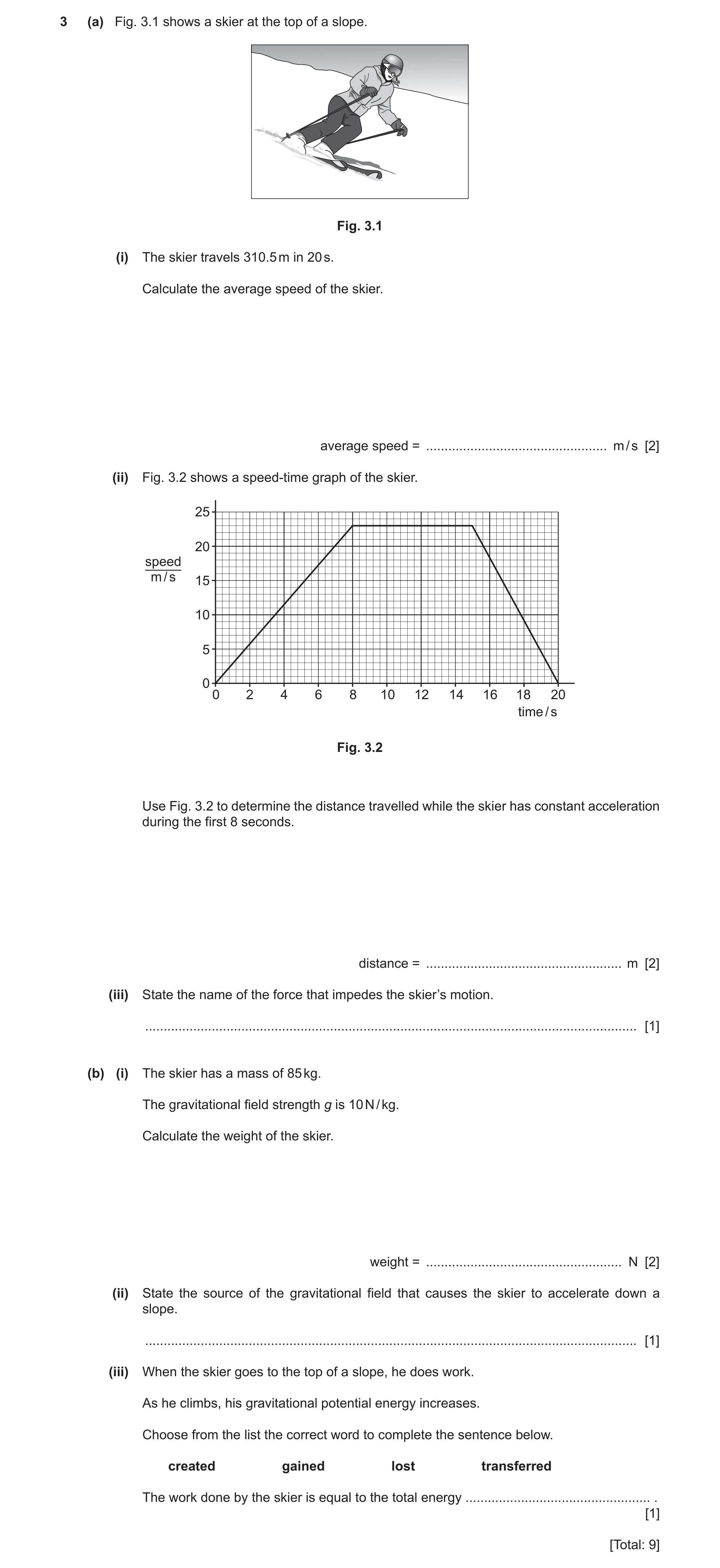
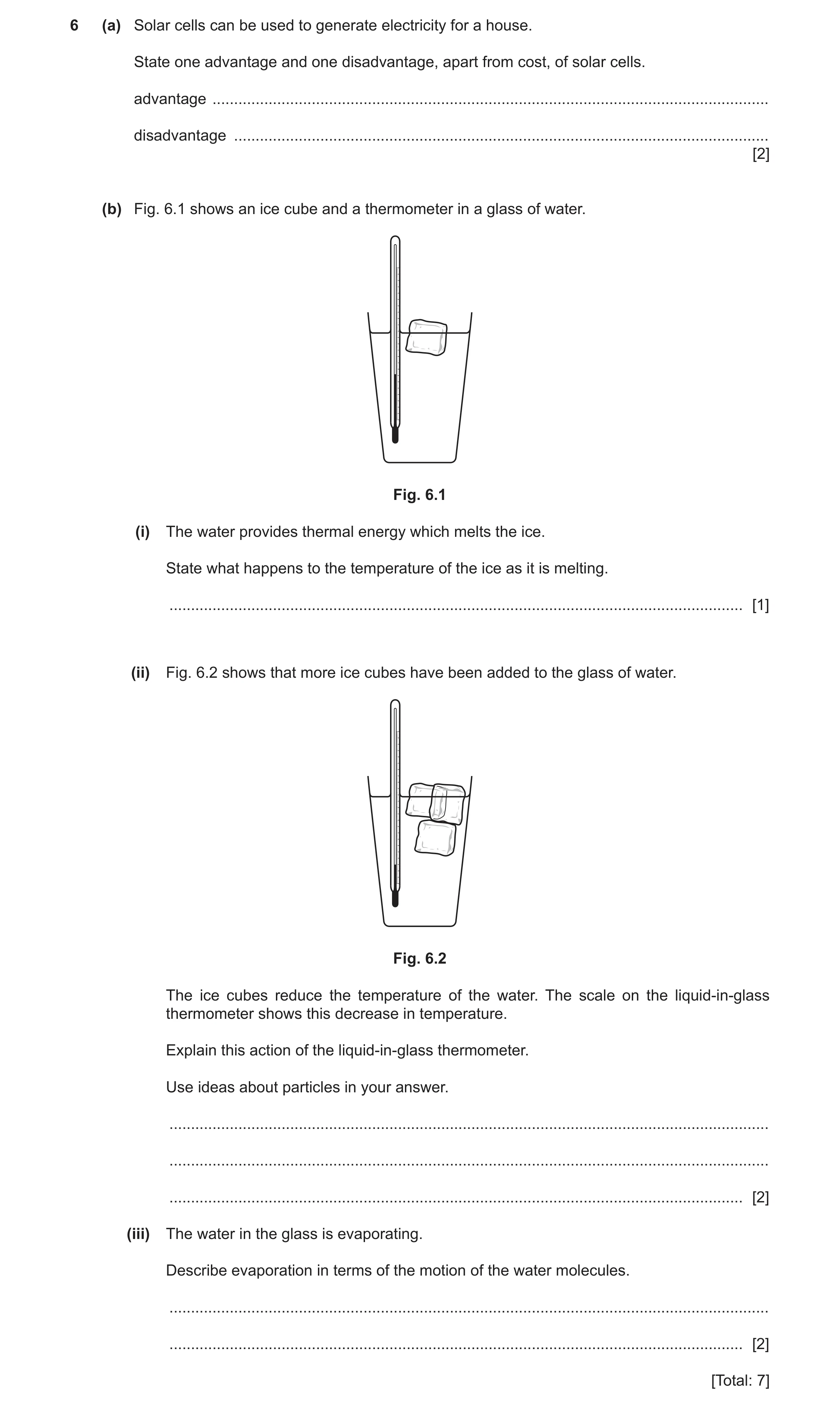
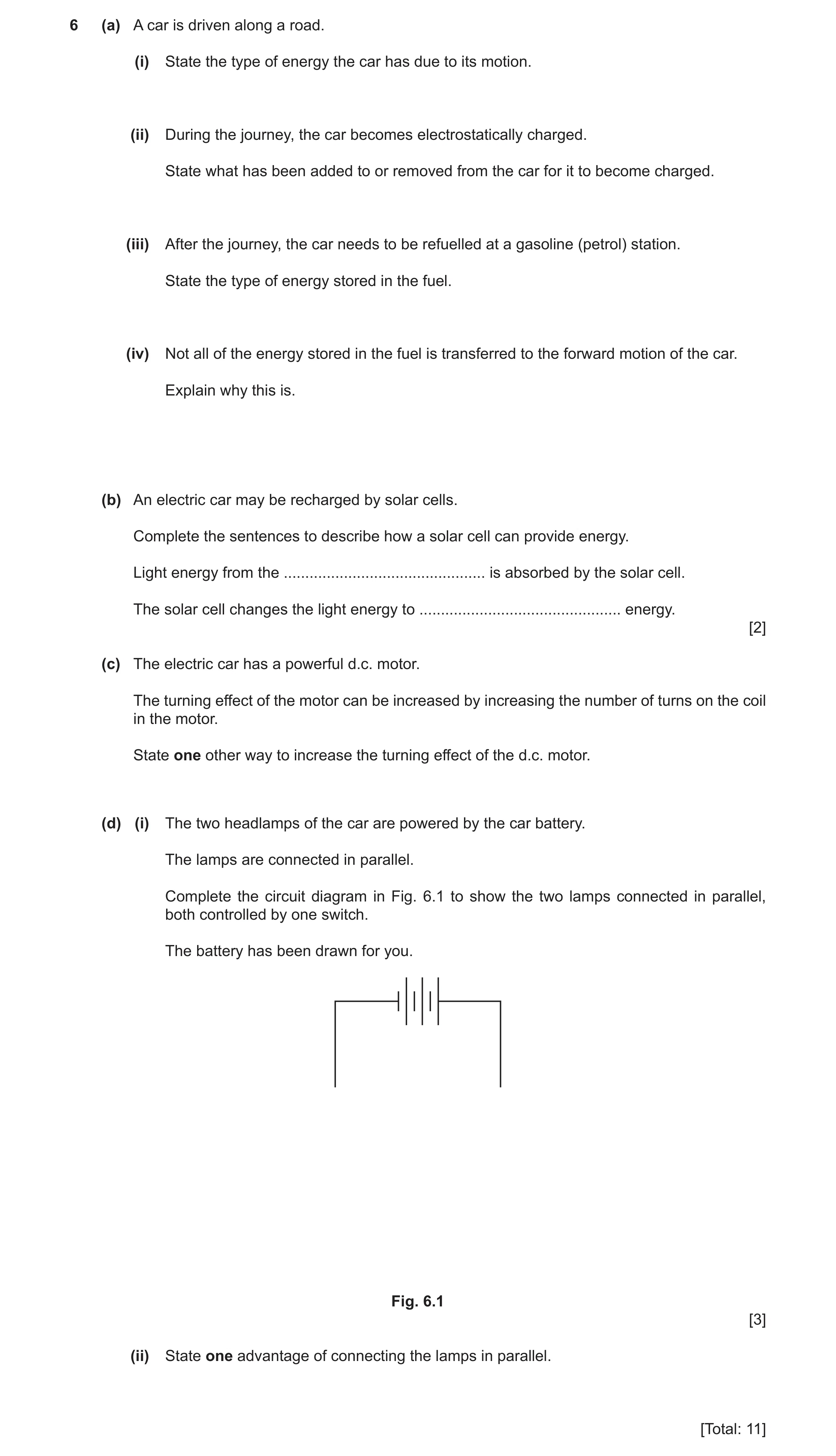
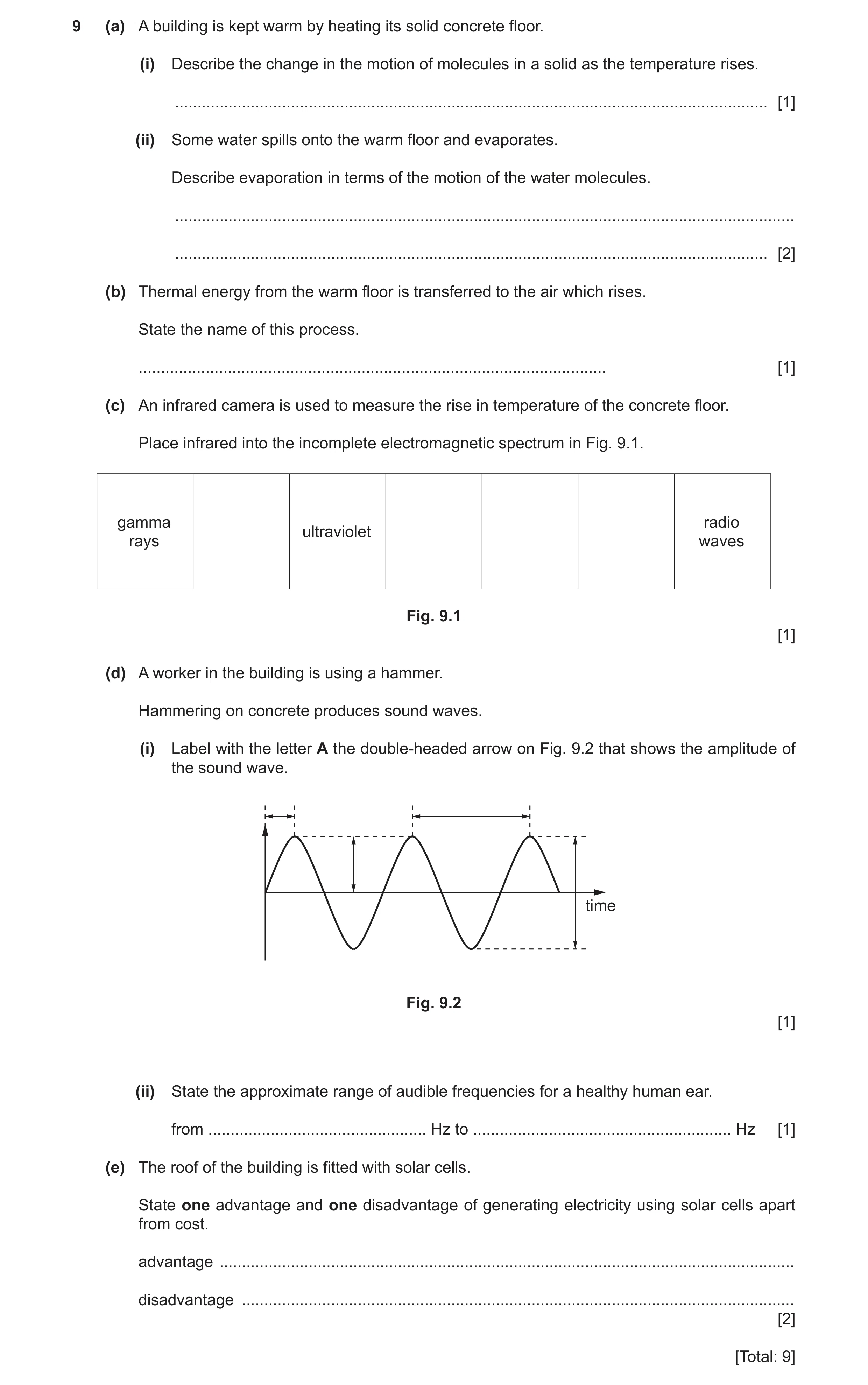
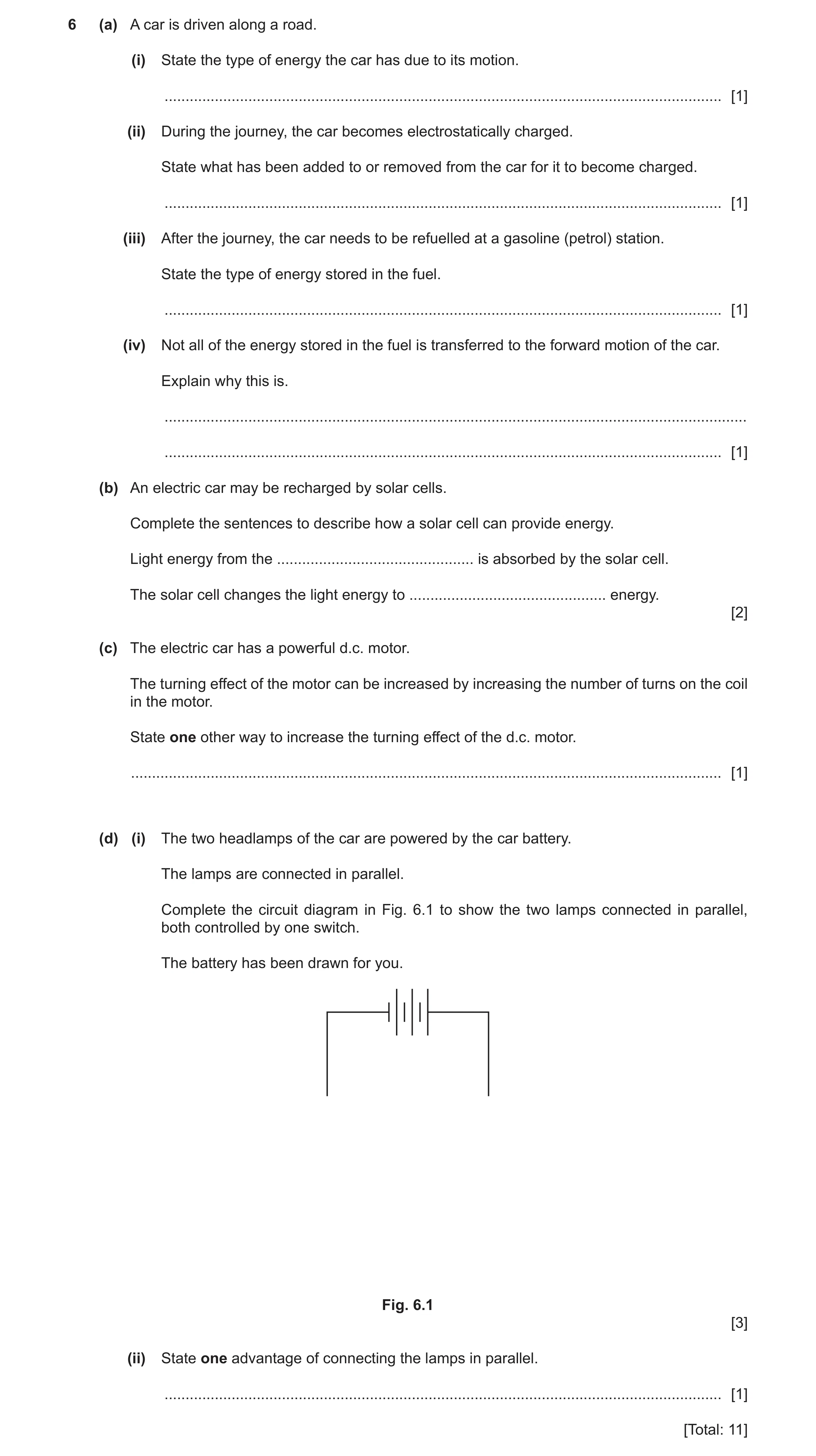
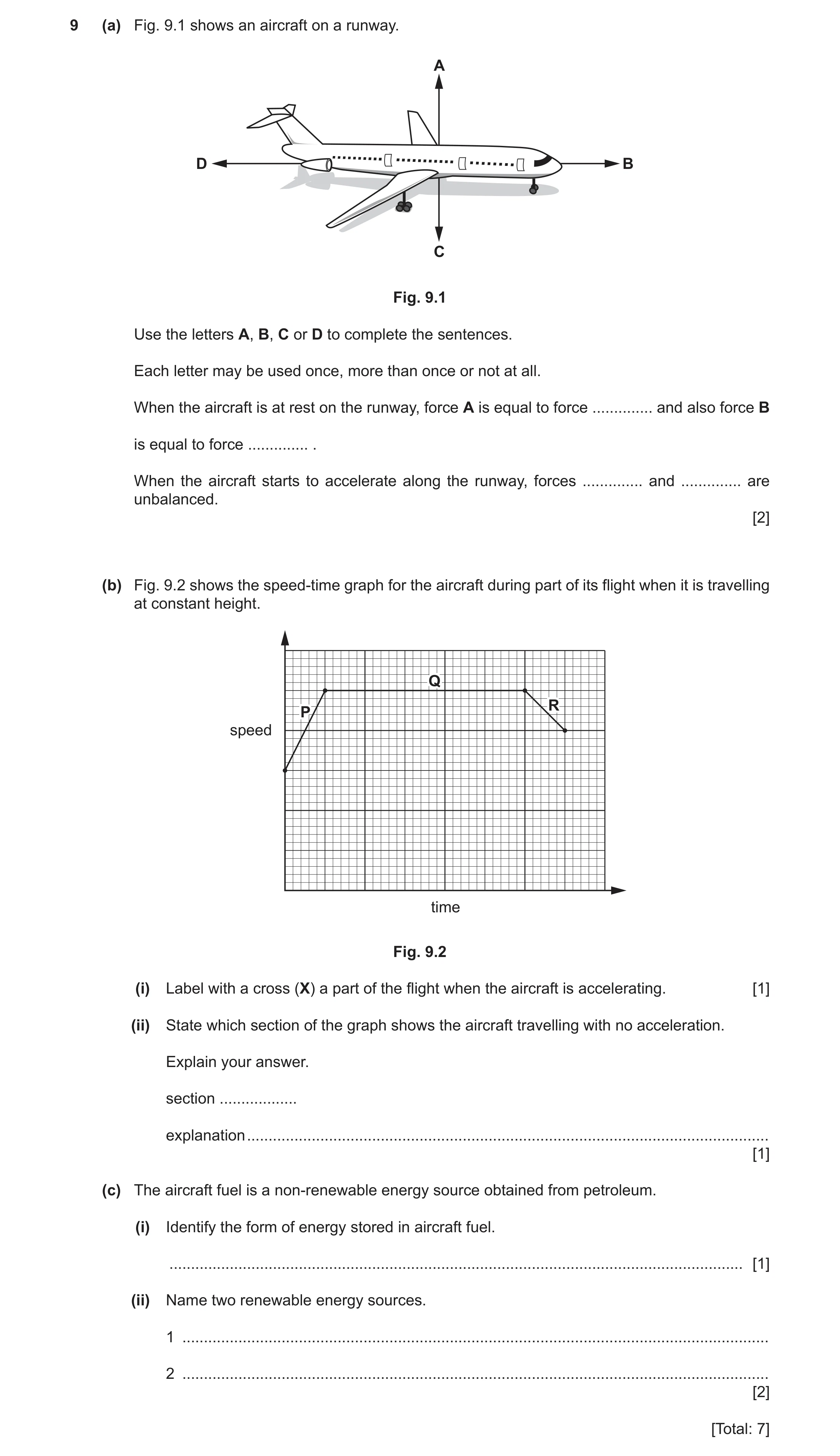
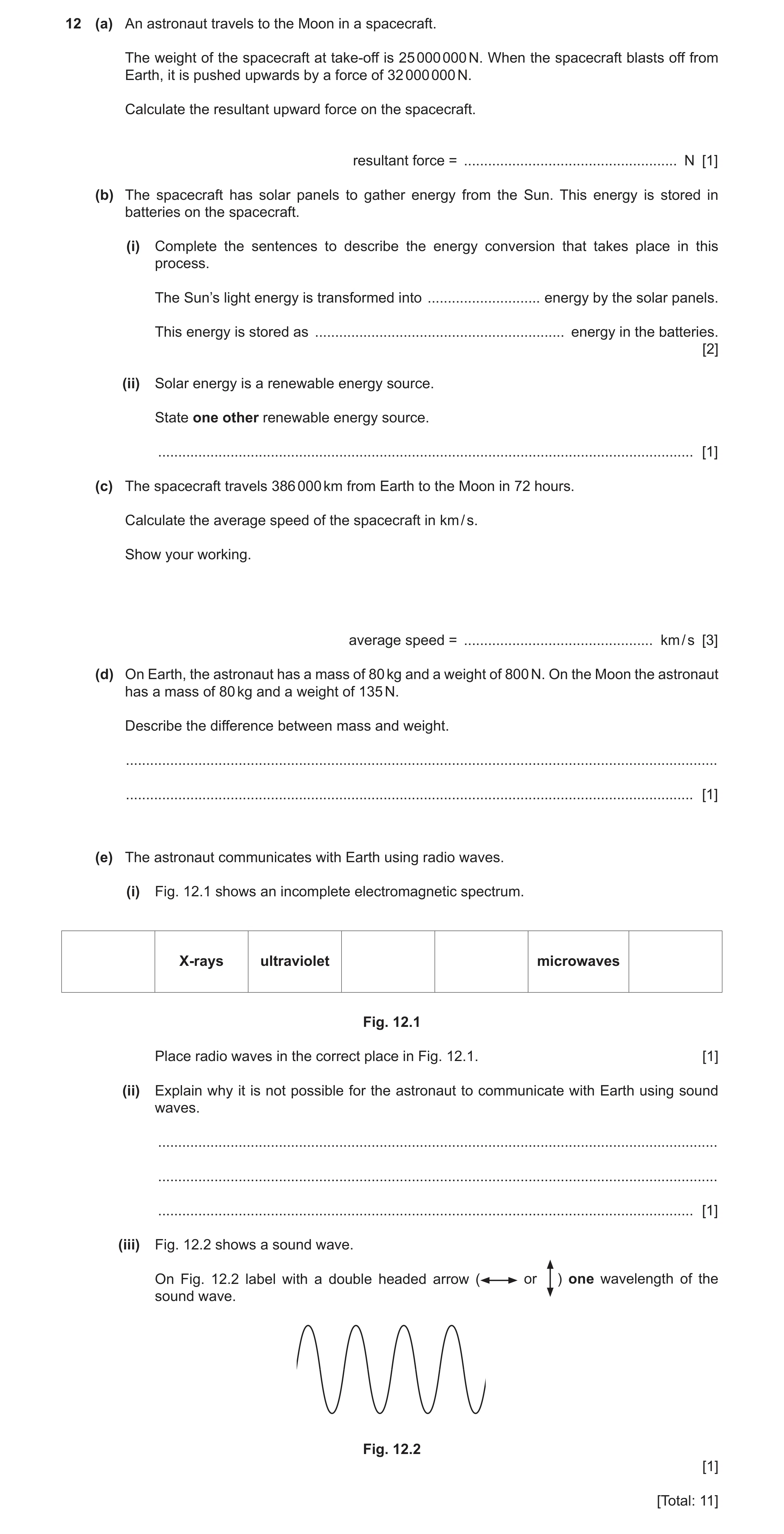
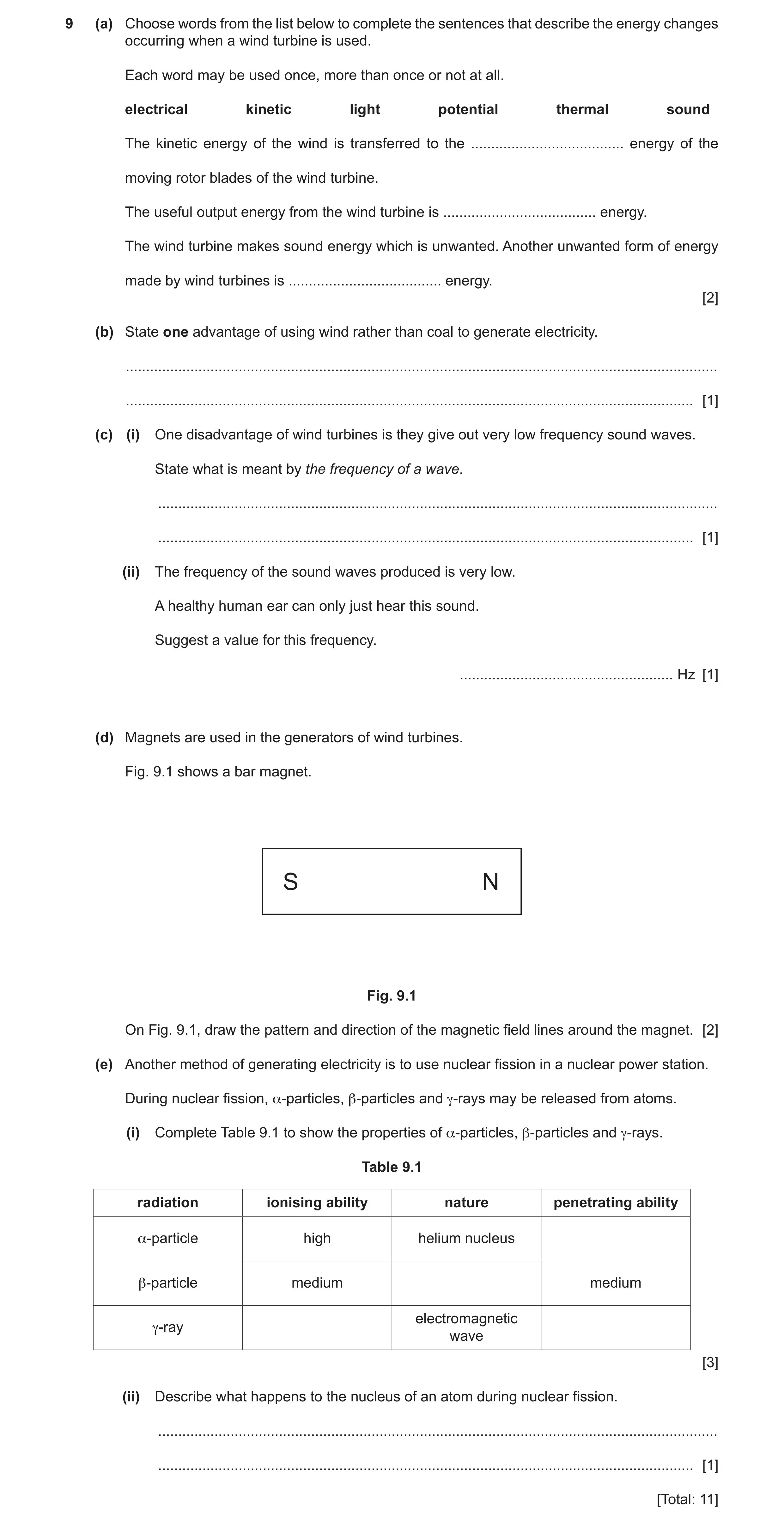
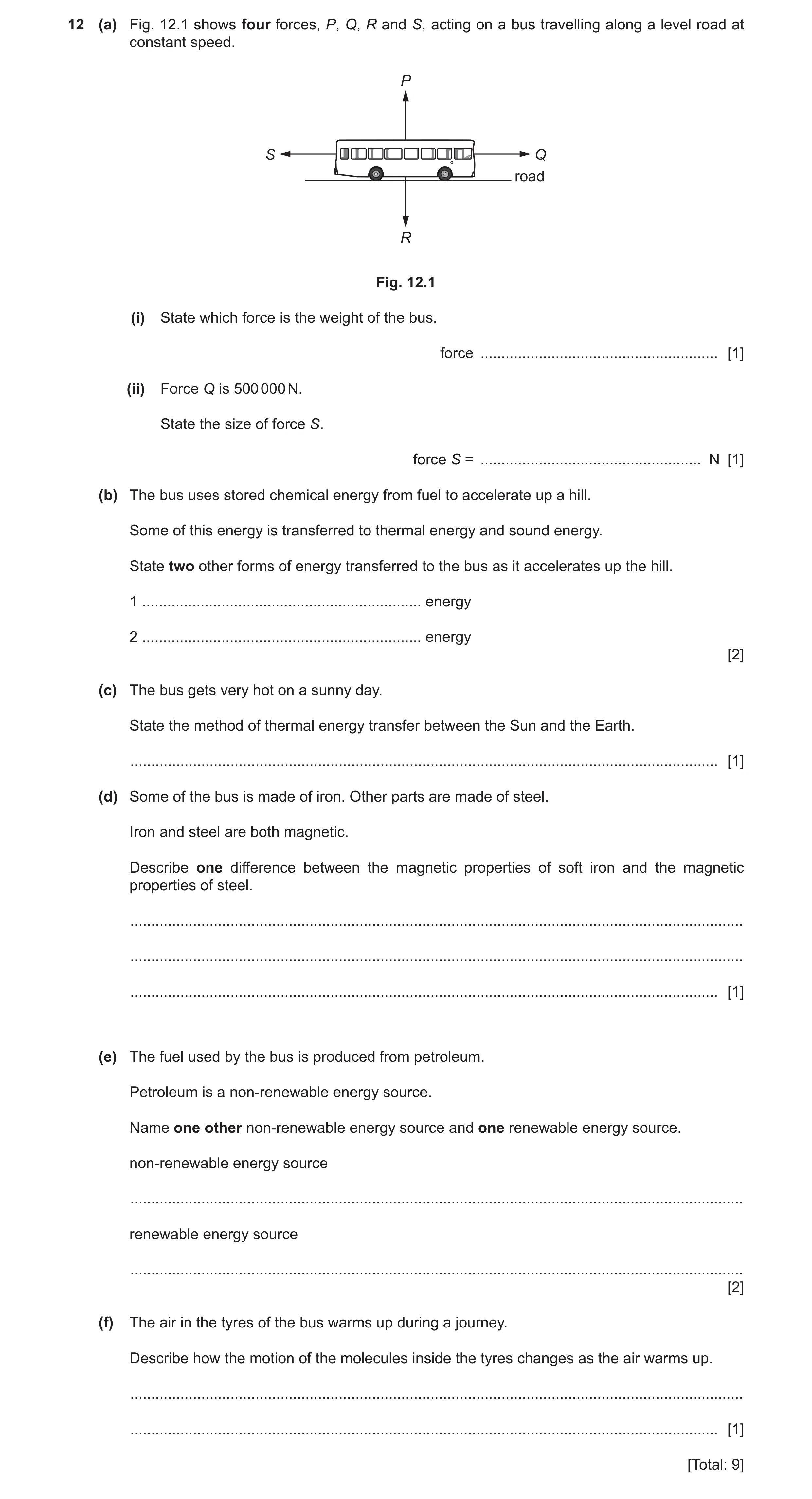
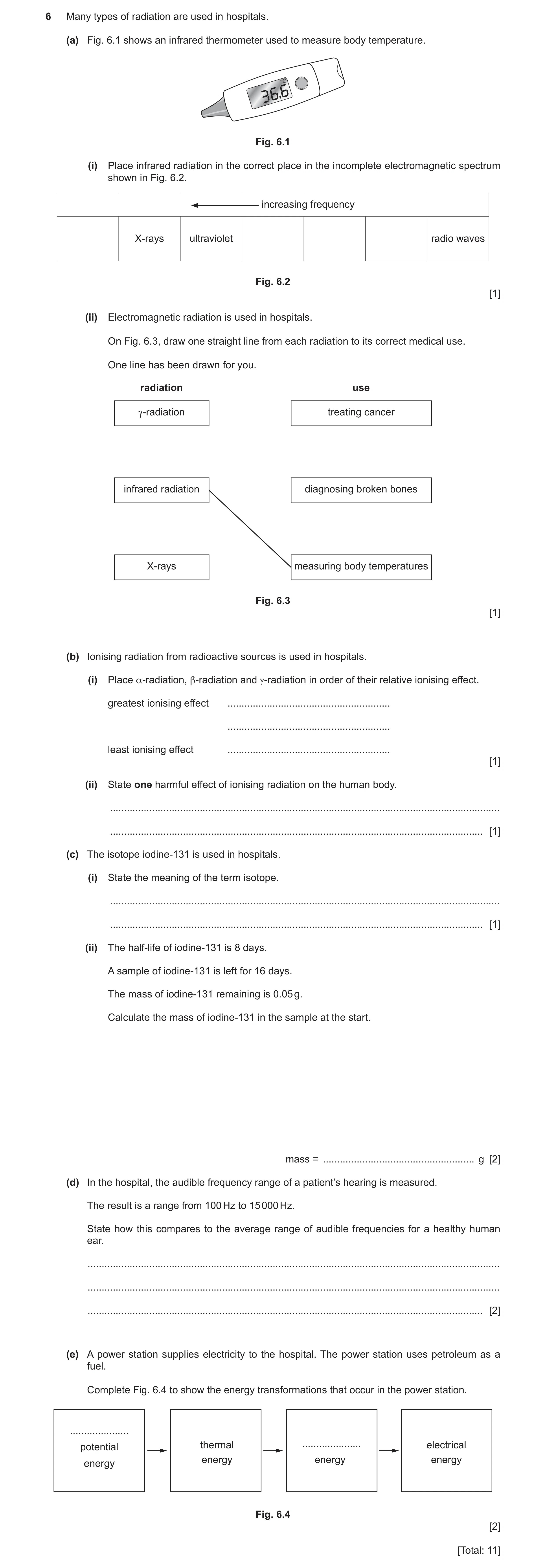
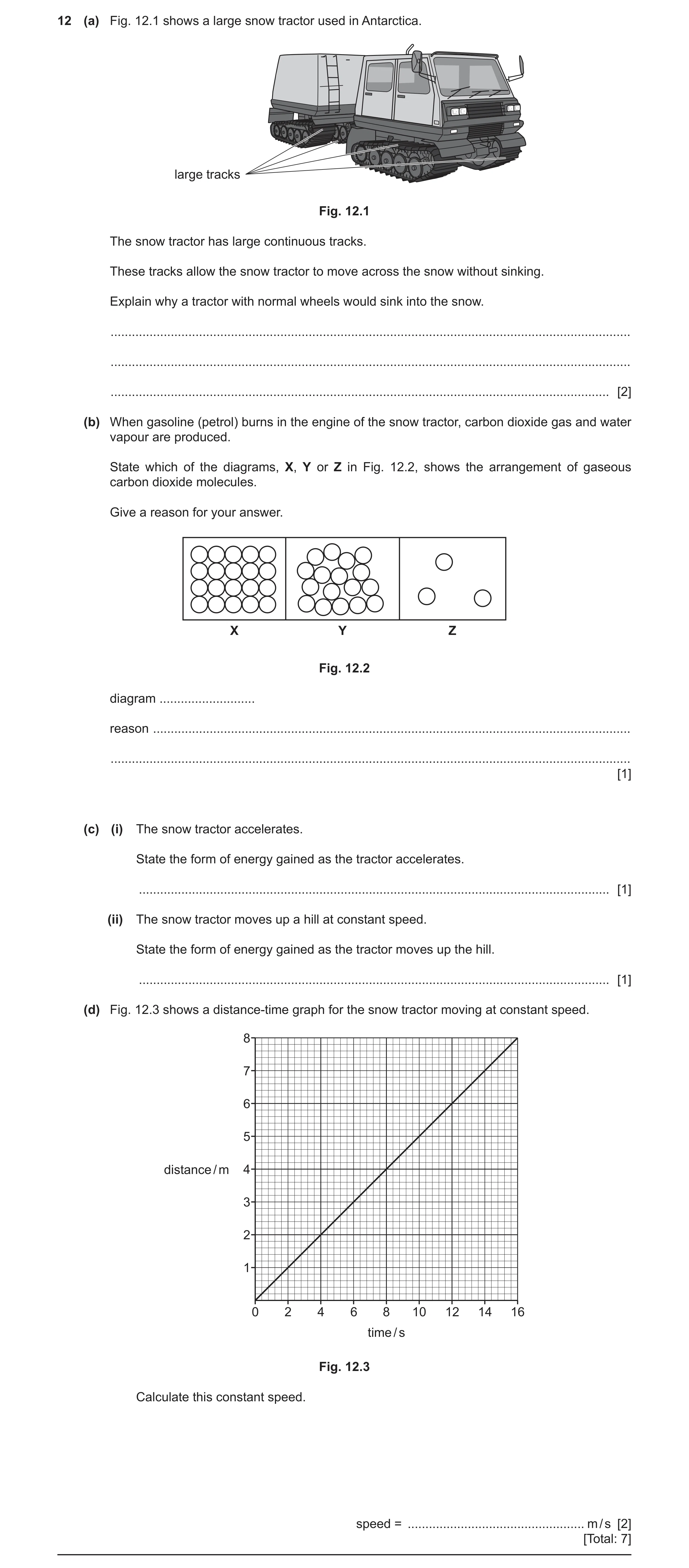
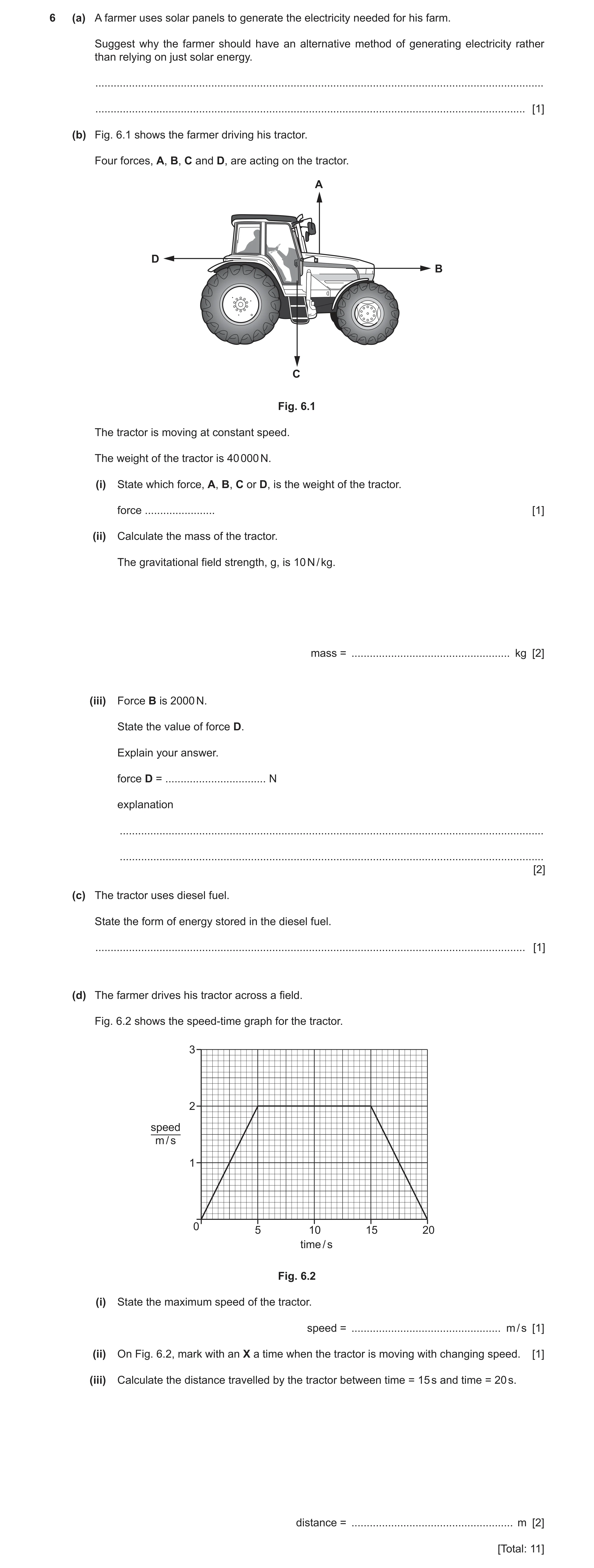
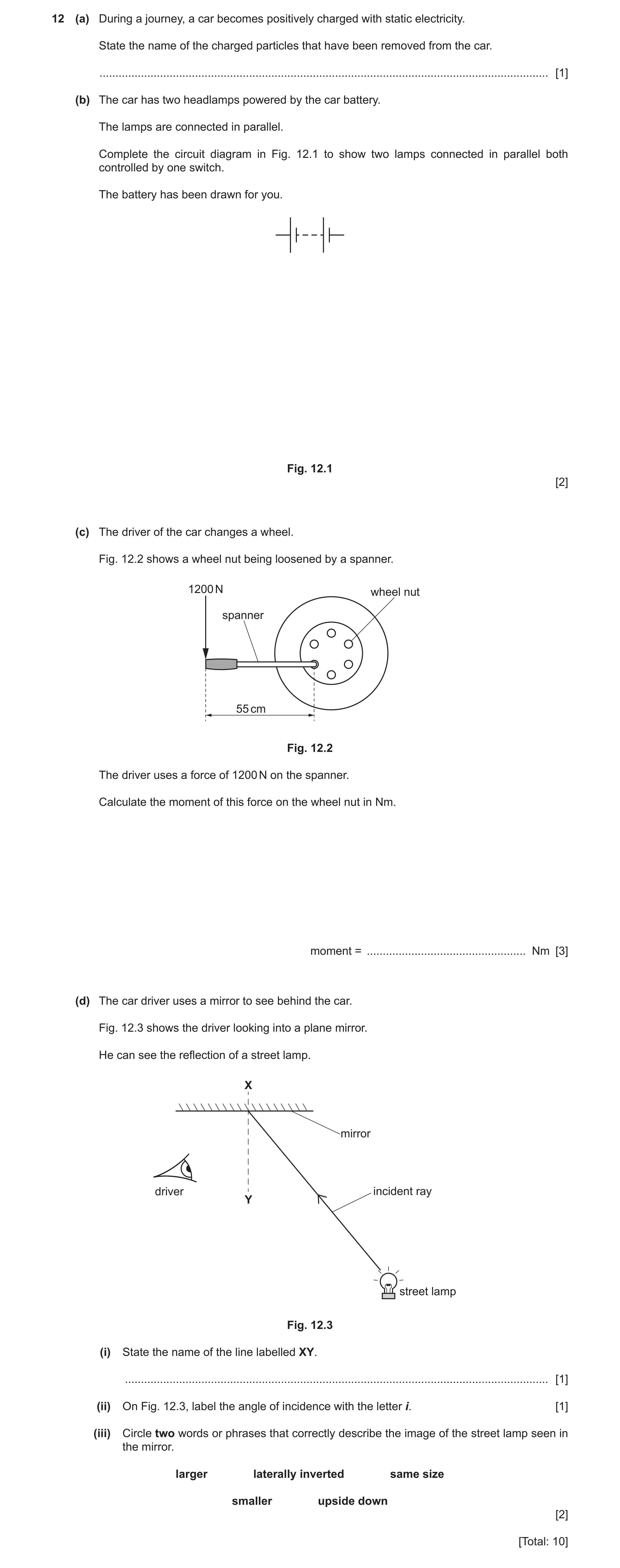
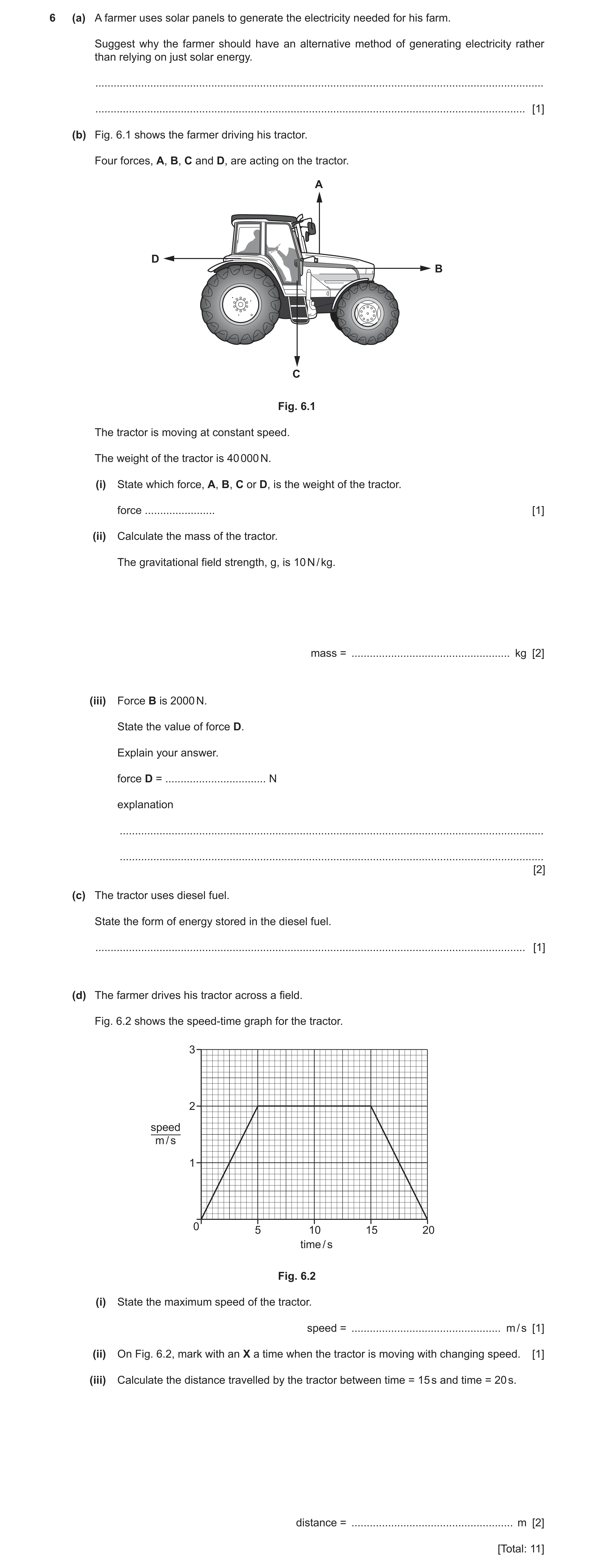
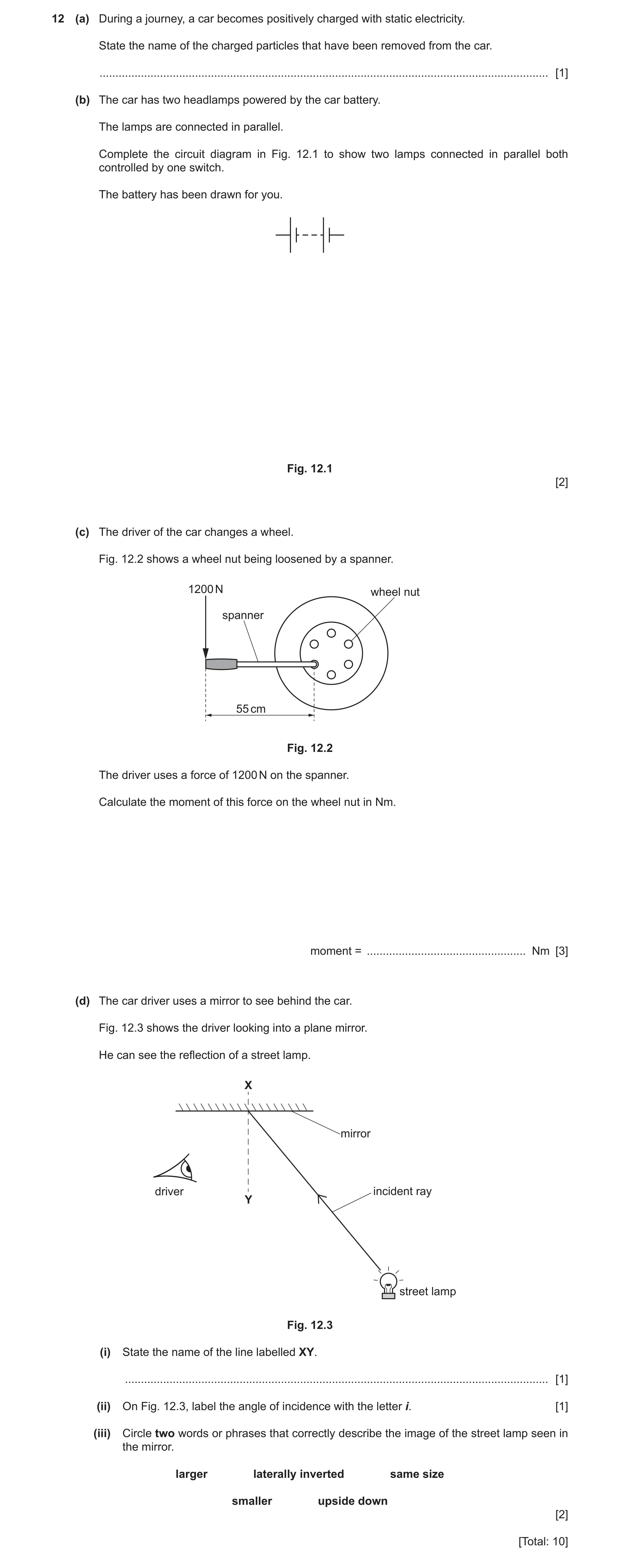
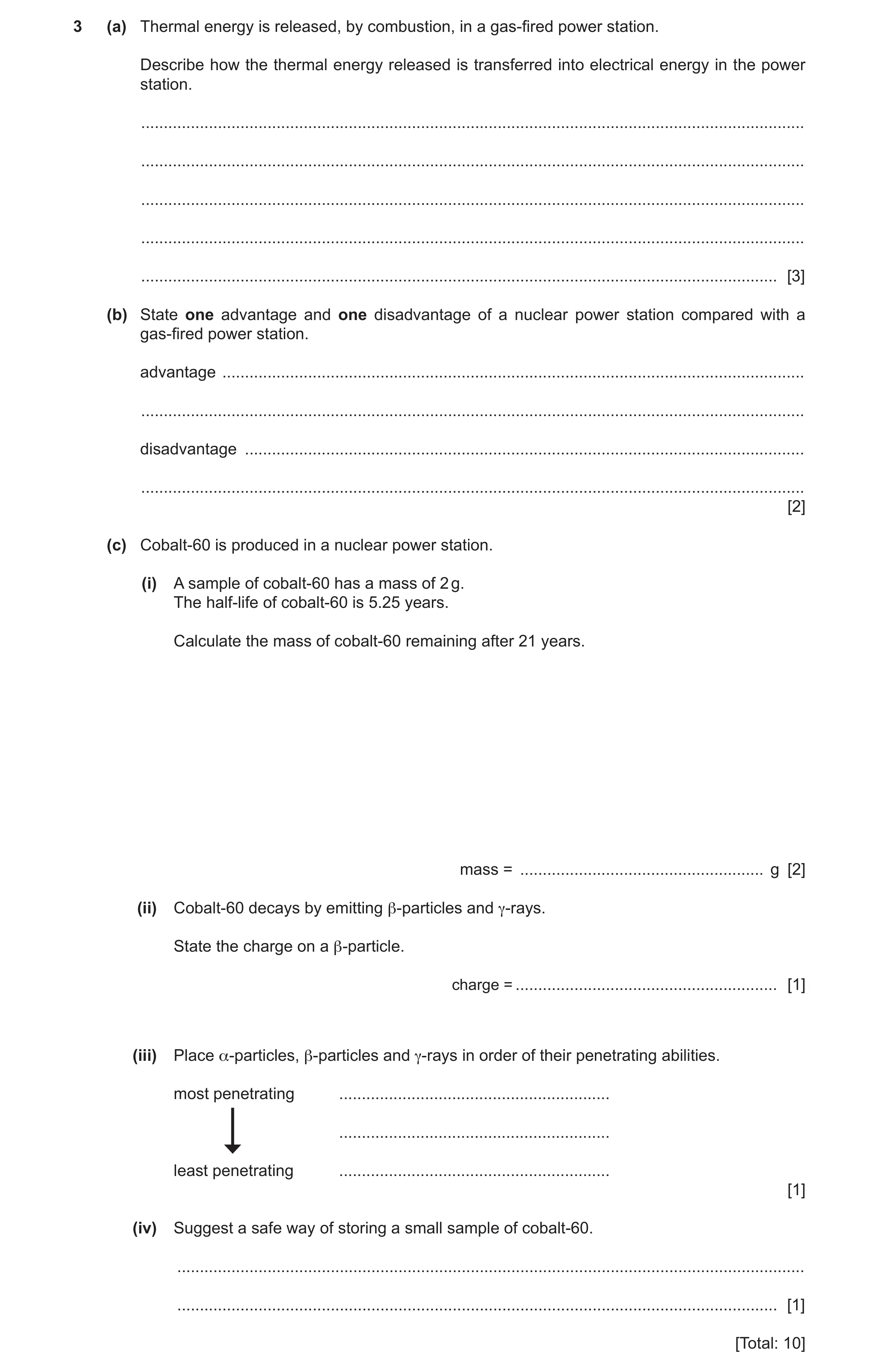
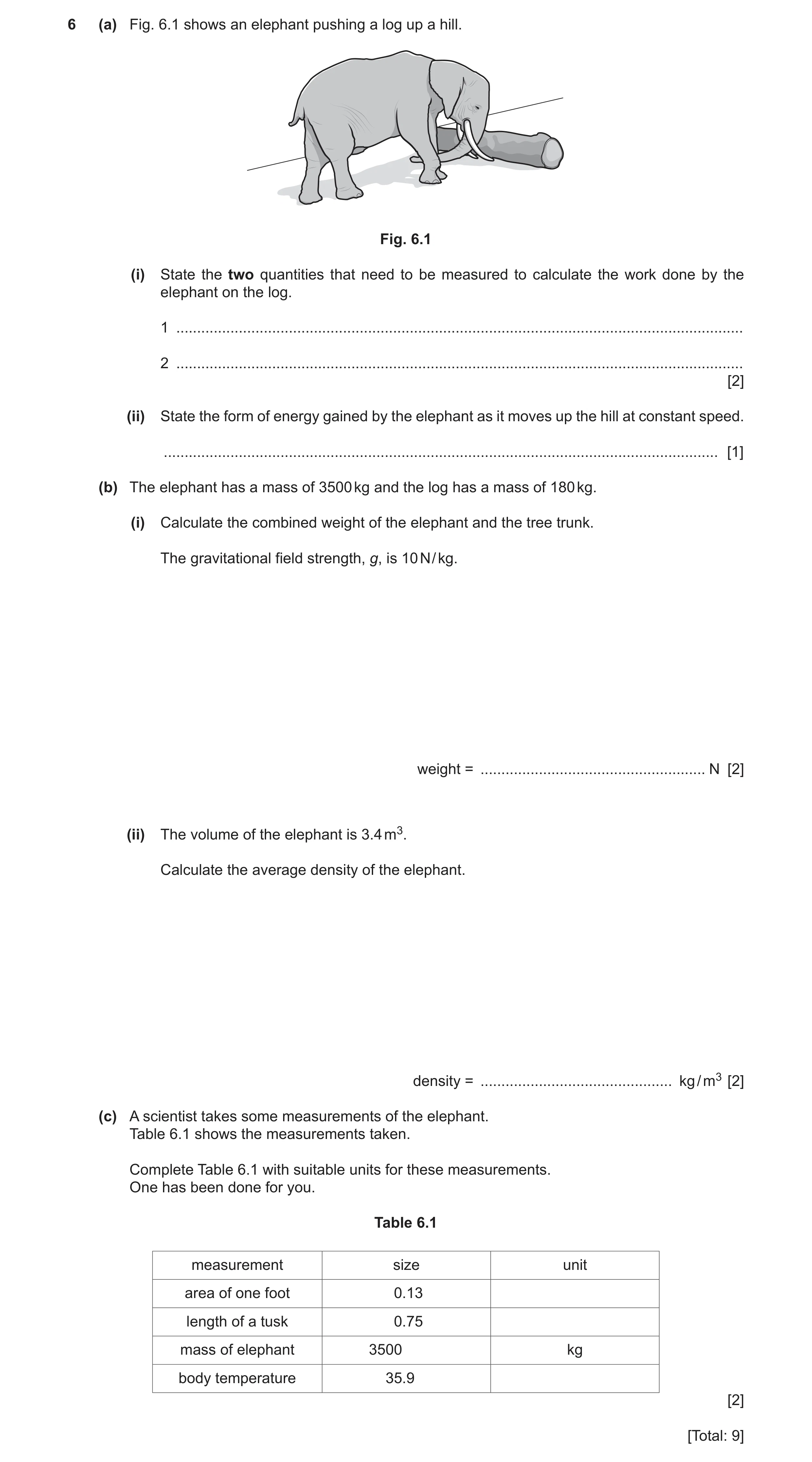
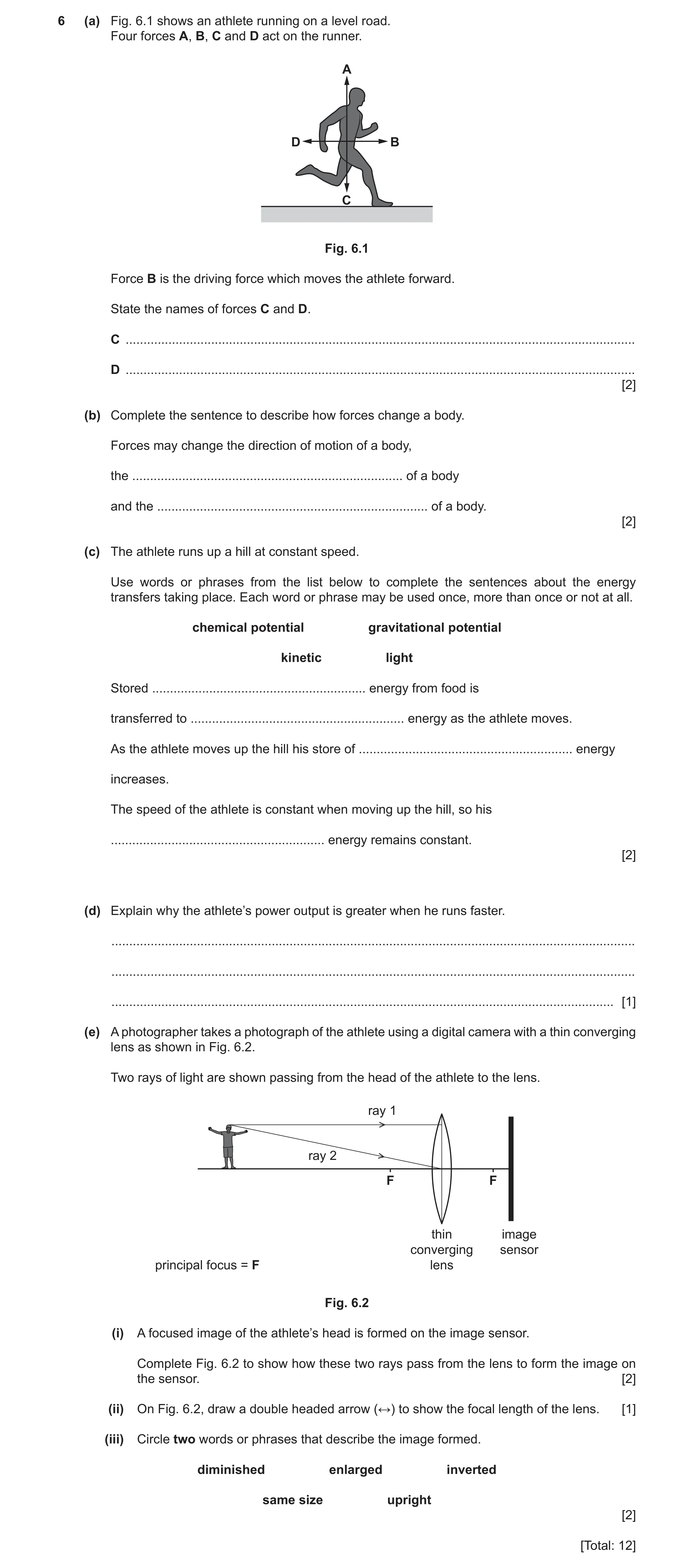
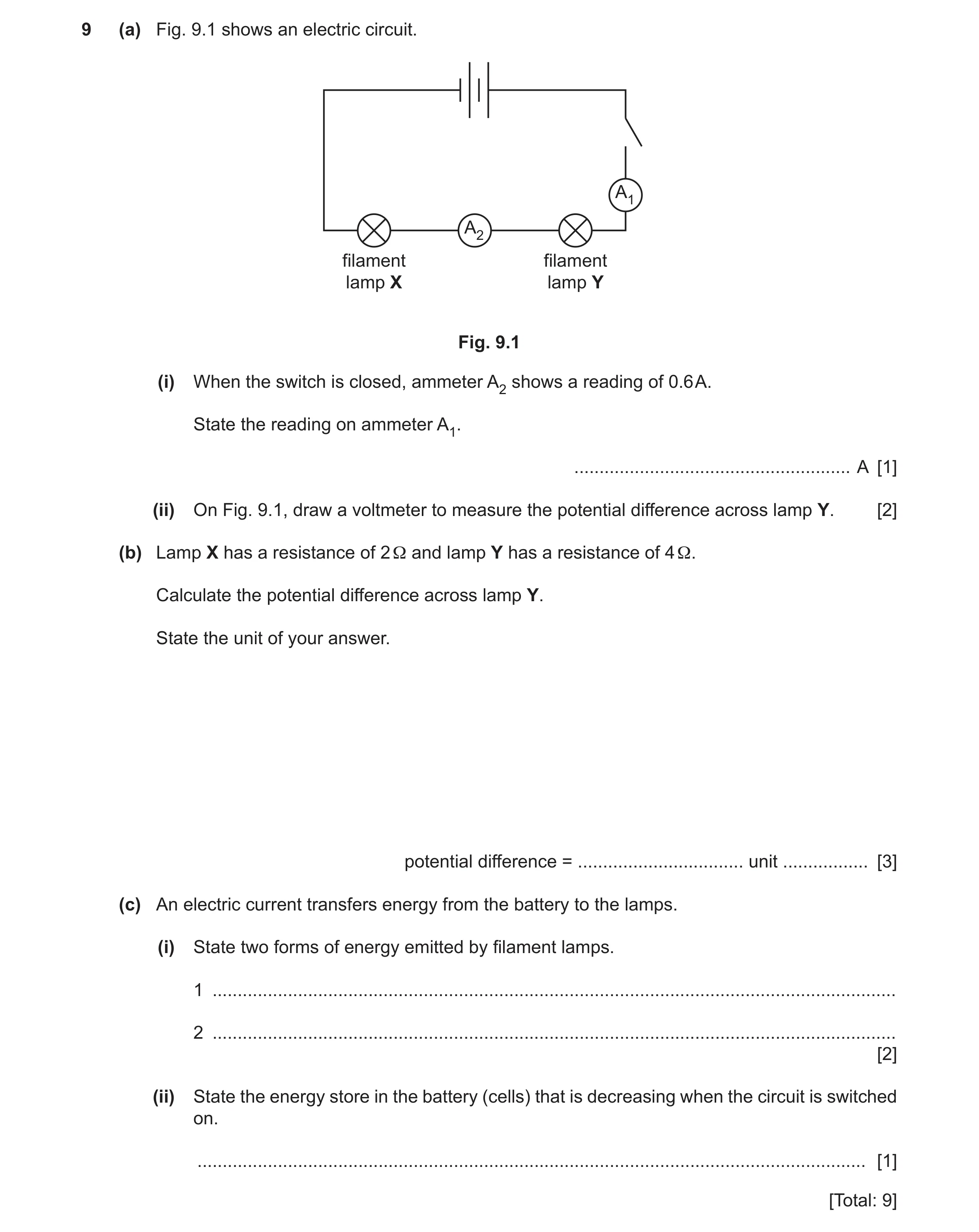 72 / 90
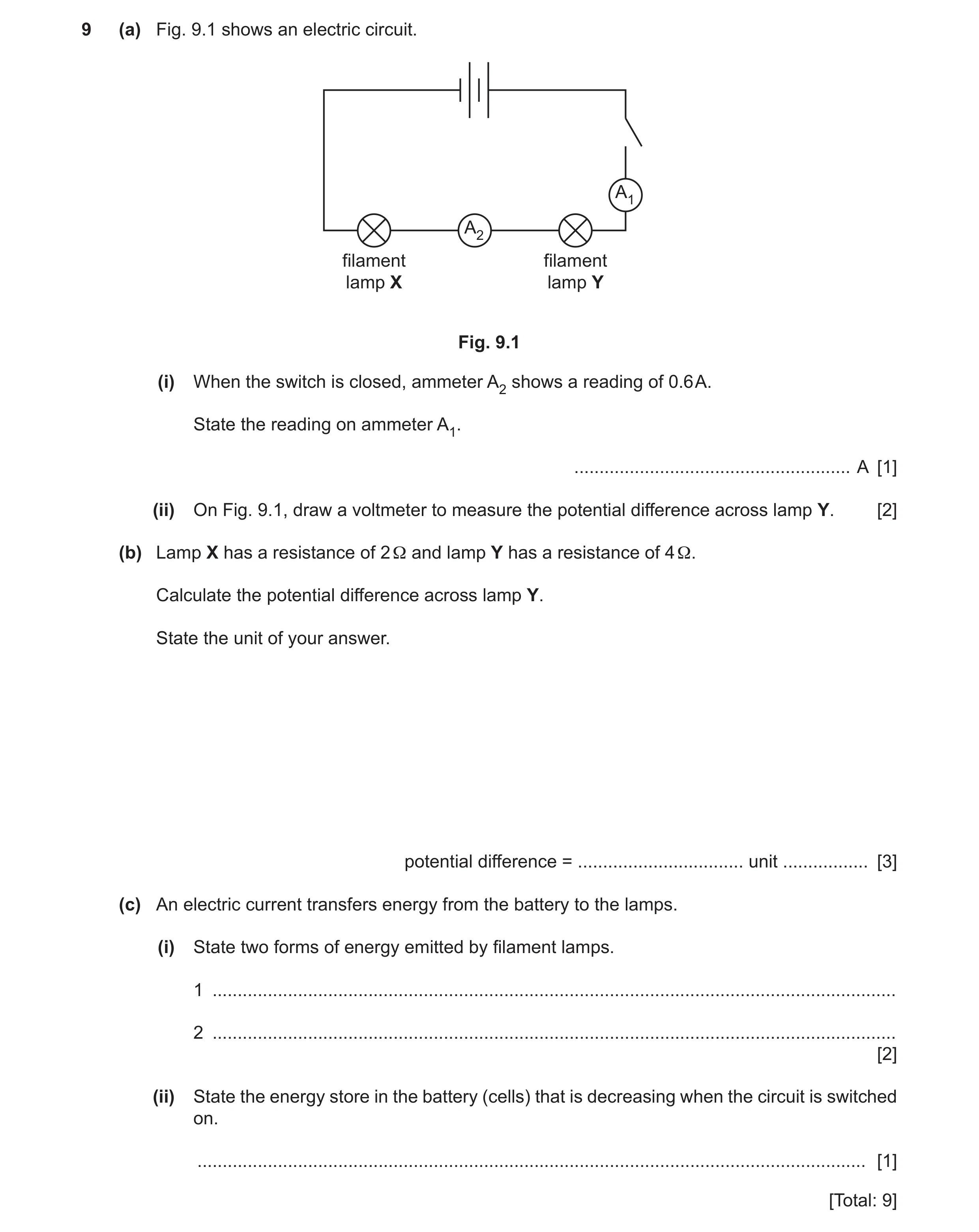 73 / 90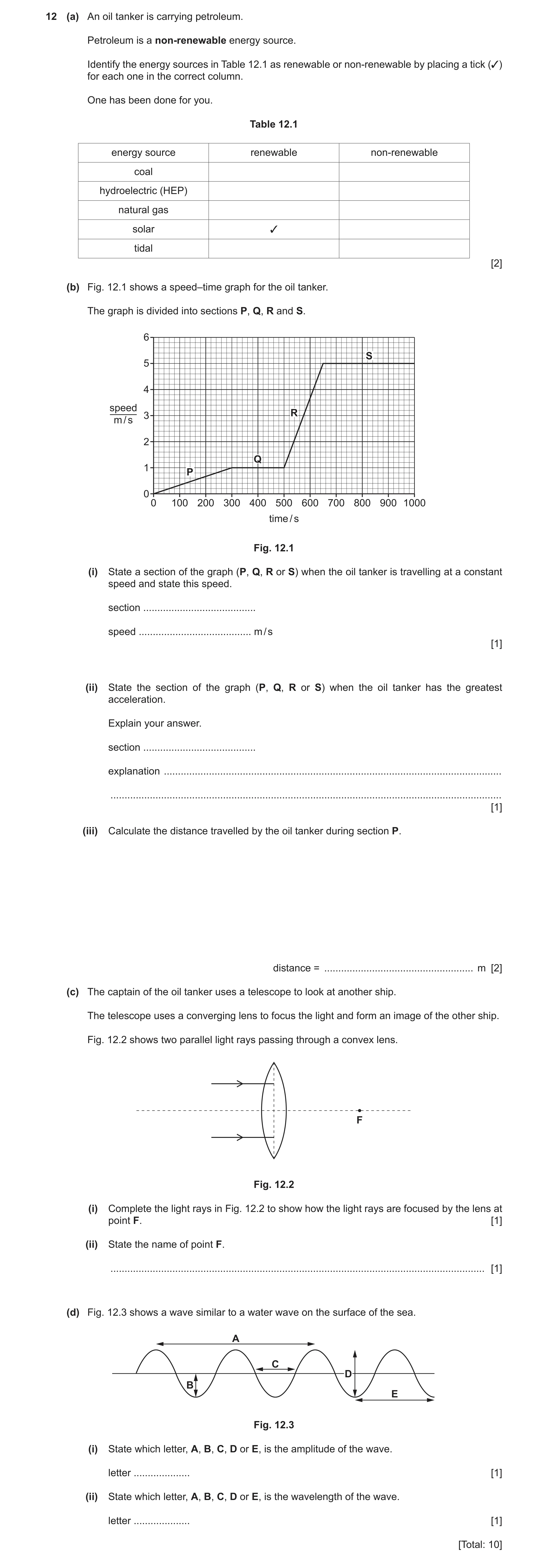
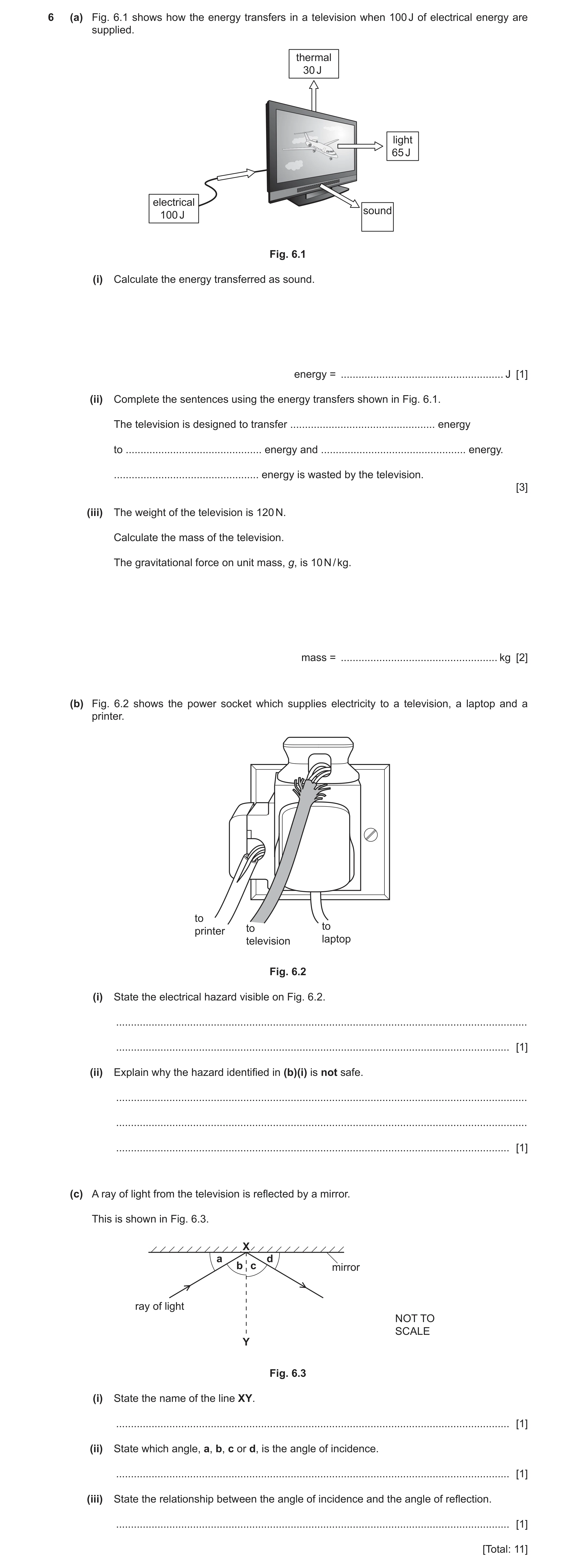
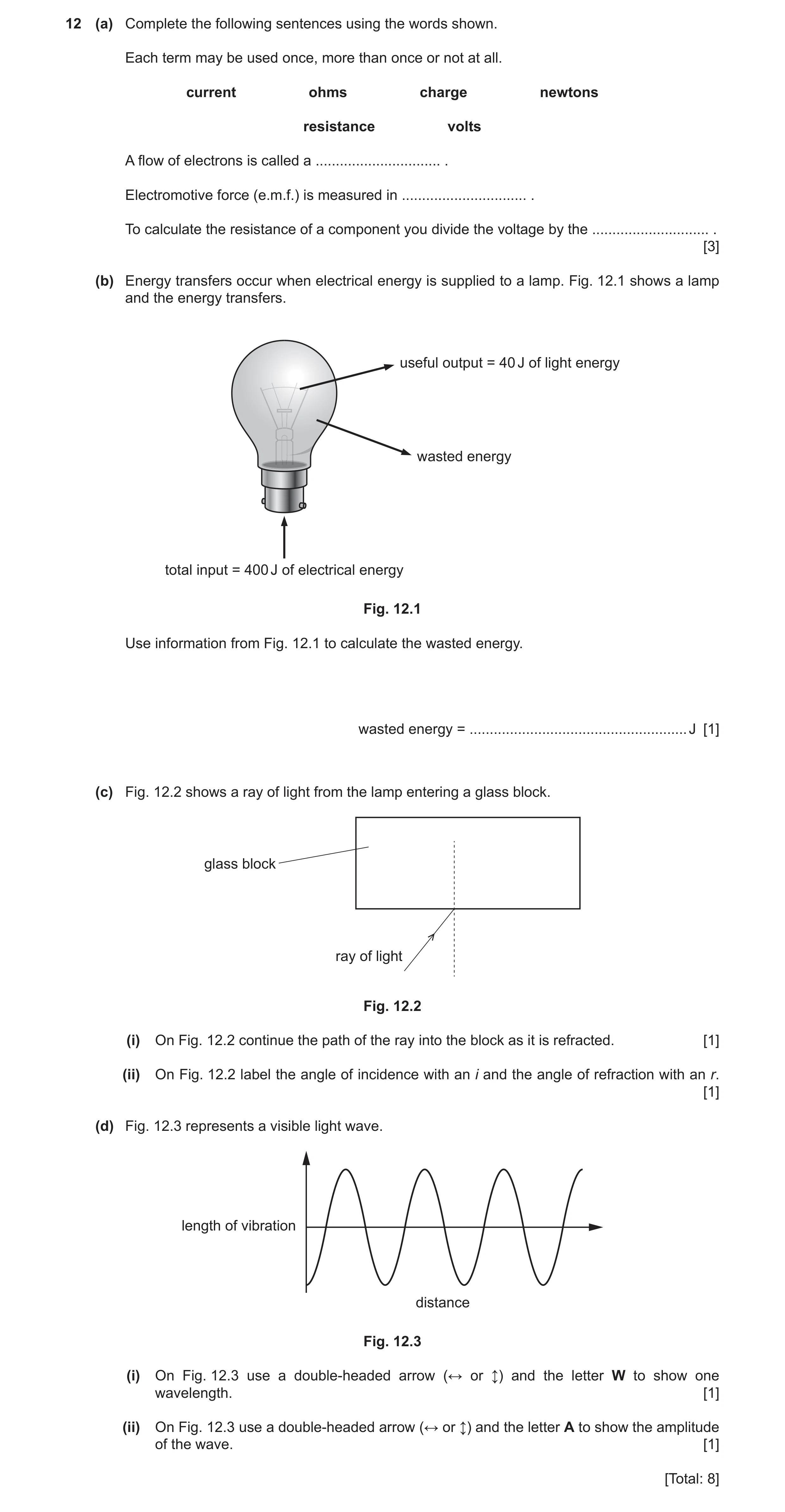
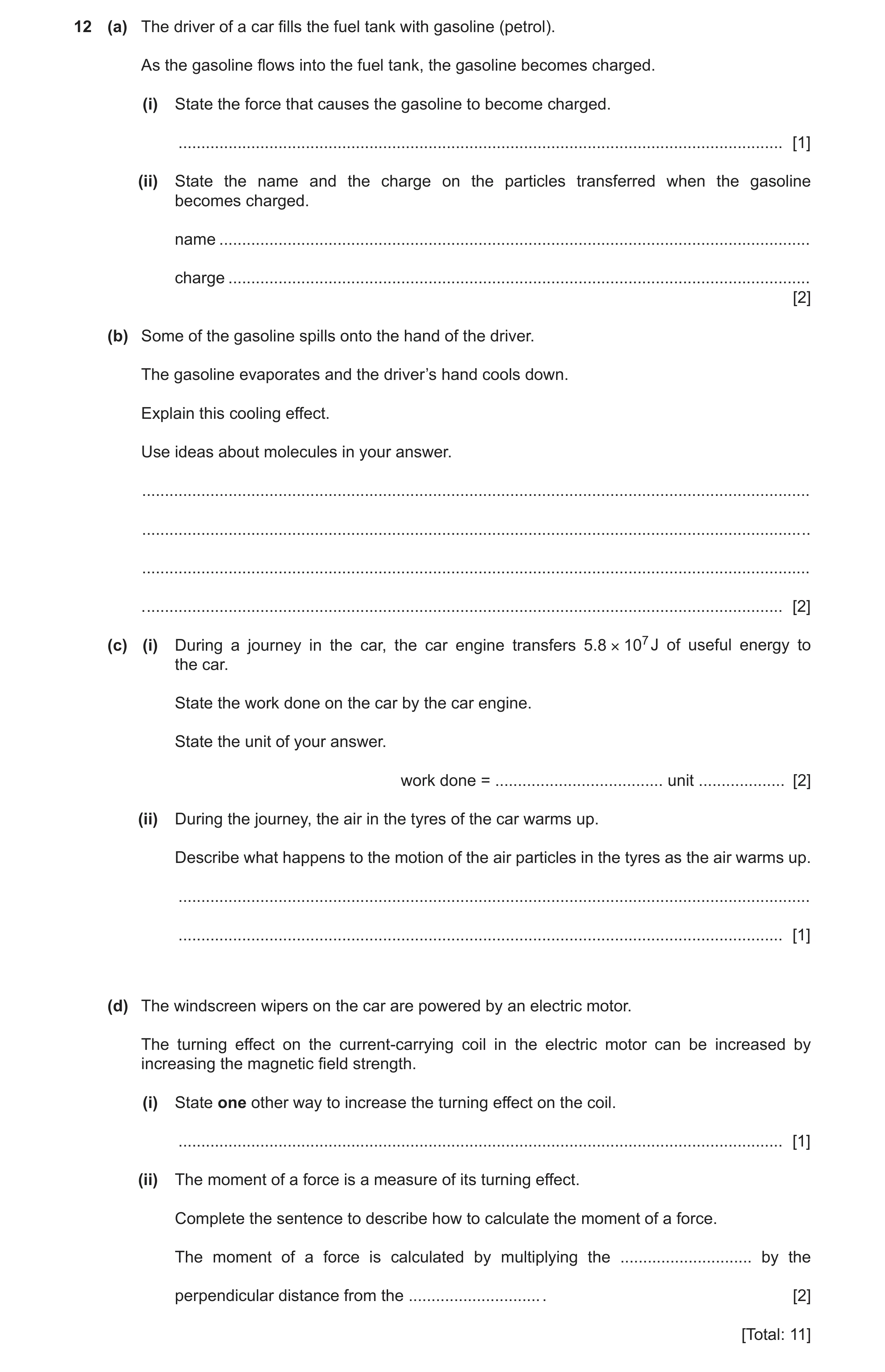
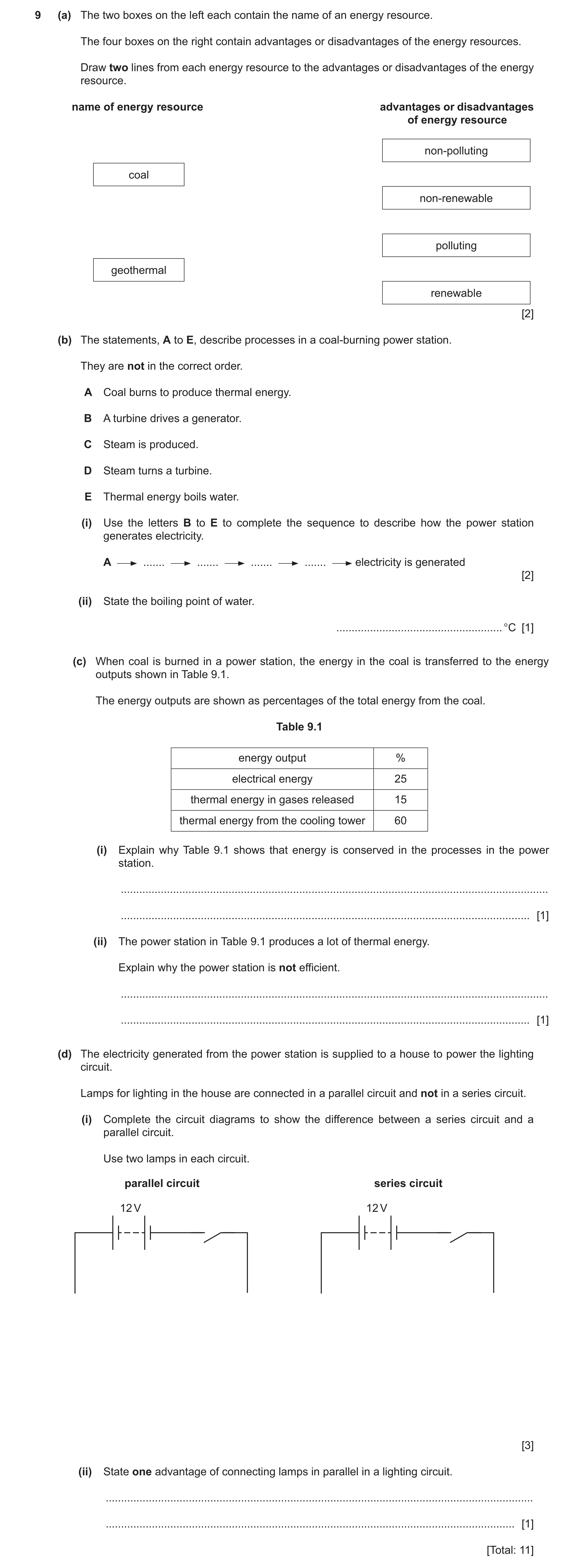
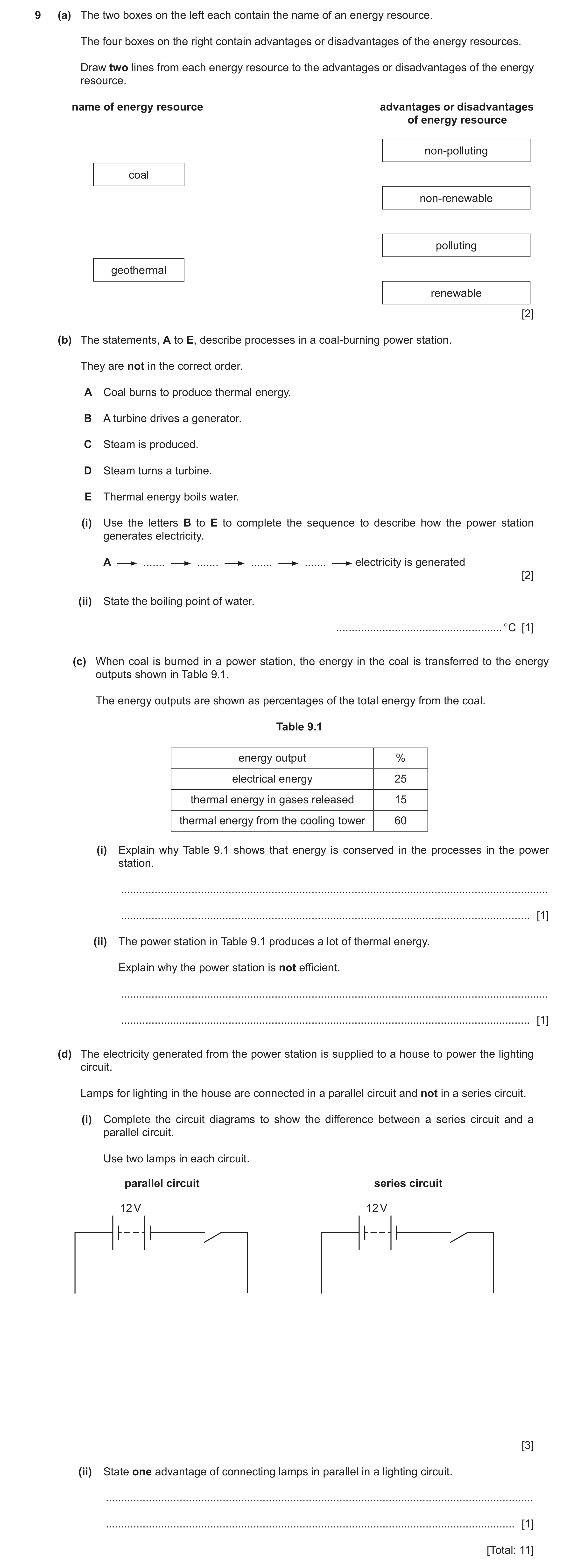
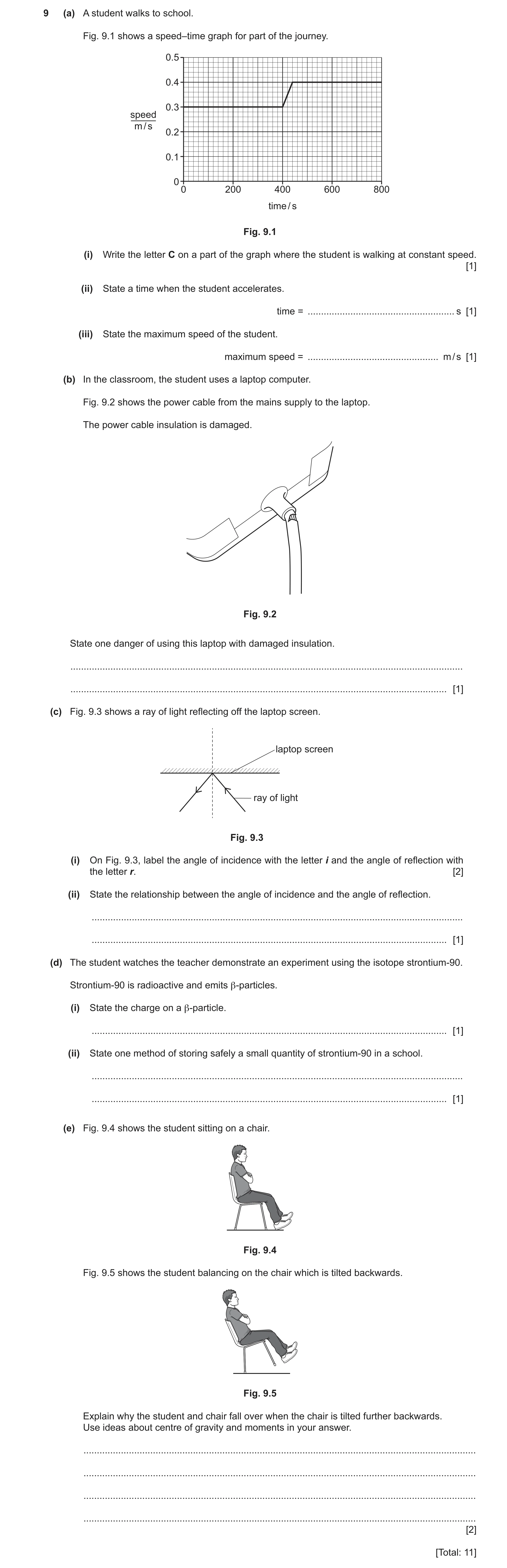
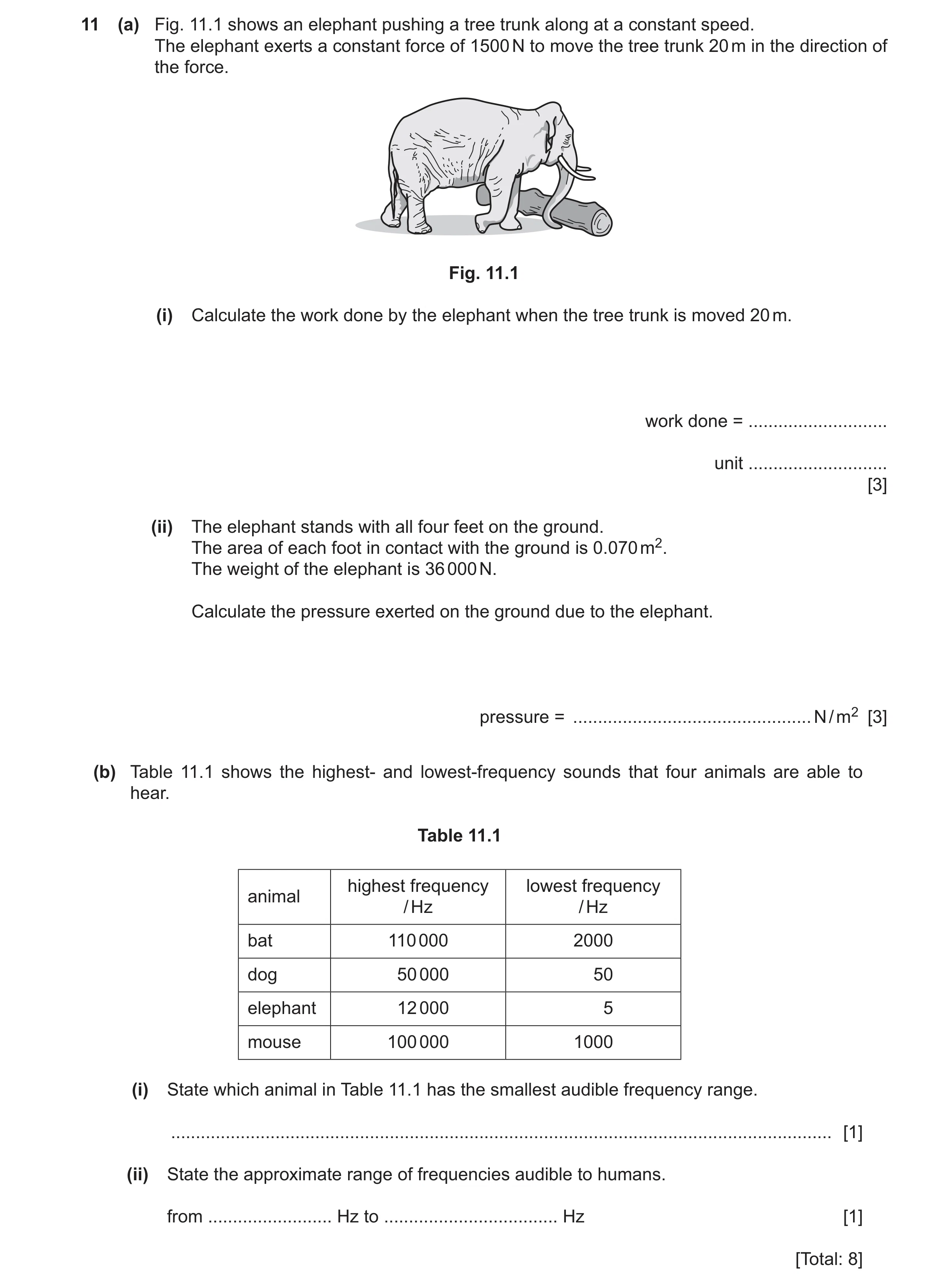 88 / 90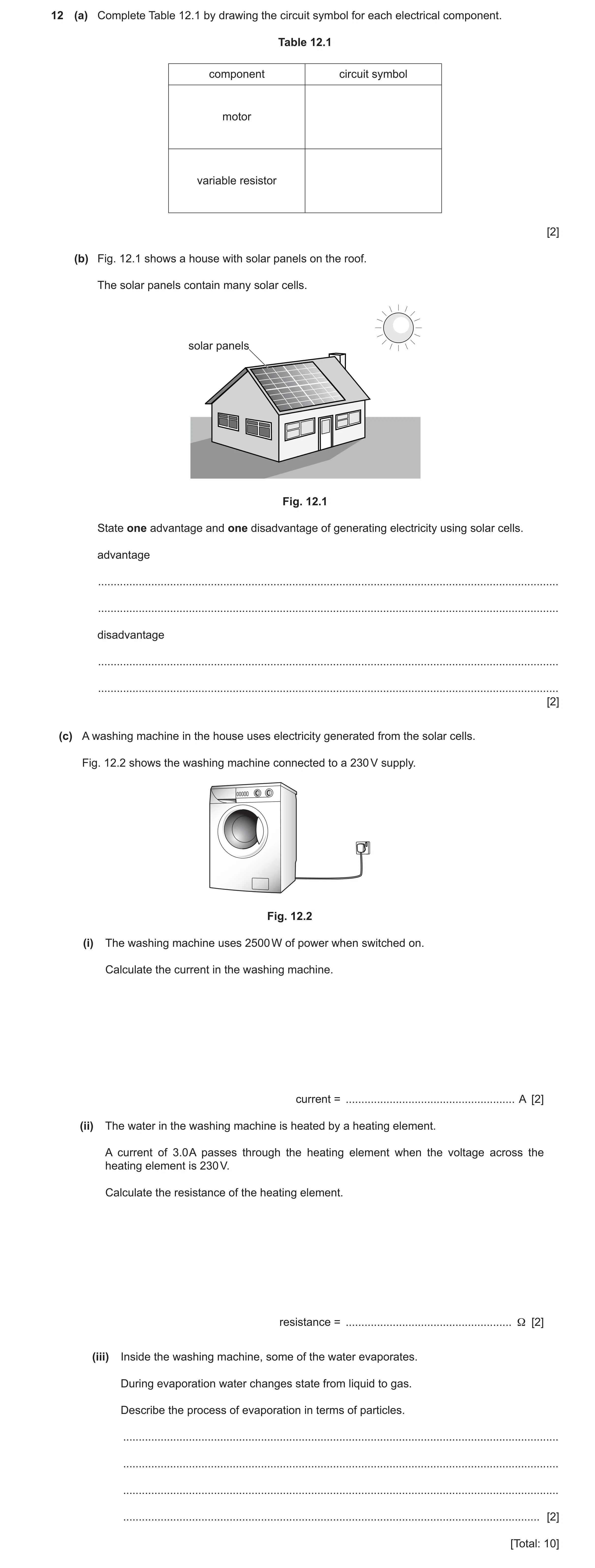
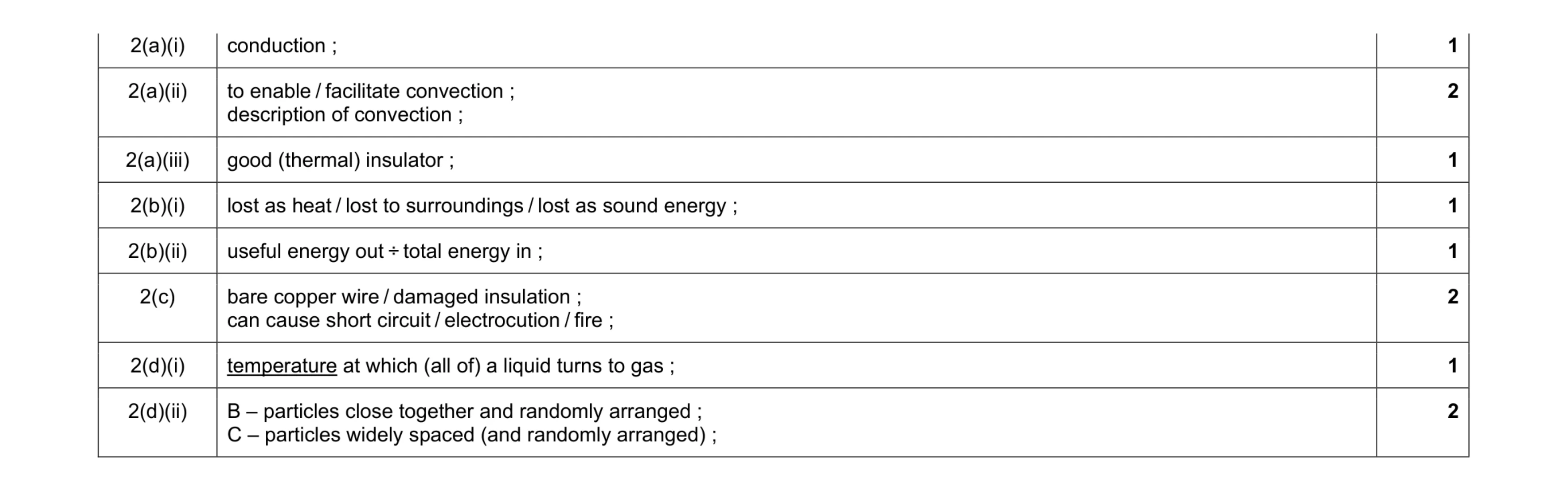 11
11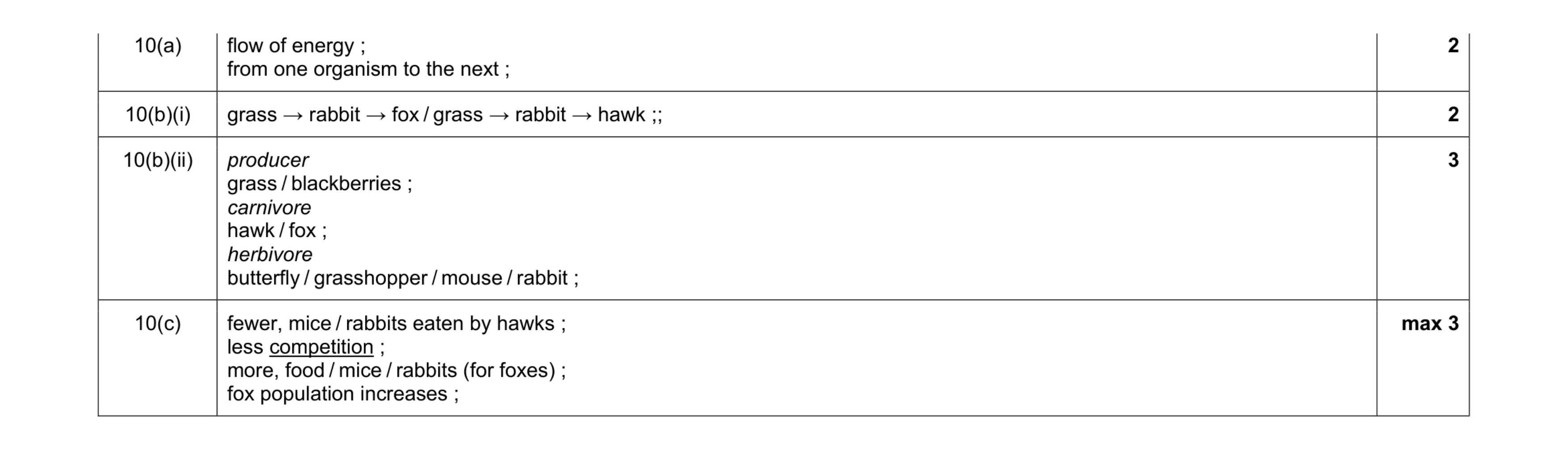 20
20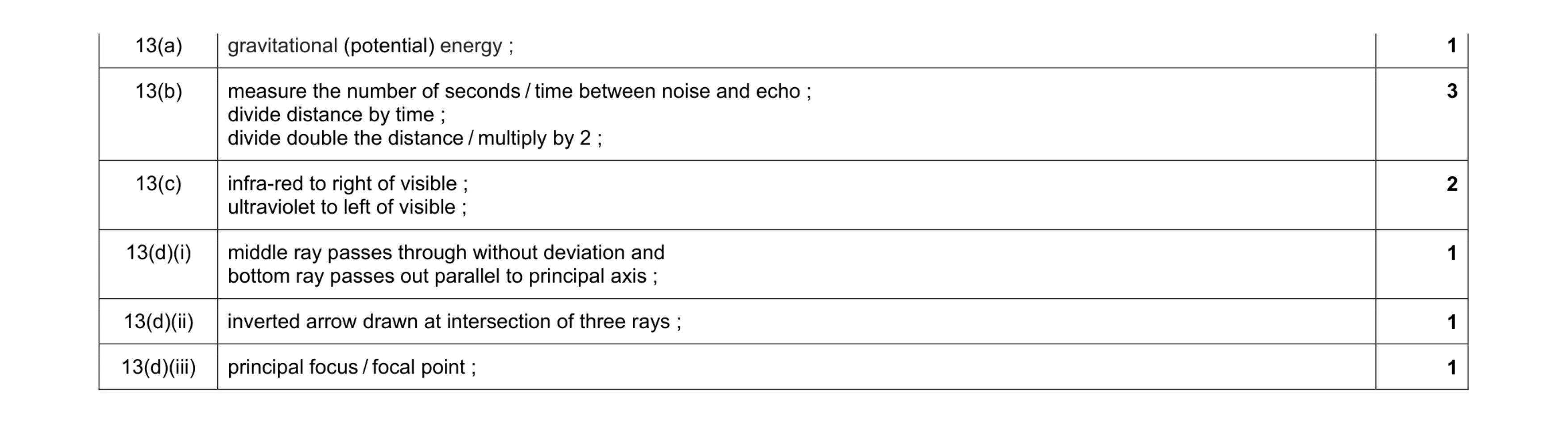 9
9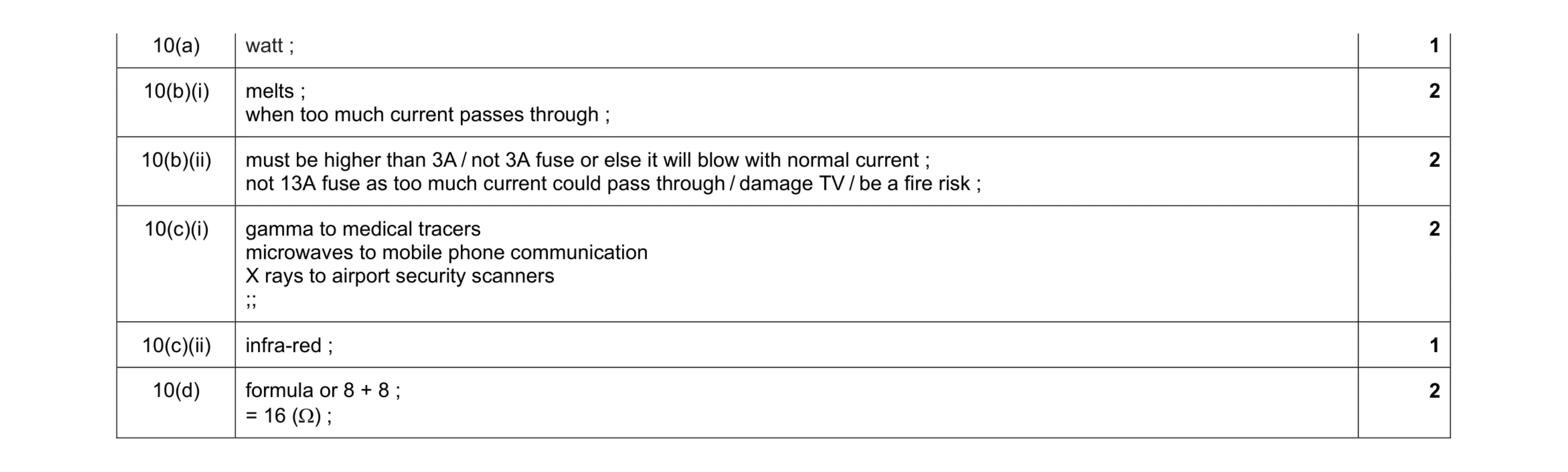 10
10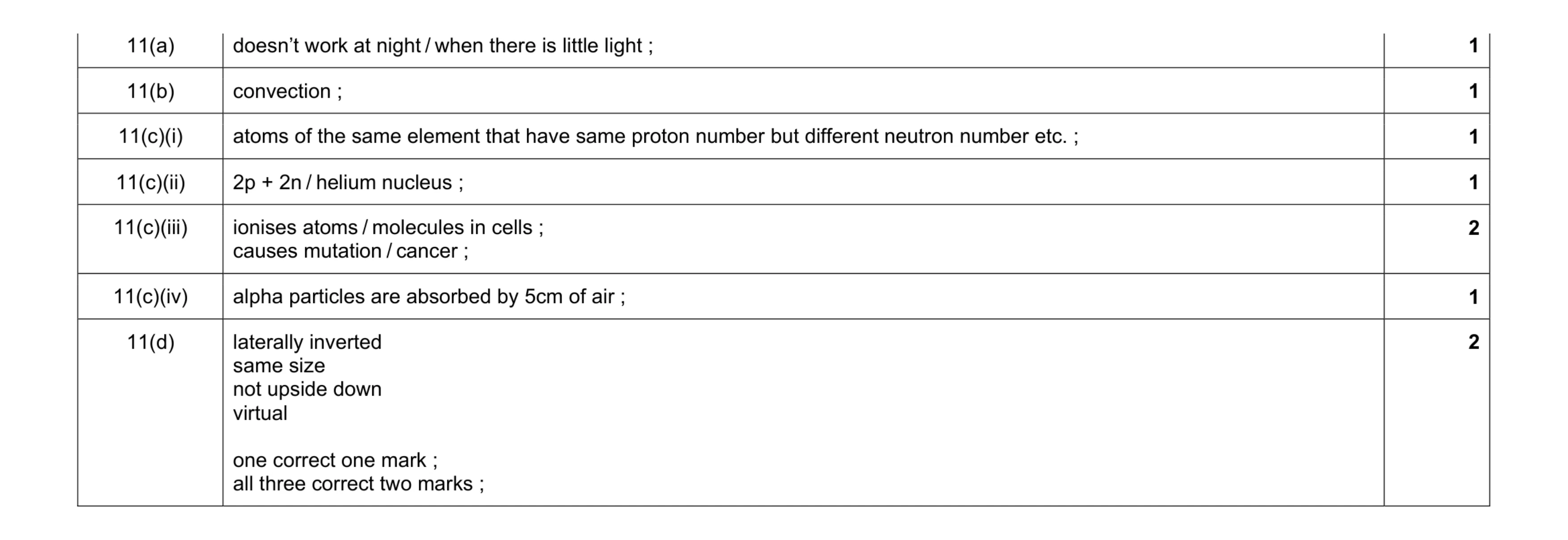 9
9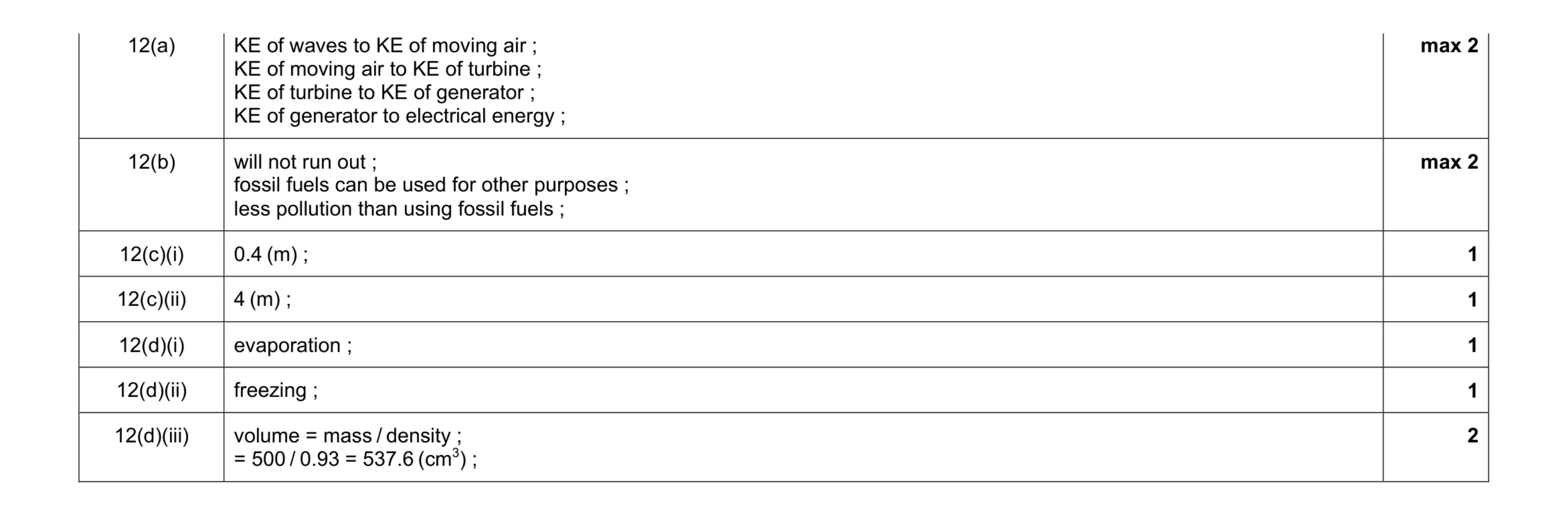 10
10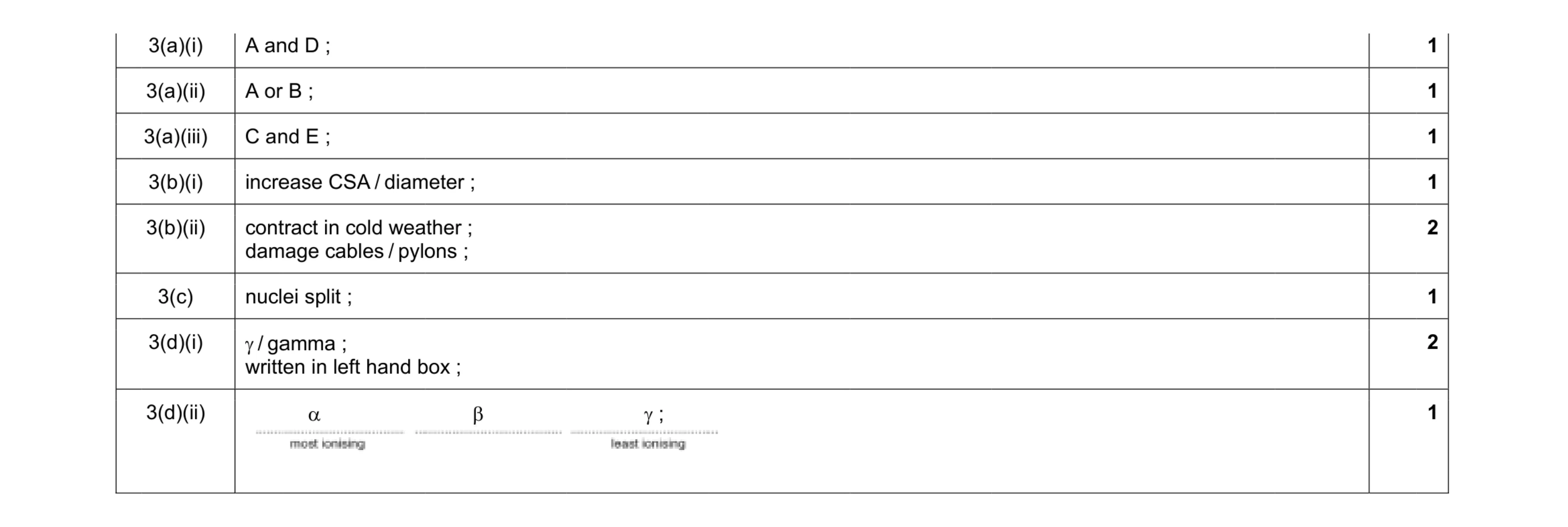 10
10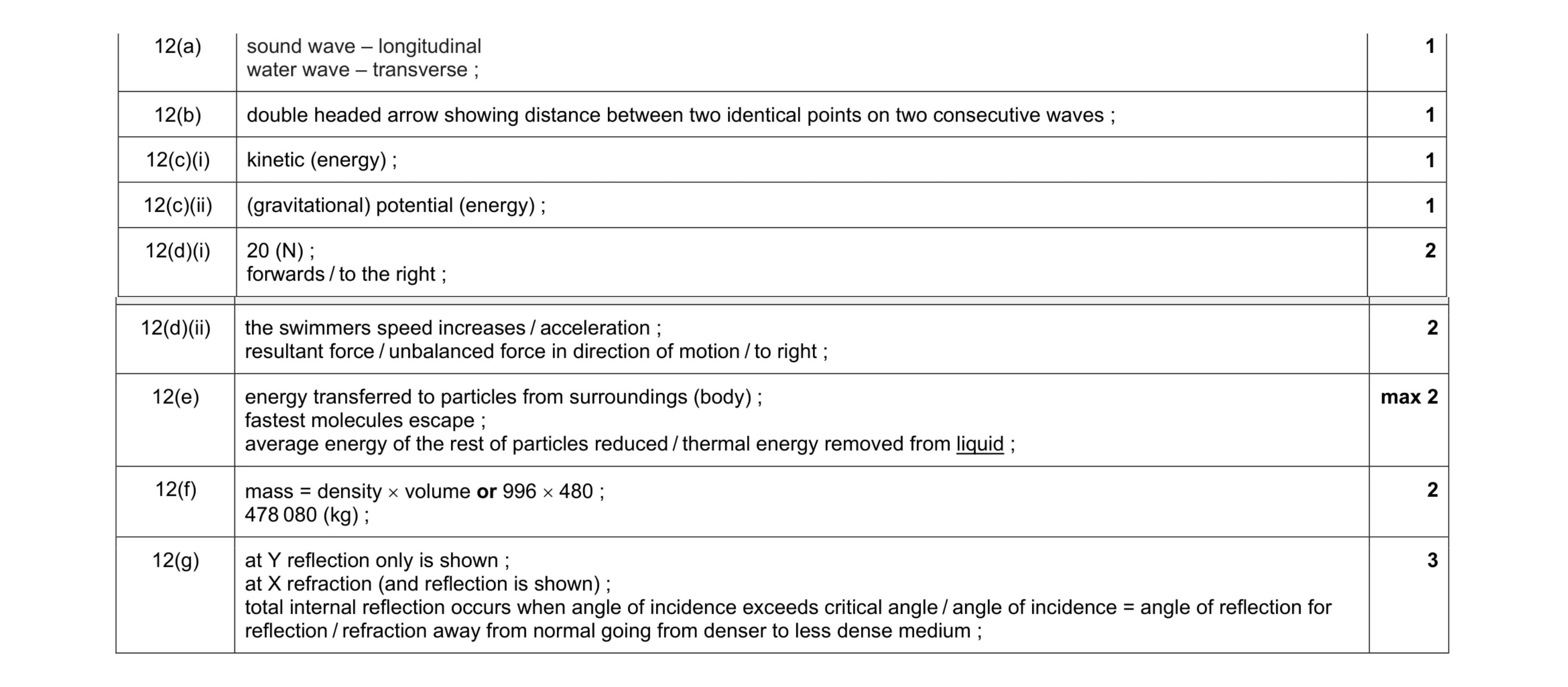 15
15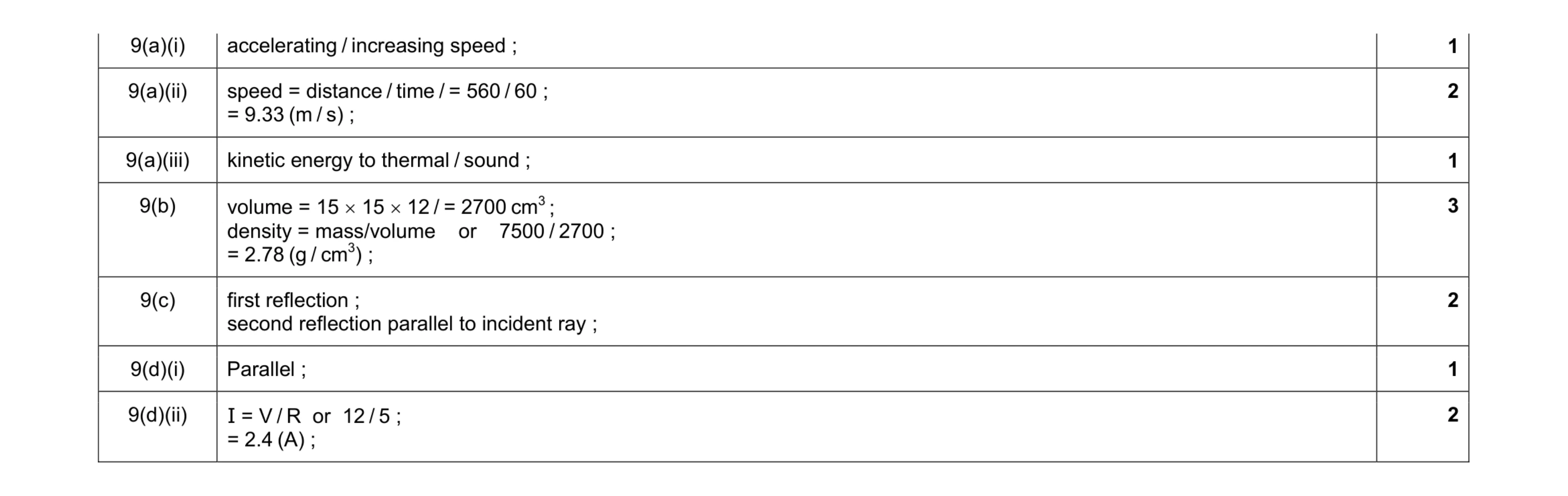 12
12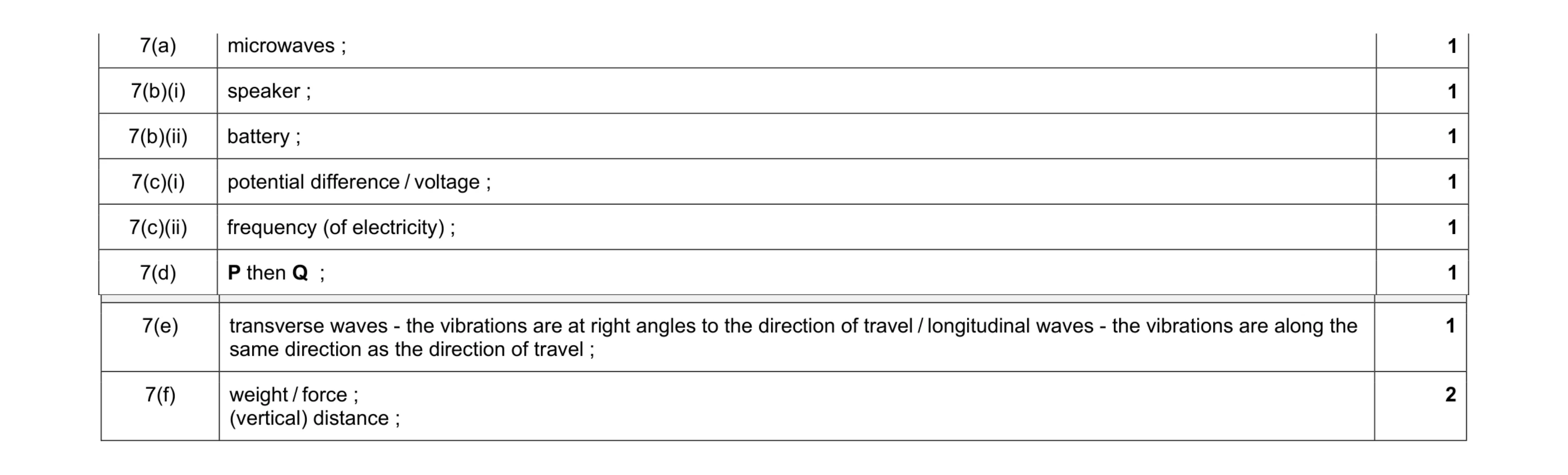 9
9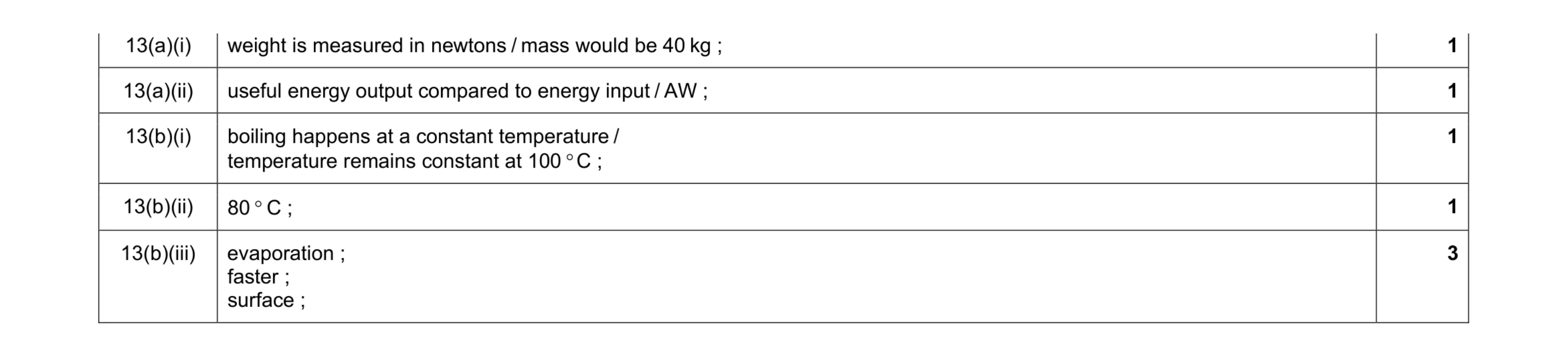 7
7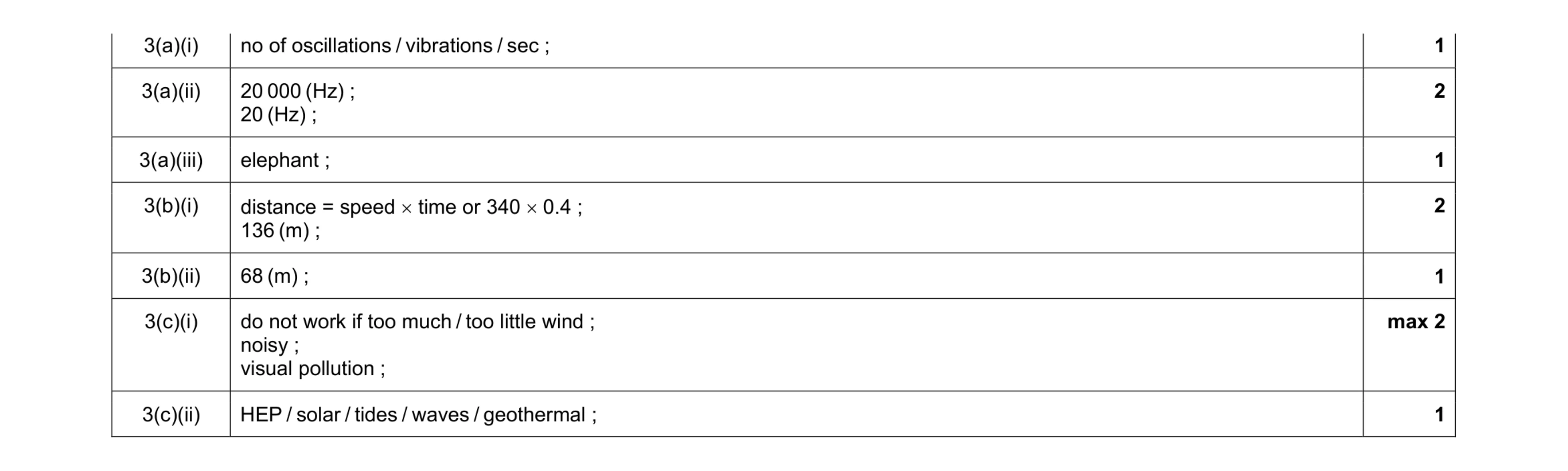 10
10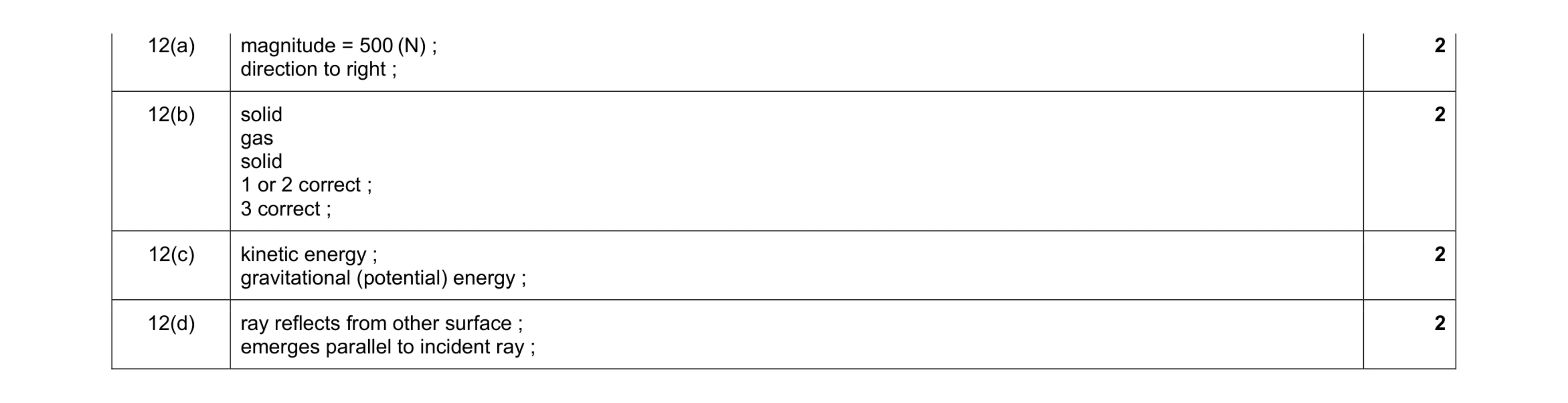 8
8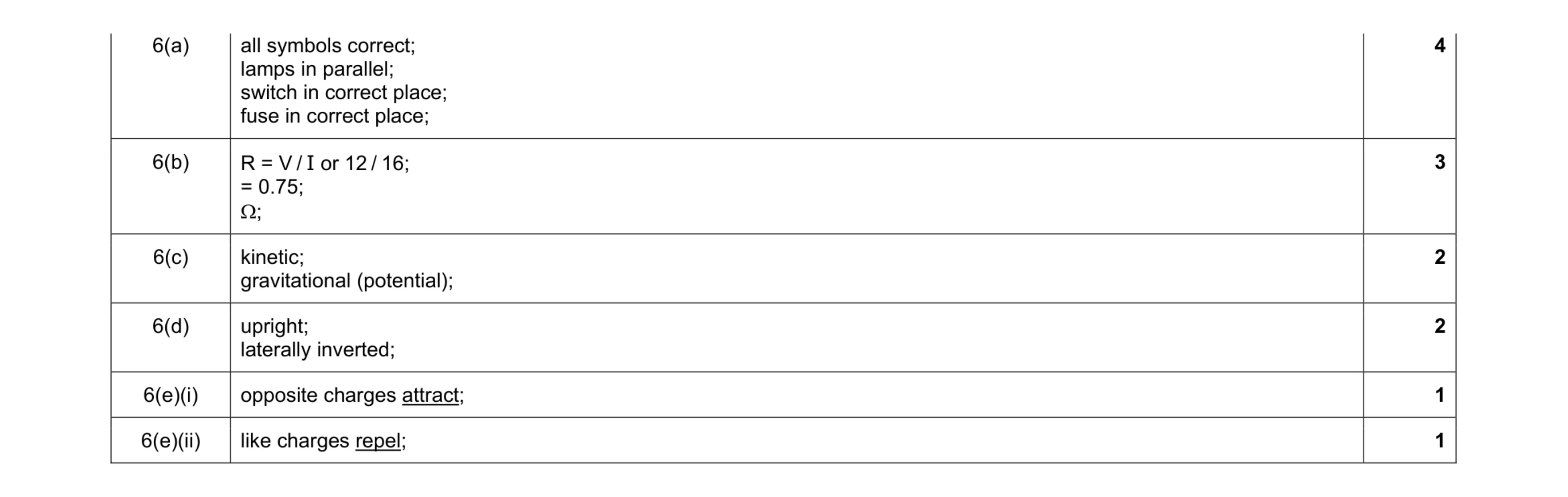 13
13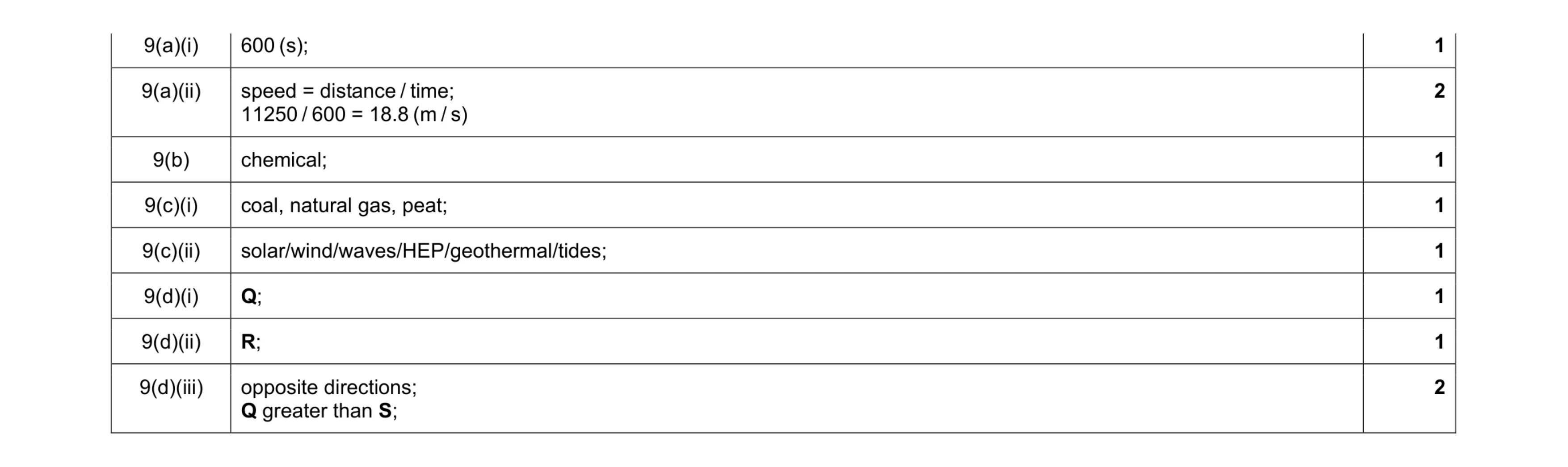 10
10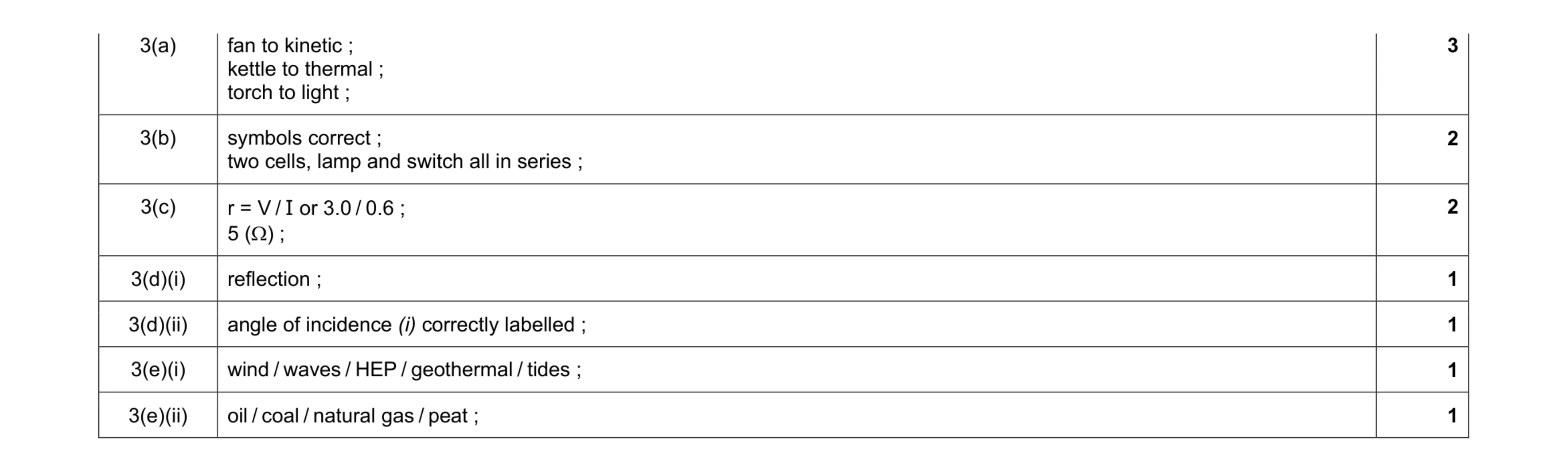 11
11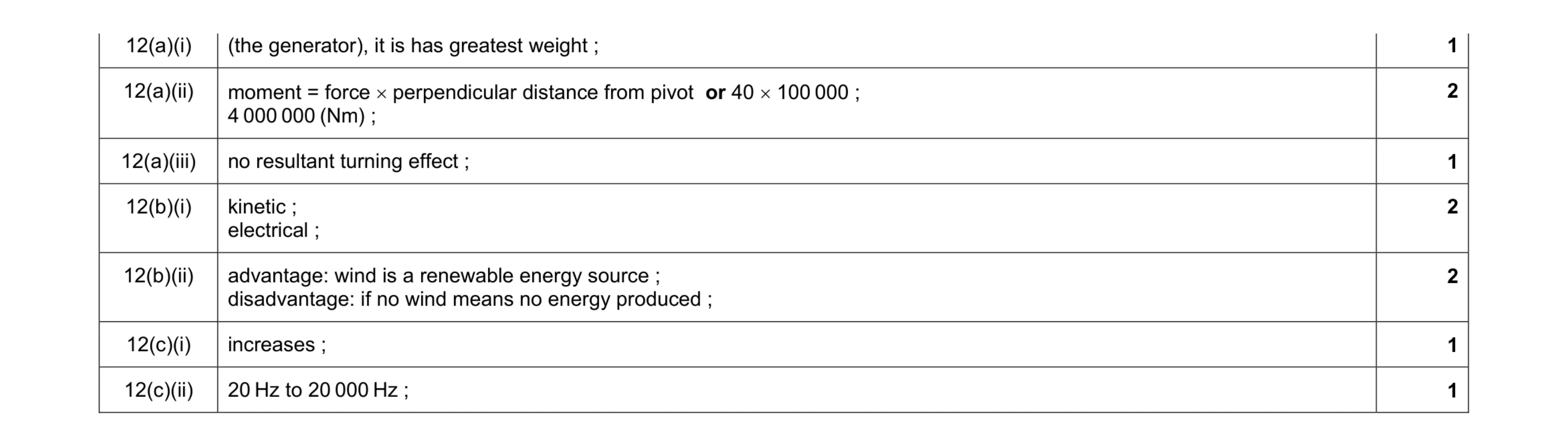 10
10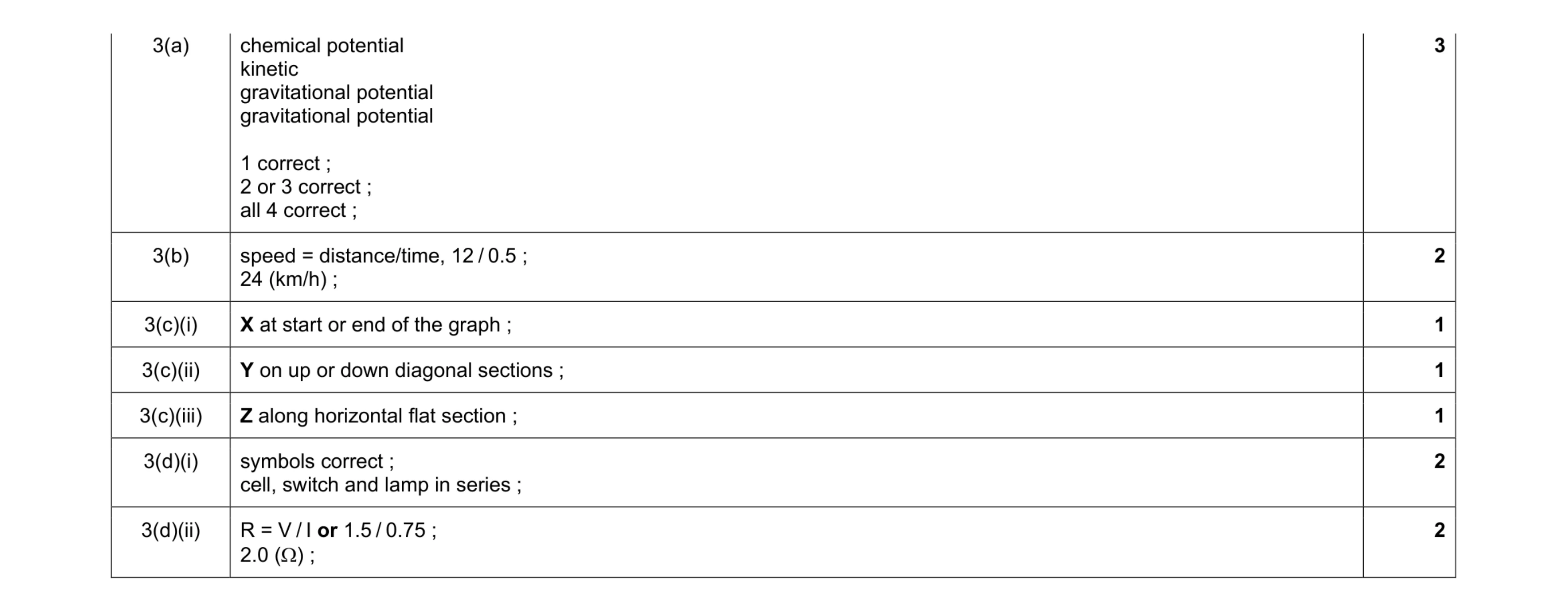 12
12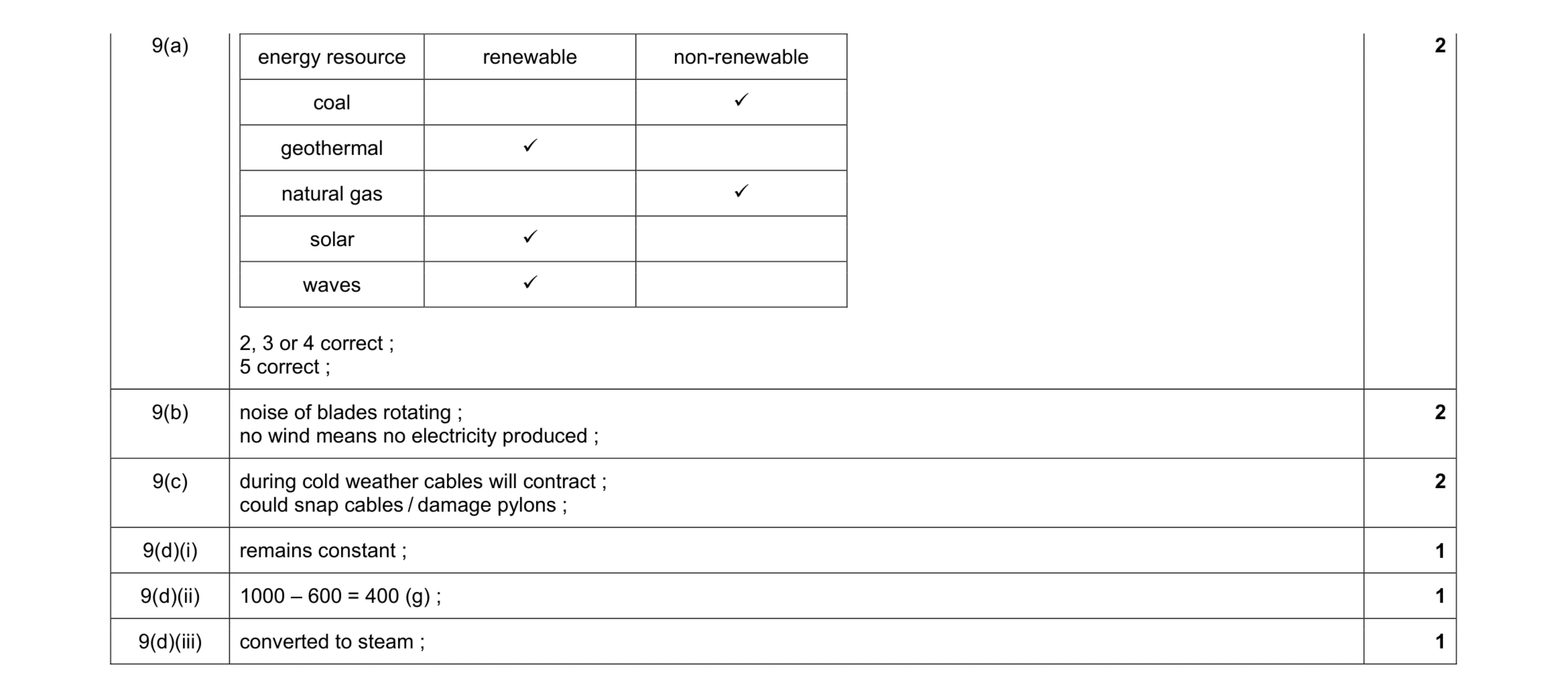 9
9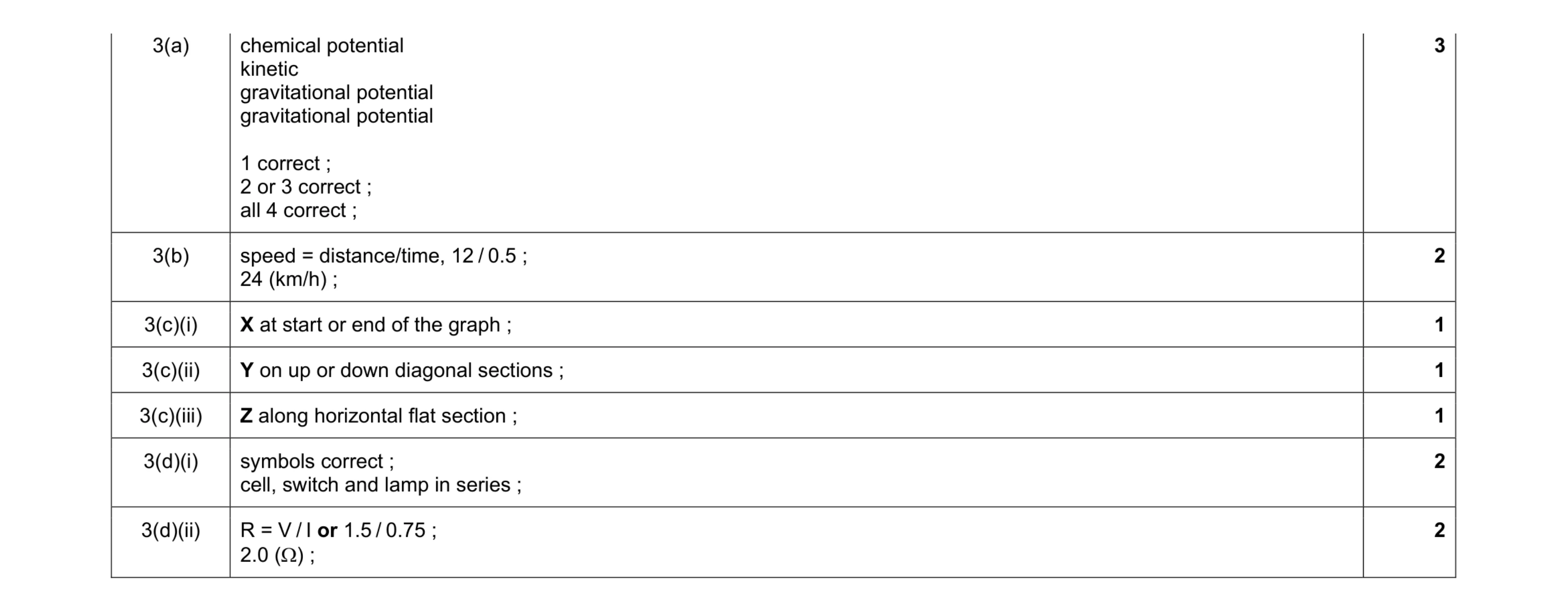 12
12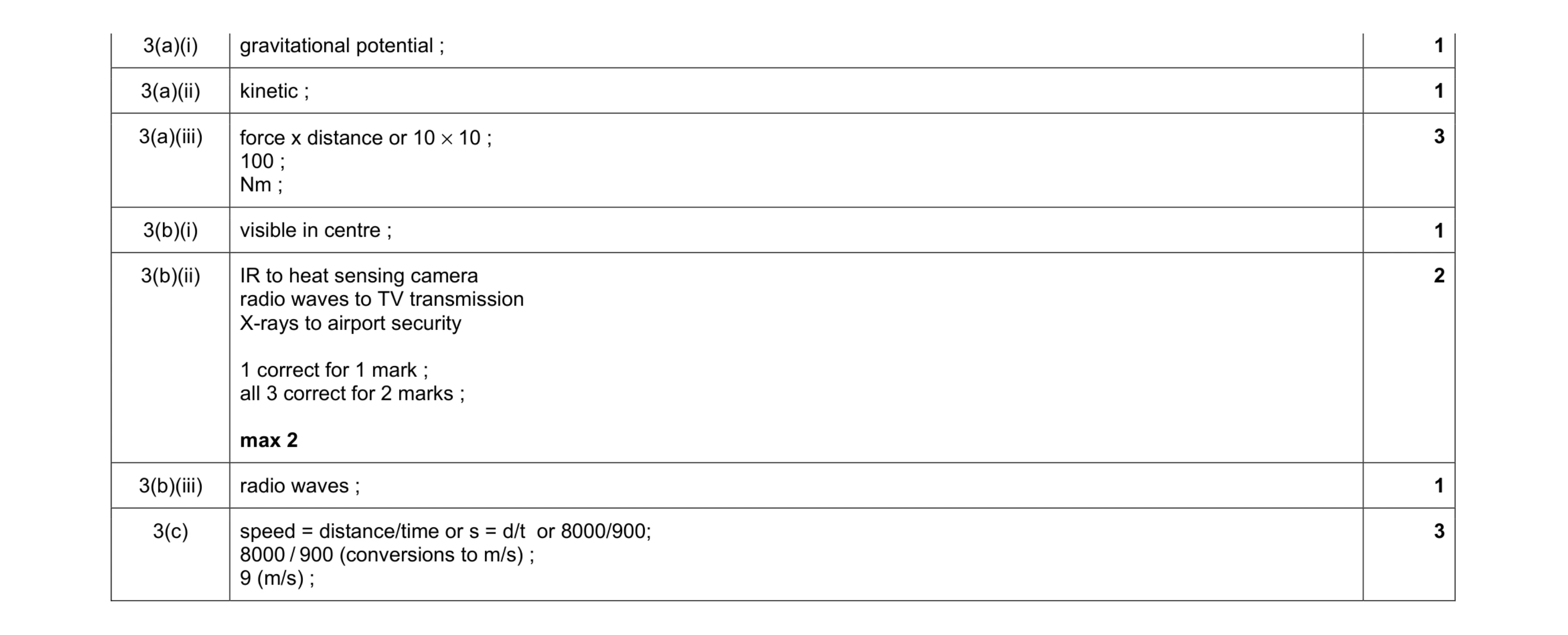 12
12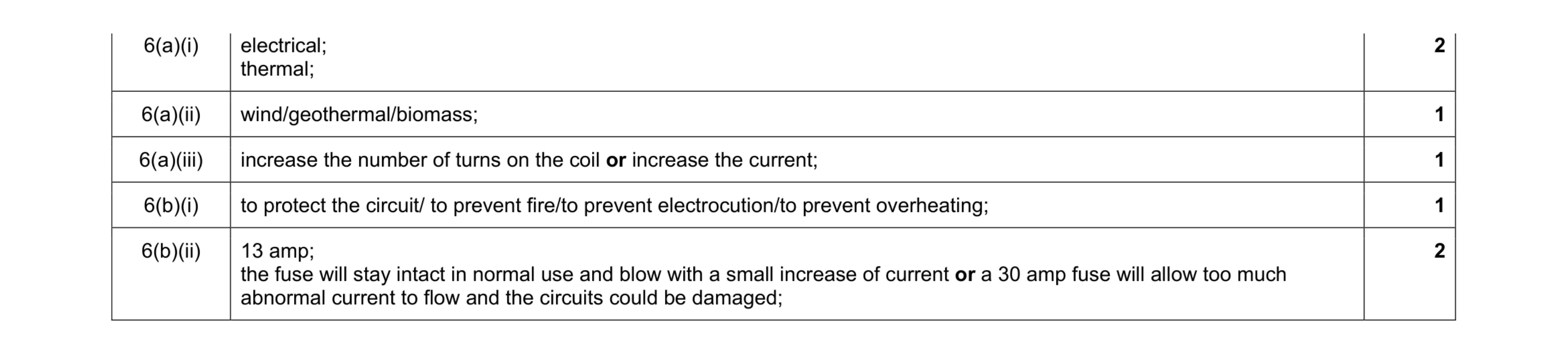 7
7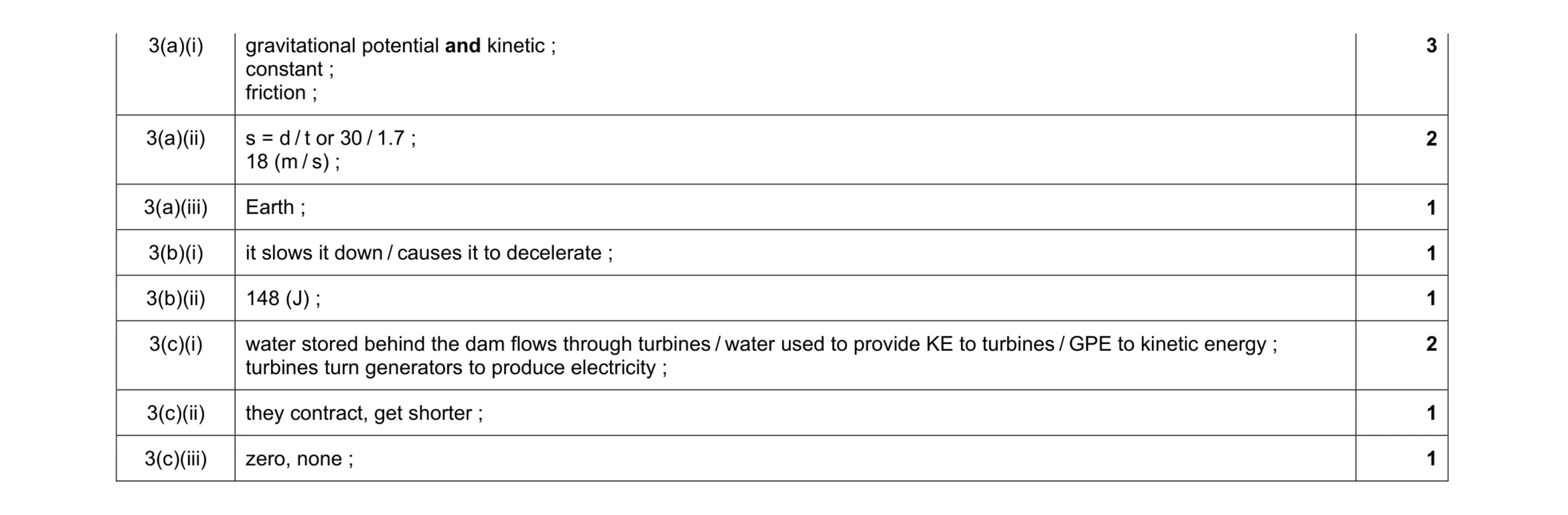 12
12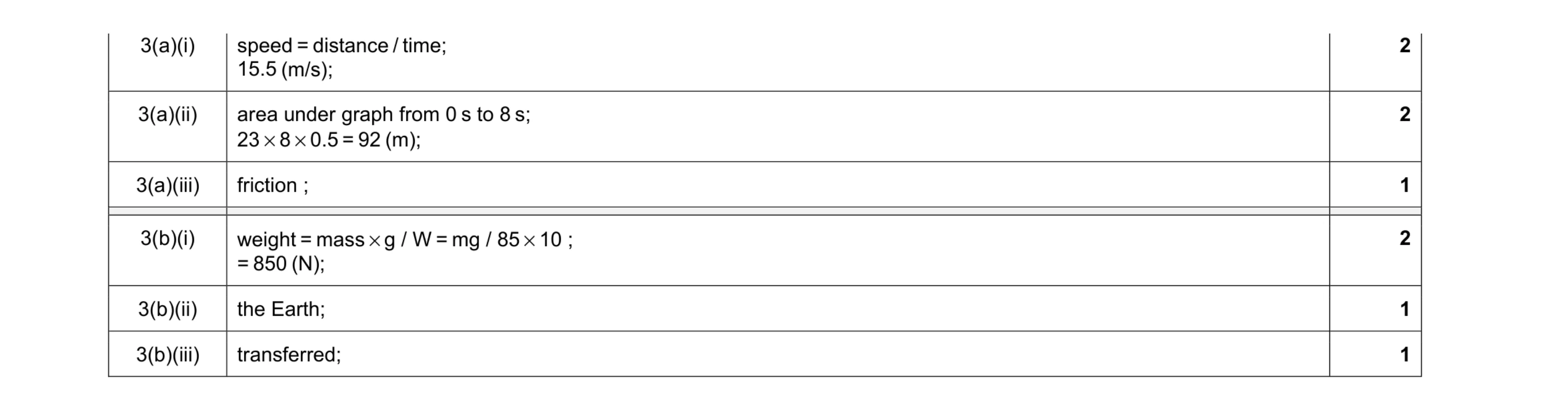 9
9 7
7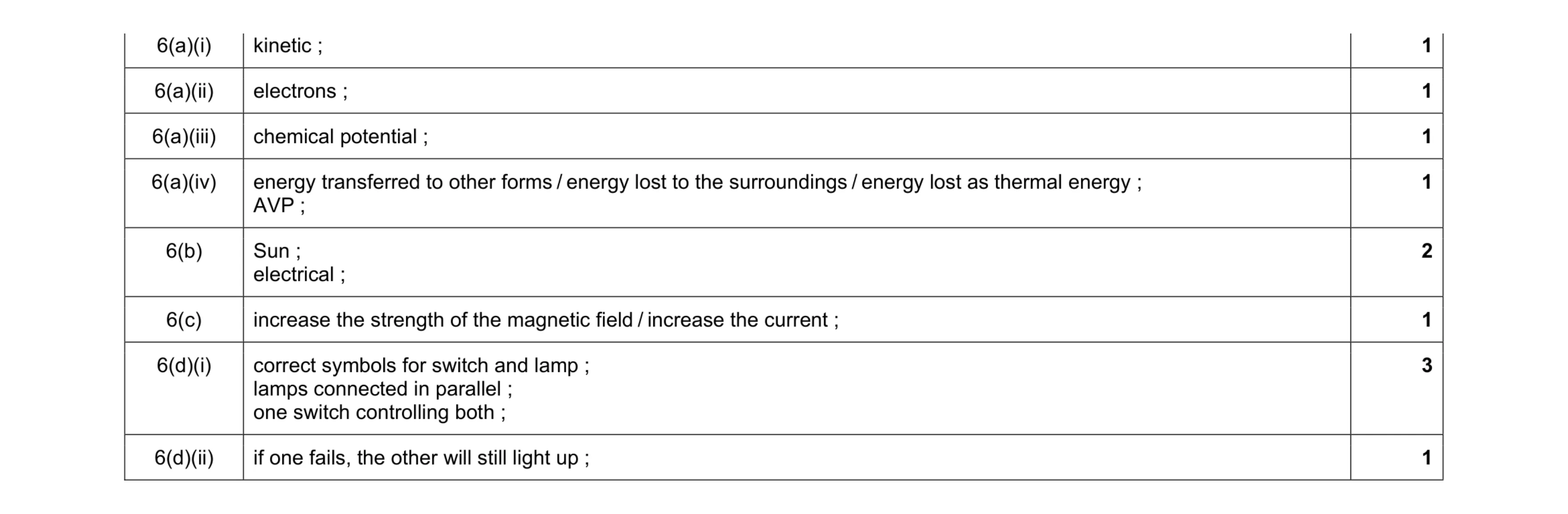 11
11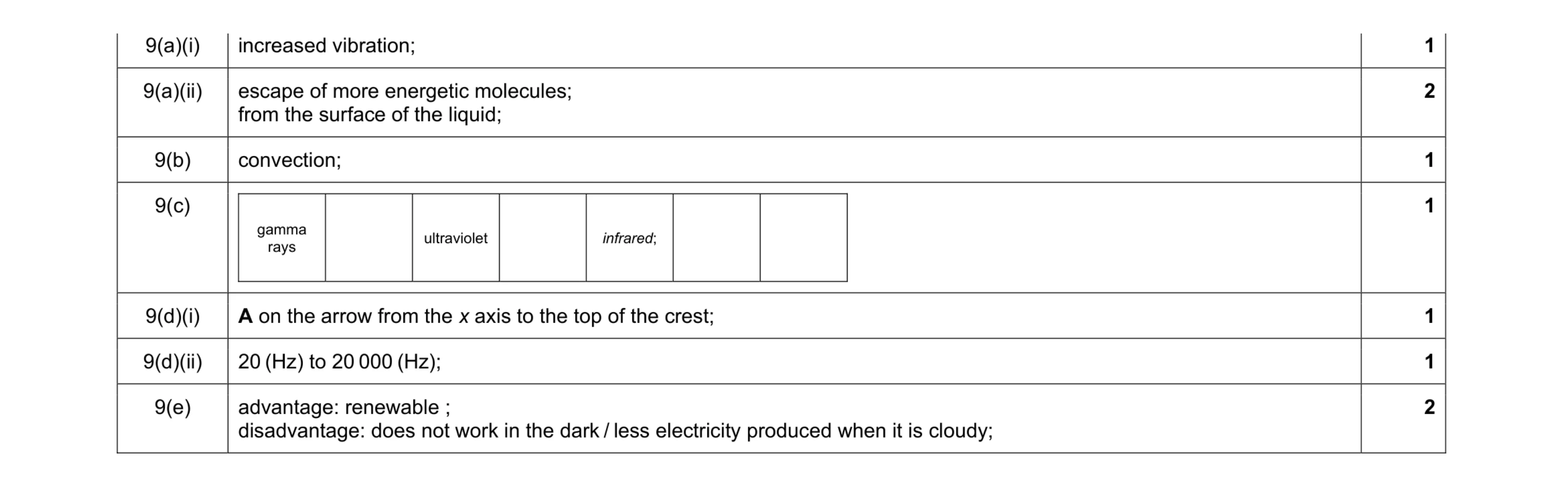 9
9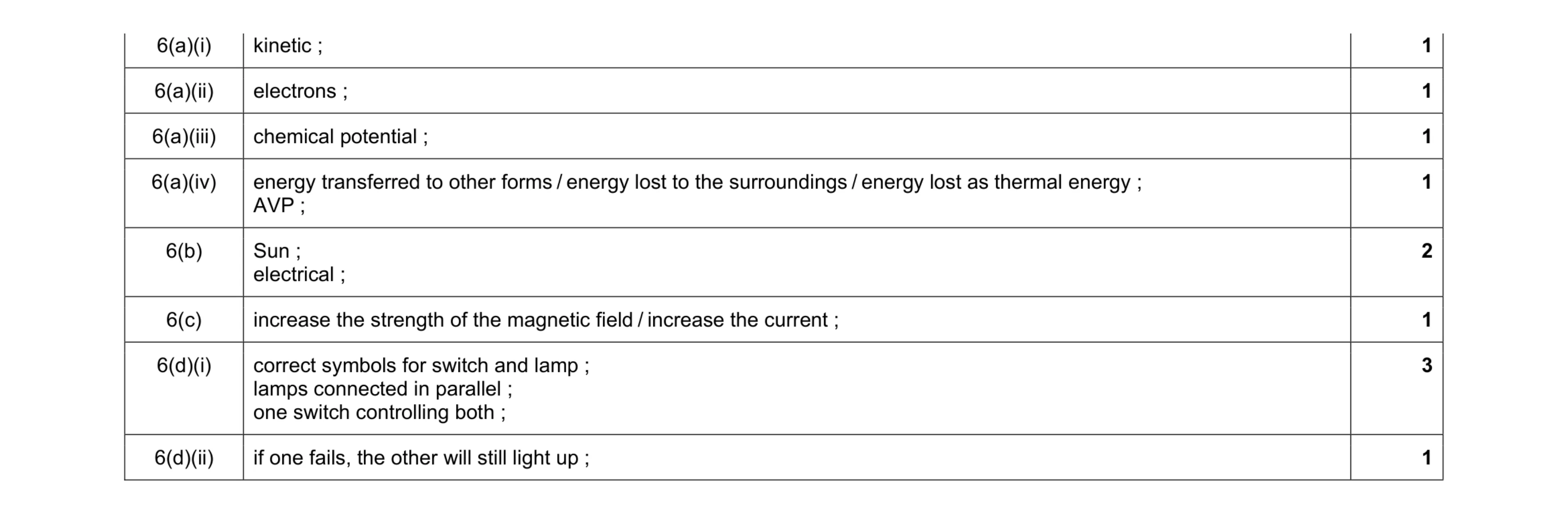 11
11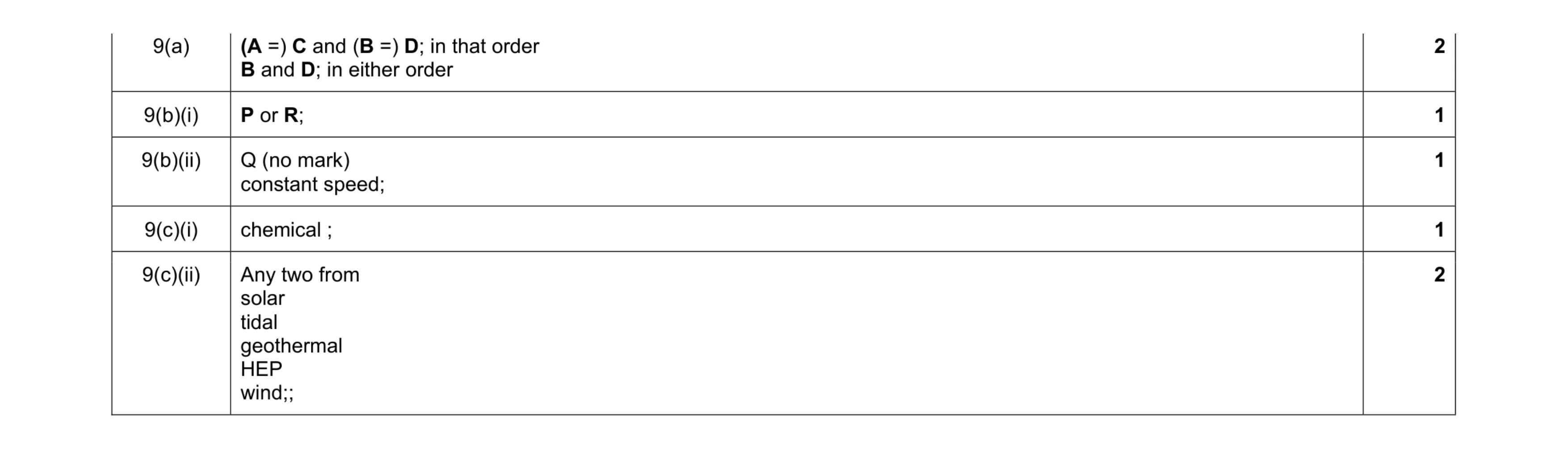 7
7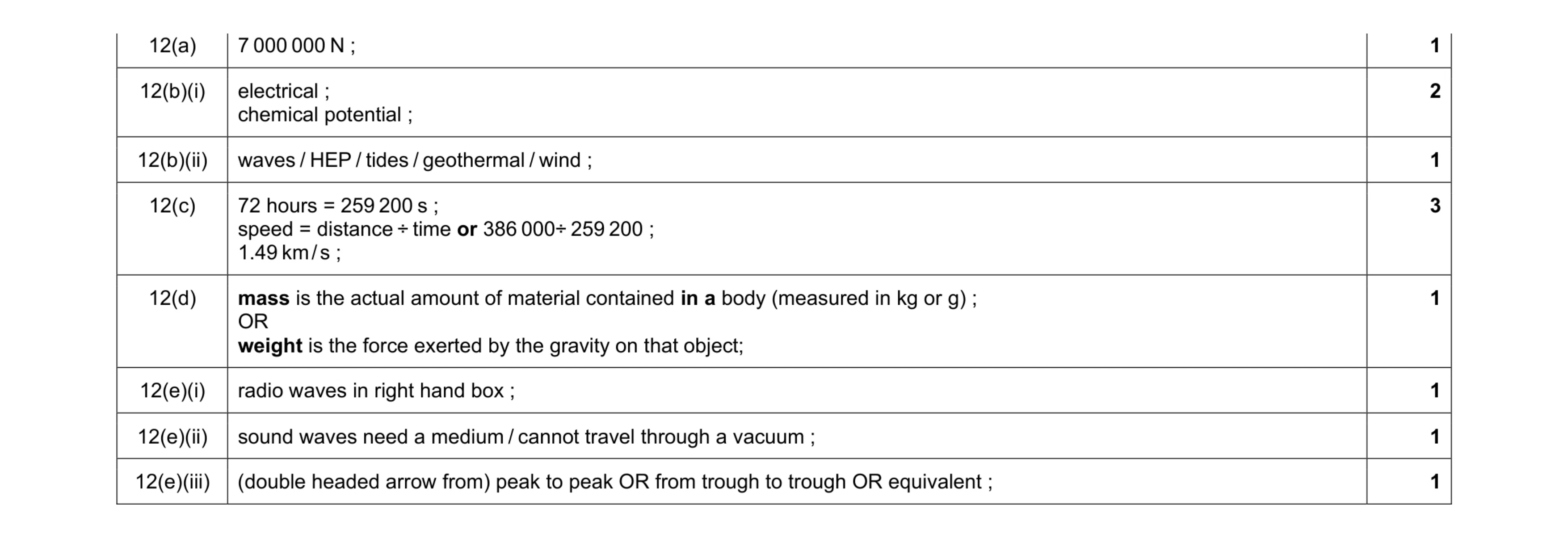 11
11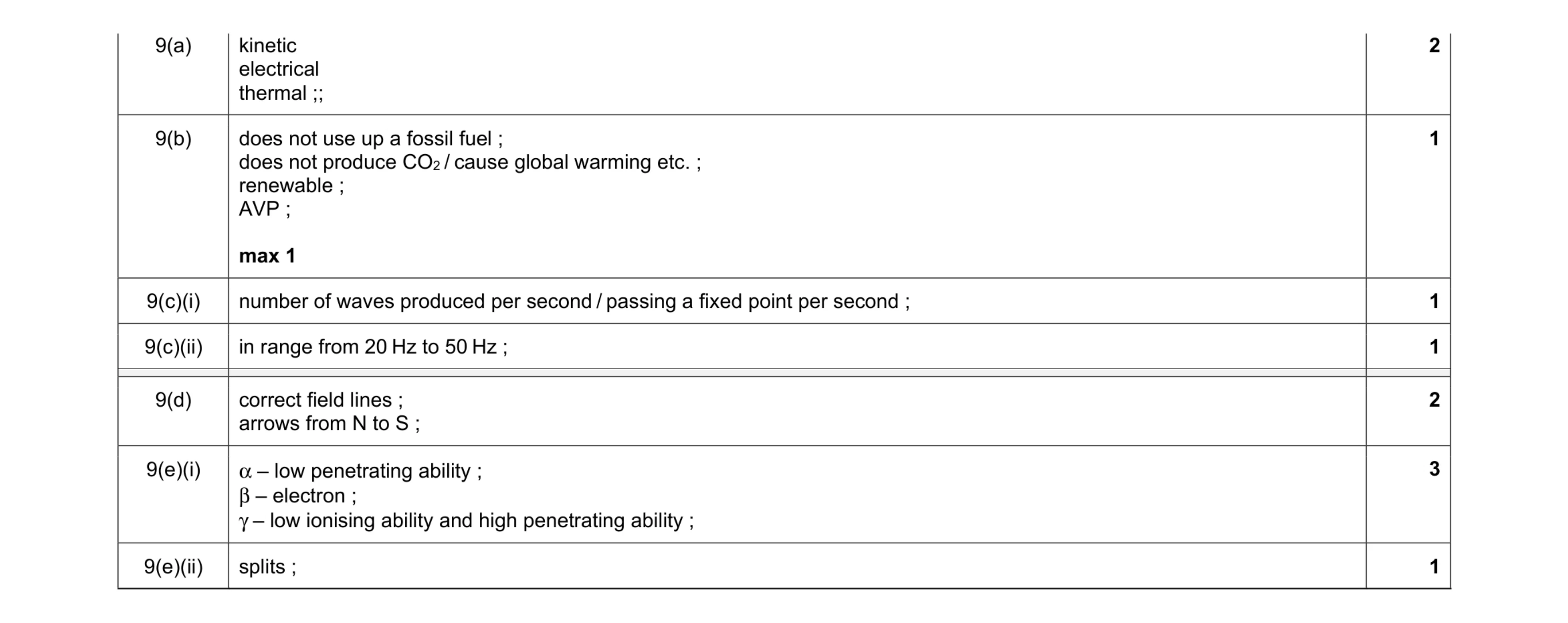 11
11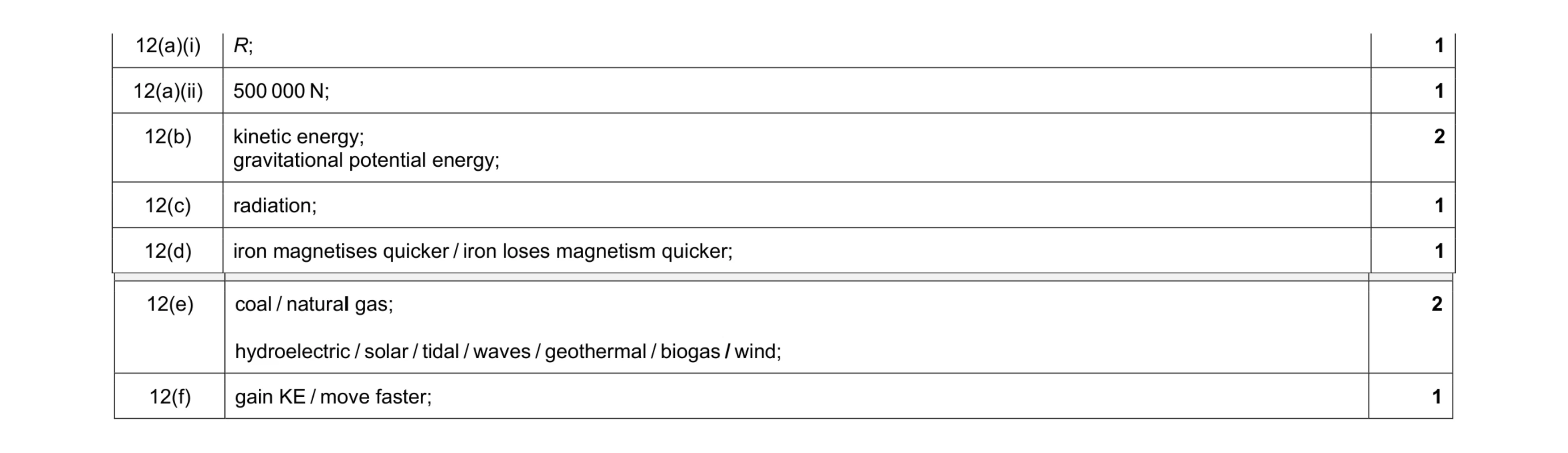 9
9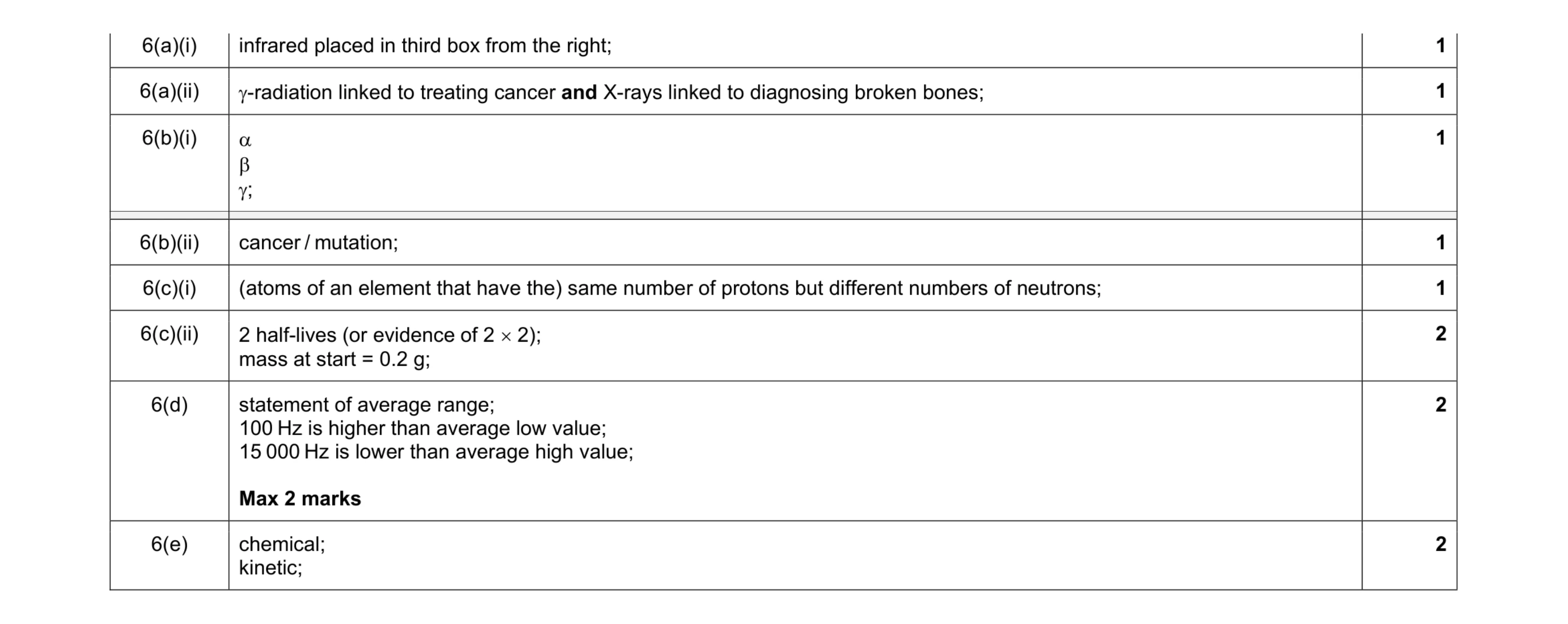 11
11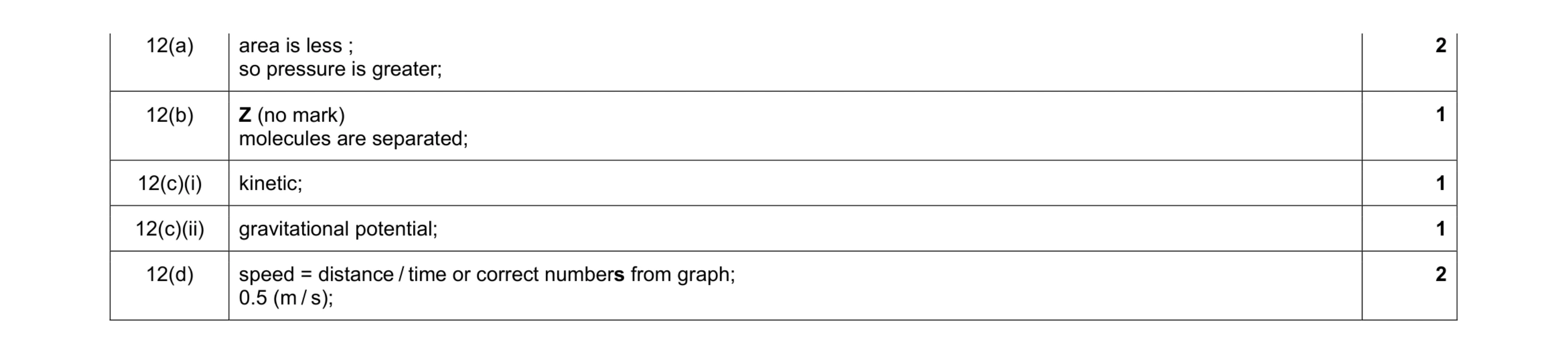 7
7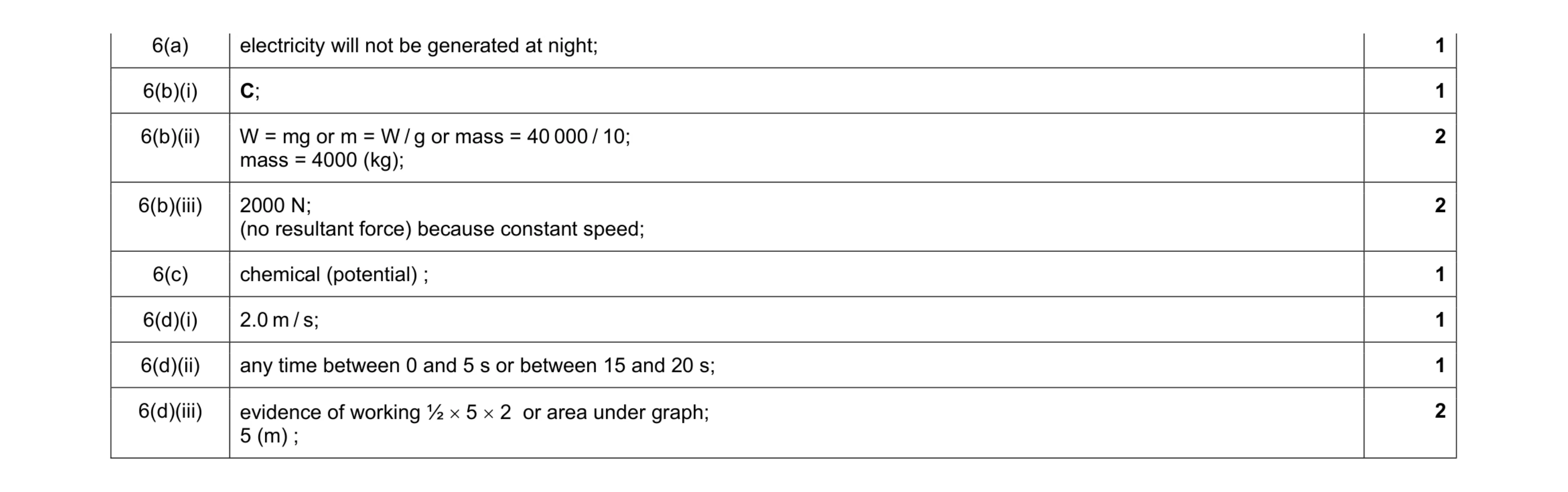 11
11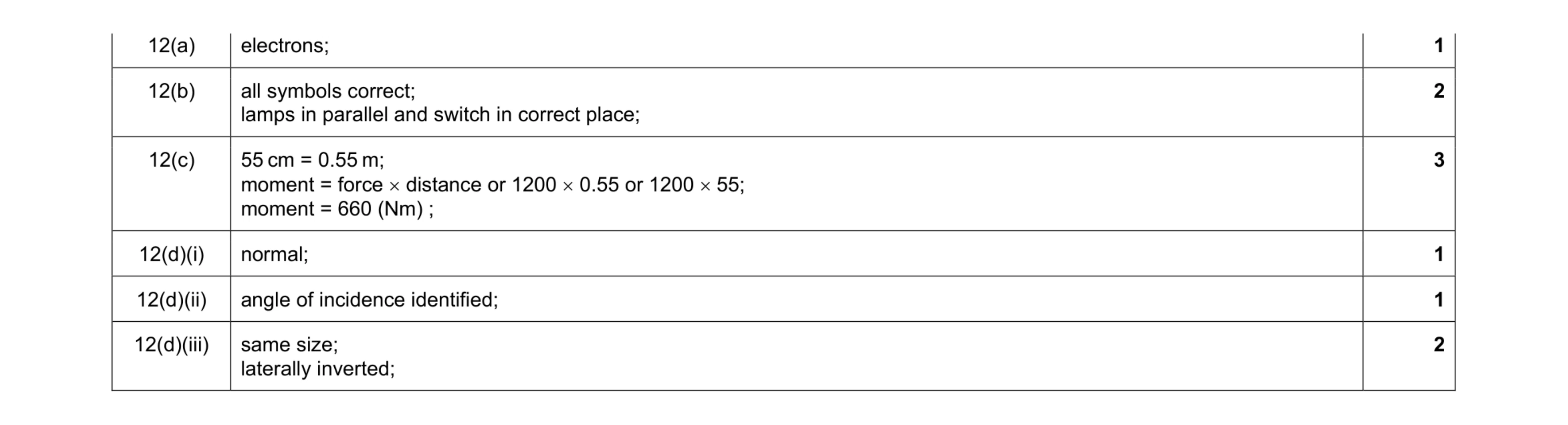 10
10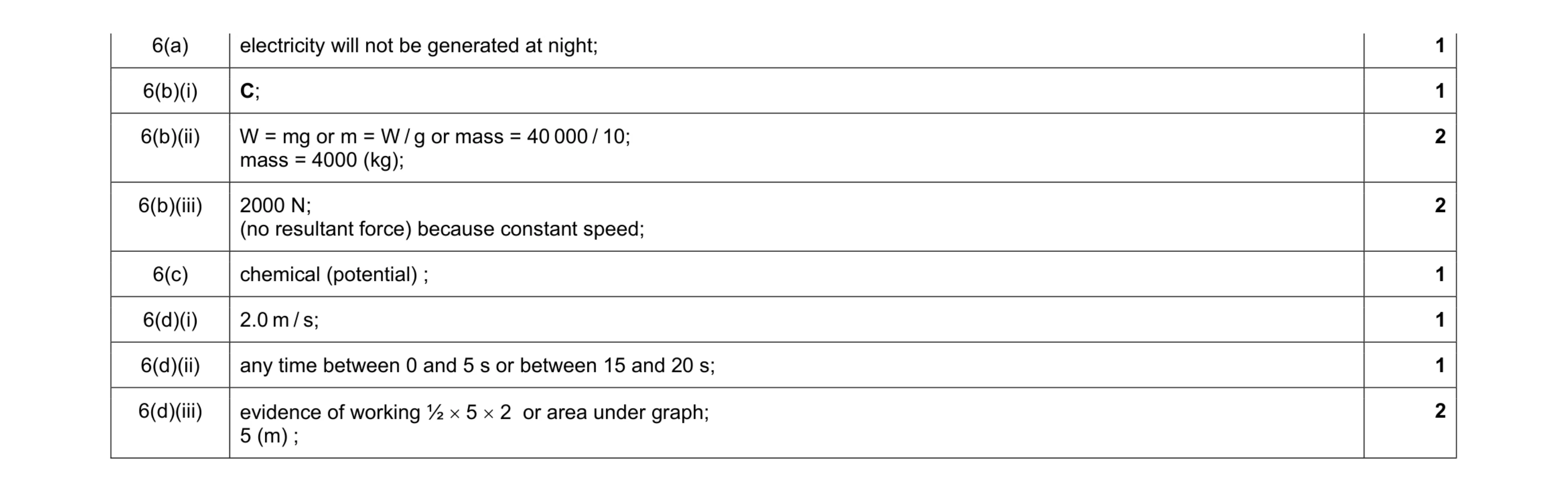 11
11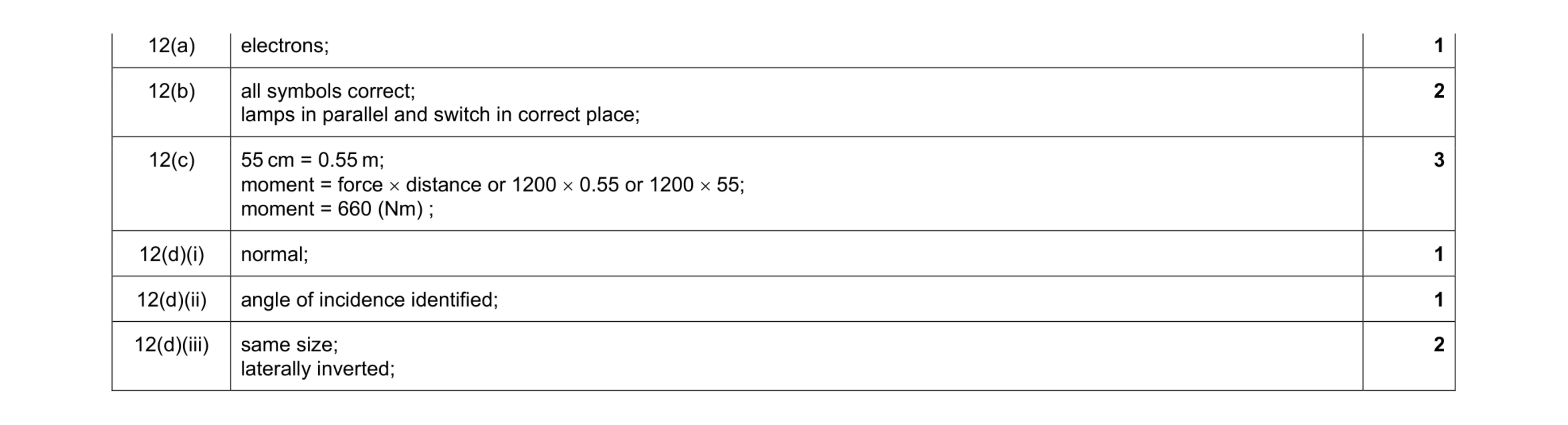 10
10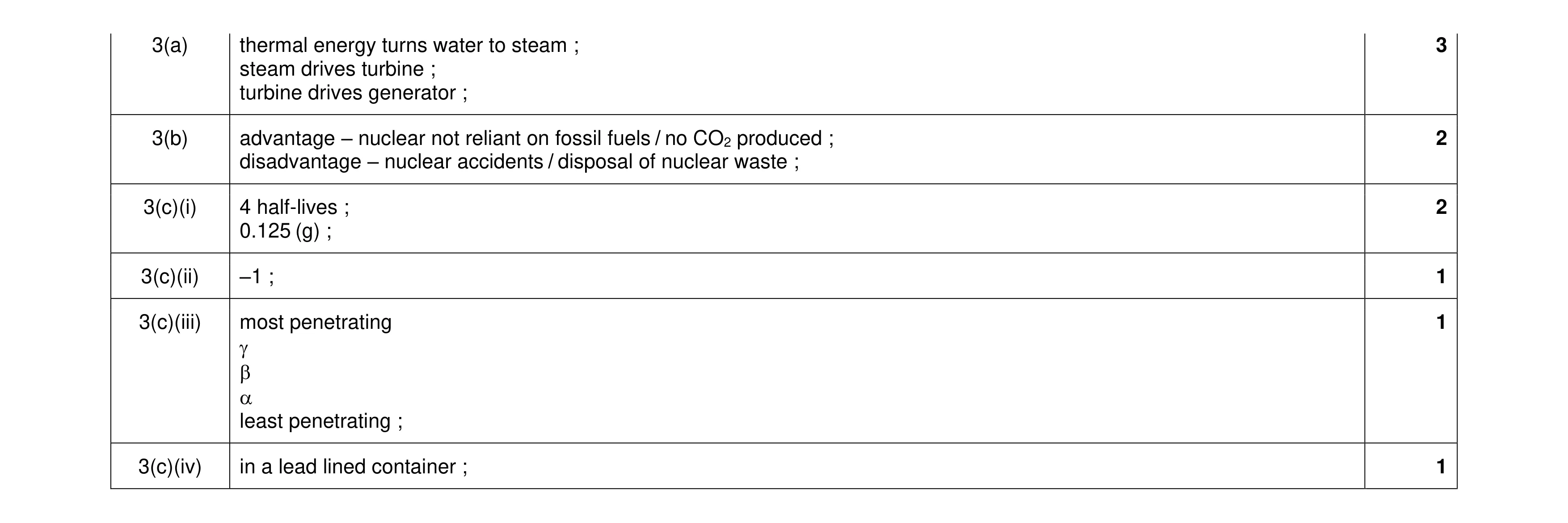 10
10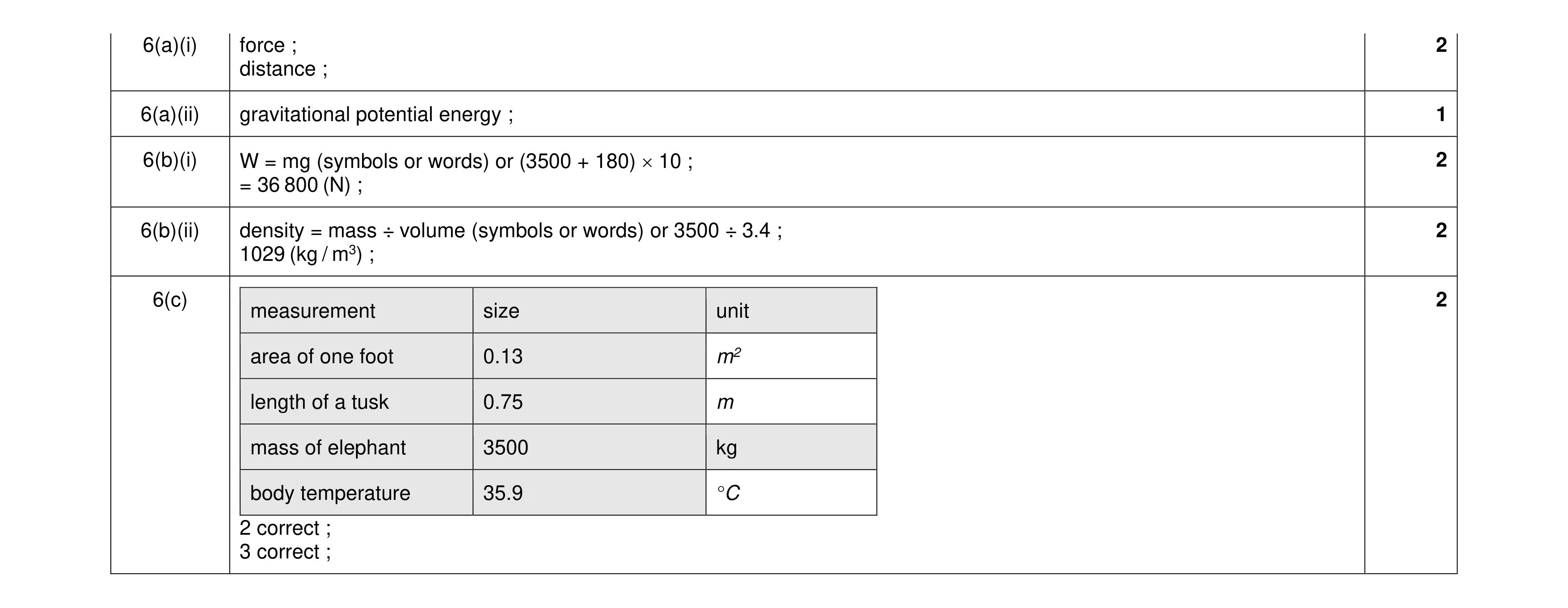 9
9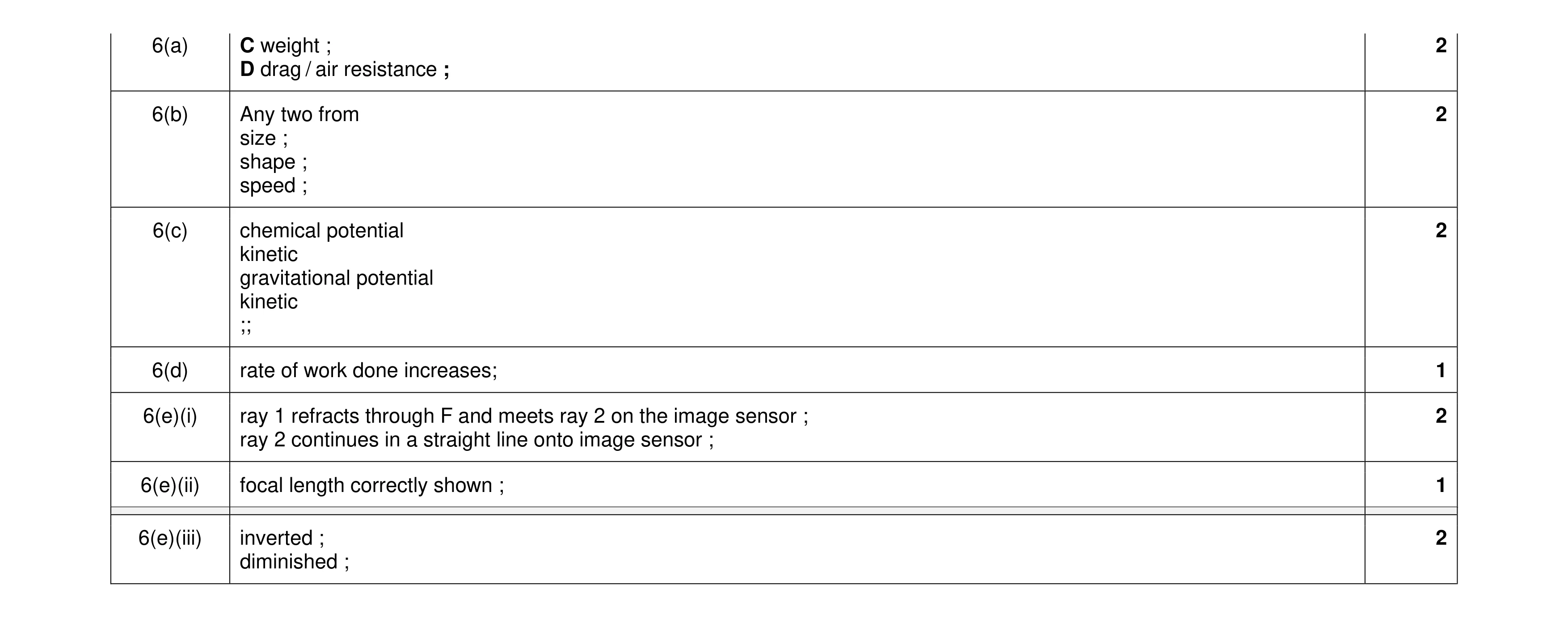 12
12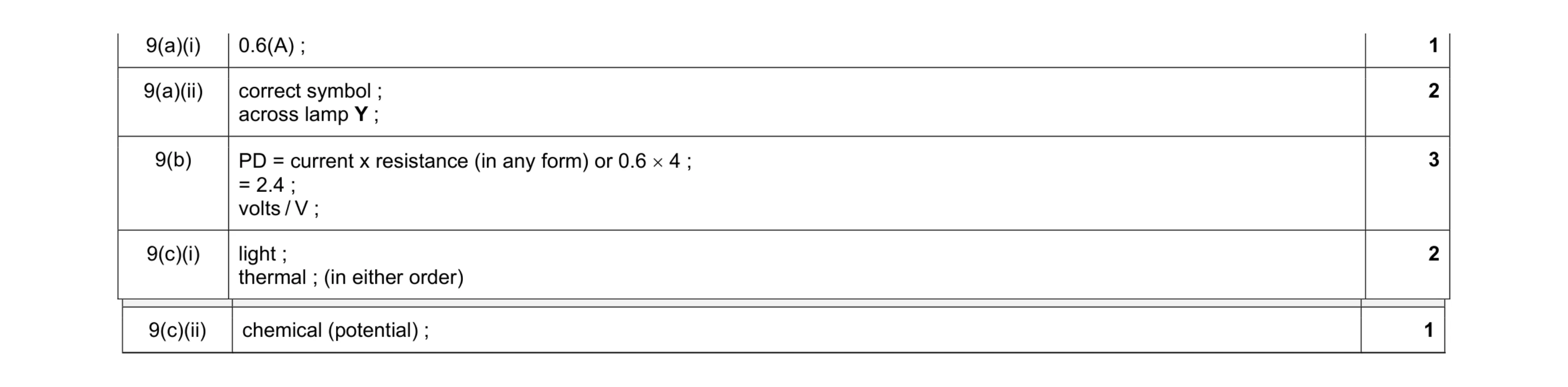 9
9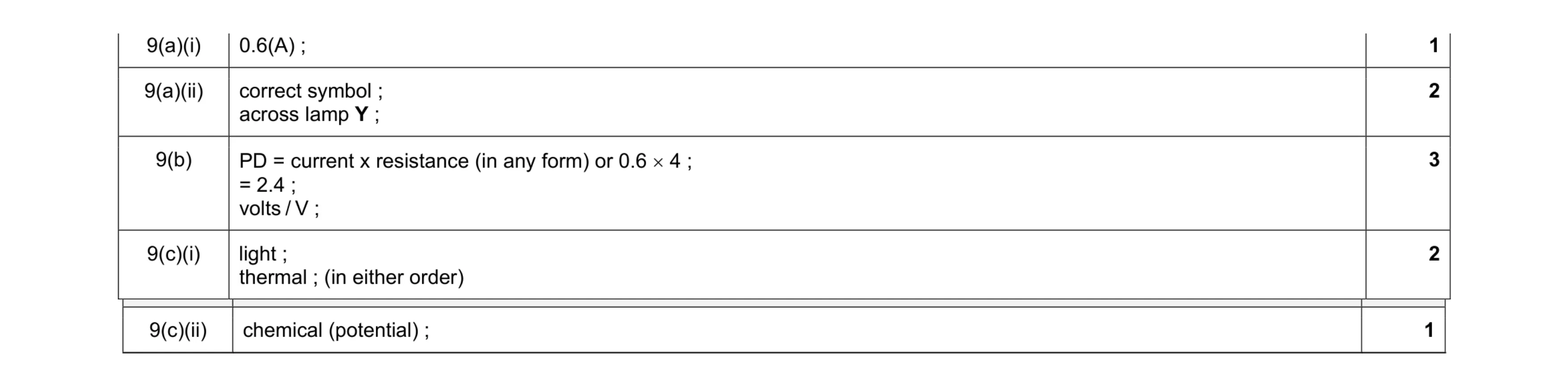 9
9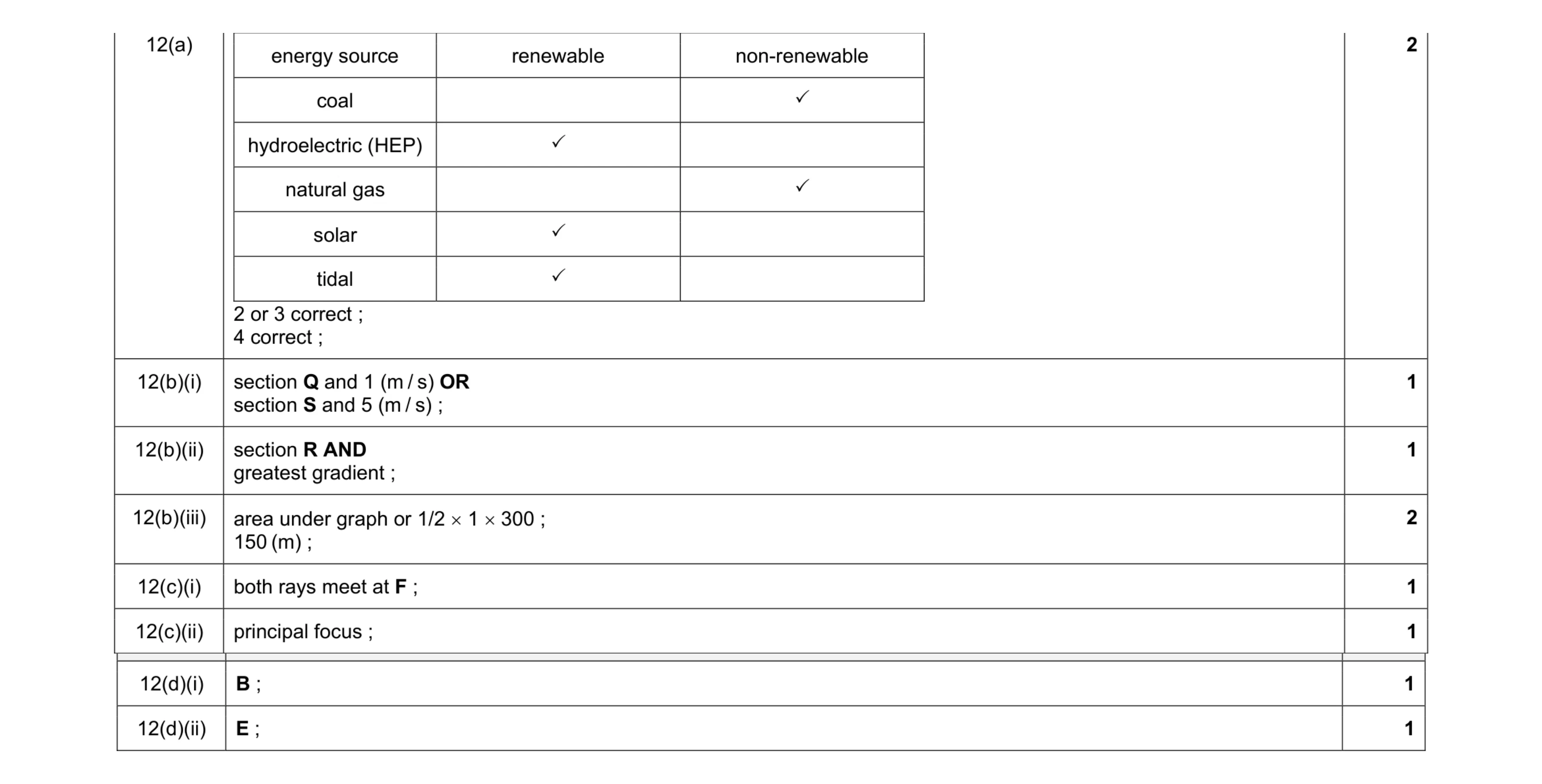 10
10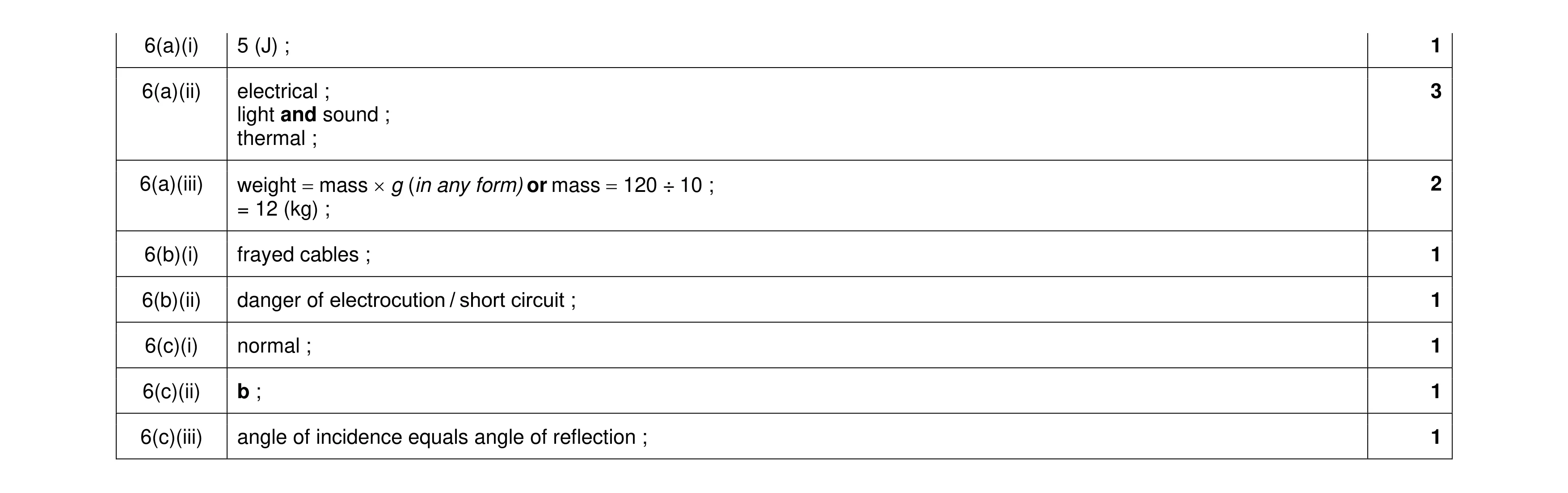 11
11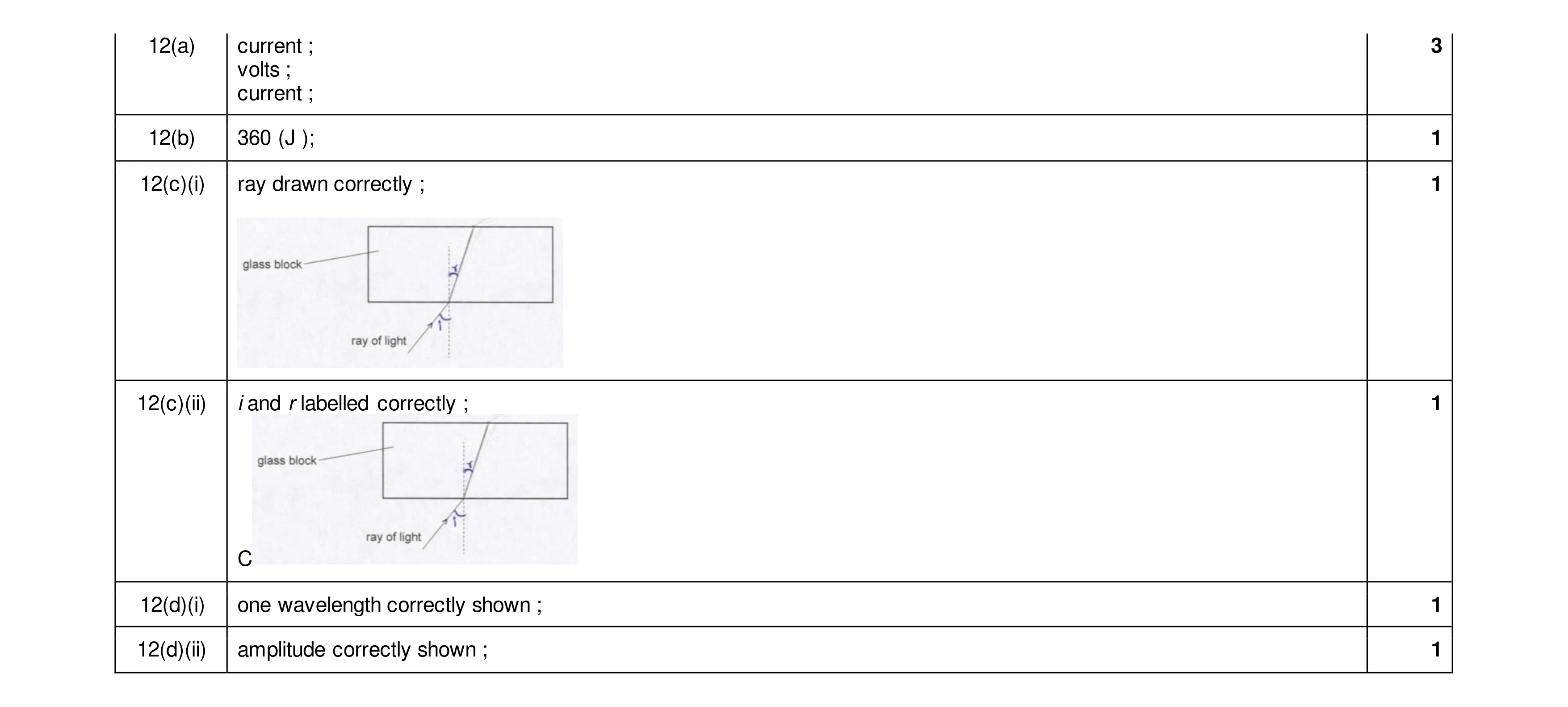 8
8 11
11 11
11 11
11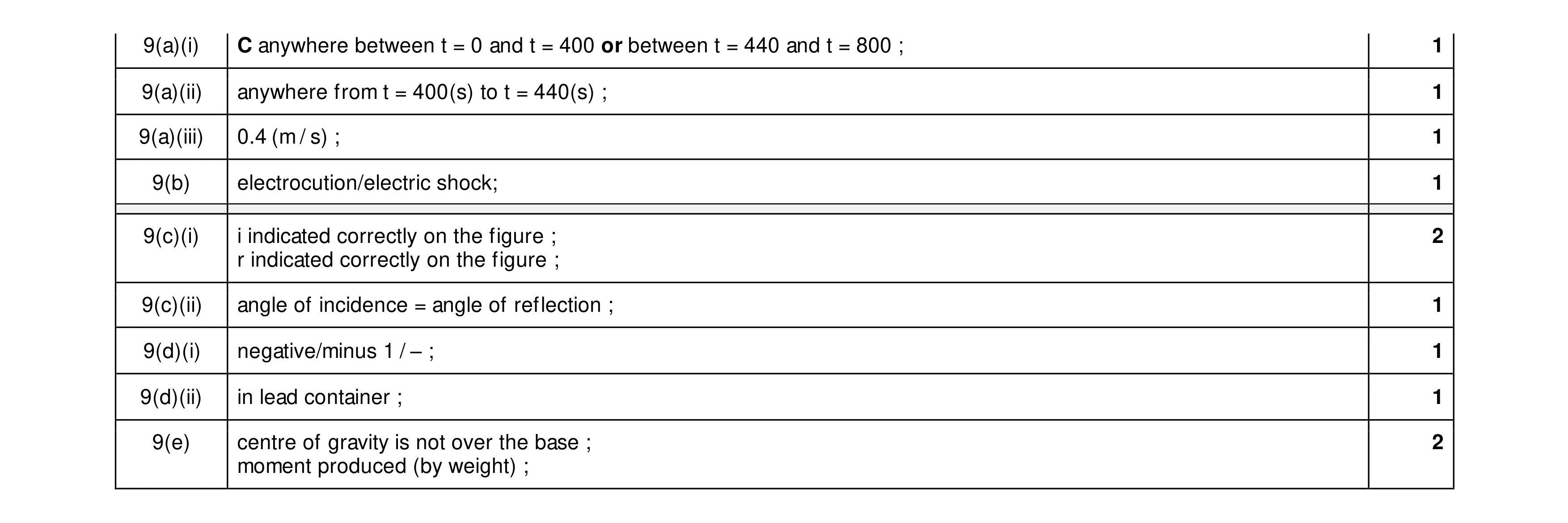 11
11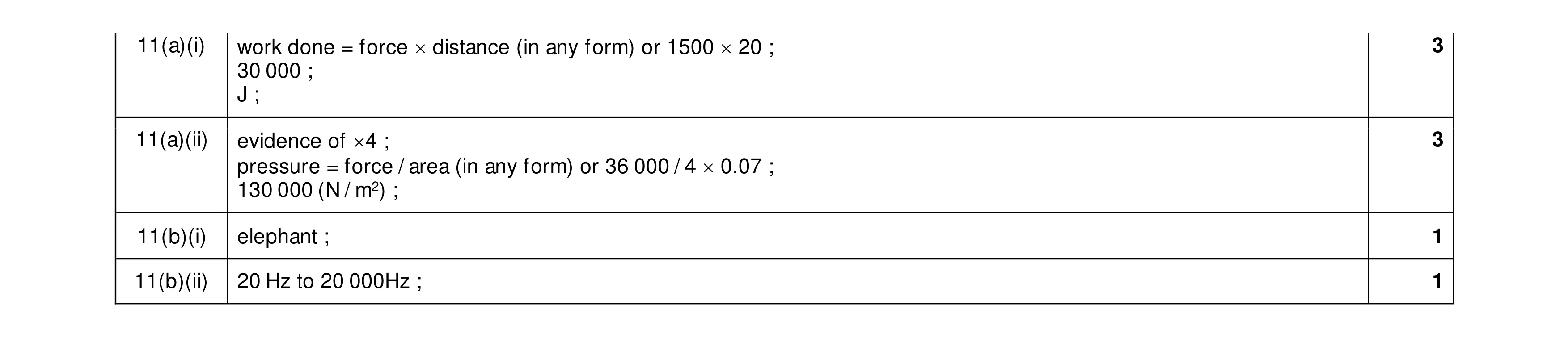 8
8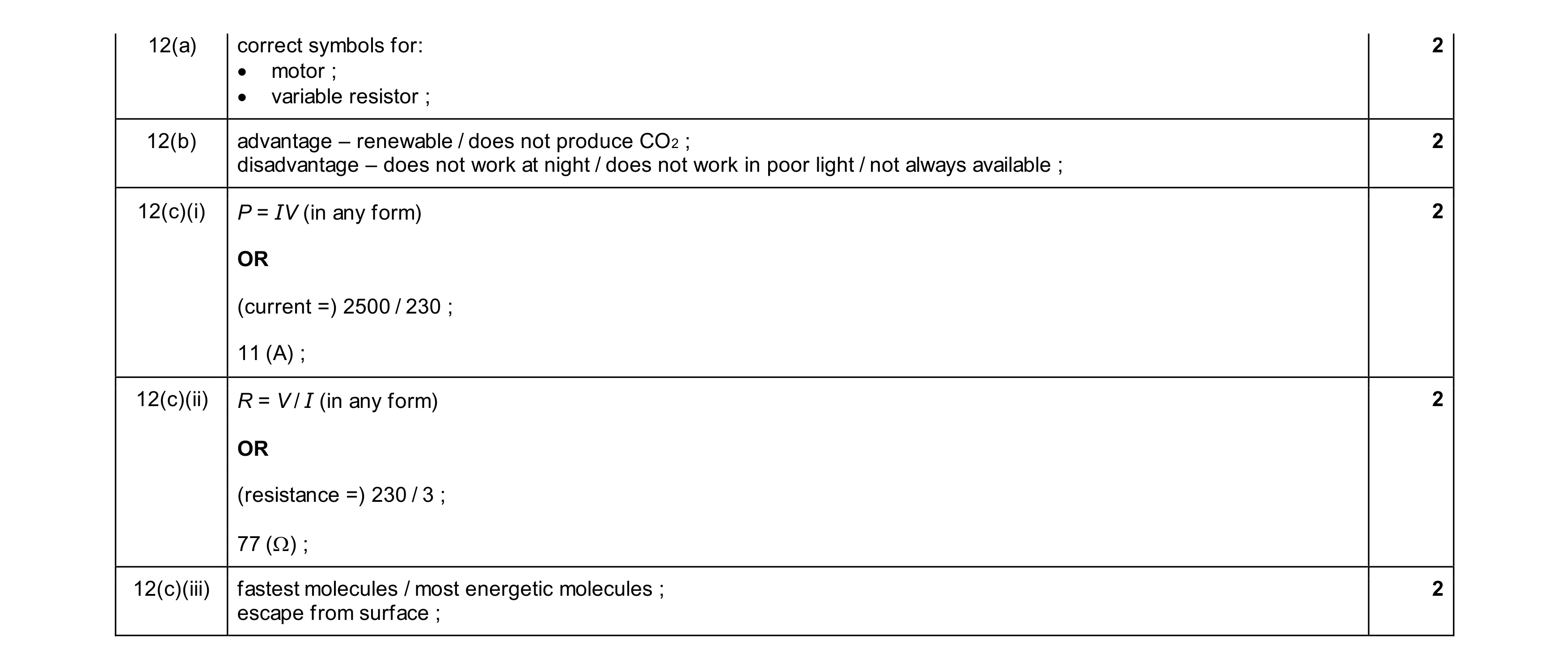 10
10