Cambridge IGCSE Sciences - Co-ordinated (Double) 0654 — 2017 Oct/Nov Paper 4 · Variant 3
0654/43/O/N/17 · 13 questions · 120 marks · ≈135 min
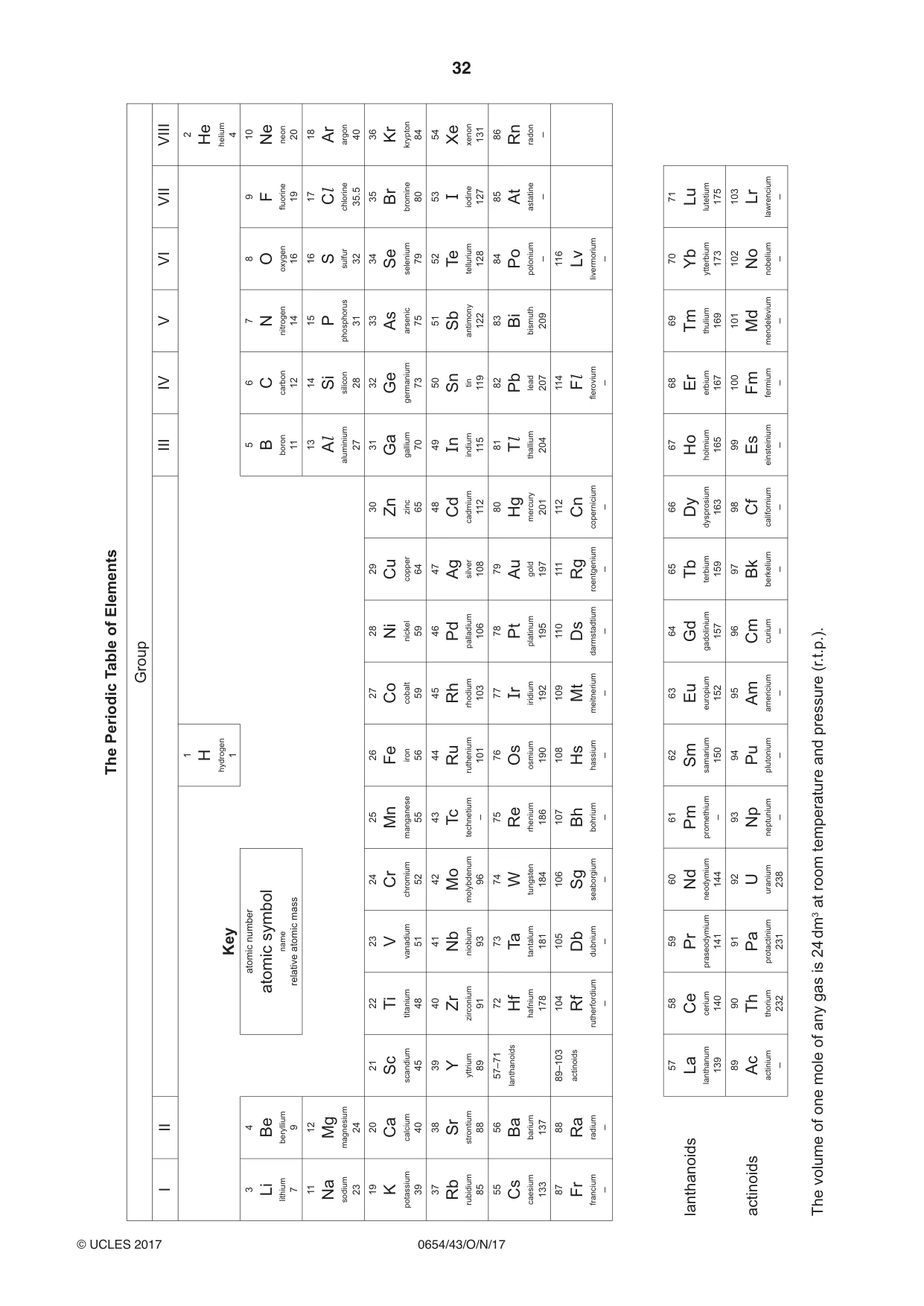
The question paper and its mark scheme, free to read here and free to download. This is Cambridge’s own paper, exactly as it was sat.
Question paper32 pages



Mark scheme9 pages
Answers below. Sit the paper first if you are practising.
Questions as text
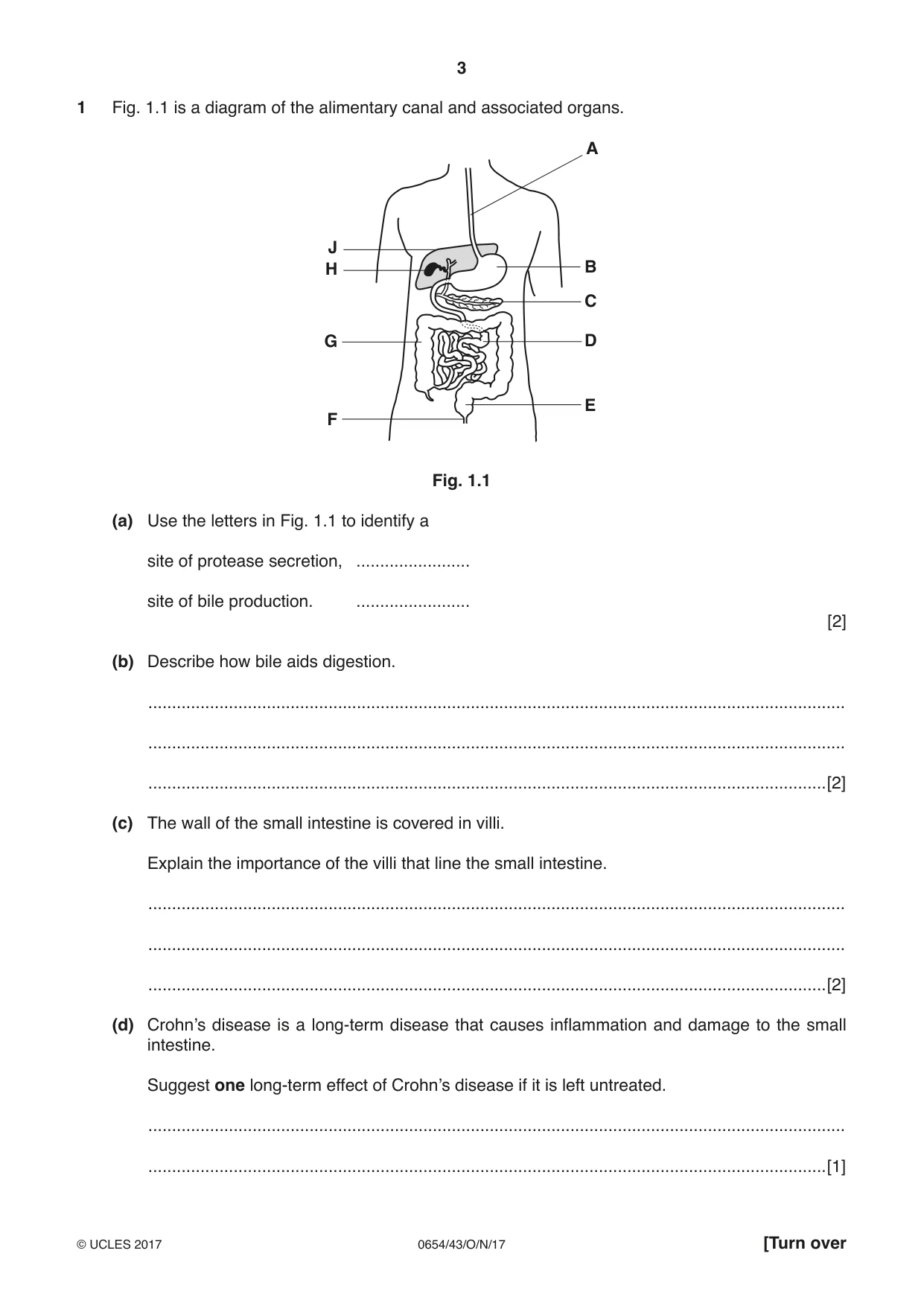
Q1 · A diagram of the alimentary canal and associated organs
1 Fig. 1.1 is a diagram of the alimentary canal and associated organs. A J H B C G D E F Fig. 1.1 (a) Use the letters in Fig. 1.1 to identify a site of protease secretion, ........................ site of bile production. ........................ [2] (b) Describe how bile aids digestion. ................................................................................................................................................... ................................................................................................................................................... ...............................................................................................................................................[2] (c) The wall of the small intestine is covered in villi. Explain the importance of the villi that line the small intestine. ................................................................................................................................................... ................................................................................................................................................... ...............................................................................................................................................[2] (d) Crohn’s disease is a long-term disease that causes inflammation and damage to the small intestine. Suggest one long-term effect of Crohn’s disease if it is left untreated. ................................................................................................................................................... ...............................................................................................................................................[1]
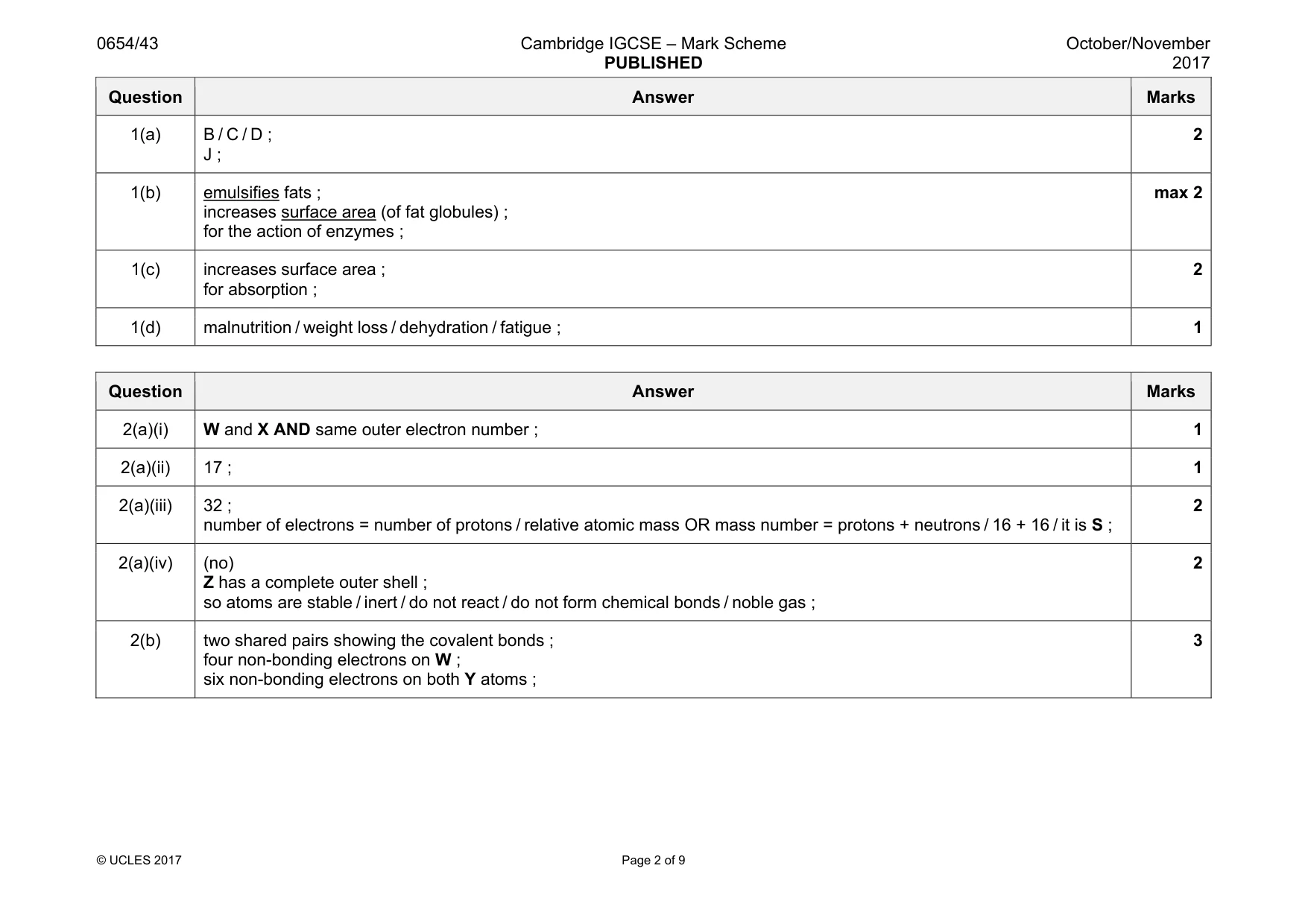
Mark scheme: 1(a) B / C / D ; J ; 2 1(b) emulsifies fats ; increases surface area (of fat globules) ; for the action of enzymes ; max 2 1(c) increases surface area ; for absorption ; 2 1(d) malnutrition / weight loss / dehydration / fatigue ; 1
Q2 · The numbers of neutrons and the electronic structures in atoms of four elements W, X, Y…
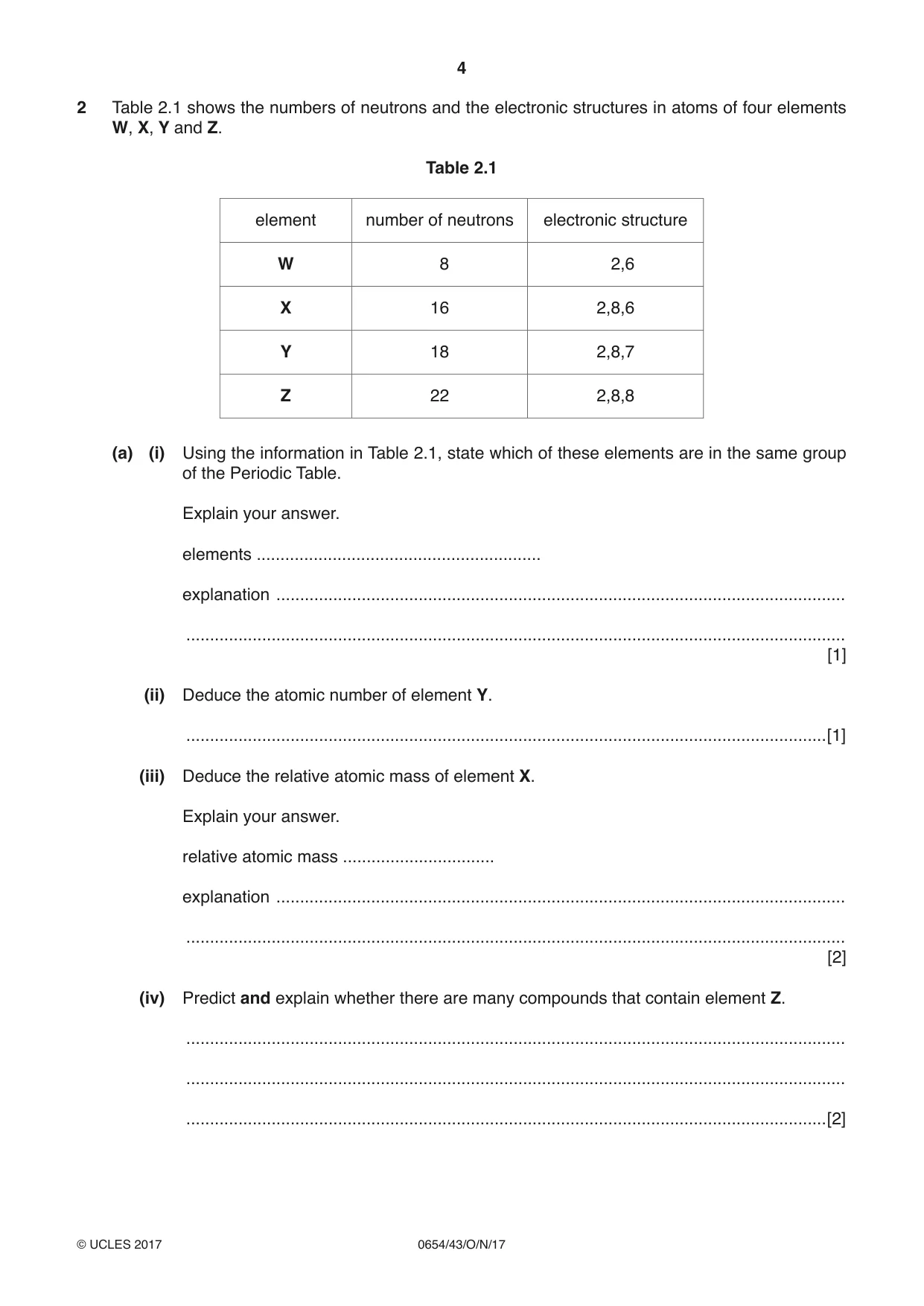
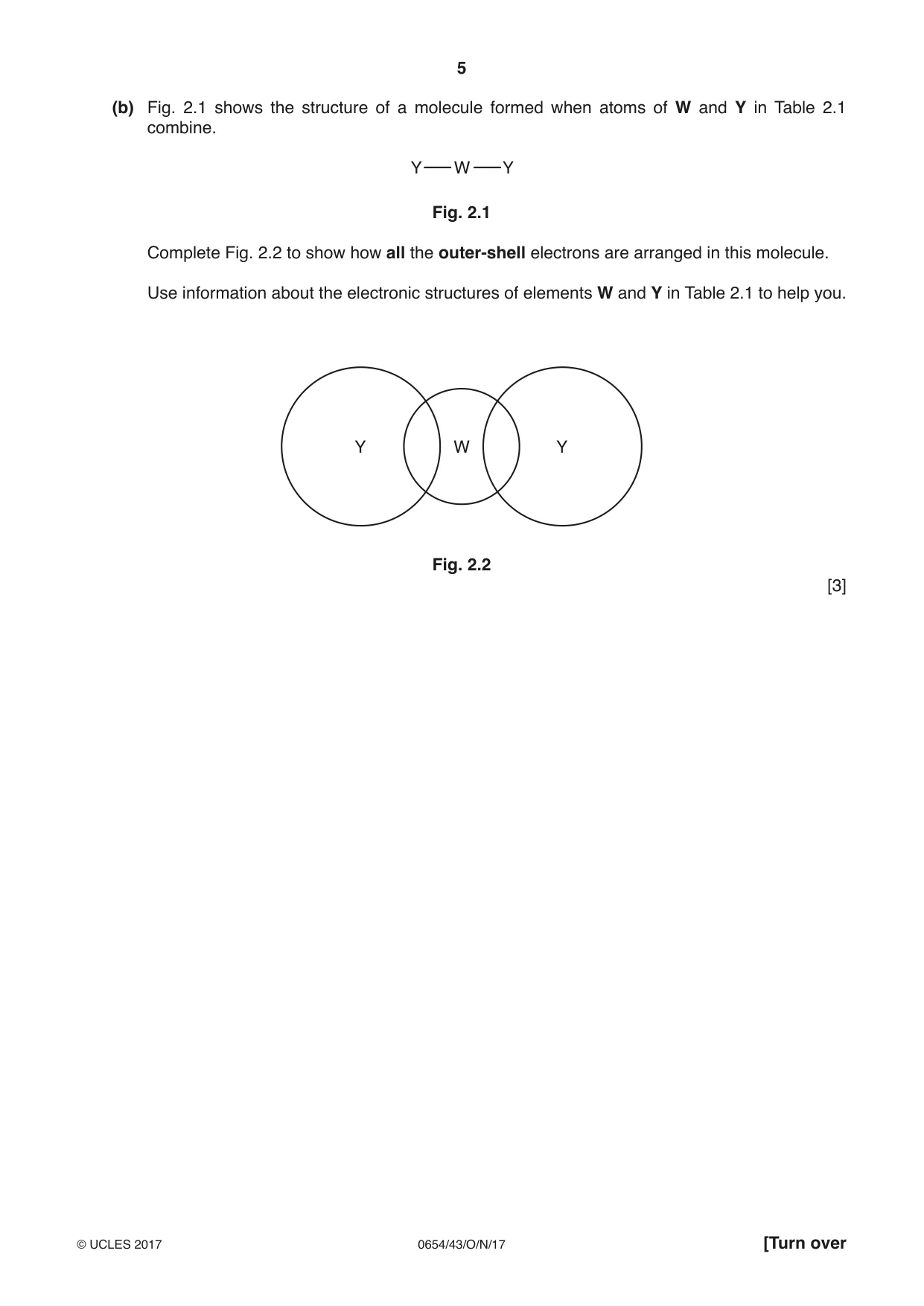
2 Table 2.1 shows the numbers of neutrons and the electronic structures in atoms of four elements W, X, Y and Z. Table 2.1 element number of neutrons electronic structure W 8 2,6 X 16 2,8,6 Y 18 2,8,7 Z 22 2,8,8 (a) (i) Using the information in Table 2.1, state which of these elements are in the same group of the Periodic Table. Explain your answer. elements ............................................................ explanation ........................................................................................................................ ........................................................................................................................................... [1] (ii) Deduce the atomic number of element Y. .......................................................................................................................................[1] (iii) Deduce the relative atomic mass of element X. Explain your answer. relative atomic mass ................................ explanation ........................................................................................................................ ........................................................................................................................................... [2] (iv) Predict and explain whether there are many compounds that contain element Z. ........................................................................................................................................... ........................................................................................................................................... .......................................................................................................................................[2] (b) Fig. 2.1 shows the structure of a molecule formed when atoms of W and Y in Table 2.1 combine. Y W Y Fig. 2.1 Complete Fig. 2.2 to show how all the outer-shell electrons are arranged in this molecule. Use information about the electronic structures of elements W and Y in Table 2.1 to help you. Y W Y Fig. 2.2 [3]
Mark scheme: 2(a)(i) W and X AND same outer electron number ; 1 2(a)(ii) 17 ; 1 2(a)(iii) 32 ; number of electrons = number of protons / relative atomic mass OR mass number = protons + neutrons / 16 + 16 / it is S ; 2 2(a)(iv) (no) Z has a complete outer shell ; so atoms are stable / inert / do not react / do not form chemical bonds / noble gas ; 2 2(b) two shared pairs showing the covalent bonds ; four non-bonding electrons on W ; six non-bonding electrons on both Y atoms ; 3
Q3 · A radioactive isotope of iodine is used by a doctor to examine the thyroid gland of a…
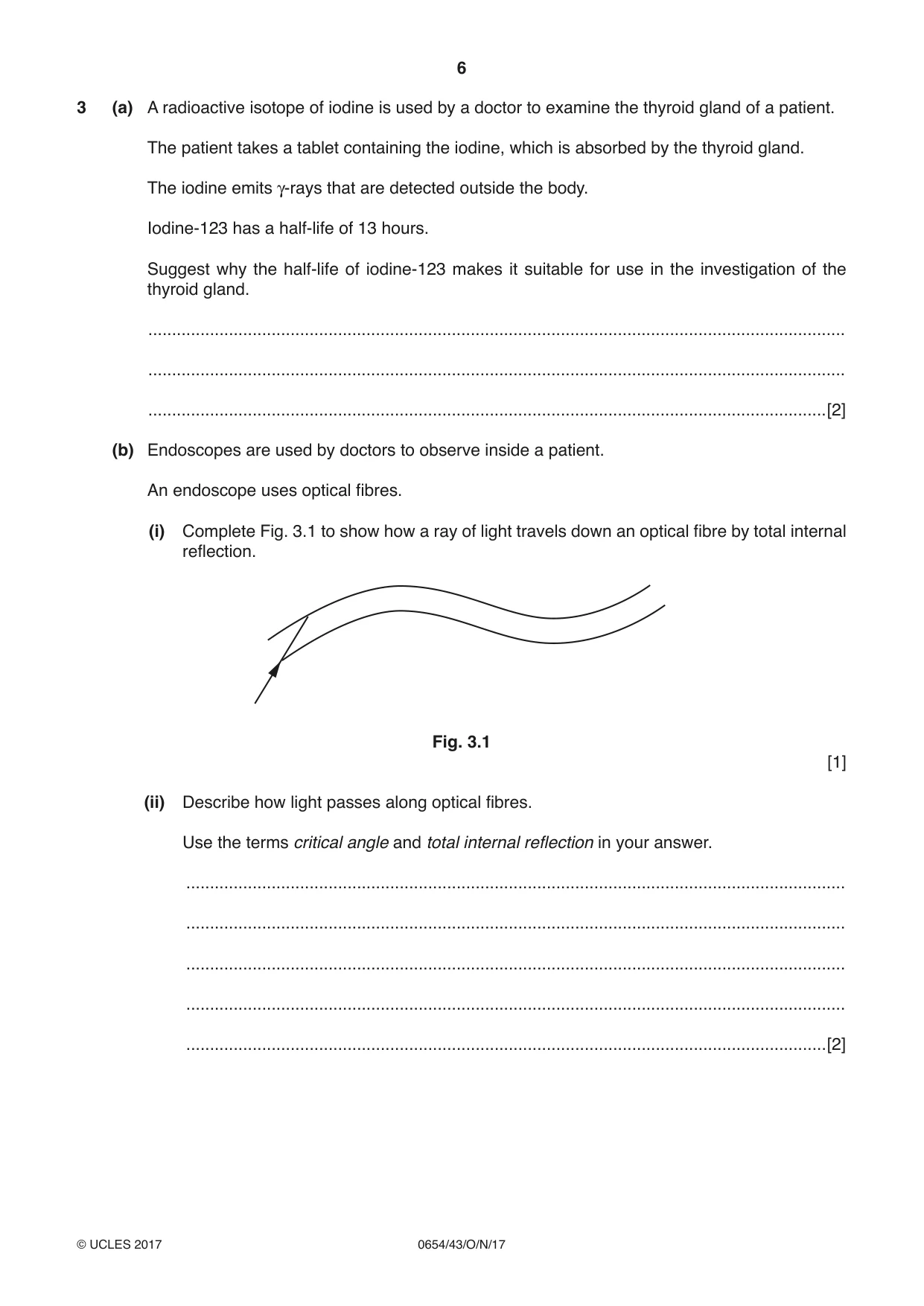
3 (a) A radioactive isotope of iodine is used by a doctor to examine the thyroid gland of a patient. The patient takes a tablet containing the iodine, which is absorbed by the thyroid gland. The iodine emits γ-rays that are detected outside the body. Iodine-123 has a half-life of 13 hours. Suggest why the half-life of iodine-123 makes it suitable for use in the investigation of the thyroid gland. ................................................................................................................................................... ................................................................................................................................................... ...............................................................................................................................................[2] (b) Endoscopes are used by doctors to observe inside a patient. An endoscope uses optical fibres. (i) Complete Fig. 3.1 to show how a ray of light travels down an optical fibre by total internal reflection. Fig. 3.1 [1] (ii) Describe how light passes along optical fibres. Use the terms critical angle and total internal reflection in your answer. ........................................................................................................................................... ........................................................................................................................................... ........................................................................................................................................... ........................................................................................................................................... .......................................................................................................................................[2]
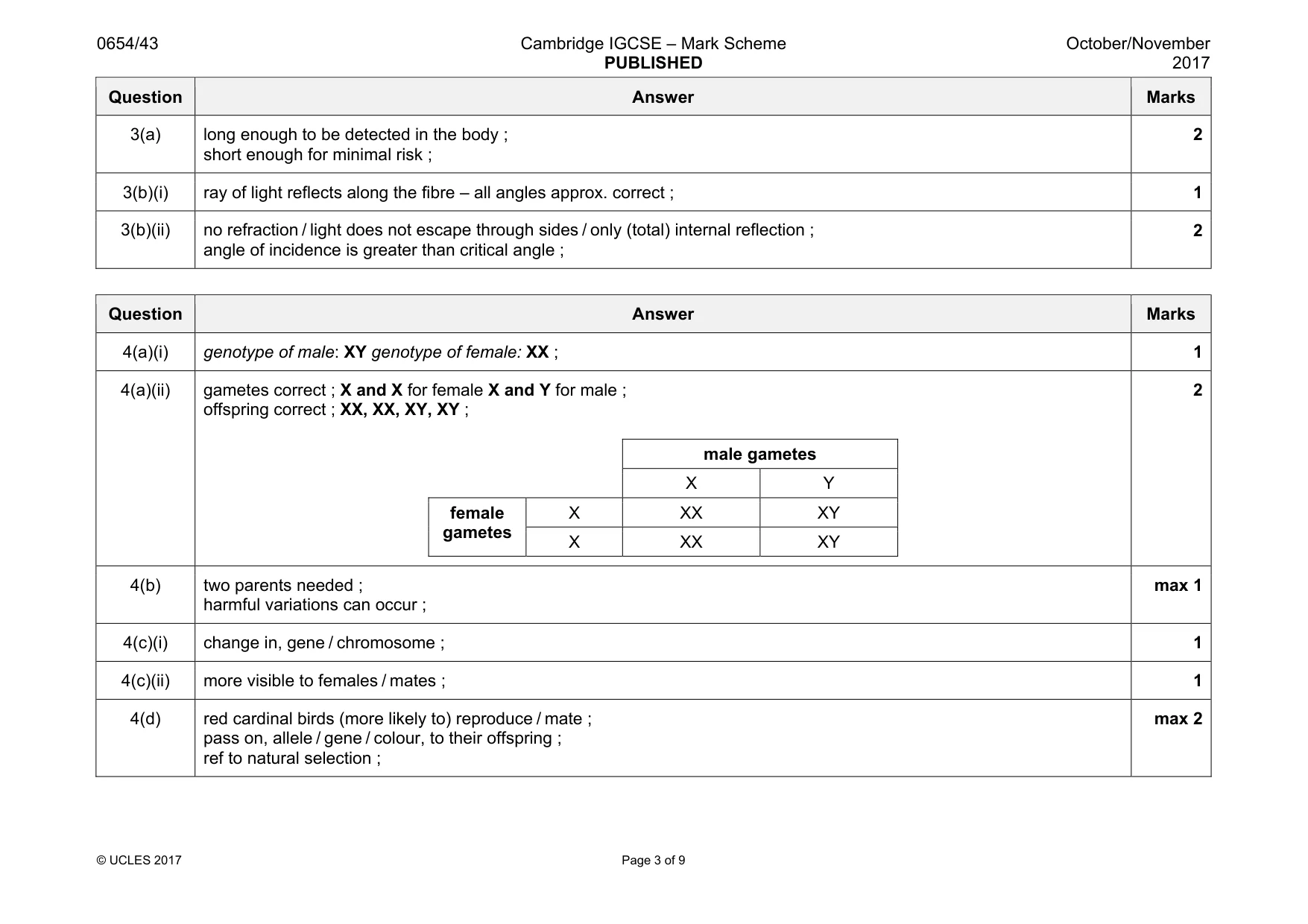
Mark scheme: 3(a) long enough to be detected in the body ; short enough for minimal risk ; 2 3(b)(i) ray of light reflects along the fibre – all angles approx. correct ; 1 3(b)(ii) no refraction / light does not escape through sides / only (total) internal reflection ; angle of incidence is greater than critical angle ; 2
Q4 · Sexual reproduction in large animal populations usually results in approximately equal…
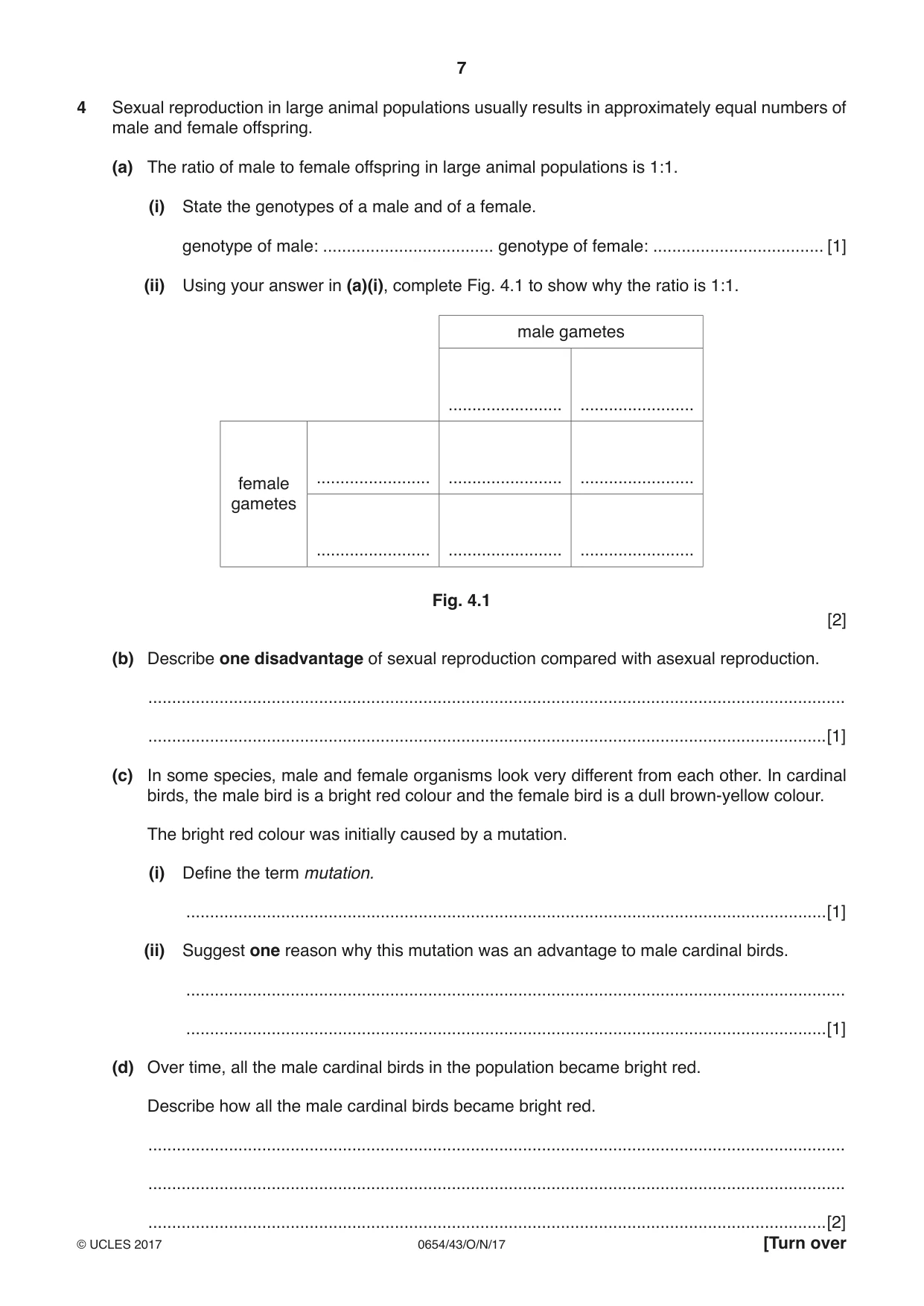
4 Sexual reproduction in large animal populations usually results in approximately equal numbers of male and female offspring. (a) The ratio of male to female offspring in large animal populations is 1:1. (i) State the genotypes of a male and of a female. genotype of male: .................................... genotype of female: .................................... [1] (ii) Using your answer in (a)(i), complete Fig. 4.1 to show why the ratio is 1:1. male gametes ........................ ........................ ........................ ........................ ........................ female gametes ........................ ........................ ........................ Fig. 4.1 [2] (b) Describe one disadvantage of sexual reproduction compared with asexual reproduction. ................................................................................................................................................... ...............................................................................................................................................[1] (c) In some species, male and female organisms look very different from each other. In cardinal birds, the male bird is a bright red colour and the female bird is a dull brown-yellow colour. The bright red colour was initially caused by a mutation. (i) Define the term mutation. .......................................................................................................................................[1] (ii) Suggest one reason why this mutation was an advantage to male cardinal birds. ........................................................................................................................................... .......................................................................................................................................[1] (d) Over time, all the male cardinal birds in the population became bright red. Describe how all the male cardinal birds became bright red. ................................................................................................................................................... ...................................................................................................................................................
Mark scheme: 4(a)(i) genotype of male: XY genotype of female: XX ; 1 4(a)(ii) gametes correct ; X and X for female X and Y for male ; offspring correct ; XX, XX, XY, XY ; male gametes X Y female gametes X XX XY X XX XY 2 4(b) two parents needed ; harmful variations can occur ; max 1 4(c)(i) change in, gene / chromosome ; 1 4(c)(ii) more visible to females / mates ; 1 4(d) red cardinal birds (more likely to) reproduce / mate ; pass on, allele / gene / colour, to their offspring ; ref to natural selection ; max 2
Q5 · When lithium reacts with water, hydrogen and lithium hydroxide are produced
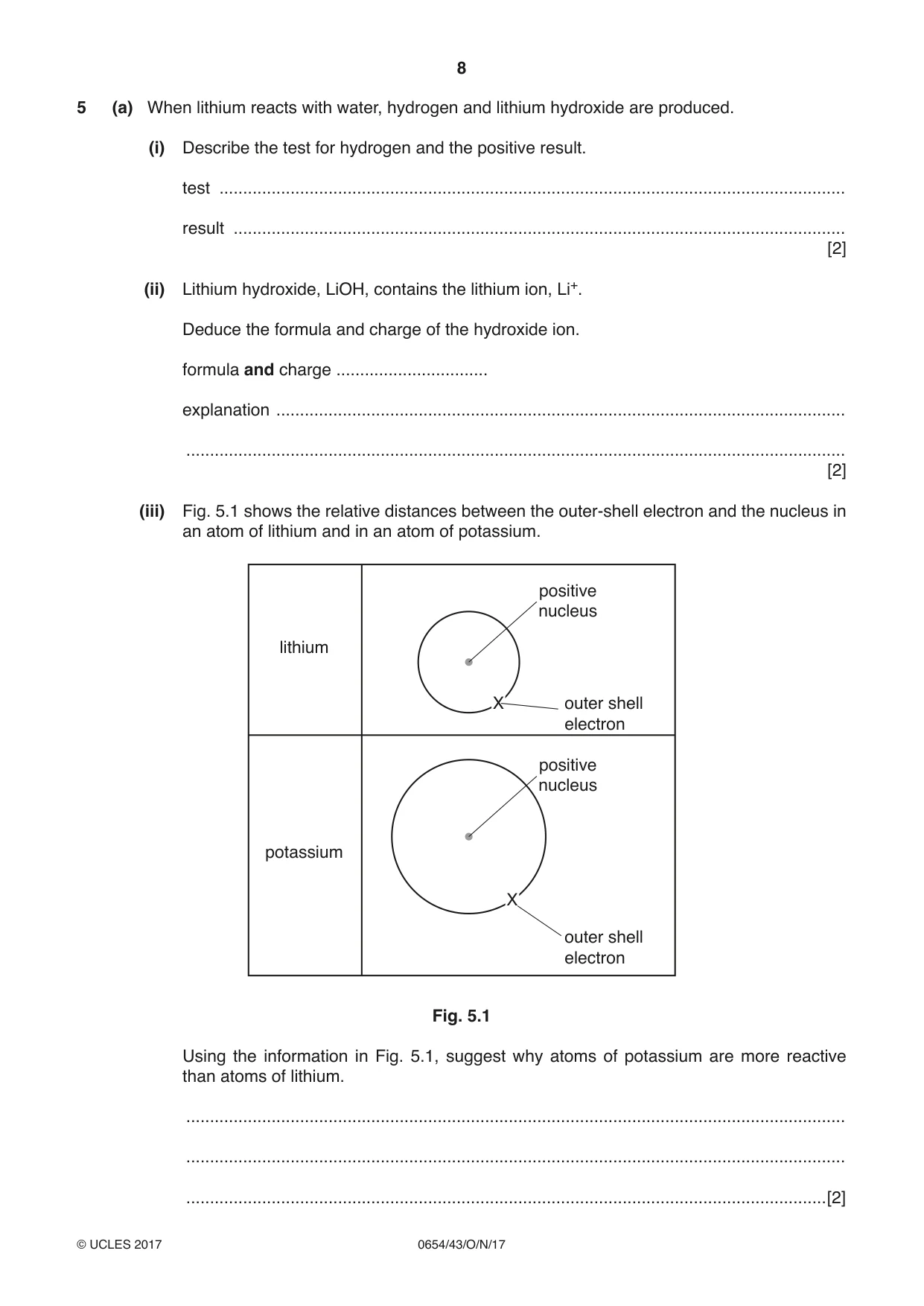
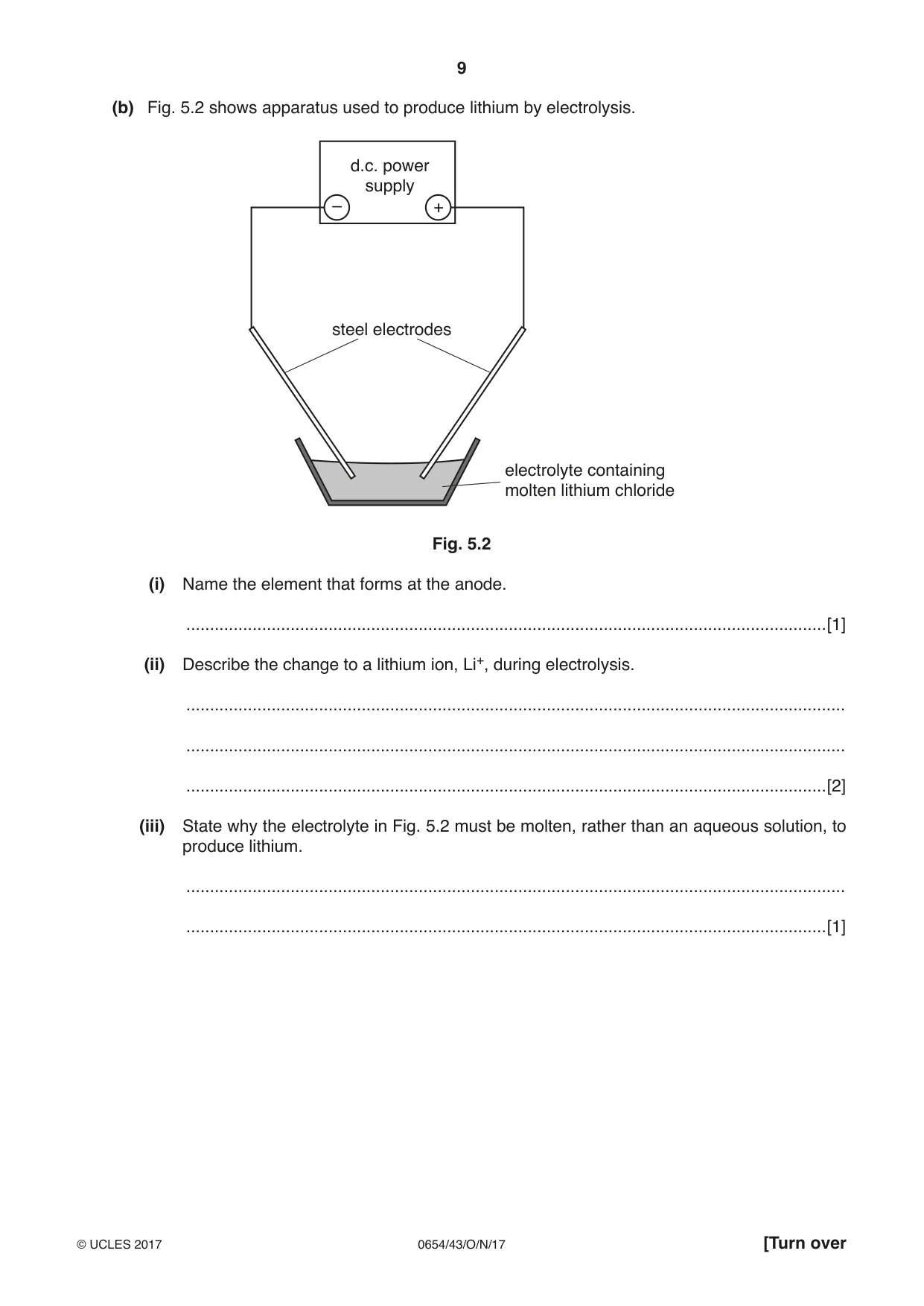
5 (a) When lithium reacts with water, hydrogen and lithium hydroxide are produced. (i) Describe the test for hydrogen and the positive result. test .................................................................................................................................... result ................................................................................................................................. [2] (ii) Lithium hydroxide, LiOH, contains the lithium ion, Li+. Deduce the formula and charge of the hydroxide ion. formula and charge ................................ explanation ........................................................................................................................ ........................................................................................................................................... [2] (iii) Fig. 5.1 shows the relative distances between the outer-shell electron and the nucleus in an atom of lithium and in an atom of potassium. positive nucleus lithium X outer shell electron positive nucleus potassium X outer shell electron Fig. 5.1 Using the information in Fig. 5.1, suggest why atoms of potassium are more reactive than atoms of lithium. ........................................................................................................................................... ........................................................................................................................................... .......................................................................................................................................[2] (b) Fig. 5.2 shows apparatus used to produce lithium by electrolysis. d.c. power supply – + steel electrodes electrolyte containing molten lithium chloride Fig. 5.2 (i) Name the element that forms at the anode. .......................................................................................................................................[1] (ii) Describe the change to a lithium ion, Li+, during electrolysis. ........................................................................................................................................... ........................................................................................................................................... .......................................................................................................................................[2] (iii) State why the electrolyte in Fig. 5.2 must be molten, rather than an aqueous solution, to produce lithium. ........................................................................................................................................... .......................................................................................................................................[1]
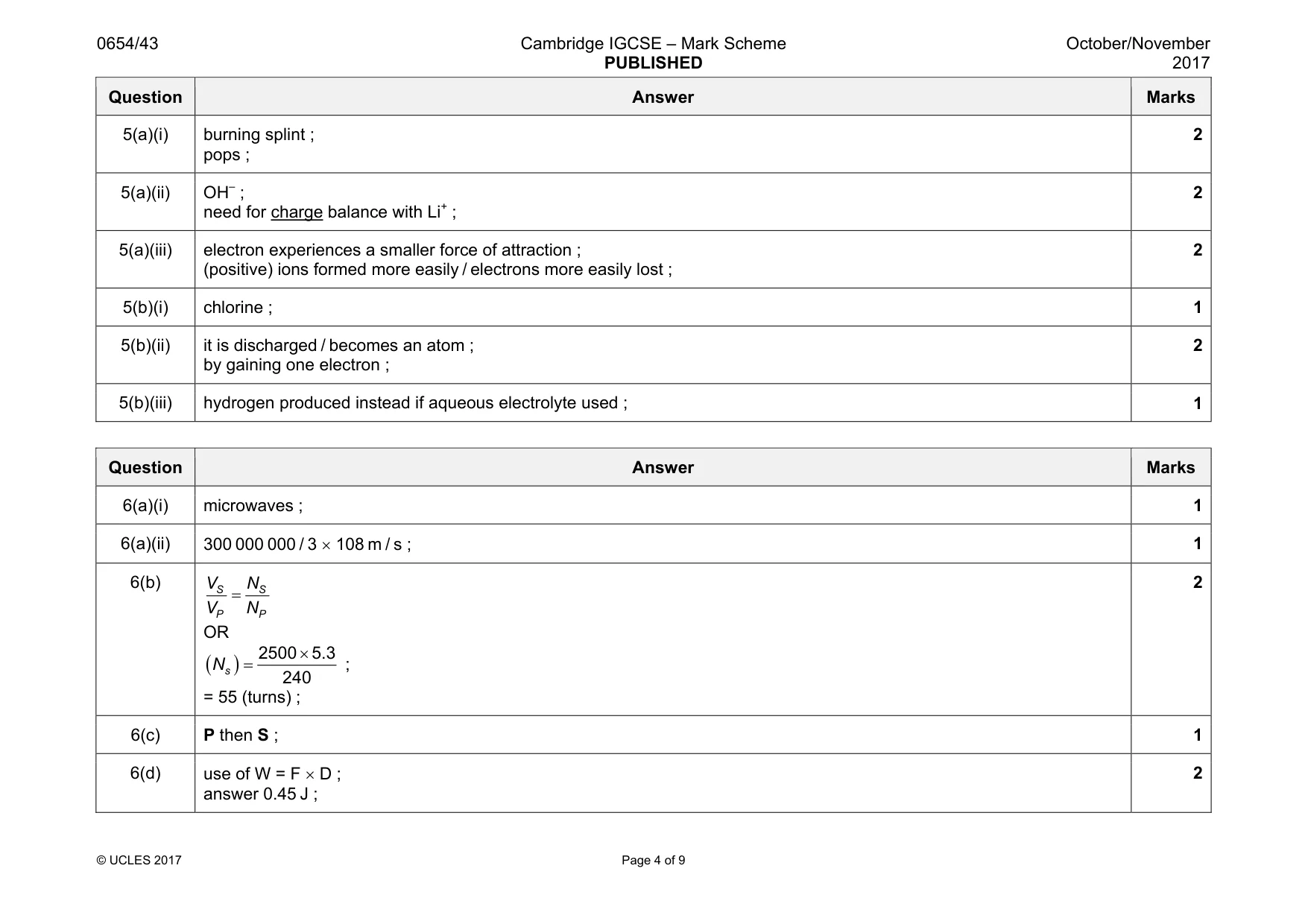
Mark scheme: 5(a)(i) burning splint ; pops ; 2 5(a)(ii) OH– ; need for charge balance with Li+ ; 2 5(a)(iii) electron experiences a smaller force of attraction ; (positive) ions formed more easily / electrons more easily lost ; 2 5(b)(i) chlorine ; 1 5(b)(ii) it is discharged / becomes an atom ; by gaining one electron ; 2 5(b)(iii) hydrogen produced instead if aqueous electrolyte used ; 1
Q6 · State the name of the electromagnetic wave that is used in mobile (cell) phone…
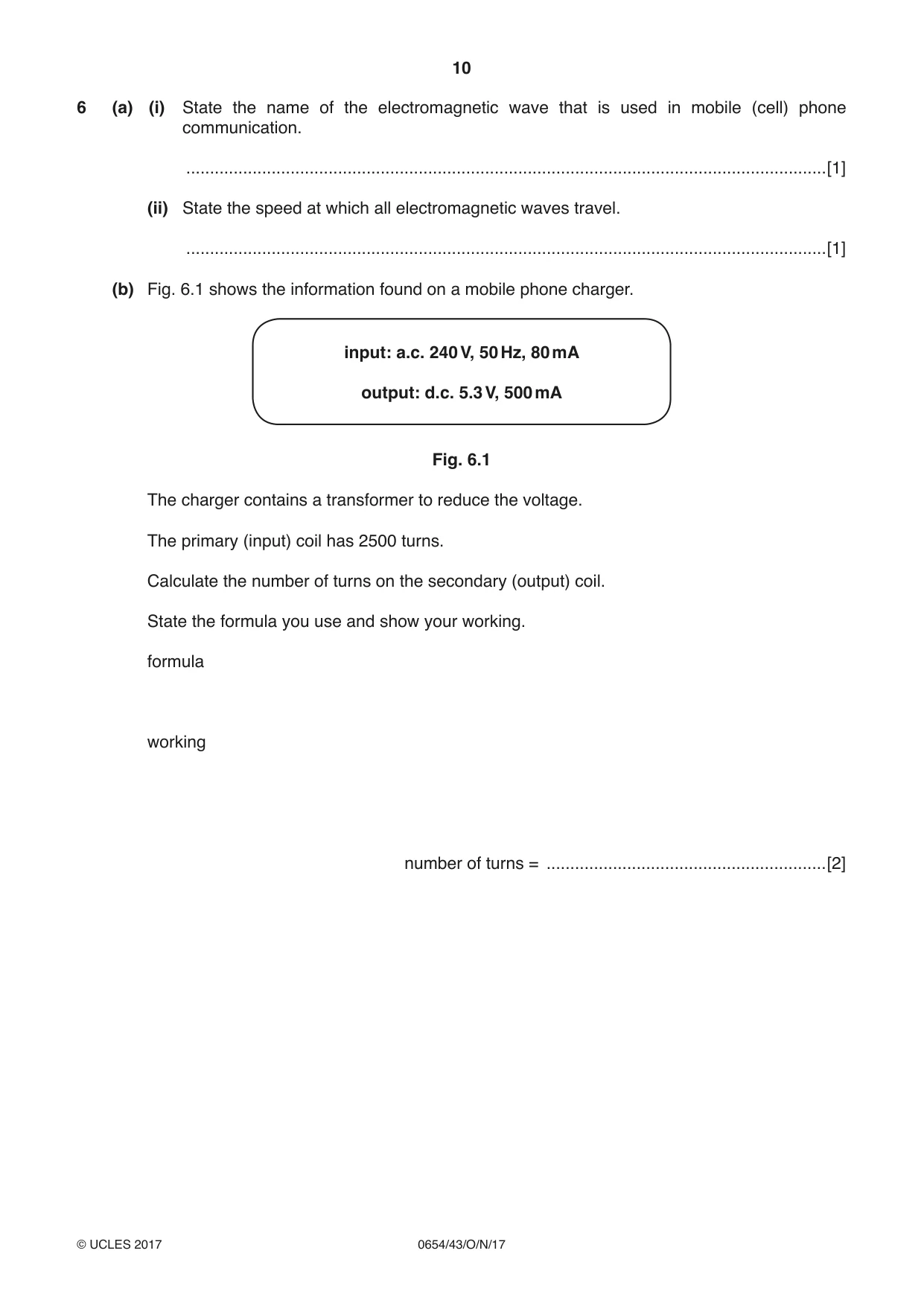
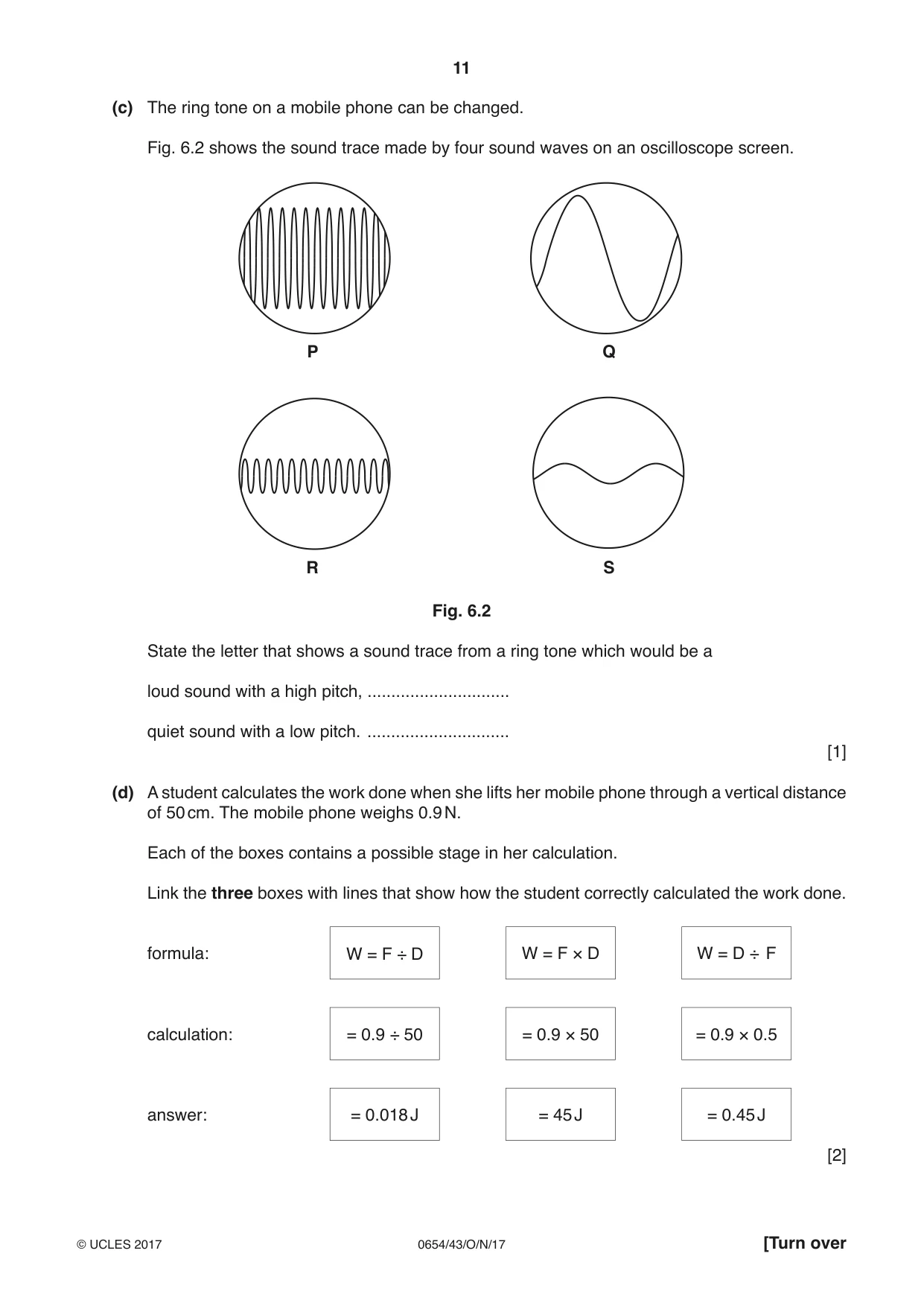
6 (a) (i) State the name of the electromagnetic wave that is used in mobile (cell) phone communication. .......................................................................................................................................[1] (ii) State the speed at which all electromagnetic waves travel. .......................................................................................................................................[1] (b) Fig. 6.1 shows the information found on a mobile phone charger. input: a.c. 240 V, 50 Hz, 80 mA output: d.c. 5.3 V, 500 mA Fig. 6.1 The charger contains a transformer to reduce the voltage. The primary (input) coil has 2500 turns. Calculate the number of turns on the secondary (output) coil. State the formula you use and show your working. formula working number of turns = ...........................................................[2] (c) The ring tone on a mobile phone can be changed. Fig. 6.2 shows the sound trace made by four sound waves on an oscilloscope screen. P Q R S Fig. 6.2 State the letter that shows a sound trace from a ring tone which would be a loud sound with a high pitch, .............................. quiet sound with a low pitch. .............................. [1] (d) A student calculates the work done when she lifts her mobile phone through a vertical distance of 50 cm. The mobile phone weighs 0.9 N. Each of the boxes contains a possible stage in her calculation. Link the three boxes with lines that show how the student correctly calculated the work done. formula: W = F ÷ D W = F × D W = D ÷ F calculation: = 0.9 ÷ 50 = 0.9 × 50 = 0.9 × 0.5 answer: = 0.018 J = 45 J = 0.45 J [2]
Mark scheme: 6(a)(i) microwaves ; 1 6(a)(ii) 300 000 000 / 3 × 10⁸ m / s ; 1 6(b) S S P P V N V N = OR ( ) 2500 5.3 240 s N × = ; = 55 (turns) ; 2 6(c) P then S ; 1 6(d) use of W = F × D ; answer 0.45 J ; 2
Q7 · Table 7.1 lists different parts of a flower and their functions
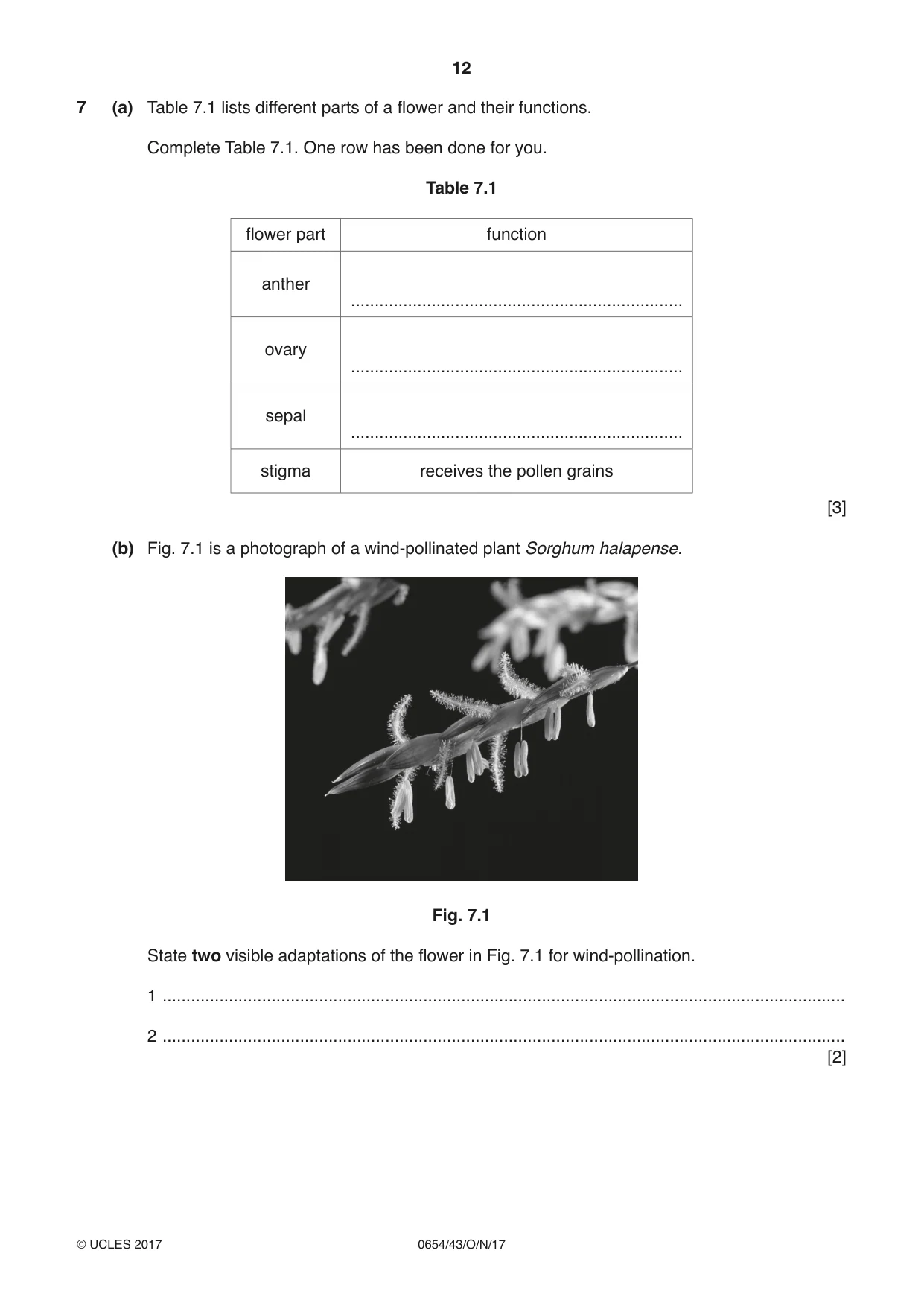
7 (a) Table 7.1 lists different parts of a flower and their functions. Complete Table 7.1. One row has been done for you. Table 7.1 flower part function anther ...................................................................... ovary ...................................................................... sepal ...................................................................... stigma receives the pollen grains [3] (b) Fig. 7.1 is a photograph of a wind-pollinated plant Sorghum halapense. Fig. 7.1 State two visible adaptations of the flower in Fig. 7.1 for wind-pollination. 1 ................................................................................................................................................ 2 ................................................................................................................................................ [2] (c) Suggest why it is an advantage for wind-pollinated plants to produce more pollen than insect- pollinated plants. ................................................................................................................................................... ...............................................................................................................................................[1] (d) Many plants have both male and female parts. This enables the plants to undergo self- pollination and fertilise themselves. Self-pollination is the transfer of pollen within the same plant. Suggest one reason why self-pollination might be an advantage to a plant. ................................................................................................................................................... ...............................................................................................................................................[1] (e) After fertilisation, seeds are formed. Seeds can be dispersed by wind. State one other method of seed dispersal. ...............................................................................................................................................[1]
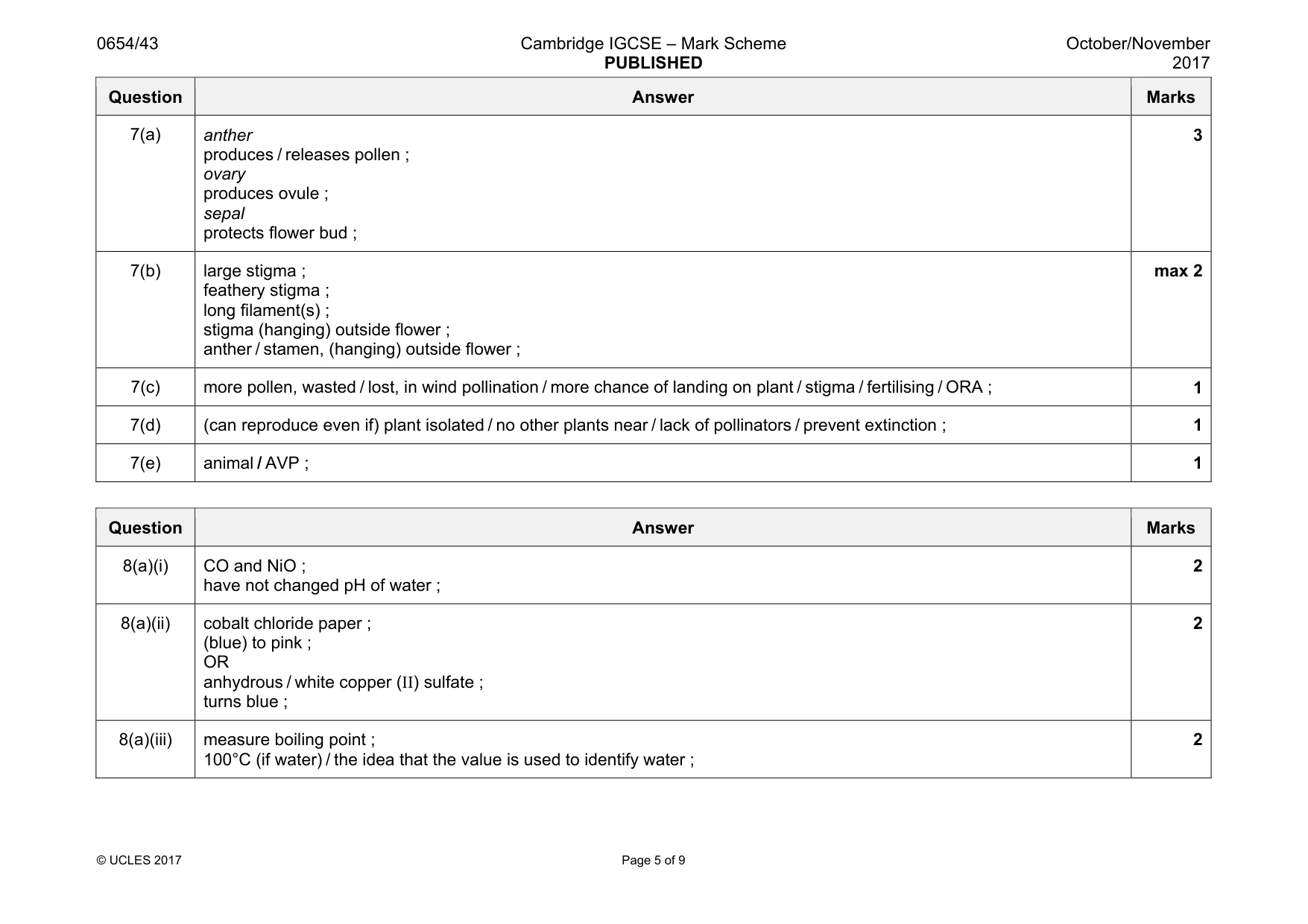
Mark scheme: 7(a) anther produces / releases pollen ; ovary produces ovule ; sepal protects flower bud ; 3 7(b) large stigma ; feathery stigma ; long filament(s) ; stigma (hanging) outside flower ; anther / stamen, (hanging) outside flower ; max 2 7(c) more pollen, wasted / lost, in wind pollination / more chance of landing on plant / stigma / fertilising / ORA ; 1 7(d) (can reproduce even if) plant isolated / no other plants near / lack of pollinators / prevent extinction ; 1 7(e) animal / AVP ; 1
Q8 · The pH values of four mixtures that are made by shaking four oxides with water
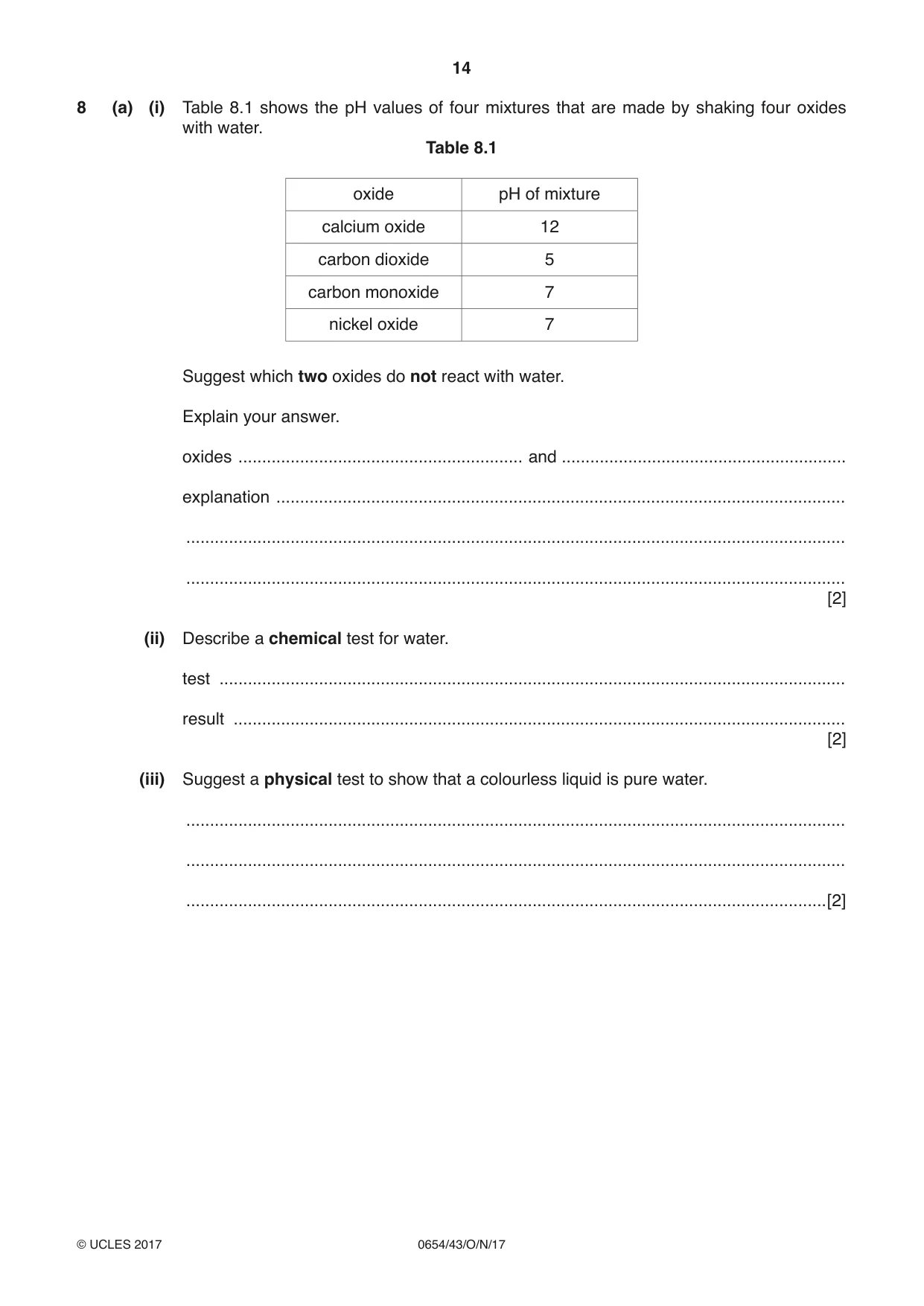
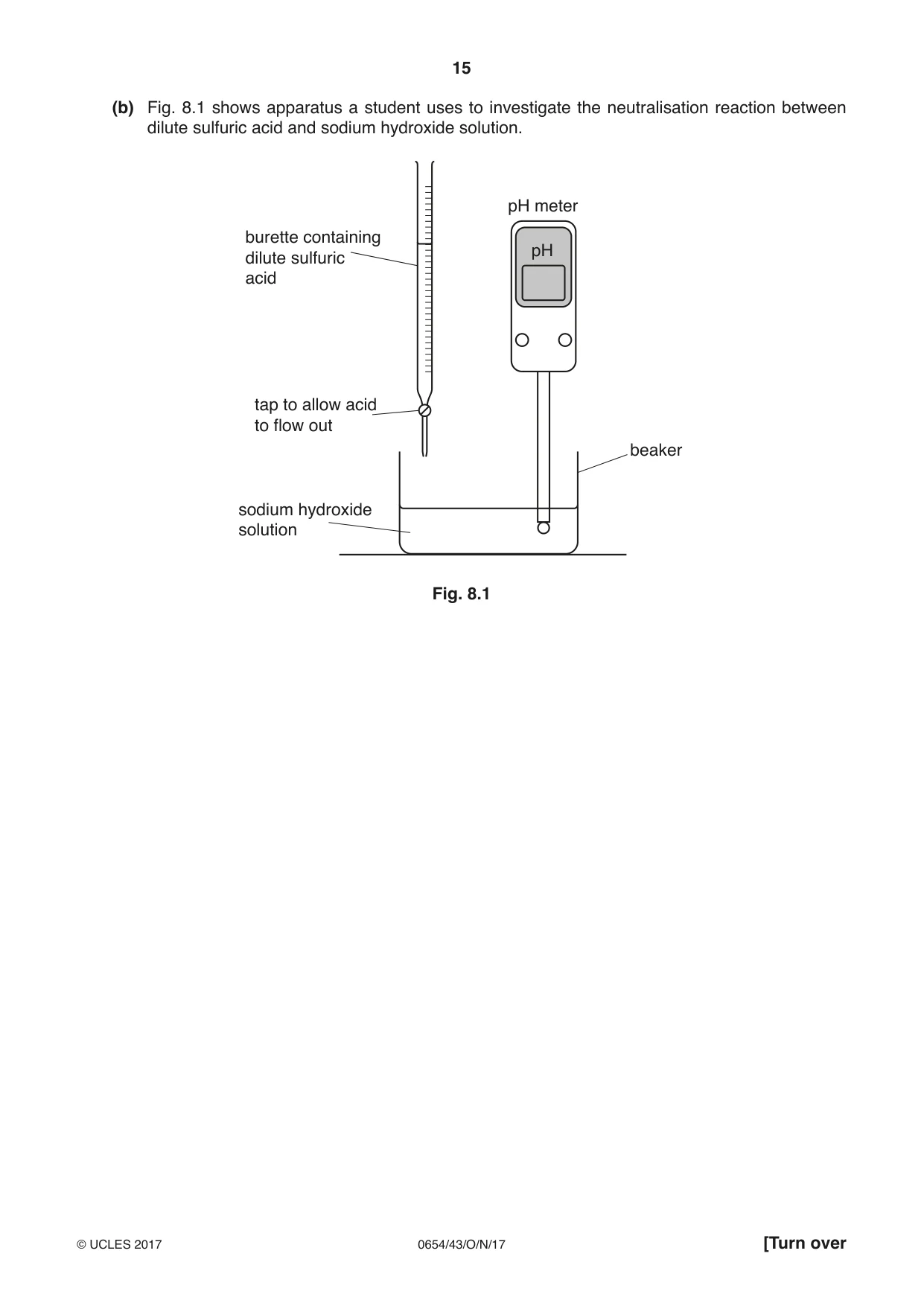
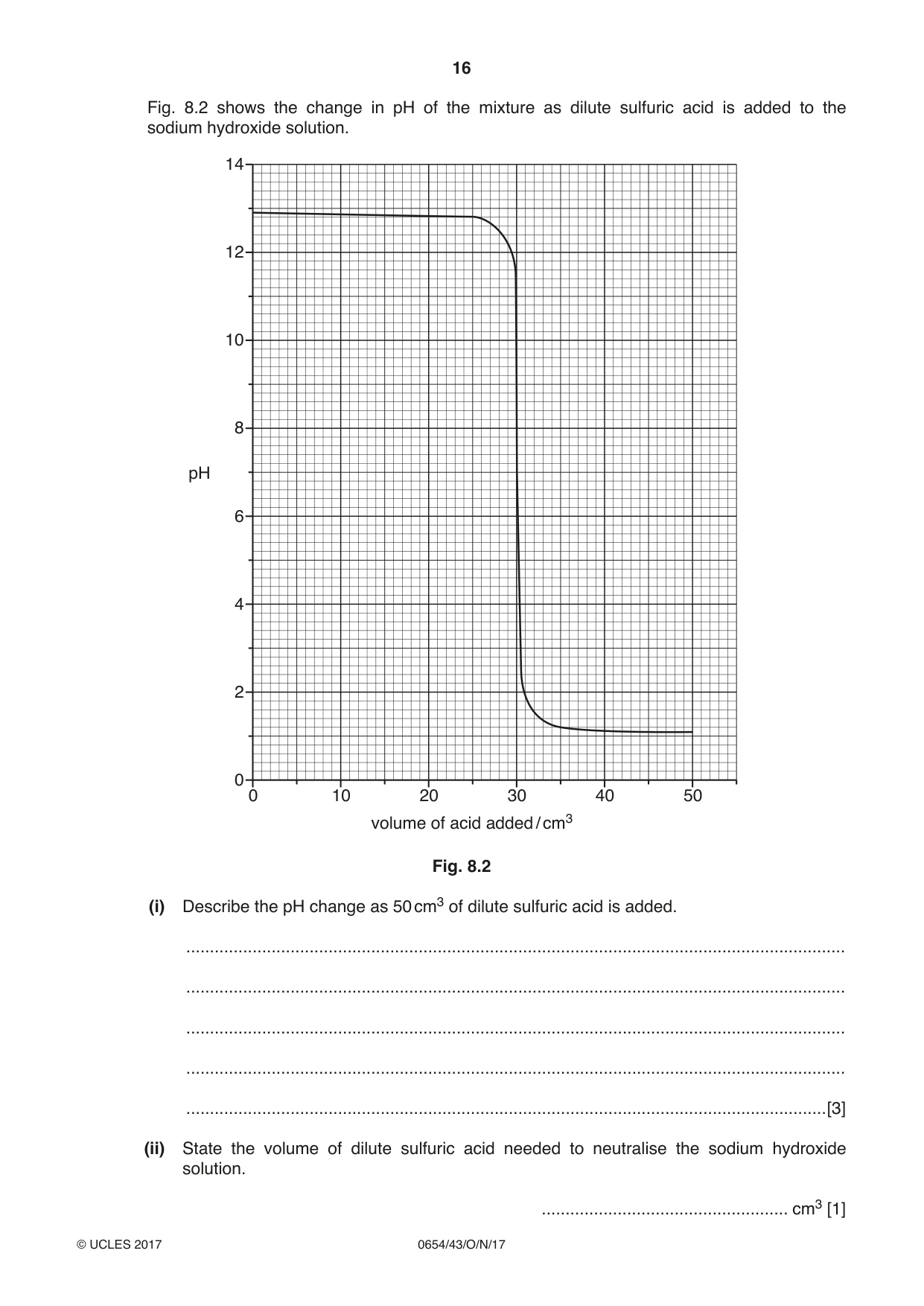
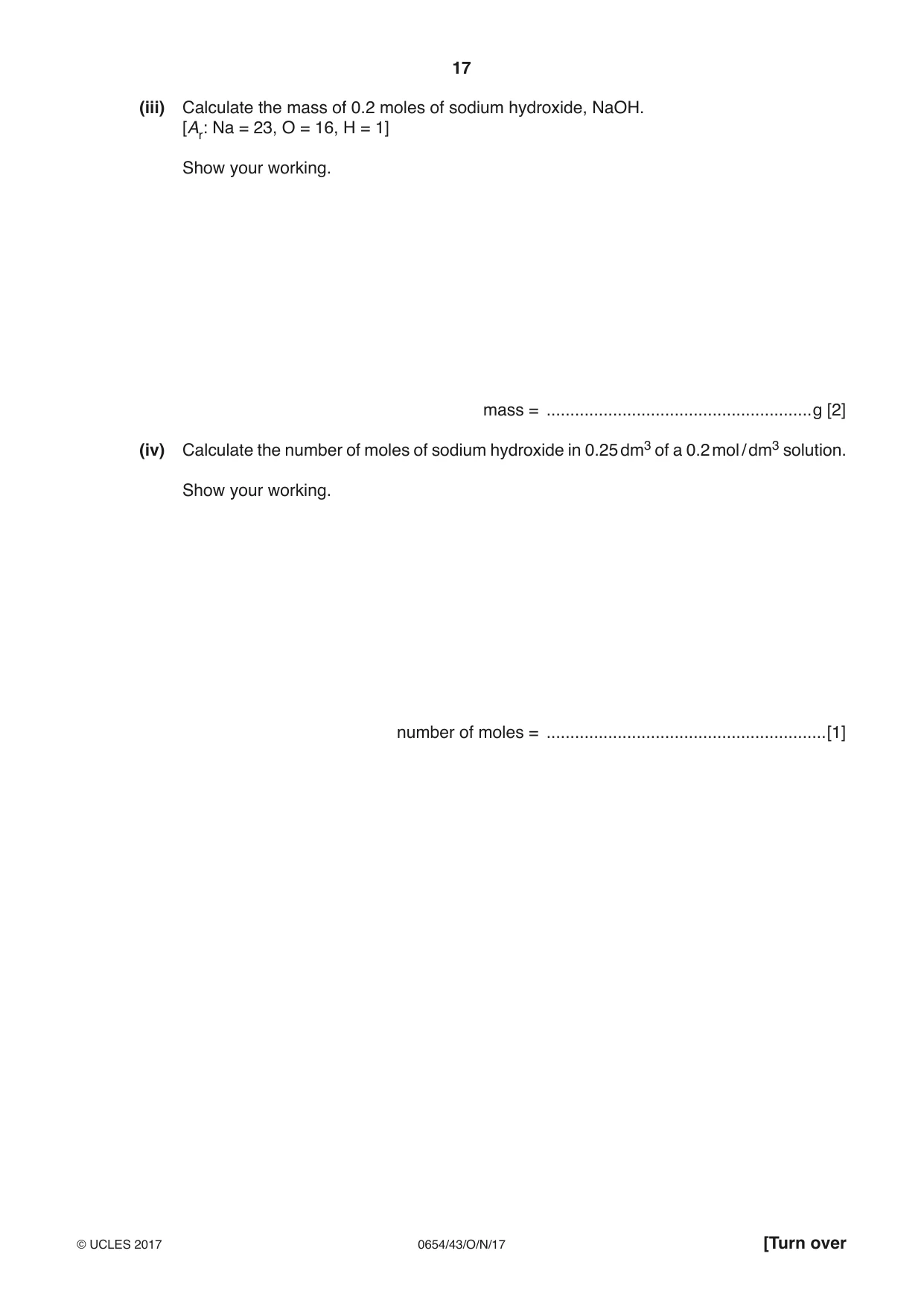
8 (a) (i) Table 8.1 shows the pH values of four mixtures that are made by shaking four oxides with water. Table 8.1 oxide pH of mixture calcium oxide 12 carbon dioxide 5 carbon monoxide 7 nickel oxide 7 Suggest which two oxides do not react with water. Explain your answer. oxides ............................................................ and ............................................................ explanation ........................................................................................................................ ........................................................................................................................................... ........................................................................................................................................... [2] (ii) Describe a chemical test for water. test .................................................................................................................................... result ................................................................................................................................. [2] (iii) Suggest a physical test to show that a colourless liquid is pure water. ........................................................................................................................................... ........................................................................................................................................... .......................................................................................................................................[2] (b) Fig. 8.1 shows apparatus a student uses to investigate the neutralisation reaction between dilute sulfuric acid and sodium hydroxide solution. pH meter burette containing pH dilute sulfuric acid tap to allow acid to flow out beaker sodium hydroxide solution Fig. 8.1 Fig. 8.2 shows the change in pH of the mixture as dilute sulfuric acid is added to the sodium hydroxide solution. 14 12 10 8 pH 6 4 2 0 0 10 20 30 40 50 volume of acid added / cm3 Fig. 8.2 (i) Describe the pH change as 50 cm3 of dilute sulfuric acid is added. ........................................................................................................................................... ........................................................................................................................................... ........................................................................................................................................... ........................................................................................................................................... .......................................................................................................................................[3] (ii) State the volume of dilute sulfuric acid needed to neutralise the sodium hydroxide solution. .................................................... cm3 [1] (iii) Calculate the mass of 0.2 moles of sodium hydroxide, NaOH. [Ar: Na = 23, O = 16, H = 1] Show your working. mass = ........................................................g [2] (iv) Calculate the number of moles of sodium hydroxide in 0.25 dm3 of a 0.2 mol / dm3 solution. Show your working. number of moles = ...........................................................[1]
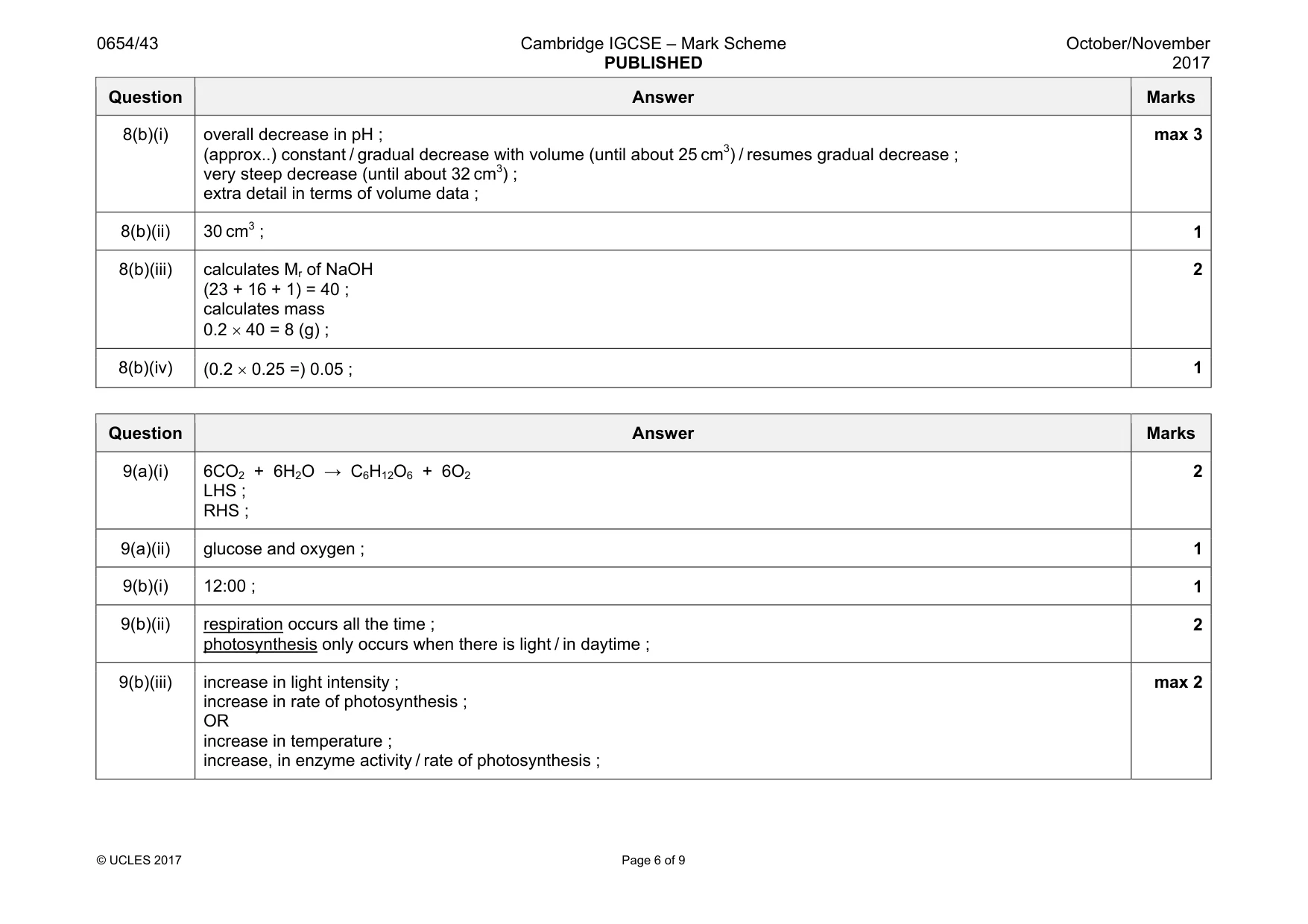
Mark scheme: 8(a)(i) CO and NiO ; have not changed pH of water ; 2 8(a)(ii) cobalt chloride paper ; (blue) to pink ; OR anhydrous / white copper (II) sulfate ; turns blue ; 2 8(a)(iii) measure boiling point ; 100°C (if water) / the idea that the value is used to identify water ; 2 Question Answer Marks 8(b)(i) overall decrease in pH ; (approx..) constant / gradual decrease with volume (until about 25 cm3) / resumes gradual decrease ; very steep decrease (until about 32 cm3) ; extra detail in terms of volume data ; max 3 8(b)(ii) 30 cm3 ; 1 8(b)(iii) calculates Mr of NaOH (23 + 16 + 1) = 40 ; calculates mass 0.2 × 40 = 8 (g) ; 2 8(b)(iv) (0.2 × 0.25 =) 0.05 ; 1
Q9 · Green plants are living organisms that carry out photosynthesis and respiration
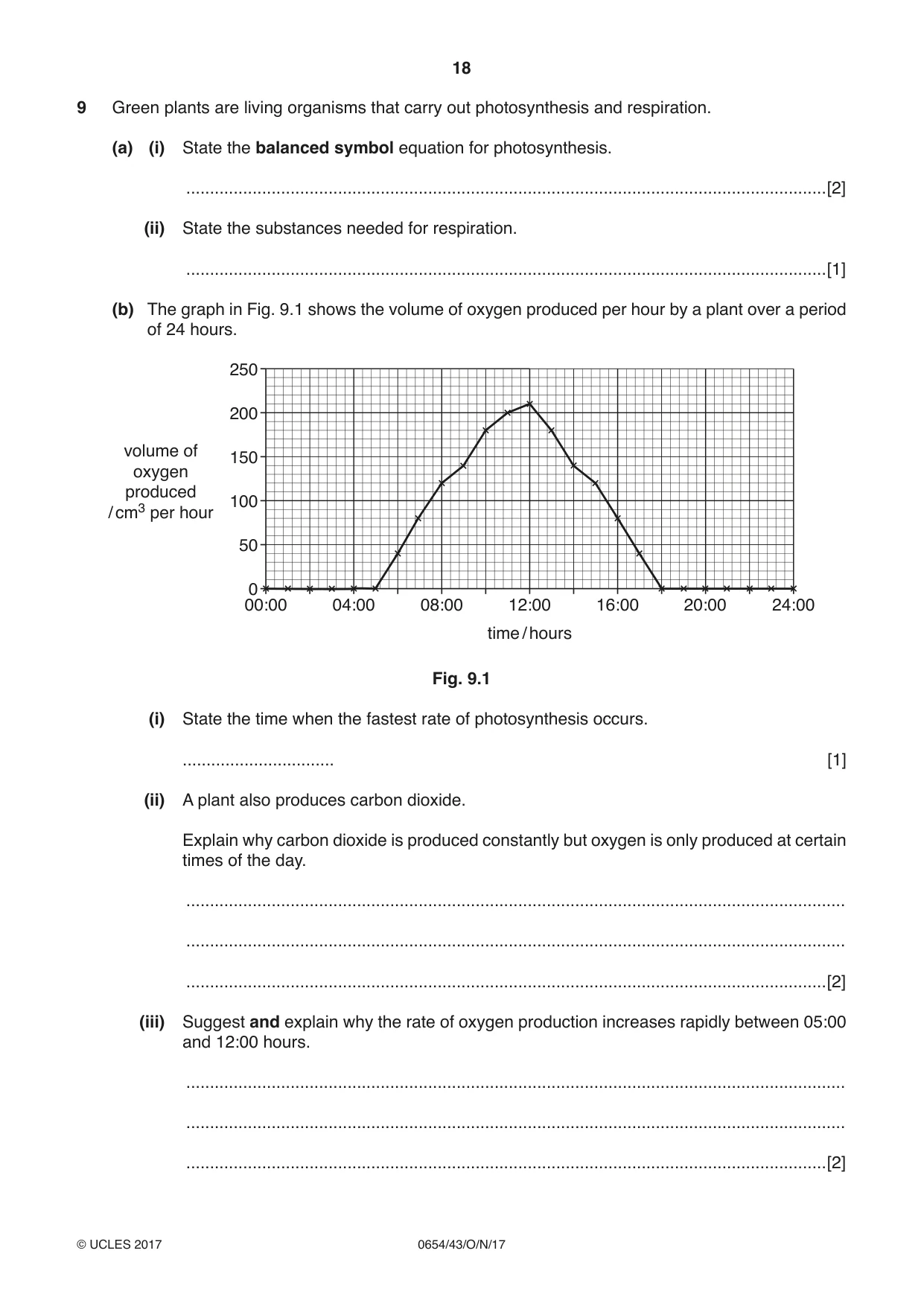
9 Green plants are living organisms that carry out photosynthesis and respiration. (a) (i) State the balanced symbol equation for photosynthesis. .......................................................................................................................................[2] (ii) State the substances needed for respiration. .......................................................................................................................................[1] (b) The graph in Fig. 9.1 shows the volume of oxygen produced per hour by a plant over a period of 24 hours. 250 200 volume of 150 oxygen produced 100 / cm3 per hour 50 0 00:00 04:00 08:00 12:00 16:00 20:00 24:00 time / hours Fig. 9.1 (i) State the time when the fastest rate of photosynthesis occurs. ................................ [1] (ii) A plant also produces carbon dioxide. Explain why carbon dioxide is produced constantly but oxygen is only produced at certain times of the day. ........................................................................................................................................... ........................................................................................................................................... .......................................................................................................................................[2] (iii) Suggest and explain why the rate of oxygen production increases rapidly between 05:00 and 12:00 hours. ........................................................................................................................................... ........................................................................................................................................... .......................................................................................................................................[2]
Mark scheme: 9(a)(i) 6CO2 + 6H2O → C6H12O6 + 6O2 LHS ; RHS ; 2 9(a)(ii) glucose and oxygen ; 1 9(b)(i) 12:00 ; 1 9(b)(ii) respiration occurs all the time ; photosynthesis only occurs when there is light / in daytime ; 2 9(b)(iii) increase in light intensity ; increase in rate of photosynthesis ; OR increase in temperature ; increase, in enzyme activity / rate of photosynthesis ; max 2
Q10 · The speed-time graph for the journey of a bus along a road for 80 seconds
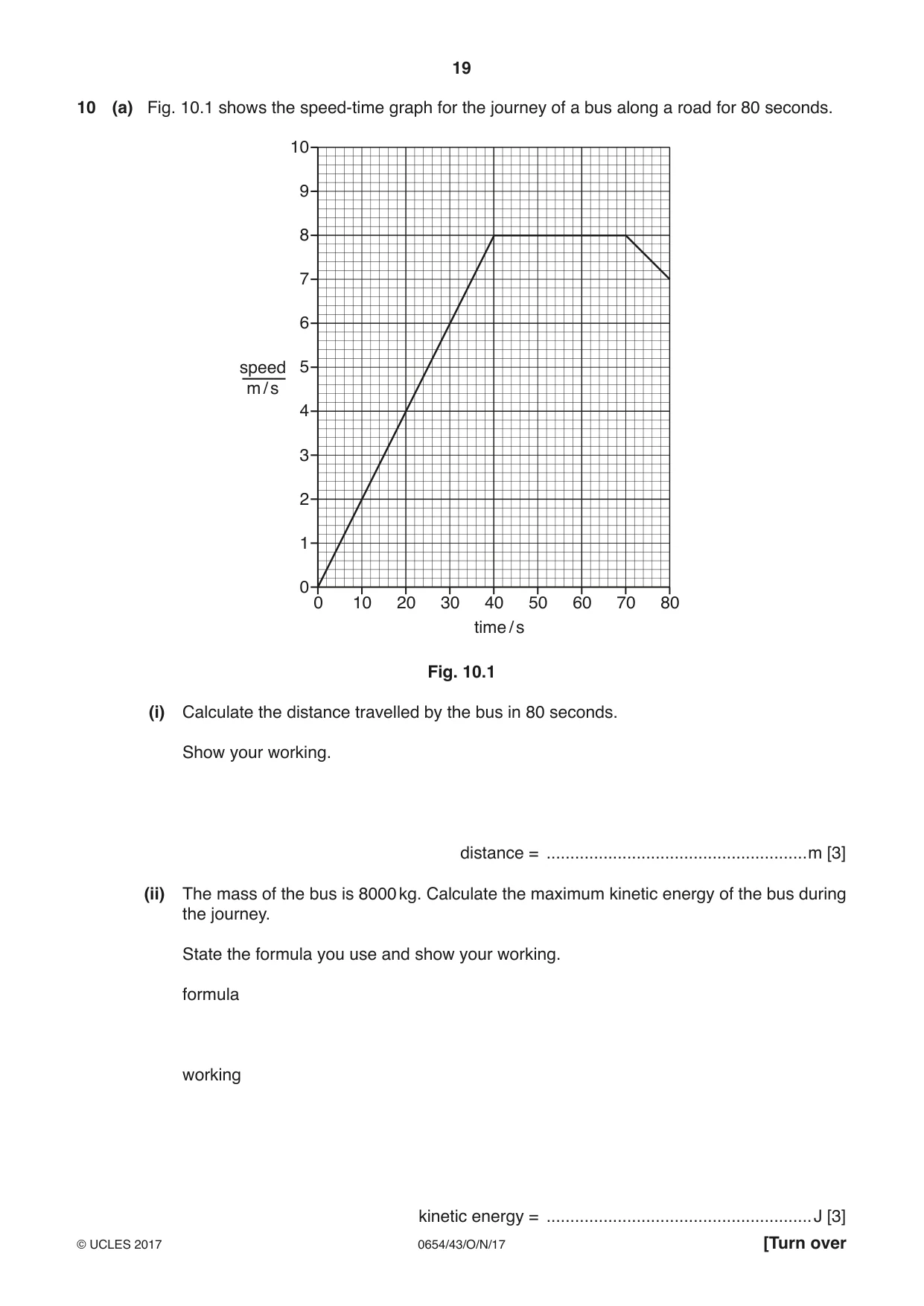
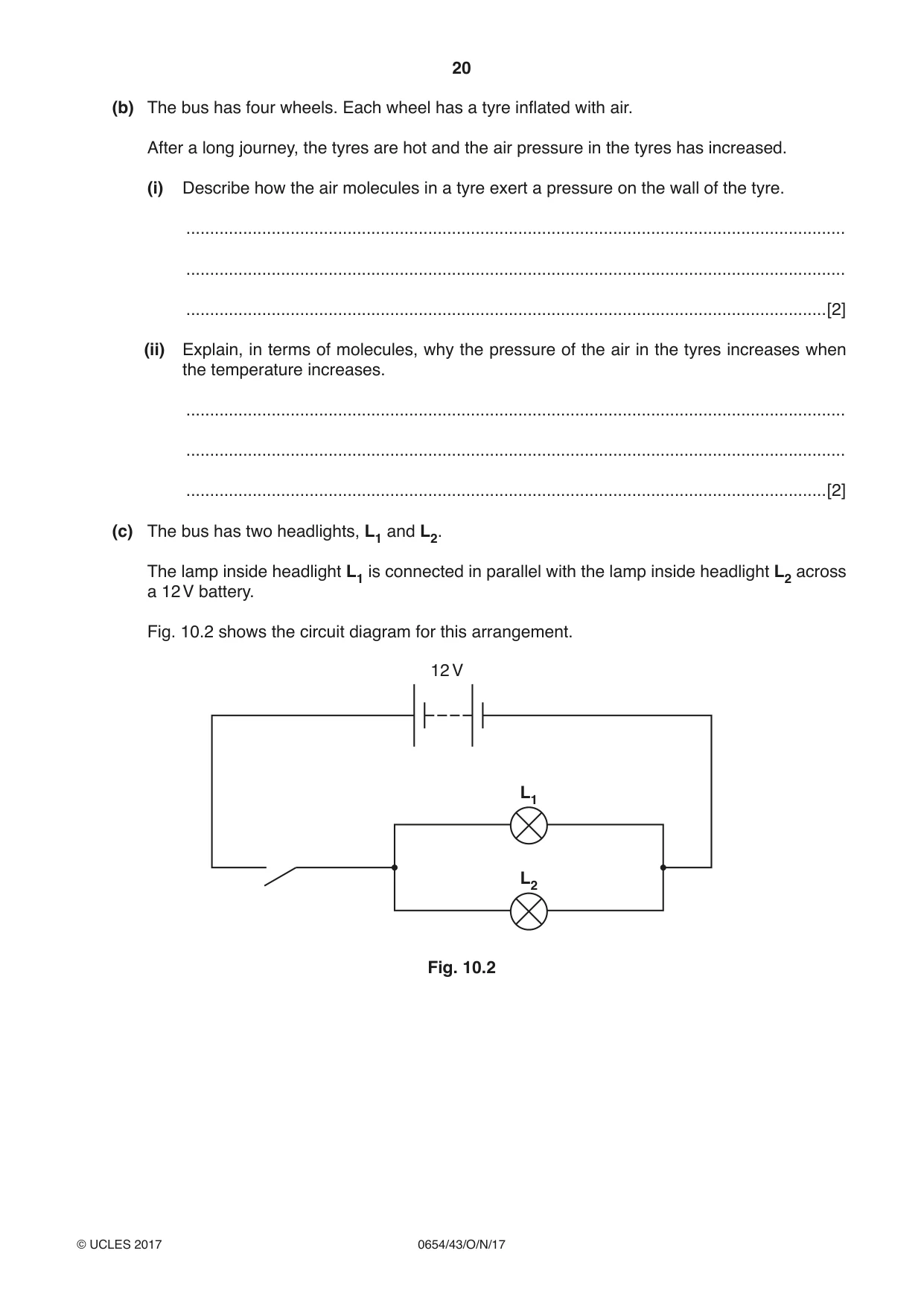
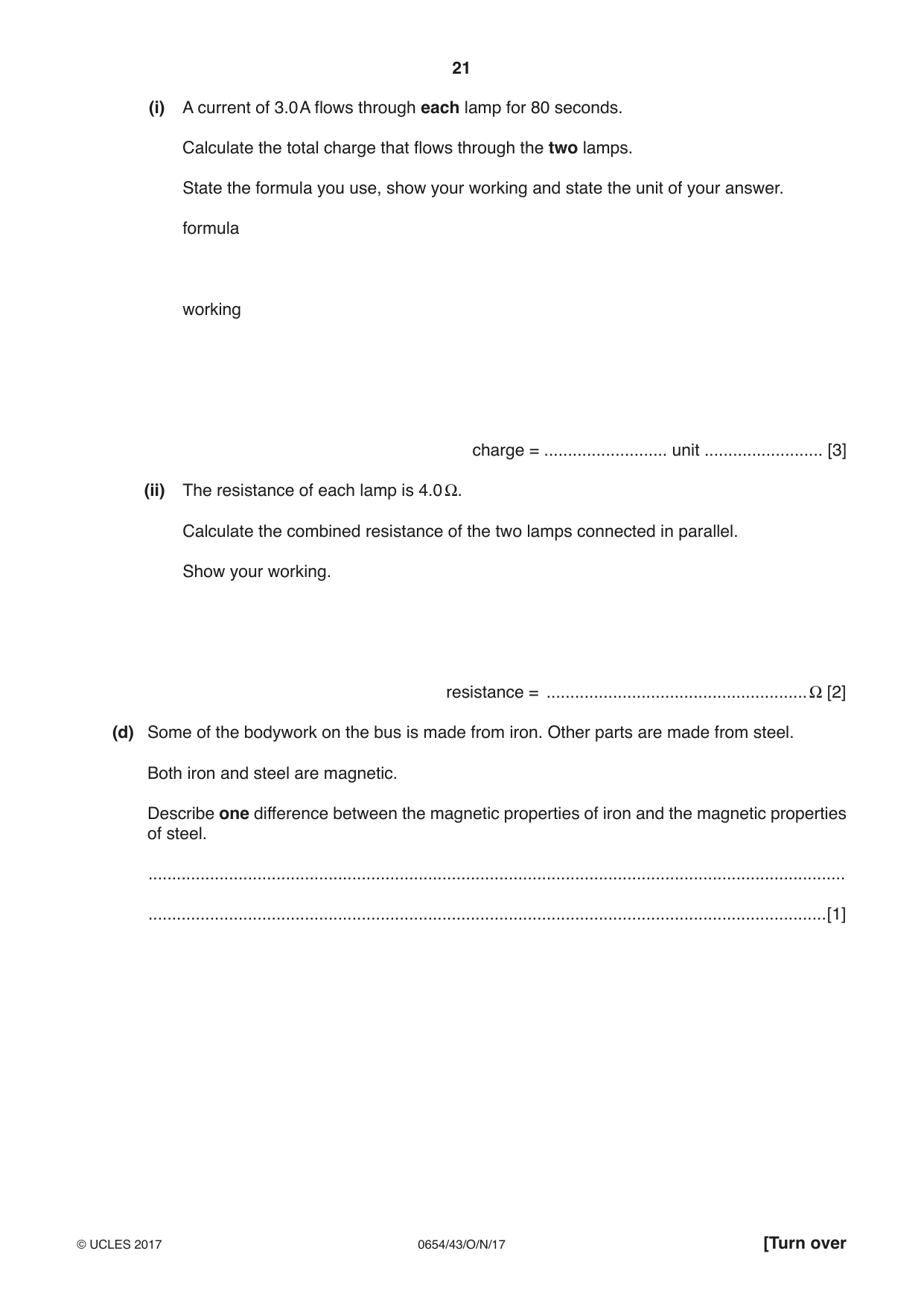
10 (a) Fig. 10.1 shows the speed-time graph for the journey of a bus along a road for 80 seconds. 10 9 8 7 6 speed 5 m / s 4 3 2 1 0 0 10 20 30 40 50 60 70 80 time / s Fig. 10.1 (i) Calculate the distance travelled by the bus in 80 seconds. Show your working. distance = .......................................................m [3] (ii) The mass of the bus is 8000 kg. Calculate the maximum kinetic energy of the bus during the journey. State the formula you use and show your working. formula working kinetic energy = ........................................................J [3] (b) The bus has four wheels. Each wheel has a tyre inflated with air. After a long journey, the tyres are hot and the air pressure in the tyres has increased. (i) Describe how the air molecules in a tyre exert a pressure on the wall of the tyre. ........................................................................................................................................... ........................................................................................................................................... .......................................................................................................................................[2] (ii) Explain, in terms of molecules, why the pressure of the air in the tyres increases when the temperature increases. ........................................................................................................................................... ........................................................................................................................................... .......................................................................................................................................[2] (c) The bus has two headlights, L1 and L2. The lamp inside headlight L1 is connected in parallel with the lamp inside headlight L2 across a 12 V battery. Fig. 10.2 shows the circuit diagram for this arrangement. 12 V L1 L2 Fig. 10.2 (i) A current of 3.0 A flows through each lamp for 80 seconds. Calculate the total charge that flows through the two lamps. State the formula you use, show your working and state the unit of your answer. formula working charge = .......................... unit ......................... [3] (ii) The resistance of each lamp is 4.0 Ω. Calculate the combined resistance of the two lamps connected in parallel. Show your working. resistance = .......................................................Ω [2] (d) Some of the bodywork on the bus is made from iron. Other parts are made from steel. Both iron and steel are magnetic. Describe one difference between the magnetic properties of iron and the magnetic properties of steel. ................................................................................................................................................... ...............................................................................................................................................[1]
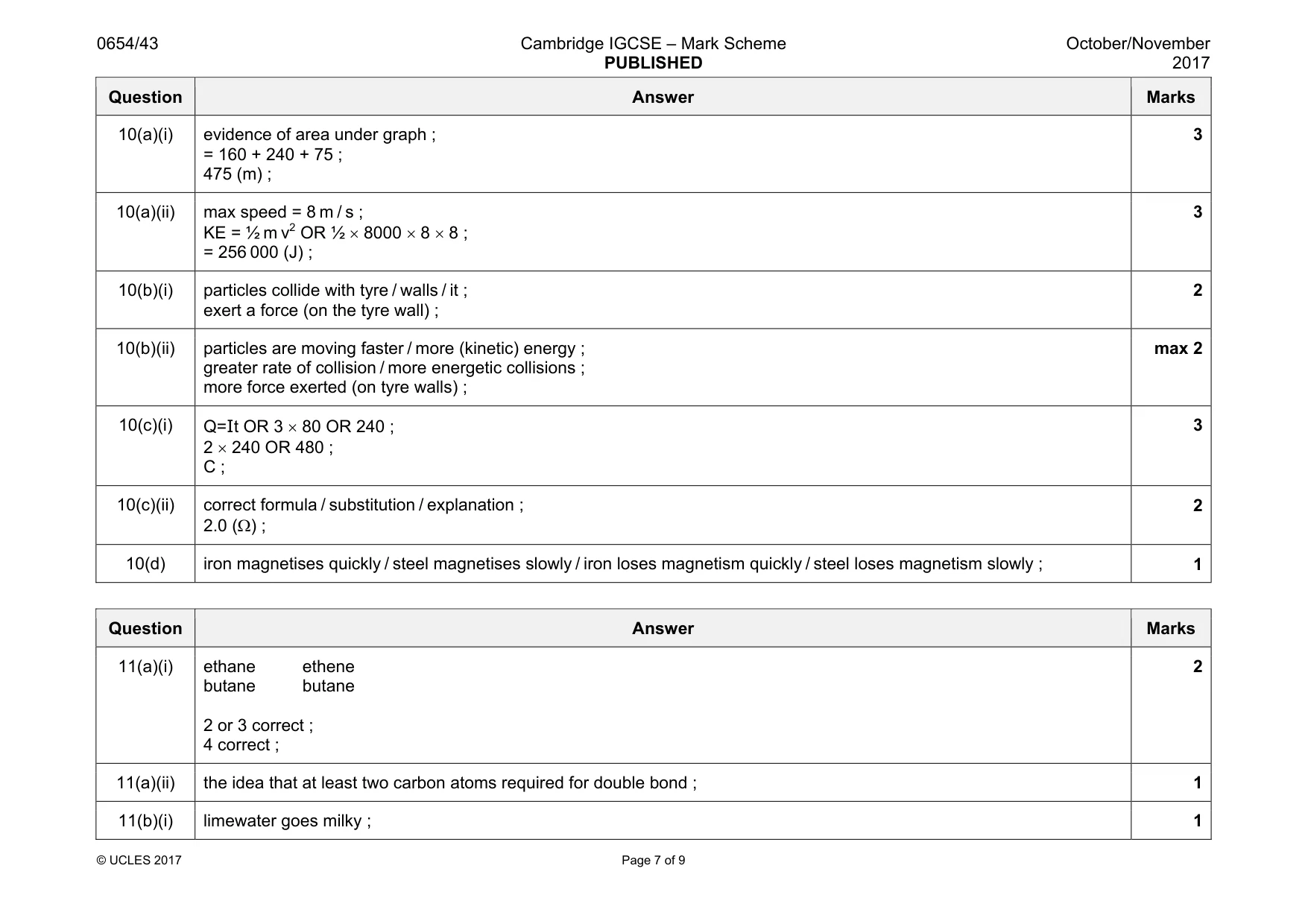
Mark scheme: 10(a)(i) evidence of area under graph ; = 160 + 240 + 75 ; 475 (m) ; 3 10(a)(ii) max speed = 8 m / s ; KE = ½ m v2 OR ½ × 8000 × 8 × 8 ; = 256 000 (J) ; 3 10(b)(i) particles collide with tyre / walls / it ; exert a force (on the tyre wall) ; 2 10(b)(ii) particles are moving faster / more (kinetic) energy ; greater rate of collision / more energetic collisions ; more force exerted (on tyre walls) ; max 2 10(c)(i) Q=It OR 3 × 80 OR 240 ; 2 × 240 OR 480 ; C ; 3 10(c)(ii) correct formula / substitution / explanation ; 2.0 (Ω) ; 2 10(d) iron magnetises quickly / steel magnetises slowly / iron loses magnetism quickly / steel loses magnetism slowly ; 1
Q11 · Alkanes and alkenes are homologous series of hydrocarbons
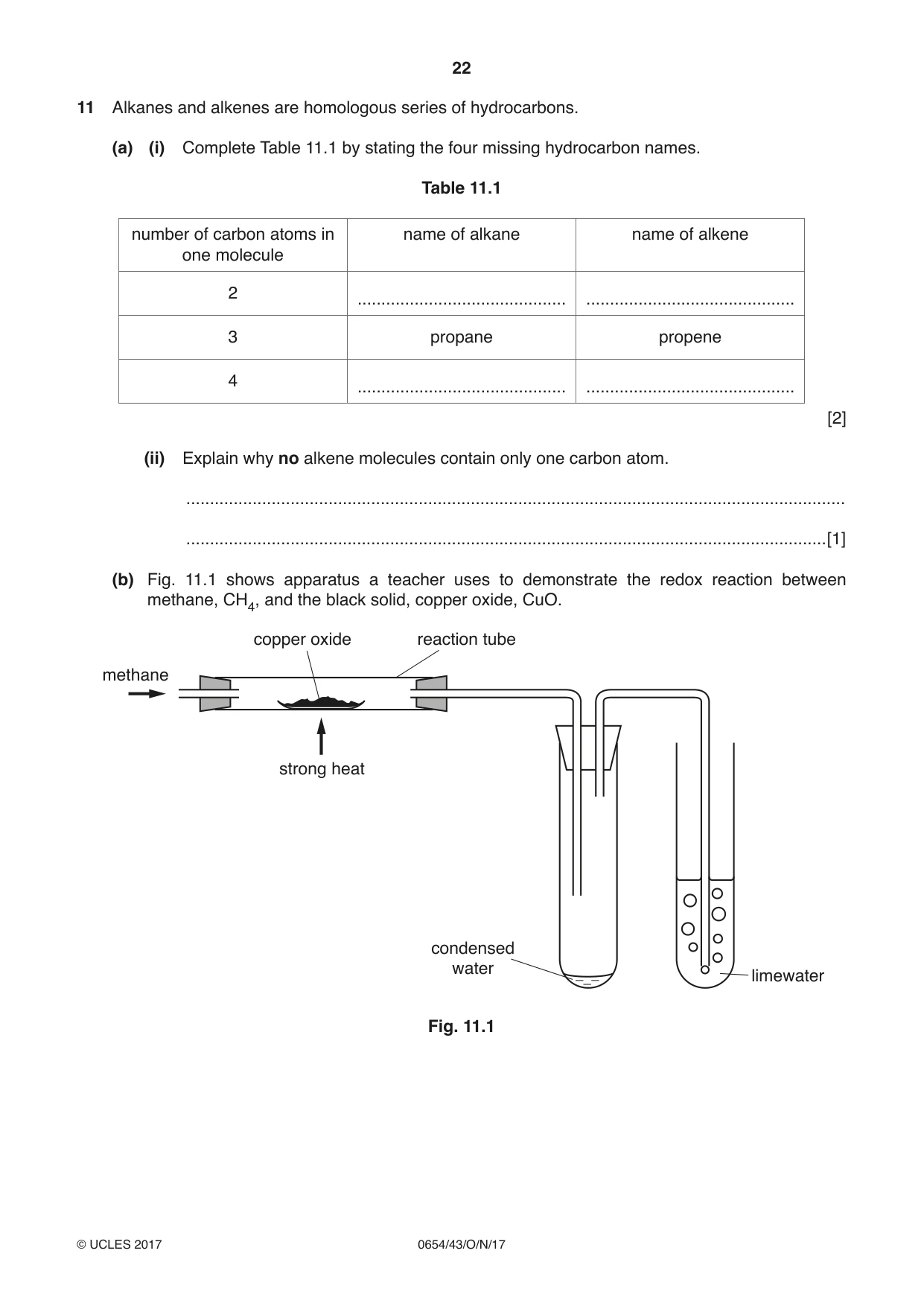
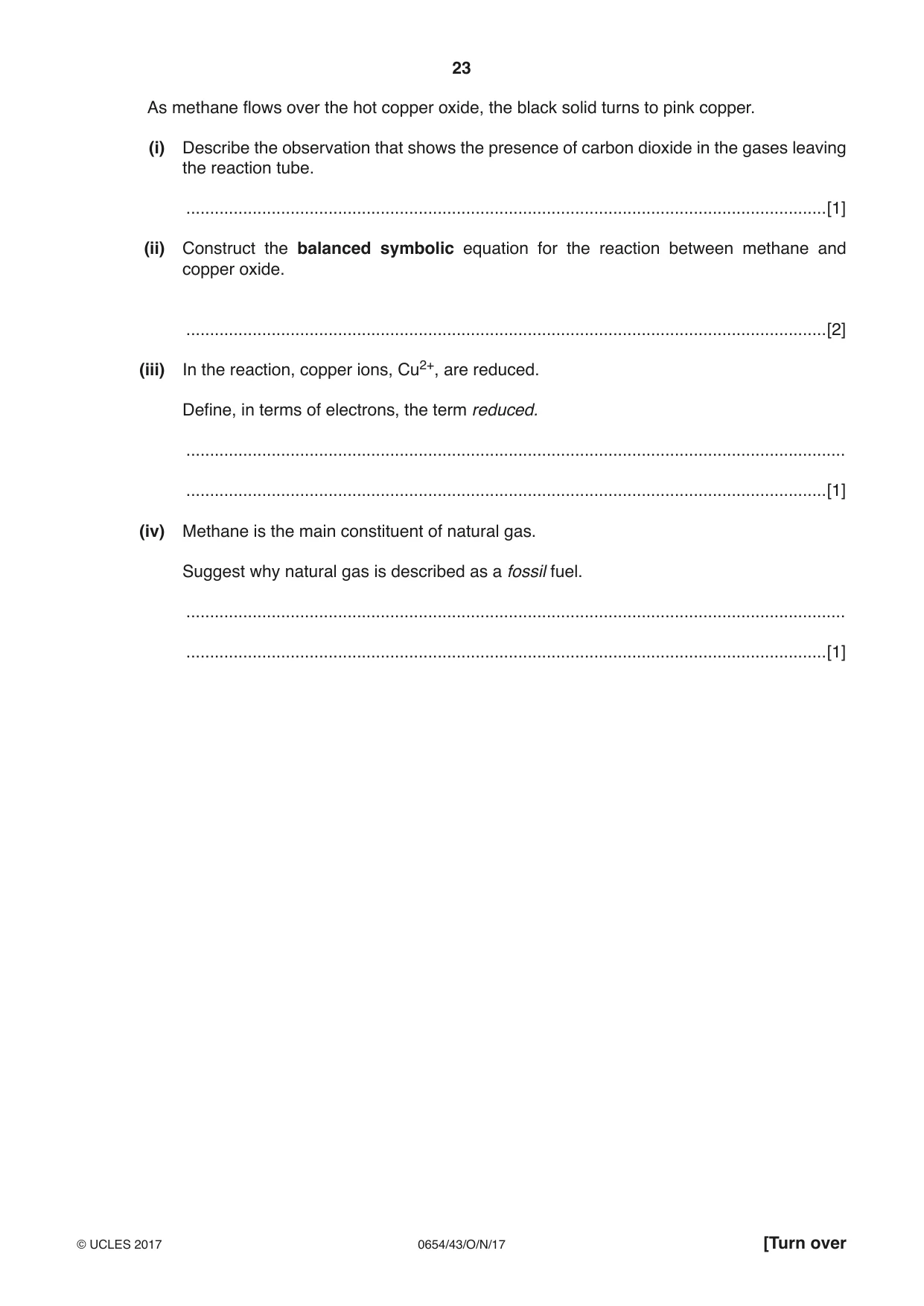
11 Alkanes and alkenes are homologous series of hydrocarbons. (a) (i) Complete Table 11.1 by stating the four missing hydrocarbon names. Table 11.1 number of carbon atoms in name of alkane name of alkene one molecule 2 ............................................ ............................................ 3 propane propene 4 ............................................ ............................................ [2] (ii) Explain why no alkene molecules contain only one carbon atom. ........................................................................................................................................... .......................................................................................................................................[1] (b) Fig. 11.1 shows apparatus a teacher uses to demonstrate the redox reaction between methane, CH4, and the black solid, copper oxide, CuO. copper oxide reaction tube methane strong heat condensed water limewater Fig. 11.1 As methane flows over the hot copper oxide, the black solid turns to pink copper. (i) Describe the observation that shows the presence of carbon dioxide in the gases leaving the reaction tube. .......................................................................................................................................[1] (ii) Construct the balanced symbolic equation for the reaction between methane and copper oxide. .......................................................................................................................................[2] (iii) In the reaction, copper ions, Cu2+, are reduced. Define, in terms of electrons, the term reduced. ........................................................................................................................................... .......................................................................................................................................[1] (iv) Methane is the main constituent of natural gas. Suggest why natural gas is described as a fossil fuel. ........................................................................................................................................... .......................................................................................................................................[1]
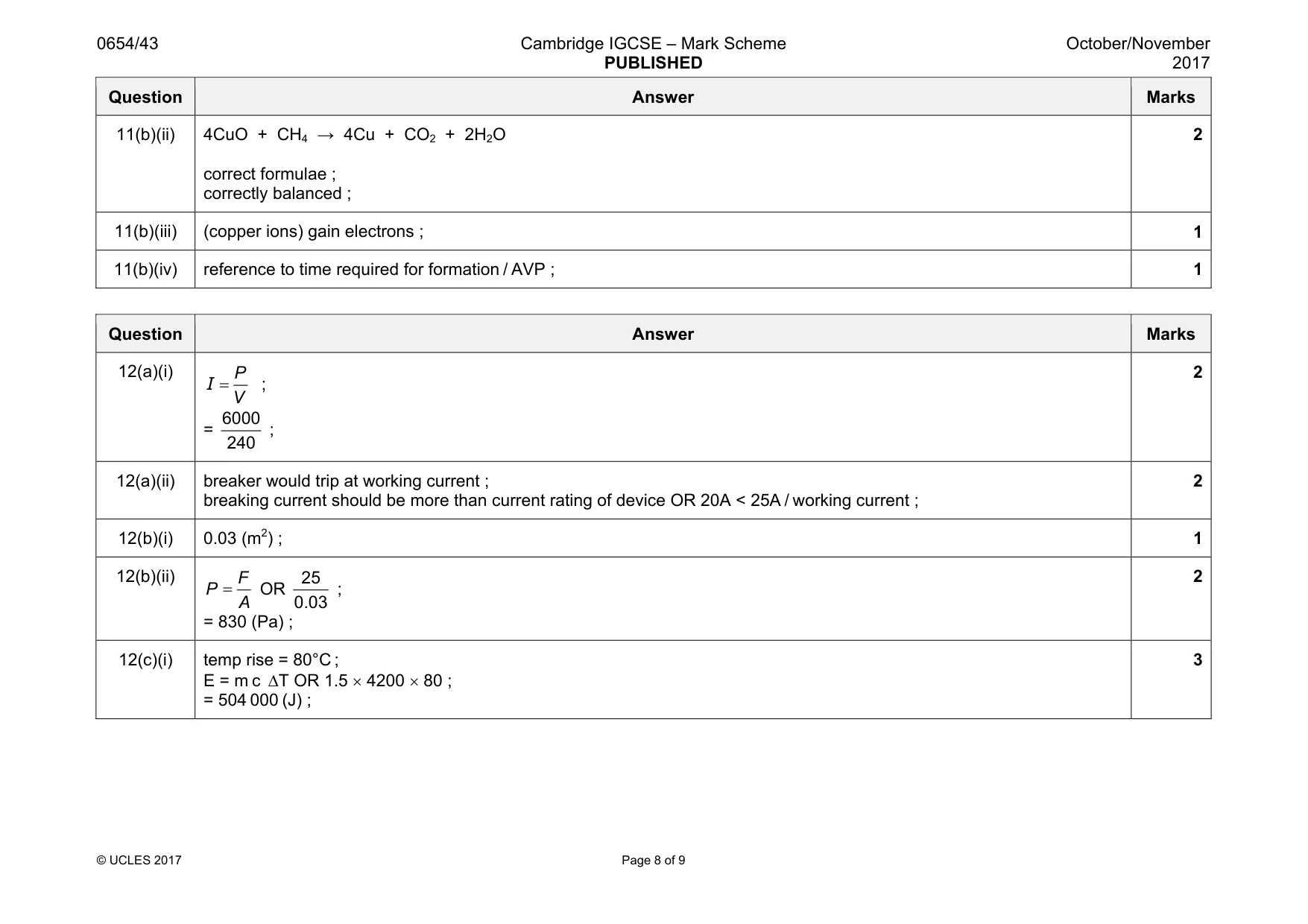
Mark scheme: 11(a)(i) ethane ethene butane butane 2 or 3 correct ; 4 correct ; 2 11(a)(ii) the idea that at least two carbon atoms required for double bond ; 1 11(b)(i) limewater goes milky ; 1 Question Answer Marks 11(b)(ii) 4CuO + CH4 → 4Cu + CO2 + 2H2O correct formulae ; correctly balanced ; 2 11(b)(iii) (copper ions) gain electrons ; 1 11(b)(iv) reference to time required for formation / AVP ; 1
Q12 · An electric cooker connected to a mains supply of 240 V has a power input of 6000 W
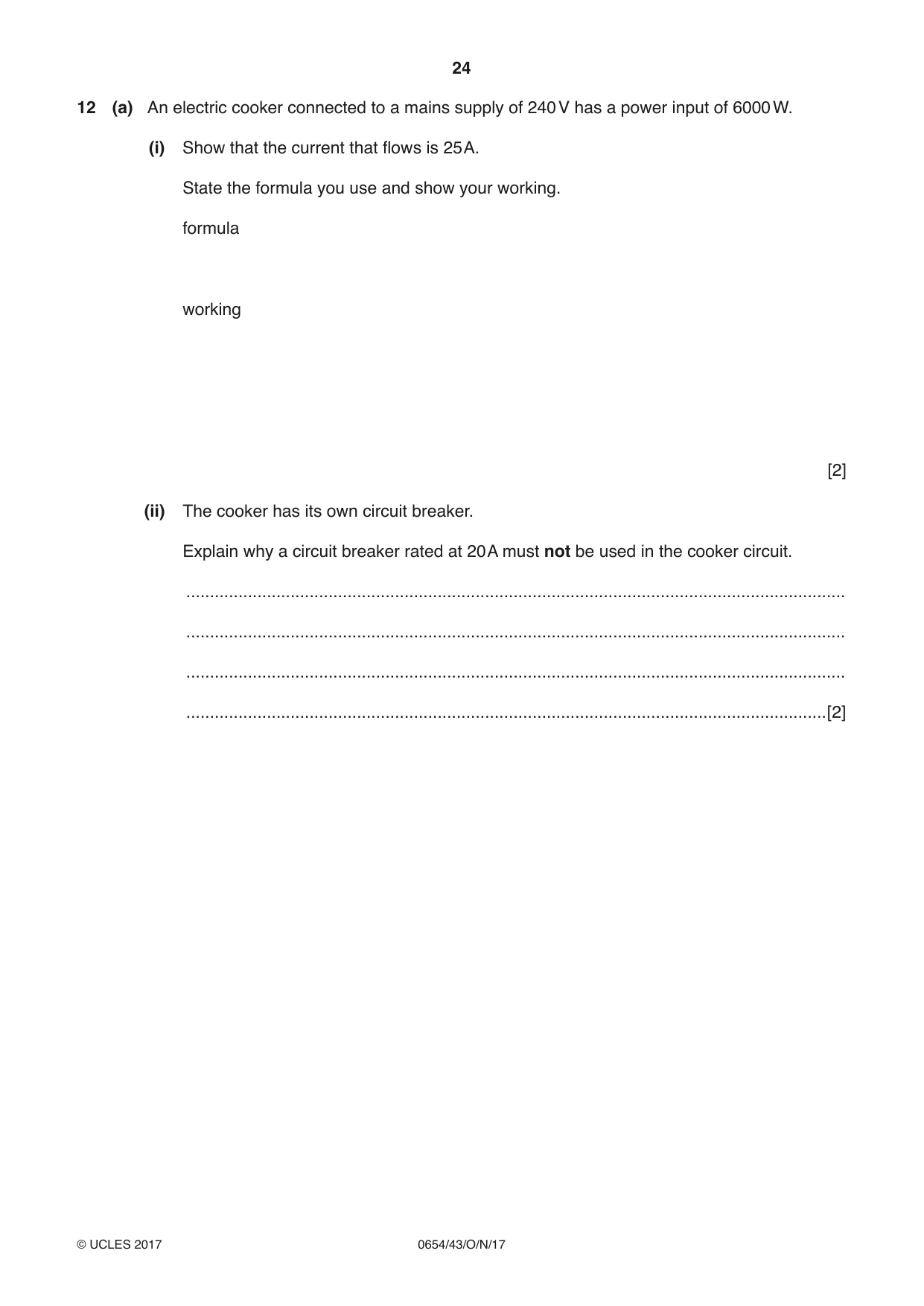
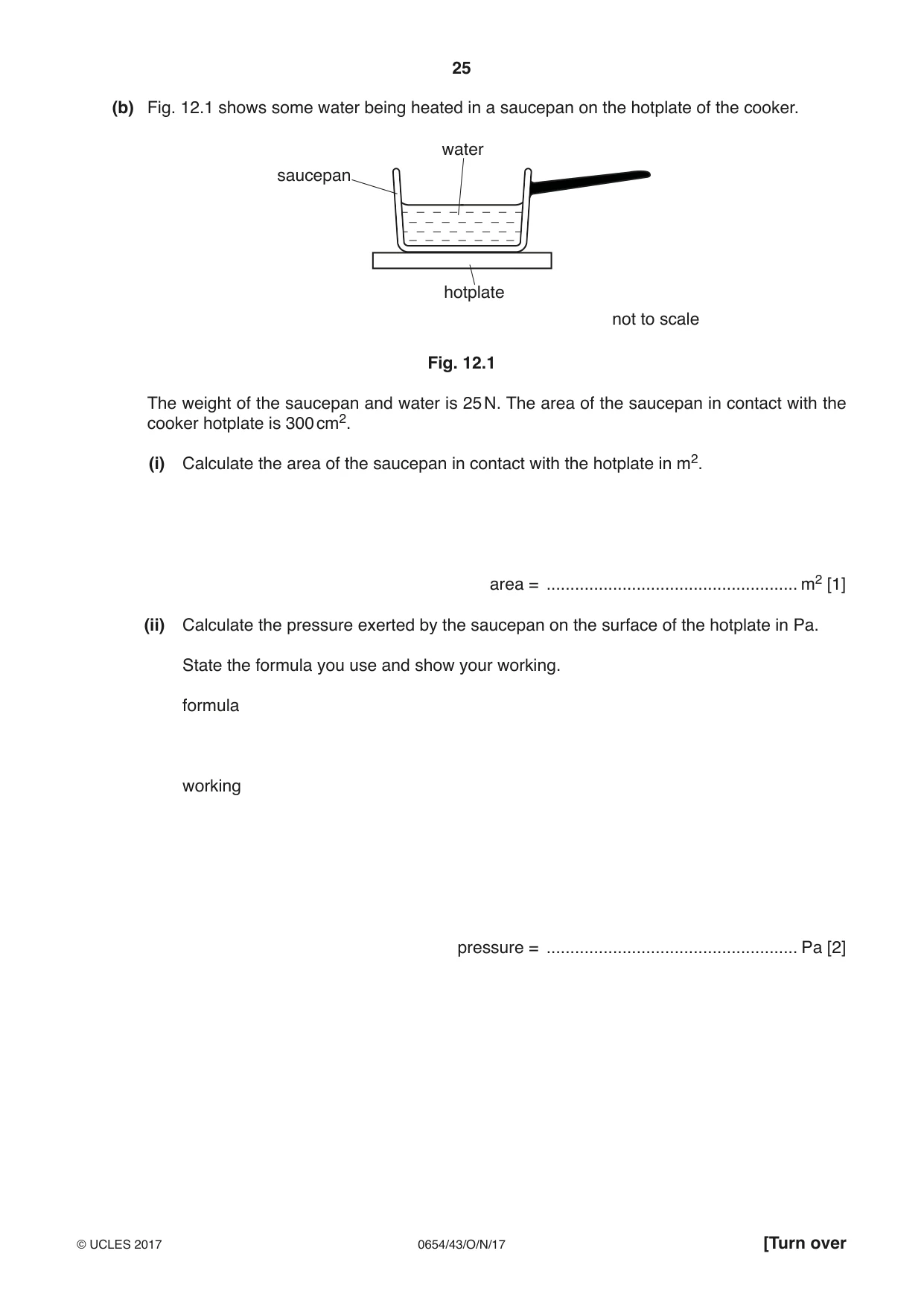
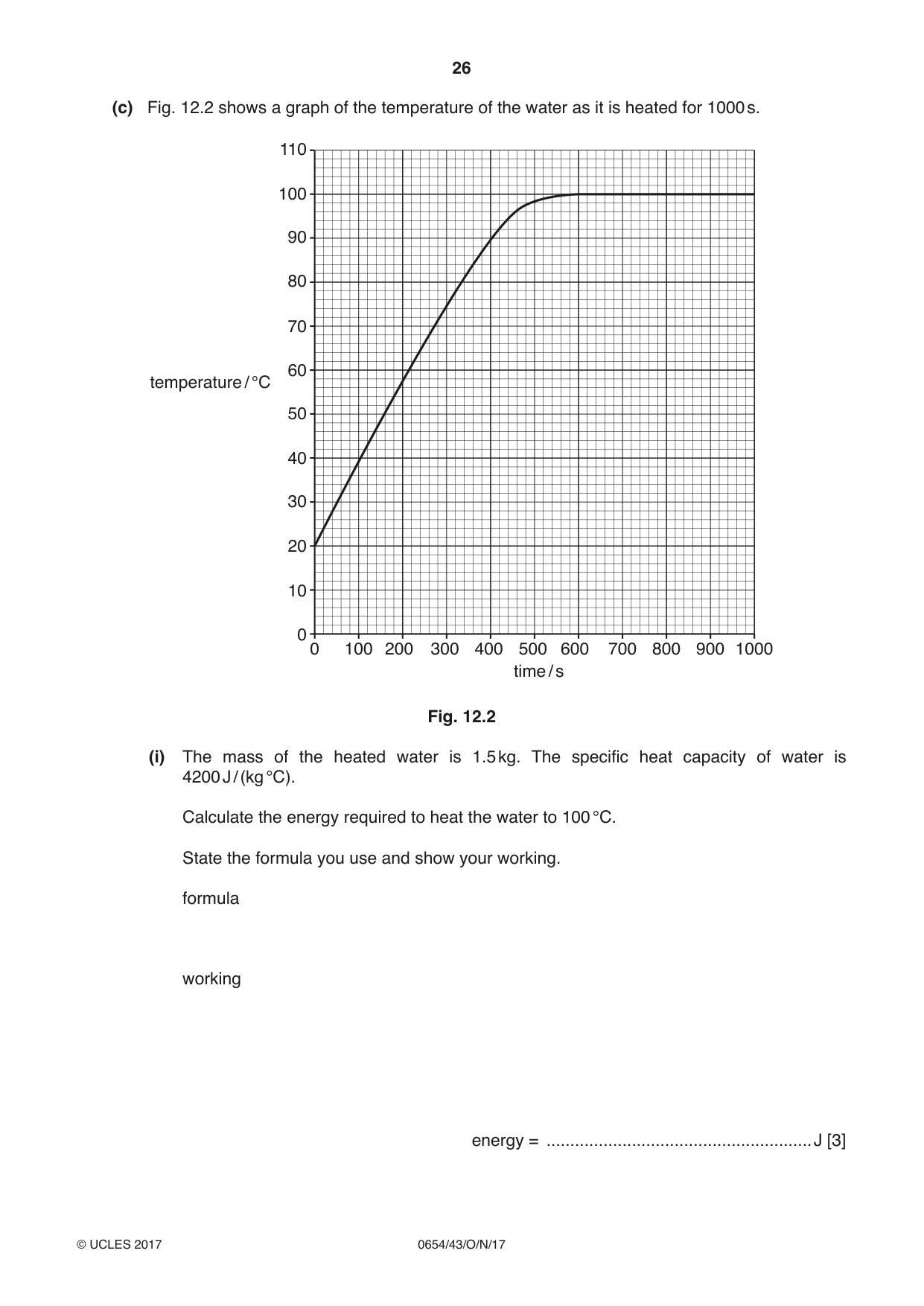
12 (a) An electric cooker connected to a mains supply of 240 V has a power input of 6000 W. (i) Show that the current that flows is 25 A. State the formula you use and show your working. formula working [2] (ii) The cooker has its own circuit breaker. Explain why a circuit breaker rated at 20 A must not be used in the cooker circuit. ........................................................................................................................................... ........................................................................................................................................... ........................................................................................................................................... .......................................................................................................................................[2] (b) Fig. 12.1 shows some water being heated in a saucepan on the hotplate of the cooker. water saucepan hotplate not to scale Fig. 12.1 The weight of the saucepan and water is 25 N. The area of the saucepan in contact with the cooker hotplate is 300 cm2. (i) Calculate the area of the saucepan in contact with the hotplate in m2. area = ..................................................... m2 [1] (ii) Calculate the pressure exerted by the saucepan on the surface of the hotplate in Pa. State the formula you use and show your working. formula working pressure = ..................................................... Pa [2] (c) Fig. 12.2 shows a graph of the temperature of the water as it is heated for 1000 s. 110 100 90 80 70 60 temperature / °C 50 40 30 20 10 0 0 100 200 300 400 500 600 700 800 900 1000 time / s Fig. 12.2 (i) The mass of the heated water is 1.5 kg. The specific heat capacity of water is 4200 J / (kg °C). Calculate the energy required to heat the water to 100 °C. State the formula you use and show your working. formula working energy = ........................................................J [3] (ii) Before the water boils, some of the water evaporates. State two ways in which boiling differs from evaporation. 1 ........................................................................................................................................ ........................................................................................................................................... 2 ........................................................................................................................................ ........................................................................................................................................... [2]
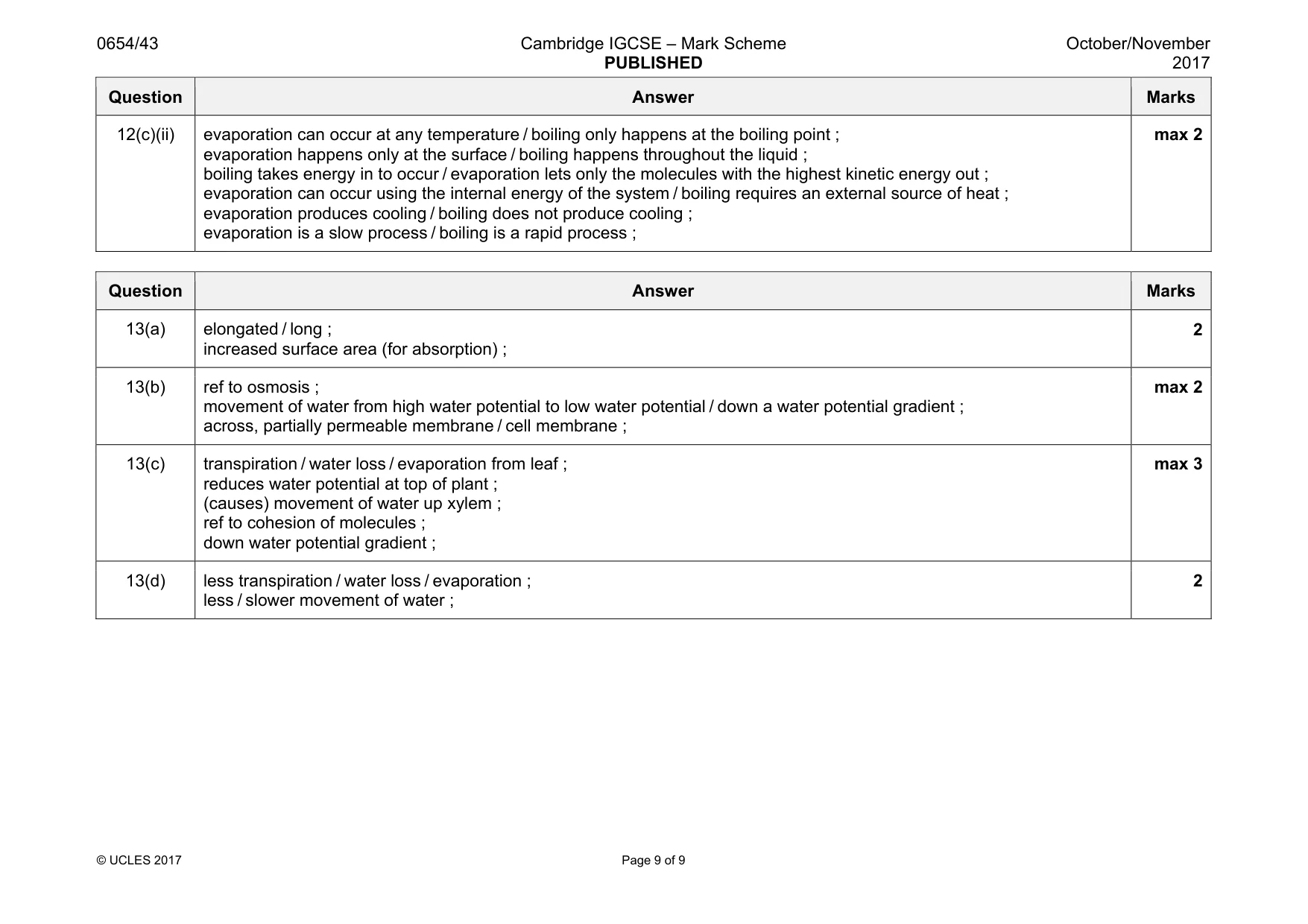
Mark scheme: 12(a)(i) P V = I ; = 6000 240 ; 2 12(a)(ii) breaker would trip at working current ; breaking current should be more than current rating of device OR 20A < 25A / working current ; 2 12(b)(i) 0.03 (m2) ; 1 12(b)(ii) F P A = OR 25 0.03 ; = 830 (Pa) ; 2 12(c)(i) temp rise = 80°C ; E = m c ∆T OR 1.5 × 4200 × 80 ; = 504 000 (J) ; 3 Question Answer Marks 12(c)(ii) evaporation can occur at any temperature / boiling only happens at the boiling point ; evaporation happens only at the surface / boiling happens throughout the liquid ; boiling takes energy in to occur / evaporation lets only the molecules with the highest kinetic energy out ; evaporation can occur using the internal energy of the system / boiling requires an external source of heat ; evaporation produces cooling / boiling does not produce cooling ; evaporation is a slow process / boiling is a rapid process ; max 2
Q13 · A diagram of a root hair cell
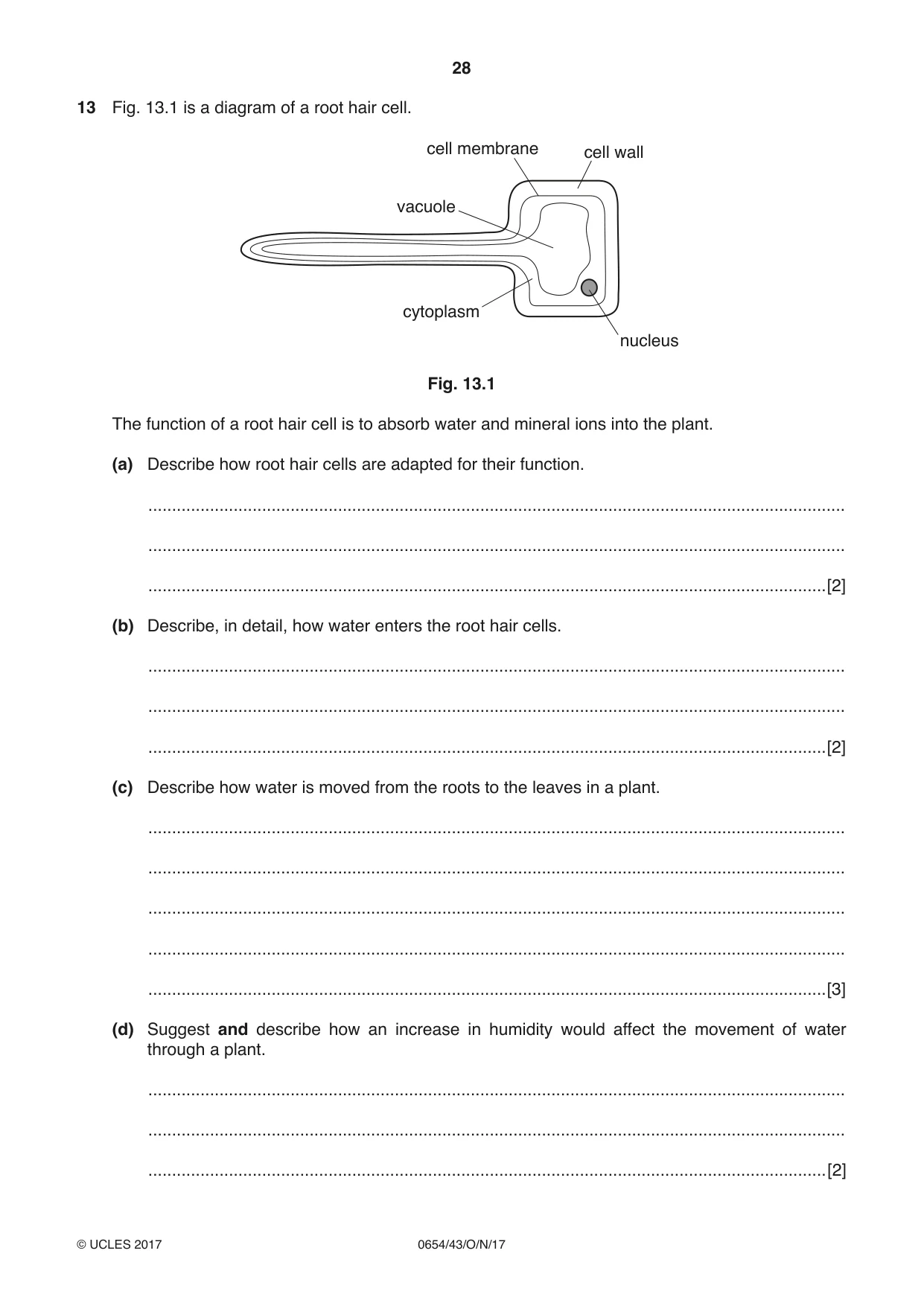
13 Fig. 13.1 is a diagram of a root hair cell. cell membrane cell wall vacuole cytoplasm nucleus Fig. 13.1 The function of a root hair cell is to absorb water and mineral ions into the plant. (a) Describe how root hair cells are adapted for their function. ................................................................................................................................................... ................................................................................................................................................... ...............................................................................................................................................[2] (b) Describe, in detail, how water enters the root hair cells. ................................................................................................................................................... ................................................................................................................................................... ...............................................................................................................................................[2] (c) Describe how water is moved from the roots to the leaves in a plant. ................................................................................................................................................... ................................................................................................................................................... ................................................................................................................................................... ................................................................................................................................................... ...............................................................................................................................................[3] (d) Suggest and describe how an increase in humidity would affect the movement of water through a plant. ................................................................................................................................................... ................................................................................................................................................... ...............................................................................................................................................[2]
Mark scheme: 13(a) elongated / long ; increased surface area (for absorption) ; 2 13(b) ref to osmosis ; movement of water from high water potential to low water potential / down a water potential gradient ; across, partially permeable membrane / cell membrane ; max 2 13(c) transpiration / water loss / evaporation from leaf ; reduces water potential at top of plant ; (causes) movement of water up xylem ; ref to cohesion of molecules ; down water potential gradient ; max 3 13(d) less transpiration / water loss / evaporation ; less / slower movement of water ; 2
What was in this paper
The subtopics covered by these 13 questions, and how many questions each got. Open one in a new tab to see every Cambridge question on it.
What you needed in this session
Cambridge’s own grade thresholds for 2017 Oct/Nov, Paper 4 · Variant 3. A higher threshold means an easier paper — the bar moves with how the cohort did.