Cambridge IGCSE Sciences - Co-ordinated (Double) 0654 — 2020 Oct/Nov Paper 4 · Variant 1
0654/41/O/N/20 · 13 questions · 120 marks · ≈135 min
The question paper and its mark scheme, free to read here and free to download. This is Cambridge’s own paper, exactly as it was sat.
Question paper28 pages

Mark scheme14 pages
Answers below. Sit the paper first if you are practising.
Questions as text
Q1 · Mammals have a double circulatory system
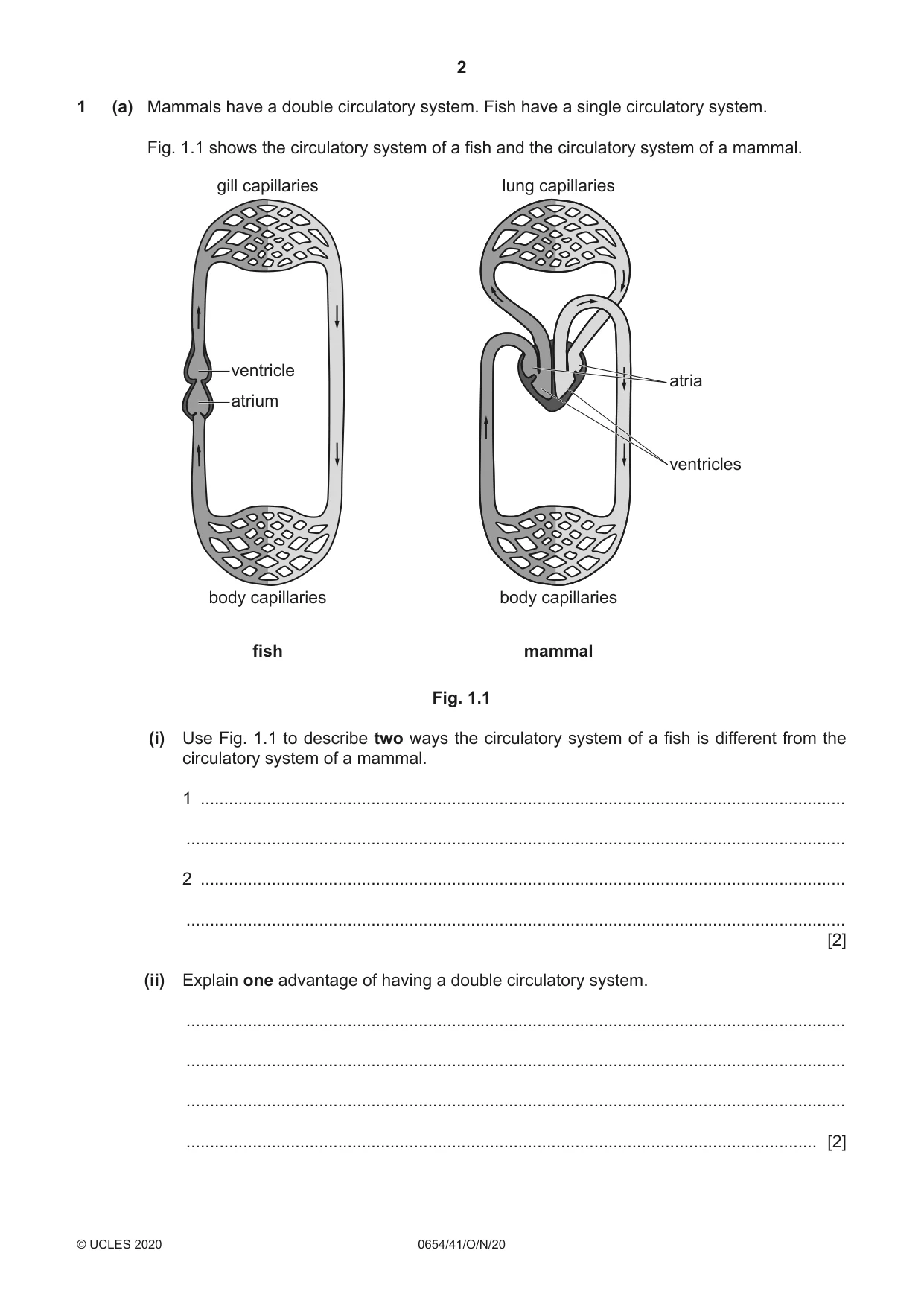
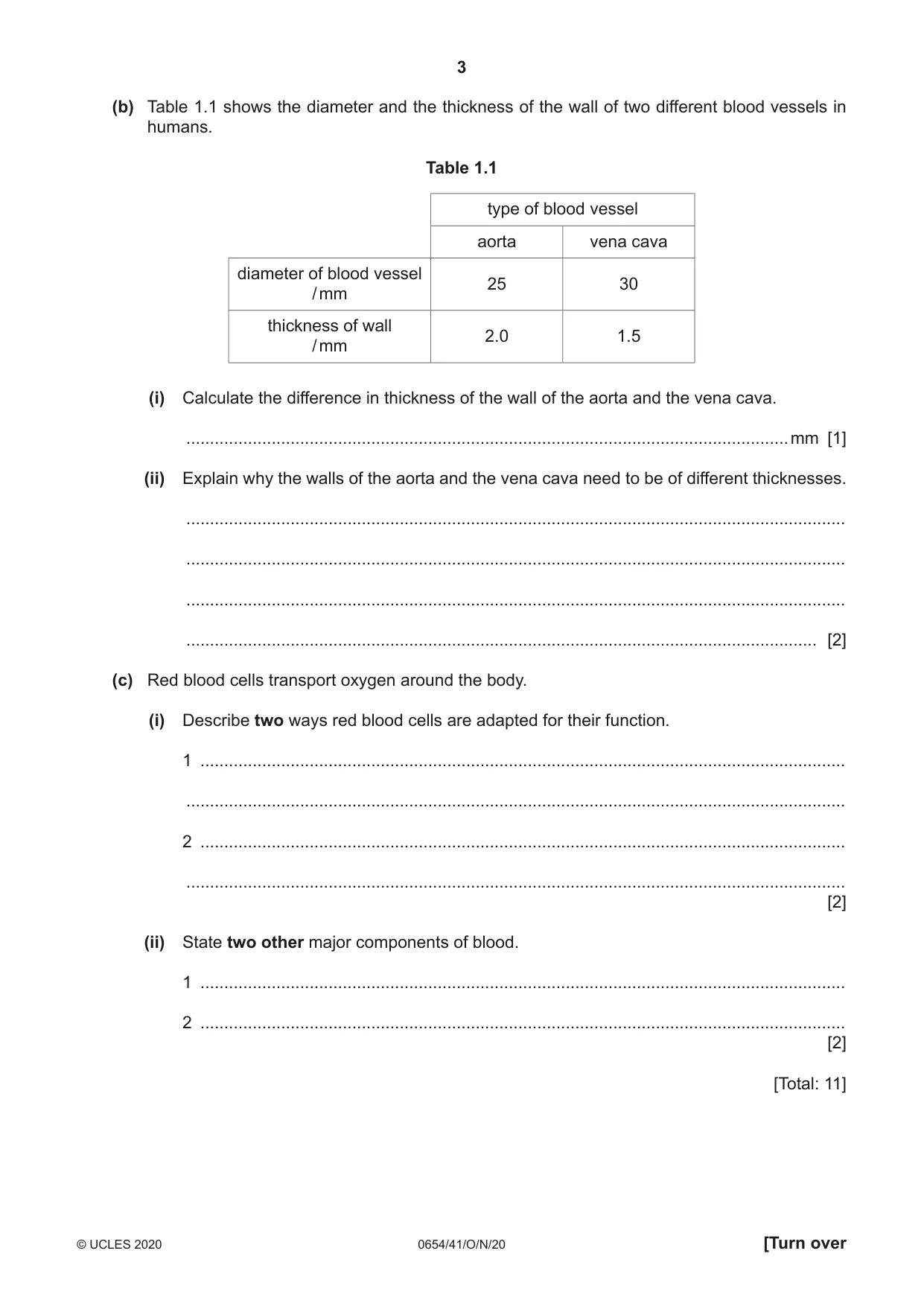
1 (a) Mammals have a double circulatory system. Fish have a single circulatory system. Fig. 1.1 shows the circulatory system of a fish and the circulatory system of a mammal. gill capillaries lung capillaries ventricle atria atrium ventricles body capillaries body capillaries fish mammal Fig. 1.1 (i) Use Fig. 1.1 to describe two ways the circulatory system of a fish is different from the circulatory system of a mammal. 1 ........................................................................................................................................ ........................................................................................................................................... 2 ........................................................................................................................................ ........................................................................................................................................... [2] (ii) Explain one advantage of having a double circulatory system. ........................................................................................................................................... ........................................................................................................................................... ........................................................................................................................................... ..................................................................................................................................... [2] (b) Table 1.1 shows the diameter and the thickness of the wall of two different blood vessels in humans. Table 1.1 type of blood vessel aorta vena cava diameter of blood vessel 25 30 / mm thickness of wall 2.0 1.5 / mm (i) Calculate the difference in thickness of the wall of the aorta and the vena cava. ............................................................................................................................... mm [1] (ii) Explain why the walls of the aorta and the vena cava need to be of different thicknesses. ........................................................................................................................................... ........................................................................................................................................... ........................................................................................................................................... ..................................................................................................................................... [2] (c) Red blood cells transport oxygen around the body. (i) Describe two ways red blood cells are adapted for their function. 1 ........................................................................................................................................ ........................................................................................................................................... 2 ........................................................................................................................................ ........................................................................................................................................... [2] (ii) State two other major components of blood. 1 ........................................................................................................................................ 2 ........................................................................................................................................ [2] [Total: 11]
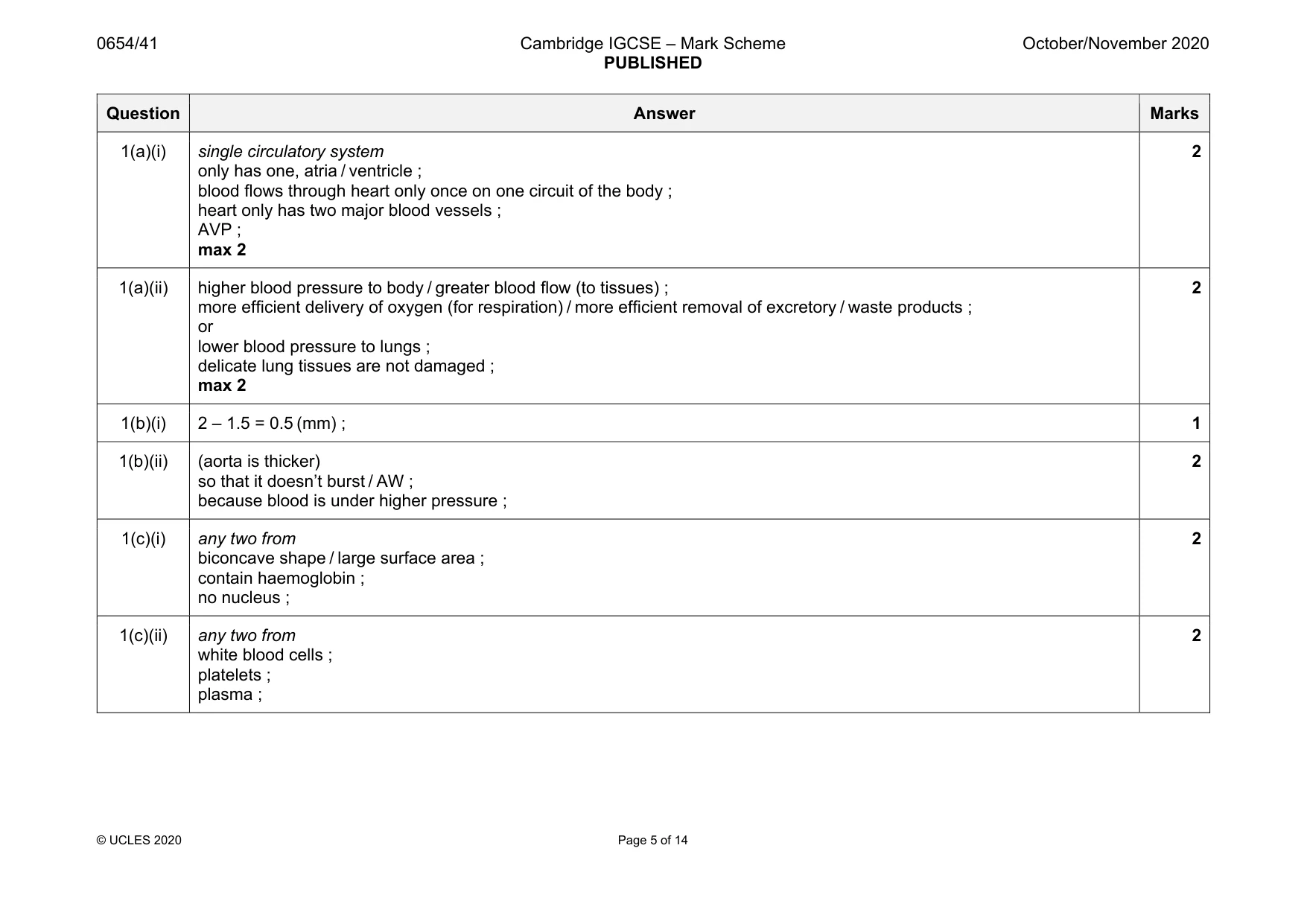
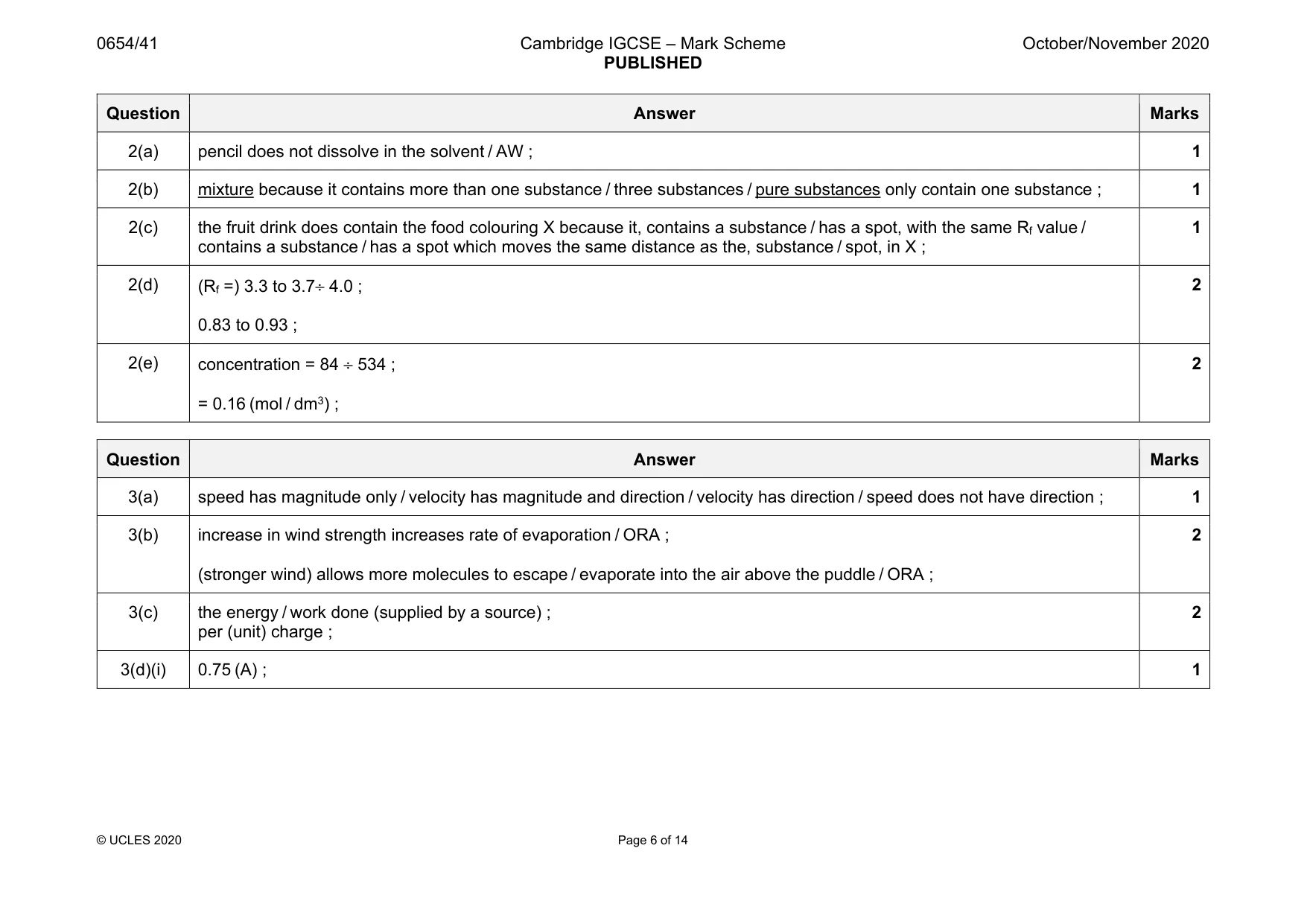
Mark scheme: 1(a)(i) single circulatory system only has one, atria / ventricle ; blood flows through heart only once on one circuit of the body ; heart only has two major blood vessels ; AVP ; max 2 1(a)(ii) higher blood pressure to body / greater blood flow (to tissues) ; more efficient delivery of oxygen (for respiration) / more efficient removal of excretory / waste products ; or lower blood pressure to lungs ; delicate lung tissues are not damaged ; max 2 2 1(b)(i) 2 – 1.5 = 0.5 (mm) ; 1 1(b)(ii) (aorta is thicker) so that it doesn’t burst / AW ; because blood is under higher pressure ; 2 1(c)(i) any two from biconcave shape / large surface area ; contain haemoglobin ; no nucleus ; 2 1(c)(ii) any two from white blood cells ; platelets ; plasma ; 2
Q2 · Paper chromatography is used to find out whether a fruit drink, D, contains a harmful…
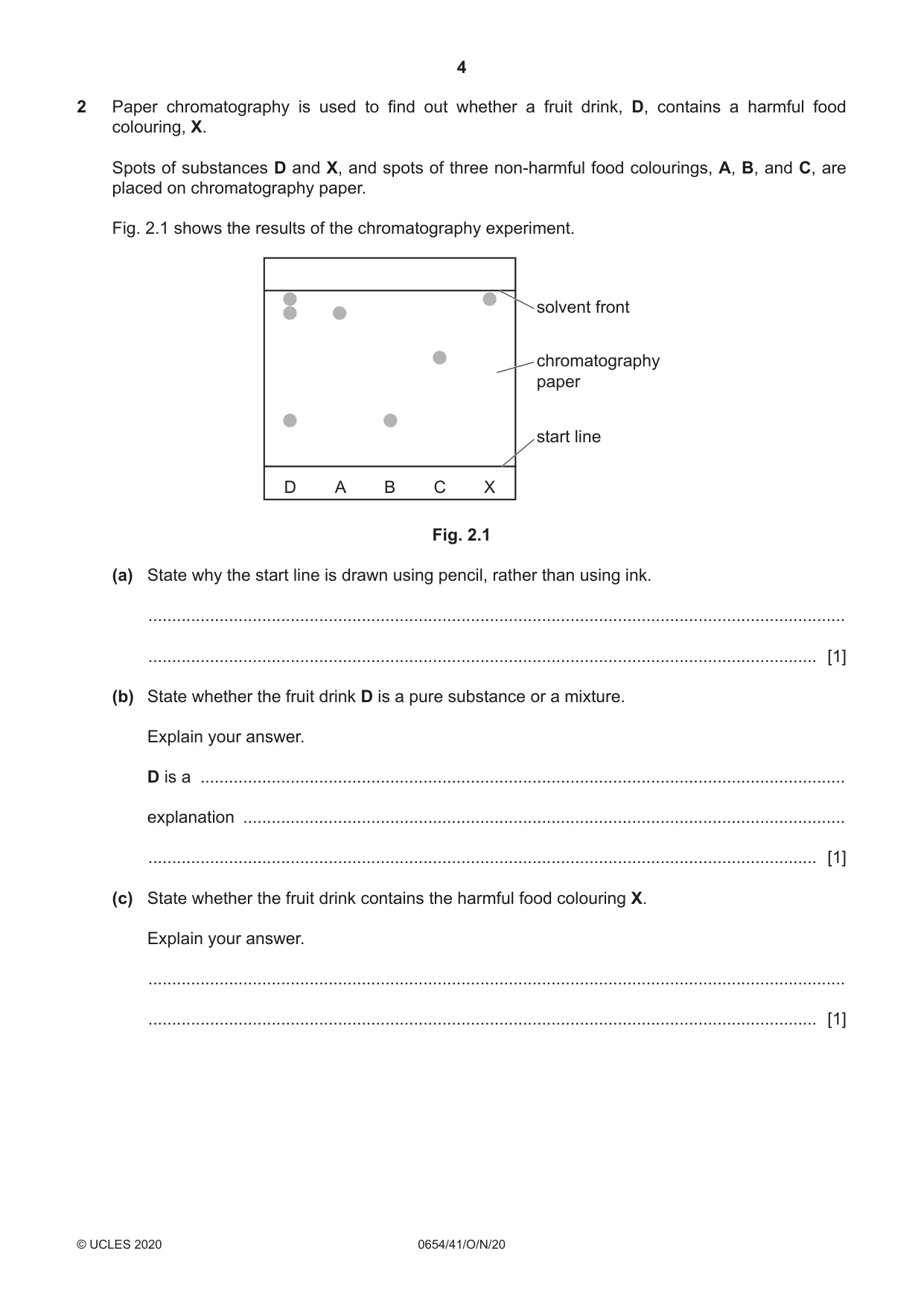
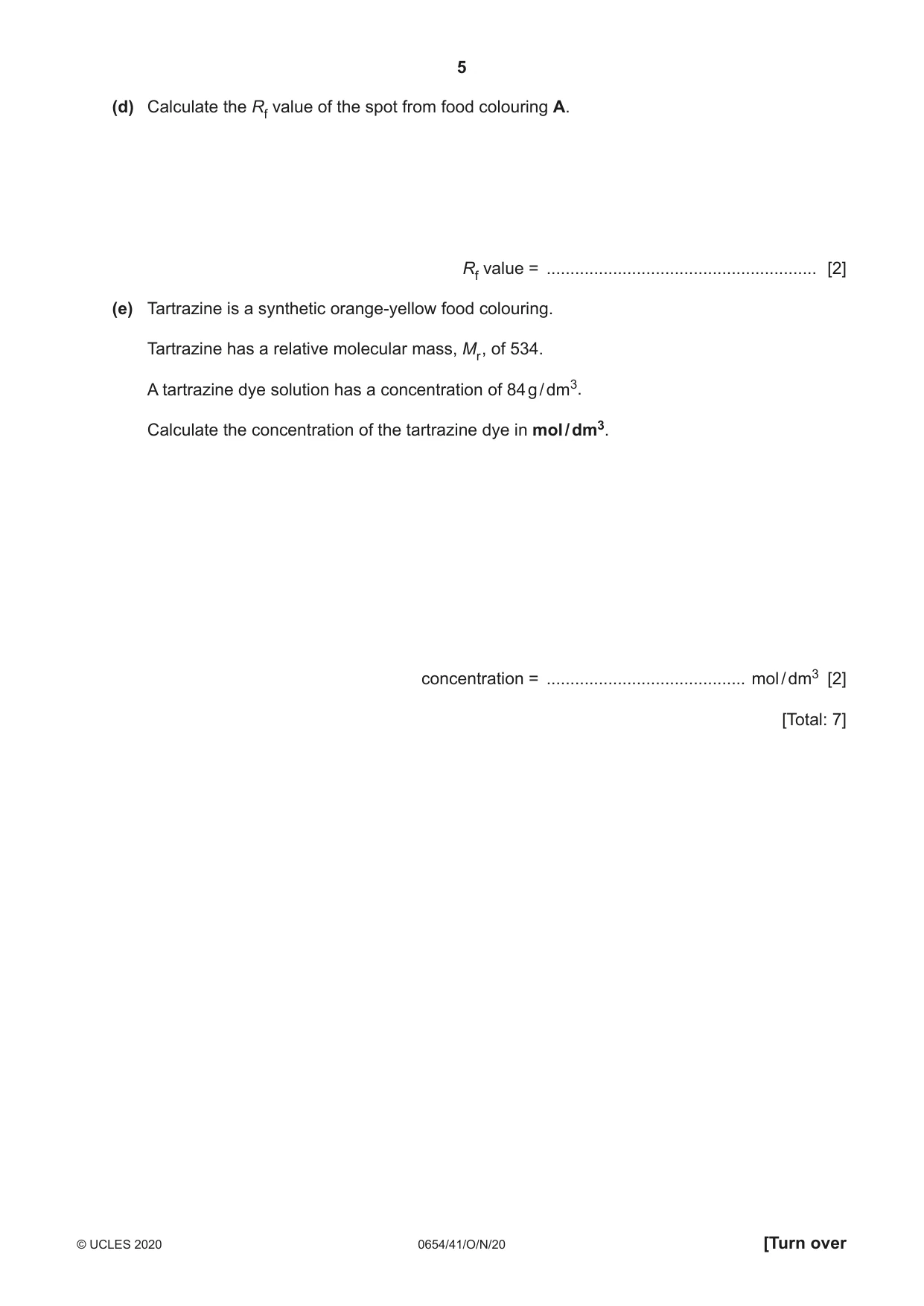
2 Paper chromatography is used to find out whether a fruit drink, D, contains a harmful food colouring, X. Spots of substances D and X, and spots of three non‑harmful food colourings, A, B, and C, are placed on chromatography paper. Fig. 2.1 shows the results of the chromatography experiment. solvent front chromatography paper start line D A B C X Fig. 2.1 (a) State why the start line is drawn using pencil, rather than using ink. ................................................................................................................................................... ............................................................................................................................................. [1] (b) State whether the fruit drink D is a pure substance or a mixture. Explain your answer. D is a ........................................................................................................................................ explanation ............................................................................................................................... ............................................................................................................................................. [1] (c) State whether the fruit drink contains the harmful food colouring X. Explain your answer. ................................................................................................................................................... ............................................................................................................................................. [1] (d) Calculate the Rf value of the spot from food colouring A. Rf value = ......................................................... [2] (e) Tartrazine is a synthetic orange‑yellow food colouring. Tartrazine has a relative molecular mass, Mr , of 534. A tartrazine dye solution has a concentration of 84 g / dm3. Calculate the concentration of the tartrazine dye in mol / dm3. concentration = .......................................... mol / dm3 [2] [Total: 7]
Mark scheme: 2(a) pencil does not dissolve in the solvent / AW ; 1 2(b) mixture because it contains more than one substance / three substances / pure substances only contain one substance ; 1 2(c) the fruit drink does contain the food colouring X because it, contains a substance / has a spot, with the same Rf value / contains a substance / has a spot which moves the same distance as the, substance / spot, in X ; 1 2(d) (Rf =) 3.3 to 3.7÷ 4.0 ; 0.83 to 0.93 ; 2 2(e) concentration = 84 ÷ 534 ; = 0.16 (mol / dm3) ; 2
Q3 · A car travels along a road at 8 m / s
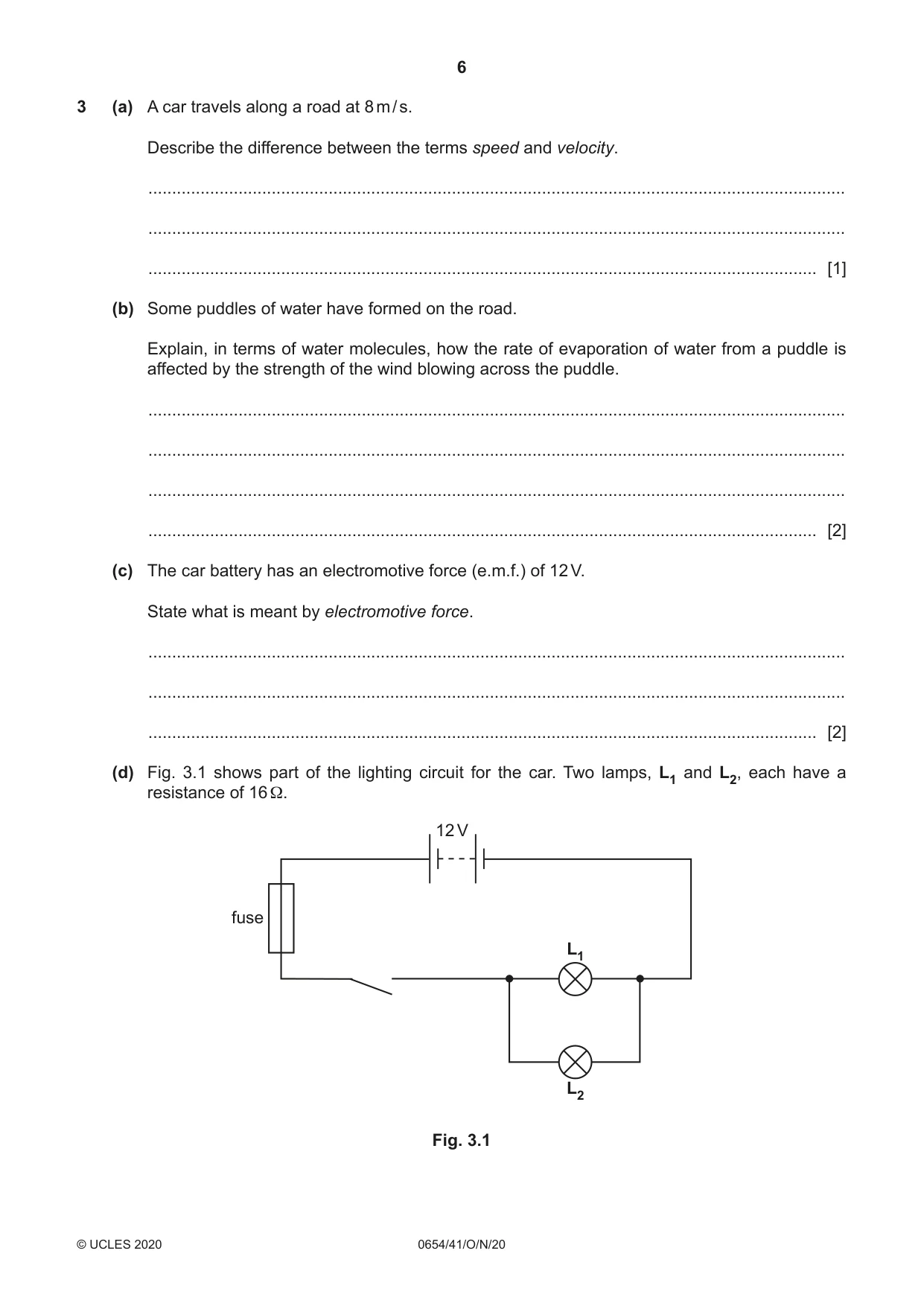
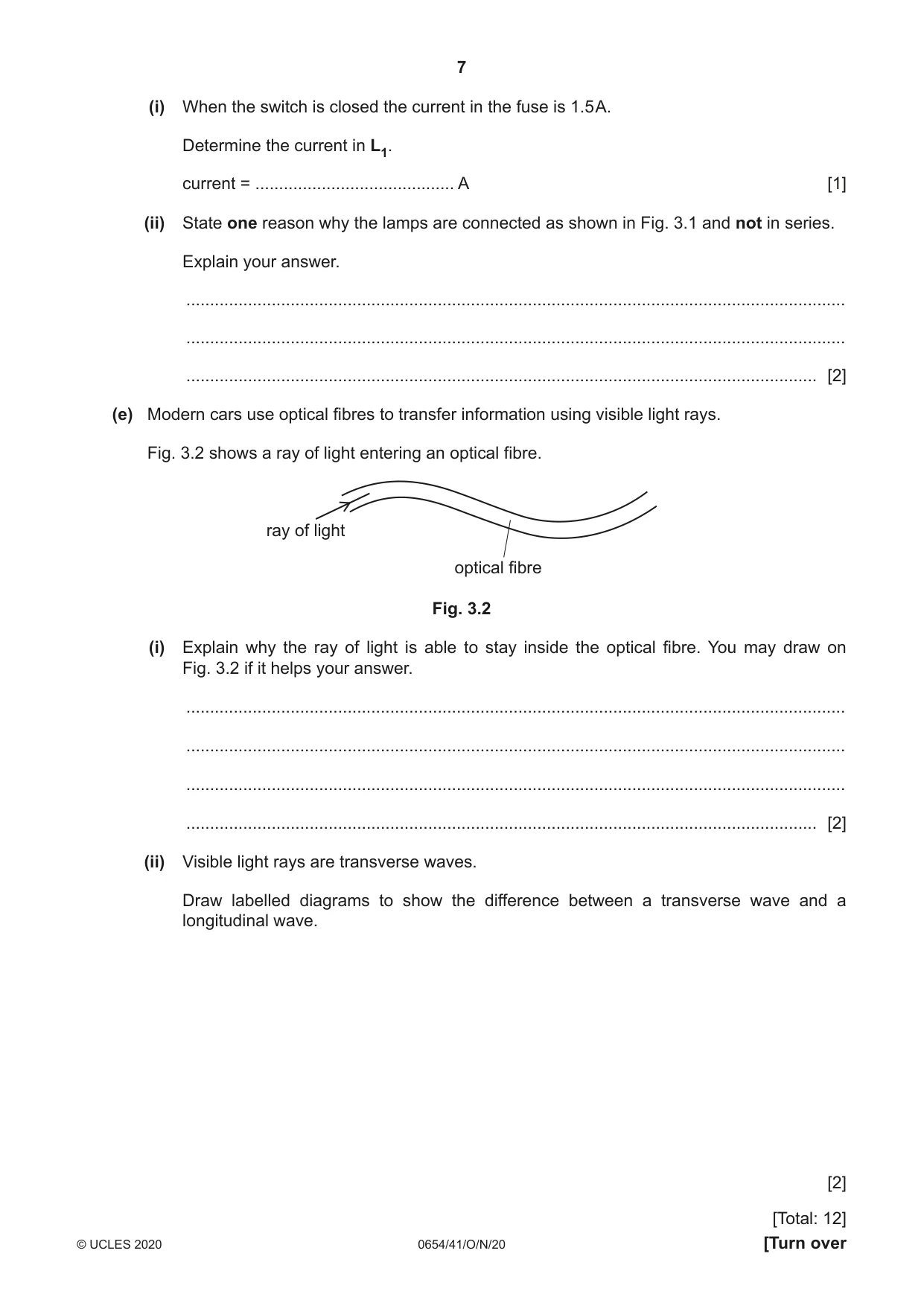
3 (a) A car travels along a road at 8 m / s. Describe the difference between the terms speed and velocity. ................................................................................................................................................... ................................................................................................................................................... ............................................................................................................................................. [1] (b) Some puddles of water have formed on the road. Explain, in terms of water molecules, how the rate of evaporation of water from a puddle is affected by the strength of the wind blowing across the puddle. ................................................................................................................................................... ................................................................................................................................................... ................................................................................................................................................... ............................................................................................................................................. [2] (c) The car battery has an electromotive force (e.m.f.) of 12 V. State what is meant by electromotive force. ................................................................................................................................................... ................................................................................................................................................... ............................................................................................................................................. [2] (d) Fig. 3.1 shows part of the lighting circuit for the car. Two lamps, L1 and L2, each have a resistance of 16 Ω. 12 V fuse L1 L2 Fig. 3.1 (i) When the switch is closed the current in the fuse is 1.5 A. Determine the current in L1. current = .......................................... A [1] (ii) State one reason why the lamps are connected as shown in Fig. 3.1 and not in series. Explain your answer. ........................................................................................................................................... ........................................................................................................................................... ..................................................................................................................................... [2] (e) Modern cars use optical fibres to transfer information using visible light rays. Fig. 3.2 shows a ray of light entering an optical fibre. ray of light optical fibre Fig. 3.2 (i) Explain why the ray of light is able to stay inside the optical fibre. You may draw on Fig. 3.2 if it helps your answer. ........................................................................................................................................... ........................................................................................................................................... ........................................................................................................................................... ..................................................................................................................................... [2] (ii) Visible light rays are transverse waves. Draw labelled diagrams to show the difference between a transverse wave and a longitudinal wave. [2] [Total: 12]
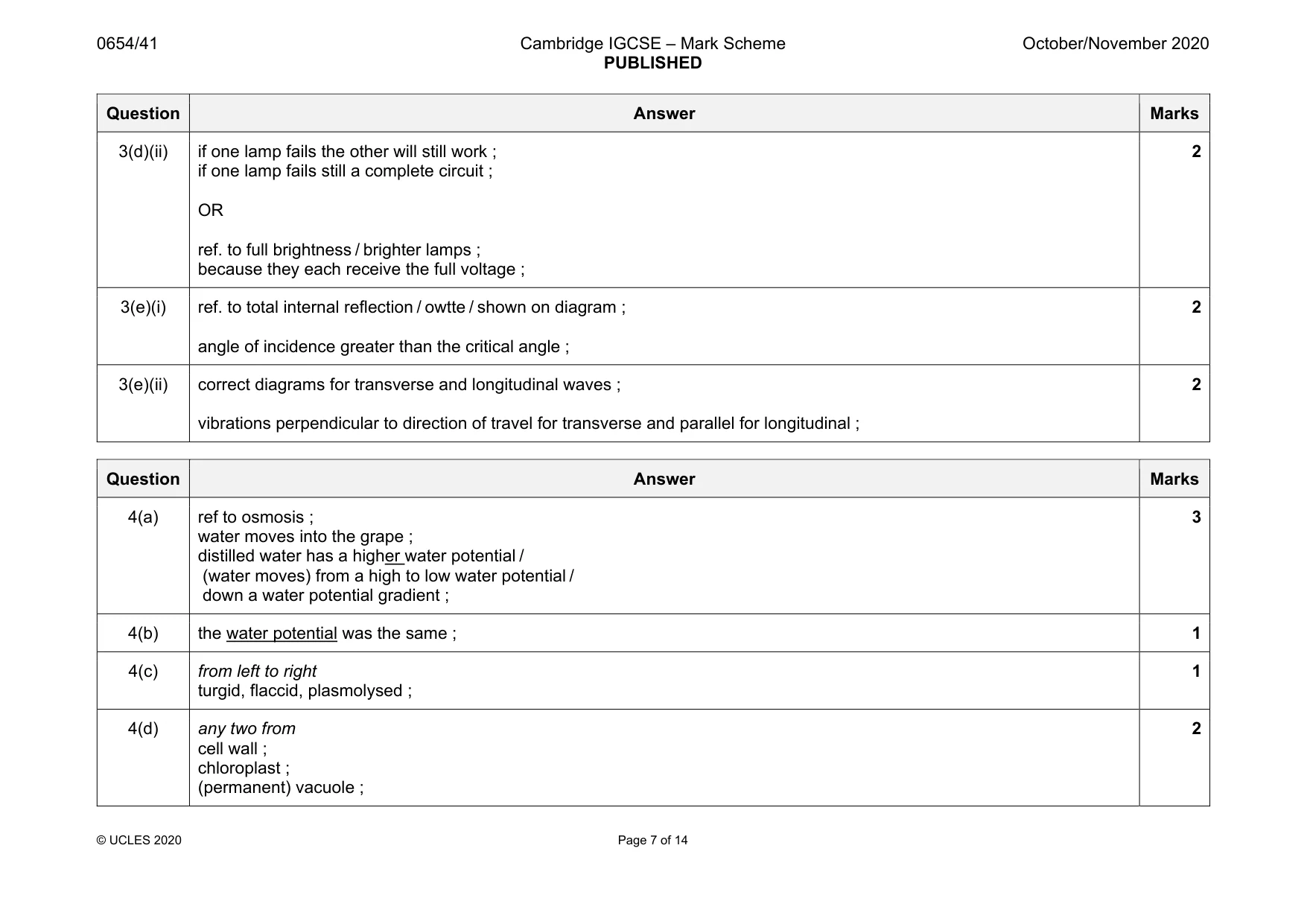
Mark scheme: 3(a) speed has magnitude only / velocity has magnitude and direction / velocity has direction / speed does not have direction ; 1 3(b) increase in wind strength increases rate of evaporation / ORA ; (stronger wind) allows more molecules to escape / evaporate into the air above the puddle / ORA ; 2 3(c) the energy / work done (supplied by a source) ; per (unit) charge ; 2 3(d)(i) 0.75 (A) ; 1 Question Answer Marks 3(d)(ii) if one lamp fails the other will still work ; if one lamp fails still a complete circuit ; OR ref. to full brightness / brighter lamps ; because they each receive the full voltage ; 2 3(e)(i) ref. to total internal reflection / owtte / shown on diagram ; angle of incidence greater than the critical angle ; 2 3(e)(ii) correct diagrams for transverse and longitudinal waves ; vibrations perpendicular to direction of travel for transverse and parallel for longitudinal ; 2
Q4 · A student investigates what effect immersing grapes in distilled water and concentrated…
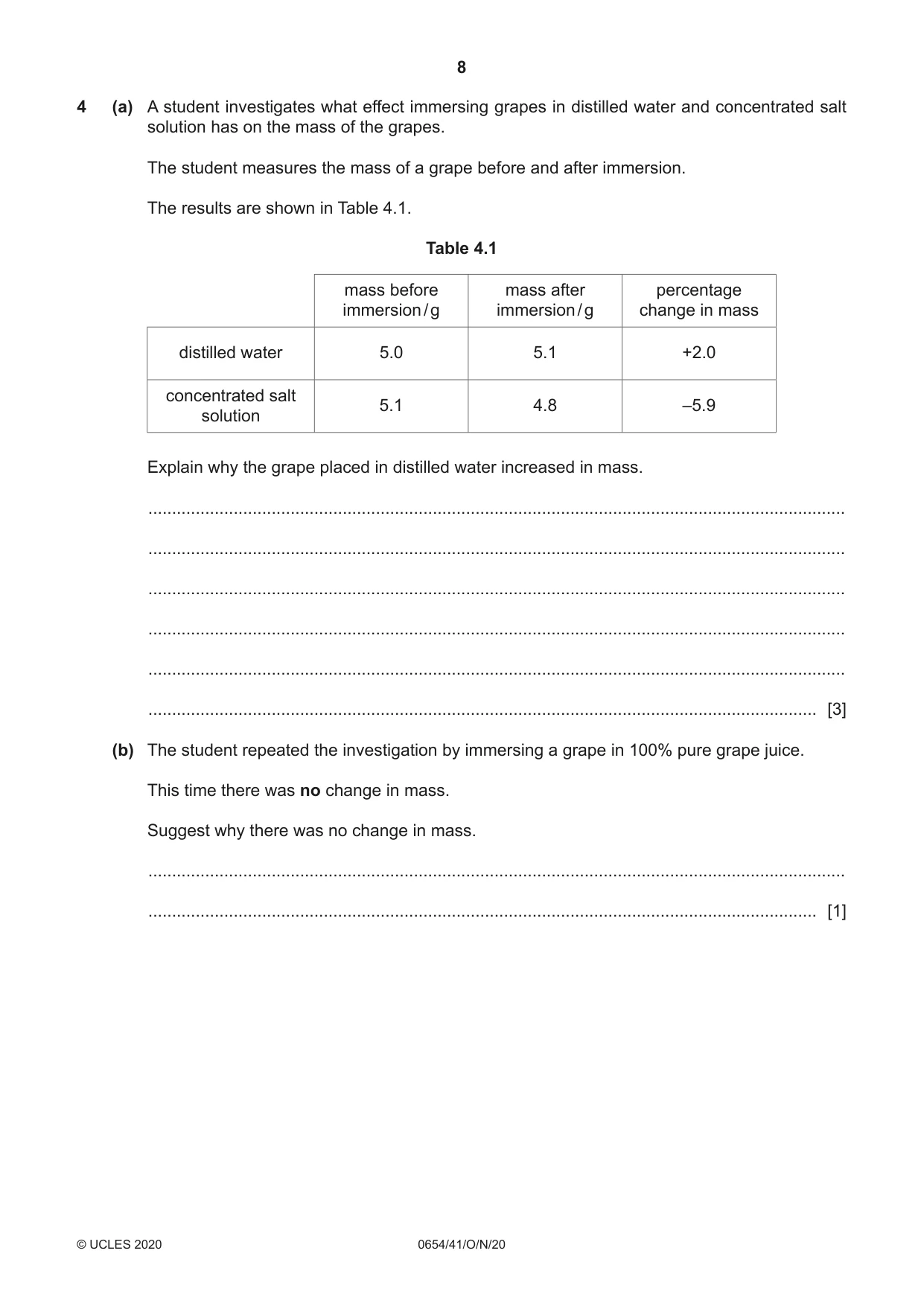
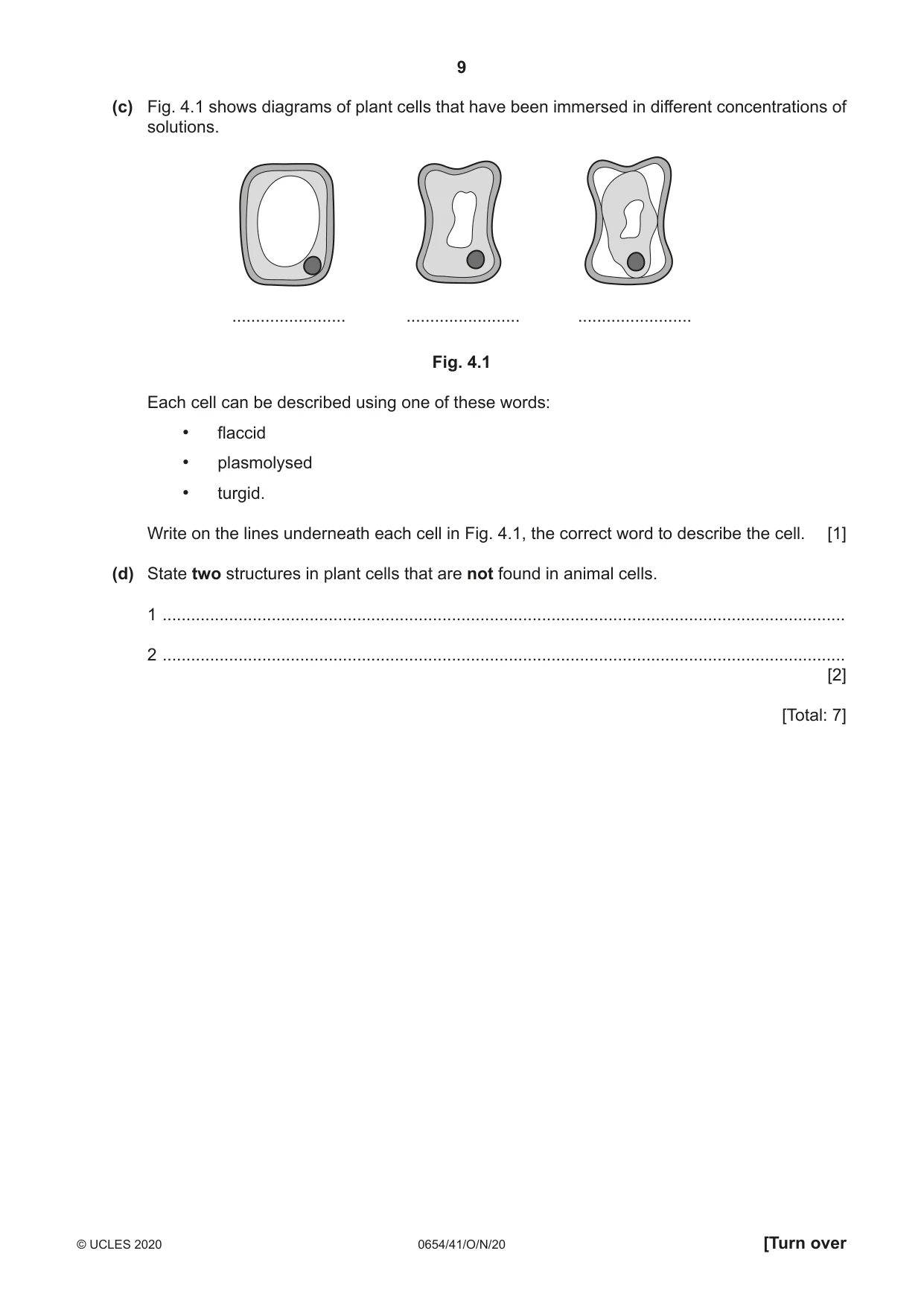
4 (a) A student investigates what effect immersing grapes in distilled water and concentrated salt solution has on the mass of the grapes. The student measures the mass of a grape before and after immersion. The results are shown in Table 4.1. Table 4.1 mass before mass after percentage immersion / g immersion / g change in mass distilled water 5.0 5.1 +2.0 concentrated salt 5.1 4.8 –5.9 solution Explain why the grape placed in distilled water increased in mass. ................................................................................................................................................... ................................................................................................................................................... ................................................................................................................................................... ................................................................................................................................................... ................................................................................................................................................... ............................................................................................................................................. [3] (b) The student repeated the investigation by immersing a grape in 100% pure grape juice. This time there was no change in mass. Suggest why there was no change in mass. ................................................................................................................................................... ............................................................................................................................................. [1] (c) Fig. 4.1 shows diagrams of plant cells that have been immersed in different concentrations of solutions. ........................ ........................ ........................ Fig. 4.1 Each cell can be described using one of these words: • flaccid • plasmolysed • turgid. Write on the lines underneath each cell in Fig. 4.1, the correct word to describe the cell. [1] (d) State two structures in plant cells that are not found in animal cells. 1 ................................................................................................................................................ 2 ................................................................................................................................................ [2] [Total: 7]
Mark scheme: 4(a) ref to osmosis ; water moves into the grape ; distilled water has a higher water potential / (water moves) from a high to low water potential / down a water potential gradient ; 4(b) the water potential was the same ; 1 4(c) from left to right turgid, flaccid, plasmolysed ; 1 4(d) any two from cell wall ; chloroplast ; (permanent) vacuole ; 2
Q5 · A scientist investigates the reaction between calcium carbonate and dilute hydrochloric…
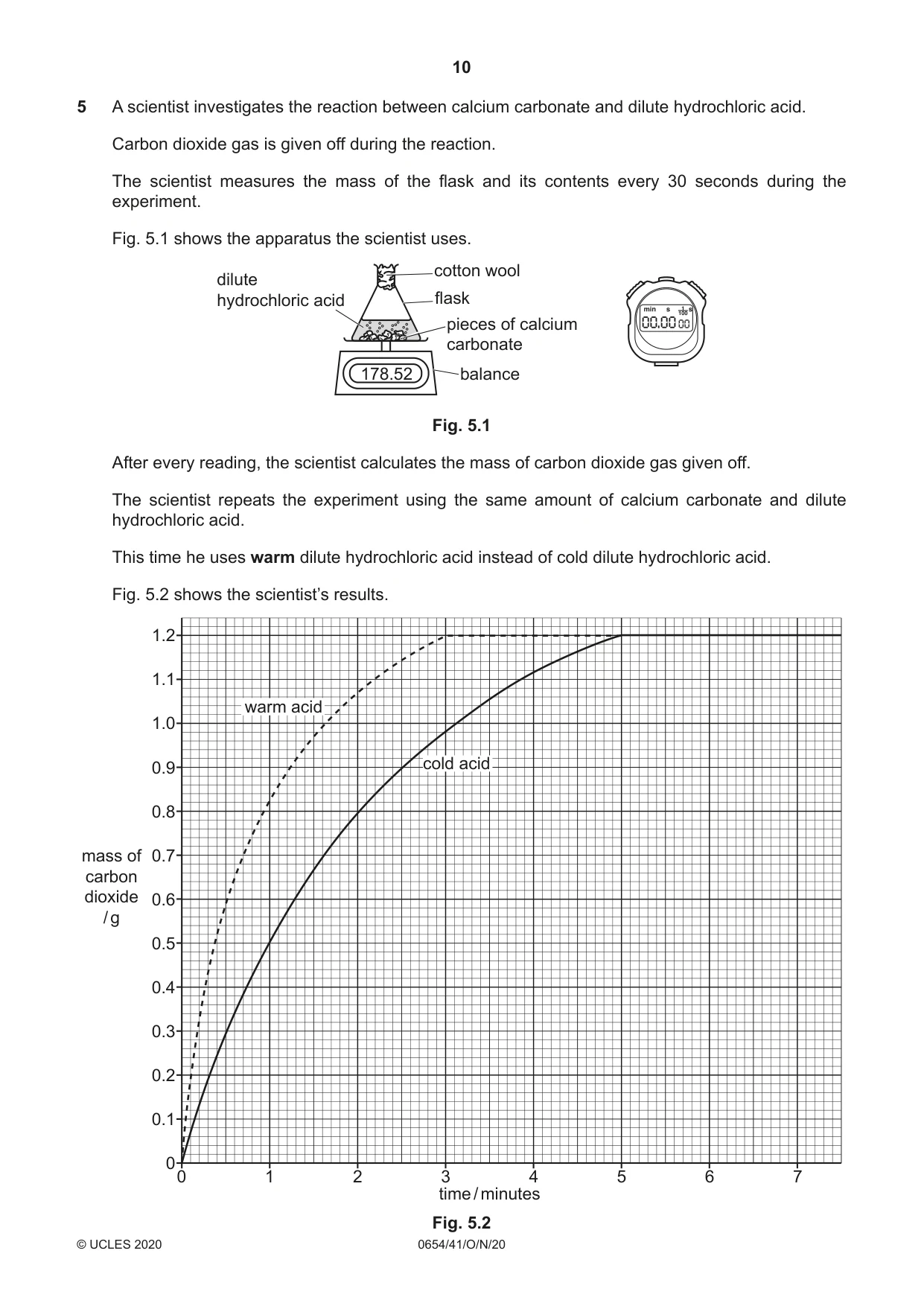
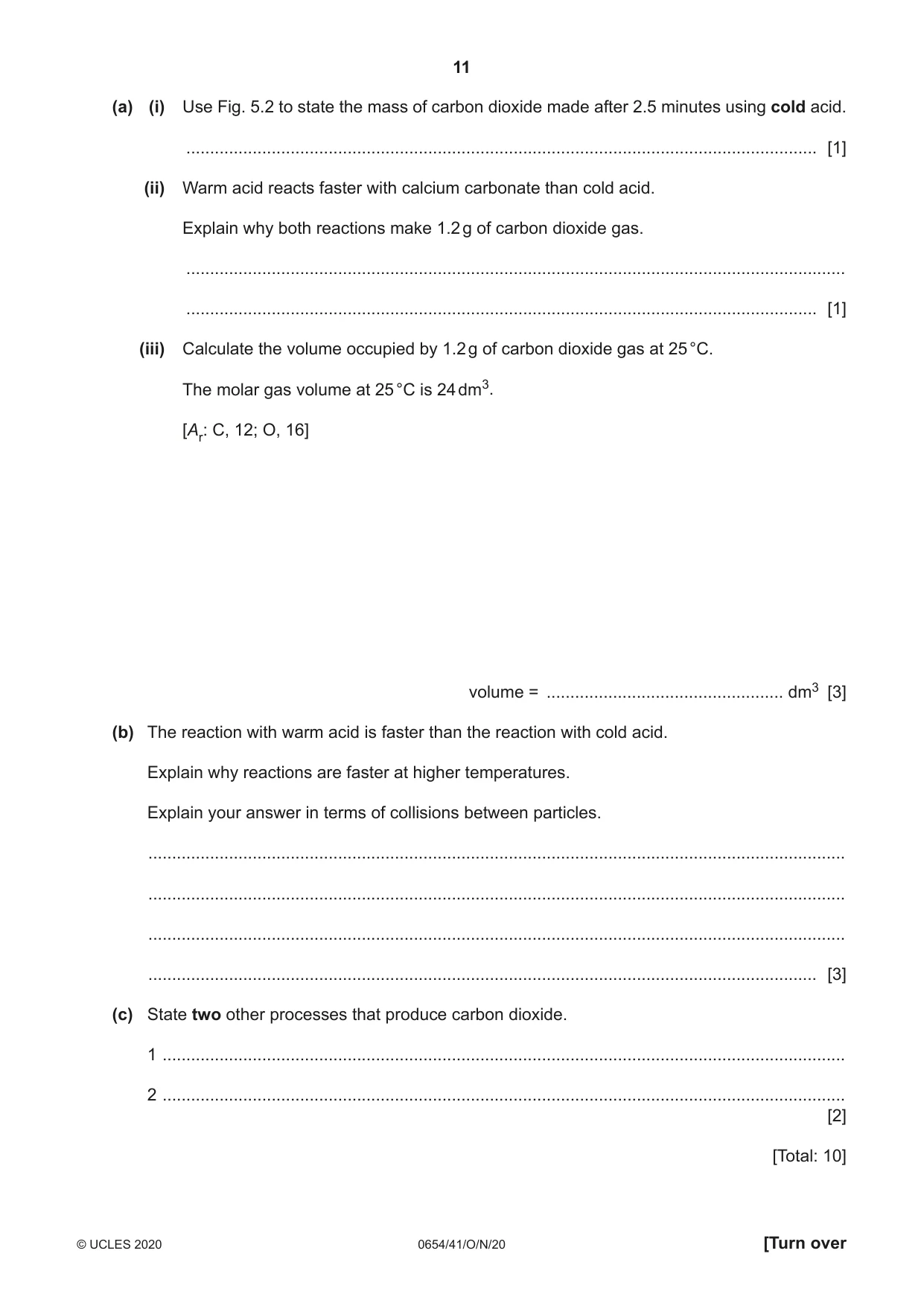
5 A scientist investigates the reaction between calcium carbonate and dilute hydrochloric acid. Carbon dioxide gas is given off during the reaction. The scientist measures the mass of the flask and its contents every 30 seconds during the experiment. Fig. 5.1 shows the apparatus the scientist uses. cotton wool dilute hydrochloric acid flask pieces of calcium carbonate 178.52 balance Fig. 5.1 After every reading, the scientist calculates the mass of carbon dioxide gas given off. The scientist repeats the experiment using the same amount of calcium carbonate and dilute hydrochloric acid. This time he uses warm dilute hydrochloric acid instead of cold dilute hydrochloric acid. Fig. 5.2 shows the scientist’s results. 1.2 1.1 warm acid 1.0 0.9 cold acid 0.8 mass of 0.7 carbon dioxide 0.6 / g 0.5 0.4 0.3 0.2 0.1 00 1 2 3 4 5 6 7 time / minutes Fig. 5.2 (a) (i) Use Fig. 5.2 to state the mass of carbon dioxide made after 2.5 minutes using cold acid. ..................................................................................................................................... [1] (ii) Warm acid reacts faster with calcium carbonate than cold acid. Explain why both reactions make 1.2 g of carbon dioxide gas. ........................................................................................................................................... ..................................................................................................................................... [1] (iii) Calculate the volume occupied by 1.2 g of carbon dioxide gas at 25 °C. The molar gas volume at 25 °C is 24 dm3. [Ar: C, 12; O, 16] volume = .................................................. dm3 [3] (b) The reaction with warm acid is faster than the reaction with cold acid. Explain why reactions are faster at higher temperatures. Explain your answer in terms of collisions between particles. ................................................................................................................................................... ................................................................................................................................................... ................................................................................................................................................... ............................................................................................................................................. [3] (c) State two other processes that produce carbon dioxide. 1 ................................................................................................................................................ 2 ................................................................................................................................................ [2] [Total: 10]
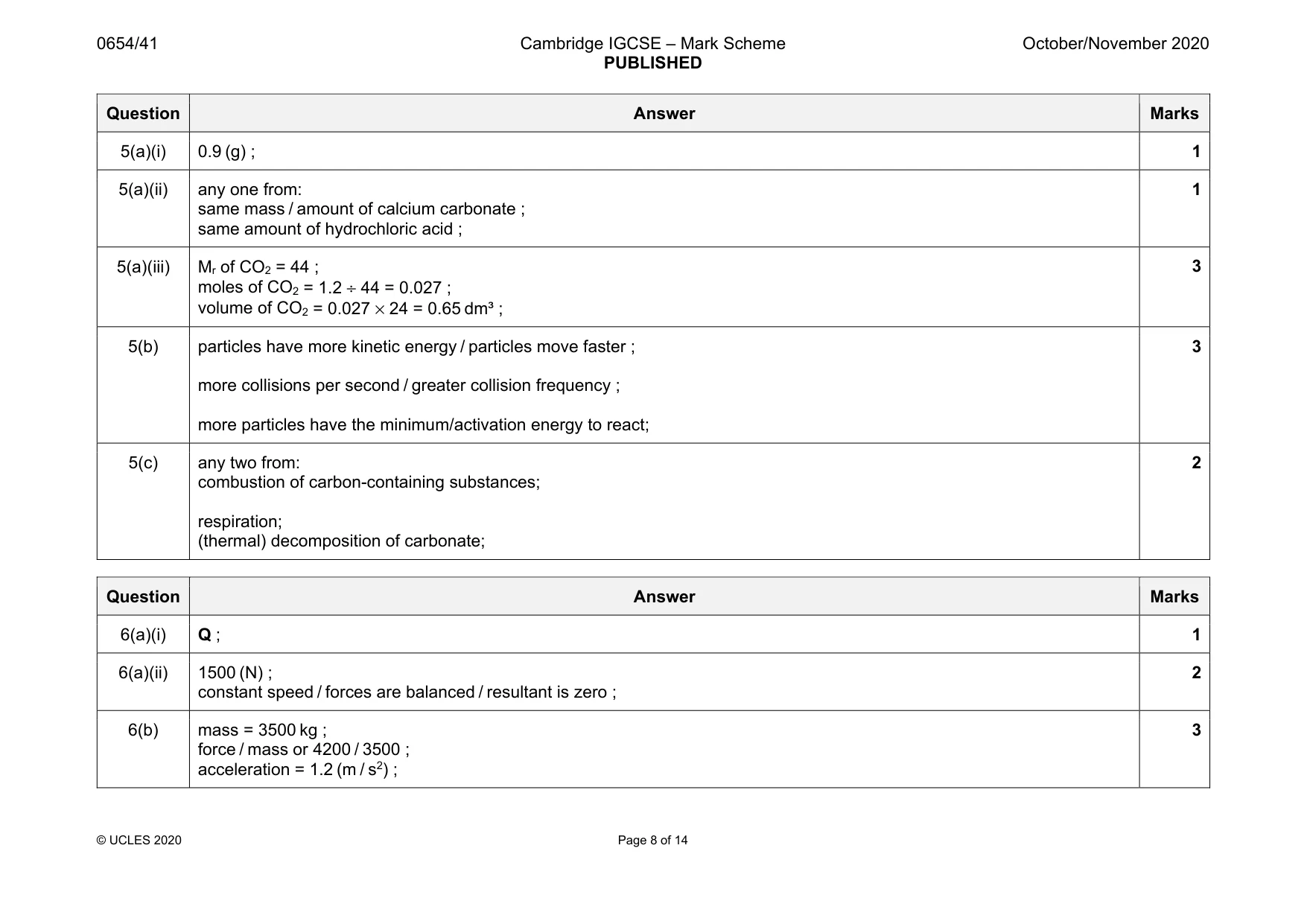
Mark scheme: 5(a)(i) 0.9 (g) ; 1 5(a)(ii) any one from: same mass / amount of calcium carbonate ; same amount of hydrochloric acid ; 1 5(a)(iii) Mr of CO2 = 44 ; moles of CO2 = 1.2 ÷ 44 = 0.027 ; volume of CO2 = 0.027 × 24 = 0.65 dm³ ; 3 5(b) particles have more kinetic energy / particles move faster ; more collisions per second / greater collision frequency ; more particles have the minimum/activation energy to react; 3 5(c) any two from: combustion of carbon-containing substances; respiration; (thermal) decomposition of carbonate; 2
Q6 · A farmer drives his tractor at a constant speed
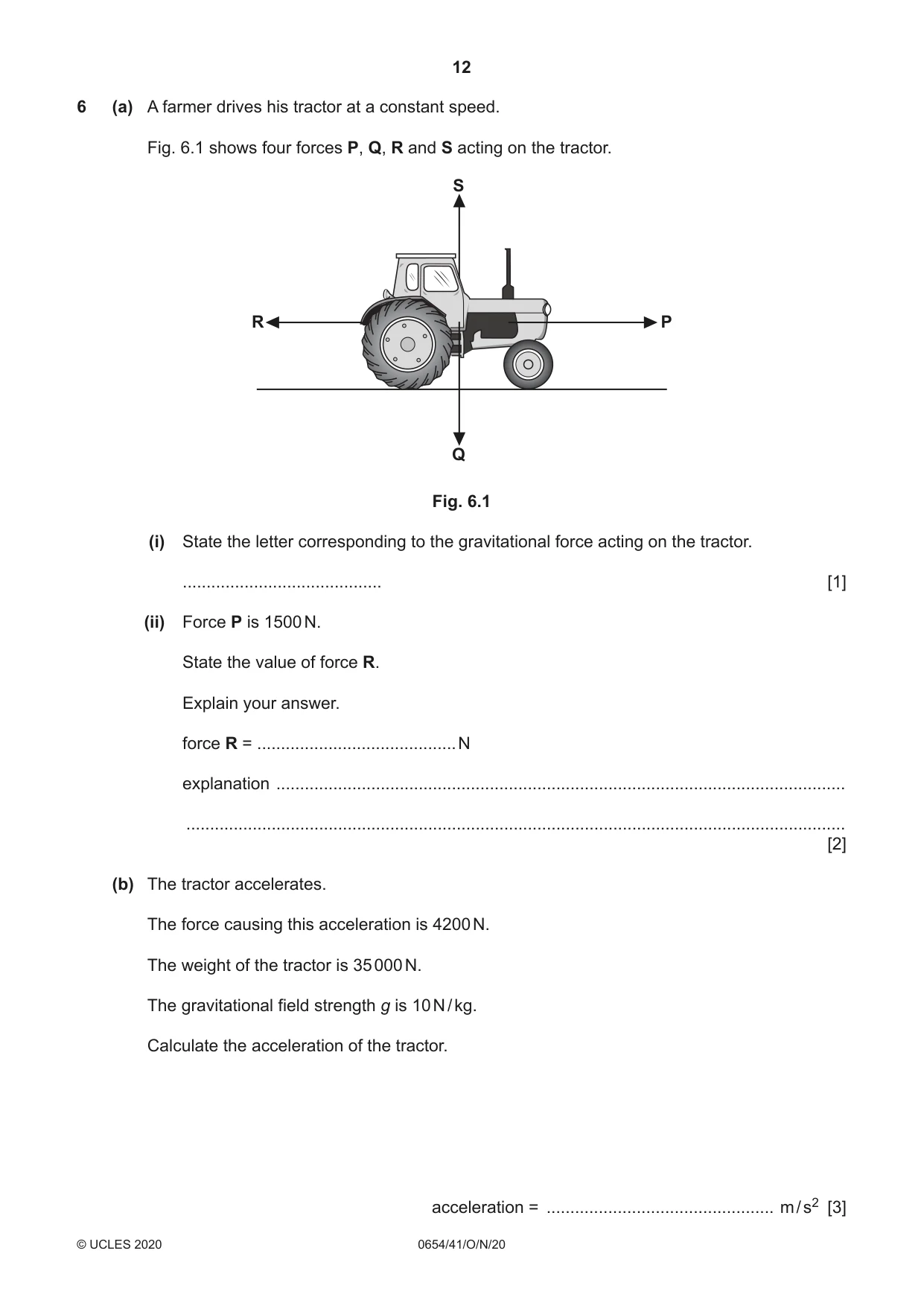
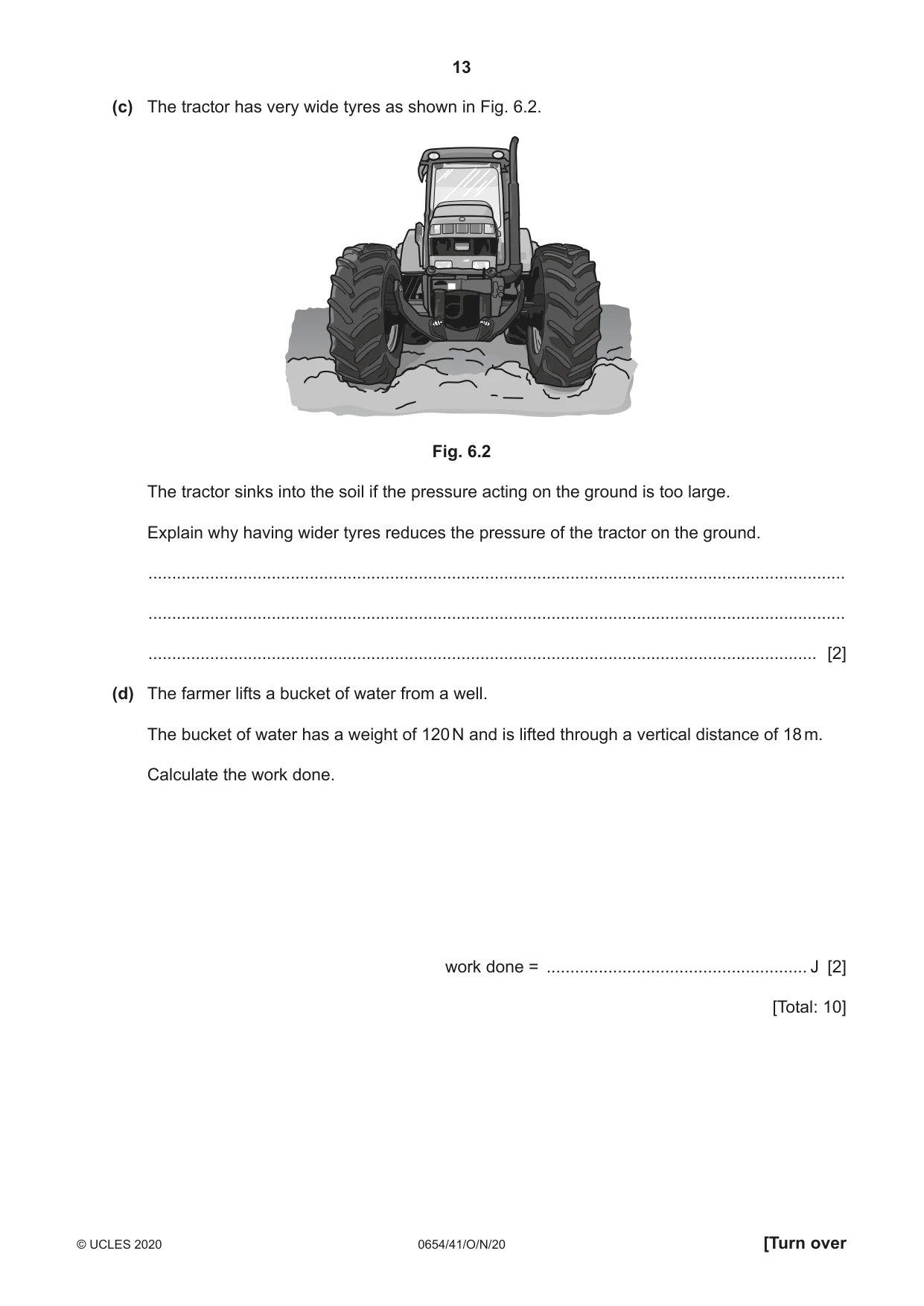
6 (a) A farmer drives his tractor at a constant speed. Fig. 6.1 shows four forces P, Q, R and S acting on the tractor. S R P Q Fig. 6.1 (i) State the letter corresponding to the gravitational force acting on the tractor. .......................................... [1] (ii) Force P is 1500 N. State the value of force R. Explain your answer. force R = .......................................... N explanation ........................................................................................................................ ........................................................................................................................................... [2] (b) The tractor accelerates. The force causing this acceleration is 4200 N. The weight of the tractor is 35 000 N. The gravitational field strength g is 10 N / kg. Calculate the acceleration of the tractor. acceleration = ................................................ m / s2 [3] (c) The tractor has very wide tyres as shown in Fig. 6.2. Fig. 6.2 The tractor sinks into the soil if the pressure acting on the ground is too large. Explain why having wider tyres reduces the pressure of the tractor on the ground. ................................................................................................................................................... ................................................................................................................................................... ............................................................................................................................................. [2] (d) The farmer lifts a bucket of water from a well. The bucket of water has a weight of 120 N and is lifted through a vertical distance of 18 m. Calculate the work done. work done = ....................................................... J [2] [Total: 10]
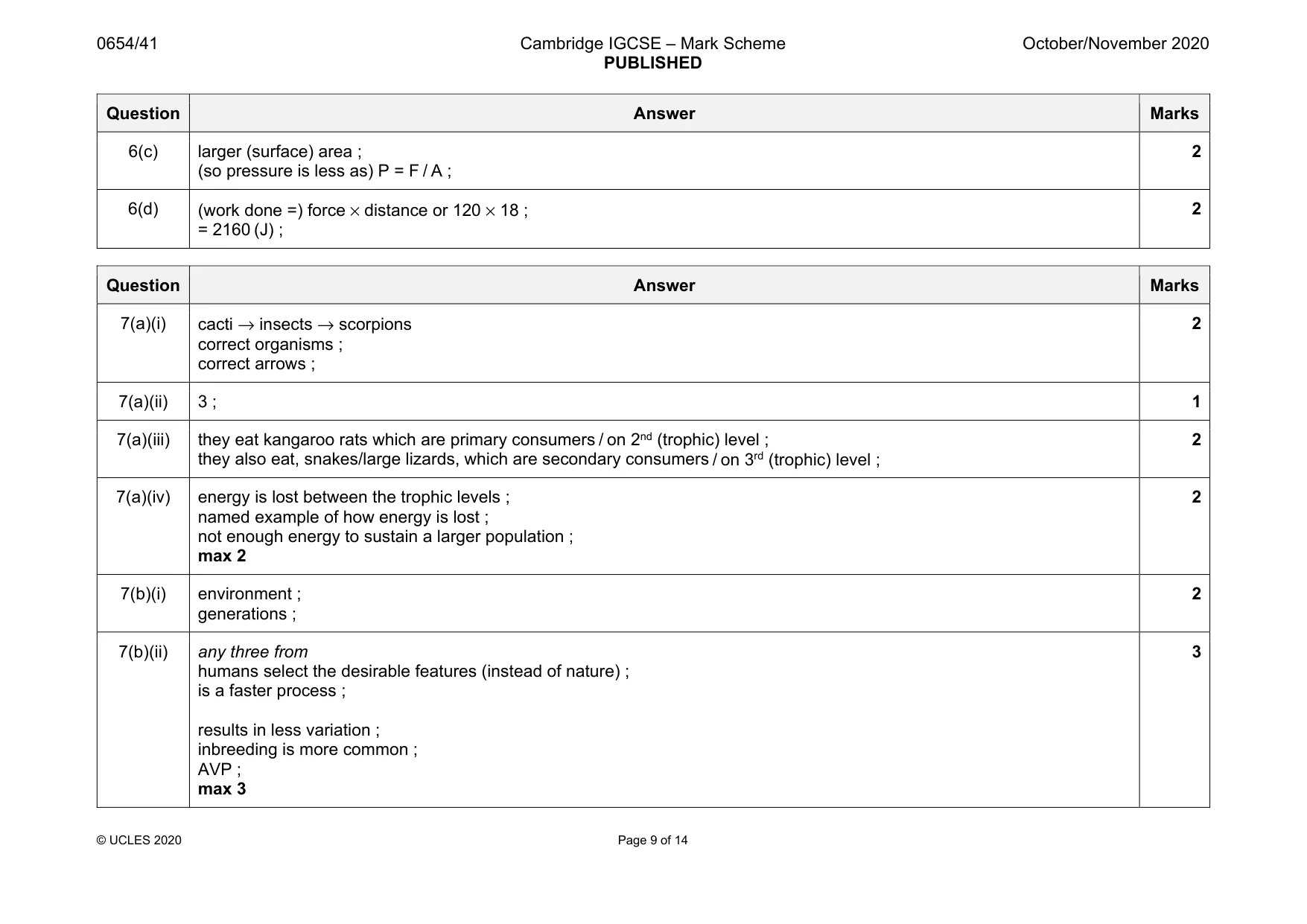
Mark scheme: 6(a)(i) Q ; 1 6(a)(ii) 1500 (N) ; constant speed / forces are balanced / resultant is zero ; 2 6(b) mass = 3500 kg ; force / mass or 4200 / 3500 ; acceleration = 1.2 (m / s2) ; 3 Question Answer Marks 6(c) larger (surface) area ; (so pressure is less as) P = F / A ; 2 6(d) (work done =) force × distance or 120 × 18 ; = 2160 (J) ; 2
Q7 · A food web in a desert
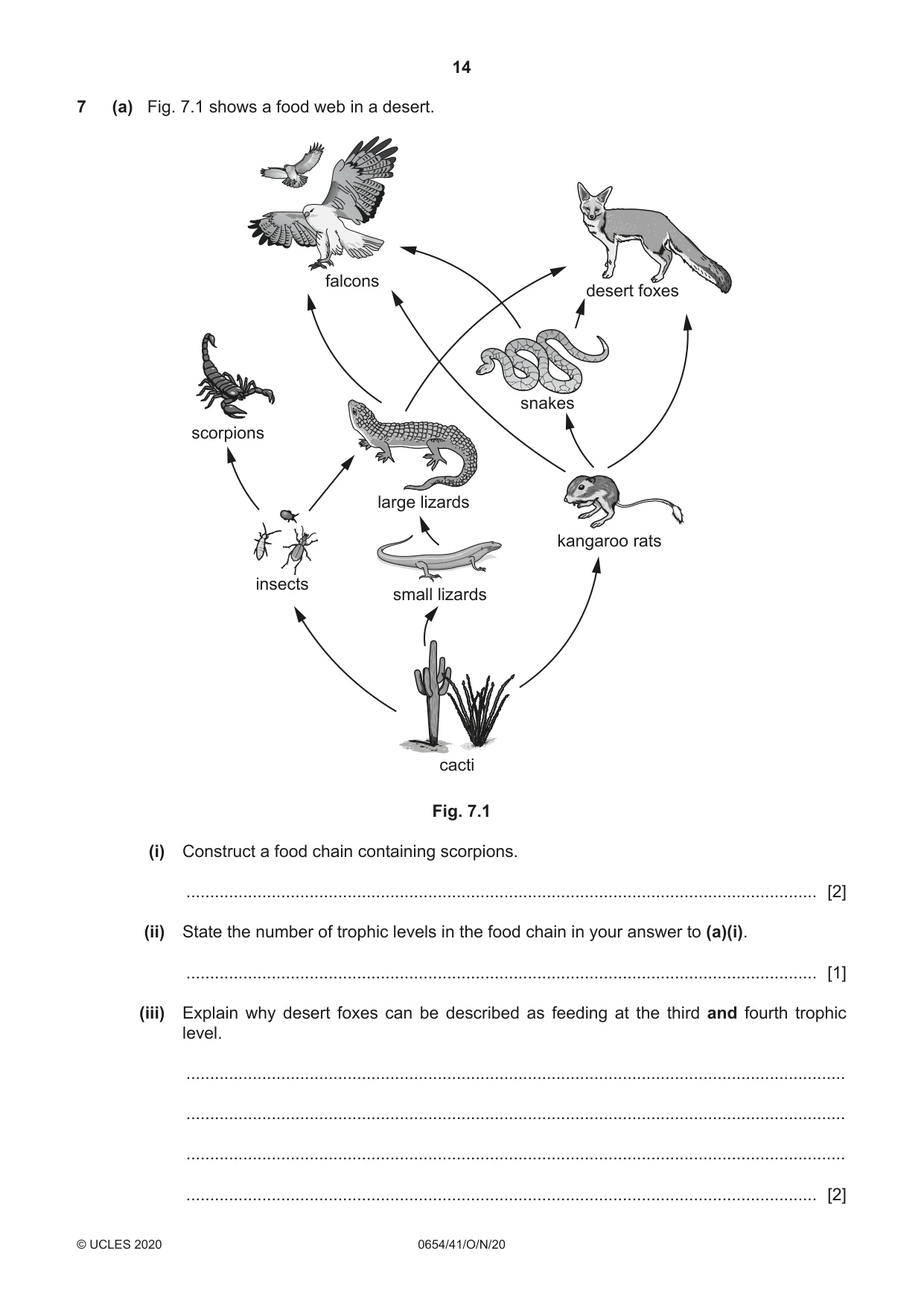
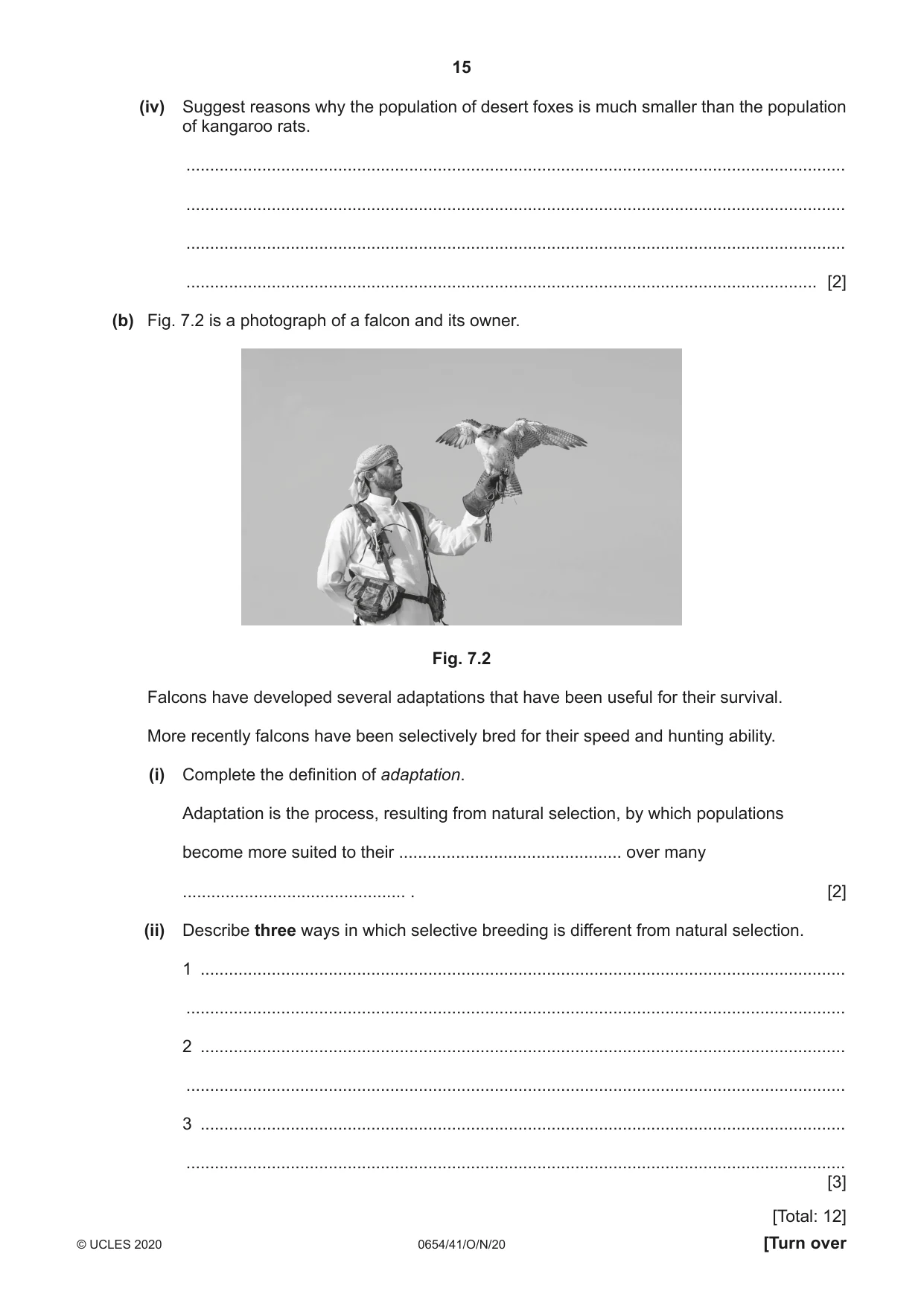
7 (a) Fig. 7.1 shows a food web in a desert. falcons desert foxes snakes scorpions large lizards kangaroo rats insects small lizards cacti Fig. 7.1 (i) Construct a food chain containing scorpions. ..................................................................................................................................... [2] (ii) State the number of trophic levels in the food chain in your answer to (a)(i). ..................................................................................................................................... [1] (iii) Explain why desert foxes can be described as feeding at the third and fourth trophic level. ........................................................................................................................................... ........................................................................................................................................... ........................................................................................................................................... ..................................................................................................................................... [2] (iv) Suggest reasons why the population of desert foxes is much smaller than the population of kangaroo rats. ........................................................................................................................................... ........................................................................................................................................... ........................................................................................................................................... ..................................................................................................................................... [2] (b) Fig. 7.2 is a photograph of a falcon and its owner. Fig. 7.2 Falcons have developed several adaptations that have been useful for their survival. More recently falcons have been selectively bred for their speed and hunting ability. (i) Complete the definition of adaptation. Adaptation is the process, resulting from natural selection, by which populations become more suited to their ............................................... over many ............................................... . [2] (ii) Describe three ways in which selective breeding is different from natural selection. 1 ........................................................................................................................................ ........................................................................................................................................... 2 ........................................................................................................................................ ........................................................................................................................................... 3 ........................................................................................................................................ ........................................................................................................................................... [3] [Total: 12]
Mark scheme: 7(a)(i) cacti → insects → scorpions correct organisms ; correct arrows ; 2 7(a)(ii) 3 ; 1 7(a)(iii) they eat kangaroo rats which are primary consumers / on 2nd (trophic) level ; they also eat, snakes/large lizards, which are secondary consumers / on 3rd (trophic) level ; 2 7(a)(iv) energy is lost between the trophic levels ; named example of how energy is lost ; not enough energy to sustain a larger population ; max 2 2 7(b)(i) environment ; generations ; 2 7(b)(ii) any three from humans select the desirable features (instead of nature) ; is a faster process ; results in less variation ; inbreeding is more common ; AVP ; max 3 3
Q8 · Methanol, CH3OH, is made by reacting carbon dioxide with hydrogen
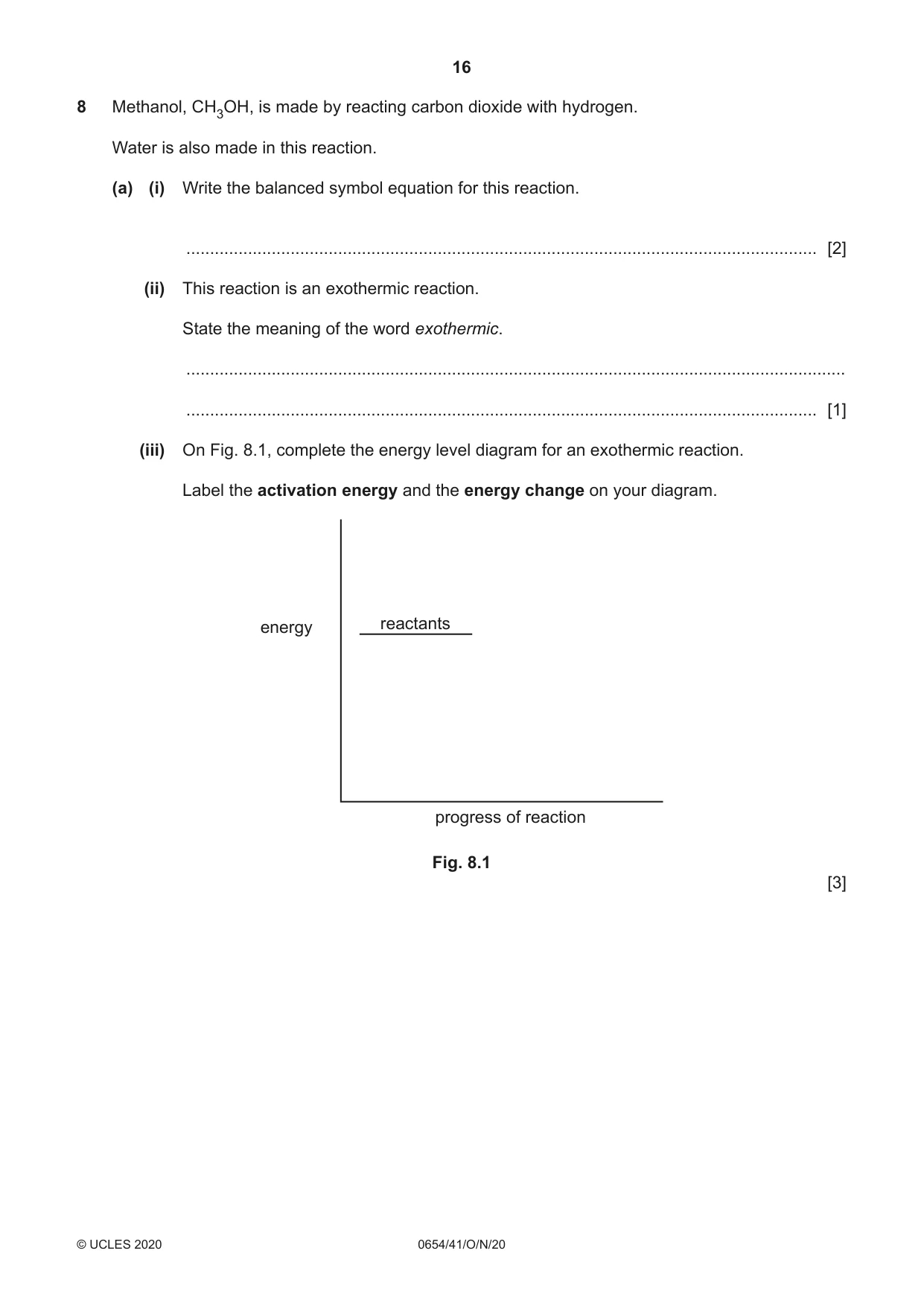
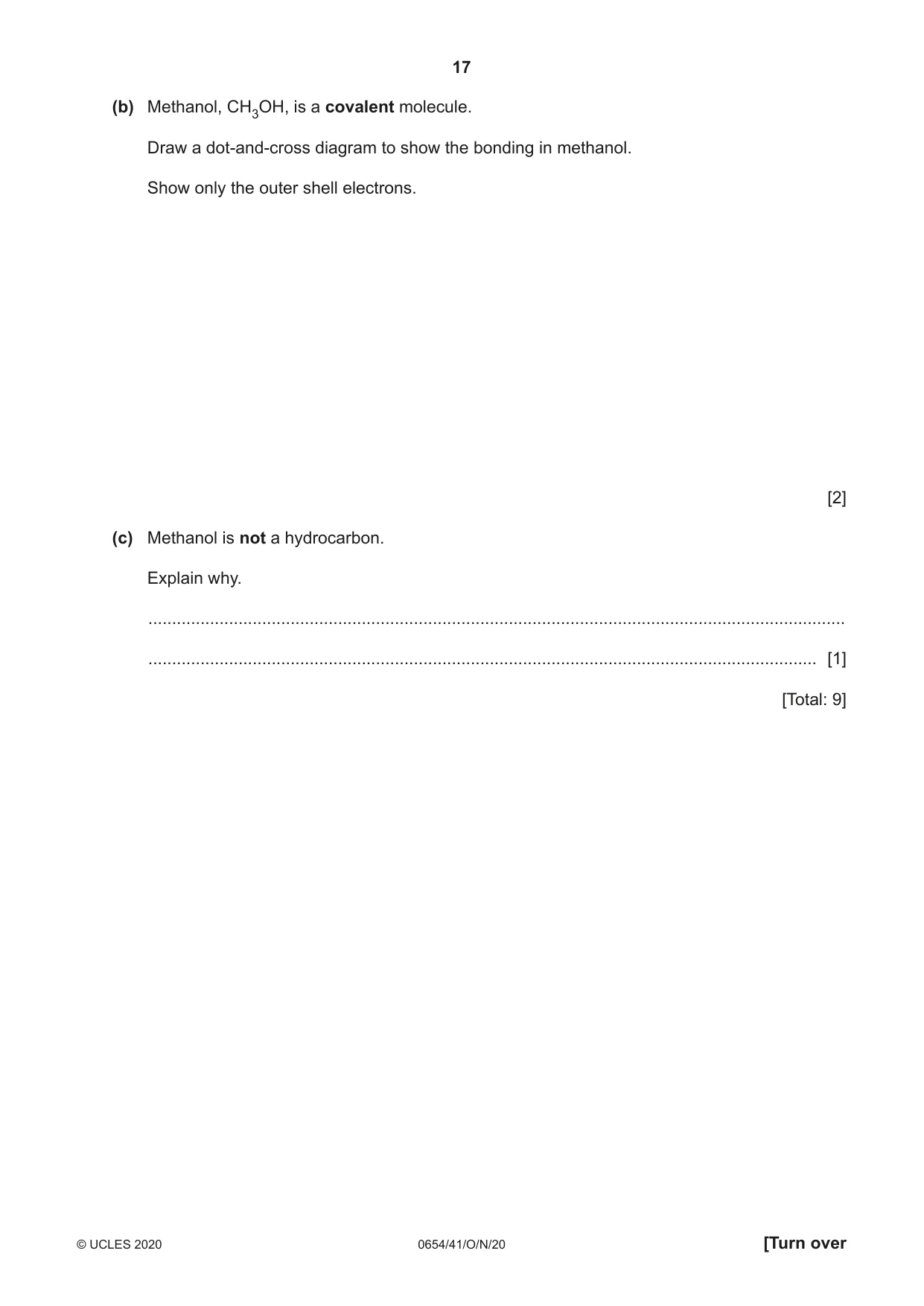
8 Methanol, CH3OH, is made by reacting carbon dioxide with hydrogen. Water is also made in this reaction. (a) (i) Write the balanced symbol equation for this reaction. ..................................................................................................................................... [2] (ii) This reaction is an exothermic reaction. State the meaning of the word exothermic. ........................................................................................................................................... ..................................................................................................................................... [1] (iii) On Fig. 8.1, complete the energy level diagram for an exothermic reaction. Label the activation energy and the energy change on your diagram. energy reactants progress of reaction Fig. 8.1 [3] (b) Methanol, CH3OH, is a covalent molecule. Draw a dot‑and‑cross diagram to show the bonding in methanol. Show only the outer shell electrons. [2] (c) Methanol is not a hydrocarbon. Explain why. ................................................................................................................................................... ............................................................................................................................................. [1] [Total: 9]
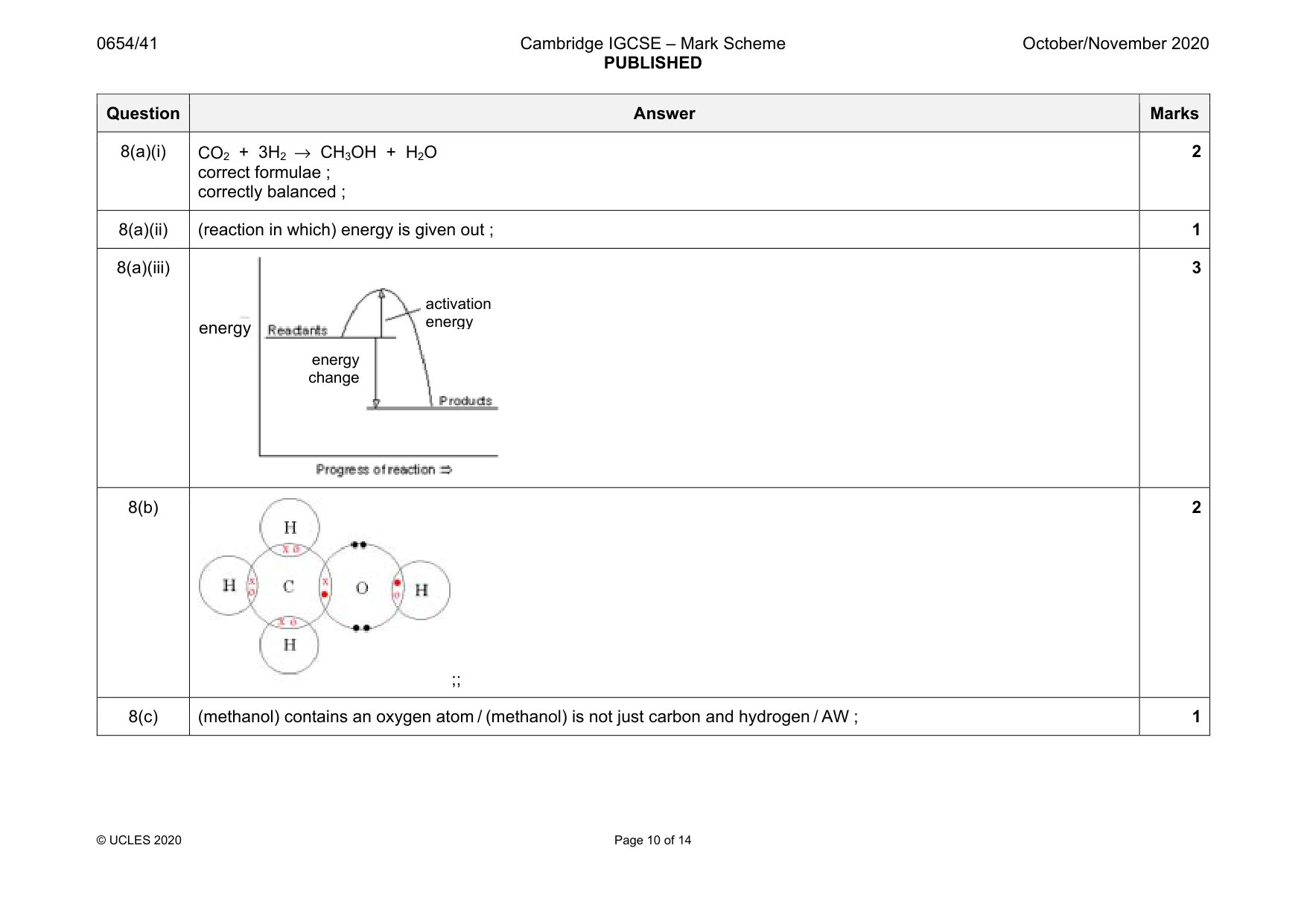
Mark scheme: 8(a)(i) CO2 + 3H2 → CH3OH + H2O correct formulae ; correctly balanced ; 2 8(a)(ii) (reaction in which) energy is given out ; 1 8(a)(iii) 3 8(b) ;; 2 8(c) (methanol) contains an oxygen atom / (methanol) is not just carbon and hydrogen / AW ; 1 energy change energy activation energy
Q9 · A student cycles to school
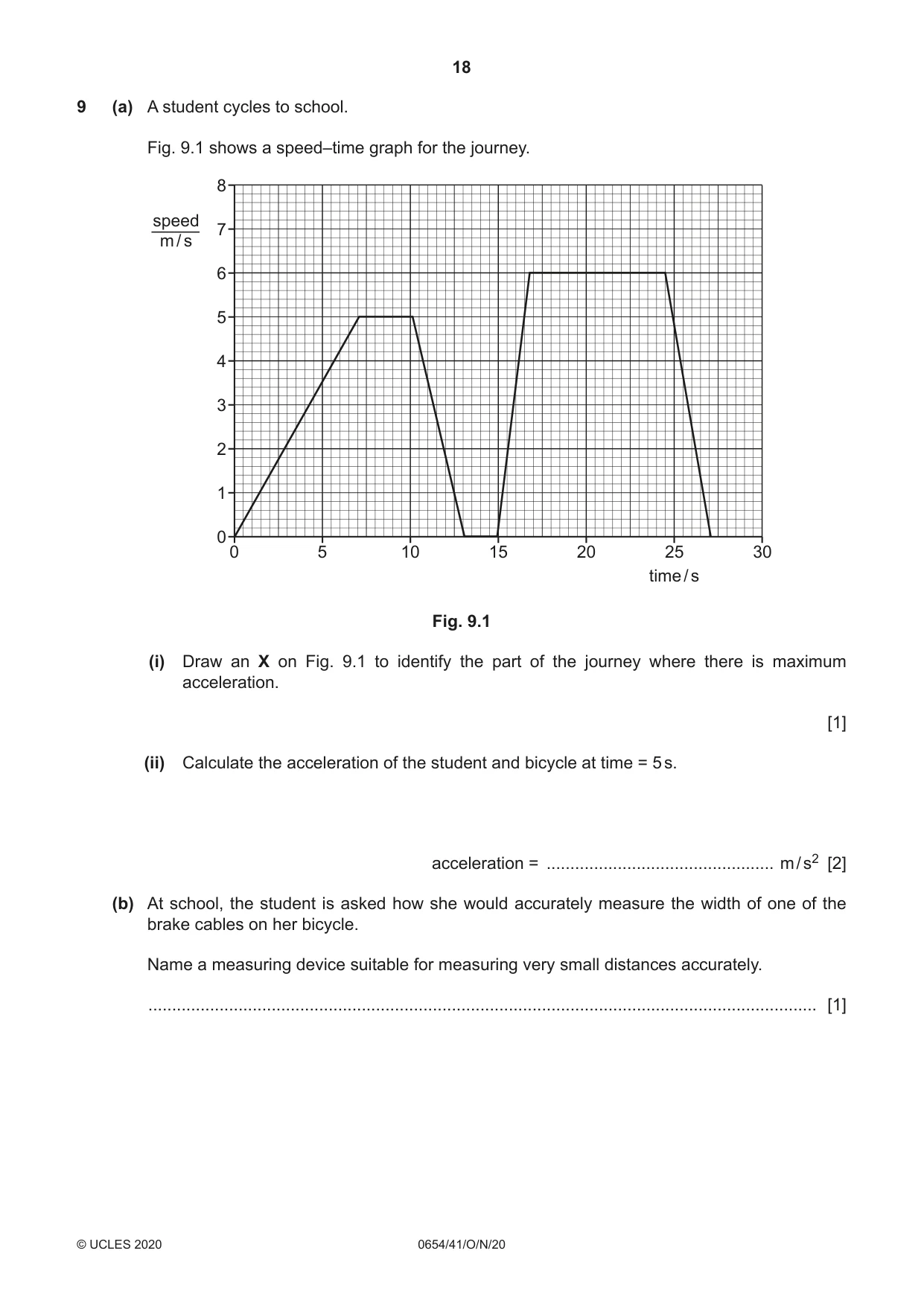
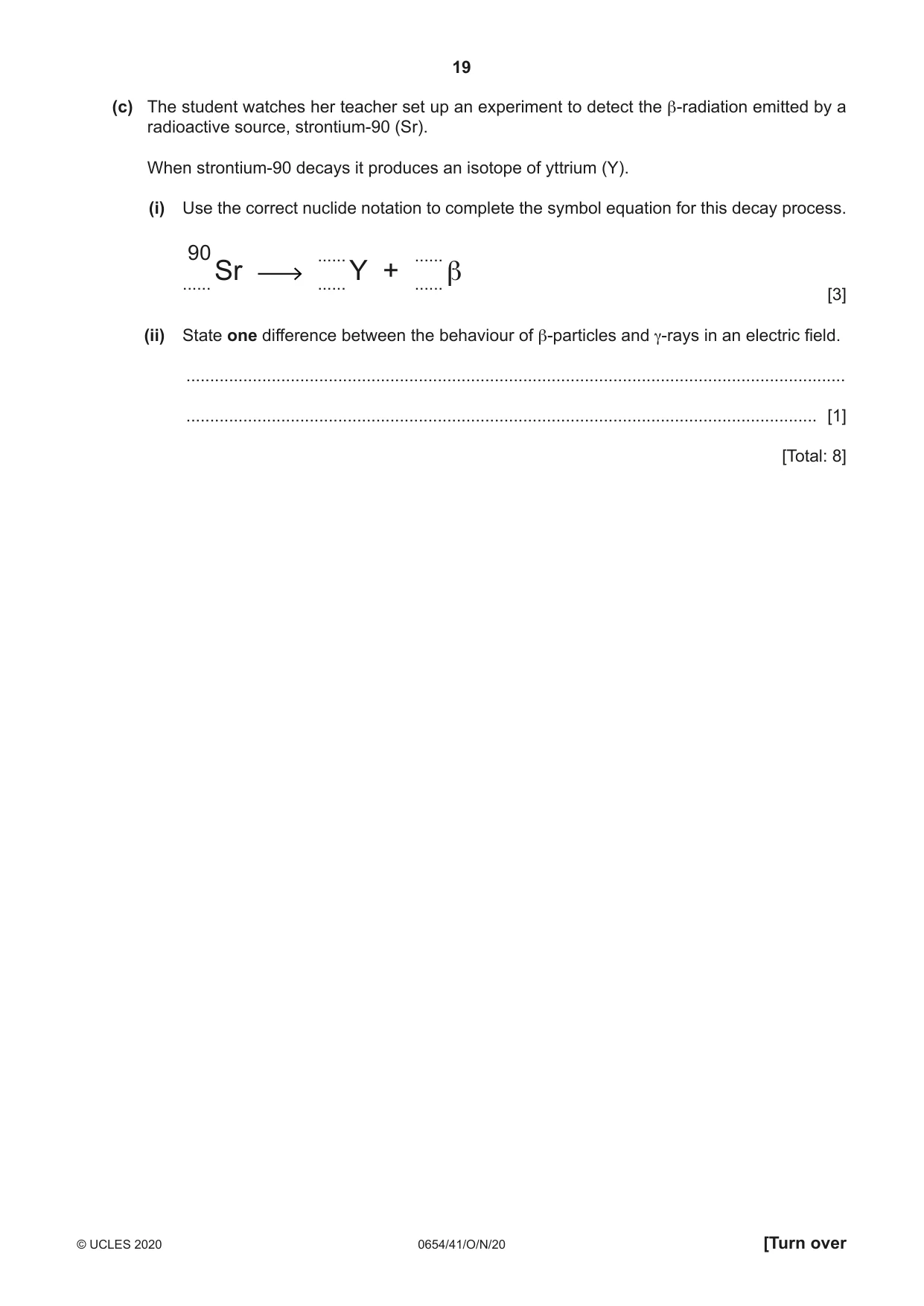
9 (a) A student cycles to school. Fig. 9.1 shows a speed–time graph for the journey. 8 speed 7 m / s 6 5 4 3 2 1 0 0 5 10 15 20 25 30 time / s Fig. 9.1 (i) Draw an X on Fig. 9.1 to identify the part of the journey where there is maximum acceleration. [1] (ii) Calculate the acceleration of the student and bicycle at time = 5 s. acceleration = ................................................ m / s2 [2] (b) At school, the student is asked how she would accurately measure the width of one of the brake cables on her bicycle. Name a measuring device suitable for measuring very small distances accurately. ............................................................................................................................................. [1] (c) The student watches her teacher set up an experiment to detect the β‑radiation emitted by a radioactive source, strontium‑90 (Sr). When strontium‑90 decays it produces an isotope of yttrium (Y). (i) Use the correct nuclide notation to complete the symbol equation for this decay process. 90 ...... ...... Sr Y + β ...... ...... ...... [3] (ii) State one difference between the behaviour of β‑particles and γ‑rays in an electric field. ........................................................................................................................................... ..................................................................................................................................... [1] [Total: 8]
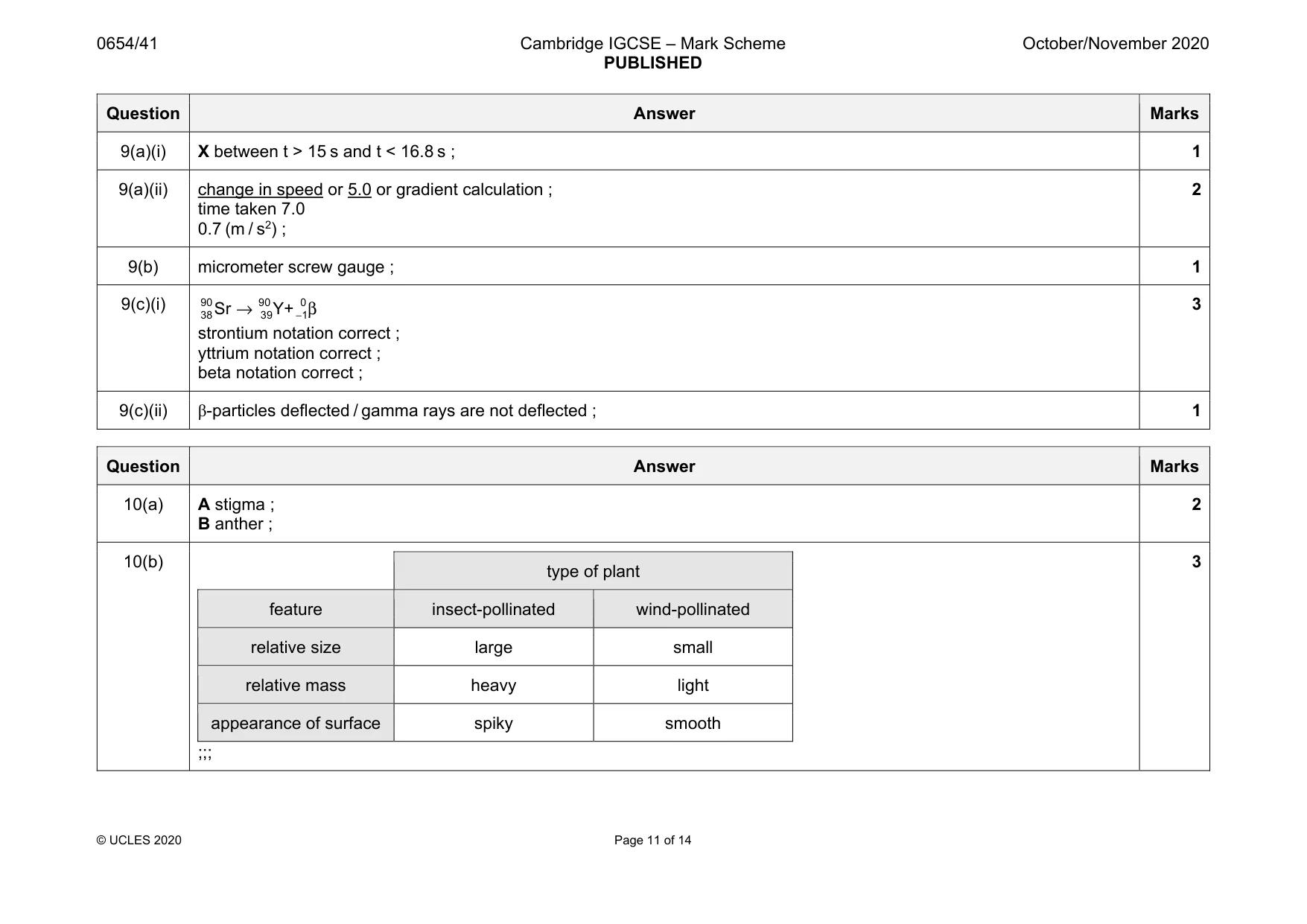
Mark scheme: 9(a)(i) X between t > 15 s and t < 16.8 s ; 1 9(a)(ii) change in speed or 5.0 or gradient calculation ; time taken 7.0 0.7 (m / s2) ; 2 9(b) micrometer screw gauge ; 1 9(c)(i) − → β 90 90 0 38 39 1 Sr Y+ strontium notation correct ; yttrium notation correct ; beta notation correct ; 3 9(c)(ii) β-particles deflected / gamma rays are not deflected ; 1
Q10 · A photograph of wind‑pollinated flowers
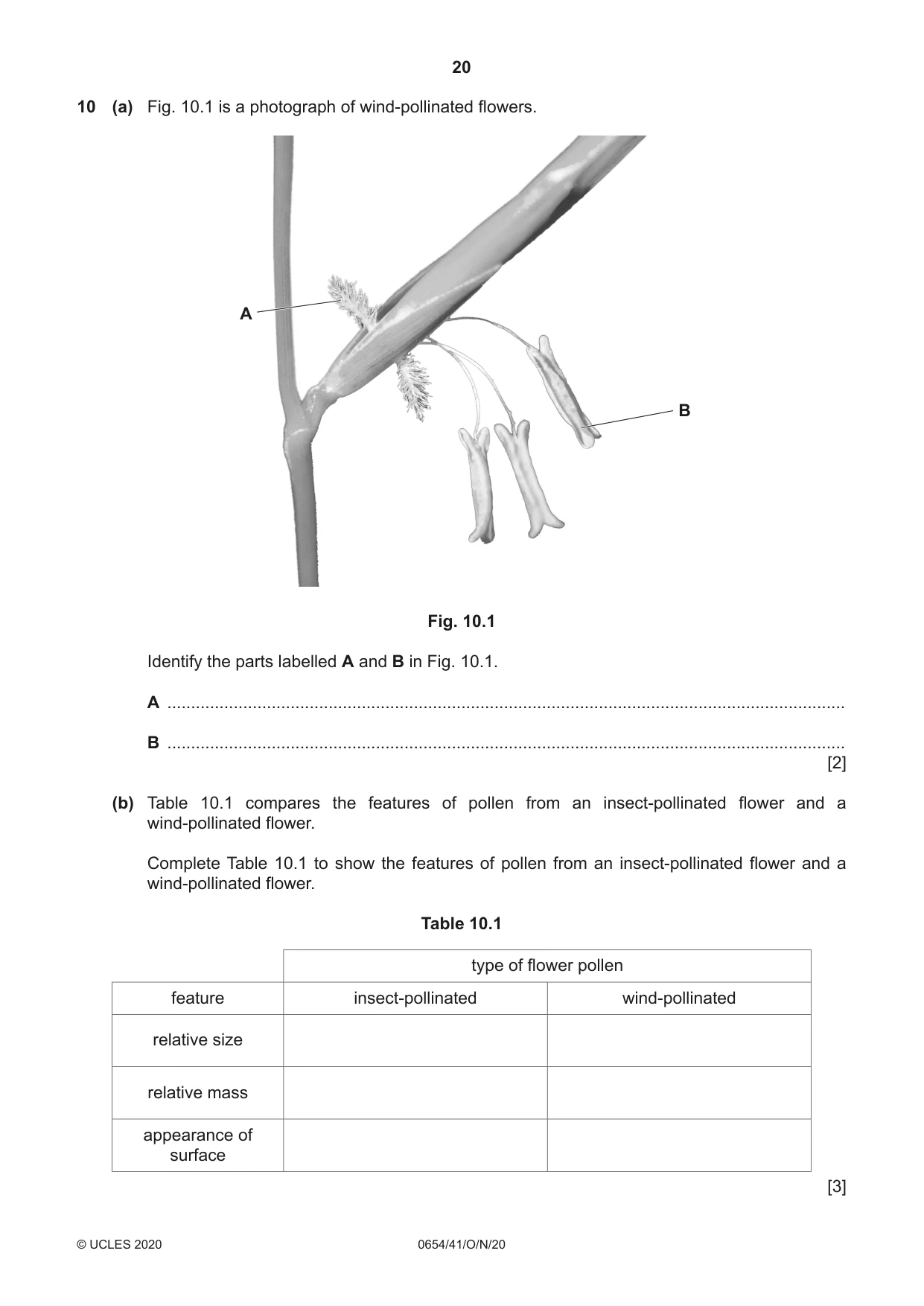
10 (a) Fig. 10.1 is a photograph of wind‑pollinated flowers. A B Fig. 10.1 Identify the parts labelled A and B in Fig. 10.1. A ............................................................................................................................................... B ............................................................................................................................................... [2] (b) Table 10.1 compares the features of pollen from an insect‑pollinated flower and a wind‑pollinated flower. Complete Table 10.1 to show the features of pollen from an insect‑pollinated flower and a wind‑pollinated flower. Table 10.1 type of flower pollen feature insect‑pollinated wind‑pollinated relative size relative mass appearance of surface [3] (c) Describe two ways the petals of an insect‑pollinated flower are different from the petals of a wind‑pollinated flower. 1 ................................................................................................................................................ 2 ................................................................................................................................................ [2] (d) Flowers are the reproductive structures in plants. Plants and human females both contain ovaries. (i) State the function of the ovary in plants. ..................................................................................................................................... [1] (ii) State the function of the ovary in humans. ..................................................................................................................................... [1] (e) Plants can reproduce asexually or sexually. A cell is formed by fusion of the nuclei of two gametes during sexual reproduction. State the name of this cell. ............................................................................................................................................. [1] [Total: 10]
Mark scheme: 10(a) A stigma ; B anther ; 2 10(b) type of plant feature insect-pollinated wind-pollinated relative size large small relative mass heavy light appearance of surface spiky smooth ;;; 3 Question Answer Marks 10(c) larger ; brightly coloured ; guidelines ; scent ; AVP ; max 2 2 10(d)(i) produce ovules ; 1 10(d)(ii) produce eggs / ova ; 1 10(e) zygote ; 1
Q11 · Concentrated aqueous sodium chloride can be electrolysed using inert electrodes
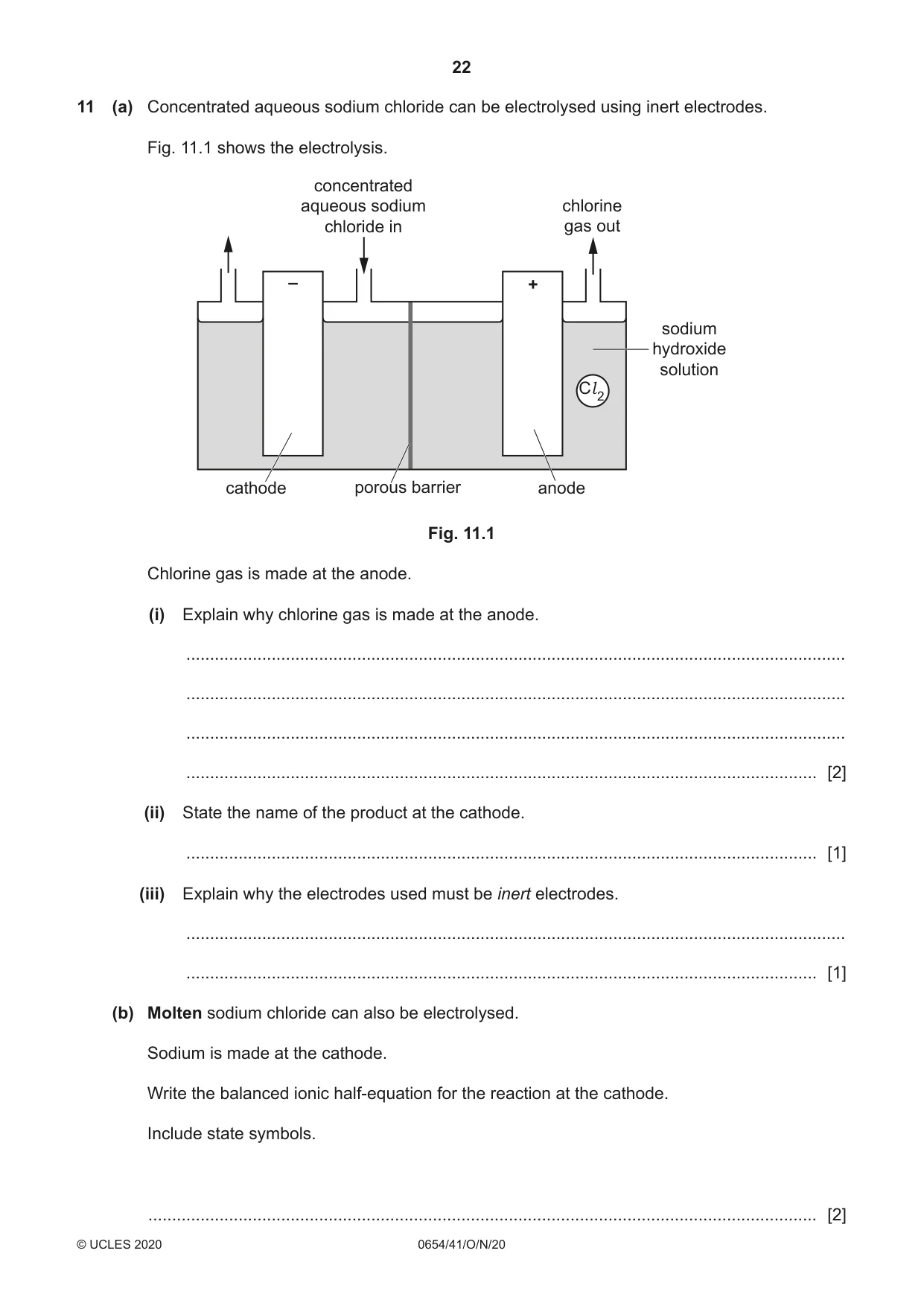
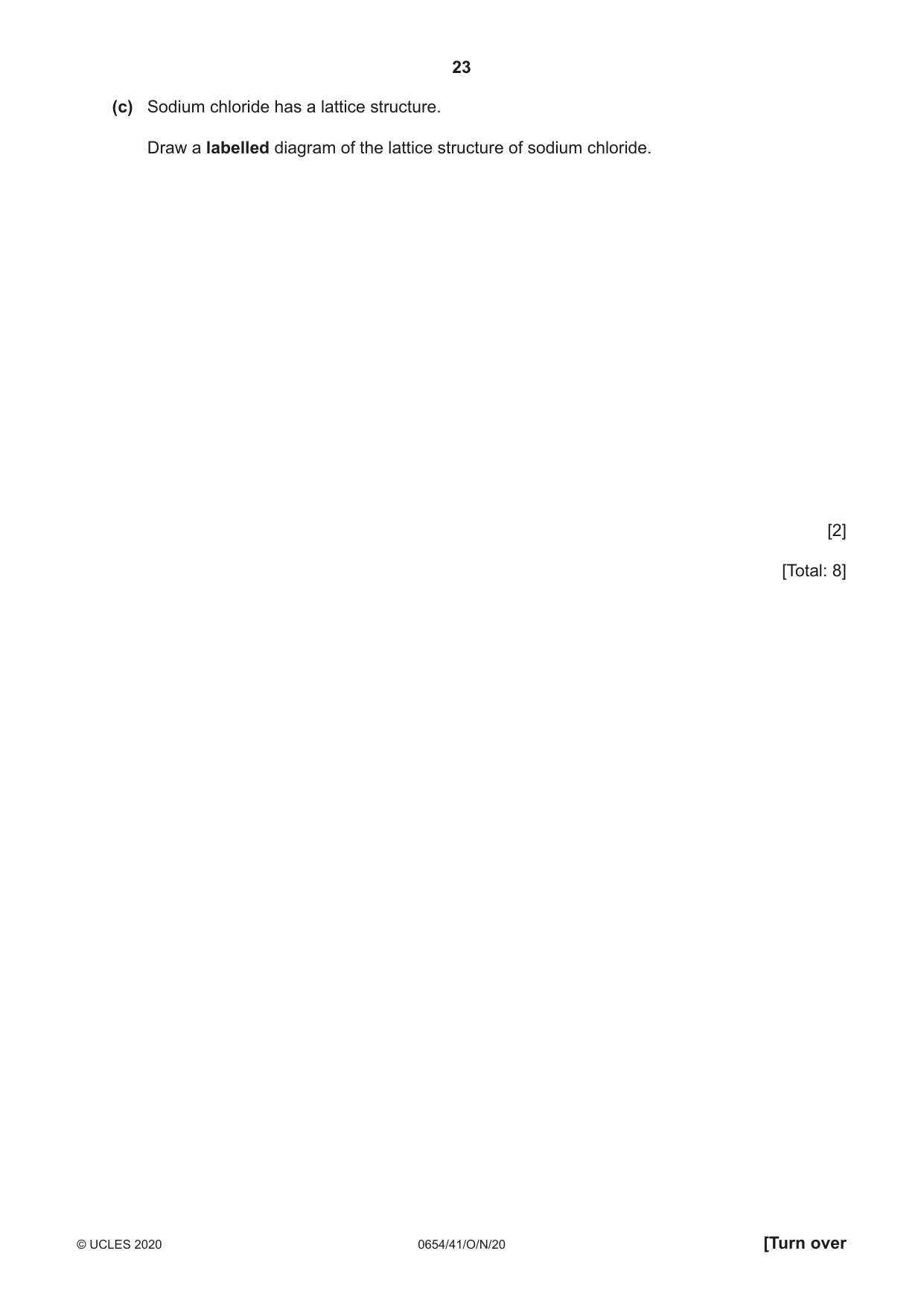
11 (a) Concentrated aqueous sodium chloride can be electrolysed using inert electrodes. Fig. 11.1 shows the electrolysis. concentrated aqueous sodium chlorine chloride in gas out – + sodium hydroxide solution Cl 2 cathode porous barrier anode Fig. 11.1 Chlorine gas is made at the anode. (i) Explain why chlorine gas is made at the anode. ........................................................................................................................................... ........................................................................................................................................... ........................................................................................................................................... ..................................................................................................................................... [2] (ii) State the name of the product at the cathode. ..................................................................................................................................... [1] (iii) Explain why the electrodes used must be inert electrodes. ........................................................................................................................................... ..................................................................................................................................... [1] (b) Molten sodium chloride can also be electrolysed. Sodium is made at the cathode. Write the balanced ionic half‑equation for the reaction at the cathode. Include state symbols. ............................................................................................................................................. [2] (c) Sodium chloride has a lattice structure. Draw a labelled diagram of the lattice structure of sodium chloride. [2] [Total: 8]
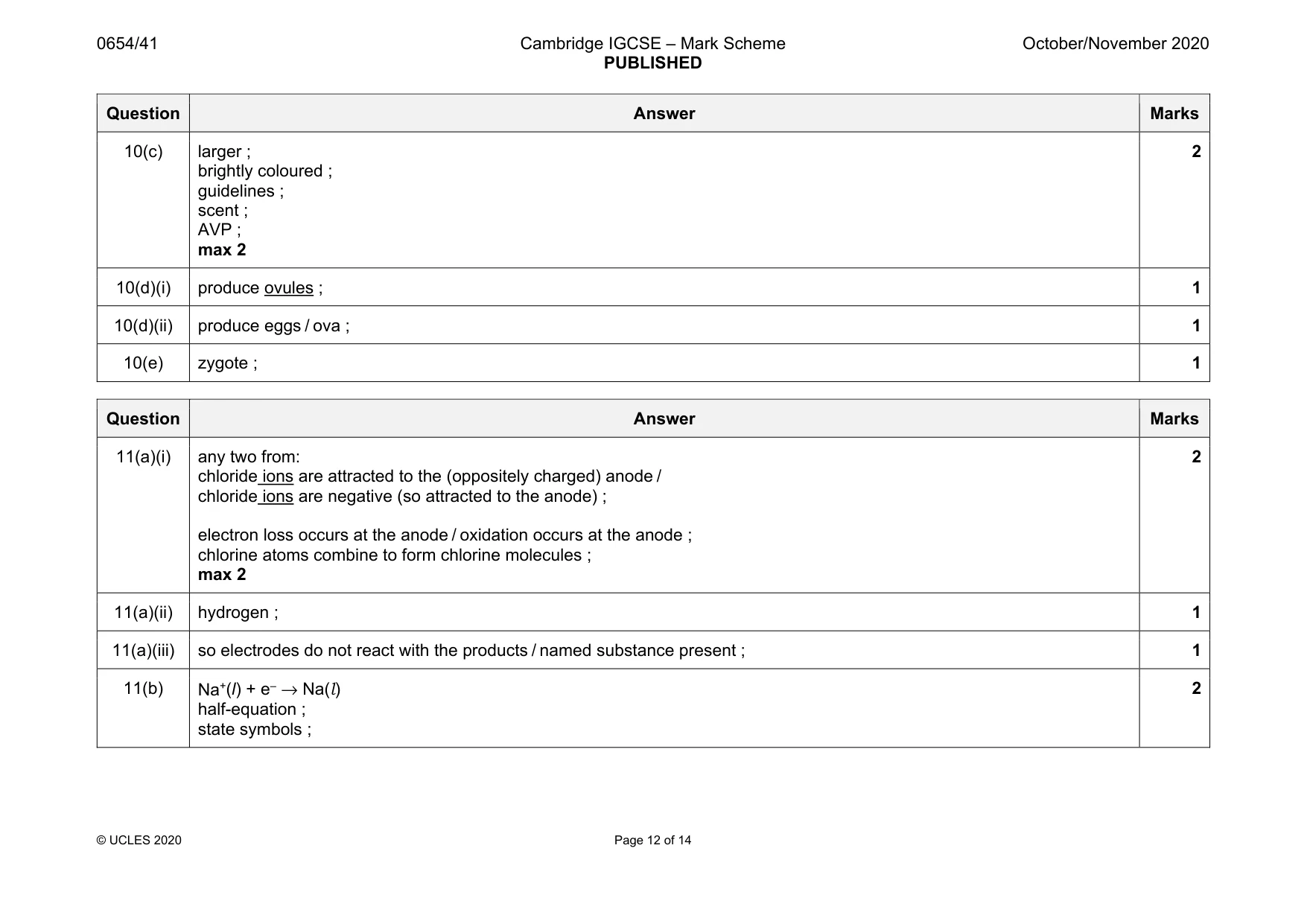
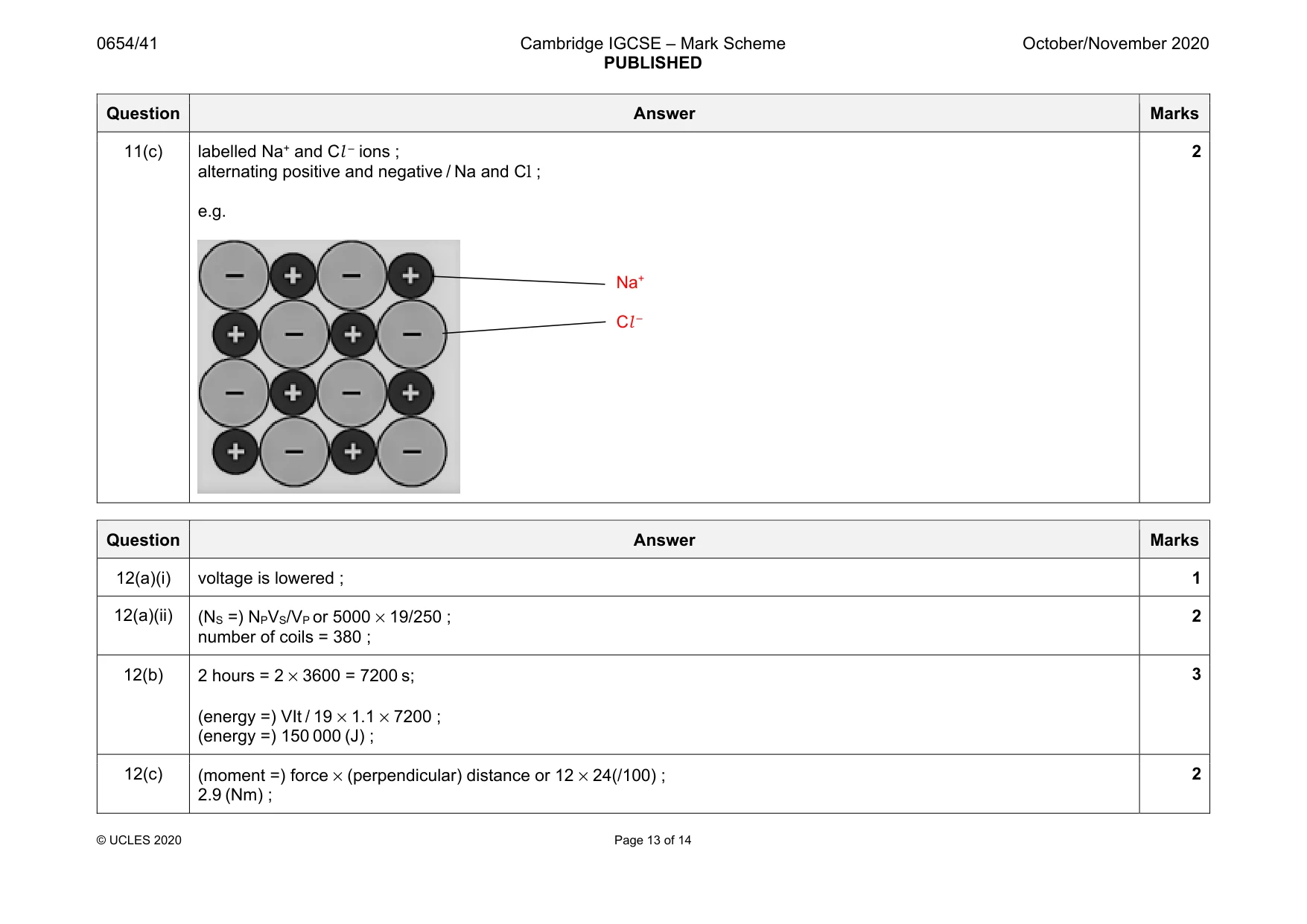
Mark scheme: 11(a)(i) any two from: chloride ions are attracted to the (oppositely charged) anode / chloride ions are negative (so attracted to the anode) ; electron loss occurs at the anode / oxidation occurs at the anode ; chlorine atoms combine to form chlorine molecules ; max 2 11(a)(ii) hydrogen ; 1 11(a)(iii) so electrodes do not react with the products / named substance present ; 1 11(b) Na+(l) + e– → Na(l) half-equation ; state symbols ; 2 Question Answer Marks 11(c) labelled Na+ and Cl – ions ; alternating positive and negative / Na and Cl ; e.g. 2 Na+ Cl –
Q12 · A laptop computer and charger
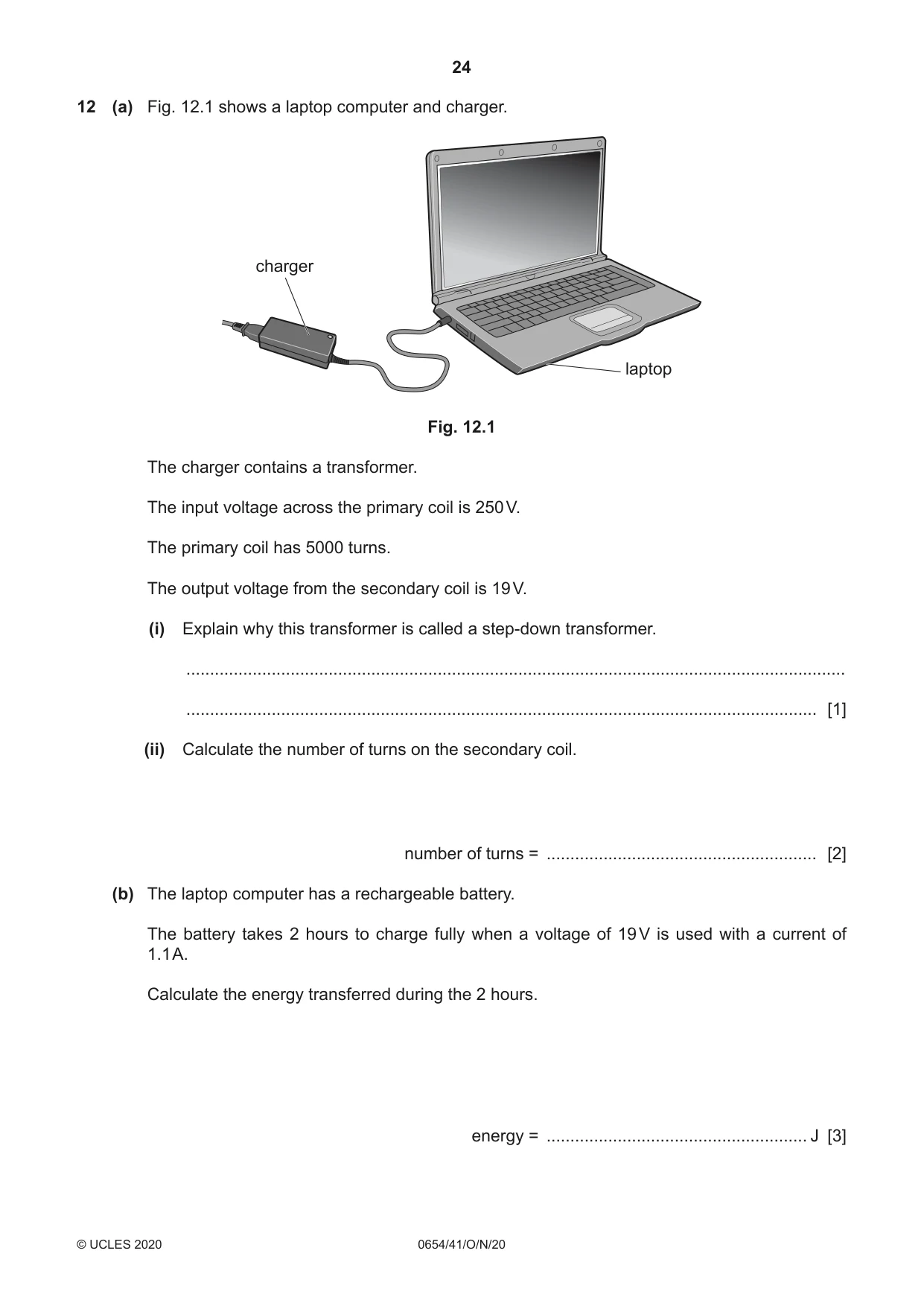
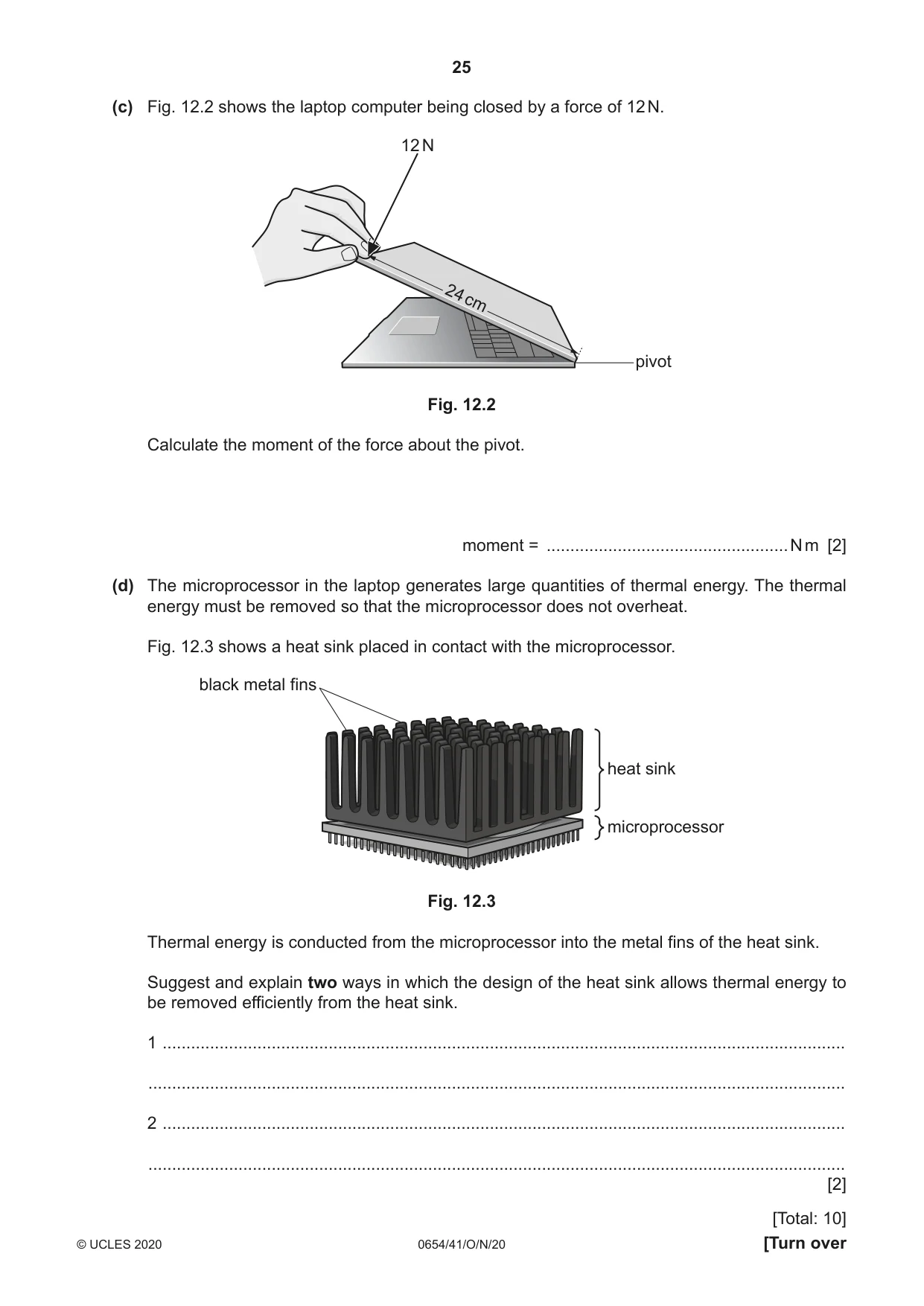
12 (a) Fig. 12.1 shows a laptop computer and charger. charger laptop Fig. 12.1 The charger contains a transformer. The input voltage across the primary coil is 250 V. The primary coil has 5000 turns. The output voltage from the secondary coil is 19 V. (i) Explain why this transformer is called a step‑down transformer. ........................................................................................................................................... ..................................................................................................................................... [1] (ii) Calculate the number of turns on the secondary coil. number of turns = ......................................................... [2] (b) The laptop computer has a rechargeable battery. The battery takes 2 hours to charge fully when a voltage of 19 V is used with a current of 1.1 A. Calculate the energy transferred during the 2 hours. energy = ....................................................... J [3] (c) Fig. 12.2 shows the laptop computer being closed by a force of 12 N. 12 N 24 cm pivot Fig. 12.2 Calculate the moment of the force about the pivot. moment = ................................................... N m [2] (d) The microprocessor in the laptop generates large quantities of thermal energy. The thermal energy must be removed so that the microprocessor does not overheat. Fig. 12.3 shows a heat sink placed in contact with the microprocessor. black metal fins heat sink microprocessor Fig. 12.3 Thermal energy is conducted from the microprocessor into the metal fins of the heat sink. Suggest and explain two ways in which the design of the heat sink allows thermal energy to be removed efficiently from the heat sink. 1 ................................................................................................................................................ ................................................................................................................................................... 2 ................................................................................................................................................ ................................................................................................................................................... [2] [Total: 10]
Mark scheme: 12(a)(i) voltage is lowered ; 1 12(a)(ii) (NS =) NPVS/VP or 5000 × 19/250 ; number of coils = 380 ; 2 12(b) 2 hours = 2 × 3600 = 7200 s; (energy =) VIt / 19 × 1.1 × 7200 ; (energy =) 150 000 (J) ; 3 12(c) (moment =) force × (perpendicular) distance or 12 × 24(/100) ; 2.9 (Nm) ; 2 Question Answer Marks 12(d) black surfaces are good emitters of thermal energy ; large surface area enables efficient convection; 2
Q13 · Ammonia, NH3, is used in the manufacture of nitrogen‑containing fertilisers
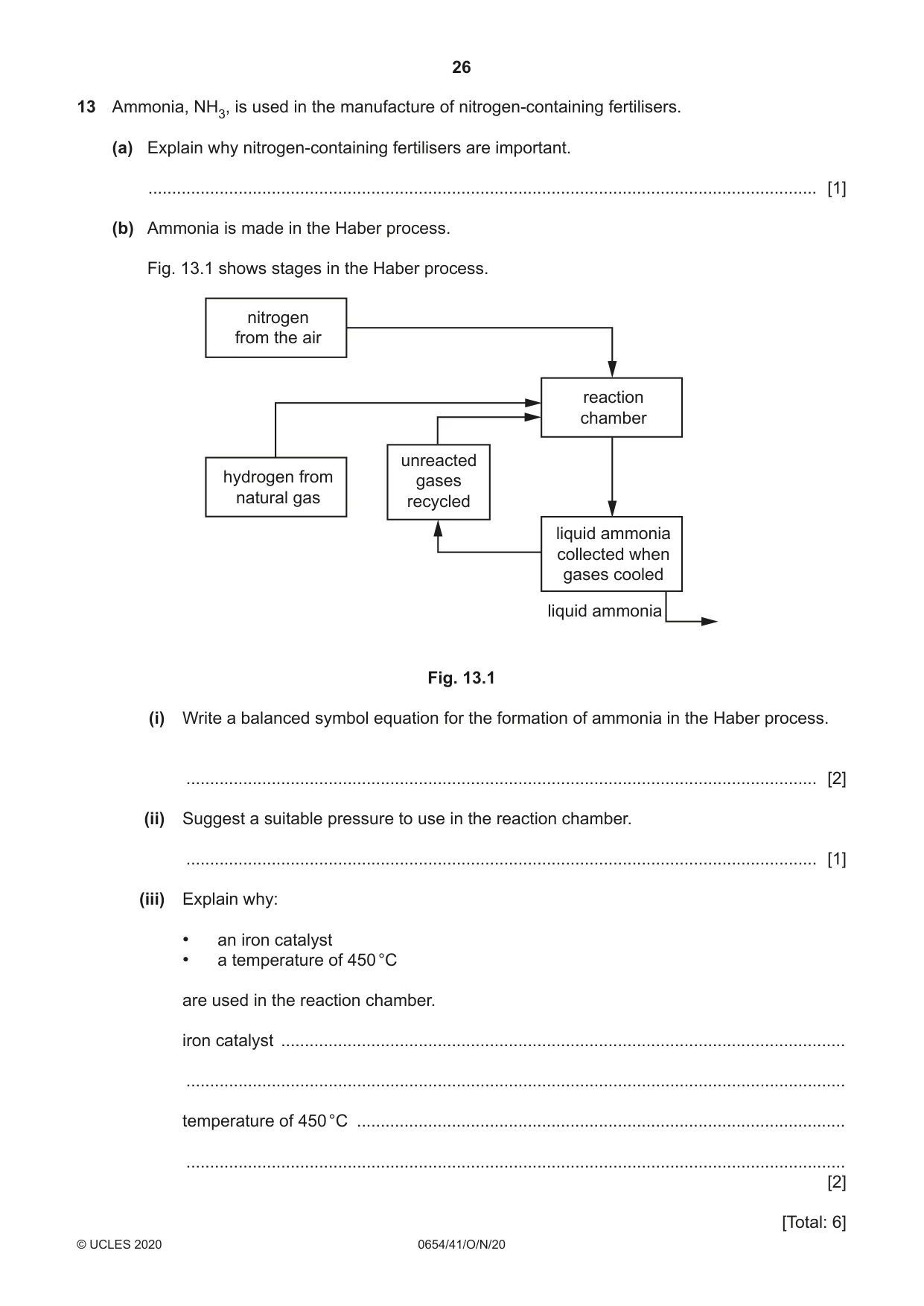
13 Ammonia, NH3, is used in the manufacture of nitrogen‑containing fertilisers. (a) Explain why nitrogen‑containing fertilisers are important. ............................................................................................................................................. [1] (b) Ammonia is made in the Haber process. Fig. 13.1 shows stages in the Haber process. nitrogen from the air reaction chamber unreacted hydrogen from gases natural gas recycled liquid ammonia collected when gases cooled liquid ammonia Fig. 13.1 (i) Write a balanced symbol equation for the formation of ammonia in the Haber process. ..................................................................................................................................... [2] (ii) Suggest a suitable pressure to use in the reaction chamber. ..................................................................................................................................... [1] (iii) Explain why: • an iron catalyst • a temperature of 450 °C are used in the reaction chamber. iron catalyst ....................................................................................................................... ........................................................................................................................................... temperature of 450 °C ....................................................................................................... ........................................................................................................................................... [2]
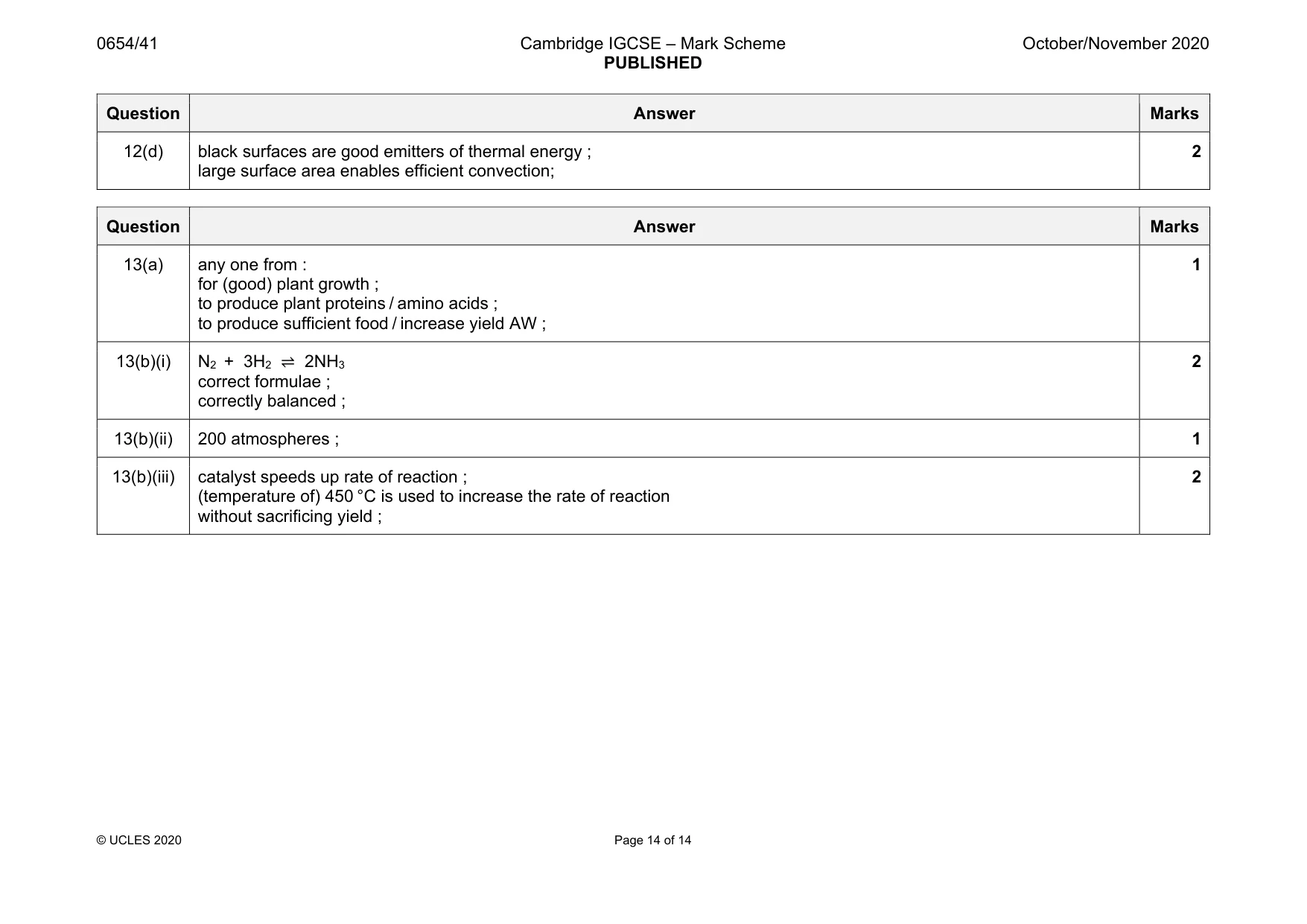
Mark scheme: 13(a) any one from : for (good) plant growth ; to produce plant proteins / amino acids ; to produce sufficient food / increase yield AW ; 13(b)(i) N2 + 3H2 ⇌ 2NH3 correct formulae ; correctly balanced ; 2 13(b)(ii) 200 atmospheres ; 1 13(b)(iii) catalyst speeds up rate of reaction ; (temperature of) 450 °C is used to increase the rate of reaction without sacrificing yield ; 2
What was in this paper
The subtopics covered by these 13 questions, and how many questions each got. Open one in a new tab to see every Cambridge question on it.
What you needed in this session
Cambridge’s own grade thresholds for 2020 Oct/Nov, Paper 4 · Variant 1. A higher threshold means an easier paper — the bar moves with how the cohort did.