Cambridge IGCSE Sciences - Co-ordinated (Double) 0654 — 2018 Oct/Nov Paper 4 · Variant 3
0654/43/O/N/18 · 13 questions · 120 marks · ≈135 min
The question paper and its mark scheme, free to read here and free to download. This is Cambridge’s own paper, exactly as it was sat.
Question paper32 pages



Mark scheme15 pages
Answers below. Sit the paper first if you are practising.
Questions as text
Q1 · A diagram of the male reproductive system
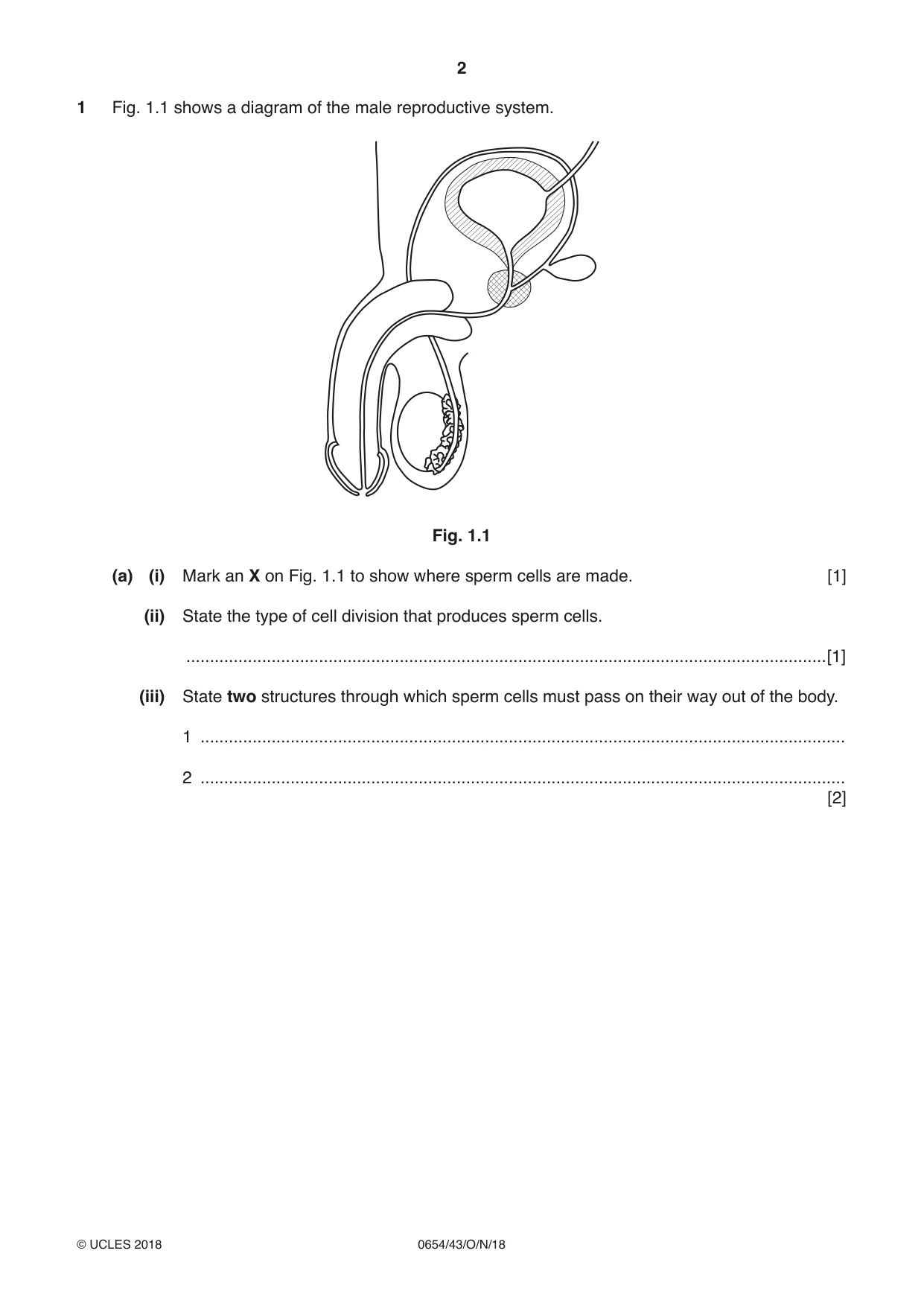
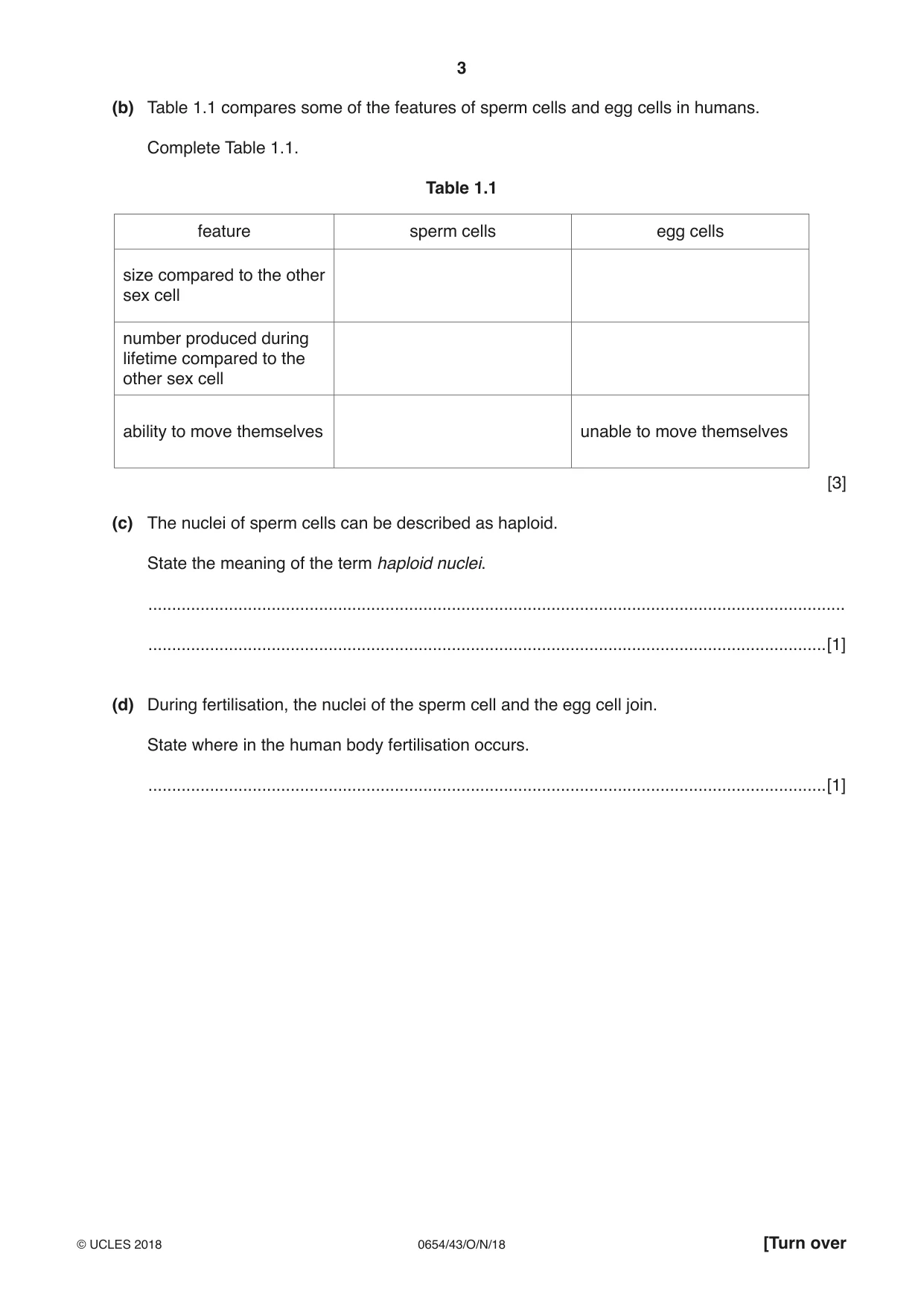
1 Fig. 1.1 shows a diagram of the male reproductive system. Fig. 1.1 (a) (i) Mark an X on Fig. 1.1 to show where sperm cells are made. [1] (ii) State the type of cell division that produces sperm cells. .......................................................................................................................................[1] (iii) State two structures through which sperm cells must pass on their way out of the body. 1 ........................................................................................................................................ 2 ........................................................................................................................................ [2] (b) Table 1.1 compares some of the features of sperm cells and egg cells in humans. Complete Table 1.1. Table 1.1 feature sperm cells egg cells size compared to the other sex cell number produced during lifetime compared to the other sex cell ability to move themselves unable to move themselves [3] (c) The nuclei of sperm cells can be described as haploid. State the meaning of the term haploid nuclei. ................................................................................................................................................... ...............................................................................................................................................[1] (d) During fertilisation, the nuclei of the sperm cell and the egg cell join. State where in the human body fertilisation occurs. ...............................................................................................................................................[1]
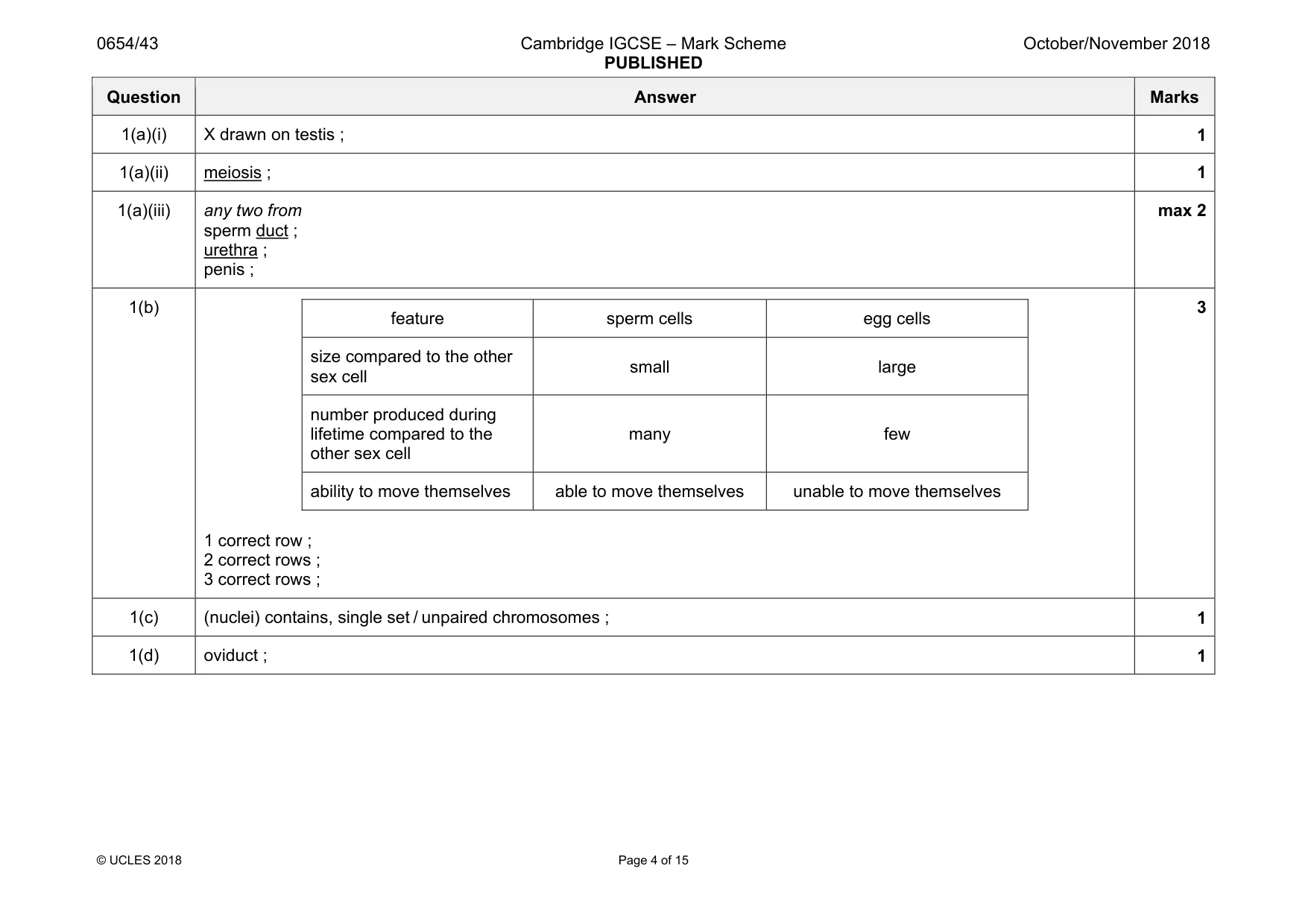
Mark scheme: 1(a)(i) X drawn on testis ; 1 1(a)(ii) meiosis ; 1 1(a)(iii) any two from sperm duct ; urethra ; penis ; max 2 1(b) feature sperm cells egg cells size compared to the other sex cell small large number produced during lifetime compared to the other sex cell many few ability to move themselves able to move themselves unable to move themselves 1 correct row ; 2 correct rows ; 3 correct rows ; 3 1(c) (nuclei) contains, single set / unpaired chromosomes ; 1 1(d) oviduct ; 1
Q2 · Group VII of the Periodic Table contains reactive non-metallic elements
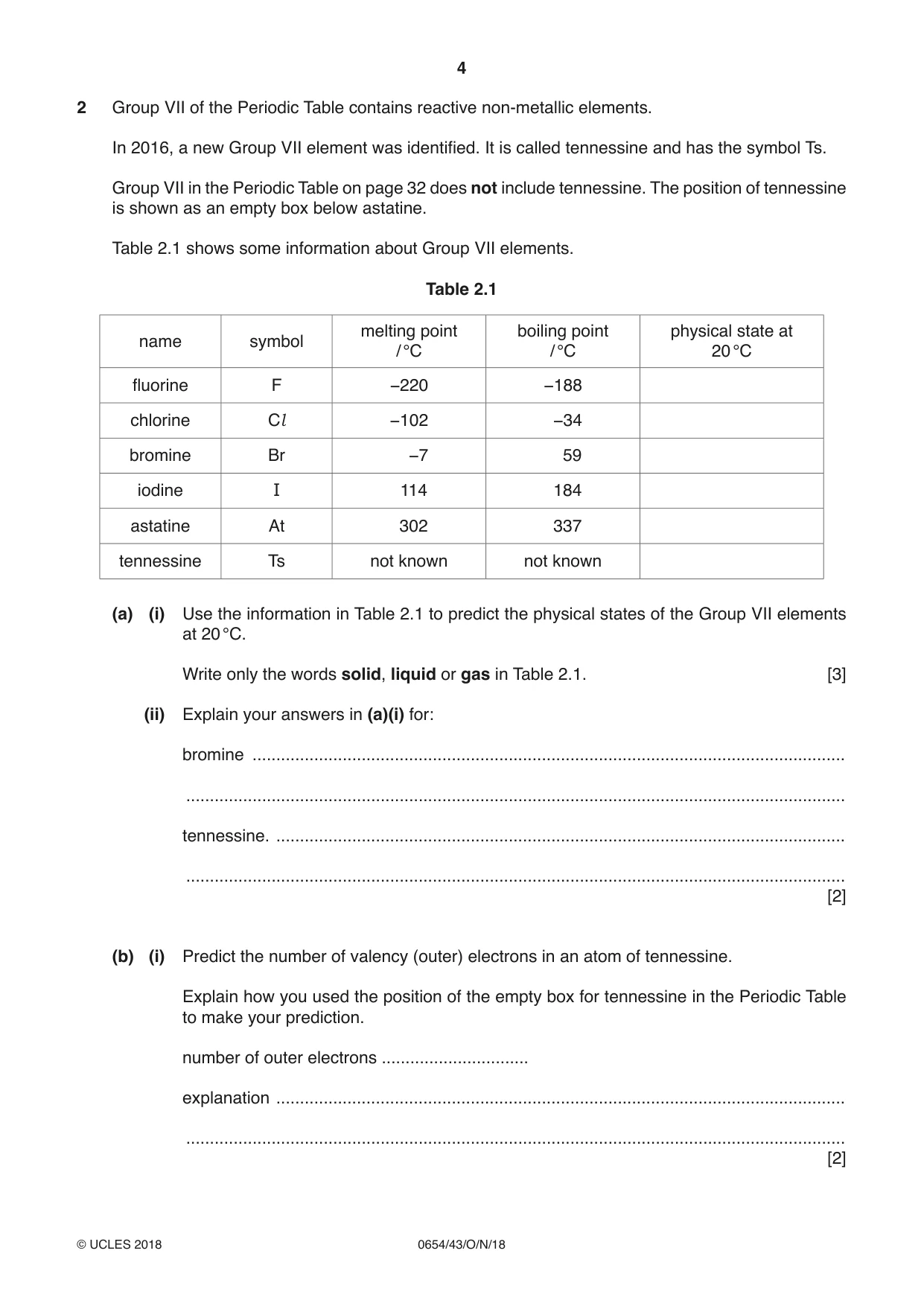
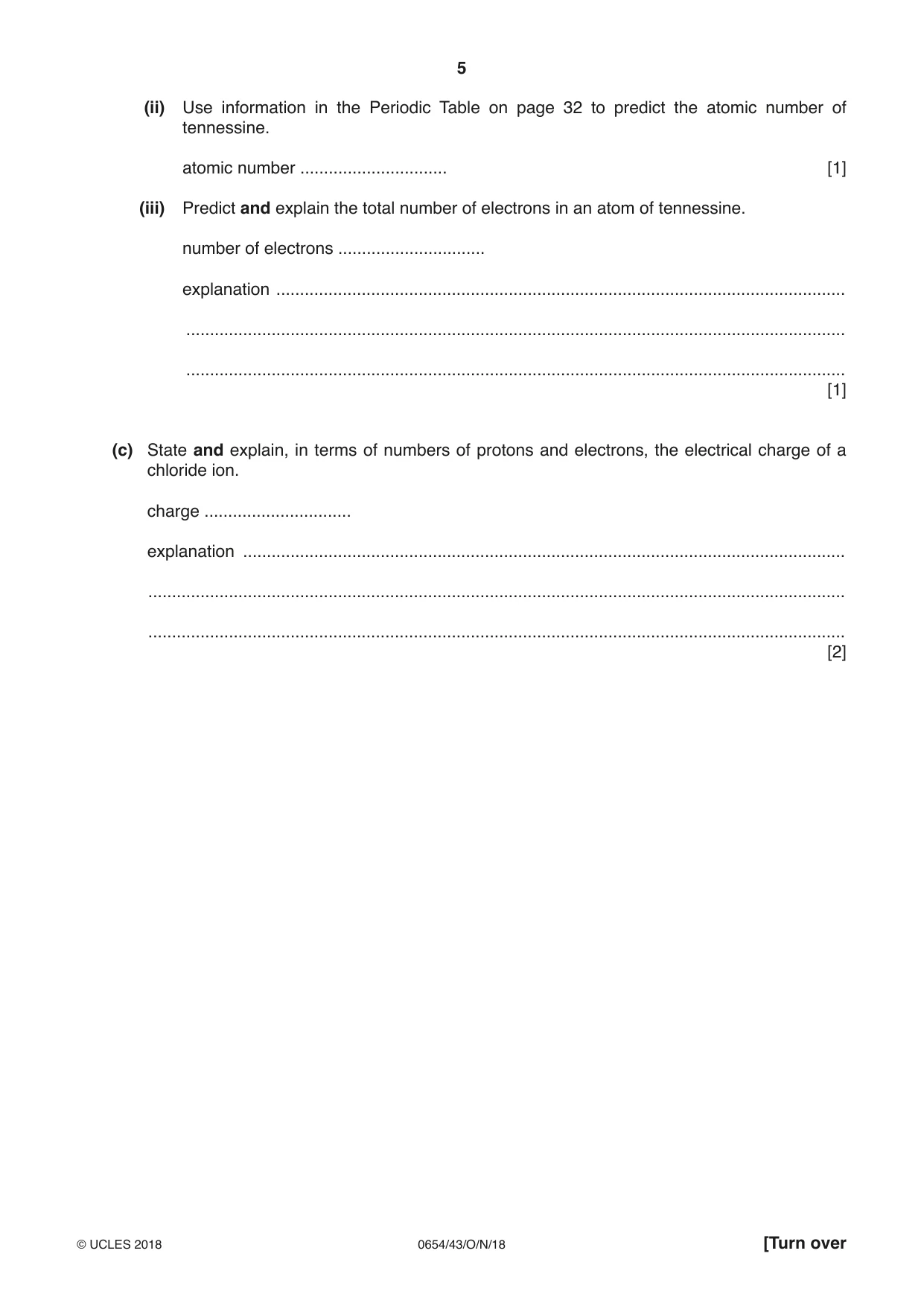
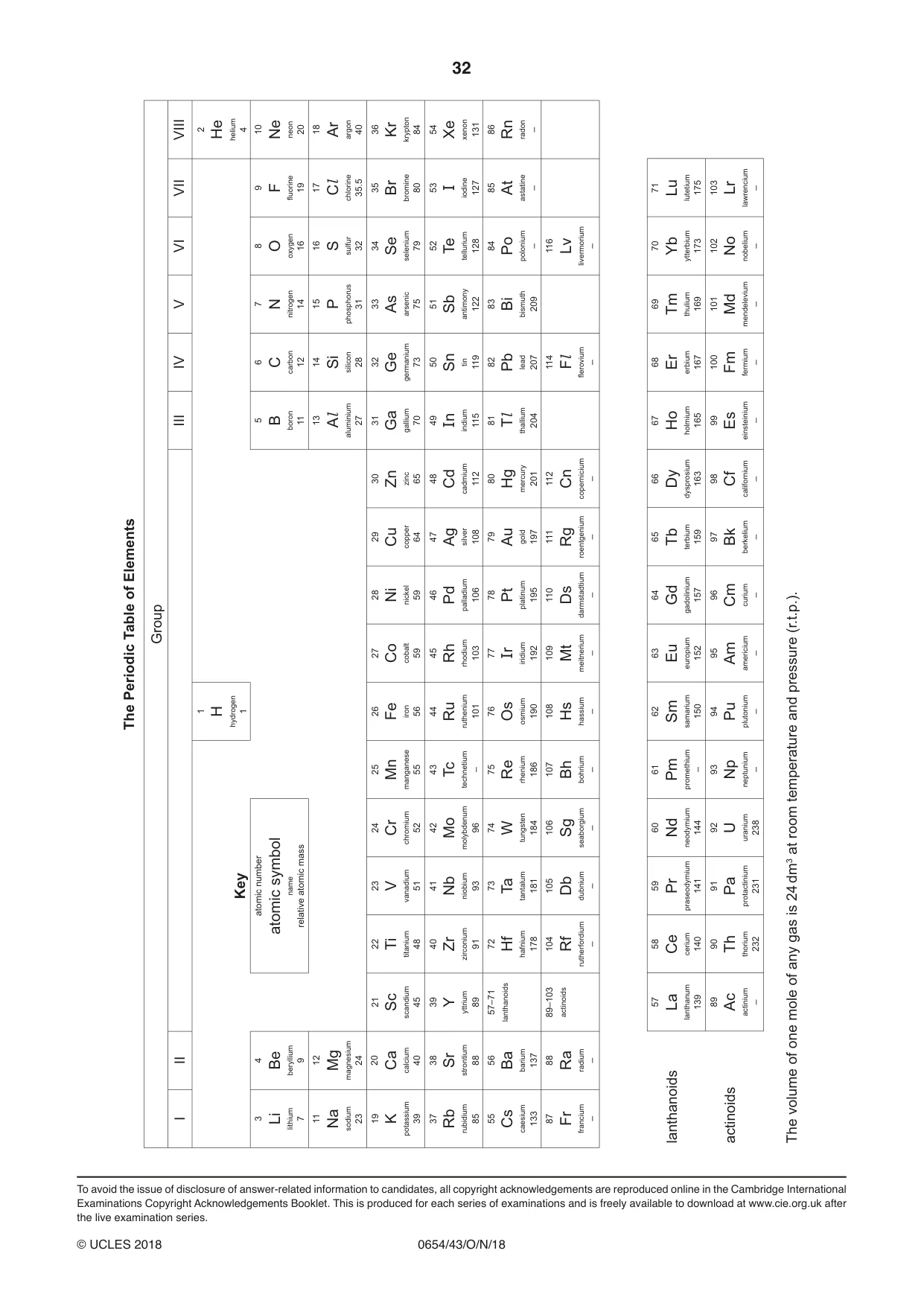
2 Group VII of the Periodic Table contains reactive non-metallic elements. In 2016, a new Group VII element was identified. It is called tennessine and has the symbol Ts. Group VII in the Periodic Table on page 32 does not include tennessine. The position of tennessine is shown as an empty box below astatine. Table 2.1 shows some information about Group VII elements. Table 2.1 melting point boiling point physical state at name symbol / °C / °C 20 °C fluorine F −220 −188 chlorine Cl −102 −34 bromine Br −7 59 iodine I 114 184 astatine At 302 337 tennessine Ts not known not known (a) (i) Use the information in Table 2.1 to predict the physical states of the Group VII elements at 20 °C. Write only the words solid, liquid or gas in Table 2.1. [3] (ii) Explain your answers in (a)(i) for: bromine ............................................................................................................................. ........................................................................................................................................... tennessine. ........................................................................................................................ ........................................................................................................................................... [2] (b) (i) Predict the number of valency (outer) electrons in an atom of tennessine. Explain how you used the position of the empty box for tennessine in the Periodic Table to make your prediction. number of outer electrons ............................... explanation ........................................................................................................................ ........................................................................................................................................... [2] (ii) Use information in the Periodic Table on page 32 to predict the atomic number of tennessine. atomic number ............................... [1] (iii) Predict and explain the total number of electrons in an atom of tennessine. number of electrons ............................... explanation ........................................................................................................................ ........................................................................................................................................... ........................................................................................................................................... [1] (c) State and explain, in terms of numbers of protons and electrons, the electrical charge of a chloride ion. charge ............................... explanation ............................................................................................................................... ................................................................................................................................................... ................................................................................................................................................... [2]
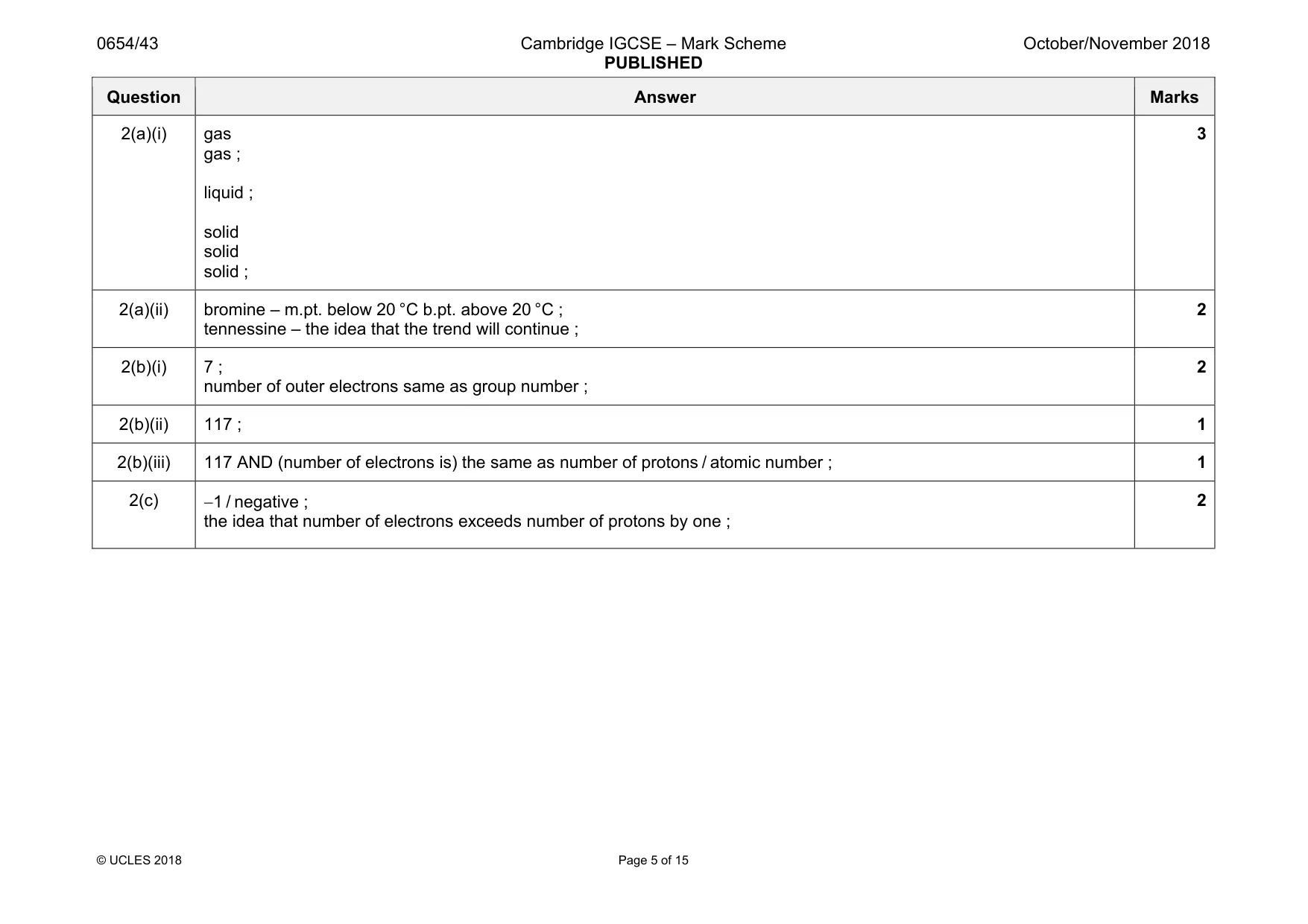
Mark scheme: 2(a)(i) gas gas ; liquid ; solid solid solid ; 3 2(a)(ii) bromine – m.pt. below 20 °C b.pt. above 20 °C ; tennessine – the idea that the trend will continue ; 2 2(b)(i) 7 ; number of outer electrons same as group number ; 2 2(b)(ii) 117 ; 1 2(b)(iii) 117 AND (number of electrons is) the same as number of protons / atomic number ; 1 2(c) −1 / negative ; the idea that number of electrons exceeds number of protons by one ; 2
Q3 · The speed-time graph for part of a journey made by a train
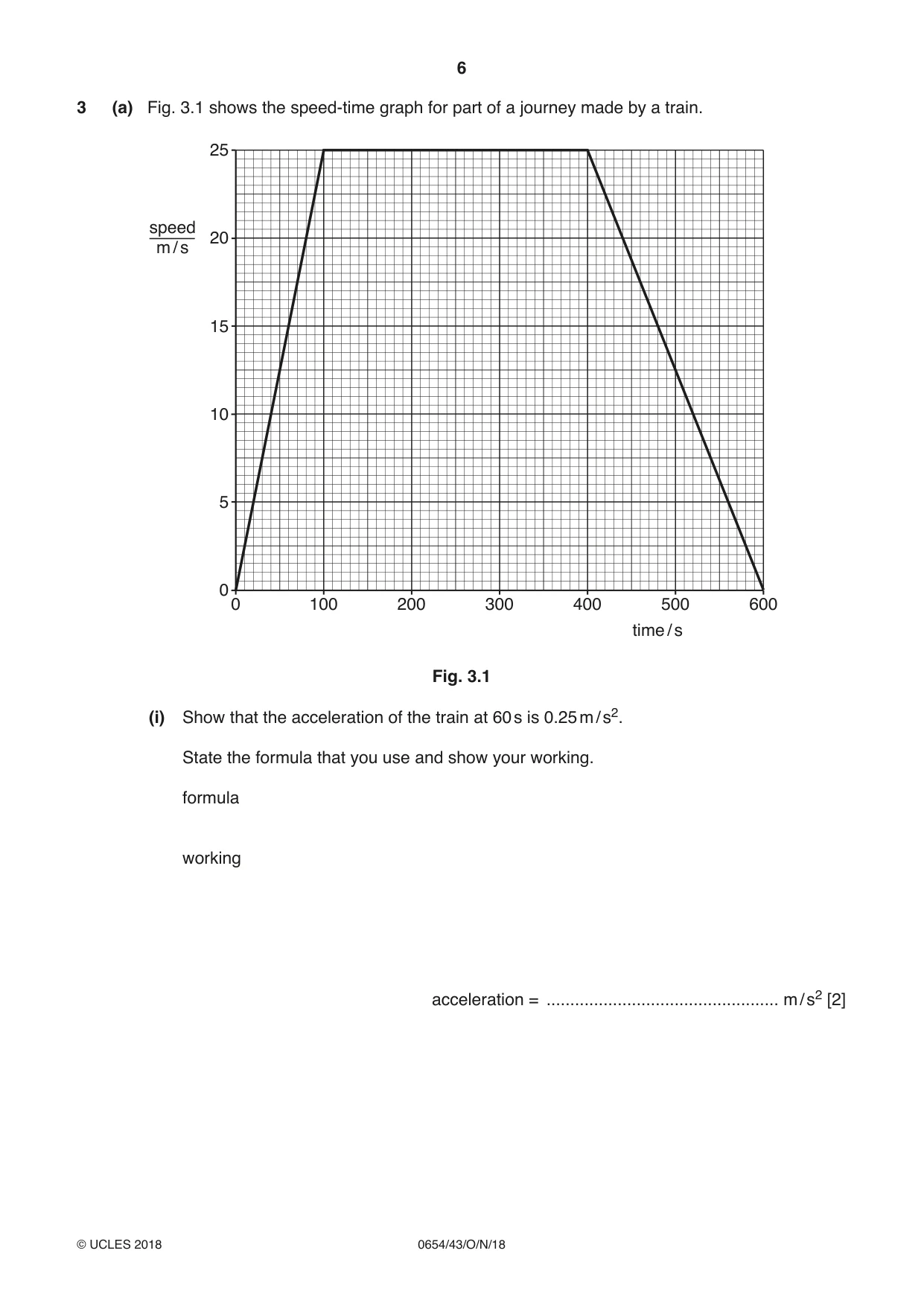
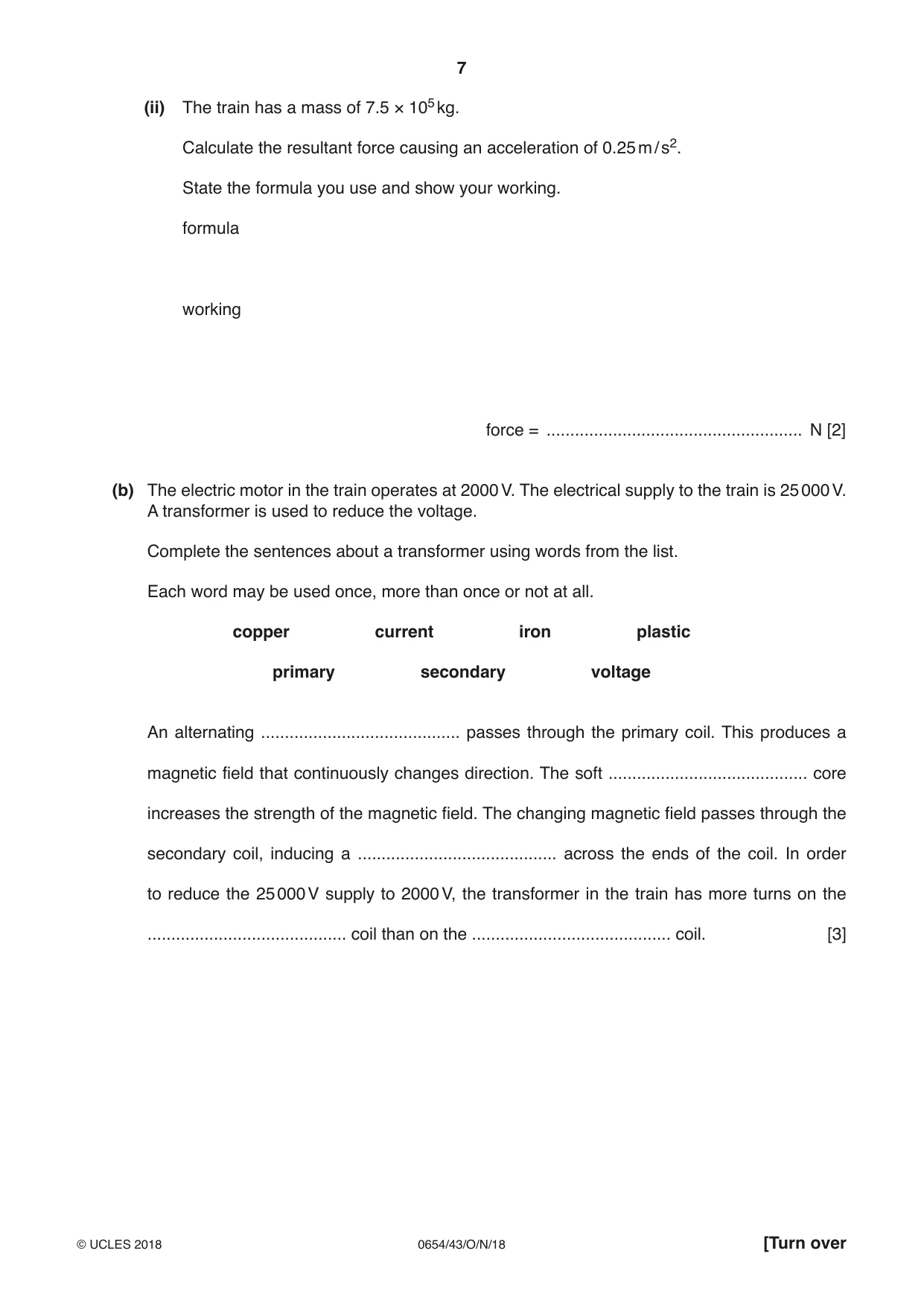
3 (a) Fig. 3.1 shows the speed-time graph for part of a journey made by a train. 25 speed 20 m / s 15 10 5 0 0 100 200 300 400 500 600 time / s Fig. 3.1 (i) Show that the acceleration of the train at 60 s is 0.25 m / s2. State the formula that you use and show your working. formula working acceleration = ................................................. m / s2 [2] (ii) The train has a mass of 7.5 × 10⁵ kg. Calculate the resultant force causing an acceleration of 0.25 m / s2. State the formula you use and show your working. formula working force = ...................................................... N [2] (b) The electric motor in the train operates at 2000 V. The electrical supply to the train is 25 000 V. A transformer is used to reduce the voltage. Complete the sentences about a transformer using words from the list. Each word may be used once, more than once or not at all. copper current iron plastic primary secondary voltage An alternating .......................................... passes through the primary coil. This produces a magnetic field that continuously changes direction. The soft .......................................... core increases the strength of the magnetic field. The changing magnetic field passes through the secondary coil, inducing a .......................................... across the ends of the coil. In order to reduce the 25 000 V supply to 2000 V, the transformer in the train has more turns on the .......................................... coil than on the .......................................... coil. [3]
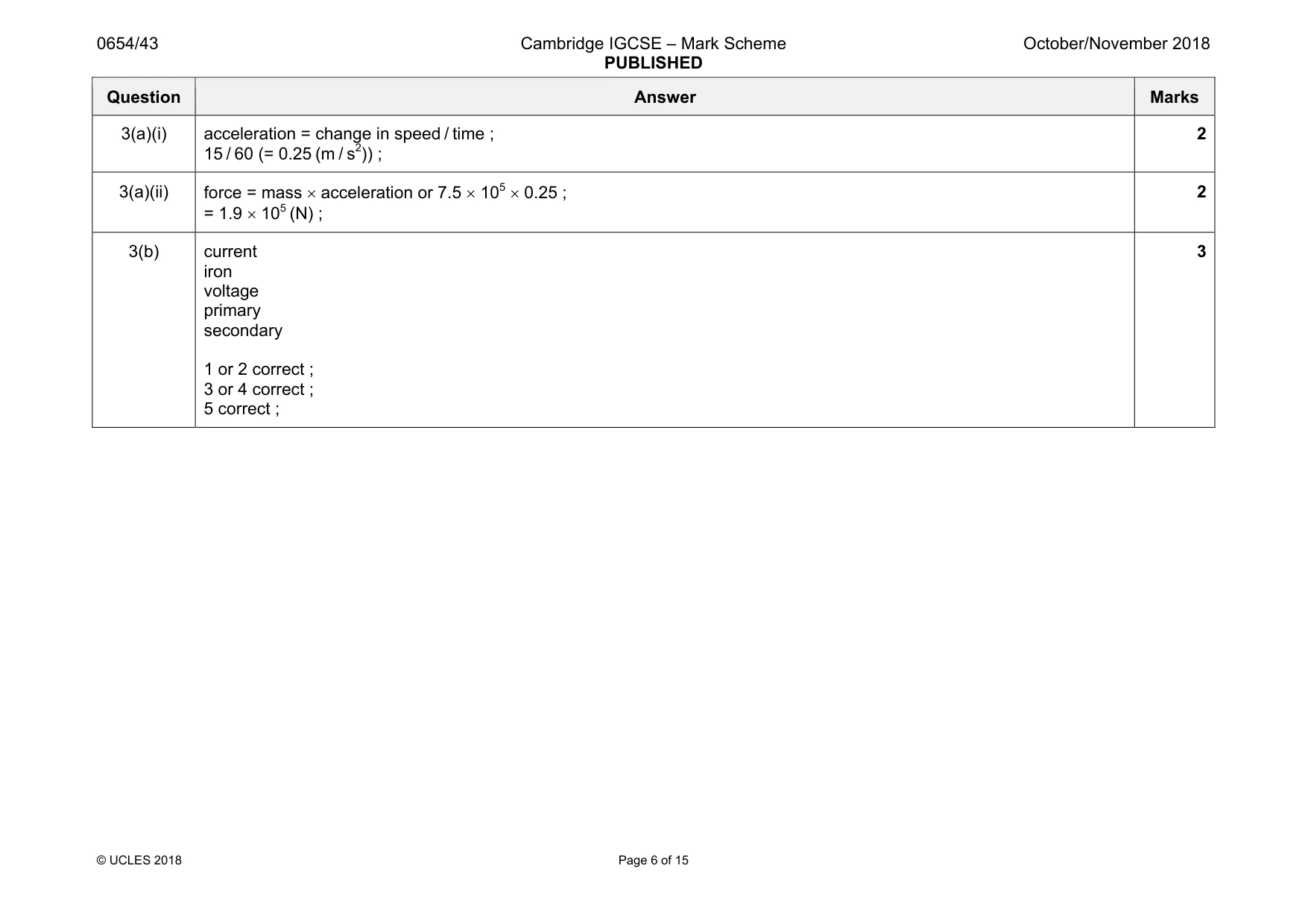
Mark scheme: 3(a)(i) acceleration = change in speed / time ; 15 / 60 (= 0.25 (m / s2)) ; 2 3(a)(ii) force = mass × acceleration or 7.5 × 105 × 0.25 ; = 1.9 × 10⁵ (N) ; 2 3(b) current iron voltage primary secondary 1 or 2 correct ; 3 or 4 correct ; 5 correct ; 3
Question 4
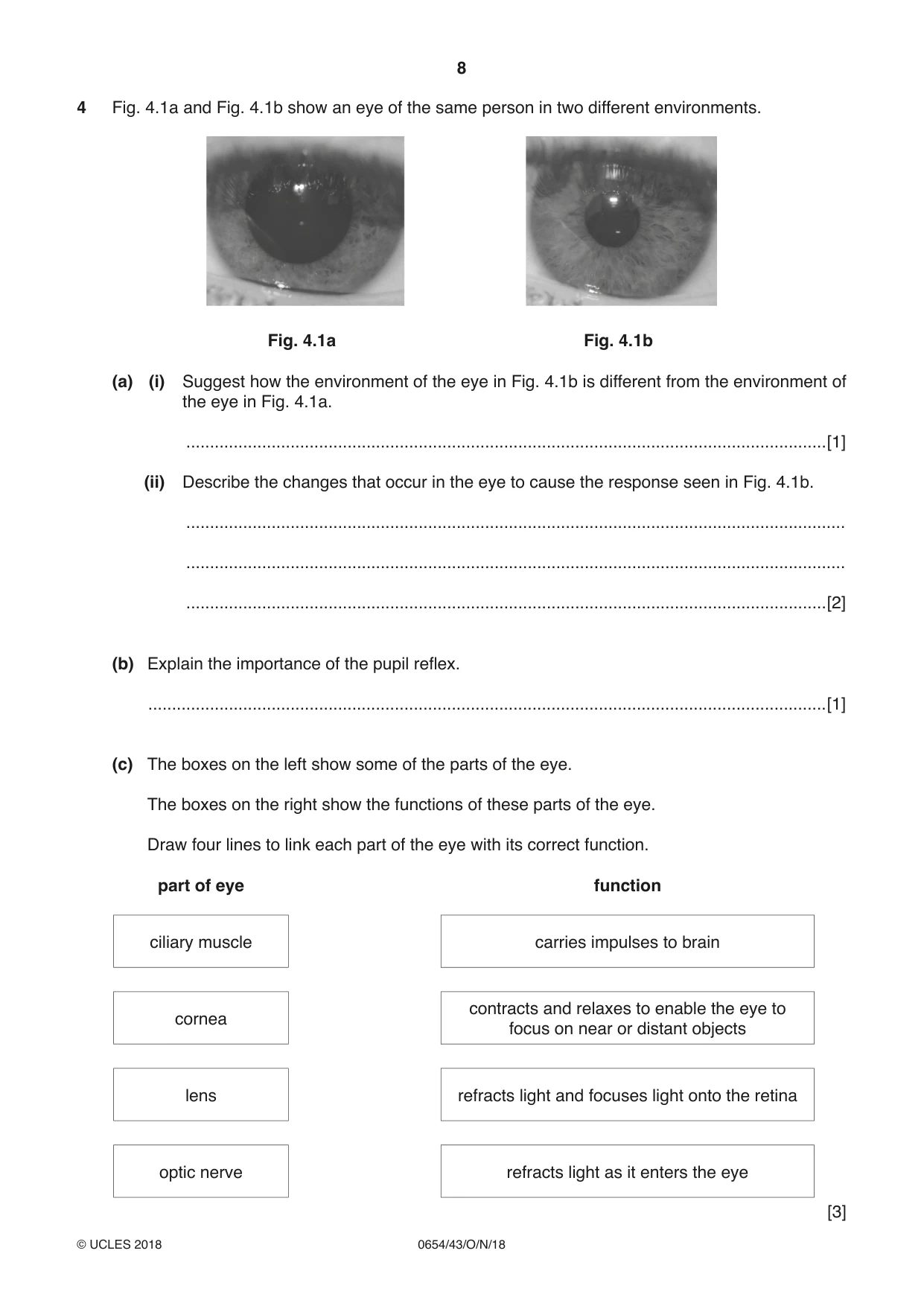
4 Fig. 4.1a and Fig. 4.1b show an eye of the same person in two different environments. Fig. 4.1a Fig. 4.1b (a) (i) Suggest how the environment of the eye in Fig. 4.1b is different from the environment of the eye in Fig. 4.1a. .......................................................................................................................................[1] (ii) Describe the changes that occur in the eye to cause the response seen in Fig. 4.1b. ........................................................................................................................................... ........................................................................................................................................... .......................................................................................................................................[2] (b) Explain the importance of the pupil reflex. ...............................................................................................................................................[1] (c) The boxes on the left show some of the parts of the eye. The boxes on the right show the functions of these parts of the eye. Draw four lines to link each part of the eye with its correct function. part of eye function ciliary muscle carries impulses to brain contracts and relaxes to enable the eye to cornea focus on near or distant objects lens refracts light and focuses light onto the retina optic nerve refracts light as it enters the eye [3]
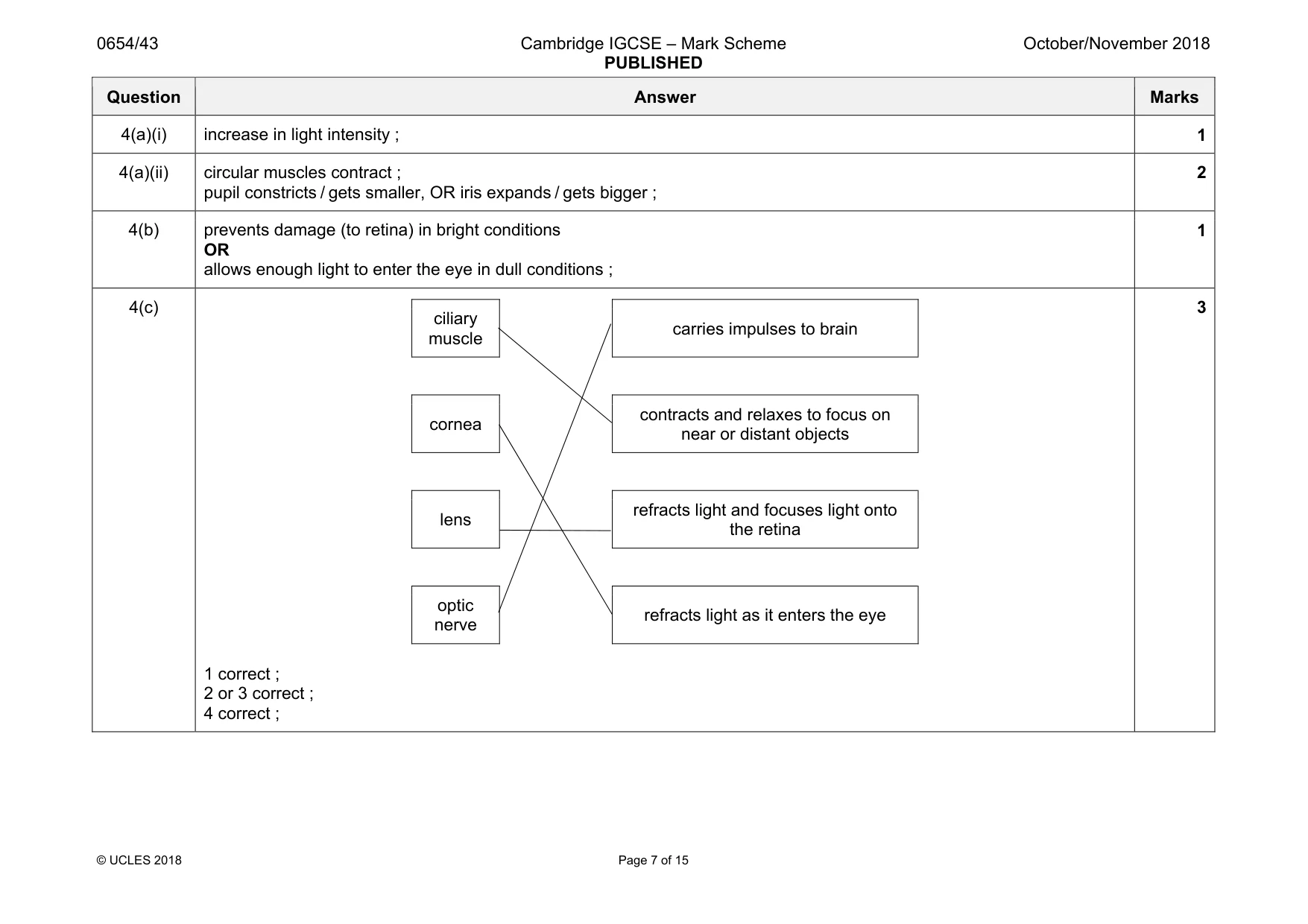
Mark scheme: 4(a)(i) increase in light intensity ; 1 4(a)(ii) circular muscles contract ; pupil constricts / gets smaller, OR iris expands / gets bigger ; 2 4(b) prevents damage (to retina) in bright conditions OR allows enough light to enter the eye in dull conditions ; 1 4(c) ciliary muscle carries impulses to brain cornea contracts and relaxes to focus on near or distant objects lens refracts light and focuses light onto the retina optic nerve refracts light as it enters the eye 1 correct ; 2 or 3 correct ; 4 correct ; 3
Q5 · Five elements are listed in order of reactivity
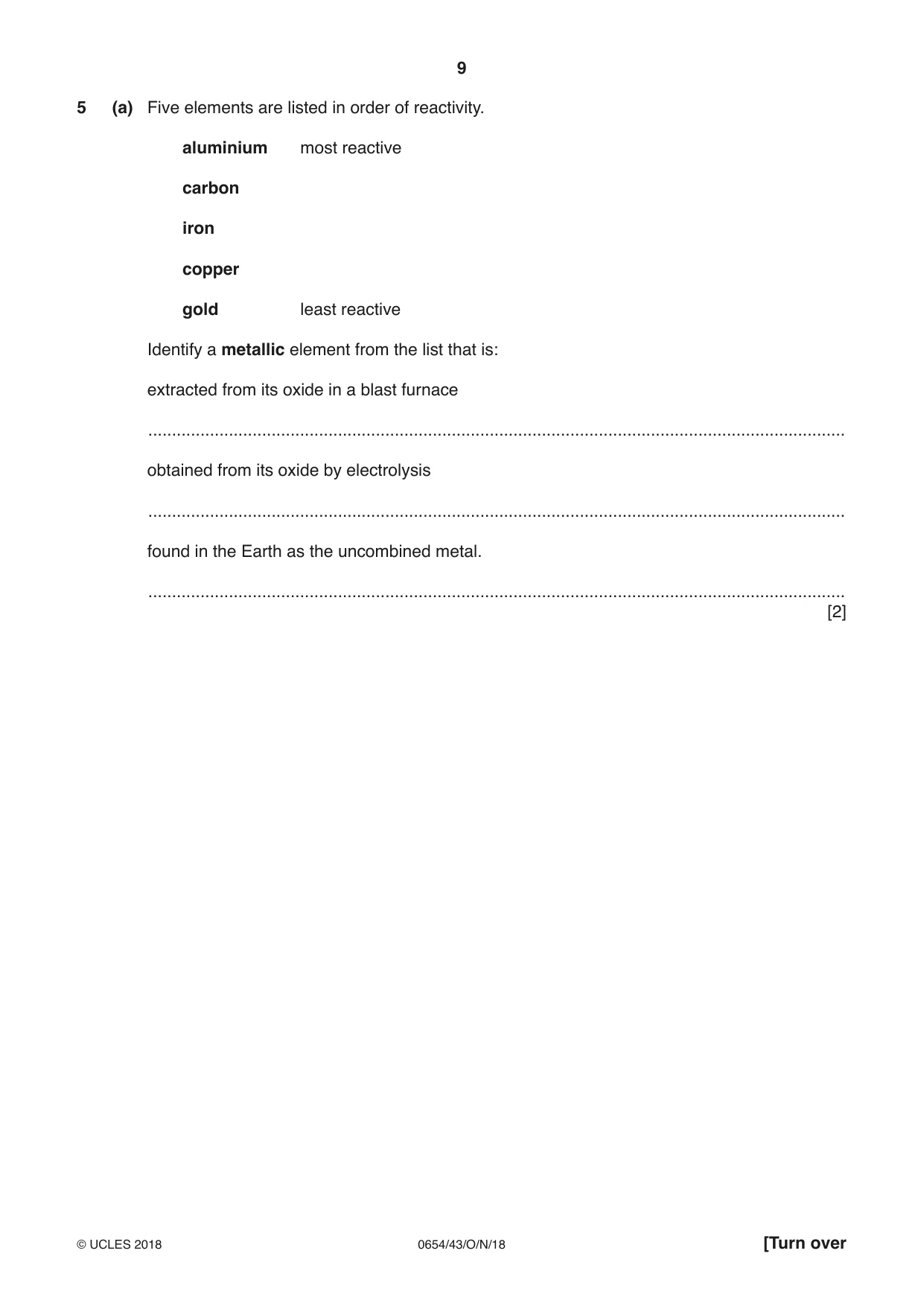
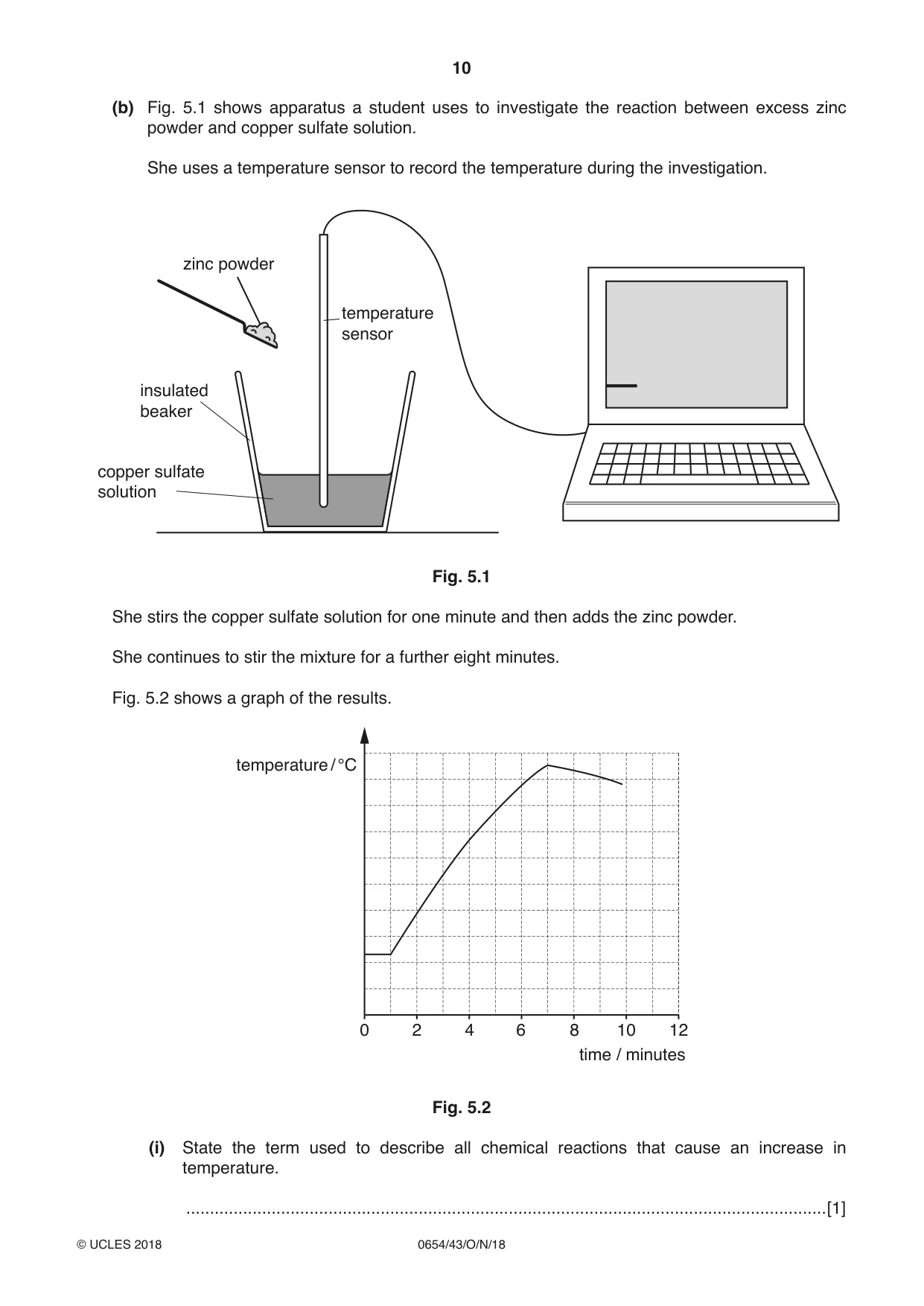
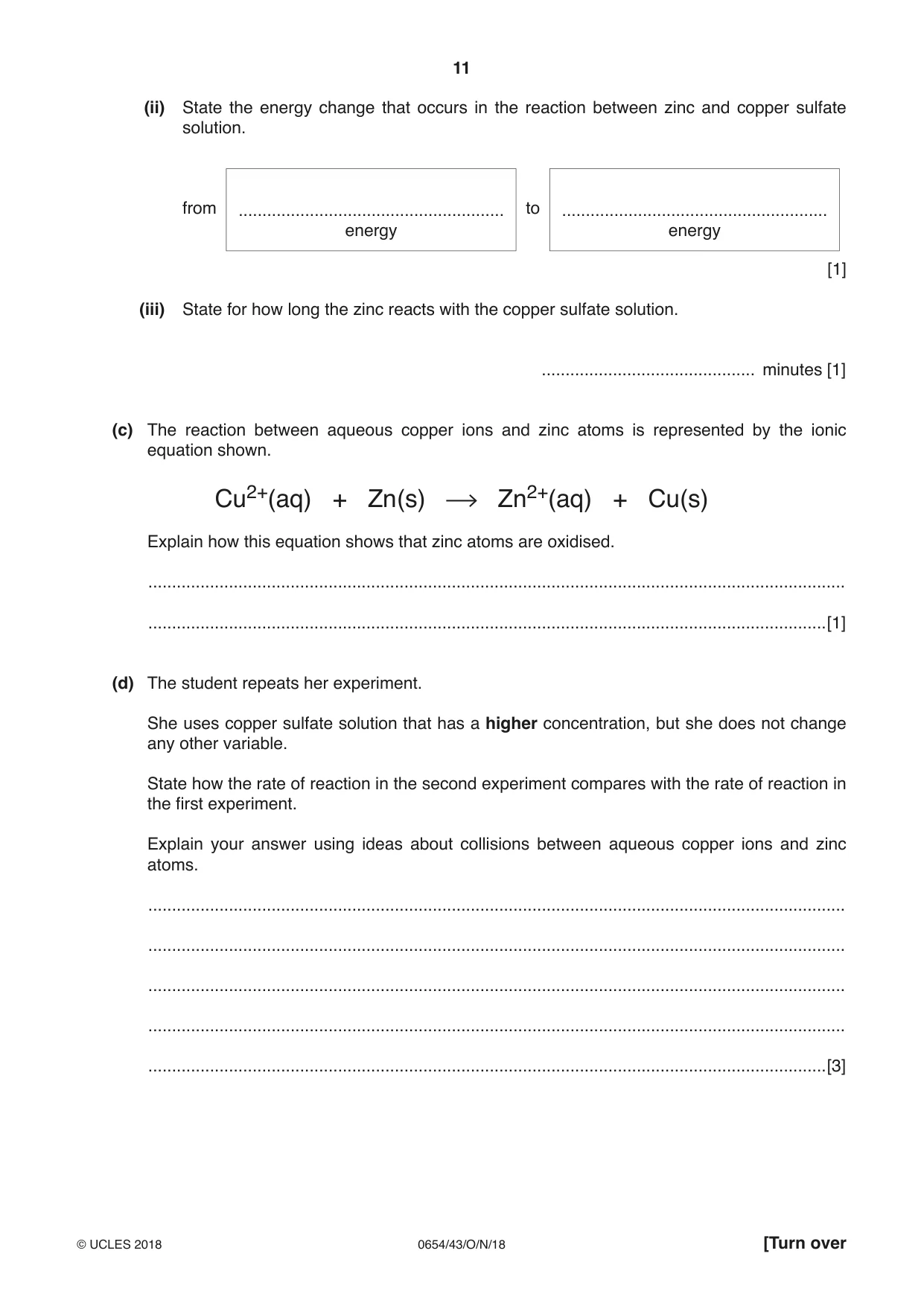
5 (a) Five elements are listed in order of reactivity. aluminium most reactive carbon iron copper gold least reactive Identify a metallic element from the list that is: extracted from its oxide in a blast furnace ................................................................................................................................................... obtained from its oxide by electrolysis ................................................................................................................................................... found in the Earth as the uncombined metal. ................................................................................................................................................... [2] (b) Fig. 5.1 shows apparatus a student uses to investigate the reaction between excess zinc powder and copper sulfate solution. She uses a temperature sensor to record the temperature during the investigation. zinc powder temperature sensor insulated beaker copper sulfate solution Fig. 5.1 She stirs the copper sulfate solution for one minute and then adds the zinc powder. She continues to stir the mixture for a further eight minutes. Fig. 5.2 shows a graph of the results. temperature / °C 0 2 4 6 8 10 12 time / minutes Fig. 5.2 (i) State the term used to describe all chemical reactions that cause an increase in temperature. .......................................................................................................................................[1] (ii) State the energy change that occurs in the reaction between zinc and copper sulfate solution. from ........................................................ to ........................................................ energy energy [1] (iii) State for how long the zinc reacts with the copper sulfate solution. ............................................. minutes [1] (c) The reaction between aqueous copper ions and zinc atoms is represented by the ionic equation shown. Cu2+(aq) + Zn(s) Zn2+(aq) + Cu(s) Explain how this equation shows that zinc atoms are oxidised. ................................................................................................................................................... ...............................................................................................................................................[1] (d) The student repeats her experiment. She uses copper sulfate solution that has a higher concentration, but she does not change any other variable. State how the rate of reaction in the second experiment compares with the rate of reaction in the first experiment. Explain your answer using ideas about collisions between aqueous copper ions and zinc atoms. ................................................................................................................................................... ................................................................................................................................................... ................................................................................................................................................... ................................................................................................................................................... ...............................................................................................................................................[3]
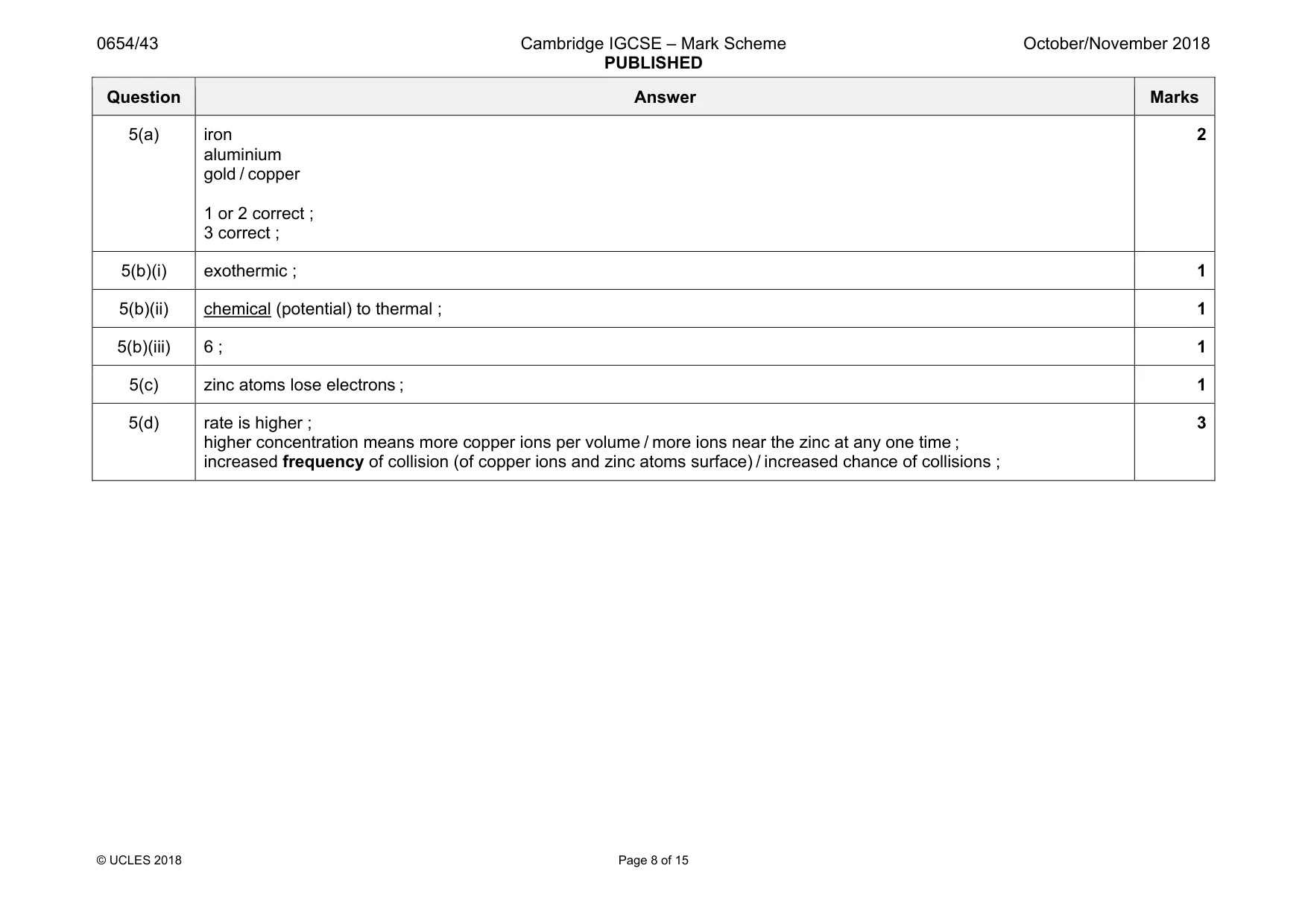
Mark scheme: 5(a) iron aluminium gold / copper 1 or 2 correct ; 3 correct ; 2 5(b)(i) exothermic ; 1 5(b)(ii) chemical (potential) to thermal ; 1 5(b)(iii) 6 ; 1 5(c) zinc atoms lose electrons ; 1 5(d) rate is higher ; higher concentration means more copper ions per volume / more ions near the zinc at any one time ; increased frequency of collision (of copper ions and zinc atoms surface) / increased chance of collisions ; 3
Q6 · X-rays and γ-rays are both used in hospitals
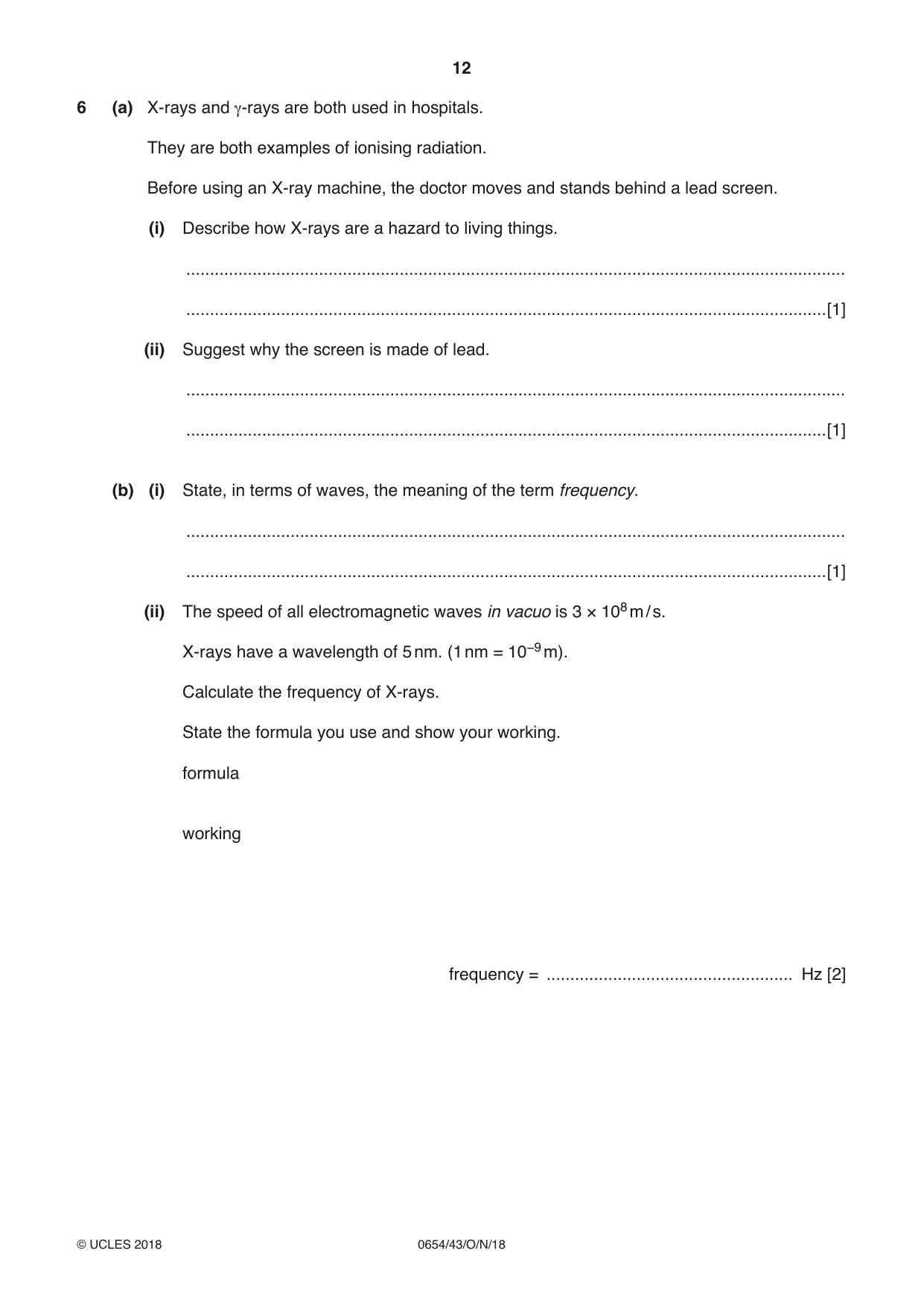
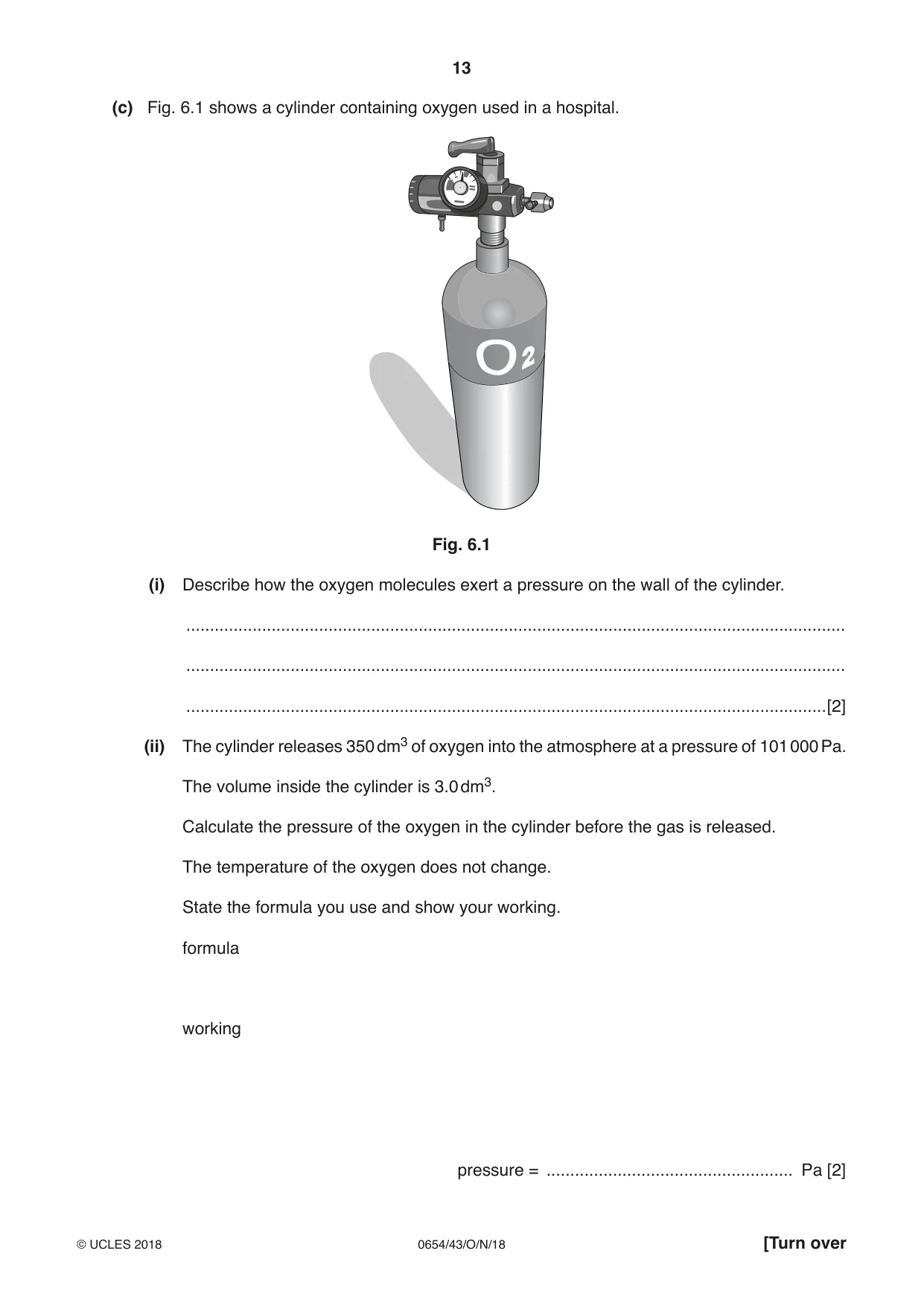
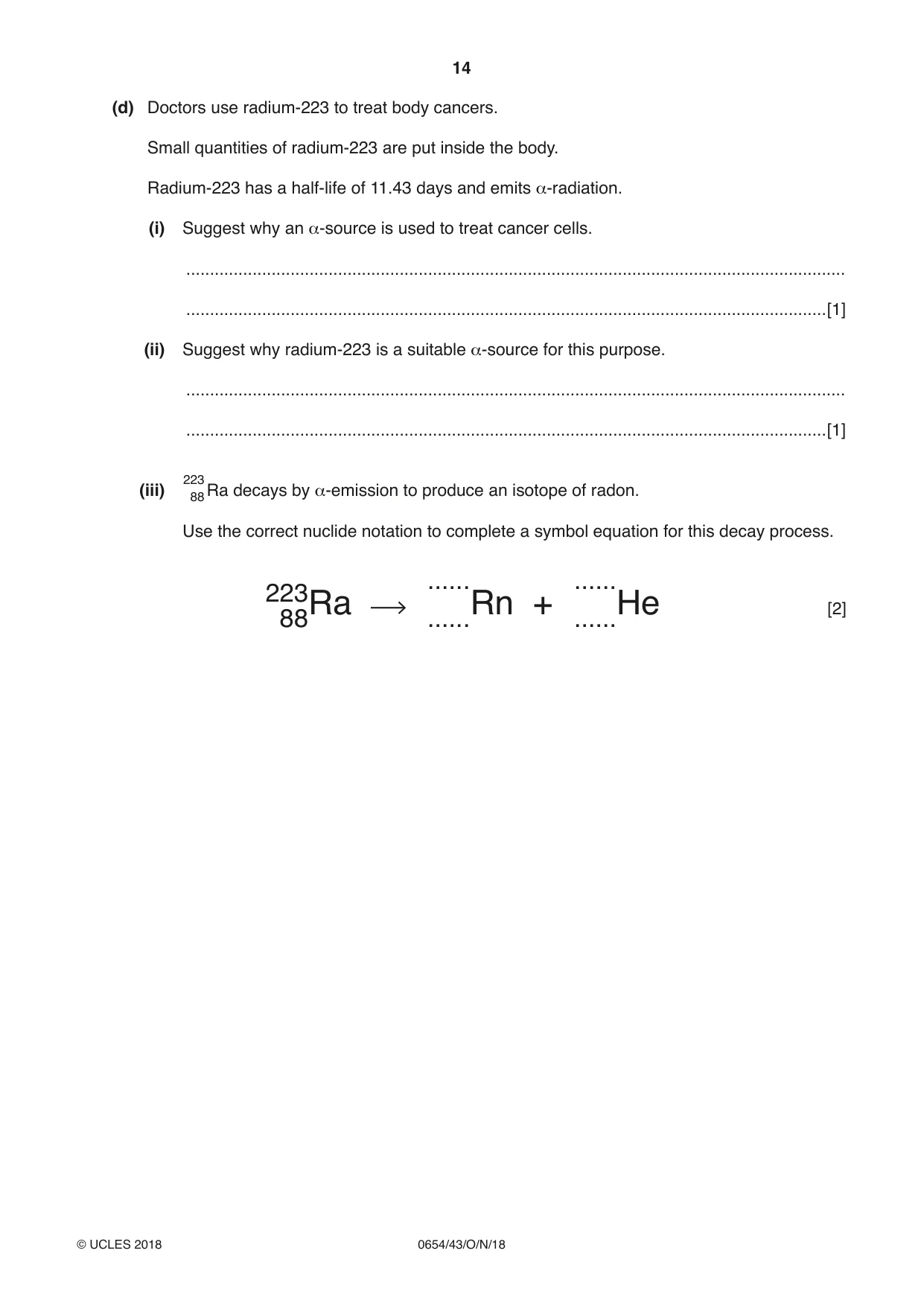
6 (a) X-rays and γ-rays are both used in hospitals. They are both examples of ionising radiation. Before using an X-ray machine, the doctor moves and stands behind a lead screen. (i) Describe how X-rays are a hazard to living things. ........................................................................................................................................... .......................................................................................................................................[1] (ii) Suggest why the screen is made of lead. ........................................................................................................................................... .......................................................................................................................................[1] (b) (i) State, in terms of waves, the meaning of the term frequency. ........................................................................................................................................... .......................................................................................................................................[1] (ii) The speed of all electromagnetic waves in vacuo is 3 × 10⁸ m / s. X-rays have a wavelength of 5 nm. (1 nm = 10−9 m). Calculate the frequency of X-rays. State the formula you use and show your working. formula working frequency = .................................................... Hz [2] (c) Fig. 6.1 shows a cylinder containing oxygen used in a hospital. Fig. 6.1 (i) Describe how the oxygen molecules exert a pressure on the wall of the cylinder. ........................................................................................................................................... ........................................................................................................................................... .......................................................................................................................................[2] (ii) The cylinder releases 350 dm3 of oxygen into the atmosphere at a pressure of 101 000 Pa. The volume inside the cylinder is 3.0 dm3. Calculate the pressure of the oxygen in the cylinder before the gas is released. The temperature of the oxygen does not change. State the formula you use and show your working. formula working pressure = .................................................... Pa [2] (d) Doctors use radium-223 to treat body cancers. Small quantities of radium-223 are put inside the body. Radium-223 has a half-life of 11.43 days and emits α-radiation. (i) Suggest why an α-source is used to treat cancer cells. ........................................................................................................................................... .......................................................................................................................................[1] (ii) Suggest why radium-223 is a suitable α-source for this purpose. ........................................................................................................................................... .......................................................................................................................................[1] 223 (iii) 88 Ra decays by α-emission to produce an isotope of radon. Use the correct nuclide notation to complete a symbol equation for this decay process. ...... ...... 223 [2] 88Ra ......Rn + ......He
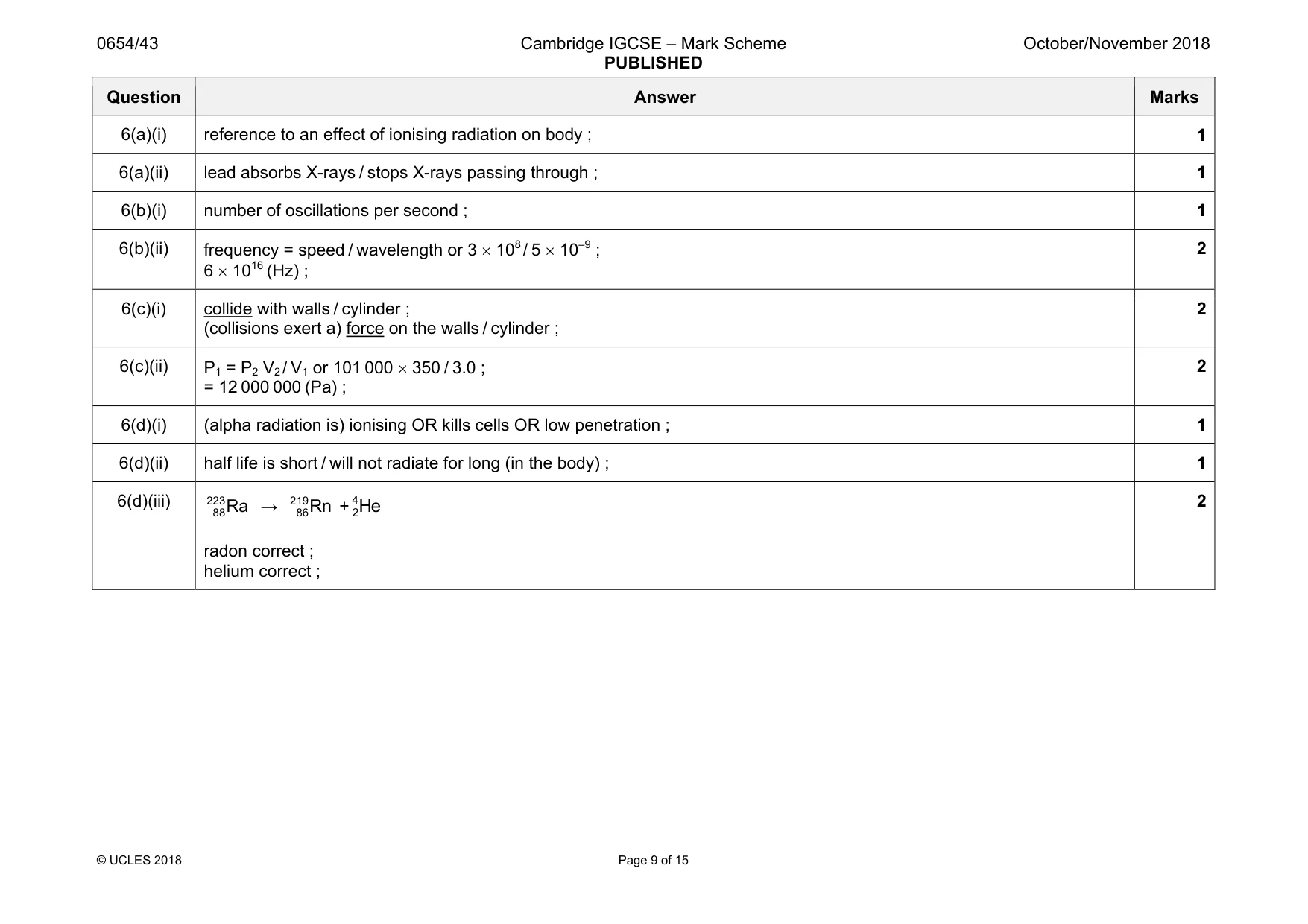
Mark scheme: 6(a)(i) reference to an effect of ionising radiation on body ; 1 6(a)(ii) lead absorbs X-rays / stops X-rays passing through ; 1 6(b)(i) number of oscillations per second ; 1 6(b)(ii) frequency = speed / wavelength or 3 × 10⁸/ 5 × 10⁻⁹ ; 6 × 10¹⁶ (Hz) ; 2 6(c)(i) collide with walls / cylinder ; (collisions exert a) force on the walls / cylinder ; 2 6(c)(ii) P1 = P2 V2 / V1 or 101 000 × 350 / 3.0 ; = 12 000 000 (Pa) ; 2 6(d)(i) (alpha radiation is) ionising OR kills cells OR low penetration ; 1 6(d)(ii) half life is short / will not radiate for long (in the body) ; 1 6(d)(iii) 223 88Ra → 219 86Rn + 4 2He radon correct ; helium correct ; 2
Q7 · The percentage of the population of different age groups that smoke in a country
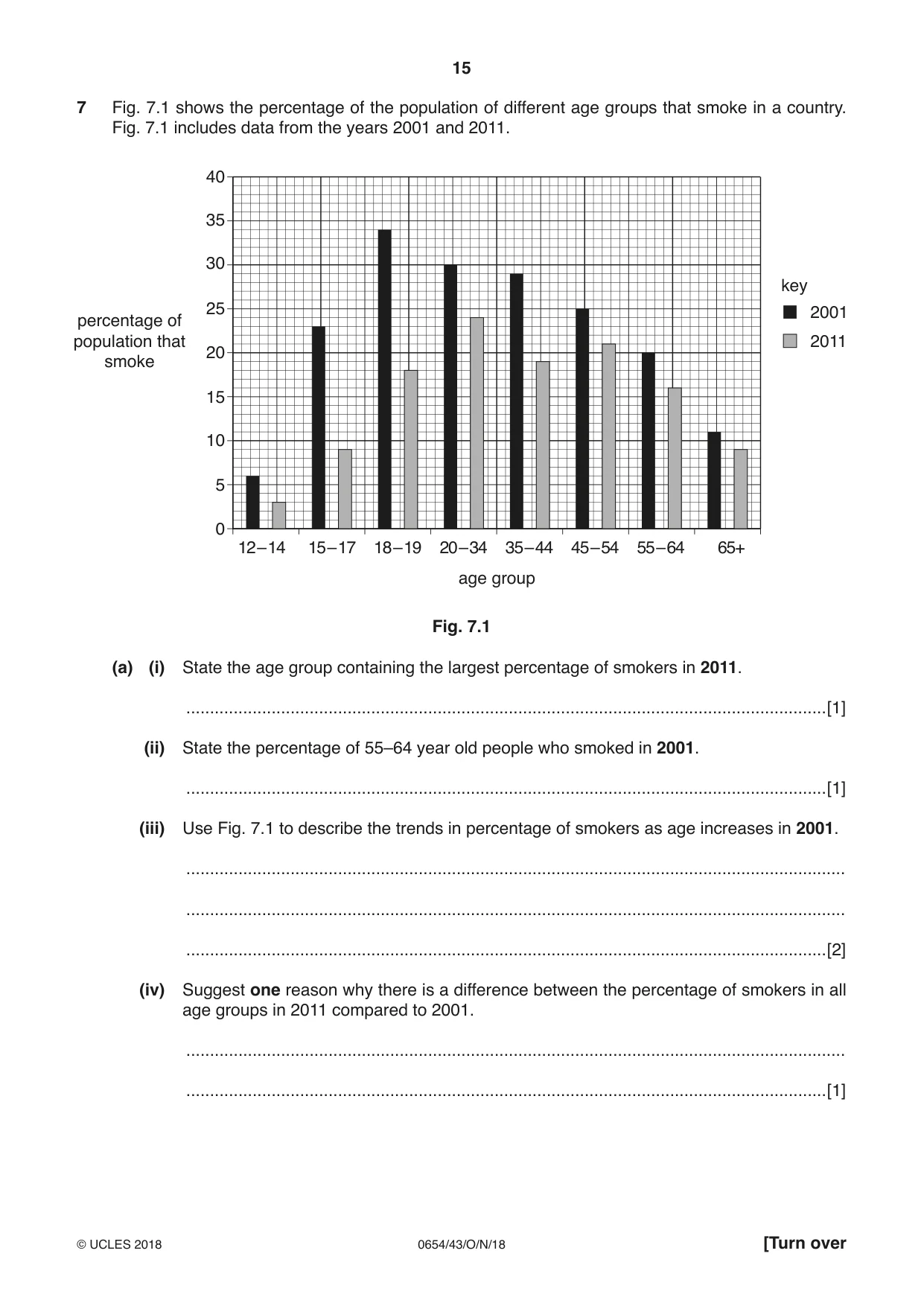
7 Fig. 7.1 shows the percentage of the population of different age groups that smoke in a country. Fig. 7.1 includes data from the years 2001 and 2011. 40 35 30 key 25 2001percentage of population that 2011 20 smoke 15 10 5 0 12 – 14 15 – 17 18 – 19 20 – 34 35 – 44 45 – 54 55 – 64 65+ age group Fig. 7.1 (a) (i) State the age group containing the largest percentage of smokers in 2011. .......................................................................................................................................[1] (ii) State the percentage of 55–64 year old people who smoked in 2001. .......................................................................................................................................[1] (iii) Use Fig. 7.1 to describe the trends in percentage of smokers as age increases in 2001. ........................................................................................................................................... ........................................................................................................................................... .......................................................................................................................................[2] (iv) Suggest one reason why there is a difference between the percentage of smokers in all age groups in 2011 compared to 2001. ........................................................................................................................................... .......................................................................................................................................[1] (b) When a cigarette is burnt, it produces smoke particles. Describe how the gas exchange system removes smoke particles from airways. Use the words mucus and cilia in your answer. ................................................................................................................................................... ................................................................................................................................................... ...............................................................................................................................................[2]
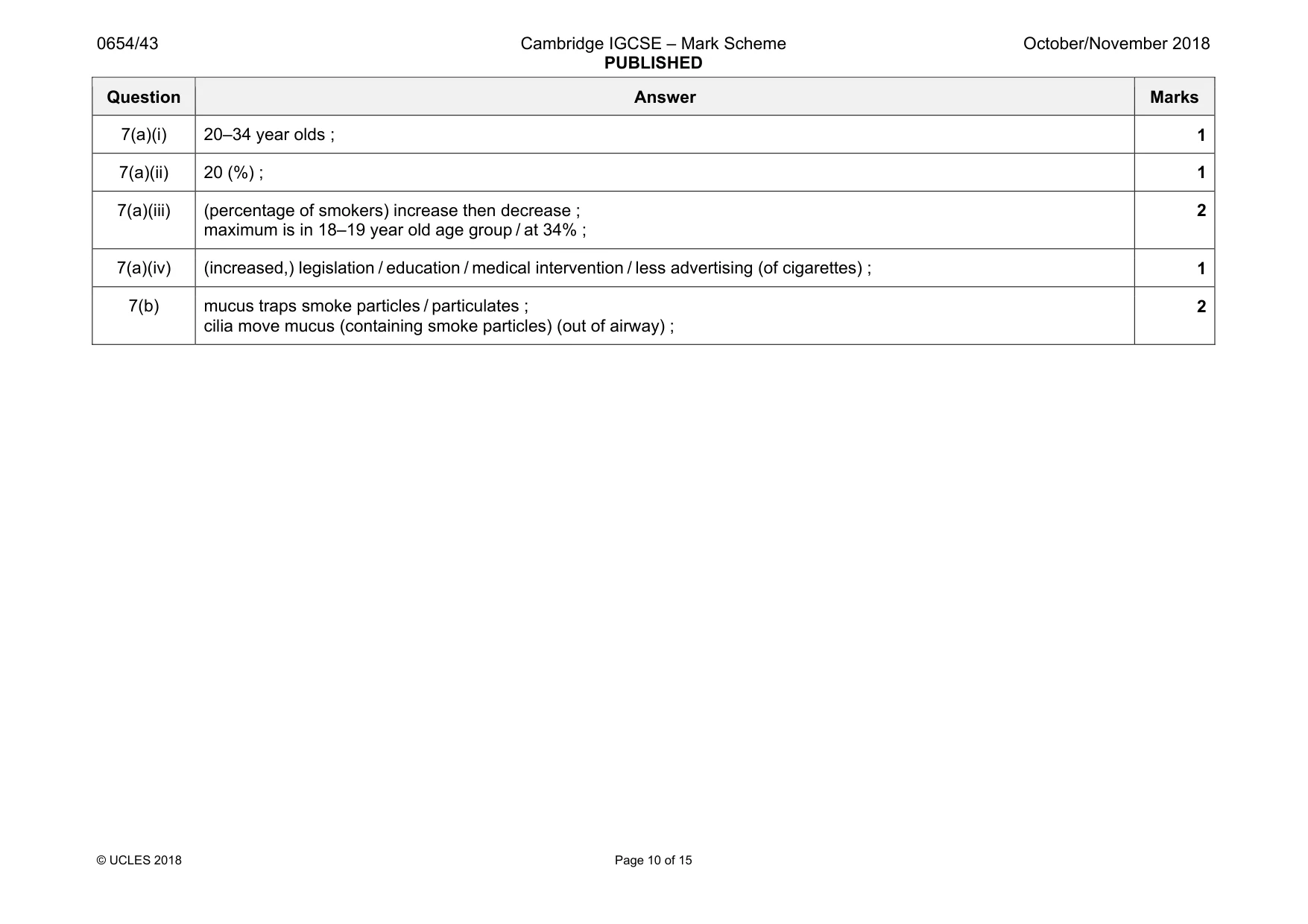
Mark scheme: 7(a)(i) 20–34 year olds ; 1 7(a)(ii) 20 (%) ; 1 7(a)(iii) (percentage of smokers) increase then decrease ; maximum is in 18–19 year old age group / at 34% ; 2 7(a)(iv) (increased,) legislation / education / medical intervention / less advertising (of cigarettes) ; 1 7(b) mucus traps smoke particles / particulates ; cilia move mucus (containing smoke particles) (out of airway) ; 2
Q8 · Sulfur is found in compounds and as an element
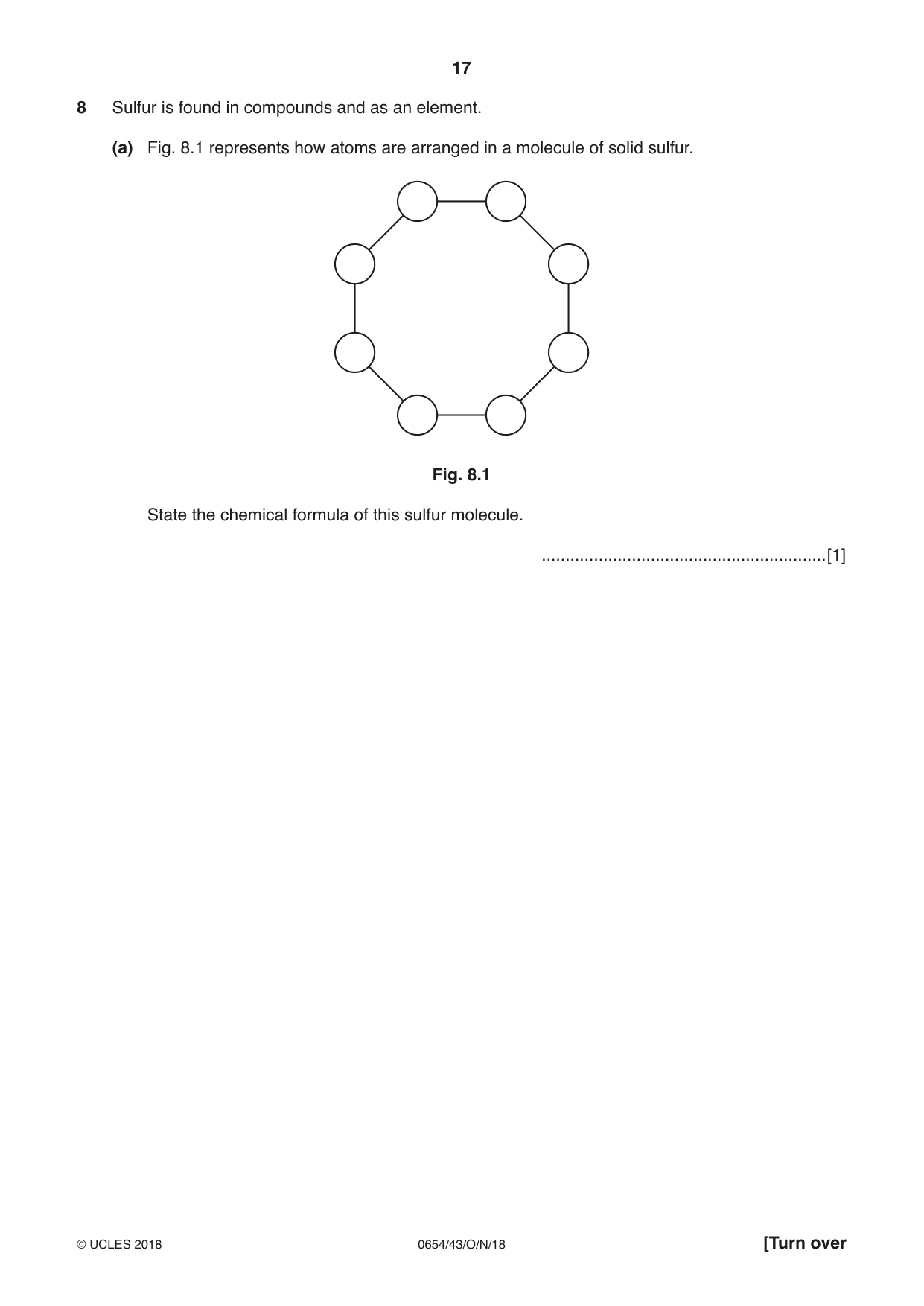
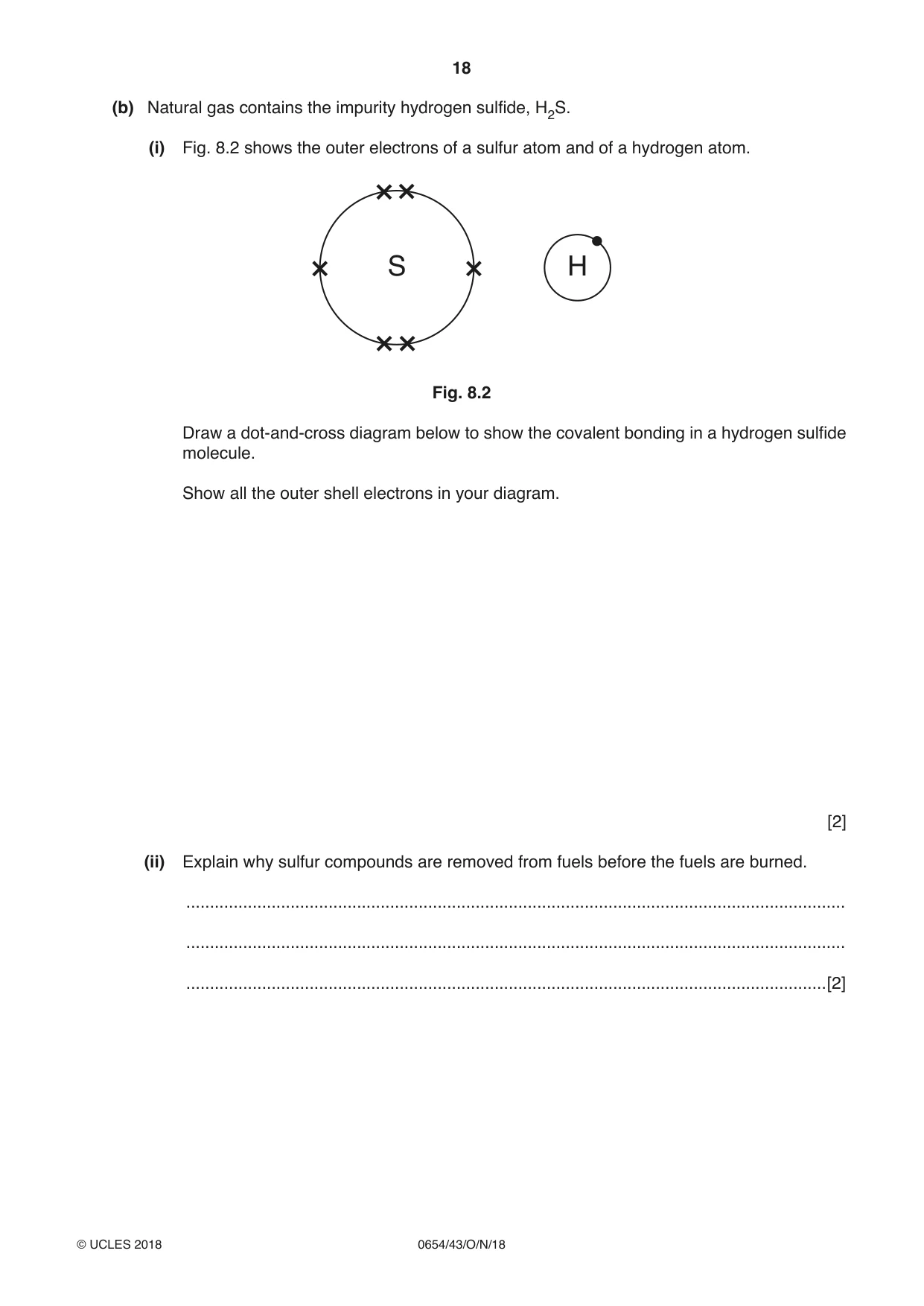
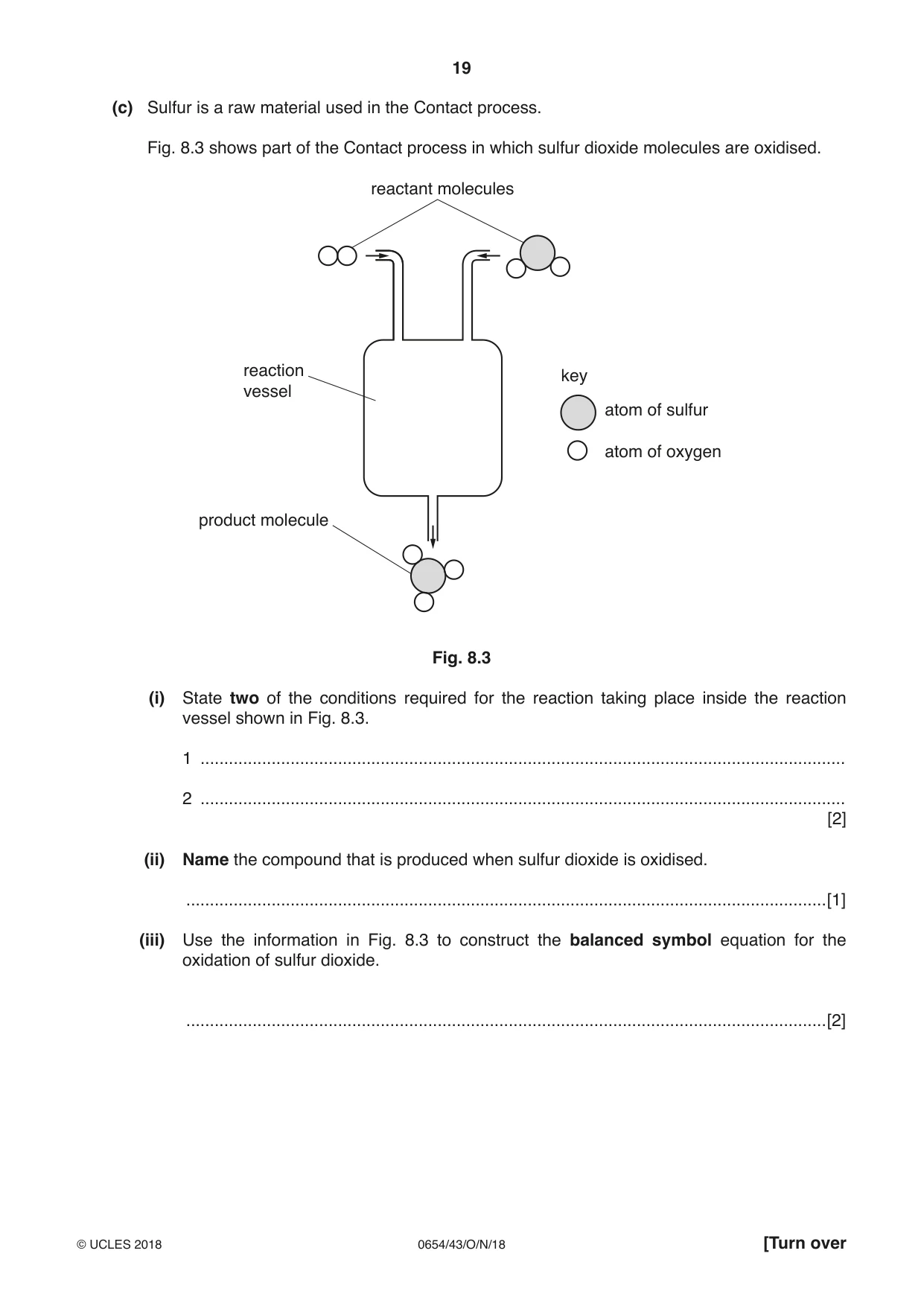
8 Sulfur is found in compounds and as an element. (a) Fig. 8.1 represents how atoms are arranged in a molecule of solid sulfur. Fig. 8.1 State the chemical formula of this sulfur molecule. ............................................................[1] (b) Natural gas contains the impurity hydrogen sulfide, H2S. (i) Fig. 8.2 shows the outer electrons of a sulfur atom and of a hydrogen atom. S H Fig. 8.2 Draw a dot-and-cross diagram below to show the covalent bonding in a hydrogen sulfide molecule. Show all the outer shell electrons in your diagram. [2] (ii) Explain why sulfur compounds are removed from fuels before the fuels are burned. ........................................................................................................................................... ........................................................................................................................................... .......................................................................................................................................[2] (c) Sulfur is a raw material used in the Contact process. Fig. 8.3 shows part of the Contact process in which sulfur dioxide molecules are oxidised. reactant molecules reaction key vessel atom of sulfur atom of oxygen product molecule Fig. 8.3 (i) State two of the conditions required for the reaction taking place inside the reaction vessel shown in Fig. 8.3. 1 ........................................................................................................................................ 2 ........................................................................................................................................ [2] (ii) Name the compound that is produced when sulfur dioxide is oxidised. .......................................................................................................................................[1] (iii) Use the information in Fig. 8.3 to construct the balanced symbol equation for the oxidation of sulfur dioxide. .......................................................................................................................................[2]
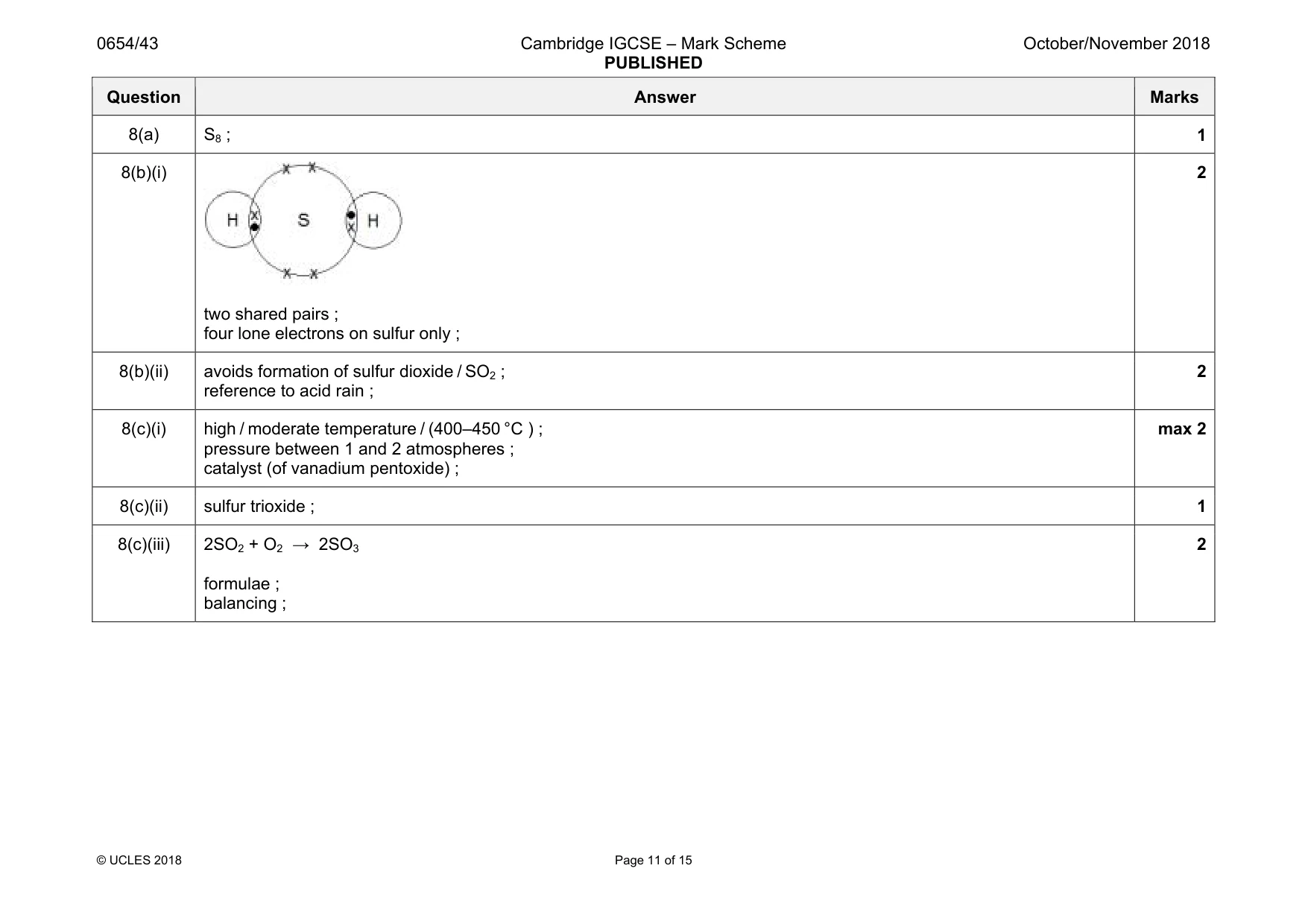
Mark scheme: 8(a) S8 ; 1 8(b)(i) two shared pairs ; four lone electrons on sulfur only ; 2 8(b)(ii) avoids formation of sulfur dioxide / SO2 ; reference to acid rain ; 2 8(c)(i) high / moderate temperature / (400–450 °C ) ; pressure between 1 and 2 atmospheres ; catalyst (of vanadium pentoxide) ; max 2 8(c)(ii) sulfur trioxide ; 1 8(c)(iii) 2SO2 + O2 → 2SO3 formulae ; balancing ; 2
Q9 · In the school science laboratory, a student investigates how the resistance of a circuit…
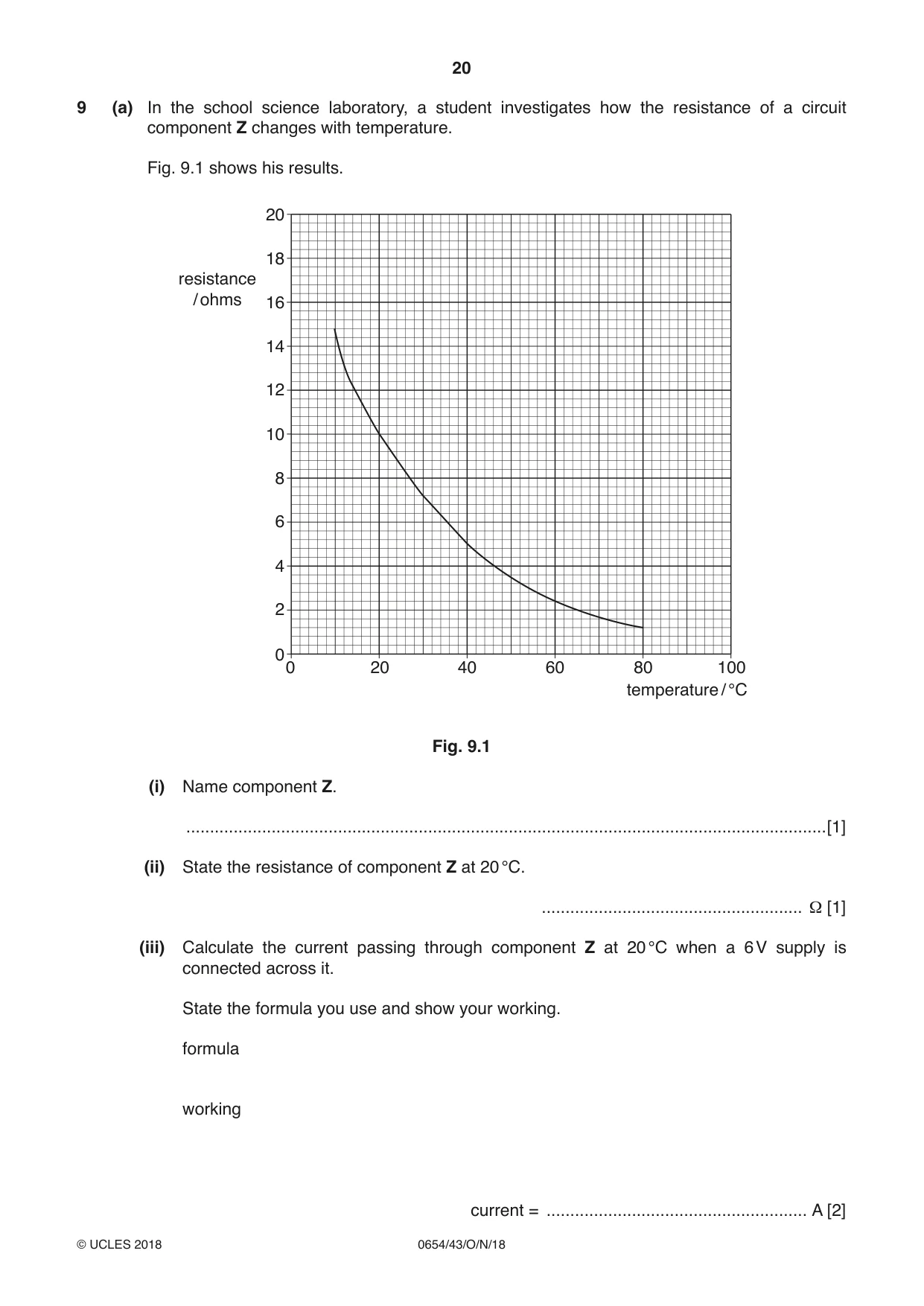
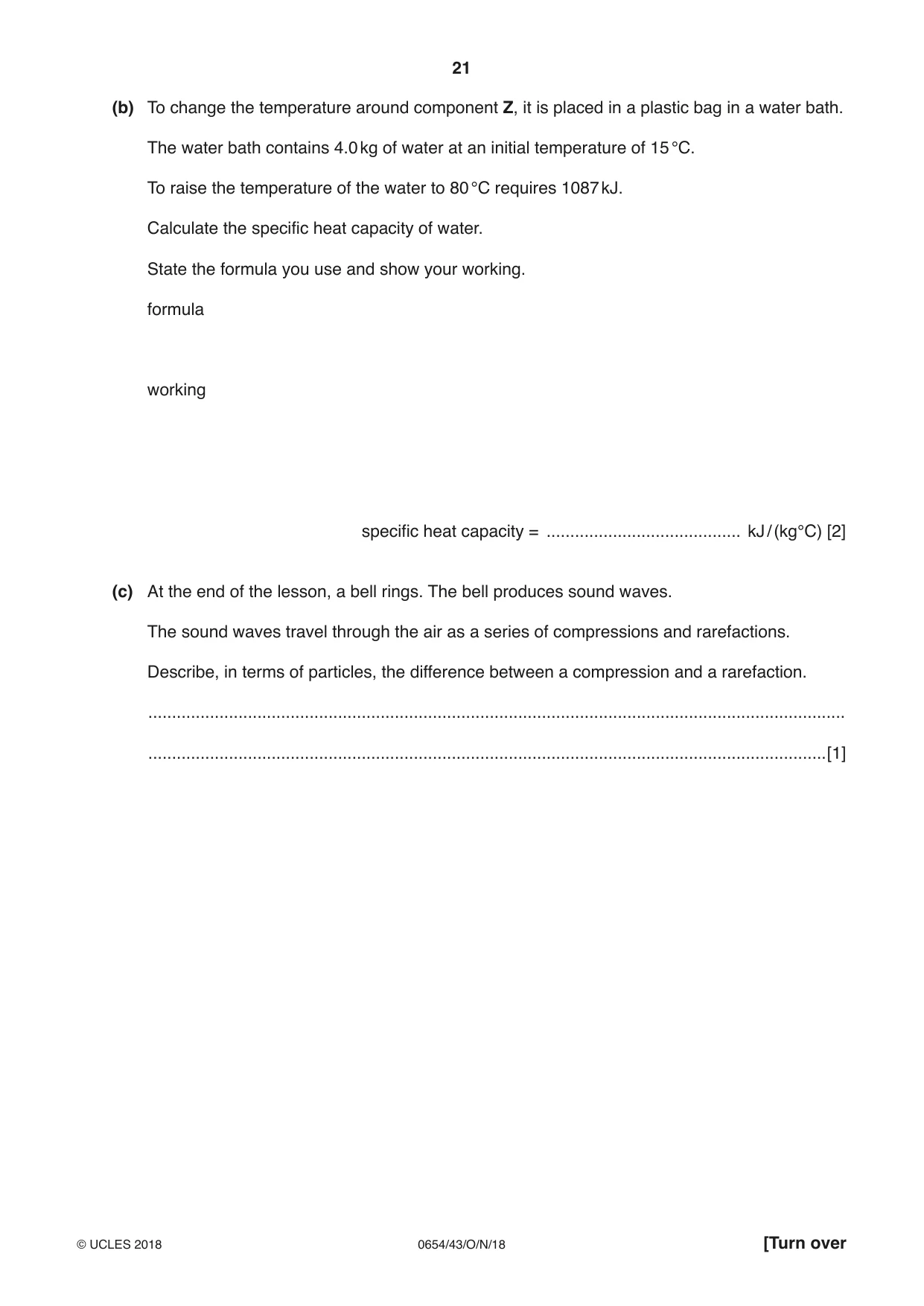
9 (a) In the school science laboratory, a student investigates how the resistance of a circuit component Z changes with temperature. Fig. 9.1 shows his results. 20 18 resistance / ohms 16 14 12 10 8 6 4 2 0 0 20 40 60 80 100 temperature / °C Fig. 9.1 (i) Name component Z. .......................................................................................................................................[1] (ii) State the resistance of component Z at 20 °C. ....................................................... Ω [1] (iii) Calculate the current passing through component Z at 20 °C when a 6 V supply is connected across it. State the formula you use and show your working. formula working current = ....................................................... A [2] (b) To change the temperature around component Z, it is placed in a plastic bag in a water bath. The water bath contains 4.0 kg of water at an initial temperature of 15 °C. To raise the temperature of the water to 80 °C requires 1087 kJ. Calculate the specific heat capacity of water. State the formula you use and show your working. formula working specific heat capacity = ......................................... kJ / (kg°C) [2] (c) At the end of the lesson, a bell rings. The bell produces sound waves. The sound waves travel through the air as a series of compressions and rarefactions. Describe, in terms of particles, the difference between a compression and a rarefaction. ................................................................................................................................................... ...............................................................................................................................................[1]
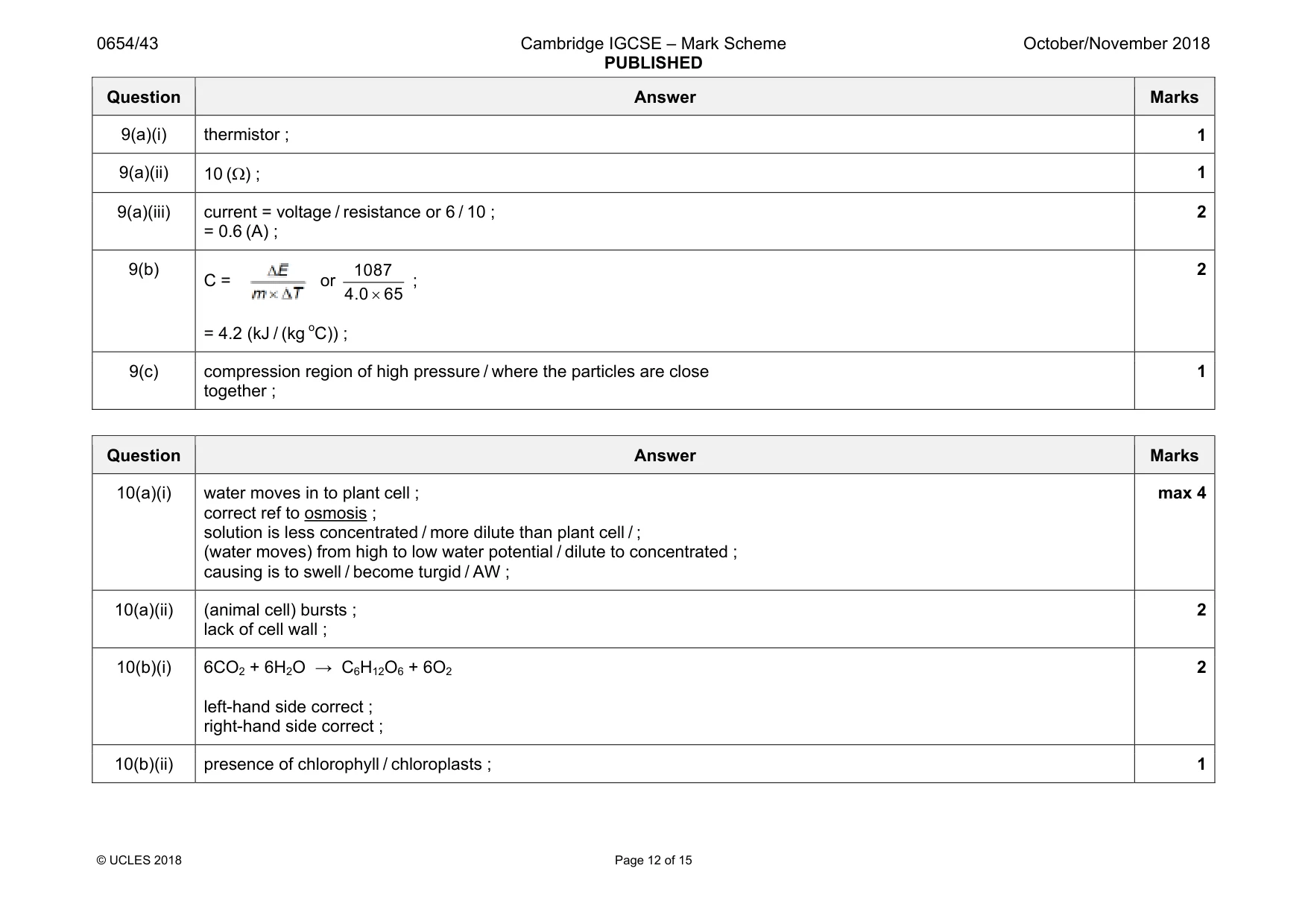
Mark scheme: 9(a)(i) thermistor ; 1 9(a)(ii) 10 (Ω) ; 1 9(a)(iii) current = voltage / resistance or 6 / 10 ; = 0.6 (A) ; 2 9(b) or 1087 4.0 65 × ; C = = 4.2 (kJ / (kg oC)) ; 2 9(c) compression region of high pressure / where the particles are close together ; 1
Q10 · Two plant cells are placed in different solutions
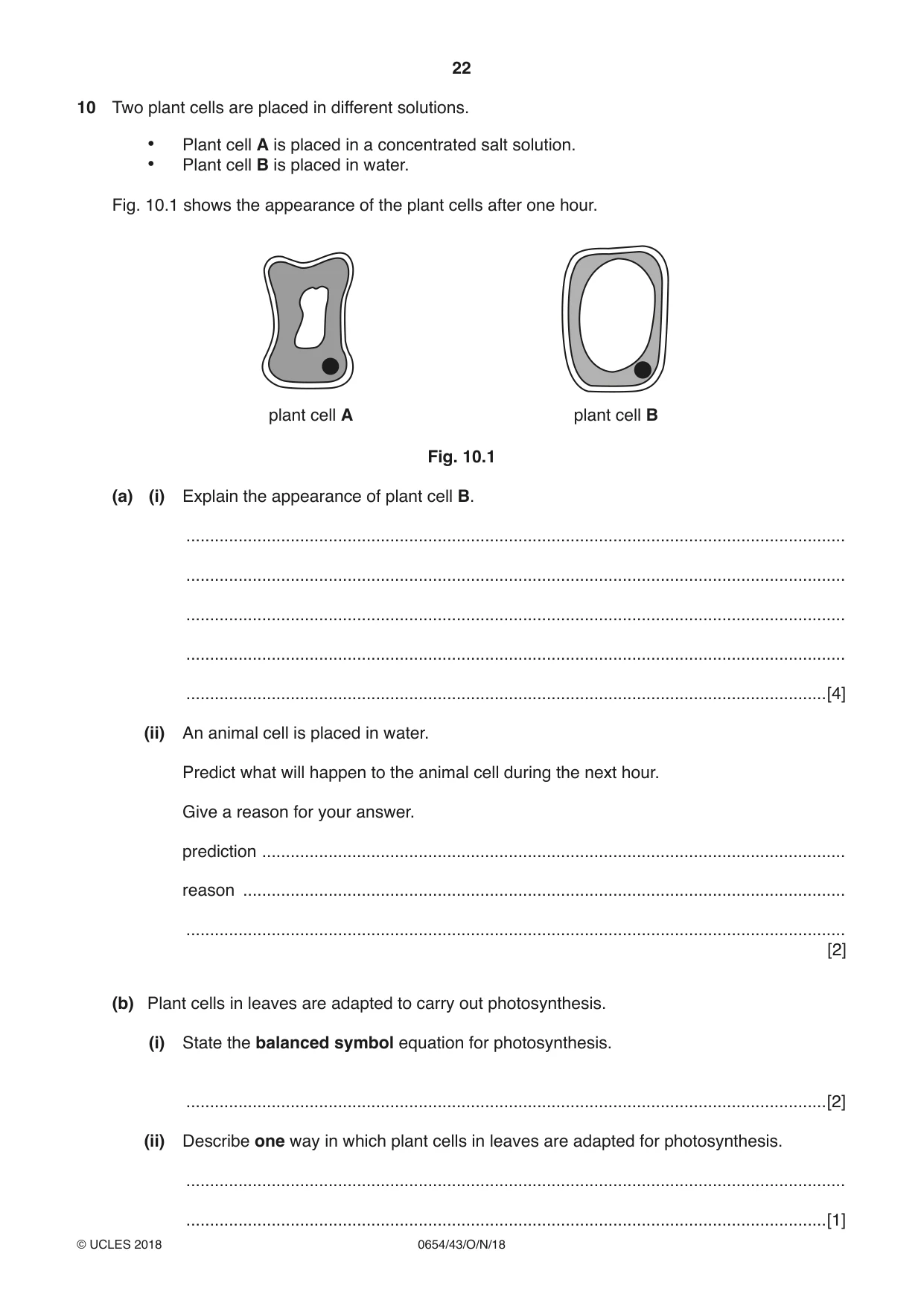
10 Two plant cells are placed in different solutions. • Plant cell A is placed in a concentrated salt solution. • Plant cell B is placed in water. Fig. 10.1 shows the appearance of the plant cells after one hour. plant cell A plant cell B Fig. 10.1 (a) (i) Explain the appearance of plant cell B. ........................................................................................................................................... ........................................................................................................................................... ........................................................................................................................................... ........................................................................................................................................... .......................................................................................................................................[4] (ii) An animal cell is placed in water. Predict what will happen to the animal cell during the next hour. Give a reason for your answer. prediction ........................................................................................................................... reason ............................................................................................................................... ........................................................................................................................................... [2] (b) Plant cells in leaves are adapted to carry out photosynthesis. (i) State the balanced symbol equation for photosynthesis. .......................................................................................................................................[2] (ii) Describe one way in which plant cells in leaves are adapted for photosynthesis. ........................................................................................................................................... .......................................................................................................................................[1]
Mark scheme: 10(a)(i) water moves in to plant cell ; correct ref to osmosis ; solution is less concentrated / more dilute than plant cell / ; (water moves) from high to low water potential / dilute to concentrated ; causing is to swell / become turgid / AW ; max 4 10(a)(ii) (animal cell) bursts ; lack of cell wall ; 2 10(b)(i) 6CO2 + 6H2O → C6H12O6 + 6O2 left-hand side correct ; right-hand side correct ; 2 10(b)(ii) presence of chlorophyll / chloroplasts ; 1
Q11 · Ethene, C2H4, has the smallest molecules in the homologous series of alkenes
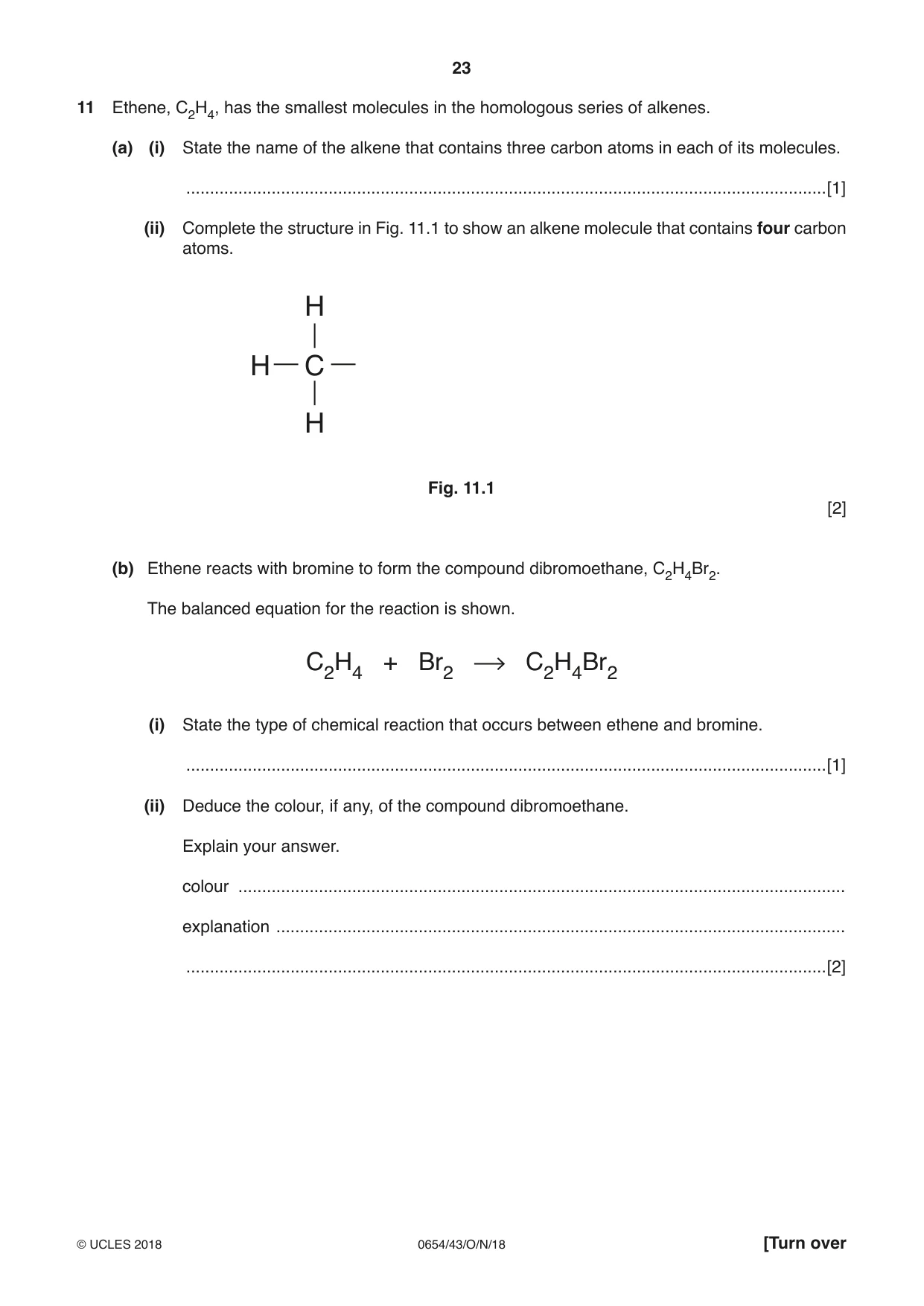
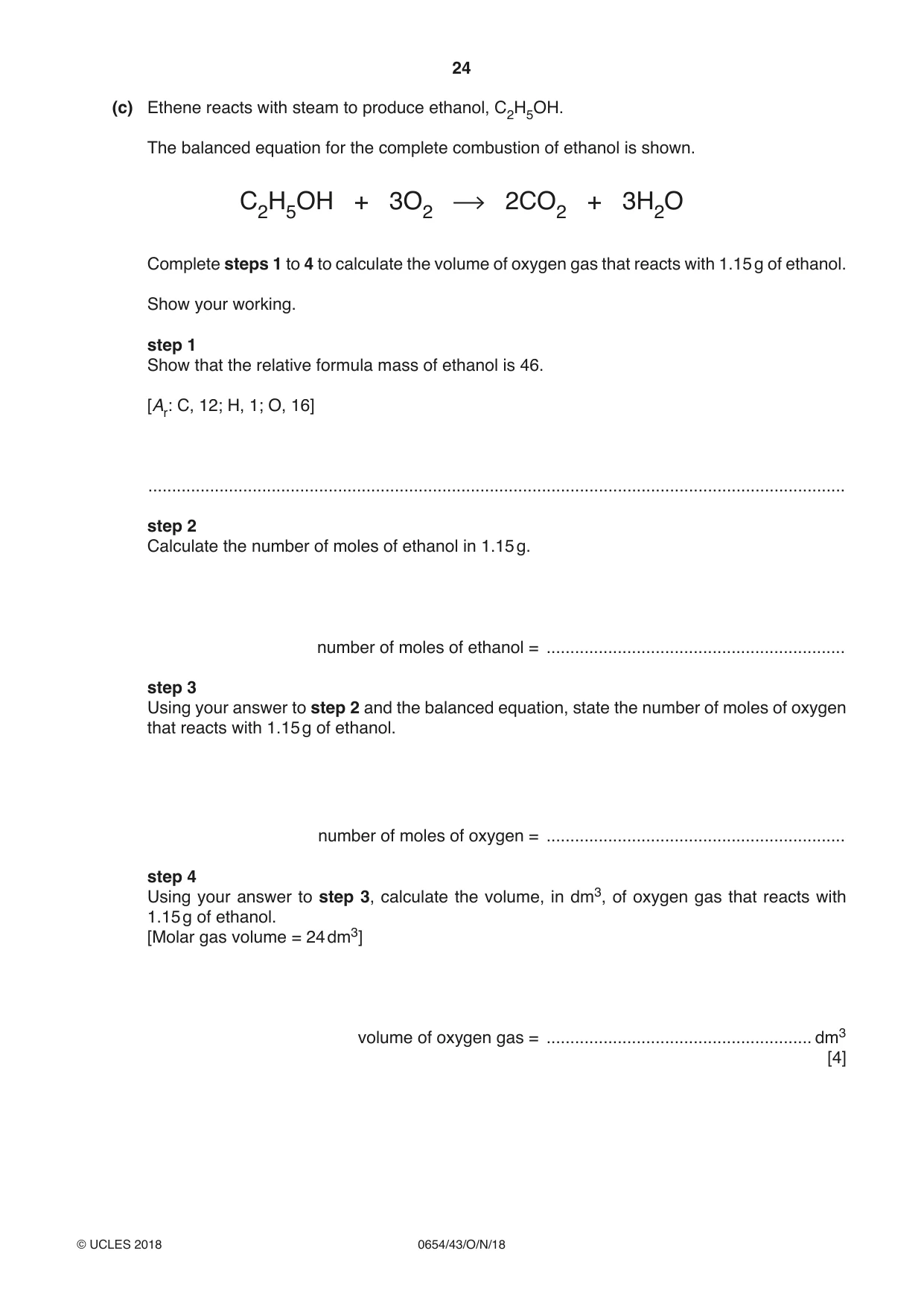
11 Ethene, C2H4, has the smallest molecules in the homologous series of alkenes. (a) (i) State the name of the alkene that contains three carbon atoms in each of its molecules. .......................................................................................................................................[1] (ii) Complete the structure in Fig. 11.1 to show an alkene molecule that contains four carbon atoms. H H C H Fig. 11.1 [2] (b) Ethene reacts with bromine to form the compound dibromoethane, C2H4Br2. The balanced equation for the reaction is shown. C2H4 + Br2 C2H4Br2 (i) State the type of chemical reaction that occurs between ethene and bromine. .......................................................................................................................................[1] (ii) Deduce the colour, if any, of the compound dibromoethane. Explain your answer. colour ................................................................................................................................ explanation ........................................................................................................................ .......................................................................................................................................[2] (c) Ethene reacts with steam to produce ethanol, C2H5OH. The balanced equation for the complete combustion of ethanol is shown. C2H5OH + 3O2 2CO2 + 3H2O Complete steps 1 to 4 to calculate the volume of oxygen gas that reacts with 1.15 g of ethanol. Show your working. step 1 Show that the relative formula mass of ethanol is 46. [Ar: C, 12; H, 1; O, 16] ................................................................................................................................................... step 2 Calculate the number of moles of ethanol in 1.15 g. number of moles of ethanol = ............................................................... step 3 Using your answer to step 2 and the balanced equation, state the number of moles of oxygen that reacts with 1.15 g of ethanol. number of moles of oxygen = ............................................................... step 4 Using your answer to step 3, calculate the volume, in dm3, of oxygen gas that reacts with 1.15 g of ethanol. [Molar gas volume = 24 dm3] volume of oxygen gas = ........................................................ dm3 [4]
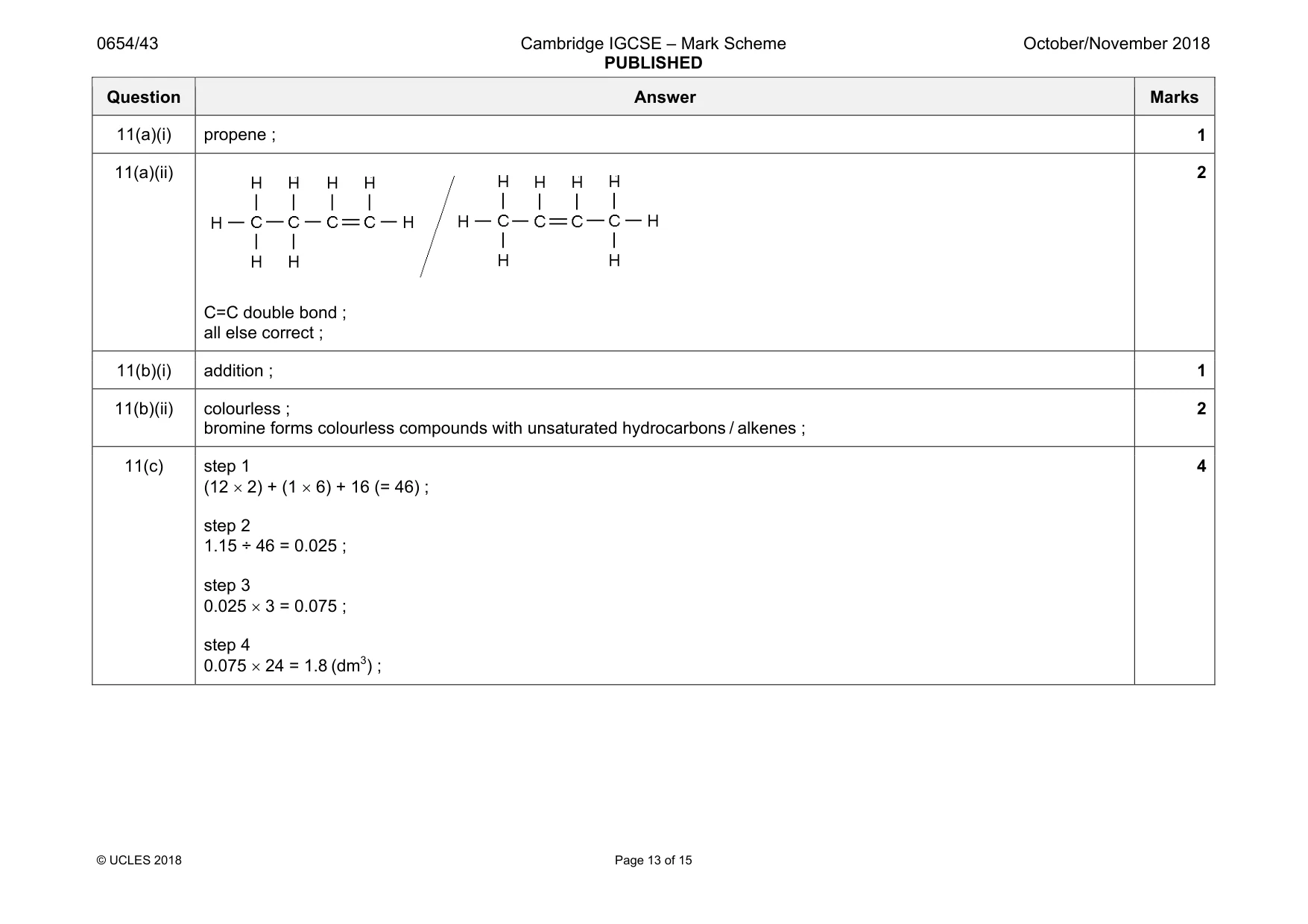
Mark scheme: 11(a)(i) propene ; 1 11(a)(ii) C=C double bond ; all else correct ; 2 11(b)(i) addition ; 1 11(b)(ii) colourless ; bromine forms colourless compounds with unsaturated hydrocarbons / alkenes ; 2 11(c) step 1 (12 × 2) + (1 × 6) + 16 (= 46) ; step 2 1.15 ÷ 46 = 0.025 ; step 3 0.025 × 3 = 0.075 ; step 4 0.075 × 24 = 1.8 (dm3) ; 4
Q12 · The body of a car is usually made from steel
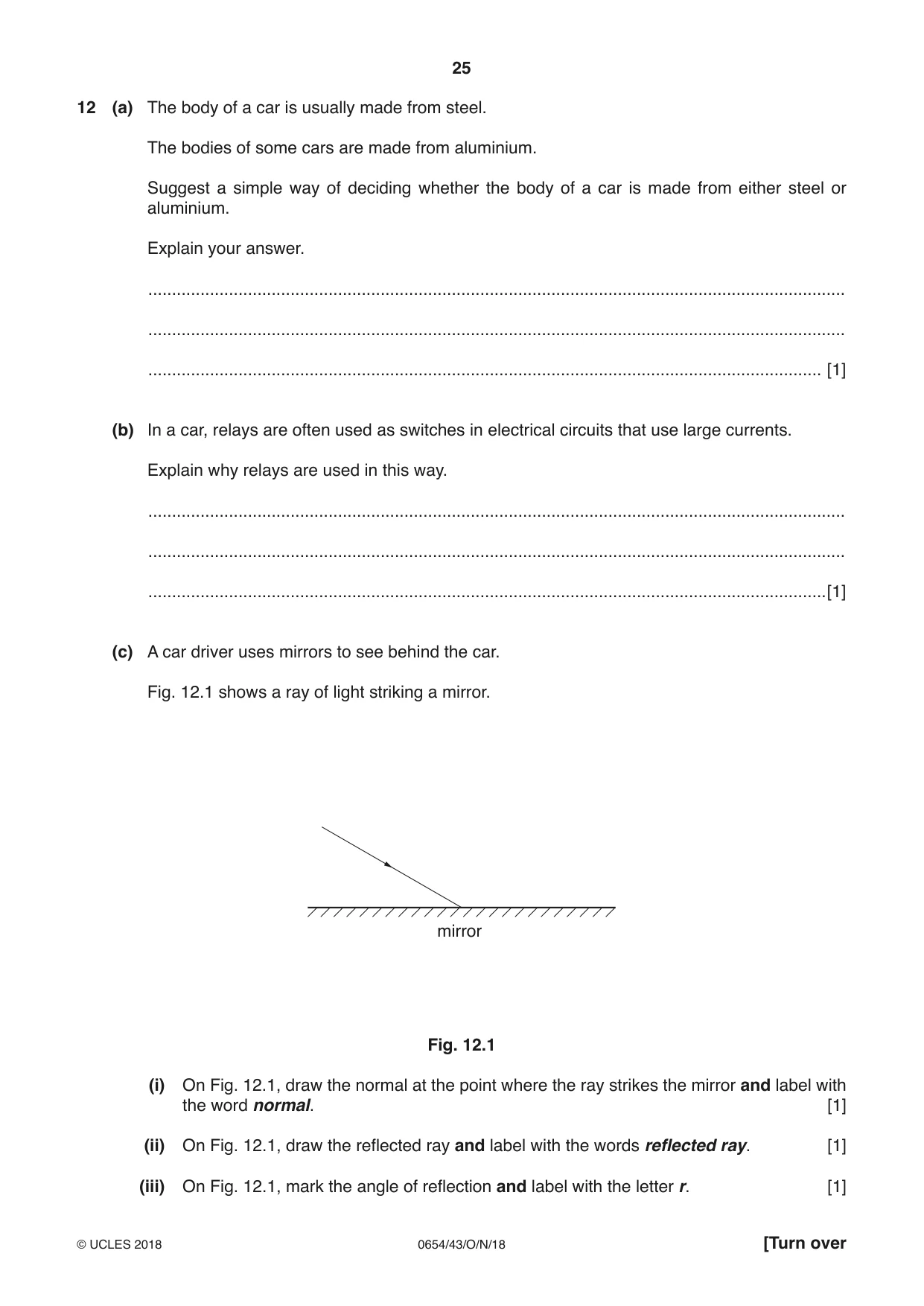
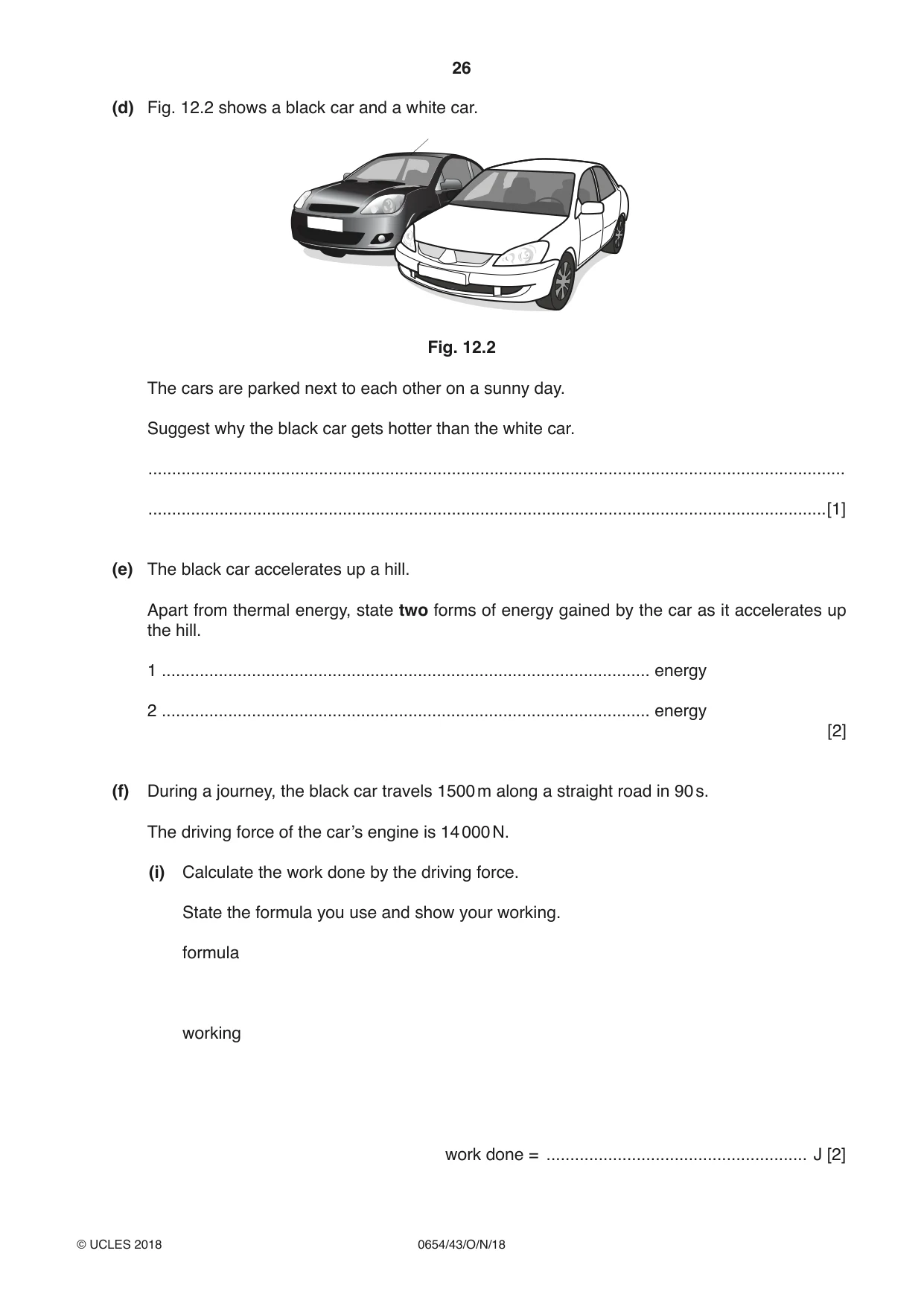
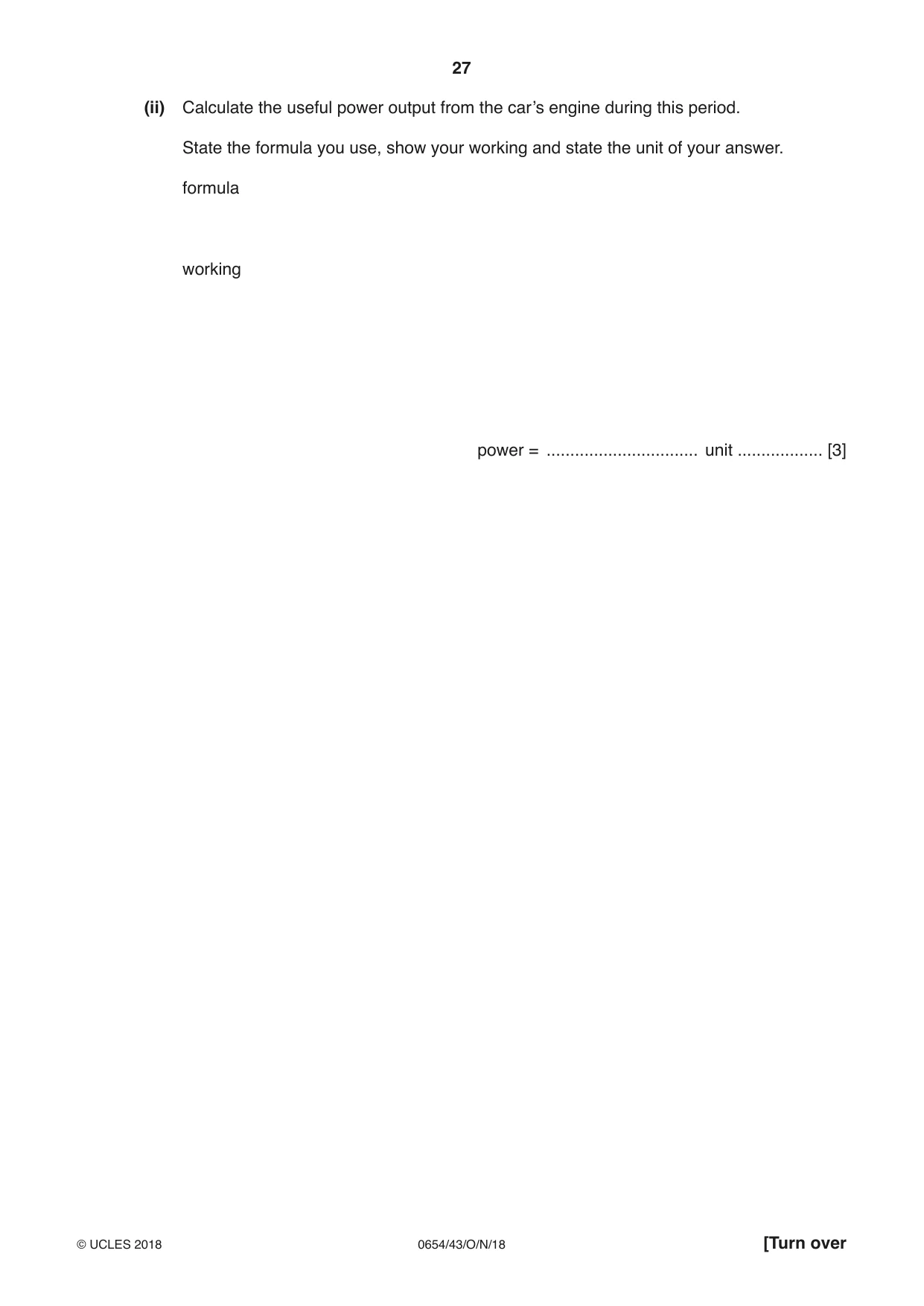
12 (a) The body of a car is usually made from steel. The bodies of some cars are made from aluminium. Suggest a simple way of deciding whether the body of a car is made from either steel or aluminium. Explain your answer. ................................................................................................................................................... ................................................................................................................................................... .............................................................................................................................................. [1] (b) In a car, relays are often used as switches in electrical circuits that use large currents. Explain why relays are used in this way. ................................................................................................................................................... ................................................................................................................................................... ...............................................................................................................................................[1] (c) A car driver uses mirrors to see behind the car. Fig. 12.1 shows a ray of light striking a mirror. mirror Fig. 12.1 (i) On Fig. 12.1, draw the normal at the point where the ray strikes the mirror and label with the word normal. [1] (ii) On Fig. 12.1, draw the reflected ray and label with the words reflected ray. [1] (iii) On Fig. 12.1, mark the angle of reflection and label with the letter r. [1] (d) Fig. 12.2 shows a black car and a white car. Fig. 12.2 The cars are parked next to each other on a sunny day. Suggest why the black car gets hotter than the white car. ................................................................................................................................................... ...............................................................................................................................................[1] (e) The black car accelerates up a hill. Apart from thermal energy, state two forms of energy gained by the car as it accelerates up the hill. 1 ....................................................................................................... energy 2 ....................................................................................................... energy [2] (f) During a journey, the black car travels 1500 m along a straight road in 90 s. The driving force of the car’s engine is 14 000 N. (i) Calculate the work done by the driving force. State the formula you use and show your working. formula working work done = ....................................................... J [2] (ii) Calculate the useful power output from the car’s engine during this period. State the formula you use, show your working and state the unit of your answer. formula working power = ................................ unit .................. [3]
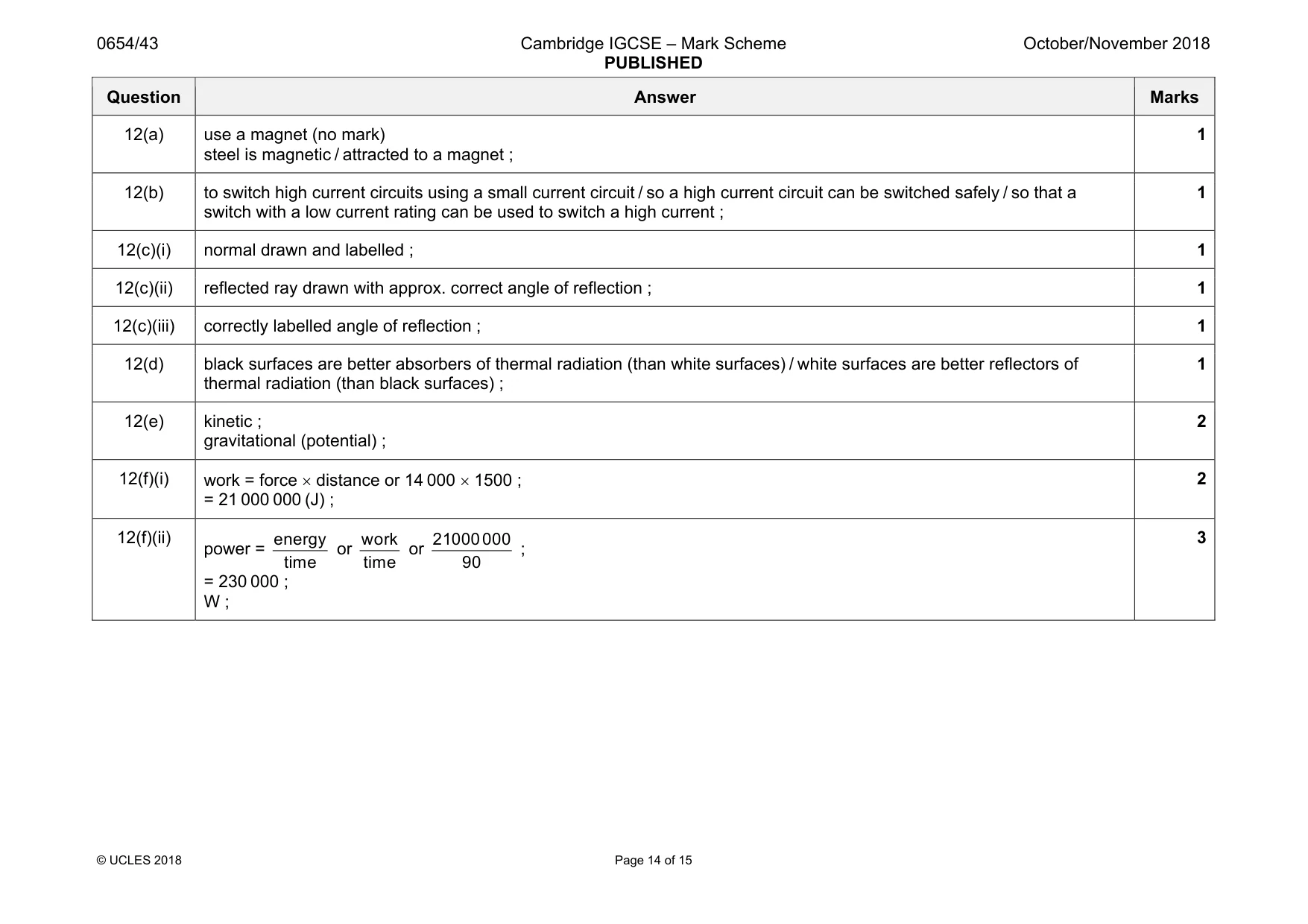
Mark scheme: 12(a) use a magnet (no mark) steel is magnetic / attracted to a magnet ; 1 12(b) to switch high current circuits using a small current circuit / so a high current circuit can be switched safely / so that a switch with a low current rating can be used to switch a high current ; 1 12(c)(i) normal drawn and labelled ; 1 12(c)(ii) reflected ray drawn with approx. correct angle of reflection ; 1 12(c)(iii) correctly labelled angle of reflection ; 1 12(d) black surfaces are better absorbers of thermal radiation (than white surfaces) / white surfaces are better reflectors of thermal radiation (than black surfaces) ; 1 12(e) kinetic ; gravitational (potential) ; 2 12(f)(i) work = force × distance or 14 000 × 1500 ; = 21 000 000 (J) ; 2 12(f)(ii) power = energy time or work time or 21000000 90 ; = 230 000 ; W ; 3
Q13 · The average global temperature of the Earth’s surface from 1880 to 1980
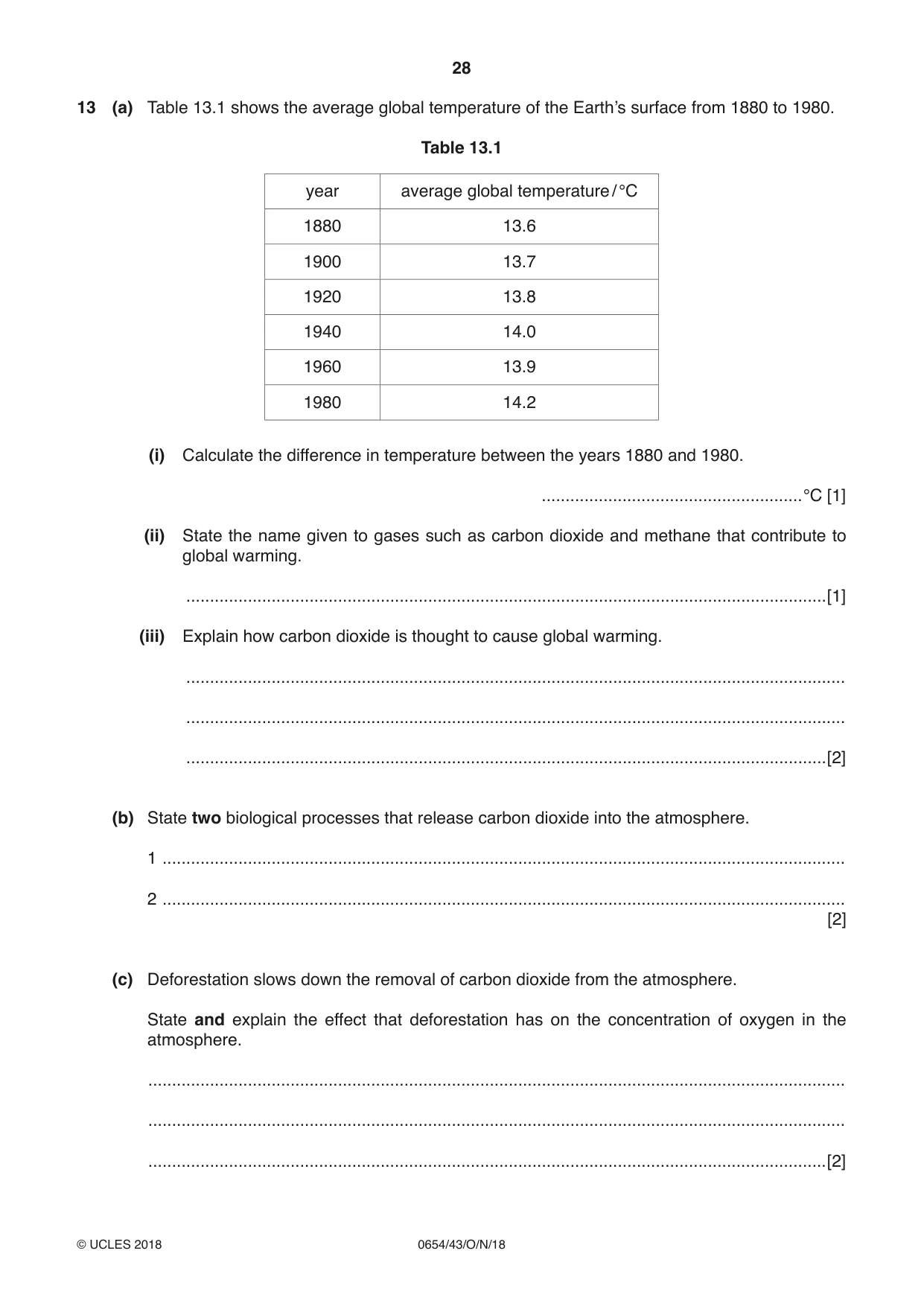
13 (a) Table 13.1 shows the average global temperature of the Earth’s surface from 1880 to 1980. Table 13.1 year average global temperature / °C 1880 13.6 1900 13.7 1920 13.8 1940 14.0 1960 13.9 1980 14.2 (i) Calculate the difference in temperature between the years 1880 and 1980. .......................................................°C [1] (ii) State the name given to gases such as carbon dioxide and methane that contribute to global warming. .......................................................................................................................................[1] (iii) Explain how carbon dioxide is thought to cause global warming. ........................................................................................................................................... ........................................................................................................................................... .......................................................................................................................................[2] (b) State two biological processes that release carbon dioxide into the atmosphere. 1 ................................................................................................................................................ 2 ................................................................................................................................................ [2] (c) Deforestation slows down the removal of carbon dioxide from the atmosphere. State and explain the effect that deforestation has on the concentration of oxygen in the atmosphere. ................................................................................................................................................... ................................................................................................................................................... ...............................................................................................................................................[2]
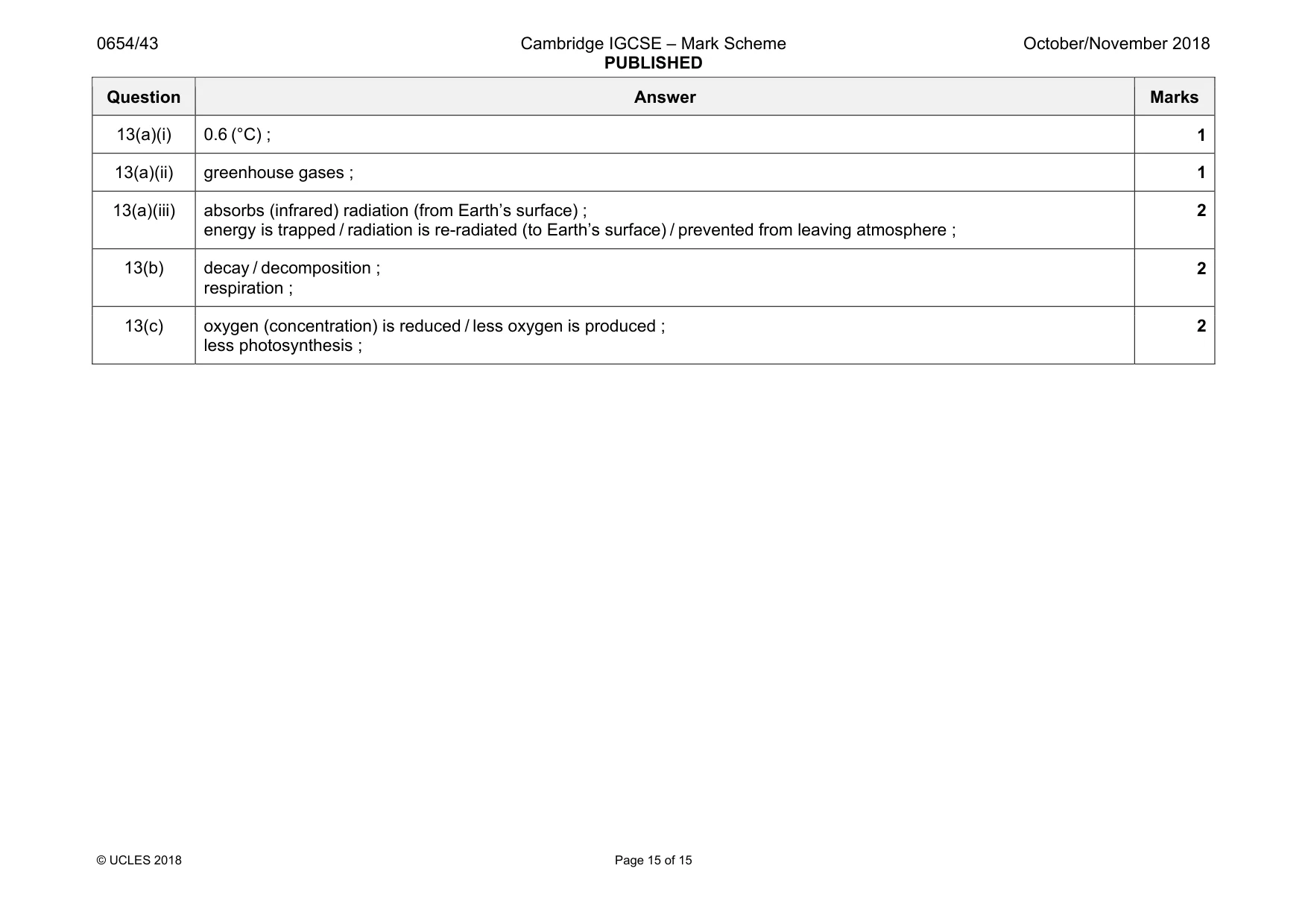
Mark scheme: 13(a)(i) 0.6 (°C) ; 1 13(a)(ii) greenhouse gases ; 1 13(a)(iii) absorbs (infrared) radiation (from Earth’s surface) ; energy is trapped / radiation is re-radiated (to Earth’s surface) / prevented from leaving atmosphere ; 2 13(b) decay / decomposition ; respiration ; 2 13(c) oxygen (concentration) is reduced / less oxygen is produced ; less photosynthesis ; 2
What was in this paper
The subtopics covered by these 13 questions, and how many questions each got. Open one in a new tab to see every Cambridge question on it.
What you needed in this session
Cambridge’s own grade thresholds for 2018 Oct/Nov, Paper 4 · Variant 3. A higher threshold means an easier paper — the bar moves with how the cohort did.