Cambridge IGCSE Sciences - Co-ordinated (Double) 0654 — 2024 May/June Paper 4 · Variant 3
0654/43/M/J/24 · 12 questions · 120 marks · ≈135 min
The question paper and its mark scheme, free to read here and free to download. This is Cambridge’s own paper, exactly as it was sat.
Question paper28 pages


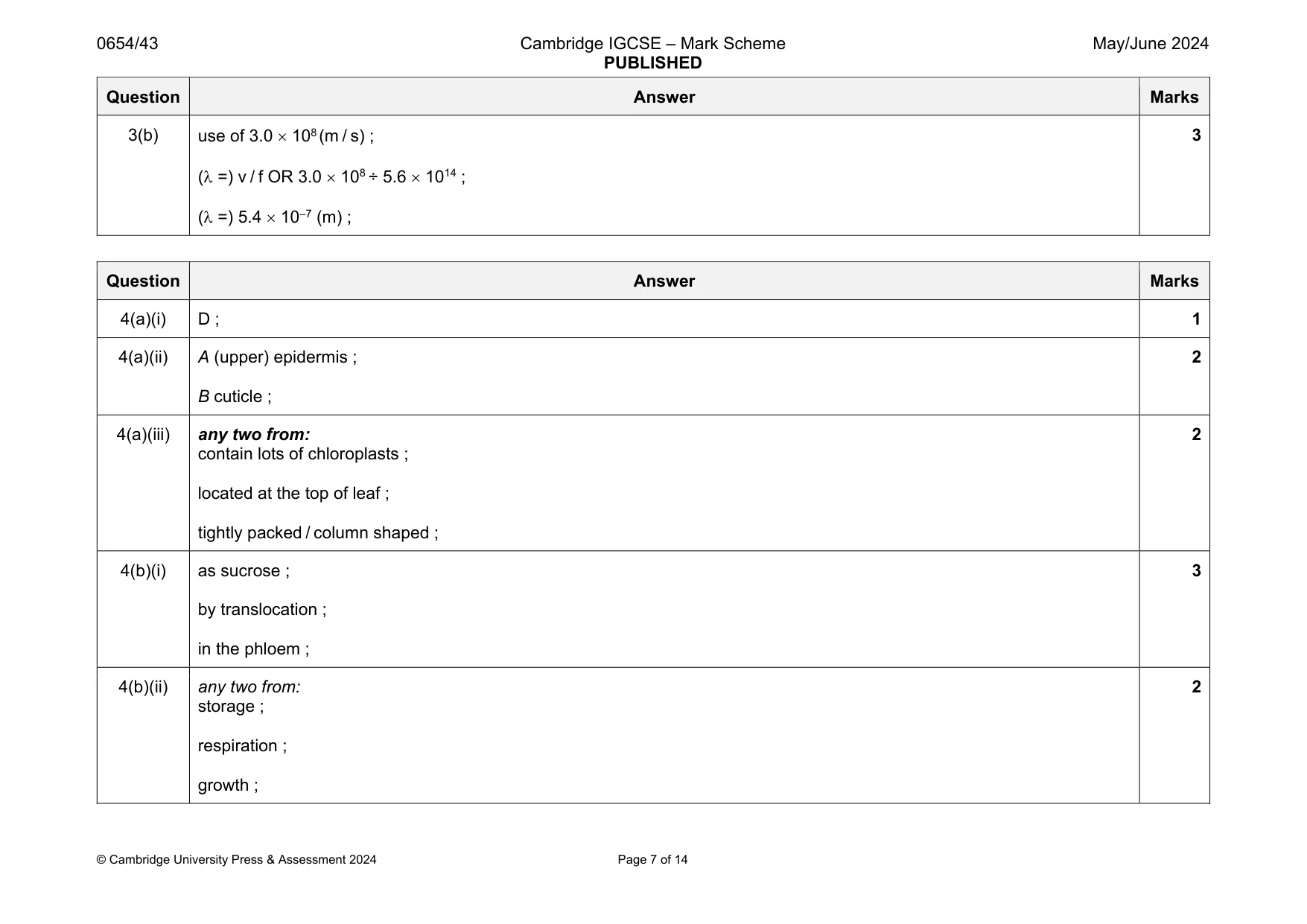
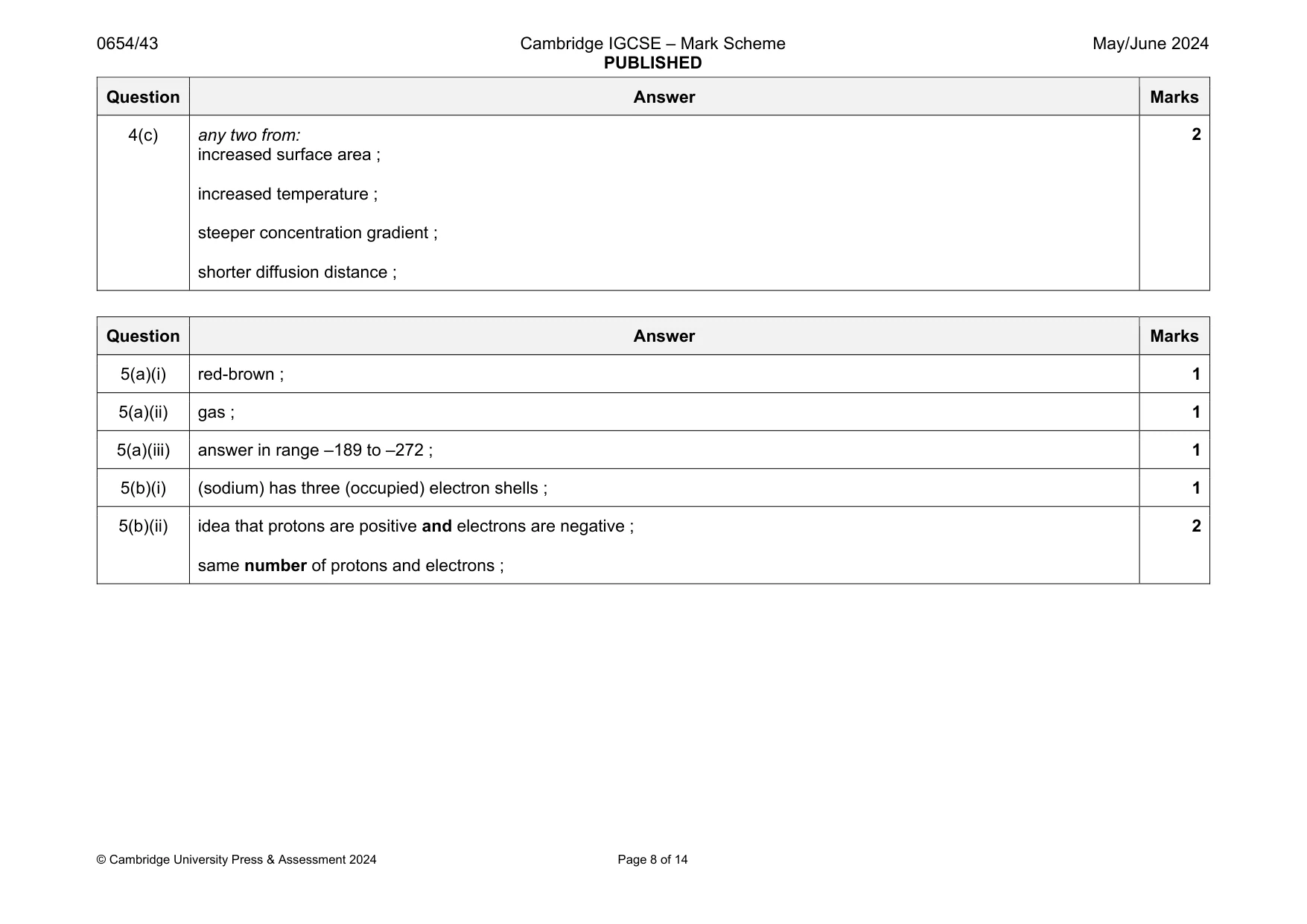
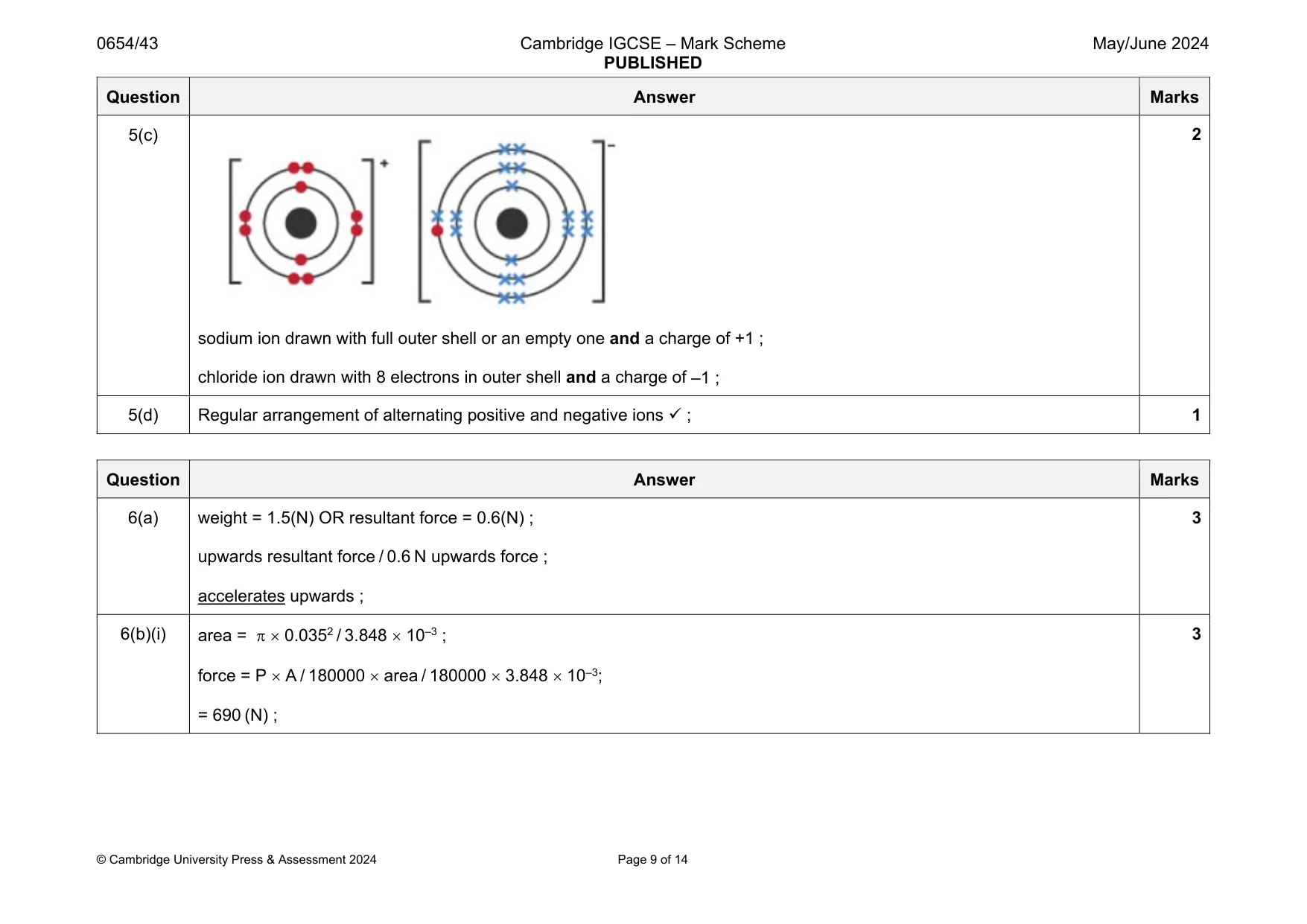
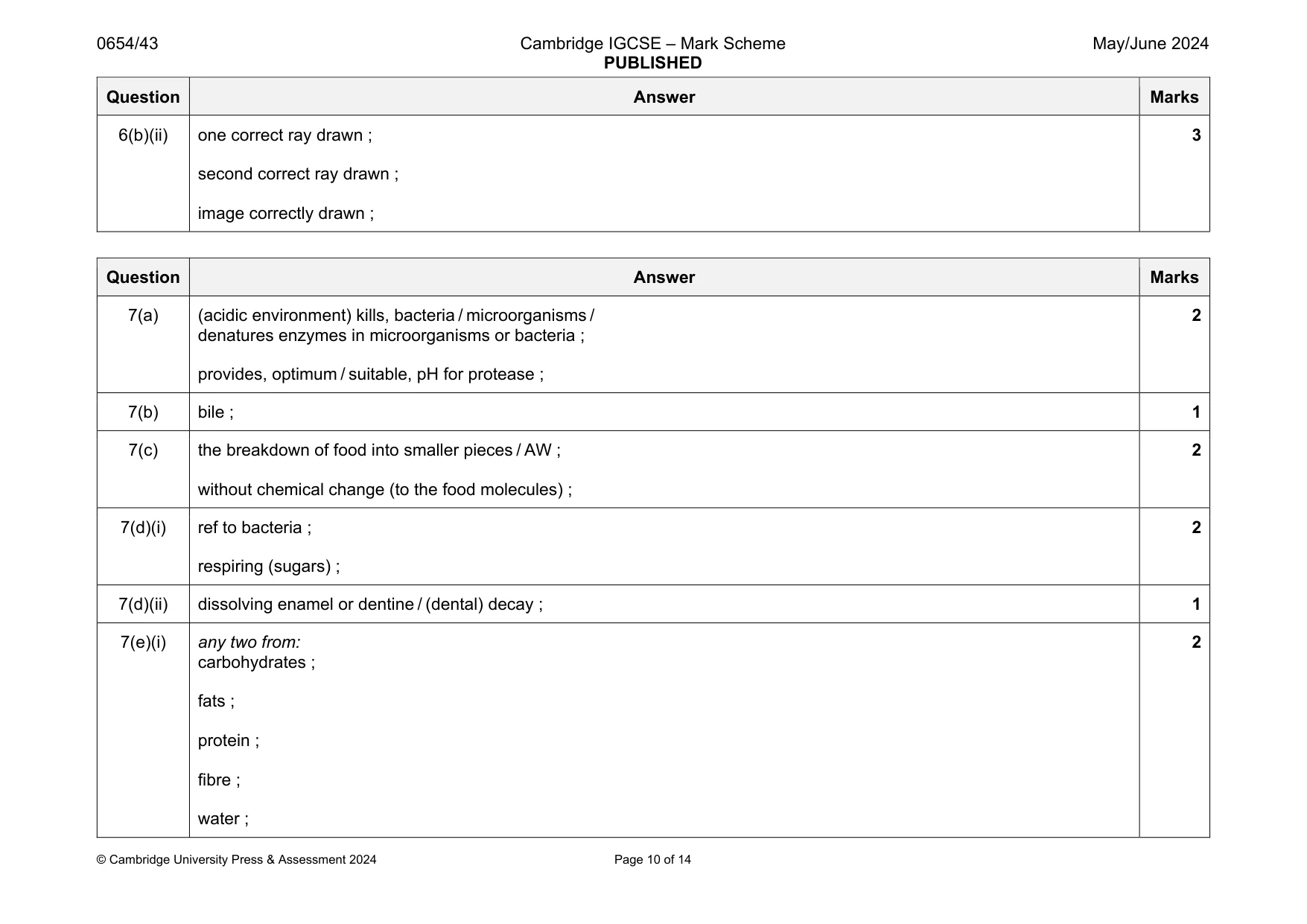
Mark scheme14 pages
Answers below. Sit the paper first if you are practising.
Questions as text
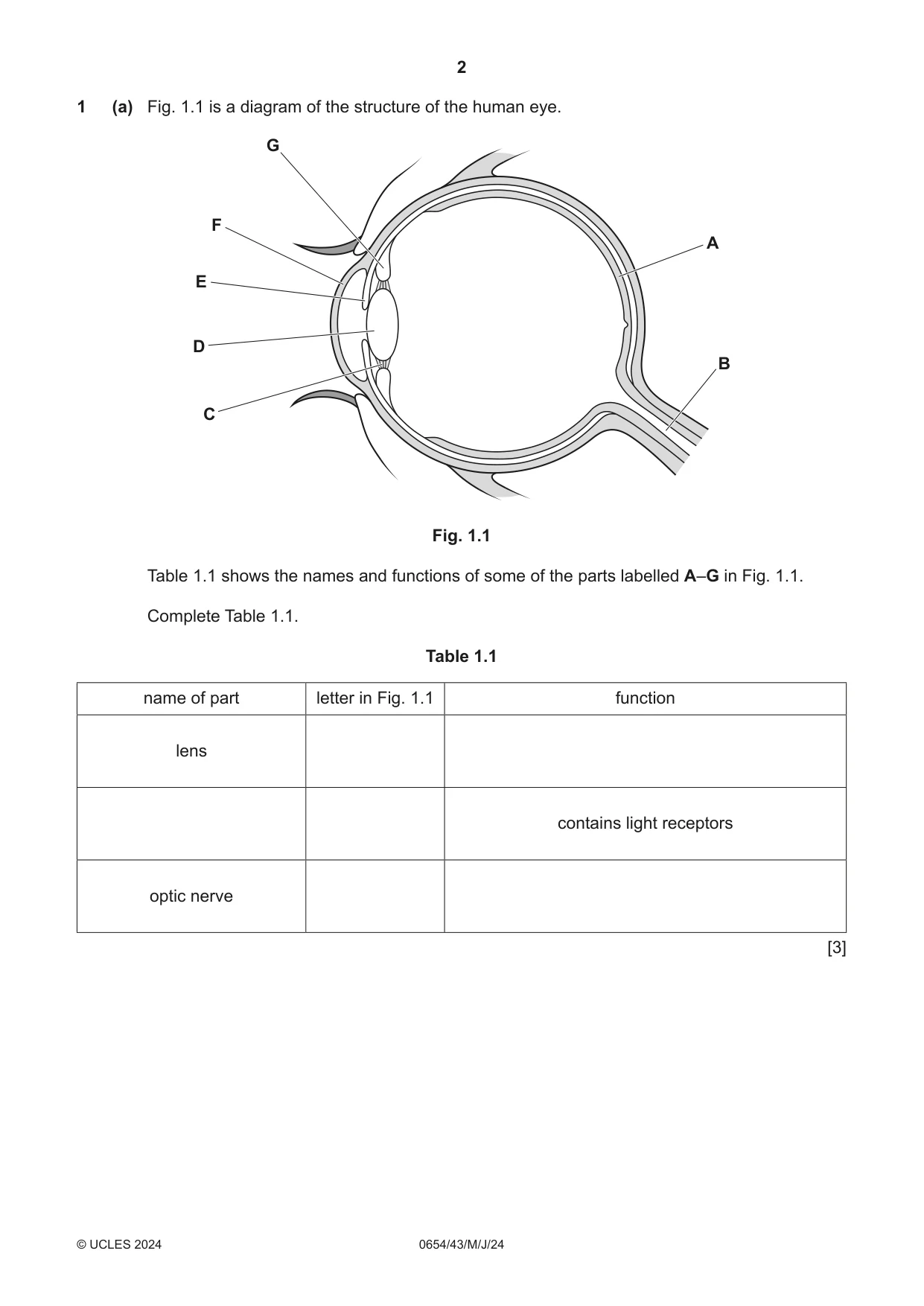
Q1 · A diagram of the structure of the human eye
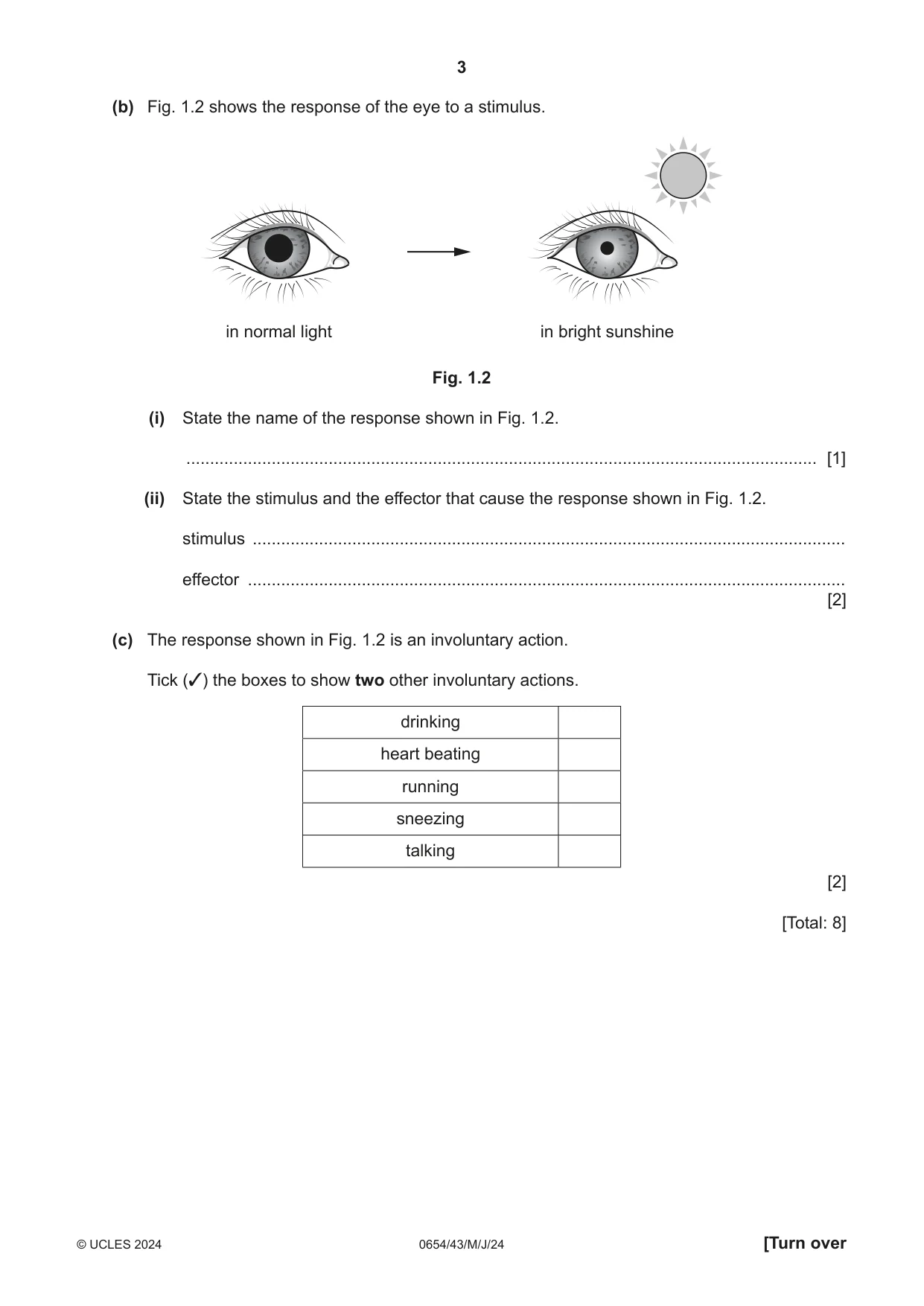
1 (a) Fig. 1.1 is a diagram of the structure of the human eye. G F A E D B C Fig. 1.1 Table 1.1 shows the names and functions of some of the parts labelled A–G in Fig. 1.1. Complete Table 1.1. Table 1.1 name of part letter in Fig. 1.1 function lens contains light receptors optic nerve [3] (b) Fig. 1.2 shows the response of the eye to a stimulus. in normal light in bright sunshine Fig. 1.2 (i) State the name of the response shown in Fig. 1.2. ..................................................................................................................................... [1] (ii) State the stimulus and the effector that cause the response shown in Fig. 1.2. stimulus ............................................................................................................................. effector .............................................................................................................................. [2] (c) The response shown in Fig. 1.2 is an involuntary action. Tick (✓) the boxes to show two other involuntary actions. drinking heart beating running sneezing talking [2] [Total: 8]
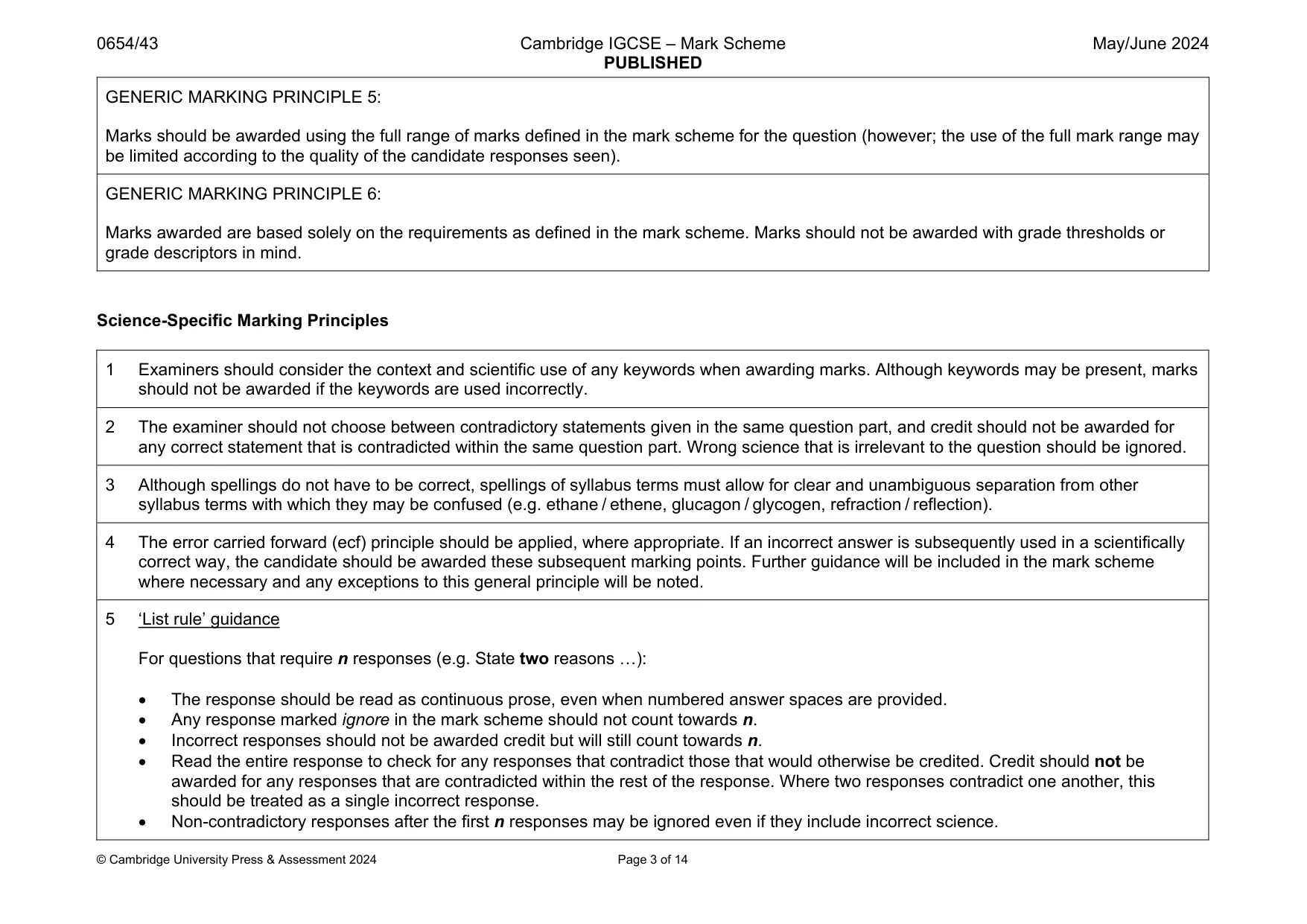
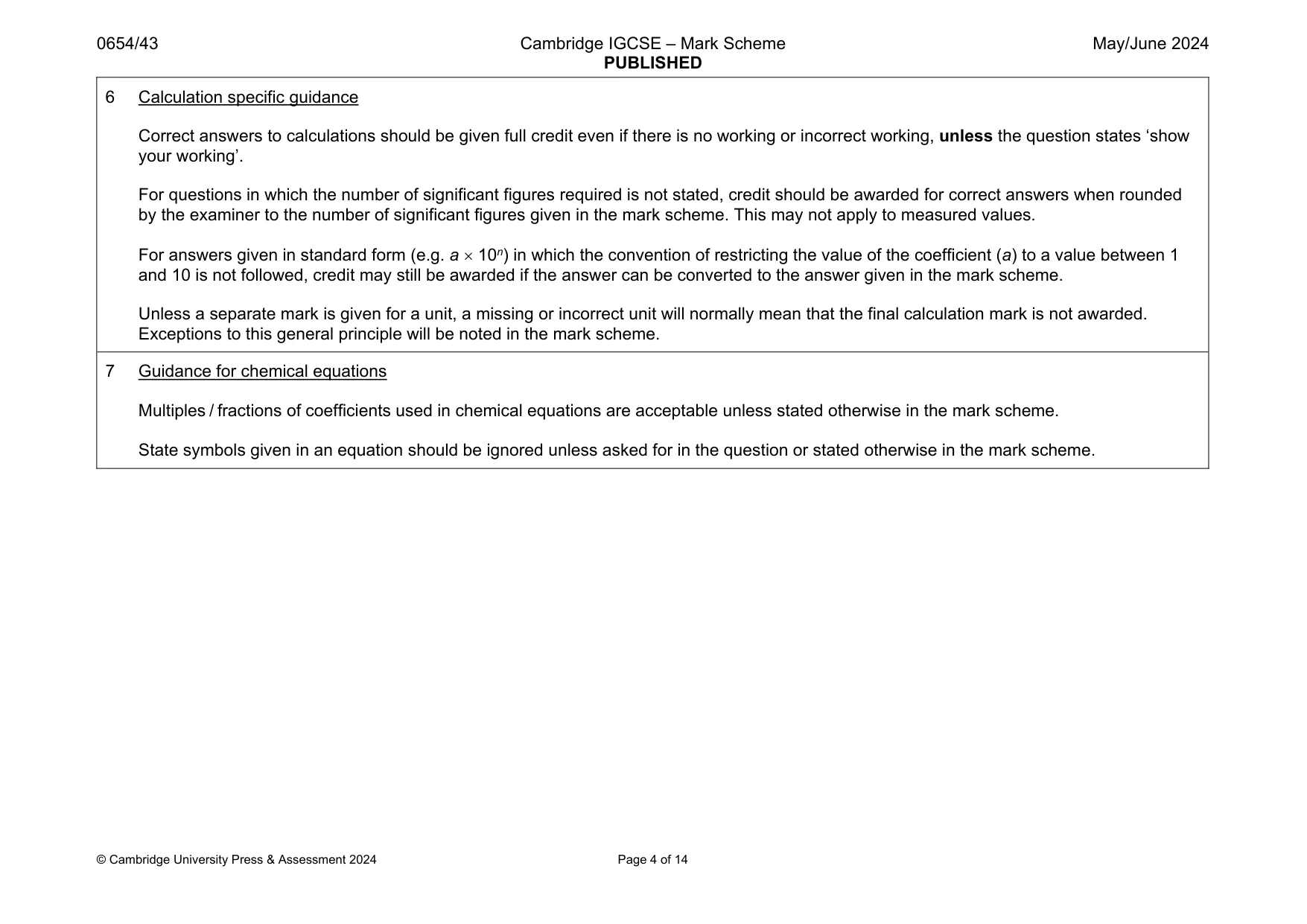
Mark scheme: 1(a) name of part letter in Fig. 1.1 function lens D focuses light retina A contains light receptors optic nerve B carries impulses (to brain) ;;; 3 1(b)(i) pupil reflex ; 1 1(b)(ii) stimulus (change in) light (intensity) ; effector circular muscles ; 2 1(c) drinking heart beating running sneezing talking ;; 2
Q2 · Petroleum is a mixture of hydrocarbons
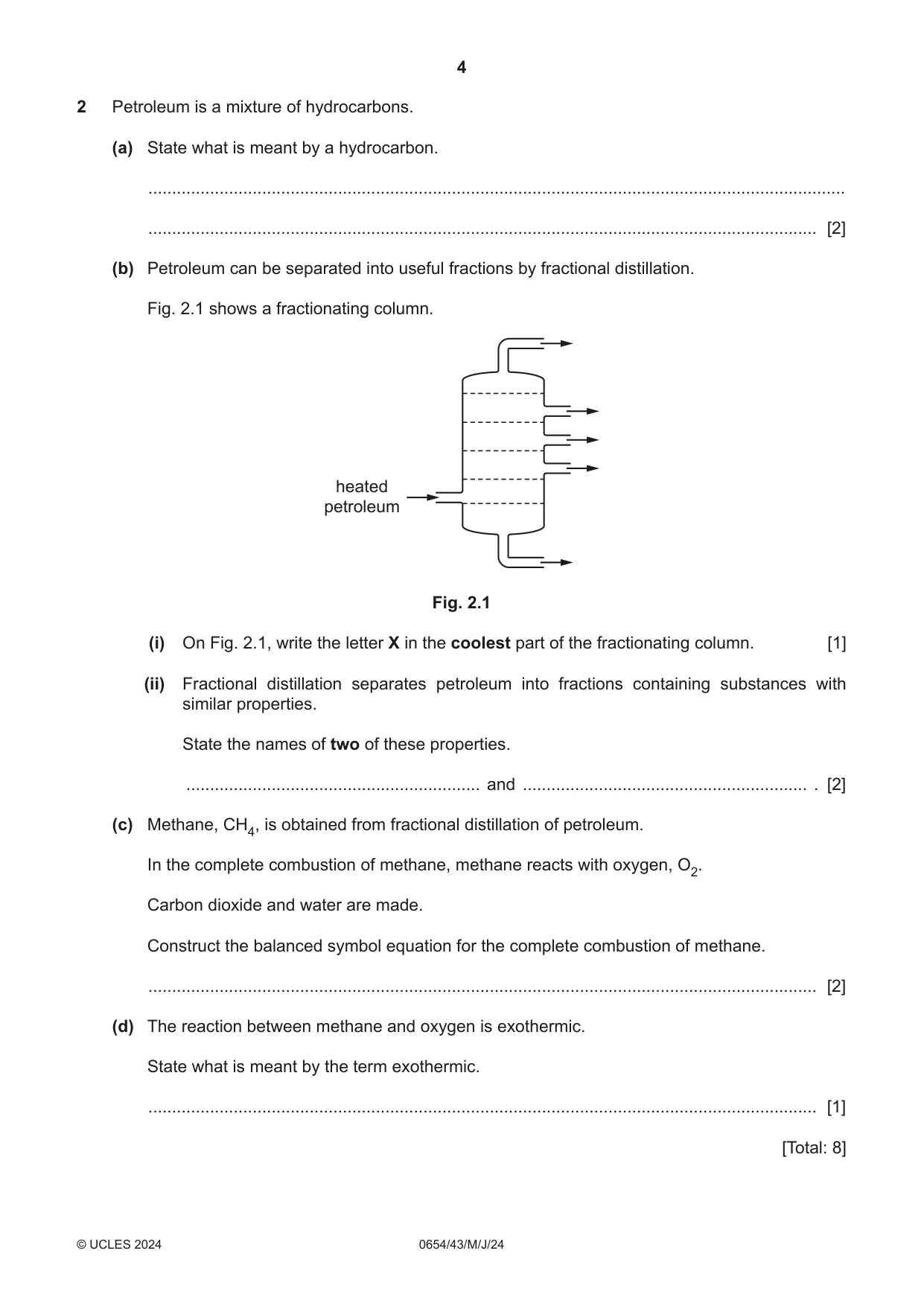
2 Petroleum is a mixture of hydrocarbons. (a) State what is meant by a hydrocarbon. ................................................................................................................................................... ............................................................................................................................................. [2] (b) Petroleum can be separated into useful fractions by fractional distillation. Fig. 2.1 shows a fractionating column. heated petroleum Fig. 2.1 (i) On Fig. 2.1, write the letter X in the coolest part of the fractionating column. [1] (ii) Fractional distillation separates petroleum into fractions containing substances with similar properties. State the names of two of these properties. .............................................................. and ............................................................ . [2] (c) Methane, CH4, is obtained from fractional distillation of petroleum. In the complete combustion of methane, methane reacts with oxygen, O2. Carbon dioxide and water are made. Construct the balanced symbol equation for the complete combustion of methane. ............................................................................................................................................. [2] (d) The reaction between methane and oxygen is exothermic. State what is meant by the term exothermic. ............................................................................................................................................. [1] [Total: 8]
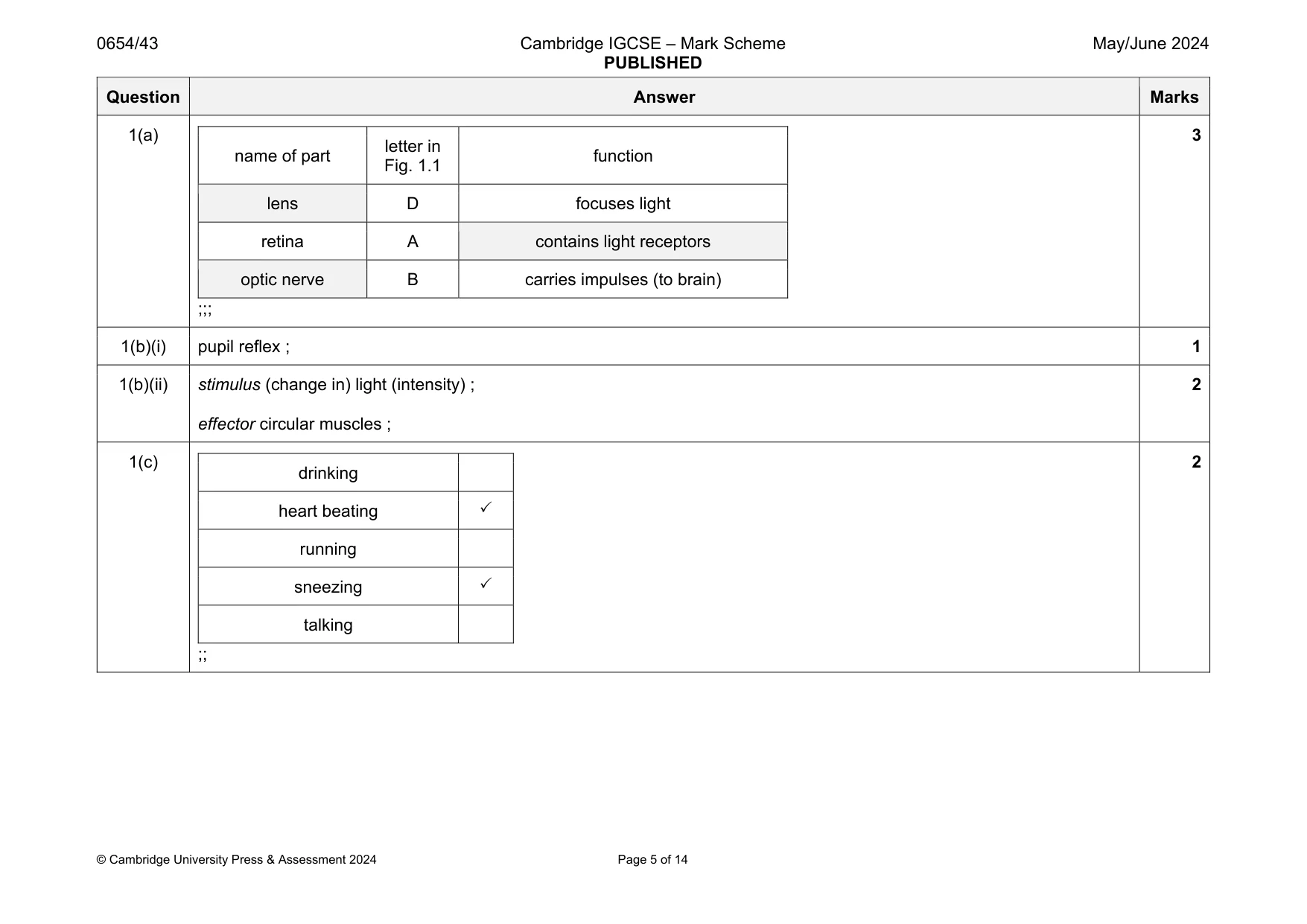
Mark scheme: 2(a) (compound containing) carbon and hydrogen (atoms) ; only ; 2 2(b)(i) X inside the column, either inside the pipe or anywhere above the top dotted line ; e.g. 1 2(b)(ii) Any two from: boiling point / volatility / viscosity / flammability / density ;; 2 2(c) CH4 + 2O2 CO2 + 2H2O ;; 2 2(d) Idea of thermal energy given out ; 1
Q3 · A speed–time graph for a journey made by a car
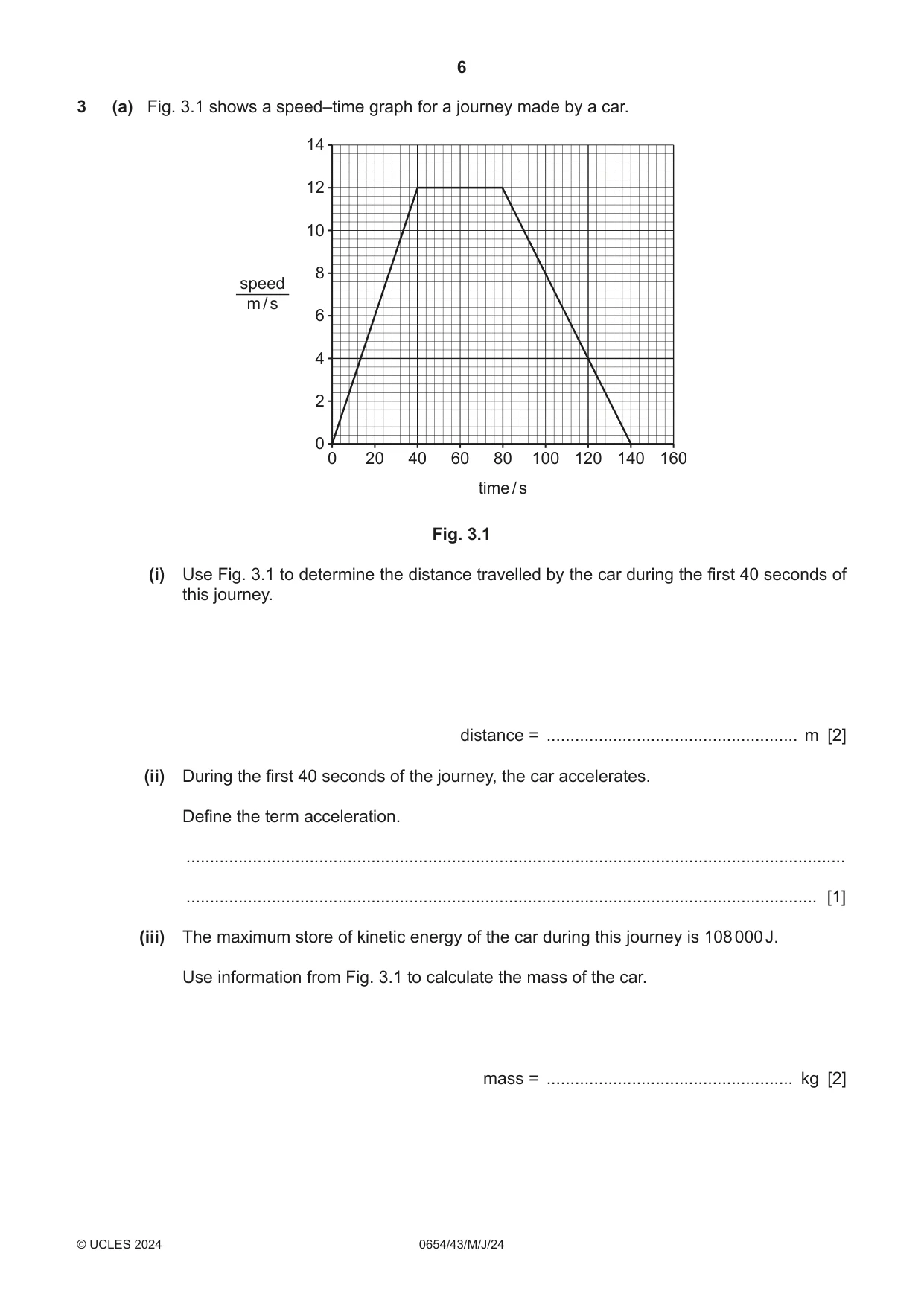
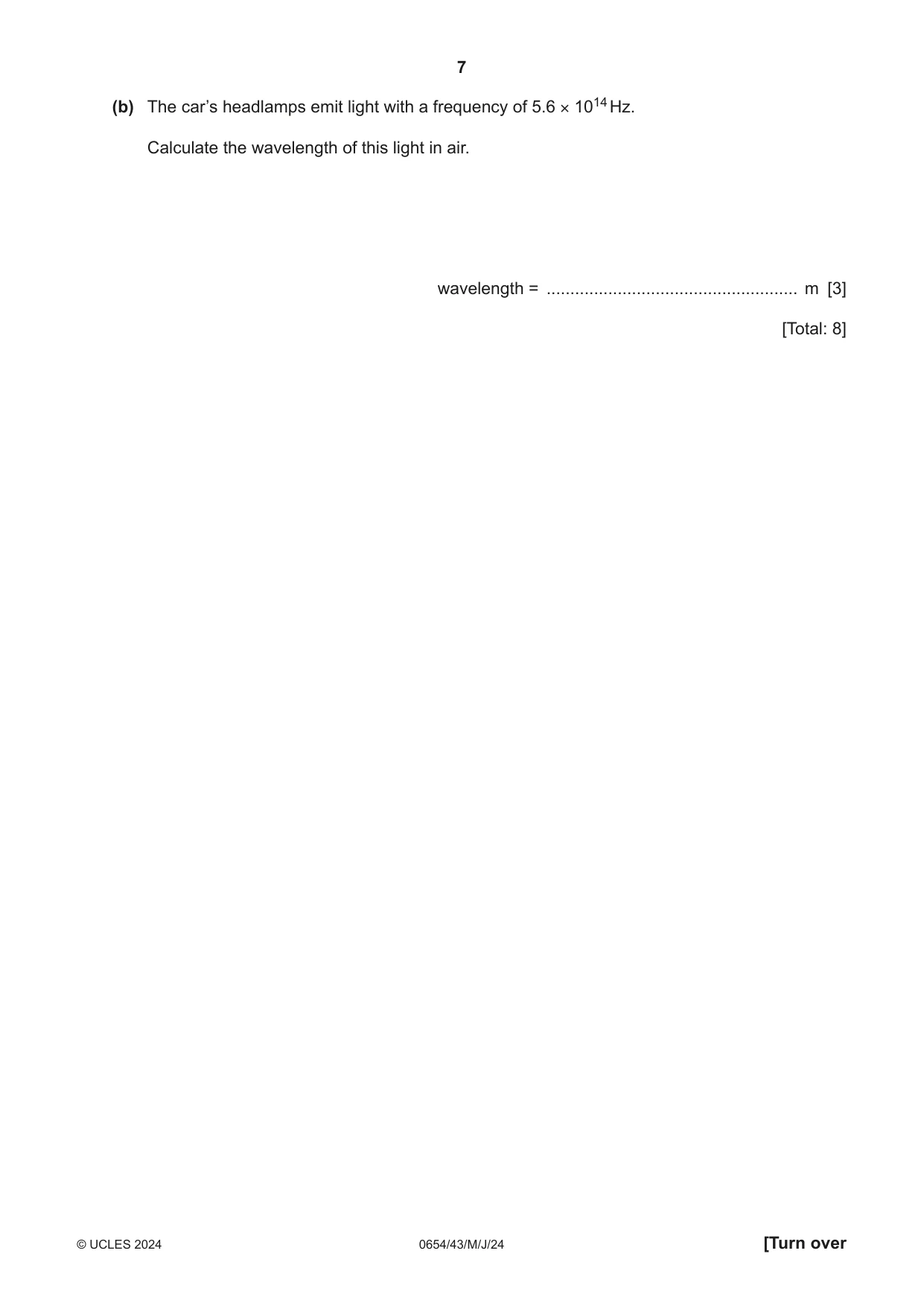
3 (a) Fig. 3.1 shows a speed–time graph for a journey made by a car. 14 12 10 8 speed m / s 6 4 2 0 0 20 40 60 80 100 120 140 160 time / s Fig. 3.1 (i) Use Fig. 3.1 to determine the distance travelled by the car during the first 40 seconds of this journey. distance = ..................................................... m [2] (ii) During the first 40 seconds of the journey, the car accelerates. Define the term acceleration. ........................................................................................................................................... ..................................................................................................................................... [1] (iii) The maximum store of kinetic energy of the car during this journey is 108 000 J. Use information from Fig. 3.1 to calculate the mass of the car. mass = .................................................... kg [2] (b) The car’s headlamps emit light with a frequency of 5.6 × 10¹⁴ Hz. Calculate the wavelength of this light in air. wavelength = ..................................................... m [3] [Total: 8]
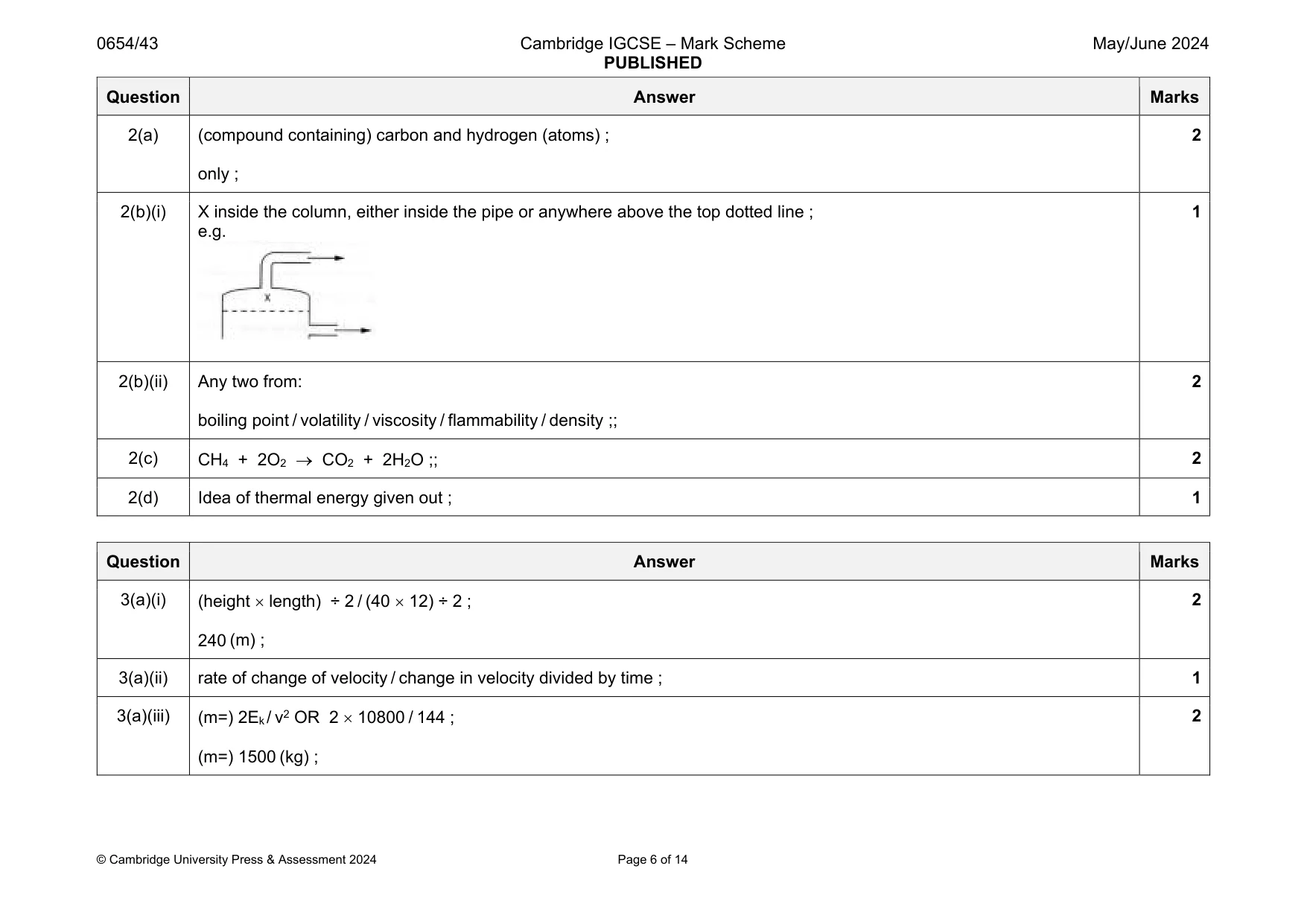
Mark scheme: 3(a)(i) 240 (m) ; 2 3(a)(ii) rate of change of velocity / change in velocity divided by time ; 1 3(a)(iii) (m=) 2Ek / v2 OR 2 10800 / 144 ; (m=) 1500 (kg) ; 2 Question Answer Marks 3(b) use of 3.0 108 (m / s) ; ( =) v / f OR 3.0 108 ÷ 5.6 1014 ; ( =) 5.4 10–7 (m) ; 3
Q4 · A cross-section of a leaf
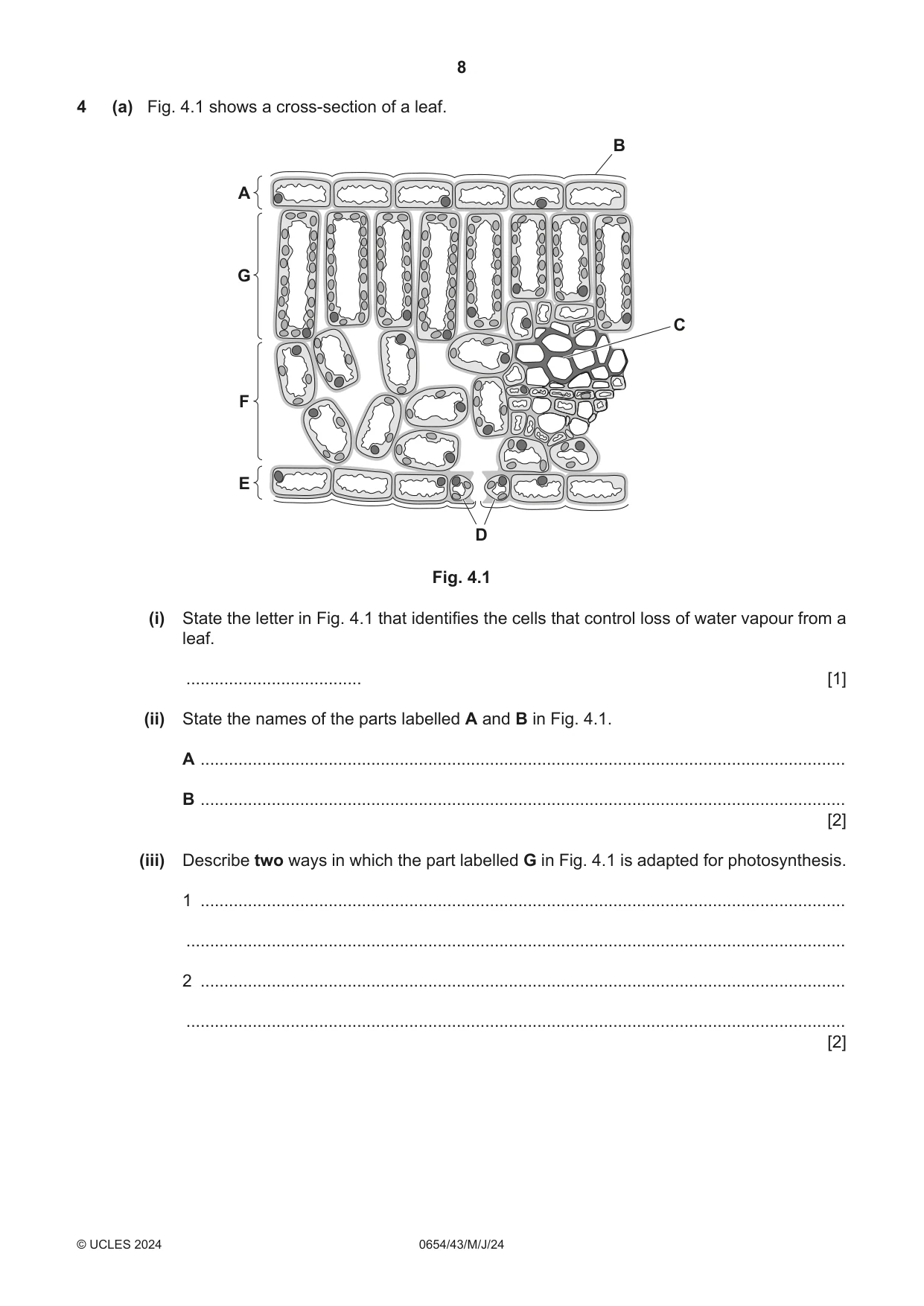
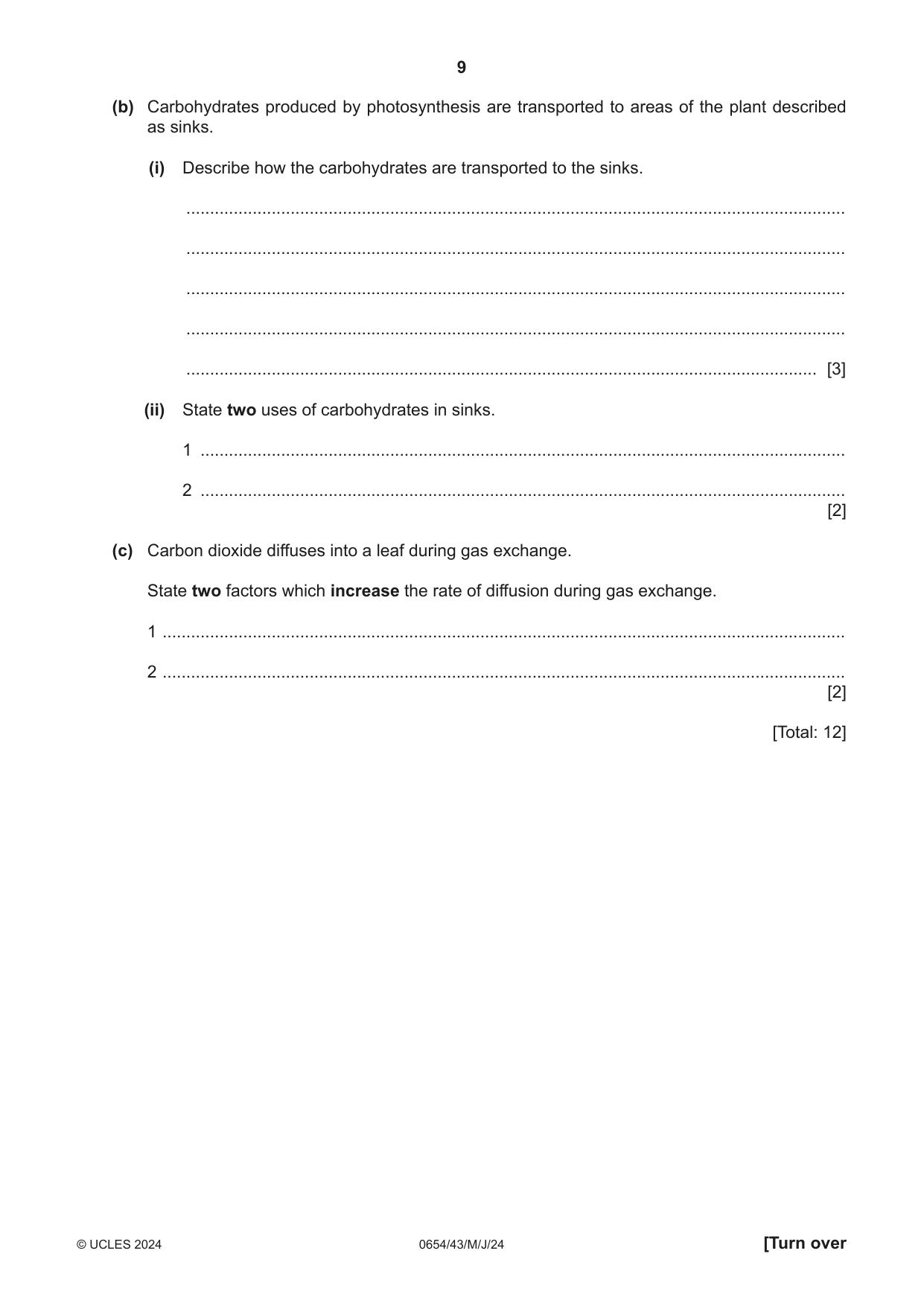
4 (a) Fig. 4.1 shows a cross-section of a leaf. B A G C F E D Fig. 4.1 (i) State the letter in Fig. 4.1 that identifies the cells that control loss of water vapour from a leaf. ..................................... [1] (ii) State the names of the parts labelled A and B in Fig. 4.1. A ........................................................................................................................................ B ........................................................................................................................................ [2] (iii) Describe two ways in which the part labelled G in Fig. 4.1 is adapted for photosynthesis. 1 ........................................................................................................................................ ........................................................................................................................................... 2 ........................................................................................................................................ ........................................................................................................................................... [2] (b) Carbohydrates produced by photosynthesis are transported to areas of the plant described as sinks. (i) Describe how the carbohydrates are transported to the sinks. ........................................................................................................................................... ........................................................................................................................................... ........................................................................................................................................... ........................................................................................................................................... ..................................................................................................................................... [3] (ii) State two uses of carbohydrates in sinks. 1 ........................................................................................................................................ 2 ........................................................................................................................................ [2] (c) Carbon dioxide diffuses into a leaf during gas exchange. State two factors which increase the rate of diffusion during gas exchange. 1 ................................................................................................................................................ 2 ................................................................................................................................................ [2] [Total: 12]
Mark scheme: 4(a)(i) D ; 1 4(a)(ii) A (upper) epidermis ; B cuticle ; 2 4(a)(iii) any two from: contain lots of chloroplasts ; located at the top of leaf ; tightly packed / column shaped ; 2 4(b)(i) as sucrose ; by translocation ; in the phloem ; 3 4(b)(ii) any two from: storage ; respiration ; growth ; 2 Question Answer Marks 4(c) any two from: increased surface area ; increased temperature ; steeper concentration gradient ; shorter diffusion distance ; 2
Q5 · Some information about the Group VII elements
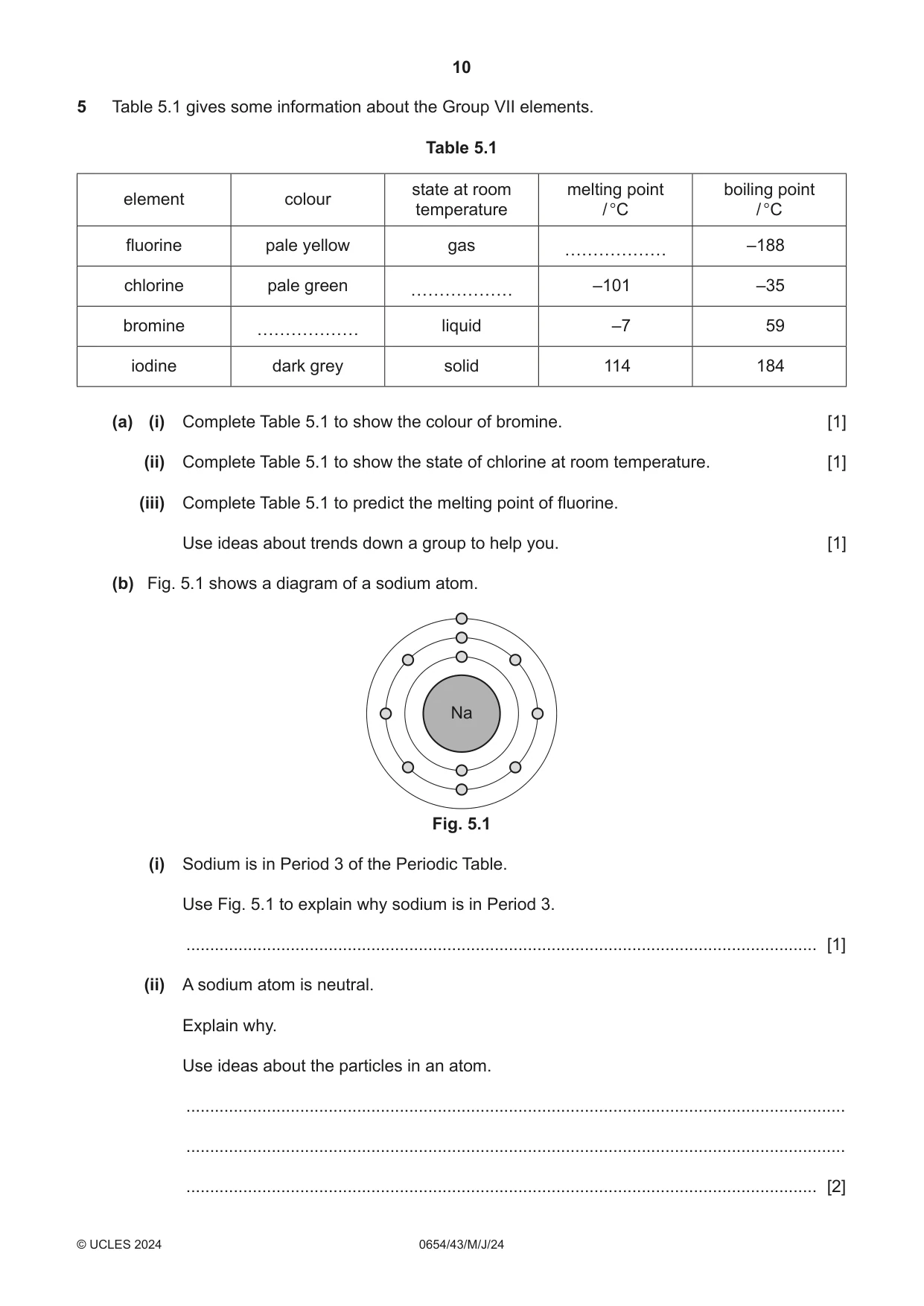
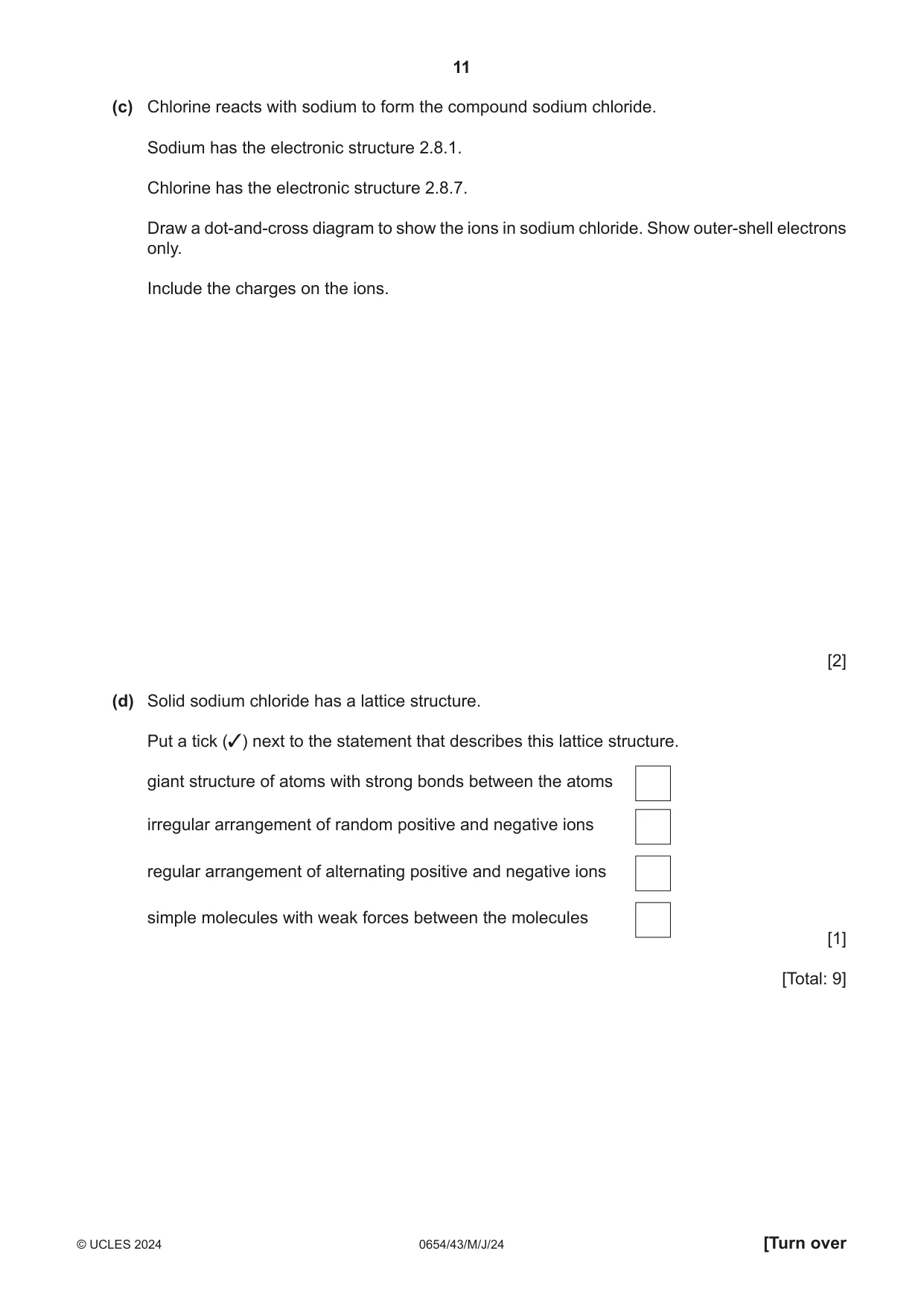
5 Table 5.1 gives some information about the Group VII elements. Table 5.1 state at room melting point boiling point element colour temperature / °C / °C fluorine pale yellow gas ……………… –188 chlorine pale green ……………… –101 –35 bromine ……………… liquid –7 59 iodine dark grey solid 114 184 (a) (i) Complete Table 5.1 to show the colour of bromine. [1] (ii) Complete Table 5.1 to show the state of chlorine at room temperature. [1] (iii) Complete Table 5.1 to predict the melting point of fluorine. Use ideas about trends down a group to help you. [1] (b) Fig. 5.1 shows a diagram of a sodium atom. Na Fig. 5.1 (i) Sodium is in Period 3 of the Periodic Table. Use Fig. 5.1 to explain why sodium is in Period 3. ..................................................................................................................................... [1] (ii) A sodium atom is neutral. Explain why. Use ideas about the particles in an atom. ........................................................................................................................................... ........................................................................................................................................... ..................................................................................................................................... [2] (c) Chlorine reacts with sodium to form the compound sodium chloride. Sodium has the electronic structure 2.8.1. Chlorine has the electronic structure 2.8.7. Draw a dot-and-cross diagram to show the ions in sodium chloride. Show outer-shell electrons only. Include the charges on the ions. [2] (d) Solid sodium chloride has a lattice structure. Put a tick (✓) next to the statement that describes this lattice structure. giant structure of atoms with strong bonds between the atoms irregular arrangement of random positive and negative ions regular arrangement of alternating positive and negative ions simple molecules with weak forces between the molecules [1] [Total: 9]
Mark scheme: 5(a)(i) red-brown ; 1 5(a)(ii) gas ; 1 5(a)(iii) answer in range –189 to –272 ; 1 5(b)(i) (sodium) has three (occupied) electron shells ; 1 5(b)(ii) idea that protons are positive and electrons are negative ; same number of protons and electrons ; 2 Question Answer Marks 5(c) sodium ion drawn with full outer shell or an empty one and a charge of +1 ; chloride ion drawn with 8 electrons in outer shell and a charge of –1 ; 2 5(d) Regular arrangement of alternating positive and negative ions ; 1
Question 6
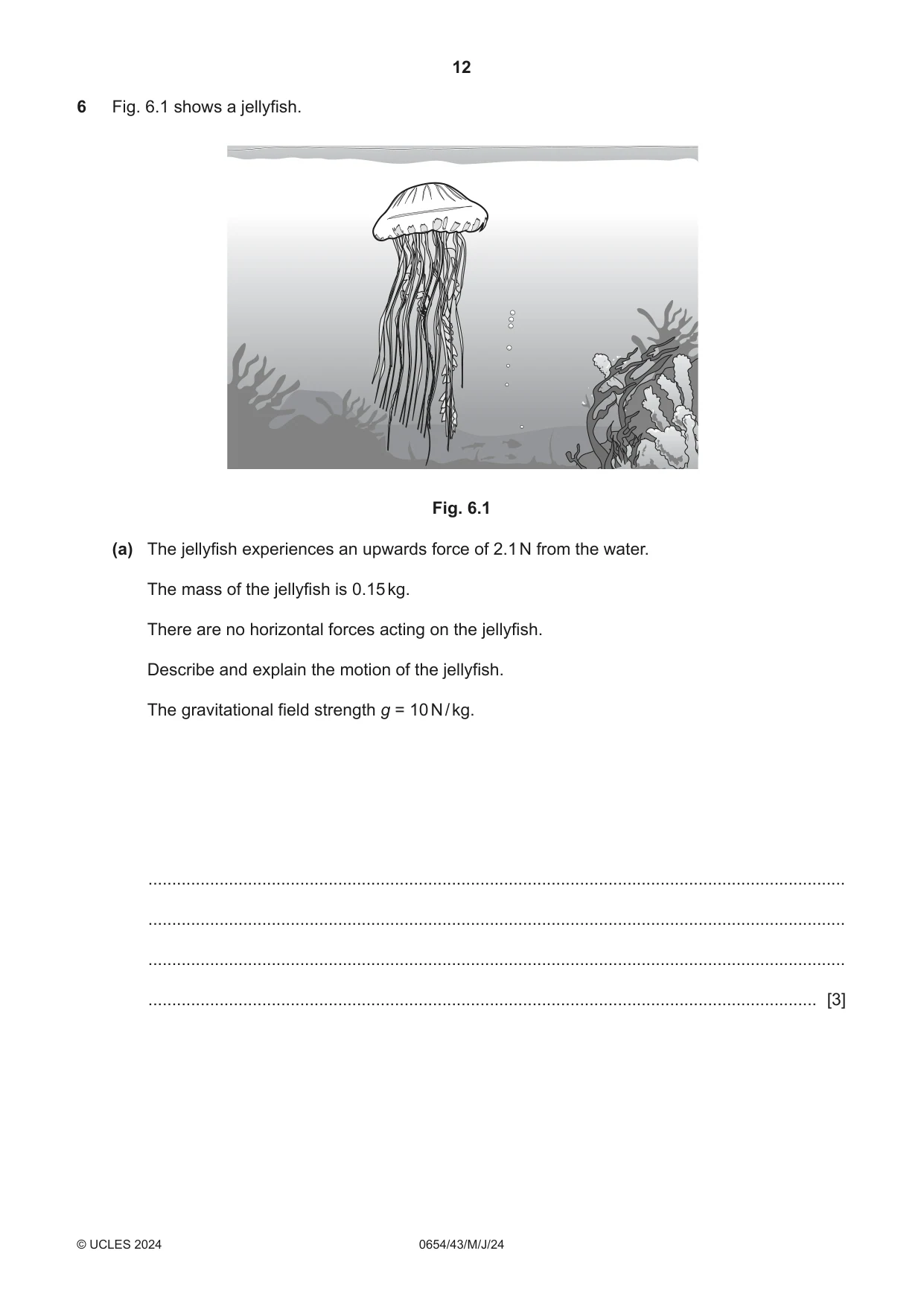
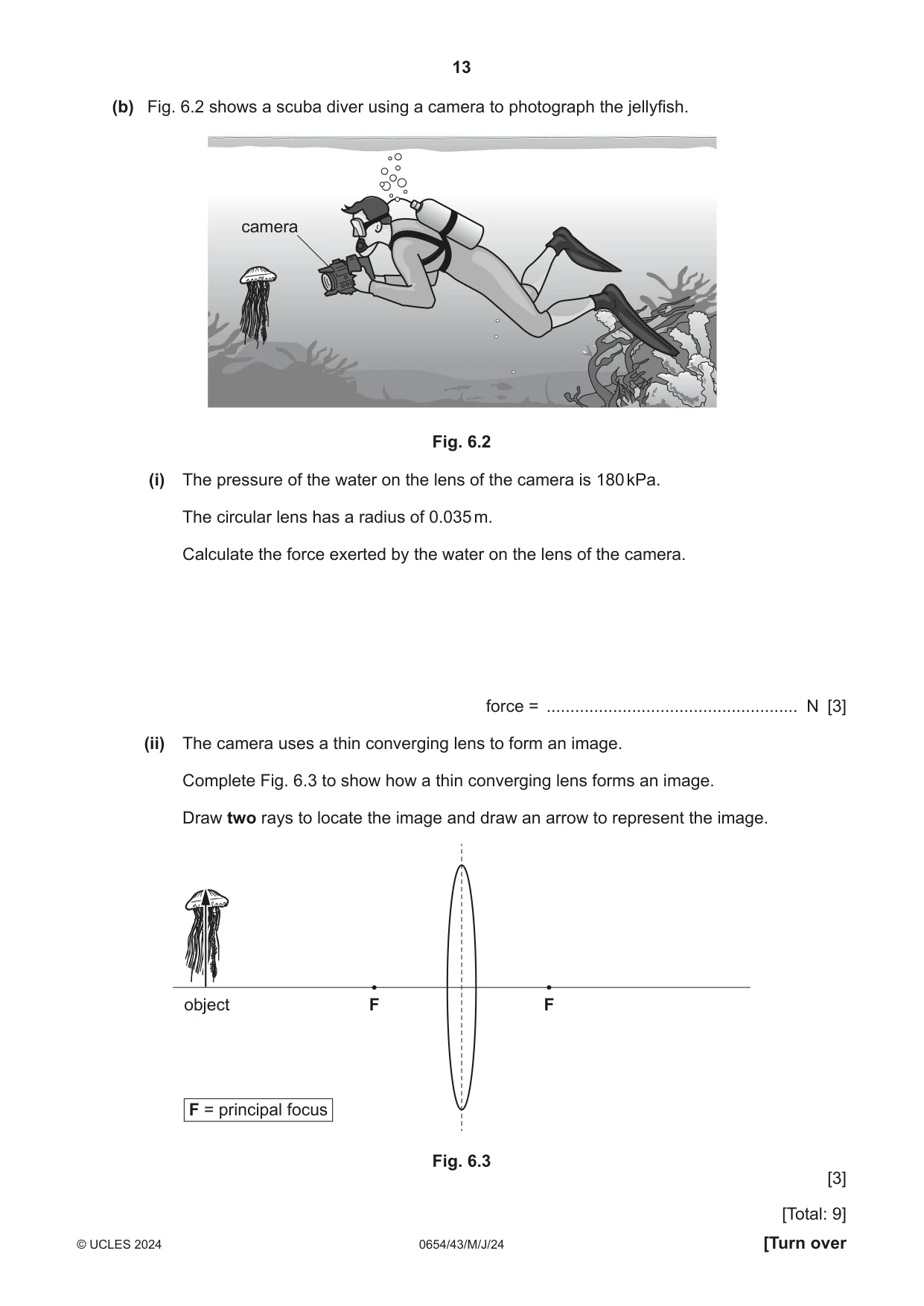
6 Fig. 6.1 shows a jellyfish. Fig. 6.1 (a) The jellyfish experiences an upwards force of 2.1 N from the water. The mass of the jellyfish is 0.15 kg. There are no horizontal forces acting on the jellyfish. Describe and explain the motion of the jellyfish. The gravitational field strength g = 10 N / kg. ................................................................................................................................................... ................................................................................................................................................... ................................................................................................................................................... ............................................................................................................................................. [3] (b) Fig. 6.2 shows a scuba diver using a camera to photograph the jellyfish. camera Fig. 6.2 (i) The pressure of the water on the lens of the camera is 180 kPa. The circular lens has a radius of 0.035 m. Calculate the force exerted by the water on the lens of the camera. force = ..................................................... N [3] (ii) The camera uses a thin converging lens to form an image. Complete Fig. 6.3 to show how a thin converging lens forms an image. Draw two rays to locate the image and draw an arrow to represent the image. object F F F = principal focus Fig. 6.3 [3] [Total: 9]
Mark scheme: 6(a) weight = 1.5(N) OR resultant force = 0.6(N) ; upwards resultant force / 0.6 N upwards force ; accelerates upwards ; 3 6(b)(i) area = 0.0352 / 3.848 10–3 ; force = P A / 180000 area / 180000 3.848 10–3; = 690 (N) ; 3 Question Answer Marks 6(b)(ii) one correct ray drawn ; second correct ray drawn ; image correctly drawn ; 3
Q7 · A diagram of the alimentary canal and some of the associated organs in humans
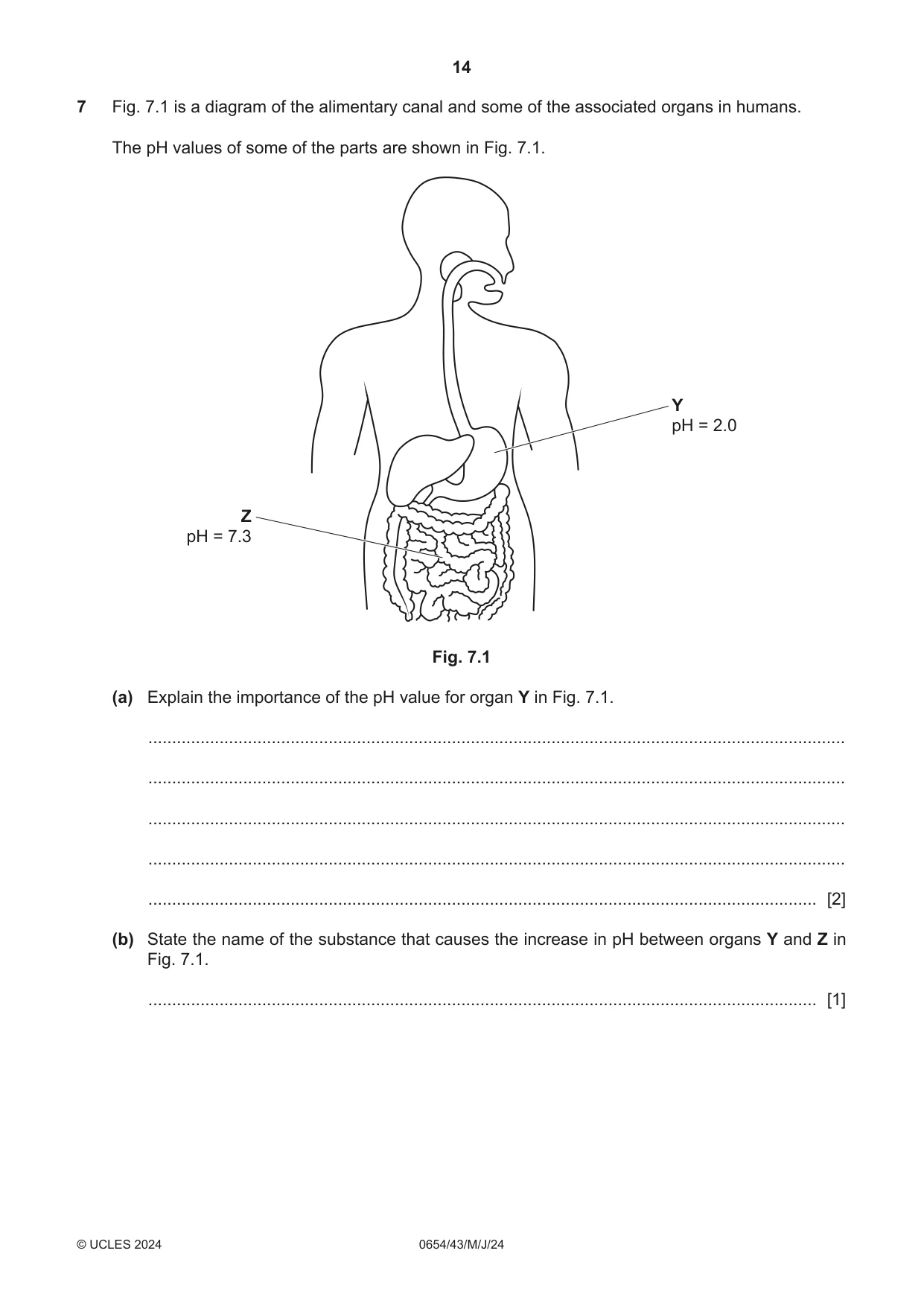
7 Fig. 7.1 is a diagram of the alimentary canal and some of the associated organs in humans. The pH values of some of the parts are shown in Fig. 7.1. Y pH = 2.0 Z pH = 7.3 Fig. 7.1 (a) Explain the importance of the pH value for organ Y in Fig. 7.1. ................................................................................................................................................... ................................................................................................................................................... ................................................................................................................................................... ................................................................................................................................................... ............................................................................................................................................. [2] (b) State the name of the substance that causes the increase in pH between organs Y and Z in Fig. 7.1. ............................................................................................................................................. [1] (c) Mechanical digestion occurs in the mouth. Define mechanical digestion. ................................................................................................................................................... ................................................................................................................................................... ................................................................................................................................................... ............................................................................................................................................. [2] (d) The pH of the mouth can decrease after eating. This decrease is caused by the production of acid. (i) Describe how acid is produced in the mouth after eating. ........................................................................................................................................... ........................................................................................................................................... ........................................................................................................................................... ..................................................................................................................................... [2] (ii) Describe the effect of acid on the teeth. ........................................................................................................................................... ........................................................................................................................................... ..................................................................................................................................... [1] (e) Vitamins and minerals are two components of a balanced diet. (i) State the names of two other components of a balanced diet. 1 ........................................................................................................................................ 2 ........................................................................................................................................ [2] (ii) State the name of the disease caused by vitamin C deficiency. ..................................................................................................................................... [1] [Total: 11]
Mark scheme: 7(a) (acidic environment) kills, bacteria / microorganisms / denatures enzymes in microorganisms or bacteria ; provides, optimum / suitable, pH for protease ; 7(b) bile ; 1 7(c) the breakdown of food into smaller pieces / AW ; without chemical change (to the food molecules) ; 2 7(d)(i) ref to bacteria ; respiring (sugars) ; 2 7(d)(ii) dissolving enamel or dentine / (dental) decay ; 1 7(e)(i) any two from: carbohydrates ; fats ; protein ; fibre ; water ; 2 Question Answer Marks 7(e)(ii) scurvy ; 1
Q8 · A toy car that is powered by hydrogen gas
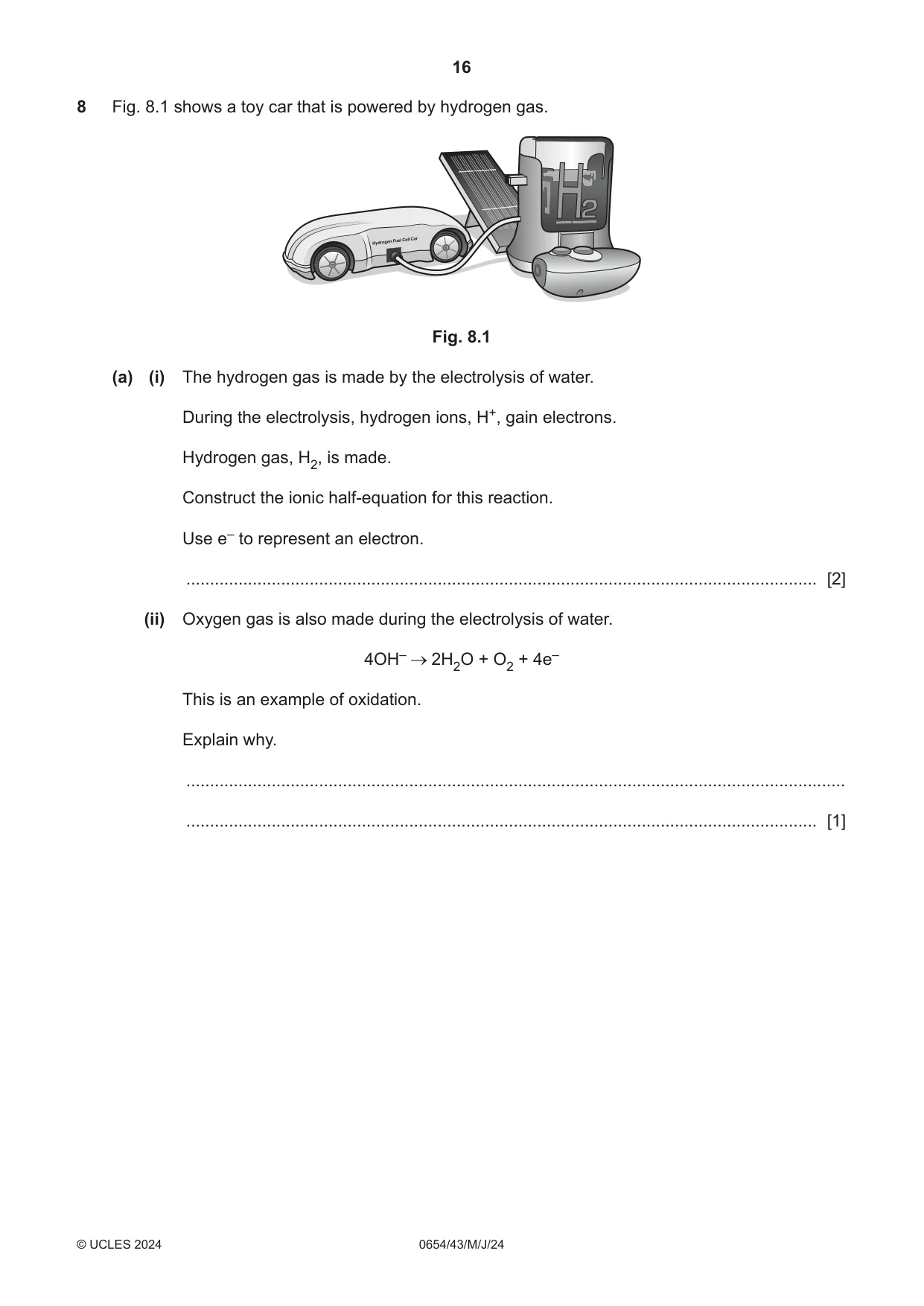
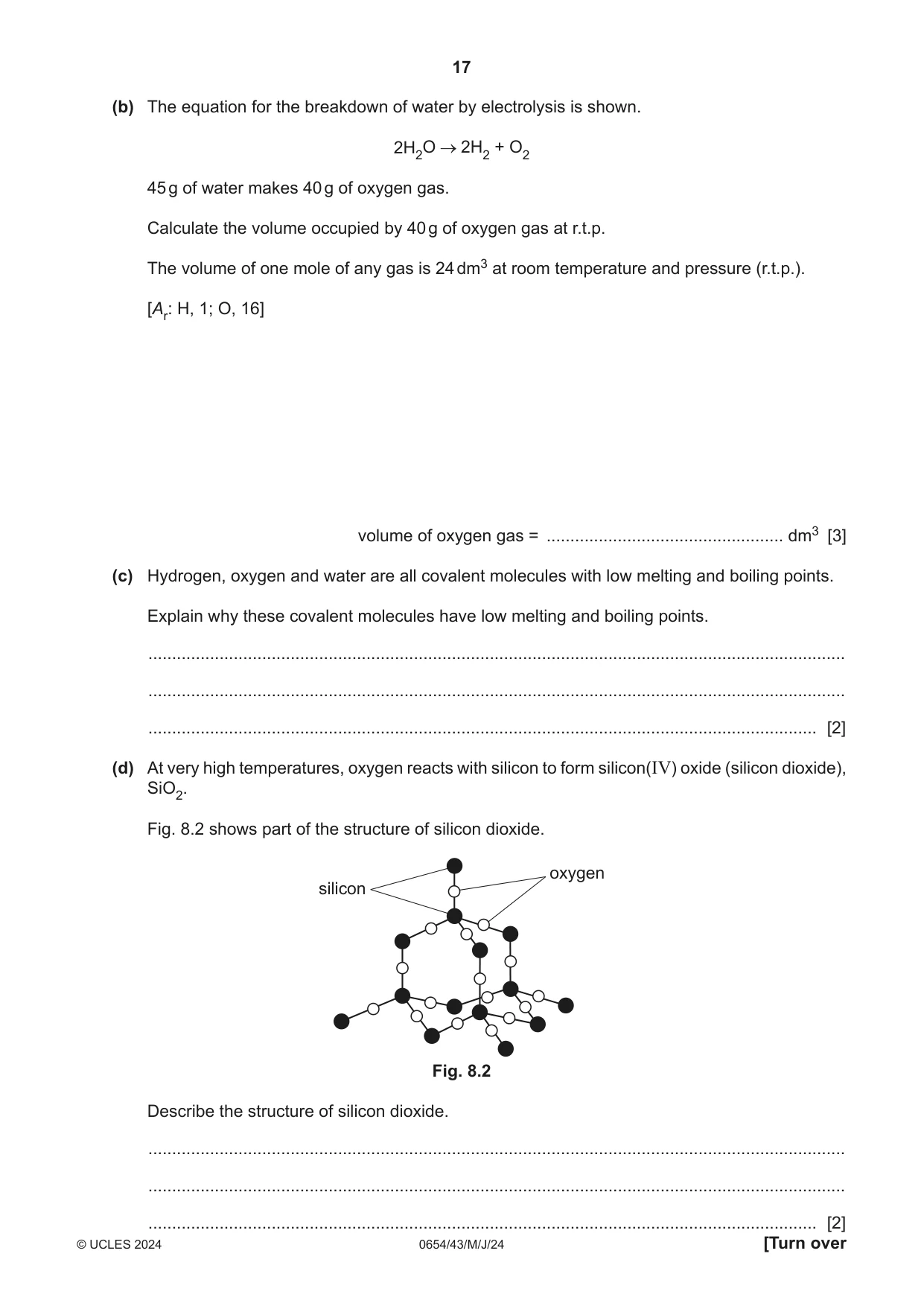
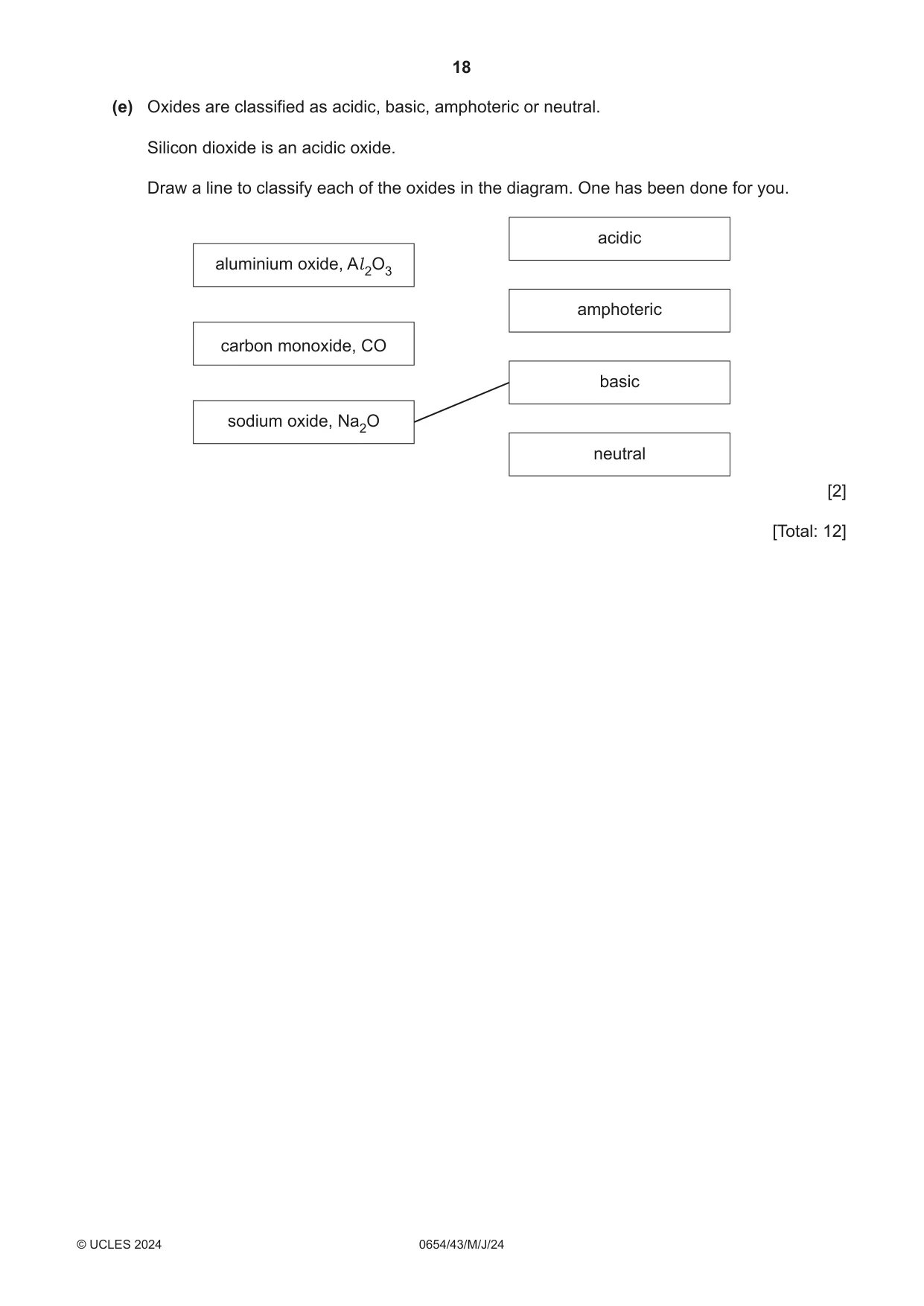
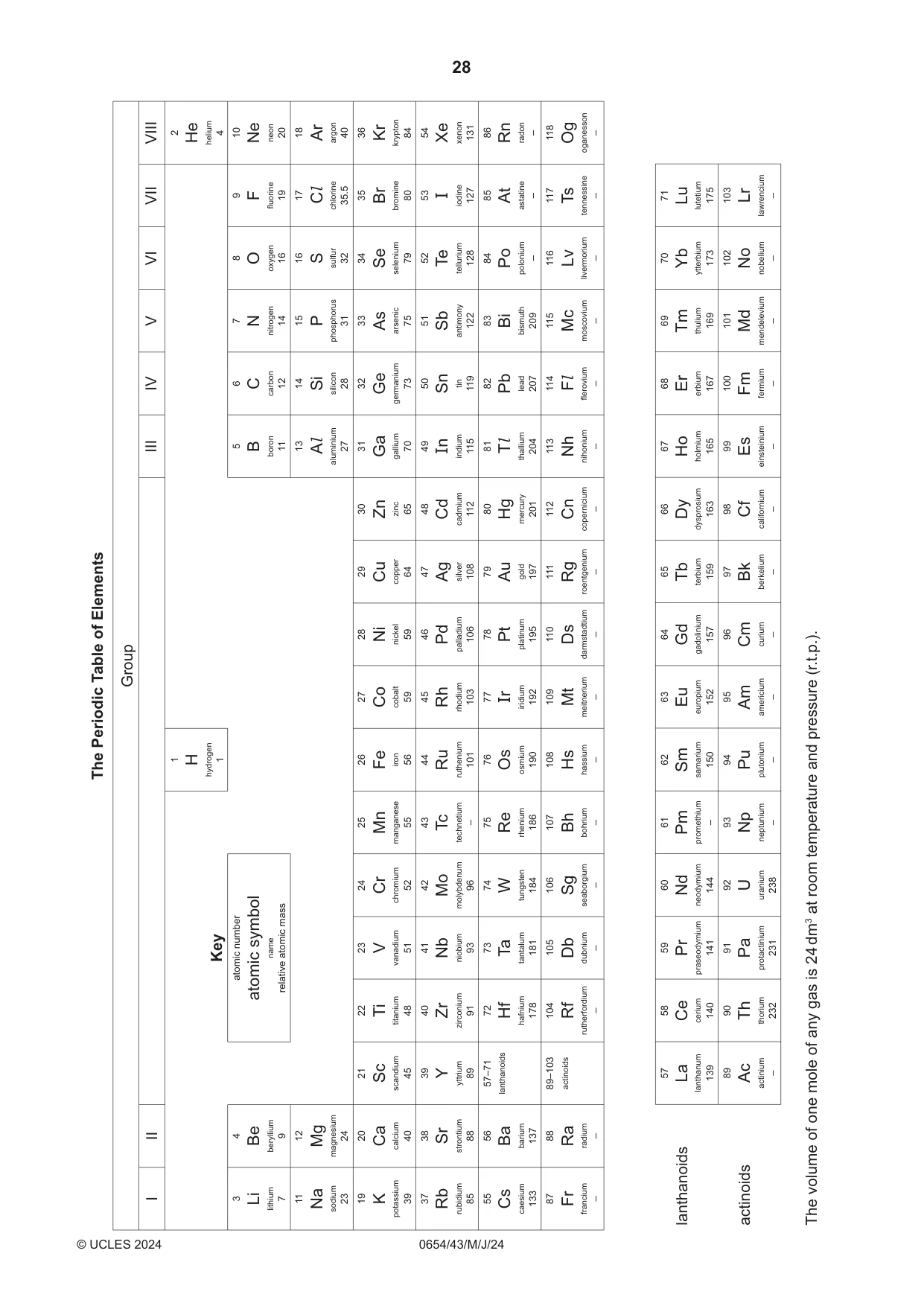
8 Fig. 8.1 shows a toy car that is powered by hydrogen gas. Fig. 8.1 (a) (i) The hydrogen gas is made by the electrolysis of water. During the electrolysis, hydrogen ions, H+, gain electrons. Hydrogen gas, H2, is made. Construct the ionic half-equation for this reaction. Use e– to represent an electron. ..................................................................................................................................... [2] (ii) Oxygen gas is also made during the electrolysis of water. 4OH– 2H2O + O2 + 4e– This is an example of oxidation. Explain why. ........................................................................................................................................... ..................................................................................................................................... [1] (b) The equation for the breakdown of water by electrolysis is shown. 2H2O 2H2 + O2 45 g of water makes 40 g of oxygen gas. Calculate the volume occupied by 40 g of oxygen gas at r.t.p. The volume of one mole of any gas is 24 dm3 at room temperature and pressure (r.t.p.). [Ar: H, 1; O, 16] volume of oxygen gas = .................................................. dm3 [3] (c) Hydrogen, oxygen and water are all covalent molecules with low melting and boiling points. Explain why these covalent molecules have low melting and boiling points. ................................................................................................................................................... ................................................................................................................................................... ............................................................................................................................................. [2] (d) At very high temperatures, oxygen reacts with silicon to form silicon(IV) oxide (silicon dioxide), SiO2. Fig. 8.2 shows part of the structure of silicon dioxide. oxygen silicon Fig. 8.2 Describe the structure of silicon dioxide. ................................................................................................................................................... ................................................................................................................................................... ............................................................................................................................................. [2] (e) Oxides are classified as acidic, basic, amphoteric or neutral. Silicon dioxide is an acidic oxide. Draw a line to classify each of the oxides in the diagram. One has been done for you. acidic aluminium oxide, Al 2O3 amphoteric carbon monoxide, CO basic sodium oxide, Na2O neutral [2] [Total: 12]
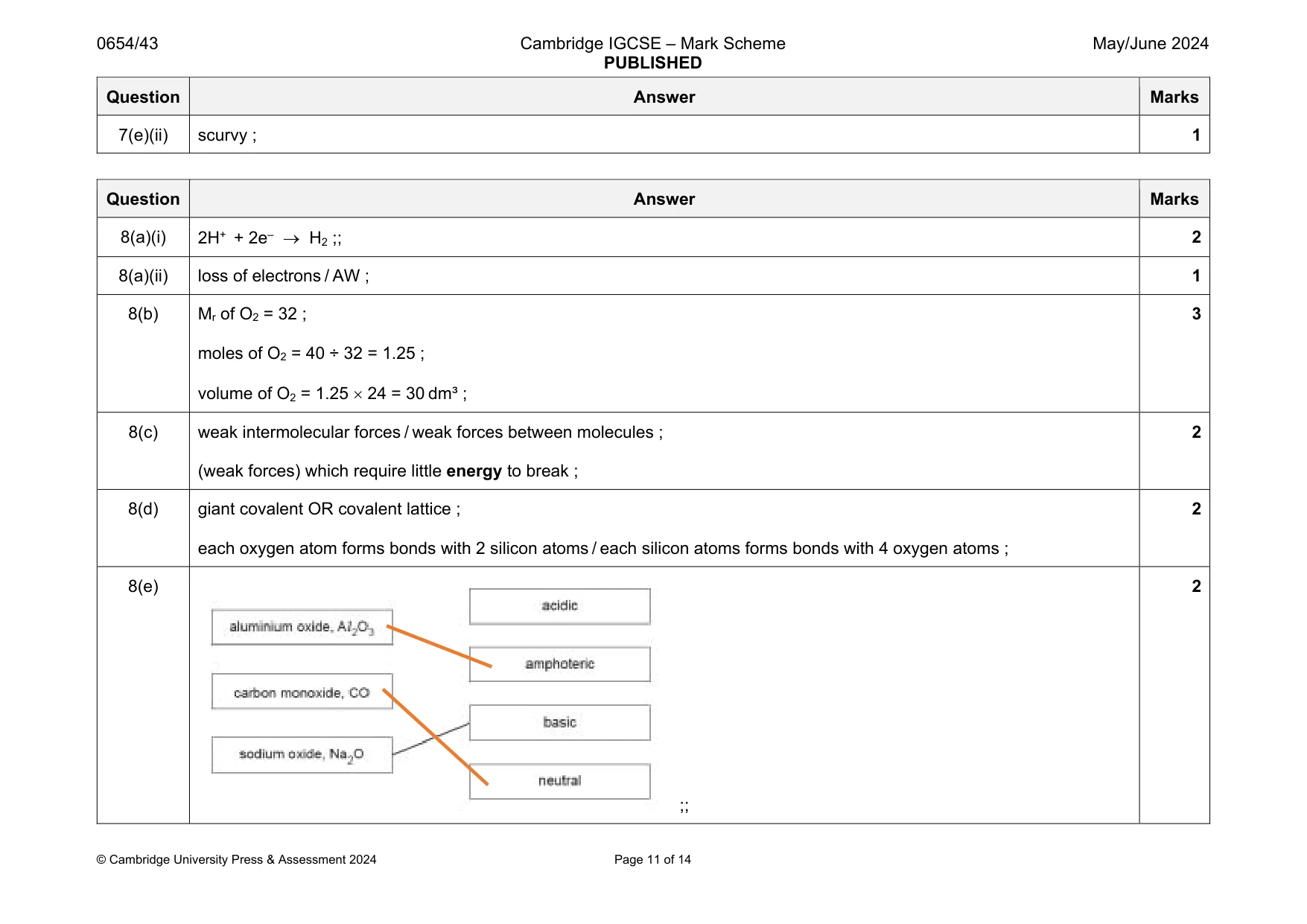
Mark scheme: 8(a)(i) 2 8(a)(ii) loss of electrons / AW ; 1 8(b) Mr of O2 = 32 ; moles of O2 = 40 ÷ 32 = 1.25 ; volume of O2 = 1.25 24 = 30 dm³ ; 3 8(c) weak intermolecular forces / weak forces between molecules ; (weak forces) which require little energy to break ; 2 8(d) giant covalent OR covalent lattice ; each oxygen atom forms bonds with 2 silicon atoms / each silicon atoms forms bonds with 4 oxygen atoms ; 2 8(e) ;; 2
Q9 · A student is investigating resistance
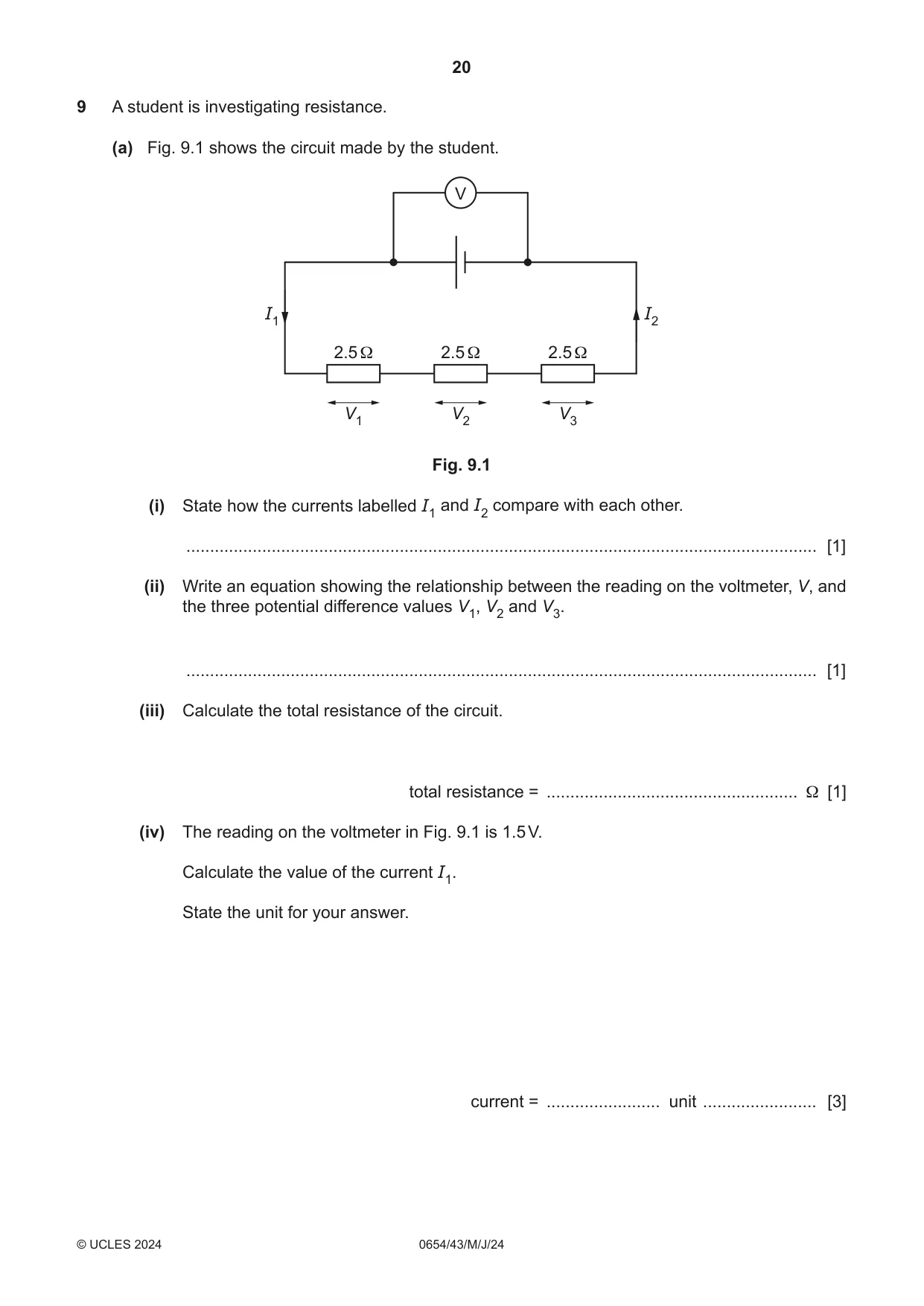
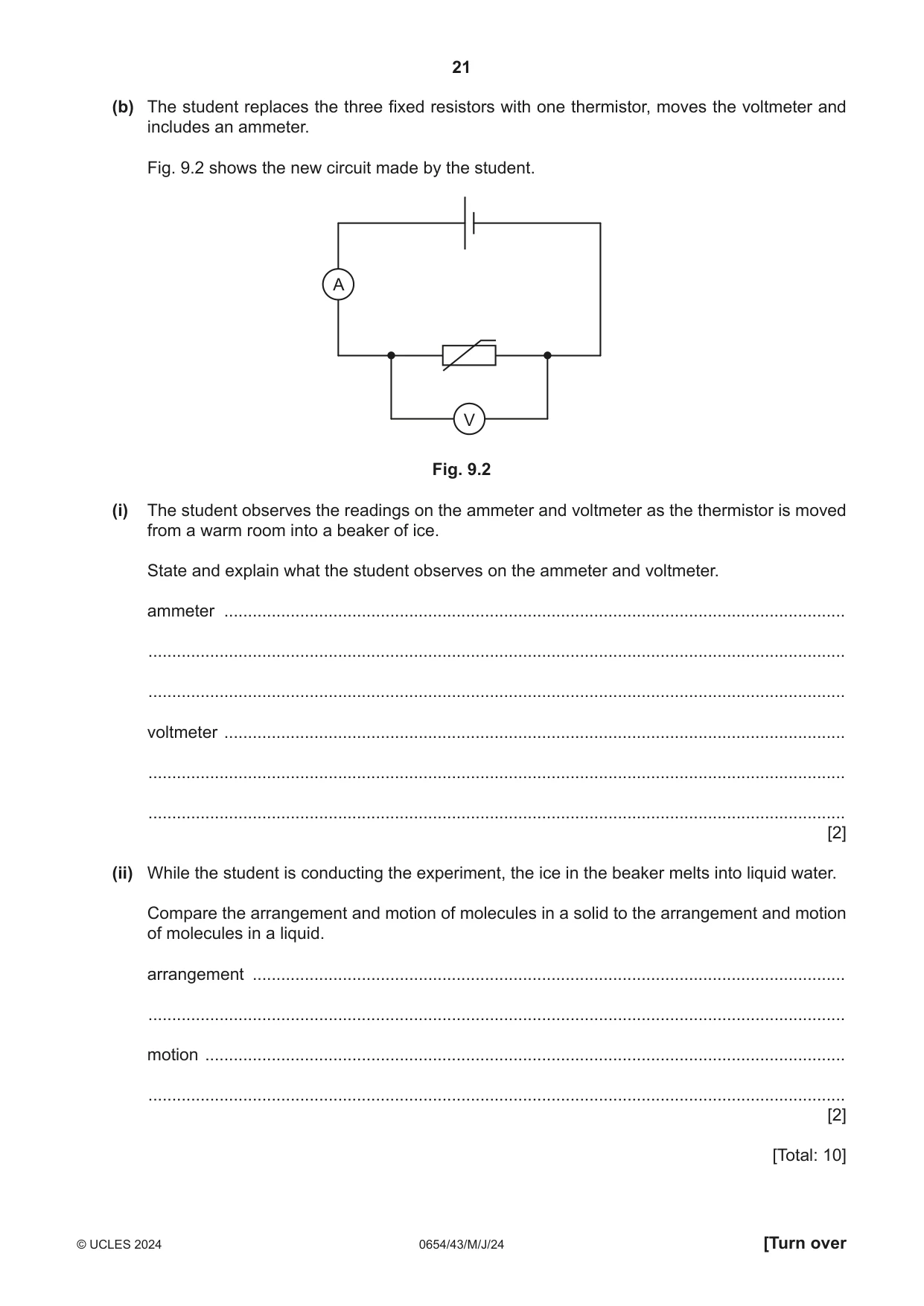
9 A student is investigating resistance. (a) Fig. 9.1 shows the circuit made by the student. V I1 I2 2.5 Ω 2.5 Ω 2.5 Ω V1 V2 V3 Fig. 9.1 (i) State how the currents labelled I1 and I2 compare with each other. ..................................................................................................................................... [1] (ii) Write an equation showing the relationship between the reading on the voltmeter, V, and the three potential difference values V1, V2 and V3. ..................................................................................................................................... [1] (iii) Calculate the total resistance of the circuit. total resistance = ..................................................... Ω [1] (iv) The reading on the voltmeter in Fig. 9.1 is 1.5 V. Calculate the value of the current I1. State the unit for your answer. current = ........................ unit ........................ [3] (b) The student replaces the three fixed resistors with one thermistor, moves the voltmeter and includes an ammeter. Fig. 9.2 shows the new circuit made by the student. A V Fig. 9.2 (i) The student observes the readings on the ammeter and voltmeter as the thermistor is moved from a warm room into a beaker of ice. State and explain what the student observes on the ammeter and voltmeter. ammeter ................................................................................................................................... ................................................................................................................................................... ................................................................................................................................................... voltmeter ................................................................................................................................... ................................................................................................................................................... ................................................................................................................................................... [2] (ii) While the student is conducting the experiment, the ice in the beaker melts into liquid water. Compare the arrangement and motion of molecules in a solid to the arrangement and motion of molecules in a liquid. arrangement ............................................................................................................................. ................................................................................................................................................... motion ....................................................................................................................................... ................................................................................................................................................... [2] [Total: 10]
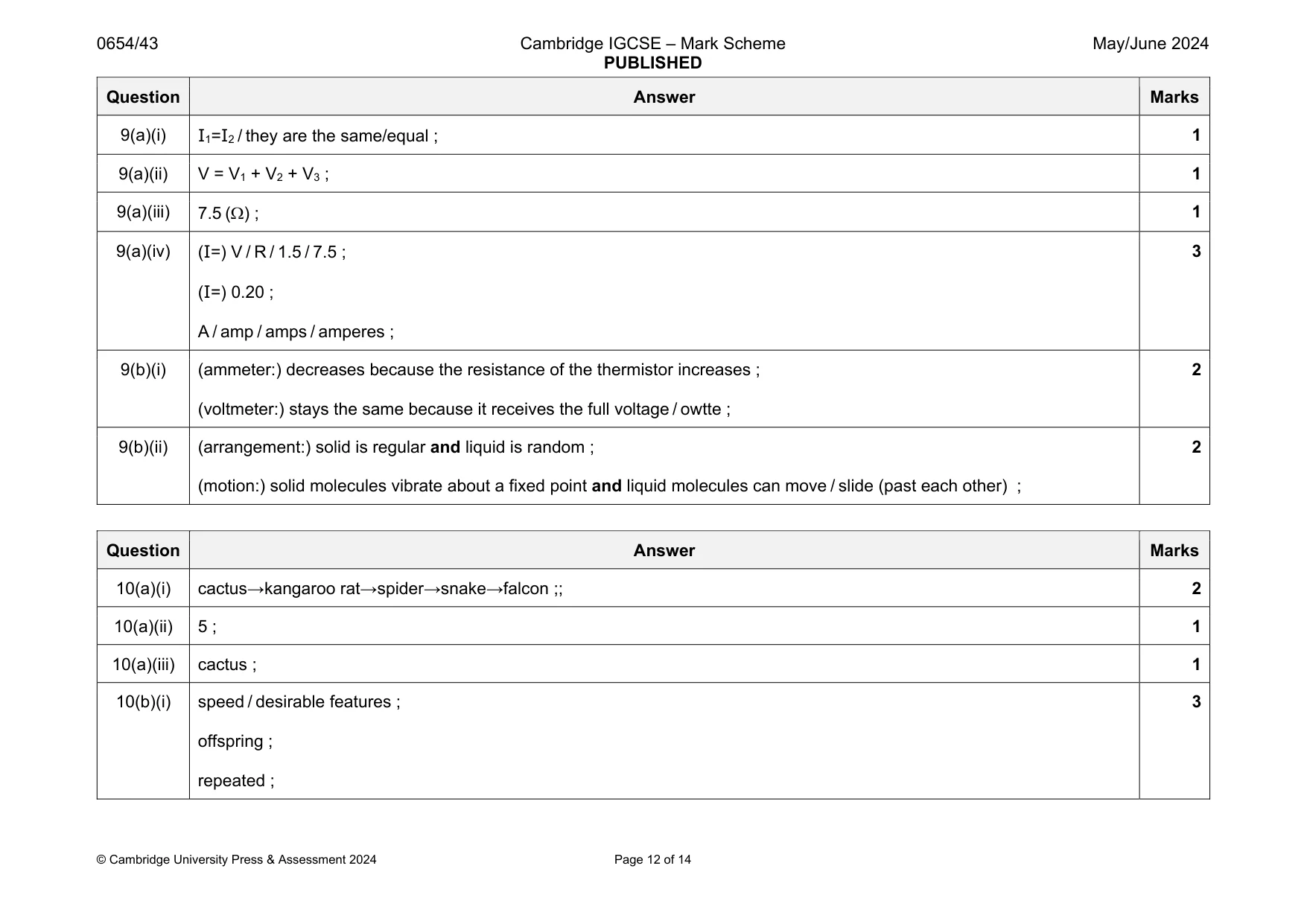
Mark scheme: 9(a)(i) 1 9(a)(ii) V = V1 + V2 + V3 ; 1 9(a)(iii) 7.5 () ; 1 9(a)(iv) (I=) V / R / 1.5 / 7.5 ; (I=) 0.20 ; A / amp / amps / amperes ; 3 9(b)(i) (ammeter:) decreases because the resistance of the thermistor increases ; (voltmeter:) stays the same because it receives the full voltage / owtte ; 2 9(b)(ii) (arrangement:) solid is regular and liquid is random ; (motion:) solid molecules vibrate about a fixed point and liquid molecules can move / slide (past each other) ; 2
Q10 · Part of a food web from a desert ecosystem
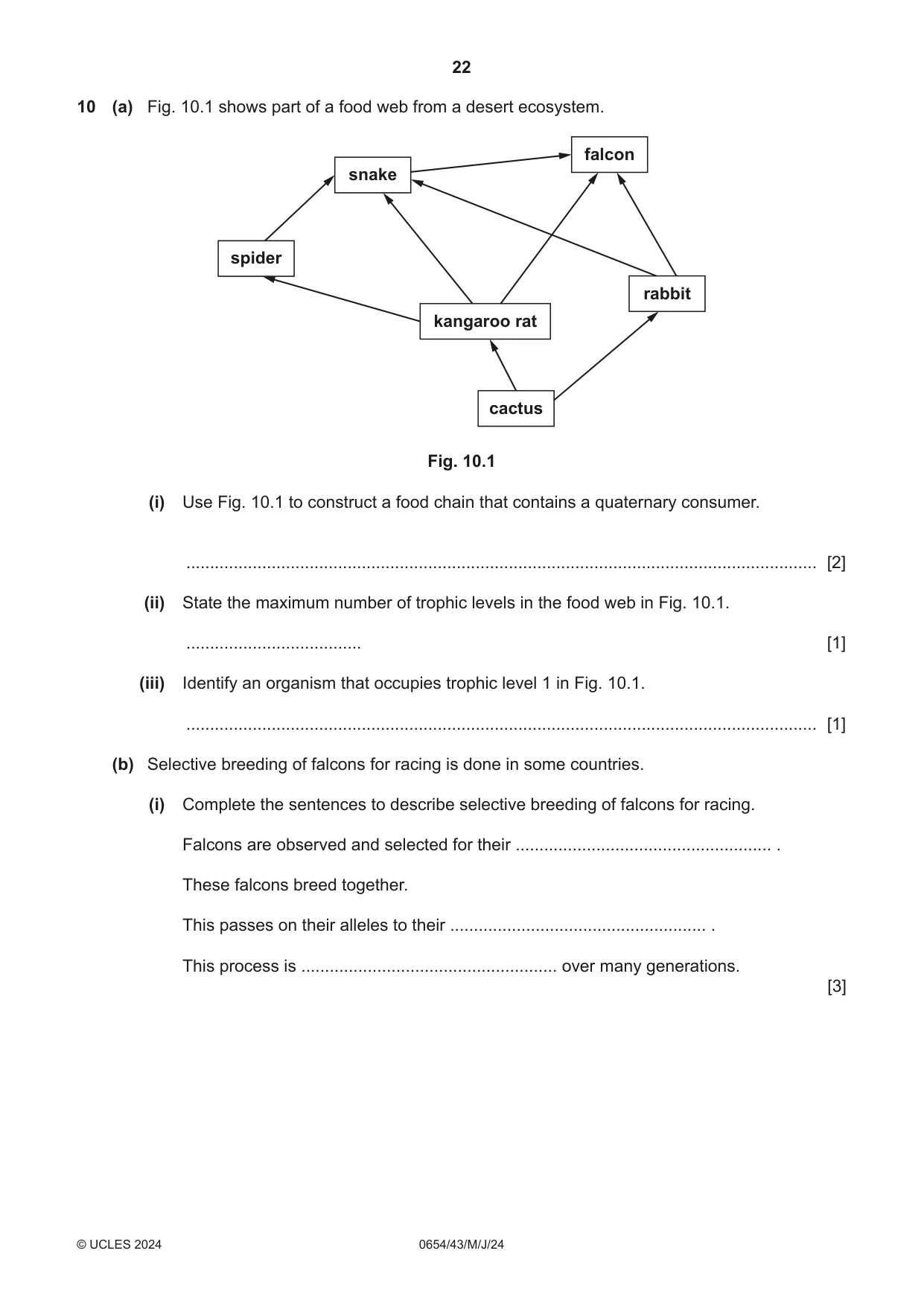
10 (a) Fig. 10.1 shows part of a food web from a desert ecosystem. falcon snake spider rabbit kangaroo rat cactus Fig. 10.1 (i) Use Fig. 10.1 to construct a food chain that contains a quaternary consumer. ..................................................................................................................................... [2] (ii) State the maximum number of trophic levels in the food web in Fig. 10.1. ..................................... [1] (iii) Identify an organism that occupies trophic level 1 in Fig. 10.1. ..................................................................................................................................... [1] (b) Selective breeding of falcons for racing is done in some countries. (i) Complete the sentences to describe selective breeding of falcons for racing. Falcons are observed and selected for their ...................................................... . These falcons breed together. This passes on their alleles to their ...................................................... . This process is ...................................................... over many generations. [3] (ii) Explain why the changes to the population as a result of selective breeding are not an example of adaptation. ........................................................................................................................................... ........................................................................................................................................... ........................................................................................................................................... ........................................................................................................................................... ..................................................................................................................................... [2] [Total: 9]
Mark scheme: 10(a)(i) cactus→kangaroo rat→spider→snake→falcon ;; 2 10(a)(ii) 5 ; 1 10(a)(iii) cactus ; 1 10(b)(i) speed / desirable features ; offspring ; repeated ; 3 Question Answer Marks 10(b)(ii) changes are not caused by natural selection ; population is not more suited to its environment / no change in adaptive features ; 2
Q11 · A student investigates the reaction between calcium carbonate and dilute hydrochloric acid
11 A student investigates the reaction between calcium carbonate and dilute hydrochloric acid. Calcium chloride, water and carbon dioxide are made. CaCO3 + 2HCl CaCl 2 + H2O + CO2 The student collects and measures the volume of carbon dioxide made. (a) Suggest the apparatus the student uses to collect and measure the volume of carbon dioxide. ............................................................................................................................................. [1] (b) The rate of reaction between calcium carbonate and dilute hydrochloric acid is increased by increasing the temperature of the acid. Explain why. Use ideas about collisions between reacting particles. ................................................................................................................................................... ................................................................................................................................................... ................................................................................................................................................... ............................................................................................................................................. [3] (c) Calculate the mass of calcium chloride made when 20 g of calcium carbonate reacts with excess dilute hydrochloric acid. CaCO3 + 2HCl CaCl 2 + H2O + CO2 [Ar: C, 12; Ca, 40; Cl, 35.5; O, 16] mass of calcium chloride = ...................................................... g [2] (d) Iron is extracted from iron ore by heating the iron ore with carbon. (i) Explain why iron can be extracted from iron ore by heating with carbon. ..................................................................................................................................... [1] (ii) Put a tick (✓) next to the metal that cannot be extracted from its ore by heating with carbon. aluminium copper zinc [1] (iii) Iron is extracted from iron ore in a blast furnace. Calcium carbonate (limestone) is added to the blast furnace to remove impurities in the iron ore. Complete the symbol equations to show the reactions to remove the impurities. ........................ CaCO3 CaO + CaO + ........................ CaSiO3 [2] (e) Iron can be coated with zinc to prevent rusting. Explain, in terms of electrons, how zinc prevents iron from rusting. ................................................................................................................................................... ............................................................................................................................................. [1] [Total: 11]
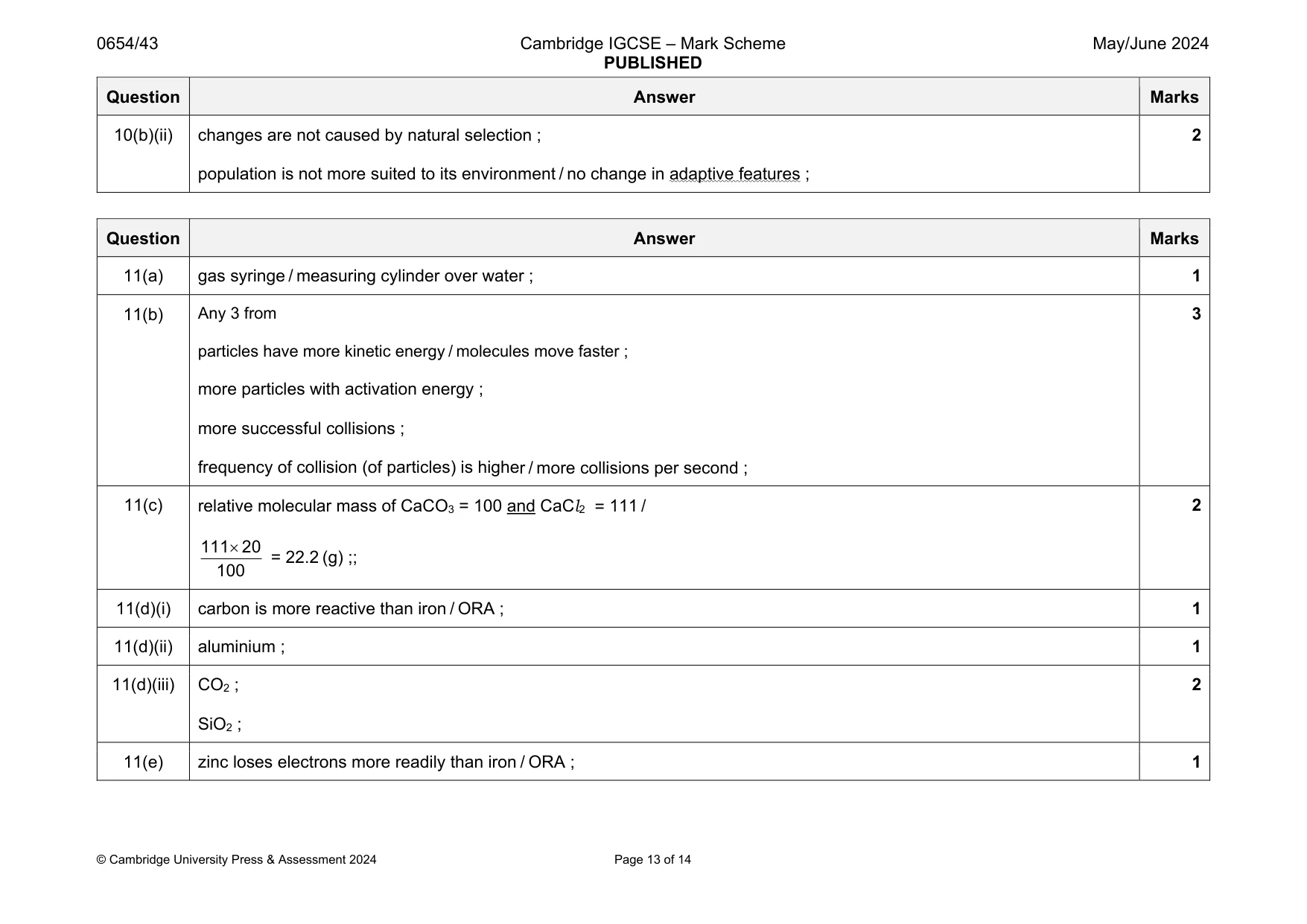
Mark scheme: 11(a) gas syringe / measuring cylinder over water ; 1 11(b) Any 3 from particles have more kinetic energy / molecules move faster ; more particles with activation energy ; more successful collisions ; frequency of collision (of particles) is higher / more collisions per second ; 3 11(c) relative molecular mass of CaCO3 = 100 and CaCl2 = 111 / 111 20 100 = 22.2 (g) ;; 2 11(d)(i) carbon is more reactive than iron / ORA ; 1 11(d)(ii) aluminium ; 1 11(d)(iii) CO2 ; SiO2 ; 2 11(e) zinc loses electrons more readily than iron / ORA ; 1
Q12 · The path taken by an alpha particle as it passes through an electric field
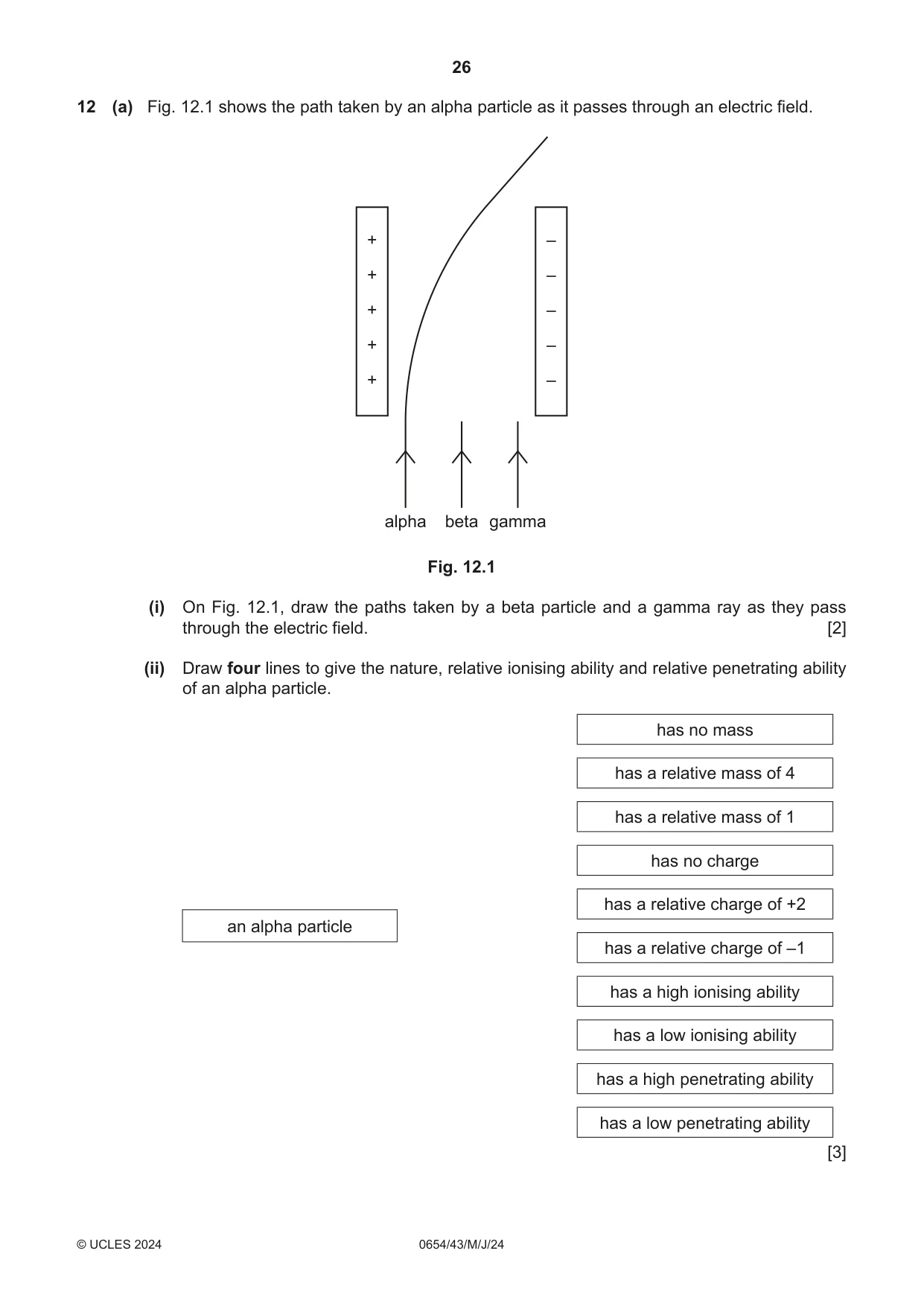
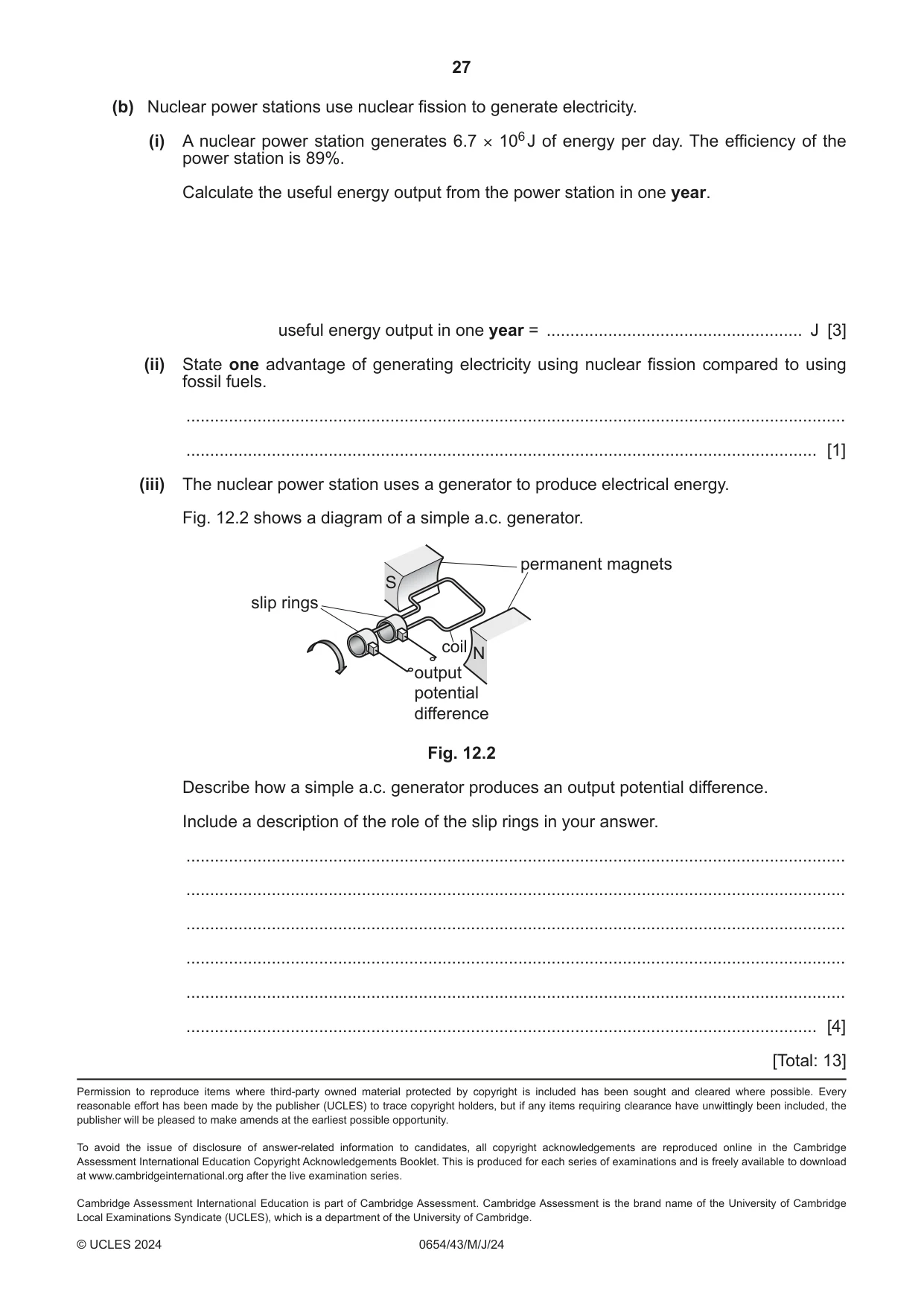
12 (a) Fig. 12.1 shows the path taken by an alpha particle as it passes through an electric field. + – + – + – + – + – alpha beta gamma Fig. 12.1 (i) On Fig. 12.1, draw the paths taken by a beta particle and a gamma ray as they pass through the electric field. [2] (ii) Draw four lines to give the nature, relative ionising ability and relative penetrating ability of an alpha particle. has no mass has a relative mass of 4 has a relative mass of 1 has no charge has a relative charge of +2 an alpha particle has a relative charge of –1 has a high ionising ability has a low ionising ability has a high penetrating ability has a low penetrating ability [3] (b) Nuclear power stations use nuclear fission to generate electricity. (i) A nuclear power station generates 6.7 × 10⁶ J of energy per day. The efficiency of the power station is 89%. Calculate the useful energy output from the power station in one year. useful energy output in one year = ...................................................... J [3] (ii) State one advantage of generating electricity using nuclear fission compared to using fossil fuels. ........................................................................................................................................... ..................................................................................................................................... [1] (iii) The nuclear power station uses a generator to produce electrical energy. Fig. 12.2 shows a diagram of a simple a.c. generator. permanent magnets S slip rings coil N output potential difference Fig. 12.2 Describe how a simple a.c. generator produces an output potential difference. Include a description of the role of the slip rings in your answer. ........................................................................................................................................... ........................................................................................................................................... ........................................................................................................................................... ........................................................................................................................................... ........................................................................................................................................... ..................................................................................................................................... [4] [Total: 13]
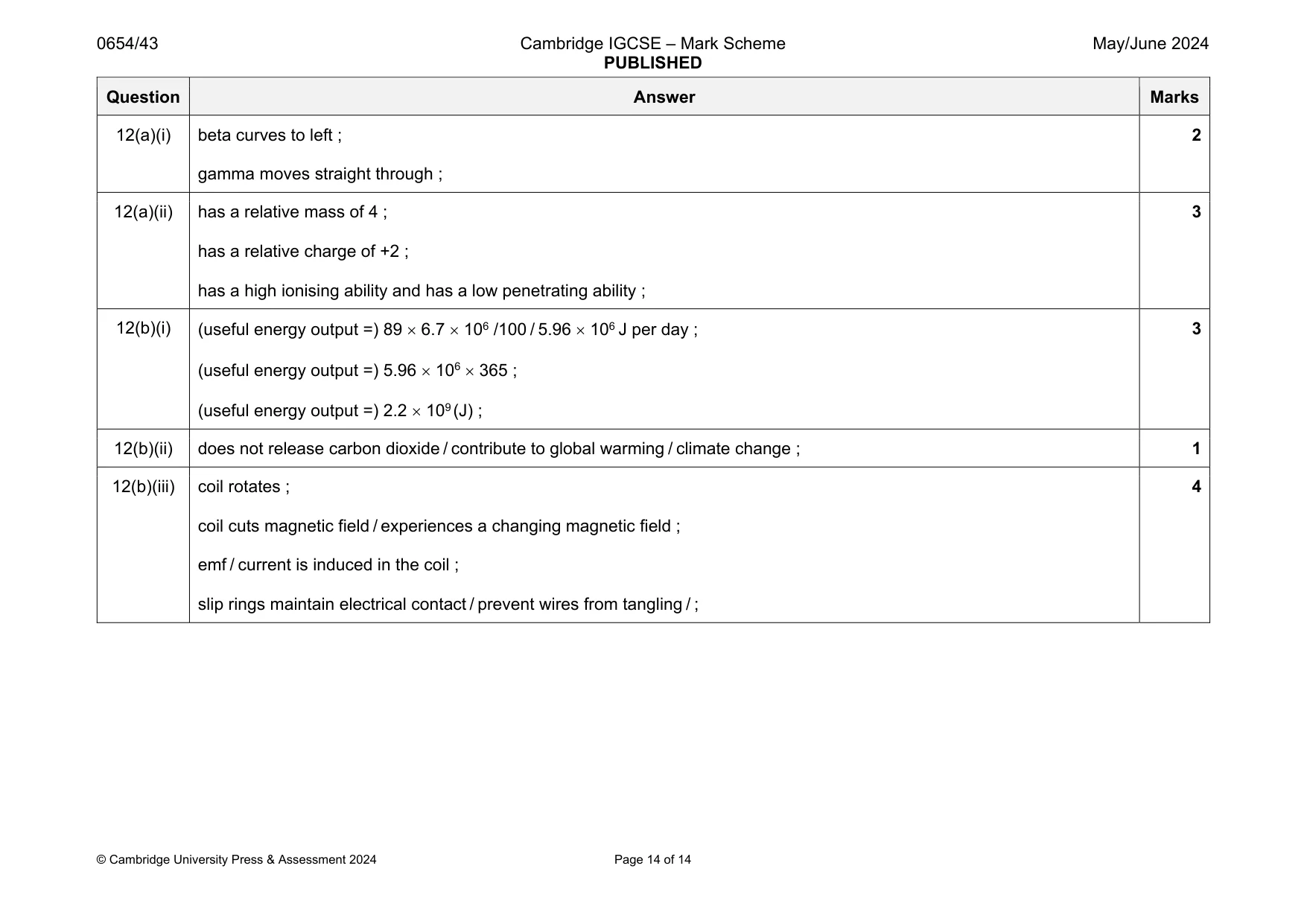
Mark scheme: 12(a)(i) beta curves to left ; gamma moves straight through ; 2 12(a)(ii) has a relative mass of 4 ; has a relative charge of +2 ; has a high ionising ability and has a low penetrating ability ; 3 12(b)(i) (useful energy output =) 89 6.7 106 /100 / 5.96 106 J per day ; (useful energy output =) 5.96 106 365 ; (useful energy output =) 2.2 109 (J) ; 3 12(b)(ii) does not release carbon dioxide / contribute to global warming / climate change ; 1 12(b)(iii) coil rotates ; coil cuts magnetic field / experiences a changing magnetic field ; emf / current is induced in the coil ; slip rings maintain electrical contact / prevent wires from tangling / ; 4
What was in this paper
The subtopics covered by these 12 questions, and how many questions each got. Open one in a new tab to see every Cambridge question on it.
What you needed in this session
Cambridge’s own grade thresholds for 2024 May/June, Paper 4 · Variant 3. A higher threshold means an easier paper — the bar moves with how the cohort did.