Cambridge IGCSE Sciences - Co-ordinated (Double) 0654 — 2019 Oct/Nov Paper 4 · Variant 2
0654/42/O/N/19 · 13 questions · 120 marks · ≈135 min
The question paper and its mark scheme, free to read here and free to download. This is Cambridge’s own paper, exactly as it was sat.
Question paper28 pages
Mark scheme16 pages
Answers below. Sit the paper first if you are practising.
Questions as text
Q1 · Carbon dioxide is produced during the anaerobic respiration of yeast
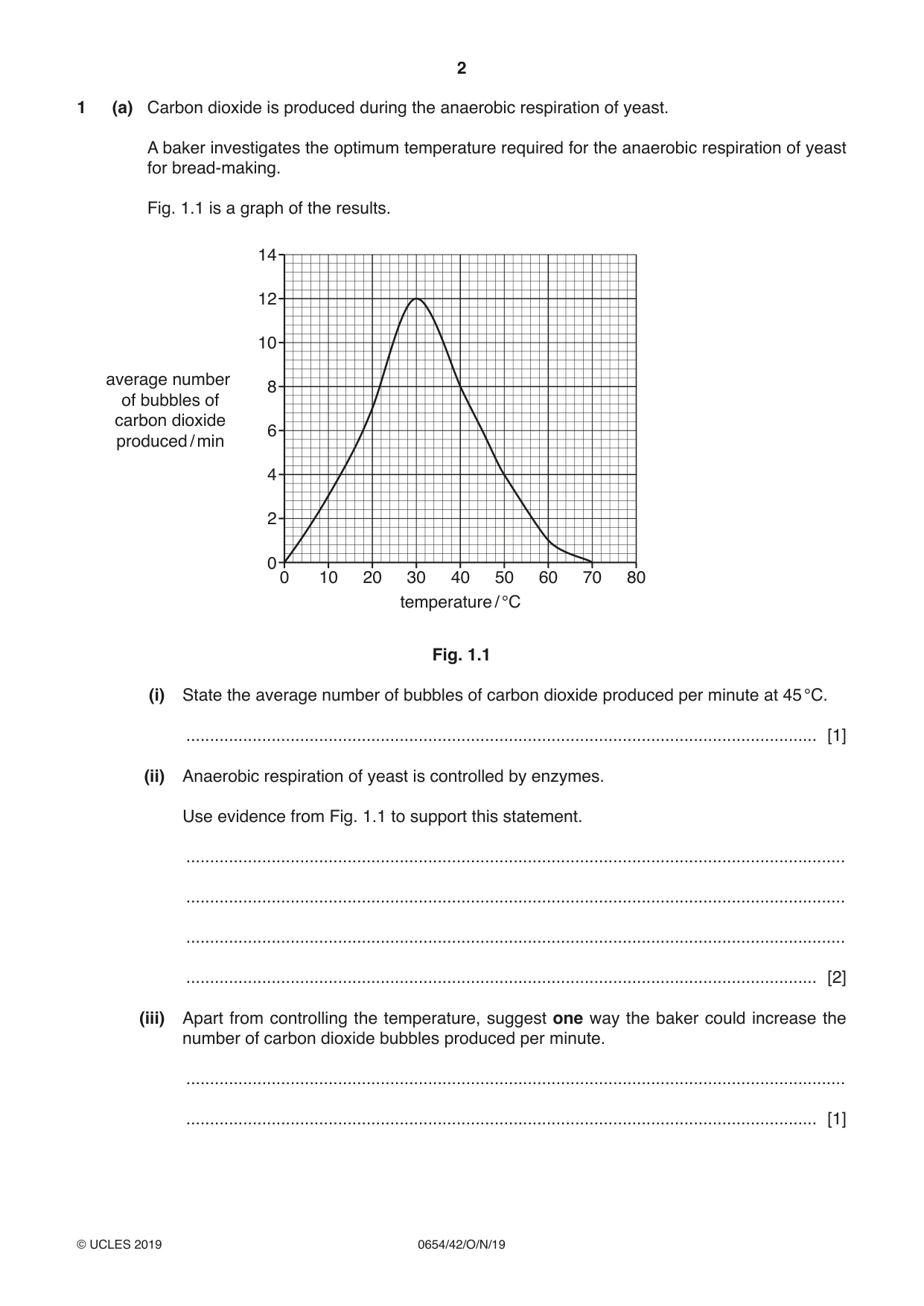
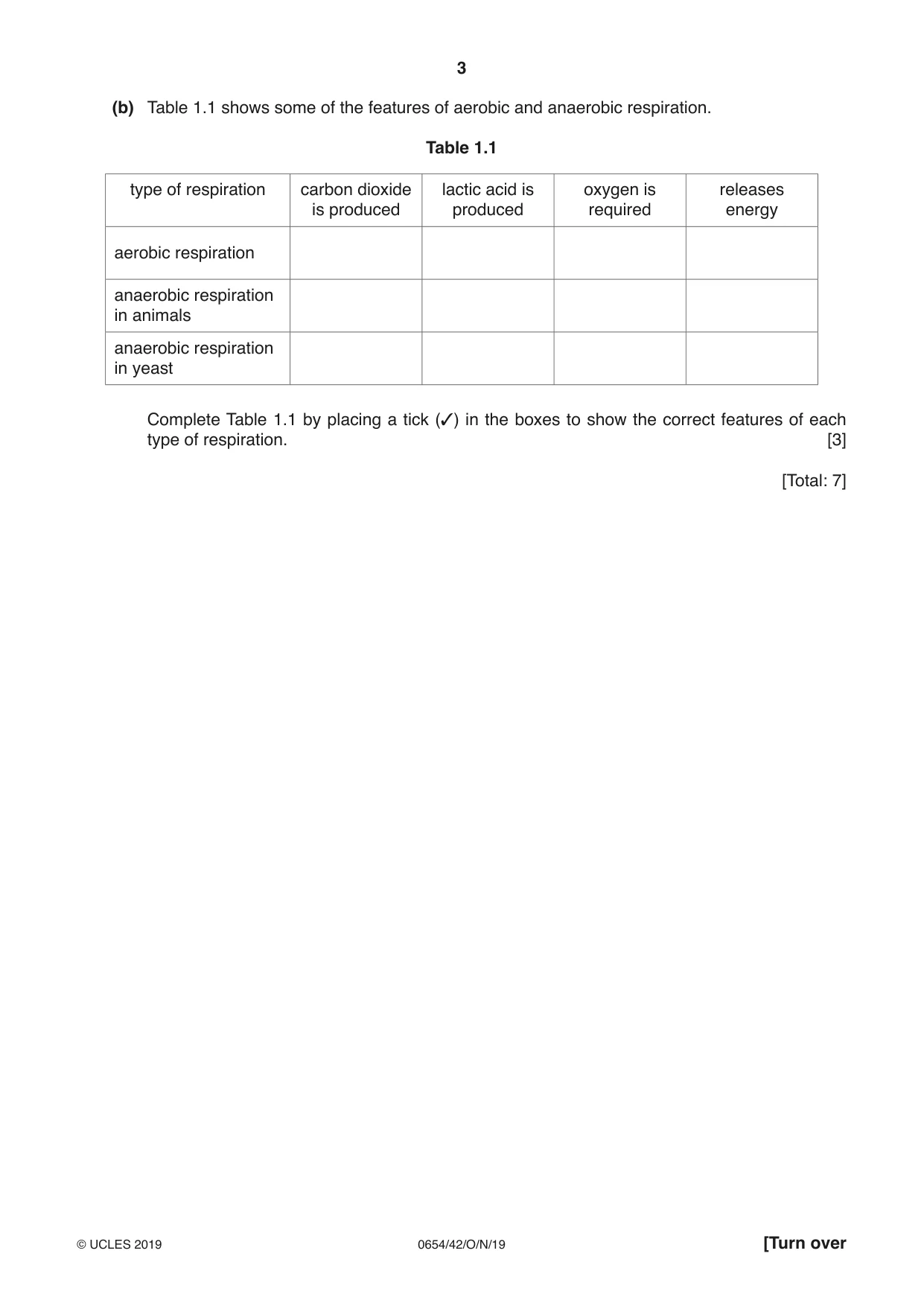
1 (a) Carbon dioxide is produced during the anaerobic respiration of yeast. A baker investigates the optimum temperature required for the anaerobic respiration of yeast for bread-making. Fig. 1.1 is a graph of the results. 14 12 10 average number 8 of bubbles of carbon dioxide 6 produced / min 4 2 0 0 10 20 30 40 50 60 70 80 temperature / °C Fig. 1.1 (i) State the average number of bubbles of carbon dioxide produced per minute at 45 °C. ..................................................................................................................................... [1] (ii) Anaerobic respiration of yeast is controlled by enzymes. Use evidence from Fig. 1.1 to support this statement. ........................................................................................................................................... ........................................................................................................................................... ........................................................................................................................................... ..................................................................................................................................... [2] (iii) Apart from controlling the temperature, suggest one way the baker could increase the number of carbon dioxide bubbles produced per minute. ........................................................................................................................................... ..................................................................................................................................... [1] (b) Table 1.1 shows some of the features of aerobic and anaerobic respiration. Table 1.1 type of respiration carbon dioxide lactic acid is oxygen is releases is produced produced required energy aerobic respiration anaerobic respiration in animals anaerobic respiration in yeast Complete Table 1.1 by placing a tick (✓) in the boxes to show the correct features of each type of respiration. [3] [Total: 7]
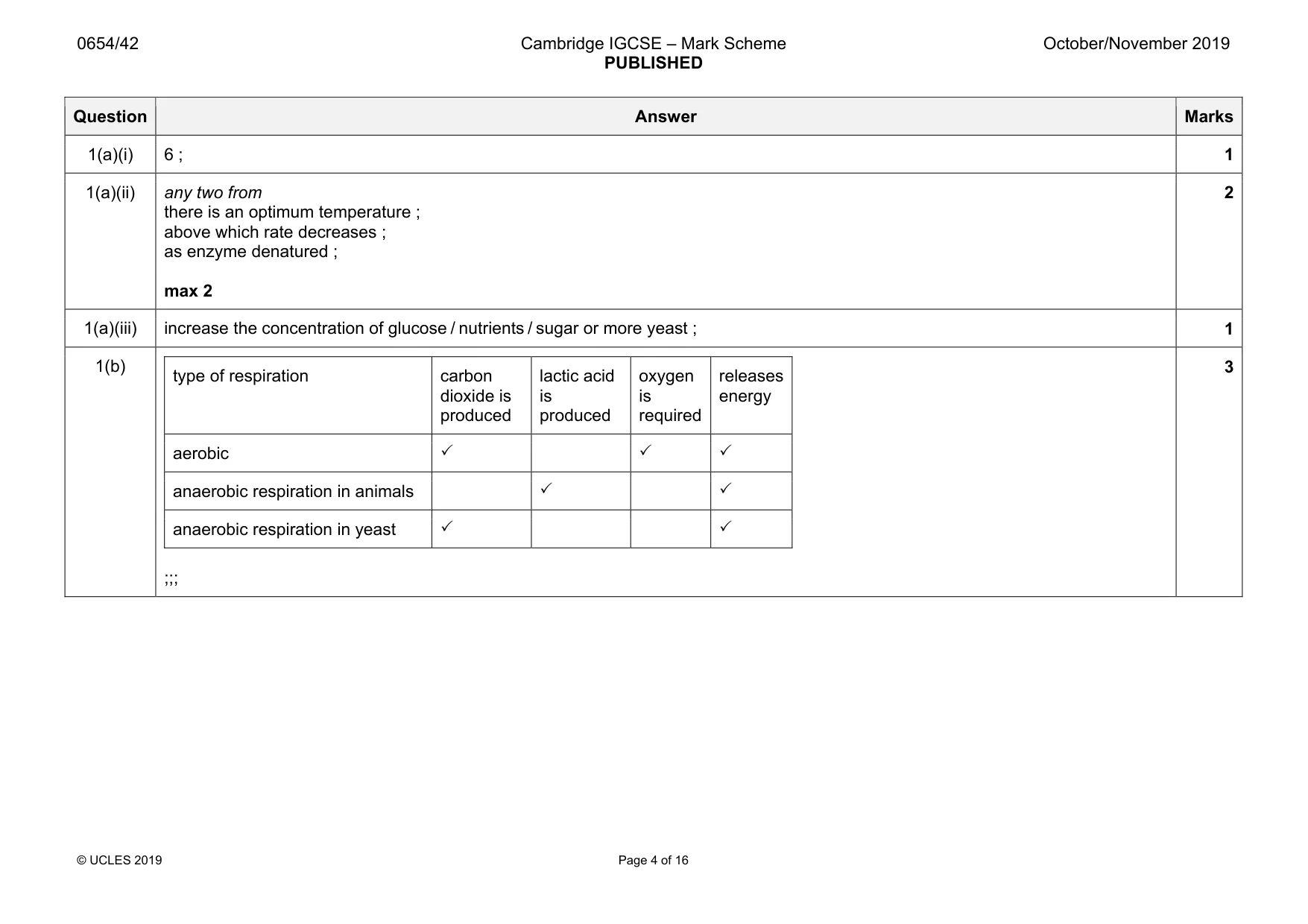
Mark scheme: 1(a)(i) 6 ; 1 1(a)(ii) any two from there is an optimum temperature ; above which rate decreases ; as enzyme denatured ; max 2 2 1(a)(iii) increase the concentration of glucose / nutrients / sugar or more yeast ; 1 1(b) type of respiration carbon dioxide is produced lactic acid is produced oxygen is required releases energy aerobic 3 3 3 anaerobic respiration in animals 3 3 anaerobic respiration in yeast 3 3 ;;; 3
Q2 · Ethene, C2H4, and propene, C3H6, are in the same homologous series
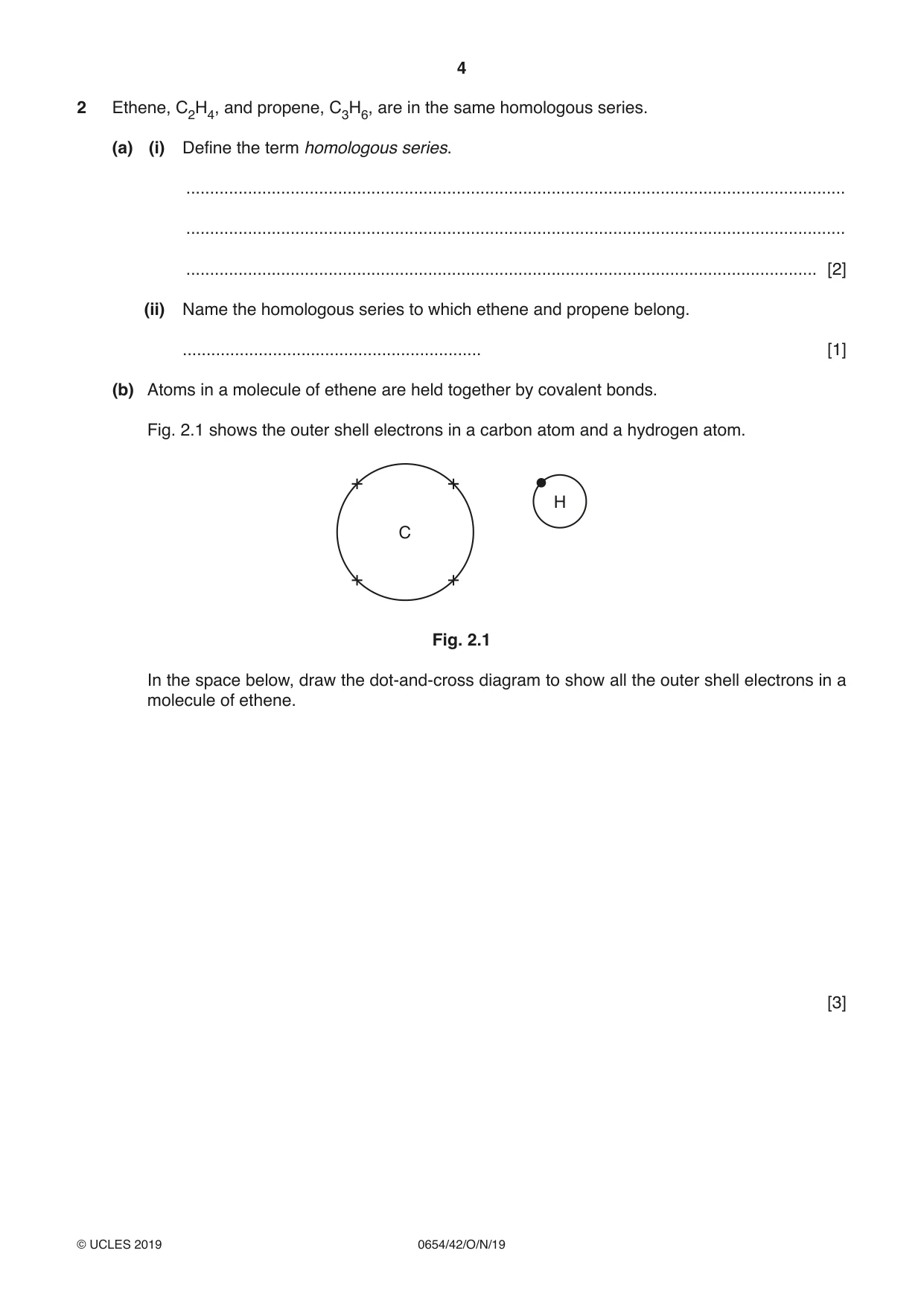
2 Ethene, C2H4, and propene, C3H6, are in the same homologous series. (a) (i) Define the term homologous series. ........................................................................................................................................... ........................................................................................................................................... ..................................................................................................................................... [2] (ii) Name the homologous series to which ethene and propene belong. ............................................................... [1] (b) Atoms in a molecule of ethene are held together by covalent bonds. Fig. 2.1 shows the outer shell electrons in a carbon atom and a hydrogen atom. H C Fig. 2.1 In the space below, draw the dot-and-cross diagram to show all the outer shell electrons in a molecule of ethene. [3] (c) Ethane is produced by the addition reaction between ethene and hydrogen. (i) Write the symbol equation for the addition reaction between ethene and hydrogen. ..................................................................................................................................... [2] (ii) Predict the product formed when propene reacts with hydrogen. Explain your answer. product .............................................................................................................................. explanation ........................................................................................................................ ..................................................................................................................................... [2] [Total: 10]
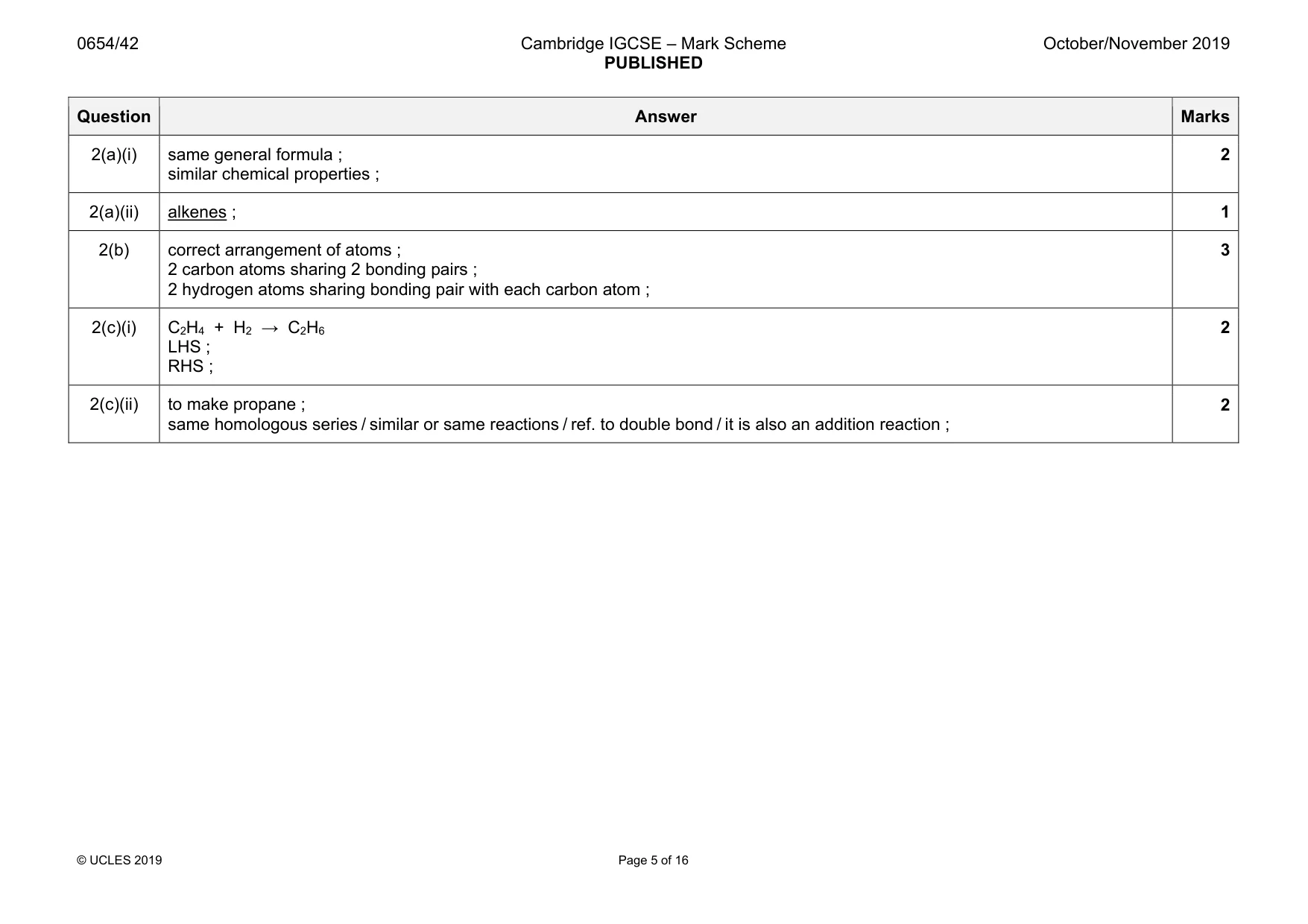
Mark scheme: 2(a)(i) same general formula ; similar chemical properties ; 2 2(a)(ii) alkenes ; 1 2(b) correct arrangement of atoms ; 2 carbon atoms sharing 2 bonding pairs ; 2 hydrogen atoms sharing bonding pair with each carbon atom ; 3 2(c)(i) C2H4 + H2 → C2H6 LHS ; RHS ; 2 2(c)(ii) to make propane ; same homologous series / similar or same reactions / ref. to double bond / it is also an addition reaction ; 2
Q3 · X-rays and γ-radiation are both used in hospitals
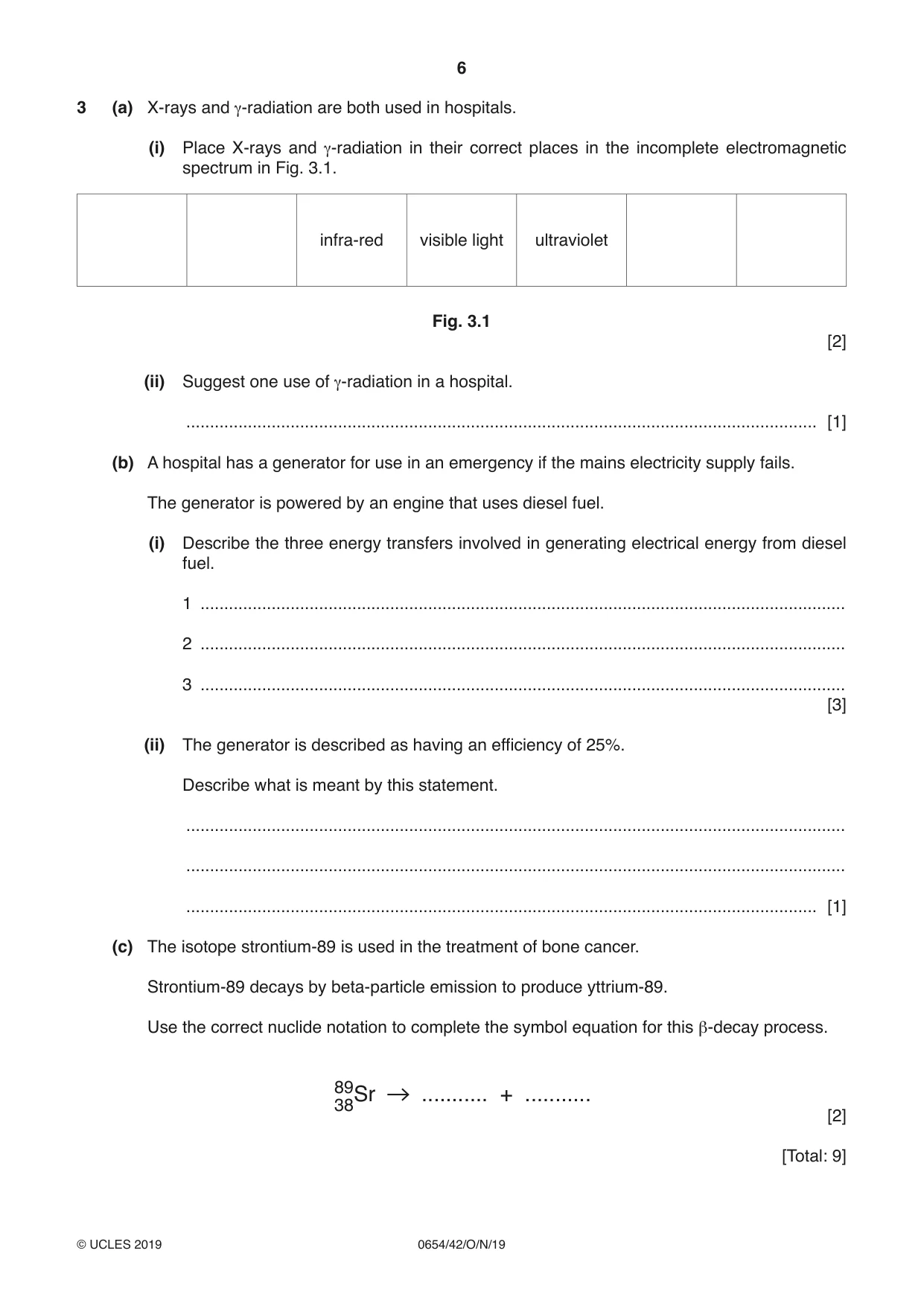
3 (a) X-rays and γ-radiation are both used in hospitals. (i) Place X-rays and γ-radiation in their correct places in the incomplete electromagnetic spectrum in Fig. 3.1. infra-red visible light ultraviolet Fig. 3.1 [2] (ii) Suggest one use of γ-radiation in a hospital. ..................................................................................................................................... [1] (b) A hospital has a generator for use in an emergency if the mains electricity supply fails. The generator is powered by an engine that uses diesel fuel. (i) Describe the three energy transfers involved in generating electrical energy from diesel fuel. 1 ........................................................................................................................................ 2 ........................................................................................................................................ 3 ........................................................................................................................................ [3] (ii) The generator is described as having an efficiency of 25%. Describe what is meant by this statement. ........................................................................................................................................... ........................................................................................................................................... ..................................................................................................................................... [1] (c) The isotope strontium-89 is used in the treatment of bone cancer. Strontium-89 decays by beta-particle emission to produce yttrium-89. Use the correct nuclide notation to complete the symbol equation for this β-decay process. 8938Sr ........... + ........... [2] [Total: 9]
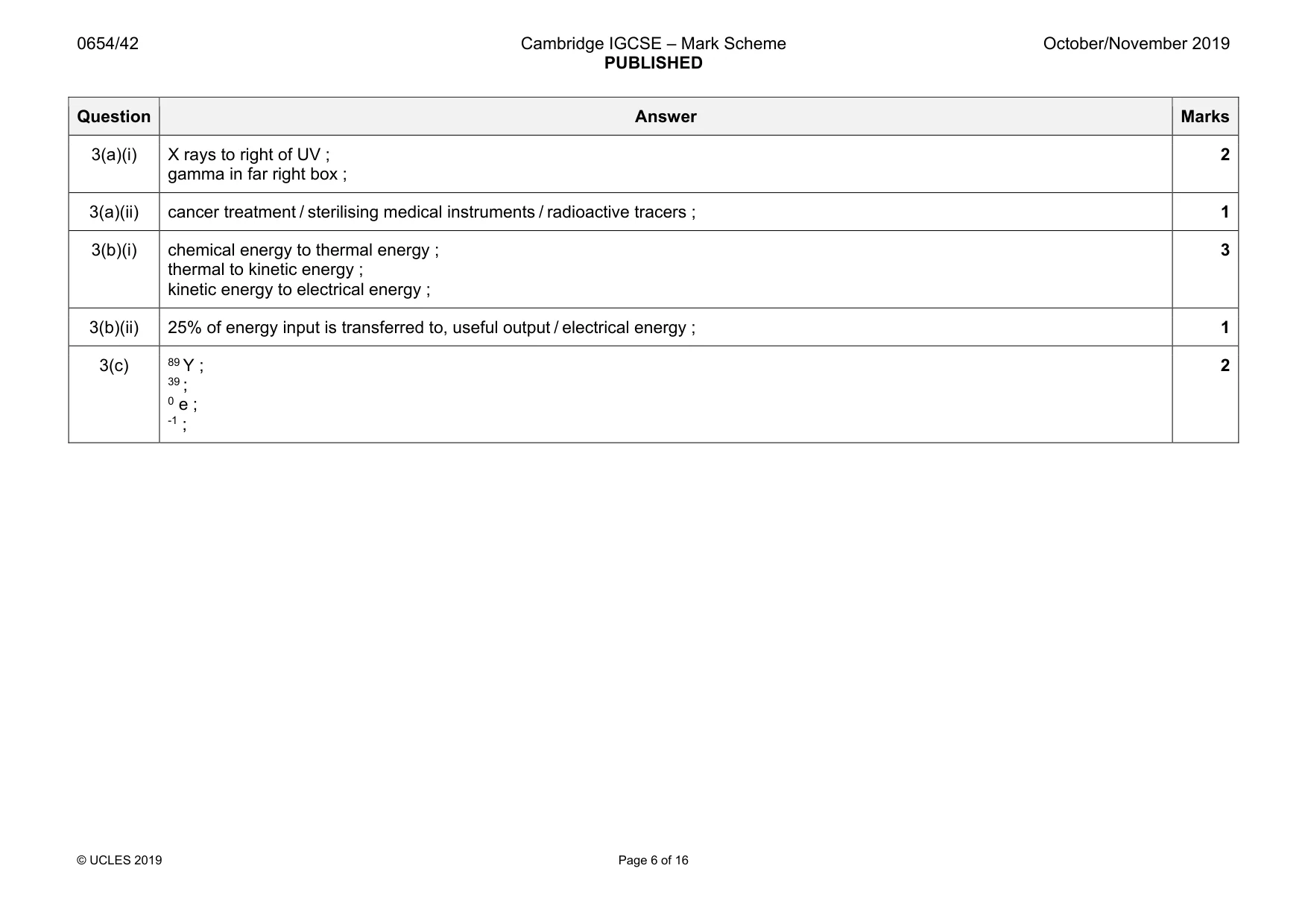
Mark scheme: 3(a)(i) X rays to right of UV ; gamma in far right box ; 2 3(a)(ii) cancer treatment / sterilising medical instruments / radioactive tracers ; 1 3(b)(i) chemical energy to thermal energy ; thermal to kinetic energy ; kinetic energy to electrical energy ; 3 3(b)(ii) 25% of energy input is transferred to, useful output / electrical energy ; 1 3(c) 89 Y ; 39 ; 0 e ; -1 ; 2
Q4 · A picture of a racehorse
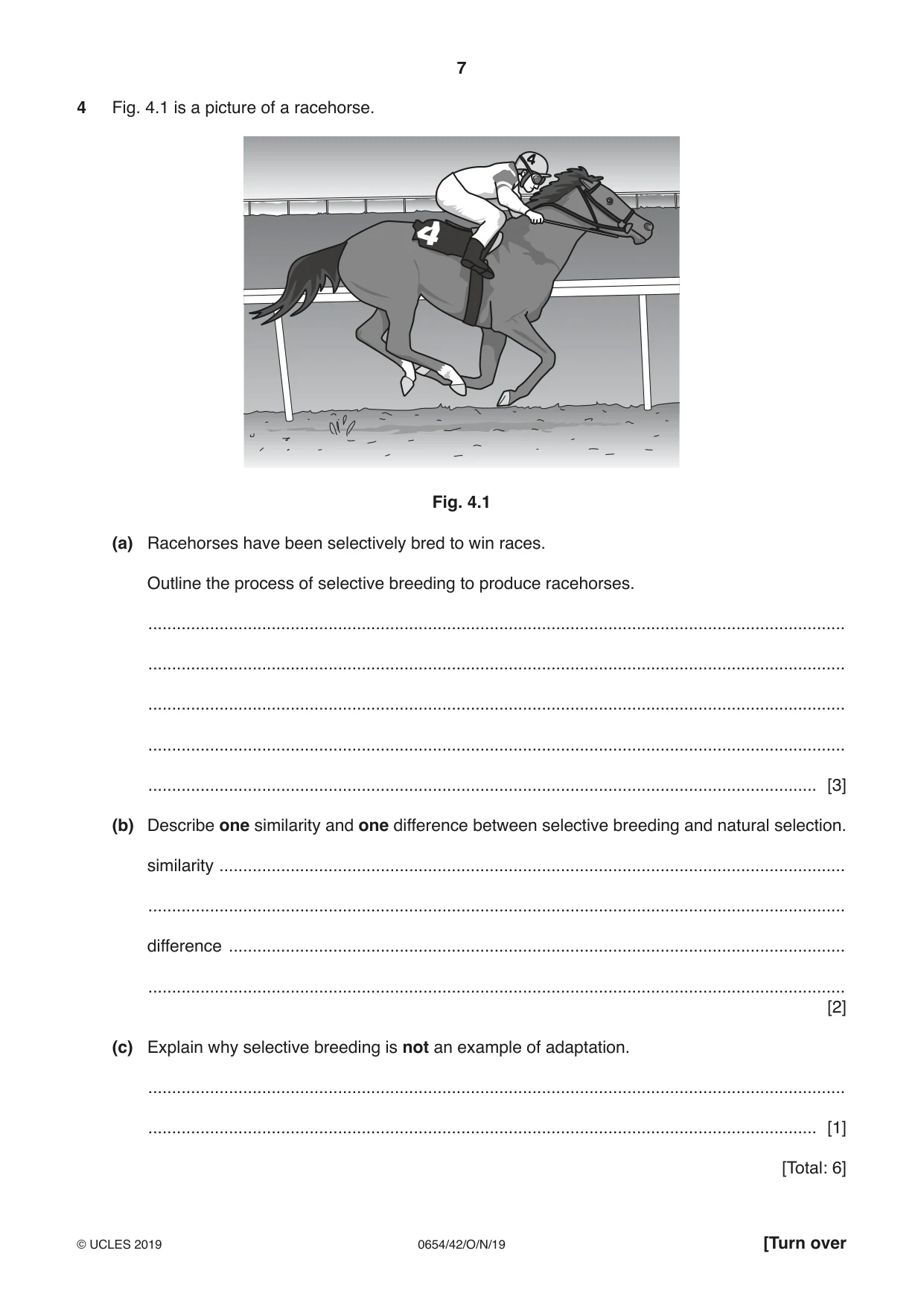
4 Fig. 4.1 is a picture of a racehorse. Fig. 4.1 (a) Racehorses have been selectively bred to win races. Outline the process of selective breeding to produce racehorses. ................................................................................................................................................... ................................................................................................................................................... ................................................................................................................................................... ................................................................................................................................................... ............................................................................................................................................. [3] (b) Describe one similarity and one difference between selective breeding and natural selection. similarity .................................................................................................................................... ................................................................................................................................................... difference .................................................................................................................................. ................................................................................................................................................... [2] (c) Explain why selective breeding is not an example of adaptation. ................................................................................................................................................... ............................................................................................................................................. [1] [Total: 6]
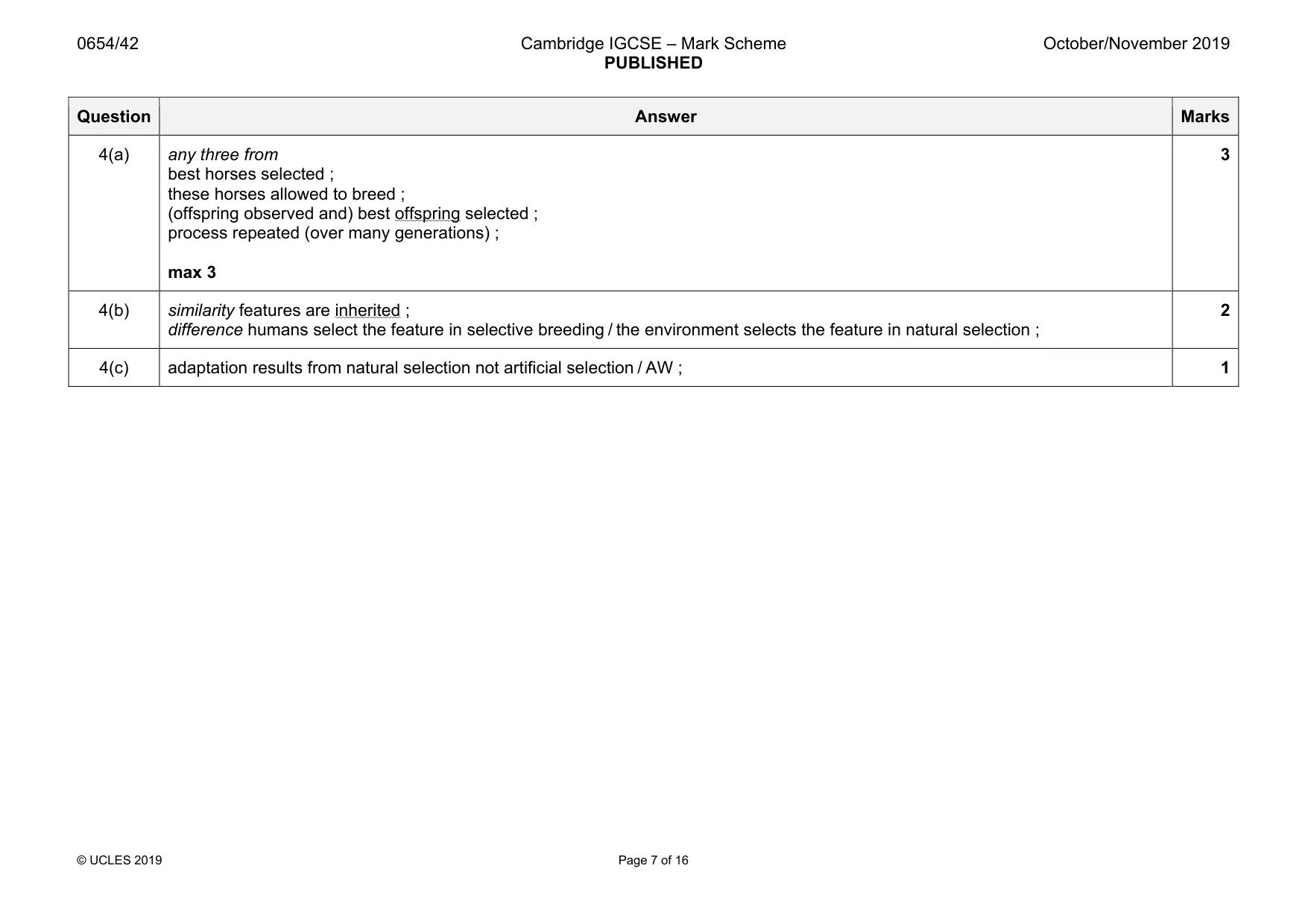
Mark scheme: 4(a) any three from best horses selected ; these horses allowed to breed ; (offspring observed and) best offspring selected ; process repeated (over many generations) ; max 3 3 4(b) similarity features are inherited ; difference humans select the feature in selective breeding / the environment selects the feature in natural selection ; 2 4(c) adaptation results from natural selection not artificial selection / AW ; 1
Q5 · Ammonia is manufactured in the Haber process
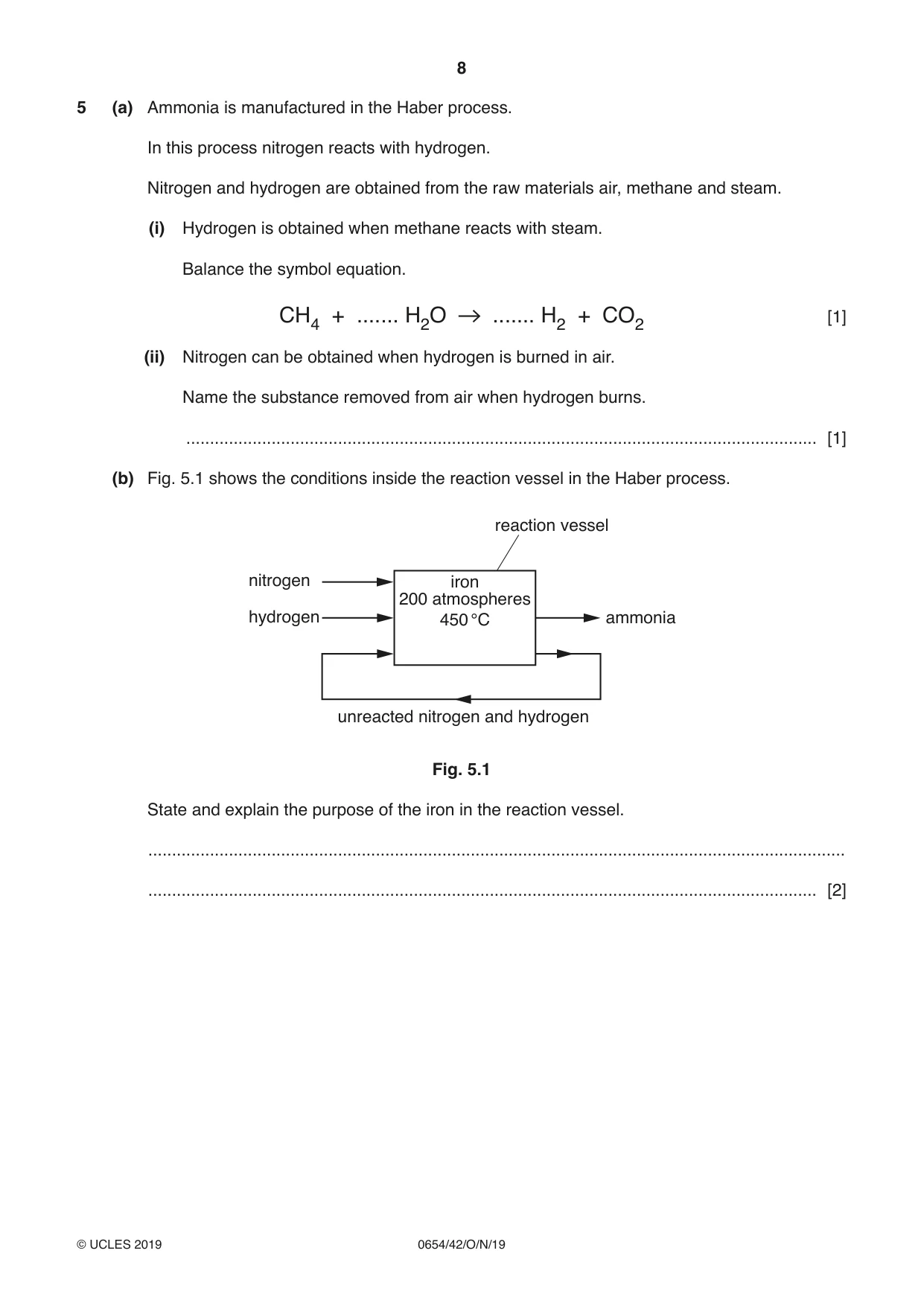
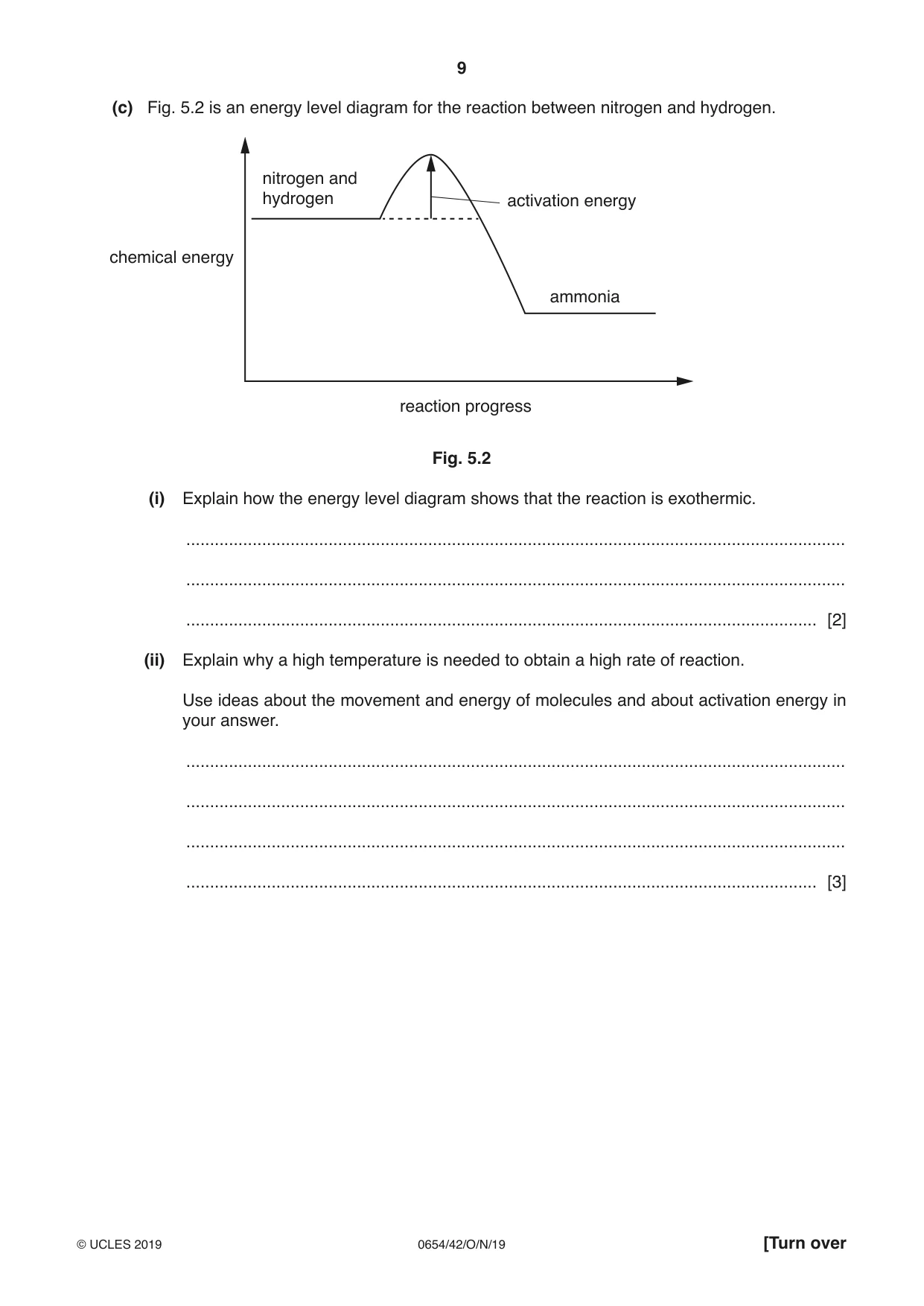
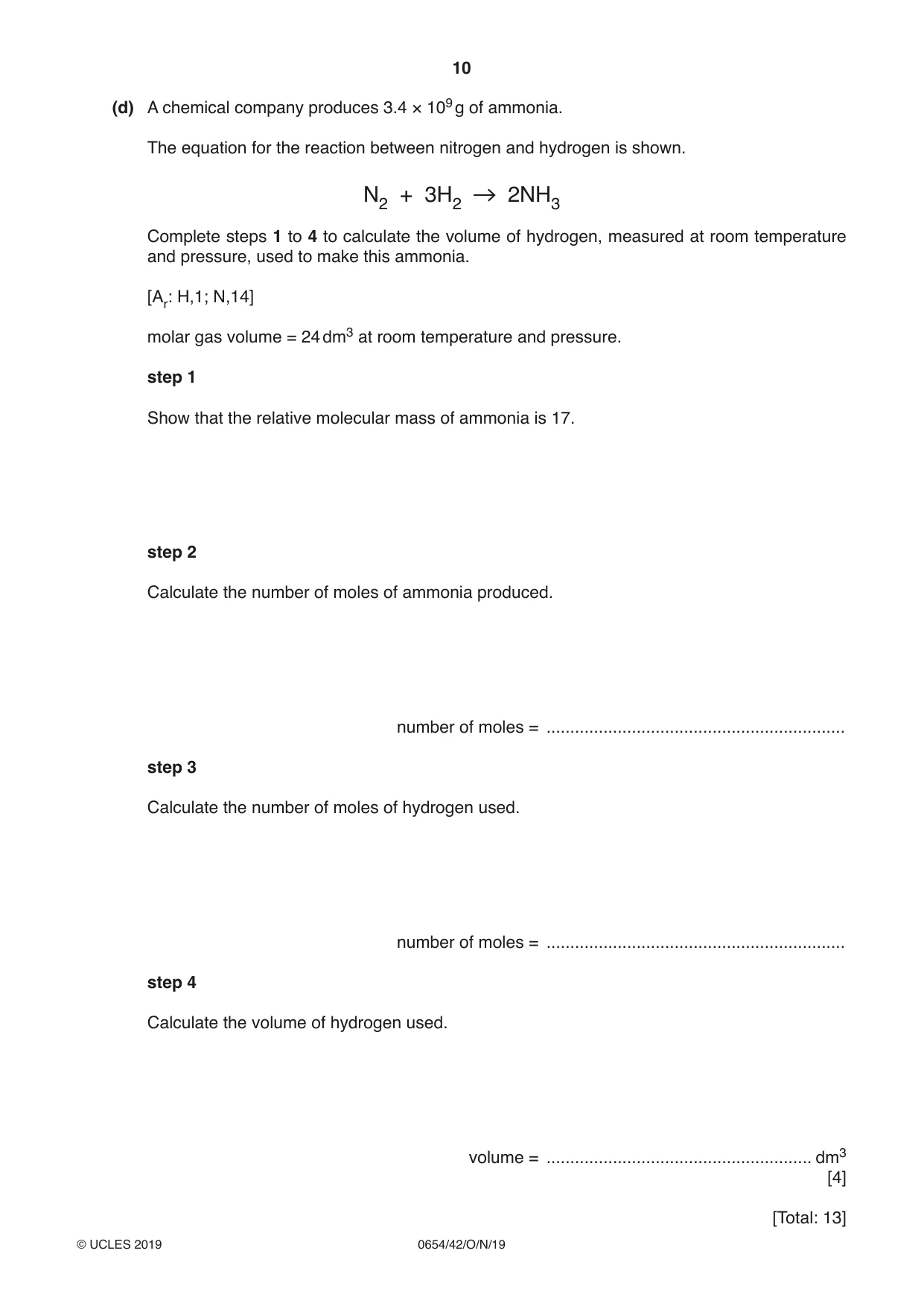
5 (a) Ammonia is manufactured in the Haber process. In this process nitrogen reacts with hydrogen. Nitrogen and hydrogen are obtained from the raw materials air, methane and steam. (i) Hydrogen is obtained when methane reacts with steam. Balance the symbol equation. [1] CH4 + ....... H2O ....... H2 + CO2 (ii) Nitrogen can be obtained when hydrogen is burned in air. Name the substance removed from air when hydrogen burns. ..................................................................................................................................... [1] (b) Fig. 5.1 shows the conditions inside the reaction vessel in the Haber process. reaction vessel nitrogen iron 200 atmospheres hydrogen 450 °C ammonia unreacted nitrogen and hydrogen Fig. 5.1 State and explain the purpose of the iron in the reaction vessel. ................................................................................................................................................... ............................................................................................................................................. [2] (c) Fig. 5.2 is an energy level diagram for the reaction between nitrogen and hydrogen. nitrogen and hydrogen activation energy chemical energy ammonia reaction progress Fig. 5.2 (i) Explain how the energy level diagram shows that the reaction is exothermic. ........................................................................................................................................... ........................................................................................................................................... ..................................................................................................................................... [2] (ii) Explain why a high temperature is needed to obtain a high rate of reaction. Use ideas about the movement and energy of molecules and about activation energy in your answer. ........................................................................................................................................... ........................................................................................................................................... ........................................................................................................................................... ..................................................................................................................................... [3] (d) A chemical company produces 3.4 × 10⁹ g of ammonia. The equation for the reaction between nitrogen and hydrogen is shown. N2 + 3H2 2NH3 Complete steps 1 to 4 to calculate the volume of hydrogen, measured at room temperature and pressure, used to make this ammonia. [Ar: H,1; N,14] molar gas volume = 24 dm3 at room temperature and pressure. step 1 Show that the relative molecular mass of ammonia is 17. step 2 Calculate the number of moles of ammonia produced. number of moles = ............................................................... step 3 Calculate the number of moles of hydrogen used. number of moles = ............................................................... step 4 Calculate the volume of hydrogen used. volume = ........................................................ dm3 [4] [Total: 13]
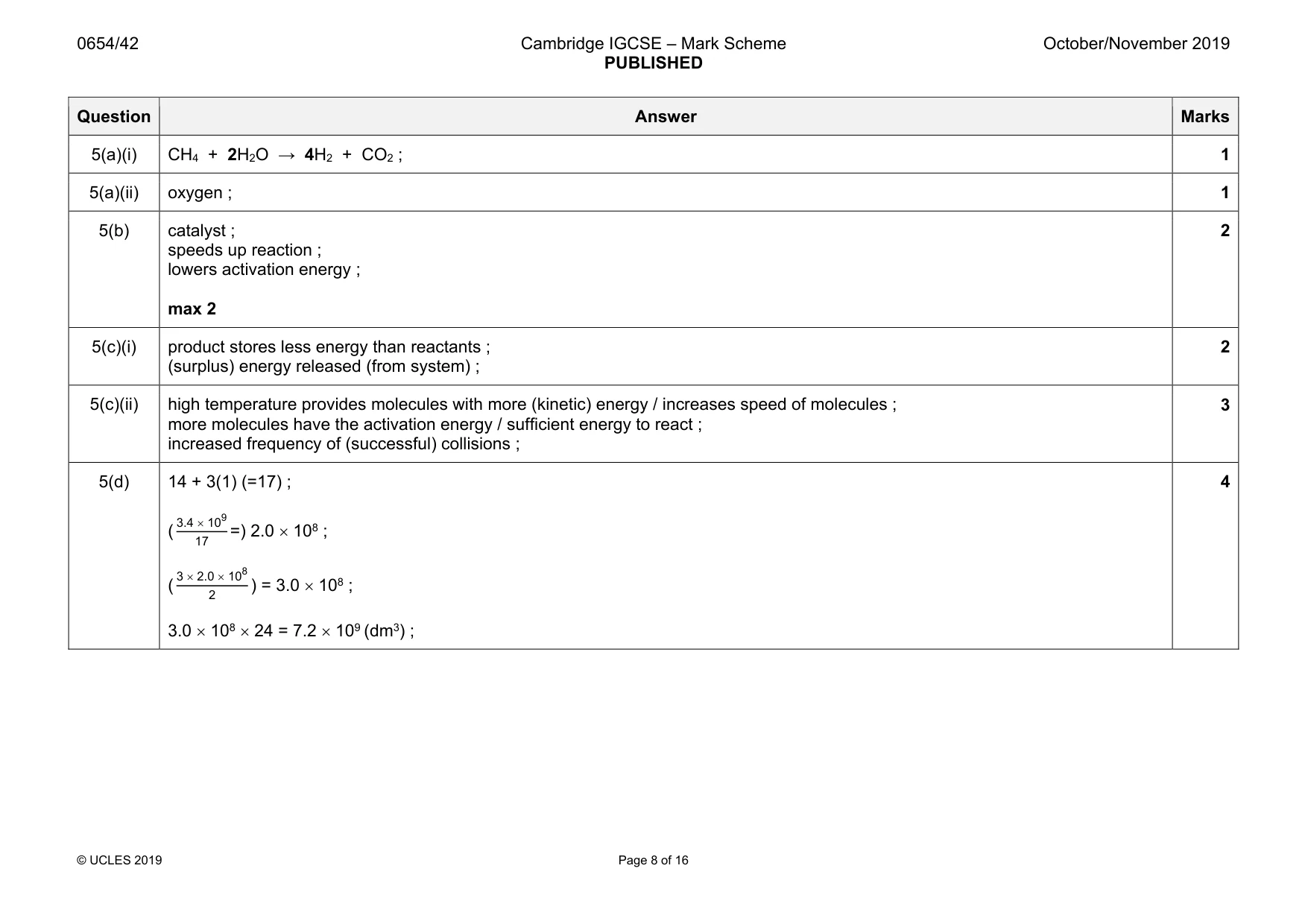
Mark scheme: 5(a)(i) CH4 + 2H2O → 4H2 + CO2 ; 1 5(a)(ii) oxygen ; 1 5(b) catalyst ; speeds up reaction ; lowers activation energy ; max 2 2 5(c)(i) product stores less energy than reactants ; (surplus) energy released (from system) ; 2 5(c)(ii) high temperature provides molecules with more (kinetic) energy / increases speed of molecules ; more molecules have the activation energy / sufficient energy to react ; increased frequency of (successful) collisions ; 3 5(d) 14 + 3(1) (=17) ; ( 3.4 × 10⁹ 17 =) 2.0 × 10⁸ ; ( 3 × 2.0 × 108 2 ) = 3.0 × 10⁸ ; 3.0 × 108 × 24 = 7.2 × 10⁹ (dm3) ; 4
Q6 · Dolphins are a species of aquatic mammal
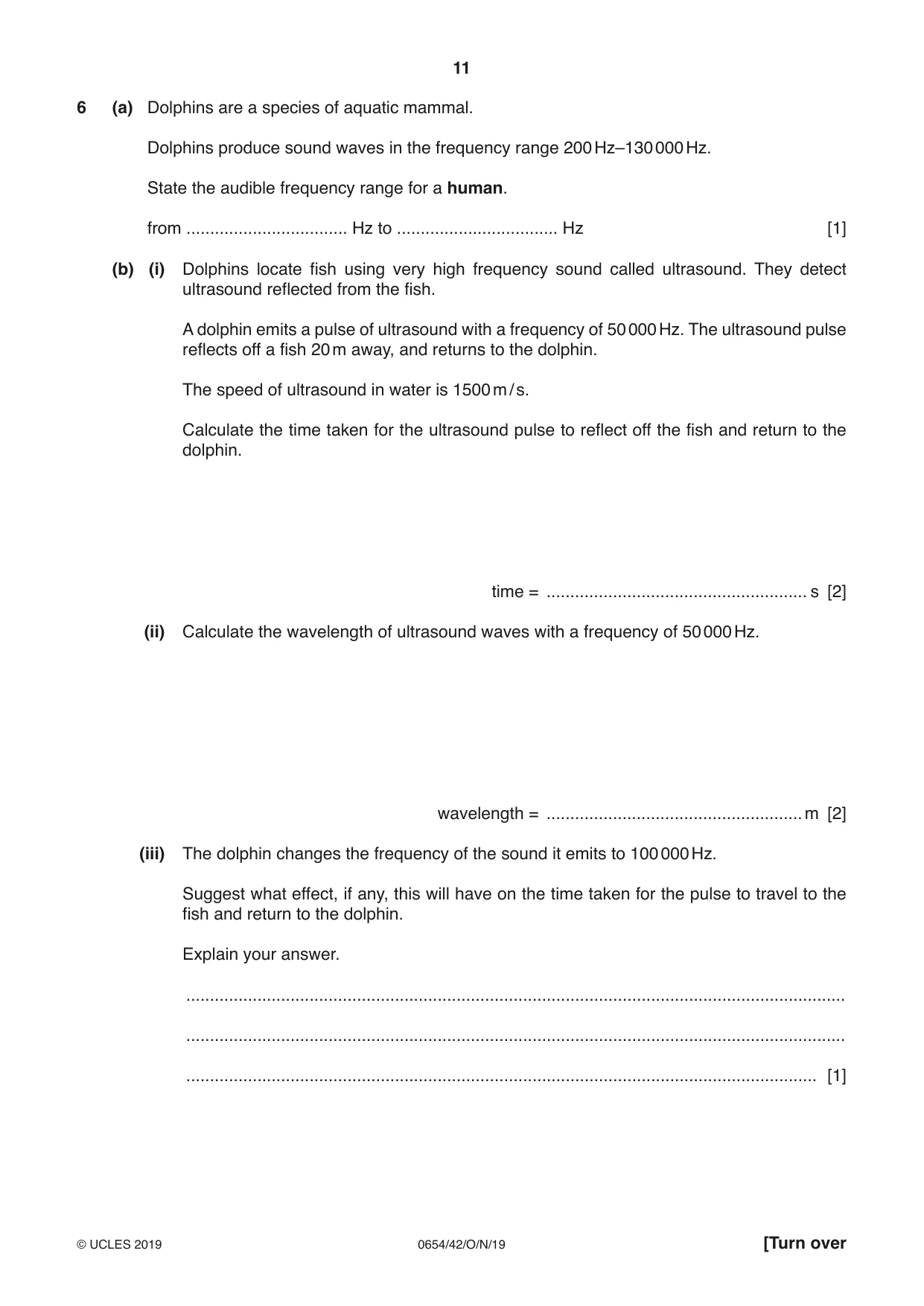
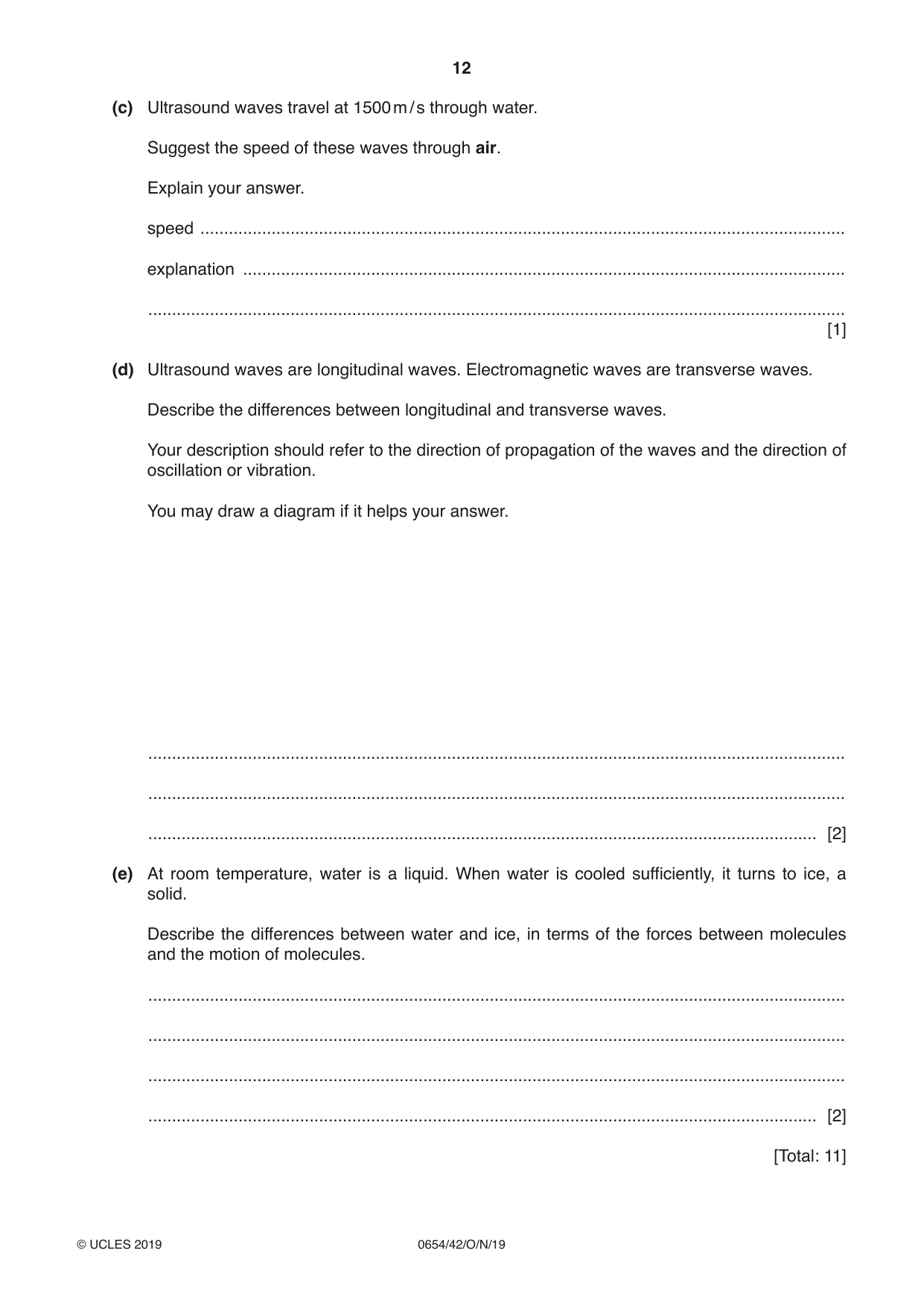
6 (a) Dolphins are a species of aquatic mammal. Dolphins produce sound waves in the frequency range 200 Hz–130 000 Hz. State the audible frequency range for a human. from .................................. Hz to .................................. Hz [1] (b) (i) Dolphins locate fish using very high frequency sound called ultrasound. They detect ultrasound reflected from the fish. A dolphin emits a pulse of ultrasound with a frequency of 50 000 Hz. The ultrasound pulse reflects off a fish 20 m away, and returns to the dolphin. The speed of ultrasound in water is 1500 m / s. Calculate the time taken for the ultrasound pulse to reflect off the fish and return to the dolphin. time = ....................................................... s [2] (ii) Calculate the wavelength of ultrasound waves with a frequency of 50 000 Hz. wavelength = ......................................................m [2] (iii) The dolphin changes the frequency of the sound it emits to 100 000 Hz. Suggest what effect, if any, this will have on the time taken for the pulse to travel to the fish and return to the dolphin. Explain your answer. ........................................................................................................................................... ........................................................................................................................................... ..................................................................................................................................... [1] (c) Ultrasound waves travel at 1500 m / s through water. Suggest the speed of these waves through air. Explain your answer. speed ........................................................................................................................................ explanation ............................................................................................................................... ................................................................................................................................................... [1] (d) Ultrasound waves are longitudinal waves. Electromagnetic waves are transverse waves. Describe the differences between longitudinal and transverse waves. Your description should refer to the direction of propagation of the waves and the direction of oscillation or vibration. You may draw a diagram if it helps your answer. ................................................................................................................................................... ................................................................................................................................................... ............................................................................................................................................. [2] (e) At room temperature, water is a liquid. When water is cooled sufficiently, it turns to ice, a solid. Describe the differences between water and ice, in terms of the forces between molecules and the motion of molecules. ................................................................................................................................................... ................................................................................................................................................... ................................................................................................................................................... ............................................................................................................................................. [2] [Total: 11]
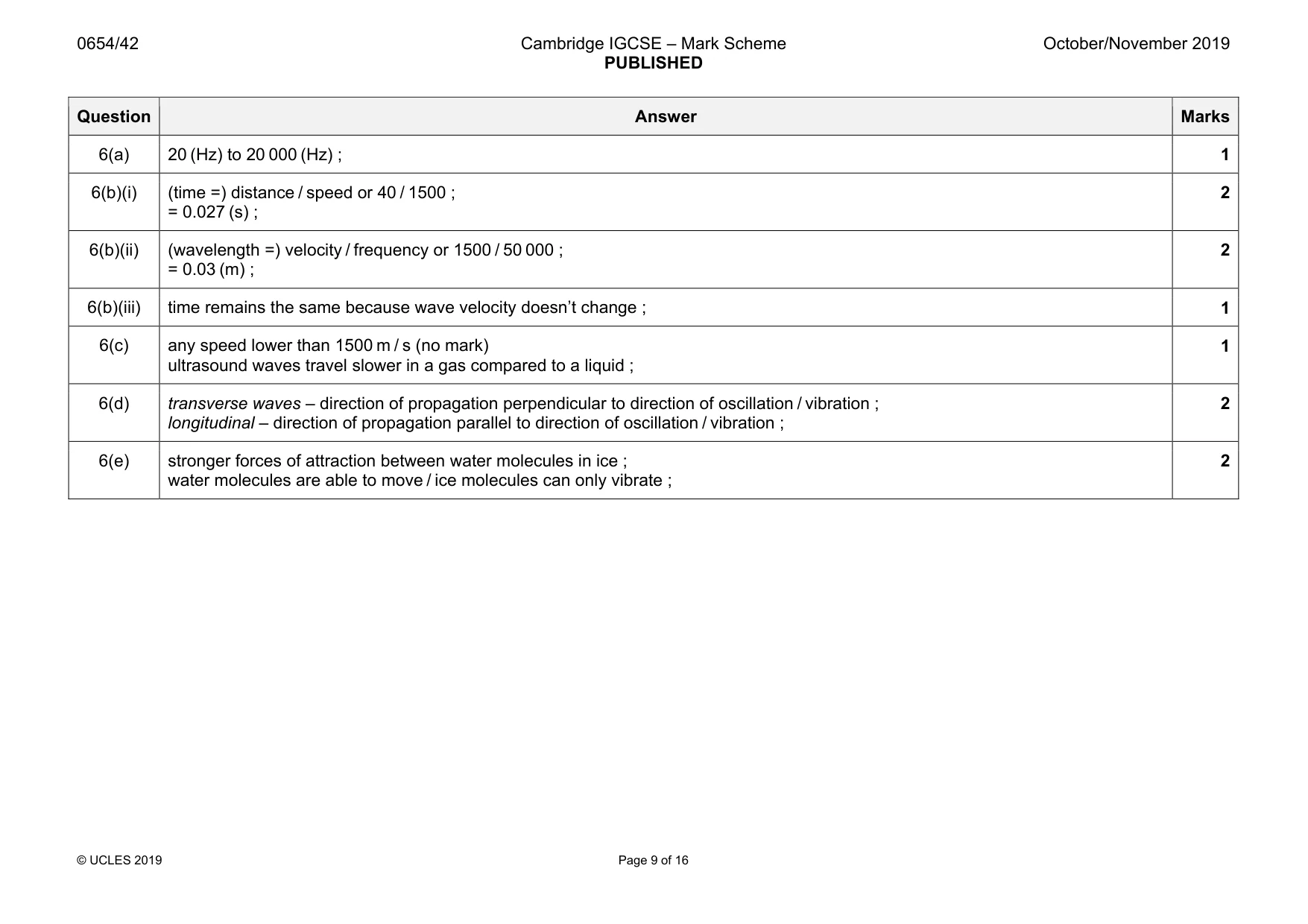
Mark scheme: 6(a) 20 (Hz) to 20 000 (Hz) ; 1 6(b)(i) (time =) distance / speed or 40 / 1500 ; = 0.027 (s) ; 2 6(b)(ii) (wavelength =) velocity / frequency or 1500 / 50 000 ; = 0.03 (m) ; 2 6(b)(iii) time remains the same because wave velocity doesn’t change ; 1 6(c) any speed lower than 1500 m / s (no mark) ultrasound waves travel slower in a gas compared to a liquid ; 1 6(d) transverse waves – direction of propagation perpendicular to direction of oscillation / vibration ; longitudinal – direction of propagation parallel to direction of oscillation / vibration ; 2 6(e) stronger forces of attraction between water molecules in ice ; water molecules are able to move / ice molecules can only vibrate ; 2
Q7 · The alimentary canal and associated organs
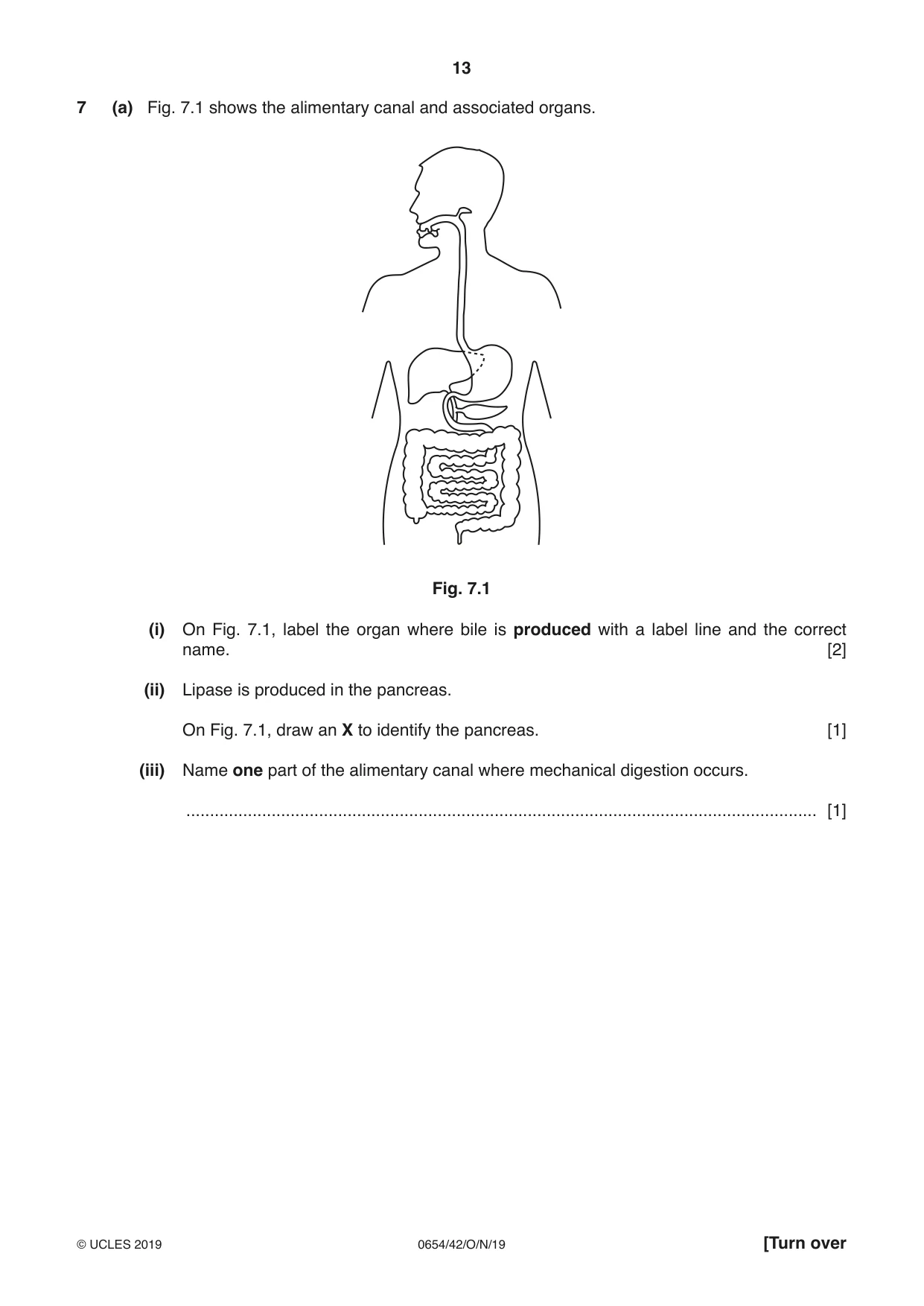
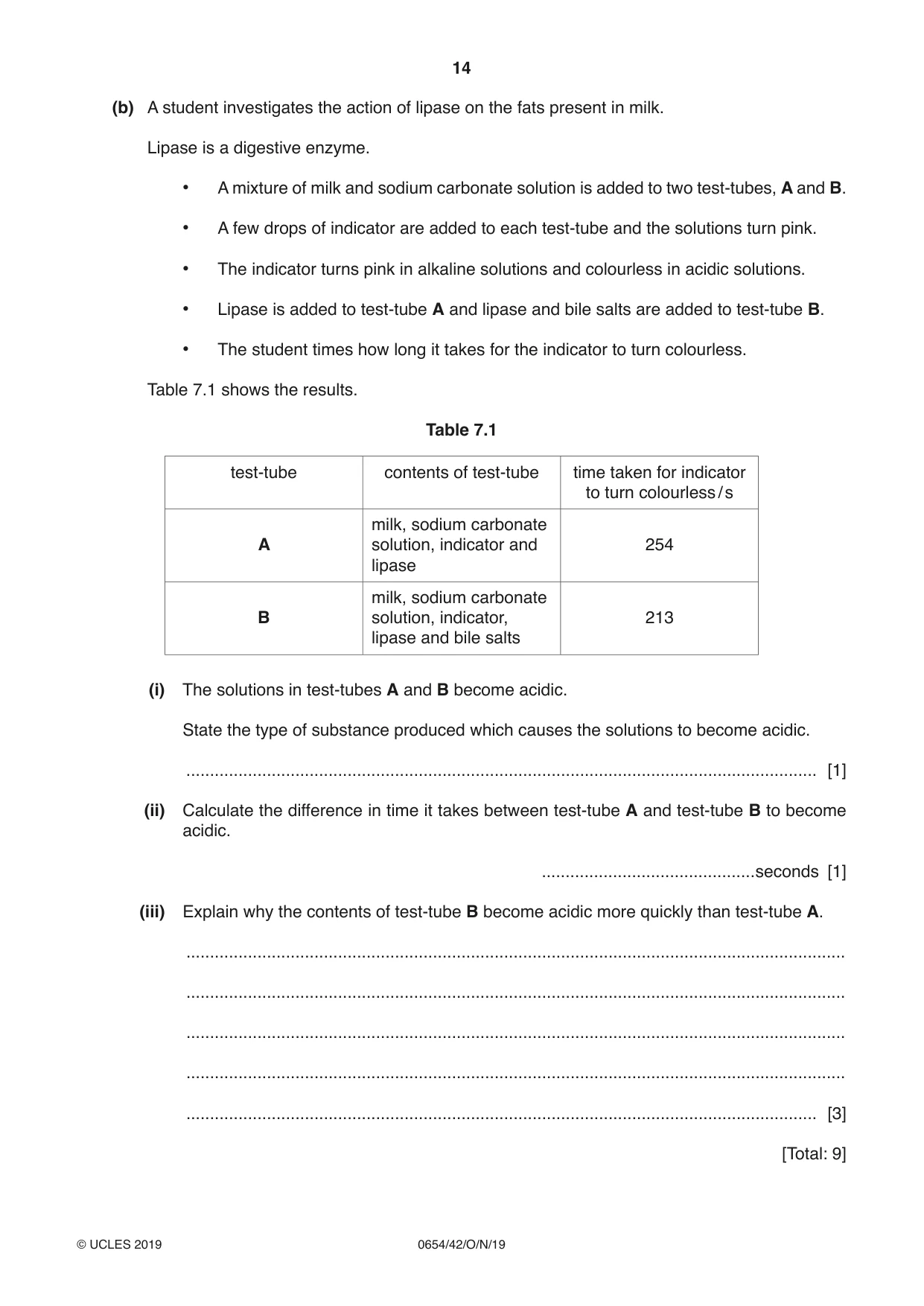
7 (a) Fig. 7.1 shows the alimentary canal and associated organs. Fig. 7.1 (i) On Fig. 7.1, label the organ where bile is produced with a label line and the correct name. [2] (ii) Lipase is produced in the pancreas. On Fig. 7.1, draw an X to identify the pancreas. [1] (iii) Name one part of the alimentary canal where mechanical digestion occurs. ..................................................................................................................................... [1] (b) A student investigates the action of lipase on the fats present in milk. Lipase is a digestive enzyme. • A mixture of milk and sodium carbonate solution is added to two test-tubes, A and B. • A few drops of indicator are added to each test-tube and the solutions turn pink. • The indicator turns pink in alkaline solutions and colourless in acidic solutions. • Lipase is added to test-tube A and lipase and bile salts are added to test-tube B. • The student times how long it takes for the indicator to turn colourless. Table 7.1 shows the results. Table 7.1 test-tube contents of test-tube time taken for indicator to turn colourless / s milk, sodium carbonate A solution, indicator and 254 lipase milk, sodium carbonate B solution, indicator, 213 lipase and bile salts (i) The solutions in test-tubes A and B become acidic. State the type of substance produced which causes the solutions to become acidic. ..................................................................................................................................... [1] (ii) Calculate the difference in time it takes between test-tube A and test-tube B to become acidic. .............................................seconds [1] (iii) Explain why the contents of test-tube B become acidic more quickly than test-tube A. ........................................................................................................................................... ........................................................................................................................................... ........................................................................................................................................... ........................................................................................................................................... ..................................................................................................................................... [3] [Total: 9]
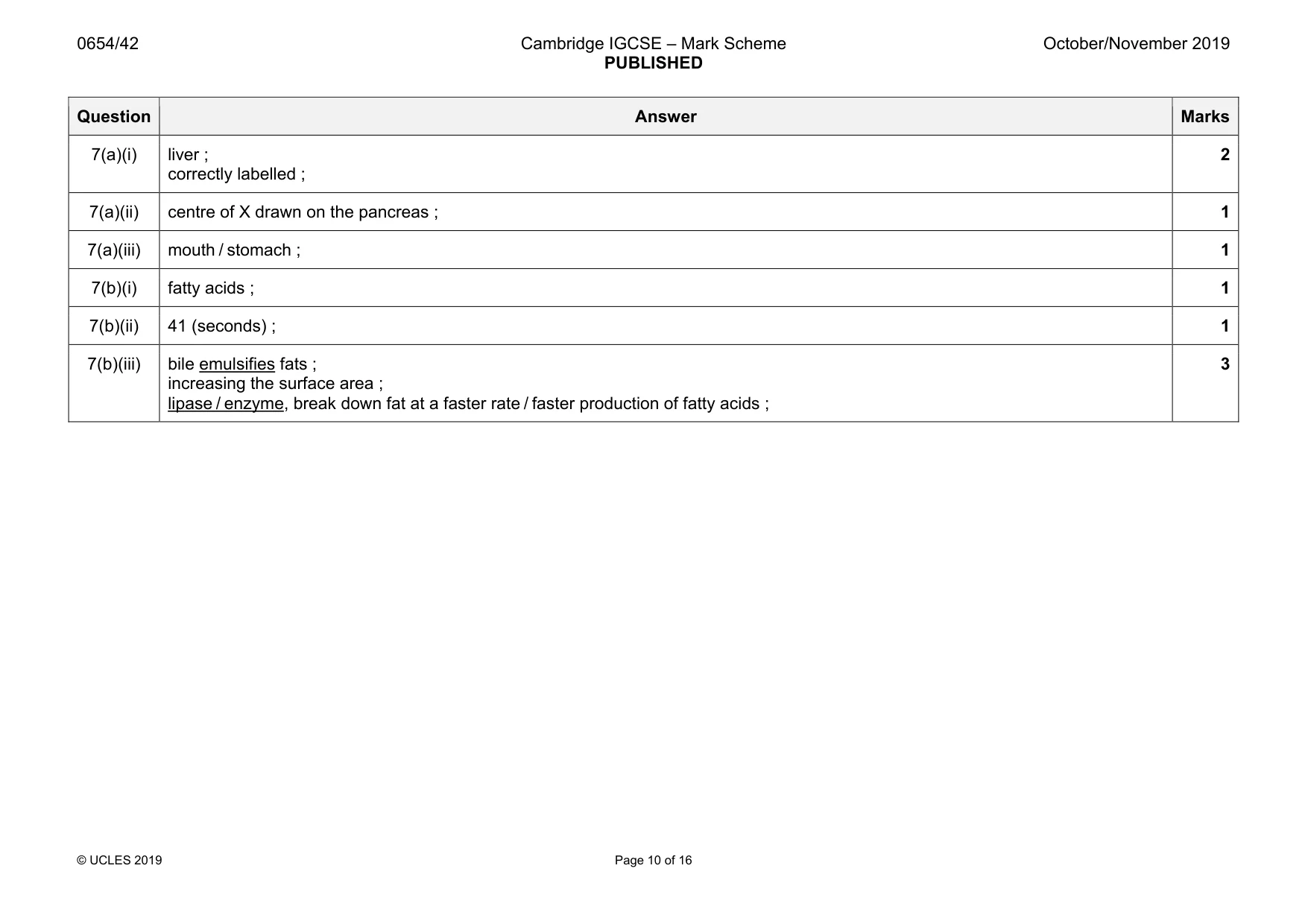
Mark scheme: 7(a)(i) liver ; correctly labelled ; 2 7(a)(ii) centre of X drawn on the pancreas ; 1 7(a)(iii) mouth / stomach ; 1 7(b)(i) fatty acids ; 1 7(b)(ii) 41 (seconds) ; 1 7(b)(iii) bile emulsifies fats ; increasing the surface area ; lipase / enzyme, break down fat at a faster rate / faster production of fatty acids ; 3
Q8 · A student tries to draw the lattice structure of a crystal of sodium chloride
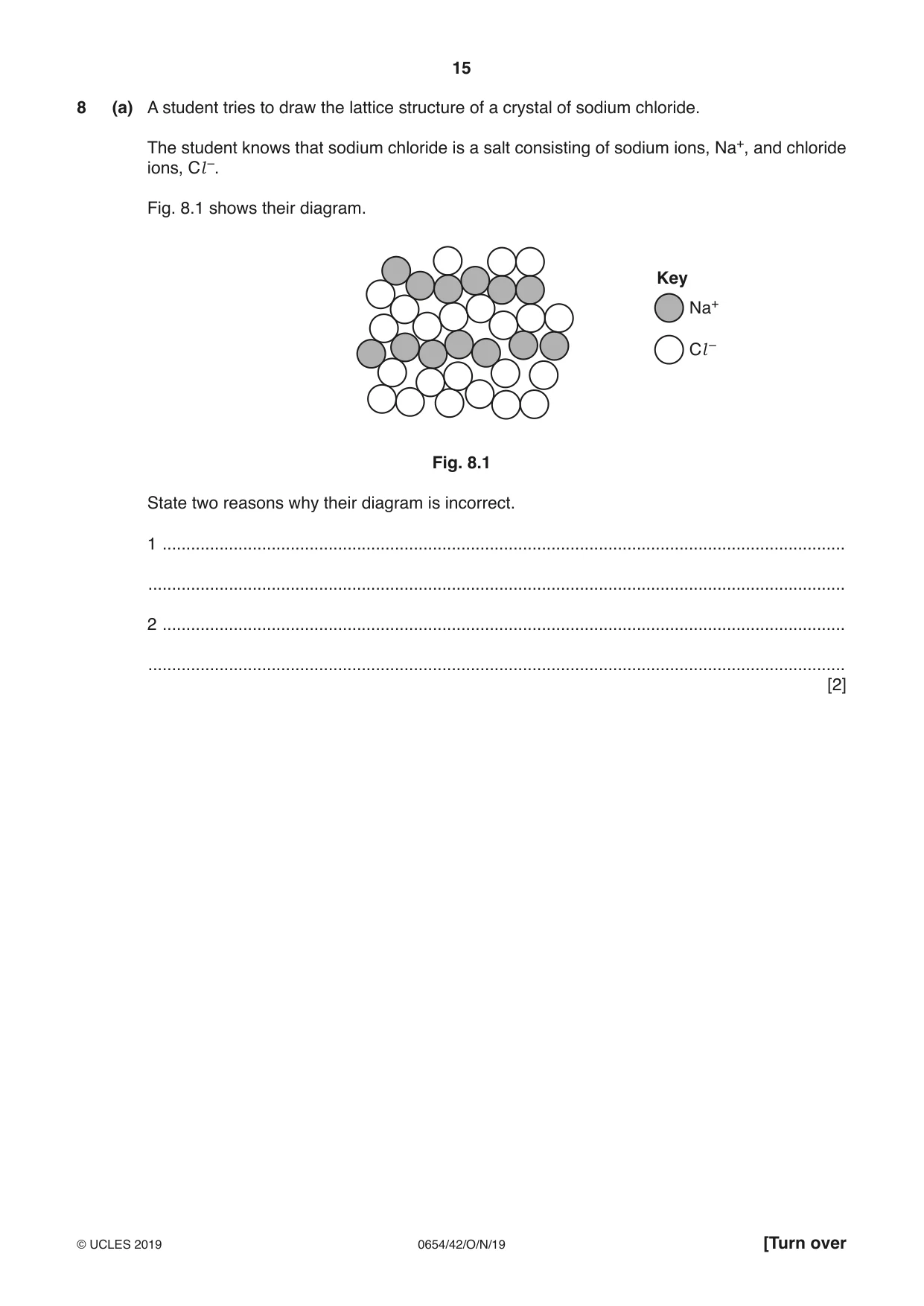
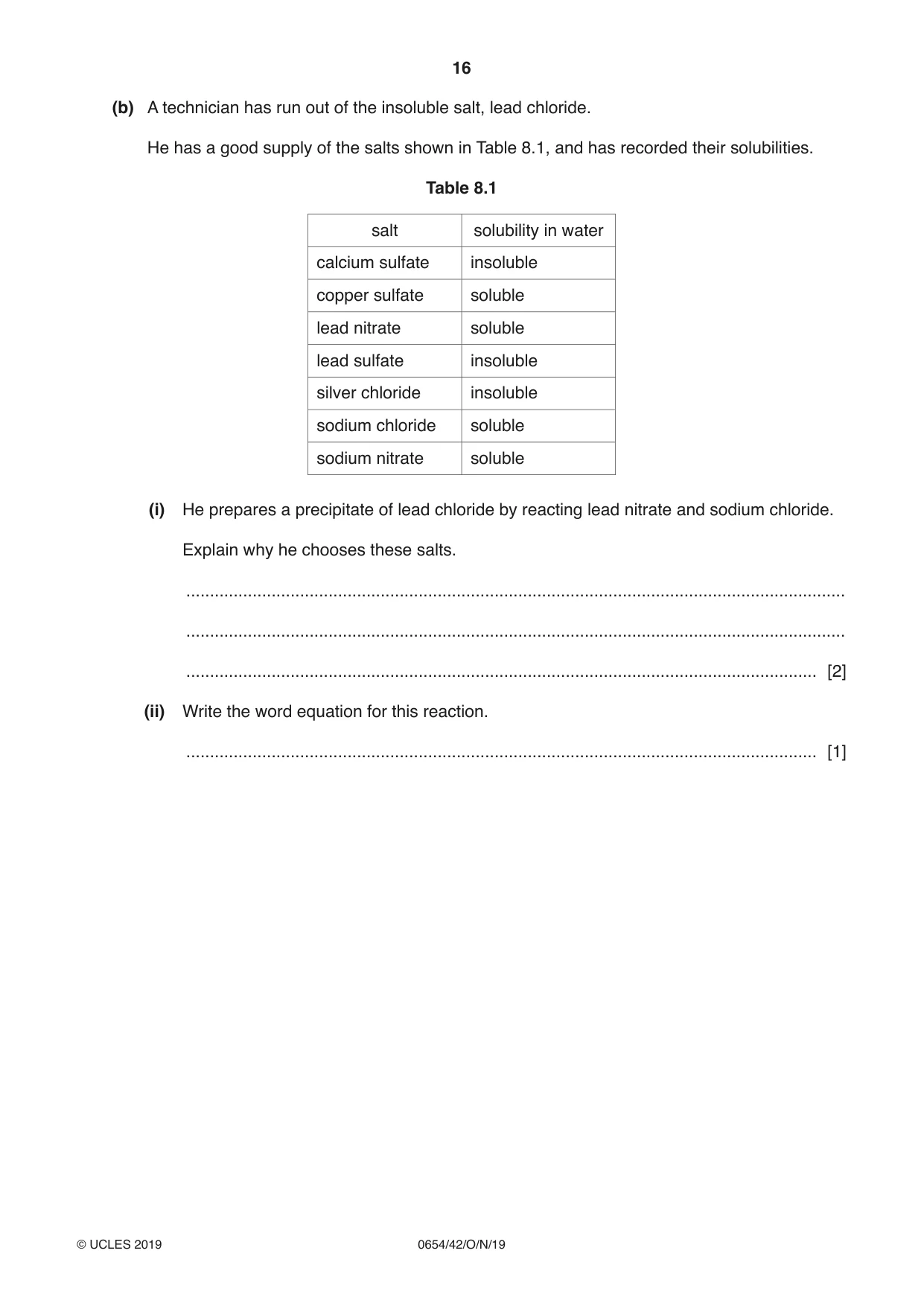
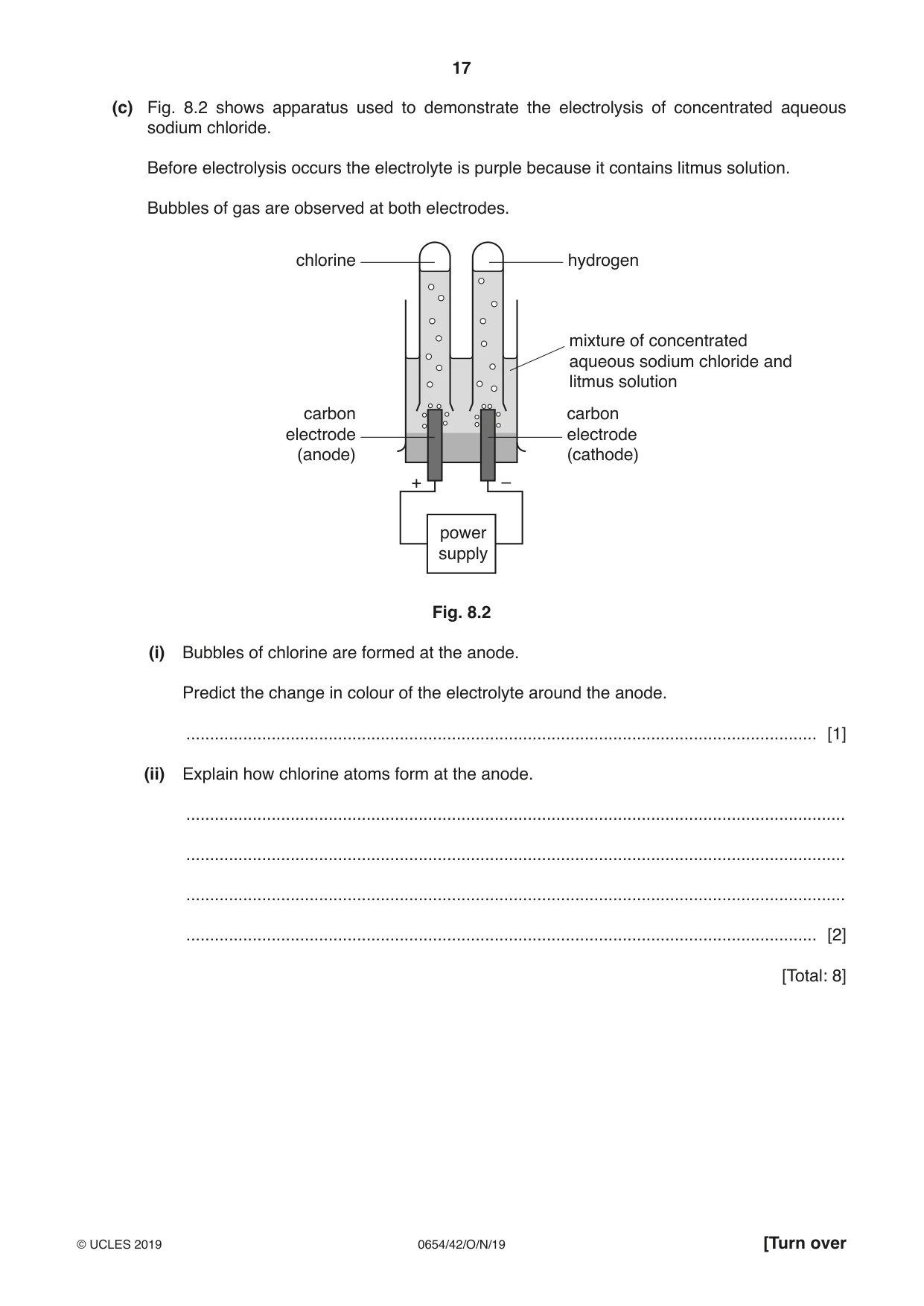
8 (a) A student tries to draw the lattice structure of a crystal of sodium chloride. The student knows that sodium chloride is a salt consisting of sodium ions, Na+, and chloride ions, Cl –. Fig. 8.1 shows their diagram. Key Na+ Cl – Fig. 8.1 State two reasons why their diagram is incorrect. 1 ................................................................................................................................................ ................................................................................................................................................... 2 ................................................................................................................................................ ................................................................................................................................................... [2] (b) A technician has run out of the insoluble salt, lead chloride. He has a good supply of the salts shown in Table 8.1, and has recorded their solubilities. Table 8.1 salt solubility in water calcium sulfate insoluble copper sulfate soluble lead nitrate soluble lead sulfate insoluble silver chloride insoluble sodium chloride soluble sodium nitrate soluble (i) He prepares a precipitate of lead chloride by reacting lead nitrate and sodium chloride. Explain why he chooses these salts. ........................................................................................................................................... ........................................................................................................................................... ..................................................................................................................................... [2] (ii) Write the word equation for this reaction. ..................................................................................................................................... [1] (c) Fig. 8.2 shows apparatus used to demonstrate the electrolysis of concentrated aqueous sodium chloride. Before electrolysis occurs the electrolyte is purple because it contains litmus solution. Bubbles of gas are observed at both electrodes. chlorine hydrogen mixture of concentrated aqueous sodium chloride and litmus solution carbon carbon electrode electrode (anode) (cathode) + – power supply Fig. 8.2 (i) Bubbles of chlorine are formed at the anode. Predict the change in colour of the electrolyte around the anode. ..................................................................................................................................... [1] (ii) Explain how chlorine atoms form at the anode. ........................................................................................................................................... ........................................................................................................................................... ........................................................................................................................................... ..................................................................................................................................... [2] [Total: 8]
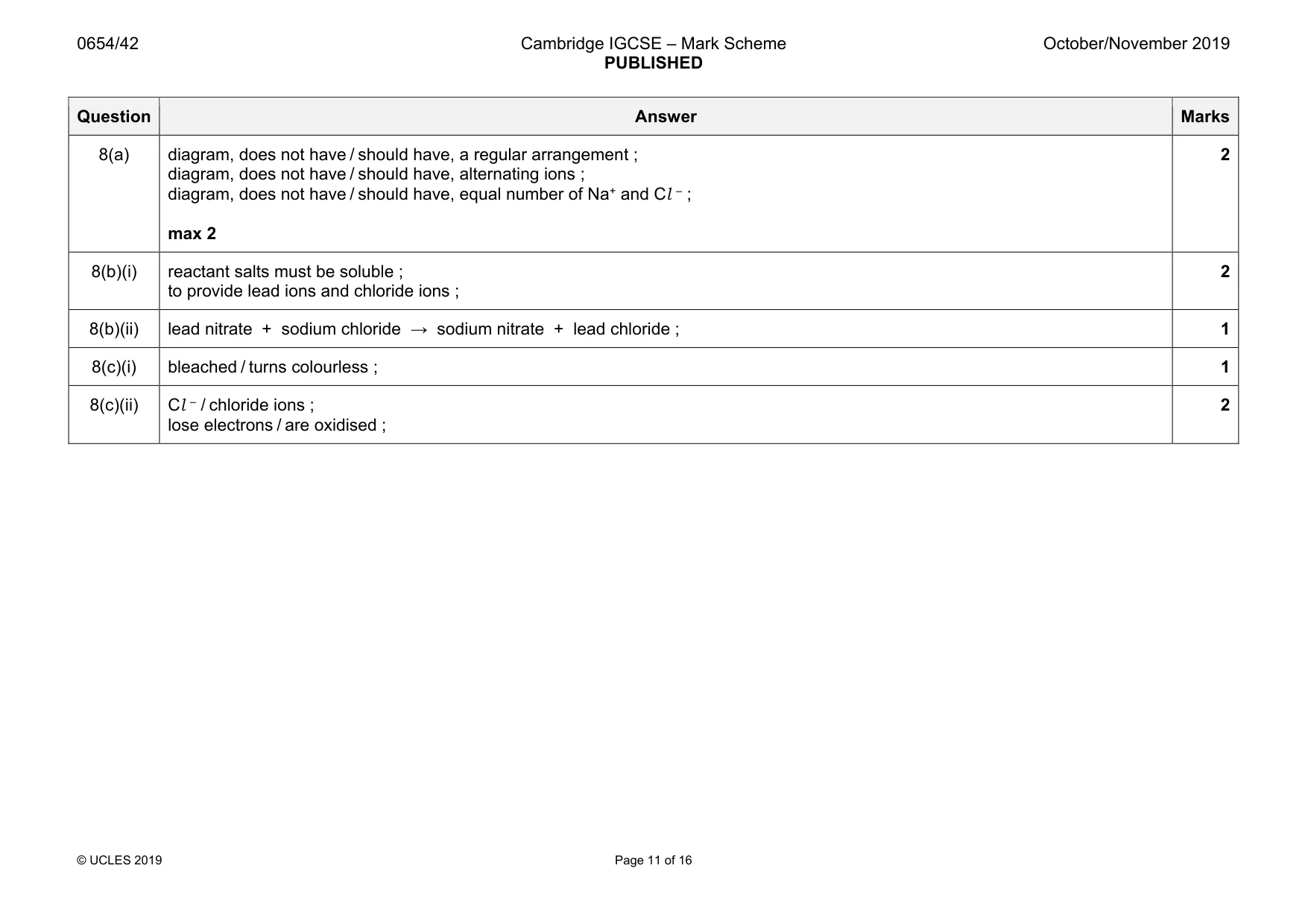
Mark scheme: 8(a) diagram, does not have / should have, a regular arrangement ; diagram, does not have / should have, alternating ions ; diagram, does not have / should have, equal number of Na+ and Cl – ; max 2 2 8(b)(i) reactant salts must be soluble ; to provide lead ions and chloride ions ; 2 8(b)(ii) lead nitrate + sodium chloride → sodium nitrate + lead chloride ; 1 8(c)(i) bleached / turns colourless ; 1 8(c)(ii) Cl – / chloride ions ; lose electrons / are oxidised ; 2
Question 9
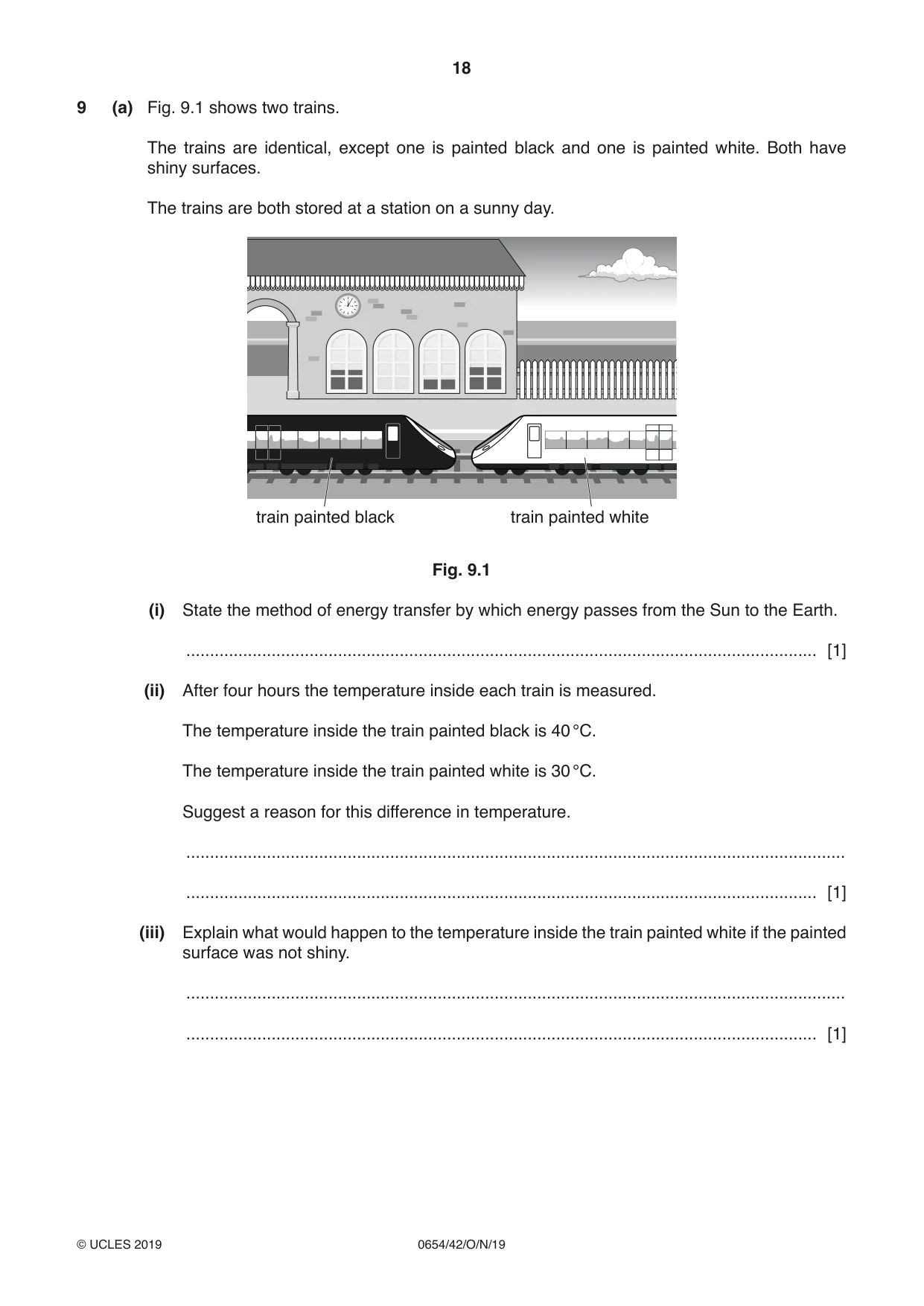
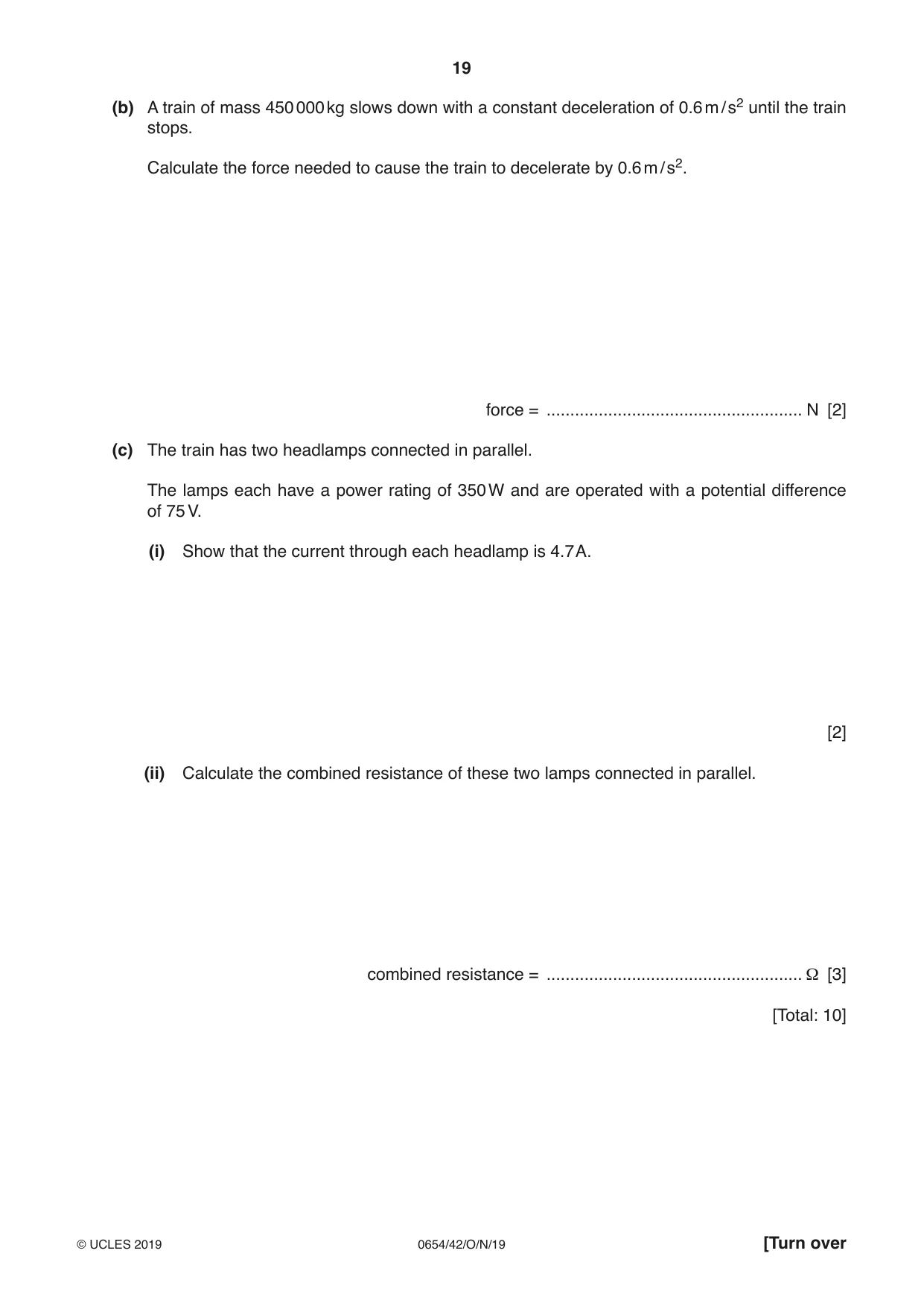
9 (a) Fig. 9.1 shows two trains. The trains are identical, except one is painted black and one is painted white. Both have shiny surfaces. The trains are both stored at a station on a sunny day. train painted black train painted white Fig. 9.1 (i) State the method of energy transfer by which energy passes from the Sun to the Earth. ..................................................................................................................................... [1] (ii) After four hours the temperature inside each train is measured. The temperature inside the train painted black is 40 °C. The temperature inside the train painted white is 30 °C. Suggest a reason for this difference in temperature. ........................................................................................................................................... ..................................................................................................................................... [1] (iii) Explain what would happen to the temperature inside the train painted white if the painted surface was not shiny. ........................................................................................................................................... ..................................................................................................................................... [1] (b) A train of mass 450 000 kg slows down with a constant deceleration of 0.6 m / s2 until the train stops. Calculate the force needed to cause the train to decelerate by 0.6 m / s2. force = ...................................................... N [2] (c) The train has two headlamps connected in parallel. The lamps each have a power rating of 350 W and are operated with a potential difference of 75 V. (i) Show that the current through each headlamp is 4.7 A. [2] (ii) Calculate the combined resistance of these two lamps connected in parallel. combined resistance = ...................................................... Ω [3] [Total: 10]
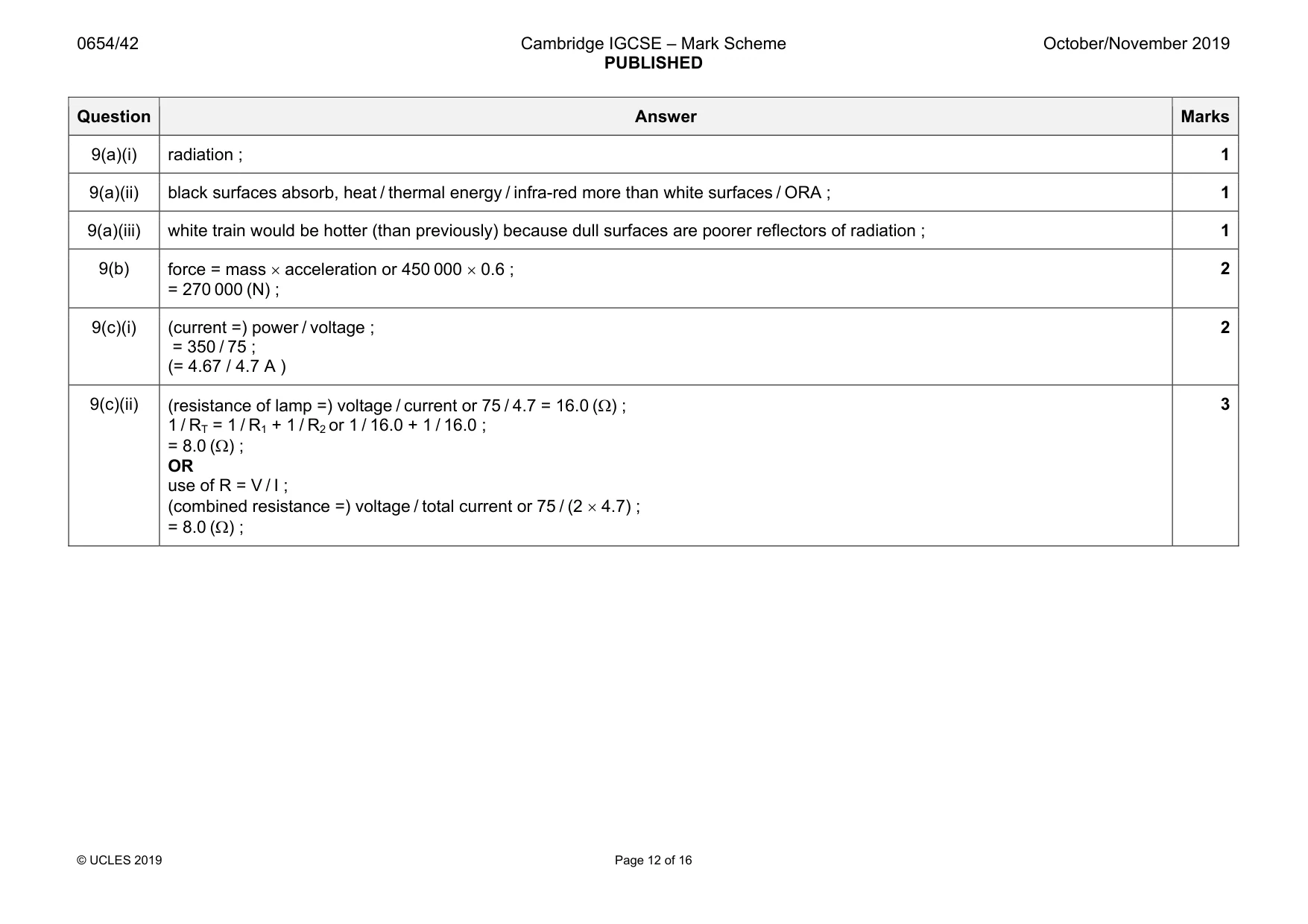
Mark scheme: 9(a)(i) radiation ; 1 9(a)(ii) black surfaces absorb, heat / thermal energy / infra-red more than white surfaces / ORA ; 1 9(a)(iii) white train would be hotter (than previously) because dull surfaces are poorer reflectors of radiation ; 1 9(b) force = mass × acceleration or 450 000 × 0.6 ; = 270 000 (N) ; 2 9(c)(i) (current =) power / voltage ; = 350 / 75 ; (= 4.67 / 4.7 A ) 2 9(c)(ii) (resistance of lamp =) voltage / current or 75 / 4.7 = 16.0 (Ω) ; 1 / RT = 1 / R1 + 1 / R2 or 1 / 16.0 + 1 / 16.0 ; = 8.0 (Ω) ; OR use of R = V / I ; (combined resistance =) voltage / total current or 75 / (2 × 4.7) ; = 8.0 (Ω) ; 3
Q10 · Water is taken into roots through the root hair cells by osmosis
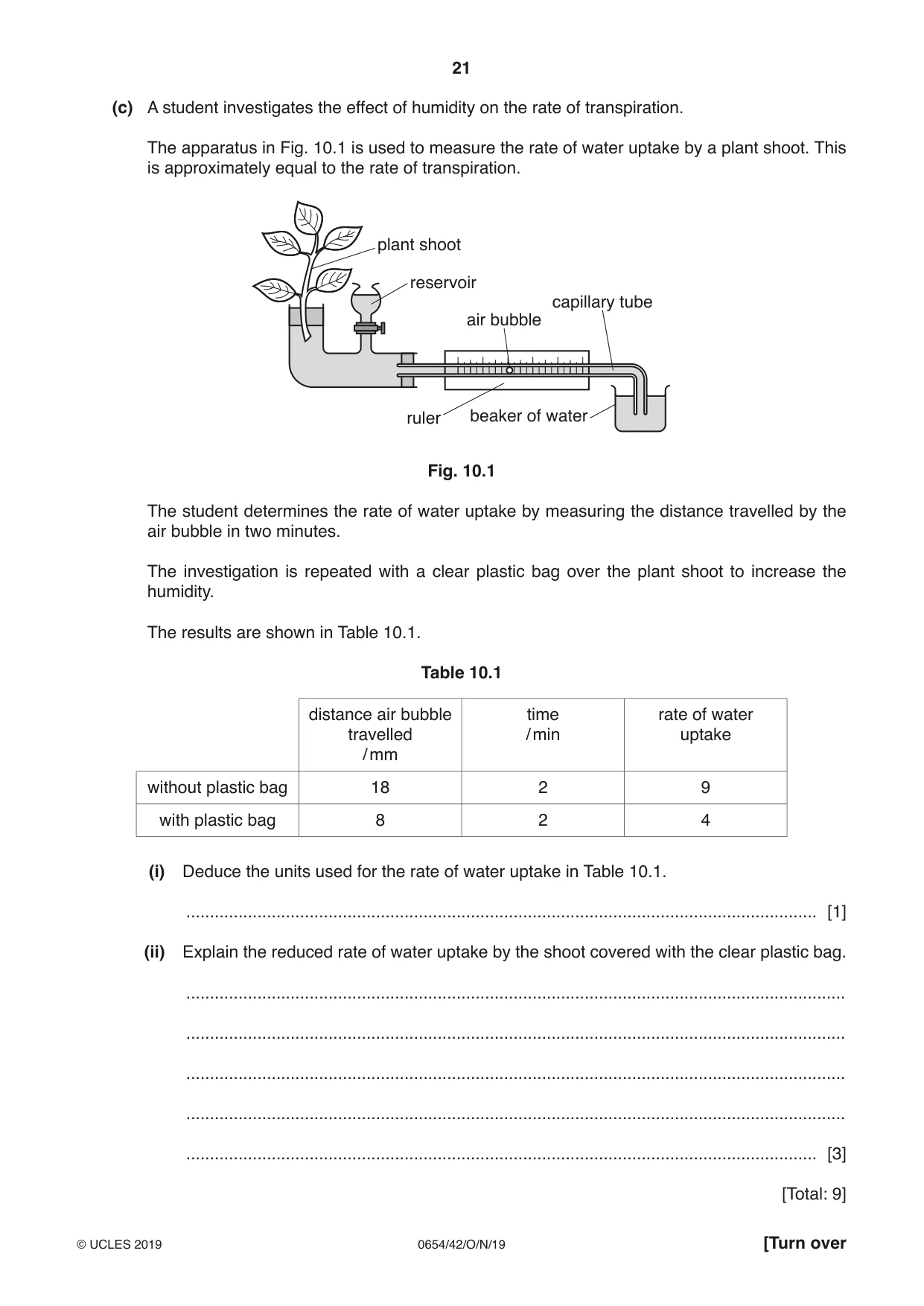
10 Water is taken into roots through the root hair cells by osmosis. (a) (i) Complete the sentence to define the term osmosis. Osmosis is the net movement of water ............................................ from a region of higher water potential (............................................ solution) to a region of lower water potential (concentrated solution), through a partially permeable ............................................ . [3] (ii) Describe how the root hair cells are adapted for water uptake. ........................................................................................................................................... ..................................................................................................................................... [1] (b) Name the term used to describe how water molecules are held together in the xylem. ............................................................................................................................................. [1] (c) A student investigates the effect of humidity on the rate of transpiration. The apparatus in Fig. 10.1 is used to measure the rate of water uptake by a plant shoot. This is approximately equal to the rate of transpiration. plant shoot reservoir capillary tube air bubble ruler beaker of water Fig. 10.1 The student determines the rate of water uptake by measuring the distance travelled by the air bubble in two minutes. The investigation is repeated with a clear plastic bag over the plant shoot to increase the humidity. The results are shown in Table 10.1. Table 10.1 distance air bubble time rate of water travelled / min uptake / mm without plastic bag 18 2 9 with plastic bag 8 2 4 (i) Deduce the units used for the rate of water uptake in Table 10.1. ..................................................................................................................................... [1] (ii) Explain the reduced rate of water uptake by the shoot covered with the clear plastic bag. ........................................................................................................................................... ........................................................................................................................................... ........................................................................................................................................... ........................................................................................................................................... ..................................................................................................................................... [3] [Total: 9]
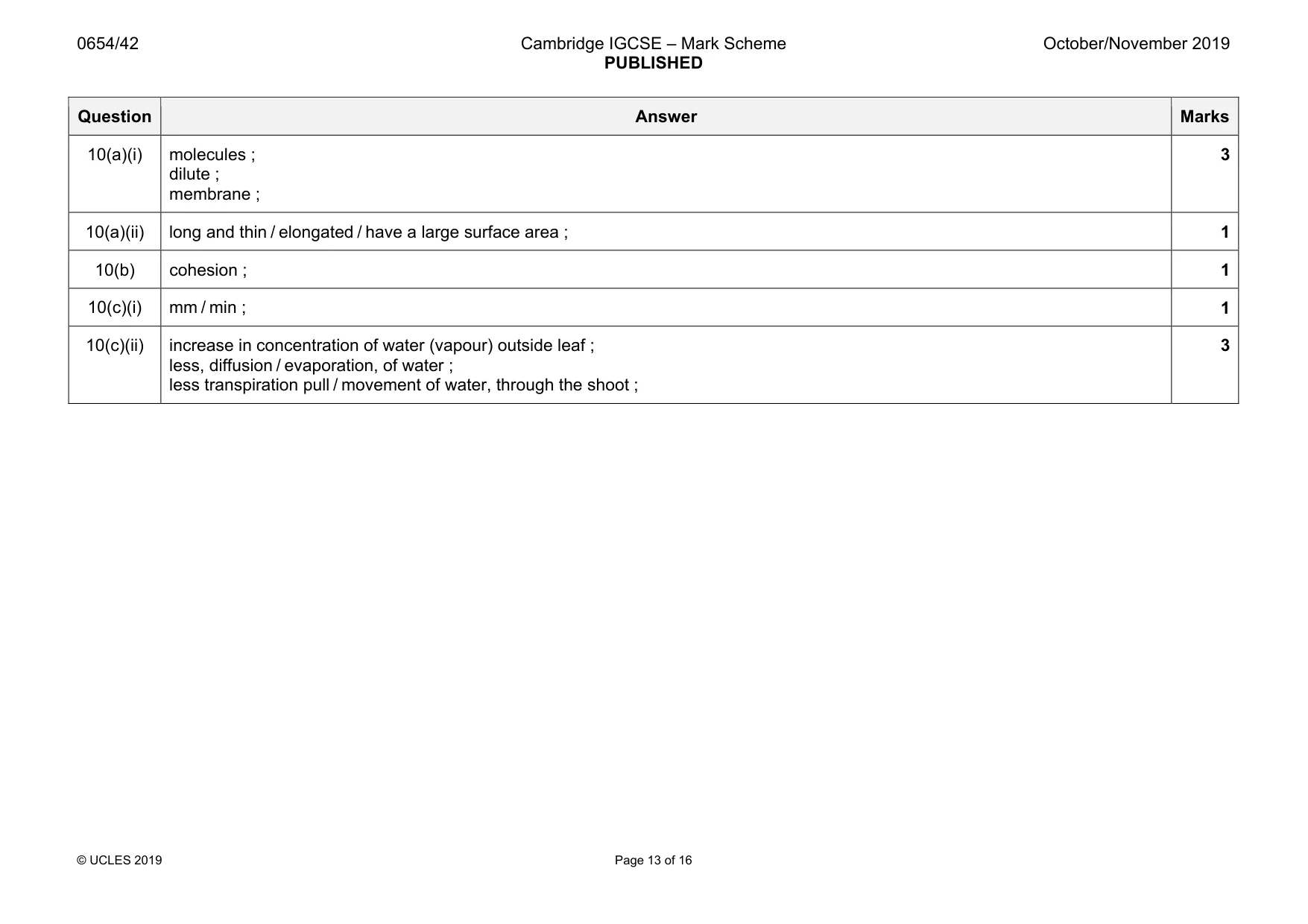
Mark scheme: 10(a)(i) molecules ; dilute ; membrane ; 3 10(a)(ii) long and thin / elongated / have a large surface area ; 1 10(b) cohesion ; 1 10(c)(i) mm / min ; 1 10(c)(ii) increase in concentration of water (vapour) outside leaf ; less, diffusion / evaporation, of water ; less transpiration pull / movement of water, through the shoot ; 3
Q11 · Part of Group I of the Periodic Table
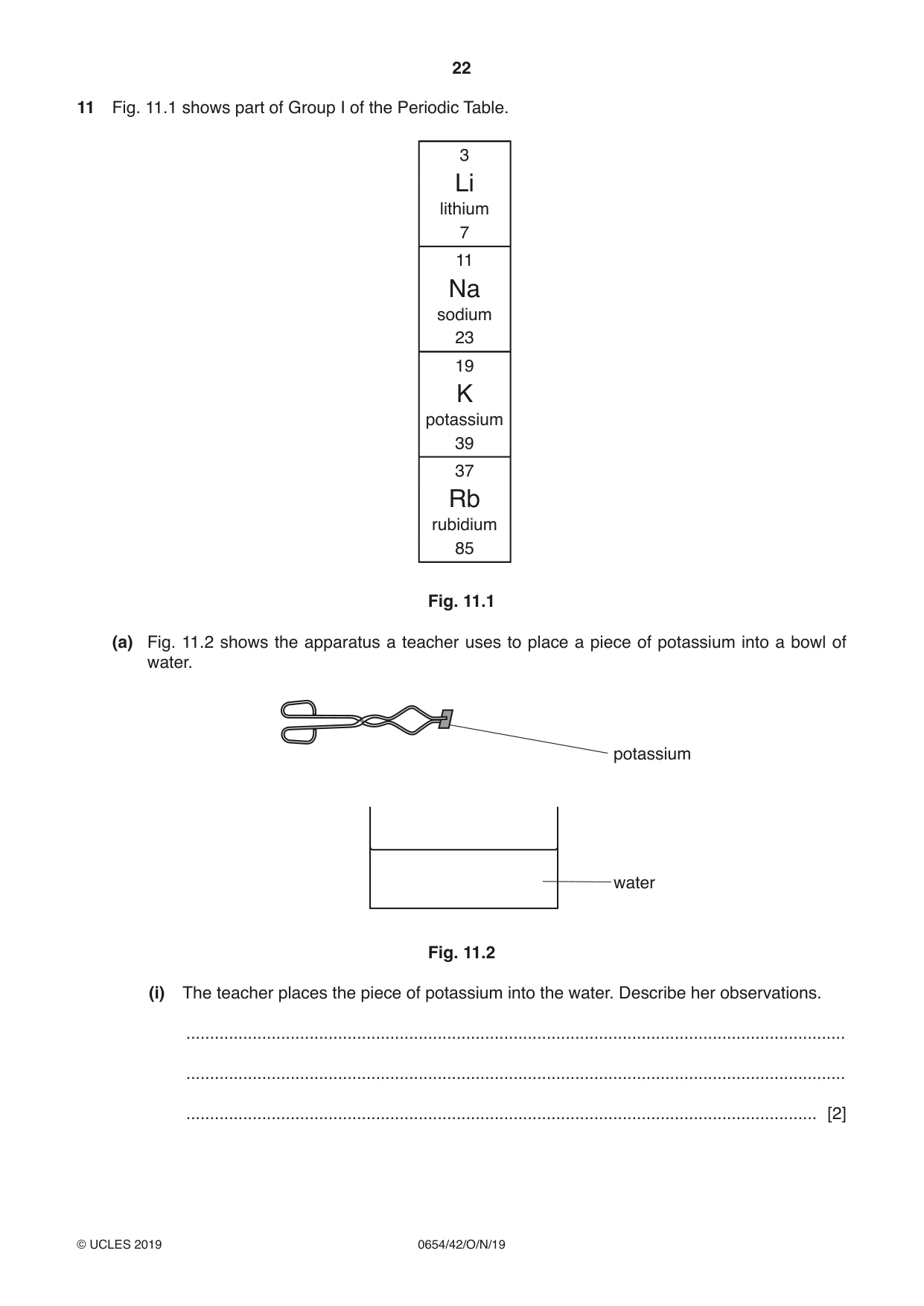
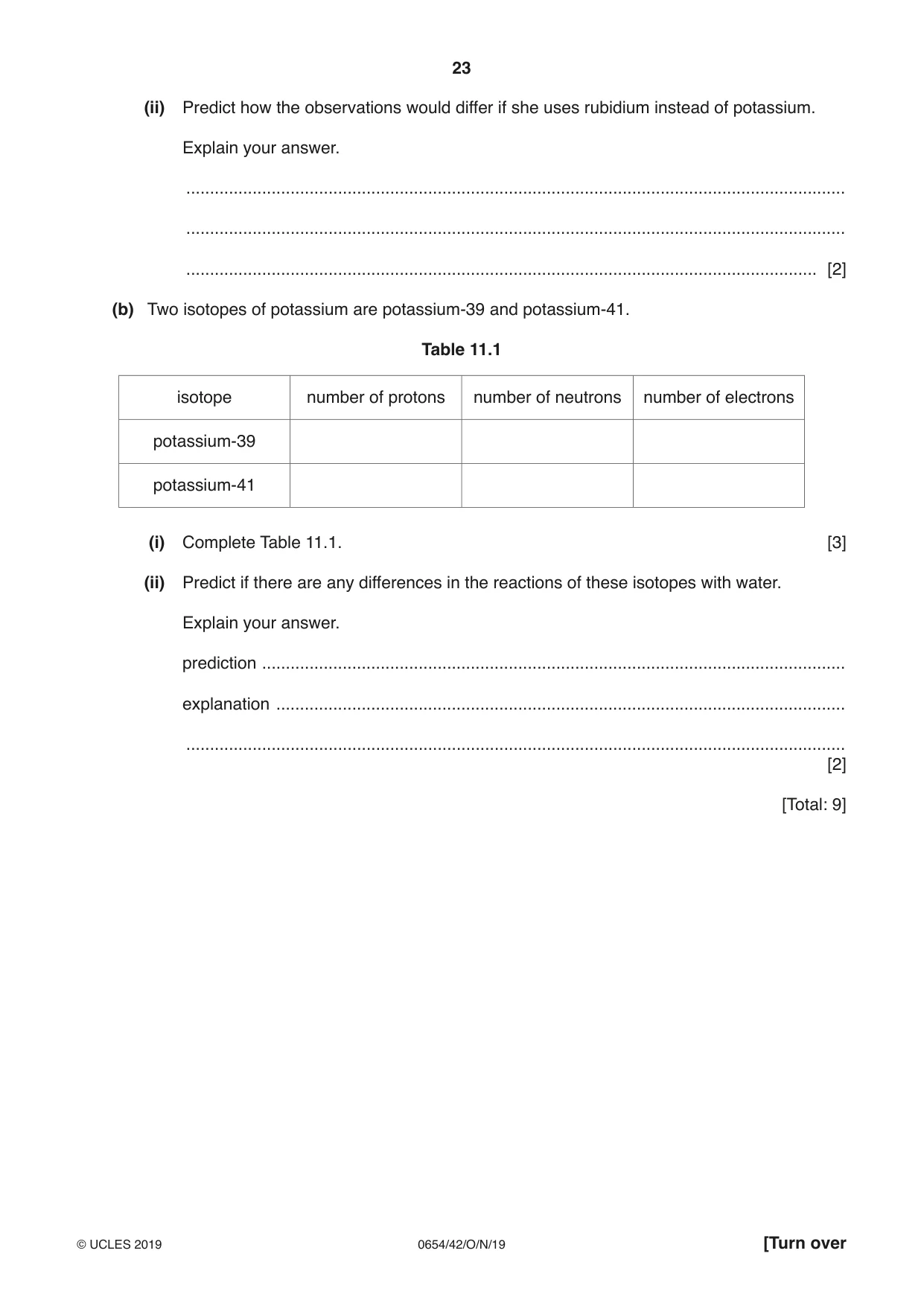
11 Fig. 11.1 shows part of Group I of the Periodic Table. 3 Li lithium 7 11 Na sodium 23 19 K potassium 39 37 Rb rubidium 85 Fig. 11.1 (a) Fig. 11.2 shows the apparatus a teacher uses to place a piece of potassium into a bowl of water. potassium water Fig. 11.2 (i) The teacher places the piece of potassium into the water. Describe her observations. ........................................................................................................................................... ........................................................................................................................................... ..................................................................................................................................... [2] (ii) Predict how the observations would differ if she uses rubidium instead of potassium. Explain your answer. ........................................................................................................................................... ........................................................................................................................................... ..................................................................................................................................... [2] (b) Two isotopes of potassium are potassium-39 and potassium-41. Table 11.1 isotope number of protons number of neutrons number of electrons potassium-39 potassium-41 (i) Complete Table 11.1. [3] (ii) Predict if there are any differences in the reactions of these isotopes with water. Explain your answer. prediction ........................................................................................................................... explanation ........................................................................................................................ ........................................................................................................................................... [2] [Total: 9]
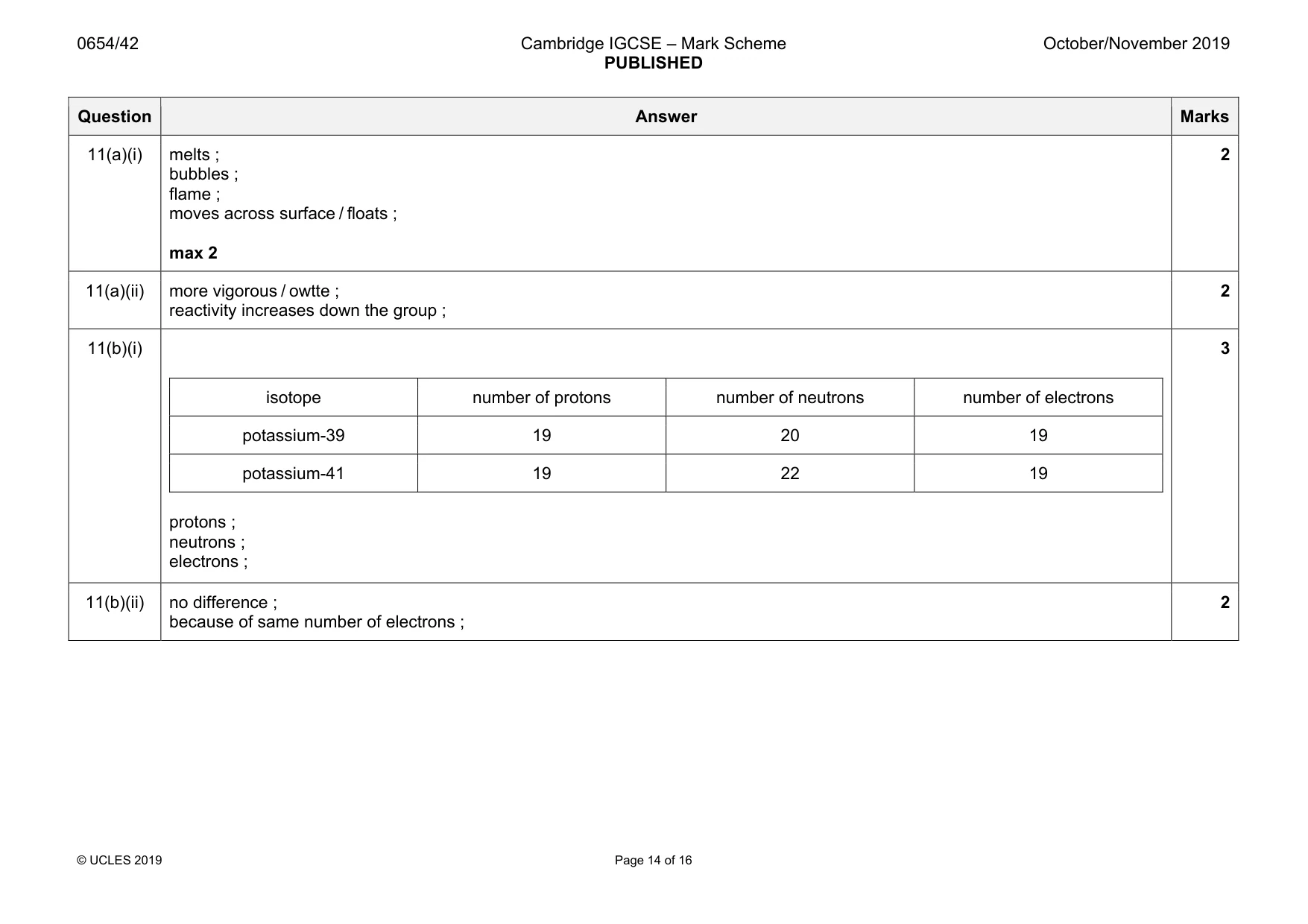
Mark scheme: 11(a)(i) melts ; bubbles ; flame ; moves across surface / floats ; max 2 2 11(a)(ii) more vigorous / owtte ; reactivity increases down the group ; 2 11(b)(i) protons ; neutrons ; electrons ; isotope number of protons number of neutrons number of electrons potassium-39 19 20 19 potassium-41 19 22 19 3 11(b)(ii) no difference ; because of same number of electrons ; 2
Q12 · A fishing boat floats on the sea
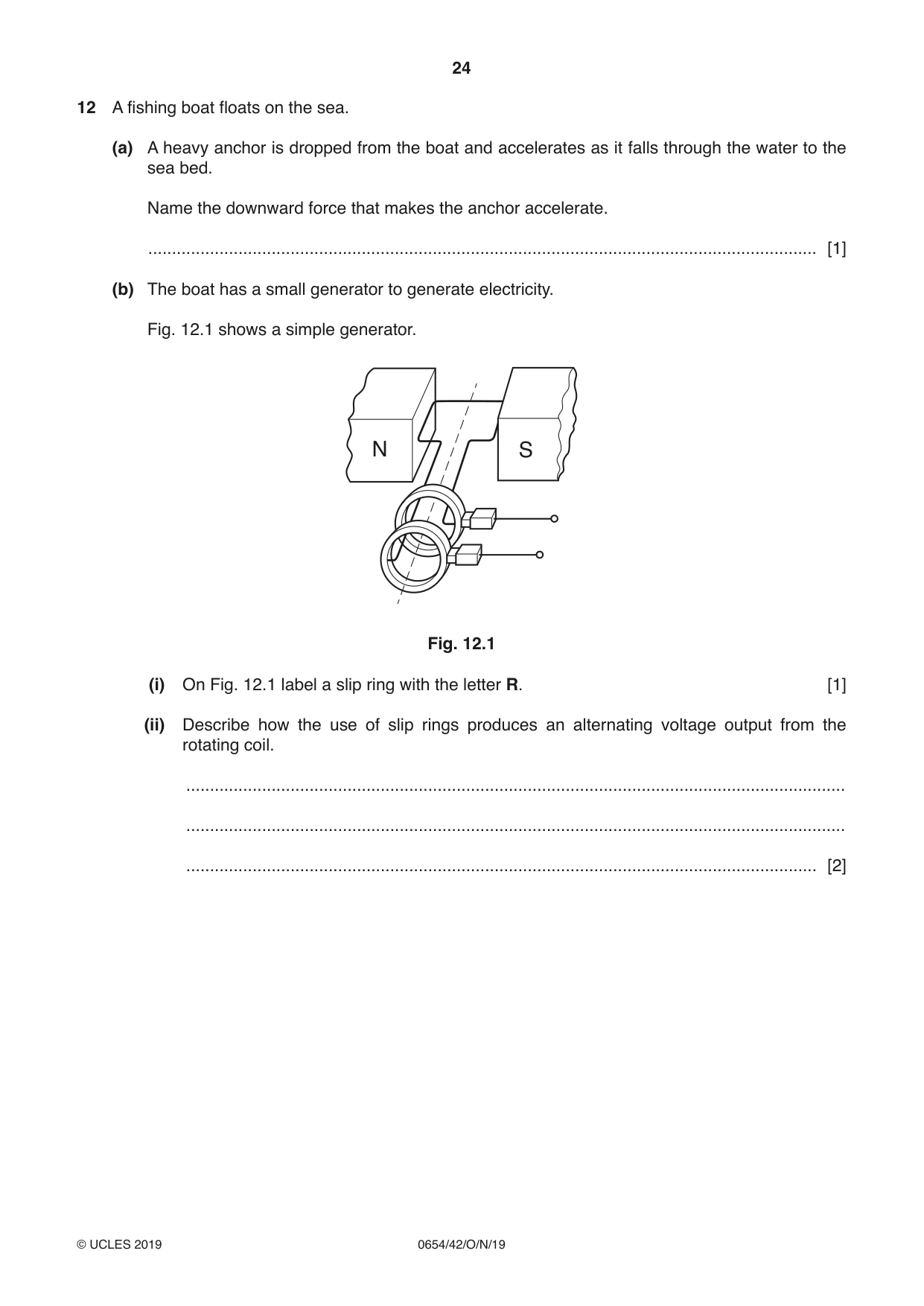
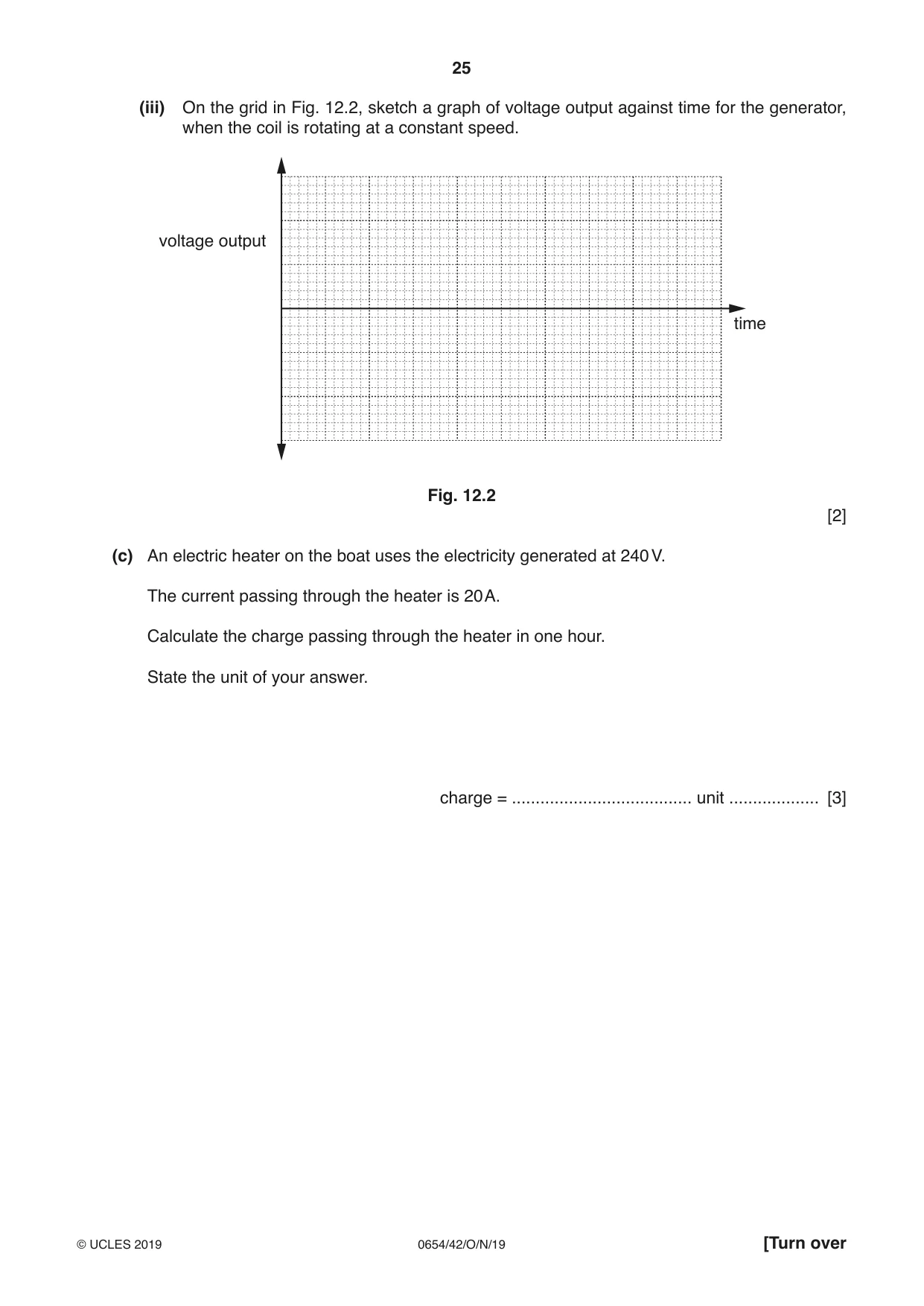
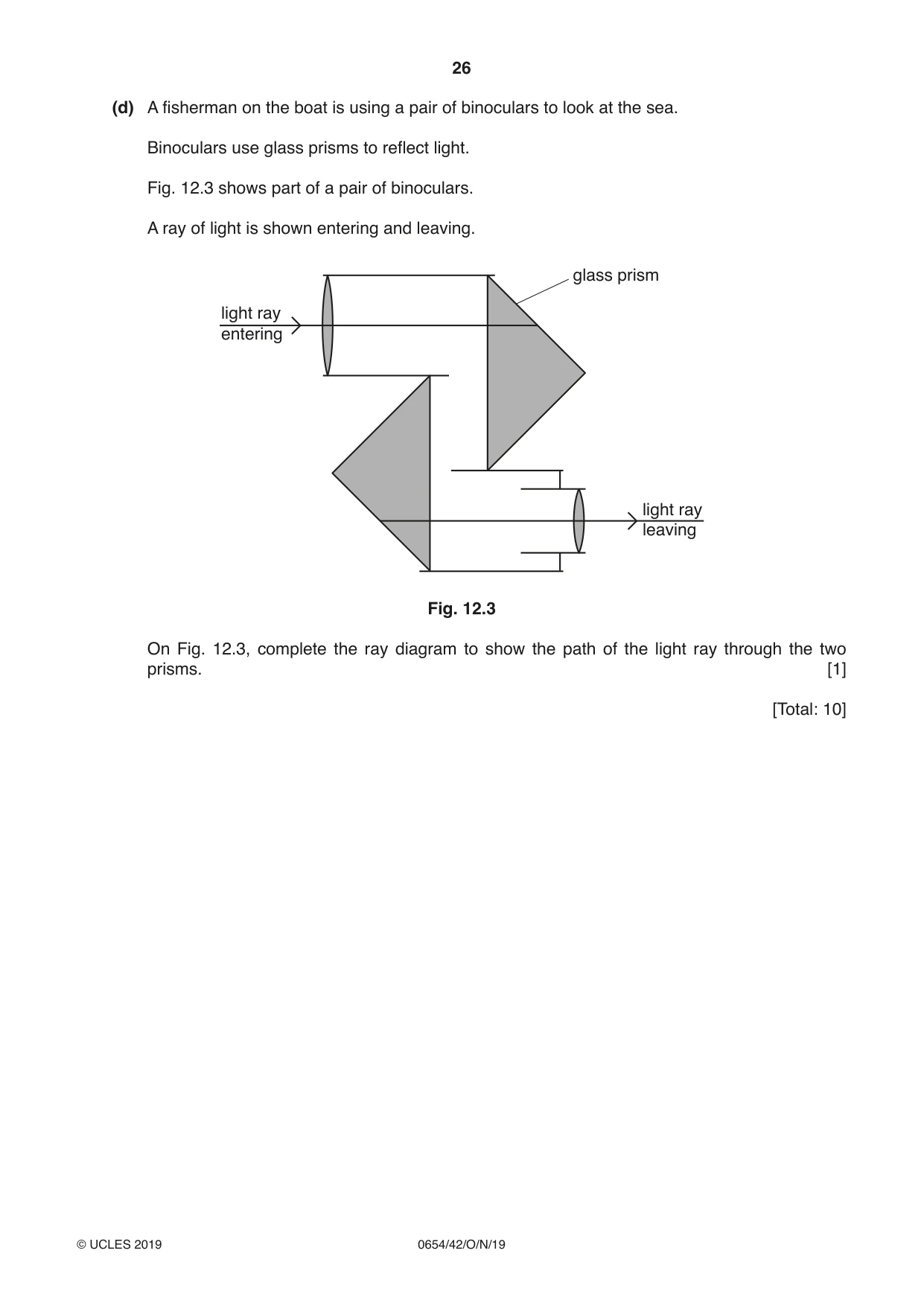
12 A fishing boat floats on the sea. (a) A heavy anchor is dropped from the boat and accelerates as it falls through the water to the sea bed. Name the downward force that makes the anchor accelerate. ............................................................................................................................................. [1] (b) The boat has a small generator to generate electricity. Fig. 12.1 shows a simple generator. N S Fig. 12.1 (i) On Fig. 12.1 label a slip ring with the letter R. [1] (ii) Describe how the use of slip rings produces an alternating voltage output from the rotating coil. ........................................................................................................................................... ........................................................................................................................................... ..................................................................................................................................... [2] (iii) On the grid in Fig. 12.2, sketch a graph of voltage output against time for the generator, when the coil is rotating at a constant speed. voltage output time Fig. 12.2 [2] (c) An electric heater on the boat uses the electricity generated at 240 V. The current passing through the heater is 20 A. Calculate the charge passing through the heater in one hour. State the unit of your answer. charge = ...................................... unit ................... [3] (d) A fisherman on the boat is using a pair of binoculars to look at the sea. Binoculars use glass prisms to reflect light. Fig. 12.3 shows part of a pair of binoculars. A ray of light is shown entering and leaving. glass prism light ray entering light ray leaving Fig. 12.3 On Fig. 12.3, complete the ray diagram to show the path of the light ray through the two prisms. [1] [Total: 10]
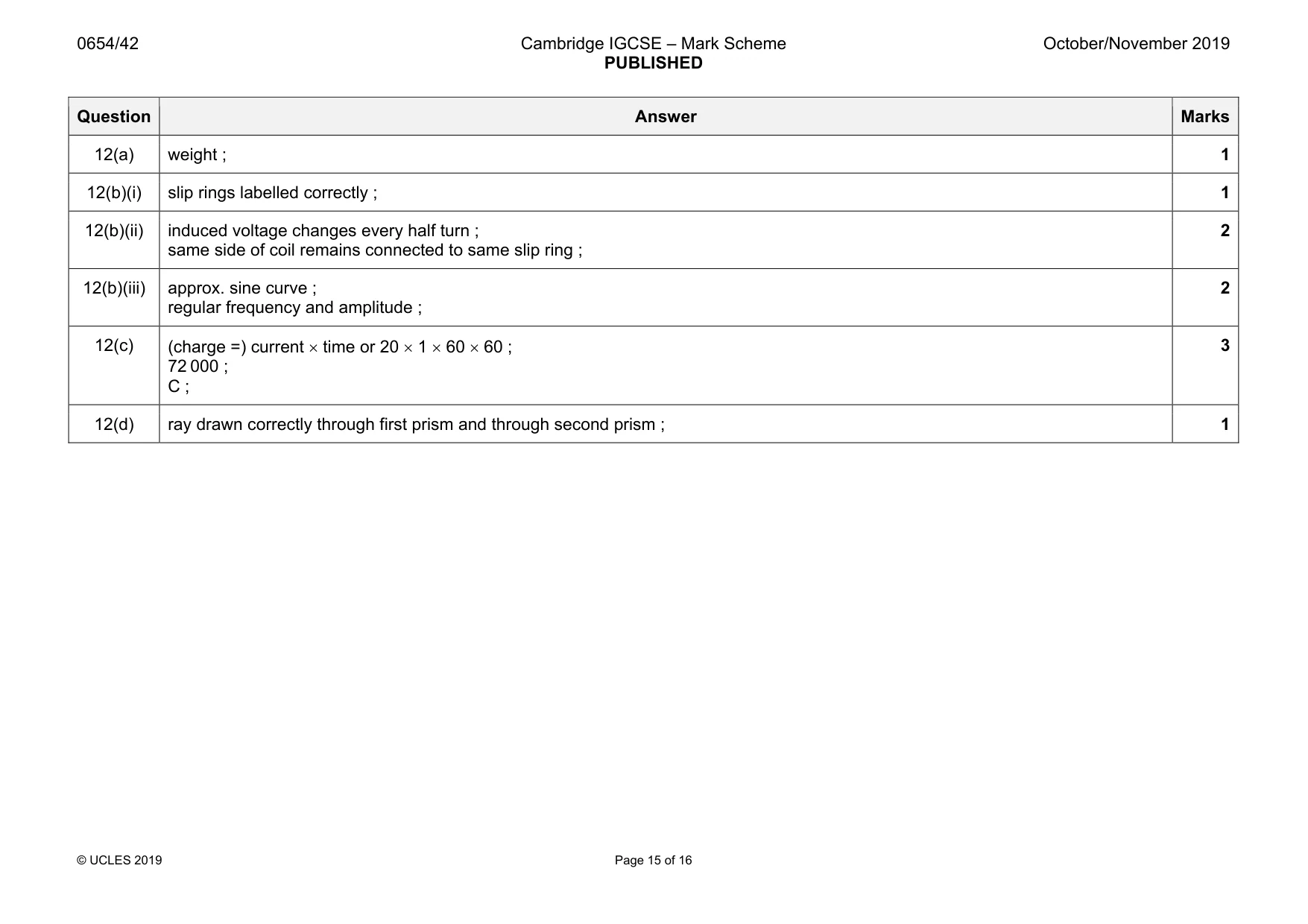
Mark scheme: 12(a) weight ; 1 12(b)(i) slip rings labelled correctly ; 1 12(b)(ii) induced voltage changes every half turn ; same side of coil remains connected to same slip ring ; 2 12(b)(iii) approx. sine curve ; regular frequency and amplitude ; 2 12(c) (charge =) current × time or 20 × 1 × 60 × 60 ; 72 000 ; C ; 3 12(d) ray drawn correctly through first prism and through second prism ; 1
Q13 · Adrenaline is a hormone
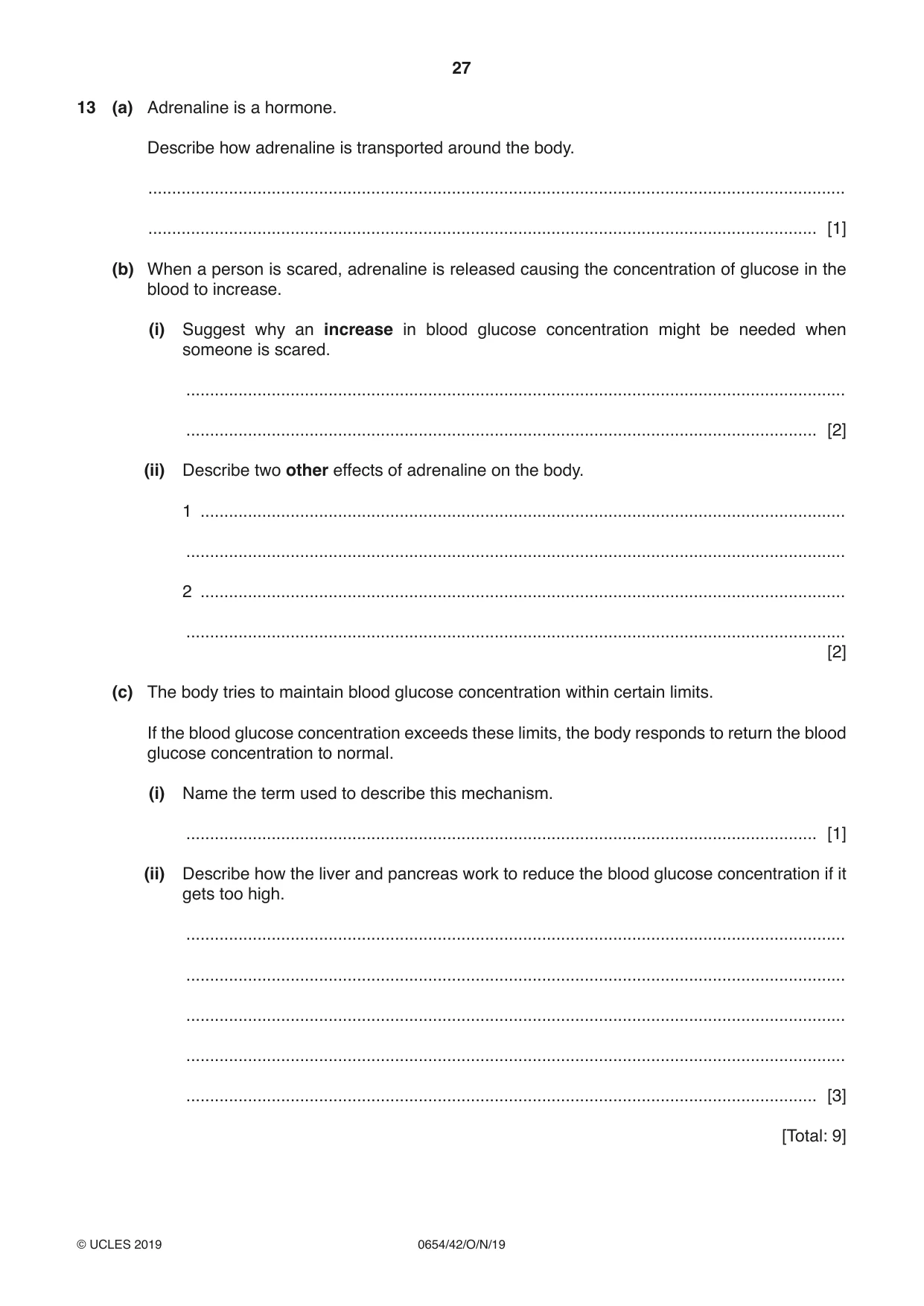
13 (a) Adrenaline is a hormone. Describe how adrenaline is transported around the body. ................................................................................................................................................... ............................................................................................................................................. [1] (b) When a person is scared, adrenaline is released causing the concentration of glucose in the blood to increase. (i) Suggest why an increase in blood glucose concentration might be needed when someone is scared. ........................................................................................................................................... ..................................................................................................................................... [2] (ii) Describe two other effects of adrenaline on the body. 1 ........................................................................................................................................ ........................................................................................................................................... 2 ........................................................................................................................................ ........................................................................................................................................... [2] (c) The body tries to maintain blood glucose concentration within certain limits. If the blood glucose concentration exceeds these limits, the body responds to return the blood glucose concentration to normal. (i) Name the term used to describe this mechanism. ..................................................................................................................................... [1] (ii) Describe how the liver and pancreas work to reduce the blood glucose concentration if it gets too high. ........................................................................................................................................... ........................................................................................................................................... ........................................................................................................................................... ........................................................................................................................................... ..................................................................................................................................... [3] [Total: 9]
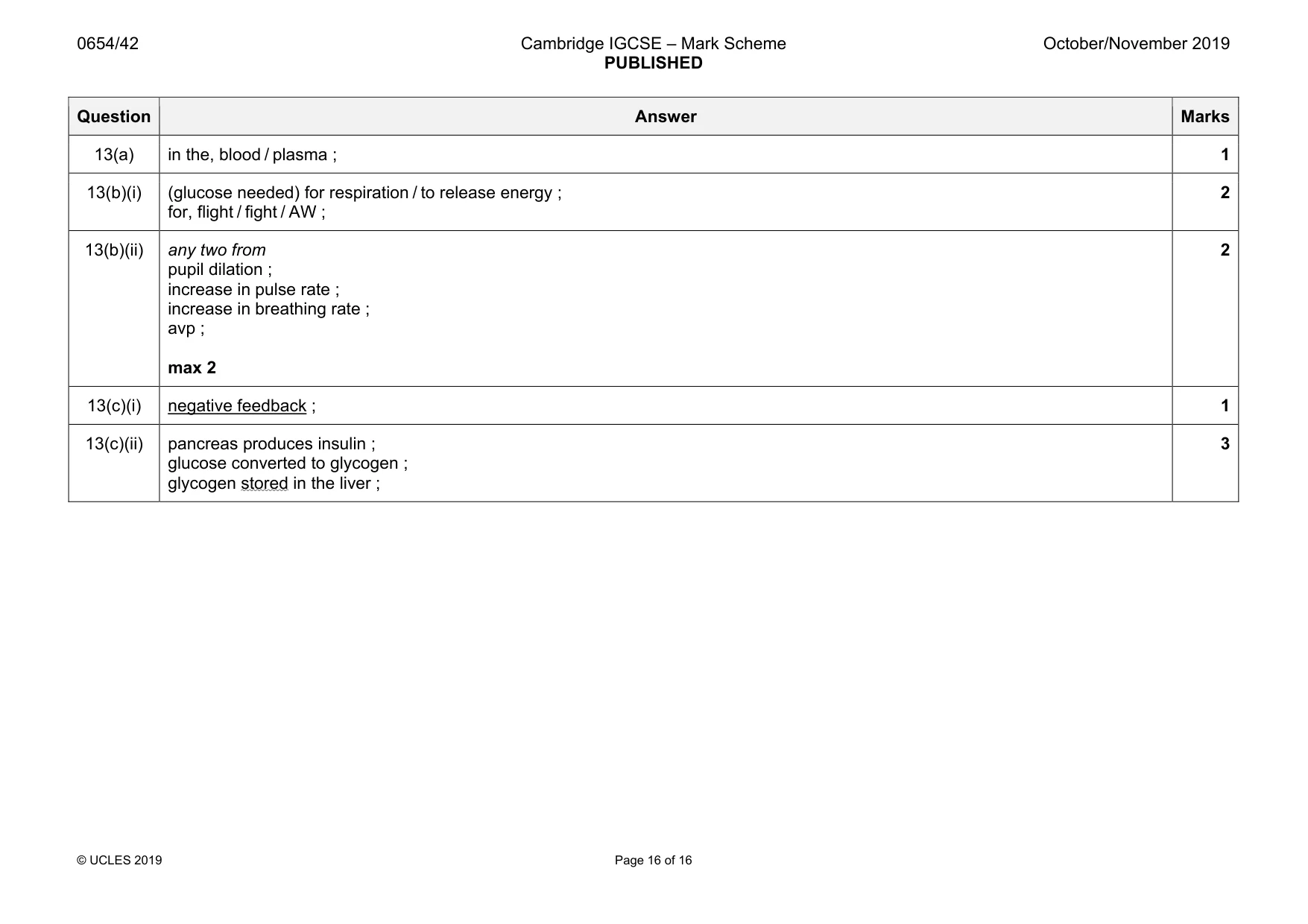
Mark scheme: 13(a) in the, blood / plasma ; 1 13(b)(i) (glucose needed) for respiration / to release energy ; for, flight / fight / AW ; 2 13(b)(ii) any two from pupil dilation ; increase in pulse rate ; increase in breathing rate ; avp ; max 2 2 13(c)(i) negative feedback ; 1 13(c)(ii) pancreas produces insulin ; glucose converted to glycogen ; glycogen stored in the liver ; 3
What was in this paper
The subtopics covered by these 13 questions, and how many questions each got. Open one in a new tab to see every Cambridge question on it.
What you needed in this session
Cambridge’s own grade thresholds for 2019 Oct/Nov, Paper 4 · Variant 2. A higher threshold means an easier paper — the bar moves with how the cohort did.