Cambridge IGCSE Sciences - Co-ordinated (Double) 0654 — 2021 Oct/Nov Paper 4 · Variant 2
0654/42/O/N/21 · 12 questions · 120 marks · ≈135 min
The question paper and its mark scheme, free to read here and free to download. This is Cambridge’s own paper, exactly as it was sat.
Question paper28 pages




Mark scheme14 pages
Answers below. Sit the paper first if you are practising.
Questions as text
Q1 · Enzymes have an important role in the process of digestion
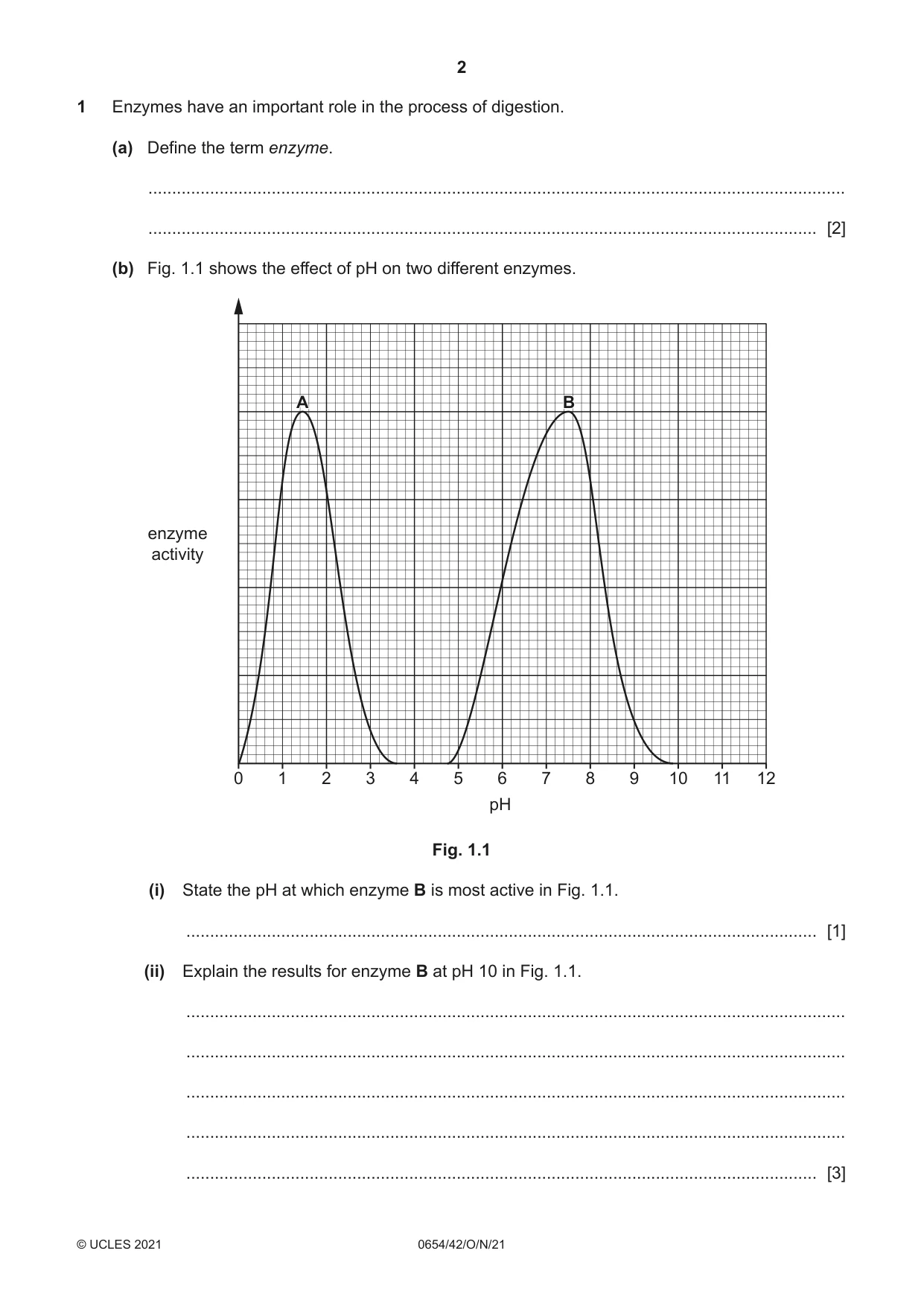
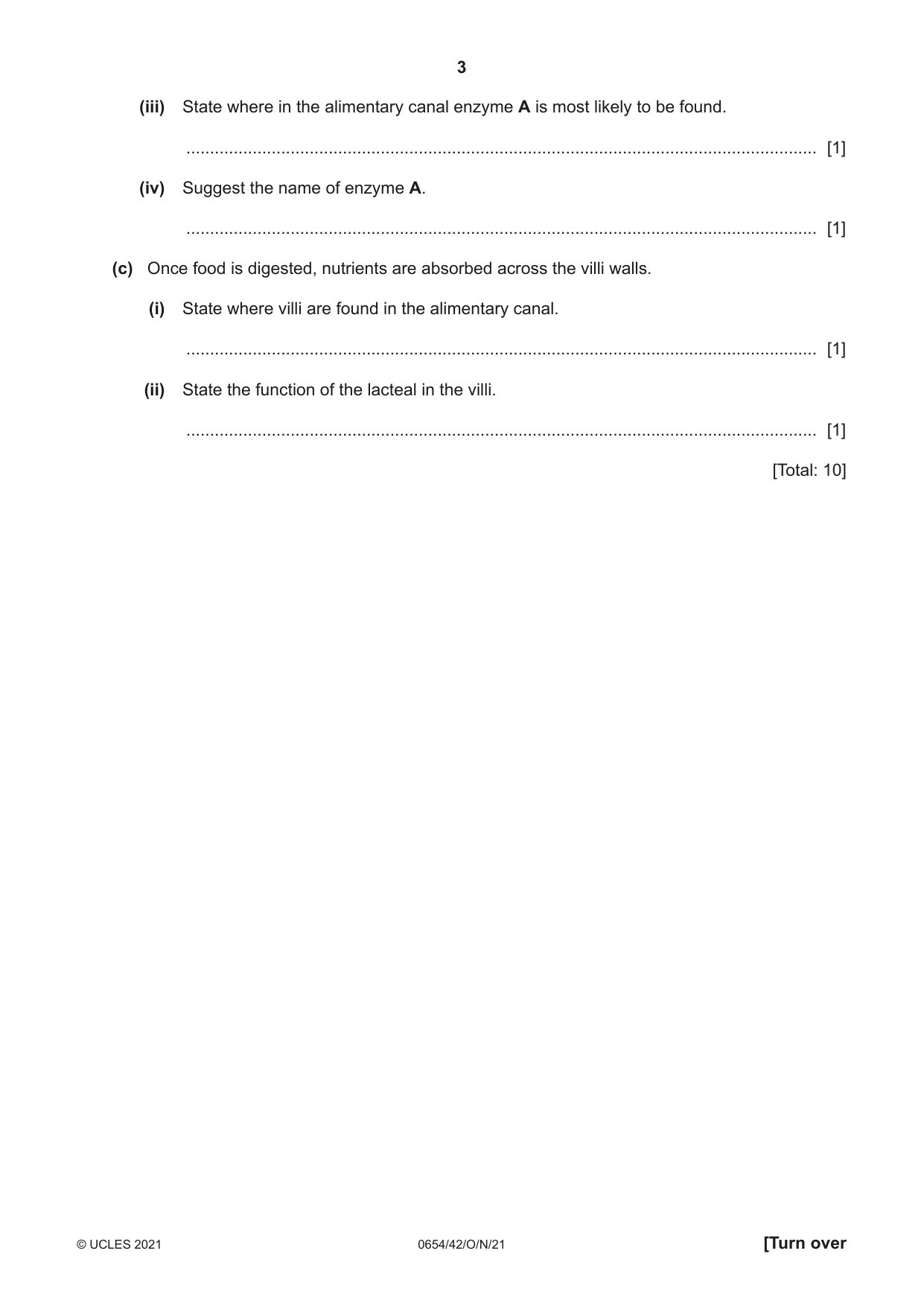
1 Enzymes have an important role in the process of digestion. (a) Define the term enzyme. ................................................................................................................................................... ............................................................................................................................................. [2] (b) Fig. 1.1 shows the effect of pH on two different enzymes. AA BB enzyme activity 0 1 2 3 4 5 6 7 8 9 10 11 12 pH Fig. 1.1 (i) State the pH at which enzyme B is most active in Fig. 1.1. ..................................................................................................................................... [1] (ii) Explain the results for enzyme B at pH 10 in Fig. 1.1. ........................................................................................................................................... ........................................................................................................................................... ........................................................................................................................................... ........................................................................................................................................... ..................................................................................................................................... [3] (iii) State where in the alimentary canal enzyme A is most likely to be found. ..................................................................................................................................... [1] (iv) Suggest the name of enzyme A. ..................................................................................................................................... [1] (c) Once food is digested, nutrients are absorbed across the villi walls. (i) State where villi are found in the alimentary canal. ..................................................................................................................................... [1] (ii) State the function of the lacteal in the villi. ..................................................................................................................................... [1] [Total: 10]
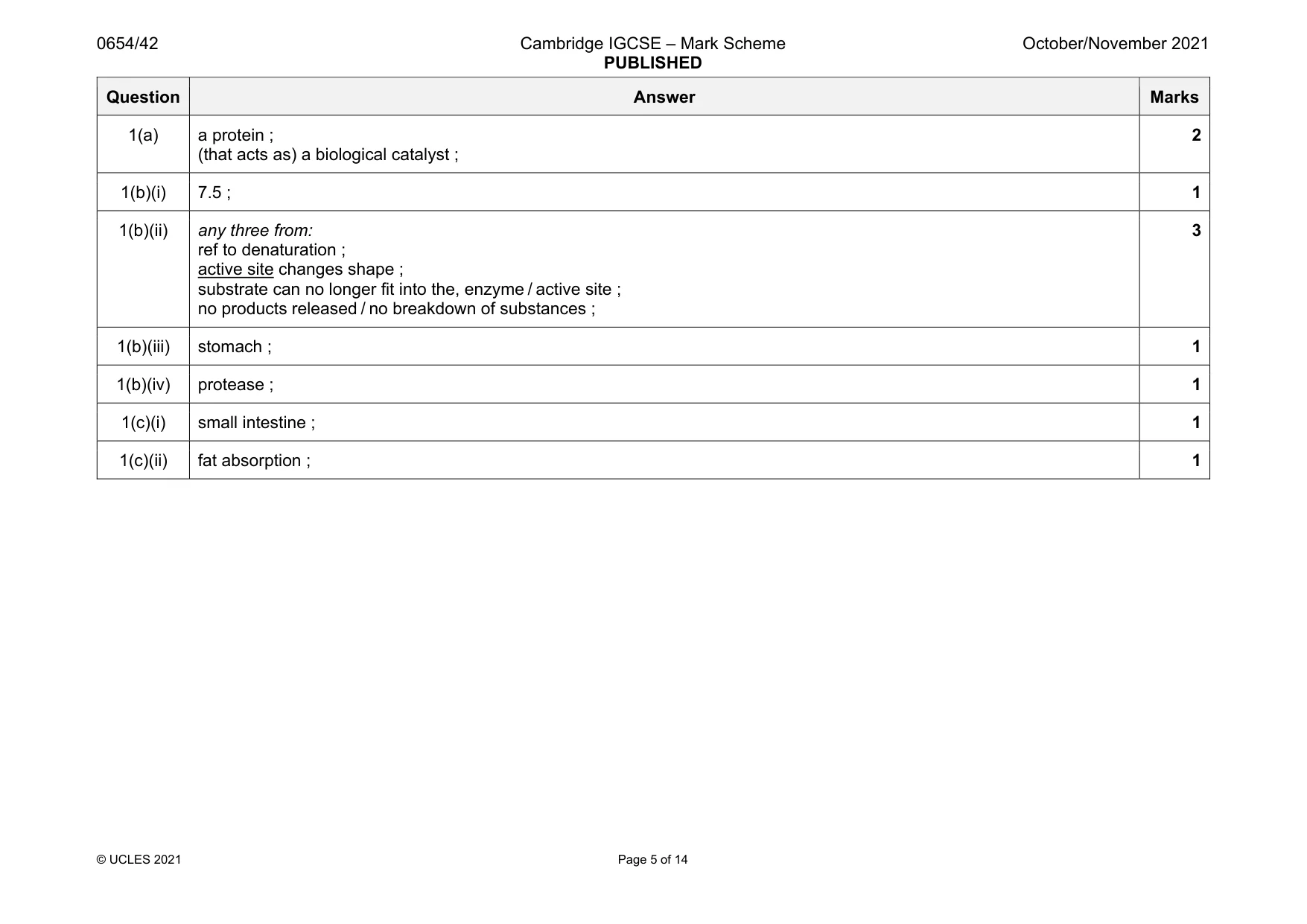
Mark scheme: 1(a) a protein ; (that acts as) a biological catalyst ; 2 1(b)(i) 7.5 ; 1 1(b)(ii) any three from: ref to denaturation ; active site changes shape ; substrate can no longer fit into the, enzyme / active site ; no products released / no breakdown of substances ; 3 1(b)(iii) stomach ; 1 1(b)(iv) protease ; 1 1(c)(i) small intestine ; 1 1(c)(ii) fat absorption ; 1
Q2 · Carbon monoxide is a common pollutant in the air
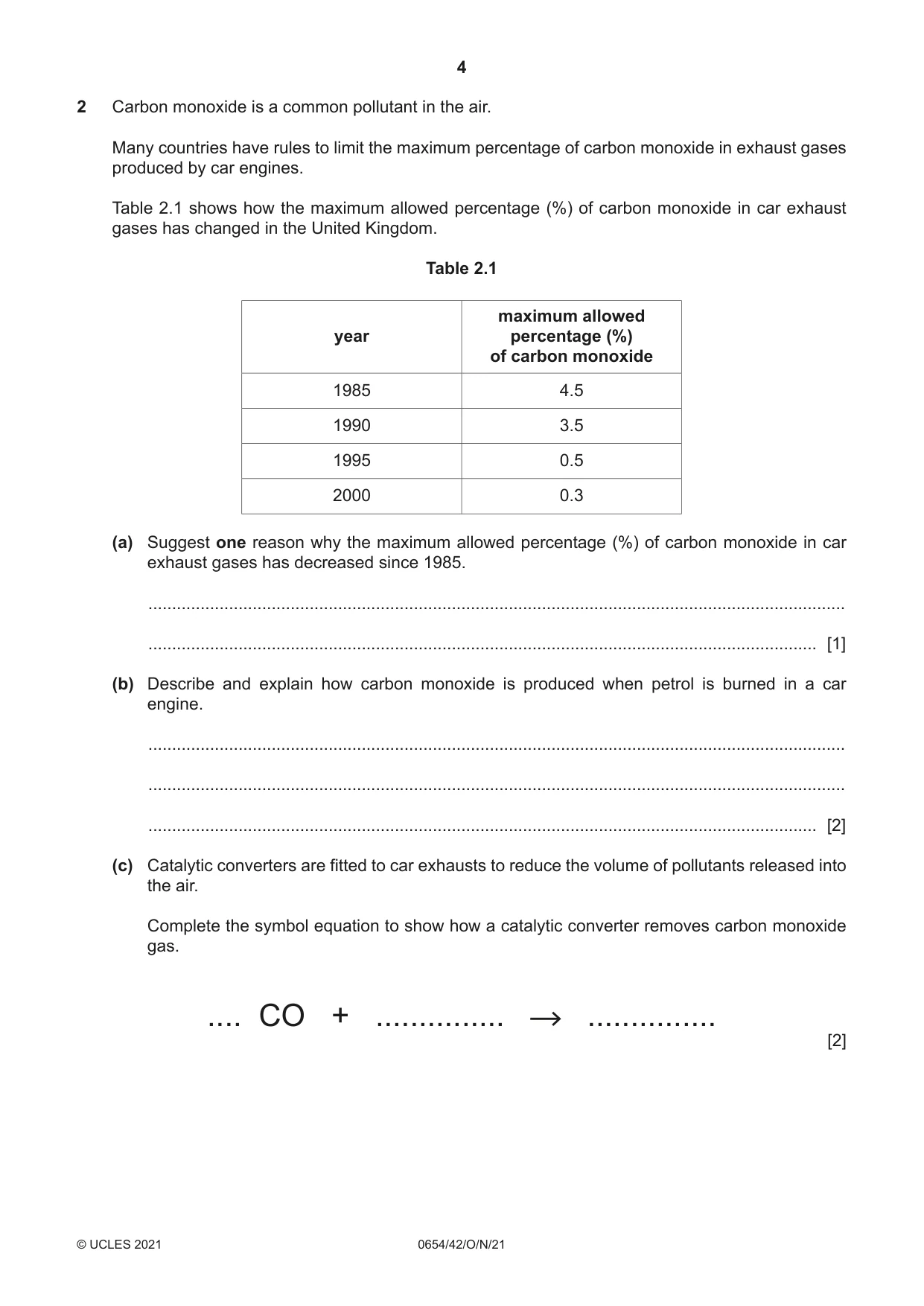
2 Carbon monoxide is a common pollutant in the air. Many countries have rules to limit the maximum percentage of carbon monoxide in exhaust gases produced by car engines. Table 2.1 shows how the maximum allowed percentage (%) of carbon monoxide in car exhaust gases has changed in the United Kingdom. Table 2.1 maximum allowed year percentage (%) of carbon monoxide 1985 4.5 1990 3.5 1995 0.5 2000 0.3 (a) Suggest one reason why the maximum allowed percentage (%) of carbon monoxide in car exhaust gases has decreased since 1985. ................................................................................................................................................... ............................................................................................................................................. [1] (b) Describe and explain how carbon monoxide is produced when petrol is burned in a car engine. ................................................................................................................................................... ................................................................................................................................................... ............................................................................................................................................. [2] (c) Catalytic converters are fitted to car exhausts to reduce the volume of pollutants released into the air. Complete the symbol equation to show how a catalytic converter removes carbon monoxide gas. .... CO + ............... ............... [2] (d) Catalytic converters remove oxides of nitrogen as well as carbon monoxide from exhaust gases. State two other effects of air pollution which are reduced by using catalytic converters. ................................................................................................................................................... ................................................................................................................................................... ...............................................................................................................................................[2] (e) The catalyst in a catalytic converter is made from metal. State where in the Periodic Table this metal is most likely to be found. Choose from the list. group I elements group VII elements group 0 elements transition elements ............................................................................................................................................. [1] [Total: 8]
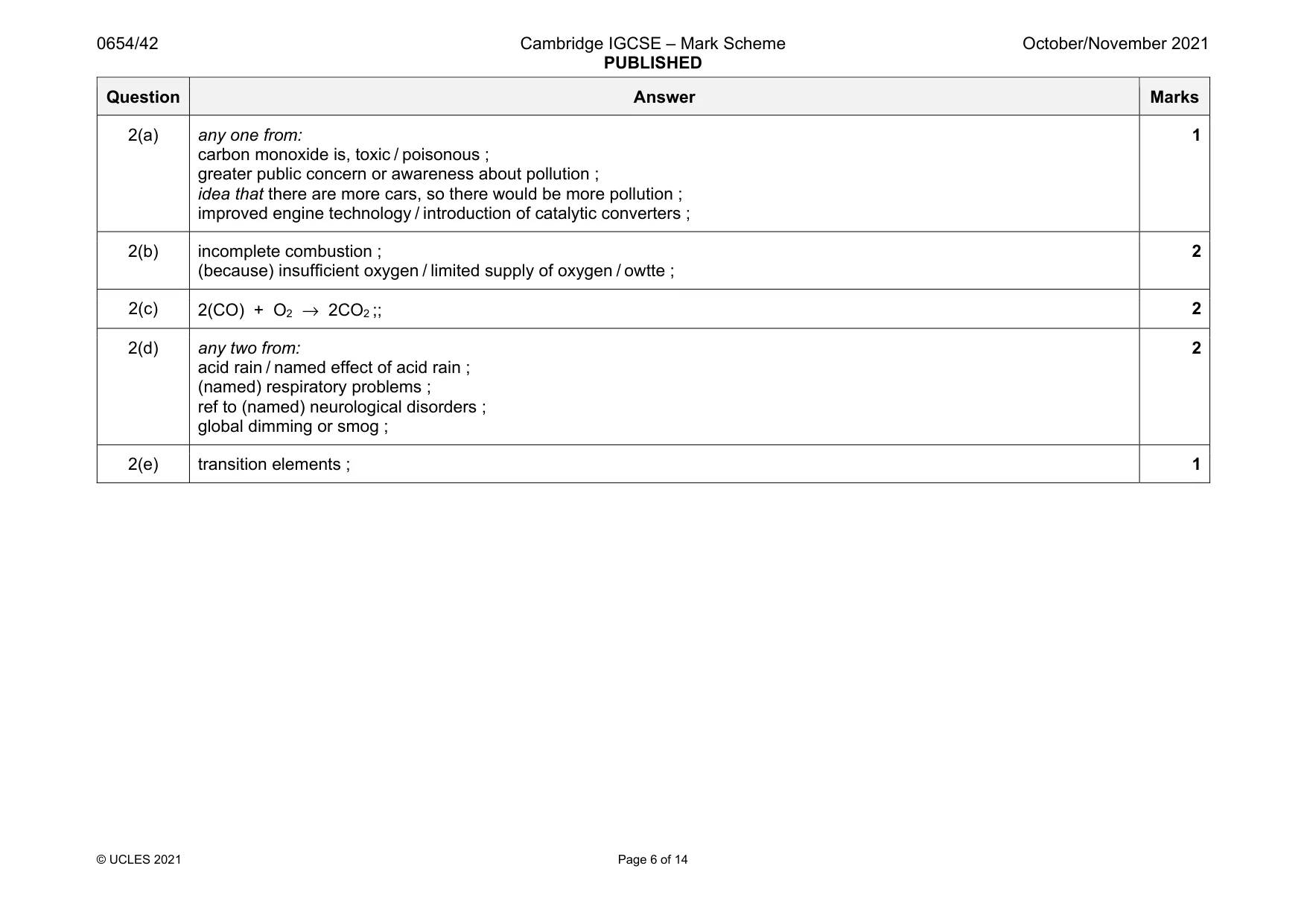
Mark scheme: 2(a) any one from: carbon monoxide is, toxic / poisonous ; greater public concern or awareness about pollution ; idea that there are more cars, so there would be more pollution ; improved engine technology / introduction of catalytic converters ; 1 2(b) incomplete combustion ; (because) insufficient oxygen / limited supply of oxygen / owtte ; 2 2(c) 2(CO) + O2 → 2CO2 ;; 2 2(d) any two from: acid rain / named effect of acid rain ; (named) respiratory problems ; ref to (named) neurological disorders ; global dimming or smog ; 2 2(e) transition elements ; 1
Q3 · Four electrical component names and their symbols
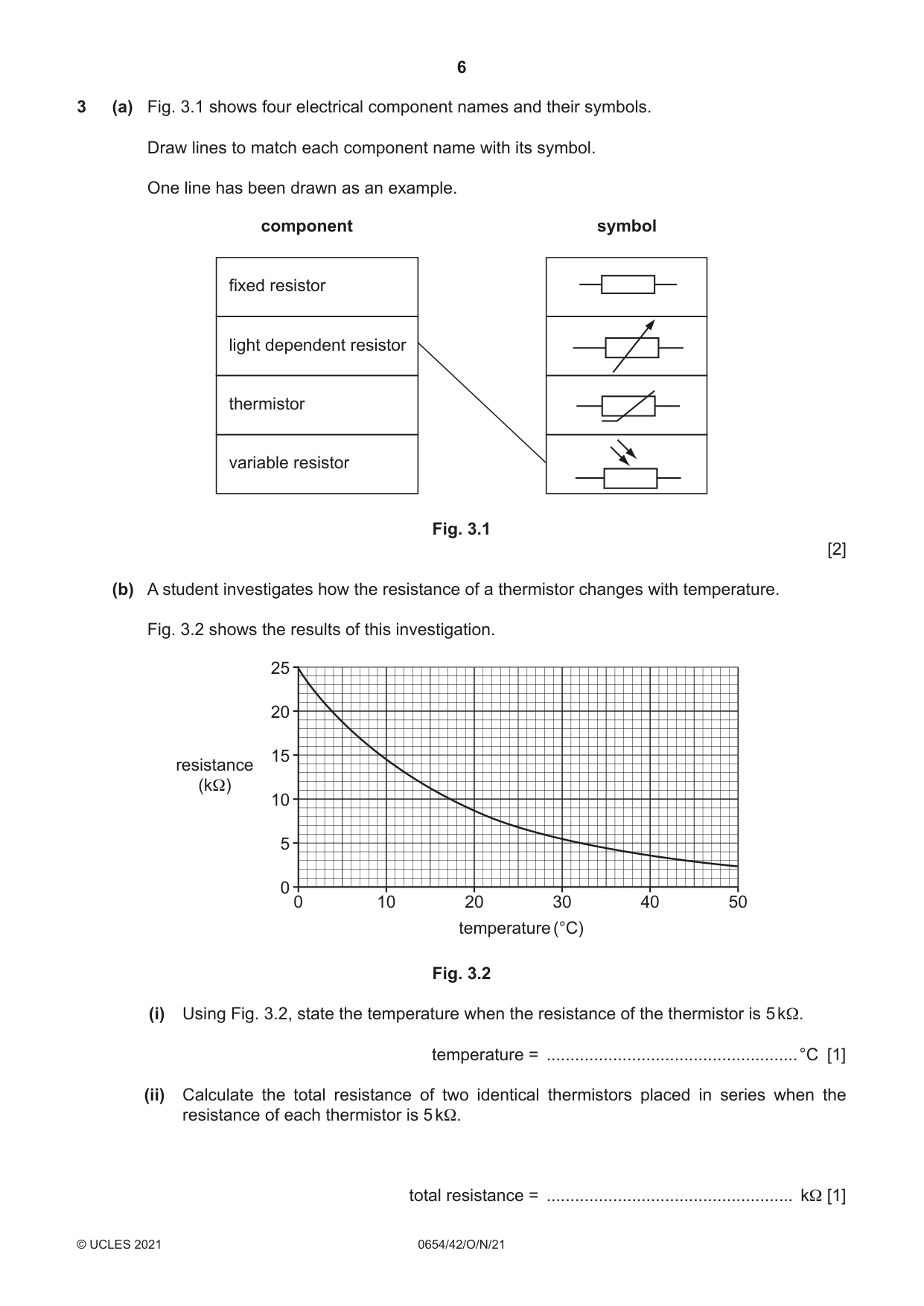
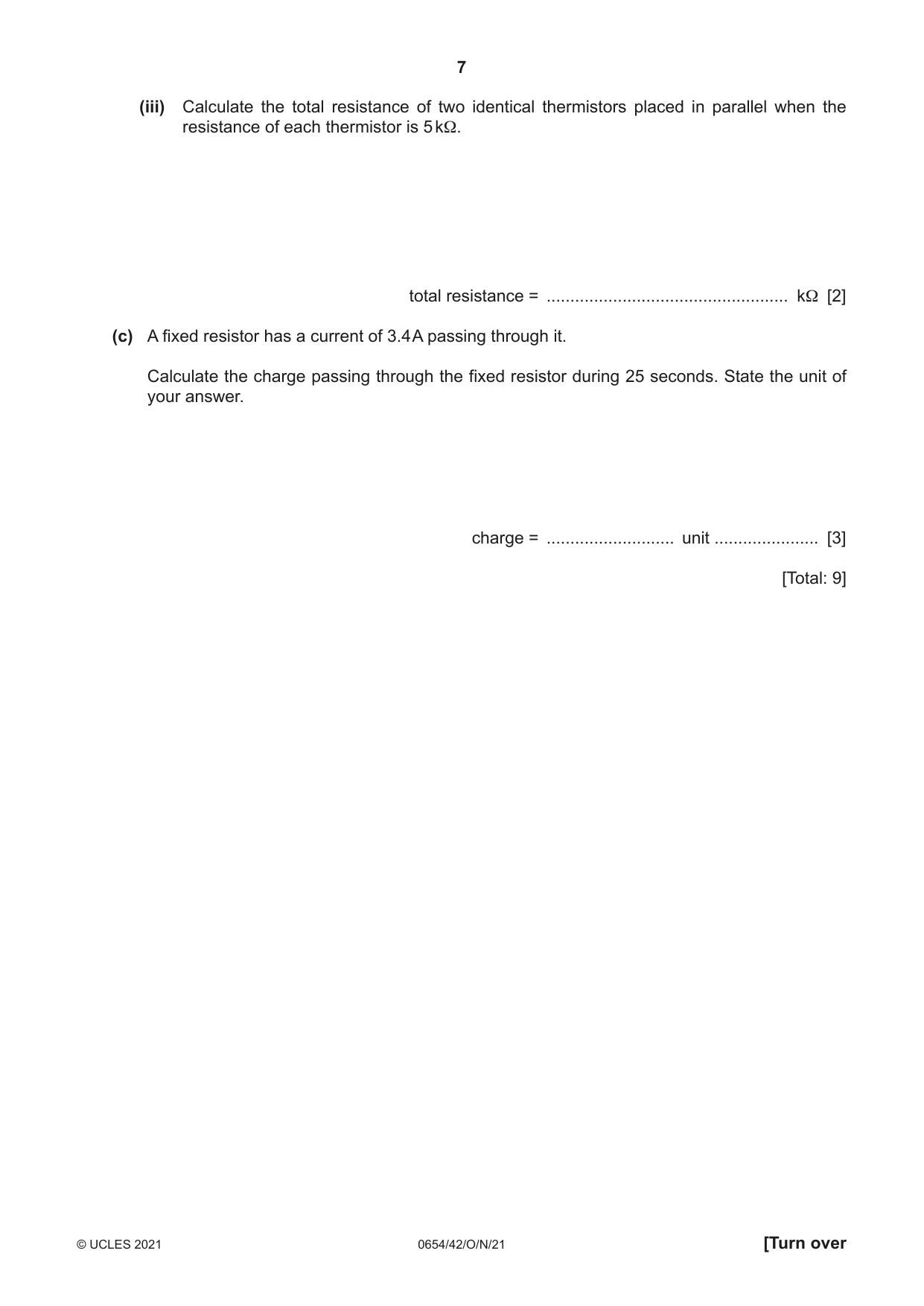
3 (a) Fig. 3.1 shows four electrical component names and their symbols. Draw lines to match each component name with its symbol. One line has been drawn as an example. component symbol fixed resistor light dependent resistor thermistor variable resistor Fig. 3.1 [2] (b) A student investigates how the resistance of a thermistor changes with temperature. Fig. 3.2 shows the results of this investigation. 25 20 15 resistance (kΩ) 10 5 0 0 10 20 30 40 50 temperature (°C) Fig. 3.2 (i) Using Fig. 3.2, state the temperature when the resistance of the thermistor is 5 kΩ. temperature = .....................................................°C [1] (ii) Calculate the total resistance of two identical thermistors placed in series when the resistance of each thermistor is 5 kΩ. total resistance = .................................................... kΩ [1] (iii) Calculate the total resistance of two identical thermistors placed in parallel when the resistance of each thermistor is 5 kΩ. total resistance = ................................................... kΩ [2] (c) A fixed resistor has a current of 3.4 A passing through it. Calculate the charge passing through the fixed resistor during 25 seconds. State the unit of your answer. charge = ........................... unit ...................... [3] [Total: 9]
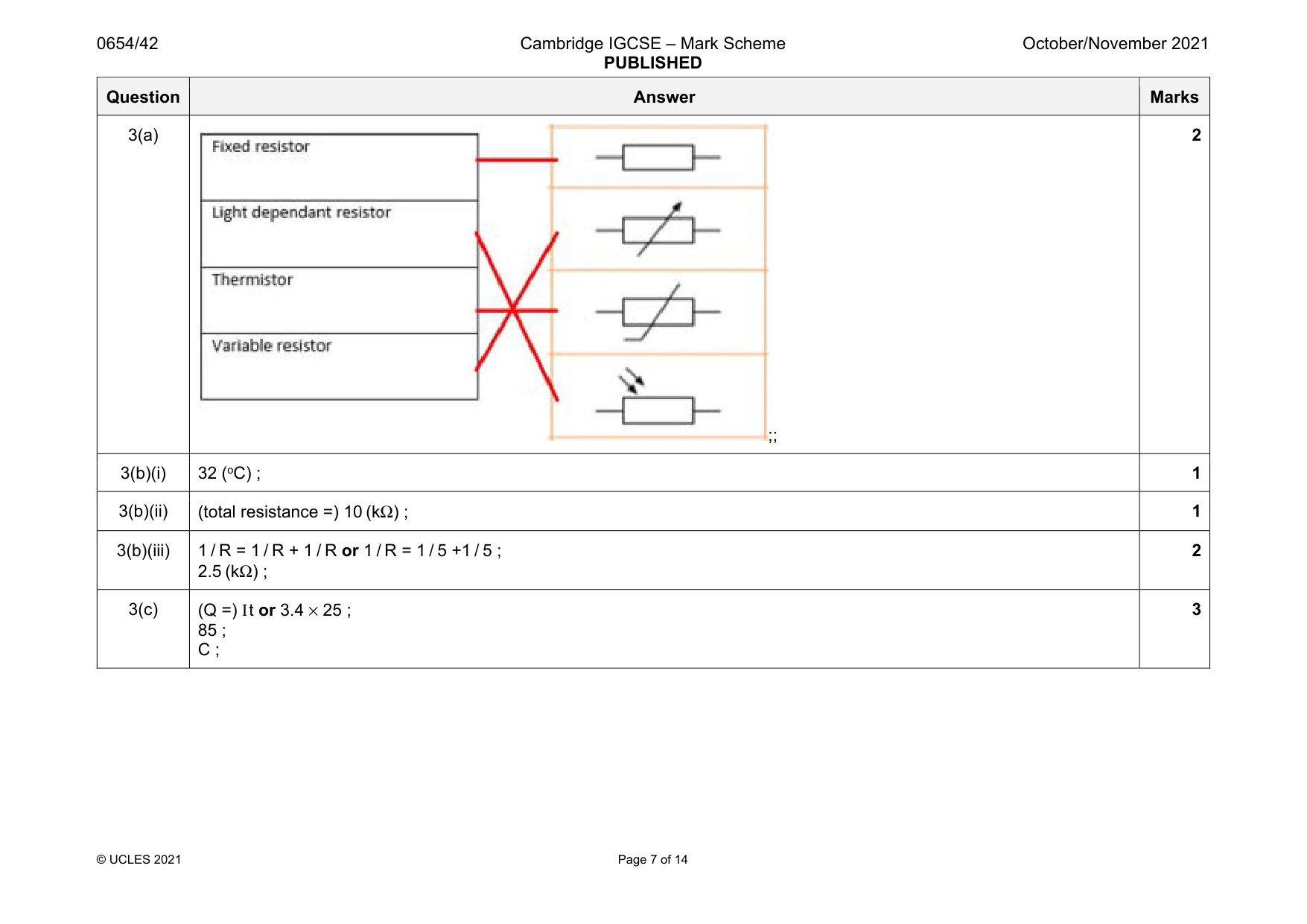
Mark scheme: 3(a) ;; 2 3(b)(i) 32 (oC) ; 1 3(b)(ii) (total resistance =) 10 (kΩ) ; 1 3(b)(iii) 1 / R = 1 / R + 1 / R or 1 / R = 1 / 5 +1 / 5 ; 2.5 (kΩ) ; 2 3(c) (Q =) I t or 3.4 × 25 ; 85 ; C ; 3
Q4 · A student investigates the effect of light intensity on the rate of photosynthesis at two…
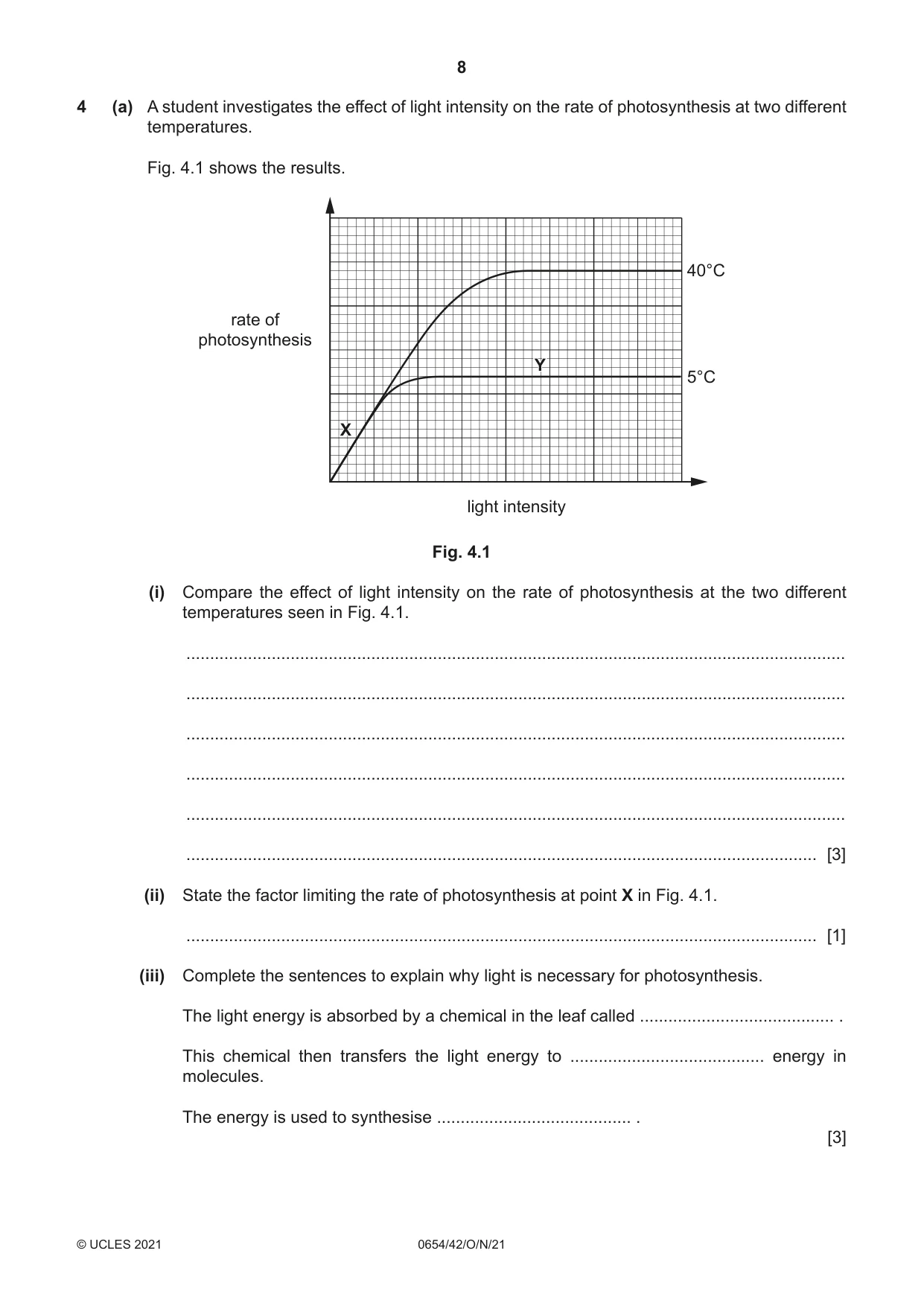
4 (a) A student investigates the effect of light intensity on the rate of photosynthesis at two different temperatures. Fig. 4.1 shows the results. 40°C rate of photosynthesis YY 5°C XX light intensity Fig. 4.1 (i) Compare the effect of light intensity on the rate of photosynthesis at the two different temperatures seen in Fig. 4.1. ........................................................................................................................................... ........................................................................................................................................... ........................................................................................................................................... ........................................................................................................................................... ........................................................................................................................................... ..................................................................................................................................... [3] (ii) State the factor limiting the rate of photosynthesis at point X in Fig. 4.1. ..................................................................................................................................... [1] (iii) Complete the sentences to explain why light is necessary for photosynthesis. The light energy is absorbed by a chemical in the leaf called ......................................... . This chemical then transfers the light energy to ......................................... energy in molecules. The energy is used to synthesise ......................................... . [3] (b) State the word equation for photosynthesis. ............................................................................................................................................. [2] (c) Name the cells in a leaf where most photosynthesis occurs. ............................................................................................................................................. [1] [Total: 10]
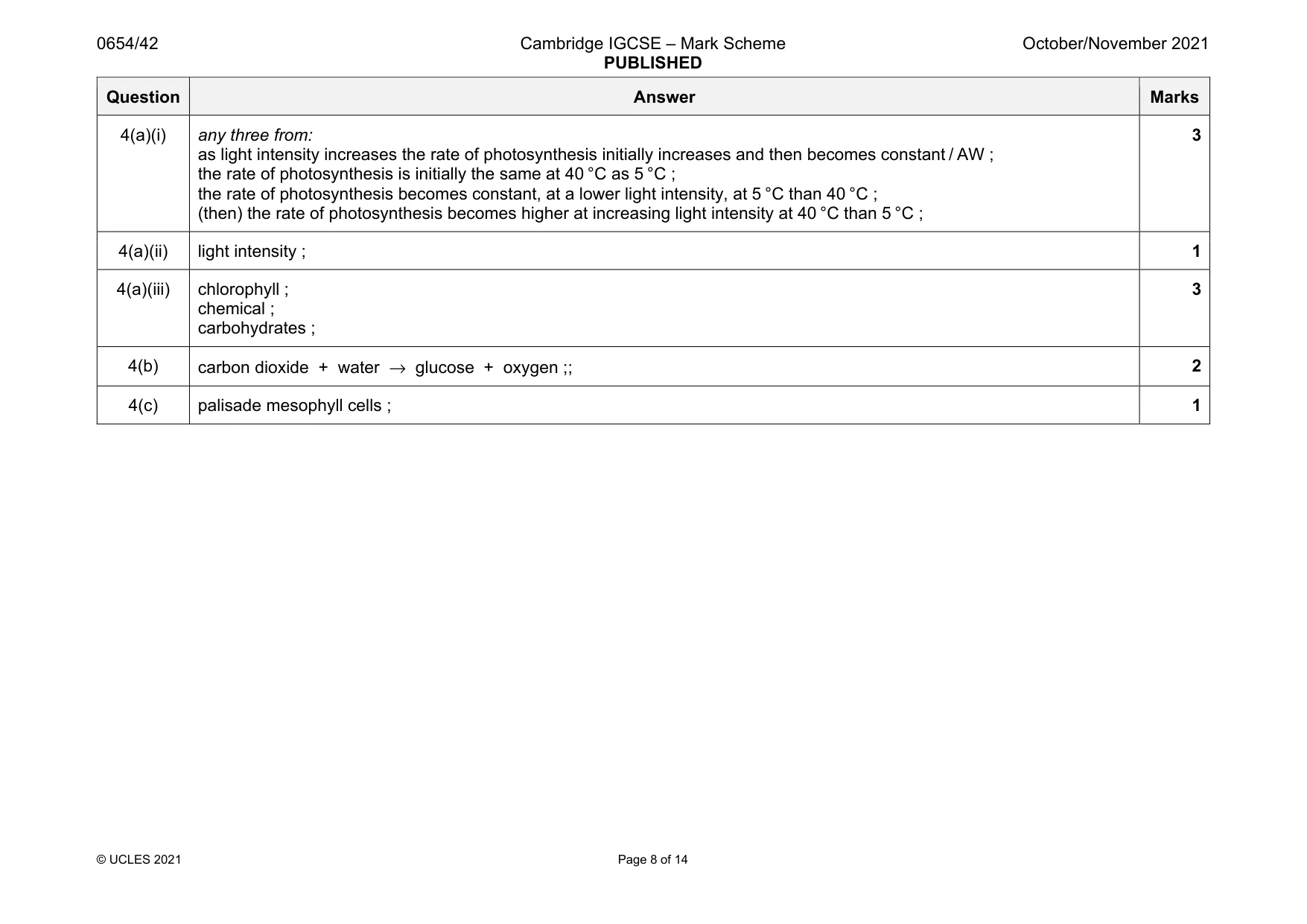
Mark scheme: 4(a)(i) any three from: as light intensity increases the rate of photosynthesis initially increases and then becomes constant / AW ; the rate of photosynthesis is initially the same at 40 °C as 5 °C ; the rate of photosynthesis becomes constant, at a lower light intensity, at 5 °C than 40 °C ; (then) the rate of photosynthesis becomes higher at increasing light intensity at 40 °C than 5 °C ; 3 4(a)(ii) light intensity ; 1 4(a)(iii) chlorophyll ; chemical ; carbohydrates ; 3 4(b) carbon dioxide + water → glucose + oxygen ;; 2 4(c) palisade mesophyll cells ; 1
Q5 · Large hydrocarbon molecules can be cracked to make smaller molecules
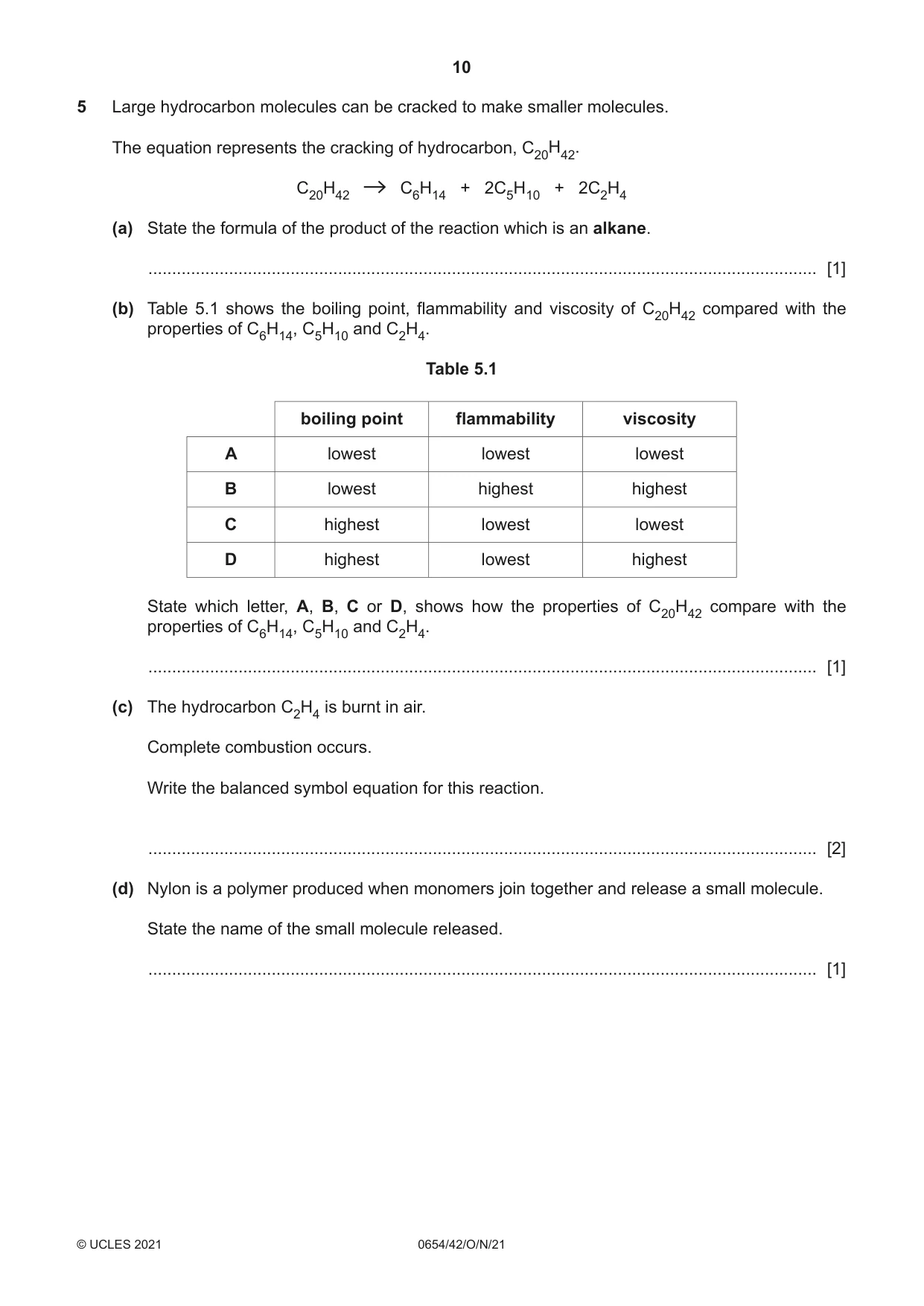
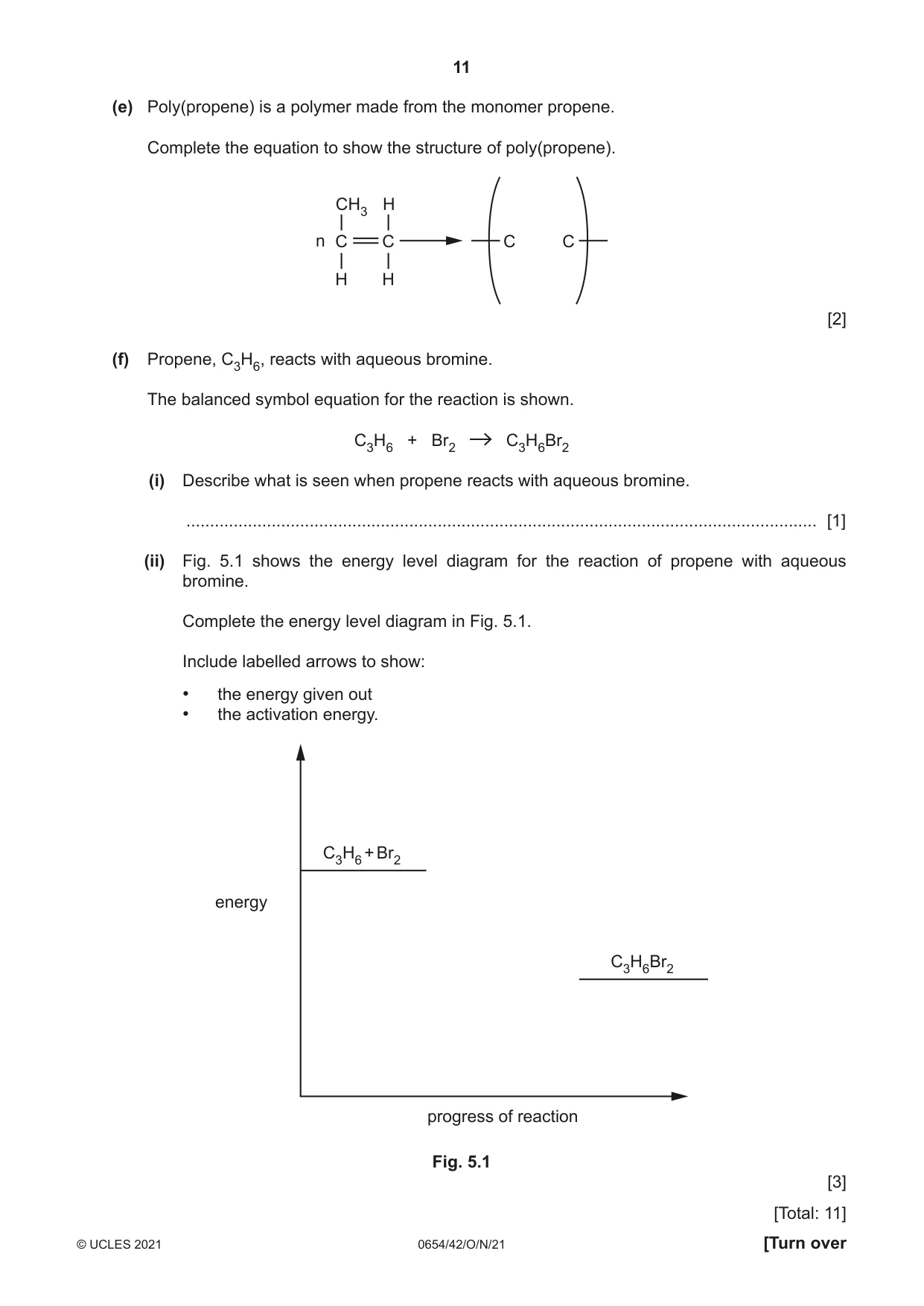
5 Large hydrocarbon molecules can be cracked to make smaller molecules. The equation represents the cracking of hydrocarbon, C20H42. C20H42 C6H14 + 2C5H10 + 2C2H4 (a) State the formula of the product of the reaction which is an alkane. ............................................................................................................................................. [1] (b) Table 5.1 shows the boiling point, flammability and viscosity of C20H42 compared with the properties of C6H14, C5H10 and C2H4. Table 5.1 boiling point flammability viscosity A lowest lowest lowest B lowest highest highest C highest lowest lowest D highest lowest highest State which letter, A, B, C or D, shows how the properties of C20H42 compare with the properties of C6H14, C5H10 and C2H4. ............................................................................................................................................. [1] (c) The hydrocarbon C2H4 is burnt in air. Complete combustion occurs. Write the balanced symbol equation for this reaction. ............................................................................................................................................. [2] (d) Nylon is a polymer produced when monomers join together and release a small molecule. State the name of the small molecule released. ............................................................................................................................................. [1] (e) Poly(propene) is a polymer made from the monomer propene. Complete the equation to show the structure of poly(propene). CH3 H n C C C C H H [2] (f) Propene, C3H6, reacts with aqueous bromine. The balanced symbol equation for the reaction is shown. C3H6 + Br2 C3H6Br2 (i) Describe what is seen when propene reacts with aqueous bromine. ..................................................................................................................................... [1] (ii) Fig. 5.1 shows the energy level diagram for the reaction of propene with aqueous bromine. Complete the energy level diagram in Fig. 5.1. Include labelled arrows to show: • the energy given out • the activation energy. C3H6 + Br2 energy C3H6Br2 progress of reaction Fig. 5.1 [3] [Total: 11]
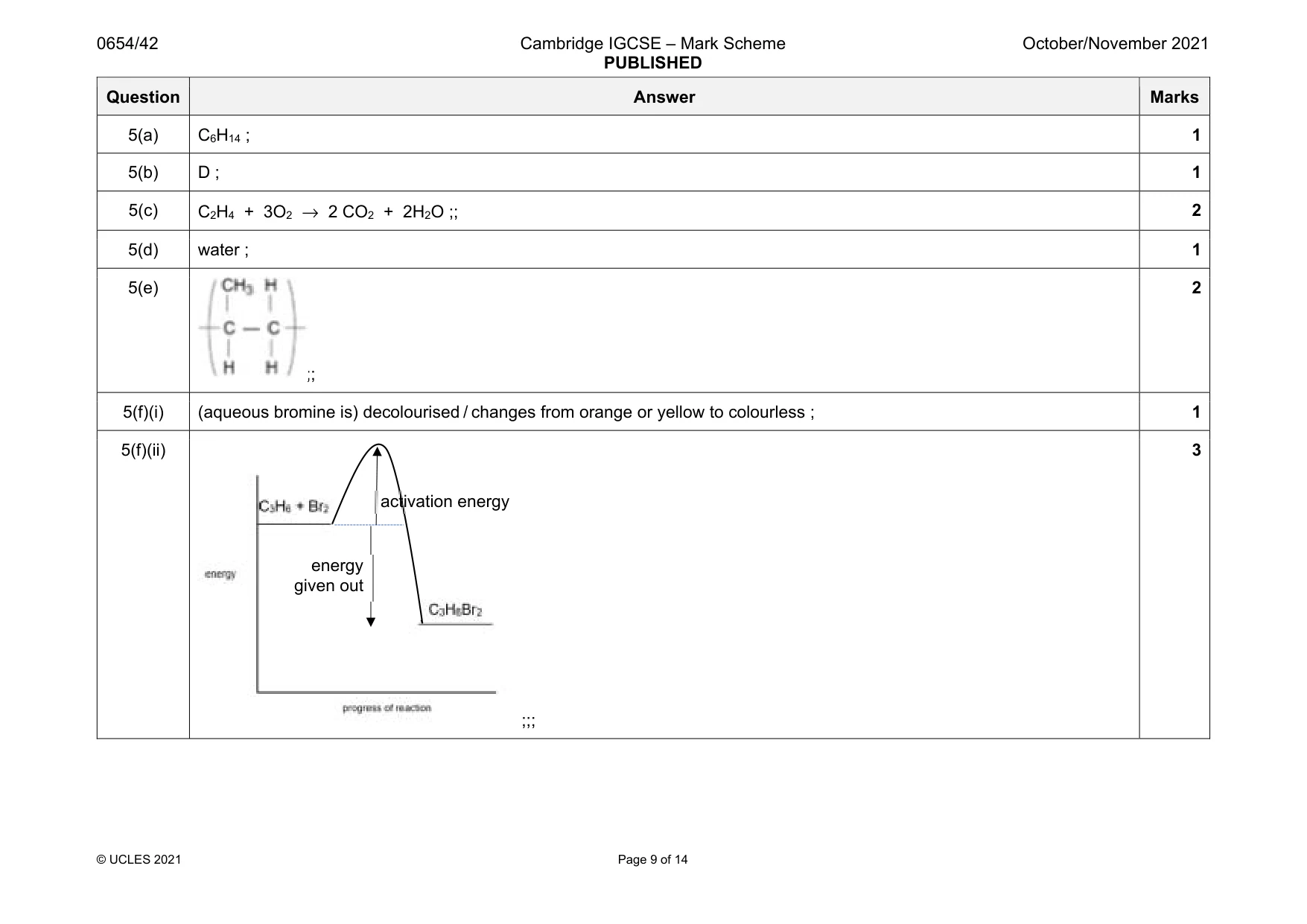
Mark scheme: 5(a) C6H14 ; 1 5(b) D ; 1 5(c) C2H4 + 3O2 → 2 CO2 + 2H2O ;; 2 5(d) water ; 1 5(e) ;; 2 5(f)(i) (aqueous bromine is) decolourised / changes from orange or yellow to colourless ; 1 5(f)(ii) ;;; 3 activation energy energy given out
Q6 · A rollercoaster ride at a theme park
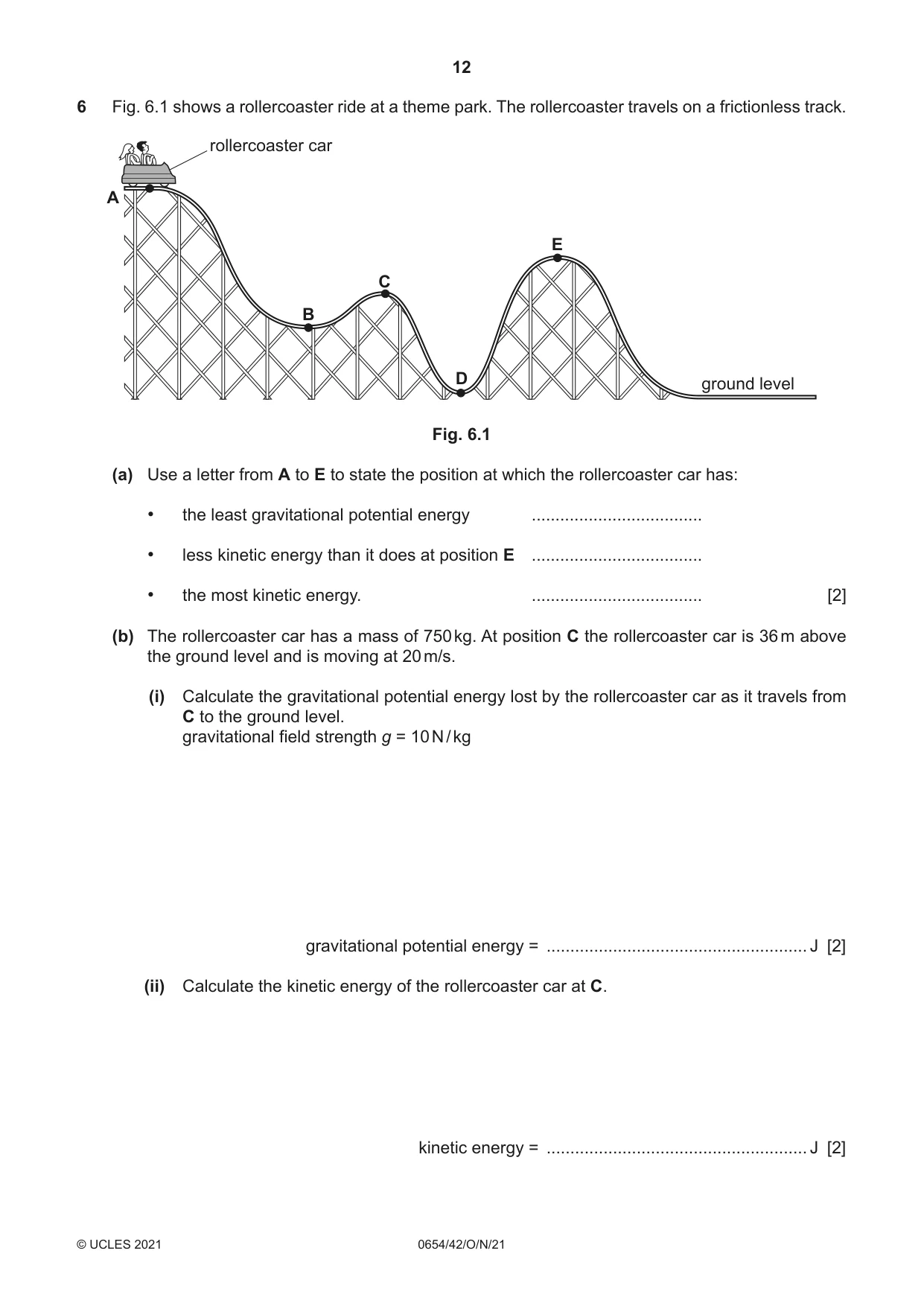
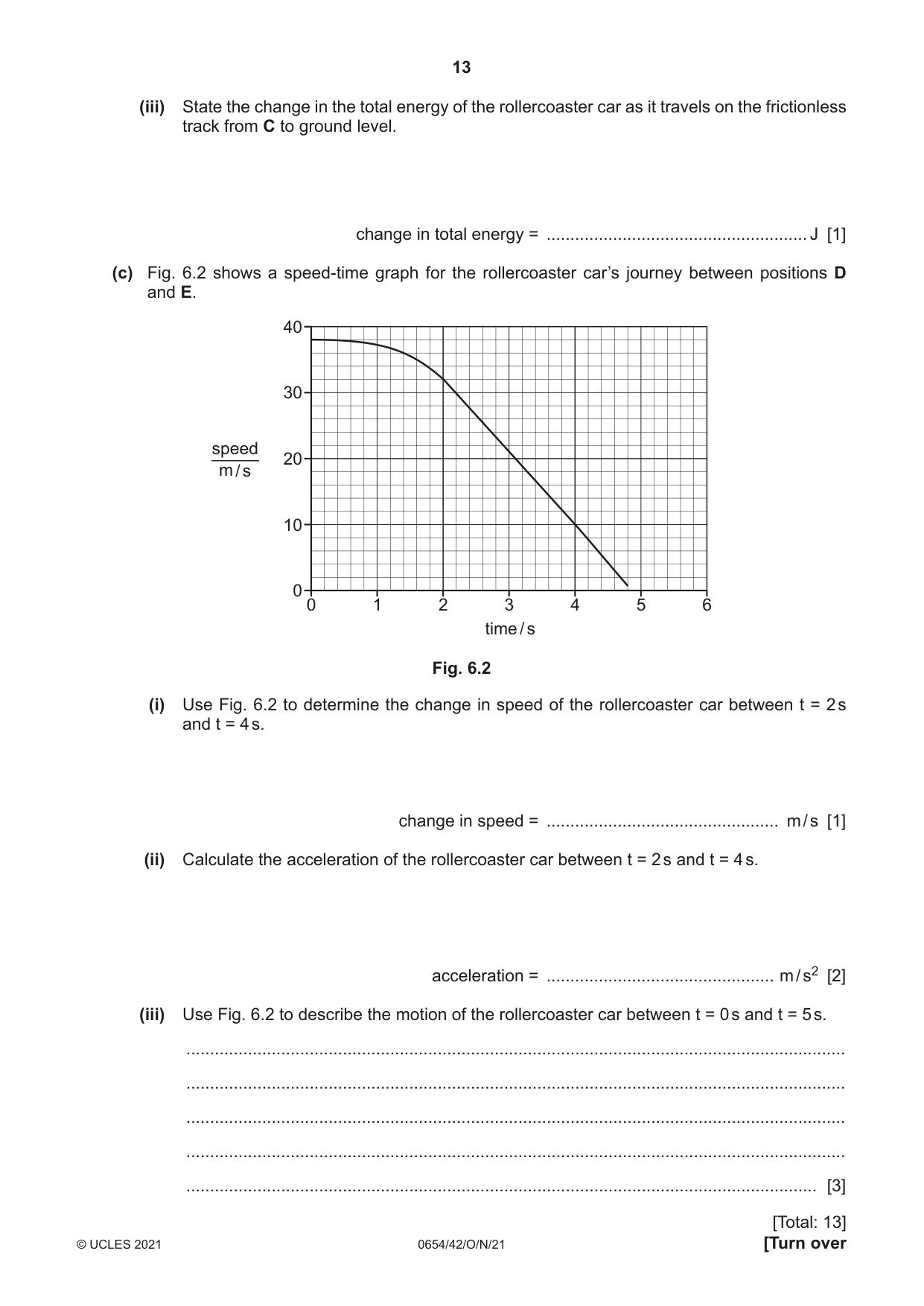
6 Fig. 6.1 shows a rollercoaster ride at a theme park. The rollercoaster travels on a frictionless track. rollercoaster car A E C B D ground level Fig. 6.1 (a) Use a letter from A to E to state the position at which the rollercoaster car has: • the least gravitational potential energy .................................... • less kinetic energy than it does at position E .................................... • the most kinetic energy. .................................... [2] (b) The rollercoaster car has a mass of 750 kg. At position C the rollercoaster car is 36 m above the ground level and is moving at 20 m/s. (i) Calculate the gravitational potential energy lost by the rollercoaster car as it travels from C to the ground level. gravitational field strength g = 10 N / kg gravitational potential energy = ....................................................... J [2] (ii) Calculate the kinetic energy of the rollercoaster car at C. kinetic energy = ....................................................... J [2] (iii) State the change in the total energy of the rollercoaster car as it travels on the frictionless track from C to ground level. change in total energy = ....................................................... J [1] (c) Fig. 6.2 shows a speed-time graph for the rollercoaster car’s journey between positions D and E. 40 30 speed 20 m / s 10 0 0 1 2 3 4 5 6 time / s Fig. 6.2 (i) Use Fig. 6.2 to determine the change in speed of the rollercoaster car between t = 2 s and t = 4 s. change in speed = ................................................. m / s [1] (ii) Calculate the acceleration of the rollercoaster car between t = 2 s and t = 4 s. acceleration = ................................................ m / s2 [2] (iii) Use Fig. 6.2 to describe the motion of the rollercoaster car between t = 0 s and t = 5 s. ........................................................................................................................................... ........................................................................................................................................... ........................................................................................................................................... ........................................................................................................................................... ..................................................................................................................................... [3] [Total: 13]
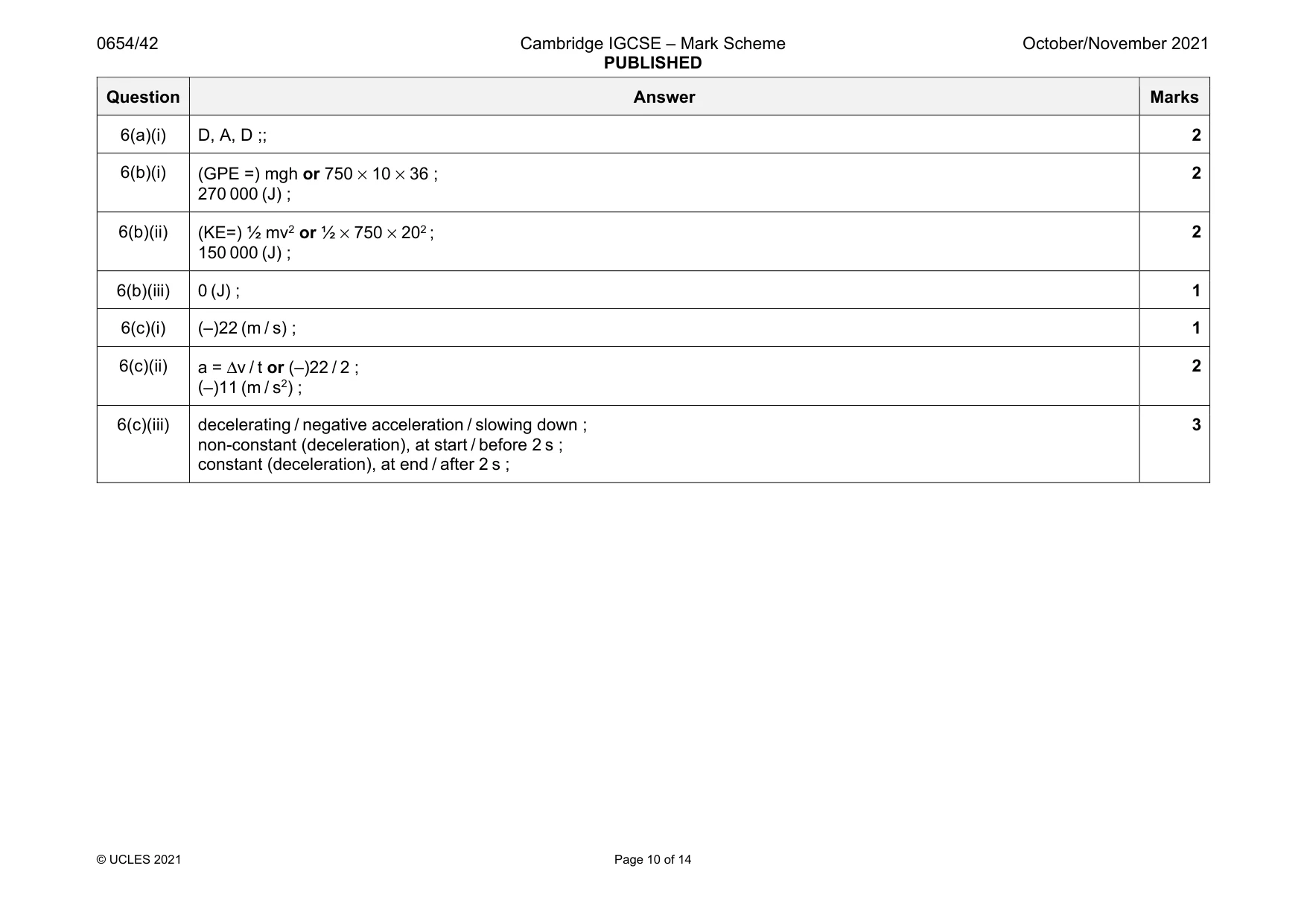
Mark scheme: 6(a)(i) D, A, D ;; 2 6(b)(i) (GPE =) mgh or 750 × 10 × 36 ; 270 000 (J) ; 2 6(b)(ii) (KE=) ½ mv2 or ½ × 750 × 202 ; 150 000 (J) ; 2 6(b)(iii) 0 (J) ; 1 6(c)(i) (–)22 (m / s) ; 1 6(c)(ii) a = Δv / t or (–)22 / 2 ; (–)11 (m / s2) ; 2 6(c)(iii) decelerating / negative acceleration / slowing down ; non-constant (deceleration), at start / before 2 s ; constant (deceleration), at end / after 2 s ; 3
Q7 · A diagram of a human eye
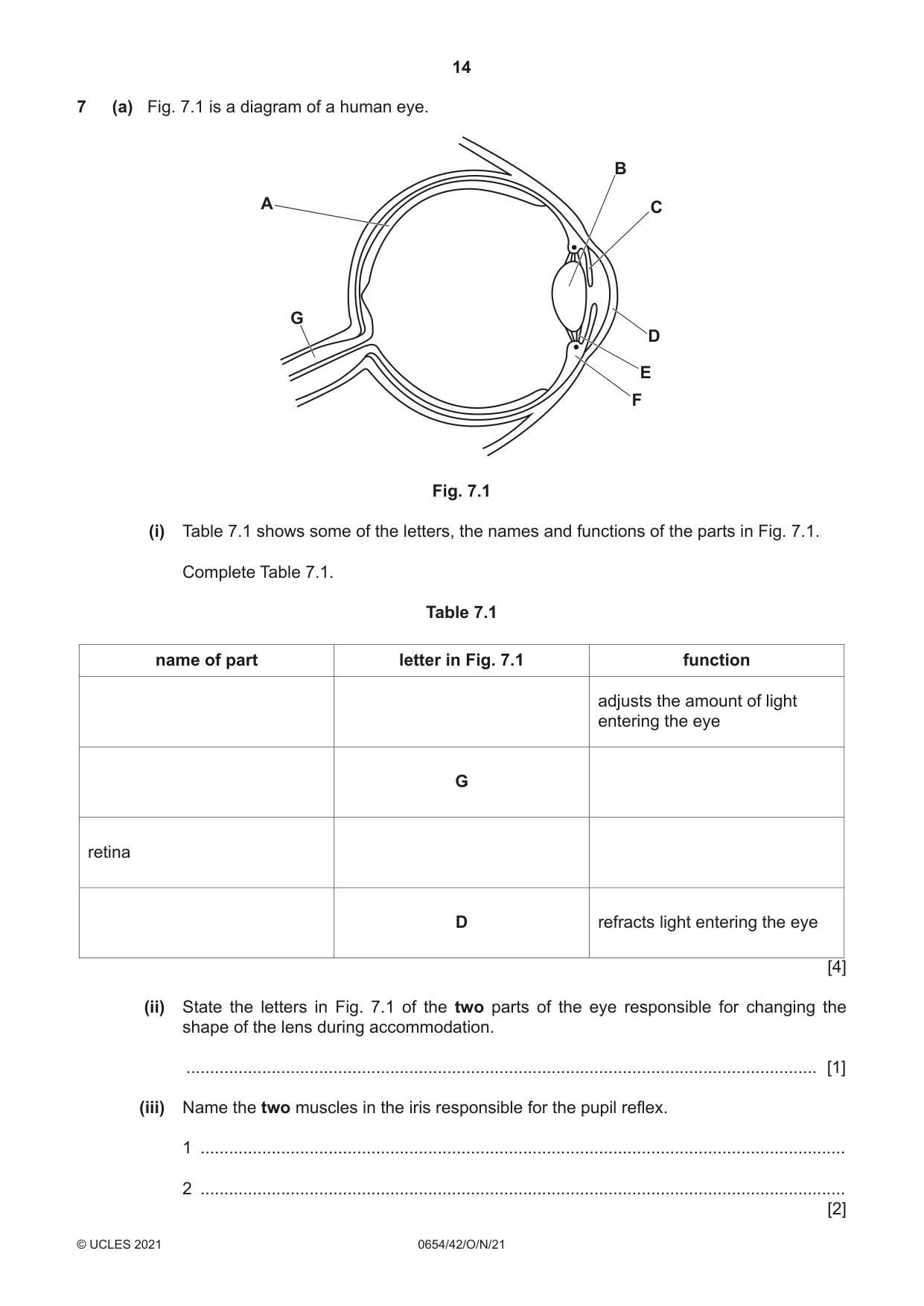
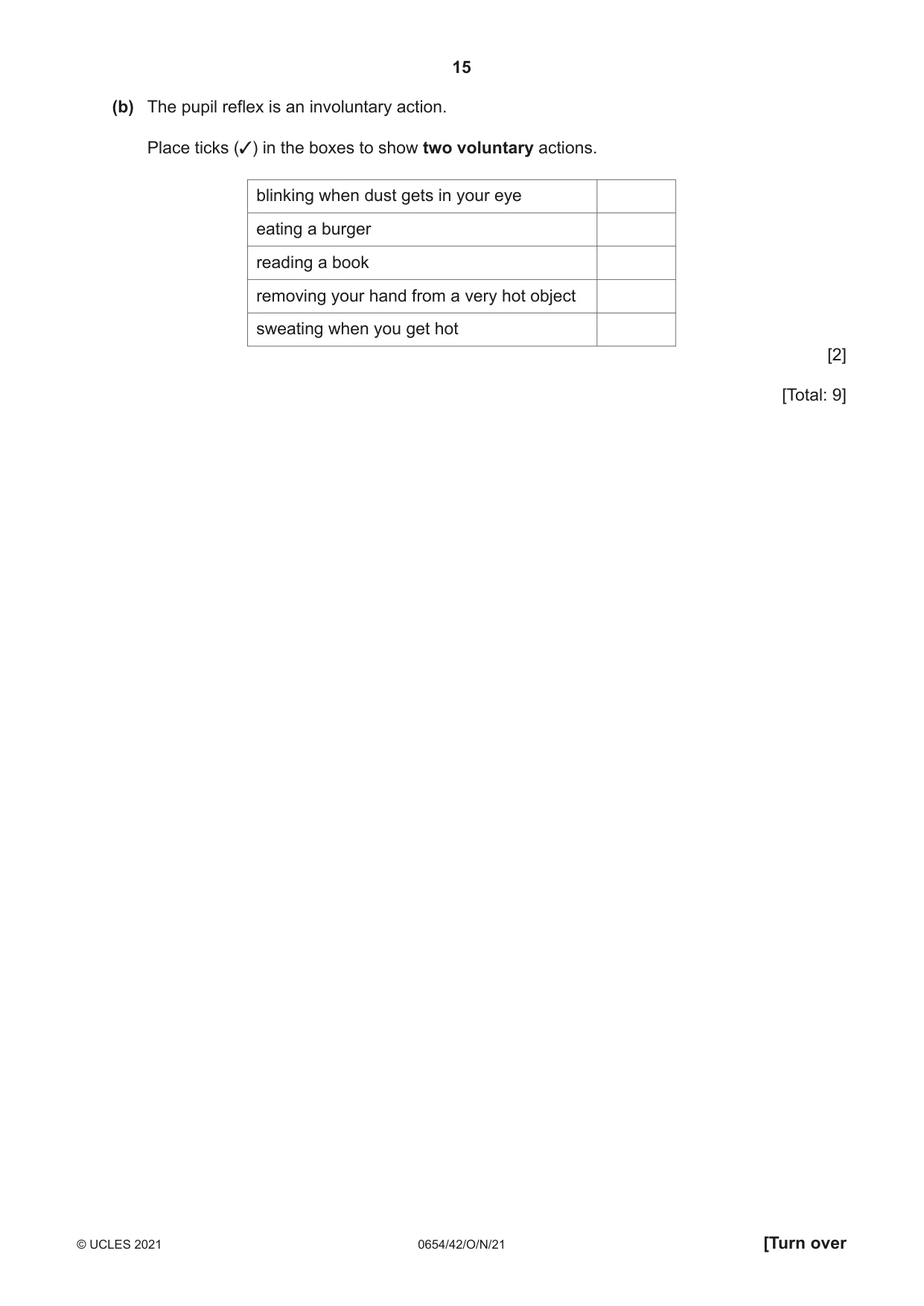
7 (a) Fig. 7.1 is a diagram of a human eye. B A C G D E F Fig. 7.1 (i) Table 7.1 shows some of the letters, the names and functions of the parts in Fig. 7.1. Complete Table 7.1. Table 7.1 name of part letter in Fig. 7.1 function adjusts the amount of light entering the eye G retina D refracts light entering the eye [4] (ii) State the letters in Fig. 7.1 of the two parts of the eye responsible for changing the shape of the lens during accommodation. ..................................................................................................................................... [1] (iii) Name the two muscles in the iris responsible for the pupil reflex. 1 ........................................................................................................................................ 2 ........................................................................................................................................ [2] (b) The pupil reflex is an involuntary action. Place ticks (3) in the boxes to show two voluntary actions. blinking when dust gets in your eye eating a burger reading a book removing your hand from a very hot object sweating when you get hot [2] [Total: 9]
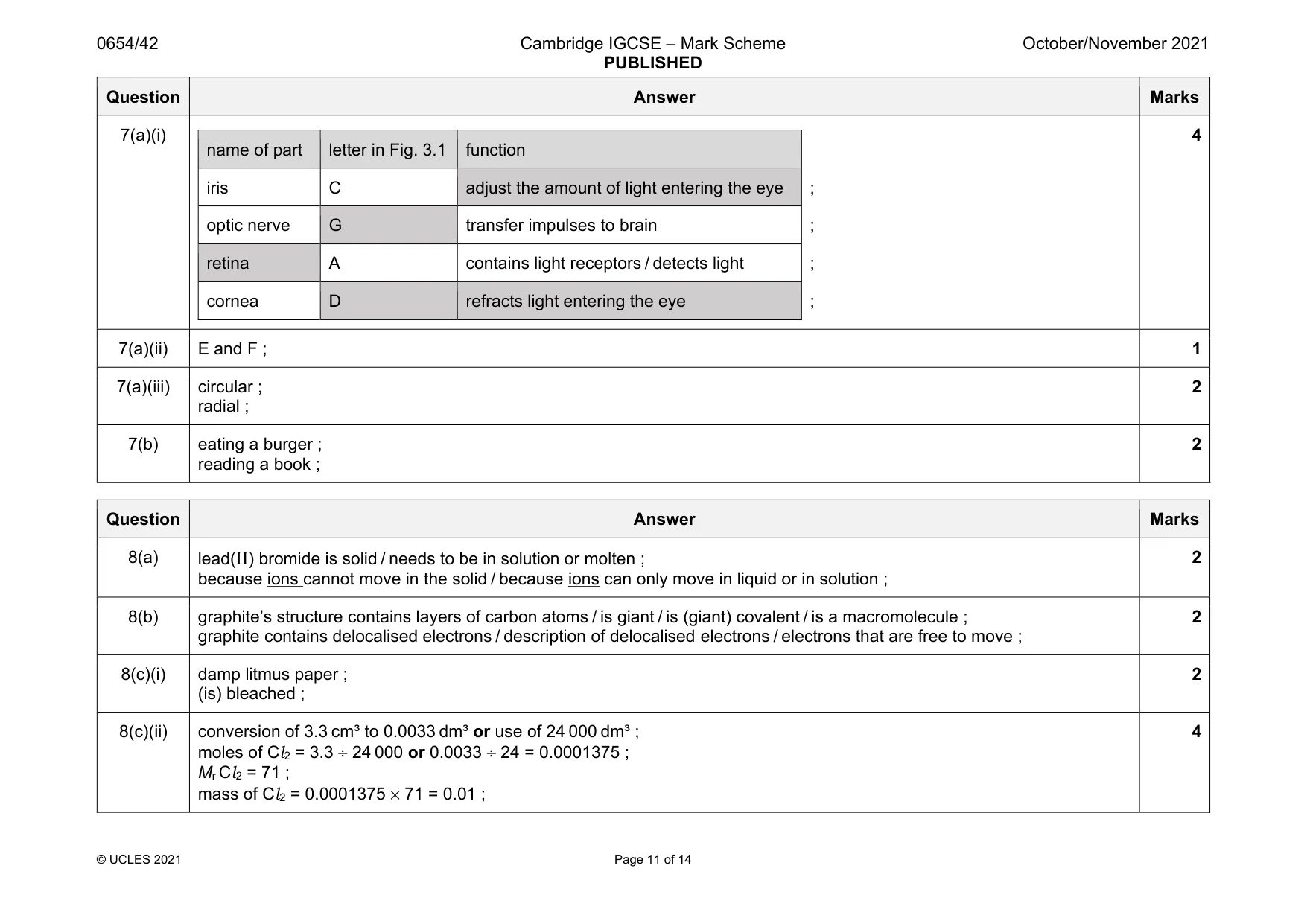
Mark scheme: 7(a)(i) name of part letter in Fig. 3.1 function iris C adjust the amount of light entering the eye ; optic nerve G transfer impulses to brain ; retina A contains light receptors / detects light ; cornea D refracts light entering the eye ; 4 7(a)(ii) E and F ; 1 7(a)(iii) circular ; radial ; 2 7(b) eating a burger ; reading a book ; 2
Q8 · A scientist investigates the electrolysis of lead(II) bromide
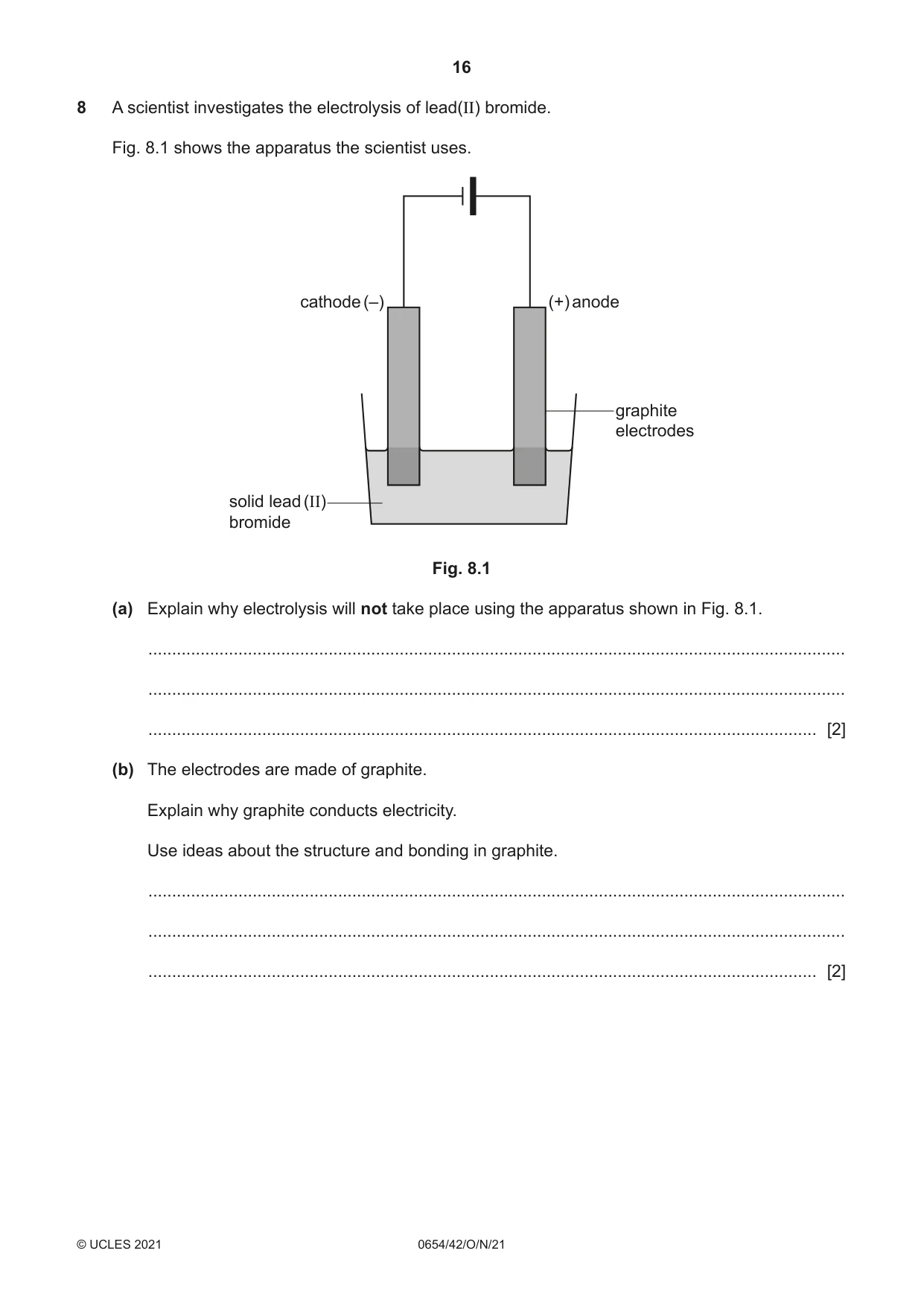
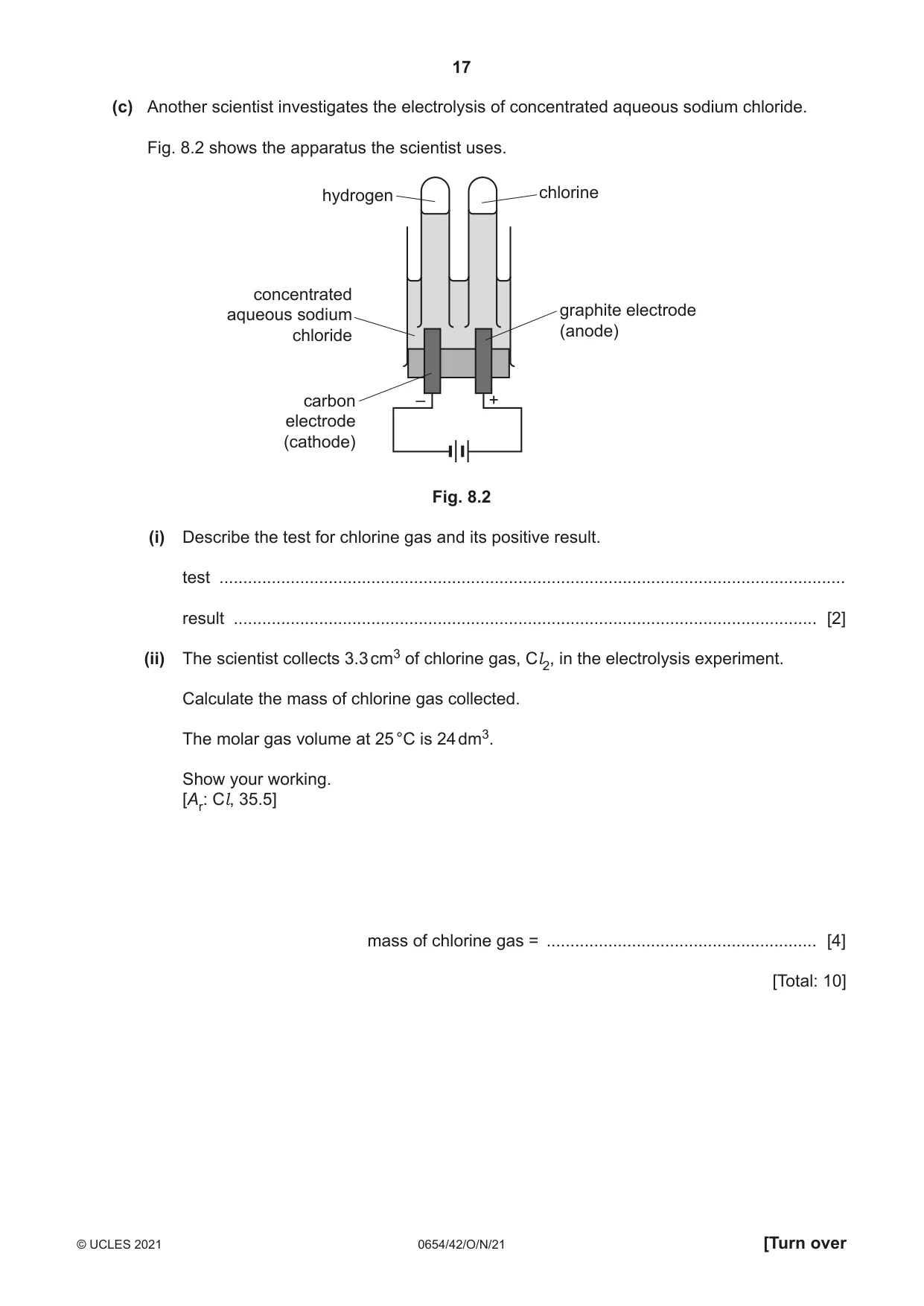
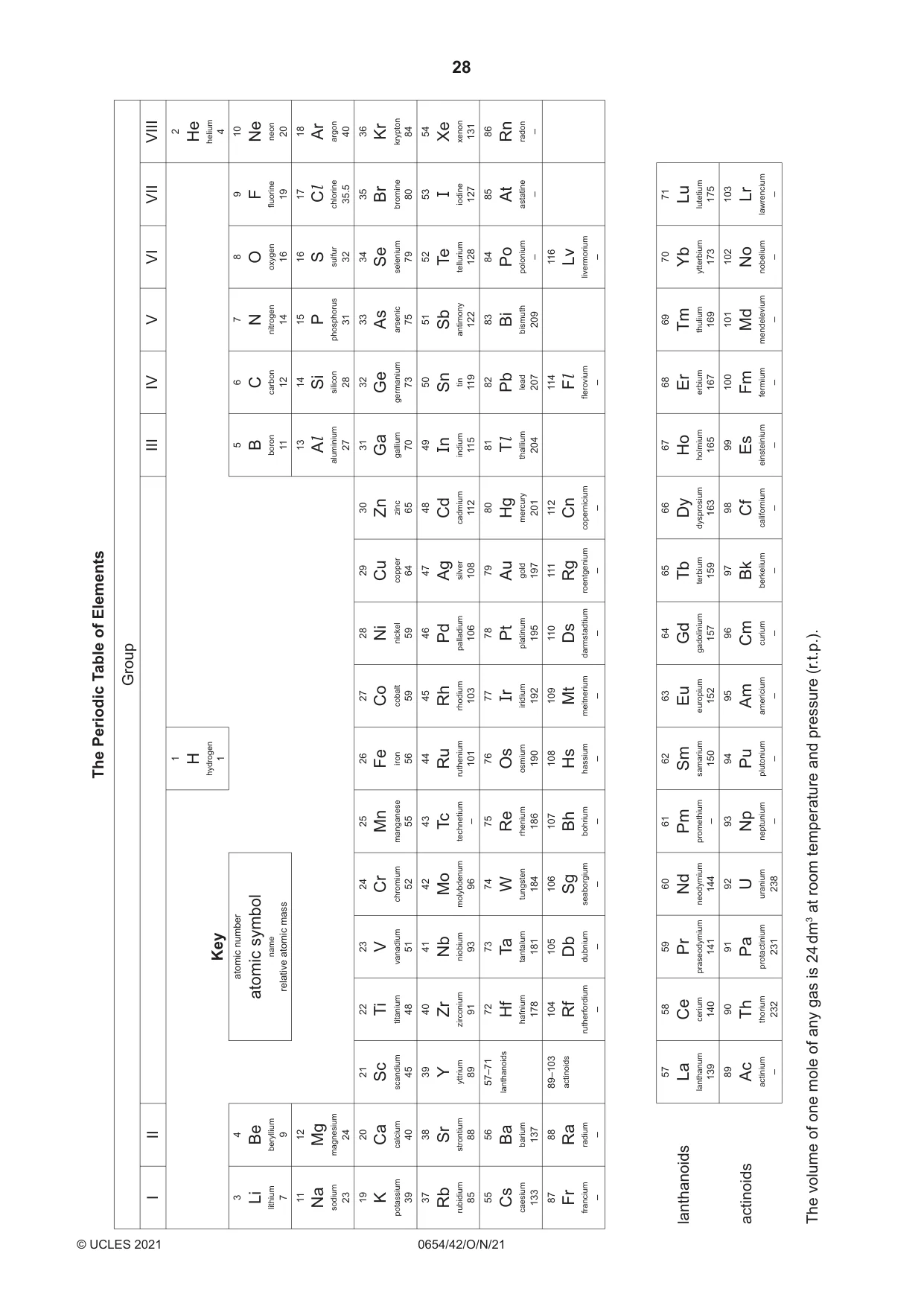
8 A scientist investigates the electrolysis of lead(II) bromide. Fig. 8.1 shows the apparatus the scientist uses. cathode (–) (+) anode graphite electrodes solid lead (II) bromide Fig. 8.1 (a) Explain why electrolysis will not take place using the apparatus shown in Fig. 8.1. ................................................................................................................................................... ................................................................................................................................................... ............................................................................................................................................. [2] (b) The electrodes are made of graphite. Explain why graphite conducts electricity. Use ideas about the structure and bonding in graphite. ................................................................................................................................................... ................................................................................................................................................... ............................................................................................................................................. [2] (c) Another scientist investigates the electrolysis of concentrated aqueous sodium chloride. Fig. 8.2 shows the apparatus the scientist uses. hydrogen chlorine concentrated aqueous sodium graphite electrode chloride (anode) carbon – + electrode (cathode) Fig. 8.2 (i) Describe the test for chlorine gas and its positive result. test .................................................................................................................................... result ........................................................................................................................... [2] (ii) The scientist collects 3.3 cm3 of chlorine gas, Cl2, in the electrolysis experiment. Calculate the mass of chlorine gas collected. The molar gas volume at 25 °C is 24 dm3. Show your working. [Ar: Cl, 35.5] mass of chlorine gas = ......................................................... [4] [Total: 10]
Mark scheme: 8(a) lead(II) bromide is solid / needs to be in solution or molten ; because ions cannot move in the solid / because ions can only move in liquid or in solution ; 2 8(b) graphite’s structure contains layers of carbon atoms / is giant / is (giant) covalent / is a macromolecule ; graphite contains delocalised electrons / description of delocalised electrons / electrons that are free to move ; 2 8(c)(i) damp litmus paper ; (is) bleached ; 2 8(c)(ii) conversion of 3.3 cm³ to 0.0033 dm³ or use of 24 000 dm³ ; moles of Cl2 = 3.3 ÷ 24 000 or 0.0033 ÷ 24 = 0.0001375 ; Mr Cl2 = 71 ; mass of Cl2 = 0.0001375 × 71 = 0.01 ; 4
Q9 · A helium filled balloon attached to a spring
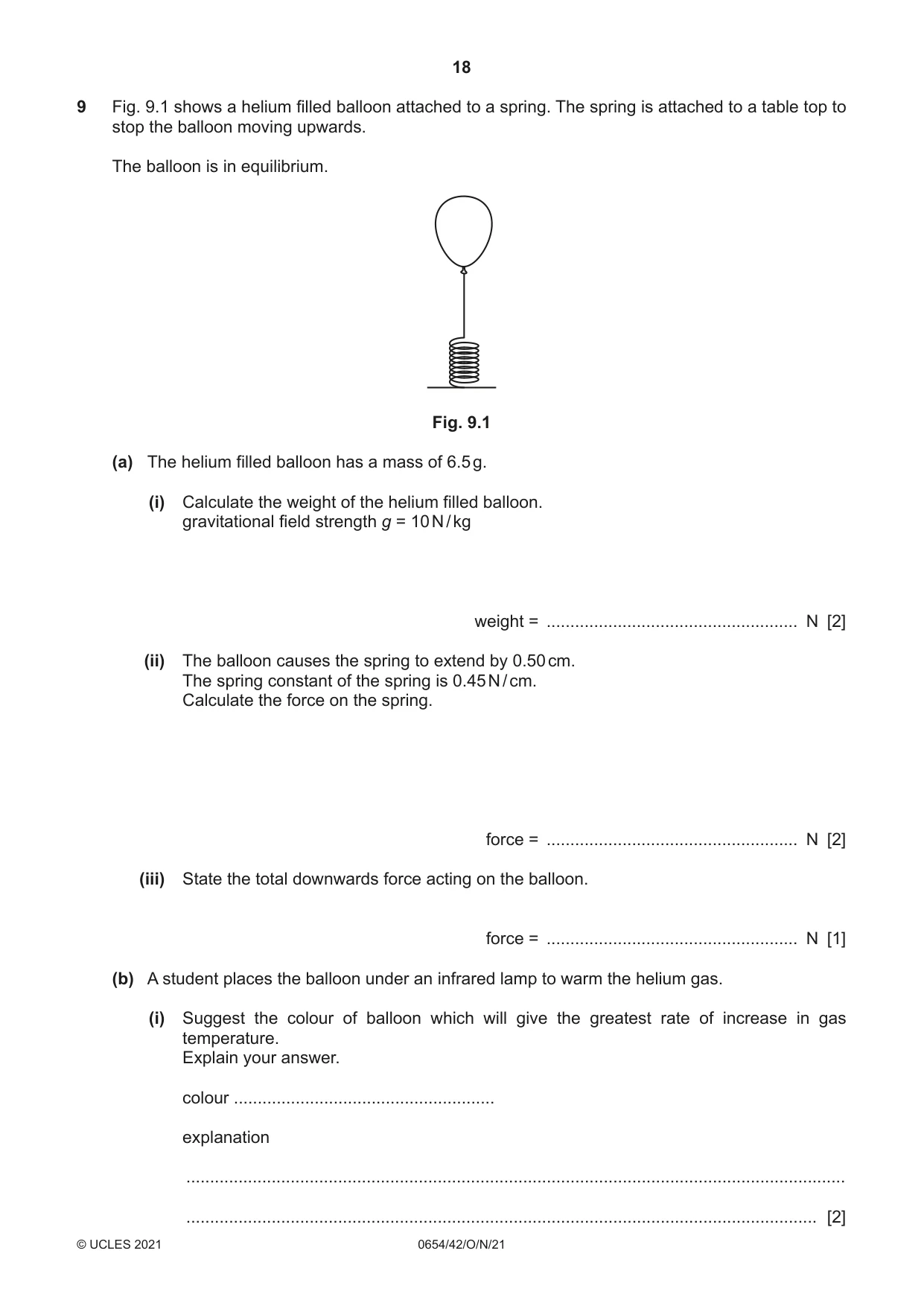
9 Fig. 9.1 shows a helium filled balloon attached to a spring. The spring is attached to a table top to stop the balloon moving upwards. The balloon is in equilibrium. Fig. 9.1 (a) The helium filled balloon has a mass of 6.5 g. (i) Calculate the weight of the helium filled balloon. gravitational field strength g = 10 N / kg weight = ..................................................... N [2] (ii) The balloon causes the spring to extend by 0.50 cm. The spring constant of the spring is 0.45 N / cm. Calculate the force on the spring. force = ..................................................... N [2] (iii) State the total downwards force acting on the balloon. force = ..................................................... N [1] (b) A student places the balloon under an infrared lamp to warm the helium gas. (i) Suggest the colour of balloon which will give the greatest rate of increase in gas temperature. Explain your answer. colour ....................................................... explanation ........................................................................................................................................... ..................................................................................................................................... [2] (ii) Explain why the size of the balloon increases as it is heated. ........................................................................................................................................... ........................................................................................................................................... ........................................................................................................................................... ........................................................................................................................................... ..................................................................................................................................... [3] [Total: 10]
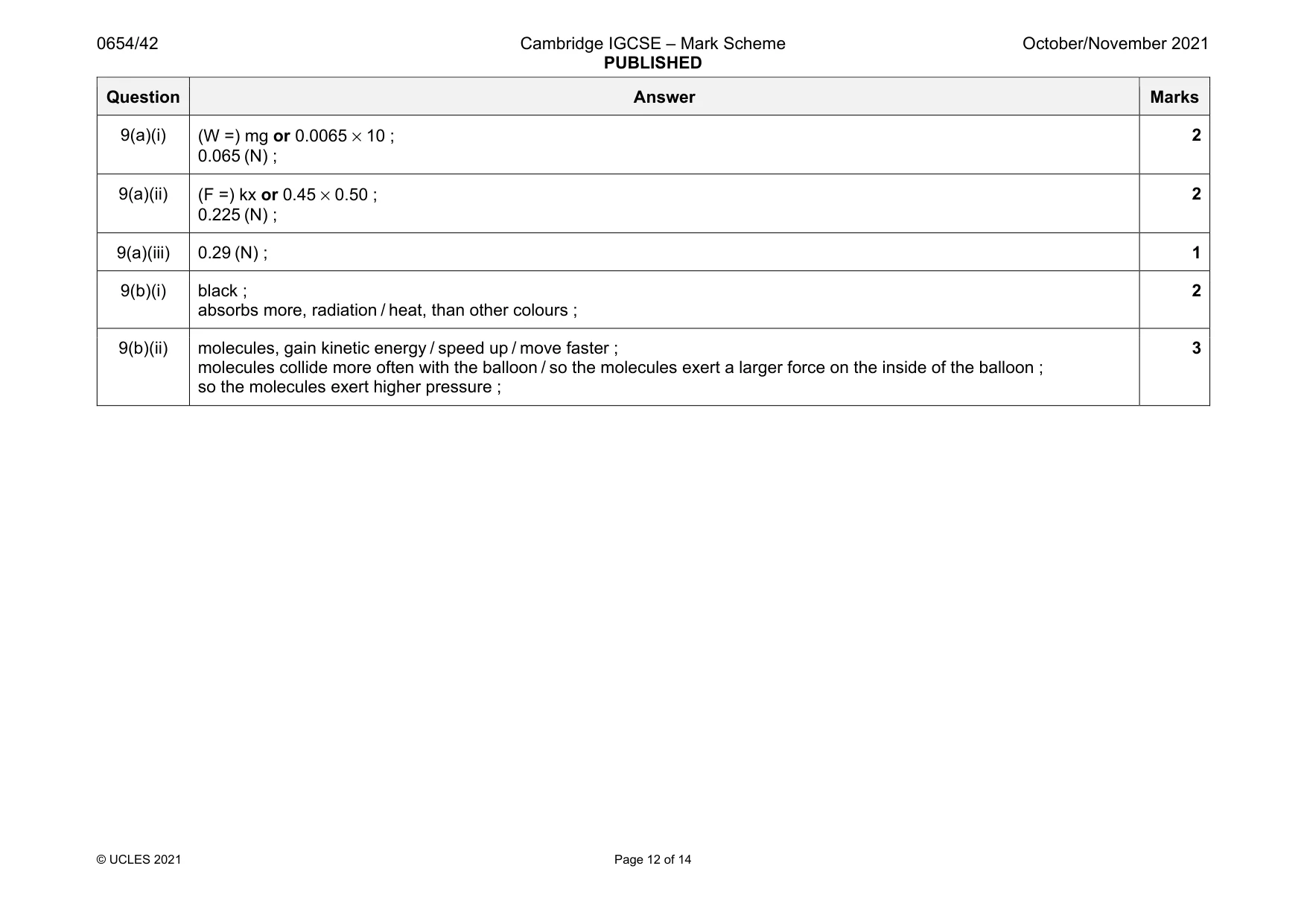
Mark scheme: 9(a)(i) (W =) mg or 0.0065 × 10 ; 0.065 (N) ; 2 9(a)(ii) (F =) kx or 0.45 × 0.50 ; 0.225 (N) ; 2 9(a)(iii) 0.29 (N) ; 1 9(b)(i) black ; absorbs more, radiation / heat, than other colours ; 2 9(b)(ii) molecules, gain kinetic energy / speed up / move faster ; molecules collide more often with the balloon / so the molecules exert a larger force on the inside of the balloon ; so the molecules exert higher pressure ; 3
Q10 · The daily energy requirements of different females
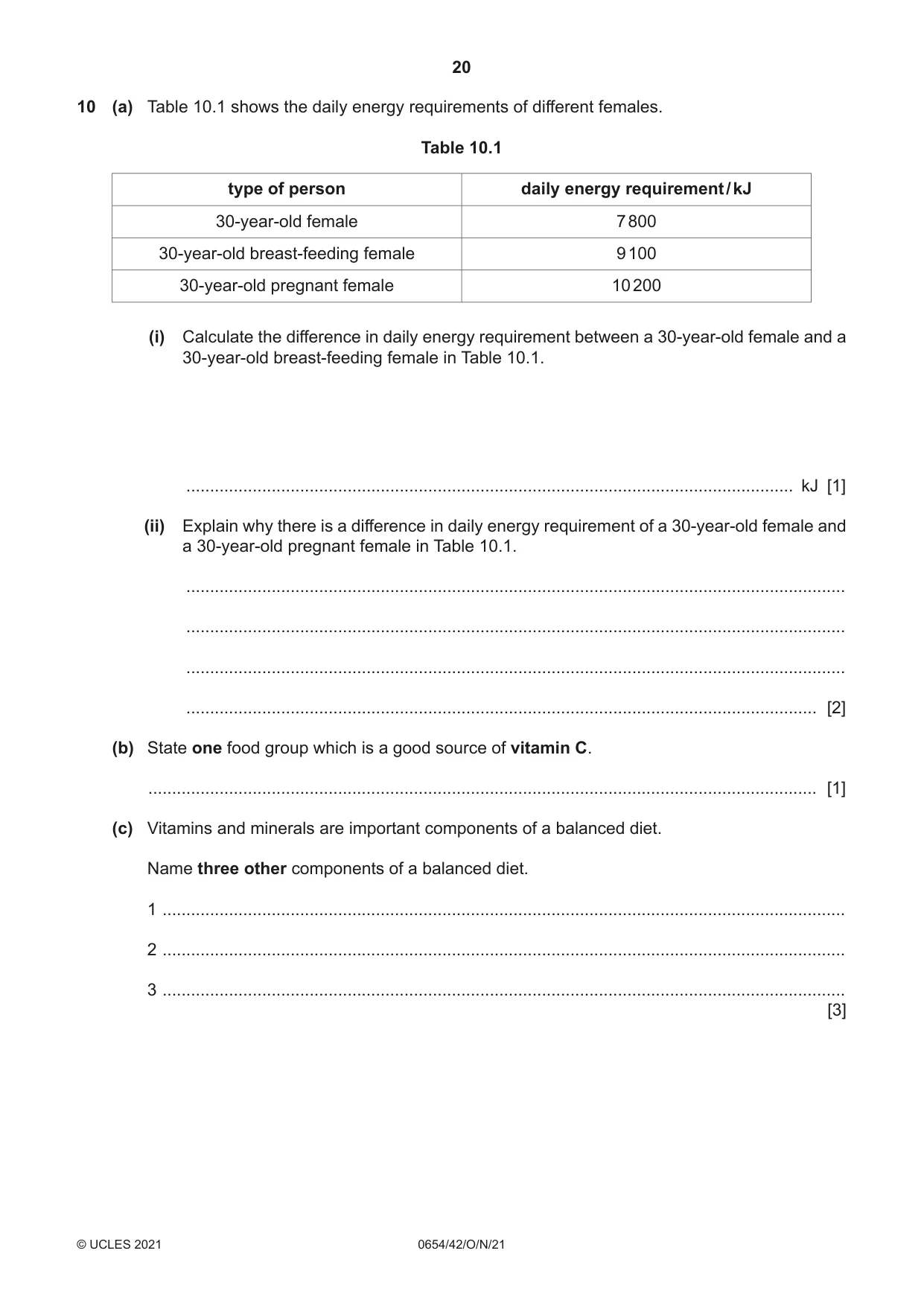
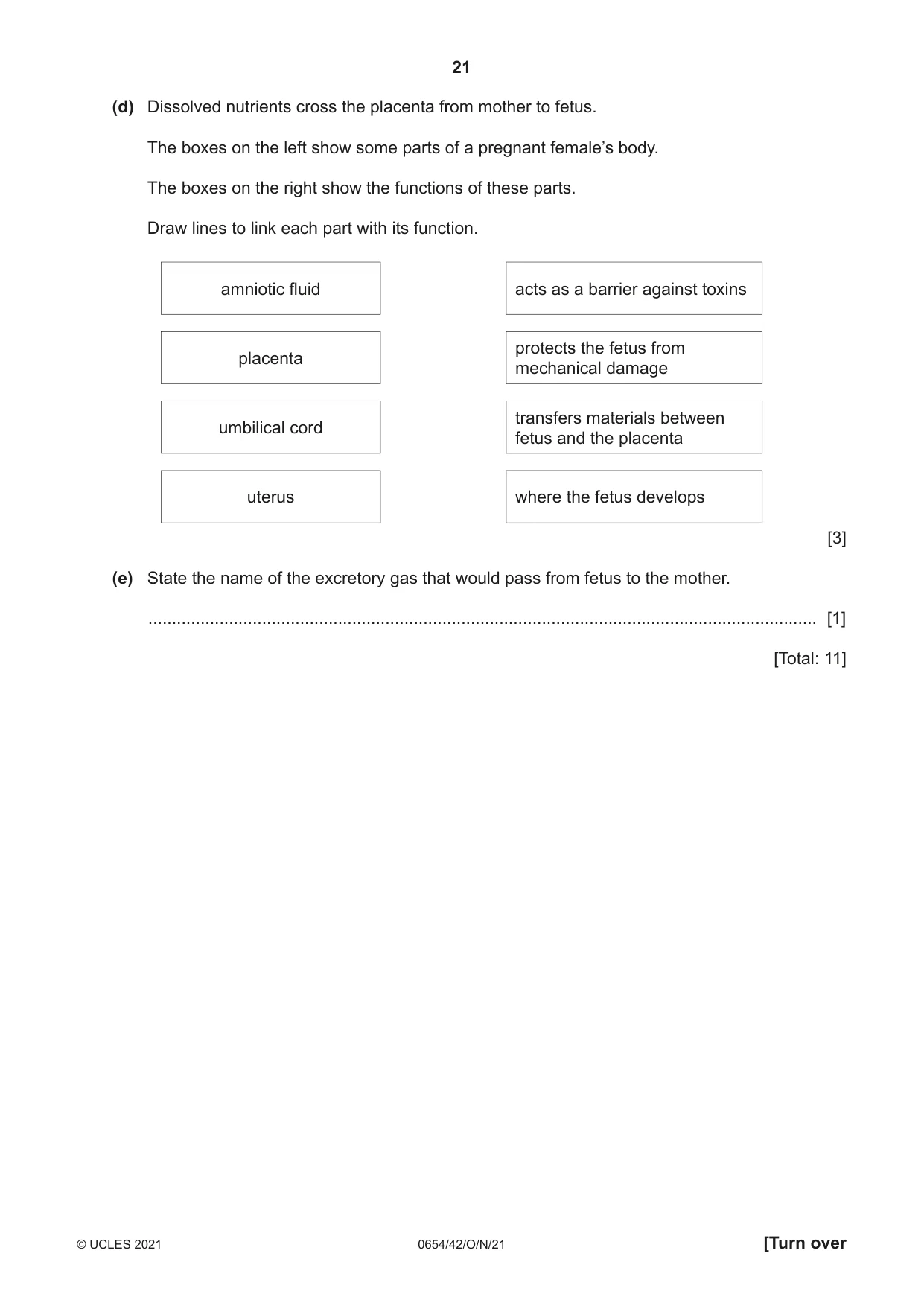
10 (a) Table 10.1 shows the daily energy requirements of different females. Table 10.1 type of person daily energy requirement / kJ 30-year-old female 7 800 30-year-old breast-feeding female 9 100 30-year-old pregnant female 10 200 (i) Calculate the difference in daily energy requirement between a 30-year-old female and a 30-year-old breast-feeding female in Table 10.1. ................................................................................................................................ kJ [1] (ii) Explain why there is a difference in daily energy requirement of a 30-year-old female and a 30-year-old pregnant female in Table 10.1. ........................................................................................................................................... ........................................................................................................................................... ........................................................................................................................................... ..................................................................................................................................... [2] (b) State one food group which is a good source of vitamin C. ............................................................................................................................................. [1] (c) Vitamins and minerals are important components of a balanced diet. Name three other components of a balanced diet. 1 ................................................................................................................................................ 2 ................................................................................................................................................ 3 ................................................................................................................................................ [3] (d) Dissolved nutrients cross the placenta from mother to fetus. The boxes on the left show some parts of a pregnant female’s body. The boxes on the right show the functions of these parts. Draw lines to link each part with its function. amniotic fluid acts as a barrier against toxins protects the fetus from placenta mechanical damage transfers materials between umbilical cord fetus and the placenta uterus where the fetus develops [3] (e) State the name of the excretory gas that would pass from fetus to the mother. ............................................................................................................................................. [1] [Total: 11]
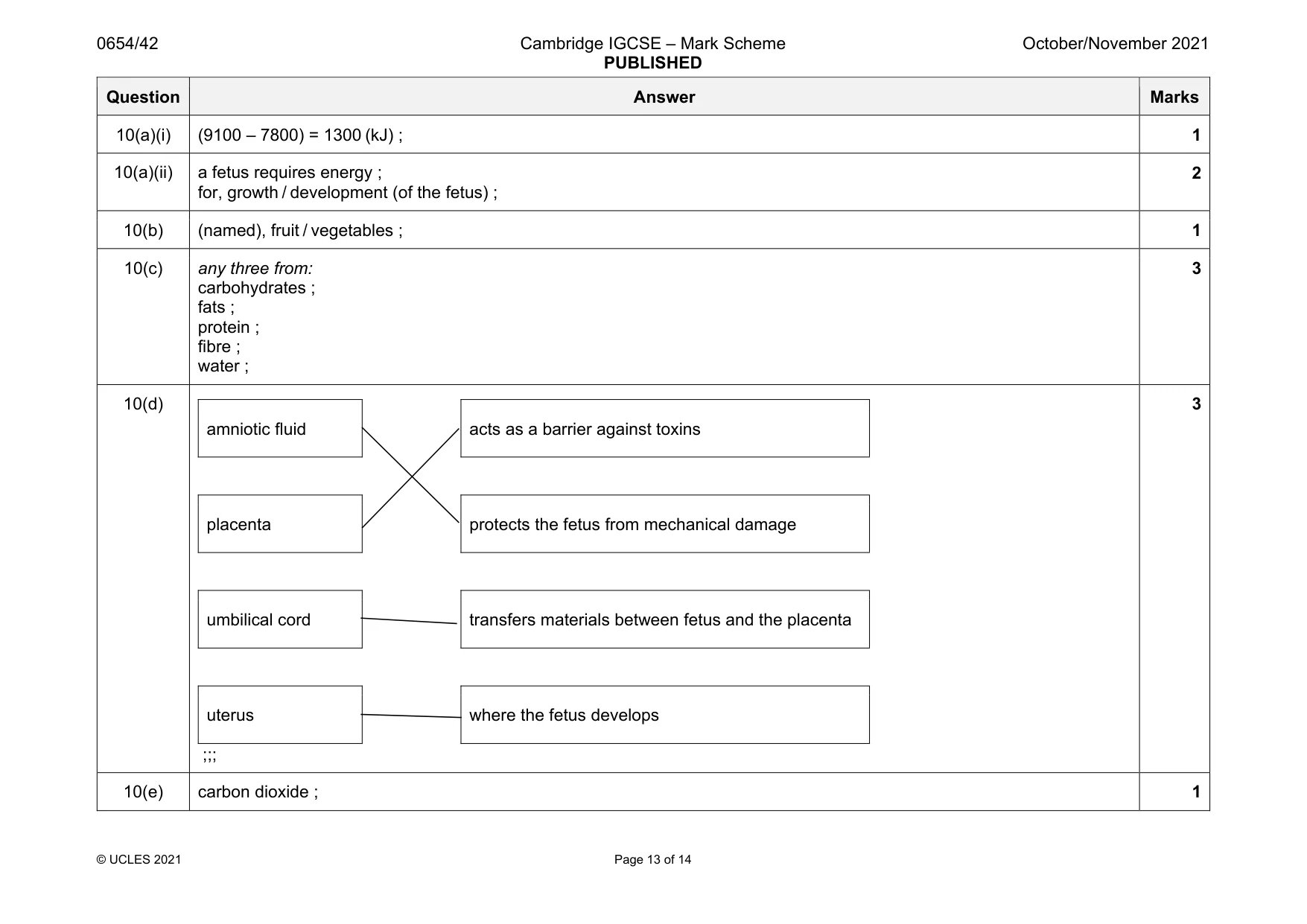
Mark scheme: 10(a)(i) (9100 – 7800) = 1300 (kJ) ; 1 10(a)(ii) a fetus requires energy ; for, growth / development (of the fetus) ; 2 10(b) (named), fruit / vegetables ; 1 10(c) any three from: carbohydrates ; fats ; protein ; fibre ; water ; 3 10(d) amniotic fluid acts as a barrier against toxins placenta protects the fetus from mechanical damage umbilical cord transfers materials between fetus and the placenta uterus where the fetus develops ;;; 3 10(e) carbon dioxide ; 1
Q11 · An oxygen atom has the electronic structure 2,6
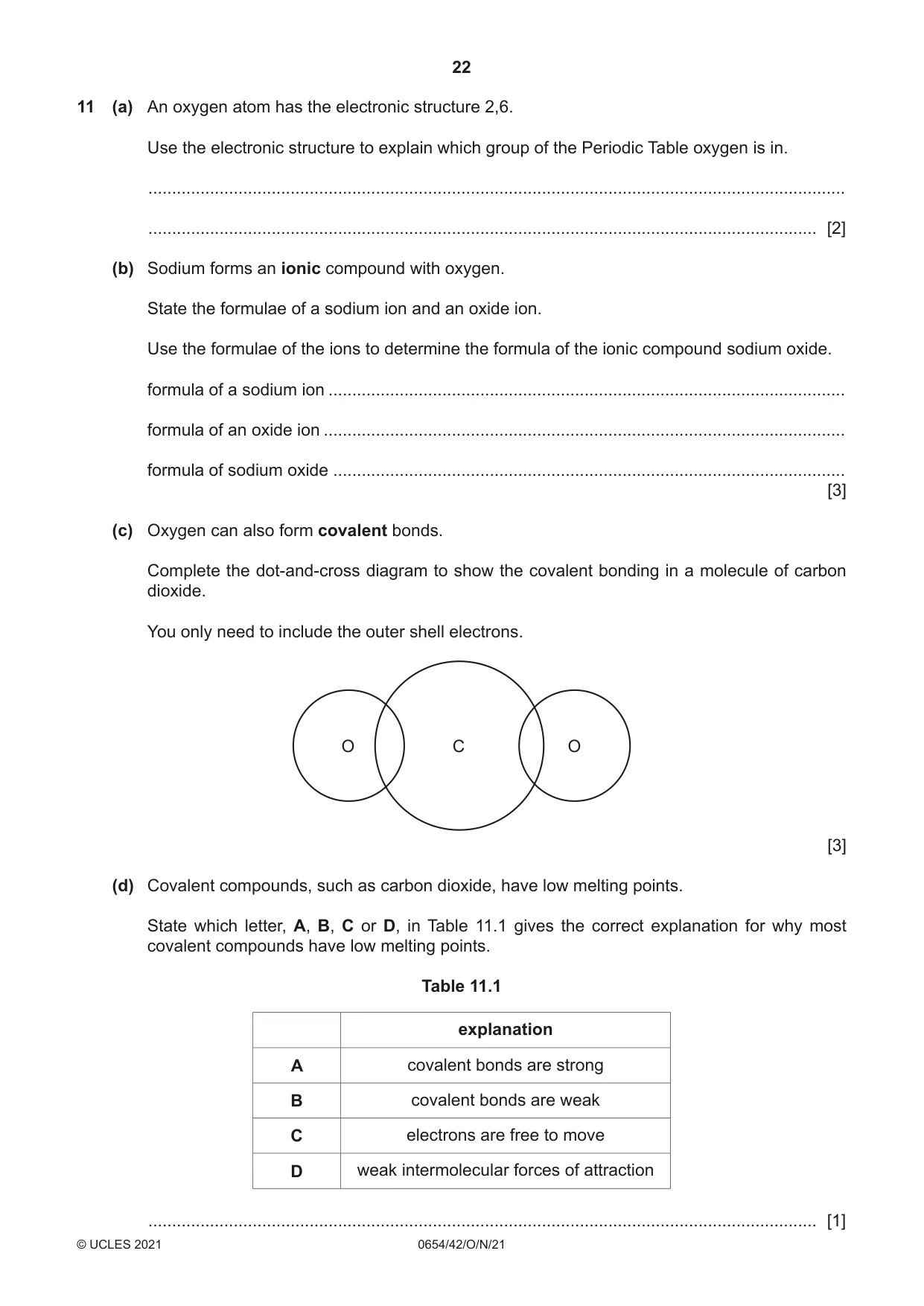
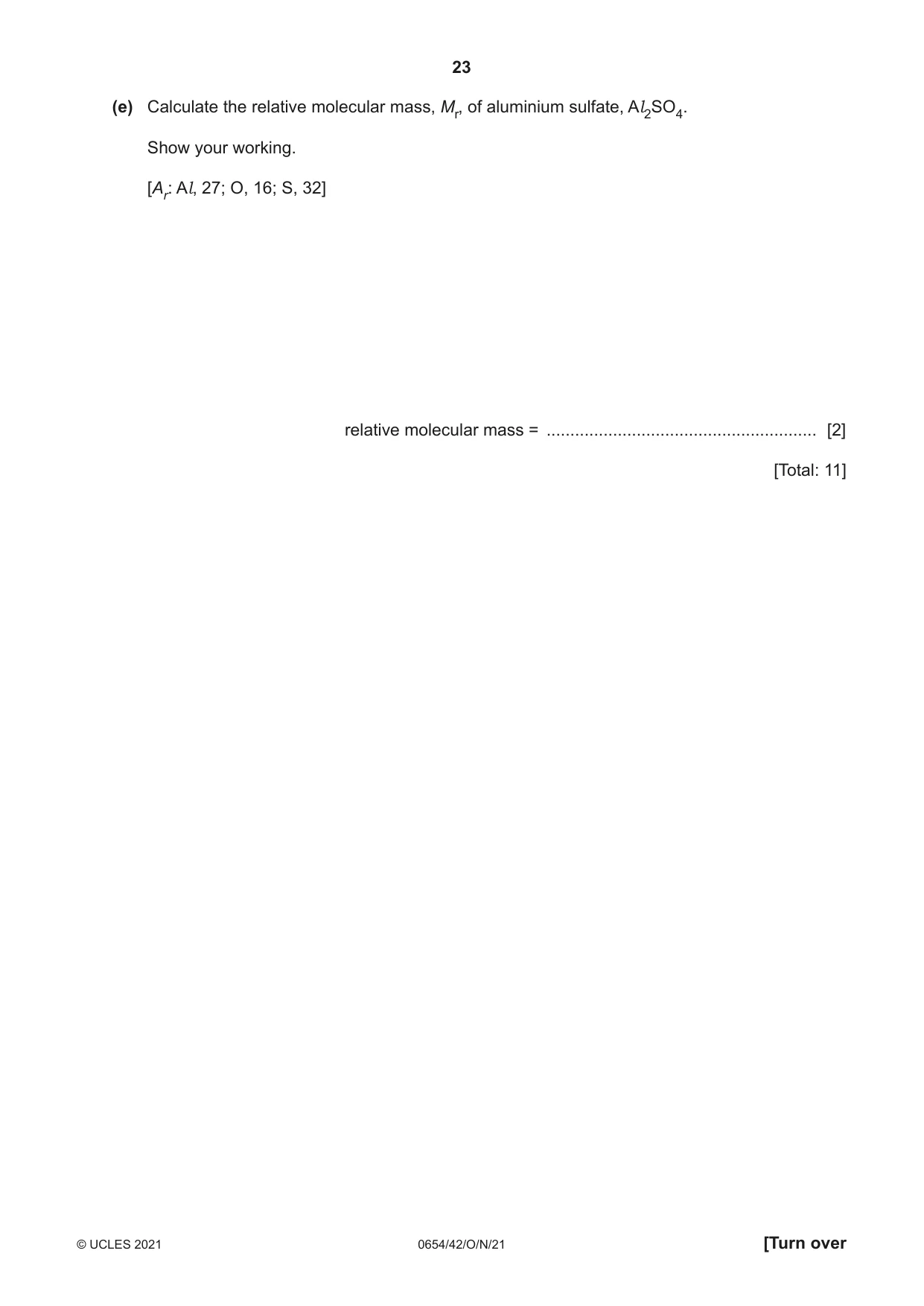
11 (a) An oxygen atom has the electronic structure 2,6. Use the electronic structure to explain which group of the Periodic Table oxygen is in. ................................................................................................................................................... ............................................................................................................................................. [2] (b) Sodium forms an ionic compound with oxygen. State the formulae of a sodium ion and an oxide ion. Use the formulae of the ions to determine the formula of the ionic compound sodium oxide. formula of a sodium ion ............................................................................................................. formula of an oxide ion .............................................................................................................. formula of sodium oxide ............................................................................................................ [3] (c) Oxygen can also form covalent bonds. Complete the dot-and-cross diagram to show the covalent bonding in a molecule of carbon dioxide. You only need to include the outer shell electrons. O C O [3] (d) Covalent compounds, such as carbon dioxide, have low melting points. State which letter, A, B, C or D, in Table 11.1 gives the correct explanation for why most covalent compounds have low melting points. Table 11.1 explanation A covalent bonds are strong B covalent bonds are weak C electrons are free to move D weak intermolecular forces of attraction ............................................................................................................................................. [1] (e) Calculate the relative molecular mass, Mr, of aluminium sulfate, Al2SO4. Show your working. [Ar: Al, 27; O, 16; S, 32] relative molecular mass = ......................................................... [2] [Total: 11]
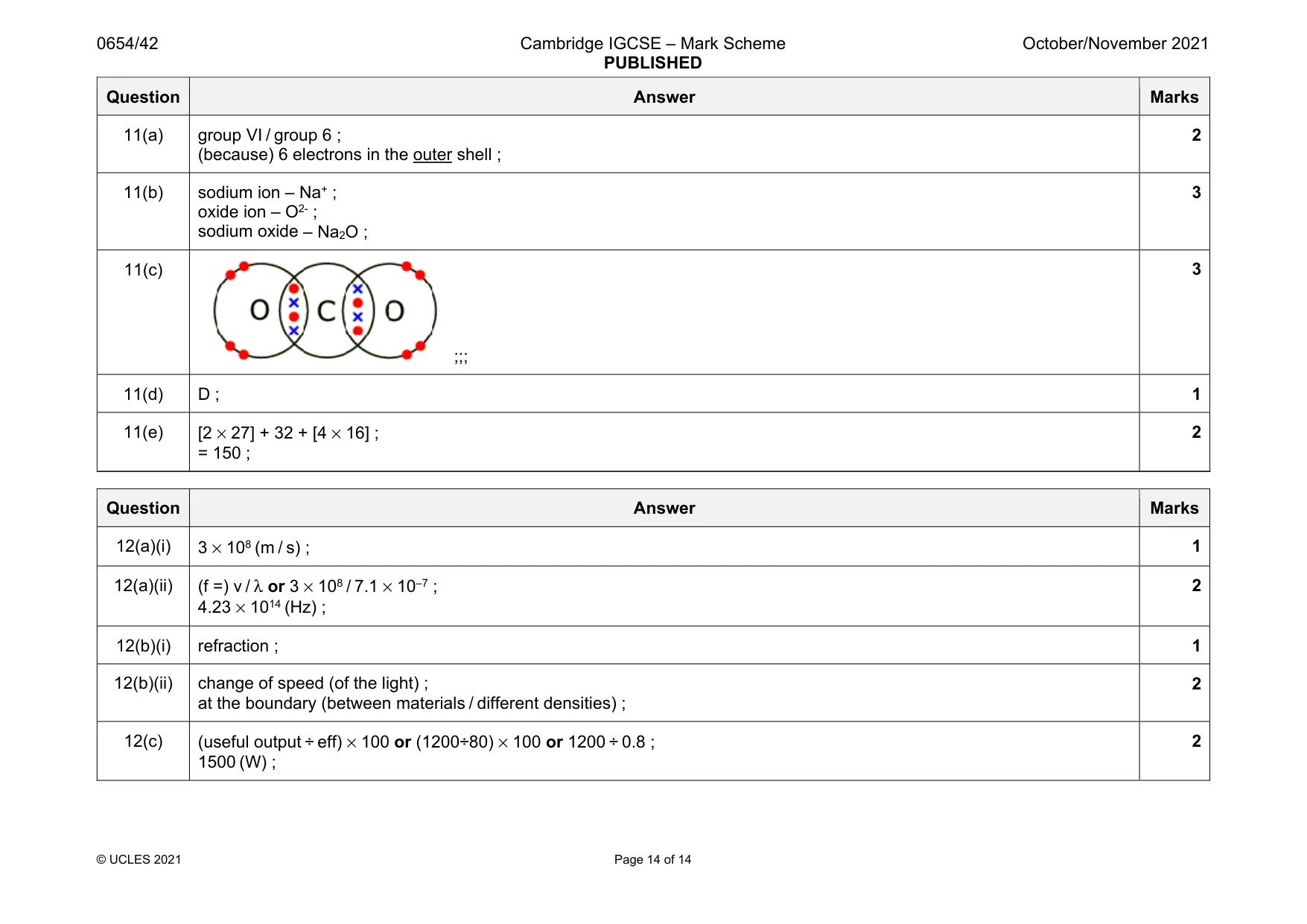
Mark scheme: 11(a) group VI / group 6 ; (because) 6 electrons in the outer shell ; 2 11(b) sodium ion – Na+ ; oxide ion – O2- ; sodium oxide – Na2O ; 3 11(c) ;;; 3 11(d) D ; 1 11(e) [2 × 27] + 32 + [4 × 16] ; = 150 ; 2
Q12 · State the speed of visible light in a vacuum
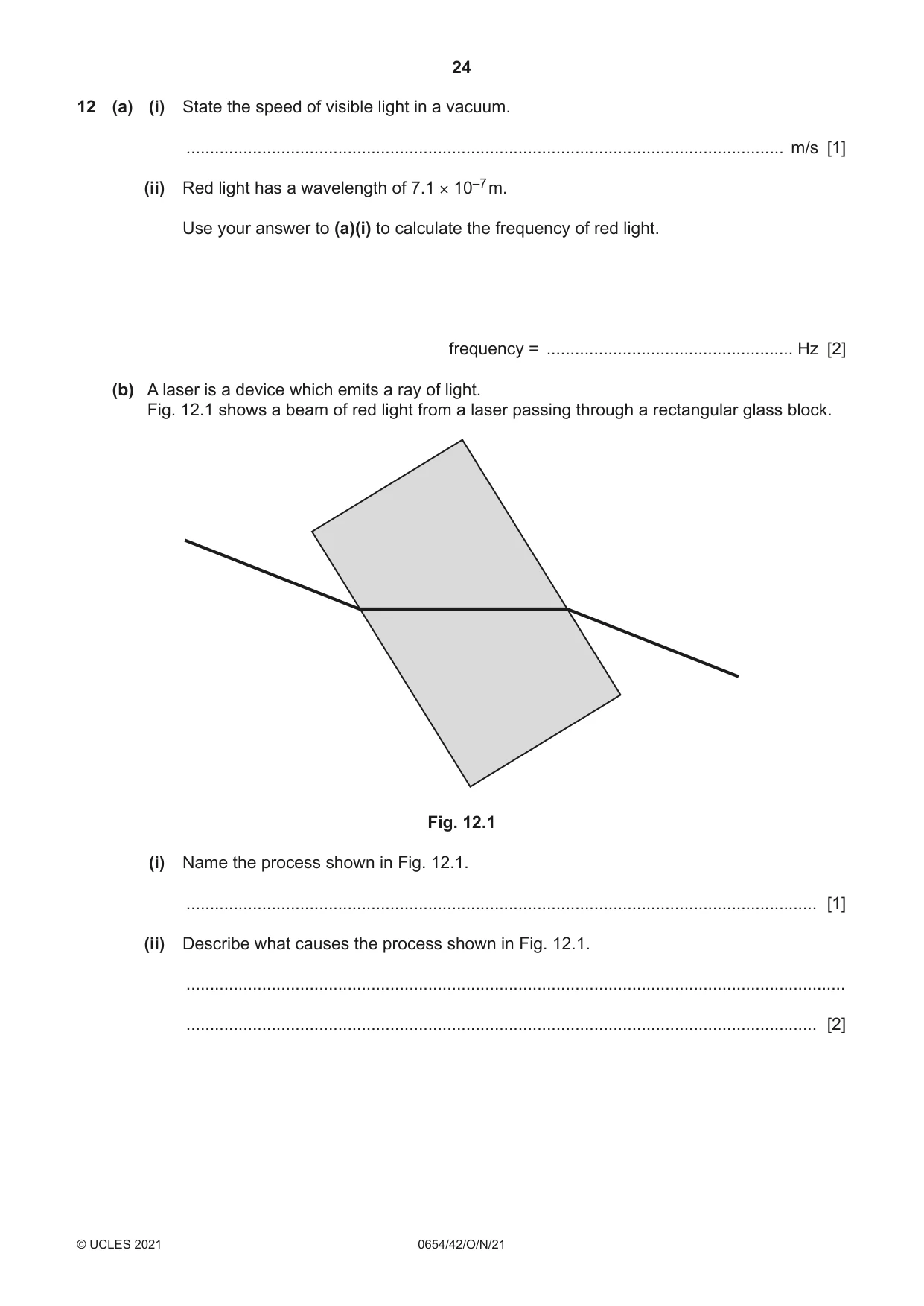
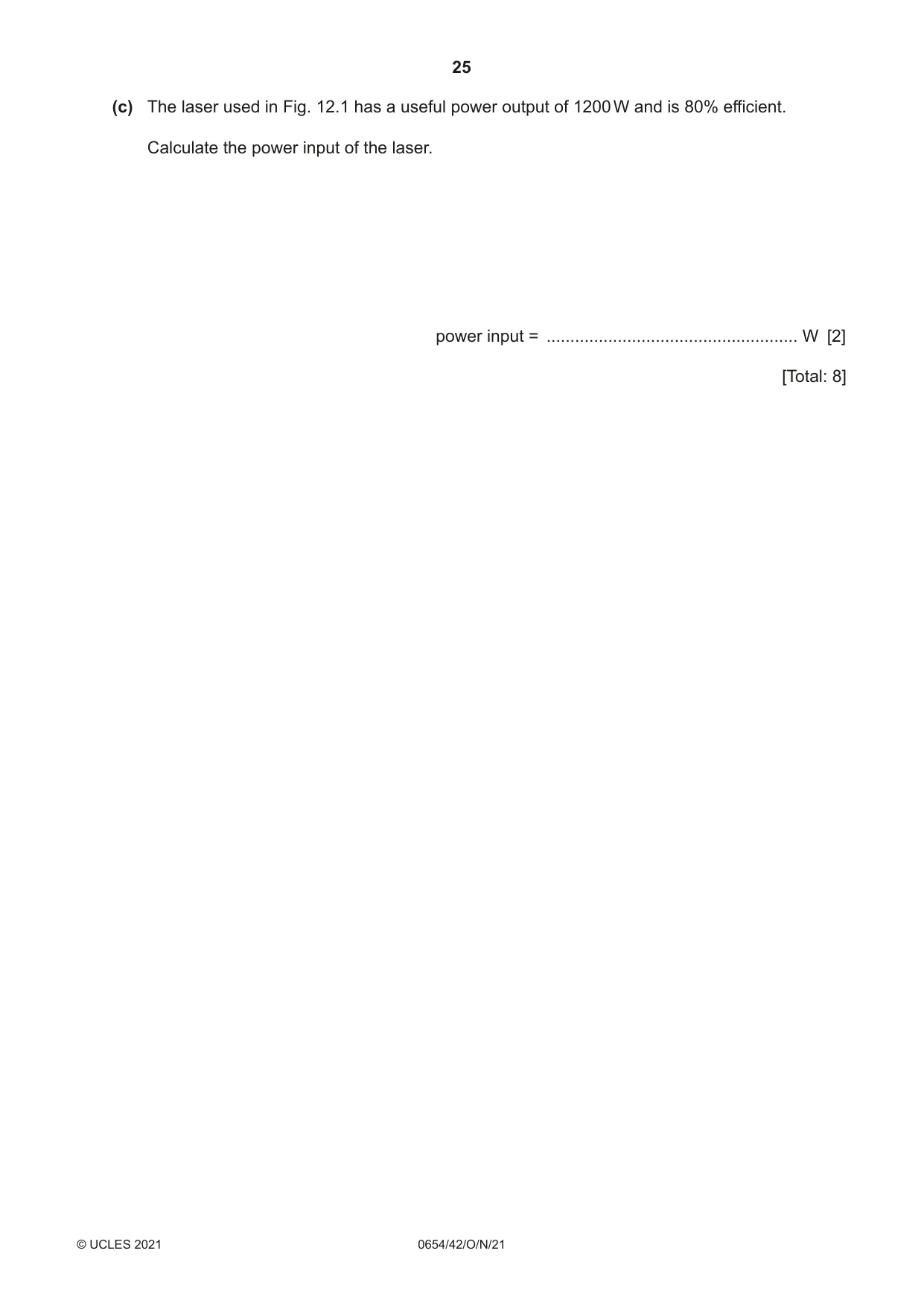
12 (a) (i) State the speed of visible light in a vacuum. .............................................................................................................................. m/s [1] (ii) Red light has a wavelength of 7.1 × 10⁻⁷ m. Use your answer to (a)(i) to calculate the frequency of red light. frequency = .................................................... Hz [2] (b) A laser is a device which emits a ray of light. Fig. 12.1 shows a beam of red light from a laser passing through a rectangular glass block. Fig. 12.1 (i) Name the process shown in Fig. 12.1. ..................................................................................................................................... [1] (ii) Describe what causes the process shown in Fig. 12.1. ........................................................................................................................................... ..................................................................................................................................... [2] (c) The laser used in Fig. 12.1 has a useful power output of 1200 W and is 80% efficient. Calculate the power input of the laser. power input = ..................................................... W [2] [Total: 8]
Mark scheme: 12(a)(i) 3 × 10⁸ (m / s) ; 1 12(a)(ii) (f =) v / λ or 3 × 10⁸ / 7.1 × 10⁻⁷ ; 4.23 × 10¹⁴ (Hz) ; 2 12(b)(i) refraction ; 1 12(b)(ii) change of speed (of the light) ; at the boundary (between materials / different densities) ; 2 12(c) (useful output ÷ eff) × 100 or (1200÷80) × 100 or 1200 ÷ 0.8 ; 1500 (W) ; 2
What was in this paper
The subtopics covered by these 12 questions, and how many questions each got. Open one in a new tab to see every Cambridge question on it.
What you needed in this session
Cambridge’s own grade thresholds for 2021 Oct/Nov, Paper 4 · Variant 2. A higher threshold means an easier paper — the bar moves with how the cohort did.