Cambridge IGCSE Sciences - Co-ordinated (Double) 0654 — 2019 May/June Paper 4 · Variant 3
0654/43/M/J/19 · 13 questions · 120 marks · ≈135 min
The question paper and its mark scheme, free to read here and free to download. This is Cambridge’s own paper, exactly as it was sat.
Question paper32 pages
Mark scheme14 pages
Answers below. Sit the paper first if you are practising.
Questions as text
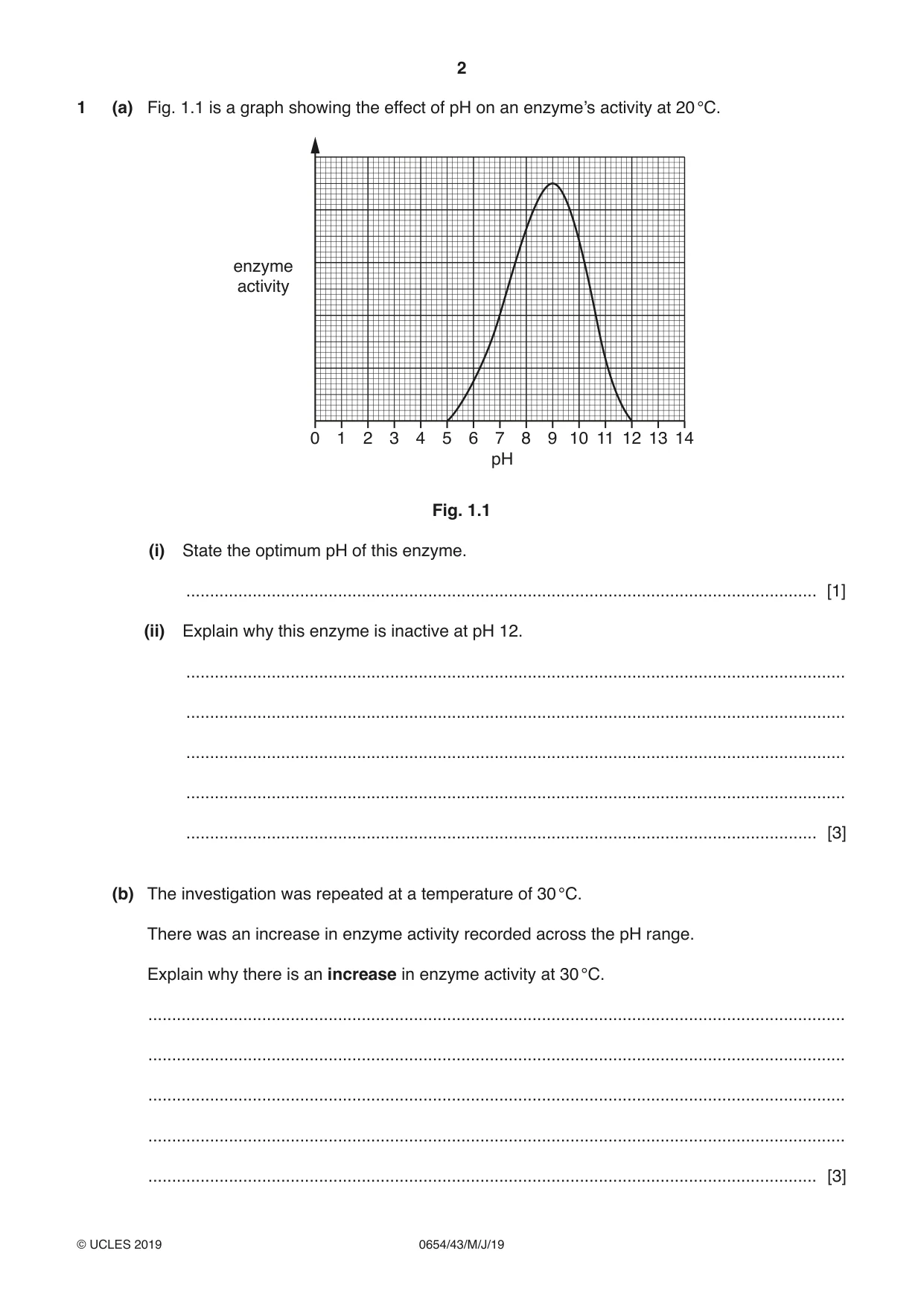
Q1 · A graph showing the effect of pH on an enzyme’s activity at 20 °C
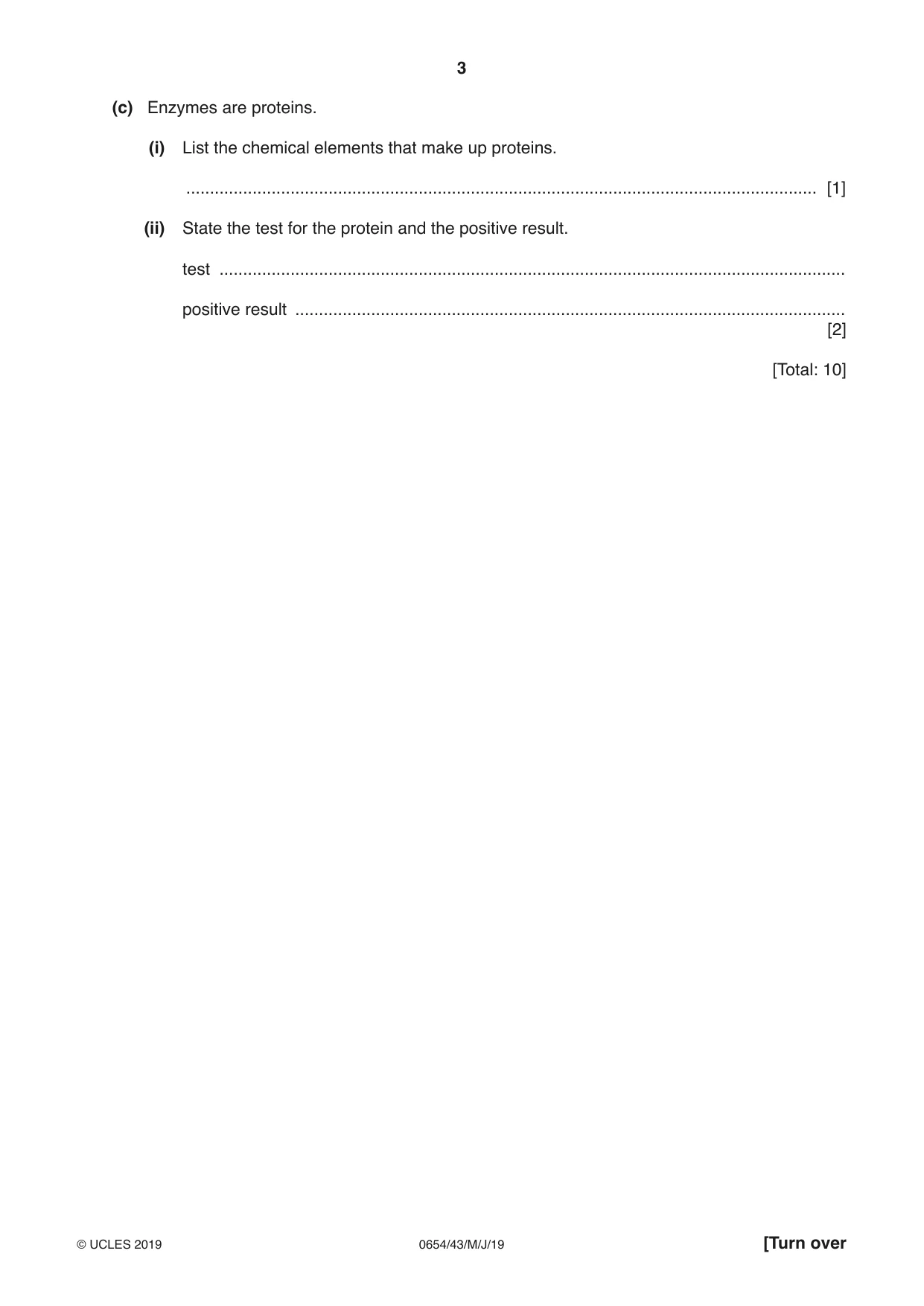
1 (a) Fig. 1.1 is a graph showing the effect of pH on an enzyme’s activity at 20 °C. enzyme activity 0 1 2 3 4 5 6 7 8 9 10 11 12 13 14 pH Fig. 1.1 (i) State the optimum pH of this enzyme. ..................................................................................................................................... [1] (ii) Explain why this enzyme is inactive at pH 12. ........................................................................................................................................... ........................................................................................................................................... ........................................................................................................................................... ........................................................................................................................................... ..................................................................................................................................... [3] (b) The investigation was repeated at a temperature of 30 °C. There was an increase in enzyme activity recorded across the pH range. Explain why there is an increase in enzyme activity at 30 °C. ................................................................................................................................................... ................................................................................................................................................... ................................................................................................................................................... ................................................................................................................................................... ............................................................................................................................................. [3] (c) Enzymes are proteins. (i) List the chemical elements that make up proteins. ..................................................................................................................................... [1] (ii) State the test for the protein and the positive result. test .................................................................................................................................... positive result .................................................................................................................... [2] [Total: 10]
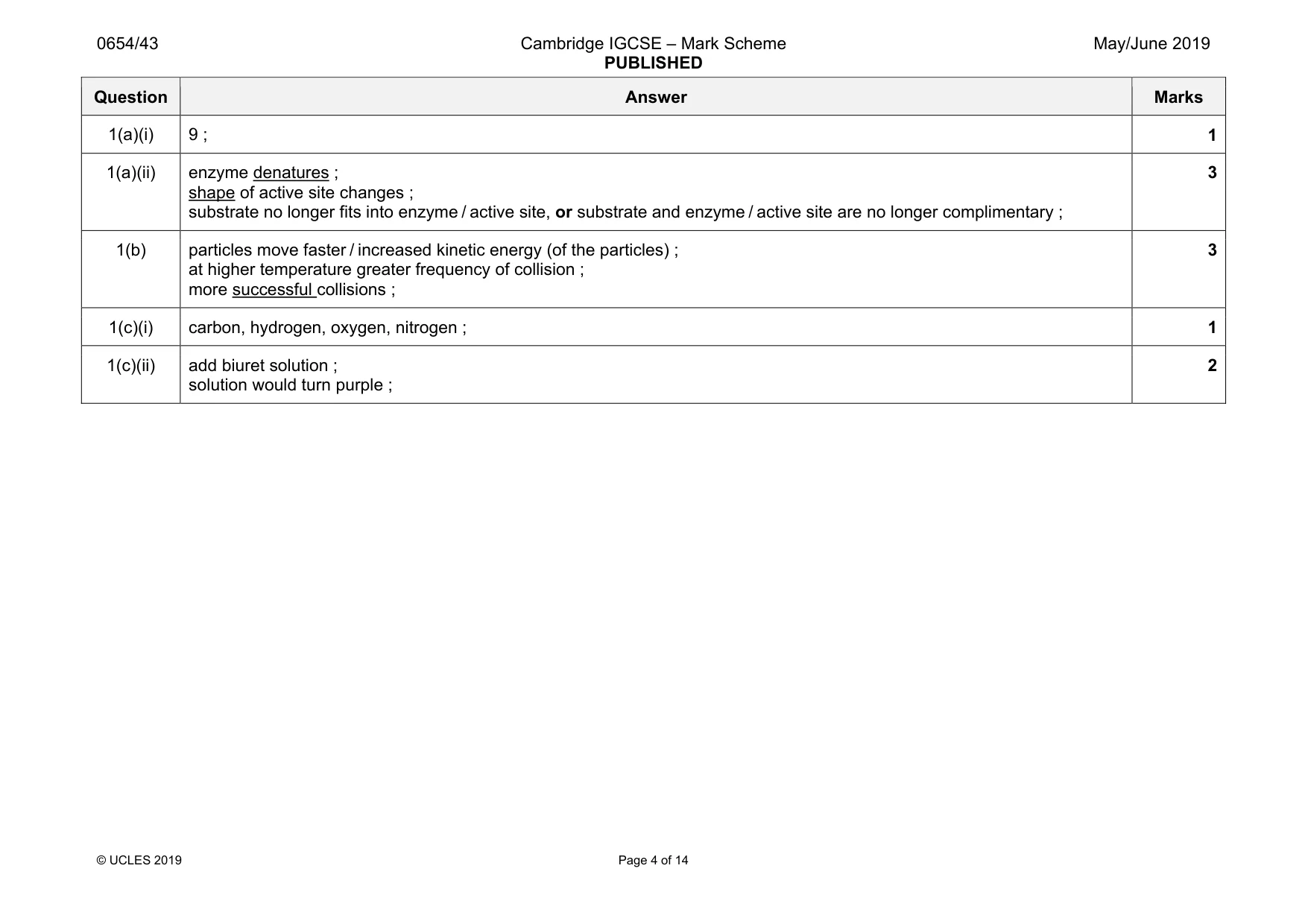
Mark scheme: 1(a)(i) 9 ; 1 1(a)(ii) enzyme denatures ; shape of active site changes ; substrate no longer fits into enzyme / active site, or substrate and enzyme / active site are no longer complimentary ; 3 1(b) particles move faster / increased kinetic energy (of the particles) ; at higher temperature greater frequency of collision ; more successful collisions ; 3 1(c)(i) carbon, hydrogen, oxygen, nitrogen ; 1 1(c)(ii) add biuret solution ; solution would turn purple ; 2
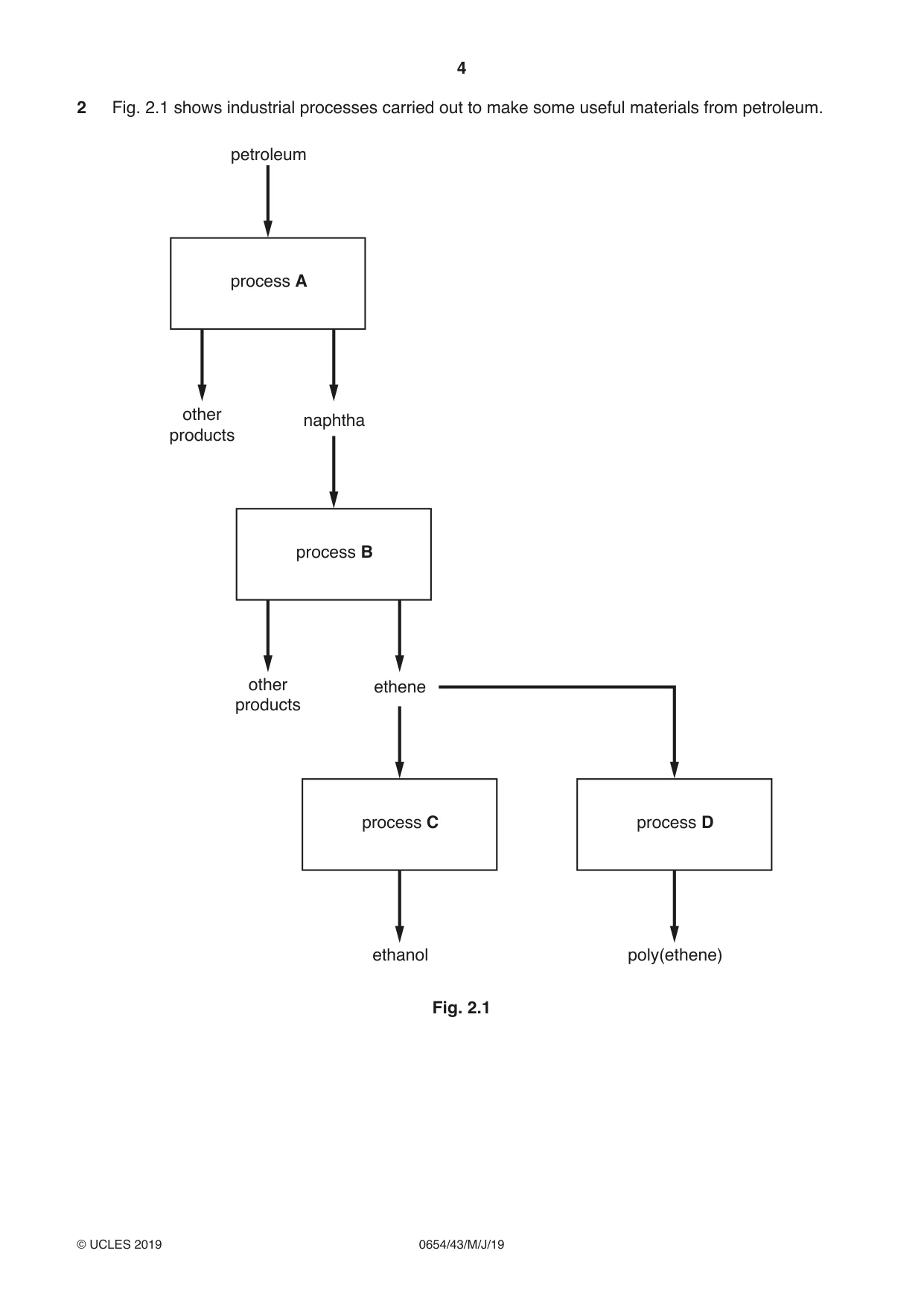
Q2 · Industrial processes carried out to make some useful materials from petroleum
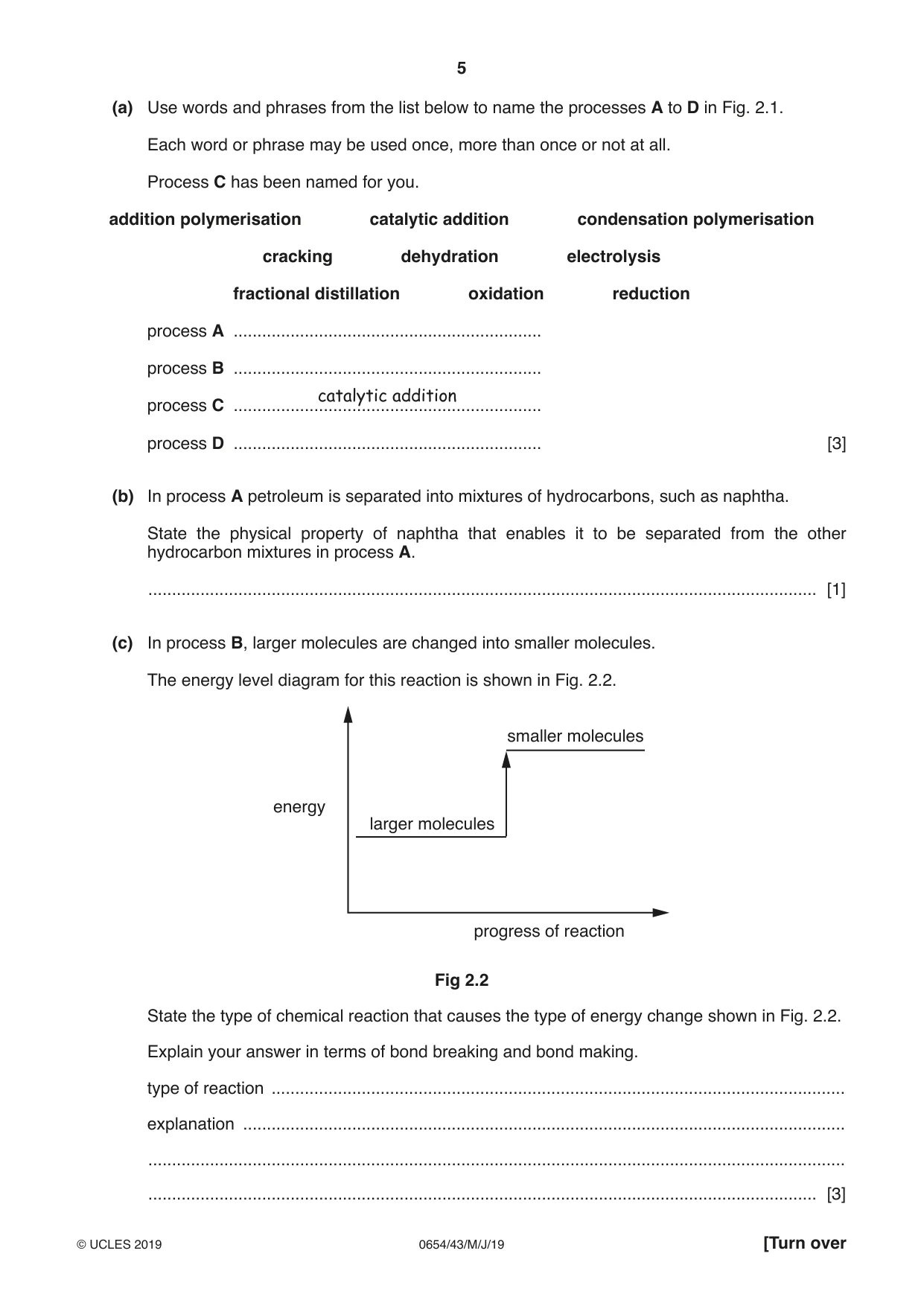
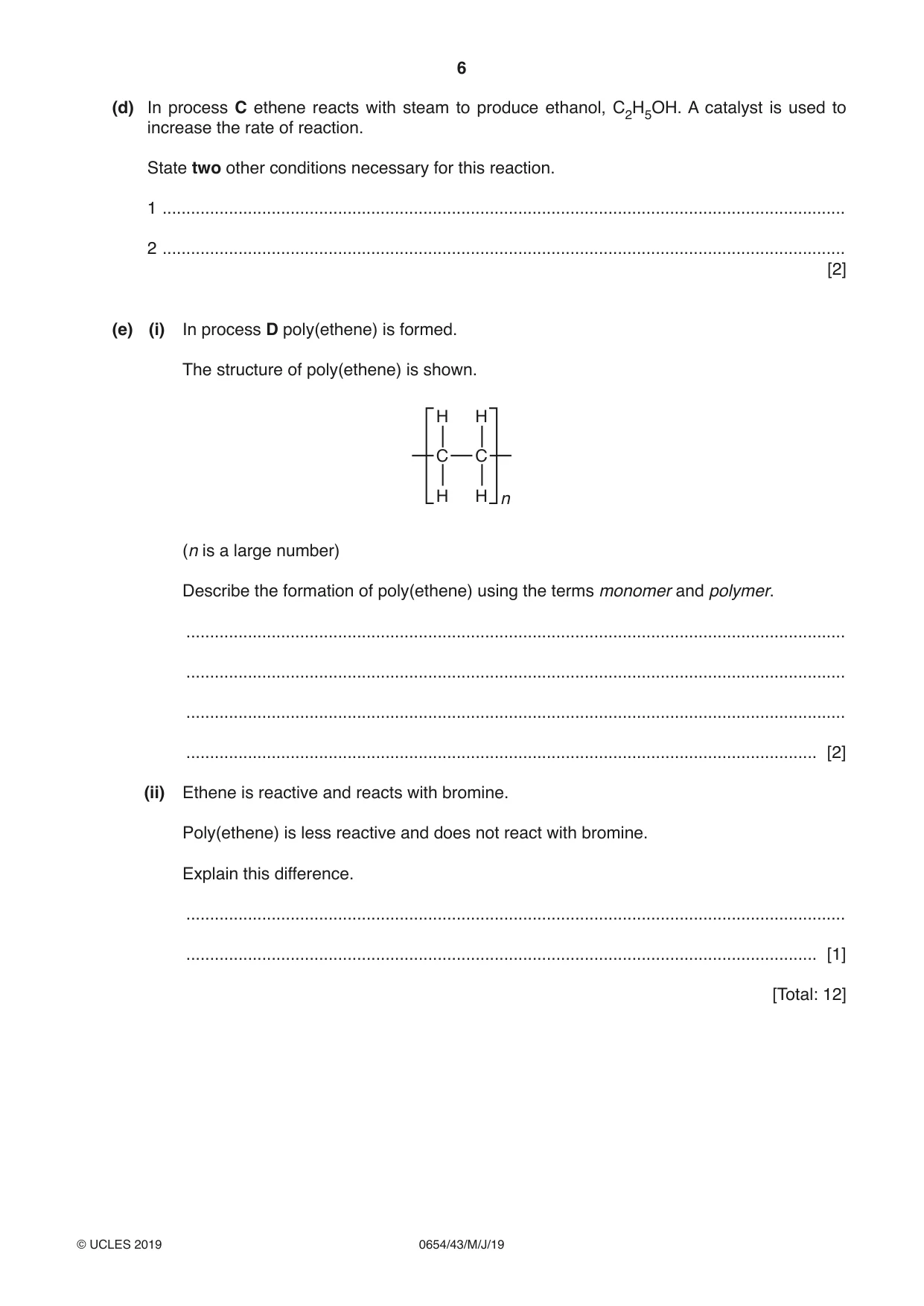
2 Fig. 2.1 shows industrial processes carried out to make some useful materials from petroleum. petroleum process A other naphtha products process B other ethene products process C process D ethanol poly(ethene) Fig. 2.1 (a) Use words and phrases from the list below to name the processes A to D in Fig. 2.1. Each word or phrase may be used once, more than once or not at all. Process C has been named for you. addition polymerisation catalytic addition condensation polymerisation cracking dehydration electrolysis fractional distillation oxidation reduction process A ................................................................. process B ................................................................. catalytic addition process C ................................................................. process D ................................................................. [3] (b) In process A petroleum is separated into mixtures of hydrocarbons, such as naphtha. State the physical property of naphtha that enables it to be separated from the other hydrocarbon mixtures in process A. ............................................................................................................................................. [1] (c) In process B, larger molecules are changed into smaller molecules. The energy level diagram for this reaction is shown in Fig. 2.2. smaller molecules energy larger molecules progress of reaction Fig 2.2 State the type of chemical reaction that causes the type of energy change shown in Fig. 2.2. Explain your answer in terms of bond breaking and bond making. type of reaction ......................................................................................................................... explanation ............................................................................................................................... ................................................................................................................................................... ............................................................................................................................................. [3] (d) In process C ethene reacts with steam to produce ethanol, C2H5OH. A catalyst is used to increase the rate of reaction. State two other conditions necessary for this reaction. 1 ................................................................................................................................................ 2 ................................................................................................................................................ [2] (e) (i) In process D poly(ethene) is formed. The structure of poly(ethene) is shown. H H C C H H n (n is a large number) Describe the formation of poly(ethene) using the terms monomer and polymer. ........................................................................................................................................... ........................................................................................................................................... ........................................................................................................................................... ..................................................................................................................................... [2] (ii) Ethene is reactive and reacts with bromine. Poly(ethene) is less reactive and does not react with bromine. Explain this difference. ........................................................................................................................................... ..................................................................................................................................... [1] [Total: 12]
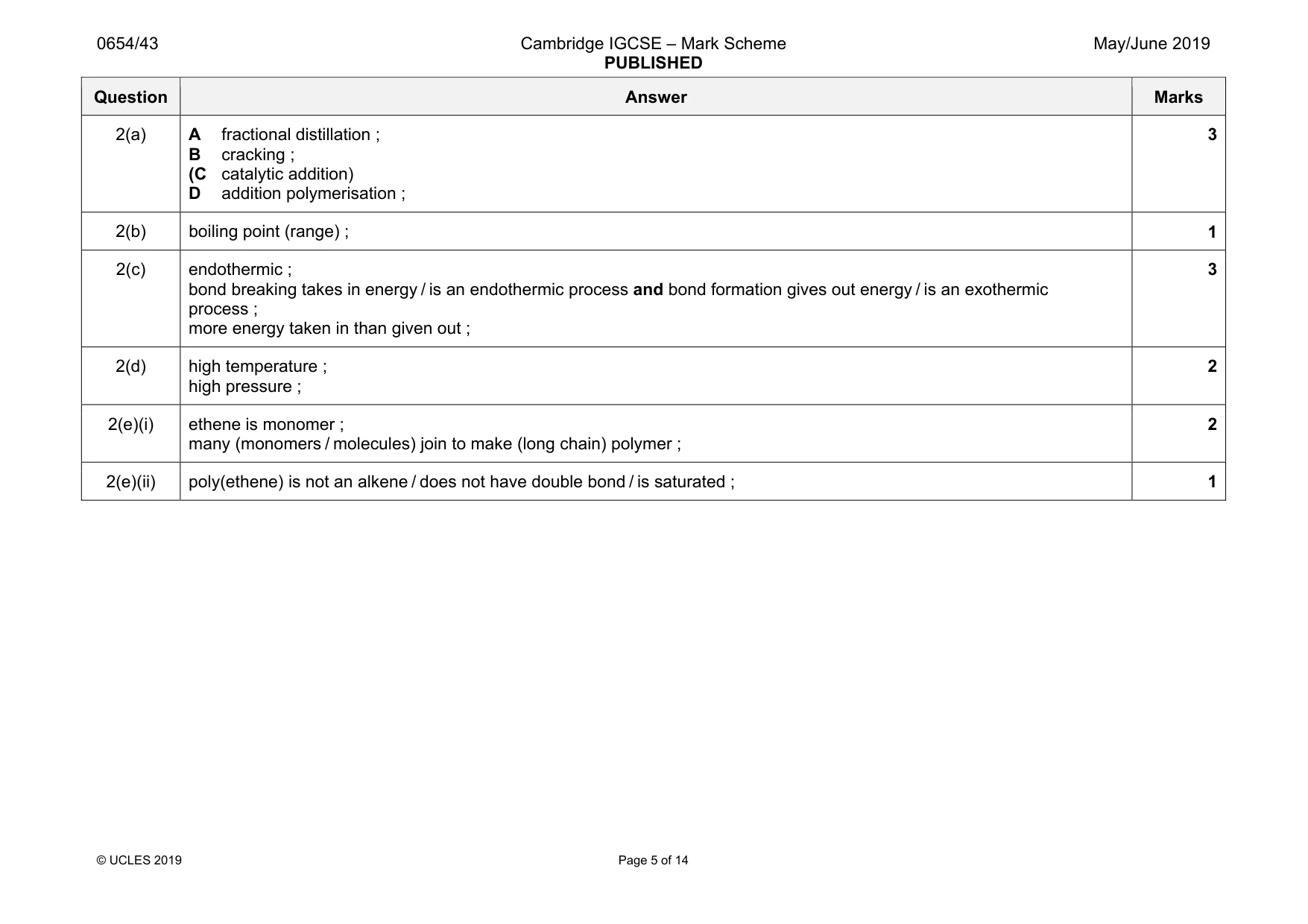
Mark scheme: 2(a) A fractional distillation ; B cracking ; (C catalytic addition) D addition polymerisation ; 3 2(b) boiling point (range) ; 1 2(c) endothermic ; bond breaking takes in energy / is an endothermic process and bond formation gives out energy / is an exothermic process ; more energy taken in than given out ; 3 2(d) high temperature ; high pressure ; 2 2(e)(i) ethene is monomer ; many (monomers / molecules) join to make (long chain) polymer ; 2 2(e)(ii) poly(ethene) is not an alkene / does not have double bond / is saturated ; 1
Q3 · The forces acting on an aircraft
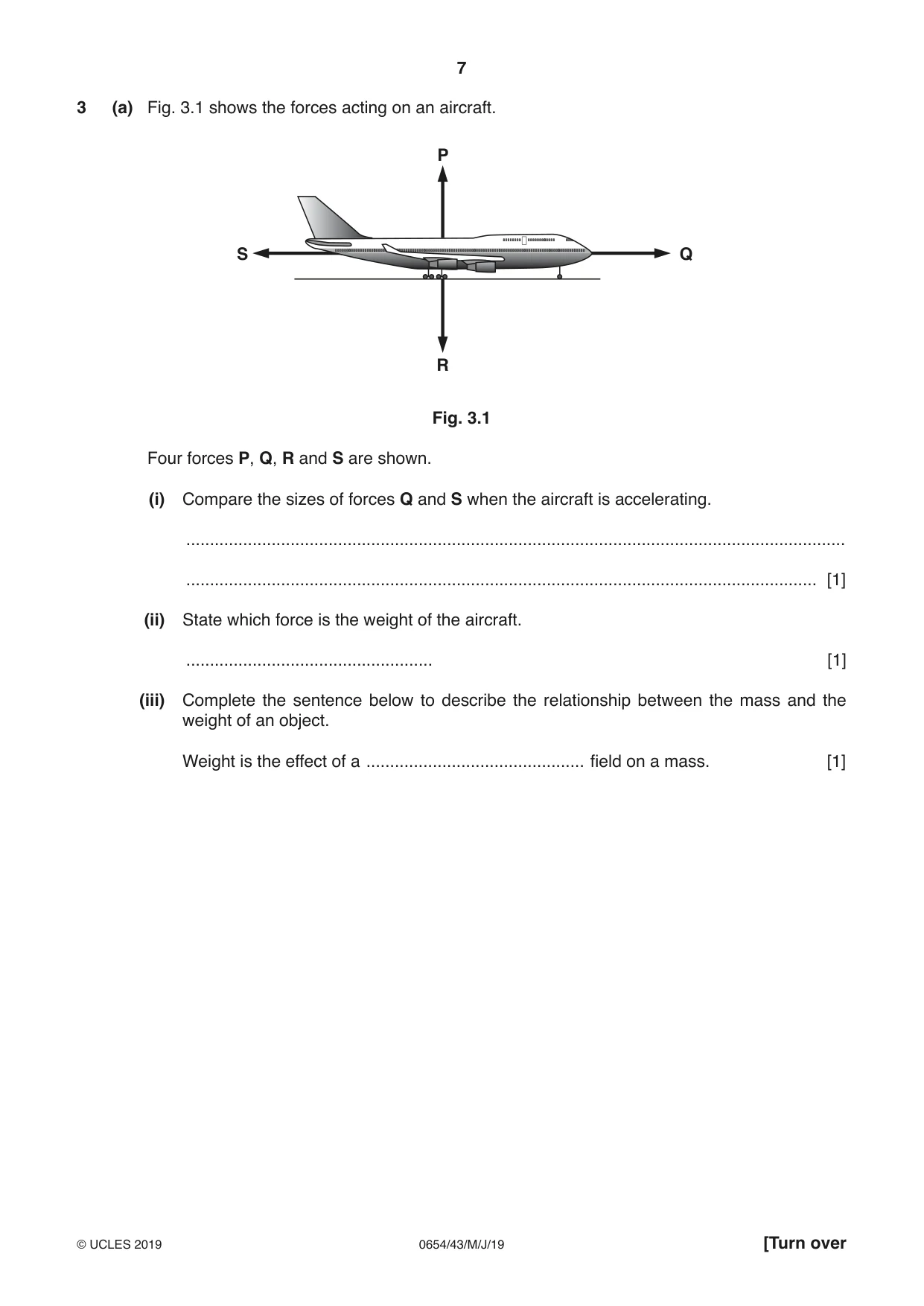
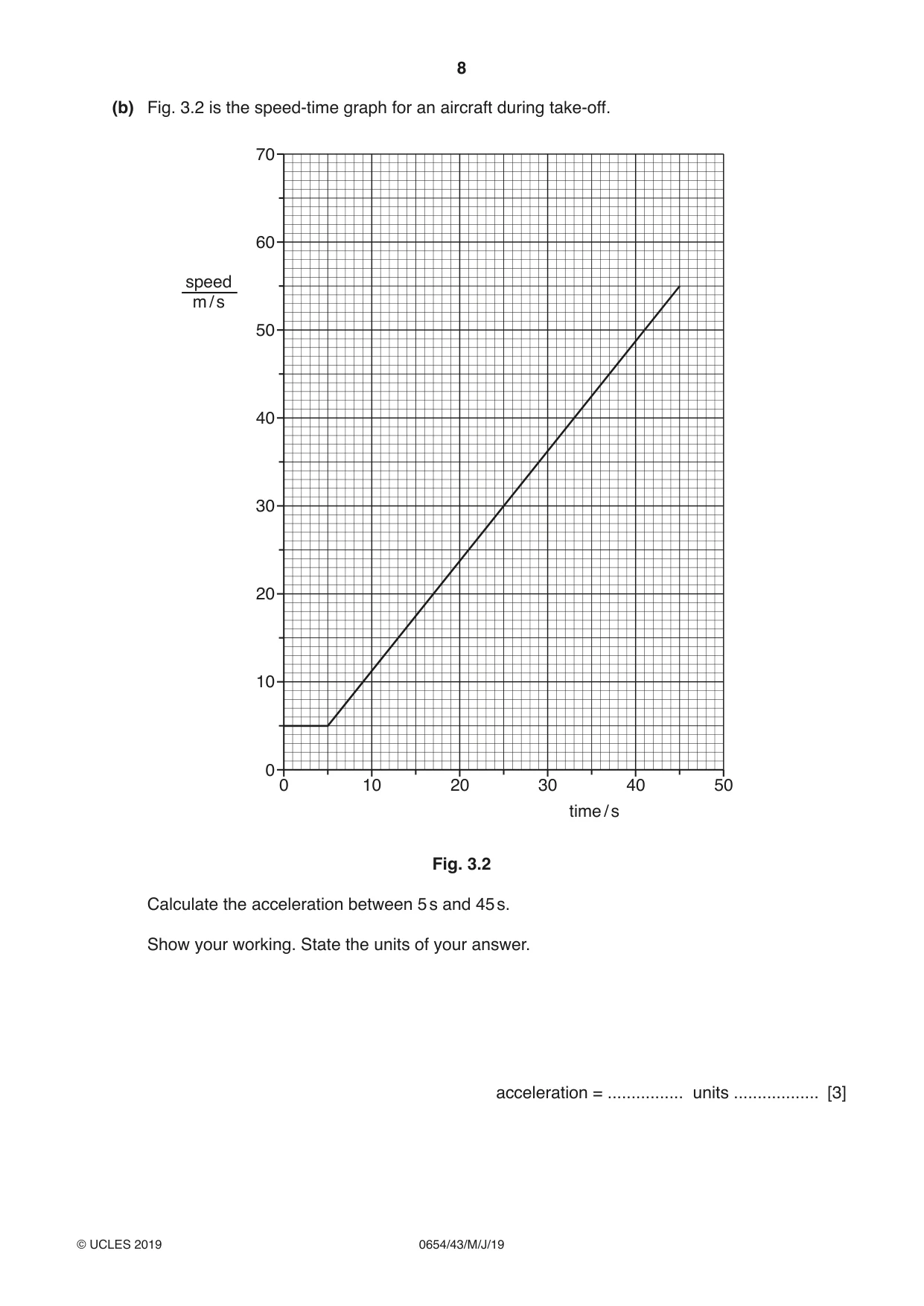
3 (a) Fig. 3.1 shows the forces acting on an aircraft. P S Q R Fig. 3.1 Four forces P, Q, R and S are shown. (i) Compare the sizes of forces Q and S when the aircraft is accelerating. ........................................................................................................................................... ..................................................................................................................................... [1] (ii) State which force is the weight of the aircraft. .................................................... [1] (iii) Complete the sentence below to describe the relationship between the mass and the weight of an object. Weight is the effect of a .............................................. field on a mass. [1] (b) Fig. 3.2 is the speed-time graph for an aircraft during take-off. 70 60 speed m / s 50 40 30 20 10 0 0 10 20 30 40 50 time / s Fig. 3.2 Calculate the acceleration between 5 s and 45 s. Show your working. State the units of your answer. acceleration = ................ units .................. [3] (c) State the two types of energy gained as the aircraft continues to accelerate and gain height after take-off. 1 .................................................................................................................................... energy 2 .................................................................................................................................... energy [1] (d) The aircraft engines are noisy. Sound waves from the engines pass through the air as a series of compressions and rarefactions. (i) State what is meant by a compression. ........................................................................................................................................... ..................................................................................................................................... [1] (ii) Describe the wavelength of a sound wave in terms of compressions. ........................................................................................................................................... ..................................................................................................................................... [1] [Total: 9]
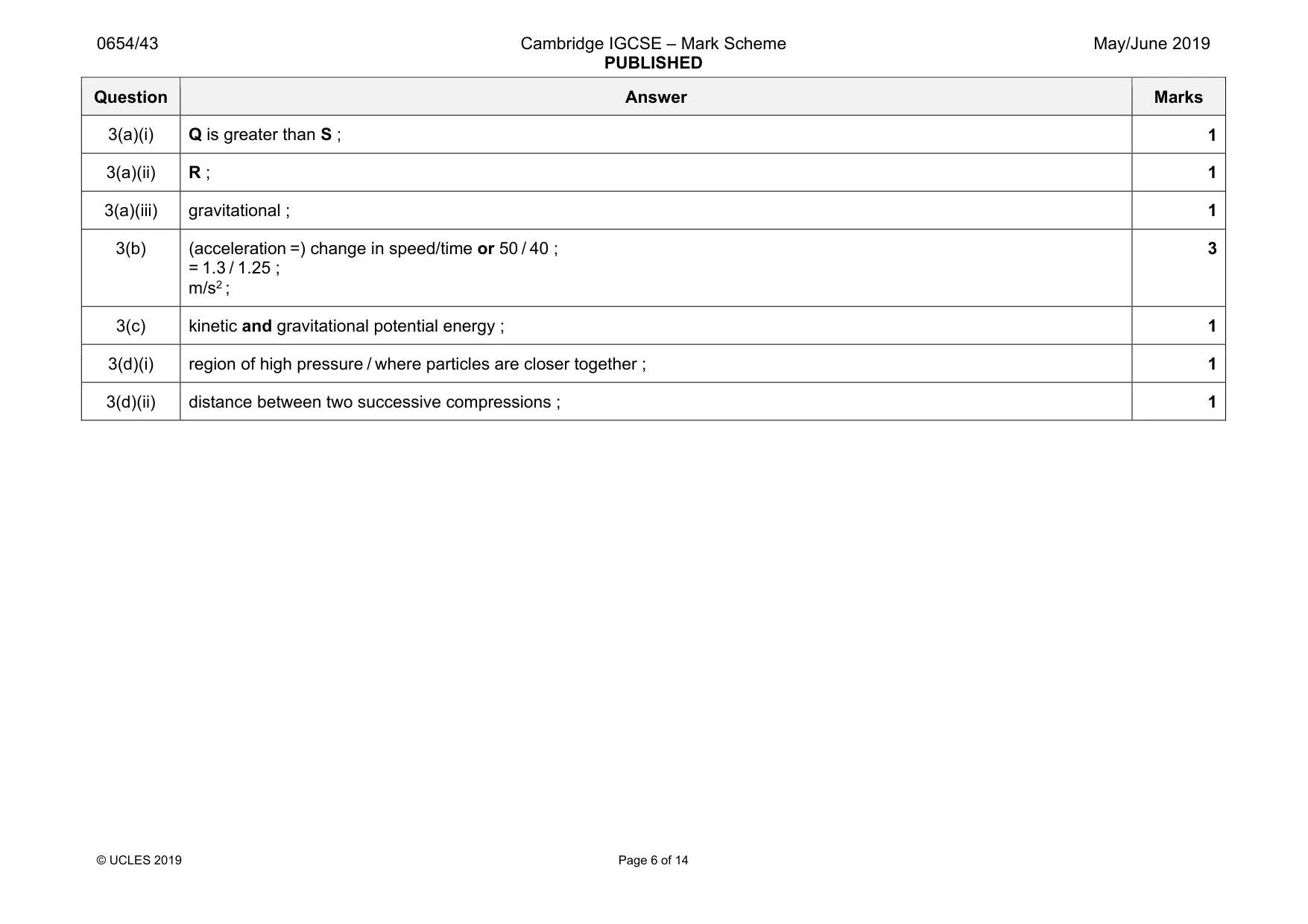
Mark scheme: 3(a)(i) Q is greater than S ; 1 3(a)(ii) R ; 1 3(a)(iii) gravitational ; 1 3(b) (acceleration =) change in speed/time or 50 / 40 ; = 1.3 / 1.25 ; m/s2 ; 3 3(c) kinetic and gravitational potential energy ; 1 3(d)(i) region of high pressure / where particles are closer together ; 1 3(d)(ii) distance between two successive compressions ; 1
Q4 · A diagram of a food web
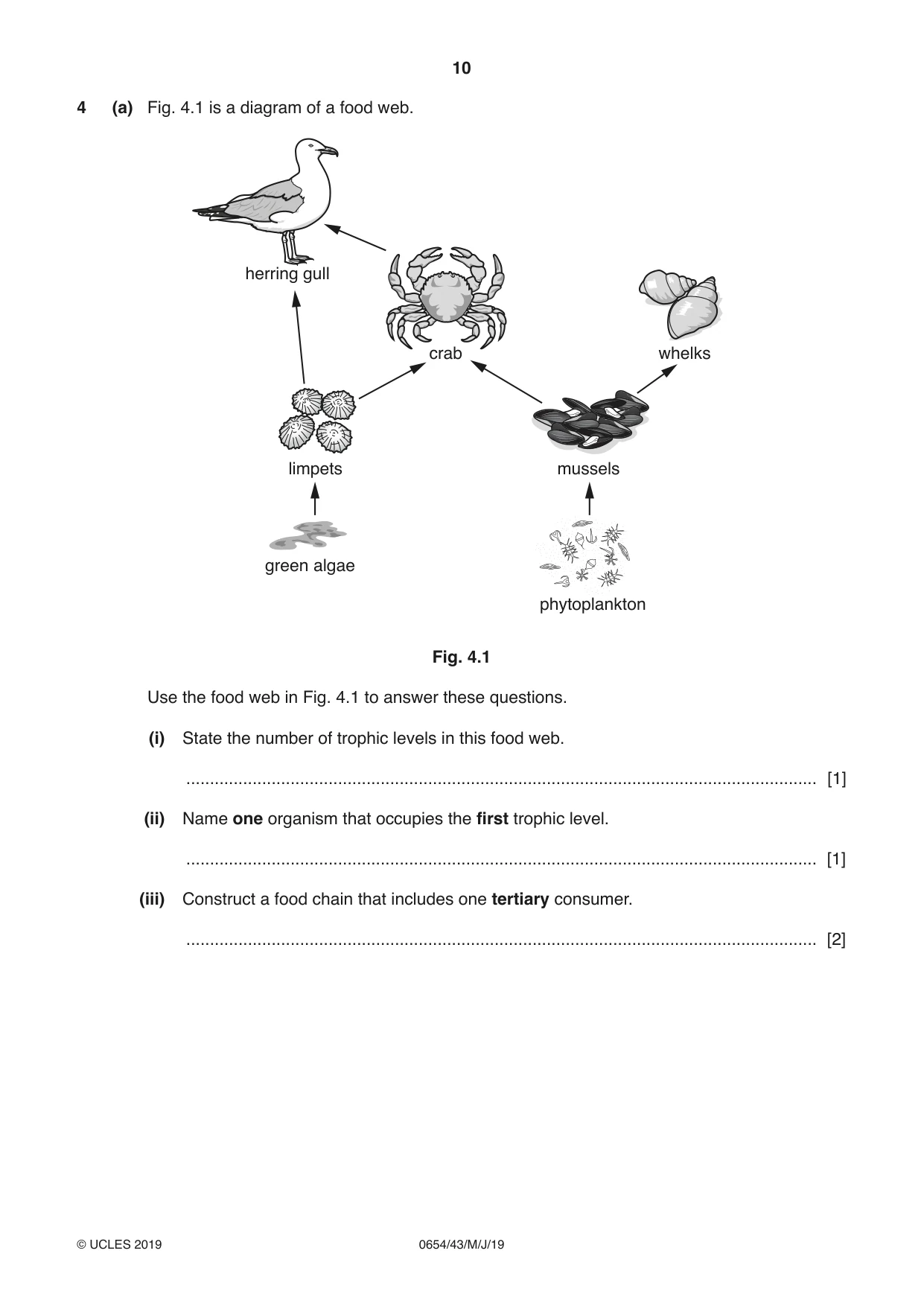
4 (a) Fig. 4.1 is a diagram of a food web. herring gull crab whelks limpets mussels green algae phytoplankton Fig. 4.1 Use the food web in Fig. 4.1 to answer these questions. (i) State the number of trophic levels in this food web. ..................................................................................................................................... [1] (ii) Name one organism that occupies the first trophic level. ..................................................................................................................................... [1] (iii) Construct a food chain that includes one tertiary consumer. ..................................................................................................................................... [2] (b) A disease causes a decrease in the population of mussels. Explain the effect of a decrease in mussel population on the limpet population. ................................................................................................................................................... ................................................................................................................................................... ................................................................................................................................................... ............................................................................................................................................. [2] (c) Organisms in the food web respire. Complete the sentence to define the term respiration. Respiration is the ...................................................... reactions in cells that break down ............................................. molecules and release ...................................................... for metabolism. [2] [Total: 8]
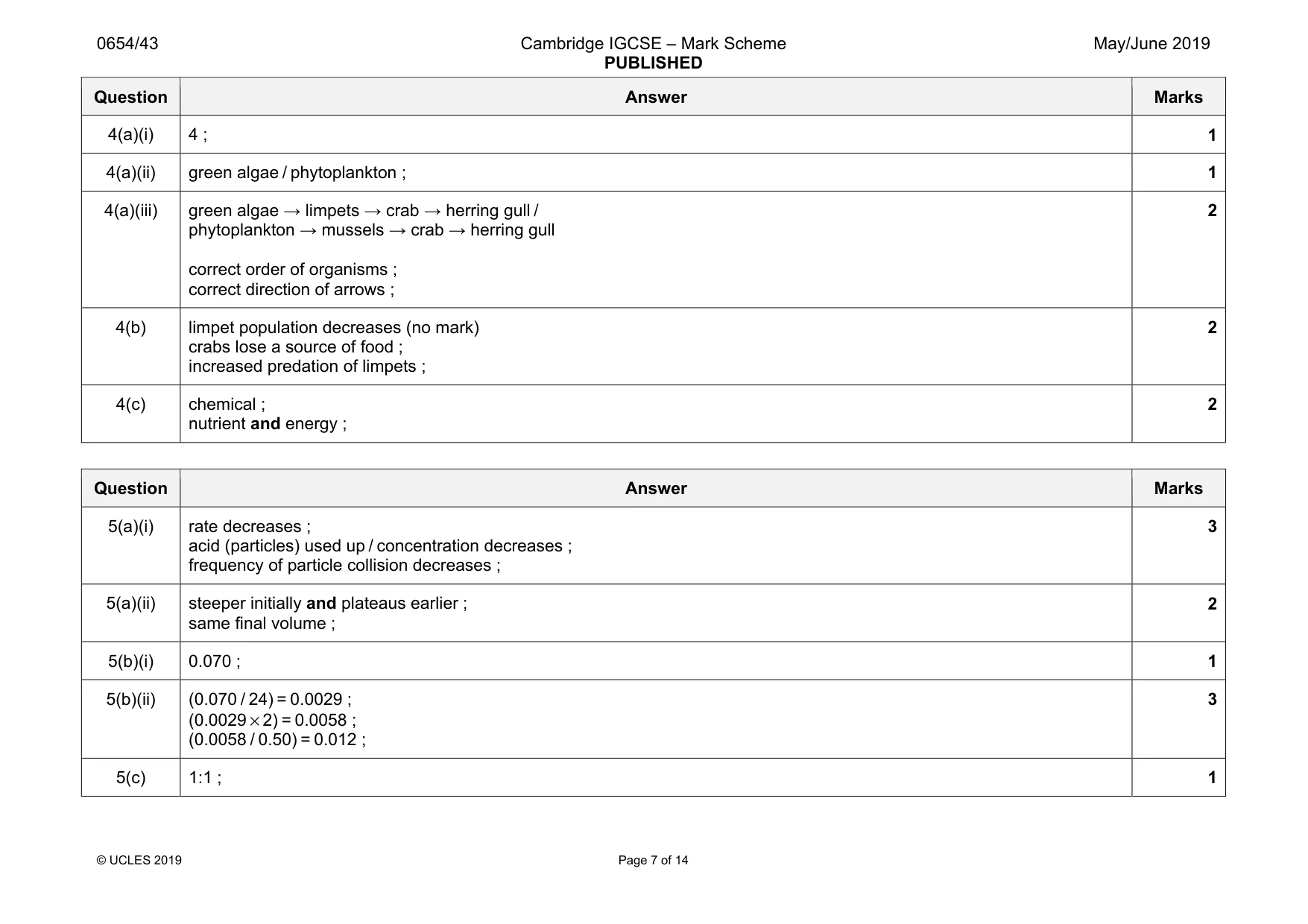
Mark scheme: 4(a)(i) 4 ; 1 4(a)(ii) green algae / phytoplankton ; 1 4(a)(iii) green algae → limpets → crab → herring gull / phytoplankton → mussels → crab → herring gull correct order of organisms ; correct direction of arrows ; 2 4(b) limpet population decreases (no mark) crabs lose a source of food ; increased predation of limpets ; 2 4(c) chemical ; nutrient and energy ; 2
Q5 · A teacher investigates the rate at which carbon dioxide is produced when dilute…
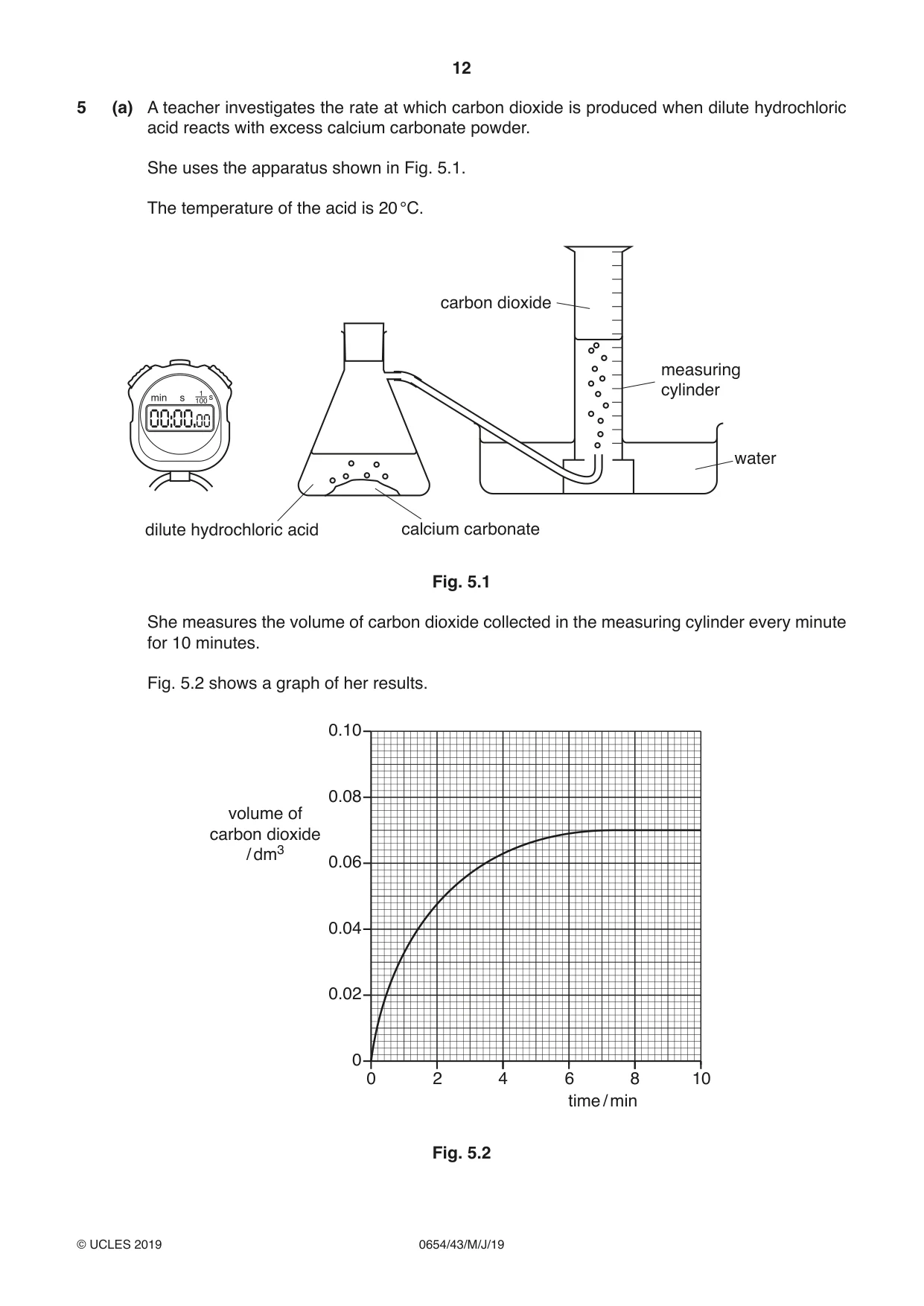
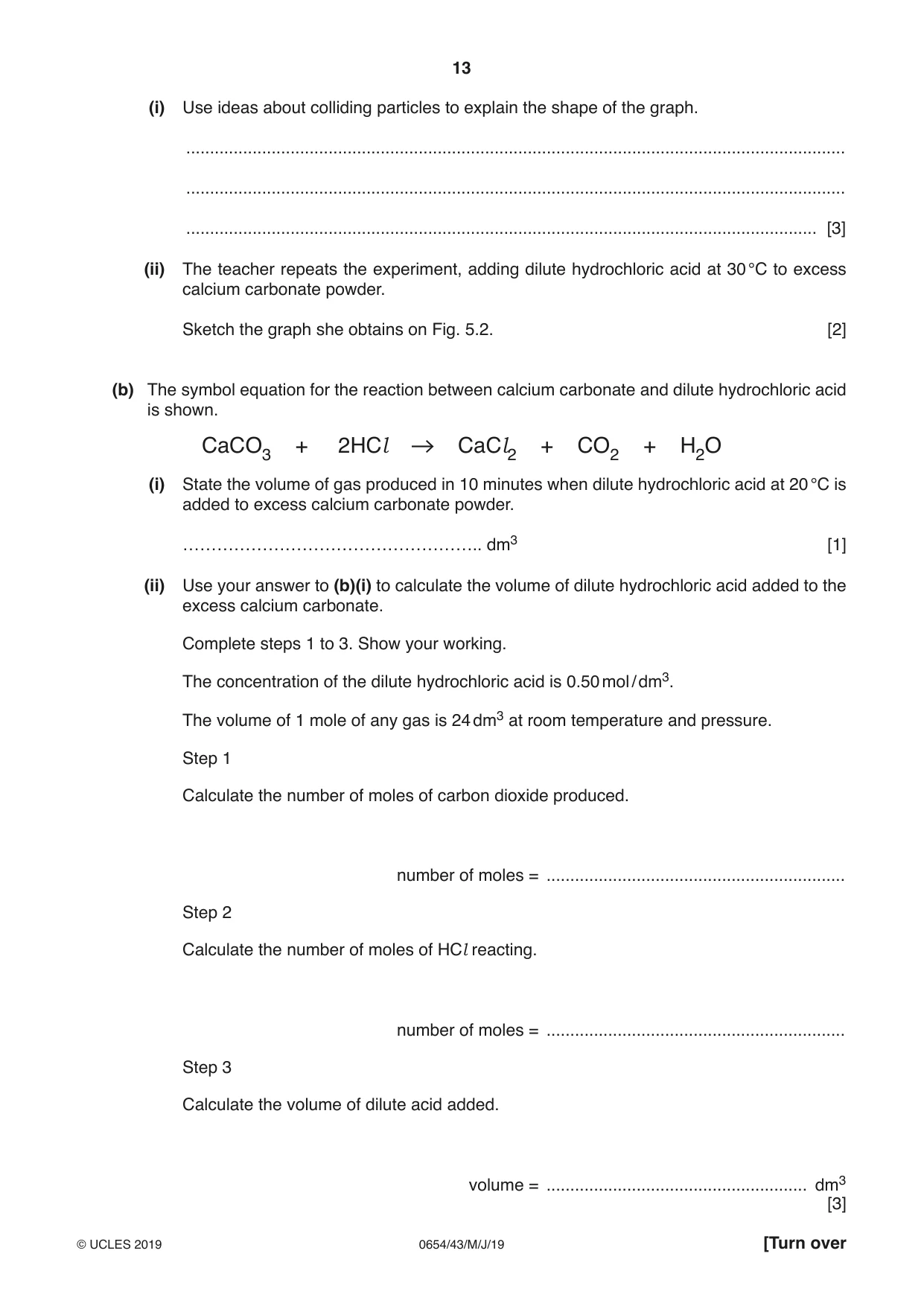
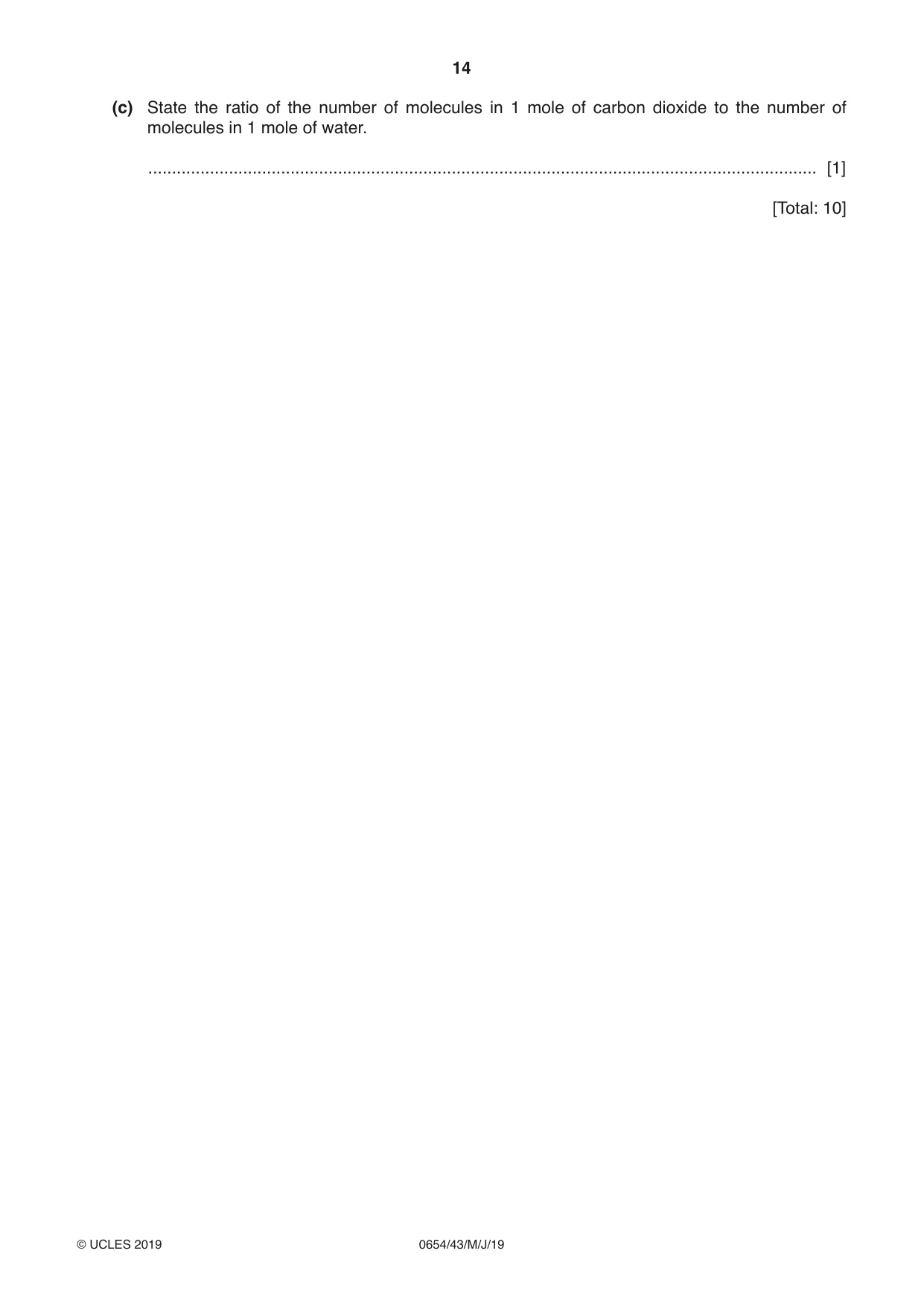
5 (a) A teacher investigates the rate at which carbon dioxide is produced when dilute hydrochloric acid reacts with excess calcium carbonate powder. She uses the apparatus shown in Fig. 5.1. The temperature of the acid is 20 °C. carbon dioxide measuring cylinder water dilute hydrochloric acid calcium carbonate Fig. 5.1 She measures the volume of carbon dioxide collected in the measuring cylinder every minute for 10 minutes. Fig. 5.2 shows a graph of her results. 0.10 0.08 volume of carbon dioxide / dm3 0.06 0.04 0.02 0 0 2 4 6 8 10 time / min Fig. 5.2 (i) Use ideas about colliding particles to explain the shape of the graph. ........................................................................................................................................... ........................................................................................................................................... ..................................................................................................................................... [3] (ii) The teacher repeats the experiment, adding dilute hydrochloric acid at 30 °C to excess calcium carbonate powder. Sketch the graph she obtains on Fig. 5.2. [2] (b) The symbol equation for the reaction between calcium carbonate and dilute hydrochloric acid is shown. CaCO3 + 2HCl CaCl2 + CO2 + H2O (i) State the volume of gas produced in 10 minutes when dilute hydrochloric acid at 20 °C is added to excess calcium carbonate powder. …………………………………………….. dm3 [1] (ii) Use your answer to (b)(i) to calculate the volume of dilute hydrochloric acid added to the excess calcium carbonate. Complete steps 1 to 3. Show your working. The concentration of the dilute hydrochloric acid is 0.50 mol / dm3. The volume of 1 mole of any gas is 24 dm3 at room temperature and pressure. Step 1 Calculate the number of moles of carbon dioxide produced. number of moles = ............................................................... Step 2 Calculate the number of moles of HCl reacting. number of moles = ............................................................... Step 3 Calculate the volume of dilute acid added. volume = ....................................................... dm3 [3] (c) State the ratio of the number of molecules in 1 mole of carbon dioxide to the number of molecules in 1 mole of water. ............................................................................................................................................. [1] [Total: 10]
Mark scheme: 5(a)(i) rate decreases ; acid (particles) used up / concentration decreases ; frequency of particle collision decreases ; 3 5(a)(ii) steeper initially and plateaus earlier ; same final volume ; 2 5(b)(i) 0.070 ; 1 5(b)(ii) (0.070 / 24) = 0.0029 ; (0.0029 × 2) = 0.0058 ; (0.0058 / 0.50) = 0.012 ; 3 5(c) 1:1 ; 1
Q6 · A penguin walking on the ice in Antarctica
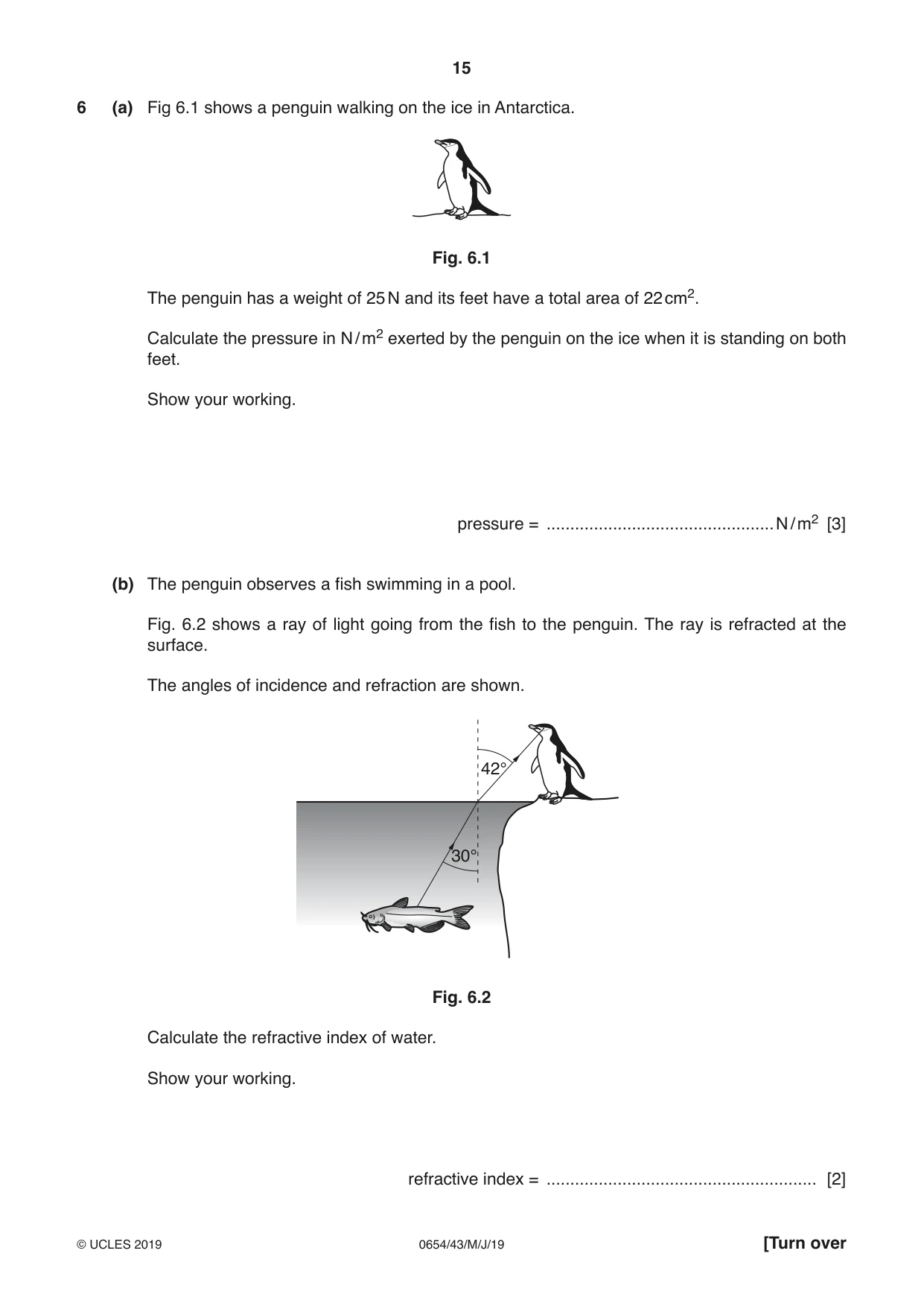
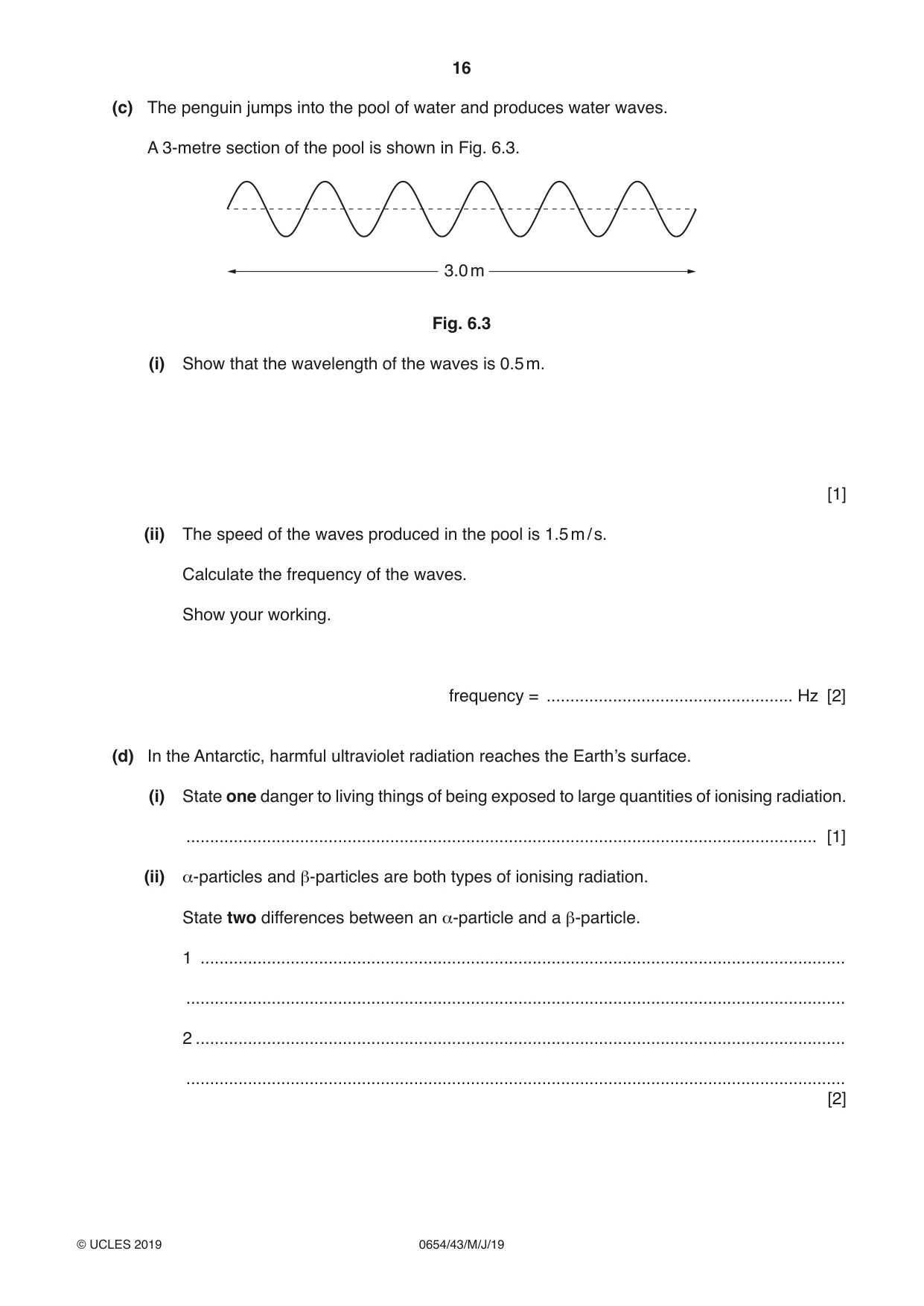
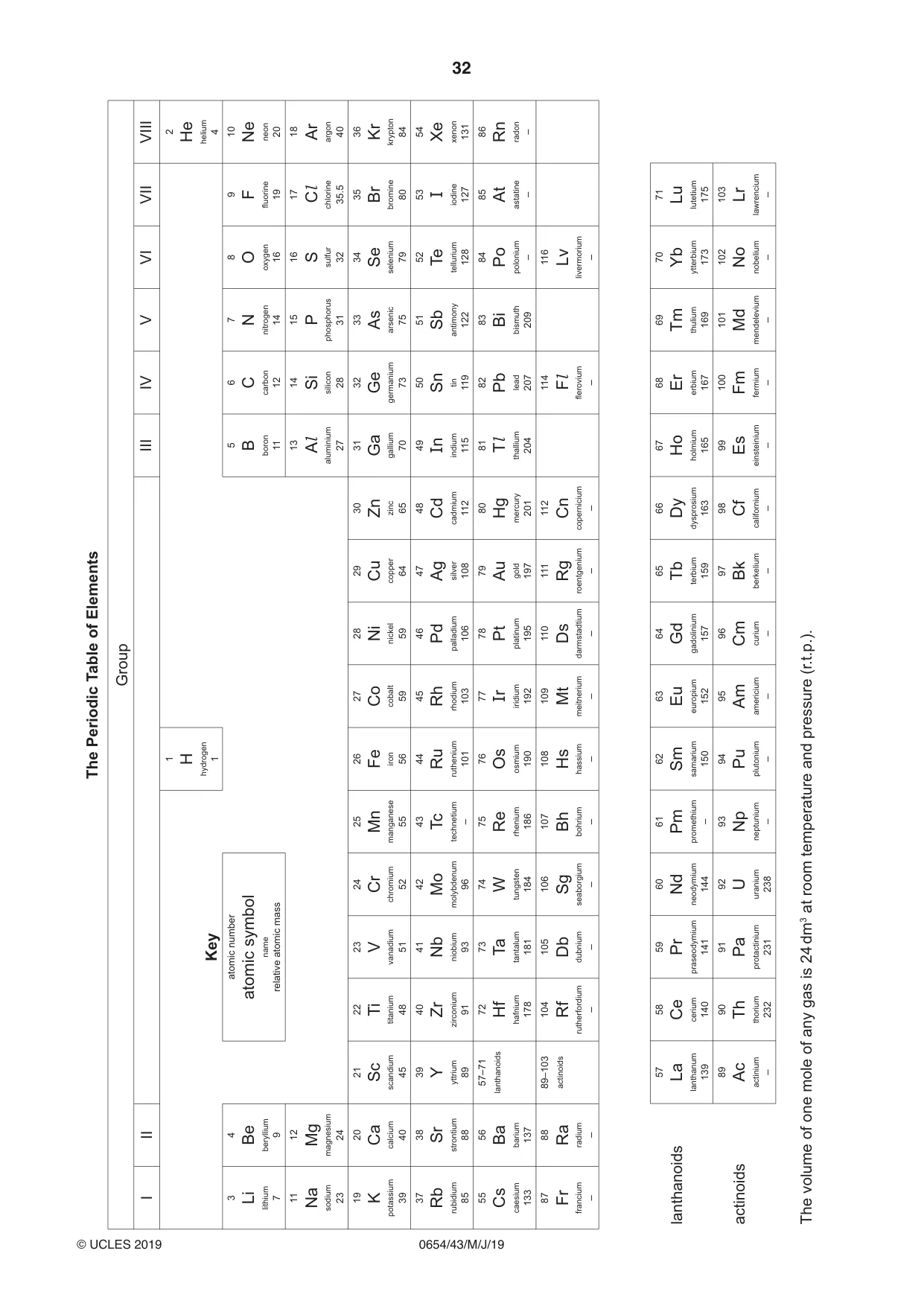
6 (a) Fig 6.1 shows a penguin walking on the ice in Antarctica. Fig. 6.1 The penguin has a weight of 25 N and its feet have a total area of 22 cm2. Calculate the pressure in N / m2 exerted by the penguin on the ice when it is standing on both feet. Show your working. pressure = ................................................N / m2 [3] (b) The penguin observes a fish swimming in a pool. Fig. 6.2 shows a ray of light going from the fish to the penguin. The ray is refracted at the surface. The angles of incidence and refraction are shown. 42° 30° Fig. 6.2 Calculate the refractive index of water. Show your working. refractive index = ......................................................... [2] (c) The penguin jumps into the pool of water and produces water waves. A 3-metre section of the pool is shown in Fig. 6.3. 3.0 m Fig. 6.3 (i) Show that the wavelength of the waves is 0.5 m. [1] (ii) The speed of the waves produced in the pool is 1.5 m / s. Calculate the frequency of the waves. Show your working. frequency = .................................................... Hz [2] (d) In the Antarctic, harmful ultraviolet radiation reaches the Earth’s surface. (i) State one danger to living things of being exposed to large quantities of ionising radiation. ..................................................................................................................................... [1] (ii) α-particles and β-particles are both types of ionising radiation. State two differences between an α-particle and a β-particle. 1 ........................................................................................................................................ ........................................................................................................................................... 2 ......................................................................................................................................... ........................................................................................................................................... [2] (iii) An isotope of an unknown element decays by β-emission to produce an isotope of silicon, which has a nucleon number of 28. Identify the unknown element and give its full nuclide notation. A periodic table is shown on page 32. ..................................................................................................................................... [2] [Total: 13]
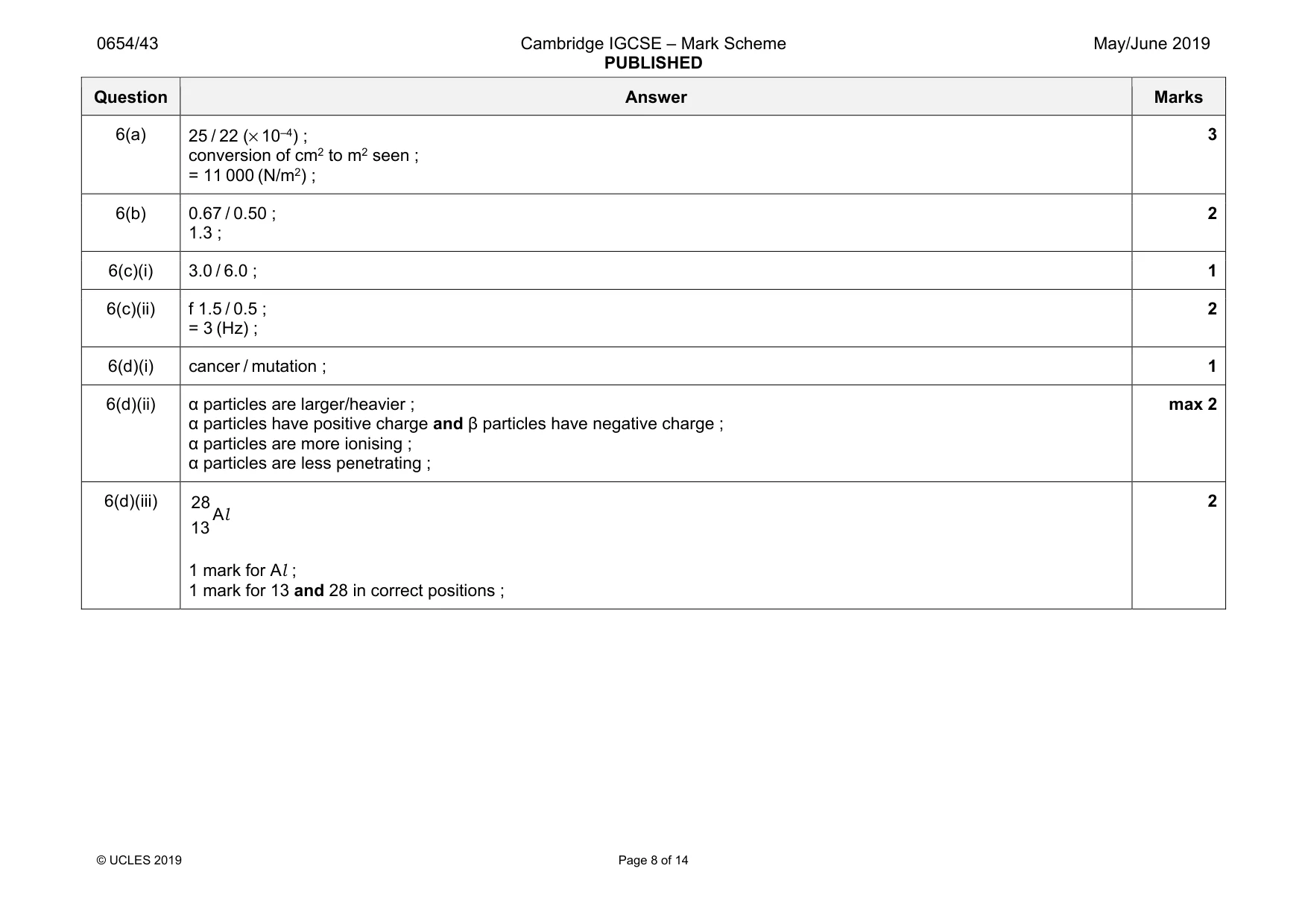
Mark scheme: 6(a) conversion of cm2 to m2 seen ; = 11 000 (N/m2) ; 3 6(b) 0.67 / 0.50 ; 1.3 ; 2 6(c)(i) 3.0 / 6.0 ; 1 6(c)(ii) f 1.5 / 0.5 ; = 3 (Hz) ; 2 6(d)(i) cancer / mutation ; 1 6(d)(ii) α particles are larger/heavier ; α particles have positive charge and β particles have negative charge ; α particles are more ionising ; α particles are less penetrating ; max 2 6(d)(iii) l 28A 13 1 mark for Al ; 1 mark for 13 and 28 in correct positions ; 2
Q7 · A student investigates the need for chlorophyll in photosynthesis
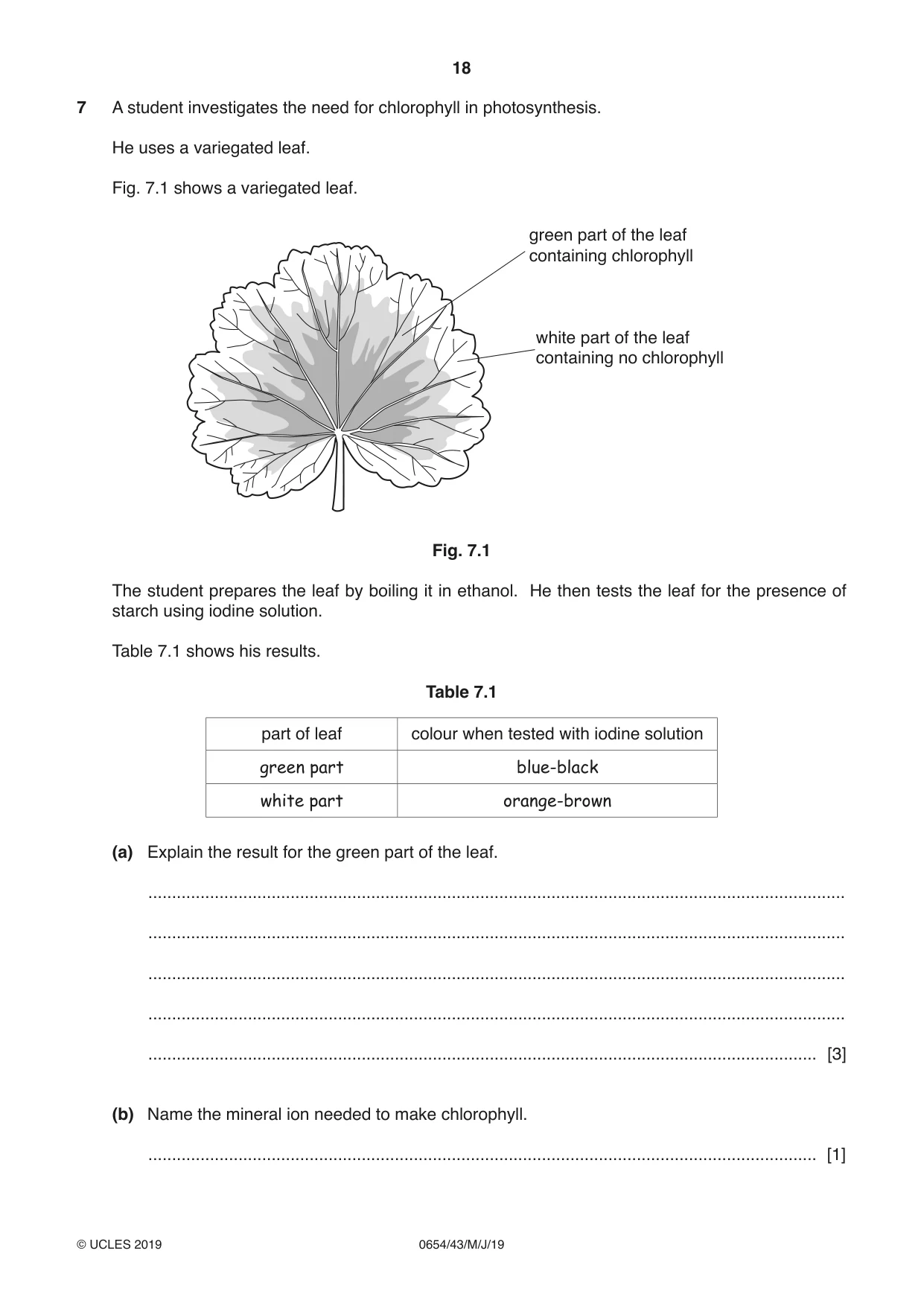
7 A student investigates the need for chlorophyll in photosynthesis. He uses a variegated leaf. Fig. 7.1 shows a variegated leaf. green part of the leaf containing chlorophyll white part of the leaf containing no chlorophyll Fig. 7.1 The student prepares the leaf by boiling it in ethanol. He then tests the leaf for the presence of starch using iodine solution. Table 7.1 shows his results. Table 7.1 part of leaf colour when tested with iodine solution green part blue-black white part orange-brown (a) Explain the result for the green part of the leaf. ................................................................................................................................................... ................................................................................................................................................... ................................................................................................................................................... ................................................................................................................................................... ............................................................................................................................................. [3] (b) Name the mineral ion needed to make chlorophyll. ............................................................................................................................................. [1] (c) Starch is one carbohydrate found in plants. Describe how carbohydrates are transported around the plant. ................................................................................................................................................... ................................................................................................................................................... ................................................................................................................................................... ................................................................................................................................................... ............................................................................................................................................. [3] (d) Water is one of the raw materials needed for photosynthesis. State the chemical formula of one other raw material needed for photosynthesis. .......................................................... [1] (e) State the term used for the property of water molecules that enables them to be drawn up the xylem during transpiration. ............................................................................................................................................. [1] [Total: 9]
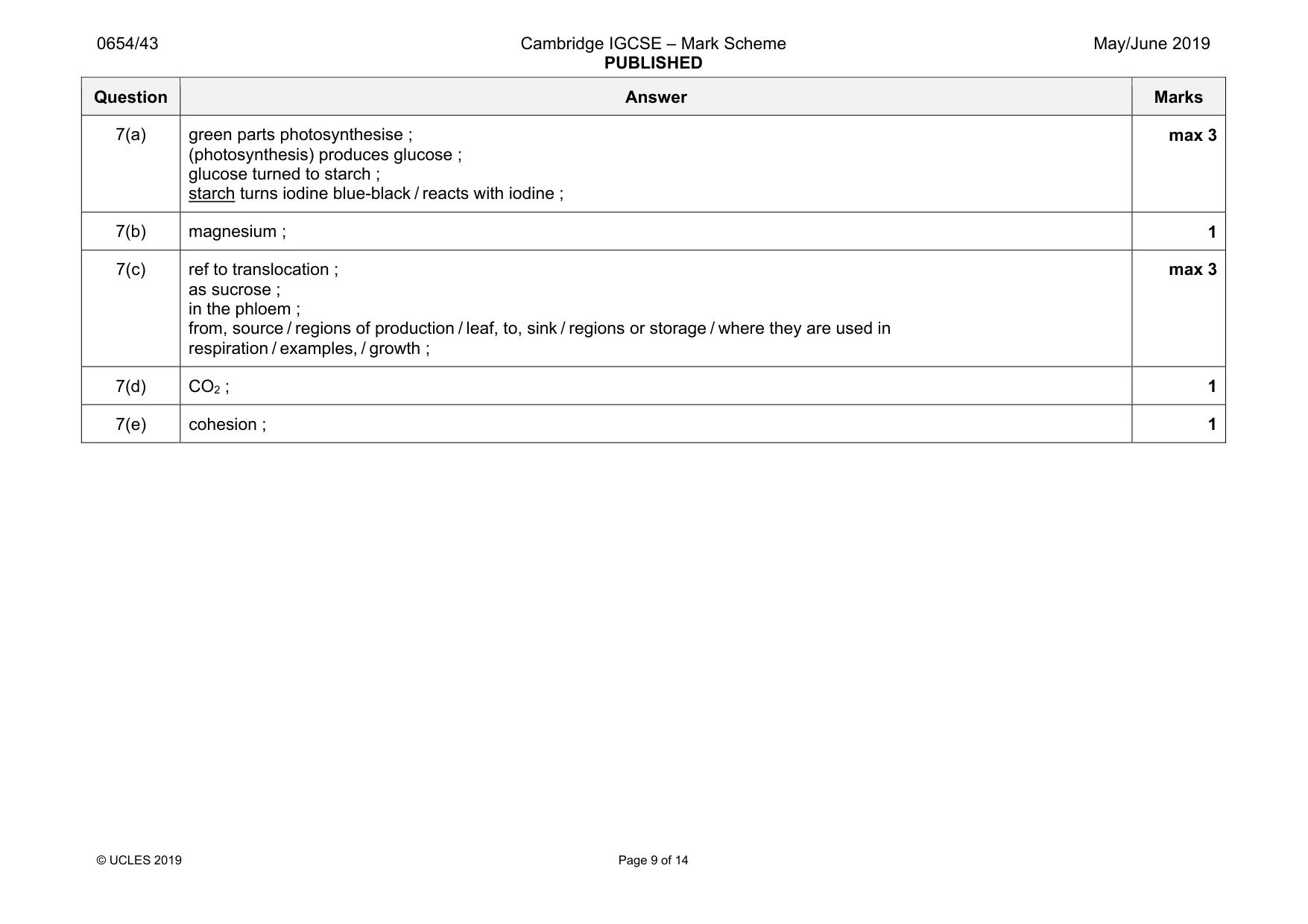
Mark scheme: 7(a) green parts photosynthesise ; (photosynthesis) produces glucose ; glucose turned to starch ; starch turns iodine blue-black / reacts with iodine ; max 3 7(b) magnesium ; 1 7(c) ref to translocation ; as sucrose ; in the phloem ; from, source / regions of production / leaf, to, sink / regions or storage / where they are used in respiration / examples, / growth ; max 3 7(d) CO2 ; 1 7(e) cohesion ; 1
Q8 · Part of Group I of the Periodic Table
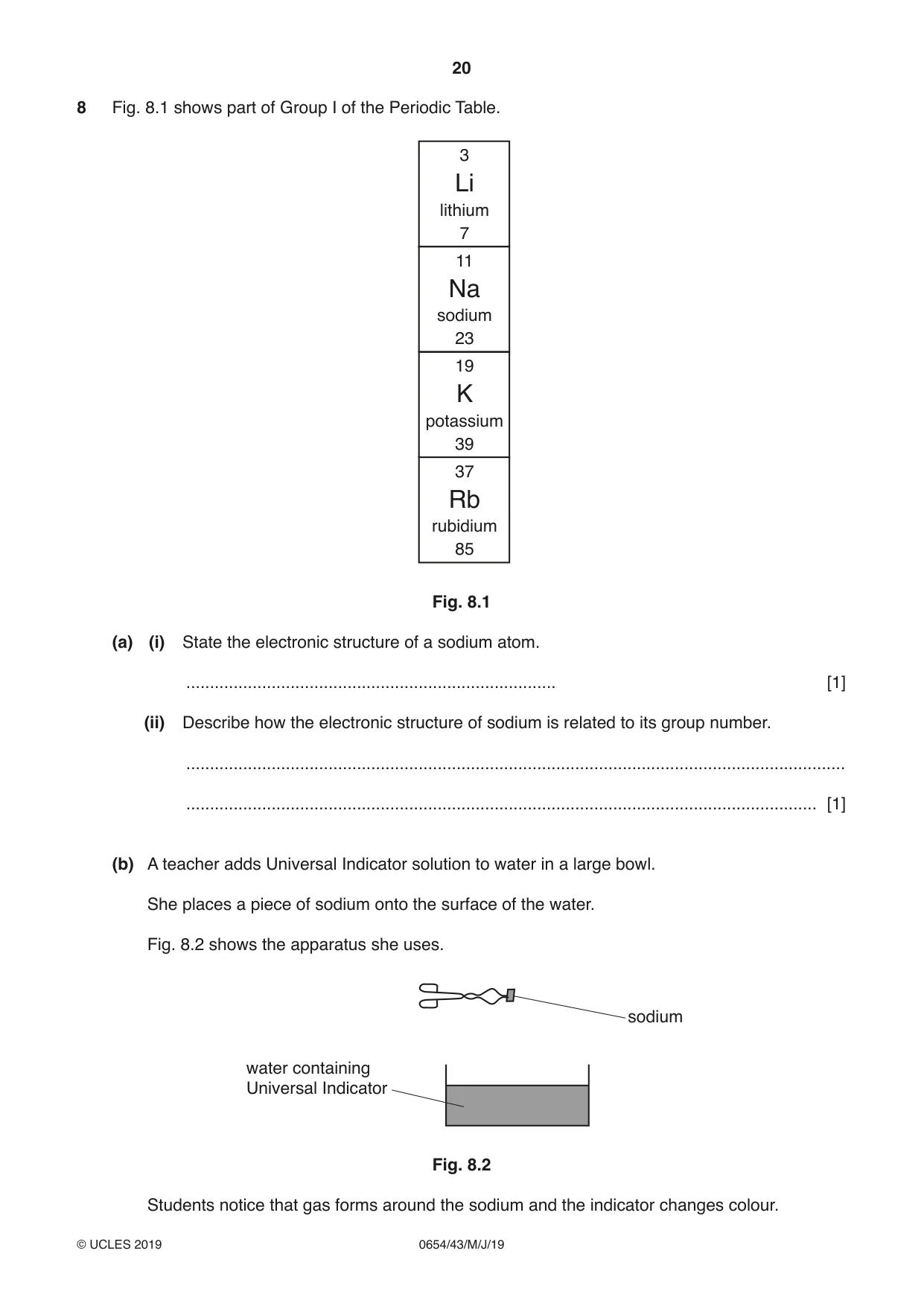
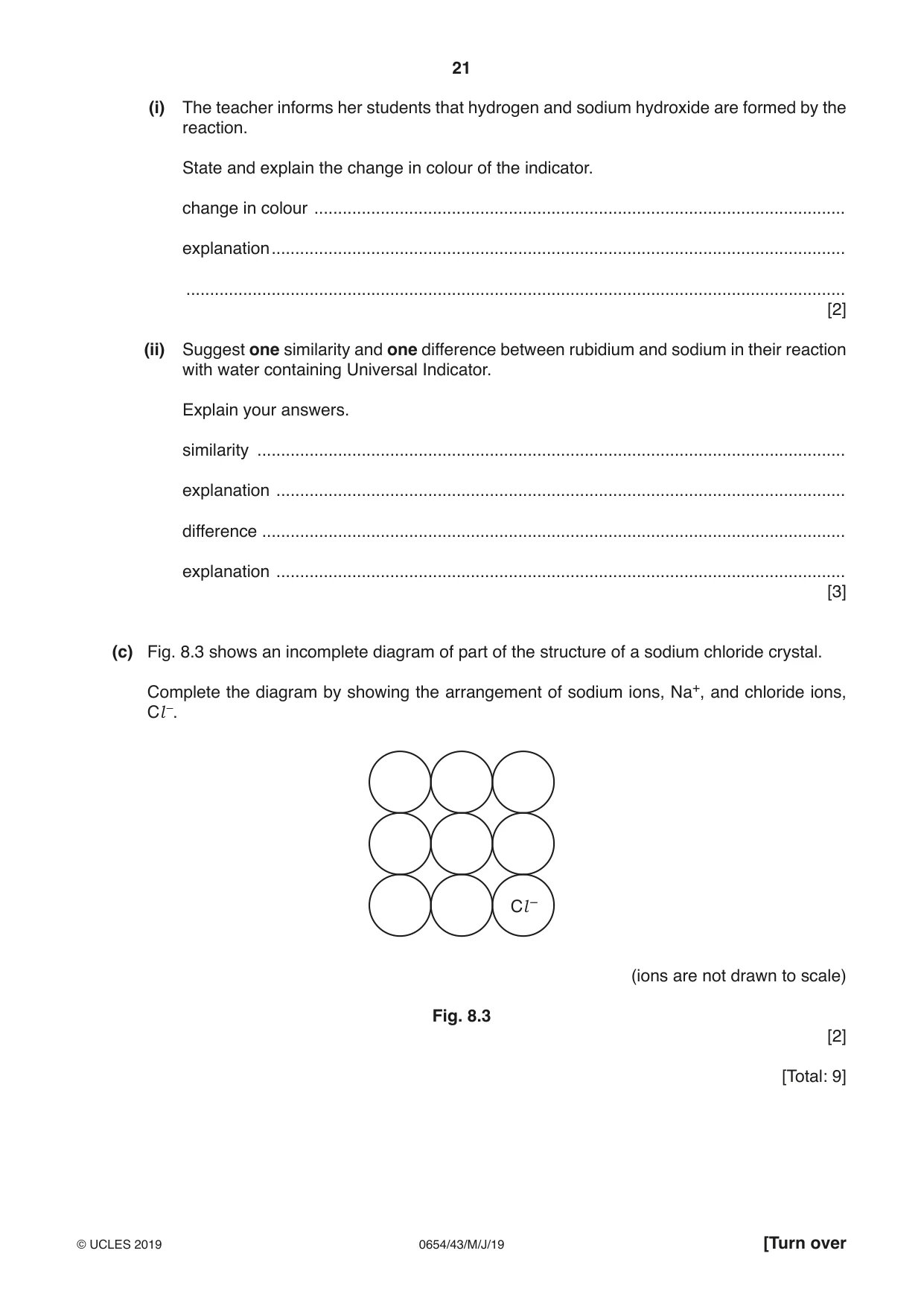
8 Fig. 8.1 shows part of Group I of the Periodic Table. 3 Li lithium 7 11 Na sodium 23 19 K potassium 39 37 Rb rubidium 85 Fig. 8.1 (a) (i) State the electronic structure of a sodium atom. .............................................................................. [1] (ii) Describe how the electronic structure of sodium is related to its group number. ........................................................................................................................................... ..................................................................................................................................... [1] (b) A teacher adds Universal Indicator solution to water in a large bowl. She places a piece of sodium onto the surface of the water. Fig. 8.2 shows the apparatus she uses. sodium water containing Universal Indicator Fig. 8.2 Students notice that gas forms around the sodium and the indicator changes colour. (i) The teacher informs her students that hydrogen and sodium hydroxide are formed by the reaction. State and explain the change in colour of the indicator. change in colour ................................................................................................................ explanation ......................................................................................................................... ........................................................................................................................................... [2] (ii) Suggest one similarity and one difference between rubidium and sodium in their reaction with water containing Universal Indicator. Explain your answers. similarity ............................................................................................................................ explanation ........................................................................................................................ difference ........................................................................................................................... explanation ........................................................................................................................ [3] (c) Fig. 8.3 shows an incomplete diagram of part of the structure of a sodium chloride crystal. Complete the diagram by showing the arrangement of sodium ions, Na+, and chloride ions, Cl –. Cl – (ions are not drawn to scale) Fig. 8.3 [2] [Total: 9]
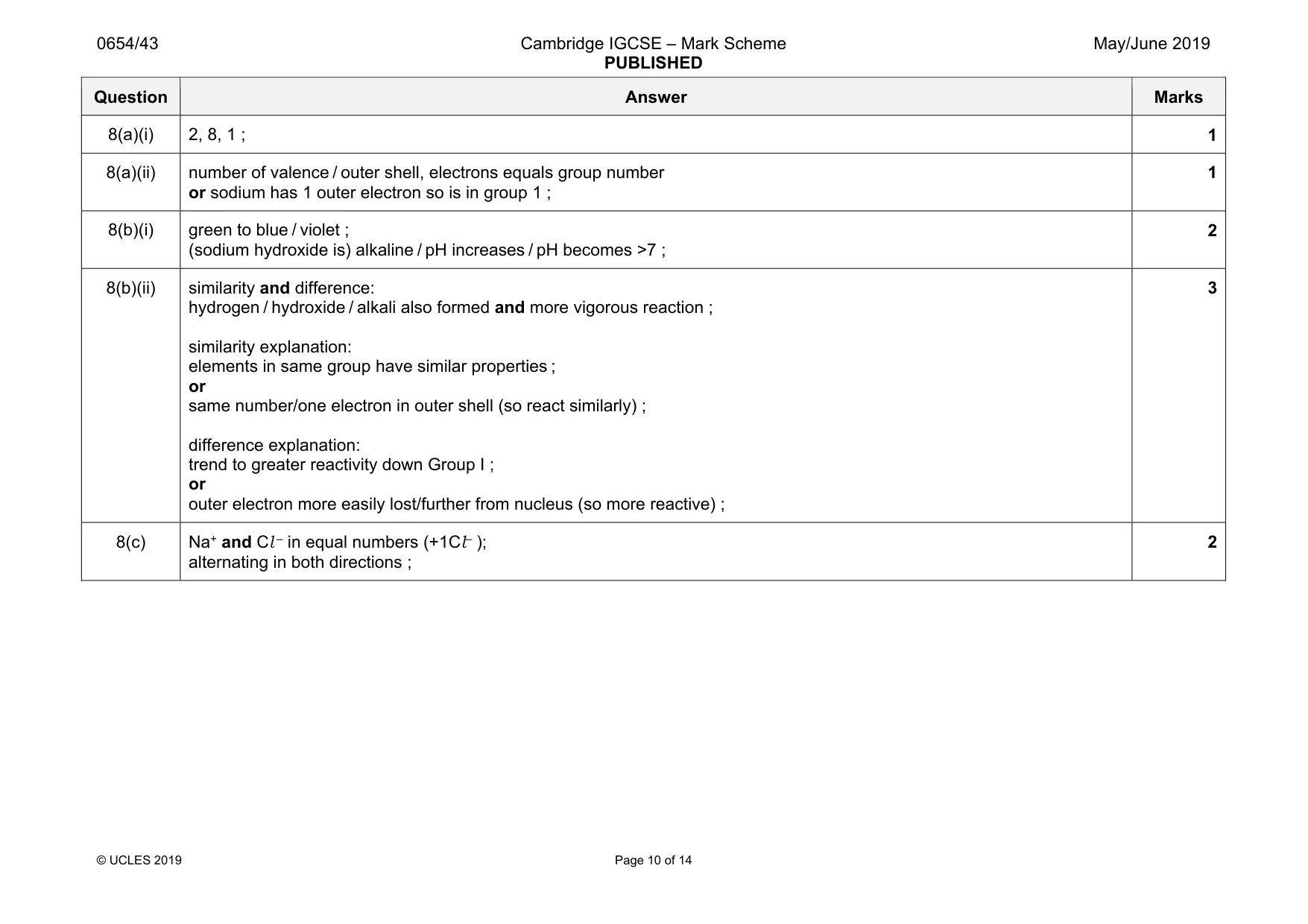
Mark scheme: 8(a)(i) 2, 8, 1 ; 1 8(a)(ii) number of valence / outer shell, electrons equals group number or sodium has 1 outer electron so is in group 1 ; 1 8(b)(i) green to blue / violet ; (sodium hydroxide is) alkaline / pH increases / pH becomes >7 ; 2 8(b)(ii) similarity and difference: hydrogen / hydroxide / alkali also formed and more vigorous reaction ; similarity explanation: elements in same group have similar properties ; or same number/one electron in outer shell (so react similarly) ; difference explanation: trend to greater reactivity down Group I ; or outer electron more easily lost/further from nucleus (so more reactive) ; 3 8(c) Na+ and Cl – in equal numbers (+1Cl– ); alternating in both directions ; 2
Q9 · A potato being baked in the oven of an electric cooker
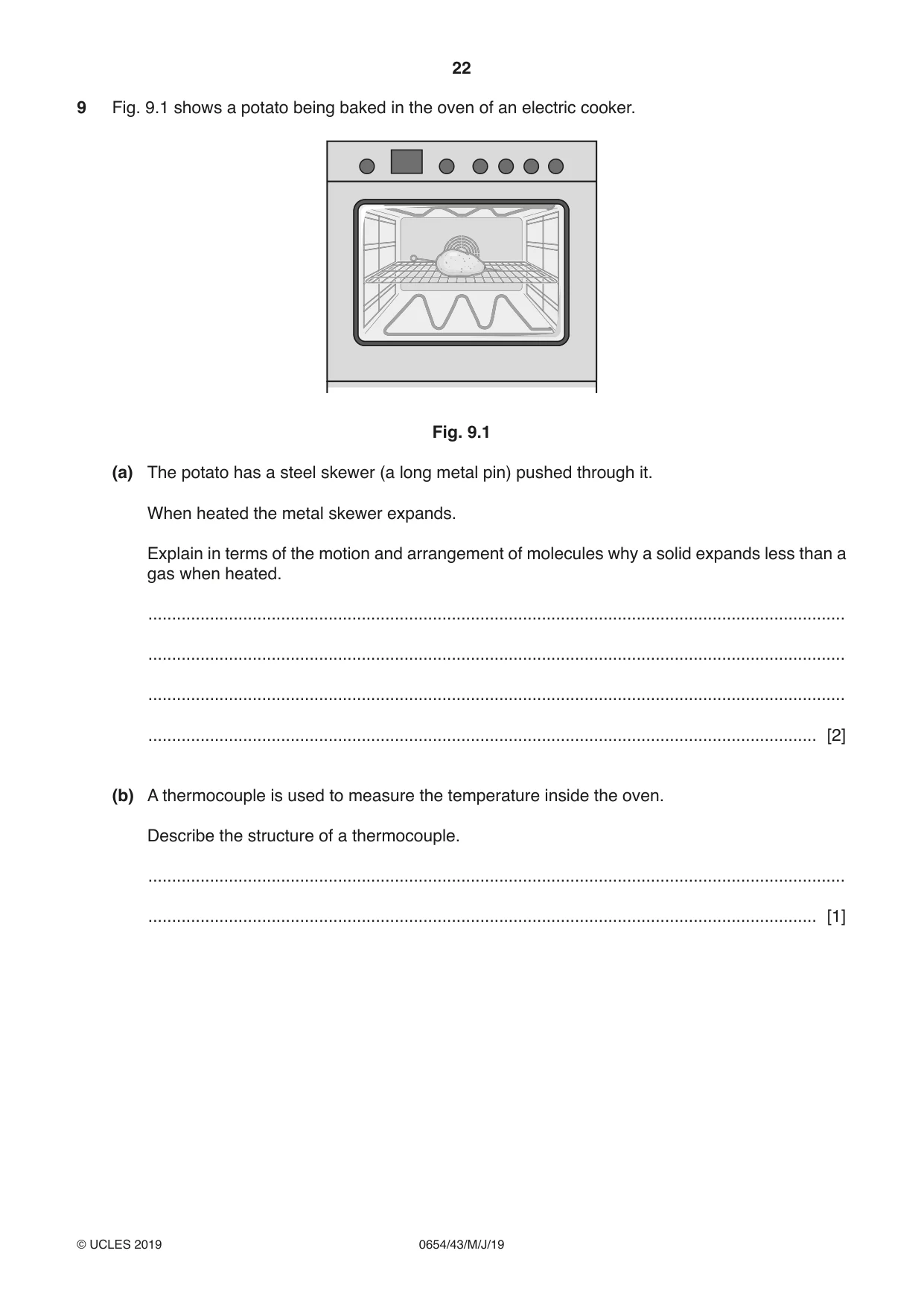
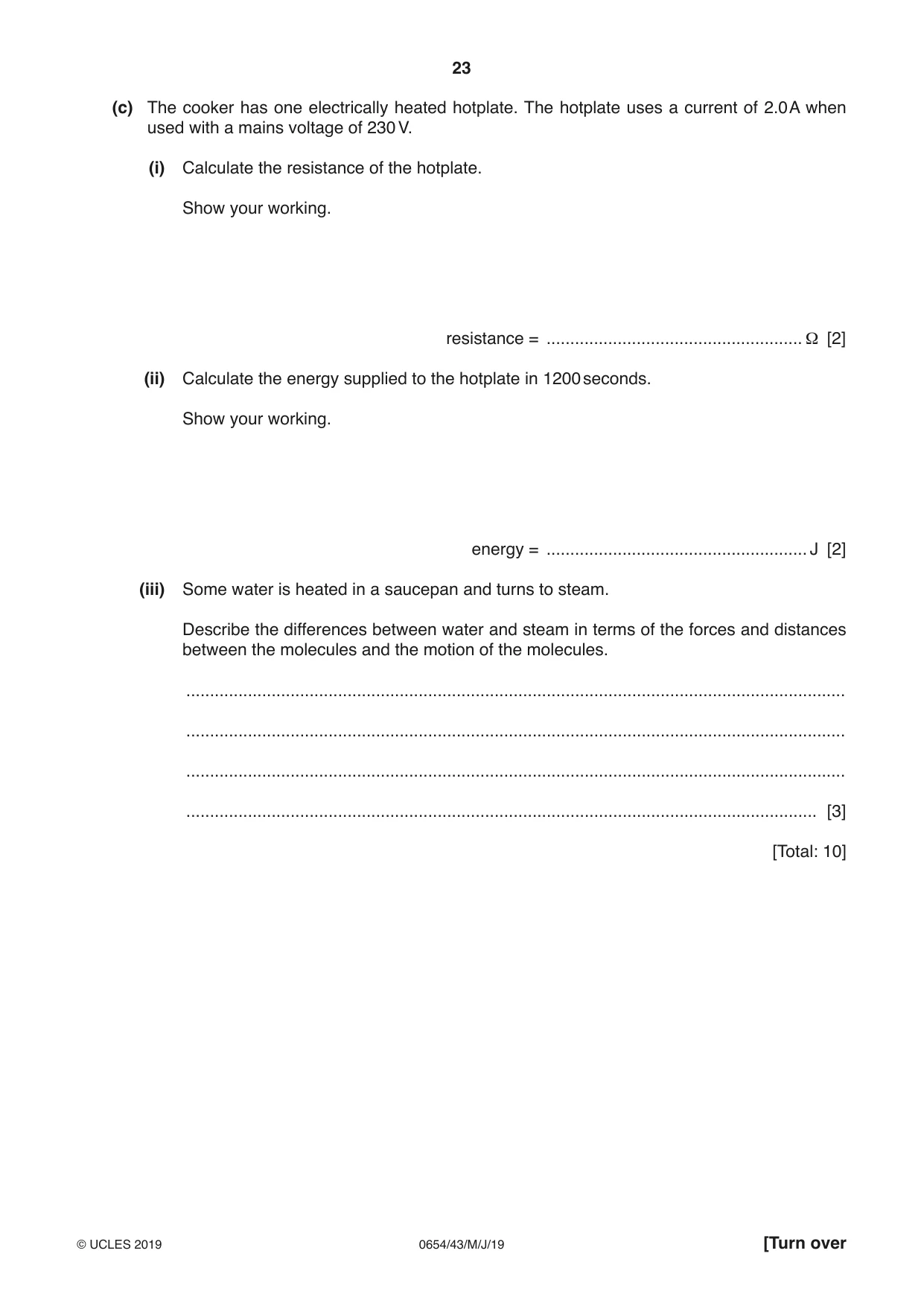
9 Fig. 9.1 shows a potato being baked in the oven of an electric cooker. Fig. 9.1 (a) The potato has a steel skewer (a long metal pin) pushed through it. When heated the metal skewer expands. Explain in terms of the motion and arrangement of molecules why a solid expands less than a gas when heated. ................................................................................................................................................... ................................................................................................................................................... ................................................................................................................................................... ............................................................................................................................................. [2] (b) A thermocouple is used to measure the temperature inside the oven. Describe the structure of a thermocouple. ................................................................................................................................................... ............................................................................................................................................. [1] (c) The cooker has one electrically heated hotplate. The hotplate uses a current of 2.0 A when used with a mains voltage of 230 V. (i) Calculate the resistance of the hotplate. Show your working. resistance = ...................................................... Ω [2] (ii) Calculate the energy supplied to the hotplate in 1200 seconds. Show your working. energy = ....................................................... J [2] (iii) Some water is heated in a saucepan and turns to steam. Describe the differences between water and steam in terms of the forces and distances between the molecules and the motion of the molecules. ........................................................................................................................................... ........................................................................................................................................... ........................................................................................................................................... ..................................................................................................................................... [3] [Total: 10]
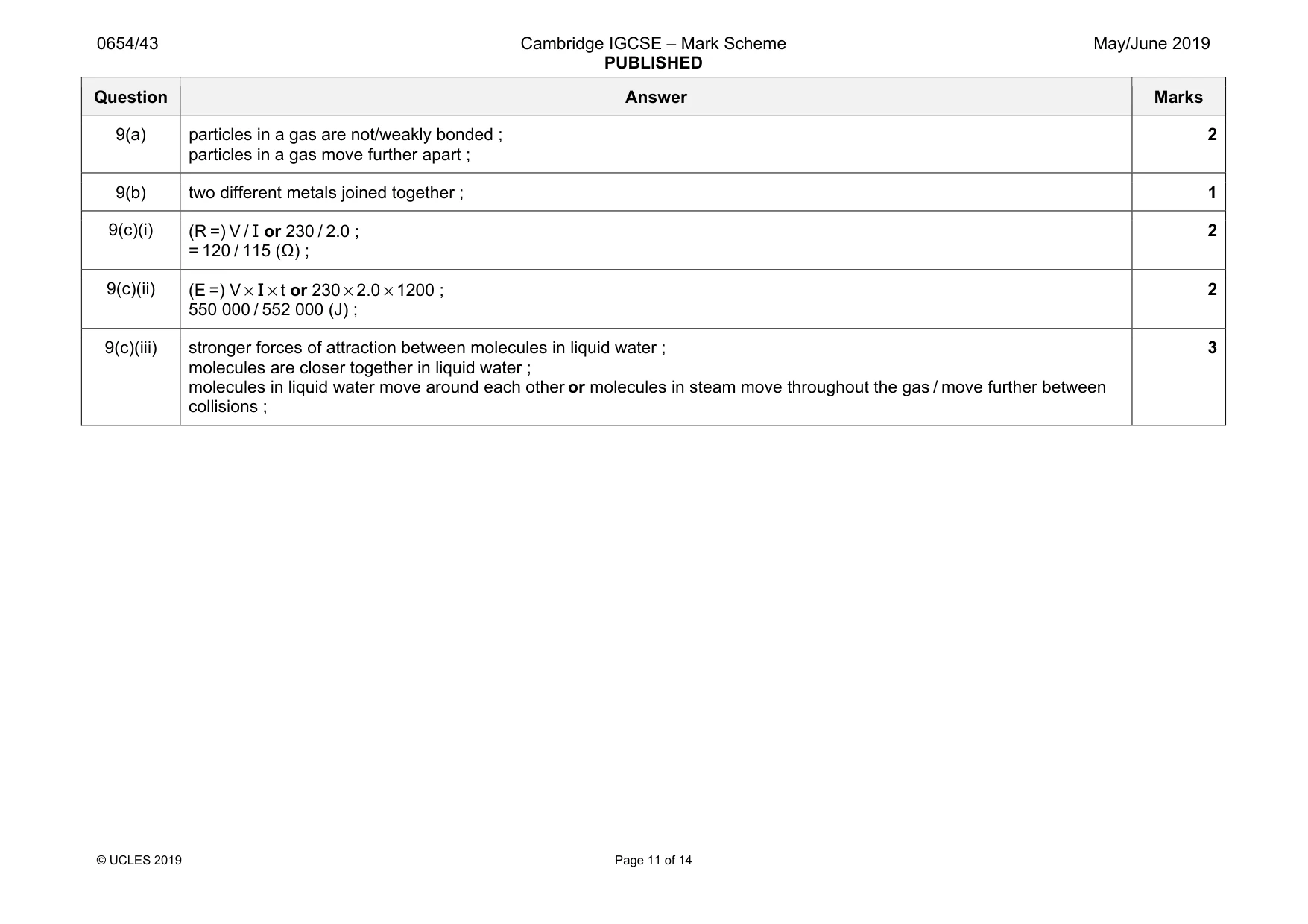
Mark scheme: 9(a) particles in a gas are not/weakly bonded ; particles in a gas move further apart ; 2 9(b) two different metals joined together ; 1 9(c)(i) (R =) V / I or 230 / 2.0 ; = 120 / 115 (Ω) ; 2 9(c)(ii) (E =) V × I × t or 230 × 2.0 × 1200 ; 550 000 / 552 000 (J) ; 2 9(c)(iii) stronger forces of attraction between molecules in liquid water ; molecules are closer together in liquid water ; molecules in liquid water move around each other or molecules in steam move throughout the gas / move further between collisions ; 3
Q10 · The circulatory system of a fish and a human
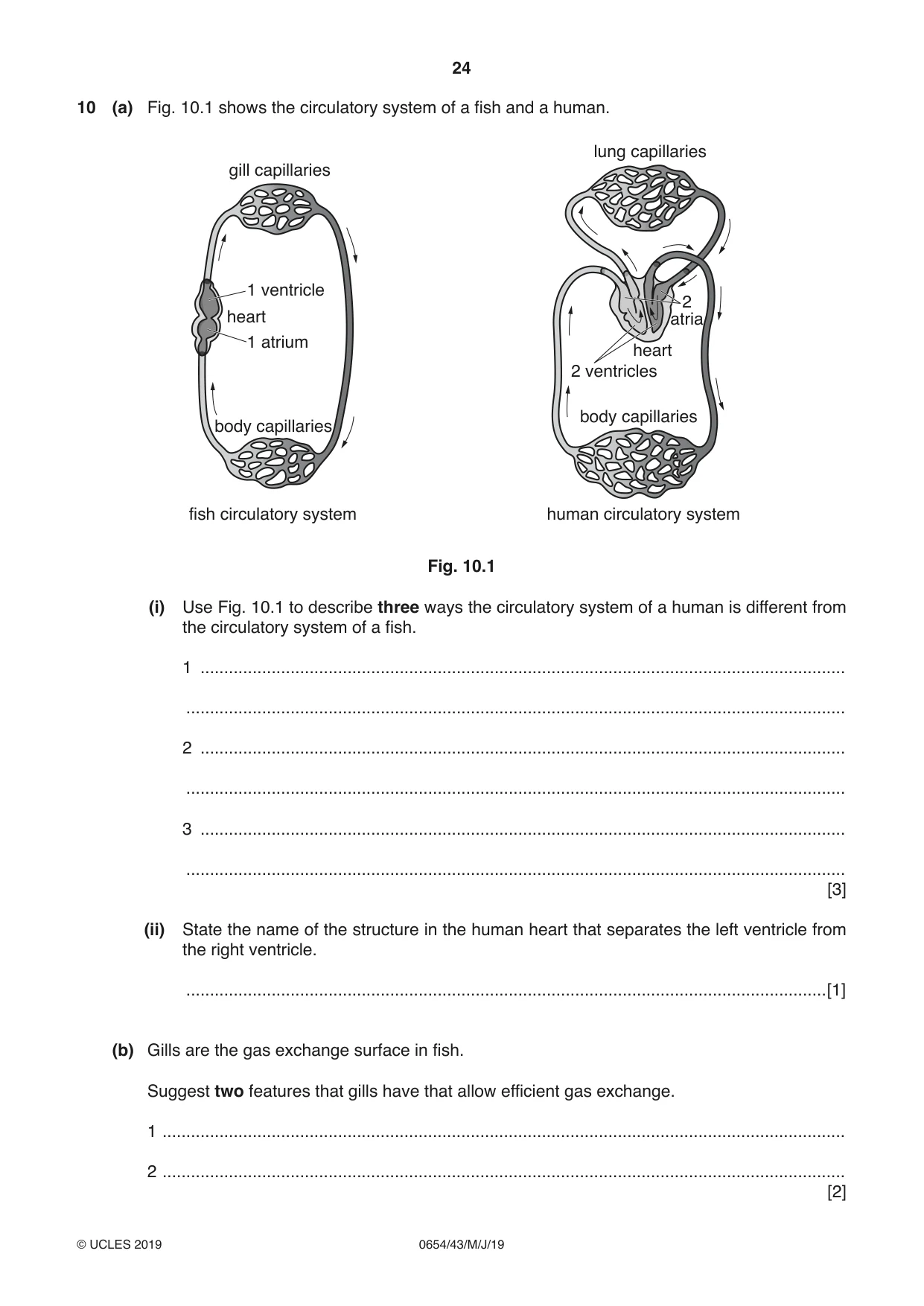
10 (a) Fig. 10.1 shows the circulatory system of a fish and a human. lung capillaries gill capillaries 1 ventricle 2 heart atria 1 atrium heart 2 ventricles body capillaries body capillaries fish circulatory system human circulatory system Fig. 10.1 (i) Use Fig. 10.1 to describe three ways the circulatory system of a human is different from the circulatory system of a fish. 1 ........................................................................................................................................ ........................................................................................................................................... 2 ........................................................................................................................................ ........................................................................................................................................... 3 ........................................................................................................................................ ........................................................................................................................................... [3] (ii) State the name of the structure in the human heart that separates the left ventricle from the right ventricle. .......................................................................................................................................[1] (b) Gills are the gas exchange surface in fish. Suggest two features that gills have that allow efficient gas exchange. 1 ................................................................................................................................................ 2 ................................................................................................................................................ [2] (c) The human circulatory system contains arterioles. Arterioles are used in the regulation of body temperature. Describe the role of arterioles in reducing body temperature. ................................................................................................................................................... ................................................................................................................................................... ................................................................................................................................................... ................................................................................................................................................... ............................................................................................................................................. [3] [Total: 9]
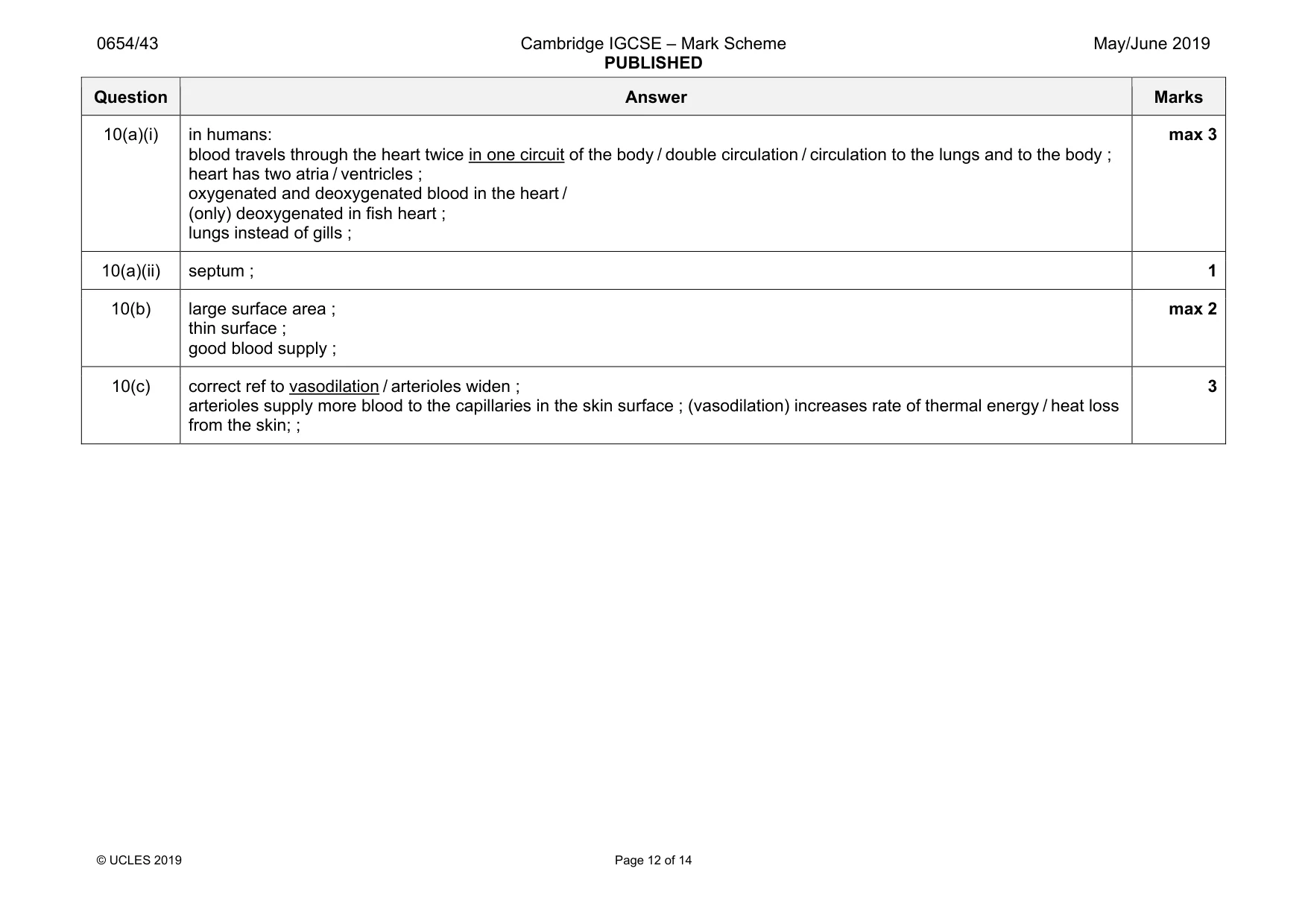
Mark scheme: 10(a)(i) in humans: blood travels through the heart twice in one circuit of the body / double circulation / circulation to the lungs and to the body ; heart has two atria / ventricles ; oxygenated and deoxygenated blood in the heart / (only) deoxygenated in fish heart ; lungs instead of gills ; max 3 10(a)(ii) septum ; 1 10(b) large surface area ; thin surface ; good blood supply ; max 2 10(c) correct ref to vasodilation / arterioles widen ; arterioles supply more blood to the capillaries in the skin surface ; (vasodilation) increases rate of thermal energy / heat loss from the skin; ; 3
Q11 · A blast furnace used to extract iron from iron oxide
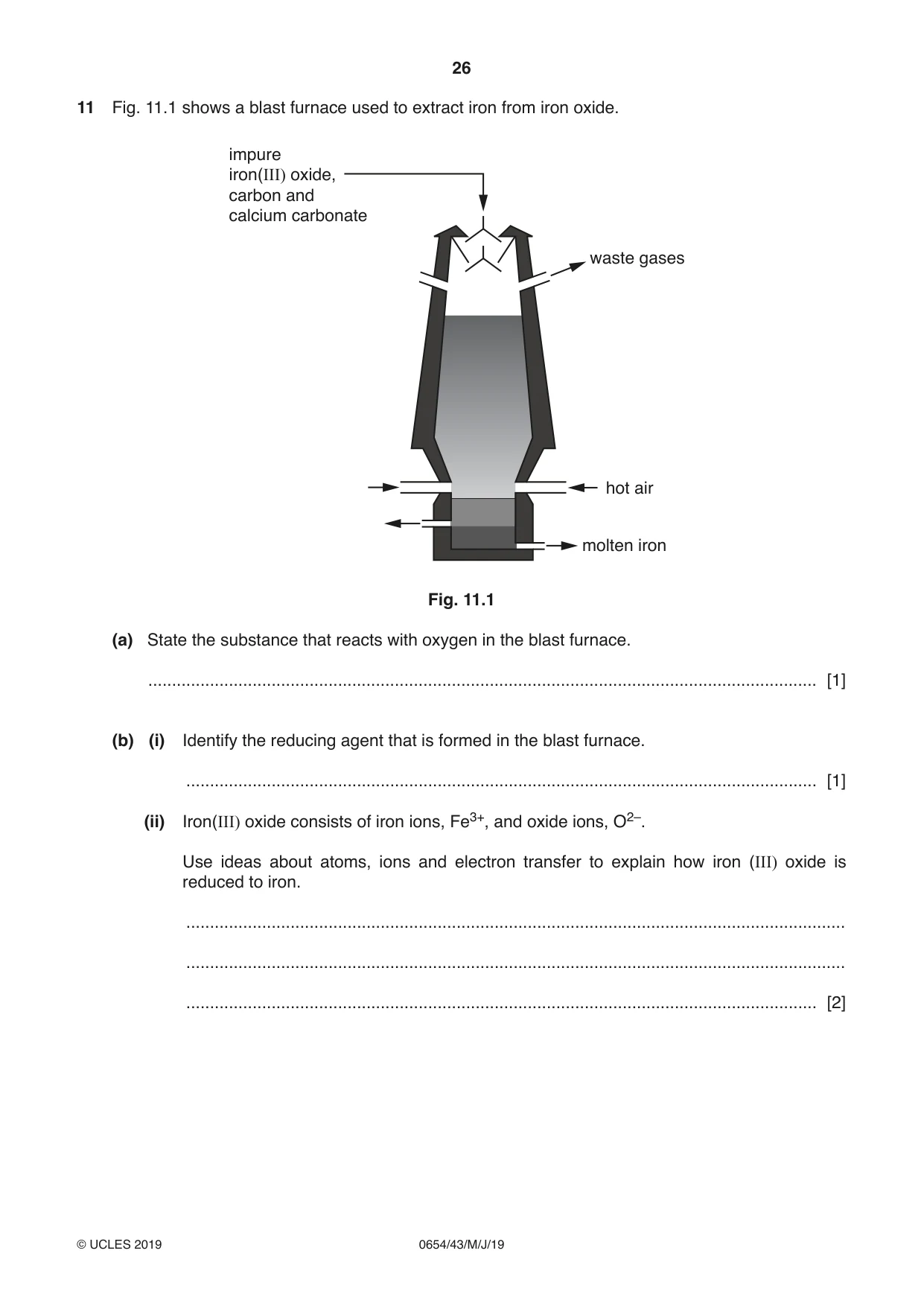
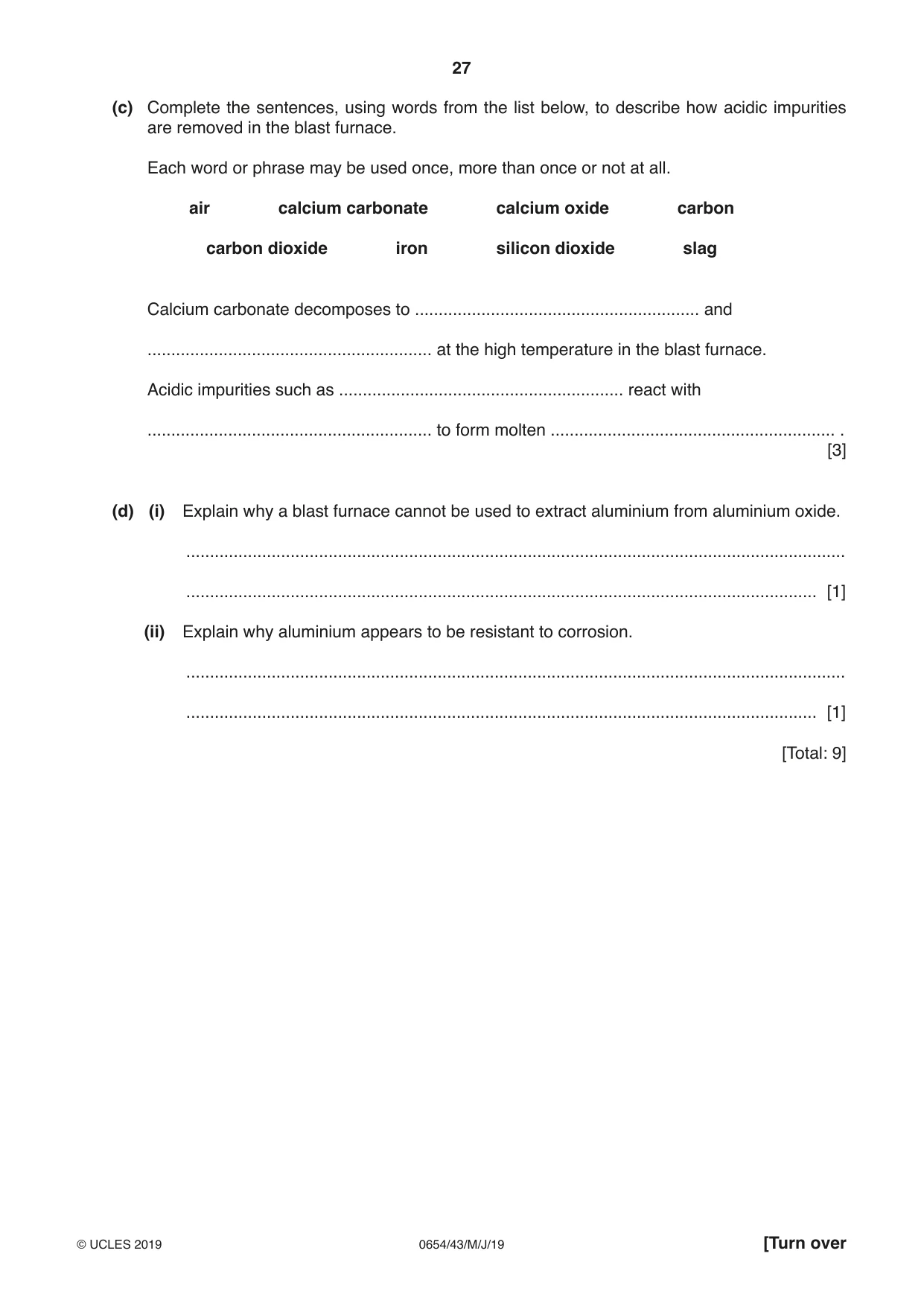
11 Fig. 11.1 shows a blast furnace used to extract iron from iron oxide. impure iron(III) oxide, carbon and calcium carbonate waste gases hot air molten iron Fig. 11.1 (a) State the substance that reacts with oxygen in the blast furnace. ............................................................................................................................................. [1] (b) (i) Identify the reducing agent that is formed in the blast furnace. ..................................................................................................................................... [1] (ii) Iron(III) oxide consists of iron ions, Fe3+, and oxide ions, O2–. Use ideas about atoms, ions and electron transfer to explain how iron (III) oxide is reduced to iron. ........................................................................................................................................... ........................................................................................................................................... ..................................................................................................................................... [2] (c) Complete the sentences, using words from the list below, to describe how acidic impurities are removed in the blast furnace. Each word or phrase may be used once, more than once or not at all. air calcium carbonate calcium oxide carbon carbon dioxide iron silicon dioxide slag Calcium carbonate decomposes to ............................................................ and ............................................................ at the high temperature in the blast furnace. Acidic impurities such as ............................................................ react with ............................................................ to form molten ............................................................ . [3] (d) (i) Explain why a blast furnace cannot be used to extract aluminium from aluminium oxide. ........................................................................................................................................... ..................................................................................................................................... [1] (ii) Explain why aluminium appears to be resistant to corrosion. ........................................................................................................................................... ..................................................................................................................................... [1] [Total: 9]
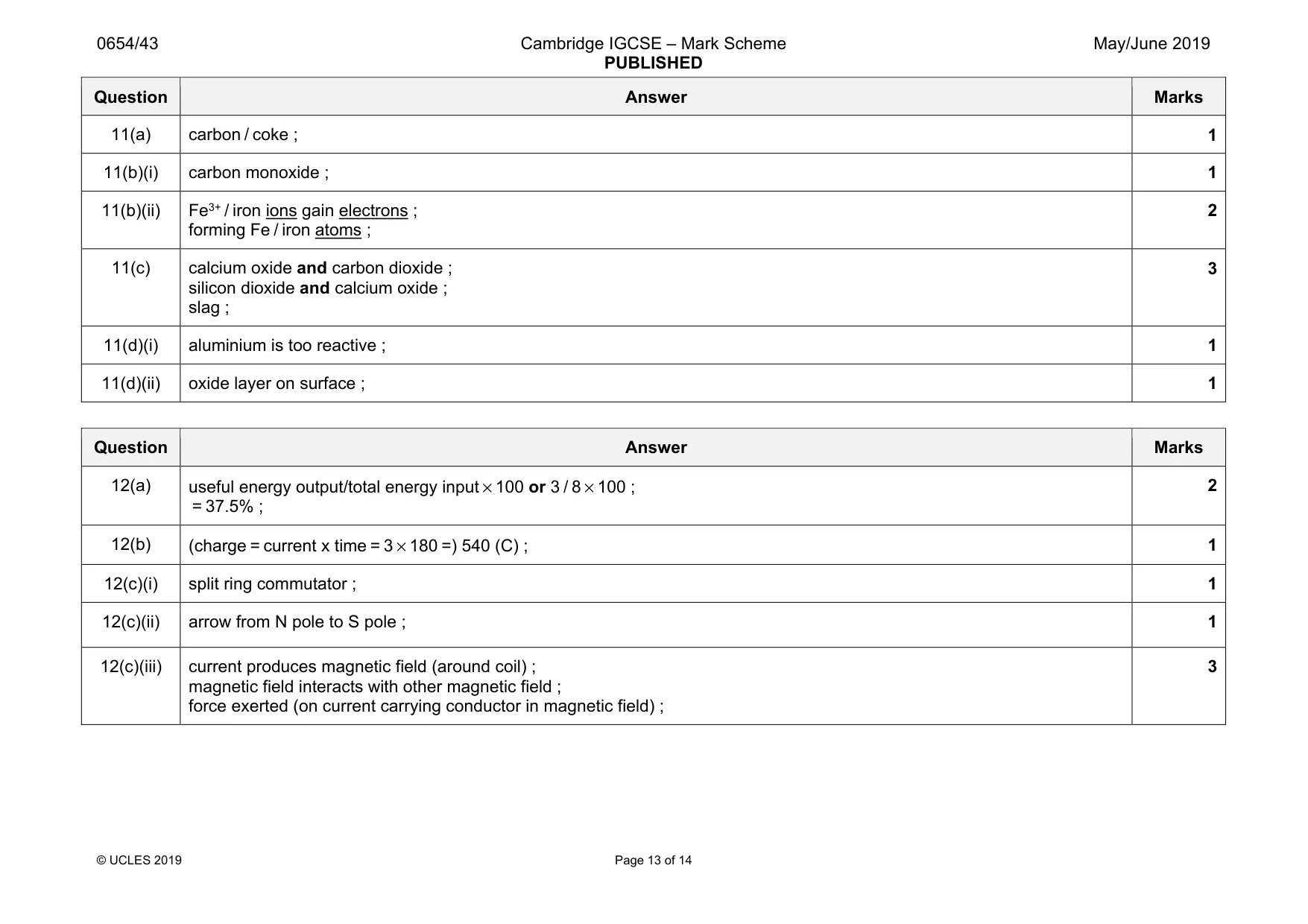
Mark scheme: 11(a) carbon / coke ; 1 11(b)(i) carbon monoxide ; 1 11(b)(ii) Fe3+ / iron ions gain electrons ; forming Fe / iron atoms ; 2 11(c) calcium oxide and carbon dioxide ; silicon dioxide and calcium oxide ; slag ; 3 11(d)(i) aluminium is too reactive ; 1 11(d)(ii) oxide layer on surface ; 1
Q12 · A gardener using a leaf-blower
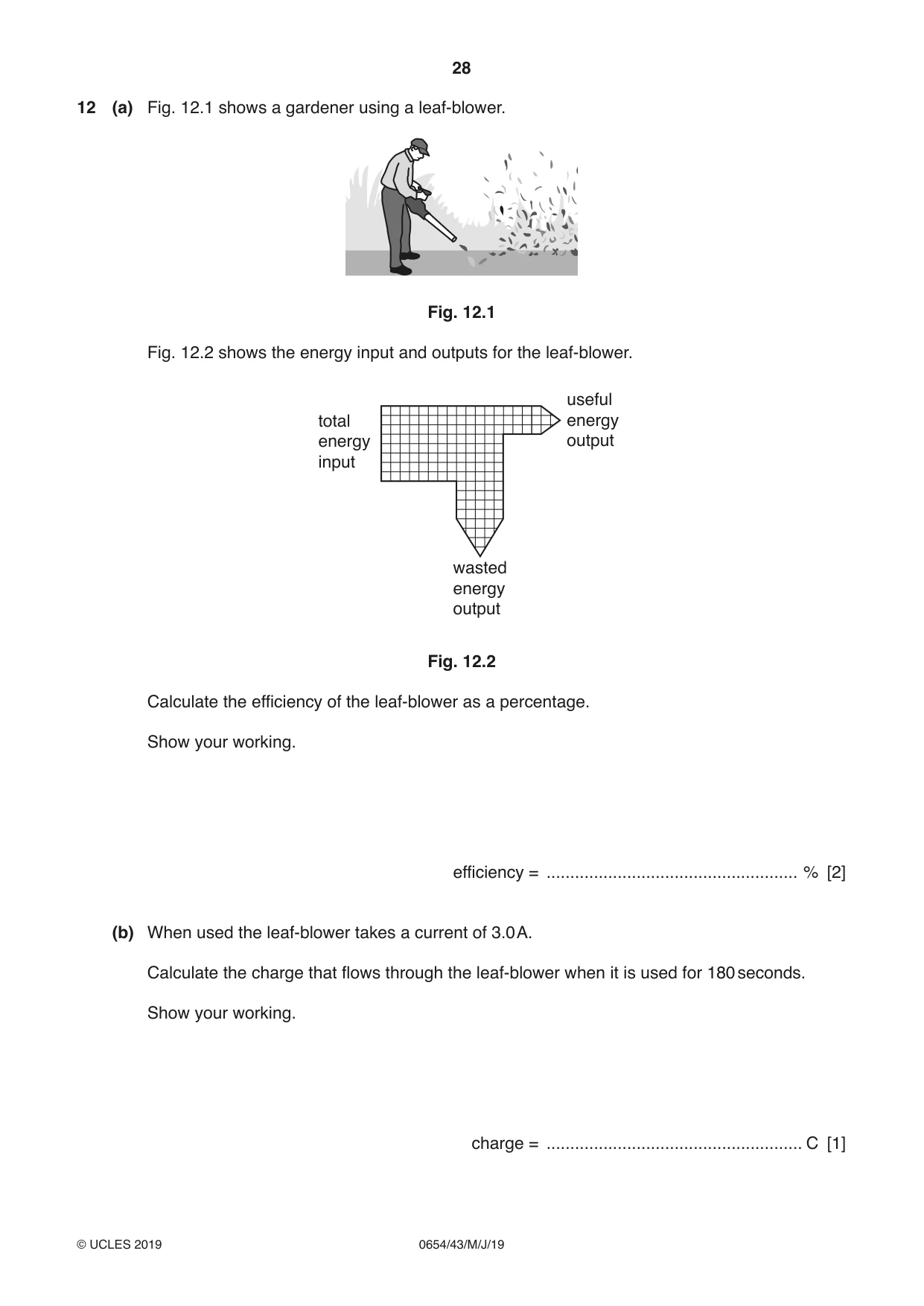
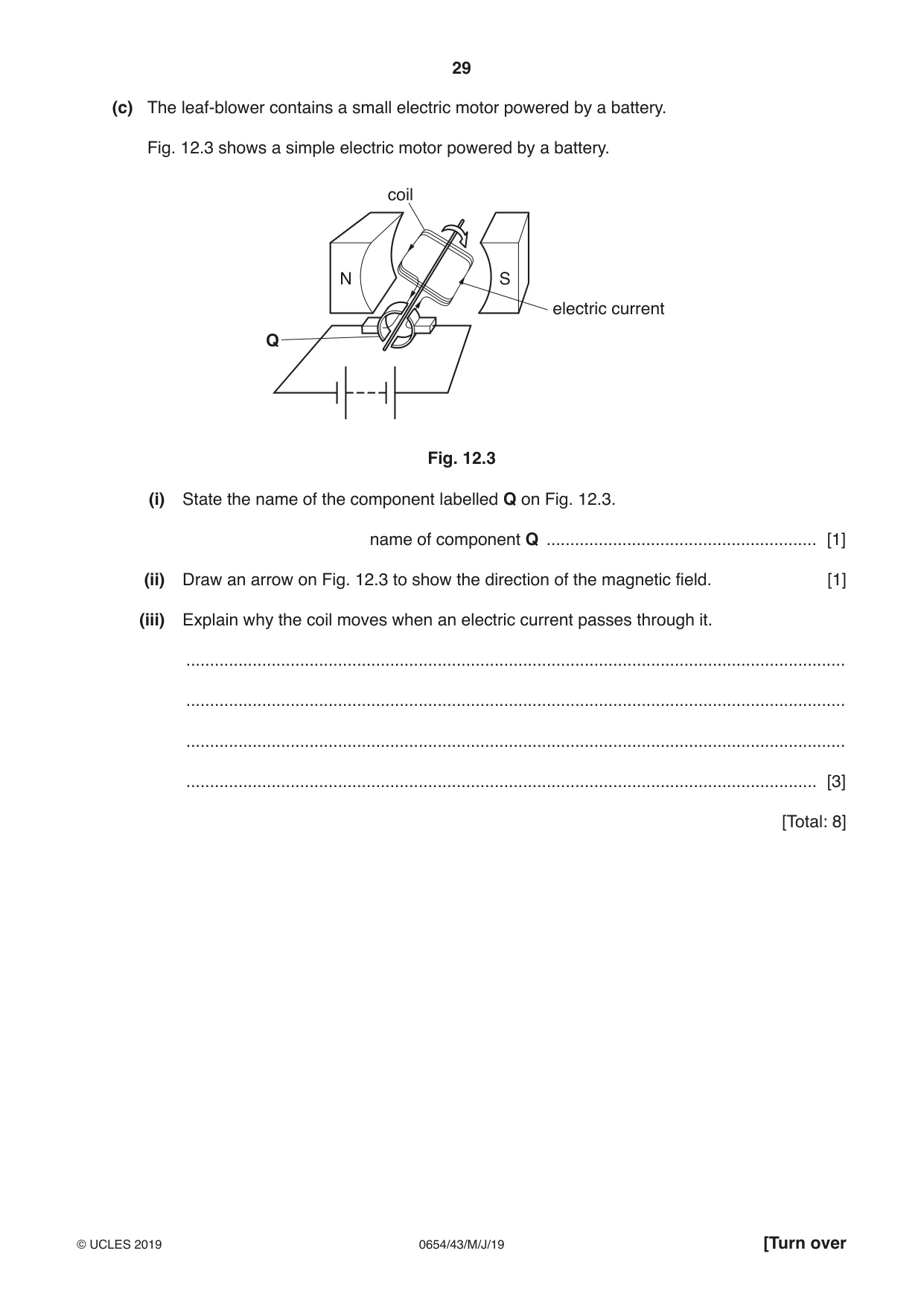
12 (a) Fig. 12.1 shows a gardener using a leaf-blower. Fig. 12.1 Fig. 12.2 shows the energy input and outputs for the leaf-blower. useful total energy energy output input wasted energy output Fig. 12.2 Calculate the efficiency of the leaf-blower as a percentage. Show your working. efficiency = ..................................................... % [2] (b) When used the leaf-blower takes a current of 3.0 A. Calculate the charge that flows through the leaf-blower when it is used for 180 seconds. Show your working. charge = ...................................................... C [1] (c) The leaf-blower contains a small electric motor powered by a battery. Fig. 12.3 shows a simple electric motor powered by a battery. coil N S electric current Q Fig. 12.3 (i) State the name of the component labelled Q on Fig. 12.3. name of component Q ......................................................... [1] (ii) Draw an arrow on Fig. 12.3 to show the direction of the magnetic field. [1] (iii) Explain why the coil moves when an electric current passes through it. ........................................................................................................................................... ........................................................................................................................................... ........................................................................................................................................... ..................................................................................................................................... [3] [Total: 8]
Mark scheme: 12(a) = 37.5% ; 2 12(b) (charge = current x time = 3 × 180 =) 540 (C) ; 1 12(c)(i) split ring commutator ; 1 12(c)(ii) arrow from N pole to S pole ; 1 12(c)(iii) current produces magnetic field (around coil) ; magnetic field interacts with other magnetic field ; force exerted (on current carrying conductor in magnetic field) ; 3
Q13 · A student investigates the effect of temperature on the movement of red dye through water
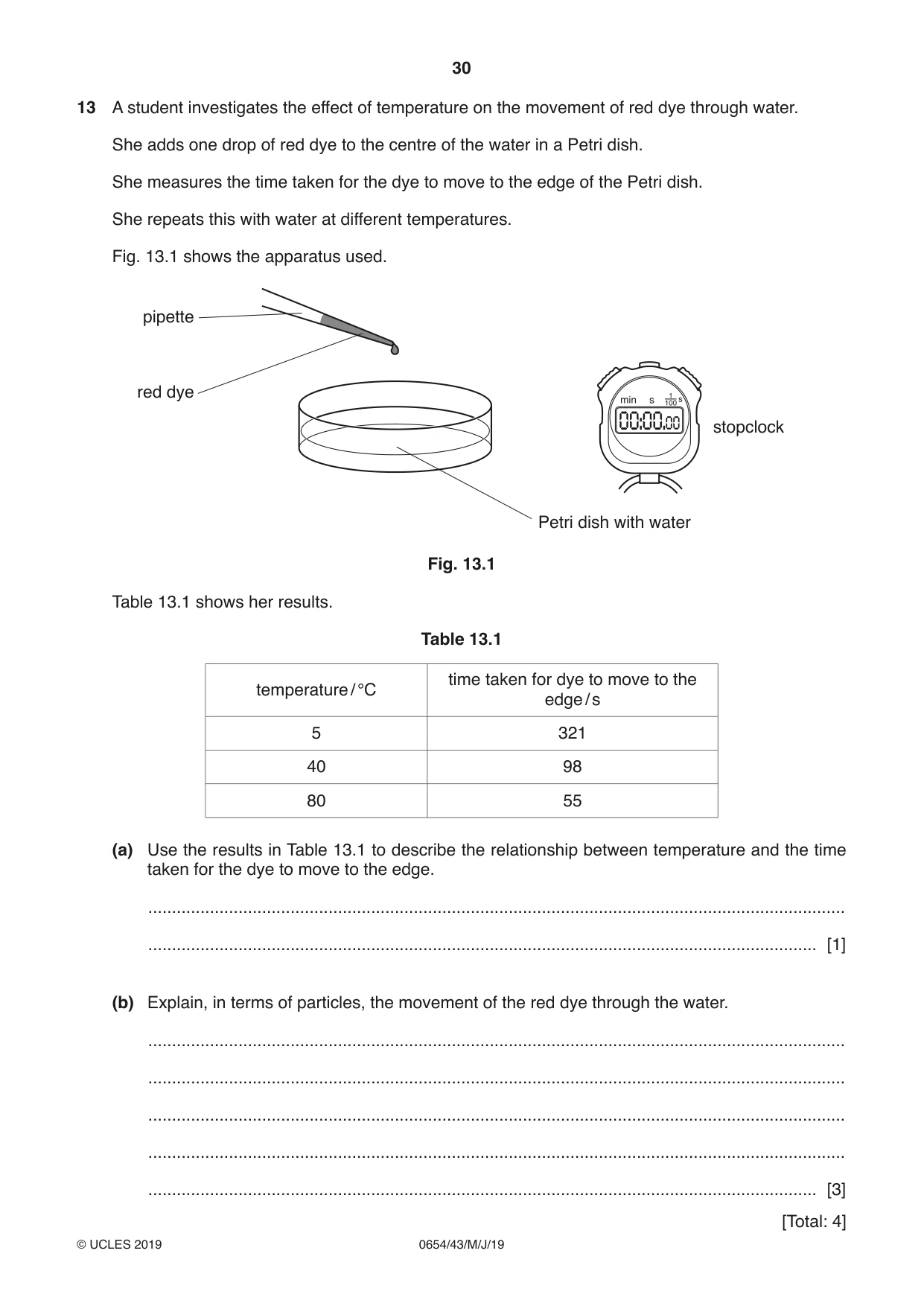
13 A student investigates the effect of temperature on the movement of red dye through water. She adds one drop of red dye to the centre of the water in a Petri dish. She measures the time taken for the dye to move to the edge of the Petri dish. She repeats this with water at different temperatures. Fig. 13.1 shows the apparatus used. pipette red dye stopclock Petri dish with water Fig. 13.1 Table 13.1 shows her results. Table 13.1 time taken for dye to move to the temperature / °C edge / s 5 321 40 98 80 55 (a) Use the results in Table 13.1 to describe the relationship between temperature and the time taken for the dye to move to the edge. ................................................................................................................................................... ............................................................................................................................................. [1] (b) Explain, in terms of particles, the movement of the red dye through the water. ................................................................................................................................................... ................................................................................................................................................... ................................................................................................................................................... ................................................................................................................................................... ............................................................................................................................................. [3]
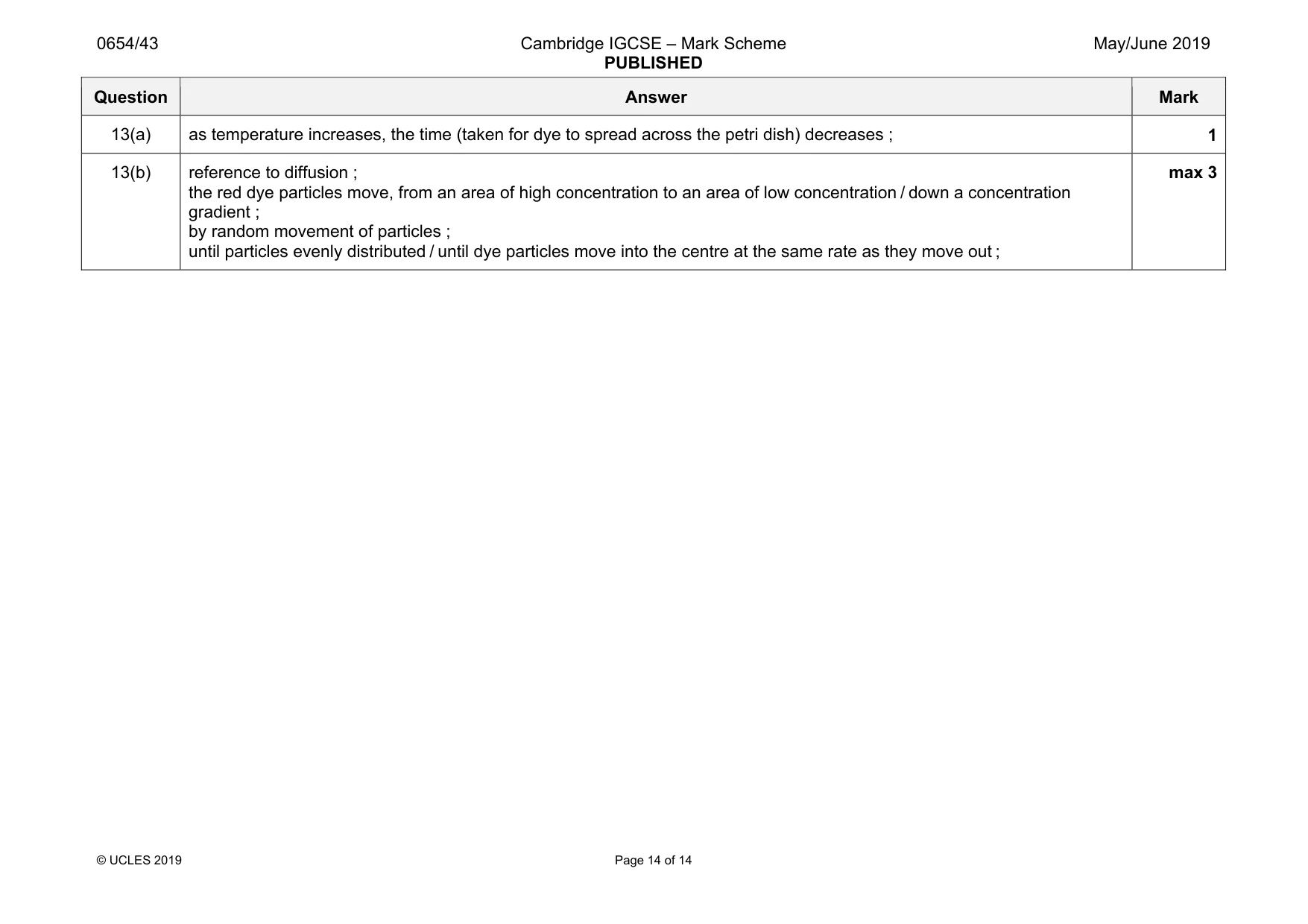
Mark scheme: 13(a) as temperature increases, the time (taken for dye to spread across the petri dish) decreases ; 1 13(b) reference to diffusion ; the red dye particles move, from an area of high concentration to an area of low concentration / down a concentration gradient ; by random movement of particles ; until particles evenly distributed / until dye particles move into the centre at the same rate as they move out ; max 3
What was in this paper
The subtopics covered by these 13 questions, and how many questions each got. Open one in a new tab to see every Cambridge question on it.
What you needed in this session
Cambridge’s own grade thresholds for 2019 May/June, Paper 4 · Variant 3. A higher threshold means an easier paper — the bar moves with how the cohort did.