Cambridge IGCSE Sciences - Co-ordinated (Double) 0654 — 2023 Oct/Nov Paper 4 · Variant 1
0654/41/O/N/23 · 12 questions · 120 marks · ≈135 min
The question paper and its mark scheme, free to read here and free to download. This is Cambridge’s own paper, exactly as it was sat.
Question paper28 pages


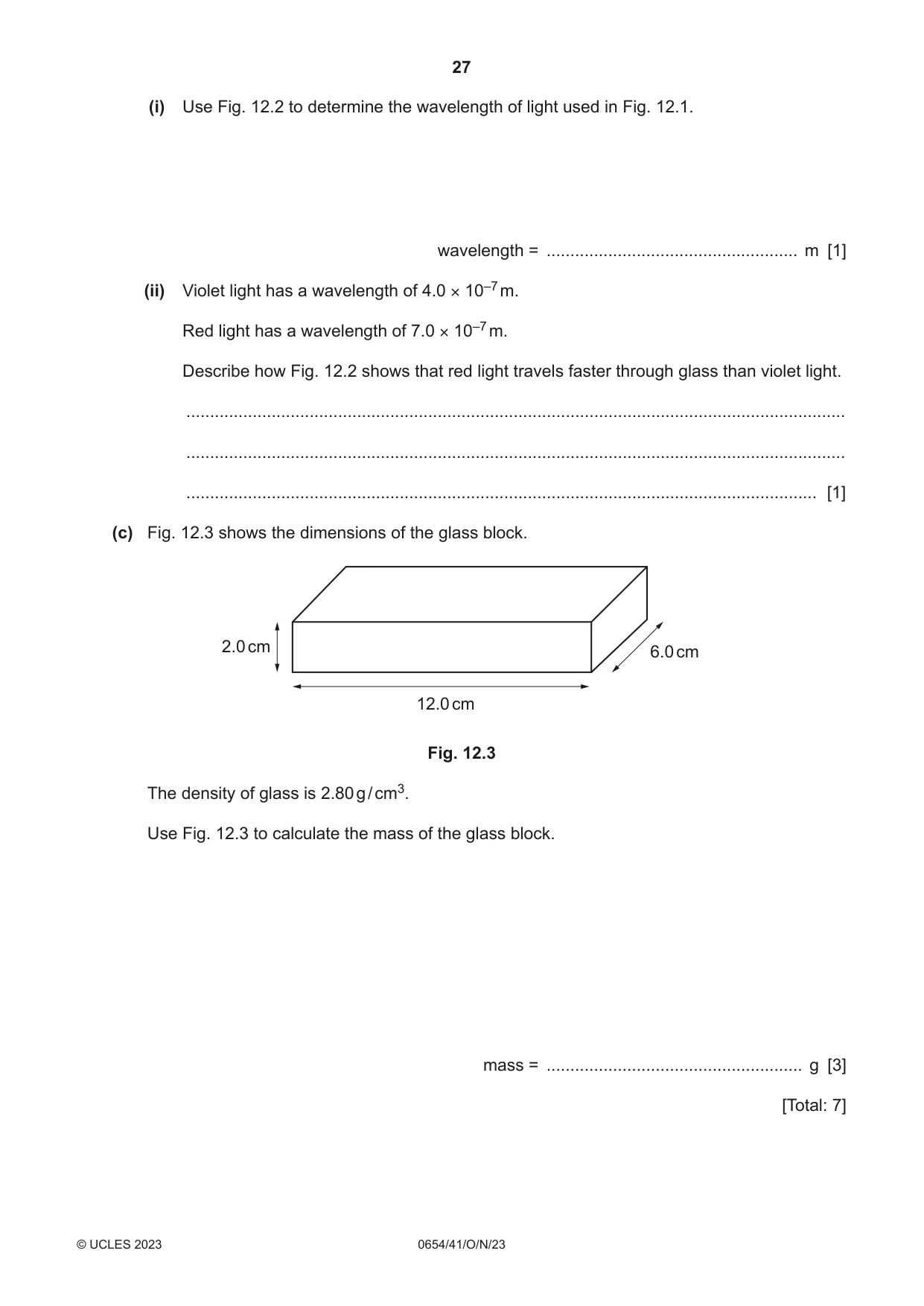
Mark scheme15 pages
Answers below. Sit the paper first if you are practising.
Questions as text
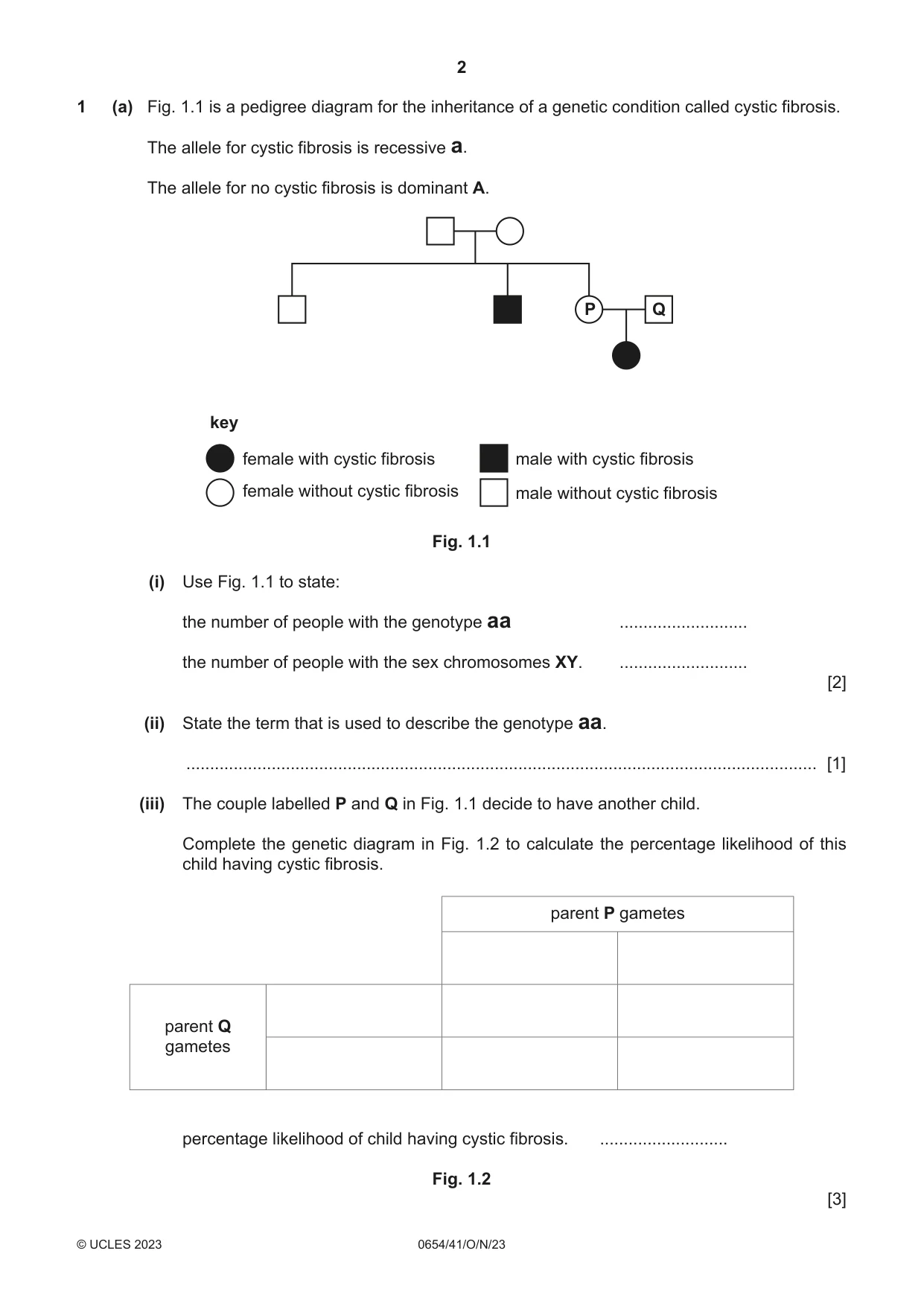
Q1 · A pedigree diagram for the inheritance of a genetic condition called cystic fibrosis
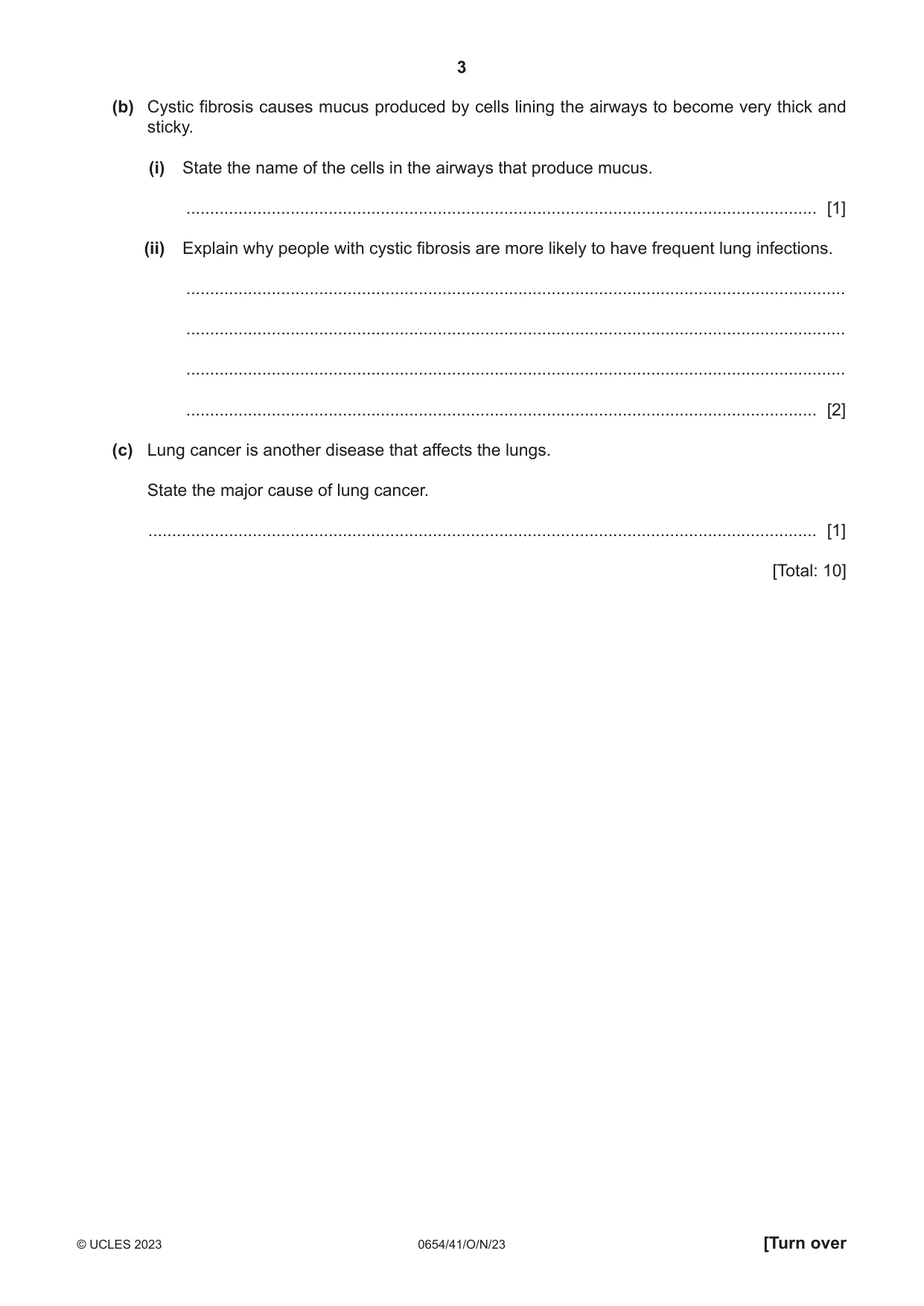
1 (a) Fig. 1.1 is a pedigree diagram for the inheritance of a genetic condition called cystic fibrosis. The allele for cystic fibrosis is recessive a. The allele for no cystic fibrosis is dominant A. P Q key female with cystic fibrosis male with cystic fibrosis female without cystic fibrosis male without cystic fibrosis Fig. 1.1 (i) Use Fig. 1.1 to state: the number of people with the genotype aa ........................... the number of people with the sex chromosomes XY. ........................... [2] (ii) State the term that is used to describe the genotype aa. ..................................................................................................................................... [1] (iii) The couple labelled P and Q in Fig. 1.1 decide to have another child. Complete the genetic diagram in Fig. 1.2 to calculate the percentage likelihood of this child having cystic fibrosis. parent P gametes parent Q gametes percentage likelihood of child having cystic fibrosis. ........................... Fig. 1.2 [3] (b) Cystic fibrosis causes mucus produced by cells lining the airways to become very thick and sticky. (i) State the name of the cells in the airways that produce mucus. ..................................................................................................................................... [1] (ii) Explain why people with cystic fibrosis are more likely to have frequent lung infections. ........................................................................................................................................... ........................................................................................................................................... ........................................................................................................................................... ..................................................................................................................................... [2] (c) Lung cancer is another disease that affects the lungs. State the major cause of lung cancer. ............................................................................................................................................. [1] [Total: 10]
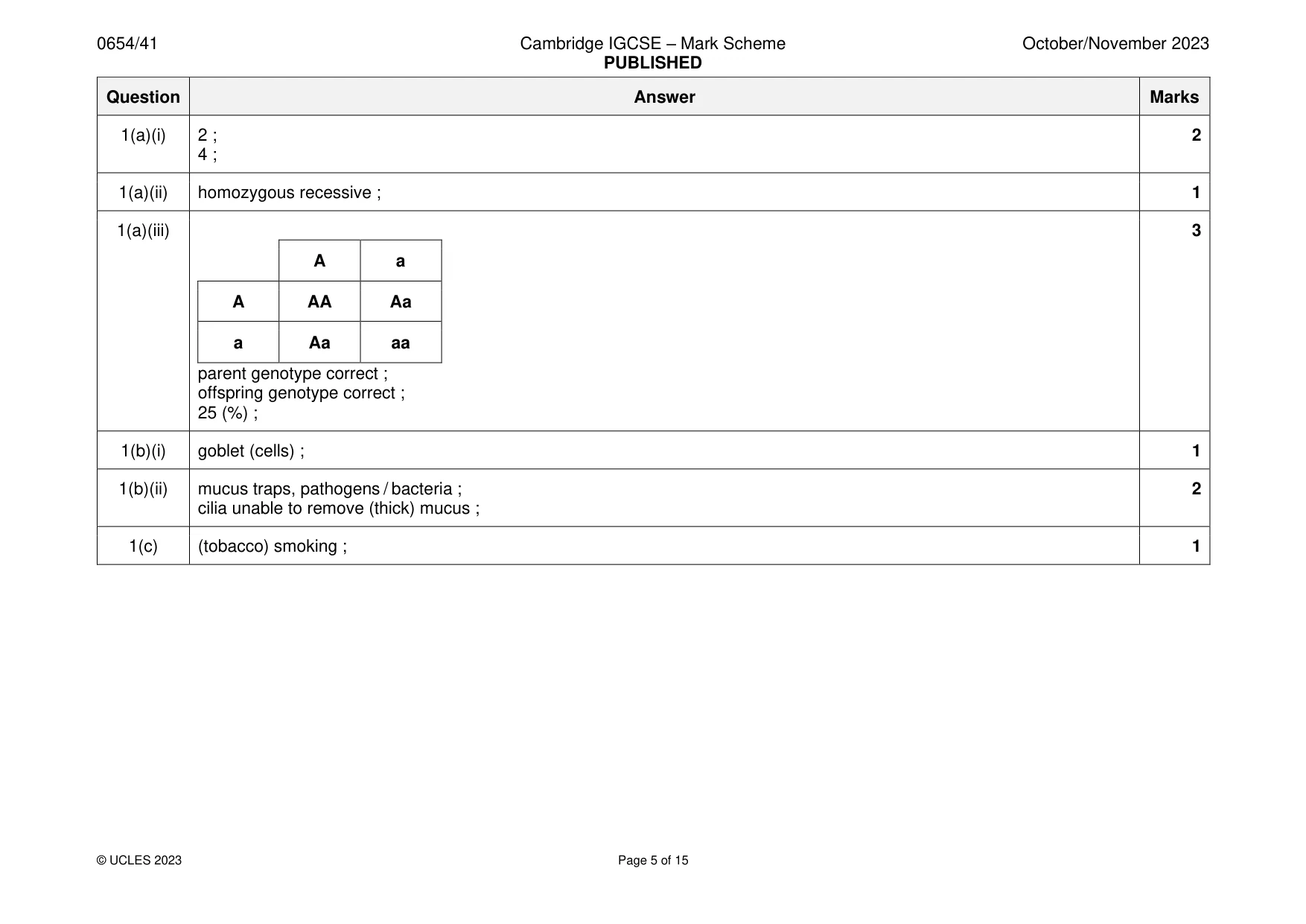
Mark scheme: Question Answer Marks 1(a)(i) 2 ; 2 4 ; 1(a)(ii) homozygous recessive ; 1 1(a)(iii) 3 A a A AA Aa a Aa aa parent genotype correct ; offspring genotype correct ; 25 (%) ; 1(b)(i) goblet (cells) ; 1 1(b)(ii) mucus traps, pathogens / bacteria ; 2 cilia unable to remove (thick) mucus ; 1(c) (tobacco) smoking ; 1
Q2 · Crude oil contains hydrocarbon molecules
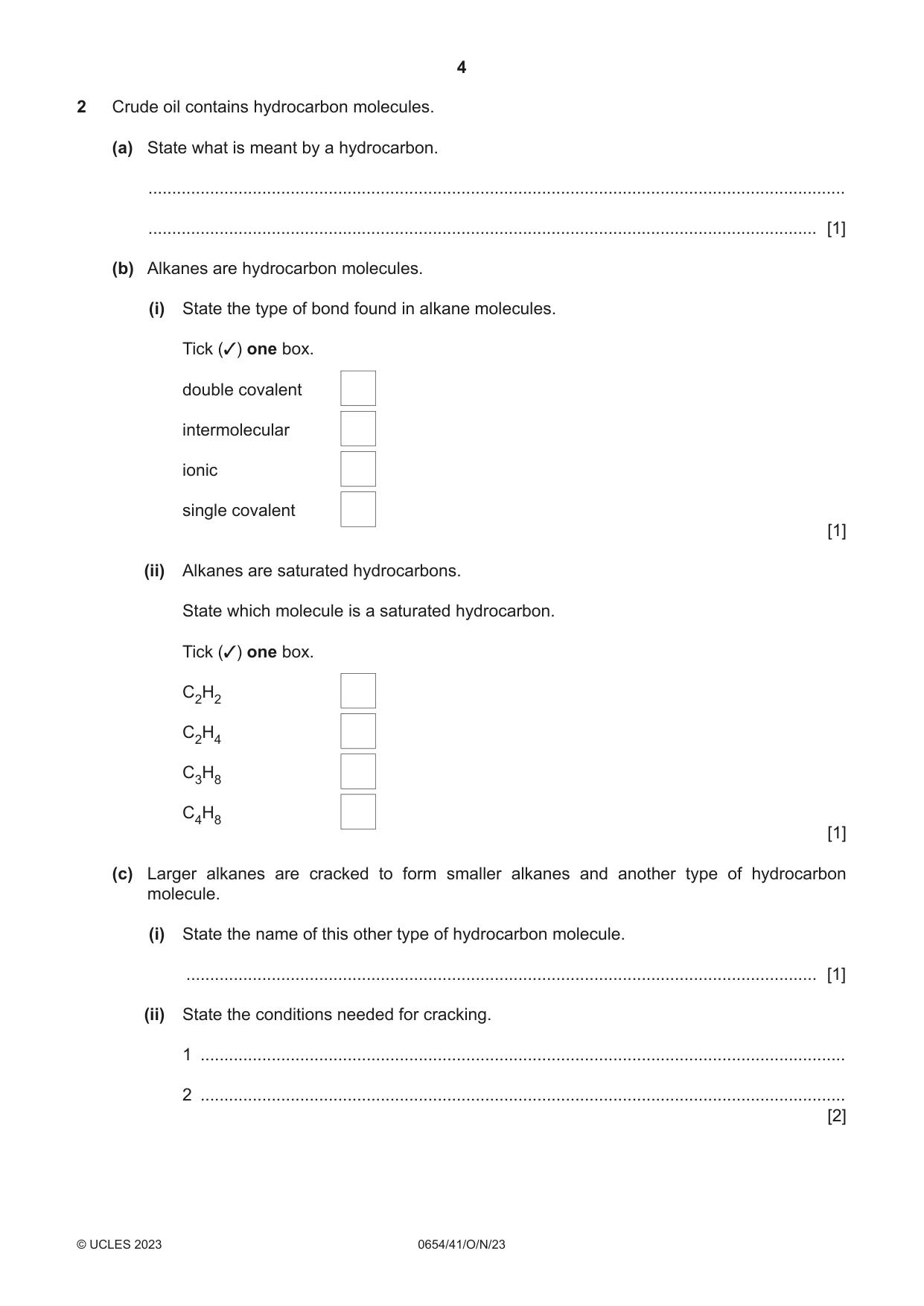
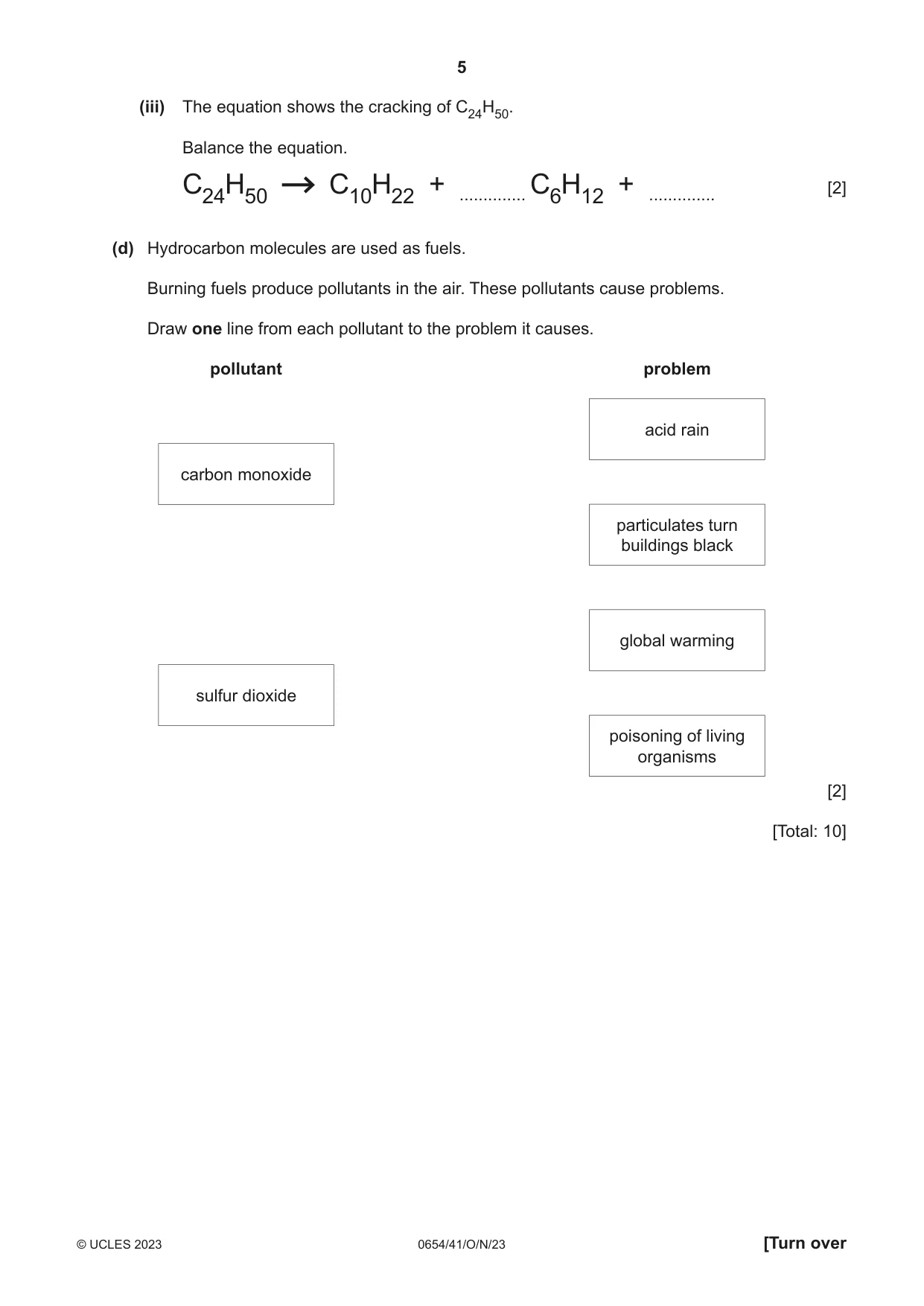
2 Crude oil contains hydrocarbon molecules. (a) State what is meant by a hydrocarbon. ................................................................................................................................................... ............................................................................................................................................. [1] (b) Alkanes are hydrocarbon molecules. (i) State the type of bond found in alkane molecules. Tick (3) one box. double covalent intermolecular ionic single covalent [1] (ii) Alkanes are saturated hydrocarbons. State which molecule is a saturated hydrocarbon. Tick (3) one box. C2H2 C2H4 C3H8 C4H8 [1] (c) Larger alkanes are cracked to form smaller alkanes and another type of hydrocarbon molecule. (i) State the name of this other type of hydrocarbon molecule. ..................................................................................................................................... [1] (ii) State the conditions needed for cracking. 1 ........................................................................................................................................ 2 ........................................................................................................................................ [2] (iii) The equation shows the cracking of C24H50. Balance the equation. [2] C24H50 C10H22 + .............. C6H12 + .............. (d) Hydrocarbon molecules are used as fuels. Burning fuels produce pollutants in the air. These pollutants cause problems. Draw one line from each pollutant to the problem it causes. pollutant problem acid rain carbon monoxide particulates turn buildings black global warming sulfur dioxide poisoning of living organisms [2] [Total: 10]
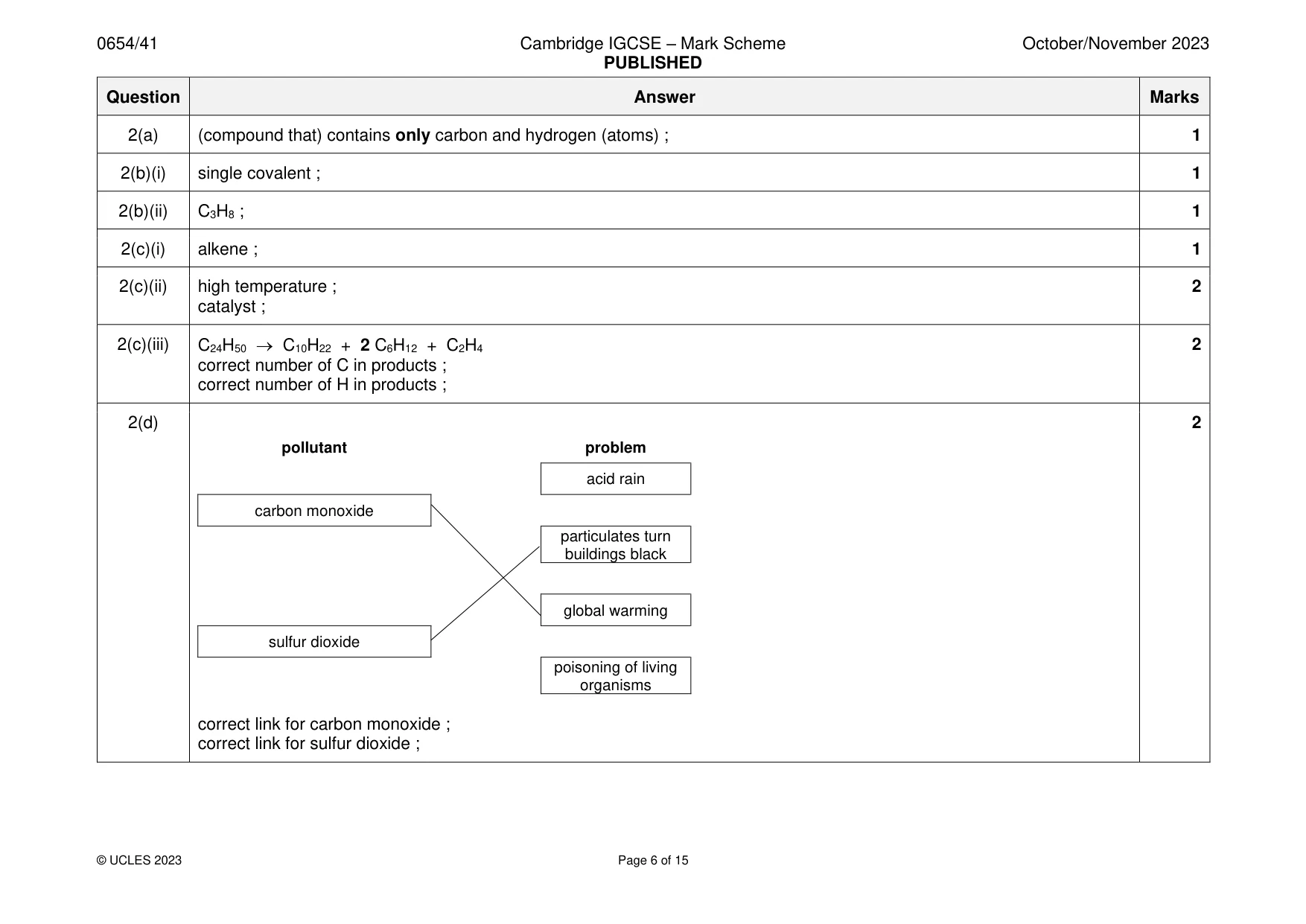
Mark scheme: 2(a) (compound that) contains only carbon and hydrogen (atoms) ; 1 2(b)(i) single covalent ; 1 2(b)(ii) C3H8 ; 1 2(c)(i) alkene ; 1 2(c)(ii) high temperature ; 2 catalyst ; 2(c)(iii) C24H50 → C10H22 + 2 C6H12 + C2H4 2 correct number of C in products ; correct number of H in products ; 2(d) 2 pollutant problem acid rain carbon monoxide particulates turn buildings black global warming sulfur dioxide poisoning of living organisms correct link for carbon monoxide ; correct link for sulfur dioxide ;
Q3 · Nuclear power stations use nuclear fission to generate electricity
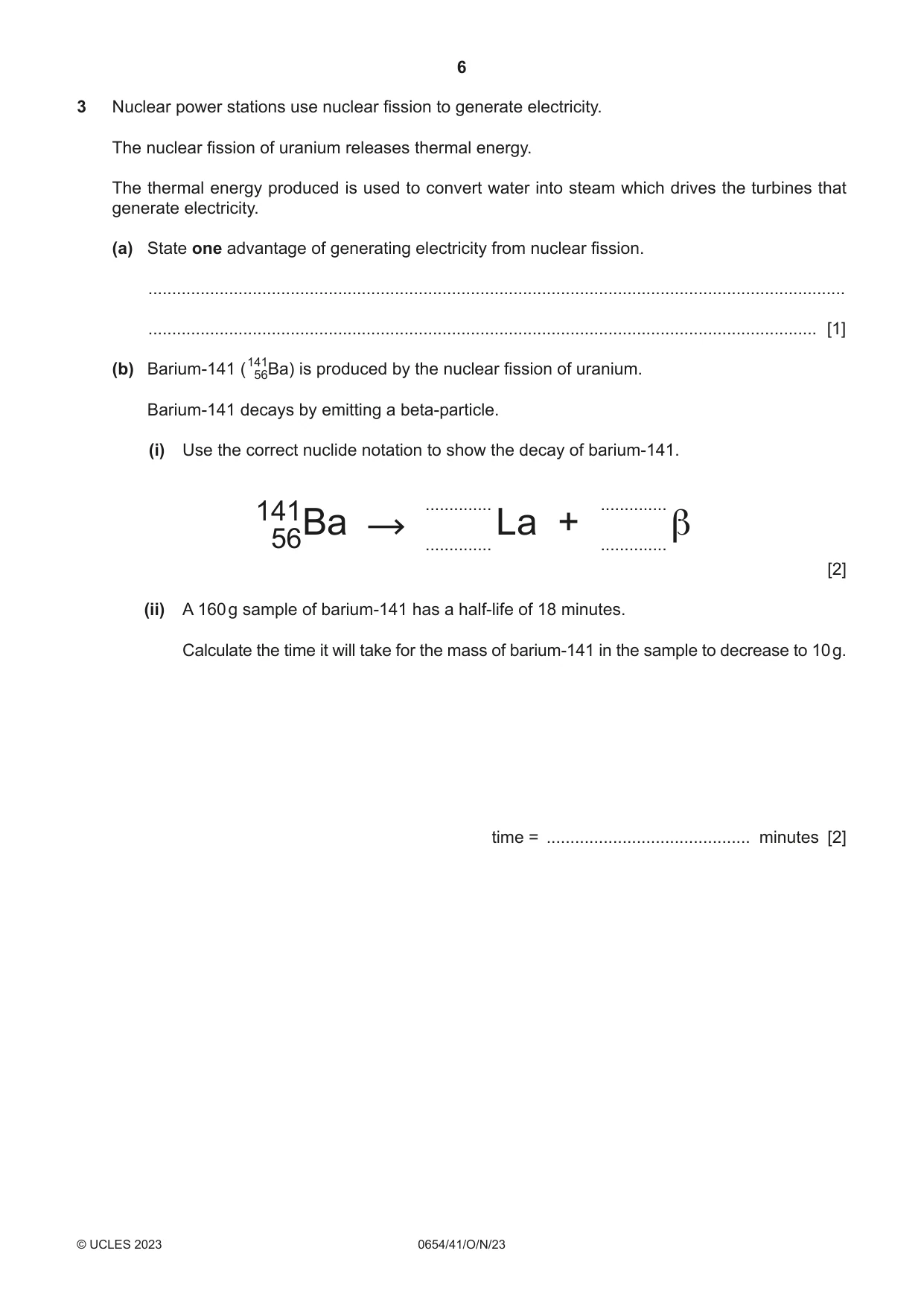
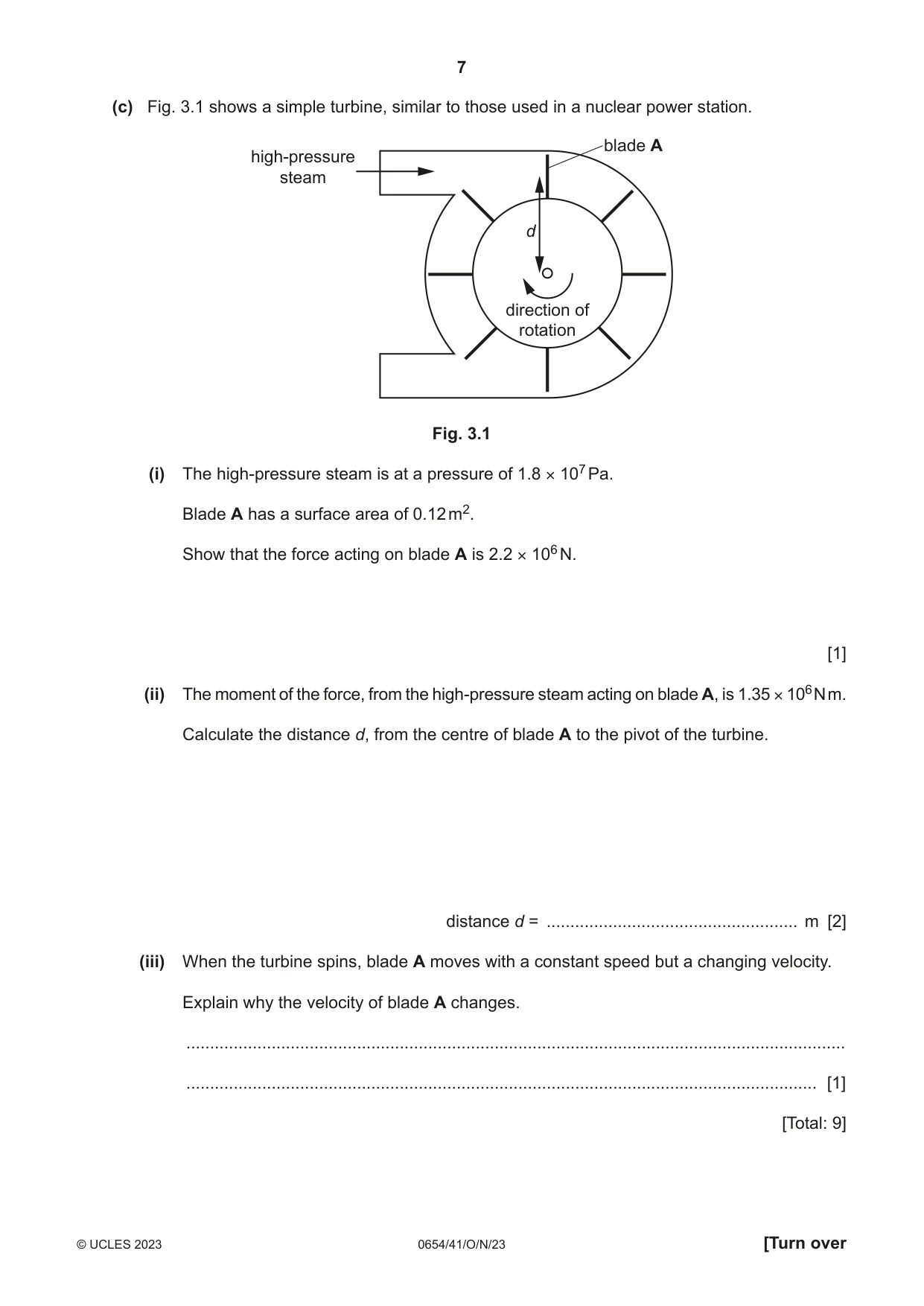
3 Nuclear power stations use nuclear fission to generate electricity. The nuclear fission of uranium releases thermal energy. The thermal energy produced is used to convert water into steam which drives the turbines that generate electricity. (a) State one advantage of generating electricity from nuclear fission. ................................................................................................................................................... ............................................................................................................................................. [1] (b) Barium-141 (14156Ba) is produced by the nuclear fission of uranium. Barium-141 decays by emitting a beta-particle. (i) Use the correct nuclide notation to show the decay of barium-141. 141 .............. .............. 56Ba ..............La + ..............β [2] (ii) A 160 g sample of barium-141 has a half-life of 18 minutes. Calculate the time it will take for the mass of barium-141 in the sample to decrease to 10 g. time = ........................................... minutes [2] (c) Fig. 3.1 shows a simple turbine, similar to those used in a nuclear power station. blade A high-pressure steam d direction of rotation Fig. 3.1 (i) The high-pressure steam is at a pressure of 1.8 × 10⁷ Pa. Blade A has a surface area of 0.12 m2. Show that the force acting on blade A is 2.2 × 10⁶ N. [1] (ii) The moment of the force, from the high-pressure steam acting on blade A, is 1.35 × 10⁶ N m. Calculate the distance d, from the centre of blade A to the pivot of the turbine. distance d = ..................................................... m [2] (iii) When the turbine spins, blade A moves with a constant speed but a changing velocity. Explain why the velocity of blade A changes. ........................................................................................................................................... ..................................................................................................................................... [1] [Total: 9]
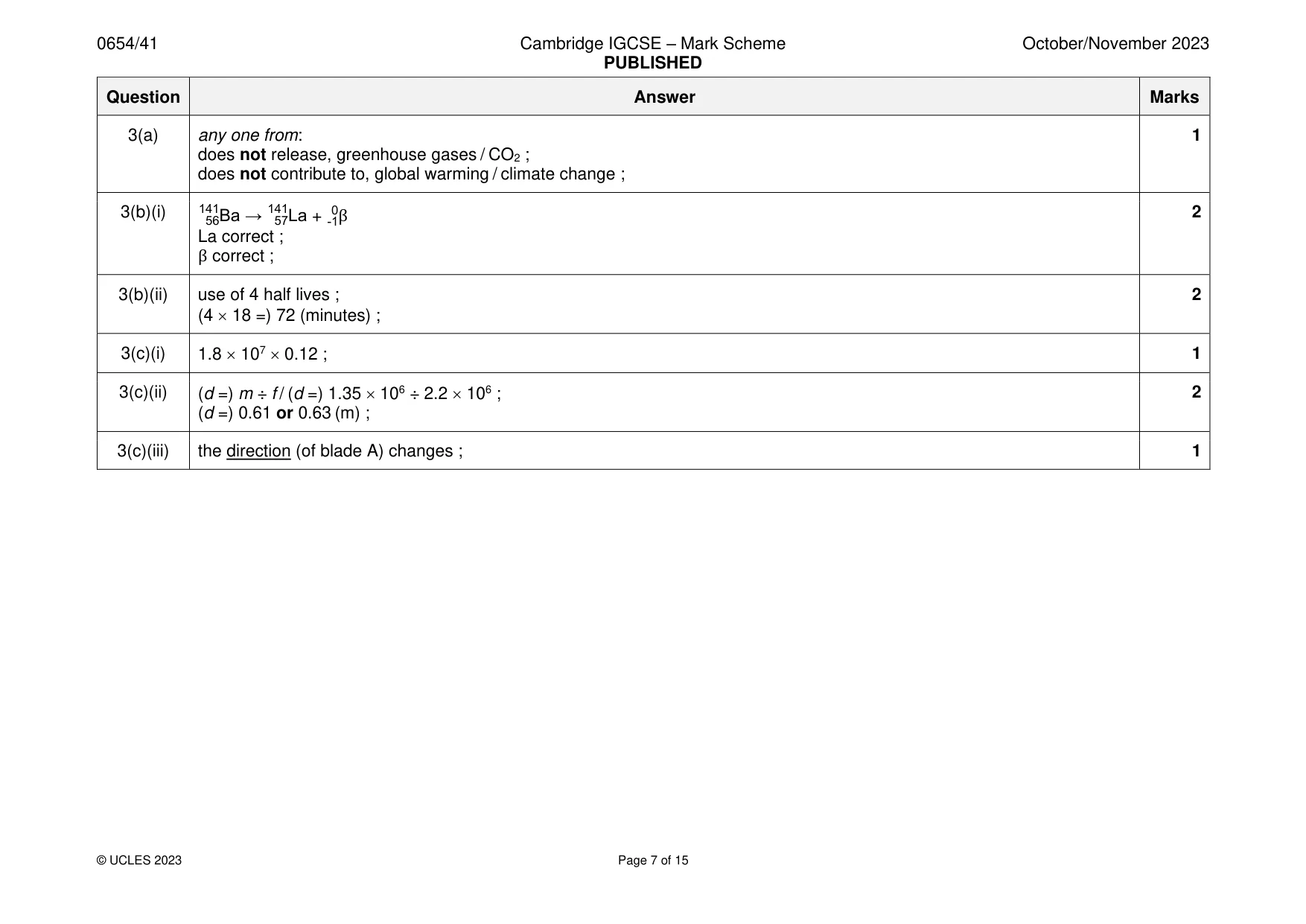
Mark scheme: 3(a) any one from: 1 does not release, greenhouse gases / CO2 ; does not contribute to, global warming / climate change ; 3(b)(i) 141 56Ba → 14157La + -10β 2 La correct ; β correct ; 3(b)(ii) use of 4 half lives ; 2 (4 18 =) 72 (minutes) ; 3(c)(i) 1.8 107 0.12 ; 1 3(c)(ii) (d =) m ÷ f / (d =) 1.35 106 ÷ 2.2 106 ; 2 (d =) 0.61 or 0.63 (m) ; 3(c)(iii) the direction (of blade A) changes ; 1
Q4 · A student investigates the effect of different types of sugar on the anaerobic…
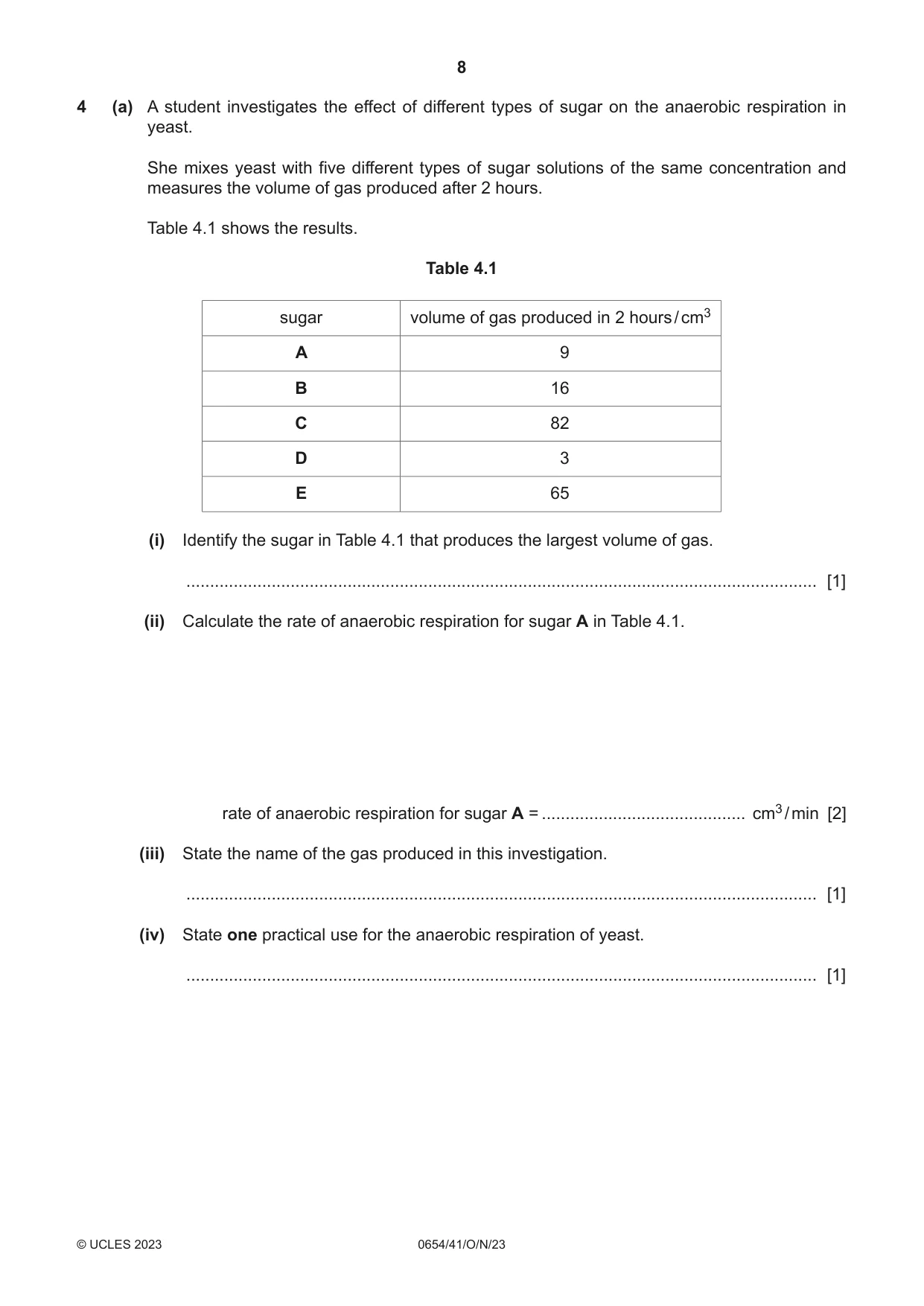
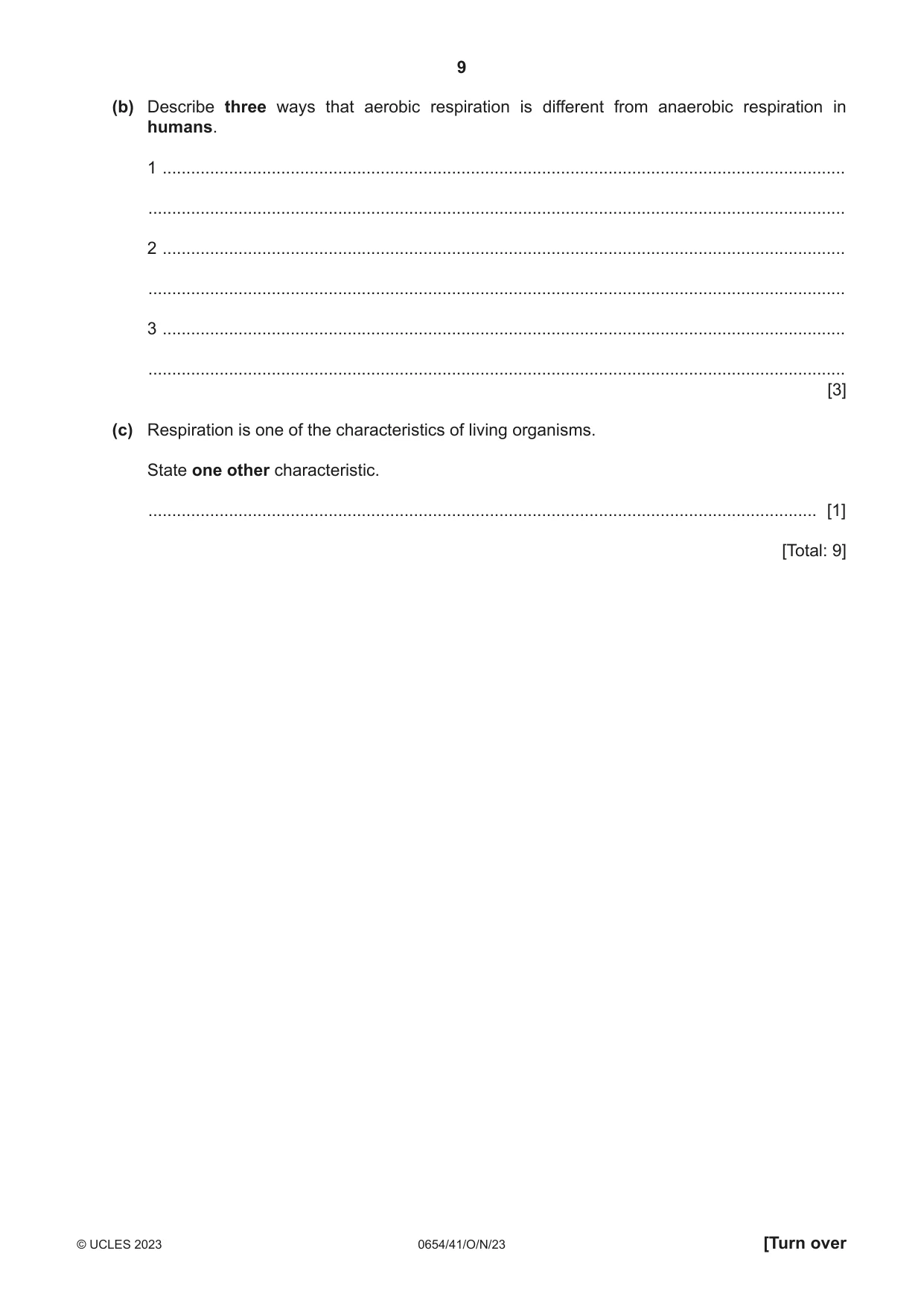
4 (a) A student investigates the effect of different types of sugar on the anaerobic respiration in yeast. She mixes yeast with five different types of sugar solutions of the same concentration and measures the volume of gas produced after 2 hours. Table 4.1 shows the results. Table 4.1 sugar volume of gas produced in 2 hours / cm3 A 9 B 16 C 82 D 3 E 65 (i) Identify the sugar in Table 4.1 that produces the largest volume of gas. ..................................................................................................................................... [1] (ii) Calculate the rate of anaerobic respiration for sugar A in Table 4.1. rate of anaerobic respiration for sugar A = ........................................... cm3 / min [2] (iii) State the name of the gas produced in this investigation. ..................................................................................................................................... [1] (iv) State one practical use for the anaerobic respiration of yeast. ..................................................................................................................................... [1] (b) Describe three ways that aerobic respiration is different from anaerobic respiration in humans. 1 ................................................................................................................................................ ................................................................................................................................................... 2 ................................................................................................................................................ ................................................................................................................................................... 3 ................................................................................................................................................ ................................................................................................................................................... [3] (c) Respiration is one of the characteristics of living organisms. State one other characteristic. ............................................................................................................................................. [1] [Total: 9]
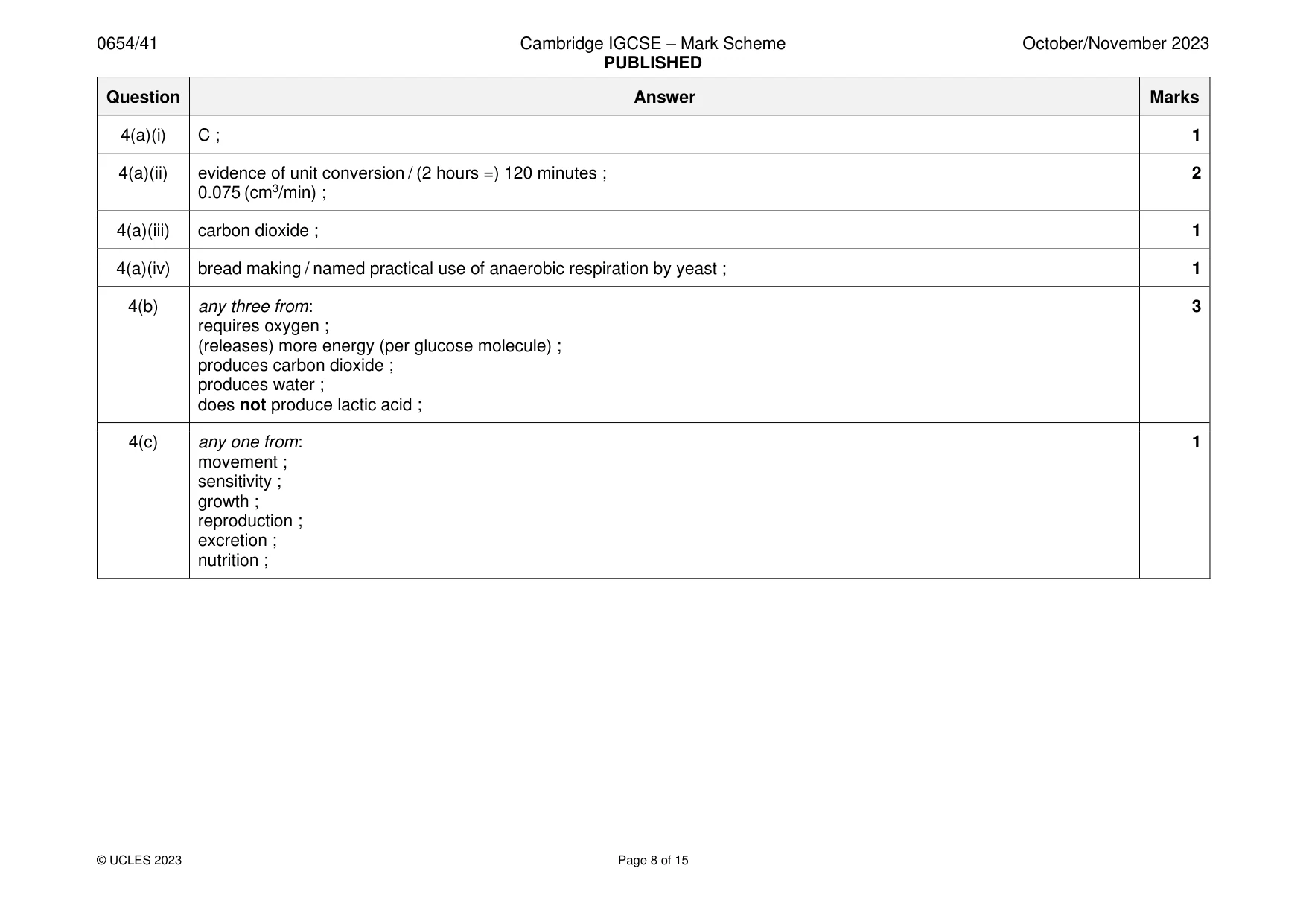
Mark scheme: 4(a)(i) C ; 1 4(a)(ii) evidence of unit conversion / (2 hours =) 120 minutes ; 2 0.075 (cm3/min) ; 4(a)(iii) carbon dioxide ; 1 4(a)(iv) bread making / named practical use of anaerobic respiration by yeast ; 1 4(b) any three from: 3 requires oxygen ; (releases) more energy (per glucose molecule) ; produces carbon dioxide ; produces water ; does not produce lactic acid ; 4(c) any one from: 1 movement ; sensitivity ; growth ; reproduction ; excretion ; nutrition ;
Q5 · The pH of a solution describes how acidic or alkaline it is
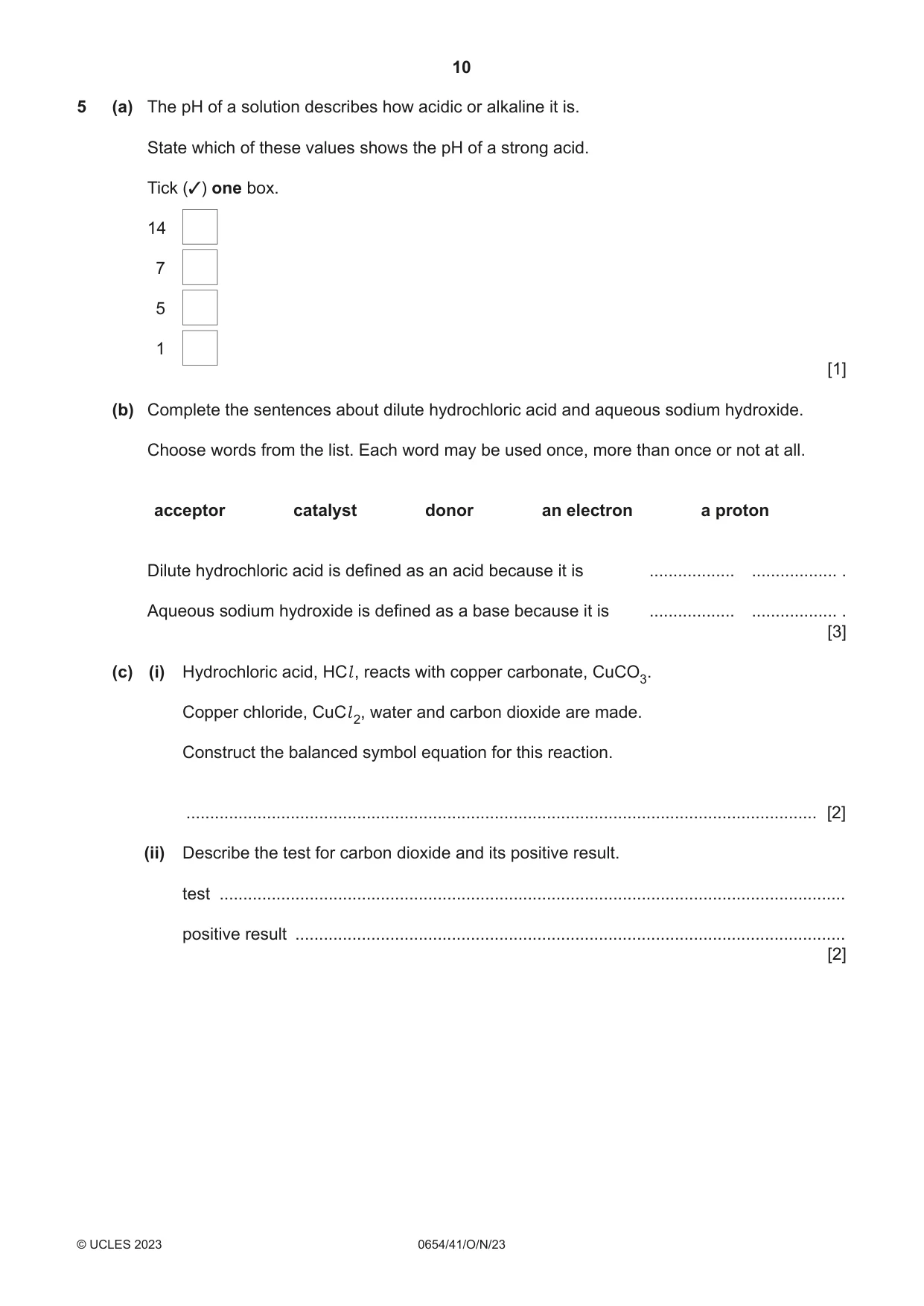
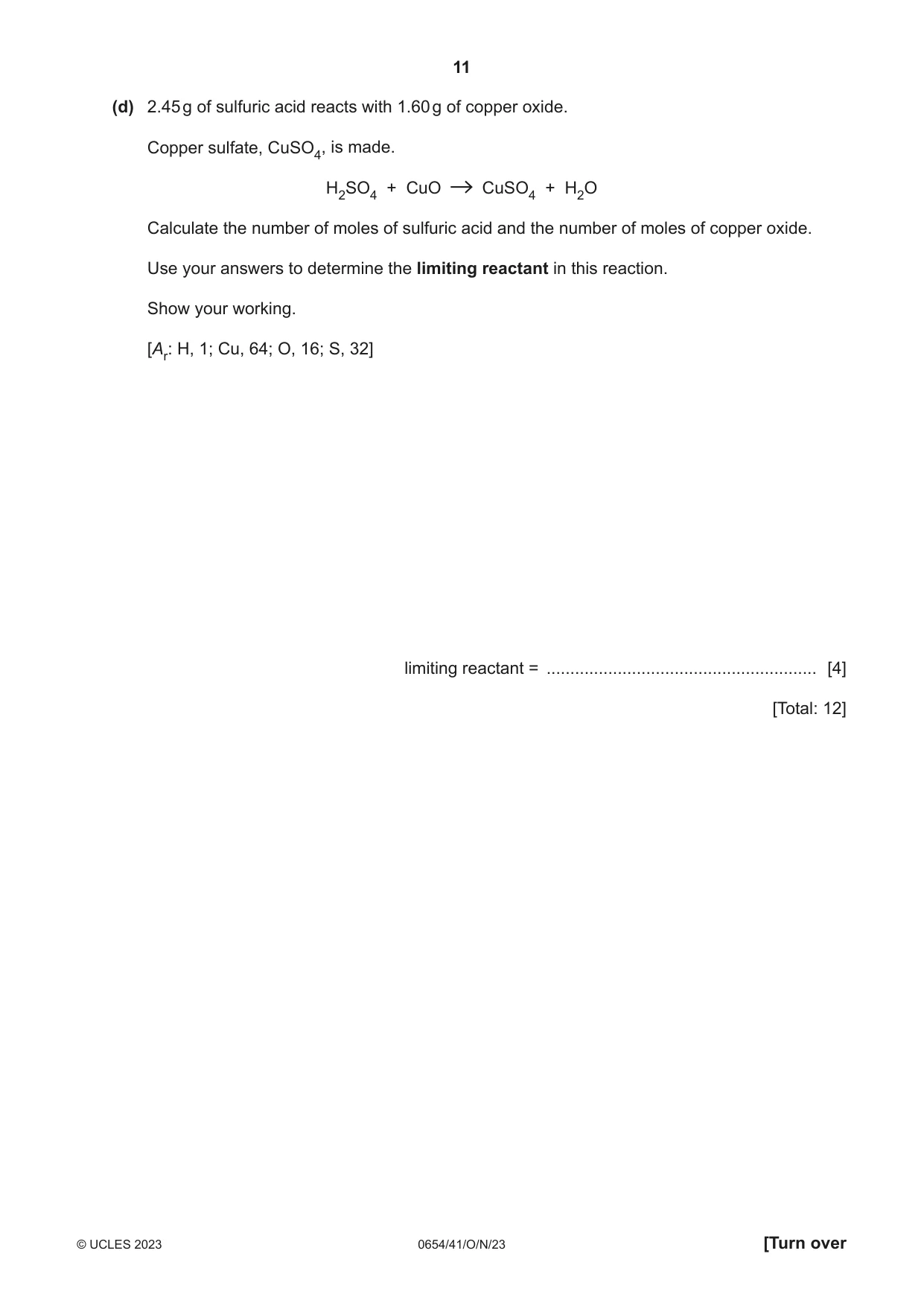
5 (a) The pH of a solution describes how acidic or alkaline it is. State which of these values shows the pH of a strong acid. Tick (3) one box. 14 7 5 1 [1] (b) Complete the sentences about dilute hydrochloric acid and aqueous sodium hydroxide. Choose words from the list. Each word may be used once, more than once or not at all. acceptor catalyst donor an electron a proton Dilute hydrochloric acid is defined as an acid because it is .................. .................. . Aqueous sodium hydroxide is defined as a base because it is .................. .................. . [3] (c) (i) Hydrochloric acid, HCl , reacts with copper carbonate, CuCO3. Copper chloride, CuCl 2, water and carbon dioxide are made. Construct the balanced symbol equation for this reaction. ..................................................................................................................................... [2] (ii) Describe the test for carbon dioxide and its positive result. test .................................................................................................................................... positive result .................................................................................................................... [2] (d) 2.45 g of sulfuric acid reacts with 1.60 g of copper oxide. Copper sulfate, CuSO4, is made. H2SO4 + CuO CuSO4 + H2O Calculate the number of moles of sulfuric acid and the number of moles of copper oxide. Use your answers to determine the limiting reactant in this reaction. Show your working. [Ar: H, 1; Cu, 64; O, 16; S, 32] limiting reactant = ......................................................... [4] [Total: 12]
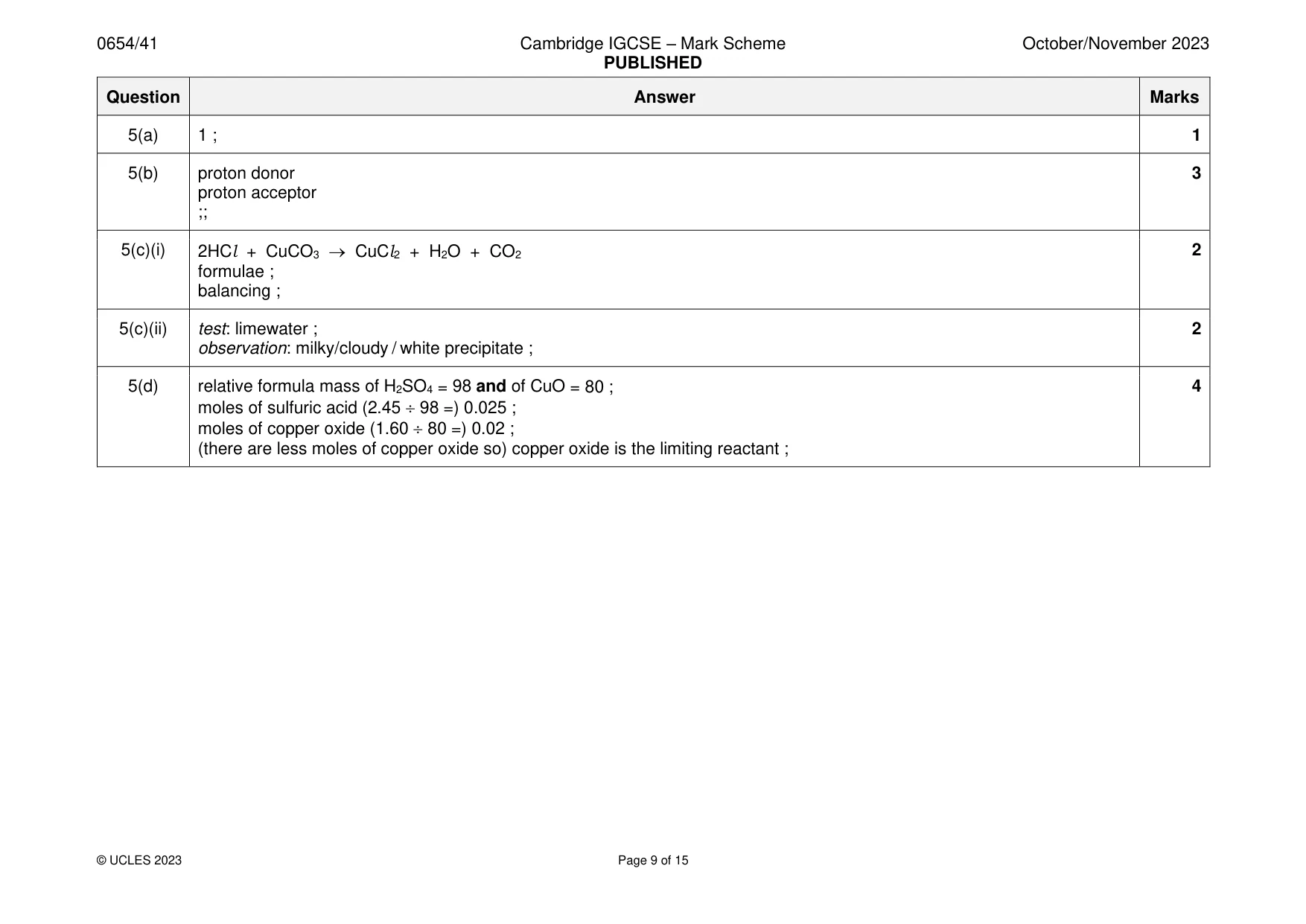
Mark scheme: 5(a) 1 ; 1 5(b) proton donor 3 proton acceptor ;; 5(c)(i) 2HCl + CuCO3 → CuCl2 + H2O + CO2 2 formulae ; balancing ; 5(c)(ii) test: limewater ; 2 observation: milky/cloudy / white precipitate ; 5(d) relative formula mass of H2SO4 = 98 and of CuO = 80 ; 4 moles of sulfuric acid (2.45 98 =) 0.025 ; moles of copper oxide (1.60 80 =) 0.02 ; (there are less moles of copper oxide so) copper oxide is the limiting reactant ;
More questions on The characteristic properties of acids and bases
Q6 · A bee collecting pollen from a flower
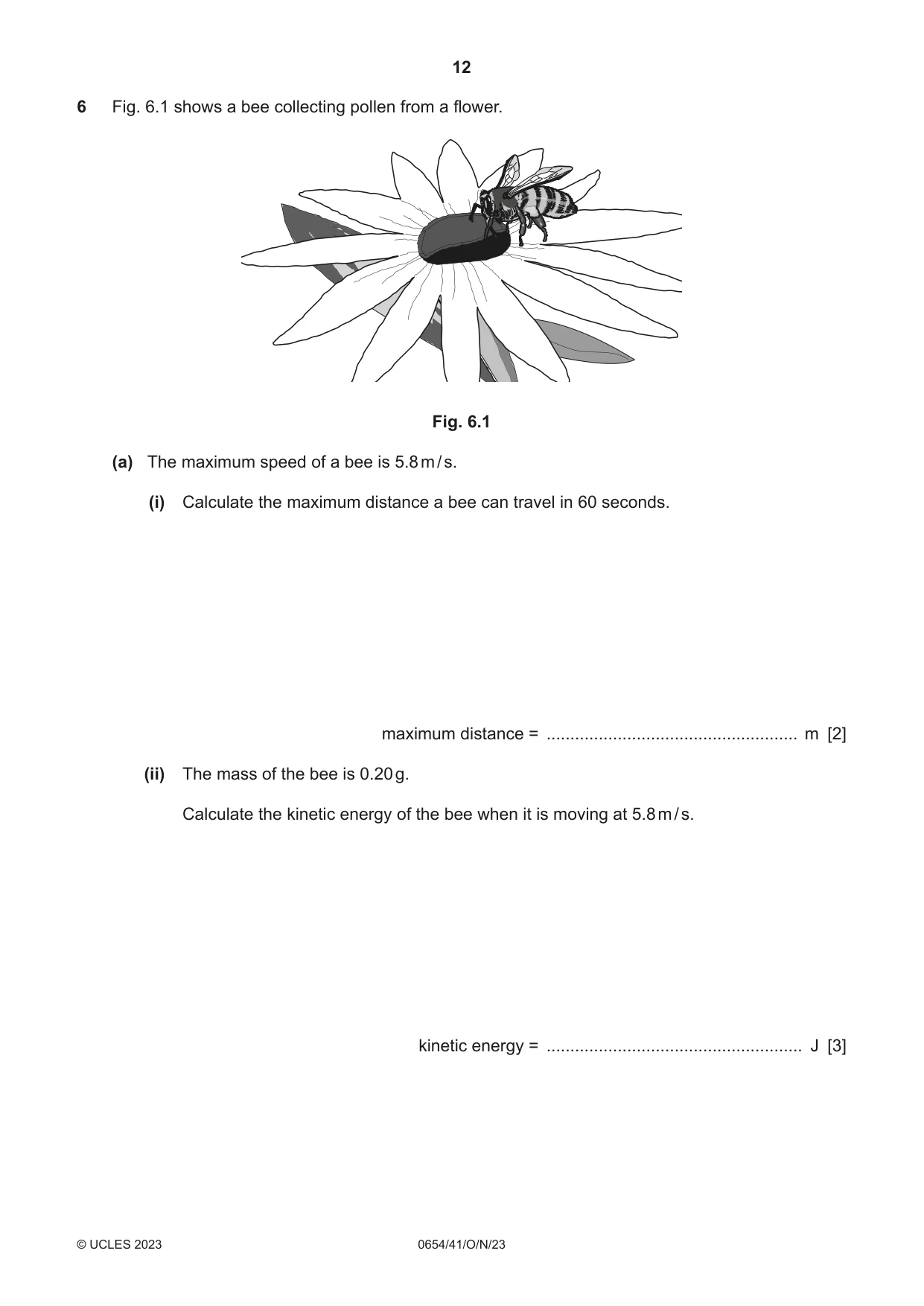
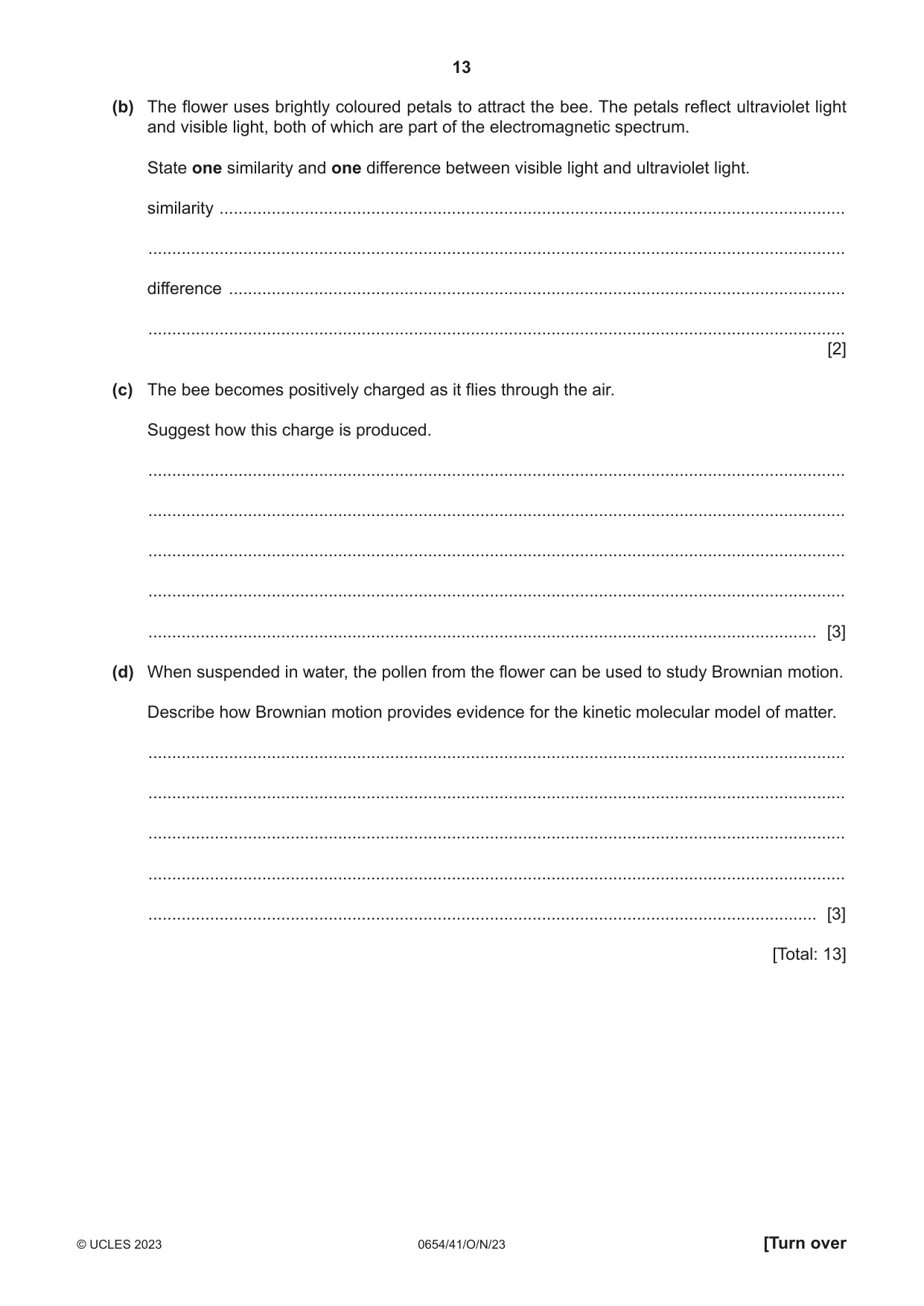
6 Fig. 6.1 shows a bee collecting pollen from a flower. Fig. 6.1 (a) The maximum speed of a bee is 5.8 m / s. (i) Calculate the maximum distance a bee can travel in 60 seconds. maximum distance = ..................................................... m [2] (ii) The mass of the bee is 0.20 g. Calculate the kinetic energy of the bee when it is moving at 5.8 m / s. kinetic energy = ...................................................... J [3] (b) The flower uses brightly coloured petals to attract the bee. The petals reflect ultraviolet light and visible light, both of which are part of the electromagnetic spectrum. State one similarity and one difference between visible light and ultraviolet light. similarity .................................................................................................................................... ................................................................................................................................................... difference .................................................................................................................................. ................................................................................................................................................... [2] (c) The bee becomes positively charged as it flies through the air. Suggest how this charge is produced. ................................................................................................................................................... ................................................................................................................................................... ................................................................................................................................................... ................................................................................................................................................... ............................................................................................................................................. [3] (d) When suspended in water, the pollen from the flower can be used to study Brownian motion. Describe how Brownian motion provides evidence for the kinetic molecular model of matter. ................................................................................................................................................... ................................................................................................................................................... ................................................................................................................................................... ................................................................................................................................................... ............................................................................................................................................. [3] [Total: 13]
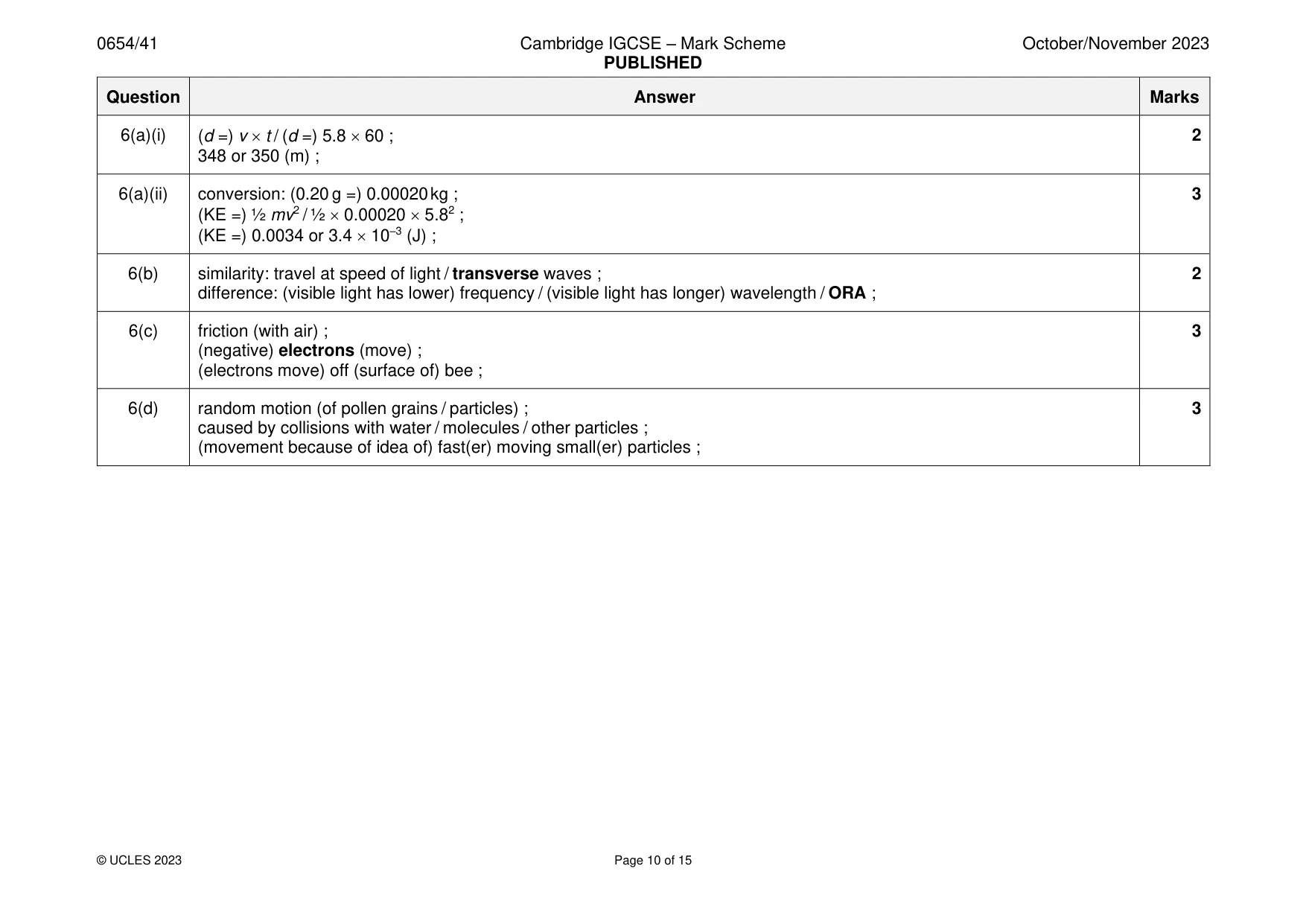
Mark scheme: 6(a)(i) (d =) v t / (d =) 5.8 60 ; 2 348 or 350 (m) ; 6(a)(ii) conversion: (0.20 g =) 0.00020 kg ; 3 (KE =) ½ mv2 / ½ 0.00020 5.82 ; (KE =) 0.0034 or 3.4 10–3 (J) ; 6(b) similarity: travel at speed of light / transverse waves ; 2 difference: (visible light has lower) frequency / (visible light has longer) wavelength / ORA ; 6(c) friction (with air) ; 3 (negative) electrons (move) ; (electrons move) off (surface of) bee ; 6(d) random motion (of pollen grains / particles) ; 3 caused by collisions with water / molecules / other particles ; (movement because of idea of) fast(er) moving small(er) particles ;
Q7 · A scientist measures the activity of the enzyme amylase at different temperatures
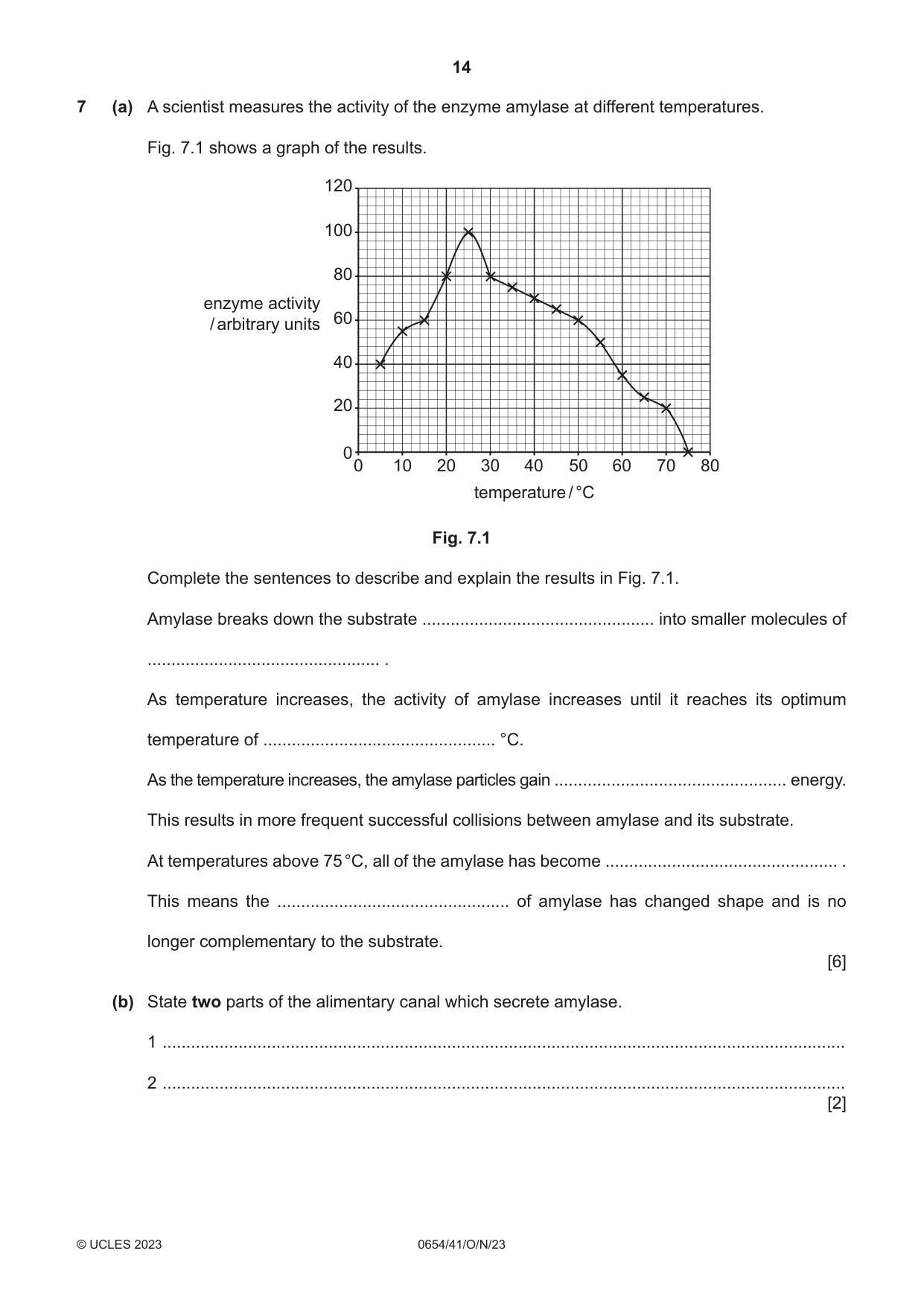
7 (a) A scientist measures the activity of the enzyme amylase at different temperatures. Fig. 7.1 shows a graph of the results. 120 100 80 enzyme activity 60 / arbitrary units 40 20 00 10 20 30 40 50 60 70 80 temperature / °C Fig. 7.1 Complete the sentences to describe and explain the results in Fig. 7.1. Amylase breaks down the substrate ................................................. into smaller molecules of ................................................. . As temperature increases, the activity of amylase increases until it reaches its optimum temperature of ................................................. °C. As the temperature increases, the amylase particles gain ................................................. energy. This results in more frequent successful collisions between amylase and its substrate. At temperatures above 75 °C, all of the amylase has become ................................................. . This means the ................................................. of amylase has changed shape and is no longer complementary to the substrate. [6] (b) State two parts of the alimentary canal which secrete amylase. 1 ................................................................................................................................................ 2 ................................................................................................................................................ [2] (c) Enzymes are proteins. (i) List the chemical elements present in all proteins. ........................................................................................................................................... ..................................................................................................................................... [2] (ii) State the name of the chemical test for the presence of proteins. ..................................................................................................................................... [1] [Total: 11]
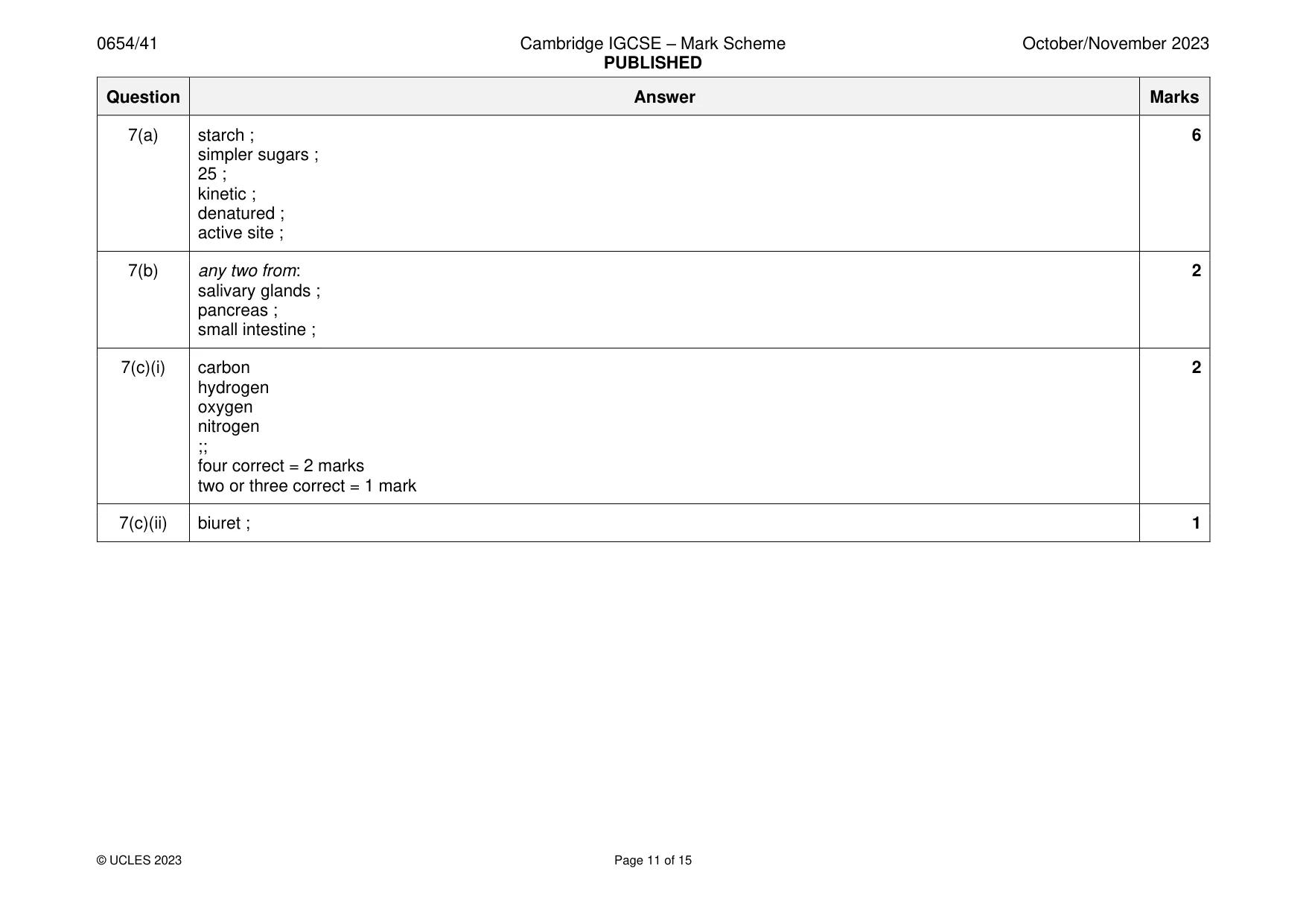
Mark scheme: 7(a) starch ; 6 simpler sugars ; 25 ; kinetic ; denatured ; active site ; 7(b) any two from: 2 salivary glands ; pancreas ; small intestine ; 7(c)(i) carbon 2 hydrogen oxygen nitrogen ;; four correct = 2 marks two or three correct = 1 mark 7(c)(ii) biuret ; 1
Q8 · Non-metallic elements exist as simple molecules with covalent bonds
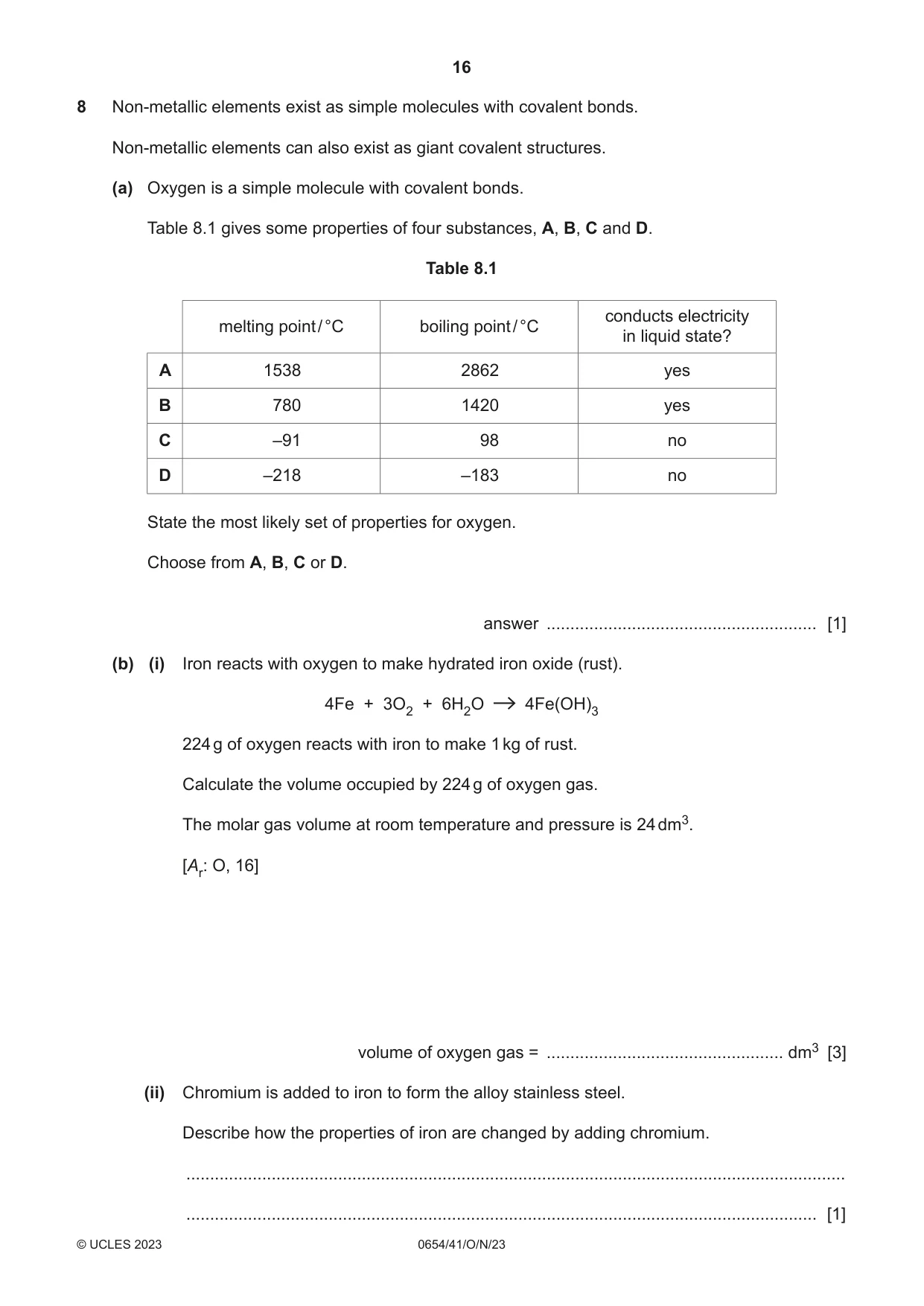
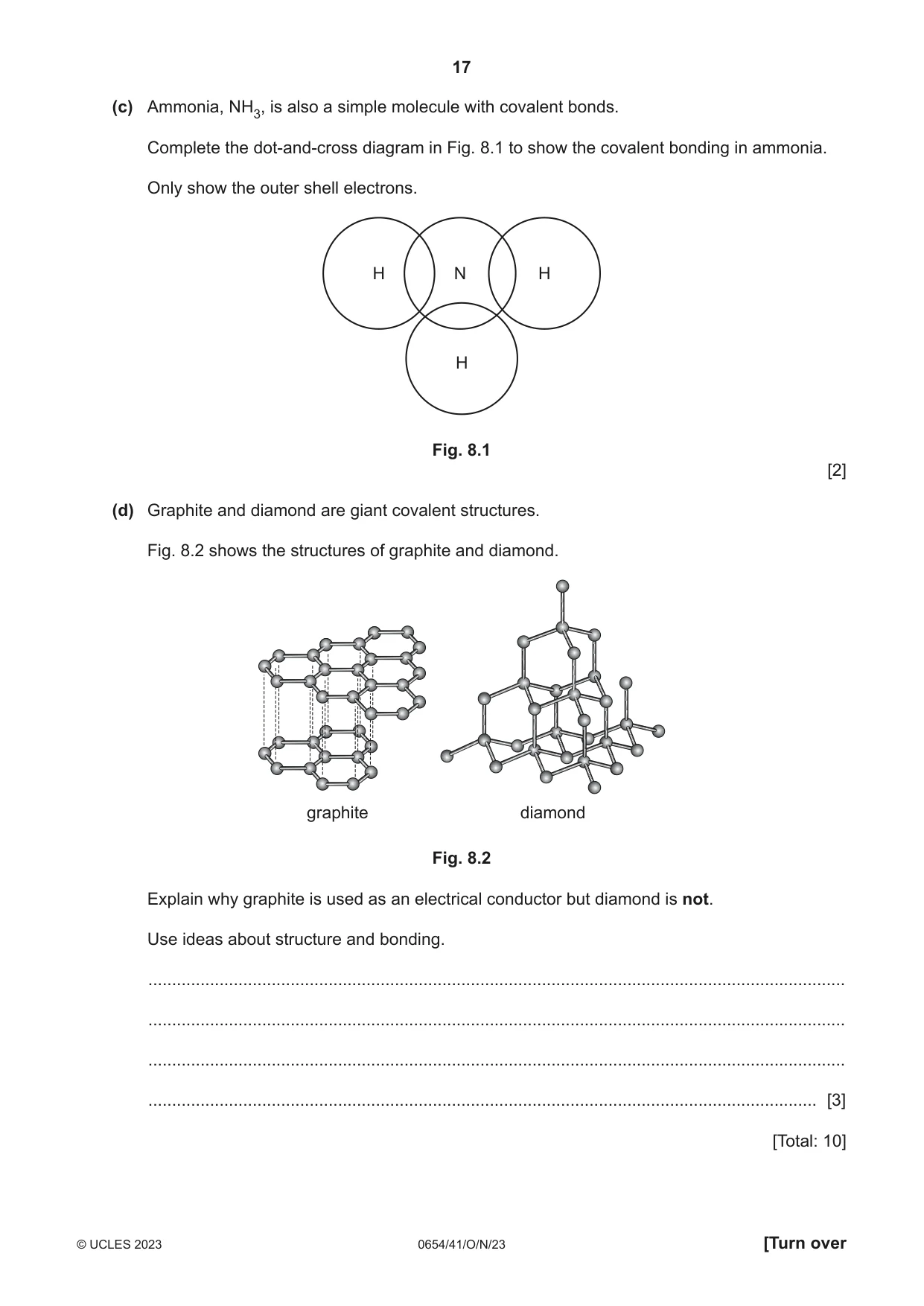
8 Non-metallic elements exist as simple molecules with covalent bonds. Non-metallic elements can also exist as giant covalent structures. (a) Oxygen is a simple molecule with covalent bonds. Table 8.1 gives some properties of four substances, A, B, C and D. Table 8.1 conducts electricity melting point / °C boiling point / °C in liquid state? A 1538 2862 yes B 780 1420 yes C –91 98 no D –218 –183 no State the most likely set of properties for oxygen. Choose from A, B, C or D. answer ......................................................... [1] (b) (i) Iron reacts with oxygen to make hydrated iron oxide (rust). 4Fe + 3O2 + 6H2O 4Fe(OH)3 224 g of oxygen reacts with iron to make 1 kg of rust. Calculate the volume occupied by 224 g of oxygen gas. The molar gas volume at room temperature and pressure is 24 dm3. [Ar: O, 16] volume of oxygen gas = .................................................. dm3 [3] (ii) Chromium is added to iron to form the alloy stainless steel. Describe how the properties of iron are changed by adding chromium. ........................................................................................................................................... ..................................................................................................................................... [1] (c) Ammonia, NH3, is also a simple molecule with covalent bonds. Complete the dot-and-cross diagram in Fig. 8.1 to show the covalent bonding in ammonia. Only show the outer shell electrons. H N H H Fig. 8.1 [2] (d) Graphite and diamond are giant covalent structures. Fig. 8.2 shows the structures of graphite and diamond. graphite diamond Fig. 8.2 Explain why graphite is used as an electrical conductor but diamond is not. Use ideas about structure and bonding. ................................................................................................................................................... ................................................................................................................................................... ................................................................................................................................................... ............................................................................................................................................. [3] [Total: 10]
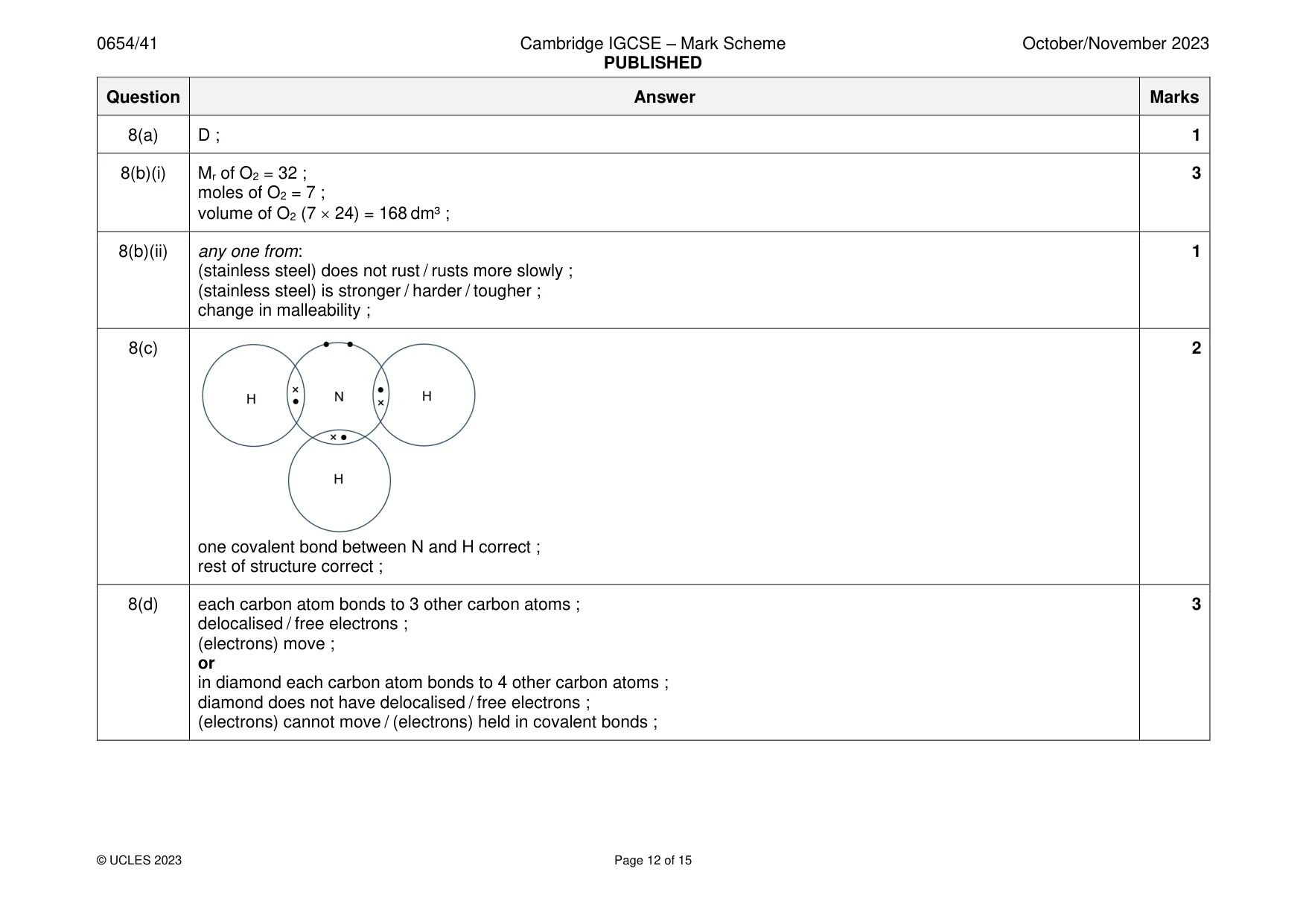
Mark scheme: 8(a) D ; 1 8(b)(i) Mr of O2 = 32 ; 3 moles of O2 = 7 ; volume of O2 (7 24) = 168 dm³ ; 8(b)(ii) any one from: 1 (stainless steel) does not rust / rusts more slowly ; (stainless steel) is stronger / harder / tougher ; change in malleability ; 8(c) 2 one covalent bond between N and H correct ; rest of structure correct ; 8(d) each carbon atom bonds to 3 other carbon atoms ; 3 delocalised / free electrons ; (electrons) move ; or in diamond each carbon atom bonds to 4 other carbon atoms ; diamond does not have delocalised / free electrons ; (electrons) cannot move / (electrons) held in covalent bonds ;
Q9 · A student is investigating electromagnetic induction by dropping a magnet through a coil…
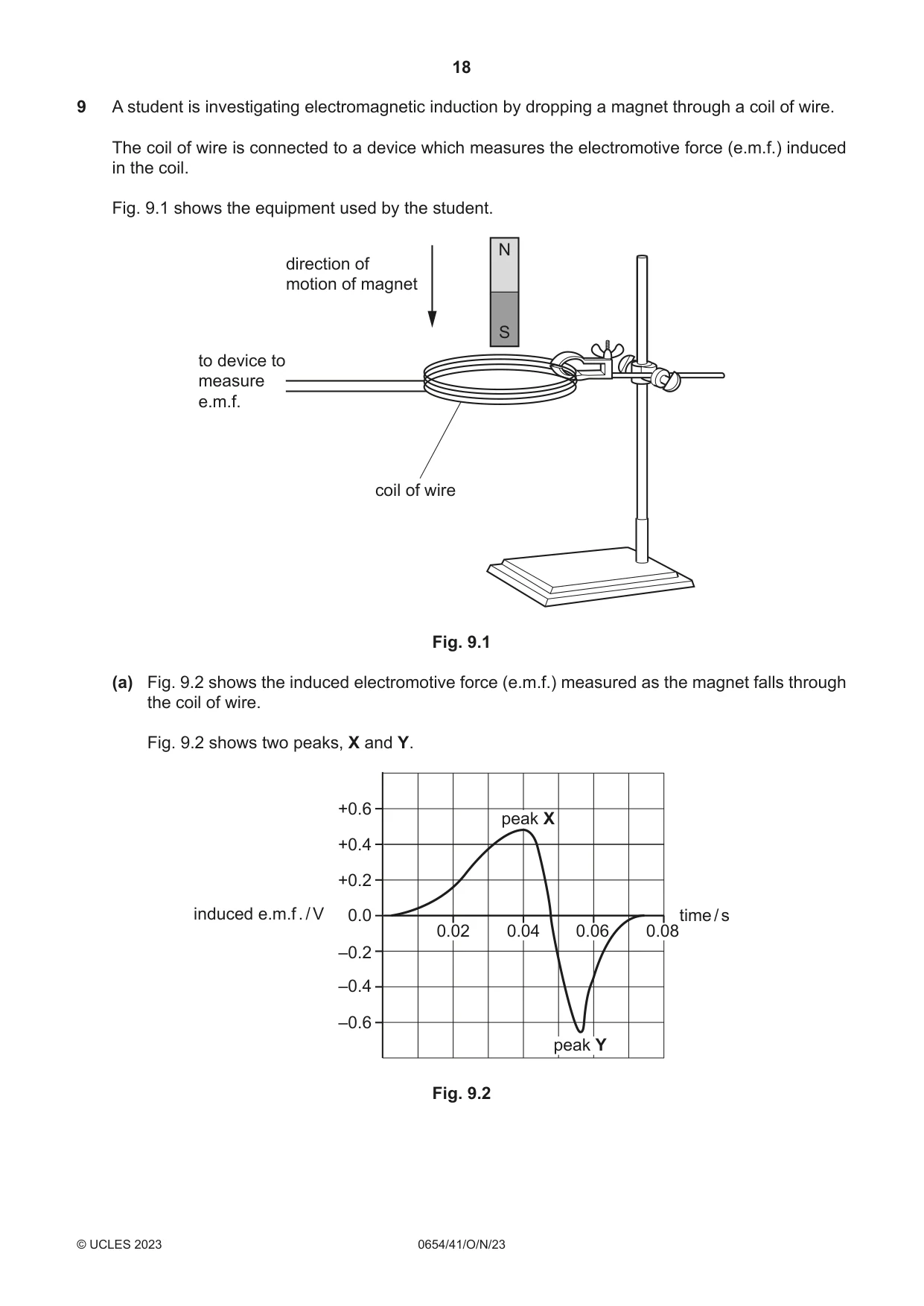
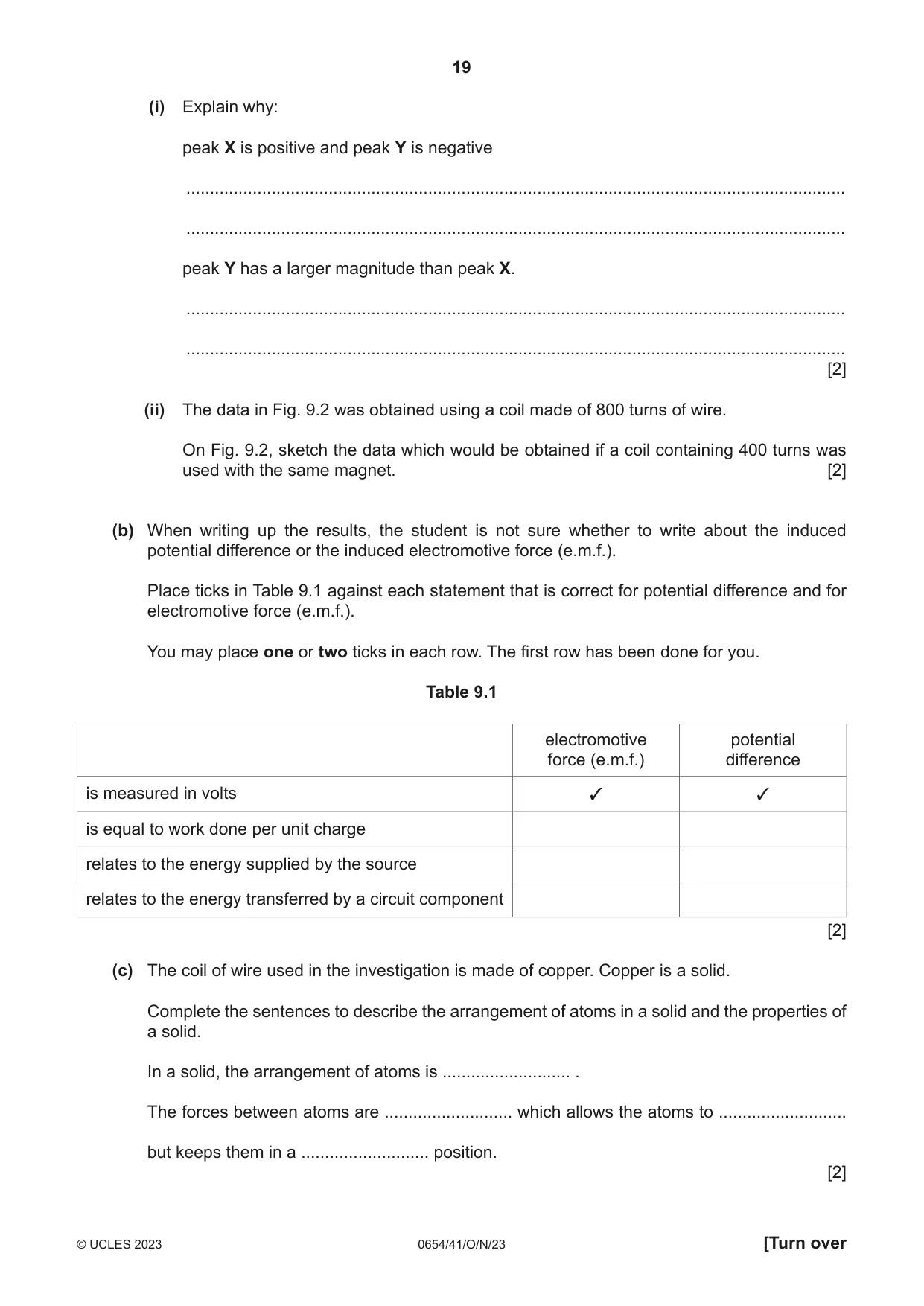
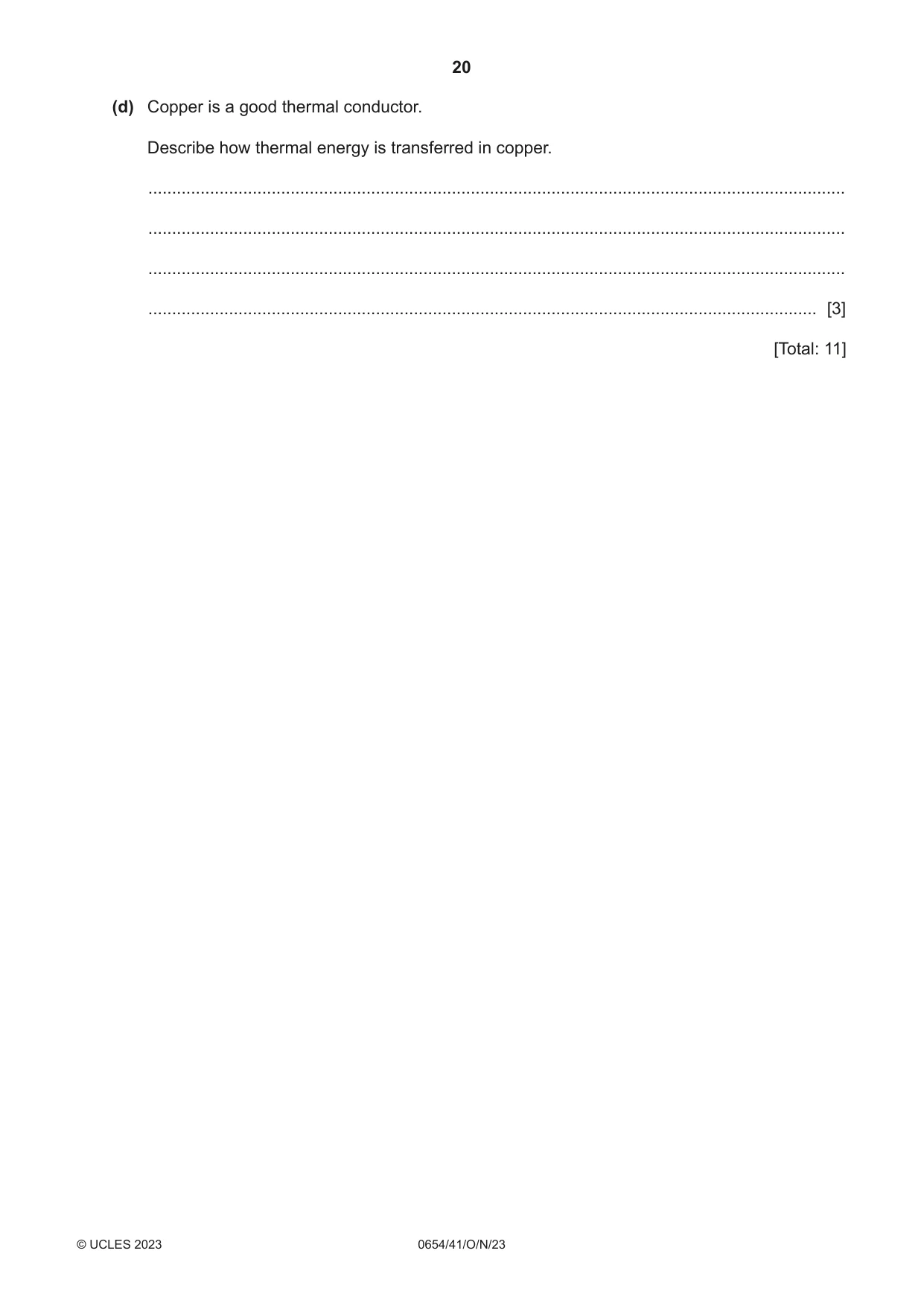
9 A student is investigating electromagnetic induction by dropping a magnet through a coil of wire. The coil of wire is connected to a device which measures the electromotive force (e.m.f.) induced in the coil. Fig. 9.1 shows the equipment used by the student. N direction of motion of magnet S to device to measure e.m.f. coil of wire Fig. 9.1 (a) Fig. 9.2 shows the induced electromotive force (e.m.f.) measured as the magnet falls through the coil of wire. Fig. 9.2 shows two peaks, X and Y. +0.6 peak X +0.4 +0.2 induced e.m.f . / V 0.0 time / s 0.02 0.04 0.06 0.08 –0.2 –0.4 –0.6 peak Y Fig. 9.2 (i) Explain why: peak X is positive and peak Y is negative ........................................................................................................................................... ........................................................................................................................................... peak Y has a larger magnitude than peak X. ........................................................................................................................................... ........................................................................................................................................... [2] (ii) The data in Fig. 9.2 was obtained using a coil made of 800 turns of wire. On Fig. 9.2, sketch the data which would be obtained if a coil containing 400 turns was used with the same magnet. [2] (b) When writing up the results, the student is not sure whether to write about the induced potential difference or the induced electromotive force (e.m.f.). Place ticks in Table 9.1 against each statement that is correct for potential difference and for electromotive force (e.m.f.). You may place one or two ticks in each row. The first row has been done for you. Table 9.1 electromotive potential force (e.m.f.) difference is measured in volts 3 3 is equal to work done per unit charge relates to the energy supplied by the source relates to the energy transferred by a circuit component [2] (c) The coil of wire used in the investigation is made of copper. Copper is a solid. Complete the sentences to describe the arrangement of atoms in a solid and the properties of a solid. In a solid, the arrangement of atoms is ........................... . The forces between atoms are ........................... which allows the atoms to ........................... but keeps them in a ........................... position. [2] (d) Copper is a good thermal conductor. Describe how thermal energy is transferred in copper. ................................................................................................................................................... ................................................................................................................................................... ................................................................................................................................................... ............................................................................................................................................. [3] [Total: 11]
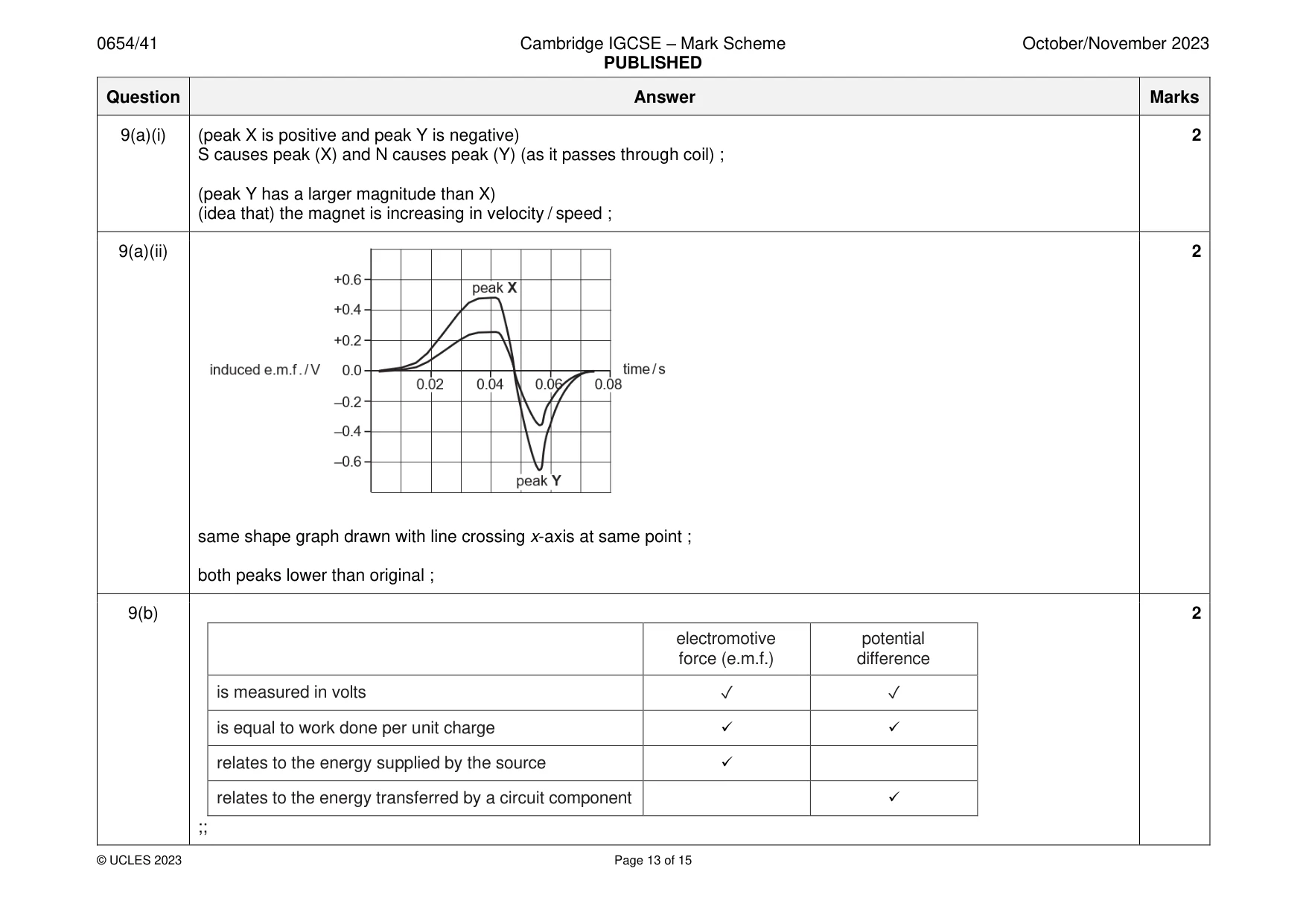
Mark scheme: 9(a)(i) (peak X is positive and peak Y is negative) 2 S causes peak (X) and N causes peak (Y) (as it passes through coil) ; (peak Y has a larger magnitude than X) (idea that) the magnet is increasing in velocity / speed ; 9(a)(ii) 2 same shape graph drawn with line crossing x-axis at same point ; both peaks lower than original ; 9(b) 2 electromotive potential force (e.m.f.) difference is measured in volts ✓ ✓ is equal to work done per unit charge ✓ ✓ relates to the energy supplied by the source ✓ relates to the energy transferred by a circuit component ✓ ;; 9(c) regular / ordered / a lattice 2 strong vibrate fixed ;; four correct = 2 marks two or three correct = 1 mark 9(d) atoms vibrate ; 3 (idea that) vibrations passed on to next atom ; (idea of) transfer by (free) electrons ;
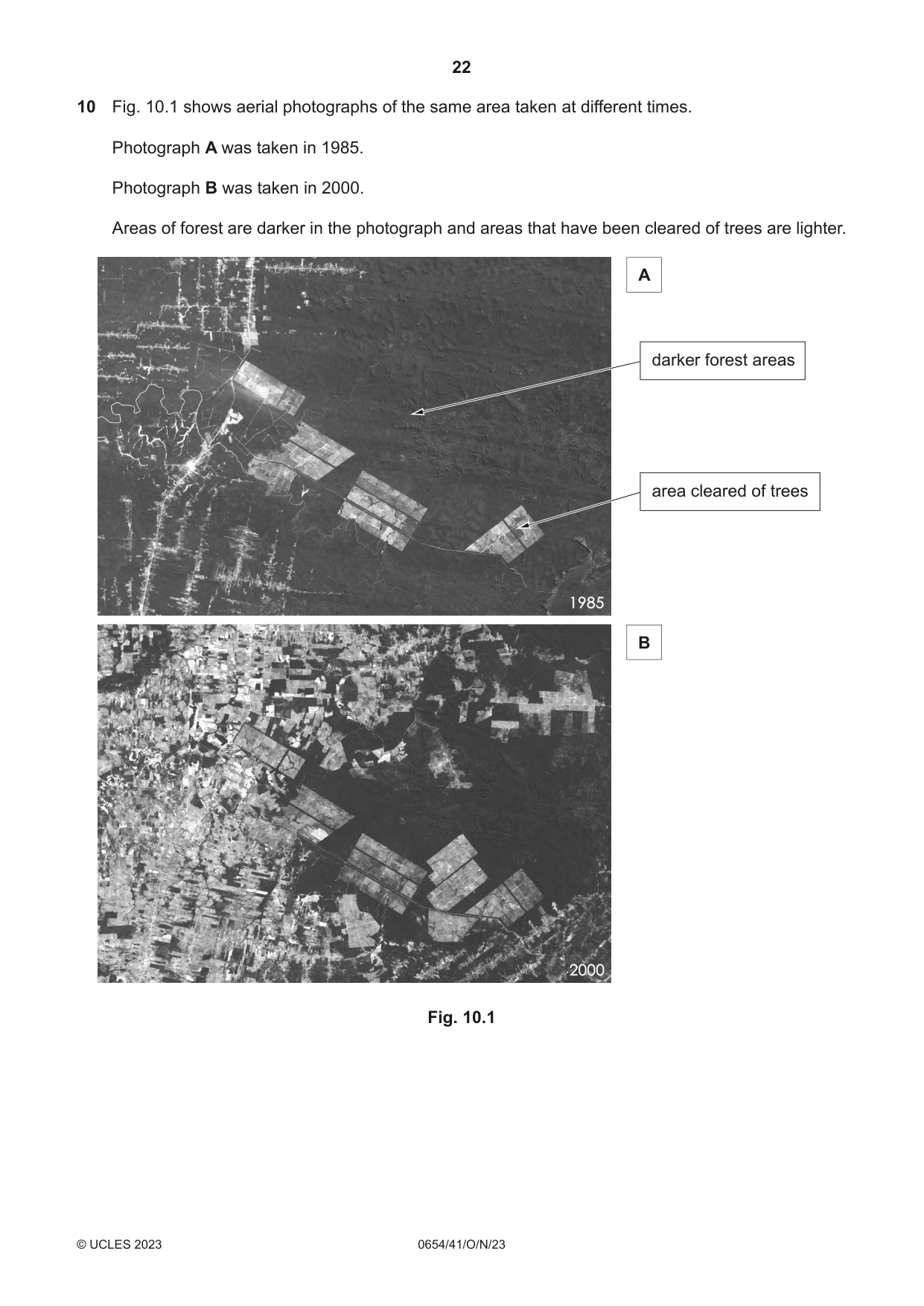
Q10 · Aerial photographs of the same area taken at different times
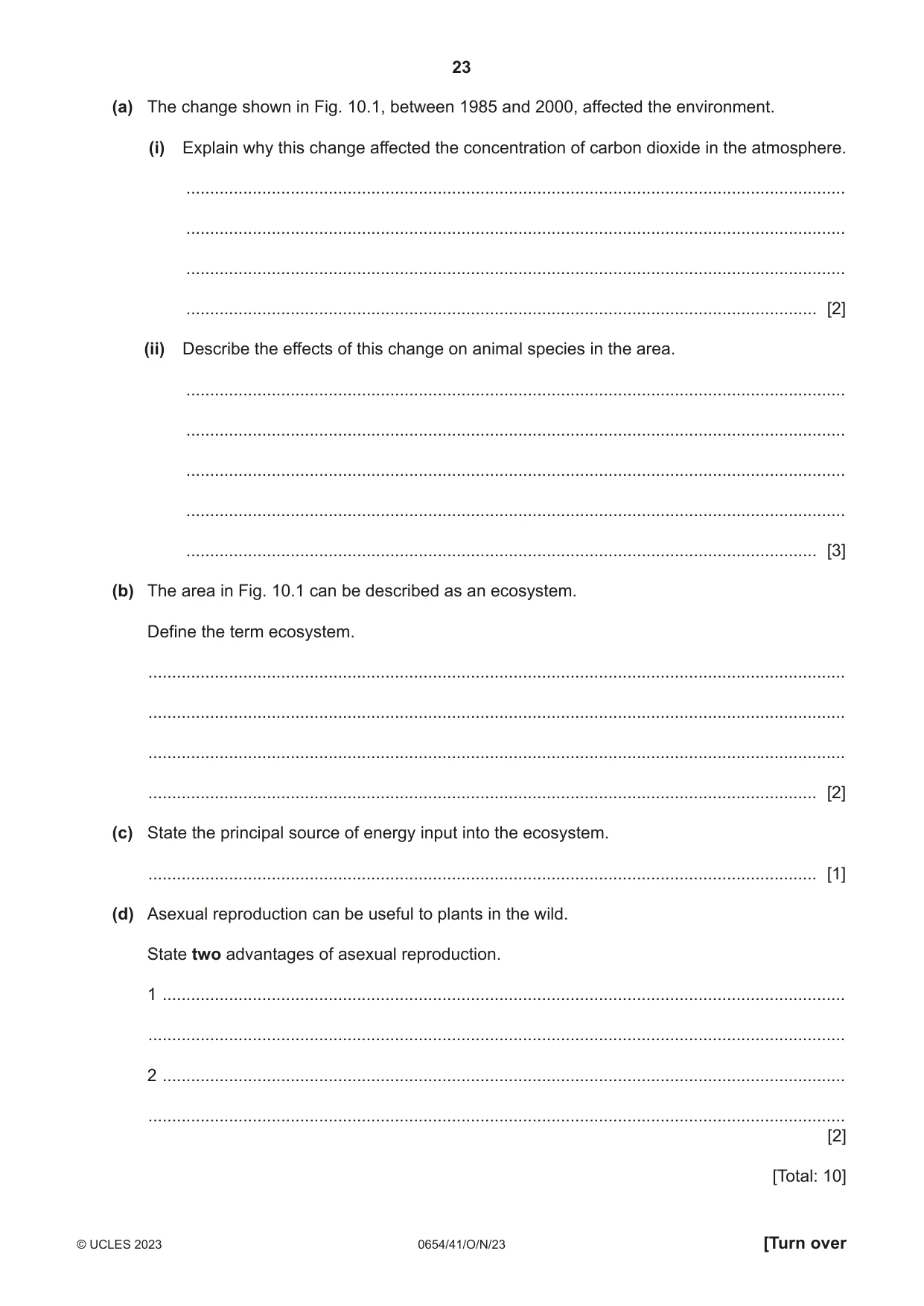
10 Fig. 10.1 shows aerial photographs of the same area taken at different times. Photograph A was taken in 1985. Photograph B was taken in 2000. Areas of forest are darker in the photograph and areas that have been cleared of trees are lighter. A darker forest areas area cleared of trees B Fig. 10.1 (a) The change shown in Fig. 10.1, between 1985 and 2000, affected the environment. (i) Explain why this change affected the concentration of carbon dioxide in the atmosphere. ........................................................................................................................................... ........................................................................................................................................... ........................................................................................................................................... ..................................................................................................................................... [2] (ii) Describe the effects of this change on animal species in the area. ........................................................................................................................................... ........................................................................................................................................... ........................................................................................................................................... ........................................................................................................................................... ..................................................................................................................................... [3] (b) The area in Fig. 10.1 can be described as an ecosystem. Define the term ecosystem. ................................................................................................................................................... ................................................................................................................................................... ................................................................................................................................................... ............................................................................................................................................. [2] (c) State the principal source of energy input into the ecosystem. ............................................................................................................................................. [1] (d) Asexual reproduction can be useful to plants in the wild. State two advantages of asexual reproduction. 1 ................................................................................................................................................ ................................................................................................................................................... 2 ................................................................................................................................................ ................................................................................................................................................... [2] [Total: 10]
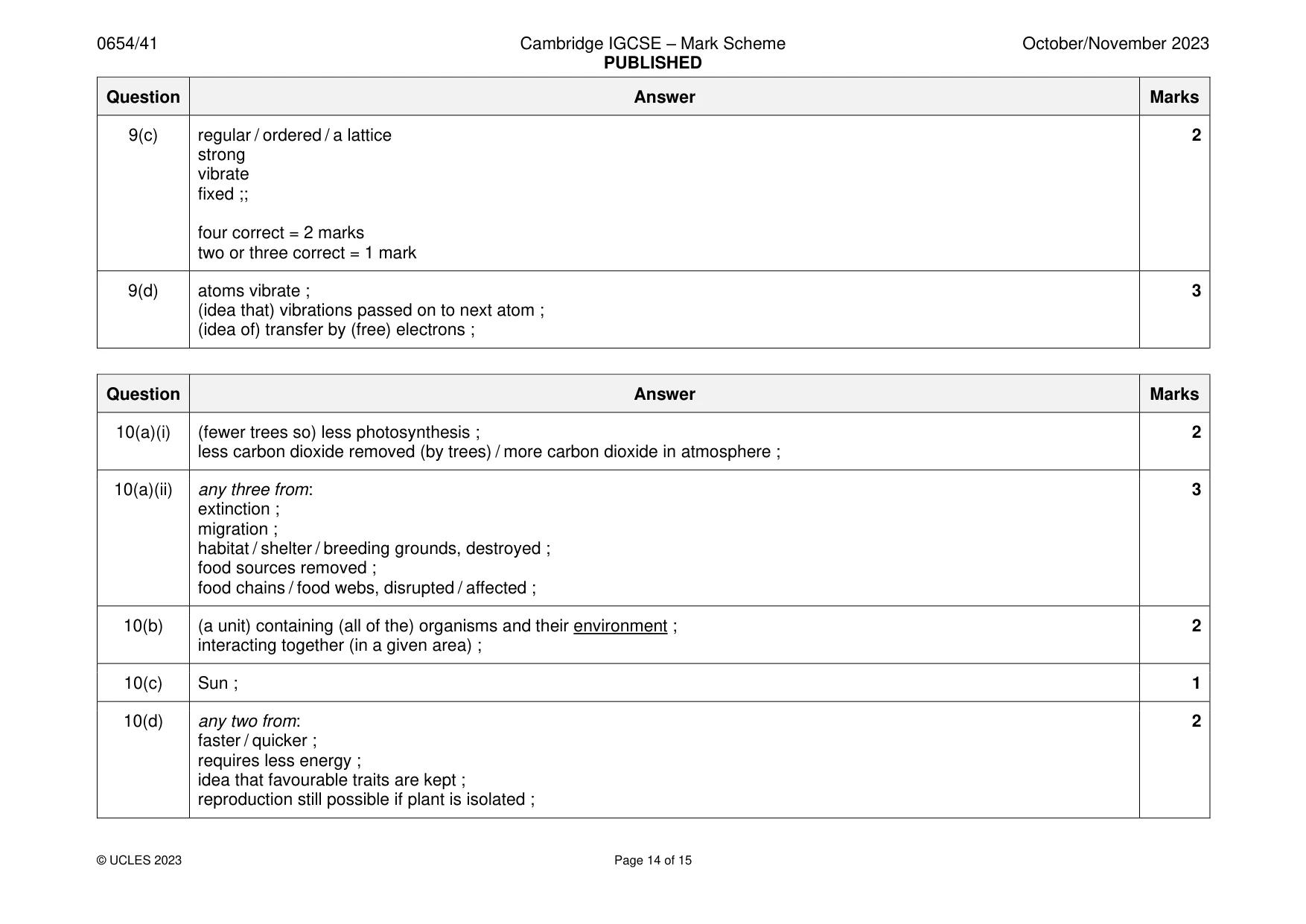
Mark scheme: 10(a)(i) (fewer trees so) less photosynthesis ; 2 less carbon dioxide removed (by trees) / more carbon dioxide in atmosphere ; 10(a)(ii) any three from: 3 extinction ; migration ; habitat / shelter / breeding grounds, destroyed ; food sources removed ; food chains / food webs, disrupted / affected ; 10(b) (a unit) containing (all of the) organisms and their environment ; 2 interacting together (in a given area) ; 10(c) Sun ; 1 10(d) any two from: 2 faster / quicker ; requires less energy ; idea that favourable traits are kept ; reproduction still possible if plant is isolated ;
Q11 · Molten lead(II) bromide conducts electricity
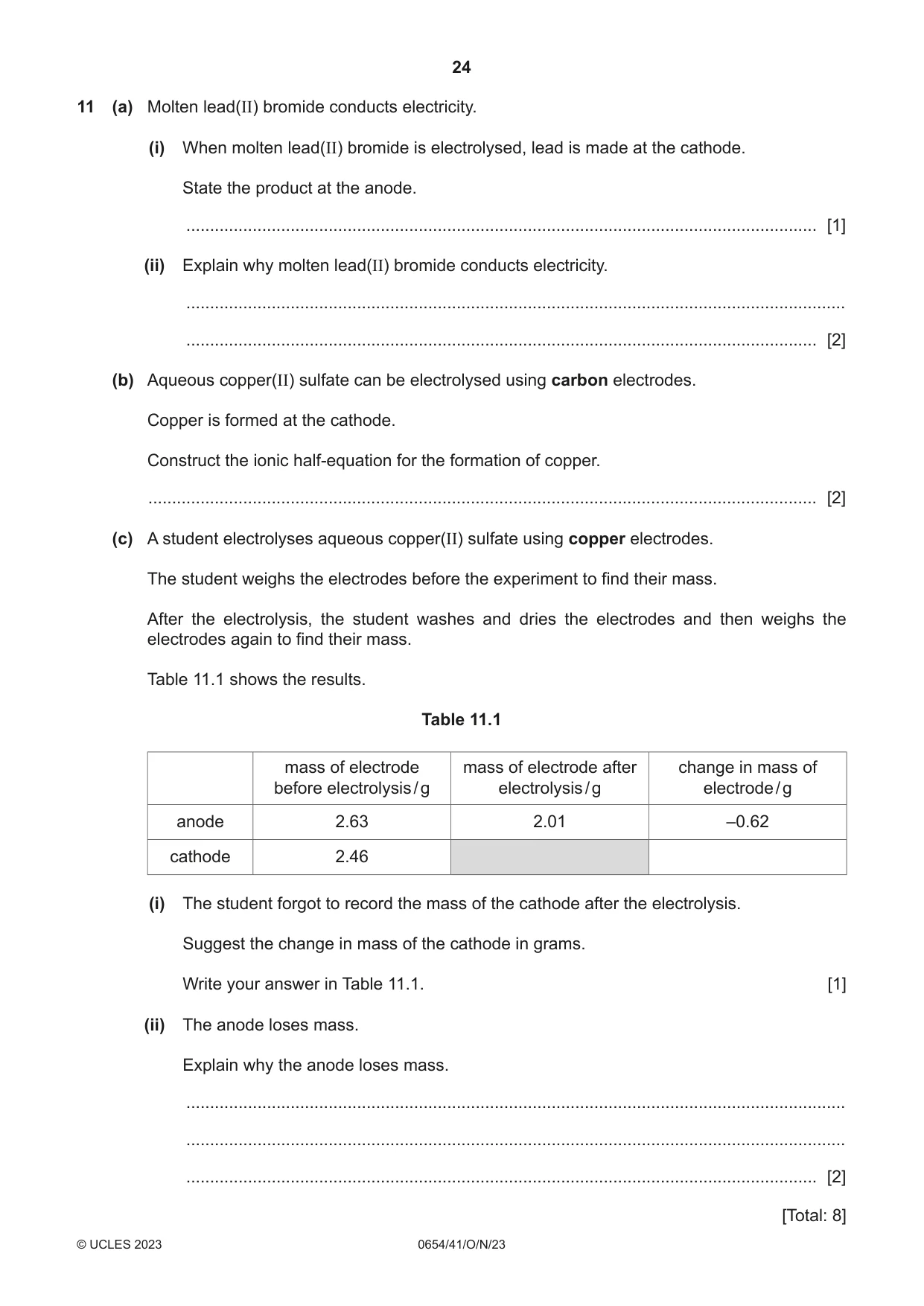
11 (a) Molten lead(II) bromide conducts electricity. (i) When molten lead(II) bromide is electrolysed, lead is made at the cathode. State the product at the anode. ..................................................................................................................................... [1] (ii) Explain why molten lead(II) bromide conducts electricity. ........................................................................................................................................... ..................................................................................................................................... [2] (b) Aqueous copper(II) sulfate can be electrolysed using carbon electrodes. Copper is formed at the cathode. Construct the ionic half-equation for the formation of copper. ............................................................................................................................................. [2] (c) A student electrolyses aqueous copper(II) sulfate using copper electrodes. The student weighs the electrodes before the experiment to find their mass. After the electrolysis, the student washes and dries the electrodes and then weighs the electrodes again to find their mass. Table 11.1 shows the results. Table 11.1 mass of electrode mass of electrode after change in mass of before electrolysis / g electrolysis / g electrode / g anode 2.63 2.01 –0.62 cathode 2.46 (i) The student forgot to record the mass of the cathode after the electrolysis. Suggest the change in mass of the cathode in grams. Write your answer in Table 11.1. [1] (ii) The anode loses mass. Explain why the anode loses mass. ........................................................................................................................................... ........................................................................................................................................... ..................................................................................................................................... [2] [Total: 8]
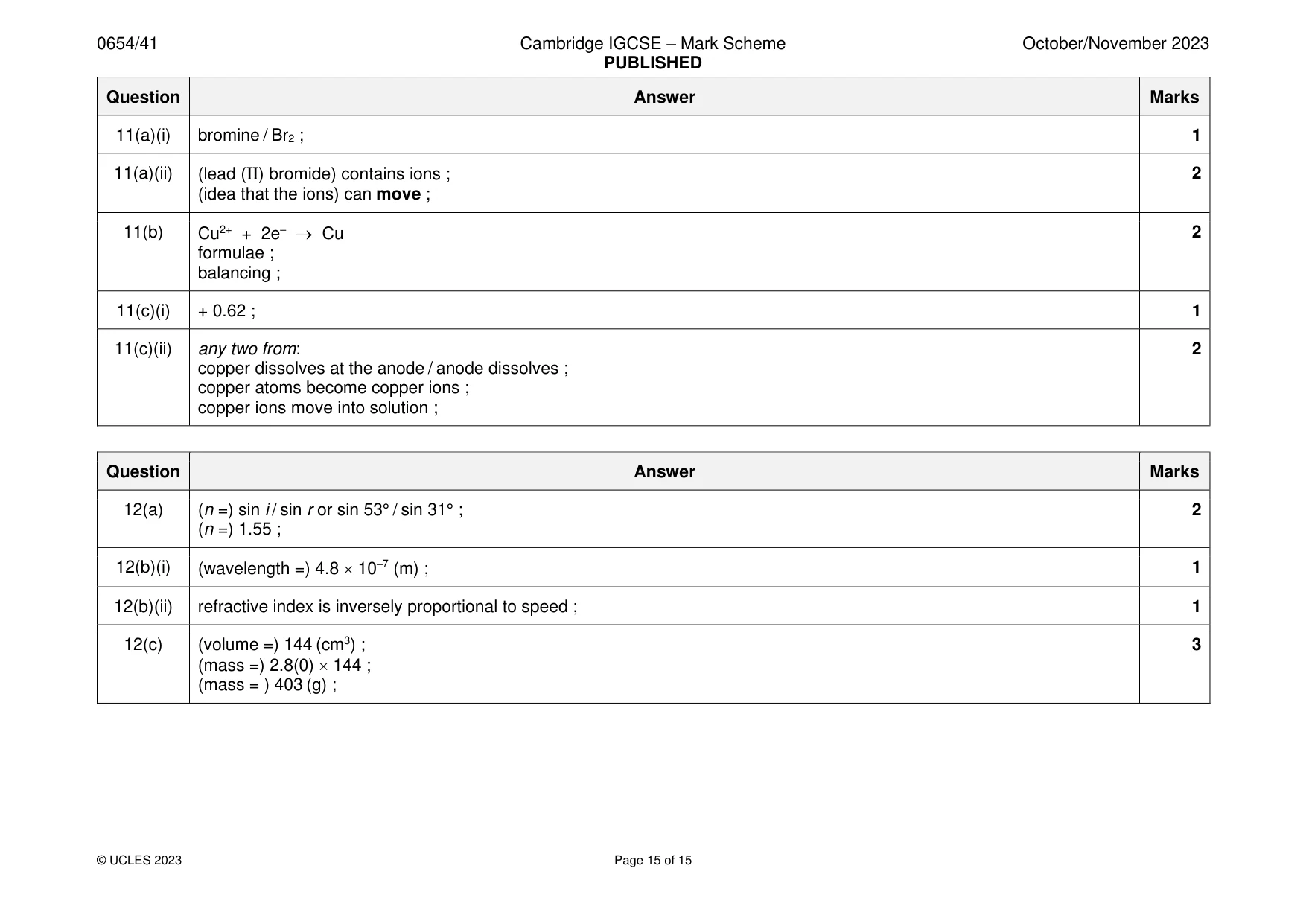
Mark scheme: 11(a)(i) bromine / Br2 ; 1 11(a)(ii) (lead (II) bromide) contains ions ; 2 (idea that the ions) can move ; 11(b) Cu2+ + 2e– → Cu 2 formulae ; balancing ; 11(c)(i) + 0.62 ; 1 11(c)(ii) any two from: 2 copper dissolves at the anode / anode dissolves ; copper atoms become copper ions ; copper ions move into solution ;
Q12 · A ray of light refracted as it enters a glass block
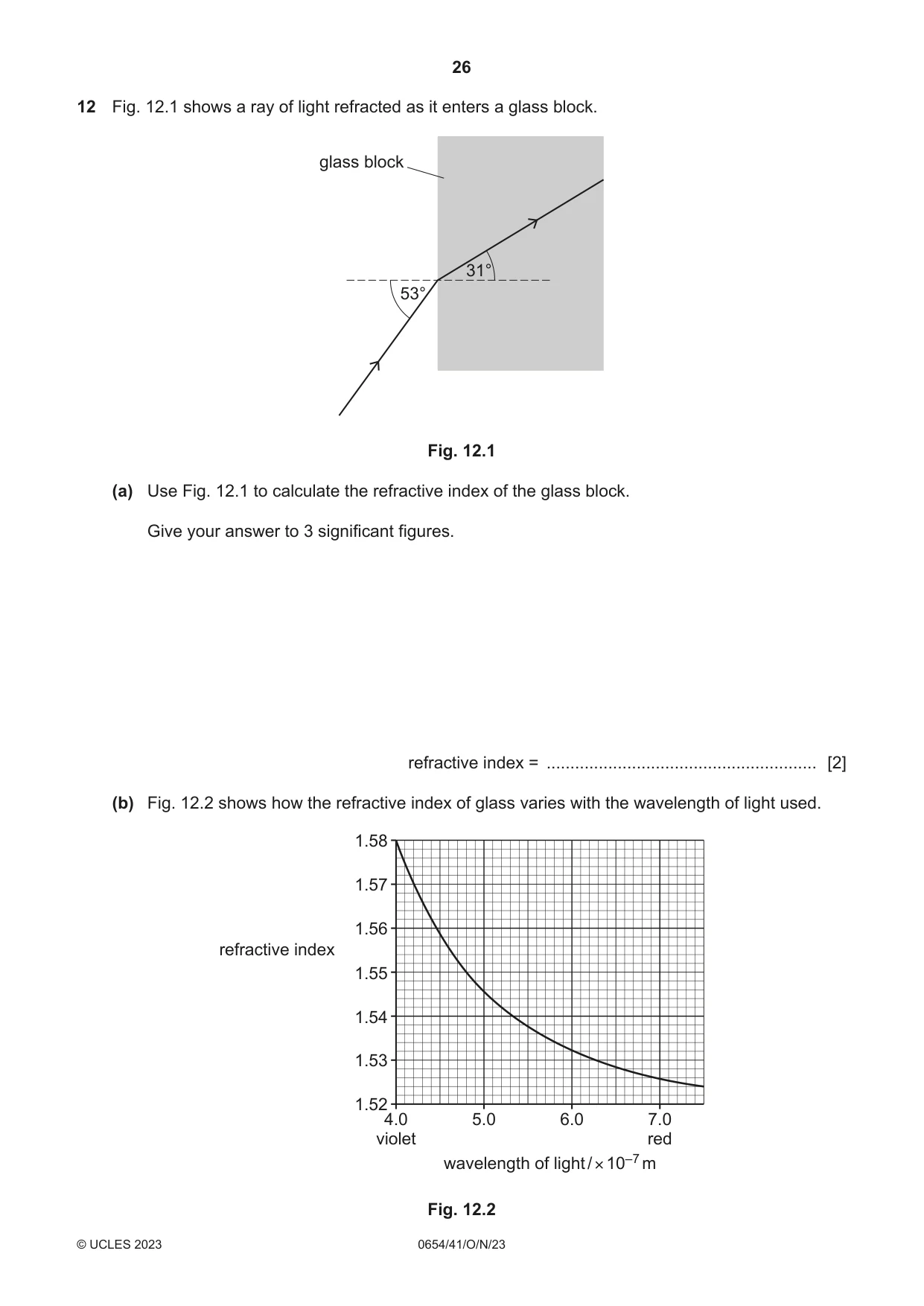
12 Fig. 12.1 shows a ray of light refracted as it enters a glass block. glass block 31° 53° Fig. 12.1 (a) Use Fig. 12.1 to calculate the refractive index of the glass block. Give your answer to 3 significant figures. refractive index = ......................................................... [2] (b) Fig. 12.2 shows how the refractive index of glass varies with the wavelength of light used. 1.58 1.57 1.56 refractive index 1.55 1.54 1.53 1.52 4.0 5.0 6.0 7.0 violet red wavelength of light / × 10–7 m Fig. 12.2 (i) Use Fig. 12.2 to determine the wavelength of light used in Fig. 12.1. wavelength = ..................................................... m [1] (ii) Violet light has a wavelength of 4.0 × 10⁻⁷ m. Red light has a wavelength of 7.0 × 10⁻⁷ m. Describe how Fig. 12.2 shows that red light travels faster through glass than violet light. ........................................................................................................................................... ........................................................................................................................................... ..................................................................................................................................... [1] (c) Fig. 12.3 shows the dimensions of the glass block. 2.0 cm 6.0 cm 12.0 cm Fig. 12.3 The density of glass is 2.80 g / cm3. Use Fig. 12.3 to calculate the mass of the glass block. mass = ...................................................... g [3] [Total: 7]
Mark scheme: 12(a) (n =) sin i / sin r or sin 53° / sin 31° ; 2 (n =) 1.55 ; 12(b)(i) (wavelength =) 4.8 10–7 (m) ; 1 12(b)(ii) refractive index is inversely proportional to speed ; 1 12(c) (volume =) 144 (cm3) ; 3 (mass =) 2.8(0) 144 ; (mass = ) 403 (g) ;
What was in this paper
The subtopics covered by these 12 questions, and how many questions each got. Open one in a new tab to see every Cambridge question on it.
What you needed in this session
Cambridge’s own grade thresholds for 2023 Oct/Nov, Paper 4 · Variant 1. A higher threshold means an easier paper — the bar moves with how the cohort did.