Cambridge IGCSE Sciences - Co-ordinated (Double) 0654 — 2024 Feb/March Paper 4 · Variant 2
0654/42/F/M/24 · 12 questions · 120 marks · ≈135 min
The question paper and its mark scheme, free to read here and free to download. This is Cambridge’s own paper, exactly as it was sat.
Question paper32 pages


Mark scheme11 pages
Answers below. Sit the paper first if you are practising.
Questions as text
Q1 · A diagram of the male reproductive system in humans
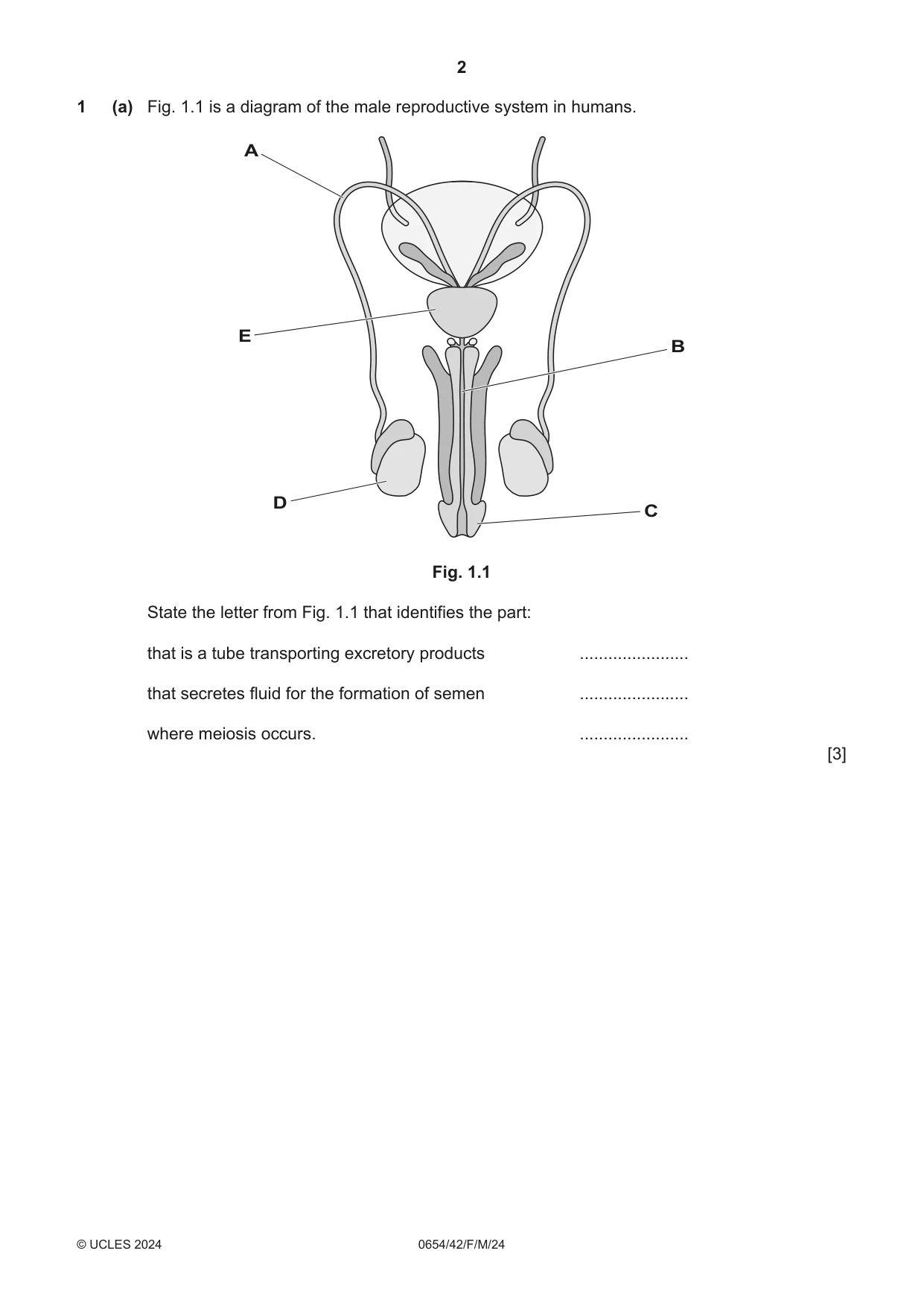
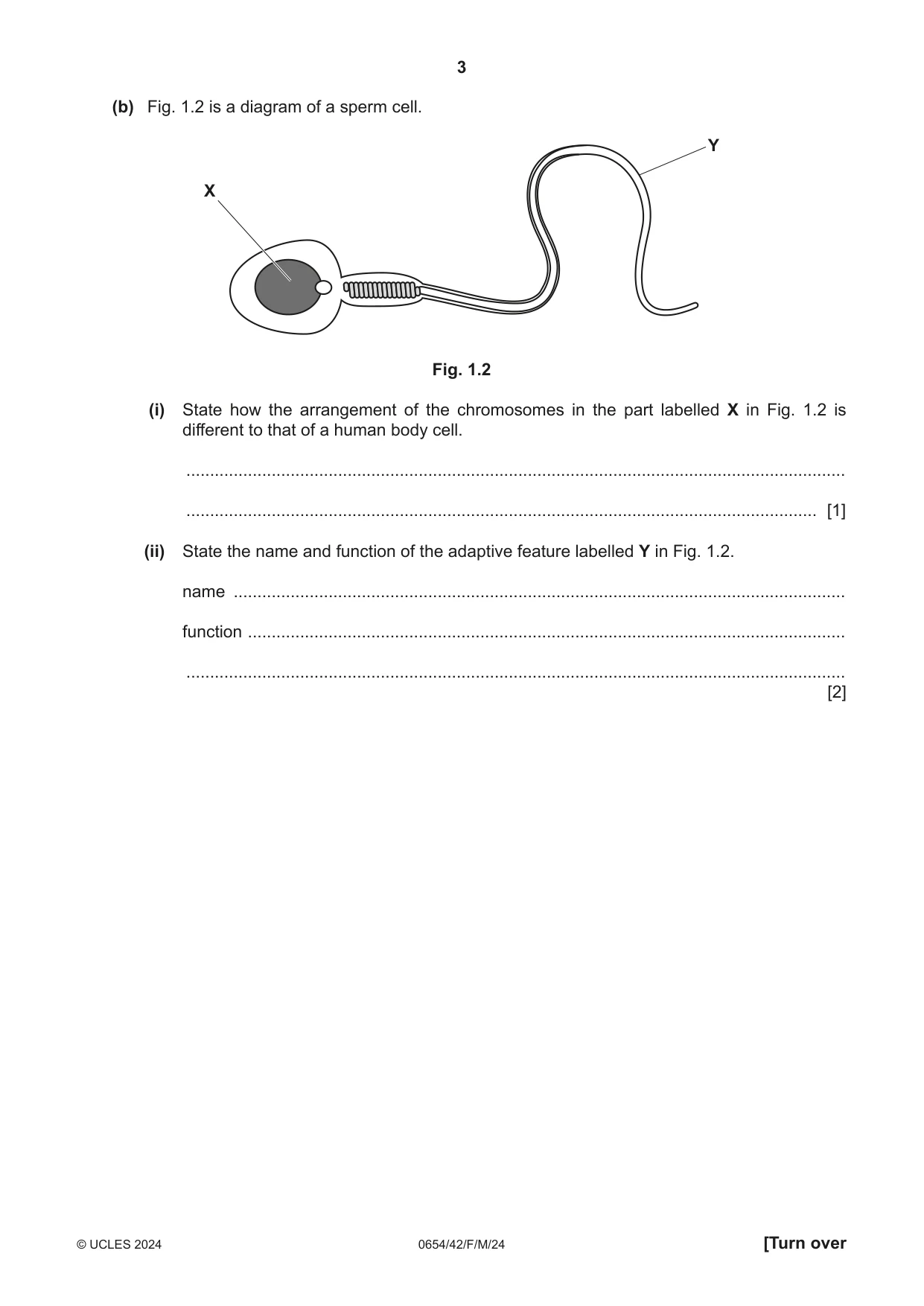
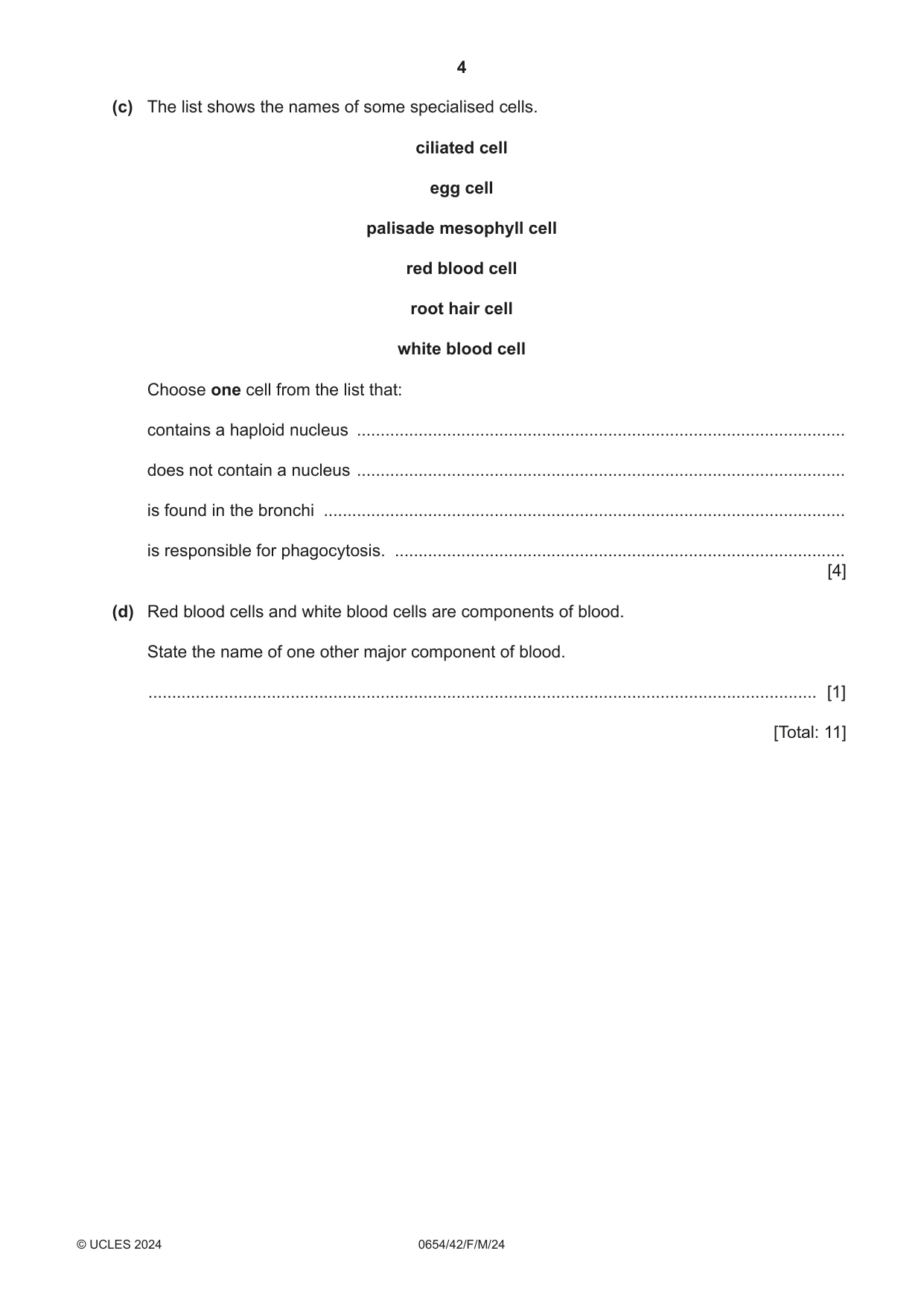
1 (a) Fig. 1.1 is a diagram of the male reproductive system in humans. A E B D C Fig. 1.1 State the letter from Fig. 1.1 that identifies the part: that is a tube transporting excretory products ....................... that secretes fluid for the formation of semen ....................... where meiosis occurs. ....................... [3] (b) Fig. 1.2 is a diagram of a sperm cell. Y X Fig. 1.2 (i) State how the arrangement of the chromosomes in the part labelled X in Fig. 1.2 is different to that of a human body cell. ........................................................................................................................................... ..................................................................................................................................... [1] (ii) State the name and function of the adaptive feature labelled Y in Fig. 1.2. name ................................................................................................................................. function .............................................................................................................................. ........................................................................................................................................... [2] (c) The list shows the names of some specialised cells. ciliated cell egg cell palisade mesophyll cell red blood cell root hair cell white blood cell Choose one cell from the list that: contains a haploid nucleus ....................................................................................................... does not contain a nucleus ....................................................................................................... is found in the bronchi .............................................................................................................. is responsible for phagocytosis. ............................................................................................... [4] (d) Red blood cells and white blood cells are components of blood. State the name of one other major component of blood. ............................................................................................................................................. [1] [Total: 11]
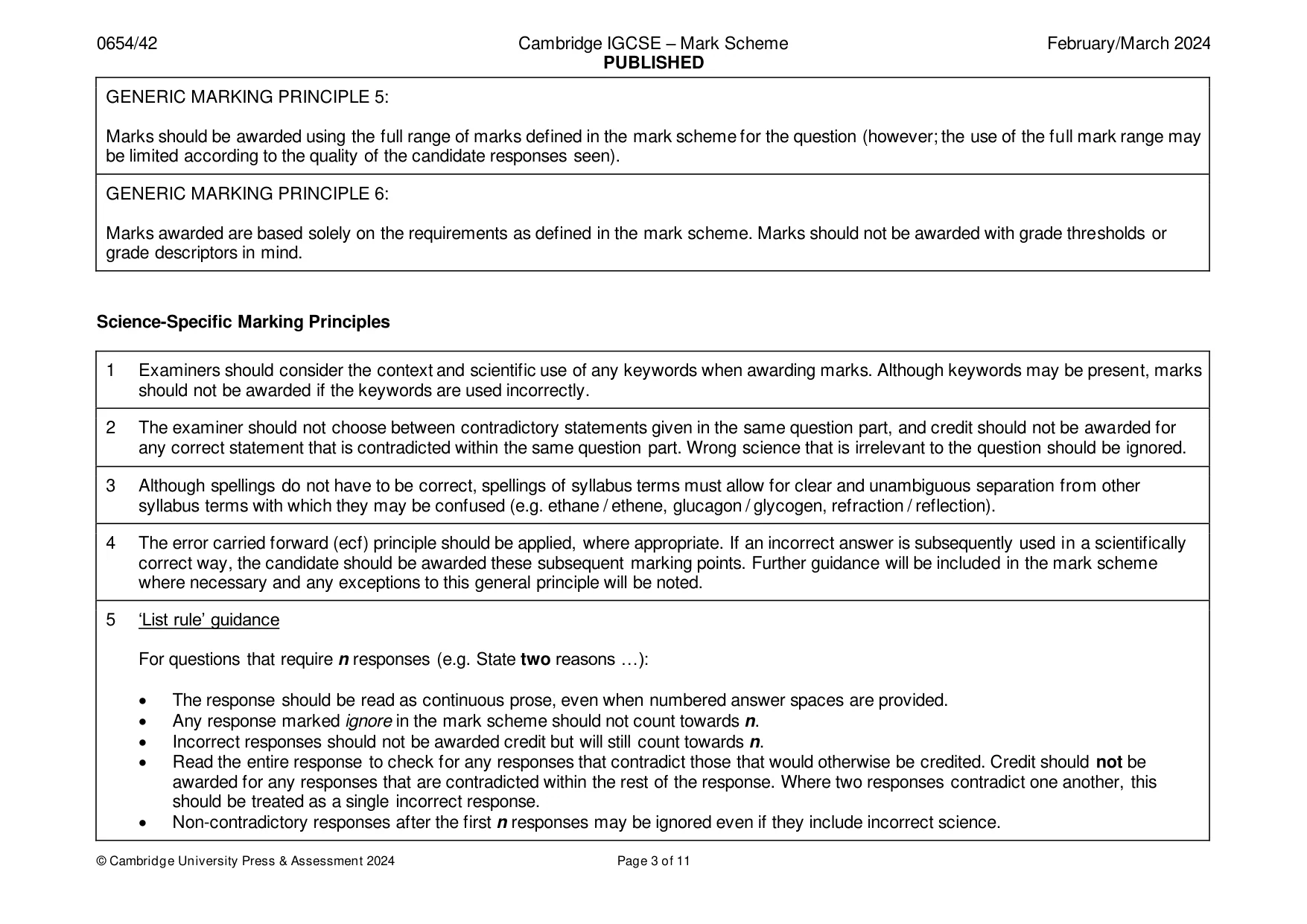
Mark scheme: Question Answer Marks 1(a) B ; 3 E ; D ; 1(b)(i) unpaired ; 1 1(b)(ii) flagellum ; 2 movement / locomotion ; 1(c) egg (cell) ; 4 red blood (cell) ; ciliated (cell) ; white blood (cell) ; 1(d) plasma / platelets ; 1
Q2 · A teacher investigates the reactions of the Group I metals, lithium, potassium and…
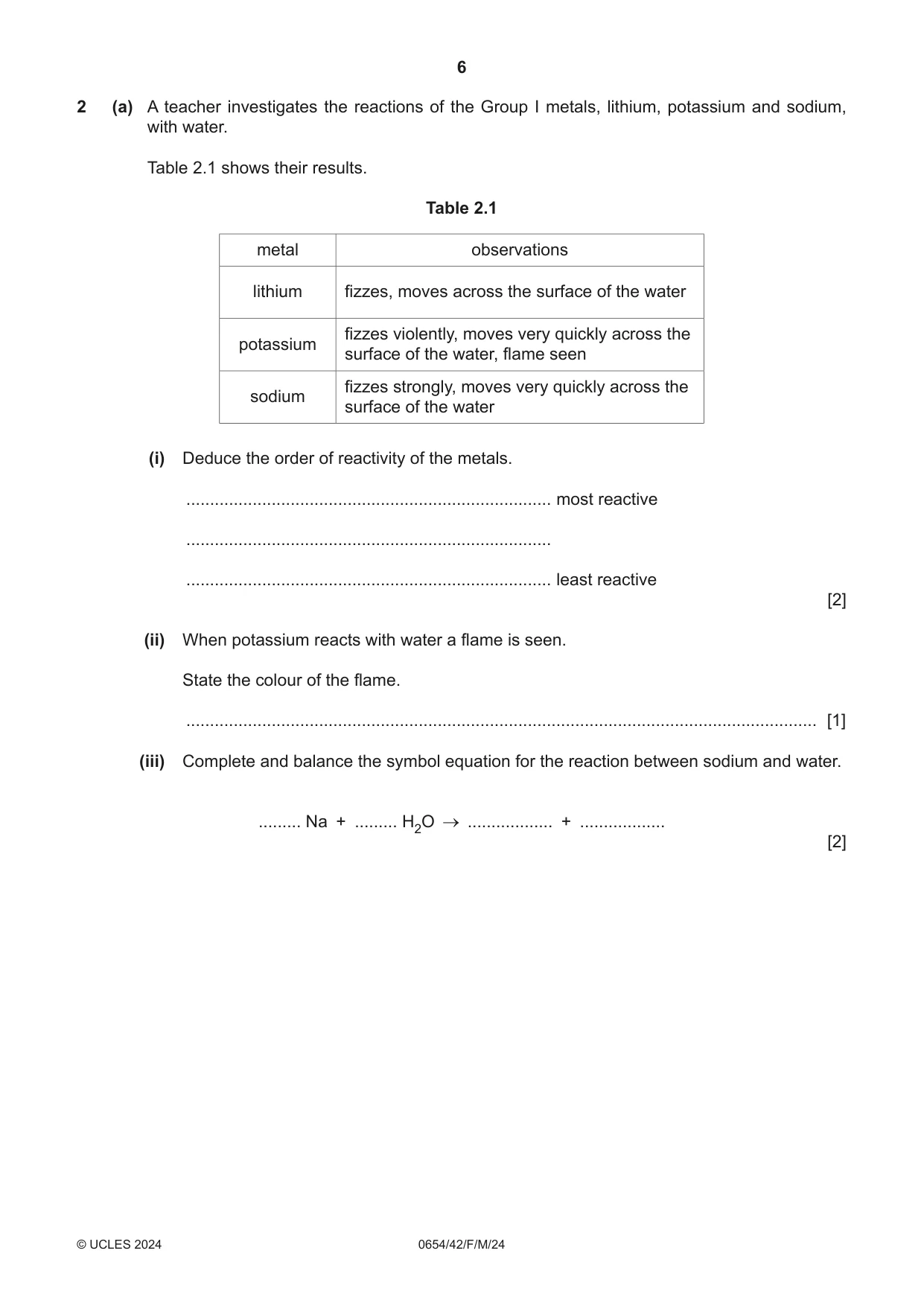
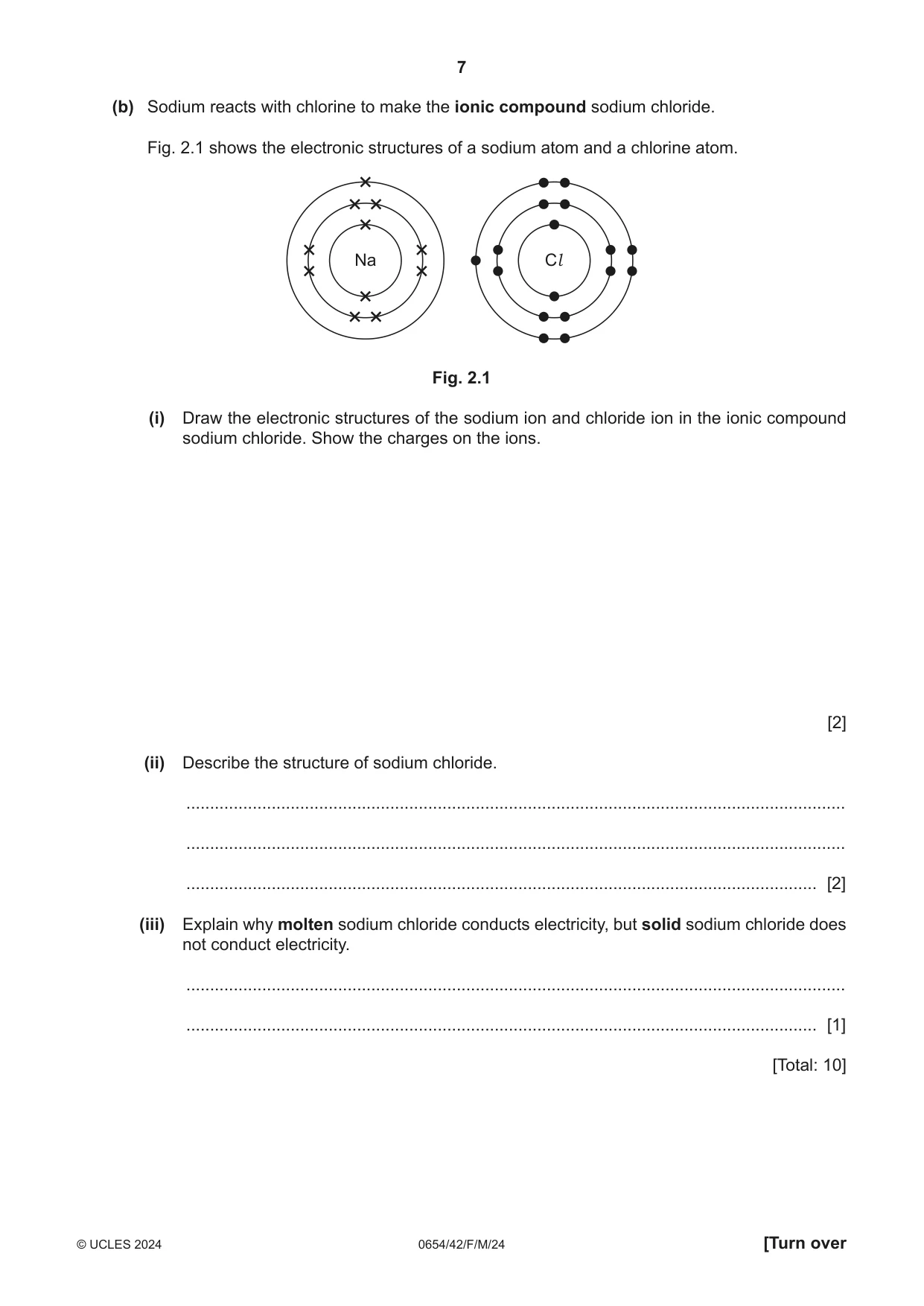
2 (a) A teacher investigates the reactions of the Group I metals, lithium, potassium and sodium, with water. Table 2.1 shows their results. Table 2.1 metal observations lithium fizzes, moves across the surface of the water fizzes violently, moves very quickly across the potassium surface of the water, flame seen fizzes strongly, moves very quickly across the sodium surface of the water (i) Deduce the order of reactivity of the metals. ............................................................................. most reactive ............................................................................. ............................................................................. least reactive [2] (ii) When potassium reacts with water a flame is seen. State the colour of the flame. ..................................................................................................................................... [1] (iii) Complete and balance the symbol equation for the reaction between sodium and water. ......... Na + ......... H2O .................. + .................. [2] (b) Sodium reacts with chlorine to make the ionic compound sodium chloride. Fig. 2.1 shows the electronic structures of a sodium atom and a chlorine atom. Na Cl Fig. 2.1 (i) Draw the electronic structures of the sodium ion and chloride ion in the ionic compound sodium chloride. Show the charges on the ions. [2] (ii) Describe the structure of sodium chloride. ........................................................................................................................................... ........................................................................................................................................... ..................................................................................................................................... [2] (iii) Explain why molten sodium chloride conducts electricity, but solid sodium chloride does not conduct electricity. ........................................................................................................................................... ..................................................................................................................................... [1] [Total: 10]
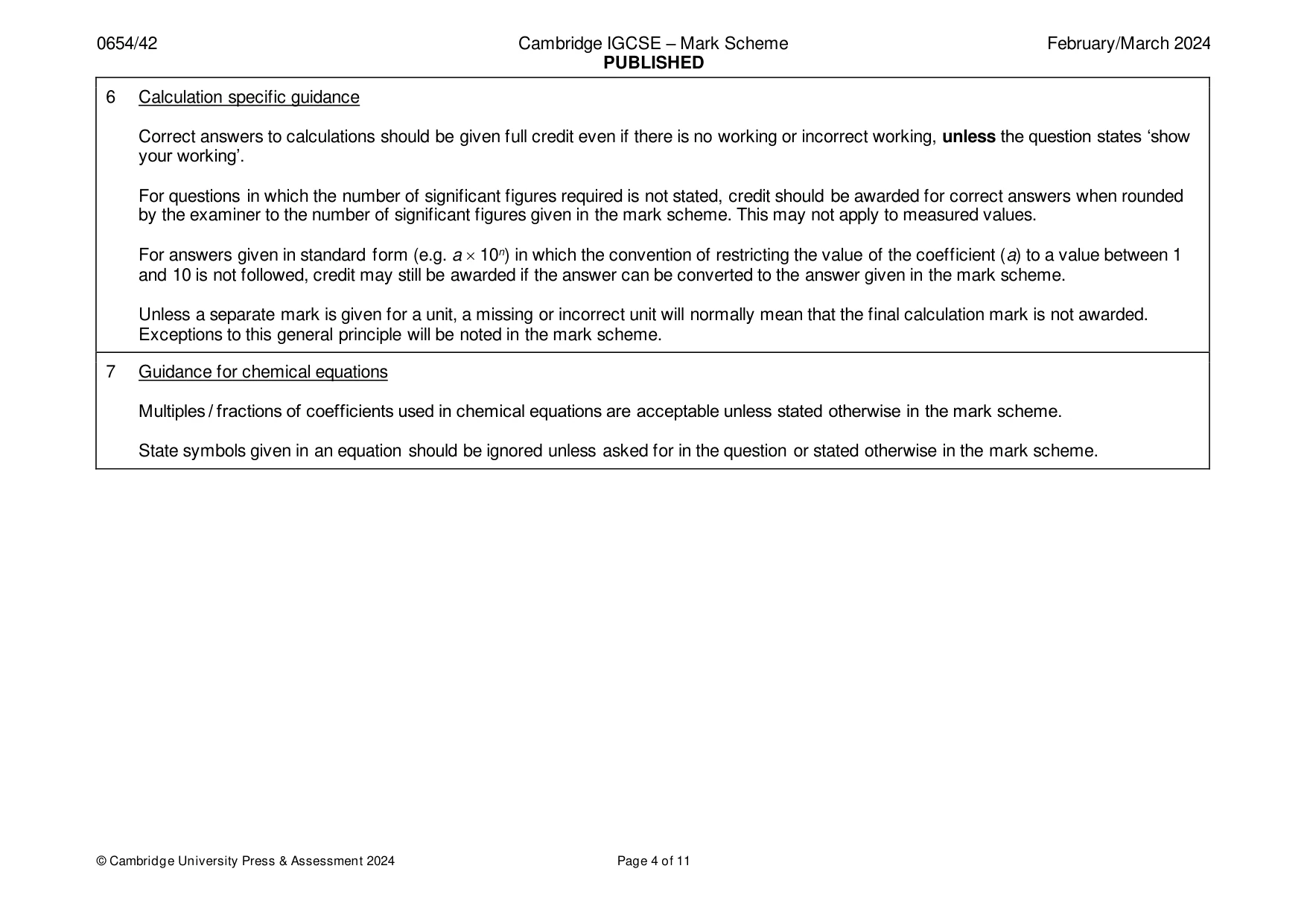
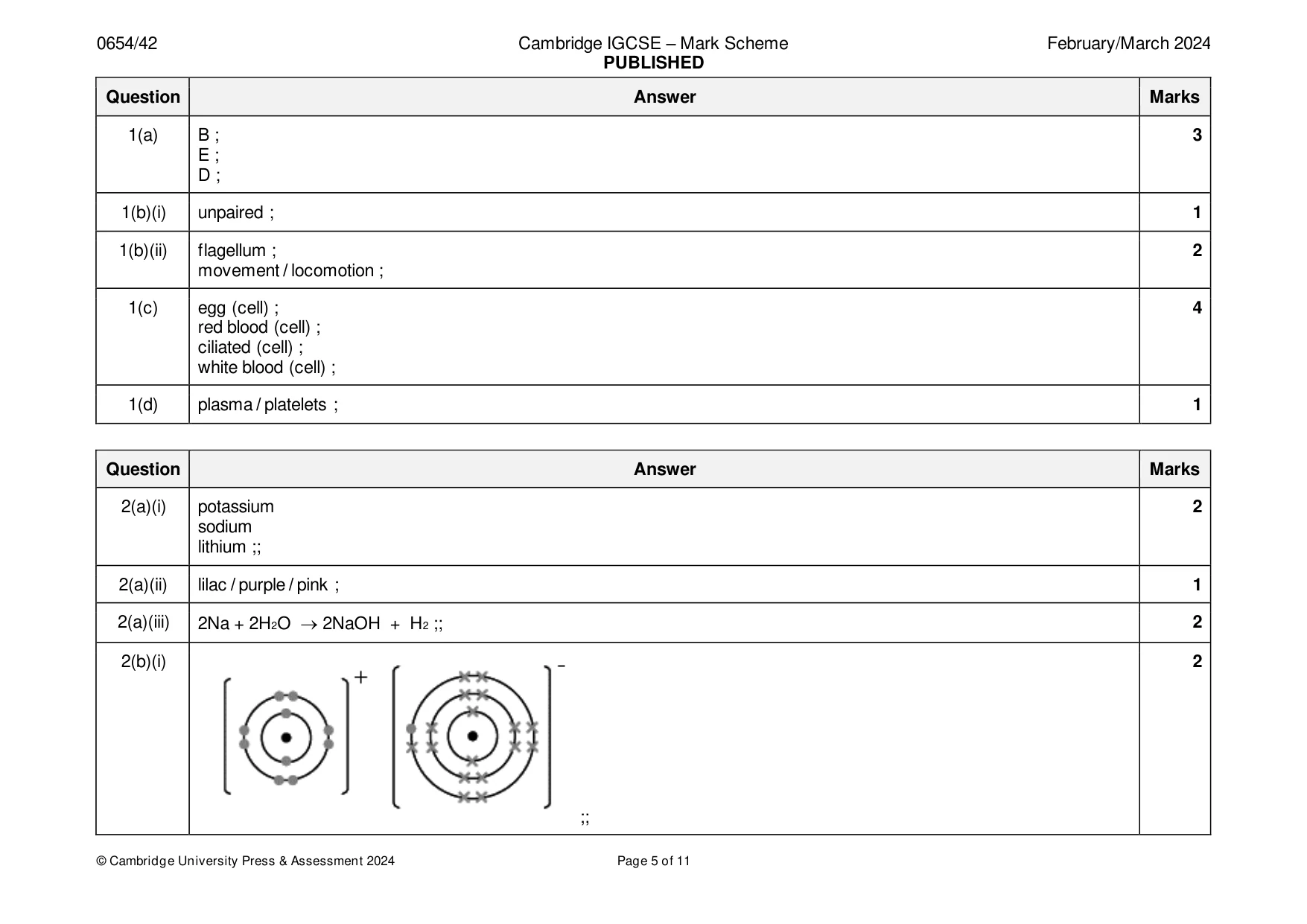
Mark scheme: 2(a)(i) potassium 2 sodium lithium ;; 2(a)(ii) lilac / purple / pink ; 1 2(a)(iii) 2Na + 2H2O → 2NaOH + H2 ;; 2 2(b)(i) 2 ;; 2(b)(ii) Any two from: 2 lattice (structure) ; regular arrangement ; of alternating positive and negative ions ; 2(b)(iii) idea that ions can move in molten sodium chloride / ions cannot move in solid sodium chloride ; 1
Q3 · A student investigates a spring
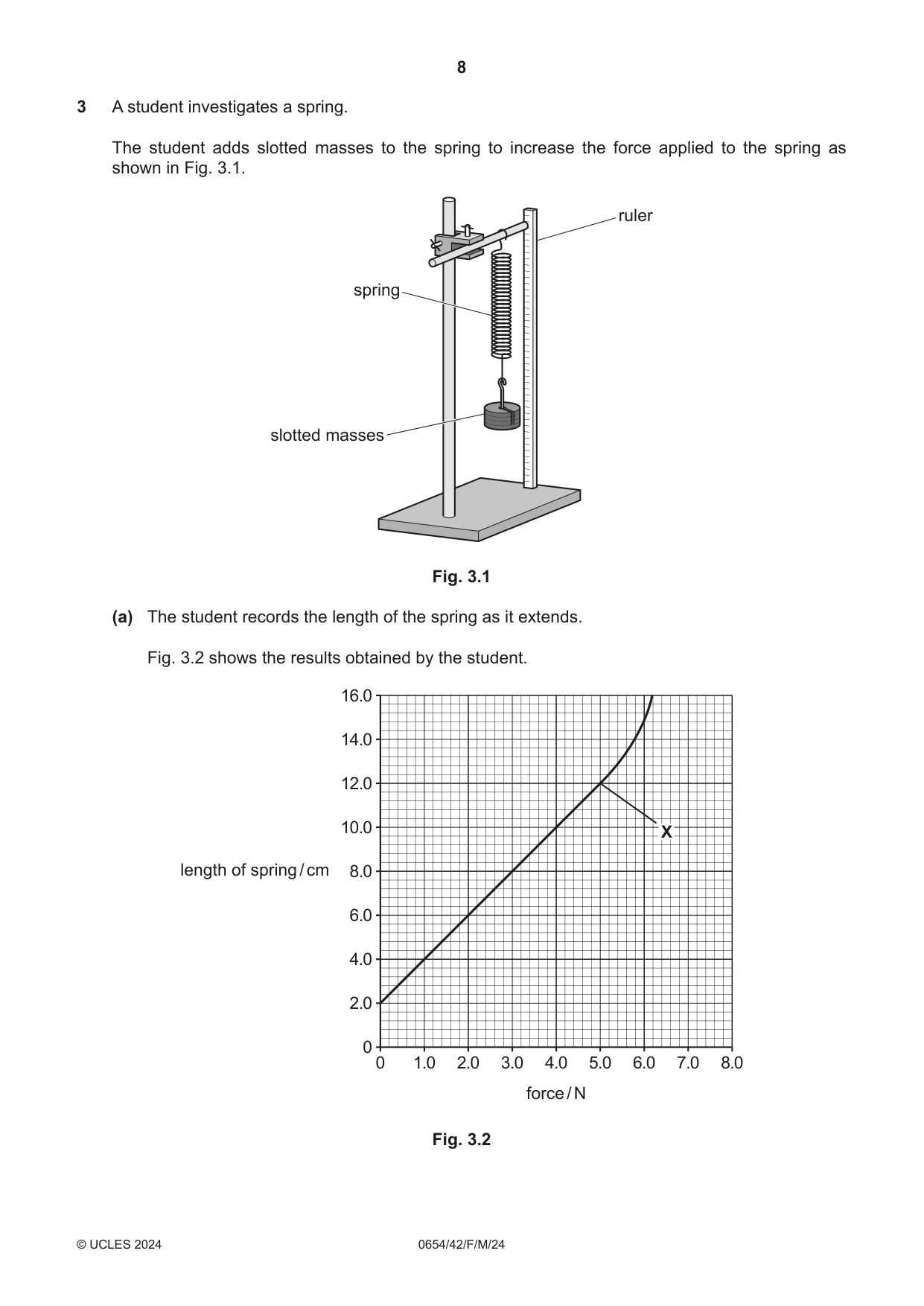
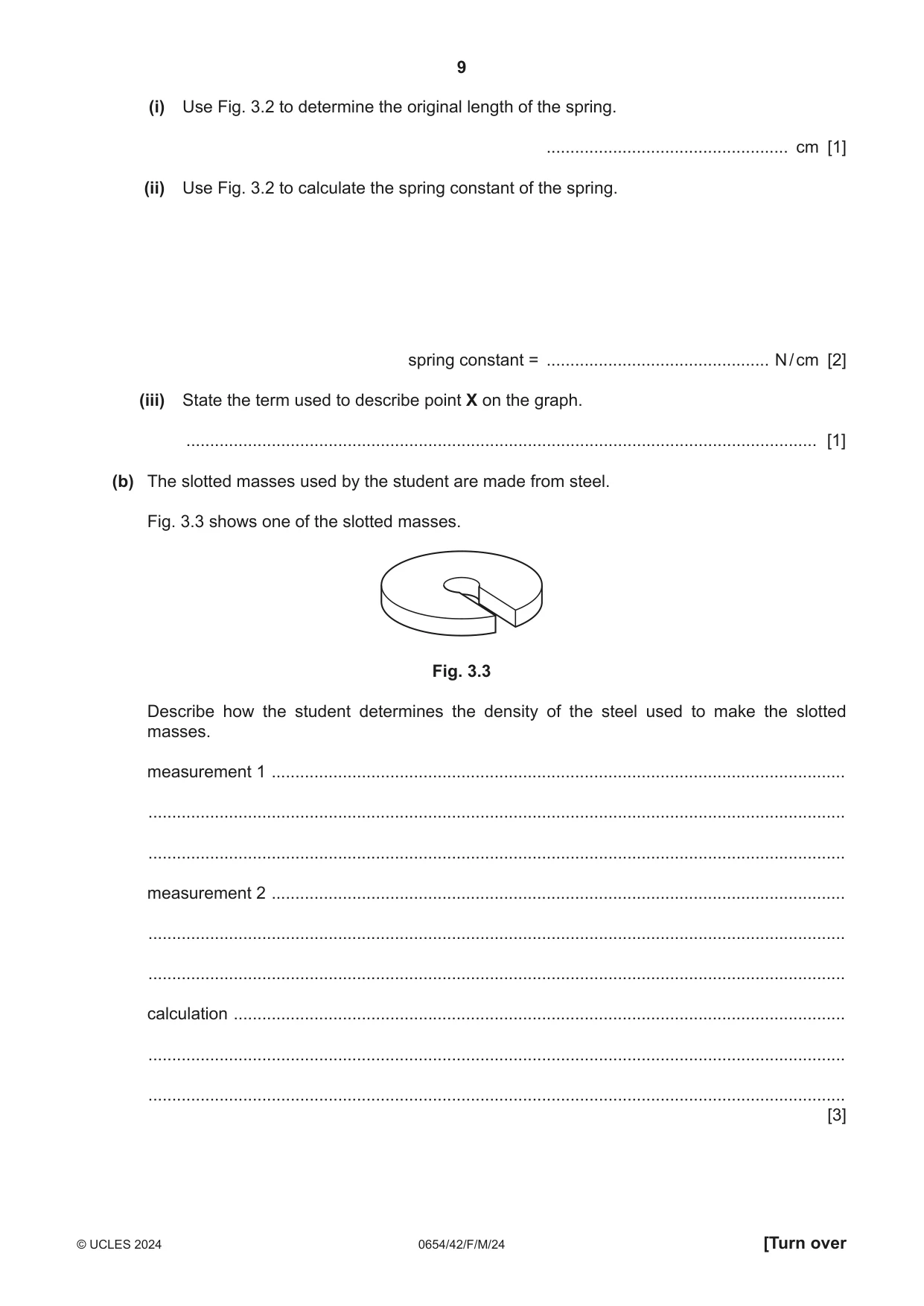
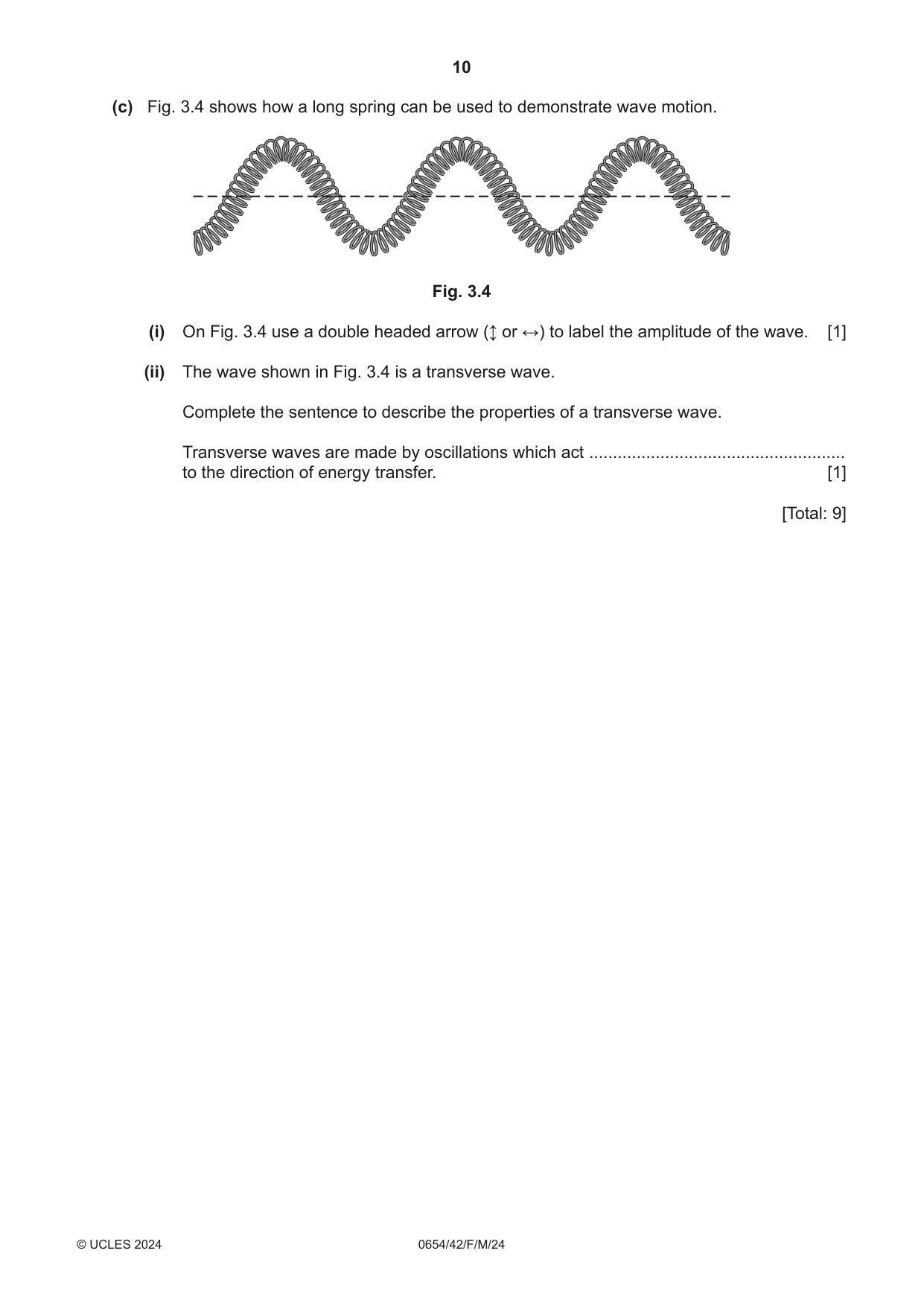
3 A student investigates a spring. The student adds slotted masses to the spring to increase the force applied to the spring as shown in Fig. 3.1. ruler spring slotted masses Fig. 3.1 (a) The student records the length of the spring as it extends. Fig. 3.2 shows the results obtained by the student. 16.0 14.0 12.0 10.0 X length of spring / cm 8.0 6.0 4.0 2.0 0 0 1.0 2.0 3.0 4.0 5.0 6.0 7.0 8.0 force / N Fig. 3.2 (i) Use Fig. 3.2 to determine the original length of the spring. ................................................... cm [1] (ii) Use Fig. 3.2 to calculate the spring constant of the spring. spring constant = ............................................... N / cm [2] (iii) State the term used to describe point X on the graph. ..................................................................................................................................... [1] (b) The slotted masses used by the student are made from steel. Fig. 3.3 shows one of the slotted masses. Fig. 3.3 Describe how the student determines the density of the steel used to make the slotted masses. measurement 1 ......................................................................................................................... ................................................................................................................................................... ................................................................................................................................................... measurement 2 ......................................................................................................................... ................................................................................................................................................... ................................................................................................................................................... calculation ................................................................................................................................. ................................................................................................................................................... ................................................................................................................................................... [3] (c) Fig. 3.4 shows how a long spring can be used to demonstrate wave motion. Fig. 3.4 (i) On Fig. 3.4 use a double headed arrow (↕ or ↔) to label the amplitude of the wave. [1] (ii) The wave shown in Fig. 3.4 is a transverse wave. Complete the sentence to describe the properties of a transverse wave. Transverse waves are made by oscillations which act ...................................................... to the direction of energy transfer. [1] [Total: 9]
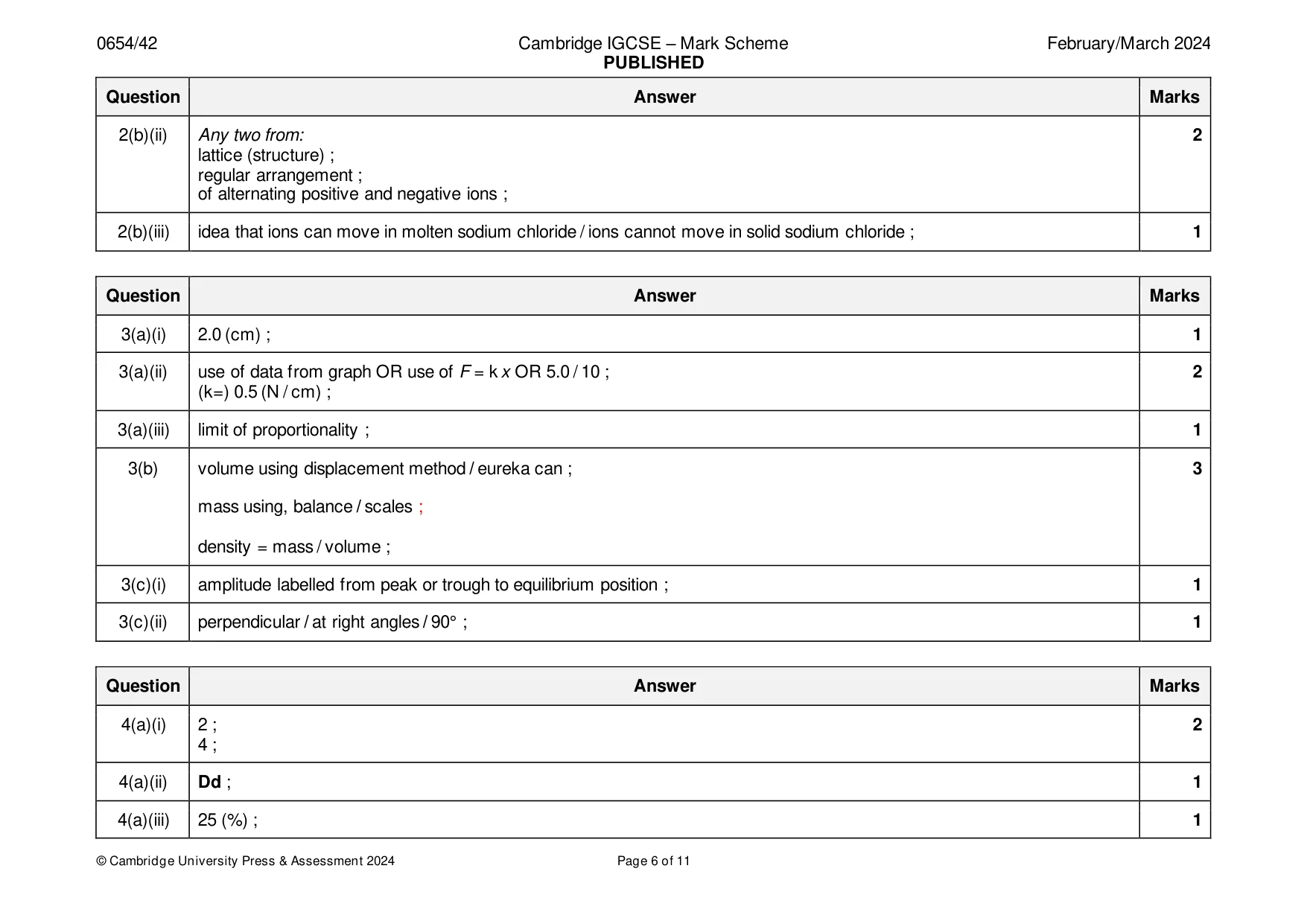
Mark scheme: 3(a)(i) 2.0 (cm) ; 1 3(a)(ii) use of data from graph OR use of F = k x OR 5.0 / 10 ; 2 (k=) 0.5 (N / cm) ; 3(a)(iii) limit of proportionality ; 1 3(b) volume using displacement method / eureka can ; 3 mass using, balance / scales ; density = mass / volume ; 3(c)(i) amplitude labelled from peak or trough to equilibrium position ; 1 3(c)(ii) perpendicular / at right angles / 90° ; 1
Q4 · Phenylketonuria (PKU) is an inherited disorder controlled by a single gene
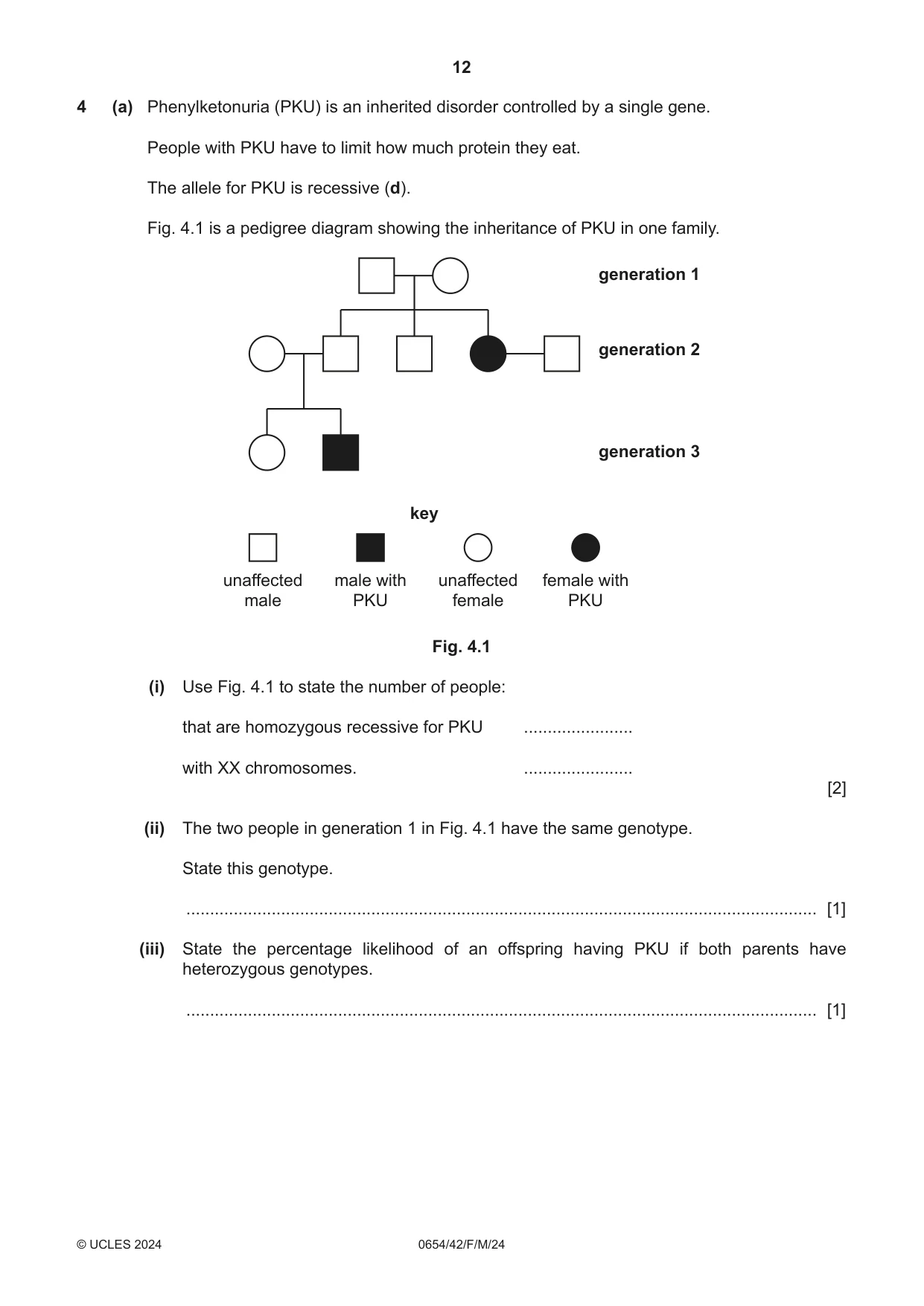
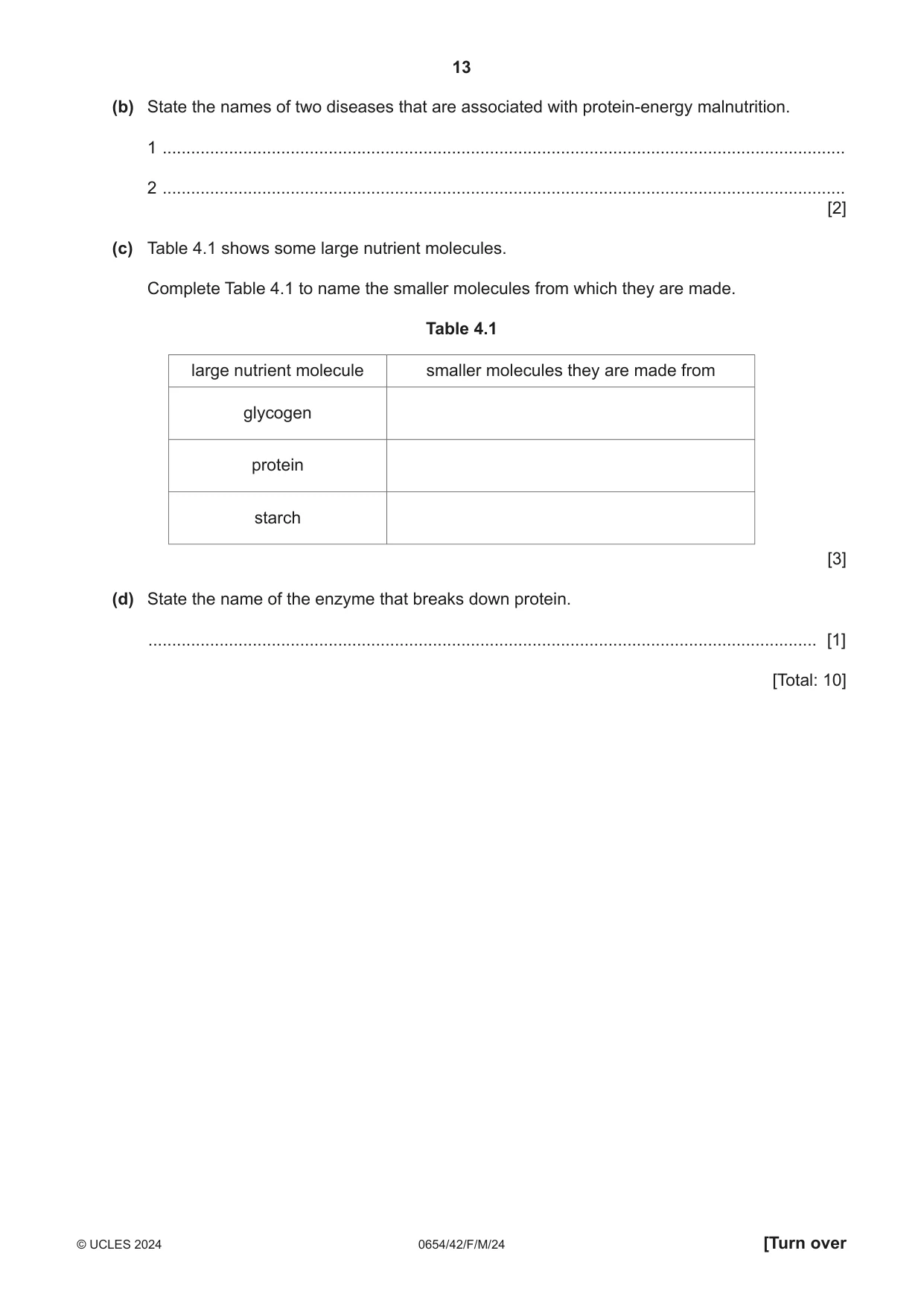
4 (a) Phenylketonuria (PKU) is an inherited disorder controlled by a single gene. People with PKU have to limit how much protein they eat. The allele for PKU is recessive (d). Fig. 4.1 is a pedigree diagram showing the inheritance of PKU in one family. generation 1 generation 2 generation 3 key unaffected male with unaffected female with male PKU female PKU Fig. 4.1 (i) Use Fig. 4.1 to state the number of people: that are homozygous recessive for PKU ....................... with XX chromosomes. ....................... [2] (ii) The two people in generation 1 in Fig. 4.1 have the same genotype. State this genotype. ..................................................................................................................................... [1] (iii) State the percentage likelihood of an offspring having PKU if both parents have heterozygous genotypes. ..................................................................................................................................... [1] (b) State the names of two diseases that are associated with protein-energy malnutrition. 1 ................................................................................................................................................ 2 ................................................................................................................................................ [2] (c) Table 4.1 shows some large nutrient molecules. Complete Table 4.1 to name the smaller molecules from which they are made. Table 4.1 large nutrient molecule smaller molecules they are made from glycogen protein starch [3] (d) State the name of the enzyme that breaks down protein. ............................................................................................................................................. [1] [Total: 10]
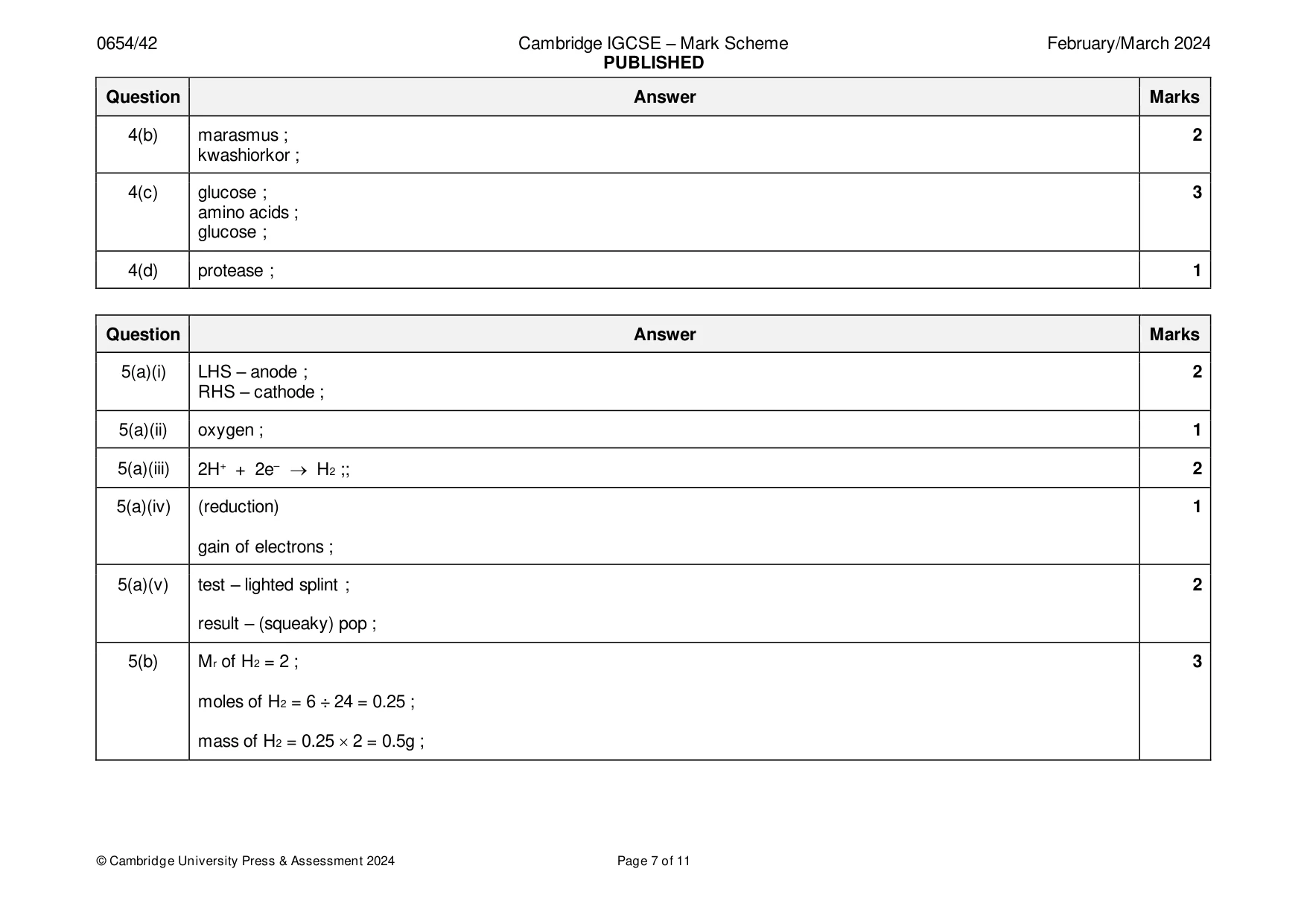
Mark scheme: 4(a)(i) 2 ; 2 4 ; 4(a)(ii) Dd ; 1 4(a)(iii) 25 (%) ; 1 4(b) marasmus ; 2 kwashiorkor ; 4(c) glucose ; 3 amino acids ; glucose ; 4(d) protease ; 1
Q5 · Electrolysis can be used to break down a substance into useful products
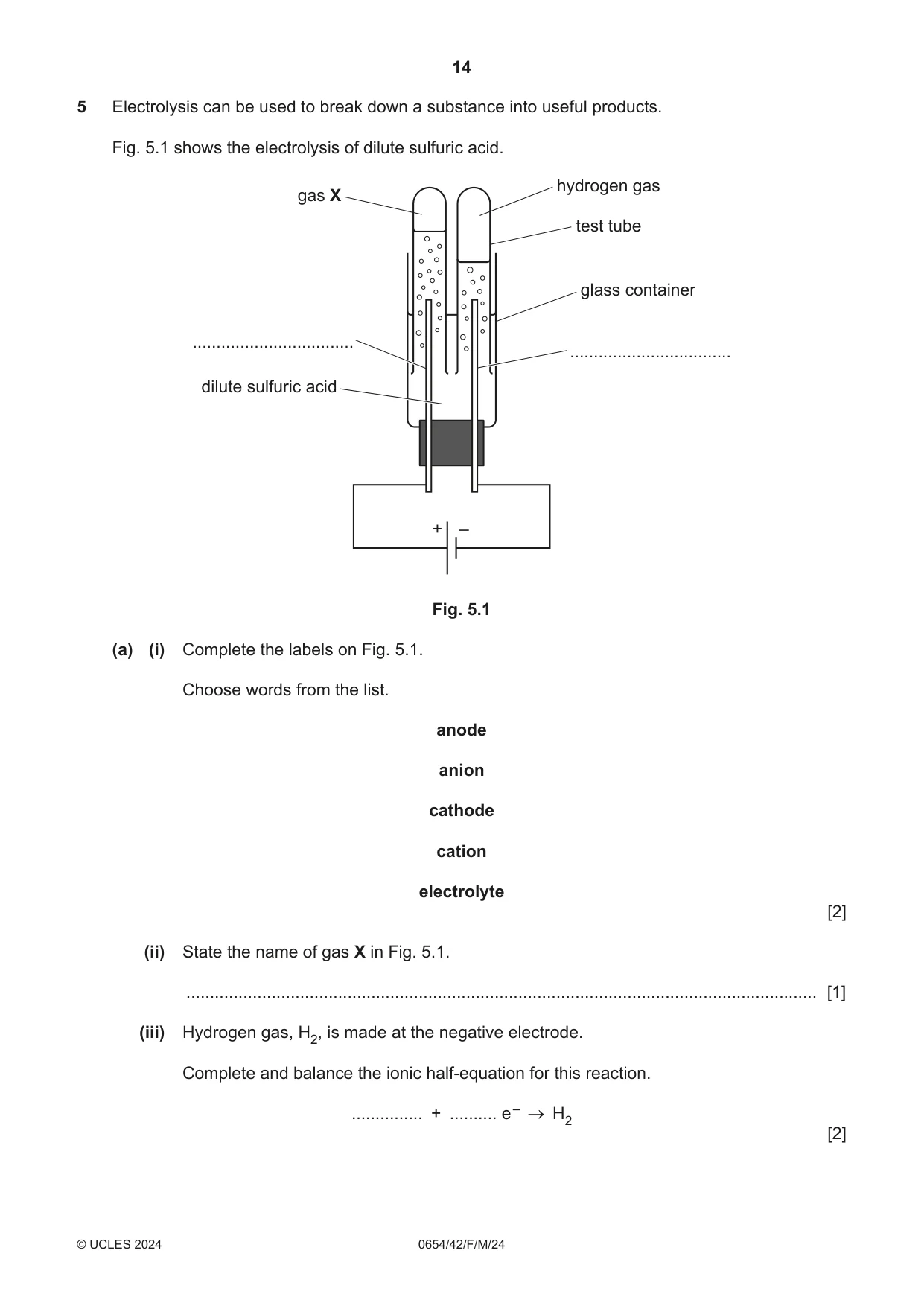
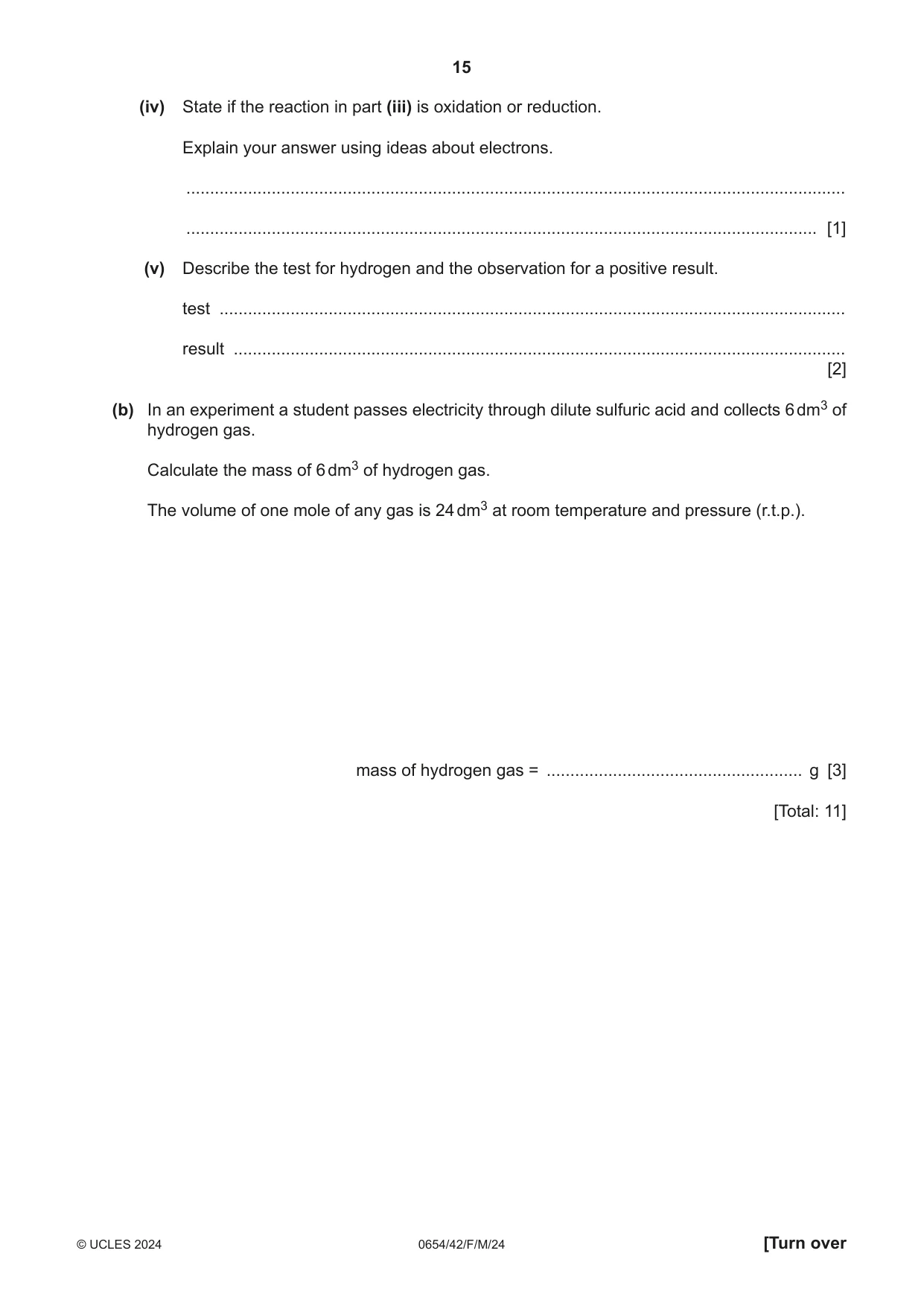
5 Electrolysis can be used to break down a substance into useful products. Fig. 5.1 shows the electrolysis of dilute sulfuric acid. hydrogen gas gas X test tube glass container .................................. .................................. dilute sulfuric acid + – Fig. 5.1 (a) (i) Complete the labels on Fig. 5.1. Choose words from the list. anode anion cathode cation electrolyte [2] (ii) State the name of gas X in Fig. 5.1. ..................................................................................................................................... [1] (iii) Hydrogen gas, H2, is made at the negative electrode. Complete and balance the ionic half-equation for this reaction. ............... + .......... e – H2 [2] (iv) State if the reaction in part (iii) is oxidation or reduction. Explain your answer using ideas about electrons. ........................................................................................................................................... ..................................................................................................................................... [1] (v) Describe the test for hydrogen and the observation for a positive result. test .................................................................................................................................... result ................................................................................................................................. [2] (b) In an experiment a student passes electricity through dilute sulfuric acid and collects 6 dm3 of hydrogen gas. Calculate the mass of 6 dm3 of hydrogen gas. The volume of one mole of any gas is 24 dm3 at room temperature and pressure (r.t.p.). mass of hydrogen gas = ...................................................... g [3] [Total: 11]
Mark scheme: 5(a)(i) LHS – anode ; 2 RHS – cathode ; 5(a)(ii) oxygen ; 1 5(a)(iii) 2H+ + 2e– → H2 ;; 2 5(a)(iv) (reduction) 1 gain of electrons ; 5(a)(v) test – lighted splint ; 2 result – (squeaky) pop ; 5(b) Mr of H2 = 2 ; 3 moles of H2 = 6 ÷ 24 = 0.25 ; mass of H2 = 0.25 2 = 0.5g ;
Q6 · Asteroids are large rocks which orbit the Sun
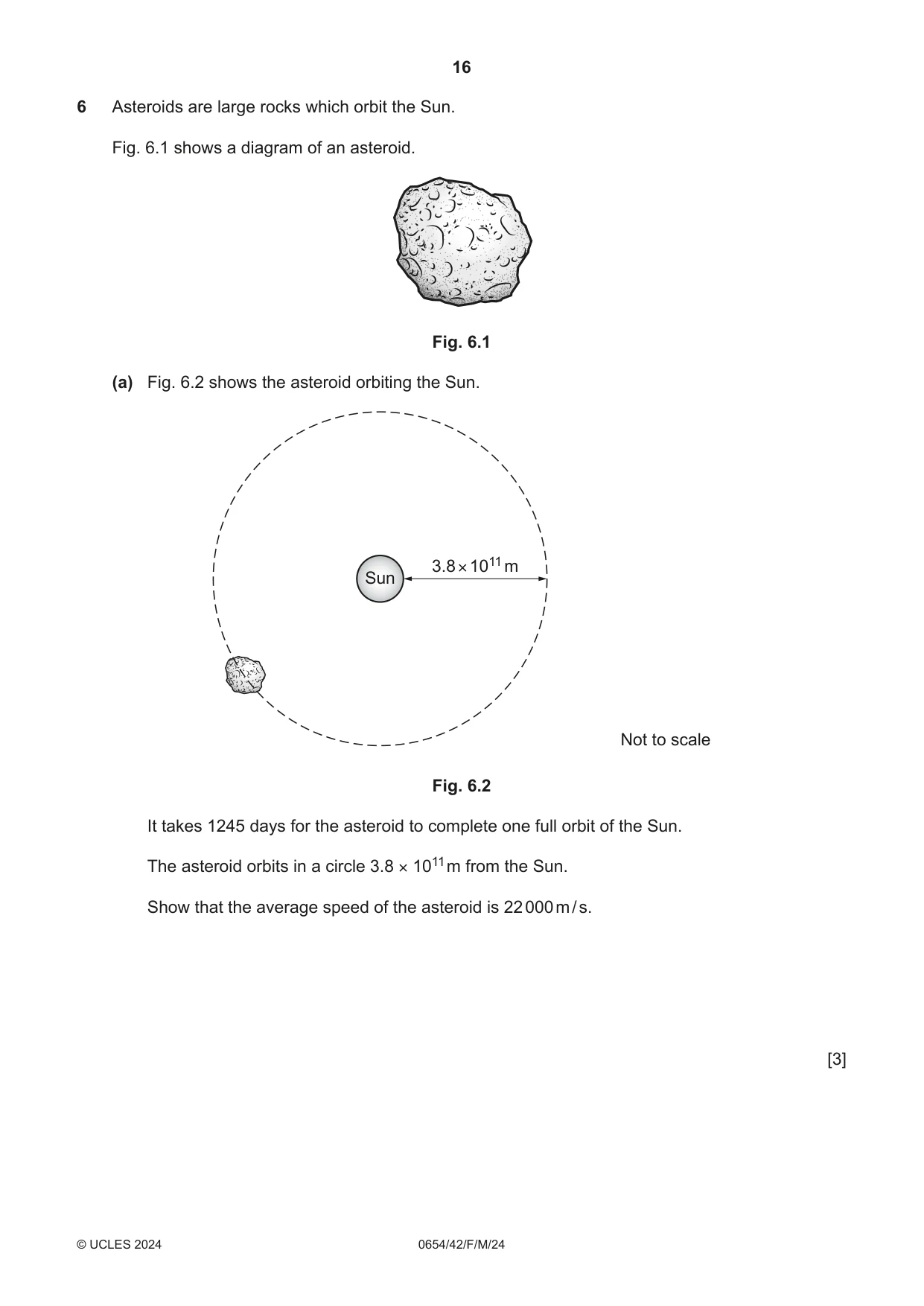
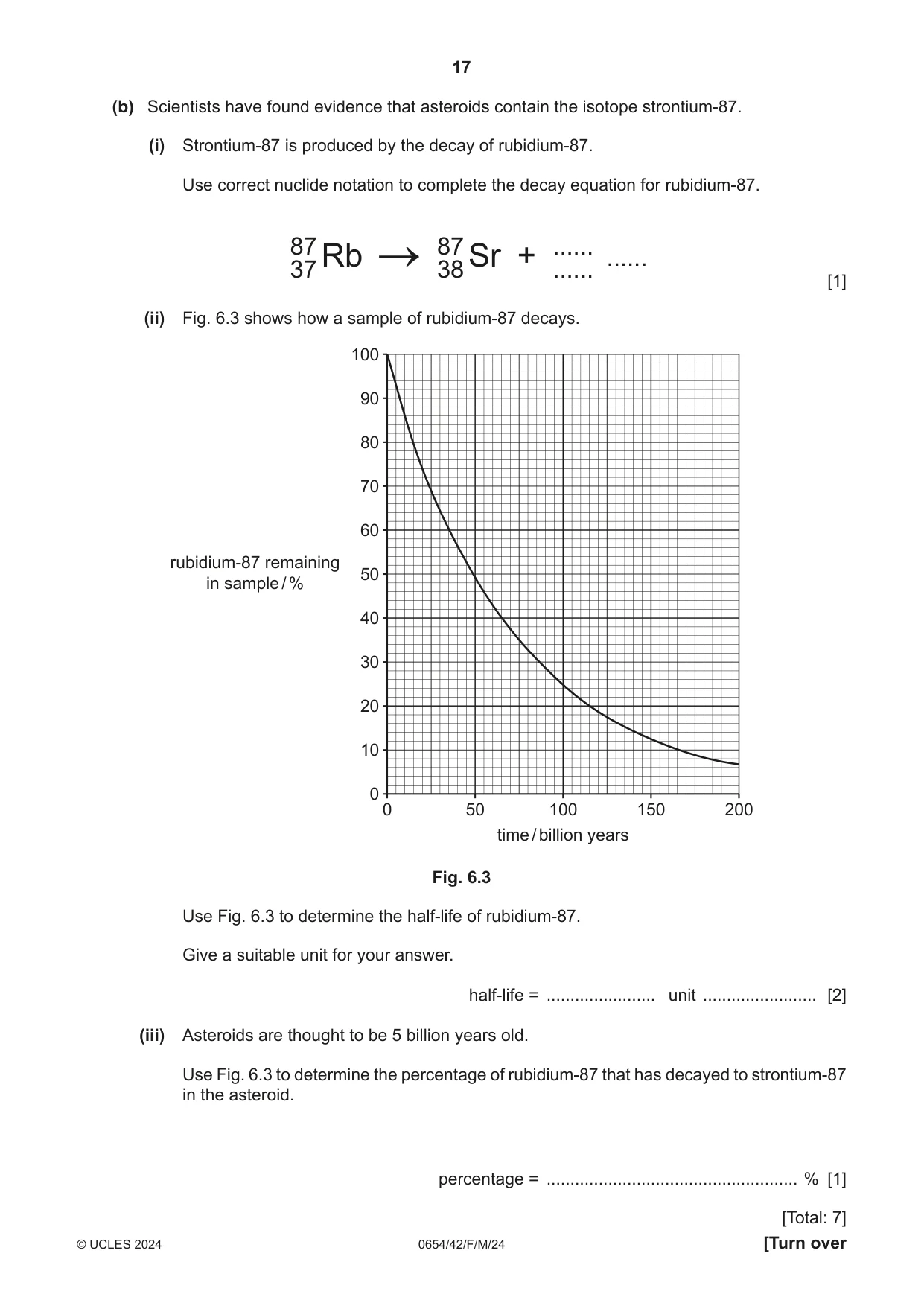
6 Asteroids are large rocks which orbit the Sun. Fig. 6.1 shows a diagram of an asteroid. Fig. 6.1 (a) Fig. 6.2 shows the asteroid orbiting the Sun. 3.8×10¹¹m Sun Not to scale Fig. 6.2 It takes 1245 days for the asteroid to complete one full orbit of the Sun. The asteroid orbits in a circle 3.8 × 10¹¹ m from the Sun. Show that the average speed of the asteroid is 22 000 m / s. [3] (b) Scientists have found evidence that asteroids contain the isotope strontium-87. (i) Strontium-87 is produced by the decay of rubidium-87. Use correct nuclide notation to complete the decay equation for rubidium-87. 87 Rb 87 Sr + ...... ...... 37 38 ...... [1] (ii) Fig. 6.3 shows how a sample of rubidium-87 decays. 100 90 80 70 60 rubidium-87 remaining 50 in sample / % 40 30 20 10 0 0 50 100 150 200 time / billion years Fig. 6.3 Use Fig. 6.3 to determine the half-life of rubidium-87. Give a suitable unit for your answer. half-life = ....................... unit ........................ [2] (iii) Asteroids are thought to be 5 billion years old. Use Fig. 6.3 to determine the percentage of rubidium-87 that has decayed to strontium-87 in the asteroid. percentage = ..................................................... % [1] [Total: 7]
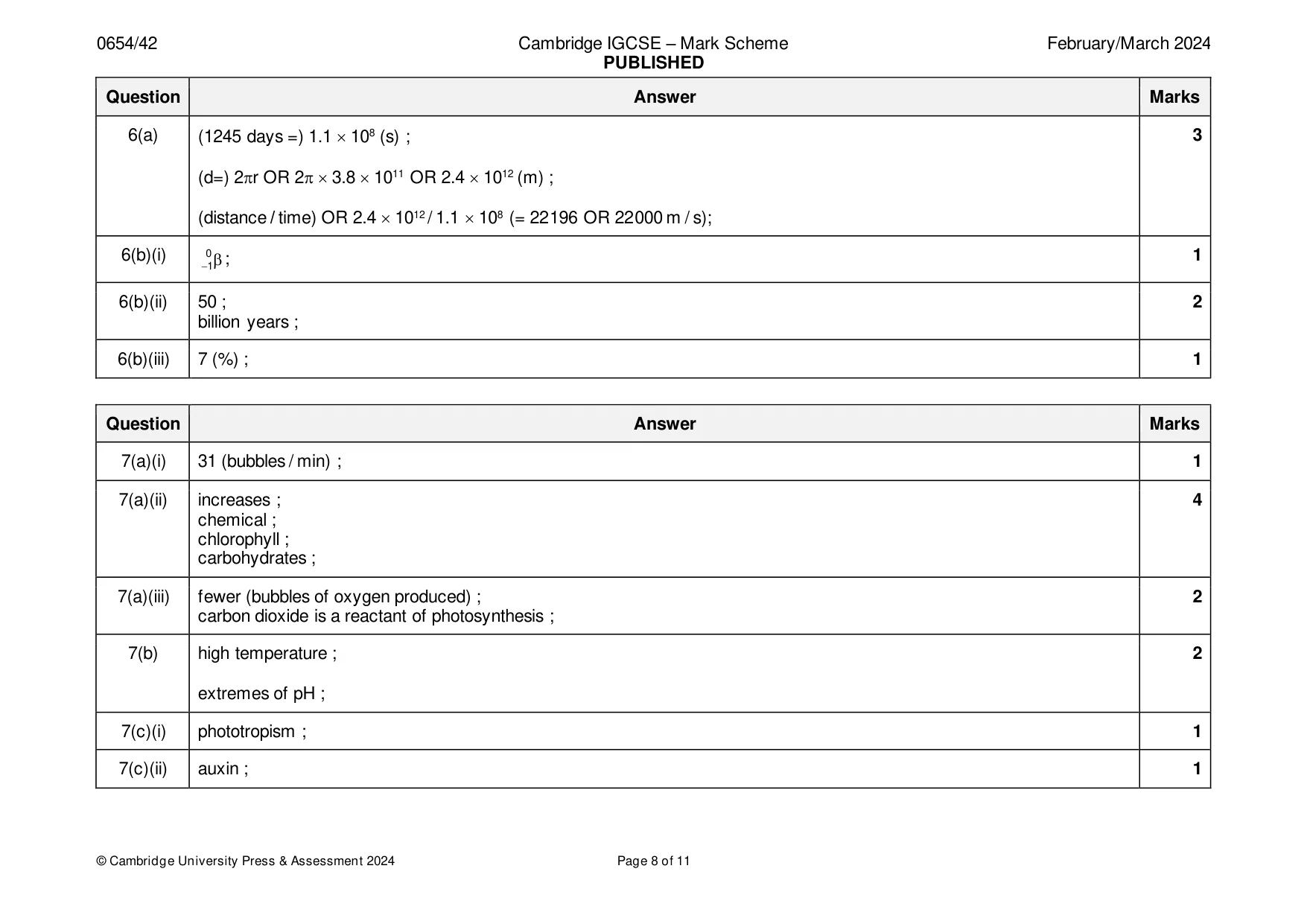
Mark scheme: 6(a) (1245 days =) 1.1 108 (s) ; 3 (d=) 2r OR 2 3.8 1011 OR 2.4 1012 (m) ; (distance / time) OR 2.4 1012 / 1.1 108 (= 22 196 OR 22 000 m / s); 6(b)(i) −;01 1 6(b)(ii) 50 ; 2 billion years ; 6(b)(iii) 7 (%) ; 1
Q7 · A student investigates the effect of light intensity on the rate of photosynthesis
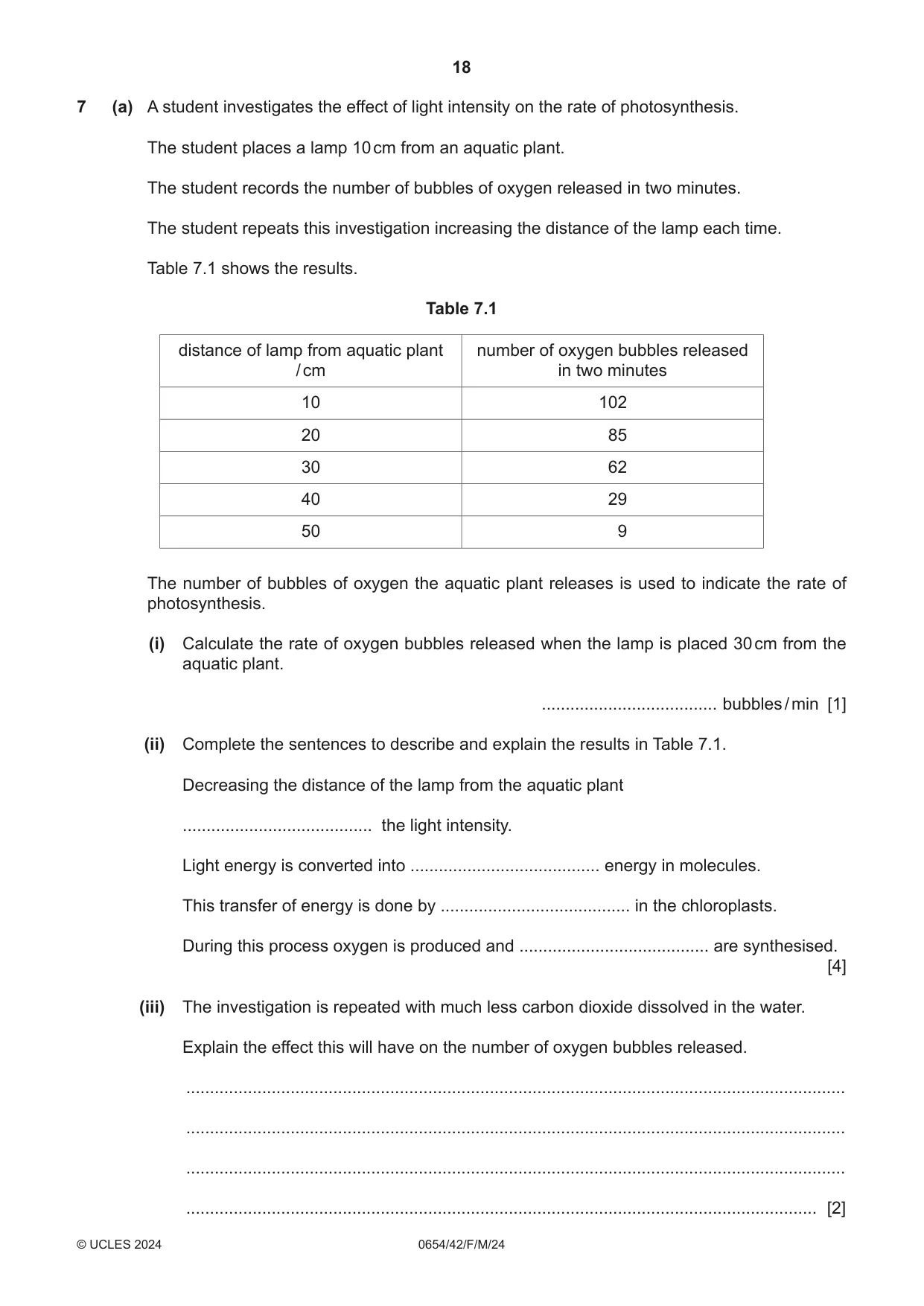
7 (a) A student investigates the effect of light intensity on the rate of photosynthesis. The student places a lamp 10 cm from an aquatic plant. The student records the number of bubbles of oxygen released in two minutes. The student repeats this investigation increasing the distance of the lamp each time. Table 7.1 shows the results. Table 7.1 distance of lamp from aquatic plant number of oxygen bubbles released / cm in two minutes 10 102 20 85 30 62 40 29 50 9 The number of bubbles of oxygen the aquatic plant releases is used to indicate the rate of photosynthesis. (i) Calculate the rate of oxygen bubbles released when the lamp is placed 30 cm from the aquatic plant. ..................................... bubbles / min [1] (ii) Complete the sentences to describe and explain the results in Table 7.1. Decreasing the distance of the lamp from the aquatic plant ........................................ the light intensity. Light energy is converted into ........................................ energy in molecules. This transfer of energy is done by ........................................ in the chloroplasts. During this process oxygen is produced and ........................................ are synthesised. [4] (iii) The investigation is repeated with much less carbon dioxide dissolved in the water. Explain the effect this will have on the number of oxygen bubbles released. ........................................................................................................................................... ........................................................................................................................................... ........................................................................................................................................... ..................................................................................................................................... [2] (b) Photosynthesis is an enzyme-controlled reaction. State two conditions that cause enzymes to denature. 1 ................................................................................................................................................ 2 ................................................................................................................................................ [2] (c) A plant will grow towards a source of light. (i) State the name of this tropic response. ..................................................................................................................................... [1] (ii) State the name of the chemical that causes this tropic response. ..................................................................................................................................... [1] [Total: 11]
Mark scheme: 7(a)(i) 31 (bubbles / min) ; 1 7(a)(ii) increases ; 4 chemical ; chlorophyll ; carbohydrates ; 7(a)(iii) fewer (bubbles of oxygen produced) ; 2 carbon dioxide is a reactant of photosynthesis ; 7(b) high temperature ; 2 extremes of pH ; 7(c)(i) phototropism ; 1 7(c)(ii) auxin ; 1
Q8 · Ammonia is manufactured in the Haber process
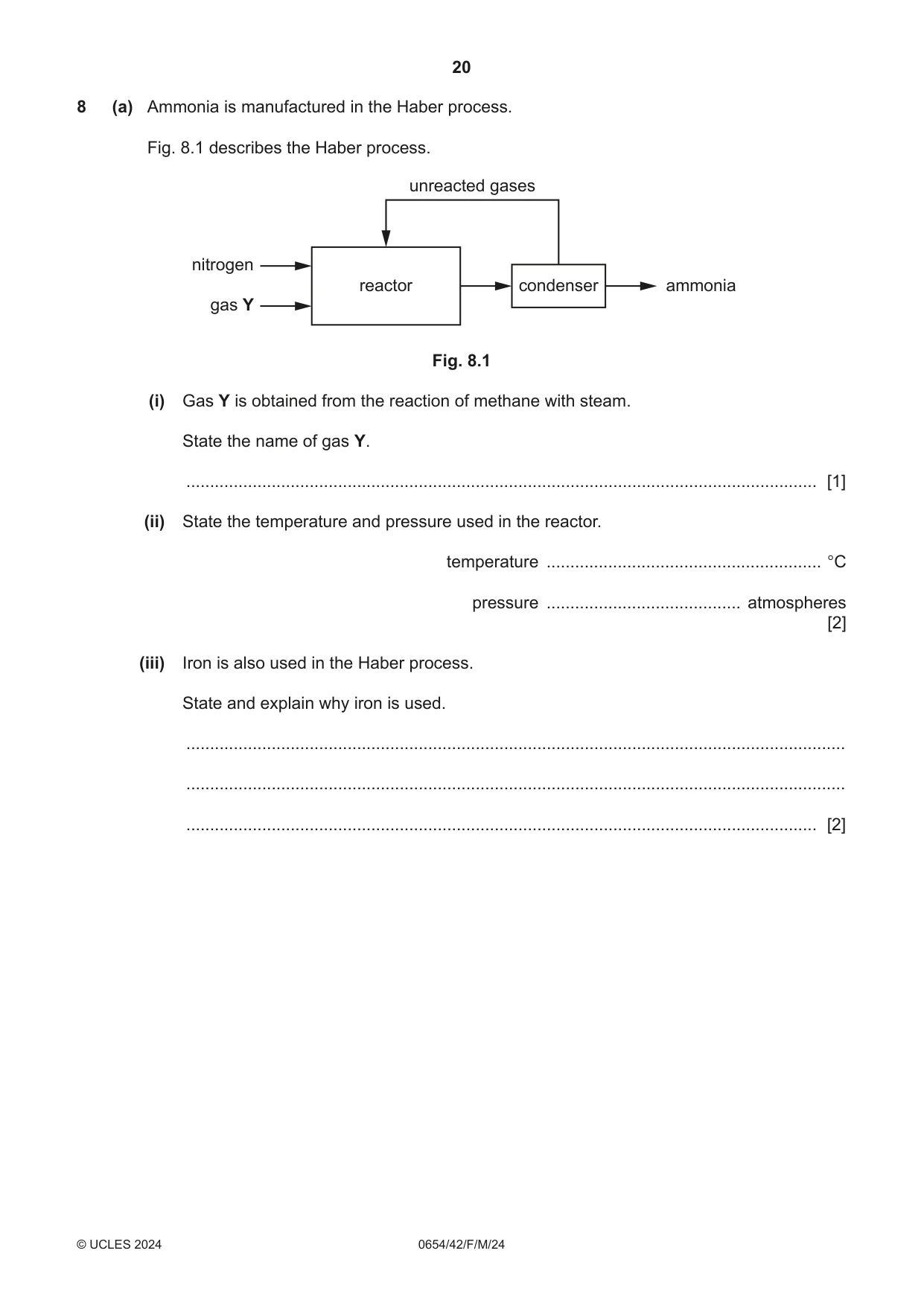
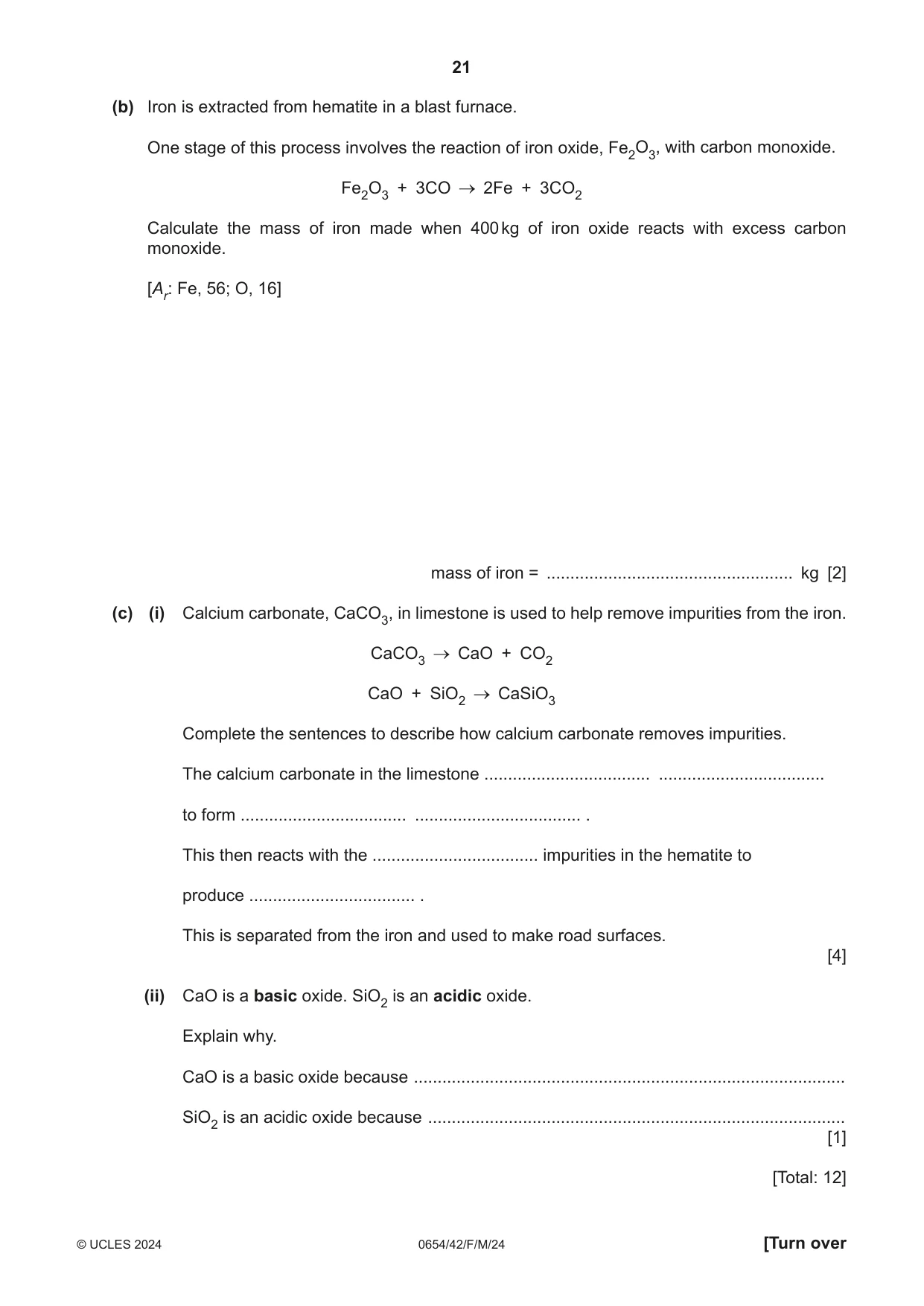
8 (a) Ammonia is manufactured in the Haber process. Fig. 8.1 describes the Haber process. unreacted gases nitrogen reactor condenser ammonia gas Y Fig. 8.1 (i) Gas Y is obtained from the reaction of methane with steam. State the name of gas Y. ..................................................................................................................................... [1] (ii) State the temperature and pressure used in the reactor. temperature .......................................................... °C pressure ......................................... atmospheres [2] (iii) Iron is also used in the Haber process. State and explain why iron is used. ........................................................................................................................................... ........................................................................................................................................... ..................................................................................................................................... [2] (b) Iron is extracted from hematite in a blast furnace. One stage of this process involves the reaction of iron oxide, Fe2O3, with carbon monoxide. Fe2O3 + 3CO 2Fe + 3CO2 Calculate the mass of iron made when 400 kg of iron oxide reacts with excess carbon monoxide. [Ar: Fe, 56; O, 16] mass of iron = .................................................... kg [2] (c) (i) Calcium carbonate, CaCO3, in limestone is used to help remove impurities from the iron. CaCO3 CaO + CO2 CaO + SiO2 CaSiO3 Complete the sentences to describe how calcium carbonate removes impurities. The calcium carbonate in the limestone ................................... ................................... to form ................................... ................................... . This then reacts with the ................................... impurities in the hematite to produce ................................... . This is separated from the iron and used to make road surfaces. [4] (ii) CaO is a basic oxide. SiO2 is an acidic oxide. Explain why. CaO is a basic oxide because ........................................................................................... SiO2 is an acidic oxide because ........................................................................................ [1] [Total: 12]
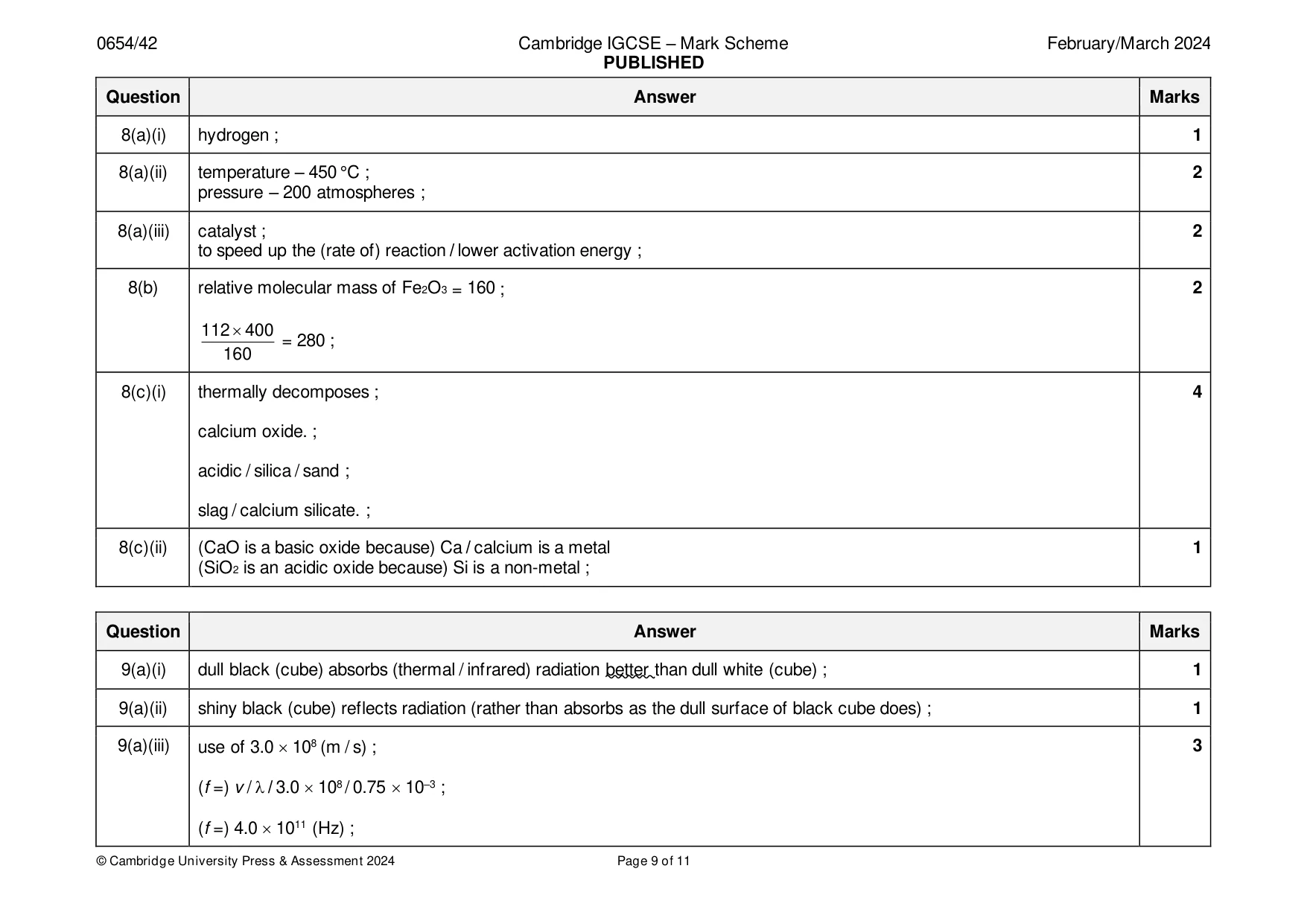
Mark scheme: 8(a)(i) hydrogen ; 1 8(a)(ii) temperature – 450 °C ; 2 pressure – 200 atmospheres ; 8(a)(iii) catalyst ; 2 to speed up the (rate of) reaction / lower activation energy ; 8(b) relative molecular mass of Fe2O3 = 160 ; 2 112 400 = 280 ; 160 8(c)(i) thermally decomposes ; 4 calcium oxide. ; acidic / silica / sand ; slag / calcium silicate. ; 8(c)(ii) (CaO is a basic oxide because) Ca / calcium is a metal 1 (SiO2 is an acidic oxide because) Si is a non-metal ;
Q9 · Two identical infrared heating lamps that are heating two metal cubes
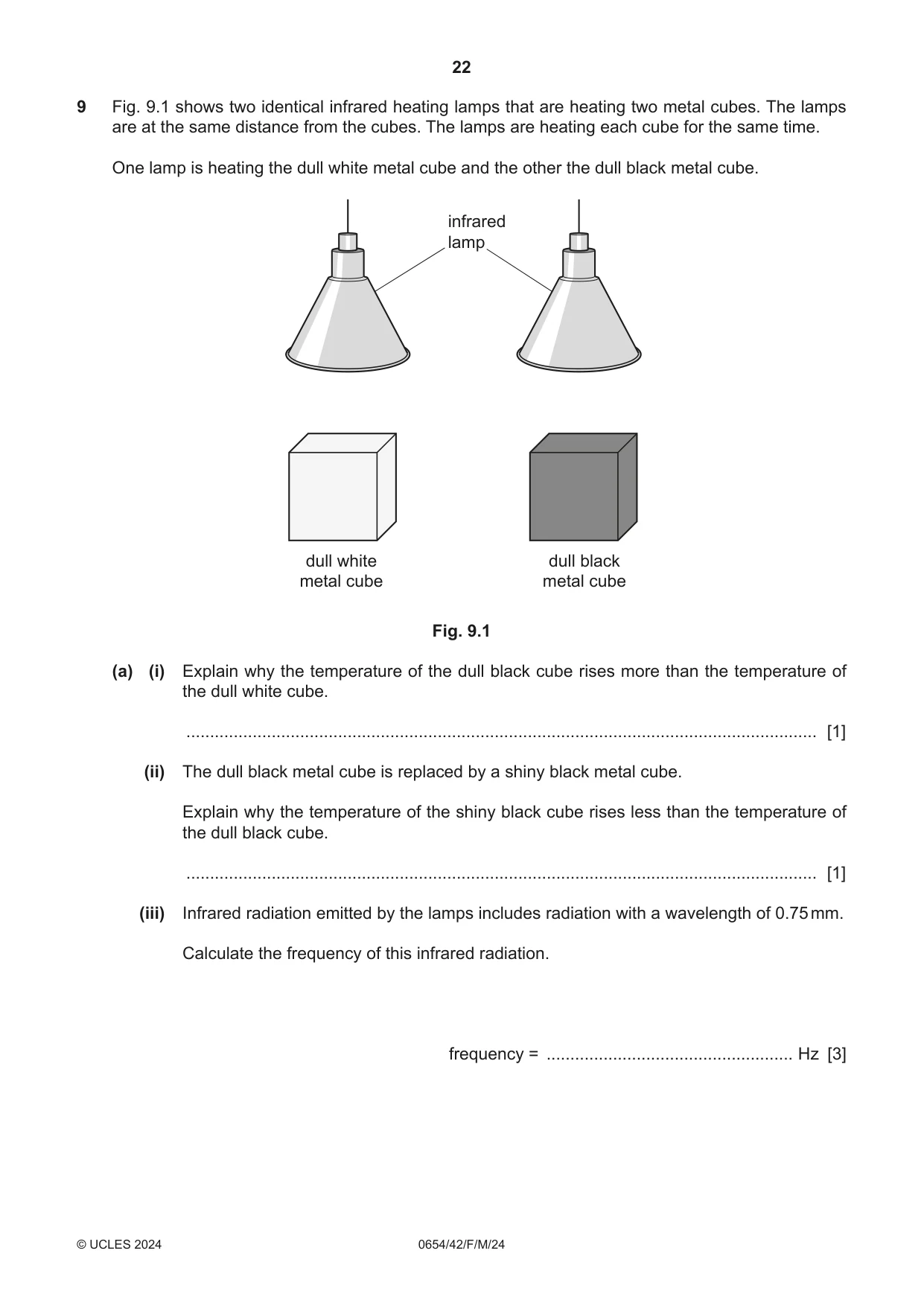
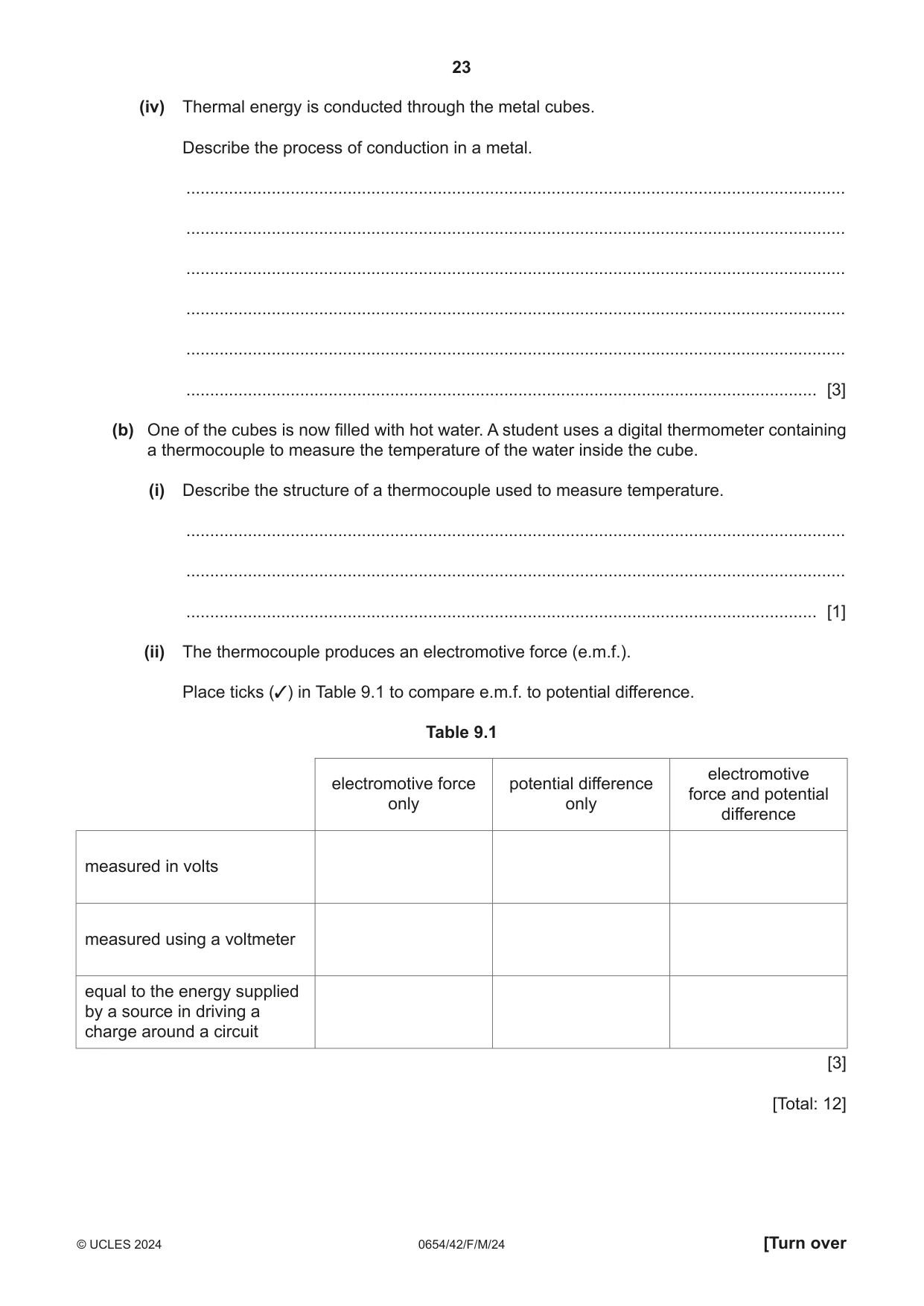
9 Fig. 9.1 shows two identical infrared heating lamps that are heating two metal cubes. The lamps are at the same distance from the cubes. The lamps are heating each cube for the same time. One lamp is heating the dull white metal cube and the other the dull black metal cube. infrared lamp dull white dull black metal cube metal cube Fig. 9.1 (a) (i) Explain why the temperature of the dull black cube rises more than the temperature of the dull white cube. ..................................................................................................................................... [1] (ii) The dull black metal cube is replaced by a shiny black metal cube. Explain why the temperature of the shiny black cube rises less than the temperature of the dull black cube. ..................................................................................................................................... [1] (iii) Infrared radiation emitted by the lamps includes radiation with a wavelength of 0.75 mm. Calculate the frequency of this infrared radiation. frequency = .................................................... Hz [3] (iv) Thermal energy is conducted through the metal cubes. Describe the process of conduction in a metal. ........................................................................................................................................... ........................................................................................................................................... ........................................................................................................................................... ........................................................................................................................................... ........................................................................................................................................... ..................................................................................................................................... [3] (b) One of the cubes is now filled with hot water. A student uses a digital thermometer containing a thermocouple to measure the temperature of the water inside the cube. (i) Describe the structure of a thermocouple used to measure temperature. ........................................................................................................................................... ........................................................................................................................................... ..................................................................................................................................... [1] (ii) The thermocouple produces an electromotive force (e.m.f.). Place ticks (✓) in Table 9.1 to compare e.m.f. to potential difference. Table 9.1 electromotive electromotive force potential difference force and potential only only difference measured in volts measured using a voltmeter equal to the energy supplied by a source in driving a charge around a circuit [3] [Total: 12]
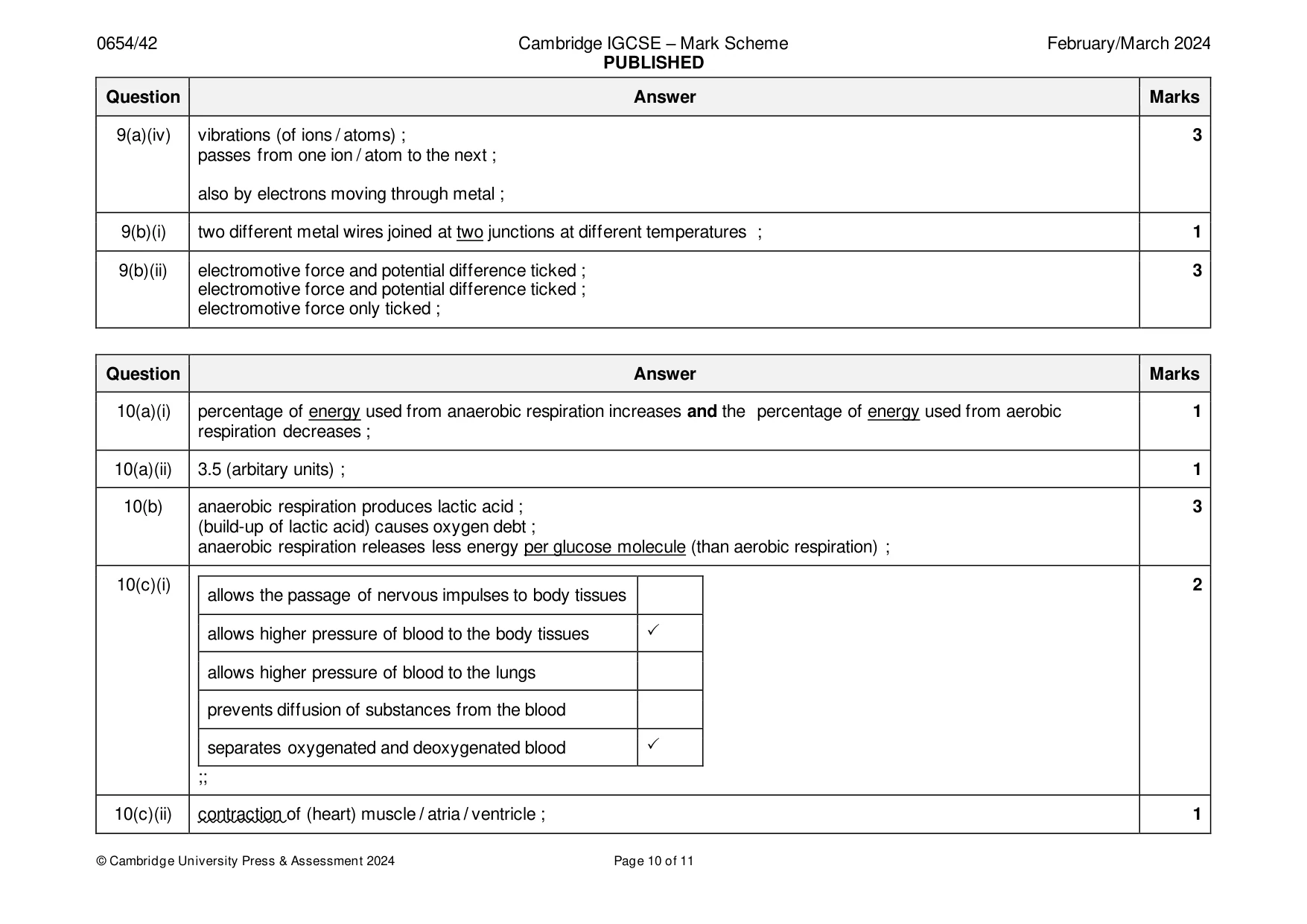
Mark scheme: 9(a)(i) dull black (cube) absorbs (thermal / infrared) radiation better than dull white (cube) ; 1 9(a)(ii) shiny black (cube) reflects radiation (rather than absorbs as the dull surface of black cube does) ; 1 9(a)(iii) use of 3.0 108 (m / s) ; 3 (f =) v / / 3.0 108 / 0.75 10–3 ; (f =) 4.0 1011 (Hz) ; 9(a)(iv) vibrations (of ions / atoms) ; 3 passes from one ion / atom to the next ; also by electrons moving through metal ; 9(b)(i) two different metal wires joined at two junctions at different temperatures ; 1 9(b)(ii) electromotive force and potential difference ticked ; 3 electromotive force and potential difference ticked ; electromotive force only ticked ;
Q10 · Scientists estimate the percentage of energy used from anaerobic respiration and aerobic…
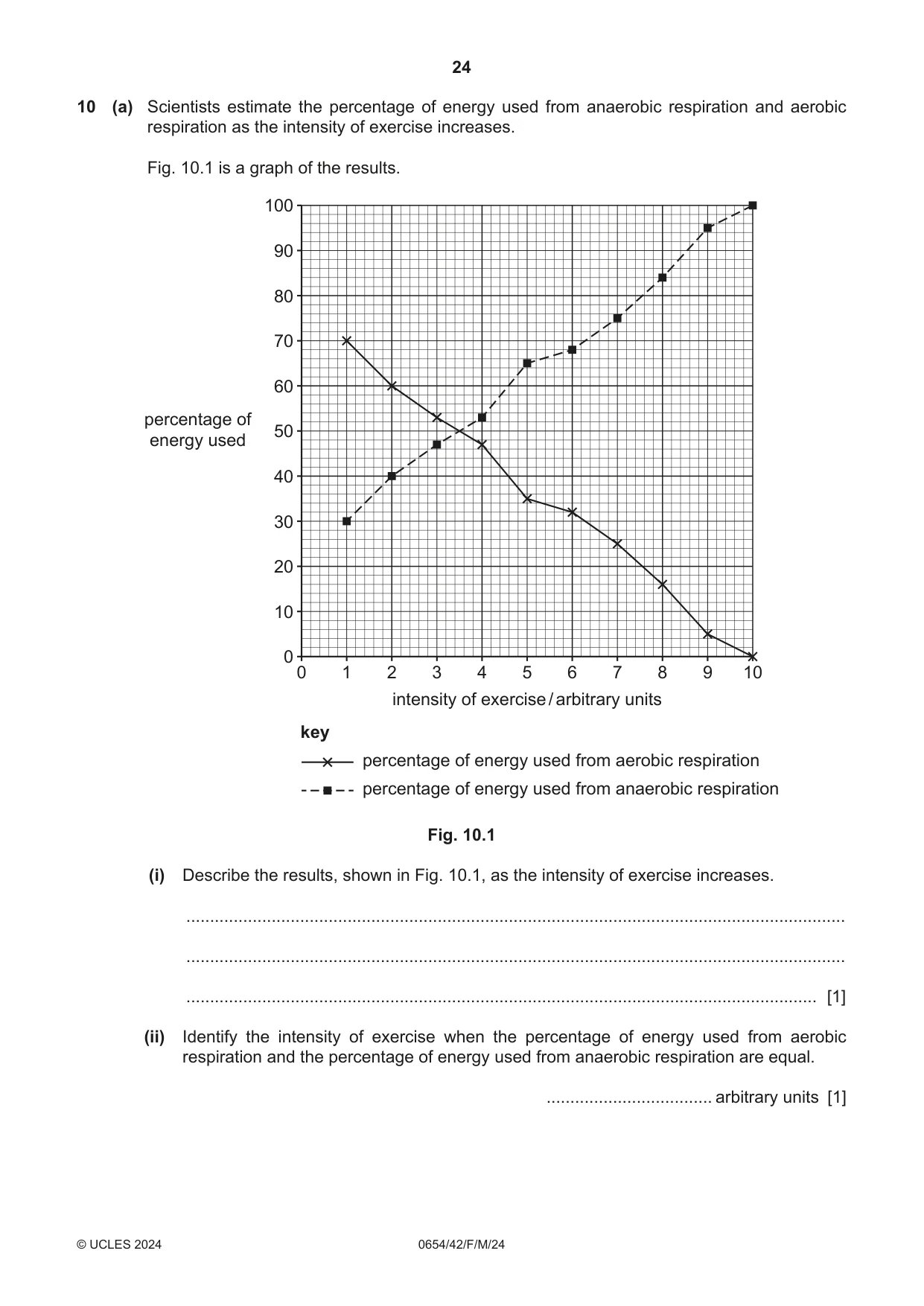
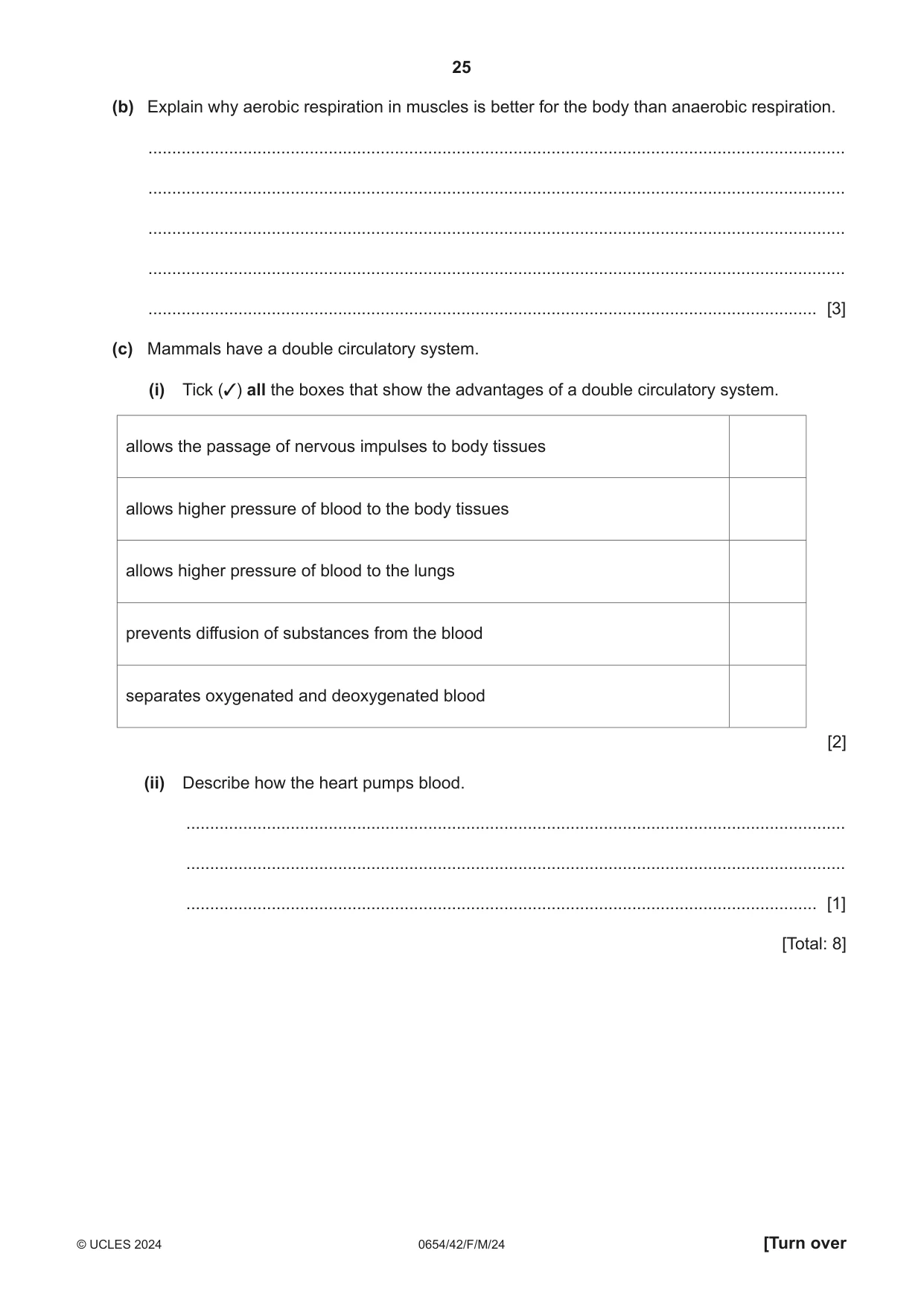
10 (a) Scientists estimate the percentage of energy used from anaerobic respiration and aerobic respiration as the intensity of exercise increases. Fig. 10.1 is a graph of the results. 100 90 80 70 60 percentage of 50 energy used 40 30 20 10 0 0 1 2 3 4 5 6 7 8 9 10 intensity of exercise / arbitrary units key percentage of energy used from aerobic respiration percentage of energy used from anaerobic respiration Fig. 10.1 (i) Describe the results, shown in Fig. 10.1, as the intensity of exercise increases. ........................................................................................................................................... ........................................................................................................................................... ..................................................................................................................................... [1] (ii) Identify the intensity of exercise when the percentage of energy used from aerobic respiration and the percentage of energy used from anaerobic respiration are equal. ................................... arbitrary units [1] (b) Explain why aerobic respiration in muscles is better for the body than anaerobic respiration. ................................................................................................................................................... ................................................................................................................................................... ................................................................................................................................................... ................................................................................................................................................... ............................................................................................................................................. [3] (c) Mammals have a double circulatory system. (i) Tick (✓) all the boxes that show the advantages of a double circulatory system. allows the passage of nervous impulses to body tissues allows higher pressure of blood to the body tissues allows higher pressure of blood to the lungs prevents diffusion of substances from the blood separates oxygenated and deoxygenated blood [2] (ii) Describe how the heart pumps blood. ........................................................................................................................................... ........................................................................................................................................... ..................................................................................................................................... [1] [Total: 8]
Mark scheme: 10(a)(i) percentage of energy used from anaerobic respiration increases and the percentage of energy used from aerobic 1 respiration decreases ; 10(a)(ii) 3.5 (arbitary units) ; 1 10(b) anaerobic respiration produces lactic acid ; 3 (build-up of lactic acid) causes oxygen debt ; anaerobic respiration releases less energy per glucose molecule (than aerobic respiration) ; 10(c)(i) 2 allows the passage of nervous impulses to body tissues allows higher pressure of blood to the body tissues allows higher pressure of blood to the lungs prevents diffusion of substances from the blood separates oxygenated and deoxygenated blood ;; 10(c)(ii) contraction of (heart) muscle / atria / ventricle ; 1
Q11 · Butane, C4H10, is an alkane
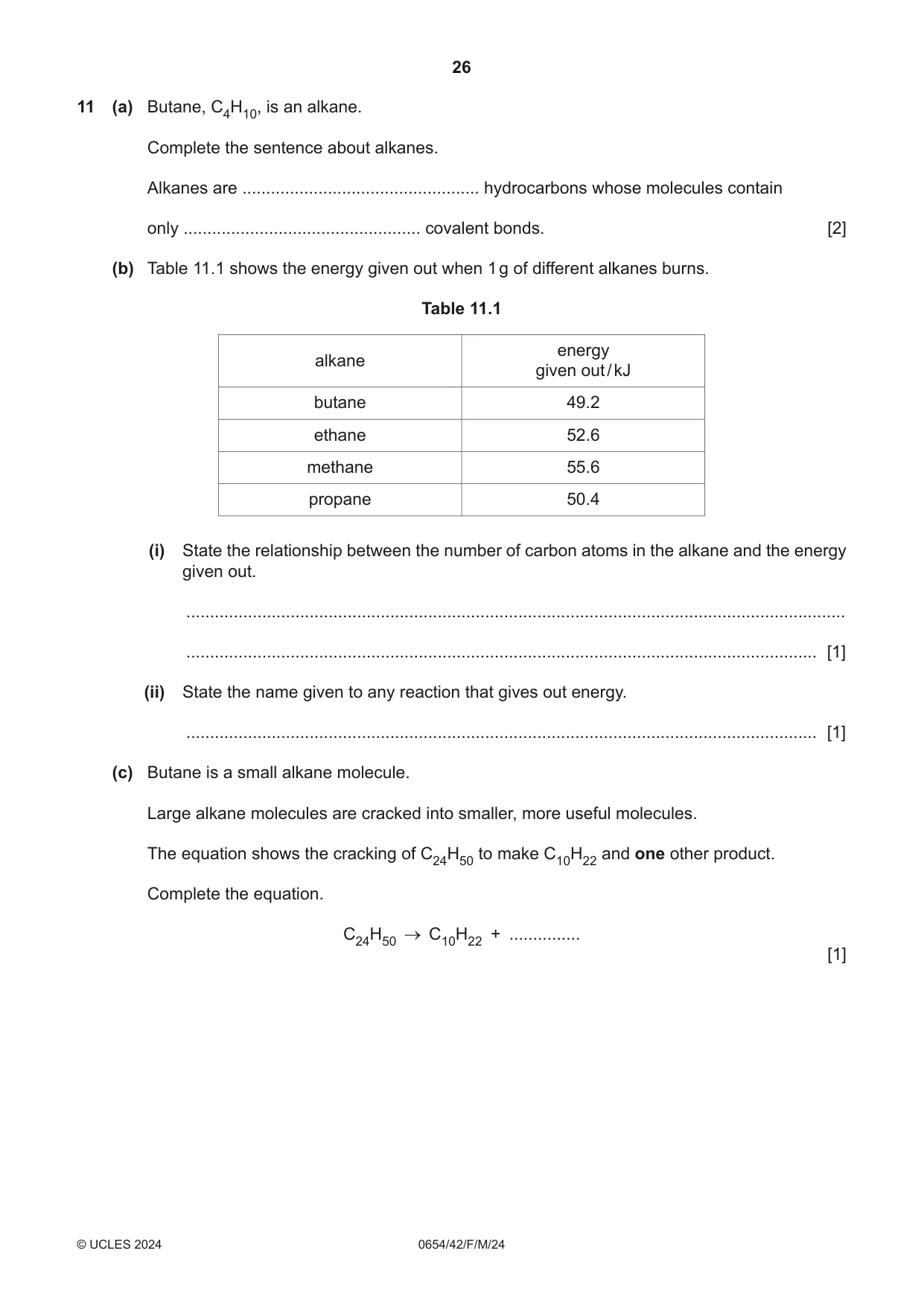
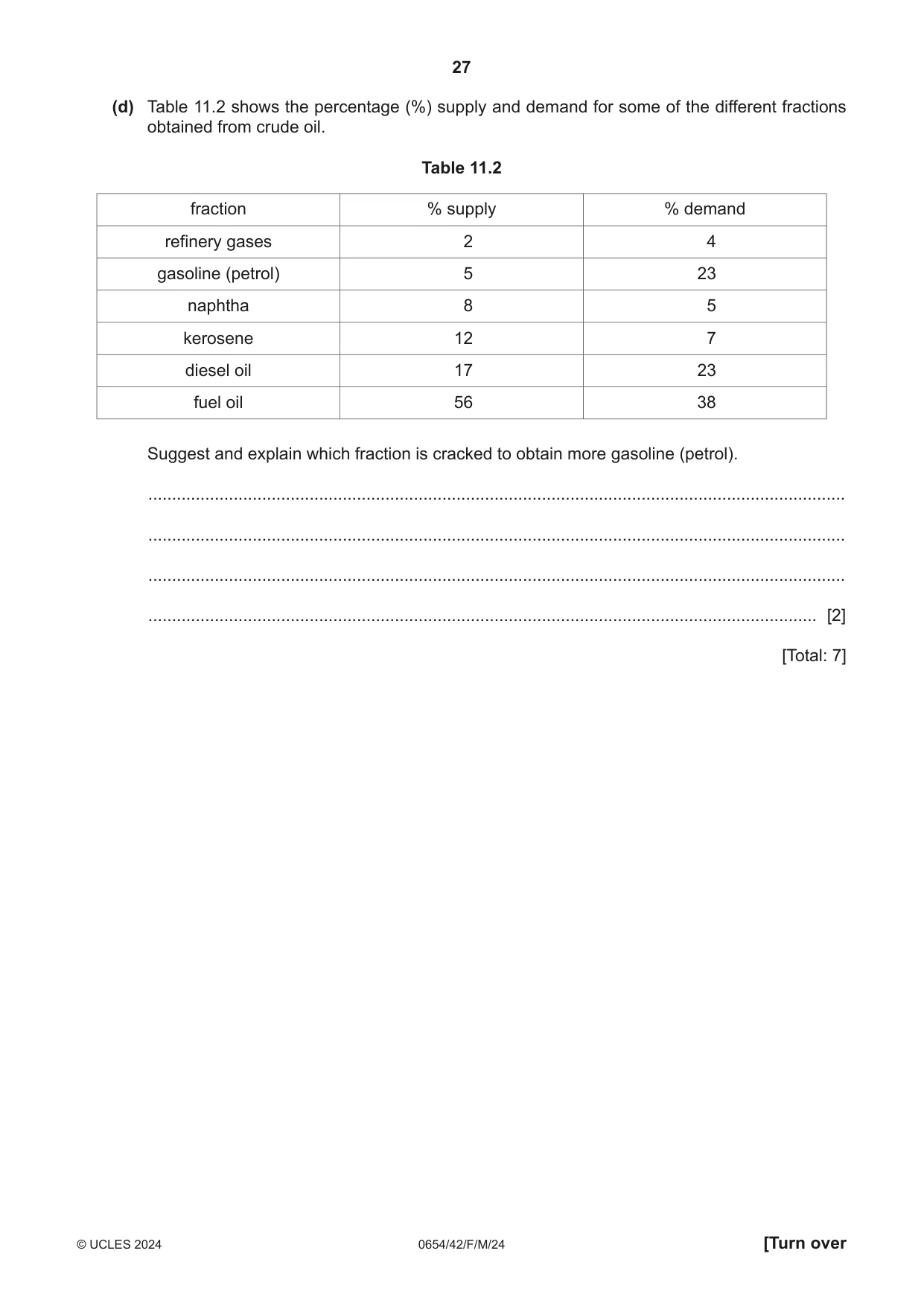
11 (a) Butane, C4H10, is an alkane. Complete the sentence about alkanes. Alkanes are .................................................. hydrocarbons whose molecules contain only .................................................. covalent bonds. [2] (b) Table 11.1 shows the energy given out when 1 g of different alkanes burns. Table 11.1 energy alkane given out / kJ butane 49.2 ethane 52.6 methane 55.6 propane 50.4 (i) State the relationship between the number of carbon atoms in the alkane and the energy given out. ........................................................................................................................................... ..................................................................................................................................... [1] (ii) State the name given to any reaction that gives out energy. ..................................................................................................................................... [1] (c) Butane is a small alkane molecule. Large alkane molecules are cracked into smaller, more useful molecules. The equation shows the cracking of C24H50 to make C10H22 and one other product. Complete the equation. C24H50 C10H22 + ............... [1] (d) Table 11.2 shows the percentage (%) supply and demand for some of the different fractions obtained from crude oil. Table 11.2 fraction % supply % demand refinery gases 2 4 gasoline (petrol) 5 23 naphtha 8 5 kerosene 12 7 diesel oil 17 23 fuel oil 56 38 Suggest and explain which fraction is cracked to obtain more gasoline (petrol). ................................................................................................................................................... ................................................................................................................................................... ................................................................................................................................................... ............................................................................................................................................. [2] [Total: 7]
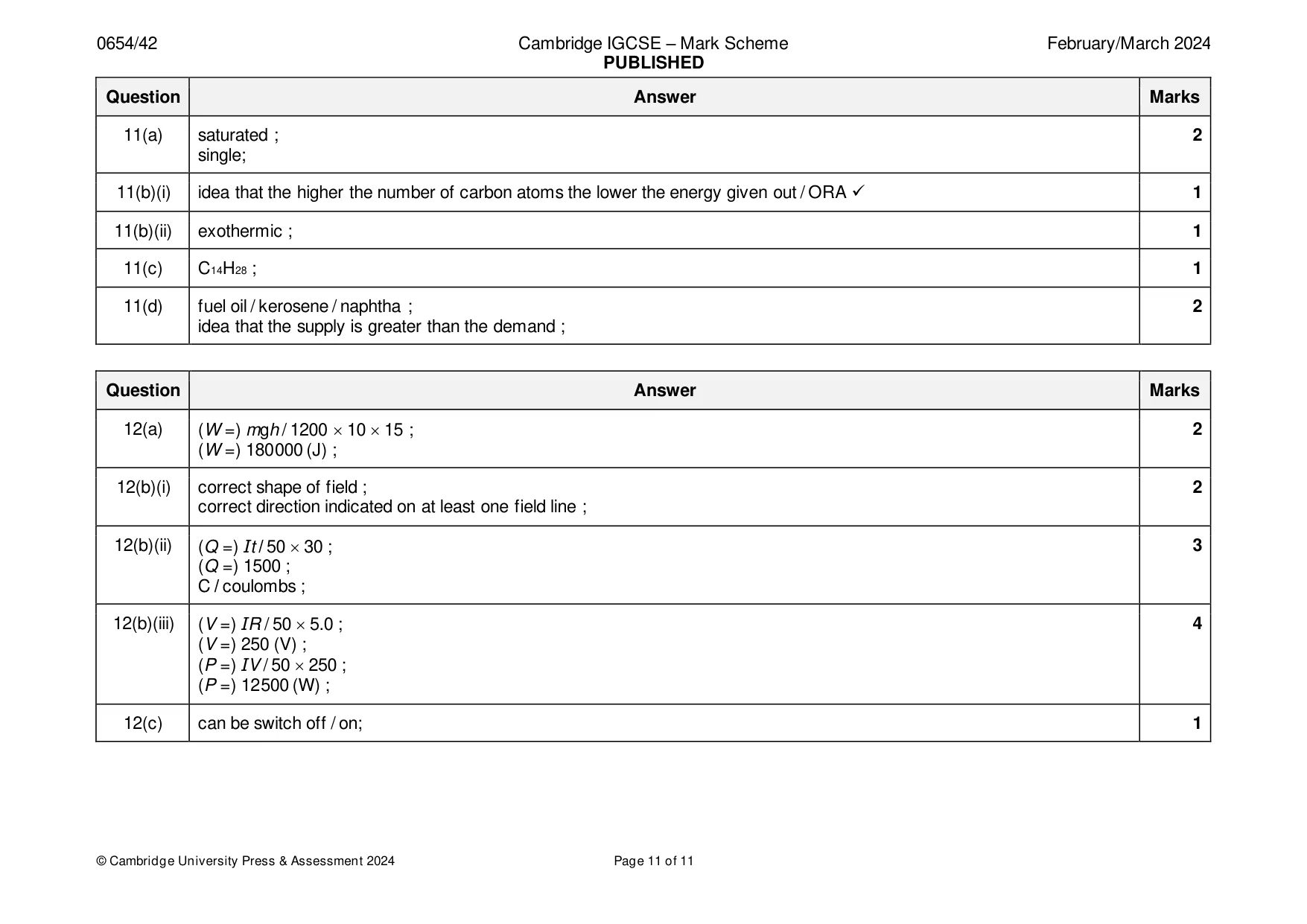
Mark scheme: 11(a) saturated ; 2 single; 11(b)(i) idea that the higher the number of carbon atoms the lower the energy given out / ORA ✓ 1 11(b)(ii) exothermic ; 1 11(c) C14H28 ; 1 11(d) fuel oil / kerosene / naphtha ; 2 idea that the supply is greater than the demand ;
Q12 · A large electromagnet used to lift scrap metal
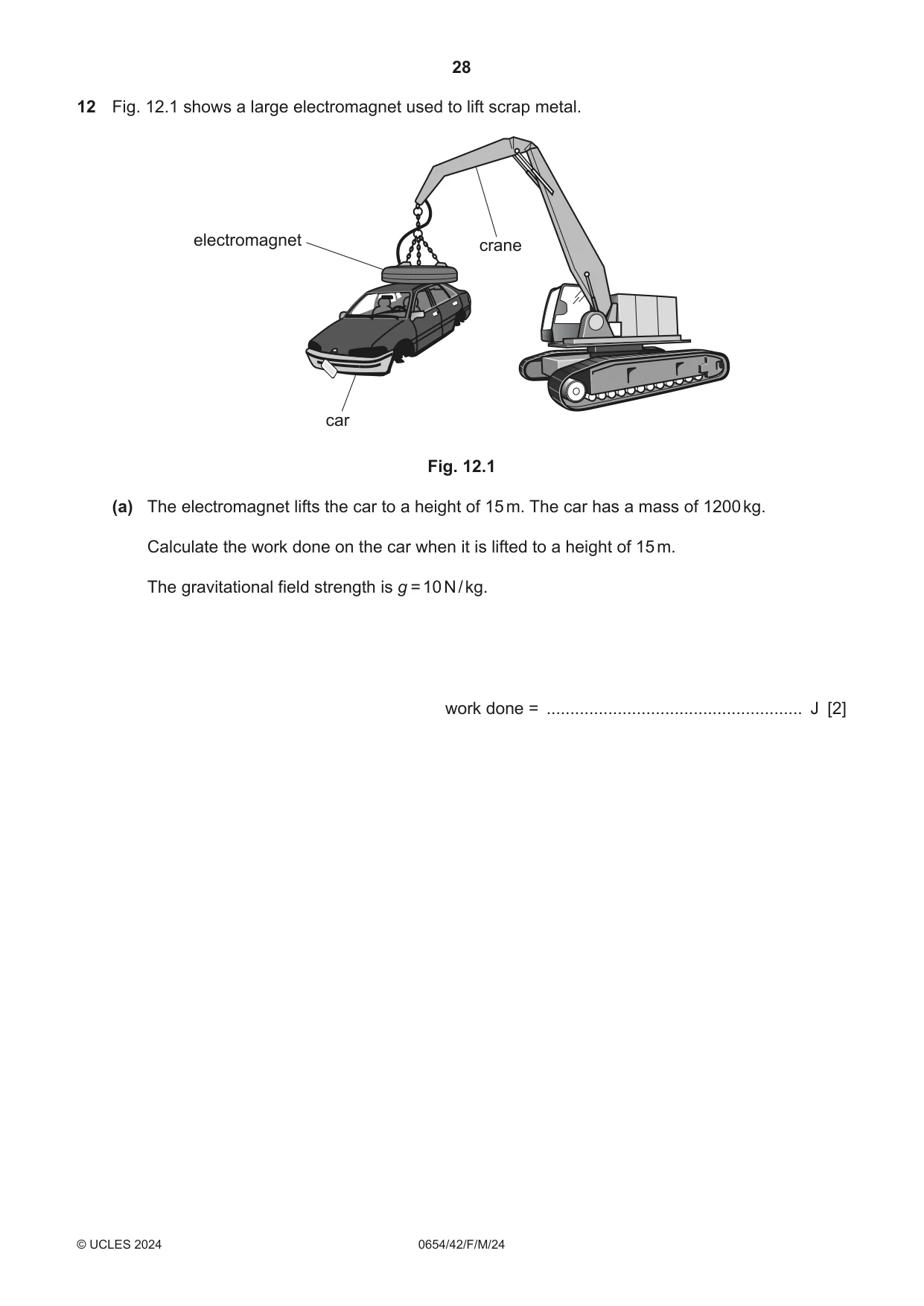
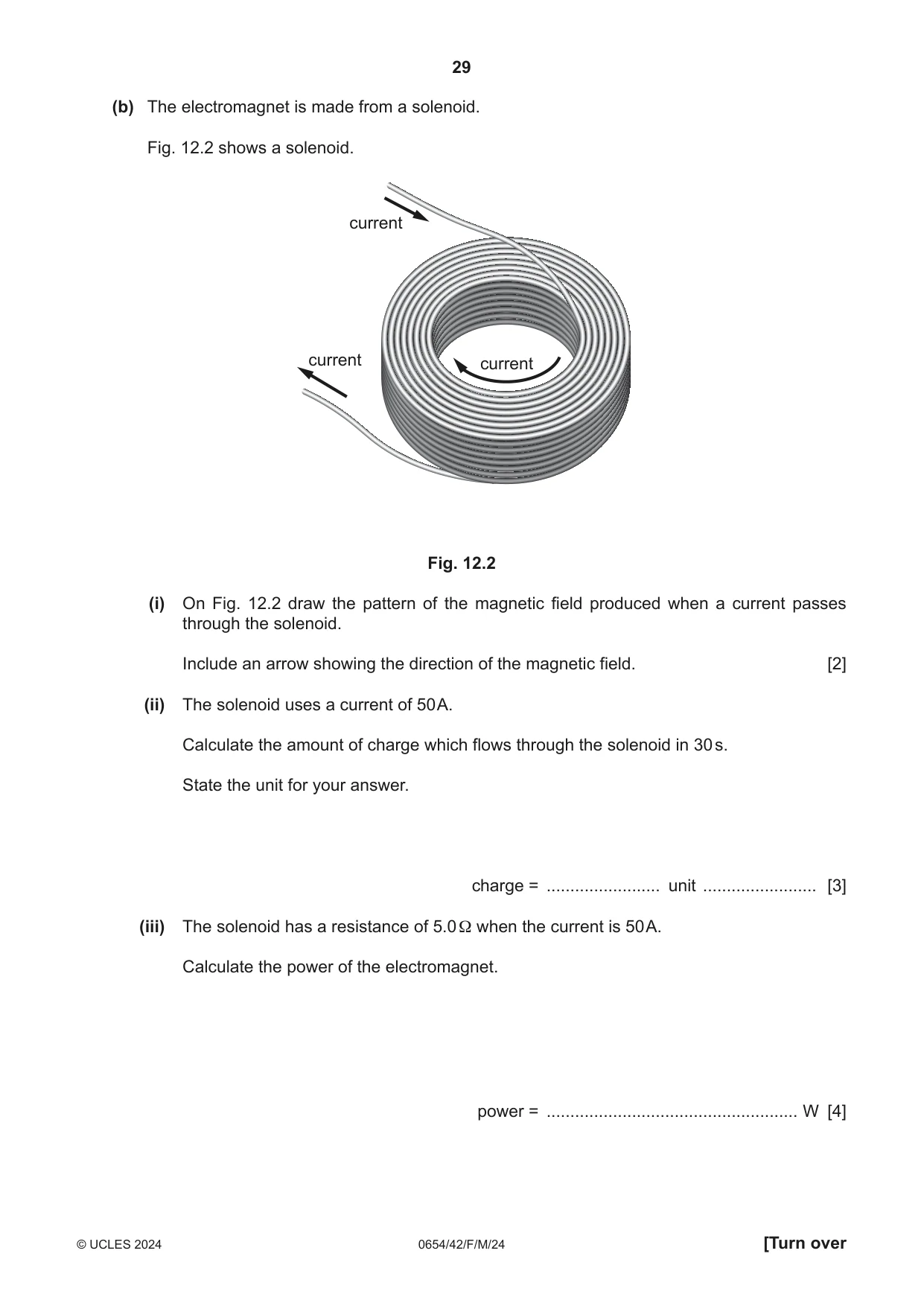
12 Fig. 12.1 shows a large electromagnet used to lift scrap metal. electromagnet crane car Fig. 12.1 (a) The electromagnet lifts the car to a height of 15 m. The car has a mass of 1200 kg. Calculate the work done on the car when it is lifted to a height of 15 m. The gravitational field strength is g = 10 N / kg. work done = ...................................................... J [2] (b) The electromagnet is made from a solenoid. Fig. 12.2 shows a solenoid. current current current Fig. 12.2 (i) On Fig. 12.2 draw the pattern of the magnetic field produced when a current passes through the solenoid. Include an arrow showing the direction of the magnetic field. [2] (ii) The solenoid uses a current of 50 A. Calculate the amount of charge which flows through the solenoid in 30 s. State the unit for your answer. charge = ........................ unit ........................ [3] (iii) The solenoid has a resistance of 5.0 Ω when the current is 50 A. Calculate the power of the electromagnet. power = ..................................................... W [4] (c) Electromagnets can be made much stronger than permanent magnets. State one other advantage of using an electromagnet to lift scrap metal. ................................................................................................................................................... ............................................................................................................................................. [1] [Total: 12]
Mark scheme: 12(a) (W =) mgh / 1200 10 15 ; 2 (W =) 180 000 (J) ; 12(b)(i) correct shape of field ; 2 correct direction indicated on at least one field line ; 12(b)(ii) (Q =) It / 50 30 ; 3 (Q =) 1500 ; C / coulombs ; 12(b)(iii) (V =) IR / 50 5.0 ; 4 (V =) 250 (V) ; (P =) IV / 50 250 ; (P =) 12 500 (W) ; 12(c) can be switch off / on; 1
What was in this paper
The subtopics covered by these 12 questions, and how many questions each got. Open one in a new tab to see every Cambridge question on it.
What you needed in this session
Cambridge’s own grade thresholds for 2024 Feb/March, Paper 4 · Variant 2. A higher threshold means an easier paper — the bar moves with how the cohort did.