Cambridge IGCSE Sciences - Co-ordinated (Double) 0654 — 2022 Feb/March Paper 4 · Variant 2
0654/42/F/M/22 · 12 questions · 120 marks · ≈135 min
The question paper and its mark scheme, free to read here and free to download. This is Cambridge’s own paper, exactly as it was sat.
Question paper28 pages

Mark scheme14 pages
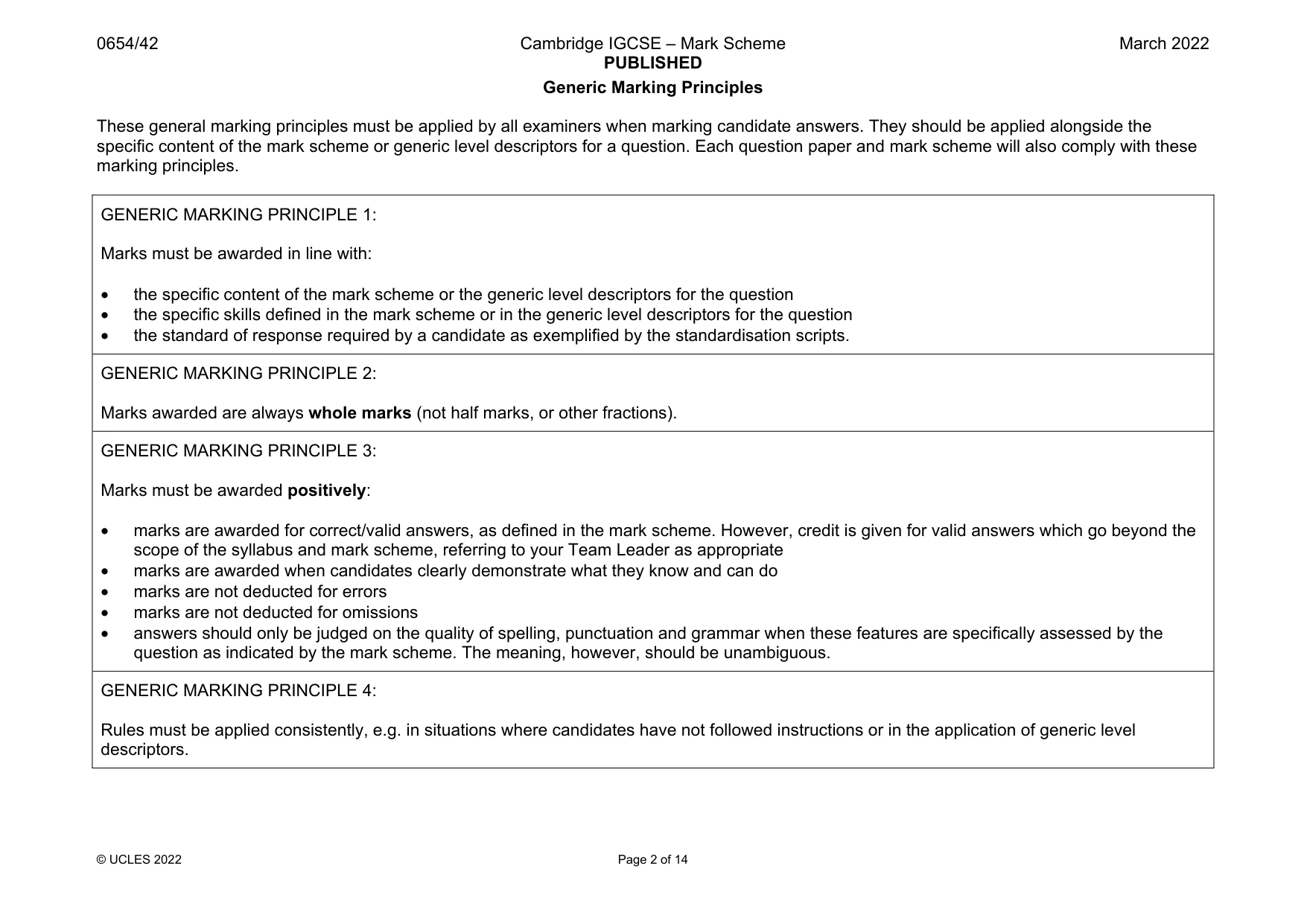
Answers below. Sit the paper first if you are practising.

Questions as text
Q1 · Sensitivity is one of the characteristics of living organisms
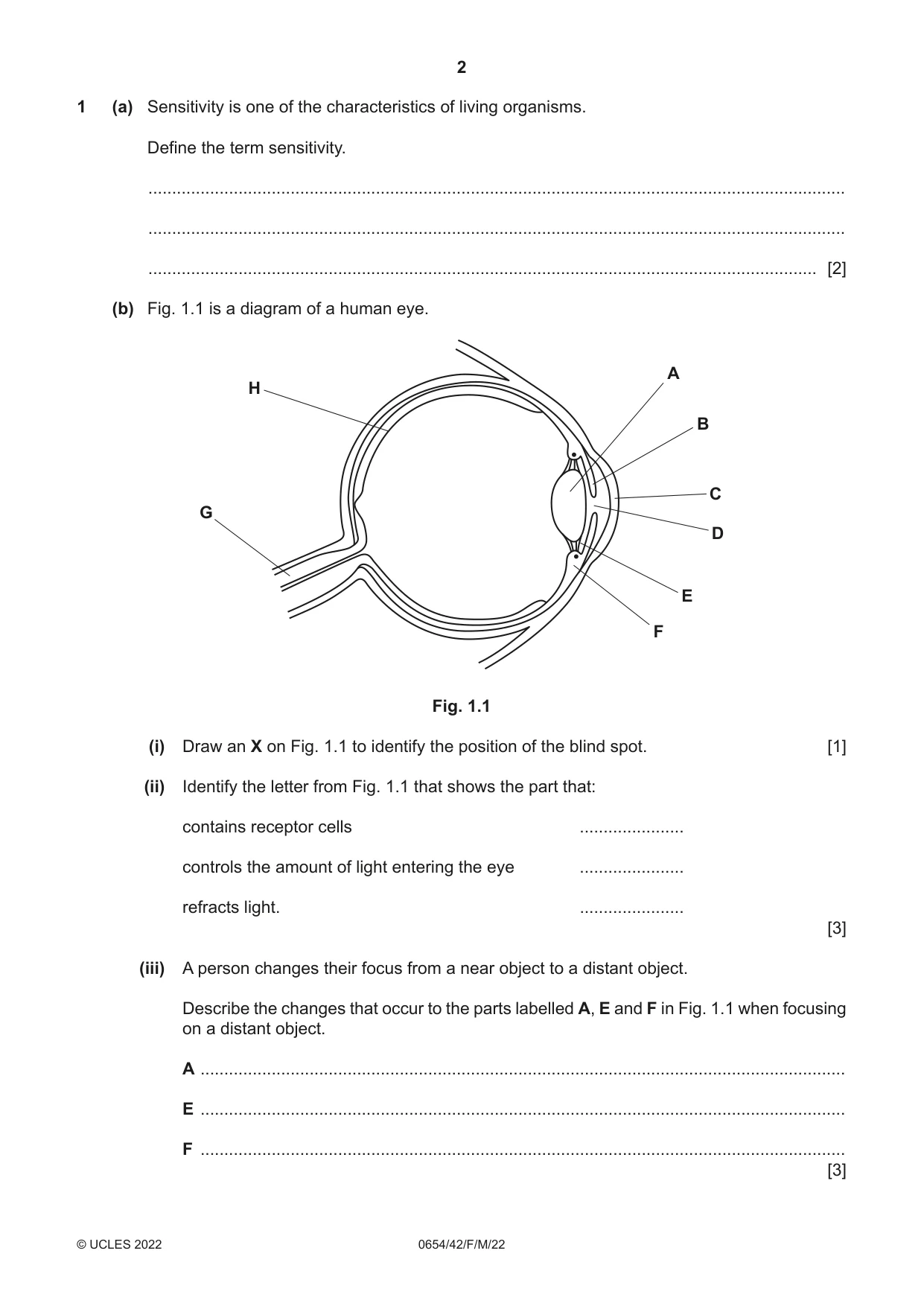
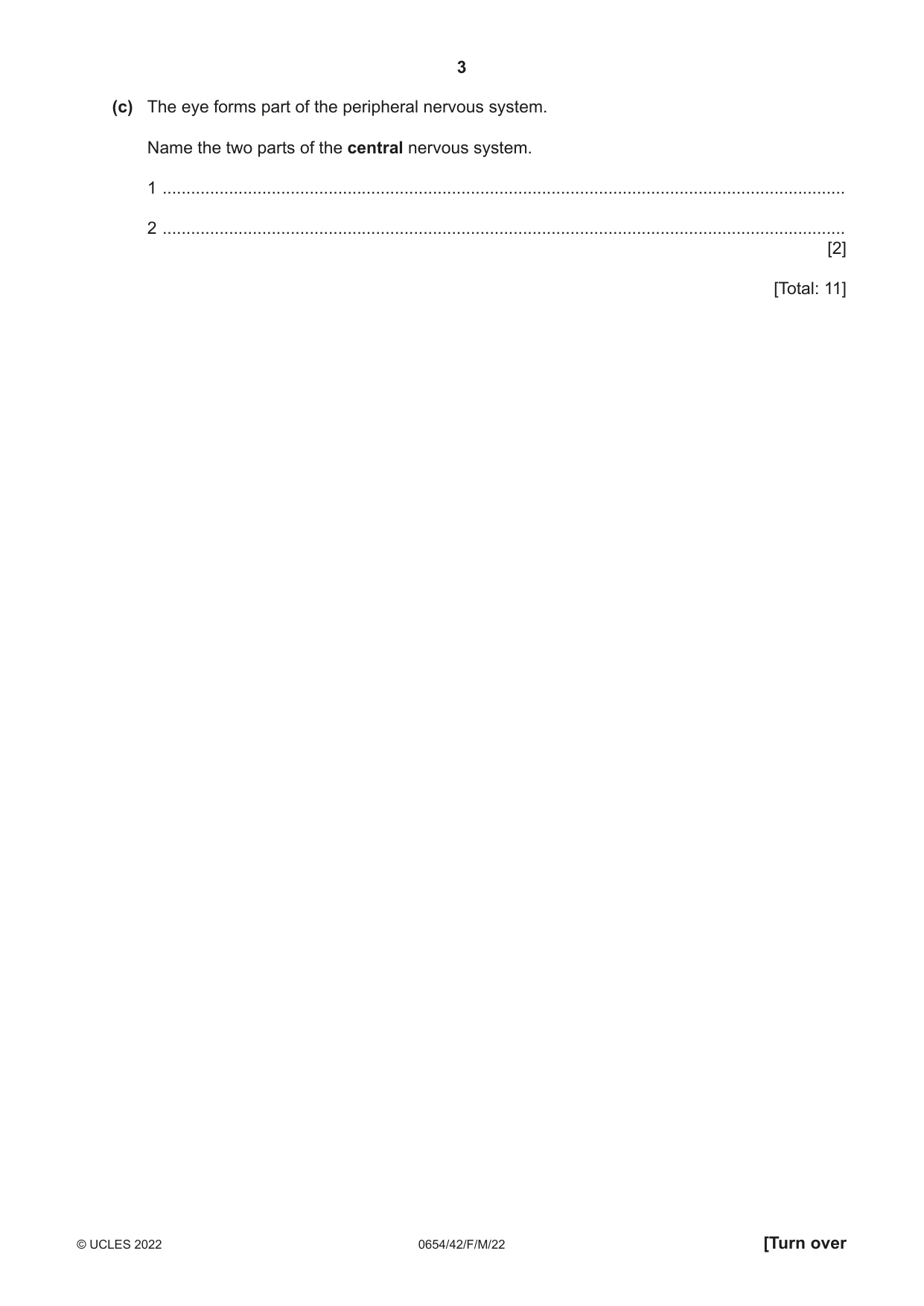
1 (a) Sensitivity is one of the characteristics of living organisms. Define the term sensitivity. ................................................................................................................................................... ................................................................................................................................................... ............................................................................................................................................. [2] (b) Fig. 1.1 is a diagram of a human eye. A H B C G D E F Fig. 1.1 (i) Draw an X on Fig. 1.1 to identify the position of the blind spot. [1] (ii) Identify the letter from Fig. 1.1 that shows the part that: contains receptor cells ...................... controls the amount of light entering the eye ...................... refracts light. ...................... [3] (iii) A person changes their focus from a near object to a distant object. Describe the changes that occur to the parts labelled A, E and F in Fig. 1.1 when focusing on a distant object. A ........................................................................................................................................ E ........................................................................................................................................ F ........................................................................................................................................ [3] (c) The eye forms part of the peripheral nervous system. Name the two parts of the central nervous system. 1 ................................................................................................................................................ 2 ................................................................................................................................................ [2] [Total: 11]
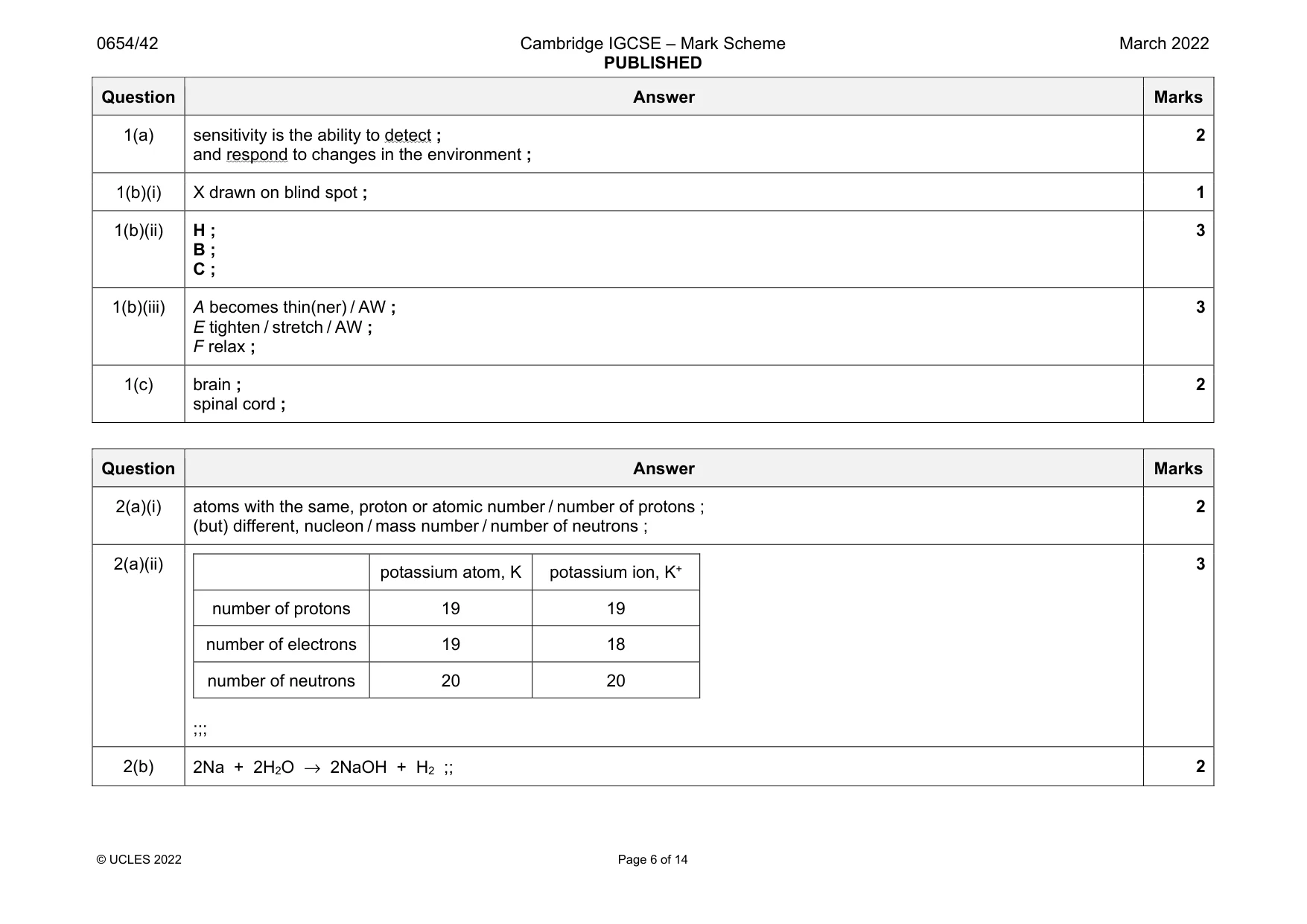
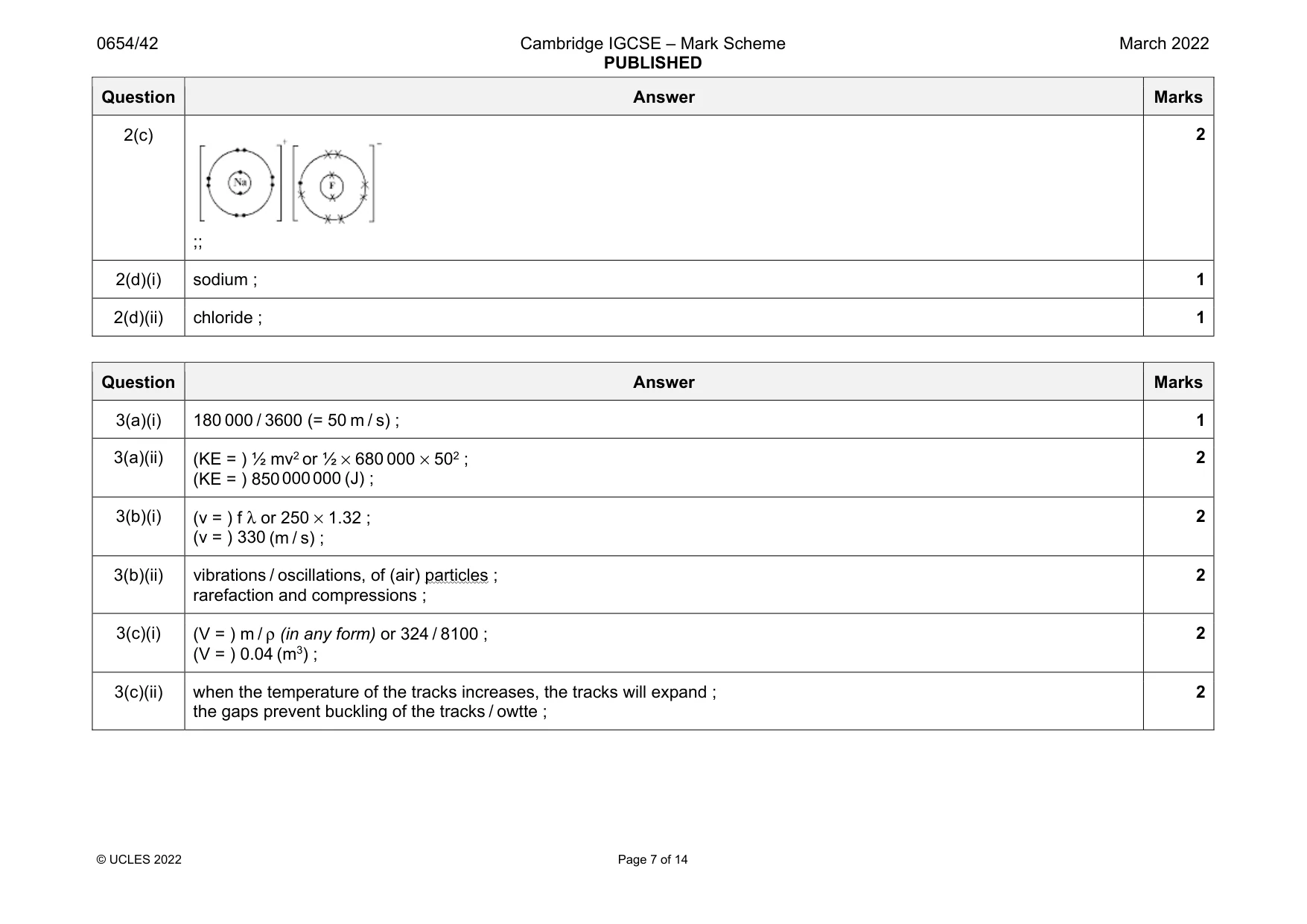
Mark scheme: 1(a) sensitivity is the ability to detect ; and respond to changes in the environment ; 2 1(b)(i) X drawn on blind spot ; 1 1(b)(ii) H ; B ; C ; 3 1(b)(iii) A becomes thin(ner) / AW ; E tighten / stretch / AW ; F relax ; 3 1(c) brain ; spinal cord ; 2
Q2 · Potassium is in Group I of the Periodic Table
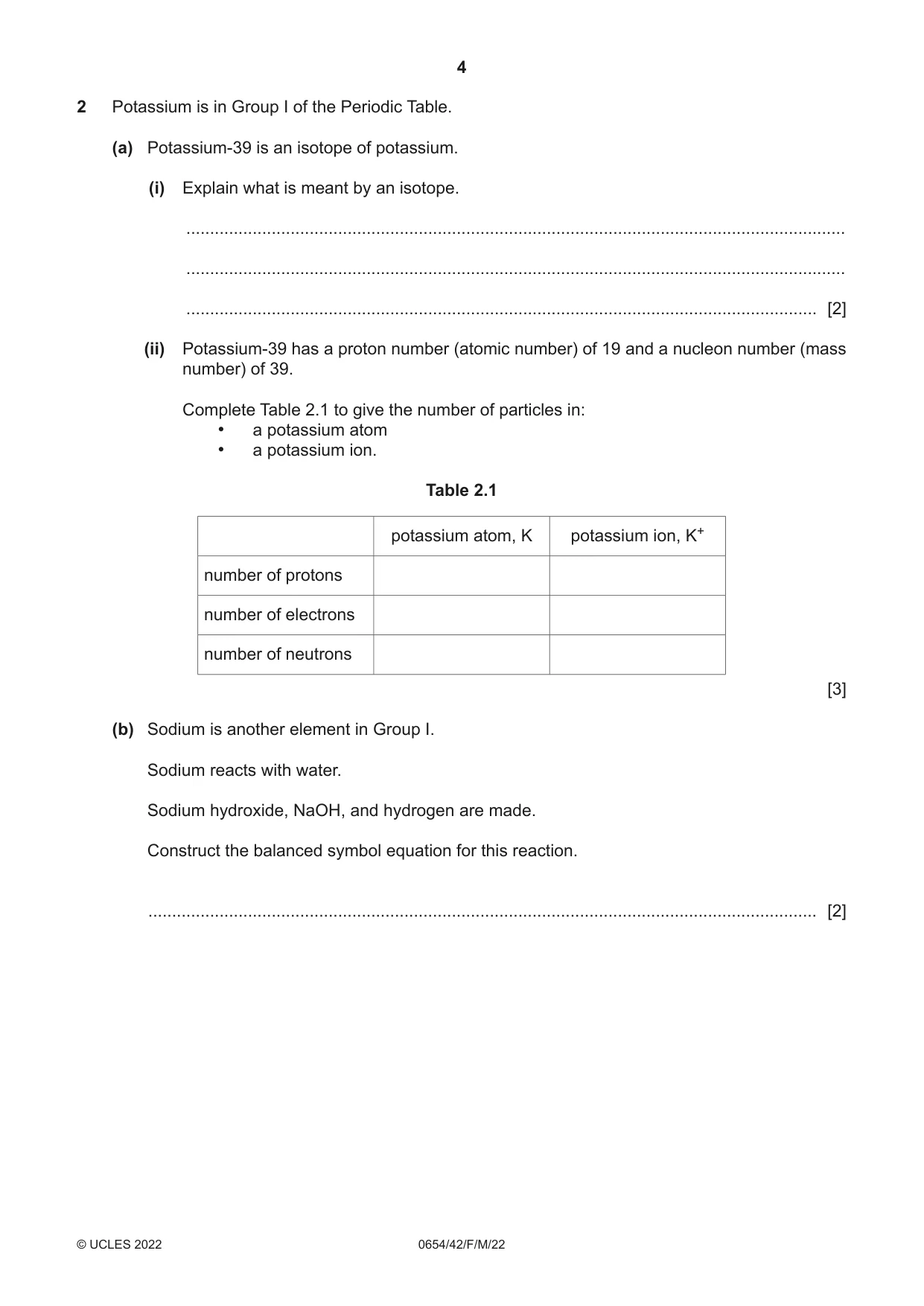
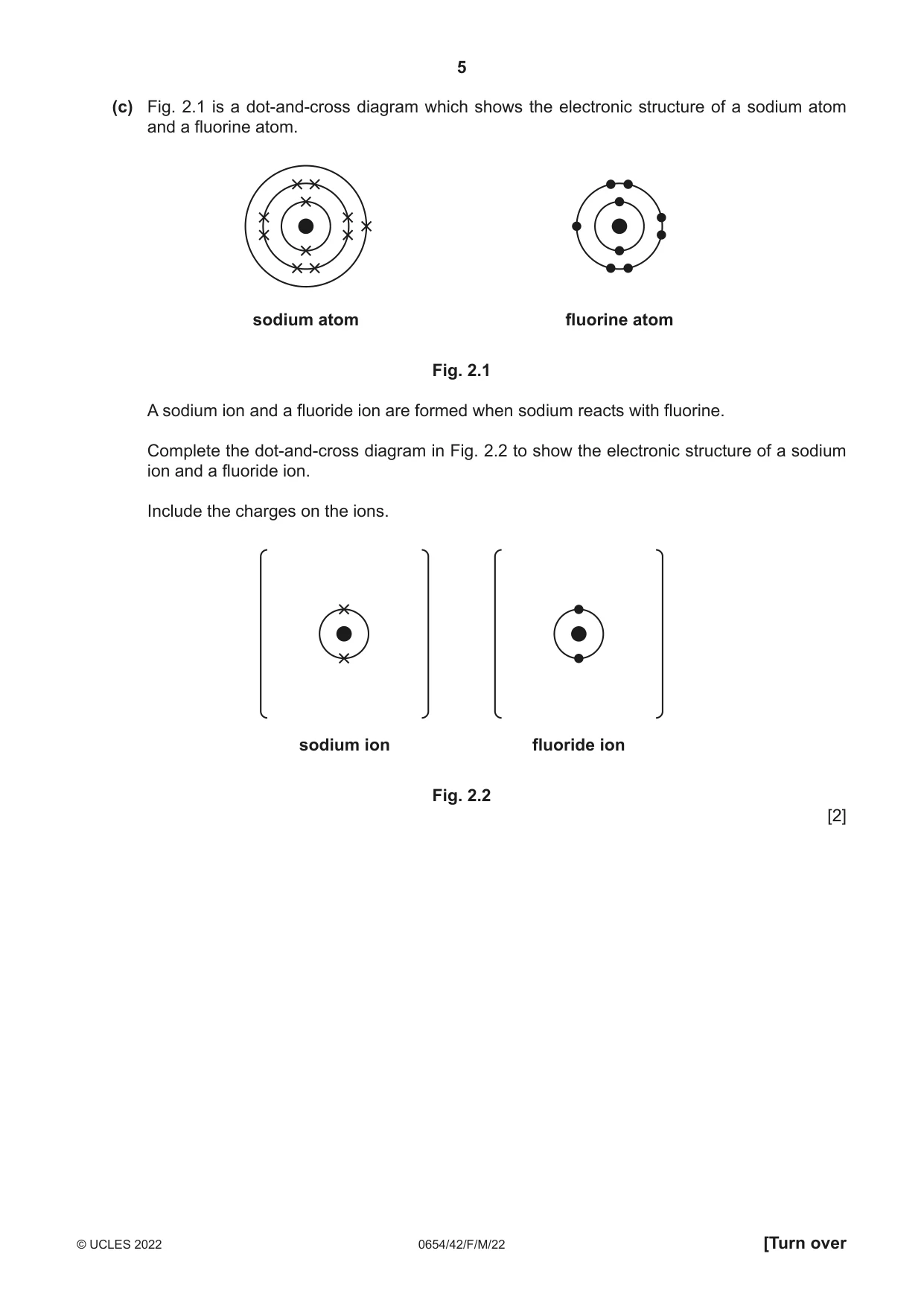
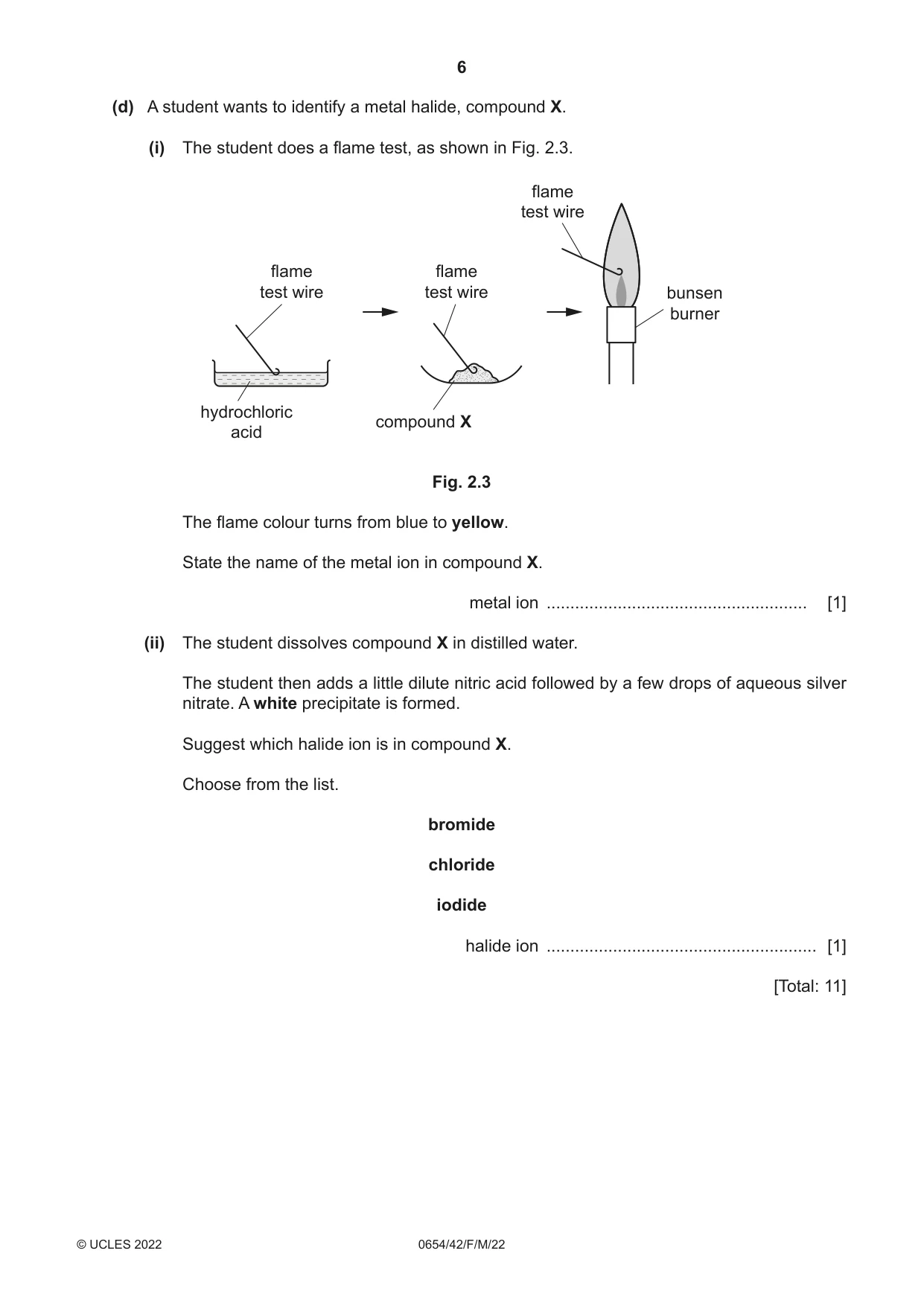
2 Potassium is in Group I of the Periodic Table. (a) Potassium-39 is an isotope of potassium. (i) Explain what is meant by an isotope. ........................................................................................................................................... ........................................................................................................................................... ..................................................................................................................................... [2] (ii) Potassium-39 has a proton number (atomic number) of 19 and a nucleon number (mass number) of 39. Complete Table 2.1 to give the number of particles in: • a potassium atom • a potassium ion. Table 2.1 potassium atom, K potassium ion, K+ number of protons number of electrons number of neutrons [3] (b) Sodium is another element in Group I. Sodium reacts with water. Sodium hydroxide, NaOH, and hydrogen are made. Construct the balanced symbol equation for this reaction. ............................................................................................................................................. [2] (c) Fig. 2.1 is a dot-and-cross diagram which shows the electronic structure of a sodium atom and a fluorine atom. sodium atom fluorine atom Fig. 2.1 A sodium ion and a fluoride ion are formed when sodium reacts with fluorine. Complete the dot-and-cross diagram in Fig. 2.2 to show the electronic structure of a sodium ion and a fluoride ion. Include the charges on the ions. sodium ion fluoride ion Fig. 2.2 [2] (d) A student wants to identify a metal halide, compound X. (i) The student does a flame test, as shown in Fig. 2.3. flame test wire flame flame test wire test wire bunsen burner hydrochloric compound X acid Fig. 2.3 The flame colour turns from blue to yellow. State the name of the metal ion in compound X. metal ion ....................................................... [1] (ii) The student dissolves compound X in distilled water. The student then adds a little dilute nitric acid followed by a few drops of aqueous silver nitrate. A white precipitate is formed. Suggest which halide ion is in compound X. Choose from the list. bromide chloride iodide halide ion ......................................................... [1] [Total: 11]
Mark scheme: 2(a)(i) atoms with the same, proton or atomic number / number of protons ; (but) different, nucleon / mass number / number of neutrons ; 2 2(a)(ii) potassium atom, K potassium ion, K+ number of protons 19 19 number of electrons 19 18 number of neutrons 20 20 ;;; 3 2(b) 2Na + 2H2O → 2NaOH + H2 ;; 2 Question Answer Marks 2(c) ;; 2 2(d)(i) sodium ; 1 2(d)(ii) chloride ; 1
Question 3
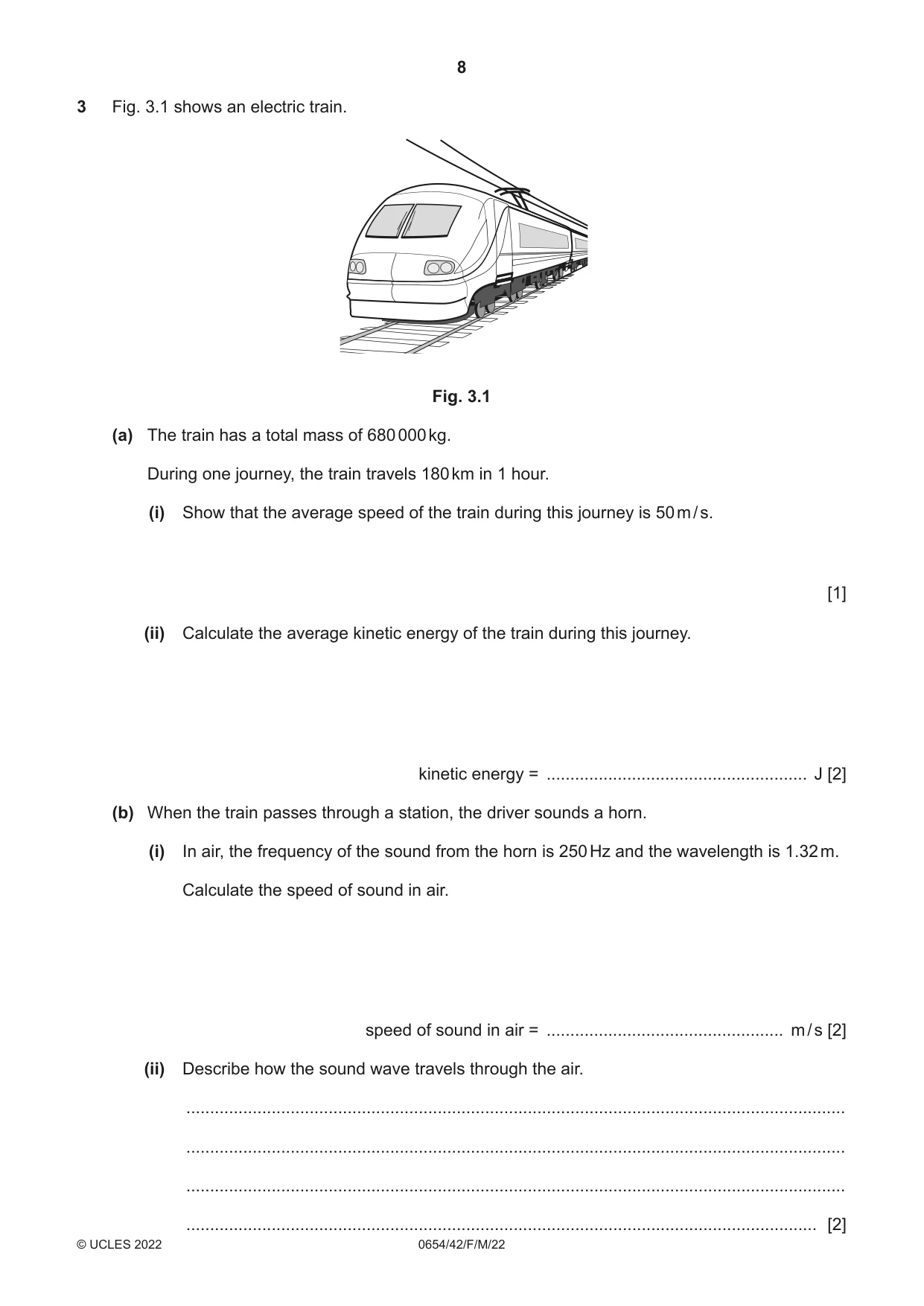
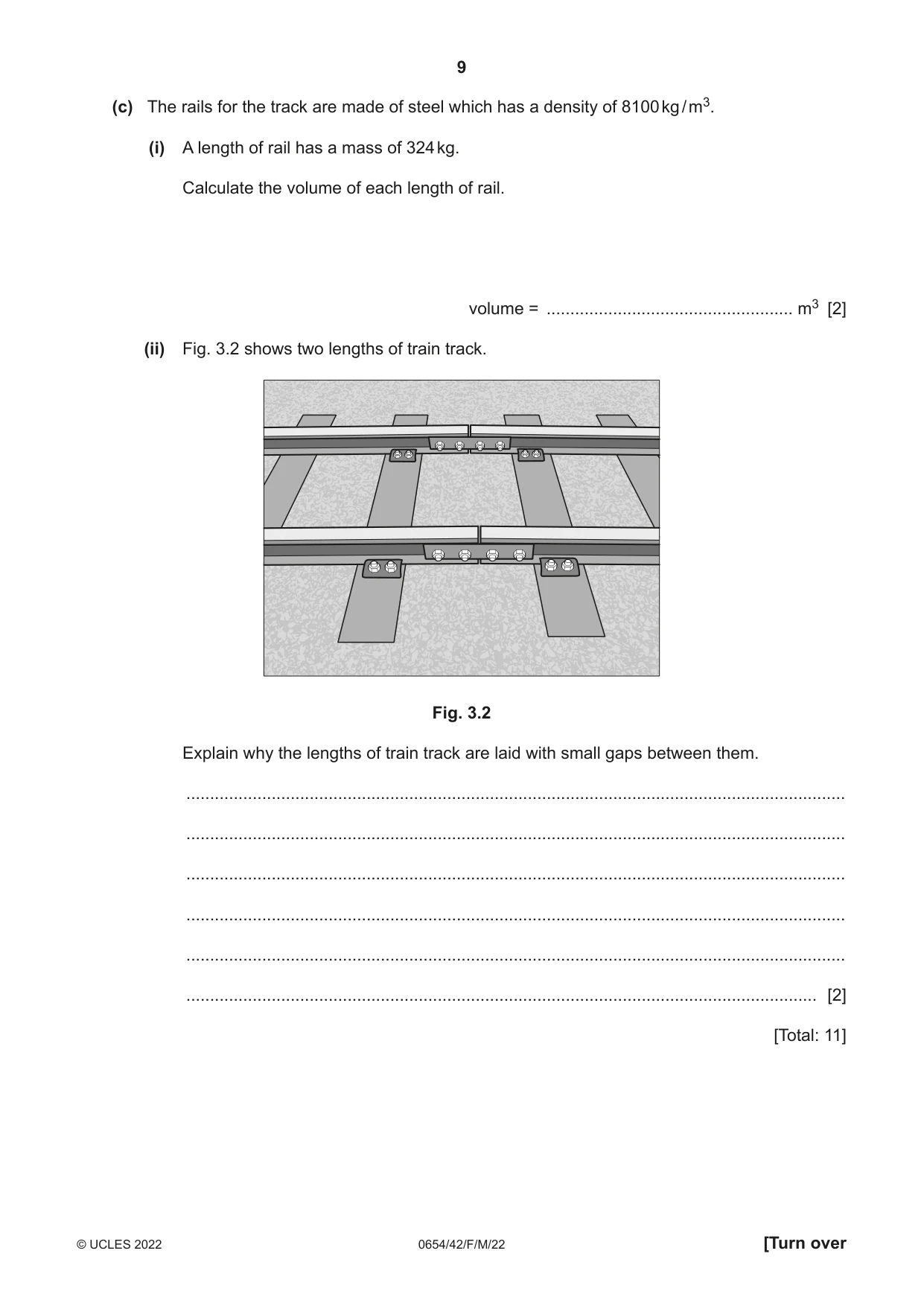
3 Fig. 3.1 shows an electric train. Fig. 3.1 (a) The train has a total mass of 680 000 kg. During one journey, the train travels 180 km in 1 hour. (i) Show that the average speed of the train during this journey is 50 m / s. [1] (ii) Calculate the average kinetic energy of the train during this journey. kinetic energy = ....................................................... J [2] (b) When the train passes through a station, the driver sounds a horn. (i) In air, the frequency of the sound from the horn is 250 Hz and the wavelength is 1.32 m. Calculate the speed of sound in air. speed of sound in air = .................................................. m / s [2] (ii) Describe how the sound wave travels through the air. ........................................................................................................................................... ........................................................................................................................................... ........................................................................................................................................... ..................................................................................................................................... [2] (c) The rails for the track are made of steel which has a density of 8100 kg / m3. (i) A length of rail has a mass of 324 kg. Calculate the volume of each length of rail. volume = .................................................... m3 [2] (ii) Fig. 3.2 shows two lengths of train track. Fig. 3.2 Explain why the lengths of train track are laid with small gaps between them. ........................................................................................................................................... ........................................................................................................................................... ........................................................................................................................................... ........................................................................................................................................... ........................................................................................................................................... ..................................................................................................................................... [2] [Total: 11]
Mark scheme: 3(a)(i) 180 000 / 3600 (= 50 m / s) ; 1 3(a)(ii) (KE = ) ½ mv2 or ½ × 680 000 × 502 ; (KE = ) 850 000 000 (J) ; 2 3(b)(i) (v = ) f λ or 250 × 1.32 ; (v = ) 330 (m / s) ; 2 3(b)(ii) vibrations / oscillations, of (air) particles ; rarefaction and compressions ; 2 3(c)(i) (V = ) m / ρ (in any form) or 324 / 8100 ; (V = ) 0.04 (m3) ; 2 3(c)(ii) when the temperature of the tracks increases, the tracks will expand ; the gaps prevent buckling of the tracks / owtte ; 2
Q4 · A student investigates the effect of bile and lipase on the digestion of fat in milk
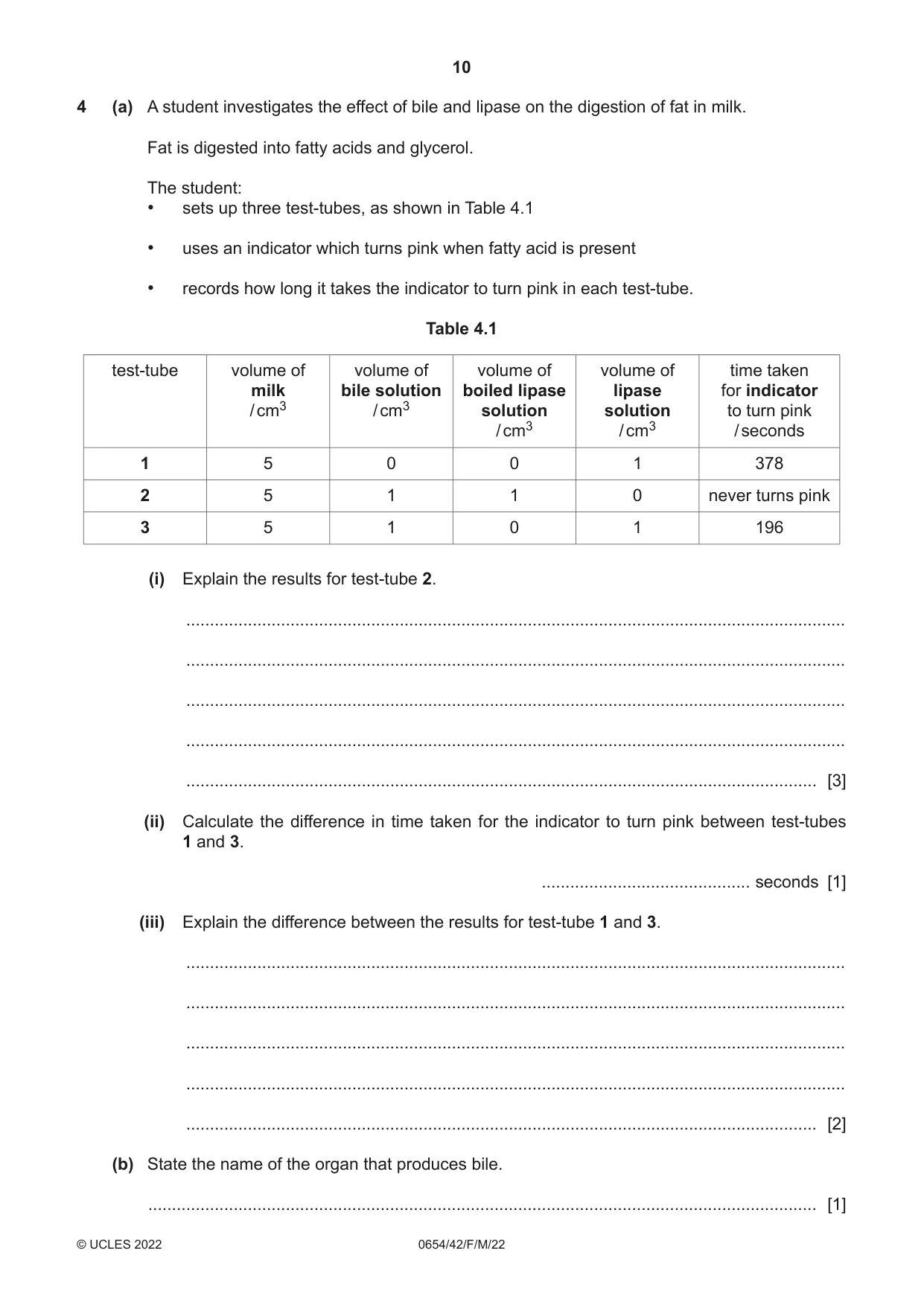
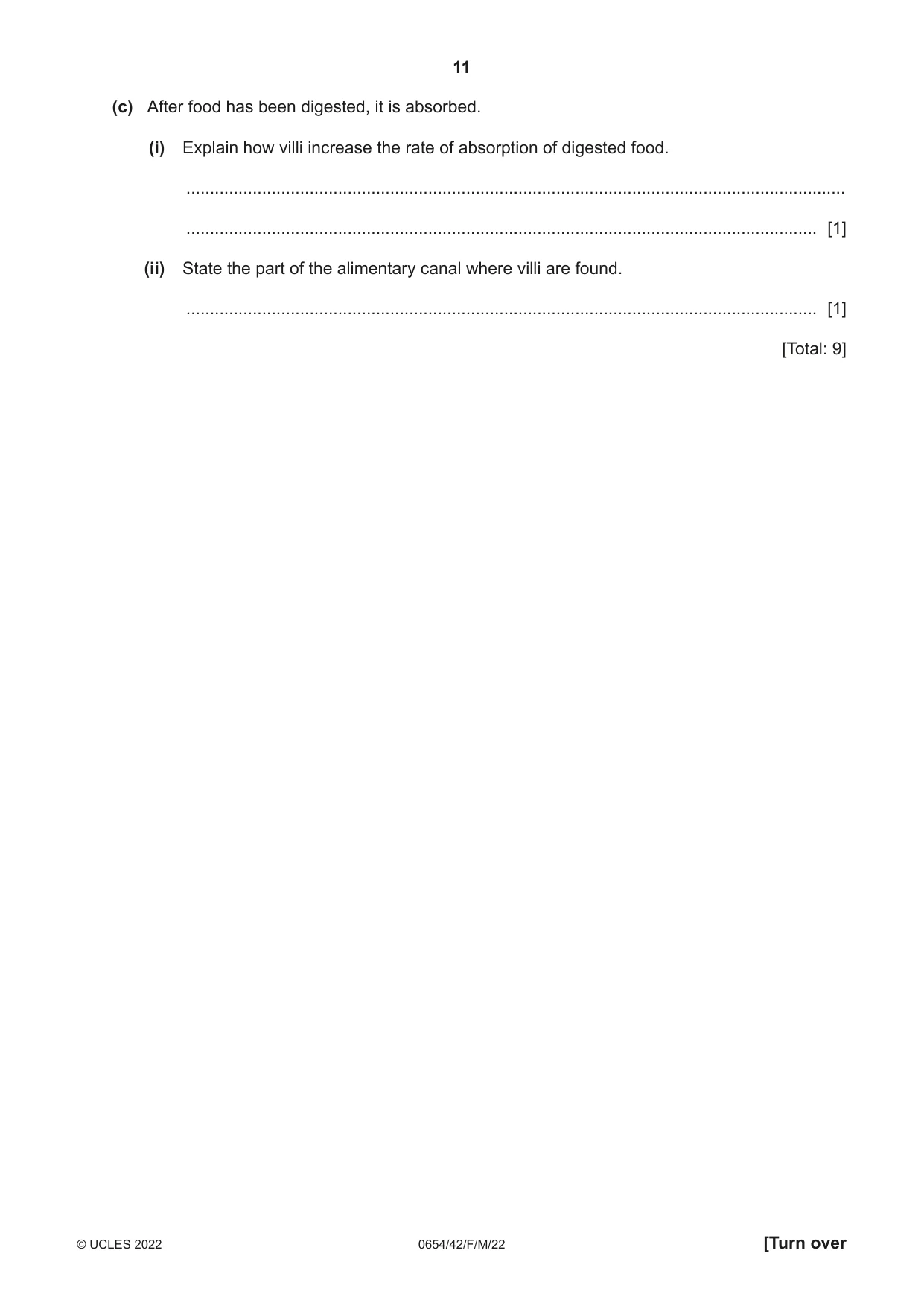
4 (a) A student investigates the effect of bile and lipase on the digestion of fat in milk. Fat is digested into fatty acids and glycerol. The student: • sets up three test-tubes, as shown in Table 4.1 • uses an indicator which turns pink when fatty acid is present • records how long it takes the indicator to turn pink in each test-tube. Table 4.1 test-tube volume of volume of volume of volume of time taken milk bile solution boiled lipase lipase for indicator / cm3 / cm3 solution solution to turn pink / cm3 / cm3 / seconds 1 5 0 0 1 378 2 5 1 1 0 never turns pink 3 5 1 0 1 196 (i) Explain the results for test-tube 2. ........................................................................................................................................... ........................................................................................................................................... ........................................................................................................................................... ........................................................................................................................................... ..................................................................................................................................... [3] (ii) Calculate the difference in time taken for the indicator to turn pink between test-tubes 1 and 3. ............................................ seconds [1] (iii) Explain the difference between the results for test-tube 1 and 3. ........................................................................................................................................... ........................................................................................................................................... ........................................................................................................................................... ........................................................................................................................................... ..................................................................................................................................... [2] (b) State the name of the organ that produces bile. ............................................................................................................................................. [1] (c) After food has been digested, it is absorbed. (i) Explain how villi increase the rate of absorption of digested food. ........................................................................................................................................... ..................................................................................................................................... [1] (ii) State the part of the alimentary canal where villi are found. ..................................................................................................................................... [1] [Total: 9]
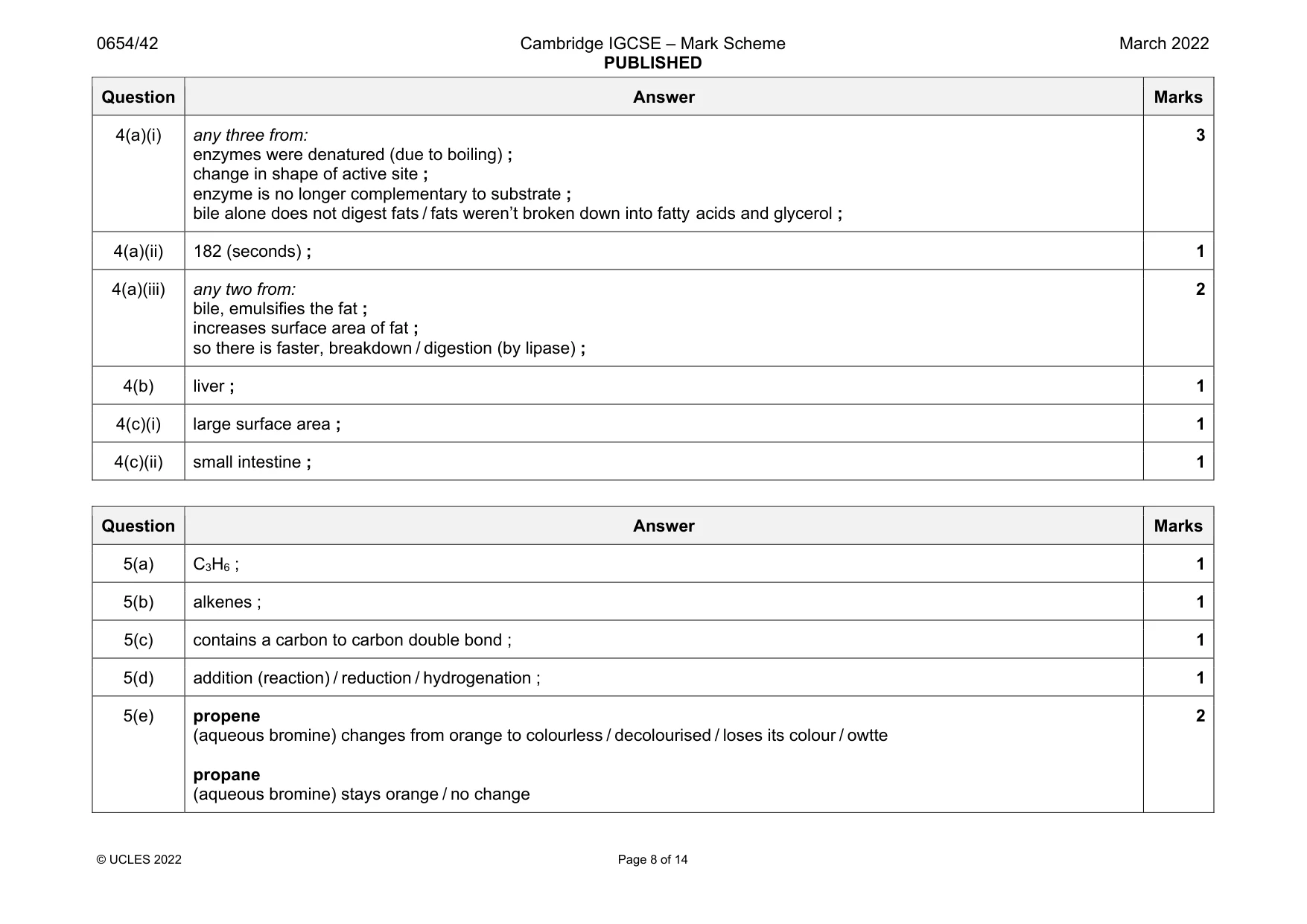
Mark scheme: 4(a)(i) any three from: enzymes were denatured (due to boiling) ; change in shape of active site ; enzyme is no longer complementary to substrate ; bile alone does not digest fats / fats weren’t broken down into fatty acids and glycerol ; 3 4(a)(ii) 182 (seconds) ; 1 4(a)(iii) any two from: bile, emulsifies the fat ; increases surface area of fat ; so there is faster, breakdown / digestion (by lipase) ; 2 4(b) liver ; 1 4(c)(i) large surface area ; 1 4(c)(ii) small intestine ; 1
Q5 · This question is about hydrocarbons
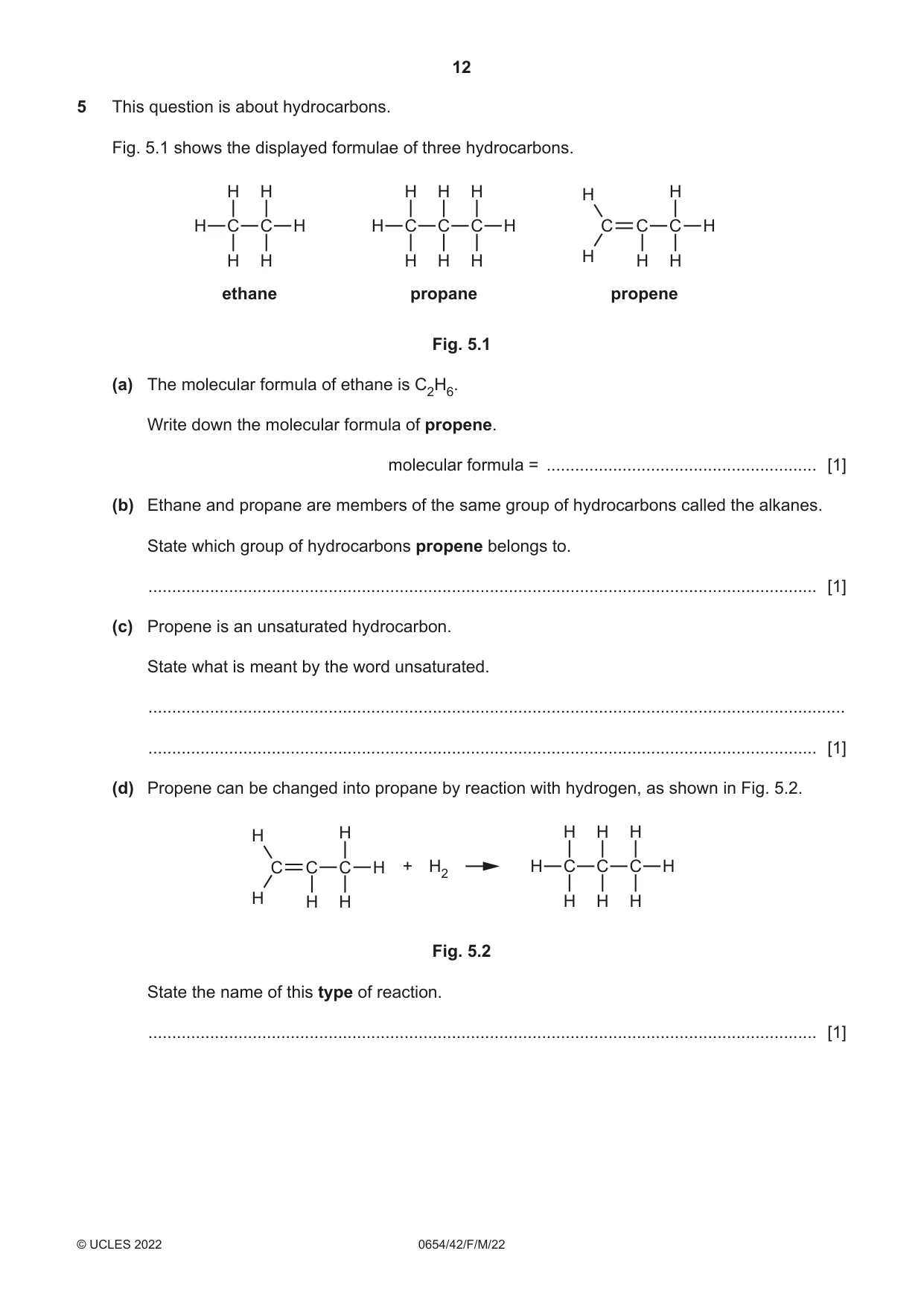
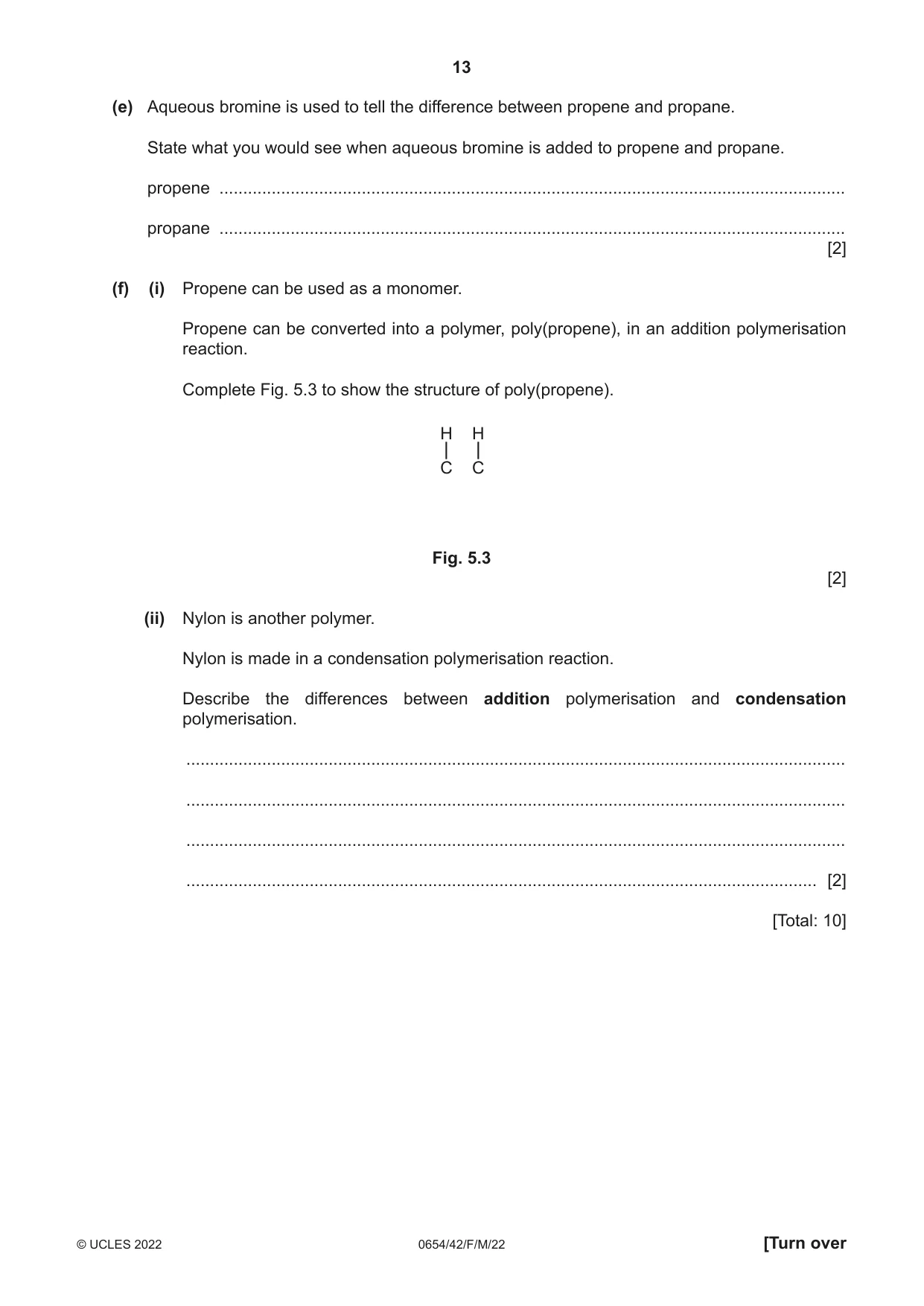
5 This question is about hydrocarbons. Fig. 5.1 shows the displayed formulae of three hydrocarbons. H H H H H H H H C C H H C C C H C C C H H H H H H H H H ethane propane propene Fig. 5.1 (a) The molecular formula of ethane is C2H6. Write down the molecular formula of propene. molecular formula = ......................................................... [1] (b) Ethane and propane are members of the same group of hydrocarbons called the alkanes. State which group of hydrocarbons propene belongs to. ............................................................................................................................................. [1] (c) Propene is an unsaturated hydrocarbon. State what is meant by the word unsaturated. ................................................................................................................................................... ............................................................................................................................................. [1] (d) Propene can be changed into propane by reaction with hydrogen, as shown in Fig. 5.2. H H H H H C C C H + H2 H C C C H H H H H H H Fig. 5.2 State the name of this type of reaction. ............................................................................................................................................. [1] (e) Aqueous bromine is used to tell the difference between propene and propane. State what you would see when aqueous bromine is added to propene and propane. propene .................................................................................................................................... propane .................................................................................................................................... [2] (f) (i) Propene can be used as a monomer. Propene can be converted into a polymer, poly(propene), in an addition polymerisation reaction. Complete Fig. 5.3 to show the structure of poly(propene). H H C C Fig. 5.3 [2] (ii) Nylon is another polymer. Nylon is made in a condensation polymerisation reaction. Describe the differences between addition polymerisation and condensation polymerisation. ........................................................................................................................................... ........................................................................................................................................... ........................................................................................................................................... ..................................................................................................................................... [2] [Total: 10]
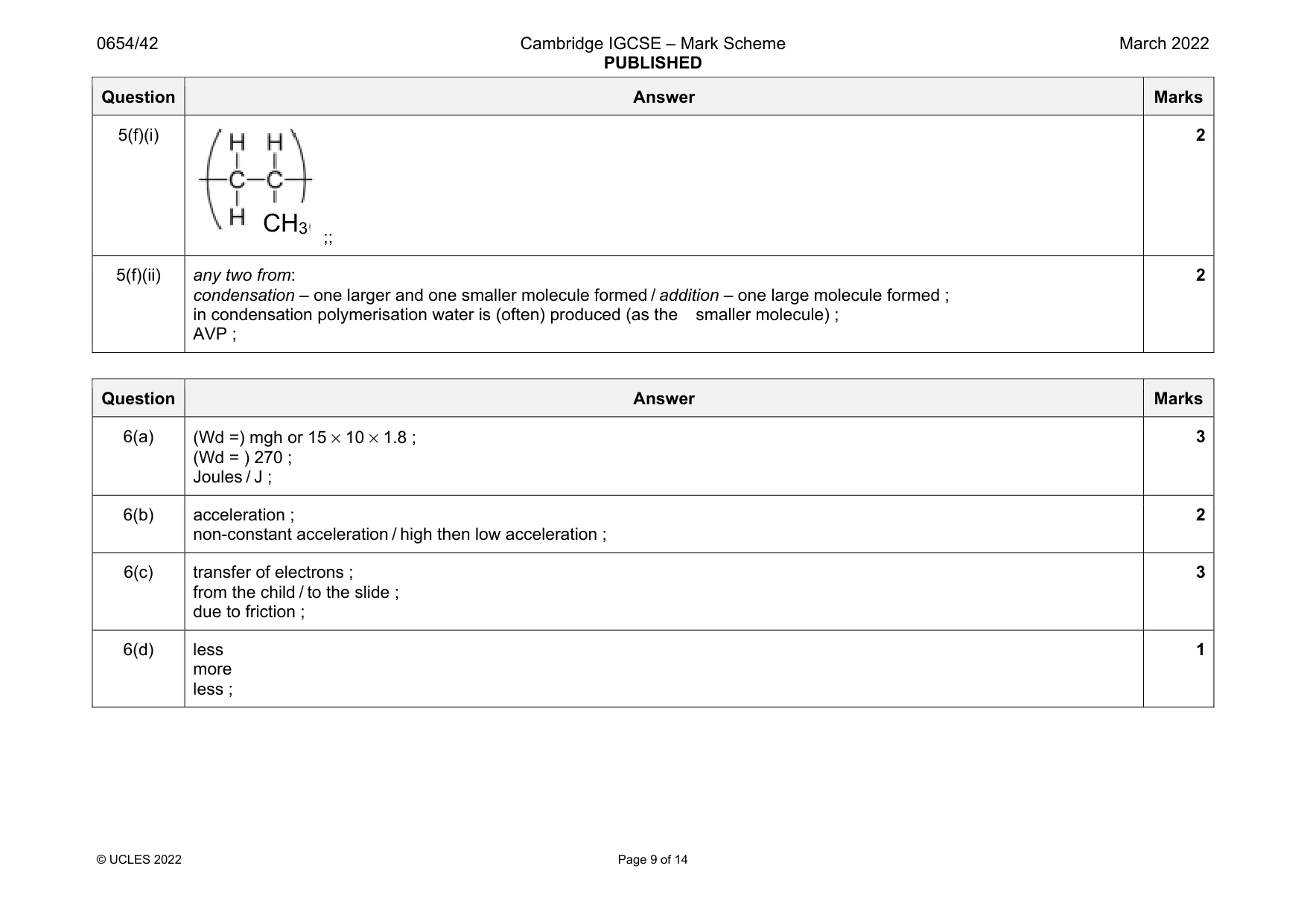
Mark scheme: 5(a) C3H6 ; 1 5(b) alkenes ; 1 5(c) contains a carbon to carbon double bond ; 1 5(d) addition (reaction) / reduction / hydrogenation ; 1 5(e) propene (aqueous bromine) changes from orange to colourless / decolourised / loses its colour / owtte propane (aqueous bromine) stays orange / no change 2 Question Answer Marks 5(f)(i) ;; 2 5(f)(ii) any two from: condensation – one larger and one smaller molecule formed / addition – one large molecule formed ; in condensation polymerisation water is (often) produced (as the smaller molecule) ; AVP ; 2 CH3
Question 6
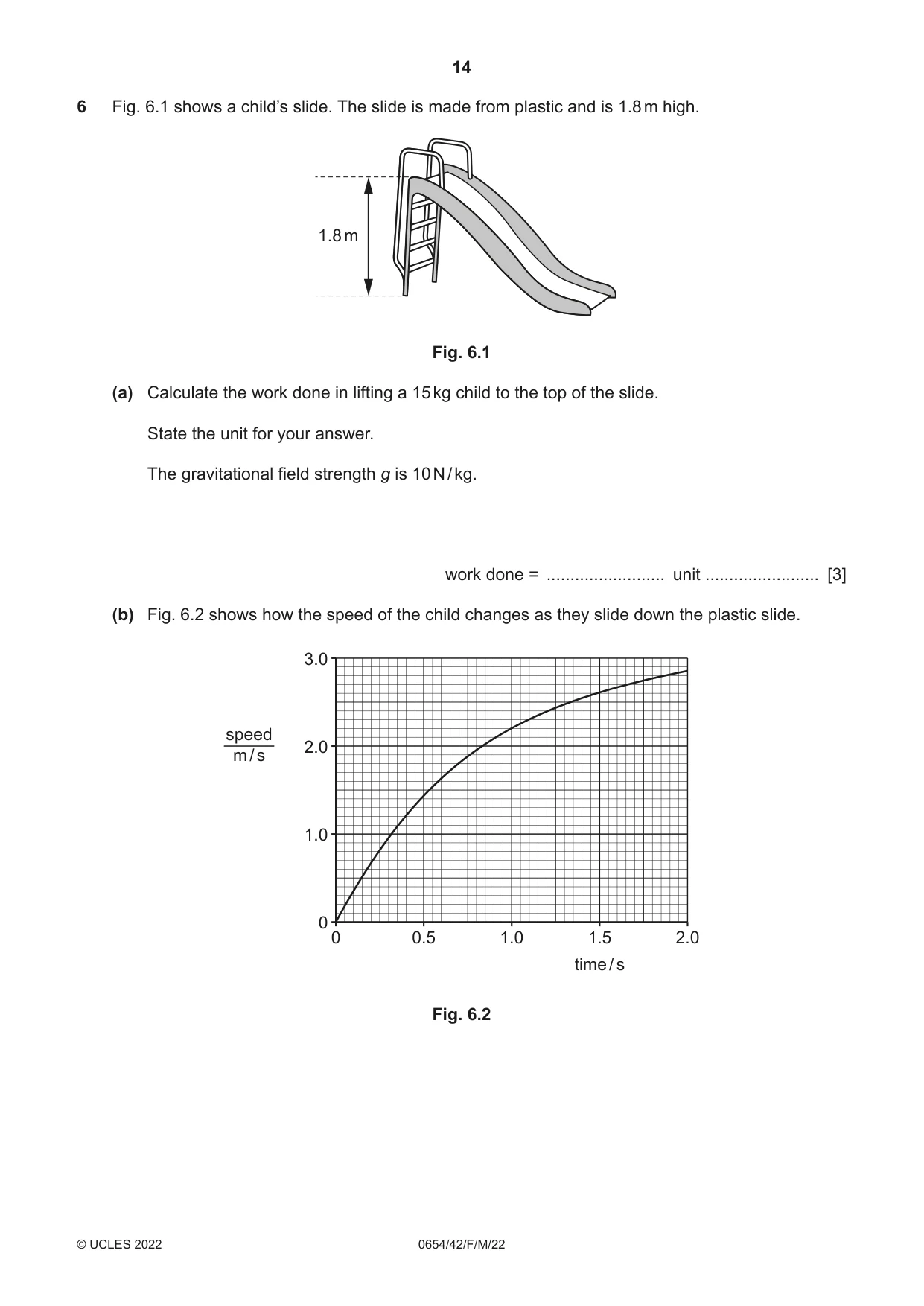
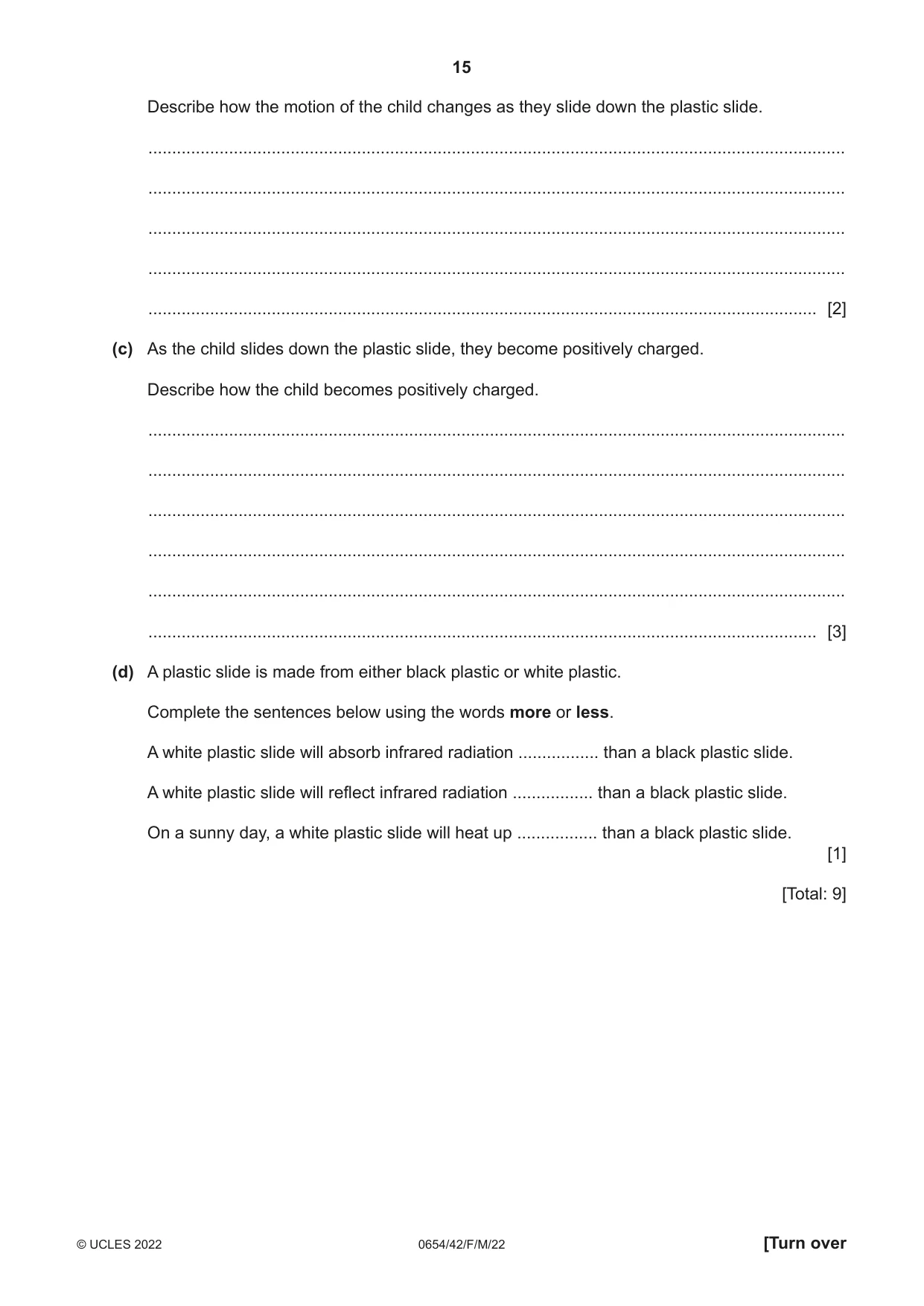
6 Fig. 6.1 shows a child’s slide. The slide is made from plastic and is 1.8 m high. 1.8 m Fig. 6.1 (a) Calculate the work done in lifting a 15 kg child to the top of the slide. State the unit for your answer. The gravitational field strength g is 10 N / kg. work done = ......................... unit ........................ [3] (b) Fig. 6.2 shows how the speed of the child changes as they slide down the plastic slide. 3.0 speed 2.0 m / s 1.0 0 0 0.5 1.0 1.5 2.0 time / s Fig. 6.2 Describe how the motion of the child changes as they slide down the plastic slide. ................................................................................................................................................... ................................................................................................................................................... ................................................................................................................................................... ................................................................................................................................................... ............................................................................................................................................. [2] (c) As the child slides down the plastic slide, they become positively charged. Describe how the child becomes positively charged. ................................................................................................................................................... ................................................................................................................................................... ................................................................................................................................................... ................................................................................................................................................... ................................................................................................................................................... ............................................................................................................................................. [3] (d) A plastic slide is made from either black plastic or white plastic. Complete the sentences below using the words more or less. A white plastic slide will absorb infrared radiation ................. than a black plastic slide. A white plastic slide will reflect infrared radiation ................. than a black plastic slide. On a sunny day, a white plastic slide will heat up ................. than a black plastic slide. [1] [Total: 9]
Mark scheme: 6(a) (Wd =) mgh or 15 × 10 × 1.8 ; (Wd = ) 270 ; Joules / J ; 6(b) acceleration ; non-constant acceleration / high then low acceleration ; 2 6(c) transfer of electrons ; from the child / to the slide ; due to friction ; 3 6(d) less more less ; 1
Q7 · A marine food web
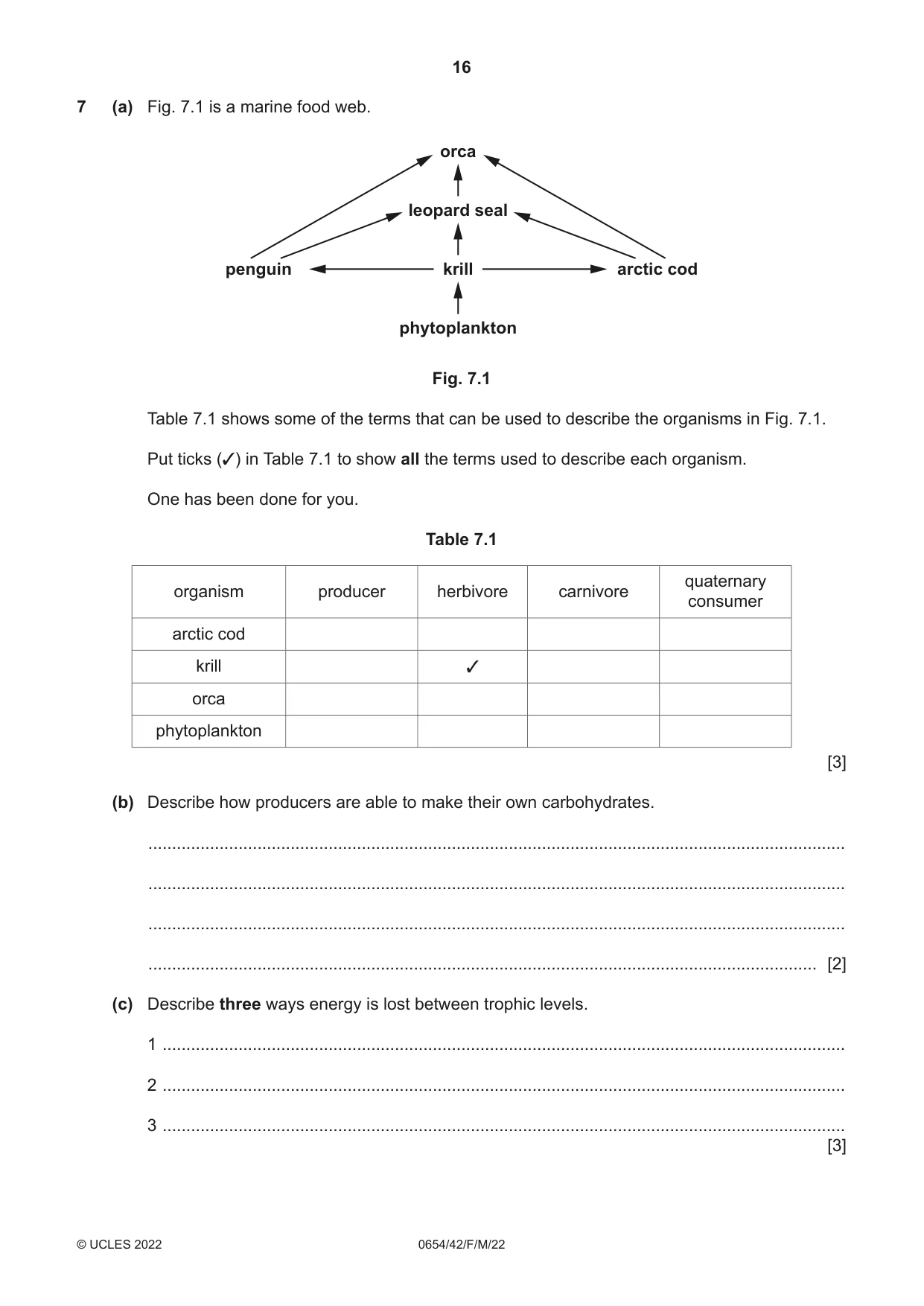
7 (a) Fig. 7.1 is a marine food web. orca leopard seal penguin krill arctic cod phytoplankton Fig. 7.1 Table 7.1 shows some of the terms that can be used to describe the organisms in Fig. 7.1. Put ticks (3) in Table 7.1 to show all the terms used to describe each organism. One has been done for you. Table 7.1 quaternary organism producer herbivore carnivore consumer arctic cod krill 3 orca phytoplankton [3] (b) Describe how producers are able to make their own carbohydrates. ................................................................................................................................................... ................................................................................................................................................... ................................................................................................................................................... ............................................................................................................................................. [2] (c) Describe three ways energy is lost between trophic levels. 1 ................................................................................................................................................ 2 ................................................................................................................................................ 3 ................................................................................................................................................ [3] (d) Marine organisms have developed adaptations such as gills. (i) Complete the sentences to describe the process of adaptation. Adaptation results from the process of natural ....................................... . Some organisms are better adapted to the ....................................... than others. These organisms survive and breed, passing on their ....................................... . This process takes many ....................................... . [4] (ii) Gills are the gas exchange surface in fish. List two features of gas exchange surfaces. 1 ........................................................................................................................................ 2 ........................................................................................................................................ [2] [Total: 14]
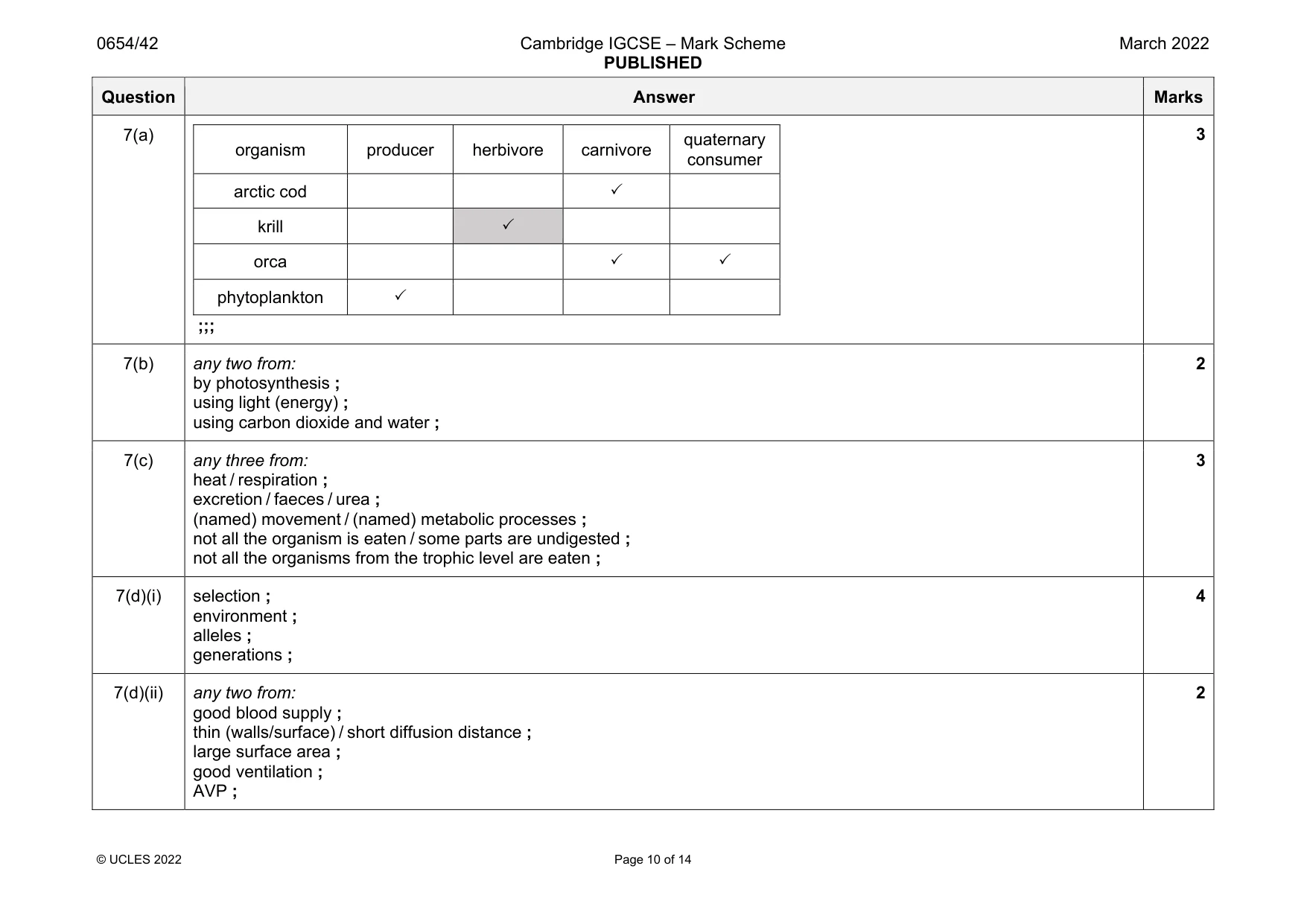
Mark scheme: 7(a) organism producer herbivore carnivore quaternary consumer arctic cod krill orca phytoplankton ;;; 7(b) any two from: by photosynthesis ; using light (energy) ; using carbon dioxide and water ; 2 7(c) any three from: heat / respiration ; excretion / faeces / urea ; (named) movement / (named) metabolic processes ; not all the organism is eaten / some parts are undigested ; not all the organisms from the trophic level are eaten ; 3 7(d)(i) selection ; environment ; alleles ; generations ; 4 7(d)(ii) any two from: good blood supply ; thin (walls/surface) / short diffusion distance ; large surface area ; good ventilation ; AVP ; 2
Q8 · A student investigates how metals react with different solutions
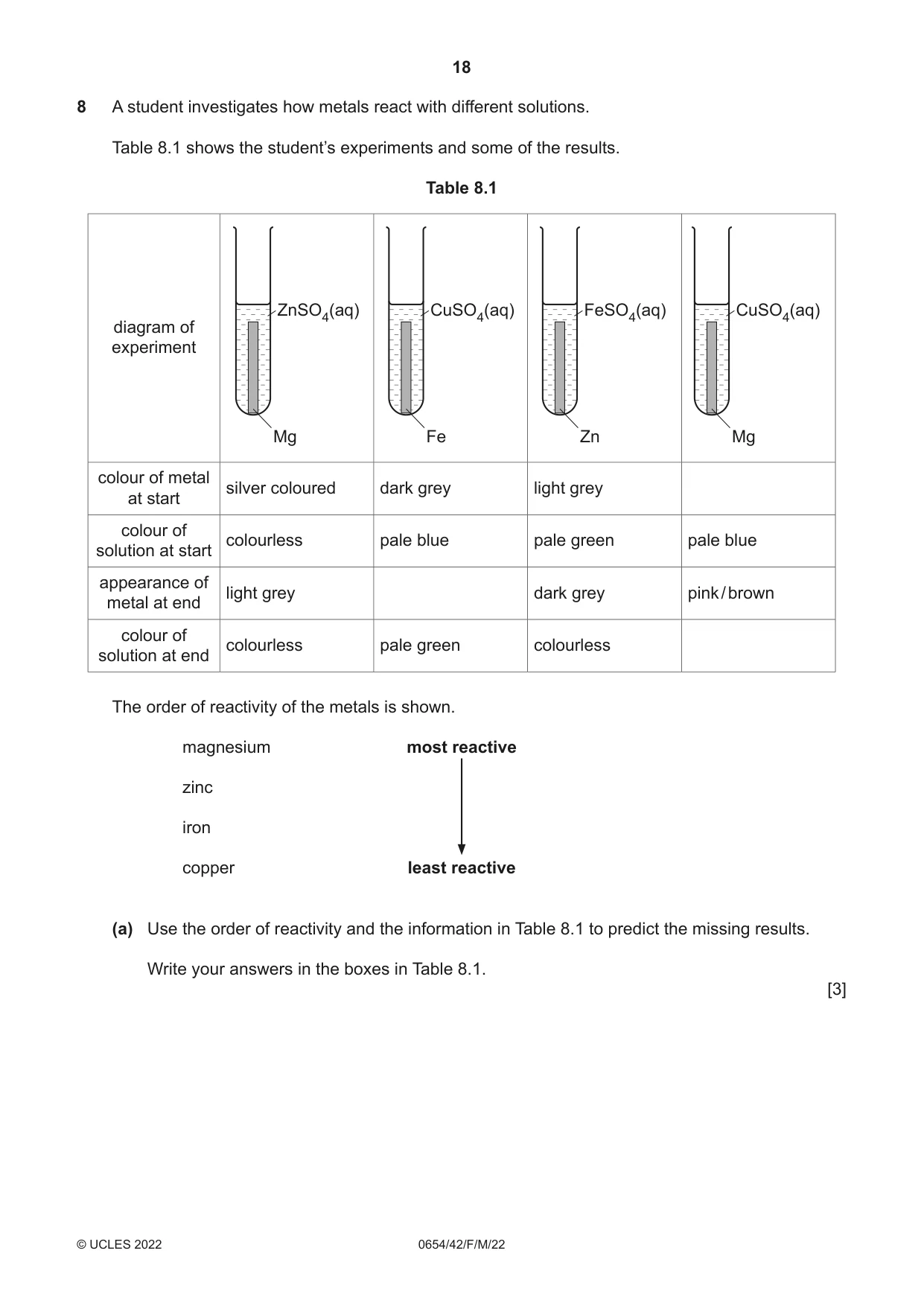
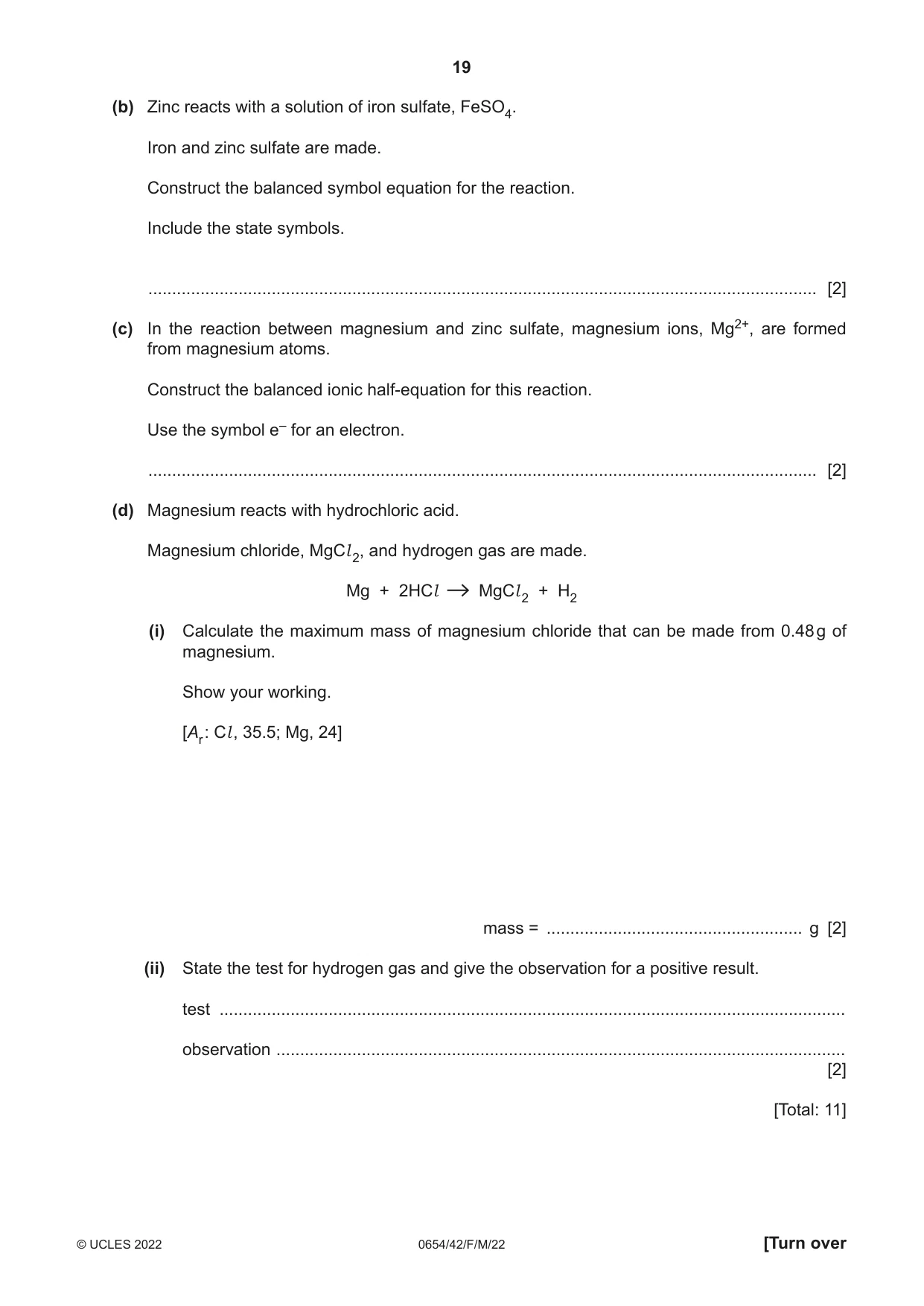
8 A student investigates how metals react with different solutions. Table 8.1 shows the student’s experiments and some of the results. Table 8.1 ZnSO4(aq) CuSO4(aq) FeSO4(aq) CuSO4(aq) diagram of experiment Mg Fe Zn Mg colour of metal silver coloured dark grey light grey at start colour of colourless pale blue pale green pale blue solution at start appearance of light grey dark grey pink / brown metal at end colour of colourless pale green colourless solution at end The order of reactivity of the metals is shown. magnesium most reactive zinc iron copper least reactive (a) Use the order of reactivity and the information in Table 8.1 to predict the missing results. Write your answers in the boxes in Table 8.1. [3] (b) Zinc reacts with a solution of iron sulfate, FeSO4. Iron and zinc sulfate are made. Construct the balanced symbol equation for the reaction. Include the state symbols. ............................................................................................................................................. [2] (c) In the reaction between magnesium and zinc sulfate, magnesium ions, Mg2+, are formed from magnesium atoms. Construct the balanced ionic half-equation for this reaction. Use the symbol e– for an electron. ............................................................................................................................................. [2] (d) Magnesium reacts with hydrochloric acid. Magnesium chloride, MgCl 2, and hydrogen gas are made. Mg + 2HCl MgCl 2 + H2 (i) Calculate the maximum mass of magnesium chloride that can be made from 0.48 g of magnesium. Show your working. [Ar : Cl , 35.5; Mg, 24] mass = ...................................................... g [2] (ii) State the test for hydrogen gas and give the observation for a positive result. test .................................................................................................................................... observation ........................................................................................................................ [2] [Total: 11]
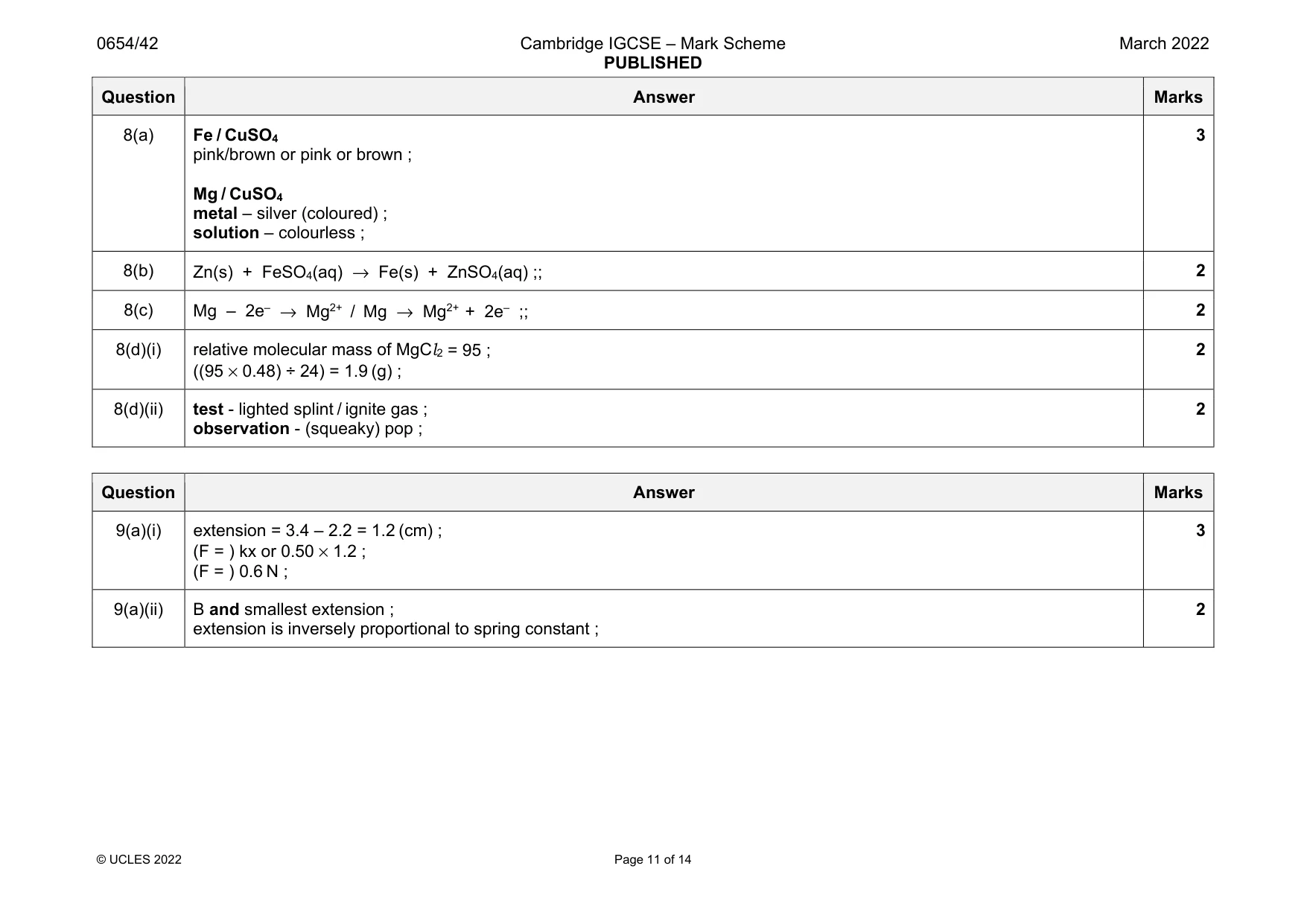
Mark scheme: 8(a) Fe / CuSO4 pink/brown or pink or brown ; Mg / CuSO4 metal – silver (coloured) ; solution – colourless ; 3 8(b) Zn(s) + FeSO4(aq) → Fe(s) + ZnSO4(aq) ;; 2 8(c) Mg – 2e– → Mg2+ / Mg → Mg2+ + 2e– ;; 2 8(d)(i) relative molecular mass of MgCl2 = 95 ; ((95 × 0.48) ÷ 24) = 1.9 (g) ; 2 8(d)(ii) test - lighted splint / ignite gas ; observation - (squeaky) pop ; 2
Q9 · A student investigates the spring constant of three springs, A, B, and C, using Hooke’s…
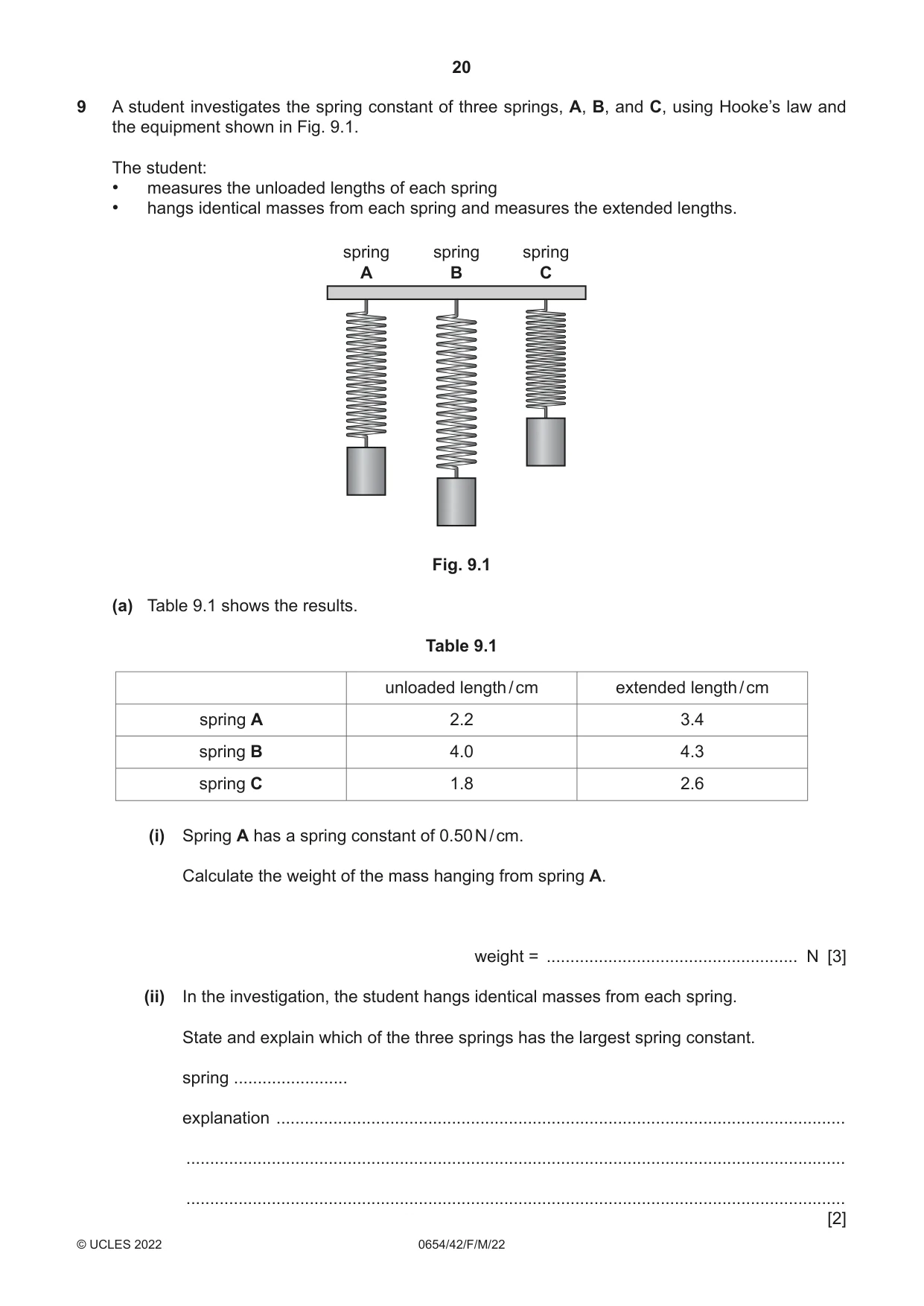
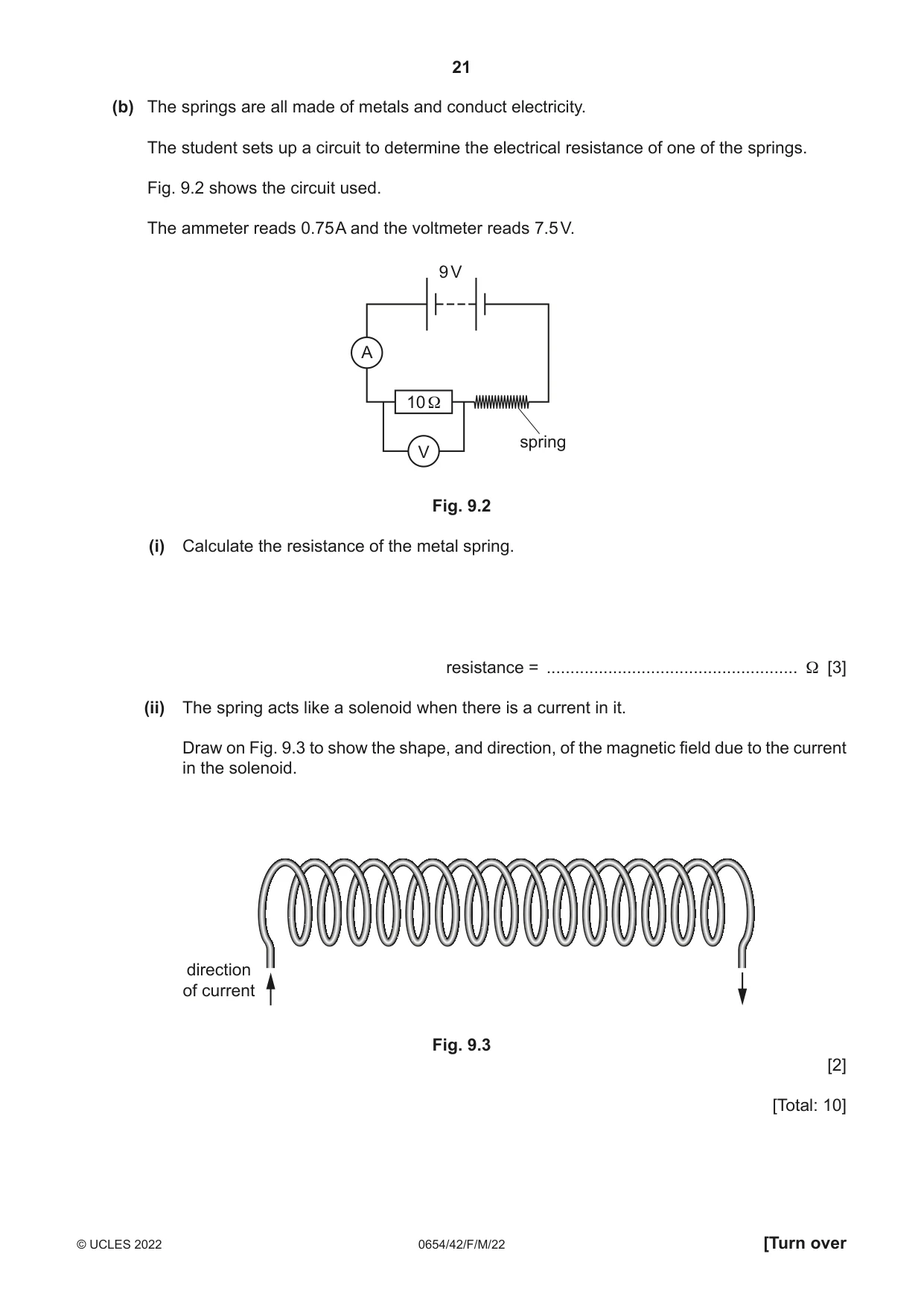
9 A student investigates the spring constant of three springs, A, B, and C, using Hooke’s law and the equipment shown in Fig. 9.1. The student: • measures the unloaded lengths of each spring • hangs identical masses from each spring and measures the extended lengths. spring spring spring A B C Fig. 9.1 (a) Table 9.1 shows the results. Table 9.1 unloaded length / cm extended length / cm spring A 2.2 3.4 spring B 4.0 4.3 spring C 1.8 2.6 (i) Spring A has a spring constant of 0.50 N / cm. Calculate the weight of the mass hanging from spring A. weight = ..................................................... N [3] (ii) In the investigation, the student hangs identical masses from each spring. State and explain which of the three springs has the largest spring constant. spring ........................ explanation ........................................................................................................................ ........................................................................................................................................... ........................................................................................................................................... [2] (b) The springs are all made of metals and conduct electricity. The student sets up a circuit to determine the electrical resistance of one of the springs. Fig. 9.2 shows the circuit used. The ammeter reads 0.75 A and the voltmeter reads 7.5 V. 9 V A 10 Ω spring V Fig. 9.2 (i) Calculate the resistance of the metal spring. resistance = ..................................................... Ω [3] (ii) The spring acts like a solenoid when there is a current in it. Draw on Fig. 9.3 to show the shape, and direction, of the magnetic field due to the current in the solenoid. direction of current Fig. 9.3 [2] [Total: 10]
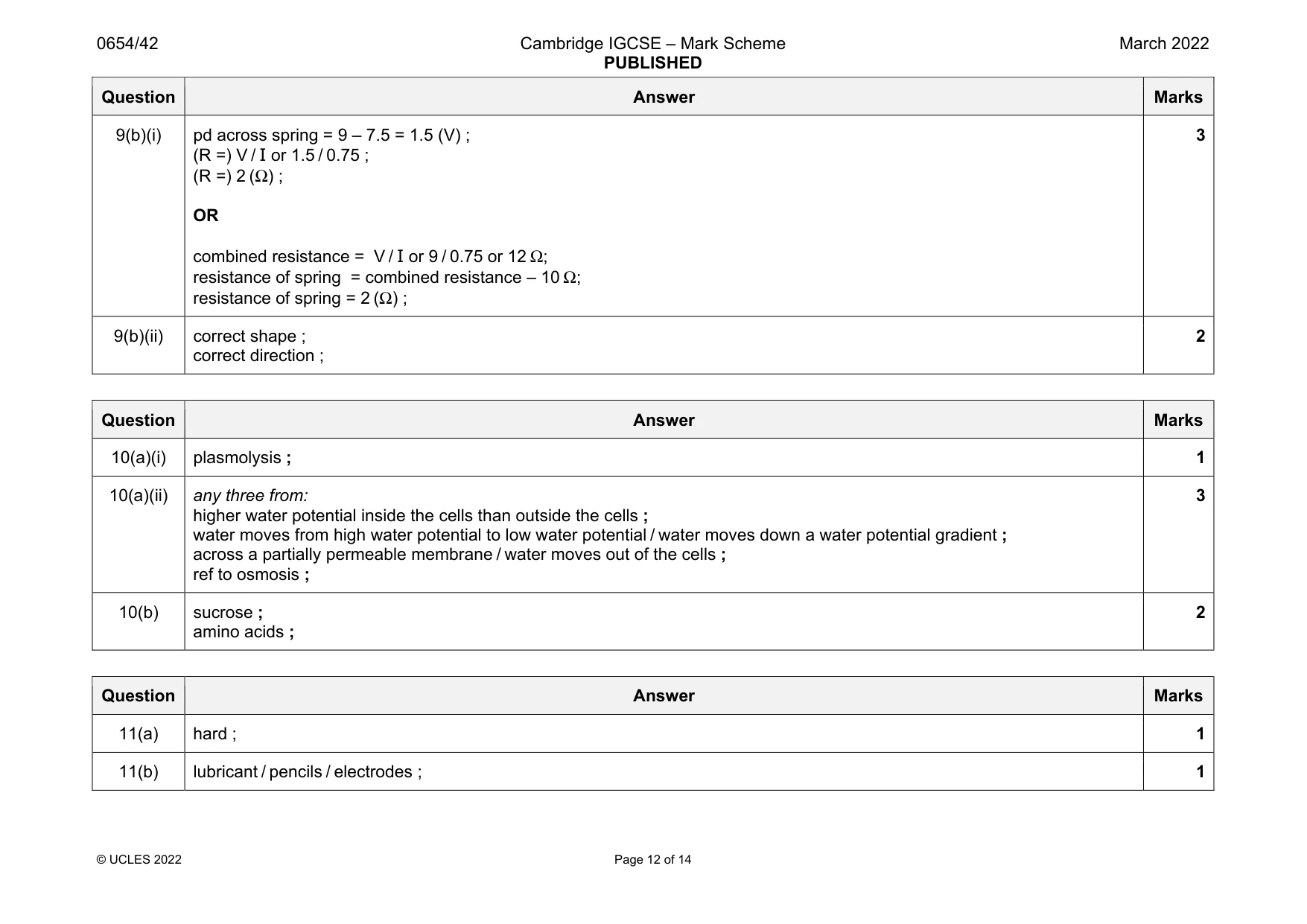
Mark scheme: 9(a)(i) extension = 3.4 – 2.2 = 1.2 (cm) ; (F = ) kx or 0.50 × 1.2 ; (F = ) 0.6 N ; 9(a)(ii) B and smallest extension ; extension is inversely proportional to spring constant ; 2 Question Answer Marks 9(b)(i) pd across spring = 9 – 7.5 = 1.5 (V) ; (R =) V / I or 1.5 / 0.75 ; (R =) 2 (Ω) ; OR combined resistance = V / I or 9 / 0.75 or 12 Ω; resistance of spring = combined resistance – 10 Ω; resistance of spring = 2 (Ω) ; 3 9(b)(ii) correct shape ; correct direction ; 2
Q10 · A photomicrograph of some plant cells
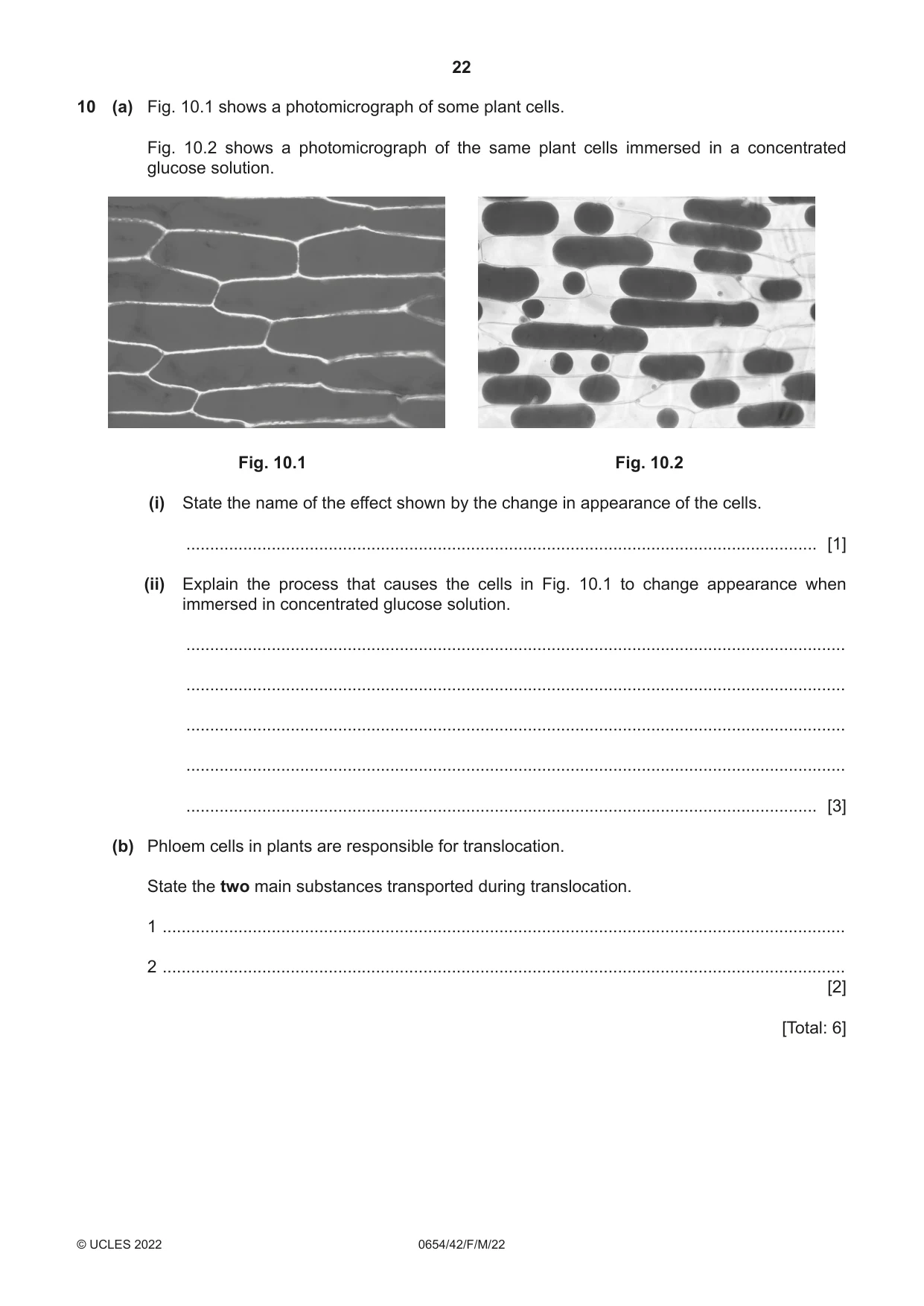
10 (a) Fig. 10.1 shows a photomicrograph of some plant cells. Fig. 10.2 shows a photomicrograph of the same plant cells immersed in a concentrated glucose solution. Fig. 10.1 Fig. 10.2 (i) State the name of the effect shown by the change in appearance of the cells. ..................................................................................................................................... [1] (ii) Explain the process that causes the cells in Fig. 10.1 to change appearance when immersed in concentrated glucose solution. ........................................................................................................................................... ........................................................................................................................................... ........................................................................................................................................... ........................................................................................................................................... ..................................................................................................................................... [3] (b) Phloem cells in plants are responsible for translocation. State the two main substances transported during translocation. 1 ................................................................................................................................................ 2 ................................................................................................................................................ [2] [Total: 6]
Mark scheme: 10(a)(i) plasmolysis ; 1 10(a)(ii) any three from: higher water potential inside the cells than outside the cells ; water moves from high water potential to low water potential / water moves down a water potential gradient ; across a partially permeable membrane / water moves out of the cells ; ref to osmosis ; 3 10(b) sucrose ; amino acids ; 2
Q11 · Diamond and graphite are two forms of carbon shown in Fig
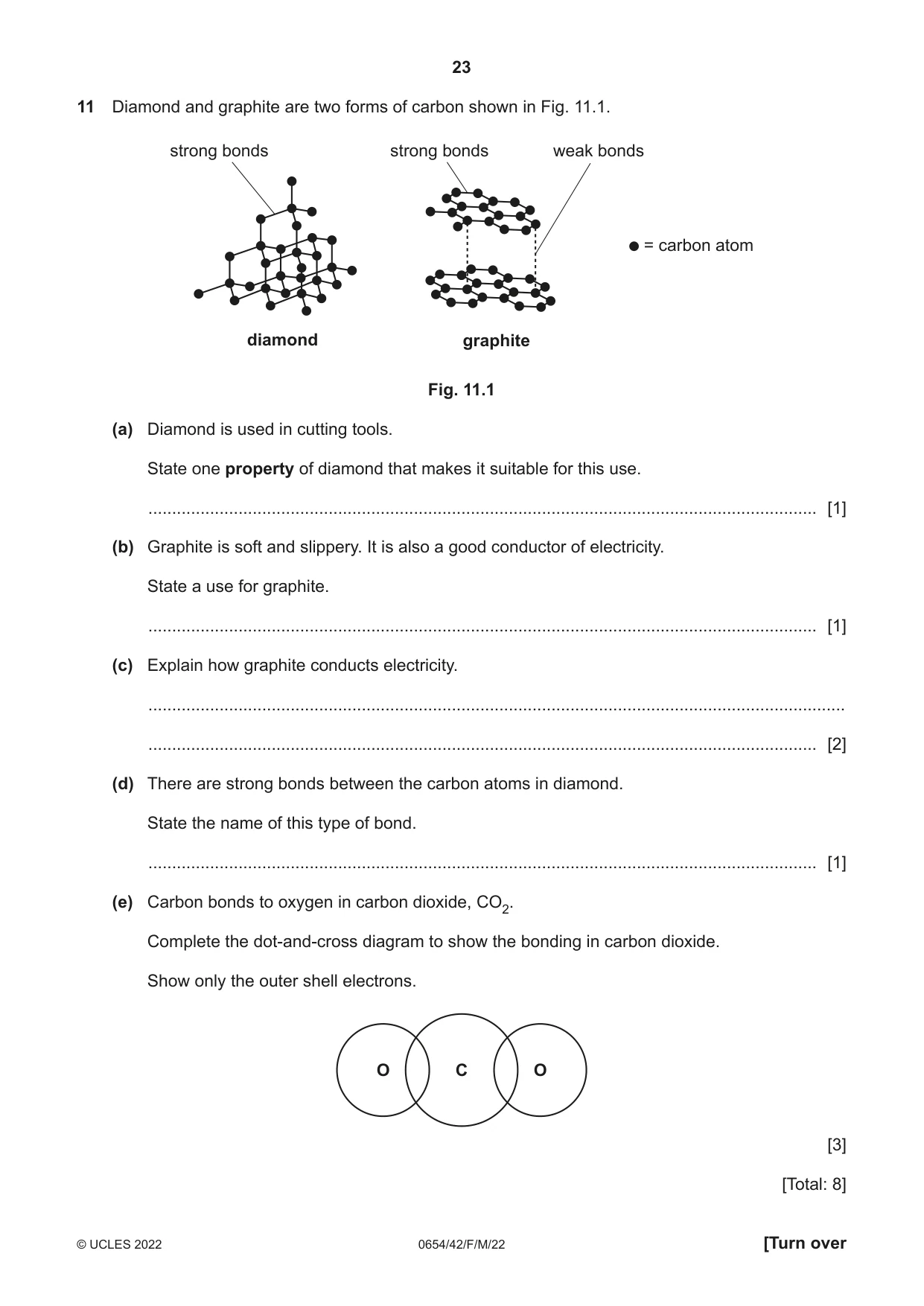
11 Diamond and graphite are two forms of carbon shown in Fig. 11.1. strong bonds strong bonds weak bonds = carbon atom diamond graphite Fig. 11.1 (a) Diamond is used in cutting tools. State one property of diamond that makes it suitable for this use. ............................................................................................................................................. [1] (b) Graphite is soft and slippery. It is also a good conductor of electricity. State a use for graphite. ............................................................................................................................................. [1] (c) Explain how graphite conducts electricity. ................................................................................................................................................... ............................................................................................................................................. [2] (d) There are strong bonds between the carbon atoms in diamond. State the name of this type of bond. ............................................................................................................................................. [1] (e) Carbon bonds to oxygen in carbon dioxide, CO2. Complete the dot-and-cross diagram to show the bonding in carbon dioxide. Show only the outer shell electrons. O C O [3] [Total: 8]
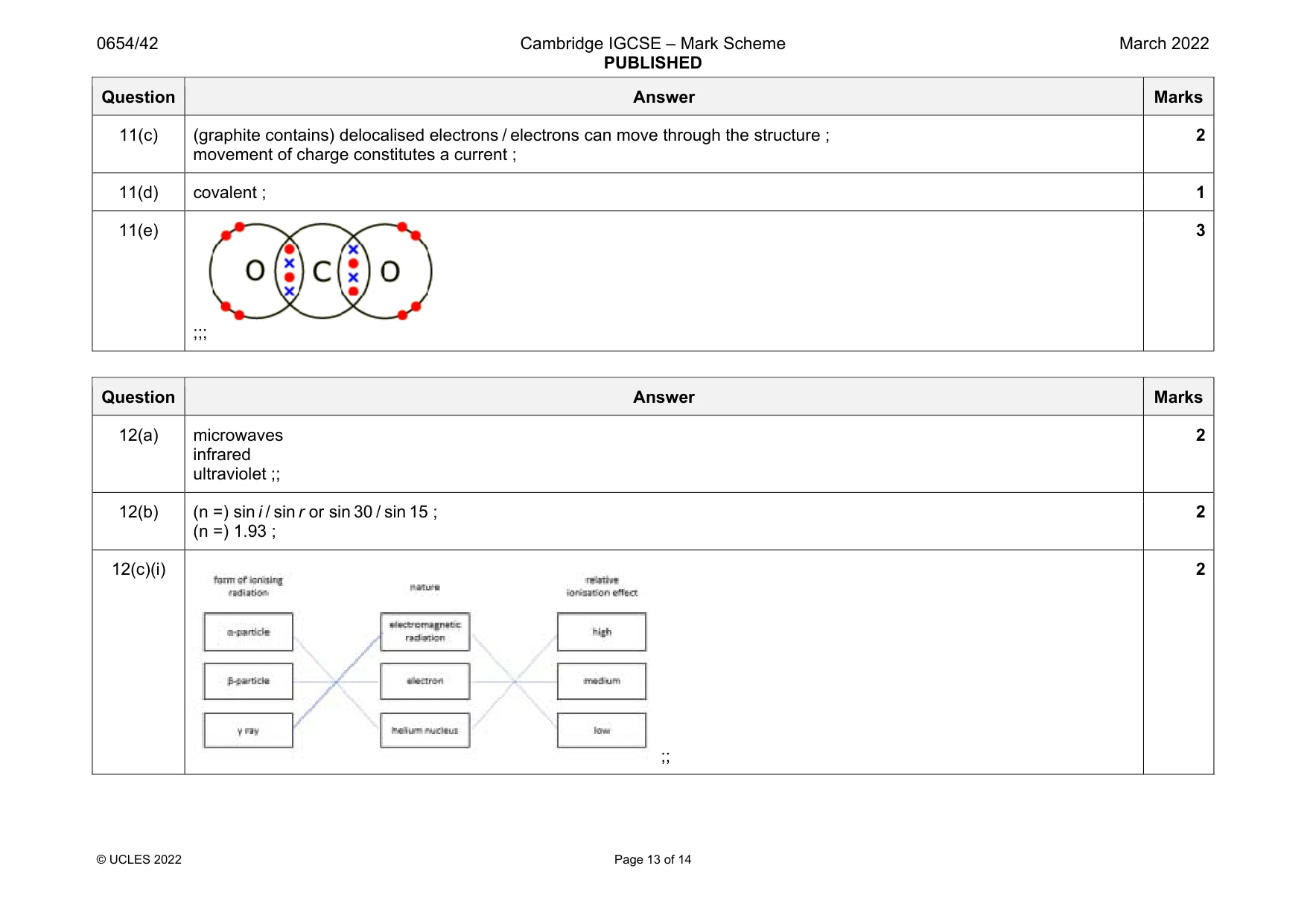
Mark scheme: 11(a) hard ; 1 11(b) lubricant / pencils / electrodes ; 1 Question Answer Marks 11(c) (graphite contains) delocalised electrons / electrons can move through the structure ; movement of charge constitutes a current ; 2 11(d) covalent ; 1 11(e) ;;; 3
Q12 · An incomplete electromagnetic spectrum
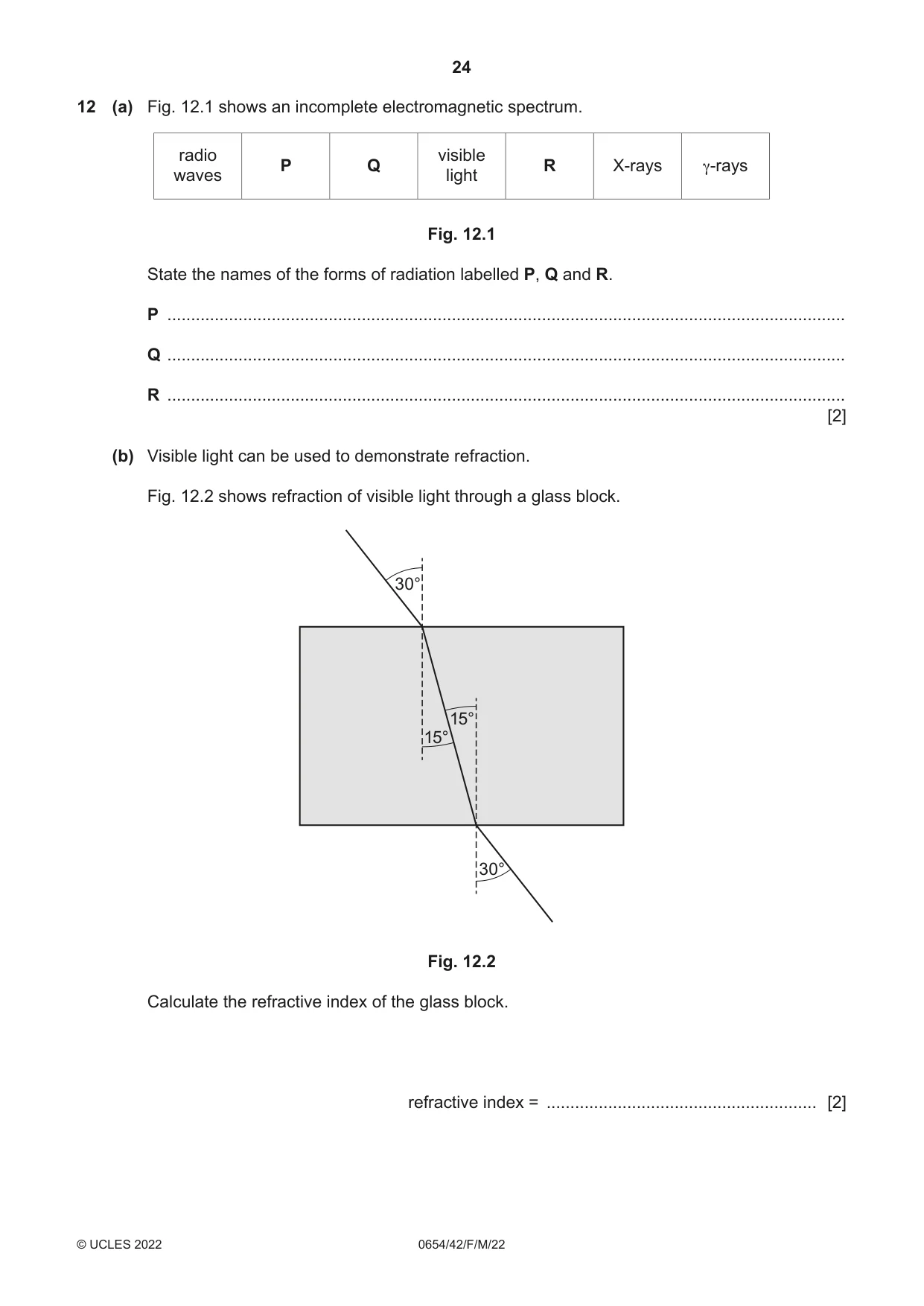
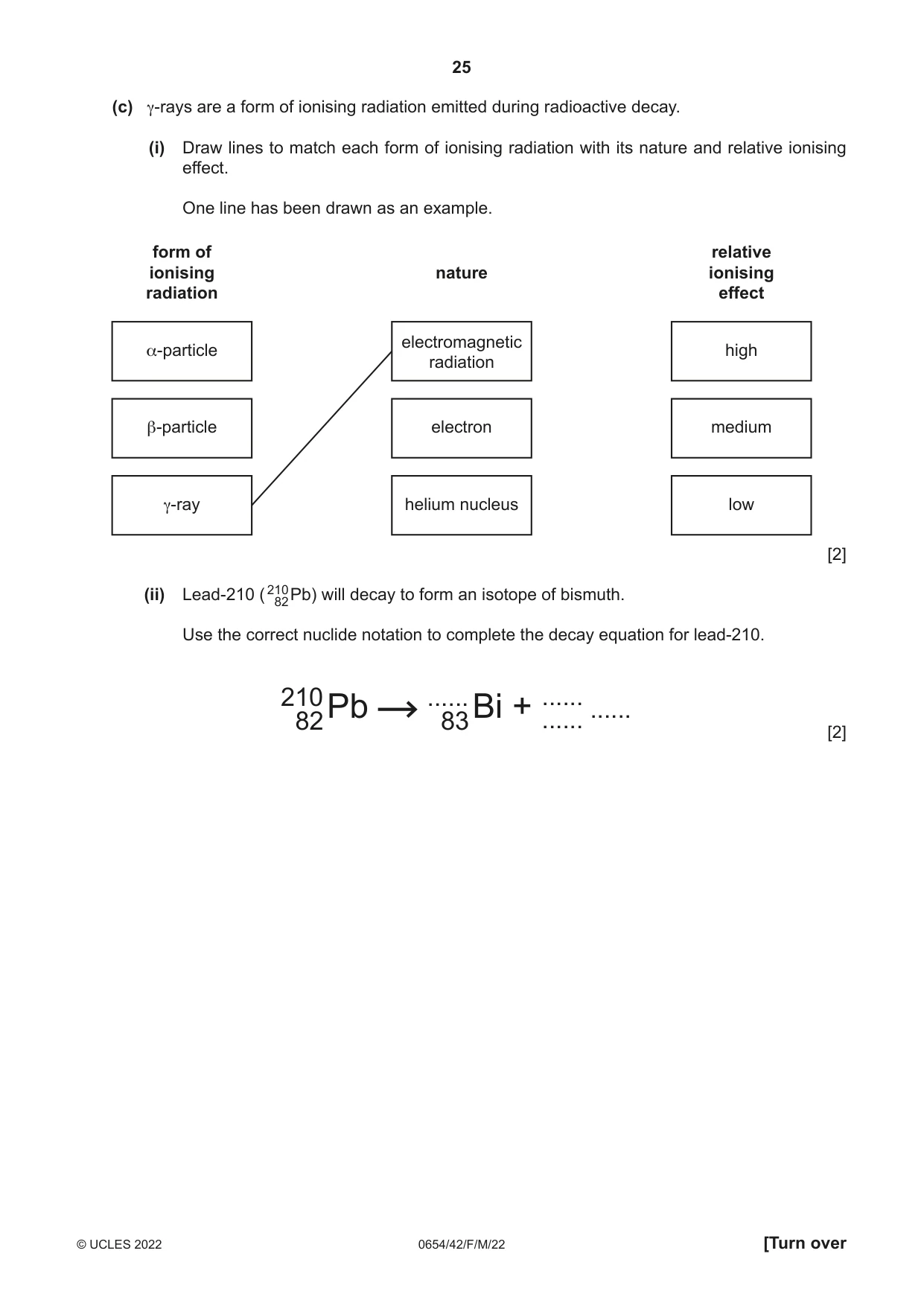
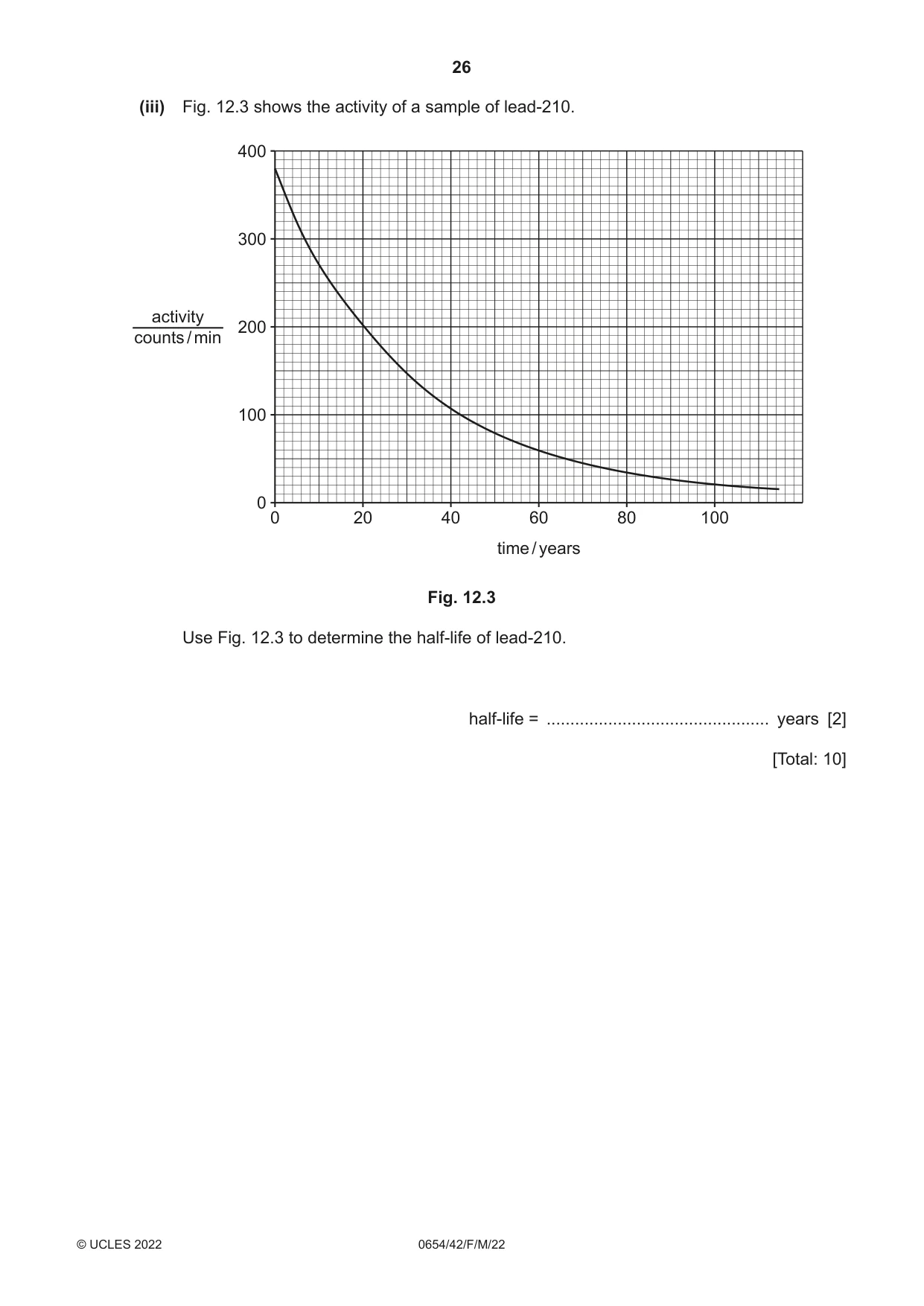
12 (a) Fig. 12.1 shows an incomplete electromagnetic spectrum. radio visible P Q R X-rays γ-rays waves light Fig. 12.1 State the names of the forms of radiation labelled P, Q and R. P ............................................................................................................................................... Q ............................................................................................................................................... R ............................................................................................................................................... [2] (b) Visible light can be used to demonstrate refraction. Fig. 12.2 shows refraction of visible light through a glass block. 30° 15° 15° 30° Fig. 12.2 Calculate the refractive index of the glass block. refractive index = ......................................................... [2] (c) γ-rays are a form of ionising radiation emitted during radioactive decay. (i) Draw lines to match each form of ionising radiation with its nature and relative ionising effect. One line has been drawn as an example. form of relative ionising nature ionising radiation effect electromagnetic α-particle high radiation β-particle electron medium γ-ray helium nucleus low [2] (ii) Lead-210 ( 21082 Pb) will decay to form an isotope of bismuth. Use the correct nuclide notation to complete the decay equation for lead-210. 210 Pb ...... Bi + ...... ...... 82 83 ...... [2] (iii) Fig. 12.3 shows the activity of a sample of lead-210. 400 300 activity 200counts / min 100 0 0 20 40 60 80 100 time / years Fig. 12.3 Use Fig. 12.3 to determine the half-life of lead-210. half-life = ............................................... years [2] [Total: 10]
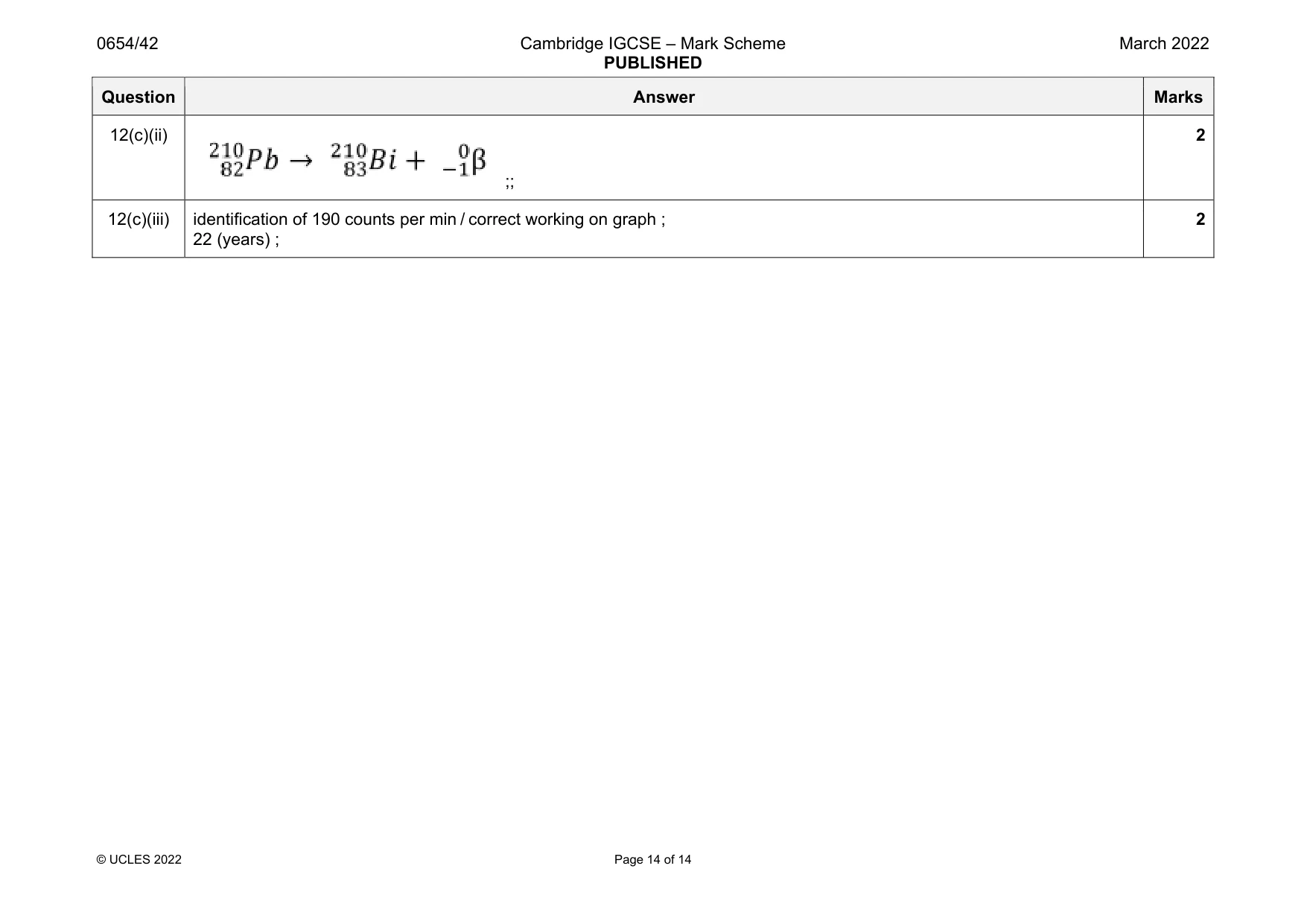
Mark scheme: 12(a) microwaves infrared ultraviolet ;; 2 12(b) (n =) sin i / sin r or sin 30 / sin 15 ; (n =) 1.93 ; 2 12(c)(i) ;; 2 Question Answer Marks 12(c)(ii) ;; 2 12(c)(iii) identification of 190 counts per min / correct working on graph ; 22 (years) ; 2
What was in this paper
The subtopics covered by these 12 questions, and how many questions each got. Open one in a new tab to see every Cambridge question on it.
What you needed in this session
Cambridge’s own grade thresholds for 2022 Feb/March, Paper 4 · Variant 2. A higher threshold means an easier paper — the bar moves with how the cohort did.