Cambridge IGCSE Sciences - Co-ordinated (Double) 0654 — 2021 Oct/Nov Paper 4 · Variant 3
0654/43/O/N/21 · 12 questions · 120 marks · ≈135 min
The question paper and its mark scheme, free to read here and free to download. This is Cambridge’s own paper, exactly as it was sat.
Question paper28 pages

Mark scheme14 pages
Answers below. Sit the paper first if you are practising.
Questions as text
Q1 · A student investigates the effect of placing strips of potato in water and different…
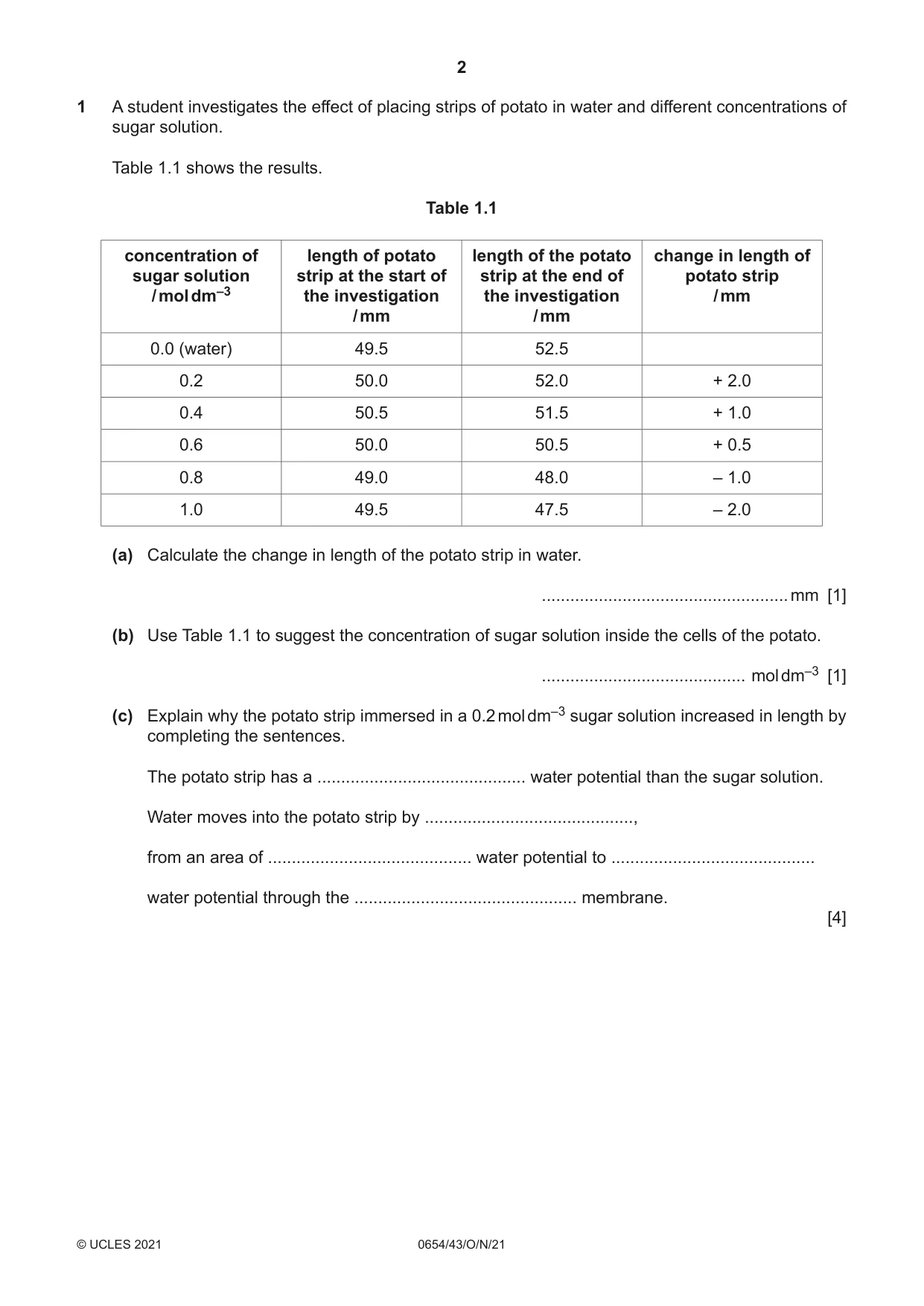
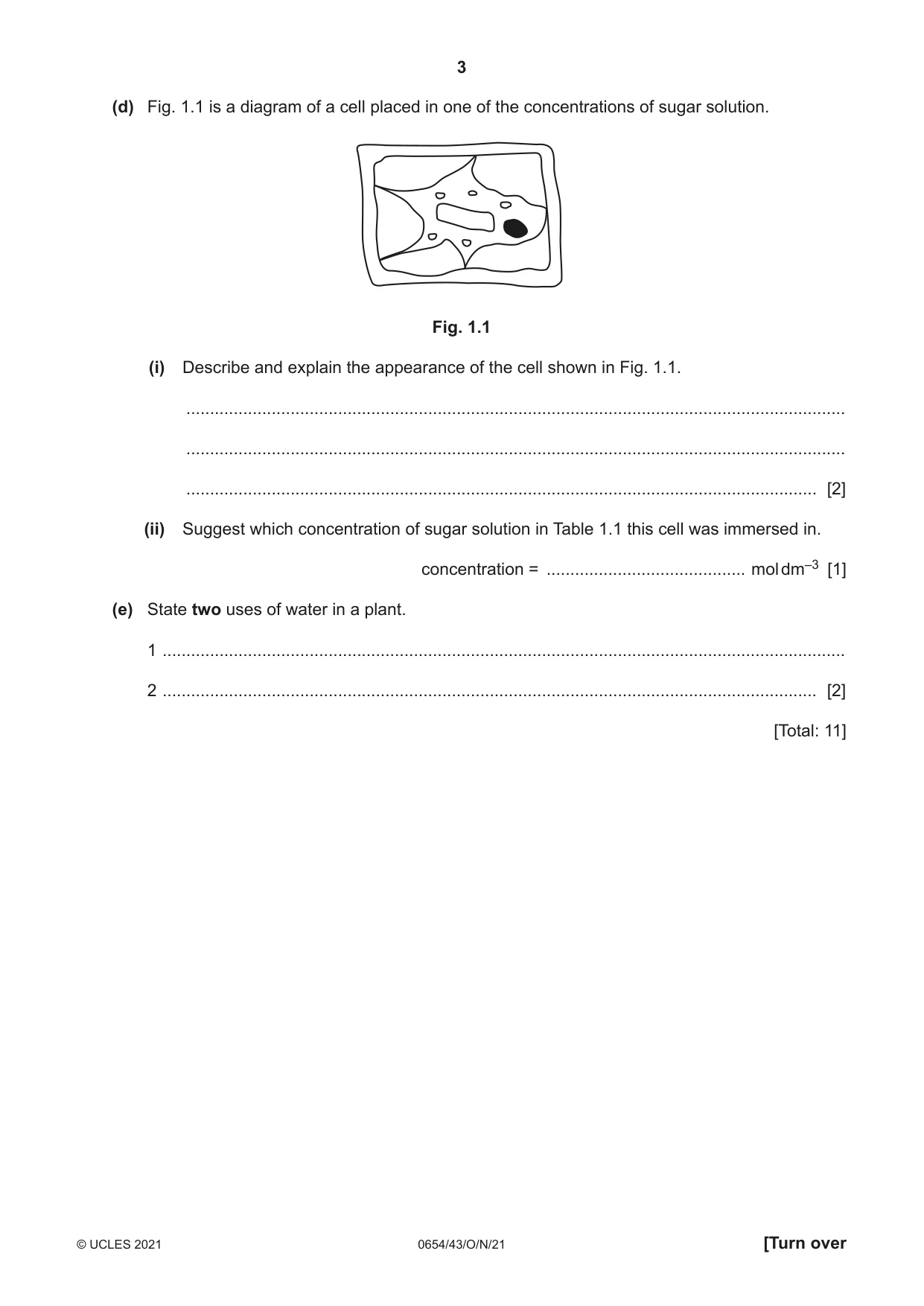
1 A student investigates the effect of placing strips of potato in water and different concentrations of sugar solution. Table 1.1 shows the results. Table 1.1 concentration of length of potato length of the potato change in length of sugar solution strip at the start of strip at the end of potato strip / mol dm–3 the investigation the investigation / mm / mm / mm 0.0 (water) 49.5 52.5 0.2 50.0 52.0 + 2.0 0.4 50.5 51.5 + 1.0 0.6 50.0 50.5 + 0.5 0.8 49.0 48.0 – 1.0 1.0 49.5 47.5 – 2.0 (a) Calculate the change in length of the potato strip in water. ....................................................mm [1] (b) Use Table 1.1 to suggest the concentration of sugar solution inside the cells of the potato. ........................................... mol dm–3 [1] (c) Explain why the potato strip immersed in a 0.2 mol dm–3 sugar solution increased in length by completing the sentences. The potato strip has a ............................................ water potential than the sugar solution. Water moves into the potato strip by ............................................, from an area of ........................................... water potential to ........................................... water potential through the ............................................... membrane. [4] (d) Fig. 1.1 is a diagram of a cell placed in one of the concentrations of sugar solution. Fig. 1.1 (i) Describe and explain the appearance of the cell shown in Fig. 1.1. ........................................................................................................................................... ........................................................................................................................................... ..................................................................................................................................... [2] (ii) Suggest which concentration of sugar solution in Table 1.1 this cell was immersed in. concentration = .......................................... mol dm–3 [1] (e) State two uses of water in a plant. 1 ................................................................................................................................................ 2 .......................................................................................................................................... [2] [Total: 11]
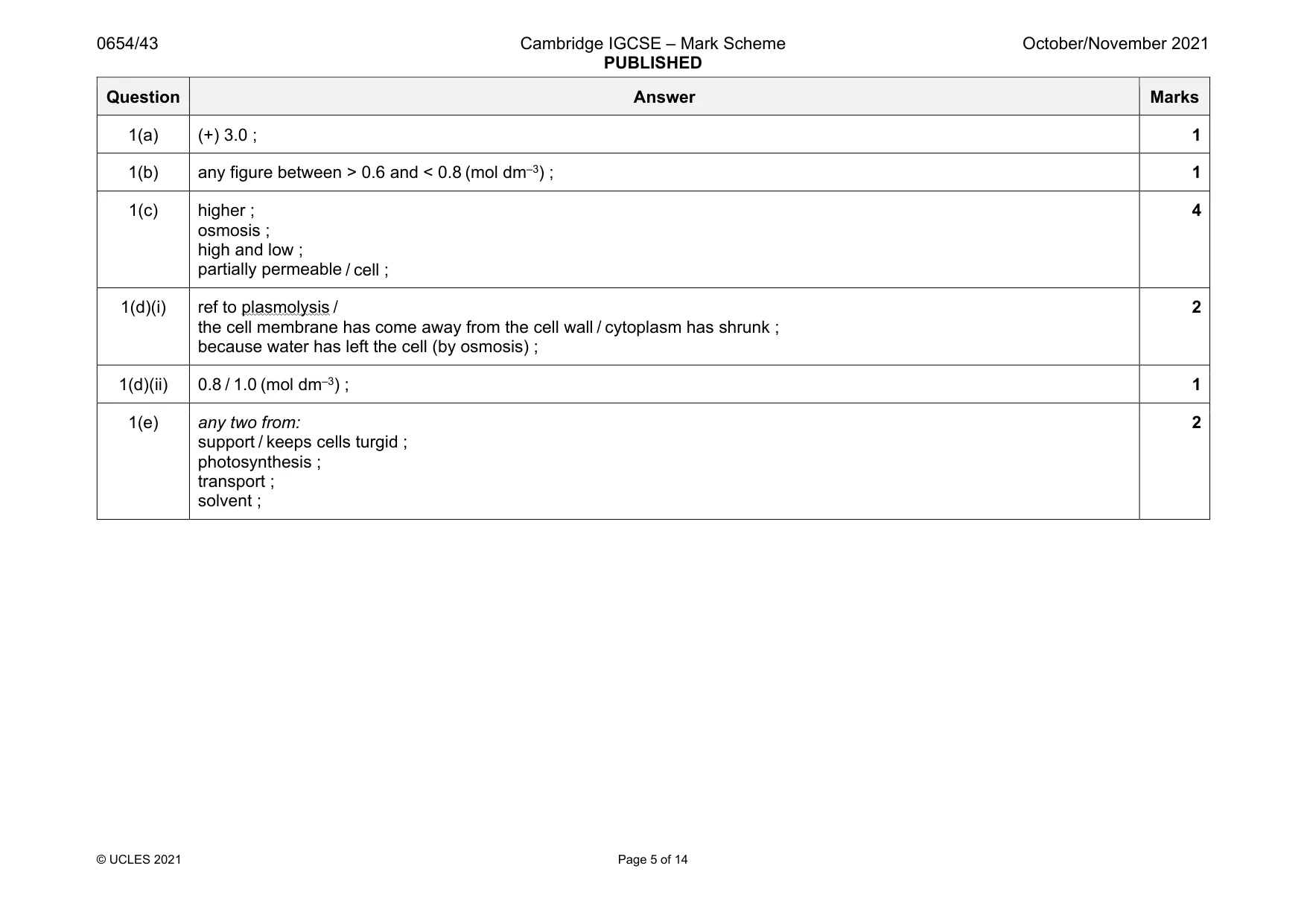
Mark scheme: 1(a) (+) 3.0 ; 1 1(b) any figure between > 0.6 and < 0.8 (mol dm–3) ; 1 1(c) higher ; osmosis ; high and low ; partially permeable / cell ; 4 1(d)(i) ref to plasmolysis / the cell membrane has come away from the cell wall / cytoplasm has shrunk ; because water has left the cell (by osmosis) ; 2 1(d)(ii) 0.8 / 1.0 (mol dm–3) ; 1 1(e) any two from: support / keeps cells turgid ; photosynthesis ; transport ; solvent ; 2
Q2 · Chlorine and bromine are Group VII elements of the Periodic Table
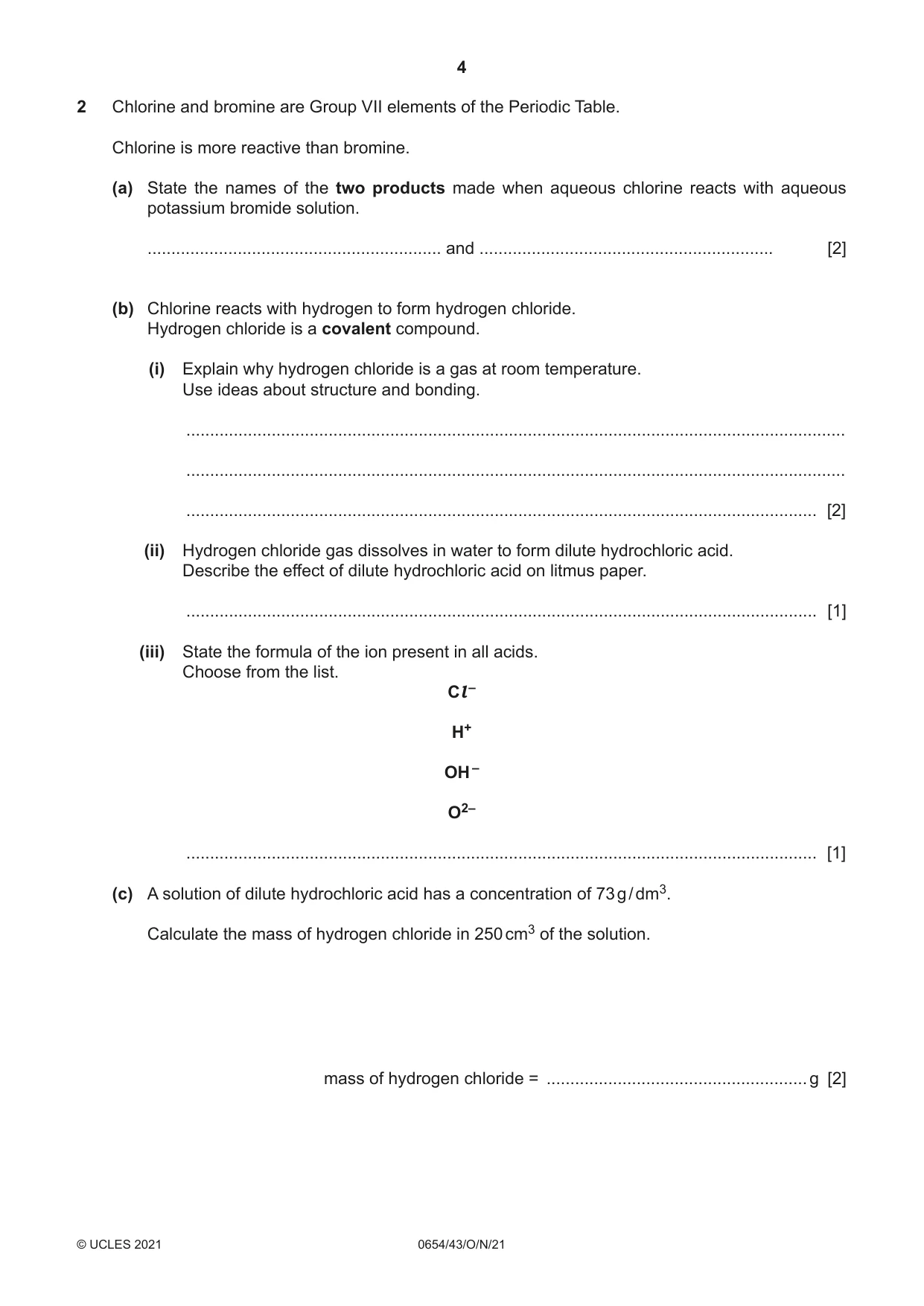
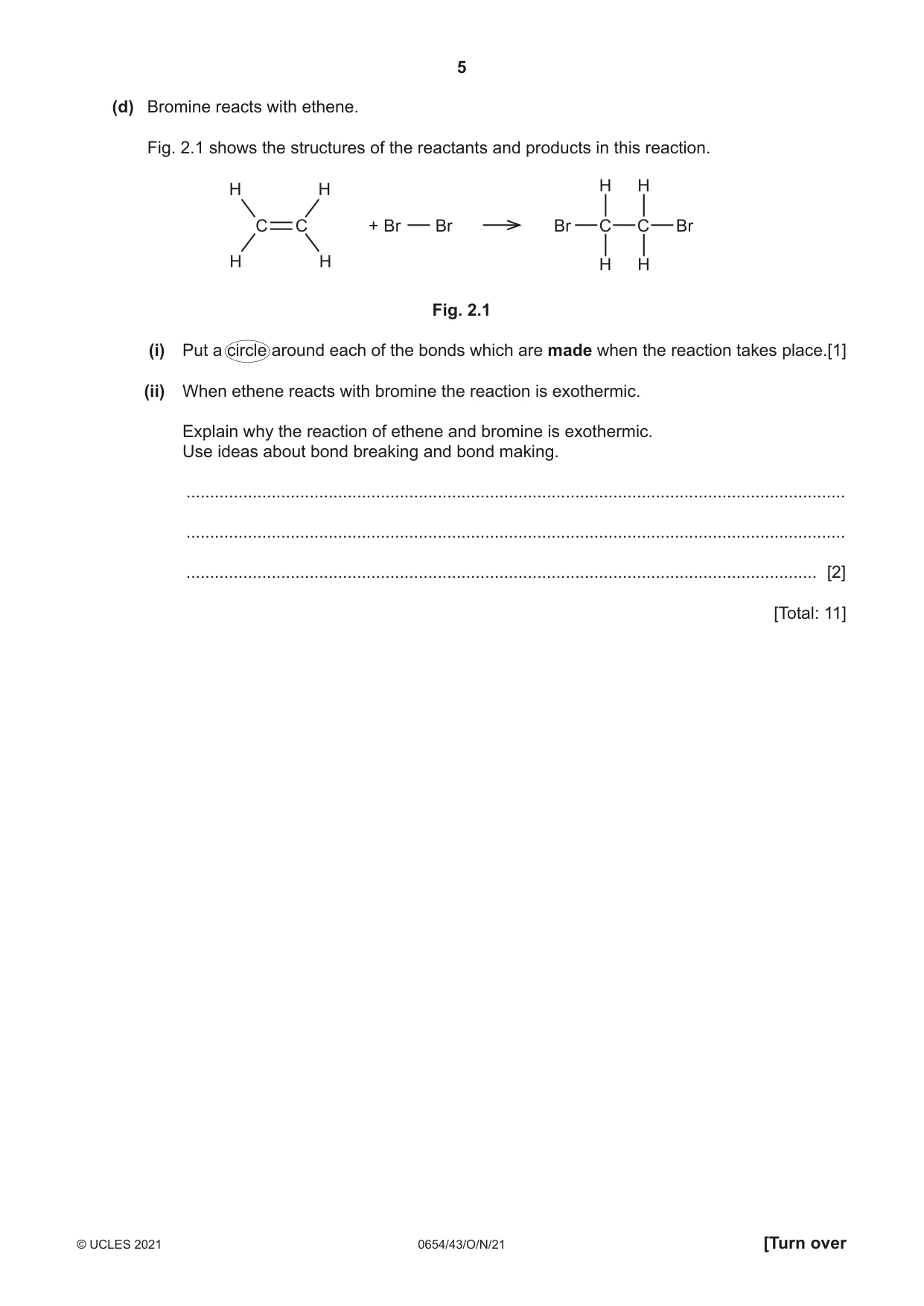
2 Chlorine and bromine are Group VII elements of the Periodic Table. Chlorine is more reactive than bromine. (a) State the names of the two products made when aqueous chlorine reacts with aqueous potassium bromide solution. .............................................................. and .............................................................. [2] (b) Chlorine reacts with hydrogen to form hydrogen chloride. Hydrogen chloride is a covalent compound. (i) Explain why hydrogen chloride is a gas at room temperature. Use ideas about structure and bonding. ........................................................................................................................................... ........................................................................................................................................... ..................................................................................................................................... [2] (ii) Hydrogen chloride gas dissolves in water to form dilute hydrochloric acid. Describe the effect of dilute hydrochloric acid on litmus paper. ..................................................................................................................................... [1] (iii) State the formula of the ion present in all acids. Choose from the list. Cl – H+ OH – O2– ..................................................................................................................................... [1] (c) A solution of dilute hydrochloric acid has a concentration of 73 g / dm3. Calculate the mass of hydrogen chloride in 250 cm3 of the solution. mass of hydrogen chloride = .......................................................g [2] (d) Bromine reacts with ethene. Fig. 2.1 shows the structures of the reactants and products in this reaction. H H H H C C + Br Br Br C C Br H H H H Fig. 2.1 (i) Put a circle around each of the bonds which are made when the reaction takes place. [1] (ii) When ethene reacts with bromine the reaction is exothermic. Explain why the reaction of ethene and bromine is exothermic. Use ideas about bond breaking and bond making. ........................................................................................................................................... ........................................................................................................................................... ..................................................................................................................................... [2] [Total: 11]
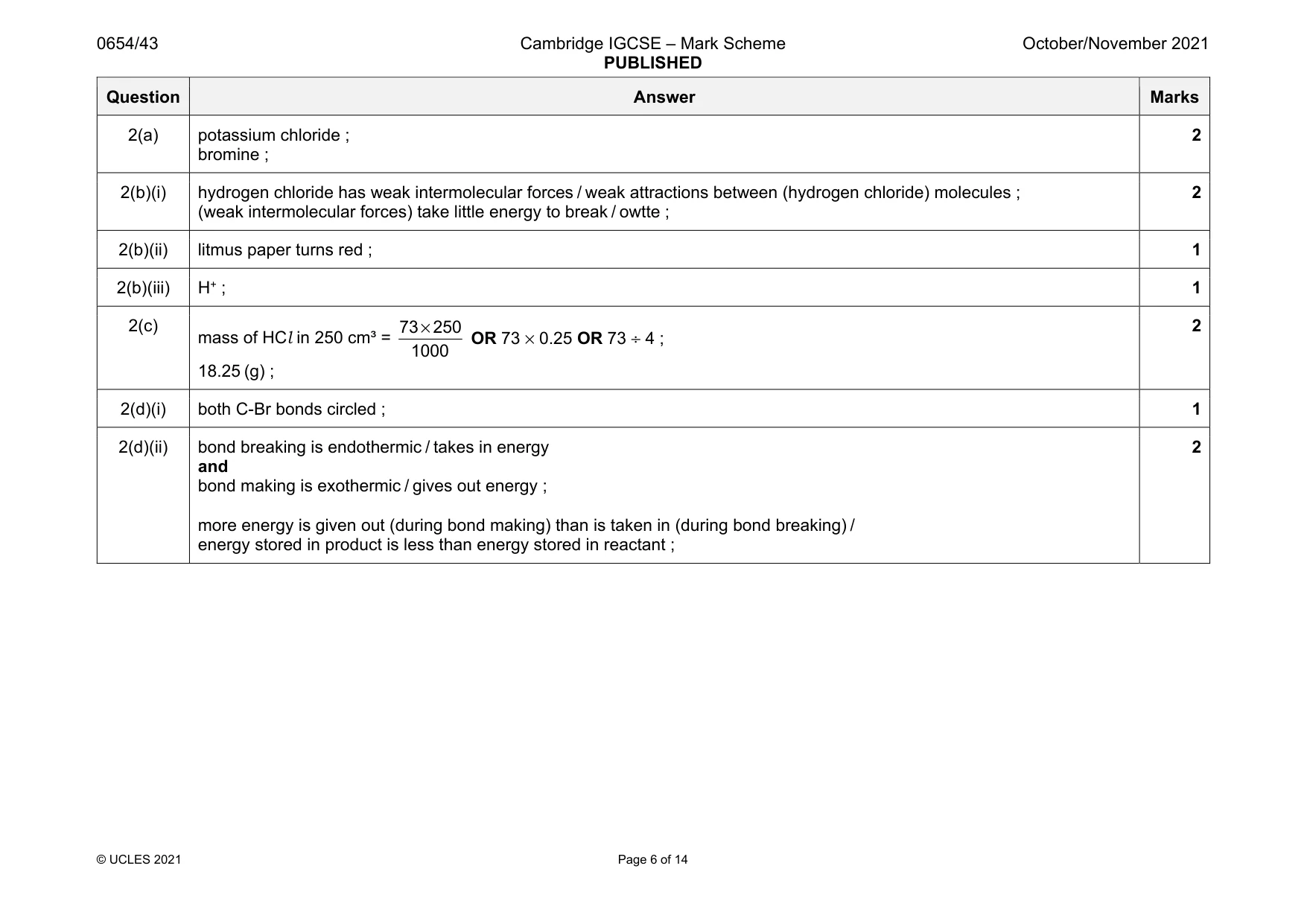
Mark scheme: 2(a) potassium chloride ; bromine ; 2 2(b)(i) hydrogen chloride has weak intermolecular forces / weak attractions between (hydrogen chloride) molecules ; (weak intermolecular forces) take little energy to break / owtte ; 2 2(b)(ii) litmus paper turns red ; 1 2(b)(iii) H+ ; 1 2(c) mass of HCl in 250 cm³ = 73 250 1000 × OR 73 × 0.25 OR 73 ÷ 4 ; 18.25 (g) ; 2 2(d)(i) both C-Br bonds circled ; 1 2(d)(ii) bond breaking is endothermic / takes in energy and bond making is exothermic / gives out energy ; more energy is given out (during bond making) than is taken in (during bond breaking) / energy stored in product is less than energy stored in reactant ; 2
Q3 · Carbon-14 is an unstable isotope which decays to produce nitrogen -14
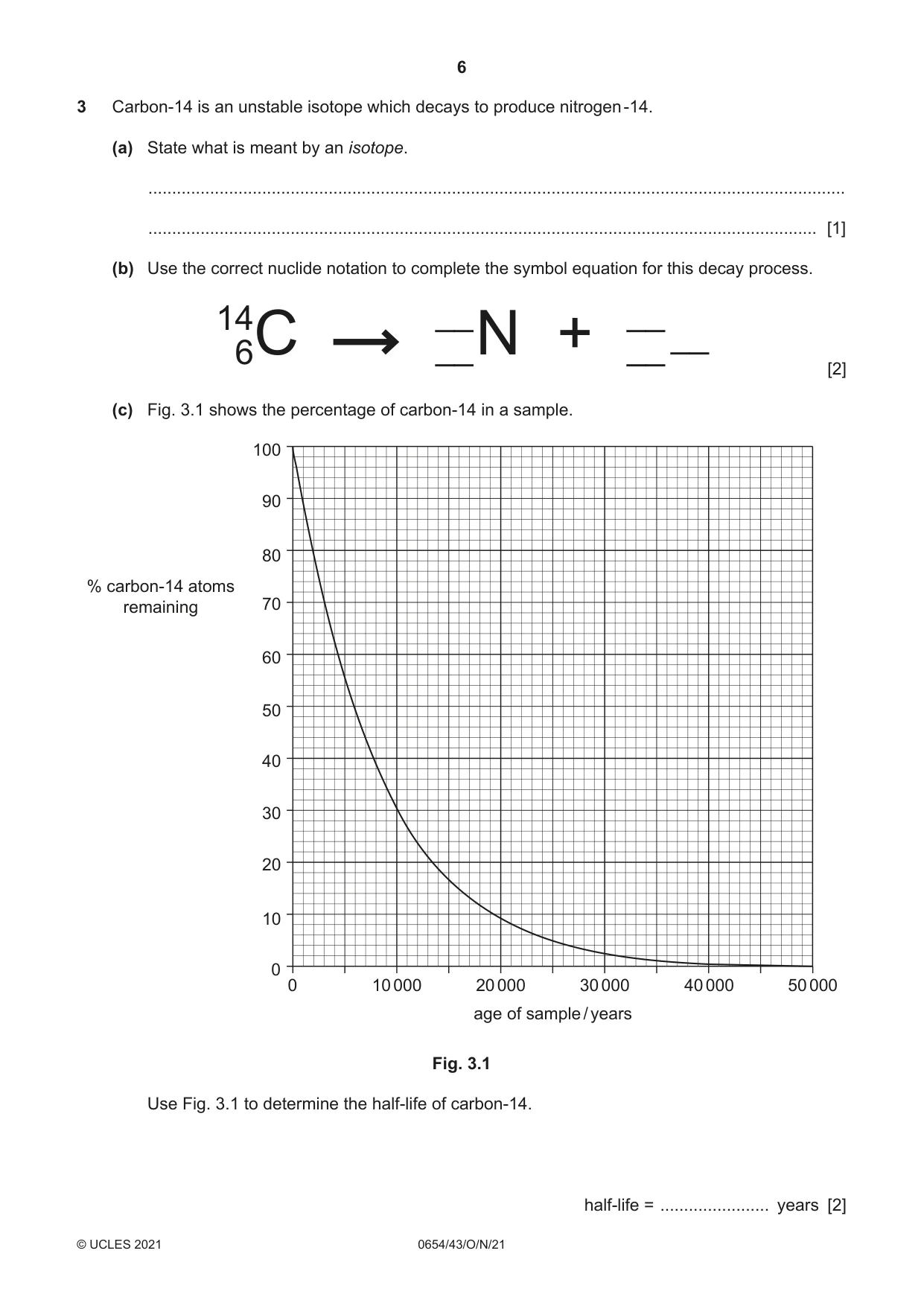
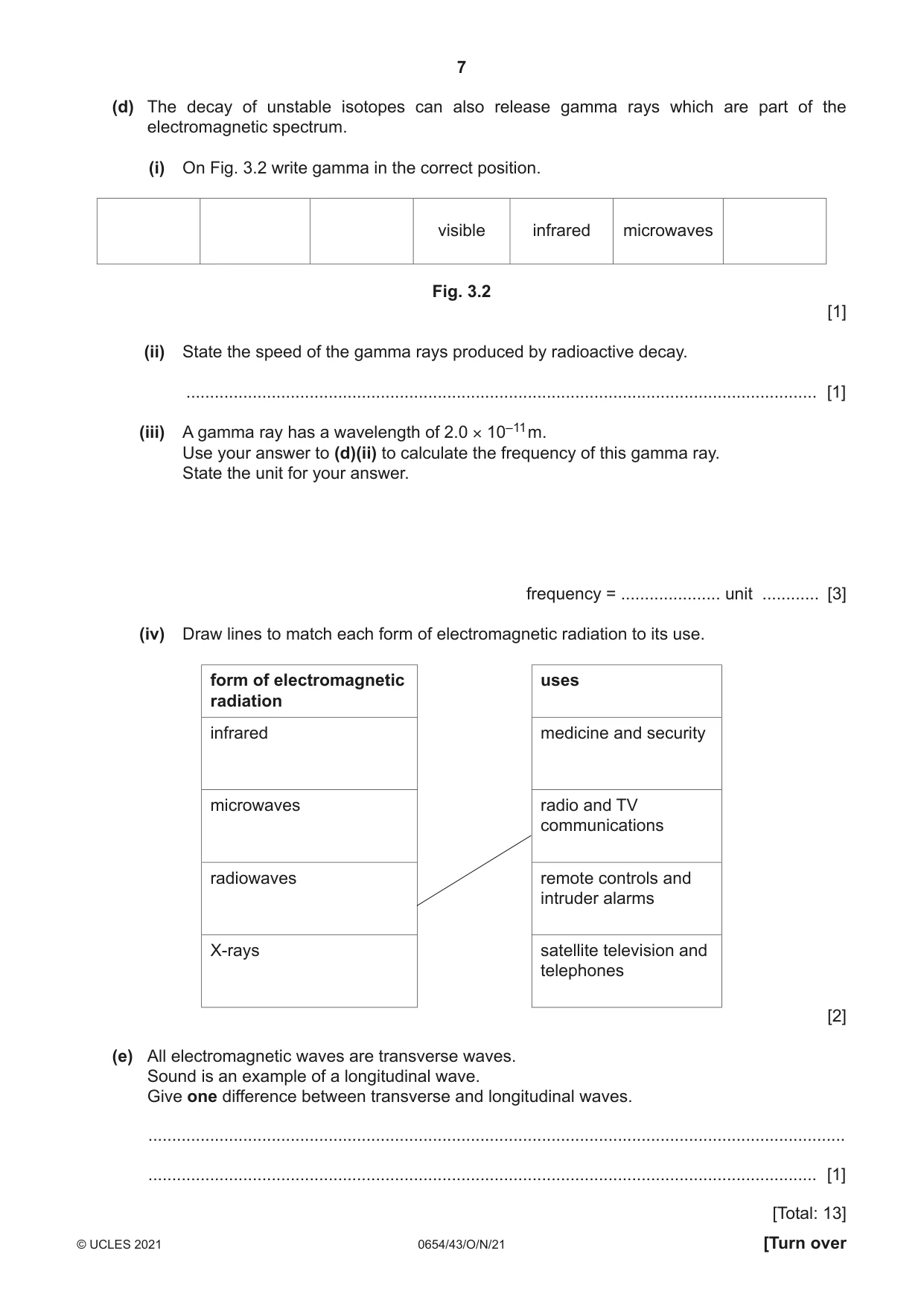
3 Carbon-14 is an unstable isotope which decays to produce nitrogen -14. (a) State what is meant by an isotope. ................................................................................................................................................... ............................................................................................................................................. [1] (b) Use the correct nuclide notation to complete the symbol equation for this decay process. 14 __ __ __ 6C __ N + __ [2] (c) Fig. 3.1 shows the percentage of carbon-14 in a sample. 100 90 80 % carbon-14 atoms remaining 70 60 50 40 30 20 10 0 0 10 000 20 000 30 000 40 000 50 000 age of sample / years Fig. 3.1 Use Fig. 3.1 to determine the half-life of carbon-14. half-life = ....................... years [2] (d) The decay of unstable isotopes can also release gamma rays which are part of the electromagnetic spectrum. (i) On Fig. 3.2 write gamma in the correct position. visible infrared microwaves Fig. 3.2 [1] (ii) State the speed of the gamma rays produced by radioactive decay. ..................................................................................................................................... [1] (iii) A gamma ray has a wavelength of 2.0 × 10⁻¹¹ m. Use your answer to (d)(ii) to calculate the frequency of this gamma ray. State the unit for your answer. frequency = ..................... unit ............ [3] (iv) Draw lines to match each form of electromagnetic radiation to its use. form of electromagnetic uses radiation infrared medicine and security microwaves radio and TV communications radiowaves remote controls and intruder alarms X-rays satellite television and telephones [2] (e) All electromagnetic waves are transverse waves. Sound is an example of a longitudinal wave. Give one difference between transverse and longitudinal waves. ................................................................................................................................................... ............................................................................................................................................. [1] [Total: 13]
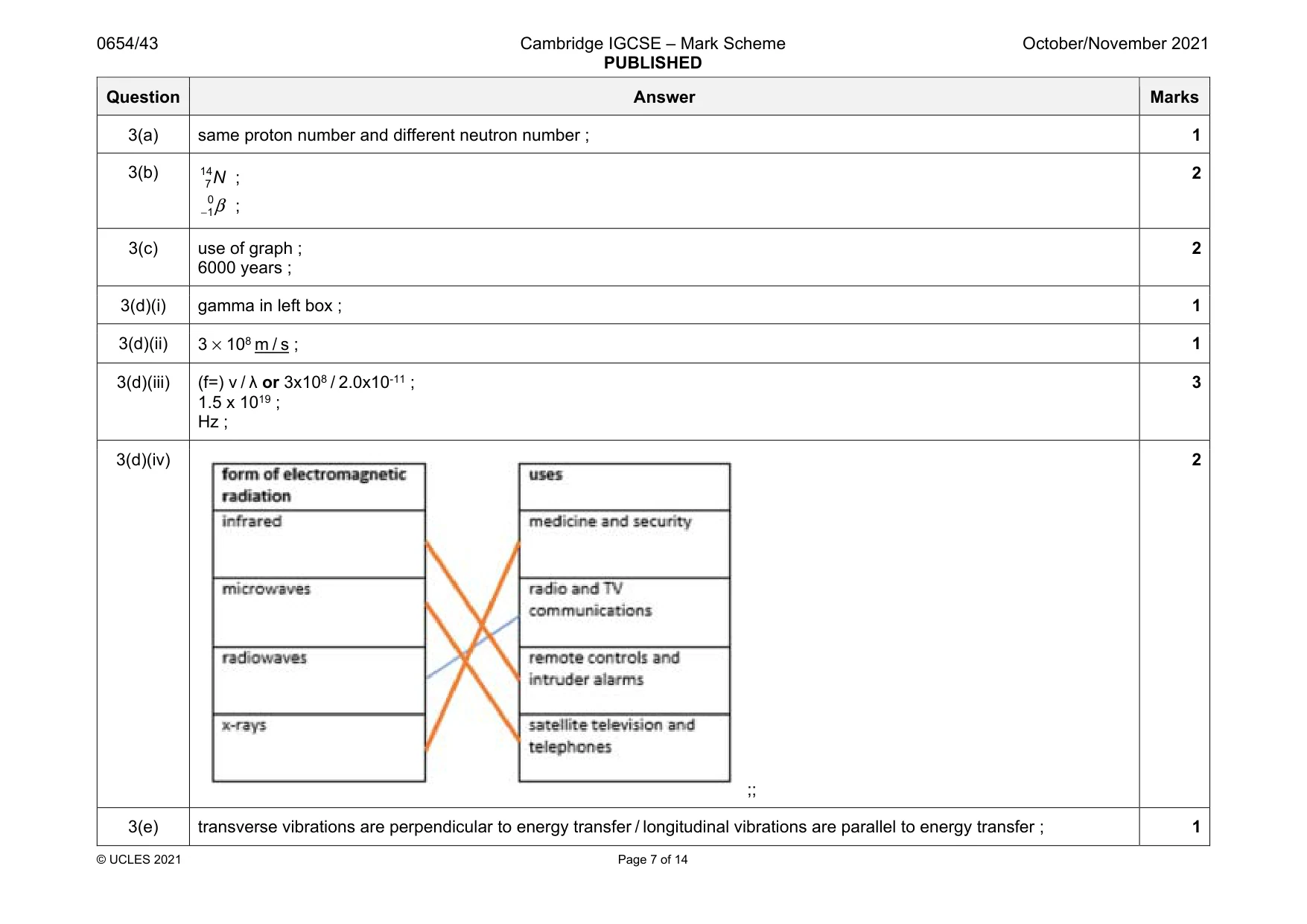
Mark scheme: 3(a) same proton number and different neutron number ; 1 3(b) 14 7N ; 0 1β − ; 2 3(c) use of graph ; 6000 years ; 2 3(d)(i) gamma in left box ; 1 3(d)(ii) 3 × 10⁸ m / s ; 1 3(d)(iii) (f=) v / λ or 3x10⁸ / 2.0x10⁻¹¹ ; 1.5 x 10¹⁹ ; Hz ; 3 3(d)(iv) ;; 2 3(e) transverse vibrations are perpendicular to energy transfer / longitudinal vibrations are parallel to energy transfer ; 1
Q4 · Complete the definition of the term ecosystem
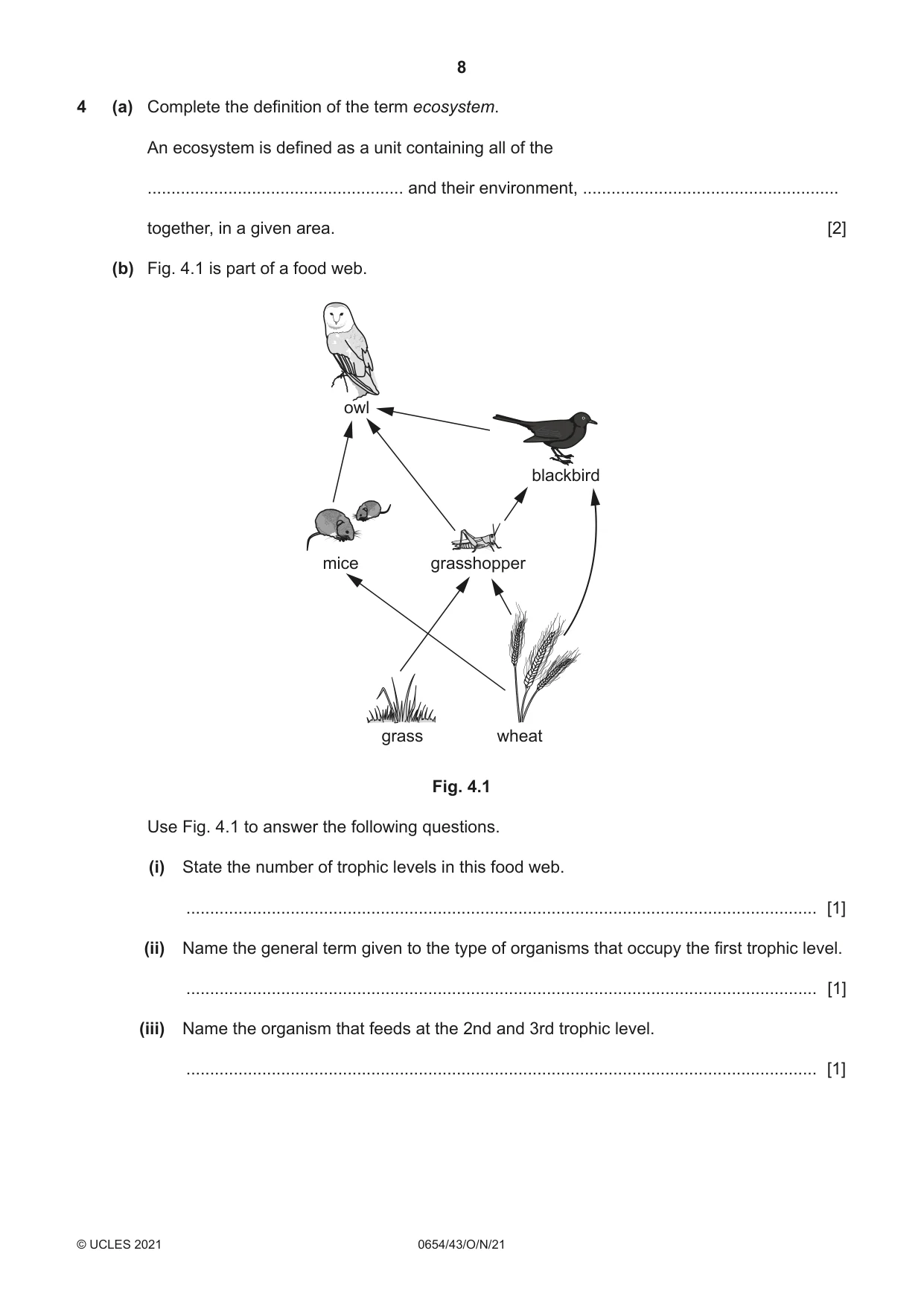
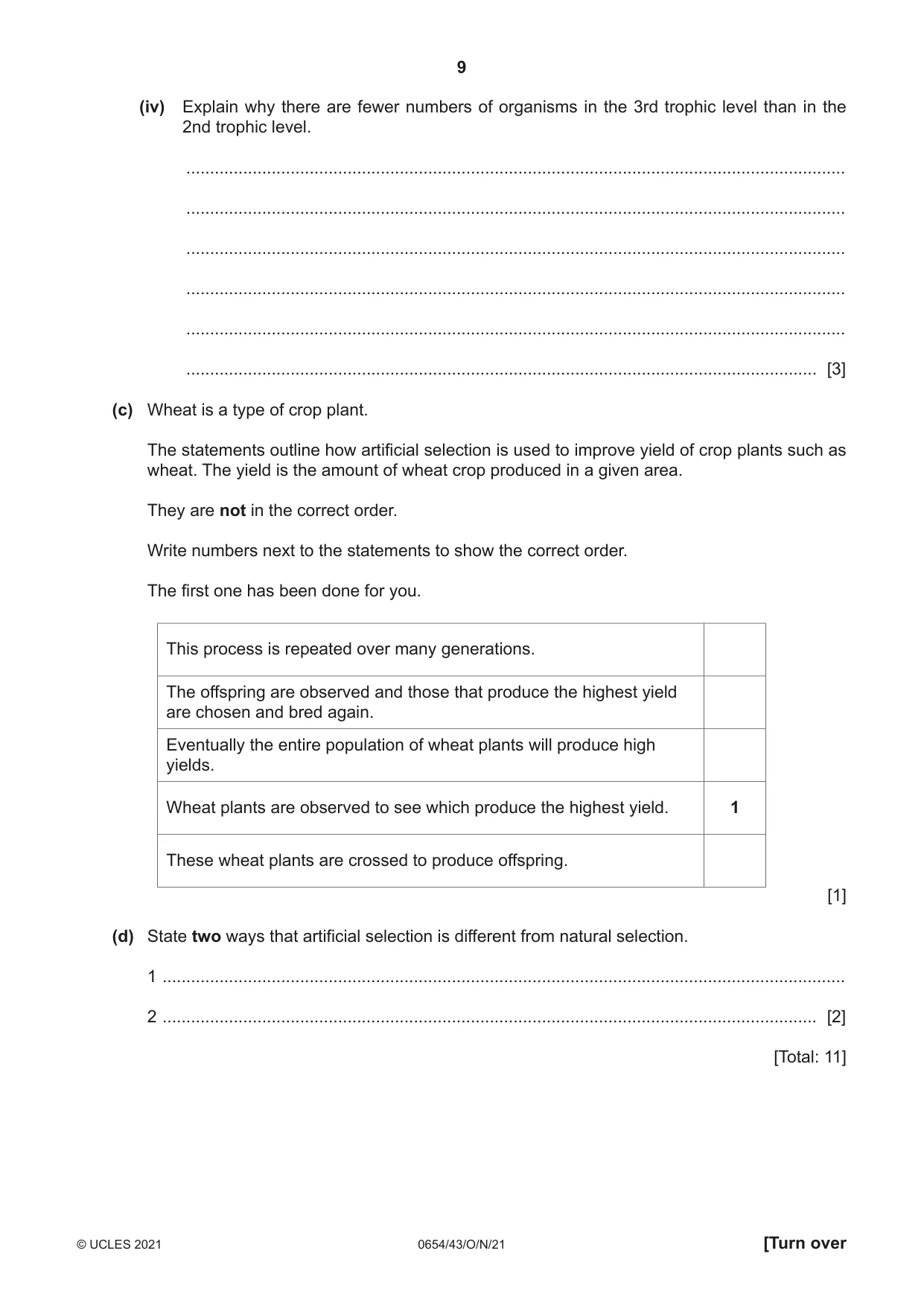
4 (a) Complete the definition of the term ecosystem. An ecosystem is defined as a unit containing all of the ...................................................... and their environment, ...................................................... together, in a given area. [2] (b) Fig. 4.1 is part of a food web. owl blackbird mice grasshopper grass wheat Fig. 4.1 Use Fig. 4.1 to answer the following questions. (i) State the number of trophic levels in this food web. ..................................................................................................................................... [1] (ii) Name the general term given to the type of organisms that occupy the first trophic level. ..................................................................................................................................... [1] (iii) Name the organism that feeds at the 2nd and 3rd trophic level. ..................................................................................................................................... [1] (iv) Explain why there are fewer numbers of organisms in the 3rd trophic level than in the 2nd trophic level. ........................................................................................................................................... ........................................................................................................................................... ........................................................................................................................................... ........................................................................................................................................... ........................................................................................................................................... ..................................................................................................................................... [3] (c) Wheat is a type of crop plant. The statements outline how artificial selection is used to improve yield of crop plants such as wheat. The yield is the amount of wheat crop produced in a given area. They are not in the correct order. Write numbers next to the statements to show the correct order. The first one has been done for you. This process is repeated over many generations. The offspring are observed and those that produce the highest yield are chosen and bred again. Eventually the entire population of wheat plants will produce high yields. Wheat plants are observed to see which produce the highest yield. 1 These wheat plants are crossed to produce offspring. [1] (d) State two ways that artificial selection is different from natural selection. 1 ................................................................................................................................................ 2 .......................................................................................................................................... [2] [Total: 11]
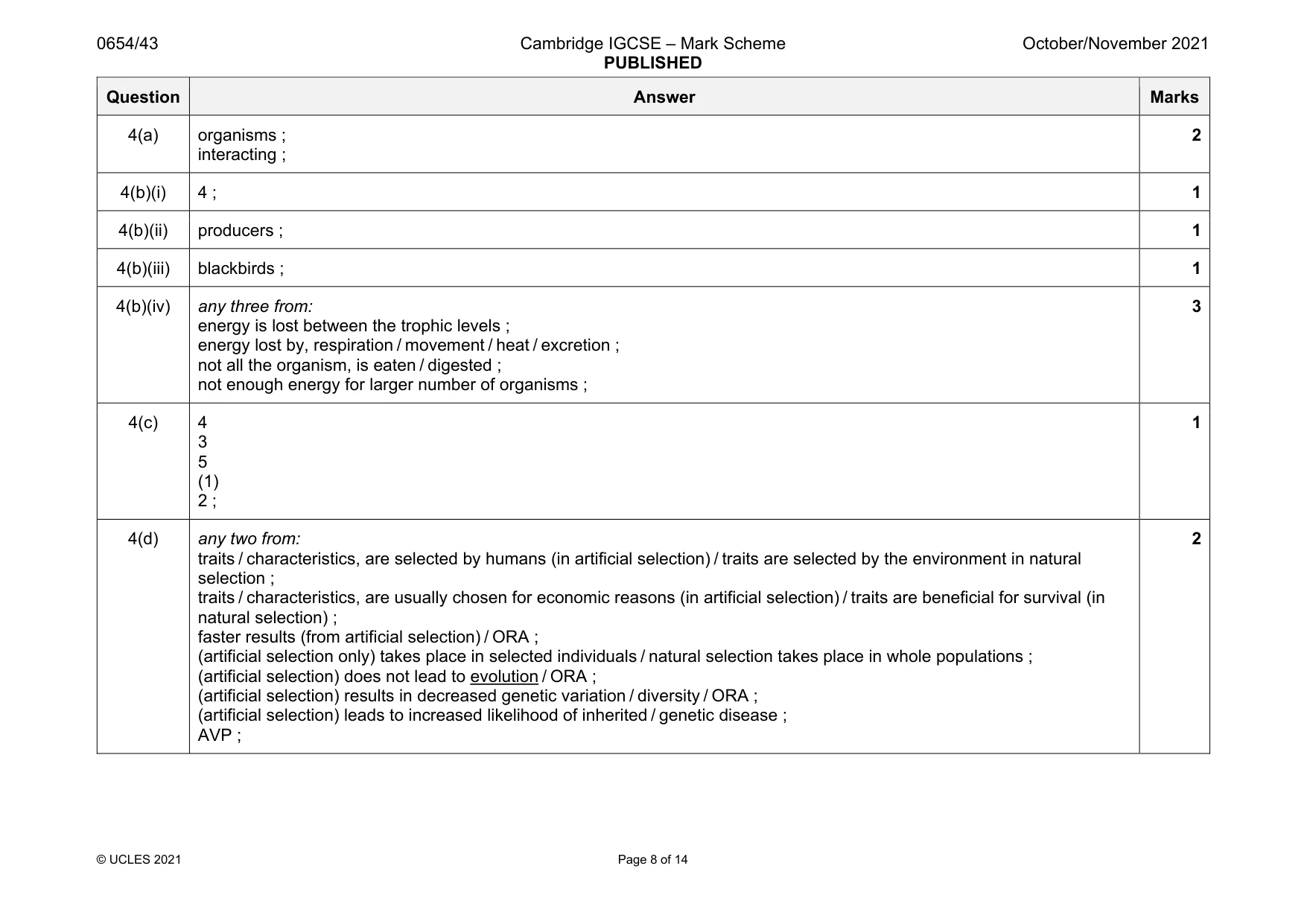
Mark scheme: 4(a) organisms ; interacting ; 2 4(b)(i) 4 ; 1 4(b)(ii) producers ; 1 4(b)(iii) blackbirds ; 1 4(b)(iv) any three from: energy is lost between the trophic levels ; energy lost by, respiration / movement / heat / excretion ; not all the organism, is eaten / digested ; not enough energy for larger number of organisms ; 3 4(c) 4 3 5 (1) 2 ; 1 4(d) any two from: traits / characteristics, are selected by humans (in artificial selection) / traits are selected by the environment in natural selection ; traits / characteristics, are usually chosen for economic reasons (in artificial selection) / traits are beneficial for survival (in natural selection) ; faster results (from artificial selection) / ORA ; (artificial selection only) takes place in selected individuals / natural selection takes place in whole populations ; (artificial selection) does not lead to evolution / ORA ; (artificial selection) results in decreased genetic variation / diversity / ORA ; (artificial selection) leads to increased likelihood of inherited / genetic disease ; AVP ; 2
Q5 · Iron is a transition metal
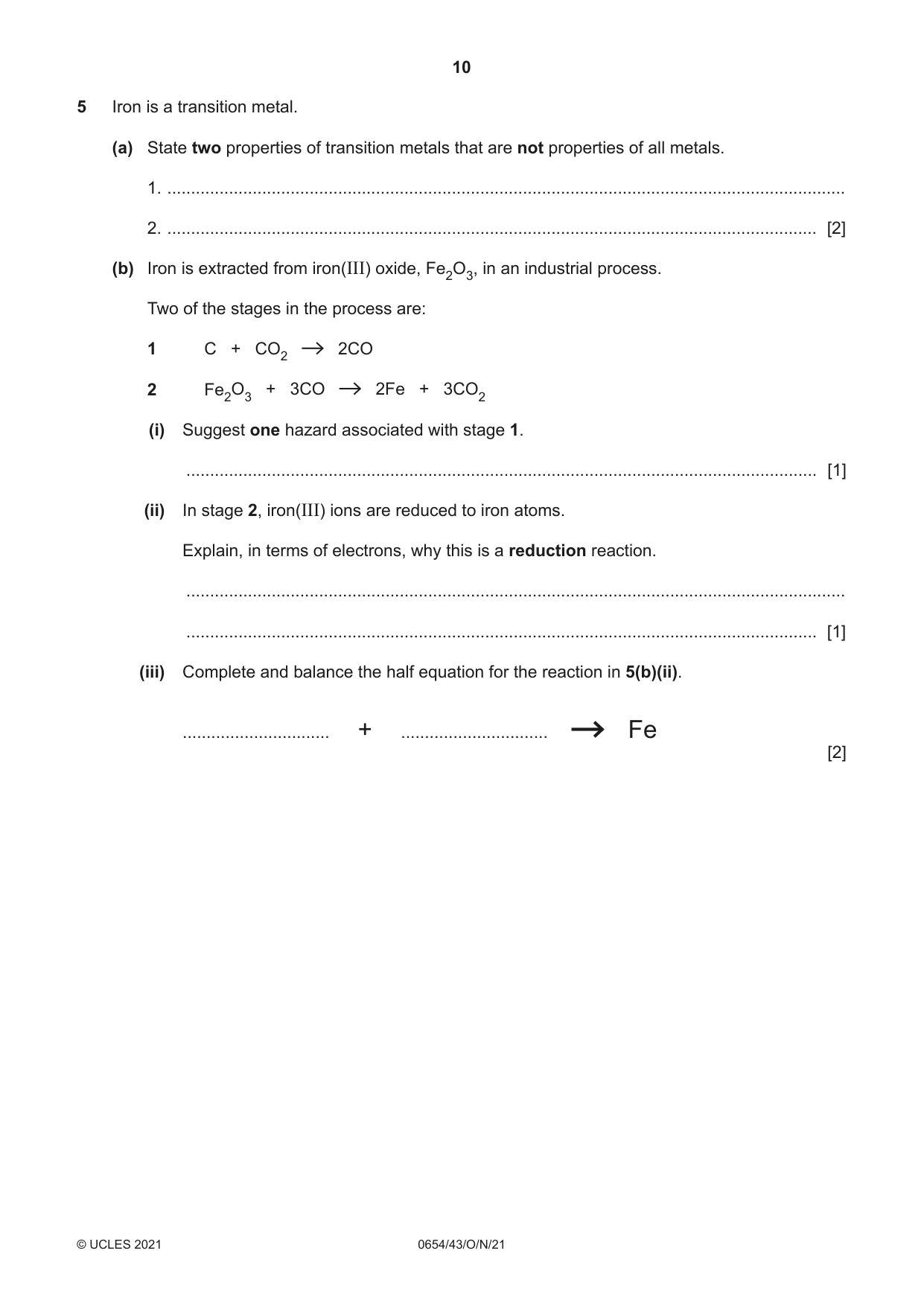
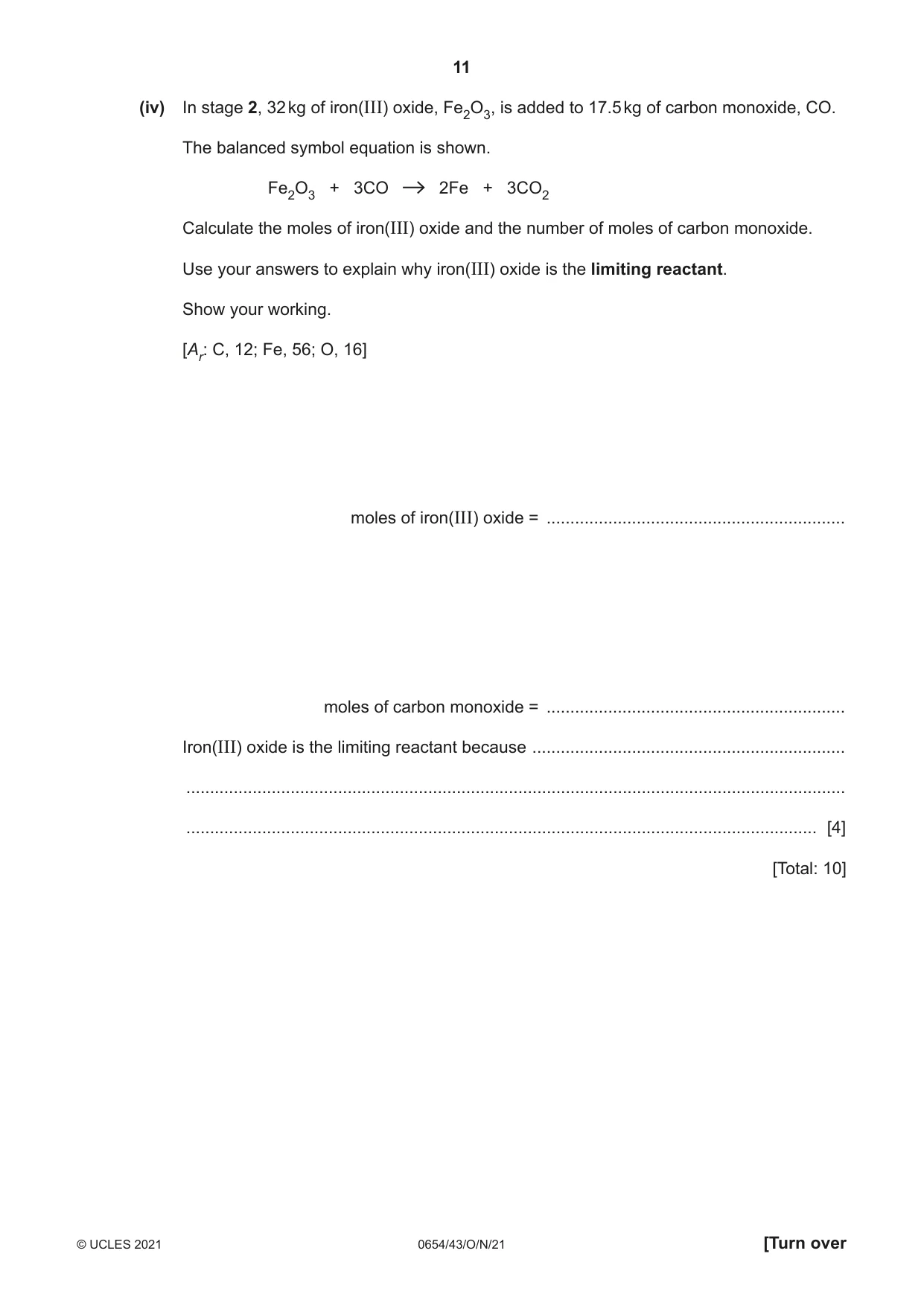
5 Iron is a transition metal. (a) State two properties of transition metals that are not properties of all metals. 1. ............................................................................................................................................... 2. ......................................................................................................................................... [2] (b) Iron is extracted from iron(III) oxide, Fe2O3, in an industrial process. Two of the stages in the process are: 1 C + CO2 2CO 2 Fe2O3 + 3CO 2Fe + 3CO2 (i) Suggest one hazard associated with stage 1. ..................................................................................................................................... [1] (ii) In stage 2, iron(III) ions are reduced to iron atoms. Explain, in terms of electrons, why this is a reduction reaction. ........................................................................................................................................... ..................................................................................................................................... [1] (iii) Complete and balance the half equation for the reaction in 5(b)(ii). ............................... + ............................... Fe [2] (iv) In stage 2, 32 kg of iron(III) oxide, Fe2O3, is added to 17.5 kg of carbon monoxide, CO. The balanced symbol equation is shown. Fe2O3 + 3CO 2Fe + 3CO2 Calculate the moles of iron(III) oxide and the number of moles of carbon monoxide. Use your answers to explain why iron(III) oxide is the limiting reactant. Show your working. [Ar: C, 12; Fe, 56; O, 16] moles of iron(III) oxide = ............................................................... moles of carbon monoxide = ............................................................... Iron(III) oxide is the limiting reactant because .................................................................. ........................................................................................................................................... ..................................................................................................................................... [4] [Total: 10]
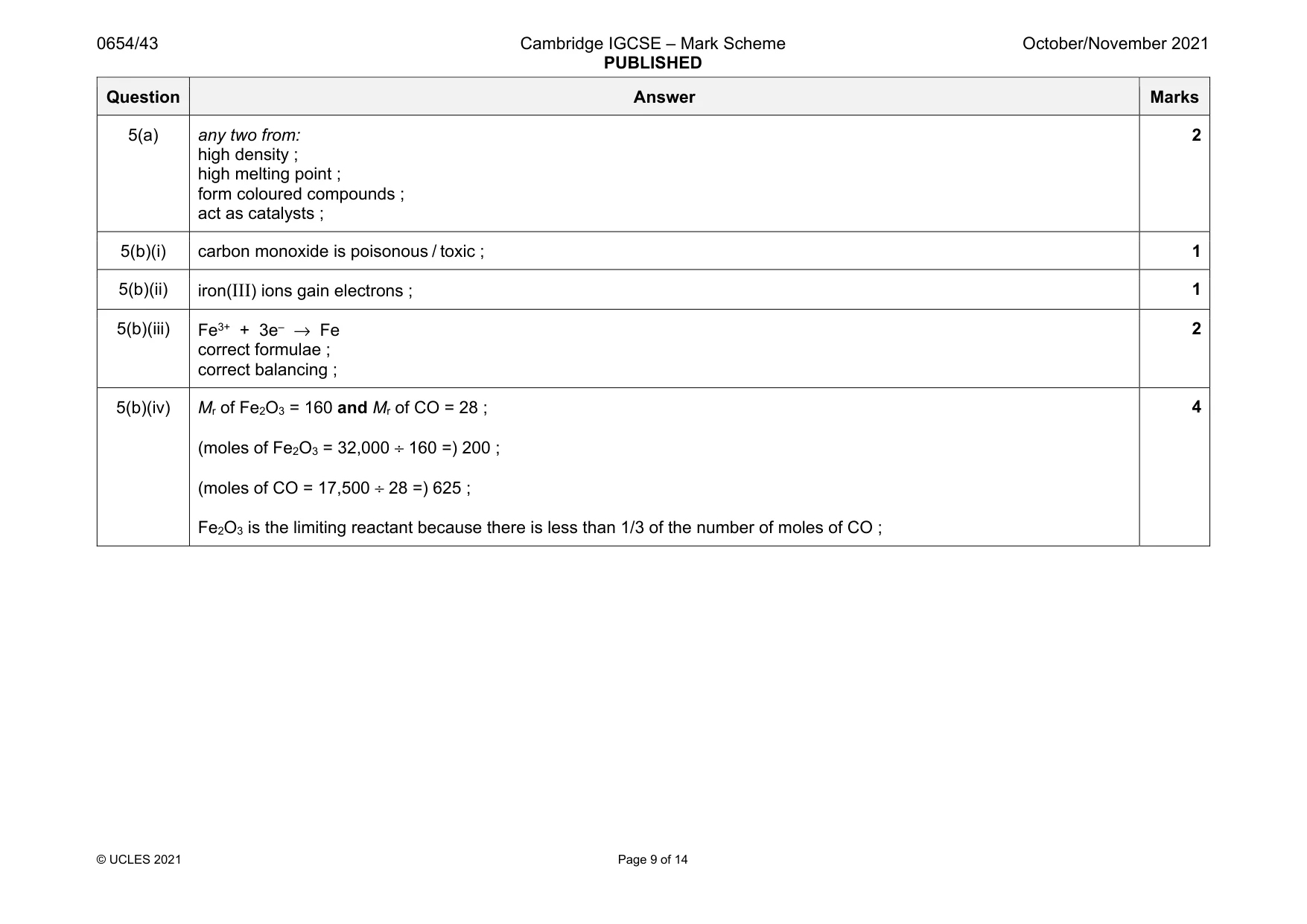
Mark scheme: 5(a) any two from: high density ; high melting point ; form coloured compounds ; act as catalysts ; 2 5(b)(i) carbon monoxide is poisonous / toxic ; 1 5(b)(ii) iron(III) ions gain electrons ; 1 5(b)(iii) Fe3+ + 3e– → Fe correct formulae ; correct balancing ; 2 5(b)(iv) Mr of Fe2O3 = 160 and Mr of CO = 28 ; (moles of Fe2O3 = 32,000 ÷ 160 =) 200 ; (moles of CO = 17,500 ÷ 28 =) 625 ; Fe2O3 is the limiting reactant because there is less than 1/3 of the number of moles of CO ; 4
Q6 · Different energy sources can be used to generate electricity
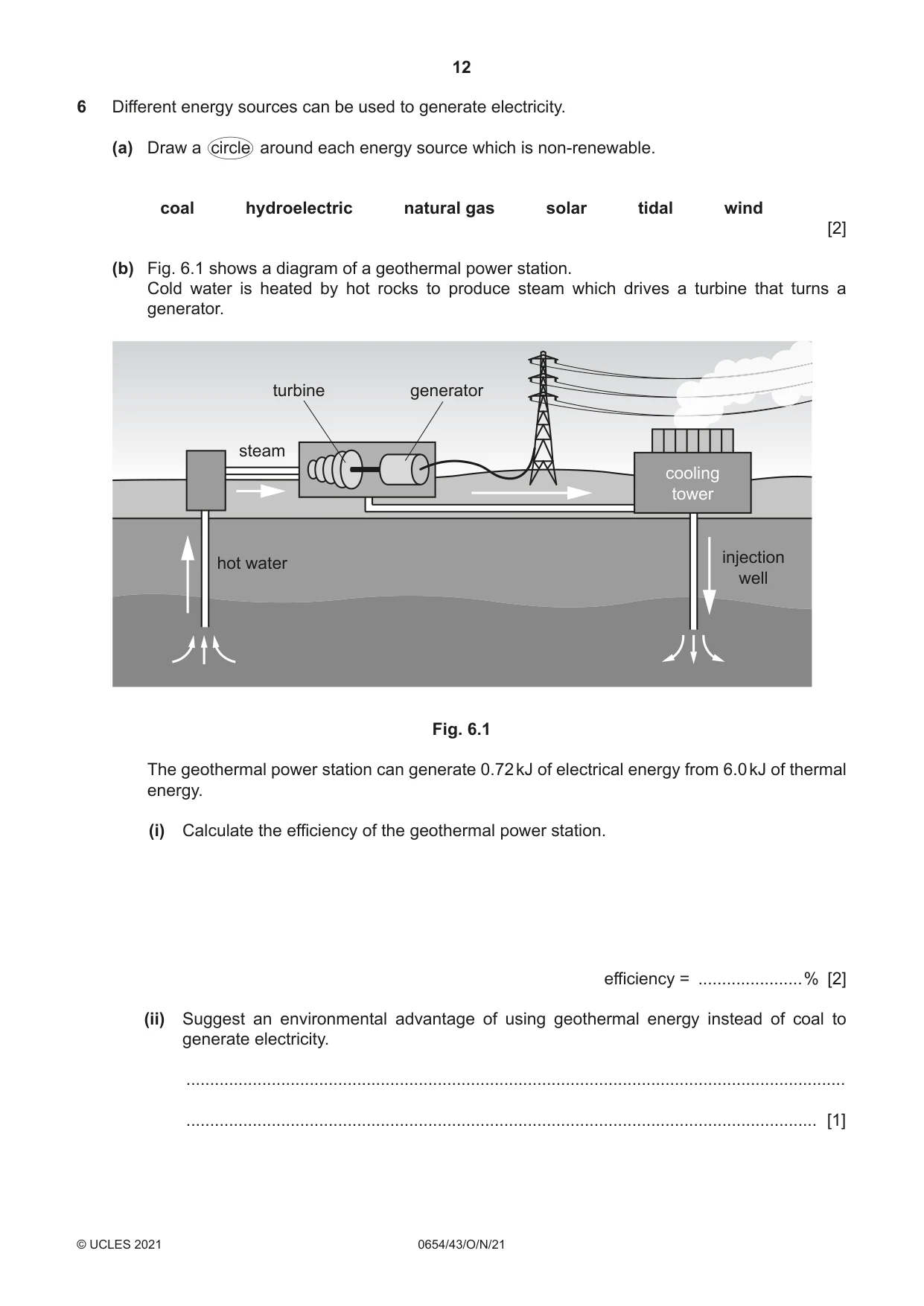
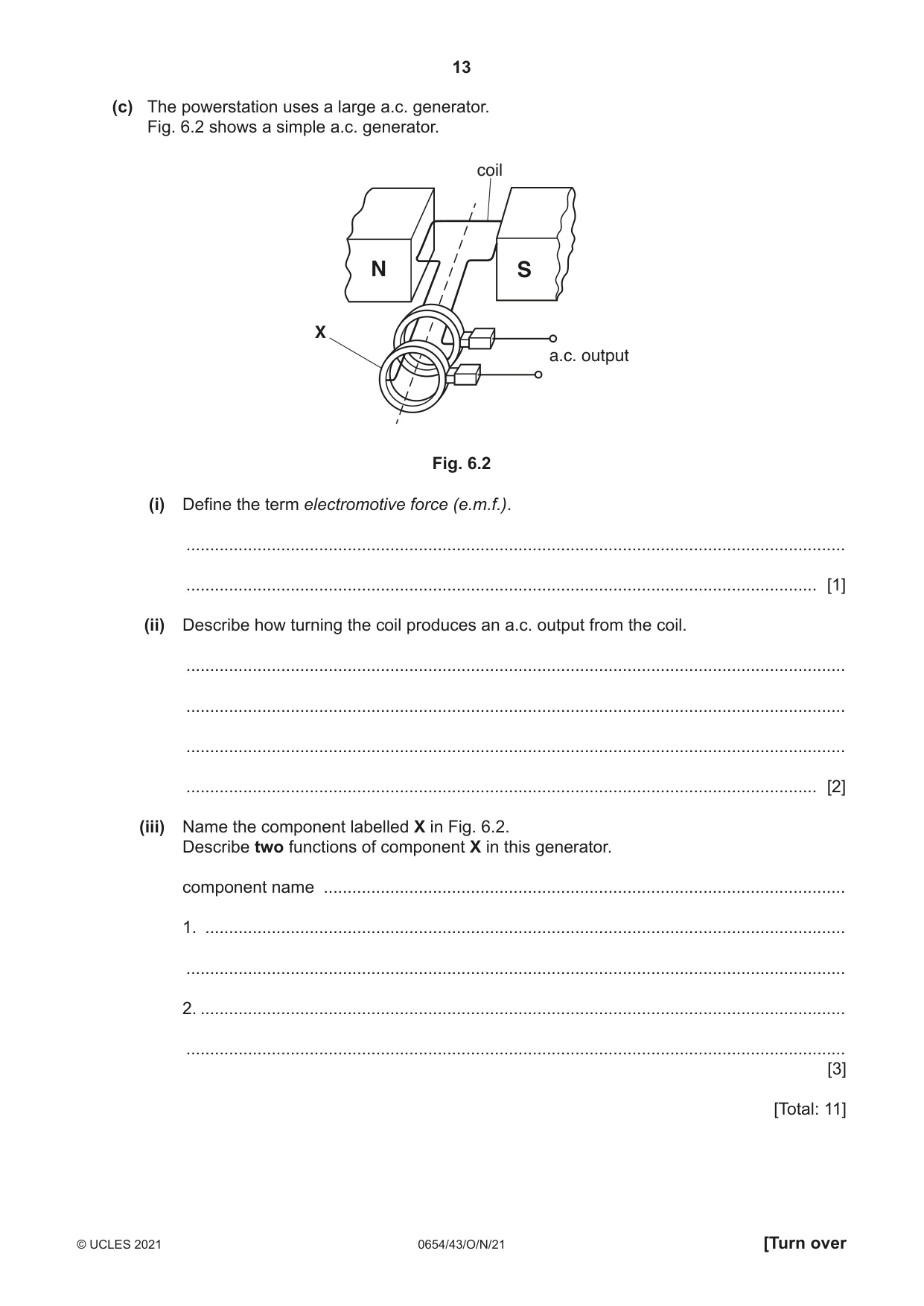
6 Different energy sources can be used to generate electricity. (a) Draw a circle around each energy source which is non-renewable. coal hydroelectric natural gas solar tidal wind [2] (b) Fig. 6.1 shows a diagram of a geothermal power station. Cold water is heated by hot rocks to produce steam which drives a turbine that turns a generator. turbine generator steam cooling tower injection hot water well Fig. 6.1 The geothermal power station can generate 0.72 kJ of electrical energy from 6.0 kJ of thermal energy. (i) Calculate the efficiency of the geothermal power station. efficiency = ......................% [2] (ii) Suggest an environmental advantage of using geothermal energy instead of coal to generate electricity. ........................................................................................................................................... ..................................................................................................................................... [1] (c) The powerstation uses a large a.c. generator. Fig. 6.2 shows a simple a.c. generator. coil N S X a.c. output Fig. 6.2 (i) Define the term electromotive force (e.m.f.). ........................................................................................................................................... ..................................................................................................................................... [1] (ii) Describe how turning the coil produces an a.c. output from the coil. ........................................................................................................................................... ........................................................................................................................................... ........................................................................................................................................... ..................................................................................................................................... [2] (iii) Name the component labelled X in Fig. 6.2. Describe two functions of component X in this generator. component name .............................................................................................................. 1. ....................................................................................................................................... ........................................................................................................................................... 2. ........................................................................................................................................ ........................................................................................................................................... [3] [Total: 11]
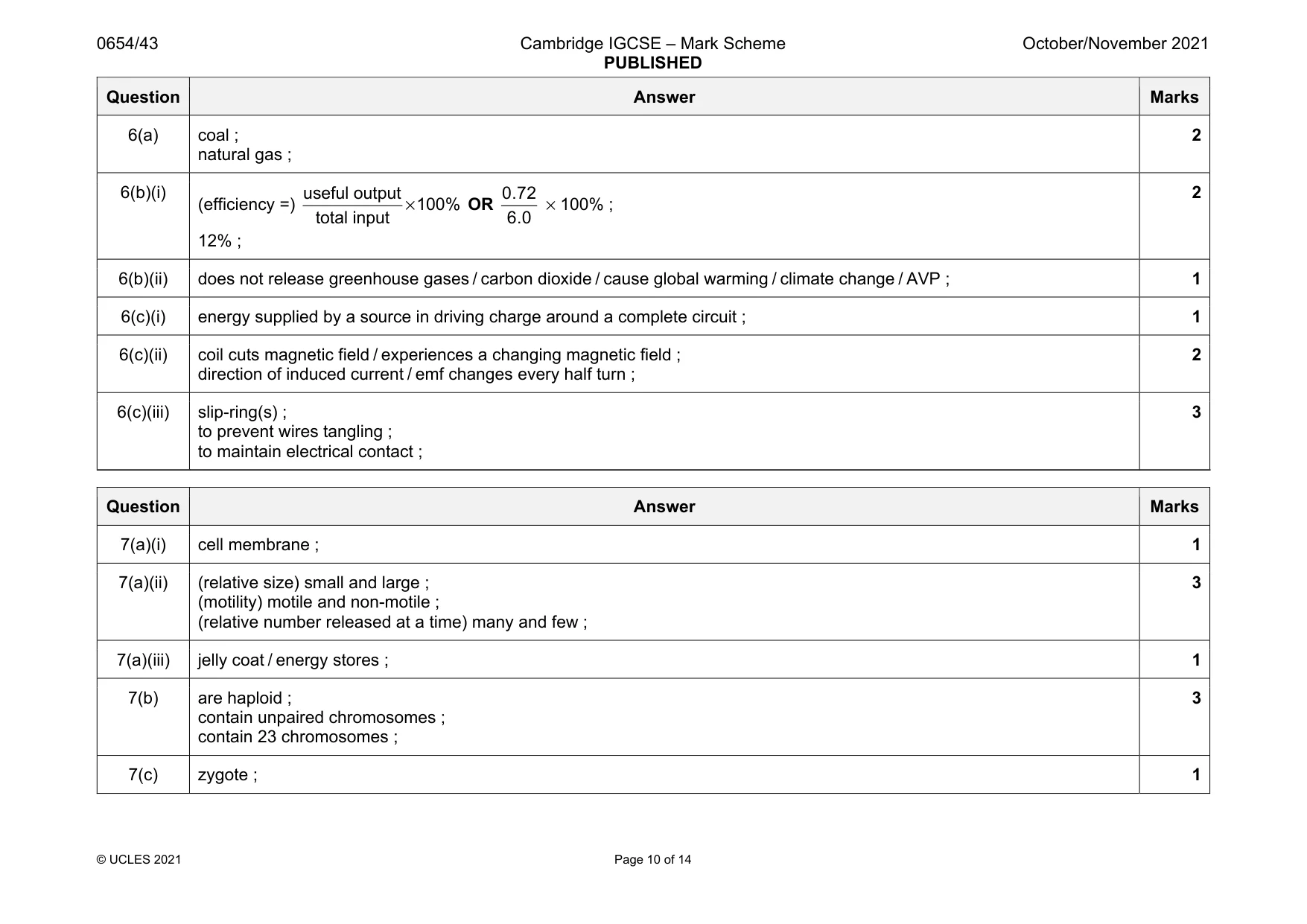
Mark scheme: 6(a) coal ; natural gas ; 2 6(b)(i) (efficiency =) useful output 100% total input × OR 0.72 6.0 × 100% ; 12% ; 2 6(b)(ii) does not release greenhouse gases / carbon dioxide / cause global warming / climate change / AVP ; 1 6(c)(i) energy supplied by a source in driving charge around a complete circuit ; 1 6(c)(ii) coil cuts magnetic field / experiences a changing magnetic field ; direction of induced current / emf changes every half turn ; 2 6(c)(iii) slip-ring(s) ; to prevent wires tangling ; to maintain electrical contact ; 3
Q7 · A drawing of a sperm cell
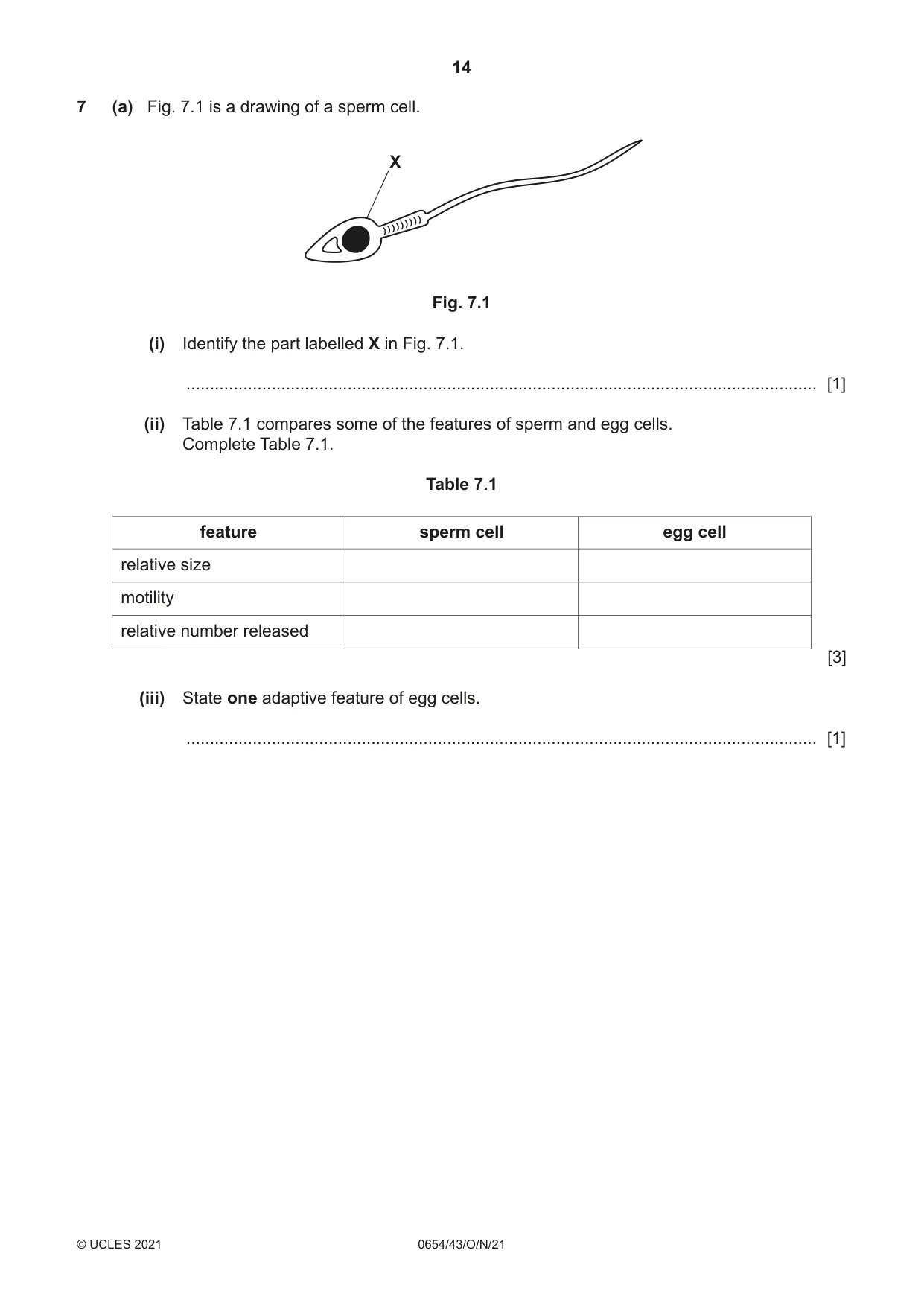
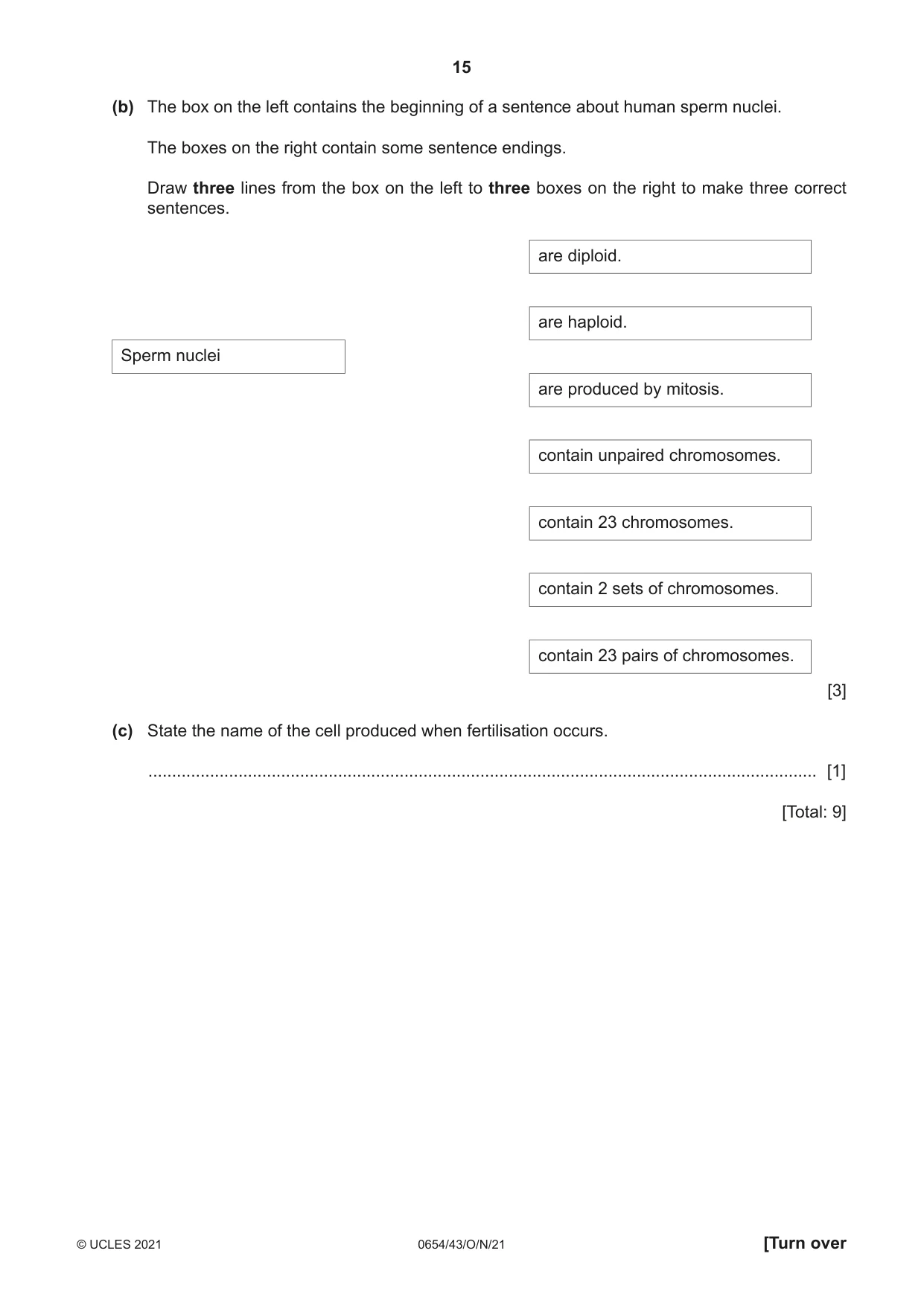
7 (a) Fig. 7.1 is a drawing of a sperm cell. X Fig. 7.1 (i) Identify the part labelled X in Fig. 7.1. ..................................................................................................................................... [1] (ii) Table 7.1 compares some of the features of sperm and egg cells. Complete Table 7.1. Table 7.1 feature sperm cell egg cell relative size motility relative number released [3] (iii) State one adaptive feature of egg cells. ..................................................................................................................................... [1] (b) The box on the left contains the beginning of a sentence about human sperm nuclei. The boxes on the right contain some sentence endings. Draw three lines from the box on the left to three boxes on the right to make three correct sentences. are diploid. are haploid. Sperm nuclei are produced by mitosis. contain unpaired chromosomes. contain 23 chromosomes. contain 2 sets of chromosomes. contain 23 pairs of chromosomes. [3] (c) State the name of the cell produced when fertilisation occurs. ............................................................................................................................................. [1] [Total: 9]
Mark scheme: 7(a)(i) cell membrane ; 1 7(a)(ii) (relative size) small and large ; (motility) motile and non-motile ; (relative number released at a time) many and few ; 3 7(a)(iii) jelly coat / energy stores ; 1 7(b) are haploid ; contain unpaired chromosomes ; contain 23 chromosomes ; 3 7(c) zygote ; 1
Q8 · Propene is an alkene
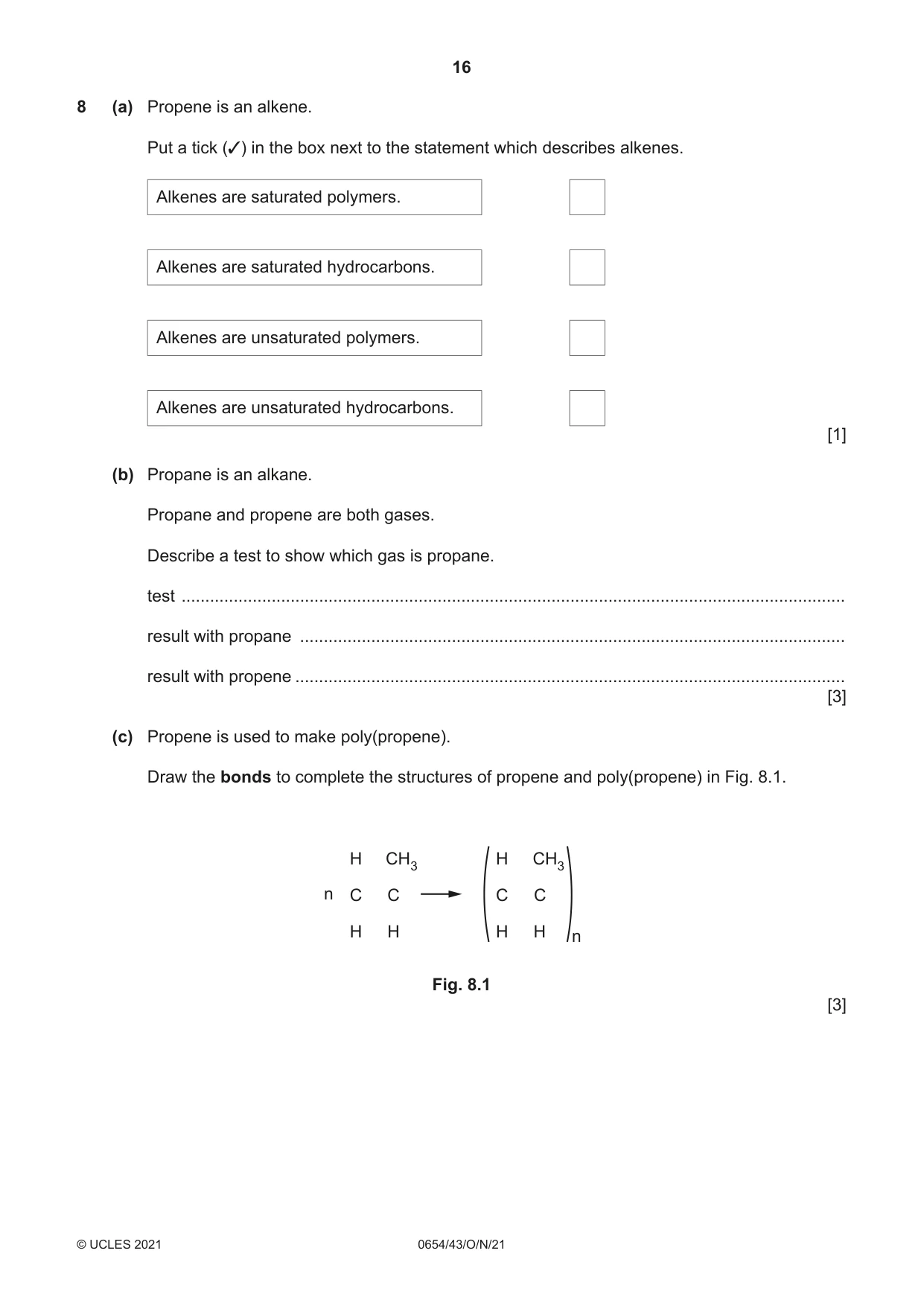
8 (a) Propene is an alkene. Put a tick (3) in the box next to the statement which describes alkenes. Alkenes are saturated polymers. Alkenes are saturated hydrocarbons. Alkenes are unsaturated polymers. Alkenes are unsaturated hydrocarbons. [1] (b) Propane is an alkane. Propane and propene are both gases. Describe a test to show which gas is propane. test ............................................................................................................................................ result with propane ................................................................................................................... result with propene .................................................................................................................... [3] (c) Propene is used to make poly(propene). Draw the bonds to complete the structures of propene and poly(propene) in Fig. 8.1. H CH3 H CH3 n C C C C H H H H n Fig. 8.1 [3] (d) Poly(propene) is made by addition polymerisation. Nylon is made by condensation polymerisation. Describe two differences between addition and condensation polymerisation. 1. . .............................................................................................................................................. ................................................................................................................................................... 2. . .............................................................................................................................................. ................................................................................................................................................... [2] [Total: 9]
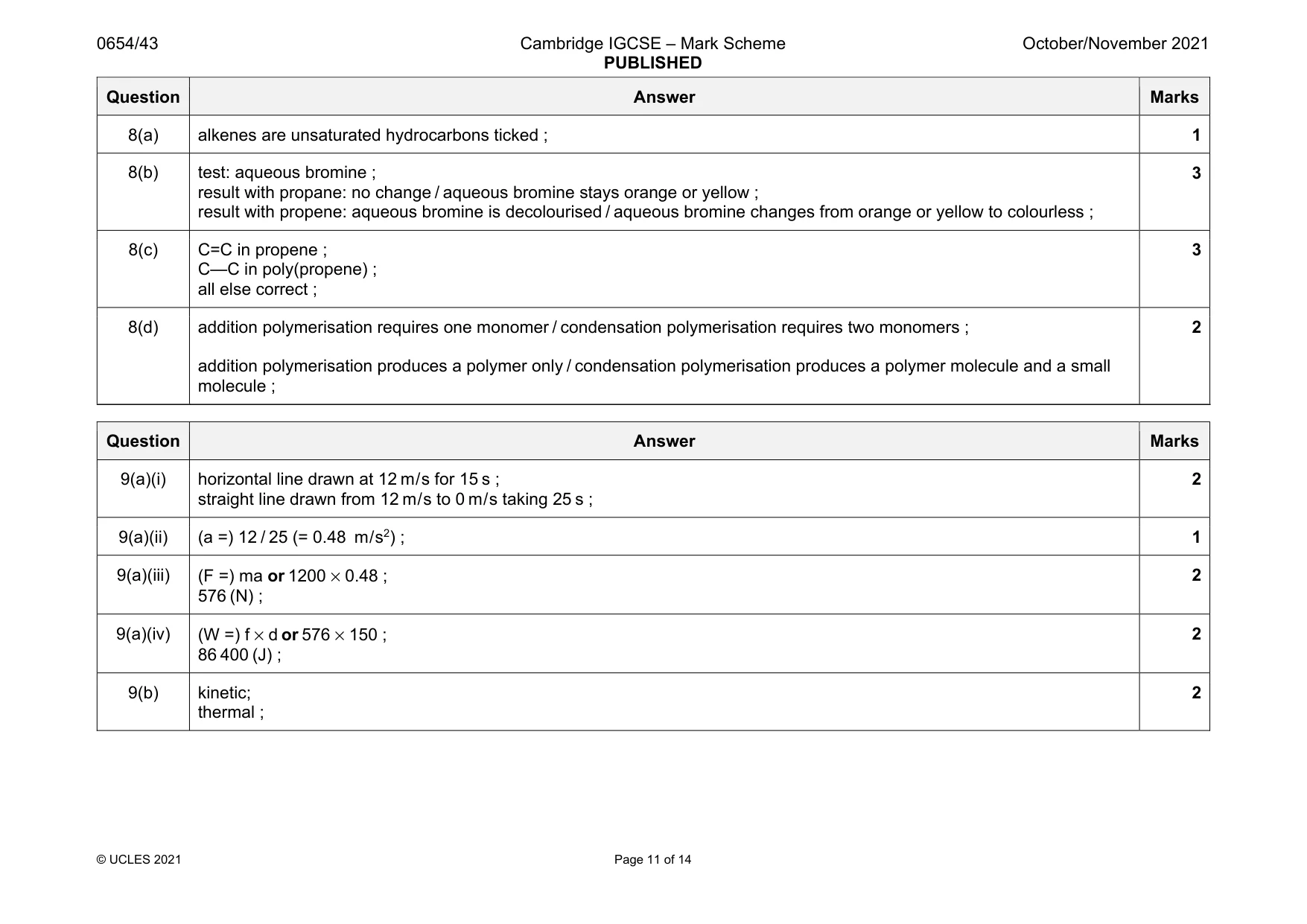
Mark scheme: 8(a) alkenes are unsaturated hydrocarbons ticked ; 1 8(b) test: aqueous bromine ; result with propane: no change / aqueous bromine stays orange or yellow ; result with propene: aqueous bromine is decolourised / aqueous bromine changes from orange or yellow to colourless ; 3 8(c) C=C in propene ; C—C in poly(propene) ; all else correct ; 3 8(d) addition polymerisation requires one monomer / condensation polymerisation requires two monomers ; addition polymerisation produces a polymer only / condensation polymerisation produces a polymer molecule and a small molecule ; 2
Q9 · A car travels at 12 m /s for 15 seconds
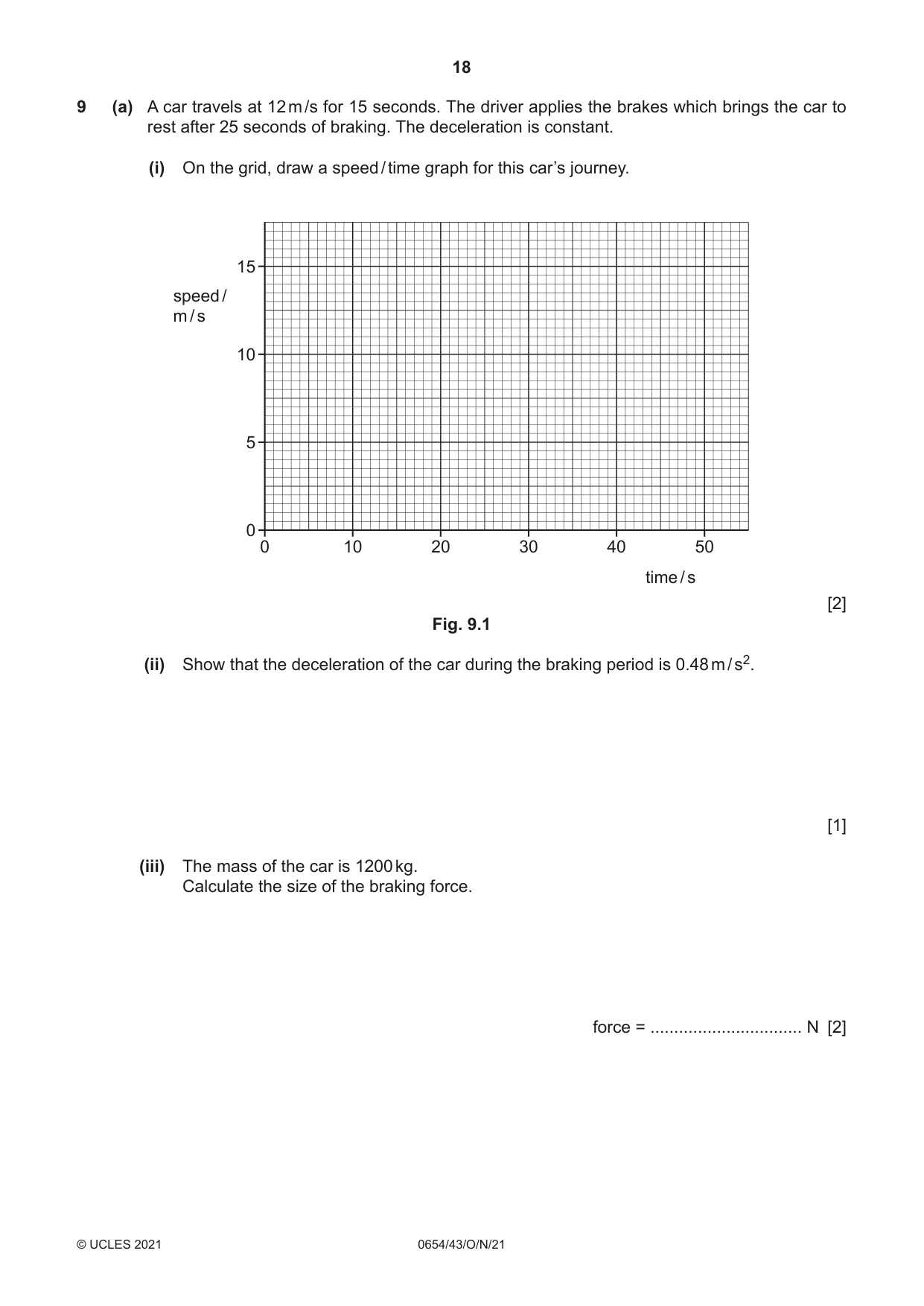
9 (a) A car travels at 12 m /s for 15 seconds. The driver applies the brakes which brings the car to rest after 25 seconds of braking. The deceleration is constant. (i) On the grid, draw a speed / time graph for this car’s journey. 15 speed / m / s 10 5 0 0 10 20 30 40 50 time / s [2] Fig. 9.1 (ii) Show that the deceleration of the car during the braking period is 0.48 m / s2. [1] (iii) The mass of the car is 1200 kg. Calculate the size of the braking force. force = ................................ N [2] (iv) The braking distance of the car is 150 m. Using your answer from 9(a)(iii) calculate the work done by the brakes. work done = ................................ J [2] (b) Describe the main energy transfer that happens when the car brakes. from ........................................ energy to ........................................ energy [2] [Total: 9]
Mark scheme: 9(a)(i) horizontal line drawn at 12 m / s for 15 s ; straight line drawn from 12 m / s to 0 m / s taking 25 s ; 2 9(a)(ii) (a =) 12 / 25 (= 0.48 m / s2) ; 1 9(a)(iii) (F =) ma or 1200 × 0.48 ; 576 (N) ; 2 9(a)(iv) (W =) f × d or 576 × 150 ; 86 400 (J) ; 2 9(b) kinetic; thermal ; 2
Q10 · An athlete monitors their pulse rate at rest and during exercise
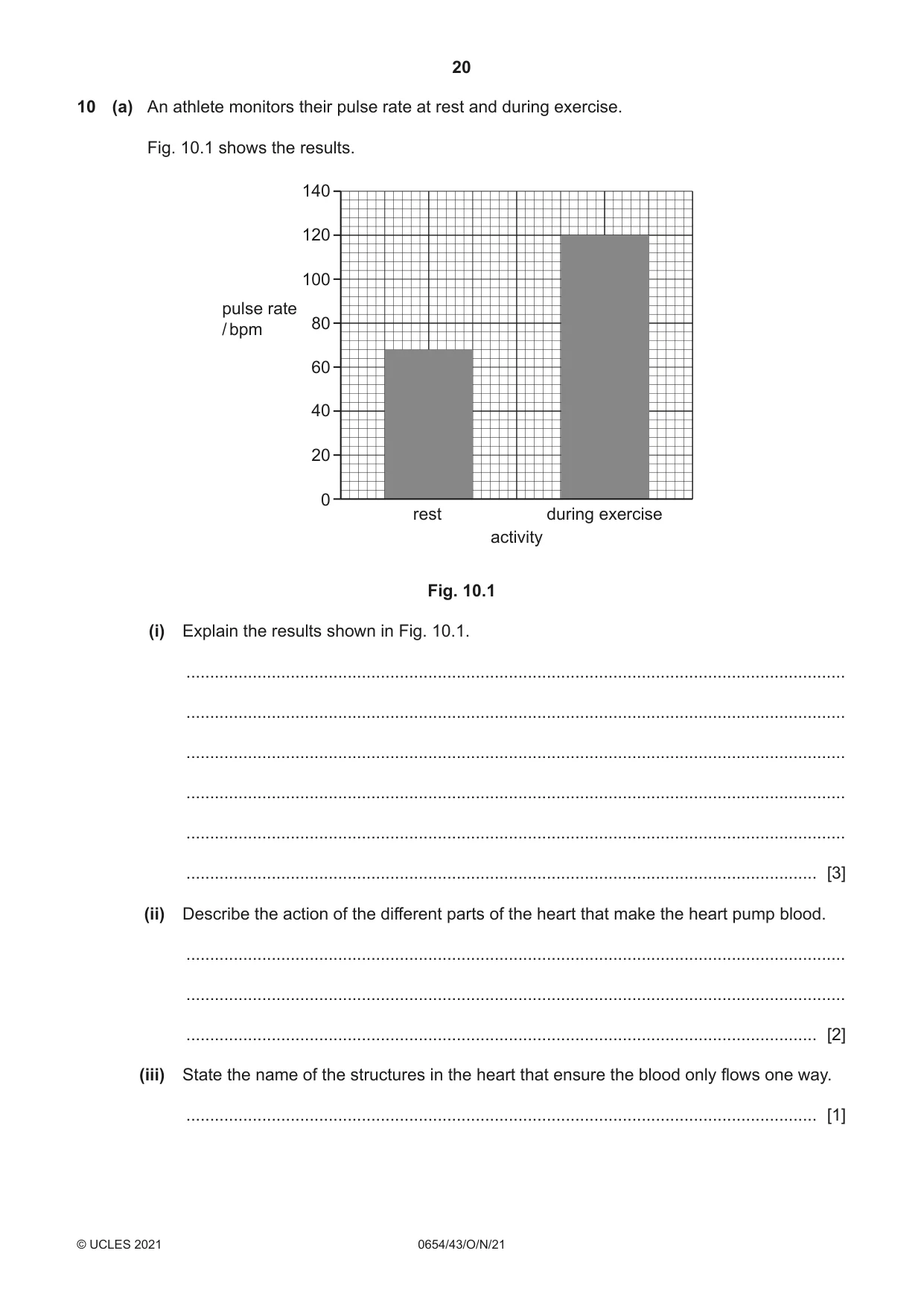
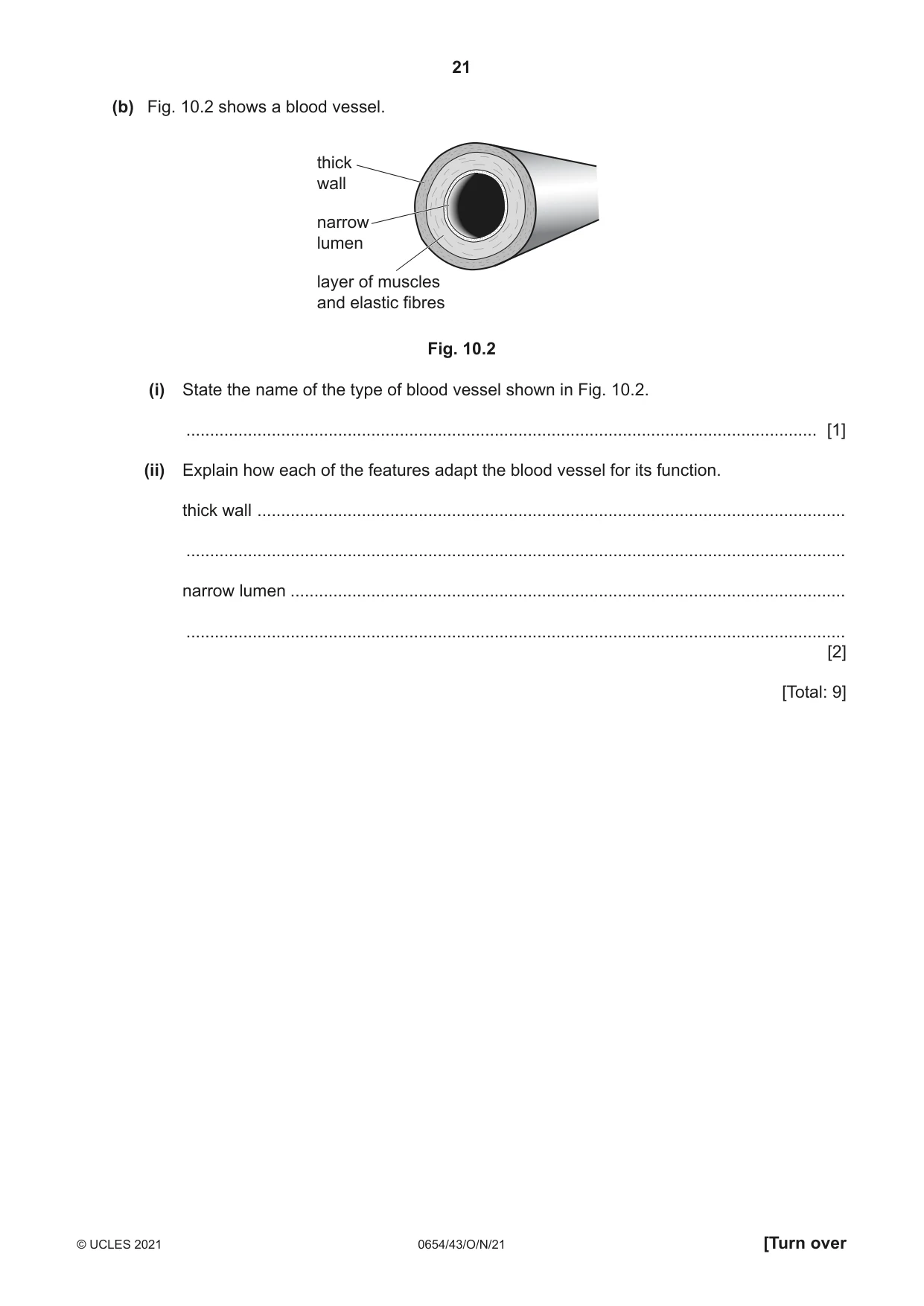
10 (a) An athlete monitors their pulse rate at rest and during exercise. Fig. 10.1 shows the results. 140 120 100 pulse rate 80 / bpm 60 40 20 0 rest during exercise activity Fig. 10.1 (i) Explain the results shown in Fig. 10.1. ........................................................................................................................................... ........................................................................................................................................... ........................................................................................................................................... ........................................................................................................................................... ........................................................................................................................................... ..................................................................................................................................... [3] (ii) Describe the action of the different parts of the heart that make the heart pump blood. ........................................................................................................................................... ........................................................................................................................................... ..................................................................................................................................... [2] (iii) State the name of the structures in the heart that ensure the blood only flows one way. ..................................................................................................................................... [1] (b) Fig. 10.2 shows a blood vessel. thick wall narrow lumen layer of muscles and elastic fibres Fig. 10.2 (i) State the name of the type of blood vessel shown in Fig. 10.2. ..................................................................................................................................... [1] (ii) Explain how each of the features adapt the blood vessel for its function. thick wall ............................................................................................................................ ........................................................................................................................................... narrow lumen ..................................................................................................................... ........................................................................................................................................... [2] [Total: 9]
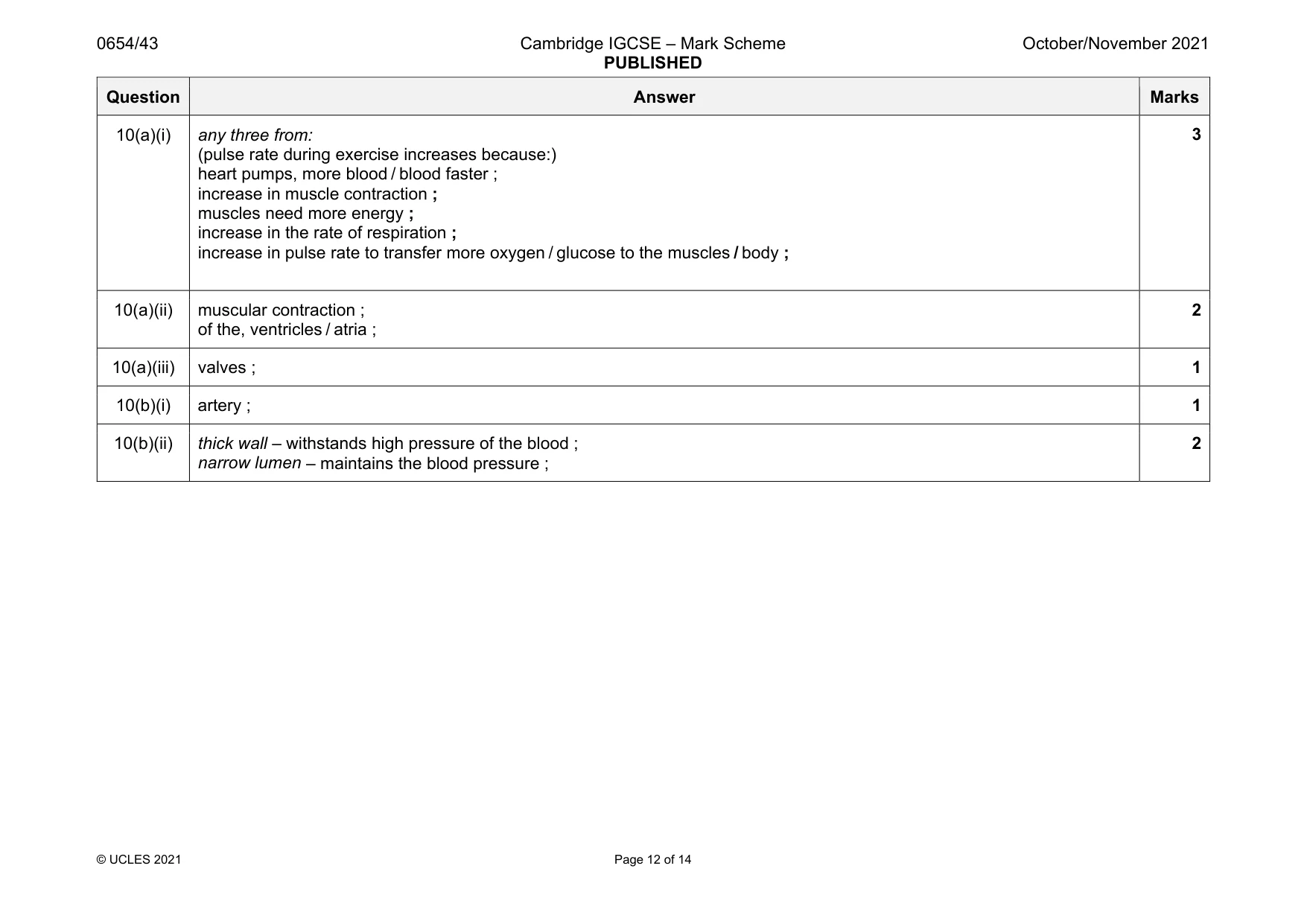
Mark scheme: 10(a)(i) any three from: (pulse rate during exercise increases because:) heart pumps, more blood / blood faster ; increase in muscle contraction ; muscles need more energy ; increase in the rate of respiration ; increase in pulse rate to transfer more oxygen / glucose to the muscles / body ; 10(a)(ii) muscular contraction ; of the, ventricles / atria ; 2 10(a)(iii) valves ; 1 10(b)(i) artery ; 1 10(b)(ii) thick wall – withstands high pressure of the blood ; narrow lumen – maintains the blood pressure ; 2
Q11 · A student investigates the reaction between zinc, Zn, and dilute hydrochloric acid, HCl
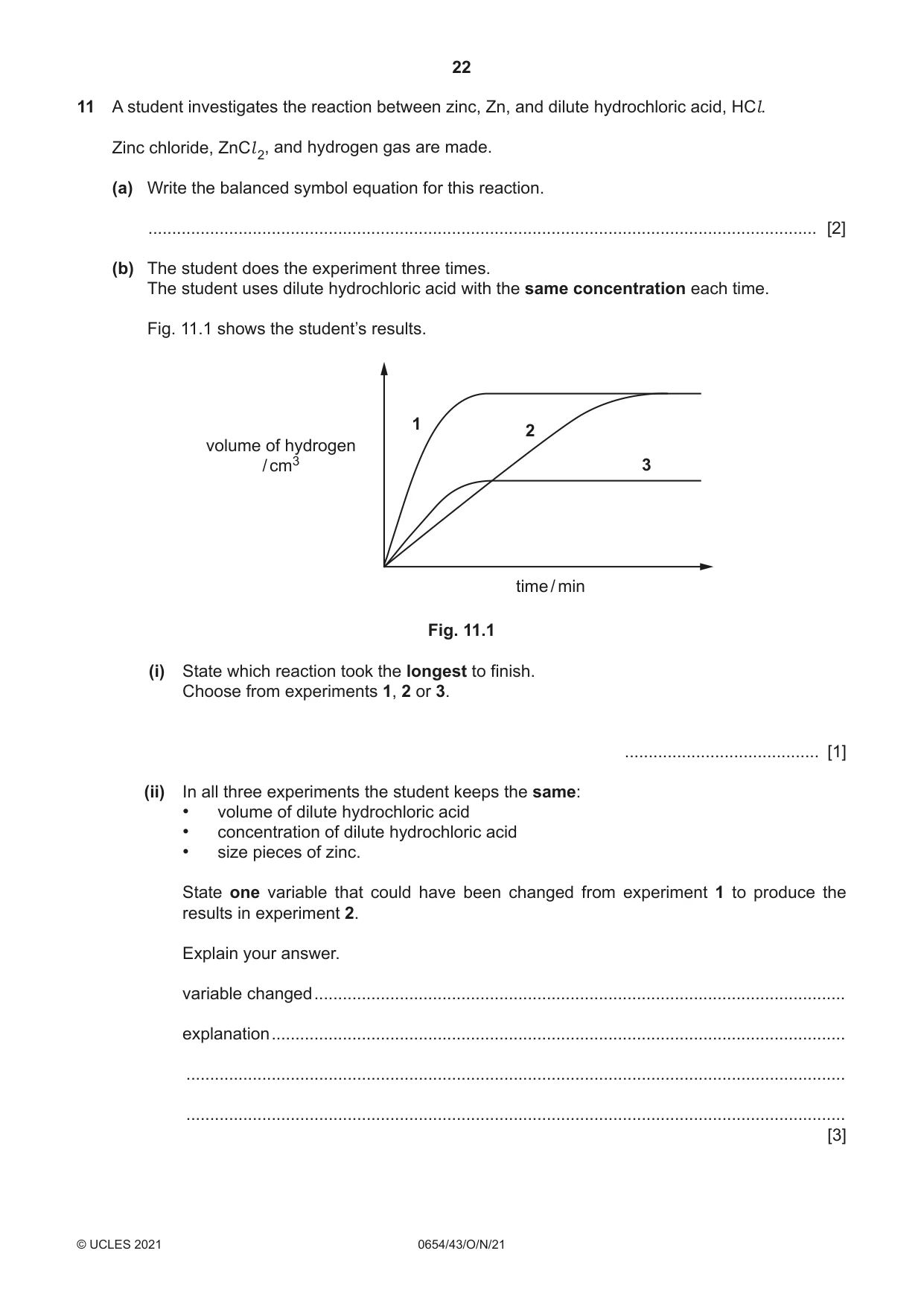
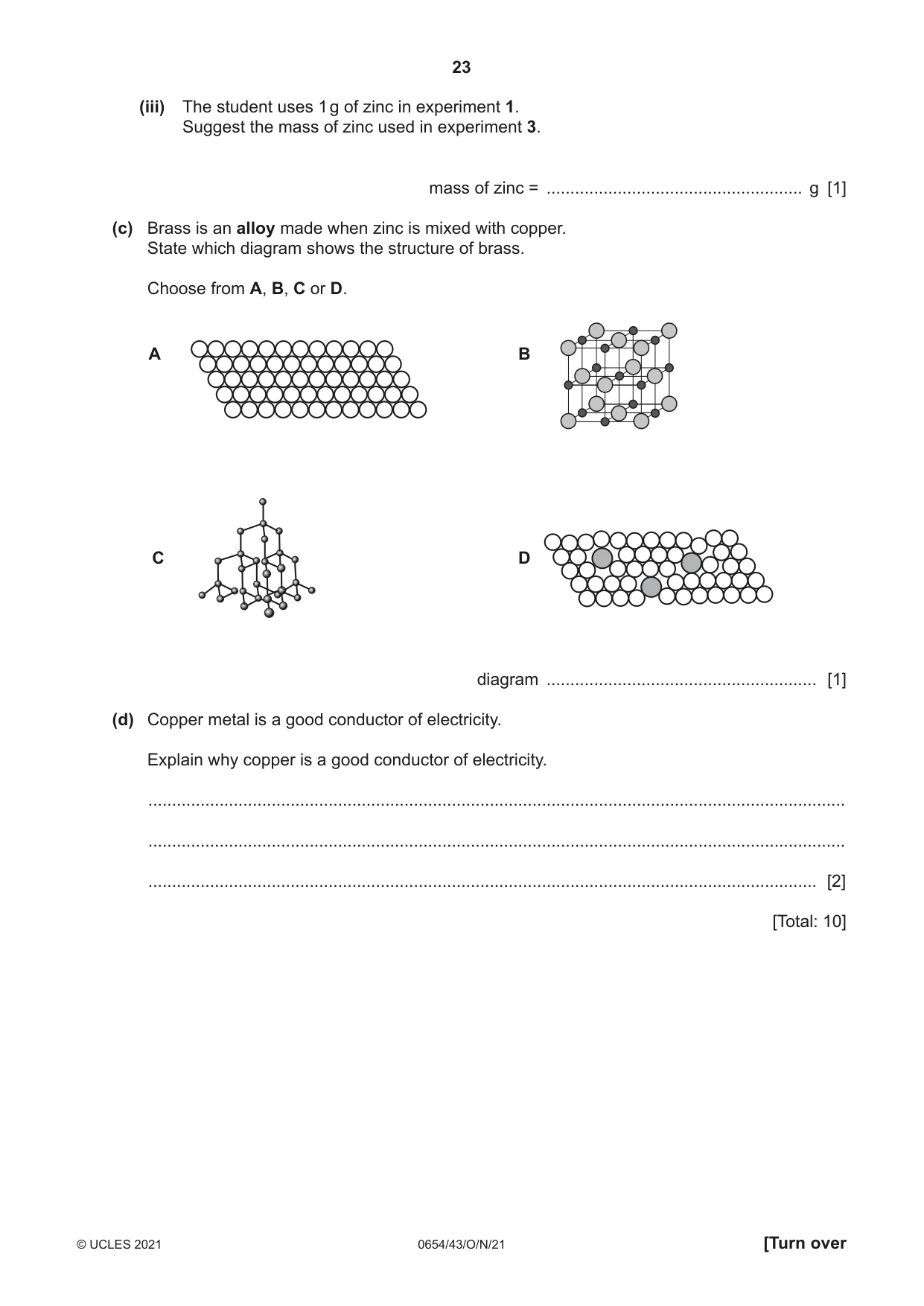
11 A student investigates the reaction between zinc, Zn, and dilute hydrochloric acid, HCl. Zinc chloride, ZnCl 2, and hydrogen gas are made. (a) Write the balanced symbol equation for this reaction. ............................................................................................................................................. [2] (b) The student does the experiment three times. The student uses dilute hydrochloric acid with the same concentration each time. Fig. 11.1 shows the student’s results. 1 2 volume of hydrogen / cm3 3 time / min Fig. 11.1 (i) State which reaction took the longest to finish. Choose from experiments 1, 2 or 3. ......................................... [1] (ii) In all three experiments the student keeps the same: • volume of dilute hydrochloric acid • concentration of dilute hydrochloric acid • size pieces of zinc. State one variable that could have been changed from experiment 1 to produce the results in experiment 2. Explain your answer. variable changed ................................................................................................................ explanation ......................................................................................................................... ........................................................................................................................................... ........................................................................................................................................... [3] (iii) The student uses 1 g of zinc in experiment 1. Suggest the mass of zinc used in experiment 3. mass of zinc = ...................................................... g [1] (c) Brass is an alloy made when zinc is mixed with copper. State which diagram shows the structure of brass. Choose from A, B, C or D. A B C D diagram ......................................................... [1] (d) Copper metal is a good conductor of electricity. Explain why copper is a good conductor of electricity. ................................................................................................................................................... ................................................................................................................................................... ............................................................................................................................................. [2] [Total: 10]
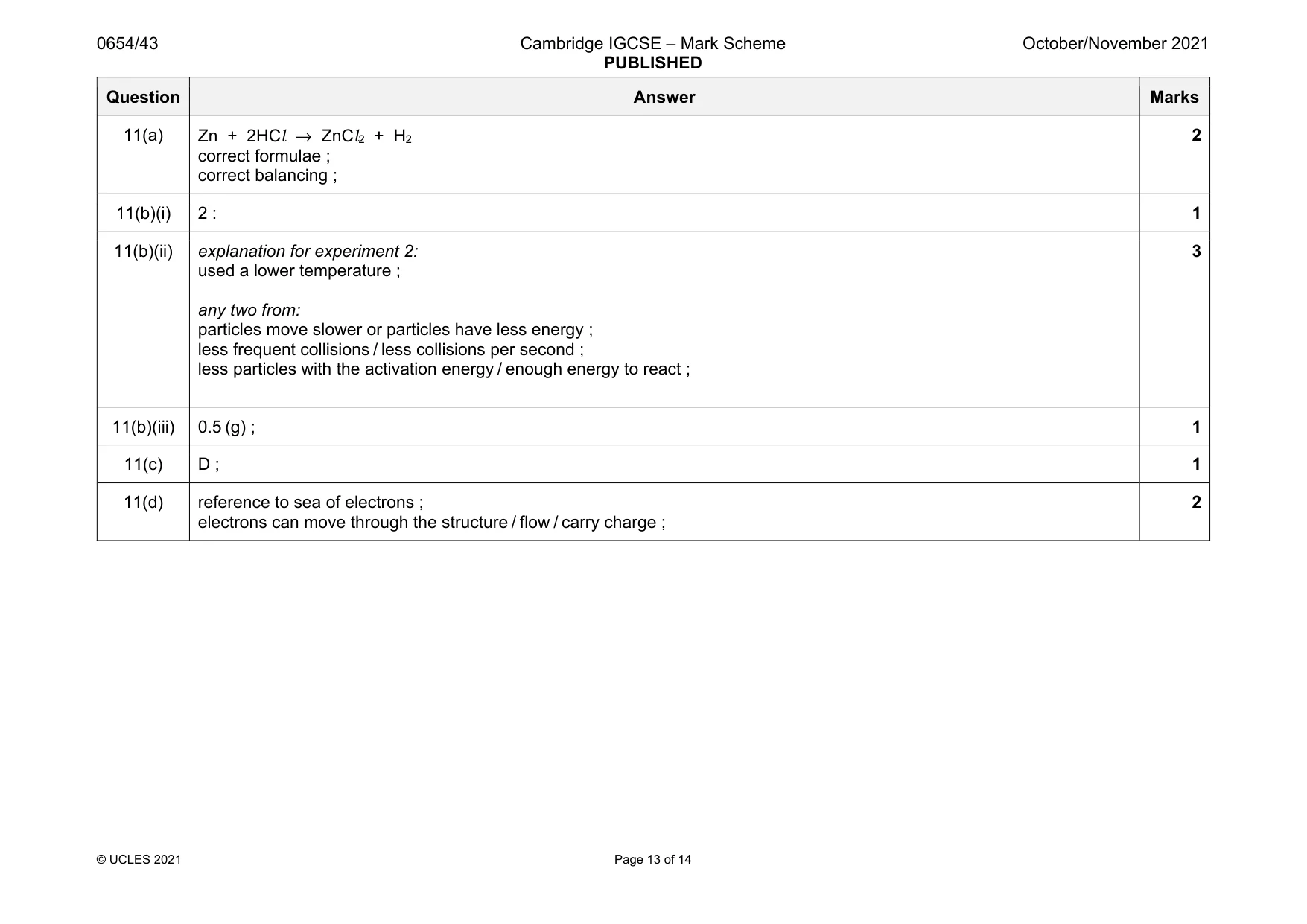
Mark scheme: 11(a) Zn + 2HCl → ZnCl2 + H2 correct formulae ; correct balancing ; 2 11(b)(i) 2 : 1 11(b)(ii) explanation for experiment 2: used a lower temperature ; any two from: particles move slower or particles have less energy ; less frequent collisions / less collisions per second ; less particles with the activation energy / enough energy to react ; 3 11(b)(iii) 0.5 (g) ; 1 11(c) D ; 1 11(d) reference to sea of electrons ; electrons can move through the structure / flow / carry charge ; 2
Q12 · A sealed glass jar filled with pure oxygen gas
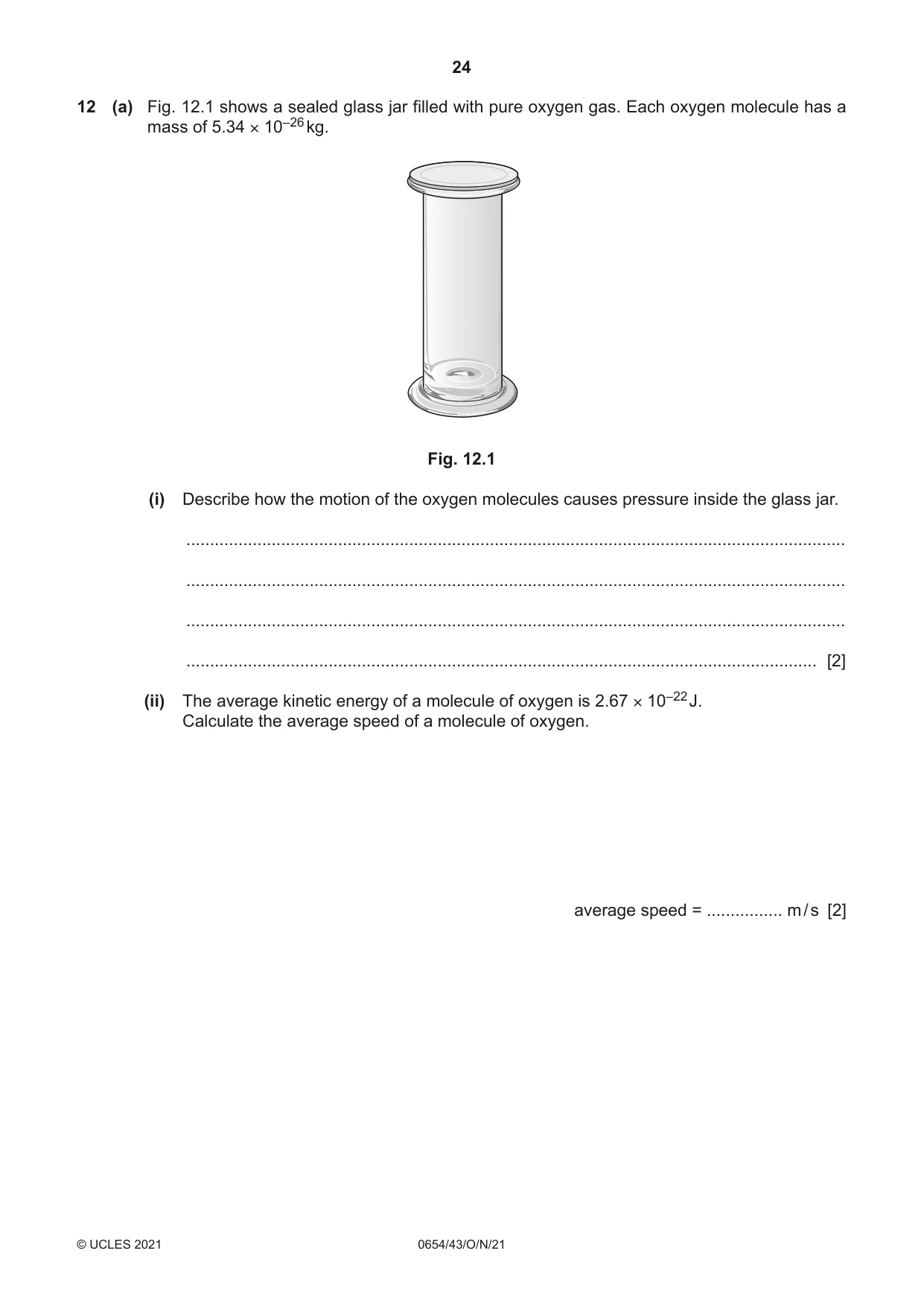
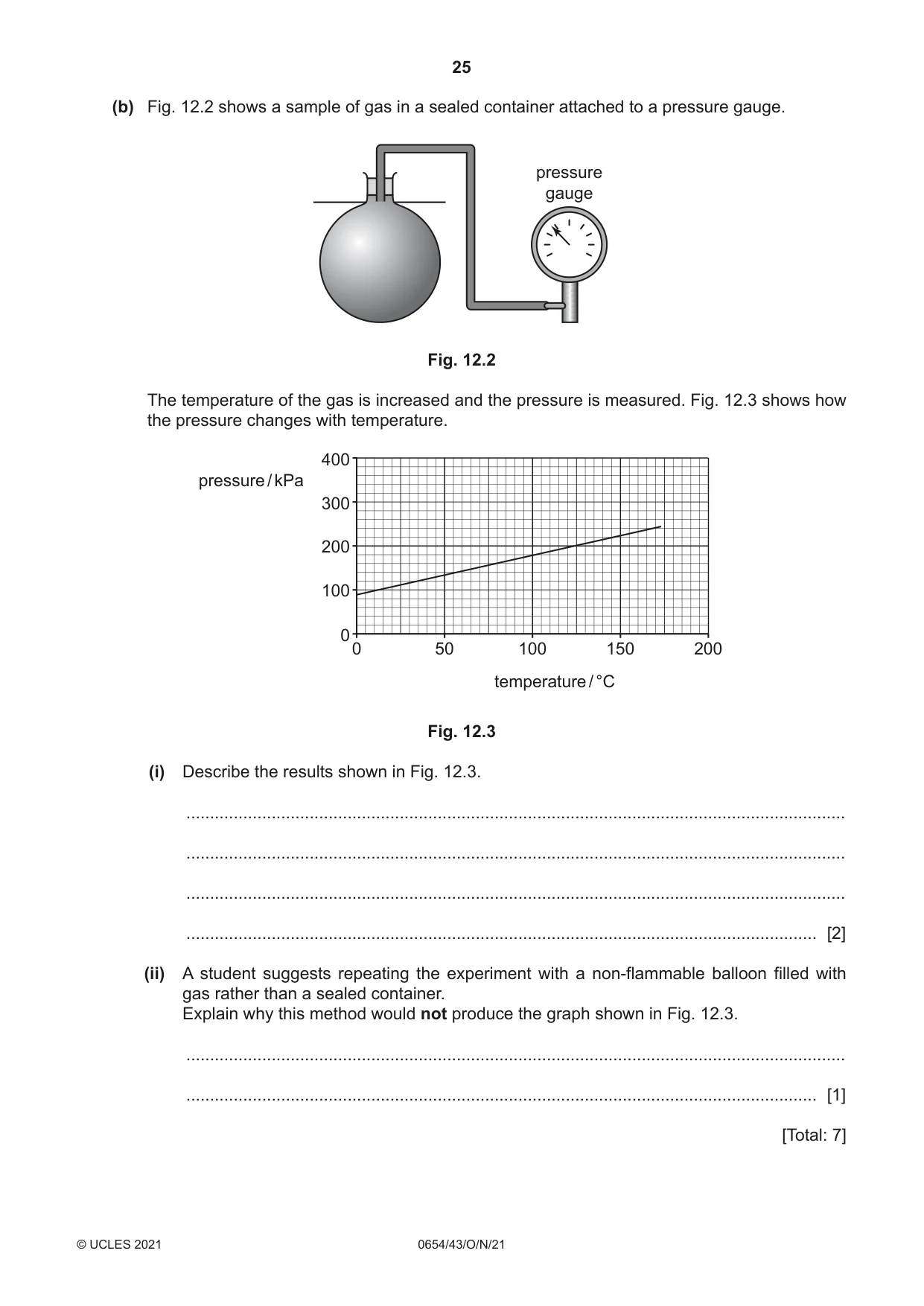
12 (a) Fig. 12.1 shows a sealed glass jar filled with pure oxygen gas. Each oxygen molecule has a mass of 5.34 × 10⁻²⁶ kg. Fig. 12.1 (i) Describe how the motion of the oxygen molecules causes pressure inside the glass jar. ........................................................................................................................................... ........................................................................................................................................... ........................................................................................................................................... ..................................................................................................................................... [2] (ii) The average kinetic energy of a molecule of oxygen is 2.67 × 10⁻²² J. Calculate the average speed of a molecule of oxygen. average speed = ................ m / s [2] (b) Fig. 12.2 shows a sample of gas in a sealed container attached to a pressure gauge. pressure gauge Fig. 12.2 The temperature of the gas is increased and the pressure is measured. Fig. 12.3 shows how the pressure changes with temperature. 400 pressure / kPa 300 200 100 0 0 50 100 150 200 temperature / °C Fig. 12.3 (i) Describe the results shown in Fig. 12.3. ........................................................................................................................................... ........................................................................................................................................... ........................................................................................................................................... ..................................................................................................................................... [2] (ii) A student suggests repeating the experiment with a non-flammable balloon filled with gas rather than a sealed container. Explain why this method would not produce the graph shown in Fig. 12.3. ........................................................................................................................................... ..................................................................................................................................... [1] [Total: 7]
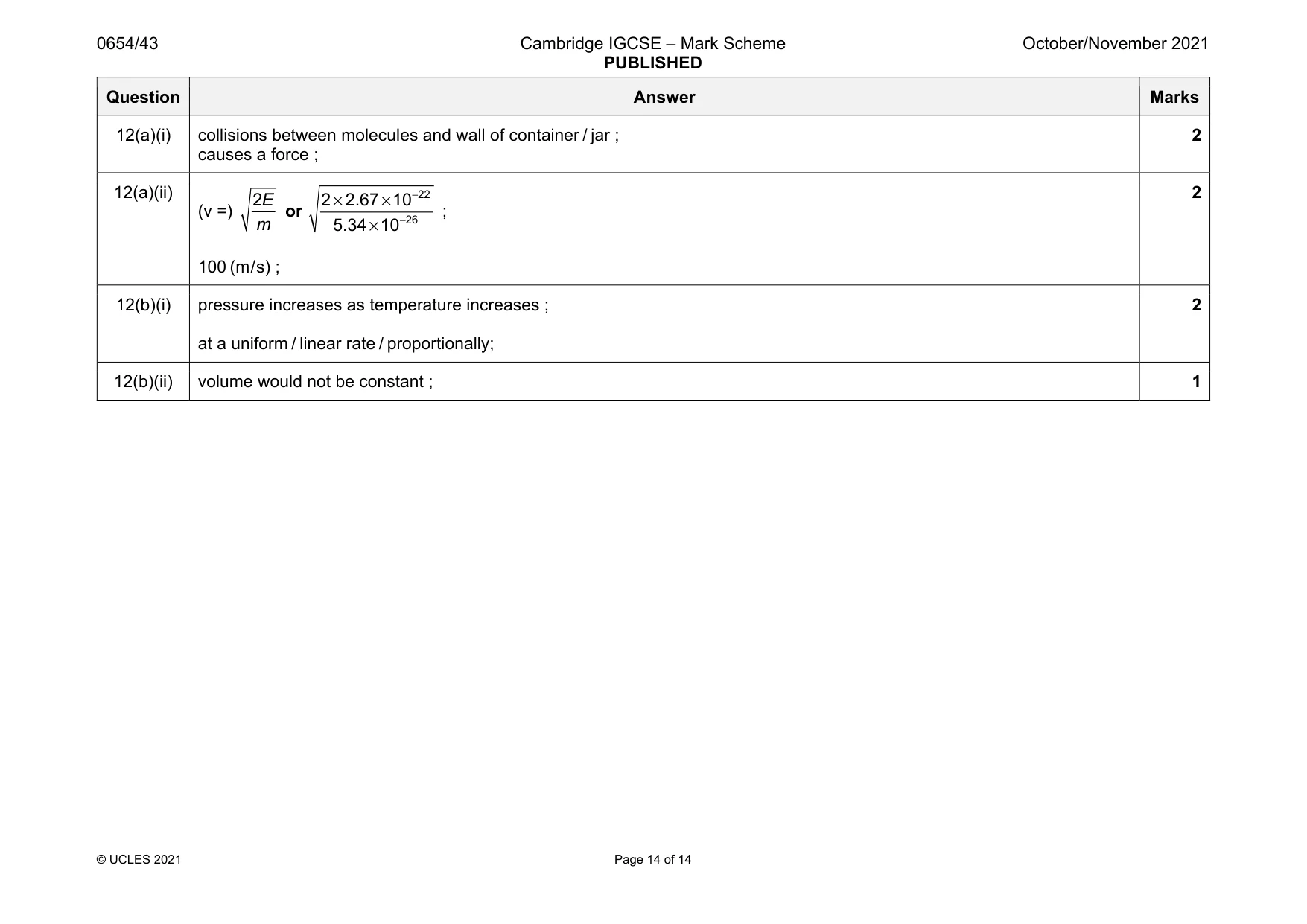
Mark scheme: 12(a)(i) collisions between molecules and wall of container / jar ; causes a force ; 2 12(a)(ii) (v =) 2E m or 22 26 2 2.67 10 5.34 10 − − × × × ; 100 (m / s) ; 2 12(b)(i) pressure increases as temperature increases ; at a uniform / linear rate / proportionally; 2 12(b)(ii) volume would not be constant ; 1
What was in this paper
The subtopics covered by these 12 questions, and how many questions each got. Open one in a new tab to see every Cambridge question on it.
What you needed in this session
Cambridge’s own grade thresholds for 2021 Oct/Nov, Paper 4 · Variant 3. A higher threshold means an easier paper — the bar moves with how the cohort did.